AUTO RANGING DIGITAL GAUGE REDUCES DEVICE INVENTORY
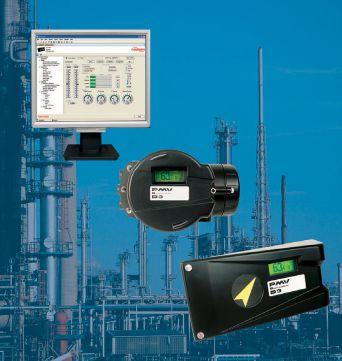
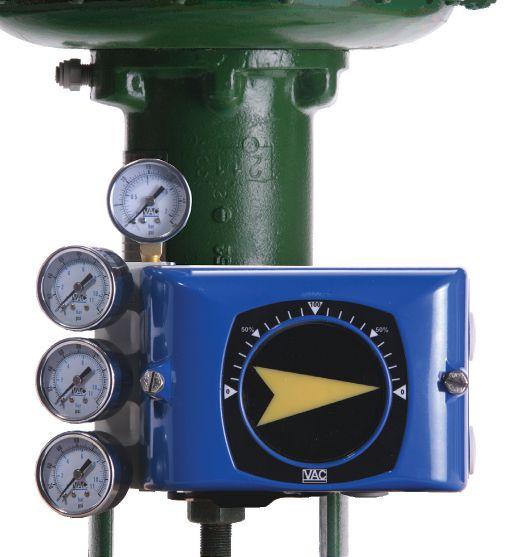
The D3 available from Cancoppas is a digital positioner where high air delivery capacity is said to be combined with low air consumption. Positioners suit both linear and rotary actuators, single or double acting. Five keys and a large graphic display make the unit simple to configure and adjust, the company says. The pneumatic relay consists of piezo electric valves and is made of plastic to offer corrosion resistance. An easily accessible built in replaceable filter is provided with a sealed off compartment for the terminals, the company adds. Communication is possible via HART, Profibus PA, and Foundation Fieldbus. Cancoppas www.cancoppas.comwww.cpec.news/31l Volume 49, No.
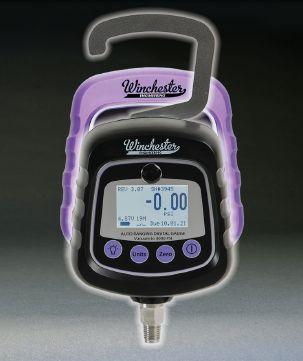
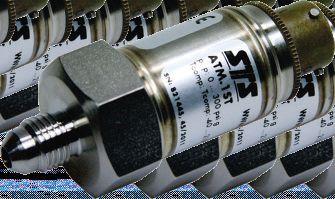
The Winchester Engineering Model 1 Auto Ranging Digital Gauge available from SRP control systems is said to replace the need to use many gauges of different ranges. The digital gauge with absolute vacuum to 3000 psi also functions as an absolute pressure gauge. The auto-ranging technology uses multiple piezoresisive sensors to read the entire range. The gauge can be tightened and loosened without a wrench. Units of measurement include psi, kPa, mmHg, inHg, inH20, mmH20, kg/cm², BarsAbsolute, psiAbsolute, mBarAbsolute, mmHgAbsolute, Bar, and mBar. The 1.6 lb. gauge offers a ¼-in. NPT Male process connection and temperature compensation of 0° to SRP control systems www.srpcontrol.com
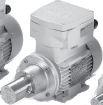
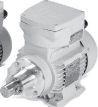
EXPLOSION PROOF POSITIONER IS SINGLE & DOUBLE ACTING
PNEUMATIC ACTUATORS FOR QUARTER-TURN VALVES, DAMPERS
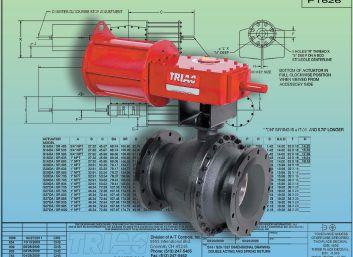
The Triac heavy duty scotch yoke actuator product line offers a broad range of torques to 1,600,000 in-lbs. The THD series is designed to operate ball, butterfly, plug valves, dampers or any device that requires a quarter-turn movement for on-off or throttling service. The standard offering is the symmetrical design yoke said to deliver maximum torque at both ends of the 90° cycle. The square slide bearing with guide bar is also said to provide high cycle life and smooth stroke while minimizing wear points. The company also offers a canted yoke design which is suitable for butterfly valves in sizes C11 and larger. As with all Triac actuators, he series is accompanied by a line of accessories, including jackscrew and hydraulic overides, limit switches, solenoids, and positioners.
w li p d s t s r
A-T Controls
www.a-tcontrols.com www.cpec.news/tb7
Sensor Technology
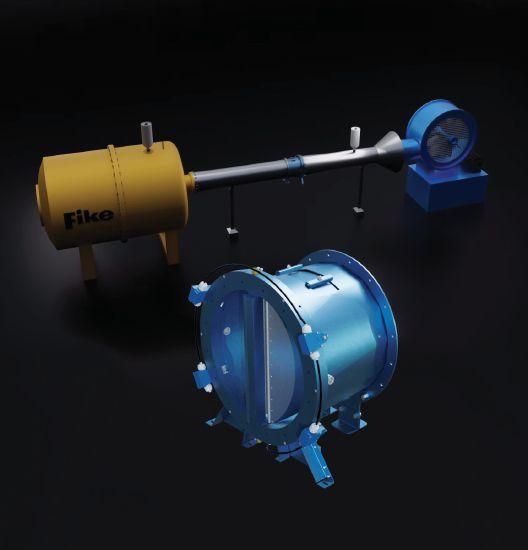
The Fike DFI compact passive explosion isolation valve has been tested and proven to perform accurately under pressures which it may experience during a deflagration from interconnected pipes and vessels. Currently available in sizes up to DN800 (32 in.), the company says that testing methods not only meet EN16447’s requirements but exceed it by including a protected zone pipeline with additional dust injectors, holding flaps in an open position until the precise time of ignition or flow reversal, using explosion vent panels instead of open venting ports, and using fans with real process flow and turbulence levels. Units are engineered to perform in both horizontal and vertical pipes and close to bends, as well as able to be installed closer to a vessel than other flap valves due to its fast-closing, lightweight flaps. The valve is compact in its design with a reduced footprint due to two smaller flaps instead of one large flap. Explosion pressures up to 1.5 barg can be tolerated, in applications with ST1 dusts (sugar, powdered milk, charcoal, sulfur, zinc), ST2 dusts (wood, flour), light metal dusts (aluminum), and low MIE (minimum ignition energy) dusts.
Watch isolation valve video demonstration at www.cpec.news/u4r. Fike Canada www.fike.comwww.cpec.news/qtl
The Common Sense Way to buy sensors
Contrinex DW Series
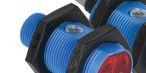
Proximity Sensors made in the USA
AutomationDirect carries a full line of sensors from photoelectric to limit switches, proximity and ultrasonic - we’ve got them all! Our sensors have the best pricing available and are in stock for fast shipment, with FREE shipping on orders over $49*. When it comes to buying sensors, it makes sense to choose AutomationDirect.
• Available in 8, 12, 18 and 30mm diameter housings
Starting at $15.50 (DW-AS-614-M12)
• Standard and extended sensing distances
• Flush and non-flush mounting versions
• IO-Link available in PNP models
• Lifetime warranty
• Proudly made in the USA
Wenglor OPT Series
Photoelectric Sensors
Starting at $63.00 (OPT2130)
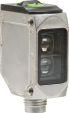
• Diffuse with background suppression, retroreflective, retroreflective for transparent objects, and through-beam models
• LO/DO, NO/NC outputs
• IO-Link compatibility
• Visible light spot allows easy target set-up
• IP67/IP68 rated
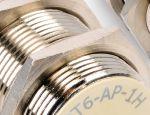
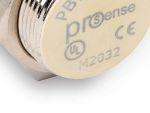
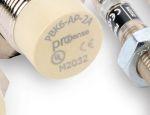
ProSense PB Series Inductive Proximity Sensors
Starting at $9.75 (PBM6-AP-1A)
• Available in 8, 12, 18 and 30mm diameter housings
• Up to 15mm sensing distance
• Flush and non-flush mounting versions
• Our lowest cost proximity sensor series offers great value
• Lifetime warranty
Fast free standard shipping* is available for most orders over $49 U.S., and that includes the brokerage fees (when using an AutomationDirect nominated broker). Using our choice of carrier, we can reach most Canadian destinations within 2 to 3 days.
*Free shipping does not apply to items requiring LTL transport, but those shipments can take advantage of our negotiated super-low at rates (based on weight) that include brokerage fees.
See Web site for details and restrictions at: www.automationdirect.com/canada
(SEN-TESTER-001)
• Fast field check of various sensor types
NEW! Contrinex 18mm
Photoelectric Sensors
Starting at $22.00 (LTR-M18PA-PMS-603)
• Diffuse with adjustable background suppression, diffuse, retroreflective, through-beam styles
• Sensing distance up to 30m
• Axial cable or M12 quick-disconnect models; purchase cable separately
• Complete overload protection
• IP67 rated
• 2-year warranty
• IO-Link V 1.0 on PNP models
• Proudly made in the USA
NEW! Schmersal IEC
Limit Switches
Starting at $14.00 (ZS-236-02Z)
• Available in 30mm and 40mm body widths
• Zinc alloy, aluminum or glass-fiber thermoplastic bodies
• 90-degree adjustable head, with levers adjustable to any angle
• Snap-action contacts in a variety of NO/NC configurations
MADE
MADE IN
HYDRAULIC PRESSURE COMPARATOR SPEEDS
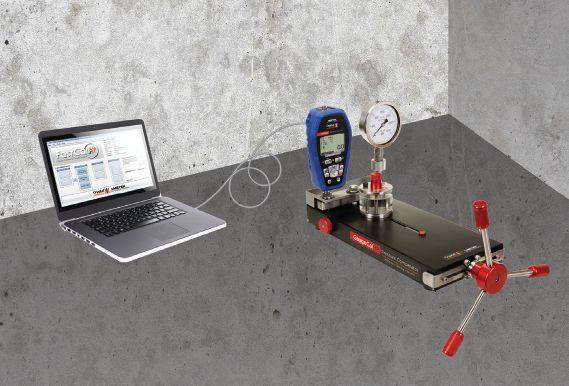
The AMETEK STC GaugeCalHP available from Cameron Instruments is a portable, self-contained hydraulic pressure comparator said to supply pressure up quickly and easily to 15,000 psi and vacuum to -12.5 psi. With a simple turn of the handle, the company says, it’s easy to reach each calibration point and quickly complete calibrations. The comparator is said to be much faster than deadweight testers and most automated pressure controllers and can be used with
water, light oil, or air. Users can combine the GaugeCalHP with the FastCalXP Calibration Software to easily complete 10 point up and down calibrations in less than 3 minutes, the company adds, including printing out a calibration certificate. The software is said to free users from manually recording and interpolating gauge readings, which helps reduce data errors.
Cameron Instruments
www.cameroninstruments.com
www.cpec.news/t8p
ANALYZER ADDS CAPABILITIES FOR H2O MEASUREMENT IN NATURAL GAS
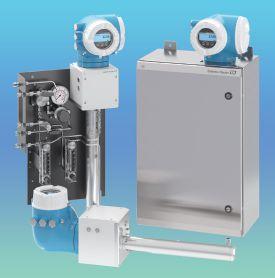
Endress+Hauser has introduced the J22 analyzer, powered by sister company SpectraSensors technology, that is said to meet the challenge of improving on the already highly regarded capabilities of Tunable Laser Diode Absorption Spectroscopy (TDLAS) measurement of H2O in natural gas. Operators are seeking even higher levels of accuracy and reliability, the company says, as well as the lowest possible maintenance cost and total cost of ownership. The algorithms of the analyzer’s TDLAS measurement plus the diagnostics, monitoring, and verification concept of Endress+Hauser’s Heartbeat Technology, are said to offer comprehensive process monitoring. The analyzer’s components are easily accessible and field-serviceable, allowing for quick replacements or upgrades, it adds. The simple-to-remove gas sample cells are designed to allow for convenient cleaning and servicing. A variety of system options allow the analyzer to integrate into any number of natural gas application locations. Watch video demonstration at www.cpec.news/xtj. Endress+Hauser Canada
www.ca.endress.com
www.cpec.news/8ec
COMPACT AODD PUMP FEATURES DETACHABLE MOUNTING FOOT
John Brooks Company has announced the Wilden Velocity Series air-operated double-diaphragm (AODD) pump said to feature the industry’s first detachable mounting foot. Suitable for small-dosing applications, the series provides startup pressures as low as 1.03 bar, a bore-seal design to eliminate leaks that result from torque decay, and interchangeable footprint with previous Wilden designs. Units offer dry suction lift for better priming and can be used in applications such as chemical dosing, paint and inks, surface treatment, clean-in-place (CIP) systems, additive injection, and sampling. The series can rapidly be reorientated into a vertical or horizontal position with multiple inlet and discharge port options. Watch video demonstration at www.cpec.news/kgc.
John Brooks Company
www.johnbrooks.ca
www.cpec.news/pc7
Editor’s Forum
The Canadian Process Control Association (CPCA) has published its 2021 Process Market Forecast
This year’s industry forecast assumes a smooth recovery from the pandemic, according to the CPCA, beginning in late 2020 and early 2021, with the total market value recovering to 2019 levels about the end of 2022.
The association used basic industry production, capacity utilization, spending, economics, trends and other forecasts to develop its 2021 forecast. Each industry section de-
scribes the individual key forecast parameters. Of course, the uncertain duration of the pandemic may change the outcome, the report says.
In the next five years, North American PI&A suppliers in Canada can expect:
• Good growth in the electric utilities, chemical, oil & gas, and W&WW industries
• Moderate growth in pharmaceuticals, refining, food & beverage, and metals industries
• Lower growth in mining and pulp & paper industries
• Increased MRO, process optimization, energy efficiency improvements, etc. projects
• Decreasing very large projects, in favor of small projects and plant expansions
• Expanding customer base of smaller companies, and
• Less end user central planning, greater dependence on PI&A supplier services
CPCA members can login at www. cpec.news/mzu to view the report. Mike Edwards medwards@cpecn.com
RADAR
Founder Ray Blair
RIGHT RECTANGULAR CONNECTOR OPTIMIZES INSTALLATION SPACE
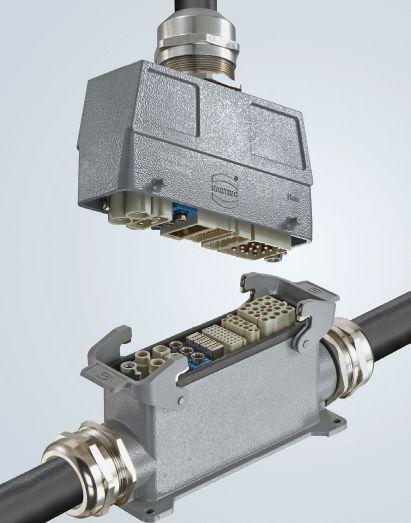
Using a Han L32 B connector from Harting is said to allow users to replace two size 16 B interfaces — saving over 40% of installation space. This makes it possible to transmit power, signals and data with fewer interfaces and fewer components, the company says, as well as cuts the time required to assemble interfaces. The space in the connector housing can be filled with a Han E insulator for 32 contacts (16 A/500 V) or with a Han-Modular articulated frame that can accommodate up to eight modules. There are over 100 Han-Modular modules available, including those for pneumatic applications. At 57 mm, the L32 B housing is exactly 25 mm wider than the next smaller size of 24 B. The new addition means that HARTING now offers a total of seven sizes for the Han B: 6, 10, 16, 24, 32, L32 and 48.
Harting Canada
www.harting.ca
www.cpec.news/0cg
TEMPERATURE PROBES AND SENSORS SERIES EXPANDS APPLICATIONS
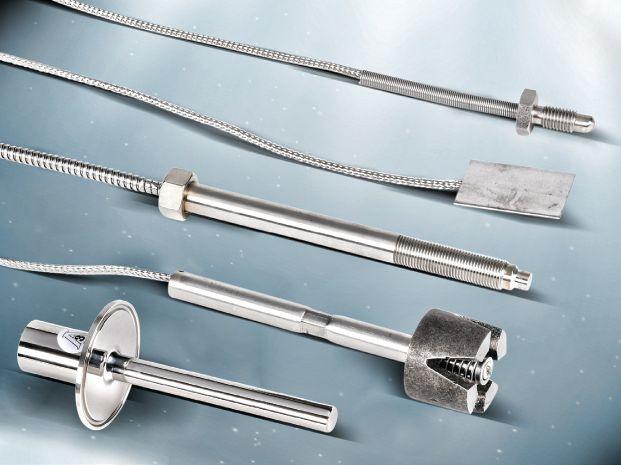
AutomationDirect has added ProSense temperature probes, sensors, and thermowells to its existing portfolio of process sensors. Four new probe designs and three new sensor designs are offered
to meet the needs of unique applications, the company says. Probe additions include heat trace probes, flange mount probes, cuttable probes, and melt bolt probes. New sensor designs include threaded bolt style, spade sensors, and magnet mount sensors. All probes and sensors are offered with type J thermocouple sensing elements. Type K thermocouple elements and PT100 RTDs with class A accuracy are also available with select series. New thermowells include models specifically designed for sanitary Cleanin-Place applications and for probes that have a triclamp process connection.
PROGRAMMABLE TEMPERATURE SENSOR AVAILABLE WITH BUILT-IN PROBE
Turck Canada has introduced the TS+ sensor, a line of programmable temperature sensors that are used to measure and display process temperatures. The new sensor features a rotatable stainless steel housing for a long service life, the company says, multi-colour display, IO-Link, switching or analog outputs, and automatic de-
tection of output signals for fast commissioning. The sensor can be purchased with a built-in or remote mounted temperature probe for more flexibility. Units can be used in a large range of factory automation process applications. The sensors are said to ensure proper temperature and provide early warning and real-time measurement of critical processes.
Turck Canada
www.turck.ca
www.cpec.news/47v
Scaling single-use liquid dispensing from R&D to automated production
At pharmaceutical companies, including those that deal with reagents, buffers, biologics, cells, immunotherapy and similar products, liquid measurement and filling is often done by hand during R&D and lower initial production volumes.
However, as advances are made through the development process, increasing demand for production volume and product changeover increase, result in significant drawbacks to this approach. With hand filling some amount of overfilling, underfilling, or product spillage can be expected, which can be costly when handling high-value product. Manual dispensing and measuring can also lead to repetitive stress injuries for employees.
In addition, in automated filling systems, production is traditionally accomplished with equipment that must be thoroughly disassembled, washed, and sterilized between batches. The process is time-consuming, expensive, energy intensive and opens the door to possible cross contamination as well as occasional control breakdowns.
As a solution, a growing number of companies are turning to sterile, single-use, closed liquid dispensing systems and kits. These utilize disposable parts that can be quickly replaced to start the next fill cycle and expedite production changeovers. Such systems reduce the risk of cross contamination since only the single-use components are in contact with the liquids being dispensed.
Dunn, senior director, Services and Customer Experience, LuminUltra, a biological diagnostic testing company that develops tests and reagents for environmental, industrial, and diagnostic monitoring, and is a key supplier of COVID-19 clinical testing reagents for the Government of Canada.
In the case of LuminUltra, the company develops a range of testing solutions. One of these is its 2nd generation adenosine triphosphate (ATP) test, which measures ATP in water across diverse industries. This requires multiple liquid reagents dispensed into containers of various sizes.
According to Stephen Galpin, Packaging Supervisor, LuminUltra, when an existing product line was produced in lower volumes up to six operators were needed to dispense the liquid reagents using pipettes and affix caps and labels. While this was sufficient during R&D and at the initial production levels, continued growth eventually forced the company to decide between increasing staffing or automating the process.
“We were growing every year and we reached a fork in the road, so we had to decide if we wanted to hire more people just for filling,” says Galpin. “We ultimately decided to automate and re-assign the personnel to other more productive areas.”LuminUltra also sought an efficient process that minimized any potential contamination or reagent degradation.
Single-use technology minimizes the risk of contamination by utilizing sterile, disposable fluid path components from product source to dispensing nozzle. Each kit is a complete unit containing intake and discharge tubing, check valves, complete pump parts and a dispensing tip/nozzle. The disposable fluid path kits are assembled and packaged in an ISO Class 7 cleanroom and post-assembly gamma irradiated to eliminate or minimize any biological risk and maintain microbial control.
This approach delivers superior, repeatable dispense accuracy after hundreds or thousands of cycles, while minimizing repetitive motion injuries. It can also be scaled up to accommodate requirements from R&D to fully automated, GMP (good manufacturing practices) manufacturing.
“Single-use liquid dispensing has become a trend because of its production flexibility, streamlined production [versus cleaning the entire system], and relatively nominal cost,” says Derek
“One of the major challenges was avoiding contamination of the reagents, given that the introduction of even small amounts of ATP [from unintended sources] would quickly degrade the quality of the test,” says Galpin.
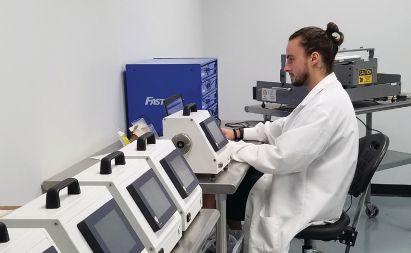
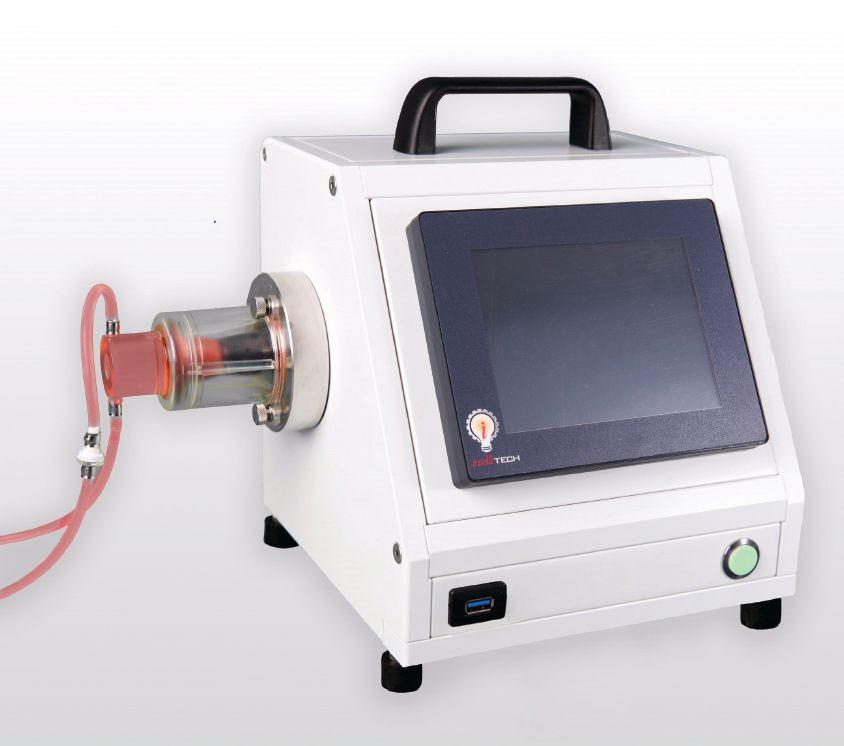
After searching for a market solution and reviewing multiple bids, LuminUltra selected a single-use liquid measuring and dispensing system that included an i-FILL pump, from Florida-based Intellitech, a manufacturer of precision liquid filling and closure equipment.
Production downtime is minimized, and changeovers accelerated by eliminating the need to disassemble, clean, sterilize and reassemble fluid path components between batches. Changes from one reagent to another takes only a few minutes and requires no special tools.
The total start-up time usually takes about 30-minutes but starting up the automation line “is down to about 10 minutes,” says LuminUltra’s Dunn. He adds the equipment from Intellitech was customized to fit the available space as well as to accept different container sizes and configurations. “Because the volume of each reagent is different, the ability to handle containers of various sizes was important. Our process involves multiple reagents. We might need five-milliliters of reagent for one aspect of the test, nine-milliliters for another, and 125 ml and 250 ml bottles for others.”
Despite being customized, the system was easy to use out of the box, allowing LuminUltra to quickly begin dispensing liquids with the needed volume and accuracy.
Dunn says he also appreciated Intellitech’s willingness to consult and provide expertise throughout the process, which he views as vital for a successful implementation. This article was contributed by Intellitech of St. Petersburg, FL.
APPLICATION CHALLENGE:
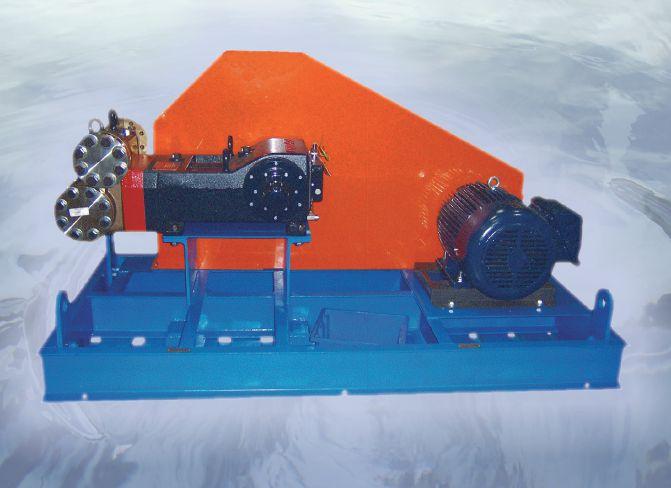
Seal-less plunger package for pumping sour hydrocarbon condensate
John Brooks Company partnered with a Calgary-based engineering firm to quickly design and supply a seal-less pumping solution for a sour (natural gas) hydrocarbon condensate project for a major Alberta oil and gas company.
The main challenge with pumping the sour condensate was that it needed to be pumped with a high pump inlet suction pressure of 580 psi to keep it in a liquid state. Furthermore, the discharge injection pressure was only 682 psi, resulting in a 102-psi differential. The high inlet/suction pressure presented a considerable challenge for many typical pumps.
The solution
After discussions with the engineering firm and the customer, John Brooks experts — Darryl Hughes and Igor Slocuh — selected a Wanner/Hydra-Cell T100 Series Reciprocating Triplex Pump to handle the high inlet pressure conditions of the application. Construction materials of stainless steel, nickel, aluminum, and bronze were chosen to ensure the pump’s reliability and durability.
One duty pump and one 100% stand-by pump were provided to the customer. In addition to being the best technical choice for the application it was delivered within the deadline.
How seal-less plunger pumps work
The Wanner/Hydra-Cell T100 series pumps use suction and discharge valves like any other plunger pumps, but their unique patented design uses diaphragms as the wetted components to move the fluid instead of the plungers.
When fluid enters the pump, it travels through the valves and into the diaphragm chamber from one side. As the pressure increases, the fluid moves into the second and third diaphragms until the pump discharges at ~680 psi (46.88 bar).
The power ends of the T & Q series pumps are completely submersed in hydraulic oil. As a result, there is no packing and no need for external oilers at low speeds, which provides significant cost savings over the life of the pumps.
The advantages of the Hydra-Cell T100 series pumps are:
• They use diaphragms as wetted components to move the fluid instead of the plungers
• The seal-less design ensures the sour fluid can’t leak, increasing operational safety
• No packing or external oilers needed at low speeds, resulting in cost savings over the life of the pumps
• Pull-out casing reduces maintenance costs because it can be done on-site without removing the pump
• Half the price of a comparable API 610 pump
How seal-less plunger pumps work
Hydra-Cell T100 series seal-less pump specs and pump package benefits: max. flow rate of 40 gpm (9.08 m3/h); max. operating temperature of 104°F (40°C); max. discharge pressure of 680 psi (46.88 bar); max. suction pressure of 582 psi (40 bar); and specific gravity of 0.65 to 0.96.
The series also features no leaks within the pumps and consistent flow throughout the process providing higher mechanical efficiency than alternative solutions.
The cost of the complete rebuild kit of the Hydra-Cell pump is 30 to 50% less expensive annually compared to alternative pump options (e.g., traditional plunger pumps).
The results for the engineering firm were reduced operating costs, increased productivity, and reduced maintenance costs. This article was contributed by John Brooks Company. Watch video demonstration at www.cpec.news/w30. John Brooks Company Limited www.johnbrooks.ca www.cpec.news/rt9
After technical discussions, John Brooks experts chose a Wanner/Hydra-Cell T100 series reciprocating triplex pump to handle the high inlet pressure conditions of the application. Watch video demonstration at www.cpec.news/w30.
Improve your plant availability, and ensure quality with optimized calibration
• Traceable on-site and laboratory calibration of various parameters
• We are a leading manufacturer of process instrumentation – uniquely qualified to calibrate
• Our global, harmonized calibration standards provide consistent service quality
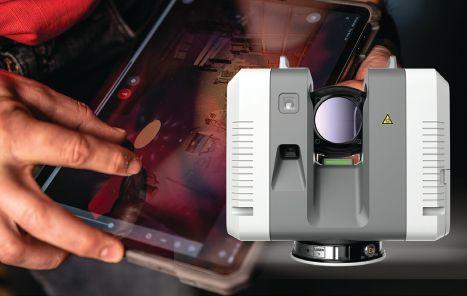
3D metrology service provider and hardware sales company Exact Metrology offers a variety of long range (20 feet to entire facilities) high-definition technologies. The company uses high quality equipment from Leica, a Hexagon Metrology company, and Surphaser. LIDAR (light detection and ranging) scanners’ remote sensing method is used to detect objects in 3D space like the technology used in autonomous self-driving vehicles. Long range scanners are typically set up in multiple locations to collect very large data sets. Generally, the resulting CAD models are used for factory/shop floor layout plans, power plant equipment change outs, and proof dimensioning. The same data set can
also be reused for multiple purposes. For example, the Leica RTC360 3D reality capture solution can be controlled through the Leica Cyclone FIELD 360, app, allowing a real time visual of all the customer’s setups and the ability to optimize links of each individual scan to all the setups. Watch video demonstration at www.cpec.news/jif.
Exact Metrology
www.exactmetrology.com
www.cpec.news/n7r
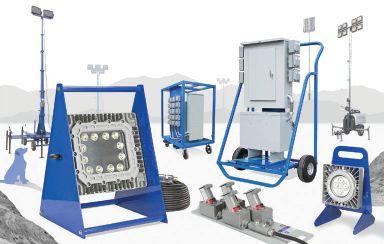
Larson Electronics is a provider of disinfection systems said to eliminate the corona virus. Sanitation equipment includes electrostatic sprayers and cannons, portable UV sanitation carts and hand lamps, UV HVAC lights for air sanitation, mobile UV disinfection cabinets and air purifiers, and custom UV sanitation systems. Also available are personal protective equipment (PPE), N95 face masks and shields, and medical accessories such as no-touch thermometer, hand sanitizer dispenser, and goggles. The company’s UV sanitation systems do not require contact with dirty or contaminated surfaces, as well as the use of abrasive liquid cleaners. The UV cleaning process is said to be quick and easy to implement in large spaces or buildings.
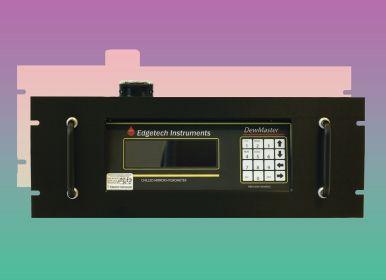
Edgetech Instruments Inc. has introduced a NIST traceable, drop-in replacement hygrometer. The 19 in. rackmount DewMaster hygrometer has a stainless steel X3F sensor that is a corrosion resistant, primary method, chilled mirror type, remotely mounted on a connecting cable typically 10 ft long. The hygrometer is said to be a laboratory grade, high precision, field proven instrument with multiple available sensor configurations and wide applicability to fit all budgets. Available sensors can be air, fan or liquid cooled to fit the required dew/frost point range. Applications range from use as a calibration standard, to monitoring moisture content in continuous industrial processes.
Edgetech Instruments www.edgetechinstruments.com
www.cpec.news/zp9
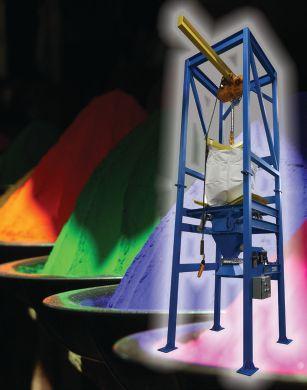
Bulk bag dischargers from Best Process Solutions are said to provide dust-free product discharge from bulk bags. The bulk bag dischargers are expandable and flexible to meet discharging and bulk bag requirements. They are available in three reliable models: the company’s Model MTD-2.5K for unloading large bulk bags up to 2,500 lb. capacity; Model MTD-4K (shown) for very large bulk bags up to 4,000 lb. capacity; and heavy-duty Model BBD-4K discharger with vibratory motor agitation to assist in unloading hard-to-remove products. Many options are available. Watch bulk bag unload overview at www.cpec.news/do2. Best Process Solutions www.bpsvibes.com
www.cpec.news/rwv
Industry News
SHELL PROPOSES GIANT CARBON CAPTURE AND STORAGE FACILITY
Shell Canada of Calgary has announced a proposal to build a large-scale carbon capture and storage (CCS) project at its Scotford Complex near Edmonton. This would be a key step in transforming Scotford into one of five energy and chemicals parks for Shell around the world, providing customers with lower-carbon fuels and products into the future, such as hydrogen.
The proposed Polaris CCS project, the largest in a series of low-carbon opportunities Shell is exploring at Scotford, would capture carbon dioxide (CO2) from the Shell-owned Scotford refinery and chemicals plant. The
initial phase is expected to start operations around the middle of the decade, subject to a final investment decision by Shell expected in 2023. Polaris would
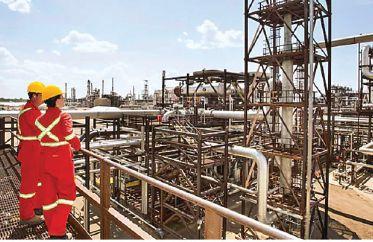
Quest is a fully integrated CCS facility, designed to process more than a 1M tonnes of CO2 annually deep underground. Watch video at www.cpec.news/m3d.
have storage capacity of about 300 million tonnes of CO2 over the life of the project.
Richardson International Ltd. of Winnipeg has announced the purchase of Calgary-based Control Chemical Corp., a specialized manufacturer of environmentally safe drilling fluids and proprietary vegetable oil-based lubricants. Prior to this acquisition, Richardson was a minority shareholder in the company and has supplied raw ingredients for its products for over 30 years.
“This partnership will be beneficial to both companies, as historically speaking, Richardson is our largest supplier of crude canola oil,” said John MacPhail, retiring principal, Control Chemical.
“With petroleum oil prices increasing, we are in a unique position to reach new and more expansive markets for environmentally safe downhole, torque-reducing lubricants.”
Control Chemical manufactures all drilling fluids — some of which are proprietary and marketed under the Matex brand name — from its 50,000-square foot facility in Calgary.
“As a global leader in agriculture and processing, this is a unique opportunity to diversify our business and expand into innovative products derived from the core commodities we handle,” said Darrell Sobkow, Richardson senior vice-president, Processing, Food, and Ingredients.
“Control Chemical has a strong reputation and its Matex brand is recognized for superior performance. Our companies are well-aligned and positioned for future growth.”
Richardson’s oilseed crush plant in Lethbridge, AB, will continue to supply crude canola oil stock for Control Chemical products. With a plant oil composition capable of withstanding high temperatures, canola oil-based lubricants are environmentally safe and are recognized for extending tool lifespan, optimizing production processes, and improving drilling core recovery and pathway stabilization.
Richardson International is a worldwide handler and merchandiser of all major Canadian-grown grains and oilseeds and a vertically-integrated processor and manufacturer of oats and canola-based products.
Control Chemical
www.matexdrillingfluids.ca
Richardson International
www.richardson.ca
to decarbonize our operations, and wider industry, and the Polaris CCS project is the latest example,” said Susannah Pierce, Shell Canada president and country chair. “Our plans for Scotford are in line with Shell’s target to become a net-zero emissions energy business by 2050, in step with society. We are creating a world-class site that will provide customers with lower-carbon fuels, products and CO2 storage. Polaris would also make a significant contribution to Shell’s aim to have access to an additional 25 million tonnes a year of CCS capacity by 2035.”
Shell Canada
www.shell.com/poweringprogress
NEW AMETEK SURFACE VISION CANADA SALES MANAGER
AMETEK Surface Vision of Hayward, CA, a provider of online surface inspection solutions, has appointed Vincent Roy as regional sales manager for Canada. His role will be to develop relationships with customers and to achieve strong revenue growth for both the SmartView and SmartAdvisor brands.
Working closely with existing and new customers, this appointment will add value across all markets including paper, metals, nonwovens, and plastics, utilizing Vincent’s extensive sales and industry experience to develop relationships and increase product support.
Previously, Roy held sales and account roles in related industry companies including Constant America, Buckman, and CIBA Chemical. AMETEK Surface Vision
www.ameteksurfacevision.com
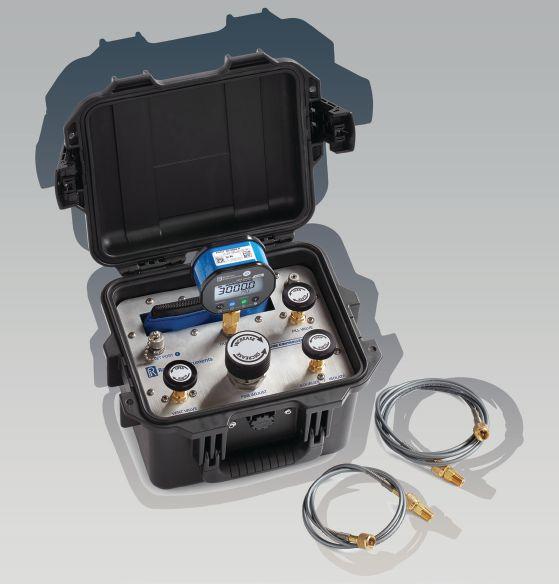
ControlPak Calibration Kits
A Complete Solution for Pressure Calibration with External Compressed Gas
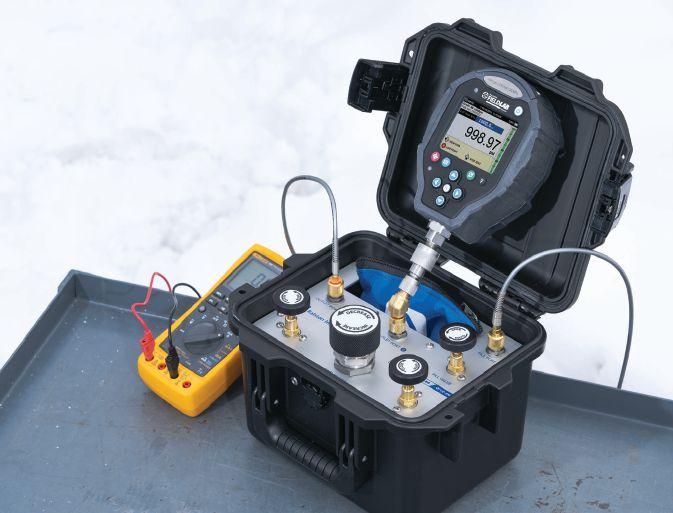
• Large, pressure-balanced piston gives you fingertip control of pressure from 0.03psi (200 Pa) to 3000 psi (20 MPa)
• Complete kit includes industry-leading FieldLab, Field Gauge LC10 or Field Gauge LC20 pressure reference
• Tough, compact unit includes the piston, valves, and ports, plus storage space for hoses, adapters and accessories
• Stable, tactical design allows you to hook up a gauge without toppling the unit
• Includes Ralston Quick-test™ connections, hoses and adapters — no wrench or tape needed
Ideal for calibrating static and differential pressure of DP transmitters!
Visit ralstoninst.com/cpn-cck or scan the QR code to find out
Matex drilling fluids products from Control Chemical Corp. cover a wide range of substrates.
Vincent Roy
Industry News
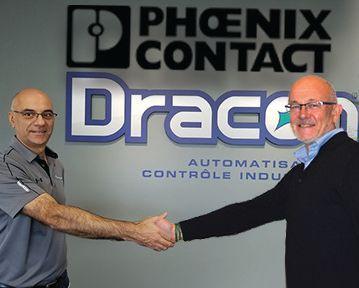
PHOENIX CONTACT CANADA WELCOMES DRACON AUTOMATISION AS SOLUTION PARTNER
Dracon Automatisation Controle Industriel from Levis, QC, has recently become a new member of the Phoenix Contact Solution Partner Program. Authorized Solution Partners have been carefully selected as part of an initiative to market Phoenix Contact’s innovations and capabilities in the field of Industrial Automation and Industry 4.0.
“This new partnership between Dracon and Phoenix Contact will enable the industry to access innovative products, projects and applications,” according to Roger Hallett, General Manager, Phoenix Contact Canada.
Dracon is said to have a strong technical team with engineering services and programming specialists and not only provide control panels, but also expertise in various industrial markets for cities, OEMs and large industries.
“We have been using Phoenix Contact products for over 20 years, so becoming a Solution Partner is a natural extension of our long-lasting partnership with Phoenix Contact,” says Jacques Belanger, president of Dracon. Phoenix Contact
www.phoenixcontact.ca
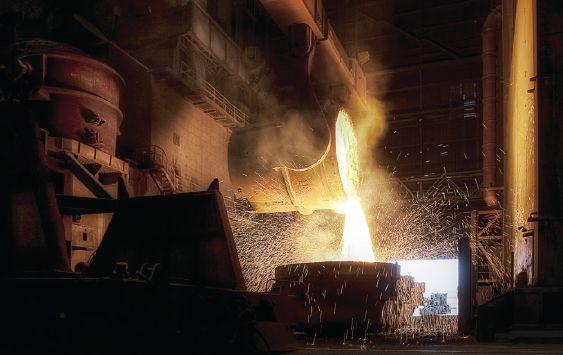
$1.765B INVESTMENT AT DOFASCO FOR DECARBONIZATION TECHNOLOGIES
ArcelorMittal has announced with the Government of Canada its intention for a $1.765 billion investment in decarbonization technologies at ArcelorMittal Dofasco’s plant in Hamilton, ON.
The intended investments will reduce annual CO2 emissions at ArcelorMittal’s Hamilton operations by approximately 3 million tonnes, which represents approximately 60 percent of emissions, within the next seven years. This means the Hamilton plant will transition away from the blast furnace-basic oxygen furnace steelmaking production.
ArcelorMittal says it will introduce new manufacturing processes, including the elimination of emissions and flaring from coke making and ironmaking operations.
The investment is contingent on support from the governments of Canada and Ontario.
At the heart of the plan is a 2 million tonne capacity DRI facility and an EAF facility capable of producing 2.4 million tonnes of high-quality steel through its existing secondary metallurgy and secondary casting facilities. Modification of the existing EAF facility and continuous casters will also be undertaken to align productivity, quality and energy capabilities between all assets in the new footprint.
The new DRI and EAF will be in production before the end of 2028. ArcelorMittal has an ambition to be a net zero carbon emitter by 2050.
Water Technology
Beckhoff Canada, headquartered in Cambridge, ON, has opened a 2,950-sq.-ft western region sales and training centre in downtown Burnaby, BC.
The facility offers increased space for sales and engineering support, training, and seminars, as well as an intelligent motion lab.
In addition to supporting Beckhoff operations in BC, the Burnaby office provides a western regional base to serve new and prospective customers in Alberta, Saskatchewan, Manitoba, and the Northwest Territories.
According to Calvin Wallace, managing director of Beckhoff Automation Ltd., "the Burnaby office provides exciting opportunities for our customers across western Canada to push the limits with PCbased automation and advanced mechatronics. In addition to providing a home base for training, sales and engineering support, the new location’s intelligent motion lab offers our local team considerable resources to test new concepts with XPlanar and accomplish non-linear, lot-size-1 production.”
Beckhoff Canada
www.beckhoff.ca
Jacques Belanger, Dracon (left) and Roger Hallett, Phoenix Contact. Precisely Automated
BECKHOFF OPENS OFFICE IN BURNABY
Calvin Wallace, Beckhoff Automation managing director (inset), with new Burnaby office for Western Canada.
Industry News
LABATT INVESTS $69 MILLION DIRECTLY INTO EDMONTON BREWERY
Labatt Breweries of Canada is investing in Alberta’s economy and creating jobs with a $119 million capital program with $69.2 million going directly into Labatt’s Edmonton brewery to expand production capacity and capability.
The Edmonton brewery investment will support new technology, equipment, product lines and upgrades to the brewhouse and control room. It will also fund 30,000 square feet of new warehouse space and a 30,000 square-foot ready-to-drink building to support expanded brewing type and capacity.
Built in 1963, Labatt’s Edmonton brewery has undergone four major capital investment programs since 2015. Today, the location employs more than 190 people. In addition to capital investments, Labatt has supported Alberta communities through its Disaster Relief Program, delivering canned drinking water during the Calgary floods and Fort McMurray wildfires. This past year, the Edmonton brewery was one of many Labatt breweries across Canada that shifted production to make hand sanitizer in support of partners at local restaurants and Food Banks.
These investments are part of an ongoing provincewide capital investment totaling $119 million over 2019-2022 that will also support operations beyond the brewery. The investment in warehouse expansion, a new ready-to-drink building, equipment and training addresses the burgeoning demand for ready-to-drink beverages, which represents 30 per cent of beverage alcohol category growth.
GRANBY ACQUIRES ECR INTERNATIONAL
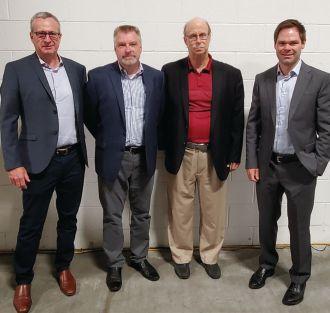
Cowansville, QC-based Granby Industries LP, a division of TerraVest Industries Inc., has announced its acquisition of ECR International Inc., a division of BDR Thermea.
ECR is a manufacturer of heating and cooling products under a family of brand names in North America, including Utica, Dunkirk, and Olsen. The acquisition further illustrates Granby Industries’ commitment to bringing the most reliable and efficient heating appliances to the market, the company says.
Pierre Fournier, president of Granby Industries, welcomes the employees of ECR and looks forward to their continuing commitment to the business and its customers.
“ECR International is a strong business with a portfolio of successful brands, and we’re delighted to welcome its employees to the Granby family,” Fournier says.
“ECR fits within our portfolio of businesses perfectly and we look forward to nurturing its growth and further strengthening our position in the North American heating market.”
Since it was founded in 1954, Granby Industries has provided manufacturing and distribution of residential, light commercial and light industrial tanks for the safe storage and distribution of combustible liquids. Granby Industries www.granbyindustries.com
WATER INFRASTRUCTURE
PROJECTS ANNOUNCED
Infrastructure Canada (IS) has announced water projects for communities in Saskatchewan and New Brunswick. In cooperation with the provinces and municipalities, water treatment facilities in the Town of Outlook, SK, and Petit-Rocher, NB, will be provided with upgrades.
The water treatment plant in the Town of Outlook is being upgraded to increase the community’s access to safe and reliable drinking water. Upgrades include the addition of UV disinfection, improving flow through the reservoirs, and constructing a new raw water intake in the South Saskatchewan River. IS is investing more than $2.9 million in the project, conditional on Indigenous consultation requirements being met, and the Government of Saskatchewan is funding over $2.4 million. The municipality is also contributing more than $1.9 million.
The project in Petit-Rocher will see the construction of a new water treatment system that uses nano filtration, along with the expansion of the existing pump station. IS is investing more than $2.5 million in this project through the Rural and Northern Infrastructure Stream of the Investing in Canada infrastructure plan. The Government of New Brunswick is investing over $1.3 million and the Village of Petit-Rocher is providing over $278,000 in funding.
Since 2001, Valve Accessories & Controls has built a reputation as a company comitted to quality products, and a commitment to service, second to none.
• Pneumatic, Analog, and Digital Positioners
• Wide selection of Mounting Kits
• No Phone Mazes to Navigate
• Experienced Staff
• Service and Technical Support
Canadian Master Distributor: Belletek Controls Inc.
2535 Stallion, St. Lazare, Qc, Canada J7T 2E4
J.C. Labelle: (514) 916-5895
Fax: (514) 500-5802
Email: jc@belletek.com
Labatt's brewery in Edmonton has undergone four major capital investments programs since 2015.
Pierre Fournier, president Home Heating Sector Granby Industries (left); Mitch O’Connor, president, ECR International; Yves Legault, VP of Operations and R&D, Granby Industries; Dustin Haw, president & CEO, TerraVest Industries Inc.
The Town of Outlook, SK, will receive upgrades that include the addition of UV disinfection.
Find your best fluid system low-pulsation pump
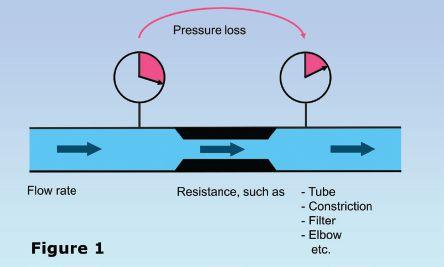
Example of a flow and the corresponding pressure loss in a fluid system with resistance.
The level of the corresponding pressure loss depends on various factors. For liquids, this includes component’s structure and geometry, the flow rate, the fluid viscosity and the type of flow.
The NS Series ball valves are available in sizes 1/4”-6” with threaded, socket weld, butt weld (3-piece) and flanged (2-piece) connections.
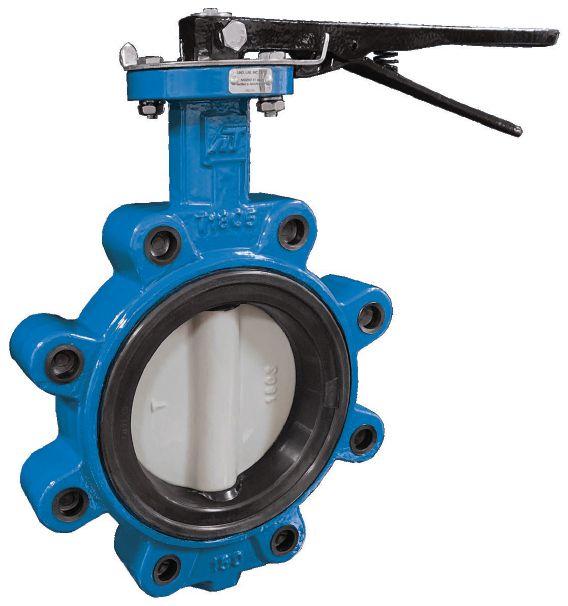
The NS Series butterfly valves cover 2”-24” sizes in wafer and lug style.
APPLICATIONS
• Water Treatment
• Potable Water Service
• Reverse Osmosis
• Desalination
What flow rate is achieved with a diaphragm pump in my fluid system and what pressures are generated? Everybody who ventured on such a design with conventional diaphragm pumps knows how difficult and imprecise a prediction can be. This is due to the pulsating flow rate and the accompanying effects carried with displacement pumps, such as single-headed diaphragm pumps.
To provide manufacturers of fluid systems with more benefits in terms of low pulsation, KNF developed the FP pump series that has an almost constant and non-pulsating flow rate at the pump’s inlet and outlet. This results in the decisive advantage that the behavior in a system is easily predictable regarding pressure and flow rate.
Where the pressure in a fluid system gets “lost”
The basis for a reliable prediction is a closer look at the “pressure loss” topic: Each component in a fluid system, such as tubes, installations, filters, elbows, or connections, generates a pressure loss when being flown through (figure 1). These components represent a resistance to the flow. To overcome the hydraulic resistance, the pressure in the fluid must be higher at the inlet of these elements than at their outlet.
The level of the corresponding pressure loss depends on various factors. For liquids, this includes component’s structure and geometry, the flow rate, the fluid viscosity and the type of flow.
The following flow types are distinguished: laminar and turbulent. With a laminar flow, the liquid particles move on straight and parallel flow lines. With a turbulent flow, the flow lines intersect.
Other important terms are steady and unsteady flow. “Steady” means that the flow is continuous and thus the average flow rate does not change timewise. In contrast, the flow rate varies with unsteady flow. A typical example for unsteady flow is the pulsating flow with single-headed diaphragm pumps. Depending on whether the diaphragms are sucking in or discharging liquid into the pressure line, the flow rate in the pipe significantly changes.
Reliably predicting the pressure loss in a fluid system
The pressure loss in a fluid system depends on various factors. It is also very complex in its calculation. If developers of fluid systems require a quick estimate on the pressure loss in their fluid system, they are confronted with complicated formulae. Online calculators like pressure-drop.com/Online-Calculator may support them. These tools provide users who do not know the respective formulae with a scale on the pressure loss in a specific component. Online calculators, however, are only suitable for steady flows. They are not suitable for pulsating flows as the occurring wave phenomena cannot be considered with their respective formulae. (Find out more about the wave phenomenon at www.cpec.news/psi.)
The following sample calculation from the inkjet printing field demonstrates the benefit of such an estimation of the pressure loss. 0.6 liters of printing ink with a viscosity of 10 mPas flowing through a 3 m-long tube with an inner diameter of 4 mm each minute generates a pressure loss of 0.5 bar. If this tube is attached at the suction side of the pump, a negative pressure of 0.5 bar occurs upstream of the pump. This significantly reduces the pump’s flow rate and may lead to problems, such as degas-
sing. If the tube diameter is increased to 6 mm, the pressure loss is only 0.1 bar. The tube diameter has thus a considerable influence.
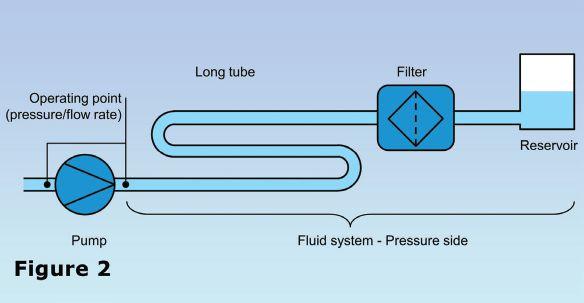
A fluid system comprises of several components. The following figure shows an example of a pump with a simple fluid system on the pressure side consisting of a long tube, a filter and a reservoir.
If the pressure loss of all components in the fluid system is determined and added up, the pressure loss of the entire fluid system is obtained.
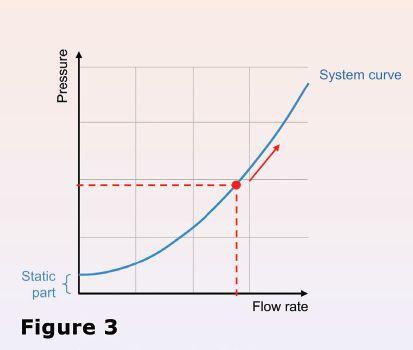
The pressure loss depends on the flow rate. If the flow rate in the system rises, the pressure loss increases. For an entire fluid system this results in a characteristic curve that indicates the pressure loss depending on the flow rate (see fig. 3). This characteristic curve is called system curve. In addition to the flow rate-dependent pressure loss, there is also a static part in case of positive pressure in the pressure reservoir or if the pressure reservoir is more elevated than the suction tank.
The system curve only characterizes the flu-
id system. The pump, however, is characterized by the pump curve that can be found in the data sheets from the pump manufacturer. It illustrates the pump’s flow rate with different back pressures.
The operating point: A combination of pump curve and system curve
After having outlined the system curve and the pump curve, this post will now focus on the interaction of pump and fluid system. Which flow rate and pressure occur at different points if the pump is operated in a system?
If a pump is operated in a fluid system, an equilibrium between flow rate and pressure loss is reached. This equilibrium is called operating point and it describes the flow rate, the pressure at the pump’s inlet and the pressure at the pump’s outlet, as displayed in figure 2. The operating point that describes the three mentioned factors is the result of the interaction of the fluid system and the pump.
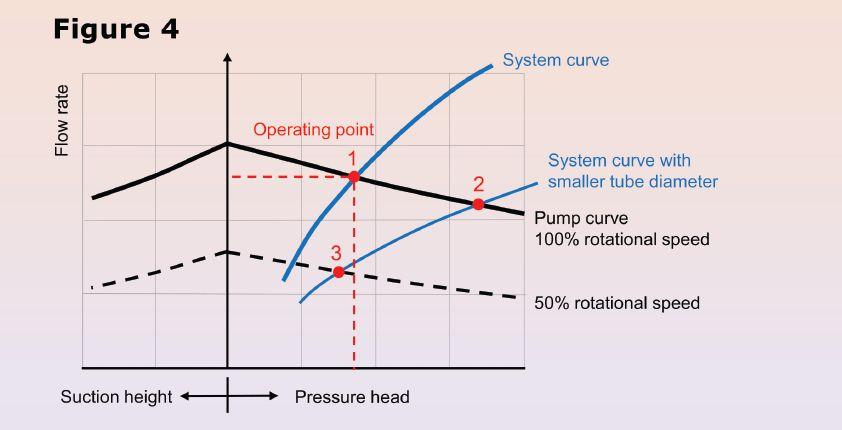
To obtain the operating point, the pump curve and the system curve must be combined. Figure 4 illustrates how this happens for a pressure-side system (see fig. 2). The suction side is not considered here.
The system curve can be drawn on the pump curve. Here, its axes are swapped according to the usual axis display for diaphragm pumps. The intersection point of both curves is the operating point 1 and shows the appearing flow rate and the pressure the pump is working against.
If the system is modified, for example by using a smaller tube diameter, the operating point shifts to point 2 on the pump curve. The flow rate decreases, and the back pressure increases. If the pump curve is modified, for example by reducing the rotational speed to 50%, the operating point shifts to point 3 on the system curve. The flow rate will recognizably decrease as will the back pressure.
The pump manufacturer measures the pump curve and will illustrate it on the data sheet. But how does the system curve arise? As mentioned above, the system curve can be calculated. This is already somewhat complex with simple systems as all components in the fluid system must be correctly covered. As an alternative, the pressure can be measured using a low-pulsation pump with a known curve in the system at different rotational speeds. Based on the results, the customer can be recommended a suitable pump for his fluid system. This can be specifically adjusted to the customer requirements.
How to make flow rate and pressure in the fluid system predictable
A good prediction of the operation point is currently not possible using common pulsating displacement pumps. As already outlined in the first article of this blog post trilogy “A Train Analogy: Flow and Pressure Waves in Fluid Systems”, due to wave phenomena in the tubes of a fluid system, pulsation leads to widely varying pressure losses. To counteract this phenomenon, KNF developed the new FP pump series with low pulsation.
The pump series offers benefits to the users, such as low-pressure loss, a gentler handling of fluids and components as well as less vibration with a lower noise level. But there is another important aspect for the users: Thanks to the low pulsation, the flow is almost steady and the estimations on pressure loss and operating point outlined in this
blog post can be applied. The pump’s behavior in the customer system with regard to pressure and flow rate is predictable and the pump in the fluid system can be optimally regulated as required. Find more information on this topic in the other two parts of our blog post trilogy at the end of this article.
The most important points at a glance
The new FP pumps from KNF provide an almost constant — that is, non-pulsating — flow rate.
Regarding pressure and flow rate, the behavior of the FP pump will be predictable in the customer system. In the fluid system, the pump can thus be optimally regulated as required.
This article is from blog post provided by KNF Neuberger. More information is available at www.cpec.news/wmp.
KNF Neuberger
www.knf.com
www.cpec.news/wmp
Chart with different pump and system curves that result in the operating points 1 to 3 in their point intersections.
The system curve only characterizes the fluid system.
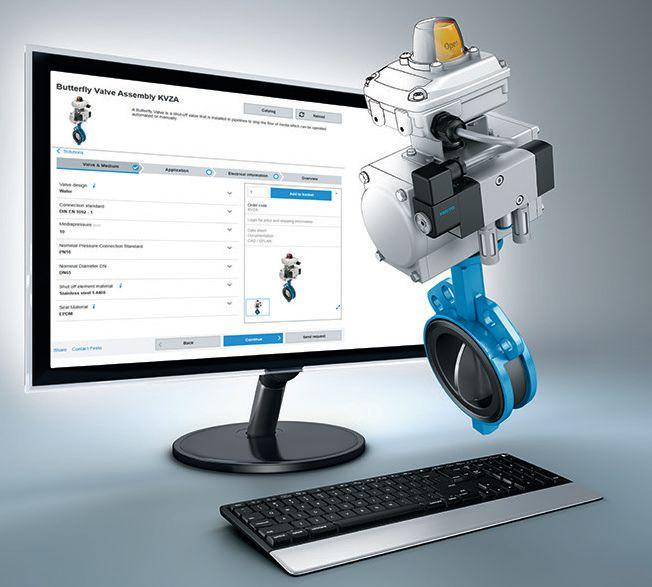
Festo has announced the KVZA Butterfly-Valve Configurator, an online configuration tool designed to lower overhead by speeding up and simplifying procurement of manual and automated butterfly valves. In only minutes with the configurator, the company says, engineers will have the price, estimated delivery date, data sheet, bill of material, 2D CAD data, 3D CAD models, and certificates of the optimum butterfly valve for the application. Units arrive fully assembled and tested. Butterfly valves are available in wafer and lug styles, and DIN and ANSI compatible formats. Nominal diameters range from 1 to 12 in.
(DN 25 to DN 300). Shut off materials include ductile cast iron with polyamide (PA) coating, stainless steel with PFA coating, and stainless steel. Sealing element materials include EPDM, NBR, and PTFE with silicone. Quarter-turn actuators can be either double acting or single acting; low, standard, or high temperature; as well as G or NPT threads for the air connection. In the case of washdown applications, there is also an option for epoxy coating to provide higher corrosion resistance. Festo Canada
www.festo.ca
www.cpec.news/udm
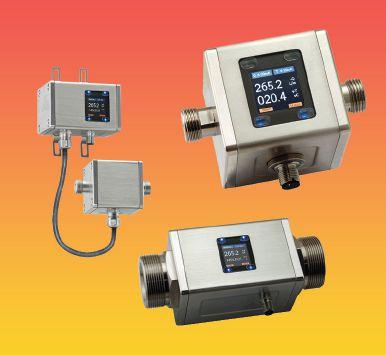
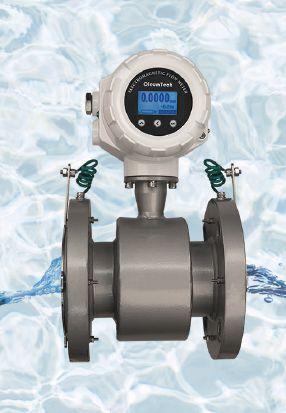
The MIM all-metal electromagnetic flow meter from Kobold, or magmeter, measures and monitors small to medium sized flow of conductive liquids. According to Faraday’s Law of magnetic induction, a voltage is induced in a conductor moving through a magnetic field. The magnetic inductive measurement does not depend on the process liquid and its properties such as density, viscosity, and temperature. The two outputs can be independently set to switch or provide an analog or frequency output. A batching function can also be selected, where output 1 is set to switch as NPN/ PNP/PP and output 2 is set as the control input. Product features include stainless steel construction, flow and temperature measurement, as well as switching, transmitting, and batching functions along with bi-directional flow measurement. Units have a colour, multi-parameter TFT Display, rotatable in 90° increments and intuitive setup menu via 4 optical touch keys. There are two configurable outputs (pulse/frequency/alarm/analog output) and grand and resettable totalizer.
Kobold Canada
www.kobold.ca
www.cpec.news/6h9
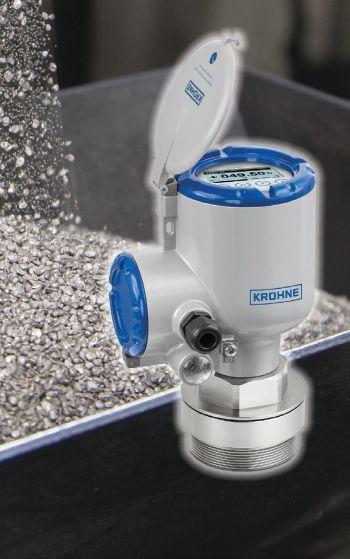
NON-CONTACT RADAR INSTRUMENT FOR ACCURATE MEASUREMENT OF SOLIDS LEVELS
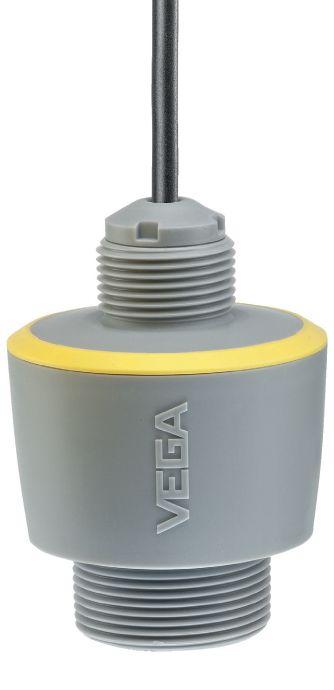
Krohne has introduced the Optiwave 6400 non-contact radar instrument for accurate measurement of solids levels. The unit is a 2-wire 24 GHz radar (FMCW) level transmitter for basic solids applications. Designed for continuous, non-contact level measurement of stones and other products in solids processing, the instrument is said to provide accurate and reliable readings, even with uneven product surfaces or dusty atmospheres. Due to its small beam angle and its high dynamic range, the 24 GHz radar can measure distances up to 328 feet. This makes it a cost-effective, yet more powerful alternative to pulse radar transmitters, the company says. It also has approvals for use in hazardous areas. The radar transmitter offers flange or thread connections as well as optional antenna extensions to suit any nozzle length.
Krohne Canada
https://ca.krohne.com
www.cpec.news/0kz
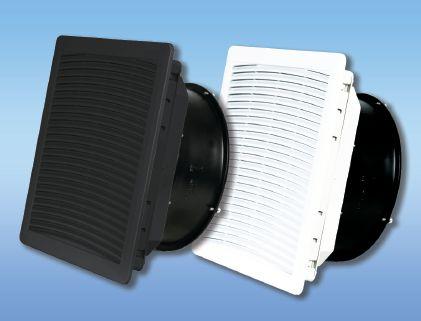
The ArielTech FTEC32G series fan filter and exhaust filter are designed to supply forced convection filtered air for enclosures and electrical panels. By using the unique filtering and cooling features, the company says, the FTEC model will cool down the inside of enclosures to a desired temperature to protect the electrical and electronic parts against heat. Units provide a Type 12 and Type 3R NEMA Rating (no hood required), IP54 using G3 filter mat and IP55 using G4 filter mat. The series can support 115 Vac, 230 Vac, 460 Vac, with 12, 24, and 48 Vdc available. Models have a polyurethane sealing gasket, ball bearing fan, washable and reusable filter mat, and UL 94-V0 rated flame-retardant plastic housing. Units are said to easily snap into place without the use of screws, are UV resistant and come in light gray, dark gray and black. ArielTech
https://arieltech.ca www.cpec.news/3zd
Sensor Technology supplement
HART SMART PRESSURE & LIQUID LEVEL TRANSMITTERS
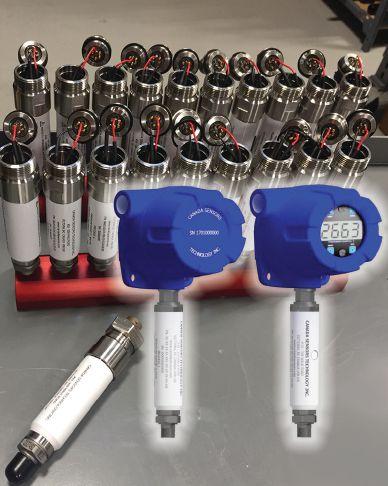
Canada Sensor Technology (CST) manufactures advanced “smart” pressure and liquid level transmitters that offer HART communication protocols along with others. Available from Cameron Instruments, the sensors are available in intrinsically safe designs. The intelligent transmitters bring advanced technology to the pressure transmitter and related instrumentation marketplace, the company says, with self-diagnostic features which maintain consistent accuracy through-out temperature and pressure scales. Units are said to achieve higher process efficiencies, reliability and safety while improving ease of installation and reducing maintenance.
Cameron Instruments
www.cameroninstruments.com
www.cpec.news/69v
FLOWMETER LINE PROVIDES FOR OPERATIONAL SIMPLICITY
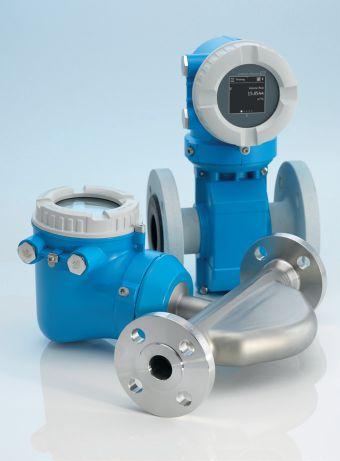
In many cases, industrial process plants include hundreds or even thousands of measuring devices. Particularly for basic applications, demands for simplicity in commissioning, operation and maintenance have increased significantly in recent years. The Proline 10 flowmeter line from Endress+Hauser is said to meet this requirement with an auto-rotatable, high-contrast LCD display for reliable reading of measured values and status messages, a SmartBlue app for wireless remote access to all device and parameter settings as well as wizards, a touch screen for easy navigation using common gestures, and a reliable and error-free commissioning thanks to wizard-guided menu. The flowmeters also provide an automatic display of errors. Endress+Hauser Canada www.ca.endress.com www.cpec.news/lip
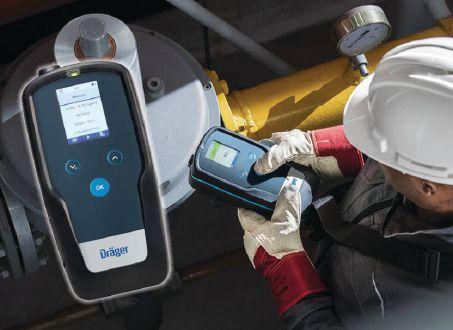
The Dräger X-act 7000 tests benzene and other toxic substances, providing lab-quality analysis on site, the compa-
ny says. The analysis system consists of Dräger MicroTubes and an opto-electronic analysis device that is said to let users precisely measure gases in the low ppb range. To use, insert the micro tubes, start measuring, then read the test results. A single micro tube can be used to perform 10 tests in a roll, the company adds. The sensitive testing system is based on colorimetric chemical sensors capable of replacing conventional laboratory analysis. Drager www.draeger.com www.cpec.news/rvs
PRESSURE SENSORS AVAILABLE AS SWITCHES AND TRANSDUCERS
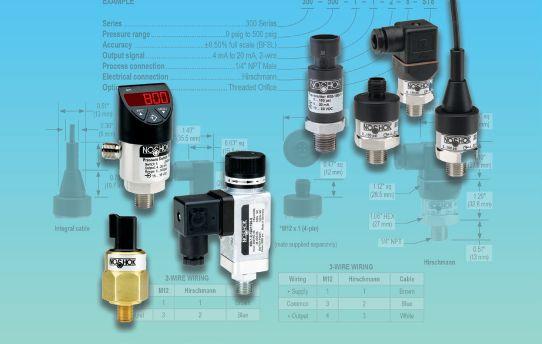
Pressure sensors from Noshok include switches and transducers said to provide excellent reliability, durability, and repeatability at a cost-effective price. The pressure transducers are available with a wide selection of measuring ranges, output signals, and process
and electrical connection options. The company’s upgraded mechanical pressure switch program is engineered to address a wider range of applications and provide a significantly expanded selection of process connection options, and electrical connection options including spade terminals, Hirschmann, Packard, Deutsch, M12 x 3-pin, flying leads, terminal screws, and both Weatherpack Tower & Weatherpack Shroud. The mechanical switches offer vacuum, low pressure, and high-pressure options, and are RoHS compliant. The company’s electronic indicating pressure transmitter/switch is suitable for local indication.
NOSHOK www.noshok.com
wastewater 1c ad 4/5/05 2:53 PM Page 1
www.cpec.news/ixg
Corrosion Resistant
Innovative Solutions for Tough Water/Wastewater Applications!
• Manual, automatic and actuated (pneumatic & electric) valves; relief, check, diaphragm, ball, solenoid, and shut-off. Also pressure regulators, metering pumps, basket strainers, sight glasses, and gauge guards.
• 100% inspection and individual testing of each product, to ensure dependable performance and long-life.
• PVC, CPVC, Polypropylene, PTFE and PVDF. Valves from 1/8'' to 3'',Sight glasses to 8'' and Basket Strainers to 14''.
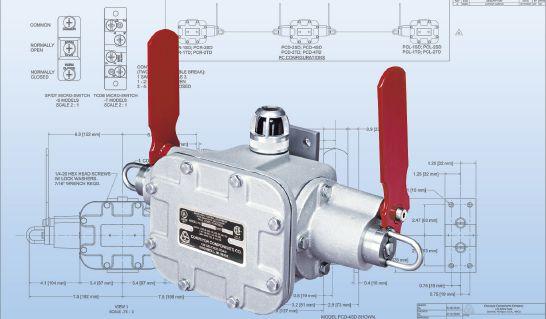
The Model PC pull cord, manufactured by Conveyor Components Company, is a safety stop control that provides a quick positive shut-off of dangerous equipment in emergencies. It is actuated by a cable pulled by endangered personnel. The one or two microswitch outputs of the pull cord can control up to two separate circuits, depending on the model chosen. The outputs can include one for machinery shutdown and one for alarm. The model was developed to meet the stringent requirements of safety agencies throughout the world, the company says. This control is designed to act as an emergency stop for
conveyors and other moving machinery. Housing construction is corrosion resistant cast aluminum, with an optional polyester or black epoxy powder coating. Units are left-ended, right-ended, or double-ended. The flag arm must be manually reset after the problem has been corrected. External red indicating light is available as an option.
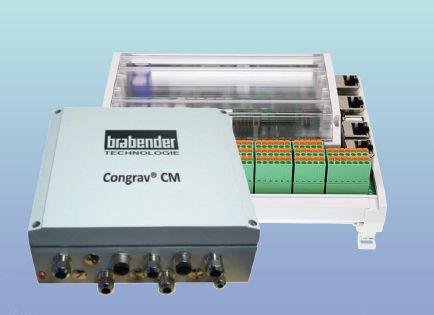
Brabender Technologie has introduced control modules Congrav CM-E 3.0 and Congrav CB-E 3.0 for dosing weigh feeders. Two main processors (CPUs) with five cores ensure that communication, calculations, and distribution on the device are made. The software is said to have been fundamentally improved regarding its expandability to make optimal use of the new hardware. With six digital inputs and outputs each, more functions can be assigned than with the previous generation of control modules. The inputs are used, for example, for the start/stop function or locking, the outputs for operation, filling, such as via the slide above the dosing device, or for fault display, as well as provides various interfaces with Ethernet technology. Another new interface with the network protocol TCP (Transmission Control Protocol) enables a connection between two end points of a network connection, the so-called sockets. The controller can exchange data with other computers in both directions via this connection.
Brabender Technologie Inc.
www.brabenderti.com
www.cpec.news/xwd
HYBRID SWITCH PROVIDES RELIABLE FLOW OR LEAK DETECTION IN NUCLEAR POWER PLANTS
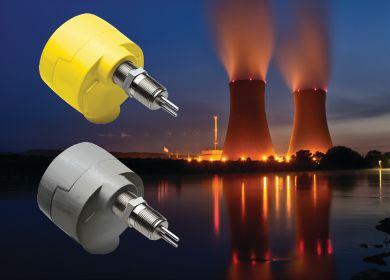
The FLT93 Series FlexSwitch from Fluid Components International (FCI) is suitable for use in a wide range of nuclear power plant flow, level and temperature measurement applications. Applications include reactor core coolant, level interface detection and temperature, pump protection, flood alarm, condensate pot level and turbine water — in any application where the measurement of both flow and temperature or level and temperature are important, the company says. The hybrid device has been tested to IEEE 323-1983 and IEEE 3441987, making it fully qualified for Class 1E safety related nuclear power plant applications. The company maintains a 10CFR50 Appendix B Quality Assurance Program and complies with 10CFR21 and ANSI-N45-2. Both the insertion and
in-line sensor versions are qualified for a 40-year life at 150°F. The FLT93 sensor is qualified to radiation levels of 2x10⁸
rads. The FLT93 electronics are qualified to 5x10⁵ rads for applications requiring an integral unit (sensor and electronics). Fluid Components International www.fluidcomponents.com www.cpec.news/gon
MULTIMODE LED SERIES VISIBLE SIGNALING DEVICES SUITABLE FOR GAS DETECTION APPLICATIONS
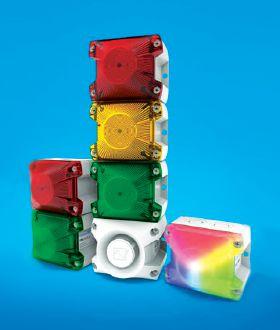
Pfannenberg has announced that its PYRA product line of LED visible signaling devices is built with durable construction for industries such as material handling, gas detection and security applications. Capable of being integrated into the design of any given machine or plant, the company says, the LED product line can be configured with different modes (steady-on, blinking, and flashing), the frequency of which can be controlled by the user as well. The visual signaling devices also feature an external colour and mode control, which allows users to select the signaling mode and the colour via remote control, and to display different configurations for different alerts with just one light. The series also features a multi-voltage power supply. Four different options are available within the product line: single LED lights, LED RGB lights, LED traffic lights, and a pre-assembled combination of a single LED RGB light and a PATROL sounder module. Watch introductory video at www.cpec.news/5oa. Pfannenberg
www.pfannenbergusa.com www.cpec.news/281
How to choose a load cell: Three key variables that aren't always obvious
For monitoring processes and operations, for controlling or transporting loads, force is measured in many applications, such as port logistics, cranes, machine building or geotechnical engineering. Force measurement is especially important for the protection of people and machinery, and it also contributes to quality assurance.
Different situations require different ways of measuring weight. To choose the right load cell for a particular application, users should consider three factors: the environment, the location, and the load itself.
From the humble bathroom scale to enormous ship-to-shore cranes, a variety of weighing technologies rely on load cells. These force transducers convert compression, pressure, tension, or torque into electrical signals, and are found in many applications:
Load cells also are used to indirectly measure level. For example, sheer beams and bending beams — two types of load cells — are installed at the base of a silo, tank, or other reservoir. Knowing the material’s weight, the container’s geometry, and other variables, one can calculate how much material is currently inside the vessel. Since the load cell does not need to be in contact with the material, this method of level measurement is particularly suitable to applications containing aggressive, steaming, foamy, or dusty media.
The Process of Choosing a Load Cell
Choosing which load cell to use is a multistep process involving several factors. Certainly, the load cell’s measuring range, accuracy, linearity, hysteresis, and repeatability are important, but there are other key variables to keep in mind – ones that customers don’t always consider and can mean the difference between successful outcomes and disappointing performance.
When recommending a load cell, the force specialists at WIKA Canada also look at the load’s characteristics, the application’s environment, and the load cell’s location in the mechanism.
1. Load characteristics
The nature of the load and how it will interact with the load cell help determine the type of load cell to use. The following are some of the questions our experts will ask:
• What type of load is being measured — bending, compression, tension, or shear?
• What type of mechanical connection is needed?
• Will the loading condition be centered or non-centered?
• Is the loading static (constant), dynamic (occurring in seconds or milliseconds), or impact (accelerating and stopping abruptly)?
These questions matter because we can recommend solutions to mitigate the effects of certain types of loads. For example, a five-pound bowling
ball gently placed on a scale is static loading, and it will not overwhelm the load cell structure. However, the same ball dropped from a height of three feet can create over 1,000 pounds of force. This is dynamic loading, and it will harm load cells not designed to withstand that much force.
For a customer’s dynamic loads, we would mitigate the effects — within the realm of what is physically possible — with different designs of the load cell structure and by using a compression load cell like the F1224.
2. Environmental factors
Where is the application’s physical location? Will the load cells be indoors where they are protected? Or will they be outside, constantly exposed to moisture and humidity, significant dust, fluctuating temperatures, and extreme heat or cold? These and other environmental conditions can affect load cell behaviour. Again, our experts would recommend solutions to mitigate these factors. For example, load cells for outdoor use should be made of materials with high water-corrosion resistance and have a higher ingress protection (IP) rating. Also, as load cell technology is based on the Wheatstone bridge circuit, temperature has a significant effect on the bridge’s resistance and will affect force measurement. Therefore, temperature-compensated load cells, like the F2226 tension/compression force transducer, are a must in environments subject to temperature fluctuations. All WIKA load cells have temperature compensation.
3. Load cell location
Force equipment comes in myriad sizes and arrangements. As load cells are integrated within the equipment, they have to be a certain size and geometry — all depending on how much or little space is available, and how that available space is configured.
The location will also determine which types of load cells are most suitable. For example, high-tech hospital beds can use a variety of load cells. If mounting them between each caster wheel and its attachment point beneath the bed, use bending beams/shear beams. But when the load cell will be installed between the lower and upper bedframe, planar (flat) cells are better.
This article was contributed by WIKA Canada. View video at www.cpec.news/0hz WIKA Canada
www.wika.cawww.cpec.news/sih
When recommending a load cell, the force specialists at WIKA Canada also look at the load’s characteristics, the application’s environment, and the load cell’s location in the mechanism. You can view video demonstration at www.cpec.news/0hz.
From the Publisher’s Desk
Dear valued readers, Greetings valued readers and thank you to all of you who signed up for our bi-weekly e-newsletter. You’re going to love it for the breaking news, product solutions and events. If you have anything you think will fit the format, please send it along to Mike Edwards editor@cpecn.com.
Advertisers should have our 2022 media kit and publishing schedule by now, If not you can always find it on our web site, www.cpecn.com/ media-kit-request/, or contact Rob Sommerville, rsommerville@cpecn.com.
Our Process & Automation Shows have been on hiatus since the Richmond show in 2020 and we were expecting to restart them this fall. In
METALLIC
light of the lingering threat of Covid 19 and the 4th wave variant and the last-minute cancellation of Global Petroleum/Energy show, we consulted with our exhibitors and decided to kick off our full line up of shows starting in March 2022. Safety must be our priority and we’re confident we can conduct our shows in a safe and orderly fashion. We’ll keep you posted.
December, our last issue of the year, is up next and will feature a Focus on Plant Automation and Mike’s supplement will look at all things to do with Fittings and Couplings.
The issue closes October 29th.
Test negative, stay positive, Rob Sommerville
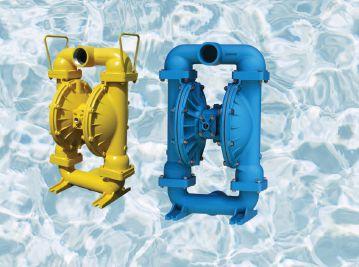
AIR OPERATED DOUBLE DIAPHRAGM PUMP SUITABLE FOR MINING APPLICATIONS
The S30 Sandpiper heavy duty metallic air operated double diaphragm pump available from York Fluid is suitable for mines and construction site applications. The pumps are said to provide on-off-on reliability and are easy to move with built in handles and skid mount, roll cage, and strainer bases available. Specifications include 3 in. NPT or 3 in. BSP (Tapered) and 3 in. ANSI Flange or 3 in. DIN Flange port sizes, 0 to 235 gpm (889
lpm) capacity, an air distribution valve, no-lube, no-stall design, up to .38 in. (9.65 mm) solids-handling, heads up to 125 psi or 289 ft. of water (8.6 bar or 88 meters), displacement/stroke of .94 gallons (3.56 liters), and maximum operating pressure of 125 psi (8.6 bar). Shipping weights are 116 lb. (aluminum), 215 lb. (cast iron), or 194 lb. (stainless steel).
York Fluid www.yorkfluid.com
www.cpec.news/q6u
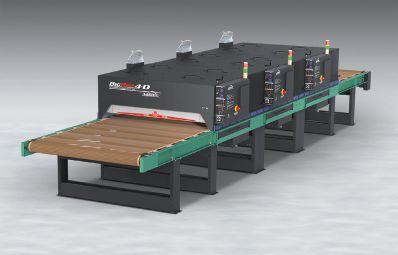
The new BigRed 4D-54 infrared conveyor tunnel oven from Vastex Industrial boosts temperatures to over 149°C within the first several inches of conveyor travel and maintains at-cure temperatures of up to 482°C, which is said to satisfy high-capacity curing, drying, and baking requirements. It is equipped with a 137 cm wide conveyor belt, dual heating zones and four height-adjustable infrared heaters capable of heating film, sheet, parts, and metal products uniformly from edge to edge, at high rates. An air flow mapping system draws ‘make-up’ air into the chamber’s double-walled shell through filtered inlets along opposite exterior sides serving to cool the outer shell for safety, while preheating incoming air. An exhaust fan located below the center of the conveyor belt draws the preheated air downward at rates up to 19.8 CMM over and through the belt, removing heat, moisture, fumes, and contaminants from the chamber. Vastex Industrial
For precise pressure calibration when using an external compressed gas source, the ControlPak calibration kit from Ralston Instruments provides a manual pressure controller that features a large, pressure-balancing piston for precise pressure control, encased in a durable, tactical plastic that protects the controls from on-site mud, intense heat, and extreme weather. The unit connects to a nitrogen tank and permits the technician to start calibrating right at the site of the device under test. With a pressure range of 0.03 psi to 3000 psi, the calibration kit allows the testing of multiple devices in a single setup, including differential and static calibration, the company says, even at very low pressure. The fine-adjust piston, fill, balance, and vent valves are clearly labeled and intuitively arranged in the unit, it adds, which also includes storage space for hoses, adapters, and accessories. And all inlet and pressure port fittings are Quick-test type, which require no tools or thread tape for secure, leak-proof connections. Techs can use their current reference, or pair it with the company’s FieldLab Pressure Calibrator or a Field Gauge LC10 or LC20 pressure gauges. Watch video demonstration at www.cpec.news/zk3.
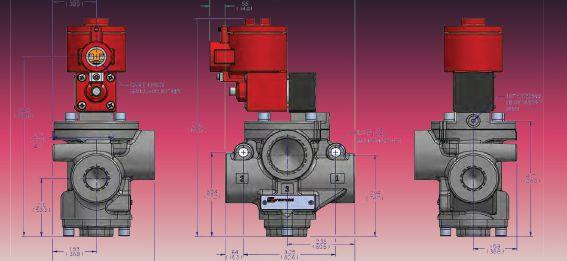
Pneumatrol has introduced the Helis high flow poppet solenoid valve series suitable for use in a safety instrumented system up to SIL 2 acc. IEC61508 and IEC61511. The 3/2 pilot operated normally closed solenoid valve has a solenoid/spring return function, an internal metal poppet design, and can be integrated with interchangeable CNOMO solenoid interface operators. Choices of safe area terminal box, Ex d Flameproof or Ex ia intrinsically safe solenoid coils are available. With a body material of anodized aluminum, units provide a flow up to Cv 70, range of ports sizes from ¼ to 2 in., and MTBF of 10 million cycles.
www.pneumatrol.com
www.cpec.news/3ao
Passports, please?
IR CONVEYOR TUNNEL OVEN WITH PRE-HEAT ZONES
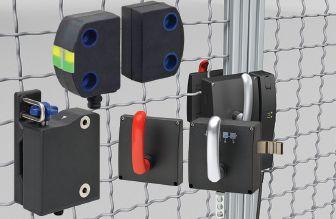
The D41 interlock series from Omron Automation is a flexible system that protects operators requiring partial or full body access to machinery in various applications across different industries. All models are said to offer quick automatic
pairing that helps reduce commissioning time, along with three-colour LED indicators and diagnostic outputs that ensure protection according to ISO 14119. Key features include: individual coding, single or multiple teaching type; three-colour
LED indicators and diagnostic output; protection class IP66, IP67; and up to 31 devices connected in series. The D41D the non-contact interlock with three different actuator types provides a symmetrical design for left and right mounting, and a long detection range that support approach direction from front or side. The D41L model guard lock interlock with hygienic design prevents accumulation of water, food and dust. IP69 and ECOLAB certified, D41L supports three actuating directions and mounts on left- and right-hinge doors. The D41G guard lock interlock with an integrated door handle offers an ergonomic actuator and reduces design efforts. Models with emergency exit units ensure people can exit, even if the power is disrupted.
Omron Automation
https://automation.omron.com www.cpec.news/xz6
PURGE AND PRESSURIZATION TECHNOLOGY-BASED GUIDE
Pepperl+Fuchs Bebco EPS has published a collection of information covering all aspects of purging technology and equipment. The Purge and Pressurization Compendium — one part of a global explosion protection series — is available as a free educational download on the company’s website. The compendium is a guide to understanding what purge and pressurization is as a protection method for operating electrical and mechanical equipment in hazardous areas. The compendium details the requirements for the different types of purging and pressurization, including the installation and operation of the different systems.
Pepperl+Fuchs Canada
www.pepperl-fuchs.com/canada/en/
ELEVATOR SWITCHES TRACK SLIDING DOOR POSITION
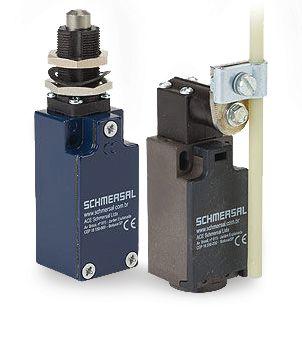
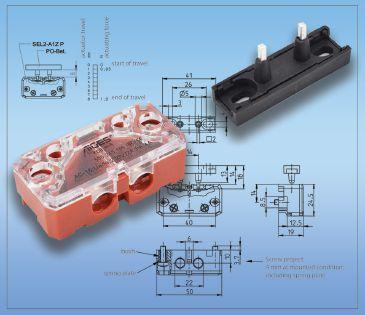
ITC Electrical has added the Bernstein line of SEL Elevator Door switches to its lines of limit switches. The switches are designed to monitor the position of sliding doors, in particular elevator doors. There are 3 types of SEL switches, with different dimensions and contacts. The switches are cCSAus and cULus approved. Units are rated at 2 A operating current, 230 Vac/200 Vdc and have 1NC contact.
ENCLOSED DRIVE SERIES FOR INDUSTRIAL PUMP, FAN AND COMPRESSOR USE
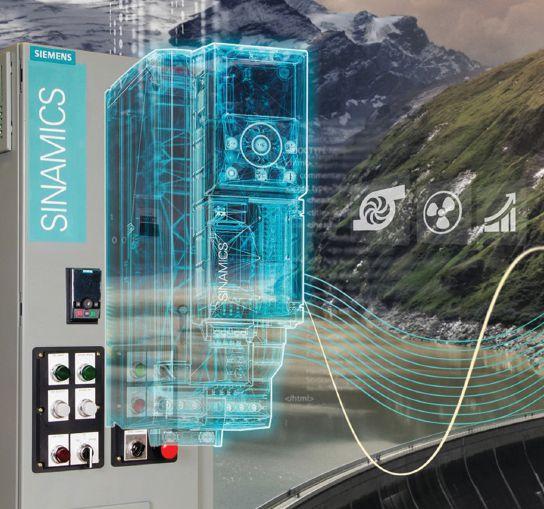
Siemens has announced the Sinamics G120XE enclosed drive system, designed specifically for the demands of industrial pump, fan and compressor applications in a wide variety of markets. Built around the Sinamics G120X infrastructure drive, the new enclosed system is said to be suitable for fast design and commissioning in industries such as oil-and-gas/petrochemical, water/wastewater, power plants, industrial climate control, refrigeration, and chillers in harsh environments. A NEMA 1 enclosure is standard, with a NEMA 12 version optional, featuring appropriate ventilation and air filters. The base enclosure is suitable for wall-mounting to 75 hp applications, while the free-standing floor module accommodates uses to 200 hp. Standard electrical characteristics of this new enclosed drive system also include a UL508A listing, SCCR rating to 65kA, circuit breaker disconnect with flange-mounted operator handle and mechanical door interlock, plus control power transformer for internal power control and power module with PWM IGBT inverter. Overload ratings allow operation in either light or high overload duty conditions. Siemens Canada www.siemens.ca
DIN RAIL CONTROLLER/ TRANSMITTER INDICATOR
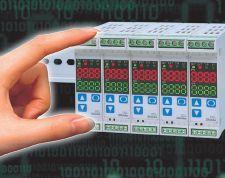
The Shinko DCL-33A Series DIN rail indicating controller from Mod-Tronic Instruments is said to easily be switched to controller or transmitter by key operation. When using as a transmitter, the signal or thermocouple input, RTD input or DC input is converted and output to 4 to 20 mA DC. The scale is changed easily, too, the company says. It is possible to measure and control ranging from 1 point to a maximum of 31 points using serial communication (RS-485).
A unit can connect between plural controllers, between communication converter and DCL-33A using communication cable CPP and CPM (sold separately). Units feature multi-input capability: 1 RTD type, 10 thermocouple types, mA, and V inputs, as well as third generation PID Autotune. Mod-Tronic Instruments www.mod-tronic.com www.cpec.news/ynh
www.cpec.news/sbd
Dual Output Isolated Signal Conditioner or Loop Extender
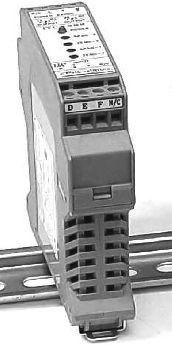
The ITC-XXX-XX-DC is a signal isolator with dual outputs providing high isolation from Input to Output1, to Output2, and to Power in a small easy to install package. It’s universal DIN rail mount makes it possible to install right next to the instrument that is to be isolated. The many different input and output configurations allow it to be used in a great variety of applications ranging from PLC front end conditioning to adding an extra loop with lots of drive to an existing, almost fully loaded loop.
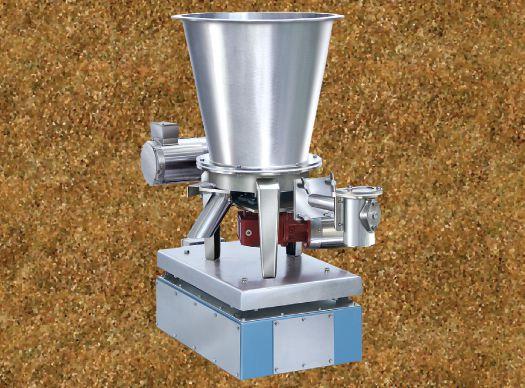
LINE OF DRY SOLIDS MATERIALS WEIGH FEEDERS SAID TO BE ECONOMICAL, VERSATILE, AND COMPACT
Acrison, Inc., has introduced a line of Model 408 series weigh feeders said to provide an economical, versatile, and compact means to feed a wide variety of dry solids materials accurately and dependably. The series feeders utilize the company’s weighing and control technologies and offer feed rates from a fraction of a pound up to thousands of pounds per hour with continuous metering accuracies typically ranging between ±0.25 to 1 percent or better (error) at two sigma. High resolution weight sensing is accom-
plished via its Ratiometric Digital Weight Resolver, which is said to instantaneously produces an unamplified, non-integrated real-time weight signal for precise feed rate control using one of the company’s various multi-processor controllers. The entire permanently calibrated and adjustment-free weighing systems of these weigh feeders including the electronics associated with the weighing systems are guaranteed for five years.
Acrison
www.acrison.com
PNEUMATIC VALVE MANIFOLDS OPTIMIZED FOR PROCESS AUTOMATION
www.cpec.news/mrh
ETHERNET TEMPERATURE INPUT MODULES PROVIDE SAFETY AND COMMUNICATIONS OPTIONS
The Type 8652 AirLINE valve manifold from Burkert has been developed for process automation requirements. New diagnostic functions can be visualized on the LC display, both in clear text as well as symbols. This makes it easy to relate to the shown messages, the company says, and helps to save time during start-up and maintenance. The diagnostic message is also available at the controller and is said to enable a fast overview of the plant status. The hardware is optimized for installation at the bottom of the control cabinet. Installation on a standard rail is also possible. Key pneumatic functions ensure increased process reliability such as check valves in the exhaust air ducts making sure there is no unplanned actuation due to pressure peaks. Explosion-proof variants according to ATEX/IECEx Zone 2 are available. Watch video introduction at www.cpec.news/o1p. Burkert Canada
www.burkert.ca
WIRELESS NETWORKED LIGHTING SPOTS HAZARDS
Emerson Automation Solutions has announced a new version of its Appleton Mercmaster LED hazardous location luminaire that is compatible with the
Emerson Plantweb digital platform. The Appleton Mercmaster Connect model luminaire can be linked wirelessly to Plantweb Insight software via WirelessHART network technology. The networked luminaire, the company says, provides facility managers with continuous monitoring of its LED lighting. Emerson www.masteringled.com
www.cpec.news/bxk
www.cpec.news/nte
NT2610 modules from Acromag offer 8 thermocouple/millivolt inputs and 2 limit alarms. Each input can support a variety of sensor types. NTE Ethernet models provide a network interface to monitor temperature levels. Appending NTX expansion models can interface up to 32 TC/ mV sensor inputs at a single IP address. Configurable for Modbus TCP/IP, Ethernet/IP, or Profinet. Applications include monitoring temperatures in tanks, pipes, motors, heaters, chillers, and many industrial processes. Many pressure, weight, flow, and chemical sensors also provide a millivolt output. An isolated RS-485 bus links up to three expansion modules to the Ether-
net module with bus connectors that join units along the DIN rail. This internal NT bus distributes power and communication between the modules. Users can mix analog, temperature, and discrete I/O modules across the NT bus. The company’s i2o messaging technology allows direct peer-topeer or multicast communication between remote modules without a master controller. Safety approvals include UL/cUL: Class I; Div 2; Groups A, B, C, D (pending), as well as ATEX/IECEx: Zone 2 (pending). Watch video demonstration at www.cpec.news/uit Acromag
www.cpec.news/df9
www.acromag.com
PROCESSLITERATUREGUIDE
PROCESS INDUSTRIES PUMPS
An updated brochure highlights the complete KNF diaphragm pump offering for the transfer, evacuation, or compression of process media, including explosive/flammable liquids and gases, valuable and dangerous gases, hot gases, and aggressive/corrosive liquids and gases. Application-specific modifications welcome. Download brochure at www.cpec.news/zrw or contact supportusa@knf.com / 609-890-8600 regarding your project. KNF NEUBERGER INC. www.knfusa.com
From a single product to the full system — explore the best practices for OEMs to simplify and streamline their development, production and ongoing support for water treatment facilities. Festo can assist you from the start of your project to the entire lifecycle of the solution at the end customer that your. Festo Canada www.festo.ca
OleumTech has added an electromagnetic flow meter to its H Series hardwired process instrumentation line. The HEFM magnetic flow meter is suitable for oil and gas, petrochemical, and water and wastewater applications. The IP67 protected meter offers PTFE lining material, a backlit local display interface, and various self-diagnostic features for managing critical device health. The flow meters can be custom ordered using a variety of line sizes, materials, and power options. Flow meter measurement is independent of fluid density, viscosity, temperature, pressure, and conductivity. Two measuring points inside the meter with no moving parts eliminate pressure drop, the company says. Reference accuracy is ±0.2 % of reading, output signal options are RS485 Modbus, 4 to 20 mA, and 2 to 8 kHz pulse output. Process/lining temperature ranges from -20° to 120°C and operating temperature is from -40° to 70°C. OleumTech www.oleumtech.com www.cpec.news/ep8
2022MediaKit NOWAVAILABLE OUR50thANNIVERSARY!
Industrial Internet of Things (IoT) solutions provider Latium Technologies has launched the Ingenious line of IoT technologies, starting with the E-Sense device, a non-invasive IoT sensor said to provide mining companies with a better way to monitor networks of high-voltage cables for damage or faults. To date, this challenge has been a completely manual process, the company says. The sensor allows maintenance teams to immediately identify and replace damaged cables, it adds, reducing costly downtime and eliminating manual processes. The device integrates directly into the company’s Job Site Insights suite of software applications. Watch video introduction at www.cpec.news/s7u.
Latium Technologies
www.latiumtech.com
www.cpec.news/vpj
Neptune has announced the availability of 35 additional models as part of the Phase II release of its NSP Series Solenoid Metering Pumps and NXP Series Stepper Motor-Driven Metering Pumps. The new additions will include more models with the acrylic degassing head (ACRYL) option, along with the standard polyvinyl chloride (PVC), polypropylene (PP) and polyvinylidene fluoride (PVDF) material options. The new models feature the same capacity ranges from 0.09 gph (0.35 L/h) to 8.1 gph (30.66 L/h) and back pressure capabilities of 43 psi (3 bar) to 232 psi (16 bar). The availability of these new models and material options increases the range of chemical-handling applications that requires reliable and accurate dosing. Watch introductory video at www.cpec.news/yno.
Neptune
www.psgdover.com/neptune
www.cpec.news/iyb
INDCO’s stainless steel PhG-series Tri-Clamp mount gear-drive mixers with external mechanical seals are suitable for sanitary mixing applications up to 10,000 litres. Designed for the pharmaceutical, food and cosmetics industries, the gear-driven design agitates large volumes of low viscosity materials with minimal shear or can be configured for smaller volumes of more viscous materials, the company says.
Canadian Process Contro l Association
“excellent use of my time and my company’s time”
Plant Manager, REFINERY
We’re bringing world class experts to your neighbourhood for one day only at our Process & Automation Shows
• Face to face access to national and local experts in their field
• Try out products right at the show
• Save time and visit as many companies as you like in one day
• Compare technologies and pricing from leading companies
“Solved a problem we’ve had for years... now I don’t have to worry about it anymore”