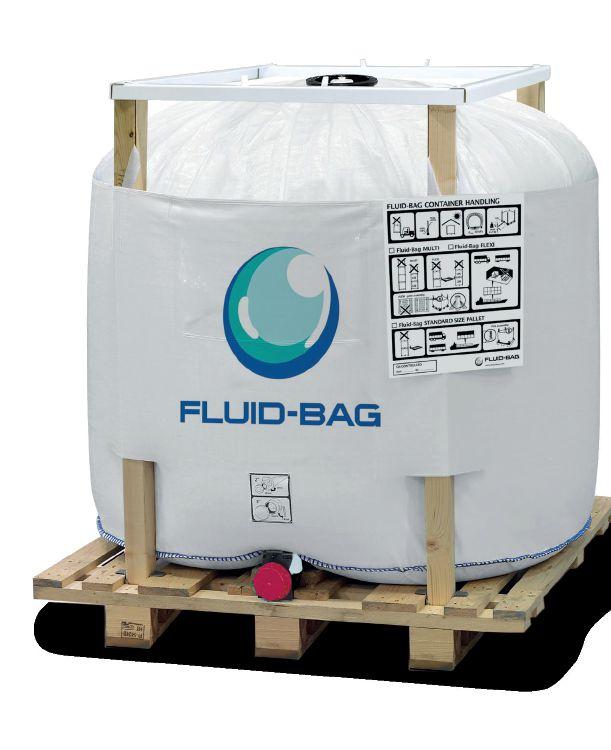
PEERLESS™ OG2 Red grease is expertly formulated to provide unmatched, extended equipment protection in all kinds of conditions wet, dry, hot, cold under force or extreme dust. Trust it to help you reduce maintenance costs and downtime while minimizing the need for frequent grease change-outs.
78% decrease in pellet roll bearings change outs
5,800 kg reduction in grease usage
PROFIT ABILITY AND EFFICIENCY
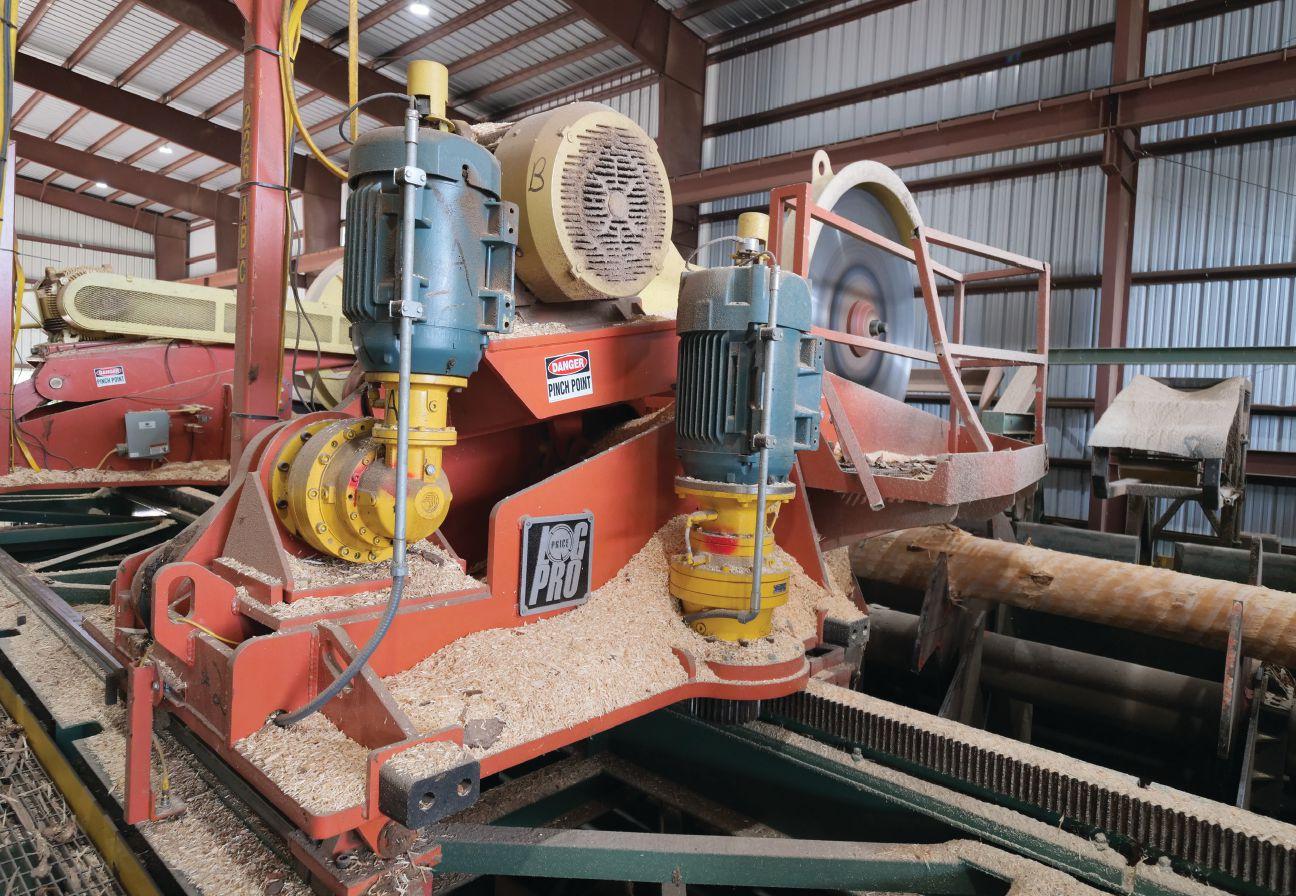
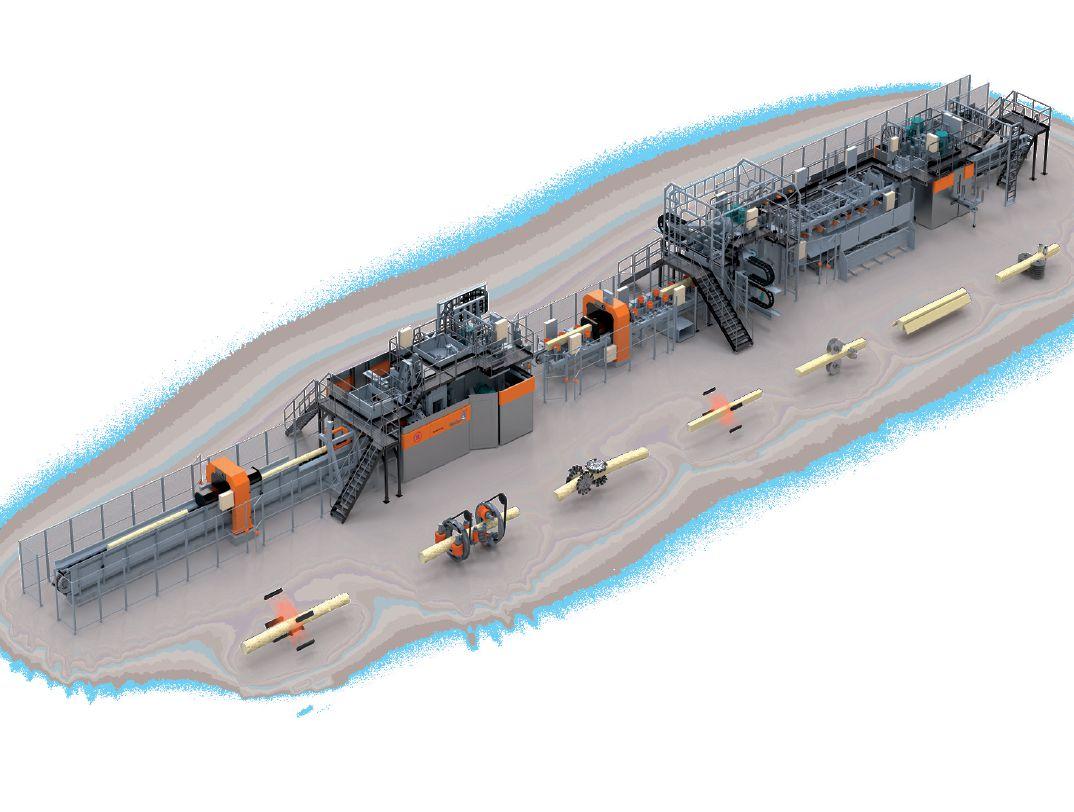
Thanks to active curve sawing, maximum yield and feed speeds of up to 720 ft/min, it significantly enhances both efficiency and profitability.
ADAPT ABILITY AND AGILITY
Its design, free of turning-device, reduces the foot print of the line and thus optimizes the use of valuable production space.
SIGNIFICANT REDUCTION OF THE SAW LINE LENGTH
PRO NANO 1, 2 and 3 are also available in straight sawing design, which minimizes the saw line length even further.
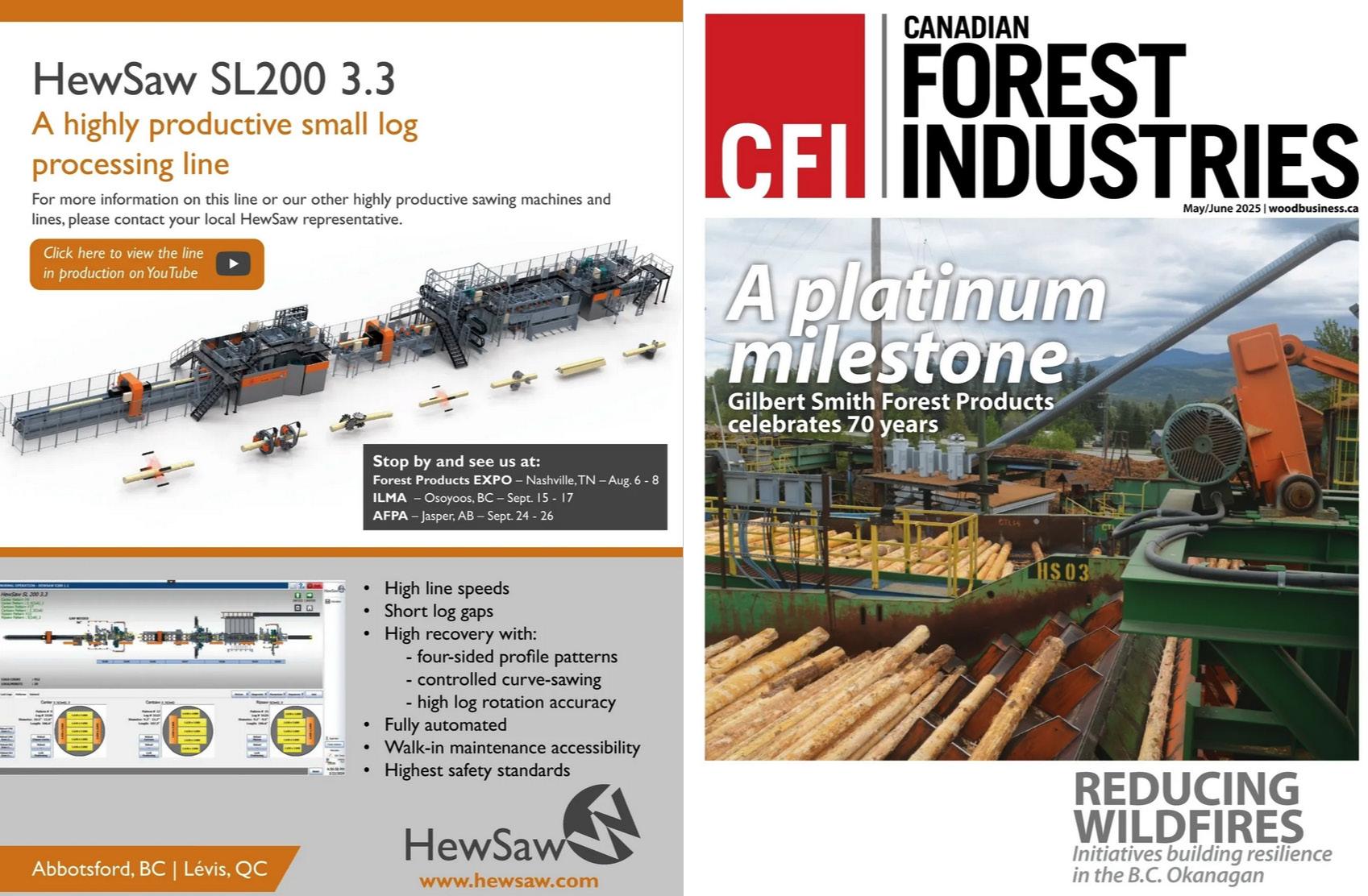
Gilbert Smith Forest Products celebrates 70 years.
Reducing wildfires
Initiatives building resilience in the B.C.
Drying optimized
Canoe FP invests in new dryer for plywood operations.
Talking tariffs
Tariffs a key topic at Montreal Wood
Innovate to perform Quebec logging operation invests in new carrier.
Softwood lumber
An update on the N.A. softwood lumber market.
CWF Spring Meeting
Softwood lumber a hot topic at annual convention.
Gilbert Smith Forest Products has been adapting and innovating for 70 years. For the full story, turn to page 23.
Andrew Snook.
first cut
asnook@annexbusinessmedia.com
Slowing the spread
A biomass-focused wildfire prevention strategy
Every year around springtime, the federal, provincial and municipal governments begin preparing for wildfire season. These days, preparing for the season is more important than ever as the size of the fires has increased significantly in recent years.
According to Natural Resources Canada, the 2023 wildfire season was a historic one. There were 6,623 wildland fires that year, which is less than the average of about 8,000 that normally occur annually.
few municipalities in northern B.C. that are located in areas sensitive to wildfires have already started up initiatives where they remove biomass from the forest floor and use it as fuel in district heating systems.
Canadian Forest Industries
However, these wildfires raged and burned more than 15 million hectares (ha) of Canada’s managed forests – a far greater number than the 2.1 million ha. that burn on average each year. There were more than 230,000 people evacuated due to danger to their health and lives from wildfires in 2023.
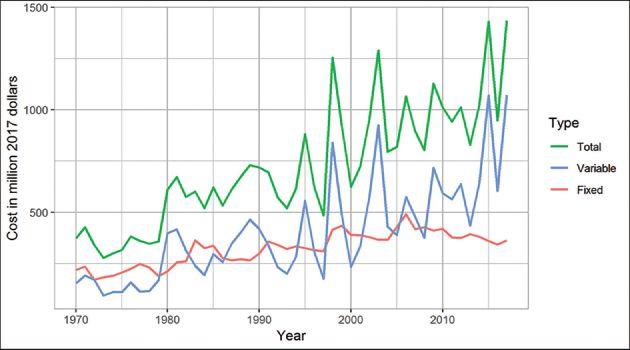
The costs related to wildland fire protection have ballooned over the last decade and range between $800 million and $1.4 billion annually. The cost of wildfire suppression has increased approximately $150 million per decade since data began being collected in 1970 (Learn more about it here: https://natural-resources.canada.ca/ climate-change/climate-change-impacts-forests/ cost-fire-protection#why).
When you consider the cost of wildfire suppression and the evacuation of entire towns (see NRCan graph), government investment in slowing the spread of wildfires through biomass harvesting should be a no-brainer. Government-funded biomass harvesting and energy initiatives in remote northern regions of the country also have the potential to yield additional benefits to the Canadians who call these places home.
While Canada could be more aggressive in finding ways to prevent wildfires and punish those responsible for human-related incidents (approximately half of all wildfires are caused by people), about 50 per cent are caused by lightning strikes. This means wildfire suppression will always be a significant expense at all levels of government.
But what if we could slow down the spread of some of these massive wildfires by reducing the fuel load on the forest floor? This isn’t a new strategy. A
One of the biggest expenses related to living in northern regions of the country is energy costs. If the biomass being collected can be processed into wood pellets (or other useable forms of biomass) for district heating systems, this could lower the overall energy costs for many residents who are currently reliant on more expensive forms of energy, lowering their cost of living. Would this mean the federal and provincial governments stepping in to assist municipalities with the costs related to the biomass harvesting, as well as the design, purchase and installation of district energy systems and other bioheat systems? Absolutely. But if initiatives like this have the potential to slow down wildfires, they are worth considering.
ANDREWsnook
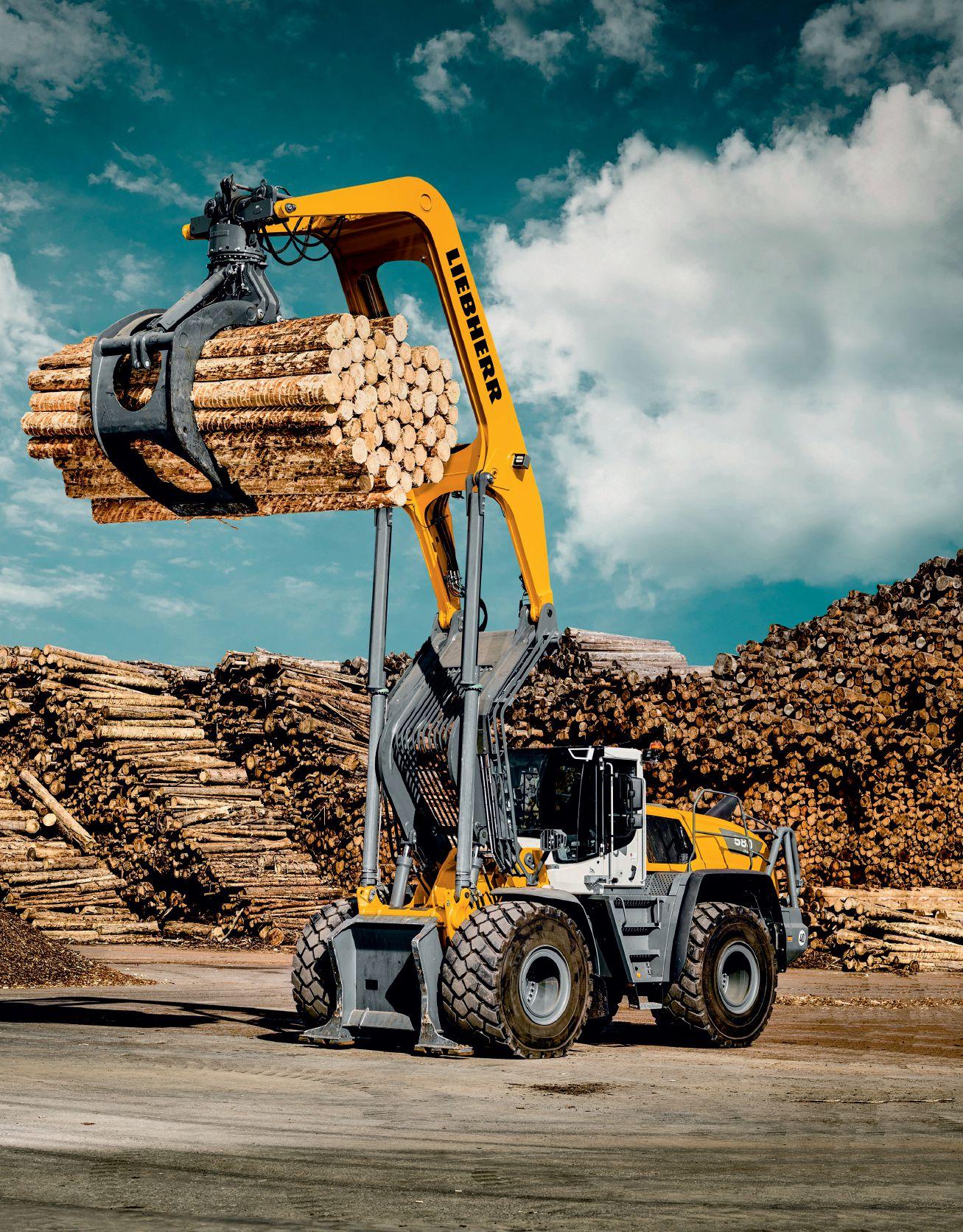
The L 580 LogHandler was specially developed to meet the exacting challenges of the timber industry. A Liebherr-designed lift arm gives greater reach and height while a selection of grapples that rotate 360° and pivot forwards and backwards add further versatility. Our Smooth Speed Reduction system allows sensitive and precise control when loading and unloading. www.liebherr.ca
L 580 LogHandler XPower®
NEWS upfront
Council launched to support forestry
Under the Cooperation and Responsible Government Accord 2025, the B.C. government and BC Green caucus have established the Provincial Forest Advisory Council.
The council will provide recommendations to government to ensure there are clear and measurable outcomes that support a healthy forests, healthy ecosystems and a healthy forestry sector.
The council will consult with
industry partners, such as the Provincial Forestry Forum and ecological, environmental and biodiversity experts, to engage the public for feedback and honour commitments to work in partnership with First Nations.
This community-driven approach will ensure the review is inclusive and focused on land-base certainty and sustainability.
Source: Government of B.C.
Reader
Angelita Potal, Customer Service Tel: 416-510-5113
Email: apotal@annexbusinessmedia.com
Mail: 111 Gordon Baker Rd., Suite 400, Toronto, ON M2H 3R1
EDITOR - Andrew Snook (416) 510-6801 asnook@annexbusinessmedia.com
GROUP PUBLISHER - Anne Beswick (416)510-5248 • Mobile: (416) 277-8428 abeswick@annexbusinessmedia.com
The Gorman Group has announced the purchase of Weyerhaeuser’s lumber mill in Princeton, B.C. Weyerhaeuser announced a purchase price of about $120 million in cash for the mill, which includes the manufacturing facility, all associated timber license assets in B.C., and the value of working capital.
“Weyerhaeuser’s Princeton operation will be a natural fit with the Gorman Group,” says Nick Arkle, CEO of the Gorman Group. “We’ve had a strong connection to the Princeton operation for many years, and we
know firsthand the skill, commitment and quality that define its team. We’re delighted to welcome this mill and its people into the Gorman Group family, as this move will strengthen our company, support the sustainability of good jobs in our communities and help us continue developing the world-class wood products we’re known for. This really will be a case of the whole being stronger than the sum of its parts. We’re looking forward to working together with First Nations, governments, communities and all our employees to make this a B.C. success story.”
Kevin Cook lordkevincook@gmail.com Ph: (604) 619-1777
CEO - Scott Jamieson sjamieson@annexbusinessmedia.com
PUBLICATION MAIL AGREEMENT #40065710 RETURN UNDELIVERABLE CANADIAN ADDRESSES TO CIRCULATON
British Columbia Saw Filers Association
Forestry is a challenging industry, with operational, trade, environmental and regulatory requirements constantly evolving. That’s why it helps to have an advisor who is not afraid to get their boots dirty. With deep roots in the forestry sector, our advisors deliver a fresh perspective and advice to improve and streamline your operations.
FOREST wildfires
Reducing wildfire risk
Innovative initiatives are helping build resilience in the Okanagan
BY ANDREW SNOOK
Residents that reside in the Okanagan Region of the B.C. Southern Interior are no strangers to the risk of wildfires.
In 2003, a lightning strike during the driest summer on record at that time sparked the Okanagan Mountain Park fire. The massive wildfire destroyed more than 200 homes and forced the evacuation of 27,000 local residents. Twenty years later, the McDougall Creek fire forced more than 10,000 residents of West Kelowna to be evacuated with additional wildfires within the Central Okanagan Regional District forcing evacuation orders to be sent to nearby residents in the city of Kelowna and the District of Lake County.
While these were destructive fires, they are only a couple examples of the thousands of wildfires that take place across Canada annually. The size and scope of wildfires continue to grow almost every year. In 2023, there were 6,623 wildland fires that
burned more than 15 million hectares (ha.) of Canada’s managed forests – a huge spike over the 2.1 million ha. average that typically burns on a yearly basis. The annual financial cost to battling these wildfires is significant with a price tag that ranges between $800 million to $1.4 billion for evacuation and firefighting and prevention costs (firefighters’ salaries not included).
In the Okanagan, some of the communities that are at higher risk of wildfires are currently working on innovative initiatives to help reduce the spread of potential wildfires in their areas through projects overseen by the Forest Enhancement Society of BC (FESBC).
The main purpose of the FESBC is to advance environmental and resource stewardship of B.C.’s forests by preventing and mitigating the impact of wildfires; improving damaged or low-value forests; improving habitat for wildlife; supporting the use of
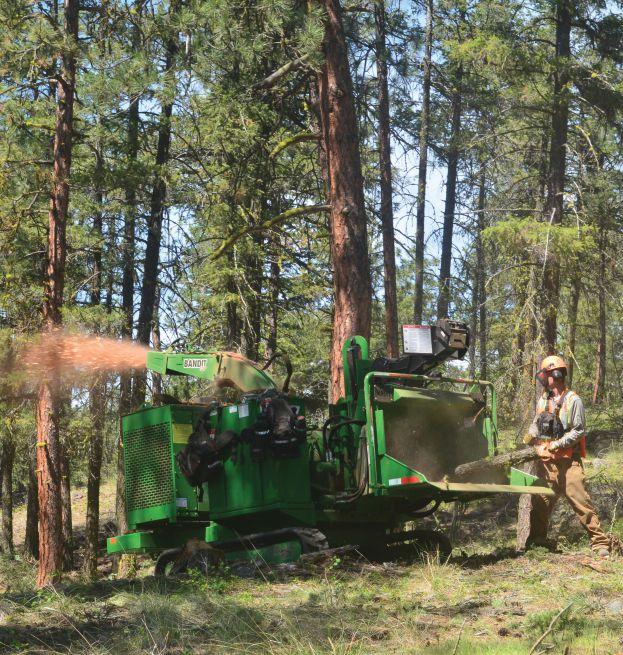
The City of Vernon Ellison Project is utilizing the chipping of biomass to help reduce the spread of future wildfires.
fibre from damaged and low-value forests; and treating forests to improve the management of greenhouse gases.
CITY OF VERNON ELLISON PROJECT
One of the FESBC’s projects it is currently overseeing is the funding of a wildfire risk reduction (WRR) treatment in the City of Vernon. The project’s contractor, Rider Ventures, is currently working on a landscape level fuel break on the west flank of Predator Ridge and above Okanagan Lake.
The FESBC had previously funded the prescription development and Phase 1 treatment in this area, which was identified as high wildfire risk and high priority for treatment. Established in 2015 in Coldstream, B.C., Rider Ventures specializes in wildfire and flood protection, forestry, and emergency response training.
The total area under prescription is 71.8 ha. This is addition to area that was already harvested in 2021 on the lower slopes by BC Timber Sales (BCTS), which created a larger landscape level WRR treatment area, explains Tyler Field, operations manager for the FESBC.
“This current project was brought forward to FESBC for funding starting in 2022 by the City of Vernon,” Field says. “FESBC funded the prescription development which includes all the field work (data collection), costs associated with referrals, etc. Subsequently, FESBC has awarded funding to complete most of the prescription area which started in 2024 and continues today.”
The entire area totals about 150 hectares of crown land nestled in between private property, including Ellison Provincial Park, which was also identified as a high-risk area but is under another jurisdiction with different standards for fuel management. To access the prescription area, FESBC needed to get permission from a private landowner so the work could be performed. In many cases, due to the nature of the work, building positive relationships with private landowners is essential for these types of projects to succeed.
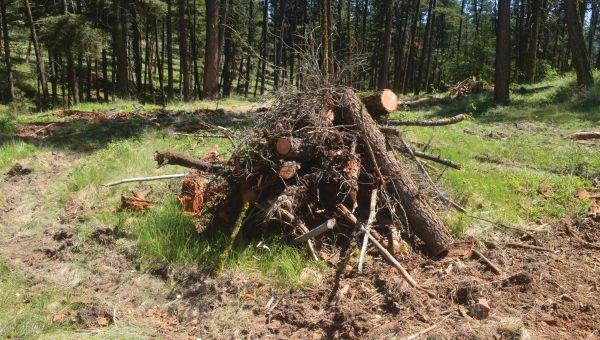
When we arrived at the site of the City of Vernon Ellison WRR project, you could see a large tree that had been scarred by lightning strikes. Piles of biomass had been collected by Rider Ventures for the purpose of burning them, but there are so few days where a controlled burn is permitted that the contractor decided to take another approach. They purchased a small remote-controlled, tracked Bandit 12XP drum-style mobile chipper and are grinding some of the biomass piles and spreading them out across the forest floor.
“It’s got a smaller base so it can go through the bush a lot easier and there’s less impact to the ground,” explains Brad Mailhot,
manager of Rider Ventures. “You can keep it fairly even and spread across the prescription, so you don’t get too much load on the ground.”
Chipping as a means of reducing wildfire spread is a fairly new initiative, so more data needs to be collected to measure its effectiveness in the long-term.
“They still have some form that is combustible, but for how long? That depends on the climate that we’re in,” explains Kyle Gillich, planner for Forsite Consultants, which works with FESBC in delivering cost-effective forest management services. “This is a really dry site, so that’s why it is a bit of a pilot experiment. We haven’t chipped and scattered this much area on a dry site before, so we’re curious how long it’s going to take to decompose; how it affects the hydrological function; and the cover of other plants –existing native species, herbs and shrubs.”
Gillich would like to monitor the effectiveness of the chipping as part of the post-treatment assessments to make sure that the prescription targets are being followed. He prefers the chipping method over controlled burns due to the narrow burning window.
“These guys have few opportunities to burn here before it’s too dry and fires are getting away. Or in the winter, you have poor venting conditions where you can have snow cover – it’s safe, you just don’t have the atmospheric conditions to burn,” he says.
Even when you can burn, it can illicit panic from nearby residents.
“People see smoke and there’s a lot of panic,” Mailhot says. “So, even if it’s wet enough to burn, if you light up, you have a public panic so bad it’s not worth it.”
The application for this project was submitted by the City of Vernon’s Fire Rescue Services.
“We’ve been championing these types of projects on Crown lands within the City of Vernon on city lands and in the private sector,” says David Lind, Fire Chief for the City of Vernon. “The fire doesn’t know any boundaries and we need to treat the landscape at scale in order to get effective fire breaks… if we get to a situation where we have embers cast into the city and we have to evacuate a city of 45,000 people that includes hospitals and seniors homes, it’s a pretty challenging task.”
Another part of the prescription was the removal of some of the limbs from tall trees to improve the ability to fight wildfires when they occur.
“We’re getting rid of biomass and getting rid of the hazard and the ladder fuels, but we’re also getting rid of some of the hazards,” Field says. “So, if a crew did have to come in here and action a fire from a lightning strike, it’s safe for them to do.”
MORE OUTREACH NEEDED
While these types of initiatives are for the betterment of the forests and the health and safety of the surrounding residents, that doesn’t necessarily make these projects an easy sell.
“To just to go in there and extract fibre and tell people that you’re making things safer is not often that easy, because there’s a lot of conflicting objectives,” Field explains. “But with more and more wildfires happening in interface areas, people are starting to realize that’s what needs to happen. It’s about building a bit of a trust and social license with people… we try to do projects that are meaningful, but we also try to educate and build trust.”
One of the challenges of managing biomass at the City of Vernon Ellison Project is the narrow burning window for controlled burns.
INNOVATE TO PERFORM
To improve his performance, Gabriel Leblond didn’t hesitate to bet on innovation
BY GUILLAUME ROY
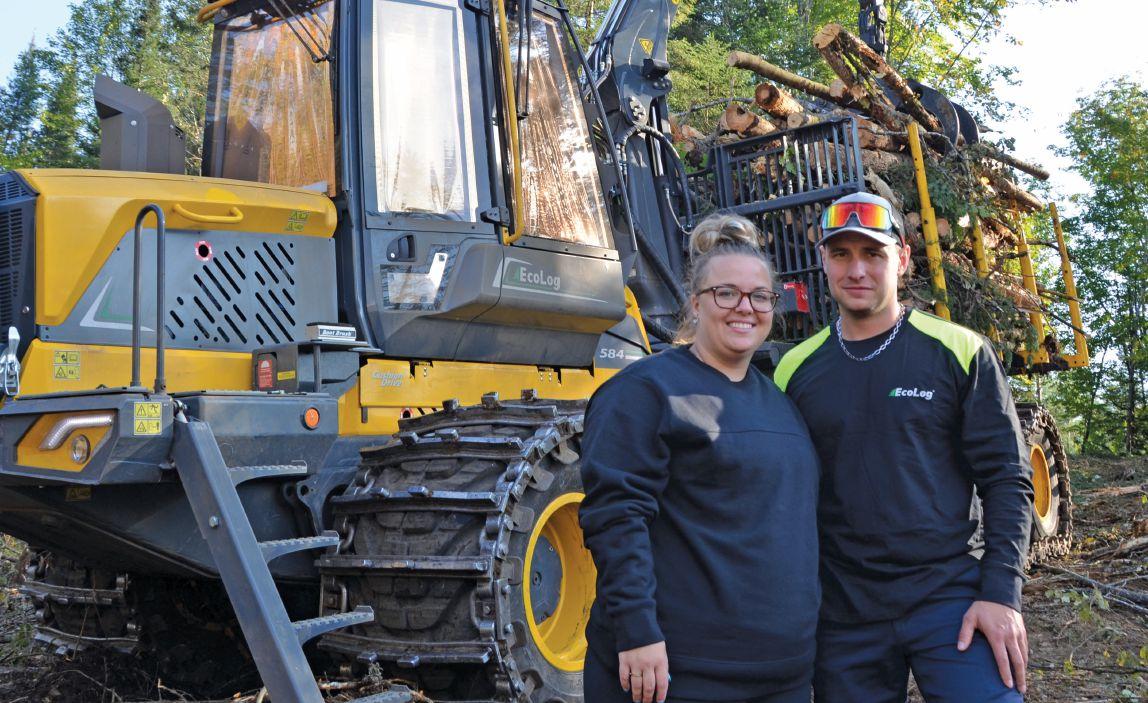
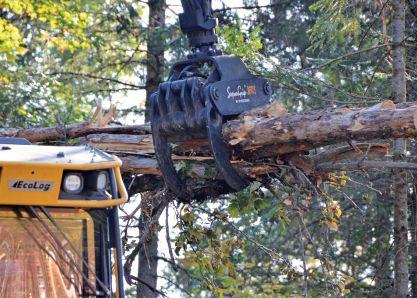
At the wheel of his Ecolog 584 carrier, Gabriel Leblond loads logs with ease as part of an equipment demonstration presented at DEMO International 2024 in Venosta, Que.
Two weeks earlier, he became the first forestry contractor to get his hands on an Ecolog carrier in Quebec.
“I switched to their service because their garage is 20 minutes from our house,” says the man who lives in Saint-Gervais-de-Bellechasse, on the South Shore of Quebec.
Since he logs in Portneuf for the Dion sawmill, Gabriel passes by the SP Maskinen garage in Saint-Nicolas every day, which makes it easier to
Gabriel Leblond, head of Entreprises forestières Gabchri, and his partner, Daphnée Leblanc, in front of their latest investment: an Ecolog 584 carrier.
Supplementary options were added to help with navigating the realities of the Quebec terrain, and claws were installed on the basket, notes Leblond, who has built a relationship of trust with SP Maskinen.
MANAGING CHANGE
By making this acquisition, Leblond increased his transport capacity, going from an 11-tonne carrier to 16 tonnes.
“We can even convert it to 18 tonnes,” notes Daphnée Leblanc, his life-partner, who has been involved full-time in the company since March 2024.
With this additional capacity, the 29-year-old entrepreneur will now have to make choices to optimize his operations.
“We could have the logger operating 24/7 or buy a second logger,” notes Gabriel, who prefers the second option, if he can find a good operator.
A LONG WAY TOGETHER
pick up parts or to discuss issues concerning the machinery.
“I can call the boss directly if I need a part, and I know it won’t wait until the next morning,” he says. “That saves a lot of money for a forester.”
Beyond the service, the machine lived up to his expectations. “It’s a beautiful carrier that’s well made,” emphasizes the man at the head of Entreprises forestières Gabchri. “It’s incredibly strong and the traction is really good. Seriously, the Swedes are a cut above in terms of interior finish and operator comfort.”
Among the accessories he appreciates, he notes certain details like the touch-sensitive heating, and even a small stove to heat his lunch. The “cushion drive” greatly improves comfort, he adds.
“It’s like four nitrogen balloons, located at the four corners of the cabin that serve as suspension,” Gabriel says.
Among the other strong points, he notes the machine’s automatic lubrication, which makes work easier.
“It’s full of little details that make the machine stand out,” Gabriel says.
Equipped with Supreme chains and a Hultdins Supergrip 360S grapple, the carrier is equipped to work in all terrain conditions.
“It’s super well adapted to my needs,” notes the entrepreneur.
FORESTECH
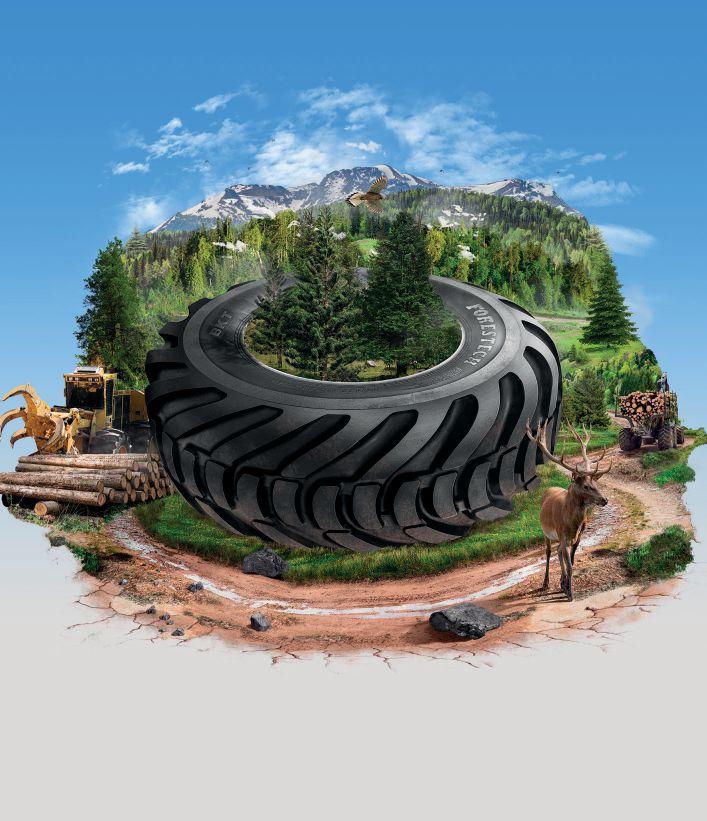
FORESTECH is a BKT bias steel-belted tire, suitable for forestry applications with forwarders. It provides excellent traction even in heavy-duty service and applications. Its strong bead and shoulder area ensure high puncture resistance as well as a longer tire life cycle. As a result, you can deal with the toughest working conditions in the forest without concern.
Choose the BKT range for forestry applications!
Joe Dias
Eastern Zone Manager
Directeur Régional, Est du Canada
BKT Tires (Canada) Inc.
Cell: 514-792-9220
Web: www.bkt-tires.com
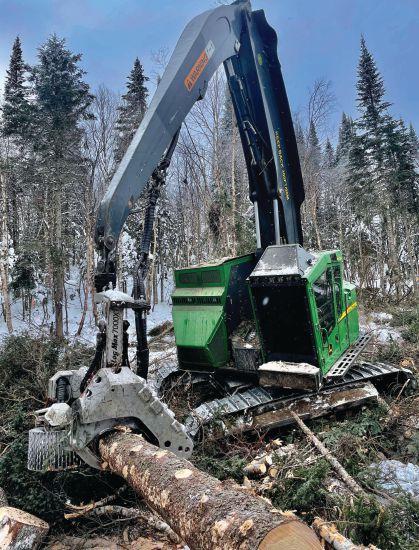
Another key piece of equipment in the company’s fleet is a John Deere 803 MH tracked harvester.
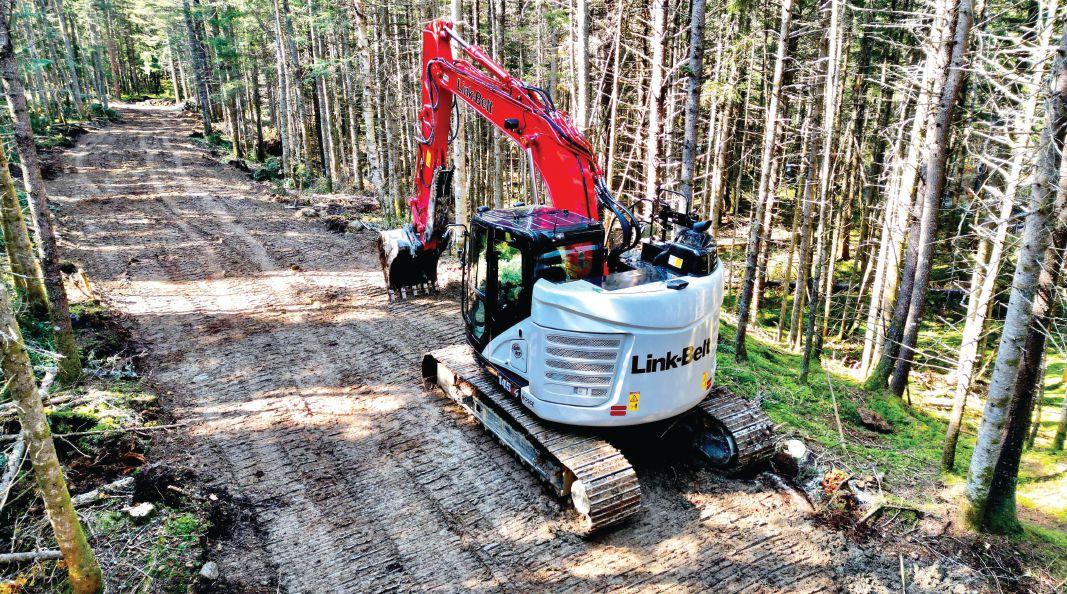
In May 2024, he also purchased a Linkbelt 145x4 excavator.
“With the excavator, we can make our own roads and do repairs if necessary,” notes Daphnée, explaining that the company takes on private contracts during the spring thaw period.
“We had transport trucks, but we sold all of them because it wasn’t profitable for us,” says Gabriel. “I didn’t have enough trucks to have the necessary volume. I preferred to leave that to others so I could concentrate on harvesting, while making a few roads.”
A CLEAN FREAK
As I got out of his transporter, I noticed that Gabriel was driving his machine in socks. He took the time to take his boots outside to put them on.
“Gabriel takes such good care of his machine that he even asked us to install a foot brush,” says Philippe Richard, territory manager for Maskinen. It’s one of the cleanest machines I’ve ever seen.”
HISTORY
At 29, Gabriel Leblond is already in his 12th year in the forest, having started working very early with his father, Christian. It was when he saw his son, Gabriel, join the family business that he decided to invest in a multifunctional harvester.
“It’s really cool to see their evolution, because his father harvested with a horse and a chainsaw at the beginning,” says Daphnée, who took a sabbat-
ical year from the federal government to explore full-time work with the company.
“I didn’t want to work directly with my hands, so I told my father that we had to modernize so that I could join the company,” says Gabriel.
Gabriel greatly appreciates life as an entrepreneur. “I worked for a salary for a year and a half after finishing my course in 2012, but I like the freedom of being an entrepreneur much more. It’s a source of pride to say that you’re building something.”
Daphnée, who knew nothing about forestry before meeting Gabriel, has also become passionate about it over time. “Gabriel is an excellent operator with high production, so why enrich someone else?” she says.
Over the past decade, the family business has gradually expanded its machines by becoming more professional, notably by investing in a service truck three years ago. In the coming months, the company wants to install internet in the forest, while working on the transfer plan. And Gabriel will have to make a decision on whether to acquire a second harvester.
By purchasing the Ecolog 584, Leblond increased his transport capacity, going from an 11-tonne carrier to 16 tonnes.
“I DIDN’T WANT TO WORK DIRECTLY WITH MY HANDS, SO I TOLD MY FATHER THAT WE HAD TO MODERNIZE SO THAT I COULD JOIN THE COMPANY,” SAYS GABRIEL LEBLOND, HEAD OF ENTREPRISES FORESTIÈRES GABCHRI.
In May 2024, Entreprises forestières Gabchri purchased a Linkbelt 145x4 excavator.
QUALITY DRAG C HAIN ENSURES A QUALITY MILL
WOODPRODUCTS
DRYING OPTIMIZED
BY ANDREW SNOOK
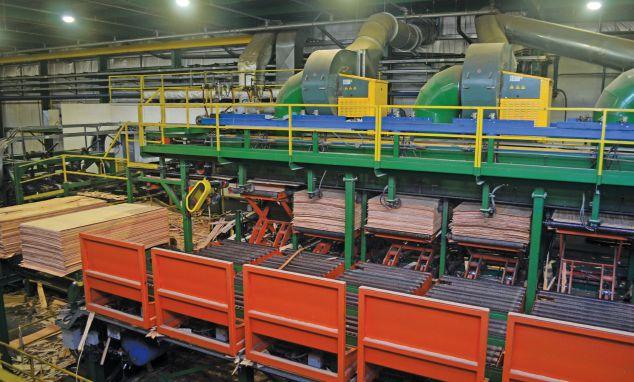
All good things eventually come to an end. In the case of wood products production, that includes the equipment. After a long run in operation at Canoe Forest Products’ plywood plant in Canoe, B.C., it was time for the company’s dryer No. 2 to be replaced.
“We’re always looking for new capital for ROI projects, and our dryer was probably the oldest piece of equipment in the plant – about 50 years old,” says Andy Anderson, plant manager for Canoe Forest Products. “It’s one of the bottlenecks in the plant – having enough dry veneer to keep our press going.”
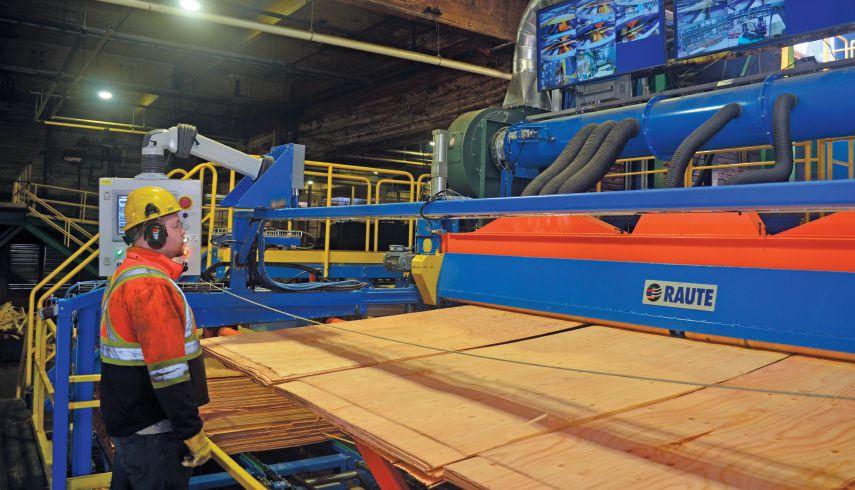
The company began looking into dryer replacement options in the spring of 2023, reviewing the different vendors available. In the end, they opted for a Raute R7 model – 6-deck jet tube veneer drying line.
“Raute is one of the leaders in plywood engineer manufacturing. They’re a global company with a group in Langley that services North America that
we get to spend some quality time with from time to time,” Anderson says.
As a member of the Gorman Group, Canoe Forest Products’ management made the request for a dryer replacement to the parent company’s capital team. The capital team then reviews all requests and selects which projects within the group will receive funding.
“From there, what’s chosen are obviously projects that are sustaining the plants or strong ROI projects,” explains Marcello Angelozzi, general manager – North, Gorman Group, who oversees operations for Canoe Forest Products and Downie Timber in Revelstoke, B.C. “The drying at this plant has always been the biggest bottleneck, so we’re dealing with the biggest constraint first.”
The total cost of the dryer replacement project was approximately $13 million. Canoe Forest Products was able to receive a little over $2.2 million in funding assistance for the project from a grant made available through the province’s BC
Canoe Forest Products recently invested in a dryer upgrade, replacing its No. 2 dryer with a Raute R7 model – 6-deck jet tube veneer drying line.
Manufacturing Jobs Fund (BCMJF).
“B.C.’s local wood-manufacturing companies like Canoe Forest Products are at the heart of our communities and are the best of what ‘Made in Canada’ has to offer,” stated B.C. Minister of Forests Ravi Parmar during a recent ribbon-cutting ceremony for the new dryer where he met with employees, members of the community, and Gorman Group CEO Nick Arkle.
“Having Minister Parmar today at the ribbon cutting for the commissioning of the new dryer at Canoe Forest Products is important in recognizing the B.C. government’s support through the Manufacturing Jobs Fund,” Arkle stated. “This investment strengthens our operations through increased efficiency of cost and quality, while supporting local jobs and the long-term sustainability of our business.”
The dryer replacement project began on October 1, 2024, and took a mere 10 weeks to complete the project, which included the demolition of the old building that housed the dryer, and the construction of a new building around the new dryer to account for the unit’s increased height.
“The first veneer went through on December 13. The project went extremely well,” Anderson says.
“The two-and-a-half-month install is not
common for a project of that size,” Angelozzi adds. “We were probably doing something that was not done to that pace before. We had to keep all the vendors on plan and have it running in January to a reasonable level. Veneer went through in December, and then you tweak and troubleshoot for a couple of weeks.”
EFFICIENCY AND ADAPTABILITY GAINS
The new Raute dryer allowed for the company to immediately experience some return on their investment.
“The new dryer allowed us to shut down our weekend press shift on our
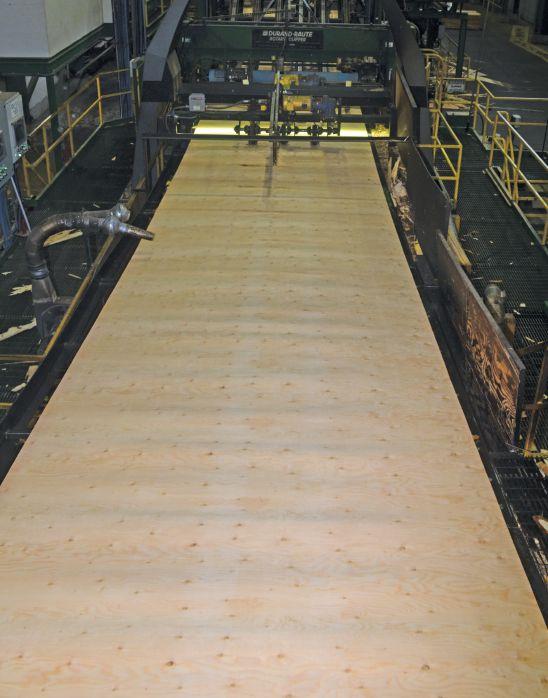
The Altec-controlled lathe peels the blocks down to a 3.25” core and the long ribbon is clipped to 4-ft. sheets and stacked by moisture content.
dryers. We were running 32 hours on the weekend out of the 48 available in order to produce enough dry veneer for our press,” Anderson says.
“Overall, it was quantified at a 25-per-cent increase in capacity versus the old dryer, which we felt was probably conservative,” Angelozzi adds.
The plant has the capacity to produce 145 million sq. ft. of plywood on a 24-5 operation. This is roughly 14,000 4’x8’ sheets on an average day. Another advantage of the new dryer was an improvement in energy efficiency. So far, the new dryer’s annual projection for gas savings is approximately 14,000 gigajoules.
While the ability to improve the dryer’s efficiency was obviously a selling point to the Gorman Group’s capital team, another big advantage of the new dryer is improved versatility.
“I think one of the things that was a big seller to our board of directors, and getting them to sign off on it, is that it allows us to adapt to the changing species mix,” Angelozzi says.
Historically, Canoe Forest Products’ desire would be to run heavy Douglas fir, but that’s changing to help the entire Gorman Group meet its fibre needs.
“Internally within the Gorman Group, our log supply can benefit if we can run more of the alternative species. Basically, anything but Douglas fir,” Angelozzi says. “This dryer allowed us to not only gain that 25-per-cent capacity, but also run more of the alternative species, which have a higher moisture content. Obviously, it’s a bit more costly to dry, but in the old system,
we simply couldn’t do it and still hit our targets for production. This allows us to do that with a change in that profile and adjust to the changing forest profile.”
The Canoe Forest Products harvesting quota is about 400,000 cubic metres annually, which is prioritized based on where it’s needed within the Gorman Group. This can include for logs for SPF boards for their Westbank, B.C. sawmill, and cedar or Douglas fir logs for Downie Timber.
“Consideration is always given to the group,” Angelozzi says.
The combination of running more alternative species and improved dryer efficiencies is expected to boost overall production at the plant by about 10 per cent.
THE PROCESS
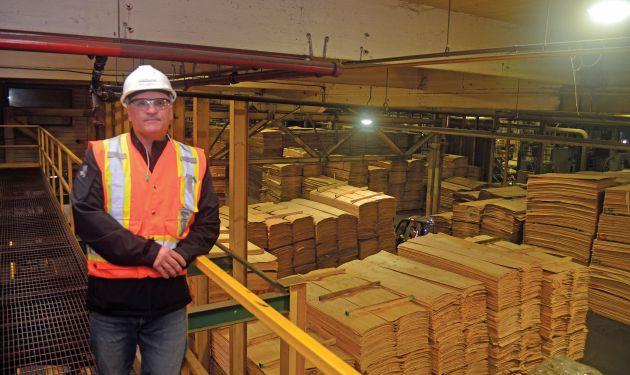
Logs – multiples of 8.5 ft. – are fed up a jack ladder out of the lake to the barker where the logs are then bucked to roughly 8.5-ft. blocks. This allows for trim along the various veneer/plywood processes to the finished 8-ft. size. Blocks are then loaded into conditioning vats (hot water sprinkler style) for eight-plus hours to get them to temp for improved peeling quality/recovery.
The Altec-controlled lathe then peels the blocks down to a 3.25” core (that are sold) and the long ribbon is clipped to 4-ft. sheets and stacked by moisture content (heartwood being the dryest, light sap and heavy sap – these sorts will be dried for different lengths where heart may be half the amount of time to dry versus heavy sap).
The two veneer dryers, including the new Raute dryer, then continuously feed the veneer and it takes anywhere from three to 10 minutes – depending on sort and species – to travel from the infeed to the outfeed of the dryer and extract the moisture. The goal is to not overdry and lose recovery/quality, but also not produce excessive re-dry.
At the dryer stackers, grades of veneer are sorted by essentially core (lower quality), face stock (sheathing, select, supreme, etc.) and rerun/ redry (veneer that requires further equalization or drying).
Core stock is composed at one of the two composers that clips out defect and produces a 8’x8’ veneer sheet by edge glueing various width sheets together. That is then centre cut, and that grain runs perpendicular to the face sheet fibre and makes up what you see in the centre of a piece of plywood.
Face stock and composed core stock is then loaded and fed using face/core recipes based on plywood thickness on the lay-up line, where a glue (mix of resin and other materials) curtain coats the faces of the veneer besides the top sheet.
At the dryer stackers, grades of veneer are sorted by essentially core, face stock, and rerun/redry.
Marcello Angelozzi, general manager – North, Gorman Group, says the dryer upgrade has significantly increased the plant’s capacity.
Final packages are auto-painted with size, grade, and other details.
This stack of loosely bonded veneer is then prepressed (no heat just pressure) to hold the bond, and a number of minutes later, hot pressed in the 44-opening (panels) Williams hot press and press time/temp pre-determined by panel thickness.
Panels then can go direct to the finishing trim line or are hot stacked.
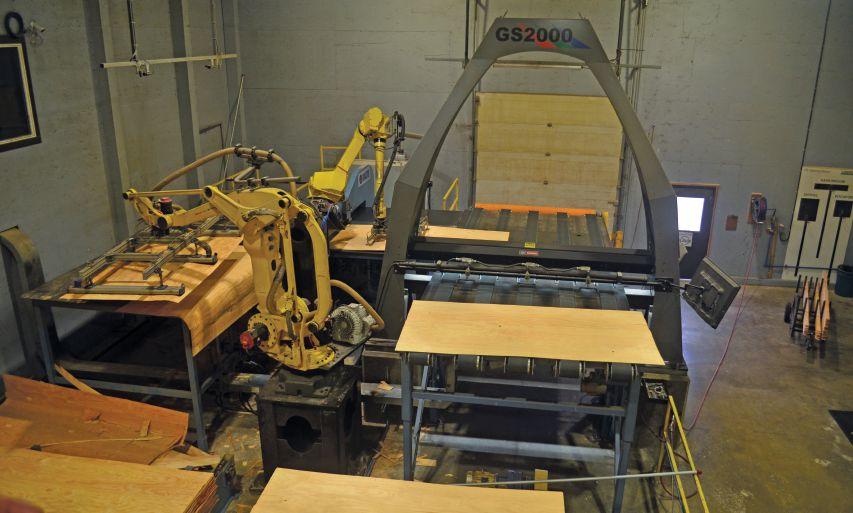
Select+better grade plywood is patched and puttied using robotic patchers that take a couple inch patch of wood and replace defect then putty those patched areas and that high-grade product will be sanded.
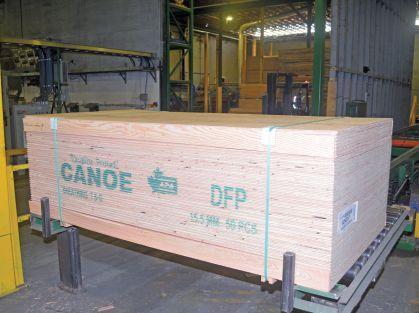
Final packages are auto-painted with size, grade, and other details.
HIRING CHALLENGES
The production workforce at Canoe Forest Products is about 135 employees working three shifts, 24 hours a day, five days a week. Retaining and hiring new workers has been incredibly challenging.
“We’ve been hiring people since the start of the
pandemic, really, and haven’t stopped. We’re still trying to hire,” Angelozzi says.
In recent years, about 30 per cent of the workforce needs to be replaced each year for a variety of reasons.
“Part of it would be our location and whether people want to stay in Salmon Arm long-term,” Anderson says, adding that the allure of oil and gas money is another factor. “For a lot of the younger employees, they come for a year and then they see big dollar signs in Alberta, and they head that direction.”
An aging workforce has also impacted operations at Canoe Forest Products. The company has had a significant number of employees retire since the COVID-19 coronavirus pandemic.
“We’ve had a number of 35- to 40-year people retire, and there’s more to come in the next couple of years,” Angelozzi says, acknowledging that a loss of operational knowledge comes with those people leaving their positions.
At the plywood plant, it is easy to spot the new hires. All employees with less than six months of experience wear green hardhats.
“I think if you look right now on day shift, there are probably almost as many green card hats as any other colour. That’s how many employees here are new,” Anderson says.
Two of the most challenging areas to staff with new hires are millwrights and electricians.
“The apprentices that we have, we trained them to do that, rather than put out ads for outside people, it’s very difficult to get them,” Anderson says.
“If we didn’t have an apprentice program, it would be difficult to man-up on the maintenance side,” Angelozzi adds.
The human resources team at the Gorman Group has been researching potential avenues to help with retention and hiring, like offering daycare benefits, for example.
“It’s definitely on the radar,” Angelozzi says.
TARIFF TURBULENCE
While Canoe Forest Products sells 98 per cent of its plywood into the domestic market, the company expects all the tariff talk and announcements to have a significant impact in the short-term.
“As soon as this talk of tariffs hit, the market softened, and it looks like it’s going to be a tough summer on the panel side,” Angelozzi says, adding that the biggest impact is likely to come from the uncertainty around housing builds. “You can see that there’s risk of recession happening. So, of course, everyone’s going to only buy the bare bones of what they need. Nobody is
Canoe Forest Products has invested in the use of robotics to enhance automation at the plant in recent years.
comfortable going out on the limb buying a bunch of plywood.”
Another potential way that tariffs could affect plywood sales is through the impact they have on other wood products being produced in Canada.
“There is a ton of OSB that gets exported from Canada into the U.S. Should tariffs take effect on that, then some of that OSB could stay in Canada and threaten some of the plywood business,” Angelozzi says. “Some of the veneer plants on the B.C. Coast only produce veneer, and they sell a percentage of what they produce into the U.S. as well. That veneer volume could end up coming into the B.C. plywood market, which could contribute to an oversupply of veneer and impact plywood market prices.”
FUTURE INVESTMENTS
Canoe Forest Products has purchased veneer from the producers on the B.C. Coast from time to time to help meet its production targets. However, that is not an ideal scenario.
“You don’t want to get into a position where you’re too reliant on others to take to buy veneer off, because we’re producing what we can consume internally for plywood. These sorts of things are all considerations when we decide what we’re doing for the next project,” Angelozzi says.
Fortunately, the Gorman Group has always been willing to invest in Canoe Forest Products’ projects as long as they can justify the investment.
“Our company has always been willing to invest. Canoe has been the recipient of about $65 million worth of investment in the last 12 to 13 years,” Angelozzi says.
Tariffs could affect plywood sales through the impact they have on other wood products producers in Canada.
WOODPRODUCTS
A PLATINUM MILESTONE
BY ANDREW SNOOK
There are certain milestones that stand out as markers of a company’s longevity and success: silver at 25 years, gold at 50, and diamond at 60. Gilbert Smith Forest Products has not only reached but surpassed each of these, proudly celebrating 70 years in operation as the largest employer in Barriere, B.C.
Founded in 1955 by Gilbert Smith as a cedar pole plant, this family-run company has grown through three generations, evolving into a leader in specialty cedar products. From its earliest days, the business was shaped by hard work and vision—qualities that allowed it to embrace innovation and adapt to shifting markets. With the help of his four sons,
Gilbert grew his operation over time to include a specialty cedar products sawmill, installed in 1967.
“The turning point was when we started our headrig, and then the evolution of the sawmill with different machines—growing with what we needed to do,” reflects Greg Smith, current president and third-generation leader of the company.
In the years that followed, Gilbert’s sons Ted and Carman spearheaded ongoing investments in the mill. A resaw was added shortly after the headrig, followed by a planer. By the mid-1990s, the company had acquired a used bin sorter. But the most transformative upgrade came in 2004 with the installation of the mill’s first small log line. That
Gilbert Smith Forest Products has invested significantly in modernizing the plant over the years, including an in-house designed cut-to-length bucking system, a profiling HewSaw R200SE, and a controls network enhancement.
same year, Carman’s son Greg began management training, stepping into the next generation of leadership.
The company’s momentum was briefly slowed by the U.S. housing crash, but over the past decade, Gilbert Smith Forest Products has renewed its focus on innovation. Roughly $25 million has been invested in modernizing the plant. More recent upgrades include an in-house designed cut-tolength bucking system, a profiling HewSaw R200SE, and a controls network enhancement.
“We did a lot of foundational work to get the mill production up to where we wanted it,” Greg says.
One of the most impactful additions was a customized grade sort line, which allows the mill to process rough green, rough dry, and finished dry products through one line efficiently.
“It’s giving us the flexibility we need to set us up for a diverse product offering,” Greg says.
Before the installation of the grade sort line, green lumber was traditionally stacked, transported manually across the site via forklift, and batch run through the planer for grading and sorting.
“Now, the mill is fully connected via three
conveyors to the grading and sorting length (GSL) finishing lines,” Greg says, underscoring a shift toward seamless integration and streamlined operations.
The most recent advancement at Gilbert Smith Forest Products is the installation of an AI Vision BSQ grading system this past fall by Raptor Integration based in Salmon Arm, B.C.
“This scanner is the heart of our grade sort line,” Greg says. “Both our finished and rough products go through it—it’s definitely getting a workout.”
This isn’t the first collaboration between Gilbert
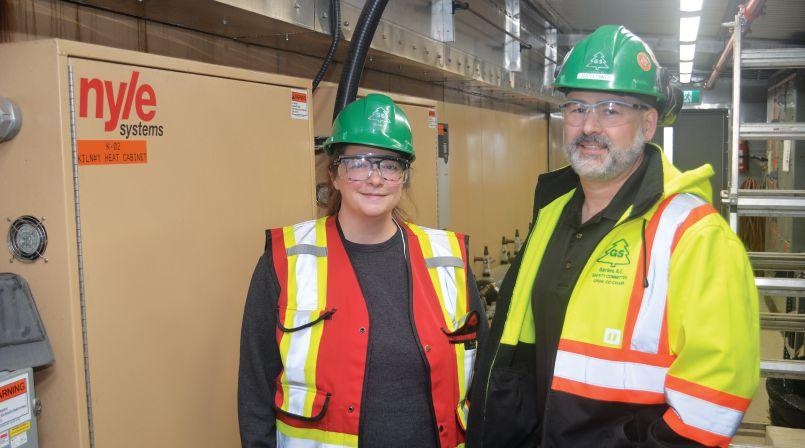
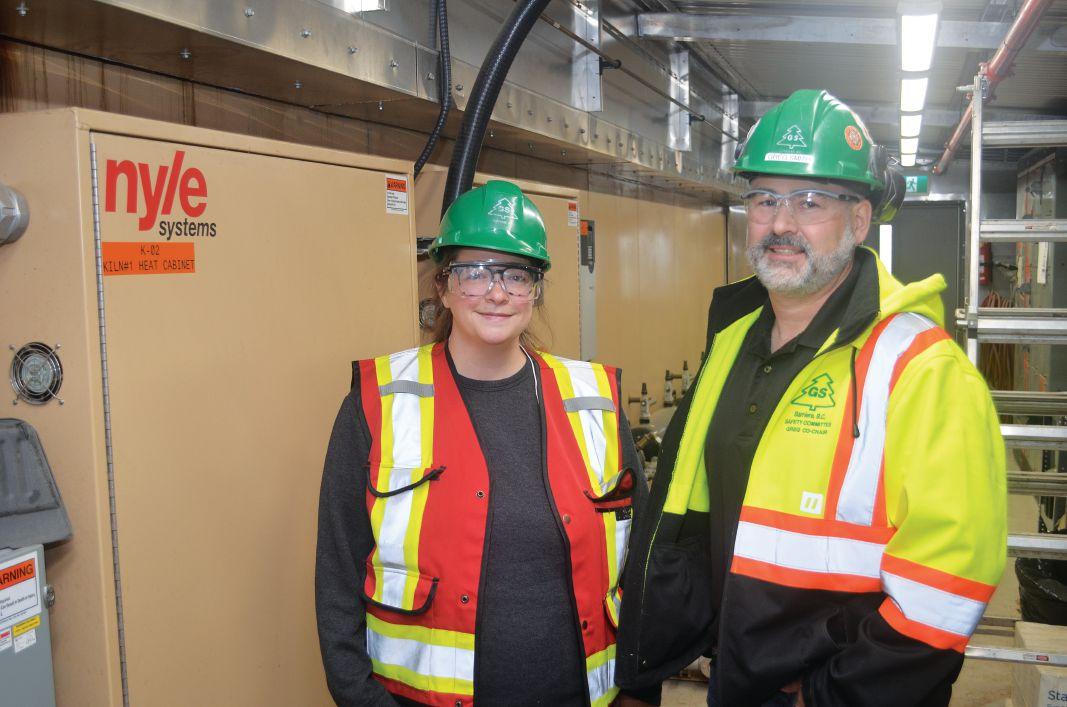
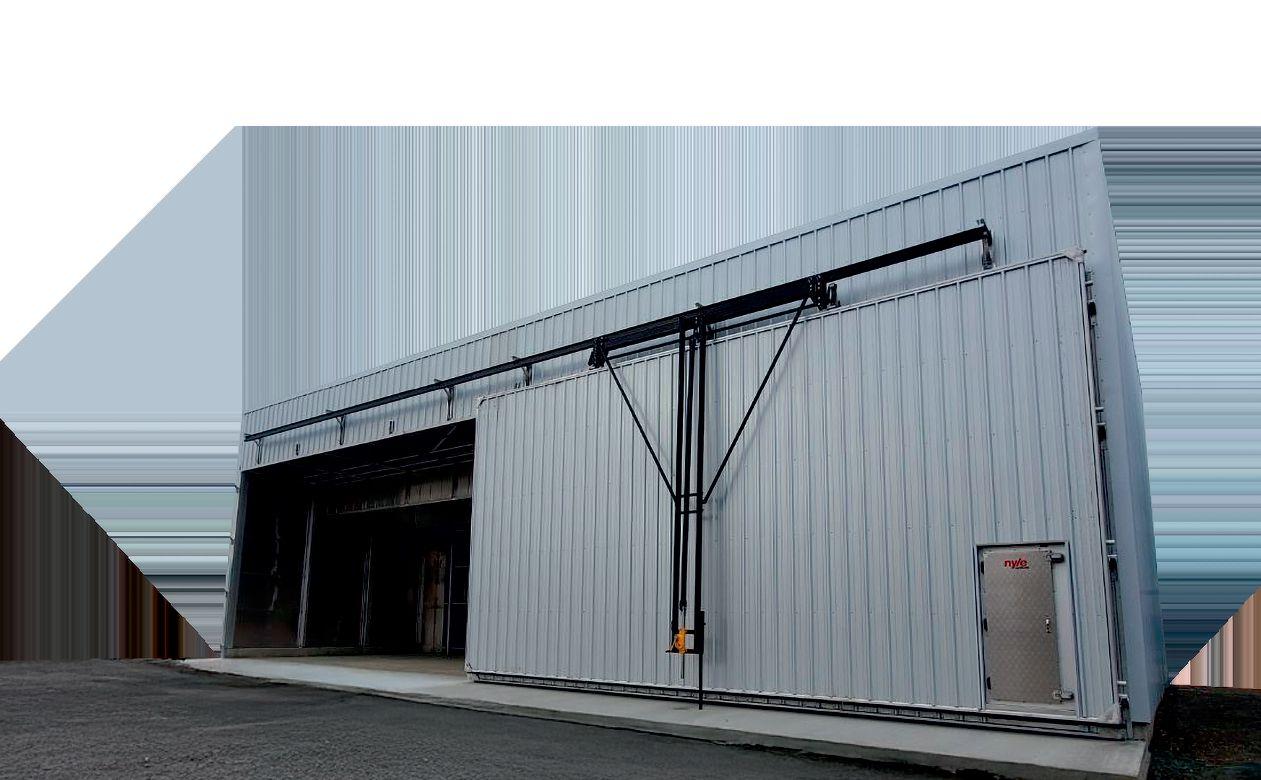
President Greg Smith and continuous improvement coordinator Kate Schilling, discuss the mill’s 80,000-bd.ft. capacity package kiln from Nyle Dry Kilns.
Greg Smith is the third generation of the Smith family to run the company.
most B.C.
THE MILL OPERATES WITH ABOUT 85 EMPLOYEES ON A SINGLE SAWMILLING SHIFT AND A SINGLE REMANUFACTURING SHIFT.
Smith and Raptor Integration. Eight years ago, the company served as a beta site for one of Raptor’s earlier systems.
“It started as a geometric scanner, and we’ve now transitioned to a vision-based system,” Greg explains. “We run Raptor’s technology on our optimized board edger and our small log line as well.”
The upgrade to the mill’s board scanning system is expected to improve grade recovery, overall lumber recovery, and improve flexibility for different products.
“As we expand into other niche species, this system makes that process much more efficient,” Greg notes, adding there are also operational and training efficiencies. “With the addition of the AI system, our graders can now apply their knowledge elsewhere in the mill.”
DRYING UPGRADES
Another major recent investment is an 80,000-boardfoot capacity package kiln from Nyle Dry Kilns, equipped with Nyle’s largest dehumidifier, the HT162. The kiln runs on renewable electricity and is supported by an energy monitoring system that optimizes usage during peak demand hours.
“It’s 192 kilowatts of segmented electric heat,” says Adam Duplisea, vice-president of sales for North America for Nyle Dry Kilns. “They’re able
Like
sawmills, Gilbert Smith Forest Products faces ongoing challenges in sourcing fibre.
The company has strategically adapted by focusing on small-log utilization.
performance. Even when the kiln is running at partial electrical load during the day, drying times remain consistent.”
The inclusion of an electric hydronic heated floor helps to stabilize the thermal mass in the winter and reduces the energy required during kiln charges.
The system automatically adjusts its output throughout the day: when the sawmill is running, the kiln operates at 50 to 60 per cent electric heat input to reduce demand charges. Once the mill powers down for the night, the kiln ramps up to full electric input.
What sets Gilbert Smith Forest Products apart is its targeted drying process.
“We don’t dry everything,” Greg explains. “We target-sort and grade our wood. Many of our cedar products are sold in the green, and for the products we do dry, we can choose specific items. Our stacker is versatile—we can stack with lath for finished products or stick them for drying in the kiln.”
The kiln was also designed with the future in mind. It’s fully prepped for expansion with all electrical, fire system, and framing infrastructure in place to support a second chamber—a key consideration as the company looks to process slower-drying species like white pine or hemlock.
“We’ll need that second chamber when we start drying longer-cycle species,” Greg says.
So far, customer response has been overwhelmingly positive.
“Everyone’s been really happy. The consistency has been excellent, and the kiln has performed very
The mill produces a wide range of dimensional lumber in sizes from 1’x3’ to 2’x12’, tailored to meet market demand.
well,” Greg says. “The transition to electric drying has also supported the company’s carbon reduction goals. We’re working toward offering a truly lowcarbon product by using renewable electricity. We’re even exploring the opportunity to sell carbon credits once we’ve finalized the monitoring and reporting.”
MAXIMIZING FIBRE
Like most B.C. sawmills, Gilbert Smith Forest Products faces ongoing challenges in sourcing fibre.
“To get supply, we often have to go farther afield. Everything takes more time, more planning,” Greg says. “You really have to make sure you have a multitude of channels being developed at the same time. We are very fortunate to have developed longterm supply relationships with a variety of licensees including Simpcw Resources Group.”
The mill’s most recent investment is an AI Vision BSQ grading system installed this past fall by Raptor Integration.
The company has strategically adapted by focusing on small-log utilization.
“Smaller logs are more difficult to process efficiently, so we’ve had to find value-added markets and enhance our processes to support the economics of it,” Greg says.
The mill produces a wide range of dimensional lumber in sizes from 1’x3’ to 2’x12’, tailored to meet market demand.
HIRING AND RETENTION
Operating with around 85 employees on a single sawmilling shift and a single remanufacturing shift, the company hasn’t had trouble finding general labour lately—but skilled trades are a different story. Finding millwrights, electricians, and saw filers is a growing challenge. To help address this, Gilbert Smith Forest Products has developed a robust apprenticeship program aimed at building talent from within.
“You want to attract people who can see a career path here,” Greg says.
The community of Barriere has grown over the years along with its support services offered to residents. This could help bring skilled labour back to the community that may have left to work on more profitable oil and gas projects but are looking to enjoy the lifestyle that the area offers for raising a family, Greg notes.
THE NEED TO ADAPT
With the constant changes in duties, tariffs, fibre availability, and all of the other instabilities that come with running a sawmill in B.C. these days, Greg says they’re used to never getting too comfortable.
“The only thing we know for certain is that we’ll always need to adapt,” Greg says.
While having a culture of safety is a top priority at Gilbert Smith Forest Products, so is fostering a culture of innovative thinking. That mindset has helped the mill remain competitive—through bold investments and a willingness to innovate.
“As a small operator, staying relevant takes effort and creativity,” Greg says. “We make investments not just for now, but so the next generation can keep moving forward.”
Those investments are often phased— leveraging during lean times and then building new foundations when the opportunity is right.
“When times are tight, you rely heavily on your earlier investments,” Greg explains. “Then when things turn around, that’s when you make a step change—like we did with our grade sort line. That was the biggest project we’ve ever taken on, and it gave us the platform to pursue a series of smaller but equally impactful improvements. Each step builds on the last.”
Fostering a culture of innovative thinking is a top priority at Gilbert Smith Forest Products.
Feeling left behind by your autograder supplier?
It’s time for a partner you can count on.
When you invest in an autograder, you want it for the long haul. But what if the vendor no longer supports it?
COMACT DELIVERS WHERE OTHERS DON’T:
• Reliable, expert technical support that lasts
• Future-ready solutions with continuous updates and upgrades
• A trusted partnership focused on your long-term success
TAKE GRADING TO THE NEXT LEVEL.
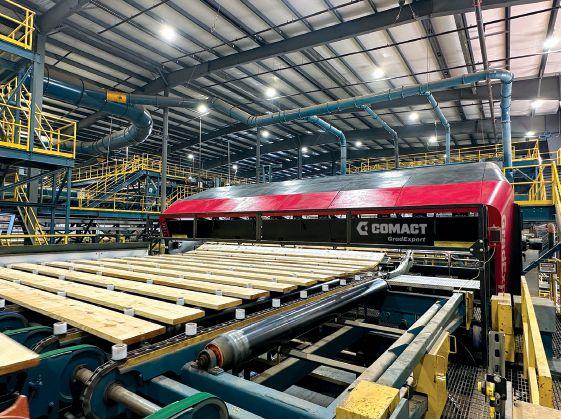
Our GradExpert™ grader-free autograder is the benchmark across North America. It grades over 50% of all lumber production. Try it. You’ll be impressed by its accuracy and consistency. Contact us to test run it at our office.
CUSTOM SOLUTIONS. NO COMPROMISES.
We engineer every solution to your exact specs—tough in build, precise in performance, and ready for whatever operational challenges you have.
Choose
WOODPRODUCTS
SOFTWOOD LUMBER UPDATE
BY KÉTA KOSMAN , MADISON’S LUMBER REPORTER
Due to confusion of international trade barriers, North American lumber commodity prices varied considerably in Q2 2025, as quotes and supply accumulations differed from sawmill to sawmill. Canadian mills jumped into book sales after a period of relative inactivity. The whipsaw fatigue of conflicting tariff announcements over two months had Western Canadian suppliers hoping to see the market settle down. Field inventories stayed thin across the continent; thus, supply crept ahead of vacillating demand.
As April waned and talk of potential tariffs on Canadian lumber entering the U.S. faded, prices of construction framing dimension softwood lumber settled down to proper levels given existing
supply-demand conditions. The fact that demand remained quite soft, particularly for the time of year when new home building normally would be increasing, was lost on no one.
The recent shift in buying by U.S. customers toward Southern Yellow Pine and away from Spruce-Pine-Fir had topped out, with prices responding out of correction mode. There remained more questions than answers; specifically regarding macro-economic conditions and the ongoing muted housing starts. While some uncertainty was resolved, expectations for the coming spring building season remained unclear.
Photo: Andrew Snook
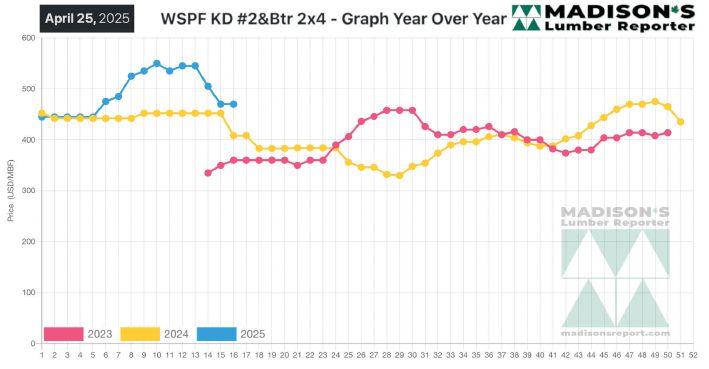
Madison’s Western S-P-F KD 2x4 #2&Btr Prices: 2023 – April 2025. Source: Madison Lumber Reporter.
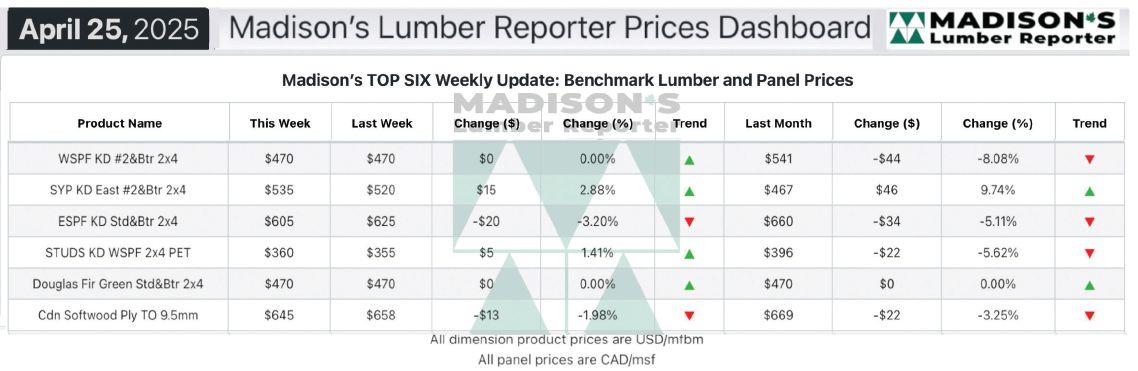
In the week ending April 25, 2025, the price of Western Spruce-Pine-Fir 2x4 #2&Btr KD (RL) was US$470 mfbm, which is flat from the previous week when it was $470, said weekly forest products industry price guide newsletter, Madison’s Lumber Reporter That week’s price is down $71, or 13%, from one month ago when it was $541. Compared to the same week last year, when it was US$408 mfbm, that week’s price was up $62, or 15%. Compared to two years ago when it was $360, that week’s price was up $110, or 31%.
Key lumber prices and market conditions takeaways, April 2024:
• The lumber market was characterized by low-key but stable trading.
• Commodity prices varied significantly between primary and secondary suppliers, further ensconcing buyers on the sidelines.
• More consistent trading ranges were hammered out; buyers and sellers worked together to get deals done.
• Takeaway remained subpar, thus Canadian Western S-P-F sawmills continued to quietly accumulate material.
• Already-reticent buyers held off making purchases in hopes of further price corrections.
• Substantial demand for Eastern S-P-F was reported.
• Demand for Southern Yellow Pine
continued to outperform that of the rest of the North American lumber market.
• Among the busiest buyers of SYP were treaters, who make up a large portion of the market base and played a large role in keeping prices elevated.
The Madison’s Lumber Prices Index for the week ending April 25, 2025, is: US$508 mfbm. This is down 1%, or $5, from the previous week when it was US$513, and is down 10%, or $59, from one month ago when it was US$567.
MADISON’S LUMBER PRICES INDEX: APRIL 25, 2025
U.S. single-family homebuilding in March dropped 14.2% compared to February, to a seasonally adjusted annual rate of 940,000 units, but was up 1.9% compared to March 2024.
In March 2025, the inventory of new single-family homes for sale under construction in the United States was at an annual rate of 263,000, down 5% year-over-year. This represents a 6% decrease from the peak count set in October 2024. The total new single-family home inventory, including those under construction and completed, was 503,000, a 7.9% increase compared to March 2024.
March housing completions were at a seasonally adjusted annual rate of 1,549,000, a 2.1% decrease from
•
duty, uni-body frame • High productivit
and
anvil
February’s revised rate of 1,582,000, but a 3.9% increase compared to March 2024’s rate of 1,491,000. Single-family housing completions were at a rate of 1,029,000, a 0.9% increase from February’s 1,020,000.
Madison’s benchmark top-six softwood lumber and panel prices: Monthly averages In the early months of 2025, a shift in log export volumes per country changed the landscape of fibre flow out of North America, however temporary this change may be. For Canada, the values of log exports to the U.S. jumped 125% in February compared to the same month the previous year, while that to Japan dropped 45%. Log exports from the U.S. to the world fell significantly, down 25% compared to February 2024.
This indicates that the curtailed Canadian
sawmills are not digesting the full timber harvest, so those logs are finding their way to the export market. Conversely, in the U.S., the suggestion seems to be that there is enough demand domestically at sawmills, so raw fibre is not being sold offshore. As this year moves on, more clarity about the delicate balance between timber harvest, log consumption, and lumber manufacturing will be revealed.
Established in 1952, Madison’s Lumber Prices is your premiere source for North American softwood lumber news, prices, industry insight, and industry contacts. The weekly Madison’s Lumber Reporter publishes current Canadian and US construction framing dimension lumber and panel wholesaler pricing information 50 weeks a year and provides access to historical pricing as well.
U.S. SINGLE-FAMILY HOMEBUILDING IN MARCH DROPPED 14.2% COMPARED TO FEBRUARY, TO A SEASONALLY ADJUSTED ANNUAL RATE OF 940,000 UNITS, BUT WAS UP 1.9% COMPARED TO MARCH 2024.
Madison’s Lumber Prices Index: April 25, 2025. Source: Madison Lumber Reporter.
EXPERTS TALK TARIFFS AT MWC
BY GUILLAUME ROY
Despite the uncertainty and tariffs menace, 1,200 people gathered at the Montreal Wood Convention, because no matter what President Trump thinks, Americans aren’t producing enough wood to meet their needs.
“I think people needed to get together to do some kind of therapy,” says Sven Gustavsson, director of the Montreal Wood Convention (MWC). Gustavsson was delighted to see that the MWC once again set a new attendance record, with 1,200 participants and 114 exhibitors.
The economic conferences were particularly
popular at a time of tariff warfare imposed by the United States.
“Tariffs are inflationary, period,” says Benjamin Tal, assistant chief economist at CIBC World Markets. He believes there will be a significant rise in U.S. inflation if the tariffs are maintained. “With inflation rising, the Fed will have to keep rates unchanged or even raise them,” he says.
Thus, Benjamin Tal believes that Donald Trump won’t be able to maintain tariffs, or threats of tariffs, for very long. “The U.S. economy is weakening, and a tariff war will only make things worse,” he says. The
ABOVE: Kyle Little, president and CEO of Sherwood Lumber, doesn’t believe tariffs or duties are a good thing for the industry or for consumers. Photos: Guillaume Roy.
economist believes that Donald Trump is using tariffs as a negotiating tool to redefine market parameters. The era of free trade, without tariffs, is over, and after negotiating, he believes tariffs should be around 10%.
Shai Dubey, a professor at Queen’s University, presented the art of negotiation to delegates. According to Dubey, emotional control is a key to successful negotiation, as “people get stupid when they’re angry”. Regardless of differences of opinion, you have to learn to build solid relationships, and to understand the other’s point of view in order to come to an agreement. And even when an agreement is reached, don’t hesitate to restart negotiations if both parties can improve their lot.
Even though there is a shortage of over two million homes in the U.S., interest rates are still too high to encourage Americans to buy new homes, argued Amir Patel, CIBC’s executive director of forestry. It’s worth noting that Americans keep the same mortgage rate throughout their 30year contract. As a result, households with homes at less than 5% are waiting for rates to drop, whereas rates are at 6.9% right now, notes Amir Patel. If interest rates don’t come down, demand for wood could stagnate.
“We don’t think this trade dispute will be resolved,” he added. “The lumber coalition doesn’t seem interested to negociate right now. That’s not surprising, since the current administration has been
IF U.S. INTEREST RATES DON’T COME DOWN, DEMAND FOR WOOD COULD STAGNATE.
ABOVE: Even though there is a shortage of over two million homes in the U.S., interest rates are still too high to encourage Americans to buy new homes, argued Amir Patel, CIBC’s executive director of forestry.
Combustible Dust Specialists
Allied brings 49 years experience to help you meet current NFPA Standards with: system design/documentation, spark detection, isolation, grounding, PLC, venting, blast path management, clean-up systems and duct audits — CWB certified and member SMACNA.
ABOVE: While countervailing duties and tariffs have a negative impact on the forest industry, Luc Thériault is more concerned about the state of the U.S. economy and the construction market.
favorable to them.”
Jérôme Pelletier, vice-president of JD Irving’s sawmill division, thinks the Canadian government needs to negotiate a deal rather than try to fight with legal tools. “With the arrival of a new prime minister in Canada, I believe there will be a window for negotiation,” he mentioned, adding that President Trump likes to negotiate.
Despite the pressure of tariffs, Luc Thériault, President of Domtar’s Wood Products Unit, maintains that Americans need
Canadian wood. “Nearly 25% of their wood comes from Canada, he says. They need our wood.”
While countervailing duties and tariffs have a negative impact on the forest industry, Luc Thériault is more concerned about the state of the U.S. economy and the construction market. “If people stop consuming, it’s going to be tough for our industry,” he says, while remaining confident that reason will eventually prevail. “I don’t think Trump is going to be able to sustain this for very long.”
AMERICANS DON’T WANT TARIFFS
“I don’t think tariffs or duties are a good thing for the industry or for consumers,” mentions Kyle Little, president and CEO of Sherwood Lumber, a lumber wholesaler in New York State.
The U.S. consumes 50 billion board feet of lumber a year, while we produce only 36 billion,” he notes. Canada supplies 1 billion board feet a month, which we need. U.S. infrastructure isn’t enough to close the gap.”
Kyle Little believes that President Trump is using lumber as “emotional bait” to invite Canadians to sign a new trade deal.
“Tariffs hinder trade. We need an open market,” says Charles DeLaTorre, President and CEO of Industrial Forest Products, a South Carolina-based lumber wholesaler that also does secondary processing. Although he doesn’t buy Canadian wood, he believes that the free market is good for the industry.
The wood buyer and processor believes the free market is good for business. “We need you. It makes sense for us to be in a cooperative partnership,” he says, adding that the free market naturally weeds out underperforming companies. Instead, tariffs artificially drive up prices, allowing less efficient companies to get ahead.
HARD TO SELL...
Nyle Dry Kilns has already delivered several kilns to the Maritimes, and the Maine-based company was trying to make inroads into Quebec, claims one of its representatives, Ingo Wallocha. Tariff threats, however, complicate relations with Canadian customers.
“Many companies don’t want to do business with U.S. manufacturers right now,” he points out.
ABOVE: Benjamin Tal, assistant chief economist at CIBC World Markets, believes there will be a significant rise in U.S. inflation if the tariffs are maintained.
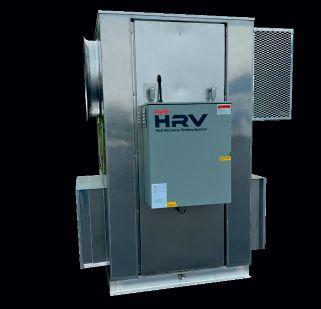
• Enhanced Sensor Technology
• Integrated Energy Management System
• Increases Boiler Capacity NDK-R Kiln Controls
Heat Recovery Vents
• Shorter Drying Cycles
• Qualifies for Carbon Credits
• Saves Up to 80% of Lost Heat
• Retrofitted To Any Kiln Regardless of Manufacturer
Contractors flock to Moncton
CWF 2025 Spring Meeting highlights wood markets and tariffs
BY ANDREW SNOOK
More than 200 attendees packed into the Delta Beausejour Hotel in Moncton, N.B. for the Canadian Woodlands Forum’s (CWF) 2025 Spring Meeting. The 106th annual general meeting and conference kicked off with a welcome address from CWF chairman Dirk Nielsen of Weiler Forestry.
Nielsen briefly discussed the CWF’s five-year plan, which was a key focus of the annual general meeting with the association’s 22 board members.
“We set out six general goals that feed into the mission statement and drive the workplan behind what the Canadian Woodlands Forum is all about,” he told the crowd.
The goals of the CWF are to support contrac-
tors and operators by promoting professionalism and sustainable practices; improve communication and information to members; improve operational efficiencies of woodland operations; promote and deliver continuing forestry education and outreach; foster cooperation between forest stakeholders; and ensure the means of sustaining and growing the organization.
The CWF’s membership has grown over the past year with the number of contractor members jumping from 137 to 180 members. Nielsen sent a call out to any logging contractors that want to be active members of the CWF board.
“It’s a great cross-section of people in the
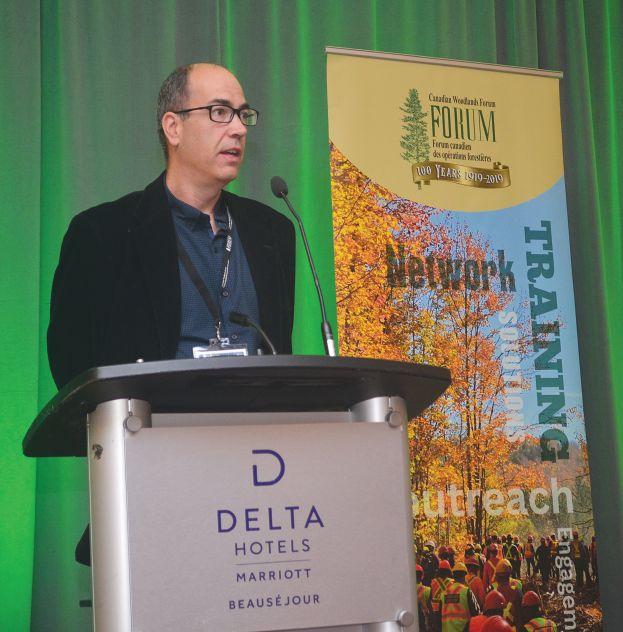
The 106th annual general meeting and conference kicked off with a welcome address from CWF chairman Dirk Nielsen of Weiler Forestry. Photo: Andrew Snook.
industry, from the manufacturing, supply chain, dealers, manufacturers, and logging contractors – obviously, you’re the heart of it. I appreciate when logging contractors can participate and give their voice to what we’re working on. So, if you want to become a board member, we do have a few vacancies,” he said.
OPPORTUNITIES AND CHALLENGES
Kevin Merriam, executive director of the Maritime Lumber Bureau (MLB), presented, “Opportunities and challenges in a rapidly changing sector,” which featured a discussion on opportunities and challenges regarding domestic and international wood markets, the building and construction sector and tariffs.
Merriam started by acknowledging the constant state of uncertainty surrounding the U.S. tariffs situation, and the concern that poses for the forest sector in Atlantic Canada. Atlantic Canadian annual production since 2021 has been relatively static with just over 1.8 billion bdft. Of that production, U.S. shipments have accounted for 1.2 billion bdft.
“Roughly about 70 per cent of our wood products and lumber products go to the United States from Atlantic Canada,” Merriam said. “You know what kind of a situation that puts us in. I don’t think I’m surprising anybody when I say that it’s a very serious situation, and we are in a point in our history in this country where we really have to take a strong look at what we’re doing as far as our markets and our American diversification strategies go, because 70 per cent is significant.”
When breaking down forest products production across Atlantic Canada, New Brunswick produces 74 per cent of all forest products in the region, followed by Nova Scotia (23 per cent) and Newfoundland (3 per cent).
Many people in the region are concerned by comments made by U.S. President Donald Trump who has stated that the U.S. does not need any Canadian lumber or wood products. While those comments should be taken seriously, the data shows a need for Canadian wood products to meet U.S. domestic market demand.
The overall Canadian share of U.S. consumption of softwood lumber in 2024 was approximately 12 billion bdft. out of a total U.S. consumption of 49.8 billion
bdft., comprising about 24 per cent of U.S. total consumption.
Merriam stated that for the U.S. to remove its dependence on Canadian lumber and source those products from U.S. mills, the country would need to build up significant capacity that could take up to 10 years to generate, not including the additional challenges of finding the capital investment, required fibre supply, and staff. This does not take into account a rise in demand for U.S. housing over the next decade.
However, the upcoming combined countervailing duties (CVD) and anti-dumping (AD) duties from preliminary results of the sixth administrative review are troubling. Many Canadian forest products companies could be looking at total CVD and AD rates ranging from 34.45 per cent to 46.48 per cent as soon as this coming August.
“This isn’t in effect yet. It could be anywhere from August to October before it takes effect. It’s not 100-per-cent guaranteed, but usually when they come out with a preliminary review like this, it’s pretty accurate,” Merriam said.
He added that this would not include
any additional tariffs that the Trump Administration could apply to Canadian products.
“This is something we have to be aware of, and we need industry at large to help sort this stuff out and help with new ideas and thoughts as to how we navigate the world that we live in right now, because our sector is so important to the economy. It’s so ultra-important to our rural communities,” Merriam said.
DOMESTIC OPPORTUNITIES
Merriam also spoke about domestic opportunities during his presentation to help the forest products sector become more self-sustaining. One area he touched on was the relationship between the Canadian population forecast and housing affordability.
“We have growth in this country. We’re currently just over 40 million people in Canada, and we’re growing,” he told the crowd, adding that housing affordability is a major issue in the current federal election. “We’re one of the sectors that can help make that happen. We can find a way. We have the resources, and we cer-
tainly have the skill. We just have to have the drive to push it forward and to have the political pull to do so.”
By 2030, Canada could be facing a housing supply deficit of about 3.5 million units. This is an opportunity for the country’s forest products sector to push forward with more mid-rise construction projects, which are on the rise in Atlantic Canada.
“They’re high-performing buildings. They meet code every day of the week, and they are a really a good solution for how to have affordable housing solutions,” Merriam said. “They’re a direct competitor with other building products and the speed of construction is very fast. Developers love it, and now that we’re getting on board with the changes in the codes to allow for six-storey stick frame, you’re seeing them go up all over the place. This is good utilization of our domestic wood products that we make right here in our own backyard.”
Mass timber projects using products like cross-laminated timber (CLT) are another opportunity for Canada’s forest products sector to grow by domestically supplying the country’s construction sector.
“It’s a very high-performing product. It’s garnering a lot of interest and a lot of uptake right now in Canada, and this is a wonderful utilization of our forest products that we make in our own backyard,” Merriam said, noting that a firm in Chicago was able to successfully design a 52-storey building constructed with 100-per-cent CLT for the roofs, floors and walls.
In Nova Scotia, there is currently a mass timber manufacturing facility in the process of being developed.
“It’s well on its way right now to having shovels in the ground pretty soon, and I really hope that happens, because that will really spur a lot of interest in the sector,” Merriam said.
He added that the use of wood products in bridge construction, industrial buildings and educational institutions are other domestic opportunities for Canada’s forest products sector to pursue.
INTERNATIONAL OPPORTUNITIES
Not that long ago, the majority of wood products produced in Atlantic Canada used to be shipped to the U.K. The MLB, working with other parties, recently developed a new market study and are looking
at ways to reinvigorate the region’s forest products sector relationships with the U.K.
Merriam noted that Canada also has good working relationships with the European Union (EU).
“We’ve taken delegations over to Germany and Austria within the last couple of years to work with them on trade,” he said.
Merriam added that Canada has preferred market access to 51 foreign countries.
“We are a global force when it comes to forest products and we’re going to stay that way. We just don’t lay down and decide that we give up, and throw our hands in the air and decide that we’re going to stop everything to do with forestry. This is our livelihoods. This is what we do,” he said.
Merriam concluded his presentation by reminding the crowd that today’s challenging climate is far from the first challenge this industry has experienced in recent history.
“We’ve been dealing with the Canada-U.S. software lumber agreement now for 30-plus years. We’re used to it,” he said.
Kevin Merriam, executive director of the Maritime Lumber Bureau, presented, “Opportunities and challenges in a rapidly changing sector,” which featured a discussion on opportunities and challenges regarding domestic and international wood markets, the building and construction sector and tariffs.
Photo: Andrew Snook.
The Softwood Lumber Board invests the industry’s funds into activities that expand the use of lumber now and in the future. The SLB’s investments have generated more than 15.3 BBF of incremental demand since 2012.
1.6 BILLION BOARD FEET OF INCREMENTAL DEMAND. GENERATED
INFLUENCED
1,498 PROJECTS
629 MM BF
OF INCREMENTAL LUMBER.
IN 2024, THE SLB: OF INCREMENTAL DEMAND FROM SLB INVESTMENTS.
BY FACILITATING WOOD USE, PRODUCED A CARBON BENEFIT OF
3.8 MILLION METRIC TONS OF CO2.
DELIVERED MORE THAN
163,400 HOURS OF EDUCATION
TO ARCHITECTS, ENGINEERS, DEVELOPERS, CONTRACTORS, AND CODE OFFICIALS FROM SLB-FUNDED PROGRAMS.
TO BUILD WITH WOOD, RESULTING IN THE AVERAGE INCREMENTAL DEMAND IS
$96 IN ADDITIONAL OUTSIDE FUNDING
EVERY $100 THE SLB INVESTS IN PROGRAMS LEVERAGES ON AVERAGE SINCE 2021.
$1 = 82 BF 86 BF/$1
OVER THE LIFETIME OF THE SLB FROM 2012 TO 2024.
LEARN MORE ABOUT THE SLB’S ACCOMPLISHMENTS
COFI 2025
Annual convention of forest industry leaders comes to Prince George
BY ANDREW SNOOK
The BC Council of Forest Industries’ (COFI) annual convention travelled north to the Prince George Conference and Civic Centre in Prince George, B.C. this past April to discuss the challenges and opportunities within the forest products sector.
Themed, ““Where Do We Stand? Strategies for Competitiveness and Sustainability,” this year’s COFI Convention focused on factors and innovations that can reshape the future of the forest sector in B.C.
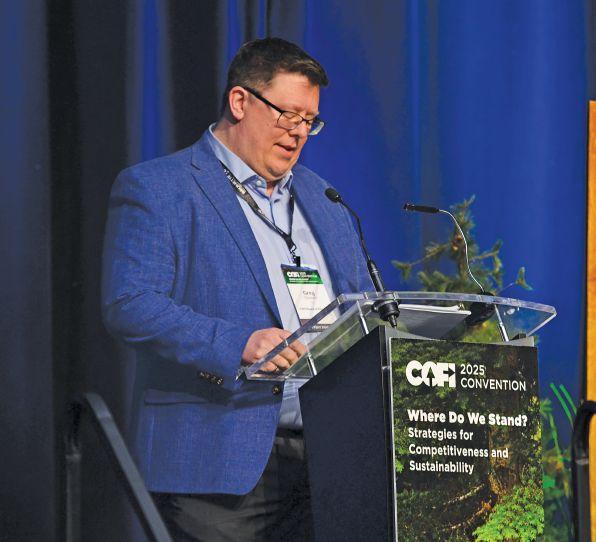
Greg Stewart, president of the Sinclar Group
Forest Products and Chair of the COFI Board of Directors, welcomed attendees to the convention and introduced Lheidli T’enneh First Nation Chief Dolleen Logan, who spoke to the crowd about the many challenges facing the forestry sector.
“Despite the growing challenges of the forestry sector, I’m encouraged to see so many familiar and new faces attending this week to learn about shared pathways,” Chief Logan told the crowd. “As a nation with deep roots in the forest sector, we’re constantly
MLA of Prince George-Mackenzie Kiel Giddens stated that he wanted to see a forest sector that focused on sustainability and the environment but also had a strong focus on economic and socioeconomic sustainability.
Photo: Andrew Snook.
seeking new, innovative approaches to both the forest sector and the forest policy. It is no secret that the industry is facing its most challenging times in history, from increased costs at home to fluctuating and confusing policies directions.”
Chief Logan’s family has worked for many generations in the forestry sector, including her son, who due to a lack of employment certainty in the local forestry sector, needed to move to Saskatchewan to find work as a millwright.
“We have to find a way to keep our kids at home that love the forestry sector,” she told the crowd.
Chief Logan stated that B.C.’s forestry sector needs to be strategic in how it supports and creates profound change to the industry.
“There is a tremendous amount of work we can do right here to pivot our industry to fight for the workers that have built this province, our communities, and, like the Wood Innovation and Design Centre, continue to show how the wood construction can still lead the way.”
Chief Logan stressed the importance of partnerships and the forestry sector for the region. The Lheidli T’enneh First Nation has had a long mutual beneficial history of partnerships with forestry companies and biofuels companies, and those looking to innovate and think differently, Chief Logan stated.
“Shared prosperity means building the solutions in B.C. that allows our children and future generations to build a future on the same resources that build opportunities and futures,” she said.
Chief Logan also discussed the need for B.C.’s forestry sector to diversify away from its heavy dependence on the U.S. market.
“We have two ports. We can ship our wood to anywhere in the world,” she told the crowd.
City of Prince George Mayor Simon Yu discussed the importance of the forestry sector to the region, and the need to create fibre certainty so companies operating in the region can invest further into keeping sawmills and other forest products plants running, and possibly, expand and open new mills.
“We need to be innovative and rethink wildfire management, harvesting, and most importantly, thinning,” he said.
Yu added that all the stakeholders in the room – industry, labour, government, First Nations – need to establish trust with each other, and focus on working with each other to find solutions to everyone’s challenges so the sector can grow a healthier value-added industry.
MLA of Prince George-Mackenzie Kiel Giddens stated that he wanted to see a forest sector that focused on sustainability and the environment but also had a strong focus on economic and socioeconomic sustainability.
“Now, more than ever, we need resource champions who are willing to take on the partnerships and innovation needed for our prosperity and good family-supporting jobs right here in British Columbia,” he said.
Giddens stated that nearly 90 per cent of people living in British Columbia believe that the forestry sector is vital to the prov-
ince’s economy, and that 78 per cent believe B.C.’s forest industry is among the world leaders in using sustainable and responsible forest practices.
“We have a really great base and success from the past, but it doesn’t mean that we can rest on our laurels,” he said. “Our success is the result of the hard work and the many contributions that everyone in the forest sector. We are at a crossroads today. Now is the time for all of us in the forest sector to work together to build on our past success and address the challenges we face today.”
SIMPLY BETTER
Greg Stewart, president of the Sinclar Group Forest Products and Chair of the COFI Board of Directors, welcomes attendees to the convention.
Photo: Andrew Snook.
NEW LEADERSHIP
COFI’s new president and CEO Kim Haakstad introduced herself to attendees, starting her speech by thanking former president and CEO Linda Coady for her hard work and dedication to B.C.’s forest sector.
“COFI is better off as an organization thanks to you,” Haakstad said to Coady, who was in the crowd. “You spent your time balancing economic and ecological values and championing strategies for wildfire resilience, forest health and efficient wood use. You’re a bridge builder. You brought together all the different forestry associations to have robust conversations about the challenges we’re facing and deepened our connections with groups like the BC First Nations Forestry Council. While working with the provincial government, you worked hard to get the commitment to a target harvest of 45 million cubic metres into the government’s election platform and Minister Parmar’s mandate letter. So, thank you for all of that.”
Haakstad comes to the association with 20 years of leadership experience serving as the Deputy Chief of Staff to the BC Premier, as well as working in North America’s agri-tech sector. She has also served on the board of B.C.’s DIGITAL Global Innovation Cluster.
“I’m excited by taking on and finding solutions to challenges, and I’m pleased to have joined COFI,” Haakstad told the crowd. “Times are tough, but that’s when we can make the most difference. For the last two months, I’ve been focused on learning and action, meeting with the members, and learning about their operations in the industry, and getting feedback on how COFI can better support their businesses.”
INNOVATIVE SOLUTIONS TO WILDFIRE MANAGEMENT
The COFI 2025 Convention offered a session that focused on integrated solutions to wildfire.
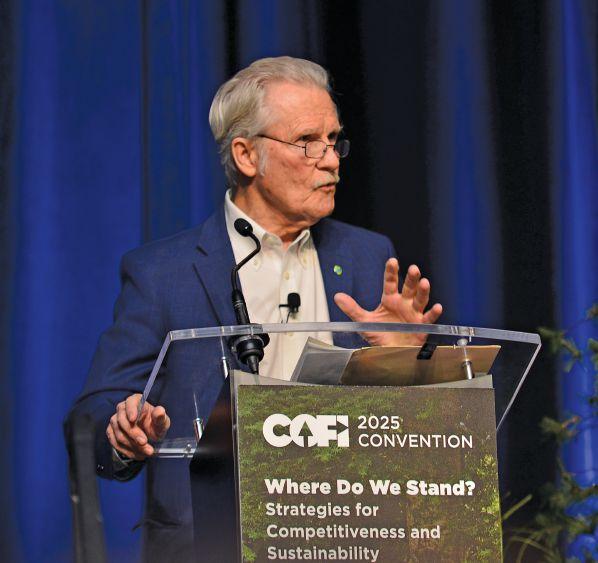
Keynote speaker John Kitzhaber, former Governor of the State of Oregon, discussed the need for new creative solutions to wildfire, conservation, community safety and economic development.
Kitzhaber is the longest serving governor in Oregon’s history, holding the office for two consecutive terms from 1995 to 2003, and a third term from 2011 to 2015. Before entering the political world, he worked as an emergency medicine doctor in Roseburg, Ore. He was elected to the Oregon House of Representatives in 1978. Kitzhaber was a chief architect of major health care reforms in the state.
“The perspectives that I want to share with you this morning are the product of almost 50 years of engagement in forest policy issues across the region as a private citizen, as a legislator and also as a governor,” Kitzhaber told the crowd. “Sometimes, I think that our efforts to balance that complicated tension between economic and social and environmental values is artificially constrained by our lack of imagination. So, this morning I want you to look beyond the world as it is and try to imagine what it could be.”
Not unlike in B.C., the State of Oregon has been experiencing an increase in large wildfires across the state, both in intensity and frequency. Kitzhaber stated that there are millions of acres of forests across the Pacific Northwest that need thinning and fuel removal to reduce fire risk and to increase landscape resiliency.
Keynote speaker John Kitzhaber, former Governor of the State of Oregon, discussed the need to for new creative solutions to wildfire, conservation, community safety and economic development during Day 2 of the COFI 2025 Convention. Photo: Andrew Snook.
“The ability to manage this landscape for multiple values is constrained, not only by the lack of consistent funding, but also by a complex and outdated governance structure that limits the policy solutions,” he said.
Kitzhaber told attendees that forest policy cannot be solved in isolation and needs to include people who may not, on the surface, see themselves as affected directly by how forests are managed. Speaking from the viewpoint of Oregon, Kitzhaber used the high-profile issues of wildfires and homelessness as examples that are at the intersection of natural resource management and the provision of social services.
Oregon is currently facing a significant housing shortage across the region, and over the next 20 years, has a projected need for 550,000 new housing units. Five per cent of those new homes are needed for people who are currently houseless while the other 95 per cent reflect historic underproduction and projected need, Kitzhaber explained.
“This shortage has profoundly disrupted the supply-demand equation, has driven up housing prices 19 per cent over the last year, and this has forced more people to rent, which has created a shortage of rental units, which has driven up rental rates. So, it feeds into this vicious cycle,” he said. “This has created not only homelessness, but chronic housing insecurity for hundreds of thousands of people, and an acute shortage of workforce housing that disproportionately impacts rural parts of our state.”
Kitzhaber stated that chronic housing insecurity triggers a well-documented set of adverse childhood experiences that profoundly undermines the ability of a child to succeed later life and increases the risk of poor cognitive functions, learning disabilities and early adult onset of many chronic illnesses.
“The lack of housing also gets in the way of the effective treatment of behavioural health and substance use disorders as well.
This situation costs society literally billions of dollars a year,” he said. “This problem can’t be solved by focusing only on low-income housing, which we often do, and as important as that is, it requires a dramatic increase in housing inventory across the board, including workforce housing and including apartment rate housing.”
Kitzhaber said that by creating a more intentional link between forest and family, it would offer a way to solve the overlapping challenges of housing and wildfires simultaneously as part of an integrated strategy to make the solution space larger in two important ways. The first is rethinking governance structures to view forested landscape as a whole and imagine how to design and harmonize management practices to achieve common goals across the entire landscape, rather than just looking at fragments of it. The second is to reframe the current wildfire and forest debate in a larger context that includes other policy goals and social values and political constituencies who may not, on the surface, be seeing themselves as being impacted in any way by how we manage our forests.
As an example for tackling these challenges, Kitzhaber offered the example of Oregon committing to build 10,000 housing units every year for 20 years while, to the greatest extent possible, using Pacific Northwest restoration fibre, small diameter logs, and other sources of low-value wood from forest health restoration and treatments necessary to reduce wildfire risk and increase landscape resiliency. These units would be constructed to the greatest extent possible with mass timber produced in Oregon and would be built by local and larger housing companies.
“This two-decade financing commitment would serve the same purpose as a long-term forest stewardship, or timber supply contract, to provide the long-term fiscal certainty for private sector businesses to expand mill capacity in certain parts of the state, to expand mass timber production facilities and expand modular housing infrastructure, and invest in expanding workforce training in the forest products industry and in the building trades,” Kitzhaber said. “Let’s assume, for example, that these 10,000 units are mass plywood panelling units at about 1,000 square feet each. It would require somewhere around 70 to 90 million board feet a year. We also know in Oregon that we have 5.6 million acres of landscape that is at very high risk of wildfire, and that to restore and maintain the resilience of this landscape requires active management, including thinning, fuel removal and prescribed burns.
“Restoration harvest can yield between five and 20 million board feet per acre, depending on the stand location and condition. So, if we treated 4,500 to 18,500 acres a year, we would create enough timber to build those 10,000 units. And by viewing the forest landscape as a whole, we can determine where to obtain that fibre in a way that best meets ecological, economic, community and social needs while maximizing climate resilience and minimizing the risk for wildfires.”
This type of initiative would place forest policy at the centre of a multi-faceted strategy that engages multiple stakeholders of common cause, he noted. Instead of solving strictly forest-related issues such as resilience and forest health, wildfire risk reduction, biodiversity, harvesting, habitat and water, this will help address important societal issues as well.
“We’re also solving for homelessness, for rural economic development, for housing insecurity, for family stability, for a reduction in the generational impact of these adverse childhood experiences, and also for a more effective way to treat behavioral health and substance use disorders,” Kitzhaber said. “In short, by addressing housing supply and housing insecurity using restoration fibre and sustainable timber, we can expand not only the solution space for a more holistic forest policy but also engage new partners from the social service sector, and the education sector, that are now invested in a sustainable way to manage our forests.”
While acknowledging that this is “a big idea,” Kitzhaber believes it is something that should needs to be considered.
“By developing a policy and financing strategy across the region to address the regional housing crisis, using locally sourced wood as part of a more holistic landscape level approach to forest health and resilience, we may be able to offset the cost of these forest health treatments and the cost of subsidizing, at least initially, the low-value wood supply chain and building out a more dispersed processing infrastructure with the billions of dollars of avoided public costs that comes from solving the housing crisis,” he said.
Kitzhaber said this “landscape level approach” allows for the reduction of wildfire risks and increases carbon storage in general forest health, and offers “a more rational way, an effective way, to address habitat and biodiversity and water quality across the landscape while providing more sustainability and predictability for the wood products industry and for our rural communities.”
PRECISION
COLUMN final cut
Forestry in B.C. is at a crossroads
It deserves to be treated as the major project it is
We can’t control U.S. tariffs, commodity prices or natural disturbances — but we can control how forestry is managed, supported and regulated within our own borders.
At COFI’s annual convention, Premier David Eby reaffirmed his government’s commitment to treating forestry as a major project—and made it clear that forestry will be treated with the same focus and urgency. Speaking to more than 600 industry and community leaders, Premier Eby stated, “This is a shared project that we can get to that 45 million [m3] target, which we all know is absolutely essential.”
We couldn’t agree more. Forestry is foundational to B.C.’s economy and communities. It supports tens of thousands of jobs, contributes billions in economic activity, and anchors a province-wide supply chain. From rural towns and Indigenous communities to urban centers and international markets, forestry touches lives across B.C.
A “whole-of-government” approach—uniting ministries to support the sector—is exactly what’s needed. Multiple government ministries must align to support forestry, recognizing its role as a backbone of local economic development, its importance for wildfire management, and its contributions to ecosystem health and reconciliation with Indigenous peoples. A coordinated strategy is critical to unlocking its full potential.
The sector faces significant challenges: tariffs, inflation, wildfires, and over a decade of shifting policy. While many of these pressures are beyond our control, we can control how forestry is managed, supported, and regulated within our own borders.
The path to achieving a yearly harvest of 45 million cubic metres will be challenging, but getting the wood harvest closer to the allowable annual cut cannot just be an aspiration. Without it, mills will close, jobs will disappear, and communities will suffer. It is necessary to maintain jobs and keep mills running to produce the wood products people use every day— from home building materials to clean energy, from furniture to toilet paper.
We applaud Forest Minister Ravi Parmar’s announcements: reducing permit timelines from 40 to 25 days, introducing a transparent permit dashboard like the one used for housing, expanding the use of nine-axle trucks, and improving auctions through BC Timber Sales (BCTS). These are good steps, and they are just the beginning.
Permitting remains far too complex. We should aim for a streamlined, single-window system, developed in collaboration with government and First Nations. This starts by mapping the entire harvest process, identifying bottlenecks, and eliminating redundancies. A collaborative approach that aims to improve the full process will benefit everyone, from government staff to First Nations, communities and industry alike.
Equally important is ensuring BCTS delivers its full potential. Consistently hitting 90% or more of its annual harvest target is critical to a thriving wood products industry that supports communities and workers across the province. Reconciliation must remain central, and increasing the distribution of stumpage revenue to First Nations is a meaningful and achievable step.
B.C. has some of the highest sustainability standards in the world and a long history of responsible forest management. We can grow the harvest sustainably while protecting old growth, maintaining biodiversity, and building innovative, low-carbon products like mass timber. These goals are not in conflict with a strong sector—they are essential to it.
Forestry in B.C. is at a crossroads and deserves to be treated as the major project it is. After years of instability, we have a chance to stabilize, strengthen and grow. That requires action—not more reviews—on the ground, in the woods, and across the province.
Wood is an essential part of our daily lives. It’s in the homes we live in, the products we use every day, and the future we’re building. Let’s make sure the system that supports it is every bit as strong, sustainable, and reliable as the forests themselves.
KIMhaakstad president and CEO of the BC Council of Forest Industries.
Olofsfors is the market leader in bogie tracks for CTL machinery and wheel tracks for skidders and wheeled feller bunchers. Under the brand names, ECO-Tracks and ECO-Wheel Tracks, Olofsfors offers the widest range of track models and linkage systems for various machine configurations and ground conditions. Superior quality, performance and a proven track record for increased productivity and durability.
NO MATTER THE CONDITIONS - OLOFSFORS HAS YOU COVERED!