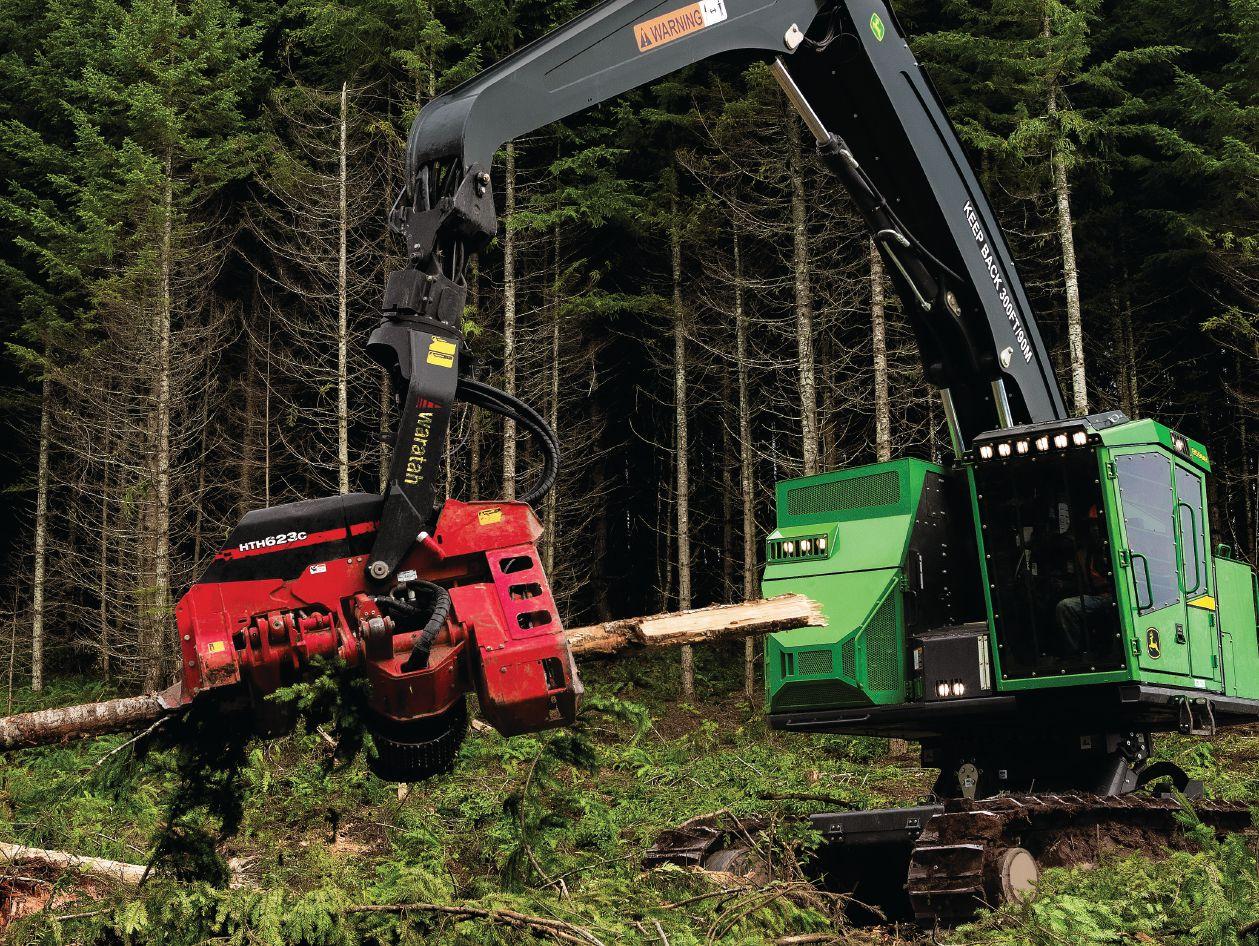
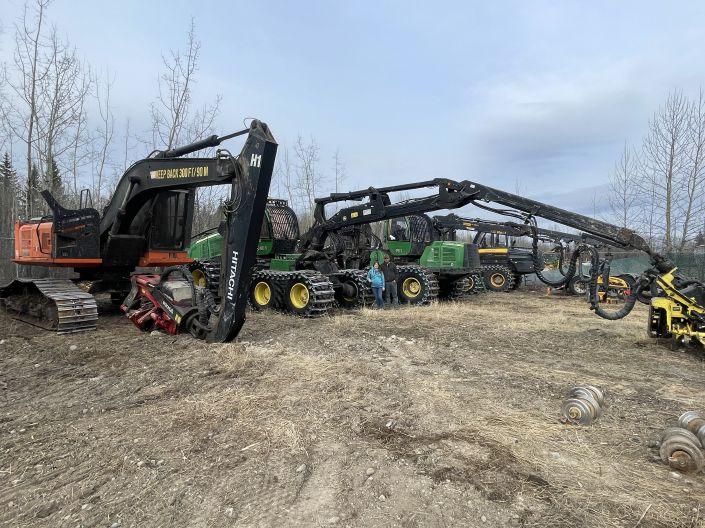
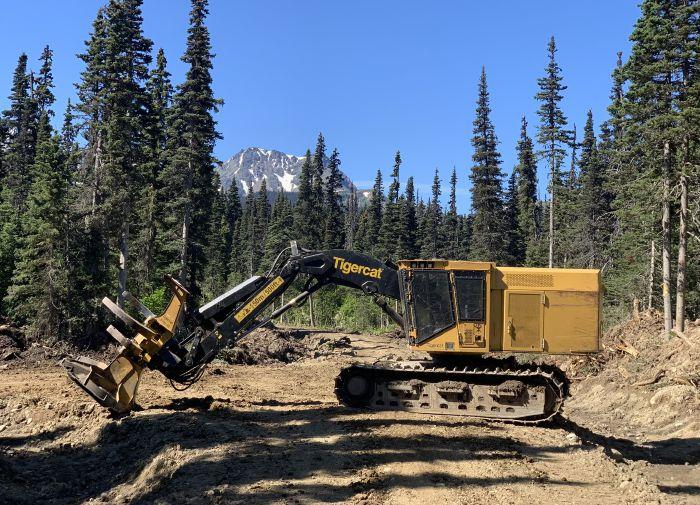
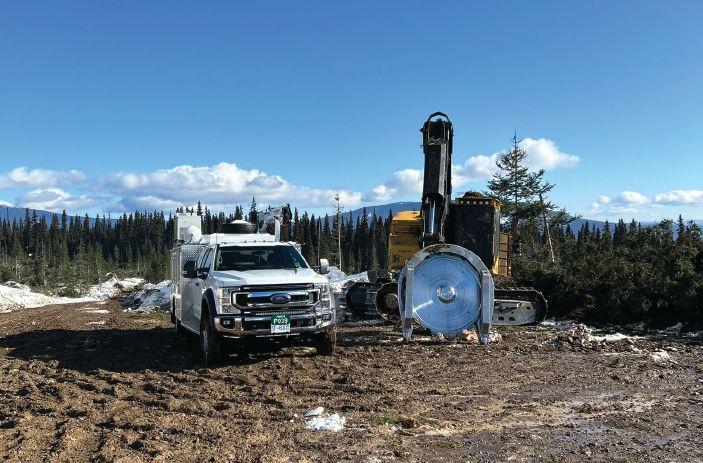
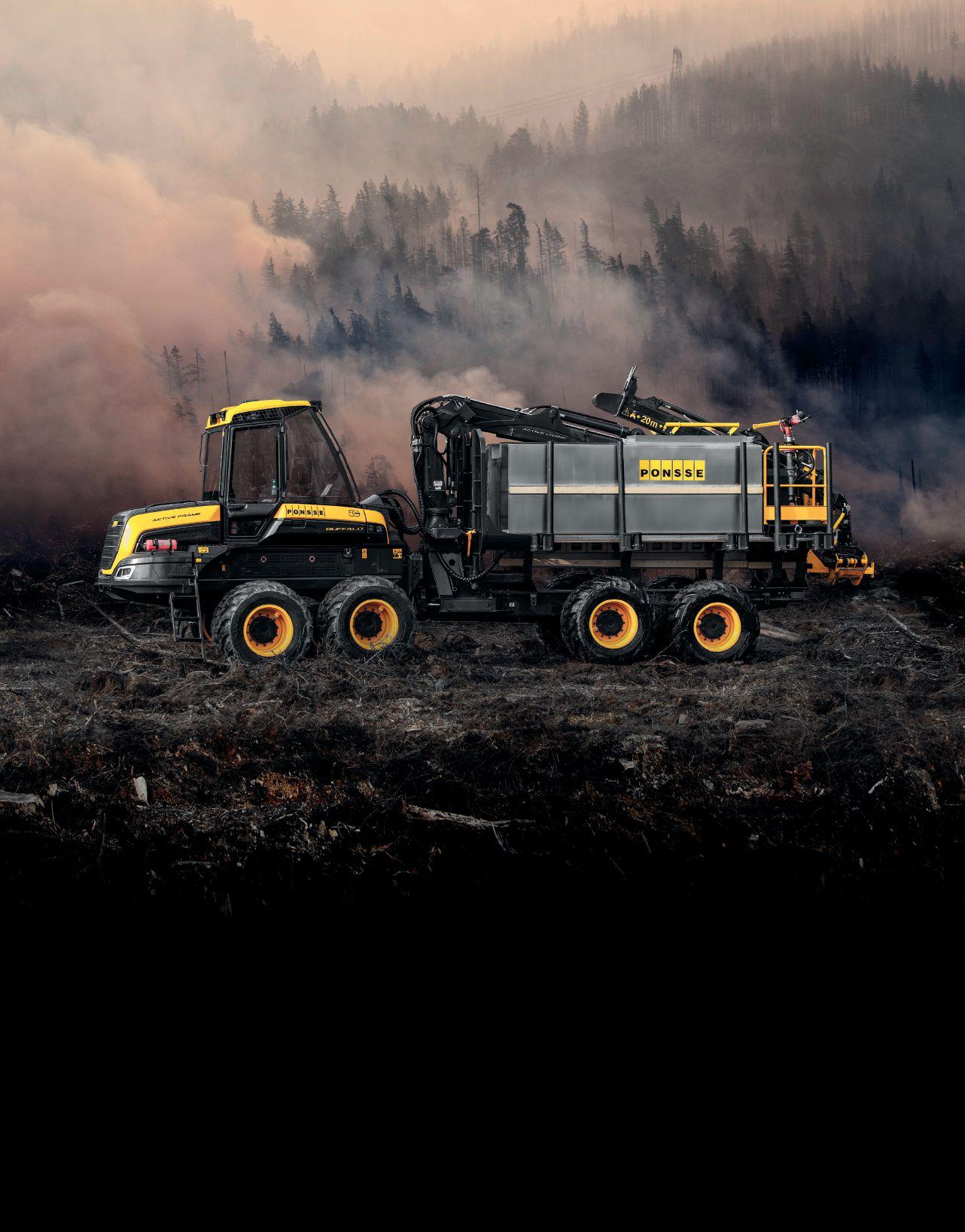
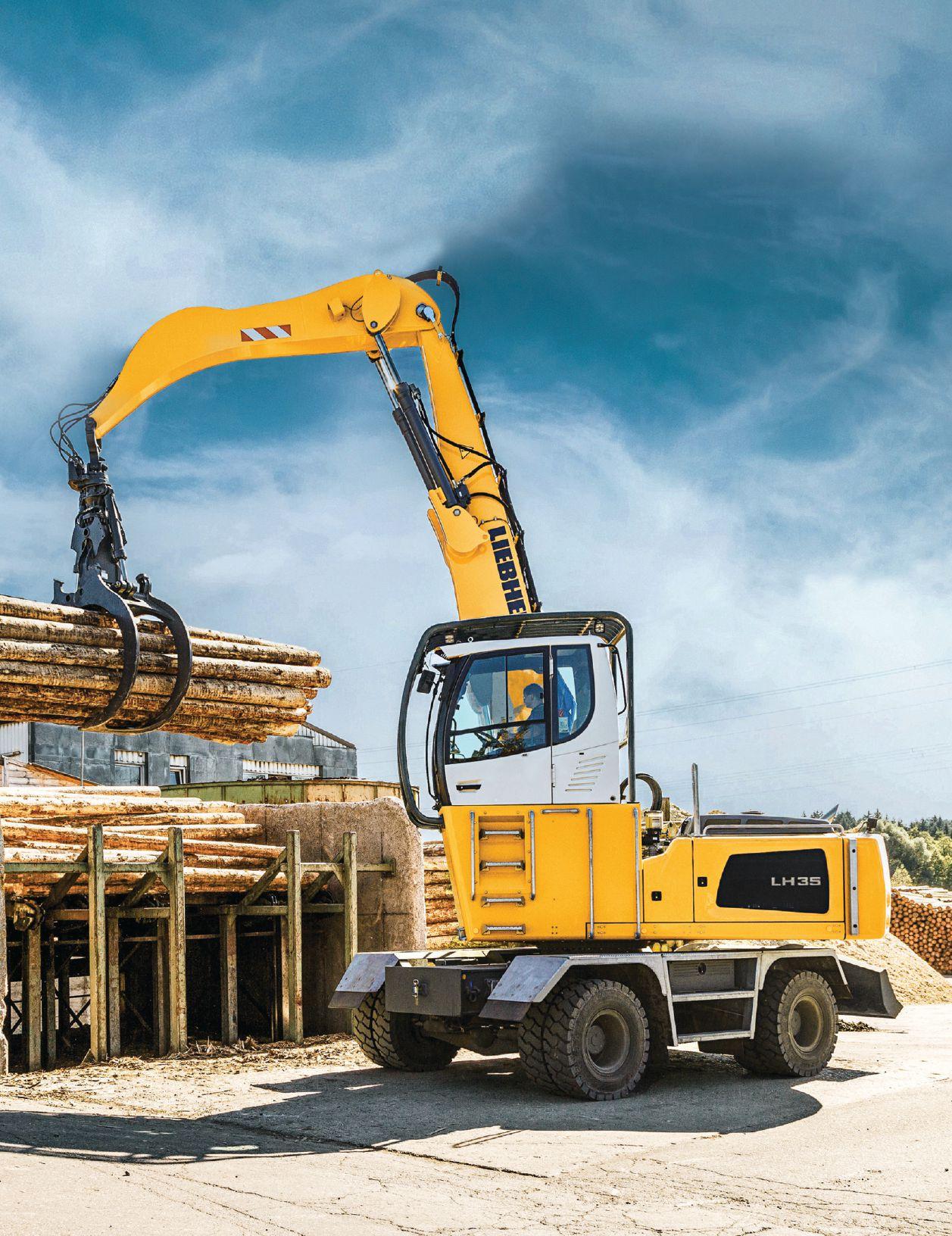
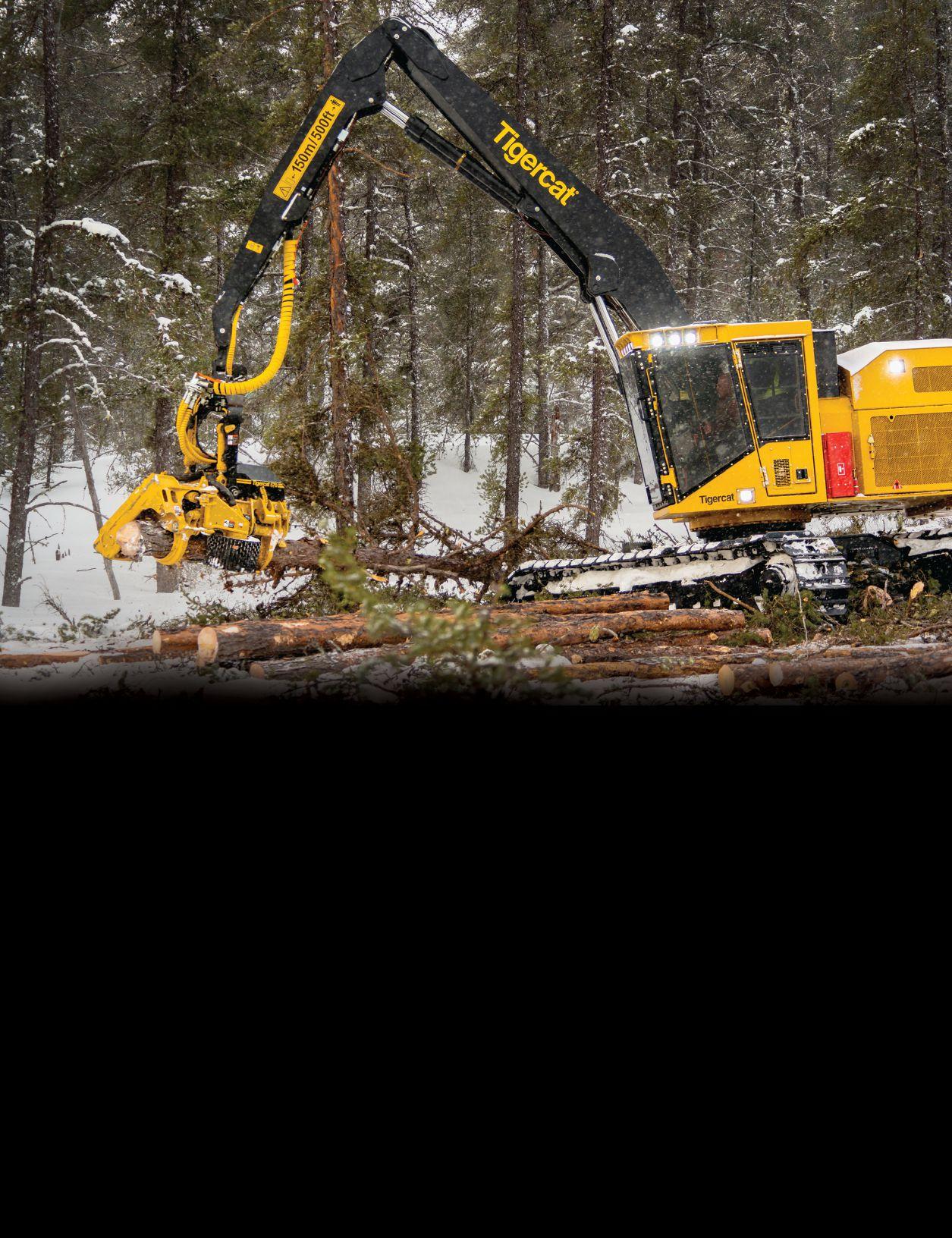
You spoke. We listened. Introducing the new 2956G, the result of thousands of hours of innovation combining the might and agility your job demands. Sized right for easier transport and permits. Mission-minded to handle the toughest terrains. Every advantage of a comprehensive solution. Zero compromise where it counts.
PURPOSE-BU# 1LT
OUTRUN WITH #1
Fink’s
Partnerships
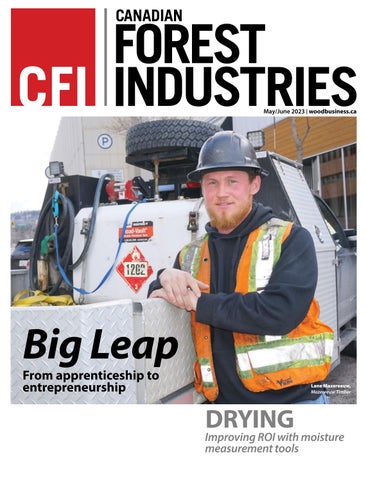
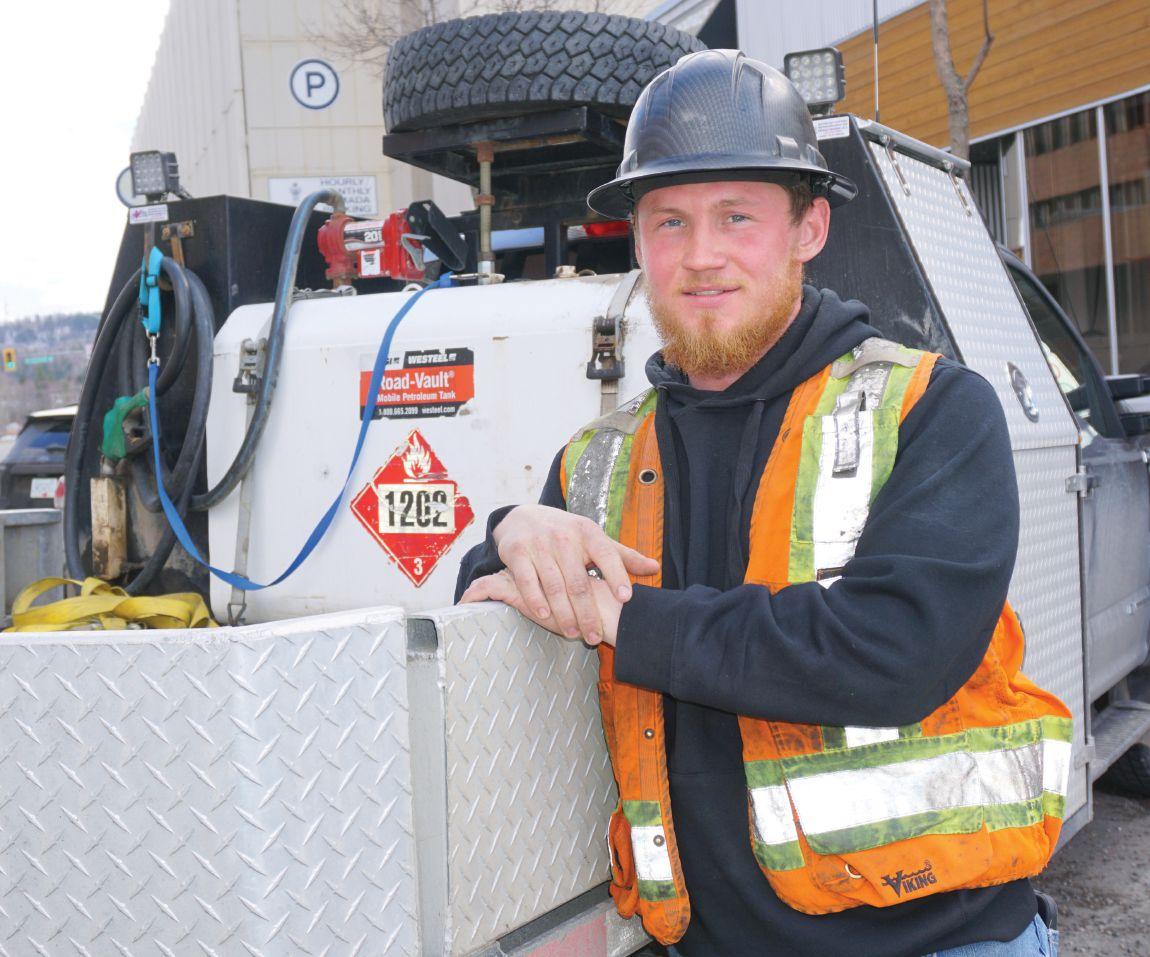
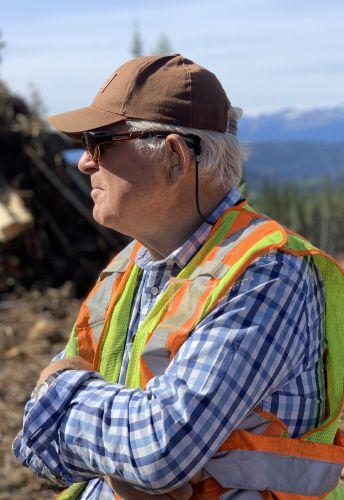
Lane Mazereeuw is a 26-year-old former apprentice turned entrepreneur who launched his logging business in Prince George, B.C., last year despite the industry crunch. Read all about it on page
Maximum Productivity
Get things done right the first time
More Intuitive
IBC offers simple functionality for new
Ultimate Support
Backed by Brandt, true 24/7/365 support minimizes downtime and saves you money.
EDITORIAL first cut
JENNIFERellson
jellson@annexbusinessmedia.com
@CFIMag
CanadianForestIndustries
@cfimag
Canadian Forest Industries
Of celebrations and milestones
It’s been a year since I took over the reins of CFI as editor
This issue is likely to inspire. This is also a celebration of milestones – of 60 years of running a multi-generational family enterprise such as Fink’s Sawmill; or growing a family-run venture like Capital Timber; or starting a logging business from scratch like Mazereeuw Timber, at 25 years old, during the pandemic, in high inflation and economic crunch.
There are many other inspiring stories worth celebrating in these 52 pages: Indigenous partnerships in the forestry sector; communities working together towards wildfire resiliency; well-attended industry events that addressed the pressing issues of the sector; an industry leader steering his company into a new era of forestry; tools to improve one’s return on investment in a difficult business climate; and of course improving safety and making the industry more female-friendly, which are always a cause for celebration and are always sources of inspiration.
Speaking of milestones, I am celebrating one myself: on May 30, it will be a year since I assumed the role of editor for Canadian Forest Industries It’s been a year since I’ve been entrusted with the journalistic legacy of CFI, Canada’s leading forest industries magazine since 1881, and I take that responsibility seriously.
In a year, I’ve been fortunate to have visited several sawmills and woodlands from coast to coast; hosted and attended many industry events, both virtually and in person; and spoke to a lot of you, which allowed me to put together six fabulous editions, if I may say so. I am committed to continue to produce quality issues, and with your help, I can keep reporting about our industry.
I would like to use the occasion of my first CFI birthday to re-introduce myself to anyone who missed it the first time around. I now have some 25 years of industry and journalistic experience. I
came to CFI from FPInnovations, where I was an editor and media relations specialist. I have held editorial positions in various media – including prior stints at international forest industry publications such as Pulp & Paper Canada, and Fastmarkets RISI’s Pulp & Paper International (Brussels, Belgium), and Pulp & Paper Asia News (Singapore). In between, I wrote and edited for international outlets such as Financial Times, Forbes, Newsweek, and Montreal Gazette, among others.
YOUR
INPUT IS CRUCIAL IN PUBLISHING HIGH
QUALITY
STORIES
AND IN-DEPTH ARTICLES THAT YOU’VE COME TO EXPECT IN EVERY ISSUE.
I want to reiterate that your engagement with what we put out every day is very important to me because I may be the editor, but this is your CFI. Please continue to email, tweet and DM us on social media, or simply like, heart or tag us on LinkedIn, Facebook, Twitter and Instagram. Tell me what you would like to read more of – who and what you would like to see being featured and profiled. Most of our stories are based on your suggestions – your input is crucial in publishing high quality stories and in-depth articles that you have come to expect in every issue. If you have a story idea, write to us – or even better, write for us!
The return of in-person events in the past year really helped me in presenting unique and helpful content simply by my conversations with a lot of you. I look forward to meeting more of you – let’s keep inspiring each other and see you soon at future events.
For now, enjoy the comprehensive features we have for you in the following pages.
NEWS upfront
Provinces, military help Alberta fight wildfires
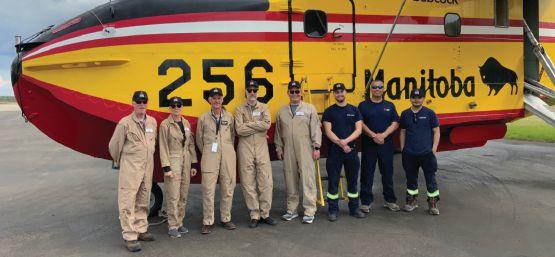
Crews from Ontario, Manitoba and Quebec were sent to help fight more than 500 wildfires in Alberta as of late May, forcing the province to declare a state of emergency. Army reserve soldiers were also deployed to join the forest fire battle that displaced communities in north and central Alberta.
Alberta’s unprecedented wildfire crisis threatens to drag on through the summer months, unless there is a significant shift in the weather that brings a lot of moisture, according to Alberta
Wildfire. In total, the fires have burnt 1,017,000 hectares as of late May. Smoke from the fires is
affecting air quality in a number of communities throughout Alberta and nearby provinces.
B.C., MCLEOD LAKE INDIAN BAND SIGN AGREEMENTS
The Province of B.C. and McLeod Lake Indian Band have reached new agreements outlining how co-management and stewardship of the land and natural resources in the Nation’s territory will evolve.
A letter of agreement and a revenue-sharing arrangement were signed to guide joint work on assessing and managing the impacts of industrial development and creating a shared path forward for healing and restoring the land, while providing certainty to industry partners working with Nations in their territories.
Sinclar Group Forest Products is curtailing its lumber operations in B.C. – at Apollo Forest Products (AFP) in Fort St. James, Lakeland Mills in Prince George, and Nechako Lumber in Vanderhoof – for various periods over the next few months.
Nechako Lumber will curtail operations from May 14 to July 29; AFP will curtail operations from June 4 to 30; and Lakeland Mills will curtail operations from July 2 to 29.
“The high cost of fibre, compounded by poor market conditions, has negatively impacted our business and forced us to take these measures,” said Sinclar’s president Greg Stewart.
The curtailments are necessary to maintain log inventory and draw down rough lumber
inventories at the three operations in the face of the dual challenge of high fibre costs and low lumber prices. These industry challenges are expected to persist through 2023.
Tanker group personnel in Alberta. Photo: Gov. of Manitoba
Sinclar president Greg Stewart. Photo: Annex Business Media.
First-of-its-kind test to prove mass timber’s seismic resilience
Practical testing is underway at the University of California San Diego on the tallest building ever to be seismically tested. The building, a 10-storey mass timber structure, was constructed to undergo testing as part of the Natural Hazards Engineering Research Infrastructure TallWood Project, an industry-wide initiative to prove the seismic resilience of mass timber and its strength as a low-carbon structural building material supported by Think Wood,
Softwood Lumber Board, WoodWorks and the Binational Softwood Lumber
Council, among others.
A robust university-backed testing process will conduct earthquake simulations to assess the material’s resilience. The project could pave the way for changes in building codes for residential and commercial structures that could lead to more widespread adoption of mass timber as a sustainable, strong, and versatile building material, especially in areas prone to seismic activity. Findings will be published this summer.
Sask. invests $6M in transportation to support forest industry growth
A $6-million investment is being made for the preservation and maintenance of northern roads that support Saskatchewan’s forest industry. This one-time investment will fund gravel work and brush clearing on several northern roads.
The money will preserve and maintain forestry-dependent roads in the north. The funding is planned for roads that are expected to see an increase in
traffic resulting from new and upgraded mills.
“One of the goals announced in the Growth Plan is to double the size of Saskatchewan’s forestry sector,” Highways Minister Jeremy Cockrill said. “This growth will have a significant impact on northern communities. In addition to more sales and exports, employment in the forestry sector will also increase.”
N.S. Forestry Trust announces two new projects
Two projects totalling more than $2.5 million have been approved by the trustees of Nova Scotia’s Forestry Innovation Transition Trust.
The Verschuren Centre for Sustainability in Energy and the Environment is receiving $926,500 to further support the development of the Bio-technology and Bio-manufacturing Acceleration Centre in Sydney. It aims to advance commercialization of key forestry and biomass sector innovative technology companies.
Research Nova Scotia will receive about $1.6 million for a project to assist the forestry sector as it transitions to the ecological forestry model. The five-year research and knowledge mobilization program will be led by Dalhousie University.
Tel: 416-510-5113
Email: apotal@annexbusinessmedia.com
Mail: 111 Gordon Baker Rd., Suite 400, Toronto, ON M2H 3R1
EDITOR - Jennifer Ellson (438) 483-7451 jellson@annexbusinessmedia.com
MANAGING EDITOR - Maria Church (226) 931-1396 mchurch@annexbusinessmedia.com
GROUP PUBLISHER - Anne Beswick (416)410-5248 • Mobile: (416) 277-8428 abeswick@annexbusinessmedia.com
WESTERN SALES Tim Shaddick 1660 West 75th Ave Vancouver, B.C. V6P 6G2 Ph: (604) 264-1158
Kevin Cook lordkevincook@gmail.com Ph: (604) 619-1777
PRESIDENT/COO - Scott Jamieson sjamieson@annexbusinessmedia.com
PUBLICATION MAIL AGREEMENT #40065710 RETURN UNDELIVERABLE
Photo: Annex Business Media.
Photo: Annex Business Media.
LOGGING profile
BIG LEAP
Lane Mazereeuw’s jump from being an apprentice to entrepreneur
BY JENNIFER ELLSON
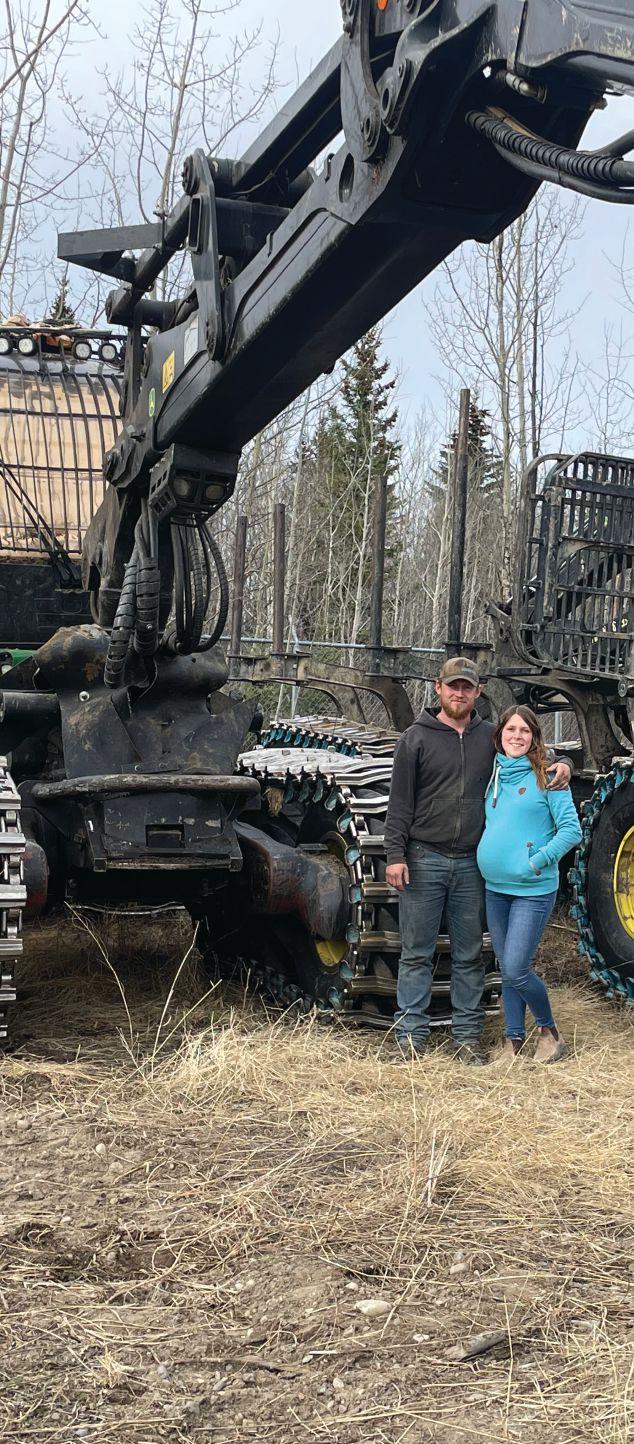
Taking the entrepreneurial leap is a big feat. Doing it in your 20s is a massive undertaking. Taking that leap during the pandemic, in high inflation and economic crunch is just gutsy. Lane Mazeereuw, 26, did just that in late 2022, incorporating Mazereeuw Timber Ltd. in Vanderhoof, B.C.
“It’s the toughest time to be in the industry. I’ve been told, ‘you’re crazy for getting involved in logging – can’t you see what’s happening?’” Mazereeuw smiles as he recalls the company’s start over a cup of coffee. Mazereeuw sat down with Canadian Forest Industries in neighbouring Prince George, B.C., in April and spoke about the highs and lows of starting a logging company in today’s business climate.
FROM JUST AN IDEA TO REALITY
Mazereeuw is used to hard work, being raised on a ranch. His family has been involved in the logging and cattle industries since his grandfather moved to Canada from the Netherlands after World War II. His father, Matt Mazereeuw, 51, ventured into silviculture, introducing his son to logging at a young age.
Big year, big leap: Lane and Hannah Mazereeuw are expecting their first born in June. Photos courtesy of Mazereeuw family.
“I started at 15, first with hand-slashing on power lines for Stephen Bros. Contracting, until I was old enough to get a driver’s license.”
That driver’s license allowed him to do an apprenticeship, which proved to be a game-changer, as he learned skills that then allowed him to spread his wings and work for other contractors.
“It was a big learning curve. They run their own fleet of custom-built mowing machines, so I learned how to maintain those machines and be trained as a heavy-duty mechanic.”
He moved on to do repairs and maintenance work on a fleet of 30 pieces of logging equipment for Walter Neufeld Contracting (WNC). He then worked for Brandt Tractor, exposing him to more equipment used in other industries, while also learning about running a dealership business and acquiring people skills in the process.
A decade after, at the ripe age of 25 and supported by his wife Hannah Mazereeuw, he invested and bought logging and roadbuilding equipment from WNC to start Mazereeuw Timber in Nov. 2022.
FLEET AND FAMILY
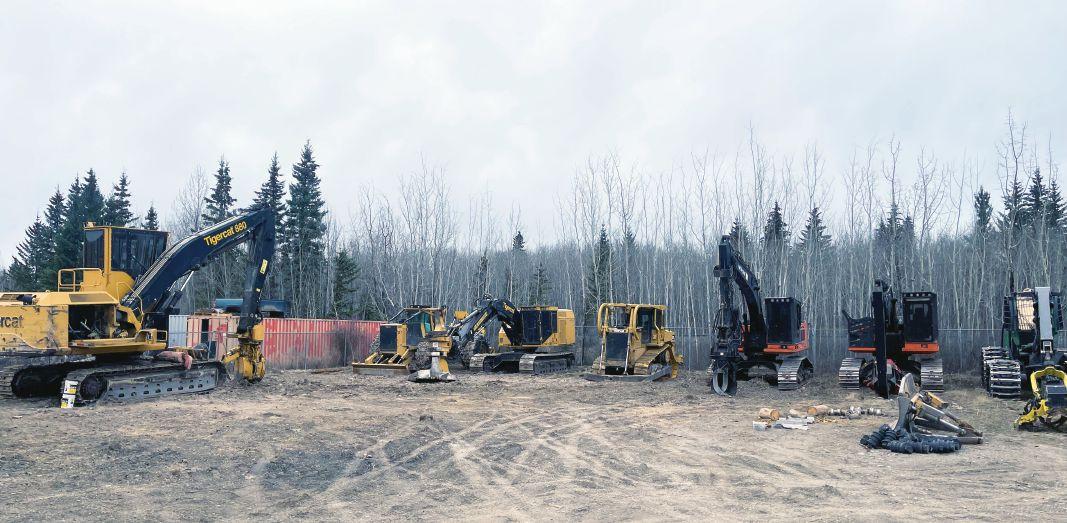
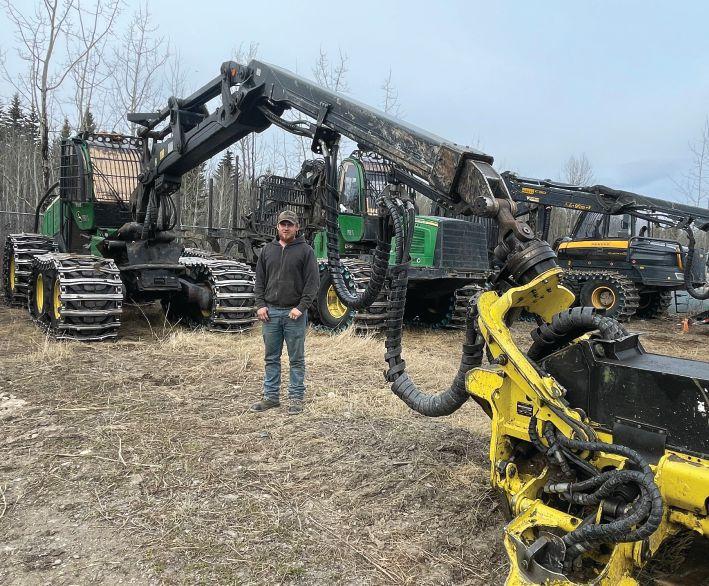
Mazereeuw’s fleet is impressive, consisting of a Tigercat 880 loader; a Tigercat 630E skidder; a Tigercat X870D buncher; a Hitachi 210 excavator with a WBM power clam, plus digging and cleanup buckets and rake; a Hitachi 210 processor with a
Managing a whole fleet is a sizable cost to his company. Mazereeuw’s advantage is that, as a heavy-duty mechanic, he can maintain and fix the equipment himself.
Waratah 622B head; a John Deere 1270G harvester; a John Deere 1910E forwarder; a Ponsse Scorpion harvester; a Ponsse Elephant King forwarder; a Caterpillar D7R XR2 crawler dozer; a 2019 Western Star 4900SB with a Peerless lowbed; and a 2018 Freightliner M2 rigged with Brutus service body.
“For operators, I have a guy for each machine. We do all our own low bedding and road building. My dad is the man behind all of that. Hauling distances are very dependent on the block – trucks make anywhere from one to three trips to the mill a day.”
Buying the equipment involved a
Mazereeuw invested in logging and roadbuilding equipment to start Mazereeuw Timber in August 2022.
massive investment, but where the huge savings come is in the upkeep of these expensive machines.
“Maintenance is a very big part of the cost of running a business, but I am very familiar with this fleet of equipment and the biggest advantage for me is that I can fix all of it myself.”
His wife Hannah is also very much involved in running the show, even in her current pregnancy phase. The 22-yearold is due to give birth to the couple’s first child in June, but is keeping herself
busy supporting the logging business by handling paper works, safety matters, even manual labour sometimes and moral support at all times.
“My wife helps with running parts, piloting machines on the move, even helps me fix machines, and is a huge moral support.”
His army also includes his mother Barb, 45, who helps with banking and bookkeeping, among other duties.
“She also details all the machines and pickups for me a couple times a year,
A LONG WAY TOGETHER
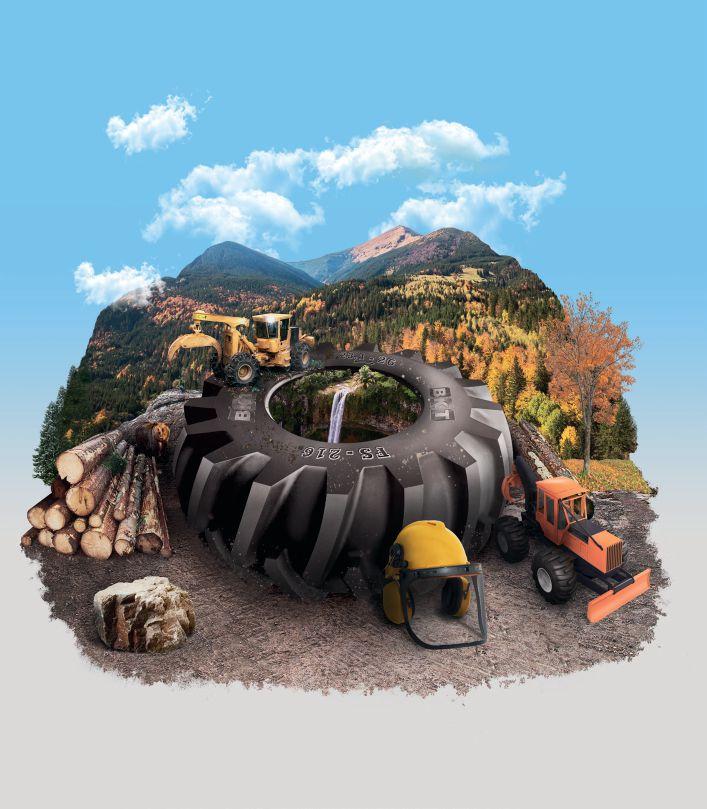
FS 216
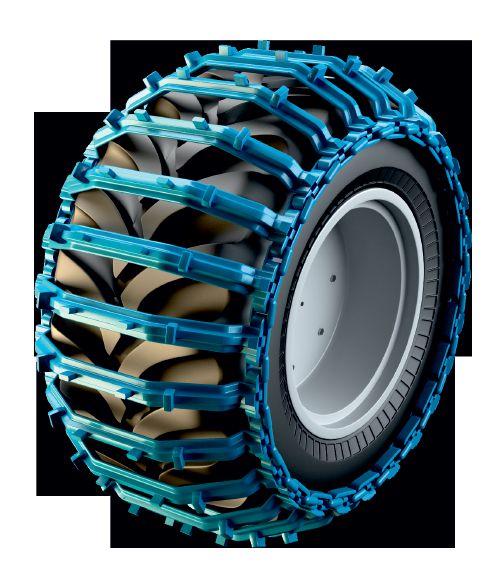
No matter how challenging your needs, FS 216 is your best ally for all operations with loggers and skidders. This aramid-belted forestry tire has a robust log design with optimum angle and larger width for enhanced traction performance. FS 216 provides excellent cut and chip resistance as well as maximum protection against possible damages at any time.
FS 216 is BKT’s response to your needs even under the most critical operating conditions in forestry.
and makes sure all our safety equipment is current and present in all the machinery and pickups.”
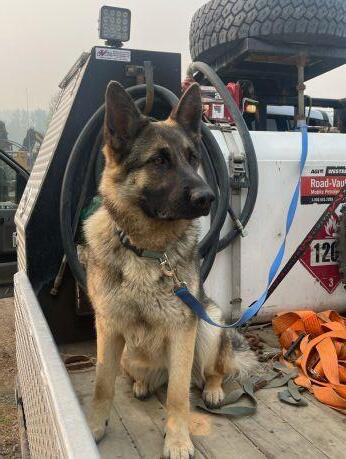
Lastly, he gets plenty of support, safeguarding and a lot of licks from Mae, his German shepherd, who he describes as the real boss.
BUSINESS AT A GLANCE
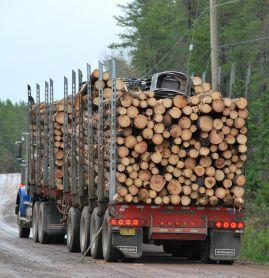
Mazereeuw’s target as far as volume is to move roughly 130,000 cubic metres a year in any form of wood, from 0.15-0.75 cubic metre per piece. The tree size that they harvest is usually from 6- to 30-in. in diameter, but more commonly on the lower end of the scale.
“This is more of a specialized take on logging. We are very focused on the finish product as far as what gets sent in, but more so what we leave the bush looking like. This needs to be a sustainable industry. How we leave these sites matters to us as much as anything. We’ll always be working in the cut-to-length sector, with max piece length at 33 ft.”
He adds, “That’s about the max that we will put on the forwarders. But lots of lengths are cut in the 12- to 20-ft. range as well. I log mostly pine and spruce. Some stands have pretty large amounts of balsam but that is about the big 3. We have done some blocks that go almost entirely to pulp.”
When in full production, an average day is “never really shorter than the
Mae-the-German-Shepherd is part of the Mazereeuw Timber team.
12-hour mark when driving is included.”
All the timber goes to Canfor’s Plateau sawmill in Vanderhoof. Sometimes the wood is sold through Canfor and winds up at other local mills.
Pulp goes to Arrow Group of Companies’ biomass power generation facility in Fort St James. Some goes to BC Custom Timber Products in Vanderhoof to be chipped.
“The pulp outlet is a huge asset. It allows us to get maximum utilization out of every piece we handle and erases the need for burn piles, especially when we are using these harvesters and forwarders. All the limb debris is left where the tree is harvested to break down and get right back into the ecosystem.”
BUSINESS NOT AS USUAL
Although he is excited for the future, he acknowledges that times are hard.
“Now is a pretty rough time, especially with a startup – it’s a big load on the shoulders, that’s for sure,” he sighs. “I’m trying not to focus on all the negatives in the industry and the economy, however payments never cease to show up and the bank account always needs to be topped up.”
Mazereeuw says he has to keep options open for work – whatever it may be – to
keep his company above water.
“I’m relying heavily on my roots as a heavy-duty mechanic to pick up some income and stay busy while the world figures itself out. I think there’s a future in logging, not with clear cutting and leaving wide open acres in the bush, but with the selective approach we are taking with the harvesters and forwarders and focusing largely on retention,” he says.
“There is not a lot of guys logging in this style in the area, so it’s tough to get the idea of what can be done in the bush out there.”
As far as old growth trees, Mazereeuw says anyone who works in the bush can see that forests need to be managed.
“Not clearcutting, but selectively picked through and groomed to something that will prevent the wildfires we’ve had. Also, to get rid of old rotten growth and blow down trees, which will only promote the growth of juvenile timbers, which is the future of our forests. It will also promote stewardship of the animals in these areas.”
While his main priorities will soon include his newborn, he is looking forward to continue building his business, with the goal of passing it on to his children in the future.
Mazereeuw spent a decade honing his skills via apprenticeships and work experience in the forest sector and other industries before starting up his own logging company.
A LOG/LOVE STORY
Fink’s Sawmill’s 60-year history of running a family business
BY JENNIFER ELLSON
Somewhere in Smithers, B.C., is a family-run company with a 60-year history and a 60-year love story.
It was in early 1950s when Bernhard Fink, originally a gold miner in Barkerville, B.C., moved to the Hazelton area and started cutting timbers for the underground tunnel supports for local area mines. Along with his daughter Frances and son-in-law Myron Smaha, Bernhard went on to establish a small sawmill and log harvesting business in Smithers, B.C.
“My parents were both teachers, and at night and week-ends, my dad helped his father-in-law in the operations,” says Shari Smaha, Myron and Frances’ daughter. “Both my grandparents passed away at an early age and in the mid-1960s my parents took over the company.”
Not only did Fink’s Sawmill Ltd. celebrate its 60th anniversary last November, but Myron and Frances are celebrating their 60th wedding anniversary this August.
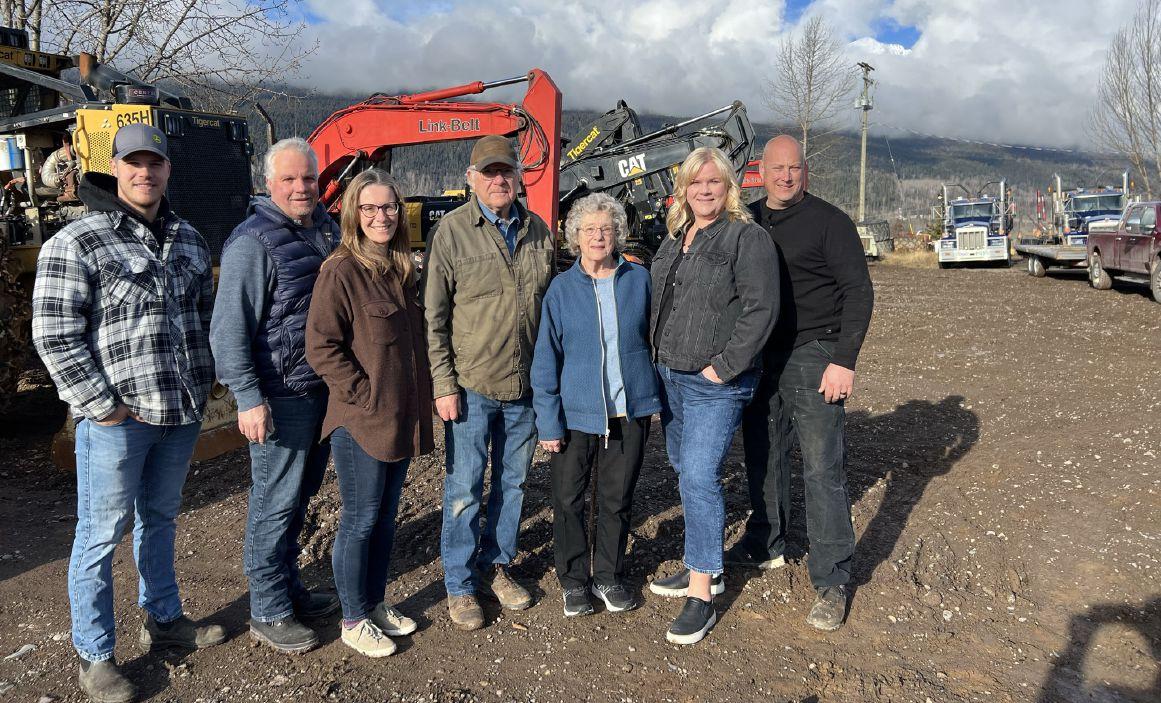
(L-R): Rylan Smaha-Muir, Brent Muir, Shari Smaha, Myron Smaha, Frances Smaha, Lorelei Smaha and Ryan Klaver.
Photo courtesy Smaha family.
A TRUE FAMILY AFFAIR
The company recently celebrated 60 years since incorporation on Nov. 26, 1962. Today, the sawmill is gone but the name Fink’s Sawmill Ltd. lives on as a stump-to-dump logging company. Almost the whole family is now involved, and the 84-yearold Myron is still active in the company, while his 83-year-old wife, Frances, helps in the office and gathers her family around her dinner table every Sunday night.
“My dad is out building roads! He’s always engaged, and his mind is always thinking about the business,” says Shari, who joined the company in 1993 after completing a diploma in financial management. She is currently the office manager. She is currently the office manager. Her brotherin-law, Ryan Klaver, who joined in 2002, holds the bush foreman position. Shari’s son Rylan takes on the heavy-duty mechanic role, along with experience as an operator in bunching, skidding and roadbuilding phases.
“We’re a four-generation family business working together with the goal of carrying on Fink’s Sawmill Ltd.’s existence in this challenging environment,” Shari says.
SIX DECADES OF BUSINESS AND BUSY-NESS
Fink’s Sawmill does some 15-20 km of roadbuilding per year. Myron has arranged an impressive mix of roadbuilding equipment comprising a Link-
Belt 350X3 excavator with a 72” clean-up bucket, a Cat D6R and a Cat 324D excavator, a Komatsu PC200LC-6, a John Deere D5H track skidder with grapple and a John Deere D5H track skidder with swing boom. The company also has a Komatsu D85 dozer with U-Blade.
Fink’s harvests a diversity of species – pine, spruce and balsam – totalling around 140,000 cubic metres annually. The company does full tree to roadside logging averaging around 0.50 cubic metre per tree of long and short sawlogs, pulp shorts and dry shorts.
The pulp chips are sent to Pinnacle Renewable Energy’s nearby Smithers pellet plant, while the dry shorts are sent to neighbouring Seaton Forest Products, which produces dry balsam logs into cants and shipping them to a reman facility in Langley.
Fink’s supplies around 113,000 cubic metres annually to Pacific Inland Resources, a division of West Fraser Timber. The average haul distance from Smithers to Pacific Inland Resources has a five-hour cycle, Shari says, and the average skidding and forwarding distance is dependent by block.
The distance from Smithers and the Pacific Inland Resources mill necessitates a camp situation for the loggers, according to Shari.
“Our crew stays in individual campshack with camp allowance,” she explains. The crew works a 54-hour work week: 12-hour shifts from Monday
“WE’RE A FOURGENERATION FAMILY BUSINESS WORKING TOGETHER ... IN THIS CHALLENGING ENVIRONMENT.”
Fink’s Sawmill celebrated its 60th anniversary in November last year.
to Thursday, and eight hours on Friday. The company employs 14 bush staff and truck drivers. In addition, it hires subcontractors for the trucking and loading phase.
Fink’s has two feller bunchers: a Tigercat 870C and Tigercat X870D. The company’s skidding workhorses are two
John Deere 848Hs, one with wide tires; a Tigercat 625C six-wheel skidder, a new Tigercat 635H six-wheel skidder, a John Deere D5H track skidder with grapple, and a John Deere D5H track skidder with swing boom.
“In early 2023, we purchased a 2022 Tigercat 635H 6x6 skidder through
Combustible Dust Specialists
Ritchie Bros. to replace existing old skidders and for use in deep snow. We just picked it up in April, so time should tell how it works out in our operation,” Shari tells CFI.
The decking line-up includes a Tigercat 880 and a Link-Belt 290 log loaders. The log processing line-up at roadside consists of a new Tigercat 850 with a Tigercat head, two Link-Belt 210s with Southstar QS500 heads, and a Cat 320D, also with a Southstar QS500 head.
“We were in the market for a machine that could handle larger piece size, and Parker Pacific brought the Tigercat 850 out as a demo, and the machine ended up staying,” says Shari.
“Bigger head, bigger machine, less downtime. According to Blair Morgan, our long-term operator who has been a part of Fink’s crew for 28 years, says it has lots of power, handles big wood with no problem, good visibility and the best machine he has ever ran. There’s also easy access for repairs as compartments opens up to make it easier to work on,” she explains.
Loading is subcontracted out to meet the loads per day requirements. Fink’s Sawmill operates three new Kenworth tridem tractor logging trucks with two Freflyt tridem trailers and one Arctic tridem trailer, as well as a Kenworth and a K-Line lowbed. Fink’s has a fleet of Ford crew cabs and a Ford F550 with Brutus service box for other support duties.
The family is proud of their excellent relationship with staff, suppliers and area contractors, which it says is the secret to longevity and success.
The 84-year-old Myron Smaha is still actively involved in the family venture.
CHALLENGES A PLENTY
It is no secret that the forest industry, particularly in B.C., is full of challenges lately. Shari says the current low lumber market prices that resulted in mill curtailments are reducing the need for harvesting and thus creating uncertainty.
In addition, the B.C. policies concerning the stumpage system, adjustment in the allocation within the allowable annual cut, and old-growth deferral are having an effect on forestry companies like Fink’s Sawmill.
“We see the major licensees invest outside of BC in areas of Alberta and southern US which is very concerning. Logging and hauling rates are not keeping up with increased costs and inflation creating further added pressure and uncertainty on contractors such as ourselves,” Shari says.
“So many factors which are out of our control affect our ability to work, such as our mill’s ability to move their lumber to market is affected due to interruption in logistics, such as services provided by CN Rail,” she explains.
Another challenge is labour shortage, which is crucial to the company’s operations, according to Shari.
“Skilled operators are the No. 1 asset in our company.”
FAMILY VALUES
The family is proud of their excellent relationship with their staff, suppliers and area contractors, which Shari says is the secret to Fink’s Sawmill’s longevity and success.
“Open communication, good working and long-term relationship with our mill, our suppliers, and our logging and trucking contractors are critical,” she adds.
“The message that I would love to share with CFI readers is the success, determination, work ethic that my parents have. They are providing employment to many families, they are hardworking, honest, fair people. Their 60 years in business in this industry is quite a gem of accomplishment,” Shari shares.
Indeed, Myron and Frances’ 60 years of running the family business, and 60 years of togetherness is a massive feat and cause for a celebration.
VIRTUAL SUMMIT
Welcome to Optilog, a fully virtual showcase event where a select group of manufacturers will present their advanced logging solutions to an audience from across Canada.
This will be a free one-stop opportunity for industry players to learn about logging products, harvesting technologies and processes, become familiar with available technologies and services, and ask questions.
All presentations will be recorded and made available after the event.
For the exhibitors, deliver a compelling virtual buying experience to your clients. Explore,engage and experience our online information sessions.
INDIGENOUS
THE FESBC EXPERIENCE
Indigenous partnerships in the forest sector
BY STEVEN F. KOZUKI
For a very long time, the forests of British Columbia have been a source of life, providing resources for communities and habitats for wildlife. However, in recent years, the impacts of pine beetles and other destructive events have threatened these forests and the ecosystems they support.
That’s where the Forest Enhancement Society of BC (FESBC) comes in.
Since 2016, FESBC has worked toward fulfilling a number of significant purposes: to help utilize low-quality forest fibre, accelerate ecological
recovery in the aftermath of pine beetle and other damaging events, while at the same time improving wildlife habitat, reducing greenhouse gases, reducing wildfire risk to communities, and achieving other objectives. FESBC has been undertaking a lot of these projects in partnership with First Nations communities, who have long been stewards of the land and have a deep connection to the forests they call home.
It’s heartening to see that about 30 per cent of the funding approved by FESBC has gone toward
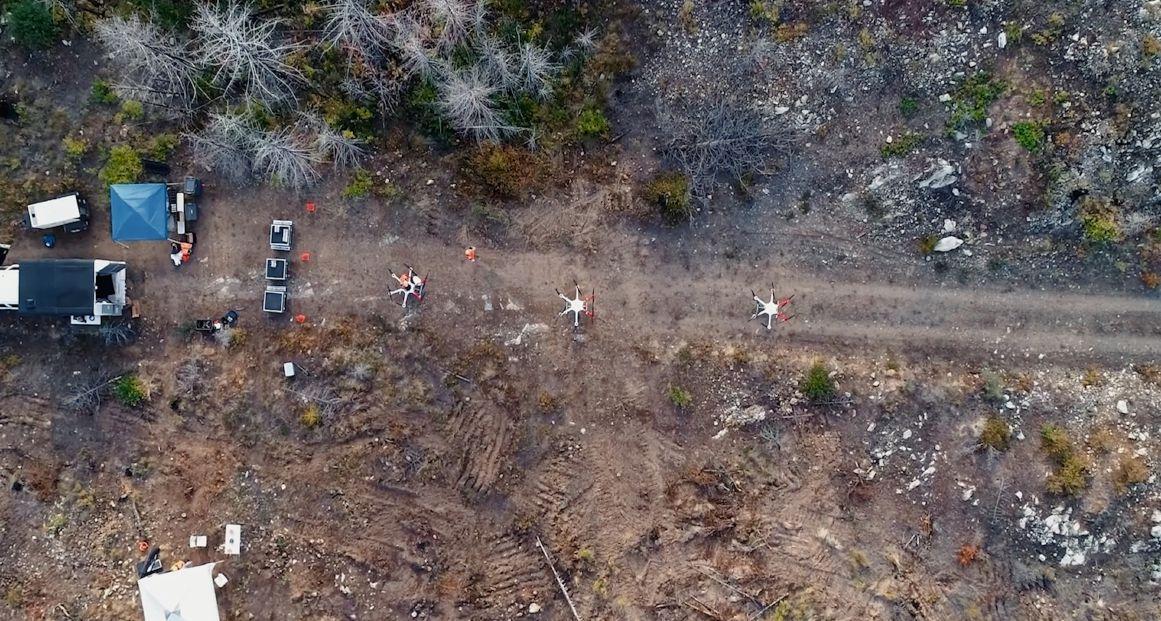
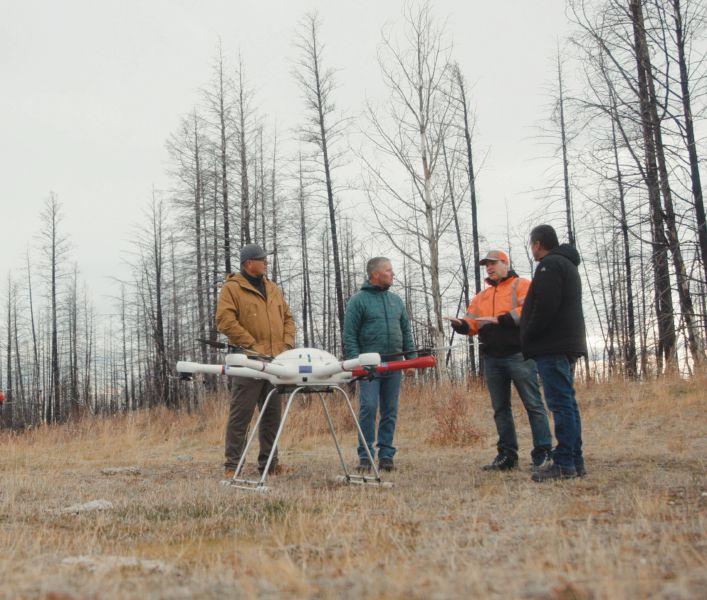
DroneSeed staging three heavy-lift drones in preparation to disperse seed vessels over the Chilcotin plateau. Photos courtesy of FESBC.
projects led by or involving First Nations. At first, FESBC was taken by surprise by the overwhelming interest shown by Nations, but in hindsight, it’s clear that it was a natural fit. The First Nations’ connection to the land and deep-rooted sense of responsibility has made them the perfect partners for these initiatives. The strong caretaker mindset of First Nations communities, combined with their intimate knowledge of the forests, continues to prove to be a real asset in these efforts to restore and protect the land for generations to come.
Jeff Mosher, RPF, planning manager, Taan Forest said, “Funding from FESBC allowed us to move forward with treatments to the land, which incorporated Haida culture and will benefit many species like the black bear. The project will also restore forests within the river valley with benefits to salmon and other fish, and many spin-off benefits to goshawk, eagles, saw-whet owls, bats and many other resident and migratory birds.”
The partnerships between the FESBC and First Nations has exceeded all expectations and is transforming the forestry landscape in British Columbia. While the initial basis for the partnership was contractual, FESBC’s approach and business model have allowed for a deeper and potentially transformative relationship to emerge:
• FESBC employs a proponent-driven application model where local people decide what projects they wish to undertake. The Nations themselves propose the projects, so there is never any sense that something is being imposed on them.
• FESBC projects don’t have other baggage to hinder the relationship. FESBC never leverages project funding to extract any form of quid pro quo from the Nations (concessions or consent related to rights, title, accommodation, etc). Without baggage, the relationship can become deeper than just contractual and transactional.
• FESBC funds 100 per cent of project costs that are fair and reasonable on a case-specific basis, including administration. It would be prejudicial to require a financial contribution to the project from a First Nation that
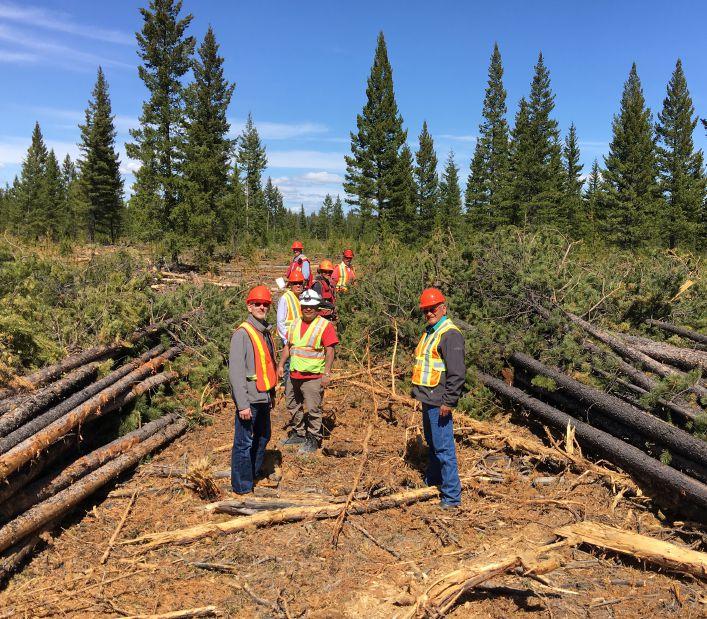
Tour of the Central Chilcotin Rehabilitation wildfire risk reduction and forest rehabilitation project.
(L-R): Paul Grinder (councillor, Tl’etinqox Government), Dave Conly (former operations manager, FESBC), Grant Canary (CEO, DroneSeed), Percy Guichon (director, CCR) on site for the DroneSeed planting.
doesn’t have a tax base.
• FESBC is willing to take calculated risks outside of the box. For example, FESBC supported a Nation who wanted to use cutting edge, unproven technology to plant tree seeds using GPS-guided drones.
• FESBC is willing to use Indigenous knowledge and let traditional fire-keepers provide leadership on re-establishing ecological balance in fire-prone areas to protect communities from catastrophic wildfires.
• FESBC allows Nations to lead the projects, which means they plan when, where, and how the projects are carried out. This kind of empowerment can be transformational.
One of the most innovative and exciting partnerships with First Nations that FESBC has formed is the DroneSeed project with Central Chilcotin Rehabilitation Ltd. (CCR) in the aftermath of a very large complex of wildfires in 2017. In the operational reforestation trial conducted in 2022, drones and hand deployment
were used to direct seed an area equivalent to 128 football fields (52 hectares) with thousands of Lodgepole pine and Douglas fir. The seeds were carefully placed in vessels or pods containing a mixture of materials and nutrients to maximize their chances of germination and survival. The success of this project could mean that large areas impacted by fires can be restored much faster than traditional methods, which rely solely on manual planting. This project involved the use of cutting-edge drone technology to replant areas affected by wildfires and other disturbances.
This innovative project was bound to invite skeptics, but FESBC was willing to take a calculated risk and support the project, recognizing the potential benefits of using this innovative technology.
The partnership with CCR allowed for Tsideldel First Nation and the Tl’etinqox Government, who are joint owners of CCR, to become leaders in forest management in their traditional territories.
Danny Strobbe, former forestry super-
intendent, Tsi Del Del Enterprises said, “FESBC funding was an efficient way to not only deploy funds in rural communities where the impacts of the mountain pine beetle and wildfires are felt the most, but also created opportunities to leverage private money to do more and build new relationships with other companies and communities.”
Today, FESBC has gained much from such relationships with First Nations, including a greater appreciation for the inter-connectedness of all things in our natural world and in communities. Forestry is not only an engine for local economies and a significant mechanism to achieve environmental goals. It can also be a means to create profound social good. The jobs created in remote and rural areas sometimes do more than just provide a paycheck. Increased self-esteem can result in numerous social benefits from healthier families and healthier communities.
Steve F. Kozuki is the executive director of the Forest Enhancement Society of BC.
Sawmill Solutions Virtual Showcase
WEDNESDAY, September 13, 2023 1:00 pm – 4:00 pm. EST | 10:00 am – 1:00 pM PST
Welcome to TechniSaw, a fully virtual showcase event where a select group of manufacturers will present their advanced sawmilling solutions to an audience from across Canada.
This will be a free one-stop opportunity for industry players to learn about sawmill products on the cutting edge, become familiar with available technologies and services, and ask questions.
COMMUNITY WILDFIRE RISK
A holistic approach to wildfire resiliency
BY JOHN DAVIES
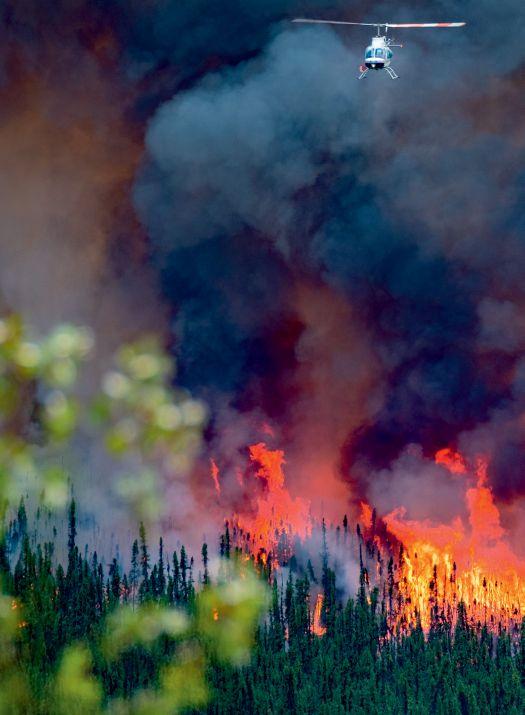
Wildfire is a natural process within many forest ecosystems. Due to historical and current policies and management, fire has been excluded from its natural role. The resultant effect is a state of unnatural (and risky) buildup of forest fuels, often within the wildland-urban interface (WUI). Warming climatic conditions along with fuel build up in the WUI are combining to create intensive wildfires that pose a risk to communities, and cultural and
natural values. Successful mitigation of this risk requires returning ecosystems to a more resilient condition through management adaptation, social change, and an increase in the use of fire in forest management.
A holistic approach to wildfire resiliency combines people with skills and knowledge from various fire and forest specialties – boots on the ground, fire behaviour and ecology, fuels and
of Forsite.
suppression, fire modelling technology specialists and predictive services, community level educators, silviculture reforestation specialists – and positive relationships with government planners, local communities and First Nations, B.C. Wildfire Service (BCWS) and other government services and associations.
Forsite is working to mitigate landscape level wildfire risk for our clients by using this holistic approach and designing and providing solutions at the landscape level. In the past, community protection has been approached at too small of scale –
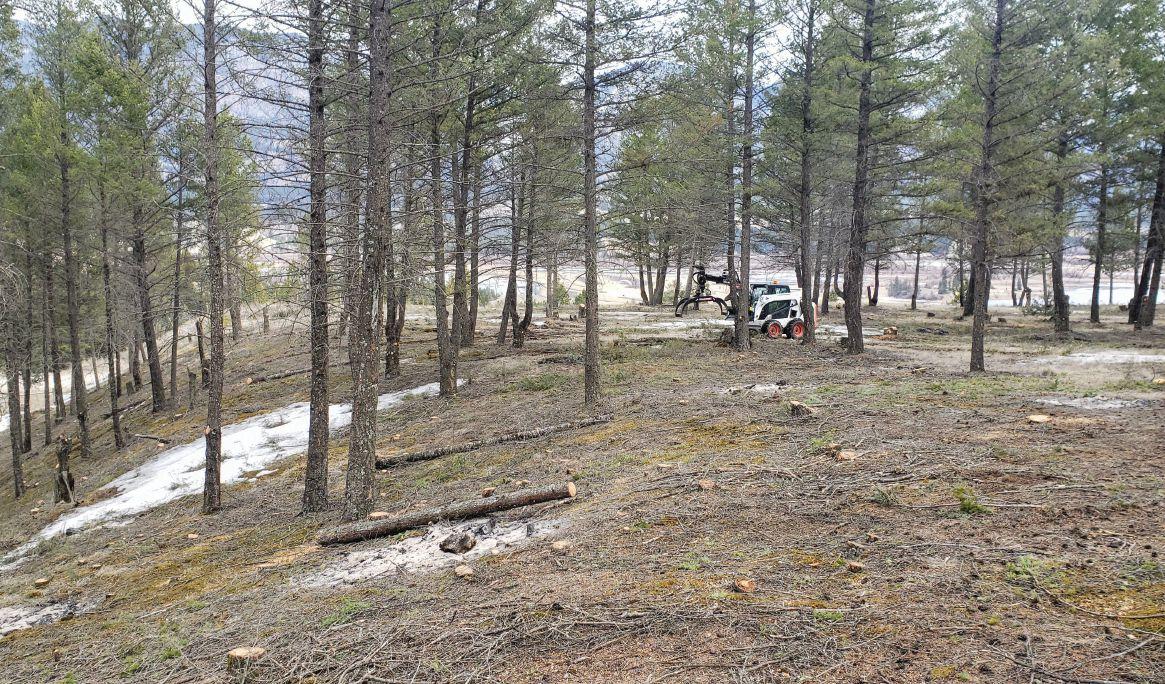
conjunction with fibre removal. Timber removal operations within the WUI has not been a standard practice and required consulting with First Nations and extensive public input, to balance community protection with the protection of values.
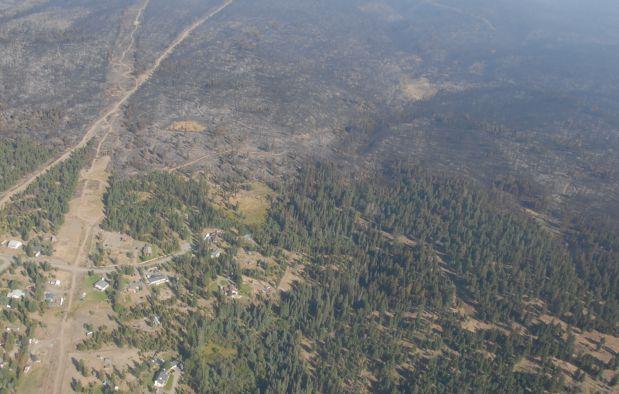
Treatments along the southern interface of the community were put to the test during the extreme fire season of 2021 when the Tremont Creek Fire raced towards the community. Due to the reduced fuel loading along the southern perimeter of the community, BCWS and industry were able to anchor suppression tactics and utilize planned
100 metres of FireSmart treatments as a fuel break, for example. Implementing mitigation solutions at a large scale often requires machinery, removal of large amounts of biomass, and collaboration between forest licensees, First Nations and communities. Undertaking such operations in the WUI requires an approach that balances fire behaviour reduction objectives with minimizing (or possibly enhancing) impacts on cultural, ecological, and social values on the landscape. Several such landscape level fuel breaks have been developed within the Thompson-Okanagan area of B.C. in the last six years; with four of these being tested by extreme wildfire in 2020 and 2021.
Forsite has been active within the Logan Lake Community Forest (60 km southwest of Kamloops, B.C.) for eight years. Small-scale FireSmart treatments within the community began decades ago. A relatively recent development, however, has been thinning forests with machinery, and in
ignition to burn off fuel ahead of the approaching fire. This tactic, combined with the use of sprinkler protection within the community, resulted in successful protection of the community with no structural losses.
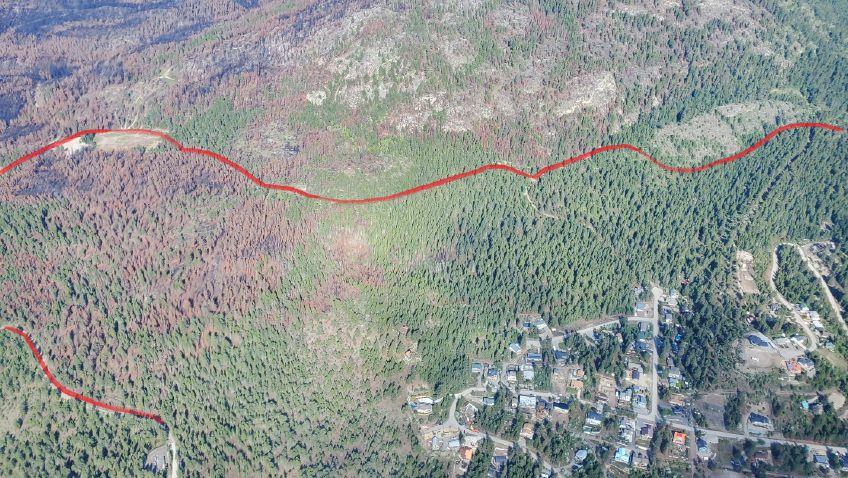
Similarly, Frontline Operations Group (recently merged with Forsite) had a similar experience with Westshore Estates (located 40 km southwest of Vernon) and the White Rock Lake fire in 2021. Through work with the Okanagan Indian Band, a landscape level fuel break of approximately 100 ha around the community was developed. The break was anchored into an existing road and was over a kilometer in width at the southern end.
Knowing the fuel break was in place, the structural protection team assigned this flank of the fire set up an extensive water delivery system with mass water delivery, storage tanks, and sprinkler systems. On the night of August 13th, the fire, aided by strong winds, burst out of the Whiteman
“KEY STEPS ARE NEEDED TO FACILITATE TRAINING, KNOWLEDGE, AND PROPER USAGE OF PRESCRIBED BURNING.”
Landscape fuel break (within red line) surrounding Westshore Estates showing how it worked to stop the White Rock Lake fire from reaching the community (2021).
Creek drainage and headed south towards the community. The fire spotted into the fuel break at the southern end, igniting unburned piles within the fuel break and burning 700m in before suppression tactics brought it under control. The well anchored fuel break, and reduced fire intensity resulting from lower fuel loads, allowed structural fire fighters to utilize the provided safe defensible space and action the wildfire. Through gaining a social license to operate immediately behind peoples’ homes in
Experts in Wildland Fire Management
The Forsite Team is uniquely qualified in wildland fire management. We apply a holistic and landscape level approach to wildfire risk mitigation.
• Wildland Fire Services
• Community Resilience
• Prescribed Fire
• Wildfire Modelling Contact John Davies, RPF jdavies@forsite.ca
the WUI, in stands that hold great social value, an environment was created that could only support low intensity wildfire, and it allowed fire professionals to safely implement suppression tactics against extreme fire behaviour.
The breaks would only have been further enhanced if prescribed burning was utilized post-treatment to abate fuel resulting from the treatment activities. Use of burning would have abated the woody fuels as well as consumed accumulated dead grass loading to further reduce fire behaviour and the fire rate of spread attributed to this fuel layer. Further support of Indigenous led cultural burning will help return ecosystems to pre-settlement condition where forests and grasslands were more absorbent and resilient to natural fire.
BCWS has some keen young people in key positions to steer wildland fire and wildfire management into the future, including the use of prescribed burning. Similarly, licensees are more open to the integration of wildland fire, and burning, into their planning and operations. As movements are made towards integrating fire back into ecosystem management, key steps are needed to facilitate training, knowledge, and proper usage of prescribed burning, a skill mostly lost among forest professionals today. Understanding how to manage issues around liability associated with the use of fire is another key step forward.
Meaningful movement towards addressing wildfire risk at an appropriate scale has occurred in the last six years, which coincidentally overlapped with three of the worst fire seasons in B.C. This momentum needs to continue. It will be uncom fortable and uncharted at times, but we must use the losses of these past years and the positive lessons from our successes to leap towards appropriate management decisions. Now is not the time to pump the brakes. Rather we need steady and meaningful acceleration into the future!
John Davies, RPF, is a local FireSmart representative and the man ager of the new Forsite fire business unit. He has spent over 35 years working in every corner of B.C. timber cruising, tree planting and fighting forest fires, with the last 20 years focused solely on wildfire management consulting.
Fuel treated areas (green forest) north of Logan Lake adjacent to Tremont Creek Wildfire (untreated area).
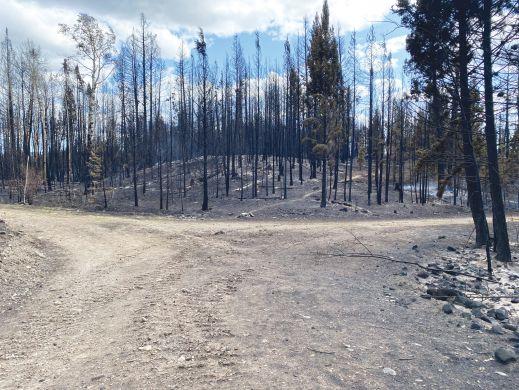
Learning from past fires influences decision-making on future fires.
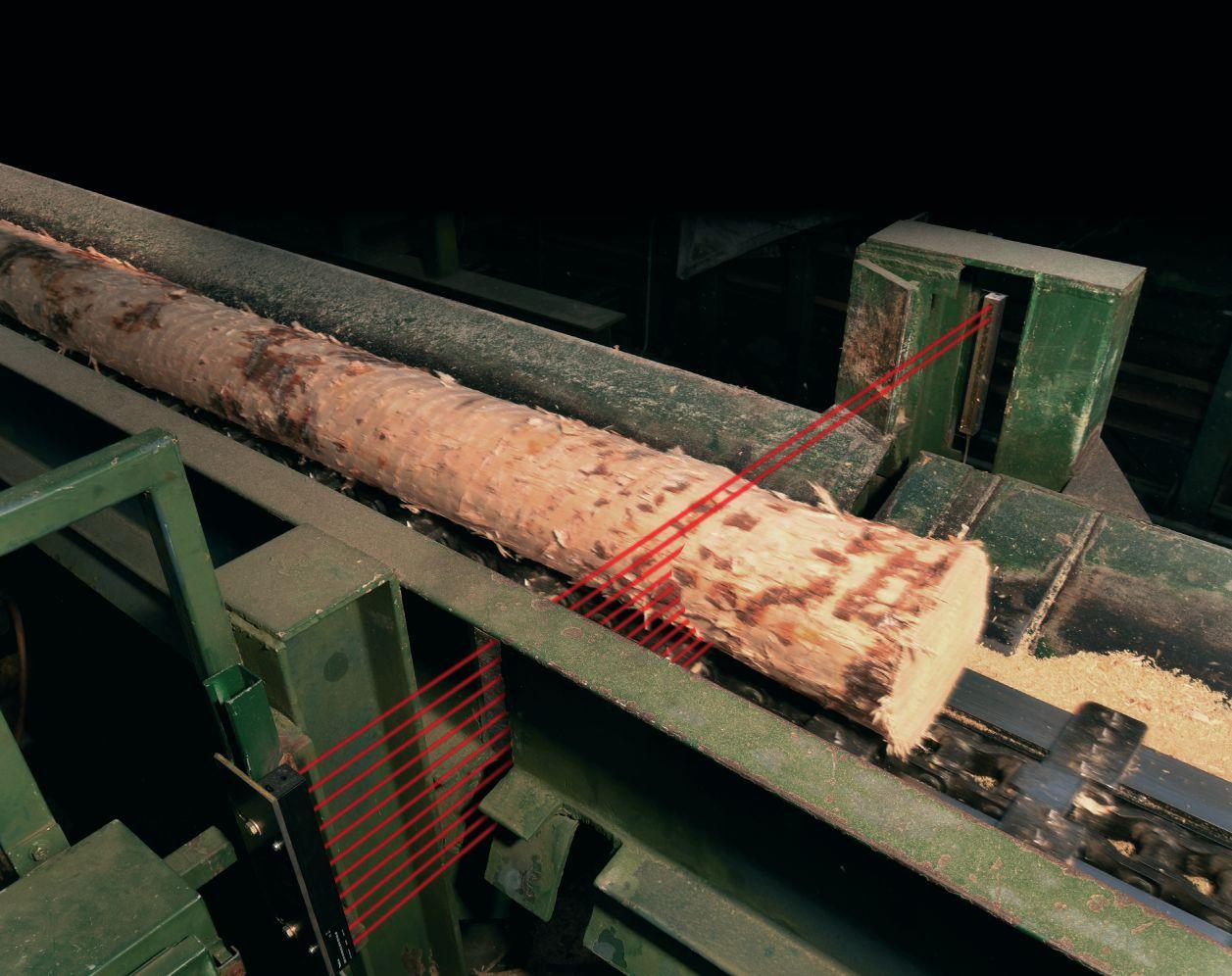
HIGH PERFORMANCE
CURTAINS MADE FOR SAWMILLS
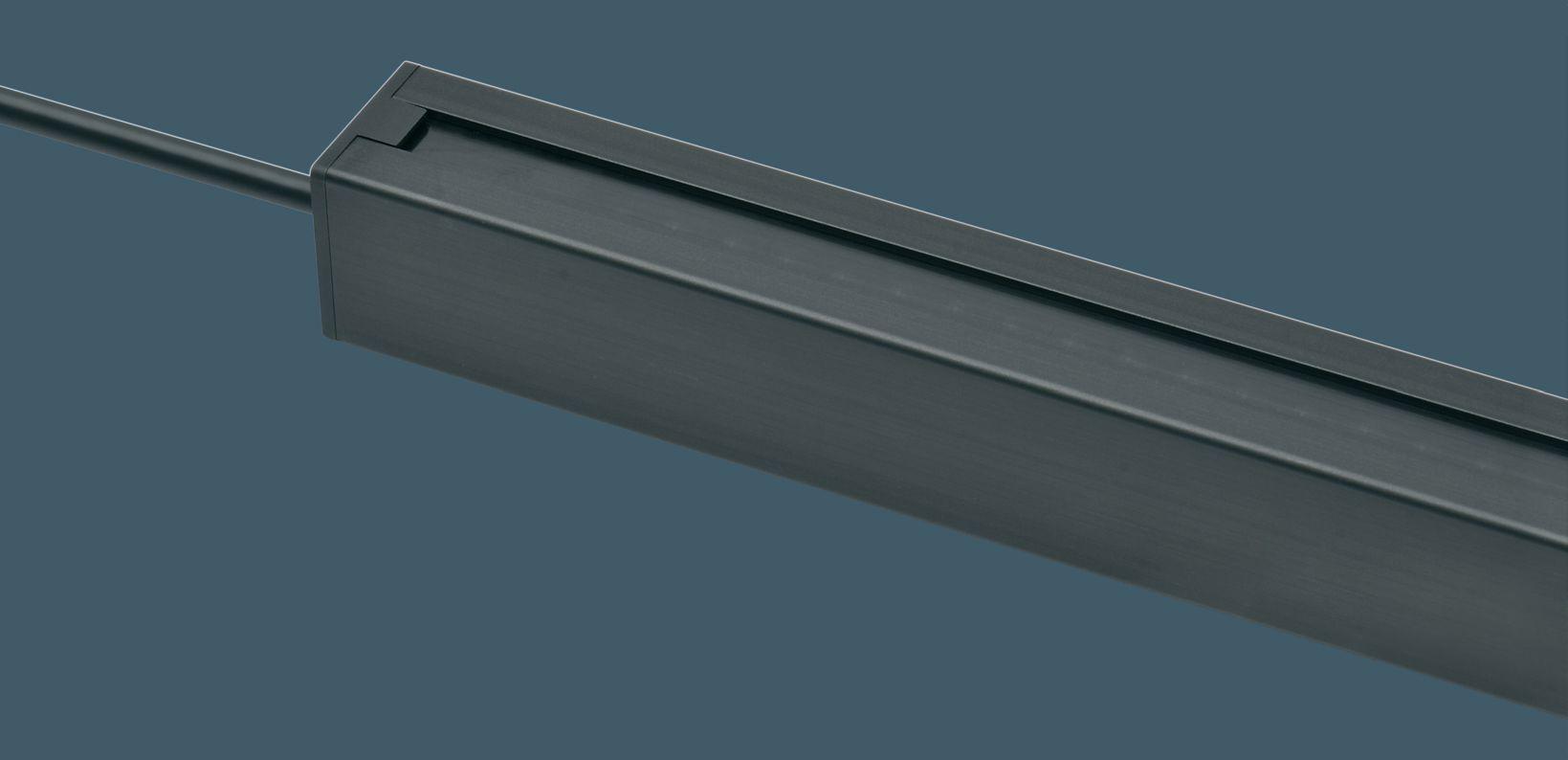
Telco Sensors has been supplying high-performance photoelectric sensors for the harshest, most demanding applications in the wood products industry for over 30 years. Simply put, Telco works where others fail.
Like all Telco products, our new SpaceScan series light curtain is designed and built around 5 core values: water resistance, extreme penetration power, resistance to shock & vibration, easy alignment and immunity to sunlight. All Telco products carry a full 3-year warranty.
Telco offers light curtains in discrete, analogue, RS485, IO-Link and diffuse proximity models.
Telco Sensors Inc.
Toll Free: 800 253 0111
Email: info@telcosensorsusa.com
Web: www.telcosensors.com
A CAPITAL IDEA
BY ANDREW SNOOK WOODPRODUCTS
No matter what products and services you’re offering, sustainability needs to be a part of your operations these days. This is especially true when you’re involved in the forestry sector, whether as a supplier of logs or a manufacturer of wood products, or in the case of Andrew and Greg Clifford, a fullservice tree care business (and more).
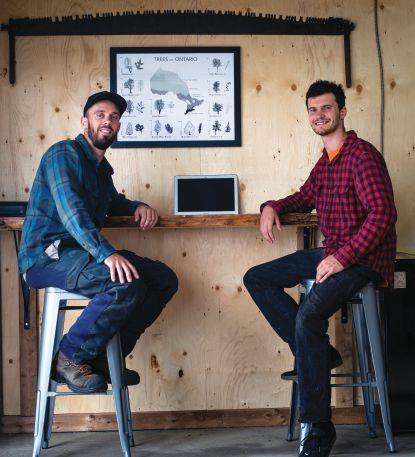
Based in Carp, Ont., Capital Timber Co. started up in 2013 when Andrew decided to open up a tree clearing service for the Ottawa Region. A few years later his brother, Greg, was enrolled at Algonquin College’s furniture and cabinet-making program, and started re-purposing the trees his brother was removing for residential and commercial clients.
“I started with a chainsaw mill and was cutting any leftover logs from Andy’s job sites and selling them as slabs,” Greg recalls. “We bought a bandsaw mill in 2017, then I was doing portable milling for people. I would go to their properties with the mill and saw the logs on their property.”
As Andrew removed trees from clients’ properties, he would let them know about Greg’s milling business, and the business slowly picked up.
“People are tuning into the fact they can re-use their trees,” Andrew says.
As customers showed interest in having their trees re-purposed, the two brothers started searching out clients that wanted to repurpose their trees rather than trying to sell slabs to other customers. A few years ago, the two brothers set
up their headquarters in Carp and merged the tree removal and wood processing operations in one location.
“If we’re removing someone’s tree on their property, we usually let them know about our services, that we can also saw the trees into lumber if they want something out of it. It’s definitely becoming more popular,” Greg says.
While clearing larger properties, there are a lot of opportunities to salvage the trees and turn them
The company specializes in custom-cut lumber, with plans to increase their product offerings. Photos by Jeff Clifford, courtesy of Jeff Clifford Photography.
into useable wood products, he says.
“When someone is clearing a property to put up a new building, we’ll come in and clear it for them. And then we’ll work with them to salvage the logs and process them into something that they can use for the new building on the property. In Calabogie, we took down a bunch of oak trees and turned them into flooring for a client,” Greg says.
Another interesting project the Clifford brothers have worked on is clearing a lot to make way for a forestry school for children.
“It was a few acres, primarily pine trees. We took the trees, processed them all into their requested dimensions, and now they’re getting siding made for the school – over 3,000 square feet of siding,”
Greg says. “They have some other wood as well that they’re going to be using for furniture for the building.”
To be able to process larger amounts of logs more efficiently, the brothers recently invested in an upgraded mill, a Wood-Mizer LT40 hydraulic portable sawmill.
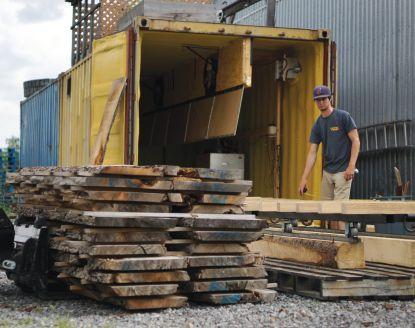
They also built a small kiln on their property in 2019 using a Wood-Mizer KD250 dehumidification wood kiln, a shipping container, and a rail conveying system for unloading and loading the wood.
“It’s primarily for our stuff at the moment, like our own lumber that we’re selling, but we rent out the kiln space if people want us to dry something,”
(L-R) Andrew and Greg Clifford recently invested in a Wood-Mizer portable sawmill.
Building a business has come with its own set of challenges for the Clifford brothers.
Greg says.
Building their own kiln for the first time required some trial and error.
“Everywhere online had said that the climate is going to dictate how you operate your kiln, how your insulation is going to operate and dictate how you operate,” Greg says. “One thing that we did need to change is the plastic PVC piping, which couldn’t sustain the heat… there’s stuff like that you don’t know until you until you try it.”
GROWING PAINS
Building this business up has come with its own set of challenges for the brothers.
“There are a lot of upfront costs. The sawmill was expensive, and the trucks and the fuel,” Greg says.
“Employees are hard to find as well,” Andrew adds. “It’s hard to find people that do all aspects of tree removal work.”
Selling the wood products can also be a challenge for the small company.
“It’s not like it just flies off the shelves,” Greg says, adding that clients sometimes want to haggle over price because they are taking the trees away.
“People think they’re going to get a good price on their tree because we can sell the wood, but there’s a lot involved between us taking it off your property and turning it into a useful piece of wood. And then you’ve got to process it. You’ve got to dry it. You’ve got it all these costs added to it. We like to have customers that want us to do it for them. That way we already have a buyer,” Greg says. “Otherwise, if we remove a tree from someone’s property and we bring it back to the shop, then we cut it, air dry or kiln dry it, and sell it. It’s a big-time investment.”
EXPANSION PLANS
A large amount of their wood products currently being produced is being resold to a combination of woodworking businesses and hobbyists, but Greg and Andrew have plans to expand their company to take on larger projects and increase their product offerings to include more customized timbers specifically designed for contractors working on projects throughout the Ottawa Region.
“I think that a big part for us is hopefully shifting towards the clients
having their trees processed, whether it’s a single tree or it’s a whole bunch of them they had to get removed because they’re putting up a new house or building,” Greg says. “We did a job recently not far from here and the guy cleared three acres of trees. Most of them couldn’t be salvaged for much, but those that we could save, he was adamant on saving. And then when the time comes, he’s going to bring the trees to our sawmill.”
Greg and Andrew really like that their business is contributing to a more sustainable way to remove trees.
“Ideally, we’d be able to utilize everything. We would use all the off-cuts from our sawmill,” Greg says. “We have some people that will come by and they’ll use it for firewood. One guy comes by that makes maple syrup, so he needs to burn a ton of wood. He’ll come and pick stuff up regularly. There’s some money, or at least some use, out of everything. Even the mulch that we chip, it’s not really being used for much, but the people that want it actually need it for a purpose. Whether it’s to fill in a wet part of their property or make trails.”
BY RON SMITH
WOODPRODUCTS CANADIAN
MOISTURE MATTERS
How do you cut expenses for your forest products business – all while improving quality and increasing your return on investment (ROI)?
For Carl Diebold Lumber in Oregon, the right moisture measurement tools have been key.
Producing high-grade boards valued at $4,000 to $5,000 per 1,000 board feet, they couldn’t afford to end up with damaged wood. By monitoring the wood’s moisture content as it dried, they were able to prevent damage, and cut energy costs.
To learn their secret, we’ll explore those moisture testing tools in depth. But first, we need to understand why moisture testing matters in this industry.
WHY MOISTURE TESTING IS IMPORTANT
Incorrect moisture content is enemy No. 1 of wood, causing an estimated 80 per cent of wood products defects. So, it pays to test for moisture and avoid that damage.
Doing so has many benefits for manufacturers:
IMPROVED PRODUCT QUALITY
Proper moisture testing will help prevent underdrying or overdrying of wood.
If wood dries too much, it can show defects like checks or splits. As a result, you may have to discard
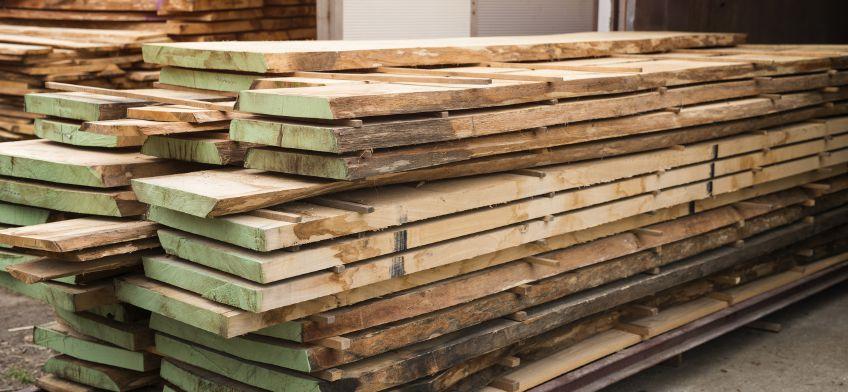
MAIN: Drying slabs in a kiln can save energy and meet customers’ requirements by using an in-kiln moisture measurement system.
ABOVE: Companies can improve their ROI by using reliable tools for measuring moisture. deorbem. Photos courtesy Wagner Meters.
the wood or sell it at a lower price.
And if the wood doesn’t dry enough, you may have to send it through the kiln process a second time, losing time and efficiency.
Speaking of efficiency…
DECREASED ENERGY COSTS
Any extra time your wood spends in the kiln costs you money. Even if it doesn’t damage the wood, it’ll hurt your bottom line.
Of course, you want the wood dry enough to prevent downstream defects and meet your customer’s requirements.
But every per cent that your wood is dried below that threshold will cost you a minimum of $3 per 1,000 board feet of lumber. And let’s say a company that processes millions of board feet every year is drying their wood five per cent below what is needed. Think about how many thousands of dollars per year are being lost in operating costs!
Moisture testing can streamline your process, helping you to dry to the exact percentage you need – and no more!
A GOOD REPUTATION
Let’s say a customer files a wet claim against
you because the batch they received from you had too high of a moisture content (MC). What might happen?
They might demand a refund. Or refuse to pay for the wood.
You might lose them as customers, but even worse, your reputation might suffer. After all, what’s to say they won’t tell others that your product quality is unreliable?
But you can avoid all these risks with moisture quality control. The right tools can mean putting out products that consistently meet your customers’ expectations.
So, what are those tools? Let’s find out.
INDUSTRIAL HANDHELD METERS
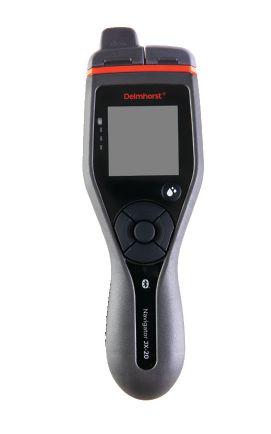
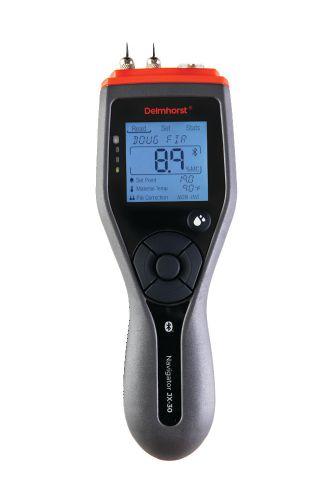
Industrial handheld meters are pinless moisture meters that use an electromagnetic sensor to detect the MC of a piece of wood.
This non-damaging type of meter won’t leave pinholes in the wood the way pin meters do, and it’s a much more efficient way to measure moisture.
The industrial version has a large scanning plate with an ergonomic handle –great for measuring large batches of wood. As you scan the wood, the meter can store over 5,000 readings and send them to PC-
based reporting software. No manual recordkeeping necessary.
Wagner Meters’ L622 handheld meter is a staple at Siskiyou Forest Products, which produces high-end finger-jointed and edgeglued wood materials at their facility in California. For them, an MC under 12 per cent is critical for wood to run through their glue line.
Aaron Duchi, who runs the kilns at Siskiyou Forest Products, appreciates no longer having to use a pin meter or record readings by hand.
He shares: “[The Wagner meter] not only measures the lumber faster, but it does all the recording work for me. It calculates all the information for each sample I take and sends it to my computer screen so I can quickly print it out.”
But beyond using handheld meters, many businesses invest in large-scale moisture measurement systems, like the one we’ll discuss next.
IN-KILN SYSTEMS
An in-kiln moisture measurement system uses electromagnetic wave technology to measure the MC of the wood in a kiln.
Each kiln unit has four to eight sending units with moisture-sensing zones. These zones connect to user interface software on a computer, allowing the kiln operator to monitor the MC of the wood in each zone.
With this real-time view of the wood’s MC and drying trends, the kiln operator can track progress and stop the kiln as soon as the wood has reached the desired MC.
No overdrying and no wasted energy costs!
And that brings us back to Carl Diebold Lumber, which processes about 1.4 million board feet of wood each month.
By using an in-kiln system, they can be sure of meeting their customers’ requirements. They’ve even been able to shorten their drying times by a couple of days because they don’t have to guess when the wood is ready.
And rather than performing many manual checks, the in-kiln system allows them to keep the kilns running while keeping an eye on progress. This saves the energy costs of shutting down the kiln and heating it again.
IN-LINE SYSTEMS
In-line moisture measurement systems usually sit at the beginning or end of planing or moulding operations. They scan every board, collecting data about the MC of each batch of wood and helping troubleshoot kiln performance. They can also identify moisture spots in the wood that can be trimmed out.
There are two different configurations: end-to-end and sideways.
End-to-end systems are often on the outfeed side of planers and moulders and measure the moisture in the length of a piece of lumber. They are good for identifying spots with higher MC.
Sideways or transverse systems have sensors that the wood moves over sideways. There are up to eight sensors, which can trigger a mark on wood with moisture issues.
For Manke Lumber Company, using an in-line system has allowed their business to compete in the export market.
A lumber processing and treatment plant in Washington state, they’ve used the in-line system to help them meet Japan’s stringent requirements for housing lumber.
“Everything we do is based off of what
the Wagner equipment tells us,” says Craig McNeil, the treating engineer there.
The result?
“We’re able to do a good job because of it. Our report is that our lumber is one of the best they have in Japan.”
WHAT COULD MOISTURE MEASUREMENT TOOLS DO FOR YOUR BUSINESS?
What if moisture measurement could save you thousands of dollars, improve your ROI, and give you a reputation for top-of-the-line products?
With the right moisture measurement tools, those scenarios are within your reach.
Kerry Cogburn, kiln supervisor for TealJones, a lumber manufacturer in Oklahoma, didn’t hesitate to say that an in-kiln system saves him about $300,000 per year in time, energy costs, and wood-drying efforts. What could your business do with that kind of savings?
Ron Smith is the Forest Products Division sales manager for Wagner Meters and has over 40 years of experience in instrumentation, measurement systems and telemetry in different industries.
HAND SAFETY IN SAWMILLS
PATRICK
mcDonald
Patrick is a safety specialist at Canfor, with over 15 years of experience working as a safety professional in Canada. He specializes in developing safety solutions in the industrial manufacturing industry.
As the No. 1 preventable injury in a sawmill work environment, a risk-based approach to addressing hand safety hazards must be our first defense. Let’s explore the hierarchy of controls and best practices for protecting workers’ hands in sawmills, breakthroughs in safety psychology, such as nudge theory, and the importance of promoting a positive safety culture.
Work-related hand injuries are one of the leading reasons workers end up in the emergency room, but they can be prevented with effective safety measures and by following the hierarchy of controls – a safety management system that prioritizes the most effective ways to control hazards, starting with eliminating or substituting the hazard, then engineering controls, administrative controls, and finally, personal protective equipment (PPE). Let’s discuss how each of these controls can be applied to prevent hand injuries in sawmills.
ELIMINATION/SUBSTITUTION
The most effective way to prevent hand injuries is to eliminate the hazard altogether. In sawmills, this may not always be possible, but some tasks can be substituted with less hazardous ones, reducing the risk of injury. For example, using an automated saw instead of a manual saw can significantly reduce the risk of hand injuries.
ENGINEERING CONTROLS
Engineering controls involve designing equipment and processes to minimize the risk of injury. In sawmills, this may include installing guards on saws and other equipment to prevent contact with hands or designing machinery to minimize pinch points. Another example of an engineering control is installing safety interlocks on machinery.
ADMINISTRATIVE CONTROLS
Administrative controls are policies and procedures that help to reduce the risk of injury. In sawmills, this
can include proper training on machine operation and safety protocols, and job rotation to reduce repetitive motion injuries.
PERSONAL PROTECTIVE EQUIPMENT
Although PPE including gloves are the last line of defense against hand injuries, they can reduce injuries in your sawmill. Glove technology has come a long way in the last five to 10 years and completing a full glove assessment and implementing gloves with high puncture and cut resistance can greatly reduce the severity and frequency of injuries.
NEW BREAKTHROUGHS
Nudge theory, a behavioural economics concept, has recently been incorporated into hand safety programs to improve hand safety. Nudge theory uses positive reinforcement to influence behaviour, such as providing feedback to workers on their safety performance. This method has been successful in encouraging workers to wear gloves and follow safety protocols.
BEST PRACTICES IN SAWMILLS
To prevent various types of hand injuries, employers can implement a range of hand safety best practices. Here are some key recommendations:
• Conduct a hazard assessment to identify areas of the workplace where workers are at risk of hand injuries.
• Develop and implement a comprehensive hand safety program that incorporates the hierarchy of controls mentioned above.
• Implement engineering controls, such as guards on saw blades and safety interlocks on machinery.
• Conduct regular hazard assessments to identify areas of the workplace where workers are at risk of hand injuries.
• Look for and control physical hazards such as
WOODPRODUCTS CANADIAN
OPTISAW 2023
BY JENNIFER ELLSON
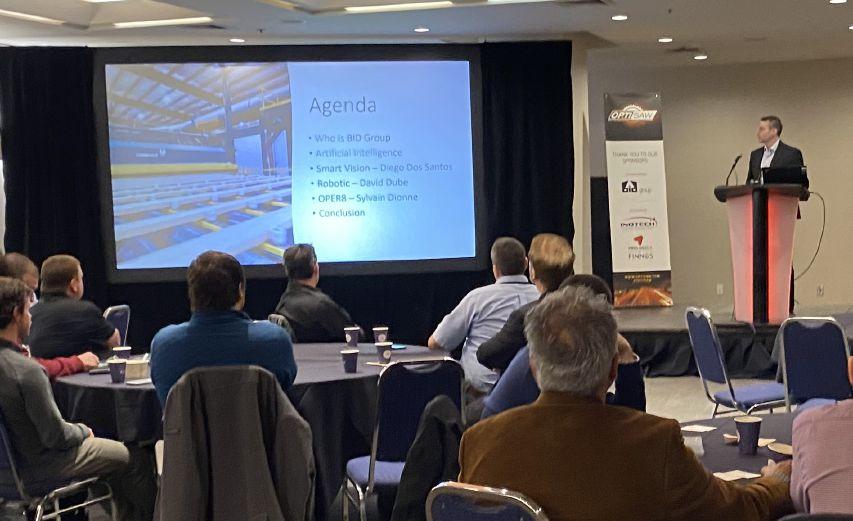
The global pandemic, economic crunch, and inflation have forever altered the already transitioning forest industy. In this ever-changing environment and the pressure to do more with less, what’s a sawmiller to do? Researchers and innovative manufacturers offered valuable insight into the cutting edge of sawmilling technologies and processes, and shared strategies to optimize production and boost mill’s profits at OptiSaw – the sawmilling optimization and automation forum – in Quebec City on March 17.
SAWMILL OF THE FUTURE
The BID Group opened the event with a peek into the sawmill of the future powered by a combination of cutting-edge technologies and an inspired workforce. The company is leading the way in several areas related to Industry 4.0: IIoT, augmented reality, robotics, artificial intelligence, and designing the next generation of sawmills.
BID’s Diego Braido dos Santos, David Dubé, and Sylvain Dionne showed the crowd of 50 delegates and exhibitors some of BID’s innovative technologies, including AI and robotics and their individual impact
on operations such as monitoring and optimizing process flow in sawmills and planer mills.
SMART EYES: REINFORCING SCANNERS WITH AI
The next presenter, Finnos Oy’s Jyri Smagin walked the audience through the sawmill’s different scanners at various locations, showing how the latest technology enables the scanners to connect with each other via fingerprint technology. Smagin demonstrated how applying AI optimization to the whole raw material flow linked by fingerprint can detect defects, and increase fibre recovery and yield significantly.
ENERGY TRANSITION
Experts agree, the energy transition in the industrial sector must be achieved by 2050. Incentives are available to initiate the transition, offered by energy suppliers or governments, but where can one start a project? Martin Tremblay of IDÉA Contrôle, an internationally recognized energy management equipment manufacturer, shared their efficient and effective tools to simplify the energy transition, which can reduce sawmill emissions and costs.
The BID Group opened the event with a peek into the sawmill of the future. Photo: Annex Business Media.
JEDI, BIG DATA AND IOT
The next speaker, Tim Melburn of Arrow Speed Controls, a self-described Jedilevel asset performance engineer, helped attendees visualize the invisible by showing how to increase productivity with cuttingedge technologies.
Optimizing machine productivity and maintaining a competitive edge can become increasingly difficult in a global economy, but Big Data and IoT technologies offer a wide variety of potential improvements from production efficiency to predicting machine failures to managing employees.
“Have you ever wondered how to get the most out of your equipment while ensuring they run at optimal performance? Having the right KPIs and a solid preventative maintenance plan will provide incredible cost savings,” Melburn said.
CUTTING DOWNTIME IN HALF
The first of two case studies presented at OptiSaw was a planer safety pilot project, given by UBSafe’s Ian Rood.
UBSafe performed a functional safety system upgrade to a Stetson Ross planer at Conifex Fort St. James in B.C. To utilize the safeguarding system for minor servicing tasks, such as clearing jams, the WorkSafeBC approval process under regulation 10.10 for control system isolation device (CSID) use as an alternative control measure to lockout was triggered. Rood detailed the results of the project –a safe, compliant, efficient system that was measured to reduce jam clearing-related downtime by 50 per cent.
SAWMILL SIMULATION
FPInnovations’ Mohammed Khachan provided an overview of the new software platform OptiTek, including drying and planing simulation, profit evaluation and flow analysis. Khachan said the platform allows stakeholders in the sawmill ecosystem to validate, analyze, and measure the impact on key performance indicators of new technologies and processes. His two-part presentation included an introduction of AI into the simulation process and its interest in estimating the value of stems supply from the forest to the mill.
OPTIMIZING VALUE CHAIN
Maximizing a mill’s efficiency with unique CT technology and the power of prediction
and optimization were the focus of the next speaker, Microtec’s Patrick Freeman, who went into thorough detail to describe the Microtec AI platform. Utilizing these tools, along with the innovative SMART Link solution, companies are able to streamline and optimize each stage of your value chain to drive maximum value, said the CTO, who described himself as the ‘chief nerd’ in a room full of nerds.
CASE STUDY ON DRYING
Secovac founder Pierre Gilbert was the final
speaker, and presented the second case study and “the most important presentation of the day,” he joked. Gilbert shared results of the installation of the EchoStop system, Secovac’s latest technological breakthrough in the field of drying control, at Clermond Hamel’s sawmill in Quebec.
EchoStop was designed to measure wood moisture without contact for continuous kilns. It has optimized the sawmill’s operations, eliminated the down grade caused by overdrying, increased production and reduced the energy required.
Continuous wood drying greatness
“The TC kiln saves up to 50% energy, compared to traditional batch kilns”
JD Irving, Canada
Valutec’s state-of-the-art TC continuous meets the highest standards of drying quality with minimal moisture content variation and risk of cracks. They also provide fast drying processes, low energy consumption and high flexibility. All covered in a robust stainless-steel construction with no need for re-skinning. No wonder they have become the most exciting choice for future-oriented sawmills in North America. Read more at valutec.ca
WOODPRODUCTS
CANADIAN THE GUIDED CIRCLE SAW
Paul Smith is a saw filing consultant and founder of Smith Sawmill Service, now part of BID Group. You can reach him at Paul.Smith@bidgroup.ca.
The guided circle saw is one tough tool when put up correctly, properly tensioned and of course used for the right job. Weighing in at under 20 pounds, with an average diameter of 20 inches and a thickness of .090 or less, it’s difficult to see how it does the job for which it is intended. How can one expect it to cut through and stand up to an average log weighing around 1,200 pounds at feed speeds of 400 to 700 feet per minute?
Well fortunately for our industry, a well-designed and well-maintained circle saw can cut through a log as if it were butter. Yes, my fellow sawfilers and colleagues, we may put more design, planning and effort into making a saw perform its job than the proverbial rocket science necessary to send a rocket into space.
Allow me to touch on a few things that are in play with this phenomenon.
RPMs: The circle saw must be operating at the proper RPM. This allows the saw body to stand up and not “wobble or snake” through the wood. Mills want a straight cut and that is what you get with the right tension, proper tooth geometry and correct RPM. Make sure your saw manufacturer is provided with the correct RPM when designing your circle saw. If machinery in the changes always update your saw provider.
Guides: The guides are the saws best friend or worst enemy. The circle saw should never touch the guide but slip through a thin film of saw lubricant. Because the saw is running between the guides in a very tight space (.002-.003 per side), improperly designed or maintained guides can cause the saw to overheat and lose tension, lay-over, cut bad lumber and cause the mill unscheduled saw changes. Like the saws, a saw guide has critical tolerances that must be maintained. Each run time they should be checked for damage or unusual wear. Changes in saw plate thickness will affect guides. Make sure to consider how a plate thickness change will affect
your guides and communicate this with both saw and guide manufacturers or your sales rep.
Machinery: The machine centre that the saws and guides are in must be mentioned if we are to be successful in producing grade lumber products. By documenting upkeep and maintenance done on the machine centre, it’s possible to make good decisions on why saws are not running to the best of their design and help determine when and what maintenance needs to be done on the machine itself. Alignment and wear and tear must be addressed when saws and guides aren’t the issue.
Data: I recently spent some time with a group of mill professionals and was impressed at the data they had at the touch or swipe of a device. These new sawing systems give mill owners, operators and yes, filers DATA. So, I suggest we use it. Understanding and knowing what happened in the past allows your choices in the future to be successful. Choices that seemed difficult or didn’t pan out in the past can be addressed once data is reviewed and variables identified. The best way to ensure success during each saw run or rocket launch is to document and learn from the success and failures of the past.
Tracking: If part of your job involves reviewing data, you’ve probably used terms like tracking, drilling down, or unique identifiers. This is the main reason we at SSS/BID Group etch each circle saw we manufacture with an identification number. This number allows both our team and the mill to keep up with the saw’s history, including number of times the saw has been benched, retipped and sharpened. Knowing the history and how the saw(s) ran in the past gives us the knowledge and ability to know what to expect in the future. These identifiers can help track when variables such as hook or kerf are changed. SSS and the BID Group can help your mill with the equipment, tools, and software to accomplish successful sawing. If you are working with another professional saw company, I’m certain they can do the same.
PAULsmith
EXPANDING DEMAND FOR SOFTWOOD LUMBER WITH EDUCATION, INSPIRATION, AND FACILITATION GENERATED
The Softwood Lumber Board (SLB) is an industry-funded initiative established to promote the benefits and uses of softwood lumber products in outdoor, residential, and nonresidential construction. Programs and initiatives supported by the SLB focus on increasing the demand for appearance and softwood lumber products in the United States. In 2022, the SLB:
2 OF INCREMENTAL DEMAND. BILLION BOARD FEET (BBF)
100%
The surface area of mass timber ceiling that can be exposed in Type IV-B buildings up to 12 stories under the 2024 IBC as a direct result of AWC education and involvement.
105,000 hours of education to architects, engineers, designers, contractors, and code officials from SLB funded programs.
11.8 BBF of total new demand
generated by SLB investments since 2012. REACHED
Each $1 invested by the SLB in 2022 resulted in BF OF INCREMENTAL DEMAND.
113
LEARNERS COMPLETED A 22% INCREASE from last year, surpassing goal by 8%.
5,288 COURSES
5.3 MILLION METRIC TONS OF CO2 PRODUCED A CARBON BENEFIT OF BY FACILITATING WOOD USE, the equivalent of not burning 29,270 rail cars of coal. R
See what we’ve accomplished at www.softwoodlumberboard.org
84 Reached an average of per $1 spent since 2012. BF OF INCREMENTAL DEMAND
1,728 projects to choose wood, resulting in of incremental lumber in 2022. 869 MM BF Think Wood sent 512 SALES QUALIFIED LEADS (SQLS) to WoodWorks for project support or further nurturing in 2022, bringing the total number of leads transferred to 1,138 since 2019.
WOODWORKS DIRECTLY CONVERTED and influenced a total of light-frame and mass timber buildings, 465
Montreal Wood Convention 2023
Economy, futures and inflation took centre stage
BY JENNIFER ELLSON
Speakers comprising leading economists and forest industry executives discussed the global economic and industry outlook at the 2023 Montreal Wood Convention (MWC), held at the Fairmont Queen Elizabeth Hotel in Montreal, Que., from April 18 to 20.
The convention attracted 1,100 participants from around the world and featured 110 booths showcasing the latest trends, technologies, and products by the biggest companies in the industry, making it one of the largest gatherings of its kind in North America.
The three-day event featured several sessions that focused on the economy and the markets.
“We believe this event will help companies run their business more efficiently and drive industry growth,” said Sven Gustavsson, manager of soft-
woods for the Quebec Wood Export Bureau and MWC event manager.
CIBC’s deputy chief economist Benjamin Tal opened the sessions talking inflation.
“Inflation is like the brown spot in a banana – by the time you see it, it’s already too late,” he said.
Tal said the housing market is the number one factor impacting the Canadian wood industry, saying that the current estimate for new immigrants settling permanently in Canada is at around one million per year, “and none of them are carrying their houses on their backs, so housing is needed urgently.” He added that renting must be a part of the solution and that governments must provide incentives to developers to encourage housing construction.
The convention attracted 1,100 participants from around the world and featured 110 booths showcasing the latest trends, technologies, and products.
“If the Fed stops raising interest rates, the construction market will be fine and this will be the case in 2024 and 2025,” Tal said.
Paul Jannke, principal, Forest Economic Advisors, said global lumber consumption slipped in 2022 and will slip again in 2023. This resulted to a significant decline in lumber prices at the end of 2022 and so far in 2023, but the market is expected to rebound in 2024.
In addition, the changing fibre supply patterns will affect production both in the short and long-term. The war in Ukraine and fibre supply will also change global supply chains.
“The world had excess fibre in the U.S. South and Russia. One of those regions will be taken out of the western supply chain for years while the other faces labour supply shortages,” he said.
However, near-term market weakness is likely to fade once demand rebounds because of global supply limitations.
“After a decline of 16% in 2023, the market is expected to grow by 14% in 2024,” Jannke told delegates at the standing-room only session.
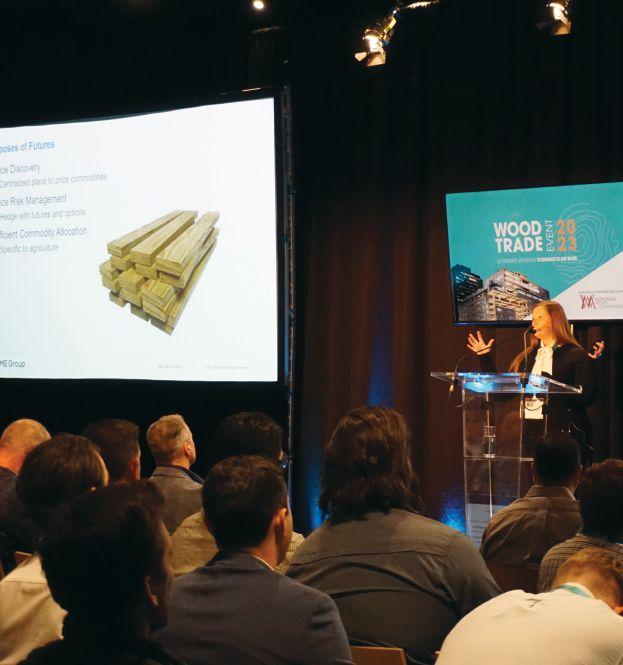
Attendees also learned more about using the lumber futures as a risk management tool, which have now become more accessible to North American producers due to the implementation of new operating rules.
On Wednesday noon, Super Bowl champion and medical doctor Laurent Duvernay-Tardif inspired the delegates with his journey from professional football to medical school. The NFL player for the New York Jets discussed the importance of leadership, perseverance, and adaptability when he opted out of his lucrative contract in playing football to serve as an orderly at a long-term care facility in his native Quebec during the COVID-19 pandemic.
On Thursday morning, attendees were treated to a CEO-panel discussion of the challenges facing the industry.
Dan Starr, president of Do-It Best Corp., one of the largest hardware chains in the United States, said demand will explode when interest rates stabilize. “There’s almost no home inventory and when you look at the demographics, there’s a lot of young people in their prime who will want to build a home,” he said.
Starr warned that this can lead to the
same difficulty that happened during the pandemic, when demand skyrocketed, as prices soared.
“Instead of having prices on a roller coaster, it would be better to have a more stable demand and prices,” he explained.
Russ Permann, CEO of Taiga Building Products, a Canadian hardware chain with sales of $2.2 billion, agreed. “It’s expensive to keep big inventories, because for the first time in a long time, money is expensive,” he said, referring to rising interest rates. Like Starr, Permann warned
that demand will rise steeply, “and we will be back in the same place as during the pandemic.”
Sylvain Labbé, President and CEO of the Quebec Wood Export Bureau (QWEB) and a member of the organizing committee, said MWC reconfirms its role as the key Canadian hub for producers, wholesalers, and retailers of wood products.
“We are delighted with the record participation from the United States and Canada, as well as the significant presence from overseas markets,” he said.
Unexpected downtime?
Fast Track service is here
USNR has made powerful changes that have cut our lead times for manufactured parts in half. This means we can make your parts faster and get them to you quicker.
Reduce the stress of unexpected downtime with Fast Track service. It accelerates the production of high-quality OEM parts and expedites them to your door. Next time you need it fast, Fast Track it.
EVENT coverage
COFI 2023
Forest sector: Everything, everywhere, all at once
BY JENNIFER ELLSON
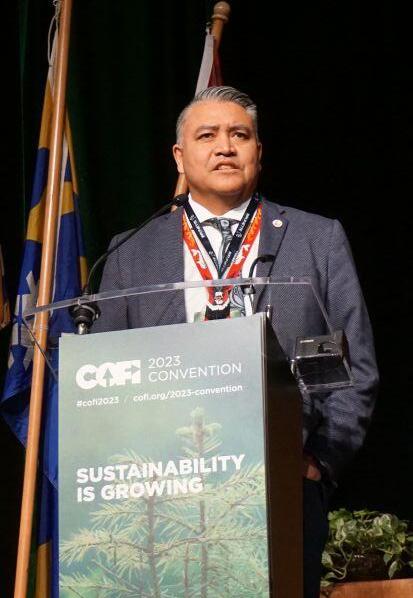
British Columbia’s forest sector is in the midst of a lot of change and arguably having an “Everything, Everywhere All at Once” kind of moment, said BC Council of Forest Industries (COFI) president and CEO Linda Coady at this year’s annual convention
Permacrisis, transitioning, predictability were the prevalent words heard at the three-day event. From April 12-14, speakers including B.C.’s Premier David Eby addressed the sold-out Prince George Civic and Conference Centre crowd of 600.
In private meetings before his speech, Eby said convention delegates expressed concerns about timber supply and the lack of a long-term economic strategy on which to base their forest operations.
Eby acknowledged the critical importance of a reliable fibre supply, and that the permitting phase for natural resources projects takes too long in B.C.
“I know that the state of permitting in the province is unacceptable – it’s too slow, it’s too complicated, and many governments have grappled with it and failed to address it.”
Eby credited COFI’s influence in convincing the government to double the rate of revenue sharing with First Nations for economic development conducted on their traditional territories.
He emphasized that forestry is the bedrock of many B.C. communities.
“We know that we need a healthy primary industry for the value added products segment to prosper.”
In addressing the media after the event, Eby said, “The vital message I have heard from the sector is predictability – they need to know where the trees are coming from and that’s basic for the forest indus-
Regional Chief Terry Teegee of the BCFNA was one of the keynote speakers. Photos: Annex Business Media.
try. Our goal as a government is to help deliver that.”
VISION, INNOVATION, COMMUNICATION
COFI’s board chair and Sinclar Group Forest Products president Greg Stewart opened the conference saying this is pivotal time for the industry with many changes happening in the sector, whether in technology, policies, public perception and expectations.
Chief Dolleen Logan of the Lheidli T’enneh First Nation welcomed the delegates to their territory and made two requests to those present in the room: “First, tell me about your fresh ideas and second, please ramp up all your connections to attract the youth to this industry. Let’s make a significant investment on out youth – we need [them] to take care of our future.”
Prince George Mayor Simon Yu highlighted the sold-out crowd saying, “Your presence here tells us that the forest industry is here to stay. He reiterated the industry’s significance to Prince George’s economy, and the importance of building trust while creating a 50-year vision for forestry. “Once the vision is established, once trust is there, innovation can happen.”
Regional Chief Terry Teegee of the B.C. Assembly of First Nations, spoke on the Declaration on the Rights of Indigenous Peoples Act (DRIPA). He said although implementation has been slow, progress has been significant in B.C. In fact, outside of Bolivia, “we’re the only Indigenous people breaking trail.”
Teegee emphasized the need for better communication and for all governments and the Indigenous Peoples to “come together to create that space to make decisions together.”
PANEL ON THE FUTURE
One of the panels discussed the future of the industry and figuring out how to attract young people to work in the industry.
“We’re competing against Google and Amazon … those are the sexy jobs, but I think we have a sexy job too, and the story of sustainability I think is one that we need to shine a brighter light on so that people understand that there is a future in forestry,” said Tricianne Kasabuchi, Canfor’s director of talent development.
She added that one of the biggest barriers for people in choosing a career in forestry is the perception of the industry. “We’re not telling the positive side … we have to change the narrative.”
Rod Bianchini, chief strategy and compliance officer for SkilledTrades BC added that trying to convince the next generation to consider a career in trades is part of his mission.
Caroline Dépatie, associate dean at the British Columbia Institute of Technology, said students look at forestry as traditional, but consider wildlife and silviculture as attractive and the industry should focus on using those to attract the young generation.
WE’RE IN ‘PERMACRISIS’
Public opinion researcher and Abacus Data CEO David Coletto informed the delegates that ‘permacrisis’ was Collins Dictionary’s 2022 word of the year, which refers to an extended period of instability and insecurity. He said that amidst the global pandemic, Canadians had legitimate reasons to feel they were never far away from the next calamity to disrupt their lives.
An Abucus poll showed 17 per cent of British Columbians had a very favourable opinion of the industry, 59 per cent held a somewhat favourable impression, 19 per cent were somewhat
unfavourable, while five per cent were very unfavourable.
MINISTERS TALK TRANSITION AND LAND USE PLANNING
Minister of Forests Bruce Ralston said a more resilient and high-value forest means “adding value in every step.”
“We arguably have the highest quality timber in the world. We can outcompete anyone and that is our plan all along – to transition from high volume to a high value sector.”
Key to achieving this are the many government initiatives such as increasing fibre recovery from slash piles, burnt wood and mountain pine beetle-affected wood; forest rehabilitation after wildfires; sustainable logging practices, fibre distribution to small value-added producers, and the introduction of land use tables. He used the event to announce a $38 million investment in a a new program over the next six years to collect light distance and ranging (LiDAR) elevation data.
“Strong data makes for good decision,” Ralston explained.
LiDAR data is openly and freely available to the public for 11 per cent of B.C.’s landscape currently, and B.C. Minister of Water, Land and Resource Stewardship Nathan Cullen told delegates that the goal is to make it to 100 per cent in six years.
On new approaches to land use planning in B.C., Cullen said DRIPA and the landscape level plans are key, and if done right, the desired certainty is achievable.
“If you do this right – when you get that certainty achieved, when you do that heavy workm you get to a place where everything works. You’re a ‘get ‘er done’ kind of crowd – innovate!” Cullen said.
FULL CIRCLE
Q&A with Western Forest Products CEO Steven Hofer
BY MARIA CHURCH
Steven Hofer’s decision to take the reins as president and CEO of Vancouver-headquartered Western Forest Products last September was a full circle move for him.
Hofer traces his sector roots to 1993 when he got a management trainee job at a sawmill in Nanaimo, B.C. There he learned all aspects of lumber manufacturing, and it launched a life-long passion for the industry.
Today, he’s steering Western into a new era of forestry where in companies carefully consider the full climate solution of their products, long-term land stewardship, and inclusive partnerships.
CFI: YOU’VE HELD A NUMBER OF POSITIONS WITH FOREST INDUSTRY COMPANIES OVER THE YEARS. WHAT DREW YOU TO FORESTRY INITIALLY, AND WHAT KEPT YOU IN IT?
The very beginning for me was in 1993. I was a management trainee with Pacific Forest Products. They
had private timberland and sawmill manufacturing complexes on Vancouver Island, primarily focused on the export market. As a trainee, it was everything from quality control, planer and sawmill supervisor, log buyer – it was an outstanding formative experience. I was fortunate to have some really good mentors. That was the launching pad for my career.
Pacific was later sold off to Doman Industries (the sawmills) and TimberWest (timberlands). Today those timberlands are Mosaic Forest Management and, the only sawmill left, is Western’s Saltair division.
Each career choice after that was pretty strategic. I stayed in the industry because I found it let me explore all of the career aspirations that I could ever imagine – whether it was on the international marketing side, the product development side, the operational side, or the technology and leading-edge initiatives that normally you wouldn’t see in a traditional industry.
I’m coming up to 30 years and it’s a really unique
Steven Hofer (right) with Western’s general manager of manufacturing, Derek Haupt (left) at a recent safety celebration, serving up a steak lunch for the Chemainus sawmill employees to mark six months recordable incident free.
opportunity to think about how the industry has evolved. Thirty years ago, I don’t think anybody understood carbon sequestration and the role of a healthy working forest when it comes to climate change and wood’s ability to sequester carbon into the most beautiful building products in the world. Here we are today with a much more enhanced value proposition to all the different stakeholders.
CFI: WHAT APPEALED TO YOU ABOUT TAKING THE REINS OF WESTERN FOREST PRODUCTS?
I was at BID Group before Western. We were doing really fun, exciting work on the other side of the business, providing leading edge equipment, technology and construction services to the industry. When I got the call from Western asking if I would be interested, I immediately thought back to the fact that this is where my career started.
I don’t say it lightly, but it was something I felt I needed to do to ensure that the company would be able to position itself for continued long-term success in the communities that I know really well – families and customers I have known for 30 years. It was a calling to come back and help position this business for the next generation of leaders. We are one of the largest employers on the coast. It’s meaningful for these communities, families, schools and health care facilities that we’re successful, profitable and engaged with the community.
The work that Western is doing working with our Indigenous partners I would call at the leading edge. We’re really defining a new era of sustainability and stewardship in the forest sector. We’re finding a way to create economic opportunities for everyone. One of the themes I’m hearing from the First Nations Chiefs that I interface with is, how can Western help break the cycle of poverty in these communities. We don’t have all the answers today, but we’re going to be able to do that by creating new opportunities. It comes from a different business model than what we’ve had in the past.
CFI: WHAT ARE YOUR GOALS FOR THE COMPANY AS YOU CONTINUE TO SETTLE INTO THE ROLE?
For me, the first few months were about onboarding and understanding the people, roles, and culture and cadence of the company. I spent the first three months getting out to visit all of our operations. The last four
months were about laying out our strategic priorities as we think about how we transform our business.
At our core is a culture around safety. It’s really about understanding our risks and how you mitigate that. Our manufacturing facilities are older so they’re not as automated as other mills. We still have people touching lumber. So we’re mitigating those risks and ensuring that at every level they know that safety is critical.
We’re also doing some unique work around diversity and inclusion. We operate in unique communities and it’s about providing opportunities – whether it’s for women, minorities, First Nations, we’re letting them know that the door is open. We have exciting opportunities for a career with personal and professional development.
The next piece is about environmental stewardship. This is a really unique piece of Western’s story – we’re taking a different approach to developing Integrated Resource Management Plans. This is looking at our timberlands in consultation with the respective First Nations on whose traditional territories we are operating. We’re working side-by-side with the Nations to develop
a forest landscape plan that looks out 250 plus years.
Another piece is looking at how we position our manufacturing business to become world-class in terms of its operating structure. We’re moving forward with a manufacturing optimization plan to address that, to extract higher-value building products. That ties to our growth in engineered wood and participating in the mass timber space. We’re going to continue to invest in that.
Lasty, it’s arecognition around alternative revenue streams. We’re just getting started identifying how we can extract more revenue from our residuals. That might be waste leftover on timberlands, or residuals from operations. We’re also looking at how we can participate in the overall carbon credit trading market.
CFI: WHAT DO YOU SEE AS THE BIGGEST CHALLENGES FOR B.C.’S COASTAL FOREST SECTOR TODAY, AND IN THE FUTURE?
Certainly the softwood lumber dispute is a long-standing issue and we in industry believe there is an opportunity here, perhaps in the short-term, to see a
We’ve been a leading force in air flow design for almost 3 decades, with 4-, 6-, 8-, and 12-bladed propellers, designed and manufactured exclusively for the lumber industry. Now, they are even more capable with higher- temperature capacity for certain applications. We combine this technology with unsurpassed customer service, design consultation and technical expertise, so whatever your air flow need, you can trust SmithCo to deliver.
settlement. In my view, this one has gone on too long. There’s over $9 billion now on deposit. We need to resolve it. There is always going to be a need for lumber imports into the U.S. to satisfy their overall demand and today a lot of that is coming from Europe without any trade mechanism in place for European wood. It’s time for us to figure out a path forward.
There is a significant shortage of labour and skills available to our industry so there is this whole question around how we attract more people and promote these great opportunities. We’re fostering greater inclusion and looking at how we can support kids coming up through high school and thinking about their careers. You don’t need a four-year university degree for a rewarding career.
And one that will be no surprise is the uncertainty around fibre supply. When we think about recapitalization of our assets in B.C., the No. 1 question I ask, our board asks, our shareholders ask: do you have confidence around fibre supply. Our proactive engagement with First Nations is addressing that, working in a unique environment where you lay out a collective vision of what the land base will look like 150 years, and how that can become an annual operating plan. That creates certainty of supply and, if you do it in the right way, I honestly believe for the first time in the last 20 years on the B.C. Coast, you will have certainty of supply. But it’s going to take that type of commitment to build plans from the ground up. It takes time.
CFI: WE TALK ABOUT SOCIAL LICENSE A LOT IN THE FOREST INDUSTRY. WHAT’S YOUR TAKE ON IT PERSONALLY AND AS A COMPANY?
From a personal side, I believe that social license is about doing the right things at every level. The basics are how you treat people, how you talk to people, your professionalism, integrity, and honesty. You earn it everyday by doing the right things.
Thinking about the company and the communities that we operate in, it’s about respecting their rights. We try to build that into every engagement, every opportunity for collaboration as we think about these long-term plans. These resource management plans we’re doing don’t start in Victoria or Vancouver – they start in the small community of Woss, or Port McNeil, or Port Hardy. I think you get awarded social license when you have that level of community commitment. We have to have a listening mindset. We don’t get to dictate the terms, it’s highly co-operative based on mutual respect. I believe in transparency and reporting. We have strong accountability in our governance practices. We have a well-resourced whistle-blower policy. If someone sees something they don’t feel is in accordance with our core values or is illegal or not right from an environmental standpoint, if they don’t feel they’re being listened to by their peers, supervisor or anyone, including the CEO, call in the whistler-blower line. It goes directly to the chair of our board’s audit committee. We
think that’s an important piece about our social license inside our company.
CFI: WHERE DO YOU DRAW INSPIRATION FROM AS A LEADER IN THE FOREST SECTOR?
What I really love about our industry and our company here at Western are the people. We have exceptional people, really passionate subject matter experts, committed to their communities. They want to do what’s right. They believe in our opportunity to be a part of the communities, that new working relationship with First Nations, and to be a part of the climate solution.
When I wake up in the morning I think about how I can, as the CEO of Western, continue to lead and motivate and encourage our people to do the right things, to do them safely, and based on the solutions we know we need to be focused on. My role is to coach and lead. I’m here to share a vision and articulate what that vision is and what those steps are. And then to have a little fun as well.
We all work really hard, and in some difficult environments. When I think about those people who get up at 4 a.m. to be on the side of a mountain with a chainsaw, that’s not easy work. They need to know that their CEO is aware, is grateful, and is supporting them in the work that they’re doing everyday.
For me, when I think about where I see the potential of Western, I want to be a part of that. I want to play a small role in helping transform this business.
HAND SAFETY IN SAWMILLS
pinch points, sharp edges and unguarded chains and sprockets. For example: handrails near an operator can be a cause of many “struck by” hand injuries when using a pike pole.
• Management and safety committee members will want to perform workstation ergonomics assessments looking at tasks specific to material handling, hand placement and other situations that can lead to repetitive strain injuries.
• Develop and implement administrative controls, such as hand safety training programs, hand tool training, equipment inspections, and PPE/glove protocols.
• Working directly with a glove manufacturer, perform a full glove assessment across your company.
• Provide the correct gloves to workers and ensure they use them correctly and consistently.
• Ensure supervisors are inspecting their workers gloves at least weekly.
• Develop a culture of safety by encour-
Work-related hand injuries are one of the leading reasons workers end up in the emergency room, but they can be prevented with effective safety measures and by following the hierarchy of controls.
aging workers to report hazards and incidents and involve them in the development of hand safety policies and procedures.
• Promote hand safety by introducing nudge-based interventions such as:
• Use colour-coded PPE that is specific to hand safety, such as gloves and sleeves. It can make it easier for workers to identify and use the appropriate equipment.
• Use visual reminders such as posters or signs that remind or warn workers about hand safety hazards in specific areas where hand injuries are prevalent and cannot be eliminated.
• Use positive reinforcement by recognizing workers who practice good hand
safety habits. This nudge-based intervention can create a positive safety culture and help workers feel motivated to work safely.
Hand injuries in sawmills can be prevented by implementing effective safety measures and following the hierarchy of controls. Workers must be trained on safety protocols and provided with the necessary equipment and resources to reduce the risk of injury. New breakthroughs such as nudge theory and the promotion of safety culture can further improve hand safety in sawmills. Remember, preventing hand injuries is everyone’s responsibility, and together we can make sawmills safer places to work.
Wagner Meters has proven to not only be an asset for our company but inevitably for the many customers that we supply with an accurate and consistently dried product.
- Furman Parton, President of Parton Lumber
•
•
COLUMN final cut
A registered professional forester and registered professional biologist, she’s worked to deliver on forestry’s role in a climate-smart future and creating a diverse and equitable sector
JIMMIEhodgson
As Mosaic’s senior manager, forestry operations, Jimmie helps deliver the company’s reforestation, stand tending, survey monitoring, salvage operations, and fire hazard abatement programs
Making forestry a female friendly sector
Progress has happened, but there’s more work to be done
Like most resource sectors, forestry has long been seen as an industry staffed, led, and dominated by the culture of men. But it is changing.
The situation has been progressing thanks to the kinds of leadership we’ve seen over the past few decades that acknowledge the need to change the industry – the need to knock down barriers that impact different people in different ways. While this began with conversations of women with other women, it has grown to include everyone in the important efforts to make the sector a place where women do not have to face the gender-based challenges of the past.
We have seen our leaders and colleagues make real efforts to change their knowledge and understanding. Both of us have benefitted from confident female professionals teaching and guiding us directly – and demonstrating the kind of leadership required to build the culture and the workplace that is desired.
We’re dedicated to delivering this kind of leadership. Much of that comes down to demonstrating the way forward through how we do our work. Living Mosaic Forest Management’s mission in this area is all about working as your whole, authentic self.
There are a number of steps to working as your authentic self. First, as a woman, it is NOT about changing yourself or your actions to counter stereotypes or to try to fight them. It’s important to resist the feeling that you need to take on representing all women. Instead, be yourself.
The second part applies to women and men alike when encountering difficult circumstances like sexist remarks or gender-based discrimination. If the situation warrants and the opportunity exists, the most effective way to change people’s minds is to engage in a genuine conversation – be curious, patient and get to know them. When you share yourself in that situation, you can shift perspectives. Don’t let small issues become bigger by not setting boundaries.
There is a critical caveat to this – if anything becomes unsafe, escalate to your supervisor or the HR process. Everyone has the right to work safely, and
that means psychological safety as well. Raising issues early – not being dismissive of even small incidents – is the path to follow.
For instance, a common challenge women can face in the old way of operating is being talked over in meetings. It’s something that can be difficult to navigate – especially in the meeting itself. Facing this, people should try to use their voices and set their boundaries because allowing people to talk over you, claim your work, or be dismissed will continue. Leaders have a major role in tackling this. They can call things out in a calm, rational way and set firm boundaries. Going forward, people will know to respect that boundary. A key tool is the meeting structure itself – having individual check-ins or roundtables gives everyone the floor and creates the space for all voices to be heard.
Women have an important role to play in the future of forestry. Mosaic is making genuine efforts to show this not just in our workplace, but by introducing our work and the potential of careers to young people. When we visit local schools and communities as part of the job, we know that we have the chance to show women as leaders. And when we take younger students out to the field to show them the working forest – what we are doing and who is doing it – we make sure they are meeting a diverse group of foresters who share their stories. It’s our goal that kids can see a path for everyone to a forestry career. It’s our hope that the path has become easier.
The company is also making efforts to foster diversity through our summer student and internship programs focused on women in trades and Indigenous people. These programs bring new voices and experience into our ranks, and that delivers a chance for learning on both sides.
It’s our responsibility today – as leaders and as team members – to step up and continue pushing for change and focusing on every aspect of the forest sector to ensure it is a place where everyone can be their authentic selves regardless of their identity.
MOLLYhudson
Molly is Mosaic’s director, sustainability.
The LH 35 M was specifically designed for handling timber and will deliver tremendous performance results with its agile manoeuvrability and stability.
Combined with our latest engine and hydraulic technologies, more volume can be handled per work cycle allowing for productivity to be increased.
This makes for the perfect balance of Performance, Power and of course Liebherr Power Efficiency.