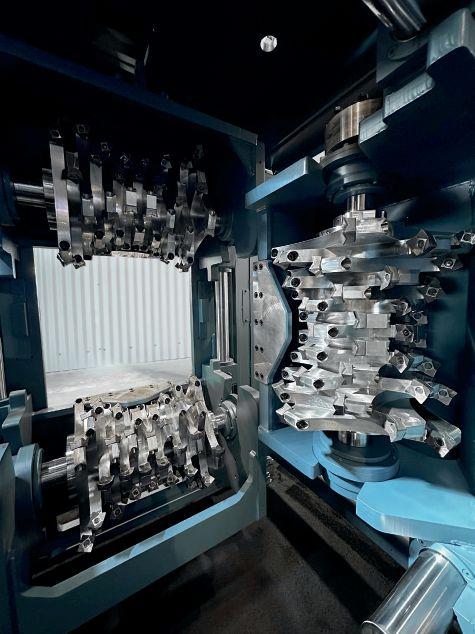
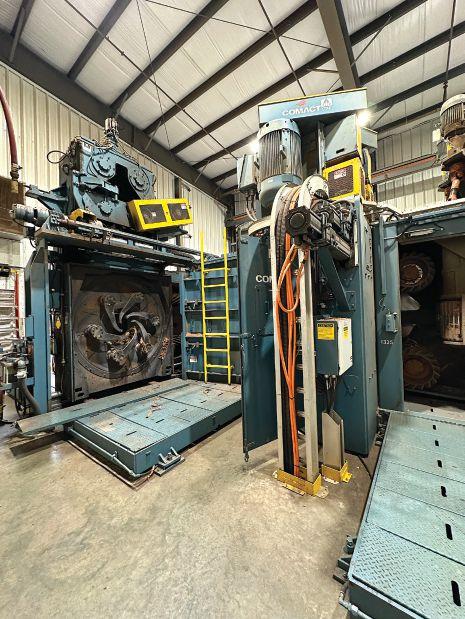
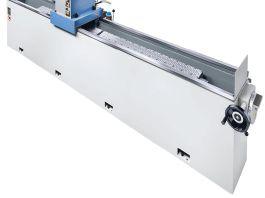
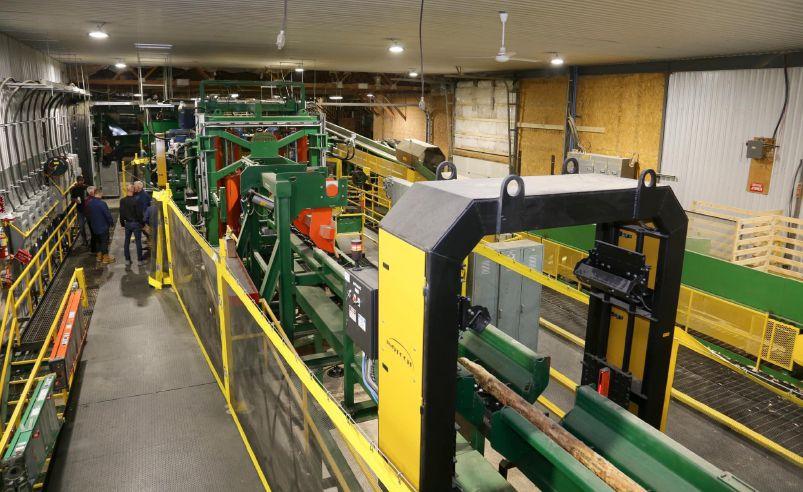
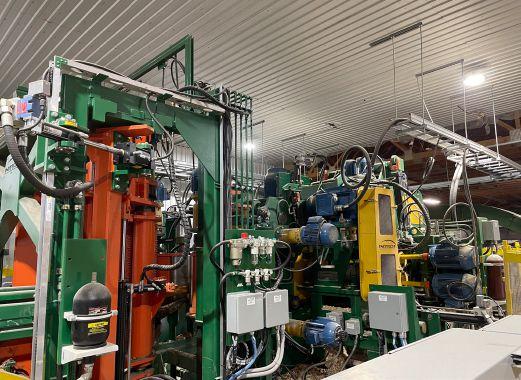
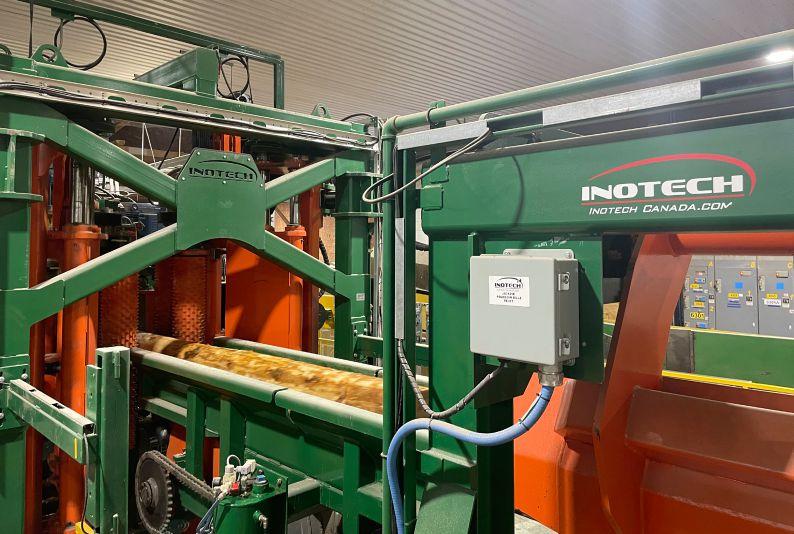
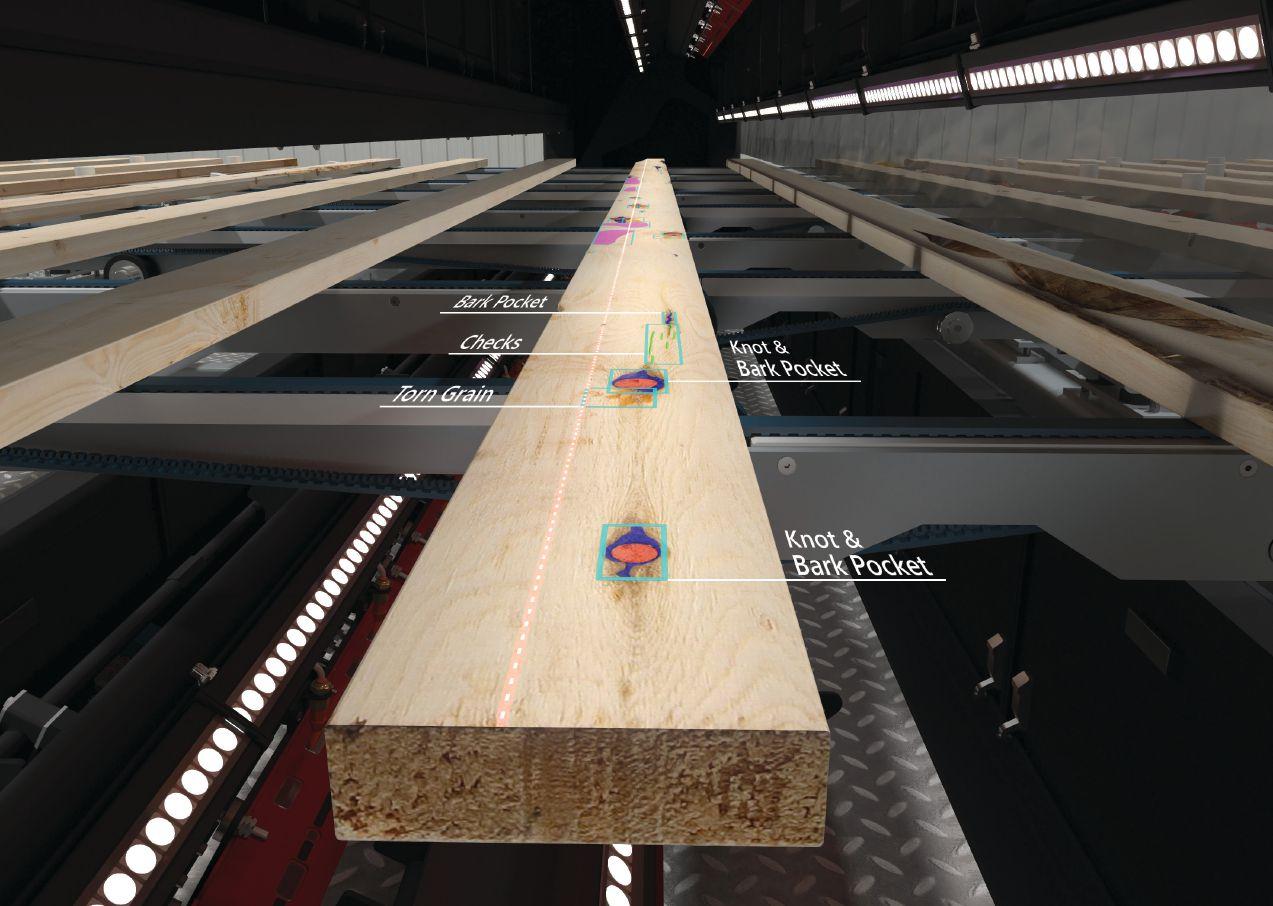
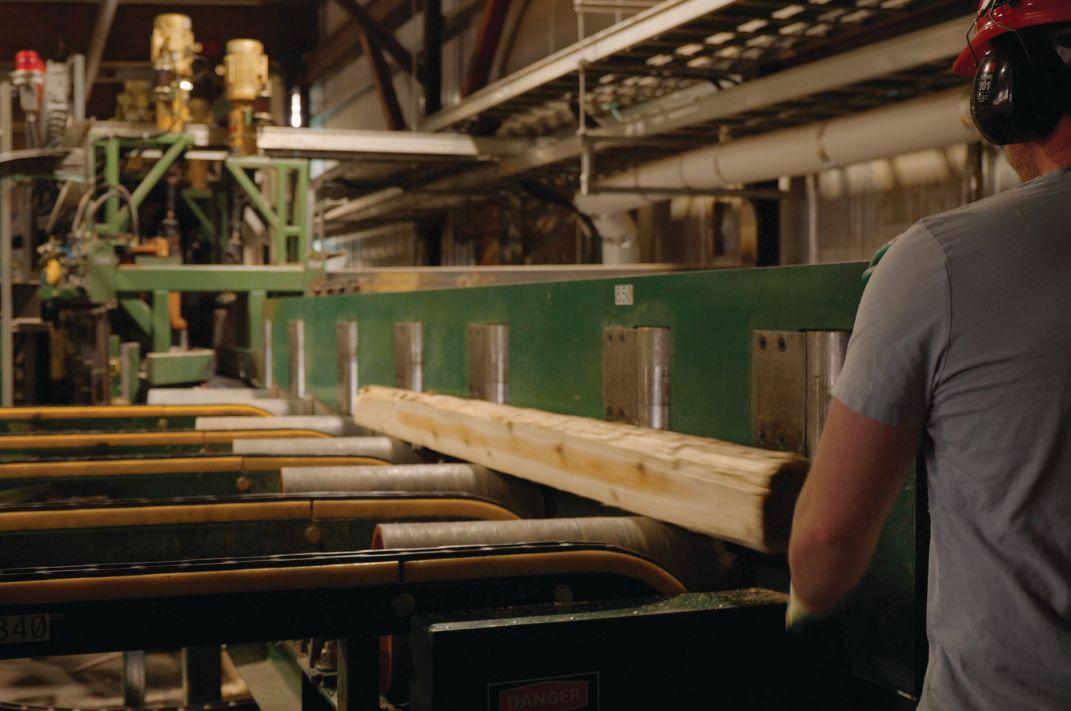
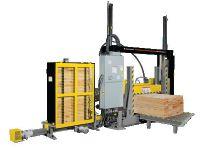
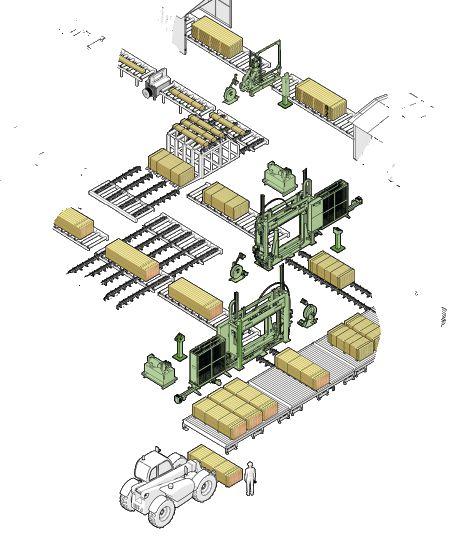
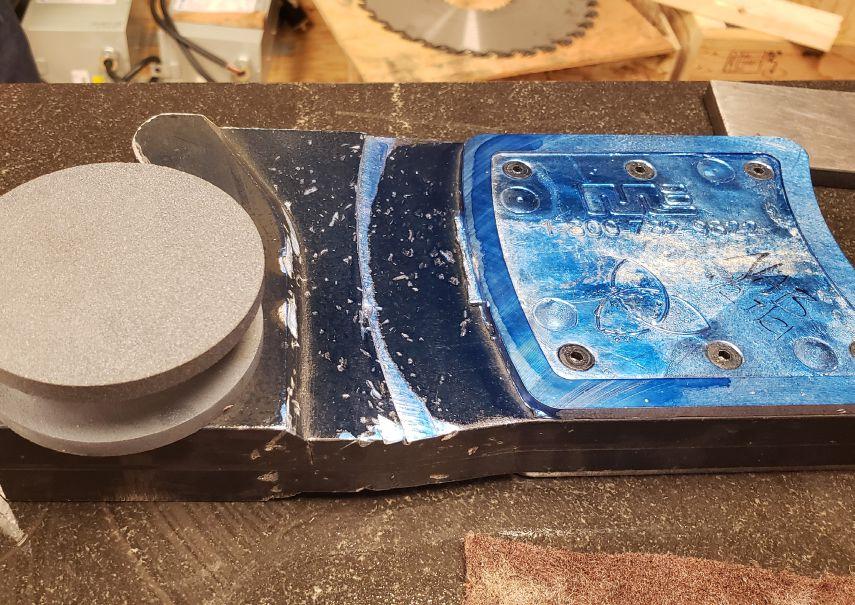
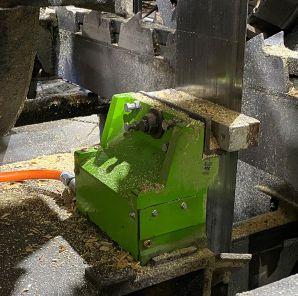
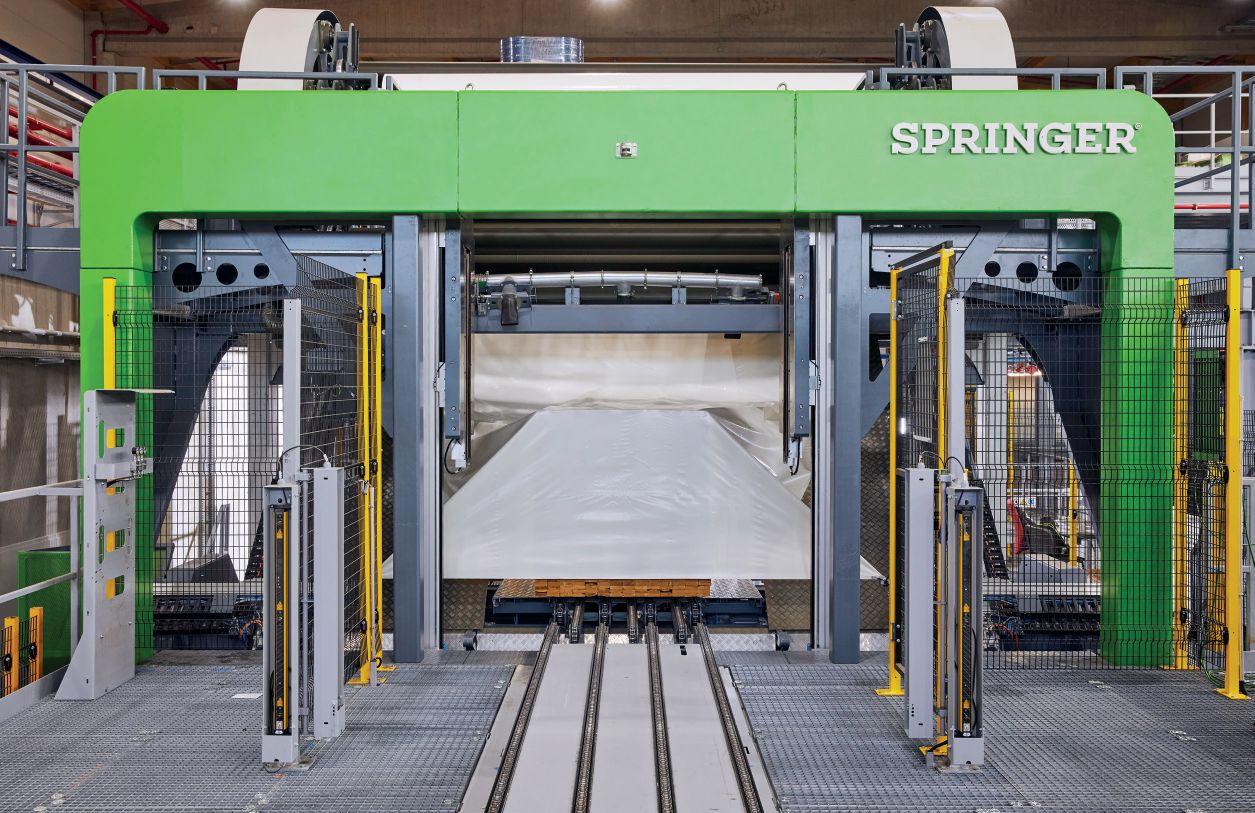
• Provides quick tool and press roll response for short gap applications and log control
FLARE BUTT REDUCER
• Removes flares at debarking speed without reducing speeds, accelerating productivity
• Improves sawline cutting speed and log stability
• Ensures entire log’s uniform quality and size
first cut
JENNIFERellson
jellson@annexbusinessmedia.com
Mentorship and diversity
Driving progress in forestry
I’m writing this editorial fresh from co-hosting our fourth annual Women in Forestry Virtual Summit. I’m basking in the glow of its success, attracting 800 registrants from more than 20 countries, with 500 joining us live to discuss key issues like inclusion, diversity, biases, career ladders and so much more! You can read the recap in this issue, or check our website for videos of each session.
So naturally after the event, I traded in my mystery novels for a deep dive into a 43-page report titled Evidence on diversity in Canada’s forest sector Riveting, right? No joke, this 2021 report authored by some of Canada’s best academics sheds some serious light on the state of gender diversity in our beloved forestry industry.
You see, while we’re all aware that women, Indigenous people, and immigrants are somewhat underrepresented in the forestry sector, the extent of this underrepresentation hasn’t been well documented. This report, part of a Canada-wide effort to promote diversity in the forest sector workforce, aims to change that.
Let’s talk numbers for a moment. According to the report, women occupied just 17 per cent of jobs in Canada’s forest sector in 2016. Sure, that’s an improvement from 14 per cent in 1996, but it also highlights a frustratingly slow rate of change. And that’s not the only statistic worth noting.
The report dives into various indicators of diversity, painting a vivid picture of the challenges we face. From the big picture overview of gender equity to the diversity in specific jobs and across regions, it’s clear that there’s still much work to be done.
Take for instance the wage gap. Despite progress, there’s still a significant disparity between men and women’s incomes, especially in certain occupations. And while women are making strides in professional forestry programs, they remain underrepresented in technical forestry programs.
It’s interesting that one of the most pressing issues addressed during the summit was the persistent gender gap within the sector. The event showcased initiatives aimed at bridging this gap, such as the
gender and diversity framework championed by some industry players. This framework not only acknowledges the challenges faced by women but also lays the groundwork for a more inclusive and welcoming workplace culture.
Mentorship emerged as a powerful tool for empowering women in forestry. The transformative impact of mentorship and wraparound career support systems was emphasized, showcasing the potential for nurturing talent and fostering leadership.
The summit’s discussions highlighted the importance of fostering an environment that values and supports women in forestry. From Indigenous inclusion to leadership development, the insights shared underscored the significance of diversity in driving innovation and excellence within our industry.
But here’s the thing: diversity isn’t just a moral imperative – it’s also good for business. Research shows that organizations with diverse workforces tend to be more profitable, creative, and effective problem solvers. So, investing in measures to promote diversity isn’t just the right thing to do—it’s also a smart business move.
At the heart of these discussions lies a fundamental truth: diversity drives progress. By embracing diversity and empowering us in forestry, we unlock a wealth of talent, creativity, and expertise that propels our industry forward. As we navigate the complexities of a changing world, it’s imperative that we harness the full potential of our workforce to ensure a sustainable and prosperous future for forestry in Canada.
The virtual summit served as a beacon of inspiration and empowerment for us in forestry. By addressing challenges head-on and championing initiatives that promote diversity and inclusion, we pave the way for a brighter and more equitable future. As we continue on this journey of transformation, let us reaffirm our commitment to empowering women as catalysts for change in the forestry sector. Together, we can build a stronger, more resilient industry that thrives on the diverse talents and contributions of all its members.
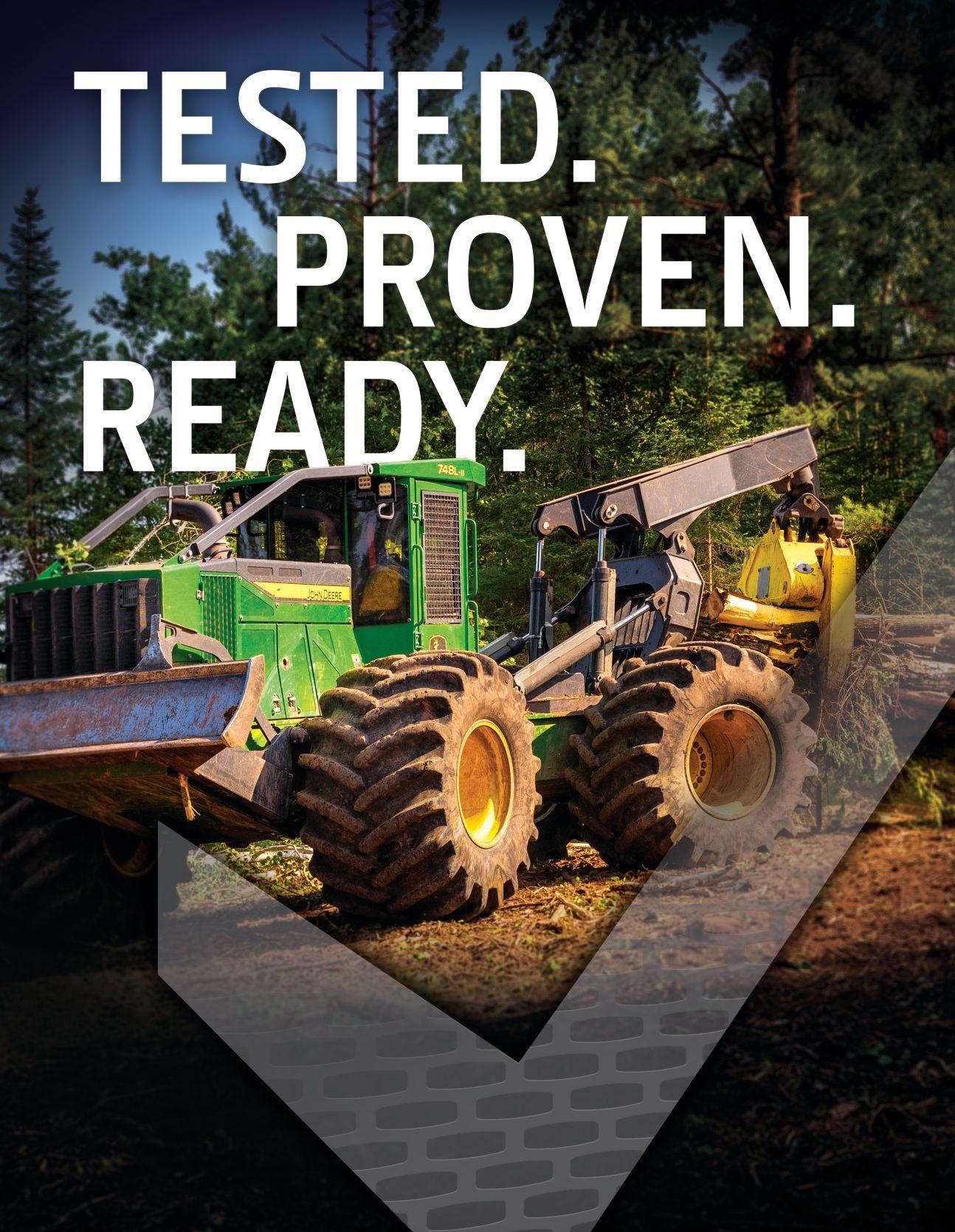
Gain confidence and peace of mind with John Deere certified used equipment. With up to 12-month warranties, special financing, and unmatched dealer support, it’s ready to outperform your expectations.
Contact your local John Deere dealer or visit Deere.ca/UsedForestry.
USED EQUIPMENT
NEWS upfront
Kalesnikoff to build new mass timber mill in B.C.
Kalesnikoff Mass Timber is building a new, third facility in B.C., to expand its product lines that will include modular construction, prefabricated mass timber and light frame components, and custom installation-ready products. It will also increase Kalesnikoff’s glue laminated timber capacity.
The new facility will operate locally, complementing Kalesnikoff’s two existing operations, with ground-breaking anticipated shortly and a targeted opening by the end of this year. It will create up to 90 new jobs on completion, and ongoing benefits for the local economy. The exact location is yet to be announced.
Kalesnikoff’s initial mass timber facility, located
in South Slocan, B.C., launched in 2019 and now employs 160 local professionals. The existing Kalesnikoff sawmill and team in Thrums, B.C., will provide a continuous and secure local fiber supply.
Canfor Pulp Taylor, B.C. Q1 2024 Facilty sold for $7 million
Tolko Industries Williams Lake, B.C. Indefinite
West Fraser / Mondi Group Hinton, Alta. 2nd half 2027
Tolko (Lavington) Vernon, B.C. Feb. 2024
Expectations of temporary curtailment
Mill sale closed, incoming €400M new kraft paper machine
Back to full operations following transformer fire in 2023
Source: Madison’s Lumber Reporter
Ontario investing $60M in biomass
Ontario is investing another $60 million in its Forest Biomass Program.
The program funds projects that harvest more wood from Crown forests, increase regional economic growth and find new uses for underutilized wood and mill by-products, known as forest biomass, in collaboration with stakeholders, industry and Indigenous communities.
The announcement of additional funding follows the program’s third phase of investment, which committed more than $6.1 million to 12 research, innovation and
modernization initiatives developing the untapped economic potential and environmental benefits of biomass.
Photo: Annex Business Media.
Photo: Annex Business Media.
WFP completes kiln upgrade, plans $35M investment
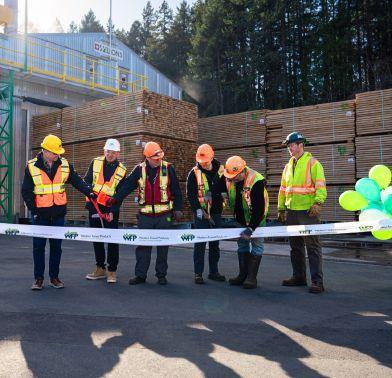
Western Forest Products (WFP) has completed the installation of a continuous dry kiln at its Saltair sawmill. The $12 million investment increases lumber drying capacity and reduces energy consumption. The new kiln adds to the three existing kilns on site for drying lumber.
The Saltair sawmill is the largest single-line sawmill on the coast of B.C. With plans for two more kilns and an additional $35 million investment, WFP aims to enhance its transition to higher value products. The additional kilns, each with an annual capacity of 70 million board feet, will support increased production for mass timber applications. This initiative is part of Western’s broader strategy to modernize its B.C. Coastal operations, with over half a billion dollars invested in the past decade. These upgrades sustain 3,500 jobs and support communities across the province.
Quebec launches $89.3M fund for northern projects
Quebec has announced a major initiative to boost development in the province’s northern territories. With a substantial $89.3 million fund, organizations and businesses are invited to submit project proposals aimed at fostering sustainability and prosperity north of the 49th parallel. Applications are now open and details can be found on the Quebec government website.
B.C. halts proposed Land Act amendments
In a decisive move, B.C. Minister of Water, Land and Resource Stewardship Nathan Cullen has announced the suspension of proposed amendments to the Land Act.
In a statement, Cullen said his decision comes after a thorough consultation process involving more than 650 representatives from various stakeholder groups encompassing industries ranging from mining, forestry, oil and gas, clean energy, to recreational sectors across B.C.
He clarified that the proposed amendments would not impact existing tenures, renewals, private properties, or access to Crown land.
Ribbon-cutting to celebrate kiln upgrade completion. Photo courtesy WFP.
P.E.I. Forestry Commission launches consultation
In a bid to chart a course for the future of forestry on Prince Edward Island, the Forestry Commission has rolled out a comprehensive consultation initiative, calling upon Islanders to share their insights and concerns.
With the release of Towards A New Forest Policy, a discussion paper dissecting 13 pivotal forestry issues, the commission aims to ignite a robust dialogue and gather crucial feedback from the community through a newly unveiled survey.
Kruger to sell green energy, diversify production with NL
Kruger’s Corner Brook Pulp and Paper (CBPP) has announced that, under an agreement with the Government of Newfoundland and Labrador, it will sell excess green energy from its Deer Lake Power assets to Newfoundland and Labrador Hydro.
A Kruger dedicated task force will work to identify viable projects to diversify CBPP’s production in the field of wood-based bioproducts to make operations more sustainable.
Tel: 416-510-5113
Email: apotal@annexbusinessmedia.com
Mail: 111 Gordon Baker Rd., Suite 400, Toronto, ON M2H 3R1
EDITOR - Jennifer Ellson (438) 483-7451 jellson@annexbusinessmedia.com
GROUP PUBLISHER - Anne Beswick (416)510-5248 • Mobile: (416) 277-8428 abeswick@annexbusinessmedia.com
WESTERN SALES Tim Shaddick 1660 West 75th Ave Vancouver, B.C. V6P 6G2 Ph: (604) 264-1158
Kevin Cook lordkevincook@gmail.com Ph: (604) 619-1777
COO - Scott Jamieson sjamieson@annexbusinessmedia.com
PUBLICATION MAIL AGREEMENT #40065710 RETURN UNDELIVERABLE CANADIAN
FIRST NATIONS TAKE THE LEAD
Insights from B.C. delegation’s Japan mission
Forestry, by its very nature, is intimately interconnected with the land and its custodians – the First Nations peoples whose stewardship spans generations. For far too long, Indigenous voices have not been at the forefront in discussions concerning the management and utilization of forest resources. In recent years, however, the forestry sector has witnessed a significant shift toward inclusivity and recognition of the Indigenous voice
to help shape its future.
This transition was highlighted by the participation of First Nations in the delegation from B.C., including members from the BC First Nations Forestry Council (BCFNFC), affirming the essential role of First Nations in shaping the future of forestry, not only in B.C., but on a global scale.
Tokyo was the centre point for discussions surrounding the future of forestry from Dec. 10-14,
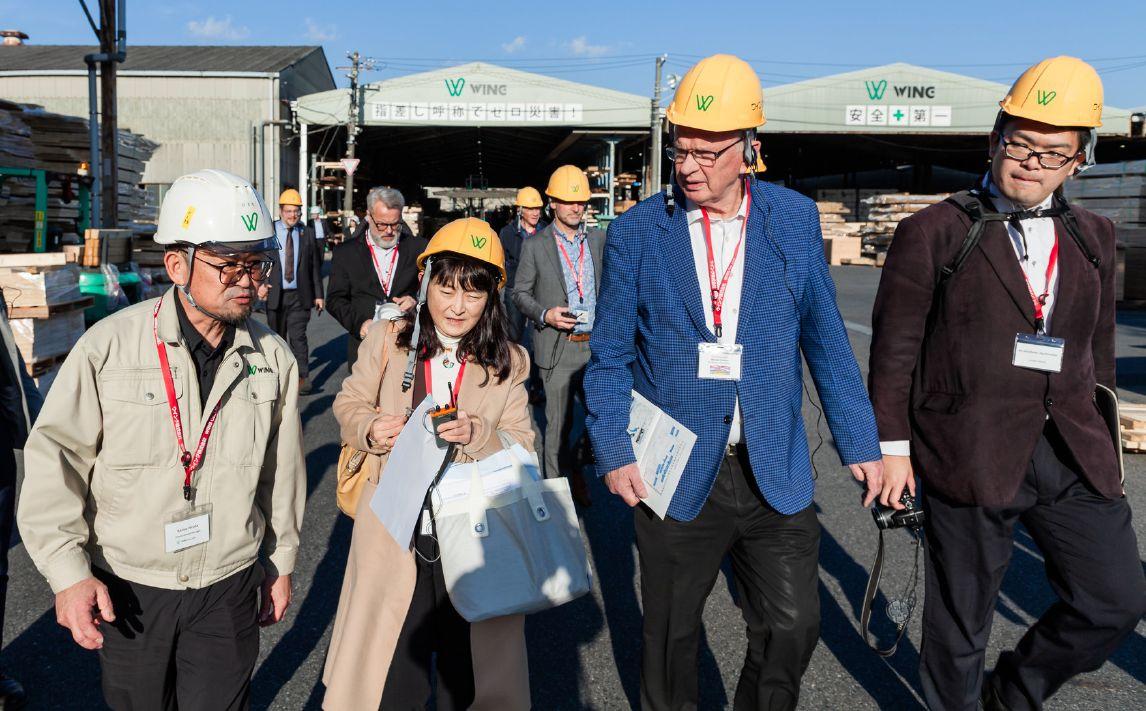
Bruce Ralston Minister of Forests (in blue) tour Wing Shiroi 2x4 Panel Plant in Shiroi City, Japan. Photo courtesy Ministry of Forests.
2023, marking the 100th anniversary of timber trade between Canada and Japan. The mission extended beyond commemoration with an aim to bolster ongoing Japan program initiatives geared toward exploring new market opportunities, fostering engagement with the Japanese delegation and government officials to advocate for increased wood utilization and reaffirm trade partnerships. The mission highlighted the dynamic evolution of forestry practices and critical importance of integrating Indigenous wisdom, culture, and expertise into decision-making frameworks.
BCFNFC CEO Lennard Joe noted, “First Nations people are no longer bystanders; we are emerging as leaders in the global conversation on forestry and reconciliation. As we step into the room, we carry with us the weight of responsibility and the power to shape a more sustainable future for our generations.”
Japan is the world’s third-largest economy and a vital economic partner for Canada. Particularly in the forestry sector, Japan is an important market, utilizing substantial volumes of structural lumber and high-value wood products for construction purposes. Japan ranks as B.C.’s second-largest export market for lumber, offering lucrative profit margins across various wood product categories. In 2022 alone, B.C. softwood exports to Japan amounted to one million cubic metres, valued at $741 million.
“The Japan mission was definitely a great opportunity for the Indigenous people of B.C. to share with the Japanese industry why forestry is so important to First Nations peoples: that our DNA is in every piece of wood that they receive. It is a part of us, our heritage, and our history,” said Joe.
BCFNFC directors Dan Macmaster and Mike Kelly represented the organization and the more than 200 First Nations communities in B.C. Presentations and discussions were led by a panel including Macmaster, Steven Hofer, president and CEO of Western Forest Products, and Chief Councillor John Jack of Huu-ay-aht First Nations. They delved into the details of shared stewardship models and showcased examples of successful partnerships between First Nations and industry stakeholders.
“Our objective was to showcase First Nations’ involvement in forestry to the Japanese, emphasizing that this involvement doesn’t hinder progress but rather enhances the consistent and reliable flow of wood fibre, which is good for everyone. While negative news about our forestry sector can often dominate headlines globally, oftentimes people don’t see how resilient B.C.’s forestry sector is,” said Macmaster. “While normally my role is on the ground working with our forestry crews,
participating in this opportunity and sharing all the innovative and collaborative things happening in the forest industry was truly rewarding. And despite the diverse backgrounds of the presenters, we shared a unified message: let’s continue building partnerships and prioritizing quality lumber that meets Japan’s high standards.”
Macmaster shared the work undertaken by the Osoyoos Indian Band and highlighted significant advancements in partnerships between First Nations, government, and forest companies. These collaborations are strengthening and enabling the co-management of forests, enhancing access to fibre for sawmills, bolstering long-term resilience against wildfires and insect epidemics, and fostering sustainable land management practices. With 204 bands in B.C. alone, Macmaster noted that while the BCFNFC doesn’t speak for each one individually, it ensures their voices are heard and reflected in policies and economic processes.
“It’s vital for the Japanese to understand the positive role First Nations play in B.C.’s forestry landscape. And while engaging with different cultures can be a new experience, I was pleasantly surprised by the variety of interesting questions from the Japanese delegation. Their receptiveness to our presentations and their comments on Canada’s reliability left us relieved and affirmed,” said Macmaster.
“Through the inclusion of First Nations in this mission, the B.C. government and industry alike recognize the importance of First Nations involvement in forestry. Moving forward, I hope to see First Nations representation in every mission, as their inclusion is not only beneficial but necessary.”
Kelly reflected on the experience and emphasized the vital role of such opportunities to
“THE JAPAN MISSION WAS NOT JUST ABOUT SHOWCASING OUR WOOD PRODUCTS, IT WAS ABOUT SHARING OUR VALUES.”
(L-R) Harlen Schillinger, First Nations Centre of Excellence; Lynda Price, chief of Ulkatcho First Nation; Dan Macmaster, BCFNFC; John Jack, Huu-ay-aht First Nation.
Photo: Katie Robertson.
amplify Indigenous voices and advocate for sustainable forestry practices. He highlighted the parallel between the Japanese demand for high-quality wood in their building materials and the longstanding principles of First Nations communities in B.C., emphasizing sustainability, quality, and respect. He underscored the alignment between the work ethic of the Japanese and the values upheld by First Nations, making the collaboration, in his mind, a natural fit.
“The Japan mission was not just about showcasing our wood products; it was about sharing our values,” Kelly remarked. “Just as the Japanese demand high-quality lumber and wood products through sustainable means, so do First Nations. It was an honour to be a part of this delegation, representing First Nations in B.C. and living out this new future where Indigenous voices are not only heard but integral to shaping forestry practices.”
The BCFNFC believes the Japan mission must serve as a catalyst for broader systemic change. First Nations are finally in the room, at the table, a part of the conversations with the opportunity to help carry the responsibility of taking action on climate change and doing the work with a generational mindset. Having First Nations involved in the local and international conversations to help inform governance structures and policy frameworks is essential to ensure sustained progress and meaningful impact.
Reiterating the importance of the mission to Japan as a first step toward the inclusion of Indigenous voices in forestry, Joe explained, “Inclusion isn’t just about being present; it’s about actively participating and taking on the responsibility that comes with it. As we engage with global partners like Japan, we bring our insights, our knowledge, and our ancestral connection to the forests. Together, we can build relationships grounded in respect and reciprocity, forging a path toward mutual prosperity and environmental stewardship.”
3.jpg: Dan Macmaster at the Obayashi Gumi Port Plus 11-storey mass timber building, learning about cross-laminated timber and the regulations in Japan. Photo: Katie Robertson.
Increased horsepower and hydraulic flow allow greater efficiency and speed when loading trucks. More
Operating weight without attachments under 90,000 lbs eases transport and speeds machine mobility.
More Support
Backed by Brandt – the besttrained support team around, available 24/7/365 so you can keep working.
WOODPRODUCTS CANADIAN
NEW LIFE FOR DEADWOOD
BY CATHERINE NUTTING AND QINGCEN CAI
The Deadwood project in B.C. is an exciting, innovative manufacturing venture that entails a business partnership between Nak’azdli Development Corp. and Deadwood Innovations, aiming to revolutionize the forest sector.
They have developed an innovative process that converts low-grade timber and low-value lumber into a wood product that can be used as a substitute for lumber and timber in various applications.
The Deadwood project uses a hydro-thermal chemi-mechanical process that imparts strength and stability into the fibre. Engineering work is currently underway to scale-up from a pilot plant
to a 30,000 cubic metres per year commercial operation, in order to demonstrate the feasibility and commercial potential of this process. The pilot plant equipment was manufactured in Fort St. James, B.C.
With support from programs such as the B.C. Ministry of Forest’s Indigenous Forest Bioeconomy Program and the federal government’s Investments in Forest Industry Transformation program, this project is aligned with many of the priorities of different levels of government: supporting Indigenous leadership in the forest sector, reducing carbon emissions through its sequestration in wood products, and moving from high-volume to high-value.
Owen Miller, left, president of Deadwood Innovations and John-Paul (JP) Wenger, CEO of Nak’azdli Development Corp. Photos courtesy Deadwood Innovations
THE CHALLENGE
The forest sector faces challenges with efficiently utilizing lowgrade timber and yielding higher prices from lumber due to natural disturbances in our forests. Extending the useful life of wood products contributes to a circular economy. Additionally, the project aims to mitigate climate change by storing carbon that would otherwise be released through burning or short-lived paper products, and by utilizing low-value logs and beetle-killed or fire-damaged trees.
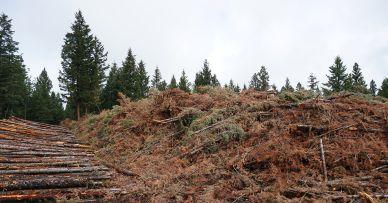
The targeted log feedstock is not suitable for existing sawmilling technologies, and is currently being used for pulp or pellets, or is left in slash piles. Traditional lumber production heavily relies on high-grade logs and sawlogs, limiting the utilization of low-grade logs, deciduous logs, and broken lumber. Additionally, the natural variability and defects in lumber can present challenges in terms of consistency and quality.
The Deadwood technology provides a way to turn large amounts of underutilized fibre into saleable products.
“The technology presents an additional supply-chain stream for the current low-end off-spec fibre market,” says Owen Miller, Deadwood Innovations president.
T HE PROCESS
B.C. supported Nak’azdli Whut’en First Nation’s priorities in the natural resource sector through a multi-phased bioeconomy project. This entailed supporting a partnership between Nak’azdli Development Corp. and Deadwood Innovations to commercialize this novel forest bioproduct.
Deadwood’s proprietary technology converts low-grade timber into densified engineered cants, and low-value lumber into densified engineered lumber that substitutes for traditional lumber. The engineered wood products have properties comparable to hardwoods. The advantages of their product include the ability to use various feedstock sources, producing consistently stable, strong products, promoting circular economy practices, and storing carbon.
“The technology unlocks value that has always been present, but the current commercial suite of technologies is not able to do so,” Miller says.
The system manufactures engineered wood products using a feedstock of coniferous timber, damaged by wildfire or beetle infestation, as well as underutilized deciduous species. The process starts with dead timber that has dried in the field, or deciduous stands that are not economical for conventional lumber production at current standards due to pocket rot in the tree.
Logs are scanned and sorted by species, moisture content, and condition, and are then transferred to infeed. After debarking, the logs are densified and stabilized in a unique process that leverages and combines engineering principles from various manufacturing processes. The lumber upgrading process is similar but does not require debarking.
The resulting manufactured wood can range in density from that of a soft wood to that of a hardwood simply through the pressing mechanism and lignocellulose reactions, not through the addition of resins. As the Deadwood partners explain, “A wide variety of dimensions and densities are attainable using our unique pressing process.”
The upgrading process that transforms low-quality fibre into a novel wood product has evolved through research and development and has been optimized for accelerated commercialization. Patents are pending for the inventions of the system.
The current pilot phase is being carried out on the Nak’azdli Reserve and will be completed this Spring.
In addition to the current engineering phase of the project, as part of its carbon offset program, Deadwood is also gathering data, quantifying environmental benefits, and estimating sequestered emissions.
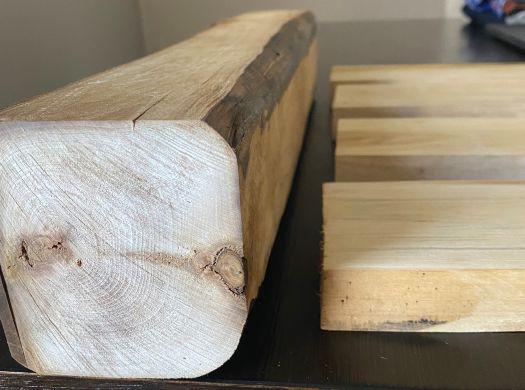
Densified aspen cant end view, and densified aspen lumber
THE PARTNERSHIP
At the heart of the venture is the vibrant partnership between Nak’azdli Development Corp., the economic arm of the Nak’azdli Whut’en, and Deadwood Innovations. Nak’azdli has a 20 per cent equity in the intellectual property company, and 51 per cent equity in the first commercial operating company. Nak’azdli members have board positions for governance representation, and defined rights for facility management and priority staffing.
The pilot plant is located on the former Tl’oh Forest Products site in Nak’azdli. The first commercial facility is currently being developed at the same location.
The project’s success depends upon the partnership that is at its core. The co-founders place great value on taking time to build up understanding and trust. In 2019, Deadwood Innovations was a new venture that had created preliminary samples.
Miller talks about how groundbreaking it was for Nak’azdli to support a forestry-technology start-up, and about how crucial that was to the project.
“Nak’azdli leadership and its members deserve recognition for their willingness to
accept and manage risks in efforts to support a start-up in an emerging technological risk-averse sector. Piloting and research and development in resource manufacturing is very capital-intensive, and it can be challenging to determine product-market fit. Nak’azdli’s support demonstrates actionable reconciliation and leadership,” he says.
Miller advises that a partnership can go far when it is anchored in both trust and aligned intentions. Success comes through a shared focus on a co-developed strategy. He believes in the importance of engaging early, often, and transparently, with a development corporation board, and chief and council, in a solution-focused attitude.
“Be honest about risks, challenges, and successes,” he says.
NEXT STEPS
The expected outcomes include the production of consistent, stronger, and stabilized engineered wood products, the promotion of a circular economy by extending product lifespan, and the storage of carbon within long-lived timber products. Furthermore, the project aligns with provincial priorities by supporting Indigenous
Combustible Dust Specialists
partnership and economic development, advancing the bioeconomy pathway, and fostering forest industry diversification through value-added products.
Deadwood plans to develop a feedstock in the form of a blank or billet, suitable for a line of structural, industrial, decorative, and furniture products. A customer feedback and acquisition process has begun.
Deadwood Innovations is currently developing product specifications through collaborative testing at the University of Northern British Columbia’s Wood Innovation Research Lab. As the company explains, “The initial marketing strategy is to develop a line of products and get them into the hands of customers prior to commercial sanction.”
Initial target segments include using upgraded deciduous and coniferous lumber and timbers for building components such as nail- or dowel-laminated timber panels, decorative facades, and high-end furniture. Post-commercialization, industrial segments such as rail ties, and certified structural components, such as glue-laminated beams, are growth opportunities.
The carbon storage will translate into additional incentives. There is an urgent need to reduce carbon emissions and to promote circular economy practices in the community and in the province. The target log feedstock is not suitable for existing sawmilling technologies, and is currently being used for pulping or pellets.
“Deadwood is introducing a margin-added carbon storage technology that introduces an alternative to large-scale fiber combustion emissions intensive processes,” Miller explains.
Commercialization stands to provide diverse employment. The technology requires primarily in-house operations and training, and can be retrofitted into existing operating or shuttered sawmills.
Nak’azdli-Whut’en Chief Aileen Prince sums up the widespread enthusiasm for the project. “Successful commercialization of this project will stabilize and strengthen our economy, community, and environmental stewardship,” she says.
Catherine Nutting is an Indigenous bioeconomy policy analyst and Qingcen Cai is the Indigenous bioeconomy program lead with the Innovation, Bioeconomy and Indigenous Opportunities Branch of the B.C. Ministry of Forests.
Reliability that counts
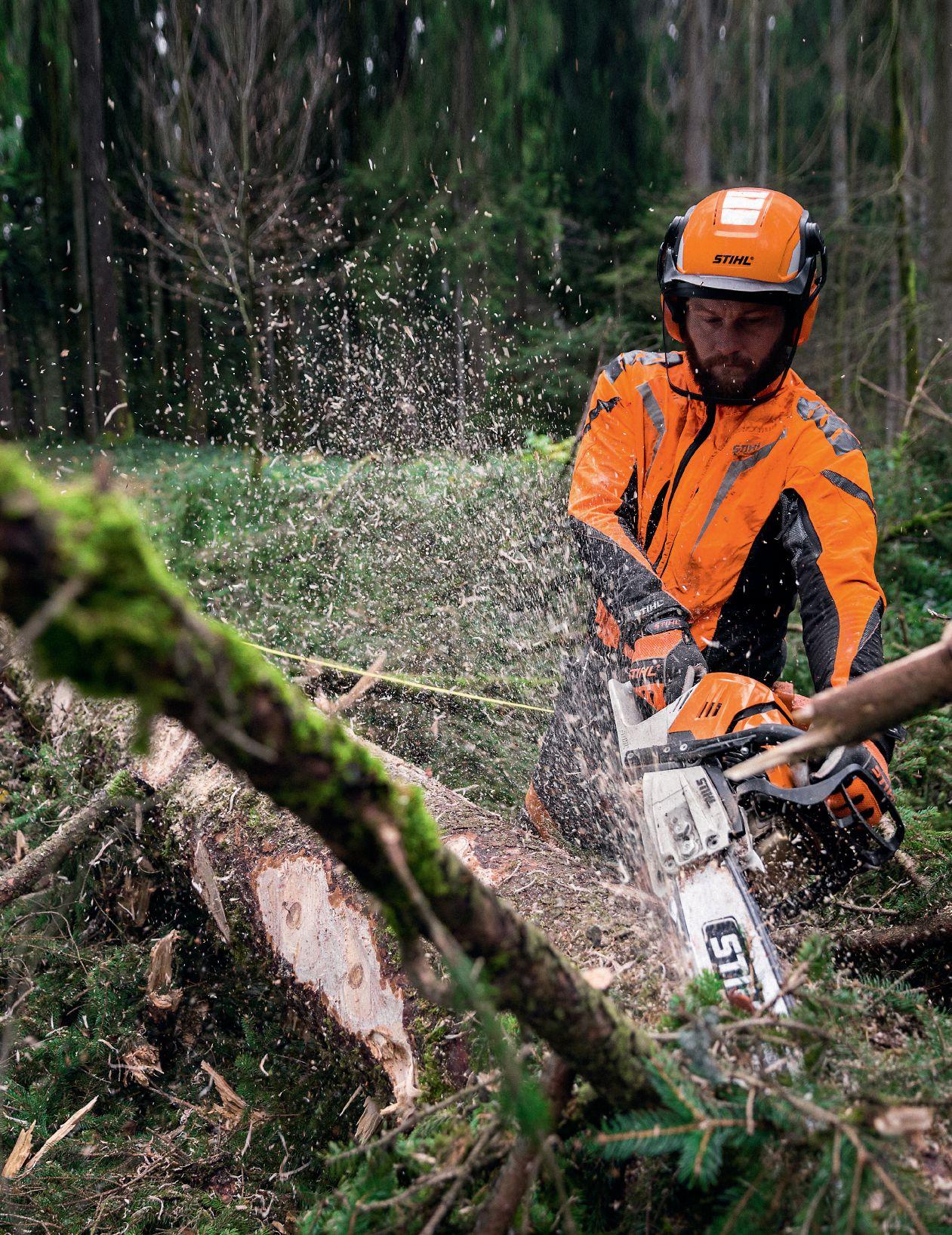
MS 500i GAS CHAIN SAW
79.2 cc • 5.0 kW • 13.7 lb ①
The MS 500i is the first chain saw in the world to feature electronically controlled fuel injection, making it a true innovation. When it comes to professionally harvesting large trees, this high-torque machine cuts through wood with ease. Rapid acceleration and dynamic pivot behaviour mean that the MS 500i is perfect not only for felling and cutting into lengths, but also limbing. With sensor-controlled fuel metering, it is an excellent starter with outstanding engine performance, regardless of the altitude and ambient temperature. There’s also no starting lever, which makes starting very easy under all conditions. Its engine technology, which is revolutionary for chain saws, and resulting intelligent lightweight construction results in the best power-to-weight ratio on the market.
⬤ Optimum engine performance from the first pull under all conditions
⬤ Injection technology – built-in sensors measure air pressure and internal/external temperature that ultimately passes information to the control unit, which determines the optimum fuel quantity and ignition timing
⬤ Rapid acceleration in an unbelievable 0.25 seconds, enabling this high-torque machine to provide power immediately
⬤ Captive nuts are connected to the lightweight sprocket cover so they don’t get lost in the process of replacing the cutting attachments
Note: Wrap handle version is also available.
① Weight with powerhead only.
Scan code for more product information or visit www.stihl.ca
WOODPRODUCTS
BETTER PERFORMING SAW LINE
BY GUILLAUME ROY TRANSLATED BY JEAN-FRANCOIS GINGRAS
Nestled in the heart of Quebec, Groupe Martel stands as a beacon of tradition and innovation, preserving the rich legacy of a family enterprise while simultaneously embarking on a transformative journey towards modernization.
Seamlessly blending age-old craftsmanship with cutting-edge technology, Martel Sawmill epitomizes the harmonious coexistence of tradition and innovation in the timber industry.
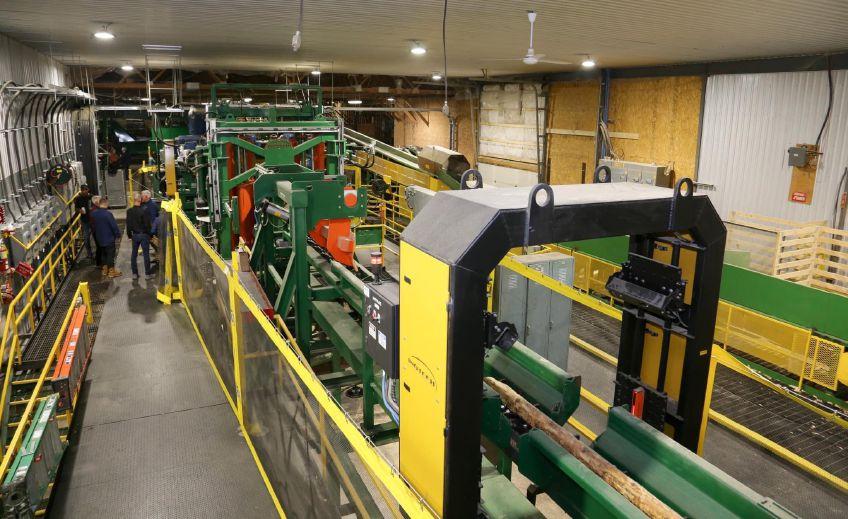
With the installation of a new Inotech saw line during the summer of 2023, the $10-million modernization project at Groupe Martel’s sawmill in Alma, Quebec, is now completed.
“We wanted to speed up the line while maximizing our lumber recovery,” explains Groupe Martel president Raynald Martel.
“With the new saw line, we generate less chips
The sawmill processes more than 80,000 cubic meters of wood per year, with a guaranteed supply of more than 60,000 cubic meters annually, supplemented by logs purchased through auctions.
and produce a higher yield of finished products,” he explains.
The impact of the new line is palpable, Raynald says, and after a few months of operation, the result just keeps getting better.
“We have met our targets and stayed within budget,” boasts Raynald. With this new line, the mill is not only enhancing its productivity, but also ensuring that every piece of timber is utilized. Before the new saw line, the facility was producing around 200 board feet per cubic metre of lumber. With the new installation, the sawmill now yields 260 board feet per cubic metre.
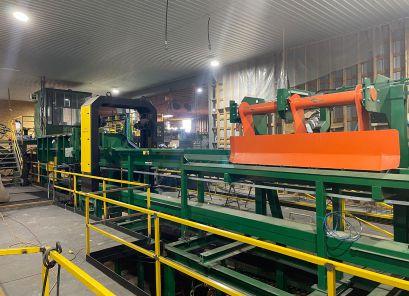
Designed by Inotech, Groupe Martel has invested over $5 million in this new saw line that incorporates an Autolog (Carbotech) optimizer.
“It’s a four-head canter line with a log positioning system that provides an outstanding cant surface,” explains Michael Dufour, sales manager for Inotech, adding that depending on what the client needs, it can be met by creating custom-designed solutions.
“Even if it doesn’t exist, we’re ready to invent it.”
PAYING OFF THE INVESTMENTS
Because of the rock-bottom lumber prices, it has been challenging to recuperate the investment as was initially planned.
“The prices are currently so low that we prefer to keep more finished products in inventory and hope to sell them at a later date when prices have recovered,” states Raynald.
With certain lumber dimensions, the prices are acceptable, but for 2x3 and 2x4 studs, it’s useless to sell them at a loss, he says.
However, the experienced sawmiller is not losing any sleep because he knows that prices will eventually come back to profitable levels as they have regularly done over the past decades.
“Lumber prices swing up or down like a roller coaster – nobody knows exactly when, but prices will surely come back up at some point”.
DEVELOPING VALUE-ADDED NICHE MARKETS
The family-run sawmill was established in 1954 and over time, the business has developed different niche products.
“Creating value-added is not a new concept at Groupe Martel because it’s actually part of our DNA,” says Raynald.
The venture into value-added started in the 1980’s with the ac-
quisition of a beam and roof truss factory located in Saint-Coeurde-Marie.
“This expansion allowed us to generate more value from our resource,” he explains, adding that the production facility was moved to Alma about 10 years later.
Over time, the group also diversified its business into retail with the purchase of two hardware and renovation stores, BMR and Potvin & Bouchard, in Alma.
“The retail stores enable us to sell our own products,” he says.
“We now generate the logs in the forest, process them into
SIMPLY BETTER
Groupe Martel president Raynald Martel.
Over $5 million has been invested in the new saw line.
lumber in our sawmill, then into structural products in our factory, which we sell in our retail stores,” explains Pierre-Luc Martel, general manager for the group.
“It’s a great example of integration.”
Yet, diversification does not necessarily improve the sawmill’s financial performance.
“We supply lumber to our subsidiaries, but they have to pay market prices for them because we can’t penalize them,” says Raynald.
However, even if the sawmill makes less profit, the subsidiaries may be performing better. Because of this, the diversification has resulted in a financially stronger Groupe Martel overall.
In fact, the market demand for their products is strongly growing. In the last two years, sales of prefabricated walls have increased by more than
“With
30 per cent, and Groupe Martel is banking on growth to continue the value-added strategy that the company is trying to apply to all of its products.
“We are manufacturing house components that can be
assembled like LEGO kits, says Raynald.
“In the context of the housing shortage, we can produce even more of these.”
A RHYTHM OF ITS OWN
The financial structure of the company enables the sawmill to produce at its own pace.
“The sawmill shuts down for two months every winter,” explains Raynald.
Despite the shutdown, the sawmill’s production capacity greatly exceeds the wood supply annual allocations of 60,600 cubic metres, supplemented by log volumes obtained through the auctioning process of the wood marketing board (Bureau de mise en marché des bois), for a total of 80,000 cubic metres annually.
“We could produce more by running a night shift,” says the company president.
Lumber drying and planing are done through sub-contracting companies and business partners, including Scierie Lac St-Jean, Scierie Girard, BDF Industriel, and Boismax
Over $10 million have been invested in the sawmill since 2018. Of this total, $5.8 million were received as loans from Investissement Québec in support of these projects.
In 2020, an optimizer, a bin sorter and an automated lumber stacker were added to the mill. With the installation of the new saw line in 2023, Raynald feels that the sawmill is now well positioned for many years, despite anticipated reductions in log volume allocations related to woodland caribou protection and the addition of new protected areas.
“While there have been challenges all along, I see a bright future both for the sawmill and for the entire Groupe Martel.”
says Raynald.
SPECIAL saw filing section
Photo credit:
▪ CIRCULAR SAW GUIDES
▪ BAND SAW GUIDES
▪ HAMMERS
▪ ARBORS
▪ SLEEVES
▪ 3-PHASE MOTORS
▪ SERVO MOTORS
▪ PLCs
▪ HMIs
Saw Grinding
Saw Tipping
Tensioning and Leveling
Knife and Surface Grinding
Saw Guides
Saw Guide Design and Engineering
Saw Working Tools
Consumables and Accessories
▪ DEBARKER PARTS
▪ CHAINS AND ROLLERS
▪ CHIPPER ANVILS
▪ J-HOOKS
▪ PULLEYS
▪ SHEAVES
▪ SHREDDER TIPS
▪ TIPS
▪ SAW PLATES
▪ PRESS DOWN ROLLS
▪ PINEAPPLE ROLLS
▪ KNURLED ROLLS
▪ KILN WHEELS
▪ KILN TRUCKS
▪ MILL CHAIN
▪ DOUBLE END CHAIN
▪ DRAG CHAIN
▪ SHARP CHAIN
WOODPRODUCTS
SAW FILERS’ CONVENTION
Filing experts are set to converge once again in Kamloops, B.C., for the highly anticipated 2024 BC Saw Filers Convention. Scheduled for May 24th–25th, this event promises to be a gathering of industry leaders, suppliers, and experts, offering a platform for networking, learning, and exploring the latest advancements in sawmilling and filing room technology.
Building upon the success of previous conventions, including the resounding triumph of the 2023 show, anticipation is high for another remarkable event. Last year’s convention saw an impressive turnout, with vendors, filers, and industry veterans
coming together to make it an unforgettable experience. Despite challenges posed by market conditions, the unwavering support from the community, including numerous sawmills, contributed to the event’s success.
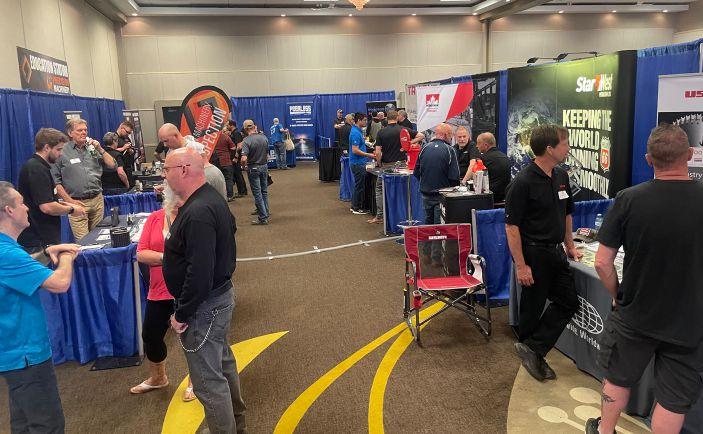
One of the highlights of the convention is the informative presentations held in the mornings. Attendees can expect to gain valuable insights into emerging trends, technological advancements, and best practices shaping the forestry industry. With a tradition of excellence and a commitment to the strength of its membership, the BC Saw Filers Association is dedicated to delivering yet another exceptional event.
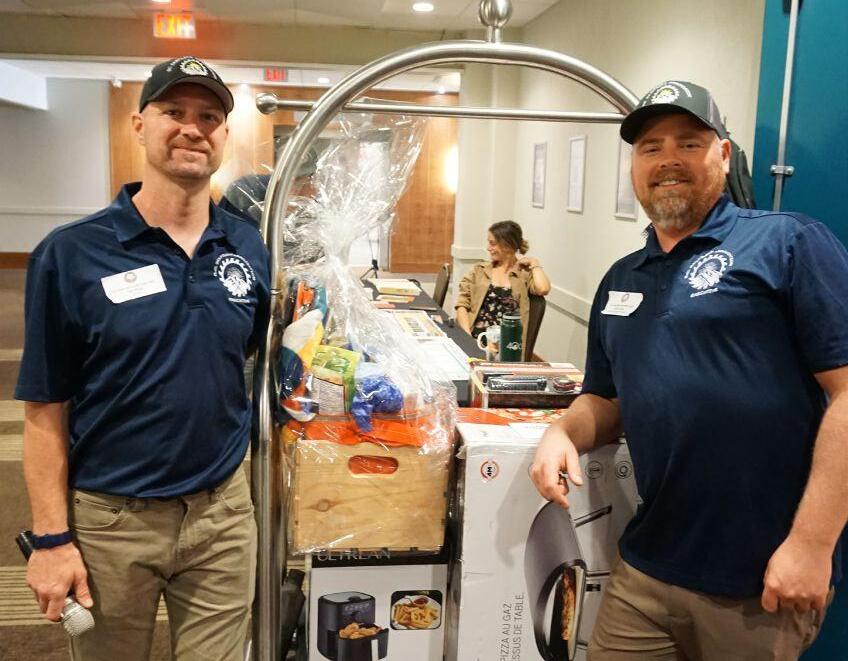
(L-R): Sean Wright and Scott Courtney giving away donated door prizes. Photos: Annex Business Media.
BY STAFF REPORT
Event organizer Scott Courtney has confirmed that this year’s convention will feature approximately 30 exhibitors, with all booths expected to be sold out once again.
“The industry as a whole has been constricting with sawmills closing and curtailing across the province. Still mills are struggling to keep a full complement of filers, which has created more of a demand for new innovative ways to fill the gaps,” Courtney tells CFI.
One of the prevailing challenges facing the forestry industry is the shortage of skilled filers, amidst said sawmill closures and cutbacks. However, this adversity has sparked a wave of innovation, with robotics and automation emerging as key solutions to fill the gaps. The convention presents an unparalleled opportunity for attendees to witness firsthand the latest advancements in sawmilling technology and
filing room automation.
“Robotics and automation are becoming more common in the remaining filing rooms to aid and fill the gaps. Come down to the convention to see the latest in sawmilling and filing room technology as well as network with the industries’ top suppliers and service providers,” adds Courtney.
While a finalized agenda is still in the works, attendees can look forward to speakers taking the stage from Friday morning until noon. Following the presentations, the trade show will be open until 5 p.m., offering attendees ample opportunities to explore the latest products and services. A sumptuous buffet dinner will be served at 6 p.m., providing a perfect opportunity for networking and camaraderie. The evening’s entertainment will feature the return of comedian Howie Miller, followed by live music to keep the festivities alive.
Saturday, May 25th, will see the convention resume at 9 a.m. with more insightful presentations from industry experts. Burtons Mill Solutions has generously sponsored a lunch at 11 a.m., allowing attendees to refuel and recharge for the remainder of the day. The trade show will once again be open until 5 p.m., giving attendees ample time to connect with suppliers and explore innovative solutions.
In addition to exploring cutting-edge technology, attendees can expect to network with the industry’s top suppliers and service providers. Door prizes will be up for grabs, with tickets distributed at registration. Be sure to hold on to your tickets, as prizes will be drawn both days, adding an extra element of excitement to the event.
As the forestry industry continues to evolve, the 2024 BC Saw Filers Convention stands as a beacon of innovation, collaboration, and resilience. Whether you’re a seasoned industry professional or a newcomer looking to stay ahead of the curve, mark your calendars for May 24th–25th and join us in Kamloops for an unforgettable experience at the forefront of forestry excellence.
FILE WEEK 2024
CFI is excited to be attending the 2024 BCSFA convention and will be sharing live updates and product news from the show floor as part of our annual File Week coverage. Follow along on our website and on social #FileWeek for all the cutting-edge action.
• 48” diameter Shingle Saws
• Jointer Saws
• Inserted Tooth Cut-Off Saws to 96” diameter
• Jumbo “R” and Gullet Style Carbide
• Custom surface grinding
• Smooth Trimmer Saws hollow ground to 60” diameter
• Solid Tooth Cut-Off
• Hammering, repairs and sharpening
• Shake Band Saws
The trade show will showcase the latest products and services.
WOODPRODUCTS
DON’T SHOOT ME, I’M ONLY THE SAWFILER
PAULsmith
Paul Smith is a saw filing consultant and founder of Smith Sawmill Service, now part of BID Group. You can reach him at paul.smith@bidgroup.ca.
I imagine that as sawfilers, we have all experienced that time when our filing room doors burst open and in comes a person yelling, “What is going on with your saws?”
As the filer, we are taken by surprise, look around, gather our thoughts, and ask, “What exactly are you talking about?”
Of course all of us in the filing room know that when there’s a problem, the first place the mill personnel points to is the saws.
The seasoned, experienced filer quickly tries to calm everyone down and starts the analysis of the problem and how dire it may be.
By simply listening to see if saws are still “in the cut”, the filer determines if the mill is running. If it is, he sighs a little relief, but if it’s not running, he understands that every minute is money!
The first step of solving any problem is to gather information/facts. Next, determine where to look for the problem. And of course, most importantly, help resolve the problem.
Is the problem bad lumber? Filers, grab your tools and take a close look at those saws. As professionals, we want to determine exactly what the saw is doing in the cut and if every board is affected.
Knowing when the saws were taken out and how long they’ve been running lets one decide if the problem occurred on startup, or if the problem started after the saws had run for a while. This information can help determine whether the issue was from any recent saw repair.
If the saw ran the first few cants without any issue, then this should eliminate leveling or tensioning errors.
On the other hand, if the issue is wavy or wedge lumber on start-up, then there could be an issue with saw tension.
At this point, the mill is going to initiate a saw change. Once the new saws are on, the question will be, “Is our problem resolved?”
If it is, the saws now in the hands of the filer are going to be closely inspected.
So, what if the lumber is straight as a board but
doesn’t pass a quality check?
A quick look should reveal if any of the saws have met their number one culprit: metal.
Lost teeth, bent shoulders, and such pretty much mark their territory. If the teeth are the problem, it’s a good idea to determine if metal or foreign material may have been hit. If so, try to locate the boards that were the issue.
Planer operators will not want these boards sent through their machines. If it’s determined that nothing was hit, then the filer would inspect the tipping process in the filing room and try and determine where the problem exists – annealing, unclean tools or saws, improper tipping technique should all be considered.
“IT MUST BE DETERMINED THAT GUIDES ARE NEITHER TOO TIGHT NOR TOO LOOSE.”
To eliminate as many issues as possible, I suggest when changing the saws, go ahead and change the guides as well. Guide wear or inconsistencies tell a great deal about various issues such as lubrication or saw plate issues.
I want to remind those of you out there encountering these issues when gathering information, include maintenance, filers, and operators. Each department may have a different perspective but it’s better to have information and not need it, than to need it and not have it.
A thorough check of the saws, guides, lubrication system, RPMs, alignment, feed speeds are just a few of the elements that factor into good lumber being produced.
Before startup with change of saws and guides it should be determined that the lubrication system is working properly.
Consult with the head sawfiler; he can inspect saws and guides as they are installed to facilitate a successful startup. It must be determined that guides are neither too tight nor too loose.
At this time, I would also suggest taking a good look at the saws turning full RPMs before a cant is sent through.
Are the saws standing up straight as full RPM is reached, and not waving?
I’m sure I haven’t covered all that could
be wrong with a set of saws, but at this point if you are continuing to have problems, the maintenance crew should be called in to inspect bearings and press rollers.
In one of my filing experiences, we had a mill that always had the end of a 12-foot
cant miscut. The result of course affects the bottom line, when 12-foot boards had to be cut back to 10 foot at the planer.
It was found that the last press roller was not coming off the cant in time and was causing the cant to be pushed over in the cut at the end of cant. Of course, this was an easy fix by resetting the press roller timing.
In my day, it was a good rule that if every saw is acting the same, it’s unlikely for it to be a tension issue.
Today it may be unlikely that every saw will be tensioned the same unless an auto-tensioner is involved.
Poor or miscut lumber is not always the saw’s fault or the sawfiler’s, however, it seems to always be the first place to look at.
It’s my belief that mill personnel come to the filing room first because they know and depend on the experienced sawfiler to be able to help with any issue, and not just a saw problem.
Good sawfilers should always be ready and willing to help with any sawmill problem.
When changing the saws, go ahead and change the guides as well. Photo: todaydesign via Getty Images.
WOODPRODUCTS CANADIAN
SPLITTING HAIRS
He walked into my shop looking angry.
“Are YOU competent?” he demanded.
While it’s not something I’m often accused of, I could tell that was not the answer he was looking for.
“Well sir,” I replied. “If it involves your drivetrain, this shop has a 5-star rating.” It wasn’t a lie either, I’d written the review myself.
“Come look at my truck,” he said, turning and walking out the door.
I scurried after him, a bit worried about what we might have done to cause his abrasiveness.
“Look!” he said, pointing. “I’ve done two alignments and this thing still bounces and shakes all over the road!”
“Ummmmm… It looks like your driver’s side tire is worn down to the wires, and your passenger side is almost flat…”
“So what?” he barked. “The problem is obviously alignment or a worn front end. I’ve been wrenching on stuff for 30 years. I KNOW!”
A guide inspection. Photo courtesy Precision Machinery.
Sigh…
I have similar feelings walking into many sawmills. Management and maintenance pour hours into saws, rolls and other high wear parts. All while ignoring worn or poorly maintained saw guides that are the main support component for accurate, repeatable lumber manufacturing.
Many times, I’ve heard, “We can’t afford to replace these guides right now.”
You can’t afford NOT to. Saw guides are at the heart of lumber production and reliable sawing. They are no different than saws.
Guides are a consumable item, not a capital component.
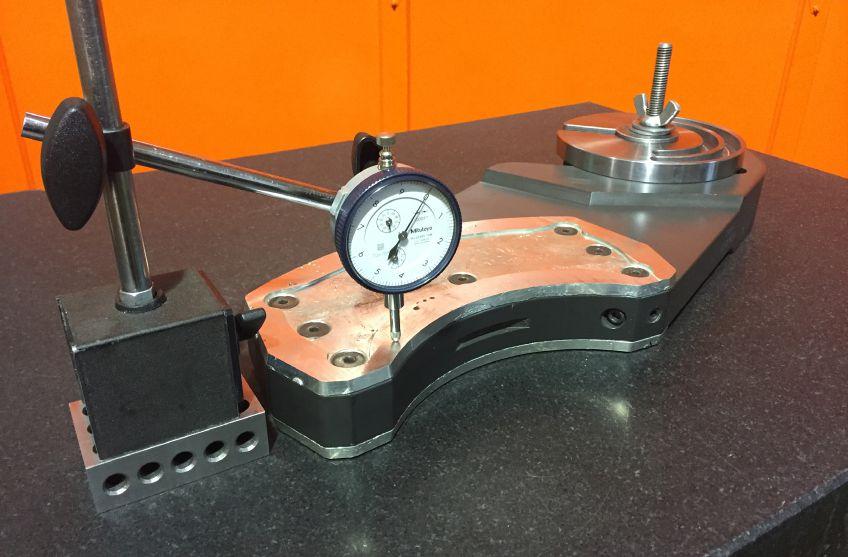
It is easy to overlook guides because of the incredibly small tolerances they must be manufactured and maintained to. It is often impossible to visually see a problem, specialty tools and knowledge are required.
When discussing guides you will hear the term “thou”. Often, we forget how small a “thou” is.
JOSHbergen
Josh Bergen is a certified Red Seal millwright and a founding partner of Precision Machinery. You can reach him at jbergen@pgmr.ca
A “thou” is one-thousandth of an inch. Remember grade school math class? One-thousandth = 0.001-in.
To put that in perspective, a human hair measures around four-thousandth of an inch thick (0.004-in).
Now split that hair into five equal pieces, each piece will be eight 10-thousandth of an inch thick (0.0008”).
That number is the tolerance our tradespeople must work within to maintain proper saw support.
Our lumber mills are running higher feed speeds, thinner saws and more production then ever before.
Additionally, they’re doing it with less manpower. Where we used to need one guide change, we now need three. Where two-thou deviation ran acceptably, saw life is now a problem.
Accuracy matters, and we need to give our tradespeople the proper tools for the job we expect.
If you go to any technical training institute and inform them you need to maintain a half-thou tolerance, they will say you need a temperature-controlled environment, dust control, hair net and white lab coat.
Sawmills are obviously not that type of environment. Even so, there are things we can do to maintain tolerance.
While it’s not easy, the basics are simple:
1. Ensure you have a workspace set up for success. It should be clean and tidy with important tools close at hand. A granite block, micrometer and dial indicator are necessities. These tools should be readily available for use DAILY. If you must dig your granite block out from under other equipment, your guides are not being properly inspected often enough. We go into a lot of shops and often find these basic inspection tools in disrepair or missing. Each year we find an average of two to three inspection blocks that are worn, unknown to the mill. Micrometers are often out of calibration and give false readings. Dial indicators are the wrong graduation, or not present.
2. Hold your vendors accountable. If you ordered saw guides with a guaranteed tolerance, check the product is as promised. Request inspection reports and then check the product matches the reports. If you don’t do a full in-
spection of all parts, spot check a minimum of 30 per cent against reports. If your vendor can’t provide a report, they are not providing a toleranced part.
3. Train your people. In many saw shops, the entry level job is grinding knives and maintaining saw guides. We are handing the highest tolerance part in our sawmill to the least experienced guy in our shop. A few months ago, I asked a young fellow to show me three-thou with his fingers (0.003-in). He held up two fingers about a quarter
inch apart. It wasn’t his fault – he’d never been properly trained. The fault lay with his supervisor and the leadership that allowed the situation to happen. While these basic components may seem like common sense items for any shop, I can tell you from personal experience very few places are doing all three.
A LONG WAY TOGETHER
FORESTLAND
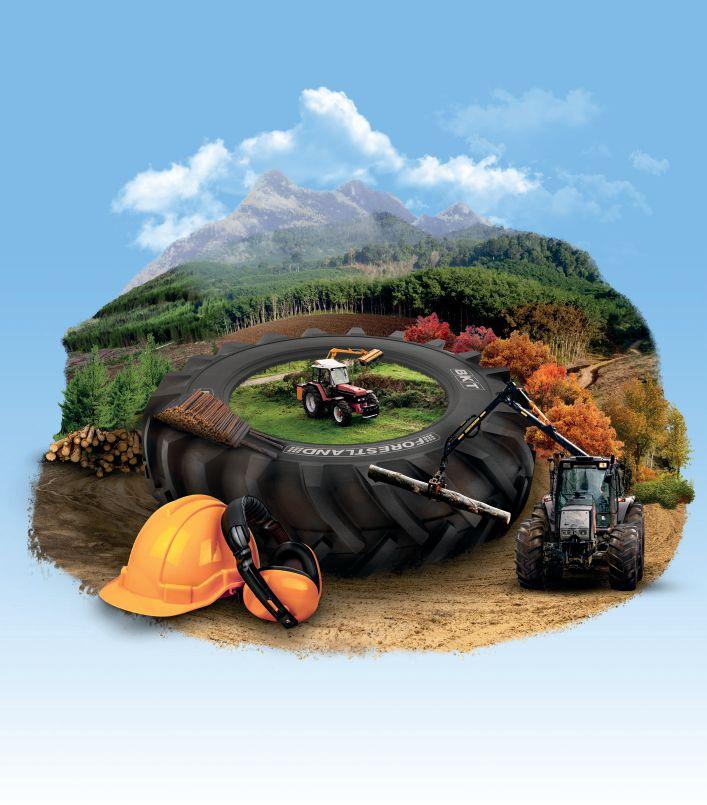
Designed for the most demanding applications, FORESTLAND is BKT’s most recent and innovative bias tire for the agro-forestry sector, but it can also be employed in some agricultural operations such as landscaping and light mulching. Its polyester carcass and specific tread compound make it particularly cut-and-chip resistant, while the robust sidewall ensures a long product life cycle. FORESTLAND’s key features are excellent traction on soft terrain, good grip on any ground thanks to stiff and reinforced tread lugs, a high level of stability thanks to the strong bead construction and top self-cleaning properties. For info: 514 -792-9220
WOODPRODUCTS CANADIAN
PROPER PAIRING
PAULsmith
Paul Smith is a saw filing consultant and founder of Smith Sawmill Service, now part of BID Group. You can reach him at paul.smith@bidgroup.ca.
Sawmills have changed in design over the last 50 years. And now, it seems they are literally changing every few years.
In my early days of sawmilling, the trimmer was a two-saw simple piece of equipment. One stationary saw and one floating saw that would move and cut in two-foot intervals. In those early machines, almost any saw would work. I know this because the saws used in these trimmers were wire-tooth steel saws that were hand-ground with a post grinder and finished to a point with a mill bastard file. The filers were skilled, but hand-grinding isn’t exactly an accurate science.
Trimmers have changed over the years; from the simple two saw bottom arbors where the saws popup, to the same except with multiple saws every two feet. This proved to be a game-changer allowing so much more footage of lumber to get over the trimmers and out of the mill. Higher production came with a few issues though. For one, operators had to deal with the cut-off pieces getting cross ways and stopping the flow of lumber.
The somewhat simple answer was to design a top arbor trimmer. This allowed the trim pieces to simply fall between the chains that pulled the boards through. On paper and in the mill, it did prove to solve most of the problem that the bottom arbors had. The negative hook held the board down and pushed back on the lugs holding the board in place. Many of these machines were installed in sawmills across the country. However, they only performed well using a negative degree hook (sometimes as much as a negative 10-degree) with the saw cutting counterclockwise while the lumber flowed from left to right under the arbor. This design was acceptable in green lumber but could not be used on dry lumber as the negative hook would tear the fiber. This caused the mill to have to use two different brands or makes of trimming machines with different saw specs. And different trim saw specs caused issues when the saws were mixed up and the wrong saw went to the wrong trimmer.
This gets us to the grandest and latest modern trimmer of today. Same configuration, drop saw trimmer but trim saw configuration changes to what is now called a power cut. This consists of
the saw itself turning clockwise when lumber is traveling under the arbor from left to right. As the saw cuts, it forces the lumber up and back against the lugs. Therefore, the trim saw must have a positive 10-degree hook or very close to 10 degrees. In some instances, they are getting by with a positive five-degree or even zero hook, but to work properly and with decreased horsepower, it needs to be a full positive 10-degree hook angle. Even though these machines work great for both green and dry lumber at the sawmill, the planer may choose to order saws with more teeth just to get a smoother end cut.
It’s always been the norm to have more teeth in a trim saw; creating a good, clean end cut and to help keep horsepower low. Trim saws in the past were ground with alternate top bevel (every other tooth had an alternate LH or RH point). With trimmers today being fed so fast, a trim saw could literally require more teeth that would fit in the circumference using the alternate bevel tooth design. Remedy: by using a trim saw with a V top (point on both sides of top), the number of teeth in the saw can be cut down to half of what was needed. Therefore, if you’re using a 160-teeth alternate bevel tooth, this could be cut down to having 80 teeth instead of the full 160 teeth.
You may say pairing trim saws with the proper trimmer is like pairing wine with the right food. Mis-matched, you may be able to get through the meal, but it wouldn’t be the best experience.
You may say pairing trim saws with the proper trimmer is like pairing wine with the right food.
Photo: MarkSwallow via Getty Images.
Forest Industry Solutions
WOODPRODUCTS
TRIED AND TRUE PRACTICES
Yes, technology is wonderful. But tried and true practices still have their place!
Okay, so maybe your employer has invested in some of the latest and most innovative cutting tool reconditioning equipment available to our industry. Your filing room may now have automated benching tools, CNC sharpening tools, maybe even robotic, lights-out operation of those CNC sharpeners, and your automatic tip saw tipping machines. I suggest you to ask yourself, are you providing the essential foundation to leverage those technology investments?
Even if your filing room has even a small percentage of the latest equipment, today’s filer is in a much better position than the folks who came earli-
er. Many companies are properly focused on safety, minimizing repetitive motion injuries, and creating a rewarding work environment. So then, the question comes back to you, what are you doing to help your employer, your sawmill, be efficient, profitable, and highly competitive? Because efficient, profitable, and highly competitive sawmills are the ones that survive the difficult times and provide a steady, rewarding employment.
At Burton Mill Solutions Technical Training Center, we get great satisfaction working with both seasoned filers and those new to the trade alike. Yes, we have wonderful and advanced equipment, but our instructors also focus on utilizing saved time to find areas for improvement. One of the key el-
DAVEpurinton
Dave Purinton is the vice-president for marketing and the director of Saw Filer Training Center at Burton Mill Solutions.
ements of our training is to encourage students to work with their mill management to ‘get out of the filing room’. No, we are not talking about transferring to the millwright or QC departments, but we are talking about being a key element in helping to build positive communication and professional relationships with your fellow employees in other departments. Get involved in safety committees, see what you can learn from your QC professionals about the performance of the tools you put up. Interact with the millwrights to know what is on their schedule and how it may impact the performance of your cutting tools. Awareness, and the knowledge it brings, is power.
As sawmills invest in sawfiler training and equipment automation, it is quite reasonable for them to expect saw filing professionals to utilize time saved to participate in activities in the mill to increase productivity, safety, product quality, and fiber savings at a minimum. Automation can also give you the opportunity to enhance your filing room’s performance on the basics, the blocking and tackling.
Do you have a program to track the useful life of the mill’s saw blades? Sure, this can be done with automated scanners and computer systems. But you can also achieve useful results with notebooks and
steel punches. Track how many times an individual blade has been involved in an unscheduled saw change. Document it. And if it is a bad apple, you will have the records required to document and support your recommendation to scrap that blade. Another simple tool you can use to monitor the performance of your circle gang saws is to treat your guide pads with layout dye/fluids. Observe the guide pads for wear patterns when they come into your shop. Celebrate when guide pads come into your shop with the layout dye intact.
So yes, investigate the new technologies being brought to your profession. They can help you better perform your tasks and prevent injuries. But also make time to embrace the fundamentals of professional cutting tool maintenance. Use all your senses, keep eyes and ears open and do not look away when you discover a situation needing attention. It might not only prevent an injury but might help your mill be one of the most competitive in the market, and be a source of a long and rewarding career.
No one has carts like this, do they?
WOODPRODUCTS CANADIAN
SPONSORED CONTENT
BID GROUP
As a sawing equipment manufacturer, BID understands the challenges to reach high performance while maintaining quality for the finished products. That’s why BID decided to design and manufacture its own cutting tools. BID manufactures conical heads, cylindrical heads and profiling heads. We can install complete head assemblies on equipment from other suppliers. As an OEM and cutting tools provider, BID gives you access to a large network of sawing specialists and a high-quality service. bidgroup.ca
SAW+ADD
USNR offers the Saw+ADD anti-deviation system as an upgrade that enables you to produce more lumber and eliminate saw wrecks by selectively speeding up the sawing operation. Mills report cutting up to 15per cent faster with Saw+ADD for all depths of cut. Depending on log gap, that could relate to about 10per cent increase in production. Mills know they can saw most wood faster but tend to saw at conservative speeds to accommodate the occasional tough piece that will wreck a saw. Saw+ADD provides much needed feedback to operate your saws in the sweet spot. usnr.com
STRONGER, TOUGHER, SMARTER, FASTER
WILLIAMS & WHITE
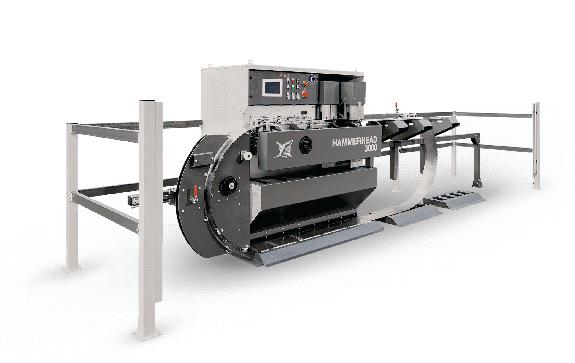
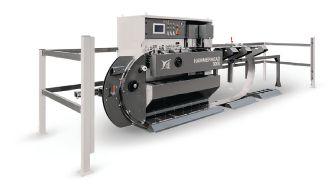
The Williams & White Hammerhead 3000 auto bench is an all-in-one band saw processing centre designed to automatically tension and level a band saw with ease. Standout features include: an easy saw load system featuring hide-away clamps, independent rigid tension and level heads,intuitive touch screen control with teach functionality, and a full light curtain safety system. The precision measuring systems for level, tension and back allow the Hammerhead 3000 to efficiently work the band saw to exacting specifications. williamsandwhite.com
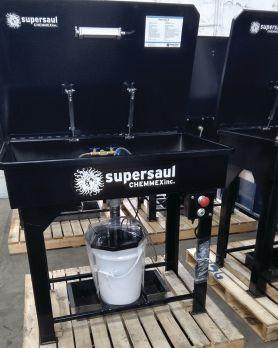
Supersaul’s rugged parts washer is easy to clean and built heavy. One thing that’s always annoyed us is cleaning a parts wash tank. So, this past year we decided to do something about that, incorporating the things we want to see – easy to change parts wash fluid; welllit, heavy-built, automatic off. If you use our Supersaul 3 it’s very gentle for the user and easy to dispose of. supersaulchemmex.com
SUPERSAUL CHEMMEX
CANADIAN
LUBRICATION INNOVATION
BRADfarynuk
Early in the development of the ProSaw profiler/ curve sawing gang product line, Real Performance Machinery (RPM) recognized the many shortcomings of the existing saw guide lube systems. Hence, the IdealLube saw guide lube system was developed.
As with many plumbing systems, varying water pressures result in unpredictable amounts of water being delivered to the saw guides. Water quality was often known to be poor, often leading to hardwater scaling and clogged manifolds and piping. Significant variations in air pressure were also resulting in inadequate saw lubrication and was often challenging to diagnose. Most existing saw guide lube systems were primarily manually controlled and lacked suitable feedback devices to monitor performance and make quantifiable adjustments.
RPM’s engineers made advancements to address the water pressure variations. First, a large water tank was designed to store water and serve as the backbone on which all other IdealLube devices are mounted. The tank includes an inlet water flow and tank level sensors, and a float switch to ensure water level is appropriately maintained. Should there be a malfunction with the float switch, a top-mounted breather tube is included to provide a safe path for overflow water to be removed. Second, and a key design feature, is the use of servo motor controlled fixed-displacement pumps to deliver reliable and infinitely variable water-oil-air mixture flow to each of the saw lube zones. To ensure the water utilized by the system is suitably pure, a high-capacity filter is mounted on the inlet side of the water tank. The tank is designed to be large enough that should any contaminants enter, they can settle to the bottom. The water outlet is placed high enough to avoid any potential sediment. Large 3-inch cleanout holes are installed in the vee-shaped bottom of the tank to allow periodic inspection and cleanout. A water flow sensor is installed to monitor water consumption
ensuring it remains within the expected range.
Standard mill air is delivered to the system through a state-of-the-art proportional flow/pressure regulator. Dynamic and configurable air pressure control provides optimal saw cooling and lubrication. An air flow sensor measures the instantaneous flow rate of mill air into the system. Abnormal air flow readings picked up by this sensor can indicate a blocked or plugged lube line.
The system provides an easy tie-in point for the pressurized oil supply. An easily replaceable oil filter protects the system from possible oil contamination. Saw lube oil is metered to the individual lube zones through an oil divider block. The control system energizes the coil and monitors the divider block’s cycle input to control the amount of oil delivered to the saw guides. The water, oil and air are combined in a stacked manifold assembly, which includes water and air headers to feed each lube zone. Oil is injected into the water through the injection port and fed into the pump to get thoroughly mixed and pressurized. The pressurized water/oil mixture is mixed with pressurized air at the output of the manifold. From there the saw lube mixtures are transported to the saws in each of the saw lube zones.
The system is provided with a dedicated mini-controller for all the valves and servo motors. It readily communicates with the existing machine center’s supervisory PLC via ethernet. Customer-designed user interface screens allow mill personnel to monitor and control the system. These screens can be either integrated into the Human Machine Interface or provided as a stand-alone system. Either configuration allows the system to be monitored and adjusted locally or remotely. With its controller-centric design, the system is continuously monitoring performance and generating alarm messages when appropriate. Parameter setpoints can also readily be adjusted, recorded and recalled as needed.
Brad Farynuk has served as operations manager for Real Performance Machinery since retiring from professional hockey in 2013.
The IdealLube system tackles issues such as water pressure variations and poor water quality, which often lead to scaling and clogging in saw guides. Photo courtesy RPM.
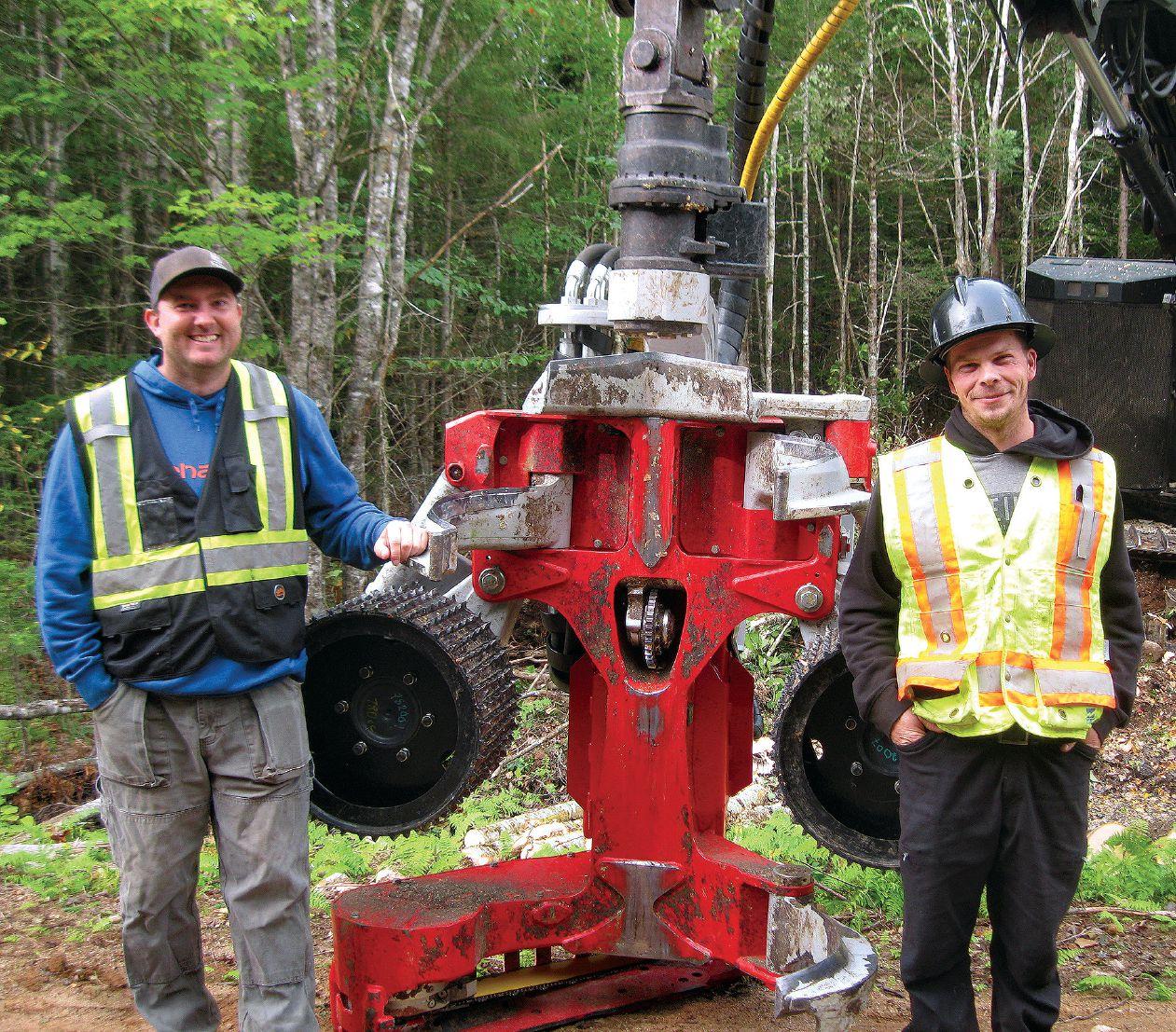
“We will absolutely be turning to Log Max for future head upgrades”.
Josh Millett and Forest Hill Logging came about in 2015 after being ‘raised and reared’ amidst his father’s forestry business and his grandfather’s sawmill.
After the initial start-up with a logging truck, within a few years a cut-tolength package was purchased to harvest standing timber. By 2021, a second cut-to-length system was added to the fleet.
The Forest Hill Logging crew works primarily in Western Nova Scotia supplying wood to local sawmills located within the province. “We have five very experienced operators who have worked their entire careers in the forestry sector,” Josh adds. “Having good operators, reliable and efficient equipment is key”. Today, both harvesters utilize Log Max harvesting heads: an older 5000 model and a recently purchased 6000V last Fall.
So far, Josh and his operator Jesse Veinotte are very pleased with the new Log Max’s performance, its speed and its reliability. “The measuring on the new head is very precise and its exceptionally smooth to run. Plus, the service that Log Max provides is ‘above and beyond’…even when parts are needed for the older 5000. The parts department and service techs can assist us with whatever is needed.”
Safety leadership in sawmills isn’t just for top bosses—it’s crucial for everyone, especially safety support members. Let’s explore key strategies for safety support members to lead effectively from the middle, focusing on mentorship, understanding the business, and embracing transformational leadership principles.
HARNESSING THE POWER OF MENTORSHIP
• I challenge you to find a mentor. Seek out an experienced mentor who understands safety and sawmill operations. Learn from their guidance to navigate challenges.
• It’s very important to understand the operating side of the business. Just remember that if you can improve safety with considerations to quality and production, you will be a safety rockstar!
UNDERSTANDING THE BUSINESS
• Dive deep into understanding the company and mill goals, culture, and strategies.
• Align safety initiatives with these objectives to gain support and reinforce safety as a core value.
EMBRACING TRANSFORMATIONAL LEADERSHIP
• Shift from a compliance-focused approach to one that inspires and motivates.
• Embody behaviors like leading by example, setting clear visions, and fostering innovation to cultivate a culture of safety excellence.
FOSTERING RELATIONSHIPS AND EMOTIONAL COMMITMENT
• Always start your conversations off on common ground. Engage in conversations that resonate with an individual’s values and aspirations.
• Show empathy, actively listen, and build mutual respect to foster emotional commitment to safety.
DEVELOPING INTRINSIC MOTIVATION AND SHARED VISION
• Involve frontline workers in safety planning to
Emphasize the collective pursuit of safety excellence to instill ownership and enthusiasm. Photo credit: ljubaphoto via Getty Images.
create a shared vision.
• I always try to find someone that has a passion for what I’m working on, and then I ask them to help me. They usually appreciate the involvement and perhaps they will be more engaged in future safety initiatives.
• Emphasize the collective pursuit of safety excellence to instill ownership and enthusiasm.
DRIVING ENTHUSIASM AND OPTIMISM
Be a beacon of positivity, celebrating successes and reframing setbacks as opportunities for growth. Sometimes we forget to celebrate our wins. It’s important that we stop sometimes and celebrate when we can. Foster a culture of optimism to inspire resilience and continuous improvement.
In the dynamic world of sawmill operations, safety leadership thrives when nurtured from within by dedicated safety support members. By implementing these practical strategies, safety leaders can inspire, motivate, and influence individuals at all levels of the organization to prioritize safety as a fundamental value. Through authentic relationships, intrinsic motivation, and unwavering enthusiasm, safety leaders can pave the way for a culture where safety isn’t just a priority, but a shared conviction upheld by all.
PatrickMcDonald
Patrick McDonald is a safety specialist at Canfor, with over 15 years of experience working as a safety professional in Canada. He specializes in developing safety solutions in the industrial manufacturing industry.
Navigating transition
Insights and solutions at the 2024 COFI Convention
BY LINDA COADY
On April 10-12, the BC Council of Forest Industries (COFI) will hold its annual COFI Convention at the JW Marriott Parq Hotel in Vancouver, B.C. One of the largest yearly gatherings of the forest sector in Western Canada, the convention will bring together forest companies, and related business and supply chains, with local, provincial, federal, and Indigenous leaders to hear from compelling speakers and discuss key issues and opportunities facing B.C.’s forest industry.
The convention comes at a time when interest in the present and future of B.C.’s forest industry has never been higher, and neither have the stakes. Across the province, key indicators in forestry are flashing red, foremost among them the current critical shortage of timber for B.C. mills.
In the last five years, harvesting on public forest
lands has dropped by almost half, down to 35 million cubic metres in 2023. The actual harvest in 2023 was 42 per cent below the allowable annual cut and 18 per cent below the actual harvest in 2022.
This steep trajectory has ignited a wave of curtailments and closures that have shuttered local sawmills along with the pulp and paper and value-added plants that rely on their outputs and residuals, resulting in the loss of an estimated 4,500 direct jobs in the last two years.
While change is inevitable, important and frequently necessary, a lot of change all at once in a relatively short period of time can have unintended consequences.
Notwithstanding a declining annual harvest due to fire, insects, market conditions and new
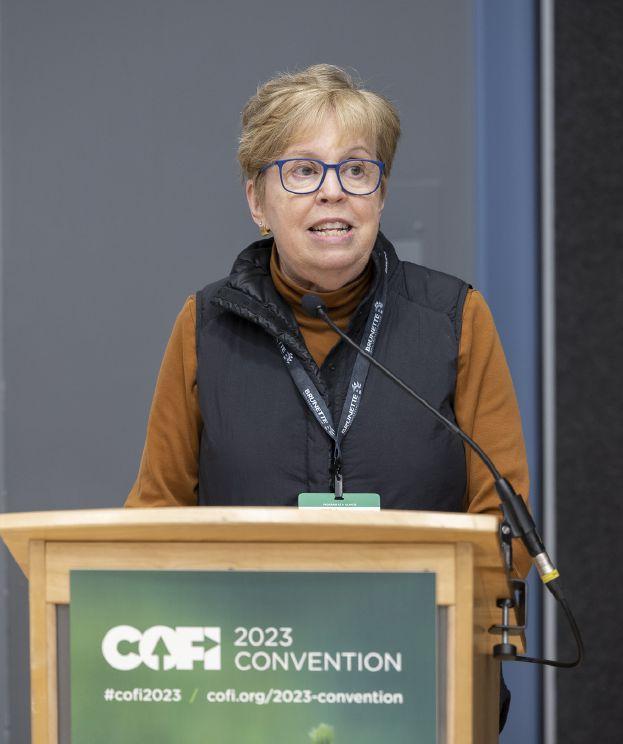
Linda Coady at the 2023 COFI Convention. Photo courtesy COFI.
policies, some of the consequences now unfolding in BC’s forest sector extend beyond what could be expected.
Left unchecked, current dynamics in the sector will result in a structural deficit in three ingredients required to meet growing demand locally and globally for wood products for green and affordable housing: Infrastructure, investment and workforce. It will also hinder BC’s ability to deliver the low-carbon and renewable bioproducts needed for a net-zero economy.
One thing everyone can agree on is that B.C.’s forest industry is in transition. Premier David Eby and Forests Minister Bruce Ralston have committed to working with the industry, First Nations, labour, and local communities to stabilize fibre supply and build a more predictable and sustainable path forward. A new Minister of State for Sustainable Forestry Innovation, Andrew Mercier, was appointed at the beginning of the year to identify what government and industry can do to increase the amount of fibre available to mills and communities in B.C. At the COFI Convention, we will have an opportunity to hear from Minister Mercier on the outcomes of his first 90 days.
Notwithstanding its current transition, the forest sector in B.C. continues to be a very significant part of the economic base of British Columbia, with outsized influence on wages, exports and government revenue.
The industry also has significant expertise, resources and heavy equipment that can be deployed to reduce the risk and impact of wildfires. By restoring forest ecosystems to a more fire-resilient state, in ways that can also contribute to a more resilient forest manufacturing sector, the forest industry can continue to generate the many social, economic and environmental benefits on which we
all depend.
In addition to hearing from cabinet ministers and other leaders in industry and government, an impressive list of keynote speakers and expert panelists will be sharing their insights on these and other challenges and opportunities facing B.C.’s second largest industry sector. Other notable speakers include:
• Regional Chief Terry Teegee, BC Assembly of First Nations, will discuss the implementation of BC’s Declaration on the Rights of Indigenous Peoples Act (DRIPA);
• Canada’s Deputy Ambassador to the U.S., Arun Alexander, will comment on how the relationship between Canada and the U.S. is changing in both a North American and global context;
• Chair and CEO of Abacus Data, David Coletto, will look at how the public conversation on wildfires in BC is evolving and the impact this is having on public perceptions of forest management;
• Don Iveson, former mayor of Edmonton – now an executive advisor on climate risk to Cooperators Insurance and co-chair of a new National Task Force on Climate and Housing – will look at the role local wood products can play in providing low carbon building materials to meet the demand for more housing … and more affordable and resilient housing and communities.
The convention will also feature a trade show component with more than 50 exhibitors. For further information or registration inquiries on the 2024 COFI Convention, visit cofi. org/2024-convention or email gillrie@cofi.org.
Linda Coady is the president and CEO of the BC Council of Forest Industries.
“ONE THING EVERYONE CAN AGREE ON IS THAT B.C.’S FOREST INDUSTRY IS IN TRANSITION.”
EVENT preview
Montreal Wood Convention
From keynotes and CEO showdowns, to networking galore
BY STAFF REPORT
The Montreal Wood Convention (MWC) is gearing up for its annual event, scheduled to take place from April 9-11 at the Fairmont Queen Elizabeth. Following the resounding success of last year’s gathering, organizers are eagerly anticipating another engaging and productive three-day affair.
One of the hallmarks of the MWC is its robust program, designed to cater to the diverse needs and interests of attendees. Central to this year’s agenda are the keynote speakers, who promise to deliver thought-provoking insights into key industry topics. Leading the lineup is Michele Romanow, a familiar face to many as a prominent judge on CBC’s Dragons’ Den Romanow’s session, titled “Getting to Success: Embracing Change, Encouraging Disruption, and Incentivizing Innovation,” is expected to resonate with participants eager to navigate the ever-evolving landscape of the wood industry. Another keynote speaker is David Usher, a multi-talented individual known for his achievements as the lead singer of the band Moist and his ground-breaking work in artificial intelligence. Usher’s session will explore the fascinating intersection of creativity and AI, offering attendees a unique perspective on the potential applications of technology in their field.
The success of the MWC lies in its ability to foster meaningful connections and facilitate knowledge exchange among industry stakeholders, says event director Sven Gustavsson. He emphasizes the importance of curating a program that addresses the pressing concerns and interests of participants, ensuring that each session delivers tangible value.
“It proved to everyone present in Montréal that these meetings between producers and buyers of wood products enhance the key business contacts which lead to the creation and the maintenance of sustainable alliances,” Gustavsson tells CFI
In response to feedback from previous attend-
ees, this year’s convention will feature sessions focused on economic outlooks and market trends. Benjamin Tal, managing director and deputy chief economist at CIBC Capital Markets, will offer his insights into the current economic climate and the factors shaping the wood industry’s future. Tal’s expertise and extensive experience make him a sought-after speaker, and his session is expected to draw a large audience eager to gain a deeper understanding of the economic forces at play.
Another highlight is the CEO Panel, which brings together industry leaders for a candid discussion on the challenges and opportunities facing the wood industry. This year’s panelists include Amar S. Doman, chairman and CEO at Doman Building Materials Group; L.T. Gibson, chairman and CEO at US LBM; and Ian Fillinger, president and CEO at Interfor. Moderated by Steve Rhone, president and CEO at Weston Forest, the panel promises to offer valuable insights into market dynamics, emerging trends, and strategies for success.
The MWC is also committed to promoting diversity and inclusion within the wood industry. As part of this initiative, the convention has partnered with Women of Lumber & Forestry (WOLF), an organization dedicated to supporting and empowering women in the field. Founded by Kaitlyn and Lauren Chimko of Dakeryn Industries, WOLF hosts events and networking opportunities aimed at connecting and uplifting women in the industry.
The collab between MWC and WOLF underscores a broader industry-wide effort to create a more inclusive and equitable workplace. As part of their partnership, the two will work together to host a Women’s Networking Luncheon, providing female professionals with a platform to connect, share experiences, and forge new connections.
Learn more about the event and register at: www.montrealwoodconvention.com
INSPIRING INCLUSION
The fourth Women in Forestry Virtual Summit
BY JENNIFER ELLSON
True to this year’s International Women’s Day theme, Inspire Inclusion, the 2024 Women in Forestry summit, held virtually on March 8, celebrated women’s achievement, raised awareness about diversity and gender parity, and more.
The fourth virtual summit didn’t just talk the talk – it walked the walk. The event was a dynamo of empowerment and a celebration of women’s achievements. It wasn’t just about speeches; it was about sparking inspiration. The event drew some
800 registrants from more than 20 countries, with 500 joining us live to talk about crucial topics like diversity, inclusion, allyship, Indigenous representation, biases, career ladders, and so much more.
Kristen Vitullo and Marisa Meaker-Williamson opened the summit by delving into the latest data from the 2021 Census, offering valuable insights into workforce diversity trends. The policy analysts at the Canadian Forest Service provided attendees with an overview of the strategies and initiatives
Clockwise from top left: Haleigh Callison (Takoda Consulting), Shabnam Sanaei (Canfor), Kristin Dangelmaier (Kruger) and Shahed Tootoonian (Mercer International).
implemented by Natural Resources Canada to address representation issues in the forest sector. Through targeted program measures and strategic partnerships, they outlined the efforts undertaken to improve diversity and inclusion within the industry. The presentation highlighted the exciting progress achieved thus far, showcasing tangible advancements made in fostering a more inclusive and representative workforce.
The panel discussion titled “Branching Out: Cultivating Change in the Forest Sector,” moderated by Scot Durward of Tolko Industries, captured the audience’s attention with its engaging exploration of diversity, equity, and inclusion (DEI) in the forestry industry. Facilitated by the Forest Sector Equity Diversity Inclusion Alliance (FSEDIA), the panel brought together voices from diverse backgrounds, including BIPOC individuals, new entrants, industry leaders, and allies.
Panelists Sithara Fernando, Marla Guldbransen, and Kimberly Somerville shared personal experiences, discussing both challenges and triumphs in fostering DEI within the sector. From navigating hurdles to implementing transformative initiatives, the discussion offered actionable insights for professionals at every career stage.
The audience were also treated to a fireside chat, hosted by Haleigh Callison of Takoda Consulting, on Indigenous inclusion, leadership, and values in forestry. Featuring Diane Collins from the Kitsumkalum Economic Development
Group of Companies and Dana Collins, manager of partnerships at Mosaic Forest Management, the fireside chat offered a rich exploration of Indigenous perspectives and experiences in the forestry sector and provided attendees with invaluable insights into the ongoing journey of reconciliation, Indigenous participation in the forest economy. Through candid discussions and shared lessons learned, attendees gained a deeper understanding of the importance of Indigenous leadership and values in shaping forestry.
In a session focused on addressing the persistent gender gap in Canada’s forest sector, Kathy Abusow, president and CEO of Sustainable Forestry Initiative and Project Learning Tree (PLT) Canada, and Catherine Langille, Indigenous Relations Coordinator at PLT Canada, provided valuable insights into mentorship and workforce development.
Despite progress, women remain underrepresented in the industry, comprising only 17 per cent of the workforce. Abusow discussed the power of mentorship and wraparound career support systems in empowering young women to succeed. Langille shared her personal journey from mentee to mentor in PLT Canada’s Green Mentor program, illustrating its transformative impact on both individuals and the industry as a whole.
The session underscored the importance of mentorship in fostering diversity and inclusion within the forest and conservation sector, offering actionable strategies to bridge the gender gap and
cultivate a more equitable workforce.
The highly anticipated panel discussion, ‘Ask the Boss,’ provided attendees with a platform to pose pressing questions to industry leaders. Again hosted by Haleigh Callison, panelists included Shabnam Sanaei, director of bio-innovation and technology at Canfor, Shahed Tootoonian, VP of corporate development at Mercer International, and Kristin Dangelmaier, environment and technical manager at Kruger.
Responding to feedback from last year’s summit survey, the session aimed to address sensitive topics and facilitate constructive conversations between attendees and their bosses. Attendees seized the opportunity to engage with the panelists, sparking meaningful dialogue on crucial issues facing the forest sector. The interactive nature of the panel discussion provided attendees with valuable insights and perspectives from industry experts, empowering them to navigate challenging conversations with confidence.
Kelly Cooper of the Centre for Social Intelligence closed the event by shedding light on efforts to address gender and diversity challenges within the forest sector, particularly focusing on the initiatives by FSC North America. Cooper highlighted FSC’s gender and diversity framework, designed to tackle the issue of retaining women in the forest sector. women and all other underrepresented groups.
All of the sessions are now available on demand at: woodbusiness.ca/virtual-events/ women-in-forestry-2024
COLUMN final cut
Are policies enough to protect and grow our forests?
Forests are taking center stage in national and international environmental agendas, dialogues, and policy forums.
With a changing climate, increase in wildfires and biodiversity loss, there is expected to be increasing attention on forests and how they are managed.
There is growing interest in every aspect of a forester’s work, from the forest floor to the tree stand and finished product, including forest management planning, operations, and policy decisions.
While this focus highlights forests as a nature-based solution, it invites questions about forestry practices and management, which are encouraged.
However, informed dialogue is crucial to counter misconceptions. The sector needs to realize that the future of forestry depends not only on existing policies or actions of foresters, but also on public and political awareness of how forests are sustainably managed, utilized and restored by foresters.
As the human footprint expands and demand for timber and non-timber forest products rises, safeguarding forests is not enough. Strategic and sustainable management interventions must be implemented to ensure forest health and resilience.
It’s evident people are unaware of the multifaceted roles of forests as providers of ecosystem services, non-timber forest products, livelihoods and biodiversity – and it may not be totally their fault.
Although students are being taught about the importance of flora and fauna biodiversity and planting trees, topics central to understanding forest management are absent.
Additionally, Indigenous peoples and their cultural connections to forests are overlooked.
Mainstream media further perpetuates a limited view of forests, which risks seeping deeper into policies, initiatives, businesses, and the collective mindset resulting in incomplete and often incorrect notions about the forest sector.
Achieving universal understanding of sustain-
able forest management, wood and its benefits will require comprehensive and all-rounded information on forestry, starting from the seed to the tree stand and end of the forest supply chain, and everything in between.
An unbiased and balanced perspective on the forest’s role in society, coupled with transparency and data-based viewpoints, will be crucial for effective forestry communication.
Industry professionals bear the responsibility of proactively communicating about their role in ensuring sustainable forest management.
This includes, forest managers, mill operators, academia, foresters and all forest professionals along the supply chain. By sharing their knowledge and experiences, both within and beyond the sector, they can collectively enhance public understanding of forestry.
A way to do this is take advantage of digital technology to communicate information within and outside the sector. A simple phone with a camera and internet connection can make anyone an impactful communicator.
Effective communication is done through storytelling and visuals. The broader sector can further enhance communication through digital outreach, strategic communication development around different aspects of forestry and social media engagement. This will stimulate discussion and needed dialogue between the public, companies and forest professionals.
Beyond foresters, I urge civil society, industry, academia, and governments to deepen their understanding of forestry. It is a collective responsibility to better articulate and communicate accurately about forestry, much like how we collectively share life-sustaining oxygen forests provide.
I anticipate the day when forestry terminology such as sustainable harvest levels and silviculture become common knowledge.
RITIKAAgupta
Ritikaa Gupta, RPF, is a youth advocate for forests and has academic expertise in political science and forestry. She currently works in wildfire policy.