Under the guidance and support of Triton and limited resources, Kingston Police were able to deploy a fully functioning replacement solution within a few weeks. The new solution allows us to streamline processes, realize efficiencies, and reduce processing times.
Records & Systems Manager, Kingston Police PERSONALIZED MOBILE APP
Making community support even easier.
ONLINE REPORTING
Online platform to report crimes and incidents to keep your community safe.
Retail crime cases Non-emergency reporting Municipal bylaw enforcement
RECRUITMENT SCREENING
We screen smarter, so you hire faster. Secure hiring decisions powered by trusted data and inhouse experts.
Turnkey pre-employment screening Designed for law enforcement
VIRTUAL FRONT COUNTER
Triton adds automation and innovation to the online record check process to help improve productivity and the community experience. We provide multiple ID verification options and live, Canadian based customer service.
Essential training and preparedness of policing leadership
Members of police leadership carry the weight of their organizations on their shoulders. They must balance budgets and resources, oversee and assess the service’s activities, ensure procedures and policies are properly followed, collaborate with and report to police commissions and boards, municipal and provincial governments, set the tone for their entire organization and its sworn and civilian members, and most importantly, safeguard the community they serve.
Leadership matters, and being wellprepared to take on these roles is essential.
You bear significant responsibility. Your years of experience, gained through frontline policing, specialty units and participation in specialized committees, along with the hard lessons learned, have brought you to this point. But have these experiences fully prepared you for the leadership role you now hold? Did you find yourself stepping into the role with the knowledge you needed on day one, or did you need to figure it out on the fly?
If you identify more with the latter part of that question, you are not alone. In fact, that’s how Supt. David Hennick felt when he stepped into the role of staff sergeant at Hamilton Police Service several years ago. In the numerous conversations I’ve had with Hennick over the past few years, the topic of leadership training has frequently come up. For many police officers across Canada, this kind of training is out of reach due to scheduling conflicts or the high costs involved. Hennick himself had tried to access leadership training to better prepare for roles such as staff sergeant, detective sergeant, inspector and superintendent, but found it challenging. So, he eventually decided to change that for himself and those who were in similar positions.
Leadership matters, and being well-prepared to take on these roles is essential. In this edition’s cover story, I explore how leaders at Hamilton Police Service are properly preparing for the next stage of their careers, with Hennick playing a key role in making it happen. Through a partnership with an Ontario university, the service has been able to send nearly its entire leadership team through training courses to better equip them for what lies ahead. Hennick was able to invite members of a few neighbouring police services to take part in the training as well. You can read the full story on page 10.
And while we’re on the topic of police leadership, we are quickly approaching the 120 th Canadian Association of Chiefs of Police (CACP) Annual Summit and Policing Trade Show, taking place in Victoria, B.C., from August 10 to 12. I’ll be on the trade show floor at our Blue Line booth with Janice Eaton, so please come stop by, say hello and let me know what you’re seeing and experiencing in the world of policing right now. I always encourage you to reach out to me if there’s a topic you believe deserves attention, an officer you think should be featured, or a new initiative your police service has launched. Your input is invaluable in helping us cover the issues that matter most to this community. You can also contact me at bschroeder@annexbusinessmedia.com.
Until next time, happy reading and be well.
www.BlueLine.ca
Reader Service
Print and digital subscription inquiries or changes, please contact customer service
Angelita Potal
Tel: 416-510-5113
Fax: (416) 510-6875
email: apotal@annexbusinessmedia.com
Mail: 111 Gordon Baker Rd., Suite 400 Toronto, ON M2H 3R1
GROUP PUBLISHER | ADAM SZPAKOWSKI aszpakowski@annexbusinessmedia.com
AUDIENCE DEVELOPMENT MANAGER BEATA OLECHNOWICZ | (416) 510-5182 bolechnowicz@annexbusinessmedia.com
CEO | SCOTT JAMIESON sjamieson@annexbusinessmedia.com
ANNEX BUSINESS MEDIA
111 Gordon Baker Road, Suite 400 Toronto, ON M2H 3R1 Tel. 416-442-5600 • Fax 416-442-2191
Publication Mail Agreement No. 40065710
ISSN 0847-8538 Printed in Canada
SUBSCRIPTION RATES
Canada — 1 Year $32.13; 2 Year $53.55 plus tax USA — 1 Year $139.23 CAD
Occasionally, Blue Line will mail information on behalf of industry-related groups whose products and services we believe may be of interest to you. If you prefer not to receive this information, please contact our circulation department in any of the four ways listed above.
CEU enhances Fredericton Police response and efficiency
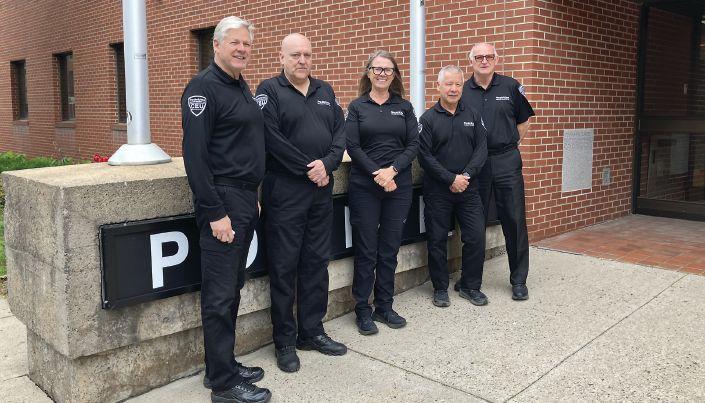
The Fredericton Police Force’s interim Community Engagement Unit (CEU) was launched on Feb. 3 and has provided vital support to front-line officers, improving service delivery to the community.
The CEU is staffed by six retired police officers who focus on non-emergency service calls, including reports of theft, lost and found property, mischief, statement collection, client callbacks and general public assistance.
The unit has managed over 525 files and saved front-line officers approximately 1,046 hours in administrative work. Officers can dedicate more time to urgent calls and engaging in proactive community policing.
The six-month initiative was part of Fredericton’s broader commitment to community safety and engagement. The CEU will be evaluated at the end of the trial to assess its impact on police operations and community service.
– Courtesy of Fredericton Police Force
Fallen officer’s legacy lives on at school bearing his name
To mark the tenth anniversary of Edmonton Police Service’s Cst. Daniel Woodall’s death,
BY THE NUMBERS
staff and students at the school that bears his name honoured his legacy with a heartfelt assembly and a tree-planting ceremony.
Woodall was killed in the line of duty while attempting to arrest a hate crime suspect on June 8, 2015. Following his death, citizens requested that a school be named in his honour, and Edmonton Public Schools decided to build a new elementary school to recognize his service to the community.
“As a school, we are a living legacy of Cst. Daniel Woodall, through our promise to lead with kind hearts, fierce minds and brave spirits,” said Principal Leanne Moncrieff.
In partnership with Edmonton Police Service, the school honoured the officer’s contributions to the community and presented a new Legacy Award to a grade six student who exemplifies the values of courage, service and compassion.
The tree planted outside the school will serve as a lasting symbol of Cst. Woodall’s roots in the community, and a reminder that his spirit continues to grow in the hearts and actions of the next generation.
EPS Deputy Chief Nicole Chapdelaine said, “You do not have to be a police officer to be like Cst. Woodall – you can be kind, you can include others, and you can stand up for someone who needs help,” she said. “That is what real heroes do, and you can too.”
– Courtesy of Edmonton Police Service
ONTARIO
New police initiative turning the tide on retail theft
A Windsor Police Service (WPS) initiative targeting retail theft is yielding significant results, with 192 arrests made since its launch. In response to a rise in shoplifting incidents in recent years, the WPS introduced an initiative in July 2024 aimed at reducing retail crime and better supporting affected businesses. This effort included the establishment of a full-time retail theft coordinator role to help streamline shoplifting investigations, track repeat offenders and ensure that businesses receive the necessary support to deter future incidents.
This new position was strengthened by improvements to the WPS online crime reporting tool. The updates facilitated easier reporting of store thefts by retailers through the online portal while enabling police to gather statistics more effectively and allocate resources where they are needed most.
Since its launch, WPS has solved a total of 528 shoplifting-related incidents – a 34 per cent improvement over the previous year. Nearly 45 per cent of the suspects charged in these cases were repeat offenders. So far in 2025, the number of shoplifting incidents reported to police has decreased by 33 per cent compared to the same time last year.
The improved online crime reporting tool has simplified the process for businesses to report shoplifting incidents, share details and connect directly with police. This improved accessibility has resulted in a 95 per cent reporting compliance rate from retailers.
“Through this initiative, we are strategically aligning our resources to improve clearance rates and more effectively target the repeat offenders responsible for a disproportionate number of these crimes,” said Jason Crowley, Deputy Chief of Operations.
– Courtesy of Windsor Police Service
In March 2025, Statistics Canada released recent data on Police-reported hate crime in Canada, 2023. For more information, please visit www150.statcan.gc.ca.
32 %
The number of police-reported hate crimes was up 32 per cent in 2023.
1,284
reports of hate crimes motivated by religion in 2023, up 67 per cent from 2022.
69 %
Hate crimes motivated by sexual orientation rose 69 per cent in 2023.
2,128 reports of hate crimes motivated by race or ethnicity, up 6 per cent from 2022.
ALBERTA
CEU MEMBERS STEPHEN HORSMAN, ANDREW MILLER, JOAN CRANE, RON FRANICS, JOHN LALLY. MISSING FROM PHOTO: ANDREA SULLIVAN. PHOTO CREDIT: FREDERICTON POLICE FORCE
DISPATCHES
The Brantford Police Service appointed Jason Saunders as chief of police in February. Saunders brings over two decades of dedicated service and leadership experience to this role, having started his policing career as a constable with the BPS in 2000. His commitment to community policing, officer well-being and modern policing strategies has been instrumental in shaping the service’s approach to public safety.
The Winnipeg Police Board has appointed Gene Bowers as the next chief of police for the Winnipeg Police Service. Bowers has been a member of the WPS since 1989 and has extensive experience in uniform operations, administrative sections and criminal investigations. His most recent position was deputy chief of police.
Jason Dobirstein began as the new chief of police for Lacombe Police Service on June 1, 2025. Dobirstein is an accomplished law enforcement executive with over 30 years of experience in policing, strategic leadership and community safety management. He joins the Lacombe Police Service from the Lethbridge Police Service, where he served as an inspector in the criminal investigations division.
The Delta Police Department’s Guy Leeson has been confirmed as the DPD’s newest deputy chief, effective March 2. Leeson joined the DPD in November 1995 as a recruit constable. During his career, he has spent time in the patrol division, the Emergency Response Team (ERT), major crimes and the investigations bureau. Leeson represents the DPD on several provincial working groups focused on public order, ports and border security.
Michelle Luca has been selected as the Detachment Commander for Pitt Meadows RCMP. S/Sgt. Following her graduation from Depot in April 2005, her first posting was with the North Vancouver RCMP. Luca has spent her entire
career in the Lower Mainland, also serving with the Coquitlam RCMP and Ridge Meadows RCMP. In August 2022, she began her most recent role as the interim detachment commander for the Pitt Meadows RCMP.
After over three decades in policing, Chief Constable Del Manak is retiring from the Victoria Police Department at the end of August 2025. He began his policing career with the Vancouver Police Department and joined VicPD in 1993, where he has served in various sections and roles. Manak was promoted to the rank of chief constable in July 2017.
Chief Rick Bourassa officially retired from the Moose Jaw Police Service on February 1. Bourassa was hired as chief in Oct. 2013, after a 31-year career with the Regina Police Service and a short stint with the Government of Saskatchewan.
After 40 years of police service, Lorne Blumhagen retired as chief of the Lacombe Police Service at the end of May. Blumhagen started his policing career with the RCMP in Camrose as a summer constable in 1985. From there, he served with the Camrose Police Service before joining the Lacombe Police Service in 2014. He first served as an inspector before becoming chief.
After 36 years of service, South Simcoe Police Service’s Deputy Chief Sheryl Sutton has officially retired. Sutton began her policing career with the Toronto Police Service in 1988 before joining the South Simcoe police in 1995. She was the first female police officer to join the emergency response unit (ERU). In her role as deputy chief, she oversaw all operational and administrative functions.
Victoria Police Department’s Deputy Chief Jason Laidman, who’s worked in policing for more than 32 years, has retired after spending almost 25 years in VicPD’s patrol unit, gang
Policing in a Digital Age: A Virtual Tech Symposium
Date: Sep. 30, 2025
Location: Zoom blueline.ca
Career Expo West
Date: Oct. 4, 2025
Location: Calgary, Alta. emergencyservicesexpo.ca
2025 Building Bridges: Evidence-Based Policing Conference
Date: Oct. 9 - 10, 2025
Location: The Blue Mountains, Ont. buildingbridgesebp.ca
Find more calendar events online at blueline.ca/events
section, regional domestic violence unit and Esquimalt division. Before that, he spent nearly a decade at the West Vancouver Police Department.
It is with great sadness that the Peel Regional Police K9 Unit announced the passing of retired Police Service Dog Rudy at the age of 12. Rudy proudly protected and served the communities for nine years and will be deeply missed by his handler and the K9 Unit. Thank you for your service, Rudy.
PROMOTIONS, RETIREMENTS, RECOGNITION • If you have an officer in your agency recently promoted or retiring or an individual you wish to have recognized (major award or recently deceased) you can let Blue Line magazine know by emailing: bschroeder@ annexbusinessmedia.com
In Pursuit of Mental Wellness in the First Responder Community
By Rob Jamieson
ISBN: 979-8282266689
“This book is a powerful testament to the resilience and strength of first responders. Rob Jamieson has captured the essence of what it means to face the challenges of mental health head-on. His work with Encompas and his tireless advocacy are evident on every page, making this book a beacon of hope and a call to action for all of us.”
– Mark Baxter, President, Police Association of Ontario
“I have yet to meet a more passionate and driven advocate than Rob when it comes to the health and well-being of first responders and the community at large. As a colleague and friend of Rob’s for almost a decade, I’ve had
the privilege of witnessing his unwavering dedication to the policing community, especially the civilian and sworn men and women who make up our police services. This work is not just a book; it’s a heartfelt mission born from Rob’s own experiences and profound empathy for those who serve on the front lines. It’s a testament to their commitment and a must-read for anyone touched by the efforts of our first responders.”
– Tom Stamatakis, President, Canadian Police Association
“During his term as the Ontario Provincial Police Association President and as a board member, prioritizing the safety and wellbeing of our members and their ability to fulfill our mission of public safety, Rob has selflessly dedicated himself to the service of our members and put their priorities and needs ahead of his own and that of his family, displaying a sense of commitment and achieving
DISCOVER YOUR FUTURE
results that positively influenced the direction of the OPP and the overall health and wellbeing of our members.
Achieving meaningful and lasting change that leaves an organization and its members better than they found them takes courage, endurance and resilience that is not for the faint of heart; however, it is the true test of leadership and what defines the legacy of a leader...
A true warrior spirit for the mental health and wellbeing of those who we rely on for the safety and security of Ontario – the brave and dedicated members of the OPP – I am grateful to Sergeant Rob Jamieson for his selfless dedication to our members and his legacy of leadership. As shared in the powerful experiences within In Pursuit of Mental Wellness in the First Responder Community, it is evident that Rob’s legacy will not only support our members but inspire continuous improvement for the overall health, safety and well-being of all public safety personnel and the communities they serve and protect.”
– Commissioner Thomas Carrique, Ontario Provincial Police
Empowering police leaders through education
A new approach to executive development
By Brittani Schroeder
David Hennick began his career with the Hamilton Police Service in 1999 and advanced to the rank of sergeant by 2008. This was just the first of many moves. In his 26 years so far, Hennick has served as a staff sergeant, detective sergeant, inspector and superintendent, working in various areas such as uniform patrol, high enforcement action team, the detective’s office, the sexual assault unit – comprising the domestic violence unit and the missing persons unit, then as a commander in both the investigative services division and the central patrol division. Hennick currently works as the superintendent of the
community safety division.
In the early stages of his career, Hennick recognized that formal training for senior positions was not widely accessible. This understanding became clear when he was appointed to a staff sergeant role.
“Everything that makes you good up to the level of staff sergeant doesn’t necessarily help you out once you become an Inspector. When you’re in that role, your expected skills are entirely different. I went from being a police officer to now working on communications strategy, attending police service board meetings, governance, fundamentals of finance, and more,” explained Hennick.
Hennick was aware that schools offered police leadership programs, but they were prohibitively expensive—upwards of $15,000 per person—making them not easily accessible for all police services. He has held a senior leadership position for over eight years and has only recently accessed the highcost training.
Hennick believes education is “the great equalizer” that opens doors for everyone. For this reason, he sought to make senior leadership training more accessible for the 35-person team of executives at HPS. Shortly after becoming a staff sergeant, Hennick enrolled in the executive management program through the DeGroote School of Business at McMaster University. Although the program was not specifically designed for police officers and law enforcement personnel, he completed the five courses to “fill in gaps” in his knowledge. The courses covered topics such as leadership, strategy, finance, governance and more.
“Though it wasn’t aimed at law enforcement, Dave Hennick could come in as an officer and be seated with various people, like someone from a bank, the city, or a non-profit charity. The differing positions
Left:
Police leadership members work together in a breakout session.
Above:
Program graduates celebrate the completion of the program on Jan. 30, 2025.
helped everyone learn something new just from those taking the courses, in addition to the subject matter experts brought in to lead the courses,” said Dave Mammoliti, director of executive programs at the DeGroote School of Business.
After obtaining his certificate, Hennick approached Mammoliti to explore how this type of program could be implemented for HPS members. He discovered that the modular learning model, aimed at achieving a certificate, would be highly advantageous for the HPS executive team.
Building a program
Hennick wanted this training to be made available to members shortly after their promotion to senior leadership positions so that the skills could be applied immediately.
“The training needed to be quick and to the point—we’re all busy people on the senior executive team. Most of us have come to the profession with degrees under our belts, but these courses can get us thinking differently. Having a one-courseper-day model suited us all really well,” said Hennick.
Hennick presented the initial proposal to the HPS executive team
in 2016. Ryan Diodati, who is currently the deputy chief of operations, was one of the first to review the pitch. Diodati was on board to move it forward.
“As police leaders, we often rely on internal training, repeatedly drawing from the same sources –whether conferences or service-specific programs. It can feel recycled over time. This opportunity allowed us to step outside the usual community and gain fresh perspectives,” said Diodati.
The key to this program was its customization. Mammoliti and his team listened to Hennick regarding training gaps and what he and his colleagues most wanted to learn.
Subsequently, a program was developed with specific offerings designed to meet those needs.
In the end, the Executive Police Leadership Program was developed in collaboration with the DeGroote School of Business. This five-course certificate program encompasses change leadership, project management, conflict resolution, strategic thinking, and reshaping communication leadership.
Planning was underway to initiate the program when the COVID-19 pandemic struck. This caused all
work to cease for an extended period. “As soon as we emerged from COVID, Dave was back on me, ensuring that I was aware of his desire to run this training and that I would support his plan all the way to the chief level,” said Diodati.
Hennick managed to restart the momentum in 2022. However, as he did, he recognized that if he was aware of gaps in his own knowledge, other police leaders were likely feeling the same way.
Through the model developed by Mammoliti and Hennick, members of other police services, such as the Niagara Regional Police Service, Halton Regional Police Service, OPP and Waterloo Regional Police Service, could also participate in the program.
“It was great to widen the lens and invite other police service members to come—we got to see what was happening in other services,” shared Mammoliti.
The program included around 30 participants from executive police leadership teams: chiefs, deputy chiefs, inspectors and superintendents, along with 12 civilian managers and directors.
“Education is ‘the great equalizer’ that opens doors for everyone.”
- Supt. David Hennick
“I can tell you that it’s integral to a commander’s team’s success to understand the importance of the contribution of the whole service. You get a much better product when you have everyone participating, sworn and civilian,” shared Chief Frank Bergen.
“We want to continue this initiative because there is a thirst for professional development at all levels – not just among senior officers but also junior members for both civilian and sworn personnel. Providing early access to this type of training will benefit not only the individuals but also the organization as a whole, as well as those they interact with,” said Diodati.
Working from the same playbook
Almost the entire executive team of Hamilton Police Service—both sworn and civilian—recently completed the program, concluding their
fifth and final course on Jan. 30. This day also featured a graduation ceremony, during which each member received a certificate from the DeGroote School of Business.
Chief Frank Bergen participated in the training program and expressed that he wished he had received such training when he was climbing the ranks. “In the first 20 years of our jobs, these kinds of conversations aren’t typically held. You just show up and do the work. Now, as we’re progressing, we’ve found that our members expect us to be up-to-date and understand all forms of communication, management approaches, and so on. This training would’ve provided me with an opportunity to better grasp the impact of our language, rather than experiencing the bruises of a career learning what to do and what not to do,” he admitted.
During a coffee break, Staff Sergeants Steve Berezuik and Amanda Gill, both of whom requested to be included in the program, could be heard complimenting the training.
“As staff sergeants, we are in the middle
of everything, and we need to figure out how we can bring everyone together. Training like this is almost unheard of for us and has tremendous potential. One day, you’re working in one role, and the next day, you’re doing something different but without the skillset behind it. This is giving us those necessary skills,” shared Gill.
Berezuik echoed, “To the members below us, we’re responsible for supervising, but to the people above us, there are different expectations. Attending this training alongside our entire executive team is beneficial because we can learn from them at our tables and more informally during the breaks. Then, we can implement what we learned the next day on the job.”
While speaking with Dawn Parnell, the manager of IT services at HPS, she shared that she has been with the service since 2011. As soon as she heard about the training, she was completely on board.
“On top of everything else, this presents a great opportunity for the civilian members to engage in a different environment with our sworn counterparts and appreciate each
other’s perspectives. We find common ground when we’re together, and we understand each other a little better afterwards.”
Diodati also acknowledged that police do not always excel in succession planning, but by completing this training, they are “adding more tools to our toolbox.”
Hennick and Mammoliti created this program to be mobile. This means that people from anywhere in Canada could bring in this training for their team.
This training program wouldn’t have happened without Hennick’s determination, and that was clear to all in attendance.
“Dave is one of the most tenacious and caring members we have at HPS. We are so fortunate to have his vision, which enables us to develop a better and stronger leadership team together. I want to thank him for his ongoing ability to broaden our horizons and provide us with different examples of how we can achieve our long-term goals,” shared Chief Bergen.
“His commitment to this program is exemplary, and we’re all better for it,” concluded Diodati.
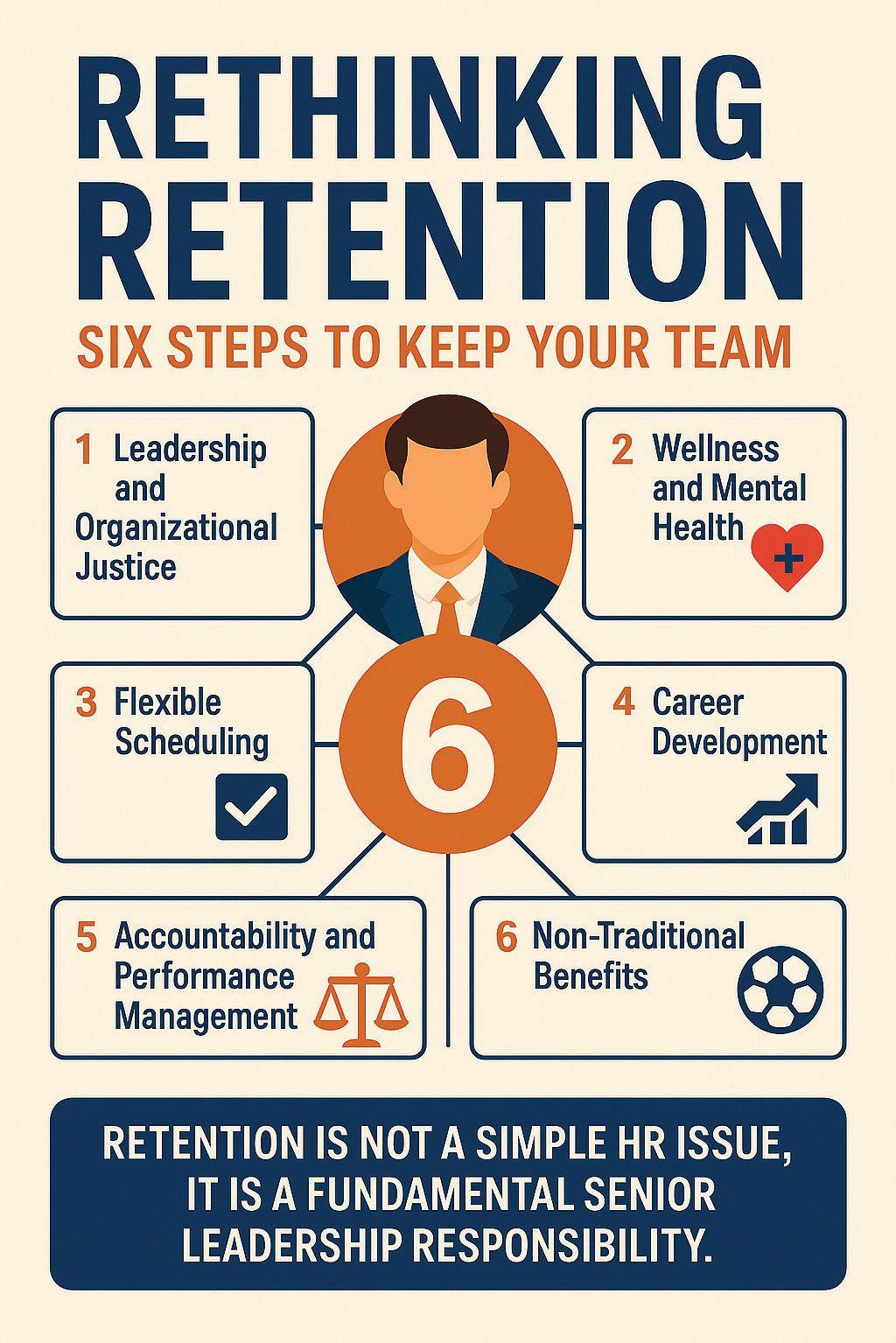
Rethinking retention
Embracing transition to strengthen your team By Neil Dubord and Cal Corley
Afemale sergeant was a dedicated and accomplished leader and investigator but became disillusioned with the toxic culture she experienced within parts of the police agency. Despite her superior performance, she struggled to reconcile her personal values with the culture and values practices there. So, at just 17 years of service, she made the difficult decision to relinquish the career she had worked so hard for.
On her last day in uniform, she felt quite sad, but in the days that followed, this feeling was replaced by a sense of relief; she would no longer have to navigate the daily tension between her personal values and those she encountered on the job. Since then, she has become an advocate for reform in policing, with a particular focus on mental health support. Unfortunately, her story is all too common and speaks to broader, often systemic issues affecting the retention of top talent in Canadian policing today.
Police organizations across Canada are confronting a growing crisis: not only recruiting officers but also retaining the right ones. Recent studies reveal that wages and bonuses are not the key to retention; in fact, organizational culture, leadership and wellness far outweigh compensation in influencing an officer’s decision to stay or leave. As one report bluntly states, “Officers don’t leave for more money, they leave bad leadership” (RTI, 2022).
C ontemporary police culture encompasses all the factors discussed hereunder. In some agencies, leadership and management practices seem to be stuck in an outdated era of policing that no longer exists. Before the advent of community policing in the 1970s, the professional era of policing was characterized by top-down hierarchical structures supported by command-and-control behaviours and systems. This era held a rather narrow view of suc-
less likely to leave (Wolfe & Lawson, 2020). Conversely, favouritism in promotions or inconsistent disciplinary actions erode trust and drive resignations (Charman & Bennett, 2022).
ront line supervisors play an outsized role: those who model transparency and empower their teams foster resilience and loyalty (Andreescu & Vito, 2021). A study in Oklahoma showed that shared leadership, giving cross-rank teams decision-making power, increased morale and retention rates (Steinheider & Wuestewald, 2008). Fair process and participative management aren’t just nice, they’re necessary.
Wellness
and mental health
olicing is a high-stakes, trauma-rich environment. Research consistently shows elevated rates of PTSD, burnout and suicidal ideation among officers (McCarty & Skogan, 2013). Departments that ignore these realities lose good officers early. Those that address them retain experience and build morale.
indfulness-Based Resilience Training (MBRT) has been proven effective in reducing stress, improving sleep and lowering alcohol use among officers (Christopher et al., 2016). Supervisors who model self-care and normalize accessing support help break down stigma and encourage help-seeking (Kaplan et al., 2020). Agencies that promote mental wellness through coaching, rest policies or on-site support don’t just save lives. They save careers.
Flexible scheduling and work-life integration
igid schedules are one of the most cited reasons officers leave the profession. Flexible work arrangements (FWAs), including job sharing, alternate start times and parental leave, are gaining traction. In Australia and New Zealand, a 2017 survey found that FWAs increased job satisfaction and reduced turnover intent (Cole & Sanderson, 2017). However, meaningful implementation requires adequate staffing, cultural buy-in and leadership support to avoid overburdening other officers (RTI, 2022).
Strategic career development and engagement
areer stagnation, particularly for mid-career officers, is a major driver of attrition. Officers who see no pathway for growth are likely to disengage or leave (Caro, 2011).
esearch supports the use of structured mentoring, field-based training and professional development planning. Agencies that invest in career conversations and provide specialized assignments see stronger engagement (Farrell & Barao, 2022). For younger officers, this is non-negotiable: Gen Z and Millennials prioritize learning opportunities over long-term tenure unless they feel they are progressing (Holmberg-Wright et al., 2017).
Accountability and performance management etention should not be just about keeping people; it must be about keeping the right people. Unhealthy workplaces, often characterized by unchecked misconduct, incompetence or favouritism, erode morale and push out high performers (Donner et al., 2015).
nternal procedural justice, transparent and consistent management, is essential. Early intervention systems (EIS), when used equitably, can support officers showing signs of distress or burnout, redirecting potential exits into recovery paths (Sun et al., 2022). Meanwhile, recognizing and rewarding excellence, even non-monetarily, builds a culture of pride and professionalism (Chênevert et al., 2021).
Continued on page 16
personnel and rebuilding a core of top-tier expertise.
Non-traditional benefits
Younger officers are increasingly influenced by quality-of-life benefits rather than salary alone. Agencies offering tuition support, wellness stipends, family-friendly policies, or lifestyle accommodations— such as relaxed dress codes or on-site fitness—are experiencing higher retention rates (MissionSquare, 2022).
These benefits signal a caring culture. From gym reimbursements to family engagement nights, such perks improve daily experience and reduce resignations due to burnout or family stress (justice.gov). One department found that permitting relaxed grooming standards during “No-Shave November” improved morale at zero cost a small act with a big impact (RTI, 2022).
The cost of inaction
Losing top talent has a profound impact on both the agency and the communities it serves. Policing is an information and knowledge-based sector. The departure of high-performing investigators or leaders means the loss of valuable insights, expertise and strategic understanding. Unfortunately, this wealth of knowledge often remains tacit, existing only in the minds of those who possess it and is rarely documented in reports or other explicit materials. Substantial resources are invested in developing seasoned professionals, and the departure of such talent brings significant costs in terms of both developing new
Future retention strategies
Retention is not solved by salary increases or morale slogans. It is achieved through systems, policies and practices that promote fairness, health, development and performance. Leaders must create an organizational culture that values and supports high performers and courageously addresses policies, practices and behaviours that undermine organizational values and effectiveness.
R etention strategies must prioritize fairness, transparency, mental wellness, career development, flexible work arrangements, accountability and meaningful non-traditional benefits.
A s the data shows, when officers feel supported and trusted, they stay. They don’t leave for better pay, they leave ineffectual and toxic leadership, stagnant workplace cultures and environments that fail to align with their personal values and professional aspirations. The story of the female sergeant at the beginning of this article illustrates this reality. Sadly, her experience is far from unique. Across Canada, talented, dedicated officers are making the difficult decision to leave prematurely, taking with them invaluable experience, organizational knowledge and future leadership potential.
Retention is not a simple HR issue; it is a fundamental responsibility of senior leadership members. Leaders who commit to creating psychologically healthy work-
places, invest in employee well-being and growth, and hold themselves and all others accountable for fostering respectful, inclusive and supportive work environments will reap the rewards of greater employee engagement, improved morale and performance.
Canadian police services must urgently embrace evidence-informed retention strategies tailored to their unique local contexts, whether urban, rural, large or small. Retention reimagined is retention earned, and it starts at the top.
References
• Andreescu, V., & Vito, G. (2021). Policing: An International Journal, 44(4), 678–693.
• Caro, C. (2011). Policing: An International Journal, 34(3), 419–433.
• Charman, S., & Bennett, S. (2022). Policing and Society, 32(9), 1023–1039.
• Chênevert, D. et al. (2021). Public Personnel Management, 50(4), 455–477.
• Christopher, M. et al. (2016). Mindfulness, 7(2), 454–463.
• Cole, M., & Sanderson, C. (2017). Police Federation of Australia.
• Donner, C. et al. (2015). Law & Policy, 37(3), 210–225.
• Farrell, A., & Barao, L. (2022). Policing: A Journal of Policy and Practice, 16(4), 1326–1338.
• Holmberg-Wright, K. et al. (2017). Organizational Dynamics, 46(3), 177–184.
• Kaplan, J. et al. (2020). Criminal Justice and Behavior, 47(10), 1247–1268.
• Labier, D. (1989). Modern Madness: The Hidden Link Between Work and Emotional Conflict. Chapter 3: Surface Sanity.
• McCarty, W., & Skogan, W. (2013). Police Quarterly, 16(1), 66–84.
• MissionSquare Research Institute (2022). 35 and Under in the Public Sector.
• RTI International (2022). Police Recruitment and Retention Clearinghouse.
• Steinheider, B. & Wuestewald, T. (2008). Police Practice and Research, 9(2), 145–163.
• Sun, I. et al. (2022). Policing: An International Journal, 45(5), 820–836.
• Wolfe, S. & Lawson, S. (2020). Criminology, 58(4), 619–644.
Neil Dubord is an accomplished law enforcement professional and thought leader with over thirty years of experience in policing and public safety.
Cal Corley, MBA, is a former Assistant Commissioner of the RCMP, where he was head of the Canadian Police College and served as the RCMP Senior Envoy to Mexico and the Americas
Continued from page 14
BC ASSOCIATION OF CHIEFS OF POLICE PRESENTS
CyberCon 2025
Canada’s Cybersecurity Conference & Training Hub
CyberCon 2025 is a must-attend event for public safety professionals. This national gathering offers a rare opportunity to engage in advanced training and high-impact discussions on the ever-evolving cybercrime landscape.
WHAT TO EXPECT
✔ Advanced, Hands-On Training
• Cryptocurrency Investigations — led by Chainalysis & TRM Labs
• Open-Source Intelligence (OSINT) — delivered by the KeyNorth Group
✔ Expert-Led Keynotes & Panels
✔ Real-World Case Studies
✔ Interactive Sessions & Skill-Building Workshops
✔ Networking with National Leaders
WHY CYBERCON?
Elevate your knowledge. Expand your network. Execute with confidence.
WHO SHOULD ATTEND?
• Sworn police & law enforcement professionals
• Police agency civilian staff & analysts
• Public safety & cybercrime investigators
LEARN MORE AT bcacp.ca/cybercon-2025
CyberCon 2025
Start Monday, November 03, 2025 08:00 (PST )
End Wednesday, November 05, 2025 03:00 (PST )
Location Fairmont Chateau Whistler
Fee $1,200 plus GST
Note: Tickets include two buffet lunches, three buffet breakfasts, and coffee breaks plus training and certifications.
Scan the QR code to register now and secure your spot! Seats are limited.
Just because police deny an arrestee’s requests for a second opportunity to speak to counsel does not render their statement inadmissible under the common law confessions rule. In R. v. Babbington, 2025 ONCA 395, the accused was arrested for murder in a shooting death in Brampton, Ont. He was provided with and exercised his right to counsel at the police station and was subjected to a lengthy police interview. At one point, Babbington “leaked” urine and, on about 60 occasions, he asked to speak to his lawyer again, but the police denied his requests. He was allowed breaks from the interrogation, and, although he had his head down on the table a couple of times, he was also singing and dancing. While left alone in the interview room, he urinated three times into a cup. Police showed Bab-
“There is no constitutional right for an accused to speak to counsel a second time, absent certain recognized exceptions.”
– Ontario Court of Appeal
bington photographs of his son and asked what his son would want and/or think.
At trial in the Ontario Superior Court of Justice, Babbington argued that his statement to police was involuntary. The judge found what happened to be well within the proper boundaries of police interrogation when applying the four overarching princi-
Future Proof
EVERGREEN
NicheRMS365 is the last RMS you’ll need because it’s evergreen and ever ready for the critical demands of modern policing.
MADE IN CANADA
Embraced by the world. Serving more large-scale agencies than our top 8 competitors combined.
One Demo and You’ll Know
ples related to the voluntariness of statements made by an accused person: Threats or inducements , oppression, operating mind and police trickery.
The judge concluded that there was nothing about the police conduct or the circumstances surrounding Babbington’s statement that raised concerns. No inducements were made, there was no oppression, the police did not affect Babbington’s operating mind, and no trickery was used. The judge was satisfied beyond a reasonable doubt that Babbington’s statement was voluntary, and the Crown’s motion to use the statement to cross-examine him was allowed. Following a six-week trial, a jury found Babbington guilty of first-degree murder, and he was sentenced to life imprisonment with no possibility of parole for 25 years.
Babbington challenged his conviction in the Ontario Court of Appeal, arguing that the trial judge erred in concluding that the statement he made to police was voluntary and therefore admissible. In his view, the police refused him the opportunity to speak to his lawyer a second time, the police inadequately responded to his request to use the washroom, and the police exploited his relationship with his son. The Court of Appeal, however, rejected these claims.
Additional opportunity to consult counsel
Despite requesting counsel 60 times during the police interview, Babbington had been provided with an opportunity to exercise his right to counsel before the interview commenced, and he did speak to his lawyer. Just because an arrestee wants to speak to their lawyer again does not automatically trigger a right to another opportunity to consult. The Court of Appeal stated: There is no constitutional right for an accused to speak to counsel a second time, absent certain recognized exceptions. For instance, a second opportunity to speak to counsel may arise if there are changed circumstances resulting from new procedures involving the detainee, a change in the jeopardy facing the detainee, or reason to believe that the first information provided was deficient. None of these was present in the police interview. Here, Babbington knew the jeopardy he faced when he spoke to his counsel the first time, and he was not entitled to another opportunity to speak to a lawyer, despite his repeated requests. Moreover, although he had the right to remain silent, Babbington did not have the right “not to be spoken to” by the police.
Inadequate access to bathroom breaks
Although Babbington “leaked” into his pants shortly after his arrest and urinated three times into a cup during the interview, he had been drinking a large amount of water and had frequent bathroom breaks. He had been taken to the washroom five times before he used a cup. When he used a cup in the interview room, he gave officers virtually no notice that he needed to urinate. The police had provided Babbington with appropriate washroom breaks, and there was nothing oppressive about what the police did or that would otherwise have affected the voluntariness of his statement.
Exploiting son’s relationship and ignoring fatigue
Asking what his son would want and/or think was nothing more than a moral inducement in order to get Babbington to talk. There was no quid pro quo. Nothing said or done was a promise, express or implied, that Babbington would be allowed to see his son if he talked. What Babbington believed his son would want and/or think was not something the police had any control over.
As far as Babbington’s submission that he was too tired and the police exploited his fatigue, the Court of Appeal stated:
With respect to the tiredness issue, the video evidence of the [accused] singing and dancing during breaks in the police interview belies any realistic attempt to make this a serious issue. Babbington’s appeal was dismissed and his conviction was upheld.
Mike Novakowski is Blue Line’s case law columnist.
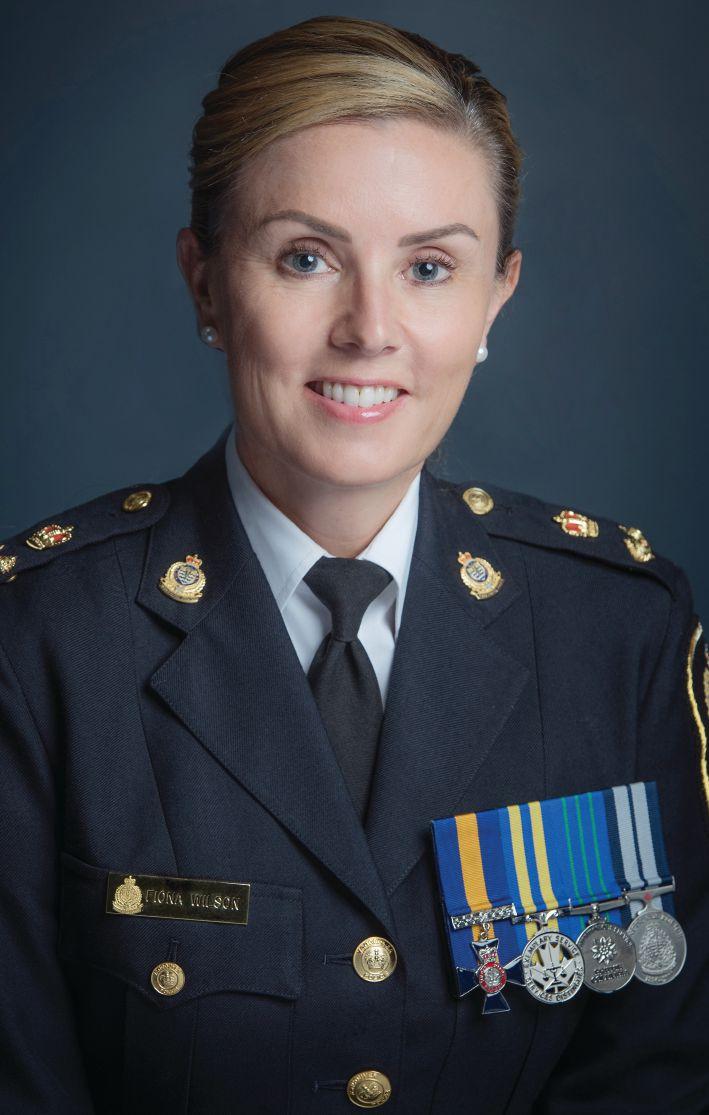
Q&A
Recently,
editor Brittani Schroeder spoke with the Chief Designate of the Victoria Police Department (VicPD), Fiona Wilson, about taking this next career step, her final days as deputy chief at Vancouver Police Department and her future at VicPD.
Q: Can you share some of your favourite memories and greatest successes from your career in Vancouver?
I love looking back and reflecting on a career that has brought so much meaning, excitement and satisfaction into my life. Some of my most memorable moments were during my time in patrol, walking the beat with a dedicated team in the Downtown Eastside. The front line officers who respond to 911 calls and engage directly with the community are truly the backbone of any police department. Being part of that work early in my career was both inspiring and formative. Along the way, I had the privilege of working alongside remarkable individuals – many of whom have become lifelong friends and trusted colleagues.
When I think about the most rewarding aspects of my career, one area that stands out is the VPD’s advocacy around root causes of crime and disorder, particularly those linked to substance use and mental illness. In 2007, Chief Jamie Graham, followed by Chief Jim Chu, asked me to explore what appeared to be a growing trend: an increase in police calls involving individuals in mental health crisis. Their support helped launch some of the earliest research on this issue in Canada – an initiative that laid the groundwork for broader awareness and action.
At the time, in certain areas of the city, more than half of our calls involved someone experiencing a mental health crisis. It was a pivotal moment, one of the first instances where a Canadian police service publicly acknowledged the need for greater community resources to support individuals with mental illness, many of whom were coming into contact with police simply because no other help was available. We also took the important step of naming what was happening: criminalizing mental illness due to systemic gaps in care. That experience ignited a lasting commitment in me to advocate for improved mental health supports, especially
Fiona Wilson
for those also facing the challenges of substance use.
Q: How did you know that this was the right time for you to put yourself forward for a chief position?
I’ve now been serving as deputy chief at the VPD for over four years, and I knew a change in leadership was on the horizon, not just for our department, but for VicPD as well. I felt ready to take that next step in my career.
As I began learning more about VicPD, and the work underway there, it quickly became clear that the communities of Victoria and Esquimalt share values that closely align with my own leadership approach. The priorities that matter to me as a police leader also resonate with the vision and expectations of the Victoria and Esquimalt Police Board.
Deciding to apply wasn’t easy – it was a significant move. But once I entered the process, it became increasingly clear that it was the right fit. This was very much a family decision; we knew it would impact all of us, so we took the time to make it together. VicPD’s recruitment process was impressively thorough, and I was extremely grateful that the search committee gave me the opportunity to compete, even though I joined the competition late in their process. Still, I completed every stage alongside the other candidates. It all happened so quickly that I didn’t have to keep it under wraps for long, just long enough to make sure we were ready.
Since making that decision, everything has fallen into place. It’s felt right from the start, like it was meant to be.
was overwhelmed with gratitude. It was one of those surreal moments – something I’ve experienced a few times in my career – where you have to pause and really take it in, because it’s hard to believe you’re exactly where you hoped to be.
My family was thrilled and incredibly proud. My husband, who works at VPD and genuinely loves his role there, will stay in the city with our kids during the week while I settle into Victoria. They’ll come over on weekends, and once our youngest finishes high school and my husband retires, the plan is for everyone to make the move to the island. For now, I know how important it is, especially in this first year, for me to be fully present in the community and spend as much time as I can in Victoria and Esquimalt, building those connections and setting the tone for the work ahead.
Q: I’d also like to discuss the fact that you’re the first female chief of VicPD. How does that feel?
That’s an interesting one. On the one hand, I absolutely recognize the historical significance of this moment, and I feel both humbled and privileged to be stepping into this role. I know I’m standing on the shoulders of so many trailblazers, both women and men in policing, who came before me and paved the way. I also know that I had incredible mentors and sponsors throughout my career, without whom I would not be where I am today.
“I’ve been given the opportunity to fill this role not because I’m a woman – but, if I’m being candid, I think it’s fair to say I’m doing so despite being a woman.”
Q: What was it like when you got that call, informing you that you’d be the next chief of VicPD?
I happened to be driving when I got the call – funnily enough, I was also behind the wheel when Adam Palmer called to tell me I’d been successful in the VPD superintendent competition all those years ago. Maybe being in the car is my good luck charm when it comes to career news! When the call came through this time, I
At the same time, I think it’s important to be honest about where we still are. I’ve been given the opportunity to fill this role not because I’m a woman – but, if I’m being candid, I think it’s fair to say I’m doing so despite being a woman. That reality is a bit disheartening. It’s 2025, and the fact that this is still seen as a milestone shows that we have more work to do when it comes to supporting and advancing women in policing.
So while I feel incredibly proud, I also believe we need to acknowledge that this shouldn’t be a “first.” Like those who came before me, I hope I can contribute to moving the profession forward and help create space for others to follow. This feels like an important step in that direction.
Q: What are your feelings as you approach your start date of Aug. 16?
Naturally, I’m a little nervous – but more than anything, I’m excited. I’m really looking forward to getting to know the dedicated sworn and civilian professionals at VicPD, as well as connecting with the broader communities of Victoria and Esquimalt. I’m eager to get to work and start learning more about the priorities that matter most to the people we serve.
In the beginning, my focus will be on listening, learning and observing. I expect there will be a steep learning curve, and that’s something I welcome. The insights I gain during that time will shape my priorities moving forward. Much like in Vancouver, I know there are complex social challenges here, and I’m looking forward to engaging with those issues headon. Internally, building relationships with members across the department will also be key to informing my leadership approach.
I also want to take a moment to recognize Chief Del Manak. I’ll have two weeks of overlap with him before the official change of command, and I’m incredibly grateful for that opportunity. Del has always been a supportive friend and colleague, and the fact that he’s taking the time to guide me through the transition speaks volumes about the kind of person and leader he is. I’m truly thankful for his support as I step into this role.
Q: Is there anything else you’d like to share before you make this next career move?
I will always be deeply grateful to the people I’ve had the privilege of working with at the VPD over the years. Each one of them played a part in what has been an incredibly exciting and rewarding career – one that I’d honestly do all over again without hesitation.
Looking ahead, I’m genuinely excited to get to know everyone at VicPD and the communities of Victoria and Esquimalt. The department has an outstanding reputation across the country, and I feel truly honoured to be stepping into the role of Chief. I’m thankful for the opportunity, and I can’t wait to get started.
Editor’s note: This interview has been condensed and edited for clarity.
BY PETER COLLINS
Accelerationism explained: A violent threat to Canada
The Government of Canada uses the terms “terrorism” and “violent extremism” interchangeably from a policy perspective. However, from a criminal law perspective, only “terrorist activity” (terrorism) is currently defined under the Criminal Code. It is defined as an act or omission committed:
a. In whole or in part for a political, religious or ideological purpose, objective or cause;
b. With the intention of intimidating the public or segment thereof, with regard to its security, or to compel a government to do something or refrain from doing something; or
c. With intent to cause serious violence to persons, property, critical infrastructure, or essential systems.
ideologically motivated violent extremism (IMVE).
I’ll be discussing a particular IMVE ideology: accelerationism. According to the Anti-Defamation League (ADL), based in the United States, accelerationism is an extremist belief rooted in segments of the white supremacist movement. Accelerationists believe that the collapse of Western society will eventually occur and that acts of violence and destabilization can “accelerate” this inevitable societal collapse, which will be replaced by a white ethnonationalist state.
“Terrorism is a tactic, whereas extremism is a belief system.”
– Berger, 2018
Terrorist activity also encompasses preparatory offences related to this type of activity, including attempts, counselling, threats, conspiracy and being an accessory after the fact.
Different forms of extremism have been described in academic literature. In broad strokes, extremism is classified into three main categories: religiously motivated violent extremism (RMVE), politically motivated violent extremism (PMVE) and
Accelerationist white supremacists similarly hold these views but also claim that modern society is inherently fragile, unstable and headed towards an inevitable collapse. They advocate to “speed up” this collapse through violence, acts of sabotage, and sowing general chaos. They believe that this will provide them with a real opportunity to reshape society according to their own beliefs and desires. Therefore, accelerationist white supremacists may be more likely than other types of white supremacists to make explicit calls for direct, violent actions.
The targets of the attacks advocated for by the accelerationists vary. There have been attacks against perceived enemies, including Jews (the 2019 Poway Synagogue shooting),
people of colour (the 2022 Tops Friendly Market shooting in Buffalo), immigrants (the 2019 El Paso shooting), LGBTQ+ people (the 2022 Bratislava shooting and 2023 Colorado Springs shooting) and Muslims (the 2019 Christchurch mosque shootings).
In Aug. 2017, at the Unite the Right Rally in Charlottesville, VA, many marchers carried “tiki torches” and chanted “we will not be replaced”—a slogan of accelerationists. That rally was attended by members of the alt-right, neo-fascists, white-nationalists, the Klansmen and far-right militias. Protesters and counter-protesters clashed, and a self-proclaimed white supremacist deliberately drove his car into a crowd of counter-protesters, killing one and injuring many more. That individual was sentenced to life in prison without parole, avoiding the death penalty by pleading guilty.
In Canada, accelerationism also advocates for societal collapse through violence. An example of this belief system is through the Diagolon movement. Diagolon is a loose network of people with neo-fascist, militant views, which emerged from a group of live streamers called “The Plaid Army,” according to the Canadian Anti-Hate Network (CAHN). Their live streams consist of content that is racist and anti-Semitic. Characterized by anti-government rhetoric, Diagolon uses memes and online platforms to recruit and radical-
ize individuals. The group has been linked to violent incidents, including the 2022 Coutts border blockade.
Their de facto leader made headlines for protesting in Halifax against a joint speaking engagement of retired General Romeo Dallaire and Omar Khadr about child soldiers in 2022. He was arrested for weapon charges after a video was posted on social media, allegedly showing a gun pointed at a man’s head.
The “Diagolon National Anthem” seems to be a self-shot video featuring a Korean War memorial, clips of a Canadian flag, wheat fields and the Diagolon flag. This footage is set to a rendition of the sea shanty “Rolling Down to Old Maui” by the late Canadian folk singer, Stan Rogers, and is performed by Mannerbund, a group they identify as a white supremacist men’s group.
In the summer of 2024, Diagolon launched what the media labelled as a “terror-tour” in smaller communities in the prairies and B.C., to spread their ideology and recruit like-minded individuals. There were social media posts of followers, in community halls, showing a sign with their arms that mimics the diagonal slash on their flag and has an eerie resem-
blance to the Nazis.
Similarly, the Atomwaffen Division (AWD), a neo-Nazi group, has been involved in creating propaganda and planning violent acts, reflecting the group’s accelerationist ideology that seeks to hasten societal collapse through violence. AWG, also known as the Nationalist Social Order, was founded in the United States in 2013 and has expanded to other countries, notably Canada, the United Kingdom and Germany. AWD, along with Blood & Honour, Combat 18, Proud Boys, the Base, the Russian Imperial Movement, Aryan Strike Force, Three Percenters, and one IMV extremist—James Mason—are listed as terrorist entities. Being listed carries significant consequences for the entity, criminalizes certain support activities and can assist in law enforcement investigations.
But why should we discuss accelerationists? Although they claim to have members of the Canadian Armed Forces and police in their ranks, they pose a risk to Canadian society and perceive the police as an enemy. They are a serious concern for law enforcement and the Canadian Security
Naturopathic
Intelligence Service (CSIS). IMVE encompasses a range of threat actors, from lone individuals to groups and networks, often fueled by online radicalization. The threat is complex, evolving, and multifaceted; we must remain vigilant.
Recommended reading
• Berger, J. (2018) Extremism. The MIT Press: Cambridge, Massachusetts.
• Perry, B. & Scrivens, R. (2019). RightWing Extremism in Canada . Palgrave: New York, NY.
• Public Safety Canada (2022). Parliamentary Committee Notes: Ideologically Motivated Violent Extremism (IMVE) and Terrorist Listings. Accessed at https://www.publicsafety.gc.ca/cnt/ trnsprnc/brfng-mtrls/prlmntrybndrs/20220914/21-en.aspx.
Dr. Peter Collins was the operational forensic psychiatrist with the OPP from 1995 to 2025. He has been a member of the Toronto Police Service Emergency Task Force crisis/hostage negotiation team since 1992. He continues to consult with law enforcement agencies in Canada and internationally. Contact him at peter@collinsforensicpsych.org.
An infinite mindset in policing organizations: Part 1
Ibelieve life is a game. Sometimes the game is enjoyable, at times challenging, and always an opportunity for growth.
How we approach this game, particularly from an organizational perspective in policing, can influence success, wellness, opportunity and growth, thereby shifting the internal culture.
We often hear about and discuss the challenges posed by a toxic culture in first responder organizations, and the lives that are lost or shattered as a result. This includes the inability to process our traumatic events in a healthy manner while carrying the weight of life on our shoulders. And yet, what if exploring how we engage in this endeavour offered insights that could shift the outcome of this culture?
A s a brilliant mentor once explained, playing the game from a finite or infinite mindset provides the opportunity to do just that: shift the culture. He explained how, when we are clear on our why—why we do what we do in policing—the various components of the infinite game influence and indicate how an organization values its people, especially in the realm of policing. Recognizing how finite game measures often infiltrate and take over is crucial, as is the importance of filtering through organizational processes based on the why, to ensure they align with an infinite mindset.
What are finite and infinite games? Both require at least two players to be played. A finite game involves fixed rules, a beginning, a middle and an end. An example of a finite game is hockey; there are known players with a common objective of placing the puck in the opposing team’s net while keeping their own net clear. They play this game with a clear set of rules. When those rules are broken, a penalty is imposed. When the game is over, there is a winner and a loser. An infinite game involves both known and unknown players; although governing documents, such as policies and procedures, may be in place, no clear consensual rules are established. There is independence among the players, and they may choose not to follow those governing documents. The game is ongoing, a journey, not a specific event, and there are no
winners. This part is key to understanding the infinite game through an organizational lens.
Policing organizations are considered an infinite game, as are all businesses. Relationships are also an example of infinite games, whether they are played that way or not. There are no winners and no end, even though it may be perceived otherwise in relation to promotions and marriages. When we consider life and death, none of us will be winners.
How or what mindset we choose to play this infinite game in policing is key to both our success and our contribution to organizational culture
T he reason this seemingly simple and yet complex lens is worth exploring is that how or what mindset we choose to play this infinite game in policing is key to both our success and our contribution to organizational culture. Many leaders play the organizational infinite game with a finite mindset, but in policing, there are no finish lines, making it impossible to win. While policing organizations often value trust, innovation and cooperation, playing an infinite game with a finite mindset erodes these very components.
Without these values, policing organizations risk perpetuating mental health issues, organizational liability and a toxic culture.
A s the leaders that each of us is, we have the opportunity to learn and understand how to provide safe spaces where our people are inspired to support their community, no matter their role in policing. Where our people wake up every day feeling connected, anchored and empowered with the tools, resources and confidence to navigate life’s challenges with resilience and growth. That is my why, and working with an infinite mindset is the most efficient and effective way to support trust, innovation and cooperation with those around me.
I n my next column, I’ll be exploring and providing actionable pieces to ensure you, as leaders, are providing an infinite mindset in your policing environment while playing this infinite game .
Michelle Vincent PhD/MACP is a retired officer and the founder of The Haven, Ontario’s first non-profit, inpatient treatment centre exclusive to first responders and uniform personnel. Contact her at michelle. vincent@thehaven.cloud.
The role of drones in law enforcement
A guide to use of force levels André
Rossin-Arthiat
Drones are a force multiplier and can be used as a de-escalation tool when properly used and flown. They are a new tool for some agencies and can protect and save the lives of law enforcement personnel (patrol, SWAT, and even K9 dogs) and the general public.
S ince the regulations of drones of 2019, in Canada, the U.S.A. and other modern countries of Europe and Asia, the use of force continuum when using drones has yet to be addressed regarding after-action reporting and the actual legal aspects that can arise when going to court. It is essential for law enforcement officers using drones on patrol or SWAT operations to properly understand and document the various levels of force that can be used during a call-out and be able to explain possible injuries that can occur with the drone, regardless of its model or make.
Drones are relatively new in the public and private security sectors. Depending on the agency, the choice of drone has an immediate impact on the use of force continuum level and the use of force policies and procedures. Before discussing the various levels of force available with drones, the safety parameters must be understood.
Drone safety parameters can be summarized with the acronym POSHAB:
• P: Public safety
• O: Officer safety
• S: Suspect safety
• H: Hostage or victim safety
• A: Animal safety (domestic pets or police K9)
• B: Building or object safety (walls, cars, etc.)
L et’s look further at the drone selection. Consider, for example, the use of propeller guards. They are necessary for indoor operations, as the drone requires them so as not to cut anybody near the high-speed turning blades. Propellers, if broken, damaged or contacted, can cause serious injuries. Damage to walls, objects, or even evidence preservation is another issue. Drones displace
a lot of downward air and cause weightless objects (paper) or light objects (towels, carpets, shelved souvenirs, ammunition casings, medications, etc.) to be blown away and even caught up in the propellers. Doors can also be closed due to air currents in a house, especially when air conditioning is on, or fans or windows opened normally or after dynamic entries.
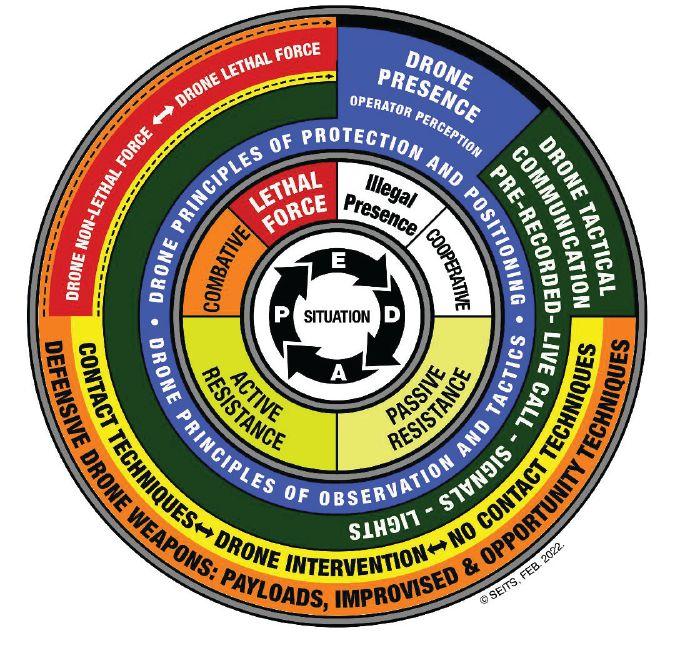
A drone use of force model was created in 2023 and is included in the standard use of force model. I have laid out a separate drone use of force model so that every level of force when using drones can be explained and documented during training sessions.
Level 1: Drone presence
Just like an officer who shows up during a call, the drone also directly affects the general public. However, drones are often perceived as privacy intruders, and a lot of people do not like drones in the public and private security sectors as they are considered a disruptive, innovative technology tool.
Regardless, drones are here to stay. Their presence can be recognized or ignored as they can have a significant height advantage. A great benefit of drone presence is the ability to
PHOTO CREDIT: SETIS, 2022.
The complete drone use of force model.
see things faster and make quick tactical decisions depending on the actionable data, provided it is well positioned during the call-out.
Level 2: Drone tactical communication
C ertain drones can record messages or even call and talk to someone remotely. The other great advantage is “drone talk” with the use of lights and/ or specific drone intuitive movements that have a particular meaning, such as up and down movement for “Yes” or lateral movement back and forth for “No”.
D rone features such as IR
drone orbiting people and limiting their forward movements or simply positioning the drone in front of the person, preventing them from moving forward. Using high bright lights to blind a suspect is another example. The downward prop wash can also be used to close a door to restrict suspect movement.
Some cases of drone soft techniques involving contact can be dropping medication for a suspect or hostage and slightly hitting them inadvertently. Generally speaking, any inadvertent or intentional contact at very low speeds can also be included in this level of force.
Depending on the agency, the choice of drone has an immediate impact on the use of force continuum level and the use of force policies and procedures.
as the glass breaking is intentional. This technique is also used to create an entry into a building when no other method is available. The alternative is to call up a patrol or SWAT officer to use their baton to create an entry for the drone to enter a building.
Level 5: Drone non-lethal force
(Infrared) strobes can also communicate a message to the law enforcement officer who understands the flashing’s meaning. For example, when I was deployed in Ukraine, our team used IR strobes for IFF (identification of friend or foe) purposes during night operations.
T here is usually no contact between the drone and objects or individuals, but it can restrict the person’s movements. Some examples are drone arrests (cooperative arrests) with the
Level 4: Drone contact intervention – Hard techniques
Any medium-speed intentional contact, like flying into a suspect’s arms, legs, stomach or back, is considered a hard technique. The intention here is to scare, disorient, slow the suspect down or protect an officer. Depending on the drone used, minor injuries can occur and cause the suspect to fall down. The law enforcement pilot’s skill set (hours flown, drone use of force experience) will dictate the level of comfort in using this type of force.
The drone’s noise and the perception of propeller blades turning at high speeds immediately affect the suspects and/or hostages. Some drones have a payload that allows for a window-breaking capability. This type of intervention should also be considered a hard technique,
Like the baton target areas, the drone can target green or yellow areas at high speed (stomach, chest, back). The objective here is to protect an officer or a hostage. Injuries can occur from the impact of the drone or the propeller blades. The speed of the drone and the distance from the suspect are the key factors to consider (kinetic energy).
Level 6: Drone lethal force
The drone can also be used to target red areas, such as the head or back of the head and/or the genitalia area. As previously mentioned, the speed of the drone and the distance from the suspect are both key factors to consider. Depending on the drone skillset of the law enforcement pilot, this is a last resort option only.
Conclusion
Drones can be used in the use of force models at every level of force. Clear SOPs (Standard Operating Procedures) and agency use of force policies should reflect the proper judgment and acceptable choice of level of force depending on the drone used and according to the specific drone operation (indoor or outdoor).
André Rossin-Arthiat is a retired emergency response veteran (law enforcement and paramedic) with 20 years’ experience in the field. He also has real-world experience with drones in forest fires, thermal inspections, S.A.R (Search and Rescue, Search and Recovery) operations, and international close protection. He can be contacted at eyeintheskymtl@gmail.com.
Earn your Public Safety Degree online at Laurier!
Undergraduate (BA) Degrees
• Public Safety
• Policing
• Criminology and Policing
Graduate Degrees
• Graduate Diploma in Public Safety
• Master of Public Safety
BY KERRY AVERY
Leveraging AI for effective training and development
Training development is a critical challenge for law enforcement agencies. With limited resources and increasing demands, training units face constant pressure to create, update and deliver high-quality programs. Artificial intelligence (AI) offers a promising solution to these challenges, providing tools that can significantly reduce development time while enhancing training quality.
AI as a training assistant
Today’s AI tools, particularly Large Language Models (LLMs) like ChatGPT, Claude and CoPilot, present an opportunity for advancement in how we can approach training design and development. These tools can process vast amounts of information and communicate in natural language; however, it’s essential to understand that AI works best as an assistant rather than a replacement for professional expertise. People’s knowledge and experience remain essential for ensuring quality and effectiveness.
Enhancing training development
AI can be used throughout the design process. When conducting training needs analysis, LLMs can quickly process performance data, feedback and reports to identify gaps and areas for improvement. This capability transforms a time-consuming process into a more efficient and data-driven approach. Consider using AI to analyze quantitative and qualitative data and compare existing training to task analysis to identify gaps.
Now, consider the challenge of writing learning objectives – a task that traditionally requires significant time and expertise. You can generate initial drafts of learning objectives in seconds by providing AI with a description of your training program or existing documentation. These drafts then serve as a foundation for refinement based on your specific departmental needs.
Course structure, another traditionally challenging aspect of training design, becomes more manageable with AI assistance. Instead of spending time organizing topics and creating logical sequences, AI can generate course outlines that follow sound instructional principles. If the initial organization doesn’t meet your needs, you can
generate alternatives until you find the proper flow for your program.
Training can better align with adult learning theories and cognitive science by using AI to design exercises for introductions or icebreakers, content application and review. I used to spend hours looking up team-building exercises to create an effective icebreaker. Now, these tools can write a list of different exercises with an explanation of how each one is tied to the training topic. It can also suggest games, review activities and scenarios.
Assessment development, particularly the creation of multiple-choice questions, also benefits from AI support. One of the more challenging aspects of test development has always been creating plausible distractors—those wrong answers that must be reasonable enough to test proper understanding. AI can generate these options, along with detailed feedback for online formats and rubrics for evaluating scenarios and long-answer questions.
Effective prompt strategies
The quality of AI-generated content depends mainly on your prompts. Here are some of my proven approaches:
Provide context for scenario development: “Create a scenario for a domestic dispute call, incorporating mental health crisis intervention elements. Include details about the apartment layout, time of day and previous calls to this address.”
Specify your requirements when developing assessments: “Generate five multiple-choice questions testing knowledge of search and seizure procedures,
focusing on vehicle searches. Include explanation for correct and incorrect answers.” Prompt for more questions than you need, then select the best ones.
For course outlines, include your constraints: “Create a four-hour training outline for body-worn camera procedures, including hands-on practice time and policy review. The audience is experienced officers receiving updated equipment.”
Security considerations
Security plays a crucial role in how we use AI in law enforcement training. Avoid uploading confidential information to public AI platforms unless your agency has a closed system. Remember that anything entered into these systems becomes part of their learning data. Use publicly available information, such as legislation, case law and publicly available policies. It can be used in AI if it is on a public website. Otherwise, AI can be used to generate general content and scenarios that can later be customized with sensitive details in a secure environment.
Ethical framework
Ethics in AI-assisted training development centers on human oversight. While AI can quickly generate content based on available information, that information may include outdated, incorrect or biased material. Your role as a training professional includes validating content accuracy and ensuring it aligns with current best practices and departmental policies.
This is particularly important when using AI to generate images and scenarios. Review all AI-generated images and scenarios carefully for potential biases or stereotypes that could undermine the training’s effectiveness and impact. Your experience and judgment are crucial in ensuring that training materials remain fair.
Looking forward
The future of training lies in a balanced approach to AI. It will allow training units to focus their energy on strategic decisions and specialized content development, ultimately leading to better agency training outcomes.
Kerry Avery M.Ed., is a law enforcement training specialist who designs classroom, online and blended learning programs. With over 20 years of instructional design experience and 15 years dedicated exclusively to law enforcement training, she specializes in developing effective training solutions and optimizing training outcomes for the public safety sector.
This straightforward, easy-to-understand textbook inspires tools for improving job performance, productivity, and morale in law enforcement. The groundbreaking first edition of Gold Medal Policing, inspired by work with Olympic athletes, confirmed the importance of mental readiness in frontline policing excellence. The 2nd edition consolidates two decades of peer-reviewed research and training, reflecting new trends, lessons, contemporary issues, and proven tools. Drawing on insights from frontline officers recognized for their excellence, it introduces an Operational Readiness Framework rooted in scientific principles. Best practices from exceptional officers are isolated, and operational benchmarks and strategies are established. Gold Medal Policing is indispensable for law enforcement leaders, scholars, students, and aspiring officers.
$70.50 | Item# 0367700232
BACK OF THE BOOK
BY ANDREW CRITCHLEY
The leadership deficit
For most people, ‘modern policing’ lacks a precise definition; however, it is generally understood to reflect evolving practices, technologies, and philosophies that adapt to contemporary societal needs. Within the senior ranks of police leaders, this era may be most aptly defined by financial constraint.
Following the 2008 financial crisis, police services across the U.K. experienced significant budget cuts, with funding decreased by over 20 per cent between 2010 and 2019 (House of Commons Library, 2020). Consequently, police services in England and Wales faced a loss of around 20,000 officers (ONS, 2020), resulting in increased workloads, decreased morale, and diminished service effectiveness. These difficulties forced law enforcement agencies to consider alternative solutions, particularly in utilizing technology to alleviate operational pressures.
The technology trap: Mistaking tools for solutions
Technology is often viewed as an immediate remedy for organizational inefficiencies; however, research suggests that without the right leadership, digital transformations stall or fail altogether. Kotter (1996) emphasized that 70 per cent of change initiatives fail due to poor leadership and cultural resistance rather than flaws in the technology itself.
I n policing, digital case management, automated reporting systems and AI-driven crime analysis are only as effective as the people using them. If an organization lacks the necessary accountability, strategic vision, or a culture that supports adoption, these tools become underutilized and ineffective.
Psychological barriers to change in policing
A dopting new technologies in law enforcement is uniquely challenging due to deep-seated cultural and psychological factors:
• Status quo bias (Samuelson & Zeckhauser, 1988): Officers and administrators are often resistant to change, preferring familiar processes even when inefficient.
• Social conformity (Asch, 1951): A culture that prioritizes camaraderie over performance discourages individuals from questioning outdated methods or advocating for reform.
• Cognitive dissonance (Festinger, 1957): Leaders who have long endorsed traditional policing models may experience discomfort when confronted with the need for technological adaptation, leading to passive resistance.
• Low psychological safety (Edmondson, 1999): If officers and staff fear reprisal for mistakes, they are less likely to engage with new systems or innovate.
Leadership as the catalyst for change
T he success of digital transformation depends on leaders who can align technological adoption with cultural shifts. Effective police leaders must:
1 Develop digital competency: Leaders who understand the capabilities of emerging technologies can better guide their integration into policing operations.
2. Foster a culture of accountability : Without clear performance metrics and accountability structures, inefficiencies persist despite technological investment.
consideration can increase officer buy-in and engagement with new systems.
4. Measure and adapt: The introduction of technology must be accompanied by ongoing assessment and iterative improvements, ensuring alignment with organizational goals.
Efficiency without leadership is an illusion
I nvesting in cost-saving technologies without addressing leadership deficiencies is like installing state-of-the-art navigation systems in a rudderless ship. The key to sustainable efficiency is not just acquiring better tools but fostering a culture that embraces and maximizes their potential.
As policing enters an era of fiscal restraint, services that fail to integrate leadership-driven transformation will see diminishing returns on their technological investments. Business leaders outside of policing should take note: whether in law enforcement or the private sector, technology only creates value when guided by strong leadership and an adaptive culture.
References
• Asch, S. E. (1951). “Effects of group pressure upon the modification and distortion of judgments.” In H. Guetzkow (Ed.), Groups, leadership and men (pp. 177-190). Carnegie Press.
• Bass, B. M. (1985). Leadership and performance beyond expectations. Free Press.
• Edmondson, A. C. (1999). “Psychological safety and learning behavior in work teams.” Administrative Science Quarterly, 44(2), 350-383.
• Festinger, L. (1957). A theory of cognitive dissonance Stanford University Press.
• House of Commons Library. (2020). “Police funding in England and Wales: House of Commons Briefing Paper Number CBP 7279.” Retrieved from https://commonslibrary.parliament.uk.
• Kotter, J. P. (1996). Leading change. Harvard Business School Press.
• Office for National Statistics (ONS). (2020). “Police workforce, England and Wales, March 2020.” Retrieved from https://www.ons.gov.uk.
• Samuelson, W., & Zeckhauser, R. (1988). “Status quo bias in decision making.” Journal of Risk and Uncertainty, 1(1), 7-59
Andrew Critchley is a detective with more than 25 years of international policing experience. He holds an MSc in Psychology and a bachelor’s degree in Criminology and Psychology. In his current role, Critchley helps organizations bridge the gap between human behaviour and organizational effectiveness to achieve strategic goals.
UNSURPASSED SALARY
Among Ontario’s highest paid officers.
UNRIVALED WORK-LIFE BALANCE
2 weeks on/ 2 weeks off = 6 months personal and family time in addition to annual vacation time.
UNMATCHED OPPORTUNITY
NAPS is doubling its complement, making rank promotions and specialty