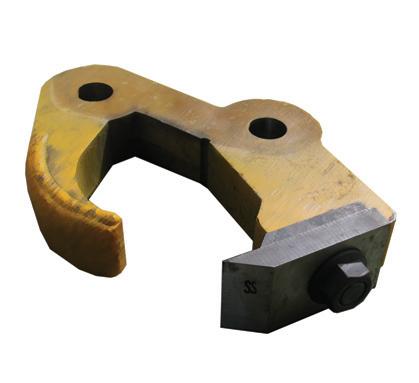
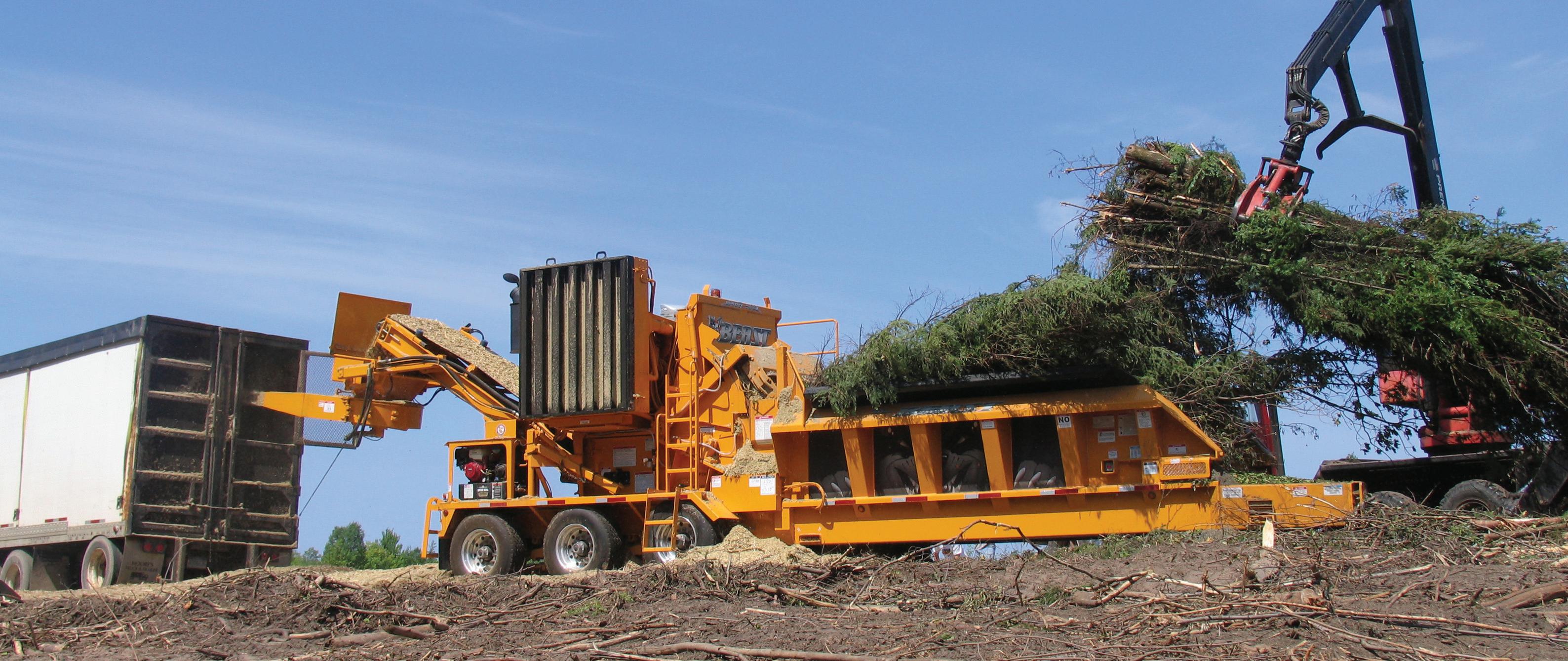
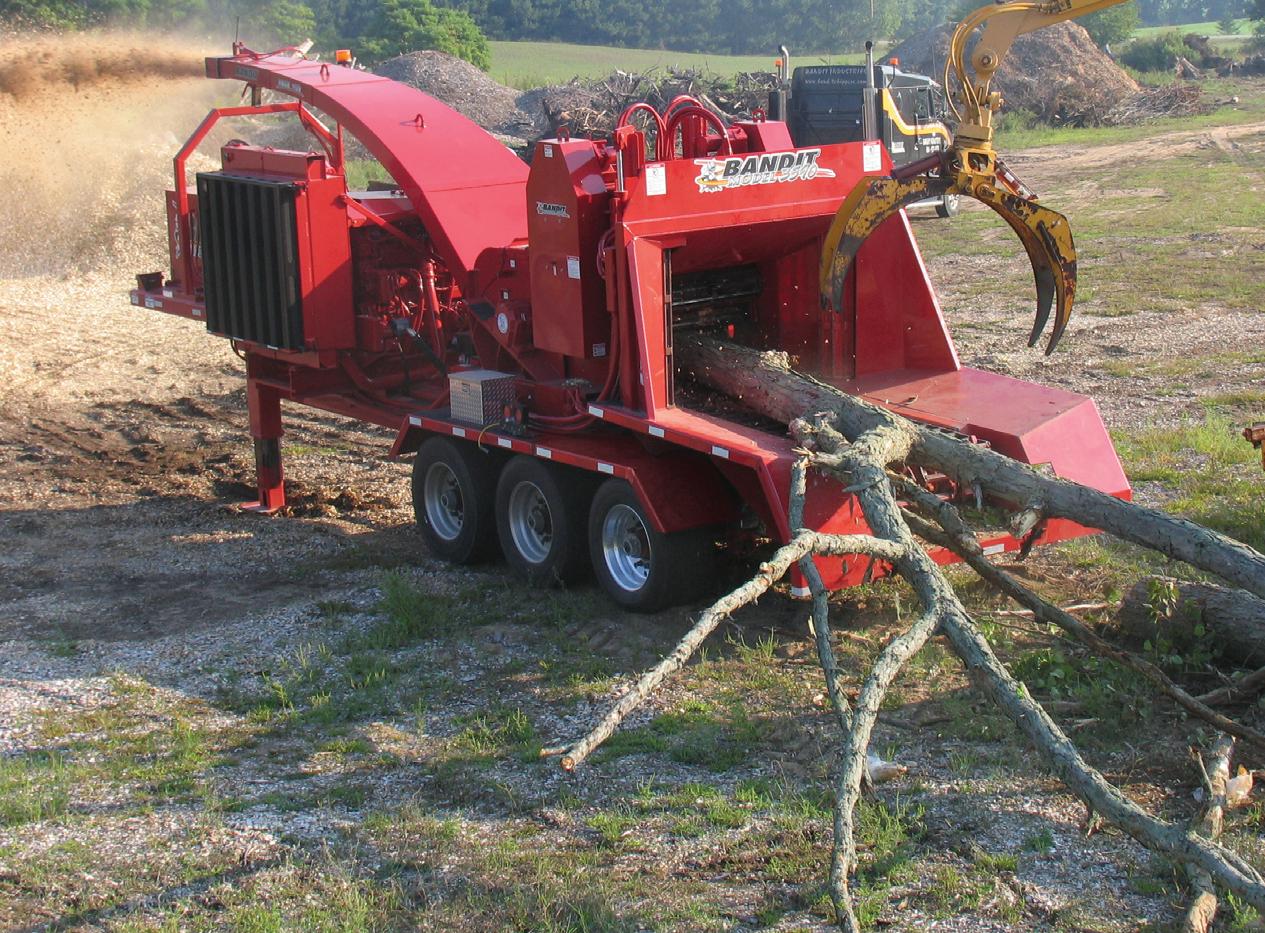
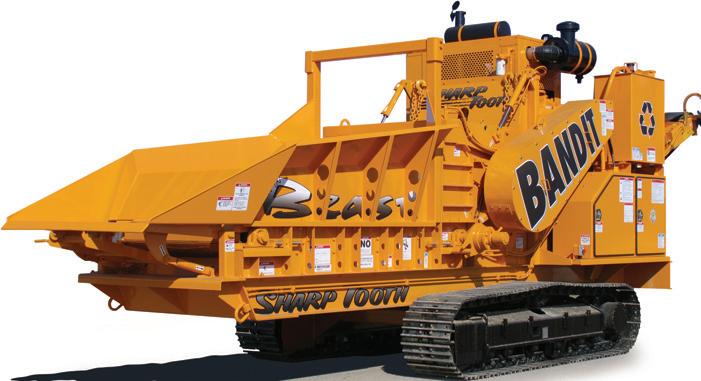
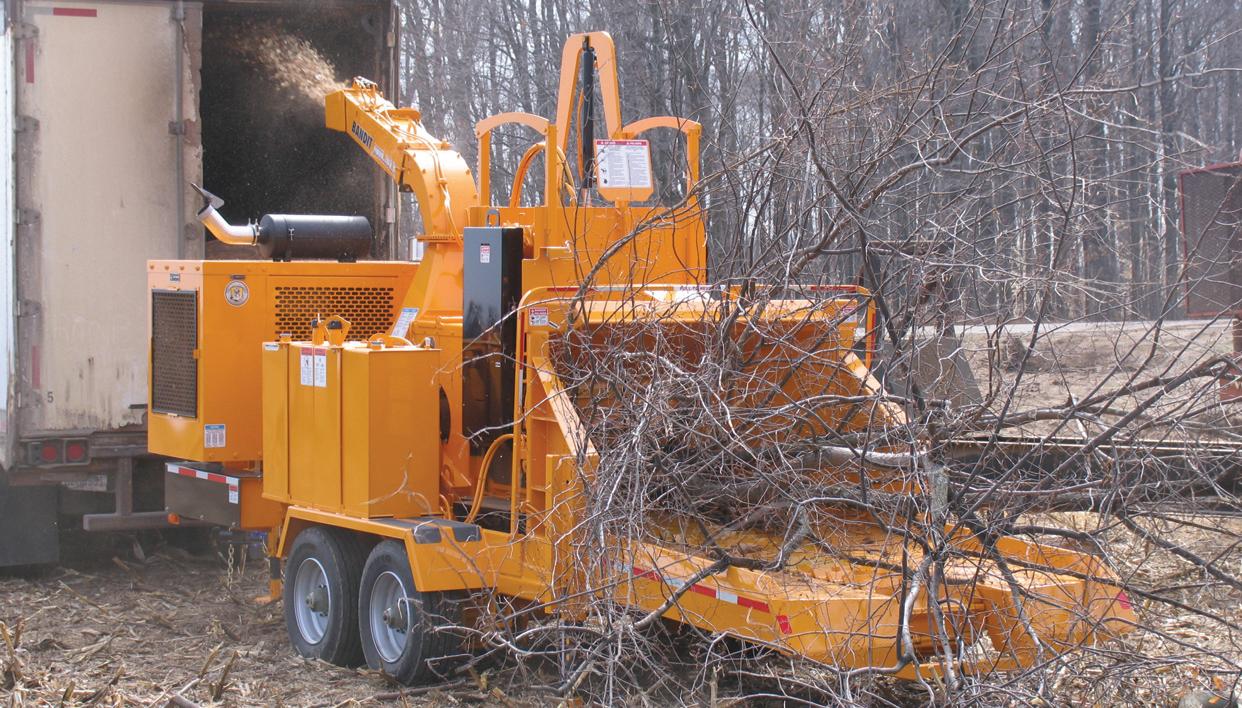
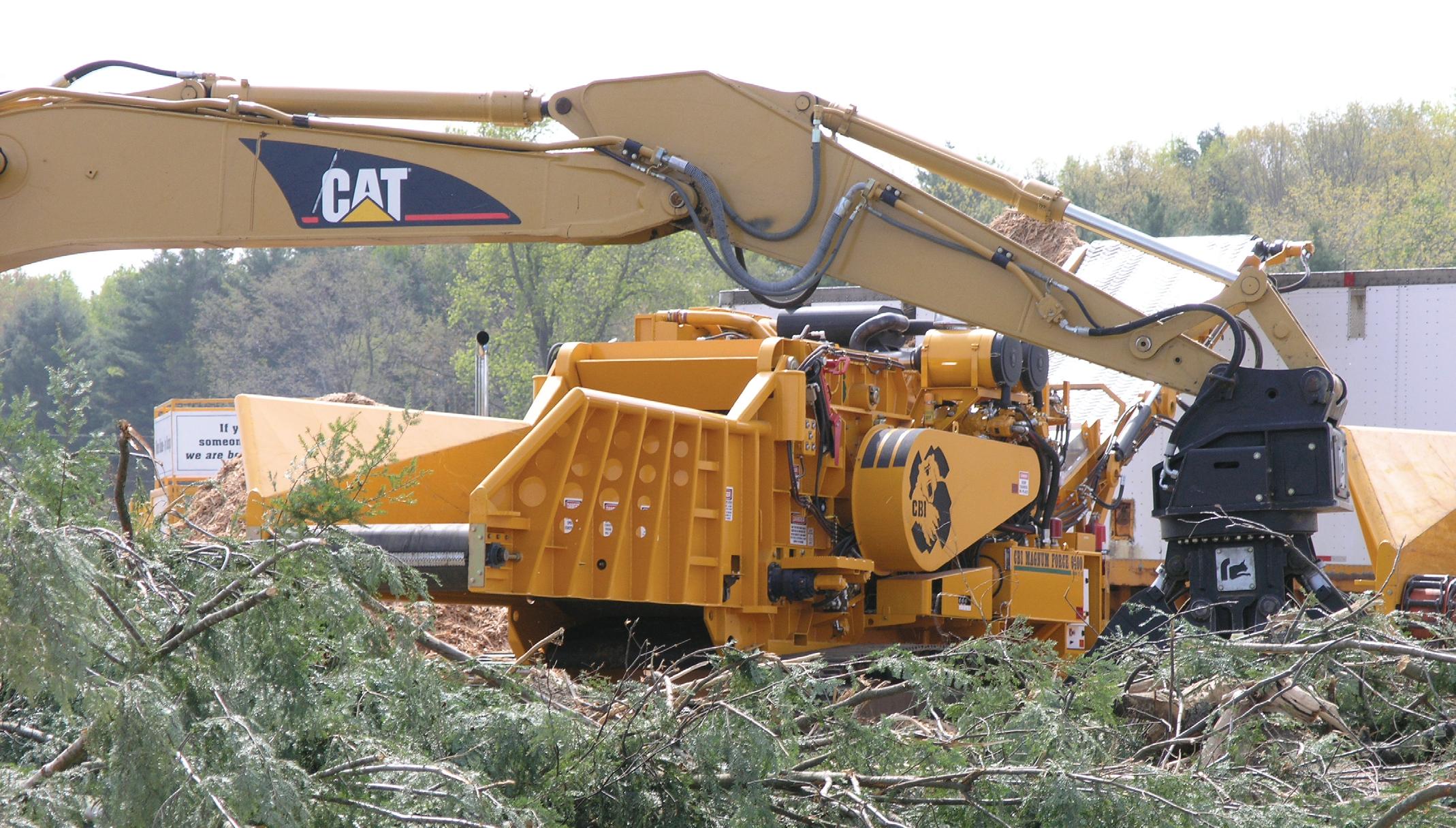
Cut or split, grind or chip! With our new patent pending Cuttermill Knife Set-up, you can turn any Beast® Recycler into a chipper in under three hours!* As a whole tree chipper, the Beast® will effectively chip large diameter material and is an excellent unit for logging slash and sawmill waste. This fuelefficient system offers longer knife-life than a traditional chipper, and provides the versatility to switch between chipping or grinding with one machine, depending on the material being processed. BEAST® KNIFE SYSTEM
Turn your Beast® into a whole tree chipper! A simple exchange of traditional cutterbodies for Beast® Knife System cutterbodies allows you to quickly convert your Beast® horizontal grinder into a high-capacity chipper. Ideal for producing a dimensional chip for fuel wood markets and many mulch products.
Model 2090 Whole Tree Chipper with Optional 10’ Infeed Conveyor Model 2090 Whole Tree Chipper with Optional 10’ Infeed Conveyor
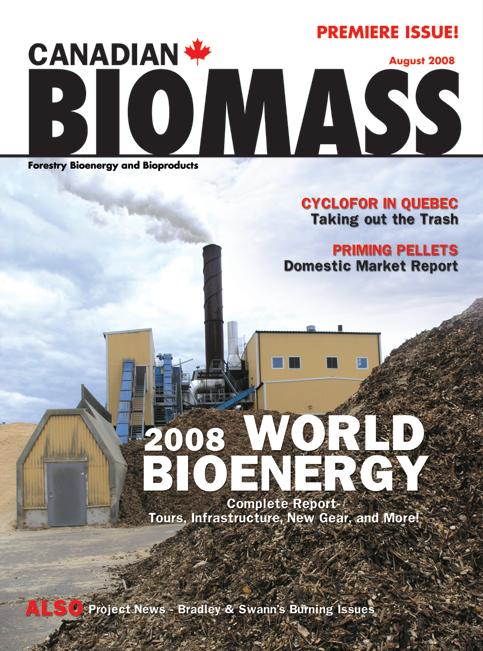
BIOMASS
18 Taking out the Trash
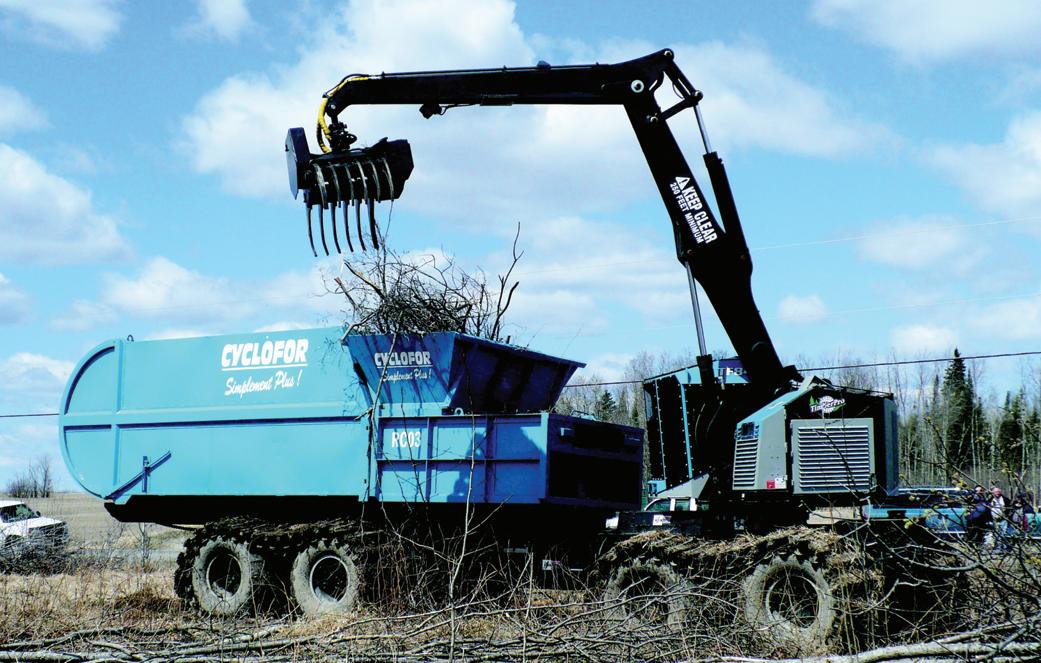
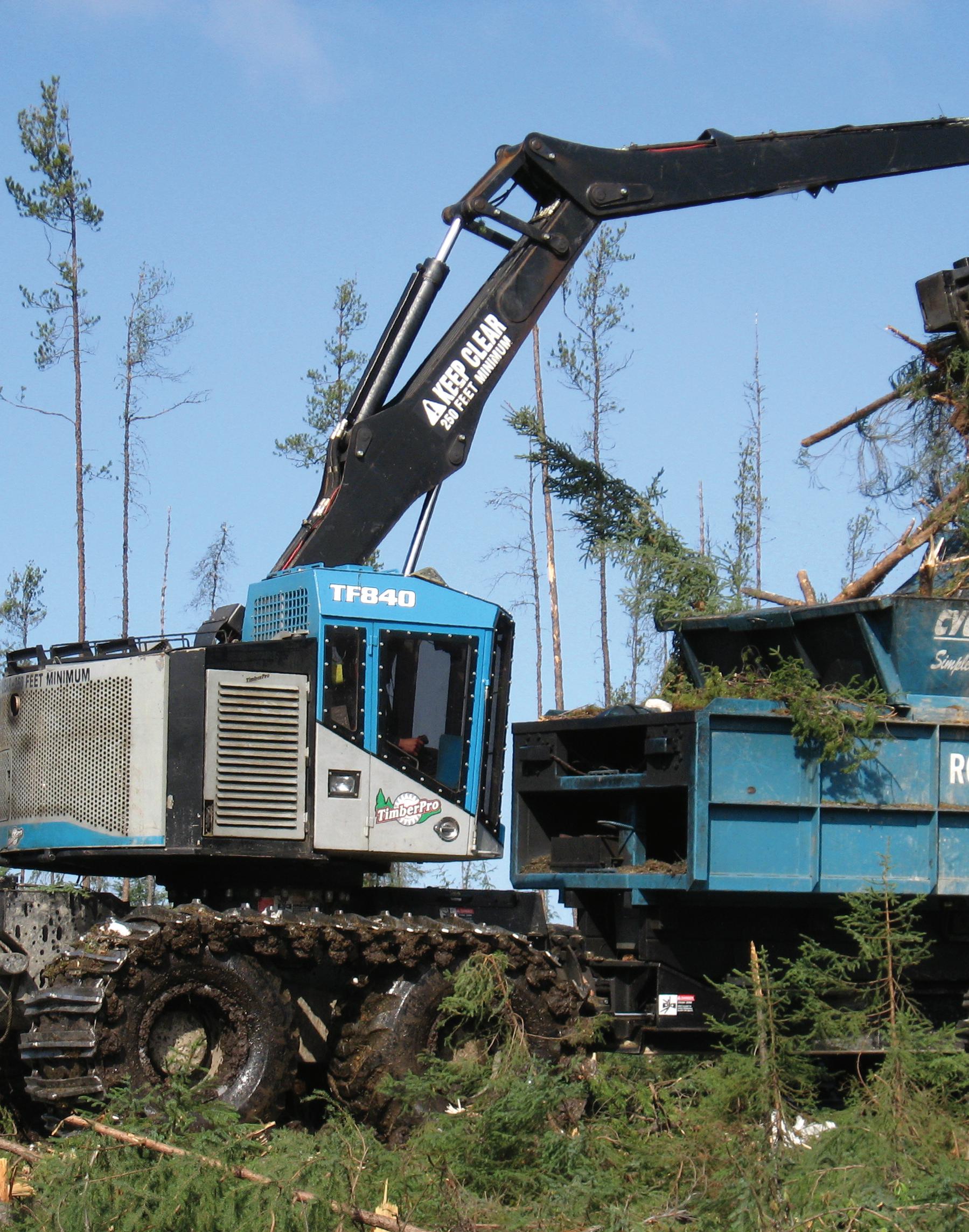
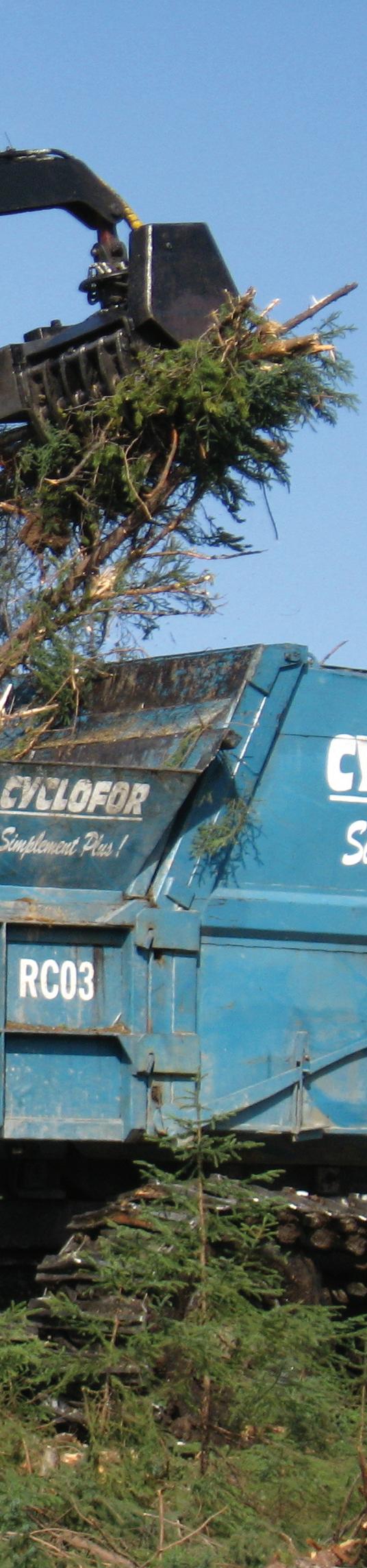
Quebec innovators Cyclofor have created an entire system to deal with the readily available harvesting slash in northwestern Quebec and northern Ontario. It includes the RC-03 slash collector-compactor, slide-off transport containers, and a unique processing plant with a custom-made debarker/sorter.
14 Pellets Rule
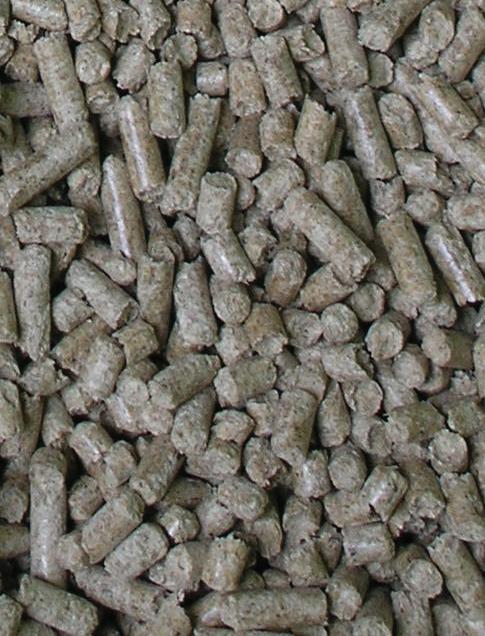
At least in Canada they will, as the flexible, transportable, and uniform energy source shows a bright future. Canadian Biomass talks to Wood Pellet Association of Canada president John Swann, the greenhouse sector, and others on the potential for domestic markets for both industry and consumers.
22 Mapping Success
Putting Canada on track for a bioenergy-rich future requires some government action, and a little more co-operation. This, and a little domestic marketing flare can’t hurt, says CANBIO president Douglas Bradley.
24
Brave New World of Bioenergy
Canadian Biomass dropped in on World Bioenergy, the premiere global event in our sector. We bring back a massive report on tours, trends, new technology and systems from the trade show, plus lots of photos and thoughts from the road. Even if you were there, you’ll learn something new!
“It’s not a vacuum,” explains Cyclofor’s Patrick Paiement.
EVENTS BOARD
SEPT 28-OCT 3, 2008
International 2008 Bioenergy Days, Minneapolis, MN. www.bioenergydays. com
AUGUST27-29,2008
2008 International Bioenergy and ConferenceBio-products(TAPPI), Portland, OR. www.tappi.org.
OCTOBER 16-18, 2008 Expobioenergia 08, Valladolid, Spain. www.expobio energia.com
OCTOBER 6-7, 2008 CANBIO Annual National Conference, Ottawa, ON. www.canbio.ca
SEPTEMBER 16-17, 2008
Bioenergy: Developing Trends and New Opportunities for a Changing Forest Industry, Halifax, NS.
OCTOBER 29-31, 2008
Inter Pellets/ Pellet Forum, Stuttgart, Germany. www.pelletsforum.de
OCTOBER 14-16, 2008
Energy from Biomass & Waste, Pittsburgh, PA. www.epw-expo.com.
Tim Tolton - ttolton@forestcommunications.com 450-458-4341
Guy Fortin - gfortin@forestcommunications.com
90 Morgan Rd, Unit 14
Baie d’Urfé, Que H9X 3A8 Ph: (514) 457-2211 Fax: (514) 457-2558
Western Sales Manager
Tim Shaddick - tootall1@shaw.ca 1660 West 75th Ave Vancouver, B.C. V6P 6G2 Ph: (604) 264-1158 Fax: (604) 264-1367
Production Artist - Brooke Shaw
CIRCULATON DEPARTMENT
90 MORGAN RD, UNIT 14 BAIE D’URFE, QC H9X 3A8
e-mail: cnixon@videotron.ca
Canadian Biomass is published four times a year; March, June, September, and December. Published and printed by Annex Publishing & Printing Inc., and distributed as a supplement to Canadian Forest Industries and Canadian Wood Products magazines.
Forest biomass and pellets may not be a match made in heaven, but they do look pretty good together.
Welcome to the first issue of Canadian Biomass, a forest sector supplement distributed as part of both Canadian Forest Industries and Canadian Wood Products magazines. There are two basic reasons for launching this supplement now – Time and space.
It’s definitely the right time. Biomass, bioenergy, biorefining – you name it and people want to know about it in Canada’s forestry sector and related government departments. With the industry in tough times and energy costs soaring, it makes sense. That’s why we kept running into Canadians (and Americans) on our trip to Sweden’s World Bioenergy 2008 in late May, and why these two groups made up the largest foreign contingent at the international show. We’re on the verge of a biomass explosion on this continent – mark my words. You can read more about this fantastic event starting on page 24.
As for space, we just don’t have enough space in our regular forestry magazines to do this emerging field justice, and maintain the industry coverage our readers expect. So consider this a bonus for our 20,000 plus industry readers.
Also in this first issue, you’ll read an interview with both Wood Pellet Association of Canada president John Swann and CanBio President Doug Bradley on the future for pellets in Canada (page 14). Not just making them, although we do a lot of that already, and
will do a lot more in the near future. We also talk about domestic pellet markets, here and in the US. What strikes visitors to Scandinavia are the well-established biomass community heating plants, great ideas ahead of their time, but also expensive to duplicate here. Pellets, on the other hand, can be moved where the markets are, can be delivered and used just like home heating oil with refined technology already in use in Europe (see our World Bioenergy show review on page 28), and require no massive infrastructure investment. Only wood and marketing are required. Or if you want, they can be used to fuel local or remote community heating systems, as a uniform, forgiving fuel source.
Finally, a little home-grown innovation in the form of Cyclofor. This Quebec biomass harvesting and processing company has developed its own equipment to do the job, and is looking at franchises across North America to spread the concept. We introduce them on page 18.
Enjoy this premier issue. We’ll do four a year, starting with another in December 2008. So let us know what you’d like us to cover, and pass this issue on to folks who may be interested.
Scott Jamieson, Editor/Group Publisher Canadian Biomass sjamieson@forestcommunications.com
BURNING issues
WEST FRASER AND EPCOR JOIN FORCES IN HOUSTON
Vancouver, BC – In what will likely become a familiar trend of forestry and energy companies partnering on biomass projects, West Fraser and EPCOR are working together to explore the potential of a biomass-fuelled 50to 70 megawatt power generation facility near Houston, BC. The project is only in the pre-feasibility phase, but if it proceeds it will be developed as part of BC Hydro’s Phase II bioenergy Request for Proposal process. Home to some of the world’s largest sawmills, Houston has its share of sawmill waste. The project would use this as well as forest residuals from harvesting
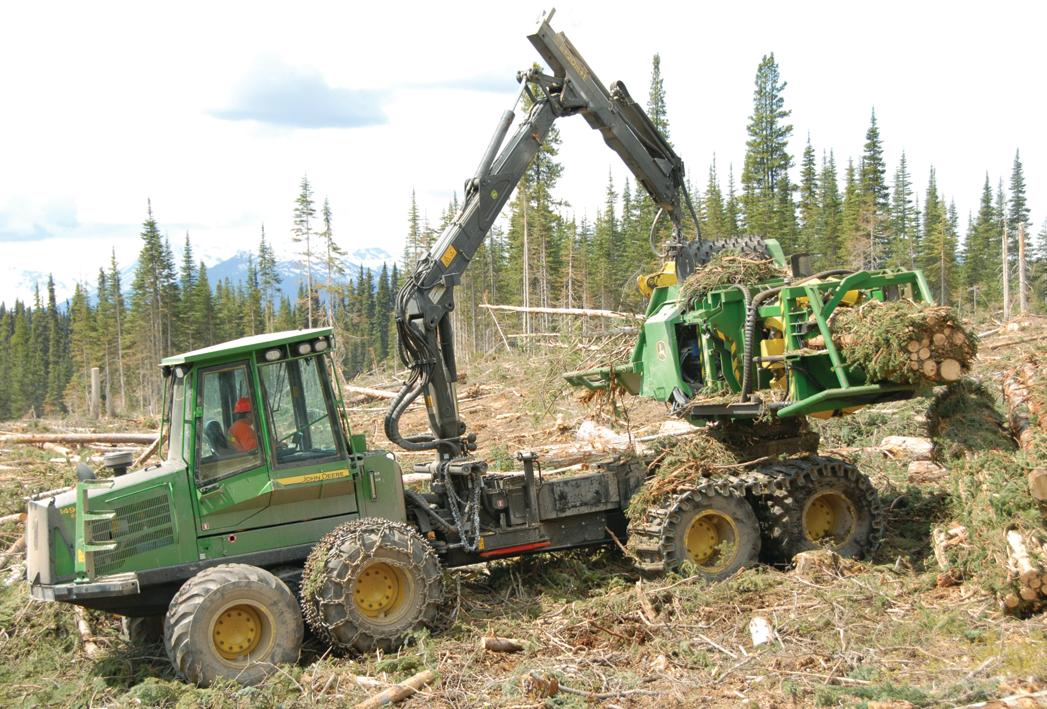
activities such as slash and limbs, and low-grade beetle kill wood. In fact, West Fraser has already run slash recovery tests using the John Deere 1490D fibre bundler in the Houston area to get a handle on costs of this side of the equation.
A decision to go ahead with the project will not be made until late 2008, and will be subject to West Fraser and EPCOR confirming the economic viability of the project and being successful bidders in the BC Hydro process. Vancouver-based West Fraser runs sawmills and holds timber tenures in the area, while Edmonton-based EPCOR
PELLETS THE ANSWER
St. Anne de Bellevue, QC – BioCap Canada and Resource Efficient Agricultural Production Canada have released a report that identifies solid biomass pellets as the best option for Ontario to reduce its greenhouse gas (GHG) emissions. Analyzing Ontario Bio-fuel Options shows that an incentive program for large-scale production and use of solid bio-fuels for commercial and industrial applications would be an effective and sustainable way to both grow the provincial economy and reduce dependence on coal and associated GHGs. It would also create new market outlets for the forest sector. In large-scale use, solid bio-fuels would be much more cost effective than ethanol and bio-diesel, and even more cost effective than wind power at avoiding carbon dioxide emissions. The full report can be found at www.reap-canada.com.
Bois BSL buys Granby’s Ecolog
Mont-Joli, QC – The Groupe Bois BSL, specialists in hardwood flooring based in Mont-Joli, QC, acquired Ecolog of Granby, QC in late May for $1.7 million. Ecolog makes energy logs, and will be added to Bois BSL’s energy division Bois BSL Énergie. “We are very pleased to add Ecolog energy logs to our line of products, known under the SmartLog and Qualiflamme
A John Deere 1490D bundler from Brandt Equipment works on a test site about 90 km from Houston, BC. West Fraser is testing the technology as part of its proposed biomass power plant with energy supplier EPCOR.
builds, owns, and operates power plants, electrical transmission and distribution networks, water and wastewater treatment plants
CANADA
and infrastructure in Canada and the US. It owns one of North America’s largest biomass power plants in Williams Lake, BC.
INVADES SWEDEN
Jönköping, Sweden – According to World Bioenergy, the largest delegation to visit the conference, tour, and trade show in late May was from Canada, as forest industry members and community leaders look for Scandinavian expertise for what is still a young field in Canada. “The Swedes and Finns are ahead of the rest of the world in bioenergy development, largely because of a lack of oil and gas. Canadian industry has lagged behind because we have oil and gas,” explains Douglas Bradley, president of the Canadian Bioenergy Association and host of its own delegation of over 60 Canadians. “In particular we’re looking for the forest residual harvest equipment and knowledge, so we can use our forest biomass that is currently being burned or left to rot. That means everything from gathering branches and tops to transporting them in a cost-effective way. Still, both Bradley and the conference organizers acknowledge that much of the technology will have to be adapted to manage such particular Canadian challenges as varied harvesting systems, longer distances, and a lack of district heat infrastructure.
brand names,” explains Stéphane Héroux, R&D director with Bois BSL. These logs are made from hardwood shavings and chips from the company’s flooring operations. The operations will be moved to an existing Bois BSL plant in Matane, part of Quebec’s Gaspé region. Overall, the company makes 18 million logs per year.
BURNING
BIOMASS EN MASSE
Gatineau, QC – According to a paper presented by Francois Fortin of Quebec’s MNR at the well-attended Value from Biomass workshop held in Gatineau at the end of April, Quebec has a lot more forest biomass available than many had thought. Adding together Crown and private land, Fortin estimates there is up to 15 million m3/yr available to the emerging biomass sector in Quebec alone. He converts this to some 6.5 million tons of both hardwood and softwood (roughly 33% and 67% respectively). www. quebecwoodexport.com/biomasse.
WBA SETS THE WORLD ON FIRE
J
önköping, Sweden – The World Bioenergy Association (WBA) was formed this past May during World Bioenergy, held here in southern Sweden. Douglas Bradley, president of the Canadian Bioenergy Association (CANBIO) was appointed to represent Canada as a board member in the newly formed association. “Finding the best paths for sustainable biomass use is a global challenge, requiring global solutions,” Bradley said immediately after the announcement. “The bioenergy industry is fragmented compared to other renewables such as wind and solar power; biomass ranges from animal waste to leftover wood, and end uses range from heat and power to renewable products that can replace synthetic chemicals and plastics. But for bioenergy to take off, we need to speak with one voice. That’s what the World Bioenergy Association is all about.”
CANBIOʼs Doug Bradley at the World Bioenergy Association launch in Sweden this past May.
The WBA aims to be a global voice for bioenergy, and to promote the use of biomass in a sustainable and economically efficient way. The organization will also promote the trade of biofuels and biomass, the standardization of fuels, technical development and research. It also plans to develop certification systems to ensure that bioenergy is produced in an environmentally friendly way, and under acceptable working conditions. Chaired by Kent Nyström, president of the Swedish Biomass Association, intended members include Canada, the US, Japan, Australia, India, Brazil, Sweden, and other EU countries.
CO-FIRING MOVES TO PHASE 2 AT ONTARIO POWER GEN
Nanticoke, ON – The Canadian News Wire reported in early June that Ontario Power Generation (OPG) has launched Phase 2 of its biomass testing at the massive coal-fired Nanticoke Generating Station in this small community 30 minutes from Hamilton. OPG is currently testing the use of biomass as a renewable energy source for Ontario. Biomass used in OPG’s program consists primarily of wood pellets and agricultural byproducts such as grain screenings and milling spoils that can be burned to generate electricity. OPG does not use food crops in its biomass program, but has
The test biomass infeed co-firing system at OPGʼs massive Nanticoke coal-fired power generating station.
created a pilot project infeed system to mix some biomass with coal to partially fire in one of its generators, a trial Canadian Biomass visited back in November 2007. “We continue to look for opportunities to reduce the impact of our station on the environment,” said Nanticoke GS plant manager Frank Chiarotto. “Co-firing coal with biomass could provide us with an option to reduce our environmental footprint. The Phase 2 test program is a significant milestone as it will involve longer duration test burns”.
To date, the station has successfully co-fired milling byproducts with coal to produce over 1.3 million kilowatt-hours of electricity; enough power to meet the energy needs of 1,300 Ontario homes for one month.
SOME HOT CHANCES
Washington, DC – A new report from World Resources Institute, an environmental think-tank that counts Al Gore among its directors, sees a raft of opportunities for traditional forest products players in the new world of climate change, bioenergy, biomass harvesting and processing, and carbon sequestration. The key will be imagination, a sustainable base of forest operations, and making the right decisions over the next few years. In brief, this brave new world is ours to lose.
“The particular consequences for each forest products company will likely differ widely, with new winners and losers emerging based on strategic decisions by both investors and corporate leaders over the near and medium term. Companies with experience in sustainable forest management >
SOME HOT CHANCES
Continued from previous page
and supply chains may be better positioned to capitalize on new climate change regulations and market forces.”
That last sentence should apply to just about any forest or wood products operation in Canada, giving us a clear advantage if we play our cards right. Many Canadian operations are integrated as well, allowing decisions to be controlled and optimized according to emerging markets right from the stump to the client, if we so choose. The 71-page report also discusses the growing demands on global forest resources, including increased protection of tropical and sub-tropical forests, as well as competition in fast-growing areas from bio-fuel crops.
Will sustainable managed forests be money in the bank for forest companies moving forward?
WOODY BIOMASS TRADE DOUBLES
Seattle, WA – According to Wood Resources Quarterly (WRQ), the global trade of woody biomass has doubled in five years, with the global trade in wood pellets alone reaching a record three million tons in 2007 (world production is in the neighbourhood of 10 million tons, with Canada making at least 1.5 million tons). Much of this increased trade is due to policies implemented by European governments to generate more energy based on renewable resources instead of fossil fuels. Sawmill residuals have been the most common fibre supply for energy generation, but with the growing demand and increased price of fossil fuels, it is becoming increasingly possible to use higher-cost forest
waste, such as tops, branches, and previously unmerchantable trees.
WRQ reports that global woody biomass trade was over 11 million tons in 2007, up from 5.6 million tons in 2003. The major trade routes have been within the European continent, and from Canada to Western Europe. The largest exporter of biomass in 2007 was Germany, which shipped 1.4 million tons to Austria, Belgium, the Netherlands, and Italy. Next came Canada, which shipped 1.3 million tons, of which an estimated 600,000 tons were wood pellets. Most of the overseas volume was from BC to Belgium, the Netherlands, and Sweden, despite the seemingly costly 15,000-km voyage from >
BURNING issues
WOODY BIOMASS TRADE DOUBLES
Continued from previous page the BC Interior to Europe. WRQ concludes that the rapid expansion in global trade of biomass is likely to continue over at least the next three to five years as more countries favour renewable energy, and local supplies of biomass are reaching their limits. Yet just how long this can last given climbing shipping costs and the paradox of using fossil fuels to send green energy to Europe is the big question WRQ asks. And that is why many local pellet producers are keen to develop a domestic market. www. woodprices.com.
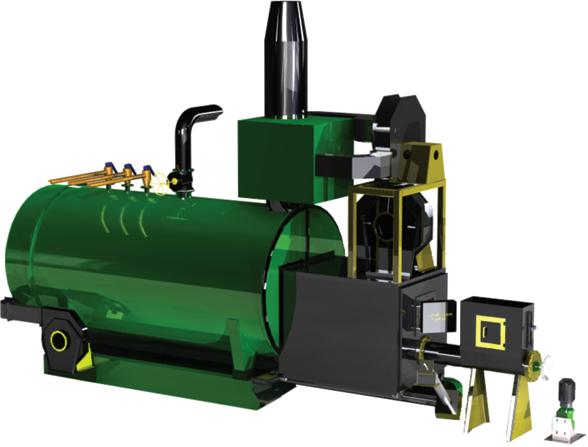
COMBUSTION EXPERT OFFERS NEW VERSATILE BIOMASS SYSTEM
Trois-Rivières, QC – Combustion Expert Inc. has a new biomass burning system that is both compact and efficient, the Quebecbased supplier says. Its ST Series can be installed on boilers up to 800 hp, and offers a host of advantages, including:
• Quick manufacturing time
• Possibility to convert existing boilers (water or fire tubes)
• Compact, space saving design
• Possibility to assemble in a mobile unit
• Remote monitoring and parameter control
• Low initial investment compared to a conventional system
Compact and able to burn biomass up to 60% MC, the ST Series biomass burning system can provide heat and/ or process heat.
• Anti-backfire security
• Automatic ash exhaust. The feeding process consists
MAKING PELLETS THE MAINE HEAT
Bethel, ME – Total domestic pellet consumption in the US is already high at nearly one million tons, but on a per capita basis is quite low compared to many European countries. Pellet entrepreneurs and heating oil companies in Maine are starting to work together to change that. For one, Maine Energy Systems of Bethel, ME, is investing $10
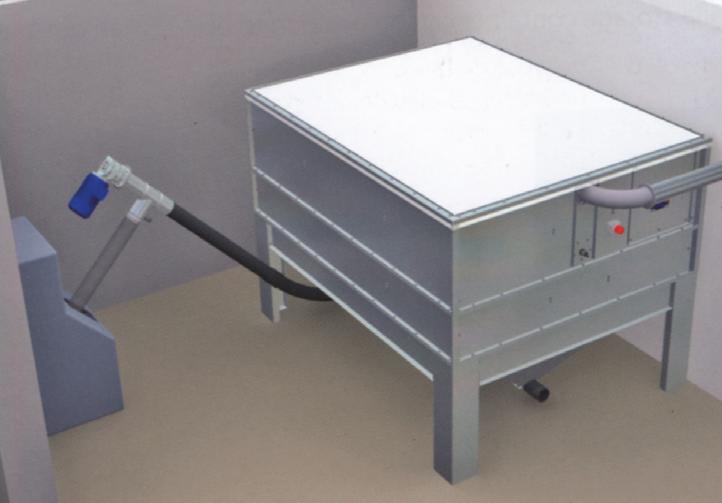
Home heating systems with bulk pellet delivery and automated feeding systems similar to this one from Sweden will be delivered to homeowners across Maine this fall.
million to launch a company with the lofty goal of introducing pellet-based heating systems to thousands of homes in the US northeast, helping them convert from outrageously priced oil to pellets. Its goal according to the Portland Press Herald is to convert 44,000 homes in Maine alone, and to work in Vermont, New Hampshire, New York and Massachusetts as well. The company says although twice the price of an oil boiler, a pellet heating system will save the average
northeast home over $1,000 per year, paying for itself inside of seven years at the current price differential.
Maine Energy Systems (MESys) is a growing company formed by local businessmen trying to keep jobs and money in Maine. They are winding up for the 2008-2009 heating season by offering totally automated pellet burning and boiler systems to Maine residents, along with attractive financing in cooperation with a local bank.
The European systems come from Bosch and Janfire AB, and allow bulk delivery using
Prince George a hit with bioenergy crowd
Prince George, BC – Organizers of the Third International Bioenergy Conference and Exhibition in Prince George, BC say the event was by all accounts a great success. Sitting in a local bar at the time with energy traders from all over Europe and Canadian forest sector participants, I’d have to agree that interest was high. The conference saw 400 delegates
of a shaftless screw conveyor and a hopper bin to ensure constant fuel supply. The system operates with sawdust, bark, rip, or wood residues not exceeding three inches in diameter. It is also versatile, burning biomass up to 60% MC, with the resulting energy available for heating or for production processes. Overall, this new system looks more like a burner than traditional combustion chamber. Rather than having a latent fire in the boiler, fire is controlled and spread across the surface area of the boiler to ensure optimal use. Patent pending 61/022183.
pneumatic oil-style trucks and outdoor hopper storage systems. Bulk pellet contracts can be arranged for as little as $235/ton, pricing that MESys says will save a typical homeowner around $1,000 per year, even after the financed annual cost of conversion is included. Add to that the green angle heavily played up in the news and on the company’s website, and you have an attractive package that the company expects will see demand exceed supply at the outset. MESys claims a carbon footprint reduction of 16 tons/yr per homeowner. With a delivery network that includes much of central and southern Maine, this quiet state may already be the future of our industry.
from 20 countries, 50 exhibitors and 35 speakers, at what is fast becoming a must attend on the bioenergy conference circuit. BioEnergy 2010 takes place from June 1 - 3, 2010 in Prince George. Check www.bioenergyconference.org for the latest news on the Fourth International BioEnergy Conference and Exhibition.
TWO NEW PELLET PLANTS FIRE UP
Prince George, BC – New pellets plant in both eastern and western Canada recently launched into production. In early June, Shaw Resources of Nova Scotia unveiled its $9-million wood pellet plant in Belledune, NB, the dynamic company’s second pellet plant. Surrounded by eight sawmills within 150 km, the 75,000 ton/year plant is also minutes from Belledune’s seaport along the scenic Baie de Chaleurs. The pellets will go to European clients, with the first ship sailing on June 20. General manager Gordon Dickie adds that the plant has
been designed to allow Shaw to double the capacity if the fibre supply or markets allow.
Move 5,000 km northwest to Prince George, and Pinnacle Pellet launched its new wood pellet plant in July. The plant is perched next to Dunkley Lumber’s state-of-the-art sawmill just south of Prince George, and will use a mix of sawdust (80%) and beetle-kill timber (20%). The company has several licences to beetle kill timber, and will use that to trade with sawmills for sawdust, as well as for its own roundwood supply.
PWC SEES GOLD IN SLASH
Vancouver, BC – According to a recent PricewaterhouseCoopers (PwC) report on forest products sector mergers, acquisitions, and deals, wood biomass is emerging as an important renewable energy source, creating competition on already strained fibre sourcing. Yet the global consulting firm sees substantial opportunities for forest products companies, spanning from supplying or aggregating forest biomass, to producing woodbased energy (heat and power) or producing wood-based transport fuels and value added chemicals and other materials. Forestry players may need to partner with oil and gas companies to leverage the expertise of both parties. Still, deals in the bio-energy area have started to pick up, with most transactions to date involve co-ventures and start ups. In 2007, global bio-energy deals increased around sevenfold to nearly $7 billion, with deals concentrated in North America, followed by Asia-Pacific and Latin America. There will be more deals in the
future, and the forest products industry will feature in these PwC says.
“The development of wood biomass as a renewable energy source is more complicated than many other renewable sources, not only because many of the various technologies are still in the research stage, but also because of the inherent competition with established product value chains,” says Bruce McIntyre, global sustainability leader for PwC’s Forest, Paper & Packaging practice. “The potential for wood-based energy and other new biomass-sourced products to significantly transform traditional fibre supply/value chains, and hence the current forest products industry, looks to be substantial. Companies cannot afford to be complacent about their chances of competing in this emerging scenario, since the most promising positions will likely rest with those controlling significant volumes of forest biomass.” Given some imagination and energy, that should put the forest sector in the catbird’s seat.
• Morbark Dealer
1100 TUB GRINDER 3800 WOOD HOG
Pellets Rule
At
least in Canada they will, as the flexible, transportable, and uniform energy source shows a bright future.
By Scott Jamieson
CANADA
already has a strong pellet manufacturing sector, with plants across the nation producing some two million tonnes per year, and more on the way. Still, with strong incentives to use renewable energy overseas, the lion’s share of those pellets, even from the main manufacturing zone in the BC Interior, are shipped all the way to Europe to be used.
In a presentation at the Wood Pellet Association of Canada’s (WPAC) annual meeting in Prince George this past June, research director Staffan Melin reminded the audience that Canada remains a bulk producer
Developing local markets may also change the scale of operations in Canada, allowing smaller players like flooring plants or remanufacturers to get into the pellet business to diversify revenue, like this Virginia flooring plantʼs new line above.
BIOMASS ALL BIOMASSALL THE TIME!
By all accounts, the future of Canada’s forestry biomass, bioenergy, and bio-products industry is massive and enticing. Still, that future is also evolving, unclear, changing, and sometimes elusive. It’s still developing, with challenges and opportunities around every corner. To grab a share of this new frontier, people need information fresh ideas, and even inspiration
That’s where Canadian Biomass comes in. Whatever the future of forestry biomass in Canada, our 20,000+ forest industry readers will play a pivotal role. Among our readers are the pioneers, inventors, investors, harvesters, and operators that will make this new sector a success. We’ll follow their trials and tribulations, along with a heavy dose of news in this very newsworthy sector. We’ll also look at everything from forest biomass harvesting systems and techniques to processing systems and technology, market development, policy, trends, and more.
ABOVE: Doug Bradley, CANBIO and Climate Change Solutions president says export markets will continue to drive the pellet sector.
LEFT: John Swann, president of the Wood Pellet Association of Canada. “Weʼd stay home in a heartbeat if we could,” he says in explaining Go Pellets, a new program to promote domestic pellet use.
and shipper. With 25 plants in Canada in 2008 producing an average of 56,000 tonnes/year, we compare to an average plant size of 17,000 tonnes in the US and 16,000 tonnes in the EU.
The European market has been a boon to Canada’s growing pellet industry, and will likely continue to be, as Doug Bradley, president of both Climate Change Solutions and Canadian Bioenergy Association (CANBIO) explains. Yet things may be about to change.
“Export markets have driven the building of pellet plants in Canada until now, and those markets will continue to drive the financing and building of new ones. Yet we expect that gradually over time the domestic market will grow, and the export volumes will shrink.”
That will likely be a good thing too, for if nothing else the current lumber markets should teach Canadian forestry suppliers the importance of market diversification. Moreover,
as shipping costs rise alongside diesel costs, it’ll be good to have options if and when the European equation no longer makes sense.
Bradley feels all the indicators are pointing in this direction. For starters, we have lots of biomass, and an increasing political will to use it. “There are 12 million tonnes of old hog fuel that have been lying around for 30 years, and that’s just a start. Four of our forestry provinces –BC, Ontario, Quebec and New Brunswick – are now adamant about using harvest slash for something other than piling and burning it at roadside. It’s being wasted now, so it makes sense.”
Also, Canada is rapidly moving to a carbon credit system, one of the key ingredients behind the development of Europe’s blazing biomass sector. While provinces are making tentative steps, some better than others, Bradley confidently predicts that “we will have a national carbon trading system here within two years.”
PELLET PRINCE
Few would be happier than John Swann, WPAC president and long-time pellet producer himself. “We’d stay home in a heartbeat if we could. Shipping bulk for export like we do carries a heavy capital investment and extra costs and risks to manage. You’ve got to manage the rail service, charter the vessels, and deal with the associated risks. I could have retired on all the dead freight and cars I’ve seen over the years,” he adds with a laugh.
Currently Swann says the European market accounts for 50 to 60% of Canada’s growing pellet production, the US for 30 to 40%, and then small domestic and some Japanese shipments the rest. Yet he too is optimistic that the domestic tide is turning.
“It’s coming. Fossil fuel alternatives are expensive and look to at least stay that way. It also seems that access to the environment for fossil fuel producers – in the form of GHG emissions – will no longer be free. We’re confident that change is happening. We can already save homeowners half of their heating bill, for instance.”
Swann sees big potential for industrial users like greenhouses, which have seen their energy bills skyrocket of late. They would welcome a change to take more control over this cost centre, assuming the payback was in the 1.5 to 2 year range and no longer. Dave Harrison, long-time editor of Canadian Greenhouse magazine in Simcoe, ON, confirms that interest in biomass and bioenergy alternatives has accelerated over the past five years, and has really taken off over the past 18 months in the face of record energy costs.
“I’d have to say that labour is still the number one cost in our industry at around 40% of the total cost of doing business, but energy isn’t far behind anymore. There’s also a sense that natural gas is a very volatile cost. We’ve seen a lot of very big projects to
convert to biomass – pellets in areas with ready supply, or wood construction waste in other areas. Growers that have embraced it have been very happy, especially those who have managed
ers in that state, including bulk delivery and one-touch operation. Swann is hoping biomass home heating will soon move from talk to walk in Canada and other states as well.
People don’t buy their heating oil in gallon pails, so why should they buy their pellets in bags?
long-term contracts for the wood supply.”
He adds that BC is way out in front, thanks to the more readily available supply, but that growers in other areas, such as the Leamington area in southern Ontario, which boasts the largest concentration of greenhouses in North America, are looking at or have already invested in biomass options too.
Then there’s the home heating front, a big market in Europe. Swann feels we’ll need to take a page out of Europe’s book first if we want to make headway with busy Canadian homeowners.
“We need to make it convenient for the homeowner, and we need to give them confidence in the long-term supply and distribution. In Europe you see some big players getting involved. When Shell says it will supply your pellets, that’s different.”
The delivery and furnace systems are available (see World Bioenergy report on page 28), and in fact some northeastern US oil distribution companies are already talking about offering the pellet alternative. Also, new start up Maine Energy Systems is selling complete, automated pellet heating systems to homeown-
ACTIVE AID
Still, neither he nor Bradley is willing to just sit and wait for it to happen. For starters, CANBIO is playing honest broker between technology suppliers and potential biomass users to get things rolling. Aside from the organization’s recent tour through Sweden and World Bioenergy this past May, its annual conference this October will include a trade show featuring bioenergy technology experts from Finland, Austria and Canada. The organizers are trying to build bridges between this knowledge and technology pool and the growing number of Canadian community leaders that are looking at biomass as a solution to their energy and local economy woes.
“There were several community leaders from Quebec and Ontario at the recent World Bioenergy Conference in Sweden, looking for answers to outrageously high local heating from oil or naturals gas. The need is there. So we’re talking about pellet burners and boilers, heating systems, etc… from suppliers with experience who before they even meet here with the community representatives will know the circumstances and needs of those communities. We will
work with them to be able to offer tailored solutions to the community members we are inviting to our conference. Instead of theory, it will be actual solutions to real community situations.”
There are a slew of options for such communities, from gasification to simply burning the biomass in a boiler. Yet Bradley feels that in many cases communities will be best served by pellet technology. The technology to make pellets is readily available in Canada, and the end result is a uniform, dependable fuel source for local plants to use.
Swann and Bradley’s organizations are also working together on a brand new initiative called Go Pellets. The program’s strategy will be hammered out this summer and unveiled this fall, but its general objective is to help develop a domestic market for pellets, as Swann explains.
“I see its key role being to identify and promote domestic market opportunities, and work with the various agencies with an interest in moving away from fossil fuels to promote pellets as a real alternative, and to accelerate their development. We can help get the ball rolling, as a conduit between all interested parties. For example, in Europe you see programs that pay 25 to 30% of the conversion costs to move from fossil fuels. There’s support of the infrastructure. That sort of thing.”
There are Canadian precedents of course, like programs by Hydro Quebec to subsidize conversions from oil heating to “dual-energy heating”, a mix of hydro and oil that maximized hydro use in warmer temperatures when demand was down, and switched to oil when the mercury fell below -15 C.
When the alternative is to transport pellets some 7,000 km to burn in Belgium or Denmark, while we burn increasingly precious oil, it all makes good business, and environmental sense. •
Slash Recuperation
TAKING out the TRASH
Quebec-based Cyclofor has created a special container-based slash recovery forwarder and a sorting station to make the most of post-harvest slash.
Canadian Biomass reports on prototypes of both.
By Gilles Boucher & Scott Jamieson
FORyears farmers have recuperated just about everything from their harvest sites, while nearby loggers leave almost as much behind as they take out in terms of pure volume. Yet now with energy prices soaring, what was once an eyesore and a cost item left after logging is now starting to take on a golden hue. To cash in on this once-waste product, Cyclofor Inc. of La Sarre, QC, has developed an entire slash collection and processing system – The RC-03 forwarder-compactor to recover slash for the harvest site and move it to a central sorting and treatment centre that will direct the slash to its highest end use, from whitewood chips to hog fuel, and everything in between.
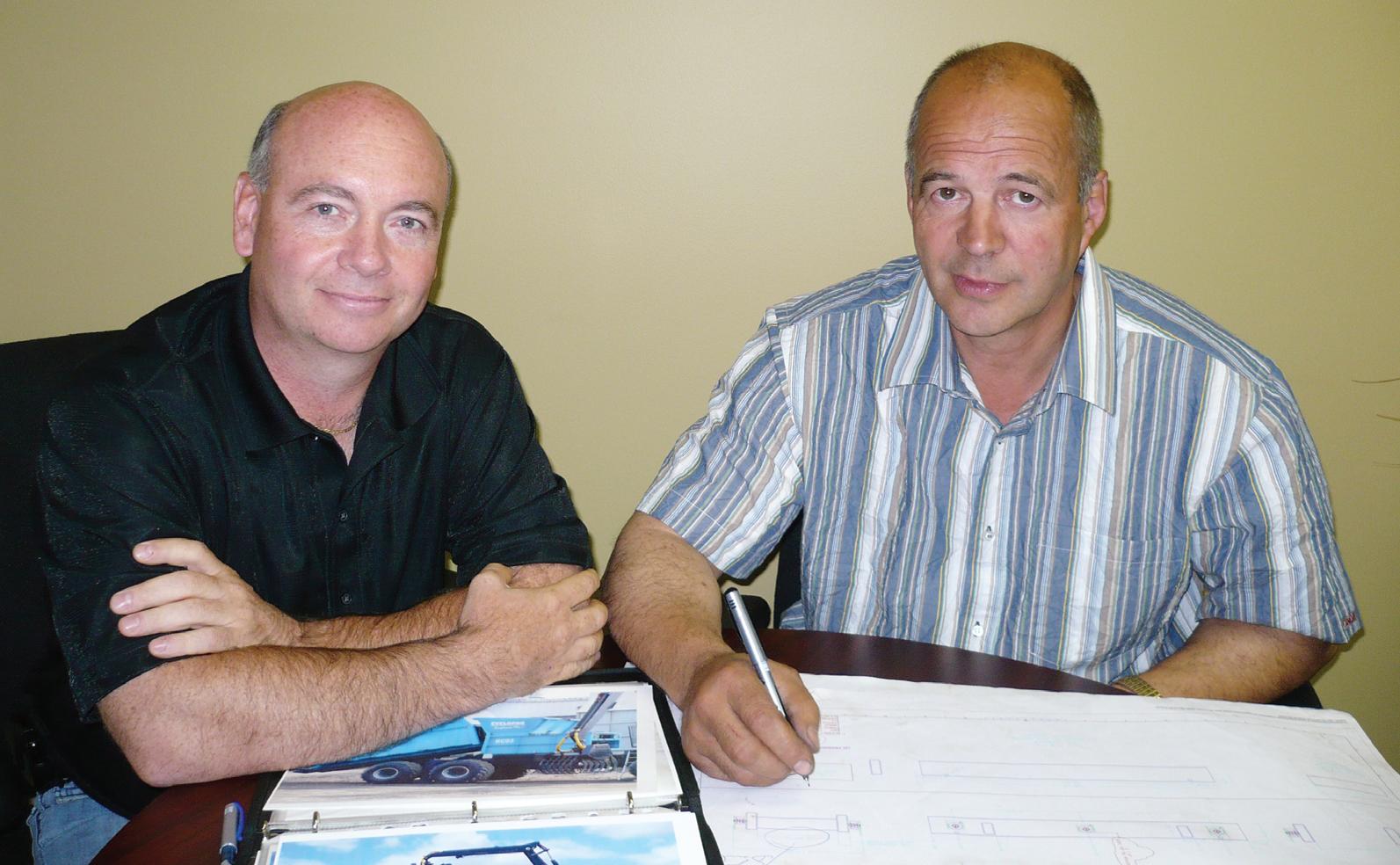
The RC-03 is a slash “forwarder-compactor” created by Daniel Tardif. The current model was developed from two earlier prototypes that the longtime heavy-equipment mechanic tested. His 30-year career includes work in sawmills and other industries as a mechanic and continual improvement entrepreneur. Like many others today, he insists that we need to start using the whole of the forest resource, adding that we’re talking an impressive volume if, and this is the big if, we can find a mechanically sound and economical way to collect and transport the fibre.
The RC-03 is thus the fulcrum for Cyclofor’s whole business model. It is being field-tested and proven now both in the Abitibi-Temiscamingue region of northwestern Quebec, as well as in northern Ontario, near Opasatika. Both these forest regions have immense volumes of available harvest slash.
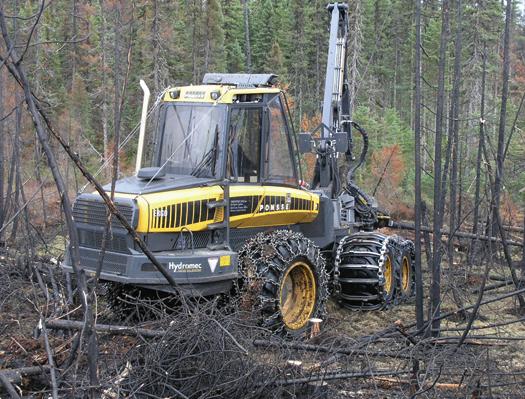
The machine’s base is a rugged Timberpro TF840 forwarder, with 22-tonnes of capacity on 24-tonne tandems. It is driven by a 300-hp Cummins, while the chassis has been stretched to 35 feet in length and 12 feet wide for the application. The RC-03 rolls on 42-inch tracks mounted on 10.5-foot tandems. As a result, despite its size, the RC-03’s ground pressure is similar to other 14- or 16-tonne forwarders.
Everything above this solid base, or as Tardif says, “everything above the wheels”, was designed and built by Tardif and Cyclofor. This includes the
LEFT MAIN: The RC-03 forwarder-compactor is based on a Timberpro heavy-duty forwarder, but includes a purpose-built grapple with saw and knife, an infeed funnel and compactor rod (middle section), and a removable container that transports 15 tonnes of slash.
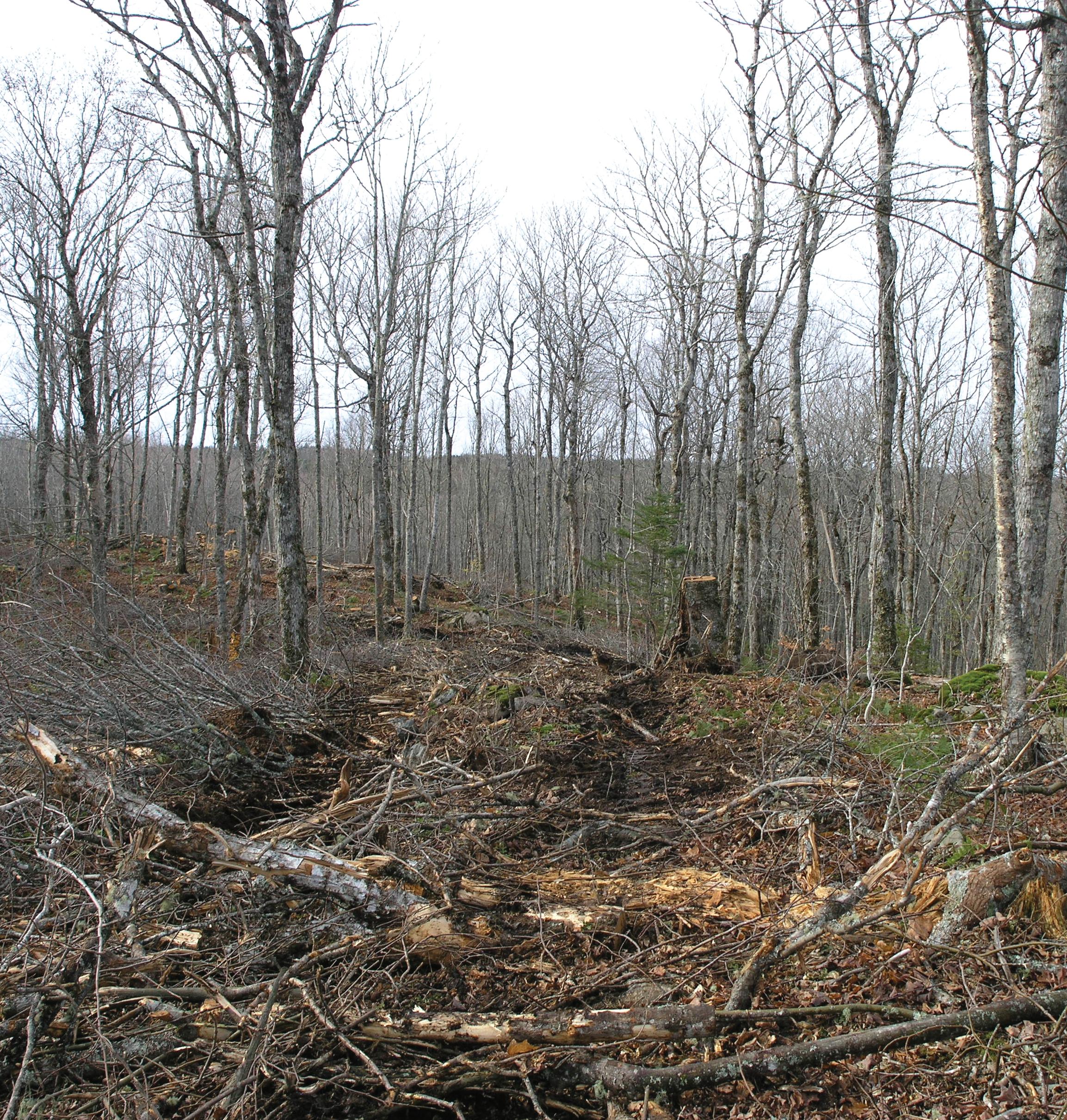
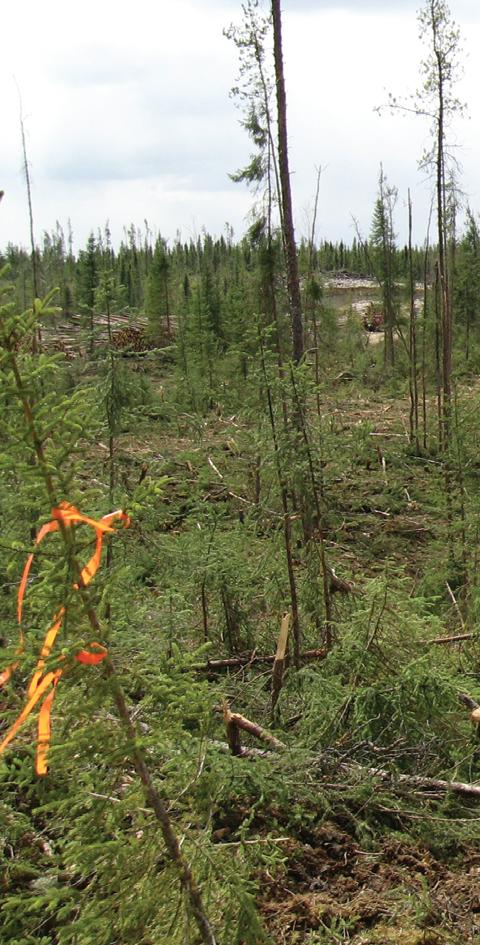
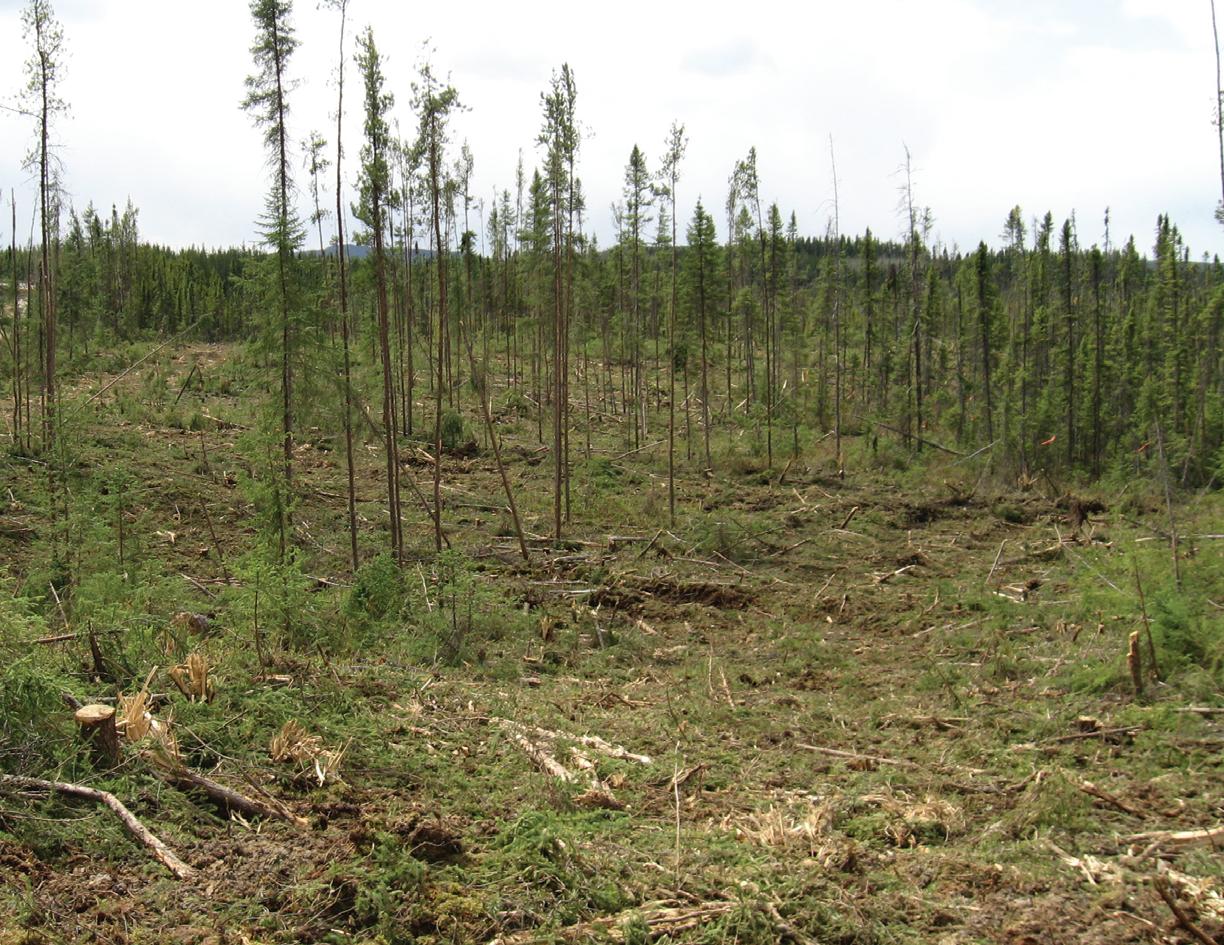
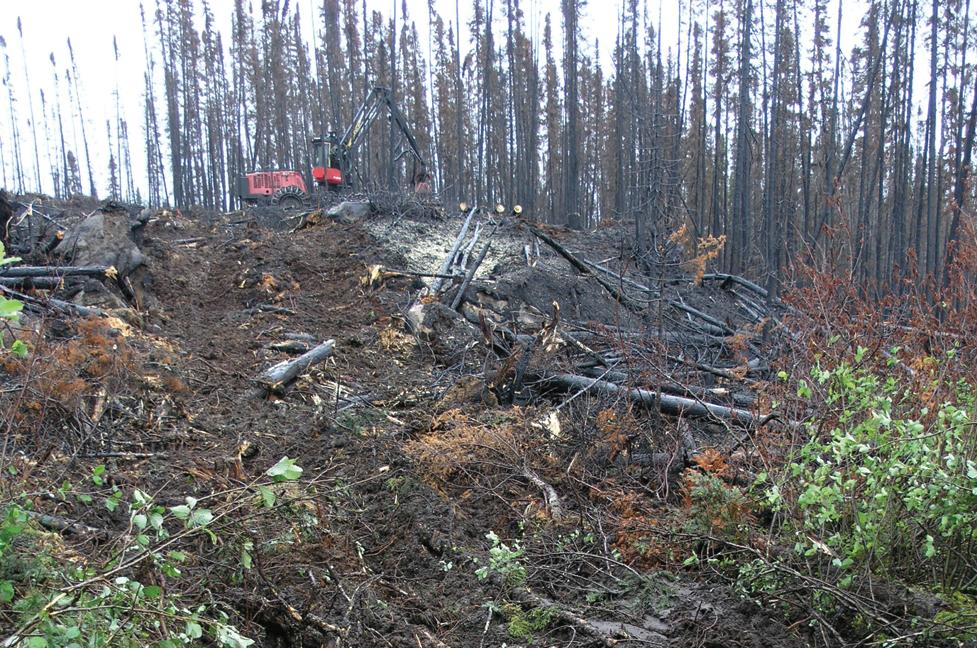
INSET: A cut-to-length (CTL) harvest site after Cyclofor has been through. The trail is that used by harvester and forwarder to extract sawlogs and pulp wood according to Quebecʼ s 25% limit on machine travel. This allows high regen on both sides, but traditionally creates a heavy concentration of slash in the trails. Now spot planters planting the trails only have easy access to planting sites.
skookum grapple at the end of the forwarder boom, which has a bar saw on one end, as well as a knife on the other for cutting the smaller slash that has the nasty habit of derailing the saw chain. And like all Timberpro cabs and loaders, they pivot 360 degrees, allowing for efficient slash pickup.
Behind this cab is a unique slash collection and compaction system, as air is the enemy of all efficient slash handling systems. This patented gear allows Cyclofor to “compact all the harvest residue in interchangeable containers, and then transport these in an efficient and safe manner, while conserving the intrinsic value of the material,” explains Alain Brodeur, forestry director and Tardif’s business partner.
And based on early results, it works. Trials in varied conditions show that the RC-03 requires one operator to collect and compact slash at a rate of 15 tonnes
or more per hour, and that it can work non-stop in 24/7 operations as needed, just like any other forest operation in this part of the world. Moreover, replacing a full container for an empty one takes just minutes, all done without the operator ever having to leave the safety of his cab. The machine also benefits from a full automation and control package, from GPS (you’ll know where you’ve collected slash already, day or night) to a full on-board computer. This is no taped-together concept, but a system designed for the long haul.
Once filled with 15 tonnes of slash, the container is dropped off at a transfer point where an empty container awaits. The full container is picked up by a truck that carries two per trip to the sorting and processing centre. Here it picks up two empty containers, and continues the cycle. Logistics are obviously a big part of the operation.
SORT FOR VALUE
The second stage of the Cyclofor operation takes place at the sorting and processing station. Depending on markets, such stations could employ up to 150 people for each and every region where it is possible to collect one million cubic metres of slash per year. The company has already identified several such areas. “The trick is to run the operation with a minimal impact on the environment, recuperate the maximum volume and value of material, and in the end turn a profit from it all,” says Brodeur. “The larger manufacturers have systems in place, but the majority we saw required too many machines and operators for us to see a profit in the end. It was up to us to find a way, under local conditions, to do the work with a minimum of machinery, in a simple, efficient operation, and to adopt some familiar pieces to do different work. The RC-03 solved this with one
machine and one operator.”
Based on 15 tonnes/hour, 20 hours/day, and 250 operating days, one can imagine some 13 to 15 RC-03s plying the woods in one region, for a scale of biomass operation unheard of in most of North America. For now, the company has one machine working, back in the woods since mid-March, according to Patrick Paiement, a keen young forest engineer who heads up woods operations for Cyclofor. When Canadian Biomass spoke to Paiement in mid-June, the machine was working basically 24 hours/day, five days per week, with two production shifts, and a third that takes care of maintenance in addition to compacting biomass. They had worked behind both full tree operations recovering slash at roadside, and behind CTL operations. “The only thing we ask them to do is leave us space for the spare containers,” Paiement says.
Once at the sorting station, material will be divided into four principal sorts. The first step will be to create debarked whitewood (hardwood or softwood) that will allow Cyclofor to offer products depending on demand – chips, shavings, sawdust/particles, or bark and other material for energy biomass. Waste material making one product, or slash too small for even specialized debarking, will serve as a product in other categories. Potential clients include panel mills, pulp mills, agriculture, pellet and energy plants.
As for the environmental balance, it looks pretty good. The slash piles now decomposing on forest sites not only reduce the area available for reforestation, but will in its turn create greenhouse gases over time. The component of Cyclofor’s mix going to bioenergy will create the same gases, but will do so while replacing fossil fuels. The rest of the material will be used in products such as panels or papers, storing GHGs for anywhere from months to decades. Finally, larger volumes growing on the cleaner sites means more GHG storage per hectare.
The effect of the RC-03 moving over the site will be negligible, as it will travel on existing skidder trails. In this region it will also encourage reforestation by reducing the volume of processor slash
on site. “What we’re offering is an increase in the area traditionally available for re-planting compared to traditional site preparation methods,” explains Brodeur.
“Moreover, all the following silvicultural work and inventory work will be simplified by removing the excess slash. This treatment is being studied by the MNR in the hopes of making it a recognized site prep treatment.”
Of course this would only further enhance the economic viability of the overall Cyclofor process. Cyclofor has already worked with a host of consultants in forestry, metallurgy, finance and accounting, human resources, computer systems, technical and architectural design to nail down the final design. Also key, the provincial government has authorized the recovery of slash in certain zones of this immense forested region.
A co-operation agreement has already been developed with a local forest company, as well as with regional private woodlot co-ops to diversify the fibre supply.
For the near future, the entire concept is being studied by a research collective to optimize the collection and transport process. The group includes FERIC, The CAF Group, and Kekeko Forestry, and the results of their study will be released soon.
The final piece of the puzzle is
Alain Brodeur, Cyclofor forestry manager, and Daniel Tardif, the RC-03 inventor have big plans for the regionʼs slash.
be dropped into a series of three drum-style debarkers. These are designed and built by Cyclofor, and create an increasingly fine screen for separating the white wood from the bark, dirt, small stones and sand. The design uses rotatable feller buncher teeth arranged close together, with just a small percentage of the tooth
“The forestry balance looks pretty good, right down to making it easier and safer for spot planters to access the site.”
up to the folks at Cyclofor. They are developing a debarking system for the sorting station that will let them extract maximum value from material larger than 4 centimetres. They’ve designed a specialized drum-style system that will do a better job, with less damage, than current systems. In the end, it will be the ability of Cyclofor to extract a maximum volume of whitewood, in all its forms, that will make the sorting station a paying proposition. Otherwise, you may as well chip it all in the bush.
To test this new system, the company has built a prototype sorting/processing centre in La Sarre on the site of an old Tembec sawmill (with infrastructure already in place). This started up before the end of June 2008, and will serve above all to test the crew’s ability to efficiently sort white wood out of the slash from pieces down to 4 centimetres. Slash will be brought to the line by a Bobcat, where it will travel up 45-degree inclined and counter-rotating screw conveyors to
sitting above a set of guards. The really small material (mostly mineral) will drop all the way through and be composted, while the rest either drops out as it becomes very fine (bark or very small wood pieces), or continues on to the next drum.
In the end, white wood leaves the third, finest drum, and continues on to a vibrating conveyor and chipper, followed by vibrating screens to sort out the various white wood products, including pulp chips and material for panel producers. These will be loaded straight into waiting vans to avoid contamination.
While you can imagine a higher percentage of white wood being lost by volume than say a traditional log debarking and chipping operation, it’s important to remember that the alternative was once just to burn it all or leave it in the bush. We’ll continue to follow progress on this innovative company’s development. •
Translation and additional reporting and updates by Scott Jamieson.
Mapping Success
Putting Canada on track for a bioenergy-rich future requires some government action, and a little more co-operation.
By Douglas Bradley
THIS
year, bioenergy projects in Canada are on fastforward. Fighting a strong loonie, a declining US housing market, rising oil prices, and high fibre and energy costs, biomass rich-communities, entrepreneurs, sawmills, harvesters, power companies, and pulp and paper mills have been exploring and implementing new bioenergy projects. The goal is either to bolster a conventional forestry operation or to start up a new, energy-based one. You may not have heard much about it, because the bulk of the projects are small to medium-scale, and attract little press attention. But a look at recent progress in biomass forestry projects in the Maritimes, Ontario, BC, and Quebec shows a hive of activity.
Like the rest of the heavily forested parts of the country, a lot of new cogeneration projects are springing up in woody regions of Canada’s Maritime provinces. Nova Scotia’s Minas Basin Pulp and Power announced a new cogeneration plant requiring 165,000 tonnes of green biomass annually. The collapse of Nova Scotia’s lumber industry and resulting fall in sawmill residues has driven the New Page, Neenah and Abitibi-Bowater pulp mills to take up to 150,000 tonnes of round wood for biomass fuel production. New Brunswick’s Irving Paper is increasing consumption of biomass from harvesting debris across all its mills.
All this action means the Maritimes are demanding new harvesting and production equipment: at least four industrial, horizontal grinders and chippers were purchased in the last 10 months and at least five more
will are expected in the next year. Biomass heat and power projects in Quebec and Ontario are also on the rise. As this article went to print, a new project for a 10-megawatt CHP project was about to be announced for a pulp and paper mill in Northern Ontario, and Hydro Quebec was about to issue a highly anticipated call for 100 megawatts for power using forest biomass.
PELLETS GALORE
Another hotbed of activity is the growth of the wood pellet industry. Quebec boasts six pellet plants, but interest from project developers is high and more are expected to come online in the next year. In the Maritimes, Enligna, the new owners of the Mactara pellet plant, have announced a plan to expand production, requiring an extra 100,000 to 200,000 tonnes of biomass per year. Nova Scotia has three plants with at least three more in the works, and two proposals for new pellet plants from major forestry companies. New Brunswick has three pellet plants, with another three under construction, and close to a dozen plants being proposed.
Prince Edward Island is about to join the ranks, with plans underway for its first pellet plant. Paul Smallman, a woodlot owner from PEI, recently returned from Sweden’s World Bioenergy 2008, the biggest bioenergy
Grinders and bush chippers have been flying off the shelves and into a forest near you as the industry adapts to changing market realities.
conference in the world. Smallman was part of a 42-strong delegation organized by the Canadian Bioenergy Association that went to Sweden with a mission: to learn from the best, network and turn the experience into a viable renewable energy business back home. “The wood and forestry sector is going broke by relying on conventional markets. I want to set up a small pellet plant, and use large wood burning furnaces to make renewable heat and power and sell it here, in PEI, to local people,” Smallman said after the trip.
While Smallman is relying on local markets, many Canadian companies interested in developing pellet plants are relying initially on a guaranteed EU market as a driver. However, in future I expect sales will increasingly go to domestic users. One of the initiatives we’re taking is GoPellets, a combined project of CANBIO and the Wood Pellet Association of Canada, which we expect to announce at our annual conference Oct. 6-8. The initiative aims to develop the domestic pellet markets by lobbying for the right incentives and working with government to bring down barriers. Heating with wood pellets offers substantial cost-savings – and replacing a conventional boiler with a pellet or wood chip boiler in a large, centrally heated facility like a hospital or university, is a no-brainer. The La Sarre Hospital in the Abitibi region of Quebec has been using a biomass boiler for over 50 years – and it estimates cost savings of $12,000,000 in energy costs compared to conventional fuels during that time.
Even in situations requiring an infrastructure overhaul, there is plenty of opportunity to introduce biomass heating. District heating can be installed quickly via a central heat source connected to a mini-grid that encompasses a small local area, like a hospital, some houses and an industrial application. Common in Scandinavia, district heating is a bigger job here because it requires new infrastructure. However if a community is re-paving its streets or laying new pipes for water, it’s a perfect opportunity to lay the piping for district heating. CANBIO is encouraging communities to consider district heating as part of their infrastructure renewal process. Piping infrastructure already exists in many places, such as Queen’s University in Kingston, which heats university buildings and Kingston General Hospital from a central source.
MUTUAL SUCCESS
Another way companies are getting projects online faster is by partnering with advanced technology companies either in Canada or in Europe, where the bioenergy market and industry has been thriving for the last two decades. Europeans see only opportunity when they look at Canada’s rich biomass supply – and interest in buying Canadian biomass or partnering with Canadians in joint ventures, consultancy or technologysupply is high.
Recently, VisionPower, a bioenergy project developer from Austria, partnered with an Ontario-based consultancy, Suthey Holler Associates, to create VisionPower Canada and has started marketing its solutions across Canada. And a Canada side-event at the World Bioenergy Conference in Sweden last month attracted almost 90 participants from 17 different countries including Russia, Finland, Sweden, Germany, Spain, the Netherlands, Brazil and Colombia.
Jamie Bakos, CEO of Titan Clean Energy Projects in Saskatchewan, attended the event. He sees teaming up with either Canadian or Scandinavian business partners as the only way to ensure bioenergy takes off. “We need to look at bioenergy as a worldwide industry. We’re up against a long-entrenched fossil fuel industry and chemical giants, and if we think of ourselves as independent competitors, we’ll all lose. We need to think of the biomass industry as one big market and work together to make impacts.”
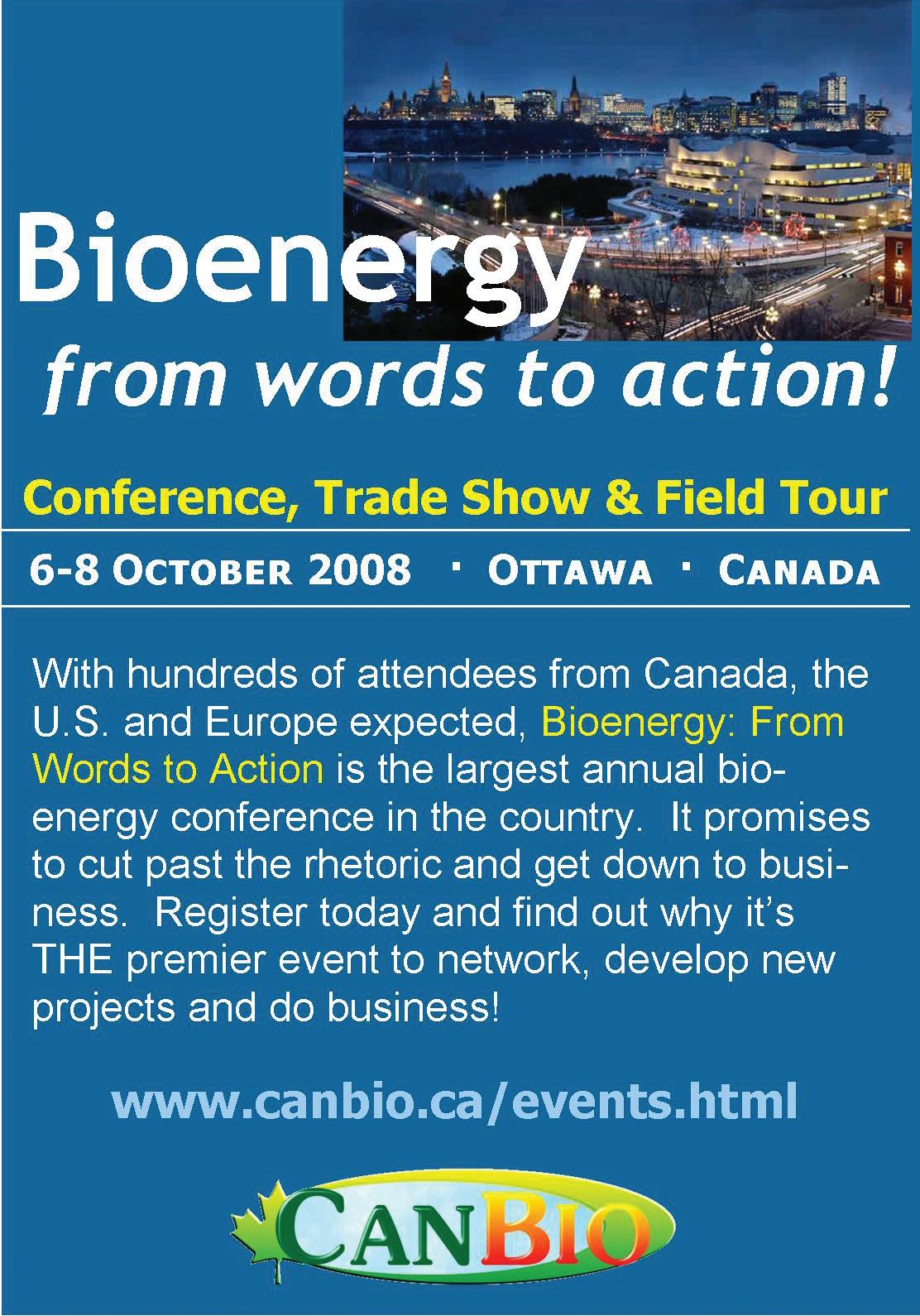
The Canadian Bioenergy Association’s annual conference is organized around creating bioenergy business opportunities. “Bioenergy: From Words to Action,” a two-day conference and one-day study tour, is taking place in Ottawa on Oct. 6-8 and promises to bring developers, investors, municipalities, entrepreneurs and industry from around the world together to develop new bioenergy projects. It’s the biggest bioenergy event in central Canada and one of the main aims is to find package solutions for communities to use biomass for energy and strengthen their economies. A trade show will showcase the latest technologies from Finland, Austria and Canada and other biomass equipment and project developers. Following the two-day conference, a field tour is planned to visit the world’s longest-running fast pyrolysis plant, (a 100 tonne-per day facility in Renfrew, ON), a biomass co-generation plant at Abitibi-Bowater’s pulp mill in Gatineau and Les Broyeurs à Bois harvest waste operation. For more on the conference, visit, www.canbio.ca/events.html.
ACTION NEEDED
But for Canadian bioenergy to catch up with its Scandinavian and Austrian counterparts – and for the Canadian forest industry to profit – a number of key barriers warrant removal. One of the most visible problems facing small and medium-scale biomass heating projects is the requirement that any steam installation have a steam engineer on site 24 hours per day. The high staffing cost simply craters the economics of most projects under 17 megawatts in Canada.
In Europe, different guidelines exist for smaller power plants, and this has helped small and medium-scale biomass heating to thrive. Other barriers that exist for small and medium-scale projects are high capital equipment costs, where a government subsidy of around 25% is sorely needed to make a strong business case for potential investors. Such an incentive would help government achieve GHG emission targets. CANBIO is creating an alternative proposal to the 24-hour-a-day requirement, and working with governments to propose better solutions.
Finally, the Ontario and Quebec Government’s announcement of an emission cap and trade system is a step in the right direction, but only a strong, nation-wide carbon-trading system can have a real impact on bioenergy development.
All of these actions are part of CANBIO’s nine-point mandate, where we work for our members to lobby government on:
1. Favourable bioenergy-specific policies and mandates nationally and provincially.
2. A strong, rapidly-developing domestic bioenergy market.
3. Implementation of Canada-wide carbon trading system.
4. Economically viable and sustainable biomass supply chains.
5. Removal of regulatory barriers to bioenergy development.
6. More favourable tax treatment and incentives for bioenergy and biofuels.
7. Clear and simple access to bioenergy feedstocks on public lands.
8. Easier, fair access to the provincial electricity grids with stronger pricing incentives.
9. Biomass co-firing in power plants.
Bioenergy can provide lucrative solutions to our current forest crisis, but clearly there is much work to be done to develop favourable market conditions in Canada. This is CANBIO’s mandate, so watch this space, and please consider joining our association – there is power in numbers as well as wood. •
Douglas Bradley is president of the Canadian Bioenergy Association, and was recently nominated to the board of the newly formed World Bioenergy Association.
A WORLD of BIOENERGY
Elmia World Bioenergy 2008 in Sweden was like Disneyland for those in the biomass sector, covering everything from larger-scale industrial power to domestic pellet delivery and use. Big, small – It had it all.
By Scott Jamieson
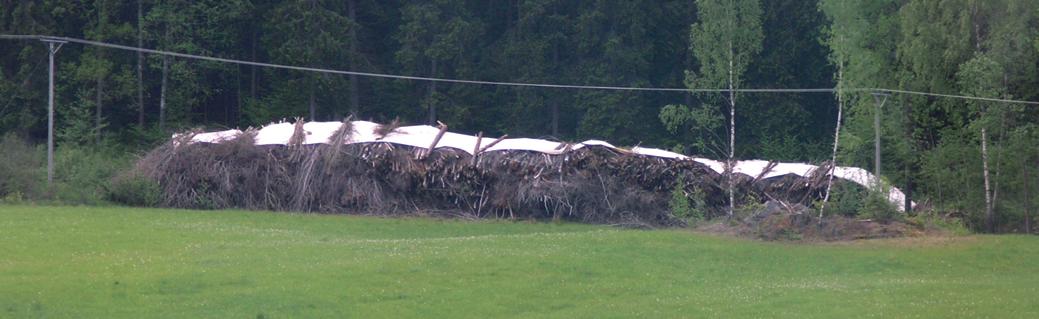
YOUcan’t spend more than an hour driving through southern and western Sweden without noticing this country’s dependence on biomass and bioenergy. It’s everywhere, and in part that’s because forestry is everywhere. There’s no hiding the working forest behind roadside buffers here, as cuts go right to the road, loud and proud. And with the cuts come piles of biomass, either neatly piled slash, covered with a special paper wrap and drying to maximize the energy value, or less neatly piled stumps, torn from the ground with a growing array of special attachments, and heaped in a pile to dry and make the separation of dirt and sand easier.
It’s a nation of forest biomass. Just the production and market for one product – wood pellets – tells the story. It surprises many people that the US is in fact the world’s largest consumer of wood pellets for small- and medium-scale uses, with an annual consumption of 1.1 million tonnes, according to the Austrian lobby group ProPellets. Yet this growing market still only uses between 3 and 4 kg of pellets per capita per year. In comparison, Sweden uses over 800,000 tonnes per year for large-scale industrial use, and another 800,000 tonnes for small- and medium-scale use, for a total of 1.6 million tonnes per year. That’s a whopping 65 kg of pellets per capita per year for residential heating alone! Some 130,000 tonnes of that comes from Canada, by the way.
According to the Swedish Bioenergy Association (Svebio), over 25% of Sweden’s energy mix comes from biofuels, and much of that forest-based. The nation’s goal is to be independent of fossil fuels by 2020, so look to this relatively small nation to lead the way in the coming decade in both technology and application. Just across the Baltic in Finland the story is similar. Finland’s bioenergy association FinBio reports that bioenergy makes up over 25% of the nation’s energy mix, with wood again playing a key role. So it’s no surprise that the world’s premiere bioenergy event, Elmia World
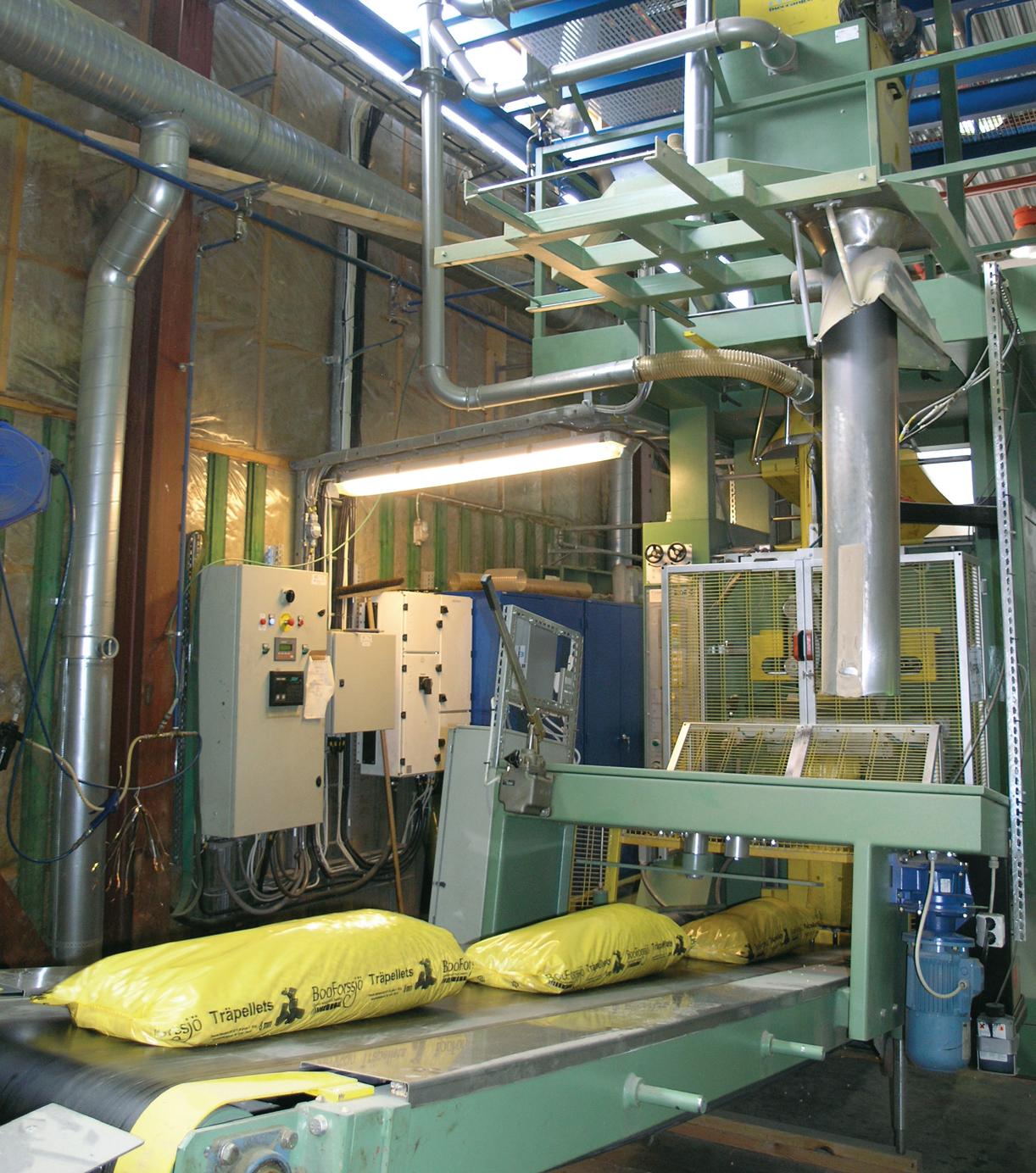
LEFT MAIN: The BooForssjo sawmill uses sawdust from its own operation as well as from other mills to feed its pellet mill, which supplies domestic retail markets in both bulk home and bag delivery.
INSET: The mixed feed at Ena Energi is scraped onto the final infeed conveyor.
Bioenergy, is held in southern Sweden every two years.
OPENING TOURS
Clearly we can learn a lot here as we wind up our own potentially larger biomass industry, and that’s why Canadian Biomass made the trip. So too did many other Canadians, as our forest nation made up the largest foreign delegation at Elmia World Bioenergy 2008. The formal event started Monday night with a reception at the famous Elmia conference facility in Jönköping, an hour south of Stockholm, but it really kicked off sensibly enough with full-day tours from Stockholm’s Arlanda airport to the conference site. We joined a bus that happened to have another 30 or so Canadians, and visited facilities that ranged from combined heat and power plants (CHP) to integrated pellet mills and biomass plantations. With five stops spread over a few hundred kilometres, we pulled into Jönköping a little tired, a little late for the reception, a tad underdressed, but with a whole new perspective on what’s possible when industry, landowners, local communities, and various levels of government set their mind to it.
The first stop was a shining example. The city of Enköping and its 20,000 inhabitants rely on a single combined heat-power (CHP) plant for 85% of their heating needs. Ena Energi AB is a 100% community-owned company that runs the plant and its three boilers, which have been converted to run on biomass rather than oil or propane. And they must be proud of it – The plant is right in town, not hidden from anyone’s view. Biomass is a mix of materials, from sawdust (20%) and bark (30%) to pre-hogged forest harvest residues (40%) and material from nearby salix (willow) plantations (10%). Some 6,400 truckloads bring 35 m3 each to the plant annually, and each is sampled for MC. Suppliers are paid
by the MWh after MC sampling, providing an incentive to bring well-dried material. The reference rate we were given was 21 Euro ($35) per MWh at the gate. This material is dumped into an infeed pit, where screw conveyors serve to both transport and mix the biomass en route to a large peaked storage building. The biomass is scraped onto a belt conveyor for transport to the boiler, with an MC level that ranges from 20 to 70%.
Aside from 220 GWh of heat per year, it provides 100 MWh of power to the grid, although currently the problem is the imbalance between heat and power needs in summer. To boost year round capacity, the plant is adding a cooling system, as well as a new low-temperature biomass drying system from Exergy Engineering and Consulting that will dry the biomass from its current mix of 47% MC to 30% MC. Both systems will be running this fall.
Our proud hosts were more than willing to tell us costs per MW for different types of delivered biomass, final cost of heat and power to its community clients, delivered to over 1,500 customers (1,180 single homes) via 84 km of pipes. Yet since all such costs are market and distance specific (they hauled in from 100 to 200 km or less), they meant little to the raft of Canadian municipal and forestry delegates on tour with us.
One issue we can all understand is the benefit of fast-growing energy wood close to the power plant. In this case, Ena Energi AB is part of a local fast-growing salix plantation program that kills several birds with one stone. First, it provides an outlet for both 1,500 tonnes of ash the plant makes every year, and an equal amount of sludge from the local sewage treatment plant. It is combined as fertilizer for the salix, greatly reducing the nitrogen and phosphorous load in the local lake, and eventually the Baltic. This fer-
tilizer in turn takes care of another potential issue in the bioenergy cycle – soil nutrient depletion.
Finally, by creating a local salix plantation, the plant has a steady supply of raw material within sight, and one that can be harvested every two to five years. The growth rate of the site we saw, measured in MWh of course, is 20 MWh/ha/yr. It’s a pretty convincing bioenergy cycle, so some 1,200 ha of salix has been planted to date, with 10% of it required to get rid of the ash and sewage mix each year.
The various partners involved since 2001 have each been charged with measuring key indicators, such as heavy metal absorption (ash), nitrogen reduction, and growth rate. So far all indicators point to a rousing success story. Yet like many such stories in Scandinavia’s bioenergy sector, it involves a number of partners co-operating for individual benefit and the common good. In this case, that’s the town’s wastewater treatment authority, the power plant, the local conservation
board, town council, and local farmers.
PELLET POWER
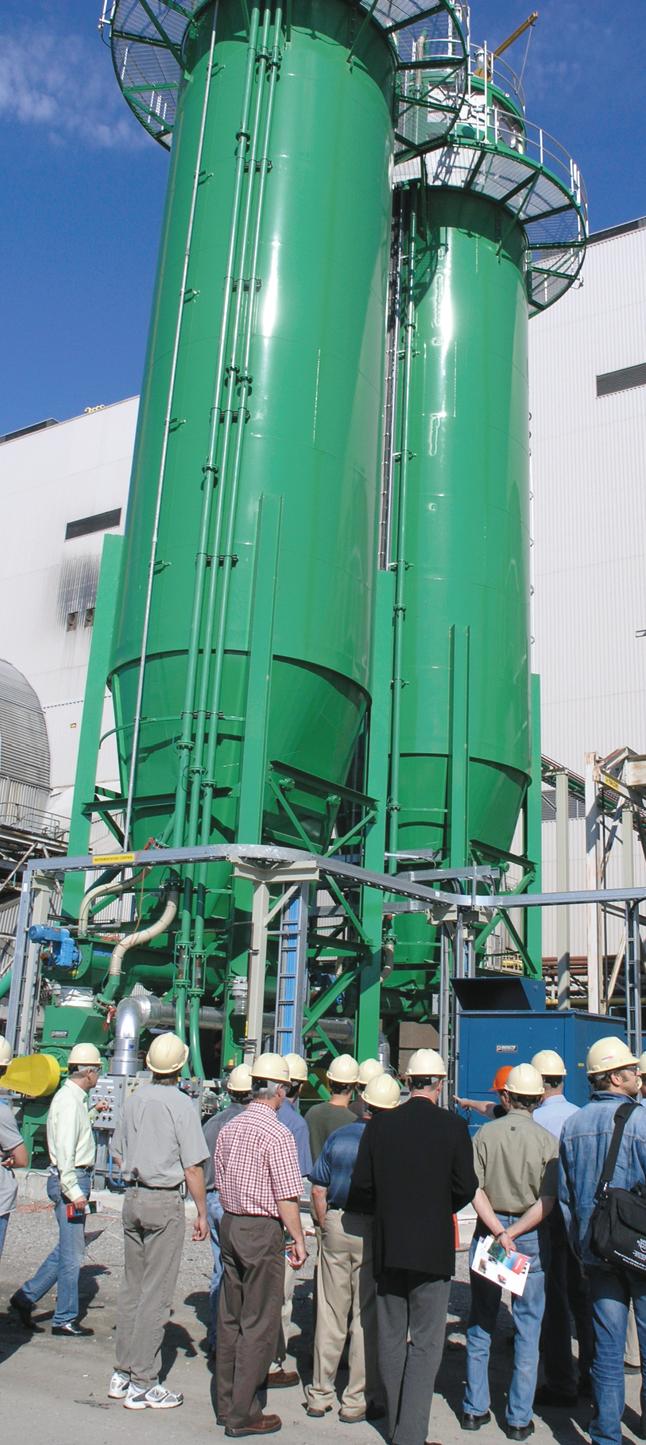
A business model a little closer to home was BooForssjo, a sawmill and our third stop. In 1995 it added a pellet plant to its facility, an integrated approach where heat from the mill is used to dry both lumber and the pellet raw material. A 15 MW hot gas oven fired with bark and green wood chips makes both hot water (kiln steam) and hot gas (sawdust for pellets, lumber drying). Hot gas and flue gas from the boiler are mixed to create a safe temperature for drying sawdust in a multiple pass rotary dryer. The plant uses Andritz-Sprout Matador pellet mills, and given the fire/explosion risk in handling the dry wood powder, uses one of Firefly AB’s custom-made pellet spark suppression systems. The modestly scaled plant is run on multiple shifts to still produce 53,000 tonnes of pellets per year.
Somewhat different than Canadian mills is the packaging
BooForssjoʼs automated the pellet bagging process in 2001 with this system from Italian supplier Ital Meccanica. It also delivers bulk pellets to homeowners using a heating oil style truck.
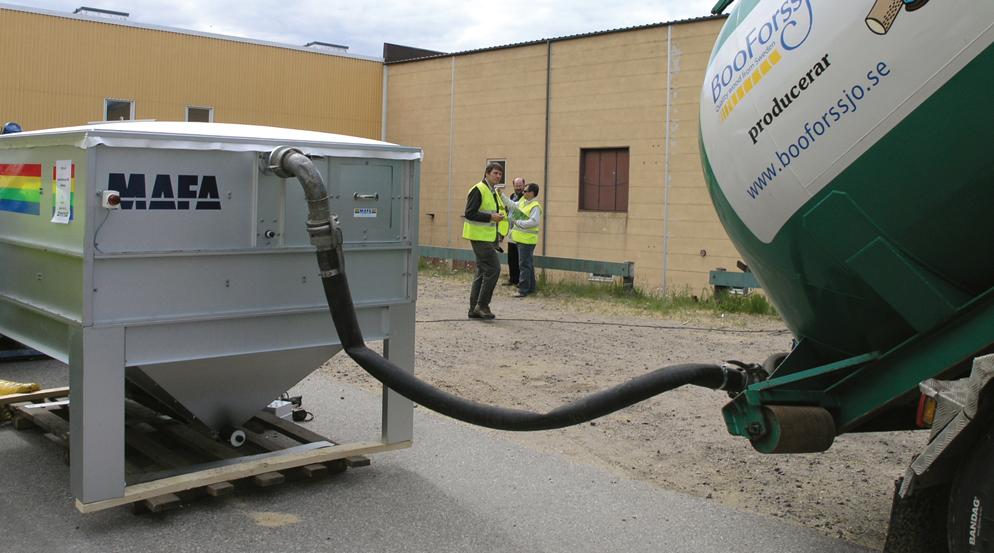
plant. It includes a fully automated Ital Meccanica bagging and palletizing system from Italy for retail sales that was added in 2001, as well as a bulk loading system that is used to fill delivery vehicles. These single and b-train tankers resemble home heating oil delivery trucks seen in Canada, but are able to carry pellets to commercial and residential customers. The BooForssjo-branded delivery truck we saw had a combined tip and hose system to fill homeowner’s bulk pellet hoppers, while another example on site used hose systems. The end result is the same – The same
Hot Marketing Ideas
convenience to homeowners as heating oil, without the smell and at lower cost. For the mill, it allows a portion of its production to go right to the retail market.
The fourth stop on our tour was a little far afield for the forest biomass sector, and thankfully so for my taste. The public utility biogas plant in Linköping (140,000 pop.) converts slaughterhouse waste products to biogas as an alternative to propane or diesel in cars and trains. The smell from the plant is indescribable, and while we are no doubt heading this way in Canada, finding sites for such plants will
Domestic pellet markets will be increasingly important in Canada and the US as a hedge over Europe’s politically primed market, but first we need to develop delivery, storage, and utilization systems that go beyond the Franklin stove model. Both on tour through southern Sweden and at the World Bioenergy trade show, Canadian Biomass saw all the tools for creating and servicing a local home and industrial heating market in a way that requires nothing more from the end user than heating oil does. That’s why half of Sweden’s 1.6 million tonnes of pellets used annually go to home heating, and the average Swede uses 65 kg of pellets for residential heating each year.
There are folks in parts of Canada and the northeastern US, both in the wood products sector and in the heating oil distribution business looking into developing storage, bulk delivery, and automated heating systems for wood pellets, spurred on by escalating oil prices. Many northeastern US home heating distributors have added pellets to their mix of products, although most of these are
BooForssjo is a Swedish sawmill that runs its own pellet plant, and then retails pellets directly either in bags filled on an automated system or in bulk from its own fleet of pumper trucks (below). MAFA is a specialized pellet distribution, bulk storage and furnace feed system supplier in Sweden with a half-dozen automated options for pellet-burning home owners depending on space and house layout. Visit www.mafa.se for an idea of the variety and sophistication.
be controversial. Our tour guide admitted that a few neighbours continued to complain about the smell (an understatement), and this after an odour amelioration program. The company runs 12 or so fuelling stations in the town, selling biogas to taxis, buses and private cars, as well as to the locally famous biogas train Amanda.
Our final stop ahead of Elmia was a small community heating plant built in 2007. The community of Odeshog decided to wean itself entirely from fossil fuels, and in 2001 hired Lantmannen, an agricultural co-op and major
Swedish player in bioenergy (pellets, heat plants, ethanol) to design, build and run the plant. It uses a 3.5-MW Hotab boiler that can handle a wide range of biomass from 10 to 35% MC. It was running on wood chips while we visited, but the long-term plan is to use more agricultural crops and salix from local farmers. A separate biofuel boiler is available for back-up or heavy loads, and runs on rapeseed oil. The simple plant supplies a 5.3-km grid with 12,500 MWh of heat.
The next Elmia World Bioenergy conference, tour and show is slated for 2010. •
still in bag form. Smart retailers will start moving further along the bulk heating route. As one Maine entrepreneur said in explaining his pending investment in pellet heating technology, “People don’t buy their oil in a bag – They buy it in bulk. It will have to be the same with pellets.”
There’s no need to reinvent the wheel, although we may adapt existing technology to meet our own needs here over time. As the photos here show, there are lots to pick from already.
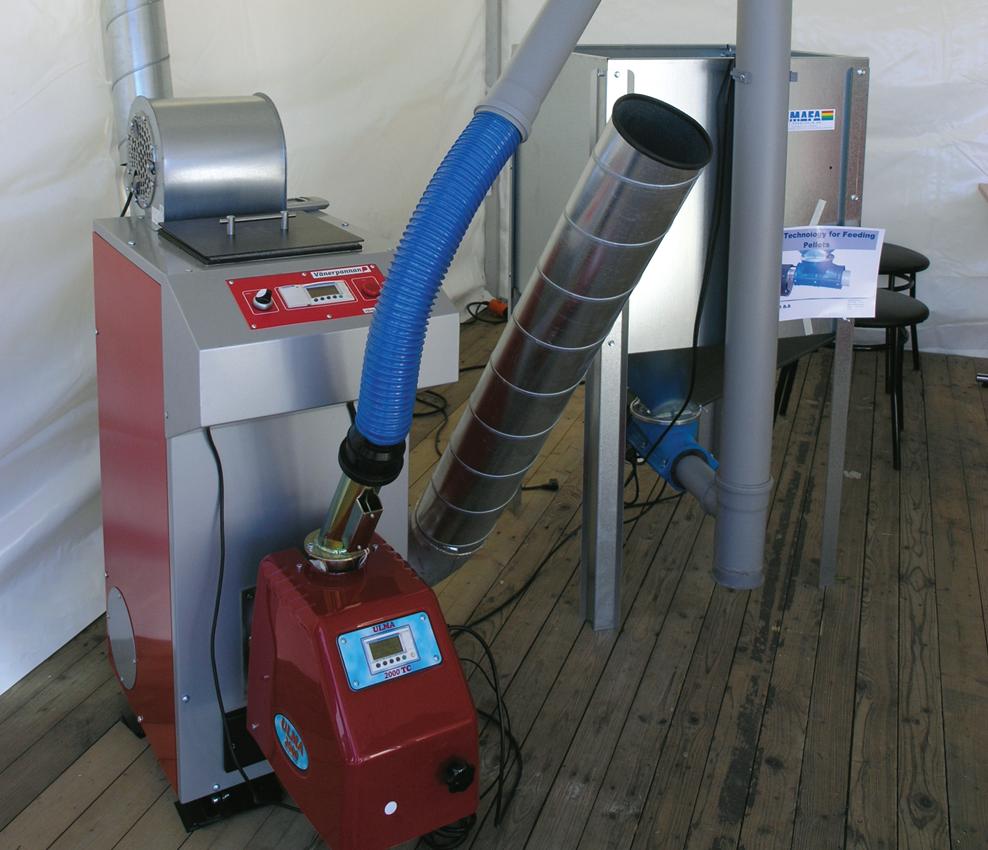
This simple yet efficient and compact pellet infeed and forced air furnace system comes from a trio of Scandinavian suppliers co-operating on the project, and is aimed squarely at the North American retrofit and new home market. The companies are Matene a.s. of Norway (unique vertical “fluidizing” feeder), Ulma of Sweden (highefficiency pellet burner), and Vanertekno of Sweden (compact hot air furnace). They are looking for distribution and some licensed manufacturing in North America. It was shown for the first time ever at World Bioenergy, and will be shown again at Bioenergy Days late this coming September in Minnesota. www.matene.com.
Technology to Spare
PELLETS FOR EVERYMAN
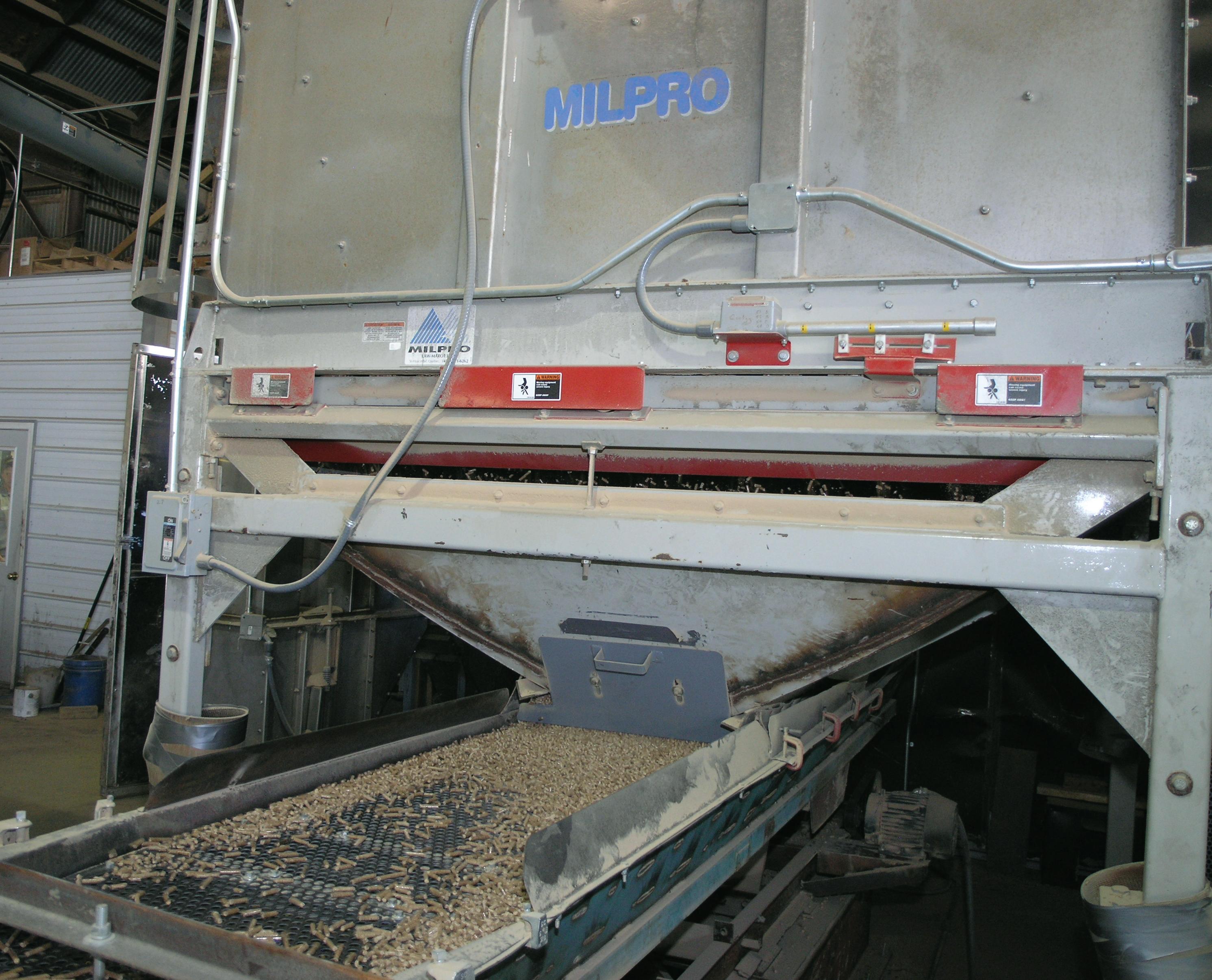
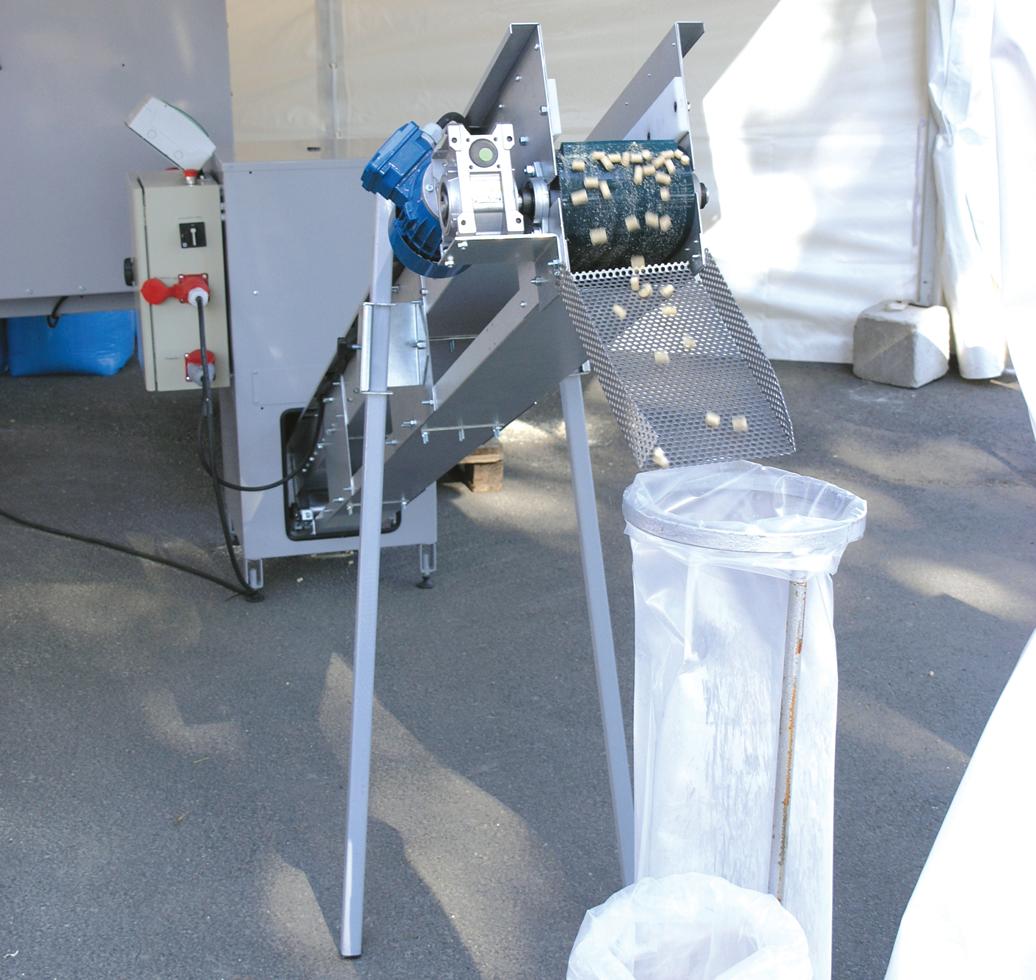
World Bioenergy 2008 boasted several exhibitors with pelletizing options for just about anyone with access to wood fibre and a local market, from small remanufacturers and flooring plants to sawmills with a little extra sawdust and a need to diversify revenue streams. Shown is one of several compact pellet mills from Swedish supplier Morums Mekanisko AB. It makes 50 kg of pellets per hour, dumped automatically into waiting bags. The robust machine is easy to set up and start, and is small enough to be set up in any corner. Show staff told Canadian Biomass that sawdust or shavings with a moisture content (MC) of 18% or less will work, suiting it to any operation using or making dry wood products.
Biopress AB is another Swedish outfit making some smaller complete pellet systems, from the Biopress 150 (150 kg/hr) to the Biopress 800 (800 kg/hr). The ideal raw material is sawdust or shavings with an MC below 15%, although the company works with a Czech company that supplies saw dust driers from 200 to 1,000 kg/hr, and Biopress offers a total turnkey pellet mill suited to your needs. The supplier also makes what it calls a “factory in a box” – a complete turnkey mill in three mobile containers. www.biopress.se.
WHILE
the conference portion of World Bioenergy 2008 attracted 1,200 delegates from over 60 countries, the trade show portion of the event was a big deal by bioenergy standards as well. It featured over 200 exhibiting companies that showed their wares and technology to over 5,500 visitors. Here’s a smattering of what stood out to Canadian Biomass.
CRUSH IT, CHIP IT
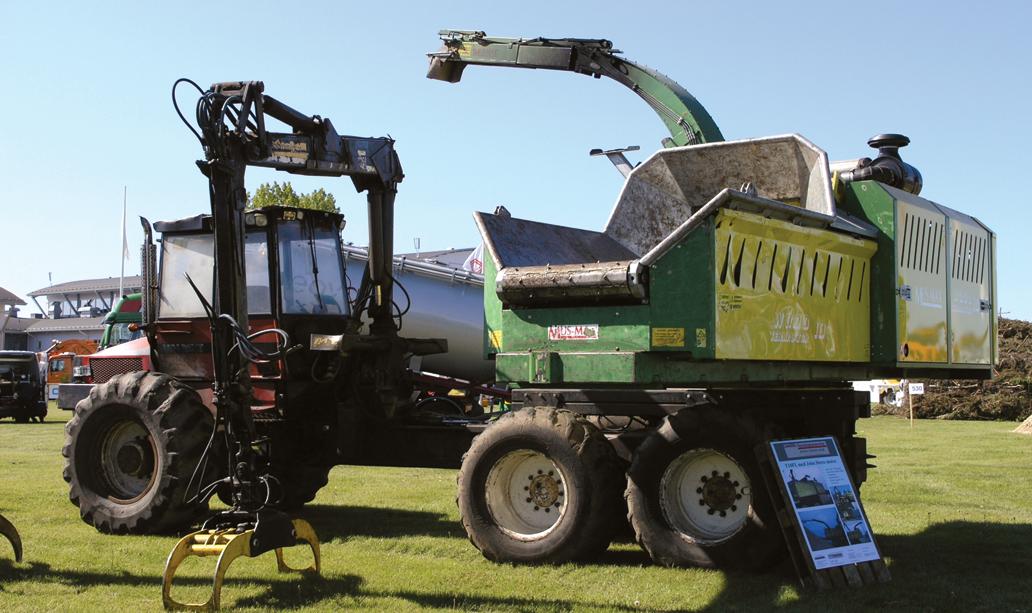
Options for harvest slash recovery include compactors (top) and chipping systems (middle). Above is a Mus-Max Wood Terminator 10. The 12-knife disc chipper is mounted on a used Valmet 6WD forwarder. While nimble, with a 600-hp John Deere engine it is still all business.
NOT AT ALL STUMPED
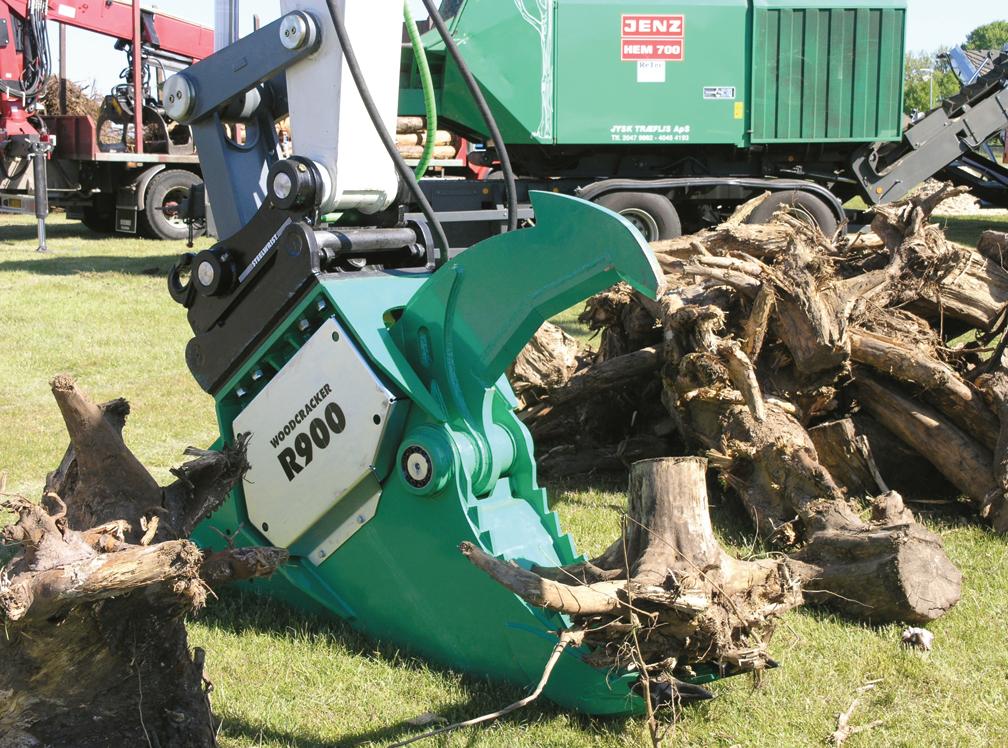
Slash above the ground or stumps below – Itʼs all marketable biomass here. Stumps here get their own lifting and crushing attachments, like this Jenz Woodcracker R900 from Germany. The company has a full line of grinders and screens as well for the biomass market. www.jenz.de.
SHRED & SCREEN
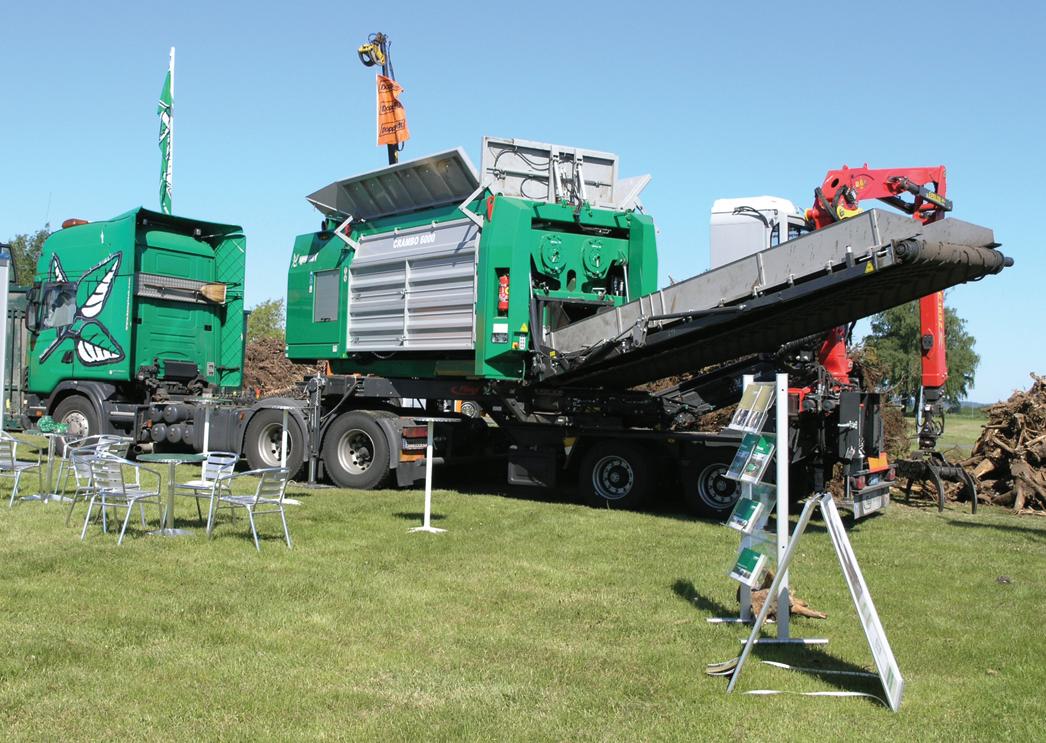
Komptech is an Austrian company that makes a wide range of Crambo slow shredders and elaborate wood waste star-type screening systems that now has an office in Canada. It will offer these proven biomass processing products to our own growing industry. Shown is one of the supplierʼs Crambo 6000 slow shredders. Komptech also makes both mobile (diesel powered for the woods) and stationary (electrical hook up for mill or sort yard) gear. www.komptech.com.
A system of trade-offs
It’s hard for some of us to grasp, but there’s no free lunch when it comes to society’s energy needs. Using renewable fuels to replace some of our fossil fuel addiction is a great idea (common sense really), but there will be a price to pay both in extra forest intervention and in changing perceptions.
To me, rutting is a perfect example. It was unheard of and almost unseen during my first few trips to Scandinavia. The idea of riding on top of a bed of harvest slash, and thus sparing the soil, has always been a big seller of cut-to-length (CTL) harvesting on this side of the Atlantic after all. You won’t sell too many CTL systems this way visiting Sweden or Finland anymore. Simply put, harvest slash has too much energy value to drive over these days, so harvester operators carefully lay it to the side, and drive on the soil and rock. The result is more rutting. So what’s more pressing – global warming and replacing fossil fuels, or a few ruts here and there? I’m not saying it’s an easy choice, but
WILLOW GRASS FOR POWER
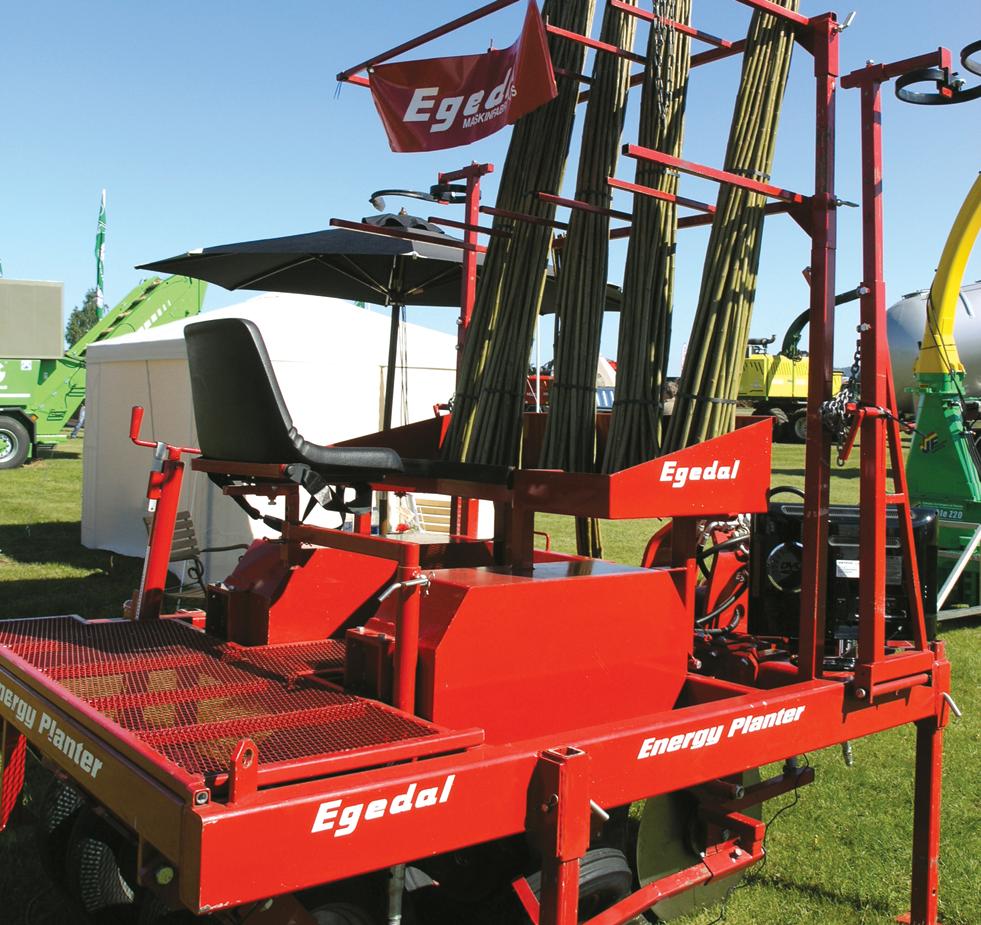
Salix certainly grows like grass, with the ash-sewage fertilized fields we saw being ready for harvest in a few years. A willow-like crop with a three- to five-year rotation, it is commonplace along the roads of southern and western Sweden. To help mechanize and reduce the cost for landowners wanting to get in the salix growing business, a Danish entrepreneur has developed the Egedal Energy Planer. Shown for the first time at World Bioenergy 2008, the machine can handle both salix (willow) and poplar, according to Egedal Maskinfabrik managing director Niels Fogh. Niels told Elmiaʼs own press corps how the machine works.
“We use cuttings that are about 2.3 metres long, which is a standard size. At that length, they are a year old. We use a drum cutting system, which gives a bigger capacity. The operator sits on the machine and feeds the long cuttings into the cutter by hand. The cutter automatically cuts them into either 17 or 20 cm long sticks. They are then planted vertically in the plant furrow by a hydraulic device. The stick grows in the moist ground without any other help. After three years you can take a first harvest, and then re-harvest the same plants every second year, for at least 20 years.”
The company has sold machines in Denmark, other European countries, and the US. The machine comes in two-row and four-row versions, with the latter planting up to 2.5 ha per hour. It is available in Canada through Timm Enterprises. www.timmenterprises.com.
Rutting like this may be more common than before for a simple reason –With oil above $130/barrel and the public demanding renewable energy, whoʼs going to ride over slash?
you’d be naive thinking it’s a choice we can ignore.
I think we’ll work around this issue through planning, longer booms, and harvest scheduling. Other issues will prove more thorny, and the price too high, at least for now. For starters, I’ll bet anyone a large draft that we won’t see too many stump pullers in our woods over the next decade. It baffles the Swedes and Finns I talk to, but there’s just no way we’re going to fret the way we do over site disturbance and nutrient loss, and then start ripping up stumps and shaking them to loosen the dirt. Anyway, there are far too many lower hanging fruits out there to pick first.
And that’s the main thing to keep in mind when discussing such trade-offs. With a typical 100-year-plus Canadian rotation and slash recovery systems that will still leave a lot of tops and branches behind, we can expand our biomass recovery operations dramatically before we need to lose sleep over site productivity. We need to monitor it, discuss it, choose sites carefully, and keep an eye in the rear view mirror. But we need to move on. Or use more oil. Take your pick.
LOAD AND GRIND
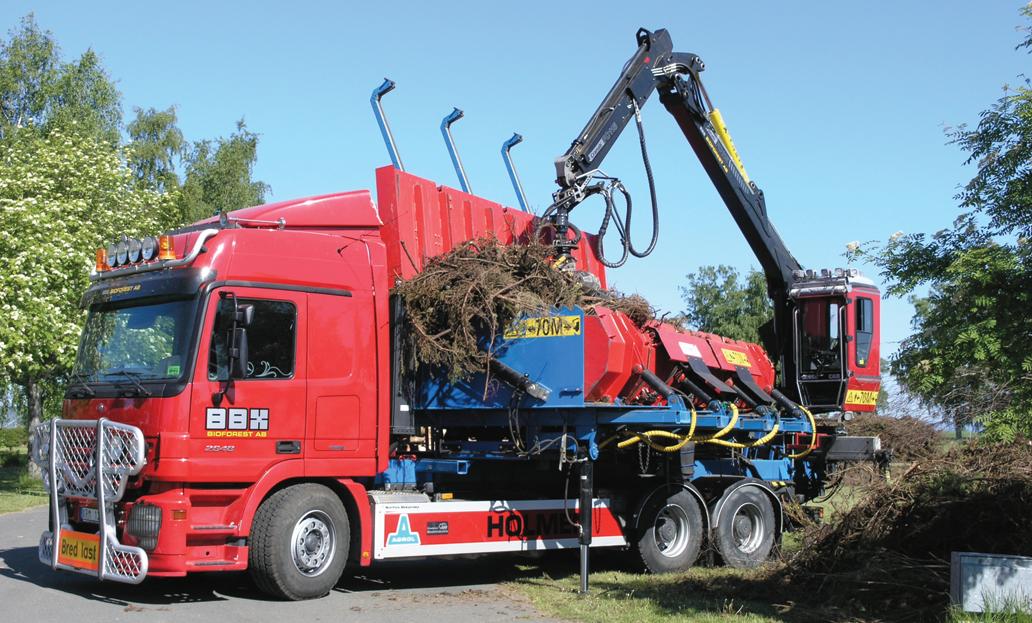
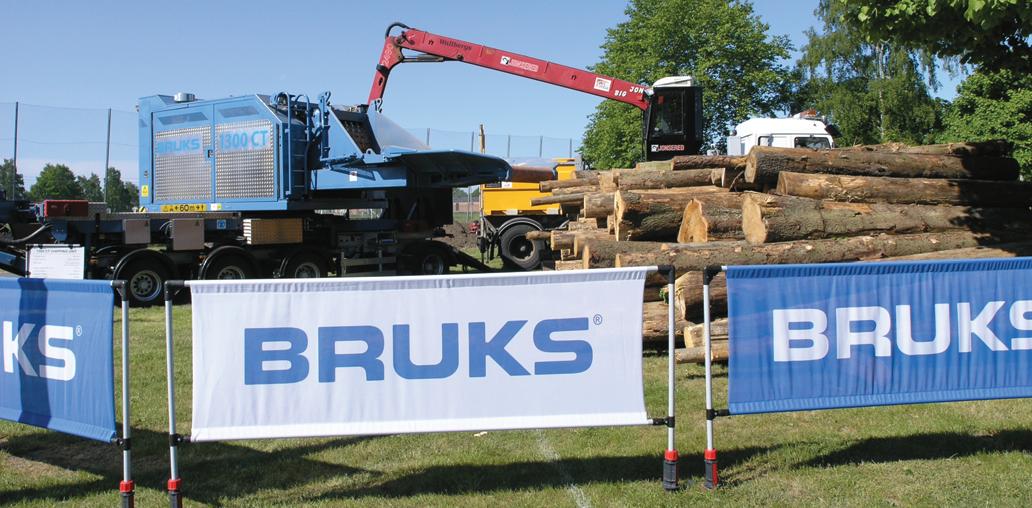
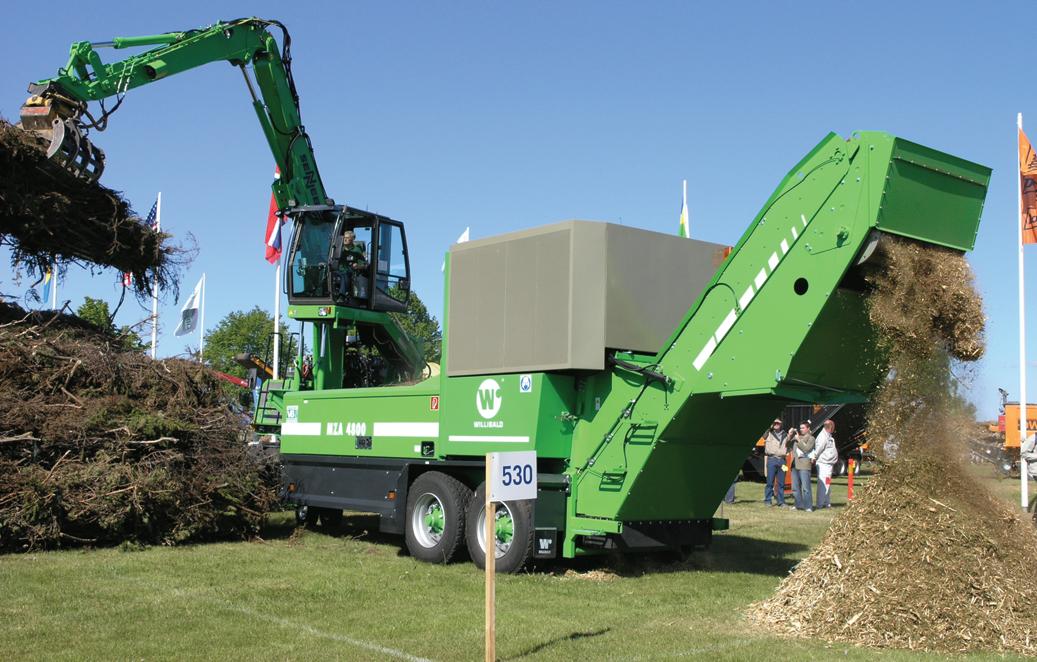
As you can see here, good loaders and purpose-built grapples are keys to getting good production from biomass grinders, chippers and hogs. Willibald is another option for processing harvest slash or yard wood. The Willibald MZA 4800 mobile shredder is designed for green waste and harvest residuals, although the manufacturer makes a range of smaller (MiniMax) biomass shredders as well. Willibald has a Canadian distributor in Embrun, ON, but is looking to expand distribution. www.willibald-gmbh.de.
Elmia Wood 2009 the next showcase
Want to know more about Scandinavian bioenergy technology and ideas? A great place to start is Elmia Wood 2009, the world’s largest forestry show. The live logging “in the woods” event takes place June 3-6 in Jönköping, and is a must-see event if you can spare the time (allow at least three days) and money. According to business area manager Torbjorn Johnsen, biomass harvesting, handling, processing, and hauling technology will make up a big part of the exhibition next year, as all major forest economies look to turn up their renewable energy output. Track the event and associated education opportunities as they evolve at www.elmia.se/wood.
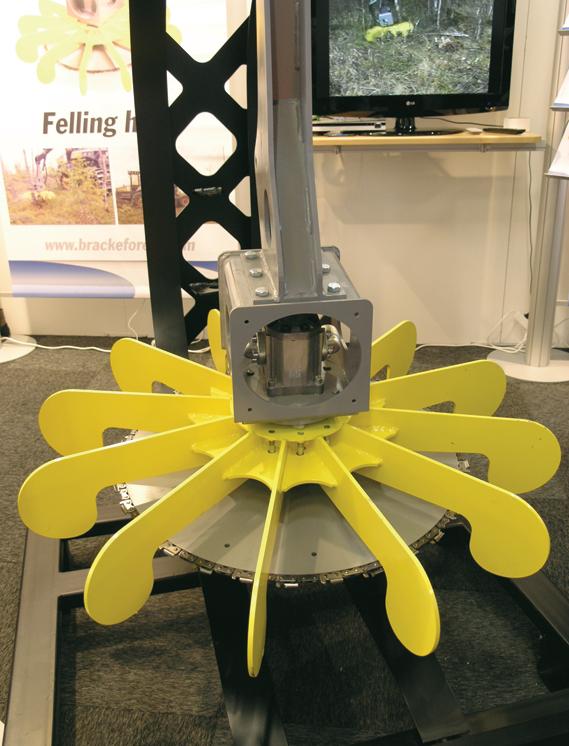
CUTTING A BIOMASS SWATH
To be sure, readily available harvesting slash and legacy piles are still the lowest-hanging fruit when it comes to biomass piles in Canada. But there are a growing number of applications for smalldiameter or unmerchantable (UMT) tree harvesting for energy in the right conditions and location. There is no shortage of tools to do the job, as World Bioenergy was enough to make an old Tenco shear guy reminisce. Energy wood harvesting options at the show included good old-fashioned, twosided shears, guillotine style cutters, chainsaw driven disc models from Bracke with accumulating arms, or a single mowing style feeling head with chain saw cutter, like the Bracke model at right.
HAVE PELLET MILL, WILL TRAVEL
This pellet mill in a box comes from Sweden Power Chippers, and can be dropped into place by a forklift, and set to work in hours wherever the fibre is. SPC makes turnkey solutions to match the raw material supply and infrastructure, from infeed to automated outfeed and bagging systems, and everything in between. Its equipment and solutions are handled in Canada by Silvana Import Trading of Montreal, suppliers of a host of other forestry gear, such as Bracke automated planters and biomass harvesting heads. www.silvanatrading.com.
CARDBOARD ROOFING?
Slash is so valuable in Scandinavia that folks donʼt even want the stuff getting rained on. After harvest, slash is collected by forwarder and neatly piled in rows at the edge of the harvest block to allow it to dry ahead of chipping. In many cases, these slash rows are protected by “energy wrap” like the piles in southern Sweden shown here. The motivation is economic – protected logging residue provides higher heat values than unprotected slash, a realization that comes from thinking about things in KW per hectare rather than our standard tonnes or cubic metres per hectare.
The paper board laminate is rolled over the slash piles by the forwarder that collected it, and serves two key roles – To make slash recovery more efficient in winter (no snow or ice jamming the piles up); and to create drier biomass. One supplier is Finlandʼs Walki group, which among many other products makes “Wrap Energy”. After seeing some of their wrap in the woods, we spoke with a Walki rep at World Bioenergy 2008. He explained that independent studies conducted in Finland show a 10 to 15% lower MC from using the wrap. The fibre sheets simply get chipped or hogged with the slash. www.walki.com.