







thePassingTorch CFC chair retiring after 13 years thePassingTorch CFC chair retiring after 13 years




thePassingTorch CFC chair retiring after 13 years thePassingTorch CFC chair retiring after 13 years
BY KRISTY NUDDS
Meat is still king, but it’s price might threaten it’s reign.
A recent study commissioned by the American Meat Institute (AMI) and the Food Marketing Institute (FMI) in the U.S. reveals that the price of meat is having a very big impact on the sales volume of meat and poultry products (see page 46).
The Power of Meat: An In-depth Look at Meat Through the Shopper’s Eyes was released at the recent 2012 Annual Meat Conference, held in Orlando, Fla. The study explores shopper perceptions, attitudes and behaviours regarding meat and poultry. It also takes an in-depth look at meat consumption and purchasing patterns.
It’s a very interesting look into the mind of today’s consumer, and the pressures of a faltering economy. Although the study surveyed U.S. consumers, it’s likely a good indication of how consumers are thinking here in Canada.
This is the seventh year the AMI and FMI have commissioned the study, and the authors indicate that grocery and meat shopping continue “to be dominated by finding ways to save.” The economy of the last several years has resulted in shoppers who are “savvy” and have mastered the ability to implement a variety of moneysaving measures, including shopping sales, using coupons, and cooking different meals than they did in the past, including a higher number of meatless meals.
Interestingly, the authors note that shoppers are able to adjust their spending on groceries and meat quite quickly depending on how other economic pressures, such as the price of gasoline, affect them. As a result, consumers will switch between different cuts and types of meats readily, which the authors say is “putting enormous emphasis on sales promotions, price per pound and packaging costs.”
For the first time, the study found that the proportion of shoppers who were savvy

savers (those using coupons or other measures) was equal to the proportion of shoppers who opted to buy less in order to save. Although dollar sales of meat and poultry increased by 2.5 per cent, the study found that the volume of sales decreased by 5.3 per cent across all proteins, as the price of proteins had increased.
Although price was a deterrent for increasing the volume of sales, beef and chicken still remained the most popularly purchased proteins, and consumers preferred to buy it fresh rather than ready-to-eat or heat-and-eat.
What I found most interesting was that a large proportion of consumers indicated that their knowledge of the meats they purchase and how to prepare them is lacking. This group turns to family and friends and the Internet for help, but few ask staff in the meat department of their frequented stores. However, many indicated that they would utilize a “here-how-it’s-done” type of service if it were offered.
This is interesting. Years ago, supermarkets and supercentres (where, according to the study, the majority of consumers purchase meat and poultry) removed in-store butchers in order to cut costs. Now, consumers want them back – but given the increasing price of proteins, and the pressure from consumers to reduce prices on all grocery items, is it worthwhile for a store to do this?
Although poultry farmers have no control over price at the retail level in Canada, providing a “here-how-it’s-done” type of service provides a great opportunity for the marketing boards to engage with consumers directly in the store – not only to demonstrate all the great recipes and cooking techniques they already provide on their websites and in other marketing materials, but also to talk with consumers and answer their questions. In those conversations, questions of price will certainly dominate.
APRIL 2012
Vol. 99, No. 4
Editor Kristy Nudds – knudds@annexweb.com 888-599-2228 ext. 266
Associate Editor Jim Knisley – jknisley@kwic.com
Publisher/Sales Manager
Marilyn White – mwhite@annexweb.com 519-429-5193
Sales Assistant Mary Burnie – mburnie@annexweb.com
Production Artist
Brooke Shaw
Group Publisher
Diane Kleer – dkleer@annexweb.com
President
Mailing Address
P.O. Box 530, 105 Donly Dr. S., Simcoe, ON N3Y 4N5
Publication Mail Agreement #40065710
PAP Registration #9850 RETURN UNDELIVERABLE CANADIAN ADDRESSES TO CIRCULATION DEPT., P.O. BOX 530, SIMCOE, ON N3Y 4N5.
Printed in Canada ISSN 1703-2911
Circulation
Subscription Rates
Canada – 1 Year $ 24.00 (with GST $25.20, with HST/QST $27.12)
GST – #867172652RT0001
USA – 1 Year $ 60.00 USD
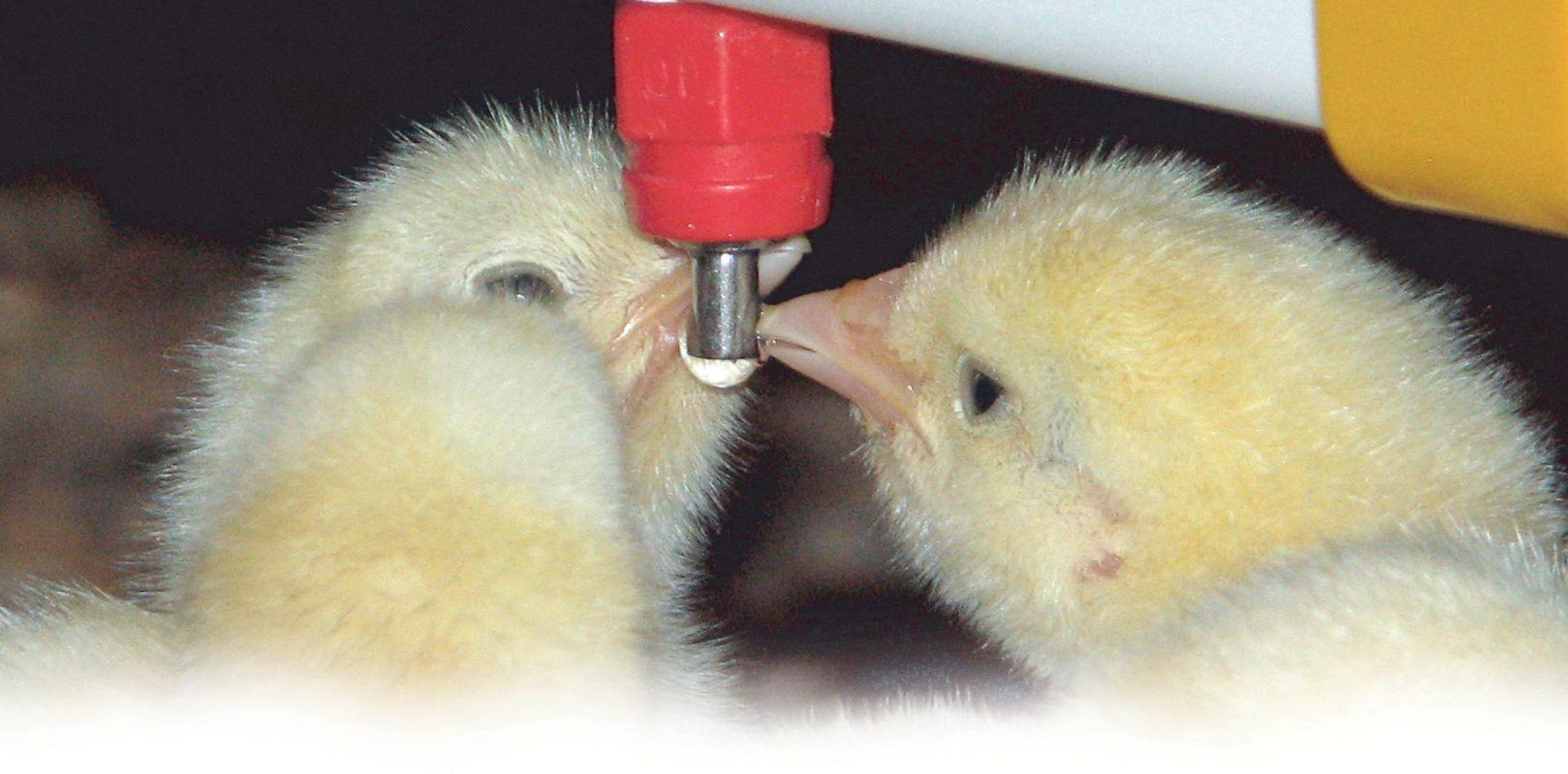




Nothing says like Lubing's is designed to work in today's challenging broiler environment. Because the nipple has been optimized for growth, you will be amazed by the first-week performance and explosive bird growth. offers:


Large body and pin
Acid resistant design
Easy triggering for day-old birds
Low mortality
Increased side-action flow
Larger flow range for jumbo birds
Increased weight gains
Improved feed conversions
To find out more about and it’s outstanding performance, please contact your local Lubing Representative.
Glass-Pac Canada
St. Jacobs, Ontario
Tel: (519) 664.3811
Fax: (519) 664.3003
Carstairs, Alberta
Tel: (403) 337-3767
Fax: (403) 337-3590
J. Dean Williamson Ltd.
London, Ontario
Tel: (519) 657.5231
Fax: (519) 657.4092
Les Equipments Avipor
Cowansville, Quebec
Tel: (450) 263.6222
Fax: (450) 263.9021
Specht-Canada Inc.
Stony Plain, Alberta
Tel: (780) 963.4795
Fax: (780) 963.5034
Astrain of the potentially deadly antibiotic-resistant bacterium known as MRSA has jumped from food animals to humans, according to a new study led by the Translational Genomics Research Institute (TGen).
The study, published in the online journal mBio focuses on MRSA CC398, a strain of methicillin-resistant Staphylococcus aureus. The study suggests that MRSA CC398 probably started as a non-resistant (antibioticsusceptible) strain in humans before it spread to food animals where it subsequently became resistant to several antibiotics.
Whole genome sequencing, a cutting-edge testing method in which billions of molecules of DNA are spelled out in exquisite detail, enabled the scientists to trace the likely history of MRSA CC398.
Researchers at 20 institutes joined forces to study 89 genomes from humans and animals spanning 19 countries and four continents.
The study’s international team of scientists found

that the jump of Staph from humans to food animals was followed by the bacterium becoming resistant; first to tetracycline, and then later to methicillin — two important antibiotics for treating Staph infections.
MRSA CC398 is often referred to as “pig-MRSA” or “livestock-associated MRSA” because it most often infects people with direct exposure to swine and other food animals.
“Our results strongly suggest that food animals-associated MRSA CC398 originated in humans as MSSA (methicillinsusceptible S. aureus),” the report concludes. Once in animals, the microbe became resistant to tetracycline and methicillin, likely as a result of the routine antibiotic use that characterizes modern food-animal production, the study said.
Dr. Paul Keim, one of the study’s authors and Director of TGen’s Pathogen Genomics Division, said the study describes evolution in action: “The most powerful force in
evolution is ‘selection.’ And, in this case, humans have supplied a strong force through the use of antibiotic drugs in European swine production.
Dr. Frank M. Aarestrup, Head of the Microbial Genomics and Antimicrobial Resistance unit at the Technical University of Denmark, said the study provided valuable information about the origins and future risks of this MRSA strain.
Dr. Robert Skov, M.D., the study’s Senior Microbiologist and a member of the Department of Microbiological Surveillance and Research at the Statens Serum Institut in Copenhagen, Denmark, said more studies are needed to further assess the risks.
“Further analyses are required to estimate the number of independent genetic events leading to the methicillin-resistant sub lineages, but the diversity of the (MRSA) subtypes is suggestive of strong and diverse antimicrobial selection associated with food-animal production,” Dr. Skov said.
Hand to hand transfers are no longer part of the transportation system for spent fowl in Ontario.
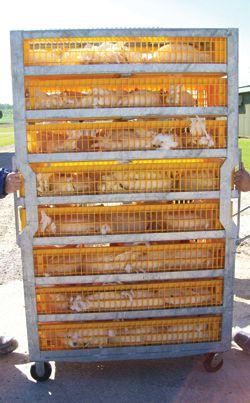
A modular transportation system has been developed for Maple Lodge that utilizes carts to move the birds from their cages to the trucks. The change, which took effect Feb. 13, improves animal welfare and has undergone several months of trials. Under the old system, the hens were carried to crates. Under the new system, a small trolley is rolled into the barn and the
Ihens placed in plastic drawers on the trolley.
The trolley is eight drawers high and 48 inches deep, 18 inches wide and 78 inches tall and taller than a regular pullet cart. Each drawer is almost the same area as a chicken crate.
To accommodate the new system a staging area will be needed at the farm to ensure safety. A loaded cart and a man will weight about 1,000 lbs. so the loading dock must be able to handle the load.
Modified pullet trailers have been developed that will move the carts from the farm to Maple Lodge for processing. The modified trailers can
crates.
n the March 2012 issue, a photo was missing from the sidebar entitled “Open House” on page 11. Canadian Poultry magazine apologizes for the error.
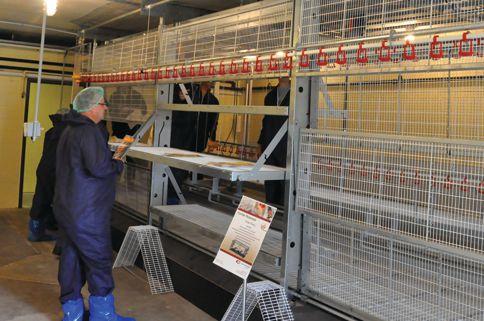
Clark Ag Systems Ltd. hosted an open house at the University of Guelph’s Arkell poultry research station in September 2011 to allow producers and industry representatives to see the Farmer Automatic Portal Rearing System, Loggia system and Layer ECO system. Dr. Tina Widowski and representatives from Clark and Farmer Automatic were on hand to answer questions and show attendees how the systems operate. Pictured here are attendees viewing the Portal Rearing System.
The Alberta Egg Producers have changed its trade name to the Egg Farmers of Alberta to further enhance the positive perception of eggs and the Alberta egg industry.
The organization announced the name change at its annual general meeting on Feb. 28 in Red Deer. Alberta’s egg marketing board said that the rebranding initiative will enable it’s messages to resonate more effectively with the public by reinforcing trust in farmers and reconnecting individuals to the farm.
The Egg Farmers of Alberta represent Alberta’s 150+ registered egg farmers.
APRIL
April 11-12, 2012
The London Poultry Show, Progress Building, Western Fair Entertainment Centre, London, Ont. For more information, visit: www.poultryindustrycouncil.ca
MAY
May 8, 2012
PIC Research Day, Victoria East Golf Club, Guelph, Ont. For more information, visit: www.poultryindustrycouncil.ca
JUNE
June 10-12, 2012
CPEPC Convention, Fairmont le Manoir Richelieu, La Malbaie, Charlevoix, Que. For more information, visit: www.cpepc.ca
JULY
July 9-12, 2012
Poultry Science Association (PSA) Annual Meeting, the Georgia Center, Athens, Ga. For more information, visit: www.poultryscience.org
AUGUST
August 5-9, 2012
XXIV World’s Poultry Congress, Salvador, Bahia, Brazil. For more information, visit: www.wpc2012.com
SEPTEMBER
September 11-13, 2012
Canada’s Outdoor Farm Show, Canada’s Outdoor Park, Woodstock, Ont. For more information, visit: www.outdoorfarmshow. com
Agriculture Minister
Gerry Ritz announced that the Canadian Food Inspection Agency (CFIA) has launched a Statement of Rights and Service for Producers, Consumers and Other Stakeholders and six guides to inspection. The statement and guides will give consumers, producers and businesses an important tool in their interactions with the CFIA by outlining what
the CFIA does, its service standards and what the sector can expect when dealing with the CFIA.
Minister Ritz also announced the CFIA’s new Complaints and Appeals mechanism, which will provide businesses with a more transparent and accessible way to register complaints and appeals.
For more information, visit the CFIA website.
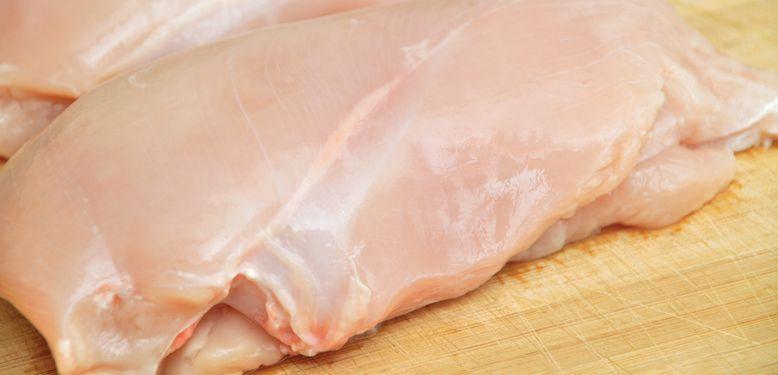
Anew study suggests chicken meat may be a source of E. coli bacteria that is making its way into people and causing infections.
The study looks at strains of E. coli in poultry and compares them to the strains found to have been causing urinary tract infections in women in Quebec.
Senior author Amee Manges of McGill University says the bacteria would be killed if the meat is handled with care and cooked properly, but that isn’t always the case.
She says a comparison of strains from food animals and
September 25-26, 2012 Poultry Service Industry Workshop, The Banff Centre, Banff, Alta. For more information, visit: www.poultryworkshop. com
November 8-9, 2012 Poultry Innovations Conference, London, Ont. For more information, visit: www.poultryindustrycouncil.ca
JANUARY 2013
January 28-31, 2013
International Poultry Exposition (IPE), International Feed Exposition (IFE) and American Meat Institute (AMI) tradeshow, Georgia World Congress Center, Atlanta, Ga. For more information, visit: www.ipe11.org
people suggests poultry and to a lesser extent pork are serving as a reservoir for these bacteria, which can cause blood or urinary tract infections in people, or diarrhea.
Manges says some of the strains being spotted are resistant to multiple antibiotics, a worrying trend.
She says the findings add weight to concerns that the use of antibiotics in food animals is contributing to the rise in drugresistant infections in people.
The study was published in the March issue of the journal Emerging Infectious Diseases - The Canadian Press
We welcome additions to our Coming Events section. To ensure publication at least one month prior to the event, please send your event information at least eight to 12 weeks in advance to: Canadian Poultry, Annex Business Media, P.O. Box 530, 105 Donly Dr. S., Simcoe, ON N3Y 4N5; e-mail knudds@annexweb. com; or fax 519-429-3094.


TDiscommittedtohelpingfarmersbuildforthefuture.

Whenthe Martinfamilywantedtoraise theproductivity of their dairy business, they turnedtoDaltonPotter for guidance.DaltonisaseasonedTD Canada Trust Agriculture Specialist andafarmerhimself, andwithhis help,the Martinswere able to buy anewfarm in a primelocation.Our understanding of agricultureand financing,combinedwithapersonalizedapproach,ishowwe’rehelpingfamiliesliketheMartinsgetexactly what they’re lookingfor.
For more information, visit a branch or go to www.tdcanadatrust.com/agriculture

VAL-CO® unveiled its Horizon® Whole House Controller, a new multiple zone automatic control system, at the recent International Poultry Expo (IPE) in Atlanta.
The Horizon Whole House Controller utilizes proprietary logic programs to provide fully automated, 24-hour control of key parameters in the poultry house environment, optimizing temperature, humidity and ventilation, while controlling feed and water delivery. Horizon features a large (17”), intuitive touchscreen interface, making all important house controls readily available and easy to access. Simple, straightforward software guides users in initial application setup and programming. The logic program for automated control can be overridden either at the touchscreen or manually at any time, and the results of all inputs are visually represented on-screen immediately.

The controller provides users with a smooth minimum vent curve, ensuring that all birds, including delicate chicks and poults, are being raised in the ideal temperature and environmental conditions for growth. The system also reduces heating and cooling costs by maximizing energy efficiency and optimizing the use of heaters or fans over multiple zones. Using the VAL-CO patented Innovative Control Logic, the system automatically adjusts minimum ventilation to ideal conditions, taking many factors into account, including outside temperatures and humidity. Wear leveling, to balance tunnel fan motor wear, is also an available and practical option.
System installation or reconfiguration is made easier and faster by the use of fully modular components, which also facilitate quick troubleshooting and allow plenty of work room in enclosed spaces. Remote access via the Internet gives users a means of monitoring their house environments anytime, anywhere – a key feature that helps to deliver peace-of-mind.
Additionally, the Horizon automatic remote monitoring system features dual alarm relays that reduce the risk of nuisance alarms. Scheduled reminders also provide notice whenever regular maintenance should be performed.
For more information, visit: www.val-co. com, e-mail: sales@val-co.com, or visit your local Val-Co dealer.
VAL-CO recently revealed three new additions to its FUZE ProLine Feeding System. The three new features are designed to help owners save costs and maintenance time while generating efficient feed flow and improving overall system performance and reliability.
The FUZE feeder now features a sturdy new pan-to-grill hinge and lock, securely locking the feed pan to the feeder’s “bird-friendly” ergonomic grill. The hinge provides easy access to the pan for faster and simpler cleaning and sanitizing between flocks, which can aid in improving overall flock health and performance.
VAL-CO has also added a new mechanical switch control pan. This feature will help improve control pan performance and make maintenance and servicing of the system easier.
Finally, the new FUZE feeder includes a bird-attracting LED light for the end control pan as a standard feature. Research and best practice has shown that the light attracts birds to the control pan at feeding time, helping to ensure that the feed line remains in a constant fully charged state. The result is consistent and efficient feed flow throughout the system.

For more information, visit: www.valco.com, e-mail: sales@val-co. com, or visit your local ValCo dealer.
Chore-Time’s new CHORE-TRONICS® 3 Controls offer users true buttonless operation with the colour and convenience of touch screen navigation. Additionally, the new controls’ graphing capabilities open a colourful world of data presentation for users, making poultry house data analysis much faster and easier.

Chore-Time’s third generation of its popular CHORETRONICS line of controls features vivid color in a large 10-inch (25 cm) display. Users can employ the intuitive touch screen to navigate from the Current Conditions screen to other screens facilitating control of various house components and display of critical house information in table or graph form. Users more comfortable with mouse operation may use a wired or wireless USB mouse with the new controls.
With the CHORE-TRONICS 3 Controls, a wide variety of information is displayed both graphically and with picture icons on the comprehensive current conditions screen. Details available include the set temperature, the average temperature and the variable speed temperature along with the outside temperature. The current ventilation mode, static pressure, relative humidity and air speed are also displayed as well as the feed and water consumed that day and the current bird weight, for systems equipped with Chore-Time’s bird scales.
CHORE-TRONICS 3 Controls incorporate the features growers have enjoyed in generations 1 and 2 along with the following new features exclusive to generation 3:
Fully integrated ceiling inlet control
Fully integrated bird scale control
Up to 16 controlling sensors
Improved graphing capabilities
External USB port
USB set-up key to back-up and transfer settings
The new generation of control is also designed for easy USB upload of additional features as they are developed and become available. This means that users of the new controls will be able to easily add and take advantage of the additional features under development now and in the future.
Basic graphical information can be displayed on the Control’s screen, or farm managers can use Chore-Time’s C-CENTRAL™ Professional Software for enhanced graphing and data analysis. The controls are capable of displaying graphs for temperature, relative humidity, mortality, water consumption and a wide variety of other data as well as 14 days of history on numerous topics. Graphs can also be used to assist in review of various clock and curve settings.
Chore-Time is also introducing a new larger relay box than was used with previous CHORETRONICS Control generations. The new box saves wall space by incorporating 56 relays in a single box. In many cases this will avoid the user needing two relay boxes in order to have enough relays available. The large interior of the new boxes allows more room for routing wires without the need to squeeze fingers into tight spaces. Each relay bank in the new box includes two strips of four contacts for simple, economical replaceability.
CHORE-TRONICS 3 Controls are part of Chore-Time’s complete line of integrated poultry products including feeders, drinkers, feed conveying, feed storage, ventilation, heating, cooling, nests, controls and software.
For more information, visit: www. choretimepoultry.com, e-mail: poultry@choretime.com, or visit your local Chore-Time dealer.
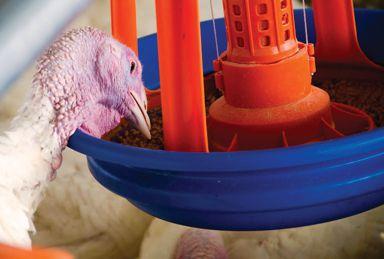
Big Dutchman recently introduced the Gladiator turkey feeding pan with features designed to reduce feed waste, lower maintenance time, and feed the largest turkeys.
The Gladiator turkey feeding pan is designed to feed the largest and most aggressive turkeys. The “Snap’n Lock” feature secures the dish to the pan body to eliminate “dish drop”, which saves lots of feed, and many manhours of maintenance. The Gladiator’s dish design catches feed as the turkeys eat, which saves feed and then funnels it back in front of your flock, increasing your feed conversions.

The pan is constructed of industrial strength plastic to last through many grow-out periods, and the snap on cap allows for easy installation and simple removal of individual pans when needed. Our patented uses of the shocker wire design gives you the ability to adjust the feed level to the entire line with a simple turn of a crank.
For more information and to view videos and additional photos, visit: www.bigdutchmanusa.com/ gladiator

CPRC held its annual general meeting March 23, 2012, and we felt that this would be a good time to provide an update on some of our activities, programs and initiatives over the past year.
CPRC made a presentation to the House of Commons Standing Committee on Agriculture in November 2011, during the committee’s hearings on the Research and Innovation section of the Growing Forward 2 Program that takes effect in April 2013. We emphasized the value of research to the poultry industry and the importance of the participation of the Government of Canada in those activities. The federal government provides research funding through Agriculture and Agri-Food Canada (AAFC), Natural Sciences and Engineering Research Council (NSERC) and other government agencies, but they also have highly qualified, professional researchers on staff who conduct poultry research projects. Five of the 12 projects in the present Poultry Research Cluster are conducted by scientists with AAFC and Canadian Food Inspection Agency (CFIA). The federal government also has a significant communications system that can disseminate research and innovation information to the poultry industry.
CPRC made a presentation to the Senate Standing Committee on Agriculture and Forestry in February 2012 on the importance of research and innovation to agriculture. We included much of the information from the presentation to the House Standing Committee on the value of research but also provided examples of some CPRC research projects that have had real impacts on the sector. Of the 22 completed projects to date, some have moved on to further research, directed toward adoption by
industry stakeholders, while the results of eight projects have been, or are being, adopted by farmers, processors and input suppliers.
The Poultry Research Cluster, co-funded with AAFC, the PIC, and provincial governments and funding organizations, has entered its final year and preliminary results have already benefited the industry. The cluster approach does not replace single projects but it does have some positive characteristics that make it a strong research tool. A cluster is a science strategy that brings together multidisciplinary teams, or “clusters,” of scientists, to solve complex problems and to create synergies in research efforts. It is a way to make the most of available resources and supports a strong business case for investing in Canadian poultry research.
The present Poultry Research Cluster consists of 12 projects that bring together seven different universities and research organizations and 28 scientists. Research focus for the cluster has been on food safety and quality (e.g., vaccine development, avian influenza, necrotic enteritis) and poultry welfare and behaviour (leg and bone structure, toe-clipping of turkeys, feeding strategies for breeders). Preliminary results for some projects have been featured in previous updates and are available on our website in the research results section.
The draft National Poultry Research Strategy is presently being reviewed and discussed by the poultry production sector, after which it will be made available to other industry stakeholders for comment. This document is very important to both our industry and CPRC as it identifies the issues
that are important to poultry producers and their industry partners, establishing CPRC’s agenda for the next several years.
CPRC has been in existence for just over a decade and approved its first research funding in 2003. The CPRC Board decided that it was a good time to review CPRC’s research funding and processes to try and determine our level of effectiveness and efficiency. The information on the eight projects that have been, or are being, adopted by industry and that were included in the Senate Standing Committee presentation, is taken from the preliminary information generated during the review of research funding.
Some other preliminary information from the evaluation includes:
Since 2005, when the present system was refined, Letters of Intent have been reviewed, assessed and funding approved within three months of receiving them from researchers. More than half have been approved within two months. However, the time needed to complete the review and approval has lengthened in recent years, partly because of the increasing number of proposals received. Of the 22 completed projects to date, 14 per cent were completed on or before the target completion date established by the funding agreement. Half of the completed projects were completed within three months of the target date and almost three-quarters within six months of target date. Research project timelines frequently change as challenges develop in processes and data collection. CPRC has a system in place to identify delayed project completion so we can react accordingly.
More information on the results of CPRC’s evaluation will be available in coming months.

The best of times? Most farmers say yes
BY JIM KNISLEY
Optimism among Canadian farmers has never been higher than it is today, with all indicators reaching new highs, according to a Farm Credit Canada (FCC) Vision survey.
More than three-quarters of all farmers responding to the survey believe they are better off now than they were five years ago, while eight in 10 believe they will be even better off five years from now. Poultry producers are the most optimistic with eight in 10 poultry producers (80 per cent) saying their farm is better off today than five years ago and agreeing that their farm or business will be even better off five years from now.
The optimism is reflected in farmers’ plans for the future with a majority planning to expand or diversify their operations in the next five years and 80 per cent saying they would recommend careers in agriculture to others.
Over the past five years the level of farmers’ optimism has been increasing. More farmers now say they are better off today than five years ago. In late 2011, when the survey was taken, more than three-quarters of all farmers surveyed (77 per cent) said that their farm or business is better off now than it was five years ago.
As good as things are now, farmers surveyed said better days lie ahead. Eight in 10 producers (80 per cent) expect to be better off five years from now than they are today. The number of producers who
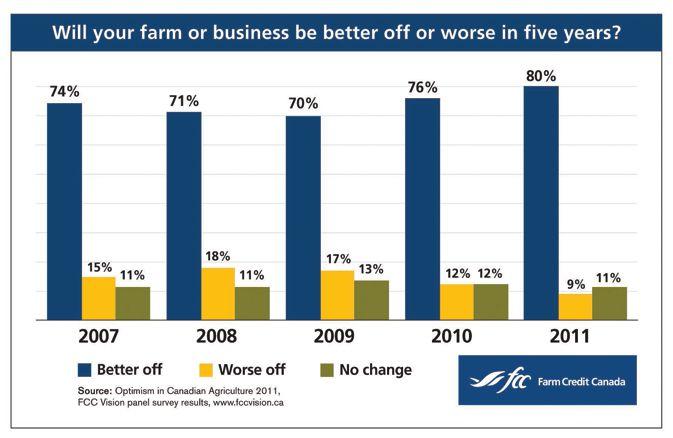
A recent FCC survey shows that more than three-quarters of respondents believe they are better off now than they were five years ago
are optimistic has grown significantly since 2007, the first year the survey was published by FCC.
This increasing optimism is translating into plans for expansion and/ or diversification. More than half (58 per cent) of producers are planning to expand and/or diversify their operations over the next five years, while just 15 per cent say they plan to reduce their operation or exit the industry. The increasing optimism is bubbling into recommendations that others consider a career in agriculture. Advocacy for agriculture is at a new high, according to the survey, with eight in 10 producers saying they recommend a career in an agriculturerelated field, and seven in 10 saying they would recommend a career in primary production.
Although farmers said they would recommend farming as a career, they recognize just how hard it is to get into. Most producers stress that unless you have land or an operation being passed on to you, getting a start in farming is almost out of the picture. They told FCC “that due to increasing machinery costs and land prices, starting a farm from scratch is nearly impossible.”
Producers also said they want Canadian consumers to understand more about their industry, with an emphasis on the production of safe, quality food. The 10 words most frequently mentioned by producers were: safe, food, quality, healthy, important, good, local, sustainable, product and Canadian.
While producers are optimistic, they recognize that major factors are beyond

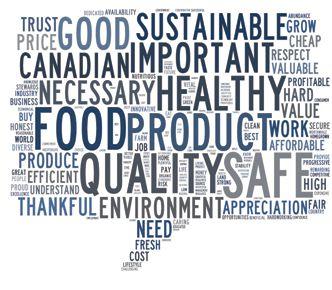
PRODUCERS TOLD FCC THAT THEY HOPE WHEN CONSUMERS THINK ABOUT CANADIAN AGRICULTURE THEY THINK ABOUT SAFE, QUALITY FOOD, AND THAT IT IS AN IMPORTANT, LOCAL, AND HEALTH INDUSTRY.
their control such as weather and unpredictable economic conditions. They are
also concerned about increasing input and machinery costs and debt loads that could make the upcoming years tough if interest rates increase.
While farmers across Canada are increasingly optimistic, Saskatchewan producers lead the way with 82 per cent expressing optimism compared with 79 per cent nationwide.
Optimism among poultry producers has never been higher than it is now. Eight in 10 poultry producers (80 per cent) agree that their farm or business will be better off five years from now. It is likely that optimism for the future among poultry producers is backed by the fact that 80 per cent of poultry producers feel that their operation is better off today than it was five years earlier.
Poultry producers display optimism
through their plans to expand and diversify their operations. In total, six in 10 poultry producers (59 per cent) plan to expand or diversify, or both. Thirteen per cent of poultry producers plan to reduce their operation or exit the industry, whereas one-quarter (24 per cent) plan no changes.
Advocating careers in primary production is another way poultry producers show they are optimistic about the future. Eight in 10 poultry producers (81 per cent) would recommend a career in primary production, making producers in this sector the most likely to do so among all other sectors. Additionally, 84 per cent would recommend a career in an agriculture-related field. In the past year alone, half of all poultry producers have recommended a career in agriculture (50 per cent) and four in 10 have recommended a career in primary production (44 per cent).


CFC chairman David Fuller is leaving after 13 years to focus on family succession
BY KRISTY NUDDS
The Chicken Farmers of Canada’s (CFC) longeststanding chairman is ready to give up a life of airports, conference calls and meetings to focus on helping his three daughters take over the family farming operation in Nova Scotia.
David Fuller says that change is always good for an organization and that the “time is right” for him to leave the position he’s held since 1999.
“Trying to run a farm and be the Chair of CFC has been more than a fulltime position,” he says.
Now, he’s looking to spend more time with his family, and helping his three daughters — Natasha (along with her husband, Cory Dykens), Stephanie, and Jennifer — take over the farming operation, which produces 1.6 million kilograms of chicken on three farms in the Canning area, in the picturesque New Minas basin.
Fuller began his career in the chicken industry in 1976, when he formed a partnership with his parents John and Betty, who had a broiler and turkey operation. At that time, and throughout the 1980s, chicken production increased and the family acquired additional production quota, expanding the farm to its current size. David and his wife Diane bought out the farm completely from his parents three years ago.
Fuller worked on the farm full-time until 1987, when he began to take on more of a leadership role within the industry. That year, he began serving

David Fuller says his time as Chairman of CFC has had many rewards, despite numerous challenges. But the time is right for him to leave the position and help his daughters take over the family broiler operation
on the Chicken Farmers of Nova Scotia board, as Chair for several years. In 1993, he became Nova Scotia’s representative to CFC, and served on CFC’s Executive committee in 1994 but had to resign that year as the CFNS had asked producers for its support in leaving CFC. Believing that leaving CFC was not the right thing to do, Fuller says he had no choice but to resign from the CFNS as well. His fellow producers supported his position and voted against leaving CFC. Fuller then returned to CFC in 1996.
Fuller says the reason he became so involved in the industry was “it was the opportunity for me to say thank you and hopefully, be able to bring something to the table that would be beneficial for the Canadian chicken industry,” he says.
As a farmer, one of the biggest challenges has been to always make sure that there is stability in the system in
the long-term, which allows farmers to invest with confidence. Stability in the system is a key part of his role as Chair of CFC.
“As Chair, my job was to make sure that the organization looks after the interest of the farmers that we represent, as well the partners that we work very closely with, whether upstream or downstream from the farm, including government,” he says.
He says he has found his experience as chair very rewarding. “To be able to bring the parties together, to build consensus on issues that face our industry as a whole, has been one of the highlights,” he says.
There have been many highlights throughout his tenure at CFC, but the most significant highlight, says Fuller, is the Federal-Provincial agreement that CFC officially finalized in June 2001.

This required getting consensus amongst all provincial commodity boards, provincial supervisory boards, provincial agriculture ministers, as well as the federal agriculture minister. “To be able to put an agreement like that in place that everyone could agree to, that would tell us how we are going to do business in the future as a unit, to me was a highlight, “ he says.
Fuller was also driven by the fact that when he first took the position of chair, he had many that told him he couldn’t get it done. “That was a mistake,” he says. “When you tell me I can’t do something, then I go at it.”
He got involved personally — visiting ministers, talking with them one on one in each province, to make sure that they understood what CFC was doing, and what the scope and the intent of the agreement was.
A challenge, says Fuller, has been the trade file, because it has the potential of having a significant impact on Canadian farmers if it goes badly, regardless of whether a farmer is in supply management or not.
He says he took the file under his wing and was very close to it during his tenure. “It has not been an easy challenge to sit and talk not just with Canadian officials, but officials from other countries to try and build consensus on how to best look after the interests of everyone involved,” he says.
He believes that with the support supply managed industries have from all political parties, whether provincial or federal, shows how important supply management is to Canada and how it is beneficial. “I think our governments clearly understand the benefit of supply management, and that it’s biggest
benefit, to be frank, is that it costs them nothing,” he says.
However, one of the biggest challenges he’s faced is how to convince the media of this, and in particular, that farmers do not set retail prices. He expresses frustration with the fact that despite meeting with numerous editorial boards across the country to try and get this message across, “we just can’t seem to get it there.”
“If Canada gives supply management up, we will not get anything for it,” he says. “People have this assumption that supply management is holding us back, and that is so far off the truth.”
He says although the media likes to say that Canada is unique (with respect to wanting to protect supply management as a sensitive product) but “we’re not.” He points to the U.S. having sensitivities around oranges, sugar, and cot-


ton, and Australia and New Zealand, who claim to be free traders yet have so many barriers put in place, that no one can ship anything into their countries.
Despite the frustration of the trade file, Fuller commends the Canadian government for it’s continual support of supply management. He says it is “unheard of” to have the Prime Minister mention support for supply management on two different occasions during his Speech from the Throne. He also noted that Federal Agriculture Minister Gerry Ritz has been true to his word that supply management is non-negotiable.
A big challenge left unresolved as he leaves his position has to do with differential growth. Since 2007, CFC has been working on provisions for differential growth in its operating agreement under the federal-provincial agreement. In the past few years, growth has “subsided tremendously,” he says.
“We are in a growth market, but it’s minimal,” he says. If the market was experiencing a growth of five per cent a year, it would be easier to achieve consensus amongst stakeholders. Currently, the market is only experiencing one to two per cent growth annually. CFC has been working on several formulas, and will continue to explore ways to allow for differential growth in Canada, he says.
Fuller says he is proud of CFC’s On-Farm Food Safety Program and it’s Animal Care Program, which were developed during his time with CFC. He also notes that CFC’s involvement, along with the other national feather boards and the Canadian Poultry and Egg Processors Council (CPEPC) with the Canadian Poultry Research Council (CPRC) has been a “real opportunity” for the organization.
The SM5 group was also formed during his tenure and he says that “having the ability to sit down with his fellow
members of supply management and talk about issues that face us all has been very rewarding, and to be able to build a team that works closely together is so crucial,” he says.
Fuller says he has learned a lot from CFC on how to be a better farmer, as it has helped him to learn the issues and complexities of the industry. Hearing from other farmers is “eye-opening” he has learnt from them how to do things better. “By communicating with each other you learn things, and that definitely helps you be a better farmer,” he says.
He has also benefitted from being part of the development of two of CFC’s strategic plans (they are developed every five years). The strategic plan is a “roadmap” for the organization to follow, and it uses it to re-verify whether it’s going in the right direction, or whether the members need to sit down and rethink things. “I think it’s absolutely key, and I’ve adopted

it on my own farm,” he says.
Fuller is also thankful for the many rewards and opportunities his time with CFC has brought. “The biggest reward for me in this whole job was the opportunity to meet with not just my fellow farmers, but people throughout the industry as well,” he says.
The opportunity to travel to many different places throughout the world and talk to with farmers and stakeholders in these countries has been something that he has enjoyed and he greatly appreciates.
“The travel that my wife and I have been able to do while I was chairman has been phenomenal,” he says. “We thank everyone from the bottom of our hearts for giving us that opportunity.”
He says that he thinks the opportunity to travel and see more of the “real world” has made them better people. When speaking at a number of different events, one of his key messages has been “that in Canada, we take way too much for granted and we have no idea what it’s really like in a lot of other countries in the world,” he says.
Fuller announced that he would not be seeking re-election at the 2011 annual meeting of Les Éleveurs de volailles du Québec. His last official day as CFC chair was March 20, when the board elected B.C. representative David Janzen as the new chair.
When asked what advice he would give his successor, Fuller says, “always look for commonality and then try to build from the commonality out. If you find the common ground between people or organizations on issues, you will continue to build consensus.”
Fuller says CFC is keeping him on retainer for six months to help with the transition between chairs. The organization will be honouring him at its summer meeting this July in Winnipeg.

Yesterday, today and tomorrow...
Sommers has been a trusted name for standby and PTO power systems in rural Canada for 75 years. Over the generations, we’ve been there to keep your lights on and your equipment running with reliable generator systems personally tailored to your family and business needs.
Times have changed, but Sommers is still leading the next generation of power solutions with advanced features like Sentinel remote monitoring and our new easy-to-buy series of packaged systems.
For now and for your future, count on Sommers for “the power to live better.”
BY KIMBERLY SHEPPARD, RESEARCH CO-ORDINATOR
FEATURED RESEARCHERS:
MANON RACICOT, ARTHUR KOCHER, GUY BEAUCHAMP, ANN LETELLIER, JEAN-PIERRE VAILLANCOURT, UNIVERSITY OF MONTREAL
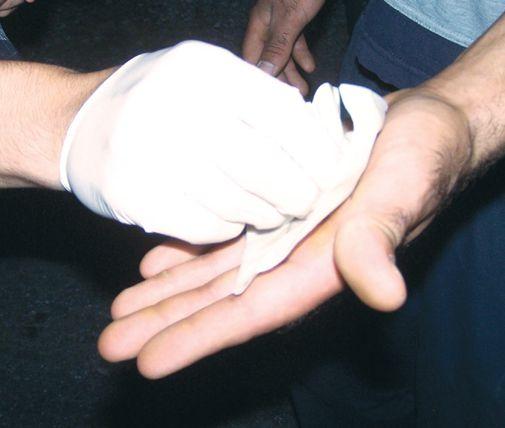
Hand sanitizing is extremely important to prevent the spread of pathogens — be it from person to person or from farm to farm. But, are all sanitizing methods created equal? Are the convenient alcohol-based gels and wipes as good as (or better than) good old soap and water? Or are they best used in combination? This question is especially relevant to catching crew members, who can heavily contaminate their hands with organic material, then act as mechanical vectors spreading diseases between farms. Hand hygiene is also important to prevent zoonotic agent contamination such as Escherichia coli O157 and Salmonella enteritidis for which health consequences can be serious.
Many studies in human medicine tend to make hand rub with a disinfecting gel a standard for hand hygiene. However, few studies have tested the effectiveness of hand hygiene products on visibly contaminated hands. Dr. JeanPierre Vaillancourt and his research team at the University of Montreal have been evaluating the effectiveness of practical hand sanitization protocols: soap and water, degreasing cream, and hand wipes, all combined with alcohol-based


University of Montreal researchers tackle the question of whether hand sanitizing methods are created equal
hand gel. The use of alcohol-based gel alone was also evaluated. Thirty-two repetitions of each hand-washing protocol were done.
The study was conducted under field conditions, from July to August 2010. A catching crew was followed during normal working hours. To be as close as possible to field conditions, no specific time and quantity were required for washing
or rubbing hands with the different products. An explanation was given on how to perform the four protocols (different steps) without indicating specific time or quantity to use. However, the time spent by each person for each protocol (the time spent to wash hands before applying the alcohol-based gel and the time spent to rub hands with the alcoholbased gel) was recorded using a video

camera and the quantity of alcohol-based gel used was estimated by recording the number of times each participant pressed on the delivery device fixed on the alcohol-based gel container.
Their findings? For the reduction of coliforms after washing, there was no statistically significant difference between protocols when the initial level of contamination was low to moderate. When hands were highly contaminated, the alcohol-based gel alone was less effective than the degreasing cream
combined with the alcohol-based gel. As for the reduction in total aerobic counts after washing, there was no difference between protocols when the initial level of contamination was low. The soap and water with alcohol-based gel protocol was more effective than the scrubbing wipes and alcohol-based gel protocol when hands were moderately and highly contaminated. All protocols were effective in neutralizing Salmonella Reducing the level of hand contamination before using an alcohol-based
gel seems important to ensure effective hand sanitation for highly and moderately contaminated hands. This can be done by using a degreasing cream or soap and water before applying an alcohol-based gel. However, based on the survey done during this study, catching crew members preferred using soap and warm water compared to a degreasing cream. For more information on this study, please visit www.poultryindustrycouncil.ca.
Enterococci are part of normal intestinal gut flora of animals and humans. Many studies have shown that enterococci from animal origin could represent an antimicrobial resistance genes reservoir for the human community. Little is known about the molecular antimicrobial resistance profiles from avian enterococci in Canada. Enterococci have numerous genetic elements that contribute to the dissemination of antimicrobial resistance traits that are mostly transferred by a highly efficient “pheromone-responsive” system. This system enables contact between donor cell and recipient cell during conjugation. In addition to reducing antimicrobial use, the poultry industry would benefit from new methods of prevention or reduction of spread of AMR.
Dr. Marie Archambault and her research team at the University of Montreal have been working toward providing evidence for the development of new tools to help the poultry industry prevent the emergence and spread of AMR. To this end, they have conducted a study to characterize the antimicrobial resistance determinants and investigate plasmid colocalization (presence of two
substances in the same site) of tetracycline and macrolide genes in Enterococcus faecalis and Enterococcus faecium from broiler chicken and turkey flocks in Canada. This study also investigated new ways to reduce the transfer of antimicrobial resistance through interference in the pheromone-responsive conjugation. They hypothesized that the horizontal transfer of antimicrobial resistance in avian isolates of enterococci could be reduced using a polyclonal antiserum AS44-560.
Their findings? A total of 387 E. faecalis and E. faecium isolates were recovered from poultry cecal contents from five processing plants. The percentages of resistant E. faecalis and E. faecium isolates, respectively, were 88.1 and 94 per cent to bacitracin, 0 and 0.9 per cent to chloramphenicol, 0.7 and 14.5 per cent to ciprofloxacin, 72.6 and 80.3 per cent to erythromycin, 3.7 and 41 per cent to flavomycin, 9.6 and 4.3 per cent (highlevel resistance) to gentamicin, 25.2 and 17.1 per cent (high-level resistance) to kanamycin, 0 and 0 per cent to linezolid, 2.6 and 20.5 per cent to nitrofurantoin, 3 and 27.4 per cent to penicillin, 7 and 12.8 per cent to salinomycin, 46.7 and
38.5 per cent (high-level resistance) to streptomycin, 95.6 and 89.7 per cent to tetracycline, 73 and 75.2 per cent to tylosin, and 0 and 0 per cent to vancomycin.
One predominant multidrug-resistant phenotypic pattern was identified in both E. faecalis and E. faecium (bacitracin, erythromycin, tetracycline and tylosin). A significant reduction in the pheromone-responsive horizontal transfer of bacitracin resistance in E. faecalis could be achieved in vitro with a polyclonal anti-AS44-560. Overall, results indicated that the intestinal enterococci of healthy poultry could be a reservoir for quinupristin-dalfopristin, bacitracin, tetracycline, and macrolide resistance genes. For more information on this study, please visit www.poultryindustrycouncil.ca.
BY TIM NELSON, EXECUTIVE DIRECTOR
It’s music to our ears when a producer tells us that he can’t wait for the next regional producer update, which we host with the Ontario Ministry of Agriculture, Food and Rural Affairs (OMAFRA) at vari-
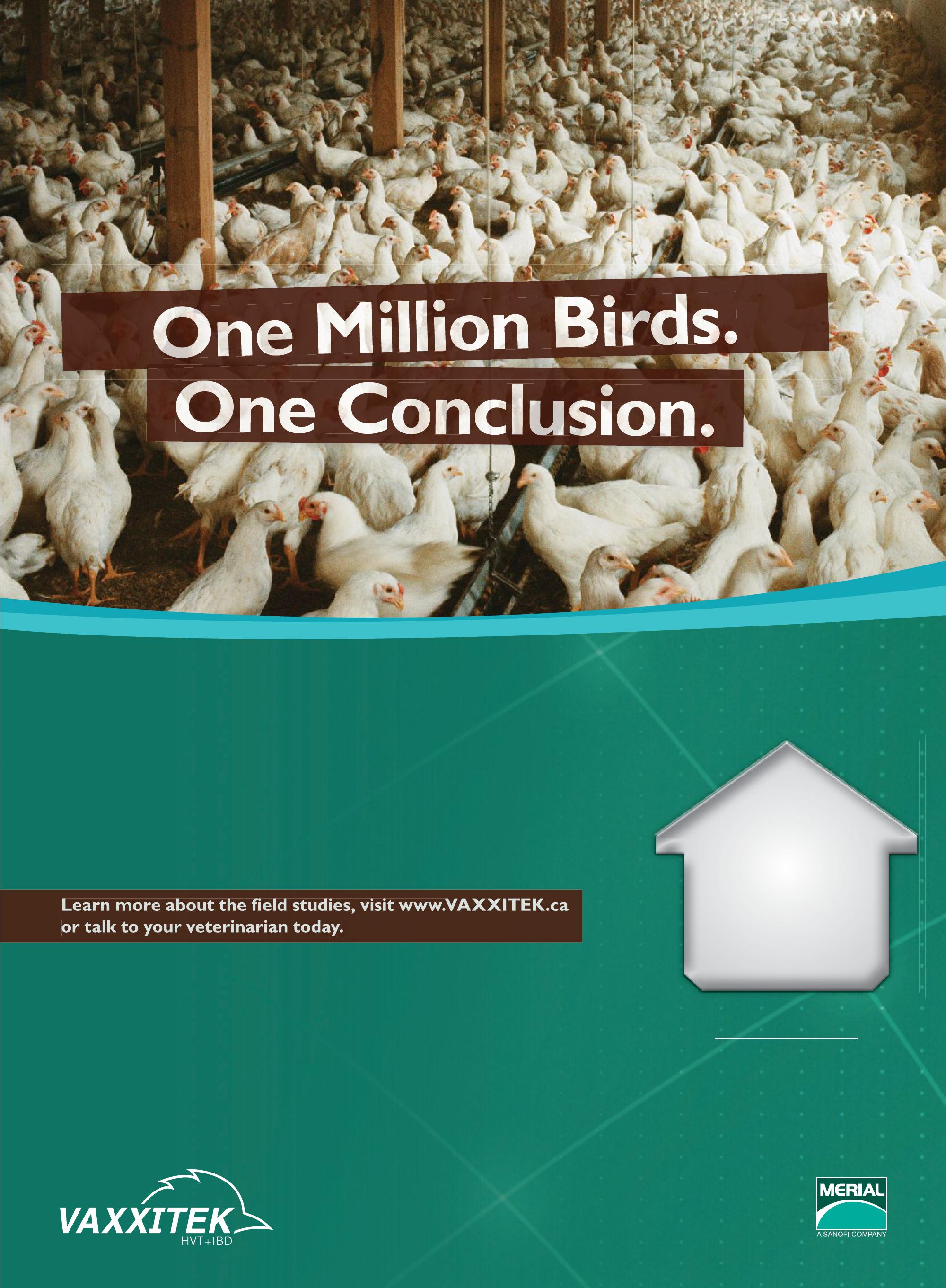
Canadian Trial Demonstrates the Performance Improvements of Vaccination with VAXXITEK® HVT + IBD.
In one of the largest Canadian field studies of its kind, more than one million broilers were vaccinated with VAXXITEK® HVT+IBD over four periods from June 2010 to February 2011. 1 At the end of the trial, the conclusion was clear. Vaccination with VAXXITEK HVT+IBD resulted in a substantial improvement, particularly in livability, number of condemnations and profitability.
Here’s what satisfied customers are saying:
We started using VAXXITEK shortly after its launch and noted a big improvement in chick quality right from the start. Our customers reported fewer condemns and reduced mortality. Now we have customers asking for VAXXITEK-vaccinated chicks. We’re extremely happy with the results.
“
Ernie Silver, Hatchery Manager, Western Hatchery, Abbotsford, BC




April 25 26, 2012
University of Alberta, Edmonton
For more information visit: www.settingthestageforsuccess.wordpress.com
To register: www.regonline.ca/nationalhatcheryworkshop
Workshop Presenters Include:
Sander Lourens, Wageningen UR, Netherlands
Nick French, Aviagen
Donna Hill, HatchTech
WEDNESDAY APRIL 25, 2012
The Stage is Set: the big picture
Setting for Success: managing egg storage
The Heat is on: adjusting embryonic metabolism for hatching success
Squeaky clean. Does egg hygiene really matter?
Short periods of incubation during long egg storage: what happens to hatchability?
Multi stage vs. single stage….embryonic profiles
How do you measure chick quality?
Warming up to your chicks: incubation effects beyond the hatchery doors
Measuring performance–what matters to you?
THURSDAY APRIL 26, 2012
Shake, rattle and roll: the effects of transportation
Incubation temperature and breeder flock age effects on chick bone development
Incubation temperature and breeder flock age effects on chick immune function
Get your hands dirty! Hatch residue break out: doing it right and making it matter!
Will I survive? How poor hatching flocks impact incubation
Too hot, too cold, or just right: chick holding temperatures and subsequent broiler performance
Hitting the ground running: post hatch chick management.
Beyond the navel gaze: checking out the big picture.
$270 per individual
Includes continental breakfasts and lunches.
More than 1 attending from your company?
Receive a $35 discount on all registrations when you register at the same time. Student Registration only $50!
Students are invited to present research posters.
ous locations throughout Ontario.
The focus of the regional poultry producer updates is to bring producers and industry together to talk about current issues and provide a local forum for the exchange of information. Looking at attendance, we seem to have hit our stride with the last round of updates held in February. Thanks to all of our presenters who provided great information in a clear, concise manner peppered with real-life stories that we all could relate to.
Here are the attendence numbers: Belleville, 55, London, 120, and Jordan, 51, for a total of 226.
Of the 226, 50 per cent were poultry producers.
Topics included:
the poultry health update from the regional poultry vets, what they have been seeing with respect to disease this winter; an update from the banks (TD and RBC), who shared their thoughts on current market trends; an update from the provincial poultry specialist on the use of the new pullet carts; and updates on the effect of heat stress, fly control and much more.
Some highlights:
Crystal Mackay from Farm and Food Care Ontario spoke about the newly released poultry transport decision tree, “Should This Bird be Loaded?”, and why it was created and this led to a lively exchange of questions and answers. Producers were able to pick up copies of the ”Should This Bird Be Loaded?” laminated information sheet, which is a quick reference guide that can be inserted in barn binders. A poster version of this guide (great for displaying on barn entrances), as well as a more detailed handbook were also available and were scooped up.
Bill Groot-Nibbelink, livestock regulatory affairs specialist with OMAFRA, gave an update on the pending deadline for certification of incinerators, and listed which companies are hoping to have their Environmental Technology Verification Program (ETV certificate) by March 27.
George Cornelissen shared his story of installing a geothermal unit (water furnace) on his property to heat his barns. George talked about the cost, installation and cost savings that he is now experiencing with this alternative heating system.
These days are run for producers and we rely on you for great ideas for speakers and topics.
We run regional think-tanks with producers to discuss what they would like to hear and all are welcome to attend. The more input into the planning sessions, the better the updates. So why not join us at one of those or if you have a topic you would like to share with others at a regional producer update please don’t hesitate to contact us for information on how to get it into the agenda. Phone the PIC at 519-837-0284 or e-mail pic@poultryindustrycouncil.ca.
The next round of updates will be held in November.

Don’t hand them over to necrotic enteritis-The Profit Killer!
BMD® Helps Improve Your Bottom Line By:
Reducing subclinical and clinical disease, resulting in greater productivity and decreased morbidity/mortality
y


Ensuring the absorption of nutrients from feed through preserving the integrity of the gut wall and controlling necrotic enteritis1

1 Miller SH, Skinner J, Davis SW. Efficacy of Probiotic and/or BMD ® in the Feed for Control of Necrotic Enteritis Caused by Clostridium perfringens in Broiler Chickens. Pfizer Global Poultry. Data on file. King/Alpharma is now part of Pfizer Inc. The integration of King/Alpharma and Pfizer entities may be pending in various local jurisdictions and integration may be subject to completion of various local legal and regulatory obligations. All content in this message is subject to works council and/or union consultations, if applicable, and other legal requirements where appropriate.


BY JIM KNISLEY
Controlling flies in and around poultry barns can be a challenge, but if the flies aren’t controlled the farmer may face an even bigger concern – government officials buzzing around the barn.
Daniel Ward, an engineer with Ontario’s Ministry of Agriculture, Food and Rural Affairs (OMAFRA), told 120 farmers gathered for a producer update in London, Ont., that legislation protects farmers from nuisance complaints so long as they are following “normal farm practice.”
Flies are one of the seven nuisances listed under the Farming and Food Production Protection Act (FFPPA) and Nuisance Complaints. The others are: noise, odour, dust, light, vibration and smoke.
A normal farm practice is defined as that which is consistent with proper, acceptable customs and standards of similar operations or uses innovative technologies according to proper advanced farm management practices.
Complaints usually come from neighbours, and OMAFRA staff will investigate by talking to the farmer and the neighbours. The officials will try to mediate the dispute and 98 per cent of cases are resolved through mediation with agricultural engineers of environmental specialists.
If mediation fails the case can go to the Normal Farm Practices Review Board for a hearing. “Hearings are a last resort as they are time consuming and often result in a
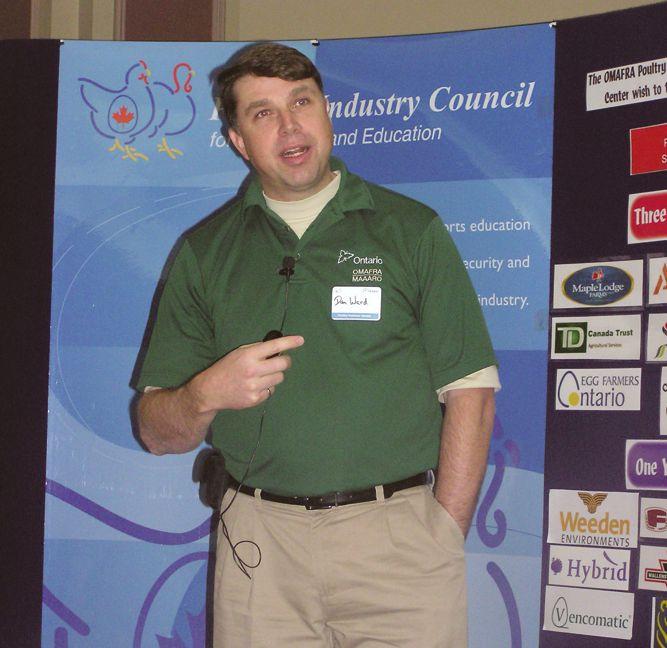
OMAFRA engineer Dan Ward says there are three basic approaches to fly control: barn and site management, biological controls and chemical control. These can be used alone or in combination.
winner/loser, which can make for difficult neighbourhood relationships,” said Ward.
The board, which is a quasi-judicial body, will decide if the farm practice from which the dispute arose is normal, not normal and must stop, or can be normal if specific conditions are met.
But for a complaint to get that far is very rare.
To deal with flies the key thing is to “know the enemy,” by understanding the fly life
cycle and the ideal environment they seek, he said.
Flies seek moist, dark areas to lay their eggs and the eggs must remain moist to hatch. Although they will lay eggs in areas with moisture between 20 and 80 per cent, 60 to 80 percent moisture is their ideal.
Flies also like it warm and with ideal moisture and warm summer temperatures they can reach the pupae stage in five to seven days and mature is less than two weeks. In the most favourable conditions it can take “10 to 14 days egg to egg,” he said. In cooler temperatures the cycle can

Used year-round in your flocks, Coccivac® vaccine can help achieve simple, sustainable and profitable prevention against coccidiosis. Resistance is not an issue, so Coccivac frees birds from the stress associated with in-feed anticoccidial rotation and shuttle programs. You and your feed company can focus on improving nutrition and better gut health.
To make the transition to Coccivac, go to www.becauseitworks.ca, talk to your veterinarian or speak to your Merck Animal Health representative.
take up to 30 days.

Fly larvae require a nutrient-rich environment such as rotting vegetation, garbage, spilled feed or manure, which is why flies lay their eggs in those areas.
And a small fly problem can explode almost overnight if it is not dealt with immediately. A single adult fly will lay an
average of 500 eggs in its short life and there can be as many as 10 generations of flies in a year. The arithmetic is frightening. In the unlikely event all survive generation to generation, one fly lays 500 eggs, so if they all survive those 500 flies would become 250,000 and the 250,000 would become 125 million.
…if trace mineral safety for your layers is not as simple as cracking a few eggs?
While consumers are demanding more poultry, they are also demanding safety. Do you know where your trace minerals come from? We do. Alltech’s Poultry Advantage program brings you local manufacturing in the heart of Canada and guarantees safe and traceable minerals everyday through our state of the art Q+ program. Be Alltech Farm Proud with the advantage, the Poultry Advantage
So, who cares about safety in your trace minerals? Remember…
“The population can just go crazy,” Ward said.
Even in the real world where most don’t survive it can easily become a big problem that must be controlled.
To deal with flies Ward said there are three basic approaches: barn and site management, biological controls and chemical control. These can be used alone or in combination, he said.
But no matter the approach the key is to break the fly cycle because “adult flies only represent a quarter of the problem.” “Even if you kill all the adults there are more flies coming,” he said.
Barn management sounds like the simplest solution but it takes a lot of time, he said. It involves: eliminating water leaks; increasing ventilation rates to ensure the manure and litter are too dry for eggs or larvae to survive; cleaning up feed spills and water leaks immediately; regularly mowing vegetation around the barns; cleaning up spilled manure; and keeping dead stock disposal sites operating properly and clean.
The bottom line is that barn management involves more work walking the barn and dealing with wet litter, extra bedding to dry up wet spots and a higher ventilation rate (extra electricity) to dry the barn.
Biological control is an option that uses the fly’s natural enemies to control the population. The most common biological controls are parasitic wasps and a fungus.
The advantage of biological controls is the flies are unlikely to develop resistance.
But “you need to know where and when to use these products to achieve the best fly control results.”
Call 1-800-285-8617 to learn how to become Alltech Farm Proud through Alltech’s Poultry Advantage Program. Alltech.com | AlltechNaturally | @Alltech
“You need to plan ahead, they’re not a quick kill,” he said. In effect, you need to put the biological controls in place when you think a problem is coming, not after it has arrived.
The wasps are not what most people think of as wasps. They are tiny – about the size of a fruit fly.
The wasps do their work before flies
Dear chicken farmers,
Over the past 13 years, you have given me the privilege of experiencing this great nation from a number of different perspectives. From coast to coast, I have learned so much from the industriousness, innovation and imagination of my fellow Canadian chicken farmers and indeed, of all the partners in our great industry
As I look back I think we need to remind ourselves why Supply Management is necessary for the entire chicken industry. The supply management system for the production of chicken is the result of an agreement among farmers and among governments on the desire for a system in the interests of us all.
Why was this partnership formed?
1. To provide price stability
2. To ensure such price stability and adequacy by the management of supply
3. To preserve a structure of independent family farms
4. To preserve a share of the industry for all regions
5. To achieve these goals without government subsidies
It is a privilege to be a farmer within this system. It is a privilege that we have to earn by working tirelessly to make the system work on a sustainable basis. It is a privilege that we have to earn through partnership and by looking out for each other not just our own self interests.
By “looking out for each other”, I refer to the many issues that we have to face on a daily basis. How we address these challenges will determine if they are stepping stones, or stumbling blocks.
Over the years we have built a system that is advantageous to both the consumer and all sectors of the industry, but in order to continue our success, and maintain the employment and economic spin-offs, it is crucial that we work closely together and address our industry issues for the betterment of the entire Canadian chicken industry
As well, there will be challenges to our system from those who choose not to understand it and from those who believe the supply management systems restrict Canada at any trade talks. We need to continue to monitor all trade talks whether they are multilateral or bilateral agreements. We need to continue to explain to all of our politicians the value of our system. The old saying – United We Stand, Divided We Fall – is what we always need to keep in the back of our minds.
After 13 years at the helm of this dynamic organization, I have decided to step back. I do so with the confidence that there is strong leadership and commitment on the CFC Board of Directors to lead our industry forward. I have met wonderful people over the years – people who have helped build our industry to where it is today. At every stop, I have been welcomed with the hospitality for which Canadians have always been known. So, to you, I say, “Thank you” I’ve had an incredible ride. My request of you is that you continue to support and act, as I have done, in the best interest of farmers across Canada
Sincerely, y

David Fuller Chair of CFC, 1999-2012
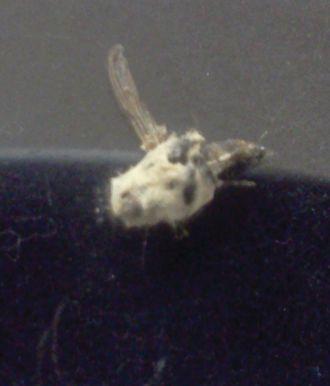
reach the adult stage. When the flies begin the process of changing over from larvae to a pupae the wasp stings and deposits her eggs inside fly pupae. These eggs begin to grow and feed on the developing fly, stopping it from hatching.

The wasps have produced good results, but he repeated that they work best if you anticipate the potential for a fly problem.
The Beauveria bassiana fungus has a spore that attaches itself to the adult fly or fly larvae. The spore has a feeding tube that goes into the fly or larvae. It does not, however, work on pupae because the outer shell is too hard.
Using either the wasps or the fungus involves paying for the products, labour to walk the barn and distribute the product (in the case of wasps) or multiple spray applications during growout for the fungus.
Wasps are also perishable with a limited shelf life. In effect, you should order as needed, he said.
“These are knockdown products,” he said. They will kill adult flies on contact. Most

offer some residual effect and will be viable for up to 30 days. In effect the chemical will land on a surface and if the fly lands on that surface it will pick up the chemical and die.
But none of the products can be used in barns as an aerosol when birds are present. “Their use is limited to fogging the barn before cleanout to gain control of a bad situation or surface application in a barn after cleanout and disinfection and before introduction of the birds,” he said.
If you plan to use a chemical control, read the label, because you need to use the correct rate. You should also rotate between active ingredients. Both of these actions are necessary to reduce the danger of flies developing resistance to the products.
Another option is a combination of bait stations and traps. These tend to be low cost, but involve lots of labour to replenish baits or traps, he said.











Beat beetles. Darkling beetles are evil little creatures. They wreak havoc on your facilities, spread bacteria and disease and irritate the most important part of your business. Your birds. So don’t hold back, hit them with Tempo®. A fast and powerful way to control darkling beetles. With rapid knockdown and prolonged residual activity, Tempo® boosts the comfort of your birds. And your bottom line. Learn more at BayerLivestock.ca.



The second largest acreage in history is predicted, but if it doesn’t materialize, supplies could be tight
BY JIM KNISLEY
The question heading into the coming crop year seems to be which rollercoaster markets will be on – the Comet or the kiddie coaster – and whether it will be a stomach-churning wild ride or much less exciting mild ride.
The release of the February United States Department of Agriculture (USDA) supply and demand forecast, grain markets moved up as tighter than earlier predicted supply/demand pressures were forecast. Despite the prospects of the second largest acreage in history in the offing the possibility of weather-fueled wildness later in the year remains.
If the large corn crop anticipated for this year doesn’t materialize, supplies could be tight.
For example, the USDA forecasts crop-year ending corn supplies at just over 800 million bushels. This is less than half the carryover at the end of the 2009 crop year and 25 per cent lower than at the end of the 2010 crop year.
The stocks-to-use ratio is projected at 6.3 per cent, the lowest level since 1995/96, when the stocks-to-use fell to 5.0 per cent. But unlike 1995/96, corn held by farmers for delivery to ethanol plants is expected to account for a significant portion of 2011/12 ending stocks.
The USDA says that U.S. corn prices are expected to hit a record as stocks continue to tighten.
But next year the situation could change dramatically. The USDA’s proj-
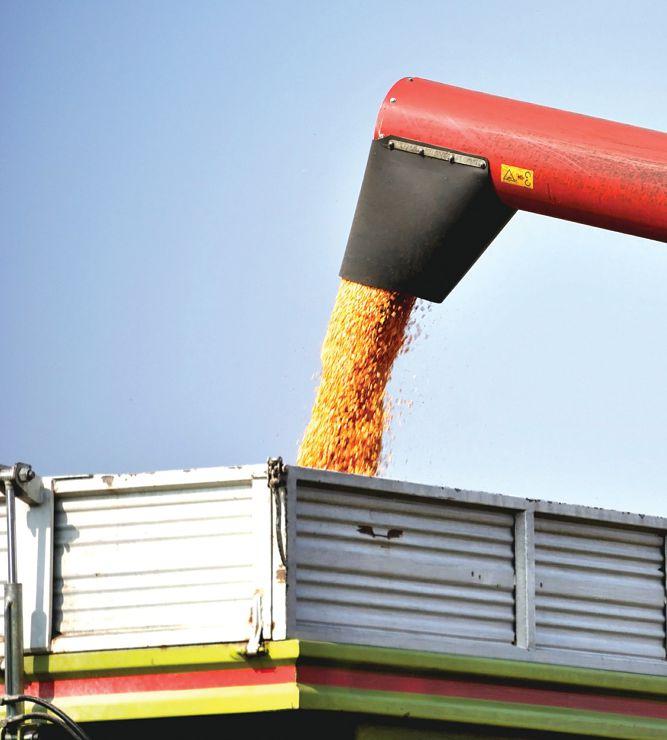
2012 could be a bumper year, but the weather and weakening ethanol demand could change that
ects corn acres at 94 million for 2012-13. With average yields and no dramatic change in use corn ending stocks for 2012-13 would come in at 1.6 billion bushels — double this year’s.
The USDA forecast the amount of corn for feed at 5.225 billion bushels, up significantly from this year. Corn for ethanol was held at about 5.0 billion, and exports were increased to 1.875 bil-
lion bushels from 1.7 billion this year.
The farm gate corn price is expected to average $5.00 per bushel for 2012-13 compared with $6.20 for 2011-12.
The USDA baseline projection calls for a record 14.235 billion bushel corn crop, above the previous record 13.1 billion and pegged the yield per acre at 164.0 bushels, above last year’s 147.2 bushels per acre.
Meanwhile, the USDA forecast soybean seeding at 74.0 million acres and a crop of 3.215 billion bushels, the third largest on record.
Morgan Stanley said corn prices could face a short-term hiccup from weak ethanol margins and less demand.
“The outlook for US domestic demand near term may begin to falter in coming weeks as poor ethanol margins and growing inventories should begin to pressure plants to slow production,” Morgan Stanley said.
The bank forecast corn use by ethanol plants at 50 million bushels less than the USDA projection.
Despite this Morgan Stanley anticipates an average price of $6.60 per bushel in 2011-12, well above the USDA forecast.
Morgan Stanley said: “We remain most constructive corn out of all of the agricultural commodities.” The bank cautioned that “prices need to move higher to justify the demand rationing currently implied by the USDA balance sheet.”
Meanwhile, Rabobank said, in an earlier report, that 2012 grain markets are ‘down, not out.’
World grain inventories remain near historical lows, and that should mean continued high prices. But it won’t be a steady, strong bull market and at times in the next 12 months it may seem like a bear market with lower prices going forward.
Rabobank analysts said here’s downward pressure from weakness in overall world economies, but the potential remains for major demand growth from emerging nations and rising populations around the world. Throughout the next year, commodity prices could seesaw as one or the other gains weight.
“We believe the long-term bull run in agri-commodities remains, but expect prices across the complex to ease from their recent record highs, continuing their downward trajectory in place since mid-2011,” according to a Rabobank report. “Elevated price levels must persist in order to encourage farmers to continue expanding production to keep pace with demand growth and allowing global inventories to rebuild. Agri-commodity demand should remain robust in 2012 as consumptive growth in emerging-market economies continues to drive the agri-complex.”
Rabobank analysts expect lower year-over-year prices for 2012 versus 2011 but forecast they’ll still remain at profitable levels.
For soybeans, prices are also expected to drop but “remain historically elevated.”
“We anticipate lower-than-average stock levels of many agri-commodities to support prices; while harvests are expected to be large, encouraged by the high prices, the supply response is still catching up to demand.”







The University of Georgia, in its annual forecast, says Georgia’s poultry producers will face another difficult year. Poultry farmers slashed the number of chickens they were growing in 2011 and are expected to continue scaling back production in 2012 because limited corn supplies have made chicken feed so expensive that farmers have had trouble selling their poultry at a profit.
Mike Giles, president of the Georgia Poultry Federation, said this year farmers hope that producing fewer chickens will raise prices back to profitable levels.
“Looking ahead to 2012 we’re hopeful that market conditions will improve,” Giles said. “But the price of corn isn’t likely to come down significantly.”
USDA projections forecast 2012 US broiler production at 36.5 billion pounds. This would put 2012 production below the 2011 record of 37.2 billion pounds.
After a good 2010 for chicken processors, “2011 was a very bad year” for processors, according to the CPEPC Highlighter.
“Driven by increasing feed costs and aided by (broiler) allocations that were too aggressive to allow the market to absorb the increased cost, the gross processor margin fell below the healthy range early in the year and has remained there ever since.”
However CPEPC believes that, due in part to cuts made to production for the last half of 2011, the Canadian industry is ready for reasonable growth in 2012, consistent with population growth and with CFC’s medium-term growth rate of one percent.
However, “moving into 2012, CFC has allocated the first two periods at two percent over base. In addition,
the unresolved issue of differential growth among provinces is adding additional pressure to the allocation system and to the live supply volume,” the Highlighter reports.
“Live costs, driven by feed costs, reduced at year end and going into 2012 are expected to reduce further in the short term before leveling out. This alone will not be enough to get processors’ gross margins back to reasonable, sustainable levels – we will also need supply to be set at levels that will allow for an increase in market prices,” CPEPC says.
Meanwhile Canadian processors hope that reductions in U.S. broiler production will improve prices in the U.S. market “which will have a knock on effect on the Canadian market as well.”
“We desperately need 2012 to be a recovery year,” CPEPC said.
Market conditions in the Canadian turkey industry improved in 2011 compared to the recent years.
For the whole bird market, despite the live price increase, processors sold approximately the same volume as 2010 and wholesale prices increased to offset live price increases, according to the Highlighter.
The improved market conditions convinced the industry to increase the whole- bird allocation for the next control period starting in April.
Market conditions have also improved in the Further Processing (FP) market. Inventories of toms and breast meat have dropped and prices of breast meat and thigh meat have increased. The demand is still not exceptionally strong but because of the storage stock decrease, processors requested an additional 2.5 million kg for further processing.
Canadian poultry producers can likely look forward to a less exciting year than grain producers. Thanks to the costof-production formulas, they should adapt to whatever ride grain markets embark upon and if consumer confidence strengthens poultry demand could increase making for good, if not thrilling, year.


Your partner with innovative, unique and effective Alternative poultry production equipment solutions!
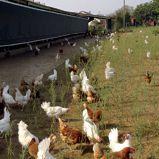
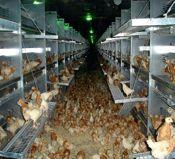
SALMET, one of the Zimmerer Family group of companies established for nearly 50 years, a Global supplier of a wide range of innovative and unique poultry production concepts with emphasis on bird friendly welfare solutions. The Zimmerer Family, are in Germany also one of the leading producers of Barn, Organic and Free Range egg production on their own farms. Salmet’s wide range of products are tested in the field on their own farms before being promoted for Global sales. All Salmet equipment are manufactured in their own factories.
With Alternative egg production systems, Barn, Free Range and Organic. Salmet offer a unique rearing system “PediGrow2” appropriate for successful egg production in Salmet innovative production concepts; High Rise 3 - known as a compact and effective production and management system, Combi Barn - perching and nesting system, High Rise 1 - with double floor system and our AllinOne system. Standard nesting systems with slats for deep pit systems or manure belts under slats are also available.
All Salmet products are compliant with welfare regulations and with our expertise we Share our knowledge.
More information please visit our website www.salmet.de
BY TONY KRYZANOWSKI
The plan by a company called EnergyWorks to build a $30 million thermal gasification plant near Gettysburg, Penn., to process manure generated by the state’s largest egg producer is one of those ideas that seems to have “can’t miss” written all over it.
The EnergyWorks plant is being built on a site adjacent to four Hillandale Farms egg-laying facilities located within the Susquehanna River basin, which is part of the Chesapeake Bay watershed. It will produce syngas that will be used as a fuel source to generate steam to drive a turbine to produce just over three megawatts of electric power. The gasification process will also produce between 13,000 and 16,000 tons of ash byproduct annually that will be marketed as an animal feed supplement because of its beneficial mineral content. All told, the process will dispose of about 240 tons of poultry manure per day.
“We felt that manure land application was not the best avenue for a longterm use of manure,” says Ron Ballew, Hillandale Farms environmental manager. “Hillandale, being a progressive company, we were interested in looking at the green way of processing our manure. EnergyWorks seemed to have a plausible alternative to land application with long-term environmental benefits.”
In addition to generating market-

It is all systems go for construction of a poultry manure thermal gasifier near the Hillandale Farms egg-laying operation at Gettysburg, Penn. The plant will convert 240 tons per day of poultry manure into syngas for power generation, which will also result in a marketable mineral byproduct for project developer EnergyWorks. Contributed drawing
able products and providing a longterm manure management solution for Hillandale Farms, it will also eliminate the potential nutrient runoff into the nearby Chesapeake Bay if it had been land applied as has been the conventional practice to this point.
“The water quality environmental benefits from this project are really extraordinary and I think it will demonstrate that, through technology, you can really
transform animal agriculture and come up with a much more sustainable approach,” says Patrick Thompson, EnergyWorks CEO. Land-applied manure generated from the area’s agricultural operations is one of the causes of algae growth in the Chesapeake Bay, depleting oxygen in the water and creating marine “dead zones.” Since agriculture is the largest sector of Pennsylvania’s economy, the state is very interested in doing its part to improve
water quality in the Chesapeake Bay. However, the benefits of this manure gasifier project extend far beyond renewable energy and water quality. The project will also eliminate an attractive living environment for rodents and insects in manure storage sheds, resulting in greater food safety.
The project will reduce farm ammonia emissions by 50 percent, eliminate over 34,000 tons of carbon dioxide-equivalent greenhouse gases annually, reduce manure storage inventories by 97 percent, eliminate manure application on 23,000 acres of land, and achieve 3.5 to 4.4 percent of Pennsylvania’s 2025 goals of reducing nitrogen and phosphorus loading to Chesapeake Bay.
As yet another example of how advanced manure management technology delivers not only an environmental dividend but also a financial dividend to the farm, the gasifier simplifies farm operations. The poultry manure processing plant has been designed to process the entire amount of manure generated by the Hillandale egg-laying operation of five-million birds. The plant will provide a complete manure management solution to Hillandale Farms. About half of the power generated by the plant will be supplied to Hillandale Farms. EnergyWorks will sell the surplus power to the public power grid through an electric distribution utility.
EnergyWorks plans to complete construction of the plant and begin operating by October 2012. The company is finalizing its financing for the project, which includes an investment by EnergyWorks, a federal American Recovery and Reinvestment Act (ARRA) grant, and repayable loans from the State of Pennsylvania.
In addition to marketing electricity and animal feed supplements, EnergyWorks is also actively marketing Nutrient Trading Credits that will be generated once the facility is operational. The Pennsylvania Department of

Environmental Protection has certified the facility as a nutrient credit generator with a projected annual capacity of one million nitrogen credits and 53,000 phosphorus credits, making it Pennsylvania’s largest certified credit generator.
“We are in discussions with several buyers now and there is a lot of interest in
purchasing credits from a source like this because the credits that we are producing can be quantified and verified in real time,” says Thompson. “They are derived by measured amounts of nutrients that are kept out of the environment and that is very different from some of the other ways that people generate credits.”

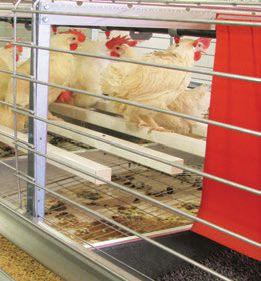
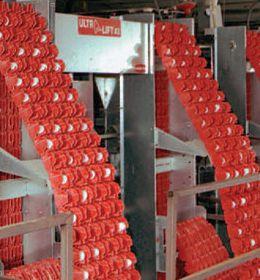
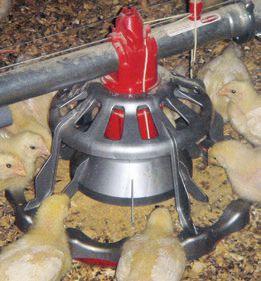

Manure will be trucked on a just-intime basis from storage facilities at each of Hillandale’s four egg-laying sites to the EnergyWorks plant. The live bottom trucks enter a building where they are scaled and the manure is dropped into a receiving bin below the floor.
“The manure is contained throughout the rest of the process in a closed system, generally at negative pressure to prevent any release of odors or dust to the environment,” says Thompson.
The waste material is just poultry manure, and does not include any other material used for bedding, such as wood chips or peanut husks. Other factors that work in EnergyWorks’ favor are the consistent feed regimen given to the birds by Hillandale Farms and the continuous manure collection system that allows EnergyWorks to retrieve the manure on a just-in-time basis. All these factors are important for the company to operate its gasifier as efficiently as possible and to maintain high and consistent quality in its animal feed supplement product.
From storage, the manure is conveyed into a drying system that aims for about 20 percent moisture content.
“We try to maintain a very consistent moisture level going into the gasification process,” says Thompson. “The more consistent the feedstock going into gasification, the more feasible it is to have a highly controlled gasification process.”
Once dried, the manure is fed into the thermal gasifier. Essentially what happens in the gasifier is that the remaining moisture is evaporated, the organic solids are converted into syngas, and ash containing the minerals is continuously conveyed to storage silos for regular shipments to buyers. The main physical difference with this gasifier compared to other staged combustion systems is that rather than stacking the components vertically as in a single box, the pieces are strung together horizontally to give EnergyWorks better process control.
“We have broken the process into multiple steps and in that way, we are able to use the equipment for each step of the process that is optimized for its function,” says Thompson. “We realized how
important it was to control the process in order to control our mineral byproduct.”
The syngas produced by the gasifier is ducted to a thermal oxidizer, where it is ignited and burned. The heat generated from the combustion of the syngas heats water within a heat recovery boiler, providing superheated steam. It drives the power turbine. Some of the steam is also used in the drying system.
The ash is removed continually from the gasifier and placed in storage silos. Combustion gases produced by the process pass through a bag filtration system before being released into the atmosphere.
“We have an air quality permit and we expect this to be a very clean technology,” says Thompson. “The two main culprits of water pollution are nitrogen and phosphorus, and these thermal processes break down the polluting nitrogen compounds in the manure so that you are left with non-polluting nitrogen gas as the main constituent going out the stack. The phosphorus is almost entirely captured in the mineral product.”
He described the facility as more of a biorefinery than simply a renewable energy project because the most valuable commodity produced is not power but the mineral supplement. The world demand for phosphorus and potassium is increasing as the population increases and the demand for animal protein increases, which could lead to scarcity of these minerals. Through its gasification process, EnergyWorks is recovering and recycling these valuable nutrients.
EnergyWorks has more than 15 years’ experience in energy and infrastructure management, having owned and operated numerous energy facilities.
“We have worked extensively with industrial and commercial customers building, owning and operating energy continued on page 48
Your input costs are at record levels—and we know you need better flock performance.
Hybrid delivers.
cantly

Everyone wants to be successful. But how do we know we are succeeding or that we are on the right track?
BY PIERRETTE DESROSIERS, M.PS.
There are six characteristics of a successful life: 1. A peaceful mind: freedom from anger, resentment, anxiety, despair, shame and guilt.
2. A high level of energy and health: a body that is in harmony with the mind; having energy to invest in achieving goals.
3. Positive relationships with others: developing and maintaining significant, positive and mature relationships.
4. Financial independence: freedom from constant worry about money; having sufficient ease to feel safe and able to meet one’s own needs.
5. Engaging and stimulating goals and ideals: knowing the reason for getting out of bed each morning and where to invest energy, time and money.
6. Self-actualization: having a sense of becoming who one wants to become, of developing one’s full human potential positively and constructively for oneself and others.
Are all of these characteristics required to feel successful in life? Certainly not. But the more we have, the more we benefit. These characteristics are not to be perceived as fully present or absent, but rather, as on a continuum. It should also be noted that we can have a great deal of influence over these characteristics.

CHARACTERISTICS
Pierrette Desrosiers gives a few hints for being successful : hone your sense of observation. Be realistic about the current situation. Have a clear image of where you want to be. Understand that acts, thoughts and feelings can either foster or harm success
For example, only we can stop sustaining hatred. This is true for all other emotions. We cannot control certain events in life, but we can choose our reaction. Also, we are responsible for our lifestyles: nutrition, sleep, physical exercise, tobacco and alcohol use.
We can make choices with respect to financial resources, even if they are sometimes limited. Some people will make wiser choices than others about the same amount of money. In addition, lifestyle and emotions have a direct effect on financial health.
Finally, only we can set stimulating and constructive goals for ourselves. We must take the time to look at our resources and define realistic goals that are appropriate for us (couple, personal, family, business).
Is all this easy? Certainly not, otherwise everyone would manage to do it. It it possible? Certainly it is, because some people do indeed manage to do it.
How do we accomplish this? Here are a few hints: hone your sense of observation. Be realistic about the current situation. Have a clear image of where you want to be. Understand that acts, thoughts and feelings can either foster or harm success. It is up to us to take our courage in our hands, imitate those who succeed and work on it every day. But only if we want success.
Losing control of your emotions always works against you. How many times have you regretted words, actions or decisions
once the emotion has passed? If you are often in the grip of strong emotions (anger, sarcasm, hostility) and you are unaware, three things can happen:
Physiologically, you are at risk of developing significant health problems such as irregular blood pressure, ulcers and even coronary artery disease. You will cause emotional damage to those around you without being aware of it.
Your management abilities will be affected and your business will suffer. During intense emotions, your intellectual abilities are greatly diminished.
In the grip of emotion, your judgment is altered. You are deprived of your ability to reason, plan and assess the consequences from various angles. It is thus important to recognize your emotions and then take action to learn to better manage them. The person in the grip of a compulsion is focussed on the immediate emotional
consequences of their action (relief of the emotional tension they are feeling) at the expense of more long-term emotional consequences (shame, guilt, regret) or material or physical consequences (financial problems after an impulsive).
After becoming aware that you have been taken over by emotions (being emotionally aware is the foundation of healthy business management), how can you manage them better?
First, never act or speak in the heat of emotion. (Remember, you are deprived of part of your intelligence.) If possible, physically remove yourself from the situation as long as it takes to return to normal. Usually, 20 minutes of recovery time is required.
Breathe deeply 10 times in order to induce physiological relaxation. (It is difficult to get angry when you are relaxed.) Take time to reflect. Why does this situation, word or person bother me
so much? What needs are stimulated? What values am I confronting?
Imagine a person you admire for their good judgment and ask yourself what that would person do in this situation. What advice would they give you?
What are the consequences of these emotions on you, those around you and your work?
How could you look at the situation differently? Is what is happening so terrible?
Finally, in 20 years, how important will this situation be in your life?
Pierrette Desrosriers is a work psychologist, speaker and psychological coach who specializes in helping those working in agriculture. She can be contacted by e-mail at pierrette@pierrettedesrosiers. com, or if you would like more information, visit her website at www.pierrettedesrosiers.com.

At CPSI we take pride in being a solution driven company. We are a Proactive, industry leader that provides long-term commitments to our Customers.
We offer over 30 years of experience with a network of crews in various provinces.
We are always looking to expand our network, so whether you operate in British Columbia, Nova Scotia or any point in between, give CPSI a call!
A recent U.S. survey shows that price is playing a greater role in the meat purchasing decision process
BY THE AMERICAN
MEAT INSTITUTE
The impact of the economy and higher prices for meat and poultry products are making a significant difference for consumers at the meat case. Price has taken on an ever-greater role in the meat purchasing decision process, as price per pound has solidified its number-one ranking as the most important decision factor for consumers, while total package cost is now the second most important decision factor, surpassing product appearance, according to the seventh annual Power of Meat study.
The study, conducted by 210 Analytics, was commissioned jointly by the American Meat Institute (AMI) and the Food Marketing Institute (FMI), and was sponsored by Sealed Air’s Cryovac Food Packaging Division.
The report, which details the findings of a national online poll of 1,340 consumers conducted in November 2011, was released at the recent 2012 Annual Meat Conference in Orlando, Fl.
Shoppers who try to save money on groceries typically resort to a variety of moneysaving measures both pre-trip and in the store. However, for the first time this year, the share of shoppers simply opting to buy less (and thus spend less) equaled the share
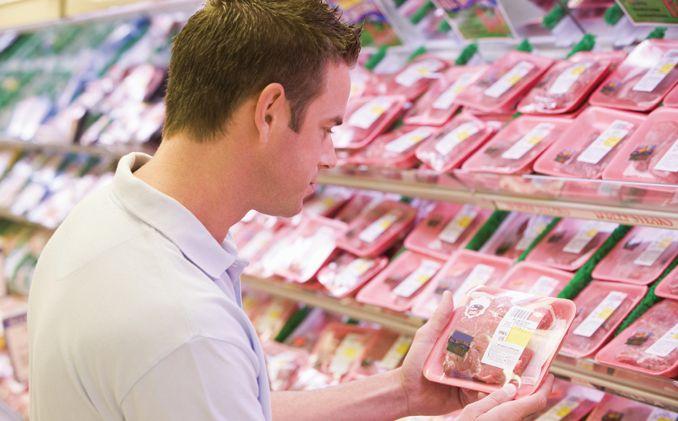
using lists, coupons and other saving measures. In terms of meat and poultry, dollar sales increased by 2.5 per cent, but volume sales decreased by 5.3 per cent as a result of inflation across proteins. Consumer focus on price and value is further underscored by the growing share of shoppers engaging in pre-trip research and planning meals around promotions. However, an even greater share compares prices while in the store. The end result is greater shopper flexibility to adjust purchases to spend less.
Full-service supermarkets continue to be a stronghold for fresh meat and poultry, with high retention rates and a pick-up of shoppers from other channels, especially supercentres. The emphasis on in-store purchasing decisions makes clear signage and effective operations all the more important. Price-related promotions are especially
effective for steering people to a certain kind of meat or poultry and slightly less effective for the amount purchased.
Private-brand meat and poultry remains popular. However, rather than an outright preference, it is better defined as a greater willingness to purchase private brands. This led to an increase in the share of “switchers” — shoppers who do not have a preference for national or private brand, but choose based on other factors, predominantly price. Meanwhile, shoppers’ reduced interest in volume-based discounts, such as bulk and buy-one-get one free, as measured last year, did not rebound any this year.
Despite economic pressures, natural and organic meat and poultry experienced an uptick in the number of buyers over the past year to 24 per cent of shoppers. Additionally, 90 per cent of shoppers predict they will buy about the same (70 per cent) or more (20 per cent) next year.
Meat and poultry play an important role at the American dinner table, with chicken and beef making up the largest share of purchases. The fresh category continues to be much larger than the heat-and-eat and ready-to-eat categories, but the latter continue to show signs of strength for the convenience-oriented shopper. Another area of growth is marinated meat and poultry, with an increasing share of shoppers preparing their own mixes or purchasing marinades or spice mixes along with the meat/poultry.
Meat and poultry preparation techniques have changed quite a bit over the past five years. Frying (pan fry and deep fry) experienced a 22 percentage-point decline in use, whereas more people are using the oven and crock pot/slow cooker (up 12 percentage points).
Despite the popularity of meat and poultry, shoppers’ knowledge and preparation skills leave much to be desired. Shoppers mostly rate their skills relative to preparation, nutrition knowledge, meal planning, etc. as “just okay” versus “great.” When asking for advice on how to best prepare meat or poultry, family and friends are the predominant source of information, followed by digital resources, such as the internet and apps. Only six per cent would turn to the butcher or meat department. Yet, interest in a “here’s-how-it’s-done” type service in the meat department is moderately high, providing suppliers and retailers with an excellent opportunity to connect with shoppers in new ways.
Shoppers are definitely open to a variety of packaging innovations, especially leakproof packaging and concepts that aim at the reduction of food waste. On the other hand, environmentally-friendly packaging only does well if no price premium is charged.
The survey also probed into ways retailcontinued on page 56


continued from page 43
infrastructure,” says Thompson. “In 2006, we began to look at taking this business model to the agricultural sector and building, owning and operating facilities using agricultural biomass as feedstock.” The pollutants are kept out of the environment, which, he adds, is a completely different approach than most manure management systems have taken in the past.
The company began in 1995 as a partnership between San Franciscobased Bechtel Corporation and a U.S. utility based in Portland, Ore., called Pacific Corporation. EnergyWorks began with the mission to build, own and operate facilities to distribute energy, working mainly in the international market. Its first project developments took place in Latin America, Brazil and Venezuela. The partnership was later involved in developments in Spain. It was purchased by a Spanish utility in 1999. What followed was considerable growth for the next two years with construction and operation of energy projects in Brazil, Argentina, Venezuela, Mexico and Spain. A reorganization of the company created an opportunity for a management buyout and it has been operating as a managementowned company since 2001. In 2003, EnergyWorks acquired the energy infrastructure for a large shopping complex in Pennsylvania and currently owns and operates the infrastructure to supply the energy needs of the complex. Since 2006, it has been investigating agricultural biomass and taking its energy business model to the agricultural sector in Pennsylvania.
The Hillandale project represents a template that EnergyWorks believes it can market with other major egg-laying operations.
“We are in discussions with others about similar projects, and we would like to build more of these,” says Thompson. “The market is huge. The egg-producing region mainly follows the grain belt in the United States from Iowa to Pennsylvania.”






25 years of innovation and attention to detail has resulted in phenomenal results for Coburn
BY DAVE COBURN, COBURN FARMS AND JEFF WALTON, BELISLE SOLUTION NUTRITION, INC.
At Coburn Farms, a bicentennial family farm located in Keswick Ridge in New Brunswick, attention to detail and never being afraid to try new things to improve the performance of the layer flock has been standard. The implementation of various innovations on the farm in the past 25 years has resulted in the best flock performance ever, and the next flock is looking like it’s going to achieve a new record.
The journey began in 1986 when Coburn Farms built a new high-rise 25,600 bird capacity layer barn. Three years later, it was the first commercial egg farm in Canada to install a computerized ventilation control system that optimized and recorded house temperature and ammonia levels.
It was found that in the winter months, insufficient outside air could be introduced into the barn to remove enough ammonia in order to keep the level low enough, while still keeping temperature at a desirable level.
In an effort to try and decrease the ammonia levels in the barn, it was agreed that the farm would participate in a trial with Alltech the following year (1990), where a yucca extract product called De-odorase was added to the feed at rate of 100g/tonne. The fact that the barn had a computerized ventilation control system
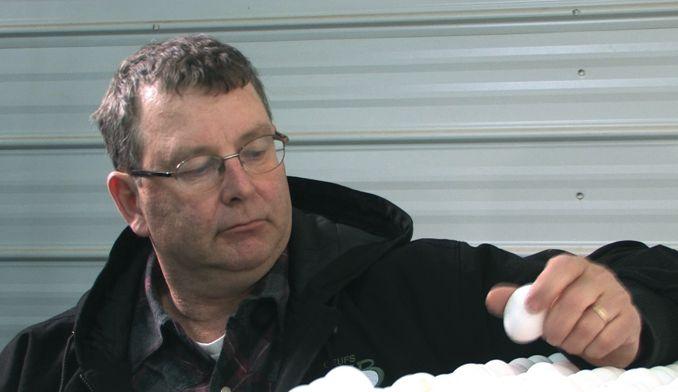
INNOVATION PAYS OFF
Dave Coburn of New Brunswick just had his best flock to date, and the next is set to be even better
that recorded the temperature inside and outside the barn, as well as housing each flock at the same time each year, proved beneficial for making year to year comparisons on ammonia levels.
Over the next several years, it was found with the use of De-Odorase, ammonia levels could be halved, while barn temperatures could be increased. Increasing the barn temperature resulted in a lower feed consumption (a 1 C change in temperature is equal to approximately a two per cent change in feed intake). At the start of the trial, the barn temperature could not be higher than 24 C without having ammonia issues. Over several years, we were able to increase this to 27 C without issues, and this temperature is maintained to this day.
Lowering the ammonia not only improved air quality, but also led to improved bird health and performance. It was also noticed that the composition of the manure was altered, reducing the fly population and the need for insecticides.
The next step was the building of an
in-vessel composter. The thought was that if the manure had less odour and already appeared partly composted, why not compost it to add extra value. Thus, a new cash stream was added to the farm. Composted manure, along with pomace from the farms’ apple orchard, is branded “Natural Gold” and is sold in bags or bulk. The composted manure is also used as fertilizer for the apple trees, as the high calcium content results in apples that are firmer and have a longer storage life. The use of the manure on the apple trees also helped to extend cider production, adding to the profitability of the orchard. The composter is a key element in making the farm a closed-loop farm, as wastes that are put through the composter are returned to the soil.
The next move was to install a computerized on-farm feed mill, which provided opportunities to utilize local ingredients, incorporate feed enzymes and have greater flexibility with diet formulation. Prior to the installation of the feed mill, we were feeding oyster shell at 25 kg/tonne to the birds starting at 49 to 50 weeks of age to



improve shell strength, but the new feed mill was not set up for this type of addition. Around the same time, research on a product called Egg Shell 49 in the Czech Republic showed that it was found to be effective in improving shell strength after 49 weeks of age. In order to simplify things in the mill, it was added to a “Pak” with other Alltech products (including De-odorase and enzymes) into the feed when the birds were placed (week 17).
During this time Dr. Steve Leeson from the University of Guelph began work on redefining trace mineral requirements. He demonstrated that layer performance could be maintained through the first cycle at levels comparable to that on traditional inorganic trace mineral levels, but with substantially lower levels when the minerals were provided in a chelated form. There was even some indication that the lower level of supplementation had a positive influence on shell quality. Thus, it was

decided to replace all trace minerals in the diet formulation with this form of chelated trace minerals.
There was the question of what to do at 49 weeks of age when the Egg Shell 49, based on Bioplex minerals had been added, to slow the rate of increase in cracked eggs. It was decided to defer this decision until the flock reached that point. When the time was reached an examination of the records showed that the per cent cracks was half that of the pervious flock. Based on that, no change was made — Egg Shell 49 was not added. Cracked eggs were tracked on a weekly basis to the end of lay.
Although well below the previous flock, there was still an upward trend in per cent cracks after 50 weeks of lay and the same pattern was starting to show with the subsequent flock. Dr. Leeson’s work had shown that performance improved with low levels of supplemental trace minerals. Adding Egg Shell 49 would cause a large rise in supplemental levels. Together we decided to add 50 per cent more of the chelated trace mineral after 50 weeks of age to the levels then supplemented with Bioplex, but below that if Egg Shell 49 were added. This compromise worked as the upward trend was no longer evident. This has become standard practice, and the pattern of increasing cracked eggs after 50 weeks is no longer is seen. By using lower level total replacement with chelated trace minerals, the level of these minerals in the manure/compost was reduced, a very important consideration on a sustainably operated closed-loop farm.
About the same time there was a regulatory change that disallowed on-farm egg washing. The egg grading station, located about three to four hours away was downgrading a substantial number of “dirt” eggs. The thought pattern was, if the gut was healthy, fewer “dirts” would occur. Bio-Mos, a yeast-based product was added and a decrease in the number of “dirts” was observed. It was also noted that cracks also decreased.
The flock record (see Table 1) speaks well for the program. However, this level of performance is based on many fac-
tors. The feed additives in the Pak are an important part, but not the total story. Our work together on closely monitoring the nutrition and feeding program of the birds has played an important part, and flock records are reviewed on a weekly basis. Formulation is changed to optimize egg size for age of bird. The replacement pullets are fed to the breeders’ recommended body weights; pullets below recommended weight for age tend to produce more smaller eggs early in lay, while pullets above recommended weight for age tend to produce larger eggs late in lay. The replacement pullet grower uses the same nutritionist and thus the programs are coordinated.
Several years ago, during a time when the mill was being serviced, whole kernel wheat was sent to the mixer and consequently used in the feed. It was noted that the number of shell-less eggs decreased when the non-milled wheat was fed, and
increased once the wheat was ground. Based on this, the standard practice was not to grind all the wheat. However, grain prices changed and the grain rations became all corn, and shell-less eggs again increased.
Although the numbers were not large, it was an interesting observation. Changes were then made to the screen size used in the hammer mill. It was found that by using a half-inch screen in the hammer mill there were minimal shell-less eggs, greater mill throughput and less electrical usage.
This is not surprising since broiler growers have for many years fed some whole grain with their feeds, and this has been shown to improve digestion and improve gut health. The same should therefore apply to layers.
Controlling egg size late in lay has been a struggle. Fibre is a forgotten ingredient, and often nutritionists pay little attention to crude fibre levels. In the past, oats and barley were common ingredients in layer
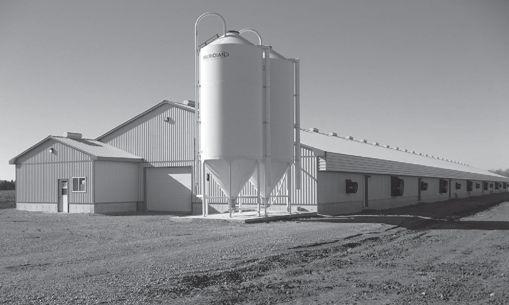
rations, but with modern transportation there has been a movement away from these to corn. However, control of bodyweight and egg size late in lay has led to the consideration of using lower energy ingredients. It was found that utilizing oats or barley resulted in a lowering of the energy levels in the ration without the bird compensating with a greater feed intake. Having the barn at a higher temperature is also helpful. Oats are grown on the farm, and they are now used in the rations. The straw is used as a carbon source in the composter, which is important in a closed-loop sustainable farm.
Flock 25 (see Table 1), the 25th flock since the barn was built, is the best flock to date at Coburn Farms. Flock 26 results so far show that it is on track to beat flock 25. The innovations made on the farm over the last 26 years will continue, and it’s likely that more will become part of the standard practice on the farm.

continued from page 47
ers can improve the meat department to encourage meat and poultry purchases. Down from 40 per cent last year, 30 per cent say nothing retailers or manufacturers will do or offer will persuade them to purchase more. Among shoppers that do see room for improvement, better quality and greater variety are the two key areas.
Despite economic pressures, the survey recorded an uptick in the number of shoppers who have purchased natural or organic meat/poultry in the past three months. After staying stable around 20 per cent of shoppers for several years, 24 per cent of shoppers now report having purchased natural or organic options. While the number of organic users increased, this does not automatically mean an corresponding increase in organic sales. Prior year research
showed that most shoppers only purchase organic and natural meat/poultry for certain occasions, kinds or cuts.
The study found that interest in organic products is especially strong in the West. Other groups with above-average interest included higher income shoppers, shoppers that work full-time, and shoppers with above-average weekly grocery bills.
These results show that while fast-paced growth is unlikely, the category is stable and shows many signs of continued strength despite economic hurdles. There are many reasons, most importantly:
Increased availability of natural and organic meat/poultry offerings. Up 10 percentage points from the 2004 study. Packages with an organic seal take up just a fraction of the meat case, occupying less than one percent of total packages.
Perceived immediate and long-term health benefits are the number one reason to purchase organic foods — some-

thing organic shoppers will not easily give up on.
The core constituency has higher than average incomes and spends more on groceries than most shoppers.
When asked about their primary store when purchasing organic or natural meat/ poultry, exactly half identified a full-service supermarket. This is the largest share of any one channel. Supercenters gained in share, as did specialty stores. During the early years of the recession, specialty store meat/ poultry sales suffered as people sought to reduce their trip frequency and often cut out the extra trip to organic stores or butcher shops. Alternative channels mentioned by shoppers include farmer’s markets, local farms, Internet companies and meat delivery companies.
In addition to these topics, the Power of Meat report also looks at shopper attitudes about nutrition and perceptions of the meat case vs. service counter.




















BY JIM KNISLEY
The thing about the great ethanol debate is that everyone involved is behaving rationally (although policy makers may be the exception).
That doesn’t mean the ethanol policies make sense, but that everyone is arguing their own self-interest.
In general terms, grain producers like ethanol because it increases demand and raises prices. Ethanol producers like current policies because they are encouraged to produce and are back stopped by mandates and subsidies. Livestock producers hate them because they raise feed prices, increases production costs and make it hard to turn a profit.
There are others involved in this debate including environmentalists who tend to like grain ethanol because it is a bit less polluting than oil and politicians who like it because grain farmers and the ethanol industry like it.
In February, the George Morris Centre threw another log on the fire in this great debate. The think-tank released a study that essentially concluded Canadian policies that encourage the conversion of grain to ethanol raise feed grain prices and are bad for the meat industry.
This report is detailed and provides figures quantifying the impact of ethanol on meat production, but thematically it is similar to several reports produced by George Morris over the last few years. In general, it is clear that the George Morris Centre supports Canada’s meat industry and believes Canada’s ethanol policy is stupid.
Predictably, the grain producers and the ethanol industry hated the study and debate raged for a few days.
The problem with the debate is that, while everyone in it is arguing rationally, the whole thing is absolutely loony tunes.

On the environmental side, sugarcane is an extremely efficient photosynthesizer, absorbing four to five times as much carbon dioxide as corn.
The problem with sugarcane, is that it doesn’t grow in great enough quantities in the United States, while corn does.
In the U.S., ethanol was, at first, a seemingly rational solution to a long-standing problem — low-priced, surplus grain. Until the early years of this century, the United States had more grain than it knew what to do with. The economic imperative was to get rid of the stuff and the political imperative was to do it in a way that didn’t hurt grain producers and the states in which they live.
In response, the U.S. used a mixture of export subsidies, farm supports and land set-asides. The results were that export subsidies occasionally got so high that buyers were getting grain for little more than the cost of transportation, farm subsidies reached the point where they represented all net farm income and millions of acres were taken out of production. Behaving rationally, the U.S. government looked for a better way and settled on ethanol as a small domestic answer to imported oil. While the costs of supporting the industry were high (in the form of subsidies, tariffs and tax breaks), the total was significantly less than the cost of export subsidies plus farm support.
The program succeeded in wiping out the troublesome grain surpluses. In fact it worked so well that corn prices have surged to the point where supplies became tight and the U.S. livestock industry and other users of corn started screaming and prices for meat started rising.
The problem with the debate is that while everyone in it is arguing rationally the whole thing is absolutely loony tunes.
First, corn isn’t even close to being the best feedstock for ethanol — that honour goes to sugarcane. Second, Canada is a net importer of corn. Third, Canada imports its corn from the United States, which has its own ethanol policies that inflate its corn prices.
A rational policy would seem to entail getting ethanol from the most cost-efficient source and the one that offers the greatest environmental payoff.
The most cost-efficient sources for ethanol are Brazil and the Caribbean basin where sugar cane is produced and where more sugar cane could be produced. The production of ethanol from sugarcane, according to a variety of studies, costs 25 to 50 per cent less than ethanol from corn.
Consumers ended up supporting ethanol on their drive to the butcher shop and paid again once they got there. While there are many other factors at play, not the least of which is a slow U.S. economy, fuel consumption and meat consumption in the U.S. have fallen.
Canada’s ethanol policy follows the U.S. and is accurately described by George Morris as “me too.”
So what we have is a policy designed to get rid of U.S. grain (corn) surpluses that was copied by Canada, which is a net importer of corn. It is sold as an environmental policy when there are much better alternatives (sugarcane, or more extensive public transit or fuel-efficient vehicles). And it is costing both taxpayers and consumers.
But no matter how flawed, the policy is now so heavily defended and so politically entrenched that it will take more than a few critical studies to end the lunacy.