
BioFuels Recycling Centre

MarCh/april 2011
A recent “how to” seminar explained the industry for those interesting in supplying and heating with biomass.
Making biomass available for bioenergy developments could also solve the wildland-urban interface fire issue.
Newfoundland’s newest pellet producer is also aiming to be a renewable energy supplier.
Bulk pellets are prone to off-gassing and self-heating, which can be mitigated by procurement, production, and storage techniques.
Experts present perspectives on various drying technologies used at projects in Canada and beyond.
“Opportunity biomass is tied directly to sawtimber or pulpwood; if market conditions aren’t right for those commodities, the waste component that goes to bioenergy won’t be produced.”
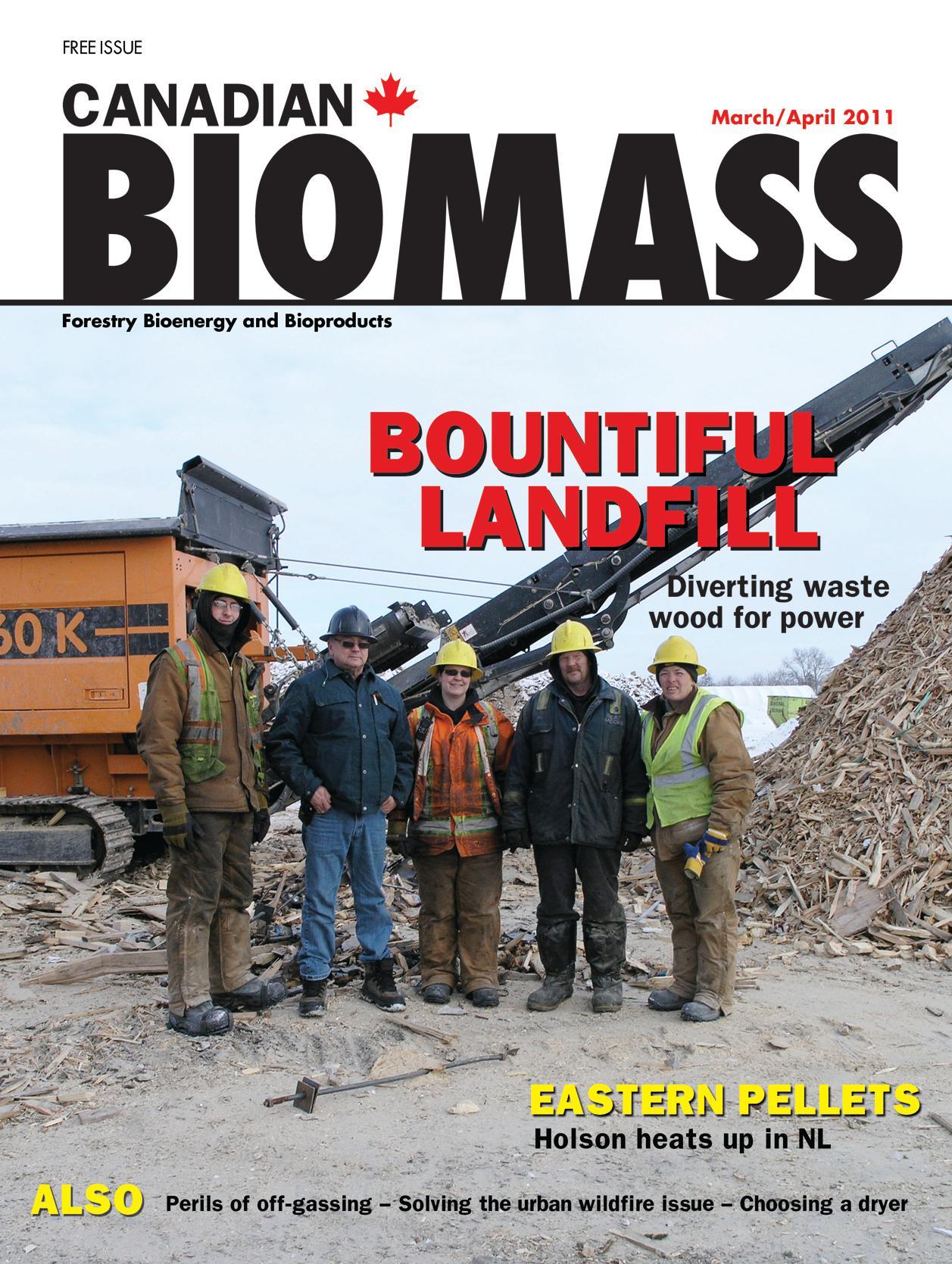
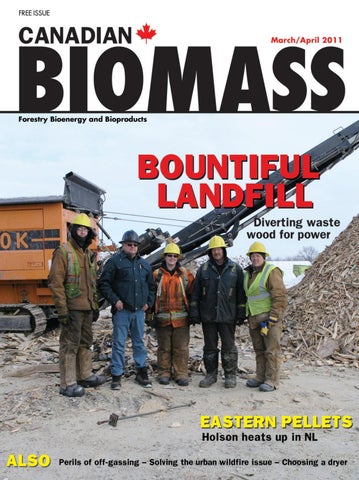
The team at the BioFuels Recycling Centre in Edmonton, Alberta, diverts about 35,000 tonnes/year of wood waste from the landfill. Left to right: Cory Bosse, Brian Perrault, Michelle Dixon, Bill James, and Amber Kidd (missing: Cody Manning). Story on page 12

There’s a lot of useful wood biomass clogging up our landfills.
ood biomass doesn’t just come from forestry operations. There’s huge potential for local or regional biomass opportunities in cities and municipalities from recovering wood that’s tossed away during construction, demolition, and home renovations. So far, however, we’ve taken very little advantage of this abundant resource.
Some might think there’s little use for this recovered wood fibre, but that’s not the case. This is evident from my recent visit to two wood recovery operations, one of which I cover in this issue on page 12, as well as Canadian Biomass’ previous coverage of a Quebec facility (Demolition Power, Nov/Dec 2009). All three facilities serve different biomass markets with slightly different products.
electricity production for some time. Some are even importing this kind of biomass from nearby countries to meet their fuel demands.
One facility receives two wood streams: clean wood, and wood that is mixed with materials such as plastics, steel, aluminium, and drywall. The clean wood goes to markets that require a strictly 100% wood product, for example, natural landscape mulch, animal bedding, composting, or oilfield/brownfield remediation. The mixed material is sorted, and the wood goes to electricity generation for the provincial grid. Another facility has a single clean wood stream that supplies a large market in coloured landscape mulch and feeds an on-site biomass boiler. Yet another facility has a mixed wood stream that is sorted to supply a pulp and paper plant’s electricity production. Soon, this type of material will also be used to produce cellulosic ethanol and other chemicals, with a facility for that purpose currently under construction in Edmonton.
In Europe, a number of utilities have been using recovered, mixed wood streams for
Just how much of this material is going to waste in Canada? According to a Statistics Canada waste management industry survey report, more than 17.3 million tonnes of non-residential waste was sent for disposal in 2008. That includes waste from manufacturing, commercial operations,and institutional facilities, as well as construction, renovation, and demolition materials. “Surveys have indicated that as much as onethird (of municipal solid waste) is generated by construction, renovation, and demolition activities,” says Public Works and Government Services Canada’s The Environmentally Responsible Construction and Renovation Handbook. By my rough calculation, that means there’s about 5.7 million tonnes of construction, demolition, and renovation material that could be sorted and reused, remanufactured, or recycled!
Statistics Canada says that a mere 720,076 tonnes of construction, demolition, and renovation material was diverted from landfill in 2008, with Quebec, Ontario, and British Columbia diverting close to 200,000 tonnes each. So by my calculation, only 12.5% of this material is processed, leaving a whopping 87.5% (5 million tonnes!) going straight to landfill. Exactly how much of this tonnage is wood isn’t clear. But it’s enough to represent a huge opportunity for a large number of new enterprises, not only to get into the biomass business, but to extend the life of our rapidly filling landfills.
Heather Hager, Editor hhager@annexweb.com
Volume 15
Editor - Heather Hager (519) 429-3966 ext 261 hhager@annexweb.com
Group Publisher/Editorial Director- Scott Jamieson (519) 429-3966 ext 244 sjamieson@annexweb.com
Contributors - Colleen Cross, Gordon Murray, Reg Renner
Market Production Manager
Josée Crevier Ph: (514) 425-0025 Fax: (514) 425-0068 jcrevier@forestcommunications.com
National Sales Managers
Tim Tolton - ttolton@forestcommunications.com Ph: (514) 237-6614
Guy Fortin - gfortin@forestcommunications.com Ph: (514) 237-6615 Fax: (514) 425-0068
P.O. Box 51058 Pincourt, QC J7V 9T3
Western Sales Manager
Tim Shaddick - tootall1@shaw.ca 1660 West 75th Ave Vancouver, B.C. V6P 6G2 Ph: (604) 264-1158 Fax: (604) 264-1367
Production Artist - Gerry Wiebe
Canadian Biomass is published six times a year: February, April, June, August, October, and December.
Published and printed by Annex Publishing & Printing Inc.
Printed in Canada ISSN 0318-4277
Circulation
e-mail: cnixon@annexweb.com P.O. Box 51058 Pincourt, QC J7V 9T3 Subscription
Single
prices do not include applicable
Occasionally, Canadian Biomass magazine will mail information on behalf of industryrelated groups whose products and services we believe may be of interest to you. If you prefer not to receive this information, please contact our circulation department in any of the four ways listed above..
No part of the editorial content of this publication may be reprinted without the publisher’s written permission ©2011 Annex Publishing & Printing Inc. All rights reserved. Opinions expressed in this magazine are not necessarily those of the editor or publisher. No liability is assumed for errors or omissions. All advertising is subject to the publisher’s approval. Such approval does not imply any endorsement of the products or services advertised. Publisher reserves the right to refuse advertising that does not meet the standards of the publication.

Announcements began for Ontario’s Wood Supply Competitive Process in early February. Of the 30 offers issued, 12 companies have accepted wood supply offers to date, for a total of 945,100 m3/year of wood. The wood allocations will be used for both energy and wood products, including wood pellets, briquettes, firewood, and hog fuel for heat and power production; dimensional and industrial lumber; pallets; and drill core boxes and timbers for the mining industry.
Atikokan-based Atikokan Renewable Fuels was awarded 179,400 m3/year of poplar and birch fibre, in addition to an existing offer of 100,000 m3/year. It plans to produce wood pellets for domestic and international
markets. With $1 million in support from the Northern Ontario Heritage Fund Corporation’s (NOHFC’s) Enterprises North Job Creation Program, the company is converting a former oriented strand board mill into a wood pellet plant. An additional $250,000 in support is helping to convert the plant’s existing natural gas heating system to woodbased heat through the Northern Energy Program. Atikokan Renewable Fuels is planning to produce 140,000 tonnes/year of pellets, with start-up anticipated at the end of the second quarter of 2011. Rainy Lake Tribal Contracting will be the primary fibre handling and processing contractor at the Atikokan facility, according to Ed Fukushima
of Atikokan Renewable Fuels.
A second wood pellet plant will be constructed by Bracebridge-based Muskoka Timber Mills, which was awarded 101,200 m3/year of hardwoods and conifers. The allocation will provide an additional supply of sawlogs to the company’s sawmill, which produces siding, flooring, lumber, millwork and other materials, according to a report in Cottage Country Now. The company plans to build a $15-million pellet plant adjacent to its sawmill to produce 50,000 tonnes/year of pellets. The wood will come from forests managed by Westwind Forest Stewardship, which are Forest Stewardship Council-certified, says the report. Construction is expected to begin
in summer 2011.
Millson Forestry Service of Timmins, Ontario, was awarded 57,000 m3/year of unmerchantable spruce, pine, and fir, which it will use to make wood briquettes for domestic and international markets. The company is developing a mobile briquette plant with support from NOHFC. The plant will move to harvest areas to access wood biomass left by forestry operations. Millson Forestry Service is a forestry management and contracting company that has been operating in northeastern Ontario since 1980.
Ontario received 115 submissions under the provincial wood supply competition from existing and new forest companies.

The bioenergy industry in Atlantic Canada has a new voice. The Atlantic Council for Bioenergy Cooperative (ACBC, www. atlanticbioenergy.com) is a collective of stakeholders and representatives working together to promote the development of a sustainable bioenergy industry in Atlantic Canada, including biofuels, biomass, and biogas.
ACBC will operate as a pan-Atlantic association working with all provincial, municipal, and First Nations governments, the federal government, and existing national industry associations. ACBC will collaborate with research facilities and educational institutions, keeping members informed of new technologies and developments. Public meetings,
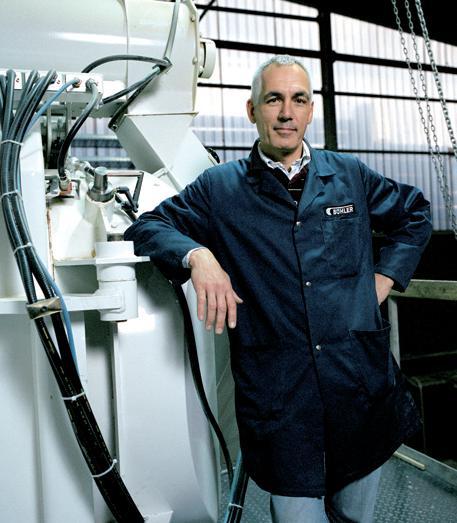
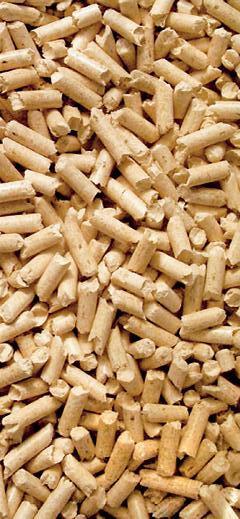
Maximize value from your raw materials. For perfect biomass and wood products the entire production system must work together flawlessly. Buhler Inc. and Buhler Aeroglide enable total process control with a complete equipment package that includes drying, grinding, pelleting, cooling, bagging and loading. This, combined with Buhler’s integrated automation system, unrivaled after sale support and training provides a seamless solution to biomass and wood processors.
See for yourself, by visiting us at the International Biomass Conference & Expo. May 2-5, 2011. St. Louis, MO. Buhler Booth: # 319.
Buhler Inc., 13105 12th Ave N., Plymouth, MN 55441, 763-847-9900 buhler.minneapolis@buhlergroup.com, www.buhlergroup.com
community presentations, and media relations will help ACBC promote information and policy initiatives advantageous to the continued development of the bioenergy industry. ACBC welcomes input and participation from anyone affiliated with the bioenergy industry who is interested in playing a part in its future.
The North American Biomass Pellet Export Conference is being held September 8–9, 2011, in New Orleans. The conference will provide insight and information on all aspects of wood pellet exporting, including market, legal, logistic, and financial issues. It will also provide significant networking opportunities for pellet producers, European utilities, supply chain consultants, international logistics companies, renewable energy lenders, investors, loggers, attorneys, and researchers. Tabletop exhibit space and several sponsorship opportunities are still available. For more information or to register, visit www. exportingpellets.com.
The Canadian BioEnergy Centre (CBEC, www.unb.ca/fredericton/ forestry/wstc/cbec), a biomass testing laboratory registered with the Pellet Fuels Institute, is officially open. Located at the University of New Brunswick, in Fredericton, the CBEC undertakes research and development, product testing and certification (including pellets and biomass combustion appliances), technology transfer, and training and education. The initial technical focus of CBEC is on solid biofuels and their combustion performance, including energy value and emission characteristics, says the Centre’s website.
Innovations for a better world.
•
• Mercedez-Benz Diesel
• Automatic Reversing Fans
• Screen Changes in Under 10 Minutes
• Patented Variable Load-Sensing Feed System
• Complete Remote Control
• Direct Drive Fluid Clutch
• Drop-in Drums Replace in Minutes
• Hydraulic Tensioned Clearing Brushes
• Hydraulically Folding Discharge Conveyors
• Drum Load Sensor Controls Feeder
• Unique Non-Plugging Drum
• Handle Whole Logs - 36”
• Quick change Knives
• Remote Control Discharge Chute
Morethan 100 people attended a daylong seminar in December 2010 to learn about the woody biomass industry and biomass heating. The meeting took place in St-Georges de Beauce, a town located between Quebec City and the border with Maine, and was planned by Development PME Chaudière-Appalaches, an organization that promotes entrepreneurship in the region. The eight speakers included researchers, biomass system consultants, manufacturers, and a spokesperson from the Quebec government. They talked about forest biomass as a substitute for fossil energy and how to realize a successful biomass or bioenergy project.
The attendees were a diverse bunch, including several public building managers who were looking for a solution to high fuel costs, biomass system manufacturers, and woodlot owners and managers. The latter group, who are mainly under the authority of their regional woodlot owners organizations, asked many questions about the harvesting process and about available timber that hasn’t been sold because of the lack of demand from sawmills. Attendees were given a complete overview of the requirements, regulations, and fibre supply related to installing a successful biomass heating system.
Although the forest industry is one of the main industries in the region, second to manufacturing, there is little Crown land in Chaudière-Appalaches. Its 15,216 km2 mainly comprises private woodlots, of which about 85% are smaller than 800 ha. In fact, only 10.5% of the region is land that belongs to the Quebec government. The harvest oppor-
A recent “how to” seminar explained the industry for those interested in supplying and heating with biomass.
By Martine Frigon

tunity in this region is estimated at 2,179,875 m3/year, whereas 1,266,500 m3 was harvested in 2008–2009, according to the Quebec Ministry of Natural Resources, the Quebec Forest Industry Council, and a local organization that supports and promotes private woodlots.
According to speaker Luc Desrochers, an FPInnovations researcher, 555,480 dry tonnes of biomass could be available in this area, representing huge potential. “During the last recent years, we have harvested only 40% of the forest residues available,” he says.
The best use for biomass is in heating. “That is where we have to put emphasis,” declares Evelyne Thiffault, a research scientist with the Canadian Forest Service. However, she adds that wood residue harvesting is not appropriate everywhere. Depending on the soil type, it could cause risks for ecosystem function, erosion, compaction rutting, and nutrient loss. “Biomass harvest should not be made on peat bogs, rugged slopes, sandy grounds, and soils in which there is a lack of calcium and magnesium,” she says.
There is no doubt that changing a heating
system that currently runs on fuel oil or natural gas to forest biomass requires good planning. In Quebec, this kind of heating system is regulated just as any other, with specific inspection requirements according to boiler type and capacity.
Some provincial government programs under l‘Agence d’efficacité énergétique du Québec (AEE) provide grants that can help to cover some of the costs. According to Nicolas Laflamme, AEE spokesperson, the heavy oil consumption reduction program and another program based on forest biomass conversion may be suitable for applications from building or plant managers who want to convert the current heating system.
According to speaker Jacquelin Goyette, forest engineer for Groupe INfor, the supply of raw material is just as important as the heating system. He told the attendees, many of whom were interested in becoming biomass suppliers, to use existing plants, warehouses, and equipment when possible, for better cost control.
The Amqui Hospital was given as an example from among several recent biomass projects in Quebec. Renaud Savard, president of consulting firm Gestion conseils PMI, explained the project, which was completed in 2009.
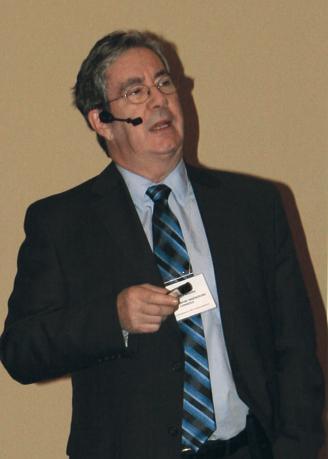
TOP IMAGE: Jacquelin Goyette, forest engineer from Groupe INfor Inc., says that the older a fossil fuel heating system, the more compelling it is to look for a conversion to biomass.
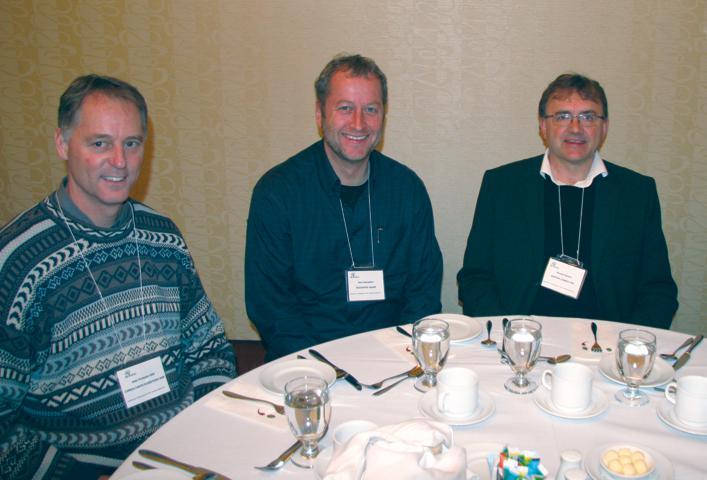
MIddlE: Researchers Evelyne Thiffault from Natural Resources Canada’s Canadian Forest Service (left) and luc desrochers from FPInnovations (right) both spoke at the seminar.
This 118,403-square-foot hospital, located in eastern Quebec, is heated by two biomass boilers of 800 and 500 kW.
For biomass, softwood tree crowns that are not harvested and sold are taken from a forest management unit located between Matane and the New Brunswick border, through an agree-
ment with the Quebec Ministry of Natural Resources and the Cooperative forestière de la Matapedia. This amounts to a volume of 10,300 tonnes/year. A Morbark chipper mounted with a Serco 270 loader is the only equipment used to process the biomass. The biomass is then transported to a warehouse located 32 km
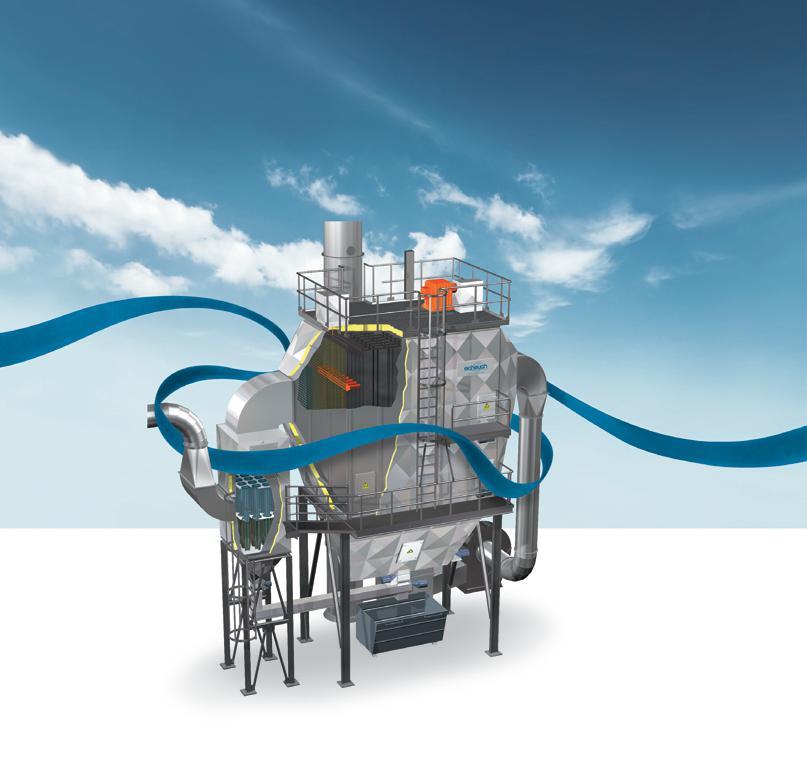
For the separation of particulate matter, centrifugal separators for pre-separation and dry electrostatic precipitators for final cleaning represent the best available technology. Take advantage of our single source system solutions.
• Single and multi-field ESPs
• Energy Recovery & Cleaning Systems (ERCS)
• Fabric Filters in combination with Dry Sorption Processes
Our extensive industry experience ensures the most reliable design and economical operation.
Scheuch Inc.
531 Admiral Drive, Suite 200 London, Ontario, N5V 4L6, Canada
Phone: 519 951-7700 I Fax: 519 951-7711
office@scheuch.ca www.scheuch.ca
lEFT: Attendees and speakers included Jean-François Côté, from Consultants Forestiers dGR; Jean desrosiers, from Écocentre Valbio; and Renaud Savard, president of the consulting firm Gestion conseils PMI.
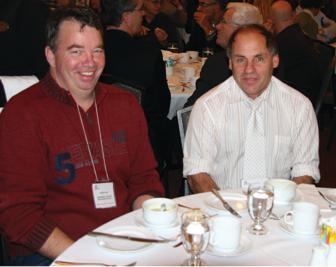
ABOVE: Attendees included Raynald Pouliot, from Groupement forestier de Bellechasse (left), and Gaétan deschesnes, from the Syndicat des propriétaires forestiers de la région de Québec (right).
from the hospital and stored to reduce moisture levels. The Cooperative’s management learned this process during a trip to see biomass use in Finland. It is a great success story for Savard, who adds that other projects for public buildings in eastern Quebec may begin in the coming years. •
The BioFuels Recycling Centre saves valuable landfill space and feeds a hungry power plant.
By Heather Hager
eThrecent recession was unfavourable for many companies, but the BioFuels Recycling Centre wasn’t one of them. It actually saw an increase in business over the past year, says Brian Perrault, site manager for the construction and demolition waste recovery facility. He suspects that’s because of the substantially lower tipping fees for clean wood waste that can be diverted from the landfill and put to good use.
And that’s exactly what BioFuels is doing. Located at the Northlands Landfill site just west of Edmonton, Alberta, the six employees sort, shred, and recycle wood materials dropped off by various disposal companies and small contractors.
“We have an agreement with Northlands Landfill,” explains Perrault. “They send us the clean wood and a mixed product that is up to 50% mixed. We divert it from going into the pits.”
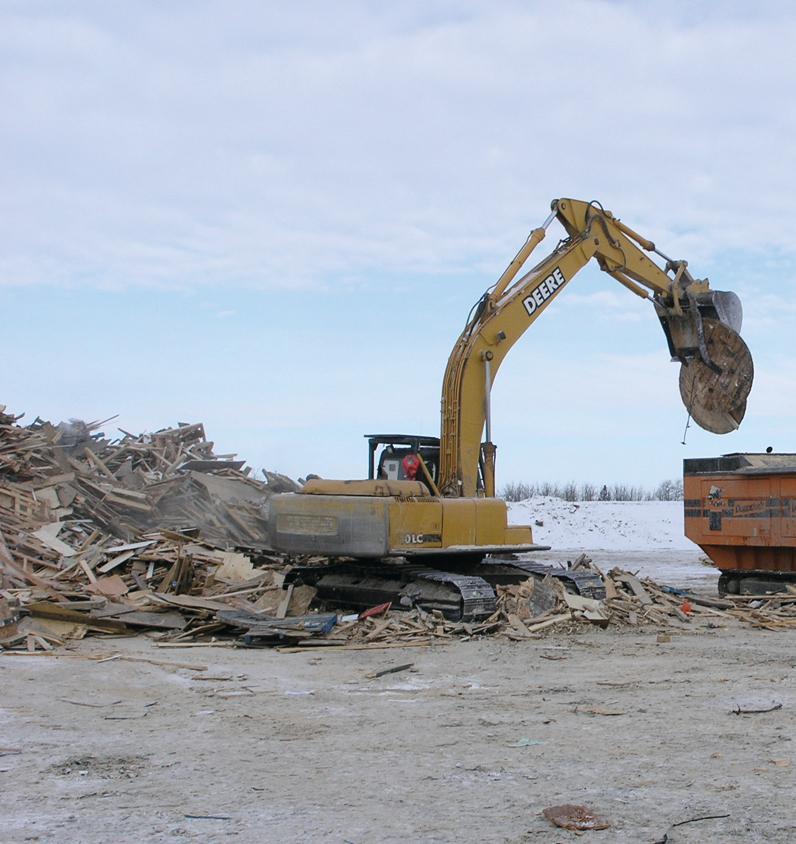
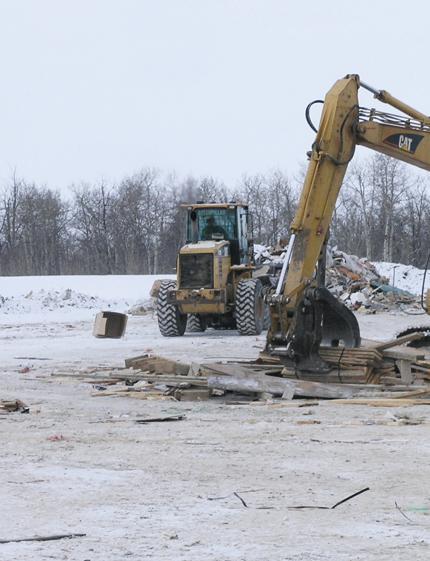
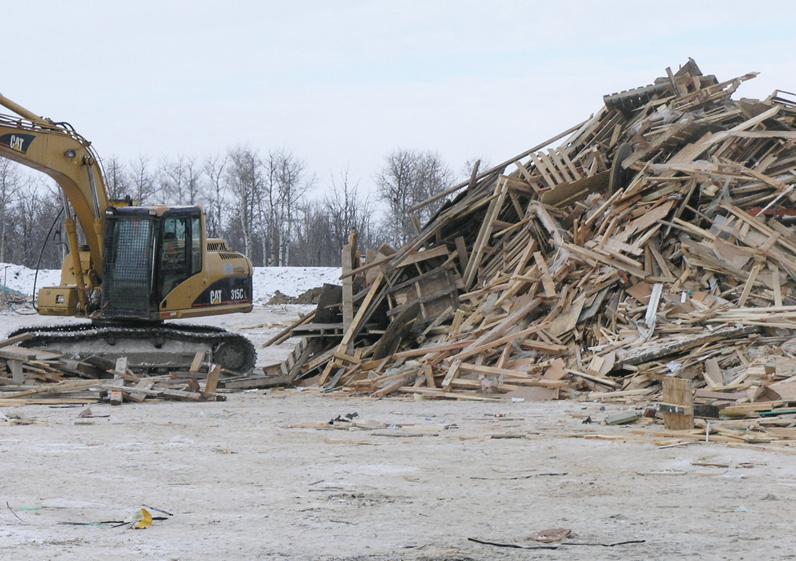
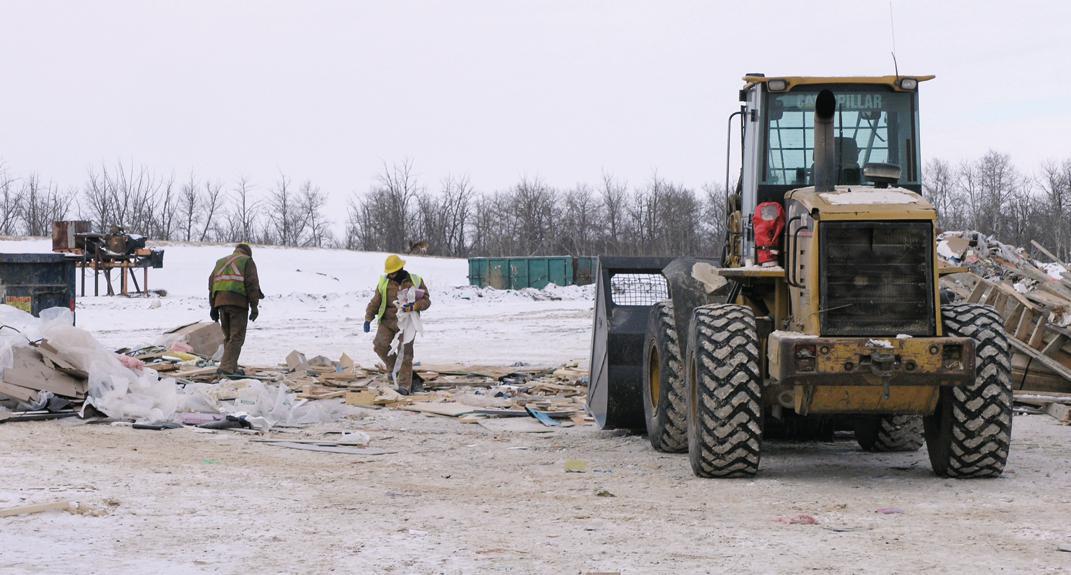
The mixed material, which can contain plastics, paper, cardboard, steel, drywall, insulation, or other materials, is processed separately from the clean wood. It’s first spread out in a sorting area, where a small Cat excavator, equipped with a generator and magnet, removes the steel. The remaining material is sorted on the ground by hand. Steel and other
materials such as aluminium and drywall are sent elsewhere for reuse and recycling, generating some revenue. Just about the only material that can’t be recycled is insulation, which goes to the on-site landfill, says Perrault.
Clean, pre-sorted wood is the preferred supply, however. “If they bring in clean wood, they get quite a cost reduction on the tipping fee coming in the gate,” Perrault notes. “So it makes it look a lot more attractive to bring clean wood than mixed wood because it’s so labour intensive to sort and separate that mixed material.”
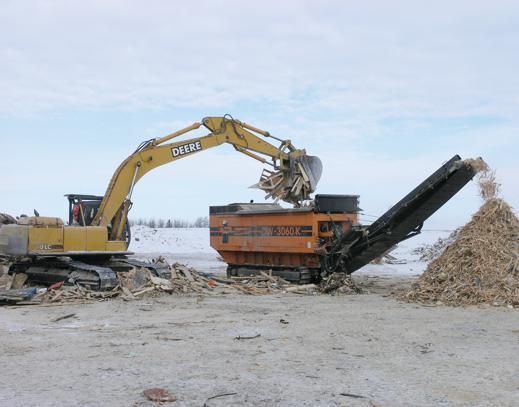
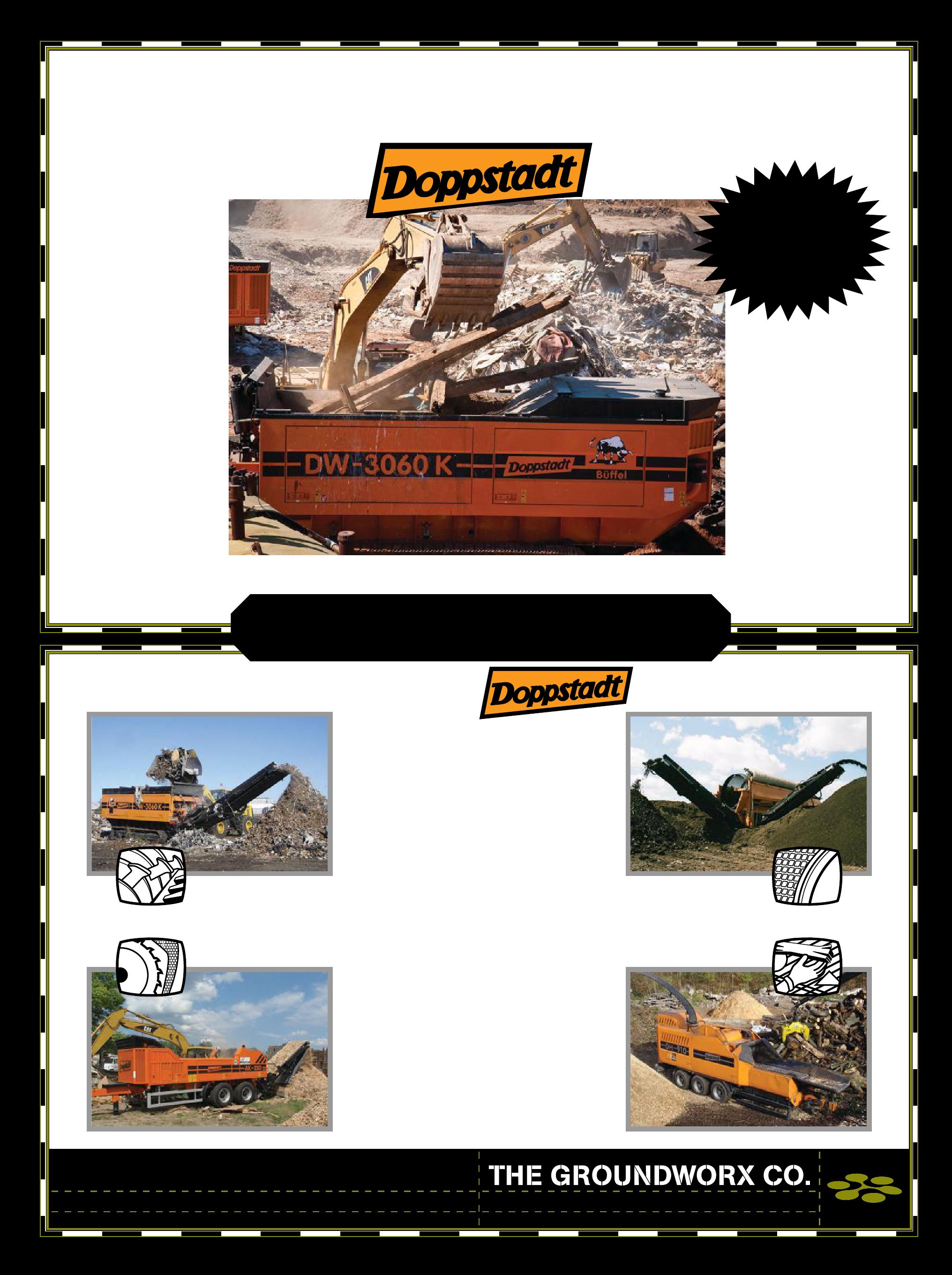
Once sorted and piled, a larger Deere excavator and a Doppstadt shredder move around the site to shred the wood, keeping it in separate clean and mixed-source piles that are destined for different uses. A Cat front-end loader places the shredded wood in 50-foot walking-floor trailers for transport to its final destination.
The main purpose of the BioFuels facility is to supply fuel to the Dapp Power plant. Both
BioFuels and Dapp are owned by Fortistar, a New York-based renewable energy company that owns more than 50 landfill gas power plants across the United States. Dapp is one of two 100% biomass-fired electricity generating stations the company owns in Canada,
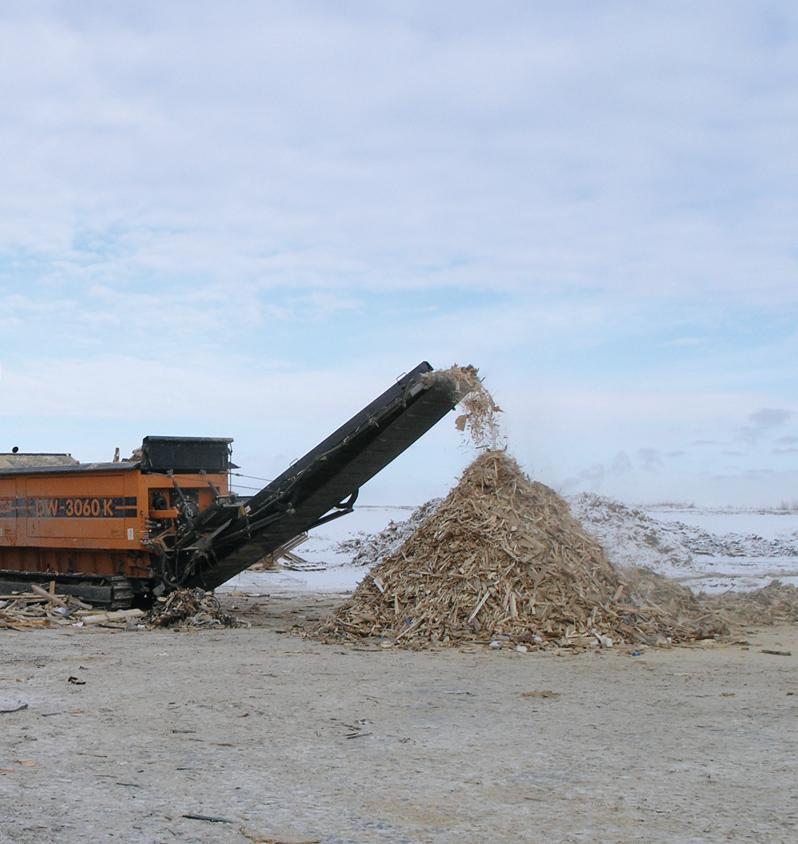
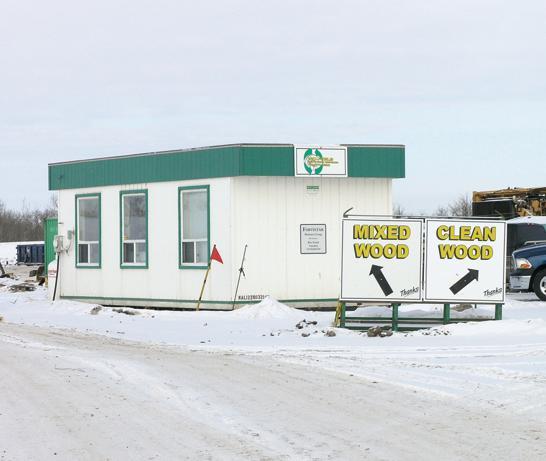
ABOVE: loads of clean wood are processed separately from mixed wood that must be separated from other materials, with the final shredded products going to different markets.
lEFT: The new shredder has allowed Biofuels to serve a new market: large wooden spools that are held together by metal rods. The site will soon see two new additions: an excavator and a loader, both deere, from Brandt Tractor. BOTTOM RIGHT: The smaller Cat excavator piles sorted materials for the larger deere excavator to feed into the shredder.
and it produces power for the Alberta grid.
Perrault estimates that about 97% of BioFuels’ shredded wood product, mostly from the mixed source, is trucked approximately 100 km north to the power plant. He says that amounts to 35,000 to 40,000 tonnes/year
diverted from landfill. “Our goal this year is to break 40,000 tonnes,” he says. “Every year it’s a gradual increase. We’re doing something that a lot of people never thought would ever happen, to get that kind of volume away from a landfill.”
On average, BioFuels ships out five or six 25- to 28-tonne truckloads each day, but that varies by season. The sorting yard is busier in summer, when one or two additional employees join the team to keep up with the processing demand.
The clean waste wood is sold for various uses, including landscape mulch, animal bedding, and oilfield remediation. In a new project just begun in 2011, a compost plant is purchasing most of the clean, shredded product for mixing with its other organics.
BioFuels also bids for custom shredding jobs off-site. “We’re very portable,” says Perrault. “We just move our site to another site and truck the shredded product from there. It saves the company from transporting it here.” For example, they’ve done custom shredding at pallet manufacturing facilities and gas plant construction sites.
Up until 2010, the company used a highspeed grinder to process the wood debris. However, Perrault says they found that it limited the types of mixed materials they could process without stopping for frequent maintenance and repairs. “The grinder did
not like steel,” he notes. Last year, after seeing a demonstration of the Doppstadt shredder’s capabilities, Perrault purchased one to replace the grinder.
“That opens up a new market for us,” he explains. “We now recycle wooden spools, where before, there was nothing you could do with them because there’s metal in them. That’s a huge market all across Canada, and our volumes are increasing from when we first started with the spools.” He says the shredder tears the spools apart and
has a magnet that removes the steel to a separate pile.
That capability also makes the initial processing less labour intensive. “Our amount of sorting now is way faster, being able to put the product into that new machine as opposed to the grinder, where you were basically picking up every single tiny piece of wood to make sure that no steel went in,” says Michelle Dixon, who’s been the ground supervisor and heavy equipment operator at the site for three years. “Now, if we happen
to miss a piece or two, the machine just spits it right out.”
All in all, the wood recycling centre is a fairly simple operation requiring a few key pieces of equipment. Most of the time, the shredder runs six to eight hours every day, five days a week, says Perrault. That means the material turnover rate is rapid, with little need for extensive on-site storage. The wood fibre is sorted, shredded, and trucked out to its final destination almost as fast as it arrives. •


ACoaches, mentors, and advisors all serve different, important roles in reaching business success.
By Reg Renner
s a high school basketball coach, I often think about how best to teach and prepare young athletes for the rigours of a fast paced, high-pressure play-off game. Did we spend enough time practising our skills? How will the players respond to the unpredictable flow of the game? After 12 years of coaching, I realize that each game is a brand new situation that we just have to play through to see what the outcome will be, while relying on the training and preparation we did to get us here in the first place.
With this example in mind, I believe that you can benefit greatly from having a coach, mentor, and advisor for your bioenergy project. Your bioenergy business proposal may be brand new territory for you and your partners or you may be an experienced professional. Either way, you can still benefit from having someone to guide and critique your performance, helping you get the most from your efforts.
It is my observation that in the business world, many of us think that because we are grown-ups with experience, we do not need any help. If this is true, why do professional athletes hire and rely on coaches, fitness trainers, and nutritionists to help them perform at their peak? Trying to do it all by yourself is okay for an amateur athlete, but not for a professional athlete. I firmly believe that the same can be said for professional bioenergy projects.
So now you are thinking that you might need a coach, mentor, or advisor, but which ones do you need? The roles are separate and distinct; having all three will greatly improve your chances for business success.
A coach has experience and an ability to motivate and prepare you for the task ahead. Coaches must often react under pressure to diagnose a problem and for-
mulate a solution that a team can grasp quickly and put into action. There is no greater thrill for a coach than to call a time-out, diagram a play, and then watch the players execute it successfully. A coach must be an excellent communicator and have an understanding of what the team is capable of doing with its current level of knowledge.
A mentor is a person who has journeyed down a similar road before you. I encourage you to look for a local entrepreneur who has successfully built a start-up business into an established company. A mentor should be someone who has walked in your shoes, ahead of you. His or her experience, wisdom, and insight can often be the difference between taking the easier path or not. A really good mentor can help you sort through all the details and brings a well-balanced perspective to the current situation.
As a financing specialist for the past six years, I am often asked to advise on how to obtain sufficient financing for bioenergy projects. In some cases, it becomes apparent that the team needs help from an advisor who specializes in financing. But sometimes, the team also needs a coach who can bring the members together to help them achieve their dream. Other times, the team could benefit from a mentor to show the best path to success. Regardless, it is extremely important that you do not underestimate the importance of a coach, mentor, or advisor to the success of your project.
“It is my observation that in the business world, many of us think that because we are grown-ups with experience, we do not need any help.”
An advisor often brings a specific talent or skill to the team. An advisor’s focus is narrower than a coach’s, which is why head coaches often hire assistants to handle the offence, defence, and special sub-teams. In choosing an advisor, you will want to look at the skills of your current management team to see how it is functioning and where there are gaps in the knowledge and experience base. For example, do you need help with technical issues, marketing, or financing? Advisors can be hired for short-term projects or they can become long-term trusted helpers such as your accountant or bank manager.
People often think that competition in the business world is different from competition in the athletic world. Yes, you might be successful without a coach, mentor, or advisor, but your chances of success are much greater if you have a professional support team. So be prepared to include room in your budget for this type of expert resource, as I believe that you will find the experience, insights, and guidance worth the money spent. •
Reg Renner of Atticus Financial in Vancouver, BC, finances machinery ranging from biomass boilers to densification equipment. With 38 years of industry experience, he recently helped secure carbon offset credits for four greenhouse clients. E-mail: rrenner@atticusfinancial.com.
Making biomass available for bioenergy developments could also solve the wildland-urban interface fire issue.
By Robert Gray
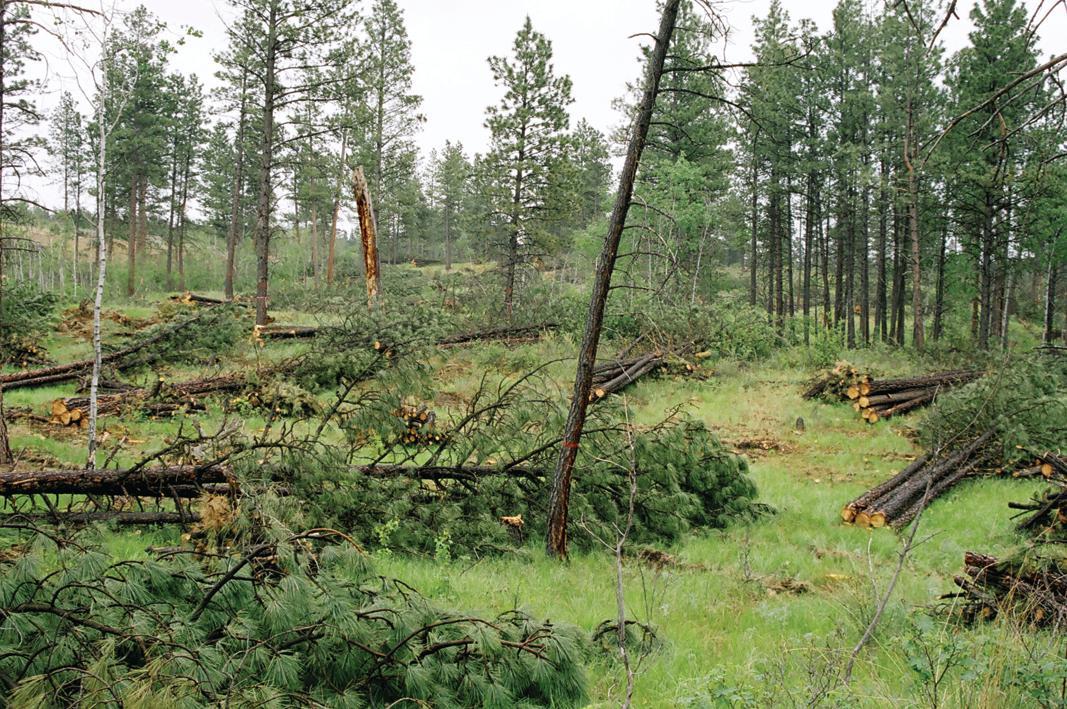
Everysummer a large number of communities face the threat of wildfires. In British Columbia, the mountain pine beetle epidemic and climate change are further aggravating an already hazardous situation by creating additional hazardous woody fuels. Contributing in large part to the wildfire hazard are dense stands of small-diameter trees, dead lodgepole pine, and untreated timber harvesting slash. To date, governments’ solution to the fuel and wildfire threat issue has been to subsidize partially the on-site treatment or removal of the material. But, with the recession, there is no longer federal, provincial, or municipal funding for a subsidized approach to hazard abatement.
A more economically promising solution to the problem is the aggressive use of this biomass to produce energy. However, to make this solution a reality, the provincial govern-
ment will need to move away from its passive approach to biomass feedstock availability and create opportunities for local governments to use the material through a re-apportionment of the resource. It will also need to encourage the use of the burgeoning biomass-to-energy industry to solve landscape-scale wildfire and forest health issues.
The wildfire hazard issue in British Columbia gained prominence after the 2003 wildfire season in which three fire fighters died, 350 homes and businesses were destroyed, 45,000 residents were evacuated, and the province spent more than $700 million in suppression and fire rehabilitation. The province commissioned former Manitoba premier Gary Filmon to review existing policy and procedures as they applied to wildfire threat to the wildland-urban interface (WUI) and to recommend changes so that what happened in 2003 wouldn’t be repeated. Two key recommendations from the
Filmon Report relate directly to the biomass-toenergy industry: the need to add value to the small-diameter trees constituting the greatest threat to communities; and tenure reform, giving those who need to treat the material access to it.
In response to the Filmon Report, the provincial government developed a grant program encouraging local governments to take the lead in resolving the wildfire threat to their communities. Developed through the Ministry of Forests and Range and administered by the Union of BC Municipalities (UBCM), the program comprised a partial grant (50% from the UBCM)
A designated wildland-urban interface area under the control of local government could be harvested for biomass, as well as sawlogs and pulpwood.
to support the development of a Community Wildfire Protection Plan, as well as subsequent grants for fuel treatment pilot projects and operational fuel treatments (75% from UBCM if beetle-affected lodgepole pine was involved; otherwise 50%).
However, the Strategic Wildfire Prevention Program Initiative didn’t directly address the need to add value to forest fuels, as recommended; it only provided a partial subsidy for treatment. With treatments ranging in cost from $1,000/ha to more than $20,000/ha, the initial fund of $40 million didn’t result in much more than 40,000 ha treated out of an estimated 1.8 million ha that needed treatment. Some of the material was removed from treatment sites and used in the bioenergy industry, provided that a user was sited close to the operation. The rest was treated on-site through grinding, pile-and-burn, or broadcast burning.
On the tenure reform side, the province created several special licenses providing access to small quantities of biomass. This was initially a small-scale salvage licence for dead lodgepole pine, and eventually, an interface licence enabling a municipality to treat all species but in small volumes. New clean air legislation is also
making small quantities of biomass available because the forest industry is no longer allowed to burn slash piles.
Unfortunately, none of these fixes deal with the necessity of providing sufficient access to predictable quantities of biomass feedstock so that an investor could be encouraged to build a bioenergy facility such as a thermal heating plant or wood pellet plant. With small treatment units of low-value material, there is little economic incentive for municipalities and businesses to pursue a bioenergy solution to the problem. So with federal and provincial fuel treatment grants drying up and local governments struggling to balance their budgets, movement on wildfire hazard reduction has come to a halt.
An initiative that focuses on local governments directly managing the WUI around each of their communities is being championed by the southeastern British Columbia communities of Cranbrook, Kimberley, and St. Mary’s Indian Band, as well as the Ktuanxa Nation Council Society and the Rocky Mountain Trench Natural Resources Society. The proposed solution
will not only add value to the material and provide access to feedstock, but will also reduce the need for fuel treatment subsidies in many cases. An economic and fire behaviour analysis would determine the appropriate width of the WUI buffer needed to develop biomassto-energy industries capable of aggressively removing the fuel hazard from the forest. Within this WUI buffer would be sufficient biomass volume to develop both small-scale thermal heating projects as well as large-scale bioenergy products manufacture. The buffer would also contain large volumes of traditional sawtimber, which is more valuable on a volume basis than typical bioenergy material, but which is often needed to offset the harvest cost of biomass.
This solution would require a change in the current tenure system, as the WUI buffer would need to be taken away from existing tenure holders and put under direct management by the municipality or First Nations Band. To date, the provincial government has been quick to declare that all the fibre in the province is under long-term tenure and there is none available to local governments for the development of biomass energy. Instead of creating new tenures, they are relying on a passive approach to
biomass availability in the development of bioenergy industries. However, there are inconsistency and economical inefficiency issues with the government’s strategy.
Although much of the fibre in British Columbia is under long-term licence to the forest industry (and municipalities, in the case of Community Forest Licences), it is not true
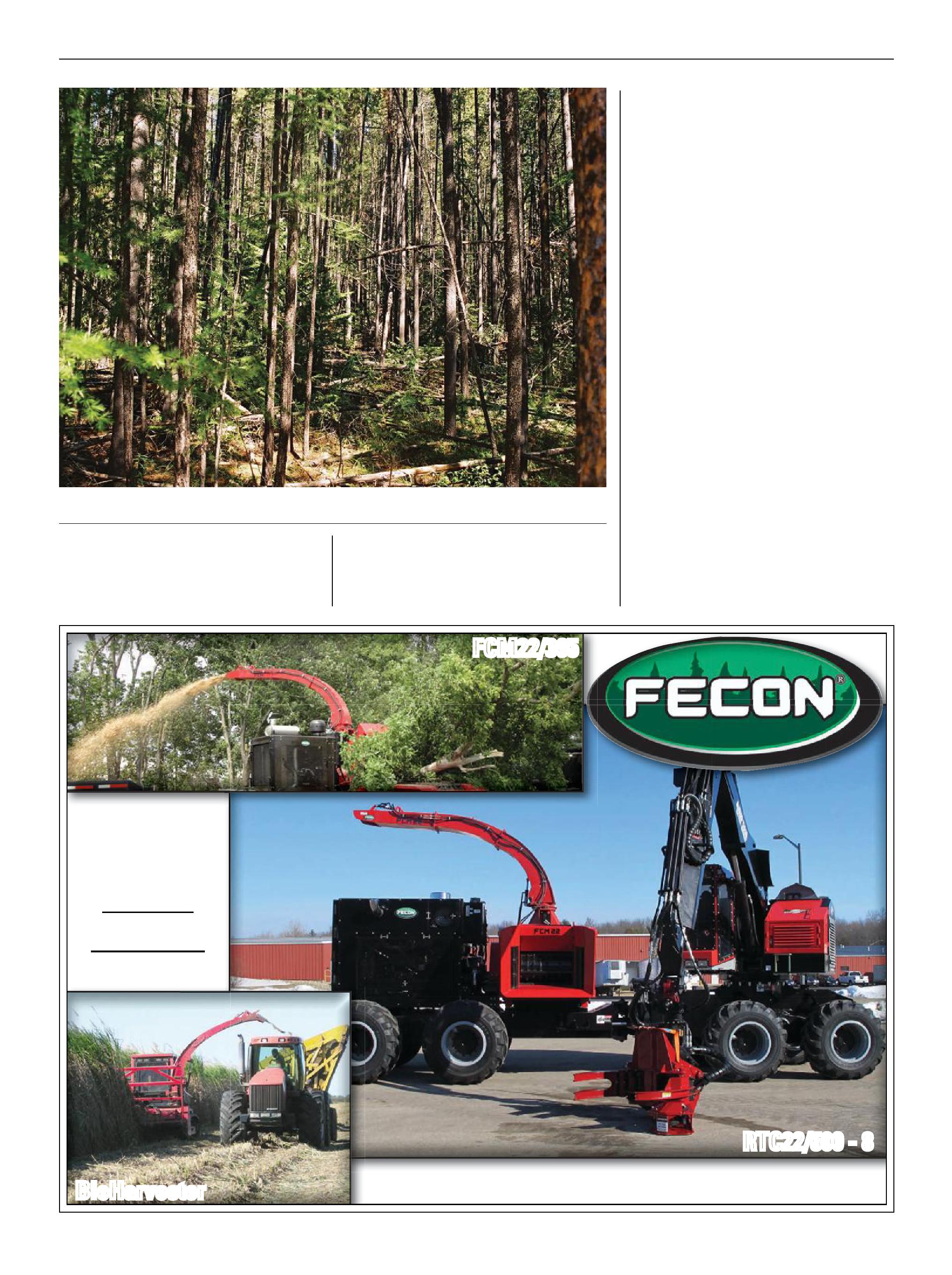
that it is unavailable to local governments for wildfire hazard reduction. Since the 2004 Filmon Report, the province has pressured local governments to take the lead in treating hazardous fuels on Crown land under longterm tenure to the forest industry (including BC Timber Sales). The province requests that local governments advocate the treatment of hazardous fuels on Crown land in the interface that is under licence to a long-term tenure holder. In many cases, the forest licensee will not treat the stand because of poor wood quality or quantity. If the licensee refuses to treat the stand, the local government is encouraged to use municipal tax dollars, in conjunction with provincial and federal grants, to treat the hazardous fuels. Under this strategy, the province thinks it’s appropriate for local governments to treat these stands but doesn’t afford them the opportunity to manage a large enough area or volume to make it economically efficient. And, from the perspective of avoiding a protracted battle over tenure reform, it is attractive to promote the development of bioenergy in a passive sense because it doesn’t require a reapportionment of resources or messy legislative changes. Under this model, biomass is only available as
The difficulty with this approach is that there is no predictability of feedstock availability, and the use of biomass is not tied to a larger economic goal or landscape management strategy. The small-scale licences and environmental legislation that free up small amounts of biomass are insufficient to stimulate bioenergy industries for two key reasons: the volumes are too small to support business planning and investment, and the volumes are not predictable from year to year. Opportunity biomass is tied directly to positive economic opportunities for sawtimber or pulpwood; if market conditions aren’t right for those commodities, the waste component that goes to bioenergy won’t be produced. In short, reliable biomass for energy can’t be a byproduct of harvest for other commodities.
However, the development of bioenergy opportunities also should not be the sole means to an end. It should be tied to meeting other social, environmental, or economic objectives such as WUI hazard reduction, as in the case of communities in southeastern British Colum-
our Biomass video at www.jeffreyrader.com/videoB the opportunity arises.
Mechanical thinning near forest communities can help reduce the risk of dangerous wildfires.
bia. Unlike other forms of bioenergy, failure to exploit the biomass resource comes with significant environmental, social, and economic consequences. If we don’t deal with the accumulated biomass proactively, we will have to deal with it during and after a wildfire at a significant cost to taxpayers, human health (e.g., smoke, direct threat to human lives), business, etc. It is therefore in the province’s interest to create and support the biomass-to-energy sector as a means of solving other problems. Direct government intervention in the timber supply and tenure arena is not without precedent. The government has amended tenures
and licences in a number of locations over time to lessen the economic effects on a community or industry during periods of market instability (e.g., for the Skeena Cellulose pulp mill in Prince Rupert, the MacKenzie pulp mill, and others).
Currently there exists an unfortunate state of inertia as it relates to solving the WUI threat as well as the development of local, viable bioenergy enterprises. The interface fuels issue is quite simply a biomass issue: there is too much of it surrounding our communities and it constitutes a very real fire hazard. Ironically, the outstanding issue preventing the development of local-level, viable bioenergy enterprises is access to the biomass that creates this threat. The simplest solution is to amend the tenure system, allowing local governments and First Nations access to the biomass in strategic locations so they can address the wildfire hazard issue economically, encourage the development of local and viable bioenergy enterprises, and diversify the local energy and forest resource industries. •
Robert W. Gray is a fire ecologist and principal of R.W. Gray Consulting l td., based in Chilliwack, British Columbia.
Newfoundland’s newest pellet producer is also aiming to be a renewable energy supplier.
By Heather Hager
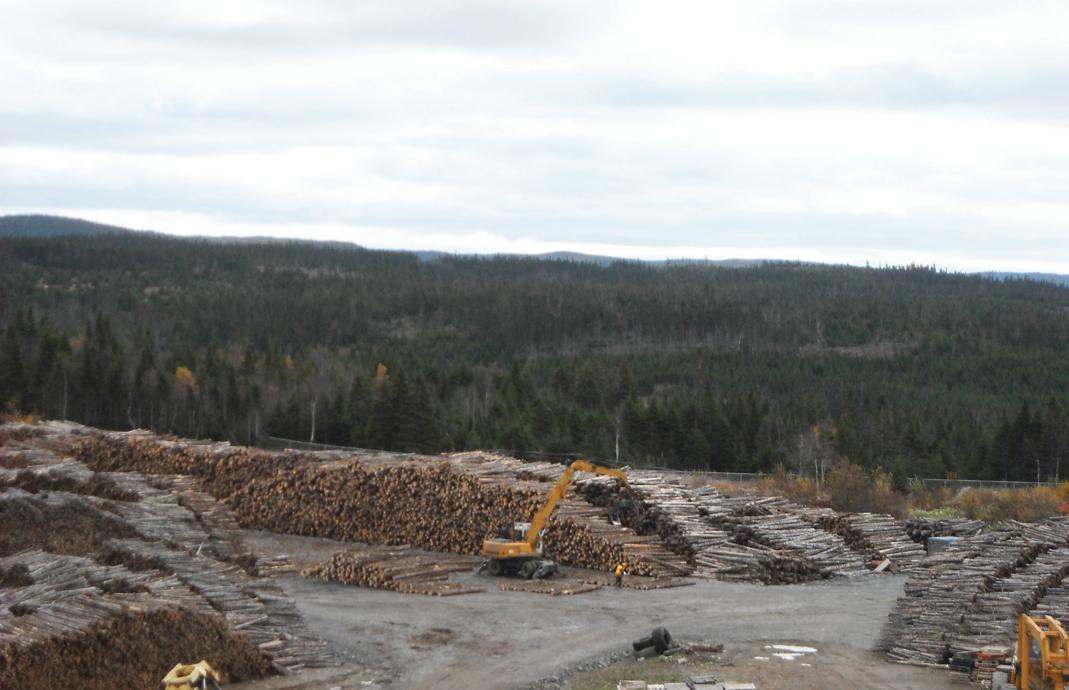
Todd May knows well, there are advantages and disadvantages to existing off the beaten track. Business establishment can cost a little more and take a little longer. However, the location of Holson Forest Products near the northern end of Newfoundland’s Northern Peninsula presents it with an ample supply of fibre and puts it in a position to supply the regional market in a timely and cost-effective manner.
Holson Forest Products was started in 2004 by Ted Lewis, owner of Lewis Logging. Lewis started as a harvesting contractor who “owned a pickup truck and a chainsaw,” says May, general manager of Holson’s pellet division. Now, the company owns or controls 70% of the raw material in two forest management units on the Northern Peninsula, giving access to about 110,000 cubic metres/year of wood.
Holson Forest Products began as a small sawmill, producing 2 million board foot/year of sun-dried or green lumber. That changed in 2010, when the sawmill expanded to 10 million board foot/year capacity and added a drying kiln and a pellet plant. With 35 employees and many others directly or indirectly supported through harvesting, trucking, and other functions, Holson is the biggest employer in a region that has been hit hard by declines in the fishing and pulp and paper industries.
“Ten years ago, there were three pulp and
paper mills in Newfoundland. Today there’s one, with two machines running,” explains May. “We had to harvest pulp wood in the province in order to produce lumber.” But in 2008, the pulp mill that previously had purchased all of the pulp-quality roundwood that Holson supplied no longer needed that wood. That meant developing a whole new business plan to keep the forest industry alive in the region, this time with a focus on lumber and wood energy, rather than pulp.
May says that Holson received financing in August 2009 to expand and upgrade the sawmill and build a 50,000-tonne/year pellet plant. Meanwhile, the company continued to purchase and stockpile sawlogs and pellet-quality roundwood from its harvesting contractors “to keep the workforce and harvesting expertise in the region.” The sawmill upgrade was completed and producing in early summer 2010, drawing from the stockpile of sawlogs. Waste fibre byproduct from the sawmill and about 40,000 cubic metres of stockpiled roundwood supply the pellet plant.
All fibre for the pellet plant is processed through the upgraded sawmill. “Depending on if we’re producing a white-wood pellet or an industrial-grade pellet, it will either be debarked (white-wood) or bypass our debarker
(industrial) and go straight to our chipper,” explains May. “We didn’t see the need in installing a separate chipper and debarking system; there’s one at the sawmill, and the plants are already interconnected.”
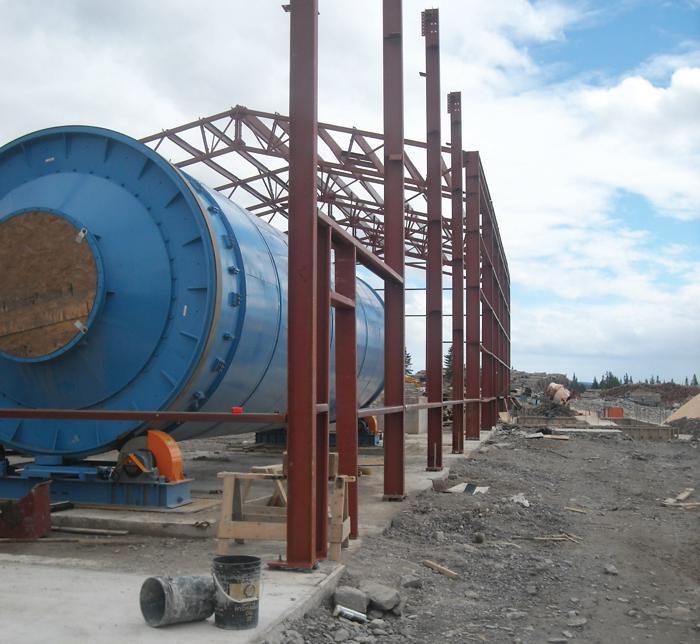
Bark moves to the pellet plant via conveyor and is used for fuel and industrial-quality pellets. The fuel material passes through a wood hog and into a storage bin. From there it’s metered into a 40 million BTU bark burner supplied by KMW Energy, which heats an M-E-C triple-pass dryer.
Sawdust and chips for white-wood pellets are sent to the pellet plant by a blower. “We decided to blow our sawdust and chips up past our pellet plant and then feed it back in through the building so we have better control of how much material’s coming in the building,” says May. A conveyor system then takes the material past magnets that remove ferrous metal. A screen removes the oversized material and diverts it to a Schutte-Buffalo hammermill while undersized material bypasses the first hammermill and goes directly into a hopper that feeds into the dryer. Dried
material passes through the primary cyclone to a second Schutte-Buffalo hammermill and then into another hopper that feeds two Andritz pelletizers. The newly formed pellets move to a Geelen cooler and then a BM&M screen, which removes fines.
Finished pellets are either sent for bulk shipments or for bagging on a form-fill-seal bagging line from Premier Tech. There’s plenty of storage space for bagged pellets on skids, says May. He admits that there isn’t much bulk storage space, a challenge that he’s looking to address in the spring.
The plant was designed by engineer Van Wall of Projitech, out of St.-Georges, Quebec. “All the way through the design process, we’ve been very cognizant of fire and explosion and ensuring that we’re protected, either through venting or detection/suppression systems wherever there’s risk of fire,” states May. That includes Firefly spark detection/suppression and a reversing screw at the primary cyclone that can divert the material to a bin outside the Photo:
Todd May
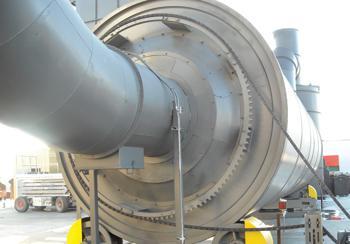
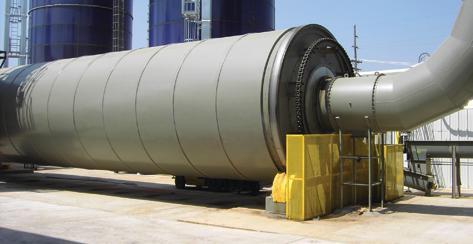
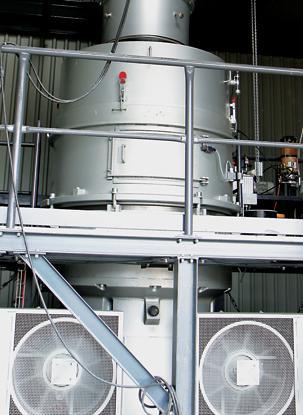
At an earlier stage of construction, the M-E-C dryer was one of the first components to be installed.


building if a fire is detected. The whole pelleting process is coordinated via a control system installed by Logitex, out of Quebec.
Commissioning of the plant was originally expected in November 2010, but production is now slated to begin in late March 2011. Issues related to the remote location, bad weather, and interruptions in ferry service delayed the arrival of some of the smaller pieces of equipment, says May. “We are located 350 km from the Trans-Canada Highway,” he notes. That means no overnight deliveries from a courier service that arrives once a week. “It’s something that we’re accustomed to, and we know how to work around it. A lot of our regular suppliers are used to shipping something to another supplier or another company in Deer Lake or Corner Brook, and we arrange to have it picked up from there. And that’s a bit of a learning curve for some of our new suppliers.”
Despite the challenges, Holson’s location on the Northern Peninsula is allowing it to pursue a wide diversity of pellet customers. First, there’s the potential to ship pellets overseas from the nearby ports of St. Anthony or Roddickton, and May says they have had discussions with a couple of European clients who are looking for bulk pellets.
Then there’s the home heating market. Although this would involve smaller quantities, May says: “Our winter lasts from September until the end of May, really, so we’ve got a very long heating season.” But the idea is not just to supply pellets. “We’re in the process of becoming an installer and supplier of residential
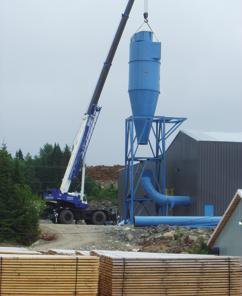
ABOVE: Exiting the dryer, the moist exhaust gases pass through a primary cyclone, which removes particulates and expels the spent exhaust to the atmosphere.
RIGHT: Holson’s 50,000-tonne capacity pellet plant has two Andritz pellet mills.
burner and boiler systems,” he says. “We feel that there’s an opportunity for a fairly large market in Newfoundland once we actually prove ourselves.”
Finally, Holson Forest Products is taking an approach that’s new to Canada: it’s looking to become an energy supplier for industrial, commercial, and institutional buildings, as well as for remote communities that lack access to the
power grid. “We’re looking to be an energy provider. We’re actually working to do those boiler conversions, selling the heat to facilities versus just selling pellets. So we would actually own and operate the boiler systems,” explains May. In fact, Holson is in negotiations with a couple of industrial sites that would require process steam and hot water year-round. It is considering four potential boiler suppliers, three in Canada and one in Ireland, for the most suitable system. “This time next year, we want to have at least one, if not three, commercial facilities that are going to be converting from oil to our pellets. We will own those and supply our pellets; we will sell the customer the energy.”
May also sees the potential for small-scale combined heat and power production. Although most communities in Newfoundland are connected to the power grid, he says there are many small, isolated communities in Labrador that have no access to the grid and are reliant on diesel generators. “We’ve been working with a couple of community groups and talking with them about potential power generation on a smaller scale,” he says. “It’s been fairly preliminary at this stage, but there is certainly potential for it.” •
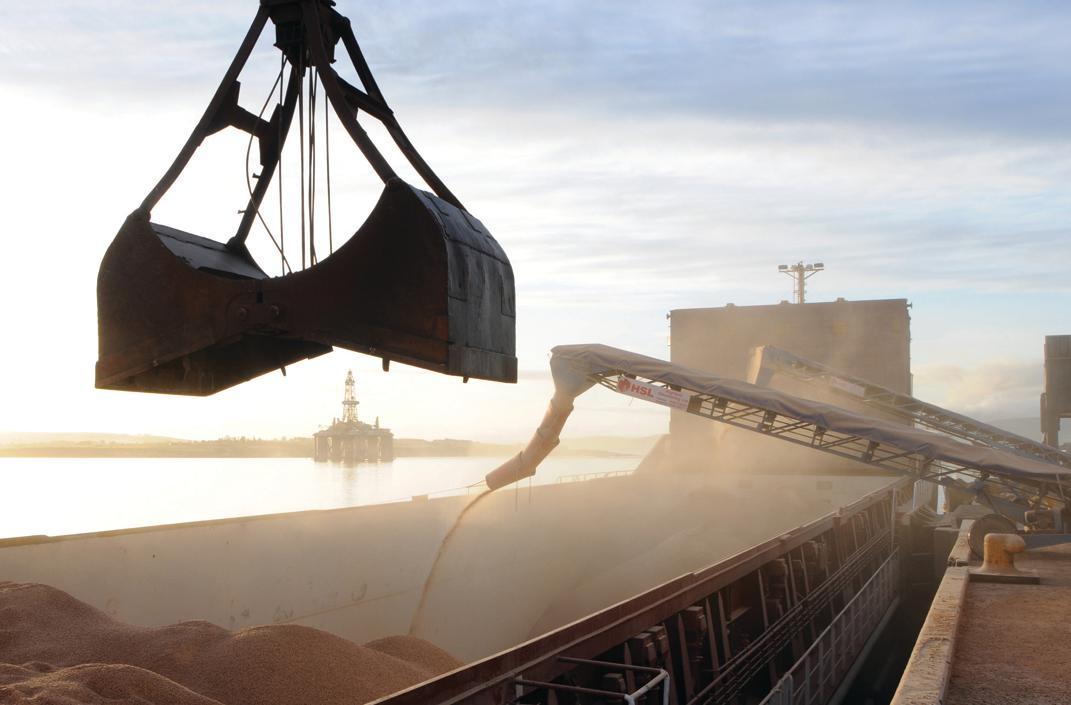
Bulk pellets are prone to off-gassing and self-heating, which can be mitigated by procurement, production, and storage techniques.
By Micheal Curci
wood pellet mills are in development or under construction these days. With all the mills being constructed, and with most companies focusing on the pellet production and wood procurement processes, the storage of the finished product is often almost an afterthought. However, resin in the form of sugars and organic compounds remains in the wood throughout the pellet production process; these compounds can begin to break down during the storage and shipping process, leading to dangerous off-gassing and self-heating. Companies can ensure the best product is delivered to their customers overseas by using enhanced procurement procedures and specific production techniques and by understanding the mechanics and physics of modern pellet storage management. All three of these areas must be taken into consideration when developing a facility. If not properly managed, off-gassing and pellet selfheating start with the procurement of the wood and continue throughout production, shipping, and storage.
Across the pellet industry, it is normal practice to procure the cheapest feedstock for pelletizing without compromising pellet quality. In addition to sawdust, pellet producers use tops, trimmings, and whole-tree chips to reduce overall operating costs because feedstock is the highest cost, normally averaging 40–50% of total production cost. The chemical composition of juvenile and mature wood differs. It is impractical to procure mature wood because lumber mills are competing for that material, so pulpwood is the main source for pellet mills.
A solution for reducing later off-gassing and self-heating currently being tested is aging or drying of the wood once it is cut. The rationale behind this idea is that wood tends to have variable moisture content
throughout the year. Allowing the wood to age in the yard prior to processing would allow the wood to begin the natural drying process; therefore, lower drying temperatures would be needed to achieve 8–9.5% moisture content of fibre prior to pelletizing.
Allowing the wood to dry naturally before debarking and chipping would reduce chemical breakdown during chip pile storage as well. Spontaneous heating in wood chip and sawdust piles is caused by oxidation of unsaturated fatty acids and other extractives1. Mills that acquire feedstock and unload and chip it without storing it first are putting chips with average moisture content of 40–48% into their piles, which will increase the chances of both spontaneous heating and chemical breakdown prior to processing.
Pellet mills throughout the world use different methods to process feedstock once it is chipped. For instance, one mill may produce three-quarter-inch pine chips that move through a single-pass dryer and into a storage silo until a hammermill pulverizes the strand to a smaller size that is sometimes determined by the end-user contract for particle distribution for co-firing. Another mill may produce half-inch, mixed hardwood chips that pass through a hammermill, then a triple-pass dryer, and then another hammermill to further reduce the strand size to meet the specs of the end-user contract. With each process the wood passes through, the strand structure is altered. Research on the effects of processing on the condition of chips shows that the chemical composition changes as a function of refining actions.2
Drying temperature is correlated strongly with the volatile organic compounds (VOCs) emitted from stored pellets, along with pellet selfheating. The major constituents of VOCs emitted from wood pellets are aldehydes, some of which are upper airway irritants. The drying gas
temperature is the only significant factor for aldehydes/ketone emissions. Some believe that high drying temperature removes more of the VOCs from the wood prior to pelletizing; however, others believe that high drying temperature actually opens the cellular structure, which, once pelletized, begins to emit more VOCs than what would have been emitted otherwise. High drying temperatures are used to maintain high throughput while reducing moisture content. Lower drying temperatures usually have lower throughput, but the wood emits fewer VOCs and could possibly have reduced VOC emission and self-heating in storage.
An analysis of VOCs emitted from fresh and stored Norway spruce and Scots pine during storage found that unsaturated fatty acids are the leading raw materials of emitted VOCs.3 Aldehydes such as pentanal and hexanal are major constituents of the off-gas, but the amount and composition of emitted substances is affected by drying temperature of the raw material and self-heating of pellet stocks. Spruce and stored pine sawdust contain less fatty acid, which should generate fewer aldehydes. The study’s authors hypothesized that it might be possible to reduce emissions from pellets in storage by optimizing the drying temperature and other process parameters such as wood aging and raw material mixes.
Wood pellet storage and shipping have come under the spotlight since two fatal accidents plus serious injuries in 2002 and 2006 while off-loading pellets shipped overseas from British Columbia to Europe. A typical shipping vessel can carry 30,000 tonnes of pellets at a
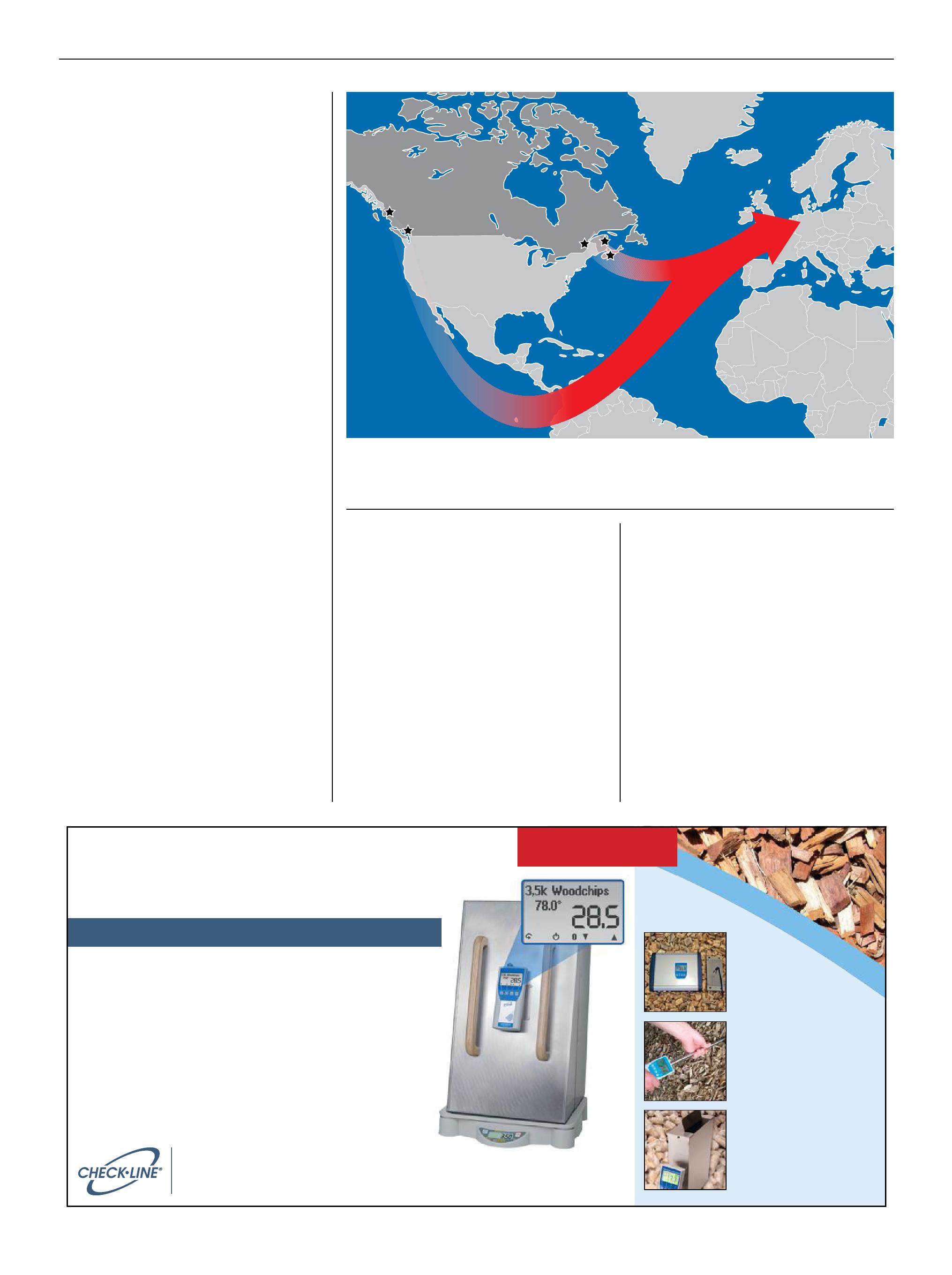
long-distance shipping of wood pellets, from North America to Europe, for example, can create conditions for carbon monoxide release and oxygen depletion.
time, and a typical port storage facility can store as much as 100,000 tonnes in a single facility.
All biomass gradually decomposes over time, releasing toxic and oxygen-depleting gases such as carbon monoxide (CO), carbon dioxide (CO2), and methane (CH4). Emissions from wood pellets during storage comprise one-carbon compounds such as CO, methanol, formic acid, and formaldehyde, as well as multi-carbon aldehydes such as hexanal and pentanal.4 The oxidation of fatty acids and other components in the wood is the likely cause. The oxidation processes occur below room temperature but
are accelerated by elevated temperature.
In a conventional biomass composting system, CH4 generation is usually associated with anaerobic decomposition of biomass, whereas CO2 likely is generated from the thermal oxidation of aerobic degradation products. A high temperature favours a high CO/CO2 ratio. As the temperature rises, both CH4 and CO2 emissions increase, with CH4 generation favoured over CO2 at higher temperatures.5
The problem with pellets heating up or offgassing is noticed during shipping or bulk storage. Many different types of storage facili-
BM Series high performance features include auto selfcalibration and auto temperature compensation to ensure excellent accuracy and repeatability. Built-in datalogger. Battery-powered for portability. To operate, simply pour the biomass test sample into the storage bin and get results instantly! Ideal for wood chips, pellets, elephant grass, bark, wood shavings, sawdust and more.
Model BLL
One meter (39") long probe measures deep piles of wood chips.
Model MCT-HS For miscanthus, hay and straw bales.
Model BP1
Precision meter for pellettype material, including wood, straw, thistle, rape and elephant grass.
Wood pellets have been handled in bulk since the late 1980s in Scandinavia, but it was not until the mid-1990s when safety concerns were raised for pellets stored, handled, and transported in large quantities from Canada to Europe. The initial concern was in maintaining the mechanical and chemical integrity of pellets during months of containment in poorly ventilated spaces such as silos and cargo holds of large ocean vessels. Unexpected fatal accidents in the Port of Rotterdam in 2002 and the Port of Helsingborg in 2006 brought safety to the forefront. Subsequent fatal accidents in Finland and Germany accentuated the issue even further. Carbon-monoxide intoxication has killed five and caused severe brain injury to others.

The accident in 2002 initiated serious research in Canada, followed by Sweden and Austria, to understand better the root causes of these accidents. The research revealed that wood pellets in bulk rapidly generate large amounts of highly toxic carbon monoxide, as well as carbon dioxide and small amounts of methane gas.
Carbon dioxide and methane are not toxic but act as simple asphyxiants, meaning they displace oxygen in confined spaces, which can cause suffocation. Carbon monoxide blocks the transport of oxygen by the red blood cells, rapidly causing oxygen starvation, particularly in the brain, which is highly dependent on a continuous supply of oxygen. In an atmosphere of depleted oxygen in combination with the presence of carbon monoxide, the body responds with hyperventilation, which increases the intake of carbon monoxide, quickly causing unconsciousness. Many other woody products such as green lumber and other biotic substances such as agricultural products have similar characteristics and can also cause fatal accidents.
Normally, we associate carbon monoxide build-up and oxygen depletion with wood smouldering and inadequate combustion of kerosene, gasoline, and other fuels. Without combustion, carbon monoxide and other gases are generated by the decomposition of some of the cellular building blocks in the biomass. This also generates self-
heating, which can escalate to the point of open fire if the process is left alone long enough and sufficient oxygen is present. The heat generation is particularly pronounced in material with higher moisture content such as wood chips, but also occurs in dry wood pellets.
Because of these issues, the Wood Pellet Association of Canada (WPAC) developed Material Safety Data Sheets (MSDSs) for bulk and bagged pellets that provide advice related to the offgassing issue, including formulas for predicting the amount of offgassing and oxygen depletion. Additional information such as safe storage design and handling of pellets in large bulk is found in The Pellet Handbook, which has substantial information on material safety, developed through research at the University of British Columbia. Published by Earthscan, the text can be purchased through WPAC at www.pellet.org. One of the key recommendations is that all personnel working in areas where large amounts of pellets are handled and stored should at all times be equipped with a well-maintained combined oxygen/carbon-monoxide meter. Using only one or the other could easily generate a false sense of safety.
Precautions are gradually being implemented, but much more work is needed to promote safe design and operating procedures. The pressure is on by insurance underwriters to have the wood pellet industry comply with proven rules and recommendations, and a certification process is under development to introduce compliance-driven incentives for the industry, including regular audits, similar to those used in many other industries.
- Staffan Melin
Staffan Melin is president of delta Research Corp., faculty member of the Biomass and Bioenergy Research Group at the University of British Columbia in Vancouver, and research director for the Wood Pellet Association of Canada. He has studied pellet safety issues for many years and was instrumental in developing MSdSs and other regulations for transport and handling of pellets.

From start to finish, CPM specializes in total solutions for superior production levels of high-quality pellets. The latest technology. The highest-quality pellet mills and dies. Efficient and economical. Built to run 24/7 in the toughest conditions.
For high-capacity wood and biomass pellet production, low energy consumption and superior pellet quality, look to Your Partner in Productivity. Look to CPM.
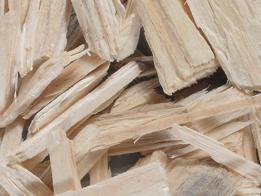
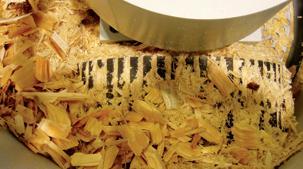
Optimum crushing of wood chips!


AMANDUS KAHL GmbH & Co. KG
SARJ Equipment Corp., Mr. Rick B. MacArthur
29 Golfview Blvd., Bradford, Ontario L3Z 2A6
Phone:001-905-778-0073
Fax:001-905-778-9613
rbmacarthur@sympatico.ca www.akahl.de
Hall 13, Stand E 02
Hannover, Germany May 30 – June 03
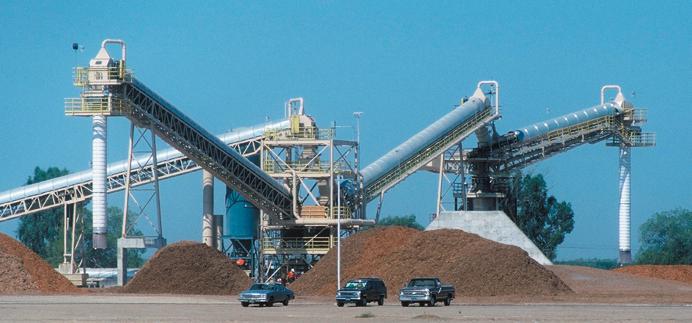
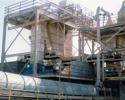

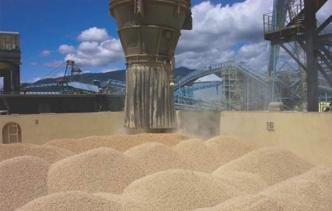
ABOVE: Bulk pellets are sealed in the cargo hold of transoceanic ships, and proper safety procedures have been developed for unloading at the shipment’s destination.
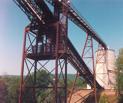
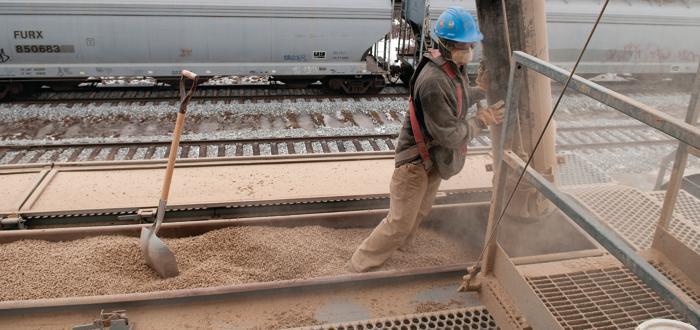
RIGHT: Short-term transit of pellets, for example, in railcars from the plant to port, presents less risk of off-gassing and self-heating than does long-distance shipping.
ties exist for wood pellets, from cylindrical silos like those used to store grains to warehousetype facilities in which pellets are loaded by conveyor and removed by a loader. Extensive research has been conducted on the storage of grains in different types of vessels in different climates; however, very little research has been conducted on wood pellet storage. What has been done has been in closed or sealed containers because of costs and other limiting factors on testing. Research to date indicates that ambient temperature is the number one factor for off-gassing and self-heating. Nothing can be done to control ambient temperature, so work must be done to control the temperature within the environment where the pellets are stored. This can be done in several ways but must be considered first prior to building a facility, and not as an afterthought.
Aeration, also known as active, mechanical, low-volume, or forced ventilation, can be defined as the forced movement of ambient air through bulk product for improvement of storability. The objectives of pellet aeration can be best described as: cooling pellets, equalizing temperatures throughout the pellets, preventing biological heating in damp pellets, circulating off-gasses, and removing odours created by off-gasses. Pellet aeration also helps prevent moisture migration and headspace water condensation in humid climates. Rates of chemical deterioration are very slow and sometimes insignificant at low temperatures, and increase significantly with each 10ºC increase in temperature. Therefore, maintaining low temperatures in the pellets is essential.
Ambient air temperature, solar radiation, atmospheric weather changes that result in major barometric pressure fluctuations, and storage structure parameters affect the transfer of heat within the stored product. South walls in the northern hemisphere and north walls in
the southern hemisphere intercept most of the solar radiation, so rectangular bins should be placed with their longer axes running north to south to help keep pellets cooler. Depending on the thermal absorptivity and emissivity of the structural material and the surface temperature, solar radiation may result in heat gain or loss from stored pellets. From the aspect of bin wall temperatures and product warming from solar radiation, insulated galvanized steel and galvanized steel are the first and second worst materials to use for bin walls.6
The easiest and most economical way to

control pellet temperatures and off-gassing may be to control it within the storage facility itself. The initial capital of building a storage facility that has aeration will be significantly cheaper in the long run than having port union stevedores constantly moving product to disperse heat within piles, like some wood chip management practices. By managing temperature, we manage both pellet off-gassing and self-heating, ensuring staff safety and pellet quality. •
Mike Curci is plant superintendent at Indeck l adysmith Biofuel Center in l adysmith, Wisconsin, and
info@silvanatrading.com
chair of the Pellet Fuels Institute Commercial Fuel Committee.
Footnotes:
1. Springer, E.L. and G.J. Hajny. 1970. Spontaneous heating in piled wood chips. TAPPI 53:85-86.
2. Kelley, S., T. Elder, and L. Groom. 2005. Changes in the chemical composition and spectroscopy of loblolly pine medium density fiberboard furnish as a function of age and refining pressure. Wood and Fiber Science 37(1):14-22.
3. Arshadi, M., and R. Gref. 2005. Emission of volatile organic compounds from softwood pellets during storage. Forest Products Journal 55:132-135.
4. Svedberg, U., H.-E. Högberg, J. Högberg, and B. Galle. 2004. Emission of hexanal and carbon monoxide from storage of wood pellets, a potential occupational and domestic hazard. Annals of Occupational Hygiene 48(4):339-349.
5. Kuang, X., T. Shankar, X. Bi, S. Sokhansanj, C. Lim, and S. Melin. 2008. Characterization and kinetics study of off-gas emissions from stored wood pellets. Annals of Occupational Hygiene 52(8):675-683.
6. Yaciuk, G., W.E. Muir, and R.N. Sinha, R.N. 1975. A simulation model of temperatures in stored grain. Journal of Agricultural Engineering Research 20:254-258.
By Treena Hein
Althoughgrowth of the biomass energy sector here in North America has lagged behind that in jurisdictions such as Europe, new pellet mills, briquette mills, and combined heat and power (CHP) operations are sprouting up—and which dryer is chosen to remove moisture from the wood residue is critical.
The choice of drying technology is greatly dependent on the customer’s situation and the available heat source, says Dirk Koltze, a spokesperson for Büttner, which has sold many units for drying wood residue in North America. “A dryer manufacturer should offer the most efficient and cost-effective dryer technology customized for the particular situation,” he says. “For example, if the heat source is low quality (such as hot water at 70º to 100ºC, lowtemperature exhaust boiler gases, or low-pressure steam at 10 to 30 PSI), ultra-low-temperature belt dryers are recommended. Such dryers compensate the low calorific value of the heat with relatively large air flows to generate the required energy for drying.”
For higher quality heat sources (such as medium-pressure saturated steam at 70 to 230 PSI or thermal oil in the range of 150º to 300ºC), indirect heated dryers are the best choice, says
Koltze. “This type of dryer is often utilized in cogeneration plants as a condenser for saturated steam coming off a turbine,” he observes. “This ‘waste’ heat stream is a very efficient and economical way for drying biomass.” Wood biomass is dried in a stationary housing that contains a rotating heat exchanger, in Büttner’s indirect heated dryers, with the heat transfer through contact and mechanical transport of the biomass. “This set-up means that exhaust air volumes are very limited, significantly reducing the need for air cleaning equipment.”
For high-quality heat sources such as flue gas from suspension burners or grate-fired systems, the company offers single-path, direct-heated rotary drum dryers. “Here, flue gases ranging in temperature between 200º and 1000ºC are utilized to dry the biomass,” says Koltze.
In Europe, harnessing the synergies of CHP and pellet or briquette production is a common practice, notes Simon Staufer, sales director for Switzerland-based Swiss Combi. “The belt dryer is the link between the two processes,” he says. “It utilizes the waste heat from power production to dry the biomass and therefore increases the heating value and standardizes the properties of the biomass.” Swiss Combi’s belt dryer uses low-temperature waste heat to dry product on a porous belt in an enclosed area.
None have yet been installed for wood residue use in Canada or the United States. “Our belt dryers are high-efficiency dryers and, like our ‘ecoDry’ rotary dryer, provide gentle drying and a low risk of fire and explosion,” says Staufer. They also offer automated operation, low maintenance costs, and long intervals between cleaning. Because the product bed acts as a filter, the dryers also produce low emissions.
The ecoDry uses indirect heat via a closed superheated steam loop and an integrated thermal oxidizer. “Due to the separation of the energy generation and the drying process, exhaust gas volume is considerably reduced compared to other rotary drum dryers,” says Staufer. Evaporated water and emissions are bled off from the closed loop and fed into the combustion chamber, where high temperatures oxidize and reduce odours, dust, VOCs (volatile organic compounds) and carbon monoxide. Although the ecoDry requires a similar investment to a direct heated drum dryer, Staufer says it provides a faster return on investment.
A belt dryer like this one is being fabricated in Germany to dry wood biomass for the University of British Columbia’s combined heat and power gasification system. This dryer, installed at a German pellet plant in Erndtebrück, uses a hot-water heat source at 105oC and has a water evaporation capacity of 14 tonnes/hour of water.
Swiss Combi hasn’t yet sold an ecoDry unit in North America for the purpose of drying wood biomass, but has sold about 10 here for drying other materials.
Andritz is another major company that has yet to break into the North American market in terms of dryers handling wood residue (the firm sells drum, pneumatic, and belt dryers), but spokesperson Joanne Turnell says they recently sold the belt dryers installed at the world’s largest pellet plant in Vyborg, Russia. Constructed by pulp and paper producer Vyborgskaja Cellulosa, the facility will have the capacity to produce 125 tons/hour of pellets. Other equipment for the plant is also being provided by Andritz, including a chip handling system, debarking lines, hammermills, and pellet mills.
Kahl is also keen to make the first North American sale of its fabric belt dryers. “The product is turned over in the dryer so that a very uniform final moisture content is obtained,” says Rick MacArthur, president of Kahl distributor Sarj Equipment in Bradford, Ontario. “At the same time that the tightly woven plastic fabric belt moves product along, it also filters dust, odour, and VOCs from the exhaust air.”
In the Bruks bed dryer, material is passed into the dryer by a spreading screw and onto a smooth loading zone plate without holes. The mat of material is then moved to a punched plate, where air passes through holes from below into the mat. Moisture migrates out the top of the mat with the air, and at the end of the process, a skimming screw is used to scrape off the moist upper layer of material, so that
only the properly dried material is discharged. A moisture sensor is used to control the depth of cut of the skimming screw. Bruks has yet to sell a bed dryer in Canada or the United States.
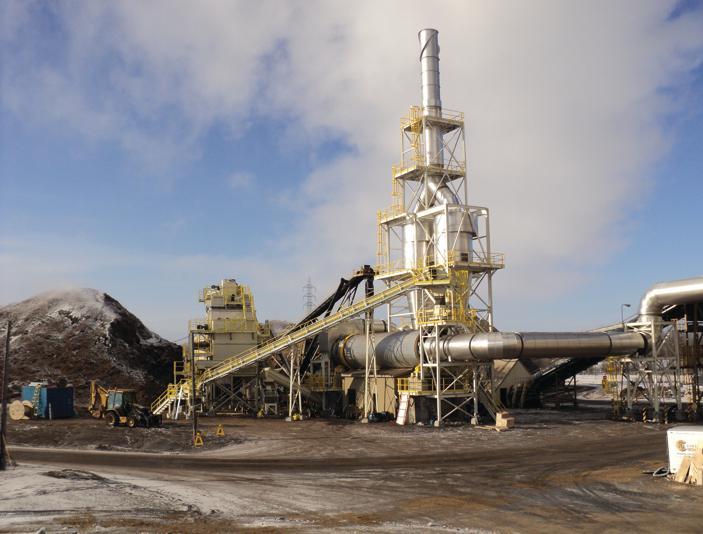
Steve Walker, owner of 18-year-old New England Wood Pellets in Jaffrey, New Hampshire, chose M-E-C rotary drum dryers for all three of his facilities. “Drum dryers are better if you’re creating your own heat on site, which we do using a furnace,”
opines Walker. He chose drum dryer technology because it’s also well proven. “M-EC is well established, and a good reputation was very important to us.” The raw materials for New England pellets come from sawmills and low-grade logs, as well as from furniture and flooring mills. Most pellets are sold for the domestic residential heating market.
At the privately owned Société de Cogénération de Saint-Félicien in Saint-Félicien, Quebec (a subsidiary of Enel Green Power


We hope you’re enjoying your free issue of Canadian Biomass, bringing you the latest on this rapidly changing industry, and its evolving opportunities.
To make sure you’re on our list as a regular subscriber, follow one of these three easy methods:
1) Email Carol Nixon at cnixon@annexweb.com, and she’ll handle the rest.
2) Visit www.canadianbiomassmagazine.ca and sign up in our subscription centre. Ask for our free e-newsletter while you’re there.
3) Fax your request to 519-429-3094, including an email address or phone number to get back to you.
North America), they chose a Büttner rotary drum dryer. When asked how they came to this decision, plant manager Marc Poirier says, “We did quite a bit of research, and at the end of this process, we approached a good number of global drying machine manufacturers and asked them if they’d like to participate in providing a turnkey operation.” Eight companies initially replied, and discussions continued with six of them. Four firms subsequently provided bids: two for belt drying systems and two for rotary drum systems. “The bids included information on cost, efficiency, capacity, and also the companies’ histories and information on similar projects that they had participated in,” says Poirier. “We decided on Büttner because they provided the best system for the price, they have a solid reputation, a long history, and had completed projects of a similar nature.” The rotary drum dryer uses boiler exhaust gases as a heat source, and the boiler receives equal amounts of dried material and wetter material that comes directly from sawmill operations. “Drying using this loop system substantially pre-heats and dries the bark, allowing us to save a lot of bark and optimize electricity production,” says Poirier. “We sell steam to a local sawmill for drying lumber and generate electricity to sell to the grid.”
A Baker-Rullman rotary drum dryer was the choice for the pellet mill at H.J. Crabbe & Sons, a long-established lumber operation in Bristol, New Brunswick. “It’s the least expensive system, and this type of dryer has been around a long time,” says owner Don Crabbe. “BakerRullman has a really good reputation, and they’ve done everything they’ve said they were going to do, so it’s worked out very well.” Pellet production began about a year ago but has been halted due to a current overabundance on the market. Crabbe says he will start the pellet mill up again later in 2011.
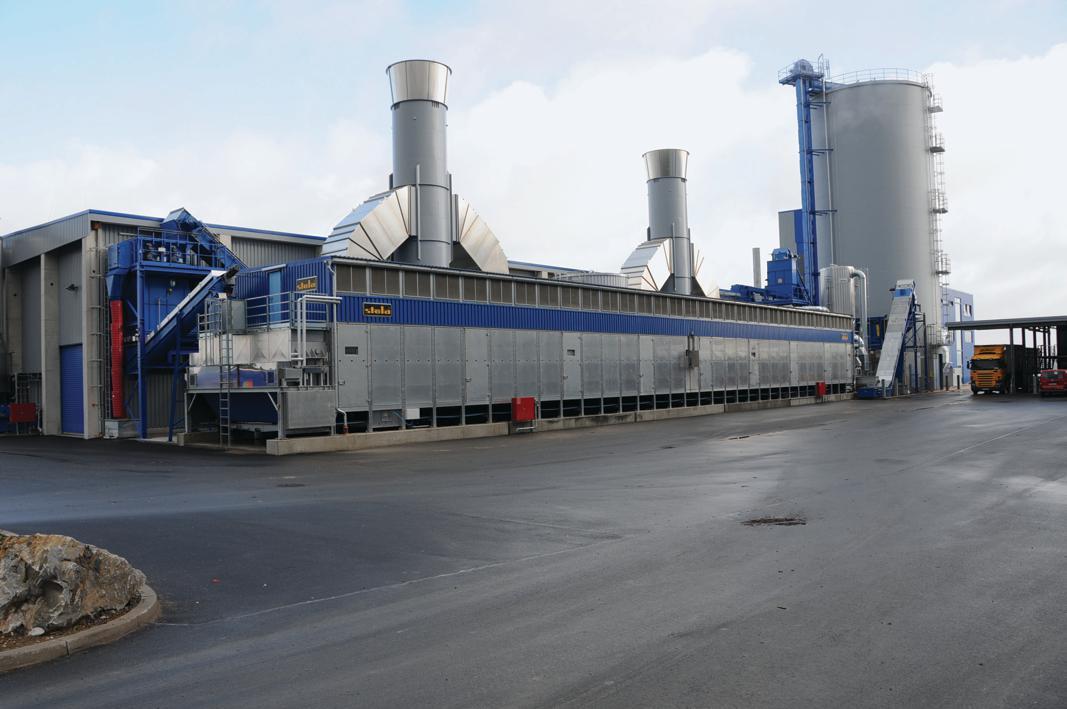
If low-temperature waste heat is available from a CHP system—such as the innovative woody biomass CHP system being constructed at the University of British Columbia (UBC) in Vancouver—and no primary energy is needed, belt dryers are the best choice in comparison to drum dryers, says Tobias Latein, spokesperson for Germany-based Stela. “The low temperature means there is no VOC in the exhaust, whereas the high temperature required for a drum dryer creates VOC,” he notes. “The fire danger is low due to a low exhaust temperature, and the low temperature also
keeps lignin intact.” Lignin is needed as “glue” for the pelleting process (if pellets are being produced), but some of it is evaporated in a drum dryer due to the higher temperature. In addition, the Stela belt is designed as a filter, so there is no exhaust air cleaning necessary. However, Latein says that because belt dryers are much larger than drum dryers because of the necessity of higher air flow with the lower temperature, they are somewhat more expensive.
In the last seven years, Stela has installed about 90 belt dryers for biomass drying in Europe. Its first Canadian sale was to Nexterra Systems, the biomass gasification company overseeing the supply and installation of UBC’s CHP system. The system is expected to be operational in early 2012. Nexterra’s vice president of projects, Goran Sparica, says a Stela belt dryer was chosen because the company has a well-established reputation with these types of systems. This specific dryer was also attractive because its particulate emissions levels are well below the current provincial standards. “The low-temperature drying using high-capacity hot water heat exchangers will reduce the moisture content in the wood residue from 50% to 20–25%,” Sparica says. “The dried material will be conveyed to the gasifier, which produces syngas. The syngas will be used to fire an internal combustion engine that will produce 2 MW of electricity and will also be used to produce steam for use by UBC.” About 30% of the woody biomass will be tree and hedge trimmings donated by the City of Vancouver; the rest will be urban wood waste sourced from local fuel aggregators.
Although the slow growth of the wood biomass energy sector in North America can be trying, companies that have yet to make a North American sale for this purpose are staying positive. “We feel using woody biomass for energy will see a long-term trend upwards,” says Kahl distributor MacArthur. “We have quality products to offer and are ready to provide the expertise and experience we’ve garnered from other uses and jurisdictions.” MacArthur would like Canada to learn from the successful European model, where drying facilities are located close to heat sources such power plants, institutions, and large commercial operations. “With access to heat sources such as steam and hot water, the viability of belt dryers can have a dramatic advantage environmentally and economically,” he says. “The Europeans are years ahead of us when it comes to these technologies, and I see us playing catch-up over the next number of years.” •

By Gordon Murray
hile promoting Canadian wood pellets, I recently visited two of Denmark’s largest power generators—Dong Energy and Vattenfall—and toured their power plants near Copenhagen. The contrast between Denmark and Canada is remarkable when considering each country’s approach to energy policy and greenhouse gas reduction.
Canada is highly reliant on energy intensive fossil-fuel-based industries. Not only has the fossil industries’ powerful lobby prevented any meaningful federal government action on global warming, it’s estimated that they receive $1.4 billion a year in government subsidies. Consequently, Canada’s greenhouse gas emissions have risen by 24% between 1990 and 2008, the result of economic and population growth in the absence of adequate government efforts to clean up the country’s energy systems. And without new government policies, emissions are projected to continue growing even more quickly.
The Canadian government has now adopted a target to cut greenhouse gas emissions by 17% from 2005 levels (equivalent to 2% above 1990 levels) by 2020. But the government has produced no plan or legislation to meet this target, and experts agree that the government’s current policies have no chance of reaching it. It is therefore difficult to avoid the conclusion that Canada’s greenhouse gas target is for the government’s public relations purposes only. This is bad news for Canadian pellet producers who eventually hope to sell their product into a domestic industrial market.
Denmark has taken a different approach. Danish government policy aims for Denmark to be a green, sustainable society by 2020 and among the three most energy efficient countries in the OECD (note: the Organization for Economic Co-operation
and Development is an organization of 34 countries, including Canada, whose goal is to stimulate economic progress and world trade). The government’s long-term vision is that Denmark will become independent of fossil fuels by 2050 while reducing greenhouse gases by 80–95% compared to 1990. This will require a total conversion of the Danish energy system, away from oil, coal, and gas, which today account for more than 80% of energy consumption, to green energy, with wind turbines and bioenergy as the most important elements.
The European Union presently has a goal of reducing GHG emissions by 20% by 2020 from the 1990 level. Denmark is urging the EU to adopt an even stricter goal of 30%.
In the short term, Denmark has adopted a plan to cut national coal consumption by one-quarter by forcing power producers to switch from coal to biomass. The idea is that the country’s five largest cities will be declared coal-free areas. The government intends for this plan to be operational by 2011.
heat are used (known as combined heat and power, CHP). The heat is captured and used to heat hot water, which is pumped through a vast network of super-insulated pipes to heat homes throughout the country (called district heating). Denmark’s best power plants are more than 90% fuel efficient. Today, more than 70% of Denmark’s homes are heated by district heating, which is extremely rare in Canada.
One of the power plants I visited was Dong Energy’s Avedøre Power Station near Copenhagen, which provides electricity for 1.3 million homes in northern Europe and district heating for 200,000 homes in
“The government’s long-term vision is that Denmark will become independent of fossil fuels by 2050 while reducing greenhouse gases by 80–95% compared to 1990.”
Because Danish biomass resources are limited, this is great news for Canadian wood pellet producers, who already have a small share of the Danish pellet market along with Sweden, Finland, and Russia.
Danish coal power plants are already remarkably efficient. Any coal plant makes just two things: electricity and heat. Most coal plants, including those in Canada, use only the electricity, sending the heat up the chimney as waste. Thus, most coal power plants are only about 30% fuel efficient. In Danish power plants, both electricity and
Greater Copenhagen. Total electricity production is 825 MW and heat production is 575 MJ (megaJoules). The facility has two units. Unit 1 is coal- and oil-fired. Unit 2 uses several types of fuel, including natural gas, oil, and biofuels (straw and wood pellets). It is one of the world’s most efficient CHP facilities, using up to 94% of the energy in the fuel. The two 55-MW gas turbines operate as peak load facilities when electricity and heat demand are high. The plant consumes 600,000 tonnes/year of wood pellets.
I also visited Vattenfall’s Amager Power Station near Copenhagen, which has a total electricity capacity of 438 MW and thermal power capacity of 747 MW, which corresponds to the heating required by about
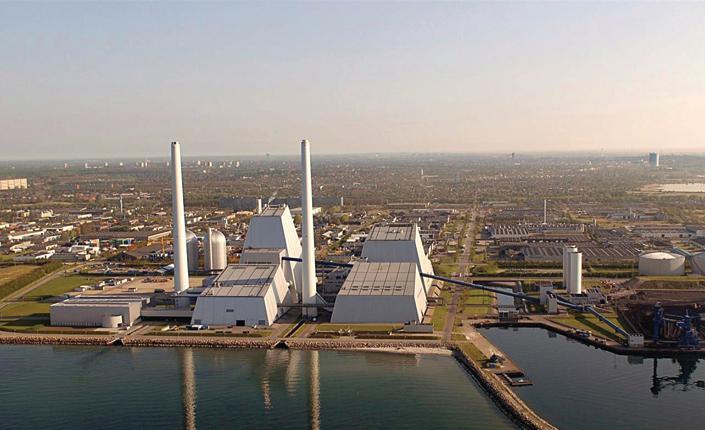
115,000 households. It has three units.
Unit 1 was originally commissioned in 1971 and burned exclusively coal. It was recently renovated and recommissioned in May 2010 and is now capable of burning oil, coal, and biomass. The new capacity is 80 MW of electricity and 331 MW of district heating. The renovated unit will save more than 600,000 tonnes of carbon dioxide emissions
annually compared to emissions created from the same amount of electricity generation and heat production based on coal.
Unit 2 was originally commissioned in 1972. It was converted to burn biomass in 2003 and now uses mainly wood pellets as fuel. It has a capacity of 95 MW of electricity and 166 MW of district heating. Unit 3 was commissioned in 1989 and has a
capacity of 263 MW of electricity and 370 MW of district heating.
The station burns about 700,000 tonnes/ year of coal. Oil is used only for start-up, and consumption is slightly more than 3,000 tonnes/year. The station also burns about 70,000 tonnes/year of biomass in the form of straw pellets and wood pellets. Biomass consumption will increase to around 150,000 tonnes annually when unit 1 is back at full production.
Denmark presently imports 85% of its annual wood pellet consumption. This figure will increase as the country implements it coal reduction plans. This presents a great opportunity for Canadian wood pellet producers.
The unfortunate news is that we are still unable to sell any pellets to power producers in our own country. We need to hope that the Canadian government will learn from Denmark and become serious about reducing greenhouse gas emissions here at home.•
Gordon Murray is executive director of the Wood Pellet Association of Canada (www.pellet.org) and can be reached at 250-837-8821 or gord@pellet.org.
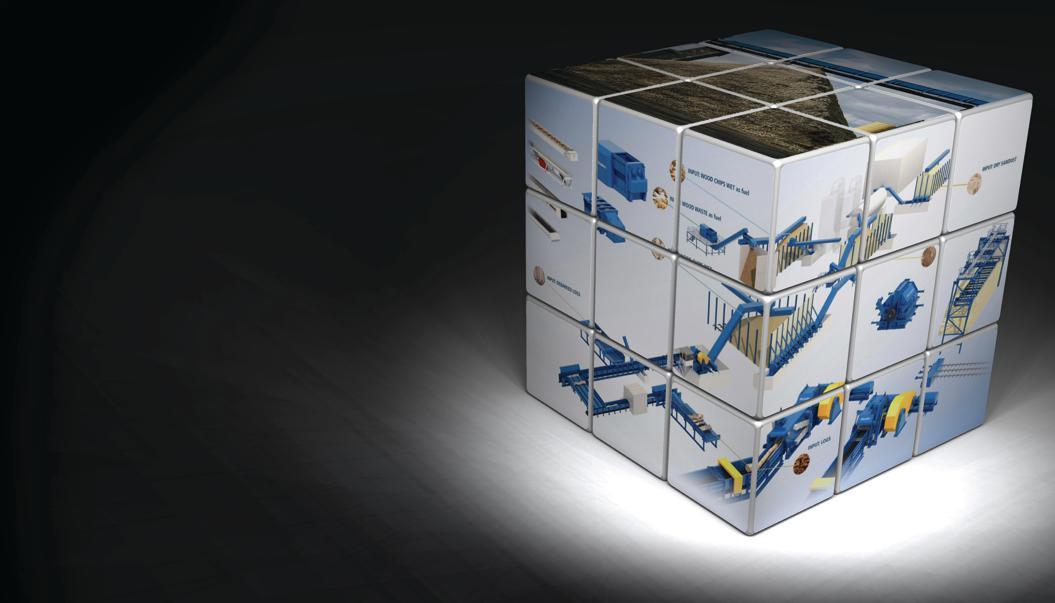
A direct-heated biomass dryer system, recently delivered by Büttner GmbH of Germany to Société de Cogénération de Saint-Félicien, will pre-dry hog fuel and landfill biomass to be used as fuel in the plant’s boiler.
This pre-drying process will increase the heat value of the fuel and require less fuel to run the plant at peak capacity, ensuring top performance during winter conditions.
A subsidiary of Enel Green Power, SaintFélicien is a 24-MW wood waste fired cogeneration facility. It produces steam and electricity from biomass via a Mitsubishi 10-stage, Alstom generator and provides for the clean disposal of sawmill wood waste.
Marc Poirier, its director, says that in 2009, the company couldn’t achieve the right ratio of fresh and previously buried bark and was forced to stop the plant for seven weeks while it made up a reserve. It was around that time the decision was made to seek the help of biomass drying companies to provide a solution. The Saint-Félicien company invited eight drying companies to submit proposals to engineer and construct a turnkey drying project. Büttner was chosen from a narrowed field of four proposals for complete systems.
Büttner developed the dryer system to use the exhaust gases from the plant’s boiler as the energy source for the drying process. The system requires only the hot exhaust, which is normally released into the atmosphere, to dry the biomass material. No additional heat source or energy is needed. The system features a direct-heated, rotary, single-pass drum dryer, ID fan, all ductwork, cyclones, steel structures, insulation, all conveying equipment, a 50-ton (45-tonne) wet-fuel storage bin, and the controls and visualization for the system.
Attention was given to the dryer’s efficiency during the design process. This involved making special provisions to prevent heat loss from the hot air duct system that connects the boiler exhaust stack to the dryer drum and customizing dryer internals designed to ensure maximum water evaporation. The dryer is designed to dry 120,000 tonnes/year of biomass by evaporating approximately 44,000 tons (about 40,000 tonnes) of water.
The Saint-Félicien project aims to optimize the use of the wood waste’s thermal capacity, as well as to promote local industrial development. The plant will produce electricity to be sold to Hydro-Québec under the terms of a
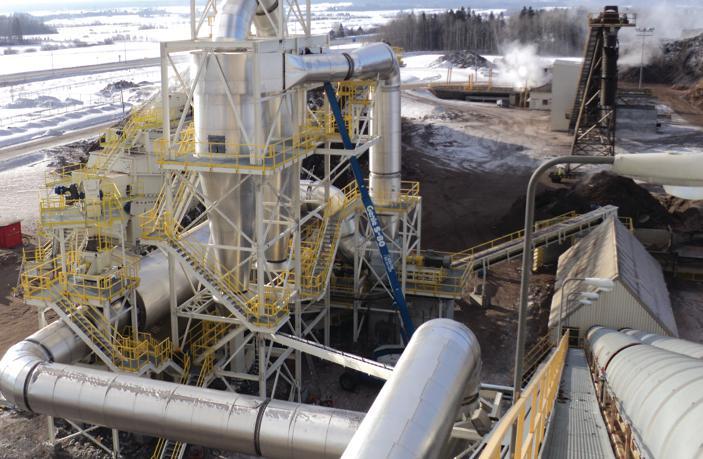
25-year power purchase agreement, steam to Alliance Forest Products’ sawmill for its wood dryers under a long-term agreement, waste ash for agricultural soil improvements, and residual hot water for agro-industrial energy requirements.
“The dryer will help us optimize and regularize our production,” says Poirier. “When we were burning wetter material, it was hard to maintain a very stable production and, therefore, it was harder to have a stable output from the plant. So for the utility [Hydro-Québec], it’s beneficial for them to have a much more stable power output from this plant.”
The project was developed and is owned by a partnership consisting of CHI Canada Inc., the Société Générale de Financement, and Société en commandité Centrale Thermique SF, the local project initiators. The total cost was $63 million, which is offset by incentives offered by the provincial government for improving the efficiency.
Installation of the dryer system was begun in November 2010, shortly before the harsh winter in this region of northern Quebec began. Production was poised to begin in early March 2011.
“We are making some modifications in the bark conveying,” Poirier says. “Because we are heating up the bark to a relatively high temperature compared to the outside temperature, and moisture content is still very high, we’re having issues with material freezing to the side of the conveyors, the bottom of the conveyers. So, we’re having to make some modifications—mostly insulation.”
Poirier says the new dryer system has undergone basic testing, is running well, and the company plans to test it further for efficiency and capacity.
– Colleen Cross


CBI unveiled its newest Magnum Force Series grinder, the Shingle Pro XL 406, in late March 2011. Because shingle grinding is one of the toughest applications a machine can do, the Shingle Pro XL 406 design features also make it ideally suited for high‐volume reprocessing of all types of material into a small uniform end product. This includes wood and bark reground into high-quality mulch, pellet feedstock, or pulverized fuel, or other feedstock such as waste material regrinding into kiln fuel.
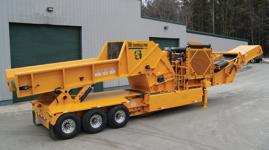
Designed for single-pass processing to a finished end product, the Shingle Pro XL 406 is big, strong, and productive. It offers high throughput and low cost per unit volume of feedstock. It comes with a powerful CAT C27, 1050-hp electric start engine; a unique hog box design, which allows the upper hog box and bonnet assembly to hydraulically lift to expose the rotor and grates for safer and easier maintenance; a heavy-duty reinforced housing with replaceable wear liners; a rugged forged rotor with heavy-duty hammers and tips that are easy and cost effective to maintain; an integrated water spray system designed to control dust in the grinding chamber, which also doubles as a colour injection system for mulch processing; a completely enclosed discharge conveyor for added dust
control; and a unique engine cooling system that prevents radiator clogging. The optional CBI Magnum Overband Magnet features an extra-strong permanent magnet enclosed in a special stainless steel frame, which allows for effective removal of metal. www.cbi-inc.com, 603-382-0556
Fecon introduces the FTX600 as its new mulching machine. This tractor brings an excellent combination of cutting performance, track power, ground pressure, and serviceability.
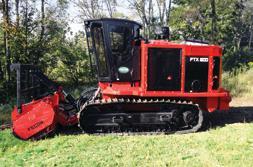
Equipped with a 600-hp Cummins QSX15 engine, the FTX600 delivers 210 gallons of hydraulic flow to the variable speed mulching head and solid power to the hydrostatic all-steel oscillating undercarriage. Fitted with either the Fecon BH300 or BH350 Bull Hog, the FTX600 can achieve 98inch cutting height and 32-inch below grade, giving the operator unparalleled range of motion. Fecon’s Power Management system optimizes torque and rotor speed, allowing the FTX600 to tackle the toughest material, the roughest terrain, and the most demanding schedules.
With 5.9-psi ground pressure, this tractor offers less ground disturbance and a lighter footprint than many in the 600-hp class. The FTX600 boasts a spacious, comfortable cab with outstanding visibility through 45 square-feet of Lexan windows. Coupled with large compartment doors, tilting cab, and efficient component layout, the FTX600 allows for easy maintenance and serviceability.
The FTX600 is ideal for a wide range of applications, including pipeline and power line right of way clearing, largescale vegetation management, and site preparation. Designed for durability and built for performance, the FTX600 is an excellent choice for the most demanding land clearing applications. www.fecon.com
Amandus Kahl Hamburg 26 Baker-Rullman Mfg., Inc. 21 Bandit Industries, Inc 7
Buhler, Inc 8 Continental Biomass (CBI) 5 CPM/Roskamp Champion 25 Electromatic Equip’t Co., Inc. 24