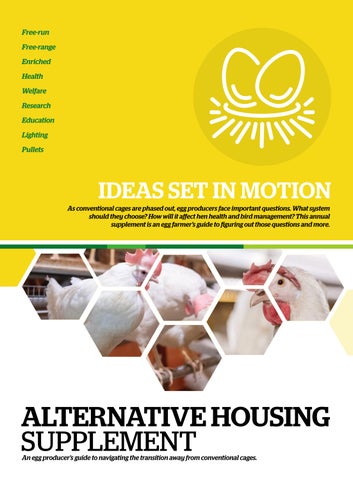
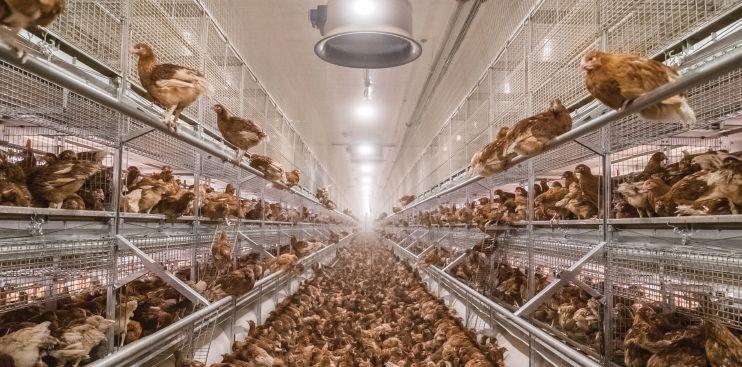
As conventional cages are phased out, egg producers face important questions. What system should they choose? How will it affect hen health and bird management? This annual supplement is an egg farmer’s guide to figuring out those questions and more.
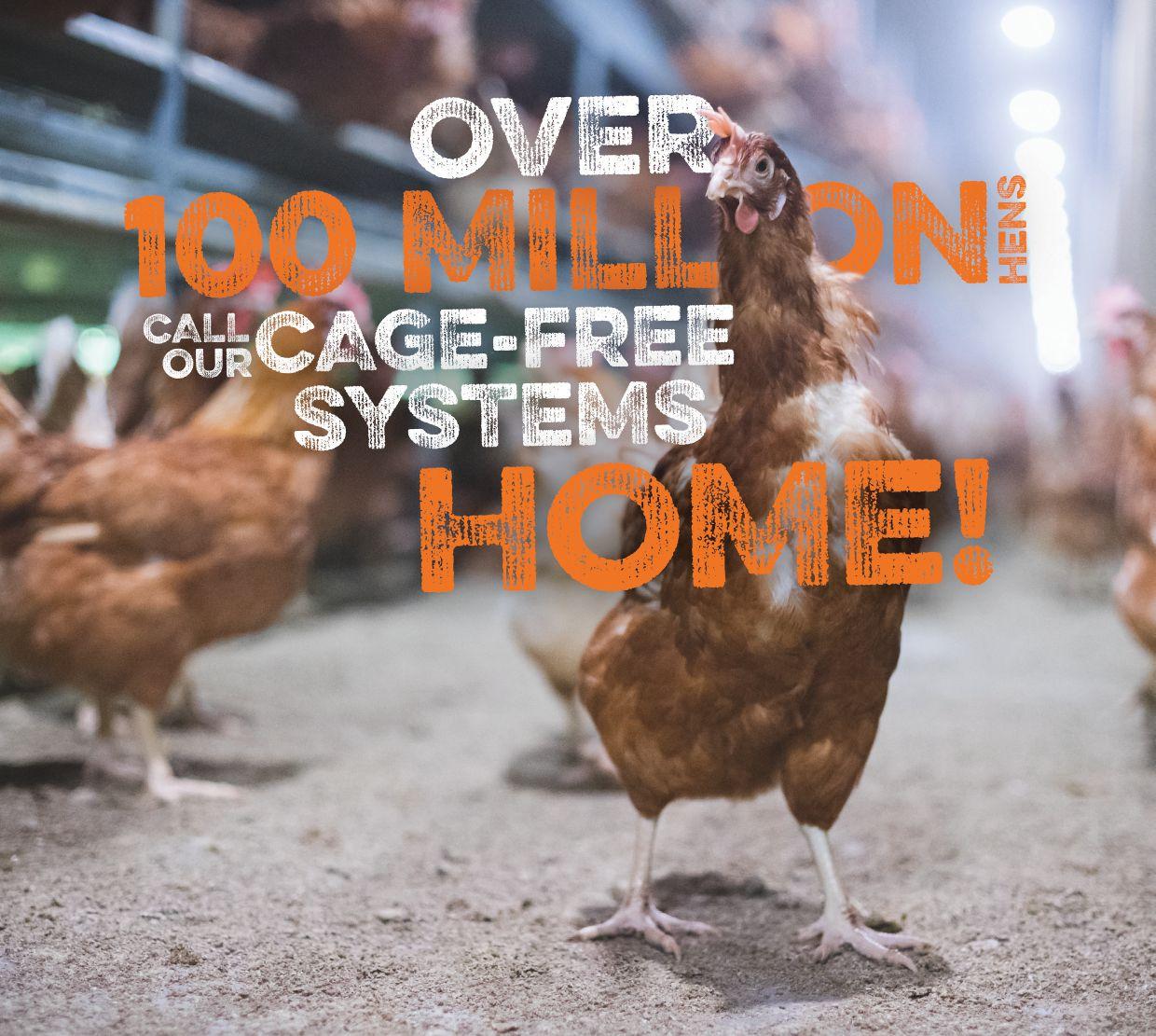
Worldwide more hens call our cage-free environments home! We offer the most options in the industry—backed by a team of highly qualified, experienced experts who are eager to help you configure the system that meets your farm’s unique requirements, and cage-free specialists to help you maximize your flock’s potential!
Trust us with your next project and experience the complete support you deserve.
What’s Hatching
Big Dutchman announces new Canadian dealer
Steve Walcott, vice president of egg production sales for Big Dutchman North America, recently announced the addition of J. Dean Williamson Ltd. as a new authorized layer equipment dealer for Canada. Located in London, Ont., the dealer will primarily focus on selling Big Dutchman rearing, enriched colony and cage-free systems for laying hens. For more information, visit jdwpoultry.com.
Study pinpoints reasons for egg farm feather pecking
As Canadian egg farmers transition their flocks from conventional cages to more spacious furnished cages, University of Guelph researchers have conducted a first-ever study on factors contributing to feather pecking in this new housing system and ways to prevent it. The study revealed that 22 per cent of the birds in the new cages exhibited moderate or severe feather damage that was likely due to feather pecking. Published in the journal Animals, the study found that several factors contributed to feather pecking, including genetics, lack of access to a scratching or foraging area and midnight feedings.
Chore-Time names new sales manager
Kevin Alger has been promoted to sales manager for Chore-Time for the U.S. and Canada, according to Jeff Miller, vice president and general manager for the CTB, Inc. business unit. In his new role, Alger will be responsible for leading Chore-Time’s sales and technical service teams that are dedicated to the poultry and egg industries. He will also support and direct the ongoing development of Chore-Time’s independent distributor network in the region.
ELTI
The European Layer Training Initiative is a newly formed consortium with representatives from Switzerland, the Netherlands, Belgium and Sweden.
The group’s first pilot training drew participants from the U.S., Canada and Brazil to learn about transitioning to non-cage laying hen housing systems.
Bridging the gap between nations for successful cagefree transition
The transition to cage-free housing has left many egg producers in the U.S. and Canada with questions on how to implement this new system successfully. For egg producers that have used conventional cages for many years, they are now in a precarious situation to make sure they change systems with as few hiccups as possible.
For European egg producers, however, this transition is wellworn territory since the cage system ban in 2012.
These differences are what formed the basis for the European Layer Training Initiative (ELTI). It’s is a newly formed consortium of representatives from Switzerland, the Netherlands, Belgium and Sweden with the goal of helping producers in the U.S. and Canada and other regions transition to non-cage laying hen housing systems.
The group plans to hold regular training days that will allow a small group to see firsthand how to manage issues sometimes encountered in a cage-free system. For example, how to identify and reduce floor eggs, feather pecking, training birds to use the systems,
creating a healthy environment for both birds and producers and how to improve your biosecurity.
The goal is that they will take this knowledge back home. The objective is not meant to influence any policy one way or the other, but offer the opportunity for participants to meet with European producers and industry leaders so that they can develop their own policies and protocols and decide what works best on their farms in their region.
This training involves a handson program as well as traditional classroom style lectures. The first pilot training drew participants from the U.S., Canada and Brazil. The participants spent one week in the Netherlands and another week in Sweden to learn best practices from egg producers.
Participants enjoyed the informative lectures, farm visits and new connections with local producers and other members of the group. Plans are in motion to organize more training sessions and continue to share knowledge for the benefit of the industry.
Visit elti.education for more information.
CAGE-FREE HEN HEALTH
Pay close attention to breed and system design for bird health.
By Bart Stokvis, veterinarian, Hendrix Genetics
In the past, managing health in a cage system layer house involved few steps. As many experienced egg producers know, a conventional cage system means small group sizes, climate-controlled houses, lower dust concentration, easy access to feed and water and a lower risk of disease. Manure can be easy separated and removed from the birds and the eggs are delivered and collected in a clean and easy to manage system.
However, from a welfare perspective, the alternative systems allow the birds to express natural behaviour such as perching, scratching, and wing flapping.
When making the switch to an alternative system, how can one maintain good health within the flock? The good news is that once you have spent some time observing the birds in the system and then making the necessary adjustments, it is possible to achieve the same technical results as in previous cage systems. Time is the biggest investment. It is important to pay careful attention to the breed used in the system and the design of the house overall.
Breed
The first factor when choosing
what breed to use in your operations is whether you are serving a white or brown egg market. After determining which colour breed you need, it is important to use a breed that is docile and robust when using an alternative system.
Within a cage-free system, the birds are able to move freely and express natural behaviours, so they use significantly more energy in their daily activity. For this reason, it is important to start out with very robust birds that continue to produce a high number of eggs, maintain good health and are able to resist disease.
Additionally, the birds must be able to seek out their feed and eat well, especially during the rearing process. Starting with a breed that has the drive to eat and will explore the system in order to find food and water will go a long way in maintaining good health.
During the rearing process, the goals are to achieve low mortality
and make sure pullets are strong with high uniformity. Pullets should be trained in moving around the system, keep a high feed intake and maintain clean and undamaged feathering. This is all possible by starting with the right genetic solution.
In addition, make sure that the system used for rearing is the same as what is used during production. Training is important so the birds can learn where to nest, eat and keep busy.
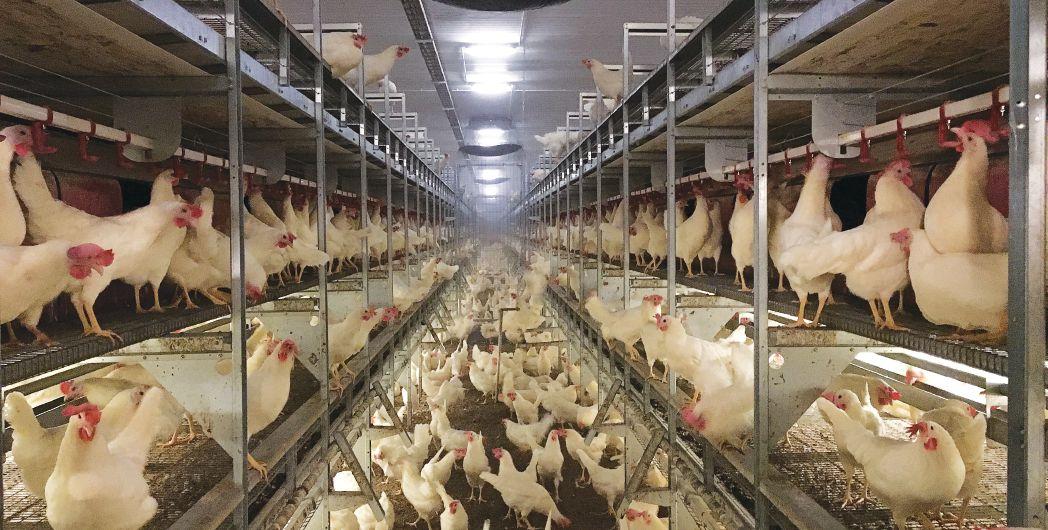
Using the right breed will also affect how you lay out the house so that the birds are able to access food, water and nests. For example, white birds are more mobile and are able to navigate the different levels of an aviary system without posts for support, whereas brown birds need more support such as ladders between levels.
Keeping your birds’ behaviour in mind when choosing a house layout will help prevent injuries when navigating the system.
it is important to use a breed that is docile and robust when using an alternative system.
Feed
The feeding technique used when managing hens is a key factor in achieving the best possible shell quality and nutrition levels. The empty feeder technique is helpful for this goal. To encourage natural feeding behaviour, especially in an alternative system, it is advised to provide at least 60 per cent of the daily feed in the afternoon.
Before this period starts, the feeders should be emptied in the middle of the day for one to maximum one and a half hours. Applying the empty feeder technique controls body weight, flock uniformity and egg shell quality. That’s because the total diet is consumed daily, including the fine particles containing important vitamins, minerals and amino acids.
Consult your technical expert or nutritionist for more detailed information on using the right type of feed for your birds.
Housing design
Choosing the right aviary system as well as the right lighting is extremely important in an alternative system. It allows you to manage behaviour and guide the birds to be able to eat and nest properly.
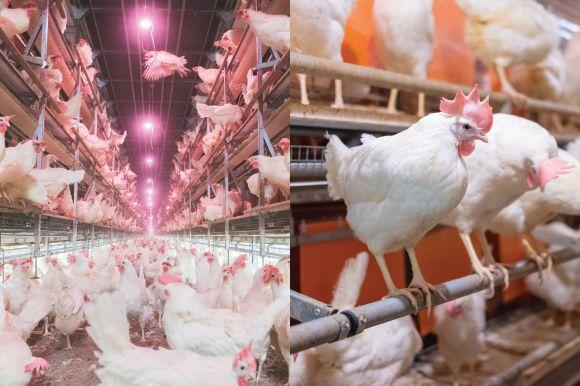
First, be sure to light where the birds can access food and water as well as the litter areas to prevent floor eggs. Additionally, the colour of the light used matters in maintaining docile behaviour. It has been found that warm spectrum lighting can calm the birds, whereas brighter, blue-tinged lighting can increase aggression.
Ventilation is another important factor. In an alternative system, fine dust is increased and can cause health issues. Using the right method of ventilation to reduce the dust and circulate air will improve efficiency and health. The air must flow so it is distributed evenly. This will keep
❖ Enriched Layer Unit Small Group “Condo Living” for Laying Hens ❖ Meeting or Exceeding 2017 NFACC Code of Practice
❖ Maximize Your Purchasing Power with Equipment made in Canada
ammonia levels low, litter dry and the birds comfortable and productive.
Since the birds are able to roam the system freely, this can increase the potential for feather pecking. It is important to maintain good feathering for better feed conversion. Nutrition can be adjusted to help with this by adding coarse soluble fibres, but you can also add items such as concrete blocks and straw bales around the system to keep the birds busy.
For an alternative layer house to be successful, the design of the system, breed selection and nutritional profile need to work together. When you have each piece in place, be sure to observe and adjust as needed. Once you have committed the extra time to learning the system, it is possible to keep the birds healthy and producing at their full potential.
UNIQUE PROPERTIES
A roundup of what sets various cagefree and enriched systems available in Canada apart from each other.
By Treena Hein
The decisions on which alternative system to choose is complex for producers, involving a wide range of factors, from market forces to durability. To help you, Canadian Poultry has contacted housing manufacturers to point out particular features of their systems that are unique, and also their best pieces of advice for making your choice.
First, here is a roundup of the latest cage-free and enriched systems offered by the housing makers that responded, and a bit about what sets each apart from the pack.
Hellmann’s aviary and enriched systems
Hellmann offers both aviary and enriched systems. Its newest enriched cages originate from its first EURO cages, and updates over time to im-
prove hen performance include, spokesperson Andreas Moors explains, moving the location of the nest to the front, which provides a shorter distance for eggs to roll onto the belt. The scratching area is now at the back wall of Hellman enriched cages, and the material of scratching area mat and nest mat has been improved. Hellman has also changed the dimensions of the enriched cage system multiple times, from smaller groups of birds to 22 to 24 birds per compartment, Moors says. The claw shorteners consist of breast plates that include holes, and Hellmann has modified the length and
amount of nest curtains as well.
Jansen’s Comfort 2.0 aviary system
Jansen Poultry Equipment introduced its Comfort 2.0 aviary system last year (distributed in Canada by Meller Poultry). “It is an open, multi-tier system making optimal use of the space in a new or existing house,” says Jansen spokesperson Ciska Borkus, “with perches, feed, and water situated at different levels in the system to stimulate the natural behaviour of the birds…The system is applicable for free-range and organic housing and is de -
The decisions on which alternative system to choose is complex for producers, involving a wide range of factors.
signed to create more living space in the house, making it possible to house more hens.” The Jansen Comfort 2.0 features the LayMaxx laying nest, ensuring high nest acceptance through a comfortable premium mat, a warm-feeling enclosure and no drafts.
Clark Ag Systems’ Tecno Plus Series enriched layer system
Clark Ag Systems’ Tecno Plus Series enriched layer system features a patented durable v-link feed chain and swing soft elevator. “The transversal perch positioning in the Plus system allows hens to move calmly and comfortably, offering added strength, stability and very clean air throughout the system,” spokesperson Stephanie Huitema says. “The illuminated scratching position in the centre of the house allows for uninterrupted natural scratching and dust bath-
ing for the hens. The dual front nest allows for a more even distribution of egg laying and creates a relaxing atmosphere for the flock with an additional laying area.”
Clark’s in-house lighting is strategically placed to give producers better control of the birds’ needs and helps mimic natural lighting, thus maximizing lay time, egg production and rest periods.
Big Dutchman’s VillaFLEX hybrid multi-tier aviary
Big Dutchman has developed the VillaFLEX hybrid multi-tier aviary that can be operated as an enriched colony housing system and can also be converted at a later date to a cage-free aviary, making it very versatile in addition to safeguarding your investment in the event that regulations evolve. “The VillaFLEX has been successfully tried and tested in the North American
market in several large commercial operations with proven results,” spokesperson Ron Wardrop notes. “Another unique and important feature is the expert support that comes with the system. Big Dutchman is the only company that has bird behavioralists who help with the transition to cage-free production. We will work closely with you to maximize the opportunity for successful laying.”
Salmet’s Pedigrow 2 system
Salmet’s All-In-One, Combi Barn and HighRise 3 cage-free systems are designed with high nest acceptance, advanced manure removal, long system lifespan and hygienic conditions. “Depending on the type of barn and how the client would like to manage his/her flock, we choose the best solution,” says Larissa (Ruby) Leitch at Ruby360, distributor in Canada. “Also, it is
Choosing
the right housing system
Equipment companies provide quick tips for producers in choosing the right housing for their needs.
Jansen: “One of the most important things to look for in a system is a high nest acceptance. This ensures a maximum number of first-class saleable eggs. The birds need comfortable, secluded and hygienic surroundings to lay their eggs and perform optimally.”
Hellmann: “It’s the best idea if the farmer visits another farmer… Hellmann has more than 400 customers across the country… [who] organize open houses…We even had farmers from Canada who travelled all the way to Germany to see some of our recent installations.”
Clark Ag Systems: “You should think about the code of practice and if the system you are looking at checks all the boxes. Animal welfare is extremely important… Production stats as well as the quality of the construction/ materials of the system for longevity, [are also important].”
Chore-Time: “Do research on performance and results of systems regarding quality of materials, durability and company reputation.”
JANSEN
BIG DUTCHMAN
CLARK AG SYSTEMS SALMET
Big Dutchman:“When considering all of the equipment choices available, a producer should consider the direction of the industry and make an investment into the most proven and profitable system possible. Everchanging guidelines and regulations mean it is important to partner with a manufacturer that understands these challenges and has the personnel and expertise to help provide solutions.”
Vencomatic: “We recommend [farmers] focus on their long-term return-on-investment. Be sure to consider all factors including barn design, equipment layouts and lifespan, labour requirements, operational and maintenance costs, bird comfort and results.”
Salmet: “We have experienced that [farmers in] countries who are in transition to cage-free egg production underestimate the importance of a well-reared bird. The success of the cage-free flock depends highly on the way the bird is raised, to perform optimally the bird needs to be raised in a matching system. Take some time to visit the rearing [pullet] farm and see for yourself how the birds behave.”
Fienhage: “Make sure you look at the long-term and calculate your labour and maintenance based on the strength of all the components, and [whether they will] stand up for the next 20 years.”
possible to combine the system types.” The Salmet nests have soft floor mats and a darker atmosphere for hen comfort. During the night, the nest floor is lifted to avoid birds sleeping in it and soiling it. The back wall can also be easily folded down for maintenance and cleaning. The side walls of the nest are made from steel, which Leitch says does not allow dirt to adhere as much as other materials. The choice of thickness and type of material for different parts of the system are designed for long life and the manure removal system comes with a durable stainless steel scraper.
Fienhage’s Easy 100 Aviary system
The Fienhage North America Easy 100 Aviary sits lower, so an average-sized person can walk it and see everything from the floor.
Spokesperson Kevin Zehr (at Ontario distributor Weeden Environments) notes that “as we transition from conventional to enriched colonies and then cage-free, we have to pay more attention to animal husbandry. We used to tell the birds what to do. Now in a cagefree system the bird tells you what to do…We know that brown birds will beat up your systems and Fienhage has been selling cagefree systems where they are almost exclusively using brown birds. Therefore, you will see unmatched
strength and quality in their enriched colony systems as well, which not only shows in the heavier gauge of steel but in their proper slope levels on their floors to minimize cracked eggs.”
Chore-Time’s Vike Aviary system
The Chore-Time Vike Aviary system offers multiple configurations and widths to fit a variety of house sizes, spokesperson Jim Kraft says. “The system is highly adaptable to many poultry house layouts, including multi-story houses with integral flooring,” he explains. “The low-profile design helps to fit existing poultry houses that are being renovated. Various configurations can be used to create the desired layout and promote optimal movement of hens throughout the house. Stainless steel legs ensure stable, sturdy construction.” Integrated VALEGO nests promote natural bird behaviour and area easy to install, clean and maintain.
Vencomatic’s Bolegg Gallery cage-free system
The Vencomatic Bolegg Gallery cage-free system allows both birds and farmers to easily move throughout the system, spokesperson Jassen Jackman explains. Low levels of stress and injury help hens reach their maximum production potential. “The Bolegg Gallery also offers flexible designs for two-, three- and four-tier systems and incorporates features like our tipping nest floor, the Vencomat nest pad, plastic slats and integration with ventilation systems like our Eco ACU heat exchangers,” Jackman notes. “These features allow us to optimize your barn layout, produce the cleanest eggs, save operating costs and reduce the environmental impact of your farm. Finally, we incorporate high-quality materials, including Magnelis galvanization, that are durable and resistant to wear, while being gentle on eggs and the hen. We know the investment in equipment is significant and it must provide long lasting value.”
FLENHAGE NORTH AMERICA CHORE-TIME
VENCOMATIC
Salmet
PEDIGROW 2 CAGE FREE CHICK SCHOOL
Pedigrow 2 rearing system for pullets has undergone some improvements. 3 versions are
• Normal Pedigrow 2
• Pedigrow 2 with raised legs
• Pedigrow 2 with raised legs and closed top tier
For poultry-keepers, this means being alert when in the hen house, watching and listening to the animals, and paying attention to their behaviour as a group as well as their individual behaviour. This usually provides much information about animals’ health, well-being and production for poultry-keepers to use for improving economic results and the well-being of the animals, as well as their own.
Poultry Signals includes points of departure allowing for more animaloriented procedures and is vital for poultry-keepers and anyone involved in poultry on a regular basis.
TRANSITION TALES
Lessons from transition trailblazers.
By Melanie Epp
In February of 2016, Egg Farmers of Canada announced their intention to transition from conventional to alternative housing systems. At that time, it is estimated that 90 per cent of Canada’s hens were housed in conventional cages. Today, producers are slowly making the transition to enriched, free-range, free-run and aviary-style housing.
For early adopters, the transition has been particularly challenging, as they’ve had to learn some of the harder lessons through trial and error. The knowledge they’ve gained is valuable to those who, in the very near future, will be faced with their own transition trials and tribulations. Here are their stories.
Harley Siemens, Rosenort, Man.
With 20 years to make the transition, many producers will wait it out to see how events unfold. Others will make the transition right away. Egg farmer Harley Siemens is the latter.
Siemens has a 16,000-pullet and 28,000-layer operation. Today, all of his birds are housed in a free-run aviary-style system. Previously, though, they were housed either in conventional or enriched cages. Spurred into action by an aging
barn that was first built in 1983, Siemens began the transition mid-summer of 2017. The entire transition was completed by March of 2019.
“If you’re going to build a whole new facility, you can start with a clean slate,” says Siemens, pointing to the difficulties that come with retrofitting an existing barn.
The second contributing factor was market demand. “We talked to our grading station and demand was increasing,” he says. “We wanted to make sure there was opportunity for both my dad and myself, so this is one way to expand our horizons but not purchase quota.”
Before making the transition, Siemens and his father toured farms in Manitoba and Ontario to see which system was the best fit for them. After careful consideration they chose a German system called the Hellmann Pro 11. They
were comfortable with the company and understood how the system worked, having worked with Hellmann in the past.
“They have the same type of feed lines, the same controllers for the egg panels and we could also keep some of our leftover parts from motors,” he says. “We have a local seller here, and we have a good relationship with him.”
Harley’s
tips
1. Before deciding, get out and look at the different systems available. The Siemens had an open house in March, and of the 170 registered Manitoba egg farmers who visited, probably 150 had never seen an aviary-style operation before. Siemens says he thinks it’s important for producers to see their options first-hand before making decisions
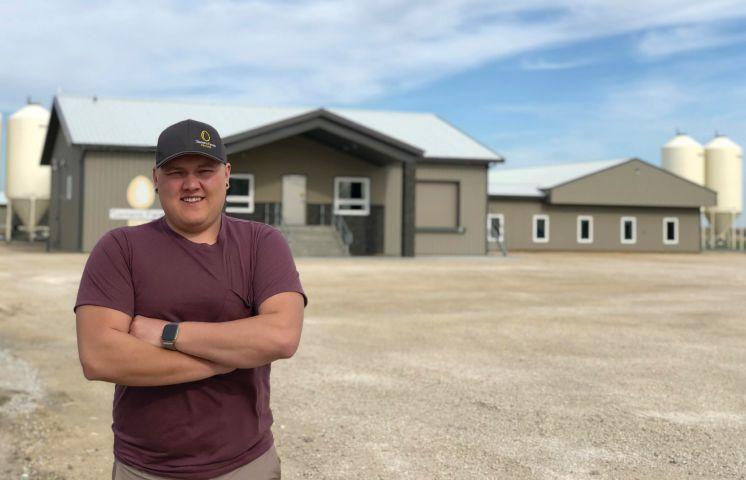
Harley Siemens led his family farm’s recent conversion to a free-run aviary-style system.
2. Make sure the local grader can handle the type of egg you want to produce and that they’ll pay a premium for it.
3. If choosing an aviary system, make sure there are aviary-trained pullets available in the area.
into the barn in the morning, pick your eggs and not have to worry about it, this is definitely not the system for you,” Siemens says. “If you like to have a challenge and you are willing to put some of the time in this is the system for you.”
“In free-run, there are always some surprises that pop up.”
“Out here in Manitoba, besides us, there’s only one other pullet aviary producer, and that guy, he’s booked up for the next five years and he ships all the way out west,” Siemens says. “If we were to see somebody build a pullet barn or grow aviary pullets for people, I think we’d see an increase. But that’s one really, really big challenge we have right now.”
Final thought: “If you want to be a farmer who wants to go
David Coburn, Keswick Ridge, N.B.
David Coburn and his two sons, Glen and Tyler, have a newly built enriched housing poultry barn in Keswick Ridge, N.B. The barn was built new last year after the decision was made to transition from conventional cages. The new barn houses 34,560 birds, a maximum they are able to fill by leasing quota from other farmers. Coburn has quota for 30,550 layers.
Before deciding which direction to take, Coburn visited
NivoMaxx® rearing system
The NivoMaxx rearing system prepares pullets for their future in an aviary system. The system trains the pullets to jump and fly and contributes to an optimal development of the pullets.
Optimal training Increased living space
After careful consideration, the Siemens chose a German aviary system called the Hellmann Pro 11.
the local egg-grading station to ask where market demand was and would be by 2019. While their plan was to build
a free-run or aviary barn, the market in Atlantic Canada wasn’t there yet, so they ended up going with furnished cages.
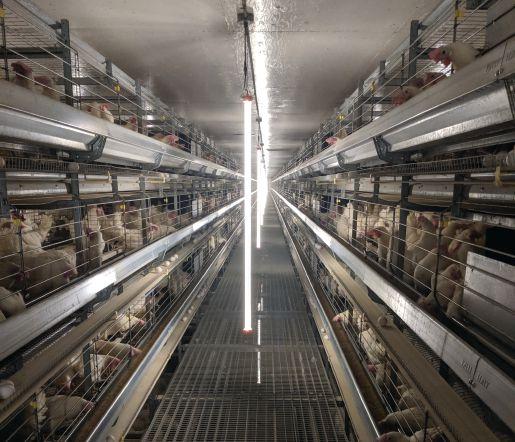
They chose a six-tier Farmer Automatic system with manure belts. There’s a catwalk between the third and fourth levels. Each bird has 750 cm2, which is up from the 432 cm 2 provided in conventional cages. Coburn added tunnel ventilation – it can do a complete air exchange in less than a minute – and has LED in-system lighting.
Enriched systems present new and interesting challenges, says Coburn. Currently, he and his sons are re-evaluating nutrition, and they’re working through kinks, like an increased number of downgraded eggs.
“We’re seeing downgrades a little bit higher just because there’s more chance for those eggs to get knocked about and hit things,” he adds. “Your cracks are a little higher than they were in conventional cages.”
They’re learning how to manage that now. Part of the problem, he says, was lighting. When in-system lighting is too dark, for instance, some birds will lay eggs off of the perch areas rather than going
into the nest box.
“For me, as a producer, that’s the exciting stuff,” Coburn says. “Running into these new challenges and figuring out a way to work around them. That’s supposed to be what the business is all about.”
Once the new barn was up and running, the Coburns hosted an open house. Some 400 visitors took the opportunity to visit the farm. “We have to educate the general public about these new housing systems,” he says. “It’s fun – it’s a beautiful, beautiful system.”
David’s tips:
1. Make sure there’s a market for what you want to produce.
2. Consider tunnel ventilation to improve air quality.
3. Explore lighting options. They go a long way in terms of training birds on where to choose to lay their eggs.
4. Consider opening your barn up to the public to help educate them on the different housing systems in Canada.
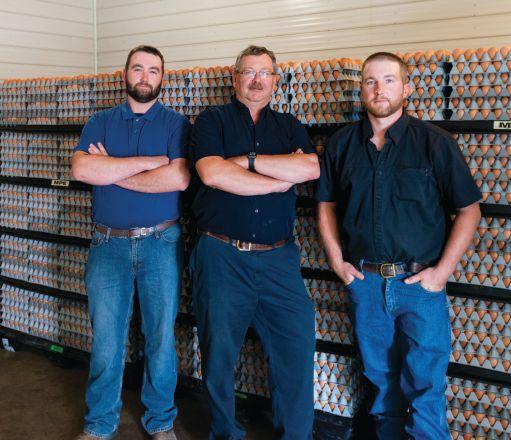
David Coburn (centre) and his sons Tyler (left) and Glen.
The Coburns chose a six-tier Farmer Automatic system with manure belts.
James Krahn, Abbotsford, B.C.
James Krahn is a third-generation poultry farmer who works alongside his two brothers on the family farm. Together, they manage six poultry farms and a commercial feed mill.
The farms are diversified with broiler, turkey and layer productions, of which three are dedicated to eggs.
The farm has two enriched barns with 46,000 and 53,700 layers, and four freerun barns that were transitioned between 2014 and 2016. Two of the free-run barns have 6,500 birds, one has 8,500 and the other has 7,800 birds. Two conventional barns remain, one of which will begin transitioning to enriched housing beginning September 2019. The other will be decommissioned in a couple of years, Krahn says.
Market demand has played an integral part in determining which system they choose. Currently, the conventional barn holds 33,000 birds. Once the enriched barn is up and running in 2020, it will house 53,700. At one point, all birds were housed in conventional cages.
The first transition out of conventional housing took place in 2014. The Krahns had some older barns that weren’t being used and market demand for specialty eggs had increased. The challenging part for them was deciding what type of system they wanted to use.
“We knew we wanted to be in the freerun category, but we just didn’t know what type of system would be most feasible for our existing structure,” Krahn explains.
While they could have gone with an aviary system, there were few in the area to tour. In those they saw, flock management looked daunting when compared to a single-tier floor system, Krahn says. At the time, the decision was easy: go with a single-tier floor system.
Looking back, Krahn realizes that an aviary system would have better utilized the barn space they had.
“Now that there is so much more ex-
perience with aviary systems, and the system utilizes barn space so much more efficiently, I don’t think there are a whole lot of producers now who would install a single-tier system,” he says. “The management practices and understanding of how to operate aviary production has come so far in the last few years.”
James’ tips:
1. Understand market demand before choosing a system.
2. Make sure you thoroughly understand codes of practice, so you’re not building too small or limiting your potential to switch egg categories.
3. Talk to other producers who have already transitioned to get a better understanding of the pros and cons of each system.
Final thought: “All systems have their strengths and qualities, for sure,” says Krahn. “I think free-run is great. The behaviour of the birds – they all kind of have their own personalities. It’s a lot of fun working with free-run production, but it’s also challenging. Some of those challenges are rewarding once you can work through them.”
“In conventional, behaviour is not as crucial, so you’re working more with the mechanics and flocks are a little more rhythmic. In free-run, there are always some surprises that pop up. Enriched systems have some similar qualities to conventional. In enriched, though, the bird behaviour is more similar to free-run, but it is easier to manage.”
The Krahns have two enriched barns and four free-run barns that were transitioned between 2014 and 2016.
CRPC Update
By the Canadian Poultry Research Council
The Canadian Poultry Research Council, its board of directors and member organizations support and enhance Canada’s poultry sector through research and related activities. For more details, visit cp-rc.ca.
Impact of housing changes on layers
As part of the Poultry Science Cluster III projects, Egg Farmers of Canada (EFC) has sponsored important laying-hen welfare research led by Tina Widowski at the University of Guelph. The project is titled Identifying developmental determinants of successful behavioural adaptation and musculoskeletal health of egg-laying hens.
It brings together nine Canadian and American poultry scientists with expertise in laying hen behaviour, health, welfare and management. Researchers include avian biologists with expertise in biomechanics and energetics of flight and ground locomotion, and biomedical researchers with expertise and the most advanced techniques for studying bone biology.
In order to cover all the project objectives, four subprojects have been developed with their specific hypothesis, objectives and design.
Subproject #1: Rearing pullets
The first subproject, managed by Widowski, is titled Effects of rearing pullets in different styles of commercial aviaries on their physical and behavioural characteristics. The success of egg-laying flocks depends to a great extent on hens’ adaptation to their housing system. For hens in a noncage system, there are greater risks for injuries and mortality compared to cage systems.
This subproject will compare the effects of rearing birds in different styles of commercial aviaries on behaviour and musculoskeletal development. The main difference between styles of rearing aviaries is the amount of enclosure and 3-D complexity provided to chicks during the first few weeks of life, affecting their early opportunities for exercise and
exploration.
In all styles of rearing aviaries, the enclosures are eventually opened to provide pullets access to litter, terraces and ramps, but this usually does not occur until four to six weeks of age.
Subproject #2: Lighting
The second subproject, Effects of light intensity on activity patterns of pullets and their ability to negotiate space and furnishings, is managed by Karen Schwean-Lardner at the University of Saskatchewan. The overall objective of this section of the project will be to determine the effect of light intensity on activity patterns, locomotory abilities, behavioural characteristics and musculoskeletal development of different strains of pullets housed in non-commercial aviaries.
Although the researchers expect differences in use of space, patterns of locomotion and activity levels in different styles of rearing aviaries and by different strains of bird, they also know that activity patterns of pullets and layers are significantly altered by light intensities. However, little to no work has been done on the effect of light intensity on the behaviour of pullets or on their
The research project was broken into four subprojects covering rearing, lighting, wing use and bone adaptation.
willingness to negotiate complex perches or complex space.
Subproject #3:
Locomotion
The third subproject is titled Wing use and disuse hypothesis: the missing link to understand keel bone damage in adulthood and managed by U of G’s Alexandra Harlander. This section of the project will focus on the biomechanics and physiology of locomotion and effects of muscle use upon keel bone damage in the adult laying hen. Scientists will use robust experimental protocols to manipulate use of different muscle groups, in particular, the two major muscles that control the wings (pectoralis and supracoracoideus).
Subproject #4:
Bone adaptation
The fourth subproject, Effects of age, strain, exercise and circadian rhythm on skeletal mechanoresponsiveness, calcium homeostasis and bone quality, is managed by Bettina Willie and Svetlana Komarova at McGill University. The objective of the project will be to test the hypothesis that bone adaptation to mechanical stimuli and calcium homeostasis are affected by chicken strain, age and exposure to exercise.
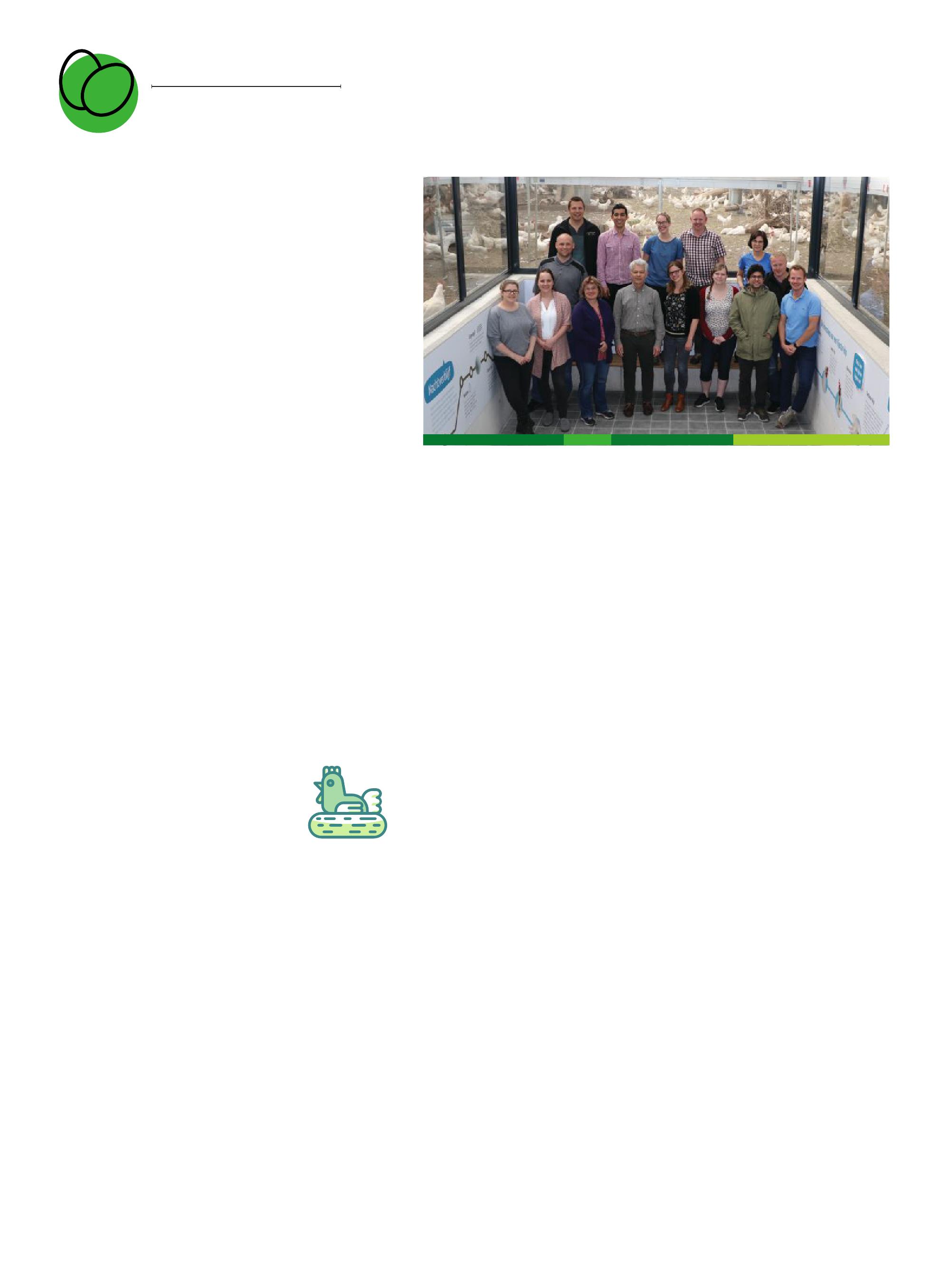
University of Guelph’s Tina Widowski will lead a team of researchers looking at the potential impact of housing changes on layers.