MICHEALS MEMOIRS July 2003 UPDATE TASTE OF TRANSLATION AND LINGUISTICS
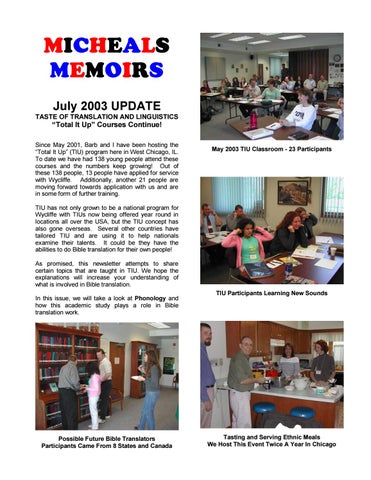
“Total It Up” Courses Continue! Since May 2001, Barb and I have been hosting the “Total It Up” (TIU) program here in West Chicago, IL. To date we have had 138 young people attend these courses and the numbers keep growing! Out of these 138 people, 13 people have applied for service with Wycliffe. Additionally, another 21 people are moving forward towards application with us and are in some form of further training.
May 2003 TIU Classroom - 23 Participants
TIU has not only grown to be a national program for Wycliffe with TIUs now being offered year round in locations all over the USA, but the TIU concept has also gone overseas. Several other countries have tailored TIU and are using it to help nationals examine their talents. It could be they have the abilities to do Bible translation for their own people! As promised, this newsletter attempts to share certain topics that are taught in TIU. We hope the explanations will increase your understanding of what is involved in Bible translation. In this issue, we will take a look at Phonology and how this academic study plays a role in Bible translation work.
Possible Future Bible Translators Participants Came From 8 States and Canada
TIU Participants Learning New Sounds
Tasting and Serving Ethnic Meals We Host This Event Twice A Year In Chicago
Q: What is a Contrast In Identical Environments?
PHONOLOGY Q: What is Phonology?
A. Phonology is the study of a language’s unique sound system. Examining the ways that people speak, and how they perceive their own language helps to unearth significant patterns. Most speakers are quite unaware of these patterns or rules in the way they talk. Through proper analysis of a language’s sounds, its people can be advised in their determination of an alphabet. For example, some sounds seem intuitively to go together and the people may write them as a single sound. At other times special symbols are needed to represent sounds that are unique to their own language. Phonology involves the identification of phonemes and their allophones. These are the technical words for sounds and sub-sounds. The section below describes the process. See how you follow and if you enjoy the experience, we need to talk!
A: CONTRAST IN IDENTICAL ENVIRONMENTS, as the name suggests, is when a sound differs from another sound in an otherwise identical environment. Examples below are in the contrasting vowels in the first two words between ‘w’ and ‘y’ and in the last two words in the final syllable following the ‘t’. e.g. [e] and [i] [weyotal] [wiyota] [bate] [dati]
‘open’ ‘carry’ ‘hole’ ‘stone’
Q: What is a Complementary Distribution? A: COMPLEMENTARY DISTRIBUTION is when a certain sound behaves differently according to its environment. The below describes what happens in English to the letter we call ‘p’. We may write it the same but phonetically there are distinctions. e.g. comparing [pH] and [p] [p] occurs following [s] [spQt] ’spat’ [pH] occurs elsewhere [pHQt] ’pat’
Q: What is a Phoneme?
The two phonetic sounds are allophones of the phoneme /p/. A rule determines which one is spoken.
A: A PHONEME is the smallest unit of a sound system that makes a difference in meaning. In English there are about 40 phonemes, made up of vowels, diphthongs and consonants.
When sounds are in Complementary Distribution we are able to represent them with one symbol. This works toward a more stream-lined alphabet unless social factors influence the use of both letters.
Phonetic sounds are written in square brackets [ ], while phonemic text is written in slanted brackets / /. • •
•
In ‘pit’ and ‘bit’ [p] and [b] change the meaning, so they are separate phonemes /p/ and /b/. [phul] ‘pool’ and [spul] ‘spool’ have different types of “p”, but we think of them as one sound; it doesn’t make a meaning difference, so in English they are one phoneme /p/. In Thai, [paa] ‘forest’ and [phaa] ‘to split’ mean different things, so in Thai they are separate h phonemes /p/and /p /.
Q: What is an Allophone? A: ALLOPHONES are the phonetic variations of a phoneme. Allophones do not occur haphazardly. They occur in patterns or according to rules in any given language. The native speaker knows these rules intuitively and speaks accordingly. A linguist’s task is to search them out!
Julie Barr (TIU alumni) Our May TIU Teaching Assistant
Area Coordinator Program Grows! A number of months ago we reported to you about our Area Coordinator program in Minneapolis, Minnesota. We are happy to report that the Lord has sent new personnel to staff a new Wycliffe office in Northern Indiana.
TIU R & R
Barry & Denise Hohulin are returning from field service in Brazil and desire to recruit new Wycliffe members from Northern Indiana. Barry will be the primary recruiter since Denise is caring for young children at home. Will you pray for Barry & Denise? They need to establish a home in Indiana, get reconnected with their home church and find schools for their children. As well they need increased financial support. Since living in the USA is more expensive than living overseas, the Hohulins must raise their support level 35% before they can begin their work. Please pray that their church, friends and family will remain committed and that new supporters will join the team.
TIU Field Reports Aramaic Bible Translator’s Report (www.aramaicbible.org)
May 2003 TIU Participants and Staff
Every international company needs home-assigned staff and so does Wycliffe! Yet some churches only desire to send their missionaries overseas. Recruiters are vital in presenting the challenge of Bible translation to the next generation. Young people, even retired persons, need to know that the Bible translation task is not complete.
Barry Hohulin Helping Out At The May TIU
You’re Invited!!! - An Open House For The Nanongs We are hosting on Open House for the Nanongs on Sunday, July 27, 2003 from 2:00 PM – 5:00 PM in Kalamazoo, Michigan at the Second Christian Reformed Church (3015 Nichols Road). If you are able to come, could you RSVP to us by July 20, 2003 so we can plan accordingly? Our phone and email address is found below. Please do not RSVP using the U.S. postal system since we will be on the road with the Nanongs for 3 weeks prior to the Open House. Please call or email.
PRAISES • • •
Papua New Guinea Friends To Visit The USA This Summer Our good friends, Gware and Arina Nanong from PNG will be visiting us this summer for six weeks. We have been asked by the SIL PNG Branch to take them around to various Wycliffe offices around the USA in addition to a visit to Washington DC. Over the years, Gware and Arina have become two of our closest PNG friends. When we arrived in PNG in 1985, Gware was the Assistant Manager of the SIL Members’ Store that Chuck ran for SIL. Arina was a cashier. In 1991 SIL asked them to move to Port Moresby, the capital city, and become government relation officers. Since then, Gware has handled most of the government paperwork that the PNG SIL Branch needs to operate in the country. Arina has worked in the office there. Since Gware’s work involves corresponding with the PNG Embassy and other agencies in the States, the PNG Branch has asked us to help them visit these places and the people they have been working with. Gware and Arina have served with SIL in PNG for over 30 years! They are true partners in this work. They also are a neat Christian couple and are very busy with assisting their local PNG church. As you have supported our work these past eighteen years, you have indirectly supported the Nanongs and others like them. Papua New Guineans are themselves now involved in the work of Bible translation because of your support. Thank you for your prayers and financial support that keep us recruiting and others translating!!!
• •
For 65 Wycliffe applications from our region turned in this fiscal year. Isaac successfully finished his first year of teaching in Haiti. He plans to return this fall. Josh & Maria were accepted as Wycliffe missionaries and hope to begin training this fall. Jenny was accepted for a semester of school at the Bible Institute of South Africa. She leaves in January for 6 months of Bible school training. Chris and Rachel were able to buy a new house in Omaha, NE.
PRAYER • • • •
Pray for the August 2003 TIU course. So far we have 14 participants coming. Pray that we will have a full class of 25 students. That our support would increase. It has gone down some these past few months. Pray too that the Mishler’s support would come in soon. For organizational changes now underway in Wycliffe which will affect who we report to. For direction on a future assignment after our term here finishes in August 2004. We are thinking of returning to an overseas assignment.
FOR PRAYER SUPPORT / OUR HOME ADDRESS Chuck & Barb Micheals 123 Wycliffe Drive West Chicago, IL 60185 Tel: (888) 876-1056 (cell) Email: Chuck_Micheals@wycliffe.org Barb_Micheals@wycliffe.org FOR FINANCIAL SUPPORT Wycliffe Bible Translators P. O. Box 628200 Orlando, FL 32862-8200 Marked for ‘Chuck & Barb Micheals’ We would like to communicate with you via email. If you wish to receive updates by email, please send us your email address.