Window & Facade Magazine Global (October-December 2025)
INDUSTRY SPEAKS
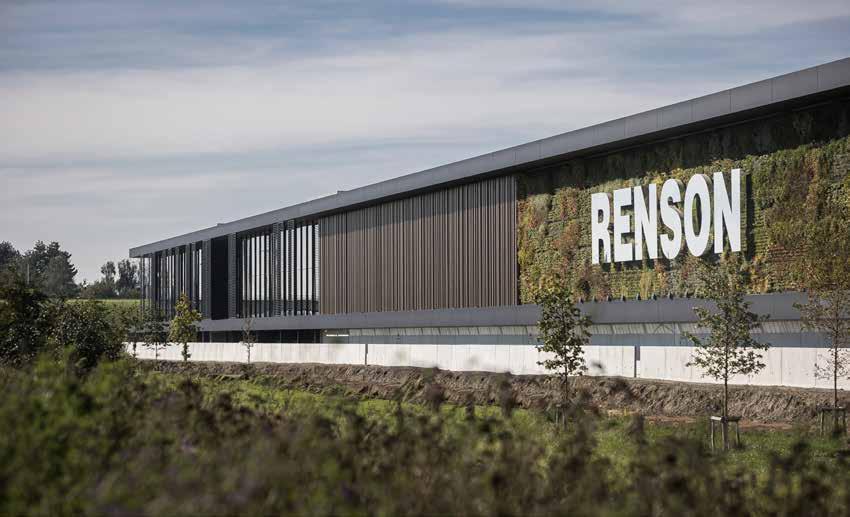
Interview with OLIVIER VIJVERMAN, Export Director - APAC, the Middle East and India, Renson
THE NEXT ERA OF FAÇADES: INTELLIGENT AND RESPONSIVE DESIGN
Expert’s view on the future of facade technologies and the design transformations in the coming years
TO FACE
Interview with DR. DIAAELDIN ALY, Chairman & Founder, DIA Architects International Consultancy
FACE
Preface
Dear Readers,
As our cities continue to grow upwards and outwards, the façades that cover our buildings are quietly stepping into a new era. They are no longer just the outer shell we pass by without a second thought. Today, façades influence how we feel inside a space, how much energy a building consumes, and even how safely it performs in unexpected situations. Recent global incidents have already reminded us of the risks that come with neglecting the role of external walls, and these lessons must guide the way forward.
The promise ahead is exciting, but it comes with responsibility. Future façades need to be more than weatherproof layers. They should actively help buildings breathe, adapt, and thrive. Imagine skins that adjust themselves to sunlight, panels that generate electricity without being noticed, and materials that clean the air rather than pollute it. These ideas are no longer distant dreams— they are rapidly becoming real possibilities.
What makes this moment particularly important is that innovation alone is not enough. We must pair creativity with caution. Around the world, regulations still vary widely, allowing materials and systems to be used in some places that would never pass scrutiny in others. This inconsistency puts both people and cities at risk. If we want façades that truly work for the future, we need shared standards, shared accountability, and a shared commitment to quality.
Thankfully, technology is on our side. Designers today can test, simulate, and refine façade behaviour long before a building ever begins to rise. Digital tools allow us to predict how a façade will respond to heat, wind, or even emergency conditions, giving us the chance to make smarter choices from the very start.
The future façade will be intelligent, sustainable, and deeply connected to the wellbeing of those who live and work behind it. As our skylines evolve, so must our thinking about the surfaces that define them. The challenge is significant, but so is the opportunity.
We would love to hear your views as we continue exploring this important topic. Do write to us at editorial@wfmmedia.com—your thoughts help shape the conversations that matter most.
06
18
28
Integrating Sustainable Living Principles into Future Building Designs
RAHUL NIKAM, Digital Director, A+B Digital Consultant Ltd.
Net Positive Buildings and Energy Positive Design
DENIS UCHE AKABOGU, Founder, SheltaGroup: Sustainable Design & Construction Developers
Public Policy in Advancing Sustainable Façade CRISANTO FADEL, Façade Engineer
Engineered Transparency: The Vital Role of Safety Glass JINCY MARIAM RINU, Lead Façade Engineer, GHD
Sustainable Architecture Vision for Building a Greener Futurey MUHAMMAD NADEEM, Project Manager, A&I Renovation Inc
The Next Era of Façades: Intelligent and Responsive Design Expert’s view on the future of facade technologies and the design transformations in the coming years
Industry Speaks
Interview with OLIVIER VIJVERMAN, Export Director - APAC, the Middle East and India, Renson
48 Face to Face
Interview with DR. DIAAELDIN ALY, Chairman & Founder, DIA Architects International Consultancy Firm
Visit us @ ZAK DOORS & WINDOWS EXPO 4th to 7th December, 2025, Mumbai, Hall 1, Stall Number D1A2
Future Façade
Integrating Sustainable Living Principles into Future Building Designs
RAHUL NIKAM Digital Director, A+B Digital Consultant Ltd.
ABOUT THE AUTHOR
Rahul Nikam, with a solid foundation in architecture and a specialisation in Building Information Modelling (BIM), has provided AFL Architects and Clancy Consulting with strategic oversight in integrating advanced technologies and communication strategies. His tenure as a BIM Consultant and Coordinator has been characterised by a dedication to refining project dynamics and fostering efficient workflows. At the heart of his professional drive is a commitment to excellence and a passion for innovative BIM applications that enhance team collaboration and project outcomes. Drawing on skills honed over several years, he has enabled teams to navigate the complexities of BIM adoption and to deliver projects that are both meticulously planned and executed.
We are witnessing a revolution in how we construct buildings, and it is all about making them smarter, greener, and more people-friendly.
Picture this: your office or home not only looks sleek but also generates its own energy, cleans the air you breathe, and keeps you cozy without harming the environment. How? It is all about rethinking the way we design façade systems.
Here are some cool ideas for the future:
• Energy Generation: Imagine if your building’s façade could harness the power of nature to generate electricity. Wind turbines, solar panels, and even systems that capture energy from raindrops could be seamlessly integrated into the design. That means your building could produce its own clean energy, reducing reliance on traditional power sources.
• Breathable Walls: Forget bulky insulation—imagine walls that breathe! Instead of blocking heat, these innovative walls would absorb and store it when it is hot outside, then release it when temperatures drop. It is like having a natural thermostat for your building, keeping you comfortable while reducing energy consumption.
• Air Purification: Say goodbye to air pollution! Façade systems of the future could feature biofilters that trap pollutants and convert them into clean
air. It is like having a built-in air purifier, ensuring that you always breathe fresh and healthy air indoors.
• Maintainable and Sustainable: Future façade systems will not just be high-tech—they will also be easy to maintain and good for the planet. By using sustainable materials and design practices, we can create buildings with low carbon footprints that stand the test of time. Plus, with smart monitoring systems, any issues can be detected and addressed quickly, keeping your building running smoothly.
In a nutshell, the future of façade systems is all about innovation, sustainability, and improving our quality of life. By harnessing the power of nature and cutting-edge technology, we can create buildings that not only look cool but also make the world a better place.
Future façade systems will not just be high-tech—they will also be easy to maintain and good for the planet
The future of façade systems is all about innovation, sustainability, and improving our quality of life
Sustainable Buildings
Net Positive Buildings and EnergyPositive Design
Founder, SheltaGroup: Sustainable Design & Construction Developers
ABOUT THE AUTHOR
Arc. Denis Uche Akabogu is an Architect, Construction Manager, Management Consultant, and Sustainability Advocate and is driven by a mission to transform the built environment through design solutions that are humane, green, and smart. With decades of experience leading high-impact projects across Nigeria in aviation, banking, insurance, education, and religious architecture, he serves as the Founder and CEO of SheltaGroup, where he leads the delivery of innovative, efficient, and human-centred construction and design solutions. He is also the creator of Symbiature, a distinctive design philosophy rooted in the integration of Humane, Green, and Smart (HuGS) principles. Symbiature advances architecture that prioritises human well-being, environmental sustainability, and technological intelligence — fostering regenerative, resilient, and future-ready spaces.
In the quest for sustainable and environmentally responsible building practices, the concept of net positive buildings has emerged as a transformative force in the field of architecture and construction. This innovative approach goes beyond the mere reduction of a building’s environmental footprint; it seeks to make a positive contribution by generating more energy and resources than it consumes. At its core, net positive building design aims to create structures that are not only self-sufficient but also give back to the grid, actively participating in the fight against climate change.
1.1 DEFINING NET POSITIVE BUILDINGS
To embark on our journey into the world of net positive buildings and energy-positive design, it is essential to first understand precisely what we mean by “net positive.” Net positive buildings, often referred to as energy-positive or regenerative buildings, represent a fundamental
shift from traditional construction paradigms. These buildings produce more energy and resources than they consume during their operation, achieving a remarkable equilibrium between human habitation and the natural world.
UNDERSTANDING NET ZERO VS. NET POSITIVE: CLARIFYING TERMS
Before delving further, it is crucial to distinguish between the terms “net zero” and “net positive.” While net-zero buildings aim to balance their energy consumption with onsite energy generation, net positive buildings surpass this equilibrium. They not only offset their energy consumption but generate an excess, contributing clean energy to the grid.
KEY COMPONENTS OF A NET POSITIVE BUILDING
The anatomy of a net positive building involves several critical elements. These include advanced energy-efficient systems, renewable
energy generation, resourceefficient materials, and innovative architectural design. Together, these components form the foundation of a building that operates as a netpositive entity.
THE ROLE OF ENERGY PRODUCTION AND CONSERVATION
Energy lies at the heart of net positive buildings. They harness renewable energy sources, such as solar panels and wind turbines, to generate electricity. Simultaneously, these buildings prioritise energy conservation through cuttingedge technologies and sustainable practices. The synergy between energy production and conservation is pivotal to achieving net positivity.
THE SIGNIFICANCE OF ENERGYPOSITIVE DESIGN
Addressing Climate Change and Environmental Impact:
The imperative to combat climate change has never been more pressing. Net positive buildings offer
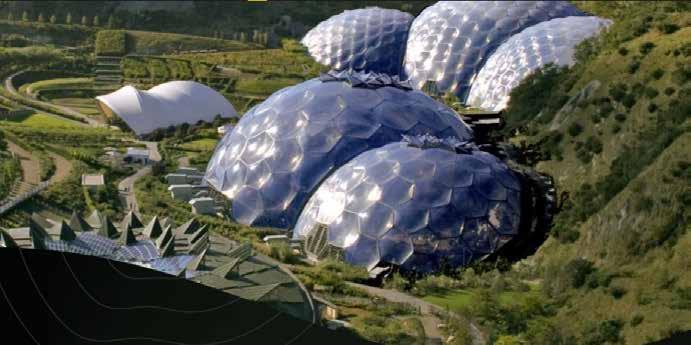
Eden Project Cornwall, England Image courtesy: Google
a proactive solution by reducing greenhouse gas emissions and mitigating the environmental impact of the built environment. They serve as beacons of sustainable living, setting new standards for ecoconscious construction.
Energy Security and Resilience in Built Environments: In an era marked by increasing energy demands and vulnerability to disruptions, energy security is a paramount concern. Net positive buildings enhance resilience by generating their own energy, thereby reducing dependence on centralised energy grids. They are better equipped to weather energy crises and power outages.
Economic Benefits and Cost Savings: Beyond their environmental advantages, net positive buildings yield substantial economic benefits. Their energy surplus can be sold back to the grid, resulting in income generation for building owners. Additionally, reduced operational costs stemming from energy
efficiency translate into long-term savings.
Human-Centric Design: Enhancing Quality of Life: Net positive buildings are not solely focused on energy; they also prioritise the well-being of occupants. These buildings are designed with occupants’ health and comfort in mind, incorporating features like improved indoor air quality, natural lighting, and advanced climate control systems.
In this exploration of net positive buildings and energy-positive design, we will delve deeper into the key components, case studies, challenges, and prospects of this transformative approach. By the end of this journey, we hope to inspire a new wave of sustainable building practices that contribute positively to our environment and quality of life.
DESIGN PRINCIPLES FOR ENERGY-POSITIVE BUILDINGS
Energy-positive buildings represent a paradigm shift in architectural and
construction practices, requiring a holistic approach to design and implementation.
Building Orientation and Passive Solar Design: Energy-positive buildings harness the power of nature to generate energy and reduce consumption. Building orientation plays a pivotal role in optimising energy capture.
1. Solar Access: Proper building orientation ensures maximum exposure to the sun’s path, enabling the installation of photovoltaic solar panels and passive solar design features. This strategic placement minimises shading and maximises energy generation potential.
2. Daylighting: Energy-positive buildings prioritise natural daylighting to reduce reliance on artificial lighting. Careful consideration of window placement and design elements such as light shelves and reflective surfaces ensures effective daylight penetration.
3. Thermal Mass: Thermal mass materials like concrete and stone are strategically integrated into the building’s structure to absorb and store heat during the day and release it at night, contributing to passive heating and cooling.
High-Performance Building Envelopes: The building envelope is the interface between the interior and exterior environments, and energy-positive design demands an exceptionally high-performance envelope.
1. Advanced Insulation: Superlative insulation materials and techniques are employed to minimise heat transfer through walls, roofs, and floors. This reduces the need for heating and cooling, conserving energy.
2. Air Sealing: Airtight construction prevents drafts and energy leaks, ensuring that the interior environment remains stable and comfortable.
3. Triple-Glazed Windows: Energypositive buildings often feature triple-glazed windows with
low-emissivity coatings, offering superior thermal performance and minimising heat loss.
In the design phase of energypositive buildings, these principles are meticulously integrated to create structures that not only generate surplus energy but also prioritise occupant comfort and sustainability. This synergy between design and functionality forms the cornerstone of a net-positive approach to architecture.
BUILDING-INTEGRATED TECHNOLOGIES
Building-integrated technologies are at the forefront of energypositive building design, seamlessly incorporating sustainable solutions into the architectural fabric of structures. In this section, we explore key building-integrated technologies that contribute to the energy-positive vision.
SMART WINDOWS AND SOLAR GLAZING
Smart windows and solar glazing technologies are transforming the
way buildings interact with their external environments, enhancing energy efficiency and occupant comfort.
1. Dynamic Glazing: Dynamic or smart windows can automatically adjust their tint or transparency in response to changing external conditions. They optimise natural light and heat gain, reducing the need for artificial lighting and heating or cooling systems.
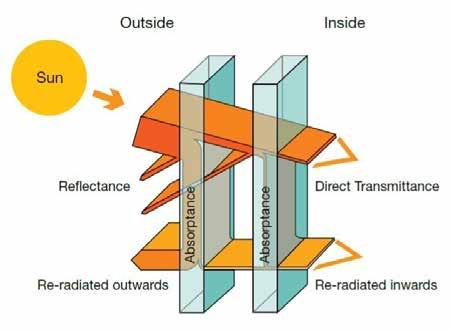
2. Solar Windows: Solar glazing integrates photovoltaic cells into window panels, turning them into energy generators. These windows capture sunlight and convert it into electricity while maintaining transparency.
3. Electrochromic Glazing: Electrochromic windows allow occupants or building management systems to control tint levels, balancing daylight and energy conservation as needed.
5.2 ENERGY-GENERATING FAÇADES
Energy-generating façades go beyond aesthetics; they actively contribute to a building’s energy production and thermal regulation.
1. Solar Façades: Building envelopes equipped with integrated solar panels or solar cladding generate electricity while providing weather protection. These façades can be customised to blend seamlessly with architectural designs.
2. Wind-Generating Structures: In some cases, the façade itself can incorporate small wind turbines or wind-capturing elements, harnessing wind energy in urban environments.
INTEGRATED IOT SYSTEMS
The Internet of Things (IoT) plays a pivotal role in energy-positive
Solar glazing Image courtesy: Google
buildings, enabling real-time monitoring, control, and optimisation of various building systems.
1. Energy Management: IoT sensors and devices collect data on energy consumption, enabling intelligent control of lighting, HVAC, and appliances to minimise waste.
2. Occupant Comfort: IoT systems can create personalised, comfortable environments for occupants, adjusting lighting, temperature, and ventilation based on individual preferences and presence.
3. Grid Interaction: Buildings equipped with IoT capabilities can participate in demand response programs, optimising energy use to align with grid needs and potentially earning revenue in the process.
These building-integrated technologies represent a significant leap forward in the pursuit of energy-positive design. They not only enhance a building’s energy efficiency but also contribute to its self-sustaining capabilities, reducing its environmental impact while improving the quality of life for its occupants.
CASE STUDIES: SUCCESSFUL NET POSITIVE BUILDING PROJECTS
Real-world examples of net positive building projects that have successfully achieved energy surplus while maintaining functionality and comfort.
COMMERCIAL BUILDINGS LEADING THE WAY
Commercial buildings have been pioneers in the net positive building movement, showcasing the feasibility of energy surplus designs on a larger scale.
• The Edge, Amsterdam: Often hailed as one of the greenest and smartest buildings globally, The Edge, Deloitte’s Amsterdam headquarters, generates more electricity than it consumes. Its rooftop solar panels, energy-efficient design, and an innovative climate system contribute to its remarkable energy-positive status.
• Bullitt Center, Seattle: Located in Seattle, the Bullitt Center was designed to demonstrate the potential of net-positive commercial structures. It features advanced rainwater harvesting, solar panels, and composting toilets. By producing 60% more energy than it consumes, it sets a high standard for sustainable urban architecture.
• The Eden Project in Cornwall, England, is a biodome complex that is designed to be net positive energy. The complex uses a variety of renewable energy technologies, including solar panels, wind turbines, and biomass boilers. It also has a number of passive solar design features, such as south-facing glazing and thermal mass.
ENERGY-POSITIVE RESIDENTIAL DESIGNS
Net positive concepts are not confined to commercial spaces. Residential designs have also embraced energy-positive principles.
• LivingHomes, Los Angeles: The LivingHomes project focuses on prefabricated, energy-efficient homes. These sustainable residences incorporate solar panels, rainwater harvesting, and efficient appliances, ensuring they generate more energy than they consume.
• Solcer House, Wales: Located in Wales, the Solcer House is a pioneering example of a net-positive energy home. It utilises solar panels, advanced insulation, and energy-efficient systems to produce more energy than its occupants require, making it a net exporter of electricity.
NET POSITIVE BUILDING RETROFITS
Retrofitting existing buildings to meet net positive standards is a testament to the adaptability of these concepts.
• National Renewable Energy Laboratory (NREL) Research Support Facility: The NREL in Colorado transformed its aging office building into a net-zero energy facility. Through various energy-efficient upgrades, daylight harvesting, and a substantial solar array, the facility achieved net-zero energy consumption while maintaining functionality.
• Savona Mill, Charlotte: The Savona Mill project in North Carolina is a remarkable example of repurposing an industrial site into an energy-positive mixed-use development. By integrating solar power, energy-efficient HVAC systems, and smart technologies, this retrofit has turned a former mill into a thriving net-positive community.
These case studies demonstrate that net-positive building concepts are not theoretical dreams but practical solutions for a sustainable future. They showcase the potential of net-positive buildings in reducing environmental impact, conserving resources, and even generating surplus energy.
Sustainable Façade
Public Policy in Advancing Sustainable Façade
Engineer
ABOUT THE AUTHOR
Crisanto Fadel is a Façade Engineer with over 20 years of global experience delivering landmark projects. He is a certified Project Management Professional (PMP), LEED AP BD+C, Associate Architect (Assoc. AIA), and a Member of the Society of Façade Engineering (MSFE). He holds a degree in Architecture and Engineering with a Master’s in Management and Business Administration.
CRISANTO FADEL Façade
As the world grapples with the pressing need for sustainable development, revisiting public policies emerges as crucial in addressing challenges and opportunities in façade design and engineering. This article explores how public policy can drive sustainable practices in the façade and contribute to a more sustainable built environment.
THE INTERSECTION OF PUBLIC POLICY AND SUSTAINABLE FAÇADE DESIGN
Public policy encompasses the laws, regulations, and guidelines
established by governments and institutions to address societal issues. In the context of façade design and engineering, public policy can influence various aspects, including material selection, energy efficiency standards, and waste management practices. By setting clear and enforceable standards, public policy can encourage and mandate sustainable practices.
MATERIAL SELECTION AND INNOVATION
Public policy incentivises using sustainable materials in façade construction. Policies can promote
recycled or low-carbon materials to reduce buildings’ environmental footprints. A traditional linear approach, where materials end up as waste, is being replaced by a model emphasising reuse and recycling. The idea of “design for disassembly” emerged, allowing materials to be easily separated and reused at the end of their lifespan.
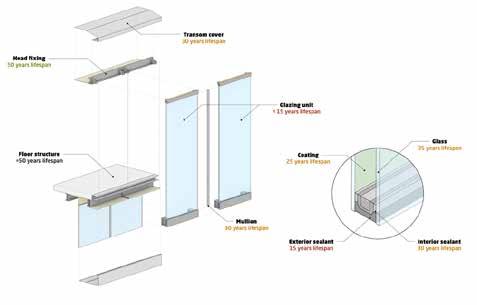
To embrace circularity, façade design focuses on modular construction, e.g., unitised systems, standardised components, and reversible connections to enable easy disassembly.
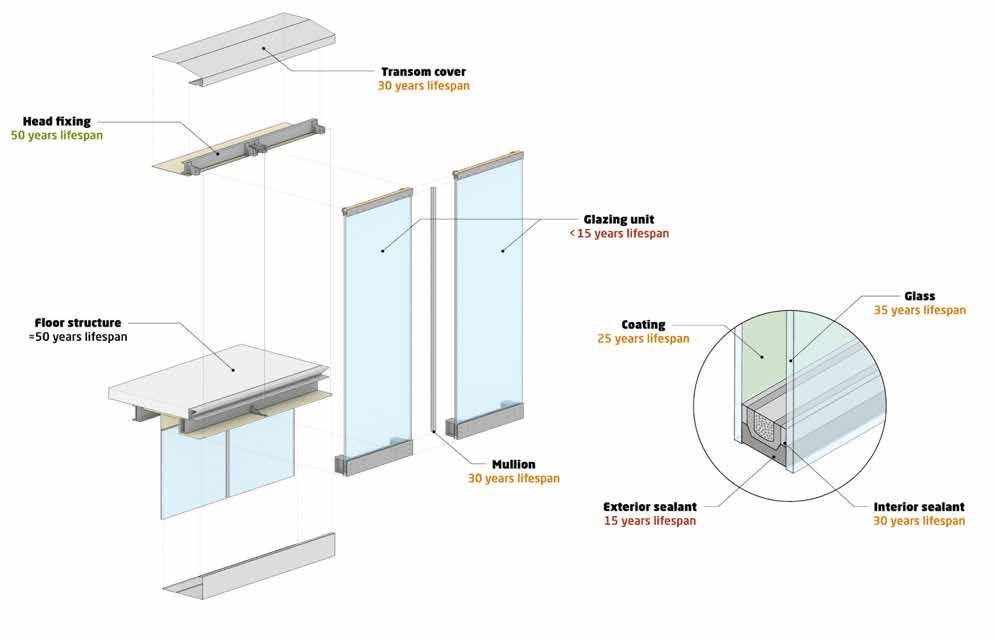
Modular construction of glazed window
Although design for disassembly adds complexity, it offers longterm benefits in reducing waste and embodied carbon. Thus, funding for research and development can spur innovation in sustainable materials and construction methods.
ENERGY EFFICIENCY STANDARDS
Implementing stringent energy efficiency standards for buildings can significantly reduce their operational carbon footprint. These standards aim to reduce the overall energy demand and lower the energy requirement for buildings. Since current global energy is still derived from fossil fuels, reducing energy consumption directly leads to a decrease in carbon emissions. Therefore, lower energy consumption leads to lower energy bills, making the economy more competitive by lowering operating costs in businesses and households.
Policies that mandate the use of high-performance glazing, insulation, and shading devices can enhance the thermal performance of façades, leading to lower energy consumption for heating and cooling. Industry standards such as ISO 50001 help organisations implement energy management
and improve performance. ASHRAE Standards 90.1 and the Energy Performance of Building Directive (EPBD) are a few standards to ensure that new buildings or major renovations meet minimum energy performance requirements, optimising heating, cooling, and lighting systems for efficiency. The Passive House Certification provides detailed quality, comfort, and energy efficiency criteria, making conventional heating and air conditioning systems obsolete.
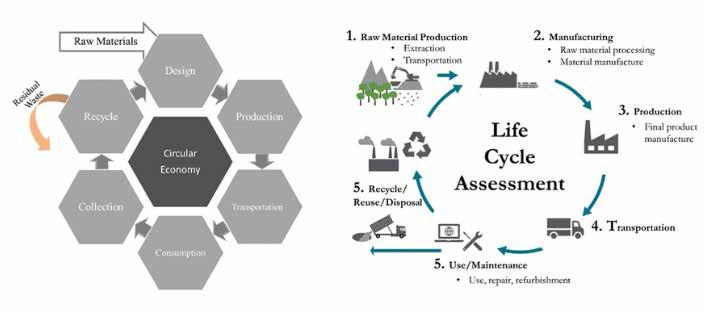
LIFECYCLE ASSESSMENT AND CIRCULAR ECONOMY
Public policy can encourage the adoption of lifecycle assessment (LCA) methodologies to evaluate the environmental impact of façade
materials and systems from cradle to grave. Policies that support the principles of the circular economy, such as design for disassembly and materials reuse, can minimise waste and promote resource efficiency.
Lifecycle Assessment (LCA) is a systematic approach to evaluate the environmental impacts of all stages of a product’s life, from raw material extraction to production, use, and disposal. In the façade context, LCA is used to assess the environmental footprint of different façade materials and systems, including evaluating sourcing and extracting raw materials, energy consumption, emissions, and waste during production, operational longevity, and disposal of façade components.
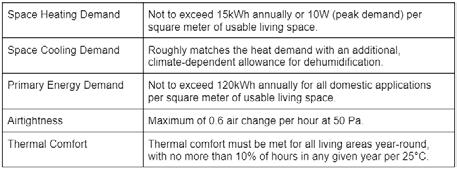
Minimum energy requirement per Passive House Certification
Rainwater Harvesting Design, US Patented to Canavan
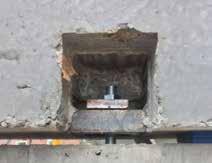
The mechanical joint at the base
The Circular Economy, on the other hand, is a regenerative system that aims to eliminate waste and continuously use resources. The principle is to design a durable façade and easily disassembled components, facilitating the separation and recovery of materials at the end of their life cycle.
GREEN BUILDING CERTIFICATION AND INCENTIVES
Governments can promote sustainable façade design through green building certification programs like LEED, BREEAM,
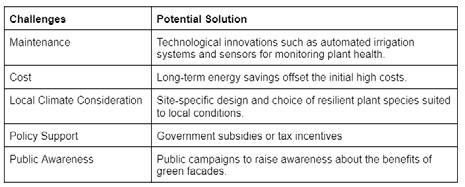
and WELL. They could also offer incentives, such as tax breaks, grants, or expedited permitting. Raising public awareness about the environmental and health benefits of green façades can increase their acceptance and adoption. However, practical challenges need to be addressed to reap the full benefits of a green façade.
EDUCATION AND TRAINING
Public policy can support educational initiatives to equip architects, façade designers, engineers, and construction professionals with the knowledge and skills to implement
sustainable façade design practices, including funding specialised training programs, workshops, and certifications. The government can allocate resources to develop and promote specialised programs focused on sustainable façade design. The program could cover topics such as energy efficiency, material sustainability, and innovative design solutions for low-carbon buildings. Policymakers can encourage professional development by organising workshops, seminars, and hands-on training sessions that bring expertise in sustainable design. Certifications would serve as benchmarks for the industry, enabling professionals to obtain qualifications that enhance their
Green Building Certification Challenges and Potential Solutions
Circular Economy and Life Cycle Assessment
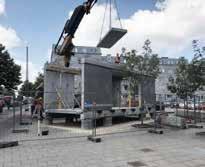
CASE STUDIES: DENMARK CIRCLE HOUSE
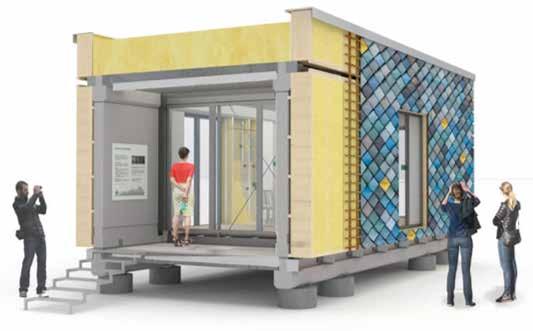
The Denmark Circle House is designed to demonstrate and promote circular economy principles in construction. The project’s goal is for 90% of building materials to be reused with no significant loss of value. Buildings are designed to be easily dismantled for future reuse. Over 30 Danish enterprises and institutes collaborate to integrate circularity in design, construction, and materials.
The Circular House project was established by architects from Vandkunsten, Lendager, Arkitekter, and 3XN Arckitekter, with design facilitation and coordination by GXN Innovation. The four firms
credibility and proficiency. Therefore, government funding or subsidising certification programs can make these qualifications more accessible, fostering continuous learning for professionals to stay updated on current trends, innovations, and regulatory standards.
Public policy can also promote the integration of sustainability principles into architectural, engineering, and construction management degree programs, encouraging higher education institutions to include sustainable façade design as part of their curriculum.
The government can collaborate with industry leaders and professional organisations to create public policy on training programs that reflect the evolving needs of façade construction that aligning with market demands. The government could grant scholarships for students or professionals pursuing specialised training and certification in this field.
Denmark Circle House
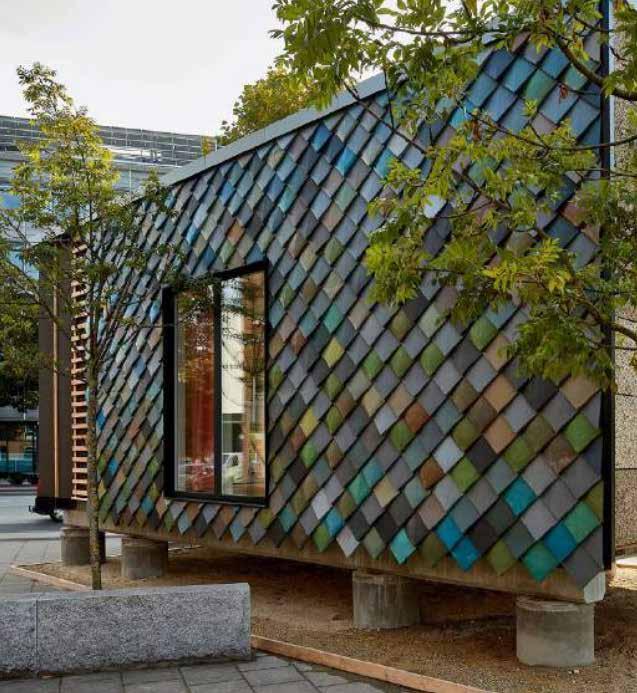
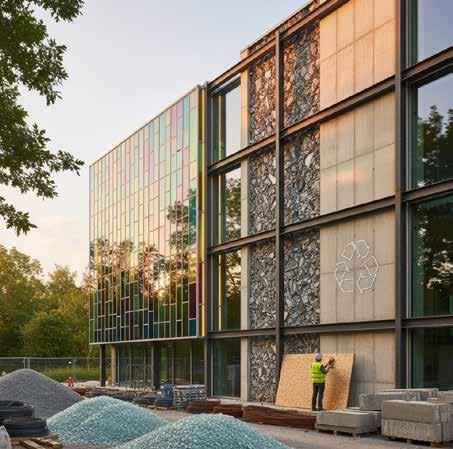
The Circle House façade with upcycled plastic shingles
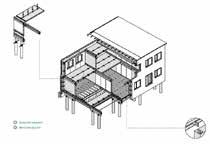
Circle House consists of several building systems that will be reusable for other buildings and thus retain their value
were all dedicated to implementing sustainability in different ways.
CONCLUSION
The study of public policy plays a pivotal role in resolving current issues in the sustainability of façade design and engineering. By establishing clear standards, incentivising innovation, and promoting education, public policy can drive the adoption of sustainable practices that reduce the environmental impact of buildings. As the world continues to urbanise, integrating public policy and sustainable façade design will be essential in creating a more resilient and sustainable built environment.
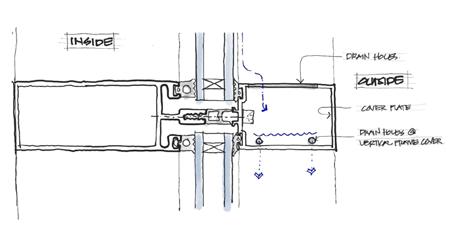
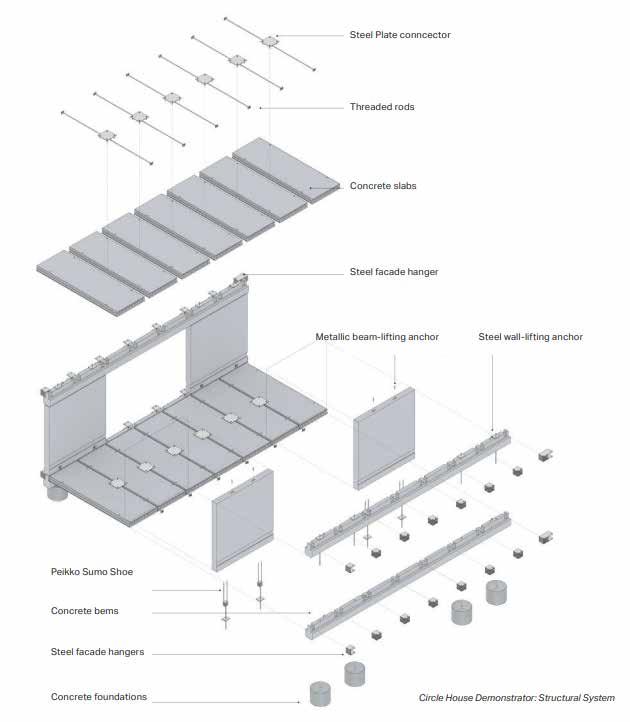
Illustration of the superstructure and mechanical connections
Illustration of the superstructure and mechanical connections
Glass & Glazing
Engineered Transparency: The Vital Role of Safety Glass
ABOUT THE AUTHOR
Jincy Mariam Rinu is the Lead Façade Engineer for GHD, a global engineering and architectural consultancy firm. A passionate engineering professional, Jincy has over 17 years of experience in façade and structural engineering. Having worked in the Middle East all these years, Jincy is one of the most seasoned façade professionals in the region. She has made commendable contributions to the region’s landmark projects, including the Coca-Cola Arena, KAFD Iconic Metro Station, Mobility Pavilion, and the KL 118 tower in Malaysia. Together with her façade team in GHD, Jincy enjoys her work, bringing to life an architect’s sketches, vision and ideas, while ensuring the safest practices for life and property. The GHD façade team has delivered major works in the region, including Lusail Plaza Tower in Qatar, shopping malls, schools and major data centers in UAE, to name a few.
JINCY MARIAM RINU
Lead Façade Engineer, GHD
We see glass being used all around us— curtain walls, elegant balustrades and expansive skylights—but do we critically evaluate the role it plays in ensuring safety? Glass is beautiful, yet when not selected and installed correctly, it can become a serious hazard. A single failure can lead to serious injuries and even catastrophic accidents.
This article explores the different types of safety glass, where they should be used, and the key considerations for architects, engineers, and contractors to ensure compliance and safety in modern buildings.
DEFINITION OF SAFETY GLASS
For a glass product to be classified as safety glass, it must meet specific performance standards, which include:
• Impact Resistance (e.g., ANSI Z97.1, EN 12600, or BS 6206)
• Breakage Pattern (reducing risk of severe injury upon failure)
• Post-Breakage Performance (retaining fragments and preventing collapse)
TYPES OF SAFETY GLASS AND THEIR APPLICATIONS
Toughened (Tempered) Glass: Toughened or Tempered Glass is
processed by controlled thermal and chemical treatments on annealed glass, which increase its strength. The process called toughening increases tensile strength, thermal shock resistance, heat withstanding capacity and safety of normal glass. The high load resistance capacity of toughened glass makes it an ideal choice for areas requiring high load resistance.
Image courtesy: www.glassonweb
Another important characteristic of the glass is its breakage pattern: Toughened glass shatters into small, blunt fragments, rather than large, sharp pieces as seen in annealed and heat-strengthened glass. This makes it an ideal choice as the outer lite for shop front glazing, doors and windows at low height and internal partitions. If the glass breaks, toughened glass minimises the likelihood of severe injury or fatality for occupants.
However, the same breakage characteristic of toughened glass could pose a serious safety concern
when used at height. Even a small fragment falling from a great height can gain enough energy to cause fatal injuries. Additionally, the toughening process can introduce nickel-sulfide impurities into the glass, causing it to break spontaneously, without any external force. Hence, monolithic toughened glass is not considered “safety glass” when installed for glazing at height.
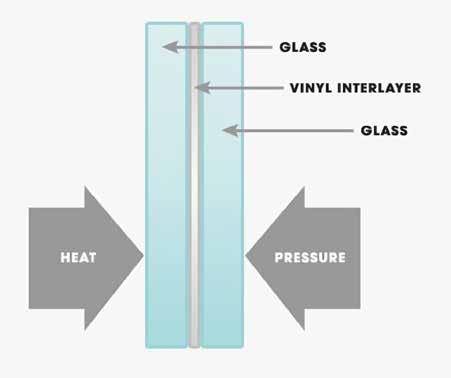
Laminated Glass: Laminated glass is simply two or more glass layers bonded with an interlayer (PVB, SGP, etc.). The key advantage of
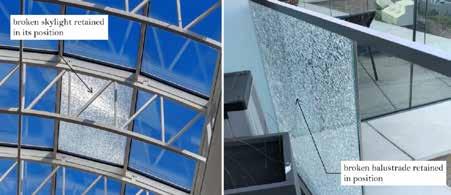
laminated glass is that it is held together even when broken. Hence, it is most suited for applications such as skylights, balustrades, overhead glazing and high-security applications (bulletresistant and blast-resistant glass).
While laminated glazing holds broken fragments together, it is important to note that not all laminated glass is true “safety glass”. The choice of interlayer, support system, and post-breakage behavior determines whether it can effectively protect against injuries and structural failure. Hence, it is important to consider the following conditions when specifying laminated glass as safety glazing.
• Annealed laminated glass is not considered “safety glass” because it has very low strength. When it breaks, it forms large, sharp shards that can potentially tear through the interlayer, increasing the risk of injury.
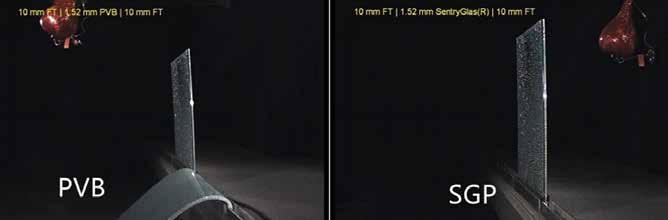
• Standard PVB is flexible and weak, leading to sagging of the panel after breakage. If the glass sags or detaches from its frame, it creates serious hazards, especially in overhead glazing, balustrades, or point-supported systems.
Image courtesy: Glass Genius, Kratos Glass
Image courtesy: www.glassonweb.com
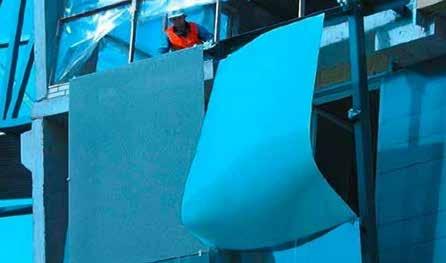
• Frameless or minimally supported laminated glass is vulnerable to failure if the interlayer lacks sufficient strength. The entire glass panel can lose structural integrity and collapse under its own weight, behaving like a heavy, flexible sheet—a “wet blanket”. In overhead glazing, balustrades, or façades, this failure mode can be deadly, as an entire panel falls from height, potentially injuring people and damaging property.
• When laminated glass is used in balustrades and façades, it is required to perform as a protective barrier. However, if the panel collapses, it fails to act as a barrier, compromising occupant safety.
• Laminated heat-strengthened glass is the optimal safety glazing solution that combines high strength, improved breakage safety, and compliance with building regulations. HS
glass has much larger strength than annealed glass, making it more resistant to mechanical loads, wind pressure, and thermal stress. After breaking, the laminated interlayer holds the glass pieces together, preventing full collapse and providing post-breakage loadbearing capacity.
• Where higher design load necessitates the use of FT glass, a structural interlayer such as SGP can be used, providing post-breakage support.
Wire-Glass: Wire-reinforced glass includes an embedded metal mesh that holds the fragments together upon impact. It is often used in fire-resistant applications due to its ability to withstand high temperatures.
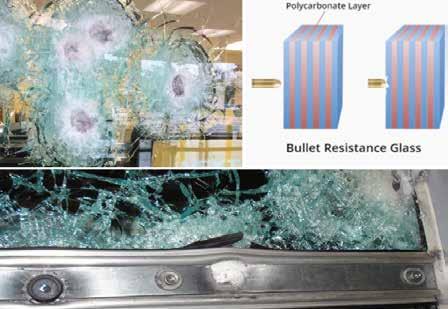
Bulletproof Glass: Bulletproof or ballistic glass is a specialised form of laminated glass with multiple interlayers, providing high resistance against projectiles. It is used in banks, government buildings, and highsecurity areas. A ballistic-resistant glass panel alone is ineffective if the frames, mullions, transoms, and connections are weak points. Design of ballistic-resistant glass requires a holistic approach, integrating reinforced framing and impactresistant connections.
CONCLUSION
Glass is a defining element of modern architecture, bringing transparency, elegance, and structural innovation to our built environment. However, its safety cannot be an afterthought. The consequences of improper glass selection and installation can be severe, leading to injuries, structural failures, and even fatalities. By making informed choices and adhering to best practices, we can ensure that glass remains a symbol of innovation without compromising safety.
Sustainable Building
Sustainable Architecture Vision for Building a Greener Future
MUHAMMAD NADEEM Project Manager, A&I Renovation Inc
ABOUT THE AUTHOR
Muhammad Nadeem specialises in real estate investment with a strong focus on commercial properties and passive income generation. His work centres on identifying profitable opportunities through detailed market research, financial analysis, and strategic decision-making. He has extensive experience conducting due diligence for property acquisitions, including legal reviews, inspections, and financial evaluations to ensure sound investments. The author also oversees end-to-end leasing operations, from advertising vacancies and screening tenants to negotiating agreements and ensuring compliance with lease terms. His approach emphasises maintaining high occupancy levels through timely rent collection, proactive communication, and prompt resolution of tenant concerns. Regular property inspections and adherence to safety standards further support the consistent performance and long-term value of the assets under his management.
Sustainability has become an increasingly important consideration in the design and construction of buildings. With the growing concerns about climate change and environmental degradation, architects and builders are looking for ways to reduce the impact of buildings on the environment. Sustainable design involves using eco-friendly materials and techniques that minimise the use of resources, reduce waste, and lower energy consumption. This chapter explores the key concepts of sustainable design and the role of eco-friendly materials and techniques in building for the future.
SUSTAINABLE DESIGN PRINCIPLES
Sustainable design is an approach to building design and construction that focuses on reducing the
environmental impact of buildings while enhancing their functionality and aesthetic appeal. There are several key principles of sustainable design that architects and builders should consider when designing and constructing buildings:
Energy Efficiency: Buildings are responsible for a significant portion of energy consumption, and reducing energy use is essential to sustainable design. This can be achieved through passive design techniques such as orientation, shading and insulation, as well as the use of energy-efficient lighting and HVAC systems.
Water Conservation: Water is a precious resource, and sustainable design should aim to reduce water consumption and waste. This can be achieved through the use of
water-efficient fixtures, rainwater harvesting systems and greywater recycling systems.
Material Selection: The choice of materials can have a significant impact on the environmental footprint of a building. Sustainable design involves selecting ecofriendly materials that are renewable, recyclable and non-toxic.
Site Selection: The location of a building can also impacts its sustainability. Sustainable design should consider the impact of the building on the surrounding environment, as well as its accessibility to public transportation and amenities.
ECO-FRIENDLY MATERIALS AND TECHNIQUES
The use of eco-friendly materials and techniques is a critical component
The use of eco-friendly materials and techniques is a critical component of sustainable design
of sustainable design. Here are some examples of eco-friendly materials and techniques that architects and builders can use in building design and construction:
Green Roofs: Green roofs are becoming increasingly popular in sustainable building design. They involve covering a roof with vegetation, which helps reduce the building’s energy consumption by providing insulation and reducing heat gain. Green roofs also absorb rainwater, which helps reduce runoff and promotes biodiversity.
Bamboo: Bamboo is a sustainable material that is fast-growing, renewable and has a high strengthto-weight ratio. It can be used for flooring, panelling and structural components, and is an excellent alternative to traditional hardwoods.
Recycled Materials — Recycled materials such as glass, steel and concrete can be used in building construction, reducing the amount of waste sent to landfill. These materials can be sourced from post-consumer waste, industrial
by-products and demolished buildings.
Passive Design: Passive design techniques involve designing buildings to maximise natural light and ventilation, reducing the need for artificial lighting and HVAC systems. This can be achieved
through proper orientation, shading and the use of thermal mass.
THE BENEFITS OF SUSTAINABLE DESIGN
Sustainable design has several benefits, both for the environment and for building owners and occupants. Here are some of the benefits of sustainable design:
Reduced Environmental Impact:
Sustainable design reduces the environmental impact of buildings by minimising the use of resources, reducing waste and lowering energy consumption.
Cost Savings: Sustainable design can result in significant cost savings for building owners and occupants. Energy-efficient buildings have lower operating costs, while waterefficient buildings can save on water bills.
Improved Indoor Air Quality: Eco-
friendly materials and techniques can improve indoor air quality,
Recycled materials such as glass, steel and concrete can be used in building construction, reducing the amount of waste sent to landfill
Building systems should be designed to be energy-efficient, using technologies such as solar panels, geothermal heating and cooling, and high-efficiency HVAC systems
promoting the health and wellbeing of building occupants.
Increased Property Value:
Sustainable buildings are becoming increasingly desirable to tenants and buyers, and can command a premium price in the real estate market.
CHALLENGES OF SUSTAINABLE DESIGN
While sustainable design has many benefits, there are also several challenges that architects and builders may face when implementing sustainable design practices. One major challenge is the cost associated with using ecofriendly materials and technologies. Sustainable materials are often more
expensive than traditional building materials, and implementing energyefficient technologies can require significant upfront costs. However, it is important to note that the longterm cost savings and environmental benefits may outweigh these initial costs.
Another challenge is the lack of awareness and education about sustainable design practices among architects, builders and consumers. Many people are not familiar with the benefits and methods of sustainable design, and may be resistant to change due to perceived inconvenience or higher costs. It is therefore important to continue educating individuals about sustainable design
and its importance in mitigating environmental issues.
Additionally, the availability of sustainable materials and technologies may be limited in some regions or countries, which can make it difficult to implement sustainable design practices. This can be particularly challenging in developing countries, where access to sustainable resources and technologies may be limited due to economic or political reasons.
Lastly, regulations and codes may not always support sustainable design practices, which can hinder their implementation. It is important for government agencies to recognise the importance of sustainable design
Passive design techniques involve designing buildings to maximise natural light and ventilation, reducing the need for artificial lighting and HVAC systems
and create policies and regulations that encourage and support its adoption.
Despite these challenges, sustainable design is becoming increasingly important in the construction industry and is being embraced by many architects and builders. The benefits of sustainable design, including reduced environmental impact, improved indoor air quality and long-term cost savings, make it a worthwhile endeavour.
DESIGNING FOR SUSTAINABILITY
Designing for sustainability involves considering every aspect of the building, from the materials used to the energy efficiency of the building systems. The following are some key considerations when designing for sustainability:
Material Selection: Choosing sustainable materials, such as recycled or renewable materials, can reduce the environmental impact of the building. Materials with low volatile organic compound (VOC) emissions should also be selected to improve indoor air quality.
Energy Efficiency: Building systems should be designed to be energyefficient, using technologies such as solar panels, geothermal heating and cooling, and high-efficiency HVAC systems. Building orientation, shading and insulation should also be considered to reduce energy consumption.
Water Conservation: Designing for water conservation involves using low-flow fixtures and capturing and reusing rainwater or greywater for non-potable uses.
Indoor Air Quality: Indoor air quality can be improved through proper ventilation systems, use of
low-VOC materials and monitoring of indoor air quality levels.
Waste Reduction: Designing for waste reduction involves minimising construction waste through recycling and reuse of materials, and designing for deconstruction or reuse at the end of the building’s life cycle.
Sustainable design also involves considering the building’s impact on the surrounding environment and community. This can include designing for accessibility, creating green spaces and pedestrian-friendly areas, and minimising the building’s carbon footprint.
Incorporating sustainable design practices into construction projects can also have economic benefits. Buildings designed for sustainability can reduce energy and water costs throughout their lifetime, resulting in long-term cost
savings for the building owner or tenant.
Additionally, sustainable design can enhance the building’s marketability and reputation, potentially leading to increased rental or resale value.
Sustainable design is becoming increasingly important in the construction industry, as the need to mitigate environmental issues becomes more pressing. While there are challenges associated with implementing sustainable design practices, the benefits, including reduced environmental impact, improved indoor air quality and longterm cost savings, make it a worthwhile endeavour. Architects and builders must continue to prioritise sustainable design practices, considering every aspect of the building from materials to energy efficiency and waste reduction, to build for the future with eco-friendly materials and techniques.
Green roofs are becoming increasingly popular in sustainable building design
Cover Story
The Next Era of Façades: Intelligent and Responsive Design
One of the most vulnerable aspects of building design is the façade. Because the majority of the populace is unaware of the material’s performance, they frequently misunderstand the importance of façade design, particularly in limiting or spreading fire spread. Fire safety has traditionally been overlooked in favour of beauty, energy efficiency, cost, and other factors. However, in light of current market trends, this has progressed beyond only the aesthetic aspect and now plays a larger role in light conveyance, acoustical execution, and efficacy.
It is about the universal understanding of the reality that any possible fire threats can only be mitigated when façade systems, materials, and testing are given the attention they deserve. The emphasis should be on a comprehensive approach to examining the performance of façade materials, components of façade design for fire safety, fire testing of façade materials, compartmentalization, and much more.
The opinions and ideas of subject-matter experts are featured in this cover story. We sought to collect their thoughts on things like façade fire safety, laws and regulations, appropriate materials, the best approach to build a fire-safe façade, and so on.
As we look toward the next decade, building façades are poised for a remarkable evolution. No longer mere protective shells, façades are becoming intelligent, responsive systems that actively shape comfort, sustainability, and overall building performance. Advances in materials, digital design, and smart technologies are enabling façades to interact with their environment, modulate light and air, generate energy, and even improve occupant wellbeing. This transformation is not just technological—it is redefining the relationship
between buildings and the people who inhabit them.
In this cover story, we bring together insights from leading experts in façade design, who share their perspectives on the trends, innovations, and challenges shaping the buildings of tomorrow. From climate-responsive systems and energy-generating surfaces to intelligent, adaptive façades, their views reveal how performance, aesthetics, and human comfort are converging to create the next generation of architecture.
Rising façade complexity demands exceptional reliability and maintainability, and warns that premature technology adoption can undermine performance Image courtesy: Skyline Façade
JAMIE MABROUK
Façade Manager, Sir Robert McAlpine
PETROS KARATZAS
Executive Director, Skyline Façades
GEORGE SERGIOU Founder, Glass & Façades LLC
AR. PIYUSHA BOKIL
Founder & Design Partner, EXS Design
façades that integrate renewable energy will shape the next generation, ultimately becoming “intelligent, multifunctional elements that actively contribute to the building’s overall sustainability and user experience.”
Echoing this shift towards responsiveness, George Sergiou, Founder, Glass & Façades LLC, says the future façade will “become much more climate-responsive and intuitive.” According to him, double-skin systems that modulate sunlight and improve comfort will move façades beyond the idea of mere protective layers, enabling buildings to “breathe, adapt, and take better care of the people inside.”
THE FUTURE OF BUILDING FAÇADES IN A DECADE OF RAPID MATERIAL AND TECHNOLOGY ADVANCES
Over the coming decade, building façades are expected to undergo a remarkable transformation as emerging materials, digital tools, and intelligent systems reshape architectural possibilities. With innovation accelerating across design, fabrication, and performance technologies, façades will no longer serve merely as protective skins but as dynamic, efficient, and responsive interfaces that enhance comfort, sustainability, and overall building experience.
Building façades are set for a transformative decade, evolving from static outer skins to intelligent, performance-driven systems. Jamie Mabrouk, Façade Manager, Sir Robert McAlpine, notes that façades will soon “act as dynamic interfaces between the indoors and the environment.” He explains that lighter and stronger materials, climate-responsive systems, and
Adding a design-centric perspective, Ar. Piyusha Bokil, Founder & Design Partner, EXS Design, opines that façades will evolve into “multi-functional, performanceoriented systems,” enriched by advancements in materials, digital modelling, and sensor technologies. She emphasises that façades will increasingly serve as adaptive, intelligent components integrated into the building’s core system, influencing “form and orientation… optimising the use of natural resources.”
Taking a measured view, Petros Karatzas, Executive Director, Skyline Façades, suggests that change will be steady but significant. He remarks that while construction evolves more slowly than other industries, incremental improvements—“glazing that performs better, composites that are lighter, coatings that last longer”— will accumulate into meaningful progress. According to him, the real transformation lies in combining improved materials with digital tools and refined manufacturing, enabling façades that respond intuitively and are delivered with greater precision and reduced waste.
EMERGING FAÇADE INNOVATIONS THAT COULD TRANSFORM TOMORROW’S BUILDINGS
In recent years, façade innovation has advanced from surface-level refinement to deeper environmental intelligence. The following perspectives from industry leaders reveal a shared belief in façades becoming active, climate-responsive systems rather than merely protective skins. Their observations collectively paint a future where smarter materials, renewable integration, and adaptive technologies redefine the relationship between buildings and their surroundings.
Mabrouk notes that the most exciting innovations are those dissolving the boundaries between architecture, engineering, and environmental science. He highlights photovoltaic-integrated façades, transparent insulation, bio-based composites, and responsive shading systems— technologies he believes will shift façades from passive enclosures to active contributors that help buildings adapt, save energy, and create healthier interiors.
Echoing this shift toward responsiveness, Sergiou says he is particularly energised by adaptive façade systems capable of reacting in real time to environmental changes. From kinetic shading to electrochromic glass and AI-driven controls, he suggests these solutions reshape comfort and energy use without occupant intervention. He adds
that the increasing adoption of photovoltaic glass marks a meaningful evolution, turning façades into clean-energy generators while shaping better indoor environments.
Bokil builds on this view, opining that façades are moving firmly beyond aesthetics into intelligent performance.
If commercial priorities necessitate highly glazed façades, designers must compensate through improved insulation, better glass selection, intelligent shading, or passive strategies elsewhere
Image courtesy: Skyline Façades
Green Metal Industries, Abu Dhabi Image courtesy: EXS Design
She emphasises dynamic climate-responsive skins— especially valuable in hot regions—alongside ultralight, low-carbon materials such as UHPC, engineered timber hybrids, and thin-film photovoltaics. Equally, she stresses the transformative role of parametric modelling, environmental simulations, and digital fabrication, which enable designers to craft climate-tuned geometries once considered unbuildable.
Karatzas, meanwhile, takes a more grounded perspective, suggesting that the innovations with the greatest impact will be the ones implementable at scale. He points to the steady progress in highperformance glazing and coatings that manage heat and light more intelligently, and to the advancing precision of prefabricated and unitised façade systems. According to him, these incremental yet widespread improvements—combined with smarter systems and refined delivery methods—are where true long-term transformation lies.
THE ROLE OF FUTURE FAÇADES IN ENERGY EFFICIENCY AND CLIMATE-RESPONSIVE DESIGN
As sustainability becomes embedded at the heart of architectural practice, façade specialists across regions emphasise that the next generation of building envelopes will need to do far more than look visually compelling.
From kinetic shading to electrochromic glass and AI-driven controls, he suggests these solutions reshape comfort and energy use without occupant intervention
Image courtesy: Glass & Façades LLC
They must regulate climate, conserve energy, and strike a careful balance between performance, commercial realities, and long-term environmental responsibility. Their insights reveal a future where façades operate as intelligent, adaptive systems that negotiate competing demands without compromising user comfort or design ambition.
According to Mabrouk, future façades will make a profound contribution to sustainability by managing heat, light, and ventilation with far greater intelligence. He notes that high-performance glazing, well-designed shading, and thermally efficient materials
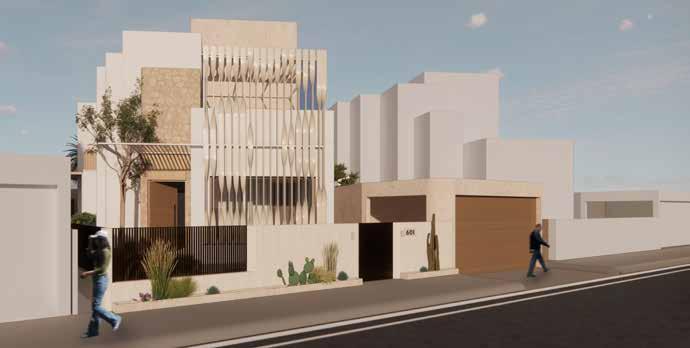
60 House, Dubai, UAE Architecture for a compact modular villa based on a timeless, modern Arabic context Image courtesy: EXS Design
Façades that modulate sunlight, stabilise internal temperatures, and improve air quality help people think more clearly and feel more at ease throughout the day
Image courtesy: Glass & Facades LLC
will help significantly reduce cooling and heating loads. Mabrouk also highlights the importance of lowembodied-carbon materials—such as recycled metals or timber composites—and emphasises that façades integrating solar technologies will play a direct role in clean energy generation, ultimately reducing a building’s carbon footprint throughout its lifecycle.
Sergiou echoes this view and suggests that sustainability must be rooted in early design decisions. He stresses the importance of selecting locally available materials from environmentally responsible manufacturers to reduce embodied carbon. However, he opines that operational energy use over decades has a far greater impact, which is why façade-integrated photovoltaics excite him. In his experience, building envelopes that both shade interiors and generate power daily offer a truly climate-responsive outcome. His own off-grid office, he notes, is proof that photovoltaic façades are not merely promising concepts but essential tools for the future.
From a design-led perspective, Bokil argues that future façades must be conceived as active systems capable of negotiating climate, energy, and human comfort. She explains that at EXS Design, sustainability is embedded from the outset—through climateresponsive geometry, intelligent shading, dynamic skins, and integrated energy-generating surfaces such as BIPV. Bokil further suggests that parametric modelling and generative workflows are critical in exploring efficient, visually compelling solutions, while modular systems and thoughtful material choices help ensure longevity and reduced environmental impact. To her, sustainability is not an add-on but a foundational design principle.
Offering a more pragmatic lens, Karatzas notes that sustainability often sits in tension with commercial pressures. He remarks that while ideal façade strategies may prioritise reduced glazing or increased shading, real-world developments frequently favour the opposite because of market appeal. Karatzas therefore advocates for “balancing solutions”: if commercial priorities necessitate highly glazed façades, designers must compensate through improved insulation, better glass selection, intelligent shading, or passive strategies elsewhere. He stresses that sustainability works best when aligned with economic realities, and that façades can meaningfully reduce operational energy, embodied carbon, and long-term risk— provided strategies remain practical and achievable in the real world.
Double-skin systems that modulate sunlight and improve comfort will move façades beyond the idea of mere protective layers, enabling buildings to “breathe, adapt, and take better care of the people inside
Image courtesy: Glass & Façades LLC
THE FUTURE IMPACT OF INTELLIGENT AND ADAPTIVE FAÇADES ON BUILDING PERFORMANCE
As digital technologies blend ever more seamlessly with architecture, intelligent façades are emerging as a defining force in building performance. No longer passive skins, these systems promise buildings that respond to their environment with precision, efficiency, and intuition. Across the industry, experts agree that adaptive façades will transform comfort, sustainability, long-term value, and the very relationship between people and the spaces they inhabit.
Intelligent façades will fundamentally change how buildings behave, notes Mabrouk, as structures begin responding in real time to both external and internal conditions. According to him, sensors, automation, and AI-driven controls will regulate shading, ventilation, and insulation automatically, enhancing comfort while minimising energy use. He adds that such adaptability will extend the lifespan of façade materials and contribute to healthier indoor environments.
Serghiou agrees and says that buildings will soon interact with their surroundings far more intuitively. He opines that systems equipped with sensors, automation, and
predictive algorithms will make independent decisions— adjusting louvres, altering transparency, or opening ventilation paths based on sunlight, wind, or occupancy. In his view, this intelligence will lead to more comfortable spaces, lower operational costs, and façades that clients see as long-term, value-adding assets rather than static building components.
Bokil also highlights the power of smart responsiveness. She suggests that intelligent façades, through sensors
60 House, Dubai, UAE
Architecture for a compact modular villa based on a timeless, modern Arabic context Image courtesy: EXS Design
Development for green metal industries in Kezad, Abu Dhabi Image courtesy: EXS Design
and automation, will dynamically adjust shading, ventilation, and transparency. She points to her work on the 60 Degree House as an example, noting that even without full kinetic systems, intelligent façade logic can significantly reduce energy demand and optimise indoor comfort. She believes that future smart technologies will amplify this impact even further.
According to Karatzas, the promise of adaptive façades lies not in dramatic visual shifts but in subtle, data-informed performance that improves everyday function. He explains that automated shading, optimised daylighting without glare, and ventilation responsive to air quality or occupancy can meaningfully influence both energy efficiency and occupant wellbeing. He further notes that embedded sensors offer new avenues for proactive maintenance, allowing façades to detect thermal issues, leaks, or material wear before they escalate. Yet he cautions that widespread adoption will be gradual, as such systems must demonstrate reliability, affordability, and measurable benefit to the industry.
KEY TECHNICAL, REGULATORY, AND MINDSET CHALLENGES ON THE PATH TO THE NEXT LEAP IN FAÇADE DESIGN
As façade technology accelerates, industry experts agree that genuine progress depends not only on innovation
but also on overcoming entrenched technical, regulatory, and behavioural barriers. While new materials, smarter systems, and digital tools promise a more efficient future, designers, clients, and policymakers must collectively confront outdated mindsets, fragmented standards, and real-world constraints to achieve meaningful transformation.
According to Mabrouk, one of the biggest challenges is bridging the gap between innovation and real-world implementation. He notes that many advanced façade solutions remain stuck at the prototype stage due to cost concerns, conservative regulations, or limited awareness among decision-makers. He adds that integrating diverse systems requires multidisciplinary collaboration — something the industry is still learning
From kinetic shading to electrochromic glass and AI-driven controls, he suggests these solutions reshape comfort and energy use without occupant intervention
Image courtesy: Glass & Façades LLC
to embrace — while updated standards and a shift toward valuing long-term benefits are essential for real progress.
Sergiou shares a similar sentiment, suggesting that mindset remains the most persistent barrier. He says façades are still too often viewed as merely the outer skin rather than a critical performance component. For true advancement, he believes architects, engineers, contractors, and clients must collaborate far earlier in the design process. He opines that regulations must also catch up with rapid technological evolution, highlighting the importance of unified standards such as the forthcoming Eurocode 10, which he expects will help close significant gaps in façade safety and design practice.
From a design-led perspective, Bokil emphasises that the next leap in façade development comes with technical,
regulatory, and cultural challenges. She notes that modern façades are increasingly sophisticated, and ensuring reliability, longevity, and cost-effectiveness requires early collaboration between all stakeholders. She argues that building codes often lag behind innovation, restricting climate-responsive design, and adds that façades must be understood as performance systems rather than aesthetic shells. According to her, overcoming cost-driven misconceptions and encouraging lifecycle thinking are key to embedding sustainability and digital design from day one.
Offering a more global and pragmatic outlook, Karatzas stresses that every challenge — technical, regulatory, or mindset-driven — is shaped by regional priorities. He suggests that rising façade complexity demands exceptional reliability and maintainability, and warns that premature technology adoption can undermine performance. He notes that regulatory landscapes
Sustainability works best when aligned with economic realities, and that façades can meaningfully reduce operational energy, embodied carbon, and long-term risk—provided strategies remain practical and achievable in the real world Image courtesy: Skyline Facade
From kinetic shading to electrochromic glass and AI-driven controls, he suggests these solutions reshape comfort and energy use without occupant intervention Image courtesy: Glass & Façades LLC
vary dramatically across regions, from fire safety in the UK to carbon goals in the US, creating a fragmented environment that designers must constantly navigate. He further opines that mindset remains one of the most stubborn obstacles, as cost pressures and risk aversion slow the adoption of innovative systems. For him, the next leap in façade design relies on navigating technical demands, regulatory differences, and human factors with equal care.
THE ROLE OF FAÇADE DESIGN IN CREATING HEALTHIER AND MORE COMFORTABLE BUILDING ENVIRONMENTS
As buildings become increasingly complex and people spend more time indoors, façade design is emerging as one of the most influential determinants of human comfort and well-being. Across global practices, experts note that façades now shape how we experience light, air, temperature, and connection to the outdoors. Their insights collectively reveal a future where façades evolve into truly human-centred environmental systems.
According to Mabrouk, façade design plays a pivotal role in shaping indoor quality, regulating natural light, reducing glare, enhancing views, and supporting thermal comfort. He notes that well-designed façades, equipped
with operable elements, solar shading, and low-emission materials, create healthier, human-centred spaces that feel comfortable without excessive reliance on mechanical systems.
Sergiou echoes this, suggesting that façades influence everyday experience far more than people realise. He emphasises how they balance daylight, control glare, maintain fresh air, and create acoustically comfortable interiors. In his view, façades that modulate sunlight, stabilise internal temperatures, and improve air quality help people think more clearly and feel more at ease throughout the day.
From a design-driven standpoint, Bokil opines that façades are active mediators between humans and their environment. She highlights the importance of deep shading, porous screens, and green elements in reducing heat stress, enhancing daylight, and improving indoor air quality. She further suggests that dynamic façades can adapt to shifting external conditions, significantly elevating comfort while lowering energy demand.
Offering a more analytical perspective, Karatzas notes that façades are becoming increasingly essential as people spend almost 87% of their time indoors. He stresses two core factors—light and air. He explains that while modern glazing
From kinetic shading to electrochromic glass and AI-driven controls, he suggests these solutions reshape comfort and energy use without occupant intervention
Image courtesy: Glass & Façades LLC
provides thermal control, it also filters out beneficial natural light qualities, requiring designers to carefully balance coatings, orientation, and shading. On air, he argues that natural ventilation remains an undervalued yet powerful contributor to well-being. He suggests that, where feasible, façades should facilitate the movement of fresh air without compromising acoustics, safety, or thermal control.
CONCLUSION
Looking ahead, the evolution of façades will be defined as much by thoughtful design and practical implementation as by technological innovation. Experts highlight that while intelligent materials, adaptive systems, and energy-generating solutions offer enormous potential, their real impact depends on collaboration, lifecycle thinking, and navigating regulatory and market challenges. Façades will increasingly act as active mediators between buildings, the environment, and occupants—enhancing comfort, promoting health, and reducing energy demands. Importantly, this transformation is gradual and cumulative, built on incremental improvements as much as breakthrough technologies. By embracing this holistic approach, the façades of the future will not only redefine architectural expression but also foster buildings that are resilient, sustainable, and genuinely people-centred—spaces that intuitively respond to the world around them while elevating the everyday experiences of those within.
Façades should facilitate the movement of fresh air without compromising acoustics, safety, or thermal control
Image courtesy: Skyline Facade
Industry Speaks
“Our mission, Creating Healthy Spaces, has Evolved Into a Comprehensive Concept that Places the Resident at the Centre of Every Decision”
OLIVIER VIJVERMAN
Export Director - APAC, the Middle East and India, Renson
ABOUT THE AUTHOR
Olivier Vijverman is the Export Director for APAC, the Middle East and India at Renson, the family-owned company specialised in ‘Creating healthy spaces’. Originally from Belgium, Olivier now resides in Singapore — a strategic vantage point from which he continues to lead Renson’s global expansion across APAC, the Middle East and India. Olivier developed an international mindset early in his career, thanks to his studies in International Business Management across Denmark, Belgium and New York. From the beginning, he has operated in multicultural environments, gaining hands-on experience across Europe, the Middle East and APAC. More than three years ago, he relocated to Singapore, a defining moment that sealed his dedication to bridging Western and Asian markets. In his current role, Olivier leads all export activities across APAC, the Middle East and India, overseeing every Renson business unit in those regions. He thrives on the daily variety and complexity of his work and values the opportunity to collaborate with colleagues around the globe.
• Renson has been around for more than a century. How has the company’s idea of “creating healthy spaces” evolved over the years, and what does it mean to you today?
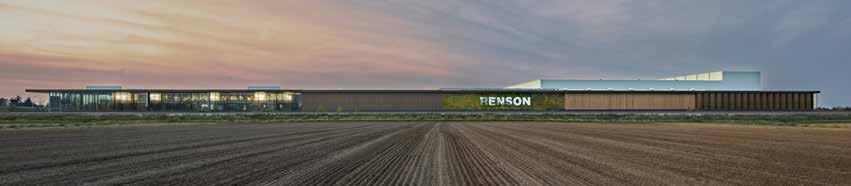
Over the past 116 years, Renson has developed from a manufacturing company into a knowledge-driven organisation. Our mission, Creating Healthy Spaces, has evolved into a comprehensive concept that places the resident at the centre of every decision. We strive to ensure healthy indoor air, a comfortable indoor climate and an enjoyable outdoor living experience, supported by a strong commitment to sustainability, aesthetics, design and consistent quality.
As the technologies behind these solutions continue to advance, they now operate with greater intelligence and seamless integration. Ventilation systems adjust automatically based on measured indoor air quality, textile solar shading responds to the position of the sun, and smart living technology coordinates every component according to the needs of the resident.
The result is an increasingly higher level of comfort, ease of use and reassurance for both the resident and the installer. This means that our focus has shifted from
product-oriented sales to a solution-based conversation with our clients — a solution that can create healthy spaces for their homes.
• You work across ventilation, sun shading, aluminium cladding and outdoor living. Which of these areas feels the most exciting right now, and why?
Each of our product groups presents its own specific challenges, and we continuously work to address them
Renson Outdoor Office
25 South Mumbai, India T100V custom solution ventilation
in a targeted way. Ventilation is particularly interesting because it is highly dependent on national or regional requirements. Every market, whether it’s in APAC, the Middle East or India, has its own regulations, habits and expectations, which means we must develop carefully adapted variations for each local context and climate. A key challenge remains raising awareness that proper insulation cannot function without adequate ventilation if we want to create healthy indoor environments. This is especially important when we consider that people in Western countries spend on average 90 per cent of their time indoors, whether at home, at school or at work.
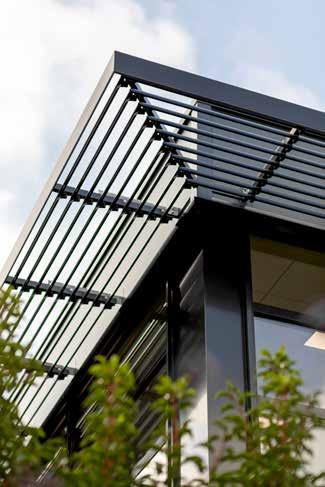
Exterior solar shading is the most effective solution to prevent indoor overheating. With the increasing impact of global warming, it is essential that we focus more strongly on prevention through passive solutions rather than relying only on active cooling. It is far better to prevent heat from entering the building in the first place than to try to manage it once temperatures have already risen. This begins at the earliest stages of any construction project. Strategic orientation of buildings, combined with high-quality exterior shading, ensures that direct sunlight does not reach the glass and significantly reduces heat gain indoors.
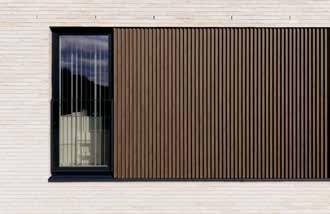
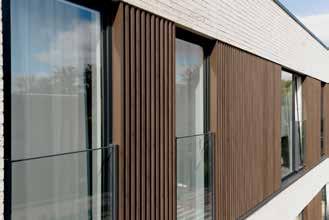
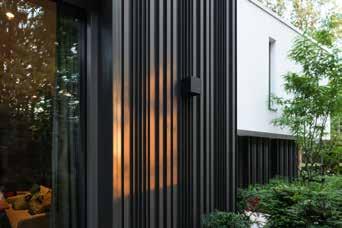
In the area of façade cladding, our focus is on aesthetics. Aluminium cladding with a wood-design finish now offers an ideal alternative to traditional wooden façades, without the maintenance burden. The wide variety of profile types and colour options allows for extensive creative freedom. Integrated façade elements such as gates, doors and concealed handles, along with functional inserts such as LED lighting, power outlets and outdoor taps, ensure that every detail fits seamlessly into a consistent architectural style.
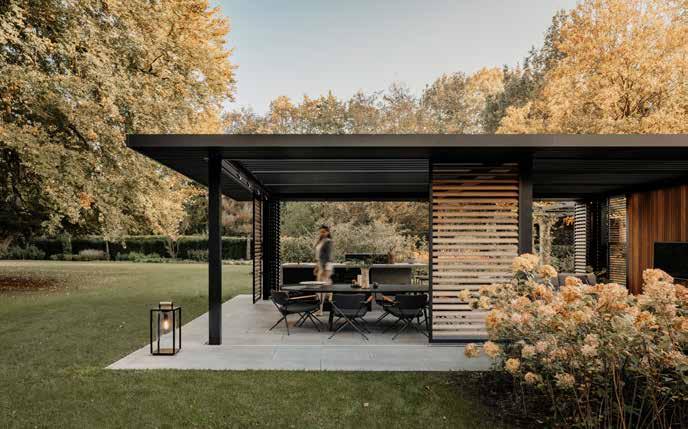
In outdoor living, our main challenge is to highlight our strengths even more clearly. At Renson, quality, design and aesthetics are central to creating comfortable outdoor spaces that can be enjoyed in all weather conditions. As the boundary between indoor and outdoor living continues to blur, outdoor areas increasingly function as fully fledged living spaces. This shift provides significant opportunities to further enhance and personalise our high-end outdoor living solutions, allowing us to create
Linarte Wood Coriander Oak
Linarte Wood Toffee Oak
Sunclips Architectural Shading
environments that meet the expectations of homeowners across the world — and, for my region specifically, in APAC, the Middle East and India.
• Renson is known for its strong focus on innovation. Is there a recent product or idea that you feel really captures where the company is heading?
Innovation at Renson in 2025 increasingly focuses on refining our solutions so that they can be integrated into architectural designs as subtly as possible. Fixscreen Minimal is a clear example. It provides a perfect match for minimalist window profiles and can even be installed as a retrofit without compromising the design intent. The development of individual Linarte façade cladding profiles also demonstrates our strong drive for innovation. These elements offer architects and façade builders limitless design and combination possibilities, even on curved surfaces.
In terms of technology, Renson places a strong emphasis on intelligent systems that simplify the user experience and offer maximum convenience. Renson’s main growth comes from developments that materialised in the
last five years; this shows that we should keep focusing on innovation to remain the market leader in as many segments as possible.
• Comfort, design and energy efficiency don’t always go hand in hand. How does Renson find the right balance between these three?
Renson achieves the balance between comfort, design and energy efficiency by listening closely to the market and to the professionals who work with our solutions
Amani takes outdoor living to a new level
Fixscreen Minimal
every day. Architects, installers, shading specialists and façade builders have a clear understanding of what their clients expect, what convinces them and where they sometimes encounter hesitation. They also have first-hand insight into the sensitivities surrounding regulations, energy use and evolving architectural trends.
By continuously comparing their feedback with new technological and material developments, we ensure that our innovations remain relevant in every respect. This approach allows us to introduce solutions that perform well aesthetically and technically while also meeting increasingly stringent energy requirements. It is a process that prevents compromise between the three pillars. Instead, it creates products that meet high design expectations, enhance user comfort and contribute to sustainable, energy-efficient buildings.
At Renson, this integrated way of thinking runs through every product group. Whether we are refining ventilation strategies for healthier living, developing discreet exterior shading to reduce overheating or designing façade cladding that combines appearance with durability, the goal remains the same: we strive to deliver solutions that enrich the architectural vision, increase everyday comfort and support long-term environmental responsibility across all the regions in which we operate.
• Ventilative cooling is still a new concept for many people. How do you explain its benefits to customers used to traditional cooling systems?
We explain the benefits of ventilative cooling by giving a voice to those who work with it and experience it directly. Architects, building physicists and residents share their own insights and practical experiences, which provide credible and relatable testimonials. First-hand accounts are the strongest form of advocacy, and those who have lived with ventilative cooling quickly become its most effective ambassadors.
There is still a degree of hesitation in the market, often based on misconceptions or a lack of familiarity, yet the principle itself is very straightforward. With the right explanation, the idea of using cooler night air to cool down the thermal mass of a building becomes entirely logical. It is a natural and energy-efficient way to stabilise indoor temperatures, especially in regions where active cooling dominates. By demonstrating how ventilative cooling complements traditional systems and reduces their energy load, customers better understand its value and adopt it with more confidence.
• Sustainability is a major talking point today. How does Renson ensure that its materials and manufacturing processes truly support a greener future?
Renson’s approach to sustainability begins with the choice of materials. Aluminium is our primary material because it is highly durable and can be recycled almost entirely at the end of its life cycle. For ventilation units and solar shading systems, we focus strongly on modularity. Each component is designed and assembled in such a way that it can be replaced individually, which extends the lifespan of the product and reduces unnecessary waste.
Most importantly, our Creating Healthy Spaces philosophy is built on the intelligent use of natural elements such as daylight, fresh air and cool night air to achieve a healthy and comfortable indoor climate. By prioritising natural solutions that improve indoor air quality and prevent
Renson Office Outdoor
Linarte Wood Toffee Oak
overheating, we help counteract the growing challenges of polluted indoor environments and rising temperatures in homes. This approach enables us to slow down the impact of climate change in a structural way and to support the development of sustainable buildings for the long term.
• Smart technology is entering every part of our lives. What role does it play in Renson’s approach to creating healthier indoor climates?
Connectivity and smart technology play a central role in relieving residents of the complexity of maintaining a healthy and comfortable indoor climate. By connecting systems such as solar shading, ventilation, night cooling and heating or cooling — and allowing them to respond intelligently to living patterns and specific environmental conditions — the optimal indoor climate is created automatically. The resident benefits from a balanced and healthy environment without needing to intervene or manage the systems manually.
This intelligent approach also offers clear advantages for installers and service technicians. Many issues can be monitored and resolved remotely, which reduces the need for on-site visits and improves overall efficiency. Smart technology, therefore, enhances the user experience while also supporting a more streamlined and proactive service model.
• Renson is expanding across the world while staying rooted in Belgium. How do you maintain that family-owned spirit as the company grows?
Maintaining the spirit, entrepreneurship and dynamism of a family-owned company is a real challenge when
growing as quickly as Renson has in recent years. As we expand internationally while remaining firmly rooted in Belgium, our focus is on safeguarding the values that have shaped the company for more than a century. The key lies in finding the right people who can embrace this mindset while supporting the structures and processes needed to guide every project smoothly from order to completion.
We look for individuals with a strong sense of initiative and an entrepreneurial approach. We want people who are not only experts in their field but who also take pride in contributing to a family-owned organisation with a long-term vision. This combination allows us to grow without losing the identity and culture that define Renson. It ensures that our international development is built on the same foundations of reliability, innovation and commitment that have always characterised the company.
Linarte Wall cladding
Renson Outdoor Production Site
• Every industry is facing new challenges. What are the biggest ones for Renson right now, and how are you preparing for them?
Exactly the rapid growth the company has experienced in recent years, as mentioned above. This development coincides with a particularly demanding period for the global construction sector. These combined pressures require not only Renson but every company in the industry to sharpen its focus on cost efficiency and operational performance in order to maintain the pace of innovation.
Preparing for these challenges means streamlining processes, investing in the right expertise and continuing to develop solutions that deliver real value in terms of comfort, design and energy efficiency. By strengthening our organisation and reinforcing our long-term strategy,
we ensure that Renson remains agile and competitive while continuing to innovate in a market that is evolving quickly.
• What is Renson’s vision for the next five years? Renson’s vision for the next five years is to continue distinguishing itself through innovation. Innovation is deeply embedded in the company’s DNA and remains the only meaningful path forward for us. Our focus is on delivering new solutions that enhance comfort, convenience, design and aesthetics, always with an emphasis on quality and long-term sustainability. This approach is far more valuable to our customers than becoming entangled in a price-driven race with an evergrowing number of competitors.
As the Export Director for APAC and the Middle East at Renson, it is safe to say that we are simultaneously strengthening our international ambitions. Renson offers solutions that are relevant across the globe, regardless of climate, construction methods, or regional building cultures. We see significant potential in further expanding our presence in key markets and in adapting our expertise to a wide range of environments. Within my region of responsibility, we experience a range of temperatures, from freezing to scorching heat. No matter the climate, Renson has a solution to create healthy spaces. The future is international, and we are preparing our organisation to continue growing on that global stage while staying true to the values that define us.
Fixscreen Fabric sun protection
Amani - Architectural design for exclusive outdoor living
INDIA’S FIRST
Face to Face
“Architecture
as
a
Living Interface: Evolving Mindsets and Future Directions”
DR. DIAAELDIN ALY Chairman & Founder, DIA Architects International consultancy firm
About the Author
Dr. Diaaeldin Aly is a Consultant Architect and the founder and chairman of DIA Architects, a practice established in 1988 that is widely recognized for its contributions to façade design, interior environments, and urban development across Egypt and the Middle East. With over three decades of experience, he has led multidisciplinary teams in delivering complex projects across healthcare, hospitality, residential, mixed-use, corporate, and urban regeneration sectors. His design philosophy blends clarity, proportion, and emotional resonance, creating architecture that is both technically intelligent and deeply human. Under his leadership, DIA Architects has become a regional reference in façade intelligence, sustainable urbanism, and context-driven design.
• DIA Architects has been operating since 1988. How has the firm evolved over the years, and what have been the key milestones in its journey?
Since 1988, D I A Architects, an international consultancy firm, has evolved from a focused architectural studio into a multidisciplinary practice working across banking, healthcare, hospitality, residential, and largescale urban projects.
Our growth has been shaped by three major milestones:
• Early adoption of research-driven design, influencing how we approach façades, materiality, and human experience.
• Expansion into technically complex sectors, particularly healthcare, where precision and performance are essential.
• Developing a strong regional signature in façades and urban identity, allowing our work to contribute to the architectural DNA of cities.
Over the years, we have also strengthened our integration between architecture, interior design, and landscape — ensuring that every project
communicates one coherent narrative, from façade to experience.
• As Chairman, how would you describe your leadership style and the vision you aim to bring to the company today?
My leadership is built on clarity, trust, and shared purpose. We operate as one family, where every team member understands the “why” behind each decision.
My vision is to position DIA Architects as a regional leader in façade intelligence, sustainable urbanism, and emotionally meaningful design.
I believe in empowering teams, creating space for experimentation, and building a culture where craftsmanship, research, and innovation work hand in hand.
• Sustainability is becoming essential in architecture. How is your firm integrating sustainable thinking into everyday design decisions? For us, sustainability is not a checklist — it is a mindset.
We embed it into everyday decisions by prioritising:
• Passive cooling and natural ventilation
• High-performance façades and envelope design
• Daylight optimisation and glare control
• Energy-efficient systems and long-term operational performance
Our teams continuously share knowledge about new materials, smart building technologies, and greenbuilding standards.
Sustainability, ultimately, is the art of doing more with less while enhancing human comfort.
• Could you share a few standout projects from D I A Architects that best represent the firm’s design philosophy?
Projects that reflect our philosophy are those where clarity, proportion, and light work together to create a calm and intuitive experience.
These include:
• Mixed-use and hospitality developments shaped by materiality, natural light, and spatial rhythm.
• Urban façade regeneration projects that elevate the identity and quality of entire districts.
• Banking and corporate projects where interior and exterior work as one — using softer materials and warm lighting in long-duration waiting areas, contrasted with more focused materials and concentrated lighting in workspaces.
Across all project types, our objective is the same: to design environments that feel balanced, timeless, and human-centred.
• Your firm works across many sectors — residential, healthcare, hotels, and retail. How do façade and fenestration needs change across these project types?
Each sector carries its own architectural logic:
• Healthcare: controlled light, thermal stability, and comfort-driven fenestration.
• Hospitality: openness, framed views, and seamless indoor–outdoor transitions.
• Retail: transparency, identity, and visual engagement.
• Residential: privacy, shading, natural ventilation, and material warmth.
Across all sectors, we see the façade as a living interface, not just a surface — it mediates light, climate, identity, and human experience.
• Are there any recent façade technologies or materials — such as smart glazing or advanced shading systems — that you find especially promising?
Yes, technologies such as electrochromic glazing, dynamic shading systems, improved thermal breaks, and ventilated façade assemblies are becoming more accessible.
We incorporate them only when they bring genuine value — whether in comfort, energy savings, or longterm performance.
We also explore integrated photovoltaic glazing, automated solar systems, and colour-temperature adaptive façades to enrich the building’s environmental response.
We recently designed a mosque in Kuwait City featuring a moving glass dome aligned with the sun’s path throughout the day.
• What trends do you believe will define façade design in the coming years in Egypt and the wider region?
The future of façades in the region will be shaped by:
• Climate-responsive envelope design
• Smart and adaptive façade systems
• Deeper integration of local, sustainable materials
• A growing focus on wellbeing, daylight, and psychological comfort Buildings will become more intelligent, more responsive, and more emotionally resonant — shaping not only skylines, but also the daily lives of the people who interact with them.
• As Chairman, what kind of design legacy do you hope D I A Architects will leave behind, particularly in façade and urban design?
I hope our legacy is defined by clarity, purpose, and human experience.
If we are remembered for anything, I want it to be for creating:
• Façades that shape better streets
• Architecture that enhances daily life
• Buildings that feel timeless and connected to their context
Our goal is to help create cities that are more humane, more inspiring, and more emotionally meaningful because of the work we contribute.
• How do you see the role of technology — BIM, digital modelling, visualisation tools — shaping the future of architecture and project delivery?
Technology is now the backbone of architectural accuracy and integrated design.
BIM, parametric modelling, and advanced visualisation allow us to:
• Predict performance
• Optimise material usage
• Resolve design conflicts long before construction
• Enhance client understanding through immersive simulations
The future belongs to practices that merge human intuition with digital intelligence — allowing architecture to be both imaginative and exact.
• What advice would you give to aspiring architects? Be curious, Be patient, Design with intention!
Master proportion, light, and materiality before chasing trends.
Remember, you are not designing buildings — you are shaping moments, emotions, and the rhythm of people’s lives.
Architecture is ultimately about human experience and the memories that spaces create.
Global News
Cartier Unveils Fluid, Fabric-Inspired Façade for its Ginza
Flagship
In Tokyo’s famed Ginza 4-chome district, Cartier has unveiled the newly completed façade of its flagship boutique — a sculptural reinterpretation of luxury retail frontage by Klein Dytham architecture. In contrast to the district’s typically rigid, rectilinear streetscape, this design embraces fluidity: the building is wrapped in bespoke cast-aluminium panels whose sweeping, triple-curved surfaces evoke the graceful folds of silk or the flowing drape of a wedding gown.
The façade is composed of three-layered tiers: first, the cast-aluminium panels form the deepest, sculptural folds; behind these lie flat aluminium panels; and finally, at the outermost layer, a pane of glass printed with a subtle ceramic
pattern. Together, these layers give the impression of translucent ribbons cascading across the building — a visual metaphor for elegance and depth that promises to prepare visitors for the refined world inside.
A key highlight of the design is the choice of finish: Cartier’s bespoke “Moon Gold,” a delicate gold tone tinged with soft white. The finish has been fine-tuned through extensive prototyping to ensure it responds beautifully to light — appearing cool and silvery in the morning and warm and luminous at dusk.
To anchor the expressive curves within the urban context, the undulating aluminium cladding is framed within a rectilinear boundary. This frame provides structure and dialogue with the surrounding vertical rhythm of neighbouring façades, while the
horizontal flow of the new skin dissolves floor-by-floor divisions, creating a unified, seamless exterior.
The design also integrates cultural nuance: the outer glass layer is printed with a stylised version of the traditional Japanese “Seigaiha” (wave) motif — a symbolic motif associated with water, harmony and good fortune. Through this reinterpretation, Cartier and Klein Dytham create a façade that speaks both to Japanese heritage and contemporary luxury.
This project marks KDa’s second major collaboration with Cartier, following their work on the Maison’s Shinsaibashi Boutique in Osaka. As before, the focus lies in blending craftsmanship, context and material innovation — here realised in a façade that is at once modern, poetic and deeply rooted in cultural tradition.
Dior Transforms 30 Avenue Montaigne into a Festive Wonderland
Dior has unveiled a magical new décor for the festive season at its flagship address on 30 Avenue Montaigne in Paris. The building’s façade has been transformed into a luminous “Wheel of Fortune”, adorned with classic Dior motifs — delicate flowers, the founder’s lucky stars, butterflies and other iconic talismans.
The shop windows reflect a rich sense of heritage and fantasy: visitors are treated to miniature scenes evoking both the spirit of 30 Montaigne and the magic of Paris, with references ranging from the Medallion chair and a perfume kiosk to chandeliers and evocative takes on mythical locales.
Inside, a spectacular Christmas tree rises around the central staircase, dressed with tiny versions of Dior’s emblematic pieces — from the legendary Bar jacket to the Junon dress — alongside forecasts of the 2026 Cruise Collection. Elsewhere, the space leading to “Le Jardin” is decorated with a Pegasus figure and snow globes, creating a dreamy winter-garden atmosphere among richly decorated Christmas trees.
This enchanting display is part of Dior’s broader seasonal tradition of marrying the brand’s storied legacy with festive glamour — inviting passers-by and visitors to enter a world where couture, history, and holiday magic come together.
Mitrex and Gensler Unveil Cutting-Edge Solar Façade System
Mitrex — North America’s leading producer of building-integrated photovoltaics (BIPV) — has teamed up with global architecture and design firm Gensler to launch their newest offering: eFaçade PRO+ with Honeycomb Backing. This new system aims to raise the bar for solar façades by blending aesthetic versatility, high performance, and sustainability.
Working with Gensler as a design consultant, Mitrex has crafted eFaçade PRO+ to meet the needs of landmark architectural projects that combine bold creativity with stringent safety standards.
The system supports unlimited customisation — allowing architects to specify colours, shapes, surface finishes (such as satin, matte, gloss or wood grain), and sizes — while embedding photovoltaic technology right into the building envelope to generate clean energy.
Unlike conventional solar panels, eFaçade PRO+ is engineered to work on curved surfaces, angled walls, oversized panels, or integrated corners — giving architects the latitude to push design boundaries without compromising performance.
The façade system meets rigorous international standards, including fire safety classifications EN 13501 A2-s1,d0 and compliance with NFPA 285.
It is also tested for solar performance (UL 61730, UL 61215), impact resistance (ASTM E1996), and load resilience under wind stress (ASTM E330), making it suitable for high-rise and landmark buildings where reliability matters. According to Mitrex’s Environmental Product Declaration (EPD), eFaçade PRO+ has an embodied carbon footprint of 40.79 kg CO₂e per square metre — and in high-emission grids, the solar energy generated by the façade can offset that footprint in as little as a year. Over a 60year lifecycle, the system is capable of producing significantly more clean energy than the emissions produced during its manufacturing, offering long-term environmental and economic benefits.
This union of design flexibility, strict safety compliance and carbon-mitigating performance illustrates how solar building materials are evolving — turning façades into energy-generating canvases, not merely functional coverings.
Foster + Partners Given the Go-Ahead to Retrofit
1St James’s
Square
Foster + Partners has secured permission from Westminster City Council to redevelop the offices at 1 St James’s Square, located in the heart of London’s St James’s district.
Under the approved plans, over half of the existing building’s structure will be retained while its façade is completely re-imagined. The
scheme will add two new storeys and incorporate terraces and green outdoor spaces.
The upgraded building is set to meet rigorous sustainability standards — targeting certification levels of BREEAM Outstanding, NABERS 5.5*, and WELL Platinum.
Clad in Portland stone to harmonise with the surrounding Georgian architecture, the new façade will feature chamfered windows and a “breathable” design. Natural ventilation will be possible for roughly 40 % of the year, and a smart control system is expected to reduce cooling energy use by
around 70 %. Inside, the redeveloped building will offer approximately 11,000 m² of premium office space across ten flexible floors, along with landscaped terraces, a green roof, and panoramic city views. It will run on an all-electric system, using airsource heat pumps, mixed-mode ventilation and a high-performance façade to minimise operational energy.
Foster + Partners describes the project as a way to prevent the building from becoming a “stranded asset,” highlighting how reusing the existing structure reduces embodied carbon and gives the building a new lease of life.