Wednesday, January 13-19, 2021 - // no. 090
Puerto Rico and the Caribbean
www.theweeklyjournal.com
Prepa Needs Gov’t Loan for LUMA Deal P6 CHTA: Rapid Increase in Caribbean Tourism P7 Vertical Farming on the Upswing P10
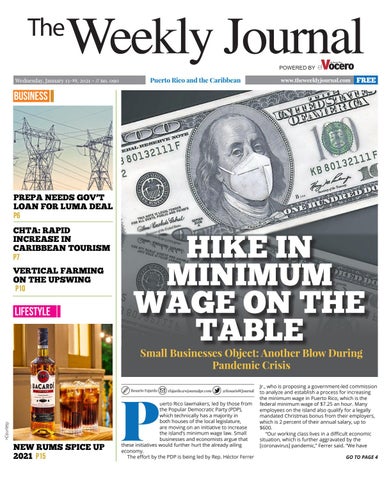
Hike in Minimum Wage on the Table Small Businesses Object: Another Blow During Pandemic Crisis
P
>Courtesy
Rosario Fajardo
New Rums Spice Up 2021 P15
rfajardo@wjournalpr.com
@RosarioWJournal
uerto Rico lawmakers, led by those from the Popular Democratic Party (PDP), which technically has a majority in both houses of the local legislature, are moving on an initiative to increase the island’s minimum wage law. Small businesses and economists argue that these initiatives would further hurt the already ailing economy. The effort by the PDP is being led by Rep. Héctor Ferrer
Jr., who is proposing a government-led commission to analyze and establish a process for increasing the minimum wage in Puerto Rico, which is the federal minimum wage of $7.25 an hour. Many employees on the island also qualify for a legally mandated Christmas bonus from their employers, which is 2 percent of their annual salary, up to $600. “Our working class lives in a difficult economic situation, which is further aggravated by the [coronavirus] pandemic,” Ferrer said. “We have GO TO PAGE 4
The Weekly Journal > Wednesday, January 13, 2021 >
2
Constant updates online 24/7. TheWeeklyJournal.com
Visit us for updated content on our 24/7 platform.
WeeklyJournal
The
3
/ Wednesday, January 13, 2021
a week in review FEMA Awards $3.7 Billion for Prasa Projects
>Carlos Rivera Giusti
>Josian E. Bruno Gómez
>Josian E. Bruno Gómez
More than three years after Hurricane Maria devastated Puerto Rico in Sept. 2017, FEMA has awarded the Puerto Rico Aqueduct and Sewer Authority (Prasa) $3.7 billion for reconstruction projects. The funding will be used to help rebuild Puerto Rico’s water and wastewater treatment plants, pumping stations, dams and reservoirs. The funding represents the 90 percent federal share of the $4.1 billion fixed cost estimate for facilities operated by Prasa.
HHS Allocates Over $200M for COVID-19 Testing, Vaccination in Puerto Rico
Puerto Rico General Fund’s Revenues Exceed Projections
Puerto Rico will receive more than $183.8 million to support efforts to administer COVID-19 tests and over $28.8 million for vaccination, for a total of nearly $213 million from the U.S. Department of Health and Human Services (HHS). The COVID-19 testing efforts include contract tracing, surveillance, containment and mitigation to monitor and suppress the spread of the coronavirus.
The Puerto Rico Treasury Department - known as Hacienda reported that the General Fund’s net revenue during the month of November 2020 amounted to $656.1 million. The agency also said that collections during the accumulated fiscal period from July to November reached $4 billion, which exceeded the estimated figures by $698.1 million, or 21 percent.
4
/ Wednesday, January 13, 2021
CONTINUED FROM PAGE 1 more than 300,000 people in jobs subject to the federal minimum wage, which is $7.25 an hours, which represents a wage of $15,080 a year. It is time to do justice to these workers, through a serious analysts that results in benefits for all the sectors involved.” Based on his figures, more than 30 percent of residents who are employed in Puerto Rico receive the minimum wage. According to Ferrer, the commission’s responsibilities would include defining the methodology by which the minimum wage would be increased on the island. “Contrary to what other sources indicate, granting an increase in the minimum wage would have a positive effect on the economic development of Puerto Rico,” said the freshman lawmaker. “The study carried out by the proposed commission should emphasize the importance of achieving this increase so as to improve the existing economic inequality.” At the same time, Ferrer said an increase in the minimum wage on the island should be subject to the cost of living, as he recommended the increase should be carried out in phases. “Any proposed increase must be phased, with the interest of doing justice to the salaried worker. It is essential that the commission seeks to vindicate the culture of work in Puerto Rico and strengthen the formal economy over the informal economy, an essential element in the construction of the project.” By way of comparison, Mississippi, the poorest state in the United States, has not increased its minimum wage rate. “Mississippi has not established a state minimum wage rate. Because most employers and employees in Mississippi are subject to the federal Fair Labor Standards Act, the minimum wage set forth in that law would typically apply. Currently, the federal minimum wage is $7.25,” according to the Employment Law Handbook.
Popular Democratic Party Rep. Héctor Ferrer Jr. >Brandon Cruz González
Business Owners Speak Out
Meanwhile, Francisco Santana, president of the P.R. Small Businesses Association (AsoPYMES, Spanish acronym), said the issue of raising the minimum wage may be valid, but not in the midst of a pandemic and an economic crisis. “With the situation that we have right now, how can a small-business owner manage higher payrolls? They don’t have the same revenues, so I don’t know how a salary increase would be managed. Second, let’s say it becomes law - the option for small merchants is to increase their prices. Would it really help to increase all prices and give workers a little bit more income if they have to pay more?” he said to THE WEEKLY JOURNAL.
Merchants say they cannot afford to absorb higher operating expenses.
“I’m not saying that the issue of raising the minimum wage isn’t valid, but for small-business owners who are experiencing reduced sales, fewer clients, different work hours, and with employees working part-time, right now they cannot afford a wage hike... Right now in the context of the pandemic it is not the time,” said the local businessman who owns an agricultural company in Ponce. “The avalanche of legislative bills disconnected from the economic reality of PR and the difficult situation of thousands of merchants continues. Frustrating for others!” tweeted economist Gustavo Vélez. “Without analysis or studies, and knowing that thousands of businesses are on the verge of bankruptcy, PDP legislators are filing a measure to increase the minimum wage,” he added. Yaliz Báez Rivera, co-founder of Yōko Restaurant in San Juan, said small businesses do not have the ability to cover such additional costs. “The reality is that I have been an employee most of my life and the minimum wage, unfortunately, becomes the maximum in many places, and with that wage, it is very difficult to live. I think we have all been through this with this pandemic; many people who were used to one salary have had to adapt to a different one. “However, small merchants absorb it, and then it is our responsibility to cover that expense when there are a lot of benefits for large companies such as Walmart, Walgreens and a lot of other companies that the government gives them additional benefits just for employing workers.,” she said. Báez also said small businesses need more incentives to operate. “I would love for the bill that goes with the minimum wage to be tied with benefits for small businesses because the problem is that benefits are always given to the big companies... but then we, who are trying to
/ Wednesday, January 13, 2021
survive the pandemic, feel the impact of the salary “I am not ruling it out. For example, the increase. Again, I totally agree; however, I insist previous governor [Ricardo Rosselló] issued that it should be hand in hand with a bill that helps an executive order that established a [higher] small businesses to defray these expenses. minimum wage for construction projects using “If it does not come tied to an federal funds. So I am not ruling out issuing an executive order, incentive ... businesses will put but not necessarily the same; their workers under contract (like different, but with the intention freelancers) or will reduce their of ensuring that the labor force hours, and then the employees • By way of in reconstruction projects is well will lose their fringe benefits of comparison, paid,” he said to EL VOCERO, the vacation days, sick leave. Those Mississippi, the sister publication of THE WEEKLY are not only economic benefits, poorest state in JOURNAL. but are also tied to the emotional the United States, The Financial Oversight and health of people who had job has not established Management Board (FOMB) security… We comply with all the a state minimum has been a staunch supporter requirement of the law, but it wage rate. of the Puerto Rico government would be a big blow for us,” she following its certified Fiscal Plan, said. • Consequently, the which includes enacting “coststate’s minimum saving measures.” To that end, Success of the Initiative wage is that of the the FOMB has the legal mandate Uncertain federal: $7.25 an from the federal government Gov. Pedro Pierluisi has hour. to reject any bill signed by indicated that he would look at the governor that is deemed the issue of raising the minimum “inconsistent” with the fiscal plan, wage, but largely demurred. “I such as a financial impact on the anticipate that President [Joe] central government’s finances. Biden and the Democratic leadership in Congress In fact, five legal challenges filed by the will push for a minimum wage increase,” he said. government of Puerto Rico against the FOMB were Pierluisi, of the New Progressive Party and a rejected last month by the federal judge that is Democrat in national politics, also demurred on overseeing the island’s bankruptcy proceedings. signing an executive to that effect, but for specific The challenges concerned several medical-related sectors.
In fact,
The retail and services sectors have been hard hit by the coronavirus pandemic. >Carlos Rivera Giusti
5
laws as well as allocations on vacation and sick time for public employees. Judge Laura Taylor Swain of the U.S. District Court for the District of Puerto Rico rejected the central government’s arguments and barred it from implementing the aforementioned laws and allocations. The judge indicated that such laws were not proven to be “revenue neutral,” as required by the Puerto Rico government’s approved Fiscal Plan. The FOMB said in a statement that Swain’s ruling indicated that the five laws were in violation of the federal Promesa law that governs the island’s bankruptcy proceedings. “Promesa mandates that new laws must not impair or defeat the purposes of Promesa as determined by the Oversight Board and must not be significantly inconsistent with the Certified Fiscal Plan and the Certified Budget. Significantly, Judge Swain determined the burden is on the Government to provide a formal estimate explaining each new law’s impact and to respond to the Oversight Board’s notifications of any deficiencies,” said the FOMB. “Judge Swain found the Oversight Board had justifiable concerns that the Government had not considered the impact of each new Act on the Commonwealth’s expenses and revenues. Judge Swain also determined the Government failed to comply with Promesa with respect to each new Act.,” the Oversight Board added. - Reporter Giovanna contributed to this story.
6
/ Wednesday, January 13, 2021
Prepa Needs $894 Million to Carry Out LUMA Deal
Plan is for the Puerto Rico government to loan the funds
T Rosario Fajardo
rfajardo@wjournalpr.com
@RosarioWJournal
he Puerto Rico Electric Power Authority (Prepa) needs at least $894 million in funds to execute the agreement with LUMA Energy, according to a report by the Financial Oversight and Management Board (FOMB). The support is necessary for the funding of operations and maintenance agreement with LUMA, as the public utility’s “cash balances are insufficient to self-fund cash needed for the LUMA conversion,” as per Oversight Board documents filed in December 2020 on “Creditor Mediation and Cash Support Materials.” The FOMB indicated that the plan is for the commonwealth government to loan the $894 million to Prepa. “To ensure the Island has a viable and reliable electricity utility, the Commonwealth may loan the LUMA Funding Requirement,” stated the document. The rationale given for the move includes “energy reform is one of the most essential structural reforms in the Commonwealth Fiscal Plan, and will help make Puerto Rico more competitive and pro growth, leading to a contribution of surplus in excess of [an estimated] $11 billion over 30 years that funds creditor recoveries.” At the same time, “if not funded through a loan from the Commonwealth, Prepa would need to fund reserves via alternate means, such as a rate adjustment that would dramatically increase electricity rates in the short term (i.e., the expected period between now and when the reserves will need to be funded).” The FOMB said important considerations for the financial support are that “LUMA’s service commencement is conditional on the funding of operating and capital accounts and Prepa has insufficient cash to satisfy the operating and capital accounts.” Moreover, Prepa will also need to fund an estimated $500 million in expenses to exit Title III bankruptcy, the FOMB said. The 15-year private-public partnership contract with LUMA is for the operation and management of Prepa’s transmission and distribution system.
FOMB Executive Natalie Jaresko has repeatedly defended the deal, saying it will help reduce costs by about $100 a million a year and will lead to a more efficient and reliable grid, which will help move the Puerto Rico economy forward. She has also underscored that Prepa needs to restructure its debt because as long as the corporation is in bankruptcy, energy rates will be higher for consumers. She explained that every fuel supplier that sells fuel to the public utility has a risk premium, in which they charge more because they are selling to a bankrupt entity. “I think that for employees, [LUMA] will be a good employer with solid pay. It will depoliticize Prepa… Having an entity that focuses on service, that’s incentivized, that is paid because it does well—if not, they don’t get the same pay… I think that every person will see that this will lead to more reliable energy for them, not many shutoffs all the time… Simply being in bankruptcy costs everybody more,” Jaresko said, as previously reported by THE WEEKLY JOURNAL.
IEEFA questions the move
Meanwhile, the Institute for Energy Economics and Financial Analysis (IEEFA) said the plan raises questions about the reported savings on the transmission and distribution agreement. “In theory, the [$894 million] loan will stabilize Prepa’s finances and send a strong signal that the newly privatized Prepa will be able to honor its commitments to vendors,” stated financial analysts
Cathy Kunkel and Tom Sanzillo in a recent IEEFA commentary. “One of the reserve accounts that Prepa needs to cover is for federally-funded capital expenditures, amounting to $283 million. If this amount is to be federally funded, why is it included in the total loan from the commonwealth? The [FOMB] document also notes Prepa will need to pay approximately $500 million in fees for its exit from Title III bankruptcy within the next two years. Is this expense going to come out of electricity rates, or is Prepa going to borrow again to pay the fees?”, asked the IEEFA. At the same time, the Institute questioned the issue of savings. “The FOMB document implies that repayment can be financed with savings from the contract. This raises the obvious question: How much does Prepa expect to save?... The LUMA contract does not mandate any level of savings. Even the financial performance metrics that allow LUMA to earn an additional incentive fee are structured around LUMA staying within annual budgets—not for achieving any baseline level of savings.” The terms of the loan may be costly for Puerto Rico, said the IEEFA. “A 6 percent loan (comparable to loans PREPA previously received from the Government Development Bank of Puerto Rico) over the 15-year contract would cost PREPA $92 million annually. Even a zero-interest loan would cost Prepa $60 million annually, more than enough to eliminate all of the ‘hypothetical’ savings of the LUMA contract.”
7
/ Wednesday, January 13, 2021
The Boquerón area of Cabo Rojo is a popular tourist destination. >Carlos Rivera Giusti
Cruise industry reporting billiondollar losses
P Rosario Fajardo
rfajardo@wjournalpr.com
ablo Torres, the president of the Caribbean Hotel and Tourism Association (CHTA), is predicting that the Caribbean will see a return of tourism to the region, “faster than many parts of the world,” thanks to the protocols and partnerships implemented throughout the region to help lessen the effects of the COVID-19 pandemic. At the same time, vaccines against the coronavirus have rolled out, not just in Puerto Rico, but across the United States and the Caribbean as well. “Tourism is our key to recovery, to restoring the livelihood of thousands of employees in our industry, to reopening our doors, and welcoming our guests,” said Torres, who is also the general manager of Caribe Hilton, which is located in San Juan. In addition to replenishing tax revenues to cash-strapped governments, he noted that a tourism revival would refresh and renew “the minds, bodies and spirits of millions of travelers who will discover that the Caribbean is the best place on earth to recover from the ravage of this pandemic.” From territory- and countryspecific COVID-19 testing requirements and stringent cleaning and sanitization protocols in place at accommodations providers to social distancing and face mask policies and rules limiting capacity at restaurants and other gathering places, Torres
noted that the Caribbean hospitality sector has gone to great lengths to protect and ensure the health and safety of both residents and visitors. “While the tourism industry and economies are challenged in unprecedented ways, the Caribbean tourism industry is not a stranger to crises, and there is every reason to believe that it will continue to show its resilience and it will rebound,” he said. Air traffic in several airports of the region, including that of San Juan, continued to lag compared with 2019 numbers. For example, Grupo Aeroportuario del Sureste (ASUR), a leading international airport group with operations in Mexico, Puerto Rico and Colombia, announced that total passenger traffic for December 2020 decreased 41.2 percent when compared to December 2019. Passenger traffic decreased 37.4 percent in Mexico, 45.2 percent in Puerto Rico and 48.4 percent in Colombia, impacted by severe downturns in business and leisure travel stemming from the coronavirus pandemic. ASUR, which operates the Luis Muñoz Marín International Airport (LMM) in San Juan, reported that in December 2020, LMM reported a total of 513,404 passengers, compared to 937,716 in December 2019, which represents a decrease of 45.2 percent. For the year, LMM registered a total of 4,845,353 total passengers, versus 9,448,253 passengers for 2019, representing a year-over-year drop of 48.7 percent.
Cruising still at a low point
The cruise industry also continues to suffer billion-dollar losses, as many cruise lines have been forced to suspend operations since the pandemic began in early 2020. For example, Carnival Corp., a main cruise line in Puerto Rico and the rest of the Caribbean, has reported
CHTA Predicts Rapid Return of Caribbean Tourism U.S. GAAP [generally accepted accounting principles] net loss of $2.2 billion and adjusted net loss of $1.9 billion for the fourth quarter of 2020. The company has also accelerated the removal of 19 less efficient ships, 15 of which have already left the fleet. On the positive side, cumulative advanced bookings for the first half of 2022 are ahead of 2019, despite minimal advertising or marketing, which bodes well for the future, Carnival indicated. “2020 has proven to be a true
testament to the resilience of our company. We took aggressive actions to implement and optimize a complete pause in our guest cruise operations across all brands globally, and developed protocols to begin our staggered resumption, first in Italy for our Costa brand, then followed by Germany for our AIDA brand. We are now working diligently towards resuming operations in Asia, Australia, the UK and the U.S. over the course of 2021,” said Carnival president and CEO Arnold Donald.
We are pleased to announce that effective January 1, 2021 Carrión, Laffitte & Casellas, Inc. (“HUB Puerto Rico”) has acquired Christiansen Insurance Group (“CIG”). The full roster of CIG employees, together with the following executives, joined the firm: Ralph G. Christiansen Senior Executive Vice President Juan J. del Nido Executive Vice President Jaime Calaf Senior Vice President Doris Díaz Vice President – Employee Benefits Practice Neritza Borrero Assistant Vice President, Commercial Lines
We welcome our new clients, employees, partners and friends. 255 Ponce de León Avenue, Suite 700, San Juan PR 00917 Tel. (787)641-2738 • clcinsurancepr.com
8
/ Wednesday, January 13, 2021
Few Businesses Expect to Grow in 2021
Business survey reveals economic concerns, problems with government services
A Giovanna Garofalo
ggarofalo@wjournalpr.com
@giopgarofalo
business survey is providing an insider’s look into how the COVID-19 pandemic has affected the private sector and government processes tied to the local business environment. For the survey, 649 companies islandwide participated, of which 551 were small businesses. Only 16 percent generated revenue greater than $10 million, and the majority were part of the Professional, Scientific and Technical services industry (29 percent). Of these, 45 percent reported that their workforce did not change throughout the pandemic and 6 percent even hired more staff. However, 22 percent laid off workers, 20 percent reduced work shifts, and 7 percent furloughed employees due to the outbreak’s effects on the economy. These insights were gleaned from the Financial Oversight and Management Board’s (FOMB) “Ease of Doing Business” survey for December 2020. An estimated 57 percent reported reduced demand for their businesses’ goods and services after the lockdown began in March, 48 percent saw an increase in their operating costs, 44 percent had to shut down their businesses temporarily, 33 percent had diminished access to key markets, and 30 percent had to expand the digital footprint of their enterprises. Meanwhile, 7 percent were unaffected, while others saw their sales increase (7 percent), opened a new business or company division (6 percent), and others even expanded their business operations (5 percent). The participants affirmed that to open or recover their businesses, they require financing like loans or grants (50 percent), a healthier climate with a lower rate of infection (45 percent), additional time to pay obligations (33 percent), stronger government health and safety support (32 percent), a reduction in regulatory restrictions (28 percent), easing of stay-at-home orders and curfews to reach their key consumers (25 percent), redesigning their business logistics to deliver their products to consumers (22 percent), and technical
About 44 percent of survey respondents said they have had to temporarily close their businesses.
expertise to help their businesses adjust (20 percent).
Ease of Doing Business
The FOMB explained that 503 respondents, or 77 percent, needed or requested services from a local agency in the last six months leading to December 2020. Most of these were solicited at the Department of Economic Development and Commerce, the Puerto Rico Treasury, the Labor and Human Resources Department, and the Permits Office. However, their experience with these government agencies was overwhelmingly negative; only 23 percent had good reviews for their service experiences, while 22 percent labeled these as “very bad.” The combination of allegedly subpar government services with the island’s deficient infrastructure hinders the ease of doing business in Puerto Rico. Specifically, 14 percent said that operating a business on the island is “somewhat difficult,” 26 percent said it was “difficult,” and 34 percent denounced that it is “very difficult.” Throughout the pandemic, 37 percent of participants attempted to obtain a construction or business permit on the island, of which 88 percent reported that the process had become more difficult. Most also reported issues with the government’s Single Business Portal and the
process to register property. In addition, a total of 66 percent said that logistics and infrastructure conditions were deficient, while 81 percent said the costs of these were expensive. In particular, the energy infrastructure was lambasted, with 85 percent of respondents saying that the energy supply is unreliable and too costly. As a result, 45 percent plan to invest in renewable energy to slash these expenses.
Low Expectations in the Near Future
For 2021, business owners are not particularly optimistic about growing or making investments. Only 16 percent said they would acquire another business or start a subsidiary; 37 percent are likely to make investments, such as equipment; 28 percent said they would likely see greater revenues in their respective industries; 28 percent stated that their business revenues are likely to grow in the next 12 months; 8 percent expect to hire more staff and 15 percent project greater real estate footprint for their businesses. These numbers are a stark contrast to the general optimism shared among some local economists and business leaders, who have affirmed to THE WEEKLY JOURNAL that 2021 should be a year of recovery for the island’s economy.
9
/ Wednesday, January 13, 2021
Business owners commend shorter curfew and the elimination of the Sunday lockdown. >Josian E. Bruno Gómez
New Executive Order ‘Positive’ for Businesses
Some sectors call for increased customer capacity
G Giovanna Garofalo
ggarofalo@wjournalpr.com
@giopgarofalo
ov. Pedro Pierluisi’s new executive order to curtail the spread of COVID-19 is now in effect, allowing businesses to operate for an extended period—a decision that has been generally well-received by the island’s private sector. Executive Order 2021-010 establishes a new curfew from 11 p.m. to 5 a.m., with business operations permissible until 10 p.m. and eliminates the lockdown on Sundays. These provisions started on January 8 and are valid until February 7. Adolfo González, president of Empresas Caparra and the Puerto Rican Shopping Centers Association, affirmed that reopening businesses on Sundays, shortening the curfew and allowing restaurants to sell alcoholic beverages on the weekends will help mitigate the financial losses experienced by this sector during the COVID-19 pandemic. “We agree with the provisions of the executive order because we had been asking to open businesses on Sundays for a while, given that we don’t believe that it poses any additional risk. In fact, a common problem - especially around Christmastime - was that there were more people concentrated on Saturdays than what there would have been if we had been allowed to open [on
Sundays]. That caused a problem and there were also sales drops,” he told THE WEEKLY JOURNAL. Iván Báez, president of the Retail Trade Association, shared his optimism. “We are very happy and grateful, especially with the measures that we asked - to operate on Sunday - which will eliminate the funnel effect in stores that fill up because people had one day less to buy. With hours of operation until 10 p.m., a balance is created between the island’s health and its economic development,” he said. Meanwhile, the executive order allows recreational access to pools and beaches, albeit with a ban on alcohol consumption in these spaces. This decree had been requested repeatedly by Joaquín Bolívar, president of the Puerto Rico Hotel and Tourism Association, who affirmed that this measure is “a step toward the right direction” in assisting the tourism industry, one of the sectors most battered by the coronavirus pandemic.
Future Expectations on Business Restrictions
While the private sector supports the flexibilization for businesses and consumers, some observed that increasing the client capacity of commercial establishments is also needed, particularly to assist the food and services industry. EO 2021-010, despite implementing looser restrictions, upholds the 30-percent guest capacity limit, which has been deemed by some as an obstacle for restaurants and small businesses. Gadiel Ledrón, executive director of the Puerto Rico Restaurant Association, reacted positively to the elimination of the lockdown but said he had also expected a moderate increase in business
capacity. “The governor relaxed the order, although we would have expected an increase in capacity of the dining rooms to 50 percent... This did not happen, but opening on Sunday is very positive, as is extending the hours at night. Let’s see how progress is taking place,” he stated. Raúl Sierra, co-founder of El Tap bar and restaurant in Santurce, was slightly more circumspect. “I understand perfectly that there’s a controlled percentage to maintain social distancing inside the establishment. I’m not the right person to decide if it should be modified... but as the situation improves, then there should be an increase of people allowed inside a business,” he opined. For his part, González asserted that “the capacity is something that still has an effect, especially on small retailers - small stores that have been affected by this.” He also said that the current rate of vaccination in Puerto Rico “is going to have an effect that allows at least a major reopening in the next two or three months.” Considering the challenges faced throughout the vaccination process - due to logistics complications and incorrect addresses and phone numbers informed to the public - González believes that a positive economic effect may be detected “further ahead, by March or April.” Still, he reiterated that the new executive order offers tangible relief to businesses. Yaliz Báez Rivera, co-founder of Yōko Restaurant in Santurce, was optimistic about the future, particularly with the shorter curfew. “I hope this ends soon and that we can all finally share with our families how we truly want to and we can go out without a mask,” she stated. - Reporter Brenda A. Vázquez Colón contributed to this story.
10
/ Wednesday, January 13, 2021
Indoor Vertical Farming Jumpstarts Agribusiness
Grupo Vesan seeks to provide food security with sustainable practices
A Giovanna Garofalo
ggarofalo@wjournalpr.com
@giopgarofalo
small business in the southern region of Puerto Rico is seeking to revolutionize agribusinesses with sustainable practices, while providing food security and reducing the need for imported produce. Francisco Santana founded Grupo Vesan in 2015 with a simple concept: farming differently and more effectively. He looked to indoor vertical farming and became the first company in Puerto Rico to adapt that model. As previously reported by THE WEEKLY JOURNAL, indoor vertical farming allows farmers to generate fresh food items in a controlled environment with smaller required spaces. “Everything is with artificial lights and it works with 62 degrees F of temperature. It is a completely different environment. We regulate the humidity and even the oxygen level is controlled. The concept of all these parameters is completely different from what one usually finds in the market,” Santana explained. In its beginnings, Grupo Vesan started with a 40foot wagon and is now producing a variety of fruits and vegetables in Canas Industrial Park in Ponce, working with a 20-foot ceiling and 14 different parameters that allow for a broader range of products. Even after Hurricane Maria devastated nearly 70 percent of the island’s hydroponics, the company stood strong. As such, Santana hopes that more agribusinesses incorporate this system so that residents have access to fresh food in times of crisis. “One of the benefits of this system… is that it provides food security. What we project is that agriculture should move indoors,” he said. “Agriculture in Puerto Rico is not where it should be. That is the main issue of food security tied to this subject of indoor vertical farming. On the other hand, at the technology level we are the pioneers in this process. We promote the idea of impacting the agriculture of Puerto Rico for new generations. [The idea that] new generations are not going to go to traditional agriculture; that is not true. We have, for example, an alliance with the Catholic University
Unlike other lettuce produced in Puerto Rico, the ones grown via vertical farming are unaffected by saltpeter, a naturally occurring nitrate. >Courtesy of Grupo Vesan
emerge with this model, the island would drop its carbon dioxide (CO2) emissions because there wouldn’t be a need to transport fresh food via long distances. “It also provides fresher food to consumers and businesses like restaurants could apply the farm-to-table concept,” he said. Islandwide Agriculture Moreover, Grupo Vesan packs its agricultural Another benefit of indoor vertical farming is products with its roots in a pouch with water. that it can be employed virtually anywhere in This allows the product to have Puerto Rico, regardless of the greater longevity, thus reducing soil’s fertility or if the area is food waste and allowing for prone to flooding or droughts. In financial savings by not having fact, Grupo Vesan was founded to purchase fresh fruits or while the island was experiencing vegetables as often. As an a drought that prompted the Apart from example, Santana stated that Aqueduct and Sewer Authority lettuce, Grupo Vesan also the lettuce produced by his (Prasa) to ration water. grows spinach, tomatoes, company can last “two or even Indoor vertical farming is also cilantro, peppers, broccoli, three weeks” without spoiling. tied to the concept of “urban carrots and a variety Apart from lettuce, Grupo Vesan farming,” which is gaining of other agricultural also grows spinach, tomatoes, products. The company is popularity in Europe. That is, also developing a project cilantro, peppers, broccoli, carrots residents in any corner of Puerto to grow strawberries. and a variety of other agricultural Rico, including the San Juan products. metropolitan area or beachy “Revenue, a sense of municipalities like Dorado, can community and environmental start their own agribusiness. impact; those are the Likewise, this type of farming components of a sustainable company. In our case, can be applied in spaces labeled as “brownfields,” we don’t use any insecticide or pesticide, none which are areas that are contaminated and, therefore, of that. Our products are practically organic,” he unsuitable for traditional farming practices. Grupo affirmed. He added that the company is currently Vesan even sells wagons for these purposes because developing a project to grow strawberries, noting one of their aims is to popularize this technique. that indoor vertical farming could eventually Environmental Impact minimize the need to import foods that can’t be According to Santana, if more agribusinesses grown in Puerto Rico via traditional farming.
of Ponce and they send students here. They are working in air conditioning, in a white coat, like a pharmacist. They are doing scientific research, but they are really doing agriculture,” he added.
In fact,
11 < The Weekly Journal > Wednesday, January 13, 2021
VIVO CON MIS ABUELITOS Usar mascarilla dice mucho de ti. Pero sobre todo, previene la transmisión de miles de partículas que se esparcen en el aire cuando hablamos, tosemos, estornudamos o nos reímos.
Prevén el contagio y usa la tuya. #MiMascarillaDice
10 12
/ Wednesday, April 8, 2020 / Wednesday, January 13, 2021
3 Tips to Protect Puerto Rico and its Exit From Your Company in 4 Bankruptcy Times of Crisis in 2021
. Maximize social networks experience once things level off. to thethem, capital markets has to keep your company Lack in of access Among reduction of the prevented the government from accessing the public eye and explore population and the market; a Founder of Inteligencia Económica Economist new money toreduction improve roads, the advertising options. The business’s in themodernize costs of energy, dredge reservoirs and improve presence, leadership andenergy brand system,gas and transportation; and access citizens’ qualitytooffinancing. life. In short, bankruptcy is will be essential during the not something abstract and distant, rather a recovery process. For further analysisbut and advice, problem citizen closely. . Use economic indicators to that touches you caneach access Inteligencia make short and medium-term Económica’s website at http:// projections. It is estimated www.economiapr.com, and browse that the economy could face a through a collection of informative contraction between 6 percent and articles on finance and economics. 8 percent during 2020. Inteligencia Look for us on Twitter @ gustavovelezpr, and on Instagram modern history. Since 2016,Económica the island’soffers publicMicrosoft Power e have left behind the as gustavovelez2020. BI and as an accessiblebybusiness supervised disastrous yearclients of 2020, side from are: finances have been managed intelligence aneach external entity appointed by the U.S. platform Congress.for your which looking to tested us and. Evaluate business, company. accept how the bankruptcy created by the legal made us stronger totaking intoTo the multiple account the . Refinancing of commercial, framework the [federal] Promesa law was begin the long roadcompany of incentives was doingunder in 2018 personal or mortgage loans themake only option to avoid a fiscal and economic economic With and enacted by the recovery. and 2019, projections using the new interest rates collapse due to the local government’s insolvency. cautious optimism, local and federal usingwe different Fall scenarios due that haveRico been Puerto haslowered to almost welcome 2021, eager for it to be it governments, to the impact of COVID-19. Since 2016, The business’s presence, would not paid a zero. singleThis penny of itsallow you to better than thetopast 12outside months the is imperative think . Explore the various leadership and brand capital costs. public debt, which and to smile on usstrategies again. box for andfate begin to outline technological platforms $70 thatbillionreduce be essential during On plan February 11,will an important hearing will . Develop a new to pay the business Moreover, have that will allowwe you to also keep your may enable you to keep has made it possible the recovery process. place before Judge Laura Taylor Swain, who for when the island’stake situation government payroll, essential launched new government company aviable and profitable in operating during the quarantine. oversees the government’s bankruptcy process. normalizes. This business services and retiree pensions. in Puerto Rico, diverse Sincelike 2016, these difficult times. and Tools Microsoft Teams and The adjustment plan that will define how much plan incorporate different However, themust bankruptcy representative various Puerto has Some of theof ideas and strategies Zoom letRico merchants interact with Puerto changes the economy may Rico will be able to pay creditors and process enabled bythat Promesa ideological andwith world not paid a single that we areforces sharing our their customers. the conditions to get out of bankruptcy are is not eternal and has had very views, which will have the penny of its $70 supposed to finally be stipulated. Contrary to high costs for Puerto Ricans, historic task of getting us out billion public debt, the FOMB toreverting introduce and science, aswants well as President reformperception, estimatedthat at about $600 Trump’s million. taxpublic of bankruptcy and creating the which has made strong debt cuts, percent, food, so that it the close trendto of70 importing in bringing jobs to U.S. soil. Insolvencysucceeds and bankruptcy conditions for economic recovery. it possible to pay andPuerto subsequent governments, withlocal the choosing insteadtogether to promote the past couple of years, Rico’s The main objective of theManaging new the government Partner Colectivo360, Real Estatehave and affectedInPuerto private sector,production. can guide us out ofbe bankruptcy and Let us clear, this will Rico has continually demonstrated credibility in financial markets government and the Financial payroll, essential Business Consultant to reactivate the be an uphill battle for alleconomy. economies resilience, and today thecreate stakesthe conditions and in theits international business Oversight and Management services and retiree Facing the new yearthe and the entry intoRico the new around world, Puerto is areThe higher than ever. community. good name of There are Board (FOMB) is to reach the pensions. decade, we must start on theWe right footact and act no exception. must fast to bequestion optimistic, Puerto the Islandreasons is in serious necessary agreements with the according to the to to getovercome Puerto Rico andtimes swiftly allout theof the has unique competitive as long asRico the government is creditors of the government social stagnation that began back in and emerge as a winner incentives enacted andchallenges subject toadvantages. the financialTax tutelage of economic of Puerto Rico to overcome 2006. There isinnothis time to lose. global race. in recent have certainly turned the FOMB and does not begin to payyears its debt. bankruptcy, one of the darkest chapters in our We can longer bet on tourism as the island into a hot commodity, the magic wand for Puerto Rico’s however, as we re-evaluate our economic development. Recent economy in these uncertain times, but, at the same time, others will ust one month ago, an natural disasters have reminded us perhaps we should start focusing on all-star roster of speakers be strengthened and able to pivot manufacturing and human resources of the vulnerability of this sector, towards new opportunities. gathered at La Concha we need to diversify our revenue as well. While many countries will follow Resort to discuss Puerto streams for sustainable growth. Call Replacing China will not be an Rico’s unique investments the same path, the United States will centers and telemedicine are just easy task, as they possess the certainly rethink its supply chain and opportunities and some of the industries that might technology and cheap labor force. will no longer look at China as its trending global topics. flourish under Puerto Rico’s Act 20 We do have available infrastructure premier sourcing partner. Because Hosting ICON in the tax incentive for export services. that would allow us to become a the U.S. imports around $34 billion aftermath of a series of To all my fellow Puerto Ricans, reliable manufacturing resource for dollars worth of products from earthquakes that rattled Puerto Rico let’s use the lockdown as an the United States and Latin America. China, many countries in the LATAM and weakened the economy of the opportunity for deep introspection While China gets its bearings, let’s southern part of the island was quite region will seek to capitalize on and deciding how we leverage crisis demonstrate what we have to offer this opportunity. Puerto Rico has the a challenge. into opportunity. Let’s turn despair and establish ourselves as leaders pharmaceutical infrastructure to pick in the industry. Puerto Rico can Today, we face a bigger obstacle, into hope, history has shown us up some of the slack and, ironically, a global pandemic that has put that adversity has always been an provide a rich and able workforce, Mexico should be a preferred the world on pause. Priorities catalyst for great ingenuity. It’s on and we should begin to focus on have changed, there are plenty of destination for a cheap labor force. reshaping the way we look at human today’s leaders and entrepreneurs questions but very few answers. We President Trump has made it very to lead our society into whatever this resources and employment, the way are all feeling like characters in a Sciclear that he wants U.S. companies new way of living brings. we staff and build companies. We Fi movie; it all seems surreal, but this with offshore operations to move To all the health care need to pivot from the crisis towards is our new reality. It’s very clear that back to the United States. With professionals and scientists around solutions that will reactivate the the global economic landscape will Section 936 long gone, and pretty the world, we are grateful for your island’s economic development. suffer dramatic consequences, both much irrelevant under the current COVID-19 might be the trigger contributions to society, we will in the short and long-term. Certainly, tax code, the only thing left to do that finally forces local governments forever be in your debt. Please keep is remove Puerto Rico’s GILTI tax so some companies will collapse, to allocate more resources to health safe and bless you all.
Gustavo Vélez, By Gustavo Vélez
W A
1
2In fact,
By Richard Santana Villanueva
J
Pivoting in Times of Crisis
5
6
Insolvency and bankruptcy have affected Puerto Rico’s credibility in financial markets and in the international In fact, business community.
X
X
13
/ Wednesday, January 13, 2021
Start Fresh in 2021:
Six Tips for Decluttering Your Home Post-holiday refresh ideas
I
Home Sweet Home
f the holidays have come and gone, leaving a sea of decorations, new toys, and seasonal items to somehow fit into your tiny hall closet, consider giving your home a refresh for the new year! Read on for six tips that will help you purge, declutter and organize your home for a clean start in 2021.
Consider Clothes and Toy Rotations
One easy way to declutter is to minimize the
number of items out at any given time. Use underbed bins to keep off-season clothes tucked away, so your closet and drawers have more space. Similarly, consider a toy rotation for the kids. Have one container that holds a portion of toys while leaving out only what fits in the play spaces. Every few months, swap the groups of toys; not only will your kids find renewed interest in old items, but it’ll be easier for them to help clean and put things away when there are fewer toys out.
Store Items Where You Use Them
With new gifts and decorations collected over the holidays, items often end up stored in whatever nook and cranny we can find come January. This year, try to organize and store your items close to where you use them. For example, if
your holiday candles always go on the hutch, store them inside! If you’ve amassed a big art supply collection, add a storage cart near the table where your kids do crafts, rather than in a desk drawer. By organizing items next to where you and your family use them, you’ll make cleanup easier as well.
Let Available Space Limit Your Items
Often, we organize by finding places to display or store all of the things we own. If you’re feeling overwhelmed with too much stuff, consider taking the opposite approach – let your space dictate your items.
GO TO PAGE 14
14
/ Wednesday, January 13, 2021
CONTINUED FROM PAGE 13 For example, invest in a certain number of holiday storage tubs (however many fit in one corner of the attic/closet/etc.) and only keep what they can hold. Limiting your storage space will force you to choose the most treasured items to keep, and you’ll ultimately value what you hold onto more. Other spots to let your space dictate your items are: bedrooms, kitchens, home offices and linen closets. This approach can help give you “permission” to let go of items you no longer truly love - you don’t have to feel guilty that you didn’t squeeze that throw into a closet corner!
Purge Unused Items
We all have things we hold onto just in case we want them in the future, but often that day never comes. The perfect time to purge unused decor and seasonal items is after the holidays. If you didn’t display that snowflake statue this year, perhaps your tastes have changed, and it’s time to part ways. Use a similar system for clothes and toys. Start the year by turning your hangers backward on the closet rod; when you wear something, put the hanger back the right way for the rest of the season. At the end of the year, purge any clothes that are still on backward hangers. For toys, use a “maybe” bin to store less popular items out of sight for a while – if the kids don’t notice the toy is gone for a couple of months, go ahead and donate.
Join Your Local Buy Nothing Groups
One of the hardest parts of decluttering is
feeling guilty throwing something away. By joining a local Buy Nothing Group, you’ll be able to give away your unused items to someone in your community looking for just that thing! The spirit of giving is addictive, so after a few fulfilled requests, you’ll find yourself searching the house for more and more to share. Of course, safety is a priority,
so make sure you have a way to distribute items safely; many neighborhoods now have designated parking areas (with lights and cameras, etc.) for meeting to exchange items.
Purchase Organizational Items (but less is more)
Sometimes, in our efforts to declutter and organize, we buy the trendy storage supplies and then – nothing. If the tools you Start the year purchase don’t by turning your fit your space hangers backward and needs, it on the closet rod; doesn’t matter when you wear how functional something, put the they may seem. hanger back the Take the time right way for the to consider rest of the season. what solution At the end of the you need, then year, purge any measure (twice!) clothes that are and look for still on backward the exact right hangers. product. One of the most important considerations is how you interact with the items you’re storing. For example, if you regularly use all of your art supplies, digging through a big bin daily to find the perfect colored pencil won’t be practical, so look for something with lots of smaller drawers. Taking the time to declutter and organize after the holidays will leave your home feeling fresh for a new start in 2021 - use these tips to maximize your effectiveness and start the new year right!
In fact,
New Rum Offerings to Spice Up 2021 Bacardí Spiced and Santa Teresa 1796
B
The Weekly Journal Staff
closely in recent years and we see it as a great opportunity for the brand, so we are excited that consumers can try the new Bacardí Spiced,” said Carlos García, Bacardi’s ambassador in Puerto Rico. Bacardí Spiced is available in major supermarket chains and liquor stores.
acardí recently introduced Spiced and Cola Bacardí Spiced, Two parts of Bacardí Spiced the newest Four parts of cold cola member of its Fill a tall glass with ice cubes. wide variety of Add the Bacardí Spiced. Complete rums, an aged with the cold cola and decorate More than rum mixed with a lemon wedge. 85 percent of with natural flavors and spices the Bacardí rum for a smooth and daring flavor. Santa Teresa 1796 consumed around Bacardí Spiced is aged in specially In response to growing the world is selected charred American oak consumer interest in premium produced in Puerto barrels to impart a smoky touch rum alternatives, the new Santa Rico. and is finished by adding a secret Teresa 1796 rum has also blend of spices. been introduced in the local Bacardí Spiced has light and market. Originally produced deep notes, so it is perfect to in 1996, to commemorate the combine with colas, natural juices 200th anniversary of Hacienda Santa Teresa or on the rocks, where its exquisite profile and in Venezuela, this ultra-premium rum, which aroma can also be appreciated. has a controlled designation of origin “Rum of “Consumers constantly turn to Bacardí for Venezuela,” has been classified by many juries the latest trends in rums, and the spice segment and international tasters as among the best rums is no different. We have observed this category
In fact,
in the world. Santa Teresa 1796 is available at LaVineraPRS.com. A pioneer of rums in the use of the ancient artisanal method of Solera, traditionally used to make Jerez wine (Spanish sherry) and Spanish brandy, Santa Teresa 1796 is the only vintage completely made by this process. Its production begins with the fermentation and distillation of sugar cane molasses and later, the alcohol obtained is aged in American and French oak barrels, in the traditional Soleras system. Reddish amber in color, Santa Teresa 1796 is rich in “tears.” With a fruity aroma, and notes of honey and dark chocolate, its flavor is honeyed and complex, offering notes of tobacco and leather, toasted, smoked. It is a rum with a firm body and at the same time, delicate and elegant, velvety. At the end it evokes the attributes conferred by the oaks that aged it.
Old Fashioned with Santa Teresa 1796
2 oz of Santa Teresa 1796 1 oz of natural orange juice 2 tsp of sugar or 1/2 oz of liquid sugar Splash of sparkling water In a shaker add all the ingredients except the sparkling water. Stir several times with a bar spoon and do a double strain with a fine mesh strainer. Finish with a splash of sparkling water.
>Courtesy
15
/ Wednesday, January 13, 2021