PACIFIC AESTHETICS AND EUROPEAN COLLECTING CRAZE
Wuvulu and Aua Design
Fanny Wonu Veys
Collectie Wereldmuseum

In this text, curator Fanny Wonu Veys examines multiple 'tellings' of a Pacific Islands model canoe to trace how its value was produced within a colonial, capitalist context. Using and questioning Western ethnographic practices, she explores the colonial geographical categorisations, ideas of purity and 'tainted objects', aesthetic appreciation from Western artists, and what emerges when the object is viewed beyond a Western lens, considering Indigenous significance. What does a 'counterethnographic' reading of this object offer?
FIGURE 2
Wuvulu man in a one-person canoe. Picture taken by a helmsman named Bopp, possibly on the Möwe in 1899.
Collectie Wereldmuseum RV-A240-1.

In this text I am presenting different tellings related to a Pacific islands model canoe in order to trace the value production, which has for a large part emerged in a colonial capitalist context, using Western scientific methods of ethnography that stress imagined boundaries to fit particular societal traits. I am trying to explore what happens if one extends the gaze beyond the West, looking at objects using different lenses. The tellings that are then uncovered include narratives about Indigenous use and significance, provenance, collecting practices, western history, object function and conclude with an art-historical reading.
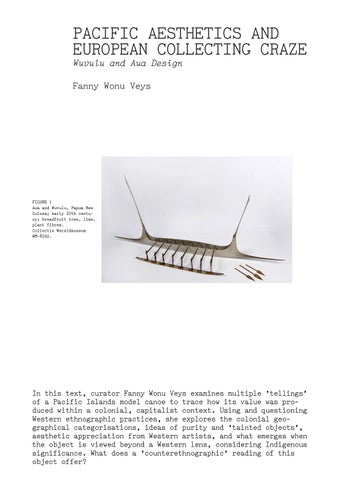
This two-metre long model canoe with paddles represents a nineteenth-century watercraft from the islands of Wuvulu or Aua, situated off the north coast of New Guinea. The shape of the breadfruit tree hull refers to the streamlining of sharks, and the verticals affixed imitate shark fins and tails. White limewash was applied to protect the wood. Large canoes were used for interisland voyaging, while smaller boats were intended for shark fishing. Canoes belonging to chiefs were taken apart upon their passing, and their hulls mounted upright as commemorative grave-markers. 1
In 1904, Johannes Diederich Eduard Schmeltz (1839-1909), the director of the Rijks Etnografisch Museum in Leiden (Wereldmuseum Leiden), sold the model to the Museum voor Land- en Volkenkunde in Rotterdam (Wereldmuseum Rotterdam). Between 1863 and 1879 he had been the main curator of the Godeffroy Museum in Hamburg founded in 1861 by the wealthy shipping magnate Johann Cesar VI Godeffroy, after he started trading in Oceania.2 Schmeltz had, because of his previous career, extensive connections to German collectors, museums and trading companies, which he regularly instrumentalized to obtain objects for Dutch ethnographic museums. This model canoe brings together European networks, but more importantly, results from the European collecting craze that materialized imagined boundaries. In addition, Indigenous ways of feeding European appetites and aesthetic appraisals for these kinds of objects provide researchers with a counter-ethnography.
1 George Lane Fox Pitt-Rivers, ‘Aua Island: Ethnographical and Sociological Features of a South Sea Pagan Society’, in: The Journal of the Royal Anthropological Institute of Great Britain and Ireland 55 (1925), pp. 437; Alfred C. Haddon, Canoes of Oceania: Volume II The Canoes of Melanesia, Queensland, and New Guinea, Honolulu, Hawai’i: Bernice P. Bishop Museum, 1937, p. 178; Peter Brunt and Nicholas Thomas, Oceania, London: Royal Academy of Arts, 2018, p. 282.
2 Birgit Scheps, Das verkaufte Museum. Die
Südsee-Unternehmungen des Handelshauses Joh. Ces. Godeffroy & Sohn, Hamburg, und die Sammlungen “Museum Godeffroy”, Vol. 40, Abhandlungen des Naturwissenschaftlichen Vereins in Hamburg, KelternWeiler: Goecke & Evers, 2005.
A Telling of First Collections
On his way from Tidore in the Moluccas to New Spain (Mexico), the Spanish navigator Iñigo Órtiz de Retes had a violent encounter with stone throwing men on islands west of Manus (Bismarck Archipelago) in 1545. The sailors never went ashore, but Órtiz de Retes named the islands of Aua and Wuvulu ‘islas de Hombres blancos’ (Islands of white men), as he found the people’s complexion lighter than that of the inhabitants of New Guinea.3 In 1767, the British captain Philip Carteret called the islands Maty (often misspelled Matty) (Wuvulu) and Durour (Aua), a name that endured in older literature.4
Even though the islands had been mapped, named and incorporated into the German colonial empire, they were not frequently visited by Europeans. This situation changed drastically in 1893 when the New Guinea Company steamer Ysabel reached Wuvulu’s shores. The company employee Ludwig Kärnbach was on a recruitment mission for laborers to work on plantations in German New Guinea, the north-eastern part of New Guinea. He failed in his assignment but ended up collecting 37 objects that caught the attention of Felix von Luschan (1854-1924), a medical doctor and anthropologist who oversaw the ethnological findings of German trading companies. Von Luschan was struck by the unique stylistic qualities of the small Wuvulu-Aua collection describing them as ‘peculiar and so absolutely different from everything.’ In his opinion, they showed distinctly un-Melanesian features. 5
While the tripartite division of Melanesia, Micronesia and Polynesia has, since the 1980s, been considered increasingly problematic, and sometimes, even racist – physical features were connected to moral and psychological characteristics6 – Von Luschan and his contemporaries found the fuzzy boundaries of these three areas difficult to fathom or to accept. To understand how the islands fitted the division, Von Luschan pressed for more systematic research.7
3 Bronwen Douglas, ‘Naming places: Voyagers, toponyms, and local presence in the fifth part of the world, 1500–1700’, in: Journal of Historical Geography 45 (2014), p. 316.
4 James A. Hafford, Wuvulu Grammar and Vocabulary. PhD, Linguistics, University of Hawai’i at Mānoa, 2015, p. 7.
5 These conclusions are based on Felix von Luschan, ‘Zur Ethnographie der Matty-Insel’, Internationales Archiv für Ethnographie 8 (1895), pp. 41–42: „Diese sind eigenartig und so durchaus abweichend von allem, was man von einem in solcher Nähe von Neu-Guinea gelegenen Inselchen je hätte erwarten können, dass ich es für richtig halte, sie so rasch als möglich bekannt zu machen, obgleich das vorhandene Material noch lückenhaft ist und lange nich ausreicht, ein vollständiges ethnographisches Bild zu ermöglichen.“
Author’s translation: 'These are peculiar and so different from anything one could have expected from an island so close to New Guinea that I think it right to make them known as soon as possible, although the existing material is still incomplete and far from sufficient to provide a complete ethnographic picture.'
6 Paul D’Arcy, ‘Cultural Divisions and Island Environments since the Time of Dumont d'Urville’, in: The Journal of Pacific History 38:2 (2003), pp. 217–235.
7 Throughout von Luschan’s article, he presses for
more research, but the two following paragraphs make it most explicit: „Die Untersuchung der Matty-Insel ist daher eine Ehrenpflicht vor allem der NeuGuinea-Compagnie und ihrer Beambten. Aber auch den in Kaiser Wilhelms-Land ansässigen Privatleuten und vor allen den Missionären sei die kleine Insel warm empfohlen; dem reichen Kranze wissenschaftlichen Ruhmes, mit dem die christliche Mission in Oceanien [sic] geschmückt ist, kann hier ein neues herrliches Blatt zugefügt werden. Eine eingehende Untersuchung der Insel würde allerdings eine Aufgabe sein, die nicht in einzelnen Tagen und Wochen sondern erst in langen Monaten emsiger Arbeit gelöst werden könnte. Aber der wissenschaftliche Gewinn derselben ist so gross [sic] und wichtig, dass auch ein mehrmonatlicher Aufenthalt sich sicher reichlich lohnen würde,“ p. 55. Author’s translation: 'The investigation of Matty Island is therefore a duty of honor, above all of the New Guinea Company and its officials. But the small island is also warmly recommended to private individuals living in Kaiser Wilhelmsland and especially to missionaries; a new splendid page can thus be added to the rich wreath of scientific glory with which the Christian mission in Oceania is adorned. However, a detailed investigation of the island would be a task that could not be solved in a few days and weeks but only over long months of diligent work. But the scientific benefit is so great and important that even a stay of several months would certainly be worthwhile.'
A Telling of Ethical Collecting
The research call reached the ears of the entrepreneur Max (Maximilian) Franz Thiel (1865-1939), manager of the Pacific operations of Hernsheim & Co, who in 1896 dispatched the schooner Welcome, captained by A.F.V. Anderson. Upon arrival, Anderson forced a number of people he considered to be chiefs to sign a deed in order to obtain the legal land title of Wuvulu, so that a Hernsheim trading station could be erected. A man named Schielkopf and three laborers from Buka island were left behind to set up the trading post. An object collection was made under Anderson’s guidance. A few months later, the men had disappeared. When the Buka men were located they told Captain Anderson that Schielkopf had been killed. To investigate the matter further, the ship Möwe was sent in 1899, but noticing no obvious tensions and seeing Wuvulu people freely trading ethnographic objects, German authorities considered the incident closed.8
Thiel wanted to cash in on the 2000 plus objects that had been collected in 1896, hoping to get 20,000 marks for them. However, Von Luschan felt the collecting practices had been unethical, depriving ‘the poor people of thousands of weapons […] enough to supply all museums in the world,’9 making him decide to not acquire the collection. He maintained that an object’s value lies in the documentation of its Indigenous context, which should also be analyzed by taking numerous photographs, linguistic research and physical anthropology on skulls obtained by ‘befriending’ (anzufreunden) the islanders.10 Thiel was greatly offended by Von Luschan’s accusation, and instead hired professional collectors. Franz Emil Hellwig (1854–1929) seemed to fulfil the brief and was sent out to collect material culture, but also to secure Hernsheim & Co’s commercial interests on Wuvulu and Aua. He stayed for almost a year in total between 1902 and 1904.
A Telling of Materialising Boundaries
Hellwig had no interest in solving the classification mystery of Wuvulu and Aua, which centered around the question: were the islands Melanesian or Micronesian? Stating that ‘until now I was unable to ascertain the degree of linguistic and ethnographic relationship between the inhabitants of Wuvula [sic] and Aua and those of the Eastern Caroline Islands [Micronesia], so I have refrained from any speculations.’11 Fact remains that Hellwig’s collection was already known of and greatly anticipated in Germany. Eventually in 1904, Georg Thilenius secured the collection of 3,300 artefacts for the Hamburg Museum for 20,000 marks. The collecting of artefacts proved not profitable for Thiel, but it restored some of his reputation in terms of collecting practices.12 It is likely that Schmeltz obtained this model canoe, collected by Hellwig, through his extensive network with German museum directors and curators.
8 Rainer F. Buschmann, Anthropology’s Global Histories: The Ethnographic Frontier in German New Guinea, 1870–1935, Honolulu: University of Hawaii Press, 2009, p. 44
9 Von Luschan cited in Buschmann, p. 44.
10 Von Luschan, pp. 55–56.
11 Hellwig cited in Buschmann, p. 46.
12 Buschmann, pp. 41–47.
Unwillingly, but fitting along the lines of colonial thinking, Von Luschan had contributed to seeing Wuvulu and Aua as distinct from Melanesia and more part of Micronesia, ‘a colonial construct located, bounded, defined, and described by a series of different colonial regimes whose efforts were self-serving and exploitative.’13 In 1908, Augustin Krämer introduced the term ‘Para-Micronesia’ to delineate the area perceived as geographically removed from Micronesia, but culturally and linguistically related to Micronesia.14 In 1973, Henning Hohnschopp argued against the name, saying that the ‘Wuvulu-Aua cultural complex’ is a more appropriate name.15 This shift in discourse, moves away from trying to fit societal traits into distinct culture areas, allowing the islands to stand on their own. The tendency to classify is tenacious, as most scholars and collectors still consider Wuvulu and Aua firmly part of para-Micronesia.
A Telling of Europeans’ Appetite for Collecting
Full-sized canoes varied from 3.5 meters long to carry one person, to 18 meters long holding 20 men. With its eight booms, the canoe probably represents the latter larger canoe types.16 Hence, this object is a model,17 made by local Islanders to represent a real object, with all the intricacies of a full-size canoe. It constitutes, thus, a separate category in Pacific objects.18 Given its rather large dimensions – 215 × 100 × 40 cm,– it is likely this canoe was made for the European market, and not for local use as a children’s toy.19 The anthropologist Jack William Davy wants researchers to go beyond these function-oriented views. Complexifying the idea of miniaturization, Davy argues that it does not simply refer to the process from which a large thing becomes small. Small things can encapsulate complex social, technological and demographic movements often characteristic of colonization. These small things are able to condense stories that are too large, too unwieldy to be told through ‘traditional oral or written histories alone.’ Their small shape make it easier for humans to relate to.20 Such is the case for the Wuvulu or Aua canoe. The arrival in 1904 of this model canoe in the collection shows that the Wuvulu and Aua objects acquired in 1896 by Hernsheim & Co had not depleted Wuvulu and Aua from its objects as Von Luschan thought, but on the contrary, had led to a high production of artefacts. When the planter Robert Parkinson (1844-1909) visited the islands on the survey vessel Möwe in 1899, he was greeted by 600 individuals in 110 canoes offering numerous artefacts for sale. Some of them were perfect wooden imitations of the iron hatchets that had been traded by the Hernsheim company a few years earlier in 1896. This small canoe might
13 David Hanlon, ‘Magellan’s Chroniclers?: American Anthropology’s History in Micronesia’, in: Robert C. Kiste and Mac Marshall (eds), American Anthropology in Micronesia: An Assessment, Honolulu: University of Hawai’i Press, 1999, p. 76
14 Augustin Krämer, ‘Vuvulu und Aua (Maty und Durour Insel)’, Globus 93 (1908), p. 257.
15 Henning Hohnschopp, Untersuchung zum Para-Mikronesien-Problem unter besonderer Berücksichtigung der Wuvulu- und Aua-Kultur. Vol. 7, Arbeiten aus dem Institut für Völkerkunde der Universität zu Göttingen, Munchen: K. Renner, 1973.
16 Haddon, pp. 177–179.
17 The use of the terms model and miniature are an issue of contention, see Jack William Davy and Charlotte Dixon, ‘What makes a miniature?’, in: Jack William Davy and Charlotte Dixon (eds), Worlds in Miniature. Contemplating Miniaturisation in Global Material Culture, London: UCL Press, 2019, p. 13.
Given the significant size of the canoe (over 2 meters) and the statement made by Davy and Dixon that 'many models are self-evidently also miniatures, but perhaps miniatures are not automatically models,' (pp. 11–13) I will give prevalence to the use of the word 'model'.
18 Hélène Guiot, ‘Miniatures et histoires d’Océanie, une recherche à redéployer. Prémices: les pirogues du muséum d’Histoire naturelle de Toulouse’, Journal de la Société des Océanistes 155 (2022), p. 301.
19 Guiot, p. 302. Hambruch gives following lengths for Wuvulu and Aua boats: large boats – 9.45 m; small boat – 5.58 m; model boat – 1.58 cm; and toy boat – 1.56 cm. See Paul Hambruch, Wuvulu und Aua (Matyund Durour-inseln) auf Grund der Sammlung F.E. Hellwig aus den Jahren 1902 bis 1904, Mitteilungen aus dem Museum für Völkerkunde in Hamburg; Bd. 2; II, 1. Hamburg: L. Gräfe & sillem, 1908, p. 115.
20 Davy and Dixon, p. 3.
3
have been considered of lesser value than the large canoes that showed traces of use. The anthropologist Rainer Buschmann argues that ‘[Von] Luschan and other German anthropological practitioners might have regarded [them] as “tainted” artifacts, that is, devoid of indigenous meanings.’21 Buschmann
Tino aitu, figure from Nukuoro Island, Caroline Islands, ca 1890. Collectie Wereldmuseum RV-828-63.

advances that in fact they were ‘Para-Micronesian’22 attempts to incorporate the arriving German commercial and colonial frontier through ethnographic means.23 He calls this a form of ‘counterethnography.’24 Hence, the model canoe should, because of its ‘imaginative dimensions,’ be seen as an object carrying multiple layers showing Wuvulu and Aua ways of ‘coping with and changing the world.’25
A Telling of Aesthetic Appraisals
Collections coming from Micronesia were, in the nineteenth century, generally described by Westerners as lacking ‘the richness of that found in Melanesia and Polynesia.’26 Some objects, such as the Nukuoro figures from the Caroline Islands in Micronesia, were even qualified as coarse and clumsy. A few decades after the arrival of the figures in Europe, artists such as the Swiss sculptor and painter Alberto Giacometti (1901-1966) and the British sculptor Henry Moore (1898-1986) hailed the Nukuoro figures as highly stylized representations of the human form representing ‘the purest form of art – an art that lay at the origins of mankind.’27 Simultaneously, when it came to canoes, research and commentary has focused on the ‘design and efficiency of hulls, outriggers and sails.’28 From the 1950s onwards it is common to find the canoes from Wuvulu and Aua described as ‘elegant’29 and as having a ‘sophisticated modern appearance’
21 Buschmann, p. 124.
22 Note that Buschmann is also using the term 'ParaMicronesia' and not the Wuvulu-Aua-complex as Hohnschopp was suggesting.
23 Buschmann, p. 124.
24 Buschmann, p. 122.
25 Davy and Dixon, p. 4.
26 Jerome Feldman and Donald H. Rubinstein, The Art of Micronesia. The University of Hawaii Art Gallery, Honolulu, Hawaii: The University of Hawaii Art Gallery, 1986, p. 12.
27 Fanny Wonu Veys, ‘Wooden Sculptures from Nukuoro’, Khan Academy, 2015, https://www.khanac ademy.org/test-prep/ap-art-history/the-pacific/a/ nukuoro-micronesia.
28 Brunt and Thomas, p. 47.
29 Adrienne L. Kaeppler, The Pacific Arts of Polynesia & Micronesia, Oxford History of Art, Oxford: Oxford University Press, 2008, p. 22.
attracting collectors of Western modern art.30 Their streamlined minimalism and the search for the pure form are, according to many, the main characteristics of material culture in that region, 31 but the canoes always remained as an inspiration point; Western artists were not particularly concerned with the individuality of the makers.
This model canoe encapsulates beauty and effective design to both Western and Pacific eyes. However, I have tried to go beyond the stories that are traditionally narrated by demonstrating how this canoe model fits what Buschmann calls a ‘counter-ethnography’ carried out by the inhabitants of Aua and Wuvulu who produced objects they thought Europeans would find interesting. This object reveals the multiple layers of what it meant to produce a reduced version of a canoe, a culturally significant object that stands for Indigenous maritime knowledge including understanding of the position of the sun, the moon and the stars, sea currents, winds, the flights of birds and the migration routes of whales.
WONU VEYS works as the Curator Oceania at the Wereldmuseum and as professor by special appointment ‘Arts and Material Culture of Oceania’ at Leiden University. Veys has curated the Mana Maori exhibition (2010–2011), Things that Matter (2017-), Australian Art (2019-), What a Genderful World (2019-2020; 2021-2022), A Sea of Islands (2020-2021) and Treasures from the depot: Easter Island (2022-).
30 Kaeppler, p. 55.
31 Jean-Edouard Carlier, Micronésie et Para-Micronésie, Paris: Voyageurs & Curieux, 2005, p. 61.
This text was written for the Design/ing and the Ethnographic Museum project for the Research Center for Material Culture.
The text is published under CC BY-NC-ND license, which enables reusers to copy and distribute the material in any medium or format in unadapted form only, for noncommercial purposes only, and only so long as attribution is given to the creator.