‘YES, BUT…’
Occupation as Requirement for ‘Development’ –the Emergence of Dutch 'Ethical Imperialism’ in Indonesia
Rosa te Velde
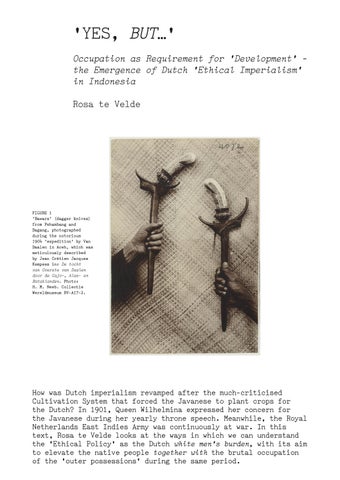
FIGURE 1 'Bawars' (dagger knives) from Pehambang and Dagang, photographed during the notorious 1904 'expedition' by Van Daalen in Aceh, which was meticulously described by Jean Crétien Jacques Kempees in: De tocht van Overste van Daalen door de Gajo-, Alas- en Bataklanden. Photo: H. M. Neeb. Collectie Wereldmuseum RV-A17-2.

How was Dutch imperialism revamped after the much-criticised Cultivation System that forced the Javanese to plant crops for the Dutch? In 1901, Queen Wilhelmina expressed her concern for the Javanese during her yearly throne speech. Meanwhile, the Royal Netherlands East Indies Army was continuously at war. In this text, Rosa te Velde looks at the ways in which we can understand the 'Ethical Policy' as the Dutch white men's burden, with its aim to elevate the native people together with the brutal occupation of the 'outer possessions' during the same period.
FIGURE 2
‘Often with the first possible signs of failure come new gestures of anxiety […]’ writes British author and curator Dan Hicks about the late nineteenth century of the British empire. This period, he notes, is marked by ‘anxieties about the morality of imperialism and fears about the precarity of western civilisation’¹. These anxieties were also evident in the Dutch context.
Detail of panel 'Hulde der koloniën' (Tribute from the colonies) of the Golden Coach, designed by Nicolaas van der Waay in 1898. On the left, a man with a book is depicted, symbolising the moral vocation of the Dutch to bring 'civilisation' and education. The Royal house has used the coach on the occasion of the yearly throne speech in September from 1903 to 2015. It was then thoroughly restored and has not been used since. Image source: Wikimedia.

In this article, I’m interested in the period of the Dutch ‘Ethical Policy’ (ethische politiek) that was symbolically marked by Queen Wilhelmina’s speech (held in 1901 at the House of Representatives in the Hague), where she announced the Netherlands’ intention to ‘better’ the situation of the Javanese. For the first time, she spoke about her concern for the ‘less prosperous’ Javanese and raised awareness on the living conditions of the Javanese population.² This notion that the coloniser had a ‘moral obligation’ to improve the welfare of the colonised people had already emerged in the second half of the nineteenth century.
American historian Jennifer Foray has written about the typically Dutch framing device ‘ja, maar…’ (yes, but…), which is exemplary for the way in which the Dutch have downplayed their imperialism, particularly during the period of the ‘Ethical Policy’.³ Yes, we were present in Indonesia, but we brought modernisation. Yes, we had to ‘pacify’ the Indonesians, but we elevated them. How did the rhetoric of ‘ethics’ develop in Dutch colonial politics and in the context of ‘the first possible signs of failure’ – the looming threat of independence? And how did this rhetoric emerge together with the brutal expansion of the occupation? How can we understand this period as a moment of anxiety and changing rhetoric within the context of the intensifying conquest?
According to Dutch historian Elsbeth Locher-Scholten, the term ‘ethical’ had been increasingly used in the Netherlands throughout the nineteenth century, and ‘ethical arguments and moral values played a role in various
1 D. Hicks, The Brutish Museums: The Benin Bronzes, Colonial Violence and Cultural Restitution, 2021, p. 40.
2 ‘De toestand op het noordelijk gedeelte van Sumatra zal, naar Ik vertrouw, bij handhaving van het thans gevolgde stelsel, eerlang tot algeheele pacificatie leiden.’ Queen Wilhelmina, 17 September 1901, The Hague. Accessed through: https://troonredes.nl/ troonrede-van-17-september-1901/#:~:text=Mijne%20 Heeren!,vergezeld%20van%20Mijn%20Doorluchtigen%20 Gemaal
3 J. Foray, ‘Comparatively Exceptional: The Paradoxes of Twentieth-Century Dutch Imperialism and Decolonization', in: R. Koekkoek. A Richard,
A. Weststeijn (eds), The Dutch Empire between Ideas and Practice, 1600-2000, Palgrave Macmillan 2019, pp. 89-108.
political and social fields’. She notes that by the turn of the century, the term had become something of a fashionable phrase.⁴ The ‘social question’, emerging in the context of industrialisation and modern capitalism, concerned the rights and the wellbeing of the working class, women, and children, and also led to ‘elevating’ and educating the poor or paupers in re-education camps such as Frederiksoord and Veenhuizen in the east of the Netherlands.⁵
At the same time, the ‘morality’ of imperialism became increasingly discussed too. Hicks has argued that the ‘crisis of whiteness’ in the aftermath of the abolition of slavery in the Caribbean colonies led to the imperative to civilise: the looting of Benin and the conquest of Africa happened ‘in the name of ending barbarism’.⁶ The rhetoric and the mission of ‘civilising the savage’ became known as the white man’s burden, as described by Rudyard Kipling in a poem in 1899 written in the context of the Philippine-American war of 1899-1902. It was considered as the moral duty of white men – and women – to contribute to the elevation of the ‘wild’ and ‘uncivilised’. ⁷
Justifications for colonial occupation had always already included morality. In the nineteenth century, imperial powers refashioned and strengthened these justifications also through academic fields including anthropology, biology, geology, ethnography, and archaeology as well as through museum collections and the arts. Notably, evolutionist thinking (with its roots in the Enlightenment) had been supported by developments in the natural sciences. British geologist Charles Lyell’s Principles of Geology (1832), endowed social Darwinist thinkers with ‘a plausibility and a scope which their eighteenth century predecessors could not have had’.⁸ Lyell had developed a theory of the history of the world: rather than understanding it in terms of a biblical conception of time (‘unique, simultaneous creation’), geological processes were the result of a sequence of a multitude of small, ‘uneventful’ changes over time, ‘no longer the vehicle of a continuous, meaningful story’.⁹ The social darwinist's ‘survival of the fittest’ paradigm supported and naturalised an analysis of civilisations as slowly changing over time, normalising their decline and even their extinction.¹⁰ At the end of the nineteenth century, European civilisation was considered to be ‘wiping out’ Indigenous cultures, bringing about museum collecting practices under the motto ‘collect before it is too late’.¹¹ But these practices, in turn, only accelerated the intervention in and destruction of people’s lives and material cultures.
‘A
Debt of Honour’
The turn of the twentieth century symbolically marked the ‘ethical’ era for the colonial policy in Dutch-occupied Indonesia. Different events, developments, and shifts in thinking had led to this moment, but most prominently at the time the Cultivation System (Cultuurstelsel), during the period of 1830-1870, had become a subject of direct critique. Under the Cultivation System, Javanese farmers were forced to plant crops like tobacco, coffee, and sugar of which they had to relinquish twenty percent for export, resulting in immense profits
4 E. Locher-Scholten, Ethiek in fragmenten. Vijf studies over koloniaal denken en doen van Nederlanders in de Indonesische Archipel, 1877-1942, Hes & De Graaf Publishers, 1981, p. 212 and p. 179.
5 In 1818, the 'Colonies of Benevolence' in Drenthe were established by Johannes van den Bosch, who would later become the governor of the 'Dutch East Indies', where he introduced the Cultivation System.
6 Hicks, pp. 43-44.
7 R. Kipling, ‘The White Man’s Burden’, in: The Call, San Francisco, 5 February 1899.
8 J. Fabian, Time & the other: how anthropology makes its object, Columbia University Press, (1983) 2014, p. 13.
9 Fabian, p. 13.
10 S. Lindqvist, ‘Exterminate all the brutes’, Granta, (1997) 2018, p. 103.
11 Lindor Serrurier quoted in: M. Shatanawi, Making and unmaking Indonesian Islam: Legacies of colonialism in museums, 2022, PhD dissertation, University of Amsterdam, p. 196.
FIGURE 3
Enforced planting of sugar cane due to the Cultivation System, on the Malang plain, Krebet area, 1870. Leiden University Libraries, KITLV 2572.

for the Dutch and famine among the Javanese.
The ethical period was marked by ‘a liberal moment of moral reckoning’.¹² The famous book Max Havelaar: of De Koffij-veilingen der Nederlandsche Handel-Maatschappij (1859) is often considered as a precursor to the ethical direction.¹³ The book has been praised for shifting the national consciousness, eventually becoming part of the national Canon of the Netherlands. Based on his own experiences in the colony, colonial administrator and author Eduard Douwes Dekkers exposed the abuse of the coffee plantation system. However, as Indonesian poet and writer Saut Situmorang has argued, Douwes Dekkers’ book was not a critique of the Dutch occupation, but in fact was more directed against the corruption of the Indigenous leaders within that system. He argues that it was certainly not ‘the book that killed colonialism’.¹⁴ The book was co-opted by Dutch liberals as it fit their agenda to abolish the Cultivation System, replacing it with a free-market economy, allowing companies and private enterprises to buy land.¹⁵ The Cultivation System became replaced ‘with laissez-faire capitalism whose negative effects on the [Indigenous] economy and ecology were far more severe and led to the practice of slave labour […]’.¹⁶ According to Situmorang, Douwes Dekkers’ book cannot be understood as ‘anti-colonial’, as he was not critical of exploitation. On the contrary, he felt the Dutch colonial regime wasn’t strict enough: ‘[Douwes Dekkers] found them way too soft on indigenous people by allowing them to maintain their values […]. The indigenous people had to be rescued from their corrupt values and norms by their wise superiors, namely the officials of the Dutch East Indies colonial government.’¹⁷ According to Douwes Dekkers, the Dutch juridical system with its enlightenment values was simply not implemented well enough in the ‘Dutch East Indies’.
The critique of the imperial politics from Dutch authors, politicians, and journalists was often of a pragmatic and paternalistic nature. Facing impending mass mobilisation and resistance due to the dire conditions of the Indonesian
12 A. Stoler, Along the Archival Grain: Epistemic Anxieties and Colonial Common Sence, Princeton, 2009, p. 157.
13 English title: Max Havelaar: or The Coffee Auctions of the Dutch Trading Company.
14 Situmorang critically discusses the statement by famous Indonesian author Pramoedya Ananta Toer who published an essay in the New York Times under that title in 1999, see: Saut Situmorang, Max Havelaar: Buku Yang Membunuh Kolonialisme?, Kumparan, 17 September 2021. English trans. accessed
through Histori Bersama: https://historibersama. com/max-havelaar-the-book-that-killed-colonialism-saut-situmorang/.
15 J.N.F.M. Campo, ‘The Rise of Corporate Enterprise in Colonial Indonesia, 1893-1913’, in: J. Th. Lindblad (editor), Historical Foundations of a National Economy in Indonesia, 1890s–1990s, Amsterdam: Royal Netherlands Academy of, 1996, p. 71-94. Situmorang questions the actual impact of the book at the time.
16 Situmorang, 2021.
17 Situmorang, 2021.
peoples as the result of centuries of colonialism, the Dutch had to change course: one of their main priorities became to maintaining ‘peace and order’.¹⁸ In 1899, lawyer, author, and ‘ethicist’ Conrad Theodor van Deventer published the text ‘A debt of honour’ in De Indische Gids, in which he calculated the profits made from the Cultivation System. In his article, he exposed the miserable situation of the people in the colony. This included precise calculations of the benefits gained through the Cultivation System.¹⁹ Importantly, next to separating the finances between the Netherlands and the ‘Dutch East Indies’, he also pleaded for taking on the ‘debt’ of the colony, not necessarily because it was required by law, but because of a moral obligation. He made a plea to return the wealth taken from ‘the Indies’, through investing in‘ the level of intellect and morality of the population’ through a ‘politics of justice and honesty’. According to Van Deventer, these measures were the only way forward to ensure power and the ‘loyalty of the peoples’ of ‘Insulinde’ in the long term.²⁰ Journalist Pieter Brooshooft, who was editor-in-chief of De Locomotief and based in Semarang from 1887-1895 and again from 1898-1904, had similarly become increasingly critical of the politics that had determined that the profits gained from the Cultivation System went to the Netherlands.
Ethicists like Van Deventer and Brooshooft and Douwes Dekker before them, reasoned from a place of European superiority. For Brooshooft the Javanese were ‘child-like’:
a child […], good by nature, but troubled by his indolence, more mendacious than malicious, more lazy than indifferent, not stupid but not brilliantly gifted either, and certainly not destined ever to play anything but a passive role on the world stage.²¹
In his De ethische koers in de koloniale politiek (1901), he writes:
What should compel us to do our duty towards the Indies is the best of human inclinations: the consciousness of justice, the feeling that we must give the Javanese who has become dependent on us against his will the best we have for him, the generous urge of the stronger to treat the weaker justly. Only when our colonial policy breathes in this atmosphere will we be good stewards for the Indies.²²
The new phase of the Ethical Policy became symbolically marked by Queen Wilhelmina’s speech in 1901 in her yearly throne speech. She expressed her hopes for ‘the situation in Sumatra’ to lead to a ‘total pacification’ – referring to the ongoing war between the colonial regime and the Aceh Sultanate. She also called on the ‘moral vocation’ of the Dutch Christians towards the Indigenous people of the ‘Dutch East Indies’, pressing on development and education, and improving the legal position of the ‘Christian natives’ in particular.²³ Van
18 See: A. Stoler, ‘Perceptions of protest: defining the dangerous in colonial Sumatra’ in: American Ethnologist 12:4, 1985, pp. 642-658.
19 C. Th. van Deventer, ‘Een Eereschuld’, in: de Gids (63), 1899, pp. 205-257. Accessed through: https://www.dbnl.org/tekst/_gid001189901_01/_ gid001189901_01_0073.php
20 Van Deventer, p. 251. 'Insulinde' is a colonial term for the Indonesian archipelago, also used by authors like Douwes Dekkers.
21 Brooshooft cited in: Locher-Scholten, p. 19.
22 P. Brooshooft, De ethische koers in de koloniale politiek, J. H. De Bussy, 1901.
23 Queen Wilhelmina, 17 September 1901.
Deventer and Brooshooft’s argumentation stemmed from a financial calculation and pragmatic reasoning aimed at sustaining loyalty from the people in Dutchoccupied Indonesia. The Netherlands attempted to reposition itself as the ‘guardian’ or the ‘caretaker’ of the Indonesians.²⁴
‘Pacification’ in Sumatra
What exactly did Queen Wilhelmina mean by ‘the situation in Sumatra’ and a 'total pacification'? After the decline of the spice trade by the Vereenigde Oostindische Compagnie (Dutch East India Company, VOC) in the sixteenth and seventeenth century, the territories outside of Java had become less appealing to the Dutch. Until the late nineteenth century, a ‘politics of abstention’ had applied to the territories outside of Java, with some exceptions on Sulawesi (renamed by the Dutch as ‘Celebes’), Sumatra, and Kalimantan (‘Borneo’). The ‘outer possessions’ had become financially uninteresting after the decline in spice trade and had been controlled by local royals and sultanates.
After the opening of the Suez Canal in 1869, the Dutch signed the Anglo-Dutch treaty of Sumatra in 1871 with the British. The purpose was to gain monopoly over trade in Sumatra and its seas in exchange for relinquishing their control on the Ivory Coast. The ‘Aceh War’ between the Dutch and the Aceh Sultanate began in 1873 with the purpose of protecting the Strait of Malacca from ‘pirates’ and ‘rebels’. The Aceh people had resisted the Dutch occupation heavily throughout the years, and foreign media would refer to the ‘Aceh atrocity’.25 In 1893, general Jo Van Heutsz stated: ‘The Aceh War is gnawing at our colonial possessions; it must end. Let us show the civilised world that we are capable of doing so.’26 Following the advice from Islamicist and orientalist Christiaan Snouck Hurgronje, Van Heutsz would change his strategies, creating a divide between the religious leaders and the Acehnese nobility. Van Heutsz also enlisted local leader Teuku Umar and funded him to build his own army. Teuku Umar then attacked the Dutch in 1896 by surprise, in what became known as ‘the treason of Teuku Umar’. His wife Cut Nyak Dhien continued to lead the guerilla forces after his death in an ambush in 1899.27 In 1901, in the same year Queen Wilhelmina announced the Ethical Policy, the Aceh war was continued as planned.
This photo (fig. 4, next page) picturing general Van Heutsz overlooking the storming of a village called Batee Iliek (Batè Ilië) in Samalangan in 1901, was published in the Protestant family-oriented magazine Eigen Haard (Sweet Home), and widely republished as a postcard in the Netherlands.28 In his analysis of photographs of colonial atrocities, Dutch researcher Paul Bijl states that the period that followed 1901 was characterised by ‘epistemic anxiety and denial’.29 The photos he examines in his study disrupted the dominant perception of the Netherlands as ‘ethical’.30 Referencing the work of American historian and professor of anthropology Ann Stoler, who considers colonial archives ‘as condensed sites of epistemological and political anxiety rather than as skewed and biased sources’,31 Bijl examines how the photographs demanded from viewers to negotiate between the Dutch self-image as an ethical nation and the
24 Locher-Scholten, p. 176. See also: P. Bijl, Emerging Memory: Photographs of Colonial Atrocity in Dutch Cultural Remembrance, PhD dissertation, University of Amsterdam 2015, p. 85.
25 H. Van der Jagt, Engelen uit Europa: A.W.F. Idenburg en de moraal van het Nederlands imperialisme, Prometheus 2022, p. 127.
26 J.B. Van Heutsz 1893, quoted in: A. Van der Woud, Een Nieuwe Wereld: het Ontstaan van het Moderne Nederland, p. 52.
27 Hagen, p. 464-469.
28 Bijl, p. 23.
29 Bijl, p. 85
30 Bijl, p. 85.
31 Stoler in Bijl, p. 87.
32 Bijl, p. 86.
FIGURE 4
General Van Heutsz (the 'butcher of Aceh') with his staff at 'Batè Ilië' right after the storming (3 Febr. 1901, Aceh).
Photo by Christiaan Benjamin Nieuwenhuis. Collectie Wereldmuseum, TM-10018875.

FIGURE 5
Jan Hoynk van Papendrecht, Batee Iliek 1901, Indiëzaal, Royal Military Academy in Breda. This painting, based on the much-circulated photo of Van Heutsz, centers the victimhood of the Dutch.

military propaganda and the massacres evidently depicted.32 A painting by Jan Hoynck van Papendrecht (fig. 5) based on the photograph can be understood as an example attempting to ‘manage’ the reputation of the Dutch. The media also followed Van Heutsz’ statement on the ways in which the Acehnese had used their women and children as ‘a human shield’, leaving the Dutch no choice but to kill.33 In 1904, with the goal to ‘finalise’ the annexation of Aceh, lieutenant colonel Frits van Daalen would lead a relentless mission into the inland of Aceh to subjugate the people of the Gajo, Alas, and Batak, who were known to resist fiercly.34 Van Daalen, who was one of the few Indo-Europeans in the Royal Dutch East Indies army,35 led the massacre in Kuta Reh in June 1904. Van Daalen's ‘expedition’ had been contentious at the time, but by 1916 an inspector and archivist Cornelis Lekkerkerker justified this moment in his ethnographic study Land en Volk van Sumatra (Land and peoples of Sumatra): as a turning point of bringing civilisation:
33 Van der Jagt pp 127-129.
34 Some historians argue that the Aceh war lasted until 1913, or even until 1942. See for example, S. de Winter, ‘Selling the Aceh War’, in: Militaire Spectator, 2019 . Accessed through: https://militairespectator.nl/artikelen/selling-aceh-war.
35 See: V. van de Loo, De Atjeh-generaal: Het militaire leven van Frits van Daalen, Prometheus, 2024.
In 1904, decisive action was finally taken. As a result of Van Daalen’s expedition, slavery and cannibalism were banned that year from the Gaju and Alas lands; attempts were made to abolish the trade; a ‘decreasing licensing system’ was introduced as a means of reducing the alarming opium abuse; the population was registered, firearms confiscated, taxes were introduced, the currency was purged; and road construction began.36
Van Heutsz was celebrated and promoted to governor-general of Dutchoccupied Indonesia in 1904 and Van Daalen became governor of Aceh.
Over the course of the nineteenth century, the Dutch expanded their territory and by the turn of the century, ‘aimed at acquiring de facto political control of the entire Indonesian archipelago and the development of both country and people under Dutch leadership and after western example’.37 The Aceh war is the most notorious, but was just one of many wars and ‘expeditions’. Notably, the Lombok war of 1894, and the many ‘expeditions’ to Bali (resulting in its occupation in 1906-1908, leading to the death of thousands of Balinese), are among the long list of violent acts of annexation. The Dutch euphemistically referred to occupation and military conquest as ‘pacification’, which was foregrounded as the only viable way to contribute to prosperity of the Indigenous population. The Royal Netherlands East Indies Army (KNIL) was uninterruptedly at war to create and reconceptualise one singular Dutch territory in the East, which was considered to be ‘completed’ around 1914.38
FIGURE 6
Hair comb (petat), obtained during the conquest of Klungkung, Bali, 1908. Collectie Wereldmuseum, RV-1684-20. This type of hair comb was worn by Balinese women. This hair comb was looted by the Royal Netherlands East Indies Army (KNIL) during the conquest of Klungkung in 1908. Klungkung was then the last Balinese principality not yet under colonial rule. The ruler, Dewa Agung Jambe, and hundreds of Balinese fought a ‘puputan’, a ritual battle, to the end. Hundreds of Balinese were killed by their own kris, or Dutch gunfire. The Klungkung palace was destroyed, and many objects were stolen.

36 C. Lekkerkerker, Land en Volk van Sumatra, N.V. Boekhandel en Drukkerij, 1916.
37 Locher-Scholten, p. 213. See also: M. Kuitenbrouwer, ‘Het imperialisme-debat in de Nederlandse geschiedschrijving’, in: BMGN 113:1, (1998) pp. 56-73, who wrote extensively about the historical discussions around the existence of ‘modern Dutch imperialism’.
38 See: P.M.H. Groen, ‘Geweld en geweten: Koloniale oorlogvoering en militaire ethiek in NederlandsIndië, 1816-1941’, in: Militaire Spectator, 182:5 (2013), pp. 248-266.
FIGURE 7
Group portrait of KNIL soldiers, probably in Aceh at the beginning of the twentieth century. The soldiers are holding M95 rifles and 'klewangs' (swords). Collection Museum Bronbeek, 2006/00-42-8.

Ethical Imperialism
Although the Dutch empire was one of the largest empires at the turn of the century,39 the idea that the Netherlands was just a ‘small power’, not involved in imperialism, persisted for a long time.40 This echoes professor Gloria Wekker’s notion of the Dutch self-image of being ‘a small, but just, ethical nation’ and even a ‘gidsland’ (‘a guiding light’) to other nations.41 American historian Jennifer L. Foray has aptly described the way in which Dutch historiography has for long considered its empire and its imperial histories as ‘unique’, and therefore beyond comparison:
In Dutch academia […], we can perceive an endless rhetorical loop of sorts, claiming that Dutch historiography is exceptional because the Dutch empire was exceptional, but only those aware of this exceptional status – and with the linguistic skills and positioning to best appreciate Dutch uniqueness – can explore this exceptionality’.42
Foray explores how the particular Dutch ‘framing device’ of ‘ja, maar…’ (yes, but…) has constructed a way of thinking about Dutch empire, which was particularly present for the ‘ethical period’: ‘yes, Europeans in other empires may have sought to exploit their native subjects, but the Dutch forged a different, and far more edifying, path’.43 According to her, this sense of exceptionalism led to limited attempts at ‘comparing’ the Dutch empire with other imperial powers. In the 1970s and 1980s, however, a fierce debate developed among historians about whether a Dutch version of modern imperialism had existed. Dutch historian Maarten Kuitenbrouwer concluded in his dissertation in 1985 that Dutch imperialism had ‘more similarities than differences with the classic British version’.44 Following Dutch historian Paul van ‘t Veer, who studied the long and brutal Aceh War, historian Locher-Scholten used ‘ethical imperialism’ in her work Ethiek in Fragmenten as a more appropriate term than the prevailing ‘ethical period’.45
39 Dutch historian Piet Hagen states that by 1899, the Dutch empire, which also included Suriname and the Netherlands Antilles, was the second-largest after the British empire. It is unclear how he arrived at this conclusion. P. Hagen, Koloniale Oorlogen in Indonesië: Vijf eeuwen verzet tegen vreemde overheersing, De Arbeiderspers, 2018, p. 273.
40 Kuitenbrouwer, p. 57. See: also: M. van Pagee, Banda: De genocide van Jan Pieterszoon Coen, 2021, p. 123-124; R. Koekkoek. A Richard, A. Weststeijn (eds), The Dutch Empire between Ideas and Practice,
1600-2000, Palgrave Macmillan, 2019, pp. 44, 48, 61 and 209.
41 G. D. Wekker, White Innocence: Paradoxes of Colonialism and Race, Duke University Press, 2016, p. 2.
42 Foray 2019, p. 90.
43 Foray, p. 93.
44 Kuitenbrouwer, p. 57.
45 Locher-Scholten, Ethiek in fragmenten. Vijf studies over koloniaal denken en doen van Nederlanders in de Indonesische Archipel, 1877-1942, Hes & De Graaf
FIGURE 8
Boh Doma (collar button) from Aceh, donated by Van Daalen, 1904. Collectie Wereldmuseum, RV-1429-116.
See also the provenance research by Mirjam Shatanawi on Van Daalen's looting practices: M. Shatanawi, report regarding Sinkin panjang met schede [Sword] 2022, PPROCE provenance reports No. 16.

For Locher-Scholten, ‘ethical imperialism’ should not be understood as a contradiction. Rather, it refers to two related interdependent movements reinforcing and justifying each other, even though they have often – conveniently? – been studied in isolation.46 For example, ethicists Brooshooft and Van Deventer, called for taking up arms as a requirement for development and civilisation.47 Ultimately, the duty and the goal was to ‘modernise’ Dutch-occupied Indonesia. As Minister of Colonies Alexander Idenburg would argue: ‘It is not power that is the legal basis, but the moral calling of a more highly developed people towards less developed nations’.48 Modernisation was only possible through ‘pacification’, it was believed.
Dutch ethical imperialism was characterised by a developmental rhetoric: it focused on (economic) progress, also within the reform programmes in areas such as education, governance, and crafts. 49 This reform ‘[with] its utopian promise ultimately justified the application of exemplary violence to create a peace in which development could occur, ironically leading to the very violence that their ethical empire was thought to eschew’, as historians Bart Luttikhuis and Dirk Moses have argued.50
The ‘ethical empire’ is often considered as having paved the way for the long process of decolonisation that would emerge in the decades to follow.51 But according to Situmorang, the assumption that Indonesia’s independence was a result of the Ethical Policy ‘glosses over many major historical events’.52 The rise of the independence movement should first and foremostly be considered as a broad movement of longstanding and continuous Indigenous resistance, one that can also be traced to the founding of organisations such as Budi Utomo (1908), Sarekat Islam (1912), Partai Komunis Indonesia (1920) and Partai Nasional Indonesia (1927), among others.
Publishers, 1981. The term had been used by historian P. van ‘t Veer already in 1969 in his study on the Aceh war. See: P. van ’t Veer, De Atjeh-Oorlog, De Arbeiderspers, 1969.
46 See also Kuitenbrouwer, p. 59.
47 Van der Jagt, p. 87.
48 A.W.F. Idenburg 1901, quoted in: H. van der Jagt, p. 95.
49 Locher-Scholten, p. 176.
50 B. Luttikhuis & D. Moses, ‘Mass Violence and the end of the Dutch colonial empire in Indonesia’ in:
Journal of Genocide Research 14:3-4, 2012.
51 M. Thomas, B. Moore & L.J. Butler, Crises of Empire: Decolonization and Europe’s Imperial States, 2nd edition, 2015.
52 Situmorang, 2021.
FIGURE 8
Exhibition view of Ethnografica uit de Gajoelanden (1912), Koloniaal Museum Haarlem. The items were on loan from officer Frederik van Laaren who had served in the KNIL. On the left side, photographs of the 1904 'expedition' by Van Daalen were on display. Collection Wereldmuseum, TM-FV-0096-4728.

Locher-Scholten notes the ambiguity and contradictory use of ‘ethical’ and the differences between principal figures. She makes a rough distinction between three periods: during the period of 1894–1905 development programmes were prepared while military expansion took place with the goal of controlling a singular Indonesia; 1905–1920 can be considered as the heydays of the Ethical Policy as well as the rise of anti-colonial resistance; and 1920-1942 as a conservative backlash and a heightened sense of Indonesian nationalism. The ethicists, for example, held different views on future independence and on ‘tutelage’ (voogdij) and the process of ‘detutalage’ (ontvoogding). By the 1920s, the expansion of western education halted, due to a saturated labour market and the fear of ‘half intellectuals’.53 Compared to the early years of the ‘ethical period’, Dutch historian Frances Gouda also observes ‘a distinct orientalizing tendency’ in the 1920s, to ensure that the Indigenous people ‘would not be alienated from their cultural roots’. According to her, conservatives embraced this attitude because they wanted the ‘awakening’ to happen only ‘at snail's pace’, while progressives believed ‘oriental education’ would be useful to ‘simple folk in rural villages’.54 According to Canadian anthropologist Tania Murray Li, it was during the period of 1905-1930, that
the white man’s burden of improving Native lives was most clearly enunciated […] this was also the period when the ‘otherness’ of the Natives, their ineffable difference, was conceptually elaborated, empirically investigated, and made the basis for policies aimed to restore ‘tradition’ and harmonious, Asiatic village life.55
With the increased interest in Indigenous arts and crafts and the educational programmes that were initiated in this period, the contradiction between ‘preservation’ and ‘modernising’ arose.56 The notion of ‘ethical imperialism’ is key in bringing together the ‘ethical’ efforts (which included educational and research programmes) and the military expansion, defying a ‘yes, but…’ logic. Murray Li shows how researchers and missionaries ‘prepared the practical and moral terrain for military invasion’, and how their research practices, seemingly separated disciplines, in fact perpetuated the logic of imperialism.57
53 Locher-Scholten, p. 207.
54 F. Gouda,‘Teaching Indonesian Girls in Java and Bali, 1900-1942: Dutch progressives, the infatuation with ‘Oriental’ refinement, and ‘Western’ ideas about proper womanhood’, in: Women’s History Review 4:1, 1995, p. 38.
55 T. Murray Li, The Will to Improve: Governmentality, Development, and the Practice of Politics, Duke University Press, 2007 p. 32.
56 See: Rosa te Velde, 'A Firm Nudge' in this series.
57 Murray Li, pp. 67-68.
58 Lekkerkerker, p. V.
59 See also the essay by Marjolein van Pagee on crafts education in the Recall/Recalibrate series: M. van Pagee, 'Dangerous Competitors: The Dutch Ethical Policy (1901) and the Establishment of Craft Schools in East Java'.
60 L. Couperus, De stille kracht, Uitgeverij 521, (1901), 2006, p. 10.
Conclusion
In the introduction of Land en Volk van Sumatra (1916), the earlier mentioned colonial inspector Cornelis Lekkerkerker writes:
The twentieth century will be marked in the history of Dutch development by a significant phenomenon: the rise of the Greater Netherlands in Asia, driven by a resurgence of Native development, led by a renewed Dutch spirit.58
Indeed, the early twentieth century was marked by this dream, or rather this hallucination of ‘the Greater Netherlands in Asia’. Tellingly, the promise of betterment for the Javanese as stated by Queen Wilhelmina, hardly materialised; attempts to improve infrastructure, education, and economy were continuously neglected.59 The rhetoric of ethical imperialism characterises the underlying anxiety of the time – the looming independence of Indonesia as an erupting volcano, as author Louis Couperus would write in 1900 in his novel De Stille Kracht (The Hidden Force): ‘the future rumbles like the subterranean thunder in the volcanoes’.60 Centering ‘anxiety’ as the underlying sentiment of the ‘ethical direction’, reveals the negotiation, pragmatism, and management of relations necessary for the Dutch to enforce authority during their occupation of Indonesia, rather than asking whether (some) individuals had ‘good intentions’ – allowing for another yes, but...
The history of the Ethical Policy makes visible how explicitly extractive colonial systems, such as the Cultuurstelsel, were replaced with a cunning rhetoric of improvement and elevation – the only viable way to maintain and justify authority in the empire. The term ‘ethical imperialism’ opens up a space to reflect on the anxious attempts at justifying the expansion of occupation, stressing ‘the close connection between an ethical development policy for Java and the simultaneous expansion of colonial authority in the Outer Territories’, as Locher-Scholten has argued.61
Ethical imperialism as an analytical frame debunks the myth, not only of Dutch exceptionalism, but also of ‘ethics‘ and ‘empire’ as being at odds, or even as a paradox. As such, it allows for an understanding of empire and its rhetoric, propaganda and instruments, as intimately related with a discourse of improvement and elevation. ‘Reading together’ and ‘correlating’62 across disciplines and museum collections are important ways to better understand the hard and softer power strategies of subjugation, intervention, and erasure, also unfolding into the present. Ethical imperialism also raises questions concerning current media analyses of what it means ‘to do good’. In this light, we must ask: how is the Dutch self-image as being ethical managed today, as the Netherlands continues to contribute to the ongoing genocide in Gaza?
ROSA TE VELDE is a designer, researcher, and educator. She works as a researcher at the Amsterdam University of the Arts and teaches in the MA Industrial Design program at the Royal Academy of Art, The Hague. Her practice explores the intersections of design, politics, and decoloniality through critical and cross-disciplinary approaches.
61 Locher-Scholten, p. 212.
62 R. Raben, ‘A New Dutch Imperial History? Perambulations in a Prospective Field’ in: BMGN –Low Countries Historical Review 128:1 (2013), p. 5.
This text was written for the Design/ing and the Ethnographic Museum project for the Research Center for Material Culture, and republished in the Recall/ Recalibrate series: www.recalibrate.nl.
The text is published under CC BY-NC-ND license, which enables reusers to copy and distribute the material in any medium or format in unadapted form only, for noncommercial purposes only, and only so long as attribution is given to the creator.