A Firm Nudge

Page 1


A FIRM NUDGE

Politics of ‘Ethical’ Reform Through ‘Native Arts and Crafts’ in Dutch-Occupied Indonesia

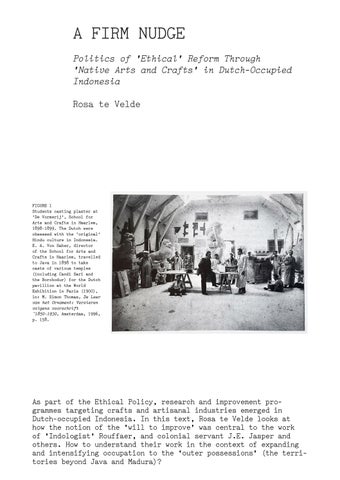
FIGURE 1

Students casting plaster at ‘De Vormerij’, School for Arts and Crafts in Haarlem, 1898–1899. The Dutch were obsessed with the ‘original’ Hindu culture in Indonesia. E. A. Von Saher, director of the School for Arts and Crafts in Haarlem, travelled to Java in 1898 to take casts of various temples (including Candi Sari and the Borobodur) for the Dutch pavillion at the World Exhibition in Paris (1900), in: M. Simon Thomas, De Leer van het Ornament: Versieren volgens voorschrift ~1850–1930, Amsterdam, 1996, p. 158.

As part of the Ethical Policy, research and improvement programmes targeting crafts and artisanal industries emerged in Dutch-occupied Indonesia. In this text, Rosa te Velde looks at how the notion of the ‘will to improve’ was central to the work of 'Indologist' Rouffaer, and colonial servant J.E. Jasper and others. How to understand their work in the context of expanding and intensifying occupation to the ‘outer possessions’ (the territories beyond Java and Madura)?

In 1901, Gerret Pieter Rouffaer (1860–1928) wrote an article in the October issue of de Indische gids, ¹ in which he laid out the great advancements of the various scientific studies taking place in Dutch-occupied Indonesia.² Rouffaer, who was a self-trained art historian and researcher, had travelled to Jakarta (‘Batavia’) in 1885. His stay in the so-called Indies would launch his career as an ‘Indologist’, and particularly his reputation as a batik connoisseur.³ In his article, Rouffaer praises the agricultural testing stations, the botanical research in the garden in Bogor (‘Buitenzorg’), and the efforts of Het Bataviaasch Genootschap for their linguistic, ethnographic, and historical research efforts.⁴ He is particularly pleased with the archaeological studies on Java led by Dr. Brandes. With this research, he claims, ‘a debt of honour’ – the debt accrued through previous colonial malpractice – is paid off, honouring the great Hindus and their refined art.⁵

Yet amidst the ongoing interest in archaeology and Hindu remains, Rouffaer observes a serious neglect of the study of ‘living’ crafts.⁶ According to Rouffaer, researchers, including himself, had failed to notice and appreciate the ‘peculiar beauty [of] our Indies’, partly due to a general governmental disinterest in supporting art in the Netherlands.⁷ Rouffaer mentions the few studies into Javanese decorative arts, including a study by the Viennese professor A. R. Hein into ornamentation of the Dayaks on Borneo, but generally notices a great lack of interest beyond Java. But, as he writes, ‘it is there that the real folk art is alive’.⁸ What is needed, according to Rouffaer, is to let go of ‘our imagined Western superiority’ and take up a ‘serious, technical study of the neglected area of crafts and decorative arts’.⁹ According to him, this would be a way to pay off another ‘debt’ towards Java and to the ‘outer territories’. He felt a duty to make sure that ‘their living, their entirely indigenous arts and crafts cannot be languished in lack of light and air, unknown and unloved!’¹⁰ Ultimately, he argues, the knowledge of Indigenous¹¹ crafts and decorative arts would be beneficial for the wealth of ‘the natives’.¹²

1 De Indische Gids (1879–1941) was a monthly journal focusing on colonial politics and culture in Dutchoccupied Indonesia.

2 G. P. Rouffaer, ‘De noodzakelijkheid van een technisch-artistiek onderzoek in Ned.Indië’, in: De Indische Gids Vol. 23, October 1901, pp. 1209–1210. Accessed through: https://kitlv-docs. library.leiden.edu/open/Metamorfoze/Indische%20gids/ MMKITLV01_PDF_TS5949_1901_2.pdf. I came across this article thanks to the chapter ‘Oktober 1901. Gerret Rouffaer constateert een artistieke ereschuld. Vernieuwing van de beeldende kunsten in een koloniale context’ by Berteke Waaldijk and Susan Legêne in: Buikema & Meijer (ed.), Cultuur en migratie in Nederland. Kunsten in beweging 1900–1980, 2003. Accessed through: https://www.dbnl.org/tekst/meijb017cult01_01/meij017cult01_01_0003.php.

3 ‘Rouffaer, Gerret Pieter (1860–1928)’, Huygens Instituut. Accessed through: https://resources. huygens.knaw.nl/bwn1880-2000/lemmata/bwn1/rouffaer. See: G. P. Rouffaer & H. H. Juynbol, De batik-kunst in Nederlandsch-Indië en haar geschiedenis, 1914. The Tariku river in Papua was renamed after Rouffaer.

4 Het Bataviaasch Genootschap der Kunsten en Wetenschappen (The Batavian Society of Arts and Sciences) was a colonial academic society based in Batavia (present-day Jakarta) studying the arts and sciences in ‘the Indies’, founded in 1778.

5 G. P. Rouffaer, p. 1210. Benedict Anderson describes how, in the context of discussions about investing in education, the ‘archeological push’ can be considered as a way to let the ‘natives

stay native’, as well as a strategy for the state to take up the role as guardians of ‘ancient prestige’, replacing ‘openly brutal talk about the right of conquest’ for alternative justifications. B. Anderson, Imagined Communities, Verso, (1983) 2006, p. 118. Dutch historian Marieke Bloembergen frames this ‘archaeological push’ in the context of nineteenth century ‘archaeological nationalism’: the search for the origin and antiquity of one’s own ‘civilisation’. Marieke Bloembergen, Koloniale vertoningen: de verbeelding van Nederlands-Indië op de wereldtentoonstellingen (1880–1931), 2001, PhD dissertation University of Amsterdam, p. 197.

6 Rouffaer p. 1187.

7 Rouffaer refers to Victor de Stuers, ‘Holland op zijn smalst’, in: De Gids, 4 December 1872.

8 Rouffaer, p. 1191 (emphasis my own).

9 Rouffaer, p. 1210.

10 Rouffaer, p. 1210.

11 In this article I follow Words that Matter: An Unfinished Guide to Word Choices in the Cultural Sector, 2018, writing Indigenous with a capital. I have translated ‘inlandsche kunstnijverheid’ as ‘Native arts and crafts’, with the aim of representing the racist connotations of ‘Inlandsch’, which signifies the racialised hierarchy of the ‘Dutch East Indies’ colony, which was separated into three (legal) categories: European, foreign Orientals, and ‘Inlanders’. These categories of the apartheid system were also used in the study of crafts by Rouffaer, see Rouffaer, p. 1200.

12 Rouffaer, p. 1207.

In this article, I am interested in understanding why and how research programmes targeting crafts and artisanal industries in Dutch-occupied Indonesia emerged during the so-called ethical period. How was the notion of the ‘will to improve’,¹³ as developed by Canadian anthropologist Tania Murray Li, central to the work of Rouffaer and others, particularly in the context of expanding and intensifying the Dutch occupation to the ‘outer possessions’ (the buitenbezittingen, the territories beyond Java and Madura)? What kind of practices emerged during this period that aimed to ‘save’, ‘develop’, and nudge Indigenous crafts?

A Debt of Honour

Rouffaer’s ‘artistic debt of honour’¹⁴ was a direct response to Conrad Theodor van Deventer’s ‘A Debt of Honour’ (1899), an article ushering in the so-called ethical politics (ethische politiek), which only in the 1980s became referred to as the period of ethical imperialism by Dutch historian Elsbeth Locher-Scholten.¹⁵ With no mention of the ongoing Dutch military conquest of the ‘outer possessions’ of Indonesia at the time, such as the brutal, ongoing Aceh war and the intensified ‘expeditions’ led by General Van Heutsz, Rouffaer framed the investigation of the unchartered territories in the field of the arts and crafts as a moral duty. He proposed that it would shed light on unknown crafts,¹⁶ in line with Queen Wilhelmina’s call for becoming a ‘guardian’ or ‘caretaker’ of the Indigenous people.¹⁷ Rouffaer explicitly mentions the ‘outer possessions’ and his interest in the living crafts and decorative arts beyond Java. He recommends starting a research in the Timor archipelago, after which it could be extended to Bali, Kalimantan (‘Borneo’), Sulawesi (‘Celebes’), and Sumatra, many of the areas subject to the imminent expansionist drift around the same time.¹⁸ Rouffaer’s ambitious research proposal aligned with the Dutch quest of ‘acquiring de facto political control of the entire Indonesian archipelago and the development of both country and people under Dutch leadership and after western example’.¹⁹

Improvement Schemes

For Rouffaer, only after ‘serious study’ would it be possible, he writes, ‘to design plans for maintenance, promotion and development of native decorative arts and industry’.²⁰ Rouffaer believed one first needed to know, then to evaluate, and only then could he intervene. ²¹

In her book The Will to Improve: Governmentality, Development, and the Practice of Politics (2007), anthropologist Tania Murray Li investigates two hundred years of improvement programmes in Indonesia. According to her, it was during the period of 1905–1930, that:

13 Tania Murray Li, The Will to Improve: Governmentality, Development, and the Practice of Politics, Durham & London: Duke University Press, 2007. Thank you Wayne Modest for suggesting this text to me.

14 B. Waaldijk & S. Legêne, 2003.

15 E. Locher-Scholten, Ethiek in fragmenten. Vijf studies over koloniaal denken en doen van Nederlanders in de Indonesische Archipel, 1877-1942, Hes & De Graaf Publishers, 1981. The term had been used by historian Paul van ‘t Veer already in 1969 in his study on the Aceh war. See: P. van ’t Veer, De Atjeh-Oorlog, Amsterdam: De Arbeiderspers, 1969.

16 Rouffaer, p. 1210.

17 Locher-Scholten, p. 176. See also Paul Bijl,

Emerging Memory: Photographs of Colonial Atrocity in Dutch Cultural Remembrance, 2015, p. 85.

18 Rouffaer, p. 1203. See: H. van der Jagt, Engelen uit Europa: A. W. F. van Idenburg en de moraal van het Nederlands imperialisme, 2022, p. 94. Van der Jagt also mentions Ceram (Seram) (1905), Boni (1905), Sumba (1906–1907), Sumbawa (1908), and Flores (1907–1911).

19 Locher-Scholten, p. 213. See also: M. Kuitenbrouwer, ‘Het imperialisme-debat in de Nederlandse geschiedschrijving’, in: BMGN 113:1, (1998) pp. 56–73, who wrote extensively about the historical discussions on ‘modern Dutch imperialism’.

20 Rouffaer, p. 1203.

21 Rouffaer, p. 1203.

[…] the white man’s burden of improving Native lives was most clearly enunciated […] [which] was also the period when the ‘otherness’ of the Natives, their ineffable difference, was conceptually elaborated, empirically investigated, and made the basis for policies that aimed to restore ‘tradition’ and harmonious, Asiatic village life.²²

Looking at a variety of case studies in Central Sulawesi – named Celebes by the Dutch (an ‘outer possession’ which became subject to direct rule in 1905 after violent conquest) – Murray Li identifies different practices and stages of reform programmes that translate the will for supposed development and improvement into practice. ²³ In the case of Central Sulawesi, she shows how missionary ethnographers and linguists ‘prepared the practical and moral terrain for military invasion’.²⁴ According to Murray Li, the process of establishing improvement programmes began with ‘identifying deficiencies’, while the second stage was about ‘rendering technical’, which consisted of proposing different strategies and practices to represent ‘the domain to be governed as an intelligible field’.²⁵ The goal was ‘assembling information about that which is included and devising techniques to mobilise the forces and entities thus revealed’.²⁶ How exactly did Rouffaer and his colleagues identify deficiencies, assemble information, and devise techniques for intervention and improvement?

Curious Beauty

Rouffaer was not the first to urge the study and appreciation of arts and crafts from ‘the Indies’. Notably, in his articles in 1864 and 1884, Frederik Willem van Eeden, director of the Colonial Museum and Museum of Arts and Crafts in Haarlem, had already done so, driven by an interest in contributing to ‘the artistic canon of universal history’.²⁷ Similarly to Van Eeden and Rouffaer, colonial civil servant and historian Pieter Hendrik van der Kemp had conducted an investigation in the arts and crafts in Dutch-occupied Indonesia in 1889, dividing his research into two locales: ‘Java and Madoera’, and the ‘Outer Possessions’.²⁸ For both areas, Van der Kemp examined a) the presence of arts and crafts, and b) the simultaneous decline and progress of arts and crafts, and then c) made recommendations for ‘development’, such as organising exhibitions, awarding prizes, or initiating education programmes relating to crafts.

Rouffaer’s recommendation in his 1901 article, which was to commission a motivated researcher in possession of both ‘artistic talent and technical knowledge’,²⁹ along with a native assistant, was taken seriously. Between 1905 and 1930, Indo-European civil servant Johan Ernst Jasper and Javanese artist

22 Murray Li, p. 32.

23 In this chapter, Murray Li looks at the improvement of people (educating them to be ‘orderly villagers’), landscape (protection of forests), and land productivity. Murray Li, p. 61. In the following chapters, she examines the post-independent legacies of these practices of improvement.

24 Murray Li, pp. 67–68. Murray Li writes that, for the colonial regime, conversion to Christianity was a way to counter the rise of Islam. After a decade of conducting careful study by missionaries Kruyt and Adriana, the success of converting villagers was very limited. Recommending military occupation to the colonial authorities, in 1905, the king of Luwu was subjugated. The villagers, having lived in the hills, were forced out of their ancestral lands, which would instigate an abandonment of their

beliefs and practices.

25 Murray Li, p. 7.

26 Murray Li, p. 7.

27 Hoitink (2011) in: I. van Hout & S. Wijs, Indonesian Textiles at the Tropenmuseum, 2017, p. 16. F.W. van Eeden, ‘Versiering en Kunststijl in de Nijverheid’, in: Tijdschrift ter bevordering van Nijverheid, V:1864. F.W. Van Eeden, ‘XIII. Wie zijn de Barbaren?’ in: De Koloniën op de Internationale Tentoonstelling te Amsterdam in 1883, Haarlem: Erven Loosjes, 1884, pp. 77–83.

28 P.H. van der Kemp, ‘Resumé van gewestelijke rapporten over de kunstnijverheid in N.I’, Batavia: Ogilvia & Co., 1889. Accessed through: https://books.google. nl/books/about/Resum%C3%A9_van_gewestelijke_rapporten_over.html?id=G_MYmUFCk1sC&redir_esc=y.

29 Rouffaer, p. 1199.

and illustrator Mas Pirngadi worked on a five-volume inventory of arts and crafts in ‘the Indies’.³⁰ Others, including Johannes Aarnout Loebèr jr., worked on similar research projects.31 This small circle of researchers, ‘Indologists’, and colonial servants conducted research, published articles and inventories, and intervened in the arts and crafts in Dutch-occupied Indonesia. Rouffaer wrote that there was a great threat of ‘loss of character’ to the native crafts, either because they were neglected or because they were being adapted to satisfy European taste.32 He thought that ‘serious study’ would lead to ‘conservation, advancement and development’ of the native crafts.33 Rouffaer was particularly interested in the promotion of cottage industry (huisvlijt), ‘whereby the farmer remains a farmer and the family still finds an occupation in its own circle to exercise skill and taste’.34 Rouffaer’s interest was both in economic development and aesthetic elevation, while insisting on the importance of ‘letting the native stay native’, 35 reminiscent of the desire to restore traditional Asiatic village life.36

‘Much Destructive and Little Edifying’

While Rouffaer was positive about the influence of Islam on the Javanese batik art,37 generally, the rise of Islam four hundred years earlier was perceived as a threat to the so-called original Hindu traditions, and was considered ‘much destructive and little edifying’.38 This image must have been further strengthened around 1901 by the ongoing Aceh war and with the very recent ‘treason’ in 1896 by resistance leader Teuku Umar fresh in memory.39 What had until then been perceived as Hindu crafts began to be considered as the ‘true’ culture of origin to be conserved. In her study on the exclusion of Indonesia from the field of Islamic art, curator and researcher Mirjam Shatanawi pays attention to museum director Lindor Serrurier: in addition to acknowledging the ‘corruption’ and imminent extinction of material culture because of European presence – and with that, a reason to ‘collect before it is too late’ – Lindor Serrurier had also pointed to Islam as a destructive force.40 Visiting the collections of the South Kensington Museum in London in 1886, he would remark ‘how much higher the arts and crafts of the Hindu are than of the Malay and the Javanese in our colonies’.41 But, ‘only a firm nudge’ was needed to reach the ‘old level’ of the Hindu era.42

‘Rendering

Technical’ and Legible: Suggestions for Improvement

What did a ‘firm nudge’ look like? While European intervention was acknowledged

30 J.E. Jasper & M. Pirngadi, De Inlandsche Kunstnijverheid in Nederlands-Indië (1912–1930): I: Het Vlechtwerk (1912), II: De Weefkunst (1912), III: De Batikkunst (1916), IV: De goud- en zilversmeedkunst (1927), and V: De bewerking van niet-edele metalen (koperbewerking en pamorsmeedkunst). All can be accessed through the archives of the Leiden University Libraries.

31 See: M. Simon Thomas, De leer van het ornament: versieren volgens voorschrift, Amsterdam: De Bataafse Leeuw, 1996, p. 160.

32 Rouffaer, p. 1201.

33 Rouffaer, p. 1203.

34 Rouffaer, p. 1201.

35 B. Anderson, (1983) 2006.

36 Murray Li, p. 32. See also the notion of 'the colonial gothic' as discussed by Tim Barringer in the context of British India. T. Barringer, Men at Work: Art and Labour in Victorian Britain, Yale University Press, 2005.

37 Bloembergen, p. 206.

38 Rouffaer, p. 1189.

39 General Van Heutsz had enlisted local leader Teuku Umar and funded him to build his own army. Teuku Umar attacked the Dutch in 1896 by surprise, which would become known as ‘the treason of Teuku Umar’. His wife Cut Nyak Dhien would continue working with the guerilla forces after his death. Van der Jagt, pp. 127–129.

40 M. Shatanawi, Making and unmaking Indonesian Islam: Legacies of colonialism in museums, PhD dissertation University of Amsterdam, 2022, p. 196.

41 Bloembergen, p. 205.

42 Bloembergen, in reference to Serrurier 1883 and 1887, p. 205. Here we also see how the Dutch compared their colonial possessions to those of the British Empire.

Pirngadi, pattern of a chair mat from Aceh, Jasper & Pirngadi, De inlandsche kunstnijverheid in Nederlandsch Indië: Het Vlechtwerk (I), 1912, p. 353. Jasper donated at least twenty of his chair mats to the collection of the Wereldmuseum.

as a threatening presence to the authenticity of Indonesian crafts, supposed improvement remained paramount, but was always accompanied by ambiguities and contradictions.43

From 1905, Jasper, together with Pirngadi, conducted a research to produce a five-volume investigation into ‘Inlandsche Kunstnijverheid in Nederlands-Indië’ (1912–1930): I: Wickerwork (1912), II: Weaving (1912), III: Batik (1916), IV: Gold and Silversmithing (1927), and V: Non-Precious Metals (copper and pamor forging) (1930). Jasper’s ‘technical-artistic’ inventories, with drawings by Pirngadi and accompanied by photographs, are elaborate investigations into the status quo of the arts and crafts, that compile illustrations and details of terminology, use and technical production, as well as analyses of the raw resources used. In his analyses, Jasper makes a sharp distinction between Java and beyond, characterising the ‘outer possessions’ as underdeveloped, for example when it comes to people’s interest in selling their crafts.44 For Jasper, information about technical production was important, as he believed this would stimulate innovation and would also be crucial for preserving crafts.45 Pirngadi would draw precise patterns, for example from a chair mat from Aceh – the site of decades of brutal conquest until ‘pacified’ in 1904.46 The technical drawing of the pattern would be so detailed, that other makers could reproduce it. Jasper’s inquiry however, was not purely ‘technical’. He was also interested in the customs, beliefs, and the social context of the crafts production. With his method of analysis comparing between geographical areas, he aimed to contribute to a broader understanding of the historical development of ‘races’ and their stages of civilisation through crafts, following the work of British colleagues such as George Birdwood's The Industrial Arts of India (1884).47

43 M. Bloembergen, p. 208.

44 See for example the way in which Jasper describes the status quo of the weaving industries, De Weefkunst, p. 6.

45 I. van Hout, 'The colonial civil servant Johan Ernst Jasper (Surabaya 1874 - Tjimahi 1945)', in: S. Legene and J. van Dijk (eds), The Netherlands East Indies at the Tropenmuseum, KIT publishing, 2011, p.123-124.

46 See the essay 'Yes, but...' Occupation as requirement for development'.

47 See: G. C. M. Birdwood, The Industrial Arts of India Part I and II, Chapman & Hall, 1884.

FIGURE 2
Mas

FIGURE 3

Staged photo of children braiding hats, Tangerang, 1910. Possibly for one of the yearly markets organised by Jasper. Different stages of the production method are captured in one photo, emphasising its intention of offering insight into the production process. Rouffaer would write in 1904 about hat braiding on Java: ‘Here is an industry that is eminently suited to native labor for women and men, and is therefore entirely in native hands.’ Collectie Wereldmuseum, TM-10014572.

Jasper explained the wide variety of ornamental crafts in the Indian archipelago as a result of the different ‘races’ and their influence:

Thus, for example, one has the simple, ancient forms of the original tribes who settled on the hills and less accessible parts of the Central Indies highlands; the wild, fantastic figures of the Mongolian tribes of the Eastern Himalayas and the Burmese frontiers; the monstrous swamiornaments of the Dravidian races of Dakhan; the primitive Aryan flower and animal figures of Hindustan; and the later, Aryan, lively floral motifs brought by Persian, Afghan, and Mongolian warriors.48

Throughout the series of Inlandsche Kunstnijverheid, Jasper is particularly obsessed with the (perceived) legacies of the ‘Hindoes’.

For Jasper’s investigation, many (staged) demonstrations at annual fairs (pasar malams) were organised, not only for the purpose of research but also to create a (European-oriented) market for Indonesian crafts.49 During these exhibitions, crafts and tools were for sale, and live demonstrations would be held in artisanal villages (kampong toekangs).50 The list of contributions is long, and includes many submissions from outside of Java. Encouraging improvement in quality, the best contributions would be rewarded: gold, silver, and bronze medals were awarded to the contributors as well as a long list of honorary diplomas to the artisans. In his report on the Vierde Jaarmarkt tentoonstelling (1909), Jasper proudly reports on the improvement of the artisanal industries, emphasising how the markets functioned to inspire the revival of lost traditional crafts.51 He also notes the pedagogical function of the exhibition: students were granted free access. Further, he mentions the models and tools that were sold to ‘heads’ from Aceh and Minahasa and Boni.

The inventories conducted by Jasper and Pirngadi are still important standard works for the curators at the Wereldmuseum, as can be observed from the online catalogue where they are often referenced in the description of objects.52 As detailed and as vast as the research seems to have been, of course it reflected just a fraction of the Indigenous arts and crafts of Indonesia.

49 J. E. Jasper, ‘Verslag van de eerste Tentoonstelling-jaarmarkt te Soerabaja’, Batavia: landsdrukkerij, 1906, p. 3.

Accessed through: https://digitalcollections. universiteitleiden.nl/view/item/3680469?solr_ nav%5Bid%5D=3cd7fab6c70968c0602b&solr_nav%5Bpage%5D=0&solr_nav%5Boffset%5D=3#page/3/ mode/1up

50 ,J. E. Jasper, Verslag van de Vierde Jaarmarkttentoonstelling Soerabaja 1909, pp. 5-7.

51 See above.

52 Searching in the online collection, it seems there are around 1500 entries referring to Jasper & Pirngadi's studies. The Wereldmuseum holds 553 textiles collected by Jasper (see I. van Hout, 2011 p. 124). Researchers Itie van Hout & Sonja Wijs also refer to the books as standard work for researchers. I. van Hout & S. Wijs, Indonesian Textiles at the Tropenmuseum, 2017, p. 51.

FIGURE 4

Screenshot of RV-1429116 as found in the Wereldmuseum online catalogue.

FIGURE 5

J.E. Jasper, and Mas Pirngadi, De Inlandsche Kunstnijverheid in Nederlandsch Indië, Deel 4. De Goud-, en Zilversmeedkunst, 1927, p. 196. Jasper describes a collar button similar to the Boh Doma in fig. 4.

Moreover, it was conducted from a specific perspective and with a particular intention: to assess the potential (and usefulness) of creating an industry in the context of the Ethical Policy.

For example, Jasper donated at least twenty chair mats to the collection of the Wereldmuseum, similar to the one from Aceh (fig. 2) as drawn by Pirngadi. It seems that chair mats, mostly made from pandan leaf, were interesting to Jasper, because from his economic perspective, he saw a potential European market for the many different patterns he had inventoried. The chair mat, with its small size, was also suitable promotion material, which could easily be sent by mail.

A different example can be seen in fig. 4. This collar button, visibly damaged, was donated in 1904 by lieutenant colonel Frits van Daalen, who led the notorious 1904 expedition to annex the inlands of Aceh. In the catalogue of the Wereldmuseum, it is described in reference to Jasper’s study from Part 4. De Goud-, en Zilversmeedkunst, 1927, p. 196, (see fig. 5) – more than twenty years after Van Daalen’s donation. In fig. 5, a photo from De Inlandsche Kunstnijverheid of a similar, but undamaged collar button can be seen, described by Jasper in 1927. What are the ways in which the objects, looted or obtained during ‘expeditions’, shaped the research interests of Jasper? How did object categories become interesting once they were already circulating?

Improvement Schemes of Empire

Rouffaer’s 1901 text, where he addresses the ‘artistic debt of honour’, seems to have been written at a pivotal moment in which he reflects on previous attempts at ‘repaying’ the debt and considers the steps yet to come. These next steps would lead to the expansive research that Jasper and Pirngadi would go on to undertake. Through their approaches, the researchers of arts and crafts at the time consolidated the racist and ‘scientific’ evolutionist thought, understanding civilisations in comparison, in terms of their rise and decline. A concrete example of the racist ideology is the rhetoric of ‘purity’ and the stigmatisation of Islam, which, in addition to European presence, became viewed as posing a threat to ‘original’ artisanal crafts and decorative arts.

Thus we see how the ‘ethical’ agenda was perpetuated by researchers like Rouffaer and Jasper, who, with a deeply colonial mindset, proposed themselves as caretakers of ‘lost’ crafts, not only by tracing and revitalising the ‘original’ crafts traditions, but also by promoting economic development. The ‘technical artistic’ study by Jasper ‘renders legible’ a field of crafts supposedly in need of saving and development. Through organising exhibitions, firmly nudging and promoting the use of ‘old’ motifs, or encouraging artisans through awarding honorary diplomas, his research becomes a self-fulfilling success story. To a general public, this approach isolated the field of crafts and artisanal industries from their imperial context, presenting itself as seemingly ‘ethical’. The rhetoric of doing good facilitated a Dutch self-image of being a ‘small but ethical nation’, as anthropologist Gloria Wekker has argued, inscribing a logic of white innocence which is still persistently dominant today.53

Viewing the work of researchers like Van der Kemp, Rouffaer, and Jasper in the context of ethical imperialism allows for an understanding that, firstly, sees the state of the ethics involved, and secondly, goes beyond a simple framing of their work as paternalist and racist, in search of ‘authenticity’, or as contributing to ‘modernising’ Indonesia. What we can see through this lens is how these researchers actually consolidated the expansion of empire by – enthusiastically – shifting their research interests towards the ‘outer possessions’, thus following the path of imperial expansion, and legitimising the occupation by soliciting the arts and crafts in support of its missions. For

53 G. D. Wekker, White Innocence: Paradoxes of Colonialism and Race, Duke University Press, 2016, p. 21.

Minister of Colonial Affairs A.W. F. Idenburg, subjugation and control were considered preconditions to a ‘duty of care’ in order to ‘modernise’.54 Indeed, with the work of these researchers, we see how they also ‘prepared the practical and moral terrain for military invasion’.55 More research should be conducted into the ways in which ‘technical-artistic’ studies into arts and crafts (such as conducted by Jasper and Pirngadi) anticipated, coincided with, or followed military occupation.

How does this resonate today? How has Rouffaer, Jasper, and Pirngadi’s ‘ethical’ knowledge production shaped our gaze and our ways of knowing today? In what ways have Jasper’s selection and attention been decisive for what is known and can be known today about arts and crafts from Indonesia in the Netherlands, most notably through the Wereldmuseum’s collection? And what are the ways in which designers today position themselves as ‘improvers’, or as the ones to ‘nudge’ others in a particular direction? While the ‘ethical period’ is explicitly tied to Dutch-occupied Indonesia, the logic of improvement and the white man’s self-created burden can be observed as a continued principle of governance in the fields of development and humanitarian aid. Researchers and policy makers, as well as curators, artists, and designers, continue to perpetuate the ethical, paternalistic worldviews that were firmly established at the turn of the twentieth century, as well as the colonial dynamics and relations that result. Contemporary programmes of design education, neoliberal creative innovation, and ‘design for development’ reiterate some of these ‘imperial cultural figurations,’56 where practices of design are often uncritically considered ‘as not only real but true, and not only true but good’.57

ROSA TE VELDE is a designer, researcher, and educator. She works as a researcher at the Amsterdam University of the Arts and teaches in the MA Industrial Design program at the Royal Academy of Art, The Hague. Her practice explores the intersections of design, politics, and decoloniality through critical and cross-disciplinary approaches.

54 Idenburg (1901) cited by Van der Jagt, p. 95. ‘It is not power that is the legal basis, but the moral calling of a more highly developed people towards less developed nations.’

55 Murray Li, pp. 67–68.

56 G. Wekker, White Innocence: Paradoxes of Colonialism and Race, Duke University Press, 2016, p. 21.

57 Madina Tlostanova citing Neil Curtis in: M. Tlostanova, ‘On decolonizing design’, Design Philosophy Papers, 15:1, pp. 51–61.

This text was written for the Design/ing and the Ethnographic Museum project for the Research Center for Material Culture, and republished in the Recall/ Recalibrate series: www.recalibrate.nl.

The text is published under CC BY-NC-ND license, which enables reusers to copy and distribute the material in any medium or format in unadapted form only, for noncommercial purposes only, and only so long as attribution is given to the creator.

Turn static files into dynamic content formats.

Create a flipbook
Issuu converts static files into: digital portfolios, online yearbooks, online catalogs, digital photo albums and more. Sign up and create your flipbook.