'DESIGN' AND MATERIAL CULTURE
Tellings and Re-tellings from the Ethnographic Museum
Rosa te Velde
What does it mean to bring the term ‘design’ into the Wereldmuseum? What does design history look like from the category of the ‘ethnographic’? Grappling with these questions, this research project sought concepts and frameworks that could connect design discourse to the colonial project, through and along objects from the Wereldmuseum’s collection. Departing from conversations with curators of the Wereldmuseum, the project aimed to develop an approach that would be helpful in shifting an understanding of the museum’s collection, whilst also establishing a framework that could contribute to designers and design students’ understanding of design and material culture. The project resulted in a series of conversations and texts written with and by the curators of the Wereldmuseum and historians outside of the museum. In this text, Rosa te Velde, designer, researcher and educator, reflects on the project.
FIGURE 2
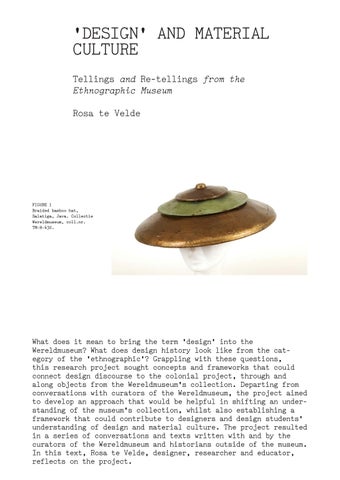
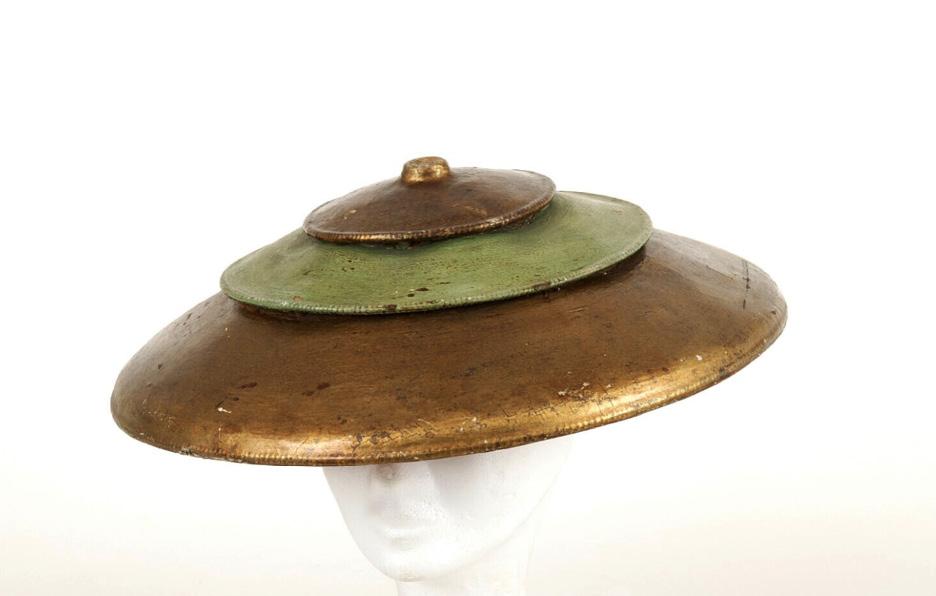
What kind of selection of objects does one make when viewing the Wereldmuseum’s collection through the category of ‘design’? This hat, made in Salatiga, Java (fig. 1) was selected by one of the curators of the Wereldmuseum. The object was collected by H.J. van Swieten, a civil servant who became a resident in Pekalongan, Java (1883-1886) and entered the collection in 1884. The curator shared with us his reflection on the object:
Between the border and the middle part there is an opening for ventilation. The ground and upper part are gilded, the middle part is light green. This hat was added to the collection of the Colonial Museum in Haarlem in 1884. This museum was much focused on products made of natural materials and besides the (West) Javanese name with a question mark, nothing else is indicated, not even whether this is a sun hat, which it probably was. He also collected a similar hat, though not lacquered, to the collection (TM-H-3027). Another similar hat is in the [Rotterdam] Wereldmuseum collection (WM-2714).¹
The chosen object raised the question about what is perceptible and known about the hat. Visual, material and technical observations are shared, as well as information about the colonial civil servant who collected the object. More importantly, what the curator’s choice emphasised was what the lens of ‘design’ did to the curator’s understanding of material culture: it encouraged a strong focus on a particular, ‘streamlined’ and perhaps exceptional form language and aesthetics that is associated with the notion of ‘design’. The legacy of ‘modern design’ echoes through in this kind of decision making. When is ‘design’ a lens? Or when does it create a tunnel vision?
In another session, the same Wereldmuseum curator shared how further reflection on the object through ‘design’ helped to gain a better understanding
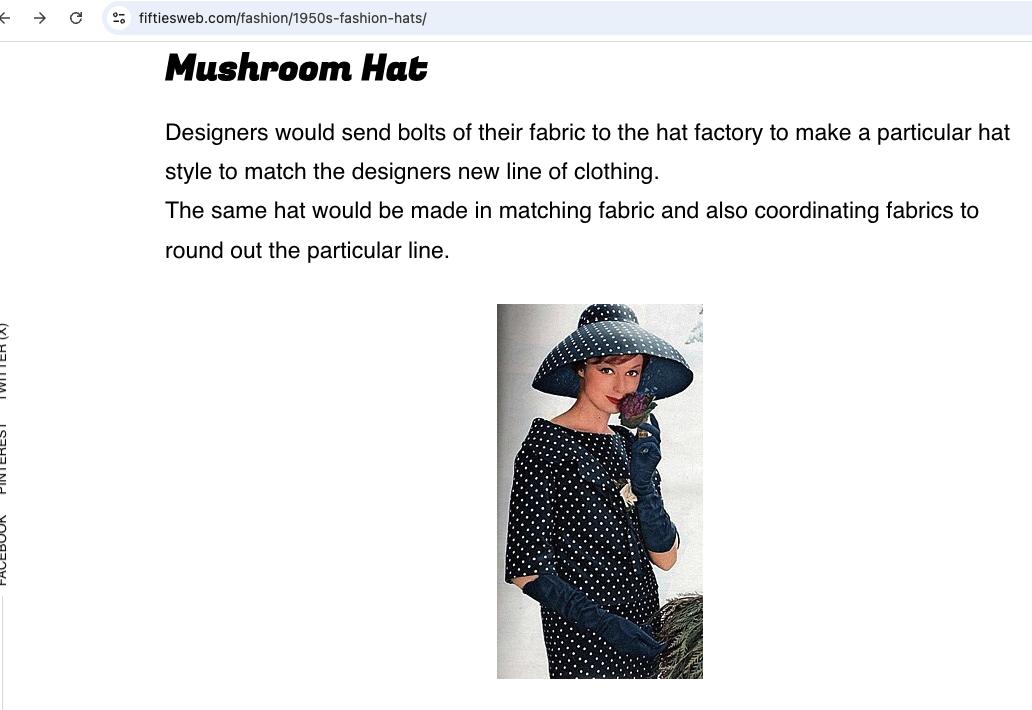
Screenshot of the fifties 'mushroom hat' from fiftiesweb.com.
1 Email from curator, 23 January 2024. The curator preferred to be anonymous in this text.
2 Email from curator, 23 January 2024.
3
of how his own research practices and (biased) observations led him to view the hat in a certain way: ‘I remembered the hat that I had fancied nearly ten years ago, because of its unusual shape and its colors. I realize that this perpetuates a western look on shape and colours of the ‘mushroom hat’ [fig. 2].’²
The appreciation of a particular modern design fashion icon – the fifties’ mushroom hat – had informed the frame of reference of the curator and the questioning around its design allowed for this realization to emerge. The concept of ‘design’ thus facilitated a discussion around culturally ingrained associations with the term, bringing to mind Wayne Modest’s suggestion to use ‘design’ as a ‘translation term’, in reference to James Clifford.³
Legacies of Modern Design
The invitation from the RCMC to think the collection through ‘design’ departed from the desire to ‘not reduce the collection’s only story to that of colonialism’. Considering ‘design as translation […] destabilizes modern design’s claims for universality but also encourages curiosity for what has not been considered ‘design’.’⁴ How do we acknowledge that the Wereldmuseum’s collection is an archive of ‘the knowledges, skills and techniques, and the ingenuity of a global majority of peoples across the world, in shaping the world around them’?⁵
In the book Are we human?, New York-based curator couple Beatriz Colomina and Mark Wigley reflect on design as: ‘[…] a form of projection, to shape something rather than find it, to invent something and think about possible outcomes of that invention. This endless reshaping and speculation about possible outcomes is uniquely human.’⁷ The message of the book is that the capacity to design is what sets humans apart from non-humans (something to be questioned from a posthumanist perspective). Yet, historically, as well as in our present-day context, the practice of design remains an exclusive and separate domain of activity, employed by a limited, often privileged group of people. The field of design is considered to have come into existence through European modern industrialisation and professionalisation through education and training.⁸ In the minds of many people, design is still strongly associated with certain smooth ‘modern’ or exceptional aesthetics, even if the practice of design has expanded today to include a wide variety of aesthetics, as well as expanding into other fields.⁹
In the past decades, design historians and practitioners have pointed to the ways in which the field of design and its ‘solutionism’ is entwined with the history of coloniality, not only helping us understand the colonial nature and implicatedness of industries and capitalism, but also how the legacy of modern design frames which kind of creative practices are recognised as ‘design’ and who is recognised as a designer.10 In the book Design Struggles: Intersecting
3 See the event organised in January 2018: https:// www.materialculture.nl/en/events/design-andas-translation-globalising-design-histories.
4 'By approaching design as a ‘translation term’, (Clifford 1991) it becomes clear that the term ‘design’ – which in the design museum has a very specific usage – falls apart when considered from a global perspective. Design considered as a form of translation allows us to see it as a (historic) construction reflecting and performing hegemonic power relationships. Considering design as translation thus destabilizes modern design’s claims for universality but also encourages curiosity for what has not been considered ‘design’.' See the event organised in January 2018: https://www.
materialculture.nl/en/events/design-andas-translation-globalising-design-histories.
5 https://www.materialculture.nl/en/research/themes/ designing-and-ethnographic-museum
6 A. Ansari, ‘Decolonisation, the History of Design, and the Designs of History’, paper presented at the Annual DHS Conference, 2021 (online). Accessed through: https://mediathek.hgk.fhnw.ch/ink/detail/ zotero2-2641719.7CCEUFRV.
7 B. Colomina and M. Wigley, Are we human? notes on an archaeology of design, Lars Müller Publishers, 2016 p. 10.
8 W. Gunn, T. Otto & R.C. Smith (eds), Design Anthropology: Theory and Practice, Routledge, 2013.
9 Such as graphic design, industrial design, UI/UX
Histories, Pedagogies, and Perspectives, design researcher Claudia Mareis & graphic designer Nina Paim reflect on how today, ‘design and its thinking is deeply complicit in many structural systems of oppression, serving to concretize, perpetuate, and disseminate power and privilege’.11 Platforms such as Teaching Design or Futuress address and resist the persistent whiteness of the field of design and design education, through feminist and decolonial approaches.12 According to design scholar Ahmed Ansari, by now, the questioning of the conceptual foundations of design is firmly established but also raises many concerns. In his critical contemplations on ‘the decolonial turn’, he traces the issues that emerge. What does it mean to bring in ‘other’ knowledges, he asks, when there is a risk of ‘hollowing them out of precisely that which is incommensurable and irreducible in those knowledges’.13 Ansari questions how ‘decoloniality’ in the context of global classrooms becomes understood: he notices a fetishization of ‘the indigenous’ and of pre-colonial pasts as well as ‘mistaking liberal pluralism and cosmopolitanism with decolonisation and pluriversality’.14 Museums might not be the right places for ‘decolonial work’, According to design historian Dr. Megha Rajguru, but they can be the sites of inquiry where one can study the ‘plurality’ of meanings.15
World Histories of Design?
What are the ways in which design historians have tried to move beyond a eurocentric understanding of design? As part of the project, Rajguru gave a lecture during a session with the curators of the Wereldmuseum on the ways in which design historians have attempted to broaden their scope beyond ‘Anglo-European modernity’, and the questions and pitfalls thereof. Rajguru is co-editor of the fourth volume of World History of Design, a project initiated by the late design historian Victor Margolin.16 Rajguru reflected on the problematics of writing ‘world design histories’, and the issues that come with placing material culture within a singular, all-encompassing framework in design history writing. Through a project like Victor Margolin’s World History of Design, design history expands its territory beyond its eurocentric frame, to include ‘pre-industrial regions’ and their material cultures, and therefore broadening what becomes included as design. Material practices however, are still assessed through a modernist lense. Rajguru also reflected on a global design history approach as developed by Glenn Adamson, Giorgio Riello and Sarah Teasley, where the notion of globalized networks and interconnectivity is central, focusing on how objects move through regimes of value and how meaning-making depends on local encounters, acknowledging ‘partiality’ of knowledge production.17 Rajguru shared with us a question that she continues to return to in her scholarly work: ‘In what ways does design appropriate objects that may not be defined as design? Or is it that design needs to be inclusive?’18 Rajguru’s question is particularly appropriate in design education
design, social design, experience design, service design, or design for development.
10 See for example, the Futuress platform, Elizabeth (Dori) Tunstall, Decolonizing Design: A Cultural Justice Guidebook, MIT Press, 2023 or Ansari et al, ‘A Manifesto for Decolonising Design’, Journal of Future Studies, 23:3 (2019), pp. 129-132.
11 C. Mareis & N. Paim, Design Struggles: Intersecting Histories, Pedagogies, and Perspectives, Valiz, 2022.
12 Futuress is a platform with a feminist approach dedicated to the design of politics and the politics of design, see www.futuress.org. Teaching design is a collaborative research platform founded by Lisa
Baumgarten and Anja Neidhardt-Mokoena, with the purpose of sharing feminist and decolonial perspec tives and literature: https://bib.teachingdesign.net/.
13 Ansari, 2021.
14 Ansari, 2021.
15 Dr. Megha Rajguru, online lecture with curators of the Wereldmuseum, Leiden, 11 July 2022.
16 See V. Margolin, World History of Design, Volume I & II Bloomsbury, 2015. The books are advertised by Bloomsbury as ‘the definitive historical account of global design from prehistory to the end of the Second World War’. Volume 3 (2020) is dedicated to Europe and North America. See also: V. Margolin,
FIGURE 3
How does a world history approach compare to a global history approach? (drawing by Rosa te Velde).
within art institutions in the Netherlands, where there is a strong desire for being ‘innovative’ through discourses of ‘inclusion’ in today’s art and design education. What are the ways in which ‘traditional’ practices are incorporated and get translated into design discourse?
Epistemic Translation
According to decolonial scholar Rolando Vázquez, ‘epistemic translation’ is a way to address the constitution of modern knowledge production and its gatekeeping: what has been incorporated and appropriated and on what terms, and what has been erased and made invisible? More so than a global design history approach which does acknowledge the importance of situatedness and partiality of knowledge production, Vázquez is concerned with the question of coloniality and erasure. In writing about one of the earliest ‘ethnologists’, Bernardino de Sahagún (who was sent as a missionary in 1529 to present-day Mexico becoming an ‘expert’ on the Nahuatl language family), Vázquez shows the ways in which through the ‘institution of a scriptural economy of knowledge’, many relations got lost and erased in translation:
The notions of memory (ancestors/memoria), land (tierra) and language (palabra) represent examples of the untranslatable, namely that which is erased by translation and replaced by the modern notions of chronology, space and writing.19
The complex ways of knowing and being in the world got reduced through the ‘scriptural economy of knowledge’ to modern concepts and relations. In addition to a ‘scriptural economy of knowledge’, also the institution of the visual and material ‘economies of knowledge’ have eradicated the complex, manifold, embodied ways of knowing and being in the world and instead established a ‘modern way’. Through modern science, with its focus on ‘empirical’ observation, ‘seeing’ became synonymous with ‘knowing’. For Vázquez, it is crucial
‘A World History of Design and the History of the World’, Journal of Design History (2005).
17 Riello
18 Dr. Megha Rajguru, online lecture with curators of the Wereldmuseum, Leiden, 11 July 2022.
19 R. Vázquez, ‘Translation as Erasure: Thoughts on Modernity’s Epistemic Violence’, Journal of Historical Sociology 24:1 (2011), p 32.
FIGURE 4
What happens when a cultural practice is translated and ‘repackaged’ through the modern gaze? (drawing by Rosa te Velde).
A cultural practice rooted in place, tradition, Earth...
Translated and repackaged through the modern gaze
to understand how modernity produced ‘the parameters of legibility’.20 These questions also apply to material culture. ‘With whose eyes are we looking and through whose eyes are we being made to see?’21 is a question central to the work of Vázquez, in reference to Donna Haraway’s question: ‘with whose blood were my eyes crafted?’, from her text Situated Knowledges (1988). What violences and erasures have been implicated in seeing, representing and knowing?22 With design as a ‘translation term’ we can look at the ways in which the communal, visual and material practices that were established in specific communities got translated through the modernist gaze. How for example, did nature become repackaged and commodified as ‘raw materials’?23 How did visual practices across the world become understood through the concept of ‘ornament’?24 Or how did ‘craft’ become a ‘culturally and racially othering category’25?
Re-Telling Material Culture
Working together with the curators of the museum, these issues and questions led us to work on understanding the ways in which the modernist gaze produced specific framings and stories. To better understand the ‘plurality of meanings’ that the objects in the collection afford, it seemed to be essential to establish an understanding of how we have been made to see material culture. With the goal of producing more complete or even more ‘just’ (hi)stories, the dominant gaze continues to ‘renew’ itself, both in the museum world, as in the cultural field at large. The Wereldmuseum, with its contested histories and changing mission, reflects a transition from a 19th century colonial museum to a 1960s post-colonial museum focused on development, towards, currently, appreciating cultural difference and ‘cultivating global citizenship’. What stories do different tellings facilitate? What different tellings were accepted at particular moments in time and how does this cycle of renewal of discourse continue? How do objects move in and out of categories, including the category
20 R. Vázquez, p. 28.
21 C. Esche, R. Vazquez, T. Cos Rebollo, ‘Decolonial Aesthesis: Weaving Each Other’, 9 November 2023. Accessed through: https:// internationaleonline.org/contributions/ decolonial-aesthesis-weaving-each-other/.
22 According to Haraway, ‘vision is always a question of the power to see […] How to see? Where to see from? What limits to vision? What to see for? Whom to see with? Who gets to have more than one point of view? Who gets blinded? Who wears blinders?’ D. Haraway, ‘Situated Knowledges: The Science
Question in Feminism and the Privilege of Partial Perspective’ in: Feminist Studies 14 (3), 1988, pp. 586-587.
23 See for example, Livia Rezende ‘Manufacturing the raw in design pageantries: the Commodification and Gendering of Brazilian Tropical Nature at the 1867 Exposition Universelle’, in: Journal of Design History 30:2, pp. 122-138 (2017).
24 See for example, M. Simon Thomas, De leer van het ornament: versieren volgens voorschrift 1850-1930, Amsterdam: De Bataafse Leeuw, 1996.
25 Ansari, 2021.
of design? What motivates a new telling? How then could we create conditions for tellings and reflections that shift beyond the dominant gaze and centre the objects, their communities of makers, their cosmologies and their ingenuity?
In Pacific Aesthetics and European Collecting Craze: Wuvulu and Aua Design, curator Wonu Fanny Veys looks at a model canoe from the islands of
Object enters collection
5
Tellings and re-tellings (drawing by Rosa te Velde).
Motivations for collecting?
Telling 1
Motivations for ‘telling 1’?
Re-telling
Motivations for ‘re-telling’?
What remains unseen/ unquestioned? What stays important/self-evident?
What would a non-dominant/ non-ethnographic telling look like?
Wuvulu or Aua in the Wereldmuseum collection. She examines the colonial essentialisms tied to collecting practices as a side hustle of commercial expeditions, in reifying the division of Melanesia, Micronesia and Polynesia. The islands of Wuvulu and Aua occupied an ambiguous status within this division, and objects from these islands became subject to discussion. The model canoe was likely made for the European market and therefore was considered to be a ‘tainted’ object, but models like these were seen through a different lens from the 1950s onwards for their modern appearance. Veys shows us the many tellings of an object through different periods of time – from the ethnographic-commercial enterprise to the aesthetic appraisal through a lens of ‘streamline design’, to the counter-ethnographic reading of the model. Through the collection and conversations with the curators, I learned about the ‘Jaspertjes’: the work of Johan Ernst Jasper and the inventories of ‘Inlandsche Kunstnijverheid’ (native arts and crafts) that he produced together with the Javanese artist Mas Pirngadi between 1912-1930, at the time of the ‘Ethical Policy’ in Indonesia. ‘The Jaspertjes’ refer to the five volume inventory of different crafts in Indonesia, and are still a standard reference work today in the museum. Jasper and Pirngadi’s inventory was the result of a paradigm shift: at the turn of the century, a small group of connoisseurs, urged for appreciating and understanding Indigenous objects as ‘decorative arts’ rather than ethnographic. However, this shift happened during a period of expansion and violence proclaimed as pacification and development. In Yes, but… Occupation as Requirement for ‘Development’, I investigate this period of conquest and expansion into the outer possessions beyond Java. In the follow-up article, A Firm Nudge: Politics of ‘Ethical’ Reform through ‘inlandsche kunstnijverheid’,
I delve deeper into the ‘Ethical Policy’ and the ‘artistic debt of honour’, and the various initiatives in the field of native arts and crafts. In this article I studied how the notion of ‘the will to improve’ serves a rhetoric of progress and development while erasing existing arts and crafts practices.
Although the ‘Ethical Policy’ aimed at bringing prosperity to the Indigenous population, historian Marjolein van Pagee examines how the racist apartheid system strategically limited access to crafts education. Although colonial authorities spoke of educational development, they invested very little in it, designing what was offered primarily to produce a small and easily controlled labour force. Central to the agenda of the so-called ‘ethicists’ was the notion of the ‘elevation’ of women, as they believed that women’s oppression stemmed chiefly from local patriarchal traditions. Such arguments underpinned the Dutch assertion that their continued occupation of Indonesia brought ‘civilisation’. Historian Raistiwar Pratama, together with Marjolein van Pagee, turns our attention to Dewi Sartika, who founded a girls’ school in Bandung. Within Sartika's curriculum, crafts played an important role. Aceh veteran J.C. Lamster would film one of the schools in his propaganda film of 1913 where girls are lacemaking, which was believed to ‘instill housewifely virtues’. Although only Sartika's 1913 Dutch-language text Verheffing van de Inlandsche Vrouw (Elevation of the Native Woman) survives, Pratama and Van Pagee’s contribution explores how her pioneering educational efforts were ultimately appropriated within the colonial narrative.
In her text, curator of ‘Southeast Asia’ Marjolein van Asdonck shows the ways the Ethical Policy led to practices of ‘saving’ native crafts. Yogya Silver was invented as a tool for ‘reviving’ and promoting silver crafts in Indonesia in the 1930s, whilst dismantling and erasing its existing patronage through the colonial expulsion of the royal courts. Van Asdonck traces the ways Mrs. Mary Agnes van Gesseler Verschuir-Pownall played an important role in ‘Yogya silver’, selecting and designing ‘authentic’ Hindu-Javanese motifs and commissioning craftsmen to execute the work for an elite clientele. Van Asdonck’s text builds onto the work of her predecessors in the museum, but critically expands her re-telling, taking into consideration the context of the ‘Ethical Policy’ and the colonial context as a practice of erasure, and therefore moves beyond the idea of Yogya silver as a search for authenticity.
Within these texts, you will see different approaches to terminology. Initially, it seemed clear to simply follow the Words that Matter guide.26 In my own text, I chose to translate ‘inlandsche kunstnijverheid’ as ‘native arts and crafts’, but use Indigenous (capitalised) in the running text from today’s point of view. The aim of using ‘native’ was to represent the racist connotations of ‘inlandsch’, which signifies the racialised hierarchy of the ‘Dutch East Indies’ colony, which was separated into three (legal) categories: European, foreign Orientals, and ‘Inlanders’. These categories of the apartheid system were also used in the study of crafts by Rouffaer.27 In the text of Marjolein van Asdonck, we also translated ‘inlandsch’ with ‘native’, but for Van Asdonck, it was important to use ‘Indonesians’ in her article as much as possible, also following the practice
26 Words that Matter: An Unfinished Guide to Word Choices in the Cultural Sector, 2018. Accessed through: https://www.materialculture.nl/en/ publications/words-matter.
of the Wereldmuseum. In conversation with Indonesian historian Raistiwar Pratama, it also became clear to me, that to Indonesians today, ‘indigenous’ may connote traditional living tribes or specific ethnic groups only. For Pratama, ‘native’ felt more appropriate as a translation of the Indonesian word pribumi, which refers to all people ancestral to the Indonesian archipelago. We chose to leave this diversity in approaches intact to reflect the differences between authors and what they find important and to invite reflections on the difficulty of terminology.
With thanks to Dr. Megha Rajguru, the many insightful and provocative conversations with the curators of the Wereldmuseum, Wayne Modest and Esmee Schoutens, the crucial insights from Rana Ghavami and the editorial work by Ilaria Obata, we inquired into the ways in which tellings and re-tellings of histories of objects invite reflections on the ways in which ‘design’ operates.
I hope this collection of essays will invite more contemplations and speculation on how to create conditions for learning to see and value material culture beyond the dominant gaze, understanding the many modes of creativity and ingenuity held by the Wereldmuseum’s collection.
The research project advanced with the support of Stimuleringsfonds, resulting in the research website Recall/Recalibrate, for which the text by Marjolein van Pagee and her collaboration with Raistiwar Pratama were commissioned. Recall/Recalibrate is focused on the ‘Ethical Policy’, investigating crafts education at the time.
ROSA TE VELDE is a designer, researcher, and educator. She works as a researcher at the Amsterdam University of the Arts and teaches in the MA Industrial Design program at the Royal Academy of Art, The Hague. Her practice explores the intersections of design, politics, and decoloniality through critical and cross-disciplinary approaches.
27 G. P. Rouffaer, ‘De noodzakelijkheid van een technisch-artistiek onderzoek in Ned.Indië’, in: De Indische Gids Vol. 23, October 1901.
This text was written for the Design/ing and the Ethnographic Museum project for the Research Center for Material Culture. The template for this text was designed by Zuzana Kostelanska, as part of the Recall/ Recalibrate project, funded by Creative Industries Fund NL.
The text is published under CC BY-NC-ND license, which enables reusers to copy and distribute the material in any medium or format in unadapted form only, for noncommercial purposes only, and only so long as attribution is given to the creator.