

BY PAUL MARYNIAK AFN Executive Editor
The federal government pumped a staggering amount of money into 1,119 Ahwatukee businesses, nonprofits, schools and other entities to hold on to 9,932 jobs as the economy began reeling during the first few months of the pandemic.
maintaining salary levels. Forgiveness will be reduced if full-time headcount declines, or if salaries and wages decrease.”
The loans to Ahwatukee entities ranged from as little as $16,035 to as much as $5 million to $10 million, the SBA data show.
The number of jobs the borrowers said they were saving didn’t necessarily reflect the size of the loan they received, with one entity obtaining a seven-figure loan and listed no jobs to save, according to the SBA data.
sional Democrats and government watchdogs about the lack of transparency in 4.9 million loans totaling $520.6 billion that it has approved so far nationwide. The SBA last week also extended the deadline to early August for applying for some of the estimated $130 billion that remains unspent.


Records released by the U.S. Small Business Administration last week show that the agency gave Ahwatukee entities – some with addresses at private homes – at least $63.9 million and as much as $123 million in Paycheck Protection Program loans.
Most of those loans likely won’t have to be repaid, under SBA guidelines, though the agency states:
“Forgiveness is based on the employer maintaining or quickly rehiring employees and
The SBA did not identify the 994 Ahwatukee entities that each borrowed less than $150,000.
And while it did provide names and addresses for 125 Ahwatukee entities that obtained loans of at least $150,000, the agency did not disclose the specific amount they got.
The incomplete data was released by the SBA after weeks of pressure from Congres-
The PPP loan funds – described by the SBA as “a direct incentive for small businesses to keep their workers on the payroll” – are part of the $2 trillion pandemic relief package approved by Congress in March that also included other assistance to individuals, businesses and local and state governments.
PPP loans are aimed at preserving jobs by helping borrowers maintain their payroll and stay afloat by using some of the money for rent, mortgage interest or utilities.


BY PAUL MARYNIAK AFN Executive Editor
The new owners of Club West’s former golf course don’t expect to complete a proposal for the site until late this year and will spend the next few months soliciting ideas from homeowners on what they’d like to see there.

“We’ve worked with an architect to see what can be done with the land and develop a framework for what a park would look like and discuss the number of ways to remediate the land,” said Matt Shearer, one of three partners in Community Land Solutions.
“The big issue right now is that any plan has to go through a long process of working with the community,” he said. “So right now, we’re


TheAhwatukeeFoothillsNewsis published every Wednesday and distributed free of charge to homes and in single-copy locations throughout Ahwatukee Foothills.
Times Media Group: 1620 W. Fountainhead Parkway, Suite 219
Tempe, Arizona, 85282
Main number: 480-898-6500
Advertising: 480-898-5624
Circulation service: 480-898-5641
PUBLISHER
Steve T. Strickbine
VICE PRESIDENT
Michael Hiatt
ADVERTISING STAFF
National Advertising Director
Zac Reynolds 480-898-5603 zac@ahwatukee.com
Advertising Sales Representatives: Karen Mays, 480-898-7909, kmays@ahwatukee.com
Laura Meehan, 480-898-7904, lmeehan@ahwatukee.com
Classified: Elaine Cota, 480-898-7926, ecota@ahwatukee.com
Circulation Director: Aaron Kolodny 480-898-5641, customercare@ahwatukee.com
NEWS STAFF
Executive Editor: Paul Maryniak, 480-898-5647, pmaryniak@ahwatukee..com
GetOut Editor: Christina Fuoco-Karasinski, 480-641-4518, christina@timespublications.com
Sports Editor: Zach Alvira 480-898-5630, zalvira@timespublications.com
Designer: Ruth Carlton - rcarlton@timespublications.com
Production Coordinator: Courtney Oldham 480-898-5617 production@timespublications.com
Reporters: Jim Walsh, 480-898-5639 jwalshe@ahwatukee.com
Wayne Schutsky, 480-898-6533 wschutsky@timespublications.com Cecilla Chan. 480-898-5613, cchan@timespublications.com
Ahwatukee Foothills News is distributed by AZ Integrated Media, a circulation service company owned by Times Media Group The public is permitted one copy per reader. For further information regarding the circulation of this publication or others in the Times

To submit a letter,
pmaryniak@ahwatukee.com.
EDITORIAL CONTENT
The Ahwatukee Foothills News expresses its opinion. Opinions expressed in guest commentaries, perspectives, cartoons or letters to the editor are those of the author.
ADVERTISING CONTENT
The content and claims of any advertisement are the sole responsibility of the advertiser. The Ahwatukee Foothills News assumes no responsibility for the claims or content of any advertisement.
More than 80 members of school boards across Arizona – including two from Tempe Union and two from Kyrene – have called on state officials to delay opening campuses until at least Oct. 1.
Tempe Union Governing Board President Berdetta Hodge and her colleague Brian Garcia, as well as Kyrene board Vice President Kevin Walsh and his colleague Michelle Fahy, are among those who have signed a letter to Gov. Doug Ducey, Superintendent of Instruction Kathy Hoffman and the State Legislature.
“Positive cases in Arizona are trending upward, not downward,” the letter states. “We cannot reopen our schools for on-site learning until we experience a downward trajectory of documented cases within a 14day period.
“We want to help mitigate the spread of the COVID-19 virus, not contribute to higher and higher numbers of outbreaks and deaths in our communities.”
The letter, which does not represent official school board positions but rather concerns of the individual board members, makes a series of other requests beyond keeping campuses closed until Oct. 1.
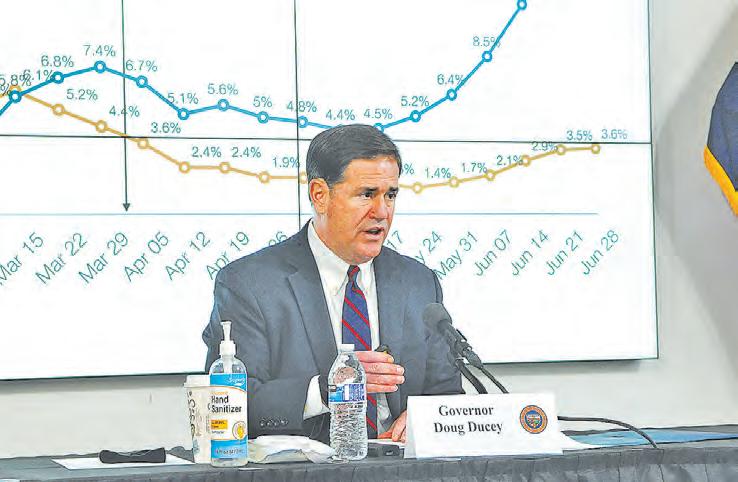
Ducey has delayed the opening of campuses until Aug. 17 – a date he reiterated last week as “aspirational” rather than set in stone.
Tempe Union is beginning online instruction for all students Aug. 3.
Kyrene is starting online classes Aug. 7 for those who are signed up for either classroom or hybrid learning while kids enrolled in the Digital Academy, a fulltime online program developed by the district, begins July 30.
Horizon Honors postponed all learning until Aug. 17.
The letter from board members to state officials also asks the state officials to set a COVID-19 case data point for districts to use in determining when to reopen campuses as well as establish uniform safety protocols.
It also seeks equal per-pupil funding for both online and in-class students; a waiver of the 180-day instruction requirement; suspension of standardized state assessment tests for the school year with allowance for districts to use their own student-performance measurements; and permission to distribute breakfasts and lunches even when campuses are closed.
“We need real goals and plans so we can focus on instructional, facility and transportation planning,” the letter states, adding:
“Let administrators and teachers plan for and excel at teaching the first quarter remotely. If there is a reduction of risk and infection in our communities, this






































































































Capt. Billy Walker and his wife Cheryl of Ahwatukee had grown tired of the criticism of public safety personnel, particularly police officers, and so the Ahwatukee couple last week decided to do something about it.
Actually, they did two “somethings.”
Early last week, Cheryl dropped off a couple of Costco boxes of cookies at one of the Ahwatukee fire stations for the men and women who man Engine 241.
But with the surprising generosity of the Wildflower Bread Company at Guadalupe Road and McClintock Drive in Tempe, the Walkers a few days later delivered 70 sandwiches, along with chips, cookies and condiments, to the officers at the South Mountain Precinct as well as the police substation at 40th Street and Pecos Road.
“It was all Cheryl’s idea; I was just the driver,” said the lifelong pilot and flight instructor of his wife of nearly 50 years, whom he affectionately calls “my immediate supervisor.”
Walker, who is known as “Captain Billy,” said his wife called Wildflower, one of their favorite dining spots, to see what it would cost to serve the men and women in blue at the precinct.
But instead, Alison Johnson of Wildflower offered the food for free.
So, they stopped at Wildflower midmorning Thursday, then drove over to the precinct with their gift, meeting with Sgt. Mark Rivers.
Although he had only talked to Rivers a few times on the phone to figure out how many sandwiches to get, Walker said it turned out the two men had something in common since he’s working on his flying ratings “so he’ll have something to do in his retirement.”
The Walkers also included a hand-made large card stating “We appreciate you.”
Walker also sent a follow-up email to Johnson, telling her, “Sgt. Rivers and his fellow officers were very warmly taken by your benevolence.”













ARIZONA MORTGAGE SPECIALISTS, INC.
Mike Langs 480.905.0888
Purchase, Refinance, FHA, VA, USDA... I


8747 S. Priest Dr., Ste. 101, Tempe, AZ 85284 mike@azms.net
ARIZONA MORTGAGE SPECIALISTS, INC.
Mike Langs 480.628.9322 mike@azms.net


8747 S. Priest Dr., Ste. 101, Tempe, AZ 85284 mike@azms.net
8747 S. Priest Dr., Ste. 101, Tempe, AZ 85284 License #BK0911294, Company NMLS #175156 Mike Langs, NMLS #175381
License # BK0911294, Company NMLS # 175156 Mike




























































REOPEN from page 3
natural break in our academic calendar will be an ideal time to consider returning to in-person learning.”
In their request for suspending state achievement tests, the board members wrote:
“We ask that our focus this academic year be offering high-quality remotelearning and a measured return to safe in-person classes, rather than on reaching higher levels of academic success as measured by a single assessment.
“Remote learning is the only guarantee we have for the safety of our students and staff during the rising COVID-19 outbreak in our state. The latest executive order, as presented, penalizes school districts for offering only remote learning, as it requires districts to offer a physical attendance option for five days a week to receive 100 percent funding for remote on-line instruction through the order’s budget stabilization process.”
It said there is not study that “indicates that the number of infections will have decreased by any certain day on the calendar, and administrators, teachers, and families across the state are very nervous
about returning to our school buildings and classrooms.”
“While we appreciate the decision to require five days of on-site learning is to assure families have a place to send their children so they can continue to earn an income and financially contribute to our economy, this decision is inequitable and
greatly impacts our poorest communities the most,” the board members wrote.
The letter climaxed a week in which President Trump, members of his cabinet and other leading Republicans demanded that schools reopen for in-class learning when their school year officially begins.
U.S. Rep. Andy Biggs, R-Gilbert, led a
group of Republican lawmakers Thursday who demanded that schools reopen as usual in the fall, stating, “It would be more harmful to keep children locked out of schools and less harmful and less risky for children to go back to schools.”
During a press conference July 9 in which he acknowledged that COVID-19 cases were exploding in Arizona, Ducey said he won’t play politics in deciding when campuses can reopen.
On the same day of his press conference, Scottsdale Unified became the first district in Arizona to announce it won’t reopen their schools before Sept. 8.
Arizona Schools Superintendent Kathy Hoffman also said on July 9 that while she wants to get students back in the classroom, “we cannot ignore the severity of COVID-19 in our state and how that impacts adults and children alike in our school communities.”
Hoffman tweeted Tuesday, when the White House hosted a daylong panel on reopening schools, that the safety of whole communities could be at stake – not just students and teachers.
“Those valued members of our schools see REOPEN page 11



















































































REOPEN from page 9
need more assurances that schools and communities have the resources they need to stop the virus from spreading widely throughout their community,” her tweet said. “I cannot provide those assurances to the adults and students who are medically vulnerable in our school community at this time.”
The Centers for Disease Control and Prevention has issued guidelines aimed at helping school systems determine how best to reopen schools this fall. But those guidelines – which include social distancing, sanitizing, wearing masks and more –were attacked by Trump and his supporters as too strict.
Trump tweeted last week that the CDC should reconsider its guidelines, which he called “very tough & expensive.”
CDC Director Dr. Robert Redfield hedged Thursday during an appearance on ABC News’ “Good Morning America” when asked whether the guidelines would be revised.
While Redfield said the CDC will continue to offer schools “additional reference documents,” those are “not a revision of
the guidelines.” He said the agency would put forward a “spectrum of strategies” and focus on helping schools implement the guidelines.
Speakers at the event organized by the House Freedom Caucus, which Biggs chairs, called the CDC guidelines “ridiculous” and “extremely harmful” for students’ emotional and physical wellbeing.
They repeatedly noted that being kept out of school is bad for children’s emotional health and that COVID-19 is neither dangerous to children nor easily spread by them.
“This is not a risky problem or health situation for the younger generation,” said Dr. Simone Gold, an emergency medical specialist from Los Angeles at the press conference.
Meanwhile, Snowflake Republican Sylvia Allen, who chairs the State Senate Education Committee, told Cronkite News she doubts Ducey has the power to delay the reopening of campuses.
She said Arizona should not be governed through executive orders, noting that “the legislative branch makes policy and budget allocations, not the executive branch.”
“It is time to stop, call a special session,
and get back to the constitutional operations of our state,” Allen said.
Rep. Michelle Udall, R-Mesa, a teacher and chair of the House Education Committee, doubts that a special legislative
session is feasible and she worries how many legislators would actually show up because of COVID-19 concerns and obligations to family members who may be sick or at risk.
“Calling a special session would end up with a bunch of people running in different directions, which is not going to help,” Udall said. “I don’t think we have enough consensus to get anything done.”
Despite such reservations, Udall said, she “would love” to hold a special session to address education issues in the state –under different circumstances.
However, she and Allen both support giving schools the authority to delay the start of in-person classes.
Allen said she recently worked on her own legislation that would have provided, among other items, “local control and flexibility for schools opening and determination of health protocols.”
The governor’s delay of the school year was part of his June 29 executive order that also shut down the state’s bars, gyms, water parks, movie theaters and river tubing for 30 days.

WEST from page 1
trying to set up a mechanism to get opinions and suggestions from the community – and getting information out to them as well – so that we have a framework.”
“It’s going to be open space for use by the community,” Shearer continued, “but is it going to have viewpoints? Is it going to have a dog park included? That’s what we’re working on. …We’ve got an advisory group together. We’re in the early stages of that, getting ideas from them. And we’re setting up a way for the community at large to interact with the advisory group – and therefore ourselves – so that we can take all the knowledge out there.”
But Shearer and CLS spokesman Jason Rose, said “there’s a cost associated” ultimately with any plan and “that gets back to the new homes issue.”
Meanwhile, the Club West Conservancy, which is opposed to the construction of any homes on the site, released a survey of more than 800 of Club West’s 2,700 homeowners that suggested CLS has its work cut out for it with any plan for homes on the course.
Of those who responded to the survey, the Conservancy stated, 82 percent said it would be “unethical” to build houses behind golf course lots and that 81 percent “would prefer to keep the land just ‘as is’ rather than having houses” built on the site.
Of those who responded to the survey, the group said, 27 percent have houses on the course and 73 percent live elsewhere
in Club West. It added the survey was set up so that only one response from any single address was counted.
The overall results showed 77 percent wanted a golf course back but 75 percent felt that was an unrealistic hope, the Conservancy said, adding that respondents split evenly on a golf course versus a park.
The Conservancy last week dropped its request for a temporary restraining order against the Club West Association board of directors that the board claims would have effectively stopped it from even discussing a plan with CLS.
There is an Oct. 1 hearing on a request for an injunction to prevent any homeowner vote on a plan pending a trial next February on the Conservancy’s suit against the board.
At issue in the lawsuit is whether any plan for the course can be implemented with the approval of less than 75 percent of all homeowners.
Shearer expressed frustration with the legal battle, but said, “I don’t see it stopping us from putting a plan together.”
“We’re concerned that the ability of the community to hear our proposal and vote on it is being blocked and it’s difficult for me to understand,” he said.
“I understand if people wanted to look at an idea and say ‘I don’t like this,’ ‘I don’t like this element.’ But to prevent the idea from being disseminated to the public and also vote on it – that’s concerning to me,” he added.
“I hope that if we put together a really killer plan – which we intend to do – we



can put it on our website,” Shearer said. “Nothing can stop us there.”
He also took a swipe at the Conservancy, stating, “Unfortunately, the majority of their activity and research and reports and fundraising is not directed at a solution but kind of directed at preventing us from planning and blocking any homeowners’ ability to view it and vote on it.”
Rose added, “There’s not some grand conspiracy by a bunch of well-intentioned volunteers on an HOA board and a new ownership group.
“You can’t have a more transparent process than what’s going to take place here,” he continued. “You have to start somewhere with a plan, then you get input and then ultimately put it to a vote.”
“There’s no intention other than they put forward a good plan, get feedback and let people vote on that up or down,” Rose said.
Shearer said that while CLS is powerless to affect the outcome of the current litigation, he’s banking partly on the possibility that most residents will ultimately like the proposal – even if it will necessarily include new homes.
Right now, he said, he and his partners are too early in their planning to even think of how many homes would be needed to pay for whatever proposal CLS comes up with.
Rose said there are examples around the Valley and elsewhere of junked golf courses that gave way to homes and green space that enhanced property values and

quality of life in those communities.
But he also said that ultimately “it becomes kind of a community calculus to figure out how this all works together.”
Once CLS has a conceptual plan for the site, he explained, “then you start doing the math.”
The math includes, Rose added, “here’s where homes may go – they’re the least intrusive to homeowners. And what is the yield on that? Does that make financial sense? Who’s going to pay for maintenance? How does that all work?”
But Shearer said that making those kinds of calculations is a long way off.
“We’d like to see something get done by Nov. 1 – not done as in starting to build a park or anything, but some kind of rounded-out proposal,” he said, adding that the date “is our internal goal.”
He said the advisory group “is not only working on a proposal” but would also be addressing issues like why reviving the golf course is not a possibility.
And even after a proposal is presented to the HOA board and the community at large, Shearer said, “we most definitely will take more suggestions and ideas” before CLS presents a final proposal that the board could then ratify for a homeowners’ vote.
“We’re all for a democratic process and we know that there’s a long way to go and you have to really put something out there that is a benefit to the community in order to get the community behind them,” Shearer said. “That’s all we’re trying to do.”





BY KAYLEE NIELSON AFN Contributor
In the past months, Ahwatukee gyms have been working to keep members safe and coming back.
When the stay-at-home order was lifted in May, nearly all gyms reopened and implemented a range of new health protocols, including mandatory masks for staff, frequent cleanings, additional sanitation stations and spaced out equipment.
Then, as COVID-19 cases surged again, Gov. Doug Ducey shut them down again, along with bars, until July 27.
A court challenge by Mountainside Fitness, which operates one of its centers in Ahwatukee, failed to persuade a Superior Court judge to void the shutdown. But two days ago, Xponential Fitness asked U.S. District Judge Diane Humetawa to reverse Ducey’s order, saying he has no authority to close gyms.
A lawyer for Ducey said it wasn’t a closure but a “pause” amid skyrocketing COVID-19 cases. Humetawa did not say when she would rule.
Becky Zirlen, a spokeswoman for Planet Fitness at Ray Road and I-10, said the gym
REOPEN from page 11
This came after Ducey, in an order June 24, distributed $270 million to help schools reopen safely this fall, including money to protect districts against budget shortfalls, improve distance learning and expand broadband in rural communities.
Regardless of who sets state policy, whether the governor or the Legislature, any changes will affect school districts, said Erin Hart, the chief operation officer for the education advocacy group Expect More Arizona.
Each piece of new information that makes it to schools is a “sigh of relief” for administrators, who then can shift attention elsewhere.
“They can focus on other parts of their plans that they are still developing,” Hart said.
Hoffman last week pointed to students with medical conditions and many others in schools – “instructional aides, librarians, bus drivers, nutrition workers and more” – who could be put at risk.
Arizona Parent Teacher Association
had been following safety guidelines with enhanced protocols “including touchless check-in on our mobile app and enhanced cleaning and sanitation stations.”
“Our team members conduct 20-minute walk-arounds to continually clean and sanitize high-touch areas,” she added. “We also have spaced out some pieces of cardio equipment to allow for ‘social fitnessing,’”
But even before the gyms were closed again and despite enhanced protocols, gyms were finding many clients reluctant to return.
RunRepeat surveyed 10,824 gym members from 116 countries and found that nearly half were not planning to return right away.
In Arizona, just 45.61 percent of gym members planned to return and almost a third were considering cancelling their membership, based on data collected between April 24-May 1.
“As the fitness research director at RunRepeat and with 10+ years of experience in the fitness industry, I knew this crisis would be one of the biggest disruptors this industry has ever seen,” said Nicholas Rizzo.
EoS Fitness, 5031 E Elliot Road, was al-
President Sergio Chavez said he does not “agree with sending children back to school without having actual control” over the disease, which he noted is surging in Arizona.
Trump on Thursday blamed school officials’ reluctance to reopen on partisan politics.
“We have to get our schools open and stop this political nonsense,” Trump said during a Rose Garden ceremony to sign an executive order on Hispanic prosperity.
“And it’s only political nonsense, it’s politics. They don’t want to open because they think it will help them on November 3rd.”
But Chris Kotterman, director of governmental relations at Arizona School Boards Association, said politics has nothing to do with it.
“It’s way easier when schools are open but we have a responsibility to keep our students and teachers safe,” Kotterman said. “Schools already don’t have a lot of teachers, so if teachers don’t feel safe and happy, then the school is not functioning well.”
A survey by the Arizona Education As-
ready feeling the impact of the initial shutdown from March 17 to May 18.
“Frankly, the impact on our employees and our team not having a place to work or teach, that was the biggest financial effect. It was gut wrenching not knowing when we’d all be able to be up and running again,” said EōS spokeswoman Amy La Sala.
EoS had started closing down nightly in order to sanitize the entire space and conduct deep-cleans.
“Honestly it’s not the new protocols. It’s not being able to be open 24/7 as all our gyms once were. We look forward to getting back to that for our members,” La Sala added.
Nevertheless, La Sala believes Arizona remains a demand market for gyms and EōS plans to continue opening new locations as the company grows.
Some local gyms took the opportunity to renovate their operations as an incentive for clients to maintain their memberships.
Mountainside Fitness at Ray Road and 48th Street “had amazing feedback from members regarding how we handled our closure and reopening,” said spokeswoman Grace Koval.
sociation released last week found an overwhelming number of educators believe schools should only reopen when it is deemed safe to do so.
Of 7,651 educators surveyed by the association, 68 percent opposed returning to classrooms at this point.
The survey also showed 60 percent of the respondents believed their districts were not prepared to reopen schools.
More than 90 percent of the respondents also expressed concerns about themselves, colleagues and even students contracting COVID-19.
As far as what social distancing measures districts should enact, smaller class sizes were the most popular, with 96 percent in favor.
But most respondents believed there aren’t enough teachers to achieve social distancing in classrooms or even employees to provide food service and adequate cleaning of facilities.
In a related move, Expect More Arizona released the second part of a May survey of 11,000 teachers on their observations and experiences related on online learn-
Koval said Mountainside’s failed court challenge drew “an overwhelming amount of support from our members, community and even nationwide.”
“Our phones were inundated with calls of support last week, we had to switch to an automated phone line,” she said. Whether or not gyms have a direct correlation to the spread of the coronavirus is an ongoing discussion.
“I think there’s other variables,” said Dr. Grant Padley, orthopedic surgeon specializing in sports medicine for TOCA at Banner Health. “I mean, that’s the problem with the asymptomatic carrier is we don’t know where it’s coming from or who had it.
“So, I don’t think there’s any direct correlation with training per se. However, if you do have positive people and positive athletes, and they continue to train in close proximity to others, that’s simply not wise.”
Smaller gyms aren’t the only group affected by Ducey’s executive order. Many personal trainers were also left scrambling.
“This is my only source of income,” said
see GYMS page 16
ing that districts began when schools were shut down for the fourth quarter of the last school year.
According to the survey, 41 percent of teachers felt they were “somewhat” prepared for the transition to an online setting last spring while 35 percent of teachers felt they were not prepared at all.
Only 14 percent of teachers felt threequarters or more of their students were fully engaged in online work.
“Teachers shared that parent and family involvement, internet and device accessibility, work not counting toward final grades per a statewide policy, student motivation, and constant contact from teachers all played a role in whether or not students were engaged,” Expect More Arizona said in a release.
Of the survey respondents, it said 69 percent reported that students had an adult or sibling at home to help them with online schoolwork.
The survey also showed 39 percent of teachers felt that few special education students had their educational needs met during online learning.
The loans comprised the largest portion of the multi-aid effort, accounting for $670 billion, or 26 percent, of the total package.
Arizona’s share of the PPP money totaled between 6.5 billion and $12.5 billion.
If you’re wondering why the loan amounts aren’t more precise for large borrowers and why the identities of thousands of smaller ones remain a secret, it’s because the SBA wanted it that way.
For weeks, the SBA and the Treasury Department squabbled with Congress and others over the paucity of data it had been releasing about the way it was doling out taxpayers’ money as the economy buckled beneath the weight of business shutdowns.
Treasury and the SBA officials said they were protecting the borrowers’ privacy.
Lobbyists for organizations like the National Federation of Independent Business were reported to be concerned that businesses would be hurt competitively or subjected to “public shaming” if identities were disclosed.
While refusing to list much information beyond an itemization of the amount of each below $150,000 and the number of jobs saved, the SBA included the names and addresses of those that borrowed at least $150,000.
But it listed those recipients only within one of five categories of loan ranges: $150,000-350,000, $350,000-1 million, $1-2 million, $2-5 million and $5-10 million.
So, the identity of 994 Ahwatukee recipients of loans totaling just over $21.5 million remain a secret. The total number of jobs saved by those recipients was 9,932, according to the data.
Those 994 borrowers represent only a fraction of the 15,202 Phoenix entities in that category that shared a total of $338.7 million.
Treasury Secretary Steven Mnuchin last week said the way the loan data was released “strikes the appropriate balance of providing the American people with transparency, while protecting sensitive payroll and personal income information of small businesses, sole proprietors, and independent contractors.”
But in a June 25 report, other problems with the program were cited by the federal U.S. Government Accountability Office, the federal government’s primary audit-

ing agency.
“SBA moved quickly to establish a new nationwide program, but the pace contributed to confusion and questions about the program and raised program integrity concerns,” the GAO said.
It said borrowers and lenders “raised a number of questions about the program and eligibility criteria” and noted that the agency issued multiple rules to address confusion among prospective borrowers.
Moreover, the GAO warned, “to help quickly disburse funds, SBA allowed lenders to rely on borrower certifications to determine borrowers’ eligibility, raising the potential for fraud.”
The data related to Ahwatukee PPP recipients lists one recipient in the $5 million to $10 million range; three in the $2 million to $5 million range; eight in the $1 million to $2 million category; 32 who received between $350,000 and $1 million; and 81 that got between $150,000 and $350,000.
Among those categories in Ahwatukee, 32 recipients of loans between $350,000$1 million accounted for the most jobs saved at 2,803. The total amount borrowed by those entities ranged between $11.2 million and $32 million.
The 81 recipients in the $150,000$350,000 range received a total of between $12.2 million and $28.5 million
provider of comprehensive fire, security, life safety consulting and engineering/design services that said it was saving 234 jobs, and KT Consulting, a management and engineering firm that listed 117 jobs.
A related company to Telgian, Telgian Engineering and Consulting, received a loan of between $1 million and $2 million to save 77 jobs.
Also in the $1 million to $2 million category is Horizon Community Learning Center, which listed 28 jobs, and Vision Community Management, a homeowners association management company that lists 81 jobs saved.
Horizon received the largest loan among six Ahwatukee schools – including four Montessori centers – identified in the SBA data as receiving more than $150,000.
In the $350,000 to $1 million category were Desert Garden Montessori, with 80 jobs; Summit School, 62 jobs; and Keystone Montessori, with 47 jobs.
and saved 2,402 jobs, according to the SBA data.
In that range is the only HOA in Ahwatukee. The Ahwatukee Board of Management, which may have received $178,750, according to paperwork obtained by former board member Christopher Gentis, is listed as saving 21 jobs.
The smallest number of jobs saved, 351, were recorded by the three recipients of loans between $2 million and $5 million.
One borrower in that category, Restoration Builders, a roofing company, is listed with 0 jobs, according to the SBA.
Eight recipients of loans between $150,000 and $300,000 listed 0 jobs saved and the entry was blank for six other recipients in that category, including Mountain Park Church, D & Q Treats and Southwest Frozen Custard, which owns Andy’s.
The only Ahwatukee recipient of between $5 million and $10 million was Modern Industries, which provides various machining, chemical processing and other services to the aerospace and semiconductor industries. Of all Ahwatukee recipients, it also had the largest number of jobs saved, 478, among all borrowers.
In all, 22 Phoenix companies are in the $5 million to $10 million category.
Besides Restoration Builders, the other two borrowers in the $2 million to $5 million category were Telgian, a worldwide
Two other schools were in the $150,000-$300,000 category: Ahwatukee Foothills Montessori, 44 jobs, and Inspire Kids Montessori, 20 jobs.
While most restaurants likely received less than $150,000, four restaurants are listed in higher categories besides the two frozen confection establishments.
Nello’s (41 jobs), Pomegranate Café (34), Rustler’s Rooste (140 jobs) and Little Caesar’s (47) all are in the $150,000$300,000 category.
Ahwatukee Golf Properties, which owns and manages Foothills Golf Course and Ahwatukee Country Club, is listed in the $350,000-$1 million category.
Also in that category are the only two Ahwatukee law firms that got more than $150,000 – Breyer Law Services, with 49 jobs, and the Travis Law Firm, which listed no jobs.
Besides the schools, two other Ahwatukee nonprofits also are in the $350,000$1 million category: the Association for Supportive Child Care, which claimed 86 jobs, and Secured Alliance, with 42 jobs.
Secured Alliance provides various management and financial services to nonprofits and ASCC provides support for child care services, according to their websites.
Two real estate companies also were among recipients of loans between $150,000 and $300,000. Canam Realty claimed 12 jobs and Century 21 Arizona Foothills claimed 32 jobs.
BY HOWARD FISCHER Capitol Media Services
Some lawmakers want to revisit Arizona laws that give the governor broad powers in cases of emergency.
Rep. Mark Finchem, R-Oro Valley, wants a constitutional amendment sent to the ballot to require governors to get the “advice and consent’’ of the legislature within a certain period of declaring an emergency. He said the state’s chief executive would need to provide “evidence that an emergency exists.’’
Rep. Kelly Townsend, R-Mesa, said she’s not willing to wait to have voters consider constitutional restraints on the power of the governor.
Saying Ducey’s emergency declaration “has authorized him to govern this state as a monarch,” Townsend wants a special session of the legislature this fall to reconsider the powers that were given to governors, some in the wake of the 9/11 terrorist attacks.
Senate President Karen Fann, RPrescott, doesn’t see the need for such a rush. But she, too, thinks that once this crisis is over, legislators need to consider exactly how much unilateral power they have given governors.
But House Minority Leader Charlene Fernandez, D-Yuma, said voters elected Doug Ducey to do a job and that they and lawmakers should give him the latitude to do what he thinks is necessary.
Those interviewed by Capitol Media Services say this has nothing to do with Ducey, the emergency he declared in March and the ways he has exercised those powers over everything from what businesses can be open to when people need to stay at home.
“We obviously respect the tough position that the governor is in,’’ Fann said. “It’s kind of a no-win situation for him.’’
But in some ways, it is about Ducey since he is the one who declared the emergency.
Fann said that, with the knowledge now of how all that works, that requires a new look at those laws and how they fit into the constitutional balance of power that’s supposed to exist between the executive and legislative branches of government.
“They probably thought it would be 30, 60
days,’’ she said of those who crafted the laws.
“But I seriously do not think that this was intended to go on for three, five, six months.”
Daniel Scarpinato, the governor’s chief of staff, said what’s happening now with COVID-19 shows the law is working the way it was designed.
“The virus is widespread and its spreading and the numbers are increasing,’’ he said.
“So, to have a date certain of when it would end would be really irresponsible because this is going to go on for some time,’’ Scarpinato said. “There’ll be additional public health decisions that need to be made.’’
What that also means is that under current law, Ducey’s power to make those without legislative input continues as long as he wants.
So, what would be wrong with a requirement for the governor, after some period of time, to go to the legislature and seek permission to keep the emergency in place?
“Our perspective would be that the way to determine whether a public health emergency should continue would be based on public health, the recommendation of public health (officials) and the facts on the ground’’ Scarpinato said. “In this case, the crisis is escalating, the cases are growing.’’
Finchem said Ducey’s stated goals in declaring the emergency appear to have morphed.
“It was to flatten the curve on hospitalization,’’ he said.
“It was not to flatten the goal on transmission,’’ Finchem continued. “Now we’ve moved the goalposts.’’
And that, he said, is where constitutionally required legislative oversight would fit in.
Scarpinato said that confuses two separate issues: the declaration of emergency which was issued first and then the stayat-home order which he said was aimed at slowing the spread.
Finchem still believes that, at some point, the governor should have to come to the Legislature, explain the decision to declare an emergency and detail exactly what metrics he is using to determine when that declaration and his expanded powers are no longer necessary.


BY ELLIE BORST Cronkite News
Aweek after Tempe Union’s governing board postponed indefinitely a decision on whether to fund school resource officers at Desert Vista and Mountain Pointe high schools and two other campuses, Phoenix Union High School District announced Tuesday it will not renew its annual agreement with Phoenix officers at its middle and high school campuses.
School resource officers have come under increased scrutiny in the wake of nationwide protests over the killing of George Floyd at police hands in Minneapolis, which has sparked a national dialog on institutional racism, particularly in police forces.
In announcing the decision, Superintendent Chad Gestson said now is the perfect time for action and that “more listening and more focus groups will not solve the issue or bridge the divide.”
The decision will free up $1.2 million, which the school district said will be allocated after what it called a “participatory budgeting initiative,” with $500,000 to be budgeted through a staff-led process, $500,000 for student-led process and
from page 6
Walker said his wife was motivated by the barrage of criticism of police.
“As much bashing as the cops get these days, we thought it would be a nice thing to let him know that some of us don’t believe all that crap and think that certainly the majority of them do a damn fine job for us,” he explained.
He said he and his wife also were touched by Wildflower’s response to the
GYMS from page 13
Terrence Mielus, a lead personal trainer. “It is literally pulling the rug right out from under me. I can’t train clients or make money. It’s just simple as that. It’s like a mechanic not having cars to work
$200,000 for parent-led process.
Phoenix Police will only provide SROs if the district pays for it.
Until this year, Tempe Union had been the beneficiary of state grants to fund its SROs, but that money disappeared after the state Department of Education redistributed the money to other districts.
The grant program, which last year was expanded to also cover social workers or counselors if the recipient so desire, has never been able to meet all the requests for funding from districts across Arizona.
Tempe Union Superintendent Kevin Mendivil has said he would explore other funding possibilities with Phoenix and Tempe, although it’s unclear where those two cash-strapped cities would get the money to pay for it.
Mendivil had budgeted $450,000 in district funds for the four campus SROs, but three board members have indicated a desire to reallocate that money for counselors.
Gestson said Phoenix Union will continue to use off-duty officers on campus.
Kevin Quinn, the president of the Arizona School Resource Officers Association, would not criticize the decision, saying he has not been able to talk with district officials on their reasoning.
initial inquiry, saying the lunch likely would have cost “more than a couple of retired people can afford.”
They also were touched by Wildflower’s quick response to help out with their gesture of appreciation, calling it “refreshing in this day and age.”
Now the Walkers are hoping other people might take a cue from their action.
“The caring values of Wildflower Bread Company are something we can only hope others will use as an example,” Walker said.
on. Long story short, this job feels very volatile.”
Personal trainers are often independent contractors. They use a gym’s space and pay them in order to use it. Without gyms being open, some are searching for other options for work.
But he defended the good work that officers can do. Losing those officers could be a “big blow to the schools and the community,” he said.
But advocates who have long pushed for the removal of resource officers from schools welcomed the decision, which they said “came as a surprise.”
Abia Khan, a recent graduate of North High School in central Phoenix, started a petition last mouth calling for Phoenix Union to terminate its contract for school resource officers.
Khan worked with Phoenix advocacy organizations Puente Youth and Poder Youth to achieve what she called “an amazing first step … but there’s still a long way to go.”
The district, which comprises 20 Phoenix high schools, has more than 27,000 students, nearly 82 percent of whom are Hispanic, according to its website.
“In Phoenix Union, a lot of students are undocumented or students of color, and having that police presence just makes them feel unsafe,” Khan said.
But Quinn said that he often got a different reaction from students during his 15 years as a school resource officer.
“I’ve had students who reached out to me and just basically said, ‘Hey, I wasn’t the best kid but I’ve turned my life around and
Billy and Cheryl Walker pick up 70 sandwiches and trimmings at Wildflower Bread Company in Tempe for distribution to Phoenix Police at the South Mountain Precinct and Ahwatukee substation. (Special to AFN)
wanted to thank you for what you did,’” Quinn said. “That makes it all worthwhile.”
That echoed statements made by SROs during a four-hour Tempe Union school board hearing on the matter earlier this month.
Gestson said he anticipates there will be little-to-no need for on-campus police this fall, as Phoenix Union announced that it will begin school Aug. 3 “with full remote learning” and could continue online for weeks, if not months.
Khan said she and other advocates worry that the school district can still reinstate the officers next year.
“We’re concerned that their intentions might not be in the right place,” Khan said. “We want to make sure they make it clear that this is a long-term commitment, this is now and forever.”
Quinn said he understands how unique situations call for unique changes, but he hopes the change is not irreversible.
“I’m hoping, obviously, that everything on the campuses stays calm and that there are no issues, but kids are kids,” he said. “Once they realize there’s less security on campus, I’m hoping they don’t start to push the envelope. My biggest fear is that there’s serious criminal activity, but I’m hoping that doesn’t happen.”

“The biggest thing was honestly just looking for ‘Plan B,’” Mielus said. “It’s a lot of uncertainty and a lot of questions for sure. Right now, we’re just going to wait and see how these 30 days go.
“If I get word that we’ll be closed for longer, I might have to find another option. It
could be something completely random like driving for Lyft or working at a grocery store. Anything that will keep me financially stable.”
Cronkite News contributed to this report.
BY HOWARD FISCHER Capitol Media Services
Business groups are trying to keep Arizonans from voting on proposals to hike taxes on the wealthiest residents and give hospital workers a pay hike.
One challenge, filed by a group financed by the Arizona Chamber of Commerce and Industry, alleges that the legally required 100-word description given to initiative petition signers about the effects of the tax increase to generate nearly $1 billion a year for K-12 education fails to adequately describe how it works.
Foes contend that those who were asked to put the measure on the November ballot were never told it was an entirely new tax and how it would result in “a neardoubling’’ of the marginal tax rates owed by many businesses.
If that claim sounds familiar, it should. The chamber used it successfully two years ago in its bid to keep a similar measure off the 2018 ballot.
The other from a group financed by the Arizona Hospital and Healthcare Association contends that the initiative process was flawed because it never identified as Service Employees International Union - United Healthcare Workers West as its sponsor and source of its funds.
Foes of this measure also claim that the 100-word description on petitions is “highly misleading.’’
David Lujan, the director of the Arizona Center for Economic Progress and the author of the tax plan, said the challenge by the chamber is “disappointing but not surprising.’’
“The chamber has continually shown that they’re more interested in protecting well-paid CEOs rather than helping Ari-
from page 15
And, absent legislative blessing, the emergency declaration would cease.
He stressed this isn’t about Ducey.
“This is against the idea that a governor, any governor, can have unlimited, unrestrained power without the people intervening and saying, ‘Not so fast there, cowboy,’” Finchem said.
Townsend said something like this would restore the balance of power.
“The legislature is a co-equal branch of
zona schools,’’ he said.
The proposal imposes what the initiative calls a 3.5 percent “surcharge’’ on incomes above $250,000 for individuals and $500,000 for married couples. Put another way, it would only be the earnings above that point that would be affected.
Challengers say that obscures the fact that people in that tax bracket already are paying a 4.5 percent state income tax on earnings at that level.
“Yet by saying the initiative ‘establishes a 3.5 percent surcharge’ on this income, the summary gives signers the misimpression that the income is currently untaxed,’’ wrote the attorneys for Arizonans for Great Schools and a Strong Economy, the chamber-financed group formed to fight the initiative.
They said it should have been portrayed to petition signers as an 8 percent tax rate on incomes above the threshold.
“A voter might be willing to tax their fellow citizens 3.5 percent but not 8 percent,’’ the attorneys are telling the judge. They said that should be listed as an 80 percent increase.
Lujan, however, said there’s nothing misleading about it.
For example, Lujan said, a couple earning $501,000 would pay the same tax as now on the money they earn. Then, there would be an additional 3.5 percent additional levy on $1,000 – the amount at which the tax kicks in, or $35.
Challengers also contend there are other misleading statements in that 100-word description, like the claim that the money would be used to “hire and increase salaries for teachers.’’ But they said the actual texts reveals the cash could be spent on those who “support student academic achievement,’’ a definition they say could include custodians and bus drivers.
government, not subordinate to the executive,’’ she said.
Townsend is looking at what other states are doing to find a model that might work in Arizona. One, she said, would limit the number of days the governor can have a declared emergency without getting legislative consent.
Some of the powers, Townsend said, followed the terrorist attacks in 2001 “when fears of biological warfare were cresting.’’
“I believe the entire state now realizes that this is not a good idea, and the people
There also is a claim that the measure would have a harsh effect on small businesses whose income tax is reported on their owners’ individual tax forms.
But Lujan said that ignores the fact that the tax is imposed not on the gross income of a business but only on what the business owner brings home after paying all expenses.
The measure the hospitals are seeking to quash would guarantee 20 percent raises over four years to certain hospital personnel, impose new infection-control standards on hospitals and put a provision in Arizona law designed to ensure that individuals with pre-existing health conditions can purchase insurance at affordable prices if the federal Affordable Care Act ultimately is voided by the courts or repealed by Congress.
Attorneys for the hospitals, in attempting to keep this off the November ballot, are relying in part on what appear to be technical issues with wording and the failure to define some of the terms.
But the lawsuit also takes aim at the claim that the measure, if approved “sets new minimum wages for direct care workers at private hospitals.’’
“A reasonable voter would interpret ‘direct care workers’ to mean that wage rates will be adjusted for those directly involved in the care of patients such as a physician, nurse, or an imaging technician,’’ wrote attorney Brett Johnson.
In fact, he said, the text of the initiative instead refers to “direct care hospital workers.’’ And it defines that to include nurses, aides, technicians, janitorial and housekeeping staff, food service workers and nonmanagerial administrative staff. Johnson also faults the claim that the initiative “prohibits insurers from discriminating against pre-existing conditions.’’
in each district want their voice to be heard and desire the representative government that they were promised,’’ she said.
Townsend pointed out that lawmakers can call themselves back to the Capitol with a two-thirds vote of each chamber.
That, however, would require at least some Democrats to go along with the Republican majority.
For the time being, though, Fernandez sees no reason to act.
Fernandez said she doesn’t believe that Ducey has used those powers enough to
But he said that doesn’t make it clear that it would apply only to health and disability insurance and not things like life or property and casualty insurance.
“This broad overstatement is fraudulent and/or would cause a significant danger of confusion to a reasonable person,’’ the lawsuit says.
The lawsuit also takes aim at the wording of another provision designed to protect patients from “surprise out-of-network bills.’’
Holly Ward, spokeswoman for the Arizona Hospital and Healthcare Association, said a measure like this is a bad idea in these “extraordinary times,’’ mentioning that staffers “are working tirelessly to care for everyone who comes in for care.’’
“We don’t need to drive costs up for hospitals and ultimately patients,’’ she said.
Rodd McLeod, spokesman for the initiative, said, “This lawsuit is just an admission by the hospitals that they’re not going to be able to convince Arizonans to vote against affordable health care at the ballot box so they’re going to try to deny voters a chance to have a vote at all.’’
McLeod also took a separate swat at state Sen. Vince Leach, R-Tucson, who signed on as a plaintiff with the hospitals. He said that Leach opposed legislation pushed by then-Gov. Jan Brewer to expand the state’s Medicaid program.
“So, it’s no surprise to see him standing with millionaire CEOs and against ordinary families that get stuck with surprise bills,’’ McLeod said.
Leach declined to comment.
Both lawsuits now head to Maricopa County Superior Court where judges will consider the merits of the arguments. But in both cases the final decision is likely to have to come from Arizona Supreme Court.
deal with the current pandemic “as well as he could.’’
“But I feel comfortable knowing that he could,’’ she said.
That 2002 law, crafted in the wake of the 9/11 attacks, gave the chief executive broad new powers to order medical examinations and even isolate and quarantine people without first getting court approval.
And it even empowered the governor to use the National Guard to enforce those orders.
BY KEVIN REAGAN AFN Staff Writer
State law enforcement officials are attempting to stop a Chandler teacher who has been arrested 10 times on suspicion of inappropriately touching children from being able to work in local schools.
Arizona Department of Public Safety Director Heston Silbert filed a civil complaint in court on June 24 aimed at thwarting other state agencies from granting a fingerprint clearance card to 37-year-old Brett James Smith, who has been criminally convicted in other states for touching the backs of children.
Smith, who changed his name from Brett Zagorac, had been tutoring children in the Chandler area and was waiting to receive a fingerprint card in Arizona – which would grant him the ability to be hired in most school districts.
But then DPS stepped in and exposed his lengthy criminal history.
In his 27-page complaint, Silbert outlines the sordid details of Smith’s 10 prior arrests and his recent interactions around Chandler that have raised the suspicions of some local residents.
His suit alleges that it would be a mistake for Smith to be given a fingerprint card.
DPS had denied Smith’s applications for a card in the past but he appealed to the courts to obtain a “good cause exception” – a legal remedy offenders can be given if they’re found to be rehabilitated from their prior misbehavior.
The DPS director condemned an unidentified judge and the Arizona Board of Fingerprinting for thinking Smith had reformed himself and ultimately recommending he be given the “good cause exception” to obtain a fingerprint card.
The board was “arbitrary” and “capricious” in voting to give Smith a fingerprint clearance in January, Silbert’s suit states, and should hold another hearing to review evidence demonstrating Smith’s pattern of behavior.
“Smith has engaged in a prolonged series of inappropriate acts against children -- even twice violating his probation conditions,” Silbert’s complaint states.
Smith’s repeated contacts with Chandler Police and “pushy” tactics to tutor local school children should further disqualify

BRETT JAMES SMITH
him from obtaining a fingerprint card and prove his inability to change his behavior, Silbert’s complaint argues.
Lawyers representing Smith have accused DPS of creating a “false narrative” in order to smear Smith’s reputation.
In a statement, his attorneys claimed DPS’ portrayal of Smith’s arrest record is “false and misleading” and characterized his prior interactions with children as not being “sex crimes.” He’s never been convicted or accused of touching a child’s genitals, the lawyers stated.
Smith was first arrested in 2002 after a fourth-grader in Indiana accused the thenteacher of sliding his hand under the student’s shirt and rubbing their back. More students then came forward with similar allegations but the charges were later dropped due to uncooperative witnesses.
Over the next 13 years, Smith was arrested several more times for similar incidents involving rubbing the backs of girls and boys. He was convicted at least three times for misdemeanor offenses and spent some time in jail, court records show.
During one arrest in 2010, police in northern Indiana uncovered numerous school badges and teaching certificates that had been altered to display a fake name. Local authorities warned Smith to stop trying to tutor children in the area by advertising his services online.
In 2015, an Indiana court granted Smith’s request to have one of his arrest records expunged after prosecutors dropped the charges after a former student declined to testify against him out of fear of being in the defendant’s presence.
Smith eventually relocated to Arizona, changed his last name and started looking for new tutoring clients.
None of his prior arrests were known by
Kim Kriesel when she hired Smith earlier this year to tutor her 11-year-old son at their Chandler home.
The mother was looking for someone who could help supplement her son’s education while the local schools were closed during the COVID-19 pandemic.
Kriesel saw Smith’s advertisements on Facebook a few times and decided to contact him.
Smith seemed to have an impressive resume, the mother recalled, and claimed to have earned several college degrees.
She hired Smith to come to their house a few times per week and the arrangement seemed to work out well in the beginning.
Smith and Kriesel’s son got along well, she said, adding they could often be heard laughing and joking from the family’s dining room table.
But then Kriesel saw a post on social media that suddenly changed her opinion of Smith.
Another local parent had published Smith’s mugshot and warned other parents not to hire him. Kriesel then did some internet sleuthing and confirmed Smith’s extensive criminal history.
“I was in total shock,” Kriesel recalled, “I was disgusted.”
She asked her son if anything strange had ever happened between him and Smith. There had been some touching on his back, the son told his mother.
Kriesel said she immediately called the Maricopa County Sheriff’s Office and claimed an officer told her the touching was not enough to count as a crime in Arizona.
A Sheriff’s Office representative said it currently has an open investigation involving Smith and did not elaborate on the details of the case.
Not feeling satisfied with the actions of law enforcement, Kriesel did some more digging and came across Director Silbert’s recent complaint against the Board of Fingerprinting.
In the document, she found out there were other people in Chandler who have known about Smith’s behavior since 2018.
According to Silbert’s complaint, a woman contacted Chandler Police in 2018 after finding Smith’s tutoring advertisements online. They seemed suspicious to the mother who then unearthed Smith’s criminal history online.
The ads also mischaracterized Smith as
a special needs teacher in the Phoenix Unified School District, which was not true.
The Chandler Chamber of Commerce reportedly interacted with Smith around this same time and staff felt there was something “not right” with him. The Chamber told Chandler Police that Smith was “pushy” about staff introducing him to local businesses and school administrators.
The Chandler Unified School District also told local authorities Smith had asked for permission to place flyers advertising his tutoring service in the backpacks of the district’s students.
“The school district reported that Smith was persistent about being allowed to put flyers in the backpacks and became upset that he was unable to do so,” Silbert’s complaint states.
Kriesel said she was disappointed to learn so many institutions around Chandler had encountered Smith and did nothing to warn parents about his behavior or criminal history.
“I don’t even know who to trust now,” she said. “I’m guessing I will rely more on moms in the area.”
Smith is not listed on Arizona’s registery of sex offenders and has never been arrested nor convicted of a sex crime in the state, court records show.
Kriesel said she’s hopeful the Board of Fingerprinting will reconsider its previous decision and not recommend a clearance card to Smith.
In a recent letter written to the board, Kriesel accused its members of failing to protect Chandler’s children by not carefully reviewing Smith’s history.
“It is my opinion that the AZ Board of Fingerprinting has been extremely neglectful in their role and share complete responsibility along with (Smith) for the assault on my son in what should have been the safety of his own home,” Kriesel wrote.
The Board has not yet filed a response to the DPS complaint in court.
Regardless of what happens between DPS and the Board, Kriesel thinks there’s a good chance the Chandler community won’t be encountering Smith again. His tutoring website is down, his online advertisements removed, and he was quick to cancel his upcoming sessions with Kriesel’s son.
“I have a feeling this guy is long gone,” the mother said.









It’s a game changer for this Medical Doctor. His patients report, “I’m 70 but feel 40 again”... and “My endurance has almost doubled.”
BREAKING NEWS: Millions of Americans take the supplement CoQ10. It’s the “jet fuel” that supercharges your cells’ power generators, known as mitochondria.
As you age, your mitochondria begin to die. In fact, by age 67, you lose 80% of the mitochondria you had at age 25. But if you’re taking CoQ10, there’s something important you should know.
As powerful as CoQ10 is, there is a critical thing it fails to do. It can’t create new mitochondria in your cells.
“There’s a little-known NASA nutrient that multiplies the number of new power generators in your cells by up to 55%,” says Dr. Al Sears, owner of the Sears Institute for AntiAging Medicine in Royal Palm Beach, Florida. “Science once thought this was impossible. But now you can make your heart, brain and body young again.”
“I tell my patients the most important thing I can do is increase their ‘health span.’ This is the length of time you can live free of disease and with all your youthful abilities and faculties intact.”
“power
Al Sears, M.D., recently released an energy-boosting supplement based on this NASA nutrient that has become so popular, he’s having trouble keeping it in stock.
Dr. Sears is the author of over 500 scientic papers on anti-aging and recently spoke at the WPBF 25 Health & Wellness Festival featuring Dr. Oz and special guest Suzanne Somers. Thousands of people listened to Dr. Sears speak on his anti-aging breakthroughs and attended his book signing at the event.
Now, Dr. Sears has come up with what his peers consider his greatest contribution to anti-aging medicine yet — a newly discovered nutrient that multiplies the number of tiny, energy-producing “engines” located inside the body’s cells, shattering the limitations of traditional CoQ10 supplements.
A single cell in your body can contain between 200 to 2,000 mitochondria, with the largest number found in the most metabolically active cells, like those in your brain, heart and skeletal muscles.
But because of changes in cells, stress and poor diet, most people’s power generators begin to malfunction and die off as they age. In fact, the Mitochondria Research Society reports 50 million U.S. adults are suffering from health problems
because of mitochondrial dysfunction.
Common ailments often associated with aging — such as memory problems, heart issues, blood sugar concerns and vision and hearing difculties — can all be connected to a decrease in mitochondria.
Dr. Sears and his researchers combined the most powerful form of CoQ10 available — called ubiquinol — with a unique, newly discovered natural compound called PQQ that has the remarkable ability to grow new mitochondria. Together, the two powerhouses are now available in a supplement called Ultra Accel II.
Discovered by a NASA probe in space dust, PQQ (Pyrroloquinoline quinone) stimulates something called “mitochondrial biogenesis” — a unique process that actually boosts the number of healthy mitochondria in your cells.
In a study published in the Journal of Nutrition Biochemical Pharmacology, mice fed PQQ grew a staggering number of new mitochondria, showing an increase of more than 55% in just eight weeks.
The mice with the strongest mitochondria showed no signs of aging — even when they were the equivalent of 80 years old.
Science stands behind the power of PQQ
Journal of Nutrition Biochemical Pharmacology reports that PQQ is up to 5,000 times more ef cient in sustaining energy production than common antioxidants.
“Imagine 5,000 times more efcient energy,” says Dr. Sears. “PQQ has been a game changer for my patients.”
“With the PQQ in Ultra Accel, I have energy I never thought possible,” says Colleen R., one of Dr. Sears’ patients. “I am in my 70s but feel 40 again. I think clearer, move with real energy and sleep like a baby.”
It works right away
Along with an abundance of newfound energy, users also report a sharper, more focused mind and memory, and even younger-looking skin and hair. Jerry M. from Wellington, Florida, used Ultra Accel and was amazed at the effect.
“I noticed a difference within a few days,” says Jerry. “My endurance almost doubled. But it’s not just in your body. You can feel it mentally, too,” says Jerry. “Not only do I feel a difference, but the way it protects my cells is great insurance against a health disaster as I get older.”

NASA-discovered nutrient is stunning the medical world by activating more youthful energy, vitality and health than CoQ10.
Increase your health span today
The demand for this supplement is so high, Dr. Sears is having trouble keeping it in stock. “My patients tell me they feel better than they have in years. This is ideal for people who are feeling or looking older than their age… or for those who are tired or growing more forgetful.”
“My favorite part of practicing anti-aging medicine is watching my patients get the joy back in their lives. Ultra Accel sends a wake-up call to every cell in their bodies… and they actually feel young again.”
Where to nd Ultra Accel
Right now, the only way to get this potent combination of PQQ and super-powered CoQ10 is with Dr. Sears’ breakthrough Ultra Accel II formula.
To secure bottles of this hot, new supplement, buyers should contact the Sears Health Hotline at 1-800-411-7318 within the next 48 hours. “It takes time to get bottles shipped out to drug stores,” said Dr. Sears. “The Hotline allows us to ship the product directly to the customer.”
Dr. Sears feels so strongly about this product, he offers a 100%, money-back guarantee on every order. “Just send me back the bottle and any unused product within 90 days, and I’ll send you your money back,” said Dr. Sears.
The Hotline will be taking orders for the next 48 hours. After that, the phone number will be shut down to allow them to restock.
Call 1-800-411-7318 to secure your limited supply of Ultra Accel II. You don’t need a prescription, and those who call in the rst 24 hours qualify for a signicant discount. To take advantage of this great offer use Promo Code NP0720UA6 when you call in.

BY ALLEN HENDERSON AFN Guest Writer
idea where the Ahwatukee and the
If we look at the June real estate sales results, the average sale price is holding its own compared to June of last year. Year to year, June prices stayed about the same as last year but the number of sales jumped by 39 percent.
In the June snapshot of the Ahwatukee market, sales totaled 220 units. This is the highest number of monthly sales in many months and perhaps years.
The average price of an Ahwatukee Foothills property that closed in June was $404,617. The average days on market fell to 48 days in June.
Despite the hot market 79, or 35 percent, of the 220 properties that sold needed a price reduction to sell.
























At $879,000, this home on South 35th Court in Ahwatukee was the top seller in the last two weeks. The 3,746-square-foot, two-story home, built in 1984, has four bedrooms and three baths and boasts all-natural wood and stone flooring, and open-concept floor plan as well as a ramada, updated amenities and other features that include an air-conditioned three-car garage with 60 feet of floor-to-ceiling cabinet space. (Special to AFN) MARKET from page RE1
So in summary, Ahwatukee Foothills properties sold faster in June, prices increased and the number of units sold increased dramatically. As usual, 35-40 percent of the properties were overpriced and needed a price reduction to get a contract.
When we look at the bigger picture, the January to June average Ahwatukee sale price was $395,652 – up 6.3 percent over the same period in 2019.
Despite the surge in the number of sales in June, the number of units sold in the January to June time frame fell 11 percent from the first six months of last year – 761 units sold compared to 857 units sold in the same period of 2019.
The number of days on market, in the January to June time frame, dropped from 65 days in 2019 to 47 days in 2020. We can assume from this that the strong market we have seen for months is getting even stronger.
As the market heated up and prices expanded, the number of units that needed a price reduction, to get a sale, declined to 32 percent – down from the usual 40 percent we see in this market.
As of last week, there are 90 active listings in Ahwatukee. They are listed at an incredible average listing price of $821,405 – including 24 in seven figures.
The average listing price for an Ahwatukee property under a million dollars is still $520,625. The disparity between

the average sale price of an Ahwatukee property and the average listing price is remarkable.
The disparity is probably caused by the faster sale cycle for lower-priced properties. Million-dollar-plus properties that sold in 2019 were on the market an average of 132 days. The million-dollar-plus properties that have sold this year have gone under contract in an average of 87 days.
By comparison, properties under $300,000 are going under contract in an average of 36 days on the market. Properties in the $300,000-$600,000 price-range are going under contract in an average of 47 days.
on the market is high and increasing. The Ahwatukee real estate market remains a strong sellers’ market.
It is an unprecedented opportunity to sell an Ahwatukee property.
We were fortunate that the sale of real estate Arizona was allowed to continue during the early days of the COVID-19 crisis. We never experienced the slowdown other regions of the country had due to the virus. Many parts of the country did not allow the sale of real estate and those markets are now in recovery mode.
A report on Realtor.com last week indicates that “Regionally, the West continues to lead the recovery with the overall index now visibly above the pre-COVID benchmark.”

& Complete Communication Ron & Coleen Tompkins


We can only assume that the short sale cycle of less expensive properties leaves more of the higher-priced properties on the market for longer periods, driving the average price of listed properties higher than the average sale price.
Considering the record-high number of closed sales in June, the 90 active listings will be depleted in less than two weeks. Anything less than a six-month inventory is considered to be a seller’s market.
In my 25 years of helping buyers buy and sellers sell properties in the Ahwatukee-Foothills market, I have never seen an average listing versus sale price disparity of this magnitude.
As low interest rates and pent-up demand motivate home buyers, pressure
Despite the rise in COVID-19 cases, the economic shutdown, pressures on our supply chains and the impact of the virus on our population, the Ahwatukee-Foothills real estate market is proving itself strong, robust and expanding beyond any of our fears and expectations.
As always, it is extremely important that agents, sellers and buyers use vigilance and caution as they conduct themselves in pursuit of their real estate endeavors.
Ahwatukee resident and Realtor Allen Henderson of Henderson Real Estate can be reached at 480-392-2090 or allen@homesahwatukee.com.



$139,900 151 E Broadway Rd, Tempe
$164,900 2451 E 7th St, Tempe
$199,500 850 S River Dr, Tempe
$219,900 2455E Broadway Rd, Mesa
$224,900 17854N Pietra Rd, Maricopa
$249,900 3110 W Dancer Ln, Queen Creek
$255,000 17947 N Nocera Rd, Maricopa
$265,000 16812 S 22nd St, Ahwatukee
$269,900 2210W Western Star Dr, Chandler
$275,000 4106E Alta Mesa Ave, Ahwatukee
$309,900 1222W Barrow Dr, Chandler
$330,000 6629E Menlo St, Mesa
$360,000 4710E Euclid Ave, Ahwatukee
$379,900 3915E Thornton Ave, Gilbert
$389,900 16627S 16th Dr, Ahwatukee
$414,900 2338E Hiddenview Dr, Ahwatukee
$565,000 1934E Crescent Way, Chandler




Staying in place has a special meaning for Dr. Emily Reilly.
Her business, Purposefully Home, is all about making that place comfortable and efficient for people whose physical or mental challenges might not necessarily have them looking at their home as a place where their heart is. Her business is all about improving the functionality of their home, ultimately making it more comfortable.
The modifications could range from a lower bathroom sink for a wheelchairbound person to a total kitchen makeover to make cabinets, appliances and stationary equipment easy to reach.
Reilly explains her mission simply: “I help transform a person’s home from a just-for-now home to a forever home.”
It could involve a parent looking to childproof their home, a multigenerational family living under one roof trying to accommodate everyone, someone recovering from an injury, a child with special
needs or seniors looking to live in their home and avoid being placed in a facility for the elderly.
In the current COVID-19 pandemic, the need for her business likely become more noticeable for some.
With stay-at-home orders in place, she said, “families have had to completely transition their homes into work spaces, school rooms, entertainment and home gyms. If some of the environment was designed for ease of use, there may be a lot less turmoil within” them.
On the other hand, she added, “working directly with families in their homes requires travel from place to place and a lot of interaction within the community.”
Combined with other factors, she explained, “it can be challenging to effectively meet the needs of clients to coordinate care.”

therapy from The Sage Colleges in Troy, New York, she earned a doctorate in health science from Nova Southeastern University and an advanced certificate in home modifications through University of Southern California.
As an occupational therapist with experience in long-term care, Reilly thinks of a home “beyond the typical ‘fridge, stove, counter, done’ model.”
She started her company in 2017 largely after caring for her mother and remembering her grandfather.
cessibility within the home and community typically caused premature institutional placement for adults and seniors.”
Her experience in an acute-care setting also showed her “how ill-prepared families were to bring loved ones home.”
“The majority of people wish to return home after illness or injury and many people work hard to make that happen,” Reilly explained.
“Unfortunately, there are gaps that remain and families are left to learn as they go once they return home,” she continued. Reilly focuses “on the person’s total environment.”
than random grab bars and wider doorways.”
For example, she sees a bathroom as “the space within the home where people are the most vulnerable” and a place that can be “the most dangerous.”
On one hand, bathrooms are places where people want “to maintain dignity, independence and a sense of modesty.”
But they also are places where falls are most likely to occur.
Then there’s the kitchen, which she said “is kind of an epicenter” in the home.
“There are new parents that hope to secure their home for the well-being of their little one, people that need to make it easier to care for pets, working families that need help streamlining how the function within the home and so much opportunity.”
“Home projects can be low-tech or very involved in larger scale remodels but many people are uncertain when a loved one may return home or the future of their own employment,” Reilly added. “Therefore, financial stress and general concern for exposing loved ones” have become roadblocks to business. Reilly is not an interior designer per se. With a master’s degree in occupational
“I observed the challenges first hand when my mom became ill unexpectedly, requiring brain surgery and I saw the struggles our family faced when my grandfather suffered a hemorrhagic stroke leaving him wheelchair bound,” Reilly recalled. Both situations involved homes that “required a great deal of effort and strain to negotiate equipment and day to day routines.”
She often witnessed “how inefficient ac-
She looks for practical ways to make a home and its amenities more accessible to the disabled, identifying hindrances to easy maneuverability through their daily routines.
And she works with clients’ preferred contractors but also uses a network of ones that she personally vetted for reliability and trustworthiness.
“It’s important the team we work with understands the functional aspects to the individual,” Reilly said. “It’s much more












“Unfortunately, meal prep and socializing in the kitchen space” are among the first activities “that are given up when the kitchen set-up doesn’t match the lifestyle,” she said.
There may be children who can’t access the pantry or people with visual or other disabilities who “may be independent with the right adaptations but the space isn’t designed intuitively.”
That’s why, she said, “we empower people to live to their highest potential.”
While she initially thought of focusing only on the challenges adults can face in a home, Reilly realized her skills could apply to households “across the lifespan.”
“Ultimately, I want people to live in their homes and be engaged in activities they enjoy doing with the people they care about,” Reilly added. “The best way to make an impact is to help them where they live, work and play starting within their home environment.
“Not everyone realizes they could use some help but know the value Purposefully Home offers and the client’s we have served to date have been so appreciative of the contributions we make to the team.”
Information: purposefullyhome.com




















2,534 sqft, 4 bedrooms, 2.5 bathrooms. Gorgeous corner lot home located in the mountain surrounded community of Mountain Park Ranch. Enter the bright and open great room combining a large living room and formal dining area with patio access. A true split floorplan, the master en suite is spacious and relaxing with separate his and hers walk in closets and a master bathroom having double vanities, separate soaking tub and shower plus a private toilet room. Upgraded chefs kitchen with stainless appliances, 42’’upper cabinets, granite counters and beverage frig, opens to large family room with plenty of windows for natural light and fireplace. The backyard is a wonderful place to get some outside into your life with a sparkling pool and spa, large covered patio, sitting area with a fire pit, grassy area, built-in bbq and mature landscaping. Capture views of South Mountain while enjoying your outdoor space. Mountain Park Ranch Community offers so many amenities including biking/walking paths, heated community pool & spa, children’s playground and tennis courts. Be as active as you choose!!! Truly a beautiful home in a beautiful area! Well maintained home with newer roof (2012) plus plantation shutters throughout! Great Ahwatukee Foothills Location ~ Award Winning Kyrene Schools ~ Ahwatukee Foothills Voted #1 2019 Best Places to Live in the Phoenix Area by the Phoenix Business Journal!
















PRISTINE & CLASSY GATED ESTATE ON A PREMIUM 2/3 ACRE HILLSIDE LOT • PRIVATE CUL-DE-SAC • 6 BEDROOMS, 4.5 BATHS, 5200 SQFT OF PURE LUXURY FINISHES • STUNNING VIEWS IN EVERY DIRECTION • IRON DOOR • BUTTED GLASS WINDOWS IN ENTRY & KITCHEN • CUSTOM WINDOW TREATMENTS
• DECORATOR PAINT • DOME CEILING FOYER & GROIN VAULTED CEILINGS IN LIVING ROOM • TRAVERTINE & HARDWOOD FLOORS THROUGHOUT • 7-INCH BASEBOARDS • MEDIA ROOM • DREAM KITCHEN INCLUDES S/S APPLIANCES,SLAB GRANITE COUNTERS, ALDER CABINETS,HUGE ISLAND,WALK IN PANTRY • LARGE MASTER SUITE W/STONE FIREPLACE • MASTER BATH W/JACUZZI TUB,3 VANITIES & SNAIL SHOWER • PARADISE BACKYARD W/TRAVERTINE IN VERSAILLES PATTERN,TURF GRASS,PEBBLETEC POOL/ JACUZZI,4 WATER FEATURES,LARGE COVERED PATIO,STACKED STONE BBQ • 4 CAR GARAGE W/EPOXY & STORAGE! YOUR DREAM ESTATE AWAITS!!
Listed for $1,379,000













BY ROBERT LYLES AFN Guest Writer
The Phoenix City Council unanimously approved an incredibly important new affordable housing initiative.
With Phoenix being the nation’s fastest growing city, and housing costs outpacing wages, the need for attainable rental housing has never been more urgent.
This plan will address several critical pieces of the housing puzzle, including prioritizing new housing in areas of opportunity, redeveloping City owned land with mixedincome housing and reforming zoning ordinances to allow for new housing efforts.
Phoenix’s plans show great promise, but they cannot work alone to execute these plans. Efforts from private developers will be required to achieve the greatest success in providing new and attainable housing.
Greenlight Communities recognized the need for attainable housing years ago and has been diligently working towards


a solution since.
As president of Greenlight Communities, along with my partners, Pat Watts and Dan Richards, Greenlight is already using innovation and creativity to address the housing issues Phoenix is facing by developing new attainable housing for middle class workers.
We have worked in Arizona real-estate development for over 25 years and are proud to have created the Greenlight concept.
We have developed a new private-sector business model offering new communities with attainable rental rates, in contrast to the all too familiar new “luxury” apartments that are driving up rents and making it harder and harder for middle income residents to afford to live in Phoenix.
We have streamlined our design and building process through removing the middle man, allowing us to eliminate cost and time constraints.
We use our own construction and administration staff, the same Cabana design and the same blueprint for each project, removing permit delays and decreasing
construction costs. This innovative design process allows us to pass on a great deal of savings to our Cabana residents.
Arizona Teacher of the Year for 2019 Kareem Neal knows the challenges of high housing costs seen by teachers and others on the frontlines of serving our communities.
Neal explained how he had to work two jobs during his career just to afford rising rent costs.
“Greenlight Communities is doing what we’ve needed developers and others in the country to do for a long time,” he says. “Finally, we have a company who is willing to serve the great middle class and build attractive attainable rental housing hard working professionals will be proud to live in and call home.”
Phoenix residents faced some of the highest rent increases in the country last year with rents having risen more than 40 percent since 2014.
Attainable housing is critical now more than ever with the economic turbulence our country is facing.
Phoenix residents deserve access to rent-
al housing that doesn’t leave them strapped at the end of the month. We have set out to ease the burden of having strictly high-cost rental options.
Our first responders, nurses and health care workers on the frontlines of helping our communities deserve it.
We have recently opened our first two new Cabana communities in Phoenix. We also have additional developments under construction and in Scottsdale, Mesa, Glendale and Goodyear.
Phoenix Mayor Kate Gallego graciously welcomed our Cabana on 12th and Cabana on Washington communities to Phoenix upon their opening in May.
Now it is our turn to applaud the mayor, Phoenix City Council and U.S. Housing Urban Development Secretary Ben Carson, who visited Phoenix to highlight the need for new housing options.
Phoenix is a great city. We want its residents to be able to afford to live in communities they can feel proud to call home.
-Robert Lyles is president of Scottsdalebased Greenlight Communities.



























































BY COTY DOLORES MIRANDA AFN Contributor
Any business owner who’s waited patiently for building permits and state licensing to come through knows it can be an interminable and nailbiting time as doors can’t open until all paperwork is in place.
Imagine, then, the reaction of Montessori Peace Academy owner/operator Lauren De Hart when, on the day Gov. Doug Ducey’s stay-at-home order was issued, she received notice her �inal inspection for her license to operate her Montessori Peace Academy was �inally set.
Along with construction delays already surmounted, this was yet another roadblock in the dream of opening her own Montessori school.
But it is one the Ahwatukee native overcame.

cludes July 24. But the period spent waiting for permits and the Arizona Department of Education license also gave time to make adjustments for the new rules and procedures her school, along with all public and private schools, required due to the pandemic.
At her new school property,
pair of shoes with them to be used only in indoor spaces. When the children go to the outside play area, they will change into their “street shoes.”
“We are trying to keep our indoor places as clean as possible,” explained De Hart. Other protocols put in place include the staff and students having their temperatures taken before entering the school. And, for now, parents will not be allowed inside the school, but instead must drop off and pick up their children curbside where they’ll be met by teachers in masks. Even with the smaller class size, social distancing will be encouraged and children will be spread out during their snack and lunch times.
“We were at a standstill and unable to really have time to enroll kids,” recalled De Hart, who matriculated at Kyrene schools in Ahwatukee and graduated from Desert Vista High School. “It was a very complicated timeline.”
De Hart undertook additional changes. First, she replaced all her newly-installed pump soap dispensers with automatic soap dispensers.
Montessori Peace Academy did conduct a limited summer camp program that con-
Then she initiated a “new shoe” plan requiring incoming students to bring a new
Montessori is much more than a business for De Hart; it is a long-term passion that began at age 16 when, as her �irst employment, she took a job at Ahwatukee’s Montessori Educare, now closed.
BY COTY DOLORES MIRANDA AFN Contributor
In the midst of the pernicious pandemic, locals are relearning the joys of connecting with the earth thanks to ongoing efforts of the Ahwatukee Community Garden.
The group that cares for the garden, founded in 2012 and located in the northwest corner of 4700 E. Warner Road, encourages visitors to view what has been accomplished in eight years and consider joining in at this pivotal place in their history.
“Now is an especially opportune time to get started in the garden because it is a time of renewal for the garden project,” said coordinator Linda Rominger, a Master Gardener since 2010 and an Ahwatukee resident of 32 years.
“We’re revisiting everything, starting

with our purpose and garden design, she said referring to the three separate gar-
den areas that are spread throughout Ahwatukee Park.”
Like many groups, Zoom has become the connecting point.
“Joining us in planning at our Zoom meetings – the next one is Tuesday, July 21 – will give everyone an opportunity to help shape the future of the garden and Ahwatukee at the most basic level and to learn a lot at the same time. If you look at our logo, our motto is ‘Growing Together,’ and that’s what we want to do.”
As the coronavirus continues to wreak havoc in our lives, now is the perfect time for Ahwatukee residents to �ind solace in nature, suggested Rominger.
She said in the last six months, the volunteers who help husband the gardens have experienced serenity in the midst of chaos.
“Most of us will tell you that the garden has provided us with a sense of the wonder of life during these days of turmoil. There’s
She started in aftercare with Montessori Educare in 2008 and remained with them through 10 years, progressing professionally as her own education advanced.
“While attending NAU, I’d come home to work summers and school breaks at Montessori Educare,” she said. “I moved back to Ahwatukee in 2014 after graduating from NAU, and that was my �irst of�icial year of leading.”
During that time, she also was getting her �irst Montessori credential. She taught at Montessori Educare from 2014 to 2018 as lead/curriculum coordinator until the school closed.
De Hart pursued advanced degrees in the Montessori Method of Education, the childcentered educational approach developed by Italian physician Maria Montessori.
The majority of her advanced studies were at the Southwest Institute for Montessori Studies in Mesa, but the last classes required to earn her master’s in Montessori Education were completed at Loyola University Maryland in Baltimore.
“In my training, it seemed there was a stereotype that Montessori schools were either chaotic and lacked discipline or the
a calm while sitting in the garden and just watching the hummingbirds,” she said.
“The smell of water and soil and the taste of a tree-ripened �ig restore a tired soul. Just digging in the dirt revives memories of our childhood, or perhaps the one we wished we had,” she continued. “And even with masks and social distancing, we’ve been able to feel connected with neighbors who share a common purpose.”
She said there’s no fee nor a need for a reservation to come to visit the Ahwatukee Community Garden.
“As its very name implies, it is a garden for the community,” said Rominger who, along with Master Gardener Bob Kohrely, is one of the original volunteers. “Since we’re an open community with no residence restrictions or fees, everyone is invited to drop by when they want.”
Ahwatukee Community Garden volunteers can often be found tending the plants and trees during the cooler hours on weekdays, but it is Sunday at 7 a.m. that they gather in the garden as a group.

(Pablo Robles/AFN Sta Photographer)
teachers were overly harsh/cold,” she said.
“As Montessorians, we use the Montessori method to help the children with functional independence, and let children work at their own pace. But I’m also here to say we are in the business to raise kind, compassionate children who care about those around them.”
She said she knew she wanted a smaller Montessori school so she might meet her goals to nurture the children ages three to six years.
safety guidelines and masks are mandatory,” Rominger said.
The mission of the Ahwatukee Community Garden, as it has been since opening eight years ago, is “to develop and nurture community gardens and gardeners in Ahwatukee.”
The group’s aim to nurture gardeners has borne fruit: �ive volunteers have gone on to earn their Master Gardener accreditation. They include Rominger, Bob Korhely, Kelly Athena, Janet Montoya and Bill Felton. They continue their education with update classes through the University of Arizona Maricopa County Extension.
In Maricopa County, a Master Gardener completes a University of Arizona Cooperative Extension specialized course in gardening in the low desert. The Master Gardener can then provide educational leadership to the community in home gardening and landscaping.
“I opened Montessori Peace Academy to be a space where we celebrated being a small, tight-knit community, much like Ahwatukee itself,” said De Hart, whose parents Mike and Mariyn Zadravec live nearby the same house De Hart, now married to Dillon De Hart, grew up in.
Before the pandemic, De Hart said, her goal was to engage the children in community service projects, and host family fun nights to bring everyone together.
“Now, our focus has shifted to more individual practice and how to stay safe within the class,” she said.
She said all the dif�iculties endured to open this single-classroom school have already been well worth the effort.
“I wanted to open my own school because I wanted complete autonomy. I’ve worked in a few other Montessori schools, but they were very short-lived. During both Montessori trainings, I had to do a large number of observation hours and practice-teaching hours,” she said.
“I was in tons of schools around Arizona and I started to look at some of the compromises other teachers were making to have the job, and I thought a lot about the dif�iculties I had as a teacher. Unfortunately, Admin often make decisions that sound
forts are supported by the Ahwatukee Board of Management, which provided the three main garden areas located within Ahwatukee Park, northwest of the tennis and pickleball courts.
Rominger is understandably proud of what has been accomplished in the three gardens since it was founded in 2012.
“In our �irst eight years we developed a demonstration garden with communal raised beds, three keyhole gardens based on a design for drought areas, a native plant/pollinator garden designed for children, an urban orchard for fruit trees – �ig, pomegranate, quince, lemon and peach – all adapted to our region and a contemplative area for hummingbirds, monarchs and people,” she said.
good but aren’t practical in the class, or are frustrating for the teachers.”
She said that as both director and lead teacher, “I get to make all decisions that best bene�it my kiddos and have a small, very connected group.
“Montessori Peace Academy’s motto is ‘Small School, Big Community,’” she added. “Ahwatukee is often said to have that small town feel in a big city and we’re the tiny school that tries to keep those small town connections.”
De Hart’s Montessori Peace Academy, 1331 E. Chandler Blvd., opens for the fall term Aug. 3.
For now, it will be able to accommodate only 10 children in order to comply with the Arizona Department of Education’s guidelines regarding physical distancing.
De Hart said she’s received multiple inquiries for enrollment and wouldn’t be where she is without the support of her family and the parents of her former students.
“They’ve helped me get this school up and running, and helped me realize my dreams,” she said.
Information: MontessoriPeaceAcademy.com, MsLauren@MontessoriPeaceAcademy.com, or 602-675-9501.
Information: ACGarden.org GARDEN ���� ����
to change things up a bit to accommodate the virus.
“Before the pandemic, we used to have a two-hour community work session in the garden every Sunday from 7 a.m. May to October and 8 a.m. the rest of the year,” recalled Rominger.
It was nine years ago that horticulturist Star Heilman, now an Oregon resident, began plans to bring a community garden to the village.
“The original plan was to create a resource to provide fresh produce for our local food bank, but food banks have a dif�icult time making use of perishables, and our garden space is inadequate to provide a large crop of one type of vegetable,” explained Rominger.
“And we’re following all American Community Garden Association pandemic
They and other Ahwatukee Community Garden volunteers are welcoming of new gardeners who, after �inding desert gardening more dif�icult than they’d anticipated, receive advice and encouragement from the veterans who have learned by doing.
The Ahwatukee Community Garden ef-
“The keyhole gardens are accessible to wheel-chair bound or those who have dif�iculty walking,” she continued. “Eight separate Eagle Scout projects have assisted in building many of these features.”
Recent gardening issues, including irrigation and COVID-19, burst just when peach trees were to be thinned, resulting in stunted fruit.
But those issues haven’t quelled the volunteer’s enthusiasm even as they’ve had
“We do supply some supplemental greens to food banks, but our mission has changed to an emphasis on building community and sharing information, while planting and maintaining an actual desert garden.”
Interested residents are encouraged to visit and attend the next Zoom meeting, July 21 at 7 p.m. Visit Ahwatukee Community Garden Project on Facebook to sign up and receive the ID and password.











































Share Your Thoughts: Send your letters on local issues to: pmaryniak@timespublications.com

BY ANDY LENARTZ AFN Guest Writer
Education has not been a high priority in Arizona for many years, but this has become increasingly evident in the response to the COVID-19 pandemic.
Educational institutions should have been the last to close and first to reopen, which was sadly not the case. We’ve seen protests and legal challenges regarding the closure of gyms, bars, nightclubs, yoga studios, and numerous other businesses – but nary a peep about the six or more months our state’s schools will have been closed.
Whether any functions should be open is subject to debate, a matter best decided by medical professionals and public health experts.
If it is determined specific functions should be reopened, schools need to be our state’s top priority, instead of a political bargaining chip.
When the initial cases of COVID-19 appeared in Arizona, schools were the first institutions to close. Schools are also scheduled to be the last institutions to reopen.
During most of the last three months, you could stay at a resort in Scottsdale, visit a shopping mall in Chandler, get a massage in Tempe, attend a nightclub in Phoenix or see a movie in Glendale – yet students were not permitted to attend school. This lack of prioritization is appalling. If necessary, we should be willing to give up the vast majority of pleasure pursuits if it means students can continue their education.
Many parents are putting significant effort into educating their children and many educators are performing a heroic shift to maintaining the best possible experience in an electronic format.
But this is not sufficient
Online education is inferior to an inperson experience at every level. Some basic facts can be learned in a similar manner but students miss out on the so-
cial interaction and growth that occurs in the classroom.
And that’s with professional educators who have chosen to teach online and been trained to do so. Teachers are now being forced into an online format regardless of their desire or ability to teach online, in most cases without any training on this entirely different format.
If online is equal to in person, shouldn’t nightclubs be virtual? Massages conducted via Zoom? Movies viewed at home?
The latter example is particularly appalling: the drop in quality of experience when viewing “Trolls World Tour” at home compared with in the theater is apparently more substantial and important than the drop in quality of an in-classroom education compared with self-education via a computer.
Over the summer, students fall behind where they ended the previous year and have a lower level of achievement. This has been clearly established for decades, yet our state has quickly and willingly at
least doubled and possibly tripled or more the gap between a proper educational experience.
Students will be significantly behind educationally and socially, which will have a lasting impact on individual students and our society as a whole.
We need to get students back to real education at all levels and be willing to sacrifice other activities and pursuits to make this happen, if necessary.
This is how we work together, as a community, to make the best of our challenging situation. The education students are receiving today will provide them with the foundation to meet future societal challenges whether this occurs months, years, or decades from now.
We need all members of society prepared to handle whatever future challenges arise, which only a proper education can provide.
Andy Lenartz is an Ahwatukee resident and frequent contributor to AFN.
Voting by members of the Foothills Community Association HOA on the reform package proposed by homeowners is well underway. There is high interest in the reforms, and we are hearing that many of our neighbors have already cast their ballots.
Last week’s Ahwatukee Foothills News offered readers an informative discussion of some key issues, from the perspectives of both homeowners and one of the HOA Board directors.
Two key issues addressed were 1) term limits for board directors, and 2) the requirement for board candidates to dis-
close information – e.g., bankruptcies, judgments and felonies – so that HOA members would be aware of them before they cast their votes.
We believe that Rafael de Luna and Rob Doherty made compelling cases for term limits. We would like to offer some additional points.
While the board – on which some directors have served more than a dozen years – argues that term limits would rob the HOA of important experience and institutional memory, this argument carries little weight.
In reality, board directors do not fall off the edge of the earth when they step down. If they wish to continue serving our community, they can offer valuable coun-
sel and facilitate continuity even though not on the board.
In fact, the bylaws even allow HOA members who are not board directors to be officers of the HOA. For example, if the incoming board wanted to re-appoint the current treasurer after her term expires, they would be free to do so, even if she were not reelected to the board.
The reform package also includes a number of points aimed at ensuring that HOA members can know more about the people running for the board than the one-paragraph blurb that goes out with the ballots.
The reforms require the development of a written election policy that would require a special meeting where the can-
didates could address the members to provide background information on themselves and outline their goals for the HOA.
This election policy would also require candidates to disclose whether they live in the HOA and if they have bankruptcies, judgments or felony convictions.
The policy would not impose qualifications, just disclosure. It would be up to each HOA member to make up his own mind about whether such information would influence his vote.
In his letter to the AFN last week, the board director opposed such disclosure. We find it hard to understand why anyone would argue against letting the HOA mem-
bers know of such things.
Currently, someone recently out of prison could run for the board, and it is very possible that this information would not become known before the election (and perhaps not even for a long time after).
Despite the protestations of the board director in his letter that “the lifetime disclosure requirements proposed is absurd”, the proposed bylaw amendment does not include the word “lifetime,” and in fact the specific requirements for disclosure would be defined during the development of the written election policy.
No matter the specifics, disclosure is a serious issue. Who among us would not want to know if a candidate had been convicted of some serious crime such as fraud or embezzlement?
Disclosure of such information is a common-sense safeguard to ensure that HOA members have pertinent facts about candidates.
To review the reform package, you may visit the homeowners’ website: TheFoothillsInfo.com.
For the sake of our lovely community, please join us and so many other of your neighbors in voting “approve.” These reforms are vital first steps in steering the HOA in a new direction.
Carrie McNeish and Dan Oelkers
If you are like me, and many other members of the Foothills Community Association, you’re tired of divisive rhetoric and fear mongering.
Unfortunately, there are members of our association who want to divide us and pit neighbor against neighbor over personal grievances and petty arguments about style and nuance. They want to implement change in our association for things that are not even a problem.
For over a year, they have scoured association documents in an attempt to find wrongdoing, brought forward legal challenges on association procedures, and have publicly tarnished the reputations of community volunteers.
As an association homeowner, you should know that you financed all of this at a cost of over $50,000. Yet every legal decision was decided in favor of the association and no wrongdoing has
ever been found. That’s because our association is possibly one of the healthiest community associations in the state of Arizona. Yes, there is always room for continuous improvement, and I welcome that discussion.
There is a group of homeowners in the Foothills Community Association (FCA) that feels I am what’s wrong in the community. I am a husband, a father, an industrial engineer working at Intel and a 33-year member of the United States Air Force. I live my life by the Air Force core values: integrity first, service before self, excellence in all we do.
In my 25 years working as an engineer at Intel, I solve problems on a daily basis. In 2007, I decided to apply my experience as a member of the FCA board because I think the greatest achievement a man can have is to serve his community. In my decade plus on the board, I’ve been at many monthly meetings with zero homeowners expressing zero desire to drive change in our community. I assumed that the community at large was happy with the performance of the FCA board.
I have stayed on the board through these years to ensure continuity of context on difficult issues facing the association like the 202 freeway, the impact to our precious community well, eminent domain of our association land and the growing concern of the stability of our community golf course. I don’t stay because I am somehow getting personal gain from all of this.
I do so, despite my wife’s request not to, because that is who I am as a person and how I feel about the community I live in. However, with the freeway now complete, I see my time on the board coming to end, but I will always be proud of the work the FCA board has done for our community.
Last year a group of homeowners felt compelled to enact change. Much of which I was happy to see. Sadly, the reform group had a hidden and cloaked agenda which was to oust our association President Bill Fautsch and our association Treasurer Sandi Salvo because of differences in style and nuance. Both have been tremendous assets to our association and who’s contributions should be applauded rather than jeered.
During their time on the board, the association went from fiscally weak to becoming fiscally strong. But somehow, these two tireless assets to our community have upset a segment of our homeowners.
In today’s cancel culture, we need an en-
emy to eradicate and these two are the reform group’s chosen targets. This isn’t just my opinion, but the opinion of the reform group members themselves. It’s been expressed to me in private and in open discussions during the bylaws committee I chair on behalf of the association.
The reform group has rejected every attempt the association has taken to collaborate with them. They have demanded a documented procurement policy and the association provided one, but it wasn’t good enough. The reform group demanded electronic voting, and the association implemented it, but it wasn’t good enough. The reform group demanded an update to the association bylaws and the association created a bylaws committee to perform a comprehensive bylaws review, but it wasn’t good enough.
The reform group demanded a community vote on board term limits, and the association supported that, but even that wasn’t good enough.
Voters of the FCA need to understand that the board wanted to have a bylaw vote where homeowners could vote on each proposed change individually. However, the reform group demanded that it must be an up or down vote on all their reforms together and it must be done now.
I can only surmise that they feel our homeowners will blindly vote for all bylaw changes in order to implement one that they agree with. And while we’re asking questions, why are we spending upwards of an extra $10,000 for this vote now even though most of the items the reform group is requesting have already been implemented?
It all comes down to term limits and getting them voted in now to prevent Bill Fautsch and Sandi Salvo an opportunity to run again.
To me, this is playing gamesmanship with your vote to cancel Bill Fautsch and Sandi Salvo.
So, let’s reset the conversation and take a different path; one that fosters collaboration and unites our community. Let’s not be forced to vote on all or nothing. I ask every association member to vote “no” on the reform group’s bulk vote for bylaw changes.
I also propose that we hold a series of homeowner meetings to debate and discuss our association bylaws and then hold an association vote individually on each bylaw change. Let’s openly debate the value and merits of term limits and discuss
the details of how that should be implemented.
We can discuss what the real problems facing our association are and we can take a comprehensive look at each proposed bylaw change and its impact on the association.
Our community members should have the right to pick and choose which amendments they support.
For the record, I admire any group who wants to improve our association. I applaud the work the reform group has done to bring to light the meaningful issues that could improve our association. However, I don’t support mob rule and I don’t support cancel culture.
I ask every FCA homeowner to take a stand and vote in this special election. And if you think like me, and you want real comprehensive change that matters, then I ask you to vote “no.”
Later this year the association will have a real vote on our bylaw changes and each issue will be voted on independently. We will engage in substantive dialogue as it relates to our entire community and doesn’t support the targeting of specific individuals.
-Gary Reny
A group of homeowners in The Foothills feels that your board of directors do not know what they are doing. Nothing could be further from the truth.
In spite of this board’s accomplishments in getting projects done throughout our community, maintaining our community so it continues to be a premier place to live, supporting efforts to maintain property values and wisely managing our community funds, they insist we are doing it all wrong.
This group was able to convince homeowners to sign their petition for changes to our bylaws through misinformation and unfounded allegations. What they have not told you is that most of their changes have already been implemented by our board and would have been included in a future bylaw update that is currently being worked on by the bylaws committee. This petition has forced your association to hold a special meeting so the members can vote on bylaw changes they deemed
needed immediate action.
The ballot, which is designed just like their petition, calls for an up/down vote. In other words, you vote for or against all the bylaw changes on the ballot in one vote. If you do not agree with a particular change, you have no way to cast that vote.
Your board discussed this at great length and proposed designing the ballot where you could read each bylaw change and cast your ballot for or against each one. When this was presented to this group, they totally rejected it stating it would be too confusing and our members would not be able to understand the ballot and how to vote.
I took this as a direct and personal insult to the intelligence and ability of our members to read, understand and make
a good decision for our community. They refused to budge on the ballot design and demanded the one vote ballot.
By now, you have received your ballot in the mail. I encourage you, if you have not voted already, to carefully read the ballot and decide if you agree with all the changes. If you do not agree with any of the individual changes and want to have your vote heard, you must reject all the changes.
Your board and the bylaw committee are also working on updates for the rest of the bylaws. These will come to you for a vote sometime in the future. This future ballot, however, will be designed for voting on each individual change, as the board respects your ability to intelligently cast your vote on each bylaw change.
Again, I encourage you to read the ballot and vote with a full understanding of the changes presented.
-Sandy Salvo


TO PUZZLES AND SUDOKU from Page 32












BY KRISTINE CANNON AFN Staff Writer
The wine industry as we know it is in danger, experts fear.
Last fall, the Trump administration levied a 25 percent tariff on wine imported from France, Spain, England, and Germany – a tax that U.S.-owned importers, distributors and retailers and not European companies have to pay.
And this fall, that tariff could increase to 100 percent – prompting Ben Aneff, president of the U.S. Wine Trade Alliance and managing director of New-York based retail wine store Tribeca Wine Merchants to make a dire prediction.
Calling the prospect “the greatest threat to the wine industry since Prohibition,” Abrams warned:
“Without a doubt, if you put a 100 percent tariff on all imported wines, it would cause a staggering, cascading number of job losses across the U.S. wine industry.
Added Elizabeth Gerlach, general manager of Chandler-based wine and spirits purveyor, Quench Fine Wines: “The entire wine industry would be at risk.”
“The impact of a 100 percent tariff would be devastating to the wine industry, resulting in loss of jobs, folding of companies and a combination of higher prices and less of a selection to consumers,” Gerlach said.
Quench’s business is made up of roughly 70 percent imports, so their business would be “severely threatened,” she added.
Both Shepherd and Todd Sawyer, owner of Scottsdale wine shop AZ Wine Company – which is attached to his BYOB restaurant, Atlas Bistro – are already feeling the effects of the 25 percent tariff, including increased wine prices.
About 40 percent of the wines sold at AZ Wine Company are imported from France, Spain, England, and Germany.
“These are really key products for us. Consumers demand them,” Aneff said. “You couldn’t pick a worst time to do it, in the midst of this COVID-19 pandemic, when

these companies are absolutely reeling.”
During the �irst month since the 25 percent tariff was implemented, U.S. imports from France alone fell $35 million compared to the same month in 2018 — “resulting in nearly $30 million loss in pro�it and taxes in the U.S.,” Gerlach said.
Overall, Aneff said the tariffs on European wines are expected to cost about $10 billion in lost revenue and 78,000 job losses across the nation’s 47,000 wine retailers and more than 6,500 importers and distributors.
“There’s tremendous struggle,” Aneff said of wine businesses already in deep water due to the COVID-19 crisis. “Large numbers of U.S. distributors have laid off staff, [and] some have furloughed huge percentages of their staff – upwards of 50, 60, 70 percent.”
It’s these distributors, in particular, that would be most at risk should tariffs continue or increase.
“All these wine teams are getting destroyed, as far as the distributors,” Sawyer said. “If you couple that with a 100 percent increase in pricing, we’re going to have a serious amount of consolidation. I think all the small distributors are not going to survive this.”
For now, the 25 percent levy remains until August, when it is set for review.
Until then, Aneff encourages the public to comment on the issue in emails to the U.S. Trade Representative.
“They should tell the U.S. Trade Representative: ‘Scrap the tariffs on wine products because they disproportionately harm American businesses. They should put the tariffs on products that ensure the damage stays in the EU, where it should be,’” Aneff said.
Gerlach and Sawyer also recommend writing letters to Arizona Senators Martha McSally and Kyrsten Sinema.
“All voices in opposition to wine tariffs count,” Gerlach said. “Ask them to stand up against retaliatory wine tariffs.”
Ryan Shepherd, managing partner at Phoenix-based Action Wine & Spirits, said, “The public should be concerned about any trade policy that sti�les free markets, limits consumer choice, favors establishment over �ledgling, and misses the intended target altogether by landing the �inancial impacts of said policies squarely in the laps of American businesses and American consumers.”
The 25 percent tariff originated over a dispute regarding aircraft manufacturing
subsidies.
At the time, a separate 10 percent tariff was levied against Airbus, the European aircraft manufacturer that competes directly with Boeing.
“We completely appreciate the position the U.S. Trade Representative is in terms of needing to resolve this Airbus issue, but they will be signi�icantly more successful doing so if they put the targets on the source of the problem, which is Airbus,” Aneff said.
Shepherd describes the impact of the tariffs as having a ripple effect.
“If we as U.S. consumers refuse purchase of these products at their new price points – and we will – other global markets will gladly absorb them, along with dissolving the decades-long relationships forged between U.S. importers and EU wineries that make it possible for us to have access to these historic wineries,” Shepherd said. “To many, these relationships are like family.”
This, in turn, puts hundreds of thousands of import, wholesale, retail and restaurant jobs at risk.
“These are low-margin, passion-driven professions. Tariffs in this sector aren’t sticking it to the man, and tightening the belt isn’t really an option — especially with how COVID has devastated our industry,” Shepherd continued.
Domestic wineries are then negatively affected by the tariffs on EU imports, “and wineries across the U.S., many of whom are farmers, are also dependent on a healthy, robust network of wholesalers across the country to market their products for them,” Shepherd added.
Shortly after the tax implementation, Sawyer, Gerlach and Shepherd, among other representatives from several locally based, mid-sized distributors, met with McSally and Sinema in January to raise awareness of the tariff’s impact on Arizona businesses.
“Our hope is for them to understand the negative effect the tariffs will have on our

TARRIFS ���� ���� 28
local economy and support this non-partisan issue by carrying the message to their fellow policy makers in Washington D.C.,” Gerlach said.
McSally and Sinema can be reached at 602-952-2410 and 602-598-7327, respectively.
Or, to email them, visit their websites at mcsally.senate.gov and sinema.senate.gov.
“Quench is passionate about �ine wine, and we have worked diligently for nearly two decades to curate a vibrant selection of wines to the Arizona market,” Gerlach said. “It would be a shame to forfeit that hard work because of a dispute that has nothing to do with our industry.”







We’re honored to serve this community for 31 years. My staff and I look forward to many more with you. Thank you for your continued support and business. Get to a better State.® Get State Farm. CALL





| @AhwatukeeFN

BY ZACH ALVIRA AFN Sports Editor
East Valley high school athletic directors continue to do their part to navigate sport programs through a tenuous summer �illed with uncertainty surrounding a fall sports season.
With the return of in-class learning delaying until at least Aug. 17, the Arizona Interscholastic Association pushed back the start date of of�icial practices to the same day and several schools shut down summer training sessions on campus. Some schools hoped to resume conditioning workouts this week while others tentatively pushed things back to July 20.
“I’m optimistic about sports happening in the fall,” Mountain Pointe Athletic Director Aaron Frana said. “Our studentathletes need sports to give them some sort of normalcy.”
Several Mountain Pointe’s athletic programs decided against summer workouts even though they were allowed to start having them on June 15. The football program began �ield workouts while the cross country program participated in daily runs.
Badminton did not conduct workouts. The volleyball program also decided against a summer camp until the second phase. Cheer, which is a year-round sport, only had two conditioning workouts on campus before Tempe Union schools shut down camps the week of July 4.
“Our volleyball program decided to wait until they can get bigger groups in the gym,” Frana said. “I’m a positive guy so I’m hopeful to be able to allow them all back on campus on the 20th. Fingers crossed.”
Desert Vista’s athletic teams took a slightly different approach.
Football was the only school team practicing on campus. School Athletic Director Tommy Eubanks said volleyball, baseball and softball had considered conducting camps but decided to not go forward with plans so players could stick to their respective clubs.
“Cross country did stuff on their own

and volleyball thought with the restrictions it didn’t make a lot of sense for them to come in,” Eubanks said. “We are being strict with what they are allowed to do. And it would be the same if we are able to return on the 20th.”
Eubanks, like many others, is currently in wait-and-see mode in regard to fall sports taking place. While he is hopeful, he also understands it depends entirely on the status of the state’s �ight against the virus.
“People ask me how I feel and what I think, and I always say they’ll know when I know,” Eubanks said. “We can’t even move into phase two until the governor does and honestly, I don’t know when that will happen.”
Like most districts, Tempe Union will give students the option to attend school in-person, online or a combination of the two.
As it stands, the AIA allows students to complete online schoolwork as long as it is registered through a district and one of its respective schools and compete on an athletic team. Executive Director David Hines said that will remain the case this year if students choose to only conduct online coursework.
“Kids taking virtual classes through a third-person, Primavera type are not eligible,” Hines said. “If the governor says we can go back to in-person school, regardless if a kid decides to stay online, go inperson or do a combination of the two, they are eligible at that school.
“For example, if a kid takes online class-
es through the Mesa district and some are through Mountain View, they are eligible to compete for Mountain View.”
Several other East Valley schools are grappling with the same challenges as Tempe Union.
Chandler Uni�ied School District’s returnto-play plan called for four nine-day phases that would eventually allow teams to practice without limitations. Chandler teams should currently be entering the fourth and �inal phase, which involved playing other teams in traditional 7-on-7 tournaments.
But schools never made it out of the �irst phase. The morning of its scheduled transition to the second phase, teams were told to essentially press pause on any advancements.
“It was a combination of guidance from the district and our own decision,” Hamilton Athletic Director Brett Palmer said in regard to not moving into the second phase. “We want to do what is best for our athletes.”
Palmer said the Chandler district had hoped to allow teams to begin practices again on Monday, July 13.
Other districts that will also be limited to conditioning upon a return to the �ield and courts includes Mesa Public Schools. All summer activities across the district were suspended shortly after Ducey’s order. But even then, some teams decided to call off training sessions beforehand.
“We are kind of in a holding pattern right now,” Grantham said. “Once the AIA came out and said without kids in school there won’t be sports, Mesa followed suit and had us cancel summer camps until further notice. Hopefully we can return before the Aug. 17 date but as of right now the entire district is kind of on hold.”
Gilbert Public Schools was one of the �irst districts to allow athletes to return to campus to begin summer workouts. A three-phased plan that outlined a twoweek period for initial conditioning followed by the ability for teams to workout in larger groups and use equipment.
Schools advanced to the second phase before camps were shut down. Athletic directors from all schools have met weekly to discuss the resuming workouts. Rod Huston, the athletic director at Mesquite, said they are hopeful to allow teams back to campus and resume activities in the second phase on Monday, July 20.
“We meet and have a discussion, come up with our plans and share it with Steve McDowell, the district AD, then he takes it to the cabinet to share what we are thinking,” Huston said. “Everything is kind of week-to-week right now.”
Arizona isn’t alone when it comes to uncertainty surrounding the fall sports season.
Michael Hinojosa, the superintendent of the Dallas Independent School District in Texas, told multiple news outlets last week that he has doubts football can be played. Other states such as New Mexico have already moved football and soccer to the spring.
Doing the same in Arizona is unlikely. However, Hines said the association is weighing a number of different options, including delaying and shortening the fall sports season.
As it stands, the AIA said if kids are allowed back into schools by Aug. 17, golf is likely to begin Aug. 24, badminton Aug. 31 and all other sports, including football and volleyball, will begin the week of Sept. 7. Even if school is delayed further, however, Hines said the association has discussed several backup plans. As it stands, if kids are allowed back in schools sports will be played.
“Plan ‘A’ went out the window, but we have a plan ‘B,’ ‘C,’ ‘D,’ and so on,” Hines said. “We have the ability to do a number of different things in order to not lose out on another season.”















Alan Gardner Crosby

Alan Crosby, life long friend to many; avid Red Sox fan since he could walk; U.S. Navy veteran; the best father one could hope for; and loyal life partner, died peacefully at home on July 9, 2020. Like he enjoyed saying, he was 95 1/2 years old.
His life focus was on his family and was devoted to taking care of them. Whether it was teaching his son the game of golf, encouraging his daughter to run th e Boston Marathon, always slipping the kids some money when they needed it, or laughing hard over a few beers out in the sun, he was always a man of great character, kindness, and love.
Alan Gardner Crosby was born in Cambridge, Massachusetts on December 4, 1924. He proudly served in the Navy during World War II and the Korean conflict. He was a crew member of the U.S.S. Curtiss when it served as fla gship for the first hydrogen bomb test (Operation Ivy) at Eniwetok in the South Pacific.
Alan spent most of his life after the Navy in South Dakota working for Northwestern Bell. He transferred to US West Telephone Company in Arizona, from which he retired in 1983 after 36 years of service. He was a lifelong member of the Sioux Falls American Legion and Telephone Pioneers.
He lived an active re tirement in Arizona. He was walking and playing water volleyball almost every day well into his late 80’s. His frequent voyages on Windjammer cruises or trips to Hawaii with his partner of 27 years, Jean Bruemmer, were some of the most memorable of his life. Alan moved to California in 2016 where he lived out his final years.
Survivors are his companion and partner Jean Bruemmer; his daughter Cherie Baker, Plymouth, Minnesota and his son David (Karen) Crosby; Lyons, Colorado.
Other survivors include his grandson Ryan Eisenbraun, granddaughter Erin Merrill and three great grandchildren Mitchell Eisenbraun, Sophia Merrill, and Piper Merrill.
Alan was preceded in death by his wife Marion Crosby and their infant son Michael Crosby; parents Perle and Florence Crosby, sister Grace Curtis, and brothers Richard Crosby and Robert Crosby.
Alan Crosby will be buried at the National Memorial Cemetery of the Pacific (“Punch Bowl”) in Hawaii along side his wife Marion, also a Navy veteran. They met at Pearl Harbor in 1943 where they were both stationed.
Go Red Sox!
Don't Let Your Student Fall Behind Certified Teacher For Tutoring & Homeschooling In Math & Science Fall Semester. - High School Prep - State Standards - Individual or Small Groups Available - Sanitation for COVID After Each Student Contact Kristen For Rates TukeeTeacher@ gmail.com

"Boomer" He is a bengal and is microchipped. He has been missing since 6/9/2020. Contact 480-738-2947 with any information. 500 dollar cash reward.