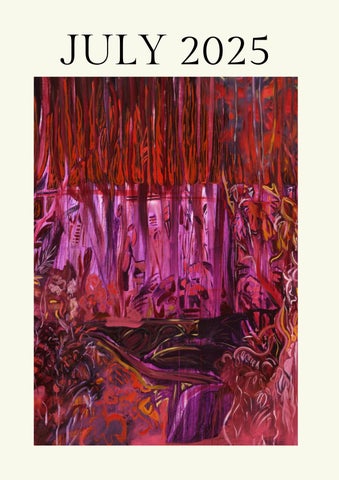
JULY 2025 ISSUE

Page 1


JULY 2025

CONTENTS

ON THE THRESHOLD

Representation of Cages and Gates in the collection

TIA COLLECTION COLLECTS

From Alia Ahmad to Oscar Murillo, new acquisitions of Tia Collection.

COUTURE CONVERSATIONS

A discussion of new ethics with Ronald Van Der Kemp.

COLLECTION LENDING PROGRAM

News on our latest contributions and lendings.

CONCLUSION

Mission statement and image credits.

Rose Finn-Kelcey, Pearly Gate and Souls, 1997

Wood, aluminum, customised car paint

102.36 by 273.22 by 54.14 inches (260 x 694 x 135 cm)

OntheThreshold

For this month’s newsletter, Tia Collection brings together a group of works that represent gates and cages to think critically about the symbolism of barriers and portals, how these structures operate in art history and how each artist challenges and poses questions about the threshold This month, we have chosen to discuss the work of Nour Jouda, Diana Al-Hadid, Raqib Shaw, Loris Gréaud and Kate MccGwire

Thresholds are defined as ‘ a level or point at which one starts to experience something, or at which something starts to take place ’ It becomes a symbol of crossing over from one state to another, a portal to another space In another connotation, thresholds may also act as a barrier to entry, a barrier from reaching another state. Thresholds become moments and places of transition; spaces suspended between what has been and what is yet to come Gates and cages, as symbolic and physical structures, mark these thresholds with a complex duality. They can both confine and protect, exclude and invite, imprison and liberate Within the diverse practices of the artists selected this month, these forms become metaphors for the tensions that define human experience in different visual languages, posing contrasting messages and questions

Libyan artist Nour Jaouda explores the gate not only as a physical barrier, but as a threshold: a site of interaction, tactility, and transformation In her installation “Untitled (brown)”, the gate becomes both structure and symbol A vertical steel frame reminiscent of architectural silhouettes from Cairo and London, holds together torn, botanically dyed textiles in ochres, greens, and flesh tones The materials, sourced between Cairo and London, reflect the artist’s diasporic movement and map a visual geography of cultural in-betweenness.

Nour Jaouda, Untitled, 2023

Dyed fabric and steel

78.74 by 62.2 by 21.65 inches (200 x 158 x 55 cm)

Jaouda’s practice is defined by the interplay between textile and steel, softness and rigidity, memory and architecture These materials amalgamate to form conceptual thresholds, not only seen as a physical entry but also a space of transition where the interior and exterior, presence and absence, coexist Drawing on the shape of Islamic prayer mats and motifs of fragmentation and ritual, her gates invite touch and contemplation, functioning as portals rather than dividers.

In navigating themes of displacement, rootlessness, and liminality, Jaouda reimagines the gate as architecture of identity, one that holds space for flux, encounter, and becoming

Diana Al-Hadid’s sculpture “The Bronze Chamber of Danaë” blurs the boundaries between body and structure, morphing Danaë’s human form with the chamber in which she is confined In Greek mythology, Danaë was the daughter of King Acrisius of Argos, who, fearing a prophecy that his grandson Perseus would kill him, imprisoned her in a bronze tower to prevent her from bearing a child Yet Zeus, captivated by Danaë, descended from the heavens as golden rain and impregnated her.

Al-Hadid’s work captures this moment of transformation, fusing Danaë’s body with Zeus’s golden rain, symbolizing her passage from barrenness to pregnancy. The bronze chamber, once a cage, seems to collapse and merge with the fluid golden rain, creating a liminal space where Danaë’s form dissolves into an evocative transition rather than a fixed figure. This fusion invites reflection on how our bodies can embody thresholds, between freedom and confinement, visibility and concealment, vulnerability and strength

Diana Al-Hadid, The Bronze Chamber of Danaë, 2023

Wall relief made with polymer gypsum, pigment drips, plaster 115 by 94 by 2.625 inches (292.1 x 238.8 x 6.7 cm)

In “Self Portrait in the Sculpture Studio at Peckham (after Mocetto) I”, Raqib Shaw explores the threshold not only through a plethora of pillars, domed archways, and fantastical hybrid creatures in the composition, but also through his distinctive cloisonné influenced technique. Using thick gold acrylic liner, Shaw demarcates the borders of his composition with precision Within these gilded outlines, he pours pools of paint, each one held in place, confined within the gilded boundaries This delicate yet unyielding line becomes both barrier and ornament, a visual threshold that contains and controls Shaw’s work reveals the tension of ornamental confinement, how beauty and captivity can be so finely interwoven that the boundary becomes both aesthetic choice and symbolic constraint

Loris Gréaud’s “Nothing is True Everything is Permitted, Stairway Edit” offers a reflection on the threshold as both a literal and metaphysical ascent The rotating helical staircase spirals endlessly without a final destination, an architectural illusion that conjures the image of a stairway to heaven while denying arrival Suspended in motion, the work embodies a liminal space: a gateway between the material and immaterial, the known and the unknown. Its title, drawn from the mystic utterance of Hassan-i-Sabbah and revived by 20th-century thinkers, underlines the subversion of truth and certainty In this suspended threshold, Gréaud invites viewers to consider ascension not as a journey toward resolution, but as an act of becoming, where the staircase, like belief itself, gestures skyward toward the sublime, even if it never quite arrives

Raqib Shaw, Self Portrait in the study at Peckham, 2014

Acrylic liner, enamel, glitter and rhinestones on birch wood 61.25 by 41 inches (155.5 x 104 cm)

Kate MccGwire’s installation, “Vex”, embodies the liminal tension between containment and transformation Encased within a Victorian glass vitrine, the swirling feathered form, serpentine and almost breathing, presses against its transparent cage. Feathers, symbols of flight and freedom, are paradoxically portrayed as static and restrained The vitrine becomes both a protective casing and a place of entrapment, echoing the ambiguity of the cage as a symbol. MccGwire’s use of pigeon feathers evokes primal associations with survival, decay, and regeneration, transforming the vitrine into a threshold between the living and the static

Her work, much like that of other artists engaging with enclosure, asks us to reconsider the function of barriers Is the cage a site of imprisonment, or does it showcase the brink of metamorphosis?

At Tia Collection, thresholds are more than physical barriers, they are at once symbols of tension, balancing restriction and freedom, isolation and connection. They invite contemplation on the structures that shape us and the boundaries we navigate in our life

Thresholds also mark moments of transition from one state of being to another Might this idea extend beyond spatial or emotional realms, to the evolving seasons of our lives, to shifts in our collecting sensibilities, or to the pivotal experiences we attribute to certain works of art? A painting acquired during a moment of change may itself become a threshold, between past and present, memory and meaning Whether a cage or a gate, these forms remind us that it is often the spaces inbetween that carry transformative power.

Kate MccGwire,Vex, 2009

Mixed media with pigeon feathers in an antique museum cabinet 72 by 43 31 by 24 inches (182 8 x 110 x 60 9 cm)

TIA COLLECTION COLLECTS

Alia Ahmad, Ruby dock, wildflowers |

95 69 by 143 69 inches (243 x 365 cm)

,

IssyWood, The Tea, 2024

Oil on linen

by 68.88 by 2 inches (215 x 175 x 5 cm)

Oscar Murillo, Manifestation, 2023

Oil, oil stick, spray paint, dirt and graphite on canvas and linen

106.3 by 110.24 inches (270 x 280 cm)

NewEthicsinRonald VanDerKemp’sAtelier

What led you to work exclusively with deadstock and sustainable materials?

After all the research I did looking at all the new developments on so-called ‘sustainable’ fabrics, bio fabrics etc I felt the only true sustainable way forward is to work with what already exists, virgin materials even if they are called ‘sustainable’ I do not trust There is so much overproduction ; it only seems to get worse and worse and there is so much to find now that companies are finally selling off their overstock, that I limit myself to working for 98% with existing materials only since day 1

Was there a defining moment that prompted you to introduce a new ethical framework into your practice?

Before I started my brand RVDK I worked as designer and creative director/consultant for international luxury brands for 25 years. I experienced firsthand the changes and shift of luxury fashion copying the business model of fast fashion; I wanted to go back to the heydays of couture, where only true exclusivity, craftsmanship and handwork existed, while working with what other people deemed unusable When I started my brand in 2014, I got a lot of raised eyebrows. The word upcycling didn’t exist yet. When I graduated from Rietveld Academie in Amsterdam in 1989, part of my collection was upcycled and I wrote my thesis on fashion and nature, so I guess it was something that was always part of my DNA

To what extent do you consider your work to be a form of art?

The way I work is as an artist; I work from my intuition and the limitations of working with what I have around me, find and come across, and the collaborations with my coworkers and clients feed my creativity I embrace mistakes or defaults and use them to my advantage Some pieces are very precious and just beautiful to look at and get a place in someone ' s home as a piece of art , other things are easily wearable and get worn many times I don’t work with ‘concepts', but with my intuition and while absorbing what happens in the world around me, always trying to turn it into a hopeful and positive way of creation.

You refer to your collections as “Wardrobes.” What does that choice of language reveal about your vision?

A wardrobe is timeless and it is not linked to a certain season; If everyone would truly try to collect clothes around their personality and have their own personal wardrobe, the world would be so much more beautiful and sustainable When you create your own wardrobe you buy more consciously and you show more personality and diversity I wear things I bought 25 years ago Since I started RVDK, I got more and more convinced that the idea of thematic fashion collections is very old fashioned, irresponsible and unsustainable and not in sync with the times we live in

Do you believe haute couture has a truly sustainable future and if so, what might that look like?

Couture in itself is a more sustainable practice. We create one of a kind pieces and sometimes totally from scratch for a couture customer; something they feel attached to that becomes part of their personality Whether they wear it once or often it doesn’t matter; it's something they cherish. I wish couture shows were more intimate and not just about who is sitting front row and about photogenic moments. In my opinion, it is a very intimate affair; a conversation between myself and the client I do not need a room full of influencers wearing my clothes I like to be surrounded by people that have a true passion and culture for fashion I look at couture in an ‘old school' way as a laboratory for ideas and reflection of our times; I like to think and I often get messages from followers that I inspire them to dress up, mixing vintage with things in their wardrobes etc

How do you hope your atelier model might inspire or influence the next generation of fashion creatives?

I am very happy to see that upcycling and working with deadstock has now become the norm for many young designers The problem is that once designers become somewhat successful, it is very difficult to stay away from the temptations of the big fashion giants and the big money

Unfortunately, very few stay true to their initial sustainable practices and they get absorbed in the big fashion system After 11 years, I reinvented a business model that I feel comfortable with and I can proudly say that my company is sustainable at every level I wish the big fashion groups would leave the new talent alone and not lure them in to become part of their unsustainable practices. The focus and growth and money should not be leading, but the focus should be on developing a new sustainable business model and creativity; more original and unseen ways of practising fashion

Do you see yourself as a disruptor within the traditional couture system?

I am old school in one way and may be a disruptor in another way. I want to do things in a positive way I believe that fashion and art can reach people under their skin I trust my intuition and follow my guts; my 30 year + experience gives me the freedom to work in the way I deem appropriate for the time we live in I tried to set a positive example for the fashion world and keep trying to reinvent the notion of a couture house for the future; I don’t have all the answers, but at least I try and I stick to my beliefs and ethics The old and ongoing fashion system with these huge conglomerates that dominate the (fashion) world at luxury level and fast fashion level has to change if we want keep living in a livable world We all as humans have to take responsibility for our actions

Ronald van der Kemp is the Dutch couturier redefining glamour with purpose. A master of upcycled luxury, his demi-couture label RVDK merges Old Hollywood drama with radical sustainability Tia

Collection is proud to have acquired Nikita, Look 21 from Wardrobe 21, a fierce embodiment of van der Kemp’s visionary craft

COLLECTION LENDING PROGRAM

Judy Tuwaletstiwa, Song 1, 2021

Raku-fired clay, acrylic, and burns on canvas

72 by 48 inches (182 88 x 121 92 cm)

Abstracting Nature

Albuquerque Museum, Albuquerque, NM

6/21/2025 - 10/12/2025

Abstracting Nature foregrounds the works of ten local New Mexican artists, past and contemporary, whose individual bodies of work share a kindred and enduring relationship with the New Mexico landscape. Each of these artists has nurtured a unique and long-standing relationship with a specific material, and has deeply explored how that material informs their interactions with the natural world. With works ranging from glass to adobe to silk and pastels, the artists on display include Joanna Keane Lopez, Marietta Patricia Leis, Lydia Madrid, Agnes Martin, Yoshiko Shimano, Judy Tuwaletstiwa, Joan Weissman, Emmi Whitehorse, and Karen Yank.

Each of these New Mexico-based artists utilizes abstraction to reflect on the stories, memories, and passage of time that is carried in the land and in their personal connections to it. Together they demonstrate the interrelationship between humans and the natural world, inviting us to reconnect, appreciate, and build a deeper empathy for the places that sustain us Representing over seventy years of study, labor, and reflection, Abstracting Nature promises to stoke the imaginations of all those who have sought comfort in and kinship among the expansive lands of New Mexico

Olga de Amaral, Riscos en Sombra, 1985

Horsehair and wool

116 by 83 by 2 inches (294 6 x 210 8 x 5 1 cm)

Olga de Amaral

Institute of Contemporary Art, Miami, FL

5/1/2025 - 10/12/2025

ICA Miami, in collaboration with the Fondation Cartier pour l’art contemporain, presents a major retrospective of the work of Colombian artist Olga de Amaral, bringing together more than 50 works from six decades, and featuring recent and historical examples, some of which have never been presented outside of her home country. It reveals the breadth and complexity of Amaral’s practice, highlighting crucial periods in the development of her career as she moved from colorful explorations of the grid to experiments with materiality and scale

Amaral’s sculptures and installations push the boundaries of fiber art, often combining weaving, knotting, and braiding to create striking abstract three-dimensional forms. Her earliest explorations, from the 1960s, frequently take inspiration from nature and feature unconventional weaving techniques. During the 1970s, Amaral created a group of monumental wall works; superimposing constructed layers of wool and horsehair enabled her to work at scale, evoking brick walls, leaves, and geological layers Her investigations would also lead her to experiment with paint, linen, cotton, gesso, gold leaf, and palladium.

Trevor Shimizu, Clouds, 2024

Oil on canvas

191.875 by 109.5 inches (487.36 x 278.13 cm)

Can the Seas Survive Us? A World of Water

Sainsbury Centre for Visual Arts, University of East Anglia, Norwich, UK

3/15/2025 - 8/3/2025

Bringing together contemporary art, historical works, and scientific inquiry through three concurrent exhibitions, the Sainsbury Centre has launched its 2025 exhibition programme with an ambitious and urgent theme: Can the Seas Survive Us?

As sea levels rise and ocean ecosystems collapse, the exhibition series is framed within the context of climate change, overfishing, and environmental degradation to offer a provocative exploration of how humanity’s relationship with the ocean can evolve in the face of such crisis

The three exhibitions run from March until October 2025, touching on themes of fluidity, colonialism, sustainable energy, and the transformative potential of the ocean as a resource. Central to these exhibitions is a recognition that small island nations – like the Maldives and Kiribati – as well as coastal communities in places like the venue ’ s home-county, Norfolk, are already experiencing first-hand the destructive impact of climate change.

About Tia Collection

Founded in 2007, Tia Collection is a global art collection with a mission to support artists and institutions by acquiring and loaning works of art. Tia fosters dialogue, stewardship and scholarship of art through its lending program, partner exhibitions and publications.

For more information, contact us at info@tiacollection.com

IMAGE CREDITS:

Cover: Alia Ahmad, Ruby dock, wildflowers | 2024 ,ﺾﻴﻤﺣ © Alia Ahmad. Tia Collection. Image courtesy of the artist and White Cube. Photo © White Cube (Eva Herzog)

Page 3: Detail of Alia Ahmad, Ruby dock, wildflowers | 2024 ,ﺾﻴﻤﺣ. © Alia Ahmad. Tia Collection. Image courtesy of the artist and White Cube Photo © White Cube (Eva Herzog)

Page 4: Rose Finn-Kelcey, Pearly Gate, 1997. © Estate of Rose FinnKelcey Tia Collection Image courtesy of Kate MacGarry, London, UK

Page 6: Nour Jaouda, Where the Fig Tree Cannot be Fenced, 2024. © Nour Jaouda. Tia Collection. Image courtesy of the artist and Union Pacific

Page 8 & 9: Diana Al-Hadid, The Bronze Chamber of Danae, 2023. © Diana Al-Hadid Tia Collection Image courtesy of the artist and Kasmin, New York.

Page 11: Raqib Shaw, Self Portrait in the study at Peckham (A reverie after Antonello da Messina's Saint Jerome) I, 2014 © Raqib Shaw Tia Collection. Image courtesy of the artist and Galerie Thaddaeus Ropac, Salzburg, AT

Page 12: Loris Gréaud, Nothing is True Everything is Permitted, 2007. Loris Gréaud. Tia Collection. Image courtesy of Yvon Lambert Gallery, Paris, FR

Page 14 & 15: Kate MccGwire, Vex, 2009. © Kate MccGwire. Tia Collection Image courtesy of the artist and La Galerie Particulière, Paris, FR.

IMAGE CREDITS CONTINUED:

Page 17: Detail of Otobong Nkanga, We Come from Fire and Return to Fire, 2024 © Otobong Nkanga Tia Collection, Santa Fe, NM Image courtesy of the artist and Lisson Gallery.

Page 18 & 19: Alia Ahmad, Ruby dock, wildflowers | 2024 ,ﺾﻴﻤﺣ. © Alia Ahmad Tia Collection Image courtesy of the artist and White Cube. Photo © White Cube (Eva Herzog).

Page 20 & 21: Issy Wood, The Tea, 2024 © Issy Wood 2025 Tia Collection. Image courtesy the artist; Carlos/Ishikawa, London; and Michael Werner Gallery, New York. Photographer: Damien Griffiths.

Page 22 & 23: Oscar Murillo, Manifestation, 2023 © Oscar Murillo Tia Collection. Image courtesy the artist; Carlos/Ishikawa, London; David Zwirner; kurimanzutto, Mexico City; and Taka Ishii, Tokyo Photography by Tim Bowditch & Reinis Lismanis.

Page 24: Image collage of RVDK Ronald Van Der Kemp’s Haute Couture Designs

Page 26: RVDK Ronald van der Kemp, Nikita, 2024 - 2025. © 2025 RVDK Ronald van der Kemp Tia Collection Image courtesy of RVDK, Ronaldvan der Kemp, images shot at Hôtel d'Avaray, 85 Rue de Grenelle, 75007, Paris, Île-de-France, France. Photography by Aitor Rosas

Page 29: Portrait of Ronald van der Kemp, by Marijke Aerden, courtesy of RVDK

Page 31: Detail of Olga de Amaral, Riscos en Sombra, 1985. © Olga de Amaral, Courtesy Lisson Gallery, Photographer: Thomas Barratt

Page 32: Judy Tuwaletstiwa, Song 1, 2021. © Judy Tuwaletstiwa. Tia Collection, Santa Fe, NM. Image courtesy of Pie Projects, Santa Fe. Photography by Eric Swanson

Page: 34: Olga de Amaral, Riscos en Sombra, 1985. © Olga de Amaral, Courtesy Lisson Gallery Photographer: Thomas Barratt

Page 36: Installation view of Cian Dayrit, State of Plantocracy, 2023, Neon lights, collage and oil on canvas, framed with reclaimed wood and Trevor Shimizu, Clouds, 2023 at A World of Water exhibition at the Sainsbury Centre. Photo by Kate Wolstenholme.

Turn static files into dynamic content formats.

Create a flipbook
Issuu converts static files into: digital portfolios, online yearbooks, online catalogs, digital photo albums and more. Sign up and create your flipbook.
JULY 2025 ISSUE by tiacollection - Issuu