In this month’s newsletter, we discuss photography as an act of agency, while exploring the work of Cindy Sherman,MartineGutierrez,andCaraRomero.
A photograph is, at times, not a window but a barrier: the lens flattens, the costume conceals, and the pose deceives. Without proper cultural context or an authentic portrayal, photographs of individuals and communities risk flattening and oversimplifying their subjects. However, what we find in the work of Sherman, Gutierrez, and Romero is not the desire to flatten, but instead to activate the subject and the viewer simultaneously. They do not seek to simplify the subject, but rather confront and question the element of disguise, performance and alienation within a photographic image; not as a limitation, but astoolsofauthorshipandresistance.
Cindy Sherman, Untitled 546, 2010
Chromogenic print
65 by 143.5 inches (165.1 x 364.5 cm)
In Cindy Sherman’s “Untitled #546” (2010), the artist disappears under the mask of a socialite finely dressed in Chanel (Sherman collaborated with Chanelforthisseries)andawkwardlyposedbeforea digitally manipulated Icelandic volcano backdrop. The image is too polished, too perfect, and reads uncannyinmanyways;thecostumeisnotacostume, it is an exaggerated portrayal of a character, as Sherman is known so well to do. The subject, Sherman herself, is erased and a new identity is appropriated. It is not a self-portrait, but rather a portraitoftheannihilationofself.
The artist’s identity is completely submerged under layers of performance. There’s no “real” Cindy Shermanvisible;sheisabsentfromtheportrait,even as she inhabits it. Sherman’s characters are hypervisible but emotionally opaque. They are visual clichés that both reveal and conceal the psychic pressuresofgender,class,andaging.
As she says about her process, “I’m trying to erase myself more than identify myself or reveal myself. That’s a big, confusing thing that people have with my work: they think I’m trying to reveal these secret fantasies or something. It’s really about obliterating myselfwithinthesecharacters.”
Martine Gutierrez
Ardhanarishvara from ANTI-ICON: APOKALYPSIS, 2021
C-print mounted on Dibond, hand-distressed welded aluminum frame, optium plexi 55 by 38 1/4 inches (139.7 x 97.2 cm)
Martine Gutierrez's “ANTI-ICON: APOKALYPSIS” series, including “Ardhanarishvara” (2021) and “Cleopatra”(2021),demonstratesperformanceasanact of agency. As a queer Indigenous artist, Gutierrez constructs herself as historical and mythical figures throughelaborate,handmadecostumes:trashbagsand wire posed as silk and gold. She mimics the visual languages of high fashion and religious iconography, yet her materials reveal DIY grunge beneath the opulence.
Created during the early pandemic in an outdoor makeshift studio, the artist used everyday found materials, i.e. cardboard, paint, tarps, twigs, trash bags, feathers, and plaster, to construct costumes and stage sets. The materials used to create the images deliberately contrast the high‑gloss pedestal environmentsassociatedwithicons.
In “Ardhanarishvara” (2021), Martinez’s stripped and paint-covered body appears glistening while behind her, handprints in thick black paint mimic multiple arms. This is a nod to Ardhanarishvara, a composite deity in Hinduism representing the fusion of Shiva and Parvati, symbolizing the merging of masculine andfeminineenergies.
C-print mounted on Dibond, hand-distressed welded aluminum frame, optium plexi 55 by 38.25 inches (139.7 x 97.2 cm)
In “Cleopatra” (2021), Gutierrez is captured midmovement, the golden cloth she clutches flutters against a peeling wall, her arm adorned with golden wire,herhairmadeofaplastictrashbag.Shereclaims thecameraasatoolnotjustforimage-making,butfor rewritinghistoriesofrepresentation.Herphotographic staging, richly costumed and meticulously lit with symbolic props, recalls both fashion editorial and religious painting. Gutierrez inserts herself into the lineage of women historically flattened by male fantasies of power and seduction, only to reclaim that image by controlling every visual element of her presentation.
Regarding the “ANTI-ICON: APOKALYPSIS” series, Gutierrez states, “If the icon shows humanity’s spiritual ideal, it is the anti-icon who refuses the delusion of man, his inflated self-conception. For the icon makes real the image, anti-icon must break throughtorevealreality.”
NOUR
JAOUDA Cara Romero, Naomi, 2017
Archival fine art photograph, printed by the artist on legacy paper 49 by 40 inches (124.46 x 101.6 cm)
Gutierrez and Sherman both inhabit personas, but where their works explore performance and disguise through irony and critique, Cara Romero’s First AmericanDollseriesconfrontsabsencewithpresence.
Romero began her First American Doll series of work in response to the erasure of Indigenous identity in children’s media, particularly in the American Girl Doll collection. The only Native representation, an American Girl Doll named Kaya, was an ahistorical, genericfigurestrippedoftribalspecificityandcultural context. Romero’s photographs restage the format of American Girl Doll advertisements and replace the commercial fantasy with real Indigenous subjects styled in regalia that reflect their tribal heritage and individuality.Theseportraitsarenotnostalgic;theyare futurist, celebratory, and defiant. The subjects are not dolls, nor symbols. They look back at the camera and theviewer.
Romero refuses the flattening of identity into stereotype.Shestageseveryaspectofthephotographin dialoguewithhersubjectsandtheircommunities.The artificiality, such as the box and the doll-like pose, is reclaimed and used to tell a story. Romero constructs presencedeliberately.
Cara Romero, Amber Morningstar, 2019
Archival fine art photograph, printed by the artist on legacy matte paper
43.5 by 40 inches (110.49 x 101.6 cm)
To create these images, Romero builds a physical box for the subject to stand in, rather than digitally manipulating the image after it is taken. Romero’s insistence on in-camera work and physically assembled doll-box sets shows how every aspect of staging reflects authorial control. The visual container reframes the model as the subject, not an object like a children’s doll. Romero speaks directly to using photography to build narratives of power and presence,insistingonself-authoredrepresentation.
In an interview with MoMA, Romero stated, “The inspiration for the First American Girl series was a lifetimeofseeingNativeAmericanpeoplerepresented inadehumanizedway.Mydaughterwasbornin2006, and I really wanted her self-image to be different. But all of the dolls that depict Native American girls were inaccurate. They lacked the detail. They lacked the love.Theylackedthehistoricalaccuracy.”
Legacy Platine Paper
52 by 43 inches (132.08 x 109.22 cm)
Cara Romero,Yupiit-Quki, 2024
Costume, set design, and pose are tools long used to stage others, but here, they are appropriated by these three artists to stage themselves or their communities ontheirownterms.Thephotographicmedium,oncea mechanism of classification, becomes a space of imaginativeauthorshipattheirhands.Inallcases,the lens becomes both a barrier and a mirror. It conceals, butitalsoreflects.
SHERMAN ERASES HERSELF; GUTIERREZ CONSTRUCTS HERSELF ANEW; ROMERO INSISTS ON PRESENCE WHERE THERE WAS ONCE ABSENCE.
Across these works, photography becomes a theater of reclamation. The alienation traditionally imposed upon the subject is inverted into a strategy: by highlighting performance, these artists reject the idea of flattening a subject within a photograph and instead, embrace photography’s potential as a tool for constructing new realities. They are architects of agency, constructing images that do not conform but contend,disrupt,anddefine.
TIA COLLECTION COLLECTS
Lonnie Holley, The Doorway to Us, 2024
Acrylic and spray paint on canvas
78.75 by 157.5 inches (200 x 400 cm)
Sonia Gomes
Sem título, da série Lugar para um Corpo, 2014-2015
Sewing, moorings on different fabrics and steel screen
Your paintings often focus on semi-public spaces, lobbies, derelict factories and religious interiors that feel both intimate and strangely detached. What is it about these in-between placesthatdrawsyouin?
Inmywork,Iamalwaysseekingoutspacesthatseem to evoke a tension, places where layers of meaning seem to overlap to create an uncertainty or a sense of apprehension.Thisinteresthasledmetovarioussites: junkandantiqueshopswheretheobjectsareremoved from their original contexts and juxtaposed together into a space of waiting; private members clubs, where the exclusivity of the space can be understood as both positive and negative and where the setting of one’s second home displays a commodified artifice; and, most recently, film sets, where the spaces are fabricated and temporary, built to convey a constructed narrative and having a border where fictionmeetsreality.
In what ways do your paintings serve as “psychosocial mazes,” and how do you hope viewersinterprettheselayeredenvironments?
I’veneverusedtheterm“psychosocialmazes”butIdo often use mirrors as a motif in my work to create a vertiginous and confusing effect. My intention with my work is to create a charged atmosphere, I want viewerstostopintheirtracks,tobedrawnin,andyet madetofeeluncomfortablesomehow.
How does the absence of human figures in your work influence the viewer’s emotional response to the depicted spaces?
For me, the absence of figures in space has the potential to evoke more emotion rather than less. By not depicting figures and yet by displaying multiple signs of human activity, I hope that the work suggests questions and also invites engagement with the space itself,whatitcouldrepresentpsychologicallyandhow itmightfeeltowanderaroundsuchemptyinteriors.
You’ve mentioned photographing spaces as part of your practice. Do you carefully plan your site visits, or are you more of a spontaneous explorer, letting chance guide you?
A bit of both: often I find out about a site and plan to visit it, nonetheless not knowing exactly what visual treatswillbefallme.Withthefilmsetsandtheprivate members clubs, a large part of the process of source material gathering was gaining permission to access, so I knew a bit about the spaces. Once that access is obtained, I explore the space with my camera, letting myself be led by the forms, the colours and the atmospheresthatIdiscoverthroughthelens.However, sometimes I stumble across a space that intrigues and surprises me, I take photos and they can sit around in my studio for some time. It can take a while for the ideastoconnectwiththeimagesandformetobecome convinced that they might work as a series of paintings.
Is there a particular architectural period you findyourselfreturningto?
I always return to Baroque interiors or opulent interiors inspired by the Baroque period. My research on my Masters was into the Baroque, focusing particularly on its influence on Bavarian architecture. The drama, fullness and organic forms of the Baroque exhibit an intention, which is often realised, to evoke emotive potential, something that I try to do in my work through my painterly explorations of many differenttypesofarchitecture.
Yoursurfacesmovebetweensharprealismand looseabstraction.Isthistensionsomethingyou plan out, or does it emerge naturally as you paint?
As my practice has developed my work has become tighter, almost against my will. I’ve always trusted my instinct as a painter and have tried to find a balance between force and restraint. I believe that my more successfulworkshavepassagesofpainterlyabstraction and passages of tight figuration. The balance between thesetwostatesissomethingthatcan’tbeplannedout inadvancebutthatreliesonintuition.
You paint primarily in oil. What keeps you committed to this medium? Any new materials ortechniquessurprisingyoulately?
I have always loved working with oil paint, the way it flows and its slow drying nature which allows for alterations and unexpected effects. Over the past 8 years or so I have used acrylic for my underpaintings. This process has really developed and sometimes the underpaintings are quite intricate and detailed. This has allowed me to maintain an aspect that I love, working fast and loose with the oil paint on the top layer. The single layer of oil paint then shows some of the underpainting beneath which intensifies the colour. This method creates the effect of concentrated colour in some areas and the translucent layering of colourelsewhereonthesurface.
What’syourstudiovibe?Doyouprefersilence, music, or ambient noise? Do you have any ritualsthathelpyougetintotheflow?
I mostly listen to podcasts and audio books when I’m painting. Audible has been a great resource to get lost in a book while painting. Somehow not focusing my mind on the painting itself enables me to paint better, with less inhibitions. I often find it curious how the paintedimagecanthenhaveastrongassociationwith whatIwaslisteningtowhilstIwasmakingit.
When I feel really slow and lethargic, often because my studio is either too hot in the summer or too cold in the winter, I use music to get me going. Sometimes it's Talking Heads, sometimes it’s The National but often it’s Hamilton, the musical by Lin-Manuel Miranda. Hamilton has everything, ambition, drive, conquest, failure, questioning, confusion, grief, forgiveness: all themes that resonate in my work and arehelpfultoconsiderwhileIpaint.
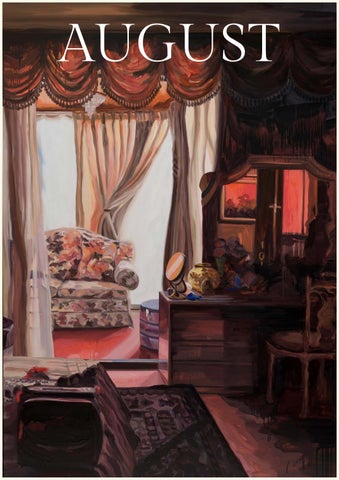
Can you tell us more about the work in Tia Collectiontitled“FadeOutAgain?”
The meta-fictional scenes of my recent series were inspiredbymyvisittoafilmset,shotonlocationinan historic house-turned-museum in Jeddah, Saudi Arabia. Depopulated by crew or actors, these quiet scenes hint at some recent action. Some works in this seriesrevealtracesofcrewandproductionthatallude to our behind-the-scenes view and yet some show the set in its purity, asking us to believe its fictionalised reality.
“Fade Out Again” is a painting that falls into the secondcategory,weareofferedaviewofayounggirl’s bedroom, dimly lit on the inside but with bright diffused light blasting through the central window creating stark shadows throughout the space. It is a work that describes the imaginary, the disorienting and the overlaps between what is real and what is staged.Iparticularlyenjoyedmakingthispainting;the large scale and the dark tones were reminiscent of works I was making 15 years ago and offered me an opportunity to reflect upon the development of my practice while I was making it. I made numerous works inspired by this room, listening to some of the music that I listened to when I myself was a teenager, lyrics from which have informed the titles of these paintings. Using these interiors as a metaphor for our perceptions about reality; my paintings explore the possible, improbable, and paradoxical, seeking to widenoursphereofawareness.
Leading on from this series, I am currently looking at thestagednatureofmyownrealitybyembarkingona new project that explores my own and other artist studios. The subject of the artist studio has intrigued artists and writers alike over centuries so I am enjoying diving into this theme in preparation to exhibititinLondonin2026.
Anna Freeman Bentley, Fade Out Again, 2023
Oil on canvas
86.5 by 125.75 inches (219.71 x 319.405 cm)
Anna Freeman Bentley’s practice explores the uncanny within architectural spaces, depicting interiors imbued with a heightenedemotionalorpsychologicalintensity.Theabsenceof figures enables Freeman Bentley to imply narrative, creating worldswithinworldsthatcontainsubtlesignifiersrevealingthe artifice and complex dynamics of manmade environments. The meta-fictionalscenesofherworksinthisexhibitionareinspired bytheartist’svisitstofilmsets.FreemanBentleyrevealstheart and artifice of constructed image-making and the distinctions and tensions between what is created for the camera lens and theonecomposedbytheartist’sbrush.Depopulatedbycrewor actors,thesequietsceneshintatsomerecentaction.
TiaCollectionisproudtohaveacquired“FadeOutAgain”(2023), a powerful example of Freeman Bentley’s ability to transform interiorsintospacesofreflectionandimagination.
COLLECTION LENDING PROGRAM
Mona Hatoum, Hot Spot (stand), 2018
Stainless steel, neon tube and rubber
67.69 by 32.69 by 31.5 inches (172 x 83 x 80 cm)
Encounters: Giacometti x Mona Hatoum
Barbican Centre, London, UK
September 4, 2025 - January 11, 2026
Works by contemporary artist Mona Hatoum and 20th century sculptor Alberto Giacometti are seen together for the first time in this ground-breaking exhibition, part of “Encounters:Giacometti.”
Mona Hatoum presents a mix of pre-existing and new artworks alongside her own selection of Alberto Giacometti’s sculptures, opening up connections and dialoguesacrossgenerations.Integratinghistoricworksby Giacometti within her own installations, Hatoum responds to Giacometti’s work, with a focus on the motif ofthecage,themesofdomesticandhostileenvironments, andhowthesespacesaffectthevieweroftheartworks.
Hatoum’s work often looks at issues of displacement, marginalisation, exclusion, and systems of social and political control. Alberto Giacometti is one of the most significantEuropeansculptorsofthe20thcentury,known forhisdistinctive,elongatedsculptureswhichexperiment withthehumanform.
Thisexhibitionisoneofathree-partexhibitionseriesthat pairs the work of Giacometti with work by artists Huma Bhabha, Mona Hatoum and Lynda Benglis, beginning in May2025andendinginFebruary2026.
Teresa Baker, Slow Lines, 2022
Willow, yarn, and spray paint on AstroTurf 88 by 66 inches (224 x 168 cm)
Teresa Baker: Somewhere Between Earth and Sky
Contemporary Art Museum St. Louis, St. Louis, MO
Sep 5, 2025 – Feb 8, 2026
TheContemporaryArtMuseumSt.Louis(CAM)willpresenta solo exhibition of work by Los Angeles-based artist Teresa Baker —the most comprehensive exhibition of the artist’s work to date. Baker, an enrolled member of the Three Affiliated Tribes in western North Dakota (Mandan/Hidatsa), bringsauniqueformalandmaterialapproachtothecreation ofabstractpaintingsthatexploreplace,identity,andland.
Baker is celebrated for large-scale abstract paintings on irregularly shaped pieces of artificial turf. To make these works, she brushes and sprays acrylic paint onto this nubbly surface, and introduces linear designs with natural and synthetic fiber yarns. Baker also affixes unexpected materials like willow, beads, buffalo and deer hide, tree bark, corn husks,andnaturalandartificialsinewintohercompositions. The surfaces of her paintings dance with tactility and reward close looking. These dynamic and colorful artworks can resemble vast landscapes, inviting viewers to imagine prairie vistasandbird’s-eyeviewsof
Teresa Baker: Somewhere Between Earth and Sky combines a broad selection of the artist’s paintings with additional sculptures and drawings from her studio and numerous private collections. Woven willow baskets incorporating artificial turf and yarn will be presented along with a basket that has been cast in bronze and decorated with brightlycolored enamel paint. Drawing is central to Baker’s artistic practice and the exhibition will present a series of thirteen never-before-exhibited works on notebook paper made with oilpastel,graphite,ink,andcoloredpencil.
Brian Maguire, The Burning Amazon, 2022
114.2 by 181.1 inches (290 x 460 cm)
Acrylic on canvas
Brian Maguire: La Grande Illusion
USF Contemporary Art Museum, Tampa, FL September 5, 2025 – March 7, 2026
USFCAM presents a major exhibition of works by internationally acclaimed artist, Brian Maguire. Entitled La Grande Illusion, the exhibition spans two decades of work that spotlights the artist’s lifelong quest to draw attention to global injustices, war, and human rights. One of Ireland's leading cultural figures, Maguire has turned the practice and traditionofpaintingintoactsofvisualtestimony.
Maguire's paintings are global in scope and are derived from projects undertaken between 2007 and 2024 in Mexico, the Mediterranean, Syria, Sudan, the United States, and the Amazon. Maguire's artworks are painted from direct experience and involve the artist spending extensive time on the ground with the communities that welcome him. The results are, plainly put, paintings that visualize the commonalityofhumansufferinganddramatizetheplightof peopleinneed.
About Tia Collection
Founded in 2007, Tia Collection is a global art collection with a mission to support artists and institutions by acquiring and loaning works of art. Tia Collection fosters dialogue, stewardship and scholarship of art through its lending program, partner exhibitions and publications.
For more information, contact us at info@tiacollection.com
IMAGE CREDITS:
Cover: Anna Freeman Bentley, Fade out again (detail), 2023. Tia Collection. Image courtesy of the artist. Photo by Peter Mallet
Page 3: Detail of Anna Freeman Bentley, Study for not in view, 2023. Tia Collection. Image courtesy of the artist. Photo by Peter Mallet.