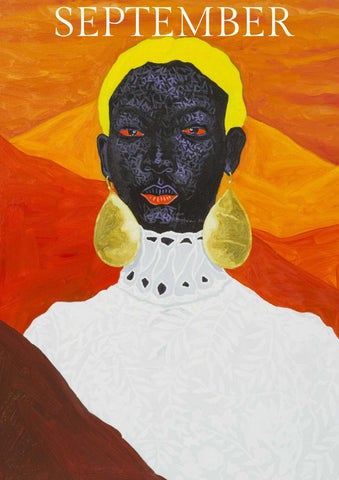
SEPTEMBER


01 02 03 05 04
STRAIGHT FROM THE CRATE
An analysis of Rashid Johnson’s God Painting.
TIA COLLECTION COLLECTS
From Lynette Yiadom-Boakye to Noah Davis, new acquisitions of Tia Collection.
![]()


01 02 03 05 04
STRAIGHT FROM THE CRATE
An analysis of Rashid Johnson’s God Painting.
TIA COLLECTION COLLECTS
From Lynette Yiadom-Boakye to Noah Davis, new acquisitions of Tia Collection.
An intimate day at Ali Banisadr’s studio.
COLLECTION LENDING PROGRAM
News on our latest contributions and lendings.
CONCLUSION
Mission statement and image credits.


For this month’s newsletter, Tia Collection highlights a new acquisition by Rashid Johnson, “God Painting ‘ThroughTheFire’".
Rashid Johnson’s “God Painting ‘Through The Fire’” envelops the viewer in a field of blood‑red intensity. Markedbytherepeatedvesicapiscis,analmondshaped formwithancientspiritualresonance,thecanvasevokes a higher presence, alluding to divinity, soul, and the unseenenergiesthatshapehumanexperience.
Born in Chicago in 1977, Johnson is among the most influential artists working today, celebrated for a materially rich and conceptually rigorous practice spanning painting, sculpture, installation, film, and photography. His work interrogates identity, race, belonging,andtheBlackexperienceinAmerica,layering autobiography with references to AfricanAmerican history, music, literature, and spirituality. With his signature use of materials like black soap, shea butter, ceramic, and mirror, Johnson constructs a form of archive, one that bridges the personal and collective whileofferingbothvulnerabilityandresistance.
Johnson first gained recognition in the early 2000s as part of the postBlack art movement and has since exhibited widely, including at the Whitney Museum of American Art, the MCA Chicago, and the Venice Biennale.
Oil on linen
94.125 by 156.25 by 1.875 inches (239 x 397 x 4.8 cm)

His practice has always been characterized by emotional resonance, layered iconography, and a restless push between abstraction and narrative, chaos andcontrol.
In his 2024 exhibition at Hauser & Wirth Paris, titled “Anima”, Johnson presented a series of works exploring spirituality and the interior self. Drawing from the concept of animism, the belief that all objects hold spiritual essence, Johnson sought to move beyond the physical, into the realm of the soul. Two new series emerged: the Soul Paintings and the God Paintings, bothevolvingoverseveralyearsinhisstudio.
“God Painting ‘Through The Fire’” belongs to this body ofwork.Builtfromdenselayersofcrimsonandoxblood red, its surface is carved with vesica piscis forms, some crisp, others loosely rendered. Johnson has explained that the red he sees when he closes his eyes becomes a stand in for God: not a figure, but a field of energy, a presence felt rather than seen. Each mark, carved or brushed into thick oil paint, reads like both a wound and a prayer. The repetition is meditative, ritualistic, invokingsomethingbeyondthecanvasitself.
In the text “Absorption and Theatricality: Painting and Beholder in the Age of Diderot”, critic Michael Fried observes that in truly absorptive works, “The beholder must not be acknowledged. The figures are wholly absorbed in their actions, gestures, and emotions, as if noonewerewatching.”


TIA COLLECTION COLLECTS


72 by 96 inches (182.9 x 243.8 cm)


43.25 by 31.5 inches (110 x 80 cm)


51 by 66.9 by 1.4 inches (130 x 170 x 3.6 cm)


This week, we turn our gaze to the densely layered worlds of Ali Banisadr, the Brooklyn-based artist whose canvases feel like sonic landscapes, charged, and constantly in motion. Born in Tehran in 1976 and raised between Iran and California, Banisadr draws on a tapestry of historical references and personal memory, fusing the tumult of experience and sound into a distinctive visual language.
We’re thrilled to highlight Age (2015), acquired by Tia Collection, where vibrant brushwork and elusive figuration suggest both chaos and clarity, signature to Banisadr’s painterly universe. His practice speaks to the power of image-making as a form of psychological mapping and cultural excavation, resonant with Tia Collection’s belief in art as both intimate and expansive.
In Age, Banisadr orchestrates a symphony of color and motion that pulses with historical resonance. Figures emerge and dissolve within a dreamlike atmosphere, echoing the eerie hybridity of Hieronymus Bosch, bodies in flux, suspended in a state of liminality. The painting hovers between abstraction and narrative, where time fractures and reassembles into something uncannily familiar, charged with the disquiet of contemporary life.
9:00 AM
Cranks up with Stereo. Stereo hums to life.
Currently listening to:
Johnny Greenwood who makes incredible hypnotic music to soundtracks such as There will be blood and Phantom Thread, he is also a member of the band Radiohead which I also like very much.
66 by 88 inches (167.6 x 223.5 cm)

9:10 AM
Brush hits canvas. The first gestures are loose, abstract, guided by sound.
TC: You’ve said sound dictates your brushstrokes. What happens on a morning when the canvas falls silent — when no sound comes? How do you balance patience and frustration in that moment?
AB: When I come into the studio, the painting might speak to me or not, it is like a person who you have to adapt to and to respect their temperament. Throughout the day there are conversations, silence, agreements, disagreements, etc. so you go through every type of up and down with the painting.
10:12 AM
Steps back from the canvas. The chaos begins to cohere into fragments of figures.
TC: There’s often a striking divide in your work between the sky and the earth — as though two realms are locked in dialogue or opposition. What compels you to keep painting this split, and what happens in the space where the two meet?
AB: This has changed now in the recent paintings, I have collapsed space in a more cubist way, the space functions more like a fragmented theatrical stage with no hierarchy
TC: Your figures often seem caught mid transformation, neither one thing nor another. If one of these beings could speak, what would it tell us about its state?
AB: They say different things at different times to different people, that is the great thing about painting, the more you spend time with them, the more they will tell you.
11:34 AM
Studio light shifts.
The surface now teems with hybrids, no central figure, a world in flux and motion.
TC: Your work feels like a carnival of forms, echoing Bakhtin’s carnivalesque, a space where hierarchy collapses and chaos organizes itself. Do you ever think of your canvases as temporary worlds with their own rules of order? Do you create hybrid forms, half abstract, half real to mirror the fragmented reality of our society today?
AB: They are chapters from an epic poem which I am writing visually, it is a controlled chaos because of the nature of the way I make them, it starts with chaos then I organize the chaos to a certain degree.
1:00 PM
Lunch break - sketchbook in hand, reference images scattered. He flips through images, fragments, myths.
TC: Your practice pulls from Bosch, Mesopotamian reliefs, Japanese prints, even graffiti. If you could save only three books from your studio library, which would they be, and why?
AB: Dante’s Divine Comedy, Gilgamesh, Man and his symbols by Jung. I would sneak in an Art History book also. These books contain an entire world in them and you can revisit them over and over, also they are very visual.

3:00 PM
Returns to the canvas.
Details multiply. The center cannot hold. Small sections whisper across the canvas, each demanding attention.
TC: You avoid a singular focal point, letting each detail hold equal weight. Which micro fragments in your work at first surprised you most, something that revealed itself only after stepping away?
AB: I am always surprised by what ends up happening in the paintings as I never plan them. I do a lot of research and make visual notes based on the multiple topics I am interested in; these symbols end up finding their way into the painting but not in the way I could have predicted them. So, the surprise is always welcome.
TC: You’ve said memory in your work refuses to stay fixed. Do you see your paintings as attempts to preserve memory, or as acts of deliberately letting it fragment and shift?
AB: Painting is a way of remembering things from personal memory but also collective memory. We are always trying to remember what we already know.
5:00 PM
The day slows. Brushes rest.
The painting hums with unresolved sound, a symphony in progress.
TC: If this canvas could produce its own soundtrack tonight, what would we hear — orchestral, chaotic, mythic, mechanical?
AB: That all depends on which stage the painting is in, only when the painting is finished, I have succeeded in organizing the notes of sound into an orchestra.
TC: If you could describe the unrest of the canvas, the sounds coming together, how would you put it into words?
AB: The reason why I paint them is because you cannot put them into words!

AliBanisadrisanIranian-born,NewYorkbasedpainterrenowned for his vast, orchestral canvases that merge the chaos of contemporarylifewiththemythicandthehistorical.Drawingon Persian miniatures, Abstract Expressionism, and the Old Masters, Banisadr creates immersive worlds where figures, sound, and memory collide in perpetual flux. Tia Collection is proud to have acquired“Age”(2015),animportantworkthatembodiesBanisadr’s visionary ability to translate turbulence into harmony, inviting viewersintoarealmbothtimelessandurgentlyofourmoment.


Barbican Centre, London, UK
9/25/2025 - 1/25/2026
Rebel against conventional beauty and take a look at the dirty side of fashion in a bold new exhibition that questions what is beautiful, and what the future of fashion can be. From ruined romantic gowns to stained jeans, pre-scuffed shoes and up-cycled outfits the fashion world has never been filthier. New, luxurious objects are now being sold with a splash of mud rather than a lining of gold.
But where did this idea of getting dirty come from? And, where is it going?
Dirty Looks takes you beyond the clothes to explore fashion as art, and how dirt and distress have been used to defy beauty standards for over fifty years. As an alternative to conventional beauty, this trend can point us to a new way of thinking for a more sustainable fashion future.
Tia Collection is proud to loan the work of Ronald Van Der Kemp and Robert Wun for the exhibition.
2018-2019
Mixed media and fiber installation
38 by 78 by 4 inches (96.52 x 198.12 x 10.16 cm)

The Bell at Brown University, Providence, RI 9/3/2025 - 12/7/2025
The Bell opens ojo|-|ólǫ́, a major solo exhibition by Diné artist Eric-Paul Riege (b. 1994, Na’nízhoozhí [Gallup, New Mexico]) that brings together his textile, sculpture, sound, video, and performance practices. A trained weaver, Riege incorporates customary Diné traditions into monumental soft sculptures and weavings that reference mythology, the history of settler trading posts, and the contested idea of “authenticity” in Indigenous art. Made from both synthetic and natural materials, these works invite touch and play while sparking conversations about Indigenous sovereignty, the global art market, and the role of institutions in shaping knowledge of Indigenous art and culture.
Developed in partnership between The Bell / Brown Arts Institute and the Henry Art Gallery at the University of Washington, ojo|-| ólǫ́ is Riege’s largest solo exhibition to date. In creating this new body of work, he conducted material research with Navajo collections at Brown University’s Haffenreffer Museum of Anthropology and the University of Washington’s Burke Museum. The resulting artworks—ranging from large-scale jewelry and weaving tools to weavings made of unexpected materials— challenge colonial archives while celebrating Indigenous knowledge and labor. Animated at different moments by live, durational performances, the exhibition also weaves in objects from Riege’s personal archive, offering a non-hierarchical display that blurs past and present while calling for Indigenous cultural resurgence now and into the future.
Oil on canvas
86 by 120 inches (218.44 x 304.8 cm)

Detroit Institute of Arts, Detroit, MI
9/28/2025 - 4/5/2026
Contemporary Anishinaabe Art: A Continuation celebrates the enduring cultures and creative achievements of over 60 Anishinaabe artists from across the Great Lakes region. These artists represent a continuation of Anishinaabe creativity, which has been ongoing for centuries. One of the largest presentations of contemporary Native American art in the Midwest and the first major Native American exhibition at the Detroit Institute of Arts in 30 years, this exhibition challenges perceptions about what Native American art can be, how it should be seen, and how it can be interpreted.
Curated with the guidance from an advisory council of Ojibwe (Chippewa), Ottawa (Odawa), and Potawatomi (Pottawatomi) artists, the exhibition features a diverse scope of more than 90 works — basketry, beadwork, birchbark artistry, clothing, film, graphic design, jewelry, painting, pottery, sculpture, and woodwork — and highlights the unique histories and perspectives of the Anishinaabe people. The exhibition's gallery labels will be translated into Anishinaabemowin, an original language of the Great Lakes region and North America.
Founded in 2007, Tia Collection is a global art collection with a mission to support artists and institutions by acquiring and loaning works of art. Tia fosters dialogue, stewardship and scholarship of art through its lending program, partner exhibitions and publications.
For more information, contact us at info@tiacollection.com
IMAGE CREDITS:
Cover: Kwesi Botchway, The last Mouthpiece, 2024. © Kwesi Botchway. Tia Collection. Image courtesy of the Artist and Gallery 1957.
Page 3: Detail of Kwesi Botchway, The last Mouthpiece, 2024. © Kwesi Botchway. Tia Collection. Image courtesy of the Artist and Gallery 1957.
Page 4: Detail of Rashid Johnson, God Painting "Through The Fire", 2024. © Rashid Johnson. Tia Collection. Courtesy of Hauser & Wirth, Paris, France. Artwork photography by Sarah Muehlbauer.
Page 7: Rashid Johnson, God Painting "Through The Fire", 2024. © Rashid Johnson. Tia Collection. Courtesy of Hauser & Wirth, Paris, France. Installation photography by Nicolas Brasseur.
Page 9: Rashid Johnson in the studio. © Rashid Johnson. Image courtesy of the artist and Hauser & Wirth, Paris, France.
Page 10 & 11: Kwesi Botchway, The Holy Ground Crusade, 2024. © Kwesi Botchway. Tia Collection. Image courtesy of the Artist and Gallery 1957. Thaddaeus Ropac, Salzburg, AT.
Page 12 & 13: Noah Davis, Untitled, 2015.© The Estate of Noah Davis. Tia Collection. Image courtesy The Estate of Noah Davis and David Zwirner.
Page 14 & 15: Kwesi Botchway, The last Mouthpiece, 2024. © Kwesi Botchway. Tia Collection. Image courtesy of the Artist and Gallery 1957.
Page 16 & 17: Lynette Yiadom-Boakye, Vernacular Warnings, 2024. © LynetteYiadom-Boakye. Tia Collection. Image courtesy the Artist, CorviMora, London, and Jack Shaman, New York.
CONTINUED:
Page 18: Ali Banisadr in his studio. Image courtesy of the artist.
Page 20: Ali Banisadr, Age, 2015. © Ali Banisadr. Tia Collection. Image courtesy of Galerie Thaddaeus Ropac, Paris, FR.
Page 23: Detail of Ali Banisadr, Age, 2015. © Ali Banisadr. Tia Collection. Image courtesy of Galerie Thaddaeus Ropac, Paris, FR.
Page 25: Portrait of Ali Banisadr. Photo: Kyle Dorosz, Courtesy of Perrotin.
Page 26 & 27: Rosemarie Trockel, Vanishing Ideals, 1988. © Rosemarie Trockel. Tia Collection. Image courtesy of the artist and Sprüth Magers, Berlin.
Page 28: Robert Wun, The Snow Gown, 2025. © Robert Wun 2025. Tia Collection. Image courtesy of Robert Wun.
Page 30: Eric-Paul Riege, let the Holy ppl watch over U and Me [2], 2018-19. © Eric-Paul Riege. Tia Collection. Image courtesy the artist and Bockley Gallery.
Page 32: Jim Denomie, Four Days and Four Nites, Ceremony, 20192020. © JimDenomie Estate. Tia Collection. James Hart Photography.