Access Bank’s Acquisition of South Africa’s Bidvest Bank Falls Through Due to Regulatory Hurdles
James Emejo in Abuja
Access Bank Plc’s move to acquire South Africa’s Bidvest Bank has hit the rocks due to regulatory hurdles. It was gathered that Access Bank
had actually acquired the bank but had to await regulatory approval from the Central Bank of Nigeria (CBN) as required in the transaction agreement. Though the transaction was not
domiciled in Nigeria, yet approval from the CBN was required in its capacity as the primary regulator of the banking group and holding company. Sources however, told THISDAY
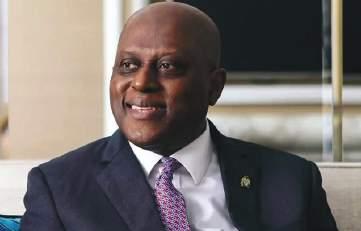
that CBN Governor, Mr. Olayemi Cardoso’s policy of orthodoxy meant that Access Bank must follow the process and duly comply with all forms and substance of regulation. Sources also hinted that Cardoso
was not particularly driven by commercial considerations of both parties, “he is a stickler to process,” he said In the absence of the approval, therefore, the transaction could not
Achieved
progress, and was subsequently terminated after certain contractual conditions were not met by the Nigerian lender by the agreed
Continued on page 8
www.thisdaylive.com
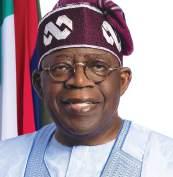
Tinubu: Terrorism Giving Nigerians Sleepless Nights, We’ll Overcome Them All
Insists security threats unacceptable Protest in Kaduna as bandits abduct Seven
Deji Elumoye, Linus Aleke in Abuja and John
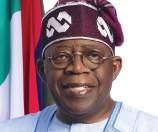
in Kaduna President Bola Tinubu, yesterday, painted a gloomy picture of the security situation in the country,
saying terrorism is giving him and other Nigerians sleepless nights. Tinubu, however, was quick to
declare that Nigeria would defeat terrorism and banditry, describing the security threats as unacceptable and alien to the country’s core values. Speaking while declaring
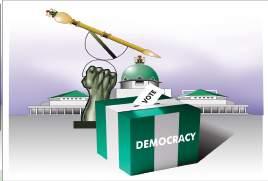
Electoral Act: Coalition of CSOs Warns 2027 Elections May Be Compromised
Appeal to N’Assembly to adopt real-time transmission of results, pass bill in two weeks Obi joins protesters at federal legislature, Agbakoba backs call for real-time electronic transmission of results in 2027 polls NGE, HURIWA, other groups warn Senate
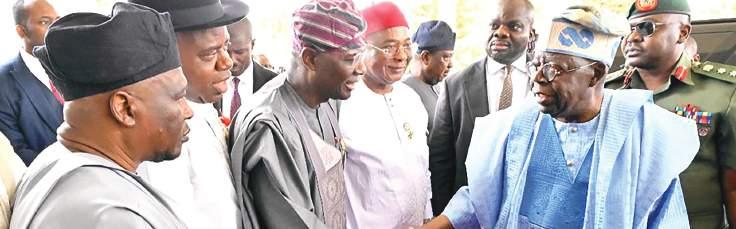
NATIONAL ECONOMIC SUMMIT...
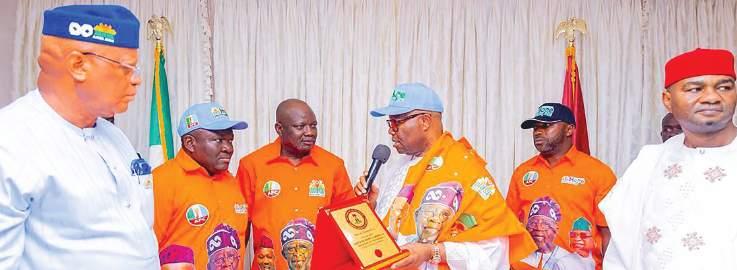
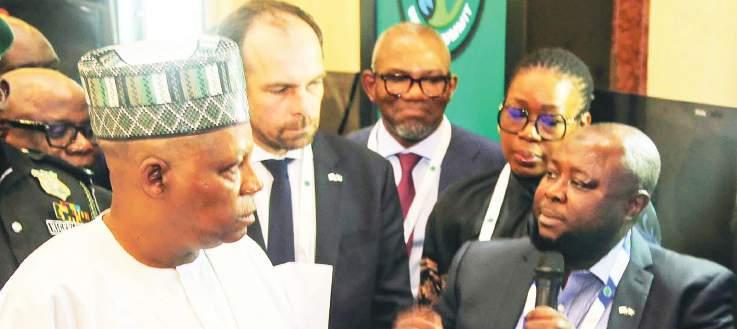
L-R: Adamawa State Governor, Mr. Ahmadu
Villa, Abuja, yesterday
Fintiri; Bayelsa State Governor, Mr. Douye Diri; Lagos State Governor, Mr. Babajide Sanwo-Olu; Imo State Governor, Senator Hope Uzodimma; and President Bola Ahmed Tinubu, during the National Economic Summit at the Presidential
PHOTO: GODWIN OMOIGUI.
Shiklam
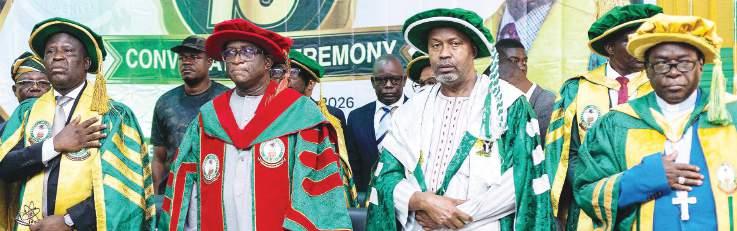
10TH CONVOCATION CEREMONY OF FEDERAL UNIVERSITY OF OYE EKITI...
L-R: Out-going Vice Chancellor, Federal University Oye-Ekiti (FUOYE), Professor Abayomi Fasina; Pro-Chancellor and Chairman of Council, Sen. Victor Ndoma-Egba; Executive Secretary, National Universities Commission (NUC), Professor Abdullahi Ribadu, and Convocation Lecturer, Bishop of Sokoto Diocese, Sokoto State, Matthew Kukah, at the 10th Convocation Ceremony of FUOYE, Oye-Ekiti, Ekiti State
At NEC Conference Cardoso Declares CBN Reforms Have Achieved Economic Stability
Says banks’ recapitalisation will support $1 trillion economy Declares CBN will protect Naira at all cost, currency now more competitive Warns economy not out of danger as election cycle poses risks to price stability Bagudu hails Tinubu for milestones in economic transformation
James Emejo in Abuja
The Governor of the Central Bank of Nigeria (CBN), Mr. Olayemi Cardoso, yesterday said the apex bank’s reforms, introduced on his assumption of office, have established economic stability.
This is as Minister of Budget and Economic Planning, Senator Abubakar Bagudu, hailed President Bola Tinubu for implementing reforms that have aided economic transformation as well as improved the fiscal condition of states and local governments.
The minister also commended the president for his contributions to strengthening federalism, noting that “a more united federation is gathered here because of the choices you made”.
Also, Minister of State for Finance, Dr. Doris Uzoka-Anite, said the country required 10 per cent annual growth rate over the next decade to actualise its aspiration for a $1 trillion economy.
The trio spoke at the opening of the 2nd National Economic Council (NEC) Conference with the theme, “Delivering Inclusive Growth and Sustainable Development: The Renewed Hope National Development Plan” in Abuja.
The central bank governor said for a long time, the economy had not achieved the remarkable performances as currently witnessed.
Cardoso said a $3.42 billion balance of payments surplus recorded in the third quarter of 2025 represented a significant improvement while inflation has moderated significantly to 15.15 per cent. He said the banking sector remained sound while external reserves have grown to $49 billion as of February 5, 2026.
The CBN governor said, “This is a very important statistic. When we took office, net reserves were about $3 billion. By the end of last year, net reserves had increased significantly into the $30 billion range, and as of February 5, 2026, they stand at $49 billion.
“We are now net buyers in the foreign exchange market. By this, I mean that while we allow the market to generally find its own level, the Central Bank also intervenes from time to time to purchase foreign exchange.
“The premium between the official and parallel market rates has collapsed to under 2 per cent. You can clap for me. You no longer need foreign exchange to travel—you can use your naira card and pay for whatever you need abroad.
“The naira is now more competitive, and people are no longer afraid to hold it. In the past, even in neighbouring West African countries, no one wanted to accept naira. That has changed.”
Cardoso added that there is now market predictability that allows for opportunity to plan.
He said the CBN under his watch will do whatever is necessary to protect the value of the naira.
He also said ongoing banking sector recapitalisation will support financing for the $1 trillion economy.
Cardoso said, “You no longer need to search frantically for foreign exchange or build excessive FX buffers. Those holding unnecessary foreign exchange reserves are, frankly, losing money every day. The banking sector remains resilient, and investor confidence is returning.”
The central bank governor, however, warned that there are risks ahead that must be managed, particularly the likelihood of excess liquidity during the election cycle.
He said liquidity overhang remained a concern—noting that there is still significant liquidity in the system which must be managed carefully.
He said, “We are not yet out of the woods. The election cycle is another risk, as election periods typically involve increased liquidity injections. This must be carefully monitored to ensure it does not undermine the bold reforms that have restored stability. Global trade tensions also pose risks, and I know everyone here is well aware of
recent global developments.”
However, he said the CBN Roadmap for 2026–2030 focuses on leveraging macroeconomic stability to enhance productivity and growth.
According to him, macroeconomic stability remains the most effective enabler of investment and increased output across agriculture, manufacturing, and service value chains.
He stated that without stability, there can be no growth, adding that “One positive outcome of our efforts is that stability has now been restored.
“The roadmap includes anchoring disinflation, FX market normalisation, and strengthening financial system resilience.
“In simple terms, this means we will stay the course and continue doing what we have been doing. Our roadmap for enabling growth and development includes price stability through a transition to inflation targeting, strengthening external reserves, and safeguarding the value of the naira.
Explaining the pitiable condition of the economy when he took over in 2023, Cardoso said, “We inherited an unprecedented scale of fiscal dominance. As shown on this chart, the Ways and Means–to–GDP ratio stood at 8.68% in 2022, but by 2025 it had declined to 0.69%.
“The ratio had risen to an unprecedented level, reflecting entrenched excess liquidity and years of monetised fiscal deficits that severely compromised the effectiveness of monetary policy.
“It may interest you to know that over the past eight years, up to 2022, while the economy grew at an average of 1.8% per annum, money supply expanded by about 13% per annum. You can clearly see the enormous distortion that this created.”
He said, “There were also significant GDP losses from subsidy regimes—petrol subsidies and foreign exchange misalignment—something I do not want people to ever forget.
“While we often focus on the substantial revenue losses from fuel
subsidies, the losses arising from foreign exchange subsidies were actually even greater. So, while we complained about the scale of losses from fuel subsidies, the losses from FX subsidies exceeded those amounts.
“In addition, there was the cost of loose monetary policy and excess liquidity. The cost of having to mop up this excess liquidity became a major challenge.”
He said, “We faced high and persistent inflation, which surged to 34.6%. The foreign exchange market was dysfunctional. You will all recall that there was a huge backlog of over $7 billion, and the parallel market premium exceeded 60%. Investor confidence had collapsed.
“We all know what that meant— capital flight was rampant. Nobody wanted to hold the naira, and the situation was truly desperate.
“There were also direct interventions by the Central Bank, which reached an unprecedented ₦10.93 trillion. This was, quite frankly, a huge problem. While we have been
able to correct many of these issues, it is important to recognise that some of these distortions are still present.
“These interventions provided short-term support—some would argue they were necessary—but they also created long-term monetary distortions, excess liquidity, and increased the cost of liquidity management. That was the situation we inherited.
“Our strategy rested on three mutually reinforcing pillars designed to restore stability and catalyse sustainable economic growth.”
According to him, “The first pillar was a decisive monetary policy reset. The Monetary Policy Rate was increased aggressively by 875 basis points to decisively tackle inflation.
“We returned to orthodox monetary policy and phased out all quasi-fiscal development finance interventions to focus squarely on price stability. Without price stability, there can be no investment and no sustainable growth.
Lagos Moves to Build West Africa’s Leading International Financial Centre
Michael Olugbode in Abuja
Lagos State has taken a major step toward repositioning Nigeria as a global investment destination with the unveiling of a comprehensive roadmap to establish a Lagos International Financial Centre (LIFC), envisioned as the leading financial hub in West Africa.
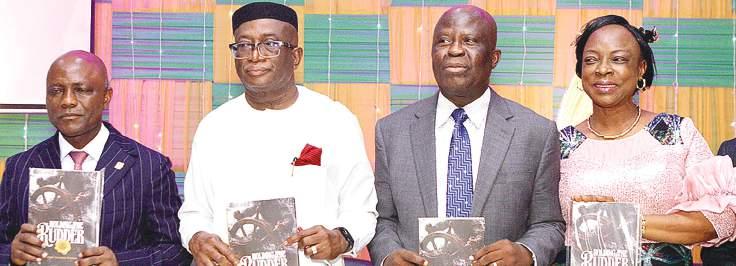
The roadmap is contained in a new report titled “Establishing an International Financial Centre in Lagos (LIFC), Nigeria”, produced by TheCityUK in collaboration with the UK Government, Lagos State Government, the Lagos International Financial Centre Council (LIFCC), and EnterpriseNGR.
The report was formally launched
at the State House, Marina, Lagos.
The high-level event attracted senior government officials, diplomats, and private sector leaders, including Lagos State Governor Babajide Sanwo-Olu, British Deputy High Commissioner to Nigeria Jonny Baxter, EnterpriseNGR Chairman Aigboje Aig-Imoukhuede, and EnterpriseNGR Chief Executive Officer Obi Ibekwe.
The initiative is aligned with Nigeria’s Agenda 2050 and the Lagos State Development Plan 2052, positioning the LIFC as a long-term catalyst for economic transformation. According to the report, the proposed financial centre will deepen capital markets, mobilise international investment,
drive innovation, and support sustainable economic growth across Lagos, Nigeria, and the wider West African region.
The report underscores the importance of strong public-private collaboration, noting that Lagos’ demographic advantage, expanding financial ecosystem, and strategic location make it well-suited to host an international financial centre that meets global standards.
One of the report’s core recommendations is the creation of an independent IFC framework for Lagos. This model would provide regulatory certainty, simplified tax and policy regimes, and a transparent governance structure aimed at improving investor confidence and
enhancing Nigeria’s competitiveness in global finance.
To differentiate Lagos from other emerging financial centres, the report identifies three priority sectors for initial focus: green and sustainable finance, fintech and financial innovation, and commodities trading and capital markets. These sectors are considered critical to Nigeria’s future economic diversification and resilience.
The report also highlights the need for robust legal and regulatory reforms, calling for close coordination between Lagos State, the Federal Government, regulators, and the private sector to ensure smooth implementation of the LIFC vision.
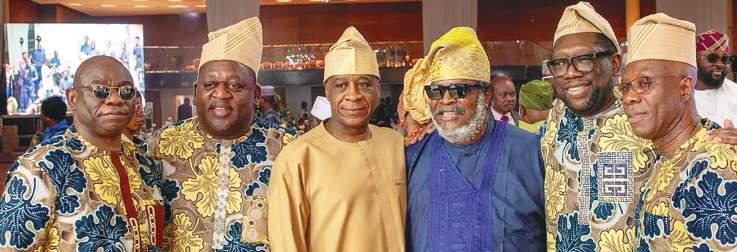
AT THE 8TH DAY FIDAU PRAYER AND CELEBRATION OF LIFE OF HRH ADEKUNLE OJORA...
L-R: Kola Abiola, first son of late nationalist, M.K.O. Abiola; his brother, Deji Abiola; Prince Segun Aremo Oniru; THISDAY/ARISE Group Publisher, Mr. Nduka Obaigbena; Agboola Abiola; and a guest, at the 8th Day Fidau Prayer and Celebration of Life of foremost boardroom titan and industrialist, the Otunba of Lagos and Lisa of Ife, HRH Adekunle Ojora, at Eko Hotel and Suites, Lagos… recently
You Can’t Misappropriate N297bn from N180bn Revenue, NSITF Official Says
A senior official of the Nigeria Social Insurance Trust Fund (NSITF) yesterday dismissed a report by an online newspaper claiming that the Agency’s Manag-
ing Director, Oluwaseun Faleye, misappropriated N297 billion, describing it as “mathematically and operationally impossible.”
The report had alleged that the NSITF received inflows totaling N297 billion between January and
October 2025 and that N243 billion of these funds were spent without board approval. It also claimed that the MD had granted himself “unlimited” spending authority through a secret memo.
Arithmetic Deficit in Allegations
Speaking to THISDAY on condition of anonymity, a top official at the Fund emphasized that the entire agency revenue for 2025 was approximately N180 billion,
stressing that the allegation itself defies simple arithmetic.
“You cannot spend more than the total revenue of the agency, yet the report suggests that N243 billion was expended in less than a year. How is that possible?” the
Financial Crimes: House Vows to Make Legislative Intervention to Strengthen EFCC, NFIU
Adedayo Akinwale in Abuja
The House of Representatives has expressed its determination to make effective and impactful legislative interventions that are robust, coherent and responsive to evolving criminal tactics.
The Chairman of the House Committee on Financial Crimes, Hon. Ginger Onwusibe disclosed this yesterday, in Abuja during the 2026 budget defence session with the Economic and Financial Crimes Commission (EFCC) and the Nigeria Financial Intelligence Unit (NFIU).
He revealed that the House was currently considering four key bills aimed at promoting transparency,
protecting public resources, restoring confidence in the financial system and aligning Nigeria with global best practices.
The proposed legislations, he said, included: A Bill for an Act to Establish the Economic and Financial Crimes Commission (EFCC); a Bill to Amend the Money Laundering (Prevention and Prohibition) Act, 2022; a Bill to Amend the EFCC Act, 2004; and a Bill to Amend the Proceeds of Crime Act.
Onwusibe noted that the bills were designed to modernise existing laws, bridge operational gaps, strengthen enforcement mechanisms and ensure that crime does not pay, regardless of its sophistication.
He noted that Nigeria is currently facing significant economic challenges, with many citizens grappling with hardship, underscoring the urgent need for effective solutions to stimulate growth, create jobs and improve living standards.
The chairman stated: “As patriots, we must summon our patriotic zeal. Hopes are not lost, as Nigeria’s economy is showing signs of cautious optimism—transitioning from post-reform stabilisation to modest recovery.
“The International Monetary Fund (IMF) projects a 4.4 per cent growth in 2026, driven by improved macroeconomic stability, structural reforms and a rebound in domestic
demand.”
Onwusibe emphasised the critical roles played by the EFCC and the NFIU in combating financial crimes, describing such crimes as a major drain on the economy.
According to him, the agencies’ work in recovering stolen assets, deterring corruption and financial malfeasance, and enhancing financial stability and security was indispensable.
He commended the EFCC and the NFIU for their tireless efforts, particularly Nigeria’s recent delisting from the Financial Action Task Force
(FATF) grey list, which he described as a significant milestone reflecting the government’s commitment to strengthening the anti-money laundering and combating the financing of terrorism (AML/ CFT) framework.
Onwusibe noted that the development was expected to enhance Nigeria’s international reputation and credibility, boost foreign investment and trade opportunities, improve access to international financing and credit, and strengthen the country’s financial stability and security.
source said. “At the end of January 2026, we had roughly N96 billion in our CBN accounts. Staff salaries accounted for about N40 billion, overheads another N40–45 billion, and nearly N30 billion was invested in federal bonds and treasury bills. There is no scenario in which N273 billion could have been spent, let alone ‘misappropriated.’”
Clarifying Approval Limits
The official also addressed the “unlimited approval” claim, labeling it a gross misinterpretation of standard public service rules. “The idea that any MD can grant themselves ‘unlimited’ limits is a legal fiction,” the source explained. “The MD’s approval limits are strictly governed by the Bureau of Public Procurement (BPP) guidelines. In fact, President Tinubu recently reviewed these thresholds upwards to reduce bureaucratic bottlenecks. To suggest a memo overrides the Public Procurement Act is not just false; it is an insult to the intelligence of the public.”
salary payments.
Emmanuel Addeh in Abuja
Global Process and Pipeline Services Limited (GPPSL) has been honoured with the Local Oil Services Company of the Year/Operational Performance Excellence award during the Industry Awards & Gala Night at the just concluded 9th edition of Nigeria International Energy Summit (NIES 2026).
The award recognises the company’s outstanding contributions to Nigeria’s oil and gas sector and its continued commitment to technical excellence, safety, and indigenous capacity development.
In 2025, GPPSL distinguished itself as a leading symbol of local capability within Nigeria’s energy landscape, demonstrating consistent operational reliability across complex pipeline,
processing, and infrastructure projects.
“Great industries are not built by scale alone; they are built by disciplined execution, dependable systems, and organizations that deliver when performance matters most”, the award citation for GPPSL stated.
Under the leadership of Obi Uzu, the company, a statement said, has evolved from a conventional service provider into a strategic contributor to national industrial capacity.
GPPSL’s project portfolio reflects rigorous engineering standards, precise execution methodologies, and a deeply embedded safety culture aligned with international best practices.
“This recognition reflects the discipline, technical depth, and commitment to safe execution that
define our organisation. I accept this award on behalf of a workforce that consistently proves Nigerian expertise can compete at the highest global standards,” Uzu said.
According to the statement, equally significant is the company’s investment in human capital. GPPSL said it has expanded its role as an employer and developer of Nigerian engineering talent, strengthening local technical capacity and reinforcing the viability of indigenous expertise in meeting global industry benchmarks.
“Our growth has been driven by a clear conviction that local capacity development is central to the future of the energy industry. This made us prioritise building capacity through investing in people, strengthening systems, and delivering reliably”, Uzu added.
The Minister of Education, Dr. Tunji Alausa, has announced the federal government has fulfilled its obligation to implement 40 per cent increase in the Consolidated Academic Allowance (CAA) for ASUU members, with effect from 1st January 2026, in line with the agreement reached with the union.
He also revealed the implementation of key welfare components of its renegotiated agreement with the union, particularly its commitment to their well-being and the stability of the Nigerian university system has been taken into cognizance with the renewed hope initiative.
In a statement released Monday night and signed by the Director of Press and Public Relations, Folashade Boriowo, the Minister said some federal universities have already begun reflecting the approved increase in their
Therefore, he directed that to ensure uniform implementation nationwide, “all federal universities are being formally notified to fully cascade the approved increment across their institutions and integrate it into their payroll structures so that all eligible academic staff benefit accordingly.”
In a directive issued to vice chancellors of federal universities, Alausa emphasized the need for strict compliance with the implementation framework for the Consolidated Tools Allowance (CATA).
He urged vice chancellors to make judicious use of available resources to ensure the successful rollout of the allowance.
He further noted the payment has already been captured and circularised by the National Salaries, Incomes and Wages Commission (NSIWC), and that its inclusion
in the 2026 budget is a formal statutory process.
The minister urged university managements to take proactive steps in utilizing their resources to effect prompt payment of the approved CATA in accordance with NSIWC guidelines.
“He emphasised that timely implementation of both the CAA increase and CATA will strengthen the academic environment, enhance staff morale, and support improved outcomes in teaching, research, and learning across Nigerian universities.”
Furthermore, the minister said the federal government reiterates its resolve to honour agreements entered into with stakeholders in the education sector and remains committed to constructive engagement, transparency, industrial harmony, and the continuous improvement of quality education in Nigeria.
Kuni Tyessi in Abuja
Emmanuel Addeh in Abuja
AKPABIO EMERGES ARISE WITH RENEWED HOPE INITIATIVE PATRON...
L-R: Akwa Ibom State Governor, Pastor Umo Eno; International Chairman, Board of Trustees, Arise With Renewed Hope Initiative and Executive Director, Projects, NDDC, Dr. Victor Antai; President General, Engr. Uwem Okoko; Grand Patron of the Group and President of the Senate, Godswill Akpabio; National Youth Leader, Mr. Kufre Inima; and Deputy Senate Whip, Mr. Onyekachi Nwaebonyi, during the official presentation of the group’s regalia to Akpabio as their Grand Patron in Abuja on Sunday
2026 Appropriation Bill: Senate Defends Borrowing to Fund N25.91trn Deficit, Pushes Power Subsidy Exit
Insists electricity subsidy must be fully removed Minister says N2.72bn capital allocation too meagre to drive trade, investment
The Senate yesterday rose in strong defence of the federal government’s continued resort to borrowing, declaring that deficit financing remains inevitable to fund the proposed N58.47 trillion 2026 Appropriation Bill, which carries a deficit of about N25.91 trillion amid persistent revenue constraints and vast development needs.
This comes as the Minister of Industry, Trade and Investment, Mrs. Jumoke Oduwole, also yesterday, raised concerns over the proposed N2.72 billion capital allocation for the Ministry in 2026, warning that the amount was grossly inadequate to deliver the scale of programmes required to drive Nigeria’s industrialisation, trade expansion, and investment attraction agenda.
At a public hearing on the 2026 budget proposal held at the National Assembly, Chairman of the Senate Committee on Appropriations, Senator Solomon Adeola, said Nigeria could not realistically meet its infrastructure, security and social obligations without borrowing, insisting, however, that the era of wasteful, consumption-driven deficits must end.
Adeola stressed that the real issue
was not borrowing itself, but how deficits are funded and how borrowed resources are utilised.
“Nigeria cannot help but continue borrowing because revenue inflows are unpredictable and development needs are enormous.
“What matters is how we borrow, how we fund deficits, and what the borrowed resources are used for,” he said.
He disclosed that while projected revenue for 2026 stands at N33.19 trillion, total expenditure was estimated at N58.47 trillion, leaving a deficit of N25.27 trillion, with debt service expected to consume about N15.90
trillion.
According to him, the figures underscore the urgency of revenue expansion, asset optimisation and stricter fiscal discipline.
The lawmaker said the federal government was deliberately avoiding excessive domestic borrowing that could crowd out private sector credit, opting instead for a mix of external financing, asset sales, privatisation, Public-Private Partnerships (PPPs), and concessioning of infrastructure.
Adeola also insisted that the electricity subsidy must be fully removed to free up scarce resources for development, warning that partial
reforms in the power sector would continue to drain public finances.
“We must complete the unbundling and subsidy removal in the electricity sector. States are now empowered to generate power, but subsidy in that sector remains a major fiscal burden. It must be fully addressed,” he said.
He recalled that trillions of naira were previously spent on fuel subsidies funded largely through borrowing, describing President Bola Tinubu’s decision to remove fuel subsidy as a turning point that laid the foundation for ongoing fiscal reforms.
In a firm signal of legislative
resolve, Adeola declared that the National Assembly would no longer approve extensions of budget implementation cycles, blaming repeated rollovers for poor budget outcomes.
“Never again will the National Assembly approve budget extensions. We must discipline our budgeting process, enforce timelines and ensure better coordination between policy design and implementation,” he said.
President of the Senate, Godswill Akpabio, represented by Deputy Senate President, Senator Barau Jibrin, framed the 2026 budget proposal as a moral and historical test for the nation, urging lawmakers and the
executive to ensure that borrowing translates into tangible benefits for citizens.
“A budget is a moral document. It reveals our priorities and values. It is not enough to allocate funds; we must convert budgets into outcomes that Nigerians can see and feel,” Akpabio said.
Minister of State for Finance, Dr. Doris Nkiruka Uzoka-Anite, said the 2026 proposed budget was designed to align with government priorities, deepen reforms already underway and ensure that limited national resources are deployed with maximum efficiency and impact.
NCC Reaffirms Commitment to Regional Digital Integration
Emma Okonji
Nigerian Communications Commission (NCC), in line with its commitment to collaboration and regional integration, has reaffirmed its commitment to strengthening partnerships among telecommunications regulators within the West African sub-region.
Executive Vice Chairman of
NCC, Dr. Aminu Maida, restated the commitment when NCC hosted a high-level delegation from Liberia Telecommunications Authority (LTA) at its head office in Abuja at the weekend.
Speaking during LTA’s visit, Maida, who was represented by Director of Corporate Planning, Strategy and Risk Management at NCC, Dr. Kelechi Nwankwo, emphasised the commission’s
Oyetola: NIWA Must Prioritise System Integrity for Sustainable Growth
Kasim Sumaina in Abuja
The Minister of Marine and Blue Economy, Adegboyega Oyetola, Monday emphasized the importance of system integrity in public institutions, highlighting its role in driving good leadership, ethical conduct, and revenue generation.
Oyetola, who was represented by the Permanent Secretary, Federal Ministry of Marine and Blue Economy, Fatima Sugra Tabi’a Mahmood, made this known at a retreat, themed: “The Art and Practice of System Integrity in Public Institutions” organized by National Inland Waterways Authority (NIWA) in collaboration
with Independent Corrupt Practices and Other Related Offences Commission, (ICPC) In his keynote address, Oyetola stressed that system integrity is crucial for NIWA’s success, enabling the authority to fulfill its mandate and contribute to Nigeria’s Blue Economy agenda.
The Minister further outlined key areas for improvement, including: revenue generation, transparency, and accountability, urging NIWA to leverage technology and public-private partnerships to enhance efficiency and financial sustainability.
“System integrity is not a moral luxury; it is an economic necessity,”
Oyetola stated, calling on NIWA’s Board and Management to prioritize financial sustainability and drive innovation in revenue generation.
Futher more, the Minister observed the partnership with ICPC aligns with the federal government’s preventive approach to combating corruption, adding that ethical leadership and transparent revenue systems are critical to harnessing the full economic potential of Nigeria’s inland waterways.
Earlier, the Acting Managing, NIWA, Umar Girei, said the retreat aims to strengthen NIWA’s systems and processes, promoting a culture of transparency, accountability, and performance-driven leadership.
mandate to continually collaborate with sister regulatory institutions within the sub-region and beyond to drive the expansion of a digital economy and improve the living conditions of citizens.
According to him, given NCC’s long-standing commitment to regional cooperation through platforms, such as West Africa Telecommunications Regulators Assembly (WATRA), the commission believed the region would become stronger and more prosperous when all the countries were interconnected.
The NCC boss further emphasised that collaboration remained a core driver of the NCC Board and sustained engagement with regional partners remained es-
sential to advancing the interests of telecommunications consumers and various stakeholders.
Maida recalled the commission’s advocacy for the recognition of Information and Communications Technology (ICT) as critical national infrastructure within the Economic Community of West African States (ECOWAS), stating that Nigeria has already designated ICT as part of its critical national information infrastructure to give it the prominence required for sustainable growth.
Massaquoi acknowledged that Nigeria remained the largest economy in the region and a central player in Africa’s communications, security, and economic structures.
He said progress made by Nigeria often had far-reaching impacts across other West African countries.
He assured the Liberian delegation of NCC’s readiness to provide support in advancing regional shared initiatives and translating discussions into actionable outcomes within the sub-region. In his remarks, Chairman of the Board of Commissioners of LTA, Hon. Clarence Massaquoi, commended NCC for making itself available in the spirit of regional coordination and collaboration. Massaquoi described the engagement as critical to strengthening regulatory responsibilities across the sub-region.
Amoxicillin Not Banned in Nigeria, Says NAFDAC
Onyebuchi Ezigbo in Abuja
The National Agency for Food and Drug Administration and Control (NÀFDAC) has denied reports it has banned Amoxicillin in Nigeria. In a statement signed by Director General of NÀFDAC, Prof. Mojisola Adeyeye, the agency said its attention has been drawn to a misleading video circulating on social media claiming that the agency has secretly
banned Amoxicillin in Nigeria.
Adeyeye said: “This claim is entirely FALSE. NAFDAC has not banned Amoxicillin. While the agency routinely issues targeted safety alerts and recalls on specific substandard or affected batches of medicines, there is no blanket ban on the antibiotic in Nigeria.
“We urge the public, healthcare professionals, and stakeholders to disregard the misinformation
and rely only on verified updates published on NAFDAC’s official channels”.
NÀFDAC had issued targeted safety alerts on certain batches and brands of Amoxicillin which it considered substandard and unfit for public use. It however, said the measure was targeted at particular batches of the drug and did not constitute unilateral ban of the product.
Sunday Aborisade in Abuja
PHOTO: SENATE PRESIDENT’S OFFICE
Oba of Benin: Spate of Killings Nationwide Worrisome, Depressing
Throws support for Tinubu, Okpebholo’s fight against insecurity Commiserates with Kwara people
Emmanuel Addeh in Abuja
The Oba of Benin, His Royal Majesty Omo N’Oba N’Edo Uku Akpolokpolo, Oba Ewuare II, yesterday expressed deep concern over the rising wave of killings across Nigeria, especially in the north, describing the situation as “worrisome and deeply depressing.”
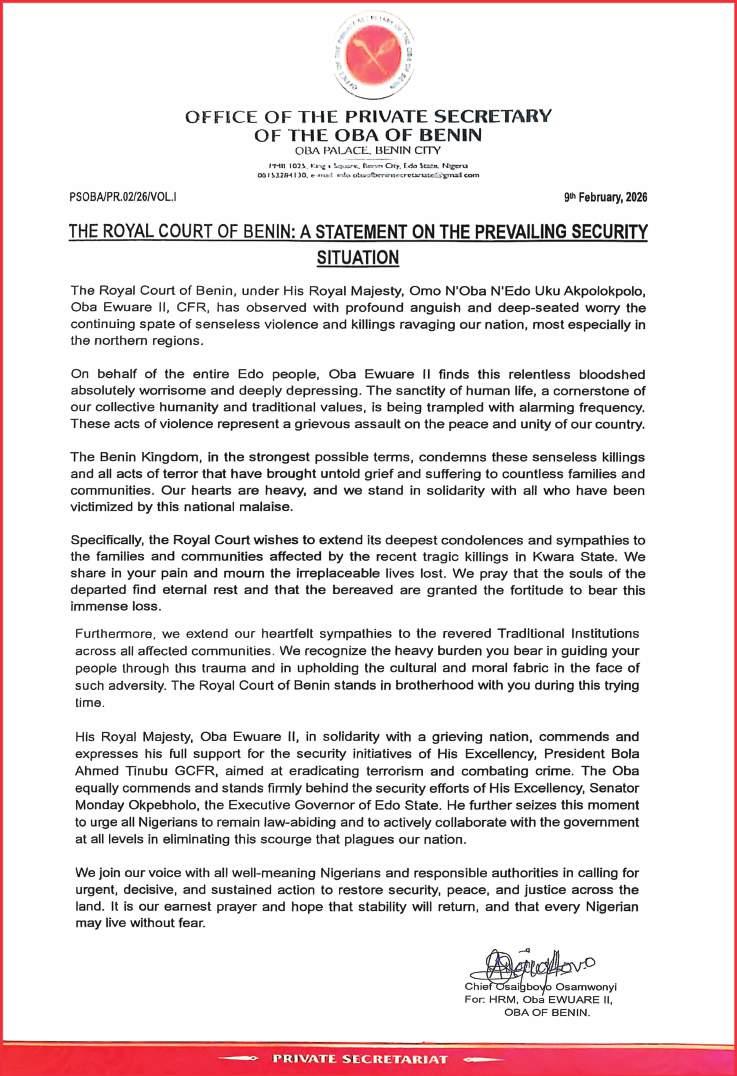
In a statement signed by his Private Secretary, Chief Osaigbovo Osamwonyi, released on his behalf, the monarch decried the ongoing bloodshed, noting that the sanctity of human life, a cornerstone of traditional values, is being repeatedly violated. He condemned all acts of terror, calling them an assault
on national peace and unity.
“The Royal Court of Benin, under His Royal Majesty, Omo N’Oba N’Edo Uku Akpolokpolo, Oba Ewuare Il, CFR, has observed with profound anguish and deepseated worry the continuing spate of senseless violence and killings ravaging our nation, most especially in the northern regions.
“On behalf of the entire Edo people, Oba Ewuare Il finds this relentless bloodshed absolutely worrisome and deeply depressing. The sanctity of human life, a cornerstone of our collective humanity and traditional values, is being trampled with alarming frequency. These acts of violence represent a grievous assault on the
peace and unity of our country.
“The Benin Kingdom, in the strongest possible terms, condemns these senseless killings and all acts of terror that have brought untold grief and suffering to countless families and communities. Our hearts are heavy, and we stand in solidarity with all who have been victimised by this national malaise,” the statement stressed.
Ewuare II extended heartfelt condolences to the families and communities affected by the recent killings in Kwara State, mourning the irreplaceable lives lost. He also prayed that the souls of the departed find eternal rest.
“Specifically, the Royal Court wishes to extend its deepest
condolences and sympathies to the families and communities affected by the recent tragic killings in Kwara State. We share in your pain and mourn the irreplaceable lives lost. We pray that the souls of the departed find eternal rest and that the bereaved are granted the fortitude to bear this immense loss” he said.
Besides, the Oba highlighted the heavy burden borne by traditional institutions in affected communities, commending their efforts to guide their people through the trauma while upholding moral and cultural values. The Oba affirmed that the Benin Kingdom stands in solidarity with these institutions and all Nigerians during this period of
national distress.
“Furthermore, we extend our heartfelt sympathies to the revered traditional institutions across all affected communities. We recognise the heavy burden you bear in guiding your people through this trauma and in upholding the cultural and moral fabric in the face of such adversity. The Royal Court of Benin stands in brotherhood with you during this trying time,” the statement added.
Besides, the Oba threw his support behind national and state-led security initiatives. He commended President Bola Tinubu, for his efforts to eradicate terrorism and combat crime, and equally praised Edo State Governor, Sena-
tor
ELECTORAL ACT: COALITION OF CSOS WARNS 2027 ELECTIONS MAY BE COMPROMISED Chuks Okocha, Adedayo Akinwale, Sunday Aborisade in Abuja, John Shiklam in Kaduna, Sunday Ehigiator in Lagos, David-Chyddy Eleke in Awka, Yemi Kosoko in Jos and Laleye Dipo in Minna
As Senate meets in an emergency session today to de-liberate over amendments to the Electoral Act, several Civil Society Organisations (CSOS) have warned that delay in conclusion of the amendment could introduce legal uncertainty that might compromise preparations for the 2027 general election.
The coalition of civil society groups called on the National Assembly Conference Committee on Electoral Act Amendment Bill to adopt the House of Representatives’ version mandating electronic transmission of electoral results ahead of the 2027 elections.
The CSOs, comprising Centre for Media Society, The Kukah Centre, International Press Centre, Elect Her, Yiaga Africa, The Albino Foundation, and Nigerian Women Trust Fund, stated that the call became urgent following Senate’s rejection of electronic transmission of election results.
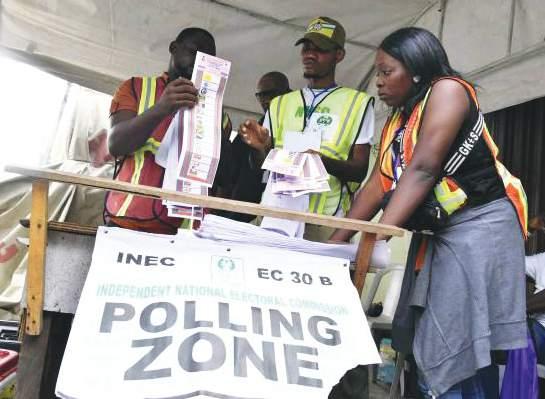
Equally, yesterday, a presidential hopeful, Mr. Peter Obi, took the
battle for credible elections to the National Assembly, joining hundreds of protesters in a dramatic show of defiance against what demonstrators described as a fresh attempt to rig the 2027 elections through the backdoor.
At the same time, a Senior Advocate of Nigeria (SAN), Dr. Olisa Agbakoba, threw his weight behind growing calls for the National Assembly to amend the Electoral Act to make electronic transmission of election results in real-time mandatory ahead of the 2027 general election. Agbakoba warned that failure to do so would sustain electoral disputes and weaken democratic credibility.
Similarly, Nigerian Guild of Editors (NGE) expressed concern over the controversy surrounding Senate’s position on the transmission of election results ahead of the 2027 general election.
Human Rights Writers Association of Nigeria (HURIWA) expressed “unquantifiable shock and unrelenting consternation” against the senate over the rejection of amendment to the electoral law to mandate Independent National Electoral Commission (INEC) to compulsorily implement the real-time electronic transmission of election results.
Addressing journalists in Abuja,
yesterday, on behalf of the other CSOs, Mr. Jake Epelle, decried reports that Senate had removed the proposed 10-year ban for offences related to the buying and selling of Permanent Voters’ Cards (PVCs).
Epelle stated that the divergence between Senate and House of Representatives on the amendments had profound implications for the integrity of the 2027 general election.
He emphasised that the protracted amendment process had created legal uncertainty around INEC’s constitutionally mandated electoral preparations, potentially compromising the commission’s ability to conduct credible elections.
He explained that Section 28 (1) of the Electoral Act 2022 empowered INEC to issue notice of elections 360 days before the date of election.
Epelle lamented that the legal uncertainty created by ongoing amendments had prevented INEC from releasing the timetable for the 2027 elections, placing the commission in potential violation of the extant law.
He, however, maintained that the 2022 Electoral Act remained operative until amended, while insisting that the status of the Electoral Bill did not suspend INEC’s statutory obligations.
The CSOs called on the electoral
TINUBU: TERRORISM GIVING NIGERIANS SLEEPLESS NIGHTS, WE’LL OVERCOME THEM ALL
nomic Council (NEC) Conference at State House Conference Centre, Abuja, Tinubu assured Nigerians of his administration’s resolve to strengthen the country’s security forces and restore peace across affected communities.
He stated, “I promise you here that I’ll play my part. Seven zones of mechanisation are coming. I promise Nigerians that this will be delivered, and I am here again to further find ways to strengthen our security forces and defeat terrorism.
“That, I promise you, is what has kept all of us sleepless at night, but I assure you we will win with determination and resilience. We will overcome this unacceptable terrorism and banditry. It’s not part of our culture. It’s foreign to us.”
The president described insecurity as an economic hindrance, stressing that all hands must be on deck to find an immediate solution.
He particularly commended the governors of Borno, Katsina and Kaduna states, as well as others, for doing “so much to defend our freedom, liberty and our commonwealth”.
Welcoming governors, ministers, members of the National Assembly, development partners and private sector leaders to the two-day conference, themed, “Delivering Inclusive Growth and Sustainable National Development: The Renewed Hope National Development Plan 2026–2030,” Tinubu described the gathering as a reflection of collective dedication to national progress.
He praised the National Economic Council (NEC), chaired by Vice President Kashim Shettima, for sustaining a vital platform for policy coordination and strategic dialogue.
The president said, “I am pleased to address the second edition of the National Economic Council Conference at a critical moment in Nigeria’s development journey. NEC remains a cornerstone of fiscal federalism and economic governance in our country.”
Highlighting the key achievements of his administration thus far, Tinubu said the economic reforms undertaken since inception had helped stabilise the economy and restore confidence.
“I must say again at this juncture, the monetary policy that we have embarked on since the reforms has yielded positive results and gained recognition around the world,” he stated.
He commended Governor of Central Bank of Nigeria (CBN), Yemi Cardoso, for restoring confidence in Nigeria’s monetary policy.
The president said state and local governments now received increased, more predictable federal allocations, enhancing their capacity to pay salaries, invest in infrastructure, and deliver social services.
He added that infrastructure development across transportation, power, digital connectivity, housing and irrigation had been prioritised.
Tinubu also highlighted expanded social investment and human capital programmes targeting vulnerable households, youth, women and small businesses, alongside grassroots-focused initiatives under the Renewed Hope Agenda.
He stated, “The Renewed Hope
body to issue the election timetable and schedule for the 2027 general election in accordance with the provisions of the Electoral Act 2022 without further delay.
They stated, “With respect to the provision on electronic transmission of results. We strongly recommend that the committee adopts the House of Representatives’ position mandating electronic transmission, with a modification addressing technological specificity.
“As currently drafted, explicit reference to the INEC Result Viewing (IReV) portal creates potential rigidity. Since electoral technology evolves, statutory references to specific platforms require legislative amendment each time technological infrastructure changes.
“This approach aligns with the existing Electoral Act provisions regarding the Bimodal Voter Accreditation System (BVAS), which permits ‘BVAS or any other technological device’ for accreditation, establishing a precedent for technology-neutral legal frameworks that combine mandatory obligations with implementation flexibility.”
The groups said, “We hereby proposed the following modification to Clause 60(3); The designated election official shall electronically transmit all election results in real time, including the number of accredited voters, directly from the polling units and collation centres to a public portal and the transmitted result shall be used to verify any other result before it is collated.
“For the avoidance of doubt, we provide clarity on the concept of ‘real-time”. Real-time electronic transmission of results means sending the official polling unit results recorded on Form EC8A electronically from the polling unit directly to a central results portal immediately after voting has ended, ballots have been counted, and the results have been publicly announced at the
polling unit.”
The CSOs believed, “This transmission happens in the presence of party agents, observers, and voters at the polling unit. It ensures that the exact results recorded at the polling unit are uploaded and available for public verification before they are physically transported for collation. Real-time transmission.”
Samson Itodo, speaking at the event, maintained that if Senate did not adopt the position of the House, the upper chamber would have betrayed the trust of Nigerians. According to him, “If they refused, what they would be telling Nigerians is that the legitimacy of the 2027 elections is thrown into jeopardy.”
The CSOs also urged the conference committee to adopt the position of the House of Representatives, which approved downloadable missing and unissued voters’ cards.
They emphasised that data from INEC’s 2023 general election cycle indicated that approximately 6.2 million registered voters failed to collect their PVCs, resulting in effective disenfranchisement despite completed registration.
They were of the opinion that downloadable PVCs eliminated such barriers to voter participation.
The groups stated, “Regarding electoral timelines, we strongly recommend retaining current provisions: 360 days for notice of elections, 180 days for submission of candidate lists, and 150 days for publication of nominations by INEC.
“Compressing these timelines increases logistical risk, constrains ballot paper production and distribution, and heightens the chances of operational failures.
“We reiterate our recommendation that the National Assembly should expeditiously conclude the amendment process and transmit the final bill to the President within two weeks.”
Mark: ADC Will Conduct Free, Fair Primary Polls Throughout Nigeria
National Chairman of ADC, Senator David Mark, said the party would conduct free, fair, and credible party primaries across the states of the federation for the emergence of candidates that would carry the party’s flags at various levels nextMarkyear.assured that ADC would “be a reliable alternative to the ruling All Progressives Congress.”
He gave the assurance in Minna, the Niger State capital, in a message to an occasion marking the movement of the 2023 Labour Party (LP) governorship candidate, Mr Joshua Bawa, and other prominent members of the party to ADC.
Mark stated that ADC “is ready and prepared to take over the mantle of leadership from the APC at all levels in the country”.
Represented by ADC National Women Leader, Mrs. Naomi Lasara Abel, Mark explained that ADC members were not bothered by the defection of 30 governors and some members of the National Assembly to APC, since the Nigerian electorate did not move with them.
He stated, “What we need is the passage of transmission of election results electronically, in line with Section 60 subsection 3 of the Electoral Act, as amended.” He said, “This will serve as game changer in the politics and election in Nigeria.”
Mark appealed to Nigerian women, whom he said constituted about 70 per cent of voters in Nigeria, to come out en masse to obtain their Permanent Voters Cards (PVCs) to enable them elect credible leaders of their choice in the 2027 elections and achieve the desired positive change in the country.
In his remarks, Bawa advised
Continued on page 28
ACCESS BANK’S ACQUISITION OF SOUTH AFRICA’S BIDVEST BANK FALLS THROUGH DUE TO REGULATORY HURDLES
stop date.
Moreover, it is yet unclear, if the deal could still be revived if finally CBN issues the much-awaited clearance.
The proposed transaction had significance beyond its commercial dimensions, carrying broader implications for Nigeria–South Africa economic relations.
The transaction was perceived as a positive signal of renewed cooperation and confidence between both markets, given previously strained
relations.
However, the failure to conclude the transaction may therefore, be interpreted as diplomatically sensitive.
It is however, noteworthy that the transaction failure was not the result of any issues with South African regulatory authorities, nor a lack of willingness by the parties to proceed but purely regulation constrain on the Nigerian side.
The Bidvest Group had confirmed that the sale and purchase agreement
between the parties incorporated customary conditions precedent, primarily related to regulatory approvals.
The parties engaged for months to secure the necessary approvals, but the deal fell through.
Bidvest disclosed that the strategic justification for reorganising its financial services division and selling off Bidvest Bank is still the same, bringing an end to a deal that was anticipated to increase Access Bank’s presence in South Africa.
Monday Okpebholo, for his security initiatives within the state.
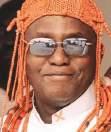
Oba of Benin, Oba Ewuare II (Omo N’Oba N’Edo Uku Akpolokpolo)
LAWYER
Non-Passage of Electoral Bill: Consequences on the 2027 Elections
Senate President, Senator Godswill akpabio, GCON
Speaker, House of Representatives, Rt. Hon Tajudeen abbas, GCON
LAWYER
Non-PassageofElectoral Bill: Consequences on the 2027 Elections
Quotables
‘The Electoral Act amendment isn't completed, but, they are already on television....they don't understand lawmaking. They don't know that, even the one in the Senate isn't completed until we look at the votes and proceedings....What we have done, hasn't been approved by the Senate.’ - Senate President, Senator Godswill Akpabio, GCON
‘'What we passed, and what the Senate President himself, when he was doing a clarification sitting on his chair, is transmission of results, not transfer. What is in the 2022 Law is transfer, and we don't want a law that is vague, or that will be misinterpreted. We want a Law, that is unambiguous. That is, electronic transmission of results’ - Senator Enyinnaya Abaribe, Senator representing Abia South Senatorial District
Power of Court of Appeal to Assume Jurisdiction like Court of First Instance
NBA Threatens Court Boycott Over Delay in Ngene’s Appeal Page V
Aboyade, SAN Bags Oyo State at 50 Award Page
Court Recognises Social Media as Legal Service in Pastor Okafor's Case
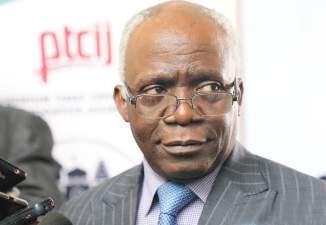
Military Coup and Court Martial: Is Falana Right?
Introduction
Iread with interest, Learned Senior Advocate, Mr Femi Falana’s article, “Why Coup Suspects Cannot Be Tried in a Military Tribunal” on the back page of This Day’s February 4, 2026 publication. I certainly agree with Mr Falana that coup plotting is indeed, a grave offence, and anyone accused of such a heinous crime of trying to violently overthrow a democratic government, should be prosecuted to the fullest extent of the law.
Mr Falana listed two categories of people, who allegedly planned a coup to overthrow the Tinubu administration last year - Military Officers from the rank of Captain to Brigadier General, and their Civilian collaborators. The Senior Advocate then cited Section 251(2) of the Constitution of the Federal Republic of Nigeria (as amended)(the Constitution) in support of his assertion that all the alleged coup plotters, both Military and Civilian, can only be tried at the Federal High Court (FHC) under Section 41 of the Criminal Code Act, as Section 251(2) of the Constitution provides that the FHC shall exercise jurisdiction and powers in respect of treason, treasonable felony and allied offences.
The Argument with SKB: Are there Exceptions to Section 251(2) of the Constitution?
It is certainly logical to conclude that Section 251(2) of the Constitution applies to all Nigerians. It singles out treason, treasonable felony and allied offences out of all the criminal offences, and uses the word “shall” to provide that the FHC has jurisdiction to try these offences. Nevertheless, this is where the argument divides into two.
I got into a debate on this issue with our Columnist, Stephen Kola-Balogun (SKB). Like Mr Falana, SKB believes that, whether Military or Civilian, Section 251(2) of the Constitution provides that treasonable cases must be tried at the FHC, and that the use of the word ‘shall’ in the provision, makes it mandatory, without exception. But, in BPS Construction & Engineering Co. Ltd v FCDA (2017) LPELR-42516(SC) per Kudirat Motonmori Olatokunbo Kekere-Ekun, JSC (now CJN), the Supreme Court held that: “It is true that generally, the word "shall" is interpreted in its mandatory sense. However, whether the word is used in its mandatory or directory sense, depends on the context in which it is used. The word "shall" can also mean "may", where the context so admits”.
In the case of the civil causes listed in the preceding Section 251(1) of the Constitution, this provision clearly gives the FHC power to exercise jurisdiction ‘to the exclusion of any other court’. This simply means that, in the causes listed in Section 251(1) of the Constitution, no other court but the FHC, is empowered to hear them. In Rivers State House of Assembly & Anor v Government of Rivers State & Ors (2025) LPELR-80539(SC) per Ibrahim Mohammed Musa Saulawa, JSC, the Supreme Court held inter alia thus: “….the term exclusive jurisdiction means a Court's power to determine or adjudicate an action or class of actions, to the exclusion of all other Courts”.
I commented to SKB that the key words in Section 251(1) & (2) conferring jurisdiction on the FHC are similar, aside from the magic words that confer ‘exclusive jurisdiction’ on the FHC in Section 251(1) of the Constitution, which are clearly absent from Section 251(2). I then asked SKB whether this could mean that, though jurisdiction is conferred on the FHC to try treasonable offences, there are other courts that could/may have concurrent jurisdiction with the FHC to try treason, treasonable felony and allied offences, such as the Court Martial? The rationale behind this line of thought is: (1) ‘shall’ is also used in 251(1), but reinforced and made certain with ‘to the exclusion of any other court’, unlike 251(2); if ‘shall’ is used in its mandatory sense, why the need for reinforcement? (2) that the absence of ‘to the exclusion of any other court’ in 251(2) could mean that ‘shall’ isn’t being used in its mandatory sense in Section 251(2), but as ‘may’, thereby allowing other courts to have jurisdiction in 251(2) with its absence therefrom. In Buhari & Anor v Obasanjo & Ors (2005) LPELR-815(SC) per Dennis Onyejife Edozie, JSC, the Supreme Court held thus: “It is settled law that, where the wordings of a statute are clear and unambiguous, the court must give them their plain and ordinary meaning: see Dominic Onuorah Ifezue v Livinus Mbadugha and Anor. (1984) 1 SCNLR 79, (1984) 5 SC 79; A.-G., Bendel State v A.-G., Federation (1982) 3 N.C.L.R”.
I submit that Section 251(2) of the Constitution is clear and unambiguous in its provision, and must therefore, be given its plain and ordinary meaning which is that, it gives the FHC the power to exercise jurisdiction in treasonable offences. It however, may
onikepo braithwaite
oNIkepo BraIThwaITe
Advocate onikepo.braithwaite@thisdaylive. com onikepob@yahoo.com
“Like Mr Falana, SKB believes that, whether Military or Civilian, Section 251(2) of the Constitution provides that treasonable cases must be tried at the FHC, and that the use of the word ‘shall’ in the provision, makes it mandatory, without exception….I commented to SKB that the….magic words that confer ‘exclusive jurisdiction’ on the FHC in Section 251(1) of the Constitution, are clearly absent from Section 251(2)…. whether this could mean that….there are other courts that could/may have concurrent jurisdiction with the FHC to try treason, treasonable felony and allied offences, such as the Court Martial?…. that the absence of ‘to the exclusion of any other court’ in 251(2) could mean that ‘shall’ isn’t being used in its mandatory sense in Section 251(1) or (2), but as ‘may’…..”
not confer ‘exclusive jurisdiction’ on the FHC in this regard, and trying to do so may be tantamount to making an addition to Section 251(2), without amending it by following due process.
Umoru Mandara v AGF (1984) 4 S.C.8 cited by Mr Falana, a case of treason related charges, happened during the military era, long before the 1999 Constitution, when Tribunals were given more power, treasonable offences were tried in camera under Military Decrees and the FHC’s jurisdiction was limited in criminal matters, and it didn’t have the jurisdiction to try treasonable cases simpliciter. Today, the FHC has the jurisdiction to try such cases.
Media Rights Agenda v Nigeria (2000) AHRLR 5 also cited by Mr Falana, had to do with Civilians being tried in Military Tribunals. The African Commission declared that Military Tribunals shouldn’t have any jurisdiction over civilians, under any circumstances; I concur, and do not envisage a situation in 2026 in which alleged civilian coup plotters can/will be tried by a Court Martial, when they are not military personnel, and generally not subject to the Armed Forces Act LFN 2004 (AFA), that is, ‘Service Law’, except in specific circumstances such as those mentioned in Section 146 of the AFA which concern offences that a civilian may commit, such as refusing to appear as a Witness in the Court Martial when summoned to do so, or insulting members of the Court Martial, or doing something that would generally be considered to be contempt in a regular court of law.
Court Martial Section 218(4)(b) of the Constitution empowers to the National Assembly (NASS) to inter alia, make laws for the disciplinary control of the Armed Forces of the Federation - the AFA is that law. The Court Martial, established by the AFA, is a military judicial court set up whenever required, for the discipline and punishment of members of the Armed Forces, including when they are accused of committing criminal offences. It is not the same as the Police Orderly Room Trial process, or that of the National Judicial Council for the Judges, which are administrative bodies for internal discipline. The Court Martial has the status of a High Court, as once convictions of the Court Martial are confirmed by the Army Council, appeals lie from there to the Court of Appeal, and ultimately to the Supreme Court - see Section 183 of the AFA.
Sections 104-113 of the AFA list crimes (referred to as ‘civil offences’ in the AFA) such as murder, manslaughter, forgery etc, that constitute offences under the AFA and can be tried by the Court Martial. Like Mr Falana stated, treason and allied offences are not expressly listed in the AFA. SKB felt that the fact that treason and allied offences are not expressly listed with the others in the AFA, and separately considered in Section 251(2) of the Constitution, translates into them being off limits for the Court Martial, particularly because the Constitution is supreme (see Section 1(1) & (3) thereof).
But, I directed SKB to Section 114(1) of the AFA, an omnibus clause which covers all
‘civil offences’ that are not expressly listed in the AFA such as treason, treasonable felony etc, and Section 114(2) which defines a civil offence as “…. an act or omission punishable as an offence under the penal provisions of any law enacted in or applicable to Nigeria….”. Section 114(3)(a) & (b) then expressly prescribes the death penalty for treason and murder, and other punishments prescribed by civil courts for lesser offences, and Section 118(a) & (b) also expressly empowers the Court Martial to award the death sentence and imprisonment, respectively.
Nature of Court Martial
In Olowu v Nigerian Navy (2011) LPELR3127(SC) per Muhammad Saifullahi MuntakaCoomassie, JSC, the Supreme Court held thus: “….the military Court Martial is unlike the conventional Court. Courts Martial operate a criminal procedure akin to jury trial”. In Iberi (Rtd) v AGF (2013) LPELR-20278(CA) per Rita Nosakhare Pemu, JCA, the Court of Appeal mentioned the two types of Court Martial thus: “Section 129 of the Armed Forces Act specifies two types of Court Martial. They are: Section 129 (a) A general Court Martial consisting of a President and not less than four members, a waiting member, a liaison officer and a Judge Advocate (b) A special Court Martial consisting of a President and not less than two members, a waiting member, a liaison officer and a Judge Advocate”.
Even though the Court Martial may not operate strictly like a Nigerian High Court with the involvement of a lay people and a jury type trial, in Samual & Ors v Nigerian Army (2006) LPELR-11751(CA) per Alfred Pearson Eyewunmi Awala, JCA, the Court of Appeal held that: “Court Martial is defined by Osborn's Concise Law Dictionary Ninth Edition at page 111 as a “Court convened by or under the military authority of a State, to try an offence against military or naval men for indiscipline, or against the ordinary law of the land committed by a solider or sailor in service. There is an appeal to a Court Martial Appeal Court under the Court-Martial (Appeal) Act of 1968 (as amended) in England". In this country, Appeal is to the Court of Appeal then to the Supreme Court, pursuant to the Armed Forces Decree of 1993 and confirmed by the Nigerian Constitution of 1999. The Court is a creation of the Nigerian Constitution of 1999 like the High Court, it is therefore, a Court of records. A Court Martial is usually an ad hoc military Court, convened by or under the military authority as aforesaid”.
The alleged Military Coup plotters will probably be tried by the General Court Martial, which appears to try more serious offences. It must consist of at least seven members, to be able to prescribe the maximum sentence of death - see Section 130 of the AFA. SKB found it unacceptable that in a democratic setting, members of the Armed Forces should be answerable to a Military Court, for such a grievous offence against the Nigerian State. He stood his ground that things have changed, and the Military should be subject to the FHC for a crime as serious as this, even if the Court Martial is able to try lesser crimes.
Conclusion
In conclusion, I cannot agree more with Mr Femi Falana, SAN, that the alleged Civilian coup plotters who are accused of trying to overthrow the Tinubu administration, cannot be tried by the Court Martial. Their cases can be separated from that of their Military Cohorts, and brought before the FHC. But, what about the prosecution of members of the Armed Forces? By reason of the foregoing, are there are enough grounds, both constitutionally and statutorily, to support the fact that members of the Armed Forces accused of coup plotting, can be tried by a Court Martial, and not the FHC? Or must they be tried at the FHC? Or should Section 251(2) of the Constitution be amended for better clarity, so that it provides that only the FHC has exclusive jurisdiction to try treasonable offences, in all circumstances? I recall that this issue was raised by Human Rights Activists in the aftermath of the #EndBadGovernance Protest in 2024, when 38 out of the 75 Youngsters arraigned at the FHC for treasonable offences, were said to be Minors between the age of 12 & 15 (see Sections 21 & 494 of the Child’s Rights Act 2003 and Administration of Criminal Justice Act 2015, respectively, on the categorisation of those less than age 18), insisting that they should have been taken to Family Court within the Children’s Justice System. Kindly, share your views on this, dear colleagues.
Femi Falana, SaN
Power of Court of Appeal to Assume Jurisdiction like Court of First Instance
Facts
The Respondents filed an action against the Appellant at the High Court of Ekiti State, seeking inter alia, a declaration of title that a certain large parcel of land known as Akola or Olokoju Family Land situate along Ijesa-Isu/Ikole Road, IluomobaEkiti belongs absolutely to the Olokoju Family of Iluomobia Ekiti which the Respondents belong to; an order of perpetual injunction restraining the Appellant from further trespassing on the said land; and orders of damages against the Appellant.
The Respondents claimed that the said land belongs to them from their ancestral history, and that they had been exercising acts of ownership over the land from time immemorial. They relied on decided cases and traditional history to trace their root of title to the Ajagun of Iluomoba Ekiti, whom they said gave them the land.
The Appellant filed his Statement of Defence, and also called to his aid evidence and witnesses to establish ownership of the land in dispute. After the close of trial and adoption of written addresses, the trial court delivered its judgement, wherein it dismissed the Respondents’ claims in their entirety.
Dissatisfied, the Respondents appealed to the Court of Appeal. The Court of Appeal allowed the appeal, set aside the judgement of the trial court, and granted the Respondents’ claims in part. Aggrieved, the Appellant lodged an appeal at the Supreme Court.
Issue for
Determination
The Supreme Court adopted the following issues formulated by the Appellant:
1. Whether the Court of Appeal was right when it struck out issues Nos. 1 and 2 formulated by the Appellant, for being incompetent.
2. Whether the Court of Appeal was right in coming to the conclusion that the Appellant joined no issue with the Respondents, in respect of the land in dispute.
3. Whether the Court of Appeal was right when it held the Appellant liable for trespass.
4. Whether on the facts and circumstances of this case, the Court of Appeal was right when it held that the Respondents were entitled to the declaratory and injunctive reliefs sought and awarded to them in respect thereof.
Arguments
On the 1st issue, Counsel for the Appellant argued that issues 1 and issue 2 formulated by the Appellant as Respondent at the Court of Appeal, in his Respondent’s Brief of Argument were wrongly struck out by the Court of Appeal, because the said issues were properly derived from the grounds of appeal submitted before the Court of Appeal.
On the 2nd issue, Counsel for the Appellant contended that both parties are in agreement with the identity of the disputed land, and although parties call the land with different names, they are in agreement that the varying interests are for the same land. He argued that the claims of the Respondents that no survey plan was filed and tendered by the Appellant is of no requisite value, as Exhibit B showed that the disputed land was located at Iluomoba/Ikare Road contrary to the pleadings and evidence of the Respondents which located it along Ijesa-Isu Road. Reacting to these issues, Counsel for the Respondents submitted that the finding of the Court of Appeal on issues 1 and 2 considered not to be rooted on any grounds of appeal, was not cross-appealed to appropriately accommodate the issues not rooted on the already filed Notice of Appeal, and any action taken without a crossappeal is nugatory and liable to be struck out in its entirety. Counsel submitted that a court of law will not condone smuggling into the case, incompetent arguments such as issues 1 and 2 in the Appellant’s Brief, and urged the Apex Court to discountenance the Appellant’s arguments thereon.
On the 3rd issue, Counsel for the Appellant submitted that the right to damages is integral in any claim for exclusive possession, and that the
In the Supreme Court of Nigeria Holden at abuja
On Friday, the 20th day of June, 2025
Before their lordships
Helen Moronkeji Ogunwumiju Ibrahim Mohammed Musa Saulawa emmanuel akomaye agim Stephen Jonah adah Jamilu yammama Tukur Justices, Supreme Court
SC.518/2012 Between
MR eBeNeZeR OGuNdaNa aPPeLLaNT
(For and on behalf of anaun Family of Iluomoba ekiti) And
CHIeF ISaaC OLOKuNLade
2. CHIeF JOSePH ORIMOLade
3. FeSTuS aLadeLOBa
(For and on behalf of Olokoju Family of Iluomoba ekiti)
ReSPONdeNTS
(Lead Judgement delivered by Honourable Stephen Jonah Adah, JSC)
party who shows that title resides with him, is the party entitled to maintain an action for trespass. Counsel submitted that the Respondents who had the opportunity of denying the Appellant’s averments, having failed to cross-examine the Appellant’s witnesses to deny the fact, had equally failed to prove exclusive possession of the disputed land to warrant a finding of trespass against the Appellant.
On the 4th issue, Counsel for the Appellant argued that the reliance of the Respondents on their pleadings and historical evidence, was marred by material inconsistencies and were grossly unsatisfactory to establish any claims for title to the land in question. In response, Counsel for the Respondents submitted that the assessment and ascription of probative value to evidence adduced in any
“….the Court held that the Court of Appeal under Section 15 of the Court of Appeal Act, is given full jurisdiction over the whole proceedings before it, as if the proceedings had been instituted in the Court of Appeal as a Court of first instance and may re-hear the case in whole or in part, or remit to the Court below for rehearing”
appellate Courts. The Apex Court agreed with the finding of the Court of Appeal that the said issues 1 and 2 raised by the Appellant as Respondent before the Court of Appeal were not derived from any grounds of appeal, and the Appellant did not file any cross-appeal upon which the said issues could have been hinged on. The Supreme Court held that the Court of Appeal thus, rightly struck out the said issues for being incompetent.
On the 2nd issue, the Court held that in our adjudicatory procedure in Nigeria, a case is joined when both sides have stated their positions in the pleadings in the following sequence: (a) The Plaintiff has filed the originating process; (b) the Defendant has entered appearance and filed a statement of defence; (c) the Plaintiff has filed a reply to the defence if necessary; and (d) counterclaims, setoffs, or further pleadings have been addressed. The Court held that once the necessary pleadings have been exchanged and closed, the issues in the dispute are clearly set before the court, the court knows exactly what is being disputed and parties are aware of each other’s positions.
The Court held that in the instant case, the Court of Appeal found that the parties set their respective claims on separate lands and the identity of the land being claimed by the Appellant was different from the land the Respondents were laying claim to. The Apex Court held that the Court of Appeal found that while the Respondents claimed a farmland along along Ijesa-Isu Road/Ikole Road which is called “Akola” or “Olokoju”, the Appellant on the other hand was claiming a different land called “Ayetoro” along Aisegba Road which is a very big settlement, and not a farmland. The Apex Court held that the Court of Appeal came to a sound conclusion when it held, after looking at the evidence on record and pleadings filed by the parties, that the land being claimed by the Appellant is not the same as the land being claimed by the Respondents and therefore, the Appellant did not join any issue with the Respondents in respect of the land in dispute which was claimed by the Respondents as Claimants. Deciding the 3rd and 4th issues together, the Court held that the Court of Appeal under Section 15 of the Court of Appeal Act, is given full jurisdiction over the whole proceedings before it, as if the proceedings had been instituted in the Court of Appeal as a Court of first instance and may re-hear the case in whole or in part, or remit to the Court below for rehearing. The Apex Court referred to its decision in BANK OF INDUSTRY v OBEYA (2022) 4 NWLR (PT. 1821) 589 in which it held that the powers of the Court of Appeal to assume jurisdiction as derived from Section 15 of its Act, is to enable the appellate court make any order or give any directive the trial court ought to have made but failed to do.
case is the function of the trial court based on what it observed personally during trial court. However, the trial court’s finding and conclusion can be disturbed by an appellate court, if the assessment and examination of the evidence was erroneous and against the principles and procedure in law. Counsel for the Respondents maintained that in the instant case, the trial court did not assess the averments of the witnesses before it appropriately, and the Court of Appeal was right in assuming jurisdiction to determine the merits of the Respondents’ case, after which it rightly found that the Respondents proved their traditional history of ownership of the disputed land, with cogent and credible evidence.
Court’s Judgement and Rationale Deciding the 1st issue, the Supreme Court held that it is a well settled position of our law that an issue for determination must originate from the grounds of appeal, and any issue that is not a derivative of the grounds of appeal is incompetent in any case on appeal. The Court held further that an appellate court must be able to match an issue with the ground of appeal, and an issue for determination that is strange to the grounds of appeal or opposite of what is contained in the grounds of appeal is incompetent, and cannot be allowed to stand in the appellate jurisdiction of the
The Apex Court held that in the instant case, the decision of the trial court was bereft of the correct reasoning that would have enabled the Court of Appeal to affirm the same, and the conclusion that the case of the Respondents at trial was caught by estoppel per rem judicata, was not properly supported by the documentary evidence adduced before it. The Court held that the authority of the Court of Appeal to take over the consideration of the Respondents’ claims is solidly in Section 15 of the Court of Appeal Act, and since the evidence and necessary facts needed for the consideration of the claim of the Respondents were already before it, the Court of Appeal was absolutely right in delving into the consideration of the merits of the Respondents’ claim, which it assessed thoroughly and arrived at a just conclusion that the Respondents proved their superior title to the land in dispute, and were entitled to damages for trespass as well as declaratory and injunctive reliefs against the Appellant.
Appeal Dismissed.
Representation
Adebayo Adewunmi for the Appellant. Owoseni Ajayi with Oyenike Aribisala for the Respondents. Reported
Co.)
Honourable Stephen Jonah Adah, JSC
NBA Threatens Court Boycott Over Delay in Ngene’s Appeal
Stories by Steve Aya
The National Executive Council (NEC) of the Nigerian Bar Association (NBA) has resolved to take decisive action, over what it described as persistent and unjustified delays in the appeal involving one of its members, Mr Bright Ngene.
At its recent deliberations, NEC approved the immediate constitution of a fivemember Committee to interface with the Chief Judge of Enugu State, to ensure that a hearing date for Mr Ngene’s appeal is fixed within two weeks.
The Council expressed concern that the delay raises serious questions, about the protection of the rights of legal practitioners and public confidence in the administration of justice.
The Committee is to be chaired by Sammie Somiari, SAN, with Musa Attah, SAN, Chairman
of the NBA Enugu Branch; V. C. Odo; Hon. Chidi Aroh; and Osato Uwagboe as members.
Senior Advocates Emeka Obegolu and Abdul Muhammed, also volunteered to serve on the Committee.
According to NEC, the Committee’s mandate is to engage directly
with the Chief Judge of Enugu State, to secure an expedited hearing of the appeal in the interest of justice, fairness, and respect for due process.
NEC further resolved that if a hearing date is not fixed within the stipulated two-week period, NBA Branches in Enugu State will
commence a boycott of proceedings in the court of the Chief Judge. The Association also indicated that it would explore additional steps, including legal action, to challenge what it considers a violation of Mr Ngene’s fundamental rights.
The Council stressed that administrative delays
within the justice system, must not be allowed to erode the rights of legal practitioners or undermine the rule of law.
The resolution, NEC stated, underscores the NBA’s commitment to defending its members, safeguarding due process, and ensuring accountability within the judicial system.
Aboyade, SAN Bags Oyo State at 50
Award
Pioneer Editor of THISDAY LAWYER, Ms Olufunke Aboyade, SAN has been conferred with the Oyo State Award at the State’s 50th Anniversary, which held at Ibadan last Tuesday, February 3, 2026.
The Oyo State Government also gave a posthumous award to her father, late Professor Ojetunji Aboyade, a world renowned Economist.
According to Oyo State Government, the honours are in recognition of individuals whose lives and work have made
Court Slams Lagos School, Awards Teacher N4.4m for 27-Year Gratuity
The National Industrial Court sitting in Lagos has condemned the conduct of a Lagos Private School, for unlawfully denying a teacher her gratuity after 27 years of service, ordering the school to pay a total of N4.4 million in compensation.
In a judgement delivered by Hon. Justice Joyce A. O. Damachi, the court awarded Mrs Anniette N1.9 million as gratuity, N2 million as general damages, and N00,000 as cost of action, describing the school’s actions as unfair and inconsistent with basic principles of labour justice.
The court held that employers who have consistently operated under a condition of service over a long period, cannot turn around to repudiate those same conditions when it becomes inconvenient. Justice Damachi stressed that an employment contract need not be signed to
be binding, where both parties have acted on its terms.
Evidence before the court showed that Mrs Anniette was employed as a teacher in 1992, had her appointment confirmed in 1994, and served the school diligently until her employment was terminated in November 2021.
Mrs Anniette told the court that under the School’s Conditions of Service, employees who had served for 16 years and above were entitled to full gratuity. She said the School refused to pay her terminal benefits despite repeated demands, forcing her to seek judicial intervention.
The court also faulted the School’s claim that gratuity was discontinued following the Pension Reform Act 2004, noting that evidence showed other employees disengaged after 2005 were paid gratuity.
Justice Damachi held that
employers cannot selectively apply workplace policies, to deny workers their lawful entitlements. In dismissing the School’s defence, the court described its attempt to rely on parts of the Conditions of Service while rejecting others, as inequitable and contrary to fair labour practice.
Justice Damachi ordered the school to pay the awarded sums within 30 days, warning that failure to comply would attract post-judgement interest at the rate of 10% per annum - a decision widely seen as a strong message against the exploitation of long-serving workers.
enduring contributions to the growth, reputation, and development of Oyo State, both locally and internationally.
The award presentation ceremony, Oyo State @ 50 celebrations held at the State Banquet Hall, Oyo State Government House, Agodi, Ibadan and was hosted by Governor Seyi Makinde.
Ms. Aboyade is the Managing Partner of Aboyade & Co. She is a Notary Public, a Fellow of the Chartered Institute of Arbitrators (UK), Nigeria Branch. She obtained her LL.B from the University of Ife at the age of 19,
graduating in the top one percent of her class, and proceeded to the Nigerian Law School, where she again, graduated with distinctions.
She later earned an LL.M from the University of Cambridge, Jesus College, in 1985, achieving first-class grades in several courses.
In 2013, she was conferred with the rank of Senior Advocate of Nigeria, becoming the first female SAN from Oyo State, and the only woman from her Law School set to attain the prestigious rank.
Court Recognises Social Media as Legal Service in Pastor Okafor 's Case
In a landmark ruling, an Ikeja High Court has allowed social media influencers to be served with court documents via their active online accounts, signalling a major step in the digital evolution of Nigeria’s legal system.
Justice Akintunde Savage granted leave for Martins Otse, also known as VeryDarkMan, and Kelvin Emmanuel to be served through WhatsApp, Instagram, and other verified
platforms in the suit filed by pastor Dr Chris Okafor against Nollywood Actress, Doris Ogala.
The case has been adjourned to February 25 for proof of service, and hearing of preliminary objections.
The court’s decision comes after the Claimant’s Counsel, Mr Ife Ajayi, explained that the originating process had already been published in a national newspaper, but physical addresses for the
second and third Defendants were unknown. Ogala’s Counsel had requested the use of social media for direct service, which the court approved without objection.
The suit follows a January 22 order restraining the Defendants from mentioning Okafor, his Church, or Ministry on any platform and from releasing private materials, including texts, images, or videos, that could be used to blackmail
or extort the Claimant. Justice Savage emphasised accountability, requiring the Bailiff to confirm proof of service online. Legal experts say the ruling sets a precedent for the use of digital platforms in serving court processes, reflecting the justice system’s adaptation to technological realities, while protecting the rights of public figures and ensuring due process in high-profile cases.
Pastor Chris Okafor
NBA President, Afam Osigwe, SAN
Governor Seyi Makinde (left) and Funke Aboyade, SAN
Non-Passage of Electoral Bill: Consequences on the 2027 Elections
For months, the National assembly has been embroiled in bickering and palpable tension, over the passage of the electoral act 2022 (Repeal and Reenactment) Bill 2025. Many looked forward to the swift passage of the crucial Bill, because of its potential to rectify most of the imperfections in the old electoral law, including the central issue of electronic transmission of results from polling units to the IReV portal in real time. Is there any hope that Nigerians will enjoy the benefit of this innovation, seeing as National assembly members appear to be at loggerheads over this matter, and indeed, other aspects of the Bill?. Former INec National commissioner, Festus okoye; Kunle edun, SAN; Samson Itodo and Sylvester Udemezue scrutinise the issues around this law, and why Lawmakers seem to be challenged with its swift passage
Controversies Surrounding the Electoral Act, 2022 (Repeal and Reenactment) Bill 2025
Festus Okoye
What are the Issues?
The Senate of the Federal Republic of Nigeria, passed its own version of the Electoral Act 2022 (Repeal and Reenactment) Bill 2025. Some amendments made, and provisions dropped, have raised significant concerns among Nigerians about the integrity of the 2027 elections, and their trust in the electoral process. While these are genuine concerns and reflect Nigerians'
desire for credible elections, it is important to understand the impact of provisions that have been passed or rejected on election credibility. It is also important to emphasise that timelines should not be viewed in isolation; they must be considered as a whole.
“Essentially, the timelines in the Bill render the Constitution's timelines for resolving electoral disputes ineffective. The consequence is that, all pre-election matters will be dealt with by the Federal High Court after the elections have taken place…. It is crucial for the National Assembly, to align the timelines in the Electoral Act and the Constitution”
Furthermore, an electoral management body cannot plan effectively under conditions of uncertainty. Although the Electoral Act 2022, is the current law, it would be futile for the Independent National Electoral Commission (INEC) to pretend otherwise or to ignore the possibility that a new law might replace the existing one. The conclusion of amendments to the electoral legal framework for elections, is a fundamental principle of the democratic process. Delays in passing the electoral legal framework, may disrupt the electoral process.
Timelines in the Electoral Bill Adherence to and fidelity to timeliness, are essential for the electoral process. Some timelines in the Constitution and the Electoral Act are as inflexible as the Rock of Gibraltar, especially when these deadlines are enshrined in the Constitution itself. Timelines help reduce planning uncertainty and provide the electoral management body, political parties, voters, and the public with an indication of when key events will occur, enabling them to prepare. Timelines must be wellstructured, properly ordered, and
reliable, as one timeline connects to another; any incorrect sequencing can lead to legal challenges and disrupt the electoral process.
The Senate of the Federal Republic of Nigeria failed to adhere to these basic principles, when it passed the Electoral Act, 2022 (Repeal and Reenactment) Bill 2025. This has resulted in challenges, and it is hoped that the Conference Committee of the National Assembly will address the discrepancies, before submitting the Bill to the President for assent.
Firstly, the Senate shortened the deadline for submitting the list of nominated candidates from 180 days to 90 days without recognising that organising primaries and verifying valid nominations are substantial tasks. The Commission must monitor the conduct of primaries, and the primaries must pass the test of validity. After the conduct of primaries, the parties must submit the list of validly nominated candidates to the Commission. The parties will field candidates, and submit their names and particulars to the Commission.
Subsequently, the Commission has 21 days to publish the list of nominated candidates for their respective constitu-
National Assembly
Non-Passage of electoral Bill: consequences on the 2027 elections
encies. After publication, candidates have 14 days to raise objections, and correct errors in the particulars published by the Commission. 21 days plus 14 days, totals 35 days. This leaves us with 55 days until the election.
Unfortunately, Section 31 of the Bill allows for the withdrawal of candidates after nomination. It states that a candidate may withdraw his candidature by written notice signed by him, along with a sworn affidavit submitted personally by the candidate to the political party that nominated him for the election, and the political party must convey such withdrawal and the sworn affidavit to the Commission, no later than 90 days before the election.
The 90-day withdrawal period had already started, before the Commission published the list of nominated candidates. This is a significant legal flaw. It should not happen, and the National Assembly must address it before it turns into a serious problem.
Essentially, the timelines in the Bill render the Constitution's timelines for resolving electoral disputes ineffective. The consequence is that, all pre-election matters will be dealt with by the Federal High Court after the elections have taken place.
Section 285(9) of the Constitution states that all pre-election matters must be filed within 14 days of the event, decision, or action in question. Subsection 10 specifies that the Court, in every pre-election matter, shall deliver its judgement in writing within 180 days from the date of filing the suit.
An appeal against a decision in a pre-election matter, must be lodged within 14 days of the delivery of the judgement being appealed. Meanwhile, an appeal from a Court's decision in a pre-election matter, shall be heard and decided within 60 days of the date of filing the appeal.
Section 285(14) defines pre-election matters to include an aspirant who complains that any provisions of the Electoral Act or any Act of the National Assembly regulating the conduct of party primaries, as well as the guidelines of a political party for conducting party primaries, have not been followed by a political party in relation to the selection or nomination of candidates for an election; an aspirant challenging the actions, decisions, or activities of INEC regarding their participation in an election, or complaining that the provisions of the Electoral Act or any other Act of the National Assembly regulating elections in Nigeria have not been adhered to by the Commission concerning the selection or nomination of candidates and participation in an election; and a political party contesting the actions, decisions, or activities of INEC that disqualify its candidate from participating in an election, or complaining that the provisions of the Electoral Act or any other applicable law have not been complied with by the Commission regarding the nomination of political party candidates, the election timetable, voter registration,
and other activities related to the preparation for an election.
The implication is that no preelection matters will be resolved before the election, which undermines the push for the inclusion of timelines in the Constitution.
It is crucial for the National Assembly, to align the timelines in the Electoral Act and the Constitution. A conflict between the two, could lead to a legal and constitutional crisis. The electoral management body, political parties, and civil society groups must trust the law and operate within its boundaries and framework.
Mandatory Electronic Result Transmission
The provisions of the Electoral Act, 2022, and the repealed section of the Electoral Act 2022 (Repeal and Reenactment) Bill, 2025, do not significantly improve the electoral process. Instead, the fuss about the deleted or removed provision will only complicate the electoral process, mislead Nigerians about the Bill's true aim, and reflect poorly on the country’s ability to learn from history, precedent, or past mistakes.
The Senate rejected the new provision, which states that the Presiding Officer shall electronically transmit
“The widespread anger over the rejection of real-time electronic transmission to the IReV portal is thus, misplaced. The focus should be on the mandatory electronic transmission of results to the collation system, rather than to the INEC Result Viewing Portal. Whether results are transmitted mandatorily or at discretion to the Result Viewing Portal….its purpose is to allow the public to view polling unit results. It does not enter the collation system, nor change the current situation”
the results from each polling unit to the IREV portal in real time, and such transmission shall be completed after the prescribed Form EC8A has been signed and stamped by the Presiding Officer, and/or countersigned by the candidates or polling agents where available at the polling unit.
This does not improve the existing section of the Electoral Act 2022, which states that the presiding officer shall transfer the results, including the total number of accredited voters and the ballot results, in a manner prescribed by the Commission.
In Oyetola v INEC (2023) 11 NWLR, Part 1894, the Supreme Court clarified that, as their names suggest, the Collation System and the INEC Result Viewing Portal are integral parts of the election process and have specific roles. The Collation System includes Centres where results are collected, at various stages of the election. Polling unit results transmitted to the collation system, enable the relevant collation officer to verify a polling unit result when necessary for collation. The results transmitted to the Results Viewing Portal, are intended to allow the public to view polling unit results on election day.
In Obi v INEC (No. 1) (2023) 19 NWLR, the Supreme Court also clarified that the INEC Results Viewing Portal (IReV) is not a collation system. As their names suggest, the Collation System and the INEC Results Viewing Portal are components of the election process, and serve distinct yet, complementary functions within it. The Collation System includes Centres, where results are compiled at various stages of the election. Accordingly, results transmitted to the collation system, enable the relevant collation officer to verify polling unit results as needed for collation. The results transmitted to the Results Viewing Portal are intended to give the general public the opportunity to view polling unit results on election day.
The widespread anger over the rejection of real-time electronic transmission to the IReV portal is thus, misplaced. The focus should be on the mandatory electronic transmission of results to the collation system, rather than to the INEC Result Viewing Portal. Whether results are transmitted mandatorily or at discretion to the Result Viewing Portal, does not alter the fact that its purpose is to allow the public to view polling unit results. It does not enter the collation system, nor change the current situation.
Furthermore, Section 152 of the Bill, on interpretation, defines “transmit” as “to send, transfer or communicate from one person or place to another manually or electronically.” The Bill, as currently worded, even if enacted, will not resolve any issues; it will only give Nigerians a false and misplaced hope that the results of the 2027 general election will be transmitted electronically to the Collation System, when in fact, this is not the case.
Other Issues
For the electoral management body, planning is essential for a successful election. The Commission suggested to the Joint Committee of the National Assembly on Electoral matters that the invitation for political parties to verify their identities using samples of relevant electoral materials proposed for the election, should occur 60 days before the election; however, it was changed back to the original 20 days.
INEC will produce ballot papers for a registered voter population of 84,004,084 (2023 figure), potentially rising to over 90,000,000 for the 2027 election. This includes one Presidential election, 28 Governorship elections, 109 Senatorial Districts, 360 Federal Constituencies, and 993 State Constituencies, with deployment to 176,846 polling units. These ballot papers feature security elements, and some may be printed
House of representatives in Session
Non-Passage of electoral Bill: consequences on the 2027 elections
abroad, transported by trucks, and secured in the State Offices of the Central Bank of Nigeria. Therefore, time is of the essence.
Section 77 of the Act was amended to prevent seasonal migration, promote democracy within political parties, and encourage members to uphold the party's principles and ideals, thereby discouraging defection in search of a platform.
The Joint Committee on Electoral Matters recommended that each registered political party should keep a digital register of its members, including their name, gender, date of birth, address, State, Local Government, ward, polling unit, National Identification Number, and photograph, in both physical and electronic formats. Upon registration, a membership card must be issued to each member. Each party is required to make this register available to the Commission at least 30 days before the scheduled date for party primaries, congresses or conventions. Only members listed in the register shall be eligible to vote and stand for election in party primaries, congresses, and conventions. The Senate shortened this period from 30 days to 7 days, and removed the requirement that only registered members may vote and be voted for.
Conclusion
The timelines and real-time electronic transmission of results are central to the controversy surrounding the Electoral Act 2022 (Repeal and Reenactment) Bill, 2025. The Joint Harmonisation Committee of the National Assembly must resolve these issues before passing the Bill to the President. Other contested matters, are less significant than these. INEC must engage with the leadership of the National Assembly. The future of the electoral process and the 2027 election, depends on our actions or inactions regarding the Electoral Act and the Constitution.
Festus Okoye, Lawyer; former INEC National Commissioner on Information and Voter Education
Needless Controversy Over the Electoral Amendment Bill 2025
the National Assembly. However, for there to be a Law/Act per se, there must be a majority vote case by all the members of the National Assembly at a joint section and thereafter, assented to by the President of the Federal Republic of Nigeria, this is as contained in Section 58 CFRN.
In a nutshell, in respect of the recently passed Electoral Amendment Bill by the Senate on Wednesday the 4th day of February, for the Bill to become a Law/Act both Chambers of the National Assembly must agree and vote on the various issues/Clauses as contained in the Bill seeking to amend the 2022 Electoral Act.
e-Voters card from the INEC Website
Kunle Edun, SAN Section 47 of the 1999 Constitution of the Federal Republic of Nigeria (CFRN) as amended, establishes the National Assembly which is made of two chambers, namely; the House of the Representative (lower/Green Chamber) and the Senate (Upper/Red Chamber).
However, the Senate during its plenary deliberated on some of the issues listed below as it relates to the Bill for the amendment of the 2022 Electoral Act. They are:
The Constitution, in Section 4, also places the sole responsibility of lawmaking as it concerns the Federation on
Rejection of Transmission of Election Results
One of the major decisions taken by the Senate, was the rejection of the proposal to make the electronic transmission of election results from polling units to INEC’s after vote counting. Instead, under Clause 60, the Senate retained the provision in the 2022 Electoral Act that allows election results to be transmitted to the Collation Centre.
In my view however, I wish the Senate would allow for transmission of election results in real-time, in order to foster transparency and confidence in the Electoral system.
Blockage of the Download of
“It is interesting that the House of Representative has taken a more progressive approach towards the Amendment Bill, as against attitude of the Senate….The Senate’s position on several critical provisions diverging sharply from that of the House of Representatives, triggered widespread condemnation from civil society, opposition Lawmakers, and concerned citizens”
On voter identification under Clause 47, the Senate rejected a proposal to allow alternative forms of identification for voting other than the Permanent Voter Card (PVC). Rather, they replaced “smart card readers” with the Bimodal Voter Accreditation System (BVAS) for accreditation and voting, thereby retaining the PVC as the sole mandatory means of identification at polling units. Initially, the Bill had proposed that since BVAS does not read the microchip embedded in PVCs, the card should no longer be compulsory for voting, allowing the use of the National Identification Number (NIN), Nigerian passport, or birth certificate. However, the Senate disagreed with this proposal, and retained the PVC as the primary mode of voter identification.
We live in the 21st century where technology has taken the centre stage, turning a blind eye to the role technology has played in making our lives much easier, is nothing short of wholesome foolery.
I beg the Senate to reconsider it’s position as it relates to the use of e-Voters card or other valid means of identification, so as to ensure a smooth running of the forthcoming 2027 general elections.
Reduction of Notice of Election from 360 days to 180 days
The Senate also amended Clause 28 of the electoral timetable by reducing the period within which INEC must publish a notice of election from 360 days to 180 days.
This is a bold move by the Senate to expunge the spirit of tardiness from INEC, and I must say it is a move in the right direction.
Reduction of timeline for publishing list of candidates from 150 days to 60 days Under Clause 29, the deadline for political parties to submit their list of candidates was reduced from 120 days to 90 days before the election.
This is also commendable, as political parties are to stand on their toes and take electioneering seriously, as this will help in the conduct of primaries timeously and give the INEC ample time to plan towards the main election and other logistics associated with it. Furthermore, it is indisputable that our electoral jurisprudence has been unstable over the years, flowing from events which have occurred over the years; from the issue of securing 25% vote cast in Abuja by a Presidential candidate to become President, to the issue of retainership of seats by lawmakers after defecting to other political parties, and others. Though the Constitution empowers the National Assembly to make laws for the Federation, those powers must be exercised “for the peace, order and good government of the Federation” as enshrined in Section 4 CFRN (as amended). Thus, it is incumbent on the National Assembly to make laws which will reflect the will of the people (Nigerians) at all times, most especially during the legislative process such as this, failure of which anarchy may loom.
It is interesting that the House of Representative has taken a more progressive approach towards the Amendment Bill, as against attitude of the Senate. It is our hope therefore, that when both Houses convene to harmonise their respective positions with respect to the outstanding discrepancies, that the will of the people will be respected, and a more stable and coherent Electoral Law will be passed.
Kunle Edun, SAN, former National Publicity Secretary, Nigerian Bar Association
Electoral Bill: Senate’s Vote and Impending Regression of Electoral Reform Gains
Samson Itodo
On February 4, 2026, Nigeria’s Senate passed the Electoral Act (Repeal and
INec chairman, Prof Joash Amupitan, SAN
Non-Passage of electoral Bill: consequences on the 2027 elections
Re-enactment) Amendment Bill. What might otherwise have been routine legislative business, quickly sparked significant public outcry. The Senate’s position on several critical provisions diverging sharply from that of the House of Representatives, triggered widespread condemnation from civil society, opposition Lawmakers, and concerned citizens.
At issue are three interrelated pillars of electoral governance: transparency of results transmission, inclusivity of voter access, and certainty of electoral timelines. The Senate’s decisions rejecting electronic transmission of results, blocking downloadable electronic voter cards, and compressing critical pre-election timelines directly, affect each of these pillars. The rejection of electronic transmission of results, is not merely a technological choice. It is a structural decision about where discretion resides, within the electoral chain. The implications for 2027 are stark: Nigeria approaches another consequential election with an electoral framework designed to accommodate, rather than prevent, result manipulation.
Yet, when the Bill reached third reading on February 4, 2026, the Senate rejected the amendment to Clause 60(3) that would have required presiding officers to "electronically transmit results from each polling unit to the IReV portal in real time". Instead, Senator Akpabio noted that legislators retained the existing provision allowing INEC to "transfer results in a manner as prescribed by the Commission”, the identical language whose discretionary nature enabled 2023's manipulation.
In a surprising development, some opposition Senators led by Senator Enyinnaya Abaribe addressed a press conference asserting that the Senate had, in fact, overwhelmingly voted in favour of mandatory electronic transmission. These conflicting accounts have deepened public confusion, and raised legitimate questions about what precisely transpired during the vote. Until the official Vote and Proceedings are published, the record remains contested. But, one fact is clear: there is a concerted effort to resist embedding mandatory electronic transmission into the Electoral Act.
As our electoral experience reveals, the most vulnerable stage of elections, is the transition from polling unit results to collation centres. Where result transmission lacks real-time transparency, opportunities for alteration, delay, or contestation increase. Electronic transmission reduces this vulnerability, by creating parallel
audit trails and limiting human interference between declaration at the polling unit and aggregation at collation centres. By rejecting this safeguard, the Senate effectively reexpands discretionary space within the results management process. In a context like Nigeria, where postelection litigation is frequent and trust in collation processes remains fragile, this decision increases the probability of disputes, not their resolution.
The Collation Centre Black Box
The critical vulnerability exploited in 2023, was the gap between polling unit results and higher-level collation. At polling units, BVAS technology functioned reasonably well: voter authentication occurred biometrically, results were announced publicly, and Form EC8A was signed by party agents. The problem emerged at ward, local government, and State collation centres, spaces where result sheets could be altered, where party agents could be intimidated or excluded, and where mysteriously, the results that had been visible at polling units transformed during aggregation.
Election Tribunals heard extensive testimony about this phenomenon.
In Atiku Abubakar v INEC (2023), Petitioners presented evidence that result sheets arrived at State collation centres, with figures different from those recorded at polling units. The Court of Appeal
“As our electoral experience reveals, the most vulnerable stage of elections, is the transition from polling unit results to collation centres. Where result transmission lacks real-time transparency, opportunities for alteration, delay, or contestation increase. Electronic transmission, reduces this vulnerability….In a context like Nigeria, where post-election litigation is frequent and trust in collation processes remains fragile, this decision increases the probability of disputes, not their resolution”
ultimately ruled that because the Electoral Act made transmission discretionary rather than mandatory, INEC's failure to upload results in real-time did not invalidate the election - precisely the legal gap that mandatory transmission would have closed. This judicial reasoning exposes the fundamental flaw in discretionary frameworks: when transmission is optional, its absence cannot be challenged. Mandatory transmission would have established a chain of custody making it legally impossible for polling unit results to "change" during collation, without triggering invalidity. Discretionary transmission makes such changes technically irregular, but legally sustainable.
Rejecting Downloadable Voter Cards: Access and Administrative Fragility
The refusal to allow downloadable electronic voter cards, must also be understood within Nigeria’s history of logistical bottlenecks in voter card production and distribution. Electoral integrity encompasses not only accurate counting, but also equitable access to participation. Administrative failures that prevent registered voters from obtaining physical Permanent Voter Cards (PVCs), have historically produced de facto disenfranchisement. The proposal to allow electronic alternatives, was a pragmatic innovation intended to mitigate State incapacity. Its rejection preserves a rigid system in which voters bear the consequences of administrative inefficiency.
Compressed Timelines and the Politics of Uncertainty
Perhaps, the most structurally consequential amendment is the compression of electoral timelines, reducing the notice of elections from 360 to 180 days and slashing nomination publication periods from 150 to 60 days. Time in electoral administration, is not neutral. It shapes preparedness,
procurement cycles, training, litigation windows, party compliance, and citizen awareness. Shortened timelines also constrain oversight actors’ civil society, media, political parties, and voters from scrutinising candidate eligibility, monitoring procurement processes, and preparing for credible participation. In complex electoral environments, certainty is stabilising. Compressed timelines generate uncertainty, and uncertainty in polarised contexts amplifies suspicion. Legislating shorter timelines in a system already burdened by logistical complexity, risks institutional overload. The predictable outcome is operational stress, increased litigation, and contested legitimacy. The Senate’s position will complicate INEC’s electoral preparations, and result in logistical challenges in future elections.
The Path Forward: Harmonisation as
Battleground
The Bill now heads to harmonisation between the Senate and House versions, before going to President Tinubu. Both Chambers have constituted Conference Committees, to harmonise different positions. This is where the real fight begins. The Conference Committee, now carries historic responsibility. It must decide whether Nigeria moves forward toward greater transparency, or backward into procedural fog. Civil society must mobilise. Opposition parties must unite, around this single issue. Citizens must make electronic transmission non-negotiable. Because here's what's at stake: if mandatory electronic transmission fails at harmonisation, the 2027 elections will be 2023 redux same BVAS machines, same collation centre mysteries, same tribunals ruling that INEC's technological failures don't invalidate fraudulent victories. We will have an election where everyone knows who won and everyone accepts who was declared winner, and those two facts will remain tragically distinct. Africa's largest democracy, deserves better than this. The question is whether its citizens will demand it.
electoral officer Using BvAS during election
Non-Passage of electoral Bill: consequences on the 2027 elections
Samson Itodo, Election, Democracy, and Public Policy Enthusiast; Executive Director of Yiaga Africa; Principal Partner, Election Law Centre; Chairperson, African Union Advisory Group on AI in Peace, Security and Governance; Member, Kofi Annan Foundation Board and the Board of Advisers of the International Institute for Democracy and Electoral Assistance (IDEA)
Removal of Mandatory Real-Time Electronic Transmission from Electoral Bill
Sylvester Udemezue
Regarding the controversy surrounding the alleged rejection of the express inclusion of mandatory real-time electronic transmission of election results in the draft Electoral Bill 2026, I have just reviewed a news report titled “Electoral Act: Akpabio Admits, Defends Removal of ‘Real-Time’ from Bill”, published by Tribune Online on 8 February, 2026. In light of the Senate President’s clarification, it can now be said, without speculation, that we have heard directly from the horse’s mouth. The clarification by the Senate President, Godswill Akpabio, confirms that the National Assembly deliberately removed the “real-time” electronic transmission requirement in order to preserve discretion for INEC and, by implication, to retain manual collation as the decisive stage of result declaration. The unavoidable implication of this position is stark: electronic transmission is no longer treated as an indispensable safeguard of electoral integrity, but as an optional, discretionary, and secondary mechanism: subordinate to manual Form EC8A and other physical election records. This position is deeply problematic, both legally and empirically.
(1) Electronic Transmission that isn’t Real-time and Polling-unit-based, is Functionally Useless If electronic transmission will not occur from the polling unit, on election day, within the election timeframe, then there is little or no rational basis for approving electronic transmission at all. Transmission that occurs (a) after election officials have left polling units, (b) after manual collation has commenced, or (c) on a later date, is structurally incapable of preventing fraud. It merely digitises an alreadycompromised process. The polling unit is the only point in the electoral chain, where results are still relatively insulated from human interference.
Once Form EC8A leaves the polling unit, the integrity of the process collapses under the weight of human discretion, logistics, political pressure, and institutional opacity.
(2) The “Network Failure” Argument is a Red Herring
The Senate President’s argument, that mandatory real-time transmission would prevent elections from holding in areas with poor network or grid failure, is conceptually flawed and empirically weak. Mandatory electronic transmission, does not mean uniform technical conditions everywhere; it means uniform legal obligation. As shown in comparative electoral systems where electronic transmission is the order (India, Brazil, Estonia, and even parts of the United States), and as analysed in my article cited above, technical contingencies are anticipated and legislated for, not used as an excuse to abandon systemic safeguards.
(3) Technical Exceptions Can be Legislated, Without Destroying the Rule
Rather than reject mandatory electronic transmission, the Electoral Act can, and should, contain carefully designed contingency provisions, such as: (a) repeat polls where transmission is technically impossible, (b) supervised relocation of electoral officers (with party agents and security) to the nearest network-enabled area to
“Electronic transmission must be expressly mandated by ….the Electoral Act….The time of transmission must be clearly defined, and made mandatory…. electronic transmission is meaningless if results are sent the next day, after manipulation has already occurred….The place of transmission must be….the polling unit. Transmission from collation centres or INEC offices defeats the very purpose….”
ensure transmission. These solutions are extensively canvassed and illustrated with Draft Provisions in my said article, and they reflect best practices in election-integrity engineering.
(4) Poor Network Or Grid Failure isn’t a Legally Defensible Ground for Rejecting Mandatory Transmission Nigeria already conducts online banking, online BVN verification, online NIN enrolment, online real-time voter accreditation (BVAS), across the same terrain now cited as technologically unfit for elections. To suddenly invoke infrastructure weakness only at the collation stage of elections, is neither honest nor persuasive. It reveals a preference for human discretion over technological constraint, which is precisely where electoral fraud thrives.
(5) Non-mandatory Electronic Transmission Serves No Material Purpose
There is no point whatsoever in providing for electronic transmission, if it is not made mandatory. Electronic transmission that occurs (a) after results have been manually handled, (b) after forms have moved through multiple hands, or (c) after collation centres have already been engaged, does nothing to cure the original mischief. It becomes a ceremonial afterthought: useful for public relations, but useless for integrity and credibility.
(6) The Core Objective of Electronic Transmission is to Neutralise Human Interference at the Collation Stage
As rigorously argued in my paper, cited above, the principal demand for mandatory real-time electronic transmission from polling units, is to eliminate human interference with Form EC8A and allied materials after voting ends. Thus, any legal framework that delays transmission or permits discretionary timing,
or allows results to be “cleaned up” before digital capture, defeats the very purpose of electoral reform.
(7) The Senate’s Justification is Backward-looking and Systemically Dangerous
In light of the above, the Senate’s rejection of mandatory real-time electronic transmission is unfounded, unreasonable, inconsistent with global best practices, and dangerously backward-looking. A democracy that fears binding, automated, real-time transparency is one that still trusts human discretion over institutional safeguards, and that is the very architecture of electoral fraud.
(8) Bottomline:
If credible and transparent collation processes are to be achieved in general elections in Nigeria going forward, four requirements must be mandatory and non-negotiable regarding electronic transmission of results, and this my own understanding of "real-time" in the present circumstances: 1. Electronic transmission must be expressly mandated by the parent Act: the Electoral Act.
2. The time of transmission must be clearly defined, and made mandatory. As already explained above, electronic transmission is meaningless if results are sent the next day, after manipulation has already occurred.
3. The place of transmission must be defined and made mandatory: the polling unit. Transmission from collation centres or INEC offices defeats the very purpose, as fraud or manipulation may already have taken place before the results get there.
4. Any result not electronically transmitted in the manner prescribed by law must be automatically invalid, null. However, where excluding such results would materially affect the outcome, fresh elections must be conducted in the affected areas, with strict electronic transmission as a condition for validity.
Sylvester Udemezue (Udems), Member, NBA's Law Reform Committee
BUSINESS WORLD
RATES AS AT F E b R u AR y 9, 2026
Solid Minerals Sector Records 79% Revenue
Emmanuel Addeh in Abuja
Nigeria’s struggling solid minerals sector achieved a historic fiscal milestone in the 12 months of 2025, generating a total revenue of N68 billion during the period, representing a 79.2 per cent increase in revenue increase compared to the N38 billion recorded in 2024.
The data seen by THISDAY was unveiled in a report presented by officials of the Ministry of Solid Minerals Development (MSMD) to the Technical Sub-Committee of the Federation Account
Allocation Committee (FAAC) during its meeting in January 2026. Titled: “Report on Revenue Collected by the Ministry of Solid Mineral Development for the month of December 2025,” the document provided a granular look at the fiscal trajectory of the sector, seen as central to the nation’s economic diversification strategy.
However, although a significant jump compared with revenue in the past years, a THISDAY analysis of the revenue stream showed that the total for the year under consideration fell
short of the over N70 billion projected by the ministry in a statement in December.
The Special Assistant on Media to the Minister of Solid Minerals Development, Dele Alake, Segun Tomori had said that the sector’s revenue was set to reach N70 billion in 2025, from the N38 billion in 2024.
“From a paltry N16 billion generated from the sector in 2023, it moved to N38 billion in 2024 and now set to cross the N70 billion mark under the stellar stewardship of the Minister of Solid Minerals Development, Alake,” he was quoted to have said.
However, the journey to the N68.09 billion record began with a relatively stable first quarter. The year opened in January with a collection of N4,175,834,877.91. This was followed by a slight decline in February, which saw N3,782,483,596.42 enter the federation account. But the sector hit its lowest point of the year in March, with revenue dipping to N2,145,558,607.44.
But the second quarter witnessed an explosive recovery that defined the year’s success. April revenue surged to N7,883,905,297.02, more
than tripling the previous month’s performance. The momentum peaked in May, which recorded a staggering N9,656,242,898.25, the single highest monthly collection of the year.
This peak month alone contributed approximately 14.2 per cent of the total annual revenue, with the half-year concluding with June contributing N4,747,362,474.02.
Besides, the third quarter maintained a strong upward trajectory as the ministry’s revenue collection mechanisms intensified. July recorded N5,841,277,270.00, while
August saw a further rise to N6,231,166,410.20. The quarter ended with a robust September collection of N7,323,620,919.48, maintaining the momentum from the mid-year surge. Further analysis indicated that as the year moved into its final stage, October yielded N6,856,944,406.42. However, the final two months showed a tapering effect. November revenue dropped to N5,277,190,149.82, and the year closed in December with a total of N4,174,850,166.24.
Oando Advocates Policy Alignment, Capital Injection to Hit 3m bpd Target
Oando Plc, has said sustaining the current momentum in the country’s oil and gas sector and meeting the ambitious 3 million barrels per day target by 2030 rests on a number of issues including a collaborative policy, aligned governance, and credible capital.
Speaking at the just-ended Nigeria International Energy
Summit (NIES) 2026 in Abuja, Managing Director, Oando Energy Resources, Dr. Ainojie ‘Alex’ Irune, emphasised that ambition alone is no longer enough to drive growth.
“But ambition alone is no longer the differentiator. What matters now is whether these targets are backed by coherent policy, credible governance, and capital pathways that align companies, regulators and
the state,” Irune said.
He stressed that Nigeria’s constraints are no longer rooted in technical capability, but rather in the surrounding architecture: internal corporate governance, regulatory clarity, and institutional coordination across the ecosystem.
Irune highlighted the need for a broader capital ecosystem, blending traditional financing with governmentto-government frameworks,
multilateral support, and renewed engagement with international oil companies.
“Capital follows alignment,” he added. “Investors are not only assessing asset quality, but also the coherence of the policy and institutional environment in which those assets sit”.
The Oando executive also challenged lingering perceptions about indigenous operators, citing companies like Oando, Seplat, and
Renaissance as examples of well-trained professionals who understand global operating environments and international finance demands.
He emphasised that these companies have the capacity to execute complex projects, but require a supportive policy environment to thrive.
To sustain Nigeria’s upstream momentum, Irune emphasised the importance of collaborative policy, disciplined commercial choices, and
projects designed to strengthen the wider ecosystem. He noted that regular engagements between operators, regulators, and the national oil company were beginning to institutionalise dialogue around challenges, ambitions, and performance gaps. “This is a critical departure from the fragmented decision-making of the past,” he said.
Peter Uzoho
At Nigeria’s 2026 Energy Summit, Solewant Group Renews Commitment to Emerging Technologies
Olufunke Adeola
As the oil and gas industry leaders from across the value chain — the Petroleum Technology Association of Nigeria (PETAN), Petroleum Contractors Trade Section (PCTS), Independent Petroleum Producers Group (IPPG), Oil Producers Trade Section (OPTS), global energy leaders, African Heads of State, policymakers, investors, and innovators— gathered recently in Abuja for the 9th Nigeria International Energy Summit (NIES) 2026, Solewant Group was one of the industry players that showed a strong presence.
NIES 2026 was held at the State House, Abuja, under the theme: “Energy for Peace and Prosperity,” to mobilise local and international investments in Nigeria’s upstream, midstream, gas, power, and downstream value chains. Solewant Group, one of Nigeria’s most inspiring industrial success stories, exhibited its innovative technological solutions at Booth No. B40. The company evolved over 25 years from a modest pipeline coating service provider into a fully integrated energy-services conglomerate.
Solewant Group provides services in the areas of manufacturing of steel pipes, coating products, multi- layer coating application solutions and provision of coated pipes to oil, gas and water industries. It also offers cutting edge solutions that mirrors Nigeria’s industrialisation drive which signals what truly indigenous capacity can achieve in Africa’s energy sector.
The group is made up of key subsidiaries. One of the subsidiaries - Solewant Nigeria Limited (SNL) – is a leading giant in 3LPE, 3LPP, 5LPP, single- and double-layer bonded epoxy, anti-corrosion and concrete weight coating systems on pipes/bends, with pipe storage and preservation services. Another subsidiary, Field Joint Coating Limited (FJCL), is a world-class service provider of excellent supply and application of heat shrink sleeves, Kema module sealers, Solvent -free polyurethane, Solvent-free epoxy on girth welds and fusion bond epoxy coating on girth welds. Solewant Specialty Protective Coatings & Paints Limited (SSPC) is a provider of multi-layer, fusion bond epoxy, 100 per cent solid epoxies, internal efficiency and corrosion, flame spray, and PTFE(XYLAN) coating application services.
The fourth subsidiary, Pipe & Metals Industries Limited (PMI), is a leader in providing of pipe/metals technologies and coating solutions, engineering services - feasibility studies through planning and designs to supervision, fabrication, installation, commissioning and facility management - pipeline repairs, mechanical designs, and cathodic protection systems. It is also an expert in the construction of pipeline and flowline, steel structures, production facilities and installation/ upgrade/commissioning of crude oil, water and gas process facilities.
The fifth subsidiary, Solewant Energy Training Institute (SETI), is a citadel of knowledge loaded with life transforming courses - pipeline engineering programmes, pipeline - risk management, construction management, installation, rehabilitation and repairs. It also offers courses in applied mathematics in coating technology, modelling and simulation in pipe coating technology, advanced pipeline coating technology programme, management programme for top-level professionals, short courses for entry
and mid- level professionals.
At NIES 2026, Solewant Group showcased its diversified portfolio from these subsidiaries: Solewant Nigeria Limited (SNL) – Africa’s largest multi-layer pipe coating plant, delivering 3LPE, 3LPP, 5LPP, FBE, and Concrete Weight Coating solutions; Field Joint Coatings Ltd. (FJCL) –Onshore and offshore field joint coating and rehabilitation services; and SSPC – Specialty protective paints and coatings. Others include: Pipe & Metals Industries Ltd. (PMI) – Steel pipe and metal fabrication; and SETI –Industry-focused energy training and certification. The company also showcased Engineering design, Pipe manufacturing and provision of steel pipes, 3-Layer polyethylene pipe coating services, Concrete weight coating solution, Steel pipe/metals fabrication and specialty coating solutions, Field Joint Coating Solutions, Cathodic Protection Solution and Manpower training services.
Speaking on the company’s mission and vision, the company’s Group Chief Executive Officer, Mr. Solomon Ewanehi, said: “Our vision is to be the first-rate world-class steel pipes and coating service provider for the oil, gas and water industry in Africa. Our mission is to provide excellent and reliable steel pipe and coating services, manpower training and research, using well-trained pipe/ metals industrial experts and best modern technology to satisfy our clients.”
At NIES 2026, a landmark plenary session and high-level debate titled “Local Content Beyond Compliance: Building African Industrial Powerhouses,” brought together leaders from across the value chain. This event provided an inclusive platform for solutionsoriented discussions on regulatory
for Petroleum Resources (Oil), Senator Heineken Lokpobiri, said Nigeria had become investment-ready following far-reaching legal, regulatory and fiscal reforms. Lokpobiri said the sector was struggling when the current administration took office, with declining production and stalled investments.
Lokpobiri said ‘Project One Million Barrels Per Day’ had delivered rapid gains, with production rising to between 1.7 and 1.83 million barrels per day and active rig count increasing from 14 in 2023 to over 60.
According to him, four of the seven major final investment decisions announced across Africa between 2024 and 2025 were in Nigeria.
Also, the Minister of State for Petroleum Resources (Gas), Ekperikpe Ekpo, said gas production averaged between 7.5 and 7.6 billion standard cubic feet per day in 2025, while gas flaring declined to some of the lowest levels recorded in recent years.
Also speaking, the Group Chief Executive Officer of the Nigerian National Petroleum Company Limited (NNPC), Bayo Ojulari, stated that Nigeria was an emerging global energy powerhouse, which should utilise its abundant gas resources to power Africa’s rise and contribute meaningfully to global stability.
harmonisation, cost optimisation, technology transfer, capacity utilisation, and merit-based contracting. For operators, contractors, producers, and service providers, the session reinforced that sustainable growth in Nigeria’s oil and gas sector depends on collaboration, competence, and a shared commitment to retaining maximum value in-country.
Speaking at NIES 2026, President Bola Tinubu reaffirmed Nigeria’s ambition to raise crude oil production to 3 million barrels per day in the next five years, as his administration intensifies reforms aimed at restoring investor confidence and repositioning the energy sector as a pillar of national growth. Represented by Vice President Kashim Shettima, Tinubu said his administration inherited an oil and gas sector constrained by inefficiencies, regulatory uncertainty and prolonged underinvestment, but had since taken decisive steps to reverse the decline.
According to him, the full implementation of the Petroleum Industry Act (PIA) has provided regulatory clarity, strengthened governance and restored investor confidence across the sector. The President said Nigeria had also introduced transparent and competitive licensing rounds, while upstream activity had rebounded strongly, with rig counts rising significantly and final investment decisions exceeding $8 billion in major oil and gas projects.
He said average crude oil production had improved to about 1.6 million barrels per day, supported by initiatives such as ‘Project One Million Barrels Per Day’, stressing that the government was working towards 2.5 million barrels per day by 2027, with a long-term target of 3 million barrels per day of liquid hydrocarbons and 12 billion cubic feet of gas per day by 2030.
On his part, the Minister of State
Ojulari said though the African continent was endowed with vast energy resources, the issues of accessibility, affordability, and sustainability, remained a major challenge as over 600 million Africans were living without access to electricity. He said that with 37 billion barrels of crude oil and 209 trillion cubic feet of gas reserves, Nigeria and the NNPC were ready to lead the charge in changing the narrative.
On his part, the Chairman of the Independent Petroleum Producers Group (IPPG) and Managing Director of Aradel Holdings, Mr. Adegbite Falade called on the federal government to urgently address the persistent bureaucracy and streamline multiple fees and charges faced by oil and gas operators in the country.
While acknowledging some positive developments in the industry aided by government policy interventions, Falade said a few issues still discouraged operators.
The Secretary General of the African Petroleum Producers Organisation (APPO), Mr. Farid Ghezali used the occasion to roll out APPO’s ambitious goals for the $5 billion African Energy Bank (AEB), which is headquartered in Nigeria.
Ahead of the commencement of the multilateral financial institution by May 2026, Ghezali announced that the bank would mobilise $200 billion to support the gas transition and energy transformation of the continent, starting with the raising of $15 billion within three years by listing some major national companies and midstream projects in Africa.
Ghezali explained that the Bank was designed to unlock the $200 billion needed for the continent’s midstream-downstream project by 2030 and beyond. NIES 2026 brought together African leaders, global energy firms, investors and development partners, including the President of the Republic of The Gambia, President Adama Barrow; President and Head of State of the Republic of Equatorial Guinea, Teodoro Obiang Nguema Mbasogo, who was represented by Mr. Domingo Mba Esono.
• Adeola, oil and gas investment advisor, writes from Lagos.
Acting Group Politics Editor DEJI ELUMOYE
Email: deji.elumoye@thisdaylive.com
08033025611 sms only
Electoral Reform or Democratic Reversion? Nigeria at Perilous Crossroads
Iyobosa Uwugiaren examines the danger in the current debate over the Electoral act amendments ahead of 2027 general elections.
Despite the heavy presence of security personnel yesterday, Nigerians sent a clear and powerful political message to the Senator Godswill Akpabio-led National Assembly: pass the key provisions of the widely supported Electoral Act amendments or risk further weakening the nation’s democracy.
For many of those who participated in the protest yesterday at the entrance leading to the National Assembly, Abuja— from activists, members of the civil society groups and seasoned political figures, including Peter Obi, the protest was not just symbolic. It echoed unfathomable frustration with perceived legislative indolence or resistance, which Akpabio-led National Assembly has consistently represent, toward reforms widely seen as crucial to defend the nation’s future elections.
The protest also accentuated a wide-ranging anxiety: that legislative decisions driven by selfish political calculation rather than public interest can erode trust in democratic institutions and weaken the fundamentals of electoral credibility.
By refusing to pass significant provisions of a widely supported Electoral Act amendment, Akpabio and his gang may be pushing the country toward a dangerous democratic precipice. Against the slow-thinking by some legislators at the National Assembly, at stake is not merely a piece of legislation, but the credibility of future elections and the brittle trust Nigerians still place in elections, due to their past ugly experiences.
In a decent society, elections are the heartbeat of any democracy. When there are free, fair, and credible elections, citizens accept outcomes— even when they lose. But when elections are flawed, disputed, or impervious, the costs are often instability, litigation, voter apathy, and, in extreme cases, violence. Go back to history, Nigeria’s electoral process embarrassingly exemplifies this reality. Obviously, that is why electoral reform has steadily remained a central national demand for years.
This is why the refusal of the Akpabio-led National Assembly to adopt popular electoral reforms—particularly the mandatory electronic transmission of results—has raised serious concerns about the direction of Nigeria’s democracy in the past few weeks.
Nigeria’s elections have long been characterised by allegations of vote buying, result
manipulation, violence, and disputed collation processes-the 2025 cases are shining examples. While the introduction of technologies such as the BVAS has marked progress in recent elections in the country, debates surrounding result transmission and collation has wind-swept public confidence.
The message from these experiences is clear: reforms must not stop halfway. Technology without legal unavoidable conclusion is brittle. Progress without enforceable safeguards is reversible.
The Nigerian Guild of Editors-professional group of editors in Nigeria, political observers, civil society advocacy, opposition parties, and even many election experts within the electoral system have time after time underscored the need for a stronger Electoral Act—one that closes loopholes rather than preserves them. Yet, for seeming selfish political calculations, the All Progressive’s Congress (APC) dominated National Assembly has chosen delay, dilution, and discretion over clarity and commitment.
At the centre of the current controversy is the refusal by the two chambers of the National Assembly to make electronic transmission of election results mandatory. Many political observers are of the view that this is not a technical debate; but a democratic one.
The sound reasoning is that result manipulation in elections rarely occurs at the polling unit, where party
agents and observers are present; but thrives in the shadows between polling units and collation centres. The near consensus is that mandatory real-time electronic transmission would drastically reduce this exposure by ensuring that results entered at the polling unit are immediately visible, verifiable, and may be difficult to alter.
Leaving this critical safety measure to the pleasure of the Independent National Electoral Commission—no matter how well intentioned—creates indecision. Like the popular saying: laws are meant to bind institutions, not merely advise them. Democracy thrives on rules, not goodwill.
There is no need foot-dragging on the issue. Time is another silent threat. Electoral Acts passed too close to elections create confusion, limit preparation, and swell the likelihood of operative failures and legal disputes. The electoral commission requires certainty well ahead of elections to plan logistics, train staff, test systems, and educate voters.
With the current attitudes of the National Assembly- delaying or weakening reforms, the legislative arm of government is effectually compressing the preparation window and increasing the risk of disorder. This is not a middle-of-the-road act; it is one with foreseeable consequences.
Perhaps the most damaging consequence of the National Assembly’s position is the erosion of public trust. Nigerians are already skeptical about politics. Many feel excluded from governance and doubtful that their votes truly count. When lawmakers reject reforms that enjoy broad public support, citizens are left to wonder whose interests are being protected.
The solution is neither deep-seated nor impracticable. The national Assembly must revisit the Electoral Act amendment today-enshrine mandatory electronic transmission of results, close prevailing ambiguities, and provide InEC with a clear, enforceable legal framework—well ahead of the next general elections.
Democracy cannot survive where suspicion replaces confidence and cynicism replaces participation. Low voter turnout, growing political apathy, and post-election unrest are not accidental—they are symptoms of a system people no longer believe in.
Some defenders, including the Senate President, of the current legislative position have argued that Nigeria faces infrastructural and technical challenges that make mandatory electronic transmission risky. While these concerns deserve consideration, they should not be used as excuses for inaction.
No reform is ever perfect at birth. Many countries around the world have faced similar challenges in modernising their electoral systems, yet they chose advancement over paralysis. The role of the lawmakers is to provide direction and standards, not to institutionalise fear of improvement. As political scientists would argue, democracy is not a favour granted by political elites; it is a fundamental right guaranteed to citizens. Electoral laws should reflect the will of the people, not the comfort of the lawmakers.
With the inaction by the National Assembly, the country currently stands at a crossroads: One path leads toward greater transparency, accountability, and public confidence. The other leads backward—toward disputed elections, endless litigation, and insubstantial legitimacy.
The Akpabio-led National Assembly must decide today-whether it wants to be remembered as a defender of democracy or as an obstacle to it. Passing a robust, people-centred Electoral Act is not just a legal commitment; it is a proper one. Elections that lack credibility weaken governance, fuel insecurity, and undermine national unity. No country can progress steadily when its leaders are persistently elected through processes many citizens doubt.
The solution is neither deep-seated nor impracticable. The National Assembly must revisit the Electoral Act amendment todayenshrine mandatory electronic transmission of results, close prevailing ambiguities, and provide INEC with a clear, enforceable legal framework—well ahead of the next general elections.
Nigeria’s democracy is too important to be surrendered on the altar of political convenience. The time to act is now. History will not be kind to those who saw the danger and chose silence.
Akpabio
Barau Abbas
Helios Investment Partners Acquires Beta Glass from Frigoglass
Sunday Ehigiator
Beta Glass Plc has announced a change in ownership following the completion of its acquisition by Helios Investment Partners, marking a significant development in Nigeria’s manufacturing and packaging sector.
The company disclosed that Helios Fund V, managed by the Africa-focused private investment firm, acquired the entire shareholding of Frigoinvest Nigeria Holdings B.V., the holding company for Frigoglass Group’s Nigerian packaging operations, which includes indirect stakes in Frigoglass Industries
Nigeria Limited and Beta Glass Plc.
The development ushers in what industry stakeholders describe as a new growth phase for Beta Glass, a leading manufacturer of glass packaging solutions across West and Central Africa.
In a statement, Beta Glass said the transition builds on a period of strong operational performance and record results delivered in 2025, positioning the company to expand its footprint and strengthen its role in Nigeria’s food and beverage supply chain.
Commenting on the acquisition, Chief Executive Officer of Beta Glass, Alex Gendis, expressed optimism about
the new ownership structure, noting that the company is prepared to leverage Helios’ investment expertise to drive long-term growth.
“We are proud of the transformation and performance achieved by Beta Glass over the past three years, driven by the dedication of our people and the strength of our operations. We welcome Helios Investment Partners and look forward to leveraging their deep experience across African markets to unlock long-term value, drive sustainable growth, and reinforce our commitment to customers, employees, and stakeholders,” Gendis said.
LEGEND Makes History with NGX Market Debut Excellence Win
Legend Internet Plc has won the Market Debut Excellence Award at the 2025 NGX Made of Africa Awards, hosted by the Nigerian Exchange (NGX) Group.
A Statement for the company noted that the award is not only a significant corporate achievement, but also a strong validation of the trust placed in Legend by its investors and partners since its listing. The recognition signals that Legend’s market trajectory is aligning with the highest benchmarks within Africa’s capital markets.
Legend’s leadership described the achievement as a collective milestone,
emphasizing that the company’s successful debut has been driven by disciplined execution, transparency, and a commitment to innovation. The award further reinforces Legend’s focus on sustainable expansion and value creation for shareholders.
Speaking at the ceremony, CEO Aisha Abdulaziz stated: “We are truly delighted to receive this award. It reflects the hard work of our team and our unwavering commitment to excellence.
More importantly, it serves as both recognition and responsibility, a mandate to sustain this momentum, continue
pushing boundaries, and consistently deliver value for our stakeholders in the years ahead.”
As the 2025 Made of Africa Awards conclude, Legend Internet Plc emerges with more than an accolade. It gains an important endorsement of its publicmarket performance and corporate strategy.
Listed on the Main Board of the Nigerian Exchange (NGX) on 24 April 2025, Legend Internet Plc operates at the forefront of last-mile fibre-optic broadband infrastructure, including FTTH and FTTR, alongside a growing portfolio of complementary digital services.
Coy Celebrates Drivers across Nigeria, Hosts Appreciation Event
inDrive, a leading global ride-hailing platform operating in nine African countries, hosted the drivers on its platform at an appreciation event held on Saturday, January 31, 2026, at Fame Lagos, Mayfair Hall, Purple Mall, Lekki Phase 1, Lagos.
The event, designed to celebrate and recognise the dedication, professionalism, and everyday impact of drivers on its platform across Nigeria, brought together 50 platinum drivers in an interactive, relaxed, and enjoyable atmosphere that reflected inDrive’s people-first culture.
on fairness, partnership, and shared success.
Speaking on the significance of the gathering, the Country Representative, inDrive Nigeria, Oladimeji Timothy, said the appreciation event forms part of the company’s ongoing commitment to building a strong, respectful, and trusted driver community across Nigeria, anchored
Oladimeji noted that part of the reason for organising the event is to elevate drivers’ experiences by introducing the inDrive Drivers Academy, which would bring value to them.
He stated that the academy has been designed to develop drivers’ professionalism, as this will help them match their practical skills with their theoretical knowledge.
SAHCO Rewards Best Performing Stations
Chinedu Eze
Skyway Aviation Handling Company (SAHCO) Plc successfully held its annual Management Retreat at the Marriott Hotel, bringing together top executives, Regional Managers, Station Managers, and key stakeholders for a high-level strategic engagement themed “Reimagining Excellence: Ethics, Thrive and Sustain.”
Speaking at the retreat, the Chairman of SAHCO, Dr. Taiwo Afolabi, who was represented by the SIFAX Group Coordinating Director, Mrs. Wunmi Eniola-Jegede, expressed his pride in the remarkable strides made by the Board, Management, and staff of SAHCO in consistently projecting the Company in the best possible light.
He noted that the importance of aligning operational excellence
with strong ethical values and sustainability cannot be overemphasized, as these principles have been fundamental to the organization’s success. According to him, “This retreat is not only about strategy; it is also about shaping the leaders who will carry our vision forward and ensure that SAHCO continues to thrive with integrity, responsibility, and long-term impact.”
The price of
OPEC basket of twelve crudes stood at $63.14 a barrel on Monday, according to OPEC Secretariat calculations.
The OPEC Reference Basket of Crudes (ORB) is made up of the following: Saharan Blend (Algeria), Djeno (Congo), Zafiro (Equatorial Guinea), Rabi Light (Gabon), Iran Heavy (Islamic Republic of Iran), Basrah Medium (Iraq), Kuwait Export (Kuwait), Es Sider (Libya), Bonny Light (Nigeria), Arab Light (Saudi Arabia), Murban (UAE) and Merey (Venezuela).
Market Capitalisation Crosses N111trn on Demand for Dangote Cement, Others
Kayode Tokede
The market capitalisation of Nigerian Exchange Limited (NGX) crossed the N111 trillion mark yesterday, attributable to investors’ surge demand for Dangote Cement Plc and 58 other stocks listed on the bourse. As the stock price of Dangote Cement appreciated
by 8.81 per cent or N59.90 per share to close trading at N739.90 per share from N680 per share it closed for trading last week, the market capitalisation of listed stocks on NGX gained N1.42 trillion to close at N111.659 trillion from N110.235 trillion it opened for trading.
The NGX All-Share Index also gained 1.29 per cent or 2,218.73 to 173,946.22 basis
points from 171,727.49 basis points when the stock market closed for trading last week. Consequently, the NGX ASI in its Month-to-Date and Year-to-Date returns settled higher at +5.2per cent and +11.8per cent, respectively.
The Nigerian stock market in February 2026, has seen upward momentum amid impressive corporate earnings by some listed companies.
Analyzing by sectors, the NGX Industrial Goods Index (+4.8per cent), NGX Oil & Gas Index (+1.3per cent) and NGX Consumer Goods Index (+0.7per cent) advanced while the NGX Banking and Insurance indices declined.
The market breadth was strongly bullish, with 58 advancing stocks surpassing 23 declining counters. CAP, Daar Communication and
May & Baker Nigeria recorded the highest price gain of 10 per cent each to close at N90.20, N2.09 and N43.45 respectively, per share.
R.T. Briscoe (Nigeria) followed with a gain of 9.98 per cent to close at N13.89, while Zichis Agro Allied Industry, NAHCO, DEAP Capital Management & Trust up by 9.97 per cent each to close at N7.39, N150.00
and N7.50 respectively, per share.
On the other hand, Eunisell Interlinked led the losers’ chart by 9.98 per cent to close at N134.85, per share. Tripple Gee & Company followed with a decline of 8.90 per cent to close at N6.65, while Abbey Mortgage Bank declined by 8.03 per cent to close at N13.75, per share.
PRICES FOR SECURITIES TRADED AS OF FEBRUARY /8/26
FEaturEs
CBN Reforms: How Oil Price Rally is Opening Windows for Naira, Reserves Rebound
As Brent crude trades around $69 per barrel, comfortably above Nigeria’s 2026 budget benchmark of $64.85, there is cautious optimism that the gains could filter through to the naira Nigerians use every day. Analysts warn that any disruption to the Strait of Hormuz, which handles about 20 per cent of global oil supply, could push prices sharply higher, to $91 or even $150 per barrel within weeks. Coming at a time when the naira and external reserves have begun to stabilise following foreign exchange reforms introduced by the Olayemi Cardoso-led Central Bank of Nigeria, the oil price rally is being closely watched as a potential turning point for the currency and the country’s reserves. Precious Ugwuzor reports
Oil prices rose last week, sustaining gains as concerns grew that the United States could still take military action against Iran, a key Middle Eastern oil producer, potentially disrupting regional supplies.
Brent crude futures rose by 94 cents, or 1.4 per cent, to $69.34 a barrel, US West Texas Intermediate (WTI) crude also jumped 1.5 per cent to $64.13 per barrel.
The oil prices rally is driven mainly by geopolitical risk premium surrounding Iran and the Middle East, though unplanned outages in Kazakhstan and U.S. (Winter Storm Fern) has had a temporary impact as well.
Rising threats of US–Iran military action have led analysts to project that oil prices may remain high amid heightened geopolitical risks, US restrictions on Russian oil purchases, and sustained Chinese demand, even as markets entered the year expecting a large oversupply
For Nigeria, oil prices increase comes with significant gains in. terms of revenue, and economy stability given that over 80 per cent of the country income are from petrodollars.
Already, the naira maintained its steady momentum against the dollar during the first week of this month.
Despite a slight intraday adjustment, the local currency demonstrated resilience in the official window, underpinned by consistent CBN interventions and a transparent electronic trading framework.
In the Nigerian Foreign Exchange Market (NFEM), the naira opened the session on Friday, February 6, with a strong showing at N1,367.10 per dollar.
As trading progressed through the morning, the rate experienced minor fluctuations, hitting a mid-morning average of N1,366.53.
This performance indicates a level of stability that has characterized the currency’s movement throughout the week. Financial data from the CBN shows that the official rate has consistently held its ground below the 1,400 mark since the beginning of February.
Analysts attribute this stability to a combination of factors, including a moderating inflation rate of 15.15 per cent and a steady Monetary Policy Rate (MPR) of 27 per cent, which have collectively bolstered investor confidence and dampened speculative demand.
The parallel market, remains relatively steady with a narrow spread compared to the official sector. In major commercial hubs like Lagos and Abuja, Bureau De Change operators are quoting the dollar between N1,445 and N1,460.
While the “black market” continues to trade at a premium over the NFEM rate, the gap has remained notably narrow for much of the week.
Traders report that the absence of aggressive hoarding and a steady supply of dollars for personal travel and small business needs have prevented any major spikes. This stability suggests that the CBN’s efforts to channel more demand into the official window are yielding positive results.
President, Association of Bureaux De Change Operators of Nigeria (ABCON), Aminu Gwadabe, said the naira has remained stable across market for several months, ending years of volatility in the market.
Additionally, Managing Director of Financial Derivatives Company (FDC), Bismarck Rewane, estimated the fair value of the naira at about N1,257 to the US dollar.
Rewane posits that the local currency is undervalued by approximately 11 per cent when assessed using the purchasing power
parity (PPP) model.
Rewane made the submission during his keynote address at the 2026 Economic Outlook organised by the Association of Corporate Treasurers of Nigeria (ACTN), where he anchored the session and offered a detailed analysis of the structural and cyclical factors influencing Nigeria’s exchange-rate movements.
He noted that currencies typically converge towards their PPP-implied values over a five-year horizon.
According to him, the appropriate exchange rate based on current PPP estimates stands at N1,256.79 to the dollar, reinforcing the view that the naira remains below its fair valuation level.
A weak dollar is dislocating many markets, but it is good for Africa, as we are seeing with the naira,” Charlie Robertson, author of The Time Travelling Economist, said.
The rally in the naira also reflects rising confidence in Nigeria’s macroeconomic direction, supported by stronger foreign exchange inflows, rising external reserves and improved market governance.
Reserves also upbeat
Nigeria’s external reserves have also continued to rise, increasing by $5.82 billion or 14.45 percent to $46.9 billion as of February 5, 2026, from $40.29 billion recorded on December 2, 2024, according to data on the CBN website. Nigeria’s external reserves crossed the $46 billion mark for the first time in about eight years, highlighting the steady growth the reserve has been recording since 2025.
According to the latest data from the Central Bank of Nigeria (CBN), the country’s external reserve has increased by about $510 million in 22 days, moving from $45.502 billion on December 31, 2025, to $46.012 billion on January 22, 2026.
Other industry data shows that Nigeria’s external reserves were last at this level on August 27, 2018, when it stood at $45.9 billion.
The reserve build-up signals stronger buffers for import cover and currency stability, reflecting steady inflows and improved foreign exchange management since the forex reforms began, as the country prepares for a general election.
The CBN data also suggests a notable turnaround from the volatility experienced during the early phase of the new forex regime, with the reserves closing at about $45.5 billion in 2025, having opened the year at roughly $40.8 billion.
Analysts have expressed optimism that the steady growth of Nigeria’s external reserve for several months will be sustained this year.
They said that the various reforms by the government have brought stability and confidence, thereby causing improvement in the country’s external reserves.
They, however, noted that while the reserves can be sustained in the short term, sustaining the momentum throughout the election year will depend on discipline on the part of the government.
Foreign capital inflows rise
Foreign capital inflows reached US$20.98 billion in the first 10 months of 2025, a 70 per cent increase over total inflows for 2024 and a 428 per cent surge compared to the US$3.9 billion recorded in 2023, reflecting a clear resurgence in investor confidence.
The Central Bank of Nigeria (CBN) Governor, Olayemi Cardoso explained that naira now trades within a narrow, stable range. The huge gap between the official and parallel markets has shrunk to under two per cent, from over 60 per cent.
For him, macroeconomic indicators show that Nigeria is more resilient to external shocks today than at any point in our recent history.
For instance, Nigeria’s external sector strengthened decisively in 2025, with the current account balance rising over 85 per cent to US$5.28 billion in Q2, up from US$2.85 billion in Q1. Bolstering our external buffers, foreign reserves reached US$46.7 billion by mid-November, the highest in nearly seven years, providing over 10 months of forward import cover and significantly enhancing the economy’s resilience.
Cardoso explained that what is most important here is that our FX reserves are being rebuilt organically, not by borrowing, but through improved market
functioning, stronger non-oil exports, and robust capital inflows.
“While oil production improved modestly to an average of 1.45–1.52 million barrels per day in 2025, the truly encouraging development is the strong performance of non-oil exports. Supported by ongoing reforms and greater exchange-rate flexibility, non-oil exports have grown by more than 18 per cent year-on-year, reflecting rising competitiveness under a truly market-driven FX framework,” he said.
He disclosed that as with foreign investor inflows, diaspora remittances have also strengthened with confidence returning to official channels following enhancements in transparency, settlement efficiency, and reporting. Remittances increased by approximately 12 per cent this year, and we expect this momentum to continue as the Non-Resident BVN, launched earlier this year, becomes more widely adopted in 2026.
Major policy shifts lifting economy
Prof. ‘Abiodun Adedipe, founder and Chief Consultant of B. Adedipe Associates Limited (BAA Consult), listed major policy shifts yielding positive results for the economy. He said that the CBN has eliminated strange arbitraging and roundtripping opportunity through the forex market reforms; through petrol subsidy removal, the Federal Government Remove crippling annual waste of US$10.7 billion and created environment for competition; bank recapitalisation is creating stronger and more capable banks to fund US$1 trillion economy while fiscal consolidation is plugging leakages, deploying technology and making government agencies more accountable and expanding fiscal space at sub-national.
Continuing, Adedipe said the real game changer remains the tax reforms, capable of igniting regional competition (the secret behind Chinese economic renaissance) while the Nigerian Education Loan Fund, Consumer Credit Corporation, Recapitalized Bank of Agriculture, National Credit Guarantee Company Ltd, Single digit interest rate mortgage loans are major steps that should be taken to support sustainable economic growth.
Support for domestic economy
Adedipe said that Nigeria’s economy is supported by large, youthful and rapidly growing population (estimated at 237.53 million in July 2025 and sixth largest in the world, median age at 18.1 years).
The country, he said, also benefits from rapid urbanization with 54.28 per cent in December 2023, up from 46.12 per cent in 2013 and 51.96 per cent in 2020, deepening internet penetration which is at 48.15% in April 2025, up from 45.57 per cent in August 2023 and 31.48 per cent in December 2018.
Nigeria’s tele-density at 79.65 per cent in May 2025, from 76.08 per cent in December 2024 and 102.97 per cent in Dec 2023, due to data cleanup at end of April 2024.
“On global internet users, shows that Nigeria with 123 million ranks 11th and 7th with over 84 per cent on mobile devices. Local oil refining continues to expand and prospects of new refineries, manufacturing is reviving and there is expanding interest in non-oil exports. Improvement in infrastructure will begin to positively impact the cost of doing business,” he said.
NOTE:
CBN Governor, Olayemi Cardoso
The launch of the stakeholders consultation advertised the daunting challenges of the Commission, contends CHIDI ANSELM ODINKALU
TINUBU’S DIPLOMATIC OFFENSIVE
JUDE OBIOHA
contends that the President’s diplomatic drive is reshaping Nigeria’s global standing, unlocking investments and deepening security cooperation
REIMAGINING EDUCATION BEYOND CERTIFICATES
ISAH SANI argues that competence should be the true currency of progress
THE SEDC WILL NEED PROTECTION FROM POLITICAL EXTORTION
When he presented his budget proposals for 2024 to Nigeria’s National Assembly, the first full year of appropriations under his presidency, President Bola Ahmed Tinubu identified as his priorities human asset development, poverty reduction and fighting insecurity. Last week, his official spokesperson, Bayo Onanuga, appeared to forget or renounce that policy direction, when he acknowledged that 133 million Nigerians were multidimensionally poor but claimed that had nothing to do with the Federal Government. According to Mr. Onanuga, the states and local governments were responsible for that.
On the same day, 450 kilometres away, Vice-President, Kashim Shettima, provided a full rebuttal of Mr. Onanuga’s escape into sovereign abdication. The occasion was the launch of the Stakeholder consultation of the South East Development Commission (SEDC) for its regional development plan called South East Vision 2050 (SEV2050). At the event, the Vice-President went beyond merely reaffirming the leadership and responsibility of the Federal Government in eliminating poverty. He also underscored that this had to be “inclusive, sustainable, and anchored on peace and productivity.”
This was not an unveiling of the SEV2050. Rather it kicked off the process to evolve one. It was also the coming out promenade of the SEDC.
The Commission is one of the four regional development commissions established by President Tinubu under the Ministry of Regional Development. The others are in the north-central, north-west, south-west. Preceding these, the Niger Delta Development Commission (NDDC) has been in existence since 2000; and the North-East Development Commission (NEDC) since 2017.
The Stakeholder consultation in Enugu was a credit to the Board of the SEDC chaired by Emega Wogu and the management led by the Managing Director, Mark Okoye. It was clearly a pitch for political support and constituency building for the Commission. The SEDC achieved the significant feat of lining up the public support of the governors of all five states of the south-east. By contrast, when its counterpart for the north-west organized similar event last month, none of the seven governors of the zone attended.
Imo State Governor, Hope Uzodinma,
coincidentally the Chair of the SouthEast Governors Forum, was the only one of the five who did not attend in person. He sent the Speaker of the Imo State House of Assembly in his stead. It appears the Commission will not be short of goodwill as it sets out on its mission. Quite clearly also, it will not be short of human obstacles in its path.
As its primary mission, the SEDC Act of 2024 charges the Commission with responsibility to “receive and manage funds from allocations of the Federation Account for the reconstruction and rehabilitation of roads, houses and other infrastructural damages suffered by the region as a result of the effect of the Civil War….” The SEDC is the only regional development commission with an explicit mission of post-war reconstruction. One question that the consultation put before the Commission was: reconstruction from which war?
Anambra State Governor, Chukwuma Soludo, addressed this question in his remarks arguing that the region was in recovery from not one war but “two major wars”. One was the NigeriaBiafra war, which was supposed to have officially ended on 15 January 1970. The second was what he called “an internal war of self-destruction that has been on since 2021.” Some people may argue that his dating of this second conflict to 2021 is either artificial or unrealistically recent.
It was notable that Governor Soludo failed to say who the parties were to this second war. Pointedly, however, he noted that “after the (first) civil war, there was a promise of rehabilitation and reconstruction; and…. this is yet to happen.” What he left unsaid was that the failure to fulfill that promise made what he described as the second war all but inevitable. Whether that was deliberate or inadvertent is immaterial.
Even as it sought to project an ambition over the next quarter century, the SEV2050 consultation could not escape the enduring backdrop of reconstruction that frames its search for a mission. The mistake will be to focus on brick and mortar and forget to prioritise a reconstruction of minds, memories, and mentalities.
Vice-President Shettima acknowledged as much with some deftness in his opening remarks when he paid tribute to “a region defined not only by memory, but by motion.” Like Governor Soludo, what he left unsaid was even more eloquent. It was impossible to miss that he felt unable to say that this motion led to movement or progress. How to transform motion into movement and ultimately to regional progress more than half a century after the end of the conflict that continues to define independent Nigeria is what the SEDC seeks.
On show were early signs of constructive competition among the states of the south-east. It begs to be harnessed.
Abia State offers a vision for energy transition to inspire value-added processing and industry.
Anambra State is willing to lead in enterprise and innovation.
Ebonyi State’s value offer is in food security and agriculture value chain.
Enugu State offers a secure home for a shared mission of co-ordination for regional prosperity.
These reassure. But the event equally advertised the daunting challenges that confront the Commission along its path. Three were evident.
One is a crisis of mismatched expectation. This was best illustrated by Governor Soludo. Having advised the Commission to be realistic in its ambitions, he nevertheless asked it to lead the delivery of a “Marshall Plan” for the south-east, a reference to the US-led plan for Europe’s reconstruction after World War II. According to Governor Soludo, this regional Marshall Plan should include a regional security framework, and “super inter-state infrastructure” such as regional railways and regional highways. The problem, however, is that an SEDC that purports to lead on the former is likely to antagonize the state governors and a Commission that claims to lead on the latter will be on a fool’s errand.
A lawyer and a teacher, Odinkalu can be reached at chidi.odinkalu@tufts.edu
ISAH SANI argues that competence should be the true currency of progress
REIMAGINING EDUCATION BEYOND CERTIFICATES
A few months ago, a young Nigerian graduate shared pictures of his numerous certificates and awards on social media. Beneath the cheerful post lay a painful truth: despite his impressive academic record, he had remained unemployed for more than three years. His story mirrors that of many young Nigerians who hold degrees but lack the practical competence needed to thrive in today’s world.
The Federal Government’s recent effort to reform the national curriculum offers a glimmer of hope. The inclusion of more skill-based and competence-driven learning outcomes could mark a shift from theory to application. Yet these reforms will remain ineffective unless teachers are empowered with the tools, technology, and training required to deliver them. Without competent teachers, even the best curriculum will remain words on paper.
For too long, success in Nigeria has been defined by certificates rather than by creativity, innovation, and problem-solving abilities, which are the true engines of national development. Our education system has produced many “qualified” individuals who can discuss theories fluently but struggle to apply them in real life. The country’s deep-rooted certificate culture celebrates degrees over the competence they should represent, measuring intelligence and social status by the number of credentials one holds. This misplaced value system prizes paper over performance.
It is time to reverse this thinking. Certificates should no longer be mere documents but proof of knowledge, skill, and readiness to perform. True achievement lies in producing people who can take responsibility and deliver results ethically and efficiently. Competence must become the new measure of success. Consider the teaching profession: a teacher who lacks mastery cannot inspire learners. In many rural and peri-urban schools, graduates who are certified but ill-equipped to apply modern teaching methods stand before classrooms daily. If an educator struggles to understand the subject, how can the students possibly learn it?
This challenge extends far beyond education. In fields like engineering, health care, and public administration, certificates often disguise the absence of real skill. Anyone can obtain a degree, but not everyone can demonstrate the discipline, creativity, and excellence that education should cultivate. To progress as a nation, Nigeria must reward competence rather than credentials.
The cost of neglecting competence is visible everywhere. Employers constantly lament that graduates lack the technical and soft skills required in the modern workplace. Many cannot solve practical problems, communicate effectively, or adapt to change. This mismatch between schooling and employability fuels unemployment, low productivity, and public distrust in the education system. While the government’s renewed focus on skills-
based learning is commendable, implementation must involve all stakeholders: teachers, parents, civil society, and the private sector. Education is too important to be left to government alone.
Every Nigerian has a role to play. Teachers must embrace continuous learning and innovative pedagogy. Parents should nurture curiosity and creativity, not merely chase grades. Civil society groups can support through mentorships and literacy initiatives. Education remains Nigeria’s most valuable asset. Denying a child quality education is denying that child a meaningful life and the nation its future.
Competence-based education is the path forward. It moves learners from rote memorization to real-world problem-solving. From the earliest stages, students should see themselves as creators and innovators. If a school needs to renovate its environment, learners can participate in planning and execution as part of their coursework, developing teamwork, budgeting, and leadership skills that no written exam can measure. Waiting until after university to nurture these abilities is already too late.
Technology must also play a central role. Digital tools can make teaching more efficient, bridge the gap between urban and rural schools, and give learners access to global knowledge resources. Skill acquisition and practical learning should be at the heart of education policy, not afterthoughts. Graduates who combine knowledge with competence become self-reliant citizens capable of transforming their communities.
Nigeria’s universities, too, must evolve. Across campuses today, thousands of final-year projects are written, printed, and forgotten, often at great financial and environmental cost. How many of these projects solve real problems or contribute to community development? The government should align higher education with the Sustainable Development Goals (SDGs), particularly SDG 9 on industry, innovation and infrastructure and SDG 13 on climate action. Instead of paper-based projects, students should be encouraged to produce digital, community-oriented, or solution-driven outputs that address real challenges. Universities must become centres of innovation where student work contributes tangibly to national growth.
Sani writes from Abuja
JUDE OBIOHA contends that the President’s diplomatic drive is reshaping Nigeria’s global standing, unlocking investments and deepening security cooperation
TINUBU’S DIPLOMATIC OFFENSIVE
In Nigerian politics, perception often travels faster than facts. Few issues illustrate this better than the chorus of criticism surrounding President Bola Ahmed Tinubu’s foreign trips. For months, critics have framed his diplomatic engagements as excessive, as political optics over substance. But that narrative is increasingly collapsing under the weight of tangible outcomes. The truth is that Tinubu’s foreign engagements are not leisurely excursions; they are deliberate economic and geopolitical missions, and Nigeria is already harvesting the dividends.
Democracy indeed demands scrutiny, and no president should be immune from public questioning. Yet accountability must be grounded in evidence.
After nearly three years in office, the President’s diplomatic drive has begun to reshape Nigeria’s global standing, unlock investments, deepen security cooperation, and reposition the country as a confident actor on the international stage. What critics dismiss as frequent travel is, in reality, a recalibration of Nigeria’s foreign policy, moving from its hitherto passive diplomacy to assertive economic statecraft.
Consider the administration’s approach to global partnerships. Tinubu has revived Nigeria’s relevance as a strategic player across multiple power blocs by working simultaneously with the United States, China, the European Union, Türkiye, Brazil, and the Gulf states, amongst others, without surrendering national autonomy. For decades, Nigeria oscillated between dependence and isolation. Under Tinubu, engagement is now transactional but mutually beneficial and balanced, guided by national interest rather than old master–servant dynamics. The renewed geopolitical confidence is evident in security cooperation, intelligence sharing, and the willingness of global partners to treat Nigeria as a regional anchor in West Africa’s fragile security landscape.
The economic dividends are equally compelling. The President’s visit to China delivered more than ceremonial handshakes; it secured billions in investments aimed at industrialisation and job creation. The $3.3 billion Brass Industrial Park and Methanol Complex alone has the potential to reduce petrochemical imports and strengthen local manufacturing capacity. Agreements with automotive and technology giants are advancing local vehicle assembly, smart city development, and digital infrastructure, which are practical steps toward modernising Nigeria’s urban economy. Added to this are currency cooperation initiatives designed to ease pressure on the naira, making the picture clear: diplomacy is being weaponised for economic stabilisation.
In the United Arab Emirates (UAE), Tinubu’s diplomacy resolved a tense standoff that had grounded flights and restricted visas for Nigerians.
The restoration of travel ties was only the beginning. A sweeping economic partnership now offers the UAE dutyfree access to thousands of Nigerian products as well as new infrastructure financing and investment frameworks across defence, agriculture, and logistics. The symbolism was powerful: Nigeria negotiated from a position of strength, securing concessions without immediate conditions for debt repayment; an outcome that restored confidence among investors and citizens alike.
Brazil provided another strategic breakthrough. The $1.1 billion Green Imperative Project promises agricultural mechanisation on a scale Nigeria has long struggled to achieve. At the same time, direct Lagos–São Paulo flights under a renewed aviation agreement could unlock billions of dollars in investment. At the same time, by the end of the decade. Meanwhile, partnerships in renewable energy, biotechnology, and local drug manufacturing position Nigeria to reduce import dependence and expand its technological capacity.
Türkiye, often overlooked in public discourse, represents one of the most consequential security partnerships. Agreements covering advanced drone technology, intelligence cooperation, and specialised military training directly strengthen Nigeria’s counter-terrorism operations. Trade relations are also projected to more than double, reflecting a pragmatic blend of defence and economic diplomacy.
Beyond the numbers, Tinubu’s diplomatic posture has demonstrated crisis management. When tensions escalated with the United States over Nigeria’s “Country of Particular Concern” designation, the administration chose dialogue over confrontation. Through structured engagement coordinated by the National Security Adviser (NSA), Mallam Nuhu Ribadu, Nigeria secured deeper defence collaboration and access to much-needed security equipment, as well as training, logistics, and intelligence sharing. It was diplomacy with measurable outcomes.
Obioha is the Director of Strategy, Hope Alive Initiative (HAI), a group dedicated to good governance in Nigeria
Editor, Editorial Page PETER
ISHAKA Email peter.ishaka@thisdaylive.com
YET ANOTHER ELECTORAL ACT FIASCO
Electronic transfer
of
results will help in restoring confidence of voters
Controversy has continued to trail the passage of the Electoral Act Amend ment Bill by the Senate. A critical provision, which the House of Repre sentatives passed in their own version, requires the Independent National Electoral Commission (INEC) presiding officers to electronically transmit results from each polling unit to the INEC Result Viewing portal (IREV) in real time, after the prescribed Form EC8A had been signed, stamped and counter-signed by candidates’ agents. The Senate version prefers retention of the status quo. This is an old problem. But since the Sen ate is scheduled to reconvene today, 10th February, on this same issue, we hope that common sense will eventually prevail.
We recall that at his meeting with members of the Inter-Agency Consultative Committee on Election Security (ICCES) in December 2019, then INEC chairman, Mahmood Yakubu, had argued that the use of technology in results collation and transmission was “long overdue, doable, achievable and inevitable.” That position was reaffirmed by his National Commissioner for Information and Voter Education, Festus Okoye. “We have uploaded results from very remote areas, even from areas where you have to use human carriers to access,” he said. “So, we have made our own position very clear, that we have the capacity and we have the will to deepen the use of technology in the electoral process."
the process.
With electronic transmission of results, INEC would not be re-inventing the wheel. It is something that has been tried by the commission, and it worked. It has increased the integrity of the electoral process and encourages acceptability of outcomes. Our banking and telecommunications systems are about the most advanced in the adoption and application of IT solutions on the African continent. The Joint Admissions and Matriculation Board (JAMB) and the West African School Certificate Examination (WASCE) rely on automated process for both registration and release of results. The former even conducts its examination electronically throughout the country. This government has also deployed technology for taxation and identity management. Why is it then suddenly ‘impracticable’ to deploy such simple technology just to transfer election results?
Electoral reforms will be meaningless if they are not driven by technology that enhances integrity and transparency
T H I S D AY
EDITOR SHAKA MOMODU
DEPUTY EDITOR WALE OLALEYE
MANAGING DIRECTOR ENIOLA BELLO
DEPUTY MANAGING DIRECTOR ISRAEL IWEGBU
CHAIRMAN EDITORIAL BOARD OLUSEGUN ADENIYI
EDITOR NATION’S CAPITAL IYOBOSA UWUGIAREN THE OMBUDSMAN KAYODE KOMOLAFE
T H I S D AY N E W S PA P E
Indeed, a reliable technology-enabled system could help minimise disputes over electoral fraud and rigging of results thereby avoiding long-drawn litigation that has hampered democratic choice. The relative success of recent stand-alone gubernatorial elections is credited to the use of technology in transferring election results. The introduction of the IREV has enabled results from polling units to be transmitted to a portal for citizens to view. This has gone a long way in increasing the transparency of
EDITOR-IN-CHIEF/CHAIRMAN NDUKA OBAIGBENA
GROUP EXECUTIVE DIRECTORS ENIOLA BELLO, KAYODE KOMOLAFE, ISRAEL IWEGBU
DIVISIONAL DIRECTORS SHAKA MOMODU, PETER IWEGBU, ANTHONY OGEDENGBE
Given the political history of the country, electoral reforms will be meaningless if they are not driven by technology that enhances integrity and transparency. Ballot stuffing, manipulation of manually written results, snatching of ballot boxes and compromise of election officials to falsify results have over the years become the norm in our country. And with that, the electoral system has unwittingly transferred the onus of determining outcomes to the judiciary rather than voters.
In advocating the use of electronic transfer of results, we are not saying that it will resolve all the problems associated with elections in Nigeria. But it will help to restore the confidence of voters. We therefore hope that the Senate leadership realises the danger of foisting on the country an electoral act that is not fit for purpose.
All factors considered, we believe the time has come for Nigeria to join the rest of the world in adopting what will help ensure that when Nigerians go to the polls on election days, their votes will be counted. And that those votes will count!
Letters in response to specific publications in THISDAY should be brief (150-300 words) and straight to the point. Interested readers may send such letters along with their contact details to opinion@thisdaylive.com. We also welcome comments and opinions on topical local, national and international issues provided they are well-written and should also not be longer than (750- 1000 words). They should be sent to opinion@thisdaylive. com along with photograph, email address and phone numbers of the writer.
THE SENATE AND THE ELECTORAL ACT
Nigerians expected bold reforms that would finally protect their votes in 2027. Instead, the Senate has delivered a cynical betrayal—one that raises a troubling question: does the Nigerian Senate genuinely want credible elections, or is it deliberately laying the groundwork for a stolen mandate?
By rejecting mandatory real-time electronic transmission of results, the Senate has all but confirmed public fears. This is not reform. This is regression dressed up as legislation. Nigerians are no longer merely skeptical; they are alarmed. The Senate’s actions suggest a calculated effort to preserve the dark corners of the electoral process where manipulation thrives
The outrage that followed the Senate’s handling of the Electoral Act amendments is justified. Civil society groups, election observers, and opposition stakeholders have rightly condemned what can only be described as a deliberate weakening of the Electoral Act 2022. Blocking
real-time electronic transmission of results is an open invitation to rigging, a direct assault on transparency, and a slap in the face of voters who endured flawed elections in the past.
Let us be clear: there is no credible argument against electronic transmission of results. Nigeria’s electoral disasters have never occurred at polling units; they occur during collation and transmission—where figures are altered, results rewritten, and mandates stolen. By retaining ambiguity around electronic transmission, the Senate has chosen to protect manipulation rather than democracy.
Section 60(3) of the Electoral Bill 2026 clearly states that presiding officers shall electronically transmit polling unit results to INEC’s IREV portal in real time after signing Form EC8A. This provision was meant to close the door on result tampering. Yet, during plenary, the Senate effectively gutted it, opting instead to fall back on the weaker 2022 framework that allows—but does not com-
pel—real-time transmission.
This decision was not accidental. It was strategic. Stakeholders have described this move for what it is: a deliberate attempt to legitimize manual collation and create space for post-election manipulation. The Senate’s posture signals a dangerous indifference to the survival of Nigeria’s democracy beyond 2027. Rigged elections do not merely produce bad leaders; they breed anger, instability, and democratic collapse.
Senate President Godswill Akpabio’s declaration that Clause 60 was adopted “as amended and not as recommended” was widely interpreted—correctly—as the burial of mandatory real-time electronic transmission. That ruling alone extinguished what little hope many Nigerians still had for credible elections in 2027.
Abba Dukawa, Abuja abbahydukawa@gmail.com
2026 MANAGEMENT TRAINEE PROGRAMME
Our client is a foremost Development Finance Institution, with a mandate to promote socio-economic development in Nigeria.
As part of its continuous investment in building and developing a talented employee pipeline, our client is seeking young top-class graduates for its 2026 Management Trainee Programme.
The Programme offers a unique opportunity to gain practical experience across key areas of our business while building the skills and confidence needed for a successful long-term career.
Through strategic mentoring and intensive on-the-job training, successful applicants will be equipped with the skills required to make the seamless transition into the business environment and positively impact society.
• Psychology
• Sociology
• Other Social Sciences
A bachelor’s degree from a reputable university with a minimum grade of Second Class Upper (2:1) in the following disciplines:
• Accounting
• Banking
• Business Administration
• Computer Engineering
• Computer Science
• Economics
• Engineering
• Finance
• Human Resources
• Information and Communications Technology
• Law
• Statistics
• A maximum age of 26 years old (maximum of 28 years for Law and master’s degree holders).
• Completion of NYSC with a valid certificate.
• No prior work experience.
In addition, candidates should demonstrate the following attributes:
• Strong passion for excellence.
• Good problem-solving skills, creativity, and a great appetite for learning
• Ability to thrive in a dynamic and fast-paced business environment.
• Excellent interpersonal and collaboration skills.
• Strong analytical skills.
• Strong verbal and written communication skills.
Follow the instructions and complete the
Application opens from Tuesday, 10 Februar y, 2026 to Monday, 23 March, 2026
All applications and information provided will be held in strict confidence. Only shor t-listed candidates will be contacted.
2026 STANBIC IBTC REGIONAL ECONOMIC OUTLOOK SUMMIT...
L–R: Executive Director, Personal and Private Banking, Stanbic IBTC Bank, Olu Delano; Chief Executive, Stanbic IBTC Asset Management, Busola Jejelowo; Founder and Chief Consultant, B. Adedipe Associates Limited (BBA Consult), Professor Biodun Adedipe; Chief Executive, Stanbic IBTC Bank, Wole Adeniyi; and Chief Executive, Stanbic IBTC Pension Managers, Olumide Oyetan at the 2026 Stanbic IBTC Regional Economic Outlook Summit, held in Lagos ... recently
At NERC Judges’ Seminar, Kekere-Ekun Says Power Sector Undergoing Transformation
Fagbemi: Ongoing reforms hold immense promise for attracting investment
The Chief Justice of Nigeria (CJN), Justice Kudirat KekereEkun, yesterday said Nigeria’s electricity sector was undergoing a significant transformation driven by constitutional amendments, legislative reforms and evolving regulatory structures, with farreaching implications for the courts.
Kekere-Ekun, who is also Chairman, Board of Governors, National Judicial Institute (NJI) spoke at the opening ceremony of the ‘Seminar on Legal Issues in the Regulation of the Electricity Sector for Judges’, organised by NJI
in collaboration with the Nigerian Electricity Regulatory Commission (NERC) in Abuja.
She said the engagement was convened at a critical juncture in the evolution of the electricity sector, marked by far-reaching regulatory reforms, rapid technological developments and an increasing demand for judicial clarity and coherence in the interpretation and application of electricity laws.
According to the CJN, legislative reforms, policy innovations, increased private sector participation and the progressive decentralisation of regulatory authority to statelevel institutions have significantly
expanded the complexity of legal questions now coming before the courts.
“The Nigerian electricity sector, as we are all aware, is undergoing profound transformation. This transformation is being driven by legislative reforms, policy innovations, increased private sector participation, and the progressive decentralisation of regulatory authority to State-level institutions.
“These developments have significantly expanded the complexity of legal questions brought before our courts, making judicial familiarity with sector-specific regulations and practices not merely
desirable, but indispensable. The judiciary, therefore, bears a critical responsibility to interpret statutes, review regulatory decisions, and resolve disputes in a manner that promotes legal certainty, economic efficiency, and public confidence in the justice system,” she pointed out.
Kekere-Ekun stressed that judicial officers play a pivotal role in interpreting the provisions of the electricity Act, reviewing regulatory actions and providing oversight to ensure that regulatory bodies operate strictly within the bounds of their statutory mandates.
The CJN further noted that the constitutional empowerment of
Trial of Alleged Killers of ARISE News Journalist, Somtochukwu Maduagwu, Stalls
The trial of alleged killers of ARISE News journalist, Somtochukwu Maduagwu, was on Monday stalled, at the High Court of the Federal Capital Territory (FCT), Abuja, owing to the failure of the authorities of Kuje Correctional Service to convey them to the court.
When the matter came up on Monday, prosecution counsel, Adama Musa, told the court that the defendants were not in court
for their trial.
Musa, who was not happy with the development, observed that the correctional service officials claimed they were unaware of the February 9 trial date, despite four witnesses being ready to testify in the case.
After the arraignment of the defendants on January 21, the court fixed February 9, 10, and 12, for trial.
The trial judge, Justice Mohammed Idris, who adjourned the matter to the following day, urged witnesses
to remain available in the interest of justice.
Idris also ordered that hearing notice be issued to Kuje Correctional Service to ensure they produced the defendants in court the following day for trial.
The defendants were alleged to have carried out a violent robbery attack at Unique Apartments in Katampe Extension, Abuja, on September 29, 2025, where Maduagwu and Danlami, a security guard, lost their lives.
DMCA Rolls Out PCRD Hydraulic Energy Solution to Nigeria
Dike Onwuamaeze
The DMCA Energy Nigeria Limited has rolled out its “Principle of Converted Regenerative Device” (PCRD) sustainable and renewable energy solution that could guarantee uninterrupted electricity supply to subscribers for 35 years at a lower tariff.
The Inventor of the PCRD machine, Mr. Christopher Amabi, announced this at a media briefing held yesterday in Lagos. Amabi, who is also the chief
executive officer of DMCA, declared that the PCRD was the answer to Nigeria’s perennial electricity crisis. According to him, the machine has been in Nigeria since 2024, and has been examined and certified by the Faculty of Engineering, University of Lagos, and the Standard Organisation of Nigeria (SON).
He said that the machine runs on hydraulic liquid and could supply between 50 kilowatts and 10,000 megawatts of power, depending
on an individual’s power needs.
He disclosed that 100 units of the PCRD machine are available in Nigeria and would be given to the first 100 subscribers who sign the Power Purchase Agreement (PPA) with DMCA.
Amabi further said one of the unique features of the PCRD was that users would not need to pay to acquire the machine as they do to own generators or solar energy facilities, adding that the machine does not need to be fueled like diesel or petrol generators.
The 11 defendants were standing trial on a nine-count criminal charge, bordering on alleged conspiracy, armed robbery, and murder. They were Shamsu Hassan, Sani Sirajo, Hassan Isah, Abubakar Alkamu, Abdulsalam Saleh, Suleiman Badamasi, Zaharadeen Mohammed, Musa Umar (alias “Small”), Mashkur Jamil, Suleiman Sani, and Abubakar Usman.
NERC
chairman lists sector gains
states to enact their own electricity laws and establish local regulatory authorities has added new layers of complexity to the legal landscape.
She said courts are increasingly being called upon to determine the scope of federal and state authority, reconcile competing regulatory frameworks and address potential jurisdictional overlaps arising from the emergence of sub-national regulation.
“Increasingly, our courts are called upon to determine the scope of federal and state authority, reconcile competing regulatory frameworks, and ensure fidelity to the principle of legality. In this context, judicial clarity, consistency, and sound reasoning are imperative.
“Capacity-building programmes such as this seminar are therefore invaluable, as they equip judges with the analytical tools and sectoral insight required to navigate these emerging challenges with confidence and precision,” she explained.
Kekere-Ekun underscored the importance of judicial oversight in matters of safety, reliability and quality of service in the electricity sector, noting that operational failures by electricity providers could result in severe economic
disruption, personal injury and loss of life.
“Issues such as ultra vires action, legitimate expectation, procedural fairness, and the judicial review of delegated legislation are central to the adjudication of electricityrelated disputes. Judicial vigilance is essential to ensure that regulatory agencies act within the limits of their lawful authority, striking an appropriate balance between efficient sector management and the protection of constitutional rights and equitable outcomes,” she said.
In his remarks, the Attorney General of the Federation and Minister of Justice, Lateef Fagbemi, said ongoing electricity-sector reforms hold immense promise for attracting investment and strengthening Nigeria’s electricity market.
He said the seminar was taking place at a pivotal moment following constitutional and legislative reforms that have fundamentally reshaped the regulatory landscape of the electricity sector.
He highlighted that the new electricity act has empowered states to make laws for the generation, transmission and distribution of electricity within areas covered by their respective state electricity grids.
Infrastructure Credit Guarantee Company Plc (InfraCredit) has completed the full redemption of the 7.246p er cent Redeemable Cumulative USD Preference Shares held by Africa Finance Corporation (AFC) ahead of the instrument’s final maturity date.
A filing with NASD OTC Securities Exchange revealed that the redemption was executed on November 25, 2025, in line with the Share Subscription Agreement dated July 4, 2018.
The filing obtained by THISDAY stated that the preference shares
were originally due to mature on November 30, 2025.
Under the transaction, InfraCredit redeemed 9,952,067,699 units of the preference shares and paid a total redemption amount of approximately $28.93 million, inclusive of USD 1.65 million, in accrued and unpaid dividends up to the redemption date.
According to the filing, the transaction marks AFC’s exit from InfraCredit’s USD-denominated redeemable preference share instrument, effectively simplifying the company’s capital structure and removing future fixed foreigncurrency dividend obligations tied to the instrument.
The redemption also underscores InfraCredit’s capacity to meet large USD obligations as they fall due, reinforcing confidence in its balance sheet strength and liquidity position.
Following the transaction, AFC remains a shareholder in InfraCredit through its holding of 4.36 billion ordinary shares, representing 11.45 per cent of the company’s issued share capital, with such shares ranking pari passu with other ordinary shares. All rights, preferences, privileges, and dividend entitlements attached to the redeemed preference shares ceased with effect from 25 November 2025, the redemption date.
Kayode Tokede
Alex Enumah in Abuja
Emmanuel Addeh in Abuja
WHEN SHETTIMA TOURED TOTALENERGIES DIGITAL BOOTH...
L-R: Representative of the President of Nigeria, Vice President Kashim Shettima; Managing Director/Chief Executive TotalEnergies EP Nigeria limited, Mr, Mathieu Bouyer; Executive Director, Strategy, Business and Asset Management, Mr. Abiodun Afolabi; General Manager, Country Services, Mrs Adesua Adewole and Manager Geosciences 2G& Ikike Development, Dr Mumini-Olarewaju Busari during a tour of TotalEnergies digital booth at the official opening of the 9th Nigeria International Energy Summit in Abuja...recently
DSS Apprehends, Arraigns Suspects Over 2023 Murder of Four Military Personnel
Linus Aleke in Abuja
Department of State Services (DSS) has arrested and arraigned two suspects in connection with the killing of four soldiers in Ashaka Aboh, Ndokwa East Local Government Area of Delta State.
The suspects, Ufuoma Sunday James and Lawrence Umuakpero Oboguayivwgue, were also alleged to have been involved in the beheading of Chief Okwudili Obi, popularly known as Odumodu, the self-acclaimed traditional ruler of Asemoku Community, during a communal crisis in 2023.
The soldiers were reportedly killed in February 2023 while on a peacekeeping mission following violent clashes between the Kwale and Asemoku communities in Ndokwa East LGA.
During the operation, the military team was ambushed by hoodlums, allegedly led by James, leading to the death of the four personnel and the theft of their service weapons.
According to credible security sources, DSS, acting on actionable intelligence, apprehended the suspects in January 2026 after an investigation that lasted over a year. The sources disclosed that the suspects had confessed to
their involvement in the killings and admitted to participating in gun-running and other violent criminal activities.
“DSS operatives have been investigating the case for more than a year,” a source said. “In January this year, reliable intelligence was received, which culminated in the arrest of the suspects,” the source added.
pending the conclusion of trial.
The source further stated that the suspects had been arraigned before a state High Court in Kwale, where the presiding judge ordered their remand in a correctional facility
Another security source described the arrests as a significant breakthrough in the DSS’s efforts to resolve long-standing criminal cases.
“This development demonstrates the DSS’s determination to pursue justice regardless of how much time has elapsed,” the source said. “It also highlights the effectiveness of coordinated intelligence operations and reassures communities that violent crimes, especially those targeting security personnel, will not go unpunished,” it said.
NELFUND: VC Seeks Support for Private Varsity Students
As students and management of public universities in the country are counting their benefits under the National Education Loan Fund (NELFUND), Vice Chancellor of Caleb University, Imota, Professor Olalekan Askhia, has urged the federal government to extend the benefits of the loan policy to students in private tertiary institutions.
Askhia made the plea at a news
briefing on the 15th Convocation of the university, which was established 18 years ago.
The vice chancellor, who was flanked by some other top management staff of the institution, said the convocation, tagged, “Releasing the Champions,” said the programme would begin on Monday, February 16 and climax on Wednesday, February 18.
Askhia said the federal government, like TETFUND, might have excluded private university
NEDC Shows Solidarity with Journalists, Replaces Equipment Lost in Bauchi Crash
In a gesture of concern and solidarity, the North East Development Commission (NEDC) has donated new media equipment and mobile phones to journalists who were injured while covering the commissioning and handover of completed projects executed by the Commission to the Bauchi State Government recently.
The donated items include 5 units of cameras (3 canon, 2 Sony), 5 units of Tripods, 5 units of wires, 5 units of LED lights, 5 units of Microphone and Phones 13 units (Samsung Galaxy A56 5G) for the journalists involved in the accident.
The incident occurred on Friday, February 6, when 13 journalists from various media organisations were involved in a road accident along the Yashi-Yelwan Duguri Road in Alkaleri Local Government Area of Bauchi State.
Media organisations that lost cameras in the accident include Channels Television, NTA, BATV, ARISE Television, and AIT while other journalists lost some items.
Speaking during the presentation of the items at the NEDC Office in Gombe yesterday, the Managing Director and Chief Executive Officer of the Commission, Alhaji Mohammed G. Alkali, recalled that five professional cameras belonging to the
affected media organisations were destroyed in the accident.
“In order to ensure that the affected media organisations can immediately return to work, arrangements have been made to replace all five cameras so that their operations can continue without disruption,” he said.
Alkali further disclosed that, on a personal note, the Commission had also decided to replace the mobile phones lost by the journalists.
“Thirteen journalists who lost their phones will each be provided with a Samsung Galaxy A56 5G to enable them continue their professional duties effectively,” he added.
students from NELFUND due to the belief that all students in private universities were children of the rich in the society.
He said, “One of the issues in university management is the matter of funding and network support.
“There is a general impression, especially from the federal government that students in public and state universities are more likely to be from less-privileged backgrounds. As a result, the belief is that government intervention should be directed mainly towards public universities.
“However, this assumption about private universities is not entirely correct. It is often believed that students in private universi-
ties are not from less-privileged backgrounds, but this is not always the case.”
Askhia added, “In fact, one of the major factors that led to the emergence and growth of private universities in Nigeria was the unstable academic calendar in public universities. Parents desired a stable academic system that would allow their children to graduate on time and plan their futures effectively.
“Despite this, it still appears difficult for the federal government to accept that students in private universities also deserve support. We are making a strong case on this.”
The vice chancellor explained, “At Caleb University, for example, the institution pays the school fees
of some students on behalf of their parents. In other words, we provide scholarships to ensure that intelligent but indigent students are not denied access to quality education.
“Many of these students are unable to pay their fees not because they are unwilling, but due to circumstances beyond their control. Some have lost their parents to accidents or other unfortunate events while already in their second or third year of study. In such cases, the university does not send them away; we take responsibility.
“We support indigent students, students in critical courses, and those whose education will ultimately benefit society.”
NABTEB Records Reduction in Exam Malpractices in 2015
Felix Omoh-Asun in Benin
The National Business and Technical Examinations Board, NABTEB, yesterday disclosed that there was a reduction in examination malpractices in the year 2015.
The board said the incidence of the 2025 examination malpractices represented a slight percentage decrease compared to the 2024 November/December NBC/NTC and ANBC/ANTC examinations.
Dr. Mohammed Aminu
Mohammed, Registrar/Chief Executive Officer of NABTEB disclosed this at a press briefing to announce the release of the results in Benin City on Monday.
He said that a total of 259 candidates were involved in examination malpractice representing 0.42 per cent compared to 256 candidates representing 0.53 per cent in 2024.
He also explained that a total of 34,060 candidates obtained the compulsory five credits and above, including English Language and Mathematics in
the 2025 November/December examination results.
Mohammed said the performance represents 60.00 per cent of candidates that sat for the examination as against the 29,880 candidates, representing 67.56 per cent in 2024. He also disclosed that 54,009 candidates obtained five credits and above with or without English Language and Mathematics, representing 94.74 per cent as against 42,431 candidates representing 95.94 per cent in 2024.
James Sowole in Abeokuta
Segun Awofadeji in Gombe
OPENING OF 47TH KADUNA INTERNATIONAL TRADE FAIR...
L-R: President, Kaduna Chamber of Commerce, Industry, Mines and Agriculture, KADCCIMA, Alhaji Farouk Suleiman; President, NACCIMA, Eng. Jani Ibrahim; and President, Kano Chamber of Commerce, Ambassador Usman Darma, during the opening of the 47th Kaduna International Trade Fair in Kaduna, weekend
Nullifies N5m Contempt Fine Against Akpoti-Uduaghan
As Kogi senator, Senate celebrate victories
Alex Enumah and Sunday
The Court of Appeal, Abuja Division, in a unanimous judgement on Monday, held the trial court was right in holding that the senate had powers to take actions against members in breach of its rules and regulations.
However, the panel, in their verdict, disagreed with Natasha
Akpoti-Uduaghan’s conviction on contempt of court, and subsequently nullified the N5 million fine imposed on her by the lower court.
The Kogi senator had last July approached the appellate court to challenge the July 4, 2025 judgement against her by Justice Binta Nyako of the Federal High Court, Abuja.
Among others, she alleged that the trial court erred in law when it
affirmed her suspension from the floor of the senate.
Akpoti-Uduaghan also alleged breach of her rights to fair hearing in her suspension.
Delivering judgement in the appeal on Monday, the three-member panel held that Senate had powers to discipline any erring member and, in the instant case, Akpoti-Uduaghan’s fundamental right was never
breached, as she alleged.
According to Justice Abba Mohammed, Senate, by the provisions of Section 66(4) of Senate’s Standing Rule, had the power to invoke disciplinary action to ensure orderliness in the conduct of Senate’s proceedings.
Mohammed added that the senate, by its rules, empowered the senate president to allocate seats to members.
CBN, NCC Move to Curb Failed Airtime and Data Transactions
The Central Bank of Nigeria (CBN) and the Nigerian Communications Commission (NCC) have taken a joint step to address the persistent problem of failed airtime and data purchases that leave customers debited without service delivery, unveiling a new framework aimed at tightening accountability across the payments and telecoms ecosystem.
The proposed in an exposure draft published on the CBN’s website yesterday in was developed by the apex bank’s Consumer Protection & Financial Inclusion Department in collaboration with the telecoms regulator, the framework reflects input from banks, mobile network operators, payment service providers
and other industry stakeholders. At the heart of the initiative is an attempt to bring order to a fragmented process that has fuelled rising consumer complaints, particularly as digital payments and mobile services deepen across Nigeria. The regulators said the framework is intended to clarify responsibility for transaction failures, standardise complaint resolution timelines and establish a coordinated redress mechanism spanning both sectors.
Signed by the Director of Consumer Protection and Financial Inclusion at the CBN, Dr Aisha IsaOlatinwo, it stated: “The Consumer Protection and Financial Inclusion Department, in collaboration with the Consumer Affairs Bureau of Nigerian Communications Commission (NCC),
mobile network operators, banks, payment service providers, other industry stakeholders and relevant CBN departments, developed a Framework for the Resolution of Failed Airtime and Data Purchase
Transactions aimed at addressing rising consumer complaints around failed airtime and data purchase transactions where customers are debited without successful service delivery.
“This development buttresses the need for the proposed framework to institutionalise clear accountability, standardise resolution timelines, and ensure a sustainable, coordinated approach to consumer redress across the financial and telecommunications ecosystems.”
The exposure draft has been
COAS Orders Immediate Deployment of Special Forces to
Linus Aleke in Abuja
The Chief of Army Staff (COAS), Lieutenant General Waidi Shaibu, has ordered the immediate deployment of the Chief of Army Staff Intervention Battalion, a specialised unit of the Nigerian Army, to Plateau State to tackle the recent surge in terrorism.
According to a statement by Captain Chinonso Oteh, Media Information Officer of the Joint Task Force, Operation
Plateau
Enduring Peace, the deployed troops, already on the ground, are expected to take decisive and aggressive action against criminal elements, significantly bolstering security in the region.
The troops, he said were received at the Headquarters of 3 Division, Nigerian Army, by the General Officer Commanding 3 Division and Commander of Joint Task Force, Operation Enduring Peace, Major General Folusho Oyinlola, represented by the Chief
of Staff, Operation Enduring Peace, Brigadier General Senlong Sule. Speaking during the reception, Major General Oyinlola urged the troops to conduct offensive operations with determination and precision.
He commended the COAS for his proactive leadership and for providing the necessary combat enablers and logistical support, which he said are critical to the successful execution of the mission.
circulated for stakeholder input, as the CBN invites banks, financial institutions, payment service providers and the wider public to forward their comments and suggestions by February 20, 2026.
Under the proposed rules, failed airtime and data transactions would trigger automatic, real-time refunds. The draft states that where service delivery fails, stakeholders must “refund Purchaser within 30 seconds,” regardless of whether the fault occurs at the bank, an NCCauthorised licensee or a mobile network operator.
He said members could only speak when they were on the seats allocated to them; the senate president can order an unruly member out of the plenary; and even refer such a member to the senate ethics committee, among others.
The case stemmed from a February 20, 2025 incident, where the re-allocation of Akpoti-Uduaghan’s seat had resulted in an altercation between her and Senate President Godswill Akpabio.
The appellate court faulted the Kogi senator for refusing to move to her new seat and for speaking outside her allocated seat.
Mohammed further faulted Akpoti-Uduaghan’s claim that she ought to be notified in the event of a change of seat before plenary.
However, it was the position of the appellate court that the Federal High Court, in the first instance, ought to have declined jurisdiction in entertaining the suit, having discovered that the senate acted in line with the provisions that permit it to suspend any erring member.
The panel held that upon been told about the re-allocation of seat, Akpoti-Uduaghan ought to have moved to her new seat. It added that the senate was right to enforce order
6 Rule 2, following her persistent refusal to obey the senate order. Similarly, the appellate court faulted the Kogi senator for refusing to appear before the Senate Committee on Ethics, Petition and Privileges.
The Court of Appeal dismissed Akpoti-Uduaghan’s claim that her suspension was carried out in violation of an order by Justice Obiora Egwuatu of the Federal High Court, Abuja, stating that since Egwuatu recused himself and the matter was started afresh by Justice Binta Nyako, the order of Egwuatu was no longer subsisting.
Akpoti-Uduaghan, the senator the Kogi Central, described Monday’s ruling of the Court of Appeal striking out the N5 million fine and apology order imposed on her, as a “clear vindication of the rule of law” and a decisive blow to what she called a flawed and unconstitutional process.
In a statement following the judgement delivered on February 9, the senator said the appellate court’s decision reaffirmed her long-held position that the contempt proceedings arising from her controversial six-month suspension from the senate were legally defective and could not stand the test of due process.
Court Directs Prosecution to Present Witnesses in N152m Oak Homes Fraud Trial
Wale Igbintade
Justice Musa Kakaki of the Federal High Court, Lagos, has directed the prosecution to ensure the appearance of all its witnesses at the next sitting in the N152 million property fraud trial involving Oak Homes Limited and its Chief Executive Officer, Olukayode Olusanya, signaling the court’s resolve to push the case forward without further delay.
The judge issued the directive yesterday while adjourning the matter to April 20, 2026, following arguments by counsel over the status of the prosecution’s application for virtual hearing.
At the resumed proceedings, prosecution counsel, CSP Monday Omo-Osagie, told the court that the case was slated for continuation of trial and that the prosecution had complied with an earlier order by filing a Motion on Notice seeking leave to conduct proceedings virtually.
He said the application was ready to be moved, subject to the court’s convenience, and maintained that the defendants had been duly served.
However, defence counsel, Benson Nwosu and Jude Ehiedu, objected, insisting that they had not been served with any application for virtual proceedings.
They urged the court to compel the prosecution to close its case for want of diligent prosecution, while stating their readiness to proceed with a physical hearing. Responding, Omo-Osagie expressed surprise at the defence’s position, insisting that the prosecution had acted diligently and in strict compliance with the court’s directives.
He said the application was filed on November 4, 2025, and served on the defendants the same day. According to him, the service on the first defendant was effected at his office in compliance with the court’s October 28, 2025 order and received by one Gabriel Aaron.
Nume Ekeghe
Aborisade in Abuja
NIGERIA ECONOMY ON THEIR MINDS...
L-R: Chief of Staff to the President, Hon. Femi Gbajabiamila; Tax Ombudsman, Dr. John Nwabueze; President Bola Tinubu; and Minister of Finance and Coordinating Minister of the Economy, Mr. Wale Edun, when President Tinubu received the Tax Ombudsman, Dr. John, at the Presidential Villa, Abuja… recently
Oluremi Tinubu: Nigeria Welcomes More U.S Airstrikes on Terrorist Enclaves
Nigeria’s First Lady, Oluremi Tinubu, has said that America’s Christmas Day strike on Islamist militants in north-west Nigeria was a “blessing”, signaling that her husband’s government wel- comes further U.S. involvement as it confronts insurgents and criminal gangs.
“The intervention of the U.S. was quite a welcome development,” Tinubu told Fox News Digital during a week-long visit to Washington, D.C. “Nigeria is looking forward to collaboration” with the U.S. on security issues. We are expecting that there will be more,” she added.
The fight against Islamist militants, whose attacks have included the kidnapping and killing of Christians and the desecration of churches, has become a focal point in U.S. political debate, drawing attention from President Donald Trump and some of his most vocal supporters.
Trump designated Nigeria a “country of particular concern” over violations of religious freedom. Tinubu and her husband, President Bola Tinubu, have pushed back on that characterisation, arguing that the violence plaguing the country is real and severe, but not limited to any one faith.
“Terrorist groups hide in the forest, and also bandits and other people are kidnapping for ransom,” Tinubu said.
“We are concerned about our people’s safety,” she added, pointing to steps taken by the Nigerian government, including a nationwide security emergency, plans to recruit 50,000 new police officers and the redeployment of more than 11,000 officers from VIP protection duties to conflict-prone areas.
Despite the negative attention, the U.S.’s focus on Christian killings kicked off conversations between Nigeria and the U.S., according to the President’s wife.
“We have that attention. We have the conversation going. And we are expecting that there will be more. You know, it’s going to yield better fruit for us, and both for us
and also America,” she stressed.
During her Washington visit, Tinubu met with senior administration officials, where she said she sought to explain the realities of Nigeria’s security crisis. “We live in Nigeria. We know the situation on the ground,” she told Fox News.
A political figure in her own right, Tinubu served as a senator until 2023. She is also part of an interfaith marriage at a time of deep religious tension in Nigeria: Tinubu is a Christian and an ordained pastor at the Redeemed Christian Church of God, one of the country’s largest megachurches, while her husband is Muslim.
Tinubu hosts a Christian podcast and carries out much of her out-
Ward Development Project further demonstrates our commitment to grassroots inclusion through a bottom-up approach to national development.
“These successes reflect strong collaboration among the federal and state governments, development partners and the private sector.”
On the Renewed Hope National Development Plan 2026–2030, the president explained that it represent-ed the next phase of Nigeria’s national journey, anchored in inclusive, resilient, and environmentally sustainable growth.
According to him, “The plan prioritises economic diversification and productivity, human capital development, subnational competitiveness based on comparative advantage, private sector-led growth, and climate resilience.
“Its success will depend largely on effective implementation at the state and local government levels, making NEC central to aligning national priorities with subnational realities.
“This Conference has reinforced collaboration, shared accountability and a focus on practical solutions and measurable outcomes. We must move decisively from declarations to implementation through data-driven decision-making, peer learning
reach through the Renewed Hope Initiative, a nonprofit aligned with her husband’s agenda to support vulnerable communities. But this week, her presence in Washington places a prominent Christian voice at the centre of Nigeria’s response to U.S. scrutiny over religious violence. With a population of more than 230 million, Nigeria’s bustling and sometimes turbulent cities and villages are home to people of strikingly diverse backgrounds. The country’s more than 500 languages and mix of Islam, Christianity and traditional indigenous faiths have long been marred by tension, with Muslims dominating the northern regions and Christians concentrated in the south.
among states and innovative financing models.”
Tinubu told the conference that while the task before the country was challenging, the opportunity was historic.
He expressed confidence that resolutions from the conference would advance agricultural diversification, including dairy farming, livestock investment, and ranching.
Shettima implored the governors ministers, and other public officials to work towards achieving the kind of inclusive growth and economic progress that trickled down to the everyday lives of Nigerians.
He said the prevailing wisdom among developed economies had moved beyond growth for its own sake to sustainable growth that accommodated all citizens.
The vice president, while delivering his keynote address during the National Economic Council (NEC) Conference, described the two-day confab as a continuation of government’s covenant with the Nigerian people.
He stated, “The inclusive growth on our radar is not an exercise in sloganeering. We have confronted the macroeconomic obstacles before us. What remains is to ensure that progress filters down to the everyday lives of our people. This
Despite vast oil and mineral wealth, decades of corruption and mismanagement have left much of the nation impoverished. Tinubu, whose husband took office in 2023, said his government inherited those missteps and is now trying to dig out of them.
Nigeria’s growing cache of lithium, cobalt, nickel and other rare minerals has drawn quiet U.S. attention as Washington looks to counter China’s dominance in Africa’s critical-minerals market.
The Commerce Department and U.S. International Development Finance Corp. have eyed investment opportunities in Nigeria’s nascent lithium industry, but persistent insecurity in mining
is precisely why the National Economic Council remains the most suitable vehicle for delivering the promise of inclusive growth.
“Our mission is incomplete if a child born in Lafia does not have the same chance to thrive as one born in Lagos; if the farmer in Makurdi, the entrepreneur in Aba, and the student in Sokoto cannot all find dignity, opportunity, and hope within the Nigerian dream.”
Shettima pointed out that while the NEC conference was a moment to take stock of the tasks ahead, the event also demonstrated the harmonious relationship Tinubu had shared with NEC through the “memorable years of inevitable and transformative reforms aimed at resetting the foundations” of the country’s economy.
He applauded Tinubu for improving Nigeria’s economic fortunes, stating that it would be difficult for anyone to deny the sincerity with which the president “has honoured his promise to insulate the Nigerian economy in a world increasingly shaped by geopolitical tensions and rising economic protectionism”.
On what the conference intended to achieve, Shettima explained that it “presents a unique opportunity to onboard new Governors” and deepen the shared understanding
regions threatens Western access and future development.
Addressing security concerns, Tinubu said, goes hand in hand with attracting foreign investment. She linked her trip not only to counterterrorism cooperation but also to reassuring investors that Nigeria is open for business.
“We’re doing all we can to make sure that when investors come, they can feel comfortable and their investment can yield,” she said.
Violence tied to Islamist insurgen- cies and criminal militias has killed tens of thousands of Nigerians over the past decade, destabilising large swaths of the country. Groups such as Boko Haram and Islamic State West Africa Province, alongside
of NEC’s role in shaping Nigeria’s economic destiny.
Among others, he said the two-day retreat sought to “align federal and state strategies with the National Development Plan (2021–2025) and the Nigeria Agenda 2050, especially in poverty reduction, job creation, and social protection”.
Shettima outlined the objectives of the confab to include strengthening collaboration across regions through practical frameworks for inter-regional trade, investment, and infrastructure, and harnessing the comparative advantages of each geopolitical zone.
He said the conference would also explore “pathways for fiscal sustainability at both federal and subnational levels, reforming tax systems and enhancing internally generated revenue without overburdening our people; and to ensure that NEC’s resolutions translate into legislative and executive action that delivers tangible outcomes at federal, state, and community levels”.
The vice president urged participants at the conference “to be bold in thought, courageous in questioning the status quo, and resolute in crafting an implementable roadmap that speaks not just to growth, but to growth that is inclusive, sustainable, and transformative”.
bandit networks that often overlap with extremist elements, have carried out mass killings, kidnappings and raids.
Christian advocacy organisations argue that Christians have borne a disproportionate share of the bloodshed, especially in rural communities where attacks on churches and clergy have been frequent.
Tinubu’s government has paired its security push with painful economic reforms, including the removal of fuel subsidies and efforts to stabilise the currency, arguing that restoring growth and attracting investment will ultimately reduce the conditions that fuel violence, the Fox Digital report stated.
He said, “History will not judge us by what we discuss, but by the clarity of the actions and the impact inspired by such decisions. May this conference mark another step towards a nation that works for all its people.”
Representing Chairman of Nigeria Governors’ Forum, Governor Dapo Abiodun of Ogun State underscored the central role of states in shaping macroeconomic outcomes through investment decisions, tax administration, and service delivery, calling for disciplined and socially legitimate implementation of reforms.
He described NEC as “the engine room of economic leadership, not merely an advisory body”. Development partners, in their goodwill messages, also reinforced the call for stronger partnerships, advocating closer alignment between government policy direction and enterprise capacity to unlock scalable investments.
Across sessions, delegates agreed that Nigeria’s economic progress would depend not only on federal policy direction but also on coordinated execution at state and community levels, with fiscal discipline, consensus-building and inclusive implementation emerging as dominant themes of the conference deliberations.
Emmanuel Addeh in Abuja
AT BOOK LAUNCH BY PROFESSOR FASINA...
L-R: Managing Director/Chief Executive Officer, First Bank Plc, Mr. Olusegun Alebiosu; Pro-Chancellor and Chairman of Council, FUOYE, Sen. Victor Ndoma-Egba; Outgoing Vice Chancellor, Professor Abayomi Fasina; and Wife of the VC, Dr. Bosede Fasina, at the book launch by Prof. Fasina titled Holding the Rudder in Oye-Ekiti, Ekiti State… recently
Nigeria–U.S. Deepen Defence Pact to Combat Terrorism in Nigeria, Africa
Linus Aleke in Abuja
Nigeria and the United States have strengthened their security partnership during the working visit of U.S. Africa Command (AFRICOM) Commander, General Dagvin Anderson, to Abuja.
According to a statement by Director of Defence Information, Major General Samaila Uba,
General Anderson was received by President Bola Ahmed Tinubu, National Security Adviser Nuhu Ribadu, Minister of Defence General Christopher Musa (Retired), Chief of Defence Staff General Olufemi Oluyede, Chief of Army Staff Lieutenant General Waidi Shaibu, and other senior officials.
During the visit, General Anderson and Nigerian leaders
discussed shared security priorities, with a focus on countering terrorist organisations that pose threats to Nigeria, the United States, the wider region, and global security.
The discussions also covered military training and capacity building, laying the groundwork for future joint exercises, operational collaborations, and specialised training programmes.
The partnership aims to leverage unique U.S. capabilities to enhance Nigeria’s defence readiness.
General Anderson also visited the joint U.S.–Nigeria intelligence fusion cell, a critical facility that strengthens Nigeria’s intelligence, surveillance, and reconnaissance (ISR) capabilities.
The cell is designed to build enduring capacity and support
real-time operational outcomes, enhancing Nigeria’s ability to respond independently to security threats.
During engagements with senior Nigerian security officials, General Anderson reaffirmed the United States’ commitment to supporting Nigerian-led solutions through intelligence sharing, technical advice, and training.
ELECTORAL ACT: COALITION OF CSOS WARNS 2027 ELECTIONS MAY BE COMPROMISED
members of ADC to galvanise support at the grassroots to ensure victory for the party in all elections next year.
Obi Joins Protesters at National Assembly to Demand Real-time Transmission of Results
Presidential hopeful, Peter Obi, yesterday, joined hundreds of protesters at the National Assembly complex in Abuja in a dramatic show of defiance against what demonstrators described as a fresh attempt to rig the 2027 elections through the backdoor.
The protest, branded “Occupy the National Assembly,” was triggered by Senate’s controversial decision to delete the phrase “real-time” from provisions on electronic transmission of election results in the Electoral Act Amendment Bill, a move critics insisted fatally weakened safeguards against post-election manipulation.
Obi’s sudden appearance electrified the crowd as demonstrators, drawn largely from the Obidient Movement, civil society organisations, and pro-democracy groups, besieged the National Assembly complex, chanting protest songs and brandishing placards reading, “Our Votes Must Count,” “No to Electoral Robbery,” and “Protect Democracy Now.”
Security operatives from the Nigeria Police, Nigerian Army, and Nigeria Security and Civil Defence Corps mounted a heavy barricade at the complex, preventing the protesters from gaining access and forcing them to stage their demonstration outside the main gates.
Addressing journalists amid the charged atmosphere, Obi warned that Nigeria was sliding dangerously backwards. He accused the political elite of nurturing “electoral
criminality” that threatened national stability.
“We must dismantle this criminality and prove that Nigeria can still show light in Africa,” Obi declared, stressing that credible elections remained the bedrock of development, unity and peace.
National Coordinator of the Obidient Movement Worldwide, Dr. Yunusa Tanko, vowed that the protests would continue until the National Assembly explicitly restored real-time electronic transmission of results in the law.
“If there is no electronic transmission of results, there will be no election,” Tanko warned, saying, “Our elections must be credible.”
Popular activist, Randy Peters, also accused the political class of betraying democratic ideals, invoking the spirit of the June 12, 1993 election, widely regarded as Nigeria’s freest and fairest.
“Do we have democrats who are afraid of losing elections?” Peters asked, saying, “In 2027, our votes must count. Tomorrow, we will be back here.”
Tension enveloped the National Assembly as protesters massed at the entrance under tight security, following a call to action by human rights activist and former presidential candidate, Omoyele Sowore, who urged Nigerians to resist what he described as a calculated attempt to compromise future elections.
Agbakoba Backs Call on NASS to Enshrine Real-time Transmission of Results
Senior Advocate of Nigeria (SAN), Dr. Olisa Agbakoba, threw his weight behind growing calls for the National Assembly to amend the Electoral Act to make electronic transmission of election results in
real-time mandatory ahead of the 2027 general election. Agbakoba warned that failure to do so would sustain electoral disputes and weaken democratic credibility.
Agbakoba, in a statement, said Nigeria’s electoral framework had continued to suffer from legal uncertainties that repeatedly shifted the determination of election outcomes from voters to the courts.
He stressed that the country’s practice of amending the Electoral Act after each election cycle without addressing core structural gaps had only prolonged electoral controversies.
Agbakoba stated, “Nigeria’s electoral framework has been plagued by persistent legal uncertainty, forcing courts to determine election outcomes. This uncertainty stems from a fundamental failure: the absence of strong regulatory processes backed by express statutory authority.
“With every election cycle, we rush to amend the Electoral Act. Yet we continue to grapple with the same challenges leading to continued rounds of amendments. This vicious cycle must end.”
The former President of Nigerian Bar Association (NBA) pointed to the 2023 general election as a clear example of the consequences of weak legal backing for electoral innovations.
He stated that although INEC deployed the INEC Results Viewing (IReV) portal to enhance transparency through electronic transmission, the Supreme Court ruled that the platform lacked statutory force.
“The court held that because electronic transmission is not expressly provided by the Electoral Act 2022, appearing only in INEC’s Regulations and Guidelines, it is
not legally binding,” he recalled.
Agbakoba further quoted the apex court as holding that the IReV portal was created mainly for public viewing and could not serve as admissible evidence in election petitions.
“And that the IReV portal serves merely for public viewing and is not admissible evidence of results in election petitions. The message was unmistakable: without explicit statutory provision, electronic transmission remains optional and legally inconsequential, no matter how transparent or efficient it may be,” he said.
Agbakoba stated that the lack of statutory clarity had created enormous evidentiary hurdles for petitioners challenging election outcomes in court.
He referenced the late Justice Pat Acholonu’s remarks in Buhari v. Obasanjo (2005), where the jurist expressed doubt about the feasibility of successfully challenging a presidential election result.
NGE Shocked at Senate’s Decision
Nigerian Guild of Editors (NGE) expressed concern over the controversy surrounding Senate’s position on the transmission of election results ahead of the 2027 general election.
NGE said, “This development is already creating room for doubt and mistrust in the electoral process among Nigerians.
“The uncertainty arising from the Senate’s adoption of provisions in the proposed 2022 Electoral Act—allowing for the transmission of election results without making it mandatory and immediate—runs contrary to the widely held position of most Nigerians and many lawmakers.
“The resulting public outrage has pitted citizens against the Senate and could potentially discourage voter participation in future elections.”
The group stated, “At a time when Nigerians are calling for mandatory and immediate transmission of election results from polling units to central collation centres—and as countries across the world adopt electronic transmission as part of electoral reforms to enhance transparency—the Senate’s position leaves much to be desired.
“To say the least, this stance represents a missed opportunity to strengthen transparency and accountability in Nigeria’s electoral process. It undermines ongoing efforts to deepen democratic governance and ensure credible elections.”
Globally, NGE stated, mandatory electronic transmission of election results had become a standard for improving electoral credibility and efficiency.
It stated, “Nigeria should not be an exception. As the Senate reconvenes tomorrow (February 10, 2026), to harmonise its position with that of the House of Representatives, the National Assembly still has an opportunity to uphold the highest standards of electoral integrity by approving mandatory and immediate transmission of election results from polling units to the INEC central server and collation centres.
“Such a decision would lay a solid foundation for free and fair elections and help deepen democracy.”
NGE also said, “The digitalisation of elections—anchored on real-time transmission of results—will enhance transparency, efficiency, accuracy, and voter confidence. It will also streamline election result management, reduce disputes, minimise controversies, and significantly
These initiatives are intended to bolster Nigeria’s operational autonomy while deepening the bilateral defence relationship. The visit underscores the growing collaboration between Nigeria and the United States, highlighting both nations’ shared commitment to regional stability, counter-terrorism, and professional military development.
curb electoral fraud.
“Electoral reforms, when combined with digital innovation, strengthen democratic processes and boost public trust. Making the transmission of election results mandatory and immediate is therefore critical to achieving credible elections in Nigeria.”
The organisation said, “Nigerians are watching the National Assembly closely on this issue. We expect that, in the harmonised provisions of the Senate and the House of Representatives, the transmission of election results from polling units to INEC central servers and collation centres will be made mandatory and immediate.
“Anything short of this will be out of step with contemporary and progressive electoral practices. Mandatory and immediate transmission of election results will not only enhance free and fair elections but also give Nigerians the confidence that their votes will truly count.”
HURIWA Backs Peaceful Mass Protests, Declares 2027 Elections Will Be Rubbished Human Right Writers Association of Nigeria (HURIWA) expressed shock at Senate’s rejection of amendment to the electoral law to mandate INEC to implement real-time electronic transmission of election results.
The group, in a statement by its National Coordinator, Emmanuel Onwubiko, said it backed the mass protest demanding immediate inclusion of real-time electronic transmission of results.
HURIWA called on the police not to disrupt the peaceful protests and urged Nigerians participating in any protest to maintain decorum and be peaceful.
iN sUPPORT OF PREsidENT TiNUBU…
Ekiti State Governor, Mr. Biodun Oyebanji(middle), flanked by leaders of the South-west’s Arewa Community Renewed Hope Agenda for Asiwaju 2027, during a visit to the governor at the Ekiti House, Ikeja, Lagos…recently
Two Site Engineers Regain Freedom, 1000 Residents of Koro Community Takes Refuge in Ilorin
Hammed shittu in Ilorin
Two site engineers from the Kwara State Ministry of Works, who were recently abducted alongside five staff members of a construction firm, have been released.
Also, about 1000 residents of Koro town in Ekiti Local Government Area of the state
have taken refuge in Ilorin following the Sunday terrorists’ attack in the town.
Some suspected terrorists have kidnapped the victims at Owa Onire in Ifelodun Local Government Area of the state a few weeks ago.
Since then, the state government has been working round the clock to ensure the
Apomu Day: Adeleke Promises Major Road Project
Governor Ademola Adeleke has promised to dualise the road from Ikire junction to Apomu and Ikoyi. The governor made the promise when he graced the occasion of Apomu Day celebrations held at ADC Grammar School, Apomu.
He said the road project will improve economic growth, just as he restated his administration’s commitment to inclusive development across the state. Adeleke emphasised that rural and semi urban remain central in his government’s development agenda.
In his speech, Deputy
Minority Leader at the Senate, Senator Lere Oyewumi, who is representing Osun West Senatorial District, said governance is about development. He promised to support the development of Apomu as one of the towns in his Senatorial district.
President General of Apomu Descendants Union National and Diaspora, Dr Jide Babalola, said this year’s Apomu Day is beyond celebration.
“It is intentionally focused on development, sustainability and sharedownership.”
The Sun News Editor Buries Father February 13
The family of Osewele of Ukpoke in Ekpoma, Edo State, has announced the funeral activities of their father, grandfather and uncle, Pa Andrew Osewele Ekpenwele.
A centenarian and astute community leader, Pa. Osewele, was until his death the Odionwele of Uhiele in Esan West Local Government Area of Edo State.
According to a statement released by Mr. Nat Osewele, family spokesman and News Editor at The Sun Newspapers, the rites of passage for the late astute leader will commence on Thursday, February 12 with a vigil Mass at the
Uhiele Development Centre auditorium, off Ukpoke road at 4.00p.m. The traditional rites is scheduled for Friday, Febuary 13 at the residence in Ukpoke while entertainment of guests will hold on Saturday, February 14 at Ukpoke Primary School pitch.
The funeral activities will be rounded off with thanksgiving Mass at the Nativity of Mary Catholic Church, Uhiele at 8am on Sunday.
Meanwhile, a flurry of tributes have been pouring in for the late Pa Ekpenwele whose life has been described as a testament to purpose, dedication and service.
release of the victims.
The incident it was further learnt had stirred anxiety on the state of health of the victims since they were kidnapped by the terrorists in the state.
However, the State
Commissioner for Works, E Abduquawiy Olododo, who confirmed the release of the affected workers, in a statement in Ilorin yesterday stated that the seven victims have regained their freedom without any hurt.
Olododo commended Governor AbdulRahman AbdulRazaq for his efforts, which aided the release of the victims.
The statement urged security forces to strengthen public safety
and rid the state of bandits and terrorists.
The statement therefore, lauded the governor, the security agencies and those who stood resolute with the government in the moment of trial.
Obi Visits Kano, Consoles Traders over Fire Incident
ahmad sorondinki in Kano
The presidential candidate of the Labour Party (LP) in the 2023 general election, Peter Obi, yesterday visited Kano’s Singer Market to console victims of last week’s devastating fire that ravaged the area, destroying millions of naira worth of goods.
The former Anambra State
governor expressed sympathy to the victims and promised undisclosed financial support while condoling with them on the incident, which occurred last week, during a visit to Kano yesterday.
“Let me start by saying my sincere sympathy to the leadership of this facility on what recently happened. We are here physically to see what
happened to you here at the Singer Market, to see the large loss encountered by owners of the facility.
“This is indeed a huge loss not only to Kano but a huge loss to Nigeria, because there are a lot of people employed here who are affected by the losses.
“We are here to show our support for the victims, that
is why I left Lagos to come here physically, and in my very small way, show my own support,” he stated. Speaking on behalf of the victims, the Chairman of the Singer Market Development Association, Jamilu Muhammad Zakari, thanked Obi for his kindness and sympathy, and expressed appreciation.
Police Move Special Squad to Communities in Two Niger LGAs
Laleye dipo in Minna
Following a recent series of attacks, kidnappings, and killings in Borgu and Agwara Local Government Areas of Niger State, the Inspector General of Police (IG), Kayode Egbetokun, has deployed a police armed tactical squad to communities in the two LGAs to help restore peace,
Foundation,
sunday Okobi
law,w and order in the areas.
According to the state Police Commissioner, Mr Abdullahi Adamu Elleman, not less than 120 armed tactical squads of the Nigeria Police have been sent to the two local government .areas Elleman, who made the disclosure, directed the deployment of the squads to the communities as a result
Lagos,
The Kanyeyachukwu Autism Foundation, in partnership with the Lagos State Government, through the Ministry of Youth, Sports and Social Development, and the National Sports Commission (NSC), has announced a historic crosscountry cycling expedition
of the continued banditry in the areas.
He said the Inspector General of Police is worried about the incessant activities of the terrorist group, which necessitated the deployment of the squads.
“The armed tactical unit from the force headquarters has arrived in the communities, and
was well received by the communities,” Elleman said in Minna, adding that: “They have taken over the communities to safeguard the lives and property of the people of Agwara and Borgu LGAs.
“They will be there until these criminal elements are totally chased out of the communities.”
Others Partner to Create Autism Awareness
from Enugu to Lagos, which will end on April 2, 2026 (the World Autism Awareness Day).
The cycling expedition is tagged: ‘#RideWithKanyeImpossibility is a Myth.’
According to the organisers of the event, the #RideWithKanye is not simply a cycling expedition, “it is a global social awareness campaign designed to mobilise communities, governments, institutions, brands, and families toward deeper understanding, acceptance, and practical support for persons on the autism spectrum.
“As part of its national impact, the campaign is championing the largest global World Autism Awareness Day celebration, in collaboration with Spark a
Spectrum, a USA-based leading autism advocacy platform. This landmark celebration will be powered by the momentum of the Kanyeyachukwu Autism Awareness Endurance Ride, bringing together families, advocates, institutions, creatives, and communities in an unprecedented nationwide show of inclusion and solidarity.”
Ughelli North APC Adopts Ofomukoro as Consensus Chairman
Ahead of the forthcoming Local Government Party Congress, the Ughelli North Local Government Chapter of the All Progressives Congress (APC) has adopted Mr. Lucky Ofomukoro as its consensus chairman.
Ofomukoro emerged as the preferred candidate
following extensive consultations among party leaders and stakeholders.
The chairmanship position was zoned to Agbarha-Otor Ward where Ofomukoro was unanimously endorsed by leaders of the ward.
According to a statement, the decision was reached
at a well-attended APC Ughelli North Leaders and Stakeholders’ Meeting at the Local Government Council Secretariat, Ughelli. The meeting was convened as part of ongoing consultations to ensure a smooth, inclusive and rancour-free party congress.
Presiding over the meeting, Vice Chairman of the APC Ughelli North Leaders Council, Chief Fred Majemite, expressed satisfaction with the outcome of the deliberations, describing the process as transparent and consensusdriven.
Chelle: My Dream is to be First African to Coach Real Madrid
Opens up on the spat between Osimhen and Lookman
Duro Ikhazuagbe with agency report
Super Eagles Head Coach, Eric Chelle, 48, has said that his dream is to be the first African to coach Real Madrid. Real Madrid have won the UEFA Champions League 15 times, making the Spanish team the most successful team in the topmost club competition ever.
Speaking with RMC Sport, a Paris-based premier French sports broadcaster owned by NextRadioTV yesterday, Chelle said: “My biggest dream? To become Real Madrid’s first-ever African coach.”
Franco-Malian Chelle took over the Nigerian job in January 2025 after the Super Eagles started the 2026 World Cup qualifiers badly. Although he failed to grab the ticket for Nigeria, he led the squad to the African playoffs after finishing as one of the best secondplaced runners up teams.
Eagles lost the playoffs in penalty shootouts to DR Congo in Morocco. Nigeria’s petition is waiting to be decided by FIFA this month if DR Congo were right to have used five players with dual nationalities, a situation opposed by the country’s constitution.
Chelle’s profile however took a jump after leading Super Eagles to the semi final of AFCON 2025 unbeaten in regulation time. Nigeria won the third placed bronze against a highly tested side like the Pharaohs of Egypt. Since the, Chelle has been linked with a number of countries after the tournament in Morocco.
Chelle who started his coaching career with French Amateur side, Groupe Sportif Consolat in 2014, is a former defender also coached Mali from 2022 to 2024.
2025
In that interview with the Parisbased media outfit, revealed what transpired between Victor Osimhen and Ademola Lookman during Nigeria’s Round of 16 clash with Mozambique in Morocco. There have been speculations that Osimhen was mad with the former Atalanta forward for refusing to pass to him when he was unmarked inside the box.
Things got a little heated, a minor altercation, but that’s part of locker room life,” revealed Chelle.
“On the pitch, there was a discussion with Lookman. Victor told him, ‘We need to stop playing in front of goal.’
“At the end of the match, he (Osimhen) went home upset; he needed time to calm down. And once he did, he became the Victor we know again.
“There was never any question
Niger Delta Games’ Torch Commences Nine States Tour from Calabar
Games Torch for the 2nd Niger Delta Games began its journey to Benin, Edo State on Monday, February 9 in Calabar, Cross River State.
The Torch, which is the symbol of the Games will pass through the capitals of all nine participating states that make up the Niger Delta region.
In Calabar, the Torch bearer, quarter miler, Patience Okon George, led some Sports Commission officials and athletes from the U.J Esuene Stadium to the Governor’s office
where they were officially received by the state’s Deputy Governor, Rt. Hon. Peter Odey and Sir Itiako Ikpokpo, the Chairman of Dunamis-Icon Limited, organisers of the games.
A colourful procession which included young men and women dressed in the famous Calabar Carnival costumes, danced to local Efik tunes belted from loud speakers mounted on trucks. Odey, who stood in for Governor Bassey Otu, assured the state’s ath-
letes that they would be adequately provided with equipment and welfare support to excel at the games.
He charged them to compete fairly to win in all the sports.
Ikpokpo commended the State Liaison Committee members for organising an entertaining Torch Tour and encouraged other states to design their own unique tour event.
According to a roaster released by organisers of the games, Akwa Ibom State is the next stop for the Torch on February 10. It will then
proceed to Abia on the 11th, Imo on 12th February, and Rivers State on February 13.
Bayelsa will host the Games Torch on February 14, while Delta State would receive it on February 16, from where it proceeds to Ondo on the 18th.
The Games Torch would light the cauldron at the Samuel Ogbemudia Stadium to symbolise the start of the Games on the opening day and would on the last day, be handed over to the next host state.
of him not playing against Algeria (AFCON quarterfinal), never.
“What happens in the locker room stays in the locker room. I didn’t even need to intervene. We went back to the hotel, they talked it over, and that was it.
He continued: “In front of goal, those two guys are top-level.
“Even better, this tension would almost make sense when you’re talking about two strikers obsessed with scoring. “In front of goal, those two guys are top-level. Victor is a machine. If he doesn’t do his specific striker drills, if he doesn’t score in training, it drives him crazy. He wants to win everything. For him, it’s not a funfair. Lookman is the same, but calmer.
“Frankly, I’ve seen strikers, but to strike the ball like they do, right foot, left foot… that’s a very, very high level,” concludes the Super Eagles handlers.
Shaibu Leads NIS Officials to Honour Former Super Eagles Coach Onigbinde
History and gratitude met on Monday as the Director General and Chief Executive Officer of the National Institute for Sports (NIS), Rt. Hon. Philip Shaibu paid a courtesy visit to one of Nigeria’s most respected football icons, Chief Adegboye Onigbinde, at his residence in Modakeke, Ife Osun State.
The visit, carried out in company with other senior officials of the NIS and the President of Nigeria Football Coaches Association, Coach Ladan Bosso, was more than an official engagement. It was an acknowledgement of a lifetime devoted to the growth and development of Nigerian football.
Shaibu and his delegation were warmly received by the aged tactician who will be 88 years old on March 5.
Chief Onigbinde who famously managed the Nigerian national team at the 2002 FIFA World Cup, having
earlier served as head coach between 1982 and 1984 and won silver with Super Eagles at AFCON 1985 in Abidjan, Côte d’Ivoire. He’s a CAF and FIFA Technical Instructor, where he mentored coaches and contributed immensely to football education and technical development.
Speaking during the visit, the NIS DG described Chief Onigbinde as “a pillar in the foundation of Nigerian football”, stressing that honouring sports legends while they are still alive is a core responsibility of institutions charged with sports development.
“Coach Onigbinde represents an era of discipline, courage, and football intelligence. At the National Institute for Sports, we believe that our legends must be celebrated, respected, and preserved as national treasures, while we also tapped from their experience and wisdom in navigating our core mandate”, Shaibu stressed.
Nathaniel Idowu Foundation Takes Girls to Pitch with ‘Let Her Play’
In line with its commitment to education, health, and sport, the Nathaniel Idowu Foundation has rolled out another landmark initiative for the girl-child, themed “Let Her Play.”
Organised in partnership with the Ajeromi-Ifelodun Sports Council, the 10-week programme kicked off on Saturday, February 7, 2026, at the prestigious New Maracana Stadium in Tolu, Ajegunle.
It was a joyful and spirited occasion as the girls, brimming with
excitement, were introduced to the fundamentals of football under the guidance of qualified and certified female coaches.
One of the parents, Adekunle Raymond, praised the initiative, describing it as “very good and important to help the young girls chart a career path towards a better life.” He added, “I’m very grateful to the organisers, particularly the sponsor of the event, the Nathaniel Idowu Foundation, for this opportunity given to our children.”
Nigerian Teen Set for 2nd Guinness World Record Cycling Expedition
The Kanyechukwu Autism Society Foundation, in collaboration with the Lagos State Government and the National Sports Commission (NSC), has announced the launch of #RideWithKanye, “Impossibility Is a Myth”, a national cycling expedition that will see 16-year-old autistic artist and Guinness World Record holder, Kanyeyachukwu Tagbo-Okeke, attempt his second record.
The announcement was made at a press parley held in Lagos at the weekend and attended by key personalities including Mr. Mobolaji Abubakre Ogunlende, the Lagos State Commissioner for Youth and
Social Development. The expedition, scheduled to begin in Enugu and ends in Lagos on World Autism Awareness Day, on April 2, 2026, is designed as a national movement to shift autism awareness from conversation to measurable impact.
Speaking at the briefing, Ogunlende, reaffirmed government support for the initiative, stating, “Lagos State is fully invested in this historic Guinness World Record attempt. #RideWithKanye is a sporting feat that aids a courageous national statement on inclusion, resilience and possibility. This initiative aligns directly with our
THEMES Plus Agenda, and the Lagos State Government will deploy its full support, institutions and resources to ensure the success of this extraordinary journey.”
Kanyeyachukwu, globally recognized for creating the world’s largest art canvas by an individual, is now embarking on a new challenge that merges sport, advocacy and national unity.
His father noted that the journey reflects the long-standing belief that impossibility is a myth, and that every push of the bicycle pedals is a call for greater understanding, acceptance and inclusion for autistic persons across Nigeria.
Eric Sekou Chelle...dreams to be first African to coach at Real Madrid
L-R: Secretary General, Cycling Federation of Nigeria, Joel Akinluwa; Captain, Cycology Cycling Club, Kunle Osunkunle; Commissioner for Youth and Social Development, Lagos State, Hon. Mobolaji Abubakre Ogunlende; Guinness World Record holder, Kanyeyachukwu Tagbo-Okeke; Mr. Tagbo Okeke, Kanyeyachukwu’s father and High Chief, Chuck Nduka-Eze at the press briefing in Lagos announcing the ‘RideWithKanye’ Endurance ride from Enugu to Lagos...at the weekend
SENATE AND THE ELECTORAL ACT AMENDMENT
Commission (INEC). This has resulted in sheer censure, and the erosion of the integrity of the Senate in the eyes of a skeptical electorate. The Senate leadership has had to explain that it did not remove electronic transmission, and that rather than the phrase “transfer” in Section 60(5) in the extant law, the Senate has now voted for “transmit”. Senator Enyinnaya Abaribe (Abia South) at a press conference attended by members of the Minority Caucus said this was done collectively to ensure clarity, conciseness and lack of ambiguity. His attempt to calm the brewing storm had little effect. What the people heard was that the Senate rejected the more popular request that there should be real-time mandatory electronic transmission of results from polling units to the INEC Election Results Viewing (IReV) portal. The subsequent explanation by the Senate President Godswill Akpabio was that the intention of the lawmakers is to prevent a deluge of litigations before and after the electoral process from communities and stakeholders whose constituencies lack the infrastructure for real time, electronic transmission. Last weekend, Senator Akpabio, at an event, reportedly said that electronic transmission cannot be imposed on places affected by network coverage or insecurity – referring to at least nine states in question. At another event, the INEC Chairman Professor Joash Amupitan cautioned Nigerians against “unnecessary tension over the Senate’s decision,” and urged that the people should wait for the harmonization of the bill by both Chambers. According to him, “INEC is committed to deploying technology…What matters is the technical efficiency of the Bimodal Voter Accreditation System (BVAS)” which he calls “a game changer.”
Today, the Senate would reconvene, obviously in affirmation of the Senate President’s position that the National Assembly has not yet concluded its work on the Bill, and that there is still the Votes and Proceedings stage, which is exactly the stage at which the Senate reviews its votes and passes the Bill, before presenting it for harmonization at a Joint Conference of the National Assembly. Many Nigerians had felt offended by the Senate President’s boastful remark over the weekend that the Senate “cannot be intimidated” and that the job of the legislature is to do what is right to advance democracy. But now that the Senate has had to recall itself from recess, for an urgent meeting, it is obvious that the Senate is fully aware of the objections to the vote on February 4. It shows that it has heard the various civil society leaders who have advised the National Assembly “not to play with fire”, those who have threatened to #OccupyNASS and who actually have shown up at the National Assembly, even as it rained yesterday, to protest, those who have threatened to embark on mass action like the Nigeria Labour Congress (NLC) and the Trade Union Congress (TUC) to frustrate the 2027 elections before, during and after, or call for a general boycott of the elections if the Senate fails to add the phrase “real time”. The problem is the phrase “real time” and the objections stem from a fundamental lack
for decades to a high-ranking Christian Pastor. Their union is a genuine partnership that mirrors the peaceful coexistence of millions of Nigerian families. President Tinubu’s support for his wife’s ministry is the ultimate proof of his commitment to religious liberty. By dispatching his wife, a Christian leader, to represent a Muslim-led administration at a global Christian gathering, the President displayed stellar emotional intelligence. He effectively disarmed the critics without firing a single diplomatic shot.
History is replete with examples where personal relationships prevented conflict. We recall how the personal rapport between Reagan and Gorbachev thawed the Cold War, or how Eleanor Roosevelt used her unique position to advocate for human rights when official channels were silent.
Analyzing this through the prism of my academic background, specifically as a holder of a PhD in International Law, I identify this visit as a triumph that transcends the limitations of statutory frameworks.
The Vienna Convention on Diplomatic Relations (1961) provides the structural skeleton for how states interact. It establishes the rights and immunities of diplomatic agents.
However, while the Convention creates the channels for communication, it cannot legislate connections. Article 3 of the Convention lists “promoting friendly relations” as a key function of a diplomatic mission, but strict adherence to protocol can sometimes stifle the very warmth
of trust in state institutions – be it the National Assembly or INEC. Most Nigerians, especially the opposition party leaders, believe that without real time electronic transmission, they do not stand a chance, and that the election would have been rigged even before it took place. They see this as a blow to democracy. Professional bodies like the Nigerian Bar Association have also called for real-time electronic transmission of results. This real time furore has taken attention away from other details in the amendments which may still come to light sooner than later. This may well be the beginning of a very long conversation. But given the present urgency, the Senate in convening today must refrain from annoying the people further by setting up yet another com- mittee to look into the matter. It should seek to meet the people half-way by expressly stating that electronic transmission will be allowed, and reassure the people that it has nothing against the use of technology. It also owes the people further clarifications as to the key contents of the bill. Given our circumstances however, it would seem that a hybrid formula would be the best option. Real time transmission of results is the norm in countries where technology is already advanced, and there are electronic systems in place that are fast, transparent, and free of compromise; even more importantly where both the people and the politicians trust the system. The debate over real time transmission of election results is actually a reflection of our state of development in terms of both values and best practices. Some commentators have condemned the excuses about network coverage, cybersecurity, rural connectivity
and insecurity in the land. They argue that digital banking, telcos, and mobile money all work in Nigeria, and that the ruling party only wants to preserve itself in office. The truth beyond the politics, however, is that there are serious problems with all these platforms. Insecurity is also a problem. Who has never experienced the telcos failing real time? One particular network was out of operation for months in parts of the country! Who has not heard of banks complaining about their systems being down, and money transferred real time not reaching the beneficiary until days later, causing friction between the sender and the recipient? Insecurity is also real in Nigeria: how do you transmit election results real time in places where both electricity and telecommunication infrastructure have been pulled down by insurgents and bandits? How do you even vote in places where terrorists also have their own election management structures, enforced by guns that impose violence real time?
The people’s preference for real time electronic transmission of results is the right kind of aspiration to ensure that the people’s votes count. But there is a problem that we seem to be overlooking. What we have at the moment is manual voting, not electronic voting. Where people vote electronically, their votes are automatically recorded in the main server and tallied centrally, but even in those countries there are both advantages and disadvantages, compelling many to abandon the e-process altogether. It is also a very expensive option. Electronic voting or internet voting is not a deus-ex-machina, an automatic solution to electoral fraud, not to talk of electronic transmission of results. It works in
required to engender those relations.
Her Excellency’s visit operated outside the rigid strictures of the Vienna Convention, yet it fulfilled its ultimate purpose more effectively than a thousand formal démarches. Where a traditional envoy is bound by the specific instructions of their sending state, often viewed with suspicion by the host nation, the
Brazil where e-voting was adopted nationwide in the 2000 and 2002 elections, but it was first tested for four years. In Canada, e-voting is used only in some municipalities. Estonia uses e-voting in national elections. E-voting has been tried in parts of Japan too, but it was abandoned at a point due to cost, the antics of malicious insiders inserting crafted data or programmes to manipulate results as well as the burden of technical and legal challenges. Can Nigeria afford the same cost? The aspiration to move in the direction of electronic elections, both voting and transmission can only be achieved long-term after trials to master the processes involved. Are we willing to learn from the examples in other jurisdictions, and not simply jump into fire? Who will check the malicious insiders and outsiders?
The current system of voting in Nigeria is manual which means that on election day, voters thumbprint ballot papers which are counted at the polling stations, manually recorded, and then the result is taken to the collation centre where the results are announced and then transmitted to INEC. It is still basically a manual process. The problem is the fraudulent hijack of results between the polling units and the collation centres. The copy of results sent to the INEC’s IReV portal from polling units is merely for viewing. IREV is not a collation centre; it is a viewing portal, and that is why our courts rely on Form EC8A, and do not accept IReV evidence. The Supreme Court in Atiku v. INEC (2023) 19 NWLR ruled that “The INEC Result Viewing Portal (IReV) is not a collation system. There is a difference between a collation system and the IReV portal though both are part of the election process. Whereas the collation system is made up of the centres where results are collated at various stages of the election, the IReV Portal is to give the public the opportunity to view the polling unit results on the election day. They are part of the election process” per John Inyang Okoro, JSC. The Supreme Court went further to uphold the power of INEC to prescribe the manner of transmission of election results, and the importance of hard copies of the result sheets. This National Assembly has shown no inclination to review the powers of INEC in this regard. Electronic transmission of results is desirable but should it be mandatory, real time and is Nigeria ready? These are the two central questions of the moment. We can only insist, however, on starting from somewhere - possibly how to start with building blocks. This whole debate about electronic transmission of results is useful, but it is very much like a battle of wits between the armed robber and the owner of the property. The armed robber would always attempt to steal but the property owner also has an obligation to make the task difficult for the robber by putting safeguards in place. Neither party trusts the other. How, then, do we build a nation without trust, and without proper orientation? The best electoral framework can be designed with good intentions; it would take more than an amended Electoral Act to prevent electoral fraud.
President Tinubu’s approach here matters. Faced with external pressure or mischaracterization, a lesser leader might have resorted to reactionary outbursts or defensive press statements. Instead, the President utilized a calm, strategic disposition. He deployed his greatest asset of soft power, the First Lady, to speak to the heart of the American conservative establishment. This is the mark of a leader who values the long-term health of the Nigeria-U.S. alliance.
Conclusion
The interaction in Washington was a victory for Public Diplomacy. It reminded the world that Nigeria is not a monolith of conflict, but a vibrant tapestry of faith where a Pastor can be a First Lady, and where a Muslim President champions her right to pray on the global stage.
First Lady arrived as a figure of moral rather than political authority. In International Law, we recognize that sovereignty is respected not just through military might, but through the moral standing of a nation’s representatives. When bilateral tensions rise, or when misinformation threatens to sour a relationship, it takes a figure of unassailable moral standing to reset the dial.
As we navigate an increasingly polarized world, the importance of these “virtuous acts of leadership” cannot be overstated. We must sustain our global relationships not just through trade deals, but through the projection of our authentic national character. Her Excellency, Senator Oluremi Tinubu, has shown us that sometimes, the most effective diplomat is the one who comes not with a treaty, but with a prayer and a presence that commands the respect of Presidents.
•Kalu, PhD, CFR, the Deputy Speaker, House of Representatives wrote in this piece from Abuja
THE PASTOR & THE FIRST LADY: A MASTERCLASS IN SOFT POWER DIPLOMACY
Akpabio
Remi Tinubu
DEEPENING US-NIGERIA COLLABORATION...
TUESDAY
WITH REUBEN ABATI
Senate and the Electoral Act Amendment
The Senate returns from a two-week recess today to attend an emergency plenary session at noon to address the lingering and vexed matter of the ongoing amendment of the Electoral Act 2022. Expectations are high. Opinions are divided as to what may well be the outcome of today’s meeting. Since the return to civilian rule in 1999, Nigerians have been fixated on the subject of how to arrive at the best electoral framework that would guarantee free, fair, and credible elections, and yet before and after every election cycle, this has remained a knotty problem, if not an elusive target. It should not be surprising therefore that the people have found themselves again at the same crossroads. By September 2025, the Senate and House of Representatives Committees on Electoral Matters opted to retain the positive aspects of the existing law of 2022, while adding new provisions. Both committees relied on recommendations from technical experts in civil society groups such as the Policy and Legal Advocacy Centre (PLAC),
the Civil Society Situation Room, the European Union Election Observation Mission and others.
By October 2025, public hearings had been held. In November 2025, the House of Representatives passed its amendments to the Electoral Act 2022, awaiting the process to be seen through at the Senate.
By last week, the Senate finally completed the process of receiving and reviewing the submissions of its own Committee on Electoral Matters. It was at this point, with time running out before the next general elections, that the process ran into trouble. First, the Senate Electoral Matters Committee could not present its report because its Chair, Senator Simon Lalong, was absent on the day of the presentation. The Senate then set up an Executive Committee to review the submissions. This was followed by a seven-man ad hoc committee, then a closed Executive session to further scrutinize the amendments, clause by clause. By this time, Nigerians were beginning to smell a rat. It is common knowledge that when Nigerian leaders are up to a certain mischief, the easiest thing they do is to resort to the commit-
BENJAMIN OKEZIE KALU
tee approach, one after the other until the main issue is lost in translation. In the instant case, the proposed fresh provisions in the Senate’s draft amendment were straightforward enough viz: a clause to give INEC the power to transmit election results electronically, tougher penalties for electoral offenders, electronically generated voter identification, the right of prisoners to vote, early voting for groups whose election day duties prevent them from voting, review of the time before election that the Independent Electoral Commission (INEC) commences the election process and the release of election funds at least one year before polling day.
On Wednesday, February 4, the Senate voted on the various provisions, but it ignited public outrage by voting to retain the ambiguous provision in Clause 60 of the 2022 Electoral Act which leaves the mode of result transmission entirely at the discretion of the Independent National Electoral
The Pastor & The First Lady: A Masterclass in Soft Power Diplomacy
In the grand chessboard of international relations, statecraft is often perceived solely through the prism of rigid protocols, treaties, and the hard power of economic sanctions or military posture. However, as students of International Law and Strategic Communication understand, the most enduring bridges are often built in the warm, unstructured corridors of shared values and faith.
The events of February 5, 2026, at the National Prayer Breakfast in Washington, D.C., offered a quintessential case study in what Joseph Nye termed “Soft Power.” The presence of Nigeria’s First Lady, Her Excellency Senator Oluremi Tinubu, was a strategic masterstroke that dismantled rapidly accumulating misconceptions about our national identity.
The Non-Official Diplomat: Redefining Track II Diplomacy
In International Relations, “Track II Diplomacy” refers to non-governmental, informal
interactions that often resolve conflicts where official channels stall. While the First Lady holds no constitutional portfolio within the executive
cabinet, she is neither the Minister of Foreign Affairs nor an Ambassador Plenipotentiary; her influence on this stage eclipses what traditional bureaucracy could achieve.
It is no exaggeration to state that Her Excellency possesses the intellectual depth and political acumen to excel as a substantive Foreign Minister were she not already serving the nation in her current exalted capacity. Yet, her role as a spiritual mother and a Pastor of the Redeemed Christian Church of God (RCCG) allows her to navigate the nuances of faith-based diplomacy with an authenticity that a secular appointee simply cannot manufacture.
When U.S. President Donald Trump, a leader known for his unvarnished assessments, paused to acknowledge her presence, the weight of his words reverberated far beyond the Hilton ballroom. By describing her as “a highly respected woman, a pastor in the biggest church in Nigeria,” the American President validated a narrative. In that moment, the
bureaucratic friction that often slows official ministerial engagements was dissolved by the recognition of shared spiritual authority.
Quenching the “CPC” Acrimony
For too long, Nigeria has battled the persistent and often unfair narrative labeling us a “Country of Particular Concern” (CPC) regarding religious freedom. This designation, frequently lobbied for by external actors who misunderstand our internal dynamics, paints a picture of systemic intolerance.
The First Lady’s attendance at the National Prayer Breakfast serves as a living, breathing rebuttal to this acrimony. Her life is a testament to Nigeria’s true pluralistic nature. We must ask the logical question: If the Nigerian leadership were truly “against Christianity,” as some detractors claim, how does one explain the Presidency of Bola Ahmed Tinubu?
Here is a Muslim President, happily married
Senate President Godswill Akpabio
Remi Tinubu
The Commander, US Africa Command, General Dagvin Anderson (centre), flanked by the National Security Adviser Mallam Nuhu Ribadu (left) and the Minister of Defence, General Christopher Musa during General Anderson’s visit to the NSA, in Abuja … yesterday