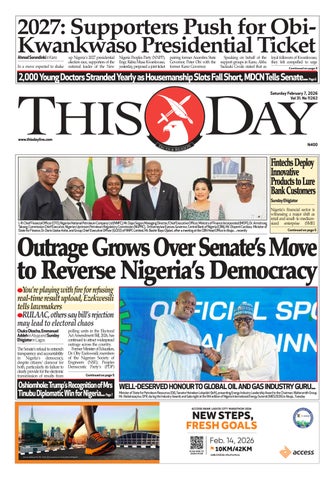
2027: Supporters Push for Obi- Kwankwaso Presidential Ticket
Ahmad
In a move expected to
up Nigeria’s 2027 presidential election race, supporters of the national leader of the New Nigeria Peoples Party (NNPP), Engr. Rabiu Musa Kwankwaso, yesterday, proposed a
L-R: Chief Financial Officer (CFO), Nigerian National Petroleum Company Ltd (NNPC), Mr. Dapo Segun; Managing Director/Chief Executive Officer, Ministry of Finance Incorporated (MOFI), Dr. Armstrong Takang; Commission Chief Executive, Nigerian Upstream Petroleum Regulatory Commission (NUPRC), Oritsemeyiwa Eyesan; Governor, Central Bank of Nigeria (CBN), Mr. Olayemi Cardoso; Minister of State for Finance, Dr. Doris Uzoka-Anite, and Group Chief Executive Officer (GCEO) of NNPC Limited, Mr. Bashir Bayo Ojulari, after a meeting at the CBN Head Office in Abuja…recently
Grows Over Senate’s Move to Reverse Nigeria’s Democracy
You’re playing with fire for refusing real-time result upload, Ezekwesili tells lawmakers RULAAC, others say bill’s rejection may lead to electoral chaos
Chuks Okocha, Emmanuel Addeh in Abuja and Sunday Ehigiator in Lagos
The Senate’s refusal to entrench transparency and accountability in Nigeria’s democracy, despite citizens’ clamour for both, particularly its failure to clearly provide for the electronic transmission of results from
polling units in the Electoral Act Amendment Bill, 2026, has continued to attract widespread outrage across the country. Former Minister of Education, Dr. Oby Ezekwesili; members of the Nigerian Society of Engineers (NSE); Peoples Democratic Party’s (PDP)
Sorondinki in Kano
shake
former Anambra State Governor, Peter Obi with the former Kano Governor.
behalf
support groups in Kano, Abba Sadauki Gwale stated
Minister of State for Petroleum Resources (Oil), Senator Heineken Lokpobiri (left), presenting Energy Industry Leadership Award to the Chairman, Waltersmith Group, Mr. Abdulrazaq Isa, OFR, during the Industry Awards and Gala night at the 9th edition of Nigeria International Energy Summit (NIES2026) in Abuja... Tuesday
Road Projects: FG Summons China Harbour over Public Health Safety Issues
Announces partial closure of Lagos–Ibadan expressway
Addeh in Abuja
The Minister of Works, David Umahi, has met with China Harbour Engineering Company (CHEC) and its sister company, China Harbour Operation and Maintenance Company (CHOMC), concessionaires of the Mararaba-KeffiAkwanga-Lafia-Makurdi over complaints emanating from the public.
During the meeting in Abuja, Umahi disclosed that
the ministry received a formal petition over the ongoing Makurdi-9th Nile-Enugu road project, where excessive dust from construction activities had continued to pose environmental and health risks to residents on the corridor.
Therefore, he directed that the permanent secretary should issue a letter to the contractor, mandating immediate dust-control measures, including soil stabilisation techniques, to be implemented. He warned
OUTRAGE GROWS OVER SENATE’S MOVE TO REVERSE NIGERIA’S
chieftain, Chief Bode George; the Obidient Movement, and the Rule of Law and Accountability Advocacy Centre (RULAAC), criticised the Senate for allegedly weakening provisions aimed at strengthening electoral transparency.
Also, Yiaga Africa and Human Rights Writers Association of Nigeria, HURIWA carpeted the upper chamber and described the position of the red chamber as working against the expectations of Nigerians for their self-political preservation by enabling provisions that are pro- manipulation.
The critics, who spoke separately, accused the upper legislative chamber of retaining loopholes in the proposed amendment, particularly regarding the electronic transmission of election results, warning that such provisions could undermine public trust in Nigeria’s electoral process ahead of the 2027 general elections.
The e-transmission of results, if approved,
customers increasingly adopt fintech platforms for financial transactions.
The allure of fintechs lies in their speed, flexibility, lower costs, and digital-first solutions that conventional banks often struggle to deliver.
THISDAY findings showed that ride-hailing drivers, market women, small traders, and informal sector entrepreneurs are among the fastest adopters of fintechs.
Unlike traditional banks, which demand lengthy onboarding, extensive documentation, and high transaction fees, some of those that spoke with THISDAY, said fintechs offer seamless, mobilefirst experiences, instant account
would have required the Independent National Electoral Commission’s (INEC) presiding officers to upload results from each polling unit to the IReV portal in real time, immediately after completing Form EC&A, which must be signed and stamped by the presiding officer and countersigned by party agents.
Instead, the senators chose to retain the present Electoral Act provision, which mandates that, “the presiding officer shall transfer the results, including the total number of accredited voters and the results of the ballot, in a manner as prescribed by the Commission.”
Ezekwesili while sharply criticising its handling of the Electoral Act Amendment Bill 2026, warned lawmakers against actions she said could further inflame public frustration and undermine Nigeria’s democracy.
Ezekwesili spoke yesterday during an interview on ARISE New Channel’s "The Morning Show", two days after the Senate passed the Electoral Bill 2026 following hours of debate.
access, and customer-centric designs.
Some of the notable digital payment platforms that have seen increased patronage include OPay, Moniepoint, Sparkle, VFD, Palmpay, Kuda, among others.
Customers said these digital platforms allows simple onboarding with minimal friction, low-cost transfers, integrated bill payments, and merchant services.
Market traders and informal workers say the platform saves them time and money. A Lagosbased market woman, Aisha Mohammed, told this reporter: “Before now, I had to queue at the bank for hours just to make a transfer. Now I can do
She accused the political class, particularly the Senate, of repeatedly taking decisions that alienate Nigerians.
“Stop playing with fire. It’s almost as if the political class, especially as exemplified by the Senate, just wakes up every morning and says, ‘What shall we do today to upset Nigerians?’” she said.
She argued that citizens were justified in expressing anger over what she described as the excesses and poor judgment of lawmakers.
“Now, anyone who at all supports the idea that it is okay for citizens to not be very annoyed at the excesses and the sheer lack of even wisdom on the part of our senators I don’t know where that person is reading from,” the ex-minister stated.
While stressing that no one should incite violence, the former minister said Nigerians must continue to exercise their civic rights and remain vigilant in defending democratic values.
“Nobody wants anybody to be incited, but it is entirely necessary for citizens to know
everything from my phone. It saves me time, and I pay less.”
Tobi Adeyemi, a Lagos-based freelance designer, said opening an account with one of the digital banking platforms made it easier to separate her personal and business accounts.
“I can send invoices, get paid, and manage expenses all in one place. Traditional banks can’t match that speed,” she explained.
Commenting on the trend in a chat with THISDAY, Head of Consulting at Agusto & Co, Jimi Ogbobine, said, “The operational efficiency consumers demand today is immediate recognition of value on their transactions; quick confirmations, reduced failures, seamless digital
2027: SUPPORTERS PUSH FOR OBI-KWANKWASO
Nigerians to support the ObiKwankwaso alliance, saying it's a chance to rescue the nation from its current challenges.
"We, as Kwankwaso supporters and loyalists and we have proposed and thrown our weight behind the joint presidential ticket, especially with Peter Obi, in any of the political parties. The current political trajectory has shown where the tide is shifting.
"If the duo gets a chance in the upcoming election, Nigeria
will be a better place, for real, we're tired of insecurity, hunger, and starvation.
"We want a political alliance to bring together Obi's strong support base in the south and Kwankwaso's formidable support in the north, creating a powerful coalition that could potentially shake up the political landscape. With this partnership, the duo is poised to give the ruling party a run for their money.
"At the heart of this alliance is a shared ambition to wrest power
from the ruling party's candidate, Bola Tinubu, and bring about meaningful change to Nigeria. Both Obi and Kwankwaso have consistently emphasised their commitment to assisting the common man in Nigeria, and their partnership is seen as a key step towards achieving this goal," he said.
Sadauki Gwale, who hails from the same constituency as Governor Abba Kabir Yusuf, further explained that the Obi-Kwankwaso ticket
that failure to resolve the issue within seven days would lead to the project's suspension.
On the dualisation of the road, the minister observed that portions of the earlier completed road by the past administration were already failing. Consequently, he reiterated his previous directive that the first five kilometres of the project must be milled, re-asphalted with concrete, and properly re-marked within seven days.
DEMOCRACY
that they are acting within their right when they exercise what Thomas Jefferson, one of the legendary presidents of the United States, said that eternal vigilance is the price that citizens pay for freedom, for liberty,” she said.
Ezekwesili further warned that lawmakers must not treat Nigeria as their personal domain.
“These senators cannot run Nigeria as though it were their fiefdom. Nigerian democracy belongs to the people, it doesn’t belong to the politicians,” she added.
Ezekwesili, a prominent advocate for transparency and good governance, said the Senate’s decision to retain Section 16(5) of the 2022 Electoral Act preserved ambiguities that eroded public confidence during the 2023 general elections.
According to her, “the provision created discretionary powers for the Independent National Electoral Commission (INEC) regarding electronic transmission of results, which later became a major source of controversy.”
processes. Fintechs have proven more nimble than traditional banks in delivering this.”
He traces the shift to Nigeria’s 2023 demonetisation policy: “It wasn’t about the safety of the banks; it was about operational effectiveness. Consumers and SMEs migrated to platforms that could handle transactions promptly. Fintechs filled that gap, much like new-generation banks did when they challenged older banks on efficiency.”
On sustainability, Ogbobine said: “The low-cost, high-speed service model is sustainable. Fintechs are moving from retail clients to SMEs, creating risk assets through lending, which enhances profitability and long-term financial stability.”
would be banking on a wave of popular discontent with the current administration, and their message of hope and change is resonating with many Nigerians. With their combined strength, they are emerging as a formidable challenger to the ruling party.
"As 2027 approaches all eyes are on the Obi-Kwankwaso alliance to see how they will capitalise on this momentum and translate it into votes. One thing is certain - the duo is determined
She recalled that, “INEC officials had assured Nigerians, particularly youths, that results would be transmitted electronically through the INEC Results Viewing Portal (IReV), but the failure to fully implement the process sparked doubts about the credibility of the elections.
“Once it was established that the law does not mandate INEC to upload results at every polling unit, it became the basis for the lack of transparency and duplicity that Nigerians witnessed.”
She argued that the amendment bill presented an opportunity to remove ambiguities and reinforce electoral credibility, but alleged that the Senate’s approach amounted to avoiding critical reforms.
Ezekwesili stressed that citizens have the constitutional right to demand accountability from lawmakers, noting that public agitation over the issue reflects deep frustration among Nigerians.
She advocated for a clear
He cautioned, however, that “Fintechs need to strengthen internal processes. Scams and fraudulent transactions exploit weak KYC procedures. Regulators also need to ensure fintechs follow robust compliance frameworks to maintain trust.”
In response however, some traditional banks have launched their own digital platforms: Axis Bank’s Hydrogen, GTBank’s Squid, Wema Bank’s Alat, among others.
provision mandating real-time electronic transmission of results from polling units, quoting the proposed amendment, which states that presiding officers must electronically transmit polling unit results to IReV immediately after completing and authenticating result forms.
“The citizens want transparency, so give it to them,” she said, warning that weakening electoral safeguards could deepen voter apathy and weaken democratic legitimacy. WThe NSE also threw its weight behind real-time electronic transmission of election results, dismissing the Nigerian Senate’s reasons for rejecting the proposal as professionally indefensible.
In a statement in Abuja signed by the NSE President, Ali Rabiu, the umbrella body of engineers in Nigeria said none of the arguments advanced by lawmakers against mandatory realtime transmission had the endorsement of any competent professional or technical body.
Ogbobine predicts: “We’ll see both intensified competition and collaboration. Fintechs are venturing into lending, while banks improve digital efficiencies. Both sides are adopting each other’s best practices.”
to shake things up and bring about a new era of politics in Nigeria", Gwale added.
On Kwankwaso's alleged demands for a significant number of positions from the ruling All Progressives Congress (APC) as part of his joining the party, Gwale noted that if there were anything like that, it should not be seen as outrageous, given the caliber of the former Governor.
According to him, Kwankwaso has presented the best demands that could cater to the needs
Highlighting a growing concern, former President of the Chartered Institute of Bankers of Nigeria, Mr. Okechukwu Unegbu, said: “Fintech is popular, but fraud is increasing. Banks must retrain staff to be professional and committed. Many contract staff lack dedication, which exposes the system to fraudsters.” He also warned about network infrastructure and inclusivity: “The sustainability of fintech services depends on reliable network connectivity. Many older or analogue-based users are vulnerable to fraud because they lack digital literacy.
Continued online
of his supporters and party members across the thirty-six states of the federation and Abuja, the federal capital. He added that Kwankwaso’s supporters cut across every divide, especially among ordinary Nigerians who are living from hand to mouth. On the recent outings of the Kwankwasiyya leader in Kano State, Gwale maintained that no politician pulls a larger crowd than that of Kwankwaso, despite the defection of his political godson Abba Yusuf to the APC.
Olawale Ajimotokan in Abuja Minister of Information and National Orientation, Mohammed Idris, said President Bola Ahmed Tinubu’s economic reforms have stabilised Nigeria’s economy, rebuilt confidence, and put the country on a path of sustainable growth after years of fiscal instability.
The minister, who spoke during an interview on ICAN On Air, described key measures like fuel subsidy removal and foreign exchange unification as bold decisions to correct structural economic flaws and prevent national insolvency.
Idris highlighted trust and transparency as crucial to governance, pledging open communication and responsiveness to public feedback.
He asserted that President Tinubu was willing to adjust policies while maintaining commitment to necessary reforms.
The minister recalled that as of May 2023, many states couldn’t pay salaries and almost all revenue was going into debt servicing.
Idris acknowledged that the reforms caused short-term economic hardship but stressed that they were already yielding results in the form of indicators that include foreign reserves rising to about $46 billion (the highest in eight years), falling inflation and renewed investor and international confidence.
“Without trust, there is no way you can build confidence, and without confidence, there can be no meaningful development. Our job is to communicate government
Unlawful Sack: CBN, ABU Lose Appeal against N2.5bn Judgement Debt
The Central Bank of Nigeria (CBN) and the Ahmadu Bello University (ABU) have failed in their bid to stop the implementation of a N2.5 billion judgment debt against the University and in favour of the 110 ABU workers unlawfully sacked in 1996.
This followed the dismissal of their case at the Court of Appeal, Abuja, yesterday.
The Appellate Court in two separate unanimous judgments of 3- member panel of Justices, ordered the CBN to immediately release the N2.5 billion to the former workers of the ABU without any further delay.
In the lead judgments delivered by Justice Okon Abang, the Court of Appeal threatened to impose heavy sanctions against the prime movers of CBN, should the apex bank further refused to release the money kept in its custody since 2018 by ABU for
onward payment to the aggrieved workers.
Justice Abang dismissed the claim of the CBN that the 110 workers unlawfully sacked by ABU in 1996 but ordered reinstated by the National Industrial Court in Abuja cannot use garnishee proceedings against it to collect the money.
The CBN had claimed that the consent of the Attorney General of the Federation (AGF) and Minister of Justice must first be obtained by the workers before payments can be effected was also dismissed by the Court of Appeal.
The appellants had in separate appeals challenged the implementation of the judgment of the Industrial Court which ordered ABU to pay the entitlement of the 110 workers having found that they were unlawfully laid off by the Sole Administrator of the University, General Mamman Kontagora in 1996.
policies truthfully, transparently, and listen to feedback from Nigerians,” Idris said.
He also noted Nigeria’s removal from the FATF grey list, which he described as a boost to the nation’s financial credibility.
On tax reform, he clarified it
aims to simplify and expand the tax base, not increase burdens, ensuring fairness and better developmental planning.
On the challenge of misinformation, Idris said the government was strengthening inter-agency collaboration and media literacy to curb the
spread of fake news without undermining freedom of expression.
He said, “Fake news is dangerous. If you don’t find a way to reduce its impact, you wake up one day, and you don’t have a country. Media freedom is critical, but it must
come with responsibility.”
Idris concluded by urging patience and engagement from Nigerians, assuring that the long-term benefits of reforms will reflect in areas like infrastructure, education, healthcare, and state-level development.
Oshiomhole: Trump’s Recognition of Mrs Tinubu Diplomatic Win for Nigeria
Deji Elumoye in Abuja
Senator Adams Oshiomhole has rejoiced with President Bola Tinubu over the recent recognition of his wife, Senator Oluremi Tinubu, by the United States President Donald Trump, describing it as a proud moment for Nigeria and a symbol of religious harmony.
The former Edo State Governor, who visited the President at the State House, Abuja, yesterday, told reporters that his visit was to extend New
Year greetings to the President and celebrate Trump’s glowing tribute to the First Lady during a public event.
He recalled how Trump, known for his blunt style, described Mrs. Tinubu as, “a very respectable woman, a very responsible woman, and a pastor of the largest church in Nigeria,” before inviting her to stand for recognition.
He said: "I came to greet Mr. President. I have not seen him in 2026, we wish him a happy new year, but also,
very importantly, yesterday (Thursday) we saw how the most powerful man, President Donald Trump of the United States of America, in acknowledging not just the First Lady of Nigeria… but describing her as a very respectable woman, a very responsible woman, and a pastor of the largest church in Nigeria, and he invited her to stand up for recognition."
The ex-Chairman of the All Progressives Congress (APC) expressed national pride in the
moment, noting the applause it drew and contrasting it with potential opposition criticism in reverse scenarios.
According to the Edo North Senator, “If it was the other way around, imagine what the opposition would have been saying now… he said Nigeria’s First Lady is here. She’s a Christian, but also a Christian pastor, a woman that commands respect, a responsible and respectable woman. So congratulations".
Masari Replaces Uzodimma As APC Convention Committee Chair
Adedayo Akinwale in Abuja
Former Katsina State governor, Aminu Masari, has replaced the Governor of Imo State and the Chairman of Progressive Governors Forum (PGF), Senator Hope Uzodimma, as the Chairman of the All Progressives Congress (APC) National Convention Central Coordination Committee. Uzodimma, who was earlier named chairman of the committee, has now been reassigned as treasurer following a fresh
reconstitution approved by the party leadership.
The National Organising Committee of the party, Sulaiman Argungu, made this known in a notice issued yesterday ahead of the party’s March 27 and 28, 2026 convention.
The notice read: “In further consultation with the leadership and national stakeholders of the All Progressives Congress (APC), the Central Coordination Committee for the 2026 National Convention has been reconstituted.
Namibia, Angola, DR Congo Agree to UK Migrant Returns After Visa Penalty Threat
Sunday Ehigiator with agency report
Three African countries have agreed to take back foreign offenders and illegal migrants after the UK Home Secretary threatened them with visa penalties.
In December - following threats from Shabana Mahmood - Namibia and Angola agreed to cooperate on returns. The home secretary has now also secured cooperation from the Democratic
Republic of Congo (DRC). "My message is clear: if foreign governments refuse to accept the return of their citizens, then they will face consequences," the BBC quoted her as having said following the agreement.
The UK government had previously warned it would stop granting visas to people from Angola, Namibia and the DRC if their governments did not improve co-operation on removals.
Alex Enumah in Abuja
SOLIDARITY VISIT...
Inspector General of Police (Operations),
US, Group Condemn Kwara Attack as Gov AbdulRazaq Appoints Seven-man Committee
ADC to Tinubu: Kwara mass killings expose leadership failure
Chuks Okocha in Abuja, Hammed Shittu in Ilorin and David-Chyddy Eleke in Awka
The United States and a Rights group, International Society for Civil Liberties and Rule of Law (Intersociety) have strongly condemned the devastating attack in Kwara State, which claimed several lives, with many still unaccounted for.
This was as the Kwara State Governor, Alhaji AbdulRahman AbdulRazaq, has approved the appointment of a seven-person committee to interface with Woro community in Kaiama Local Government Area of the state on humanitarian support he announced earlier on Thursday after terrorists attack in the town. Also, the African Democratic Congress (ADC) which condemned the killing of about 170 people in Kwara State, described the attack as evidence of a total collapse of security under President Bola Tinubu-led federal government.
In a statement, the U.S. Mission in Nigeria expressed its deepest condolences to the families affected by the senseless violence.
The mission also welcomed President Tinubu’s swift response, including the deployment of security forces to protect vulnerable villages and directives to federal and state officials to provide urgent aid and bring the perpetrators of this atrocity to justice.
“The United States condemns the horrific attack in Kwara state in Nigeria, which claimed the lives of more than 160 people, with the death toll still unconfirmed and many still unaccounted for. We express our deepest condolences to the families of those affected by this senseless violence.
“We welcome President Tinubu’s order to deploy security forces to protect villages in the area and his directive to federal and state officials to provide aid to the community and bring the perpetrators of this atrocity to
NUPRC, NNPC CEOs Meet, Set to Harmonise Fees, Rents
The Nigerian Upstream Petroleum Regulatory Commission (NUPRC) and the Nigerian National Petroleum Company Limited (NNPC) yesterday pledged to deepen collaboration to boost operational efficiency. This was the outcome of a meeting between the management of the NUPRC and the NNPC at the commission’s corporate headquarters in Abuja, a statement by the NUPRC spokesman, Eniola Akinkuotu disclosed.
NUPRC’s Chief Executive, Oritsemeyiwa Eyesan, said the Commission and the NNPC as creations of the Nigerian
government have similar goals, stressing that the upstream regulator was focused on reducing the cost of operations by harmonising fees and rents to make Nigeria’s oil and gas sector more competitive.
To this end, the NUPRC chief executive revealed that the commission was working closely with the Oil Producers Trade Section (OPTS) to address the multiplicity of fees and rents in order to improve Nigeria’s competitiveness.
“We are working with the industry on harmonising the fees and rents that we charge,” she said, adding, “The whole idea is to harmonise and reduce it to the barest minimum so that we can reduce the cost of operations,” she said.
justice.”
Intersociety in a press statement signed by its Board of Trustees Chairman, Mr. Emeka Umeagbalasi, insisted that the attacks were enough evidence that present and successive governments in Nigeria remained incompetent in tackling terrorism.
The group accused the government of not doing well to suppress the number of killings of Christians in Nigeria.
Part of the statement read: "The killings in the two areas were also found to have recorded scores of Christian victims, according to local CAN leaders and other
sources contacted.
"For the avoidance of doubt, in Katsina State, indigenous Christians are found in large numbers in Southern part of the State including in Faskari and Malumfashi local government areas. From our several investigations and established contacts or networks over the years, indigenous and sedentary Christians are also found in their millions in Southern Gombe, Southern Borno, Southern Kebbi, Southern Bauchi, Southern Kaduna and in Munya, Shiroro, Paikoro, Rafi and Kontagora parts of Niger State and so on.
General Marwa: Knowledge Deficit in Law Hinders Effective Law Enforcement Operations
Linus Aleke in Abuja
The Chairman of the National Drug Law Enforcement Agency (NDLEA), Brigadier General Mohammed Buba Marwa (rtd), has warned that inadequate knowledge of the law among security personnel continues to undermine the effectiveness of law enforcement operations in
the country.
Marwa made the observation at the official unveiling of multiple legal publications authored by Deputy Commander General of NDLEA (DCGN), Sule Momodu (rtd). The books include Explanatory Notes on the Terrorism (Prevention and Prohibition) Act 2022, Money
Laundering (Prevention and Prohibition) Act 2022 and Proceeds of Crime (Recovery and Management) Act 2022; Human Rights and Law Enforcement Agencies Operations: A Guide; and Law Enforcement Agencies Acts in Nigeria: A Compendium.
According to the NDLEA Chairman, ignorance of legal
frameworks by officers often results in serious operational and institutional consequences. He noted that poor understanding of the limits of lawful authority frequently leads to avoidable litigation, costly financial judgements against the state, wrongful arrests, collapsed prosecutions and violations of fundamental human rights.
House Summons FCT Council Chairmen Over N100bn Financial Infractions
Adedayo Akinwale in Abuja
The House of Representatives Public Accounts Committee has summoned the six Area Councils of the Federal Capital Territory (FCT) for various financial infractions amounting to over N100 billion.
The six area councils indicted in the report by the AuditorGeneral which was submitted to the House committee are: Abaji, Abuja Municipal, Bwari, Gwagwalada, Kuje, and Kwali.
The audit report for the
year ended 31 December 2021 showed widespread cases of unremitted tax and VAT deductions, failure to update Fixed Asset Registers, and expenditures yet to be properly accounted for across the councils.
The report revealed that the councils failed to properly maintain and update their Fixed Asset Registers. The report also indicated that the six Area Councils recorded outstanding liabilities amounting to N7.6 billion as of 31st December, 2021.
Amasiri Community Condemns Killing at Okporojo, Requests Governor Nwifuru to End Siege
Bennett Oghifo in Lagos and Kuni Tyessi in Abuja
Leaders of thought in Amasiri community have condemned the killing at Okporojo in Oso Edda, Ebonyi State and appealed the Ebonyi State Governor, Francis Ogbonna Nwifuru, to end the on-going siege on the Amasiri community in Afikpo Local Government Area of the state. They said the situation has made it very difficult for members of the community to
eke out a living. They, however, strongly condemned the killing and asked the law enforcement agencies to fish out the culprits. They were speaking at a press conference recently in Abuja, on the heels of the penalties handed down by Governor Nwifuru to the Amasiri community following the killing at Okporojo. These include but not limited to: the sack of all government appointees –State Commissioners, Chairmen of Councils and Board members from Amasiri; Initiating
the process of removing Amasiri as one of the 64 Development Centres in the State (the Ebonyi State House of Assembly made good this threat yesterday by disbanding, delisting Amasiri Development Centre from Law); the dethronement of the two traditional rulers of Amasiri clan and dissolution of all groups and unions in Amasiri; imposition of a 20-hour curfew; closing down of schools and the directive by the governor for the Chairmen of Ivo, Onicha and Ohaozarato
to take over the administration of Amasiri.
Dr. Joy Omagha, an indigene and newspaper publisher urged the governor to take the right course of action by empanelling an independent and impartial investigation into the killings and then arrest, prosecute and punish the actual perpetrators, no matter their community. She equally called on the governor “to immediately review and reverse the blanket sanctions imposed on innocent people.”
Emmanuel Addeh in Abuja and Peter Uzoho in Lagos
L-R: Deputy
DIG Kwazhi Dali; Kwara State Governor AbdulRahman AbdulRazaq, and Commissioner of Police, CP Adekimi Ojo, during a courtesy visit to the Ahmadu Bello House, in Ilorin...yesterday
EXECUTIVE RETREAT...
L-R:
PDP Faction Warns Against Forced Occupation of National Secretariat
Says headquarters subject of litigation Abia PDP says INEC’s recognition of Mohammed, Anyanwu-led PDP a significant step towards restoring order
Chuks Okocha in Abuja and Boniface Okoro in Umuahia
The Peoples Democratic Party (PDP) has issued a stern warning against attempts by some expelled members to forcibly occupy the party’s National Secretariat and other properties, citing ongoing litigation.
Imo
Tony
This was as the PDP National Caretaker Committee loyal to the Minister of the Federal Capital Territory, Nyesom Wike, has vowed
to reopen the party’s national secretariat on Monday, saying the Independent National Electoral Commission (INEC) recognition of the party is a strategic step towards a credible convention and 2027 planning. Also, Abia State chapter of
ADC Cracks As Two Factions Tussle for Supremacy
The Imo State chapter of the African Democratic Congress (ADC) appears headed for crisis as a former acting state chairman of the party, Chief Emma Amuchie has declared himself the authentic state Chairman of the party.
Amuchie, who was flanked by Mr. Tony Ejiogu, the governorship candidate of the All Progressives Grand Alliance (APGA) stated during a press conference in Owerri, Imo State capital, said that "This press statement serves as an official clarification and public notice that the African
Democratic Congress (ADC) in Imo State remains one and united, with its State Executive Committee led by the Chairman, Chief Emmanuel Amuchie as the only organic, constitutionally constituted, legally valid, and officially recognised leadership of the party in the state.
Glo Donates N1bn to Lagos State Security Trust Fund
Globacom has donated N1 billion to the Lagos State Security Trust Fund (LSSTF) to strengthen security infrastructure across Nigeria’s commercial capital.
The contribution stands among the most significant private-sector interventions from the telecommunications industry to the Fund in recent years and reinforces Globacom’s position as a responsible and patriotic corporate citizen.
The donation follows
Globacom’s participation in the LSSTF-organised Private Sector Breakfast Meeting with CEOs, hosted by the Executive Governor of Lagos State, Mr. Babajide Sanwo-Olu, on Friday, January 30, 2026. The high-level forum emphasised deeper collaboration between government and business on security, innovation and economic resilience—an agenda Globacom has consistently supported through sustained social investment.
Expressing appreciation, the Executive Secretary/CEO of the Fund, Dr. Ayo Ogunsan, described Globacom’s gesture as “a powerful demonstration of corporate citizenship and a strategic investment in the stability of Lagos State.” He noted that the LSSTF was established to bridge funding gaps in security infrastructure and therefore relies heavily on voluntary contributions from corporate bodies and well-meaning partners.
Lagos Vaccinates 89% of Targeted Children, Begins Mop-Up Immunisation Exercise
Funmi Ogundare
The Lagos State Primary Health Care Board (LSPHCB) yesterday said it has vaccinated about 89 per cent of targeted children across the state in its ongoing immunisation campaign, marking a major boost to the Lagos State Government’s
efforts to protect children from vaccine-preventable diseases.
Building on the achievement, the board has announced plans to begin an intensive mop-up exercise to identify and vaccinate children who were missed during the initial phase of the campaign due to absence,
CHANGE OF NAME movement, misinformation
the party has lauded INEC for inviting Abdulrahman Mohammed and Senator Samuel Anyanwu–led PDP Caretaker National Working Committee (CNWC) to its quarterly engagement with political parties.
A PDP chieftain, Chief Bode
George also raised alarm over internal crises within the PDP, accusing certain political actors of attempting to destabilise the party with alleged backing from influential interests.
The party’s National Publicity Secretary, Ini Ememobong, yesterday stated
that the PDP had written to the Inspector General of Police and the Commissioner of Police, FCT Command, reminding them of the secretariat’s status as a subject of pending litigation before the Federal High Court, Abuja, and the Court of Appeal.
President/ CEO, PRAfrica International, Dapo Adelegan; Ex- Finance Director, NLNG, Mr. Victor Eromosele; MD/CEO, Lekki Worldwide Limited, Mr. Adeola Olusodo; Executive Director, Mrs. Yemi Olusanya; Director, Alhaji Olalekan Akodu, and Company Secretary, Mr. Biodun Oluwa, at Lekki WorldWide Limited’s executive retreat held in Lagos…recently
Icheku in Owerri
Deborah Omale: Energy Costs, High Rents
Squeezing Beauty, Wellness Businesses
Deborah Omale is a Pastor, Counsellor, Entrepreneur, Founder and CEO of Beauty Secrets Medspa, an outfit in the beauty and wellness treatment industry in Nigeria. In this conversation, she shares insight on women’s involvement in business, politics, and the ministry. Alex Enumah brings the excerpts:
Nigerian women are getting better. They are speaking up, and they’re getting more confident, and they are trying to contribute their own quota to the advancement of women, whether it’s in politics, business or whatever field they find themselves, .like the reserve seat for women’s bill that is being propagated now. I’m a huge supporter of that. So you see, we are no longer staying behind and just letting all the work be done by the men. We want to work with them, we want to support them, and we want to also put in our quota to everything that will make this beautiful and great nation great, because Nigeria is beautiful, Nigeria is great. The government is trying, we are all trying, the more hands, the better, because we form a greater part of the population. So we’re actually undoing ourselves the more we continue to align the female race out of politics, for instance.
How is the beauty industry helping to empower women?
I am going to speak for us as a brand, the Beauty Secrets brand. We have the educational side of the business, which empowers women, children, whoever, even professionals to upgrade in your skill or your trade. You can be an administrator, you can be an accountant and all the other thing they think is fancy. Not everybody can be that, learn a trade. This business can be done by anybody. You can do hair dressing; you can do makeup; you can do tying up. People pay to get their hair tied, and Nigeria is a place that is known for our weddings, our lavish parties and all of that. So there’s a market already for that. So for Beauty Secrets, we have Beauty Secrets Academy where quarterly, and sometimes even before then, we get some few people who cannot, maybe afford the formal training of paying for fees because sometimes it can be a bit expensive, which is determinant on what you’re learning or what you are interested in. So we train them for free, and we have them work with us for about three, four, sometimes six months just to get you going. And as you’re working, you’re
also being paid. Also, you have a certificate that gives you access to work in any professional setting. Beauty Secrets is known for our high standards. So of course, when you’re having a certificate, they know that you’ve been groomed, they know you’ve been trained. They know you understand the aesthetics of the business. You understand the professionalism of the business. So I think that’s one area. If you have a ward or you have people that are just lying around, a girl child, send her to learn a trade. If you cannot afford for her to go to the university, you can afford to pay for her to learn a trade. And a woman that is empowered is a family empowered, is a nation empowered, because women are nurturers. Once you train one; in extension, you are training 10, 20, others. So I think that is one area that should really, really be encouraged even by the government.
Whatchallengesdoyoufaceinthisbusiness? Challenges will be power. A lot of resources go into buying diesel, because this kind of business, you can’t afford not to have electricity. It’s a business that runs with electricity, so imagine having to buy diesel almost on a daily basis. And it’s not just diesel. You’re buying large quantities. It’s because these machines are heavy duty machines, so you need enough high voltage electricity to power them. So it’s a lot. And I would say rent, because whether you are using your property or you’re not using your property, the goal of the business is, even if your business is using your property, your company, which is a separate entity from you, is supposed to pay the owner for rent for that property. So if you want to look at all of these indices, it’s just a lot, and I think sometimes even some fees that you’re required to pay, which is okay, but if you’re not making enough, how much do you have on hand to finish paying your staffs, to buying diesel, to being on Band A, you know, taking care of your staffs, taking care of the facility, paying rent. So it’s challenging, but we are up to the task, because nothing good is easy, and at the end of the day, government has to do what it has to do, and then we, the private citizens, will also have to do what we have to do. So, I think that will be the three major challenges for me. There are more, but these are the three major challenges.
At Beauty Secrets Med Spa our decision to engage foreign experts is guided purely by our commitment to excellence, global best practices, and capacity building; Introduce international standards and cutting-edge techniques that enhance service quality and client safety; train and upskill Nigerian professionals, ensuring knowledge transfer and long-term local capacity development; Improve service delivery and innovation, keeping our brand competitive in a global beauty and wellness market; and Build credibility and trust, especially for medical-grade and advanced spa treatments that require specialized expertise.
As an expert in the beauty, skincare and wellnesstreatmentbusiness,whataretheeasy beauty tips that can help protect the skin in thisdryseason?
So it’s a dry season, so just hydrate. Sometimes we walk all day and we forget to hydrate ourselves. And when I say just drink water, drink enough, enough water. Try and get the minimum seven glasses at least throughout the day. You know, at least before the evening, when you’re out there as you’re working, have a bottle by your side, so that when you forget you’re staring at it is a reminder to drink water. Use your shea butter. I’m not going to call any expensive, branded products. Shea butter is everywhere. It’s affordable. Get original one. Use
When Falsehood Dresses as Advocacy: The NGBF Example
Nigeria’s public discourse is always fragile. It has once again been assaulted, but, this time, by a sensational write-u circulated on social media and attributed to a self-styled group calling itself the Nigerian Global Business Forum (NGBF).
The publication, which purports to “name and shame” Ikeja Electric and its leadership, is both reckless and irresponsible, emblematic of a growing culture of disinformation that threatens enterprise survival, corporate governance, investor confidence and the rule of law. Unarguably, criticism of companies, including DISCOS, is neither taboo nor unwelcome. Just as electricity supply remains one of Nigeria’s most pressing challenges and public accountability in the sector is essential. However, what the authors of this sensational publication have offered is not criticism, it is a torrent of unverified allegations, inflammatory language, invented casualties and outright falsehoods, all wrapped in the prettified robe of activism and advocacy.
The credibility deficit of the NGBF, promoters of
the pseudoadvocacy, is glaring. Independent inquiries reveal no evidence of its legal registration as a group, no traceable corporate address, no governing council, no record of policy engagement and no institutional footprint locally or internationally. Though, individuals listed as signatories flaunt impressive titles, they leave behind no verifiable professional or academic footprint. In any serious society, anonymous actors issuing sweeping indictments without accountability would be dismissed outright. Unfortunately, social media has become a refuge for propagandists and their sensationalism.
More alarming is the content of the publication. It alleges deaths, electrocutions, industrial collapse, economic “genocide,” deliberate destruction of meters, unsafe labour practices and even threats to national security, yet, provides not a single verifiable statistic to substantiate it’s claims. NGBF’s farce provided no regulatory finding, court judgment, or official report to substantiate these claims. Not one. This is not advocacy; it is fabrication. Illustratively, Nigeria’s electricity distribution sector operates under one of the most heavily regulated commercial frameworks in the country. Tariffs are set by the Nigerian Electricity Regulatory Commission (NERC), service levels are monitored, safety incidents are investigated by statutory agencies and financial disclosures are subject to audit and regulatory scrutiny. Where breaches occur, sanctions
follow. Therefore, to come out in the public and state that a licensed operator functions beyond regulation is nothing but falsehood demonstrated, plus intellectual dishonesty.
Equally disturbing is the NGBF’s deliberate attempt to personalise institutional challenges by targeting named executives, questioning their educational backgrounds and calling for international sanctions, including visa bans.
This is no longer policy critique; it is pure harassment. It reflects a dangerous mindset that seeks to replace institutional reform with public lynching. If allowed to stand, no corporate leader, indeed no professional, would be safe from character assassination by faceless groups seeking nothing but unearned relevance.
The broader implications are grave and inimical to efforts at strengthening the national economy. Under the Renewed Hope Agenda, sitting president Bola Ahmed Tinubu is actively courting investment into infrastructure, energy transition and industrial recovery. What message is sent when phantom organisations can publish libellous manifestos, accuse regulated companies of mass death and criminality, demanding foreign sanctions, without evidence or consequence?
your coconut oil. Use your palm canal oil. And if you can take it a step further, walk into the Med Spa. Ask what and what steps can you advise for me during this period. And every skin type is different, so there’s different protocols for everybody. So if you can afford it, walk into the spa, speak to the doctor, speak to the nurses, the estheticians will be more than happy to just create a product line, or products that you can use, that is ideal for your skin, whether it’s oily, whether it’s dry, whether it’s combination, whatever the case may be.
Tell us how you combine business, family andtheministry?
So I’m married, happily married, to my husband, Prophet Emmanuel Omale, of Divine Hand of God Church which we run together. He’s the General Overseer. I am blessed with two kids and blessed with many adopted kids. I’m blessed with my family in church as well as immediate family. So that’s just it. About me. I live a very private, simple life. I don’t think I’m much fun, you know, but that’s all. It’s church, my family, my business. It’s been okay, it’s not easy, it’s very, very tasking but, I think it’s a bit easy for me, because I have a great team. I have staffs that have been with me nine years, six years, seven years, five years. So there’s that cohesion. We understand each other. They understand the principles, the ethics, they understand the vision of the company. So it makes it easier. Like for any of my places, I don’t even have to be there, and things will run smoothly. And for church is already a family. So for me, it’s not even work, combining both, but it’s tasking because I’m also a mom who doesn’t believe in allowing other people put her kids to bed or get them ready for school, so I’m having to do that. I’m also a student, so everything is just knowing how to schedule yourself and your time and be disciplined with your time. So if you have two hours to do something, you know, it’s two hours because you still have to give the same attention to other things. Family comes first. It comes first before everything. So I just find a way to juggle it. But the secret is, I have a lot of people helping me, so nothing will be complete without them.
WhatisyouradvicetoNigerianwomen?
My advice to Nigerian women is to keep going, be prayerful, follow your dreams, do not joke with your health. I know you want to help everybody but the question is, if you are in an environment where you are helping everybody sometime you have to take a pause and ask, who is helping me. Same thing for a man, it is not only about women, sometimes you want to be there for everybody, you want to send money to the village, you want to give your wife, you want to do this, you want to do that. sometimes pause, if you pause nothing would happen, nothing would change, nothing will happen. Sometimes we give ourselves headaches that is not necessary. Just take it easy on yourself and be kind.
Adedotun Oluwaseyi
Omale
a waste!
In Praise of President Buhari
Alarming Rate of Accident-Related Deaths
WNhen President Muhammadu Buhari took over the reins of power on May 29, 2015, Nigeria was sadly a broken state in many respects. As a result of many other factors including bad governance and untold level of corruption, government could not live up to its financial obligations to citizens and service providers at both the federal and state levels.
The FRSC, under the current leadership of Shehu Mohammed, has demonstrated capacity, willingness, and professionalism in tackling road traffic crashes. Enforcement strategies and emergency response interventions by the Corps have yielded measurable results, as reflected in the slight reduction in fatalities. However, these efforts must now be intensified, expanded, and sustained to achieve a more significant and lasting impact.
Indeed one of the first official assignments that President Buhari carried out was the approval of billions of Naira in bailout funds to enable state governors pay something as basic as workers’ salaries. Granting those bailout funds was a huge boost to national security because the pressure of arrears of unpaid monthly salaries building dangerously all over the country was a ticking bomb.
igeria’s roads have once again become theatres of avoidable tragedy, as recent statistics from the Federal Road Safety Corps (FRSC) reveal a disturbing picture. In 2025 alone, about 5,289 deaths were recorded from 10,446 road traffic crashes across the country. These figures are not just numbers; they represent thousands of lives cut short, families shattered, and a nation bleeding silently from a crisis that demands immediate and decisive action.
Although the data shows a marginal improvement, a 2.4 percent reduction in fatalities compared to the 5,421 deaths recorded in 2024 the situation remains deeply troubling. Any sense of relief drawn from this slight reduction would be misplaced, as the death toll is still unacceptably high. A country that continues to lose over 5,000 citizens annually to road crashes cannot afford complacency or cosmetic responses to road safety challenges.
Ask the naysayers and they would readily remind you of how long it took President Buhari to appoint his ministers and how that contributed to collapse of the economy as if, without ministers, governance was frozen. But buying that narrative would amount to what a famous Nigerian writer, Chimamanda Adichie, termed “the danger of a single story”. Yet the whole story was that many of our citizens did not know how decrepit a state President Buhari inherited in 2015.
It was therefore necessary for him to take stock against the background of the fact that the departing government did not, reportedly, cooperate full well with the incoming government in terms of leaving workable handover notes. Although President Goodluck Jonathan was gracious in defeat, many of his appointees were still sulking over what they saw as their personal losses and therefore pulled all the stops to make things difficult for the Buhari government.
by the EFCC, President Buhari by his action has successfully brought back to the public consciousness the need to treat public funds with the highest level of transparency and accountability.
After keeping treasury looters on their toes and at bay through the EFCC, particularly, President Buhari moved to curb unnecessary spending habits of the nation on what economists call articles of ostentation. Part of the disclosures of the President’s stock taking was how the country frittered away billions in foreign currency by importing goods, which can be produced at home. One of such items was rice, a major staple among Nigerians. By banning rice importation into the country, the President on one hand had saved the nation billions in foreign currency annually.
That said, road safety cannot be the responsibility of the FRSC alone. Maintaining safety on Nigerian roads requires collaboration and collective commitment from all stakeholders. Road users, particularly drivers of commercial and private vehicles, must take personal responsibility by obeying traffic rules and regulations. Speeding, reckless driving, and other human-related factors continue to account for the majority of road crashes in the country.
Ilhan Omer and Somali Immigrants in Minnesota
NStop Ritual Attacks and Killings
TAnd, on the other hand, the President has boosted domestic production of rice and in the process had nudged the country into self sufficiency in food production. He also created millions of jobs for young people in the rice value chain.
What is most admirable about President Buhari and his government is its frugal management of scarce national resources to attain optimum goals.
Recall that since President Buhari stepped in the saddle, oil revenue dropped abysmally as if to sabotage him knowing all the big promises he made to citizens during his campaigns. But with the little resources that trickle in, the President is achieving what governments that received oil windfalls could not dream of.
Tochukwu Jimo Obi, Abuja
Even with the obvious and unpatriotic obscurantist behaviour of the PDP appointees and their supporters still in government hell-bent on making things difficult for Buhari, the President moved on with his methodical repair of a broken country. The first thing he did was to identify all possible sources of income to the nation and directed that all inflows be paid into one single account in line with the policy of Single Treasury Account (TSA).
The TSA policy, interestingly, was mooted by the PDP government but its penchant for imprudence and lack of accountability denied it the courage of implementing the policy. What the President literally did was to gather all the nation’s money into one box and locked it up with a big padlock and watched for any thief to come close.
More concerning is the demographic impact of these deaths. Many of the victims are young and middle-aged Nigerians, the most economically active segment of the population. Losing such a significant number of productive citizens every year undermines national development and places additional social and economic burdens on families and the state. Road safety, therefore, should not be treated with lip service or routine statements, but as a national emergency.
Who can blame the President for almost developing paranoia over the safeguard of the national treasury with revelations and reports of mind-boggling looting that took place in the 16 years of the PDP? With such disclosures of how billions meant for fighting insurgency in the Northeast ended up in the pockets of a few individuals while our gallant soldiers fought with bare hands and on empty stomach, President Buhari was duty bound to bring sanity and accountability back in national spending.
As Nigeria continues to witness a steady increase in vehicular traffic due to population growth, urbanisation, and economic activities, deliberate and well-coordinated efforts must be made to ensure safety on the roads. Without proactive measures, the growing number of vehicles will only translate into more crashes, injuries, and deaths.
Thus, under President Buhari, the Economic and Financial Crimes Commission (EFCC), which had remained comatose for years, was woken up to resume its duties. Apart from the trillions of Naira of looted funds and property recovered from corrupt politicians
Today, the trains are up and running daily from Abuja to Kaduna. And from Lagos to Ibadan a brand new rail track was started and completed; citizens are already commuting daily to and fro these two major cities in the country seamlessly as they reap from the dividends of democracy. And with the way this government is going, before 2023 when the President would leave, the entire country would be linked by rail with all of its economic advantages.
Ainofenokhai Ojeifo, Abuja
THE SATURDAY NEWSPAPER
EDITOR OBINNA CHIMA
DEPUTY EDITOR AHAMEFULA OGBU
MANAGING DIRECTOR ENIOLA BELLO
THE SATURDAY NEWSPAPER
DEPUTY MANAGING DIRECTOR ISRAEL IWEGBU
EDITOR YEMI ADEBOWALE
CHAIRMAN EDITORIAL BOARD OLUSEGUN ADENIYI
DEPUTY EDITOR AHAMEFULA OGBU
EDITOR NATION’S CAPITAL IYOBOSA UWUGIAREN
MANAGING DIRECTOR ENIOLA BELLO
THE OMBUDSMAN KAYODE KOMOLAFE
DEPUTY MANAGING DIRECTOR ISRAEL IWEGBU
CHAIRMAN EDITORIAL BOARD OLUSEGUN ADENIYI
EDITOR NATION’S CAPITAL IYOBOSA UWUGIAREN
MANAGING EDITOR BOLAJI ADEBIYI
THE OMBUDSMAN KAYODE KOMOLAFE
THISDAY NEWSPAPERS LIMITED
EDITOR-IN-CHIEF/CHAIRMAN NDUKA OBAIGBENA
GROUP EXECUTIVE DIRECTORS ENIOLA BELLO, KAYODE KOMOLAFE, ISRAEL IWEGBU
THISDAY NEWSPAPERS LIMITED
DIVISIONAL DIRECTORS SHAKA MOMODU, PETER IWEGBU, ANTHONY OGEDENGBE
EDITOR-IN-CHIEF/CHAIRMAN NDUKA OBAIGBENA
DEPUTY DIVISIONAL DIRECTOR OJOGUN VICTOR DANBOYI
GROUP EXECUTIVE DIRECTORS ENIOLA BELLO, KAYODE KOMOLAFE, ISRAEL IWEGBU, IJEOMA NWOGWUGWU, EMMANUEL EFENI
SNR. ASSOCIATE DIRECTOR ERIC OJEH
ASSOCIATE DIRECTOR PATRICK EIMIUHI
DIVISIONAL DIRECTORS SHAKA MOMODU, PETER IWEGBU, ANTHONY OGEDENGBE
DIRECTOR, PRINTING PRODUCTION CHUKS ONWUDINJO TO SEND EMAIL: first name.surname@thisdaylive.com
ow, how has emancipation and the 13th amendment helped African Americans? It has been revealed that Rep. Ikhan Omer, the Somali legislator from Minnesota, is worth 44 million dollars. This is someone who migrated to the US just a generation ago. Someone who does not believe in the core values of the US’s Judeo-Christian origin. Before she transited to the US, Ms. Omer never saw a church building all her life and she must have been tutored in Al Shabbab-run madrassa glorying incest and population boom to defeat the Jews and Christians in some oncoming jihad. Migration to the US was this jihad. Now, she is way richer than the average Afro-American person because her Somali cohorts in Minnesota, who do not believe in American principles, defrauded Minnesota of billions of dollars. Black Americans, being Christians and Americans, will not do this.
he Advocacy for Alleged Witches (AfAW) urges the Nigerian public to stop ritual attacks and killings because the notion of ritual money and wealth is completely baseless. AfAW is making this call following the reported arrest of suspected ritualists in Oyo State in southern Nigeria. The local media reported that members of the Western Nigeria Security Network, Amotekun, arrested suspected ritualists with the body parts of a 73-year-old man.
Sunday Adole Jonah,Department of Physics, Federal University of Technology, Minna, Niger State
Upstanding Winter Athletes
TThe suspects, who were apprehended in the Boluwaji area in Ibadan, said that a Muslim cleric asked them to procure some human body parts for rituals. Ritual attacks are widespread in Nigeria. Irrational conceptions of how to make money or become wealthy and successful undergird these atrocities. Many Nigerians strongly believe in blood money, known in some local languages as Ogun Owo (Yoruba) or Ogwu ego (Igbo). They think that they could become rich, or successful through ritual sacrifice. Unfortunately, this is not the case. Ritual wealth has no basis in reason, science, or reality. Home movies known as Africa magic or Nollywood films have not helped matters. These movies continue to reinforce these mistaken notions and other superstitions. Families, churches, mosques, and other public institutions do not encourage the interrogation of these traditional occult beliefs. There are no robust efforts to criticize or dispel these irrational and paranormal claims in schools, colleges, and universities. So millions of Nigerians grow up blindly believing that they could make money through ritual sacrifice of human body parts. The belief has led many Nigerians to commit crimes and perpetrate atrocities. Many Nigerians have been jailed or are undergoing court trials due to ritualrelated attacks and murder.
he winter Olympics are ready to go and we already have a cheating report but a strange one, "Penisgate", where some athletes, only males apparently, have had penis injections to add a bit more size which apparently helps them fly longer and further. Longer and further are also the actual medical outcomes for some men. Why can't athletes just do the best they can rather than become the topic of derision and online memes? Very cold weather can cause 'shrinkage' but it would affect all that could then use the injections to restore function and form. It will be hard to find a more stupid form of cheating and they face stiff penalties. It really does sound like a complete cock-up. Too many puns and not enough column space for them all.
Dennis Fitzgerald, Melbourne, Australia
Not too long ago, the police arrested some young Nigerians for stealing female pants, which they intended to use for ritual sacrifice. AfAW is asking all Nigerians to desist from ritual-related abuses because ritual money beliefs are baseless superstitions. Nigerian media, schools, and colleges should help educate and reorient the public. They should assist in reasoning Nigerians out of this killer-superstitious absurdity and nonsense. Leo Igwe directs the Advocacy for Alleged Witches (AfAW)
Home at last...
In Northwest Nigeria, US Confronts Growing Terrorist Threat
There are still bloodstains and bullet holes in the mud-brick alcove where villagers took shelter last month after militants overran their community, opening fire on residents who had gathered to drink tea in the town square.
Six people, ages 18 to 60, were killed in Baidi that night, locals said, gunned down without warning by men whose faces were obscured by the darkness. The attack was the latest in Nigeria’s northwestern Sokoto state, carried out by what Nigerian and U.S. officials believe is the newest African affiliate of the Islamic State.
On Christmas night, President Donald Trump announced that United States had launched airstrikes against the group, known here as Lakurawa, part of what the White House and its allies have described as a campaign to put a stop to the “slaughter of Christians” in Nigeria. But the U.S. strikes were largely ineffective, Nigerian officials, analysts and residents said, and there are very few Christians in Sokoto to protect. The state, once part of a 19th-century caliphate, remains overwhelmingly Islamic, and it is Muslims in villages like this one who have borne most of the violence in Sokoto.
Yet no one here denies there is a real and growing security crisis. Islamist militants from several different groups have wrought havoc in Mali, Burkina Faso and Niger in recent years while quietly extending their reach into northern Nigeria. Most researchers see Lakurawa as an extension of the Islamic State Sahel Province (ISSP), which is strongest along the borderlands between Mali and Niger but has shown the ability to strike high-profile targets. Its fighters kidnapped an American missionary in central Niamey, Niger’s capital, late last year and, just last week, executed a large-scale attack on Niger’s international airport.
Now, according to five Nigerian and U.S. officials, ISSP is sharing intelligence and coordinating logistics with the more established Islamic State West Africa Province (ISWAP), which is based hundreds of miles to the east on the islands of Lake Chad. Together, officials fear, the two groups could destabilize vast stretches of northern Nigeria, home to an estimated 130 million people, where authorities have long struggled to contain insurgent violence.
“This is not just a Nigeria problem,” said one of the Nigerian security officials, speaking like others in this report on the condition of anonymity to discuss sensitive and ongoing operations. “It affects the entire region.”
The U.S. has ramped up cooperation with Nigeria’s military in recent months, according to four of the officials, running daily surveillance flights over northern Nigeria with drones launched from Ghana. Officials said the flights have provided actionable intelligence used in additional strikes by the Nigerian military.
What, if anything, the U.S. and Nigerian strikes have achieved against militants in the northwest remains difficult to discern. Both nations are playing catch-up on a threat that analysts say has been building for years and is still poorly understood. Attacks by Lakurawa have not been officially claimed by the Islamic State, and researchers and officials have competing theories about the group’s origins and allegiances.
What was clear over the course of more than 20 interviews across Sokoto state is that the militants are on the offensive. Residents in multiple frontline villages say armed men are increasingly imposing an extreme version of Islamic law on their communities, demanding they pay taxes known as zakat and punishing those who refuse.
Fighters often announce their arrival by barging into mosques and dictating the rules communities must live by. Most of the villages around Baidi, residents said, have already fallen under Lakurawa’s control. Western schools, already rare in this impoverished region, have been shuttered. Music, cigarettes and traditional celebrations, including weddings and naming ceremonies, have been banned. Drinking and drugs are forbidden, and strict dress codes are enforced.
A few weeks before the attack in Baidi, residents said, militants approached members of a local vigilante group that had formed to defend the community, demanding they urge local leaders to submit to their rule. The leaders refused.
“We understood there would be retaliation,” said Musa Sani, 47, one of the vigilantes. “But we did not want to live under a terrorist regime.”
‘Under the radar’
In November, U.N. Secretary General António Guterres told the U.N. Security Council that Africa’s Sahel region, spanning the breadth of the continent from the Atlantic Ocean to the Red Sea, now accounts for more than half of all terrorism deaths worldwide
and warned of a “disastrous domino effect across the entire region.”
A dizzying array of armed groups thrive across a succession of weak states with porous borders. Jama’at Nusrat al-Islam wal-Muslimin (JNIM), a powerful al-Qaeda affiliate, and ISSP compete for influence in Mali, Burkina Faso and Niger (JNIM also claimed its first attack in Nigeria in late October). ISWAP and the remnants of the Boko Haram jihadist movement are dominant in northeast Nigeria and around Lake Chad.
Boko Haram’s rampage in northeast Nigeria captured the world’s attention more than a decade ago when fighters kidnapped nearly 300 schoolgirls from their dormitories in Chibok. But the arrival of Sahelian militants in the northwest a few years later flew largely under the radar and has been a source of growing alarm for Nigerian officials.
In early November, when Trump suddenly threatened to go “guns-a-blazing” into Nigeria to protect embattled Christians, officials here were surprised and angry. Nigeria’s population of 230 million is roughly split between Christians and Muslims, and people of both faiths have been targeted by extremists.
But Nigeria’s military was watching the militant violence, especially in the northwest, with growing concern, acknowledged Daniel Bwala, a senior adviser to President Bola Tinubu. “We had always viewed the United States as a senior brother,” said Bwala. “We needed to find a way to work with [them].”
Bwala and a delegation of top officials made the rounds in Washington, appealing for help in addressing a security crisis they said affected all Nigerians. Their efforts paid off: When the U.S. launched strikes on Dec. 25, it was against Lakurawa targets provided by Nigerian officials.
Although Trump and other U.S. officials have publicly claimed the strikes were a success, they have provided no evidence to support their claims. At least four of the 16 Tomahawk missiles failed to explode, The Washington Post found, landing in open fields and a residential area far from where the militants are known to operate. Nigeria’s government has said three dozen suspected militants were arrested while attempting to flee Sokoto state following the strikes. Mohammed Idris, the country’s information minister, told The Post that a “comprehensive evaluation” was still underway.
A senior Nigerian intelligence official who deployed a team to the sites where
missiles reached their targets told The Post that while Lakurawa camps were destroyed, there was no indication that militants were killed. Three other Nigerian officials conceded that the sheer number of armed groups operating in the northwest, and shifting alliances among them, have made it difficult to obtain accurate intelligence.
That lack of clarity presents “a real operational challenge vis-à-vis targeting,” said James Barnett, a Nigeria specialist based between Lagos and Britain. “Intelligence has to be precise and fresh for it to be effective.”
Barnett also cautioned that Lakurawa may not be a single coherent group, but rather a catchall term for Sahelian Islamist militants. Allied criminal bandits, he added, may be exploiting the confusion and operating under its name.
As officials try to make sense of the situation, fighters loyal to ISSP have “entrenched themselves in the Niger-Nigeria borderland and are advancing toward Benin,” said Héni Nsaibia, the senior West Africa analyst for the Armed Conflict Location & Event Data project.
“They have decided to run their operations covertly,” he said, “to try to stay under the radar.”
Rule of the Gun
Driving north from the bustling city of Sokoto, the regional capital, toward the border with Niger, the roads are largely devoid of traffic. Rolling brushland is interrupted only by the occasional farm.
It is in these remote, ungoverned spaces that Lakurawa established a foothold, officials say, and is now expanding. Residents in four towns and villages described armed men arriving here more than five years ago from Mali and Niger, traveling on motorbikes and speaking languages they didn’t understand.
At first, they presented themselves as peacemakers — mediating disputes between herders and farmers, which sometimes turned violent, and protecting communities from roving bandits. But it was not long before they showed their true colors, residents said, issuing draconian decrees at gunpoint.
Over the last year, according to experts, residents and officials, the militants have widened their reach, bringing more villages under their control and using violence against those who resist.
Residents in Dankale recalled being crowded into the village meeting place last year by 10 men with AK-47s, their faces mostly hidden by turbans. Through an interpreter, the Islamists demanded that locals disarm and adhere to their rules, said Awal, one of the men present that day.
“We knew that if we spoke,” he said, “we would be killed.”
In nearby Karadal, imam Sirajo Lawal said that virtually everyone in his village tries to live by the Quran. But the Islam that he preaches, and that his father preached before him, gives people the freedom to choose their own path, he said.
With the militants, however‚ “they say, ‘You must do this, otherwise, hellfire,’” said Lawal, 55. “This is the point of difference.”
He spoke to The Post at a school in Tangaza, about six miles from his village, now solidly under the control of Lakurawa. Interviewing him there would have been too dangerous. Men in the community who listen to music or refuse to grow beards are beaten or fined by the militants, he said. Gunmen have also burst into traditional ceremonies, which are no longer permitted, and fired into the air.
In Karadal, and dozens of communities like it, the group rules by extortion: forcing locals to pay taxes in exchange for safety. Lawal said he had put aside eight bags of grain for his next payment to the group. Kingsley L. Madueke, the Nigeria research coordinator for the Global Initiative Against Transnational Organized Crime, said much of Lakurawa’s funding is believed to come from tax collection, though the group also carries out kidnappings for ransom and steals cattle from herders. Often, he added, it cooperates with local bandits who know the terrain.
Most analysts believe Lakurawa is part of, or affiliated with, the Islamic State Sahel Province, which first emerged in 2015, killed four U.S. soldiers in an ambush in rural Niger in 2017 and was officially recognized as a “province” by the Islamic State in 2022. How much support Lakurawa receives from the Islamic State’s hub in northern Somalia is unclear — one of many things researchers are still trying to pin down. Lawal said the militants came straight to him when they wanted to enter his village. He acquiesced to their demands, he said, knowing the Nigerian government would not protect them.
“We are not comfortable at all, but we cannot do otherwise,” he said. “They could kill us at any time.”
In the wake of U.S. strikes, Lakurawa has apparently moved its camps, Madueke said, but its attacks have continued. Dislodging it from the northwest would require a clear strategy and sustained commitment from an administration that has not prioritized Africa, said retired U.S. Air Force Maj. Gen. Kenneth Ekman.
“A dozen cruise missiles does not a counterterrorism mission make,” he said. “We’ve learned time and again that success requires consistent presence with sufficient capability and will alongside our partners.” Sani, the vigilante in Baidi, was initially hopeful the U.S. strikes would wipe out so many militants that they would abandon the area. He knew he was mistaken when he heard the gunfire in the town square.
He found his grandfather among the dead, his stomach perforated with bullets. Through his tears, he tried to help two men with critical injuries, he said, but neither made it. He expects more violence is coming.
“We’re more scared than ever before,” he said. “It feels like they’ve dispersed and are everywhere.”
CulledfromTheWashingtonPost,withcontribution from MurtalaAhmed Rufa’i
Ibrahim Modi, 60, in a hospital in Sokoto, Nigeria, on Jan. 27, recovering from being shot by Lakurawa in an attack in Baidi
Rachel Chason
Your Excellency,CONGRATULATIONS
ON THE ANNIVERSARY OF IMO STATE
Distinguished Governor of Imo State, Hope Uzodimma, CON, GSSRS,
On behalf of myself, Nwuzi’s family, and, the good people of Etche Nation in Rivers State I heartily congratulate you, Your Excellency and the people of Imo State on the joyous celebration of the 50th Anniversary of the creation of Imo State
This Golden Jubilee is a remarkable milestone that reflects the resilience, cultural richness, and progressive spirit of the Imo people over the past five decades It is indeed gratifying that this historic celebration is taking place under your purposeful and visionary leadership, which has continued to inspire unity, development, and hope across the state.
Because of our longstanding relationship of over three decades and your willingness to embrace innovation for the advancement of Imo State, I have no doubt that the Infrastructural growth and Economic advancement that the good people of Imo have enjoyed under your leadership will continue even when you leave office.
You have left an indelible footprint in the sands of time and posterity will judge you fairly I know that this journey of yours through the “HALL OF FAME” will not end on the shores of Imo alone. God is preparing you for higher calling with greater purpose for the entire nation Nigeria.
As Imo State marks this significant landmark, we join in celebrating its achievements and pray for continued peace, prosperity, and sustainable development in the years ahead. May your administration continue to record greater successes as you steer the affairs of the state to greater heights
It is on this note that we celebrate with you and the good people of Imo State on this great occasion.
Congratulations Onye ishi!
Congratulations the good people of Imo!
It is indeed a “NEW ERA”
ChRIS OkAFOR:
DNA Test Showed Two of Four Children I Raised Were Not Mine
He has been vilified without a response and therefore caught the image of a molester. However, meeting Dr. Chris Okafor, General overseer of Mountain of Liberation and Miracle Ministry cuts a different picture - sharp witted, cerebral and exuding a high level of both episcopal and philosophical calmness. He effortlessly exhibits control in the sprawling edifice at Ojodu that is the headquarters of his church. Just stepping down from his altar, he clutched the hand of his newly wedded wife, both dressed in white and tailed by a mammoth crowd that are his members. In his office, he calmly took Obinna Chima and Ahamefula Ogbu through his trajectories of life till when controversies found him. The man of God swore his innocence on allegations of molesting women, even his daughters and wondered why it was when it went public that he was remarrying that all the allegations started flying. He spoke of his early life, call, how the hand of God rested on him, chequered marriage, divorce, failed DNA test of two children and recovery to remarry, then the social media draggings... excerpts
My upbringing was interesting in the sense that it was a humble beginning that shaped and prepared us for today. A lot of people make the mistake of building the future for their children and not building their children for their future. So, how I was raised, I was built and prepared for the future. I was born and raised in Benin City, which was known then as Bendel State and now Edo State. We lived together as a family with my parents in just one room in Benin City, specifically at Number One Emovon Street, off St. Saviour in Benin City. My parents were and are still very strong Christians, and the way we were raised prepared us for everything you see God doing today. Thirteen of us were living in one room – my parents, my siblings, and my cousins. I recall my mother had her bed on the left while my father’s bed used to be by the right, in the same room. While the girls would lie on the bed with my mother, we, the boys, would put a mat on the floor. Prayers for us were compulsory – morning and night. From there, I attended primary, secondary schools, and the university, where I obtained my First Degree before I came to Lagos. Lagos was the beginning of the journey of this ministry. Meanwhile, I must recall that I had three sisters ahead of me. So, my mother was under pressure for a male child. Pressure in the sense that in a typical African setting, would always be demanding for a male child. I had two brothers who later died; my father was looking for more male children. So, my mum was praying. She attended a conference where a powerful prophet prophesied to my mother that she would have a son who would become a prophet and would be mightily used by God, and that his prophetic gifts would start manifesting from the age of seven or eight. It was she and my dad who received the prophecy with other men and women of God confirming the same thing. My name was already given before I was born, so they didn’t have to pray or think about a name to call me because it was a thing of the spirit. So, they gave me the native name Ihechukwu, which means light of God; Christian, which means Christ-like. That was how my name came. So, as I said earlier, while growing up, it was a necessity that you must do morning devotion in my family, and everyone must fast on the weekends; it was compulsory. At the age of six, there was a primary school opposite our house. The late Archbishop Benson Idahosa was holding a crusade, and I went there as a little child. Different miracles happened that night, and when he called those who were willing to give their lives to Jesus to come out, I came out. He saw me and told them to allow me to climb to the stage where he was, and he laid hands on me and spoke prophetically that God was going
to use me. To me, that was my encounter with Jesus personally. By the age of seven and eight, my prophetic gifts started manifesting strongly. On one occasion, as a little boy, I had a dream. I called my mum and dad to pray against a death in my family, and they ignored it. A week later, there was an accident, and my cousin was affected, and she was almost dead. When my parents received the sad news, that was when they remembered what I told them. So, the gift continued to manifest. Sometimes they can be playing football, and God will reveal the final scores to me. I was born into an Anglican family. I attended Ohuoba Primary School at Murtala Muhammed Way, Benin City; attended Edo College, and then proceeded to Ambrose Alli University. My dad was a carpenter, and my mum used to sell vegetables at Ekiosa market. While we, the boys, would always follow my dad to his shop, the girls would go to the market with my mum. I learnt carpentry, and I was building wooden doors and all manner of things. I built a wooden wheelbarrow, and every morning when I wake up, I go to fetch water from a far distance until it’s about 6 am,
and I will start preparing for school. So, all these shaped my childhood. I was the first to become a graduate in my family and there were many other ways through God’s privilege that I was prepared for this calling. When I got to Lagos, I did not know anybody and I went to a school and appealed to a security man to allow me to be sleeping in the small room with him. In the morning, I will take my shower and go out for evangelism and my street ministrations. It was from there a good man, an Anglican priest, Rev. Chuks Elezie, from Abia State, picked me up and took me to his house. That was how the ministry started about 22 years ago.
Would you say you were a stubborn child growing up, or more pliable?
I was a very stubborn child. I used to fight a lot growing up. You cannot grow up in Benin City and not be stubborn.
So, was the influence of your childhood more from your mother or your father?
I would say I got a little bit of the stubbornness from my father. My mother has a calm
personality and my dad used to be stubborn. But as I grew up, I am only stubborn when it comes to confronting the enemy, but in the real sense, I am very humble.
Now, what is your actual age? Are you 55 years or 44 years, because what we have online is different from what you say is your age?
I don’t know how that came about, but we are going to do everything possible to correct that. There is nobody who can lie about his or her age because you have age mates that you grew up with. I was speaking with my childhood friends recently, and they were also worried that people are saying I am 55 years old. I am the sixth child of my mother. If my late elder brother was alive, he would have been 60 years. If he is 60 as the first and I am the sixth, how can I be 55 years? So, my real age is 44 years. Do I look 55 years? My mother is about 80 years old, so if I am 55 years old, how many years was my mother when she gave birth to her first child? But I think how that happened was that there was a time I wanted to travel
Okafor
Super Saturday
Chris Okafor: For 14 Years, Nobody Accused Me of Anything Until I Decided to Remarry
abroad when I came to Lagos and they felt my age was too small. So, when I was to renew the passport, I didn’t know that while they were filing the form, they added more years to my age. I complained then, but there was nothing I could do. I am sure that was where they got that from. So, I am 44 years. I got married around 21 and 22 years.
Growing up among girls, what was the experience like? Did it make you have respect for women or to loathe women?
I have so much respect for women. For example, I love my mother so much, and I love my sisters, and I can tell you why. Even though we were born without a silver spoon, my mother stood with my father, showed us love and encouragement. I love my mother and my sisters and I respect women. Unfortunately, when I married at that young age, that changed everything. But I love my mother, my sister, and I am married now, so I love my wife as well as my biological daughters and every other one that God has brought around me.
You are a handsome young man, a man of means, and women flock around people like you. How do you manage pressure from women?
It is not a difficult thing to do. There is distraction, and there is focus. You choose focus. Focus is not the absence of distraction, but you choose focus. With the help of God, I have always known how to build deliberate structures around myself. Firstly, there are levels you go with God in prayers. When you become a man of prayers and fasting consistently, and you are determined, certain things don’t become a problem to you. The more you pray and get closer to God and study the word of God, these distractions don’t become problems to you anymore. So, I put structures around myself. For example, it will be difficult for the person to access me. From the church, which is our main consistency, if I am going to have a one-on-one counselling, I don’t do it in my office. We do it in the church openly. So, even if you are a man or woman, if I am counselling you, one of my pastors would be there. Secondly, I go from the church to my house and from my house to the church or when I am going to the airport. So, there are people around me that makes it impossible for people to access me. I don’t just go out because my face is not hidden. As you serve God, the last thing you will want to do is to bring the name of God to disrepute. Covenant and discipline must come in through the help of God.
There is this aphorism that there is a streak of Samson in every man. Do you mean that you don’t have feelings for the opposite sex?
I’m married, so I have feelings for my wife. The Bible made it clear in 1 Corinthians 7 that if you can stay without getting married, stay, but if not, marry, and that if you marry, you stay with your wife. The scripture has already settled it. I am a man, and I am happily married. So, whatever it is, is for me and my wife. Note that it took about 14 years for me to remarry, and for me to have stayed that long, there must be a reason for that. My appearance may be a little bit deceptive. Why did I say so? 1 Corinthians 2:7 says the man of the spirit knows the things of the spirit, but the people of the flesh only understand by the flesh. So, because of what I went through in my previous marriage, it took me a long time to remarry. Recall that I spoke out one time after I was done with my first marriage. I had a really terrible experience in that marriage, and because of that, I said I was not going to get married again. What I am saying is not hidden because I said it openly in the church that I would never get married again, and that neither would I have anything to do with any woman because of the wound I came out with from that marriage. But I prayerfully went through it by the help of God anf through fathers like Pastor Mathew Ashimolowo and Bishop DavidAbioye. These fathers really helped me to come out of it and encouraged me to remarry. So, the last thing in my mind before now was talking about a woman.
So, you don’t see yourself as a womaniser? How can that be? Firstly, there are certain things you cannot do. If you carry fuel in your body, you cannot go to where there is light. It will burn you. You don’t carry water in your mouth and attempt to blow out a fire. Whether you like it or not, there are things that, by being a child of God, as a Christian and by your calling, to him whom much is given, much is expected. You
cannot rebuke if you have not been rebuked; you cannot teach if you have not been taught, and you cannot command if you have not been commanded. So, you have to do everything possible because you are answerable to God. As I said to you, going through my experience in my first marriage, the last thing on your mind would be a woman or women. They say if you have been bitten by a snake before, even when you see a millipede, you will run. I am not just a Pastor that just goes to the altar to preach; if you attend my service, you will see the kind of things that God does through me. You cannot operate in that dimension and still be living your life anyhow.
So, why are there all sorts of allegations of molestation and sexual misconduct against you?
Now, another question that is important to be asked is: How come I wasn’t accused of molesting anyone for 14 years, until I decided to remarry? That is what everybody should be asking. So, they allowed me as a molester, to walk freely for 14 years? So, nothing was wrong until I decided to remarry? If I tell you that my ex-wife sent me a message recently asking me why I decided to remarry. Imagine a woman we divorced 14 years ago, with whom we have never spoken, because it was a bitter split, asking me why I decided to remarry. She even got my wife’s phone number and was threatening her that they would kill her. So, the whole issue started because I decided to remarry. If I was any of those things they allege I am, they would have come out to say so for 14 years. Imagine telling my son that now that I have remarried, his inheritance will be threatened. How do you tell a 17-year-old boy that? This is the dimension and angle people don’t understand. I have the divorce proceedings. There is no way any court will put four children under your custody when you are a molester. She wanted to take custody of the children, but I told the court that she didn’t have what it takes to raise them. How old were these children then – nine, six, four, and two years respectively. No court would give me all those children if I were a molester. Recall that 14 years ago, she granted an interview to a newspaper, and there was no place where she mentioned that I molested the children. After that, I was given the custody of the children, and she was given access, so that she could come and see them, but under strict supervision. One day, she came to my house after we had divorced, and she said she was not going to leave. I had to call my lawyer, Barrister Ubani, a Senior Advocate of Nigeria, who reported the matter to a Police Station close to my house. That was how they came and moved her out. She tore her clothes, went to a newspaper, and granted another interview. There is no way I would be such a person, and the court would grant me the children. How do you think I will feel when a DNA test I conducted, which I decided to keep to myself for years, shows that two among the four children are not your own? That is the wound I have borne for many years that I kept within myself, because I wanted to protect those children. So, I am not happy that
myself, because there was so much pain in me, and I stopped paying the school fees further.
There were also allegations that you raped your present wife, and after that, you were forced to marry her?
That is to show you the level of desperation. The idea was to do everything to paint me black. My wife and I had a covenant discipline and we agreed that we would wait until after our marriage. For somebody to say I raped her and her parents now compelled me to marry her, it shows the level of desperation.
So, all these talks about young preachers covering for each other when there are allegations of misconduct is not real?
I have never covered for anybody, and for me, I don’t know anything like that. If you are a thief, you cover for a thief, and you cannot cover what you don’t know. I have never such an experience. You know when something happens, people would come out to say different things and all of that.
Who is your spiritual mentor, and what are your biggest strengths and weaknesses?
I am saying all of these. When all these things started, they went to VeryDarkMan (VDM), the one whose face was blurred, and made her say some scripted and fabricated fallacies against me. When I was with my previous wife, she would tell me, “I will pull you down, I will destroy your ministry.” So she thought she had found a platform to unleash that threat. It was well-scripted, and I am speaking today because I have evidence. If you watch, all these while I decided not to respond, not because I don’t know how to talk, or because we are powerless. But silence says so many things. Later, the one who is supposed to be the first daughter called from Canada via WhatsApp, and I recorded our conversation. She kept asking if the conversation was being recorded because they knew they had done something bad to me. I asked her, “Chinyere, you grew up here, knew me as your father, have I ever done any of those things you were said to have accused me of doing?” She said “no.” I asked her again: “What is that thing you said I normally do to you before I climb the altar?” She said, “Nothing like that happened.” I asked her about what her sister went to VDM to say, and she said she doesn’t have any knowledge of such a thing, and I asked her to add her sister, Amarachi, to the WhatsApp call and she added her. I then asked Amarachi why she lied against me, and she said we should forget it, that it has passed. I said, “Really, to misrepresent me, damage my reputation, and make me look like who I am not, and you are saying it has passed.” I now knew it was a script and they told them to act. I asked her if I had ever done any of those things they accused me of doing, and she said no. I now wanted to know why she went to that extent, and she said she was fighting for her sibling. So, Amarachi said Precious told her that she entered my room when she was 15 years old and that I touched her and she started shaking, and I left her alone thereafter. I now said if that is in my character, I would have done that to every one of you. Secondly, a molester or a rapist would not say because your body is shaking, he will not go ahead to molest you and if it is in my character, I would have done the same to all of them, and many more people would have come out to say I did the same to them. Later, the same VDM sent me a message on 25th December last year demanding that I should pay the fees for the remaining school years. According to him, for Precious and the one in Canada, the total amount for school fees, accommodation and other allowance was $57,500. Then for Amarachi – school fees – N6.4 million and accommodation – N3.6 million. When we calculated everything and converted it to naira, it was about N80 million. So, how can you be asking a man who is a molester to pay your school fees? They just wanted to extort money from me if I had played along. One of my daughters sent me a message earlier that if I did not give them the money, she would go to social media. I have the message on my phone. It was then I now asked her to go and meet her mother to ask her who her real father is. Note this, when I discovered through the DNA test that she wasn’t my biological child, I withdrew
God is our strength, and there is no weakness in God; if there is no weakness in God, there is no atom of weakness in us. That is the reason why we are moving forward. The Bible says if you faint in the days of adversaries, it means your strength is little. But we are empowered and strengthened by God. As we go to him, we draw strength from him every day. God is powerful and it is the help of God and his mercy that has kept us and held us, and what the enemy meant for evil, God has turned it for our good. I can tell you that this season is my best season. Every season is important. There are seasons God wants you to learn, and there are seasons God wants you to know those around you. Some seasons come to announce you. Talking about mentorship, you heard me mention Pastor Mathew Ashimolowo, Bishop David Abioye and there are others that I admire, but these two stand out for me. They are my mentors and fathers and they have shaped my life. These fathers have stood for me to make sure I do the right thing and that I must continue to do the right thing. I can’t fail God and I can’t fail them. When I look at their faces, I tell myself that I can’t do anything that will bring reproach to them.
What do you consider your highest point in life in terms of happiness?
My highest point in life is when I fulfil what God has assigned me to do, and every time people are converted to Jesus Christ I am happy. Every time God uses me to reach his people, to deliver those in bondage and when I see a sinner turn to righteousness. Those are the things that make me happy.
What of your low points in life?
I don’t think there are low points in my life.
Do you have any regrets in life? Not at all.
Can you speak to us about the empowerment schemes that are being undertaken by your ministry?
We have the Chris Okafor Humanity Foundation. That Foundation takes care of people in different ways. We have over 600 people, both in Lagos, in my village and other places on scholarship at various in secondary schools and universities. We also have foundation that takes care of widows and the less privilege. We cater for the less privileged, we empower people and atimes we train people for different skills. We have trained and empowered thousands of people since we started this and in the same vein we have sponsored many people abroad. We got visas for some, bought their tickets and all of that. There are countless of people we have sheltered and given accommodation. We give thanks to God for giving us the privilege and the wherewithal to be able to touch lives and we are going to do more by the grace of God. If you come to this area where we have our church, we did the interlocking of the road leading to our church for the community, we bought a new transformer for the community and provided a borehole to access water. We also have a school where we send members who cannot afford school fees to take care of their school fees. On the last Sunday of every month, we share rice and other foodstuffs to hundreds of the less privileged. God has used us to change lives here in Nigeria and all over the world.
Okafor
Celebrating Fela’s Grammy
The recently held 68th Annual Grammy Awards in Los Angeles featured many historic wins and reflective speeches that resonated across continents. It was heralded by a weekend of high emotions, and a reminder of Africa’s influence on the global stage. It refocused how far our sounds have moved from the shores of the continent to the global stage.
While many fans’ favourites were in the building, the weekend belonged to creatives who broke new grounds and carried the culture with pride. Although Nigeria left the 2026 Grammy Awards without a win, despite having nominees in two categories, this year’s event marked a full-circle moment for hip-hop’s past, present, and future as the genre once again was a factor in conversation. Across major categories, hip-hop’s leading artists once again bolded the creative expansion of rap into melody, storytelling, and cross-genre collaborations. The weekend kicked off on a legendary note as the late Fela Anikulapo Kuti became the first African artist to receive a Lifetime Achievement Award from the Recording Academy.
During the Special Merit Awards on Saturday night, Fela’s children—Yeni, Kunle, Shalewa, and Femi Kuti were seen to have welcomed the award, with Seun Kuti noting it brings “balance to a Fela story” that has long been in the hearts of the people, celebrating the honour on his behalf as they accepted the Afrobeat pioneer’s monumental legacy.
Davido, one of the Nigeria’s leading stars riding the global Afrobeats craze was also seen with the Kuti family in Los Angeles among other names. Fela’s grandson Made Kuti, who was nominated for a Grammy in 2022 said his grandfather “was on the same professional level as the best of the
Funnyurch Thrills Fans with Second Comedy Show ‘Host and Parasite’
Fast-rising Nigerian comedian, Obia Uchechukwu Divine, popularly known as Funnyurch, has once again thrilled fans with the recording of his second comedy special titled Host and Parasite, held recently, in celebration of his birthday.
The comedy special marks another major milestone in Funnyurch’s growing career, coming on the heels of his debut record taping. With a steadily expanding fan base and increasing visibility on the comedy circuit, Funnyurch is quickly becoming a household name, known for his relatable humour, sharp observations and stage presence.
Host and Parasite is a two-man comedy special featuring Funnyurch alongside fellow comedian Puffyhill, where the audience were thrilled to an engaging blend of wit, storytelling and laugh-out-loud moments. The project was sponsored by Rehoboth Hills, ETGLS and Freedom Trade House, whose support helped bring the production to life.
Beyond this latest release, Funnyurch shows no signs of slowing down. The comedian has also announced plans for another upcoming comedy special titled “Yours Funny”, signaling an exciting period of creativity and expansion for the entertainer.
With Host and Parasite, Funnyurch continues to cement his place in Nigeria’s evolving comedy landscape using laughter not just to entertain, but to connect with audiences and tell authentic stories. Fans can look forward to more content as he builds momentum and broadens his artistic footprint in the months ahead.
best in the world that have ever existed.
“There are not many people you can trace back as an originator of a style of music that would take that risk and be so creative that it’s really, truly developed into a genre that lives on its own,” he was quoted to have said.
Back home, Nigerians overwhelmingly celebrated the 2026 Grammy Lifetime Achievement Award for the Afrobeat king Fela Anikulapo-Kuti, the first African to be honoured this way.
President Tinubu and the public hailed it as a long-overdue validation of his global influence, with many viewing it as a symbolic, well-deserved recognition of his legacy as a revolutionary artist. Tinubu described Fela as a “fearless voice,” “philosopher of freedom,” and a “revolutionary force” whose music continues to inspire and reshape global sound.
Many Nigerians, including fans on social media, expressed that while the honor was warranted; it arrived late, wondering why it took so long for international recognition of his massive impact. The Lagos State Government and cultural voices noted the award reinforces Fela’s role in shaping modern music and his fight against injustice.
Some fans suggested the award should be displayed at the Kalakuta Museum. While celebrating, some Nigerians questioned the need for Western validation, with some asking why his genius wasn’t fully celebrated by the Recording Academy while he was alive. Today, Fela’s legacy lives on through his music, the artists he inspired, and the worldwide influence of Afrobeat.
The award underscores his iconic contribution to music and as the inspiration of one of the most popular contemporary African music genres, Afrobeats. Nigerian music critics welcomed the recognition as a reflection of his enduring influence. “What the recognition means locally is the inspiration Fela has provided for over 50 years,” Joey Akan, a Nigerian music critic told The Associated Press.
Fela, a multi-instrumentalist known more popularly by his first name, was born in 1938 in colonial Nigeria. Fela invented the Afrobeat genre in the late 1960s. His music career, which spanned decades between the late 1950s and up to the 1990s across multiple countries, is a signature blend Afrobeat: a mixture of jazz, funk and African rhythms.
That laid the groundwork for Afrobeats - a later genre that has attracted a global audience by blending traditional African rhythms with contemporary pop sounds, with its roots in Nigeria. In recent years, music from Africa has
gained significant recognition at the Recording Academy. In 2024, the academy introduced the Best African music performance category to recognise genres such as Afrobeats, Amapiano, highlife and other sounds from the continent.
Off the newly accommodated genres, Burna Boy, Tems, and South Africa’s Tyla have won various awards at the Grammys since 2021, reflecting the growing global respect for African music and culture. Many global artists, including Beyoncé, Mos Def, Nas, and J.Cole have also sampled Fela, with his songs sound tracking many Hollywood productions.
Tyler, the Creator, Shaboozey, Nigerian Descents Who Won Their Maiden Grammys
It is no longer news that Nigerian artistes, Davido, Burna Boy, Ayra Starr, Omah Lay, and Wizkid lost to South African sensation Tyla, in the Best African Music Performance category at the 68th Grammy Awards on Sunday February 1. The fuss generated following the loss, again to Tyla, has become so widespread that two other notable winners of Nigerian descents were largely ignored.
At the 2026 Grammys, Nigerian-American singer, Shaboozey clinched his first-ever Grammy Award for Best Country/Duo/Group Performance award for ‘Amen’.
The song which appears on America’s Jelly Roll’s album blends contemporary country production with themes of faith, redemption and gratitude.
The win marks a major career milestone for the Woodbridge, Virginia-born artiste of Igbo-Nigerian descent, whose sound seamlessly fuses hip-hop, R&B and country music.
It also represents Jelly Roll’s first Grammy Award, underscoring the growing acceptance of genre-bending artistes within country music.
Born Collins Obinna Chibueze, the 30-year-old singer, rapper of Nigerian descent has become more popular due to the backlash trailing his acceptance speech, dedicated to children of immigrants and
Ferdinard Ekechukwu
The slate of upcoming Nollywood releases promises a mix of genres that reflect evolving Nigerian cinema trends. From heartfelt dramas to groundbreaking thrillers, these films highlight the industry’s push toward diverse storytelling and higher production values. These releases, spanning January through March, include everything from romantic tales to innovative genre pieces. Audiences can expect stories that resonate on personal levels, drawing from real-life inspirations and featuring stars who have built loyal followings over years of consistent work.
those who came to the US in search of better opportunity.
Also, Tyler, the Creator, the son of a Nigerian Igbo father and an African-American mother, who is half-Canadian and Multiracial, made history as the inaugural winner of the newly introduced Best Album Cover category for his album Chromakopia.
As the creative director, he was recognized for the creative work behind the album artwork spanning the visual, thematic, and artistic design.
Real name Tyler Okonma, Tyler’s Chromakopia cover beat strong competition from albums by Bad
Alive Till Dawn
One standout in January is Alive Till Dawn, a zombie thriller that marks a bold step for Nollywood into horror territory.
This film follows a police officer trapped in a building with prisoners and civilians during a sudden zombie outbreak in Abuja. Uzor Arukwe stars as the lead, bringing his producer debut to life through Dark Horse Studios. Early teasers show gritty visuals, while delivering authentic scares.
everything Is New Again
Everything Is New Again, an age-gap romantic drama produced by Inkblot Productions and distributed by FilmOne. This story explores the complexities of love
Bunny, Perfume Genius, Wet Leg, and Djo. The artwork stood out for its bold and unusual design, as well as how clearly it reflected the message and mood of the album, helping it secure the historic win.
The win is an important moment for the Recording Academy, which announced the Best Album Cover category in June 2025 to recognise and celebrate outstanding album artwork across all music genres. Thus underscores the Grammys recognition of album art as integral to musical storytelling.
between partners from different generations, highlighting societal pressures and personal growth. The cast includes rising talents who bring nuance to their roles, ensuring relatable portrayals. Behind-the-scenes details reveal extensive location shoots in upscale neighborhoods, capturing the vibrancy of Nigerian city life.
To Adaego with Love Adaego With Love arrives on February 6 as a period piece set in 1975. This historical romance won accolades at the Africa International Film Festival (AFRIFF), praising its authentic recreation of post-civil war Nigeria. The plot centers on a young couple’s love story amid economic hardships and cultural shifts, drawing from real historical events, like the oil boom era.
Fela Kuti
Ferdinard Ekechukwu
FunnyChurch
Ferdinard Ekechukwu
Shaboozey
Tyler, the Creation
perSpecTIve
Diezani Alison- Madueke’s Case: Story That No Longer Holds Its Shape
Bolouere Opukiri
In London, prosecutors say Diezani Alison-Madueke was handed “a life of luxury” by oil barons: millions at Harrods, museum-grade furniture, and renovated townhouses in return for favourable treatment in Nigeria’s oil sector. The opening witnesses at Southwark Crown Court have produced those vivid images—but they have also produced something else: a consistent pattern in which the money, contracts, and legal ownership sit with the men around her, above all Kola Aluko, while Alison-Madueke appears as a user, adviser, or mediator, not the paymaster or owner the prosecution wants the jury to imagine.
What the First Three Witnesses Actually Showed
Harrods private-client manager Amina Hamila was called to dramatise the spending. She confirmed that more than £2m was run up on “Madam Diezani’s” account and that the minister enjoyed Black-Tier status and a personal shopper. Harrods’ own records, however, showed those purchases being charged to cards held by Kola Aluko, his company Tenka and, later, other businessmen—not to any card in Alison-Madueke’s name. Under cross-examination, Hamila accepted that the minister never physically produced a payment card and that internal systems treated Aluko as the paying client. When defence lawyers matched large transactions to passport stamps, some of the spending tagged to her Harrods profile turned out to have been made while she was out of the UK. The headline remains the same—£2m at Harrods—but the identity of the person actually footing the bill does not.
The second witness, Monica Glerean of Mayfair gallery Vincenzo Caffarella, agreed the minister had “good knowledge of furniture,” was “an architect,” and often advised Aluko on what would look good in his house. But again, the money trail ran in the opposite direction. Over £370,000 in invoices—including a £40,320 order made out to “Sheldon D of St John’s Wood” and a later £63,840 purchase—were all settled on Aluko’s credit cards; Glerean never saw Alison-Madueke hand over money. She also confirmed that Aluko came without the minister on several occasions and spent more than £300,000 on his own account. The pattern from Harrods repeats itself: the minister chooses, the billionaire pays.
The third witness, contractor Tony Mulcahy of Bear Rock Construction, was supposed to lock in the property side of the story. His testimony did the opposite. He told the court his firm carried out multi-million-pound refurbishments at 39 Chester Close North and at a Harley House flat, but said clearly that his client was Kola Aluko: it was Aluko who found Bear Rock, gave instructions, and received every invoice. Mulcahy described installing a lift at Chester Close North because he was told the intended occupant would be AlisonMadueke’s elderly mother and that the top floor was for the minister’s son. Subsequent accounts record him acknowledging that Aluko’s story about the “invalid” mother was not true and that he had been misled about who would actually live there—undercutting one of the prosecution’s most emotive images.
On the finances, Mulcahy painted a harsh picture. He described arrears that left Bear Rock “on the brink” by
Alison-Madueke
late 2013. Unpaid bills for works commissioned by Aluko ultimately pushed his company into voluntary liquidation. Against that backdrop, his description of Alison- Madueke stands out. He recalled meeting her on site to review samples and later said that, as the dispute dragged on, she tried to assist him by bringing in her lawyer, Donald Amamgbo, to go through the accounts and help him recover what he was owed from Aluko.
That is not the behaviour of a hidden owner refusing to pay; it is the behaviour of someone caught between an aggrieved contractor and a wealthy associate, intervening on the contractor’s side.
Taken together, the three witnesses were meant to show that Diezani Alison-Madueke was the hidden centre of a bribery web. What they actually show is something narrower: that she moved inside a circle of enormous male wealth in which other people’s cards paid at the till, other people’s companies signed the contracts, and other people’s stories justified the spending—while she sometimes stepped in to mediate when those arrangements collapsed.
When Ownership Papers Contradict the Prosecution’s Story
If this were just about who used which card, the ambiguity might be enough for a jury to argue over. But when you look at how governments and courts have treated the big-ticket houses in this saga, the attempt to recast them as Diezani’s private estate becomes even harder to defend.
In Nigeria, the EFCC has obtained interim and final forfeiture orders over properties explicitly described as belonging to Kola Aluko: multi- million-dollar plots in Abuja and Avenue Towers on Victoria Island, Lagos, valued at roughly $73m and N350m and said to have been bought with diverted public funds. Court documents and
From Border to Markets: How Nigeria’s Reforms Are Rewriting, Modernising Trade Facilitation
On the surface, the 2026 World Customs Organisations Technology Conference in Abu Dhabi in the last week of January 2026, followed a familiar script. Flags, formal sessions, carefully worded speeches.
But beneath the choreography, something more consequential was unfolding. As customs chiefs and trade officials compared notes on the future of borders, Nigeria arrived not with theory, but with a working proposition.
The Nigeria Customs Service Modernisation Project, being implemented via Trade Modernisation Project (TMP) Limited, unveiled to a global audience of customs administrators and policy
leaders a window into how Africa’s largest economy is addressing a notoriously difficult challenge: reforming the machinery of trade while it is still running.
For decades, customs reform was treated as a technical exercise. Frequent patches here, shoddy fixes there; new software here, revised procedures there.
Nigeria’s presence in Abu Dhabi was different. Trade Modernisation Project (TMP) Limited, working with the Nigeria Customs Service (NCS), championed the view that trade is a key component of economic development requiring organic, sustainable partner ecosystems. This ensures speed and trust, revenue and credibility, and secure borders without stifling commerce. That argument resonated in a room increasingly conscious that global trade
is no longer defined solely by tariffs and treaties, but by data, interoperability, and the quiet efficiency of systems that work.
The annual Technology Conference, convened by the World Customs Organisation, has in recent years become a barometer for where trade governance is heading. This year’s conversations reflected a shared anxiety. Supply chains are more fragile, Compliance risks are higher, and governments are under pressure to collect revenue without discouraging investment. Customs administrations sit at the intersection of all three.
Nigeria’s response, however, has been to attempt a full reset
At the centre of the reform is the Nigeria Customs Service Modernisation Project, being implemented through a PublicPrivate Partnership (PPP) arrangement
subsequent reporting confirm these assets as Aluko’s; appeal decisions upholding the forfeiture of an $18m Abuja mansion and related holdings do the same. Civil and criminal filings in the US likewise treat London and American real estate as owned by companies controlled by Aluko and Jide Omokore, even when they note that a property was acquired “for the benefit” of Alison-Madueke.
Where investigators have overreached, the correction has been explicit. Two UK properties that Nigerian agencies initially tried to sweep into the Diezani scandal as part of a broader forfeiture drive were shown to belong to Aiteo boss Benedict Peters. In 2018, the Federal High Court in Abuja ordered their immediate release, holding that the properties “wholly belonged to him” and had no proven link to Alison-Madueke’s alleged misconduct. In that instance, both land records and the court spoke with one voice: the houses were his, not hers.
Overlay this with what has happened in the market. Investigations spurred by the Pandora Papers showed how one London mansion previously owned by Kola Aluko was sold on for roughly £10–11m to a British Virgin Islands company. Whatever one thinks of that transaction, the key point is simple: the person who exercised the legal right to sell—to sign the transfer, take the proceeds, and walk away—was Aluko, not Alison-Madueke.
Elsewhere, businessmen whose UK properties once appeared on Diezani-era forfeiture schedules continue to live in or control them after courts affirmed that those assets are theirs alone.
In other words, when governments go to court to seize, sell, or release these houses, they put the men’s names on the paperwork. They treat those men’s acts—surrendering one property, selling another, reclaiming a third—as valid exercises of ownership. Yet in the London criminal trial, many of the same addresses are held up as if they were self-evidently “Diezani’s homes,” the bricks-and-mortar expression of her alleged greed. If states truly believed she was the beneficial owner, why have their own forfeiture actions, across three jurisdictions, been aimed at Aluko, Omokore, and Peters instead?
How the Story Quietly Shrinks the Men
There is a quieter distortion running through this case. In the documentary record, Kola Aluko and his peers are anything but bit- players: they are the ones whose cards paid at Harrods, whose companies settled (or failed to settle) the gallery and building invoices, and whose names appear on title documents, forfeiture orders, and sale contracts. Aluko, in particular, appears as a global operator in his own right—a man with a super-yacht, a Manhattan apartment, and a property portfolio large enough to attract dedicated forfeiture actions in Nigeria and civil suits in the United States.
Yet in the London courtroom narrative, that profile is subtly flattened. The billionaire whose spending and signatures structure the entire paper trail is quietly downgraded to a kind of overgrown errand- runner—the man who supposedly buys and renovates houses, commissions lifts, and charters private jets “for” Alison-Madueke, as though he has no independent agency or motives of his own.
with Trade Modernisation Project (TMP) Limited as the Concessionaire.
The project is designed to replace fragmented technology interventions and manual processes within the Nigeria Customs Service. This is anchored on B’Odogwu, a Unified Customs Management System (UCMS) that integrates clearance, risk management, payments, and interagency collaboration. The ambition is sweeping. So are the stakes.
Alhaji Saleh Ahmadu (OON), the Chairman of TMP, framed the initiative as an institutional reconstruction to position the NCS at the forefront of Customs Administration technology development, aligned with global standards and assurance.
“Digital trade modernisation is not just about upgrading systems,” he told participants in Abu Dhabi. “It is about upgrading trust, predictability, and confidence in how trade flows through our borders.”
That choice of words matters. Nigeria’s economy has long been dogged by the perception gap between its size and the ease of doing business. Investors complain of delays. Traders complain of opacity. Government complains of leakages. Customs reform, in this context, becomes a credibility project. Saleh’s message was timely and straight to the point. Modern trade demands modern Customs. Datadriven processes, automation, and risk-based controls are not luxuries. They are prerequisites for competitiveness in a world where capital moves faster than policy.
The institutional face of this digital transformation is the Comptroller General of Customs, Bashir Adewale Adeniyi, who led the Nigerian government delegation to Abu Dhabi.
Otega Ogra
My Inspiring Internship Experience at Arise News
Kosi Nwosisi
Ihad the privilege of interning at Arise News, an experience that turned out to be unexpectedly rewarding, inspiring and transformative.
Having entered 200 level at 16 years and very naïve, I got caught up in the fun and thrill of university life. Down the line, I sought to plan my future. I knew where I wanted to go and how to. So, I texted my family members, seeking summer opportunities.
My Uncle Emeka replied with an internship opportunity at Arise News. I was excited, imagining how great that would look on my CV. Still, I did not have much enthusiasm, assuming that it would be similar to schoolwork. I was assigned to the Camera Department. Being a Film and Multimedia student, it felt repetitive and I did not expect much. I had wanted a break from things I did not enjoy but still found myself doing them until it turned out to be so much more.
On my first day, I called my mentor and uncle, Emeka Oparah to thank him, while intending to turn down the opportunity, blind to the vision he had for me. He said, “Give it a try, maybe a week or two, and if you aren’t feeling it, you can stop.” Six weeks later, I did not stop. My uncle Charles Uko, mum Veronica Nwosisi, and aunts encouraged me to keep going and I thank them deeply.
Initially, I did not enjoy the internship. However, it turned to be a learning experience that I needed. For the first time, I was unsheltered and had to “grow up”: wake up early, battle traffic, and still show up sharp and professional. At first, motivation was hard to find. I noticed how colleagues carried themselves, relating to one another with patience, professionalism, and humour. It made me reflect on my future work persona: reliable, adaptable, and not letting pressure steal my warmth.
Advice from my older brother, Cyril Edet to look beyond technical aspects and “camera stuff,” and to explore, changed my perspective. He encouraged me to engage and study people, observe their behaviours, pay attention to discussions and how things are done, and make the experience interesting for myself. I enjoyed learning about people, their work habits, passions, and struggles. I learnt that knowing myself lies in connecting with others and valuing meaningful exchanges. As days went
by, I got immersed in the environment that encouraged collaboration, creativity, and quick thinking. Everyone was warm and welcoming, and seemed excited that I was one of few females in the technical department. My supervisor, Sam Adeyemi was especially patient and kind. Despite noticing my initial lack of enthusiasm, he supported me. I learnt the importance of empathy in leadership, and being patient.
I worked closely with Opeyemi Adenihun, making my experience interesting and fun. On assignments, I observed how he
improvised camera positioning, angles and managing audio feeds. One assignment that stood out was a press conference by UBA and PAPSS. Due to limitations of our short camera lens we risked not capturing proceedings clearly. Rather than seeing the setback, Mr. Opeyemi repositioned and adjusted his angles, timing his shots to clearly document key moments. Watching him, I became aware of my rigidity and learnt to loosen up and trust myself more, especially under pressure.
Gradually, I became interested in the technical side of news, especially camera work. It enriched my studies with hands-on practical experience and bridged gaps in classroom knowledge and real-world application.
I had some enlightening conversations. One that stood out was with my supervisor, Mr. about my feminist views. Kindled by my admiration for my mum, a single mother whose strength shaped my understanding of gender and power, our discussion flowed into patriarchy, toxic masculinity, and how society polices women, from the myths of male “preferences” to pressures of the male gaze and the social constructs that control women, like gender roles, marriage as the goal, economic dependency, and double standards in sexuality.
What struck me was Mr. Sam’s admiration for the women in his life, including his wife. He offered his perspective thoughtfully, even when it differed from mine. It was not about winning an argument, but listening, learning, and challenging assumptions. That conversation did not just reinforce my beliefs; it strengthened my confidence in speaking my truth while reminding me of the power of truly hearing someone else’s. It reminded me that dialogue can be bold and open-minded, a rare and energizing combination.
During my internship, I met Rotus Oddiri, a fellow movie lover and big fan of Ryan Coogler’s Sinners. We discussed the film, particularly the social and business and economic issues it explored. He encouraged me to continue exploring opportunities in film beyond camera work, in areas like directing and producing. He made me reflect on my creative side and how I often box myself into what I already know, choosing comfort over challenge. That conversation sparked the courage to explore.
(See concluding Article on www.thisdaylive.com)
Press Freedom, Intelligence Power and Nigeria’s Democratic Signal to W’Africa
West Africa’s democratic breakdowns have increasingly followed a predictable sequence. Civic space narrows, dissent is reframed as a security problem, and coercive institutions begin to set the boundaries of permissible speech long before constitutions are suspended. In that context, the decision by the Nigerian National Committee of the International Press Institute to confer a Press Freedom Commendation Award on the Director-General of the Department of State Services, Mr. Oluwatosin Ajayi, deserves attention beyond the familiar cycle of praise.
The award provides a lens for assessing how Nigeria is governing the relationship between intelligence power and democratic accountability, and what that posture signals about Nigeria’s leadership and soft power diplomacy in West Africa.
The International Press Institute, founded in 1950 and headquartered in Vienna, operates as a global network of editors, media executives, and senior journalists focused on press freedom and the rule of law. Its national committees, including Nigeria’s, are designed to scrutinise state conduct where security power intersects with civic space. When such a body recognises the head of a domestic intelligence service, the recognition functions as a public judgement about institutional behaviour. It is an assessment that an institution traditionally associated with secrecy and coercive authority has exercised restraint, legality, and dialogue in its engagement with the press.
This framing matter because West Africa’s democratic stress has increasingly been shaped by the securitisation of governance. For instance, in Mali, Burkina Faso, Guinea, and Niger, intelligence and military establishments became arbiters of political order long before coups were announced. Civic space narrowed early, and the press faced pressure as a precursor to broader democratic reversal. The erosion of press freedom in these contexts accompanied the securitisation of governance and the narrowing of civic space under the pretext of national survival.
Against this backdrop, the leadership approach adopted by the Department of State Services under Mr. Ajayi represents a deliberate departure from a regional pattern that treats the media as an adversary
to be contained. Since his appointment in August 2024, the DSS has recalibrated its engagement with journalists and media organisations, emphasising dialogue over intimidation and lawful process over discretionary force. The IPI’s citation explicitly notes this shift, describing an “unmistakable commitment to press freedom and respect for journalists and media organisations.” Such language is not casually deployed by an organisation whose legitimacy rests on scepticism toward state power.
The significance of this recognition extends beyond domestic governance. Nigeria’s foreign policy posture in West Africa has historically relied on normative leadership as much as strategic capacity. Whether mediating political crises, enforcing regional protocols, or advocating constitutional order within ECOWAS, Nigeria’s influence depends on credibility. That credibility weakens when internal security institutions are
perceived as instruments of repression or political management. When intelligence authority is aligned with constitutional limits and civic rights, Nigeria’s position strengthens in regional diplomacy because credibility becomes easier to defend.
From the perspective of international diplomacy, intelligence governance has become a determinant of trust. This is where soft power diplomacy enters the analysis. Soft power depends on perceived legitimacy, institutional discipline, and the coherence between domestic practice and external advocacy.
Foreign governments, multilateral institutions, and international media organisations assess how Nigeria’s security agencies interact with civil society and the press, because those interactions reveal the operational meaning of democratic commitments.
An international press freedom commendation directed at an intelligence leader therefore affects Nigeria’s reputation in a measurable way: it provides
an external reference point that can be cited in diplomatic engagement, cooperation frameworks, and narrative competition across the region. President Bola Ahmed Tinubu’s public endorsement of the award reinforces this link between institutional conduct and democratic identity. By encouraging other security agencies to emulate the DSS approach under Mr. Ajayi, the Presidency situates press freedom within a wider governance agenda, with consequences for Nigeria’s external posture. Nigeria’s regional advocacy for constitutional order requires internal consistency, because West African audiences evaluate Nigeria’s arguments through Nigeria’s behaviour. Nigeria cannot plausibly argue for the restoration of constitutional order in neighbouring states while tolerating practices at home that mirror the very abuses it condemns.
Oshodi is Senior Special Assistant to PresidentTinubu on ForeignAffairs
(See concluding Article on www. thisdaylive.com)
PETROAN: The Dark Knight on the Road to Ruin
Abiodun Alade
Nigeria’s oil and gas sector has endured many seasons of noise masquerading as advocacy. From time to time, pressure is applied not in pursuit of reform, but in defence of habits that have outlived their usefulness.
The latest episode is revealing not because it is novel, but because it exposes, with unusual clarity, the discomfort of rent seeking intermediaries when genuine change threatens familiar margins.
That discomfort has recently found expression in the agitation by the Petroleum Products Retail Outlets Owners Association of Nigeria (PETROAN), over comments made by Bayo Ojulari, Group Chief Executive Officer of the Nigerian National Petroleum Company Limited.
In demanding his resignation, PETROAN has inadvertently illuminated a deeper problem in Nigeria’s petroleum political economy: the resistance of entrenched intermediaries to reform that narrows the space for easy rent.
Ojulari’s offence was not misconduct. It was candour. He observed, correctly, that the Dangote Petroleum Refinery has provided breathing space at a time when government owned refineries are
shut, and that the NNPC should not rush back into the familiar ritual of pouring millions of dollars into turnaround maintenance for facilities that have become monuments to waste. This is not heresy. It is prudence.
For a quarter of a century, Nigeria has chased the mirage of refinery rehabilitation. Public records suggest that between $18 billion and $25 billion has been spent on turnaround maintenance and rehabilitation of the four state owned refineries, with little to show for it. Like the abiku of Yoruba lore, these refineries are revived with ceremony, only to relapse almost immediately. Working today, dying tomorrow. To insist that this cycle must continue, regardless of evidence, is not patriotism. It is sabotage dressed as concern.
PETROAN’s reaction is therefore instructive.
In a recent statement, its spokesman, Joseph Obele, described it as “most worrisome” that there was no urgency to restart the Port Harcourt Refinery because Dangote is meeting current fuel needs. The association went further, threatening to lobby civil society groups and pursue legal options to force the removal of the NNPC GCEO should the refinery not resume operations by a fixed date. This is not policy engagement. It is pressure politics.
Why would a body of retailers, whose business model depends largely on buying and resell-
ing products refined elsewhere, be so hostile to domestic refining capacity? The answer lies in incentives. Domestic refineries compress margins. They reduce arbitrage. They expose inefficiencies that thrive in scarcity. For decades, fuel importation and the dysfunction it encouraged created space for unearned profits across the value chain. Local refining threatens that arrangement. History offers a useful parallel. In Mancur Olson’s classic work The Logic of Collective Action, he explains how small, organised interest groups often prevail over the broader public interest because they are better motivated to defend narrow gains. PETROAN’s conduct fits this pattern. It speaks loudly, often, and with confidence, but for whom does it really speak?
It is also worth recalling PETROAN’s posture during earlier periods of distress in the sector. At moments when the national oil company was accumulating unsustainable obligations, remitting little or nothing to the Federation Account and absorbing enormous costs, commendations flowed freely. Laurels were dished out even as the system bled.
Abiodun, a communications specialist writes from Lagos
(See concluding Article on www. thisdaylive.com)
Ademola Oshodi
Nwosisi at work
Ben Ikhuoria: How Vision, Culture, Service
Can Power World-class Hospitality
Drawing from global travel experiences and a deep belief in Nigeria’s tourism potential, the Chairman of Timeless Beach & Resorts, Ben Ikhuoria, among other things, says the country can deliver worldclass hospitality when clear vision, strong service culture and disciplined execution come together. Sunday ehigiator brings the excerpts:
What inspired your entry into the hospitality industry, and how did that journey culminate in the establishment of Timeless Beach and Resorts?
My inspiration came from travelling and holidaying in destinations like Turkey and the Maldives, where hospitality is immersive, refined, and thoughtfully executed. Those experiences showed me what is possible when service, environment, and culture come together seamlessly. I believed Nigeria could offer the same standard of experience, right here at home. That vision led to the creation of Timeless Beach & Resorts, not only to replicate world-class holiday experiences in Nigeria, but also to create jobs, develop local talent, and contribute meaningfully to the growth of our tourism and hospitality industry.
As Chairman, how would you describe your leadership philosophy, and how does it influence strategic decisions within the organisation?
My leadership philosophy is built on vision, integrity, and empowering people. I believe true leadership is about setting a clear direction and giving your team the confidence to deliver excellence. In hospitality, culture drives results, so I focus on building a mindset where service, innovation, and accountability come naturally. At Timeless Beach & Resorts, this influences every strategic decision we make, from investing in people and quality to pursuing growth that strengthens our brand and Nigeria’s tourism industry. We lead with purpose, and that keeps the organisation moving forward with consistency and impact.
Timeless Beach and Resorts has built a reputation for memorable guest experiences. What does excellence in hospitality truly mean to you?
Excellence in hospitality means delivering consistent, high-quality service that creates value for both guests and the business. It’s about strong systems, well-trained people, and attention to detail that ensures every experience meets global standards. At Timeless Beach & Resorts, we see excellence as a strategic advantage; when guests trust your brand, loyalty grows, reputation strengthens, and sustainable success follows.
Your approach is strongly customer-centric. How do you ensure that guest satisfaction remains central as the brand continues to grow?
As we grow, we stay grounded in systems and culture. We build processes that keep the guest at the centre, and we empower our teams to take ownership of the guest experience at every level. Growth should never dilute service; it should strengthen it. At Timeless Beach & Resorts, we use feedback, training, and clear standards to ensure consistency across locations, so no matter how big the brand becomes,
guest satisfaction remains our core measure of success.
How do you strike a balance between innovation and consistency in maintaining high service standards across the resort?
Balancing innovation and consistency means protecting the core of our service while continuously improving how we deliver it. Consistency builds trust, and innovation keeps the experience relevant. At Timeless Beach & Resorts, we set clear service standards and systems, then use technology, training, and guest feedback to refine them. We introduce new ideas carefully, ensuring every improvement strengthens, not disrupts, the reliable, high-quality experience our guests expect. We sustain attention to detail and professionalism through strong systems and a people-first culture. We invest in continuous training, clear operating standards, and leadership by example so quality becomes a habit, not an exception. At Timeless Beach & Resorts, we also encourage accountability and pride in service. When teams understand the purpose behind what they do, professionalism is natural, and every detail contributes to a consistently exceptional guest experience.
In an increasingly competitive hospitality market, what do you consider the unique differentiators of Timeless Beach and Resorts?In a competitive market, our differentiation comes from combining location, culture, and service excellence. We don’t just offer a place to stay; we deliver a curated beachfront experience that reflects the energy and elegance of Lagos. At Timeless Beach & Resorts, our strength is consistency, attention to detail, and a guest-first mindset. We blend global hospitality standards with local authenticity, creating a brand that feels distinctive, memorable, and trusted in Nigeria’s growing tourism space.
What role do staff development and leadership grooming play in delivering the brand’s promise of comfort, elegance, and timeless moments?
Staff development and leadership grooming are central to delivering our brand promise. A resort is only as strong as the people behind it, so we invest in training, mentorship, and clear career paths that build confidence and professionalism. At Timeless Beach & Resorts, when our team grows, service quality rises. Well-developed leaders create consistency, anticipate guest needs, and turn everyday interactions into the comfort, elegance, and timeless moments our guests expect.
Can you share a defining leadership challenge you have faced and the lessons it taught you about resilience and growth?
One defining leadership challenge was building a premium hospitality brand in a market where expectations, infrastructure, and consumer trust were still evolving. There were moments when growth felt uncertain, and standards were difficult to
maintain under pressure. That experience taught me resilience; to stay focused on the long-term vision, adapt quickly, and lead with calm during uncertainty. I learned that challenges are not obstacles but opportunities to strengthen systems, develop people, and grow into a more disciplined, strategic leader.
Beyond financial performance, what metrics or indicators do you personally use to measure success in the hospitality business?
Beyond financial performance, I measure success by guest satisfaction, repeat visits, and brand trust. When guests return, recommend us, and feel emotionally connected to the experience, it reflects true value creation. I also look at staff engagement, leadership depth, and operational consistency. In hospitality, sustainable success is achieved when people are motivated, standards are maintained, and the brand continues to grow with integrity and purpose.
How Indigenous Telecom Firms Are Redefining Social Impact
In Nigeria, connection is more than wires and signals; it is the pulse of everyday life.
From dawn traders pricing tomatoes under kerosene lamps to young coders chasing global dreams in cramped rooms, millions lean on invisible highways of data.
Telecom companies did not just link the nation; they became part of its bloodstream. And when you live in a people’s bloodstream, giving back is no longer optional — it is a moral duty.
Over the last five years, Nigeria’s telecom giants — MTN, Airtel, T2 and the Indigenous — have each charted distinct paths in education, health, youth empowerment and community development. MTN, with corporate muscle and scale, has delivered scholarships, health interventions and digital inclusion projects nationwide.
As MTN Nigeria’s CEO, Karl Toriola, once put it, “Our responsibility is not merely to connect, but to uplift. Every initiative is an investment in Nigeria’s tomorrow.”
Airtel works quietly, partnering schools and NGOs to improve learning outcomes.
Its Managing Director, Ninesh Balsingh believes that “impact is measured not in announcements,
but in the changed lives we leave behind.” T2, with leaner resources, focuses on mentoring youth and rewarding academic excellence. Its CEO, Obafemi Banigbe, notes that “targeted interventions, though smaller in scale, can transform individual futures.”
Yet, in Nigeria, effort alone does not win hearts. As our elders say, ‘na who dey for you when shoe dey pinch, you go remember.’ CSR is not a checklist; it is presence — noticing where the shoe pinches and showing up before anyone asks.
And here, the Indigenous — Globacom — stands apart. Glo’s interventions feel instinctive, homegrown and tuned to grassroots realities. When the cost of living tightened its grip, Glo Foundation moved into communities with food and household items — not for noise, but for need.
In Bariga’s Ilaje, thousands received packs of rice, garri, oil, sardines and essentials. Women sang. Children danced. An unemployed mother called it “divine provision.” A cook, Adewunmi Oyesola said it was “real relief in a hard season.”
Then the train rolled to the Niger Delta. In Warri, after the monthly sanitation exercise, women from Warri North, Warri South, Aladja, Ughelli, Udu and Uvwie gathered at Urhobo College. Widows, grandmothers and young mothers
queued up, and went home with food packs heavy enough to carry hope: rice, garri, semovita, spaghetti, oil, tomato paste and more. They sang and danced. One woman, Nuge said she had “never seen this before.” Another offered only prayers: “God will lift the company higher and higher.” That is not PR; that is gratitude. But Glo does more than feed today; it builds tomorrow.
Its Skillbridge Programme trains marginalised workers — including Lagos street sweepers — in fashion, bead-making, baking and digital skills. Handouts fade; skills endure. At training centres across Lagos, sweepers who once cleaned streets now learn Canva, AI basics, pattern-cutting and pastry science. One trainee said the digital class would “boost my business and help my children learn coding.” A 22-year-old put it simply: “The world is going digital. Only the prepared will cope.”
At the Skillbridge graduation, dignity was on display. Trainees showcased work in baking, fashion and tech; outstanding performers were honoured. A baker who once hoped for extra income now measures flour like a professional.
A fashion trainee, Abosede dreams of a label. A young woman who took her mother’s slot in digital skills declared, “If I don’t use what I’ve
learnt, even God will be angry with me.” That is transformation. Glo’s impact goes beyond livelihoods. It invests in culture, creativity, youth and gender inclusion — celebrating the Girl Child, supporting festivals and nurturing talent. Where some brands appear as visitors, Glo feels like family, woven into Nigeria’s social DNA. Its authenticity earns trust money cannot buy. Glo’s approach feels like belonging. Its interventions are conversations, concrete in measurable manners, not announcements. Nigerians point and say, “this one is ours.” CSR is remembered not for applause but for action. By this measure — impact, authenticity and social resonance — Globacom does more than give back; it gives forward. In a country where trust is the rarest signal, Glo’s signal is the loudest: a signal of conscience, a signal of belonging, and a signal of Nigeria itself.I understand Glo is doing much more, it is revealed.
Ubajuruonu is a Childcare Expert and Environmental Sustainability Activist in Abuja
Ikhuoria
Faith Ubajuruonu |
BACKPAGE CONTINUATION
SEDC:
PANACEA FOR SOUTH EAST’S
desirable, and viable must also be sustainable. In addition to being sustainable, it must also offer a value proposition that easily conduces to a consensus. In this regard, a South East vision and revival is possible today under the SEDC, because it presents the best chance of eliminating, or at least minimizing, the dominant “Ike Out Onye” philosophy of each state doing everything by itself, and for itself in the South East.
This new drive will require each of the five South East States to focus on their areas of comparative advantage. Such an approach will enable them create and lock into a regional template with a modern logistics system. That means networked specialization, and Economies of Scale, rather than unintelligent competition.
Concerning where the South East is today, where it ought to be and what is holding it back, one obvious demand is a change of mindset.
It calls for what I sometimes call the tripod of the Physical, Economic and Axiomatic spaces as the pillars to be fortified for a new regional outlook. This means working towards seeing, and making, the region an integrated and well-coordinated production, distribution, movement and governance system.
One way of doing this is to synchronize the SEDC’s well-articulated innovation, entrepreneurship and investment-focused programmes with a detailed values reorientation initiative and values consultative programmes. These should begin in our schools and pervade the community and the local government system. This should involve programmes for youth/women leaders, town union presidents, council and ward, LG chairmen, religious leaders, traders’ associations
In all of this, the Commission must leverage the media in a sustainable manner, so that it can go beyond mere presence and visibility to measurable media impact and dominance.
The things holding the Region back include conspicuous deficits in leadership, social infrastructure, loss of what should be business profit to self-generated power, poor overall transportation logistics and much more. There is also the problem of weak regional coordination and limited bargaining power at the center. Add the foregoing to low trust in the region’s political leadership, armed groups, sit-at-home disruptions, and heavy-handed
CONVOLUTED PROBLEMS?
local Task and tax Forces and you have the perfect recipe for a people in thrall.
There is also severe brain drain, as professionals increasingly relocate to Lagos, Abuja, or abroad. Meanwhile, the region could have since become the industrial hub for West and Central Africa, with export-driven clusters in light manufacturing, automotive parts franchising, pharmaceuticals, agro-allied processing, technology innovation and creative industries. Diaspora capital should also, by now, be driving investment, not just remittances that are mostly for domestic upkeep of family members.
Working together, the Sout East should have become a Model of Regional Cooperation, with shared infrastructure in power generation, rail, and logistics corridors. It is even possible to contemplate a coordinated tax, investment, and industrial policies framework across the region.
Things are the way that are in the region today because it is dominated by a fragmented leadership orientation, wherein each governor is an emperor and also the custodian of ultimate wisdom. Nothing makes this more apparent than the absence of a shared long-term regional agenda. That is why, today, political leaders focus more on election cycles and personal popularity than sustainable development projects and projections.
The Politics of Atomization without, and largely reactive and emotional responses to emerging issues, is another factor. That is what has partly left the region with very weak negotiating capacity at the federal level; with policy think tanks that offer more of tanks for noisy idealists than any serious thinking.
In the end, the overall regional profile is characterized by the challenge of reliable data for long term planning. Yet, its economic profile exhibits strong entrepreneurial strength, with SMEs, commerce, trading networks, manufacturing clusters. Its human capital profile shows high literacy levels and large professional demographics.
Unfortunately, all that creativity and energy are displayed and often dissipated in the largely informal, under-capitalized, and infrastructure-poor economy. The large number of unscaled SMEs that are not transitioning into large, competitive firms is a source for concern.
Which takes us back to want I merely
INTEGRITY AS FACTOR OF PRODUCTION
through menacingly corrupt activities at workplaces or at other occasions.
For instance, civic tech organisation, BudgIT Nigeria, a few months ago revealed that it uncovered over 11,000 projects worth N6.93 trillion inserted by the National Assembly in the 2025 budget, which underscored growing concerns about transparency and fiscal discipline. BudgIT had described the development as a deeply entrenched culture of exploitation and abuse, which it had alleged was led by top-ranking members of the National Assembly as a means of frittering public funds meant to support national development.
Additionally, recent data from BudgIT’s Tracka platform, showed that nearly all federally funded projects in Nigeria that were abandoned despite full payment to contractors are concentrated in just five states, highlighting deep weaknesses in project execution and post-disbursement oversight that national capital budget performance figures often mask.
Specifically, it revealed that 97.5 percent of abandoned federal projects tracked nationwide
hinted at, when I spoke of the third leg of the tripod for change, namely, the axiomatic pillar. The type of people we are rests on the type of values we live by.
It is because the human being is the primary resource of any nation that natural endowments, like Liquid and solid minerals, forest reserves and game cannot develop a nation on their own. You need human beings with knowledge, discipline and the right values for development to take place. But ideas are not enough. They must be the right ideas. Give these ideas to good and effective leadership, and modern execution templates, and you have far-reaching transformations before you. v are needed.
The essential point being made here is that there is a fundamental difference between human resources and natural resources. The former is an agent and the latter is a tool that can be transformed by the former. Once you combine knowledge, vision, values and strategy with group discipline, development takes place.
Look at Venezuela with the greatest oil deposit on earth. Then look at Japan, which does not have any other resource except its human capital. Japan exports only one product, namely “Knowledge”; which manifests as cars, electronic equipment and much more.
That is perhaps why we may be constrained to draw the conclusion that the South East’s biggest constraint may not just be marginalization. When you look at the absence of coordinated internal economic, political, and institutional power and loyalty, you begin to see many things that are not so readily visible on the surface.
The region needs to organize its capital, protect stability, think generational succession and negotiate at the national level from the angle of partnership and strength, rather than the three Gs of Grumbling, Grievance and Grandstanding.
As the SEDC is now, hopefully, working towards doing the right things for the South East, by knocking out a template for a realistic way forward, the real question for Ndigbo, going forward, may not be “What is Nigeria doing to, and for, the South-East?”, but “How does the South-East organize itself to be respected, respectable and indispensable to Nigeria—and Africa?”
The other questions are: “When will
the South East wake up to the fact that its undue emphasis on distributive trade that is hopelessly dependent on an operating/ policy environment they are not in control of verges on pure lunacy?”. Plus, this: “Why there so much capital misallocation in the South East, with much wealth shut away in pointless real estate of big village houses”? It is important that the SEDC’’s drive for the better management of the many small scalable, but unscaled, ventures is supported and pursued. Ditto for the emergence of large indigenous institutions, like banks, manufacturing giants, funds, etc.?
Truth is: The South-East cannot triumph by shouting louder, but by becoming more strategic. It needs a regional Political Coordination Template that is capable of having one position and one negotiating voice on key national issues. It must minimize the now-well-known public quarrels, so that this is not also always an indication of inner divisions. The call is for the region to play Leverage Politics, and move from political “representations”, to “Portfolio Control” in politics;
SEDC is in a position to drive a new narrative that henceforth reframe security awareness as action in aid of Regional Economic Survival, by showing that no investor comes where he suspects social instability. The South-East will not rise by waiting for fairness, WhatsApp activism, or by online noise making. It should simply organize capital, coordinate, strengthen, thinking generationally and long term.
The Commission must watch out for those it can call its the Driving Forces for change, the Restraining Forces trying to undermine it, and also the Direction Changing Forces which try to achieve their own personal purposes on the pretext of being in synch with the Commission.
Finally, let the SEDC not be remiss in taking up the following three Next Steps stipulated, and arising from its Stakeholder Forum, namely: (1) Consolidate and synthesize inputs from the Forum, to inform an initial SEV 2050 Initial Framework; (2) Develop the First Integrated framework of the SEV 2050 framework; and (3) Confirm the commitment and Roles from relevant institutions and stakeholders.
A lot will depend on the SEDC, going forward.
were found in Taraba, Abia, Nasarawa, Adamawa, and Ogun States. In value terms, the projects account for N7.8 billion out of the N8 billion tied to abandoned projects where funds had already been released.
Taraba was said to have recorded the highest share of abandoned projects at 29.90 percent, followed by Abia with 20 percent. Nasarawa accounted for 10.53 percent, Adamawa 7.48 percent, and Ogun 7.14 percent, according to the report’s state-level analysis. The findings were drawn from Tracka’s latest project-tracking exercise, which assessed capital project implementation under the 2024/2025 federal budget.
“This is no longer a funding problem. These are projects where money has been released and contractors paid, yet nothing was delivered. That points clearly to failures after disbursement,” Head of Tracka at BudgIT, Osiyemi Joshua said.
Equally, productivity suffers from integrity deficits as in many public institutions, merit has been replaced by patronage. Recruitment, promotion and posting are often driven by
who you know, not what you can do and it becomes a fiscal burden.
This concern, which is not just a failure of governance, but a deep betrayal of public trust, was aptly captured by the Emir of Kano, Alhaji Sanusi Lamido Sanusi, who, in an interview noted that the absence of proper upbringing, which manifest in a deep-seated lack of integrity, was a major factor affecting the quality of leadership in Nigeria.
He had stated: “We don’t have a sense of disgust for people who hold public office and amass wealth. Instead, we reward them with more appointments and opportunities to enrich themselves, and this is what Nigeria has become.
“We have been ruled by people who have no values, no respectable legacy, and no desire to leave one. These are individuals who define themselves by what they own—how many houses, private jets, or billions they have in the bank.”
Clearly, our country requires a moral revolution that calls for accountability not only from those who govern, but also from
the governed. Leaders emerge from society. They are not aliens. A corrupt society will, almost inevitably, produce corrupt leaders. If we hope to end the era of impunity and recklessness, then the change must start beyond those in Abuja and the corridors of power. We must stop treating corruption as a political phenomenon and begin to see it as a personal choice. True reform begins with personal integrity in the little things. From refusing to accept money to vote, holding power to account, demanding competence, and not being complicit in everyday fraud. We must embrace cultural reset, collective awakening, refuse to laugh off or normalise failure and, above all, see integrity not as an exception, but as a norm so as to progress as a country.
Integrity is therefore no longer a moral footnote but a decisive factor of production that shapes trust, efficiency, and sustainable growth in both public and private sectors. Without integrity at the core of leadership and enterprise, even the best resources, reforms, and innovations will fail to deliver lasting value.
EmpowErmEnt
Zenith Bank: Keeping Girls in School through Pad-A-Queen Initiative
On a typical school day in Lagos, the sound of a bell signals lessons beginning, friendships forming and futures quietly taking shape. Yet for many adolescent girls across Nigeria, those bells sometimes ring without them. Not because they are ill, lazy or disinterested, but because they are menstruating—and have neither the sanitary products nor the confidence to manage it safely and with dignity. This quiet crisis is what Zenith Bank’s Pad-a-Queen initiative seeks to confront.
Marked to coincide with the International Day of the Girl Child, which is celebrated annually on October 11, the initiative goes beyond symbolism. It addresses a practical, deeply human challenge that continues to disrupt the education and well-being of thousands of Nigerian schoolgirls.
In doing so, it aligns squarely with the United Nations Sustainable Development Goals—Good Health and Well-being (SDG 3), Quality Education (SDG 4), and Gender Equality (SDG 5)—but its impact is most clearly felt in classrooms, homes and the self-esteem of young girls.
For many adolescents, menstruation arrives shrouded in silence, myths, and shame. Conversations about periods are often whispered, avoided or treated as taboo. As a result, girls are left to navigate a natural biological process with limited information and even fewer resources. Studies and school records show that some female students miss three to five school days every month simply because they lack access to sanitary pads or fear embarrassment if stains occur in class. Over time, these repeated absences add up. Lessons are missed. Confidence erodes. Academic performance drops. In extreme cases, girls disengage completely and drop out of school. What begins as a monthly inconvenience becomes a structural barrier to education and opportunity.
PAD-A-QUEEN Fills the Gap
Designed as both an educational and empowerment programme, the initiative focuses on four core pillars: menstrual hygiene education, free distribution of sanitary pads and hygiene kits, confidence-building, and the dismantling of harmful myths and cultural taboos surrounding menstruation. But its most powerful feature is its insistence that menstruation should never be a reason a girl’s life is put on hold.
In classrooms across selected public and private secondary schools in Lagos State, girls are taught not only how to manage their menstrual health safely, but
also why there is nothing shameful about it. Facilitators speak openly, answer questions honestly and create a safe space for conversations that many girls have never been allowed to have.
“I used to be scared whenever my period came during school days,” one student shared quietly at a session. “Now I know what to do, and I don’t feel ashamed anymore.”
That change—from fear to confidence—is at the heart of Pad-A-Queen. The campaign set out with ambitious but carefully structured goals: reaching 5,000 girls across 10 secondary schools, delivering more than 10 school sessions in five weeks, distributing 5,000 sanitary pad packs and hygiene kits, and training 25 female school counselors and teachers to serve as peer mentors. By empowering educators alongside students, the initiative ensures that the conversation continues long after the outreach teams leave.
Zenith Bank’s role in sustaining this effort has been both strategic and consistent. Over the years, the bank has sponsored Pad-A-Queen across multiple schools in Lagos State, recognising that corporate responsibility extends beyond balance sheets to social realities. In 2025 alone, Zenith Bank committed N5 million to support the programme.
The funds covered the provision and distribution of sanitary pads, the production of menstrual education handbooks, and the deployment of trained facilitators, counselors and logistics teams. To further reinforce the sense of inclusion and encouragement, participating girls also received Zenith Bank–branded items such as books, pens, water bottles and notebooks—small gestures that nonetheless signal to young minds that they are seen, valued and supported.
Global Support for the Girl Child
In 1995, at the World Conference on Women in Beijing, countries unanimously adopted the Beijing Declaration and Platform for Action – the most progressive blueprint ever for advancing the rights of not only women but girls. The Beijing Declaration is the first to specifically call out girls’ rights.
On December 19, 2011, the United Nations General Assembly adopted Resolution 66/170 to declare October 11 as the International Day of the Girl Child, to recognise girls’ rights and the unique challenges girls face around the world.
The International Day of the Girl Child focuses attention on the need to address the challenges girls face and to promote girls’ empowerment and the fulfilment of their human rights.
Adolescent girls have the right to a safe, educated, and healthy life, not only during these critical formative years, but also as they mature into women. If effectively supported during the adolescent years,
girls have the potential to change the world – both as the empowered girls of today and as tomorrow’s workers, mothers, entrepreneurs, mentors, household heads, and political leaders.
An investment in realising the power of adolescent girls upholds their rights today and promises a more equitable and prosperous future, one in which half of humanity is an equal partner in solving the problems of climate change, political conflict, economic growth, disease prevention, and global sustainability.
Girls are breaking boundaries and barriers posed by stereotypes and exclusion, including those directed at children with disabilities and those living in marginalised communities. As entrepreneurs, innovators and initiators of global movements, girls are creating a world that is relevant for them and future generations.
The 2030 Agenda for Sustainable Development and its 17 Sustainable Development Goals (SDGs) adopted by world leaders in 2015, embody a roadmap for progress that is sustainable and leaves no one behind.
Achieving gender equality and women’s empowerment is integral to each of the 17 goals. Only by ensuring the rights of women and girls across all the goals will we get to justice and inclusion, economies that work for all, and sustain our shared environment now and for future generations.
Zenith Bank and Inclusion
Through a mix of community-driven initiatives, advocacy, and strategic partnerships, Zenith Bank is spotlighting the everyday barriers that many Nigerians face, which include limited access to education and healthcare, financial exclusion, and employment gaps, amongst others. Zenith Bank is also positioning inclusion as both a social responsibility and an economic imperative. Inclusion in financial products and services has been identified as an important step on the pathway to achieving the Sustainable Development Goals. That is why it remains a core part of the bank’s Corporate Social Responsibility (CSR) agenda and its alignment with global development frameworks.
In addition, Zenith Bank also recognises that effective financial intermediation must reach all segments of society. Also, it recognises the critical role that financial inclusion plays in driving economic growth, reducing poverty, and improving living standards. This is not merely corporate social responsibility. It is about expanding the reach of financial intermediation to previously underserved populations.
Its commitment to inclusive banking is evident in its tailored products for different age demographics.
For Nigeria’s growing youth population, the bank offers the ZECA (Zenith Children’s Account) and ASPIRE accounts, specifically designed to meet young people’s financial needs and encourage early adoption
of proper banking habits.
The ZECA account introduces children to banking whilst teaching financial literacy from an early age. The ASPIRE account caters to young adults and students, providing them with access to modern banking services including mobile banking, internet banking, and debit cards at affordable rates.
Recognising that Nigeria’s older population also deserves dedicated attention, Zenith Bank developed the Timeless account package specifically for senior citizens. This account comes with preferential treatment at banking halls, dedicated relationship managers, and services tailored to meet the unique needs of older customers, ensuring that banking remains accessible and comfortable for all ages.
In reaffirming its unwavering commitment to inclusion and social responsibility, Zenith Bank joined the global community in commemorating the 2025 International Day of Persons with Disabilities (IDPD), celebrated annually on December 3. This year’s theme, “Fostering Disability-Inclusive Societies for Advancing Social Progress,” underscored the crucial need to build communities where every individual, regardless of physical or cognitive ability, can live and thrive with dignity.
Conclusion
For Zenith Bank, the Pad-A-Queen initiative reflects a broader understanding that gender equity begins with access, dignity and education. When girls are supported to stay in school consistently, the ripple effects extend beyond individual lives. Families are strengthened. Communities benefit. Economies grow. The Pad-A-Queen initiative does not pretend to solve every challenge facing the Nigerian girl child. But it tackles one of the most avoidable and most overlooked barriers to education with empathy, practicality and scale. It turns an uncomfortable topic into an empowering conversation, and a private struggle into a shared responsibility.
In a society where periods still too often mean silence and absence, Pad-A-Queen sends a clear message: menstruation should never stand between a girl and her dreams. Sometimes, keeping a girl in school starts with something as simple—and as powerful—as a pad.
Through the initiative, Zenith Bank is quietly and powerfully removing one of the most persistent barriers keeping girls out of the classroom. By combining menstrual health education with dignity, access and confidence, the initiative ensures that a girl’s future is no longer interrupted by something as natural as her period. In keeping girls in school, Zenith Bank is investing in healthier, more educated and more equal generations to come.
Beneficiaries of the initiative
Omolabake Fasogbon
GLOBAL SOCCER GLOBAL SOCCER
A D emol A lookm AN
Comple TIN g e urope AN l e Ague r ou ND
His move to Spain in the just concluded winter transfer window may not have been the biggest,at least financial-wise,but it came with a record set.Super Eagles winger,Ademola LookmanonMondayjoinedSpanishpowerhouse,AtleticoMadridforasumof€40million, makinghimthefirstEnglish-bornplayertohaveplayedinthefourmajorEuropeanleagues -thePremierLeague,Bundesliga,SerieAandnowLaLiga
Super Eagles winger, Ademola Lookman on Monday joined Atletico Madrid in a four-and-a-half-year deal for a fee of €40 million which will keep him at the Spanish capital till 2030.
The U21 World Cup winner with England dumped Atalanta after a three-and-a-half-year stint, helping the Bergamo side win the Europa League trophy in 2024 after scoring a hat-trick in the final against Bayer Leverkusen.
With his move to the Spanish capital, Lookman has therefore become the first English-born player to have played in the four major European leagues - the Premier League (Everton, Leicester, Fulham), Bundesliga (RB Leipzig), Serie A (Atalanta), and now La Liga.
Interestingly, former Super Eagles captain, Sunday Oliseh has revealed how Lookman has saved Nigerian football by joining Atletico Madrid.
Oliseh spoke during a recent interview on his Sunday Oliseh’s Global Football Insights. Lookman, on winter transfer deadline day, joined Atletico Madrid from Atalanta.
“Lookman’s transfer to Atletico Madrid might just have saved Nigerian football from my own experience in the game,” Oliseh said.
“Lookman is going to do well financially. Lookman has just saved Nigerian football because young players can now start to hope and dream of going to these top leagues.”
Speaking in the same vein, former Super Eagles striker, Yakubu Aiyegbeni praised Lookman’s move from Atalanta to Atlético Madrid, describing the transfer as a perfect fit for both the player and the Spanish La Liga club.
Lookman completed a €40 million switch to Atlético Madrid, with the deal made up of a €35 million base fee and €5 million in add-ons.
The Nigerian forward finalised the move after completing his medical in Spain, which brought an end to his successful spell with Atalanta.
Reacting to the transfer, Yakubu said he was not surprised by Lookman’s decision to leave Italy and expressed pride in seeing the winger join one of Spain’s biggest clubs.
“I was convinced he was going to leave Atalanta Bergamo this winter. Seeing him sign for a big club like Atlético Madrid is a great source of pride,” Yakubu said to Africa Foot. “Ademola deserves to wear the colours of a top club like Atlético Madrid. He will bring many positive things to them.”
The former Everton striker added that Lookman’s quality makes him a strong addition to Diego Simeone’s squad as they push for domestic and European success.
Yakubu also stressed that the move would be mutually beneficial, backing Lookman to flourish in La Liga and make a decisive impact for Atlético Madrid.
“I believe this transfer will be beneficial for both parties. Ademola will revive his career with Atlético Madrid. The Spanish club, on its part, has added a talented player to its squad who will bring something different to their attacking play,” he said.
He further backed Lookman to meet expectations at the club, pointing to the forward’s ability to perform when trusted by his coach.
“The 2024 Ballon d’Or winner will succeed in Atlético Madrid colours because he knows expectations are high. And he’s a player who reaches his full potential when he has the confidence of his coach.”
Lookman leaves Atalanta after establishing himself as one of Serie A’s standout attackers and playing a key role in their Europa League success.
Meanwhile, Atletico Madrid manager, Diego
Simeone has sent a bold message to Lookman, following the Nigerian international’s permanent move to the Spanish club.
The Argentine tactician explained that Lookman has settled in well and has already shown signs of forming strong partnerships with his new teammates. The two-time La Liga winner added that the signing of the 2024 CAF Player of the Year is aimed at strengthening the team with quality and experience.
He said via Foto Mob: “He joined the group very quickly, and you could immediately notice his physical strength, his speed, his ability to change the play, and his power in the final third.
“We hope he can help us in the way he believes he can, and in the way we expect. And obviously, that important partnerships are formed for the good of the team, because that’s what it’s about: bringing good players together.”
Lookman is already settling in quickly thanks to two familiar faces from his Atalanta days: Matteo Ruggeri and Juan Musso.
The trio were key teammates at Atalanta when they lifted the Europa League trophy in 2024, with Lookman scoring a famous hat-trick in the final against Bayer Leverkusen.
Now reunited at the Metropolitano, the Italian and Argentine duo are helping the
28-year-old Nigerian forward feel at home in Spain.
Ruggeri, an Italian youth international who came through Atalanta’s academy before moving to Atletico last summer, and Musso, the Argentine international who made his permanent switch to Madrid in 2025 after an initial loan, have been spotted guiding Lookman around training and sharing laughs in recent sessions.
Interestingly, the former Leicester City player opened his goalscoring account on his debut as new Atletico Madrid player on Thursday.
The winger scored in the 37th-minute for his new Spanish La Liga club in its 5-0 drubbing of Real Betis in their Copa del Rey quarter-final clash. Lookman also provided an assist in the match.
The 28-year-old collected a cross-field pass in the box following a counter attack, expertly took out two defenders with his dribbling, and tucked in a shot at the goalkeeper’s near post to hand Atletico a 3-0 lead at halftime in Betis.
The goal is Lookman’s 100th career goal on the night he made his first appearance for his seventh club as a professional. He also scored on his debut for his third consecutive club, following on from his fast start at RB Salzurg and Atalanta.
Lookman and Atletico Madrid advanced into the semi-final of a competition the club has not won in 12 years.
lookman scores on his debut to help Atletico to the Copa del rey semis
Iwobi Still Optimistic of Nigeria Hoisting Her Flag at 2026 World Cup
Super Eagles and Fulham of England midfielder,Alex Iwobi is still very optimistic that Nigeria could still secure a place at the 2026 FIFA World Cup, despite their current uncertainty in the qualification race.
The Hale End graduate admitted the national team is effectively in a state of “waiting” asNigeriaholdsoutforapotential lifeline to the global showpiece in the United States, Canada and Mexico.
Speaking in an interview with SuperSport Football about the emotional weight of possibly missingtheWorldCup,Iwobiwas confronted with a hypothetical question: would he rather lift the AFCON 2025 trophy or qualify for the World Cup?
For the 29-year-old, who fea-
tured at Russia 2018, the answer goes beyond personal ambition and centres on the aspirations of his teammates.
“I mean we’re still waiting, hopefully we can go to the World Cup, but I feel it’s a tough one. It’s a tough one because winning AFCONislike…It’sagreatlegacy, it’sagreatthingtohavelikeinyour career, a memorable moment.
“But then at the same time, because I’ve been to the World Cup already, a lot of the players haven’t been. They would like to say‘IwanttogototheWorldCup,’ so I can’t be selfish and say win the AFCON and for my teammates to not go to the World Cup. So it’s a tough one. I don’t know. I don’t know.”
Iwobi’s cautious optimism reflects the wider mood within
the Nigeria Football Federation (NFF), which is awaiting a decision from FIFAfollowing its formal petition over Nigeria’s World Cup qualification play-off defeat to the Democratic Republic of Congo.
“We are still waiting. Hopefully we can go to the World Cup.”
Despite a painful penalty shootout loss to DR Congo at the Moulay Hassan Stadium in November, the Super Eagles’ qualification hopes may not yet be extinguished.
The NFF has petitioned FIFA, alleging that the Congolese team fielded up to six ineligible players during the decisive encounter. The federation’s case centres on what it describes as a “dual nationality trap”, arguing that while FIFA regulations permit nationality switches, DR Congo’s constitution prohibits dual citizenship.
Tinubu Orders Sports Sector Funding Reset
• Backs unified funding framework under NSC
Deji Elumoye in Abuja
President Bola Tinubu has ordered a sweeping reform of the nation’s sports sector, directing key ministries and agencies of government to reset sports funding and make the industry more economically viable.
The President, who announced the plan on Friday evening in a message posted on his verified X handle, @officialABAT, described sports as one of Nigeria’s strongest national brands and a major tool for unity and global influence.
Tinubu acknowledged longstanding issues that have undermined Nigeria’s sports development, particularly delays in funding and weak infrastructure investment.
“Fortoolong, sports funding was slowed by bureaucracy, fragmented across institutions, and when funds are released, they come too late to support proper preparation and even par- ticipation,” he said, adding
that “no meaningful investment is made towards sports infrastructure development and maintenance that meets international benchmarks.”
The President declared that the cycle must end, announc- ing that he had approved and directed the Ministries of Finance, Budget and Economic Planning, and the Budget Office of the Federation to reset sports funding starting from the 2026 fiscal year. Tinubu said adequate provisions must be made annu- ally in the national budget for sports infrastructure development, maintenance, sporting activities, programmes, events, and participation in international competitions.
He further directed that all funds appropriated for sports must be released immediately once the budget is passed and assented to.
“Nigerian athletes deserve certainty, not excuses,” the President stated.
As part of the reform, Tinubu said allocations for sporting activities currently spread
across various ministries, departments and agencies (MDAs) would be reviewed, restructured and streamlined, with savings transferred into a unified funding framework under the NSC to strengthen domestic programmes and international participation.
The President said the reforms were anchored on the Renewed Hope Initiative for Nigeria’s Sports Economy (RHINSE), which he described as a strategy to position sports as a driver of job creation, tourism, investment, and global influence.
He added that his government would build a stronger sports ecosystem through scientific elite athlete development, active grassroots participation, revitalised sports federations, and hosting major international events in AccordingNigeria. to him: “Sports is our national asset and thus must be administered, managed, and funded in alignment with its special nature and demands devoid of any bureaucratic bottlenecks.”
NOGIG Marks 40 Years of Oil and Gas Industry as 20th Edition Begins Tomorrow in Abuja
The 20th edition of the Nigerian Oil and Gas Industry Games (NOGIG) will begin tomorrow through February 14, 2026, with organisers describing the event as a historic milestone that marks 40 years of unity, collaboration and excellence within the sector.
Speaking at a pre-event press briefing yesterday, Chairman of the Local Organising Committee (LOC), Dr. Sulaiman Sulaiman, said the 2026 Games would bring
together about 1,200 athletes competing across 13 sporting disciplines.
According to him, participants will be drawn from 15 oil and gas companies, regulators and affiliated institutions, making the event one of the largest sporting gatherings within Nigeria’s corporate sector.
Sulaiman noted that NOGIG, which began in 2006, has grown into the premier biennial sporting platform for the oil and gas industry, fostering interaction among
Guinness Nigeria Winning with Sports Under Tolaram’s Leadership
In the crowded marketplace of Nigerian consumer brands, one company has continued to command cultural resonance, foot traffic, and proved that headline attention isn’t just selling a drink - it’s selling shared experiences. Since Tolaram Group completed its acquisition of a majority stake in Guinness Nigeria Plc in 2024, the brewing giant has accelerated efforts to weave sports from grassroots leagues to international trophies into the heart of its business strategy.
In football-obsessed Nigeria, where match days feel like national holidays, Guinness’s embrace of sport is more than sponsorship: it’s connectionbuilding. The brand recently returned to domestic league shirt sponsorship with Ikorodu City Football Club, marking a return to football investments after a 12-year hiatus.
This matters for two reasons: one, football is the people’s game in Nigeria, from informal street pitches to elite competitions, and two, brand visibility at club and local levels puts Guinness where attention already lives. Sponsorships like this don’t just plaster logos on kits - they elevate visibility, reinforce relevance, and make
the brand part of collective narratives that Nigerians care deeply about.
But the strategy goes beyond local leagues. In 2025, Guinness Nigeria joined forces with the globally followed English Premier League to bring the league’s iconic silverware to Nigerian soil - first exhibiting the trophy in Enugu and then in Lagos and other cities, giving fans rare proximity to the sport’s biggest prize outside of live broadcasts. Such events serve a subtle but effective purpose: transforming brand presence into shared moments of joy, pride, and national storytelling.
Corporate executives at Guinness explain this approach succinctly. The company’s engagement with sport “helps foster relationships, inspire excellence and unify diverse communities,” a mission statement on its site underscores. This isn’t idle marketing rhetoric. Behind the scenes, Tolaram’s leadership, including new Managing Director Girish Sharma, a seasoned marketer with an established record of driving growth, has positioned sport as a key platform for visibility and societal impact.
Beyond football sponsorships, Guinness has consistently invested in other sporting formats over the years, from golf and tennis to corporate internal sports initiatives, which reinforce its brand image as one that champions excellence and healthy competition.
Critically, these activations occur at a strategic inflection point for Guinness Nigeria as it sharpens its focus on domestic markets and community engagement. The company’s recent financial results, reporting a significant turnaround with billions in quarterly profits after years of losses since the Tolaram acquisition, reflect not only operational efficiency but a revitalized connection with consumers.
Economists and marketing analysts agree that in Nigeria’s competitive FMCG (fast-moving consumer goods) landscape, brand relevance and emotional connectivity often matter as much as pricing and distribution. By deploying sports sponsorships that resonate emotionally with audiences, Guinness Nigeria is turning visibility into value, converting attention into purchase intent and long-term loyalty.
Peggy Onwu ConcludesTenure as Lady Captain after Impactful Year
Sunday Ehigiator
Lady Captain of the Ladies SubsectionofIkoyiGolfClub1938, Peggy Onwu, has concluded her tenure as the 2025–2026 golfing year comes to an end, in what members described as an impactfulyearmarkedbyenvironmental sustainability,youthdevelopment, and growth in women’s participation in golf with her ‘Go Beyond’ theme.
aimed at expanding the scope of golf beyond recreation.
She described the event as a fitting conclusion to a year filled with progress and meaningful engagement within and outside the club.
“It has been another brilliant day, and we are extremely grateful. We had good weather and great company. Today marks the end of this golfing year, and it has been a year of going beyond just playing golf,” Onwu said.
According to her, the Ladies Subsection focused strongly on sustainability and climate change awareness by introducing envi-
ronmental initiatives around the golf course and neighbouring communities.
She explained that players often spend between three and four hours on the course and require hydration, which can lead to plastic waste.
To address this, the subsection installed waste receptacles across the course to maintain cleanliness and encourage responsible disposal habits.
Beyond the club, Onwu said the group extended its environmental advocacy to schools within the neighbourhood through climate sensitisation programmes and tree-planting exercises.
international oil companies, indigenous operators and regulatory bodies.
He said the Games go beyond competition, serving as a platform for promoting workforce wellness, resilience and industry cohesion, while encouraging healthy rivalry anchored on professionalism and shared values.
“For four decades, NOGIG has helped to strengthen relationships across the industry, relationships that continue to enhance collaboration and operational efficiency,” Sulaiman said.
Speakingduringanend-of-year golf event tagged ‘Peggy’s Final’, recently held at the club, Onwu reflected on her administration’s achievements and initiatives united vs Spurs, Liverpool vs City Headline SuperSport’s pL broadcast
A heavyweight Premier League weekend takes centre stage, headlined by Man United’s clash with Tottenham and the Liverpool-Man City showdown. All matches will be broadcast live on SuperSport on DStv and GOtv.
Man United host Spurs at Old Trafford today at 1:30 pm, with both sides arriving in a confident mood. United are unbeaten in 2026 and sit fourth after a 3–2 win over Fulham, while Spurs showed
their quality by holding City to a 2–2 draw. Despite their league position, Tottenham remain a difficult opponent, with United winless in the last eight meetings between the sides.
League leaders Arsenal continue their title push at the Emirates today at 4:00 pm against Sunderland. Chelsea are also in action at 4:00 pm today, travelling to bottom-placed Wolves. This game airs on SS Action (GOtv
Ch. 66, DStv Ch. 206). Today’s late game at 6:30 pm sees Newcastle host Brentford. Tomorrow begins with the M23 Derby at 3:00 pm as Brighton face Crystal Palace, with both sides locked on similar form and separated by just two points.
The weekend concludes with the standout fixture at Anfield at 5:30 PM, where Liverpool welcome Man City. Liverpool arrive buoyed by a longawaited win, while City, now six points off the top, know another slip would severely dent their title defence.
Iwobi
Action during the ongoing Yemi Idowu u-14 football League at the Maracana Stadium, Ajegunle, Lagos
STRENGTHENING PARTNERSHIP...
SEDC: Panacea for South East’s Convoluted Problems?
The four good things that can be said upfront about the South East Development Commission are: (1) The composition of its leadership team; (2) The Commission’s approach to stakeholder engagement; (3) The scope, , and analytical rigour of its public engagement of last week, which lasted from 3rd to 6th of this month of February; and (4) The fact that it is in a position to learn from the mistakes of older Commissions of the same type; some of which are now nothing more than procurement platforms for the elite with nothing to show in terms of real development of the regions they were set up to develop.
The Concept Note for the South East Vision 2050 (SEV2050), 2026, Stakeholder Forum was
well put together. The background, rationale, overarching objectives, technical deep dives
and stakeholder feedback clusters were all well-conceived. Last week’s event, which was carried out in collaboration with the Office of the Vice President, Ministry of Regional Development and Governors/Governments of the South East was well contextualized.
The objectives were apt, the Key Messages focused on issues the relevance of which cannot be contested. The Forum agenda was comprehensive. Under the broad theme of “Framing a Shared Future for the South East: Challenges, Choices and the Vision 2050”, I was required to give the major opening Keynote Speech titled “Regional Diagnostics: Where We Are, Where We Could Be, and What is Holding Us back”.
I started by pointing out that the idea of framing a shared future for the South East
requires those aspiring to do such a framing to first admit the need for some consensus on the meaning and trajectory of that future. They must also agree on its broad advantages and what it offers each of the parties concerned. It is within this context that anyone would be interested in a “shared” future, as presented in the projections of the SEV2050 project. Which means that the Commission must first do the homework, and grassroots consultation leading up to the desired ideals. This is where to contend with challenges that would arise from the choices and compromises needed to give the Vision joint ownership, as the property of all parties.
Thus, a conceptually meaningful, exciting,
Continued on page 27
Integrity as Factor of Production
Factors of production are essential inputs used in the production process. Economics generally identifies the four factors necessary in the production process as land, labour, capital and entrepreneurship. These are elements that work together to create goods and services, and they play an indispensable role in determining the efficiency and success of any economic system, as well as in determining an economy’s output and growth. So, effectively utilising these factors is critical to achieving long-term economic productivity and a continued positive trajectory in growth.
However, Prof. Emmanuel J. Nwosu, in
his book titled “The Challenge of Poverty in Africa,” has identified a distinctive factor of production which he termed the integrity factor. This factor to him is the next highly critical and indispensable factor in production and in the economic growth and development process after labour (human resource) itself. For him, integrity goes a long way in determining the direction the application of labour ultimately takes. That is, whether labour-power is used positively to the overall advantage, interest and good of the collective, or whether it is used negatively to ruin the collective interests, hopes and aspirations. He further argues that labour-power has to be duly and formally qualified in terms of
its moral or ethical content, in order that the direction of its effects on the economy and society can be understood and predicted.
“The integrity factor, because it inherently denotes efficiency in its positive meaning, must become the most important variable in the determination of success or failure of leaders and other categories of workers, and in the assessment of the workability and effectiveness of any theory or philosophy of education, management and development,” he wrote.
I completely align with this position because Nigeria’s lived economic experience repeatedly confirms it. Time and again, policies have failed not for lack of ideas, manpower or
capital, but because integrity was absent at the point of execution. Where rules are bent, contracts inflated and accountability compromised, every other factor of production underperforms.
In Nigeria, countless pieces of evidence spanning virtually all the areas of human endeavor since 1960, when the country attained Independence, prove overwhelmingly that Nigerians in the first category are the ones who have contributed most to the ruin of the economy and therefore to the perpetuation of unabating mass misery and penury,