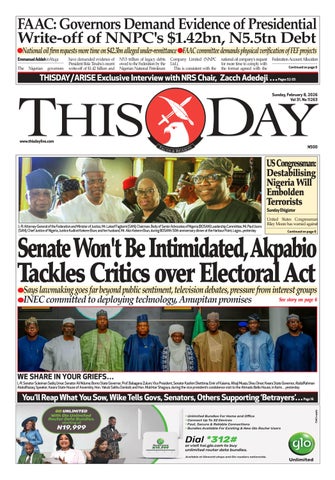
FAAC: Governors Demand Evidence of Presidential Write-off
L-R: Attorney-General of the Federation and Minister of Justice, Mr. Lateef Fagbemi (SAN); Chairman, Body of Senior Advocates of Nigeria (BOSAN) Leadership Committee, Mr. Paul Usoro (SAN); Chief Justice of Nigeria, Justice Kudirat Kekere-Ekun; and her husband, Mr. Akin Kekere-Ekun, during BOSAN’s
Senate Won't Be Intimidated, Akpabio Tackles Critics over Electoral Act
L-R: Senator Suleiman Sadiq Umar; Senator Ali Ndume; Borno State Governor, Prof. Babagana Zulum; Vice President, Senator Kashim Shettima; Emir of Kaiama, Alhaji Muazu Sheu Omar; Kwara State Governor, AbdulRahman AbdulRazaq; Speaker, Kwara State House of Assembly, Hon. Yakub Salihu Danladi; and
Mukhtar Shagaya, during
Hurray!
Our Epitome of Joy Adds Another Glorious Year to His Journey of Life
Today, we celebrate not just another year in your exciting journey of life, but a cheerful l
warmth to our lives and home.
Happy birthday to you my loving husband, our anchor, joy, and gift of inestimable value by God Almighty to our family You are many things to many people, but to us, you are everything we desire in our lives.
My Okinikini, Erefabo, Ereninabo, The Ejatutu of Ife, The Odogwu 1, ENITARI-yei, you carry your strength with humility and your authority with grace. You lead with wisdom, guide with courage, and love with a caring heart that oozes joy to all in our home.
Thank you for being our caring custodian, our laughter, our reassurance, and our example. Your consistency, kindness, and unwavering presence with us at all times are cherished by all. You have demonstrated to us that true success is not only in secular achievements but also in character, faith, and love.
Our divinely chosen love personified, as you mark this special day, I and all in our family pray that God shall continue to renew your strength as the Eagles', give you peace of m
glorious than the past ones.
Happy birthday, my love, our heart.
We dearly love and cherish you always.
Signed: Deaconess Dr. Mrs Esther Matthew Tonlagha Your loving wife, on behalf of myself and our beautiful children.
Mr Matthew Tonlagha Chairman, Maton Engineering Nigeria Limited
Excess Liquidity in the System Raises Banks’ Deposits with CBN By 460% to N52.6tn in January 2026
Kayode Tokede
With Nigerian banks’ growing preference for placing surplus funds with the Central Bank of Nigeria (CBN) rather than expanding credit to the real sector, deposits by commercial and merchant banks with the apex bank surged 460 per cent year-on-year to N52.6 trillion in January 2026.
The surge in banks’ deposits with the CBN reflected excess liquidity in the financial
system, attractive overnight interest rates, and continued risk-averse lending behaviour.
Latest data from the CBN showed that the N52.6 trillion in deposits by banks with the apex bank as at January 2026 represented an increase of N43.21 trillion over the N9.39 trillion recorded in the corresponding period of 2025.
Banks and merchant banks typically deposit excess cash with the CBN through the
Standing Deposit Facility (SDF) window, which offers overnight interest at relatively attractive rates.
Market operators say the combination of elevated policy rates and lingering credit risk concerns has made the SDF a safe and profitable short-term option.
THISDAY learnt that total deposits by banks and merchant banks with the CBN rose to an estimated N336.2 trillion in 2025, representing
a year-on-year increase of 777.2 per cent compared with N38.33 trillion recorded in 2024.
Analysts described the trend as a clear signal of heightened caution within the banking system.
According to market analysts, the surge in SDF placements reflects concerns about credit quality, weak risk appetite, and the relative safety of the CBN window amid macroeconomic uncertainty.
Rather than lend aggressively to the private sector, many banks have opted to preserve capital and earn risk-free returns.
In 2025, the CBN adjusted the standing facilities corridor around the Monetary Policy Rate (MPR) to +50 basis points and -450 basis points from the previous +250/-250 basis points, following a reduction in the MPR to 27 per cent from 27.5 per cent.
The move signalled a
SENATE WON'T BE INTIMIDATED, AKPABIO TACKLES CRITICS OVER ELECTORAL ACT
The President of the Senate, Senator Godswill Akpabio, yesterday fired back at opposition political parties, civil society organisations, and other nongovernmental organisations over the barrage of criticisms trailing the Senate’s rejection of compulsory electronic transmission of election results in the Electoral Act Amendment Bill.
The Senate president vowed that the Red Chamber would not be cowed or intimidated into passing what he described as a faulty law, adding that lawmaking is a grave constitutional responsibility that goes far beyond public sentiment, television debates, or pressure from interest groups.
Akpabio's response comes as the Chairman of the Independent National Electoral Commission (INEC), Prof. Joash Amupitan, said the commission remains committed to deploying technology to enhance the credibility of elections.
Akpabio spoke in Abuja at the public presentation of a book,
“The Burden of Legislators in Nigeria,” authored by former Senator Effiong Bob, where he used the occasion to mount a spirited defence of the Senate’s decision to remove the phrase ‘real-time’ from provisions relating to electronic transmission of election results.
Akpabio declared that lawmaking is a grave constitutional responsibility that goes far beyond public sentiment, television debates, or pressure from interest groups.
“The burden of lawmaking is where every clause must balance liberty with order. The burden of representation is that millions of voices must be expressed through a single vote.
“The burden of oversight is where power must be questioned without malice, and the burden of budgetary control is where national dreams must be matched with fiscal discipline,” Akpabio said.
He stressed that these responsibilities were often carried out under intense public scrutiny and frequent misrepresentation, noting that while democracy thrived on openness and
US CONGRESSMAN:
destabilising Nigeria, saying it could embolden terrorists and put Christians at greater risk.
While also clarifying that the idea of dividing Nigeria did not come up in any serious way during his high-level meetings in the country, Moore also stated that efforts to embolden separatists would hurt Christians, especially in the North and Middle Belt.
transparency, criticism should not degenerate into abuse.
The Senate president said: “Democracy breathes through social interrogation, but citizens are not free to abuse the legislature,” lamenting what he described as premature judgments on a bill that, procedurally, had not been concluded.
Akpabio explained that the Electoral Act amendment process was still incomplete, as the Votes and Proceedings of the Senate had not yet been adopted, insisting that it was only after that stage that the final position of the Senate could be fairly assessed.
“Until we approve the votes and proceedings, the bill is not completed. Any Senator can still rise to say that the record does not reflect the agreed outcome, and it can be corrected. Why then are people setting up panels on television stations and abusing the Senate when the process is incomplete?” he queried.
Reacting directly to the outrage over the removal of “real-time” transmission of results, Akpabio clarified that the Senate did not abolish electronic transmission, but merely declined
to make it mandatory under all circumstances.
“All we said was that the word ‘real-time’ should be removed. If you want to transmit results electronically, do so. If you want to use your phone, iPad, or any device, do so. But if you make real-time transmission mandatory and there is a network failure or a grid collapse, what happens to the election?” he asked.
He warned that insisting on real-time transmission without regard to Nigeria’s infrastructural realities could throw the country into chaos, particularly in areas grappling with insecurity, poor electricity supply, and weak telecommunications networks.
“In states where networks are not working, does it mean there will be no election? If the national grid collapses, will no results be valid nationwide? Technology must serve democracy; it must not endanger democracy,” the Senate president said.
Drawing from international experience, Akpabio referenced the disputed 2000 United States presidential election between George Bush and Al Gore to illustrate that even advanced
democracies still grapple with challenges associated with electronic voting systems.
He accused some NGOs and civil society actors of attempting to impose positions reached during retreats on lawmakers, stressing that consultations should not replace deliberations on the Senate floor.
“Retreats are part of consultation; they are not lawmaking. Why do you think that what was agreed in a retreat must automatically be passed on the floor? That is not how democracy works,” he said.
Akpabio maintained that the Senate would not make laws to favour individuals, opposition parties, or those currently in power, but for posterity and generations unborn.
“We will not be intimidated. We will do what is right for Nigeria. Laws must outlast us,” he added.
INEC Remains Committed to Deploying Technology, Amupitan Promises
Meanwhile, the Chairman
cautious shift toward easing while maintaining a tight overall policy stance.
A report by Cordros Research after the November 24–25, 2025, meeting of the Monetary Policy Committee (MPC), had noted that the SDF rate was adjusted to 22.5 per cent from 24.5 per cent, while the Standing Lending Facility (SLF) rate fell to 27.5 per cent from 29.5 per cent, in line with the revised corridor around the MPR.
of INEC, Prof. Amupitan, has expressed the commission’s commitment to deploying technology to enhance the credibility of elections.
Amupitan gave the assurance in Abuja while monitoring a mock accreditation exercise conducted ahead of the February 21 Area Council elections in the Federal Capital Territory (FCT). He cautioned Nigerians against creating "unnecessary tension" over the Senate's decision.
He stressed that the legislative process involves harmonisation between the Senate and the House of Representatives, adding that a "final position can only emerge after due process has been completed."
The Chairman, who led a delegation of National Commissioners and the FCT Resident Electoral Commissioner (REC) to selected polling units, said the exercise was aimed at testing the commission’s operational readiness and the technical efficiency of the upgraded Bimodal Voter Accreditation System (BVAS).
The US lawmaker said he engaged with Nigerian officials, church leaders, aid groups, and internally displaced persons across the country to grasp the challenges facing Christians, particularly in the North and Middle Belt.
“I have travelled to Nigeria and engaged in multiple high-level meetings with Nigerian officials, the Church, aid groups across the country, and IDPs, to get a better
In a statement issued yesterday via his official X (formerly Twitter) account, Moore revealed that he conducted a fact-finding visit to Nigeria to understand the situation of alleged Christian persecution better.
Committee (FAAC) for its explanation of the $42.37 billion alleged under-remittance to the federation.
A document sighted by THISDAY indicated that the issue arose during the January 2026 FAAC post-mortem review, during which the states insisted that the federal authorities provide detailed accounts of these figures, including the basis for the write-off.
Additionally, an ad hoc committee set up by FAAC to examine the utilisation of the revenues deducted in respect of the statutory 30 per cent Frontier Exploration Fund (FEF) insisted that it must physically verify all projects carried out using the over N400 billion earmarked for NNPC during the period.
The Minister of Finance
understanding of the rampant persecution of Christians in Nigeria,” he said.
He noted that discussions about dividing the country had not emerged in any serious way during his visit.
“In my discussions, the idea of dividing the country has not come up in any serious way. Efforts to embolden separatists hurt Christians in Nigeria — especially in the North and Middle Belt,” Moore said.
The lawmaker warned that destabilising Nigeria could
chairs the FAAC, which comprises the AccountantGeneral of the Federation (AGF), State Commissioners of Finance who represent the governors, and representatives from federal revenue-generating agencies.
THISDAY gathered that the Nigerian Upstream Petroleum Regulatory Commission (NUPRC), which first disclosed the presidential order at
embolden terrorists and put Christians at greater risk.
“A destabilised Nigeria would embolden terrorists and make Christians less safe in Nigeria and across the continent,” he said.
Moore also highlighted recent security cooperation between the United States and Nigeria as a key step in tackling violence.
“The US and Nigeria have just entered into a security cooperation agreement, and that is an important step in tackling the violence in
an earlier FAAC meeting, requested additional time to make the documents available, citing the recent change in its management.
“It should be noted that the NUPRC presented the sum of $1,421,727,723.00 and N5,573,895,769,388.45 as outstanding NNPC obligation to the Federation Account, which NUPRC claimed that it was netted off in line with
Nigeria and deepening and strengthening the bilateral relationship between our great nations,” he said.
He concluded by reaffirming his commitment to supporting Nigerians affected by terrorism.
“I remain committed to working to save the lives of our brothers and sisters in Christ — and for that matter, all Nigerians — suffering from the instability wrought by terrorists throughout Nigeria.
God bless you all,” Moore added.
a presidential approval. The Sub-Committee requested the Presidential Approval, and NUPRC asked for more time because of the change in the Commission's leadership,” the document indicated.
Earlier, the NUPRC announced that President Tinubu had approved the cancellation of about $1.42 billion and N5.57 trillion in outstanding legacy obligations
Last week, Moore met with Plateau State Governor Caleb Mutfwang during the governor’s trade and security mission to the United States, pledging continued American support in addressing security and economic challenges in Nigeria, particularly the protection of Christians and other vulnerable groups.
Moore had disclosed the meeting in a post on X, describing the engagement with the Plateau governor as productive and forwardlooking.
owed by the NNPC to FAAC, following a reconciliation of records between the parties. The upstream regulator said the presidential approval followed recommendations from the stakeholder alignment committee, which examined the company’s royalty and lifting-related liabilities through December 31, 2024.
Continued on page 16
Adedayo Akinwale and Sunday Aborisade in Abuja
Shettima Leads FG’s Delegation to Condole With Victims of Kwara Attack, Promises to Restore Peace
Deji Elumoye in Abuja and Hammed Shittu in Lagos
Vice President Kashim Shettima yesterday affirmed President Bola Tinubu’s determination to restore peace and tranquility in Nuku and Woro villages in Kaiama Local Government Area (LGA) of Kwara State in the aftermath of last Tuesday's attacks on the communities by terrorists.
He assured the communities that, while the President had
ordered the deployment of a battalion of the Nigerian Army to Kaiama, all hands were already on deck to rid the affected communities and the entire state of insecurity.
Shettima gave the assurance when he led a federal government delegation to commiserate with the people of Kaiama LGA and the Governor of Kwara State, Mallam AbdulRahman AbdulRazaq, over the deadly terrorist attack that claimed
several lives.
The Vice President disclosed that President Tinubu had instructed the National Emergency Management Agency (NEMA) to mobilise all resources, in partnership with the Kwara State Emergency Management Agency, to provide succour and support to the distressed communities.
According to him: "We are here at the behest of President Bola Tinubu to commiserate with you and the good people
of Kaiama and Kwara State, by extension, over the tragedy that befell our communities of Woro and Nuku in the evening of Tuesday, February 3, 2026.
"The tragic killings had shocked Nigerians because the victims were peaceful members of the communities that were dedicated to building peaceful livelihood, while they practice their religion peacefully and harmoniously, as the injunctions of Islam have instructed".
Ojulari: NNPC’s Refinery Shutdown a Long-Term Energy Strategy, Not Short-term Cost-cutting Measure
Ejiofor Alike
The Group Chief Executive Officer of the Nigerian National Petroleum Company (NNPC) Limited, Mr. Bayo Ojulari, has said that the shutdown of Nigeria’s state-owned refineries was part of a long-term energy strategy rather than a short-term cost-cutting move.
Speaking at the Nigeria International Energy Summit (NIES) in Abuja, Ojulari said Nigeria’s energy future depended on strategic realism, not nostalgia.
“We cannot build tomorrow’s energy system on yesterday’s assumptions,” he said.
Ojulari explained that the refinery shutdown allows Nigeria
to rethink its downstream sector in line with global energy trends and domestic realities.
“For decades, we believed ownership was more important than performance,” he said. “That belief has failed us.”
Ojulari said Nigeria’s refineries were built in an era when state ownership dominated the oil industry, adding that the model no longer works.
“Energy is now about efficiency, resilience, and adaptability,” he said.
The shutdown, he noted, creates space to align refinery operations with broader energy transition goals.
“You cannot modernise while bleeding money,” Ojulari said.
Experts are of the view that Nigeria's refineries operated efficiently through the 1980s and much of the 1990s, but performance declined in the 2000s as institutional focus shifted away from operational excellence toward EPC contracting, O&M structures, and financing-driven interventions.
This transition weakened preventive maintenance culture, increased reliance on turnaround maintenance cycles that proved more commercially attractive to external parties, and contributed to the gradual erosion of in-house operational capacity within NNPC.
He also stressed the importance of flexibility in energy supply.
“Energy security is not about doing everything yourself,” he said. “It is about ensuring supply at the lowest cost.”
Ojulari said private-sector refining, imports, and restructured public assets must work together.
“The Dangote Refinery has changed the equation,” he said.
“It gives us options.”
He rejected claims that the shutdown represents abandonment.
“This is repositioning,” he said.
Under the new strategy, NNPC plans to integrate refinery assets into a commercially viable energy portfolio.
“We are thinking in decades, not election cycles,” Ojulari said.
Kwara Killings: Lift Ban on Amotekun to Combat Spread of Banditry to Osun, Adeleke Tells Police
Yinka Kolawole in Osogbo
Osun State Governor, Senator Ademola Adeleke, has raised the alarm about the possible spread of banditry from Kwara State into the state, urging the police to immediately lift the ban on Amotekun operations to combat emerging threats.
Responding to another recorded incident of kidnapping at Ora Igbomina area of the state, the governor said the state was handicapped in its security response as the Amotekun service has remained banned by the police, with its top officers in detention without trial for
several months.
The governor stated that the Amotekun service had developed the expertise to contain criminality, especially in the rural border areas, and insisted that the police's shutdown of Amotekun’s operations had created a significant gap being exploited
by bandits and criminals.
Adeleke, who called on the Inspector General (IG) of Police to charge those detained in court and lift the ban on the service, stated that further delay may endanger the rural population and open the state to further criminal infiltration.
Shettima extended heartfelt condolences of President Tinubu and the federal government to the state government and those who lost their loved ones in the gory attacks, noting that all hands were already on deck to restore peace in the community.
"Please accept our heartfelt condolences on behalf of President Bola Tinubu. A battalion of the Nigerian Army had been deployed to Kaiama, and all hands are on deck to ensure that peace and tranquility are restored to those communities," he added.
The Vice President did not disclose the measures being taken to restore peace in the area, observing, however, that "security issues are sensitive
issues and we do not have to divulge most of the actions that our security establishment is taking.
"But I'm here fundamentally to commiserate with the government and people of Kwara and the people of Kaiama, in particular, over the tragic loss of lives and to reassure the good people of the state of harmony. Our prayers are with you, our empathy is with you," Shettima added.
Earlier, the Chairman of the North East Governors Forum, Governor Babagana Zulum of Borno State, extended the condolences and sympathy of the North East Governors to the people and government of Kwara State over the tragedy.
Southern Govs Condemn
Kwara
Terror Attack, Seek Arrest of Perpetrators
James Sowole in Abeokuta
The Southern Governors’ Forum has commiserated with the Government and people of Kwara State over the deadly terrorist attacks that claimed at least 162 lives in the villages of Woro and Nuku in Kaiama Local Government Area (LGA) of the state.
In a statement issued yesterday in Abeokuta, Ogun State, the Chairman of the forum and Governor of Ogun State, Dapo Abiodun, expressed deep sorrow over the incident, describing it as a tragic and unfortunate act in which innocent and lawabiding citizens were brutally murdered while going about their lawful activities.
The governor condemned the reported targeting of residents who allegedly refused to adopt Sharia law, noting that homes and shops were burnt while several people were kidnapped by the
attackers, who are believed to be affiliated with Boko Haram
He described the act as most horrendous, stressing that Nigeria remains a secular state that respects freedom of religion.
Abiodun called on law enforcement agencies to track down the perpetrators and ensure they are prosecuted to the fullest extent of the law, insisting that Nigerians deserve to live without fear of senseless violence.
He said, “On behalf of myself and my colleagues in the Southern Governors’ Forum, I express our deepest condolences over the dastardly terror attack in Kwara State, in which jihadists murdered innocent people in cold blood.
“This is senseless violence that must be nipped in the bud. We urge the security agencies to intensify their operations against the perpetrators of this terrible incident and bring them to book.
Author, Senator Effiong Bob; and his wife, Comfort, during the public presentation of the book: ‘The Burden of Legislators in Nigeria,’ at the NAF Conference Centre, Abuja…yesterday.
After Receiving Trump’s Accolades, Remi Tinubu Urges Nigerians to Stop Bullying Leaders
Sunday Ehigiator
The First Lady, Senator Oluremi Tinubu, has called on Nigerians to desist from bullying political leaders, particularly on social media, stressing that persistent online attacks would undermine national unity and constructive governance.
Tinubu made the call in a message recently shared on her Facebook page, where she lamented what she described as a growing culture of insults, ridicule, and hostility directed at public officials by citizens.
Her remarks came shortly after she participated in the United States National Prayer Breakfast in Washington, D.C., at which United States
President Donald Trump reportedly described her as a highly respected woman. The recognition was linked to her involvement in faithbased humanitarian initiatives and women empowerment programmes.
Tinubu, in the post, said:
“Most of our leaders are highly respected and honoured abroad, yet many Nigerians fail to value what they have because of hatred and the narratives planted in their minds by political paymasters, which have also hardened their hearts.
“They bully these leaders, speak ill of them, demean them, curse them, and even seize upon their mistakes to drag them across social media,
ridiculing and mocking them publicly.
“Nigeria is built on love, unity, and collective effort toward shared success. Let us come together to support our respected leaders and work hand in hand with them to make our country great.”
The First Lady noted that while several Nigerian leaders received recognition and respect on the global stage, they often encountered hostility and negative public sentiment upon returning home.
She attributed this development to political propaganda and deliberate narratives that shaped public perception and fueled distrust toward leaders.
According to her, the pattern of harsh criticism had escalated beyond constructive engagement into outright bullying, with many Nigerians quick to highlight and publicise leaders' mistakes without consideration for fairness or empathy.
Tinubu emphasised that no individual was perfect, warning that weaponising leaders’ mistakes to destroy reputations would not advance national progress. She maintained that Nigeria’s growth depended on unity, love, and collective efforts rather than bitterness and division.
She further urged Nigerians to adopt a balanced approach by supporting commendable
Kano Assembly Dismisses Alleged Impeachment Plot
against Deputy Governor Gwarzo
The Kano State House of Assembly has denied reports suggesting an attempt to impeach the Deputy Governor, Gwarzo, saying the claims were unfounded and lacking in merit.
Addressing journalists yesterday in the state, the spokesperson of the assembly, Kamaluddeen Sani Shawai, dismissed the allegations stressing that there was no
such plan.
He declared that the reports circulating in some media outlets were intended to create unnecessary tension in the state.
“There is absolutely no motion or initiative within the House to remove the deputy governor.
“These reports are false and should be disregarded by the public. The deputy governor continues to serve in his capacity with full support from the House,” he said.
The assembly’s spokesman urged members of the public and the press to verify information before sharing it, stressing the importance of accurate reporting in maintaining political stability in the state.
According to him, the assembly remained focused on legislative duties and oversight functions rather than engaging in speculative political manoeuvres.
“Our priority is good
governance and serving the people of Kano, not circulating rumours,” he explained.
The Commissioner for Information and Internal Affairs, Comrade Ibrahim Abdullahi Waiya last sparked controversy during an interview session with local radio station when he called on the deputy governor to resign for not defecting with the governor to the All Progressives Congress (APC).
Bauchi Govt to Pay for Medical Treatment of Injured Correspondents of ARISE NEWS, Channels, AIT, 11 Others
Segun Awofadeji in Bauchi
The Bauchi State Government has pledged to take responsibility for the medical treatment of 14 journalists who were involved in an accident on Friday.
The injured journalists include: Correspondents of ARISE NEWS, Channels Television, African Independent Television (AIT), Nigerian Television Authority (NTA), as well as other members of the
Correspondents’ Chapel and staff of the Bauchi State Television Authority (BATV) and the Bauchi Radio Corporation (BRC).
The unfortunate incident occurred along the Bauchi–Yelwan Duguri Road
while the journalists were covering the inauguration of North East Development Commission (NEDC) projects by the Minister of State for Regional Development and the Managing Director of the NEDC.
initiatives while addressing governance lapses through constructive dialogue and responsible civic engagement.
Reactions to her statement have generated mixed responses across social and political circles. While some Nigerians supported her position, arguing that criticism should be civil and constructive, others maintained that public officeholders must be prepared to face intense scrutiny, particularly amid prevailing economic hardship and a rising cost of living.
Despite differing views, the First Lady clarified that her
message was not intended to discourage criticism or silence dissent, but rather to promote respectful engagement. She stressed the importance of distinguishing between holding leaders accountable and resorting to personal attacks or mockery.
Tinubu warned that persistent hostility toward leaders could erode public trust in governance and weaken democratic institutions. She added that when citizens lost confidence in leadership and governance processes, political participation and civic responsibility declined.
UK: We’ve Not Been Notified of Judgment Awarding £420m to Families of Nigerian Coal Miners
Sunday Ehigiator
The Government of the United Kingdom has not been notified of the court judgment that ordered it to pay £420 million as compensation to the families of murdered Nigerian coal miners, its spokesman has said.
Reacting to the news of last Thursday’s judgment of the Enugu State High Court, which ordered the British government to pay £20 million to each of the families of the 21 coal miners killed in Enugu on November 18, 1949, a spokesperson for the UK government told the BBC that it could not comment on the matter, due to absence of a formal notification.
The presiding judge, Justice Anthony Onovo, ruled that the killings were unlawful and constituted an extrajudicial violation of the right to life.
The suit was filed by human rights activist Greg Onoh, who sought an acknowledgement of
liability, a formal apology from the British government, and comprehensive compensation for the victims' families.
Respondents in the suit are the Secretary of State for the Foreign, Commonwealth and Development Office; the British government; the Federal Government of Nigeria; the Attorney-General of the Federation; the Head of the Commonwealth, and the government of the United Kingdom.
No counsel represented the first, second, fifth, and sixth respondents.
On November 1, 1949, workers at the coal mine in Iva Valley, Enugu, the administrative capital of the old Eastern Region at the time, went on strike over harsh working conditions and debts owed by the colonial administration.
Coal was a major source of energy and revenue during the British colonial government.
Ahmad Sorondinki in Kano
Wike; Chairman of Rivers State Elders Council, Chief Ferdinand Alabraba; and Rivers State Coordinator of the Renewed Hope Ambassadors, Mr. Desmond Akawor, during the inauguration of the Renewed Hope Ambassadors' Secretariat and Buses in Port Harcourt…yesterday
I thank God for the gif t of y You stand out as a beacon hope and encouragement, e as you continue to touch liv with your philanthropic zea Welcome to a new decade of greater exploits and bigger impact in life.
EIGHTY HEARTY CHEERS…
L-R: The National President, Remo Secondary School Old Students Association, Sir Aare Adetola
Prince Dapo
the
an
Sagamu…yesterday
as an
Bandits Kill 13 in Benue, Kaduna,
Abduct Catholic Priest, 10 Others
Suspected herders have attacked Anwase market in Kwande Local Government Area (LGA) of Benue State, killing 13 persons and destroying several properties.
The attack came two days after a similar one occurred in the Abande community, also in the Kwande LGA, where at least 16 people, including a mobile police officer, were killed.
This is just as three people have been killed while 11 others, including a Catholic priest, were abducted in
an attack on the Karku community in Kauru LGA of Kaduna State.
Confirming the Benue State incident, an aide to the Kwande LGA Chairman, Ibi Andrew, told journalists that 13 persons were confirmed dead, adding that the council chairman, Vitalis Neji, alongside security agencies, moved to the area to restore calm and prevent further violence.
Sources said the attackers came from a nearby mountain and unleashed mayhem on the market, shooting sporadically and causing traders and buyers to flee in panic.
Stop Mass Killings, Abductions, Other Forms of Violence, Catholic Church Tells FG
Onyebuchi Ezigbo in Abuja
The Catholic Church in Nigeria has asked the federal government to urgently take measures to check the relentless wave of killings, abductions, and other forms of violence prevalent in the country.
The Church, through the Catholic Secretariat of Nigeria (CSN), admonished the federal government to arrest and punish perpetrators of the violence, kidnappings, and killings across the country, including their sponsors.
In a statement signed by CSN Secretary General, Very Rev. Fr. Michael Banjo, and the National Director of Social Communications, Very Rev. Fr. Michael Nsikak Umoh, the Church charged the government to seek assistance when necessary to contain the situation.
It said that the government should go beyond issuing condolences messages and
intensify efforts by "redeploying security forces strategically from ceremonial press centres to the actual frontlines where citizens are under siege".
It also called on all leaders - political, religious, and community - to rise above division and work together to restore peace and dignity to our land.
"Catholic Secretariat of Nigeria (CSN) decries the relentless wave of killings and abductions that continue to plague our nation.
"After years of repeated complaints and unfulfilled promises, violence persists unchecked, leaving more communities devastated and citizens weary of empty condolences that do not guarantee their safety.
"This renewed cycle of mass violence has turned our country into a field of grief, and CSN expresses its profound outrage and sorrow at the ongoing assault on human life and dignity," it said.
However, the state police command was yet to confirm the incident.
In a statement issued yesterday, the police announced the arrest of a suspect and the recovery of live ammunition in the Ukum LGA of the state.
A statement by the Police PRO, Udeme Edet, read: "On February 6, 2026, at about
0845 hours, operatives of the command received credible information regarding the movement of a male suspect identified as Saamoga, also known as Aleki, who was allegedly conveying live ammunition from Gbagir to Zaki-Biam on a commercial motorcycle."
"Based on the information, a
patrol team was immediately mobilised and deployed to the Tse Dubem area of the Ukum Local Government Area, where a stop-and-search operation was conducted.
Upon sighting the police patrol team, the suspect reportedly disembarked from the motorcycle and attempted to evade arrest. In the course of
the operation, the suspect was immobilised with a shot to the leg and taken into custody". It further said a search conducted on the suspect led to the recovery of 117 rounds of 7.62mm live ammunition concealed inside socks within his handbag. Other items recovered include charms and a mobile phone.
Afenifere Condemns Senate’s Rejection of Electronic Transmission of Election Results
Segun James
The Pan-Yoruba socio-political organisation, Afenifere, has described the Senate's rejection of mandatory realtime electronic transmission of results as undemocratic and self-serving.
The group said the rejection was tantamount to a betrayal of constitutionalism and multiparty democracy, accusing the lawmakers of prioritising political incumbency over democratic
integrity.
Afenifere stated this in a joint statement signed by its leader, Oba Oladipo Olaitan, and the National Publicity Secretary, Prince Justice Faloye.
According to Afenifere, the decision “is obviously self-serving and a move towards a one-party state, teleguided by the executive as witnessed over the years in Lagos State.”
The group observed that while the Senate insisted that
the electronic transmission is “still allowed” under existing law, the Supreme Court previously ruled that such transmission is not mandatory because it is not explicitly provided for in the Electoral Act 2022.
“By refusing to codify it as a legal requirement in the 2026 Bill, the Senate intentionally leaves the process vulnerable to administrative ‘glitches’ or selective non-compliance, undermining the spirit of the Nigerian Constitution’s
call for free and fair elections,” Afenifere said.
The group further noted that Section 78 of the 1999 Constitution empowers the National Assembly to legislate for credible federal elections. It stated that, unfortunately, the Senate has subverted mandatory transparency by rejecting an amendment to Clause 60(3) that would have legally required INEC to transmit results from polling units to the IReV portal in real time.
Mark: APC Has Failed on Its Campaign Promises, ADC Will Offer Nigeria Better Political Future
Chuks
Okocha in Abuja
A former President of the Senate and the National Chairman of the African Democratic Congress (ADC), Senator David Mark, has declared that the ruling All Progressives Congress (ADC) has failed to fulfill any of its campaign promises to Nigerians.
Mark added that, with Nigeria at a critical crossroads after more than a decade of APC governance, his party was well-positioned to offer the
country a better political future.
He further stated that many Nigerians were asking a hard but necessary question, such as: ''Is the country better governed, more united, and more prosperous than it was promised to be?
Speaking to THISDAY, Mark cited rising poverty, persistent insecurity, weakening institutions, and widespread public distrust as evidence of APC’s failed leadership.
“The ADC presents itself not
merely as an opposition party, but as a credible alternative—one rooted in reform, accountability, and people-centred governance.
''When the APC came to power in 2015, it campaigned on three major pillars: Security, economic revival, and anticorruption. Years later, Nigeria continues to grapple with worsening insecurity, from terrorism and banditry to kidnappings and communal violence.
Economic hardship is marked
by inflation, unemployment, currency instability, and declining purchasing power. Institutional erosion, where key democratic safeguards, especially electoral integrity, are increasingly questioned,” Mark explained. Mark added that rather than deepening democracy, the APC had often been accused of concentrating power, weakening oversight, and resisting reforms that would make elections more transparent and competitive.
John Shiklam in Kaduna and George Okoh in Makurdi
EmmanuelKing; the Akarigbo and Paramount ruler of Remoland, Oba Babatunde Ajayi; and the Ogun State Governor,
Abiodun, during
presentation of
award
Honorary old student of the school to the governor during the celebration of the 80th anniversary celebration of Remo Secondary School Old Students Association held in
CELEBRATING MY GOLDEN BROTHER
SEVENTY-FIVE HEARTY CHEERS...
You’ll Reap
What You Sow, Wike Tells Govs,
Senators, Others Supporting ‘Betrayers’
Says Tinubu’s supporters don’t need governor to mobilise for president
Blessing Ibunge in Port Harcourt
The Minister of the Federal Capital Territory (FCT), Nyesom Wike, yesterday warned governors and other leaders,
claiming that a “message from the gods” portends a grim fate for those who align with “betrayers.”
Wike has also declared that the supporters of President Bola Tinubu in Rivers State would not require the backing of a
sitting governor to mobilise for the president’s re-election bid in 2027.
Speaking at the inauguration of the Rivers State Renewed Hope Ambassadors headquarters in Port Harcourt, Wike cautioned
that those who supported political disloyalty would eventually be consumed by the same treachery they endorsed.
Wike, who has been embroiled in a long-standing political feud with Governor Siminalayi Fubara
FMDQ Debt Market Hits N99.3tn as T-Bills, Bond Yields Ease on Improved Liquidity
Festus
Akanbi with agency report
The Nigerian fixed income market extended its quiet rally on February 5, 2026, with Treasury bills and federal government bond yields declining across most maturities, pushing the total size of the FMDQ debt market to N99.30 trillion.
Data from the FMDQ Securities Exchange indicated that easing system liquidity and reduced dependence on aggressive shortterm borrowing contributed to yield compression, even as the Central Bank of Nigeria (CBN) maintained a tight monetary policy stance.
The softer yields suggest a gradual moderation in
“Debts earlier reported during the October 2025 FAAC meeting stood at $1,480,610,652.58 and N6,332,884,316,237.13 for… However, the commission recently received a Presidential Approval to nil off the outstanding obligations of NNPC Ltd as at 31st December 2024 as submitted by the Stakeholder Alignment Committee on the Reconciliation of Indebtedness between NNPC Limited and the Federation,” the regulator had said.
“Consequently, out
government borrowing costs, driven more by market dynamics than by any shift in policy direction.
Trading activity reflected steady and resilient demand for government securities.
Investors positioned across the short, mid, and long ends of the curve, encouraged by liquidity inflows from maturing instruments that outweighed the dampening effect of elevated policy rates.
The result was a broad-based decline in yields across both Nigerian Treasury Bills (NTBs) and sovereign bonds.
According to FMDQ data, the sharpest yield drops were recorded at the longer end of the NTB curve and around the belly
of $1,480,610,652.58 and N6,332,884,316,237.13, the affected outstanding obligations that have been ‘nil off’ are $1,421,727,723.00 and N5,573,895,769,388.45. The commission has passed the appropriate accounting entries as approved,” it added. In the same vein, after denying that it owed the federation an outstanding sum of $42.3 billion in unremitted funds, FAAC provided NNPC with a template to record all its earnings and liabilities for the period in question, to facilitate reference.
of the bond curve, suggesting growing investor confidence in extending duration.
Treasury bills maturing between October and December 2026 posted some of the most notable declines during the session, while FGN bonds with maturities between 2027 and 2035 also closed lower on stronger demand.
By contrast, ultra-long-dated bonds beyond 2040 were largely unchanged, reflecting lingering investor caution around longterm inflation risks and fiscal sustainability.
Still, overall market turnover underscored a sustained appetite for government paper, even with policy rates at historically elevated levels.
However, the national oil company requested more time to resolve the matter, a request the committee accepted, according to the document from the January FAAC meeting.
“The sub-Committee invited NNPC and Periscope Consultants for a final reconciliation meeting on the 8th of January, 2026. However, NNPC requested more time to input their figures into the template agreed by the Committee. Subsequently, NNPC’s representatives and Periscope agreed to meet and
Benchmark yields closed lower across most tenors, reinforcing the bullish tone in the fixed income space. Short- and middated instruments attracted the strongest bids, in line with investors’ preference for managing duration risk while locking in attractive returns.
On the Treasury bills side, benchmark yields for March to June 2026 maturities settled between 15.55 per cent and 16.65 per cent.
Bills maturing between July and September 2026 traded in the 16.29 per cent to 16.74 per cent range, while October to December 2026 maturities compressed further to between 16.05 per cent and 16.20 per cent. The January 2027 NTB closed around 16.05 per cent.
harmonise the figures before presentation to the committee. This assignment is work in progress,” the FAAC document showed.
Also, the governors, alongside other members of the FAAC committee, demanded a physical verification of the projects carried out by NNPC using the frontier exploration fund, following concerns raised.
A review by THISDAY recently showed that the money realised over about 10 months exceeded N400 billion.
“The ad-hoc committee set up to examine the utilisation
of Rivers State, suggested that the spiritual laws of karma would soon catch up with his detractors.
“Let me tell you one thing: today is the 7th of February. Whoever is watching, whether you are a senator, whether a House of Reps member, or a minister, whether you are a governor and you support betrayers, people will continue to betray you in life,” the minister declared.
He described the psychological and physical toll such a betrayal would take, warning that his opponents would be left speechless when the tables turn.
“Betrayal is your portion, and the day you will be betrayed, you will not have a mouth to say anything; there you will collapse. You will reap the seed that you planted.”
Wike noted that while it took his own successor several months to turn against him, those currently supporting “betrayers” would face faster rebellion from their chosen heirs.
“Watch every governor who is doing his second tenure, who has ambition to put a successor and is supporting a betrayer – you will never survive it.
of the revenues deducted in respect of Frontier Exploration Fund reported that the Committee had studied NNPC, CBN, and NUPRC submissions and had prepared an interim report. However, the Ad-hoc Committee explained that there is a need for physical verification of some projects executed to ensure accountability and transparency.
“Accordingly, the ad-hoc committee and NNPC were mandated to work out modalities for the visits. This assignment is still a work in progress,” the FAAC document
“The day your successor comes in, my own took some months; your own will start immediately. This is what the gods of the land have told me to tell you people”, he declared. The minister emphasised that political loyalty is a spiritual and moral obligation, asserting that “betrayal will follow you everywhere” for those who violate this code.
He urged politicians not to take his warnings for granted, framing the current political landscape as a harvest of past actions.
“You will reap it; whatever you sow, you will reap it,” he said, reiterating that the infrastructure he commissioned yesterday, including a radio station and a situation room, would serve as a base for those who remain committed to President Bola Tinubu’s “Renewed Hope” agenda, standing in contrast to those he labelled as unfaithful. Meanwhile, Wike also declared that the supporters of President Tinubu in Rivers State would not require the backing of a sitting governor to mobilise for the president’s re-election bid in 2027.
added. The frontier exploration fund is a statutory funding mechanism created under the Petroleum Industry Act (PIA) to support new oil and gas exploration in the country’s underexplored or ‘frontier’ basin areas like Chad, Sokoto, Anambra, Benue, and other inland basins where commercial hydrocarbon discoveries have historically been limited. Under the PIA, a portion of revenues from upstream petroleum operations is set aside specifically for frontier exploration.
L-R: Former Captain, Miccom Golf Course, Ada, Dr. Abiodun Abayomi; Manager, Ibadan Golf Course, Mr. Kola Ogunjobi; Peculiar Ultimate Concerns and Ileogbo Golf Course, Mr. Olanrewaju Abel Adeleke; and the celebrant and former Osun State Governor, Prince Olagunsoye Oyinlola, at the special birthday golf tournament to commemorate Oyinlola's 75th birthday at the Ileogbo Golf Course and Resorts and LanreLeke Sports Academy, Ileogbo, Aiyedire Local Government, Osun State…yesterday
Editor: Festus Akanbi
Nigeria’s Uneven Path to Economic Recovery
Nigeria enters 2026 with its economy stabilised but not yet healed. The defining test is whether reform gains can reach ordinary households, not just the macro numbers, writes Festus Akanbi
There is a new calm in official circles. At the Central Bank, policymakers speak with more assurance than they have in years. In Lagos boardrooms, bankers now talk about “stability” as if it were a long-lost friend. The figures appear to justify the mood: inflation has eased sharply from about 34 per cent to 14.45 per cent, the naira has steadied around N1,436 to the dollar, and foreign exchange reserves have crossed $45 billion.
Away from these polished spaces, however, the mood is far less upbeat. In Kano’s Dawanau market and among spare-parts dealers in Ladipo, Lagos, traders tell a different story. “Food is still expensive,” says Amina Yusuf, a grain seller. “People don’t buy the way they used to. They now buy half of what they bought last year.”
This contrast defines Nigeria’s economic story in 2026. The country has regained macroeconomic stability after years of turbulence, but that stability has yet to translate into broad prosperity.
PwC recently described the gains as “fragile and highly exposed.” Even the World Bank’s praise of Nigeria as a “global reference point for reform” comes with the understanding that international approval does not automatically improve household welfare.
The View from the Boardroom
Sam Ado, PwC’s Regional Senior Partner for West Africa, describes the moment as one that requires “two lenses.” At a recent PwC Executive Roundtable in Lagos, he explained that business leaders are forced to look both short- and long-term simultaneously.
“On one hand, CEOs are focused on immediate risks, geopolitics, cyber threats, global uncertainty,” Ado said. “On the other hand, they are looking ahead to opportunities in technology, artificial intelligence, and innovation.”
From the long-term view, confidence is rising. PwC’s 29th Global CEO Survey shows that 90 per cent of Nigerian CEOs expect economic improvement in 2026, up from 64 per cent a year earlier. More than half are confident their companies will grow revenues, far above the global average.
This optimism is not without basis. Exchange rate stability has restored predictability that was missing for much of 2023 and 2024. Companies can now plan budgets and investments without constantly hedging against currency shocks. The stock market reflects this renewed confidence, with market capitalisation rising to about N99.4 trillion. Many firms that delayed expansion during the worst of the volatility are cautiously investing again.
Still, Ado offered a reminder: “Macroeconomic
stability is not the same as success. It is only the foundation. Sustainable growth still has to be built on it.”
The Warning from the Watchtower Economists, while acknowledging the progress, remain careful. Olusegun Zaccheaus, PwC’s Chief Economist for West Africa, says the recovery has yet to reach ordinary consumers.
“The numbers look good at the macro level,” he said. “But there is a clear gap between investment recovery and consumer recovery.”
Data support this concern. Nominal household spending rose in 2025, but when adjusted for inflation, real spending actually declined. Nigerians are spending more money but buying less.
According to PwC projections, poverty could rise to affect about 62 per cent of the population, roughly 141 million people, by the end of the year.
Growth is also uneven. Oil and gas, boosted by reduced theft and new investments, are expected to lead the expansion. Services, especially finance and technology, are performing well. Manufacturing, however, remains constrained by high costs and limited access to foreign exchange. Agriculture, which employs the majority of Nigerians, continues to face insecurity and climate-related pressures.
“The sectors driving growth are not the ones employing the most people,” Zaccheaus warned. “That is the core challenge.”
The Ghost of Elections Past Hovering over the outlook is a familiar Nigerian concern: elections. With 2027 approaching, economists worry about the return of pre-election spending pressures that have derailed past stabilisation efforts.
History is instructive. In 2018, inflation was kept in check despite election-related spending. In 2022, however, monetary expansion, combined with foreign exchange volatility, pushed inflation sharply higher. Today, the money supply has already grown significantly, raising fresh concerns.
The PwC report notes that pre-election fiscal pressures could reignite inflation. Put simply, political demands may clash with economic discipline.
Under Governor Yemi Cardoso, the Central Bank has pursued a tight monetary policy, keeping interest rates high to control inflation. While this has helped stabilise prices, it has also restricted credit to businesses. Any premature easing, whether for political or growth reasons, risks undoing recent gains.
Oil and the Vulnerability
Nigeria’s dependence on oil remains its biggest vulnerability. Despite years of talk about diversification, government revenue and foreign exchange earnings still rely heavily on crude oil. The budget’s break-even oil price is around $60 per barrel. Current prices offer some comfort, but oil markets are famously unpredictable.
S&P Global Ratings projects strong credit growth in 2026, driven largely by oil and gas investments. While positive in the short term, this increases exposure to price shocks. Analysts noted that a sustained decline in oil prices would reduce government revenue, weaken the naira, and strain banks.
The Fiscal Arithmetic of Impos- sibility
Behind the improved indicators lies a difficult fiscal reality. Nigeria’s public debt stands at about N152 trillion. Debt servicing consumes roughly 45 per cent of federal revenue.
A Lagos banker, Stephen Ogunsola, argued that the projected 2026 deficit of N24 trillion will require more borrowing at a time when global interest rates are high.
Kenneth Erikume, PwC’s Tax Strategy Leader, summed it up bluntly: if this were a household budget, it would be unsustainable. While governments can raise taxes, Nigeria’s tax-to-GDP ratio remains low, and collection capacity is limited.
The per-capita budget of about $288 highlights the problem. Compared with peers such as South
Africa, Nigeria lacks the fiscal space to invest heavily in infrastructure, education, and security. Ambitions of rapid growth and a $1 trillion economy are possible on paper, but difficult in practice without stronger state capacity.
The Path Forward
For businesses, 2026 calls for careful judgment rather than unquestioning optimism. PwC’s Executive Playbook emphasises selectivity, resilience, and adaptation. Companies are advised to focus on sectors with built-in protection against shocks, plan for volatility, and invest in technology that improves productivity.
Digital transformation and artificial intelligence are becoming essential tools, not optional extras. But success depends on proper governance, skills, and cybersecurity, areas where many firms still lag.
At the African Business Convention, NGX Chairman Umaru Kwairanga struck a hopeful note, saying Nigeria has the resources to achieve a $1 trillion economy. The capacity may exist, but execution remains the real test.
President Bola Tinubu often says Nigeria has passed the hardest stage of reform. In whatever way this is viewed, the shock of subsidy removal, exchange rate unification, and tight monetary policy has been absorbed. Stability has returned.
But economic watchers argued that the journey from stability to transformation is far from complete. Praise from global institutions and caution from analysts reflect the same truth: reform credibility must now deliver real improvements in daily life.
Lagos Central Business District
Buying and selling at a Nigerian market
Architecting Africa’s Trade Renaissance
For decades, Africa traded in promises while others traded in its resources. Now, with Cape Town as its drafting table, Access Bank is assembling the architects who will redraw the blueprint of global commerce, with African hands holding the pen, writes Festus Akanbi
For a long time, Nigeria and Africa have occupied the margins of global trade. The continent has supplied raw materials to the world but has played only a limited role in deciding how global trade is structured, financed, and governed.
Africa trades more with the rest of the world than with itself, and Nigeria, despite being Africa’s largest economy, has struggled to convert its size into real trade influence.
Today, that story is slowly changing. At the centre of this shift is Access Bank, which says Africa must stop watching global trade from the sidelines and start shaping it. The bank’s Africa Trade Conference (ATC) 2026, scheduled for March 11 in Cape Town, is designed to help make that change real.
When Roosevelt Ogbonna, Group Managing Director of Access Bank Plc, said that “Africa will not be a spectator in the remaking of global trade,” he was making a clear statement of intent.
This is not just about hosting another conference. It is about repositioning Africa, and Nigeria in particular, as active players in global commerce. The 2026 conference, themed ‘Turning Vision into Velocity: Building Africa’s Trade Ecosystem for Real-World Impact,’ comes at a moment when Africa’s biggest trade project, the African Continental Free Trade Area (AfCFTA), is moving from paper to practice.
Tackling Obstacles to African Trade
The importance of ATC 2026 lies in its focus on real problems that limit African trade. At the first conference, leaders from 28 countries came together, not for speeches alone, but to address the hard issues holding African businesses back.
According to Seyi Kumapayi, Executive Director for African Subsidiaries at Access Bank, three major barriers continue to slow African trade: limited access to affordable finance, lack of reliable information, and weak trust between trading partners. These challenges help explain why trade between African countries remains stuck at about 16 per cent of total trade, far below Europe’s 60 per cent and Asia’s 40 per cent.
Changing Dynamics
Globally, trade is changing. Supply chains are being restructured as countries look for trusted partners and alternative production hubs. Africa, with a population of about 1.3 billion, a combined GDP of roughly $3 trillion, and vast natural resources, presents significant opportunities. Yet this opportunity will remain unrealised without strong financial systems, efficient infrastructure, clear rules, and modern technology. Access Bank understands this. That is why it describes ATC 2026 not as a banking event, but as a meeting point for policy, finance, technology, and business.
For Nigeria, the benefits of this strategy are significant. As Access Bank expands across 24 countries, including 16 in Africa, it is building a network that makes cross-border trade easier and cheaper for Nigerian businesses. Payments become smoother, risks are better managed, and trade documentation is easier to handle. The bank has already mobilised about $2 billion from development finance institutions for long-term lending across Africa. If well deployed, this funding can help close Africa’s estimated $81 billion annual trade finance gap.
For Nigerian manufacturers, farmers, and exporters, this means more than numbers. It means access to working capital, supply chain finance, and trade guarantees that enable them to compete beyond Nigeria’s borders. It also means support in meeting international standards, one of the biggest obstacles facing Nigeria’s non-oil exports. Through ATC 2026, exporters can engage directly with regulators, certification agencies, logistics firms, and buyers from other markets. This kind of direct interaction helps remove barriers that paperwork alone cannot fix.
Creating Space for Innovation
The conference also creates space for innovation. As planned, Nigerian fintech firms, agritech startups, and logistics solutions will be showcased to investors and partners. This is important because technology is becoming central to modern trade. Manual processes, fragmented payment platforms, and poor access to information have long slowed Africa’s trade systems. ATC 2026 will focus on how digital tools, from faster payment systems to smarter credit assessments, can reduce costs and speed up transactions. Studies suggest that digital trade solutions could reduce trade costs by up to 15 per cent, a significant gain for small and medium-sized businesses.
Other African economies also stand to benefit. Access Bank’s recent expansions and acquisitions have strengthened its presence in Southern, Eastern, and Central Africa. Hosting the conference in Cape Town for the second time highlights South Africa’s role as a key gateway economy. It also opens the door to regional trade
models where Nigerian capital, South African infrastructure, and regional supply chains work together. Countries such as Zambia, Zimbabwe, and the Democratic Republic of the Congo could benefit from these linked value chains, particularly in agriculture, energy, and mining.
AfCFTA is central to this vision. While most African countries have signed and ratified the agreement, implementation remains
uneven. Rules of origin, tariff schedules, and the removal of non-tariff barriers are progressing slowly. ATC 2026 offers an informal but powerful platform for policymakers and regulators to engage directly with businesses and financiers. These conversations often achieve more than formal negotiations because they focus on practical solutions. By providing the financial and operational tools needed for cross-border trade, Access Bank helps turn political agreements into real economic activity.
Another key focus of the conference is inclusion. Across Africa, women and young people own a large share of small businesses, yet they are often excluded from trade finance. SMEs account for over 80 percent of employment across the continent but receive only a small share of available trade finance. ATC 2026 will explore new financing models, such as supply chain finance and receivables discounting, to expand access to capital. This is not just a social goal; it is an economic necessity if Africa wants to scale up intra-continental trade.
The conference also takes place against growing global competition for African markets. Major powers are expanding their trade and investment initiatives across the continent. While these partnerships bring opportunities, they also carry risks. An African-led platform like ATC 2026 helps ensure that external engagements align with Africa’s own development priorities. It reinforces the idea that Africa should trade with the world on its own terms, adding value locally rather than exporting raw materials alone.
Emphasis on Action
Importantly, ATC 2026 emphasizes action. The theme’s focus on “real-world impact” reflects a desire to move beyond declarations to execution. Trade is built on relationships, trust, and continuity. By combining business discussions with cultural and networking activities, the conference recognises that deals are often sealed through sustained engagement rather than one-off meetings. With platforms like ATC 2026, Africa is no longer just a source of commodities. It is beginning to shape the rules, systems, and relationships that define global trade.
Access Bank Tower, Lagos
Access Bank Chairman, Ifeyinwa Osime
It was a great day as Olayemi, wife to the late Major Gen. Olu Irefin celebrated the holy matrimony of her daughter Olawatosin to her heartthrob Damilola Oginni. Military officers, serving and retired, friends and family members of the Olu-Irefins and the Oginnis stormed the Nigerian Army Conferey Centre, Lungi Barracks, Abuja to support and celebrate the newlyweds.
PHOTOS: Julius Atoi
The newlyweds, Oluwatosin and Damilola Oginni
Mrs Audu, Brig Gen.and Mrs Adeloye (rtd.)
L-R: Major Gen. T Ademola (rtd) with Major Gen. Olaniyi Oyebade and wife Florence
L-R: Barrister Funso Fayomi, Femi Bello and Ladi Fiki
L-R: Deacon Ayo Joseph, Prof. Olu Obaro and Dr. John Tani Obaro L-R: Chief Oladele Oyelola with Mr & Mrs Paul Ibidun
L-R: Mrs Anwuli Irabor with bride’s mother, Mrs Olayemi Olu-Irefin
L-R: Mrs Gbemisola Awoyola, Mrs Margaret Malu and Bilkis Momoh
L-R: Brig Gen. AA Momoh (rtd), Major Gen. JS Malu (rtd) and AVM Tunde Awoyola (rtd)
L-R: Mr. Femi Ibidun, Richard Akanmode, Mr. Alex Ola Enimola, and Mr. Peter Arowosafe
L-R: Navy Captain Egbe (rtd), Major Gen. ACC Agundu (rtd) and AVM Charles Oghomwen
L-R: Air Commodore AS Bausa, Group Captain Nimyel and AVM CU Umolu
Activities marking the 50th birthday celebration of Mr Matthew Tonlagha, Chairman of Maton Engineering Limited continued weekend with a Thanksgiving Service at Redeemed Christian Church of God, Beautiful Gate Mega Parish Warri as well as a novelty football match between Delta and Bayelsa State Houses of Assembly. On Monday, the celebration moved to Mieka Event Centre in Warri for a Day of Praise tagged “Grace upon Grace”.
Left to right: Tamaralayefa Tonlagha, Tamaramieprede Tonlagha , Chairman of Maton Engineering Nigeria Limited, Mr. Matthew Tonlagha, Deaconess Dr. Esther Tonlagha, Tamaramieka Osen and Tamarabunogha Tonlagha
Pastor Redeemed Christian Church of God Beautiful Gate Parish, Warri Pastor Olufemi Olumide, Chairman of Maton Engineering Nigeria Limited, Mr. Matthew Tonlagha, Dr. Esther Tonlagha, Honourable Minister of Finance and Coordinating Minister for the Economy Chief Wale Edun and his wife Amy Adwoa Edun
Left to right: Tamarabunogha Tonlagha, Tamaramieka Osen, Tamaralayefa Tonlagha, Honourable Minister of Finance and Coordinating Minister for the Economy Chief Wale Edun, and his wife Amy Adwoa Edun
The celebrant, Mr. Matthew Tonlagha and his wife, Deaconess Dr. Esther Tonlagha
Speaker Delta State House of Assembly Rt. Hon. Emomotimi Guwor and his wife Mrs Timiebi Guwor, Speaker Bayelsa State House of Assembly RT. Hon. Intones Abraham, Speaker Edo State Hosue of Assembly Rt. Hon. Blessing Agbebaku Sheriff and Speaker Anambra State House of Assembly Rt. Hon. Somtochukwu Nkem Udeze
From Left; His Excellency Dr. Ifeanyi Okowa, his Wife Edith Okowa and Kingsley Burutu Otuaro, former Deputy Governor of Delta State.
Wife of the celebrant Dr. Esther Tonlagha, Mrs Malaku Tonlagha (Mr. Matthew Tonlagha’s mother), the Celebrant Mr. Matthew Tonlagha and Captain John Tonlagha
From left to Right; Mr. Festus Nefami, Dr. Paul Bebenimibo, Registrar NMU Okerenkoko, High Chief McDonald Igbadiwe and Dr. Clarkson Agatha.
Big Mama, Chief (Mrs.) Victoria Ekpemupolo
Thanksgiving Service To Mark The 50th Birthday Celebration Of Mr. Tonlagha In Warri
Engr. Matthew
Bestman (Ph.D) Former Managing Director WAGL ENERGY LIMITED and High Chief (Engr) Kestin Pondi, MD, Tantita Security Services Nigeria Limited
Gospel Artiste, Mercy Chinwo
Governor Sheriff Oborevwori and celebrant, Engr. Matthew Tonlagha.
High Chief Tare Pondi, GM, Operations and Technical, Tantita Security Services Nigeria Limited and his wife.
Celebrant, Engr. Matthew Tonlagha and his wife, Deaconess Dr Mrs Esther Matthew Tonlagha flanked by Royal fathers in a group photograph.
Left to right: Tamarabunogha Tonlagha, Merylynn Pondi, Tamaramieprede Tonlagha, Tamaramieka Osen, Tamaralayefa Tonlagha, Deaconess Dr Mrs Esther Matthew Tonlagha, Chairman of Maton Engineering Nigeria Limited, Mr. Matthew Tonlagha and Governor of Delta State Rt. Hon. Sheriff Oborevwori
Celebrant with Bayelsa State House of Assembly Team
Left to right Mrs Blackieere Tonlagha(Celebrant’s step mother) Mrs. Cecilia Paul Anyebe (Dr. Esther Tonlagha’s mum) and Mrs Malaku Tonlagha (celebrant’s Mother)
Celebrant,
Tonlagha, Krakrafaa
Celebrant, Engr. Matthew Tonlagha (Middle) flanked by Delta State House of Assembly team members.
Administrator of Presidential Amnesty Program, Dr. Dennis Otuaro chats with a foreign guest.
The Celebrant, Engr. Matthew Tonlagha being congratulated by Sen. Ede Dafinone.
Speaker Delta State House of Assembly Rt. Hon. Emomotimi Guwor and his wife Mrs Timiebi Guwor
Behind; Hon. Dcns Edith Odafe, Hon. Gambari Gladys Omare, Front from left; Mrs. Stella Tonlagha, Mama Margaret Tonlagha (Mother of Celebrant) and Alhaji Lawal Muhammed.
Left to right: Tamarabunogha Tonlagha, Tamaramieka Osen, Governor of Delta State Rt. Hon. Sheriff Oborevwori, wife of the Governor Mrs Tobore Oborevwori, , Chairman Maton Engineering Nigeria Limited Mr. Matthew Tonlagha, Deaconess Dr Mrs Esther Matthew Tonlagha, Tamaramieprede Tonlagha and Tamaralayefa Tonlagha
Left to right: Deaconess Dr Mrs Esther Matthew Tonlagha, Chairman Maton Engineering Nigeria Limited Mr. Matthew Tonlagha, Governor of Delta State Rt. Hon. Sheriff Oborevwori and wife of the Governor Mrs Tobore Oborevwori
LET THERE BE LIGHT IN IMO…
L-R: Chairman, Imo Elders Council/Co-Chairman of Southern Nigeria Traditional Rulers Council, HRH Eze Cletus Ilomuanya; Imo State Commissioner for Power and Electrification, Mr. Nwabueze Oguchienti; CEO of Madkour Holding, Dr. Mustafa Madkour; former Imo State Military Governor and ex-Foreign Affairs Minister, Senator Ike Nwachukwu; Governor of Imo State, Hope Uzodimma; former Commonwealth Secretary General, Chief Emeka Anyaoku; Minister of Power, Mr. Adebayo Adelabu; former Governor of Imo State, Chief Ikedi Ohakim; and others at the inauguration of the 33/11KV injection substation of the Orashi Electricity Company in Owerri...Imo State…Friday
Tinubu to Embark on UK State Visit March 18
President Bola Tinubu is set to embark a two-day state visit to the United Kingdom (UK) on March 18, Buckingham Palace has announced.
In a statement yesterday, the royal communications team said Tinubu’s trip is at the behest of King Charles.
The president will be accompanied by his wife, Oluremi.
It is the first state visit to the UK by a Nigerian leader in 37 years.
The last three Nigerian state visits to the UK were in 1973 by Yakubu Gowon, 1981 by Shehu Shagari, and 1989 by Ibrahim Babangida.
King Charles, then Prince
of Wales, visited Nigeria in 1990, 1999, 2006 and 2018.
This will not be the first meeting between Tinubu and King Charles, both of whom assumed office in May 2023.
Tinubu met the British monarch in November 2023 ahead of the 28th United Nations climate change conference (COP28) in Dubai, United Arab Emirates (UAE).
The Nigerian president called the meeting a significant step in strengthening the partnership between both countries.
In September 2024, the king received Tinubu at Buckingham Palace for a private meeting.
Independent Newspapers
Unveils Silver Jubilee Awards Nominees Monday
The shortlist of nominees for the Independent Silver Jubilee Awards is billed to be released on Monday, February 9, 2026.
Chairman of the awards committee, Yemi Adebisi, said in a statement that the nomination exercise, which opened on January 15, 2026, closed on January 31, 2026.
“We wish to inform the general public that the announcement of the nominees for the Independent Silver Jubilee Awards will be announced on Monday, February 9, 2026.
“While expressing our sincere appreciation to everyone that participated in the nomination exercise, we also wish to inform you that shortly after the announcement of nominees, voting exercise will commence online.
“The final award winners will be celebrated on Saturday, April 18, 2026, at the prestigious Eko Hotel and Suites, Victoria Island.”
The ceremony, under the Royal Father of the Day, His Imperial Majesty, the Olubadan of Ibadan, Oba Rashidi Ladoja, Arusa 1, will be broadcast live
by Channels Television and News Central Television. The theme of this year’s awards is ‘Gamechanger: Breaking Barriers, Shaping Tomorrow.’
It would be recalled that the award committee held a press conference on January 14, 2026, at the Nigerian Institute of Journalism (NIJ), Ogba, Lagos, where the programmes of the annual ceremony were unveiled.
In a significant departure from previous editions, members of the public will participate in the voting process. Nominations will be assessed by the Board of Editors, an independent jury, and other respected Nigerians to ensure credibility, fairness, and transparency.
This year’s awards will feature about 25 categories with three to five nominees per category, spanning business, governance, and other key sectors of the Nigerian economy.
Notable categories include Man of the Year; Financial Sector Regulator of the Year, Lifetime Achievement Award, among others.
Bayo Onanugua, presidential spokesperson, said both leaders discussed
global and regional matters of shared priority, focusing on the urgent and complex
challenge of climate change. The royal communications team said further
CAC Delisted over 400,000 Inactive Companies in 2025, Says Registrar-General
The Corporate Affairs Commission (CAC) has delisted over 400,000 inactive and non-compliant companies from its official register in 2025.
According to Registrar-General of the CAC, spoke during a “Celebration Walk” organised by the commission yesterday in Abuja.
He said in 2025 alone, “the commission de-registered over
400,000 companies,” in a bid to clean up its database from inactive and non-compliant entities.
The CAC boss said the action was also meant to safeguard the integrity of the national companies register. Magaji further said the commission has transitioned from a manual, location-based registry to a fully digital, end-to-end service provider offering corporate registration services to Nigerians at home
and abroad.
He said the commission’s digital reforms have greatly improved the ease of doing business, noting that entrepreneurs can now register their companies remotely without visiting any CAC office.
“Today, CAC provides services anywhere, anytime and 24 hours a day. You can register your business from your room without coming to our offices,” Magaji said.
The CAC boss said the reforms have strengthened confidence in Nigeria’s business environment and enhanced transparency in corporate regulation.
Magaji added that the CAC, in partnership with the Small and Medium Enterprises Development Agency of Nigeria (SMEDAN), facilitated free business registrations for 250,000 entrepreneurs as part of its support for small businesses.
At NIES 2026, GPPSL Clinches Local Oil Services Company of the Year Award
Peter Uzoho
Global Process and Pipeline Services Limited (GPPSL) was honoured with the prestigious Local Oil Services Company of the Year/Operational Performance Excellence award at the Nigeria International Energy Summit (NIES) 2026.
The trophy was personally presented by the commission Chief Executive of the Nigerian Upstream Petroleum Regulatory Commission (NUPRC), Mrs. Oritsemeyiwa Eyesan, signalling
a powerful regulatory endorsement of indigenous capacity and performance-driven local content.
The presentation took place during the Summit’s high-profile Gala Dinner and Awards Night on February 3 at the State House Banquet Hall, Aso Villa, Abuja.
Mrs. Eyesan’s handover of the award to GPPSL’s leadership team, led by Managing Director, Mr. Obi Uzu, underscored the growing alignment between regulation, policy, and industry execution — and affirmed the upstream regulator’s recognition
of indigenous service companies as strategic partners in driving operational efficiency, safety, and national energy security.
GPPSL earned the accolade for its exceptional track record in delivering complex pipeline, processing, and critical infrastructure projects with technical precision, consistent reliability, and an uncompromising safety culture.
The company has also distinguished itself as one of the largest employers of Nigerian engineering talent in the indigenous oil services segment, demonstrating
that local firms can consistently meet — and exceed — global industry benchmarks.
The award ceremony formed part of NIES 2026’s broader strategic push to elevate local content from compliance to competitive advantage.
With Mrs. Eyesan’s symbolic presentation of the award, the message to the upstream community was unmistakable: the NUPRC and NCDMB are aligned in championing indigenous firms that deliver real performance, not just compliance.
For Granting Interview During Protest, Okpebholo Charges AAU Lecturer for Murder, Armed Robbery, Kidnapping
Martins Ifijeh
In a move to punish prominent voices during the recent antikidnapping protest in Ekpoma, the Edo State Governor, Monday Okpebholo, has charged a Senior Lecturer of the Ambrose Alli University (AAU), Dr. Ernest Nwoke, with murder, kidnapping, and armed robbery.
The lecturer, who had run into the protesters during his early-morning routine on January 9, said he granted a brief
interview at the protest site and lent his voice to anti-kidnapping efforts in the community before continuing his exercise.
Following the viral clip of his interview, the Edo State Government arrested and remanded him, along with a former Esan West Local Government Chairman, Collins Aigbogun, for about three weeks before regaining his freedom after Justice Rita Irele-Ifijeh granted them pre-trial release.
Aigbogun was the Senior
Special Assistant to the governor at the time of his arrest.
In a dramatic twist, Dr. Nwoke, Aigbogun, and three others have now been charged with murder, kidnapping, and armed robbery, and are to be arraigned in court tomorrow to meet Justice Ikwuemosi Awawu Dika, who, sources say, has been instructed by the governor to remand them in prison indefinitely.
In a document cited by THISDAY, the state government,
through the state Commissioner of Police, Monday Agbonika, claimed that Dr. Nwoke, Aigbogun, and others aided the armed robbery and the recent kidnapping of Ekpoma residents, thereby committing an offence punishable under Section 64 of the Criminal Law of Edo State, 2022. It said the suspects “did commit murder and thereby committed an offence punishable under Section 247 of the Criminal Law of Edo State Law, 2022.”
details of Tinubu’s state visit programme will be announced in due course.
WELL-DESERVED HONOUR BY BUA…
the NGX where BUA Cement emerged the NGX 2025 Most Compliant Listed Company in Lagos…recently
NIS Clarifies Non-issuance of Passport in South-east Italy, Four Other International Stations
Chinedu Eze
The Nigeria Immigration Service (NIS) has clarified that its suspension of passport printing and issuance at the South-east and five other international stations was part of its ongoing centralisation of passport printing at its headquarters.
NIS also, before the ongoing migration of the South-east states and the five international stations, it had successfully onboarded its passport offices in the North-east and North Central states of Borno, Yobe, Benue, Kogi, Nasarawa, Niger, and Plateau, along with 35 international stations spread across Africa, Asia, Europe, and South America.
There were reports that NIS had finalized plans to discontinue passport printing at the Enugu passport office, the only facility in the zone where passports are printed.
But in a statement issued yesterday by NIS and signed by the Service Public Relations Officer, Deputy Comptroller of Immigration (DCI) Akinsola Akinlabi, the agency said that the reports were entirely false.
The attention of the Nigeria Immigration Service has been drawn to a baseless online report claiming that a specific region of the country has been disqualified from passport issuance.
“NIS categorically states that this report is entirely false and a gross misrepresentation of the ongoing government reforms to modernise passport administration,” the statement said.
The statement explained that NIS had planned to centralise passport printing at its headquarters, rather than having different officers, including those based locally and overseas, print passports, to secure them further.
“The reality is that NIS has introduced a phased onboarding
Oyo-Ita Public Service Reforms is Template for Growth, Says Aide
Former Head of the Civil Service of the Federation, Winifred OyoIta, is being remembered for her far-reaching reforms that reshaped Nigeria’s civil service between 2017 and 2019.
Making the assertion while reacting to critics who rather than re-echoing the roadmap achievements made to reshape the civil service, preferred to pay her with criticism, her media associate, Ofem Uket, urged Nigerians to lean to reward hard work instead of embarking on Image damaging.
According to Uket, Oyo-Ita is credited with introducing the Federal Civil Service Strategy and Implementation Plan (FCSSIP), a comprehensive reform agenda designed to modernize operations, strengthen accountability, and improve service delivery.
She also championed the “EPIC” culture, advocating a civil service that is efficient, productive, incorruptible, and
citizen-centred, a philosophy that became a guiding principle across ministries and agencies.
He stressed that she is a strong advocate of digitalisation. In his word, “She pushed for a paperless environment through the Enterprise Content Management (ECM) system, improving productivity and information sharing.
“She spearheaded the digitization of records for federal employees, laying the foundation for the Human Resource module of the Integrated Personnel and Payroll Information System (IPPIS).
“Her emphasis on capacity building saw over 1,000 civil servants trained across various sectors within three years. She also oversaw the rehabilitation and upgrading of the Public Service Institute of Nigeria (PSIN), which gained new clinics, hotels, and classrooms to enhance training facilities.”
system to migrate passport offices, including those in foreign missions, to a centralized production framework.
“This modernisation effort, which began in 2024, is designed to enhance the efficiency, integrity, and security of Nigeria’s passport production system
and not exclude any citizen.
“The Service has successfully onboarded passport offices in the North East and North Central states of Borno, Yobe, Benue, Kogi, Nasarawa, Niger, and Plateau, along with 35 international stations spread across Africa, Asia, Europe, and
South America,” the statement further explained.
NIS added that the scheduled migration for the five Southeast states of Abia, Anambra, Ebonyi, Enugu, and Imo, and five additional international stations - Italy, Greece, Spain, Switzerland, and Austria - is currently ongoing within the first quarter of 2026.
“Consequently, the service has established a strict work-plan calendar to ensure this transition is seamless and does not disrupt delivery timelines, as the goal is to drive the process towards greater efficiency.
Obasanjo’s Daughter, Iyabo, Declares for Ogun Governorship Race on APC’s Platform
James Sowole in Abeokuta
The daughter of former President Olusegun Obasanjo, Prof. Iyabo Obasanjo, has declared her intention to run for the governorship race of Ogun State in 2027 on the platform of the ruling All Progressives Congress (APC).
She declared her intention yesterday during an interactive programme on 103.7FM Eagle7 Sports, anchored by Nigerian football legend Segun Odegbami.
Iyabo returned to active politics after about 15 years and joined the ruling APC
ahead of the 2027 general election in Ogun State.
Iyabo, who represented Ogun Central Senatorial District between 2007 and 2011, was said to have participated in the ongoing APC e-registration exercise at Ibogun, Ward 11, in Ifo Local Government Area (LGA) of the state, effectively sealing her membership of the ruling party.
The renowned epidemiologist and former Ogun State Commissioner for Health lost her bid for re-election to the Senate in 2011 to Senator Gbenga Obadara of the then Action Congress of Nigeria
(ACN).
She subsequently returned to the United States to pursue her academic career, eventually becoming a professor.
Speaking during the interview, the former senator confirmed that she is returning to politics after “pressure” from her supporters.
“As I told you, a group of people whom I did not bring together, I did not form them into a group, have been working, I think, for two years now. And then they started talking to me about a year ago, saying, ‘Look, we think you are the best candidate. We want you back,” she said.
The former commissioner said she could not return to the PDP, where she last contested for election, due to “all kinds of turmoil” in the party. She hinted that the African Democratic Congress (ADC) was another option for her, but noted that the coalition party does not have its “ducks in a row yet; they’re still working on it.”
She explained that everyone who reached out to her and was instrumental in her return to active politics is now in the APC.
The former senator said she made wide consultations before deciding to join the APC.
Tinubu Re-election Threats Won’t Work on Otti, LP Chieftain Tells Abia APC
Wale Igbintade
A Labour Party (LP) chieftain in Abia State, Mr. Nwabueze Onwuneme, has cautioned leaders of the All Progressives Congress (APC) in the state to stop what he described as threats to Governor Alex Otti over President Bola Ahmed Tinubu’s re-election bid.
Onwuneme, a political activist and grassroots mobiliser, said the alleged threats by some APC leaders were unnecessary and misguided, stressing that even they were aware that Governor Otti remains the single most influential political figure in Abia State.
According to him, “The current threats against our leader and action governor by desperate
APC leaders in Abia State are needless, because even the socalled APC leaders know that in today’s Abia, it is only Governor Alex Otti who can genuinely influence Abians to vote for any presidential candidate.”
He noted that Governor Otti earned this influence not through media hype or campaign rhetoric, but by delivering tangible and people-centred governance.
“Governor Alex Otti did not arrive at this position by making noise at campaign grounds. He earned it through good governance and visible results,” Onwuneme said.
He added that under Otti’s administration, Abia State has witnessed unprecedented infrastructural and social development.
“Under Governor Alex Otti, Abians are enjoying quality governance like never before. It almost feels like magic. Within two years, the action governor has opened up rural communities with quality access roads, schools, hospitals and other essential facilities at jet speed. Aba, Umuahia and Ohafia have been effectively redeemed and transformed into modern metropolises anyone would be proud of,” he stated.
Onwuneme argued that the threats by APC leaders, who allegedly claim that Otti’s political future depends on joining their party, amount to cheap political blackmail.
“These APC leaders are merely posturing, hoping that Governor Otti would feel threatened and be persuaded to help them politically. They resorted to this tactic after realising that in today’s Abia, where good governance has opened the eyes of the people, many of the old political actors lack the capacity to win elections, even for themselves, let alone deliver Abia for President Tinubu,” he said. He advised APC chieftains to stop deceiving themselves, insisting that the political consciousness of Abians has fundamentally changed.
“Anyone who has visited Abia State since 2025 knows that the era of grand deception in Abia politics is over. The people have seen the light, and Governor Alex Otti is our torchbearer,” Onwuneme added.
L-R: Company Secretary, BUA Cement, Mrs. Hauwa Satomi; Managing Director, BUA Cement, Yusuf Binji; and Group Chairman, NGX Group, Alhaji Umaru Kwairanga, at the 2025 Made of Africa Awards hosted by
rEturn of Kaduna KIdnaPPEd VICtIms
Kaduna State faces a broader task of sustaining security reform while addressing underlying socioeconomic vulnerabilities, argues EmmanuEl mustaPHa
For 18 anxious days in January, the quiet farming settlement of Kurmin Wali in Kajuru Local Government Area of Kaduna State lived under a cloud of fear. Families waited in prayer, church pews sat half empty, and an entire community wrestled with uncertainty after 183 worshippers were abducted by bandits during a church service on January 18.
Their eventual rescue, with every victim returned alive, has since become more than just a security success story. It is being viewed as a test case for Kaduna State’s evolving security architecture and a reflection of what many observers describe as the pragmatic, measured leadership style of Governor Uba Sani.
When the freed worshippers were formally received at the Sir Kashim Ibrahim House in Kaduna, the mood was unmistakably emotional. Families reunited. Security officials, government leaders, and community representatives gathered for closure.
Governor Sani captured the collective sentiment succinctly, calling it “a day of joy for the state.” Behind that moment of relief lay nearly three weeks of intense, largely unseen coordination involving security agencies, community intermediaries, and multiple levels of government. According to the governor, the safe return of all victims vindicated what he described as quiet but relentless efforts focused on one objective: bringing every abductee home safely.
The kidnapping came as a shock partly because Kaduna had experienced over two years of relative calm, credited to closer cooperation between government, security agencies, and local stakeholders.
While security challenges have not disappeared in Nigeria’s northwest, Kaduna’s recent stability had encouraged cautious optimism. The Kurmin Wali incident therefore served as a reminder that progress in conflict-prone regions is rarely linear , and that vigilance must remain constant.
Governor Sani acknowledged this reality, but he also emphasized that the state’s response reflected lessons learned from past crises: act swiftly, coordinate widely, avoid public grandstanding, and prioritise human lives above political optics.
From the moment the abduction was reported, the Kaduna State Government activated what officials describe as a multi-layered response framework. Security agencies were mobilised, local intelligence channels were strengthened, and community leaders were engaged to support information flow and conflict deescalation.
Crucially, the governor avoided inflammatory public commentary. Instead, the administration maintained a low-key communication strategy, allowing operational agencies the space needed to work effectively.
“For us in Kaduna, even one person abducted is unacceptable,” Governor Sani said. “That is why we refused to politicise the situation. Our focus was to bring everyone back alive.”
The rescue operation also highlighted the importance of federal-state collaboration in Nigeria’s security ecosystem. Governor Sani openly acknowledged President Bola Tinubu’s direct interest in the situation, noting that the President reportedly monitored developments closely and maintained regular communication.
The role of the National Security Adviser, Nuhu Ribadu, was similarly
praised for coordinating intelligence and operational support. The Department of State Services (DSS), Nigerian Army, Police, and other security formations were commended for what the governor described as exceptional collaboration.
Security analysts often stress that fragmentation among agencies can undermine operations. In this instance, officials argue that unified coordination contributed significantly to the successful outcome.
While the safe return of the victims brought immediate relief, the Kaduna government appears keenly aware that long-term security requires structural interventions.
One such measure is the proposed military base along the Kajuru–Kachia axis, particularly near the Regina area, historically regarded as a security flashpoint along the Kaduna–Abuja corridor. Governor Sani confirmed that he had sought federal approval for the base and received assurances of support.
Infrastructure development is also being positioned as a security tool. Construction has already begun on a road linking Kurmin Wali to the main highway, a move expected to improve mobility, security access, and economic activity. Remote communities often face heightened vulnerability due to isolation, making road connectivity both an economic and security priority.
Perhaps one of the most notable aspects of the government’s response is its focus on post-rescue care. Rather than immediately returning the freed worshippers to their community, authorities opted for comprehensive medical screening and psychosocial support in Kaduna.
The rationale is straightforward: physical freedom does not automatically translate into emotional recovery. Trauma, health complications, and economic disruption often linger long after captivity ends.
The government has also pledged livelihood support for the victims, many of whom lost income during their ordeal. Such measures reflect a broader understanding that resilience involves restoring both dignity and economic stability.
Uba Sani frequently references what he calls the “Kaduna Peace Model”, a governance approach built on inclusive dialogue, grassroots engagement, and institutional cooperation. The rescue operation offered a practical demonstration of that philosophy.
End of PEtrolEum ImPorts rEgImE In
Nigeria is entering a decisive new phase in its energy history. For more than three decades, the country survived on the unstable foundation of imported petroleum products, an arrangement that left the economy exposed to global price shocks, foreign exchange scarcity, and volatile geopolitical risks far beyond Nigeria’s control.
Today, that long-standing import regime is being fundamentally redefined by the emergence of the Dangote Petroleum Refinery, the world’s largest single-train refining facility.
The debate surrounding this transition has become increasingly loud, but the core facts remain straightforward: importation is inherently unstable, local refining is strategically superior, and Nigeria finally has the capacity to meet its own demand.
Importation: A system built on global uncertainty
One of the most persistent misconceptions is that importing fuel creates stability. It does not.
Imported petroleum is tied directly to the daily fluctuations of international crude prices, exchange rate movements, shipping costs, and global geopolitical tensions.
A single event, whether tension in the Middle East, sanctions on major producers, or disruptions in global shipping corridors, immediately impacts the landing cost of fuel in Nigeria. This dependence is neither sustainable nor strategic for a major oil-producing nation.
It is simply a vulnerability disguised as a system.
Local refining and the single-train misconception
A recurring criticism is that the Dangote Refinery is a “single-train refinery” and therefore risky. That argument collapses under basic technical scrutiny.
A well-designed, fully integrated singletrain refinery is not an operational hazard. Modern refineries are engineered so that supporting units, hydrogen plants, power systems, desulphurisation units, reformers, and product-treating facilities,can operate independently.
If the crude distillation unit encounters a technical issue, the ancillary units do not shut down.
Production of key products continues through imported intermediate feedstocks, which do not require the crude cracker to run.
This is precisely why Dangote has been able to maintain production levels, even while expanding its crude distillation capacity from 600,000 barrels per day to 700,000 barrels per day. Within the next 24 to 30 months, this capacity is projected to double to 1.4 million barrels per day, positioning it among the largest refineries globally.
So, the question is simple:
If Nigeria’s four government-owned multi-train refineries have remained nonfunctional for over 15 years, why is a fully operational single-train refinery suddenly a problem?
Capacity, Storage, and Supply Chain
Dominance
The Dangote Refinery was built not only for production, but for resilience. Its product storage capacity exceeds one billion litres, enough to serve Nigeria and significant portions of Sub-Saharan Africa.
Its standalone marine terminal is one of the largest of its kind, capable of receiving and offloading vessels of virtually any size.
This capacity eliminates the bottlenecks that long plagued Nigeria’s fuel supply chain: congested ports, insufficient storage, and dependence on third-party logistics.
With thousands of CNG-powered trucks and the largest loading infrastructure in the
country, Dangote can deliver directly to petrol stations nationwide.
For the first time, Nigeria has a refinery with the scale, supply chain, and distribution capability to render fuel importation economically unnecessary.
The Protest
The current resistance from certain importers is not rooted in national interest, technical concern, or economic logic.
It is simply a reaction to the end of a profit model. For years, importers purchased fuel abroad at any price the market dictated, and sold it locally with significant margins. Local refining disrupts that model by reducing foreign dependency and introducing competition grounded in actual production, not arbitrage.
When Dangote adjusted PMS prices from N699 to N799 after the holiday promotional period, some importers claimed it created “market uncertainty.”
But the previous price was intentionally discounted for the festive season, even sold at a loss, which caused smuggling across West and Central Africa where the same fuel sold for N1,700 to N1,900 per litre. No refinery or marketer can sustainably maintain loss-level pricing.
Price adjustments in oil markets are normal. What matters is supply certainty, and domestic refining offers more stability than any import-based model.
A Structural Shift, Not a Temporary Phase
Nigeria’s energy landscape is undergoing a necessary transition: from an importdependent system to one anchored in domestic refining, integrated infrastructure, and market-reflective pricing.
This shift enhances energy security, conserves foreign exchange, supports industrialisation, and positions Nigeria as a regional supplier rather than a perpetual importer. Those who built their businesses on importation may find this new reality uncomfortable.
But national progress cannot be held back by the resistance of a few. Importation is easy, so is importing poverty. Refining, integrating, distributing, and sustaining national energy security requires scale, investment, and long-term vision.
The Dangote Refinery embodies that vision.
And its emergence marks the beginning of the end of Nigeria’s petroleum imports regime.
Kunle is a public affairs commentator
Mustapha writes from Kaduna State
dan d KunlE highlights why Dangote Refinery is a game changer in Nigeria
Editor, Editorial Page PETER ISHAKA
Email peter.ishaka@thisdaylive.com
THE MASSACRE IN KWARA STATE
Security agencies should do more to contain the all-pervasive violence
Kwara, the ‘State of Harmony’, is in serious distress. For almost one year now, the state has been under the siege of criminals who are sacking communities, kidnapping men, women and children, and disrupting the socio-economic activities of the people. Beyond the fact that rural dwellers are increasingly finding it difficult to access their farms, many schools, markets and health centres are also shutting down out of fear. But last Tuesday’s massacre of no fewer than 160 people “for refusing strange belief” points to the danger of Kwara State becoming another epicentre for jihadist insurgency with all the dire implications for our national security. We demand accountability as we commiserate with the government and people of Kwara State over the tragedy.
The survivors of the horrific killings in Woro Community in Kaiama local government area of the state are still counting their tolls in human and material cost. But the magnitude of the killings and the level of destruction in the community indicate that it was deliberate and carefully planned. The gunmen, who were said to have arrived on motorcycles, reportedly congregated on the premises of a school within the community before launching their coordinated attacks on innocent villagers. What that suggests is an implicit failure of pre-emptive intelligence.
been corroborated by President Bola Tinubu in his statement on the tragedy. “It is commendable that the community members, even though Muslims, refused to be conscripted into a weird belief that promoted violence over peace and dialogue,” he said.
Before the latest attack, several communities in Kwara State have been experiencing a surge in brutal attacks and killings. On 23 September last year, suspected terrorists launched a midnight raid on Maganiko Ndanangi community in Edu local government area, abducting a woman and a teenage girl. Less than a week later, on 28 September, armed bandits murdered no fewer than 15 members of a local forest guard and others in Oke-Ode, Ifelodun local government area. Another free reign for insurgents in the state would compound the security challenge, not just for Kwara but the country at large.
Given its proximity to the expansive Kainji Lake Park, poor road network and vast ungovernned spaces, the northern axis of Kwara State has long been identified as a boon for criminal enterprise
SUNDAY NEWSPAPER
editor DAviDSoN iRiEkpEN
deputy editors FESTUS AkANBi, EJioFoR ALikE
Managing director ENioLA BELLo
deputy Managing director iSRAEL iwEgBU
chairMan editorial Board oLUSEgUN ADENiYi
And if there was prior information to the authorities about the planned attack, as it is being suggested, that makes the situation worse.
With Kwara sharing boundaries with Niger, Kogi, Ekiti, Osun and Oyo States while also serving as the gateway between the northern and southern parts of the country, the state is too strategic to allow some criminals who parade as religious zealots any foothold. Yet available reports indicate exactly that. Explaining what motivated the killings, Defence spokesman, Major General Samaila Uba said the invaders wanted to impose a “twisted” belief on the villagers through terror and intimidation but the people “refused to abandon their way of life and constitutional loyalty despite threats.” This has
editor nation s capital iYoBoSA UwUgiAREN the oMBudsMan kAYoDE koMoLAFE
THISDAY NEWSPAPERS LIMITED
editor-in-chief/chairMan NDUkA oBAigBENA
group executive directors ENioLA BELLo, kAYoDE koMoLAFE iSRAEL iwEgBU
divisional directors SHAkA MoMoDU, pETER iwEgBU ANTHoNY ogEDENgBE
deputy divisional director oJogUN viCToR DANBoYi snr. associate director ERiC oJEH
associate director pATRiCk EiMiUHi
controllers ABiMBoLA TAiwo UCHENNA DiBiAgwU, NDUkA MoSERi director, printing production CHUkS oNwUDiNJo to send eMail: first name.surname@thisdaylive.com
Given its proximity to the expansive Kainji Lake Park, poor road network and vast ungovernned spaces, the northern axis of Kwara State has long been identified as a boon for criminal enterprise.
With the Patigi–Gbugbu–Lafiagi–Tsaragi–Bacita road seen largely as another death trap where criminals operate freely on motorbikes, many people are being forced to relocate as a result of security concerns.
That was what necessitated the relocation of the National Youth Service Corps (NYSC) permanent orientation camp at Yikpata in Edu local government area to the Kwara State Polytechnic, Ilorin to ensure the safety and welfare of corps members.
Ordinarily, forests are sanctuaries for endangered plant and animal species. But in Nigeria today, most of our forests have become havens for criminal activities.
Almost daily, they kidnap, rape, kill and torture victims to pay millions of naira or dollars in ransom, using these ungoverned forests across the country as their launching pads. With the security agencies stretched to their limits, the authorities must come up with how to protect rural dwellers. But beyond that, there must be a more serious response to the infiltration of violent jihadist ideology into the country.
Letters in response to specific publications in THiSDAY should be brief(150-200 words) and straight to the point. interested readers may send such letters along with their contact details to opinion@thisdaylive.com. we also welcome comments and opinions on topical local, national and international issues provided they are well-written and should also not be longer than (950- 1000 words). They should be sent to opinion@thisdaylive. com along with the email address and phone numbers of the writer
LETTERS
THE PRICE OF ILLICIT DRUG TRAFFICKING
In Nigeria, we have heard powerful statements from public officials so many times that we no longer take them seriously. Big words are announced, headlines are made, and then we wait—for nothing. So when Brig. Gen. Buba Mohammed Marwa (rtd) said late last year that his second five-year tenure would be “hell for drug barons and cartels,” many of us simply nodded and moved on.
But recent events make it hard to ignore that something different may be happening.
The recent seizure of over 30 kilograms of heroin at the Nnamdi Azikiwe International Airport in Abuja is not just another drug bust; it is a statement. Drugs reportedly hidden in sealed packets of Brazilian coffee, worth more than 3 billion,
intercepted before they could disappear into the streets. That alone should worry anyone who cares about the future of this country.
Yet what truly lingers in my mind is not the drugs, but the human story behind them. A 29-year-old woman, Ingrid Rosa Benevides, a Brazilian and reportedly gainfully employed, standing alone at the centre of a global criminal network. I find myself asking uncomfortable questions. What convinces a young woman with a job and a future to risk everything for a suitcase she does not own? Was it greed, pressure, desperation, or the false promise of easy money? Perhaps a mix of all.
This is how international drug trafficking really works. The couriers are disposable. They are promised quick cash, reassured that “nothing will happen,” and sent off
with smiles and instructions. Once caught, they are left to face the law alone, while those who organized everything quietly recruit another body.
And the law, when it comes, does not negotiate with emotions. With the quantity involved, Ms. Ingrid could spend the rest of her life behind bars. Not because she owned the drugs, not because she led the cartel—but because she was the easiest to sacrifice. Her ambitions, freedom, and future may now be the price she pays, while the real beneficiaries remain invisible and untouched.
There is also an irony that is hard to ignore. Brazil is not a struggling economy gasping for survival. It is a country with vast agricultural strength, advanced manufacturing, and a GDP many times larger than Nigeria’s. One would assume
opportunity exists. Yet even in such societies, the pull of fast money and criminal shortcuts still finds willing hands. This reminds us that drug trafficking is not just about poverty; it is about temptation, exploitation, and weak judgment. Nigeria, sadly, sits along major global drug routes connecting South America, Africa, and Europe. Traffickers know this. They adapt. When large shipments fail, they turn to human beings—because humans are easier to replace than cargo. This case should disturb us. Not just because drugs were seized, but because of what might have happened if they were not. Heroin does not just ruin users; it destroys families, fuels crime, and quietly eats away at society. Every successful trafficking attempt plants future chaos.
Aernan Lubem, Makurdi, Benue State
Valentine’s Day: Little Luxuries of Love
Not all luxuries come with a price tag. When it comes to love, luxury is about intention, thoughtfulness and purpose. From curated experiences to meaningful gestures, discover ways to indulge your partner and create memorable Valentine’s moments, no matter your budget, writes Vanessa Obioha
Valentine’s Day is just a few days away and whether we choose to admit it or not, love deserves to be celebrated, regardless of our
marital or financial status. What makes this special day of love significant is that it extends beyond romantic love. It can be celebrated with family members and those in less-privileged circumstances in the society. And if you are single, divorced or widowed, who says self-love is not to be celebrated? A quiet morning over coffee, a
handwritten note tucked into a bag, or a carefully planned experience can feel indulgent when done with care. Here are five little luxuries that will make someone feel cherished, whether lavish or simple.
Curated Moments that Matter:
Love is best experienced together, and the richest luxury is found in shared moments. This Valentine’s Day, think of ways to make this experience unforgettable. From private rooftop dinners to homecooked meals sprinkled with roses and candles, make each moment intimate and warm. It’s the thought and care that turn ordinary evenings into unforgettable memories.
Sensory Delights: Extend your gifts beyond the visual this Valentine’s. Explore scents at a perfume bar, feel the colours and textures of art, savour the taste wines, hit the dancefloor with smooth moves, or gift chocolates, flowers, or bespoke candles that delight the senses and linger in memory.
Self-Care Indulgence: Selfcare is a love language everyone can speak. A spa day, a beauty treatment, or even a quiet moment of reflection
Matthew Tonlagha: Compassion in Action, Patriotism in Practice
John Amadi
In every generation, a nation is shaped not only by those who occupy public office, but by citizens whose sense of responsibility transcends personal ambition. Matthew Tonlagha belongs firmly to this rare class of Nigerians — men whose lives demonstrate that patriotism is not an abstract sentiment but a daily practice rooted in compassion, courage, and service.
Tonlagha’s story begins not with privilege, but with profound challenge. Born into a disciplined military family, his early childhood was disrupted by severe health complications arising from ill medication, impairing his ability to walk and delaying his education for years. For nearly a decade, his world revolved around hospitals, uncertainty, and dependence. During this period, his mother became his lifeline — carrying him physically to school and emotionally through despair. This formative experience instilled in him an unshakeable empathy for the vulnerable and a deep understanding of sacrifice that would later define his humanitarian philosophy.
Rather than allowing these hardships to diminish his ambition, Tonlagha emerged from them with remarkable mental resilience. His educational journey,
though delayed, became a proving ground for leadership. At Ugborikoko Secondary School in Effurun, he distinguished himself through service-oriented leadership, earning the respect of peers and teachers alike. He was not known for dominance or flamboyance, but for dependability, fairness, and the ability to bring people together — qualities that would later become central to his success in business and community engagement.
The passing of his father marked a pivotal transition in his life. Returning to his ancestral home in Benikrukru Community, Tonlagha became deeply immersed in grassroots realities. Here, leadership was not theoretical; it was practical, personal, and often demanding. Elected as Public Relations Officer of the Benikrukru Youth Development Movement, he emerged as a voice of moderation and progress, advocating peaceful engagement and constructive dialogue between youths, traditional institutions, and multinational corporations.
His integrity and maturity earned him a rare honor: being presented to Chevron Nigeria Limited as a credible and trusted representative of his community. In a region where corporate-community relations are often strained, this endorsement spoke volumes about his character. It signaled the arrival of a young leader capable of balancing local interests with national economic imperatives.
Building on this foundation, Matthew Tonlagha ventured into entrepreneurship,
founding MATON Engineering Nigeria Limited. What followed was not merely business expansion, but institutionbuilding. Under his leadership, MATON grew into one of the Niger Delta’s leading indigenous firms, with operations spanning Engineering, Procurement and Construction (EPC), Real Estate, Maritime Services, and Security. Through these ventures, thousands of jobs were created, local capacity was strengthened, and young Nigerians were given pathways to dignity and self-reliance.
Tonlagha’s patriotism reached national prominence during Nigeria’s oil production crisis, when vandalism, illegal bunkering, and sabotage crippled output and drained national revenue. As Vice Chairman of Tantita Security Services Nigeria Limited, working alongside High Chief Government Ekpemupolo (Tompolo), he played a critical role in efforts that restored oil production and safeguarded vital national assets. The recovery of billions of dollars in lost revenue was not just an economic victory — it was a reaffirmation of Nigeria’s capacity to solve its problems through indigenous leadership.
Yet, beyond boardrooms and national security, Matthew Tonlagha’s legacy is most deeply felt in his philanthropy. He is widely known
shows not only that you care for others but also that you value yourself, and that, in itself, is luxurious.
Gifts That Glow: Thoughtful gifts leave a lasting expression more than generic gifts. More so, they are more luxurious. So when choosing a gift for your loved one this Valentine’s Day, make it count. Be intentional about it. Discover what truly delights your partner. Whether a carefully chosen designer piece or a handwritten note, let your gestures reflect appreciation, style, and intention.
Hearts in Motion: Shared adventures are a playground for the heart, and one of my favourite ways to spend Valentine’s Day. Adventure has a way of turning moments into memories and helping you rediscover each other. You can tick off items on a bucket list, book a helicopter ride or discover a new location where you can both explore nature and history.
The Gift of Time The most precious Valentine’s Day gift you can give to anyone is your presence. It’s a gentle gift that says ‘I’m here for you.’ And it can be expressed in a myriad of ways. A morning shared over a coffee, a quiet evening walk, or a simple staycation conveys love more profoundly than any material gift, because time, given freely, is a treasure all its own.
Tonlagha
for supporting educational scholarships, free feeding programs, vocational training initiatives, and empowerment schemes for widows and vulnerable citizens. His giving is not ceremonial; it is consistent, quiet, and deeply personal. He gives because he remembers need — because he once lived it.
In Matthew Tonlagha, Nigeria sees compassion translated into action and patriotism expressed through practice. His life reminds us that nation-building is not confined to government corridors, but lives in the hearts of citizens who refuse to turn away from responsibility. He is proof that service, when sustained and sincere, becomes legacy.
A meaningful Valentine’s Day gift can make a loved one feel special
After Davido’s Consecutive Grammys Losses, Does Africa Need Its Own Awards?
As Nigerian stars fall short again at the Grammys, questions resurface about representation, relevance, and Africa’s place in global music recognition, Vanessa Obioha writes
Following Davido’s third consecutive loss at the Grammys, the singer has reignited debates about the need for an African Grammys. At the 68th Grammy Awards held last weekend in the United States, Davido lost to South African star Tyla in the Best African Music Performance category. He has been nominated in the category since its debut in 2024. Since then, the award has gone to Tyla in 2024, Tems in 2025, and again to Tyla this year. Burna Boy and Ayra Starr were among this year’s nominees.
Davido’s latest loss sparked intense reactions, particularly among Nigerian fans, many of whom directed their frustration at the Recording Academy. On social media, some argued that the category, widely seen as inspired by the dominance of Afrobeats, should favour Nigerian artists. The emergence of Tyla, who identifies strongly with Amapiano, a South African genre, deepened the sense of grievance among critics.
From the onset, the category has been surrounded by controversy. One major concern is that Africa’s diverse musical traditions are too vast to be compressed into a single classification. As a culturally rich and varied continent, many argue that a separate African arm of the Grammys would offer fairer representation. This was a view Davido shared in a Forbes interview, where he acknowledged the global
recognition of African sounds but suggested the possibility of an African Grammys, similar to the Latin Grammys.
It is not the first time the idea has been floated. Not too long ago, the Minister of Art, Culture, Tourism and Creative Economy, Hannatu Musawa championed a similar initiative, with reports suggesting that Nigeria might host the inaugural ceremony. The proposal met resistance from stakeholders who feared it could weaken existing African award platforms that have worked to spotlight local talent. By last year, the momentum had largely faded.
With Davido’s loss, the debate has resurfaced, though not without opposition. Some critics view the push for an African Grammys as evidence of an enduring dependence on Western validation, a colonial hangover that still shapes cultural aspirations. Despite growing global interest in African music, many artists and fans continue to equate international approval with ultimate success.
The idea of an African Grammys is not without merit. After all, the Recording Academy created the Latin Grammys to reflect the diversity of Latin music. Yet, before pursuing another foreignbacked institution, African artists must first learn to value their own platforms. Too often, international recognition breeds indifference toward the local systems that nurtured them. While global exposure is understandably exciting, like a young girl giddy after meeting her crush, it should not come at the expense of loyalty to homegrown institutions.
At the same time, local award platforms must raise their
‘Shaka iLembe S2,’ ‘The Burbs,’
Others Streaming on Showmax
Showmax has added new titles to its slate for February viewing. They include the second season of the South African epic drama ‘Shaka iLembe.’ Season 2 picks up as Shaka arrives at KwaNobamba with Nandi to claim his throne as the new Zulu king. Produced by Bomb (Yizo Yizo, Isibaya), Season 2 won four National Film and Television Awards, including Best Scripted TV Series, Best Director (Oscar nominee Angus Gibson), Best Producer (Emmy nominee Desireé Markgraaff and Nomzamo
Mbatha, who also stars as Nandi), and Outstanding ‘Shaka iLembe’ was the only TV series in Google’s Year In Search 2025 Top 10 Trends for South Africa.
In ‘The ‘Burbs,’ a young family moves back to the husband’s childhood home in “the safest town in America”, only to uncover dark secrets about their cul-de-sac. The show is an adaptation of the 1989 Tom Hanks film of the same name. It stars Emmy winner Keke Palmer, and British comedian Jack Whitehall among others. The show is available from Wednesday, February 11. Other titles to stream include ‘The Naked Gun,’ ‘Sweethearts,’ ‘Landman S2’ and many others.
standards. The Kora Awards, once a prestigious continental platform and darling of many African music stars, collapsed under the weight of mismanagement and corruption. The Headies, long regarded as Nigeria’s equivalent of the Grammys, have suffered declining popularity in recent years. Today, AFRIMA has emerged as a leading continental platform, and its ability to sustain integrity and relevance will be instrumental for Africa’s cultural future.
Whether an African Grammys emerges or not, Nigeria’s music industry must look beyond Western trophies and focus on building lasting structures. This begins with taking artists’ work beyond digital platforms and into structured touring circuits, regional concerts, and community-based performance spaces. As Davido observed in his Forbes interview, infrastructure remains a major challenge. Initiatives such as Nigerian Breweries’ Star Music Trek once enabled artists to connect with fans across cities. Today, insecurity and poor facilities have curtailed such opportunities.
In places where security is relatively stable, performance infrastructure remains inadequate. Until these foundational issues are addressed, awards—foreign or local—will remain symbolic rather than transformative. Perhaps, then, the industry’s true task is not to chase Western validation, but to build the systems that make global recognition inevitable.
Bad Bunny Takes the Super Bowl Stage
Vanessa Obioha
After his historic win at the Grammys last Sunday where he emerged winner of the Best Album of the Year for Debí Tirar Más Fotos (I Should Have Taken More Photos), the Puerto Rican music superstar is set to perform at the Super Bowl LX halftime show tonight. He joins a long line of global stars who have headlined the event, including Beyoncé, Rihanna, Usher, Madonna and others.
Bad Bunny’s selection has sparked mixed reactions in the United States, with some of the controversy tied to broader national debates about immigration policy. The performance is coming at a time when immigration enforcement and the treatment of undocumented migrants have been hotly contested issues, leading to protests and public debate over policies attributed to U.S. authorities.
President Trump’s administration has been quite vocal about the pick when it was announced last year, with Department of Homeland Security adviser Corey Lewandowski calling the selection shameful. President Trump also stated he would not attend the halftime show, though not directly because of the performer. Despite the pushback, the NFL has maintained confidence in its decision.
This is not the first time Latin artists have headlined the Super Bowl halftime show. In 2020, Jennifer Lopez and Shakira made history with a performance that celebrated Latin music and culture.
By choosing Bad Bunny, born Benito Ocasio, the NFL continues its efforts to broaden its global audience and reflect the international influence of contemporary music.
Audiences in Nigeria can watch Bad Bunny’s historic Super Bowl LX halftime performance on both ESPN and ESPN2 (DStv Channel 219) on Monday, February 9, 2026, at 12:30am WAT.
Vanessa Obioha
Shaka iLembe
bad bunny to perform @ Super bowl LX halftime show
Davido at the 2026 Grammys
Tyla wins best African Music performance award at 2026 Grammys
S PECIA l E DITION
eDITOrIAL bOArD
Chairman
Olusegun Adeniyi
Members
Kayode Komolafe
Chidi Amuta
Peter Ishaka
Waziri Adio
Aisha Shuaibu
Kashim Ibrahim-Imam
Monday Ekpe
Sonny Aragba-Akpore
Yemi Adamolekun
Okey Ikechukwu
Paul Nwabuikwu
Ndubuisi Francis
Benneth Oghifo
Mahmud Jega
Johnson Olawumi
ArISe TeLeVISION TeAM
Ngozi Alaegbu
Constance Ikokwu
Georgina Ndukwe-Ezeanyika
THISDAY NewSPAPer LIMITeD
Editor-in-Chief/Chairman
Nduka Obaigbena
Group Executive Directors
Eniola Bello
Kayode Komolafe
Israel Iwegbu
Divisional Directors
Shaka Momodu
Peter Iwegbu
Anthony Ogedengbe
Deputy Divisional Director
Ojogun Victor Danboyi
Snr. Associate Director Eric Ojeh
Associate Director
Patrick Eimiuhi
Controllers
Ambimbola Taiwo
Uchenna Dibiagwu
Nduka Moseri
Director, Printing Production
Chuks Onwudinjo
To Send Email: First Name-surname@Thisdaylive.com
The Editorial board of THISDAY and ARISE TV recently hosted the Executive Chairman, Nigeria Revenue Service (NRS), Dr. Zacch Adedeji, to an interactive session on the implementation of the new Tax laws. Here is the group photograph after the session.
When the Tax Man Cometh...
One of the founding fathers of the United States, Benjamin Franklin famously declared that “Nothing is certain but death and taxes.” In Nigeria, however, only one half of that equation holds true. Death? Absolutely certain. Taxes? Not so much. Yet the irony is almost poetic. We are a nation of hustlers and strugglers (or if you like, ‘managers’). A nation where market women wake before dawn and tech entrepreneurs code into midnight. But this productive capacity, the very engine that should power national development, sputters and stalls when confronted with the question of taxation. It has long been established that Nigeria’s tax-to-GDP ratio, which hovers between 9 and 13 percent is one of the lowest in the world. It is also far below the African average of 16–18 percent or the minimum of 15 percent recommended by the World Bank.
There is a paradox about that. Whatever may be our failings, ordinary Nigerians are relentlessly productive. So, it is not really about whether they can pay tax. It is about the kind of ‘tax’ they are prepared to live with. Most citizens pay fees, levies, and ‘contributions’ at every turn, sometimes multiple times for the same service or no service at all. Besides, having instituted a system that has destroyed public utilities and social services, Nigerians have been conditioned to supply their own electricity for power supply, erect their own boreholes for water, hire their own security personnel and provide sundry other services that government should ordinarily be providing. And this is probably where the problem lies.
The 18th century political slogan, ‘No taxation without representation’ may have originated from the American Revolution. But not a few Nigerians question why they should pay tax to government which they consider to be far removed from their problems. This provides the basis for the chicken-and-egg dilemma that defines public engagement on taxation in our country. The government says: “Pay your tax and we will develop infrastructure and provide critical amenities.” The citizen responds: “Show us the infrastructure and those amenities, and we will pay our tax.” Dealing with this complexity has not been easy. Do you first demand tax from citizens, promising accountability later? Or must you first demonstrate that the previous naira collected was spent wisely before asking for more?
While still trying to come to terms with the foregoing, controversy ensued over the current tax reform in the country. After merging more than a hundred tax legislations last June, President Bola Tinubu signed into law four bills passed by the National Assembly which are expected to guide the fiscal framework for taxation in the country. They are, the Tax Administration Act, which provides a clear and concise legal framework for all taxes by federating units (federal, 36 states, and 774 local government areas); the Nigeria Revenue Service (Establishment) Act, which repeals the Federal Inland Revenue Service (FIRS) Act and establishes the Nigeria Revenue Service (NRS); the Nigeria Tax Administration Act, 2025, aimed at streamlining tax administration across the country and the Joint Revenue Board Establishment Act, which is expected to improve co-ordination between all levels of government, aside creating offices for both a tax tribunal and tax ombudsman.
However, implementing the laws has sparked a fierce controversy with fears of increased burden on an already struggling populace. There have also been questions about the legitimacy of the entire process with suggestions that some clauses may have been smuggled in after the passage by the National Assembly. But amid these claim and counterclaim, speculation and suspicion, one voice remained conspicuously measured: That of the Executive Chairman of the National Revenue Service (NRS), Zacch Adedeji. Even when others were muddling the waters, he stayed on message.
At THISDAY editorial Board, as you would expect at such a platform, there were also fierce debates and arguments on the new tax regime. Then the suggestion: Why don’t we invite Adedeji for an engagement on all contentious issues? We did, and he accepted the invitation without reservation. And we asked the questions that agitate many Nigerians. What exactly do these reforms entail? Who wins, who loses? And perhaps most crucially: can Nigeria’s tax system evolve from an extraction mechanism into a genuine social contract?
At a joint session of THISDAY/Arise Television editorial board in Abuja, Adedeji provided insights that may bridge the chasm between the tax collector and the taxed. He explained some recent decisions. Sample: Although established to enforce rules that safeguard public interests, many regulatory bodies in Nigeria have over the years added revenue generation to their briefs. Adedeji believes, and argues forcefully, that these bodies must focus on their core mandates and leave tax collection to the NRS. Adedeji also frowns at the indiscriminate grant of tax credits which not only raises fundamental questions about accountability but also incentivises unwholesome practices. While clarity was provided on a number of issues, the debate about taxation in a country where many political office holders feed fat on the sweat of the ordinary people will go on. But as Adedeji said, every Nigerian must pay their tax as a civic duty and mandatory obligation of citizenship...
‘we Cannot Pray Nigeria to Prosperity’
Let’s begin the conversation with the controversy over the tax law and gazettes. Many people are saying that there are several versions of the law. So, we don’t even know which one you are implementing now. Maybe you can enlighten us on that...
Before going to the issue of gazette, I consider it important to share the background to what we are doing. And the background is simple: that at every point in time, when you have your chance, your time to contribute what you think is the best to a system, you must do it regardless of what some people think. When you have a country like ours, where all the time we profess that we want it to be great, we must also understand that we are not the only country in the world that wants to be great. So, the best thing for us is to say, ‘okay, if we want to be like this country or that country, what did they do to be where they are?’ And as the Bible says ‘if the foundation is destroyed, what can the righteous do?’ It means that everything must have a solid foundation. If you want a prosperous country, there are fundamentals. I know that Nigerians pray a lot. But we cannot just pray our country to prosperity. We cannot just go to one corner to pray that the country will be great and expect result. We will be deceiving ourselves on that. People work to make countries great. People sacrifice to make their country great. Some people take risks to make their country great. And one of those risks is that if I want sustainable development, there are parameters, there are recipes for it. And one of these is the economic environment. You cannot have a country like ours where we say, ‘Oh, we want to be a one trillion-dollar economy’ without changing the fundamentals. In Nigeria before this consolidation, we had tax laws in about 163 books. I am talking about where you have one provision or the other that a business must comply with. There were also obsolete laws with the oldest being the Stamp Duty Act of 1939. And that was the stamp duty Act we were using before we changed to this current one. Now, why do you have those 163 books? Because every time that people saw a gap, they would say ‘ha! we need to do this’ – and with that, they made several laws in ad hoc ways. That was how we ended up with a multiplicity of laws on several issues. When his administration came onboard, the president decided that if we really want to grow our country, we need to change the way we do things, beginning with the tax laws. Let me cite one example regarding what we call earmark taxes. We have education trust fund and several of such deductions that are based on percentages and they impact businesses. By the time you aggregate these taxes, more than 100% of profit would have gone. All these affect the bottomline of businesses and that is why most of them are leaving because they want to comply but the law you have for them is a problem. I’ll give you another one. There is an Employee Act that was enacted in 1962. And the law states that no company must employ anybody in Nigeria except that company is paying taxes in Nigeria. As of the time that law was being promulgated, nobody thought of Google or those tech companies that could be domiciled outside the country with Nigerians as employees. When the law was made, it was good but it has created a huge problem over time. Now, our young people started going to Ghana to use their TIN number before the change in the law, for them to work anywhere for Google, Amazon and others. Because, until now it is illegal to do so in Nigeria. Look at Binance. One of the reasons why we are losing many court cases is because we don’t have any law on crypto, and e-collection. So, if we want to be like those countries that we talk about, we must also begin to do some of the things that they do. That was why we said, ‘let’s review all the laws’. The president set up the Taiwo Oyedele committee which consulted and put things together. They did that for one year before sending the bills to the National Assembly, which passed them into law. Ironically, if anybody had asked me which one of the laws would I put my bets on to pass easily, I would have said VAT. But it became the most problematic. Why? Because by law, anywhere in the world, VAT is like a consumption tax. If you look at the whole history of it in Nigeria, before now, they said the states should collect it, but they could not. And that is why they said, ‘okay, transfer it to the federal government.’ The only reason we were collecting 15 % then was that the cost of collection was 15%. That is why when we collect money, the federal government takes 15% and we share 85% to the states. But when we were drafting the law, I said, no! When you want equity, you must come with clean hands; there is no jurisdiction anywhere to claim 15% of VAT - because VAT is not a federal government tax. I said, let’s reduce our own take to 10% - so that 90% goes back to the states. Then, we looked at the distribution of proceeds. Lagos State alone takes the lion share because most head offices of companies are in Lagos. When these companies remit VAT, they do so from their headquarters. And when we want to distribute, we use where they generate it from
which then advantages Lagos. So, if you have MTN, you have Dangote, you have BUA, all of them are headquartered in Lagos. The same with banks. We said no, we have to change the model of distribution by using data. For instance, Dangote knows the number of his distributors in Kano, the number of his distributors in Oyo and they have the sales to that effect. So, when they want to do it now, let them factor in all that. That was the thinking and I said everybody would accept. But as we’ve all seen, we know where we are on that. I am just saying all these to lay the foundation on why we are doing what we are doing because if we have to be where we want to as a nation, we must change the way we do things. We said out of the multiplicity of laws we had then, let’s have only four laws, which is by category. Number one is the Establishment Act, because one of the problems is that the Establishment Act is different from tax provision. You had the Federal Inland Revenue Act then, that had tax provision, which is wrong. We are already an agency of government; we are not revenue generating, we only collect revenue. So, we don’t need to have tax provision in our Establishment Act. We separated it. That is not in line with our name. We collect VAT from which states collect 85% as it were then, so, how can you call us federal? Again, you say “Inland”. That presupposes that we collect money only within the country. No, we collect money from Amazon and others. When you say “Inland”, that does not match so we changed it to Nigeria Revenue Service. We collect for all Nigeria, and we collect all Nigeria’s money anywhere it is – whether inland or outside. The next one is the Nigeria Tax Act. Instead of looking for 162 books to know which law to comply with, we put all the laws in one book as Nigerian tax book. Apart from simplicity and harmonisation, you cannot have double taxation because you only have one chapter for VAT and it is there, unlike what obtained when you had VAT provision on oil and gas, VAT provision on
“If
you want a prosperous country,
there
are fundamentals…what did
some of
the advanced countries
do to be where they
are?
I
know that Nigerians pray a lot. But we cannot just go to one corner to pray that the country will be great and expect results. We will be deceiving ourselves on that”
sugar and several sectors like that. With that, you had double taxation or multiple taxes. So, we consolidated these into one book. That will definitely remove whatever you may think you have as multiple taxes because you have one chapter per law. The third one is the Nigeria Tax Administration Act and what does that mean? Now, I have an establishment, I have law. How is this tax going to be administered, taking into consideration that we are federating units. You have IRS in the states and you have federal government. Now, consolidate all the revenues. We have a tax act now, we have an establishment to run it, but how is it going to be run? For example, you have these free trade zones. They will tell you if you don’t pay tax, you pay 10%. In another book, they say if you don’t pay tax, you pay a penalty of 5%. You see the same violation with clearly different penalties because there is no book that is actually telling us how it is going to be administered. So, we have the Tax Administration Act. And the last one - because you are federating units, and no one is superior to the other, we need to have where these subsets of federal units interact legally, and appropriately – and that’s why we have the Joint Revenue Board (JRB), which is the combination of states and federal government. What we introduced which is under JRB is like the OMBUDS, because they can’t go to court…we put them there…and that is what we’ve done, which in the last 50 years of Nigeria’s existence, we’ve not had anything like this. Now, that has simplified things and that is the intent, that is the purpose. Now to the percentages from companies from different sectors. We know these funds are doing something. So, call them a development levy which is capped; anything you want, do it from that development levy. Anybody that is planning for tax purposes can then plan. The same problem with VAT. In our old law, they will tell you that if you have VAT on capital, you can’t claim it. And what does that mean? Those things were good in those days when there was no AfCFTA because we have an advantage of population. So, you cannot compare someone establishing a factory in Ghana to anybody establishing a factory in Nigeria. Today, we have signed into all these agreements and we are the leader in the subregion.
If I establish a water factory in Nigeria, VAT today is 7.5%. If they establish the same water factory in Ghana, the one in Ghana is cheaper by 7.5% without considering any other costs. So, as a result, because of the new regime that they can produce in Ghana and sell to Nigerians, we need to remove that. Those are the changes that we have made. I just gave a background. Now, to your question. The law-making processes are simple; we present the bills while members of the National Assembly do their public hearing after which they pass them into laws. The two houses will harmonise and then send what they pass to the President who signs and sends it back to their clerk. The Clerk of the National Assembly gazettes the law and sends it to us. Now, if you look at all these processes, there is no role for the federal government beyond the assent of the president. There is also no role for the Nigeria Revenue Service after the president has signed. Now, when the issue of gazette or no gazette came up and a lot of people rushed to me, I
Adedeji
said, ‘just listen, what is a gazette?’ Gazette means printing. There is a history behind that. After the passage of a law, the only way to make it public for everybody was to print copies at the Federal Government Press in Lagos. But today, because you have the internet, and you have several stages in law, you can have several copies that are not the real law. Because after the House passes their own, Senate will pass their own, and they have the harmonisation. All these things are exclusive to the National Assembly.
We don’t have any role. So, when they come to say “gazette ‘A’ is different from this”, I replied by asking them how they expect me to know when I am not a member of the National Assembly.
So, you are telling us that you are implementing genuine tax laws?
There can never be any other one because if you follow the National Assembly in December, they told us that this is the certified true copy of the law we passed and that was the copy given to me. And this is the only copy I will have. They are the only one that can give me a copy. It’s like you are in a football match. While the referee blows his whistle, there could sometimes also be several other whistles from the crowd. But you only listen and obey that of the referee. So, for me, the law is the one given to me by the National Assembly, which they’ve done publicly. We don’t even have a basis for what some people are alleging. There is no need for it. There can never be any need because there can only be one law. Nobody else will have any other documents apart from what the National Assembly has done.
There are over 40 guidelines that are supposed to govern the new tax administration. It was supposed to be rolled out from January 1. But Mr. Taiwo Ayodele, chair of the tax committee, said recently that they put on hold the issue of the release of guidelines. Why was that done and what exactly are the challenges of implementing the new tax laws?
When you say the law has taken effect from 1st of January, it’s not entirely correct. The laws were passed in June 2025 and assented to by the president. From that day, the laws took effect. And I will give you examples. We had the establishment of the Nigeria Revenue Service while the appointment of the executive directors was done in October. In November, the Ombudsman was appointed by the president. All these were based on the new law which has taken effect. But there is something we call national tax policy, which is done everywhere in the world. For tax, anytime you have a change in rates, you must give a minimum of three months before the effects of that rate. That will allow companies and all stakeholders to adjust their books. For example, we said that we are not going to collect educational tax. Take a company that has budgeted for paying educational tax. If you implement it immediately, how do you want them to respond? Now you say, okay, it’s no more educational tax, it’s a development levy. They also counter: In our sector, what we put there is educational tax. So, the policy that guides the law has provided for that, that you give a minimum of three months. The projection from June was that, okay, if the law says if you change one thing, you do three months, what would change? Nobody has changed it in the last 50 years. Three months may not be enough. Give them six months. So that’s why we say the rates application starts from January 1. And that was when people were saying suspend the law and I said which law do you want to suspend? The law that has been in existence? What we are saying is that rates take effect from the 1st of January because we can give them months to adjust their system. The law has been in effect. And I tell you, just to expand it further, when Mr. President assented to the law, what it has done is to repeal all the laws you were using to collect taxes. So, the only law in the system is the law he has assented to. If you now suspend that law, what then will I rely on to collect your money? That’s one. Two, under democracy, except you are in a state of emergency, nobody including Mr. President has the right to suspend the law. So, how will you suspend the law? That shows the level of understanding of the process. We cannot suspend the law. Now, on the guidelines, these are internal arrangements of the NRS. And what do guidelines mean? Let me go a little bit technical. We say the rate should start 1st of January. But remember, it is not all companies that their year-end is December 2025. So, if you have a company whose year-end is June 2026, it means that half of the year is in the old tax law while the other one is in the new tax law. What are the internal provisions? How do you do that? That is what we call guidelines. In essence, it is not a public consumption document. It is purely an internal arrangement that if I have a company whose year-end falls in those two periods, how would I manage it? Here, you need to have an internal guideline that tells which one is transactional tax and which one is income tax. When you say transactional tax, the one you do immediately, the rate takes effect immediately. If it is income, the law says on a preceding year basis. For example, the income of 2025 is going to be assessed in 2026. When you have that, what do you do? These are the internal guidelines. What Oyedele explained to them was that it is an internal process within us. It has nothing to do with external applications. It has nothing to do with the position of the law. Nothing is being stopped
and nothing is being delayed; it’s just in the normal course of the nature of reforms we are undertaking.
Most of the places that are patronized by really poor people are paying VAT which are not remitted. Can there be a further declassification in that regard? The other thing is we speak of taxpayers’ money. And you and I know that the bulk of Nigeria’s money is not taxpayers’ money. It comes from oil. But there has always been a contention about equity in distributions and the same applies now. How do you respond to that?
Let’s begin with the issue of VAT. Now, if you observe, most of the items we believe that poor people actually consume are tax exempted. When I say tax, I mean VAT. Don’t forget tax is on income, on return, not on investment, and is not on capital. So, anybody that has returns is not a poor man, anybody that has profit is not a poor man. Tax has little to do with poor people. And I mean it. Not only in Nigeria but everywhere in the world, tax is being paid by less than 10% of the top, if you do it category by category. And that is why I throw it as a challenge that if anybody has read anything in our Act that imposes more tax on the poor, the person should come out. Now, on remittance. You observe that one of the things that we’ve done in this Act is the collection of royalties by NRS from NUPRC. When there was a lot of resistance and people argued, I said to them that the NUPRC is a regulator of oil and gas, as CBN is the regulator of banks. How do you imagine that I would ask CBN to collect taxes from the bank and remit it to me? Where is the capacity? Royalty is one of the deductible expenses that I consider before I say this is profit tax. So, if you collect it, and you don’t collect it well, how will you know? Because this is not your call and it’s like me, and I am being open here. This is one of the reasons that we stopped the regime of tax credit for roads. In fact, it’s part of the first files handed over to me - tax credit for roads and everything. And I was pressured to do the first one, so I did it. When it came to the second one, I said, no! This one is like you are tarring your road to prison. And my people asked me and I said, okay, look at how huge this file is – how would I confirm as NRS that the road had been done? It’s true I have people at Ikot-Ekpene but they are tax controllers, they are not engineers. So, this one has to go back to the Ministry of Works. The fact that they mentioned tax credit does not make it a tax man’s work. I don’t have an engineer to confirm that the road is done. The fact that they call it tax does not make it a tax work. I cannot be doing this, return it back because there’s no way I will have the capacity to actually ascertain what I’m doing. It’s the same thing for NUPRC to say they want to collect tax because the fact that they have something to do with oil has nothing to do with it. Now, we’ve started collecting from this month (January) and I will tell you the implication; royalty rate is less than tax rate. Now, when you have your oil, pay royalty, if you don’t pay me, I will not allow you to deduct it. If I don’t allow you to deduct it, I will charge you more because tax rate is 30%, royalty is less than 15%. So, it’s better for you to pay. The second is on e-invoice. Some of these big companies will come to me and say the total money we spent on diesel is N10 billion, and you know diesel is a deductible expense before you can ascertain their profit. Now, you told me that you spent N10 billion on diesel but don’t forget that your expense is another man’s income; and I have not seen any diesel supplier that their turnover is up to that amount. And so, we introduced e-invoice and what would that do? If you justify that your diesel cost is N10 billion, all those people you issued invoices to, you will show me and I will write love letters to the
“The first thing I did when I assumed office was to harp on the relationship between the taxpayer and the tax collector. It is symbiotic.Your success is my own success. So, if I want my money to increase, I just need to help you. The idea is to make more money, not to shackle you. I tell my people that unless it becomes critical, you must never go and close any business. Because sales lost today can never be recovered even when the issue is eventually resolved”
suppliers of diesel – the likes of AA Rano – that just to let you be aware that this company just notified that you have this invoice in your possession…now what does that mean? This is why we have put technology everywhere to know whether you remit or not.
When we were drafting the law, some people said we want to put VAT on agriculture too so that we can have something. And I sat them down. The yam you produce, who consumes it? The yam you produce is consumed in Lagos. Now, If I put VAT on your yam, it makes it more expensive. When it’s more expensive, people will not buy it and you don’t have a storage facility. It makes it worse, because it’s not by increasing the price for you. It is where it is being consumed. So, the reason we say don’t put VAT on it is that the food is cheaper, and because you can’t store your yam. So, people just need to understand the import and the impact of what they request for. And as to the way we will distribute, I know we should all be fair to Nigeria.
I’ll be speaking from my experience as a business owner. I have been running a business for nearly a decade now, and we’ve been tax-compliant. But my question really is, how is the NRS ensuring that taxcompliant businesses, such as mine, are able to access the benefits of being compliant? And how is the NRS also looking to collaborate with subnational agencies like the Abuja Municipal Area Council to avoid double taxation? Where you’re paying your annual income tax, and then you’re paying on transaction, the 7.5% VAT, and then other taxes like 5% or entertainment tax, among others, depending on the nature of the business. Like you said, by the time you settle all of these percentages, where’s the profit? So, this is really the main concern. And then secondly, how do you intend to ensure that the average business owner is able to receive the right information that simplifies how to be compliant, and if you are exempted, do you still have to file? This is one of the things impacting businesses and causing nationwide panic.
Thank you, my sister, for being compliant, and that is why we are here. First, I am a Nigerian who is well aware that people’s trust in government has been broken. Remember, before the first of January, people started taking their money from the bank because there were rumours that government could take such money. But I had to plead with people to let January come first. And when people saw that their monies were still intact in banks, sanity returned. I don’t know whether you observe it but the low salary earners now have their tax reduced. It has not increased. The first thing I did when I assumed office was to harp on the relationship between the taxpayer and the tax collector. It is symbiotic. Your success is my own success. And the way I interpret it is very simple. The tax rate is 30%. If I help you to make N100 billion, I will take N30 billion. If I help you to make N200 billion, I will take N60 billion. If I help you to make N300 billion, I will take N90 billion. So, if I want my money to increase, I just need to help you. The idea is to make more money, not to shackle you. And that is why it is not Nigeria Revenue Authority but Nigeria Revenue Service. We are service providers because your wellbeing is our wellbeing. It is when it is well with you that it is well with us. And if you look at the structure of NRS now, we’ve domiciled audits in the operations unit, instead of having audits as independent body. I deliberately put it as part of operations, meaning that those people that collect tax are the ones auditing because if you put audit people, they don’t know what collection is, they can go and close the company. I used to tell them that unless it becomes critical, you must never go and close any business. And you
Adedeji
L-r: The Ombudsman, THISDAY/ArISe Television, Kayode Komolafe; executive Chairman, Nigeria revenue Service (NrS), Dr. Zacch Adedeji and Chairman, THISDAY editorial board, Olusegun Adeniyi during the interactive session with the editorial board of THISDAY and ArISe TV on the implementation of the new Tax laws in Abuja…..recently
know why? Because sales lost today can never be recovered even when the issue is eventually resolved. And when you don’t make the sales, there won’t be profits for me to tax. So, I’m not a policeman…I am just watering the vineyard where I want to take fruits. The tree must be pruned and that’s our duty, and that is how I do it. And that’s why in every operation now, I have tax service partners whereby they help you, talk to you, and do all that.
A lot of people talk about informal tax – that we should tax the informal sector. But in our laws, you can never see anywhere I put any process in place to introduce informal tax because the reason they are called informal is because they cannot be taxed. If you want to tax the informal sector, make them formal, and encourage them to formalise their businesses. So, to tax the informal sector could be illegal, and conflicting.
The fact that they are informal means that it cannot be taxed because the moment they are formal they fall into the category, whether you are a small business or not. So, we will continue to do the education. We will continue to interact with the people, and that is why if you see our category, I have the medium and emerging, and government and large tax departments, so that we can have tailor-made solutions to all those. It is for us to make sure that those small businesses grow or if not, they sustain where they are.
How do you manage emerging challenges in your daily tax administration?
This is one way of managing those challenges. And that is why I don’t take it for granted, this platform provided for me because what is required is understanding that people first believe and trust the government that we are not out there to make life more difficult for them. So, the most challenging thing at this time is information. Are people having half-truths or pretending they don’t understand. But all those things are planned for and expected, especially in this kind of environment.
One of the contentions for people is not whether they should pay tax but what they gain from paying tax. It’s obvious that we are trying to strengthen the tax system and we are borrowing quite a bit from other countries, developed countries, which is fine. However, over there, it is obvious there are huge benefits of paying tax. You have countries where there is free education from primary to university or primary to secondary school. There are places where there are emergency health services. You can just dial when you have an emergency and someone will come to pick you up. There are countries where you lose your job today, money will be paid to you until you find another job or you have a child, you’re paid for that and so many other things. I would like you to walk us through the specific benefits that Nigerians gain from paying tax because they would like to know. Then secondly, talking about how we use that money, have you thought about safeguards against leakages and waste?
Like I say, the best advertisement for tax compliance is what people say…If you look at us as government, and if you look at what I said earlier, this is the beginning of efforts for us to get to the levels of those countries that you spoke about. These actions will lead us there. But I want to make something very clear. Tax compliance is law. If we don’t obey, it will be a criminal offense, and people will end up in jail. The law does not allow people to ask questions before they comply. Now, in those places that we talked about – Canada and the rest, what is the percentage of the income to tax? I am aware that many Nigerians demand these services and justifiably so too but can some of them show you their tax slips? How many of us are actually ready for the Nigeria we all talk about? In the last three years, we have students’ loans for universities. Then, some university students came
“The remit of NRS or as it were then, FIRS, is to assess, collect and account... To give tax credit is an appropriation act. I lack the competence to know the quality of the roads or how the roads are done. Whatever their taxes are, let them pay to the government and let the government use the money, whether for roads or any other thing”
to me and said they want to go on protest. And I called their union president. I said, I hear you want to protest but on what? Are you a taxpayer? Tell me the section of the law that affects students? We’ve taken out hurdles from companies so that when students graduate, they can have jobs, and you say you want to go on protest? Against what? So, my point is that the government must be accountable and responsible. We owe it to our people to be responsible in the way we spend public funds, and we will continue. And I won’t deceive you, whether we like it or not, what we’ve seen during this tax bill has shown that people in government can no longer take Nigerians for granted. They will definitely ask questions about what the government is using their money for.
There’s an issue of trust. Whether people are taxpayers or not, people do not trust the government and it’s a major issue. There’s a trust deficit that we need to address... Trust takes time everywhere and not particular to this government but all governments, and it is not only here in Nigeria. And that is why I said before the implementation, when people said, I should go and be explaining, I said no! It is not a matter of explanation but actuality. Now that everybody has seen it, it is clear…we are doing everything to ensure that we build trust in the system and the only way we can do that is to say this is what we promised and this is what is happening. It is not a matter of explanation. It is a matter of actuality. Now that everybody has seen it, whether you describe the bank transaction or not, nothing is happening. We are not taking your money. We are doing all we could to make sure that we build trust in the system. I will talk about what we allowed states to do— and that is one of the reasons why we stepped down the increase in VAT, because I explained this to the governors. I said, ‘I am only taking 10% of this money, but because we have allowed a lot of input and output, for you to have the same quantum of income, let’s increase it’, they said no. Well, it’s their money and I said Okay. Remember that whatever we allow, or whatever we pay as VAT is an interest that reduces profit. Now that they don’t pay as much as expected, profit increases, and it is these state governors that share the profit we collect through FAAC. So, what we are in quote, taking from them on the one hand, they are taking it back through the distribution of Company Income Tax (CIT) that has increased because people have paid less VAT. That is why, for us as a government, we look at it in totality and not one way. The whole idea is about taxing right, not taxing more.
How about the government’s plans to broaden the
tax net?
We just want to tax right. We tax the business where the wealth is created. We want to do it, and it does not necessarily mean an increase.
I want you to go back to the tax credit. Have you stopped it? What will happen to Dangote and others? Also, you say you don’t tax investments, what about property developers?
Yes, we don’t tax them; don’t forget that the property developers buy iron and pay VAT; there are people staying in hotels who we collect VAT from. What you give here is what we take there. Property development, we will not because it is not our intention to tax investment. Now, when you talk about tax credits, no matter how good a programme is, the first thing is that it must have its roots in law. The remit of NRS or as it were then, FIRS, is to assess, collect and account. Appropriation is not part of the remit of the NRS or FIRS. So, to give tax credit is an appropriation act because you spent the money but our remit is to collect and give it to the constitutional body that will share that money which is FAAC. When you now say, ‘Dangote, your tax, go and use it’, I don’t want to say it is unconstitutional but there are issues. I lack the competence as the NRS chairman to know the quality of the roads or how the roads are done. Whatever their taxes are, let them pay to the government and let the government through the proper appropriation pay the money, whether for roads or any other thing.
On companies that fail to comply with remittances they have already deducted from their staff salaries, does the law cover penalties for them? Also, how do people go about the personal tax filing system at the end of the year? Is it digital, or do you have to go to the offices? Finally, it has been said repeatedly that bank accounts will not be touched, but there is a memo from a state government regarding deductions from people who fail to remit. Can you clarify this? You answered your question with your other question. The law is very clear on companies that deduct taxes and fail to remit them. Let me explain why it is very difficult for anyone to collect now and not remit. Don’t forget that the salary you pay is a deductible expense. The only way to validate that salary expense is to show evidence of tax remittance on that salary. So, the system is self-regulated. There was one question on the cost of collection. If you remember at the beginning, one of the reasons we consolidated the law was because NUPRC law allowed it to collect taxes – 4% royalty. When we consolidated the law, we removed the cost of collection and replaced it with cost of operation. It is the duty of the government to fund its agencies. And the explanation I was giving then is, ‘what about police that don’t collect anything?’ And they are the law enforcement agents. That is what we are trying to do, to make sure that regulatory bodies focus on their mandate, not on generating revenue. I do not generate revenue; I only collect revenue. My work is to ensure that businesses and individuals do well. When they do well, revenue increases automatically. I just drive compliance and if people are doing well, we will do well. That is why our focus is on economic prosperity. Remove obstacles from businesses so they can thrive, and then tax right. Also, your money in your bank is your asset. Nobody will tax that. Nobody has the right to tax your bank balance. That’s why banks will tell you that you must have a signature. And even if there would be anything, the best anybody can do through the court or following the law, is to put a lien on your account so that you will come and explain. But nobody has the right to say debit the account. The fact that you have money in your account does not mean it is profit. There’s a difference between your cash balance and your profit.
Can you clarify Nigeria’s tax administration and the French digital transformation deal? Are there concerns about foreign access to Nigeria’s tax data? And why France?
Part of my role is to collaborate with international tax bodies because I have international tax departments. This is not only with France—we also have agreements with South Africa, the UK, the US and other countries, including Kenya. There’s something they call transfer pricing. The same thing I have done locally with the diesel supplier; the French people will send experts to their branches here to come and work; they send equipment to their place here. This has to do with transfer pricing. When multinational companies operate across borders, pricing affects income reporting. These agreements are tools to ensure fairness. Now, our laws do not even allow Nigerians to get data of another Nigerian here, it’s like a medical record – unless you have a court order that is properly served; you can’t ask me to send anyone’s tax clearance to anybody. No country has unfettered access to Nigeria’s tax data. Tax information is protected by law, just like medical records. Nobody can access tax data without proper legal authorisation. The idea that foreign governments can control Nigeria’s tax data is incorrect. These collaborations are technical tools to help us do our work better. That is the purpose of the agreement.
PHOTO: GODWIN OMOIGUIM
By the time the Marina breeze slips through the floor-to-ceiling windows of Abimbola Adeseyoju’s Lagos office, it has already carried with it the many contradictions of the city below — urgency and patience, chaos and order, spectacle and restraint. Inside, however, restraint wins.
Polished oak furniture absorbs the early light. Bookshelves heavy with financial manuals sit comfortably beside framed family photographs. Somewhere between them, almost shyly placed, is a small, faded trophy inscribed with a childhood nickname: Mighty. It does not announce itself. It simply exists like the man who owns the space.
Adeseyoju sits with quiet composure, hands lightly folded on his desk, eyeglasses catching the sun as he surveys a room that feels less like an office and more like a personal archive. Nothing here is ornamental or feels accidental.
“This office tells my story better than I ever could,” he says softly. “It reminds me where I started and what I chose not to compromise.”
Born in Ondo State, Adeseyoju’s childhood was playful, but never careless. “I was very playful,” he recalls with a smile, “but somewhere along the line, life caught up with me.”
The steady hand behind that awakening was his mother, Sidikat Adeseyoju — a seamstress and supermarket owner whose quiet discipline shaped his earliest understanding of responsibility. She gave him freedom, but never without a reminder.
“She allowed me to explore,” he says, his voice warming. “But she always reminded me that life rewards discipline. Not immediately, but eventually.”
Her parenting style was radical in its calm. When neighbours worried, she reassured them. When he stumbled, she withheld condemnation. “She taught me that mercy can be more powerful than punishment,” Adeseyoju reflects. “That lesson stayed with me longer than any lecture.”
The influence of conviction came from another source. His maternal uncle, the late Chief Gani Fawehinmi, embodied courage without apology. “My father taught me to walk the talk,” Adeseyoju says. “My uncle taught me that vision without courage is just a dream. I carried both lessons everywhere.”
If curiosity defined his childhood, adversity refined it.
School did not unfold neatly. In 1977, West African Examinations Council (WAEC) annulled his school’s results over allegations of mass cheating. Overnight, a promising student became a pariah. What followed were five years of failed A-levels, missteps, wandering, and painful self-interrogation.
“I ran away to Ibadan,” he recounts, laughing quietly. “My father was convinced I had joined a bad gang. My mother sent word: It is just a car. We will fix it.”
The humour remains intact even now. So does the lesson. Those years stripped away arrogance and replaced it with humility. They became a classroom that taught resilience without bitterness — a trait that would later define both his leadership style and personal philosophy.
By the time Adeseyoju graduated from the University of Jos, he had spent nearly a decade absorbing the inner workings of financial publications, research firms, and consortiums. He learned how systems worked, and more importantly, how they failed.
In 1995, DataPro Limited was born, not from ambition alone, but from necessity. “I realised that if I could manage a company for someone else, I could manage one for myself,” he explains. “And I could close the gaps in service I had seen.”
From the beginning, DataPro was more mission than enterprise. Compliance, Adeseyoju insists, is a philosophy before it is a profession.
“It changed my life,” he says, leaning back, fingers steepled. “It’s preventive, not curative. If you can prevent negative outcomes before they occur, you protect
Quiet Architecture of Power
yourself, your business, and your community.”
Then he adds, almost as an aside, “Compliance starts at home. If you do not model it in your family, how do you expect it to work anywhere else?”
The climb was painstaking. Cold calls from a one-room office. Long drives through Lagos traffic before sunrise. Polite refusals of bribes. Contracts won through principle and persistence rather than shortcuts.
“We refused two thousand naira once,” he recalls. “It sounded small, but we were building a reputation. Reputation compounds.”
By 2004, DataPro had become Nigeria’s third licensed credit-rating agency. Adeseyoju also emerged as the first African to establish a dedicated compliance solutions company — quietly rewriting the rules of an industry still finding its moral footing.
“I see contracts, clients, even setbacks as data points,” he says. “If you interpret them well, they tell you how to move forward. Everything else is noise.”
Today, DataPro’s services span credit ratings, anti-money laundering and counter-terrorist financing training, dataprotection audits, and the continent’s largest country-specific Politically Exposed Persons list.
“Our work is about foresight, not reaction,” Adeseyoju explains. “Clients don’t just hire DataPro for information. They hire us for clarity and peace of mind.”
Yet what truly distinguishes him within the industry is a humanised approach to rigour.
“That is the real work,” he says. “Systems without values eventually collapse.”
It is this dual focus on systems and souls that defines both the man and the institution he has built.
Mentorship sits at the centre of Adeseyoju’s worldview. “I measure success not just in profits, but in lives shaped and inspired,” he says.
He invests time deliberately: workshops, seminars, quiet conversations with young professionals and aspiring leaders. “If you train people well, institutions outlive you.”
At home, the same philosophy applies. His wife, Franca Adeseyoju, is a partner in rhythm and understanding. Their children are raised with an emphasis on independence, integrity, and balance.
“You cannot lead a company or mentor others effectively if your own foundation is shaky,” he reflects.
Personal discipline mirrors professional ethos. After decades of neglecting his health, Adeseyoju now exercises daily, eats plant-based meals, and avoids habits that drain clarity.
“If I don’t sweat in the morning, my day is not complete,” he says.
Longevity, to him, is a responsibility. “You cannot build institutions if you do not take care of the body carrying the vision.”
As thoughts turn to legacy, succession planning is already in motion. Structures are in place for DataPro to thrive long after him, with Adeseyoju guiding the vision rather than daily operations.
“You never know me,” he says, echoing the title of his memoir, “until you see what I built with my principles, my people, and my persistence. That is what defines a life worth living.”
Adeseyoju’s story resists easy categorisation. It is at once deeply human and profoundly institutional. A journey shaped by discipline, humour, failure, faith, and foresight. Those who encounter him leave with a simple lesson: greatness is not measured by the doors you walk through, but by the ones you choose to open for others.
From the boy once nicknamed Mighty to the man who quietly reshaped Africa’s compliance landscape, his legacy is neither loud nor fleeting. It is a quiet revolution — one where principle outlasts fortune, foresight outpaces ambition, and integrity proves itself the most enduring form of power.
Abimbola with wife
Abimbola
Abimbola
Hig H Life
The Ark Auditorium Nears Completion
At Canaanland in Ota, silence has become the loudest signal of near completion. The cranes linger but no longer dominate. What remains is scale, settled and assured, as The Ark Auditorium edges toward readiness.
Based on reports, construction is effectively complete. The twin towers stand finished; seating for the 109,000-capacity main bowl has been in place for two years. As of February 2026, work has narrowed to final logistics: lifting heavy equipment, sealing interiors, and tuning systems.
The building is scheduled for dedication later in 2026. An earlier plan pointed to November 2025, but Bishop David Oyedepo shifted the date, citing the need for technical exactitude.
By any metric, the structure is formidable: 129 escalators, travelators, and elevators are installed, 22 transformers power the site, and over 1,200 toilets are spread across the complex. This is a worship space designed with crowd science in mind. Its ambitions are global. The Ark is projected to set multiple world records, starting with a 318-metre roof span without internal columns, plus a 21-metre foundation, the deepest for any church, and the largest indoor Christian auditorium ever built.
Alongside the main bowl sit a 20,000-seat children’s church and a 5,000-capacity youth church. An 80MW power plant is under construction. Solar energy and rainwater harvesting are integrated, quietly reducing dependence on the national grid.
For Living Faith Church, the meaning is deep. Oyedepo describes The Ark as a modern Tabernacle of Rescue, a name he says emerged after two years of spiritual pause. The project, first announced in 2015 as Faith Theatre, took its present identity in 2017.
There is theology in the scale. Leaders speak of “church flow”, not growth, an attempt to gather vast numbers in fewer services. Faith Tabernacle, once the centre, will shift into overflow duty.
Outside the gates, effects are tangible. Land values have surged, with roads being widened and jobs following the build. Debate persists, as expected, but the structure stands indifferent to argument.
What remains is timing. The Ark is finished enough to impress, unfinished enough to wait. Its final act is not construction, but simply the opening of doors.
with Kayode aLFRed 08116759807, E-mail:
...Amazing lifestyles of Nigeria’s rich and famous
The Strategy That Delivered Kano to the Presidential Party
Someone joked recently that Kano politics never announces itself; it simply rearranges the furniture while everyone is still in the room. By the time you look up, the seating plan has changed, and the door is locked.
That, broadly, is what happened on Monday, January 26, 2026. Governor Abba Yusuf formally returned Kano State to the All Progressives Congress (APC), the ruling party at the centre, coming not alone but accompanied by the entire state.
Twenty-two of 24 Assembly members followed Yusuf, with nine federal lawmakers and all 44 local government chairmen, making it seem less like a defection and more like a coordinated migration, executed with clinical efficiency.
The thing is, Kano is not just another state. It is Nigeria’s second most populous, a dense electoral quarry where margins matter. Any party serious about 2027 has to secure Kano or spend years regretting it.
For President Bola Tinubu, this is a consequential coup. Kano now sits firmly inside the federal tent, reducing electoral uncertainty and simplifying turnout calculations.
Yusuf was elected in 2023 on the
platform of the NNPP, riding the formidable Kwankwasiyya machine. His return to the APC is a signal of a clean rupture with Rabiu Kwankwaso, his former mentor and political patron.
According to Yusuf, the move is about stability. He cites endless litigation within the NNPP, confrontational politics, and stalled development. The language is conciliatory, even technocratic. The subtext is survival.
Meanwhile, the APC has cleared internal space for him, with reports suggesting an automatic ticket in 2027. This means the opposition in Kano is suddenly anaemic. With the grassroots structure hollowed out, Kwankwasiyya may have lost its operational muscle. The spectre of a national third-force alliance looks less menacing without Kano’s machinery.
Of course, there is risk. Kano has a history of resisting the centre. Voters sometimes reward defiance over alignment. There is also pending litigation, a juridical aftertaste that could linger into the election season.
Still, politics is about timing as much as ideology. Yusuf has chosen proximity over purity, leverage over loneliness. For now, Kano is not arguing with Abuja but listening closely, which is more telling than any applause. Yusuf
Relentless Political Hustle of Seyi Tinubu Ahead of 2027
in a living room, with Seyi Tinubu, smiling, appointing Obi Cubana to a political role that sounded casual.
On February 3, 2026, Seyi named the nightlife impresario, Cubana, Regional Director for the South East of the City Boy Movement in a meeting that included E-Money and other business figures. In other words, Seyi has begun sending out regional signals, building infrastructure ahead of 2027.
The City Boy Movement has morphed from a 2023 campaign appendage into a standing political machine, with directors across all 36 states and a stated aim of locking down millions of votes by 2027. Seyi clearly has his eyes on the South East, a resistant terrain for the APC. By recruiting figures whose influence flows through clubs, commerce, and Instagram feeds, Seyi seems to be betting on a capillary form of politics.
Cubana’s defence of the move was telling. Change, he said, comes from engagement. That language syncs with Seyi’s pitch to young, sceptical voters: work the system, bend it from inside.
It matters that Seyi is the president’s son. But his trajectory did not actually begin in Aso Rock. Long before 2023, his advertising firm, Loatsad Promomedia, dominated Lagos billboards, funding a network of friendships that now double as political capital. During the last election, he even operated as a fixer and bridge builder, especially in the North. Those relationships endure, forming a palimpsest of loyalty beneath today’s more visible manoeuvres. Also, through his Noella Foundation, aid and grants have softened the privileged-son caricature. The thing critics call image management, supporters label it reach. Either way, it functions as a praetorian shield against cynicism. There is speculation, too, about Lagos in 2027. Youth groups have floated his name, and while Seyi has not confirmed anything, he has not denied much either, using ambiguity as his currency. Thus, there’s no better way to conclude on this matter than to state that the 2027 campaign has already started, and one of its busiest, most relentless organisers holds no office.
The birthday photographs were modest, showing neither champagne pyramids nor designer theatrics. Just Mohammed Babangida at 54, looking exactly as Nigerians expect him to look: calm, contained, uninterested in spectacle. The day was February 2, 2026.
Since July 2025, Babangida has served as Chairman of the Bank of Agriculture (BOA), appointed by President Bola Tinubu. The role places him quietly at the centre of Nigeria’s food security conversation.
Expectations were low. A famous surname tends to invite doubts about seriousness. Yet within months, Babangida moved BOA beyond its long ceremonial drift, constituting a full board with executive leadership spread across all six geopolitical zones. Meanwhile, the work stayed mostly off camera. The Renewed Hope National Agricultural Mechanisation Program rolled out tractors and implements to
young farmers. There were no roadshows, no choreographed tours; the bank simply began to move, steadily and with intent.
Expectedly, there was an early test. A fake letter went viral, claiming Babangida had rejected the appointment. Others might have sparred online. Babangida responded once, through formal channels, then returned to work. It was a telling moment of probity under pressure.
The man’s philanthropy follows the same pattern. Through the El-Amin Foundation, he supports education and sports, especially in the North. Polo, youth programs, and school access. The focus is continuity, not applause. Niger State’s governor called him impactful. Few disagreed.
There is also the family role. As the first son, he increasingly speaks for the Babangida name. At the launch of IBB’s autobiography and presidential library, he acted as custodian rather than celebrity.
Critics still circle, nepotism remaining an easy charge. But the dynamic is notable
for its restraint. At BOA, because governance has trumped grandstanding and execution has outpaced rhetoric, the institution feels more legible than it has in years.
At 54, Babangida is not trying to be rediscovered. He is easier to locate than that: inside institutions that are finally doing their jobs.
Things do happen in quiet Abuja afternoons, like a letter changing hands
Tinubu
Babangida
Oyedepo
No Tension Between Governor Aiyedatiwa
can be political evidence. On Monday in Akure, it did quite work. Governor
The surprise inside the Abuja complex is not the simulators but the silence. Golf balls fly into screens, data scrolls, bodies stretch, the background being not blaring music but concentration, the kind that usually signals serious work.
This is the Golf and Health Signature facility, opened under the Nigeria Golf Federation (NGF), led by Otunba Olusegun Runsewe. Located in Abuja, it is West Africa’s first indoor digital golf centre, and it has quickly become the NGF’s most persuasive argument.
The thing worth noting is intent. Runsewe did not build a clubhouse; he built infrastructure. Technology, fitness, coaching, youth access. One ecosystem. That choice feels deliberate, almost contrarian, in a sports culture hooked on tournaments over systems.
Visitors noticed. South African instructor Mpoh Kelosiwaag, hardly prone to flattery, called the facility globally competitive. He went further: outside South Africa, nothing comparable exists on the continent. Coming from a region protective of its golfing primacy, that remark carried weight.
Nigeria’s previous golf breakthroughs centred on sending talent abroad in the 1970s. This hub inverts the model: training, standards, and aspirations become local rather than exported.
The design is evidence of a broader
Ojo smiled back. Because no handlers hovered, and cameras caught their ease. For Ondo watchers, that moment mattered.
The setting was the Ondo State 50th anniversary grand finale held on February 3, 2026, at the Akure Township Stadium. TunjiOjo attended as President Bola Tinubu’s official representative, while Aiyedatiwa hosted, all protocol duly observed.
For months, a different story circulated. Late 2024 into 2025 produced claims of a rift, framed as a rivalry for control of the APC structure in Ondo.The language grew portentous online, then portable, repeated as received wisdom.
Both men rejected it. According to Tunji-Ojo, it was baseless social media speculation; his remit stayed federal. On the other hand, Aiyedatiwa’s aides dismissed it as fiction, blaming enemies of progress. Since denials rarely end rumours, the comments from both parties only put the speculations to a temporary rest.
By September 2025, elders stepped in. The Ondo Mandate Elders Forum met supporters, instead of principals, urging restraint and unity. Their concern was that factions ferment quietly, then surface loudly during elections. In other words, there was anxiety.
and Tunji-Ojo
Thus, it is the recent Akure incident that has changed the register.
At the stadium and later the Government Lodge, the pair moved together. The optics were deliberate yet unforced. Observers read it as a show of force, calibrated to settle a persistent narrative.
Tunji-Ojo’s role sharpened the message. Representing the President placed him as a conduit, even as he congratulated the governor, urged support for the administration, and tied the moment to the Renewed Hope agenda. The phrasing was orthodox; the alignment was the point.
Party groups echoed it. APC supporters and the Progressives Network for Tinubu stressed a shared task: mobilising for 2027. Unity here reads less as sentiment than as logistics, a precondition for turnout and message discipline.
And from this entire episode, it becomes obvious that rumours travel in Nigerian politics: gaining traction through repetition, ending through visibility instead of rebuttal. In Akure, visibility did the work, such that when the story closed itself, it was without a single statement.
Under Runsewe’s Stewardship, the NGF Redefines
African Golf with Landmark Innovation Hub
gambit, where digital coaching platforms now expose professionals to international benchmarks, and children walk in without clubs and leave equipped. Plus, women’s championships run indoors, showing inclusion
here as operational instead of rhetorical. Meanwhile, the NGF is negotiating corporate partnerships to scale nationally, knowing that sustainability normally trips sports federations. Runsewe’s model leans toward revenue logic, partnerships, and institutional memory. It feels less ad hoc, more archival. There is also ambition layered on ambition. Plans to introduce the Tomorrow Golf League concept would place Nigeria first in Africa to adapt stadium style, tech-driven golf. It sounds audacious until you see the groundwork already laid.
What stands out is the cadence. Sixteen years after sketching the idea, Runsewe executed it, almost stubbornly. Stakeholders describe him as consistent, even obstinate. In long projects, that trait ages well.
African golf has often looked outward for validation. This hub quietly reverses the gaze so that coaches, networks, and federations now look toward Abuja. That shift may be the most telling innovation of all: that because of Runsewe, leadership now treats golf less as leisure and more as long-term national capacity.
ALAE Honours the Merchants Behind Austria’s Finest Lace in
At Nigerian weddings, the quickest way to spot quiet wealth is fabric. Before the music swells, before the food lands, Austrian lace does the announcing. Heavy. Precise. Unmistakable.
On Wednesday, February 11, 2026, that fabric took centre stage at Sky Restaurant, Eko Hotel and Suites, Victoria Island. The Austrian Lace Appreciation Event, known as ALAE, returns for its second edition, invitation-only and deliberately intimate.
The premise is as follows: the Austrian Embassy’s Commercial Section in Lagos, working with lace manufacturers from Vorarlberg, is honouring Nigerian merchants who have sustained this trade for decades. These sellers keep Austrian lace present, desirable, and legitimate in Nigeria’s crowded textile market.
This matters because the relationship is old. Since the 1960s, embroidered lace from western Austria has shaped Nigerian ceremonial dressing. Import bans came and went, and tastes shifted, but
the lace remained, anchored by merchants who understood provenance and protected it.
The thing is, these traders rarely get public credit. Normally called the Lace Ladies, they operate a form of custodianship. They teach buyers how to spot originals, refuse shortcuts, and carry reputations built across generations, not seasons. ALAE exists to formalise that trust, with certificates of excellence serving as legitimation in a market flooded with imitations.
This year adds texture. Five Austrian manufacturers, Riedmann, Oscar, HOH, Scheffknecht, and Amann, will showcase new materials. Nigerian designers translate them. Lanre Da Silva Ajayi brings polish. Aramanda brings restraint. Younger designers push the lace into new silhouettes.
Barbara Lehninger, the Austrian Embassy’s Commercial Counsellor, calls it an elevated celebration. Hosted again by Ify Igwe, with live performances and diplomatic attendance, the evening
Nigeria
is there to blend ceremony with ease. These all make more sense given that nearly half of Austria’s lace exports still come to Nigeria. It is proof that this trade survives because merchants here refused to treat excellence as a sinecure.
A horse’s hooves can still hush Ikoyi traffic. During polo season, Lagos slows for ritual: white trousers, mallets raised, an old field asserting relevance in a restless city that rarely pauses for history.
From January 27 to February 15, 2026, the Lagos Polo Club hosts the NPA Lagos International Polo Tournament. Guaranty Trust Holding Company Plc (GTCO) returns as the main sponsor. And while the stakes remain high, Lagos, briefly, becomes a sporting capital.
Founded in 1904, the Lagos Polo Club predates the modern city around it. The tournament is its annual proving ground. More than a fixture, it is one of Africa’s longest-running sporting events, carrying an institutional memory most Nigerian platforms lack.
Competition centres on prized trophies: the Majekodunmi Cup, Independence Cup, Open Cup, Silver Cup, and Low Cup. The Majekodunmi Cup, in particular, holds mystique. It is Africa’s highest-handicap polo prize, drawing elite players who measure seasons around it. That pull is global. Teams arrive with horses from Argentina, South Africa, and the United Kingdom. The logistics are formidable; the ambition, unmistakable. Lagos positions itself, again, as a node on the international polo circuit.
Beyond sport, the tournament functions as a social commons. Diplomats, executives, and cultural figures converge. Deals are not announced, but connections thicken. Hotels fill; restaurants extend hours. The economic aftertaste lingers well beyond the final chukker.
GTCO’s sponsorship fits a longer arc. The Group has made a habit of backing platforms that blend heritage with experience. Its presence is more custodial than anything, especially promotional, meaning that legacy still holds currency in modern brand calculus.
According to Segun Agbaje, Group Chief Executive Officer, it is all about partnership around discipline, teamwork, and excellence. Even though the language is orthodox, the commitment is sustained.
From all reports, the tournament will be livestreamed, widening its audience without diluting its atmosphere. What that means is that tradition adapts quietly. Thus, in Ikoyi, while an old field continues hosting spectacle and attracting capital, it is all a demonstration of how a fast city can continue to command attention, thanks to GTCO.
Choosing Service Over Self: The Deliberate Path of Kayode Ajulo
It is easier to spot ambition in Nigeria than restraint. Kayode Ajulo does something stranger: he keeps turning down the obvious stage and walking toward the harder room.
In February 2024, Ajulo became Ondo State’s Attorney General and Commissioner for Justice. He already had the résumé: Senior Advocate of Nigeria, seasoned arbitrator, civil rights lawyer. Abuja, London, or New York would have been the predictable next stop. He chose Akure.
Nothing gives the idea that this decision arrived suddenly. Ajulo’s career has always carried a certain deliberateness. From early union activism at the University of Jos to pro bono cases that rewrote destinies, he built a reputation for legal exactitude paired with moral restlessness.
Meanwhile, his professional range kept widening. Banking law, workers’ rights, arbitration, and public policy. Harvard sharpened the method, while Oxford refined the craft. But his work retained a local inflection, grounded in Nigerian realities rather than imported abstractions. Amazingly, prestige never pulled Ajulo away from the unglamorous fights. In 2021, he helped overturn a death sentence for a teenager accusedofstealingaphone.
There were neither cameras nor press conferences; justpersistence,filings,andtheslowgrindofjustice.
This same posture defines his public service. As Ondo’s chief law officer, he has focused on structure over spectacle, with administrative moves like antiland-grabbing legislation and digital court
processes.
There is also his quieter influence. As founder of the Egalitarian Mission Africa, Ajulo has freed thousands of inmates through legal intervention. As NBA Mentorship Committee chairman, he shapes younger lawyers with an almost pedagogical patience.
Critics sometimes miss the point. They read restraint as caution. It is closer to ballast. Ajulo understands that institutions outlast personalities. That law, when taken seriously, needs custodians more than crusaders.
What emerges is a figure defined by purposeful understatement. A rooted cosmopolitan, comfortable anywhere, yet choosing to work where friction is highest, and rewards are least immediate.
Agbaje
Aiyedatiwa
Tunji-Ojo
Runsewe
Silva
Laughter
Lucky Aiyedatiwa leaned in; Olubunmi Tunji-
Ajulo
Adams Oshiomhole: Thank God It’s AI
As a former Sunday school teacher, I’m very familiar with the story of Adam and Eve. The moment I saw that clip of Oga in the luxurious bowels of a private jet doing what a common masseur in Lekki will do for N30,000, I smiled gently and remembered how Eve lured Adam into eternal damnation with an ‘apple.’
Because Daddy’s media team had termed the clip as “AI” generated, I will not bare my mind completely. Moreover, we had seen a post from the lady where she asked the public to direct their ire to the senator.
That said, I will give Senator Oshiomole the benefit of the doubt and hold fire until further evidence has been received. Only then will I robustly discuss a career change for him, because
funke akIndele – dancIng Queen
You know, one of the most difficult things to do is to argue with people who easily get emotional during discussions. That is what happens when you are trying to trash an issue with creatives.
I always say my mind and will say it now.
So ace filmmaker Kunle Afolayan, in a brief remark, had said, “Oh, I cannot dance to promote a film, make N2 billion at the gates and take home N10 million. This was seen, and I believe as a direct affront to the beautiful Funke Akindele, whose marketing genius has made her the most prolific movie maker in Africa, delivering about three movies that have crossed the N1 billion mark. If it is to dance like a mad woman to achieve that feat, so be it.
As Kunle’s assertion was dying down, another delectable movie actress – Kai, I have forgotten her name o - re-echoed the same sentiments – that she too cannot dance to market a movie.
My people, this is what my late stockbroking mentor, Dr Chukwujama, used to call “crap”. A movie is not only a vehicle of creative pursuit, but it is an investment by a group of people who have
it is looking like a foot fetish will serve his constituency far better than whatever he is doing in the Senate.
For now, I will hold my peace, but not before thanking him for giving me the perfect excuse that I gave Duchess when she walked in on me on a video call with a sweet vixen.
As she was frowning and about to hit my head with her shoe, I looked up and said, “Oh no, it isn’t me on the call o, it’s AI, I swear.“
She looked at me, confused as I repeated it.“Adiagha, it is AI, not me,” even as the stupid lady on the video call was shouting,“Hello, Hello, Hello, Duke! Duke! Who is that in the room with you?” God bless you, Sir. AI or no AI, you have given us a strong template. Thank you.
put in money and expect returns. It only makes sense that once you have been entrusted with other people’s funds, you have to go beyond creativity. It is not just to deliver quality but also to ensure that the investments don’t go south. So if it is to don the costume of an Atilogwu dancer to achieve the same, you do it.
Hiding under whatever reason to explain poor returns or climbing a totem pole of creative arrogance to leave the marketing to the “owners” is the bane of Nollywood, as you see that it’s a tiny majority of movies that really do make any serious money for its investors.
So, a producer drops funds to a director, he shoots what he and his arrogant colleagues term a masterpiece and moves on with no real marketing push, and only six people go and watch it?
The main point that he made is about making N10 million out of the N2 billion. Ah, Funke, if that is true, it’s truly one kind o, and I too, will not dance for that kind of money o. Please look into that aspect and revert so we know how to shout. Thank you.
RaBIu kwankwaSo – long daggeR In the nIght
If Senator Kwankwaso is hurt by the betrayal of his “boy”, the Governor of Kano who recently moved to APC, then he is a very bad student of Nigerian politics. Betrayal of this nature is part of the ethos of our politicians, abi didn’t MKO’s running mate go and collect ministerial appointment in the thick of the fight for June 12? There are so many cases of betrayal, backstabbing and all. That is the ethos of our politicians and politics. Betrayal and “anywhere bele face” tendencies are politics 101, and as such, this small boy Yusuf’s matter is only the latest in that long line. As we approach 2027, we will witness many more.
So bro, mbok, dust your agbada, ignore the “pest” and face forward and build your own footpath. I do not even trust that you, too, will not defect.
After all, as Managing Director of a dying Asset Management Firm, I saw my Deputy Managing Director sending out a “CV,” looking for a job as I was telling him – we have to fight this thing, we have to redeem investors’ money, we have to rebuild. All that fell on deaf ears as Oga don go get job.
Betrayal and backstabbing are Nigerian
thing and our politicians have branded it and taken ownership. That is why today, almost all of our governors have done that, and even party owners are looking for the highest bidder to sell their parties to. So my brother, let me repeat, “me sef dey look you one kain eye” and won’t be surprised if I see you one day carrying a broom too. Nothing will ever surprise me in Nigerian politics since June 12.
Ifunanya nwagene – a Snake BIte?
A snake bit this beautiful singer, and she immediately joined the gloomy statistics in our healthcare delivery system. My assertion that the chances that if you enter any healthcare institution in this Nigeria, from highbrow to the “nurse” in Ikorodu with anything outside of malaria or erectile dysfunction, that you will come out in a casket has climbed to about 70% in recent times has further been confirmed by this sad incident.
Shebi Chimamanda is still crying, the over 50,000 Nigerians who lost their loved ones monthly to negligence are still crying, and now, a common snake bite has carried this young lady.
The hospital now issued a shameful press
Nwangene
Abubakar
Oshiomhole
Akindele Kwankwaso
statement – ohhh it is a lie that we don’t have anti-venom… as we were treating her, she suddenly went into “something”, and before she was wheeled into ICU, she gave up… Shame. Real shame. She got there alive o, she was being treated o, according to their own statement o and “suddenly”? Suddenly ko, suddenly ni, as Eleyimi will say. These ones are the worst of the worst in this tragedy. A small thing like a snake bite o and the girl died. It’s not as if the snake ate her o, a small “shikini” bite, and these ones are talking this kind of “crap”? I just tire. Kai.
Atiku AbubAkAr: the Other Duke hAs spOken
His Excellency Donald Duke is the “other” Duke, and he is said to have taken time off “daddy” duties, where he has been shown, shaking his body at his beautiful daughter’s wedding, to give Alhaji Atiku the same advice that I have been giving with no avail.
You are not Abraham Lincoln, stop campaigning and begin to make Presidents – this is what the other Duke was quoted to have said to the very stubborn Atiku. Mbok, is this not the same thing that I have been shouting all these years?
Maybe now that the former Governor has spoken, Oga will listen. If something is not working, why not leave it abeg? You have tried several times and failed. This one is not optimism or determination or anything of the sort; it’s just a realistic disengagement - leave it.
The more you contest, the more you complicate matters for the opposition. See this time now, you are blocking Obi and all other people, and your ambition will unravel the coalition as sure as day, but you keep insisting, such that after the primaries, the party will be weakened in a competition that we would be facing a full matured ogre. Is it not this same ambition that created the Wike phenomenon that has made Nigerians not “drink water” since?
Oga sir, for the very last time, if you do not step down, I will confirm that you are working for Tinubu, as there would be no other explanation for this rudderless ambition beyond the fact that you have been placed there to make sure that no robust opposition can be built. Yes, you may come and beat me if you so wish. Thank you.
ADekunle OjOrA: the titAn elegAntly eAses Out I grew up on him. He was in all of the society pages with his elegant wife, Erelu Ojora. I used to look forward to seeing their pictures on the pages of City People those days as he graced the biggest parties of the day. By the time I came of age, he had mostly retired from business but I learnt that he was one of Nigeria’s most enigmatic boardroom gurus which gave him remarkable wealth and influence. His close friendship with Admiral Augustus Aikhomu who was then Nigeria’s number two man was also a point of engagement for us, his fans. Then one day, Chief Emeka Anyaoku called me to his house and I walked in and there sat Otunba Ojora with his Erelu. I was flabbergasted and went straight on my tummy, flat on the floor. Chief Anyaoku introduced me and Otunba hugged me while Erelu smiled at me. That was my first and only meeting of this very well-respected Nigerian enigma. He would definitely rest in peace for he didn’t look for trouble. He was a great one. Another iroko has fallen. Wow!
that is breaking history. They face the huge task of rebuilding an alluring and enduring franchise with so much energy and enthusiasm.
Chibundu is decidedly media shy and would not grant an interview. But if there is anything I like is his grit, loyalty and rude determination not to let the dream and legacy of immortal Albert Okumagba die.
Chibundu comes to the task with a very “un-Nigerian” like attachment to an ideal. He has shockingly stood by BGL and Albert. When all of us, yes, including me, bailed at the first sign of trouble, he stayed put. Went through all the wahala, including personal danger and seeming judicial stress to achieve a reclamation of all licenses, new investors and a dogged
and much more importantly, stand very boldly to reclaim market leadership. Let me also mention Pat, Wasiu and Kingsley, who also stood with Chibundu through thick and thin and are still standing. These are Investment banking heroes, and we all really should stand up and support them because they have taken all the rotten tomatoes and are still standing and saying – We are still here. Kai.
Well done, guys.
peter Obi: A Fitting prAyer Mr. Peter Obi has asked Nigerians to pray for politicians, saying that they are our biggest problems. I swear, I owe Mr. Obi a big bowl of afang for this statement. Nothing can be further from the truth, as
kOlA ADesinA: An unwArrAnteD AttACk
our problems have always been a problem of leadership. This problem needs much more than prayers, as I am very, very sure that it cannot be resolved with ordinary, common prayers. Even if we combine the comedic turn of Odumeje and the mellow growl of Adeboye with the singing charisma of an Okotie, it will not work. What I think we should do is offer Nigeria for sale. Yes, instead of Trump pushing for Greenland or wetin dem call am that is all ice, he should come here and buy us. Apart from our very rich natural resources, we have Grammy-nominated artists, we have AI geniuses like Adams, and so many Nollywood actresses, plus 36 First Ladies that we can add to the deal. We are a lost case I swear. My enthusiasm for Nigeria ended the day I saw judges going to “beg” for land. I just shook my head and entered my room to go and eat afang and sleep.
See Venezuela now, before they spend any money, Trump will sign off. Imagine sending that Lagos budget where one chair is N20 million to Trump to sign off – na ICE we go just see for Alausa. That is what we need, not prayers. Let’s sell this country and share the money, I tell you. Kai.
FelA kuti: A greAt AnD nspiring ACCOlADe
Under the cloak of a huge debate, Fela was rewarded with a lifetime achievement award at the Grammys, and we were all proud. All of us o, including those of us who were on Wizkid’s side, jumped up for joy as our 27 wives marrying, pantwearing, army arrangement crooner emerged the first ever African to be so honoured.
Nobody has ever doubted his greatness, his impact, and his contributions to the black struggle, as Fela remains within the pantheons of African greatness, and this award, given by the very people he fought against, goes to show that no matter how long, truth finally prevails.
My congratulations to the Kuti family and indeed to all Nigerians for birthing this genius. Well done to us. Oya, let’s berth some more so that we are not just seen as a one-hit wonder.
Oya, let’s all put our hands together and build Wizkid, Burna Boy and Davido to surpass this incredible achievement of Baba. One of them must pass him because that is the prayer of every African parent – make my pikin pass me. One of these must pass Fela, and they are on the sure pathway. Thank you.
he grOwing MenACe OF gyM nstruCtOrs
ChibunDu eDOzie – hOlDing
DOwn the legACy
Chibundu is the Managing Director of resurging BGL, the huge Investment banking titan that fell on rough times the other day. That was how I spent some time recently with him and the new team
Gentleman Kola Adeshina, the other day, was under attack. Some renegades went on social media to name him and his very hard-working Managing Director at the Ikeja Disco, the ... Mbok, I cannot repeat the names they called them o because that would be strengthening a very warped narrative. They followed up the bile with pictures of the two, and pronto, all those who have had their power cut, especially in Magodo, made sure the clip went viral. As I read the piece, it was very clear that this was a personal battle gone too far, as all sorts of personal abuse were heaped on these two individuals. This is sad, because the “comment” section jumped on it and began to justify the odious label the write-up gave the two. The firm no doubt has its challenges with customer service and other such service delivery inputs, but now jumping on, for example, the “Air Force debacle” as an example of the “madness” at Ikeja Disco was nothing but the very worst in yellow Journalism.
The power sector, end to end, and by this, I mean from the government through the regulators, through transmission, down to distribution, and lastly, the end users, is all very complicit in the mess that we currently face. Even as I write whatever they call it, I have collapsed twice in the last five days. So to now single out these two because you can no longer afford power, or they have disconnected your light and taken away the electricity pole is such a wicked thing to have done. Thankfully, Nigerians looked through the write-up and moved towards the AI-generated Oshiomole, which offered better drama.
Let me just say this once again, that I, Joseph Edgar, the honourable Duke of Shomolu, who has never faced an impeachment and also does not have any Wike lording over me, declare that Kola Adeshina is an honourable man and one of the most credible business leaders in this country. Come and beat me. Thank you.
You know that I fear no man born of a woman, and as such will always say my mind. Any man who allows his wife, girlfriend or side chick to go to any GYM in this country is doing himself a very big disfavour. The way these people are “taking” down people’s wives, you will marvel. It is now an epidemic, as daily, we are hearing of these people sleeping with our women.
They do this very easily because the women with all of their body image issues remain vulnerable, and before you know it, they are bent over the treadmill and are being – you know what.
One was arrested in Uyo for impregnating two at the same time. In Magodo, two married women who bought cars for one were caught fighting. My personal friend lost his wife and three children to a GYM instructor.
Me, I don’t know how we can regulate this sector before First Ladies start falling into the hole.
My brothers of the fraternity, na beg I dey beg you people, instead of allowing your wives to go to those places, do GYM in your house and if you don’t have money to do GYM, go and do training and become your wife’s personal trainer because I cannot shout o.
Is Iyabo Obasanjo on a Wild Goose Chase?
This is the question agitating the minds of many in Ogun State and beyond.
As the daughter of former President Olusegun Obasanjo, her foray into politics seems to have a divine seal. This is largely because she shot into the spotlight soon after she became a partisan politician.
From the beginning, the former senator and veterinary doctor’s political path was, without doubt, laced with roses. In fact, her meteoric rise was applauded, particularly by the womenfolk.
She represented Ogun Central Senatorial District in the red chamber. She was also the Chairman of the Senate’s Health Committee, and a member of the Security and Intelligence, Land Transport, Science and Technology, Education, National Planning, and InterParliamentary Committees.
But all this came to an abrupt end shortly after her father left office. She experienced a huge setback in the Senate after she was alleged to
have been involved in a graft case with the former Minister for Health, Prof. Adenike Grange, over unspent funds in the Ministry of Health.
Although the matter was thrown out of court and later alleged ‘blackmail’, it was a discreditable moment for her seemingly smooth political career.
Her political career was again chequered in 2015 when she was unable to secure her return to the Senate and was trounced by Gbenga Obadara of the All Progressives Congress (APC).
She, thereafter, went into a self-imposed political exile, particularly after her party, the Peoples Democratic Party (PDP), failed to make any meaningful impact in the state. It was a good sign for her to quit the stage.
Just when many have concluded that she may have bid a final farewell to politics, the first child of the former president has now staged a comeback, this time around with a bigger aspiration.
Sources claim that she is bidding for the top
With the sure-footed imprints of Dr. Taiwo Afolabi in every sector of the logistics business, the trained lawyer-turnedmagnate is quietly redrawing the map of Nigeria’s trade and transport economy.
Since 1988, when he floated SIFAX as a modest freight forwarding company in Lagos, with a focus on clearing, haulage and warehousing, Afolabi has expanded to become a major force in Nigeria’s logistics ecosystem.
With the benefit of self-development, Afolabi understood early that the logistics business is not just about movement, but about systems. And over time, those systems have multiplied as SIFAX evolved strategically into a multimodal conglomerate with imprints in full maritime services, aviation, energy, hospitality and financial services.
The conglomerate has operations spanning several countries, from Nigeria to several African countries, the United Kingdom, Belgium, and the US.
Since logistics is a business obsessed with speed and spectacle, Afolabi represents a different archetype: the builder who thinks in decades, not quarters. He has been making moves to strengthen his company’s position as a full-spectrum marine services provider in Nigeria and other important international markets. That’s the next big chapter. The billionaire tycoon has actively been seeking partnerships and joint ventures in addition to a deliberate investment in vessel acquisitions and other marine assets to expedite growth.
Recently, SIFAX Marine, a unit of SIFAX Group, came out boldly with plans to acquire additional offshore support vessels to boost capacity and respond to growing demand in the oil and gas sector. The company plans to add seagoing barges, creek vessels, and offshore support ships to meet market needs, secure larger contracts, and provide clients with consistent and reliable service.
With this plan, Afolabi is beginning the 2026 business year with a clear focus on execution, setting out plans that lean on technology, operational discipline and a broader push across West Africa. He is building on the relative success of 2025, where some subsidiaries of the Group cut some strategic deals, including that of Ports & Cargo Handling Services Limited’s new agreement aimed at strengthening cargo handling at the Tin Can Island Port terminal in Lagos.
As one of the leading tech entrepreneurs in Africa, Olugbenga Agboola is a young man unarguably imbued with a great deal of knowledge and more qualifications than one can count.
For the co-founder of Flutterwave —
one of the continent’s most prominent tech brands — he has built a Fintech unicorn that has rapidly gained prominence in the payments landscape, providing a single-use solution infrastructure for a lot of people in Nigeria and across Africa.
Founded in 2016, in almost a decade, Agboola’s Flutterwave has become Africa’s largest payments startup, helping merchants accept local and cross-border transfers across more than 30 African countries.
Along the way, it has recorded significant milestones in its journey within the African tech ecosystem and secured investments from renowned venture capital firms, forged strategic partnerships with industry giants, such as Alibaba’s Alipay, Uber Technologies Inc., Audiomack, and Netflix Inc.
For interested followers of the Deepseek chatter on X (formerly Twitter), AI is kind of a big deal. But while everyone’s talking about it, Agboola is doing something about it. The tech mogul has been betting big on Nigerian AI startups, which he believes have what it takes to be global players.
He has put his money where
When Ahmed Omilana Pulled All the Stops for Son’s Wedding
his mouth is through his venture fund, Resilience17 (formerly Berrywood Capital). Agboola recently launched ‘Go Time AI’— an accelerator designed to support African startups working on artificial intelligence products.
The first cohort of the accelerator, launched in 2024, provided participating startups with financial support, technical resources, and guidance from industry experts. It offered up to $200,000 in funding and mentorship to selected startups, in exchange for eight per cent equity.
Also recently, he bought Mono, a Nigerian open-banking startup, in an all-stock deal reportedly worth between $25 million and $40 million.
The acquisition brings together two of Africa’s leading fintech infrastructure companies. Founded in 2020, Mono has built APIs that allow businesses to access bank data, initiate payments, and verify customers. Both Y Combinator-backed companies count Tiger Global —the lead investor in Flutterwave’s Series C and Mono’s Series A— among their backers. With this deal, Agboola’s stock in one of the continent’s biggest payment networks— with an estimated net worth of over $200 million— is expected to soar to a new mind-boggling figure.
Those close to Lagos physician and entrepreneur, Dr. Ahmed Omilana, know that he doesn’t do things in half measures. So last weekend, the man lit
the social milieu for his son, Nurudeen, when he finally walked his longtime heartthrob, Adebimpe Adeniyi, to the altar in Lagos.
The London-based chartered accountant, Nurudeen and Adebimpe, made their vows in front of hundreds of friends and family at Marcellina’s Event Centre in GRA, Ikeja, Lagos, on Saturday, January 31.
The couple were two days earlier joined together at a special Arabian-style Nikkai at the same venue, but splashed out on a second, more extravagant traditional engagement ceremony.
The lavish celebrations spotlighted the immense clout of the groom’s dad and mom, Funmi, who both left no stone unturned to make their son and his sweetheart’s nuptials memorable.
The classy wedding, which witnessed the influx of top socialites, had both the old and new friends of the Oyo State-born health tycoon in attendance. The atmosphere became exhilarated as the vibes from Fuji music legend, Dr. Adewale Ayuba, charged the venue and enthralled the crowd while food and drink flowed seamlessly.
Obasanjo
Afolabi
Dr. Ahmed Omilana, the couple --Nurudeen & Adebimpe-- and Mrs. Funmi Omilana
Agboola
job in the state.Yet, not many consider her dream as a tall one, more like building castles in the air.
In Her Paintings, Sara Jacobs Majekodunmi Conjures Hybridity Without Manifesto
while acknowledging the ground from which she rises. “That connection gives me strength rather than pressure.” It steadies her hand without steering it.
Across her canvases, Nigerian fabrics—often indigo, saturated with historical and symbolic resonance—rub shoulders with Japanese visual sensibilities and other global influences. The encounter feels unforced, almost domestic in its ease. There is no translation exercise underway, no didactic staging of difference. “Art speaks in feeling, not words,” she notes, “so it crosses cultures easily.”
Balance? To Sara Jacobs Majekodunmi, the word seems to prompt a flicker of amusement. Her interviewer might just as well have asked her to explain the mechanics of levitation. “It’s not really something I try to balance on purpose,” she says, matter-of-factly, brushing aside the contemporary itch to over-theorise one’s own inheritance. For her, identity is neither a performance nor a position paper—it simply exists. Nigerian by inheritance, British by formation, and long steeped in an attentive love affair with Japanese fabrics and aesthetics, she sidesteps the modern impulse to treat cultural belonging like a riddle demanding to be solved. In her world, hybridity isn’t something to be managed, declared, or defended. It’s just lived—present, operative, and cheerfully uninterested in applause.
“In Nigerian culture especially,” she explains, “identity isn’t just about one person—it’s about art, creativity, family, community, and shared history.” When she paints from her own experience, broader narratives rise naturally to the surface, without strain or signalling. The personal opens outward; honesty does the connective work. “When something is honest and personal,” she observes, “people from different backgrounds can still connect to it.” It’s a deceptively modest principle in an age obsessed with branding the self into neat, digestible units.
That sense of connection—felt rather than spelt out—runs through her engagement with the past. Nigerian histories, she reminds her interlocutor, have often travelled not by way of books but through voices, gestures, and ritual. “A lot of Nigerian history is passed down through stories, not books,” she notes, and this inheritance deeply informs how she approaches memory. Her paintings are not reconstructions, nor do they aspire to documentary exactitude. They function instead as vessels of feeling, holding on to what history feels like rather than what it dutifully records.
“When I paint,” she continues, “it feels like bringing something back into the present—especially stories that might otherwise be forgotten.” The canvas becomes less an archive than a site of return, a place where the past is allowed to breathe again, briefly pushing back against the slow drift of amnesia. In this, her work aligns naturally with oral tradition itself: fluid, responsive, vulnerable to loss yet stubbornly enduring.
The emotional weight of her paintings is inseparable from this approach. Feeling is not applied as ornament or expressive garnish; it is structural. She paints from proximity rather than analysis—not in rejection of thought, but in refusal to let it take command. Intimacy is allowed to accrue over time, patiently sustained until it simply “feels personal.”
Here, Nigerian cultural instincts—where emotion and spirituality are not marginal but central—are quietly at work. The paintings trust the eloquence of what remains unresolved. Majekodunmi has no interest in full disclosure. “Art can’t show everything about being human,” she acknowledges, “but it can show truth.” Often, that truth lives precisely in what is withheld. “Sometimes what’s left unsaid or unfinished in a painting,” she adds, “is where people really connect.” The incomplete becomes an invitation: a shared space of vulnerability between image and viewer.
Medium, too, carries memory. Majekodunmi’s choice of oil paint is neither incidental nor nostalgic. It was the medium of her grandmother—an artist shaped during a
pivotal moment in Nigerian art history—and to work in oil is to remain in dialogue with that lineage. Yet the connection is neither heavy nor imitative. “Working in oil paint makes me feel connected to her,” she says, “but I don’t feel like I have to copy her.” Legacy, as she understands it, is not a command to repeat but a permission to grow. “In Nigerian culture, legacy is important,” she reflects, “but so is growth.” To honour her grandmother is to work honestly—to follow her own instincts
When indigo meets Japanese textile traditions, the effect feels less like juxtaposition than recognition. “I’m not trying to explain one culture to another,” she insists. “I just let them sit together.” It mirrors a contemporary reality in which many lives are lived between cultures, without the luxury—or burden—of singular belonging. “Many people live between cultures today,” she adds, “and my work reflects that.” A single image can hold multiple stories precisely because it leaves room for them.
Her movement between figurative and abstract painting follows the same intuitive logic. There is no hierarchy, no manifesto pinned to the studio wall. “Sometimes a story needs a face and a body,” she explains, “and other times it needs movement and feeling instead.” Figuration allows her to explore presence and identity; abstraction offers a language for emotion and memory—those experiences that resist neat articulation. “I don’t plan it too much. It depends on the painting.” The work decides.
Though her paintings now find homes in collections across the globe, Majekodunmi resists the temptation to paint for posterity. She paints for the present—for what presses, insists, and demands attention now. “I paint for now,” she says, “for what feels important in the moment.” Still, she knows paintings are stubborn things; they outlast their makers. In this, her practice once again echoes storytelling traditions that speak from the present while casting lines into the future. “In Nigerian culture, storytelling is about passing knowledge forward,” she reflects, “and I see painting in the same way.”
Should some future viewer encounter her work decades—or centuries—from now, she hopes they will feel its sincerity. “I hope they feel honesty, emotion, and a clear sense of where I come from.” Not explanation. Not resolution. Just presence. That sense of origin takes on a particularly intriguing charge in her engagement with the lesser-known histories of the Benin people and their deep, often overlooked connections with Japan. Drawing on oral histories and cultural research, she points to parallels too precise to dismiss as coincidence: documented instances of identical personal names in both Nigerian and Japanese contexts, as well as identical forms of greeting elders—“not just similar,” she stresses, “but the same in form and meaning.”
Add to this shared beliefs in sky deities, parallel warrior traditions, and a long history of bronze-making executed with extraordinary precision in both cultures. “These parallels are too specific to ignore,” Majekodunmi insists. They hint at submerged knowledge systems and cultural memories that unsettle tidy historical boundaries. What if histories are not as geographically sealed as many have been taught? What if cultural memory travels by routes humanity hasn’t yet learned to read?
Her work does not rush to answer such questions. Instead, it insists on making them visible. “If my work helps bring these connections into view and encourages people to question how histories are told and preserved,” she says, “then that feels like a meaningful contribution.”
In the end, Sara Jacobs Majekodunmi’s paintings do not offer conclusions. They offer attention. They ask viewers to sit with complexity, to recognise continuity where they’ve been trained to see separation, and to trust feeling as a legitimate form of knowledge. In doing so, the works function not as answers, but as acts of witnessing—quiet, insistent, and built to last.
Majekodunmi
Another work by the artist
Terra Kulture Partners IFC to Boost Nigeria’s Creative Economy
In a move to strengthen Nigeria’s creative industry, Terra Kulture has entered into a mandate partnership with the International Finance Corporation (IFC) to expand creative infrastructure and support skills development across the country.
The partnership was formally signed on Friday, January 30, at Terra Kulture in Lagos. It reflects IFC’s recognition of the creative economy as a key driver of job creation, youth empowerment and economic diversification.
Under the mandate partnership, IFC will support the refurbishment of Terra Kulture’s creative and training facilities in Lagos. The collaboration aims to improve access to professional creative spaces and structured training opportunities, helping to build a more robust and organised creative ecosystem in Nigeria.
The partnership will also support the development, production and global dissemination of Nigerian stories from an African perspective. Through its training and production model, Terra Kulture equips young creatives with industryrelevant skills, professional networks and pathways into employment and entrepreneurship across theatre, film, visual arts and cultural production.
For more than two decades, Terra Kulture has played a significant role in preserving Nigerian languages, storytelling traditions and artistic expression. The institution has served as an incubator for actors, writers, technicians and creative entrepreneurs, combining cultural
PARTNERSHIP
preservation with business development and demonstrating how creative institutions can generate both social and economic value.
Speaking on the partnership, IFC Vice President for Africa, Ethiopis Tafara, described the creative industries as a strong source of jobs and opportunity, particularly for young people and women.
“Creative industries are a powerful source of jobs and opportunity, especially for young people and women. This mandate partnership with Terra Kulture reflects IFC’s belief that locally rooted creative institutions can play a meaningful role in inclusive growth. By strengthening platforms that professionalise creative talent and preserve cultural expression, we are supporting Nigeria’s long-term economic transformation,” he said.
The partnership aligns with IFC’s broader strategy to formalise, finance and scale creative enterprises across emerging markets. IFC noted that the sector has strong linkages with tourism, technology and services, while also playing a vital role in preserving cultural identity. It further reflects growing global recognition of Africa’s creative sector and its potential to project African stories internationally from an African point of view.
Founder of Terra Kulture, Bolanle AustenPeters, described the partnership as critical to the continued growth of Nigeria’s creative economy.
“We value IFC’s confidence in Terra Kulture’s work. Their support enables us to expand platforms that nurture talent, tell our stories and build a
globally competitive creative sector. Strategic partnerships like this are essential to transforming the cultural ecosystem from passion-driven to industry-driven,” she said.
As Nigeria continues to pursue economic diversification, both organisations said the partnership signals a shared commitment to exploring how creative institutions can contribute to job creation, skills development and sustainable livelihoods, while strengthening the nation’s cultural capital.
The signing ceremony included a guided tour of Terra Kulture’s facilities, including its art gallery and 400-seat theatre. Guests also viewed
a documentary highlighting the centre’s events, youth development programmes, films and stage productions produced by Bolanle Austen-Peters. IFC, a member of the World Bank Group, is the world’s largest development institution focused on the private sector in emerging markets. Operating in more than 100 countries, it leverages capital, expertise and influence to create markets and opportunities in developing economies. In the 2025 fiscal year, IFC committed a record $71.7 billion to private companies and financial institutions, mobilising private capital to reduce poverty and promote sustainable development.
Thought Pyramid Names 20 Artists for Next of Kin Series 8
Thought Pyramid Art Centre has unveiled the 20 finalists for the eighth edition of its flagship juried art project, Next of Kin (NOK) Series 8, themed “Fragments of Being.” The announcement followed a two-month global call for entries and was formally made at a press conference held on Saturday, January 31, at the Thought Pyramid Art Centre in Lagos.
Coordinated by the Exhibition Director and project initiator, Ovie Omatsola, this year’s edition recorded a notable increase in international participation, with entries from London, South Africa and Nigeria, alongside applications from artists in the African diaspora. According to Omatsola, the theme Fragments of Being invites artists to interrogate the evolving nature of human identity.
“This year’s theme challenges artists to explore how memory, culture and time shape who we are,” he said. “So much is happening around us—people are constantly changing, taking on new personas, and in many cases losing touch with who they are. We are interested in seeing
how visual artists interpret these shifts through research and creative expression.”
The press conference also featured a mentoring session for participating artists, underscoring the project’s commitment to nurturing young African talent. The session was led by two distinguished art professionals.
One of the speakers, Dr. Adeola Balogun—an award-winning sculptor and senior lecturer at Yaba College of Technology—delivered a talk titled “The Art of Endurance: Sustainability of Career and Creative Vision.” He emphasised that a long and impactful artistic career depends on continuous growth and adaptability, citing artists such as Bruce Onobrakpeya and Demas Nwoko as examples of practitioners who have remained relevant by evolving with time and technology. Balogun advised young artists to define their
purpose, develop a personal voice, remain consistent and authentic, and actively seek mentorship. “Consistency breeds authenticity,” he said, stressing the importance of deliberate and disciplined studio practice for long-term success.
The second speaker, Olatoye David, presented a session titled “The Art of Standing Out: Becoming a New Vanguard on the Global Art Stage.” He encouraged participants to think strategically about positioning themselves within the international art market and building distinctive professional identities.
From hundreds of submissions, 20 finalists were selected to advance to the exhibition stage. They are: Adetoro Debas; Ahmed Adeleke Sadiq; Chimzuroke Ogbuagu; Dumbor Kkemgbara Debeeh; Elijah Imisioluwa Adegbite; Emmanuel Cyril Ekong; Emmanuel Gbenga Eweje; Emmanuel Merit Adeyeye; Gugulethu Brendan Ndlalani (South Africa); Hamed Qozeem Olamilekan; Ifeanyichukwu Joy Munachimso; Joseph Odeh Ogbole; Julius Ojomugbo Odah; Michael Oluwatomileyin Shrounke; Progress Jesutomiwa Giwa; Taiwo Taoheed Olawale; Theophilus Chinonso Agunwa; Tosin Paul Ajayi; and Zayyad Abdulkadr.
Between Sustainability and Art: The Risks of Instrumentalising Creativity
Earlier this year I put together a long reading list. It was tied to my work as a museum director and my interest in where contemporary art is heading. After finishing Yuriko Saito’s Everyday Aesthetics, I moved on to something denser but crucial: Claire Bishop’s Artificial Hells: Participatory Art and the Politics of Spectatorship. In it, Bishop argues that participatory and socially engaged art should not be judged solely by good intentions or ethical claims. Aesthetic strength and critical edge matter too.
Like Bishop, I grow uneasy when artworks are celebrated mainly for their virtuous stance while remaining formally weak, predictable, or unadventurous. The issue is not social engagement itself. It is the way art is increasingly required to justify its existence by delivering predefined social outcomes.
DISCOURSE
Bishop critiques what she calls the “social turn” in contemporary art, questioning the enthusiasm for participatory practices that prioritise collaboration, participation, and social impact over objects, form, or aesthetic experience. Her concern is not that artists work with communities or address urgent issues. Rather, it is that art becomes judged by criteria borrowed from social work, education, or activism, rather than artistic ones.
When this happens, art risks becoming instrumental: a tool for messaging, for behavioural change, for ticking ethical boxes. Bishop asks difficult questions about aesthetic quality, authorship, and the growing tendency to value art not for the complex experiences it creates or the critical reflection it provokes, but for delivering predetermined social results.
Nigeria’s contemporary art scene offers a clear example of this dynamic. Over the past decade,
there has been a surge of exhibitions, residencies, competitions, and workshops explicitly focused on recycling, waste transformation, environmental awareness, and sustainability. On the surface, this appears positive — even necessary. Plastic pollution, electronic waste, and oil contamination are
devastating and very real problems here. Yet these initiatives also raise precisely the questions Bishop poses. What happens to art when it is primarily asked to serve an end? What is lost when aesthetic autonomy is sidelined in favour of external ethical or developmental goals?
The emphasis shifts: less on aesthetic exploration, more on clarity of message and demonstrable impact. Artists are praised for how much waste they transform, rather than how imaginatively they work with materials.
Many of these projects align with the global Sustainable Development Goals and attract funding from corporations, NGOs, and development agencies. But they often reduce art to a pragmatic tool for waste management or climate education. What Bishop calls “univocal messaging” is built into the project from the outset.
IFC Vice President for Africa, Ethiopis Tafara, and Bolanle Austen-Peters at the signing of the mandate partnership.
An El Anatsui installation
•Dr Castellote is Director of the Yemisi Shyllon Museum of Art, Pan-Atlantic University
Yinka Olatunbosun
Yinka Olatunbosun
Jess Castellote
Mr Ovie Omatsola (4th right) and Dr. Adeola Balogun (5th left) with some of the finalists
SMS: 08066066268
IN THE ARENA
Senate as a Threat to Credible Elections
The Senate’s rejection of electronic transmission of election results in the Electoral Amendment Bill, despite its critical role in restoring public trust, is a blow on free, fair and credible elections in 2027 and clear evidence of how Nigeria’s lawmakers sacrifice patriotism on the altar of partisanship, Davidson Iriekpen writes
After what political analysts and opposition parties viewed as a deliberate delay, the All Progressives Congress -dominated Senate last Wednesday passed the much-expected Electoral Act, 2022 (Repeal & Enactment) Bill, 2026. The bill was passed after consideration and approval of the 155 clauses. While amendments were made to a few clauses, the majority were retained as proposed.
But what shocked many Nigerians was the rejection of a proposed amendment to Clause 60, Subsection 3, of the bill, which sought to make the electronic transmission of election results from polling units compulsory.
The rejected provision would have required presiding officers of the Independent National Electoral Commission (INEC) to electronically transmit results from each polling unit to the IReV portal in real-time, after the prescribed Form EC&A had been signed and stamped by the presiding officer and countersigned by candidates.
The red chamber adopted the existing provision of the Electoral Act, 2022 which states that “the presiding officer shall transfer the results, including the total number of accredited voters and the results of the ballot, in a manner as prescribed by the commission.”
The rejection followed an amendment made by Senator Tahir Monguno (Borno, APC) who proposed that the transmission aspect be removed while the original provision be retained.
After the rejection, Senate President, Godswill Akpabio, speaking tongue- in-cheek to hoodwink Nigerians, said the red chamber did not remove the electronic transmission of election results from the law.
“Distinguished colleagues, the social media is already awash with reports that the Senate has literally rejected electronic transmission of results. That is not true. What we did was to retain the electronic transmission, which has been in the Act and was used in 2022.
“So, please, do not allow people to confuse you. If you are in doubt, we will make our final votes and proceedings available to you if you apply. This Senate under my watch has not rejected the electronic transmission of results. It is in my interest as a participant in the next election for such to be done. So, please don’t go with the crowd.
“We have retained what was in the previous provision by way of amendment.
That was all we did. The previous has made allowance for electronic transmission. So, it is still there as part of our law. We cannot afford to go
Butbackwards.” the truth he did not tell Nigerians was that in October 2023, the Supreme Court of Nigeria ruled that the electronic transmission of election results was not mandatory under the Electoral Act 2022.
The apex court affirmed that INEC had the legal authority and discretion to determine the specific mode for transmitting and collating election results. It clarified that the INEC Result Viewing (IReV) portal was not a collation system and was intended only for public viewing because the 2022 Electoral Act did not recognise it as a collation instrument.
It further ruled that failure or unavailability of results on IReV did not invalidate an election outcome or halt the manual collation process.
This decision was part of the final judgment dismissing appeals by Atiku Abubakar (PDP) and Peter Obi (Labour Party), thereby affirming the victory of President Bola Tinubu.
Even while many Nigerians had adjudged the Electoral Act 2022 as the most progressive electoral legislation in Nigeria’s recent history, several loopholes such as widespread vote manipulation, voter suppression, compromised technology, legal ambiguities, and post-election injustice, were exposed.
These ambiguities, which were the grounds for extensive legal fireworks after the elections, were what Nigerians expected the Senate to resolve.
Besides, since 2015, the courts have maintained that innovations like Smart Card Reader, BVAS and IReV require statutory enactment to enjoy the force of law. This position of the Supreme Court creates contradictions in the electoral system, which the Senate would have resolved.
It is illogical, analysts argue, for the courts to maintain that electronic transmission into the IReV portal is not a legal requirement simply because it was introduced in the guidelines rather than in the Electoral Act.
However, the courts, in several cases such as Jegede v. INEC and Wike v. Peterside, have established that INEC regulations and guidelines have no binding effect.
It was these judicial positions that INEC sought to address with its proposal to amend the Electoral Act, explicitly providing for the electronic transmission of results to enhance the credibility of future elections.
This was why on May 12, 2025, INEC, which bears the brunt of disputed elections, forwarded 142 post-election recommendations to the National Assembly, with eight of them requiring amendments to the 1999 Constitution or the Electoral Act 2022.
Electronic transmission of results from
POLITICAL NOTES
polling units is one of the most effective guardrails against ballot snatching, result alteration, and post-election disputes. By insisting that INEC should retain the vague discretionary powers on how results are transmitted, the Senate has preserved the very loopholes that have historically been exploited to subvert the will of voters.
The rejection of compulsory electronic transmission of results, alongside the compression of critical electoral timelines and restrictions on voter access to digital tools by the lawmakers, is a conscious attempt to reopen the space for manipulation in the 2027 elections. Equally troubling is the reduction of timelines for election preparation and candidate disclosure. These compressed timelines increase the risk of logistical failures, weaken transparency, and disadvantage voters while empowering political insiders who thrive in chaos andThisopacity. is why observers have described the action of the Senate as a betrayal of public trust and a deliberate attempt to weaken all the guardrails for credible elections.
Since the 2023 general election, the consistent clamour by the people has been for the electronic transmission of results.
Those who spoke with THISDAY said the decision of the upper legislative chamber to reject the electronic transmission of election results is one of the most retrogressive and anti-people decisions taken by the Nigerian legislature since the return to democracy in 1999.
At a time when democracies across the world are strengthening their electoral systems through technology, the Senate has chosen to protect loopholes, and preserve a system that has historically enabled manipulation, tampering, and post-election disputes.
Real-time electronic transmission of results is not a partisan demand; it is a democratic safeguard. It reduces human interference, limits result manipulation, and ensures that the will of the voter—expressed at the polling unit—is faithfully reflected in the final outcome.
As Nigerians prepare for the general election, another cycle plagued by preventable logistical crises, legal ambiguities, and public distrust is facing them as the Senate has placed partisan considerations above patriotism and national interest.
Fragrant Abuse of Cybercrimes Act in Nigeria
Another indication that the Cybercrimes (Prohibition, Prevention, etc.) Act was enacted to protect the high and mighty in Nigeria could be seen in the fate of an actress, Angela Okorie, who was recently arrested, arraigned, remanded in prison and granted bail in the sum of N5million.
Okorie was arrested for alleged cyber-related offences, reportedly committed against her colleague, Mercy Johnson whose husband is a member of the House of Representatives.
If due process was strictly followed, Okorie’s offence could have simply passed for defamation, which should not warrant police involvement or attract invitations unless there is a clear threat to life or public safety.
Which country in the world uses the police to arrest
citizens as if a wanted criminal notice has been issued on
their head? Whether in the US, UK, and other advanced democracies, defamation does not result in police arrests.
In the countries mentioned above, defamation is handled in courtrooms, not with handcuffs. The victim sues, proves his or her harm, and asks for damages. Police officers are not deployed like they are tracking a fugitive.
For context, Omoyele Sowore has an ongoing issue involving the Department of State Services (DSS), an agency that literally represents the authority of the Nigerian state. Has he been dragged out of his house in the middle of the night? Has he been held in custody for defamation? No.
What about Deji, who has a case ongoing with Mr. Peter Obi? He walks freely. Are police breaking doors at
midnight where they are? No, because they have voices.
If Mercy Johnson’s husband were not a serving member of the House of Representatives, would the arrest of Ms Okorie have happened this way? Would she have been picked up at night at her residence and flown to Abuja? Would the police have moved with this level of urgency? This is what power does. It changes perception. It makes institutions bend and makes people feel above certain limits, beyond certain restraints—not because the law says so, but because the system allows it. And that is a real danger.
Using state power to settle civil disputes is abuse, which will definitely consume everyone because power is transient.
Akpabio
BRIEFINGNOTES
Tinubu’s Endless Interventions in Rivers Crisis
After the two previous attempts by President Bola Tinubu to broker peace between Governor Siminalayi Fubara of Rivers State and the Minister of the Federal Capital Territory, Nyesom Wike, including the declaration of a six-month emergency, failed to resolve the political crisis in the state, will Tinubu’s latest intervention end the crisis? Ejiofor Alike asks
Will the latest intervention by President Bola Tinubu in the protracted Rivers State political crisis restore permanent peace in the state?
This is the question on the lips of many Nigerians who watched how Tinubu’s first intervention in December 2023 and his second intervention through the declaration of state of emergency in March 2025 failed to resolve the crisis.
The political disagreement between Governor Siminalayi Fubara and his predecessor and Minister of the Federal Capital Territory (FCT), Nyesom Wike, who is backing the state House of Assembly, plunged the state into a protracted political crisis with all the political actors in the state locked in a tug of war.
Fubara and Wike had developed a cat and mouse relationship just within months of the governor’s swearing into office in May 2023.
As the FCT minister, who personally installed the governor as his successor, allegedly sought to control the machinery of the state government from Abuja, the governor had resisted what political analysts described as the FCT minister’s chokehold on him.
The crisis degenerated to impeachment moves against the governor and the consequent demolition of a section of the state House of Assembly complex to prevent the lawmakers from sitting.
Tinubu’s first major attempt to resolve the crisis was in December 2023 when he brokered an eight-point peace deal between Wike and Fubara at a crucial meeting at the Presidential Villa in Abuja.
By the terms of the peace resolution, the impeachment move against Fubara was stopped.
However, many believed the eight-point peace deal was skewed against Fubara and it was not surprising that it collapsed.
As the political crisis deepened, President Tinubu imposed a six-month emergency rule on March 18, 2025, suspending Fubara; his deputy, Prof. Ngozi Nma Odu, and all the members of state House of Assembly for six months, which ended on Thursday, September 18, 2025.
He appointed a former Chief of Naval Staff, Vice Admiral Ibok-Ete Ibas as the administrator of the state.
However, the six months suspension of these political leaders did not teach them any lesson as they returned to the trenches shortly after
its expiration.
Politicians who carved out the state as their personal estate refused to give peace a chance.
The renewed crisis worsened on Thursday, January 8, 2026, when the Wike-backed 27 lawmakers announced the impeachment process against Governor Fubara and his deputy.
The Speaker of the state House of Assembly, Martin Amaewhule was being positioned to take over as the next governor after the impeachment of the governor and his deputy.
However, Fubara’s camp experienced respite barely four days after the commencement of the impeachment proceedings, when one of the sponsors of the impeachment motion, Sylvanus Nwankwo alongside another lawmaker, Peter Abbey, rescinded their position and appealed to their colleagues to seek an amicable resolution.
Shortly after, two female lawmakersBarile Nwakoh, Khana Constituency I, and Emilia Amadi of Obio/Akpor Constituency II, also appealed to their colleagues to withdraw the impeachment process.
However, the jubilation in Fubara’s camp was short-lived as the four lawmakers later reversed themselves and rejoined
their colleagues.
All the 27 lawmakers asked the Chief Judge of the State, Justice Simeon Amadi to set up a seven-man panel to commence the investigation process.
But Fubara and his deputy approached a State High Court in Oyigbo Judiciary Division, praying the court to restrain the Speaker and other lawmakers, including the Clerk of the house and Chief Judge of Rivers State, from going on with the process.
The presiding judge, Justice F.A Fiberesima, in a ruling in a motion exparte in the two separate suits, barred the Chief Judge of the state, from “receiving, forwarding, considering and or however acting on any request, resolution, articles of impeachment or other document or communication from one to 27 defendants for the purposes of constituting a panel to investigate the purported allegations of misconduct against the governor and his deputy for seven days”.
Consequently, Justice Amadi declined to set up a judicial panel to investigate Fubara.
In a letter dated January 20 and addressed to the Speaker, Amaewhule, the chief judge cited two court orders served on him on January 16, barring him from receiving, forwarding, or considering any requests to form such a panel.
Justice Amadi further noted that the Speaker had already filed an appeal against the court
NOTES FOR FILE
orders at the Court of Appeal.
“By the doctrine of ‘lis pendens’, parties and the court have to await the outcome of the appeal,” he said.
Justice Amadi further stated that the existence of the injunctions and the pending appeal had effectively tied his hands.
As the different political gladiators in the state were awaiting the decisions of the courts, President Tinubu, again, intervened to halt the unending crisis.
In the fresh intervention, Tinubu ordered an immediate suspension of any impeachment moves against Fubara.
The president, however, gave very strict conditions to Fubara that effectively strengthened Wike’s grip on the political structure of the state.
Just like the December 2023 peace terms that rendered Fubara impotent politically, Tinubu’s latest intervention acknowledged Wike as the undisputed political leader of Rivers State.
Tinubu’s position was however contrary to APC’s tradition, which reorganises the governors as the leaders of the party in their respective states.
Speaking while representing Tinubu at the official reception of the Governor of Taraba State, Agbu Kefas into the APC in Jalingo, the state capital, Vice President Kashim Shettima, had clarified that all the APC governors, including Borno State Governor, Prof. Babagana Zulum, and Governor Umo Eno of Akwa Ibom State are the leaders of the party in their states, irrespective of his presence in Borno and the presence of the Senate President, Senator Godswill Akpabio, in Akwa Ibom.
But Tinubu was said to have acknowledged Wike as the leader in Rivers State.
“Is Babajide Sanwo-Olu my leader in Lagos, or was Babatunde Fashola my leader when he was governor?” Tinubu reportedly asked, according to an unnamed source quoted by THISDAY.
While the president directed Wike and his camp to immediately halt all impeachmentrelated actions against Fubara, the governor was instructed to make significant concessions, including the formal recognition of Wike as the “political leader” with final authority on party matters even when the FCT minister is not a member of the APC.
Will these concessions and flouting of APC’s tradition to accommodate these contradictions resolve the crisis?
The events of the next few months will provide an answer to this question.
As More Nigerians Die of Hospital Negligence
Following the death of a singer, Ifunanya Nwangene, at the Federal Medical Centre (FMC), Jabi, Abuja, after suffering complications from a snakebite, the Senate last week urged health regulatory agencies, including the Federal Ministry of Health, to make the availability of anti-venoms and other essential reptile antidotes a mandatory requirement for the licensing, registration, and renewal of accreditation of private hospitals.
The upper chamber also called on the Ministry of Health and Social Welfare to collaborate with NAFDAC to ensure the availability of safe and affordable anti-venoms in hospitals across the country.
The resolutions followed a motion sponsored by Senator Idiat Adebule, during plenary.
Reports circulating on social media alleged that the
hospital was negligent and lacked anti-snake venom when she was brought in for treatment.
However, the management of FMC denied the allegations, stating that the hospital was neither negligent nor lacking anti-snake venom, and explained that Ms. Nwangene died from severe neurotoxic complications resulting from the snakebite.
But a member of the Amemuso Choir where Nwangene was a soprano singer claimed that as she was being treated at the FMC, the doctor in charge informed them that they urgently needed Neostigmine and additional doses of the medication already administered because the hospital had exhausted its supply.
He added that on the way to get the medication at Skylark Pharmacy, close to the National Hospital, the sad news came to them that she had passed.
While presenting the motion, Adebule urged the Senate to call on health regulatory agencies to make the stocking of essential antidotes a mandatory condition for licensing and accreditation of private hospitals. The takeaway from the sad incident is that Nigerian public institutions are never prepared for emergencies. It is only when sad incidents like this happen that the country’s leaders begin to sermonise. Governments at all levels need to be more proactive in addressing health-related emergencies. Why should medical centres not have common antidotes?
How many Nigerians will have to die due to the negligence of hospitals?
It is unfortunate that the deceased died the way she did. Nigeria must take healthcare very seriously. The fatalities from snakebites are too common these days.
Tinubu
InternatIonal
From Donald Trumps’s MAGA to Europe’s MAGA
Can the Board of Peace Replace the United Nations?
In classical and contemporary international politics and relations, Britain is the only country that has the qualifying word, ‘Great,’ before its name, Great Britain. For various historical reasons, Great Britain has become a house-hold name. The United States used to be referred to as ‘great power’ before World War II, after which it is being referred to as a ‘superpower.’ When Donald Trump first came to power and made ‘America First’ as his domestic and foreign policy pillar, the general impression was about the need for prioritization of policy attitude, that is, in whatever is to be gained in terms of benefits, America should be the first priority. This policy is quite reasonable as a development objective.
At the second coming of Donald Trump, the policy of ‘America First’ was re-defined as ‘Make America Great Again’ (MAGA). Without jot of doubt, the United States’ influence in global politics has been on the decline for some time. The world that shifted from Sovieto-American bipolarity to American unipolarity is now moving towards multipolarity, with the emergence of EU and BRICS as new centres of power. In responding to these challenges, President Donald Trump has opted for the use of manu militari to ‘Make America Great Again,’ as if it is only the use of force that makes or that can make the people of America great. ‘Gulf of Guinea’ was renamed ‘Gulf of America’ by fiat. President Nicolás Maduro of Venezuela was kidnapped by Donald Trump in a terrorist fashion. Donald Trump told Europeans at the 2026 World Economic Forum in Davos, Switzerland that European countries were historically provinces of the United States and that Denmark’s Greenland would be forcefully acquired by the United States, even though he later rejected the idea of use of force.
European reply was another MAGA: ‘Make America Go Away.’ MAGA hats, caps, are being made to campaign against President Trump. Apart from these two versions of MAGA, Maga also has different meanings elsewhere: it is a slang in Nigeria, meaning ‘easily fooled,’ or ‘sucker.’ It means ‘lies’ in Zulu language, dragon in Sudanese, and sorceress and female magician in Italian. Grosso modo, MAGA, as a word, has more of a negative connotation than goodness. Trump’s MAGA is an embodiment of negativity in various ramifications.
Donald
Trumps’s MAGA and Europe’s MAGA
If Donald Trump’s MAGA is not negativistic in design and implementation, there wouldn’t have been any basis for the growing animosity vis-à-vis the good people of America. There wouldn’t have been any need for redefining MAGA à la Europa. First, at the level of Donald Trump, his change from ‘America First’ to MAGA might have been compelled by criticisms of ‘America First’ policy which is not only seen as an excessive ‘national protectionism,’ but also considered to be detrimental to multilateralism and collective interests.
As conceived, MAGA cannot but have some intrinsic meanings: first, that America used to, but is no more, great; second, as a result of the loss of the greatness, the need for the restoration of the greatness has become a desideratum; and third, that there is the need to Make America Great Again.’ How does President Trump want to make America great again? Is it by Fela Anikulapo’s type of Roforofo fight? Is it by diplomatic negotiation or by manu militari? Is it by dog fight or by outright aggression?
Based on the various experiences so far, it can be rightly argued that the method of making America great again is by use of force, by manu militari, by aggression, by dictatorship, and by policies of indecency. And true enough, it should be recalled here that President Trump has signed an Executive Order which renamed the Department of Defence as Department of War. What does this mean, especially in light of Nigeria-US bilateral relationships? The name, Department of Defence, has been existing since its creation in 1949. Under a normal circumstance, no renaming can be legally done without an act of Congress. President Trump did the renaming by an Executive Order, by fiat. How can a President that wants to be crowned with a Nobel Prize for Peace be talking in terms of belligerency? Trump prefers ‘Department of War’ to ‘Department of Peace’ and even to ‘Department of Defence.’ If Trump wants belligerency, why should observers of US politics and foreign policy be complaining about his anti-United Nations activities? The United Nations was set up primarily to help maintain international peace and security, and by so doing, prevent a new scourge of war.
Most unfortunately, those countries who gave themselves the right of veto in order to help maintain international peace are precisely the ones threatening global peace.
In Nigeria, the National War College (NWC), established in the Jabi District of Abuja is the apex military training institution for senior officers. As a war college, emphasis was more on war-making. However, in 1992, the NWC was renamed National Defence College (NDC). As NDC, emphasis shifted to training for regional and UN Peace Support Operations (PSO), especially in the ECOWAS region. An 11-month strategic curriculum peace and security, war studies, leadership for military, police and civilians was put in place. The NDC should not be confused with the Army War College Nigeria (AWCN), which was established in 2017 to develop operational-level and skill of Nigerian Army officers. The NDC is for strategy while the AWCN is for operational guidance. What informed the renaming of Department of Defence to Department of War in the United States and the National War College to National Defence College in Nigeria? From the Trumpian perspective, the renaming ‘sends a message of victory, it really sends a message of strength, a message that we are strong, much stronger than anyone would really understand (vide CBS News, Chicago, YouTube, 6 September 2025). His Secretary of Defence, now Secretary of War, Pete Hegseth, has it that ‘the Department of War gonna fight decisively, not in these conflicts, it’s gonna fight to win and not to lose. We have to go on the offensive and not on the defensive.’ The renaming in the context of the United States is to show a military strength braggadocio, meant to deter threats and warn whoever might be thinking of threatening the peace of America to begin to think twice and weigh the likely consequences of their threats.
US MAGA is considered by some observers as an ideology and
by some as a movement. As a movement, MAGA wants to make America quite ‘strong, wealthy, proud, and safe again.’ This objective is believed to be attainable by addressing illegal immigration offshoring of jobs, and national debt. The Movement uses the iconic symbol of the red baseball cap. As an ideology, MAGA is a quest to return to traditional values of strengthened military, secure international borders, and traditional gender roles. Apart from the usage of MAGA to also refer to the political base of Donald Trump, MAGA, in the mania of the Americans, has now become a subject of diplomatic imbroglio. Additionally, President Trump, with all his Executive Orders, has consciously disregarded rule of law and due process at the domestic level, and total disregard for jus gentium at the international level. Thus, President Trump is simply sending a notice to the whole world that United States’ MAGA cannot but be driven by belligerency. This also largely explains why EU leaders have re-defined their own MAGA as a protest and rejection: ‘Make America Go Away.’ The implication of this is that Europeans are showing preparedness for a diplomatic row with the Washingtonian authorities.
Without iota of doubt, Making America Great Again (MAGA) is a follow up to the policy of ‘America First.’ Both of them have the common objective of making the United States greater territorially, greater in influence, and greater in power and knowledge. America First as a policy objective during the first coming of Donald Trump as U.S. President placed emphasis on U.S. national interest, economic nationalism, and protectionist trade above any globalist and multilateral commitments. The policy sought to strengthen the military, reduce or jettison foreign engagements, reduce foreign assistance and promoting transactional international relations.
Put differently, President Trump wants every foreign policy endeavor, economic transaction, development aid, etc., to first be of great benefit to the people of America. We do not find any big problem with this nationalistic agenda. It is not different from Nigeria’s Foreign Minister Oluyemi Adeniji’s redefinition of Professor Ibrahim Agboola Gambari’s foreign policy concentricism. Ambassador Adeniji underscored the need for beneficial gains for Nigerians in every concentric circle we may be talking about. He called it constructive and beneficial concentricism. In fact, the current Foreign Minister, Ambassador Yusuf Maitama Tuggar, is also pursuing a foreign policy of strategic autonomy, which is nothing more than the pursuit of self-reliance and self-projection. United States’ MAGA is also about self-reliance and self-projection. It is against this background that the U.S. policy attitude of asking Member Signatories of the North Atlantic Treaty Organisation (NATO) to increase their defence spending to 2% of their GDP, as well as insisting on their adoption of policies aimed at containing the influence of China and Russia, should not only be clearly understood but also the likelihood of the BoP replacing the United Nations should be explained.
Board of Peace versus the United Nations
The Board of Peace (BoP) is an initiative taken by President Donald Trump to initially resolve the conflict in Gaza before the scope was widened to accommodate other conflicts. The initiative is quite interesting because of the many problems created in an attempt to bring about peace. As provided for in Chapter 1 of the BoP Charter, ‘the Board of Peace is an international organization that seeks to promote stability, restore dependable and lawful governance and secure enduring peace in areas afflicted or threatened by conflict.’ More important, the Board of Peace ‘shall undertake such peace-building functions, including the development and dissemination of best practices capable of being applied by all nations and communities seeking peace.’ Restoring dependable and lawful governance is quite questionable. It is not possible to restore a dependable and lawful governance that had not existed. President Trump is not on record to be an adherent of lawful governance. Trump’s behavioural practices are far from being considered as best practices. They raise two problems: is the BoP strictly meant for the resolution of the problem in Gaza Strip or it is designed as a possible replacement of the United Nations? Additionally, does the BoP not have the potential to further marginalize Sub-Saharan Africa whether or not the BoP replaces the United Nations? The experiences of the BoP have pointed to the likelihood of an anti-UN movement. First, concerning the membership of the BoP, it is actually a one-man organization in which the members are meant to be spectators. No State can be a member or accede to the Charter of the BoP unless invited by the Chairman, Donald Trump. Put differently, there is only one original member, and that is President Trump himself. He extended invitation to some world leaders to join him ‘on the panel tasked with overseeing the post-war management of Gaza.’ The Charter of the BoP was attached to the invitation letter. Thus, President Trump is not only the originating member, he is also the determiner of who qualifies to be a member and who should be accepted. The implication is that there are two levels of original members. The first original member is Trump and all those leaders who accept the Charter as proposed and given are still original members, not only by invitation, but also by accession.
More significantly, membership can be permanent or non-permanent. Membership is for only three years with the possibility of renewal. The payment of $1 billion is required to qualify to be a Permanent Member. As explained in Article 2 (c) of the BoP Charter, ‘each Member State shall serve a term of no more than three years from this Charter’s entry into force, subject to renewal by the Chairman. The three-year membership term shall not apply to Member States that contribute more than USD 1,000,000,000 in cash funds to the Board of Peace within the first year of the Charter’s entry into force.’
Read full article online on www. thisdaylive.com
Trump
Who Cares about Coups These Days, Anyway?
The Defence authorities have confirmed that there was indeed a foiled attempt by elements of the military to oust Mr. Tinubu from power. But the long expected disclosure has not made much impact as news. Our public is preoccupied with more fundamental existential matters to be captivated by stories about some coup attempt. Our long encounter with coups and counter coups and with military autocracies has made our consciousness shockproof to stories of coups. There is an abundance of violence and sensationalism to minimise any coup story.
In themselves, the numerous snippets of the coup tale are too discordant and foolish in places to warrant any serious attention even as sensational news. The tale is somewhat devoid of logic and tidiness. From the still unfolding variants and outlines of the story, the bloody plot was designed to neutralize Mr. Tinubu literally from Eagle Square on the 29th May,2023 inauguration event. It is therefore wrong ab initio to characterize the abortive gambit as a coup to overthrow the government of President Tinubu. It is a novelty in the annals of coup making in Nigeria or elsewhere to plot to topple a government that does not yet exist.
Tinubu was not yet in office or in power. He had initiated no policies or measures. He had made no appointments. The National Assembly had not yet been convened let alone elect its leadership. A coup attempt against a government that was not yet there is indeed a novelty even in our coup-riddled national history. It is hoped that the Court Martial process will reveal what the coup plotters would adduce as the justification for their plot!
Yet among those penciled down for assassination include the President, Vice President, Senate President, Speaker of the House of Representatives, Service Chiefs etc. Interestingly, neither the Senate President, House Speaker nor the Service Chiefs had been appointed as at the inauguration day. Penciling down yet unknown people for assassination is not exactly a sign of brilliant coup plotting.
So, which dispensation did the alleged coup aim at toppling? Against what policies was the plot being hatched? Was it against Mr. Buhari who was witnessing his final departing parade or Mr. Tinubu who was just being sworn in? The snippets of the coup story that have been leaking since after the DHQ confirmation leave more confusion than clarity, logic or common sense. Was this coup just a crazy and drunken parade ground blood bath?
According to the tale, the Inauguration Day coup could not proceed because of insufficient funds and untidy logistics, hence the plotters had to source additional funds. This, according to the tale, is how some of the alleged top civilian conspirators got involved as cash cows to enlarge the coup piggy bank. Thereafter, the time line of the plot was altered and shifted to Independence Day, 2024. From the timeline of this narrative, what the Defense Headquarters has just confirmed is a coup plot that has been nearly four years in the making with shifting execution dates. Its original D-Day was shifted but the plot is said to have continued through the months without fear that Tinubu’s new National Security machinery may have got wind of it. The plotters obviously persisted in their enterprise and may even have enlarged their circle of conspirators.
It is perhaps a testimony of the thoroughness of the investigating machinery that the investigation of such a serious national security breach has lasted the entire life span of one presidential term (from 2023-2026!). And it is not yet over as the investigation is said to be about to go into a trial phase before a military court.
Of course a plot involving the toppling of a government is a complex minefield. Nor should we make light of it. It is serious complicated business. A network of communications, meetings, financial flows, conversations, logistics and related conversations need to be unraveled and adduced as part of the evidence bank. Those trained in these things have their own pace of work, ground rules, methodologies and operational models.
The duration of this coup investigation and the timing of the Defense Headquarters recent confirmation are a bit worrisome. Why would a coup investigation that started soon after Tinubu’s inauguration only graduate into Court Martial stage literally on the eve of the next election? What manner of investigative machinery needs over three years to investigate a plot masterminded by a bunch of dumb mediocre officers obviously motivated by greed and silly narrow interests?
We all know that the eve of a succession election is the height of political opposition and desperate rascality. Everything becomes weaponized for political
ends. It is usually time for an incumbent administration to look for regime opponents and accuse them of masterminding even the devil’s manifesto. What is the assurance that the Tinubu administration may not include its major opponents among coup plot suspects to face the planned Court Martial? That may be an extreme possibility but in the survival shark infested pond of Nigeria’s political witchcraft, no possibilities are too extreme. For Nigeria’s “grab and run” political class, politics is warfare. And all is fair in a bush war!
In the political history of the country, coups are no novelty. Nearly five decades of our national life have been spent under dispensations brought into power by military coups. We have seen it all. We have seen bloody coups, bloodless coups, gentleman radio and television coups, palace coups etc. We have witnessed soldiers hijack popular grievances and emerge as champions of phantom half-baked revolutions and messiahs of futile salvations. Our coups have created widows, orphans and deserted homes. In the process, instant billionaires have emerged from the ashes of fallen citadels of power. Therefore, no rumours or prospects of coups can frighten us. None can excite us either. None can imbue us with hope in this hopeless land. A place so used to perennial anguish and extreme desperation cannot look forward to any more messiahs in uniform.
Coups have had immense and far-reaching impacts on the society, economics and political configuration of the country. Paupers have come into immense fortunes from the proceeds of power acquired through coups. Due process and dialogue have been replaced for some time by commands, edicts, decrees, fiat and public flogging. The received structure of the country handed down by the colonialists and our founding fathers have been replaced by numerous states, geo political zones and regional power blocs all of which have not made the country any more united.
At some point, most African countries were under military dictatorships. They
suspended constitutions, sacked parliaments, jailed or killed elected politicians and crushed people under jackboots. But in more recent times, a wave of democracy swept the continent, leading to the emergence of democratic administrations that tempted the world to begin thinking of Africa as a viable destination for democratic evolution. But of course in recent years, threats from Sahelian Jihadists and economic hardship have led to the return of the coup as an instrument of political change. Guinea, Mali, Chad, Burkina Faso and Sudan have all succumbed to the resurgence of military dictatorship.
Whatever has made coups attractive to some African states in recent times cannot appeal to Nigerians. We have developed a coup fatigue. Violence and death are too widespread among us for the prospect of killings to frighten or excite us. People are killed by bandits, terrorists and casual killers on such an industrial scale that the prospect of coups that target a few politicians for assassination cannot shock us.
In addition, we are inherently and intensely democratic because we are diverse, often chaotic and perennially seeking consensus on virtually every issue. Nothing is taken for granted because of our diversity. The best way to strike a consensus and move forward in Nigeria is through dialogue and consultation which only democracy guarantees. A society that is perennially in search of order and compromise is the best candidate for democratic governance. This is perhaps the reason why every military government that came into power in Nigeria had to quickly put forward a political transition programme to restore democracy as quickly as possible. That was the best way to engineer legitimacy and keep the people in calm anticipation of an early return to civil governance.
Nigerians have lived under diverse military authoritarianisms as well as an assortment of democratic governments. We know the difference now. We have tasted the decrees, the jackboots, the horsewhips, the intemperate language and often thoughtless reforms and regimental economic tinkering. Of course, democracy has yielded us lavish political oligarchs and their promises of paradise that never comes.
The atmosphere for racketeering in military coups no longer exists in Nigeria. For the new coup engineers, if the attraction is to shoot your way into prominence and instant wealth, forget it. Anyone who seeks public recognition and big money, you
had better work hard, study hard, think deep and try to outdo the Dangotes, Elumelus, Otedolas and Adenugas either in enterprise, trickery, knowledge or smartness in some area.
In the alternative, those who seek prominence and prosperity through political office had better enroll in the political industry. Join one of these Alibaba parties or form your own private party and give it a public name. Proceed to outsmart your peers in political abracadabra by contesting and buying an election victory from INEC merchants and coming to power. Once you achieve that, the political system will surround you with the instruments of power: huge SUVs, a battery of state funded hooligans as security, squads of praise singers in search of pocket change and myriads of contractors in search of ‘sweetheart’ contracts that convert paupers into billionaires overnight. In this political casino, coup plotting is too risky and expensive for any averagely smart Nigerian.
In the end, it all comes down to our overwhelming preference for democracy as the only means of achieving legitimate power, visibility and the influence that brings some prosperity and popular notice. Therefore, those who seek power and wealth among us should dig into the deep mine of opportunities made available by free enterprise and a democratic polity. Army officers who are too impatient to rise through professional advancement and seek instant wealth and visibility should resign their commission, open a social media account and become influencers, tik tok clowns. Or, better still, turn into a microwave musician with no talent and just become a nuisance at city night clubs. Sooner than later, they are likely to run into a trove of cash.
In this atmosphere, disturbing the peace of the nation through unproductive coup plots ought to attract even more serious punishments as it amounts to wasting the nation’s time and resources instead of exploiting other peaceful avenues of socio economic advancement in the context of democratic advancement. Our democracy may not yet be perfect. Our elections are still cooked up street bazaar affairs in many places. Rascals and glorified thugs get to contest elections and most times win and come into power. Our parties are still crude joint stock companies presided over by half educated crooks , oligarchs and all manner of barons and opportunists. People’s rights still occupy back stage in the priority list of our political class. Our emphasis is still on power and the skeletal framework of democracy, not on development or the welfare of the people. We pay lavish perks and provide too many creature comforts for those thrown up by ‘democracy’. Little resource is spared for infrastructure and the social services that make people in a democracy happy and proud to be free. But a bad democracy is far better than the best military despotism. Despite all the deficits and frailties of our democracy, we know enough to detest coups and other undemocratic forms of power quest and acquisition. We gave our military political adventurers every opportunity to make our lives better. Their best efforts returned a deficit, a landscape of misery, confusion and anguish. More importantly, we have reached that point where our military establishment has to keep our officers and men busy in professional engagements to make our citizens safer and our nation protected. A nation with our size and consolidation of military tradition ought by now to take internal security for granted. For a military defense and security apparatus that gobbles up a huge percentage of the national budget to still be busy chasing bandits and hoodlums around our ungoverned spaces with gun trucks and pickup vans is degrading in 2026. Our military should by now be sufficiently engaged in the foreign policy preoccupations of successive administrations to bolster Nigeria’s strategic presence not just in Africa but in the global south. Our military establishment ought to by now be engaged in the cutting edges of research and development of the weapons they use to protect us. By now, our military ought to have outgrown the nursing of coups and the breeding of unconstitutional schemes.
Let there be no more doubt. Coup stories and tales no longer interest our public. Plotting to topple an elected government is no longer a show of heroism; It is shameful cowardice and reckless opportunism. Civilians who collude with lazy soldiers to support or fund coups are traitors of the cause of democracy. It is the height of “419” to make money from political office and seek to reinvest it in coup financing. That is worse than terrorism financing and should attract more severe penalty.
Let us hope that the experts can quickly conclude this long drawn and troubling coup trial and close the chapter of coups finally in our history. Enough is enough!
general Oluyede
PersPective
Uba Sani Refuses to Be Defined by Adversities
History often remembers leaders not by the comfort of the seasons they governed, but by the storms they endured and the steadiness with which they held the helm. In moments of crisis, leadership sheds its ceremonial robes and stands exposed; measured not by rhetoric, but by resolve; not by outrage, but by outcomes. It is within such a moment that Governor Uba Sani of Kaduna State has etched a defining chapter in the evolving story of governance, resilience, and moral courage in Nigeria.
On January 18, 2026, terror returned uninvited to Kurmin Wali, a quiet community in Kajuru Local Government Area. Armed men invaded three churches during worship services, firing sporadically to instil fear before abducting congregants and vanishing into the surrounding forests. Sanctuaries were violated. Families were torn apart. Faith was tested in its most vulnerable hour. For a state that had laboured painstakingly to stabilise its security environment since 2023, the attack was both a human tragedy and a deliberate attempt to fracture hard-earned progress.
Yet adversity does not merely test systems; it reveals character. Faced with this brutal provocation, Governor Sani neither surrendered to despair nor allowed the tragedy to paralyse governance. He refused to dramatise pain, refused to amplify fear, and refused to grant the abductors the psychological victory they sought. Instead, he chose a path that has become increasingly rare in public life: calm, disciplined leadership anchored on duty rather than drama.
The morning after the attack, on January 19, the governor was in Kurmin Wali. He stood with grieving families, listened to their anguish, and offered a promise that carried the full moral weight of his office: that his administration would do everything possible to bring their people home. In a country where such assurances have too often dissolved into silence, the pledge was not casually made. It was a covenant with the people, undertaken with a clear understanding of its consequences.
Behind the scenes, the machinery of rescue moved into motion. Working quietly and relentlessly, Governor Sani coordinated round the clock with the nation’s highest security authorities, maintaining close engagement with the National Security Adviser, Mallam Nuhu Ribadu, and the Director General of the Department of State Services, Mr. Oluwatosin Adeola as well as the leadership of the Nigeria Police Force. Intelligencedriven operations intensified. Search-and-rescue efforts expanded across difficult terrain. Security agencies tightened pressure with patience and precision, guided by a singular objective: the safe return of every abducted soul.
In moments like this, leadership is often tempted by spectacle. Kaduna witnessed the opposite. While rescue efforts advanced discreetly, governance did not pause. The Governor stayed focused, stayed the course, and refused to allow bandits to dictate the rhythm of the state. Projects were commissioned. New ones were flagged off. Institutions continued to function. Kaduna, visibly and deliberately, remained in motion.
Road reconstruction works commenced across strategic corridors. Over 60 kilometres of internal roads at Ahmadu Bello University, Zaria were flagged off, reaffirming the state’s commitment to education as a shared responsibility. The Kaduna State College of Education, Gidan Waya, long in decline, was fully reconstructed, renovated, and equipped, restoring a vital teacher-training institution, particularly for Southern Kaduna. Operation TSAPTA was launched to improve environmental sanitation and public health, engaging thousands of women and young people in lawful employment while restoring dignity to urban spaces.
Healthcare delivery was strengthened with the commissioning of primary healthcare centres, the distribution of modern medical equipment and ambulances, and the induction of 1,800 new health workers. Inclusion advanced with the flag-off of the North-West advocacy campaign for the Reserved Seats for Women Bill, placing Kaduna at the forefront of the national push for gender-balanced representation. Strategic partnerships deepened through engagements with the United Nations Development Programme and the Nigerian Institute of Public
Relations, positioning the state as a hub of reform, dialogue, and national policy engagement.
This continuity was not coincidence; it was conviction. It sent a clear message that governance would not retreat into paralysis because criminals sought attention. Progress itself became an act of resistance. Then, gradually, the tide turned. Reports emerged of worshippers escaping while being led into the bush. Security pressure mounted. And finally, the moment Kaduna had laboured toward arrived. All abducted worshippers, 183 men, women, and children, regained their freedom. Eleven who had earlier been hospitalised were treated, discharged, and reunited with their families. The remaining 172 were formally received by the Governor, marking a decisive victory for Kaduna
State and the Federal Government’s coordinated security efforts.
Across communities and faith lines, relief gave way to gratitude. Churches rang with thanksgiving. Families embraced. A people bruised but unbroken found reassurance that their government had not abandoned them.
Northern Christian leaders expressed profound joy, describing the release as a moment of grace and resolution, and commending the Governor for listening to the voice of the people and keeping his word.
What mattered most was not the mechanics of the release, but the fact of life restored. In that outcome lay a deeper truth: that leadership, when anchored on empathy and persistence, can reclaim even the darkest moments.
The Kurmin Wali episode did not occur in isolation. It sits within a broader narrative of deliberate peacebuilding under Governor Uba Sani’s administration. Since assuming office in 2023, he has advanced what has come to be
known as the Kaduna Peace Model; an approach grounded in dialogue, inclusion, fairness, and early intervention. Over the past two and a half years, this model has yielded measurable results, most notably the absence of ethno-religious conflict in a state once synonymous with division. That transformation has not gone unnoticed. When the 105th Archbishop of Canterbury visited Kaduna two weeks ago, he reflected on his first visit in 2002, a period marked by deep tension and recurrent crises. He noted with clarity the relative peace and stability now characterising public life, commending the state’s inclusive governance and reconciliation efforts. The visit was more than symbolic; it was affirmation that patient, principled leadership can alter the trajectory of a place.
Beyond peace, the administration’s development agenda has been both expansive and deliberate. Since 2023, approximately 140 road projects covering 1,335 kilometres have been initiated across Kaduna State, with dozens already completed. Communities long excluded from infrastructure investment, some for over twelve years, have seen roads restored, travel times reduced, and economic activity revived. Agriculture corridors have been strengthened to support farmers and reinforce Kaduna’s leadership in ginger production, which accounts for nearly 80 percent of national output. Renewable energy projects have brought electricity to rural communities, stimulating enterprise, healthcare delivery, and learning.
Transport reforms have reimagined mobility through modern bus terminals, affordable mass transit, and future rail and rapid bus corridors. Fiscal reforms have strengthened transparency and accountability, earning Kaduna recognition as Nigeria’s most transparent state for consecutive years. Health and education investments have expanded access, improved quality, and restored confidence in public institutions.
Yet, at the heart of this governance philosophy lies a simple, uncompromising principle: that the lives of citizens come first. The Kurmin Wali rescue affirmed this ethos more powerfully than any policy document could. The governor’s promise, made in the raw aftermath of tragedy, survived pressure. It was kept.
In refusing to be defined by adversity, Governor Sani did not deny the pain of Kurmin Wali. He confronted it with discipline, strategy, and empathy. He demonstrated that leadership does not always roar; sometimes it works quietly, persistently, and effectively, until hope is restored.
The story of Kurmin Wali will be remembered not only for the cruelty that began it, but for the resolve that ended it. It stands as a testament to a style of leadership that understands that silence can be strength, continuity can be courage, and governance, when anchored on duty, can prevail over fear.
In an era where adversity often defines leaders, Uba Sani has shown that it is still possible for leaders to define adversity and, in doing so, diminish its power.
• Kubau,a mass communication teacher, resides in Zaria, Kaduna State.
Governor Uba with the recently released abductor
Governor Sani during a visit to President Tinubu at the presidential Villa in Abuja... recently
Jubril Kubau
Governor Sani
Mohammed. She told the “head boy” to ask Mohammed to come with his mother to the school the following day. Alas, she was not to see Mohammed and his mother until two months later. Apparently, the boys don’t even sleep at home. They sleep in the streets and only go home once in a blue moon. Their parents cannot be bothered. They have countless children. Where is the money to clothe and feed the multitude, much less buy them books and uniforms to enrol in school? They are abjectly consumed by the tussle for Maslowian food, shelter and clothing.
Mrs Adeniyi was glad Mohammed came back with his mother. She quickly declared her intention via an interpreter: “I want your son to come and enrol with us. Don’t worry, you are not going to pay any fees. We will give him a uniform and we will feed him once a day.” His mother was over the moon and prayed fervently for Mrs Adeniyi. It was very clear that she wanted her son to go to school, but where would the money come from? She had basically lost Mohammed to the streets and was not expecting anything good from him. The best Mohammed could hope to become in the future was a truck pusher or bus driver — which is not completely awful, compared to becoming a criminal.
The long and short of my story: Mohammed was finally enrolled at Mrs Adeniyi’s Not Forgotten Initiative (NFI) School in 2024 at the age of 10 and — you won’t believe this — he has been the best at mathematics in the entire school.
“Incredibly, Mohammed has won every single mathematics championship since he joined two years ago,” Mrs Adeniyi told me, with excitement in her voice. “His English is still neither here nor there, but his mathematics is fantastic.” I despaired. How many potentially great mathematicians are out there — all over the north, all over Nigeria — who cannot explore their Godgiven gift because of deprivation and have, thus, become a burden on the society?
Mrs Adeniyi, a chartered accountant, did not set out to set up the school. She is, by all means, successful and comfortable
REAL TROUBLE
The senate on Thursday adopted amendments to the 2022 Electoral Act but rejected the proposal for real-time transmission of results. That is, results will still be transmitted electronically but not necessarily in real time. This has created a fresh storm. I am 100 percent for real-time transmission. We need to pile pressure on the lawmakers to allow it, even if for its novelty. However, here we go again! Real-time transmission is now being packaged and touted as the super solution to rigging. We just love magic bullets in Nigeria! “If we do this, our problems will be solved forever.” Real-time transmission is very attractive to help with improving the process, but it is not fool-proof. Caution.
to the trio via industrial policy; and the clever industry practices that seem to escape regulatory scrutiny. In a sense, what is happening in the Nigerian cement space is a combination of market failure and government failure. We shall return to this. But suffice to say that the failures are consequential and need to be addressed urgently and deftly, and in a way that aims for an equilibrium between producers’ welfare and consumers’ welfare and in a manner that aligns private interest and public interest.
A paper released within the week by Agora Policy (which I founded) puts, in concrete relief, the structural anomaly of Nigeria’s cement industry and the high cost this anomaly imposes on the country. Titled “Market Power and Failure of Competition
in her chosen walk of life. But when her family was living at the Kpaduma Hills in the exclusive Asokoro area of Abuja, she noticed that the children of the artisans, most of them Hausa, Fulani and Gwari, were not going to school. For someone who was born into a culture where you must start kindergarten (“jeleosimi”) as early as two years of age, she was worried about how children in their preteens were still unable to read or write — or even communicate in any other language apart from Hausa, the lingua franca of hundreds of ethnic groups in northern Nigeria.
She decided to bring some children together and started teaching them “A for Apple”. Parents also brought their wards from the low-income slums of the Federal Capital Territory (FCT) for free lessons — and free lunch. These children had been left behind by the system. There is the problem of population explosion, which is fuelling poverty and disease. But there is also the problem of the government (and the society) not acting like there is a problem. This is evident in the neglect of the social sector — education, in particular — when it comes to budgetary allocations, releases and execution. It is government’s primary responsibility, but, in the end, it is everybody’s problem.
In 2018, Mrs Adeniyi finally turned the informal gathering into a mission: to provide free, quality education to children from underserved and low-income communities. She built a temporary structure and registered the school with the FCT. From supporting just 14 children at inception, NFI School now caters for 165 annually. The children get one free meal per day — which is a big relief for their parents, otherwise those kids would have had to choose between schooling and helping their parents sell garri and groundnuts, assuming council officials would not one day come and confiscate their wares and pack them into detention centres. This is the lot of the disadvantaged in Nigeria.
Mrs Adeniyi initially funded the school, with the full support of her husband, Mr Olusegun Adeniyi, one of the leading lights of Nigerian journalism. But the school has
been receiving support over the years from public-spirited individuals as well as local and international organisations. For instance, Metro Bakery and Restaurant, an Abujabased top-class eatery owned by Mrs Sandra Adio, supports the school with lunch once a week. The children always look forward to the special delicacy. Some individuals have “adopted” children to support. The school now sponsors some of the kids to low-cost primary schools as well as provides scholarships for indigent students in secondary schools. Some of them have also been lucky enough to gain admission to federal government colleges.
My visit to the school humbled me in many ways. For one, I felt overprivileged. I did not choose my parents or my ethnicity, and I could have been among the kids roaming the streets looking for disused bags of cement. I lost my father when I was four and my mother was a housewife who only did little tailoring. As a kid, I had dreams, dreams bigger than the size of my head. Yet, I could have been in my village today drinking palm wine and maybe fathering children irresponsibly if I did not enjoy the privilege of having a family that gave me an education and a chance in life. For every Mohammed at NFI School, there are perhaps 10 other Mohammeds still roaming the streets.
I went round the four classrooms and asked the children questions. What do you want to be in the future? Most of them said “doctor”. Why? “I want to save lives!” Two of them said “pilot”. Some said “lawyer”. Another said “engineer”. Hopes and dreams are written on their faces. If NFI School had not picked them off the streets, they might never have had a chance to even dream. Now that they know their ABC and 123, they think they can become doctors, lawyers, engineers and teachers. That is what happens when the heart is open to education and education opens up the heart. They have a hope and a future, and they are dreaming big. At least, they can dream. That is the starting point.
Two children said something different. Aisha, a little Fulani girl, said she wanted
And Four Other Things…
STATE OF EMERGENCY
In Nigeria, we throw words and concepts around anyhow. Every little thing, people will say “declare state of emergency”. Declare state of emergency on this. Declare state of emergency on that. Tinubu declared state of emergency on insecurity but Nigerians are still being massacred. The federal government announced that bandits, kidnappers and whoever will all be classified as terrorists going forward. Fine. But how has that changed anything? Even the details of the state of emergency are not yet public, so we are left guessing. Maybe we should now focus less on semantics and spend more time on kinetics. Nigerians need to be assured that their country can protect them. Critical.
Policy in Nigeria’s Cement Industry”, the paper offers some stark data: between 2015 and 2025, the average price of a tonne of
CHANGE OF TUNE
When I read that US President Donald Trump was sending troops to help Nigeria in the fight against terrorism and insurgency, I was confused. Those who campaigned for Nigeria to be labelled a country of particular concern must be confused too. We were told that Trump was coming to remove President Tinubu. To make matters worse, Trump specially recognised Mrs Remi Tinubu at the US national prayer breakfast in Washington, DC, on Thursday, saying: “We are honoured to be joined today by the First Lady of Nigeria, who also happens to serve as a Christian pastor at the largest church in Nigeria, very respected woman... it’s a great honour.” What’s going on here? Backfired.
cement in Nigeria, in dollar terms, was higher than the average price in other African countries by between 25% and 63% (except in 2023 and 2024 when the average price in Nigeria was slightly lower than in other African countries, due to massive depreciation of the Naira); the average price of cement in Naira increased by over 400% between 2015 and 2025; and the average core operating margin of Nigerian cement manufacturers was almost 50%.
In plain language, Nigeria is one of the worst places to be a consumer of cement while it is one of the best places to be a cement producer. This is despite the obvious fact that the major raw material for producing cement, limestone, is sourced locally and is in abundant supply in the
to be a teacher. I was surprised. We don’t really celebrate teachers in Nigeria, so what’s the attraction? Mrs Adeniyi whispered to me that she comes from a family of 11 and she is the only one attending school, so she goes back home to teach her siblings, both older and younger, what she learns in school. No wonder she wants to be a teacher. I was touched. Another child said he would like to be a singer. I asked him and other children their favourite artistes and I started hearing Asake, Burna Boy, Ruger, Shallipopi, Davido, and so on. I told myself: this is the real Nigeria where we do not discriminate on the basis of ethnicity and religion until politicians and bigots come to manipulate and pollute our innocence. As I was about to leave, I looked at Mrs Adeniyi in the eye and asked: “Do you think any Nigerian politician will make heaven?” She laughed. It was a joke, but I was serious. The Abuja where politicians are sharing billions of naira every day and cruising in one-in-town cars is the same Abuja where out-of-school children are selling disused cement bags to feed. It is the same Abuja where parents are withholding their children from school because they cannot afford to get them a pair of uniforms. I know there is inequality in every society all over the world, but our own is five-star and insane. Nigeria has become a huge factory for the production of idle hands for the devil’s workshop. I left NFI School happy. I saw the impact one public-spirited individual can make on a disadvantaged community. Although she is getting support, she can use some more. In fact, we need many Mrs Adeniyis across Nigeria, particularly in the north. An FCT official from the north was so impressed with her work that he prayed fervently for her. “When I was informed that an individual set up this school, I said only a southerner can do this. Our people will never do this,” the official told her on the phone. I throw down this challenge to northerners of means: please help get the children off the streets and give them an education! The system left them behind, but they must never be forgotten.
NO COMMENT
Prof Nentawe Yilwatda, the national chairman of the All Progressives Congress (APC), was wise enough not to get involved in the face-off between Chief Nyesom Wike, the FCT minister, and Sir Siminalayi Fubara, the governor of Rivers state. Wike is theoretically in the Peoples Democratic Party (PDP) while Fubara recently defected to the APC. “When it comes to the issue between Wike and Fubara, it’s not within my purview as the national chairman of APC. Wike is in PDP, Fubara is in APC,” Yilwatda said. Of course, he could easily have come to the defence of Fubara, his party member, but he knows the real meaning of “touch not my anointed”. We all know what we are doing. Hahahaha.
country. This contrast is a very costly paradox. The massive gains for the producers, who are few, translate directly to massive losses for the consumers, who are far more numerous, and as stated earlier include even the government. Cement sold consistently at a price higher than it should be is effectively a tax on consumers and a drag on development. It should be borne in mind that cement is not just central to modern construction, it also has ramifications beyond private and public structures and infrastructure. The paper by Agora Policy, (which can be accessed here https://agorapolicy. org/research/policy-memo/246-marketpower-and-failure-of-competition-policy-
Dangote
Insurgency Denying Children Immunisation in North-east, Former Lawmaker Cries Out
Chuks Okocha in Abuja
A former member of the House of Representatives and medical practitioner, Dr. Wale Okediran, has said insurgency in the North-east had deprived children and infants in the region of essential immunisation for more than five years.
He made the disclosure while speaking on Guest Platform, a monthly programme of the state-owned Broadcasting Corporation of Oyo State (BCOS).
Okediran said the development posed serious risks to the health of affected children and infants, warning that failure to address the situation could lead to higher child mortality rates and possible outbreaks of epidemics.
He also lamented that the Boko Haram insurgency had restricted the movement of people in some northern states, adding that the crisis disrupted commercial activities and reduced their internally generated revenue (IGR).
He said, “The North of Nigeria has been a very difficult story. When we were young, many of us loved going to the North. We have our railway system, which at that time unified Nigeria. Many of our parents were railway workers.
“People like the late Chief Bola Ige and his generation were all born in the North. If I may recall, Chief Ige told us that his first language was Hausa. In fact, he came to the
South-west of Nigeria when he was about 12 years old. He couldn’t speak a word of Yoruba because his parents were railway workers in the North.
“In those days, the railway system and many other things were good; you had many Yoruba extraction growing up
in the North. They were even born there, and the movement was peaceful.
“Unfortunately, in the last decade or so, because of the onslaught of insurgency, the North has become a difficult place to visit.
“When I was working on my book, ‘Madagali,’ I had the
opportunity of working in Yola, Adamawa State. I used that opportunity to tour areas in the North, down to Borno State.
I had firsthand information about the devastation caused by the Boko Haram insurgency.
“I was totally depressed about what was happening, coupled with these outof-school children. The insurgency has affected numerous indicators, including health.
“What I am bothered by as a health practitioner is that because of insurgency, we have not been able to immunise many children in the North for years.
US Court Jails Nigerian for Defrauding over 400 Americans in $6m Inheritance Scam
A United States federal court has sentenced a Nigerian national, Tochukwu Albert Nnebocha, to more than eight years in prison for his role in a transnational inheritance fraud scheme that targeted elderly and vulnerable Americans.
According to a statement
published on the US Department of Justice (DOJ) website over the weekend, “a Nigerian National was sentenced today to more than eight years in prison for participating in a years-long conspiracy to defraud elderly and vulnerable Americans
UNFINISHED BUSINESS IN NIGERIA’S CEMENT SECTOR
in-nigerias-cement-industry.html), puts this strategic dimension more poignantly. It states: “Cement is not an ordinary product. It is a key input into housing, infrastructure, and construction—sectors that drive employment, productivity, and long-term growth. Every road, school, hospital, factory, and housing estate depends on affordable cement. When cement prices are high, the costs ripple through the economy: fewer homes are built, infrastructure projects become more expensive, private investment is delayed, and governments are forced to do less with limited budgets.”
Nigerian cement manufacturers usually cite high operating costs as the reason for their high prices. This is a legitimate argument, as Nigeria is a high-cost environment. But the defence is not a solid as it appears. When companies consistently corner higher margins than obtainable elsewhere, it is evident that something else is at play, High cost, clearly, cannot be the sole reason.
The paper rebuts the familiar industry argument this way: “Cement producers blame high cement prices on taxes, energy costs, transport bottlenecks, and financing constraints, noting that exported cement is cheaper because it is exempt from many domestic levies. But this explanation leaves an uncomfortable question unanswered: if costs are the binding constraint, why can Nigerian producers sell cement profitably abroad at lower prices than Nigerian households and builders pay at home? The gap suggests that market structure—and the pricing power it confers—may matter at least as much as cost pressures.”
The last sentence is right on the money. Nigeria’s leading cement producers are behaving the way any rational human
will act if blessed with unchecked market power. To maximise profit, they will further raise the barriers to entry, constrain supply, and charge whatever price they fancy (as alternatives are limited). An excellent article by Feyi Fawehinmi lays bare the dark genius at play in the industry (the article can be accessed here: https:// www.1914reader.com/p/food-in-plainsight-defensive-capacity?r=dfulb&utm_me dium=ios&shareImageVariant=overlay& triedRedirect=true.)
As Fawehinmi shows, the trio tripled their installed capacity in 15 years. That is impressive. But curiously, they consistently produce at an average of half of their capacity. That 50% capacity under-utilisation is not cluelessness. It is deliberate. Fawehinmi rightly calls it defensive strategy. Massive but deliberately under-utilised capacity helps both to constrain supply (a deadweight loss) and to ward off new entrants. It guarantees that prices and profitability will remain unusually high.
It is interesting to note that another deliberate act contributed to laying the foundation for this anomaly. By deploying a suite of incentives, Nigeria moved from a net importer of cement a little over two decades ago to a self-sufficient country. The country remarkably bumped up installed capacity from about 2 million metric tonnes to almost 65 million metric tonnes. This is no mean feat. But this great achievement also underscores the need to keep an eye on unintended consequences and to have a balanced metric for measuring success. Industrial policy has succeeded in delivering massively expanded production capacity and enormous producer surplus. But this has, strangely, also been accompanied by punitively high prices and reduced consumer welfare.
through an inheritance fraud scheme.”
The DOJ said Nnebocha, 44, and his accomplices ran the operation for over seven years, describing it as a sophisticated international fraud network that preyed on victims across the United States. The statement read, “According to court documents, Tochukwu Albert Nnebocha, 44, of Nigeria, and his co-conspirators operated a lucrative transnational inheritance fraud scheme that exploited vulnerable people in the United States.
The Agora Policy paper captures this seeming paradox well. It states that: “Policymakers offered investors import protection, preferential FX access, tax holidays, and exclusive limestone concessions, in return for large-scale investment, self-sufficiency, and affordable cement to support housing and infrastructure. These protections were intended as temporary instruments to nurture domestic production, with selfsufficiency, not enduring market power, as the explicit objective. By 2012, the production side of this bargain had largely been fulfilled. Nigeria achieved cement self-sufficiency, installed capacity exceeded domestic demand, and the country shifted from net importer to occasional exporter.
“However, the consumption side of the bargain—affordable prices disciplined by competition—has not materialised... The empirical evidence is unambiguous: Nigeria’s cement prices are high not because costs are uniquely burdensome, but because the industry operates as a spatially fragmented oligopoly where price leadership, regional dominance, and control of critical inputs have neutralised the competitive discipline expected from surplus capacity.”
The paper explores the evolution and the supply dynamics of Nigeria’s cement industry, draws on academic literature on the cement industry and market power to properly situate the issue, dissects the various policy options (including the frequent call for import liberalisation and why it would fall short), and makes actionable recommendations. It sensibly calls for a recalibration, not a cannibalisation, of the industry and argues that more effort should be invested in removing the constraints to competition in the cement sector.
“The current outcome represents a fundamental divergence from the original policy bargain,” the paper submits. “Protection, incentives, and resource concessions were granted to achieve self-sufficiency and, ultimately, affordable cement for national development. The first objective has been spectacularly achieved; the second has demonstrably failed. The industry’s evolution from protected infant to entrenched oligopoly highlights a classic pitfall of industrial policy: without concurrent and assertive competition safeguards, scale can cement into dominance, and policy support can transform into structural barriers to entry.” This is the unfinished business in Nigeria’s cement sector. Local self-sufficiency cannot be merely for the sake of it or largely for the benefits of the few cement oligarchs. For sure, entrepreneurs should have good returns on their investments but not at the expense of the larger society. Now that self-sufficiency in cement production has been achieved, the next and urgent phase of reform is how to prevent the few producers from abusing their enormous pricing power. This is not a challenge that a structurally-defective market will address by itself. This is where smart, sensible and evidence-led regulation comes in. When the market fails, as it is evident in this instance, the government cannot afford to fail (but it has up till the moment as some of these challenges could have been anticipated and addressed through sunsets, regular reviews, scenario planning, and effective monitoring). Now that we are here, there is a pressing need for nuanced policy interventions that tackle the structural constraints to competition in the cement industry and balance profitability with affordability.
BRIDGING THE PROTEIN GAP: OLAM AGRI’S STRATEGIC RESOLVE IN A GROWING NIGERIA
preventing farmers from restocking and meeting the rising demand for affordable protein. Coupled with the volatility in the grain markets that feed our livestock, many smallholder poultry farmers were pushed to the brink.
Olam Agri has had to navigate these challenging years by doubling down on efficiency. We recognized that to stabilize the market, we had to address the feedto-protein conversion ratio, ensuring that every kilogram of feed produced translates
into maximum nutritional output for the consumer.
Scaling the Livestock Value Chain for Future Resilience
Despite these headwinds, Olam Agri’s commitment to the Nigerian livestock sector remains unwavering. Our current strategy involves scaling up our poultry feed production, which currently contributes significantly to the
national estimate of 1.7 million to 2 million metric tonnes. For 2026 and beyond, we are already on course to provide higher number of DOCs, thereby ensuring a strong supply for the Broiler Farmer and also providing for bridging the protein deficiency in Nigeria.
By supporting the “protein bridge,” we are not just selling feed; we are powering a vital industry that employs millions and nourishes hundreds of millions. As we move through 2026, our focus is on
restoring the availability of DOCs and enhancing the accessibility of high-quality, fortified feed. We believe that by stabilising these upstream inputs, we can bring the Nigerian egg and meat consumption levels closer to the global average, ensuring a healthier, more productive workforce for the decade to age.
• Adefeko is the Director Corporate and Regulatory Affairs Olam Agri and ex-Officio NACCIMA
FUOYE’S 10TH CONVOCATION CEREMONY...
SIMO N KOLAWOLE
OLeft Behind But Not Forgotten
ne regular morning in 2024, Mrs Oluwatosin Adeniyi was standing in front of her make-shift school at Kpaduma Hills, Asokoro, Abuja, when a group of eight boys — all in their preteens — passed by, chatting away in Hausa. It was around 10am. The sight of so many young boys roaming the streets so early in the day gave her some concern and she found herself issuing them a query on the spot.
“Why are you guys not in school?” she
English. Only one of them could communicate with her — but in a lower version of Pidgin English. The rest simply looked on.
“No money for school,” the boy replied.
“So where are you guys going this morning?” she fired the second query.
The “head boy” said they were moving from one construction site to another to scavenge for disused cement bags. They would gather about 50 of the bags and sell them in order to raise money to buy their breakfast. How much would they sell those little bags for? The boy said N280. How
would eight of you feed on N280? He said it was not a problem: they knew how to do it. In the background, a 10-year-old boy named Mohammed had been sobbing as soon as Adeniyi started the interrogation. She couldn’t understand why the boy was upset, but she asked the “head boy” to implore Mohammed to “calm down”. She assured them that she meant no harm and was only interested in their welfare.
Mrs Adeniyi developed a liking for asked, motherly. It turned out that they could not speak
Unfinished Business in Nigeria’s Cement Sector WAZIRI ADIO
The three dominant cement manufacturers in Nigeria— Dangote Cement, Lafarge Africa and BUA Cement— are having a serious ball at the expense of the larger society. They sell their cement, largely produced from locally-sourced limestone, at consistently high prices, significantly higher in dollar terms than the prices in comparable markets, and this is despite
the fact that their installed capacity is far in excess of local demand. Needless to add: these companies record profit margins way above the global average. This development appears counterintuitive, but it is not. All the assumptions about competitive pricing in a market with adequate supply collapse when the market is dominated by a few producers. Between them, Nigeria’s cement trio boasts of more
than 95% of the local market, and they keep expanding capacity not necessarily to increase supply and reduce prices but to further cement their advantage. Without smart policy intervention, there can only be one outcome: enhanced market power for the trio and diminished welfare for the consumers, which interestingly also include the government itself and, by extension, the country.
Aided in no small measure by
government’s incentives, the Nigerian cement industry is a classic oligopolistic market, a form of market failure that policymakers should always pay special attention to. The failure here can be attributed to three related causes: the nature of cement itself and the way the cement industry is structured in Nigeria; the additional structural advantage handed
Bridging the Protein Gap: Olam Agri’s Strategic Resolve in a Growing Nigeria
Nigeria stands at a demographic crossroads. With a population now exceeding 240 million— the largest in Africa and the sixth-largest globally—our nation is expanding at an annual rate of 2% to 3%. However, this demographic surge is decoupled from a critical nutritional reality: Nigeria is profoundly protein deficient. While the
global average meat consumption sits at roughly 64kg per capita, Nigerians consume a mere 15kg per capita. The disparity in egg consumption is even more jarring, with Nigerians consuming 60–80 eggs annually against a global average of 160–170.
At Olam Agri, we view these statistics not just as data points, but as a call to action. As the Director of Corporate and Regulatory Affairs, I see our
mission clearly: we must bridge this “protein gap” to ensure that Nigeria’s demographic dividend does not become a developmental burden due to malnutrition and stunted growth. At a Strategic session on Livestock ‘with emphasis on Poultry feed’, Olam’s Sameer Wadhera spoke in a deep dive of the impending storm and how we should navigate same. Navigating the ‘Perfect Storm’ of 2024–2025
The poultry and livestock sector, which saw steady growth until 2023, has faced a “perfect storm” over the last 24 months. The dual pressures of skyrocketing input costs and a critical shortage of Day-Old Chicks (DOC) have strained the entire value chain. In 2024 and 2025, the scarcity of quality DOCs became a significant bottleneck,
Mrs Adeniyi
L-R: Out-going Vice Chancellor, Federal University, Oye-Ekiti, Prof. Abayomi Fasina; Pro-Chancellor and Chairman of Council, Victor Ndoma-Egba (SAN); Executive Secretary, National Universities Commission, Abdullahi Ribadu; and Convocation Lecturer and Bishop of Sokoto Diocese, Bishop Matthew Kukah, at the 10th convocation ceremony of FUOYE, Ekiti State…recently