UMEOJI ADAORA
GIANT STRIDES
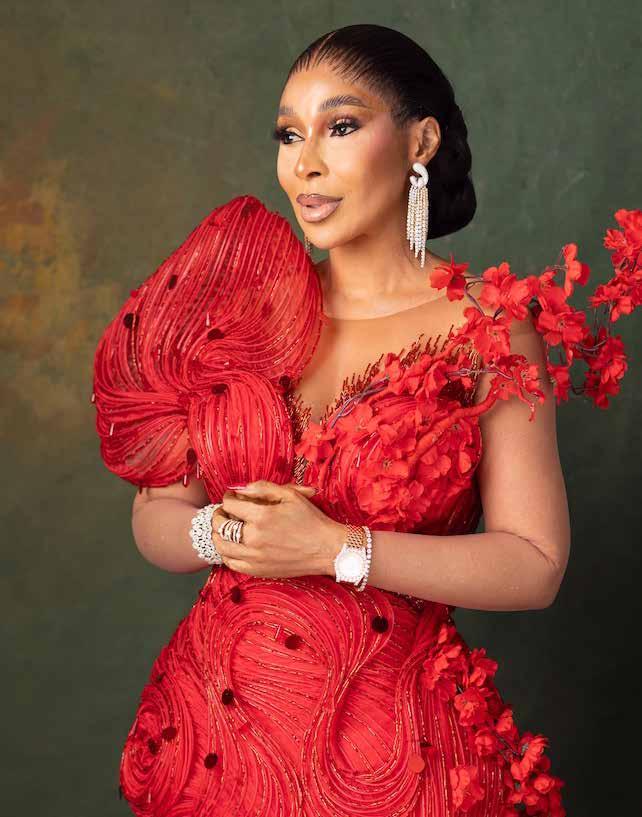
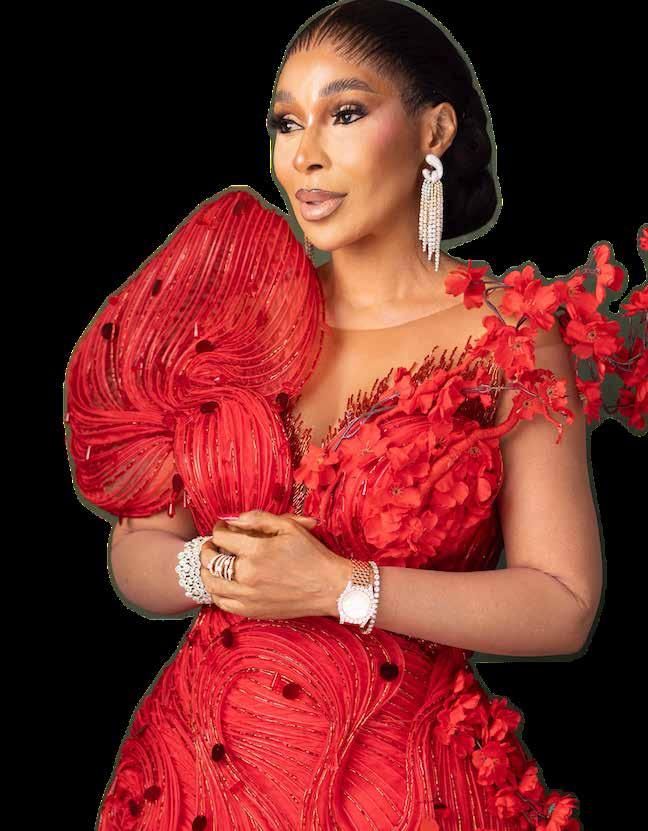




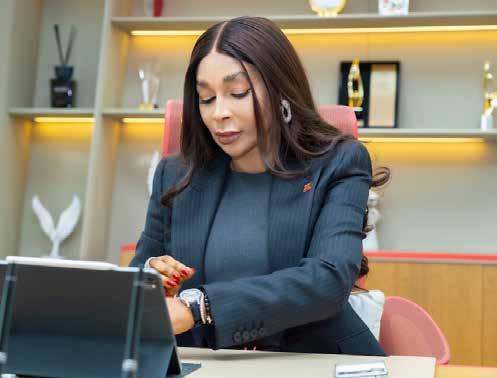
There are bankers who rise quickly, and there are those whose authority is built slowly, layer by layer, inside the system itself. Adaora Umeoji belongs to the latter. Nearly three decades into her career, much of it spent at the executive level within Zenith Bank, her leadership has been shaped by time, depth, and an intimate understanding of how institutions actually work. Her professional journey is unusually expansive. From executive management in Nigeria to board-level oversight in the UK and Ghana, she operates across markets that demand precision, discipline, and credibility. That seriousness is mirrored in an academic path that spans sociology, accounting, law, business administration, and advanced executive education at some of the world’s most rigorous institutions, not as credentials for display, but as tools for leadership.



Have you noticed how certain conversations keep resurfacing lately? Not loudly, not dramatically, however, they just keep finding their way back into rooms, timelines, and casual chats. The kind of topics people circle, pause on, then return to with a slightly different question each time. One of those conversations sits at the centre of my opinion piece, To Dance or Not to Dance: Nollywood’s Marketing Dilemma. It was prompted by a recent public exchange involving Kunle Afolayan and Funke Akindele, but the article itself is less interested in the moment than in what it revealed. Nollywood has reached a stage where making a good film is no longer enough. Visibility now carries its own expectations. Promotion has stretched beyond campaigns into something closer to constant personal presence. And you start to wonder, when did marketing stop being a tool and start becoming a test of endurance? The piece isn’t resisting progress; it’s asking what kind of progress we’re actually comfortable sustaining. Then also another question many people have strong opinions about, that is, until it happens to them. Is It Okay to Date Your Colleague? doesn’t treat office romance as a scandal or mistake. It looks at it for what it often is: something that grows quietly out of proximity, shared pressure, and familiarity. You see someone under stress, under deadlines, being competent, being human. Attraction doesn’t always announce itself; sometimes it settles in. Of course, the office is not neutral ground. Hierarchy matters. Optics matter. Breakups don’t respect meeting schedules. And once feelings enter the room, pretending they don’t exist rarely helps. So what does maturity actually look like in those situations? That’s where the piece lingers.
And then Valentine’s Day also creeps into the conversation, not as a date on the calendar, but as a mood. The timelines shift. The conversations change. Expectations quietly pile up. 7 Easy, Grown Ways Single Girls Can Do Valentine’s Day steps away from the noise, no grand gestures, no over-explaining. Just simple, adult ways of approaching the season without turning it into a referendum on your life choices. Because really, when did doing Valentine’s become a performance?
Before you get into the rest of the issue, a quick note from us to you. Wherever you’re reading this from, your bed, maybe with a cup of tea that’s gone cold, we hope this month is treating you kindly. Love, after all, shows up in many places: in work done well, in conversations that stretch you, in moments of clarity you didn’t see coming. However, it’s finding you this February, we hope it feels considered, unrushed, and just enough.



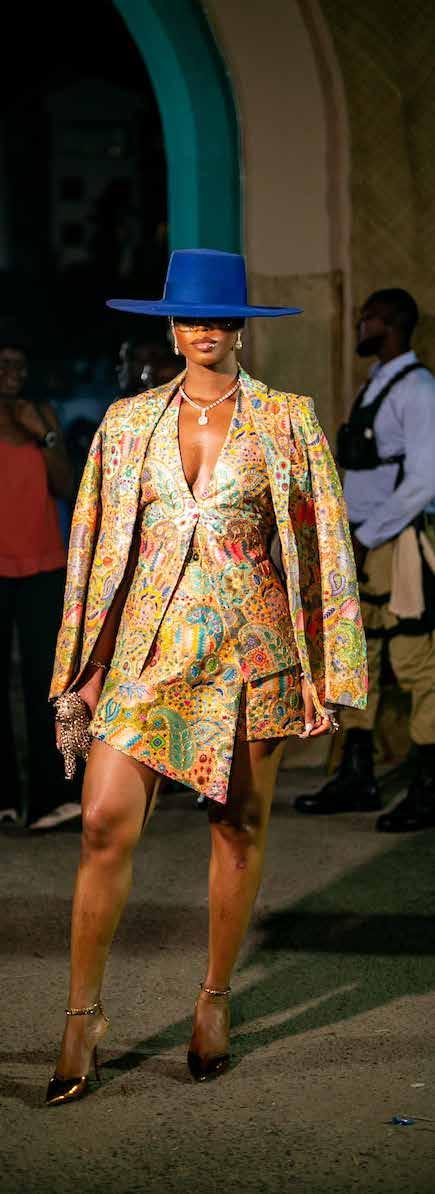
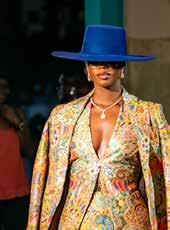
Angel Obasi does not dress casually. And by that, we don’t mean overdressed, we mean intentional. Often referred to as the style connoisseur, Angel treats fashion like composition. Every choice feels deliberate. Every look feels edited.
Her hats are almost as famous as she is. Everyone has noticed. Street-style photographers zoom in when she walks past. And suddenly, one accessory has become her calling card. She pairs classic boubous with sharply tailored coats, heritage silhouettes with modern structure, and somehow makes restraint feel dramatic. There’s a softness to her boldness. Angel doesn’t shout for attention; she lets the details do the talking.
Fashion has entered a slightly smug phase, and honestly, we love to see it. This is the era where doing the most is no longer the flex, and taste has quietly reclaimed the crown. The girls holding our attention right now aren’t scrambling for trends or reinventing themselves every week. They’re dressing with intention, repeating silhouettes unapologetically, and building fashion identities that feel personal, lived-in, and confident. These aren’t “new” girls in the sense of fresh faces trying to break in. Some of them have been here, evolving, refining, sharpening their point of view. What’s changed is how clearly their style speaks now. You recognise them before you read the caption. You know the mood before you clock the label. And you trust that whatever they’re wearing, there’s thought behind it. These are the fashion girls currently on our radar, and not by accident.
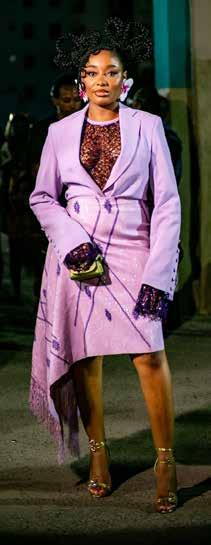
Kiky Festus is in her fashion self-discovery era, and it’s actually one of the most interesting places to be. Rather than locking herself into a rigid aesthetic, she’s experimenting, trying silhouettes, moods, and expressions that feel exploratory and honest.
One moment it’s soft, romantic, and feminine; the next it’s sharper, more playful, slightly unexpected. What makes the journey compelling is that it feels real. There’s no rush to arrive at a final version.
She’s figuring it out in public, and inviting her audience along for the ride.
Her widely talked-about Parisian proposal and traditional introduction ceremony with Akin Faminu in 2025 didn’t suddenly “define” her style, it amplified the evolution already happening.
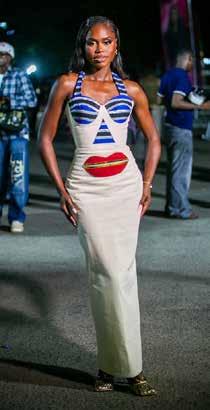
Hawa Magaji’s fashion sense is playful, bold, and delightfully relatable. She’s the kind of girl whose outfits make you pause and think, could actually wear this and still look good doing it.
A content creator, TV host, and event host , Hawa leans into cute dresses, elevated everyday wear, and joyful colour palettes that feel easy rather than intimidating. Her looks never feel overworked. They feel worn, enjoyed, lived in. Hawa dresses like someone having fun with fashion, and that joy is contagious.

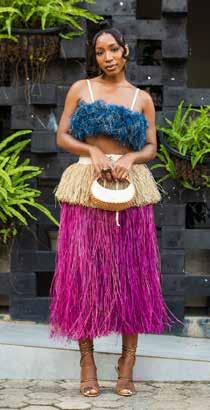
Eni Popoola’s style feels like a calm presence in an otherwise frantic fashion space. Known online as Enigivensunday, her fashion journey began with documenting Sunday church outfits and has since grown into a beautifully curated archive of femininity, ease, and intention.
Clean tailoring, soft silhouettes, thoughtful beauty choices—nothing feels rushed or performative. A Harvard graduate and former middleschool history teacher, Eni brings intelligence to fashion without turning it into a lecture. Her clothes feel reflective, personal, and quietly confident.
Chinyere Adogu understands that fashion influence doesn’t stop at outfits—it extends into ownership. Brooklyn-born and Nigerian, Chi has been building her presence on the New York fashion scene since 2017 with a style that’s polished, confident, and globally aware. Her looks are structured and feminine, often tailored for movement—outfits that travel well and photograph even better. But beyond personal style, Chi is also the founder of Chi’s Luxe Braiding Hair, seamlessly blending beauty entrepreneurship with fashion storytelling.
She represents a class of fashion girls who aren’t just wearing the clothes they’re building businesses, platforms, and legacies alongside their wardrobes. And honestly? That combination always deserves attention.
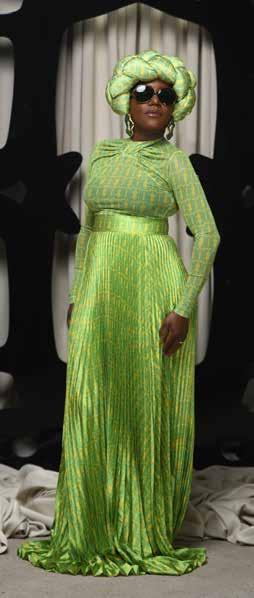
If there’s one thing Olivia Arukwe loves and understands deeply, it’s accessories. Bags, shoes, statement earrings: she treats them not as afterthoughts, but as the main event. Her looks often feel like a masterclass in finishing touches, where the accessories do half the talking. With a background in engineering and further studies in fashion marketing in Paris, Olivia approaches fashion with both creativity and strategy. Since beginning content creation in 2019, her style has evolved into something structured, edgy, and playful. Olivia dresses like someone who enjoys a little tension in her look—and knows exactly how to resolve it
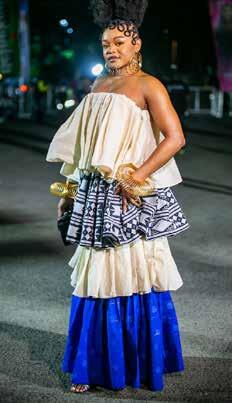
Frilancy Hoyle dresses like colour is a personality trait.
The Zambian-born, U.S.-based blogger and founder of Rabecca
Onassis Boutique in Seattle is unapologetic about bold hues, expressive textures, and statement styling—and somehow, it always feels intentional.
While not Nigerian, she consistently champions Nigerian designers with genuine enthusiasm, not as a trend but as part of her fashion language. Her style is fearless but controlled, loud without being chaotic. Statement hair, strong accessories, confident silhouettes— Frilancy understands how to balance drama with polish. She’s proof that fashion can be expressive, global, and still deeply thoughtful.
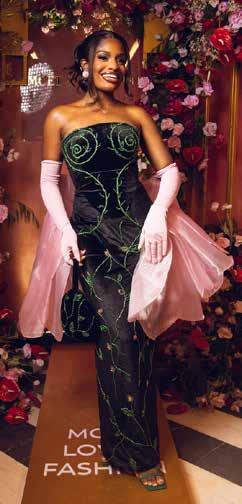

Kene Okonkwo’s fashion voice extends beyond her wardrobe. Through Anikela, her blog, she offers a modern eye on female fashion in Africa—observant, thoughtful, and refreshingly current. It’s not about chasing trends; it’s about paying attention.
Her personal style mirrors that same sensibility: clean, modern, intuitive. Kene dresses like someone who’s thinking—not just about clothes, but about context, culture, and continuity. Between her brand and her visuals, she’s building a fashion presence rooted in reflection rather than noise.
She feels like someone quietly shaping conversations, not rushing to dominate them. And those are often the most interesting fashion girls to watch.
Nonye Udeogu is for the girls who understand that sexy doesn’t need to shout. An Economics graduate turned fashion consultant and content creator, her style lives comfortably between sensual and sophisticated. Clean cuts, flattering silhouettes, and a confident stillness define her wardrobe. She understands the power of editing—knowing when to stop, when to simplify, and when to let the outfit breathe. Through her platform, This Thing Called Fashion, Nonye has built a recognisable aesthetic rooted in consistency. She knows her lane, stays in it, and somehow keeps making it interesting. That discipline? Very chic.
The Low-Effort, High-Impact Phase
Here, you want maximum effect with minimal thought. One great dress. One strong shoe. One signature accessory. You’re not interested in overstyling; you’re interested in impact.
This phase often shows up when life is busy, but confidence is high. You trust your instincts. You know that sometimes simplicity hits harder than excess, and you’re very comfortable letting your presence do the talking.


Fashion phases are funny like that. They arrive quietly, unpack themselves in your wardrobe, and before you know it, they’ve rearranged how you dress, shop, and even see yourself. One minute you’re loyal to bodycon and heels, the next you’re living in oversized shirts and flats, wondering who you were trying to impress in the first place. Unlike trends, fashion phases aren’t about what’s “in.” They’re emotional, situational, sometimes subconscious. They respond to where you are in life, how busy you are, how confident you feel, how much energy you have, and what you’re no longer willing to tolerate. So if getting dressed lately feels different, confusing, exciting, or strangely liberating, you’re probably in the middle of one. Here are some of the most common fashion phases people drift through, and you might recognise yourself in more than one.
The Signature Look Era
This phase is calm. Grounded. Confident. You know what works for you, and you’ve stopped apologising for it. Whether it’s monochrome dressing, dramatic sleeves, tailoring, minimalism, or statement accessories, you’ve found your lane. You’re no longer chasing trends; you’re refining a point of view. Shopping becomes easier. Getting dressed becomes quicker. People start associating certain looks with you. It’s not boring, it’s assured.

You’re curious, but cautious. You’re not trying to reinvent yourself, but you’re open to updates. Maybe it’s a new silhouette, a trending colour, or a modern twist on something classic. You pick what fits your lifestyle and ignore the rest. This phase is less about commitment and more about play, dipping your toe in without losing yourself.

This is the “wait… I actually like clothes again” moment. After months (or years) of playing it safe, something clicks. Maybe you bought one bold piece on a whim. Maybe you stumbled on old photos of yourself. Maybe you’re just bored. You start experimenting again, colours, textures, silhouettes you’d forgotten you loved. Dressing becomes fun, not functional. You’re trying things on without immediately asking, “Is this sensible?” You’re dressing for curiosity.

This phase usually sneaks in after burnout, big life shifts, or simply growing tired of performing. Clothes need to feel good before they look good. Soft fabrics, easy silhouettes, breathable everything. You gravitate towards wide-leg trousers, oversized shirts, relaxed dresses, flat shoes, and anything that doesn’t require constant adjusting.
It’s not laziness, it’s self-respect. You still want to look put-together, but you refuse to suffer for it. The key difference? You’re intentional. Comfort, yes. Sloppy, no.

The Rebuilding Phase
This one is quieter, more introspective. It often follows weight changes, life transitions, motherhood, relocation, heartbreak, or simply growing out of an old identity. You’re figuring things out again, slowly. You’re asking new questions: Who am I now? What feels honest? What do I want to project? Your wardrobe may be in flux, but so are you. And that’s okay.
Here’s the thing: there’s no “better” phase. Fashion isn’t linear, and it’s definitely not a test you pass. You’ll move between phases, revisit old ones, blend several at once. Some days you’re comfort-first. Other days you’re experimental. Sometimes all before noon. What matters is awareness. When you understand your current fashion phase, you stop forcing clothes to do what they can’t and start letting them support where you are.
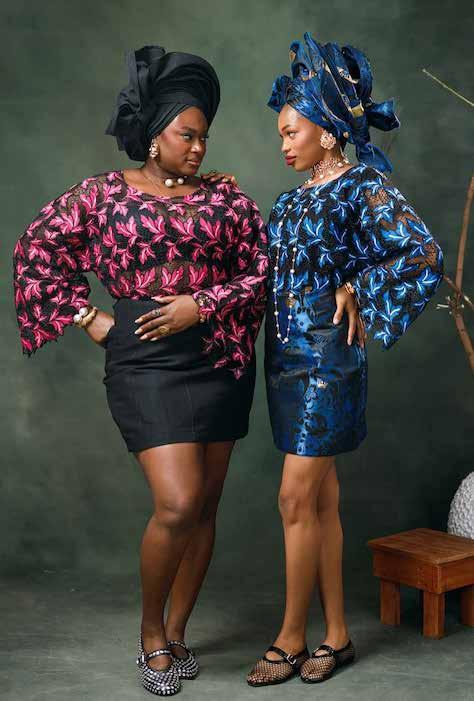
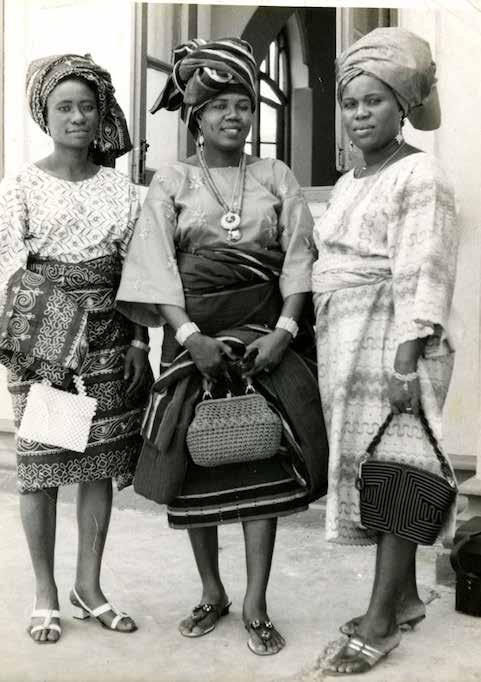
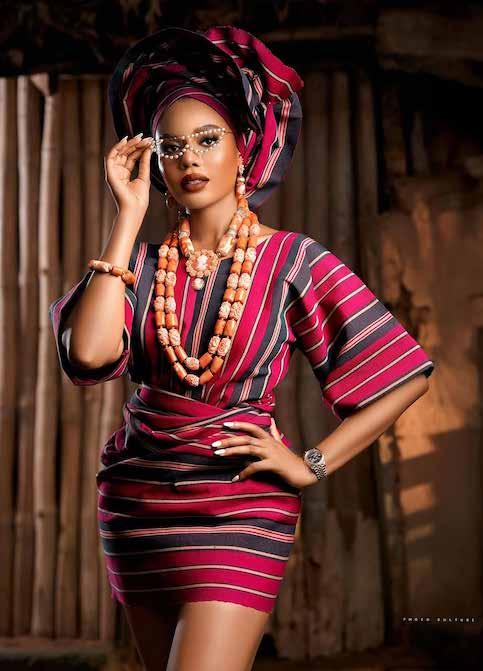
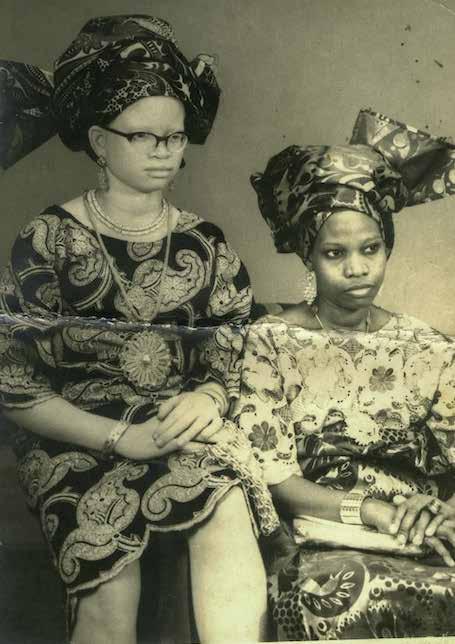
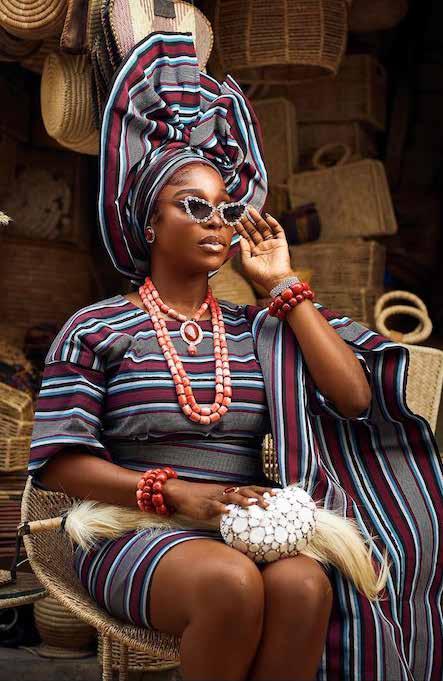
Some clothes do not just pass through generations. They wait. Oleku is one of those garments. It has lived many lives in Nigerian fashion history, each shaped by the mood of its time. In the 1970s and 1980s, Oleku was a language. It spoke of upbringing, restraint, and a woman’s understanding of her place in society. You did not wear Oleku casually. You arrived in it.Today, in 2026, Oleku has returned with a new energy. Shorter, bolder, and more playful, the Mini Oleku reflects a different kind of confidence. This is not a rejection of the past but a conversation with it. One that asks how tradition shifts when women’s lives, bodies, and voices have changed. Oleku, it turns out, has always been adaptable. It simply mirrors the woman wearing it.
By Funke Babs-Kufeji
Oleku as Identity in the 70s and 80s
In the 70s and 80s, Oleku was deeply tied to Identity. It was worn by women who understood the power of presentation. A well-fitted Oleku signaled that you knew who you were and where you belonged. It marked milestones and moments that mattered. Weddings, engagement ceremonies, society gatherings, and formal celebrations were its natural home.
Femininity, as expressed through Oleku then, was controlled and intentional. The dress celebrated the female form without exposing it. The waist was defined, the hips acknowledged, the length respected. There was beauty in that balance. Oleku was not about drawing attention to the body. It was about honouring it.
Status quietly followed. Fabric quality, embroidery, and tailoring
told their own story. You could often tell who had access to the best seamstresses and materials.
Yet nothing about Oleku was loud. Its authority came from confidence, not excess.
the Past
Oleku in the 70s and 80s was built on structure. Tailoring was precise and almost always custom-made. Seamstresses understood proportion and posture. The fit followed the body closely but never clung. Movement was graceful, never rushed.
Fabrics were chosen with care. Lace, brocade, damask, and heavy cottons were common. These were not disposable garments. They were investments, worn repeatedly and sometimes passed down.
Length sat below the knee, sometimes reaching mid-calf, reinforcing the idea that elegance did not need to reveal everything. Styling was equally considered.
Hair was polished, makeup was balanced, and accessories were minimal but meaningful. Every detail worked together. Oleku asked the wearer to slow down and carry herself with intention.
The Mini Oleku of 2026 steps into a very different cultural space. Today’s woman moves faster and occupies more public space, both physically and digitally.
Fashion no longer exists only in rooms. It exists on screens, timelines, and global feeds. The Mini Oleku reflects that reality. The most obvious shift is length. Hemlines rise confidently above the knee. The silhouette is lighter and more flexible. Some designs still echo the classic fitted bodice, while others play with volume and cut. The reference is clear, but the rules are not strict. Fabrics have also evolved.
Stretch lace, satin blends, sheer panels, and breathable modern textiles allow for comfort and

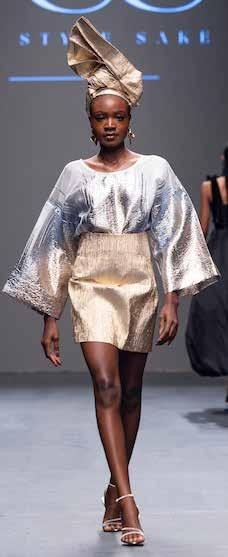
ease. The Mini Oleku is designed to move with the wearer, not discipline her posture. It belongs to nights out, fashion events, birthday dinners, and moments meant to be photographed and shared.
What makes the Mini Oleku compelling is that it does not attempt to recreate the past exactly as it was. Instead, it borrows memory and reshapes it. This is nostalgia with intention.
Designers and wearers are selective. They keep the essence of Oleku while letting go of rigidity. The respect for craftsmanship remains, but the expectations around how a woman should behave in the dress have shifted. Oleku no longer belongs to a narrow definition of womanhood. This reinvention is why Oleku continues to resurface. It holds cultural memory without freezing it. Each generation gets to decide what it needs from the silhouette.
Why the Oleku Still Matters Oleku matters because it has always been more than fabric and cut. It is a marker of how Nigerian women see themselves in relation to culture, society, and time. In the 70s and 80s, Oleku taught women how to arrive with quiet authority. In 2026, the Mini Oleku reminds women that authority can be expressed in many ways.
Neither version is superior. They are reflections of their moments. The long Oleku and the Mini Oleku are part of the same story, just told with different pacing.


Blush used to be the supporting act. The soft swipe you added at the end so your face wouldn’t look flat, but never enough to draw attention. It was polite. Well-behaved. Easy to ignore. Now, blush has changed its role completely. It’s no longer the final touch — it’s the starting point. The look is built around it. The face follows its lead. Blush has officially stepped into its main character era. This shift feels especially important for people of colour. Blush has always been one of the easiest ways to bring warmth and dimension to deeper skin tones, yet for years, it was treated cautiously or skipped altogether. When used well, blush doesn’t look artificial or heavy. It looks natural. It brings the skin forward. It gives richness, not shine. Presence, not polish. Part of blush’s rise is tied to how beauty is changing overall. Heavy base makeup is falling out of favour. People want skin that looks lived-in rather than perfected. Blush fits neatly into that mood. It suggests health, movement, and ease without requiring full coverage or sharp definition. A warm cheek instantly makes the face look awake, even when everything else is bare
By Funke Babs-Kufeji
How to get the main character blush right Getting blush right isn’t about doing more. It’s about choosing intentionally.
Start with shade as a mood.
Blush is one of the easiest ways to express how you want to feel. Soft peach reads calm and effortless. Coral feels playful and confident. Rose gives polish without stiffness. Deeper berry tones add drama without heaviness. The right shade should echo your undertone, not fight it. If it looks like your skin warming up rather than changing colour, you’ve chosen well.
Let placement say something. Where you place blush changes the entire attitude of the face. High on the cheekbones feels lifted and modern. Swept slightly across the cheeks and nose, it feels relaxed and
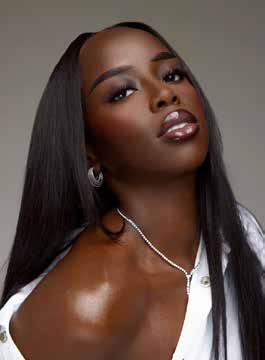
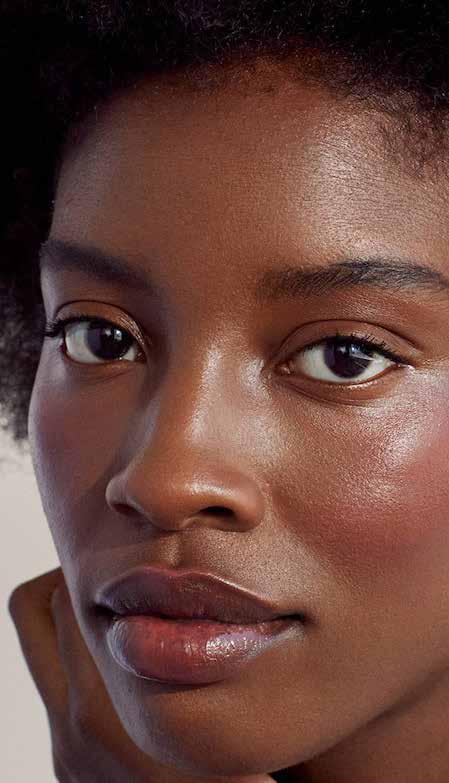
youthful. Kept closer to the apples feels classic and open. There’s no single correct placement — just different moods. Blush works best when it looks intentional, not automatic.
Choose texture based on how you live.
Cream and liquid blushes feel especially current because they melt into the skin and fade naturally. They suit minimal routines and bare skin days. Powder blush still has its place, particularly for longevity and structure, but the finish matters. Avoid anything chalky or overly matte — warmth should look like it belongs to the skin, not sit on top of it.
Let blush do the heavy lifting.
One reason blush feels so central right now is practicality. With less makeup overall, blush carries the look. A face with blush doesn’t need much else. Brows can stay soft. Lashes can be optional. Lips can be bare. When the cheeks are warm, the face already looks considered.





T@thisdaystyle @thisdaystyleon

BY KONYE CHELSEA NWABOGOR
here is a growing tension in Nollywood that has nothing to do with talent and everything to do with survival. It is the quiet exhaustion that comes from an industry where making a good film is no longer enough, where storytelling alone does not guarantee visibility, and where promotion has expanded from a campaign into a full-time performance. This tension has been building for years, largely unaddressed, until a recent public disagreement forced it into the open. The disagreement itself is secondary. What matters is what it revealed.
At its core, Nollywood is grappling with a question many creative industries eventually face: how much of the burden of success should rest on the individual creator? In Nigeria’s film industry, that burden has become unusually heavy. Filmmakers are not only expected to write, direct, produce, and sometimes star in their projects; they are now expected to sell them personally, loudly, and relentlessly. Visibility has become inseparable from labour. The film does not simply exist; it must be pushed, animated, danced, joked, styled, posted, reposted, explained, defended, and constantly kept alive online.
This would not be unusual if the industry had strong institutional support structures. But Nollywood does not yet have the kind of distribution, studio backing, or marketing infrastructure that can absorb this responsibility. As a result, promotion has collapsed inward.
The filmmaker becomes the engine. When that engine stalls, the film often disappears.
What this creates is an uneven playing field. Those with the resources, temperament, and brand equity to sustain high-visibility promotion thrive. Those without them struggle, regardless of the quality of their work. Over time, one model of success begins to look like the only model, and any discomfort with it is read as resistance to progress rather than a critique of imbalance.
intrusive. The other is that mastering that climate has become a legitimate, even necessary, pathway to commercial success.
Funke Akindele’s achievements are not incidental. They are the result of an intimate understanding of audience psychology, popular culture, timing, and visibility. Her approach demonstrates what is possible when marketing is treated as seriously as filmmaking itself. But her success should be read as proof of how much effort is required, not as a universal template everyone must follow. An industry that can only reward one style of engagement is an industry that risks narrowing its creative future.
The mistake Nollywood keeps making is personalising what is fundamentally a structural issue. When filmmakers express discomfort with the current system, the response is often dismissive: adapt or be left behind. But adaptation without support leads to burnout. It also leads to homogenisation the slow erosion of diverse voices in favour of those best suited to perform visibility.
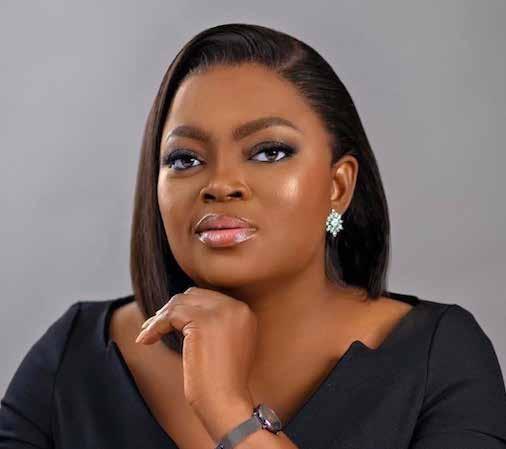
This is where the conversation often breaks down. Marketing itself is not the problem. Audiences need to be courted; attention must be earned. The problem is how narrow the acceptable form of marketing has become. In today’s Nollywood, promotion is increasingly conflated with performance. To be seen is to be constantly present. To be relevant is to be entertaining even outside the work. For some creators, this is energising. For others, it is draining not because they lack creativity, but because they did not enter filmmaking to become perpetual content.
The industry has been slow to acknowledge this fatigue, partly because success stories tend to silence criticism. When a system produces visible winners, questioning that system can sound like sour grapes. But that framing is lazy. Sustainability is not about whether a few people can endure a model; it is about whether many can thrive within it.
This is why recent public comments by Kunle Afolayan and the equally public response by Funke Akindele struck such a nerve. Not because of personal offence, but because they embodied two truths Nollywood is struggling to reconcile. One truth is that the current promotional climate can be exhausting and creatively
In more mature film ecosystems, promotion is distributed across a network. Studios invest in campaigns. Distributors manage reach. Publicists shape narratives. Critics, festivals, and media create secondary momentum. In Nollywood, much of this scaffolding is either weak or inconsistent. Cinema economics remain opaque. Distribution still feels precarious. Marketing budgets are often personal gambles. In such an environment, it is unsurprising that filmmakers cling to whatever tools seem to work — even if those tools demand constant personal exposure. Social media, meanwhile, amplifies everything. Nuance does not travel well online. Structural critique becomes perceived shade. Defensive clarification becomes arrogance. The conversation collapses into sides and slogans. And so the real issue — how to build an industry that does not exhaust its creators — is lost in personality-driven noise. If Nollywood wants to mature, it must stop treating these moments as isolated misunderstandings and start reading them as symptoms. The industry does not need fewer promotional strategies; it needs more options. It needs space for films that travel through festivals rather than trends, for stories that grow through word of mouth rather than virality, for creators who engage audiences without turning themselves into perpetual spectacles.
This requires investment not just financial, but intellectual. It requires serious film marketing agencies, clearer exhibitor relationships, transparent performance metrics, and a willingness to separate a film’s success from its creator’s online stamina. Most importantly, it requires the industry to stop equating visibility with worth.
The real question Nollywood must answer is not whether filmmakers should dance or not dance, post or not post, entertain or not entertain. The question is whether the industry can build a future where success is not conditional on exhaustion. Until that happens, these debates will keep resurfacing, not because filmmakers enjoy conflict, but because the system keeps asking them to give more of themselves than it can sustain. What we are witnessing is not an argument about marketing styles. It is an industry negotiating its growing pains in public. And whether Nollywood listens to the substance of that negotiation rather than the noise around it will shape what kind of creative ecosystem it becomes next.



BY KONYE CHELSEA NWABOGOR
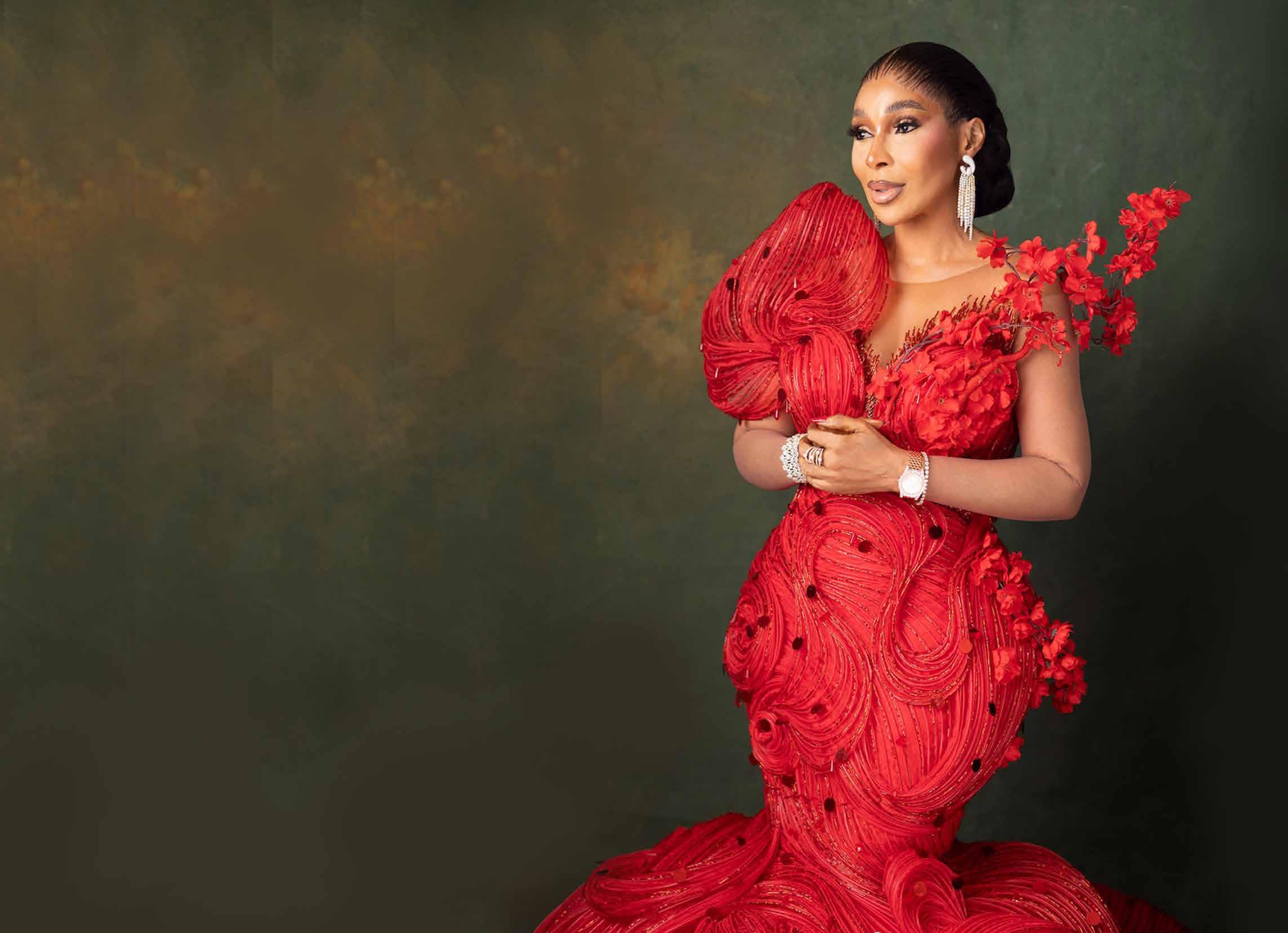
There are bankers who rise quickly, and there are those whose authority is built slowly, layer by layer, inside the system itself. Adaora Umeoji belongs to the latter. Nearly three decades into her career, much of it spent at the executive level within Zenith Bank, her leadership has been shaped by time, depth, and an intimate understanding of how institutions actually work.
Her professional journey is unusually expansive. From executive management in Nigeria to boardlevel oversight in the UK and Ghana, she operates across markets that demand precision, discipline, and credibility. That seriousness is mirrored in an academic path that spans sociology, accounting, law, business administration, and advanced executive education at some of the world’s most rigorous institutions, not as credentials for display, but as tools for leadership.
Her public life extends beyond the boardroom. Alongside the demands of corporate leadership runs a sustained commitment to service through healthcare advocacy, education-focused initiatives, and ethical leadership, a dimension of her work that has earned national recognition and some of the country’s highest honours.
In this interview with Konye Chelsea Nwabogor, she speaks candidly about her journey to becoming Group Managing Director and CEO, navigating power as a woman in a male-dominated industry, the realities of leadership at the highest level of banking, her approach to mentorship and service, and the personal discipline required to sustain both influence and impact over time.

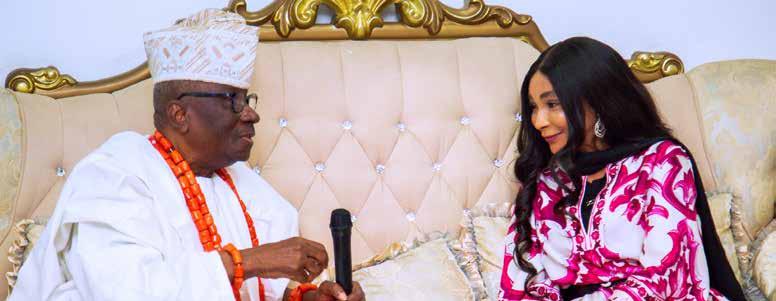

Congratulations on your birthday. You are in an intense professional season at the moment. How are you approaching this year’s celebration: with reflection, renewed focus, or something else entirely?
I am approaching this moment with a deep sense of gratitude and reflection. Birthday celebrations prompt me to pause and take stock, not in a nostalgic way, but with clarity. have been thinking carefully about my journey so far, the principles that have sustained me, and the renewed sense of purpose guiding my next chapter. At the same time, this season has made me more deliberate about impact and leadership. I am thinking about direction, legacy, and the future of Nigeria’s financial landscape. With the looming recapitalisation deadline, there will be changes and ripple effects across the industry.
I look forward to this next phase and seizing the opportunities that come with it.
Looking back at your childhood and formative years, what early influences shaped your discipline, values, and ambition?
My formative years were shaped by strong values around discipline, responsibility, and a strong moral framework. I grew up understanding that discipline was not restrictive but enabling. It taught me consistency, respect for time, and the importance of doing what is right even when no one is watching.
Ambition was encouraged, but it was never detached from values. I learned early that excellence without integrity is hollow, and that leadership is ultimately about humility and service. Those formative lessons created an internal compass that has guided my decisions across different phases of my life and career. It also instilled in me the belief that success is not just about personal achievement, but about contributing meaningfully to the lives of others and to the communities I find myself in.
You have spent nearly three decades building your career within Zenith Bank, rising through its ranks. Why did staying and growing within one institution matter to you?
Staying at Zenith Bank was a deliberate choice rooted in alignment. It mattered because the institution offered more than a job. It offered a culture, a clear set of values, great mentors, and a commitment to excellence that aligned strongly with my own principles. believed in the vision of the bank and the Founder, Jim Ovia, CFR, and saw opportunities to grow and learn.
Building a career within a single institution allowed me to develop deep institutional knowledge and long-term relationships built on trust and competence. It also gave me the opportunity to contribute meaningfully to the bank’s evolution. For me, longevity was not about comfort. It was about commitment, accountability, and building something enduring.
You’ve operated across executive management, governance, and international subsidiaries, including Zenith Bank UK and Ghana. How did those perspectives change the way you now see the bank as a system?
Working across different levels of management and in various international markets gave me a broader, more integrated view of the bank as a living system rather than a collection of separate units. It highlighted an interconnected system where decisions made in one area ripple across others, affecting people, processes, and outcomes. Those experiences reinforced the importance of structure, adaptability, and cultural sensitivity. They also deepened my appreciation for governance and risk management as enablers of sustainable growth. Seeing the bank from multiple vantage points strengthened my belief that strong institutions are built on coherence, clarity of purpose, and shared values across all geographies.
Becoming Group Managing Director and CEO came with greater visibility and scrutiny. What changed most in how people related to you after that appointment?
The most significant change was the weight attached to my presence and decisions. People listen more closely, interpret more carefully, and look to me not only for answers but for reassurance and direction, particularly in moments of uncertainty.
That visibility reinforced the importance of intentional leadership anchored on consistency and example. The role demands clarity, but also accessibility. It is not enough to lead from authority alone. You must lead with judgment, composure, and a steady sense of responsibility to the institution and its people.
Banking remains a male-dominated industry. As a woman rising to the top, what challenges did you encounter that are rarely spoken
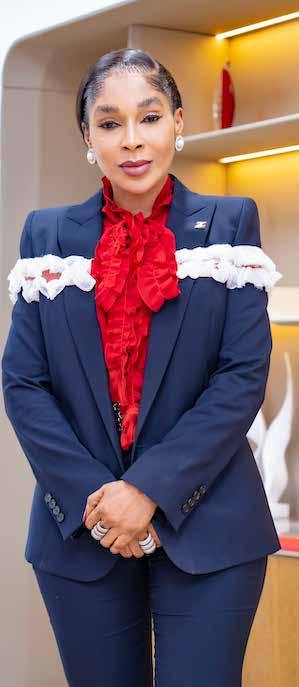
about publicly?
One challenge that often goes unspoken is the absence of any allowable margin of error.
In male-dominated environments, women are sometimes held to higher standards, where mistakes are remembered longer, and successes are attributed to circumstance rather than capacity.
Given this background, leading in a very sensitive role as a woman can create pressure to be flawless, which is neither realistic nor sustainable. Over time, I learned that consistency, preparation, and results speak louder than perception. Therefore, the focus must remain on performance and excellence, not impeccability.
Another rarely discussed challenge is isolation. As women rise to senior levels, there are fewer peers who share similar experiences. As a result, informal networks and conversations where influence is shaped are not always accessible in the same way.
This makes intentional relationshipbuilding and self-confidence essential. You learn to trust your judgment, seek counsel where needed, and remain comfortable standing alone when necessary.
In recent years, we’ve seen more women emerge as bank CEOs and senior executives. From your vantage point, what has genuinely shifted for women in banking?
What has shifted most meaningfully is legitimacy. Women in leadership are no longer viewed as exceptions in the way they once were. There is greater acceptance of different leadership styles and a growing understanding that diversity and inclusion strengthen decision-making and institutional resilience.
However, progress is not automatic, and representation alone is not enough. The real work lies in building systems that reward competence, encourage mentorship, and support sustainable careers for women. The shift that matters most is cultural, where leadership is defined by capacity, judgement, and impact, rather than by traditional expectations or gender bias.
Beyond representation, what deliberate steps do you take to support, mentor, and prepare younger women for leadership within the banking sector?
As a leader, I have deliberately empowered young women in banking by actively mentoring and coaching them, sharing my experiences, identifying talented individuals, and guiding them to build confidence and take on challenging roles. I also champion initiatives, policies, and platforms that promote gender diversity, inclusion, and equity, providing training, networking, and exposure opportunities. Through these efforts, I aim to create a pipeline of capable women leaders and equip them with the competence, confidence, and courage needed to excel and drive impact in the sector. At Zenith Bank, inclusivity is not
a rhetoric; it is a value that guides our actions. Apart from having nearly a 50:50 male-to-female staff ratio, our top management and board composition has significant female representation. In all fairness, what we do in Zenith is to provide an enabling environment for everyone to excel and we have not observed any gender bias in excellence.
The Nigerian banking industry has gone through reform, volatility, and heightened regulation. What leadership quality has mattered most in navigating these periods?
In navigating the intricate landscape of Nigerian banking, marked by broad reforms, and dynamic regulatory environment, the leadership attribute that has mattered most is resilience anchored in ethical foresight. At Zenith Bank, we do not view change as an obstacle, but as a stress test for our core values and systems. As a leader, one must possess the “calm in the storm” attitude to make decisions that prioritise long-term institutional health over short-term optics. This requires a disciplined adherence to risk management and proactive, rather than reactive actions. By staying ahead of the curve and anticipating shifts before they become mandates, we have turned periods of industry upheaval into opportunities to reinforce our performance and market leadership. However, resilience is hollow without agility. The ability to pivot our operational strategies and leverage digital innovation to maintain service excellence despite macroeconomic headwinds has been crucial. We foster a culture where my team remains undeterred by complexity, predicting the trajectory of reforms and repositioning to sustain our track record of industry leadership.
When you interact with young bankers today, what do you think they underestimate about building a lasting career in this industry?
The average Gen-Z banker has great technical skills. They question the norms and continue to reinvent themselves at a level that we could never have imagined in the nascent stages of our careers. They are very intelligent.
However, notice that many of them underestimate the power of relationship capital. They are happy to be independent of their parents and often focus on mastering technical skills and achieving the comfortable life they envision. But comfort is a moving target, and we all need people to leverage if our journey will be efficient. Social media has made this very exacerbating because much of what they envision is impractical. A successful career is built on trust, reputation, and a network of mentors, peers, and clients who can open doors long after a single transaction ends. remind them that every interaction, whether with a junior colleague, a senior executive, or a customer is an opportunity to invest in that capital; a single act of integrity or a well-timed piece of advice can echo throughout their professional journey.
Equally, they tend to overlook the importance of continuous informal learning and adaptability. Banking is no longer just about numbers; it is about technology, regulation, emotional intelligence and evolving customer expectations. Those who treat their education as a one-off phase miss the chance to stay relevant and to lead change sustainably. I encourage them to embrace curiosity, seek out cross-functional projects, and view every shift or digital innovation as a chance to grow, not as a hurdle.
In my experience, it is this blend of relational depth and relentless learning that turns a promising start into a legacy career.
Your philanthropic work is intentional and structured. Why is education for indigent children and the Girl-Child such a personal priority for you through the Adorable Foundation?
I have witnessed firsthand how knowledge can transform a life from limitation to limitless possibility. Growing up, I saw talented young girls whose potential was stifled by poverty and societal expectations; their dreams were often silenced before they could even be voiced. Through the Adorable Foundation, aim to break that cycle by providing scholarships, learning resources, and safe spaces where these children can discover their strengths and imagine futures beyond their circumstances. It is not merely charity; it is an investment in human capital that yields dividends for families, communities, and ultimately, our nation.
Moreover, educating girls has a multiplier effect: a well-educated woman is more likely to educate her own children, improve household health, and contribute meaningfully to the economy. By focusing on the Girl-Child, we address gender inequity at its root and cultivate a generation of leaders, innovators, and change-agents who will drive sustainable development in Nigeria

and across Africa. This structured, intentional approach reflects my belief that true progress is achieved when we empower those who have been historically left behind, turning vulnerability into strength and potential into reality.
Also, through the Pink Breath Cancer Care Foundation, you’ve taken on breast cancer advocacy — a deeply sensitive issue. What compelled you to step into that space?
When I first encountered the stark reality of breast cancer in our communities, women arriving at hospitals with advanced disease, families shattered by loss, and a pervasive silence that kept the conversation at bay, I felt a deep, personal call to act. As a leader, I have always believed that health is the foundation of productivity. A woman battling cancer cannot contribute fully to her family, her workplace, or society. Seeing the gaps in early detection, affordable treatment, and compassionate support, I realised that my platform at Zenith Bank and my personal resources could be leveraged to change that narrative, turning fear into awareness and isolation into solidarity.
Thus, the Pink Breath Cancer Care Foundation was born, built on three pillars: education that demystifies the disease and encourages regular screenings, accessible diagnostic services that reach even the most remote areas and a network of survivors and caregivers who provide emotional and practical support. By stepping into this space, I hope to rewrite the story of breast cancer from one of despair to one of hope, empowering women to seek help early, and reminding every stakeholder, government, private sector, and community that investing in women’s health is investing in our collective future.
Our chairman and founder, Dr Jim Ovia CFR, had a vision not just of building a great financial powerhouse, but also of building people and influencing lives. He saw the future that was not solely about numbers and laid the foundation.
the hour. For me, the answer is simple: I start my day on my knees before ever step into the boardroom. I lean on that inner stillness to filter out the distractions and focus on what is right, rather than just what is easy. This spiritual standpoint reminds me that while I hold the title of GMD, am ultimately a steward of resources and people. This mindset keeps me humble in moments of great success and incredibly steady when challenges arise, because it provides a perspective that shields me from the daunting schedules. Remaining spiritually grounded in a corporate environment means weaving ethics and grace into the very fabric of leadership. It’s about leading with a “servant’s heart,” ensuring that integrity isn’t just a word on our office walls but a lived reality in every transaction. My faith gives me the clarity to see the human beings behind the numbers, the families we support and the dreams we fund.
Your birthday is in a few days. With the experience and perspective you carry from your current position, what kind of impact feels most important for you to make — right now?
Valentine’s Day has a funny way of making people feel like they need a plan or at least a position. You’re either doing something special, pretending not to care, or quietly wondering what you should be doing instead. For single girls, the day can feel oddly loud for something that’s meant to be intimate. But Valentine’s Day doesn’t actually need a relationship to make sense. It doesn’t even need a big idea. Sometimes, it’s just a regular day with slightly better excuses to be intentional about how you spend your time, who you share it with, and how much pressure you’re willing to put on yourself. So instead of overloading the day with meaning or opting out entirely, here are a few easy, grown ways single girls can spend Valentine’s Day without forcing romance, resistance, or a storyline that doesn’t fit.
Valentine’s Day dinners tend to carry unnecessary tension. The restaurants are packed, the menus are restrictive, and everyone seems slightly on edge, trying to make the night “count.”
Lunch, on the other hand, is relaxed. It allows conversation to flow without expectation and gives the Day a sense of intention without pressure. Book a place you genuinely enjoy, not somewhere trending for the occasion. Sit longer than you usually would. Order dessert without overthinking it. Lunch feels indulgent in a way that doesn’t require performance—and that’s exactly the point.
An early night doesn’t have to mean boredom or burnout. Sometimes it’s simply a choice. Shower early. Put on fresh sheets. Make your room feel calm. Watch something comforting instead of impressive.
Valentine’s Day doesn’t require you to be outside or visible. There’s something quietly luxurious about choosing rest on a night when everyone else feels obligated to stay out. No announcements. No apologies. Just opting out.
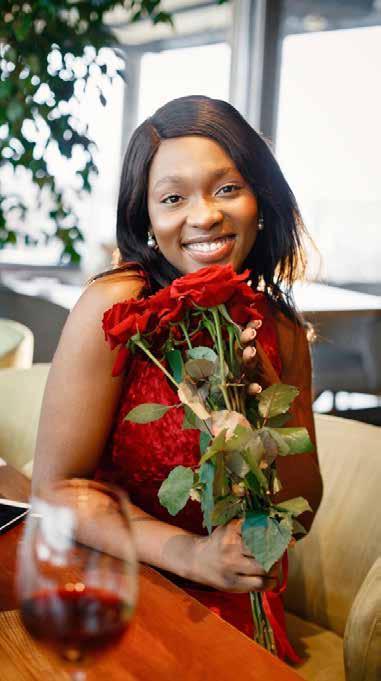
Today, we are following that path.
Faith is a visible anchor in your life. How do you remain spiritually grounded while leading in high-pressure corporate environments?
My faith isn’t just a personal retreat; it is my internal compass. People often wonder how one stays calm when the markets are turbulent or when difficult executive decisions need to be made by
I have realised that while financial milestones are rewarding, the most enduring impact I can make right now is the institutionalisation of opportunity. It is no longer just about Zenith Bank’s balance sheet; it is about ensuring that the ladder I climbed is structurally sound for millions of other young entrepreneurs and women. I feel a profound sense of urgency to use my position to create a more inclusive economic ecosystem, one where “banking the unbanked” isn’t just a corporate slogan, but a transformative reality that lifts families out of poverty. Right now, success for me is measured by how many leaders I empower to surpass me and how deeply I can embed a culture of ethical, compassionate service into the DNA of African banking. Our chairman and founder, Dr Jim Ovia CFR, had a vision not just of building a great financial powerhouse, but also of building people and influencing lives. He saw the future that was not solely about numbers and laid the foundation. Today, we are following that path. My focus is on fostering this legacy that breathes through the lives of people who may never step into the Zenith boardroom but will thrive because of the doors we’ve opened.
Valentine’s Day doesn’t need to introduce new affection. Sometimes the best use of the Day is acknowledging the love that’s already present and steady. A message to a friend who has been constant. Flowers for your mum or aunt. A thoughtful note to someone who showed up quietly when you needed it. These gestures don’t need to be grand. They just need to be sincere. And often, they land better than waiting for a romantic moment that feels forced or overdue.
There’s always that one thing you keep delaying for no real reason.
A facial. A long walk. Reorganising a space that’s been irritating you. Valentine’s Day is a convenient excuse to finally do it.
Not a full self-care overhaul. Just one deliberate act of kindness toward yourself. Something small but noticeable. The satisfaction comes less from the activity itself and more from the decision to stop postponing what you already know you enjoy.
You don’t need a romantic setting to justify looking good. A familiar bar. A bookstore. A gallery opening. Even a solo dinner. Dressing up can be about how you want to feel, not who’s watching. When you remove the expectation of being “seen,” the experience becomes lighter. You enjoy the clothes more. You carry yourself differently. It’s style without stakes, which is often when it looks best.
Food has always been one of the easiest ways people show care. A potluck with friends. Takeout spread across a table. Cooking together without a plan. It’s intimate without being emotional and generous without being heavy. Valentine’s Day doesn’t require candlelight or a theme. Sometimes all it needs is good food and the comfort of people who don’t need explanations.
Valentine’s Day online can feel louder than necessary. Even if you’re content, the constant stream of curated moments can quietly shift your mood. Logging off early protects whatever tone you’ve set for yourself that Day.
The Day doesn’t improve by watching how everyone else is spending it. Sometimes the best thing you can do is enjoy your plans without comparison.


There are very few Nigerian filmmakers who understand how to tell our stories without over-explaining them. Fewer still trust the audience to sit with silence, ritual, language, and consequence. Kunle Afolayan does. And with Aníkúlápó: The Ghoul Awakens, he once again proves that he is not interested in convenience—only conviction. This second season of the Aníkúlápó franchise does not arrive as a crowd-pleaser or an easy binge. It arrives as a continuation of a worldview. One where power has consequences, tradition is not decorative, and mythology is not fantasy—it is memory. From the opening moments, it is clear that The Ghoul Awakens is not trying to recreate the emotional pull of the original film or even resolve the loose ends from the previous series. Instead, it expands the world outward, into a darker, messier place, embracing the idea that this story is no longer about one man’s rise or fall, but about the ripple effects of evil, ambition, and a broken spiritual order.
The season begins in the afterlife, where Bashorun Ogunjimi finally comes face-to-face with judgment. This choice is important. It immediately centres the season around consequence rather than romance or ambition. Bashorun, desperate to escape punishment for the atrocities he committed while alive, finds a way back to the world of the living— but at a terrible cost. He returns neither fully alive nor fully dead. He is now a ghoul.
This transformation is not treated as a spectacle. Bashorun survives by feeding on human souls, leaving behind lifeless bodies and spreading fear across the land. He hides in the evil forest, hunted by guards, whispered about by villagers, and slowly becoming a symbol of unchecked hunger.
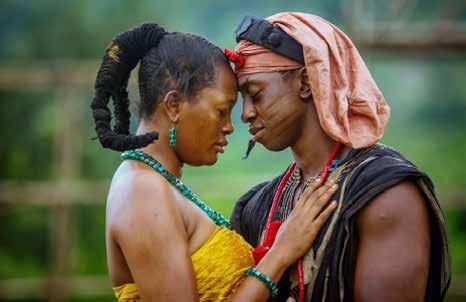
Back in Oyo, the tone shifts briefly. Prince Aderoju returns home to celebration and warmth. His homecoming is filled with drums, honour, and joy, but it doesn’t last. His happiness
collapses the moment he realises his sister, Omowunmi, is missing from the palace. Her absence reopens an old wound.
In the previous season, Omowunmi was married to Kuranga, Prince of the Ede people, who died mysteriously on their wedding night—a death secretly orchestrated by

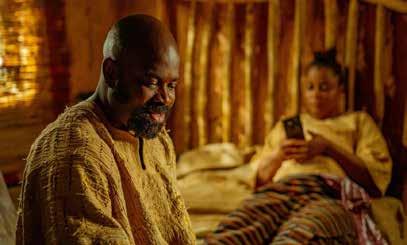
characters—a woman deeply entangled in Saro’s downfall and the destructive power of resurrection. Saved by Akin, she longs for peace and anonymity, hoping distance will finally free her from the cycle of loss and consequence.
But Aníkúlápó does not believe in clean escapes.
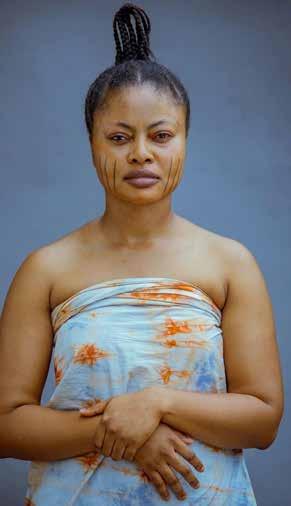
investment occasionally suffers under the weight of constant movement.
However, it is also clear that this multiplicity is intentional.
Bashorun. Tradition now demands that she be inherited as a wife by Kuranga’s younger brother, Ashiru. Trapped in Ede and fearful of her fate, Omowunmi becomes the centre of a political and emotional crisis.
Aderoju’s decision to secretly retrieve her and return her to Oyo without their father’s consent is both brave and reckless. It breaks the already fragile peace between the Alaafin of Oyo and Oba Yekini of Ede, turning a personal rescue into a diplomatic rupture. What follows is tension layered with pride, tradition, and the threat of war.
Away from the palace, Akin and Arolake attempt to start over in Ilú Saki. Arolake remains one of the franchise’s most complicated
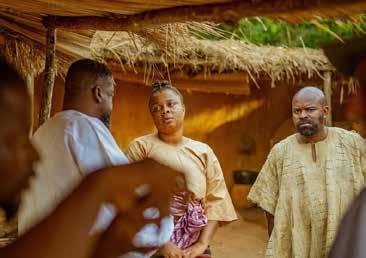
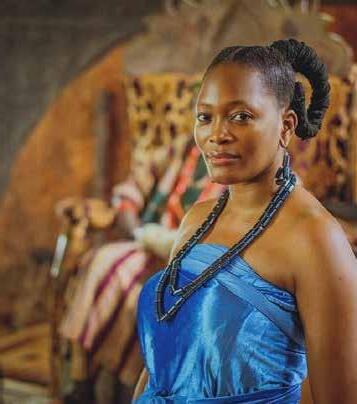
Arolake’s story in this season is quieter but emotionally heavy. Her journey is no longer about ambition or desire; it is about survival and repair. And yet, fate intervenes once again, delivering another painful blow just as she begins to rebuild.
Bashorun Ogunjimi, played with chilling restraint by Owobo Ogunde, sits at the heart of this season. The son of legendary theatre icon Hubert Ogunde, Owobo brings a natural authority and menace to the role. His Bashorun is not flamboyant; he is efficient, brutal, and terrifying in his certainty.
Though he appears only a handful of times across the five episodes, his presence lingers. Every disappearance, every whisper, every rising fear points back to him. He is the ghoul, but also a metaphor—for greed, for power that refuses to die, for evil that adapts rather than disappears.
A major turning point arrives with the appearance of European ships, signalling the slow transition from pure mythology to historical reckoning. This moment subtly but firmly shifts the series’ direction, introducing the early shadows of colonial influence and expanding the narrative beyond internal power struggles. Geographically, the series also moves beyond the Oyo Empire, travelling to Cape Coast in present-day Ghana. This expansion strengthens the show’s portrayal of West Africa as interconnected—politically, culturally, and historically.
One of the most talked-about aspects of The Ghoul Awakens is its multiplicity of subplots. There is Aderoju’s political struggle and forbidden love with Asake. Bashorun’s monstrous survival.
Akin and Arolake’s fragile peace. Awarun and her daughter’s involvement in the slave trade.
The palace intrigues. The growing fear among villagers. The looming arrival of foreign ships. At times, these stories compete rather than complement one another. Some arcs struggle to shine fully, while others feel abruptly interrupted. The pacing can feel heavy, and emotional
Aníkúlápó is no longer telling a closed story. It is positioning itself as a long-running franchise—one that values continuity, suspense, and expansion over neat resolution. While the subplots could benefit from tighter concatenation, they also create a sense of a living, unstable world where many things are happening at once, often beyond anyone’s control.
Visually, The Ghoul Awakens remains stunning. The costumes, set design, and cinematography continue to celebrate Yoruba culture with care and intention. Performances are largely strong, grounded by experienced actors who bring gravitas to the material. The debut of Abike Dabiri-Erewa as the Iyalode is a pleasant surprise, adding weight to the palace scenes.
The season’s biggest weakness lies in its density. The story is rich but occasionally stretched, its ideas sometimes competing rather than converging. Yet even in its flaws, the series remains bold.
Aníkúlápó: The Ghoul Awakens is not an easy watch—but it is a purposeful one. It is a reminder that our stories do not need to be simplified to be powerful, and that mythology, when handled with respect, can hold history, warning, and beauty all at once. Kunle Afolayan is not just telling a story here. He is building a world, one that is still unfolding, still unstable, and very much alive.
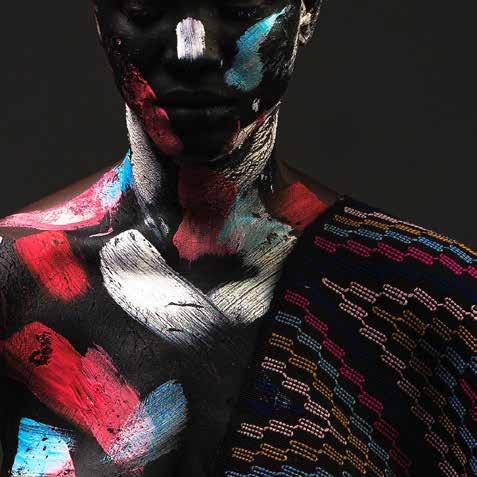
In Mary-Jane Ohobu’s work, light refuses to settle, shadow remains unapologetic, and contrast emerges not as visual drama but as a way of seeing—rooted in instinct, culture, and the lived knowledge of the body.
By Okechukwu Uwaezuoke
Life, Mary-Jane Ohobu learnt early enough, does not move in straight lines; it unfolds in rhythms—quiet, sudden, and recurring. It was a lesson absorbed in Calabar, the Cross River State capital, where her childhood oscillated between long stretches of calm and moments of vivid eruption. “There was a lot of calm,” she recalls—trees everywhere, quiet mornings, strong family structure—” and then moments where everything came alive.” Culture, in that setting, was never peripheral. It coursed through daily life with ease and authority. Festivals, ceremonies, and communal gatherings arrived in waves of colour and sound, making it clear that tradition was not an abstract inheritance but a lived condition.
“Tradition wasn’t something you read about,” she says. “You lived it.” In that environment, light was never still. It slipped through leaves, glanced off water, lingered momentarily on skin during celebrations, then drifted on. Shadow followed without threat or drama. “Shadow wasn’t negative; it was just part of the scene.” That early familiarity with change—with light continually pressing against darkness—has carried into Ohobu’s work with an unforced assurance.
“That’s why, in my work now, light and shadow feel very natural to me,” she says. “They remind me of home, of how culture moves gently most of the time, and loudly when it needs to.”
That instinctive grounding also explains her path as an autodidact.

Ohobu’s artistic language emerged not from formal classrooms but from lived observation. “Teaching myself meant learning the way I grew up—by watching, trying, failing, and trying again.” Freed from institutional pressure, she allowed intuition to lead. “There wasn’t pressure to ‘get it right’ based on someone else’s rules. followed instinct first.” Over time, that instinct hardened into method. What emerged was a practice shaped less by permission than by curiosity—”a way of working shaped by culture, not
had already witnessed the power of adornment within tradition.
“Growing up, I had already seen how markings, presentation, and adornment played roles during ceremonies, rites, and celebrations.”
Viewed through this lens, makeup revealed itself not as cosmetic excess but as cultural continuity.
“When I looked at makeup through that lens, it made sense. It wasn’t new; it was familiar.” It became, for her, “a way to tell stories, express identity, and connect to heritage”— art that lives on skin, moves through
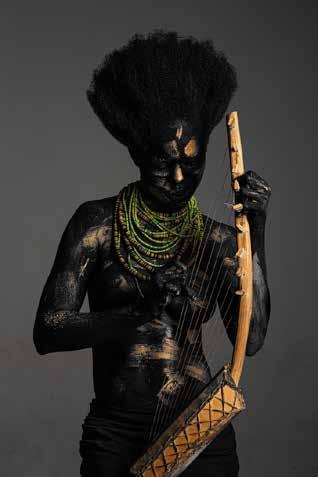
means listening and respecting boundaries.” Yet the body also introduces an irreducible freedom.
“The body responds, moves, reacts. It brings its own energy into the work.” The result is collaboration rather than control—and an acceptance that ephemerality does not diminish meaning. “It also reminds me that not everything needs to last forever to matter.”
Colour has long been a defining force in Ohobu’s practice, bold and unapologetic. Which is why her Ardhi collection, stripped entirely
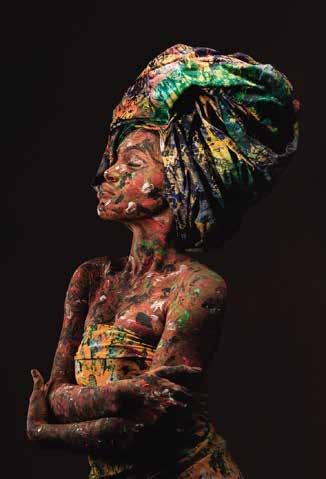
formal approval.”
Her movement into makeup as a serious artistic medium followed a similar logic of recognition rather than rebellion. Long before it became professional, Ohobu
way. My work is African because I am African.” In that assertion lies both freedom and refusal. What accumulates across her practice feels like an archive of bodies, emotions, gestures remembered rather than recorded. Ohobu describes herself not as originator but as conduit. “The stories already exist—in culture, in people, in memory. My role is to listen and find a visual way to express them.” This act of translation has been deepened through collaboration, particularly
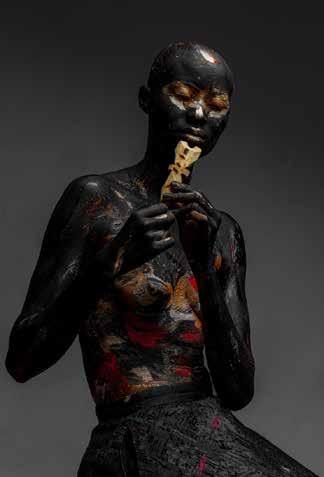
to black and white, feels like a deliberate recalibration rather than a retreat. “Ardhi came from a need to return to basics,” she explains.
“In many traditions, simplicity is powerful.” The absence of colour sharpened attention. “Removing colour forced me to focus on form, texture, and emotion.” Constraint became clarity. “Sometimes saying less can say more.”
Light and shadow, recurring insistently, refuse to remain merely technical concerns. “They’re definitely more than visual tools,” Ohobu insists. In cultural terms, they mirror what is publicly celebrated and what is quietly borne. “They help me speak to both.” Identity itself operates within this tension—
”what we show proudly and what we’re still understanding.” The balance is intimate, unresolved, and deeply familiar.
space, and refuses permanence.
Working on the human body, however, demands a different ethics. “You’re dealing with someone’s presence, their comfort, their story,” Ohobu notes. “That
African heritage pulses unmistakably through her work, yet Ohobu resists the demand to perform it. “I grew up understanding that tradition is living, not frozen. It changes as people change.” To honour it is to engage its spirit, not rehearse its surfaces. “I don’t feel the need to perform Africanness in a certain
with photographer Hakeem Salaam, whose presence she describes as “integral to the journey.” Sometimes the work feels like storytelling, sometimes like witnessing—but always, at its core, “translating lived experience into something others can connect with.”
Looking ahead, Ohobu imagines a future defined by permeability rather than proclamation. “I hope my work continues to blur lines—between art and beauty, tradition and modern expression.” Accessibility matters deeply. “I want people to feel that creativity is accessible, not intimidating.” Within Nigeria, especially, she hopes her practice encourages a loosening of constraints around identity and self-expression. “If it helps people see beauty and art as tools for confidence, storytelling, and ownership,” she reflects, “then I’m on the right path.”
In Mary-Jane Ohobu’s work, light does not conquer shadow; it converses with it. Tradition does not stand still; it moves— sometimes softly, sometimes in full voice—carrying with it a world of possibilities already unfolding.