At Nigeria’s Energy Summit, Tinubu Renews 3 Million bpd Oil Production Target by 2030
Ekpo
www.thisdaylive.com
Insecurity: US Dispatches Military Forces to Nigeria Amid Renewed Collaboration
The U.S. has sent a small team of troops to Nigeria, Gen. Dagvin Anderson, in charge of the U.S. command for Africa said yesterday, the first acknowledgment of
on page 8
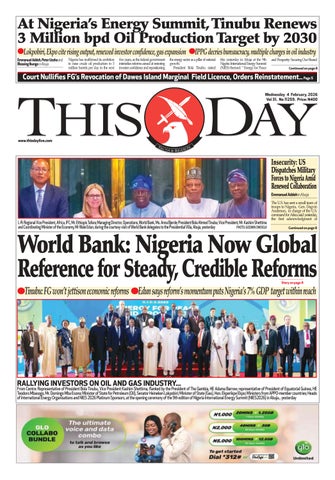
World Bank: Nigeria Now Global Reference for Steady, Credible Reforms
Tinubu: FG won’t jettison economic reforms Edun says reform’s momentum puts Nigeria’s 7% GDP target within reach Court Nullifies FG’s Revocation of Dawes Island Marginal Field Licence, Orders Reinstatement... Page 5
RALLYING INVESTORS ON OIL AND GAS INDUSTRY...
From Centre: Representative of President Bola Tinubu, Vice President Kashim Shettima, flanked by the President of The Gambia, HE Adama Barrow; representative of President of Equatorial Guinea, HE Teodoro Mbasogo, Mr. Domingo Mba Esono; Minister of State for Petroleum (Oil), Senator Heineken Lokpobiri; Minister of State (Gas), Hon. Ekperikpe Ekpo; Ministers from APPO-member countries; Heads of International Energy Organisations and NIES 2026 Platinum Sponsors, at the opening ceremony of the 9th edition of Nigeria International Energy Summit (NIES2026) in Abuja... yesterday
Emmanuel Addeh, Peter Uzoho and Blessing Ibunge in Abuja
Continued
Emmanuel Addeh in Abuja
L-R: Regional Vice President, Africa, IFC, Mr. Ethiopis Tafara; Managing Director, Operations, World Bank, Ms. Anna Bjerde; President Bola Ahmed Tinubu; Vice President, Mr. Kashim Shettima and Coordinating Minister of the Economy, Mr Wale Edun, during the courtesy visit of World Bank delegates to the Presidential Villa, Abuja, yesterday PHOTO: GODWIN OMOIGUI
Story on page 8
DISCUSSING DEVELOPMENT...
The Governor, Central Bank of Nigeria (CBN), Mr. Olayemi Cardoso (left) and the World Bank’s Managing Director of Operations, Anna Bjerde, when the latter led a delegation of the World Bank to a strategic meeting at the CBN Head Office, Abuja, on Tuesday, February 3, 2026.
Court Nullifies FG’s Revocation of Dawes Island Marginal Field Licence, Orders Reinstatement
Says government breached statutory procedure and right to fair hearing
Wale Igbintade
A Federal High Court sitting in Lagos has nullified the federal government’s revocation of the Dawes Island Marginal Field licence, declaring the action unlawful, unjustified and contrary to due process.
In a judgment delivered by Justice A. O. Awogboro, the court held that the Ministry of Petroleum Resources and the Minister of Petroleum Resources acted in breach of the Petroleum Act and the applicable guidelines governing marginal fields when they revoked the licence held by Eurafric Energy Limited.
Consequently, the court set aside the Notice of Revocation of the Dawes Island Marginal Field dated April 6, 2020, which stripped Eurafric Energy of its rights and interests in the oil asset.
Eurafric Energy had approached the court to challenge the revocation, insisting that it had substantially developed the Dawes Island Marginal Field and brought it to production before the licence was withdrawn.
The company told the court that it had produced 62,039 barrels of crude oil from the field and had obtained regulatory approvals for crude evacuation shortly before the revocation notice was issued.
Despite these developments, the Ministry of Petroleum Resources revoked the licence and subsequently awarded the field to Petralon 64 Limited, a move Eurafric Energy described as arbitrary and unlawful.
In her judgment, Justice Awogboro held that the federal government failed to justify the revocation, particularly in light of the plaintiff’s proven production activities.
The court declared that the action of the defendants in revoking the licence was not justified, having regard to the efforts of Eurafric Energy in bringing the field to production.
Justice Awogboro further ruled that
the ministry and the minister failed to follow the procedure prescribed under the First Schedule to the Petroleum Act and the Guidelines for Farm-Out and Operation of Marginal Fields, 2001, before issuing the revocation notice.
According to the court, the defendants also breached Eurafric Energy’s statutory right to fair hearing by failing to inform the company of the grounds upon which the revocation was being contemplated or to give it an opportunity to respond.
The federal government had defended the revocation on the grounds that Eurafric Energy failed to bring the field to production by April 30, 2019.
However, the court rejected this argument, holding that failure to meet the stated production deadline was not a valid ground for revocation under either the Farm-Out Agreement or the Petroleum Act.
Justice Awogboro also held that the federal government was estopped from revoking the licence after approving crude evacuation from the field.
Evidence before the court showed that regulatory approval was granted in January 2020 for the evacuation of 34,000 barrels of crude oil aboard MT Breakthrough by ship-to-ship transfer and 28,000 barrels of crude oil to Aje Terminal (FPSO Front Puffin), with the approval valid for four months.
The court found that having approved crude evacuation, the government could not subsequently revoke the licence on the basis of alleged non-performance.
In addition to nullifying the revocation, the court set aside the award of the Dawes Island Marginal Field to Petralon 64 Limited, as well as the farm-out agreement executed between the Nigerian National Petroleum Corporation, now Nigerian National Petroleum Company Limited, and Petralon 64 Limited.
Justice Awogboro further restrained the defendants from transferring, real-
locating, disposing of or otherwise alienating the Dawes Island Marginal Field to any person or group of persons.
The court ordered the federal government to forthwith renew the Dawes Island Marginal Field licence in favour of Eurafric Energy Limited upon payment of the requisite statutory fees and granted perpetual injunctions restraining the defendants from interfering with the company’s rights and interests in the field.
The court ordered as follows: “It is hereby declared that the Plaintiff is entitled to an extension/renewal of the marginal field licence in line with the provision of paragraph 6(59)(1) of the Petroleum (Drilling and Production) (Amendment) Regulations 2019.”
“It is hereby declared that the plaintiff, having progressed the work on the Dawes Island Marginal Field to the production of Sixty-Two Thousand
and Thirty-Nine (62,039) barrels of crude oil, is entitled to the renewal of the farm-out for the remaining lifespan of the field.”
“It is hereby declared that the action of the defendants in revoking the Dawes Island Marginal Field Licence is not justified, having regard to the activities of the plaintiff in bringing the field to production.”
“It is hereby declared that the 1st and 2nd defendants did not follow the procedure prescribed in the First Schedule to the Petroleum Act before issuing the Notice of Revocation of the Dawes Island Marginal Field dated 6 April 2020.”
“It is hereby declared that the 1st and 2nd defendants breached the plaintiff’s statutory right to be heard by not informing the plaintiff of the grounds upon which the revocation was being contemplated and by failing to afford it an opportunity to respond.”
“It is hereby declared that the 1st and 2nd defendants did not lawfully revoke the plaintiff’s rights and interests in the Dawes Island Marginal Field, as a marginal field is not a revocable instrument within the meaning of the Petroleum Act and applicable guidelines.”
“It is hereby declared that the Dawes Island Marginal Field cannot be validly revoked where the Farm-Out Agreement duly approved by the defendants does not provide for such revocation.”
“It is hereby declared that the defendants are estopped from revoking the Dawes Island Marginal Field after approving the evacuation of crude oil from the field.”
“It is hereby declared that failure to bring the field to production by 30 April 2019 is not a valid ground for revocation under the Farm-Out Agreement or the Petroleum Act.”
“An order of court is hereby
granted setting aside the Notice of Revocation of the Dawes Island Marginal Field dated 6 April 2020.”
“An order of court is hereby granted setting aside the award of the Dawes Island Marginal Field to Petralon 64 Limited.”
“An order of court is hereby made directing the defendants to renew forthwith the Dawes Island Marginal Field Licence in favour of the plaintiff upon payment of the requisite statutory fees.”
“An order of perpetual injunction is hereby granted restraining the defendants from transferring, reallocating, alienating or otherwise dealing with the Dawes Island Marginal Field.”
“An order of perpetual injunction is hereby granted restraining the defendants from terminating or transferring the plaintiff’s rights and interests in the Farm-Out Agreement in respect of the Dawes Island Marginal Field.”
Naira Redesign: Emefiele Complied with Buhari’s
Directive on Local Production, Witness Tells Court
Alex Enumah in Abuja
Mr. Chinedu Eneanya, a witness in the ongoing trial of former Governor of the Central Bank of Nigeria (CBN), Mr. Godwin Emefiele, yesterday, admitted before a High Court of the Federal Capital Territory (FCT), that the redesigned Naira notes were produced locally as directed by former President Muhammadu Buhari.
According to the witness, the production was done by the Nigerian Security Printing and Minting Company (NSPMC) and the apex bank.
Emefiele is standing trial on a four-count charge bordering on disobedience to the direction of law and illegal act causing injury
to the public.
In the charge, marked: CR/264/2024, the Economic and Financial Crimes Commission (EFCC) alleged that Emefiele between October 19, 2022 and March 5, 2023, disobeyed the direction of Section 19 of CBN Act by approving the printing of 375,520,000 pieces of colour swapped N1,000 notes at a total cost of N11,052,068,062 without the recommendation of the CBN Board and strict approval of the President, Federal Republic of Nigeria, which caused injury to the public.
The offences allegedly committed by him, according to the prosecution, were against Section 123 of the Penal Code, Cap 89 Laws of the Federation, 1990 and punishable
under the same law.
He, however, pleaded not guilty to the charge.
At the resumed trial, the witness, under cross examination by Emefiele’s lawyer, Olalekan Ojo SAN, told the court that the former CBN Governor wrote a memorandum, dated October 6, 2022, to former President Buhari, wherein he sought approval to redesign, produce and reissue the redesigned N1,000, N500, N200 and N100 notes.
Eneanya, who was testifying as the seventh Prosecution Witness (PW7), stated further that the former president approved the redesigning of the Naira notes in his minute on the memorandum, but had directed that the production of the notes be done locally.
“The defendant (Emefiele) sought approval of bank notes attached to the memorandum, which had already been redesigned.
“The minute of the former president was that the production be done. He minuted: ‘Approved. But to be produced locally’,” the PW7 told the court.
The witness further confirmed to the court that Emefiele had stated a number of reasons for the redesign policy, among which were the high counterfeit rate and worsening shortage of banknotes in circulation.
Other reason he admitted the former CBN governor gave for the redesign was the hoarding of Naira notes by members of the public.
L-R: United States(U.S.),Consul General in Nigeria, Rick Stewart; Chargé D’Affaires Ad Interim, U.S. Mission to Nigeria, Keith Heffern; Deputy Assistant Secretary for U.S. Commercial Services, Bradley McKinney; Chief Executive Officer, Westpaq Group, Samuel Diminas; Executive Vice President, Subsurface Consultants and Associates, Amalia Olivera-Riley; Vice President, Engineering & Projects, Westpaq Group, Ngowari Diminas, and Senior Vice President, Westpaq Group, Brian Waguespack, during the launch of an energy industry training facility at Eko Atlantic City, Lagos...recently
Agora Policy: Rising Cement Prices Driven by Market Power, Not High Operating Costs
Think tank says weak competition pushing price hikes Argues Nigerian cement firms earn margins far above global peers Calls for reforms, seeks FCCPC’s intervention
A new policy brief by Nigerian think tank, Agora Policy, has argued that persistently high cement prices in Nigeria are the result of market power and weak competition, rather than high production costs or capacity shortages.
The Waziri Adio-led organisation, in the document released yesterday, warned that current outcomes undermine housing delivery, infrastructure development and the long-term economic growth of the country.
In the memo titled: “Market Power and Failure of Competition Policy in Nigeria’s Cement Industry,” Agora Policy said that although Nigeria has already achieved what industrial policy set out to accomplish more than a decade ago, including selfsufficiency in cement production, it has failed to translate that success
into affordable prices for households, builders and government.
According to the report, despite the fact that Nigeria attained formal self-sufficiency in cement as far back as 2012, and installed capacity now exceeds domestic demand by a wide margin, cement prices remain elevated, while the industry’s three dominant producers continue to post exceptionally high profit margins.
As of the end of September 2025, Nigeria’s cement producers, according to Agora, recorded average core operating profit margins of about 49 per cent, up from roughly 34 per cent in 2024. The organisation noted that these margins are significantly higher than those seen in comparable markets.
In North America, for instance, it stated that cement producers typically record margins of 20 to 36 per cent, while Asian producers operate within a 15 to 25 per cent
range. Besides, across Africa, that is outside Nigeria, it reported that margins are generally between 18 and 30 per cent.
“The contrast between capacity outcomes, pricing and profitability margins is difficult to ignore. Nigeria has built the capacity it set out to build, but the benefits of that achievement have yet to show up fully in prices paid by households, builders, and government.
“Cement producers blame high cement prices on taxes, energy costs, transport bottlenecks, and financing constraints, noting that exported cement is cheaper because it is exempt from many domestic levies. But this explanation leaves an uncomfortable question unanswered: if costs are the binding constraint, why can Nigerian producers sell cement profitably abroad at lower prices than Nigerian households and builders pay at home? The gap suggests that
Alleged Terrorism Financing: FG Arraigns Ex-AGF Malami, Son
The federal government yesterday arraigned the immediate past Attorney-General of the Federation (AGF) and Minister of Justice, Abubakar Malami, SAN, and his son, Abdulaziz Abubakar Malami, before a Federal High Court in Abuja.
They were arraigned before Justice Joyce Abdulmalik, on a five-count criminal charge bordering on abetting terrorism financing and unlawful possession of arms and ammunition.
The two defendants, however, pleaded not guilty to the five-count charge read against them.
Based on their not guilty plea, the prosecution counsel, Calistus Eze, prayed the court for a date to commence trial of the defendants.
Eze also prayed the court to order the remand of the defendants in the custody of Department of State
Services (DSS), pending further proceedings in the matter.
Responding, Shuaibu Arua, SAN, who represented the defendants, sought the leave of the court to make an oral application for the bail of the defendants.
Arua informed the court that the defendants had been in the custody of DSS for over two weeks and were brought to court directly from the hospital.
In a short ruling, Abdulmalik, who observed that the Federal High Court was a court of record, ordered the defendants’ lawyer to file a formal bail application on behalf of his clients.
She subsequently adjourned the matter till February 20 for commencement of trial, and ordered that the defendants be remanded in the custody of DSS.
The federal government, in count
one, accused Malami of knowingly abetting terrorism financing, “by refusing to prosecute terrorism financers whose case files were brought to your office as the Attorney-General of the Federation for prosecution, and thereby committed an offence contrary to and punishable under Section 26 (2) of Terrorism (Prevention and Prohibition) Act, 2022”. In count two, Malami and his son were accused of engaging in a conduct in preparation to commit an act of terrorism by having in their possession and without licence, a Sturm Magnum 17-0101 firearm, 16 Redstar AAA 5’20 live rounds of Cartridges and 27 expended Redstar AAA 520 Cartridges, and thereby committed an offence contrary to and punishable under Section 29 of Terrorism (Prevention and Prohibition) Act, 2022.
market structure—and the pricing power it confers—may matter at least as much as cost pressures,” Agora maintained.
Stressing that cement producers often attribute high prices to taxes, energy costs, transport bottlenecks and financing constraints, Agora Policy however questioned this explanation, pointing out that Nigerian firms are able to export cement profitably at prices lower than those paid domestically.
The report traced the roots of today’s market structure to the policy choices that shaped the cement industry from the late 1990s. At the time, it said that the government offered import protection, tax holidays, preferential foreign exchange access and exclusive limestone concessions to investors, in exchange for rapid capacity expansion and affordable cement.
By 2012, the report noted that the production side of that bargain had been fulfilled, while Nigeria moved from being a net importer to an occasional exporter of cement. However, Agora Policy said the consumption side of the deal, which is competitive pricing disciplined by rivalry, never materialised.
Instead, the market consolidated into a highly concentrated oligopoly dominated by Dangote Cement, Lafarge Africa and BUA Cement, it argued, explaining that today,
installed capacity is estimated at about 65 million tonnes per annum, more than double domestic demand of roughly 32 million tonnes, yet prices remain high and margins elevated.
The policy brief argued that this outcome reflects a price-leadership model, where the largest producer effectively anchors pricing, with smaller firms adjusting their prices rather than competing aggressively. Excess capacity, rather than lowering prices, is said to serve a strategic role by deterring new entrants through the credible threat of output expansion or price cuts.
Agora Policy cited empirical studies showing that such spatial fragmentation enables price discrimination and sustained mark-ups without explicit collusion. It also highlighted the role of exclusive limestone concessions, noting that long-duration and geographically concentrated mining licences limit entry and entrench dominance.
The think tank warned that high cement prices act as a hidden tax on housing and infrastructure. Cement is a key input into construction, and when prices are elevated, fewer homes are built, projects become more expensive and public budgets are stretched further, it posited.
Drawing on international evidence, the memo noted that cement typically accounts for 8 per cent of construction costs globally, but this share can rise
to 15–20 per cent in lower-income countries. Price increases, it said, therefore pass through directly to higher housing and infrastructure costs.
Agora Policy dismissed import liberalisation as a durable solution, arguing that cement is poorly suited to sustained import competition due to high transport costs, limited global spare capacity and Nigeria’s large inland market. Imports, it said, may provide temporary relief but do not address the structural sources of market power.
Instead, the think tank called for a shift in policy focus from capacity expansion to competition restoration. It also urged regulators to address regional dominance directly, including restrictions on further capacity expansion by dominant firms, measures to prevent domestic prices from exceeding export prices, and predefined policy triggers that activate corrective measures when capacity utilisation falls too low.
Agora Policy further recommended mandatory disclosure of plant-level utilisation rates, ex-factory prices and regional sales data to strengthen oversight and improve transparency. It called on the Federal Competition and Consumer Protection Commission (FCCPC) to prioritise cement as a strategic sector and undertake regular market studies focused on dominance and conduct.
Tinubu Felicitates NNPC Board Chairman, Musa Kida, at 65
Lauds his role to reposition and raise revenue targets of the company
Deji Elumoye in Abuja
President Bola Tinubu has felicitated the chairman of the board of NNPC Limited, Ahmadu Musa Kida, as he clocked 65 on February 3, 2026. The President, in a release issued on Tuesday by his Adviser on Information and Strategy, Bayo Onanuga, celebrated Kida’s sterling
career in the public and private sectors, as well as his engagement with professional basketball.
Tinubu recalled that since joining Elf Petroleum Nigeria Limited, now Total Exploration & Production Nigeria (TEPNG), in 1985, Kida has distinguished himself as an outstanding professional in the Nigerian oil sector and has helped shape its growth.
The President acknowledges the current contributions of Mr Kida, in his role as NNPC Limited board chairman, to repositioning the company and raising revenue targets in line with the government’s vision for the oil sector. Tinubu urged Kida to rededicate himself to the service of the country and wishes him more fulfilling years ahead.
Alex Enumah in Abuja
Emmanuel Addeh in Abuja
2026 SME MACRO ECONOMIC OUTLOOK...
L-R: Mr. Deoye Ojuroye, Executive Director, ProvidusBank; Dr. Doyin Salami, former Chief Economic Adviser to the President; Dr. Nnenna Ugwu (EDC); and Dr. Wale Anifowose (EDC), at the 2026 SME Macro Economic Outlook in Lagos, Monday
Access Bank Appoints Ifeyinwa Osime as Board Chairman
Access Holdings Plc has announced the appointment of Mrs. Ifeyinwa Osime as Chairman of the Board of Access Bank Plc, its flagship subsidiary, following the retirement of Mr. Paul Usoro, SAN, who stepped down on January 29, 2026, upon the completion of his regulatory tenure.
The appointment was disclosed in a statement signed by Company Secretary, Sunday Ekwochi, who stated that Osime was an accomplished legal practitioner with a strong background in corporate governance and strategic leadership.
She was appointed to Access Bank’s Board in November 2019 as an Independent Non-Executive Director.
Prior to her recent appointment, she served as Chairman of the Board Human Resources and Sustainability Committee, as well as Board Governance Nomination and Remuneration Committee, making significant contributions to governance, leadership develop-
ment, and sustainability.
Osime also served on several other board committees. In addition, she is a director at Ebudo Trust Limited and Partner at McPherson Legal Practitioners, where she advises on corporate and commercial legal matters, and contributes to the firm’s leadership and strategic direction.
Her previous board experience includes serving as an Independent
Non-Executive Director of Coronation Insurance Plc, Board Chairman of Coronation Life Insurance Company Ltd, and Non-Executive Director, Bank PHB (now Keystone Bank Limited).
Osime began her career at Nigeria Reinsurance Corporation and later joined African Development Insurance Company Limited (ADIC, now NSIA Insurance) as Company Secretary/Assistant
General Manager, Administration & Legal.
She is a law graduate of the University of Benin, Benin City, and was called to the Nigerian Bar in 1987. She holds a Master of Laws in Commercial and Corporate Law from the London School of Economics and has attended executive education programmes at INSEAD, IMD, Harvard Business School, MIT, and Stanford, among
others, reflecting her commitment to continuous professional development and global best practices.
Osime is a member of the Nigerian Bar Association, Women Corporate Directors Nigeria Chapter, and Chartered Institute of Directors Nigeria, where she serves on Executive Committee of the Women Sectoral Group.
Beyond her professional responsibilities, she is committed
to mentoring young people and is actively involved in the Autism and Developmental Delays Support Community, reflecting her dedication to inclusion and social impact.
Speaking on her appointment, Group Chairman, Mr. Aigboje Aig-Imoukhuede, CFR, said, “Mrs. Osime is a principled and experienced leader with a deep understanding of the bank’s strategy and values.
Idris Hold Your Govs Responsible for Poor Performance
Dipo in Minna
With the campaign for the 2027 general election fast approaching, Minister of Information and National Orientation, Alhaji Mohammed Idris, has told Nigerians to hold their state governors accountable for poor delivery of dividends of democracy. Idris said his charge became necessary because states and local governments had been receiving increased money from the federation account since President Bola
Tinubu assumed office in 2023.
Speaking on the side-lines of the 34th Convocation of the Federal University of Technology, Minna, Niger State, the minister said the states and local governments should be complementing the developments being provided across the country by the federal government.
Idris specifically told the governors, “To retrace your steps go back to the drawing boards to give your people dividends of democracy.”
He stated that any state governor,
Osinbajo Advocates Inclusive Housing, Sustainable Urban Growth in Nigeria
Former Vice President, Professor Yemi Osinbajo, yesterday, made a strong case for return to deliberate, state-led planning and infrastructure-driven development as the pathway to inclusive housing and sustainable urban growth in Nigeria, particularly in the South-west.
Osinbajo spoke at Wemabod Limited’s Real Estate Outlook 2026 held at the Grand Ballroom of Oriental Hotel, Victoria Island, Lagos, with the theme, “Unlocking Land and Infrastructure for Inclusive Housing: A Regional Agenda for Sustainable Urban Growth.”
Drawing extensively from the
historic Bodija Estate development in Ibadan, Osinbajo said the project was not an accident of growth but a product of intentional planning embedded in a broader regional development programme that included free education, civil service expansion, and economic planning. He said the demand for housing in Bodija was anticipated, planned for, and shaped, rather than being a reaction to population pressure.
Osinbajo explained that Bodija was conceived as a complete neighbourhood, not merely a collection of houses. It followed a clear planning hierarchy, enforced setbacks and plot ratios, maintained low-rise density, and incorporated green buffers and open spaces, he stated. He said the estate prioritised
profitability alongside accommodation, privacy and integration, and was strategically located close to employment centres, services, and institutions rather than being pushed to the urban fringe.
Osinbajo said that reduced commuting distances and firmly anchored the estate within the economic and social life of the city, allowing Ibadan to grow around it rather than away from it.
He said, perhaps, Bodija’s most radical achievement was its deliberate social mix. The estate accommodated modest bungalows for lower-income households, semi-detached units for middle-income earners, and larger homes for senior professionals, without segregation.
who did not take advantage of the federal government’s current reforms to plan for the sustainable development of their state, would be deemed to have “deliberately denied the citizens of their states the needed growth and progress”.
He said governors should also “stop blaming the president”.
At the federal level, Idris insisted that Tinubu had carried out various reforms that changed the political and economic landscape of the country. He said international agencies and foreign governments had attested to this.
The minister maintained that the Tinubu administration had gone the extra mile to send a strong message that the opportunities created were open and available to all Nigerian’s,
regardless of agenda, age, creed, ethnicity, tongue, or region.
Earlier, while delivering the convocation lecture of the university, titled, “Youth and Nation Building: Navigating Opportunities in an Era of National Reforms,” the minister charged youths to embrace the various reforms introduced by Tinubu, especially in the education sector, to empower themselves.
He stated that the reforms were creating massive waves of opportunity in every sector, resulting in young Nigerians emerging among the biggest beneficiaries of the new array of opportunities.
The minister asserted, “The biggest and most visible opportunities created for young Nigerians in the last two years include low-cost, long-term financing for
students of higher institutions through the National Education Loan Fund (NELFUND).”
He added that since its launch in May 2024, NELFUND had received almost 1.5 million applications, with more than 900,000 beneficiaries, and still counting.
Idris added that over N174 billion had so far been disbursed as tuition fees and monthly upkeep allowances, stressing that through NELFUND, “We have incontrovertible proof that the president’s Renewed Hope Agenda is real, functional, impactful, and transformational.”
Over 5,000 students graduated from the university, with 111 of them bagging First Class.
FCT: Court Restrains NLC, TUC, Others from Proposed Strike
Alex Enumah in Abuja
Justice Emmanuel Danjuma Sibilim of the National Industrial Court, Abuja, on Monday, issued an order restraining the Nigerian Labour Congress (NLC), Trade Union Congress (TUC), and three others from embarking on any form of industrial action or protest in the Federal Capital Territory (FCT), Abuja.
Justice Sibilim made the order while delivering ruling in an
ex- parte application filed by the Minister of the FCT, Nyesom Wike and the FCT Administration against the Labour Unions and their leaders.
Others affected by the restraining order include; Comrades Benson Upah, General NA Toro, and Stephen Knabayi.
The motion ex parte dated February 2, was drawn from a suit marked: NICN/ABJ/30/26, and filed by Dr. Ogwu James Onoja, SAN, on behalf of the Minister
and the FCTA. After listening to the Claimants, Justice Sibilim granted an interim order restraining the 1st to 5th respondents and their privies or agents from embarking on strike pending the hearing and determination of the motion on notice.
The court also ordered the 6th9th defendants who are security agencies to ensure there is no breakdown of law and order in the FCT.
Nume Ekeghe
Laleye
Bennett Oghifo
Over 180 TCF of Gas Undeveloped Due to Fragmented Markets, Unaligned Fiscal, Regulatory Regimes
NNPC says gas infrastructure fundable with proper structuring Ekpo pushes performance-driven local content FG moves to break monopoly in EPC contracting
Emmanuel Addeh and Blessing Ibunge in Abuja
Over 180 Trillion Cubic Feet (TCF) of discovered natural gas across Africa remains untapped, largely due to fragmented markets and unaligned fiscal and regulatory regimes, the Nigerian Upstream Petroleum Regulatory Commission (NUPRC) said yesterday.
Delivering her keynote address at the 9th Nigeria International Energy Summit (NIES) held in Abuja, the NUPRC Chief Executive, Oritsemeyiwa Eyesan, emphasised the critical role of the African Petroleum Regulators’ Forum (AFRIPERF) in harmonising energy regulation across Africa and unlocking large-scale
investment in the continent’s oil and gas sector.
Themed: “Energy for Peace and Prosperity: Securing Our Shared Future”, the summit focuses on accelerating Africa’s energy sector transformation through dialogue, focusing on sustainability, strengthening, and resilience for regional growth.
Highlighting missed opportunities, Eyesan pointed to the abundance of discovered natural gas across Africa that remains unsanctioned for development, largely due to fragmented markets and unaligned fiscal and regulatory regimes.
“When these advantages are developed through coordinated policies, integrated infrastructure and aligned regulatory frameworks,
they can drive industrialisation, strengthen regional value chains, enhance energy security and deliver inclusive growth,” Eyesan said.
She urged African regulators to deepen cooperation by strengthening AFRIPERF, expanding regional gas and electricity networks, adopting shared sustainability standards, and maintaining a unified African stance in global energy and climate discussions.
She noted that Africa holds approximately 8 per cent of global oil and gas reserves, nearly 30 per cent of known critical mineral resources, and a population exceeding 1.5 billion people, largely youthful and economically active.
“Investors are not deterred by
Africa’s geology; they are deterred by inconsistent rules,” the NUPRC boss stated. “AFRIPERF was established to institutionalise regulatory convergence, provide predictability, and enable faster execution of crossborder projects that deliver shared prosperity,” she added.
Eyesan also praised Nigeria’s leadership in setting a continental example, citing the Petroleum Industry Act (PIA) 2021, ongoing transparent licensing rounds, and major gas infrastructure projects including the AKK pipeline, Nigeria–Morocco Gas Pipeline, and the revived Trans-Saharan Gas Pipeline.
Opening the session on local content, the Minister of State for Petroleum Resources (Gas), Ekperikpe
Ekpo, represented by Permanent Secretary Patience Oyekunle, stressed that unlocking Africa’s gas potential requires a deliberate shift beyond compliance toward performancedriven local content, ensuring that indigenous companies are globally competitive.
“Historically, local content implementation has been driven largely by compliance, meeting prescribed thresholds for contracts, labour, and ownership. While this has increased participation, it has not always translated into globally competitive indigenous gas companies, advanced technological capability, or deep and sustainable value retention within our economies,” Ekpo said.
He urged a new compact, stressing
WORLD BANK: NIGERIA NOW GLOBAL REFERENCE FOR STEADY, CREDIBLE REFORMS
Deji Elumoye in Abuja and Nume Ekeghe in Lagos
Nigeria’s economic reform drive won rare global plaudits yesterday, with the World Bank describing the country as an emerging reference point for steady and credible reform leadership, citing sustained policy consistency, tough fiscal choices and growing investor confidence under the current administration.
Also, President Bola Tinubu has vowed that he won’t abandon
ongoing economic reforms in Nigeria, declaring that his government remains committed to sustaining the structural changes and will not reverse course despite the initial pains of adjustment.
Charging the World Bank to deepen and fast-track its partnership with Nigeria, the President, who made the call at the State House, Abuja, while receiving the World Bank delegation led by its Managing Director of Operations, Anna Bjerde, hinted that Nigeria had already crossed the most difficult
phase of reform implementation and was determined to stay the course in the interest of long-term stability and prosperity.
Besides, the Minister of Finance and Coordinating Minister of the Economy, Mr. Wale Edun, yesterday said Nigeria was firmly on course to achieving sustained economic growth of at least 7 per cent between 2027 and 2028, driven by ongoing macroeconomic and structural reforms aimed at restoring stability, boosting productivity and deepening inclusion.
INSECURITY: US DISPATCHES MILITARY FORCES TO NIGERIA AMID RENEWED COLLABORATION
U.S. forces on the ground since Washington struck by air on Christmas Day.
President Donald Trump ordered airstrikes on what he described as Islamic State targets in Nigeria in December and said there could be more U.S. military action there.
Reuters earlier reported that the U.S. had been conducting surveillance flights over the country from Ghana since at least late November. The top general said the U.S. team was sent after both countries agreed that more needed to be done to combat the terrorist threat in West Africa.
“That has led to increased collaboration between our nations to include a small US team that brings some unique capabilities from the United States,” Anderson, head of the U.S. military’s Africa Command
(AFRICOM), told journalists during a press briefing in Dakar yesterday. Anderson did not provide further details about the size and scope of their mission, the Reuters report added.
Defence Minister, Christopher Musa, confirmed that a team was working in Nigeria but did not provide further details, Reuters said.
A former U.S. official said the U.S. team appeared to be heavily involved in intelligence gathering and enabling Nigerian forces to strike terrorist-affiliated groups.
Nigeria has come under intense pressure by Washington to act after President Trump accused the West African nation of failing to protect Christians from Islamist militants operating in the northwest.
The Nigerian government denies any systematic persecution of
Christians, saying it is targeting Islamist fighters and other armed groups that attack both Christian and Muslim civilians.
Boko Haram and Islamic State West Africa Province (ISWAP) fighters have intensified attacks on military convoys and civilians, and the northwest remains the epicentre of the 17-year Islamist insurgency.
The U.S. military’s Africa Command said the strike was carried out in Sokoto state in coordination with Nigerian authorities and killed multiple ISIS militants.
The strike came after Trump in late October began warning that Christianity faces an “existential threat” in Nigeria and threatened to militarily intervene in the West African country over what he says is its failure to stop violence targeting Christian communities.
Tinubu stated that Nigeria remains at the heart of the African continent, adding that the scale of the country’s population and resources makes reform not just desirable, but inevitable.
He said: “I give you the assurance that since we’ve gone into this tunnel of reform, we have our hands on the plough and we’re never going to look back. Initially it was painful and difficult, but those who win are not the ones who give up along the way in difficult times”.
He explained that strengthening the economy requires deliberate focus on Nigeria’s youthful population, its vast arable land and the need to modernise agriculture through mechanisation and improved inputs.
Tinubu outlined ongoing efforts by his government to establish zonal mechanisation centres across the country to support farmers, expand access to improved seedlings, and leverage rising petrochemical output to boost local fertiliser availability.
He emphasised that the measures were aimed at improving yields and transitioning farmers from subsistence production to large-scale cooperatives capable of creating jobs and generating wealth.
He added: “How do we help the farmers convert the local market for fertilisers to improve their yields and move them from ordinary small-scale holders to huge cooperatives that can bring opportunities to Nigerians?”
The President urged the World Bank to identify areas where it could support seed development, mechanisation and agricultural value chains.
Reaffirming his administration’s reform philosophy, Tinubu stressed that transparency, accountability and market-driven policies would remain central pillars of governance.
He said difficult decisions taken on fuel subsidy removal and exchangerate unification were necessary sacrifices for long-term gains.
“It’s difficult for a leader to look the other way in a corrupt environment where subsidy regimes or multiple exchange rates can offer quick gains. We gave that up so that the world and the country can benefit from a stable currency,” the Nigerian leader said.
The President acknowledged that inflation initially rose following the reforms but noted that it had since eased significantly, while the naira had stabilised. He added that improved macro-economic conditions were already enhancing investor confidence and easing the process of doing business in and out of the country.
Tinubu called on the global bank to explore innovative financing models, reduce bureaucratic bottlenecks, help de-risk private investment and support skills development.
World Bank Chief Lauds Nigeria’s Economic Reforms
Earlier in her remarks, the World Bank Chief, Bjerde, said Nigeria is now frequently cited globally as an example of steady, credible reform leadership. Bjerde commended Nigeria’s reform progress over the past two years, particularly the government’s consistent resolve to
AT NIGERIA’S ENERGY SUMMIT, TINUBU RENEWS 3M BPD OIL PRODUCTION TARGET
Future.”
Represented by Vice President Kashim Shettima, Tinubu said his administration inherited an oil and gas sector constrained by inefficiencies, regulatory uncertainty and prolonged underinvestment, but had since taken decisive steps to reverse the decline.
He described energy as a strategic tool for national stability, noting that access, affordability and reliability were central to Nigeria’s economic and security objectives. According to him, the full implementation of the Petroleum Industry Act (PIA) has provided regulatory clarity, strengthened governance and restored investor confidence across the sector.
The President said Nigeria had also introduced transparent and competitive licensing rounds, which he described as among the most credible in the country’s history. He noted that upstream activity had rebounded strongly, with rig counts rising significantly and final
investment decisions exceeding $8 billion in major oil and gas projects.
He said average crude oil production had improved to about 1.6 million barrels per day, supported by initiatives such as ‘Project One Million Barrels Per Day’, stressing that the government was working towards 2.5 million barrels per day by 2027, with a long-term target of 3 million barrels per day of liquid hydrocarbons and 12 billion cubic feet of gas per day by 2030.
He also highlighted progress in the gas sector, describing gas as Nigeria’s strategic transition fuel.
Tinubu said domestic gas supply exceeded 2 billion cubic feet per day for the first time, strengthening power generation, industrial output and energy access.
He added that export volumes had increased alongside expanded gas processing and transportation infrastructure, reinforcing Nigeria’s position in regional and global gas
markets. On refining, Tinubu said the commencement of full operations at the Dangote Petroleum Refinery marked a new era for domestic supply of petroleum products.
He said the rehabilitation of stateowned refineries had also gained momentum, while modular refineries were advancing under supportive regulatory frameworks, stressing that reforms such as fuel subsidy removal and foreign exchange liberalisation, though difficult, were necessary to restore market efficiency and longterm sustainability.
In his remarks, the Minister of State for Petroleum Resources (Oil), Senator Heineken Lokpobiri, said Nigeria had become investment-ready following far-reaching legal, regulatory and fiscal reforms.
Lokpobiri said the sector was struggling when the current administration took office, with declining production and stalled investments. He said the PIA provided a stable
fiscal framework, while the upstream petroleum operations cost efficiency incentives order introduced tax credits to lower operating costs and improve competitiveness.
Lokpobiri said Project One Million Barrels Per Day had delivered rapid gains, with production rising to between 1.7 and 1.83 million barrels per day and active rig count increasing from 14 in 2023 to over 60.
He cited major final investment decisions, including Shell’s $5 billion Bonga North project and TotalEnergies’ Ubeta project, as evidence of renewed international confidence. According to him, four of the seven major final investment decisions announced across Africa between 2024 and 2025 were in Nigeria.
He also highlighted the successful transfer of onshore and shallowwater assets from international oil companies to Nigerian firms, which he said added about 200,000 barrels per day to output. Lokpobiri said
that the government must provide clear, stable, and coordinated policy signals that reward capability development while industry operators must embed local capacity development into project design.
stay the course despite challenges. This consistency and the clear evidence of positive results, she said, have built strong confidence among investors, policymakers, and the private sector. The bank chief highlighted the forthcoming Country Partnership Framework as being firmly anchored in Nigeria’s own development vision, particularly the goal of achieving a $1 trillion GDP and 7 per cent growth. Bjerde underscored the importance of improving access to finance for small, medium, and large enterprises, especially mid-sized firms, which are key drivers of employment.
Edun: Nigeria’s 7% GDP Growth Achievable
Separately, the Minister of Finance and Coordinating Minister of the Economy, Mr. Wale Edun, yesterday said Nigeria was firmly on course to achieving sustained economic growth of at least 7 per cent between 2027 and 2028, driven by ongoing macroeconomic and structural reforms aimed at restoring stability, boosting productivity and deepening inclusion. This was just as the Chairman of the Nigerian Exchange Group (NGX), Umaru Kwairanga, pledged that the Exchange would play a central role in driving Nigeria’s $1 trillion economic growth agenda, leveraging its capacity, resources, and infrastructure to channel long-term investment into critical sectors and connect capital to opportunities that enable businesses to grow in a transparent, efficient,
Continued on page 35
subsidy removal had stabilised product availability and encouraged private investment in refining and downstream infrastructure.
Also, the Minister of State for Petroleum Resources (Gas), Ekperikpe Ekpo, said natural gas remained central to Nigeria’s energy security and economic transformation. Ekpo said Nigeria was pursuing a pragmatic energy transition that balanced climate responsibility with development needs.
He said gas production averaged between 7.5 and 7.6 billion standard cubic feet per day in 2025, while gas flaring declined to some of the lowest levels recorded in recent years.
According to him, expanded pipeline networks, processing facilities and gas-to-power projects had improved domestic utilisation and supply reliability. Ekpo said the government was targeting gas production of 10 billion standard cubic feet per day by 2030, positioning Nigeria as a regional energy hub.
The summit brought together African leaders, global energy firms, investors and development partners, including the President Adama Barrow, President of the Republic of The Gambia and Teodoro Obiang Nguema Mbasogo, President and Head of State of the Republic of Equatorial Guinea, who was represented.
In his remarks, the Group Chief Executive Officer of the Nigerian National Petroleum Company Limited (NNPC), Bayo Ojulari, stated that as an emerging global energy powerhouse, Nigeria has the responsibility to utilise its abundant gas resources to power Africa’s rise and contribute meaningfully to global stability.
“Nigeria’s pathway to a prosperous future lies in our collective ability to leverage our resource abundance, especially as gas sits at the heart of our strategy. It is our bridge to a cleaner future, our engine for industrialisation, and our foundation for export-led
Continued on page 33
New NUPRC Boss, Mrs. Oritsemeyiwa Eyesan
MOUS TO JOINTLY TRAIN AND STRENGTHEN NIGERIA’S FINANCIAL AND ENTERPRISE WORKFORCE...
L-R: Technical Adviser to the President on Economic and Financial Inclusion, Dr. Nurudeen Abubakar Zauro; Vice President, Mr. Kashim
Accountants of Nigeria (ICAN), Mallam
and President, Institute of
Nma Yahaya, during the signing of MOUs with six professional bodies to jointly train and strengthen
NPO Urges Presidency, N’Assembly to Act Against Foreign Digital Control in Nigeria
Nigeria’s leading media-centred organisations yesterday called on the
Presidency and the National Assembly to urgently intervene in the country’s digital information space, warning that the nation risks losing control
of its public discourse to powerful global technology platforms.
Coming under the umbrella of the Nigerian Press Organisation (NPO),
the groups, in a statement titled: “Preserving Nigeria’s Information Sovereignty: Why the Federal Government Must Act to Secure the
Nigerian Press in the Digital Age,” said the request was a public interest intervention, rather than industry lobbying.
LASG: Makoko Intervention Carried Out for Safety, Environmental, Redevelopment Policy
We set aside $2 million since 2021 for redevelopment of Makoko waterfront, says state govt State Assembly orders stoppage of demolition
Lagos State Government on Monday declared that the recent demolitions at Makoko were part of a broader, state-wide safety and environmental policy aimed at preventing disasters linked to unsafe settlements, fire outbreaks, and high-risk infrastructure locations.
But in a significant counter move, as criticism continued to trail the demolition of Makoko, an urban slum in the heart of mainland Lagos, the state House of Assembly ordered the immediate stoppage of the exercise.
Hon. Noheem Adams, the chairman of the Ad-Hoc Committee set up by Speaker of the House, Rt. Hon. Mudashiru Obasa, said the exercise had created tension, leading to the arrest of some activists who protested at the Assembly.
Some of the protesters are currently undergoing trial.
Adams recalled that hundreds of displaced residents of Makoko had staged a protest at the Assembly last week over the demolition exercise.
Lagos State Government made its declaration during a press conference by Special Adviser to Governor Babajide Sanwo-Olu on eGIS and Urban Development, Dr. Olajide Babatunde, at Bagauda Kaltho Press Centre, Alausa.
Babatunde, flanked by Commissioner for Information and Strategy, Mr. Gbenga Omotoso, and Special Adviser to the Governor on Media and Publicity, Mr. Gboyega Akosile, and other state officials, said Lagos State’s intervention in
Makoko was driven primarily by the need to protect lives, particularly in areas located in close proximity to high-tension power lines.
He said the Lagos State government remained committed to improving living conditions across vulnerable communities, while balancing development, environmental protection, and public safety.
Babatunde stated that similar clearance exercises had been carried out in several parts of Lagos following fatal incidents caused by fallen power cables, stressing that Makoko is not singled out for enforcement.
“Clearing high-tension corridors is a safety requirement across Lagos State. The action taken in Makoko is consistent with what has been done in other communities,” he said.
Babatunde, who disclosed that the Governor Babajide Sanwo-Olu administration set aside $2 million since 2021 for the redevelopment of the Makoko waterfront to meet international standards, assured that Lagos State Government will compensate residents of the area whose properties would be affected.
He explained that the state government had earlier explored multiple redevelopment options for Makoko, including a proposed shoreline extension project.
However, the plan was discontinued after environmental impact assessments by technical experts, construction firms, and international partners indicated that it posed significant ecological risks to the lagoon and surrounding marine life.
Babatunde said Lagos State had
since adopted the Water City Project as a more sustainable alternative, which allowed for continued habitation of the fishing community while addressing sanitation, infrastructure, and environmental concerns.
He stated, “We need to do what we have to do. If we don’t, then we are endangering the lives of the people. However, we need to do it in a systematic way. We have to do it according to international conventions.
“The United Nations delegation had visited the area (Makoko) in 2021. So, it is not an area that we are joking with at all. It is an area that we want to ensure that we do the needful and improve their living standards.
“So, the United Nations have gone there and promised they are going to support the Lagos State Government. We have been having meetings, and Mr. Governor has set up a committee. And one of the things that came out of our several meetings in Cairo, Washington and different places that we have had meetings, was the fund.”
Babatunde disclosed, “Mr. Governor committed $2 million for the redevelopment of the community, and we are expecting $8 million in counterpart funding from the United Nations, but I am sure we all know what is happening today. There are funds that are no longer available to most of those donor agencies and multilateral organisations.
“And what we need to do is to look inwards, and this is why the Lagos State Government, together with our international partners, are
calling on different donor agencies, the international community and various business organisations within and outside Nigeria to support us.”
Babatunde, while justifying Lagos State Government’s plan for Makoko, cited previous regeneration projects in Okobaba, Adeniji-Adele, and Dosunmu as examples where redevelopment was achieved through consultation and negotiated agreements with affected residents and traders.
He said: “Early last year, one of the things that we accomplished was the relocation of the people in Okobaba. We moved them without any noise.
“We moved them to Agbowa, an area measuring about 30 to 35 hectares of land. We had to provide 300 houses. Not only that, billions of naira worth of equipment was actually provided to the operational area.”
Babatunde added, “We are also giving them equipment that they did not have before. That is a project that has been coming up since 1999 and that was accomplished under this administration.
“We relocated them to a prime area because that is the same place that we are having the permanent orientation camp for the National Youth Service Corps. Also, we relocated and compensated the people of Pelewura. So, we are very much interested in the well-being and welfare of our people.”
Babatunde also pointed to recurring fire incidents, building collapses, and poor access for emergency services in densely populated settle-
ments as key reasons for enforcing building codes, minimum setbacks, and land pooling in regeneration areas.
He said Lagos State was working to align its urban development policies with international standards and conventions that guaranteed the right to adequate and safe shelter, adding that unsafe housing conditions ultimately place residents at greater risk.
Commissioner for Information and Strategy, Mr. Gbenga Omotoso, said while citizens had a constitutional right to protest, such actions must be carried out responsibly and without infringing on the rights of other residents.
He stated that protests should not obstruct public roads or prevent people from going about essential activities, such as commuting to work or accessing medical care, stressing that public order remains critical in a densely populated city like Lagos.
He said, “All of us saw the protest about the demolitions in Lagos, talking about Makoko and others. They said the government disregarded them. I usually tell people that protest is a fundamental human right; we will not do anything to stifle free speech, but the right to protest should not impinge on the rights of others.
“People believed the Makoko demolition was anti-people. They said because the governor is not coming back, that is why we are so emboldened to demolish people’s properties. People are entitled to their emotions, but there are facts and figures.”
The statement was jointly signed by Maiden Alex-Ibru, President of the Newspaper Proprietors’ Association of Nigeria (NPAN); Eze Anaba, President of the Nigerian Guild of Editors (NGE); Salihu Dembos, Chairman of the Broadcasting Organisations of Nigeria (BON); Danlami Nmodu, President of the Guild of Corporate Online Publishers (GOCOP); and Alhassan Yahaya, President of the Nigerian Union of Journalists (NUJ). According to the NPO, Nigeria can no longer afford to leave its information ecosystem at the mercy of ‘unregulated global digital gatekeepers’ whose commercial interests now shape what Nigerians read, watch and believe.
Besides, the organisation warned that global digital platforms have fundamentally altered the country’s media environment. While acknowledging their role in expanding access and innovation, it said the platforms now dominate digital advertising, control content distribution through opaque algorithms and monetise Nigerian news content without fair compensation to local news producers.
As a result, revenue that once sustained Nigerian newsrooms, the NPO said, is increasingly being extracted offshore, weakening the economic base of professional journalism.
“The rapid rise of global digital platforms has fundamentally altered Nigeria’s information environment. While these platforms have expanded access and innovation, they have also created a structural imbalance of power that now threatens the sustainability of professional journalism – the backbone of informed citizenship and accountable governance.
“Today, global platforms dominate digital advertising markets. Algorithms controlled outside Nigeria determine what Nigerians see, amplify, or ignore. Nigerian news content is monetised at scale without proportionate reinvestment in local journalism.
“Revenue that once sustained domestic newsrooms is increasingly extracted offshore. This is not a conventional market disruption. It is Continued on page 36
Shettima;
Chartered
Haruna
Nigeria’s financial and enterprise workforce at the Presidential Villa, Abuja, Monday
PHOTO: GODWIN OMOIGUI
Segun James
Emmanuel Addeh in Abuja
Acting Group Politics Editor DEJI ELUMOYE
Email: deji.elumoye@thisdaylive.com
08033025611 sms only
N’Assembly and Mounting Pressure to Reserve Legislative Seats for Women
a s Nigeria’s National a ssembly nears a decisive vote, a controversial constitutional amendment reserving legislative seats for women has become a defining test of political courage. b eyond gender justice, advocates say failure to pass the bill risks shutting Nigeria out of a projected $269 billion economic gain and deepening a democratic deficit. s unday Aborisade reports.
In the hushed corridors of the National Assembly, where deals are whispered and history is often decided by delay, Nigeria stands on the edge of yet another defining moment. The Reserved Seats for Women Bill, now at the critical third reading stage, has transformed from a gender advocacy proposal into a high-stakes referendum on Nigeria’s democratic maturity, economic foresight, and political sincerity.
For years, debates around women’s political inclusion were dismissed as sentimental or culturally inconvenient. This time, however, the argument has acquired numbers, timelines, and an unmistakable urgency.
According to research cited by advocates of the bill, Nigeria could unlock more than $269 billion in additional GDP over the next decade by improving women’s participation in education, governance, and the formal economy.
The question before lawmakers is no longer whether women deserve inclusion, but whether Nigeria can afford continued exclusion.
The push has once again been spearheaded by Chief Osasu Igbinedion-Ogwuche, Chief Executive Officer of TOS Group and convener of the coalition behind the bill.
Addressing newsmen in Abuja, last week, she framed the moment bluntly: “If this bill does not scale through in February 2026, it cannot be operationalised for the 2027 general elections. And if that happens, we effectively sideline 50 per cent of Nigeria’s population for another four years.”
Nigeria’s numbers are stark and increasingly indefensible. Women constitute nearly half of the population, yet occupy just four per cent of seats in the National Assembly comprising 16 out of 360 members in the House of Representatives and four out of 109 senators.
At the subnational level, the picture is bleaker: 51 women among 993 lawmakers across 36 State Houses of Assembly, with 16 states recording zero female representation. In one state, the committee on women affairs is chaired by a man, a detail campaigners often cite with grim irony.
Placed against continental benchmarks, Nigeria ranks last in Africa on women’s parliamentary representation. The continental average stands between 23 and 27 per cent, while Rwanda’s quota-based system has
pushed female representation above 60 per cent.
For a country that brands itself the “Giant of Africa,” the contradiction is glaring. What has shifted the tone of the debate is the deliberate repositioning of the bill as an economic and governance reform rather than a social concession.
Drawing from studies by the World Bank, the United Nations and McKinsey, Igbinedion-Ogwuche argues that inclusive governance is directly linked to stronger development outcomes.
According to her, a 2024 report by the Mastercard Foundation and McKinsey further estimates that increasing young women’s participation in Africa’s formal workforce could add $287 billion to the continent’s GDP by 2030.
She said, “This is about productivity, human capital and national competitiveness. There is a clear socio-economic benefit. We cannot continue to talk about growth while structurally excluding women from decision-making.”
Providing legal and policy framing, Advocacy Lead at TOS Group, Andikah Umoh, described the bill as a democratic correction rather than an empowerment programme.
Her words, “Women’s representation is linked to stronger social policy outcomes, higher investments in health,
education and social protection. It also correlates with lower corruption and more collaborative policy-making. A legislature that excludes half the population lacks legitimacy.”
The Reserved Seats for Women Bill proposes the creation of 74 additional seats in the National Assembly and 108 seats in State Houses of Assembly, to be filled through competitive elections among female candidates nominated by political parties. Supporters are emphatic that the bill does not guarantee office to anyone.
“This is not tokenism. It is not an appointment. It is not a handout,” Igbinedion-Ogwuche stressed repeatedly.
“These are elective positions. APC will bring candidates, PDP will bring candidates, other parties will bring candidates, and women will compete among themselves,” she explained.
The bill is designed to counter entrenched barriers that have made Nigerian politics one of the most hostile terrains for women: political violence, high nomination fees, informal gatekeeping by male power brokers, cultural expectations, and the weaponisation of religion.
Many women with resources, education and political ambition, advocates argue, have been systematically shut out long before the ballot.
This is not Nigeria’s first attempt at legislating inclusion. The Gender and Equal Opportunities Bill collapsed in the 8th Assembly amid claims that it contradicted religious and cultural norms.
A revised effort in the 9th Assembly also failed, despite backing from legislative leadership at the time. Those defeats became case studies in what not to do.
s cores of various women advocacy groups have been besieging the n ational Assembly complex since the federal lawmakers resumed plenary on January 27 either to mobilise the parliament leadership to support the bill or to protest the perceived delay
in the passage of the critical legislation.
Determined not to repeat history, proponents of the current bill embarked on an unprecedented consultation process.
Over the past year, the coalition established geo-political, state, local government and wardlevel coordinators to engage communities directly. Closed-door caucus meetings were held with lawmakers across all six geo-political zones, where opposition was confronted rather than avoided.
Some lawmakers were candid. “Some told us openly that they did not believe there should be any women in parliament at all,” IgbinedionOgwuche recalled. “So we asked them what it would take to change their minds.”
Religion, according to Igbinedion-Ogwuche, long cited as a barrier, became a focal point.
She said, “In October last year, on the International Day of the Girl Child, TOS Foundation Africa partnered with the Sultan of Sokoto, Nigeria’s highest Islamic authority, to convene a symposium that brought together lawmakers, clerics and political stakeholders.”
She explained that the Sultan’s endorsement of the bill proved pivotal. He argued that women had historically held leadership roles in Islamic societies and that using religion to justify exclusion was a distortion of faith.
Clips of his remarks, she added, were subsequently aired across major television and radio stations, deliberately targeting constituencies where religious objections had been strongest.
She noted that high-level political endorsements soon followed.
Igbinedion-Ogwuche said, “The President publicly declared his support in December 2025. The First Lady convened a strategic meeting at the Presidential Villa attended by the Senate President, Speaker of the House, Deputy Speaker, Vice President and Chief of Staff to the President.
“More than 50 senators pledged backing, while the Deputy Speaker of the House of Representatives emerged as the bill’s sponsor.
“The coalition also secured a formal partnership with the Governors’ Spouses Forum, alongside assurances of support from governors ahead of the state-level ratification process.
Akpabio Abbas
Igbinedion-ogwuche
Makoko Demolition: Lagos Assembly Orders Stoppage of Exercise
segun James
As criticisms continue to trail the demolition of Makoko, an urban slum in the heart of Lagos mainland, the state House of Assembly has ordered the immediate stoppage of the exercise.
Hon Noheem Adams, who is the chairman of the Ad Hoc Committee set up by the Speaker of the Assembly, Rt Hon Mudashiru Obasa, said that the exercise has created tension leading to the arrest of some activists who protested at the Assembly.
Some of these protesters are currently undergoing trial, even as he recalled that hundreds of displaced residents of Makoko had staged a protest at the Assembly last week over the demolition exercise.
Adams, who is the Leader of the House of Assembly, read out the resolution of the committee shortly after the stakeholders’ meeting at Lateef Jakande Auditorium in the Assembly premises.
He said: “On behalf of the Speaker of the Lagos State House
of Assembly, Rt Hon Mudashiru Obasa, and all 40 members of the Assembly, we are directing that all ministries henceforth should stop all forms of demolitions; I repeat, all demolitions in Makoko, Oko-Agbon, and Shogunro communities should stop from today. All demolitions will start until further notice.
“We want to see the list of the task force constituted because we want the residents to be duly involved and to be carried along. So, we want to have the schedule of those taskforce and the criteria for those that we are inviting.
Oyebanji Tasked to Boost Security in Ekiti
A community development group in Ekiti State, Resolute Forum of Oke Ako Ekiti, has called on the state government to strengthen security presence in the state boundary communities with Kogi State in order to curtail the influx of criminal elements.
According to the sociocultural group, this has become necessary in view of the intense onslaught launched by the military on bandits in Kogi State.
The President of Resolute Forum, Mr Olaiya Kehinde, and Secretary, Mr Yomi Adeleye, in a statement
yesterday appealed to Governor Abiodun Oyebanji to take proactive steps to fortify security measures in Ekiti communities that share boundaries with Kogi State.
There has been a renewed onslaught on bandits and kidnappers in some communities in Kogi State where criminal elements increased their attacks on communities in Kogi West by kidnapping travellers and church worshippers at will.
The group reasoned that the sustained attacks on the bandits in the neighbouring state was a signal that the fleeing
members of the criminal gangs in Kogi State would look for safe havens to continue their deadly activities.
“The security operation to flush out bandits and kidnappers in Kogi State is a good development, but this equally portends some dangers to boundary communities in Ekiti State.
“The criminals are believed to be fleeing their camps in Kogi State. It is believed that the most likely locations that the bandits will escape to are Ekiti towns that share boundaries with Kogi State for obvious reasons.
Ideba Edu Ele Wins Inaugural Dele-Balogun Prize for Flash
sunday Okobi
The Burnt Stories Community and the inaugural Dele-Balogun Prize for Flash Fiction have declared Ideba Edu Ele the winner of the prestigious first prize. His story, ‘Merciful God’, was selected from a remarkable field of 1,565 submissions to claim the top honour.
The Dele-Balogun Prize for Flash Fiction, founded by Toheeb Dele-Balogun, who also founded The Burnt Stories Project and
is a co-founder of The Hook, a creative advertising agency, was established to celebrate and elevate the art of concise, powerful storytelling within Nigeria and beyond.
Dele-Balogun disclosed to journalists at the award event that the path towards selecting the winner was defined by integrity, community, and a deep respect for the craft, describing it as a rigorous and transparent journey.
According to him, “Upon
closing entries, each of the 1,565 stories was read at least twice by the judging committee. A transparent, criteria-based system was employed, evaluating each submission on four key pillars: Stopping power, originality, suspense, and vivid description.
“Stories were then categorised into Green (met all criteria), Amber (met some), and White (did not align). The long list of 30 exceptional stories was drawn exclusively from the Green category.”
Group Defends Tinubu’s Reforms, Faults Opposition over “Misinformation”
Michael Olugbode in abuja
A pro-government group, the Legacy Support Group for President Bola Tinubu, has pushed back against criticisms of the federal government’s policies, accusing opposition figures and “disgruntled political actors” of spreading misinformation to undermine the administration’s reform agenda.
Speaking at the
inauguration of the group in Abuja, its National Coordinator, Ezinna Chima Duru, said the attacks on President Tinubu were not based on constructive criticism but on “campaigns of calumny” driven by political frustration and personal interests.
Duru said while democratic governance allows for criticism, such engagements must be grounded in facts and
aimed at strengthening the system, not destabilising it.
He described recent narratives around fuel subsidy removal, economic hardshi,p and insecurity as “deliberately exaggerated” to mislead the public.
Addressing the removal of fuel subsidy, the group argued that the policy was necessary to end what it described as years of large-scale corruption in the petroleum sector.
Fanwo: Why Kogi Closed Down Schools
ibrahim Oyewale in Lokoja
The Kogi State Government has disclosed the reason schools in the state are temporarily closed down, stressing that it was a purely preventive decision taken based on credible intelligence as well as the overriding need to put protective measures in place around schools to safeguard pupils, students, and teachers.
The state Commissioner for Information and Communications, Kingsley Fanwo, made this known while speaking to journalists in Lokoja yesterday. Fanwo explained that the decision was not borne out of panic, but of responsibility, stressing that the government chose to act proactively rather than wait for avoidable incidents.
According to him, Governor
Usman Ododo has directed all relevant agencies to immediately deploy necessary modalities to ensure that schools resume academic activities as soon as it is safe, so as not to disrupt the state academic calendar. He commended the security agencies for their timely and actionable intelligence, noting that such cooperation underscores the effectiveness of the state’s security architecture.
FEaturEs
How Murtala Muhammed’s Legacy for Nigeria and Africa Has Thrived for Five Decades
Five decades after his assassination, General Murtala Ramat Muhammed has remained one of Nigeria’s most consequential leaders. As the country prepares to mark the 50th anniversary of his passing on February 13, renewed reflections on his short but defining rule highlight how he reshaped Nigeria’s dom estic direction and foreign policy posture, projecting the nation as a confident and principled force across Africa and the world. Chiemelie Ezeobi writes that this enduring legacy has been sustained through the work of his daughter, Dr. Aisha Muhammed Oyebode, her siblings and the Murtala Muhammed Foundation
Fifty years after the assassination of General Murtala Ramat Muhammed, Nigeria’s former Head of State, his legacy continues to resonate, whether personally, nationally, and across Africa because of the clarity of purpose he brought to leadership, the decisive reforms he pursued during his brief tenure, and the foreign policy posture through which he projected Nigeria as a confident and principled voice on the African and global stage, a legacy that is being sustained through ongoing commemorative efforts led by his daughter, Dr. Aisha Oyebode through the Murtala Muhammed Foundation.
A Personal Loss that Still Resonates
For Dr. Aisha Oyebode, née Muhammed, his first daughter, while the passage of time has neither diminished the pain of his loss nor diluted the ideals he stood for, it has instead deepened her understanding of the expectations Nigerians still place on leadership and the responsibility of keeping that legacy alive.
Speaking with THISDAY after a meeting with the Director-General of the Nigerian Institute of International Affairs(NIIA), Prof. Eghosa Osaghae, two months ago (November) in Lagos, Oyebode said that despite losing her father to a brutal assassination on February 13, 1976, she never allowed that loss to diminish her commitment to Nigeria In an exclusive interview with THISDAY, she said she never doubted that his sacrifice for the nation was worth it.
“His loss was painful, but I never felt bitter against Nigeria and I never doubted that his sacrifice was worth it. Nigeria has made me everything that I am. I love this country,” she said.
Oyebode, who heads the Murtala Muhammed Foundation, was at the NIIA with her team to flesh out some of the activities lined up for the forthcoming 50th anniversary of the late general’s death.
A Short Rule, A Lasting Impact
General Murtala Muhammed was killed in Lagos barely seven months after assuming office, in what remains one of the darkest episodes in Nigeria’s political history. Yet, according to his daughter, the brevity of his leadership did not limit its depth or influence.
Reflecting on his administration, Oyebode noted that although he served for only six months as Head of State, the period was marked by actions that left a lasting imprint on Nigeria and Africa.
“So, next year (2026) will be 50 years since he died. And, you know, he was only Head of State for six months, but that was aperiod of remarkablie activity and impact, both domestically here in Nigeria and, of course, internationally,” she said.
She identified some of the key domestic issues he addressed, including the transition to civilian rule and the fight against corruption, which she described as very important. Internationally, she said, he is best remembered for his firm and unapologetic African stance.
“But I think he is very well known for what he representedinternationally, especially with that ‘Africa Has Come of Age’ speech at the African Union. Well, in those days it was called the Organisation of African Unity, where he captured the essence of an African self-determination in the sentence that states categorically that Africa has come of age,” she said.
Pride, Identity, and Africa’s Place in the World
For Oyebode, the anniversary is not only about remembrance, but also about reclaiming a sense of identity and national pride, particularly among young Nigerians.
“And for me, personally, I think why I’m so emotional about it is that I look at Nigeria today in terms of how our young people see themselves, how they relate to this country,” she said.
She observed that while Nigerians retain a general sense of identity, it is not as anchored as it once was “There’s always that strong understanding of what it means to be Nigerian and a strong sense of general sense of pride, but it’s not as secure or as confident as it used to be,” she said, noting the growing desire among young people to seek opportunities abroad.
Drawing from her recent experience in Angola, where she received an award on behalf of her father, Oyebode said the visit reminded her of Nigeria’s former leadership role on the continent.
“I don’t think I remember being that emotional as I was in Angola, because it gave me clarity about the importance of being our brother’s keepers, and as African’s for us to stand up for ourselves,” she said.
She recalled Nigeria’s position during the struggles against colonialism and apartheid, when the country took firm stands in defence of African nations.
“Nigeria was able to tell globalpowers ‘If your companies pull out of Angola, then you must pull out of Nigeria,’” she added.
General Murtala and His Ethos of Discipline, Values
Beyond pride, Oyebode highlighted discipline as a core value she believes Nigeria must rediscover. “I think discipline is really important. Now, anything goes, right? But there’s that inherent discipline that we have,” she said.
She pointed to Nigerians’ achievements
in sports and education as evidence of the nation’s potential when focus and commitment are applied. “So, there’s something in our DNA that seeks excellence, and I think what we need to is to rediscover it,” she said, stressing the importance of unity, greatness, love of country, and integrity.
She recalled a time when corruption was not deeply entrenched in everyday life. “But there was a time when ordinary things could be done inducements,” she said. According to her, these were not abstract ideals but true values her father strongly believed in and lived by. “He believed in the unity of Nigeria. He believed in the greatness of Nigeria,” she said.
General Murtala and His Defining Legacy of Education
Through the Murtala Muhammed Foundation, Oyebode said she has worked to sustain and amplify aspects of her father’s legacy, particularly his belief in education.
“One of the legacies of my father, sometimes I forget it because I take it for granted, is that he believed in the education of all children, but he especially believed in the education of women,” she said.
She recalled his instruction to her mother: “If anything happens to me, make sure my children get an education.”According to her, education has defined her life, her siblings’ lives, and those of their children.
“We should make sure that every Nigerian child should have that, because when you have an education, there is nothing you cannot do,” she said, adding that the Foundation runs programmes around education, scholarships, women’s empowerment, and support for people displaced by conflict.
Murtala the Content General with Integrity Oyebode also spoke about contentment, describing it as a principle exemplified by her father and one that remains relevant today. “Yes, it’s important. People talk
about opportunity. They look at you and say, ‘Oh, you’re so lucky.’ No—we work hard,” she said.
She stressed that greatness does not come solely from wealth. “You are greater if you have a voice, if you can speak out for people, if you can stand tall, and be proud of your own labour,” she said.
According to her, contentment allows individuals to focus on personal development, education, and service, rather than material accumulation.
Line Up for 50th Anniversary Commemoration
Giving a breakdown of the line up of activities marked for the forthcoming 50th anniversary of General Murtala Muhammed’s assassination, Dr. Oyebode said it will be marked with series of events with some of them organised in partnership with the Nigerian Institute of International Affairs.
Oyebode said a group event and a legacy art exhibition will take place at the Institute, adding that a book on Murtala Muhammed’s international policies is also set for release, alongside a very personal biography will be released around the anniversary.
She stated that an international conference will be held to discuss whether Africa has come of age and what needs to be done for its progress while the foundation laying for the Cenotaph in Lagos, where he was killed will be established as a space for national reflection and public commemoration.
She added that there will also be commemorations in Abuja, at the site where the Foundation Centre is meant to be built, and in Kano, at his homestead. An essay writing competition will be organised for students, she added while noting that the Foundation plans to identify all monuments named after him, both in Nigeria and abroad, including streets in Angola, Algeria, and Namibia.
The Partnership with Nigerian Institute of International Affairs
Speaking on the partnership, NIIA DirectorGeneral, Prof. Eghosa Osaghae, described the collaboration as a welcome development.
“General Murtala Muhammed belonged to a very special category of African leaders, perhaps one of the most accomplished Nigerian leaders who helped to shape the destiny of Africa,” he said.
According to Osaghae, the late general had a clear trajectory not only for Nigeria’s regeneration but also for Africanliberation and transformation. “He took on the world in the name of Nigeria. Today, the maxim that Africa is the centrepiece of Nigeria’s foreign policy takes its bearings from Murtala Muhammed,” he said.
He said the Murtala Muhammed years represented a path-breaking period in Nigeria’s engagement with the world, adding that the Institute plans to hold an international colloquium and a month-long exhibition on his life and times.
“The exhibition will bring his life to the public fully through documentaries, literature, newspaper clips, and other archival materials,” Osaghae said, noting that it would be open to all partners who wish to participate.
As Nigeria prepares to mark half a century since the assassination of one of its most influential leaders, the remembrance, according to Oyebode, is not only about the past, but about reminding Nigerians, especially the younger generation, of who they are, where they come from, and the values that once defined this great nation.
L-R: Dr. Aisha Oyebode, nee Muhammed, first daughter of the late Head of State, General Murtala Ramat Muhammed, after a recent meeting with the Director General Nigerian Institute of International Affairs (NIIA), Prof. Eghosa Osaghae, for
AWOLOWO’S ALL-EMBRACING INFLUENCE BAMIDELE ATOYEBI argues that the Sage has great impact on Bola Tinubu
NCC'S PARTNERSHIP WITH OOKLA SONNY ARAGBAAKPORE writes that collaboration enhances transparency, and empowers consumers to make informed choices
Does loyalty count in Nigeria’s politics? asks KALU OKORONKWO
ABBA KABIR YUSUF: FROM PROTÉGÉ TO TURNCOAT
I first met Governor Abba Kabir Yusuf some years ago at the Maitama residence of the National Leader of the New Nigeria Peoples Party (NNPP), Senator Rabiu Musa Kwankwaso. It was a tense evening. The election tribunal had just annulled the victory that brought Yusuf to office. He sat quietly, visibly shaken, while his mentor remained composed, steady, reassuring, and resolute. Kwankwaso calmly assured everyone present, including some principal members of the Kano State House of Assembly, that justice would prevail.
Watching from a distance that night, I drew a lasting conclusion: true mentorship is about shielding the mentee from the hawks while guiding them through the storm. That was the bond between Kwankwaso and Abba Kabir Yusuf, a bond forged in sacrifice, tested in adversity, and ultimately vindicated when the Supreme Court set aside earlier rulings that sought to overturn the governor’s mandate.
Politics is often described as a game of interests, but history remembers it as a theatre of character. Power may change hands and alliances may shift, but the true test of leadership lies in how loyalty, mentorship, and sacrifice are honoured. It is against this moral backdrop that Abba Kabir Yusuf’s political journey must now be examined, not merely as a party defection, but as a troubling transition from protégé to turncoat.
Abba Kabir Yusuf’s rise was neither sudden nor accidental. In 1999, he was appointed Personal Assistant to Rabiu Musa Kwankwaso during Kwankwaso’s first tenure as Governor of Kano State. He retained that role when Kwankwaso became Minister of Defence in 2003.
In 2011, when Kwankwaso returned as governor for a second term, Yusuf was appointed Commissioner for Works, Housing, and Transport. Each stage of his ascent reflected deliberate political grooming and trust.
In 2018, Kwankwaso endorsed Yusuf to challenge the incumbent governor, Abdullahi Umar Ganduje, in the 2019 gubernatorial election under the platform of the Peoples Democratic Party (PDP). Yusuf lost and challenged the outcome at the election tribunal, but his petition was dismissed. Undeterred, Kwankwaso again stood by him. In 2022, Yusuf moved to the NNPP, where he was once more endorsed by Kwankwaso to contest the 2023 gubernatorial election, this time against Nasir Yusuf Gawuna of the APC. He was declared winner on 20 March 2023 and received his certificate of return on 29 March.
That victory was immediately
challenged. The All Progressives Congress filed a petition at the Governorship Election Petition Tribunal, which, on 20 September 2023, controversially declared Gawuna the winner and sacked Yusuf. The ruling attracted intense national and international attention. The Court of Appeal upheld the tribunal’s decision, but the Supreme Court, on 12 January 2024, overturned both rulings and affirmed Abba Kabir Yusuf as the duly elected governor of Kano State.
For decades, Yusuf’s political identity was inseparable from Rabiu Musa Kwankwaso. This was no casual alliance of convenience; it was a painstakingly built mentorship rooted in trust, shared struggle, and loyalty. Kwankwaso did not merely endorse Yusuf; he defended him in moments of adversity, invested immense political capital when the odds were hostile, and stood firm when institutions and interests aligned against him. In Yusuf’s darkest moments, Kwankwaso’s resolve steadied the ship. That faith was ultimately vindicated by the Supreme Court’s judgment.
Through the Kwankwasiyya Movement, a grassroots political force that reshaped Kano’s political landscape, Kwankwaso nurtured a generation of ideologically grounded and battle-tested loyalists. Abba Kabir Yusuf was among the closest of this inner circle. He worked closely with Kwankwaso, absorbed the ethos of the movement, and rose through its ranks until he became governor. His growth was not accidental; it was mentorship in action.
Defection, in itself, is not a crime in politics. Democracies allow for ideological realignment and political evolution. But when defection occurs without conviction, principle, or respect for the ladder that made the climb possible, it crosses from strategy into betrayal. What makes Abba Kabir Yusuf’s defection particularly painful is not the party he chose, but the values he appeared to abandon.
This moment sends a chilling message:
that loyalty expires once power is secured; that mentorship is useful only until ambition matures; that gratitude is optional in the face of convenience. It reinforces a dangerous culture in which people are treated as tools used, discarded, and forgotten once their purpose is served. In such a system, sacrifice becomes foolish, patience is mistaken for weakness, and trust becomes a liability.
The implications of this act may yet prove unfavourable to the governor. Political history is littered with examples of protégés who turned against their benefactors, only to discover that betrayal is a poor foundation for lasting power. Trust, once broken, rarely returns. Allies grow cautious, support bases fracture, and today’s reward for disloyalty can become tomorrow’s punishment.
Across history, betrayal has often been fatal politically and sometimes personally. In modern democracies, turncoats rarely control the consequences of their actions. They are welcomed briefly, used strategically, and discarded when convenient. Power respects strength, not ingratitude. Those who betray once are forever suspected of betraying again.
For the youth watching closely, the lesson is even more corrosive. Nigeria already grapples with deep political cynicism among young people, many of whom believe politics is devoid of integrity and that ideals are merely decorative language. This defection appears to confirm their worst fears. It teaches them that ideology is cosmetic, loyalty is naïve, and today’s mentor can become tomorrow’s obstacle. When leaders behave this way, they do not merely change parties; they poison the moral imagination of the next generation.
Beyond personalities, the broader damage is institutional. Societies are sustained not just by laws, but by trust, trust in leadership, in process, and in shared values. When betrayal is normalised at the top, it cascades downward. Friendships weaken, mentorship loses meaning, collective struggle evaporates, and politics becomes purely transactional. Everyone looks out only for themselves, and the nation pays the price.
Leadership is more than electoral success. It is consistency between words and actions. It is fidelity to those who stood firm when standing firm was costly. It is the courage to honour yesterday’s sacrifices even when today’s temptations beckon loudly. When power is pursued at the expense of character, the victory, however immediate is hollow.
Okoronkwo is a communications strategist, a leadership and good governance advocate
BAMIDELE ATOYEBI argues that the Sage has great impact on Bola Tinubu
AWOLOWO’S ALL-EMBRACING INFLUENCE
As a man who was born on the night Awolowo passed, my parents' Igbo neighbour said to my Dad, Awolowo has returned back to us. This single statement has made me to be conscious of who I am as an Awoist, spiritual, body and soul.
Awolowo was a main issue in Nigeria politics, says former president Ibrahim Babangida, and he still the main issue till now. Whether free or incarcerated, every political decisions in Nigeria till date revolves around Awolowo's political theories.
When Awolowo died, many people who believe in his political Ideology thought it's over for them and Nigeria, yet, they didn't know that he invisibly lives among us daily through his various political theories that some top politicians and decision makers still practice today.
Bola Ahmed Tinubu is a man who's a walking carrier of Obafemi Awolowo political spirit. So you can't love Awolowo and hate Tinubu. They're both siamese twins. Many who claimed to love him didn't even know the ideology he practiced.
Awolowo is of the school of thought of Democratic Socialism. Kwame Nkruma of Ghana was his political mentor. Kwame Nkruma had said; the freedom of Ghana is not yet complete until all Africa is free, so Awolowo sent some of his young mentees to Ghana to go and understudy Kwame Nkruma style of politics. Part of those young people was Pa Ayo Adebanjo.
So my question is why did Baba Ayo Adebanjo hate Bola Ahmed Tinubu till his death and supported Peter Obi, an Igbo man, and a man who doesn't represent any political school of thought? May be it's beef or superiority complex. He feels, he should be the one to enjoy the political control in the South west that Bola Tinubu is enjoying. I was speaking as a prophet when I wrote in an opinion article that one of the enemies Tinubu has was those that feel he shouldn't be their political leader since they ate and dined with Awolowo and he did not. Aside the fact that Tinubu was not part of the people directly around Obafemi Awolowo, he is far younger than Ayo Adebanjo of blessed memory. So the hatred is understandable but very unnecessary. Many people around politicians and big men always feel a sense of entitlement to automatically become leader immediately the leader exits. It happened even to Jesus. Salome had told him to make his two children to occupy the highest seat of power in his kingdom but Jesus turned her down and told her his kingdom is not about power but about service. Actually this is why many people around politicians block people from coming close to them till today, they always see a new comer as a threat to taking their role or space especially when the new comer has more to offer than them. Let me not digress for too long.
Many people don't know that President Tinubu practices Democratic Socialism as ideology. He's everything Awolowo was, so everyone who was an Awolowo fan or followers should queue behind Bola Tinubu. I knew this earlier, this was why I started following him from the age of 12. Tinubu believes in everything Awolowo believed in; in short, he advanced more than him in politics because he understands Awolowo political limitations and strengths, so he added what Awolowo doesn't have to his political ethical practice. He bends some of his principles for greater goal, he actually tapped that from Ladoke Akintola.
Awolowo was combative in nature while Akintola was pliable. That was their political difference but Asiwaju combined both which is why he is president today. Awolowo was a courageous leader, so is Asiwaju, Awolowo believed in taxing right, so is Asiwaju. Yes, you don't need to look further to know that he learnt taxing the wealthy and corporation more than taxing the poor in the society from Awolowo. That's where the new tax reform emanated from. That was the same place he got his knowledge of reforming Lagos tax system.
Awolowo founded Action Group (AG), Asiwaju founded Alliance for Democracy (AD). Awolowo believed in free education and free healthcare care for children up to the age of 18, Asiwaju believes so strongly in same. NELFUND, TIVET, and Subsidzed dialysis, health fellow program among other free medical care ongoing. When he was Lagos State governor, he initiated ilera Eko, free healthcare for those born with deformity, among others.
Awolowo believed in bridging financial gap between the wealthy and poor, same as President Tinubu. The fact is not far fetched, "let the poor breath, don't suffocate them". He backed this up with several initiatives like credit corp N10 million interest-free loan for lecturers, minimum wage increment, signing and immediate implementation of FG ASUU 2009 agreement, conditional cash transfer for households and market women, and farmers cooperative loan, among others.
Atoyebi is the Convener of BAT Ideological Group, National Coordinator of Accountability and Policy monitoring and a publisher at Unfiltered and Mining Reporting
SONNY ARAGBA-AKPORE writes that collaboration enhances transparency, and empowers consumers to make informed choices
NCC'S
PARTNERSHIPWITH OOKLA
In a bid to convince Nigerians that its data on network performances especially on Quality of Service (QoS) and Quality of Experience (QoE) are in order, telecom regulator, the Nigerian Communications Commission (NCC) recently took a bold step to initiate a partnership with Okla of Seattle, United States of America to carry out an independent analysis of the state of the networks.
And when he reeled out the fourth Quarter performance reports for 2025, last week, an elated Executive Vice Chairman and Chief Executive of NCC, Dr Aminu Maida, said the commission's quest for transparency has been fully activated by this independent exercise.
Maida spoke in Abuja to stakeholders, saying the report by Ookla, a globally acclaimed organisation for such studies, has made both operators and regulators be on the same page. Specifically, the study will serve as a guide to assess the position of the various networks, especially the gaps and coverage of rural and urban centres. This will also boost informed regulatory decisions and management of various networks by the operators. Ookla is a global independent leader in connectivity intelligence that brings together the trusted expertise of Speedtest, Down Detector, Ekahau, and RootMetrics to deliver unmatched network and connectivity insights. By combining multi-source data with industry-leading expertise, Ookla transforms network performance metrics into strategic, actionable insights. Incessant complaints and comments on Quality of Service and Quality of Experience have been a nightmare to the regulator, but last week, Maida said, although there were visible gaps between urban and rural communities, the over $1b investment by Mobile Network Operators (MNOS) to build 2,850 new sites by 2025 indicates an upward trend in connectivity. The 2,850 new sites have raised the total number of sites in the country to 42,850 as of December 2025. The industry investment in 2025 resulted in the deployment of the new sites to expand both coverage and capacity nationwide. Much of the progress reflected in industry reports accounts for the direct outcome of these investments. The NCC boss submitted that the Commission had secured commitments from operators to exceed their 2025 investment levels in 2026, with infrastructure investments continuing in earnest. As he put it, “today’s engagement reflects our commitment to transparent, data-driven regulation and the continuous improvement of Nigeria’s digital ecosystem. Through our collaboration with Ookla, we are providing independent insights into realworld network performance and the lived experience of Nigerians across cities, rural communities, highways, and emerging 5G zones. It is in this context that we have released the Q4 2025 Network Performance Reports. “These reports enable the Commission to track progress,
identify gaps, and guide targeted regulatory interventions—ranging from spectrum optimisation and infrastructure upgrades to quality-of-service enforcement and the expansion of rural connectivity. “The data shows clear and steady improvements in network quality, particularly in median download speeds across both urban and rural areas, especially when compared to Q3 performance. Notably, the video Quality of Experience gap between urban and rural areas has narrowed, and the strength of our 4G backbone continues to improve.” Maida admits the challenges that have plagued the sector, but assured that with collaborative efforts of the commission and network providers, things will surely get better. “The industry is not without challenges, as reflected in gaps in 5G services and inequalities in upload speeds highlighted in the reports. However, we are actively engaging with operators to address these issues, including gaps in mobile service coverage” Maida submitted, adding that the independent data provided by Ookla through which various industry reports emerged “enable us to track progress, identify gaps, and guide targeted regulatory interventions— ranging from spectrum optimisation and infrastructure upgrades to quality-ofservice enforcement and the expansion of rural connectivity.” Published quarterly, these reports provide unbiased insights into network performance, coverage, and service quality across operators, states, and regions in Nigeria.
By combining Ookla’s advanced analytics with the Commission’s regulatory oversight, this collaboration enhances transparency, empowers consumers to make informed choices, and fosters improved service delivery and enhanced network performance nationwide. On Urban vs Rural Network Performance, the report was arrived at through the use of advanced geospatial analysis to provide a clearer view of the performance gap between Nigeria’s urban and rural communities, while also highlighting encouraging improvements in rural broadband speeds and the emergence of digital corridors along major highways.
Aragba-Akpore is a member of THISDAY Editorial Board
Editor, Editorial Page PETER ISHAKA
Email peter.ishaka@thisdaylive.com
THE MILITARY AND AMBUSH KILLINGS
Security agencies should do more to ensure such attacks are curtailed
While we commend our military for the critical role they have been playing in the fight against insurgency/banditry in the North and for making sacrifices on behalf of the nation, it is also important for them to interrogate the ease with which their personnel are ambushed and killed by these criminals. In the first week of the year in Zamfara State, five soldiers and one police officer were killed, following an ambush. Last week, the Army was reported to have recovered the bodies of eight military personnel, including a commanding officer with the rank of a Major who were kill by Boko Haram insurgents in the Damasak area of Borno State. We commiserate with the families of the fallen heroes.
Since taking out Boko Haram leader, Abubakar Shekau, insurgents from the Islamic State West Africa Province (ISWAP) have engaged the military in serious confrontations and they are notorious for ambushes. About five years ago, they ambushed and killed the commander of the 28 Task Force in Chibok, Brigadier General Dzarma Zirkusu in Bulguma, Askira Uba Local Government Area of Borno State. If gunmen could so cynically ambush our troops to kill, it is very telling of the boldness they have mustered to thumb their noses at authority. That this has become a pattern is why the military high command should be concerned.
terrorists ambushed the Guards Battalion during a patrol in Bwari area of the Federal Capital Territory, (FCT).
The list of soldiers killed after being ambushed by bandits or insurgents is long. Yet, we do not need to enlist in the security agencies to realise the efficacy of pre-emptive and preventive intelligence in the situation we have found ourselves. In fact, any combat operations in such an environment of volatility, and complexity as we have in states like Borno and Niger must be intelligence driven. But that would entail cooperation from the civil populace by volunteering information to the military. We understand that in many of the communities, the bandits are known and are sometimes shielded from the law.
Any combat operations in such an environment of volatility, and complexity as we have in states like Borno and Niger must be intelligence driven
T H I S D AY
EDITOR SHAKA MOMODU
DEPUTY EDITOR WALE OLALEYE
MANAGING DIRECTOR ENIOLA BELLO
DEPUTY MANAGING DIRECTOR ISRAEL IWEGBU
CHAIRMAN EDITORIAL BOARD OLUSEGUN ADENIYI
EDITOR NATION’S CAPITAL IYOBOSA UWUGIAREN
THE OMBUDSMAN KAYODE KOMOLAFE
T H I S D AY N E W S PA P E R S L I M I T
EDITOR-IN-CHIEF/CHAIRMAN NDUKA OBAIGBENA
In one such attack in March 2020, about 70 soldiers were killed when terrorists fired rocket-propelled grenades at a lorry load of soldiers at Gorgi village in Borno State. Shortly after, dozens of people, including soldiers, mobile policemen and civilians were killed in Shiroro Local Government Area of Niger State by terrorists who wiped out a military platoon. In July last 2022, Captain Attah Samuel and four other soldiers, were killed when
GROUP EXECUTIVE DIRECTORS ENIOLA BELLO, KAYODE KOMOLAFE, ISRAEL IWEGBU
DIVISIONAL DIRECTORS SHAKA MOMODU, PETER IWEGBU, ANTHONY OGEDENGBE
Authorities in the country must accept that the insecurity we confront is no longer a series of random and opportunistic attacks. There is now a strategic selection of targets, well-coordinated attacks as well as careful map reading by terrorists and bandits. In the pattern of these attacks, their timing and precision, there is need to interrogate the issue of possible sabotage and failure of intelligence. Besides, we must be resolute in our approach to dealing with the challenge. The idea of dialogue as a non-kinetic option of dealing with bandits being pursued by some northern governors should be discouraged.
Meanwhile, the violence that defines this season in Nigeria speaks to a national psychology that has devalued human life to the lowest level. From North to South and East, hundreds of people are being killed almost daily either by criminal cartels or lone wolves who seem to have overpowered the capacity of the state. But the situation becomes more worrisome when criminals target our military personnel for extermination. The time has come to realise the severity of the threat to our national security by reassessing the current strategies.
Letters in response to specific publications in THISDAY should be brief (150-300 words) and straight to the point. Interested readers may send such letters along with their contact details to opinion@thisdaylive.com. We also welcome comments and opinions on topical local, national and international issues provided they are well-written and should also not be longer than (750- 1000 words). They should be sent to opinion@thisdaylive. com along with photograph, email address and phone numbers of the writer.
ABUJA AT 50: A PROMISE AND PARADOX
Precisely, on February 3, 1976, Abuja officially became Nigeria’s capital, a planned city meant to symbolize unity, order, and hope for the nation.
Sadly, February 3, 2026,will mark half a century with no plan to celebrate the Golden Jubilee, to showcase major infrastructure projects, urban renewal plans, and symbolic campaigns like the “Flame of the Forest” tree-planting initiative aimed at greener spaces across the capital.
Flash back, when Abuja marked its 30th anniversary in 2006, the city stood as a clearer reflection of its original vision as a purpose-built capital. A significant share of this progress is often associated with the tenure of Mallam Nasiru El-Rufai, whose administration as Minister of the Federal Capital Territory (2003–2007) coincided with the jubilee period.
Under his leadership, the Abuja Master Plan was vigorously enforced, restoring order to a city that had begun to drift under years of unchecked development. Illegal
structures were removed, green areas reclaimed, and zoning regulations reasserted. These decisions that were ab -initio controversial at the time but widely acknowledged as necessary to preserve Abuja’s long-term sustainability.
Infrastructure development also gained momentum. Major road networks, inter-district linkages, and key government districts were either expanded or completed, thereby improving mobility and reinforcing Abuja’s status as Nigeria’s administrative hub.
The systematic development of satellite towns and housing estates, such as the 1,000 Housing Units in Pegi community in Kuje Area Council, helped decongest the city centre and accommodated a rapidly growing population.
Equally notable was Abuja’s emergence as a diplomatic and conference capital, hosting international summits and housing an increasing number of foreign missions. This enhanced Nigeria’s global image and positioned
Abuja as a symbol of national unity. As a matter of fact, by its 30th anniversary, Abuja had earned recognition as one of the fastest-growing and most orderly capital cities in Africa.
While debates around style and impact persist, Abuja at 30 reflected a city regaining direction, largely shaped by firm policy choices and urban discipline.
In retrospect, the El-Rufai administration left behind enduring institutional and physical foundations that continues to influence Abuja’s growth trajectory decades later.
Today, as the Federal Capital Territory (FCT) marks its 50th anniversary, Abuja finds itself at a crossroad, caught between celebration and critical public scrutiny over governance, service delivery, and mounting socio-economic tensions.
Despite a good showing last year as a result of ongoing reforms in the insurance sector, 15 insurance companies listed on the Nigerian Exchange Limited (NGX) have declared 29 per cent drop in profit before tax for the year ended December 31, 2025.
Cumulatively, the 15 insurance companies posted N110.47 billion profit before tax in 2025 as against N157.7 billion earned in 2024.
Insurance companies’ 2025 accounts witnessed mixed performances during
the period under review with AIICO Insurance Plc, Mutual Benefits Assurance Plc and Universal Insurance Plc declaring a significant increase in profit before tax.
For instance, AIICO Insurance declared N18.98 billion profit before tax, nearly 20 per cent increase over N15.8 billion reported in 2024.
Mutual Benefits Assurance announced N21.54billion profit before tax, representing an increase of 78.9 per cent from N12.04billion in 2024, while Universal Insurance Plc reported N4.6 billion profit before tax in 2025, a
significant increase of 131.2 per cent from N1.99 biillion in 2024.
Lasaco Assurance Plc recorded a loss before tax in 2025, while Veritas Kapital Assurance Plc migrated from a loss position in 2024 to profitability in 2025.
Also, Lasaco announced a loss before tax of N2.98billion from N1.63billion profit before tax in 2024, while Veritas Kapital Assurance migrated from a loss of N627million to N6.63 billion in 2025.
The rising cost pressure, particularly from insurance service expenses and reinsurance costs impacted on
LASACO Assurance profit generation in 2025.
Other major players in the insurance sector: Axa Mansard Insurance Plc, Cornerstone Insurance Plc, Coronation Insurance Plc, Guinea Insurance Plc, International Energy Insurance Plc, Linkage Assurance Plc, NEM Insurance Plc, Prestige Assurance Plc, Regency Assurance Plc and Sunu Assurances Nigeria Plc reported a drop in profit before tax blaming increasing operating expenses.
Axa Mansard Insurance with about 80.7 per cent drop in profit before tax led others with the worst performance in
2025, followed by International Energy Insurance that declared N688.8 million profit before tax, about 78 per cent drop from N3.16 billion reported in 2024.
The insurance stocks had last year responded to the federal government’s new law requiring companies to raise fresh capital and making insurance for property and other assets mandatory.
With a strong Year-to-Date (YtD) performance above 65.6 per cent in 2025, the NGX insurance Index outperformed the overall NGX All-Share Index performance of 51.2 per cent in 2025.
The new law is expected to transform the insurance industry, increasing insurance penetration and attracting strategic and foreign investors. The Insurance sector emerged as the top performer last week, surging by an eye-catching 41 per cent week-on-week. This rally was driven by investor optimism surrounding the sector’s growth prospects following the enactment of the new Insurance Act, which has sparked expectations of recapitalisation and regulatory reforms.
Nume Ekeghe
Credit to the private sector closed 2025 on a mildly positive note, rising to N75.83 trillion in December, as credit to government surged to N34.22 trillion.
Latest money and credit statistics released by the Central Bank of Nigeria (CBN) showed that credit to the private sector increased by
1.6 per cent month-on-month in December, up from N74.63 trillion in November, marking one of the stronger monthly expansions recorded in the second half of the year.
By contrast, credit to government jumped by a steep 29.9 per cent in December, rising from N26.35 trillion in November to N34.22 trillion, the largest monthly increase recorded
within the year under review.
A review of the monthly movement in private sector credit over the past year showed an uneven trend, reflecting the impact of tight monetary conditions, elevated lending rates and cautious risk appetite by deposit money banks.
In January 2025, credit to the private sector stood at N77.38 trillion, but declined
by 1.4 per cent in February to N76.26 trillion, followed by a further 0.4 per cent contraction in March to N75.98 trillion.
The trend reversed in April, when private sector credit rose by 2.7 per cent to N78.07 trillion, before flattening in May with a marginal 0.1 per cent decline. This was followed by a sharper 2.4 per cent contraction in June, as credit fell to N76.13 trillion.
A modest recovery emerged in July, with a 0.8 per cent increase, but this was short-lived as credit declined again by 1.1 per cent in August and a pronounced 4.4 per cent in September, bringing private sector credit down to N72.53 trillion, its weakest level in the second half of the year.
Improvement returned in the final quarter, with credit
expanding by 2.6 per cent in October, 0.3 per cent in November, and 1.6 per cent in December, closing the year at N75.83 trillion.
Credit to government displayed significantly higher volatility over the same period, with sharp swings reflecting fiscal financing needs and timing of borrowing.
GALVANISING INVESTMENT FOR PORT INFRASTRUCTURE…
L-R: Governor of Lagos State, Babajide Sanwoolu; Managing Director/CEO of the Nigerian Ports Authority (NPA), Dr. Abubakar Dantsoho and Senior Investment Executive First Abu Dhabi Bank , Martin Tricaud, during Investopia Global Africa Debut in Lagos…recently
Dantsoho Highlights FG’s Commitment to Broader Investments in Ports Development
Managing Director of the Nigerian Ports Authority (NPA), Dr. Abubakar Dantsoho has expressed the federal government’s commitment to promoting increased investor participation in ports development while highlighting steps taken to boost the productivity levels at the nation’s maritime gateways.
Dantsoho who disclosed this during the Investopedia forum held in Lagos with stakeholders from the United Arab Emirates and Lagos State Government, stressed Nigeria’s readiness to embrace development partnerships.
He stated the federal
government’s recent moves at making Nigeria a leading ports destination in Africa through modernisation and rehabilitation.
The NPA boss added that Nigerian ports are investment ready with copious opportunities for productive public private partnerships like the successful venture seen in the Lekki Deep Seaport and others.
According to him, federal government’s modernisation programmes like the National Single Window (NSW), which goes live by end of 2026 first quarter; approvals for ports rehabilitation and truck electronic access are ways the government has demonstrated commitment
Firm Commences Use of Fintech
in Insurance Product Distribution
Insurance managers have commenced use of Fintech firms in the distribution of insurance products as Leadway Assurance enters into strategic partnership with Paga, the fintech company behind the Doroki merchant platform.
In the partnership, Paga will use its technology to deliver comprehensive insurance solutions designed specifically
Group Business Editor
eromosele abiodun
Deputy Business Editor
Chinedu eze
Comms/e-Business Editor
emma Okonji
Asst. Editor, Energy
emmanuel addeh
Asst. Editor, Money Market
nume ekeghe
Correspondents
KayodeTokede(CapitalMarkets)
James emejo (Finance)
ebere nwoji (Insurance)
Reporter Peter uzoho (Energy)
for Doroki merchants. The collaboration aims to help merchants safeguard their businesses against everyday risks and recover quickly from unforeseen events.
Speaking on the partnership, the General Manager, Doroki Merchants, Arike Okwunowo, said the development meant that its merchants could focus on growing their businesses with peace of mind due to insurance protection.
“At Doroki, we see our merchants as partners in driving economic activity across Nigeria’s retail landscape. This partnership with Leadway, an insurer with decades of experience and a strong reputation for reliability, means our merchants can focus on growing their businesses with the peace of mind that they’re protected,” Also commenting on the development, Head of Digital Business, Leadway, Diana Mulili reiterated Leadway’s commitment to expanding access to financial security for every Nigerian, saying, “At Leadway, we believe insurance should integrate seamlessly into the everyday realities of people and businesses.
to the port sector.
He also listed approvals given for the commencement of virgin port projects in Badagry, Olokola, Bonny and others as a demonstration of the Nigerian government readiness to make her ports
fertile grounds for local and foreign investors.
Speaking on the African Continental Free Trade Area (AfCFTA), Dantsoho emphasised that modern, resilient ports and integrated logistics systems are essential
to unlocking Africa’s trade potential, improving operational efficiency, and enhancing transparency and reliability across maritime and logistics value chains.
He said,the Nigerian Ports Authority (NPA) has reaffirmed the country’s commitment to development and strategic partnerships, as it showcased its vision for resilient, efficient, and future ready port infrastructure at the Investopia Global Lagos Summit.
Heirs Insurance Kicks Off Competition among University Students
Heirs Insurance Group, said it has kicked off the maiden edition of the Heirs Insurance Hackathon, a technologydriven innovation programme designed to empower young students shape the future of insurance through Artificial Intelligence and digital solutions.
The Hackathon, it said, is open only to students in
universities, polytechnics, and other tertiary institutions to build solutions for real-world challenges across the insurance value chain, from customer experience and claims processing to underwriting, distribution, data, and operational efficiency. It said registration for the competition closes on February 16, 2026, with winning teams to be
announced at the Hackathon Grand Finale in April.
According to the group, a total prize pool of N9 million will be awarded to the top three teams.
Commenting on the launch, Chief Digital Officer, Heirs Insurance Group, Peace O. Philips, said: “Africa’s future will be built by young people who have the opportunity to
apply their ideas, creativity, and technology skills to real economic challenges. Through the Heirs Insurance Hackathon, we are giving the next generation of innovators a platform to engage with the insurance industry, build meaningful solutions, and contribute to shaping a more efficient and inclusive financial system.”
Firms to Boost Support for SME, Transport Entrepreneurs
Sunday Ehigiator
LAPO Microfinance
Bank (LAPO MfB) has signed a Memorandum of Understanding (MoU) with SIMBA TVS, Nigeria’s leading three-wheeler brand and one of the country’s fastest-growing two-wheeler manufacturers, to deepen support for transport entrepreneurs and small
business owners across the country.
The MoU signing ceremony, which took place at the bank’s headquarters in Lagos, formalised a strategic partnership aimed at expanding access to mobility assets, business growth support and sustainable livelihood opportunities for micro, small and medium enterprises (MSMEs).
Speaking at the signing ceremony, the Managing Director of LAPO Microfinance Bank, Mrs. Cynthia Ikponmwosa, said the partnership aligns with the bank’s core mission of empowering Nigerians to build sustainable livelihoods.
“At LAPO MfB, our mission is to empower Nigerians to build sustainable livelihoods and grow their businesses.
Transport entrepreneurs, especially those using motorcycles and tricycles, play a vital role in the economy. By partnering with industry leaders like SIMBA TVS, we are creating practical pathways for these business owners to access reliable assets, grow their operations, create jobs and contribute meaningfully to national development,” she said.
Firm Marks 10th Anniversary, Disburses N1tn Credit to Small Businesses
Moniepoint has marked a decade of operations with fresh data underscoring its growing role in Nigeria’s small business economy, disclosing that its microfinance bank has now disbursed over N1 trillion in credit to micro and small enterprises across the country.
In its 2025 Year in Review, the fintech firm said the milestone reflects its positioning as a critical financial backbone for Nigeria’s informal and SME ecosystem, where it currently serves over six million active businesses ranging from neighbourhood provision stores and supermarkets to building materials merchants.
In a statement, the bank noted that as Nigeria’s largest merchant acquirer, now powering 8 out of every 10 in-person payments made across the country.
Group CEO and Founder of Moniepoint Inc, Tosin Eniolorunda stated: “Our journey has been one of intentional evolution. What started as a passion to solve
overlooked problems has evolved into a platform powering the dreams of millions. As 83 per cent of employment in Africa exists in the informal economy, our mission to create financial happiness is an operational mandate that guides our product development, our market expansion, and our capital allocation decisions.
Pensioners’ Group Leader Dies at 75
Ebere Nwoji
The pension sector has lost one of its prominent pensioners’ group leaders, Olufemi James Odewabi, aged 75 years.
Odewabi was the Chairman Association of Retired Federal Senior
Public Officers of Nigeria (ARFESPON) Lagos Chapter.
ARFESPON is a prominent body representing senior civil servants particularly those under the Defined Benefit Pension scheme (DBS).
Odewabi, who died on the eve of December 31st, 2025, aside being the chairman of
ARFESPON Lagos Chapter, during his life time stood as national spokesperson of the ARFESPON national body using his influence through the media and dialogue with the Pension Transitional Arrangement Directorate (PTAD) to fight for the retirement
rights of the pensioners in the country. Using his God given persuasive power to influence federal government through PTAD he secured security of pensioners through payment of arrears of pension benefits and removal of disparity in the Pension benefit payments.
Nume Ekeghe
Eromosele Abiodun
Stories by Ebere Nwoji
5 YEARS GONE BY AND
STILL
VERY SORELY MISSED
ALHAJI SHARAFDEEN OLORUNNISOLA IBRAHEEM SNR.
BSC MSc MNIPM
(September 5th 1942 - February 4th, 2021)
“Inna lillahi wa inna ilayhi raji’un”
(“Verily we belong to Allah, and truly to Him shall we return)
It’s been 5 years that the Pillar of our family, our beloved and Noble Patriarch, Husband, Father and Grandfather passed away leaving a great void that we still feel daily. He remains truly missed and his real value as a phenomenal human being who touched lives both in his nuclear family and his entire community has really come to the fore. Since his passing impactful projects have continued to be commissioned and outreach activities for the benefit of the less privileged have also been done in continuation of his legacy of giving. Things will never be the same, but we are proud of the life he lived and the legacy he left behind for us all to build on. We miss you dearly and love you Daddy, Rest In Perfect Peace.
Veni Vidi Vici
- “You came you saw you conquered”
He is survived by:
WIVES:
= Alhaja Sherifat Aina Ibraheem
= Alhaja Shukura Ayo Ibraheem
CHILDREN:
= Lukemon & Nkem Ibraheem
= Abé & Amina Ibraheem
= Jamal Ibraheem
= Sharafdeen & Leora Ibraheem
= Kaokab & Samirah Ibraheem
= Semirah Ibraheem
= Lutfy & Khafila Ibraheem
= Amir & Tomi Ibraheem
= Satar & Ganiat Ibraheem
= Jabar & Tutu Ibraheem
= Morzuq & Tope Ibraheem
= Salma and Inuwa Lawal
= Toyin & Waheed Afolarin
GRANDCHILDREN:
= Aidah & Ashraf Ibraheem
= Nadine, Nabila & Nasir Ibraheem
= Adira Ibraheem
= Raseel & Raha Ibraheem
= Lutfyah & Farhan Ibraheem
= Amal & Yasir Ibraheem
= Faraj & Amira Oyedeji
= Sultoon Ibraheem
= Jabira, Jalal & Jadwa Ibraheem
= Muyyasar & Maisha Ibraheem
= Aneela Ibraheem
= Intisar Ibraheem
= Mujeeb Salami
= Muyasar, Maisha, and Miha Ibraheem
= Jubayda Lawal
Luke Ibraheem & Abé Ibraheem On behalf of the entire Ibraheem Family
ProPerty & environment
Kukah Calls for Moral Stewardship of the Earth at 24th Chief S.L. Edu Memorial Lecture
Bennett Oghifo
Bishop of the Catholic Diocese of Sokoto, Most Rev. Dr. Matthew Hassan Kukah, has called on Nigerians and people of faith across the world to reclaim moral authority in the care of the environment, insisting that the Earth was given to humanity not for reckless exploitation but to be held in trust for present and future generations.
Kukah made the call at the 24th Chief S.L. Edu Memorial Lecture, organised by the Nigerian Conservation Foundation (NCF), held on January 30, 2026, at Our Lady of Perpetual Help Hall, Victoria Island, Lagos. He spoke on the theme, “To Have and To Hold: Faith, Moral Authority, and the Care of Our Common Home.”
Drawing inspiration from the matrimonial vow “to have and
to hold,” Kukah said the phrase does not signify ownership or domination but love, fidelity, restraint and responsibility. He argued that framing humanity’s relationship with the Earth in these terms was both “profoundly theological and urgently political,” especially in an era of climate change, environmental degradation and deepening inequality.
Referencing the biblical mandate in Genesis, Kukah
explained that humanity’s call to “subdue” and “rule” the Earth was not a licence to plunder but a responsibility to nurture creation and align it with the will of God. “Stewardship is rooted in service and sacrifice, not sovereignty,” he said, warning that the divorce of extraction from ethics had turned development into “moral failure disguised as progress.”
He lamented the culture of
domination that now defines humanity’s relationship with nature, noting that forests are felled faster than they can regenerate, rivers poisoned in the name of profit, and communities left devastated by extractive industries. Quoting Pope Francis’ Laudato Si’, Kukah said the Earth itself now “groans in travail,” burdened by human greed and wounded hearts.
Focusing on Africa and
Nigeria in particular, Kukah said the continent continues to relate to the environment largely from the perspective of subjugation and utility. He criticised attitudes that reduce animals, forests and land to nothing more than commodities for consumption, describing Nigeria’s casual acceptance of “bush meat” culture and neglect of domestic animals as symptoms of a deeper moral crisis.
JMG Drives Nigeria’s Clean Energy Conversation, Showcases Scalable Solar Solutions on International Clean Energy Day
Bennett Oghifo
JMG Limited, a provider of integrated electromechanical solutions in Nigeria, has reinforced its leadership in the country’s clean energy transition as it hosted media stakeholders to commemorate the International Day of Clean Energy, spotlighting the realworld impact of its solar and hybrid energy solutions across key sectors of the economy.
The media engagement, held at JMG’s head office in Victoria Island, Lagos, provided a platform for the company’s management team to demonstrate how clean energy is no longer a future aspiration, but a practical, reliable and economically viable solution already delivering measurable results for Nigerian businesses and institutions.
With decades of experience delivering solutions that
enhance comfort, safety and efficiency across residential, commercial and industrial spaces, JMG operates across critical business units including conventional and renewable power, electrical infrastructure, HVAC systems, elevators and escalators, air compressors and energy-efficient technologies. Its operations are backed by internationally recognised ISO certifications in quality management, health and safety, and environmental sustainability.
Speaking at the session, Mr. Rabih Jammal, Chief Commercial Officer, JMG, said the International Day of Clean Energy highlights the urgent need for Nigeria to accelerate its adoption of renewable energy solutions.
“Clean energy is no longer a future concept - it is happening now - and it is working,” Jammal said. “At JMG, we are not just advocating for renewables;
we are delivering them. From our 150-kilowatt solar installation at our Victoria Island head office to multiple large-scale deployments nationwide, we have proven that clean energy works technically, commercially and financially.”
According to him, JMG’s solar and hybrid projects have helped clients save millions of naira in diesel costs, improve energy reliability and significantly reduce carbon emissions.
“As more countries move toward sustainable solutions, clean energy has become an economic imperative for Nigeria. It enhances competitiveness, lowers operating costs and enables communities. This is only the beginning as we will continue to invest in solar solutions, technology, partnerships and people to scale clean energy across the country,” he added.
Also speaking, Oluwatomi Faniran, Head of Marketing, JMG, described clean energy as a core responsibility embedded in the company’s business strategy.
“At JMG, clean energy is more than technology; it is a responsibility. Our track record speaks for itself,” Faniran said. She highlighted the successful deployment of solar hybrid
Bode Adediji Partnership, Kontinental Developers Sponsor Business Network Golf Tournament at Ilara-Mokin
Fadekemi Ajakaiye
The Smokin Hills Golf Resort in Ilara-Mokin, Ondo State, will host the 2026 Business Network Golf Tournament on February 21.
The event, sponsored by Bode Adediji Partnership and Kontinental Developers Limited, aims to bring together businessmen, professionals, and artisans worldwide.
The tournament is a way to contribute to the sporting community, according to Adediji, a
renowned estate surveyor and valuer. He believes the growth of golf is linked to a nation’s socio-economic progress.
The main purpose of this tournament, Adediji, a great lover of the game of golf says, “is our little way to contribute to the sporting community”. In his words, “there is a school of thought that tries to establish a linkage between the growth in golf players and infrastructural facilities, on one hand and the overall socio-economic progress of a nation, on the other hand”.
Usually, he observes, “it is an index of development”. Making reference to countries like Japan, China, South Korea, United States and Italy, where the game of golf thrives, he says, it is not possible to have this game in an environment of backwardness and poverty”. To many people, the relevance of the game of golf to business growth as well as the development and management of urban infrastructure may not be clear enough. Adediji has this to say: there are two major
reasons why we are promoting the game of golf. The main reason is that it falls within the aspect we call leisure and recreation management which is an integral part of business and professional developments worldwide.
On the choice of the Smokin Hills Golf Resort for the business networking, he says, Elizade Golf Resorts,‘The Smokin Hills’, in Ilara Mokin, Ondo State, was developed by Ondo born High Chief and Chairman of Elizade Motors,
Chief Michael Adeojo. According to him, “the 18-hole golf resort is the latest addition to Nigeria’s list of growing golf courses”.
The course, which is just about 20 minutes from Akure, the Ondo State capital, is located in a university town and is the first and only golf facility in cocoa-producing Ondo State.
Arguably, Adediji says, it is one of the best courses in Nigeria today, saying, its sheer aesthetics value surpassed first time visitors’ expectations, as
golfers who have hit the course are quick to compare it with IBB International Golf and Country Club, Abuja and Le Meridien Ibom Golf Resort, Uyo, the only Nigerian courses with world class attributes. Close by is the Elizade University and it is a course that takes patience and the ability to be creative around the Green. You could see this from the several bunkers and huge trees that dot the course.The course is completely entirely playable, even to a weekend hacker.
Facility Focus: The Illusion of Safety: Nigeria Builds Big but Prepares Small
Kenny Akintola
Nigeria builds like a country chasing architectural awards glass towers, mega markets,
waterfront routes, luxury estates, shining bridges. But when emergencies strike, the real inspection begins and too often, we fail it. Not for lack of courage, but for lack of preparation.
We invest heavily in concrete and steel, but lightly in safety systems, HSE training, and emergency readiness. So when disaster happens, panic becomes the first responder and confusion becomes the command center.
Consider January 30, 2023 Lagos Island, when a major fire tore through
a three storey building of fabric and jewellery shops on Nnamdi Azikiwe Street. Traders watched decades of work burn in hours. Access roads were tight, response movement was difficult, and firefighting logistics were strained. In emergency management, minutes save or cost lives. Here, minutes fought traffic.
On Broad Street, Lagos Island September 16, fire broke out at Afriland Tower, a commercial high rise with banking and corporate offices. Videos showed panic,
unsafe escape attempts, and confused occupants. Responders worked, but many building users clearly did not know evacuation procedures or emergency protocols. Beautiful tower. Fragile readiness.
At Balogun Market December 24, fire engulfed GNI House on Martins Street, spreading through floors packed with combustible goods. Multi-storey markets operating like vertical warehouses but without vertical safety systems. By the time the fire was controlled, the
losses were both human and economic.
Then the waterways our so called alternative transport solution became danger zones.
During Detty December December 24, 2022 a passenger boat capsized in the Ojo/Badagry axis of Lagos. Rescue response was slowed by limited marine emergency capacity and weak safety enforcement. Which raises hard questions we should not avoid:
How can there be festive December events without functioning fire and emer-
gency services stationed at major venues?
How can a critical corridor like the 3rd Mainland Bridge operate at such high volume without positioned rapid emergency response coverage?
How can we promote waterways without trained marine emergency and fire rescue personnel actively patrolling routes?
On land, structural failures tell the same story of weak prevention.
-Kenny Akintola, Chief Facility Officer,
EBS
systems at NIPCO fuel stations, the powering of a government state house, and energy-efficient solutions delivered at facilities such as Nourdm Global and Rack Centre.
L-R: Product Manager, Hybrid Power Systems, JMG, Mr. Raymond Nwose; Division Manager - Solar, JMG, Mr. Abbas Hussein; Chief Commercial Officer, JMG, Mr. Rabi Jammal; and Head of Marketing, JMG, Mrs. Oluwatomi Faniran, during the JMG International Day of Clean Energy session in Lagos... recently
A Mutual fund (Unit Trust) is an investment vehicle managed by a SEC (Securities and Exchange Commission) registered Fund Manager. Investors with similar objectives buy units of the Fund so that the Fund Manager can buy securities that willl generate their desired return.
An ETF (Exchange Traded Fund) is a type of fund which owns the assets (shares of stock, bonds, oil futures, gold bars, foreign currency, etc.) and divides ownership of those assets into shares. Investors can buy these ‘shares’ on the
floor of the Nigerian Stock Exchange. A REIT (Real Estate Investment Trust) is an investment vehicle that allows both small and large investors to part-own real estate ventures (eg. Offices, Houses, Hospitals) in proportion to their investments. The assets are divided into shares that are traded on the Nigerian Stock Exchange.
GUIDE TO DATA:
Date: All fund prices are quoted in Naira as at 02 Febuary 2026, unless otherwise stated.
Sterling Bank Partners Elizade JAC Motors on Vehicle Financing
Oluchi Chibuzor
Sterling Bank Limited has partnered with Elizade JAC Autoland Limited to make vehicle ownership more accessible and affordable for Nigerians through simplified financing for individuals and businesses.
The partnership is designed to remove common barriers to vehicle purchase by giving customers faster access to funding, simpler eligibility checks, and flexible repayment options. It reflects Sterling Bank’s broader commitment to supporting everyday mobility, economic participation, and quality of life.
Speaking at the signing
ceremony in Lagos, the Vice President, Consumer Banking at Sterling Bank, Mr. David Adebayo, said the collaboration supports the Bank’s purpose of enriching lives and aligns with its HEART strategy, which focuses on investments in Health, Education, Agriculture, Renewable Energy, and Transportation.
“At Sterling, our goal is to make life better for our customers in practical ways. Transportation is central to how people live and work every day. We know we cannot deliver all the value customers need by ourselves, but we can do much more through the right partnerships across the transport ecosystem,” he said.
LCCI Vice President Highlights 7
Mary Nnah
MD/CEO of KSP Shipping and Logistics Limited and Vice President of the Lagos Chamber of Commerce and Industry (LCCI), Ambassador Kola Aderibigbe, has identified seven laws for business excellence, urging Business Club Ikeja (BCI) members to adopt a proactive mindset, develop capacity, stay positive, be persistent, and be open to opportunities and new experiences.
Speaking at BCI’s 30thanniversary celebration, themed, “New Year, New
He explained that the new arrangement is structured to make the buying process easier and faster for customers.
Also speaking at the event, the Managing Director and Chief Executive Officer of Elizade JAC Autoland Limited, Mr. Demola Ade-Ojo, welcomed the partnership and described it as an important step toward widening access to quality vehicles in Nigeria.
“Our vision has always been to make our vehicles more accessible and more affordable to Nigerians. This partnership brings us closer to that goal and opens the door for more people and businesses to own reliable vehicles,” he said.
Laws for Business Excellence
Heights”, Aderibigbe emphasised the significance of 30 years, citing examples of notable figures who achieved greatness at this milestone. “30 years, for mankind, is very significant. It is a threshold of maturity. It is a time for a man or a woman to pick up his or her destiny for the next time,” he said. According to Aderibigbe, 30 years is a very significant milestone, and he drew parallels with notable figures who achieved greatness at this age, including King David, Joseph, and Jesus Christ.
“30 years, for mankind, is very significant. It is a threshold of maturity. It is a time for a man or a woman to pick up his or her destiny for the next time,” he said.
The President of BCI, Dr. Florence Adesola Falaiye, in her speech, celebrated the club’s growth and achievements over the years.
She noted that the club’s progress has been driven not merely by infrastructure but by people, and that its success is a testament to the power of partnership and collaboration.
Coronation Merchant Bank Targets Top-tier African Status
Kayode Tokede
Coronation Merchant Bank has marked a decade of operations with a bold outlook for its next phase of growth, positioning itself to become one of Africa’s leading banks as Nigeria’s economic reforms open fresh opportunities across key sectors.
Speaking at the Chairman’s Dinner held to commemorate the bank’s 10th anniversary in Lagos, Managing Director and Chief Executive Officer, Paul Abiagam, said the institution had successfully carved out a distinct niche in Nigeria’s highly competitive financial services market despite a decade defined by economic volatility, policy shifts and macroeconomic uncertainty.
“Over the last 10 years, we have found our own space in a very tight
market and built credible footprints in the specific markets we chose to serve,” Abiagam said, describing the bank’s journey as “valiant” amid the changing economic landscape. According to him, the anniversary represents both a moment of gratitude to the bank’s founder, shareholders, board and partners, and a recommitment to scale new heights in the decade ahead.
Abiagam attributed the bank’s resilience and steady growth to strong shareholder and board support, as well as a clear and disciplined corporate strategy. He noted that Coronation Merchant Bank’s focus on defined target markets had enabled it to expand its footprint across key sectors of the economy while maintaining operational clarity.
Looking ahead, the CEO said ongoing
reforms and the Federal Government’s ambition to build a $1 trillion economy present significant opportunities for financial institutions with the right expertise and positioning.
In his remarks, Chairman of Coronation Merchant Bank, Babatunde Folawiyo, reflected on the challenges of operating in Nigeria’s banking sector over the past decade, noting that the true measure of success lies in an institution’s ability to grow through uncertainty and emerge stronger.
“Anyone who has operated in Nigeria’s banking space over the last 10 years knows how challenging it has been,” Folawiyo said, citing policy changes, macroeconomic shifts and leadership transitions.
“The real test is whether you can grow through those challenges—and we have.”
The price of OPEC basket of twelve crudes stood at $63.14 a barrel on Monday, according to OPEC
Secretariat calculations.
The OPEC Reference Basket of Crudes (ORB) is made up of the following: Saharan Blend (Algeria), Djeno (Congo), Zafiro (Equatorial Guinea), Rabi Light (Gabon), Iran Heavy (Islamic Republic of Iran), Basrah Medium (Iraq), Kuwait Export (Kuwait), Es Sider (Libya), Bonny Light (Nigeria), Arab Light (Saudi Arabia), Murban (UAE) and Merey (Venezuela).
OPEC DAILY BASKET PRICE As At 24 t H n OV e M be R , 2025
Stock Market Gains N332.5bn on Buy Interest in Presco, Others
Kayode Tokede
The Nigerian stock market, yesterday sustained its positive momentum, as increased buying interest in Presco Plc and 34 others pushed the marketer capitalisation up by N332.5 billion. The Nigerian Exchange
Limited All Share Index (NGX ASI) gained by 516.93 basis points, or 0.31 per cent to close at 165,901.57 basis points. As a result, the NGX ASI’s Month-to-Date and Year-to-Date returns settled higher at +0.3per cent and +6.6per cent, respectively. Also, market capitalisation appreciated by N332.5 billion to close
at N106.495 trillion. However, sectoral performance was mixed as the NGX Banking Index gained 1.3per cent and NGX Industrial Goods Index advanced by 0.7per cent, while the NGX Insurance index depreciated by 1.3per cent,NGX Consumer Goods index dropped by 0.2 per cent and NGX
Oil & Gas index declined by 0.2per cent. Investor sentiment remained strong, with 35 gainers slightly outpacing 34 losers. Austin Laz & Company, IMG, Union Dicon Salt and Zichis Agro-Allied Industries recorded the highest price gain of 10 per cent each to close at N4.07, N34.65, N9.90 and N5.06
respectively, per share. R.T. Briscoe (Nigeria) followed with a gain of 9.95 per cent to close at N9.50, while Morison Industries up by 9.93 per cent to close at N12.07, per share.
On the other hand, Cutix and Omatek Ventures led the losers’ chart by 10 per cent each to close at N3.15
and N2.43 respectively, while SUNU Assurance followed with a decline of 9.94 per cent to close at N4.62, per share.
DEAP Capital Management & Trust depreciated by 9.93 per cent to close at N7.62, while Chams Holding Company declined by 9.90 per cent to close at N4.37, per share.
PRICES FOR SECURITIES TRADED AS OF FEBRUARY /3/26
SOStainability Week ly
Edited by Oke Epia | e-mail: sostainability01@gmail.com
WashingandHushing
Halliburton Lawsuit Renews Focus on Dirty Labour Practices in Oil and Gas
Media reports of an ex-Halliburton executive suing the company over alleged discrimination have brought to the fore the scornful labour practices common in the oil and gas sector of the economy. This case should not be read as an isolated legal battle but as a symptom of a deeper corporate culture with the crude business and its allied variants. If a senior professional can claim unfair treatment in a large multinational company, one can only imagine what happens to hordes of casual, contract staff, junior workers, many of whom are without influence and the capacity to demand fair treatment in both the court of law and public opinion. When a senior professional alleges unfair treatment within a multinational company, it exposes how power operates in the dark alleys of Big Oil.
Many companies say they believe in fairness and equal opportunity. These words appear in policy documents and websites. But when workers feel unimportant and mistreated, it shows that something is broken inside the system. In theory, multinational companies operating in Nigeria and some of their indigenous counterparts publicly commit to principles of diversity, equity, and inclusion. In practice, those commitments frequently fail to protect employees. When internal systems fail, the courts become the last line of defense. But litigation is expensive, slow, and draining, making it inaccessible to most Nigerian workers. That reality alone shows the asymmetry of power in the corporate world generally. Discrimination is not just about individual treatment. It reflects institutional habits, unspoken hierarchies, and governance structures that tolerate inequality as long as productivity is not adversely impacted.
Why are Laws not Enforced?
The Labour Act affirms workers’ rights to fair treatment and humane conditions. The Employees’ Compensation Act places responsibility on employers to safeguard workers’ welfare. The Nigerian Oil and Gas Industry Content Development Act was specifically designed to prevent the systematic exclusion of Nigerians from opportunities within their own God-given resource, and Environmental laws and impact assessment requirements further establish that companies must operate responsibly toward host communities. All these frameworks collectively make one thing clear: companies are not merely economic actors, but rather, they are social actors with obligations to people and places. The problem, therefore, is not the absence of laws, but the weakness of enforcement. Regulatory agencies often advance various reasons why enforcement is constrained. This enforcement gap creates a dangerous incentive structure where violation of the law becomes normal, and responsibility becomes optional.
One Industry, Double Standards
One clear evidence of poor governance in Nigeria’s oil and gas
sector is how expatriate and local workers are treated differently. From pay disparity to access to employment benefits, and even ownership of the workforce, the anomalies are striking and historical. Many Nigerians do the same work as expatriates but earn less, have fewer benefits, and are rarely promoted at the same rate and scale as their foreign counterparts. This is not just a work policy issue: it is a fairness issue. When one group of workers is always treated better, it sends the message that some workers matter more than others. In the long run, companies suffer too: when indigenous workers are not trained or trusted with certain responsibilities, companies remain
dependent on expatriates and spend more money.
Whither International Labour Standards? Around the world, there are clear rules about how workers should be treated. International labour standards stipulate that workers deserve safe jobs, fair pay, freedom from discrimination, and respect. These standards are meant to apply everywhere, including Nigeria. For oil and gas multinationals, there should be no excuse for poor treatment of workers, as that clearly violates ethics and governance, which are integral to sustainable practices. If they can comply with standards in
other countries, they can do the same in Nigeria. Not to do so is a deliberate decision, not a limitation. Ignoring global standards and national legal frameworks may reduce short-term costs, but it creates long-term risks, including legal disputes, reputational damage, community unrest, and loss of social license to operate. The same pattern seen in workplaces also affects host communities. Many communities have lived alongside oil and gas operations for decades, but still struggle with unemployment and a lack of development. Young people see wealth extracted from their land but feel shut out of opportunities. A community in Rivers State recently demonstrated against TotalEnergies for failing to keep promises made over 27 years, accusing the company of betrayal. When promises are made at the beginning of a project and forgotten years later, frustration and grievances grow, and they do not disappear with time.
Transparency Gaps Linger
One of the most overlooked aspects of this crisis is the weakening of institutions meant to protect workers and communities. Labour unions struggle in casualized environments where workers fear retaliation. Whistleblower protections are limited, discouraging internal reporting of misconduct. Corporate boards often prioritise financial performance over ethical risk, treating labour and community issues as reputational concerns rather than governance failures. Transparency is also lacking. Many companies publish sustainability reports that celebrate impact while hiding uncomfortable truths. Without independent monitoring and community participation, these reports become narratives rather than accountability tools. True governance requires more than policies; it requires strong institutions, credible enforcement, and space for workers and communities to speak without fear. Governance and ethics are often treated as corporate add-ons—nice to have, but not essential. In reality, they are the foundation of sustainable business. Without ethical labour practices, transparent policies, and genuine respect for communities, companies risk losing their social license to operate. Ethical governance matters a great deal. A company cannot claim sustainability while treating labour as expendable, tolerating discrimination, or abandoning community commitments. Nigeria’s development depends on restoring dignity to work and credibility to corporate presence. That restoration will not come from speeches or glossy reports. It will come from consistent ethical choices and conduct, transparent policies, and genuine accountability.
The future of sustainable business in the oil and gas sector will be decided not by how much companies extract or produce, but by how responsibly they govern, how fairly they treat people, and how faithfully they honor their commitments.
• Muhammadu Dingyadi, Minister of Labour and Employment
• Felix Ogbe, Executive Secretary of NCDMB
SOStainability Week ly
Edited by Oke Epia | e-mail: sostainability01@gmail.com
TotalEnergies Should Not Do in Nigeria What It Cannot Do in Europe
Last week, media reports monitored by SOStainability put TotalEnergies in the negative spotlight once again. The Petroleum and Natural Gas Senior Staff Association of Nigeria (PENGASSAN) alleged persistent maltreatment of Nigerian employees in the company. The specifics, as reported, include “alleged harassment, unethical conduct by expatriate staff, and flagrant violations of Nigerian Local Content laws.”
The labour union reportedly wrote a letter to the Managing Director of TotalEnergies Nigeria drawing attention to allegations of intimidation, bullying, and harassment targeted at Nigerian employees. According to the reports, the letter cited instances of verbal abuse, undue humiliation, disrespect for professional input, and blatant disregard for cultural and workplace norms. It further accused the French oil giant of violations of Nigeria’s extant laws and regulations through an “unprecedented influx of expatriates into key roles traditionally held by qualified Nigerians.” The union said it could not ignore “the hostile work environment, adverse impact on staff morale, rudeness, and racist tendencies that some of these expats have continued to perpetuate in our once convivial work environment. As an association
whose mandate includes safeguarding the welfare, dignity, and professional interests of its members, we will not fold our arms.”
These are weighty allegations against TotalEnergies. They stump at the very core
Trends and Threads
of global ethical labour practice, which is a fundamental component of sustainability reporting. As a multinational, there is an additional requirement to comply with European sustainability regulations, such
as the Corporate Sustainability Reporting Directive (CSRD). The allegations raised by PENGASSAN, therefore, place the company in double jeopardy – relevant regulatory authorities in Nigeria and France have been called upon to investigate the matter. Hopefully, they do and either exonerate the company or hold it to account for its offense. And because the labour allegation is not an isolated case in the oil and gas industry, it becomes quite difficult to dismiss them as mere rants of aluta continua. Incidentally, this will not be the first time TotalEnergies Nigeria has placed itself in the negative spotlight. Nigeria’s Senate had also called it out not long ago for defiance and negligence over ongoing legislative investigations. Through its Committee on Oil and Gas Host Communities, the Senate had to issue an ultimatum for the Managing Director, Mr. Matthieu Bouyer, to appear before it. The Committee said the official had declined previous invitations. In the words of the Senate Committee chairman, Sen. Benson Agadaga: “The ramifications of this refusal extend far beyond the confines of bureaucratic indifference. It signals a dangerous precedent where those in the country’s vital oil and gas sector shirk their responsibilities with impunity. Such actions breed distrust and disillusionment among citizens who rightfully expect the companies to uphold the highest standards of governance and accountability.”
Lagos–Calabar Coastal Highway: As Agitations Build Over Environmental, Social Blindspots
The Lagos–Calabar Coastal Highway Project is promoted as a transformative infrastructure initiative with promises of cross-regional connectivity, economic growth, and national integration. However, beneath this lies a trail of unresolved environmental, social, and governance concerns that continue to attract growing public scrutiny. In a previous article, SOStainability had raised these red flags about the project. Particular attention was drawn to the status of the Environmental and Social Impact Assessment (ESIA) of the project and observed misalignment with ESG principles. Those concerns, unfortunately, have neither adequately addressed nor transparently clarified by responsible authorities.
Recently, a coalition of civil society organisations echoed these same warnings with heightened urgency. In a press statement, the groups expressed deep concern over the proposed routing of the highway through the Stubb’s Creek Forest Reserve in Akwa Ibom Statea legally gazetted forest established under Forest Reserve Order No. 45 of 1930 which remains one of Nigeria’s most ecologically significant mangrove freshwater forest systems. It is widely recognized as a biodiversity hotspot, providing critical ecosystem services such as carbon sequestration, flood control, livelihood support for host communities, and habitat for endangered species. The groups also called out the Akwa Ibom State Government for approving the de-reservation of Stubb’s Creek to
accommodate the highway. This signals, according to them, a dangerous precedent where a once protected ecosystem is treated as expendable obstacles rather than assets of national and global importance.
The civil society groups demanded that the highway be rerouted as the environmental damage that would result from passing through the reserve would be irreversible. Beyond direct habitat destruction, the project risks creating cumulative environmental damage, fragmenting ecosystems, accelerating coastal erosion, and undermining climate resilience efforts in the Niger Delta region. These impacts cannot be mitigated by post-construction remedies or compensatory tree planting.
Crucially, the controversy raises fundamental questions about the project’s approval process stipulated under Nigeria’s Environmental Impact Assessment Act,
(Cap E12, LFN 2004). Section 2(1) explicitly states that: “the public or private sector of the economy shall not undertake or embark on or authorize projects or activities without prior consideration, at an early stage, of their environmental effects.” The law further establishes that an approved EIA report is a mandatory precondition before the commencement of any major development project. Yet, the persistent question is: What is the current status of the Lagos–Calabar Coastal Highway ESIA? Was it duly subjected to public consultation, reviewed, adopted, and formally approved before construction began? Checks by SOStainability indicate that there is still no clear, publicly accessible, and validated ESIA approval that has been presented. There has also been no official response to this inadequacy and how the project can become consistent with the law, best practice, and
international ESG standards. This situation raises serious accountability gaps and places responsibility squarely on key stakeholders.
Ignoring these concerns goes beyond procedural lapses, it portends deep social and environmental consequences. Communities that depend on forest and coastal ecosystems face livelihood losses. Biodiversity loss weakens Nigeria’s climate commitments. Investor confidence is undermined when ESG safeguards are treated as optional. Most importantly, public trust erodes when development is pursued at the expense of legal statutes, transparency, and environmental justice.
This moment calls for clarity and action:the Akwa Ibom state government and the Federal Ministry of Environment must publicly clarify the status of the ESIA and enforce the law without exception. Also, the Federal Ministry of Works must ensure that infrastructure delivery aligns with environmental safeguards and responsible routing decisions. The National Environmental Standard Regulatory and Enforcement Agency (NESREA) must assert their mandates without political dilution. The Lagos-Calabar Coastal Highway will one day be completed, but what remains uncertain is what it will represent. It can stand as evidence that Nigeria has matured into a country capable of balancing infrastructure ambition with environmental conservation. The Lagos-Calabar highway can become a reminder of how easily protected ecosystems are traded for speed. And we must all bear in mind that development is not measured by how fast a road is built, but whether the country still recognizes the value of what it chose not to destroy.
• Mr. Matthieu Bouyer, MD of TotalEnergies Nigeria Ltd
• CSOs representatives addressing the media
FUOYE VC Presents Scorecard Ahead of 10th Convocation
Gbenga Sodeinde in Ado Ekiti
The Vice-Chancellor, Federal University Oye-Ekiti (FUOYE), Prof. Abayomi Fasina, has highlighted the institution’s achievements as it prepares for its 10th convocation ceremony.
Speaking at a press conference on Monday - his final as ViceChancellor - Fasina said that the university recorded a 310 per cent increase in internally generated revenue; expanded academic programmes, and strengthened its national and global standing over the past five years.
According to him, FUOYE grew from eight to 18 faculties, introduced dozens of new programmes, and emerged as the fourth most subscribed university in Nigeria, out of 303 institutions. He said that the university also recorded over 204 professorial promotions, underscoring its commitment to academic excellence.
On global recognition, Fasina disclosed that FUOYE ranked fourth in Nigeria in the Times Higher Education 2026 rankings and made strong appearances in
YABATECH, Sterling Bank Launch Work-Study Programme to Boost Graduate Employability
Funmi
Ogundare
Impact, Interdisciplinary Science, Sub-Saharan Africa, and World University Rankings by Subject.
He added that the university executed over 160 infrastructural projects, attracted research grants running into hundreds of millions of naira, and established new colleges in Medicine, Computing, Cybersecurity, and Data Science, alongside a functional business school.
A total of 7,396 graduands will be awarded degrees at the convocation, including 131 first class, with Adeniyi Maryam Adedolapo of Medical Sciences (Anatomy) emerging as the overall best student with a CGPA of 4.89.
Reflecting on his tenure, Fasina stated: “All items in the twenty-point agenda set at the beginning of my administration were achieved to varying degrees, repositioning FUOYE as a fast-rising institution of excellence.”
The vice-chancellor described the achievements as a foundation for sustained growth, innovation and global competitiveness as FUOYE enters a new phase of leadership.
ALIWA Calls for Urgent Embrace of Values-based Leadership
Esther Oluku
The African Leadership Initiative West Africa (ALIWA) has stressed the urgent need for values-based leadership in Nigeria, saying that integrity, accountability and collective responsibility must guide decision-making if the country is to navigate mounting social, economic and governance challenges.
This call formed the centrepiece of discussions at ALIWA’s inaugural National Leadership Dialogue (NLD), themed ‘Reimagining Leadership in a Changing World’, held in Lagos,
.The dialogue brought together leaders from public service, business, finance, technology, civil society and the media to reflect on the future of leadership in a rapidly changing world.
The President of ALIWA Nigeria, Mr. Soji Apampa, said that periods of uncertainty demand leaders who are anchored in strong values rather than symbolism.
“Integrity, clarity of purpose and practical action are essential for restoring trust in institutions and delivering meaningful national progress,” he said, adding that platforms such as the NLD are critical for shaping leaders capable of defining reality honestly and acting collaboratively.
The president noted that the leadership dialogue marked a significant step in ALIWA’s broader mission to nurture leaders who move from individual success to societal significance.
“Through our Fellowship and Youth Leadership programmes,
ALIWA continues to equip current and emerging leaders with the clarity, courage and networks required to embed values-based leadership at the heart of Nigeria’s development journey,” Apampa stated.
In his keynote, former Minister of Industry, Trade and Investment, and ALIWA Fellow, Dr. Okechukwu Enelamah, reinforced the message, describing integrity as the cornerstone of leadership.
According to him, values must be embedded within strong systems, transparency and accountability mechanisms to ensure that leadership is exercised as stewardship rather than personal ambition.
The dialogue featured panel sessions on building resilient leadership for the 21st century and strengthening resilient systems. Discussions focused on ethical decision-making, inclusion, leading under pressure, governance reforms, technology and partnerships, with participants agreeing that sustainable development depends on both principled individuals and credible institutions.
Other highlights included a 2026 economic outlook presentation by the Nigerian Economic Summit Group (NESG) and impact presentations by ALIWA fellows, including founder of Women in Successful Careers (WISCAR), Mrs. Amina Oyagbola, and founder of the Society for Corporate Governance, Prof. Fabian Ajogwu, SAN. The presentations showcased how values-driven leadership can translate into tangible institutional and community impact.
Yaba College of Technology (YABATECH) and Sterling Bank Plc have launched a structured work-study programme aimed at bridging the gap between academic training and industry needs, in a move to boost graduate employability and strengthen Nigeria’s human capital base.
The initiative, formalised through the signing of a Memorandum of Understanding (MoU) at the college’s Council Chamber recently, is designed to integrate classroom learning with paid workplace experience, enabling students to graduate with practical, market-ready skills.
Group Head, Sterling Academy, Mr. Kola Oluyemi, said that the partnership reflects the bank’s commitment to building a future-ready
workforce through deliberate collaboration with educational institutions. He noted that aligning academic instruction with real industry requirements is critical to addressing youth unemployment and strengthening Nigeria’s talent pipeline. According to him, “the programme was conceived as a practical response to the persistent disconnect between what students are taught in school and what employers expect in the workplace.” He explained that participants would acquire professional competencies, work ethics and confidence, alongside their academic qualifications.
Oluyemi disclosed that the initiative targets National Diploma (ND) graduates and undergraduates, who will combine paid employment at Sterling Bank with continued academic studies, adding that
beneficiaries would also pursue further education through scholarships supported by the bank under its Grow with Sterling initiative, which focuses on human capital development as a driver of sustainable national growth.
YABATECH Rector, Dr. Ibraheem Abdul, described the collaboration as a strategic step towards repositioning technical education for relevance and impact. He reaffirmed the institution’s commitment to producing graduates that are not only academically sound, but also equipped with practical skills and industry exposure.
He said the partnership reinforces YABATECH’s long-standing advocacy for stronger town and gown relationship, where industry actively contributes to curriculum development, training
delivery and student growth. Also speaking, Director, Centre for Linkages, Partnership and International Relations, Dr. Mas’ud Ajala, said the initiative was informed by current labour market realities and the growing demand for technically skilled ND graduates. He noted that engagements with private sector leaders showed that ND graduates are among the most sought-after talents in today’s job market.
“We are proposing a workand-study opportunity for our ND graduates. This initiative responds directly to the needs of society and industry. There are available job opportunities, and we want our graduates to key into them while continuing their education,” Ajala said. He added that the college would provide full institutional support to ensure the success of the programme.
Expert Seeks Increased Education on Cybersecurity
Uchechukwu Nnaike
A cybersecurity expert, Dr. Benson Adams, has regretted that infrastructure and renewable energy systems, once considered low risk, have become high value targets for cyber criminals, hence the need for continuous public education on cyber security.
According to him cyber incidents on energy assets are capable of disrupting power supply, compromising sensitive operational data, damaging physical equipment, and endangering public safety and the environment.
He stressed that as renewable energy became deeply integrated into national grids and community-based systems,
cybersecurity is no longer optional, but foundational to environmental sustainability.
Speaking in Abuja, at a lecture on cyber security, organised by the Centre for Peace and Rehabilitation of Displaced Persons (CEPREDIP), Adams described cybersecurity as a major catalyst for attaining the goal of environmentally sustainable energy systems, as renewable energy projects, ranging from solar farms and wind turbines to smart grids and decentralized microgrids, are increasingly dependent on digital technologies, cloud platforms and automated control systems.
On the intersection of cybersecurity and environmental sustainability, Adams emphasized that
decentralised renewable energy systems, including off-grid solar installations, community microgrids, and hybrid energy storage solutions, are reshaping how energy is produced and consumed globally.
He noted that the systems are reducing dependence on centralised non-renewable energy sources, promoting energy equity and empowering communities, particularly in economically fragile and disaster-prone regions to achieve resilience and energy independence.
“Decentralized renewable energy systems rely heavily on smart meters, IoT sensors, cloud-based energy management platforms, and supervisory control and data acquisition (SCADA) systems,” he said. Adams, who also bagged the centre’s award of excellence for his incisive presentation, explained that “these components, if inadequately secured, can be exploited by malicious actors to disrupt operations, steal data, or destabilize entire energy networks.”
He also cited documented cyber incidents to illustrate the real-world consequences of inadequate security. He referenced the 2021 Colonial Pipeline ransomware attack, analyzed by the Cybersecurity and Infrastructure Security Agency (CISA), which exposed how outdated security practices in critical infrastructure can lead to large-scale disruption.
Greensprings Training College Plans Three-Day Montessori Workshop on Child Socialisation
Greensprings Training College (GTC), has announced plans to hold a three-day intensive Montessori workshop from February 24-26, 2026
The workshop, with the theme ‘Shaping Futures: Teachers as Custodians of Child Socialisation’, is designed to equip educators, school owners, and parents with the practical
skills and theoretical knowledge necessary to effectively implement the Montessori curriculum, emphasising the teacher’s role in the holistic development of the child.
The event will feature a keynote by Dr. Lanre Oguntoye, a renowned expert in Learning Innovation, Instructional Design, and Digital Pedagogy. Oguntoye
will guide participants through modern pedagogical strategies that align with the Montessori philosophy.
According to the organisers, the workshop will focus on hands-on approach, utilising standard Montessori materials to cover critical areas of early childhood education.
The workshop will hold at
the Greensprings Montessori Centre, Gbagada, Lagos and registration Fee is N60,000. Interested participants are encouraged to register early, as spaces are limited.
“GTC reinforces the idea that education goes beyond academics; it is about shaping the character and future of the next generation,” the college said.
From left: Head of Programme and Strategy, AfriTeach, Mr. Samuel Omoregie; co-founder/Chief Executive Officer, Dr. Kehinde Nwani; co-founder, Mr. Orondaam Otto; and Executive Director, Ms. Rita Ekpenyong, at the launch of AfriTeach in Lagos... recently
NIGERIA-UAE INVESTMENT FORUM TAGGED “INVESTOPIA GLOBAL AFRICA”...
L-R: Minister of Industry, Trade and Investment, Dr. Jumoke Oduwole; Governor of Lagos State, Mr. Babajide Sanwo-Olu; Special Adviser to the Minister of Industry, Trade and Investment, Efe Barber; Managing Director, Nigerian Ports Authority, NPA, Dr. Abubakar Dantsoho and Group Head of Wholesale Banking, First Abu Dhabi Bank, Mr. Martin Tricaud during the Nigeria-UAE investment forum tagged “Investopia Global Africa”, organised by the Federal Ministry of Industry, Trade and Investment at the Eko Hotels and Suites, Victoria Island,
on Monday
Ijaw Nation Declares Solidarity with Diezani Alison-Madueke Over Prolonged Legal Ordeal
Raises concerns over oil paradox in Niger Delta
Wale Igbintade
Ijaw National Congress (INC) has declared its full solidarity with former Minister of Petroleum Resources, Mrs. Diezani AlisonMadueke, describing her as “our daughter”, and expressing deep concern over what it called the prolonged and unresolved nature of her legal ordeal, which has lasted for more than a decade.
Speaking on behalf of the Ijaw ethnic nationality, President of the INC, Professor Benjamin Okaba, said the Ijaw people were compelled to speak out not only because of Alison-Madueke’s personal situation, but also due to broader, long-standing grievances surrounding oil production, management, and underdevelopment in Nigeria’s oil-bearing communities.
He stated, “The Ijaw nation, or Ijaw ethnic nationality, is one of the four largest ethnic nationalities in Nigeria. In terms of oil and gas production, we are foremost. We are from the Niger Delta, the South-south part of Nigeria.”
Okaba stated that while INC was cautious about delving into
growth”, Ojulari stated.
Describing what he termed as Africa’s energy trilemma, Ojulari said though the African continent is endowed with vast energy resources, it still grapples with issues of accessibility, affordability, and sustainability, with over 600 million Africans living without access to electricity.
He said that with 37 billion barrels of crude oil and 209 trillion cubic feet of gas reserves, Nigeria and the NNPC are ready to lead the charge in changing the narrative.
“With over 600 million Africans still lacking electricity, the continent’s priority cannot be a copy and paste. Ours must be a just, equitable, peoplecentered energy addition, one that lifts our people out of poverty, powers industries, supports agriculture, transforms transportation, and unleashes the creativity of Africa’s youth”, he stated.
He said NNPC was not just a commercial entity but also a peace and prosperity enabler.
On steps being taken to enhance
specifics of ongoing matters, the group could no longer ignore the deeper structural issues confronting oil-producing regions.
He said, “As I mentioned earlier, we do not want to be too specific about what is currently going on.
“However, the complexity of the oil industry, particularly its management and its impact on overall development, raises serious concerns for oil-producing areas, like the South-south region.”
According to him, the situation in the Niger Delta reflects a disturbing contradiction, where communities that generate the country’s wealth remain impoverished and underdeveloped.
“These are the oil-bearing communities, and the issues surrounding them are deeply troubling,” Okaba said.
He stated, “The paradox we face is that we produce the oil, yet we do not seem to benefit from its production. This situation is very worrisome.”
He warned that unless the fundamental issues were addressed, peace and development in the region would remain elusive.
“Until these issues are properly
access to gas as the primary fuel for driving industrialisation and economic growth, the GCEO said NNPC has launched a new Gas Masterplan, while aggressively progressing strategic gas infrastructure projects such as the Obiafu-Obrikom-Oben (OB3), Ajaokuta-Kaduna-Kano (AKK) gas pipelines, and the Escravos-Lagos Pipeline System (ELPS) expansion.
“These projects are more than pipelines, they are highways for economic opportunity”, he explained. Also speaking at the event, the Chairman of the Independent Petroleum Producers Group (IPPG) and Managing Director of Aradel Holdings, Mr. Adegbite Falade called on the federal government to urgently address the persistent bureaucracy and streamline multiple fees and charges faced by oil and gas operators in the country.
While admitting that some positive developments in the industry aided by government policy interventions, Falade said a few issues still discour-
addressed, achieving sustainable peace and development will remain extremely difficult,” he stated.
On Alison-Madueke’s case, Okaba stressed that the former petroleum minister remained an integral part of the Ijaw nation and enjoyed the backing of her people.
“The lady in question, Diezani Alison-Madueke, is our daughter,” he declared. “I am here, as President of the Ijaw National Congress, to represent the international Ijaw community.”
He said INC’s intervention was intended to send a clear message of solidarity to both Alison-Madueke and the wider international community.
“We are here to show solidarity and to let the world know that she is not alone,” Okaba said.
The INC president expressed particular concern over the length of time the case had dragged on, describing it as a source of deep unease among the Ijaw people.
NECO: 36 States Owe Nearly
“We felt it was important to stand by her.”
Okaba said beyond legal considerations, the human dimension of the situation must not be ignored.
“We are deeply concerned, especially considering that this matter has lingered for more than ten years as a single, unresolved case,” he stated.
N2b as 72% Secure 5 Credits, Including Maths, English
Recommends five supervisors, four centres for blacklisting
Kuni Tyessi in Abuja and Laleye Dipo in Minna
National Examinations Council (NECO) says it is owed close to N2 billion by the 36 states of the federation in exam registration fees.
That emerged as the examination body released results of the 2025 external Senior School Certificate Examination (SSCE), 52 days after the conclusion of the last written paper.
Announcing the results on Tuesday, NECO Registrar, Professor Ibrahim
age operators and make their operation difficult.
“In no particular order, we must continue to create an industry that allows the driving and the envelope of private capital to build our industry infrastructure.
“Without this, we will not be able to reach the massive gap in potential that we have to meet in our contribution to the nation’s GDP. Number two, if we are going to do this, we must reduce bureaucracy, we must streamline industry fees and related charges, just to make sure that operators remain competitive. Our industry today operates at a significantly elevated premium in cost relative to other non-share jurisdictions.
“We must address the issue of access to long-term and affordable capital. On this note, we’d like to applaud the support of the Federal Government of Nigeria, the Ministry of Petroleum Resources and other critical stakeholders in delivering the establishment of the Africa Energy
Wushishi, disclosed that candidates were examined in 16 subjects during the exercise.
According to Wushishi, a total of 96,979 candidates registered for the examination, comprising 51,823 males (53.43 per cent) and 45,156 females (46.56 per cent).
He also disclosed that a total of 68,166 candidates, representing 71.63 per cent, obtained five credits and above, including English Language and Mathematics, while 82,082 candidates, representing 86.26
Bank. We must sustain the tempo of this”, Falade said.
In addition, he said the county must ensure policy stability and adopt competitive fiscal frameworks that support resource monetization and stimulate interest rate growth.
He added that Nigeria must stay focused in building investor confidence through full and effective implementation of the Petroleum Industry Act (PIA), supported by strong, transparent and predictive regulatory institutions.
Besides, the African Petroleum Producers Organisation (APPO) has rolled out its ambitious goals for the $5 billion African Energy Bank (AEB) being headquartered in Nigeria ahead of the commencement of the multilateral financial institution by May 2026.
Secretary General of APPO, Mr. Farid Ghezali announced yesterday that the bank would mobilise $200 billion to support the gas transition and energy transformation of the continent, starting with the raising
per cent, secured five credits and above irrespective of English and Mathematics.
According to him, “On the total amount being owed NECO for examination registration, the NECO boss said less than N2 billion was being owed amongst the 36 states.
“95,160 candidates eventually sat for the examination, including 50,785 males (53.36 per cent) and 44,375 females (46.63 per cent).”
While providing a breakdown of performance, Wushishi said, “93,425
of $15 billion within three years by listing some major national companies and midstream projects in Africa.
Ghezali explained that the Bank was designed to unlock the $200 billion needed for the continent’s midstream-downstream project by 2030 and beyond.
“The African Energy Bank will allow the listing of shares of our national companies and flagship projects, such as the Dangote Refinery or the AKK Pipeline, for example. Our goal is to raise $15 billion in just three years with this increased liquidity”, he said.
Ghelazi said the bank will unify intra-African pricing for gas and oil, allowing member countries to achieve savings of up to 30 per cent on their energy imports and unlocking a potential gain of $1.4 billion for Africa.
According to the APPO SG, the Bank will connect African certified projects to the world’s largest sovereign wealth as well as to capital markets with structured equipment
candidates sat for English Language, out of which 73,167 candidates, representing 78.32 per cent, obtained credit passes and above.
“Similarly, 93,330 candidates sat for Mathematics, with 85,256 candidates, representing 91.35 per cent, scoring credit passes and above.”
On examination malpractice, the registrar disclosed that 9,016 candidates were booked for various offences, compared to 6,160 cases recorded in 2024, indicating an increase of 31.7 per cent.
and public-private partnerships.
“Allow me to present to you our ambitions. The roadmap for the African Energy Bank, which is divided in three phases. Phase one, which, as I said in the first half of 2026, launches the African Energy Bank platform with 10-pillar projects involving countries such as Nigeria, Angola, Libya.
“APPO certification and integration of IOCs such as Shell or EnI. Phase two, in 2027, we plan to start a regional gas-oil trade, integrating the principles of the Basabi Declaration for 15 per cent local content.
“Phase three, reaching 2030, the African Energy Bank will be a true African financial hub, with $200 billion mobilised to support the gas transition and energy transformation of our continent. The quantified benefits speak for themselves. Project financing for billions of dollars, regional savings of around 30 per year of import costs, 500,000 direct jobs created in the local midstream, attractiveness for sovereign wealth and global investors.”
Lagos,
AP SUPERMAX LUBRICANT LAUNCH...
L-R: Deputy Managing Director, Ardova Plc (AP), Dr. Abiola Babatunde-Ojo; Executive Chairman, AP, Dr. AbdulWasiu Sowami; CEO, Great Ade De Young Company, Alh. Lateef Adeleke; , MD, Danberton Business Network, Mr. Onwuka Augustine and General Manager AP Lubricants, Sade Taiwo during the AP SuperMax Lubricant launch held in Lagos... recently
Sowore’s Trial: FG Files Omokri’s Media Interviews
as Evidence, Ambassador-designate Testifies Today
The federal government has filed fresh court documents indicating it will rely on televised interviews and newspaper publications involving aide to former President Goodluck Jonathan and ambassador appointee, Bemigho Reno Omokri, as part of its evidence in the ongoing criminal case against human rights activist and
publisher Omoyelé Sowore before the Federal High Court in Abuja.
The development was contained in a Notice of Additional List of Documents filed pursuant to the Administration of Criminal Justice Act, 2015, in Charge No: FHC/ ABJ/CR/484/2025, in which the Federal Republic of Nigeria was the complainant.
Sowore was recently re-arraigned
by the federal government on a twocount amended charge of alleged cyberstalking against President Bola Tinubu.
He pleaded not guilty to the amended charge.
According to the prosecution, the cyberstalking allegation stems from posts allegedly made by Sowore on X (formerly Twitter) and Facebook, in which he described Tinubu as a “criminal”.
In support of its case, the prosecution listed two television interviews granted by Omokri, aired on News Central Television and Channels Television’s Politics Today programme, as well as reports published by Vanguard and Punch newspapers in December 2025 and January 2026, respectively.
The prosecution also listed a USB
FG Disowns ‘Living History’ Textbook, Says not Approved for Nigerian schools
The federal government has said it has not approved a history textbook titled ‘Living History’ for use in Nigerian schools, contrary to claims in some quarters. Director, Press and Public Relations, Federal Ministry of Education, Folasade Boriowo, in a statement on Tuesday in Abuja, described as misleading claims that ‘Living History’ was approved while its content excludes Igbo.
Boriowo said: “The attention of the Federal Ministry of Education has been drawn to misleading reports and public discussions surrounding a History textbook titled ‘Living History,’ including
claims alleging the exclusion of Igbo content and suggestions that the book is approved for use in Nigerian schools.
“The Ministry wishes to state clearly, firmly, and unequivocally that ‘Living History’ is not an approved textbook and has not been recommended for use in any Nigerian school by the Federal Ministry of Education.
“For the avoidance of doubt, the book was never submitted to the National Educational Research and Development Council (NERDC), the statutory body responsible for the review, evaluation, and approval of instructional materials for assessment under the national curriculum.
“Consequently, it was not recommended by NERDC and does not appear on the officially approved list of textbooks for History by Federal Ministry of Education.
“Following consultations with the leadership of NERDC and a review of the officially endorsed list of textbooks aligned with the new curriculum, it has been confirmed that ‘Living History’ does not form part of the approved instructional materials for nationwide use,” the ministry clarified in the statement.
The federal government, therefore, urge parents, teachers, school proprietors, administrators, and the general public to disregard all speculation, misinformation, and
Akpoti-Uduaghan Takes Akpabio to Supreme Court as Senate Confirms New Justice
Sunday Aborisade in Abuja
The political and judicial landscapes intersected sharply on Tuesday as the Senate approved a new Justice of the Supreme Court while a fresh legal battle involving Senate President Godswill Akpabio landed before the apex court.
The Senate unanimously confirmed Hon. Justice Joseph Olubunmi Kayode Oyewole for appointment as a Justice of the Supreme Court of Nigeria, following the consideration of a report by its Committee on Judiciary, Human Rights and Legal Matters.
The approval came as Senator Natasha Hadiza Akpoti-Uduaghan filed a counter-affidavit at the Supreme Court, challenging an appeal instituted by Akpabio over proceedings at the Court of Appeal.
Presenting the committee’s report, the chairman, Senator Adeniyi Ayodele Adegbonmire (APC, Ondo Central), said Justice Oyewole was screened on January 29, 2026, and demonstrated exceptional competence.
According to him, the nominee responded “intelligently and accurately” to questions posed by lawmakers, while his curriculum vitae and supporting documents
were thoroughly scrutinised.
Adegbonmire told the chamber the committee found no adverse issues against the nominee and consequently recommended his confirmation.
The recommendation was put to a voice vote by Senate President Akpabio and approved unanimously.
Congratulating Justice Oyewole, Akpabio prayed for divine wisdom for the new Justice “to do justice to all and sundry irrespective of status.”
He also commended President Bola Tinubu for what he described as appointing “a square peg in a square hole.”
emotionally charged narratives surrounding the book and to refrain from its use in schools.
The government emphasised the use of unapproved instructional materials undermines curriculum standards and might adversely affect teaching quality and learning outcomes, insisting that all approved textbooks strictly comply with the national curriculum and reflect Nigeria’s rich cultural diversity, shared history, and core national values, while promoting inclusivity, balance, and unity.
flash drive containing electronic copies of the materials and a Certificate of Compliance issued under Section 84 of the Evidence Act, 2011, which is required for the admissibility of electronically generated evidence.
In a certificate personally signed by him, Omokri, who described himself as a lawyer, investor and author, certified the origin, authenticity and integrity of the electronic materials the prosecution intended to rely on during the trial.
He stated that the television interviews and online publications were downloaded from YouTube and online news websites using his Hewlett Packard (HP) computer, Model Number M44DL9H, and printed using a Sharp Printer (AR-5731).
Omokri further confirmed that the interviews aired on News Central Television and Channels Television were also downloaded into a USB flash drive, which had now been listed among the prosecution’s documentary exhibits.
According to him, both the HP computer and the Sharp printer were working optimally and in good order at the time the information was supplied and the documents generated.
He added that the documents were produced in the ordinary course of
the computer’s operation and that he compared the printed materials with the original electronic records and found them to be identical.
The certificate, dated January 29, 2026, was issued to satisfy the requirements of Section 84 of the Evidence Act, which governs the admissibility of electronic evidence in Nigerian courts.
An Affidavit of Service filed by Kemi Esene, Practice Manager at Kehinde & Partners LP, counsel to the federal government, confirmed that Sowore was personally served with the additional documents on February 3, 2026. The affidavit stated that the defendant was served with the Summary of Witness Statement of Mr. Bemigho Reno Omokri, the Certificate of Compliance, the Notice of Additional List of Documents, and a Notice of Additional List of Witnesses, with proof of service attached.
The latest filing underscored the prosecution’s decision to place media interviews, online publications and electronically stored materials at the centre of its case, bringing statements originally made in the public media space under judicial scrutiny in the cyberstalking trial against Sowore. The case continued before the Federal High Court, Abuja.
Mutfwang Urges Indigenes to Eschew Tribal, Ethnic, Regional Sentiments
Governor Caleb Mutfwang of Plateau State has urged indigenes both at home and abroad to eschew tribal, ethnic, and regional sentiments.
Mutfwang who made the appeal in Washington DC, United States of America, during a strategic engagement with a disapora group, under the platform of the Plateau State Association, USA (PSA-USA), stressed that unity and mutual understanding are indispensable to lasting peace and sustainable development.
A communique issued at the end of the meeting and made available to newsmen on Tuesday
in Abuja, stated that the governor while acknowledging the group’s advocacy, development initiatives, and commitment to peace, com- mended their constructive role in advancing the interests and development of Plateau State.
The governor took the occasion to reaffirm his readiness to work closely with the diaspora, emphasizing that inclusive engagement remains central to his vision for a peaceful, united and prosperous Plateau State.
He explained his decision to move from the People’s Democratic Party (PDP) to the All Progressives Congress (APC) was not driven by partisan considerations, but by what he described as a strategic
decision taken in the broader interest of Plateau State and its long-term stability.
He accordingly called on all Plateau indigenes to work collectively toward building a peaceful, inclusive, and prosperous Plateau State that all citizens can be proud of. Earlier, the group tasked the governor on policy consistency and creation of an enabling environment for investment in the state.
National President of PSA-USA, Dr Barth Shepkong, who led members of the National Executive Committee (EXCO) and other members of the association to the strategic engagement highlighted the vast contribution and potential of the Plateau diaspora.
PHOTO; ABIODUN AJALA
Alex Enumah in Abuja
Kuni Tyessi in Abuja
Wale Igbintade
PARTNERSHIP FOR DEVELOPMENT...
L-R: Attorney General and Commissioner for Justice, Enugu State, Barr. Osinachi Nnajieze; Secretary to Enugu State Government, Prof. Chidiebere Onyia; Governor of Enugu State, Dr. Peter Mbah; Resident Representative, United Nations Development Programme, UNDP,
Advisor, UNDP, Nigeria, Mr. Matthew Alao, during an MoU signing
and
at Government House, Enugu, Tuesday.
Yilwatda: Tinubu’s Foreign Trips, Meetings with Global Leaders Are Not Ceremonial
Insists they’re purposeful actions
Adedayo Akinwale in Abuja
National Chairman of All Progressives Congress (APC), Professor Nentawe Yilwatda, said President Bola Tinubu’s foreign travels and meetings with global leaders were not ceremonial but purposeful actions that had strengthened Nigeria’s global partnerships and attracted significant foreign investment into the country.
Yilwatda stated that Tinubu’s engagements with strategic global partners underscored his unwavering commitment to advancing Nigeria’s economic interests.
Since assuming office in May 2023, Tinubu had undertaken a series of international visits to key regions, including Africa, Europe, the Middle East, Asia, and the Americas; engaging leaders and investors in nations, such as United States, United Kingdom, France, Germany, China, India, Saudi Arabia, Qatar, Brazil, and others.
The missions, officials claimed, had been focused on economic
cooperation, trade expansion, and enhanced strategic partnerships.
But critics lamented alleged abandonment of local is-sues.
However, Yilwatda, in a statement, yesterday, by his Special Adviser on Media and Communications Strategy, Abimbola Tooki, commended Tinubu for his strategic international engagements and the gains Nigeria had recorded through sustained diplomatic and economic outreach.
According to him, “These visits have helped reposition our country on the world stage, yielding tangible benefits that will support long-term prosperity.”
The national chairman stated that Nigeria had already secured over $50 billion in Foreign Direct Investment (FDI) commitments through Tinubu’s diplomatic drive, with major companies and sectors committing to investments that spanned energy, manufacturing, logistics, agriculture, technology, and infrastructure.
Yilwatda also pointed to recent diplomatic achievements, such as the Comprehensive Economic Partnership Agreement with the United Arab Emirates, designed to deepen trade, investment, and cooperation across critical sectors,
including energy and agriculture.
Addressing critics, who had described the president’s international travels as “overdone” or unnecessary, Yilwatda said such perspectives reflected short-sightedness and a lack of appreciation for the broader
reform trajectory the administration had championed. He stated, “These are not promises on paper. These commitments represent real capital flows, job creation opportunities, and technology transfers that strengthen our
economy. “Those who focus on the cost without recognising the returns are missing the bigger picture. Nigeria’s reform programme under President Tinubu is bold, strategic, and necessary.
Gambari: Buhari Told Northern Govs He Had No Preferred Candidate in 2023 Polls
Chuks Okocha in Abuja
Former Chief of Staff to the late ex-President Muhammadu Buhari, Professor Ibrahim Gambari, said Buhari did not believe in anointing a successor ahead of the 2023 presidential election. Gambari stated this on Monday during an interview on Channels Television’s Politics Today.
He was responding to claims that Buhari allegedly misled former Vice President Yemi Osinbajo and
former Minister of Transportation, Chibuike Amaechi to contest the presidency without being honest about his preferred candidate.
“He (Buhari) didn’t feel that he should have anointed candidate,” Gambari said, explaining that the former president made his position clear when 19 northern governors visited him after agreeing that power should shift to the south.
“The 19 northern state governors came to Buhari after they had made a declaration that the next president
of Nigeria should come from the south and they signed it,” he said. According to Gambari, the governors requested a meeting with Buhari to find out if he had already chosen a successor.
He said, “They now said they wanted to see the president. And when I told him, and I said, they want to see you, he said what about? I said, they want to know whether you have an anointed candidate. You are their leader.”
Gambari said he was present at
WORLD BANK: NIGERIA NOW GLOBAL REFERENCE FOR STEADY, CREDIBLE REFORMS
and sustainable marketplace.
Also yesterday, S&P Global Ratings projected that Nigerian banks would achieve nominal credit growth of between 20 and 25 per cent in 2026, driven largely by investments in oil and gas, agriculture, and manufacturing sectors.
The International Monetary Fund (IMF) in its latest World Economic Outlook (WEO) had upgraded Nigeria’s growth projection to 4.4 per cent, representing an upward revision of 0.2 percentage points from its October WEO.
Edun, who was represented by the Permanent Secretary at the Federal Ministry of Finance, Mr. Raymond Omachi,, spoke at the African Business Convention (ABC) in Lagos. Edun outlined the government’s economic reform agenda against a backdrop of tightening global financial conditions and rising geopolitical uncertainty.
He noted that global trade and investment dynamics are shifting rapidly, with increasing protectionism, fragmented supply chains and more cautious capital flows making it imperative for countries such as Nigeria to build resilience through domestic reforms.
According to him, many African
economies now spend more on debt service than they receive in development assistance, underscoring the urgency of productivity-led growth.
Against this backdrop, Edun pointed out that Nigeria has, since May 2023, embarked on a disciplined and reform-oriented economic programme anchored on restoring macroeconomic stability and rebuilding government capacity to invest strategically in long-term growth drivers such as education, healthcare, infrastructure and human capital.
He said: “To achieve targeted GDP growth by 2027–2028, Nigeria must return to a path of growth of at least 7 per cent, that is what we are working on every day. Not oil-driven growth, but a sustained growth, inclusive and productivity-led growth.
“The global economic environment is challenging, but Nigeria’s direction is clear and we are following it consistently. The foundation is being laid, the reforms are taking hold, and the ambition is unwavering - seven per cent growth. A million lifted out of poverty in Nigeria is not a distant dream and aspiration, it is already here. It is a shared project; we need to work together.”
He acknowledged that the reform process has been challenging, with short-term pains, but stressed that the measures were necessary to reposition the economy for sustainable expansion.
Among the key interventions, he highlighted foreign exchange market reforms, which he said have significantly narrowed the gap between the official and parallel markets, improving transparency and investor confidence.
He added: “For Africa, growth must be domestically driven, private-sector led, and productivity- focused. We must mobilise our own resources, use technology to overcome constraints, and convert our greatest asset, our people, into skilled, productive participants in the global economy. Nigeria, as Africa’s largest economy and most populous nation, has both a responsibility and an opportunity to lead.”
NGX Chair: Strategic Deployment of Capital ‘ll Ensure Inclusive Growth
In his contribution, Kwairanga emphasised that platforms like the ABC are crucial for transforming
dialogue into tangible partnerships and investment outcomes, deepening investor participation, fostering innovation, and building resilient financial ecosystems that underpin sustainable growth.
Highlighting Nigeria’s potential as Africa’s largest economy, Kwairanga said strategic deployment of capital and strong collaboration between governments, investors, and businesses would ensure that growth was inclusive and broad-based.
He said: “At the NGX, we see strong alignment with a convention of this nature because our mission centres on connecting capital to opportunity and enabling businesses to grow in a transparent, efficient and sustainable marketplace.
“Platforms such as the ABC mirror our belief that dialogue, cross-border collaboration and partnerships are essential to unlocking Africa’s economic potential.
“As a market infrastructure group, we are committed to supporting innovation, deepening investor participation and building resilient financial ecosystems that empower enterprises of all sizes, while channeling long-term capital into the critical sectors that power Africa’s
growth story.
“We at NGX, we are ready, we have the capacity, we have the resources and infrastructure to key into the $1 trillion economy and this is achievable.”
In his remarks, the convener, Dr. Ogho Okiti, emphasised that the ABC seeks to translate dialogue into strategic partnerships and initiatives that foster sustainable growth and prosperity across the continent, highlighting the critical role of collaboration between governments, investors, entrepreneurs and innovators in driving inclusive economic development and closing Africa’s investment, policy and skills gaps.
S&P Forecasts 25% Credit Growth for Nigerian Banks
Meanwhile, S&P Global Ratings has projected that Nigerian banks would achieve nominal credit growth of between 20 to 25 per cent in 2026, driven largely by investments in the oil and gas, agriculture, and manufacturing sectors. The ratings agency also predicted that Nigeria’s real GDP growth will average 3.7 per cent over 2025–2026, supported by both oil and non-oil
the meeting and could only speak to what he personally witnessed.
“I was at that meeting, and I would like to talk about what I know, and they are all witnesses,” he added, saying he personally relayed the governors’ question to Buhari. Gambari said, “They came. And I went to tell him, your guests are here. They want to know, do you have an anointed candidate for president and for the party nomination? And I said, by the way, I myself as your Chief of Staff, I would like to know.”
sectors. These projections were highlighted in S&P’s Nigerian Banking Outlook 2026 titled, “Banks Face Regulatory Headwinds, But Will Be Able to Preserve Positive Profitability.”
The report stated: “We forecast the average return on equity (ROE) will normalise at 20 per cent-23 per cent in 2026 compared to 25 per cent estimated for 2025, while return on assets will decline marginally to 3.0 per cent-3.1 per cent from an estimated 3.3 per cent in 2025.
“Profitability will be supported by still high interest margins, growing NII, and slightly lower provisions, while capital issuance will increase the equity base leading to a lower Return on Equity (ROE).” It further noted: “The Nigerian banking sector continues to face challenges in 2026. The end of regulatory forbearance will challenge asset quality, while increased capital requirements come due and net interest margins come under pressure because of expected interest rate cuts.
“Despite this, we anticipate Nigerian banks will prove resilient and capable to preserve their profitability. This is due to growth in
Nigeria, Ms. Elsie Attafuah and the Senior Governance
ceremony between Enugu State
UNDP
ALTERNATIVE DEVELOPMENT ON DRUGS CONTROL INITIATIVE...
L-R: Director, Media and Advocacy, National Drug Law Enforcement Agency (NDLEA), Mr. Femi Babafemi; Special Adviser to the Chairman, NDLEA, Colonel Yakubu Bako; Chairman, NDLEA, Brigadier-General Buba Marwa (rtd); and Secretary of the Agency, Mr. Shedrack Haruna, during a press conference by the Chairman on the national response to sustain support for alternative development on drugs control initiative in Nigeria at the agency headquarters in Abuja, yesterday
Bandits Kill Six, Including Soldier, in Fresh Attacks on Plateau State Communities
Kaduna villages cry out over renewed attacks by bandits, abductions
COAS: Criminals exploiting vulnerabilities, gaps to commit atrocities, destabilise Nigeria
John Shiklam in Kaduna, Linus Aleke in Abuja and Yemi Kosoko in Jos
At least five residents and one soldier were, reportedly, killed on Monday when suspected bandits launched coordinated daytime attacks on Zurak and Sabon Gari communities in Bashar district of Wase Local Government Area of Plateau State.
Residents also reported that three soldiers providing security in the area were missing following a gun battle with the attackers.
Local sources said the assailants, who arrived in large numbers on motorcycles, first invaded Sabon around 4pm, caused widespread panic and forced residents to flee to neighbouring villages.
A youth leader in Wase, Shapi’i Sambo, confirmed the incidents, yesterday, stating that the remains of the slain soldier have been moved to Jos earlier in the day.
Another resident, Jibrin Isa, from Zak community, described the assault as overwhelming. Isa explained
NPO URGES
that the attackers first targeted a military checkpoint in Sabon Gari before moving into the commercial centre of the community. He said, “They looted almost all the shops and took away food items and other valuables. After Sabon Gari, they moved to Zurak and again attacked the military checkpoint. Five residents and one soldier were killed, and three soldiers are still missing.” Isa added that Zurak had been completely deserted as residents fled for safety.
A military situation report seen by THISDAY indicated that troops had earlier received intelligence that bandits had mobilised about 200 motorcycles in preparation for an attack in Wase Local Government Area.
According to the report, troops were placed on red alert before the attackers advanced toward Sabon Gari about 5:03pm, firing sporadically. Soldiers mobilised to confront them, but while troops were engaging the attackers in Sabon Gari, the bandits
PRESIDENCY, N’ASSEMBLY
the emergence of private, transnational gatekeepers over public discourse, operating beyond the effective reach of national democratic accountability,” the NPO stated.
The organisation stressed that the consequences extend far beyond the media industry and now pose risks to national security and social stability.
In a country as diverse as Nigeria, the NPO said credible journalism plays a stabilising role by providing verified information and countering false narratives. It warned that when trusted news institutions decline, misinformation and disinformation spread more easily, deepening polarisation and fuelling insecurity.
On democracy, the NPO argued that elections, public accountability and citizen participation depend on reliable information. It cautioned that when professional journalism is displaced by algorithm-driven virality, democratic processes become vulnerable to manipulation, foreign interference and coordinated falsehoods.
regrouped and launched a second assault on Zurak.
Troops responded with “superior firepower,” neutralising three bandits and recovering two motorcycles, two AK 47 magazines and 13 rounds of 7.62mm ammunition.
The attackers were reportedly seen evacuating their casualties across a river line near Zurak.
The report confirmed the death of one soldier, identified as Cpl. Oladipo Adekunle, whose rifle and an RPG tube were taken by the fleeing assailants. Two other soldiers—Tpr. Aminu Rasheed and Pte. Aliu Yakubu—were declared missing in action. Search and rescue operations were still ongoing.
The military stated that the attacks reflected an emerging trend in which armed groups launched feint operations to distract security forces before striking their main targets.
It also warned that criminal elements fleeing other conflict zones migtht be seeking refuge in the forested areas spanning Wase (Plateau), Alkaleri (Bauchi), and
Karim Lamido (Taraba).
Troops from Operation Enduring Peace (OPEP), in collaboration with 33 Brigade and Operation Whirl Stroke were expected to launch offensive operations in identified hideouts in the coming days.
Kaduna Communities Cry Out over Renewed Bandits Attacks, Abductions
Communities in Lere and Birnin Gwari local government areas of Kaduna State have cried out over renewed attacks and kidnappings by bandits.
In separate press statements, yesterday, in Kaduna, the communities called on the Kaduna State and federal governments to take adequate steps to protect citizens from frequent killings and attacks by bandits.
Addressing a press conference in Kaduna, President of the Akurmi Development Association (AKURDA) in Lere Local Government Area, Yakubu Maigamo, said no fewer
TO ACT AGAINST FOREIGN DIGITAL CONTROL IN NIGERIA
The group also linked press freedom directly to economic viability, saying constitutional guarantees alone are not enough. A media sector that cannot pay salaries, fund investigations or retain skilled professionals, it said, is effectively unfree.
It noted that declining revenues are already leading to newsroom closures, job losses and falling professional standards, resulting in the loss of skills, institutional memory and national capacity.
“Elections, public accountability, and citizen participation depend on reliable information. When professional journalism is displaced by algorithmic virality, democratic processes become vulnerable to distortion, foreign influence, and coordinated falsehoods.
“Press freedom is not sustained solely by constitutional guarantees. It requires economic independence. A press that struggles to pay salaries, fund investigations, and continues to face the headwinds of rising production costs and the challenge of retaining talent is, in effect, unfree,
regardless of legal protections.
“The erosion of journalism revenue is already translating into newsroom contraction, job losses, and declining professional standards. This represents a loss of skilled labour, institutional memory, and national capacity that cannot be easily rebuilt,” the NPO pointed out.
It described journalism as strategic national infrastructure, comparable to education, public health and the judiciary. It said the products of journalism, including verified facts, investigative reporting and balanced analysis are public goods essential to democratic life.
However, it warned that the current digital market allows global platforms to extract disproportionate value from these public goods while undermining the institutions that produce them.
The organisation pointed to developments in other democracies, saying Nigeria would not be acting alone by intervening. It cited the European Union (EU) and the United
Kingdom (UK), which have adopted competition and digital market rules to curb platform dominance, as well as Australia’s bargaining framework and Canada’s legislation mandating compensation for news content.
It also referenced South Africa, where a competition inquiry has led to enforceable remedies aimed at restoring balance between platforms and local media.
According to the NPO, these examples show a growing global consensus that states must protect the integrity of their information systems and cannot rely on market forces alone.
The group urged Nigeria to adopt a measured, locally designed solution, either through existing digital laws or targeted amendments. Such a framework, it said, should recognise journalism as a public-interest activity, correct extreme bargaining power imbalances and ensure fair remuneration for Nigerian news content, without stifling innovation or consumer choice.
than 12 residents were killed by bandits in a series of attacks, while 59 others abducted since October 2025 were still in captivity.
Maigamo painted a grim picture of life under siege, saying the wave of violence across Akurumi settlements in the last four months has pushed the people to the brink.
He lamented the seeming neglect of the community in the face of repeated attacks.
“Are we still part of Nigeria? Or have Akurmi lives become disposable?” he asked.
Maigamo said the attacks had been systematic and devastating, affecting several communities across Lere.
He cited Karku Ningi in Kauru Local Government Area, where four persons were killed and nine kidnapped during an October 2025 raid.
He also listed Gidan Waya, Jan Tsauni, and Mai Yamma in Lere Local Government Area, where another four people were killed and 13 abducted in November 2025.
He said more abductions and killings were recorded in Majagada, Gurza, Garun Kurama and Biman Kurama communities within the period under review.
Maigamo disclosed that many of those abducted since October last year were still in captivity, with families forced to sell foodstuffs, such as grains and other farm produce meant to sustain them during the year in order to raise money for ransom.
He said the bandits operated with “absolute impunity”, adding that they strike repeatedly without resistance or consequence.
While acknowledging the efforts by the federal and Kaduna State governments to address the security challenges, the community leader said the response had been grossly insufficient to stem the tide of attacks on Akurmi settlements.
He said the continued silence and slow response from the authorities had emboldened the attackers and deepened the people’s sense of abandonment.
The association appealed to Governor Uba Sani to order the immediate and permanent deployment of security personnel
to Akurmi communities to prevent further attacks.
COAS: Terrorists, Criminals Exploiting Gaps, New Technologies to Destabilise Nigeria
Chief of Army Staff (COAS), Lieutenant-General Waidi Shaibu, has said Nigeria’s security challenges are increasingly shaped by a rapidly evolving global threat environment, where traditional state-centric warfare has given way to complex intra-state conflicts driven largely by non-state actors.
According to Shaibu, terrorists, insurgents, bandits, cybercriminals, and transnational organised crime networks now dominate the security landscape, deliberately exploiting governance gaps, societal vulnerabilities, and emerging technologies to perpetrate atrocities and undermine state stability.
Shaibu stated that the asymmetric threats thrived on adaptability and anonymity, often deliberately targeting civilians in order to erode public confidence and weaken state authority. He made the observations while addressing participants of National Defence College (NDC), Nigeria, Course 34, in Abuja, on Tuesday.
Speaking on the topic, “Combating Asymmetric Threats to National Security in Nigeria: The Nigerian Army in Perspective,” the COAS stressed that sustainable peace could not be achieved through military action alone.
He emphasised that enduring security must be underpinned by effective governance, credible justice delivery, and inclusive socio-economic development.
Reaffirming the commitment of the Nigerian Army to confronting evolving security threats, Shaibu said the service had adopted a dynamic, intelligence-driven, and technology-enabled approach to counter asymmetric threats to national security.
In response to the changing threat spectrum, he explained that the army had recalibrated its operational doctrine, force posture, and employment of capabilities through a comprehensive multi-domain strategy.
PHOTO: ENOCK REUBEN
AKPABIO BANTERS WITH COLLEAGUES AFTER DELIBERATION ON
AMENDMENTS TO ELECTORAL ACT...
L-R: Chairman, Senate Committee on Diaspora, Sen. Aniekan Bassey; with Chairman, Senate Committee on Solid Minerals, Sen. Sampson Ekong, exchanging pleasantries with President of the Senate, Mr. Godswill Akpabio, after yesterday’s plenary PHOTO: SENATE PRESIDENT’S OFFICE
Makinde Assures PDP of Justice, Pledges to Protect Party from ‘Vagabonds’
Umar Sani reacts to court nullification of PDP Ibadan convention, says it’s abuse of power Party members of staff reaffirm support for Turaki-led party Wike’s faction dissolves northwest, southwest, Plateau zonal committees
Oyo State Governor, Seyi Makinde, yesterday, expressed confidence that Peoples Democratic Party (PDP) would secure justice in court over the legal challenges facing the party.
Makinde said he will not allow “vagabonds” to hijack PDP in the state or undermine its chances of retaining power.
The governor gave the assurance while speaking at the commissioning of a newly built PDP Secretariat at Oke-Ado, Ibadan, describing the judiciary as the last hope of the common man.
He said although falsehood could persist for years, the truth would eventually prevail.
The governor stated that he had absolute trust in Nigeria’s judicial system and believed that all pending court cases involving PDP would ultimately be resolved in the party’s favour.
“I believe strongly in the judiciary. At the end of the day, justice will be done, and the PDP will get justice,” the governor said.
Makinde said he and other loyal members of the party would resist any attempt by disgruntled elements to destabilise PDP for selfish interests or pave the way for another political party to take over power in Oyo State.
The governor reflected on past political alliances, admitting that he once worked closely with some of the individuals now opposing the party, but stated that he had since distanced himself from them.
Makinde stated, “In Yorubaland, we say that if you see a house or compound that is peaceful, it is because the vagabond in that house
has not yet grown up.
“The vagabonds in PDP grew up in 2015 and had their time. For about 10 years, a decade, they practised their vagabondism in the PDP. But they were expelled in November 2025. So, there are no more vagabonds in the PDP.”
The governor said although he once associated closely with those now working against the party, he had since had a change of heart.
“I once dined and wined with them. I even puked with them, but I have repented,” he said.
Makinde emphasised that PDP remained the authentic platform for progressive governance in Oyo State, stressing that internal disputes and distractions would not be allowed to derail the party’s focus on delivering good governance to the people.
Chairman of Oyo State PDP, Hon. Dayo Ogungbenro, in his remarks, called on party members across the state to intensify their commitment and loyalty ahead of the 2027 general election.
Ogungbenro stated that such commitment placed a responsibility on party members to reciprocate the gesture through unity, hard work, and electoral preparedness.
Sani Reacts to Court Nullifying PDP Iba-dan
Convention, Declares It’s
an Abuse of Power
A chieftain of PDP, Umar Sani, described as abuse of power and judicial overreach the ruling of the Federal High Court that nullified the party’s National Convention in Ibadan.
In a statement on X, yesterday, Sani said the judgement delivered by Justice Uche Agomoh of the Federal High Court, Ibadan, raised serious
legal and institutional questions that went beyond the immediate dispute within PDP.
He said the ruling exposed deeper concerns about the growing perception that the Federal High Court had become vulnerable to extraneous influences.
According to him, the judgement ventured into territory that was never placed before the court.
He added that at the time the suit was filed and argued, the issue of constituting a National Caretaker Committee had not arisen.
The PDP stalwart maintained that it was neither an issue joined by the parties nor a relief sought by any of them, stressing that by pronouncing on the legality of a caretaker committee that did not exist when the suit was pending, the court effectively granted relief that was never prayed for.
Sani stated, “The matter before the court was narrow and specific. The sole relief sought was an order of mandamus compelling INEC to list the Turaki-led PDP on its portal.
“When the Anyanwu/Wike faction applied to be joined, their position was equally limited they argued that the prayer should be refused. No counter-claims, no ancillary reliefs, and no invitation to restructure the party’s leadership were placed before the court.
“Yet the judgement went far beyond granting or denying mandamus and delved into internal party administration.
“The suit bore all the hallmarks of an abuse of court process. The same applicants had earlier approached Justice Joyce Abdulmalik seeking identical reliefs. When the outcome proved unfavourable, an appeal was already filed.”
Sani added, “Rather than pursue that appeal to its logical conclusion, the applicants returned through the back door to another court of coordinate jurisdiction, seeking the same reliefs. That practice is settled law. It amounts to an invitation to a court to sit on appeal over another court of equal standing. Such conduct should have been firmly rejected.”
Staff Reaffirm Support for Turaki-led PDP
The management and staff of PDP and Peoples Democratic Institute (PDI) reaffirmed their support and loyalty to the National Working Committee (NWC) led by Kabiru Tanimu Turaki.
The reaffirmation of support followed the recent judgement of the Federal High Court, Ibadan, on the leadership of the party.
The statement by all management and staff said, ‘’That the entire Management and Staff of the Peoples Democratic Party (PDP), reaffirm our recognition, loyalty and allegiance to the Kabiru Tanimu Turaki SAN-led National Working Committee (NWC) of our great party which was duly and legally elected at the Party’s National Convention held in Ibadan, Oyo State, on November 15-16, 2025.
‘’That we stand by the election of the National Working Committee and all other resolutions reached at the Ibadan National Convention as they are in the general interest of our party in the exercise of its supremacy over its internal affairs in line with the Constitution of the PDP and extant judgments of the Supreme Court.”
They added, ‘’That the staff of the PDP, as custodians of the PDP secretariat, will not align with or
recognise any other unauthorised leadership apart from the Kabiru Tanimu Turaki SAN-led National Working Committee (NWC) because the leadership was validly elected at the National Convention sanctioned by all the legitimate organs of the party.
‘’It is already established in plethora of judgements of the Supreme Court that issues of membership, leadership, congresses and conventions of a political party are entirely the internal affairs of the party requiring only the party internal mechanism to which the courts have no jurisdiction to interfere or interrogate.’’
The PDP staff said there was no legal encumbrance whatsoever against the conduct of the national convention in Ibadan to elect new national officers of the party, as it was legally convened by the National Executive Committee at its 101st meeting of July 24, 2025 pursuant to its powers under Section 31 (2) (a) of the PDP Constitution.
They argued that the party fulfilled the statutory requirements of the law as stipulated in Section 84 of the Electoral Act, 2022 by notifying INEC of the national convention, which was convened with INEC in attendance.
The crisis within PDP showed no sign of abating soon, as the faction loyal to Minister of the Federal Capital Territory (FCT), Nyesom Wike, announced the dissolution of zonal committees in the North-west and South-west, as well as the executive committee
in Plateau State. No reason was given for the dissolution.
The faction moved the planned national convention to March 30. The convention was earlier slated to hold March 29. This was announced yesterday by Wike’s appointed chairman of National Caretaker Committee, Abdulrahman Mohammed. Mohammed said a caretaker committee would be set up to manage the affairs of the party in affected zones and Plateau State.
The caretaker committee chairman announced a minor adjustment on the date of the national convention, saying it has been moved to March 30 According to him, the timetable approved for the congresses in the states, zonal, and ward congresses will take effect as approved by National Executive Committee (NEC) at the next meeting. He said, ‘’The National Caretaker Working Committee will consult widely before the announcement of the National Convention Planning Committee.”
However, he added that after careful consideration of certain factors, the date had been slightly adjusted for the convention to take place on the 29th to the 30th of March, instead of the earlier 28th–29th of March.
Meanwhile, National Chairman of the mainstream PDP, Kabiru Tanimu Turaki, SAN, yesterday, commissioned the new state secretariat of Peoples Democratic Party, Oyo State, in Ibadan. The secretariat, built and donated by Makinde, has offices and meeting rooms for party officials.
Chuks Okocha in Abuja and Kemi Olaitan in Ibadan
THE 18TH ANNUAL INTERNAL AUDITORS’ RETREAT...
L-R: Chairman, Lagos State House Committee on Public Accounts, Hon Kehinde Joseph; Special Adviser to Lagos State Governor on Internal Audit, Dr. Mrs Oyeyemi Ayoola; Lagos State Permanent Secretary, Office of Internal Audit, Mrs. Monsurat Titilope Alaka; and Accountant General/Lagos State Permanent Secretary, State Treasury Office, Dr. Abiodun Muritala, at the opening ceremony of the 18th Annual Internal Auditors’ Retreat at Jubilee Chalets, Epe, Lagos... recently
Snakebite Tragedy: Senate Orders Mandatory Stocking of Antidote Nationwide
Lawmakers hold another secret marathon session Senate moves to boost federal share of national revenue
Sunday Aborisade in Abuja
The Senate yesterday moved to close what it described as deadly gaps in Nigeria’s emergency healthcare system, calling for the mandatory stocking of life-saving antidotes and emergency medicines in all public and private hospitals across the country.
The resolution followed the adoption of a motion sponsored by Senator Idiat Oluranti Adebule (APC, Lagos West), amid growing concern over rising cases of snakebites, poisoning, drug overdoses and similar medical emergencies.
In a solemn moment that underscored the urgency of the debate, the Senate observed a minute of silence in honour of Miss Ifunanya Nwangene, who reportedly died after a snakebite in Abuja.
Lawmakers said her death was avoidable and highlighted systemic failures in emergency preparedness and the availability of critical antidotes.
Contributing to the debate, Senator Sunday Karimi (APC, Kogi West) described the incident as “needless.” He insisted that no Nigerian should die from a condition for which treatment exists.
“That shouldn’t happen in our country because we are supposed to have antidotes. We have to be proactive as a government. I don’t see why medical centres should not have antidotes,” he said.
Senator Ekong Sampson (APC, Akwa Ibom) said the tragedy should
serve as a wake-up call for decisive policy action. According to him, Nigeria must move beyond reactive responses to fatalities.
He said: “We must put in place clear healthcare policies and drive them. We don’t have to wait until there’s a fatality through snakebites. This is a lesson that we must take healthcare very seriously. My heart bleeds for the family of the deceased noting that the loss was avoidable.”
Leading the debate, Adebule stressed that emergencies such as snakebites, scorpion stings and poisoning require immediate access to specific antidotes, particularly within the critical “golden hour.”
She warned that delays often result in preventable deaths or irreversible complications. Adebule said, “The tragic death of Miss Ifunanya Nwangene exposes the grave consequences of inadequate emergency preparedness in both public and private hospitals.
“No Nigerian should lose their life simply because a hospital lacks basic, life-saving antidotes,” she added.
She recalled that the World Health Organisation (WHO) classifies snakebite envenoming as a neglected tropical disease and has repeatedly emphasised the need for timely access to safe and effective antivenoms, especially in countries like Nigeria where such incidents remain prevalent.
The lawmaker also cited Sections 14(2)(b) and 17(3)(d) of the 1999 Constitution (as amended), which place a duty on government at all
levels to prioritise citizens’ welfare and ensure access to adequate medical facilities.
According to her, many hospitals either do not stock essential antidotes such as antivenoms and anti-toxins or keep them in grossly insufficient quantities, forcing patients to shuttle between facilities in emergency situations.
“This practice is unacceptable and deadly. It increases mortality rates and erodes public confidence in our healthcare system,” she said.
Adopting the motion, the Senate urged the Federal Ministry of Health and Social Welfare to develop and enforce national guidelines prescribing minimum stock levels of essential antidotes and emergency medicines for designated public and private hospitals.
It also called on the Ministry, in collaboration with the National Agency for Food and Drug Administration and Control (NAFDAC), to ensure the procurement, quality assurance, proper storage and nationwide availability of safe, effective and affordable antivenoms, with priority attention given to high-risk regions.
Lawmakers further urged state governments to immediately audit hospitals within their jurisdictions to assess compliance with approved antidote-stocking and emergency preparedness standards, while relevant professional and regulatory bodies were asked to strengthen emergency response protocols and ensure periodic training of healthcare workers.
WORLD BANK: NIGERIA NOW GLOBAL REFERENCE FOR STEADY, CREDIBLE REFORMS
Non-Interest Income (NII) (driven by transaction fees and commission growth) and declining but still high cost of risk.
“The latter will remain elevated as the Central Bank of Nigeria (CBN) removed regulatory forbearance measures and the creditworthiness of some restructured exposures remains weak. These could weigh on banks’ asset quality in 2026 and beyond, particularly if the oil price drops significantly below our expectations. Banks have also strengthened their capitalization at the request of the CBN.”
On GDP growth, S&P predicted that Nigeria’s real GDP growth will average 3.7 per cent over 2025-2026, supported by both the non-oil and oil sectors.
“We expect nominal lending growth to remain high at about 25 per cent, supported largely by investments in the oil and gas sector (to increase production following measures to reduce militancy and theft), agriculture, and manufacturing. Retail lending will contribute marginally to banks’ portfolio expansion given its small size.”
The report emphasised that as-
set quality metrics were expected to remain broadly stable, though risks remain tilted to the downside.
Non-performing loans (NPLs), which increased to about seven per cent in 2025 from 4.9 per cent in 2024, were projected to stabilise at between six to seven per cent in 2026.
On profitability and capitalisation, the report stated: “We expect Nigerian banks’ profitability to decline marginally in 2026. Overall capitalisation for the banking sector is expected to improve as banks complete their capital strengthening initiatives to meet the new capital requirements.”
In addition, the Senate called on the Federal Capital Territory Administration (FCTA) and state governments to establish coordinated emergency referral systems linking public and private hospitals to guarantee timely access to life-saving medicines.
The resolutions also directed that the availability of essential antidotes should become a mandatory condition for licensing and renewal of accreditation for private hospitals, while adequate budgetary provisions should be made to sustain supplies in public health facilities.
In a related move, the Senate urged the Federal Ministry of Housing and Urban Development to strengthen building regulations by making the installation of Non-Return Valves mandatory under the National Building Code to prevent rodents and snakes from entering buildings through drainage systems.
Presiding, Senate President, Godswill, Akpabio described Miss Nwangene as a promising Nigerian whose death was a great loss to the nation and her family. He said the resolutions reflected the Senate’s resolve to protect lives. “The welfare of Nigerians must remain paramount.
No life should be lost because of avoidable lapses in our healthcare system,” he said.
Meanwhile, the Senate on Tuesday again retreated into a prolonged closeddoor session over the much-anticipated Electoral Act Amendment Bill, ending the day without any public disclosure on the fate of the legislation, despite spending over four hours behind closed doors.
Lawmakers commenced the executive session at about 1:06pm after the Senate Leader, Senator Opeyemi Bamidele, moved a motion for the continuation of the deferred clause-by-clause consideration of the report of the Senate Committee on Electoral Matters, chaired by Senator Simon Lalong. The session lasted until about 5:30pm.
However, when plenary resumed, the Red Chamber offered no clarity on the outcome of the deliberations, further deepening uncertainty around the bill, which is widely regarded as critical to strengthening Nigeria’s electoral process ahead of future polls.
In his brief remarks after the closed session, Senate President, Godswill Akpabio, merely noted that senators had deliberated on “matters concerning
the Senate in particular and the nation in general.”
He then asked lawmakers if what he said reflected what transpired during the Committee of the Whole, to which they responded in the affirmative. Akpabio subsequently struck the gavel, effectively closing discussions on the bill without further explanation.
Shortly after, Bamidele moved a motion for the adjournment of plenary till Wednesday (today) which was adopted. The development marked the second occasion the Senate has met in secrecy on the Electoral Act amendment without taking a clear decision in open session.
The action of the senators is raising concerns among stakeholders about delays and lack of transparency surrounding the legislative process.
The Electoral Act Amendment Bill, among others, seeks to address several contentious and far-reaching issues central to electoral credibility. Chief among them is the proposal to make real-time electronic transmission of election results from polling units to the Independent National Electoral Commission’s (INEC) Result Viewing Portal (IREV) mandatory.
Kwankwaso Group Says NNPP National Leader Not Joining APC
Ahmad Sorondinki in Kano
The Kwankwasiyya Movement founded by the National leader of the New Nigeria Peoples Party (NNPP) Senator Rabiu Kwankwaso, has dismissed rumours of his imminent defection to the All Progressives Congress (APC).
The spokesperson of the movement, Sale Mohammed, explained in a statement yesterday that the former governor is not ready to join the ruling party.
The denial came amid speculation that he might join the APC following the defection of his protégé, Governor Abba Yusuf, who recently left the NNPP for the APC. The move has sparked
intense controversy and political bickering in Kano State, with Kwankwaso accusing Yusuf of betrayal.
“The Kwankwasiyya Movement has observed with deep concern the increasing circulation of speculative reports, commentaries, and televised opinions alleging that our Principal, Senator Rabiu Musa Kwankwaso, engaged in negotiations or made demands to defect to the APC.
“We state clearly, categorically, and without any ambiguity that Senator Rabiu Musa Kwankwaso has never at any time entered into negotiations, discussions, or meetings with the APC, President Bola Ahmed Tinubu, or any proxy for the purpose of defection,” the
statement said. The spokesperson maintained that the claims were entirely false, baseless, and deliberately misleading lamenting that” It is deeply troubling that allegations of such gravity capable of damaging reputation and distorting public understanding are being published and amplified without verifiable facts.”
The Kwankwasiya Movement recalled that the last formal meeting between Kwankwaso and President Bola Tinubu took place in January 2024. “No discussion whatsoever took place at that meeting regarding defection, political bargaining, or party alignment”, the statement added.
Udeze Raises Fears Diego Simeone May Alter Lookman’s Style
Duro Ikhazuagbe
While several Nigerians have expressed happiness with Ademola Lookman’s move to Atlético Madrid from Italian Serie A side Atalanta,
former Super Eagles player, Ifeanyi Udeze, has called for caution and pray that the 2024 African Player of the Year does not lose the fire in his game.
Lookman is one player who loves
NBF Unveils Team Nigeria’s Squad for Maiden African Boxing League
The Nigeria Boxing Federation (NBF) has unveiled the list of boxers to fly the country’s flag at the African Boxing League.
The inaugural event will kick-off in April and will feature pugilists from over 20 African nations.
In readiness for the championship, the NBF technical and tournament committees have listed 41 boxers to represent the country across the various weight categories.
In the male category, the listed boxers include: Sodiq Oduniyi 55kg; Samuel Dahusi 55kg; Raymond Abodunrin 55kg; Musefiu Quam 60kg; Abdulahi Robiu 60kg; Ajisola 60kg; Abdulrahman Abdulwahab 65kg; Ridwan Raheem 65kg; and Michael Babalola 70kg.
Others are: Ibrahim Yakubu 70kg; Alata 70kg; Daniel Joshua 80kg; Prince Gardy 80kg; Chuwka Emmanuel 80kg; Jamiu Saheed 90kg; Olomitutu Michael 90kg; Ifeoluwa Ogunniyi 90kg; Agbadike
Emmanuel 90+kg; Ebuka Henry Obierika 90+kg; and Adeniyi Adesoji 90+kg.
The coaches selected include: Lasisi Mayowa, Sobo Mohammed ,Tolani Balogun, Waheed Sobaloju, Kamol Wahab, Penda Agwhlolo and coach Kemi Adebayo.
Others are coach Gift Ituonye, Alice Alumbugu, and coach Mary Ekpo.
South Africa’s Sanko Dyeyi (left) and Nigeria’s Bello Omotunde slugging it out at the 2025 World Boxing Showdown in Egypt. Both countries will be involved in the maiden African Boxing League
Goals Galore as Nathaniel Idowu U-14 Football
League Progresses
The Nathaniel Idowu-Ajegunle U-14 Football League continues to deliver excitement, with Week 2 producing an impressive 24 goals, surpassing the 21 netted in the opening round. The grassroots tournament, staged at the Nathaniel Idowu pitch in Ajegunle, Ajeromi Ifelodun Local Council of Lagos, is fast becoming a showcase of youthful attacking flair.
Organised by the AjeromiIfelodun Sports Council with support from the Nathaniel Idowu Foundation, the league is committed to nurturing grassroots football and giving young players a platform to shine.
Pure Talents FA maintained their fine form with a commanding 6–2 victory over Young 11 FA, courtesy of goals from Fidelis Prosper, Chukwu Gozie, Ajaloleru Yesiru, and Adekunle Daniel. Joseph Philip and Theodore Triumph struck for Young 11, but their efforts could not prevent defeat.
Michael May FA secured a solid 2–0 win over Best of Best International, with Gavor Marvelous and Akinbowale Winner on target. Bright Future FA and Divinely Blessed FA battled to a 1–1 draw, while Fortune FA impressed again with a resounding 6–2 triumph over Strong Dove FA.
to caress the ball before bursting into the opponents’ goal area to do the damage.
According to Udeze on Brila FM yesterday, “lets pray that Atlético Manager, Diego Simeone will not try to slow him down and even turn him to a defender because that’s the preferred style of the Spanish coach who loves players
with high work rate.”
Udeze stressed further that Simeone philosophy is that when a player loses ball, he must try to get it back. “But we all know that is not Ademola Lookman’s style. What that means is that there is likely going to be a change in his playing style which may be different from the player that we all love
his game in the Super Eagles.”
Udeze’s fear brings back memories of what transpired when John Mikel Obi joined Chelsea from FC Lyn Oslo in Norway. Mikel was an attacking midfielder with offensive consciousness. But former Chelsea Manager, Jose Mourinho, turned Mikel to a defensive midfielder and struggled in play-making role
in the Super Eagles. He became opposite of the Mikel that Nigeria saw at the U20 World Cup in The Netherlands in 2005.
However, in his first day in the office in Madrid, Lookman has expressed his happiness to join Atlético.
In his first interview with Atlético Madrid mediayesterday, he admitted that coming to a different league (La Liga) after playing in three others ( Premier League, Bundesliga and Serie A, was a new challenge to him.
“Very special to be here, I’m very happy to be here. Yeah, it’s an amazing, massive club, so it’s a blessing to be here, I’m very happy.
“As you said, I’ve played in three other top leagues, and I’m coming to another top league, a top country and also a new language.
“I have new challenges ahead of me, but I’m very excited about them. I’m looking forward to it, I like to learn, to grow and to be better,” Lookman continued.
““I’ve been looking forward to coming here, to joining a group of amazing guys, amazing footballers, and to help as much as I can to win.
“To be the best that I can every single day to learn to improve, to get better. It’s a new challenge, and I’m passionately behind the team. I’m very much behind them.
“They live and breathe football, I’m very aware of the fans and the passion they bring to the club and to the players. This team is very special. Aupa Atleti,” the 2017 FIFA U-20 World Cup winner with England concluded.
Lookman who had his first training with new club can make his debut for Atletico Madrid in two days. Diego Simeone’s side take on Betis in the Copa del Rey quarter-final at the Estadio La Cartuja de Sevilla on Thursday.
Entry Visas, Ticket Prices Dominate IOC Progress Report on LA 2028 Games
The issues of entry visas and inflated ticket prices for the Los Angeles 2028 Olympics dominated a progress report delivered by the American organisers to the International Olympic Committee (IOC) on Tuesday.
Several IOC members, including International Equestrian Federation chief, Ingmar De Vos, raised the issue of entry visas for hundreds of thousands of athletes, their families, officials, media and fans to the U.S., asking LA Games organisers whether the process could be simplified.
Dagmawit Girmay Berhane, an IOC member from Ethiopia, said organisers should make sure that Olympic qualifying tournaments, held in the United States over the next two years, also allowed access to all eligible athletes.
“We have worked very closely with the (U.S.) State Department to design a visa system to allow athletes… to have access to a visa system designed especially for them,” Gene Sykes, chairman of the U.S. Olympic and Paralympic
Committee, said.
He added that there was ongoing close cooperation with U.S. authorities to make the process as easy as possible.
This is not the first time IOC members raised visa issues with the Games organisers, with the White House having already set up a task force to handle visas.
Last year, U.S. President Donald
Trump banned citizens of several countries from travelling to the U.S. Olympic Games can attract hundreds of thousands of visitors from across the world for the 16-day event, with more than 200 countries taking part and over 10,500 athletes competing.
Sykes said this year’s FIFA World Cup would act as a trial run for visas, albeit on a smaller scale, with only 48 nations taking part in that tournament.
“The FIFA World Cup will also be happening this summer so this entire process of welcoming visitors to the United States… is getting something of a trial run,” Sykes said. IOC members also highlighted LA Games ticket prices, saying they were considerably more expensive than those for the Paris 2024 Olympics.
FIRST DAY IN THE OFFICE...
Ademola Lookman...first day at Atlético Madrid training on Tuesday
NIES GOLF TOURNAMENT IN ABUJA...
L-R: Tournament Organisers Lead, NIES Golf Tournament, Dr Isichei Osamgbi; Permanent Secretary, Ministry of Petroleum Resources, Mrs Patient Oyekunle; the overall winner of 2026 NIES Invitational Golf Tournament, Emamanuel Ellah and Chief Corporate Communication officer, NNPC, Mr Andy Odeh, during the dinner and Trophy presentation ceremony in Abuja ...on Sunday night
2026 REAL ESTATE OUTLOOK...
FEMI FALANA
Why Coup Suspects Cannot Be Tried in a Military Tribunal
On October 18, 2025, it was reported in the media that some military officers ranging in rank from Captain to Brigadier General were arrested by the Defence Intelligence Agency for allegedly holding secret meetings to topple the government. The online news medium also linked the cancellation of the October 1 Independence Day parade to the alleged plot.
At the material time, the former Director of Defence Information, Brigadier General Tukur Gusau, said the publication was intended to create tension and distrust among Nigerians, adding that the matter was strictly a disciplinary issue handled internally. He however said that “The ongoing investigation involving the sixteen officers is a routine internal process aimed at ensuring discipline and professionalism are maintained within the ranks.” He further disclosed that an investigative panel has been duly constituted, and its findings will be made public.
Last week, the military authorities eventually confirmed that some military officers and their civilian collaborators had plotted to overthrow the Bola Tinubu administration in October last year. While providing an update on the development, the new Director of Defence Information, Major General Samaila Uba, said a comprehensive investigation had been conducted in line with established military procedures and that the alleged coup plotters would face the music before a military tribunal.
The Minister of Defence, General Christopher Musa, has equally said that the alleged coup plotters “are going to face court-martials as usual. The process will be free and fair, and they will be allowed to engage their own legal counsel to defend their action.” It does appear that the federal government believes, rather erroneously, that the coup plot is a military affair.
Even though I am involved in the ongoing campaign against unconstitutional change of governments in Africa, I am compelled to point out that the alleged coup plotters cannot be tried by a court martial or any other military tribunal under the current democratic dispensation. Since the military officers implicated in the coup plot had wanted to remove an elected President from office, it is a grave crime that must be tried under the Criminal Code Act. It is pertinent to state that the alleged coup plotters can only be tried under section 41 of the Criminal Code Act which stipulates that anyone who forms an intention to depose the President, during his term of office, or to overawe the government by criminal force, and manifests such intention by an overt act, is guilty of a felony and liable to life imprisonment.
Those who are mounting pressure on the Federal Government to have the alleged coup plotters tried by a court-martial should study the case of Umoru Mandara v Attorney-General of the Federation (1984) 4 S.C 8. In that case, the appellant was tried at the Federal High Court, Lagos, on a 4-count charge of treasonable felony, incitement to mutiny, and attempting to cause disaffection. At the end of the marathon trial, the defendant was convicted and sentenced to a 15-year
jail term. But the Supreme Court quashed his conviction on the ground that the Federal High Court lacked the jurisdiction to have tried the appellant. The Constitution has conferred jurisdiction on the Federal High Court to try treason and allied offences.
However, with the overthrow of President Shehu Shagari on December 31, 1983, the Constitution was suspended and modified while the country was ruled by decrees and edicts promulgated by the head of state and governors respectively. Some of the obnoxious decrees were hurriedly enacted to deal with perceived political opponents. For instance, when the military president, General Ibrahim Babangida discovered that General Mamman Vatsa and the other military officers could only be sentenced to life imprisonment under section 41 of the Criminal Code Act, the Treason and Other Offences (Special Military Tribunal) Decree 1 of 1986 was promulgated.
The Treason Decree provided the death penalty for treason and treasonable felony. Even though the alleged coup plotters had been arrested in December 1985, they were tried under the Treason Decree that was promulgated on January 6, 1986. Thus, they were convicted by a military tribunal and executed in a premeditated manner. Contrary to General Babangida’s claim that he killed Vatsa, his close friend, because his hands were tied by the law is completely misleading. Major Gideon Orkar and his colleagues who attempted but failed to assassinate General Babangida and dismember Nigeria on April 22, 1990, knew the consequence of their action under the applicable law. Hence, Nigerians were not surprised when the coup plotters were tried, convicted, sentenced to death and executed under the Treason Decree.
The next group of alleged coup plotters were arrested in May 1992. The 5 suspects were charged with conspiracy and treasonable felony under section 41 of the Criminal Code Act. Since they were civilians,
they were arraigned before a Chief Magistrate Court in Gwagwalada in the Federal Capital Territory. The allegation was that they had embarked on ‘Babangida Must Go’ campaign throughout Nigeria. The late Chief Gani Fawehinmi and I were among the 5 defendants. Since we were held incommunicado, we appeared for ourselves and our comrades.
While praying for our bail, Chief Fawehinmi said that it was an irony that General Babangida and his comrade-in-arms who ought to have stood trial for overthrowing the Shehu Shagari government in December 1981, have turned to charge us with treasonable felony for campaigning against the criminal manipulation of his political transition programme. On my own part, I submitted that section 41 of the Criminal Act provides for the formation of an intention to remove the president from office during his term of office. I concluded that since General had no fixed term of office, the law to protect a military dictator but an elected President who has a maximum term of 8 years
Upon confirming that we had planned to use the case to put the serial coup plotters in power on trial, the prosecutor abandoned our trial. Hence, the charge was dismissed for want of diligent prosecution while we were discharged. Thereafter, General Babangida promulgated the Treason and Treasonable Offences Decree No 29 of 1993 which empowered the former military junta to set up military tribunals to try coup plotters. The military and civilians including journalists who were arrested for planning the phantom coup d’etat of 1995 were tried in camera under the Treason and Treasonable Offences Decree.
The trial of the civilians by the military tribunal could not be justified in law. In Media Rights Agenda v. Nigeria (2000) AHRLR 5, the Commission determined that the arraignment, trial and conviction of civilians by a Special Military Tribunal presided over by serving military officers, violated the basic principles of fair hearing guaranteed by article 7 of the Charter, as well as the duty to guarantee the independence of the courts under article 26.63. Citing its Resolution on the Right to a Fair Trial and Legal Aid in Africa, the Commission stated that military courts “should not, in any circumstances
“The decree for the trial of coup plotters being relied on by the military officers has been repealed while treasonable felony is not one of the offences listed in the Armed Forces Act”
whatsoever, have jurisdiction over civilians. Similarly, Special Tribunals should not try offences that fall within the jurisdiction of regular courts.”
It is on record that the Treason and Treasonable Offences Decree No 29 of 1993 was one of the anti- democratic laws that were repealed by General Abdulsalami Abubakar to pave the way for the restoration of civil rule in the country with effect from May 29, 1999. However, based on the decision of Justice Dolapo Akinsanya of the Lagos High Court which sacked the Interim National Government headed by Chief Ernest Shonekan on November 10,1993, the authors of the 1999 Constitution inserted section 251(2) thereof to the effect that: “The Federal High Court shall have and exercise jurisdiction and powers in respect of treason, treasonable felony and allied offences.”
Another reason why the alleged coup plotters cannot be tried in a court-martial is the alleged involvement of some civilians in the plot. Since the indicted civilians are not subject to service law, they cannot be tried in a military court. Even in the case of Chief Moshood Kashimawo Olawale Abiola v The Federal Republic of Nigeria (1995) 1 NWLR (Pt.370) 155, the defendant was charged with treasonable felony at the Federal High Court. Similarly, in the case of Ameh Ebute V State (1994) 8 NWLR (Pt 360) 66, the defendants including Senator Ahmed Bola Tinubu (now President) were charged with treason at the Federal High Court.
The illegal practice of prosecuting civilians in military courts has just been stopped by the Supreme Court of Uganda in the case of Dr. Kizza Besigye & Another v Attorney General & Another (Miscellaneous Cause 31 of 2025) [2025] UGHCCD 29 (24 February 2025). In that case, Dr. Kizza Besigye and Haji Obeid Lutale were brutally abducted from Nairobi, Kenya on 16 November 2024, transferred to Uganda, and illegally detained at Makindye military barracks. They were arraigned before the General Court Martial (GCM) on 20 November 2024 for charges including security offenses and possession of firearms. They challenged the legal competence of the trial. On January 31, 2025, the Supreme Court held that military courts lack jurisdiction to try civilians and ordered officials to halt all ongoing military trials of civilians and transfer them to the country’s civilian court system
In view of the foregoing, the case file of the alleged coup plotters should be forwarded to the office of the Attorney-General of the Federation without any further delay. Upon the receipt of the case file, the Attorney-General should study it and file a charge of treasonable felony at the Federal High Court pursuant to section 251(2) of the 1999 Constitution. The military authorities who have threatened to try the alleged coup plotters in a military court should be advised to appreciate that the plot to sack a civilian regime is not a military affair. In any case, the decree for the trial of coup plotters being relied on by the military officers has been repealed while treasonable felony is not one of the offences listed in the Armed Forces Act.
*Mr. Falana is a Senior Advocate of Nigeria
Minister of Defence, Christopher Musa
L-R: Engr. Nureni Adisa, Chairman, Wemabod Limited; Otunba Bimbo Ashiru, Group Chairman, Odu’a Investment Company Limited; Prof. Yemi Osinbajo, former Vice President and Keynote Speaker; Mr. Abdulrahman Yinusa, Group Managing Director, Odu’a Investment Company Limited; and Mr. Bashir Oladunni, Managing Director, Wemabod Limited, at the 2026 Real Estate Outlook held at Oriental Hotel, Victoria Island, Lagos