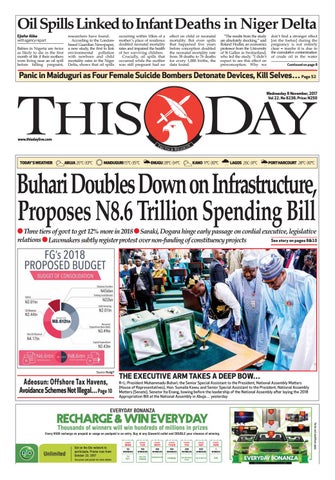
Oil Spills Linked to Infant Deaths in Niger Delta Ejiofor Alike with agency report Babies in Nigeria are twice as likely to die in the first month of life if their mothers were living near an oil spill before falling pregnant,
researchers have found. According to the Londonbased Guardian Newspaper, a new study, the first to link environmental pollution with newborn and child mortality rates in the Niger Delta, shows that oil spills
occurring within 10km of a mother’s place of residence doubled neonatal mortality rates and impaired the health of her surviving children. Crucially, oil spills that occurred while the mother was still pregnant had no
effect on child or neonatal mortality. But even spills that happened five years before conception doubled the neonatal mortality rate from 38 deaths to 76 deaths for every 1,000 births, the data found.
“The results from the study are absolutely shocking,” said Roland Hodler, an economics professor from the University of St Gallen in Switzerland, who led the study. “I didn’t expect to see this effect on pre-conception. Why we
don’t find a stronger effect [on the foetus] during the pregnancy is not entirely clear – maybe it is due to the cumulative contamination of crude oil in the water Continued on page 8
Panic in Maiduguri as Four Female Suicide Bombers Detonate Devices, Kill Selves… Page 52 Wednesday 8 November, 2017 Vol 22. No 8238. Price: N250
www.thisdaylive.com TR
TODAY'S WEATHER
ABUJA 26°C-33°C
MAIDUGURI 15°C-35°C
UT H
& RE A S O
ENUGU 28°C-34°C
N
KANO 11°C-30°C
LAGOS 26C-31°C
PORT HARCOURT 28°C-30°C
Buhari Doubles Down on Infrastructure, Proposes N8.6 Trillion Spending Bill Three tiers of govt to get 12% more in 2018 Saraki, Dogara hinge early passage on cordial executive, legislative See story on pages 8&10 relations Lawmakers subtly register protest over non-funding of constituency projects
Source: BudgiT
Adeosun: Offshore Tax Havens, Avoidance Schemes Not Illegal… Page 10
THE EXECUTIVE ARM TAKES A DEEP BOW… R–L: President Muhammadu Buhari; the Senior Special Assistant to the President, National Assembly Matters (House of Representatives), Hon. Sumaila Kawu; and Senior Special Assistant to the President, National Assembly Matters (Senate), Senator Ita Enang, bowing before the leadership of the National Assembly after laying the 2018 Appropriation Bill at the National Assembly in Abuja… yesterday
2
T H I S D AY WEDNESDAY NOVEMBER 8, 2017
T H I S D AY WEDNESDAY NOVEMBER 8, 2017
3
4
T H I S D AY WEDNESDAY NOVEMBER 8, 2017
6WDUW D )DPLO\ 6DYLQJV 6FKHPH IRU \RX DQG DW OHDVW RQH RWKHU UHODWLYH 0DLQWDLQ D TXDOLI\LQJ PLQLPXP EDODQFH IRU GD\V DQG \RX DXWRPDWLFDOO\ TXDOLI\ IRU RXU :HHNO\ 0RQWKO\ DQG 0HJD 6HOHFWLRQV
FRQWDFWFHQWHU#DFFHVVEDQNSOF FRP
VDYHWRGD\
T H I S D AY WEDNESDAY NOVEMBER 8, 2017
5
6
T H I S D AY WEDNESDAY NOVEMBER 8, 2017
T H I S D AY WEDNESDAY NOVEMBER 8, 2017
7
WEDNESDAY, ÍśËœ ͺ͸͚; Ëž T H I S D AY
8
PAGE EIGHT OIL SPILLS LINKED TO INFANT DEATHS IN NIGER DELTA and soil, which increases over time. But that doesn’t explain the entire effect. “This is a tragedy. Even four to five years prior to conception, an oil spill still matters. I think this should be seen as a firstworld problem for something to be done.� Regular, uncontrolled spills have been a prominent feature of Nigeria’s oil industry – the nation’s primary source of GDP – since crude was discovered there more than 60 years ago. An estimated 240,000 barrels of crude oil are spilled in the Niger Delta every year, polluting waterways, contaminating crops, and releasing toxic chemicals into the air. A 2011 report by the UN Environment Programme estimated that, after decades of repeated oil spills in Ogoniland, it would take 30 years to reverse damage to public health and the regional ecosystem. Unborn and newborn infants are most vulnerable to oilrelated pollution because they
have not yet developed basic defences such as the blood-brain barrier, which helps protect against toxic chemicals, the study found. Even small doses of pollution are likely to be large in comparison to an infant’s body weight, while mothers who ingest poisoned food or contaminated water are also at greater risk of maternal malnutrition and sickness, potentially increasing infant mortality risks, said the researchers. By pairing georeferenced data from the Nigerian Oil Spill Monitor – which recorded the location of more than 6,600 spills between 2005 and 2015 – with the 2013 national demographic and health survey, Hodler and his colleague Anna Bruederle were able to map oil spill locations in relation to neonatal and child mortality rates among the surrounding populations. The result was an analysis of roughly 5,040 children born to
2,700 mothers in 130 clusters, all within 10km of the closest oil spill. The researchers then compared siblings’ health histories, contrasting the mortality rates of infants conceived or born before the first nearby oil spill with those conceived or born subsequently. The data proved that neonatal mortality was higher the closer the oil spill was to the mother’s location, and that any oil spills prior to conception increased the incidence of low weightfor-height, notably in the first year of life. The Nigerian government did not respond to multiple requests for comment. Activists have called the findings “disturbing and disheartening�. “It is shocking to consider how many children may have died in the past 50 years – since oil exploration started in Nigeria’s Niger Delta – as a direct result of regular and uncontrolled oil spills,� said
A gas are is seen in the background as a pregnant woman dries tapioca near Utorogu ow station in Warri, Delta State AP Debbie Ariyo of Africans Unite Against Child Abuse, a charity that supports the rights and welfare of African children. “The ongoing environmental
damage means that more children are exposed to harmful chemicals in polluted drinking water, air and food produce. Simply put, as long as the
oil spills continue unabated and clean up of the region is delayed, then unfortunately more children will be harmfully impacted.�
BUHARI DOUBLES DOWN ON INFRASTRUCTURE, PROPOSES N8.6 TRILLION SPENDING BILL Damilola Oyedele, James Emejo in Abuja and Obinna Chima in Lagos In a bid to meet his administration’s target to restore the budget calendar to the JanuaryDecember fiscal cycle, President Muhammadu Buhari yesterday presented the N8.612 trillion 2018 Appropriation Bill to a joint session of the National Assembly, representing a 16 per cent increase over the N7.441 trillion budget for this year. Of the N8.6 trillion budget, the Ministry of Power, Works and Housing headed by Mr. Babatunde Fashola, got the lion share of N555.8 billion, signifying the administration’s commitment to infrastructure projects, to expand the economy and create more employment opportunities. Clad in a light blue traditional babariga and cap with his trademark glasses, Buhari walked into the Green Chambers of the House of Representatives at 2.02 p.m. He was ushered in by the Deputy Speaker of the House, Hon. Yussuff Sulaimon Lasun, his Senior Special Assistant, National Assembly Matters (Senate), Senator Ita Enang, Senate and House Leaders, Ahmed Lawan and Femi Gbajabiamila, and the House Whip, Hon. Alhassan Ado Doguwa. The event was witnessed by Vice-President Yemi Osinbajo, Secretary to the Government of the Federation (SGF), Mr. Boss Mustapha, Head of Service, Mrs. Winifred Oyo-Ita, Chief of Staff to the President, Mr. Abba Kyari, Chairman of the Nigerian Governors’ Forum (NGF) and Zamfara State governor, Abdulaziz Yari of Zamfara, national executives of the All Progressives Congress (APC) led by the party’s chairman, Chief John Oyegun, the Minister of Budget and National Planning, Senator Udoma Udo Udoma and his finance counterpart, Mrs. Kemi Adeosun, among other ministers and senior government officials. Tagged the budget of consolidation, the Bill is proposing N2.428 trillion as capital expenditure, representing 30.8 per cent of the budget, N3.494 trillion for recurrent expenditure, N2.014 trillion for debt service, N456 billion for statutory transfers,
and N220 billion for the Sinking Fund to retire maturing bonds to local contractors. The President of the Senate, Dr. Bukola Saraki and the Speaker of the House of Representatives, Hon. Yakubu Dogara however hinged the early passage of the budget on the cordial relations between the executive arm of government and the legislature. The key parameters and assumptions for the 2018 budget proposal were set out in the yet-to-be approved 2018-2020 Medium Term Expenditure Framework (MTEF) and Fiscal Strategy Paper (FSP), which has been committed to the Senate and House Committees on Finance, Appropriation and National Planning. These include a benchmark oil price of $45 per barrel, oil production estimate of 2.3 million barrels per day, including condensates, exchange rate of N305/$1 for 2018, real GDP growth of 3.5 per cent and inflation rate of 12.4 per cent. The estimated total revenue for the 2018 budget was put at N6.607 trillion, 30 per cent more than the 2017 budget estimates. Of the total projected revenue, oil revenue was put at N 2.442 trillion while N4.165 trillion would come from non-oil revenue sources. The projected deficit in the 2018 budget estimates was put N2.005 trillion, representing 1.77 per cent of GDP. According to Buhari, “We plan to finance the deficit partly by new borrowings estimated at N1.699 trillion. Fifty per cent of this borrowing will be sourced externally, while the balance will be sourced domestically. “The balance of the deficit of N306 billion is to be financed from the proceeds of privatisation of some non-oil assets by the Bureau of Public Enterprises (BPE).� Buhari said based on MTEF/ FSP parameters, total federally collectible revenue was estimated at N11.983 trillion for 2018. “Thus, the three tiers of government shall receive about 12 per cent more revenue in 2018 than the 2017 estimates. Of the amount, the sum of N6.387 trillion is expected to be realised from oil and gas sources. Total receipts from the non-oil sector are projected at N5.597 trillion,� the president
explained. Buhari, in an address which lasted for one hour and nine minutes, also presented key capital spending estimates to include N263.10 billion for the Ministry of Transportation, N145 billion for the Ministry of Defence, N118.98 billion for the Ministry of Agriculture and Rural Development, N95.11 billion for the Ministry of Water Resources, and N82.92 billion for the Ministry of Industry, Trade and Investment. Others are N63.26 billion for capital projects in the Ministry of Interior, N61.73 billion for the Ministry of Education, N71.11 billion for the Ministry of Health, and N53.89 billion for the Niger Delta Ministry. Capital spending for Special Intervention Programmes was put at N150.00 billion, N109.6 billion for the Universal Basic Education Commission (UBEC), N40.30 billion for the Federal Capital Territory, N45 billion for the North East Intervention Fund, N71.20 billion for the Niger Delta Development Commission (NDDC) and N100 billion for Zonal Intervention Funds (ZIFs). Recurrent expenditure for key ministries such as interior was estimated at N510.87 billion, N435.01 billion for the education ministry, N422.43 billion for the Ministry of Defence and N269.34 billion for the Ministry of Health. The 2018 budget is also proposing the sum of N9.8 billion for the Mambilla hydro power project, including N8.5 billion as counterpart funding, N12 billion counterpart funding for earmarked transmission lines and sub-stations, N35.41 billion for the National Housing Programme, N10 billion for the Second Niger Bridge, and N300 billion for the construction and rehabilitation of strategic roads. The 2018 budget will consolidate on the achievements of previous budgets and deliver on Nigeria’s Economic Recovery and Growth Plan (ERGP) 2018 – 2020, Buhari told the audience. The president spent considerable time highlighting the successes of the 2016 budget, probably due to the low implementation of the 2017 budget which was passed in June this year and is expected to end when the new budget is passed.
The president said N1.2 trillion was expended on capital projects in the 2016 budget, adding that 2017 was a year of uncertainty while 2018 is expected to be a year of better outcomes. “Nigeria’s journey out of the recent recession was a revealing one. We heard many opinions from within and outside Nigeria on how best to address our economic woes. We listened carefully and studied these proposals diligently. “Our belief has always been that the quickest and easiest solution may not necessarily be the best solution for a nation as diverse as ours. We took our time to create a balanced and equitable response, keeping in mind that only tailored Nigerian solutions can fix Nigeria’s unique problems,� Buhari said. The president listed the achievements brought about by his policies to include an increase in external reserves to $34 billion as of October 30, 2017, an export-import trade surplus of N506.5 billon by the second quarter of 2017, rise in ranking to 145th position by World Ease of Doing Business report from 169th position, improved tax administration, optimising efficiency in expenditure, increased investment in infrastructure, agricultural and health sector development, and the Social Investment Programme. “Our Sovereign Wealth Fund, which was established in 2011 with $1 billion, did not receive additional investment for four years when oil prices were as high as US$120 per barrel. However, despite record low oil prices, this administration was able to invest an additional $500 million into the fund,� he said. Commending the members of the National Assembly for their collaborative support in moving Nigeria forward, Buhari gave the lawmakers the assurances of his strong commitment to deepening executive-legislative relations. “I appeal to you to swiftly consider and pass the 2018 Appropriation Bill,� he said and expressed hope that the budget would be passed before January 1, 2018.
Legislature Pushes for Harmony Having listened to the president’s budget speech,
the leadership of the National Assembly harped on the need to sustain good working relations between the executive arm and legislature in tackling critical national issues that benefit Nigerians. They, however, made it clear that the early passage of the budget would be dependent on its defence by agencies and departments of government. The Senate President, in his remarks, specifically noted that both arms of government must work together in ensuring that budget estimates are passed by the end of the year. He recommended sanctions for erring parastatals and agencies that fail to submit their budget along with the 2018 budget, insisting that they be denied access to their capital expenditure unless the budget is passed. According to him, “The budgets of parastatals and agencies are meant to be submitted with this budget presentation, as stipulated by the constitution.� Saraki also spoke on the need to review the agreements that government had signed with some private sector service providers, noting that some of them were tilted in the favour of the providers and clearly not in the interest of the country. He said: “Many businesses were adversely affected by the recession; many lost their means of livelihood. As the country emerges from that period of uncertainty, the question on the lips of many Nigerians has been this: How does the recovery translate into tangible economic benefits for me? “We must remember that the real gains must be felt on a personal level by the individual, for economic recovery to have meaning. People are seeking to get back to work but cannot find jobs. “Entrepreneurs want to restart their businesses but are finding it difficult to access the needed capital. As for our farmers, the last thing they want is for produce to go to waste because people cannot afford to buy.� In his speech, Dogara also hinted that the passage of the 2018 Appropriation Bill by the National Assembly might be delayed due to inadequate consultations in its preparation between the government agencies
and various oversight committees of the National Assembly. “Consequently, one can only hope and pray that it does not lead to delays in consideration and passage of the budget,� he said. The Speaker, however, noted that the success of the budget presentation had separated them as “true leaders� who in the midst of a hazy executive-legislative relationship elected not to turn on one another but to turn to each other in the very interest of our constituents and national progress. According to him, “This is the way we must go as our constitutional order is organised in a way that deliberately denies any of the three arms the strength to go at it alone on any national issue. Where that has happened, it is progress that suffers. “That reminds us of the adage that says, ‘If you want to go fast, go alone but if you want to go far, go together.’ Examples abound on how fast but not far, the executive has gone on some national issues where they have decided to go alone. There is no national challenge we cannot overcome if we work together.� He further highlighted the concerns of lawmakers over the poor implementation of the 2017, fearing it could be abandoned. Though the president had assured that next year’s budget would not in any way hamper the implementation of the 2017 Continued on page 10
TOP GAINERS NGN NGN NASCON 1.33 14.33 CAVERTON 0.05 1.25 FIRSTALUM 0.02 0.52 AFRIPRUD 0.14 3.84 UACN 0.62 17.51 TOP LOSERS NGN NGN C & I LEASING 0.09 1.71 TRANSCORP 0.07 1.36 CADBURY 0.50 10.00 STERLBANK 0.05 1.01 HONEYWELL 0.09 1.85 HPE Nestle Nig Plc â‚Ś1,200.00 Volume: 199.855 million shares Value: N1.811 billion Deals: 3,657 As at 7/11/17 See details on Page 39
% 10.2 4.1 4.0 3.7 3.6 % 5.0 4.9 4.7 4.7 4.6
T H I S D AY WEDNESDAY NOVEMBER 8, 2017
9
WEDNESDAY, ÍśËœ ͺ͸͚; Ëž T H I S D AY
10
PAGE 10
Adeosun: Offshore Tax Havens, Avoidance Schemes Not Illegal Says FG to crosscheck declarations by Nigerian users of tax shelters condition for repatriation of $300m Abacha loot Ndubuisi Francis and Paul Obi in Abuja As revelations from the Paradise Papers continue to make waves globally, the Minister of Finance, Mrs. Kemi Adeosun has clarified that offshore tax havens are not illegal insofar as Nigerian taxpayers using such shelters have paid the applicable taxes locally before the transfer of funds or assets to the tax shelters. She equally stated that while the use of tax avoidance schemes was legal, tax evasion is not. The minister who provided clarity on the issue of offshore tax havens yesterday at an interactive session with journalists in Abuja, however, revealed that the federal government would henceforth crosscheck tax declarations by Nigerian operators of offshore tax havens. In this regard, she advised Nigerians to review any existing tax planning schemes, including those in offshore tax havens, in order to take advantage of the Voluntary Assets and Income Declaration Scheme (VAIDS) and regularise their tax status, where necessary. According to a statement
issued by her media aide, Mr. Oluyinka Akintunde, she was responding to a question about the legality or otherwise of the use of offshore tax shelters. “The critical question to be asked of all Nigerian tax payers using offshore tax shelters will be whether all applicable taxes have been paid prior to the transfer of funds or assets to a tax shelter. “If all taxes had been paid, then there will be no additional liability except tax payable on further income earned on those funds. However, if taxes had not been paid, then the use of such schemes is illegal,� the minister said. Adeosun counselled users of such structures to seek professional advice, explaining further that her ministry was offering free training to professional advisers on VAIDS to enable them support their clients. She urged users of offshore tax shelters to promptly embrace the VAIDS scheme to regularise their tax status, adding that Nigeria’s low tax revenues were at variance with the lifestyles of a large number of its people and with the value of assets known to be owned
by Nigerians resident around the world. She added: “VAIDS ushers in an opportunity to increase the nation’s general tax awareness and compliance. It is a time-limited opportunity for taxpayers to regularise their tax status relating to previous tax periods. “In exchange for fully and honestly declaring previously undisclosed assets and income, taxpayers will benefit from forgiveness of overdue interest and penalties, and with further assurance that they will not face criminal prosecution for tax offences or be subject to tax investigations.� The minister explained that with the increasing global focus on illicit financial flows and tax evasion, offshore tax shelters no longer offer robust protection against tax authorities. The continued use of such schemes, she stressed, poses enormous risks for the users. On the recent leaks by the Panana and Paradise Papers, the minister noted that the leaks were just the beginning of what was likely to be a systematic unravelling of the offshore tax haven system. According to her, the Ministry
of Finance’s data mining project would use data provided on Nigerians from such leaks to crosscheck tax declarations. She urged Nigerians to cooperate with the government by paying the right taxes to both the federal and state governments in order to provide the much needed funds that will improve the lives of Nigerians. The minister maintained that sanctions await defaulters who refuse the federal government’s offer of tax amnesty, including the full payment of outstanding tax liabilities and criminal prosecution. She further stated that businesses, which untruthfully comply, would be liable as whatever was paid on the declared liabilities may be considered as part-payment of the outstanding sum later discovered by the authorities. On impetuous defaulters who fail to utilise the VAIDS window, Adeosun said such offenders would face criminal prosecution by the federal government. VAIDS was established on June 29, 2017 via an Executive Order signed by Vice-President Yemi Osinbajo (the then acting president) as a broad-spectrum
Jersey Island gives
solution to the defects in the country’s tax system, including negativity towards taxation. The first phase of VAIDS runs from July 1, 2017 while the second phase ends on March 31, 2018. Job creation is one of the spin-offs of the VAIDS initiative, with the scheme expected to create 7,500 opportunities for Nigerians as Community Tax Liaison Officers (CTLOs) through the N-Power scheme of the federal government. In a related development, the Government of Jersey Island made it clear yesterday that the $300 million illegally stashed away on the Island by the late military leader, Gen. Sani Abacha will not be released to the Nigerian government should there be a third party involved in the repatriation of the stolen wealth. According to the Economic and Financial Crimes Commission (EFCC), the Government of Jersey Island was skeptical of the involvement of a third party in the repatriation of the looted funds, given past complaints by some Western governments on Nigeria’s sincerity in the handling of recovered funds stolen by the
Abacha family. Making this known, EFCC Head of Media and Publicity, Wilson Uwujaren explained that “the Government of Jersey Island has insisted that the Abacha loot would not be released to Nigeria if a third party representation is brought into the picture�. “The Minister and Attorney General of Jersey Island, Robert J. MacRae QC disclosed this today (yesterday) during the on going 7th Session of Conference of State Parties to the United Nations Convention Against Corruption, holding in Vienna, Austria. “MacRae spoke on the sidelines of the conference with the Nigeria delegation led by the acting chairman of the EFCC, Ibrahim Magu. “The Jersey Attorney General expressly stated that negotiations in respect of repatriation of the $300 million, being part of the Abacha loot, between Nigeria and Jersey Island, involving the United States of America, must be on the basis of government to government co-operation. “The EFCC was accompanied to the meeting by four members of the Nigeria delegation,� Uwajaren said.
BUHARI DOUBLES DOWN ON INFRASTRUCTURE, PROPOSES N8.6 TRILLION SPENDING BILL budget, Dogara stressed the need to “redouble efforts in implementing the 2017 budget, if we must retire it in January or at the very least roll over most of the projects in the 2017 budget to 2018�. He also likened the nonadherence to fiscal discipline to corruption, which the current administration is fighting to stamp out. “Mr. President, as legislators, what agitates us is the prospects of totally abandoning the 2017 budget and the dire consequences of doing so. The questions that must be answered include whether we have effectively enforced 2017 fiscal targets and whether managers have complied with the budget as authorised by the legislature. “Our experience with the implementation of the 2016 budget amply demonstrates that obeying our Appropriation Laws maximises the release of our potential while violating the Appropriation Laws caps the release of our national potential. “This means that we have to redouble our efforts in implementing the 2017 budget if we must retire it in January or at the very least roll over most of the projects in the 2017 budget to 2018. No need to remind us that fiscal indiscipline is as grievous a problem as corruption which this government is busy eliminating,� he said. He further informed the president that though the country was said to have exited the recession, the majority of Nigerians were still struggling to make ends meet. “Although the recession has technically ended, most Nigerian families are still struggling. As a government, we must do all within our powers to hasten their long night of panic and fear into a glorious morning. “We must never allow this
nation to slide into recession, not now, not ever again. We cannot therefore discountenance policy consistency and synergy between all stakeholders, if we must sustain economic growth and development, going forward. “Mr. President, I urge that you take no prisoners in the implementation of your well crafted and thought-out Economic Recovery and Growth Plan, which you launched in January 2017,� the Speaker said.
Shelved Protest Meanwhile, the plan by members of the Peoples Democratic Party (PDP) House caucus to stage a protest during Buhari’s budget presentation, in order to draw his attention to their displeasure over the non-release of zonal intervention funds for constituency projects, was not followed through. Although the lawmakers succeeded in smuggling their placards into the chamber, they did not raise them during the president’s presentation. Some of the inscriptions on the placards read: “Zero implementation of capital projects is wickedness,� and “Implement 2017 capital projects or resign.� Although the members did not give reasons why they shelved the planned protest, a reliable source told THISDAY that it took the intervention of Dogara who had pleaded with them not to carry out the protest, as this would have portrayed him in a bad light before the president. However, while the budget presentation was relatively peaceful, the lawmakers in about four instances interrupted the president’s address with loud murmuring. The first murmuring occurred when Buhari, while listing his achievements, claimed that 766
kilometers of roads across the country were rehabilitated or constructed. Although the murmuring was audible all through the jam-packed chamber, it just elicited some laughter from the audience. It was however strong enough to make the president halt his presentation for a few moments, when he mentioned the zonal intervention funds of N100 billion in the budget. The murmurs were caused by the displeasure of the lawmakers over the non-release of the ZIFs for their projects. Despite the few interruptions, Buhari was treated to a standing ovation at the conclusion of his address. THISDAY had reported yesterday that plans were afoot to boo the president over the non-release of the ZIF, which lawmakers believe was weakening their chances of retaining their seats in the next general election. Ahead of the budget presentation, banks and other businesses operating in the National Assembly were shut, as is usually the tradition. As early as 7 a.m., entry into the National Assembly complex was allowed only after strict security checks with prior accreditation.
Reactions to Budget Reacting to thrust of the 2018 Appropriation Bill, the chief executive of BudgIT, Mr. Seun Onigbinde, said that the bill showed that the government intends to continue its philosophy on expanding infrastructure, debt, deficit as well to put more money on capital allocations. Onigbinde noted that the 2018 budget was the last lap of Buhari’s budget presentation
before the elections kick in, adding that this should compel the government to speed up the implementation of the budget. “A lot of Nigerians are looking at this budget to see if there would be tangible achievements by this government. “So it is important that the National Assembly considers this in the passage of this budget because we would have a short period of governance next year, and much more to do about politicking. “So, before politicking starts, let’s have the budget passed so that we can factor in the procurement cycle that takes up to three months and we can get the projects implemented so that we can have results to show the electorate for the next election cycle,� he said. He, however, stressed the need for the government to think of ways to ramp up non-oil revenue, saying most of the assumptions for the revenue projections in the 2018 budget were bloated and too optimistic. “The federal government needs to look at how to expand VAT, Company Income Tax collections and build on other opportunities for revenue,� he explained. Also, the chief executive of Financial Derivatives Company Limited, Mr. Bismarck Rewane, urged members of the executive as well as lawmakers, to ensure that the proposed budget becomes a tool of economic management so as to achieve its desired objective. “What we have now is an aspirational budget, what we need to see is its impact. First and foremost, an exchange rate of N305 to a dollar in a budget is not an effective exchange rate. I don’t know where that is coming from. The world is full of uncertainties and unpredictable outcomes. “But the reality check on Nigeria will be if this becomes
an impactful tool of economic management. That is the question we all must answer,� Rewane added. In their reactions, PDP lawmakers in the House who spoke to THISDAY expressed their frustration over the poor implementation of the 2017 budget and hoped that it won’t be truncated. Hon. Samuel Ifeanyi Onuigbo (PDP, Abia) said: “Well, you know we are moving into 2018 and after 2018 we are going to 2019 and we are in the middle of the tenure of this administration. “It is my expectation that we will find something in this budget to give my people hope because the implementation of the 2016 and 2017 budgets was not satisfactory. Therefore it’s my expectation that 2018 would bring better things for the people we represent.� Hon. Raphael Igbokwe (PDP, Imo) said: “We need to draw the attention of government that the effective implementation of this budget will enhance the welfare of the people. And even though the 2017 budget is still there but you can see that the average Nigerian is clamouring for better welfare and the effect is not trickling down and a lot of people are still hungry. “So this is something the executive should take home and they need to convince us about funding the budget. “The presentation of a budget is a mere proposal of political activity, but funding it brings it to life and helps government to convince the people about its policy direction. “It is only when things are felt that people appreciate the presence and policy direction of government. So we want to urge the government to do more concerning funding and as parliament, we will do our
best to block existing revenue leakages, to ensure that money is available to government.� Also, Hon. Sergius Oguns (PDP, Edo) said: “Our major concern is the 2017 budget, we don’t want it to be thrown under the table before the 2018 budget is passed. “The MDAS are going to come for their budget defence and so what percentage has so far been released to them from the 2017 budget will be brought up. But what are they going to be defending? That is my concern but let’s see what happens.� On her part, Hon. Elendu Nnenna Ukeje (PDP, Imo) said: “If as of November we are unable to do more than 25 percent of the 2017 budget, is 2018 going to be a continuation of the 2017. I am a little concerned. “But you know this (passage of the 2018 budget before January) is not going to be feasible, but I hope it happens in the interest of the Nigerian people and I am cautiously optimistic.� Hon. Johnson Agbonayinma (PDP, Edo) said: “The 2017 budget has not been implemented fully, you can see a lot of agitation. Even before the arrival of the president today, you could see there was agitation. “People are angry because we all represent our constituencies across the nation and people are complaining and wondering why things are not being done. “People can’t even pay their children’s school fees because when you are doing all these projects, it’s not money coming to the lawmakers but rather these are things belong for the people. We are closer to our constituents than the president. “I think the wise thing for us to do is to put our heads together and work as a team, it’s not about entering a competition between the legislature and executive.�
T H I S D AY WEDNESDAY NOVEMBER 8, 2017
11
WEDNESDAY, NOVEMBER 8, 2017Ëž T H I S D AY
12
NEWS
Ă?ĂĄĂ? ĂŽĂ“ĂžĂ™Ăœ Davidson Iriekpen Ă—Ă‹Ă“Ă– davidson.iriekpen@thisdaylive.com, 08111813081
Lagos Midstream Jetty To Save N43bn Annually ASPM Limited, a subsidiary of OVH Energy Limited, has achieved a ground-breaking milestone as it launched its Lagos Midstream Jetty (LMJ) located at the Lagos Apapa Harbour.  The Lagos Midstream Jetty is West Africa’s first privately owned mid-stream jetty, conceived by Oando PLC to increase the delivery capacity and offloading efficiency of petroleum products into marketers’ storage facilities in Apapa Lagos.  The Lagos Midstream Jetty
is expected to alleviate the perennial infrastructural hiccups experienced in Apapa, eliminating the lightering and demurrage charges currently being incurred by petroleum marketers by N8.3 billion ($23million) and N9.8 billion ($27million) respectively. Â Additionally, the jetty will reduce discharge time from 21 to 3 days as well as increase product availability. Â With a draft of 13.5metres, Length Overall (LOA) of 210m and a capacity to receive 45,000
FG to Launch First African Sovereign Green Bond in December President Muhammadu Buhari has said the Federal Government will launch the first African Sovereign Green Bond in December 2017, to finance renewable energy projects. Buhari said this in Abuja on Tuesday while presenting the 2018 Budget Proposal to the National Assembly. “I am pleased to inform this distinguished assembly that the Federal Government will be launching the first African Sovereign Green Bond in December 2017. “The bond will be used to finance renewable energy projects. We are very excited about this development as it will go a long way in solving many of our energy challenges, especially in the hinterland,’’ the president said. He said the Federal Government was working hard on the Ogoni Clean-up
Project. “During the year, we engaged eight international and local companies proposing different technologies for the mandate. “To enable us to select the best and most suitable technology for the remediation work, we asked each company to conduct Demonstration Clean-up Exercises in the four Local Government Areas of Ogoni Land. “These demonstrations were recently concluded and the results are being studied by the Governing Council of the Ogoni Clean-up Project.’’ Buhari, who said the project would be funded by the International Oil Companies, said the Federal Government had made provisions in the 2018 Budget for the costs of oversight and governance, to ensure effective implementation.
DWT vessels (deadweight ton), the Lagos Midstream Jetty will discharge at up to 800 m3 (cubic metres) of petroleum products per hour. Â Â The Jetty will operate 24 hours a day to supply products into storage facilities situated within the Apapa axis, via a 3kilometres submarine pipeline network linked directly with up to 200,000MT storage belonging to major and independent marketers in Nigeria. LMJ which is configured to receive all white products namely petrol, diesel and kerosene, consists of a simple horizontal platform, five berthing dolphins, and four mooring points. Â In comparison to available jetties, the Lagos Midstream Jetty has the capacity to receive larger vessels of up to 45,000 DWT in one lot thus reducing the current necessity of bringing in smaller volumes of petroleum products
in several batches.  This will result in significant cost savings on lightering and generating economies of scale advantages for marketers.  Commenting at the launch, Chairman of OVH Energy, Wale Tinubu, said: “The Lagos Midstream Jetty was conceived as an innovative industry solution to the perennial challenges marketers faced in the importation of petroleum products.  “Over the past 30 years, marketers have spent approximately NG1.6 trillion ($4.5 billion) on lightering, with 90 percent of this spend flowing out of the country. Today, we have delivered a first class piece of engineering that meets global standards, which is the first of its kind in sub-Saharan Africa and will be of invaluable benefit to the industry and nation at large. I must thank our regulators, bankers and contractors who believed in us from the start. It
is a proud moment for Oando PLC who conceived the idea and OVH who have taken up this mantle. From conception to realisation, the idea of the Lagos Midstream Jetty is now a reality and is indeed another infrastructural success for us, our nation and the continent.’’  Commenting further on the facility, the General Manager of ASPM Limited, a subsidiary OVH Energy, Mr. DejiOsikoya, stated: “The Lagos Midstream Jetty is an innovative infrastructure investment designed to radically transform the efficiency of Nigeria’s downstream landscape and boost Nigerian’s petroleum downstream economics. We expect the jetty to become an extremely valuable and viable portfolio especially for marketers, reducing delays caused by infrastructural limitations in Lagos, thus improving marketers’ service delivery and profitability and reducing the financial drain
on the nation’s resources.� The jetty is equipped with a gangway tower to facilitate vessel discharge operations and an on-shore control station at Alapata, Apapa which serves as the central control centre for its off-shore and on-shore operational activities fully equipped with an automated process control system. “The Lagos Midstream Jetty (LMJ) is fully operational, having berthed 10 vessels and discharged products totaling 255,000 metric ton of cargo demonstrating its potential as a functionally efficient and safe facility. With a monthly volume capacity of 240,000metric tons, or 240,000,000 litres, the Lagos Midstream Jetty is set to substantially boost supply of petroleum product into Nigeria, and contribution estimated NGN13.1 billion ($36 million) cost reduction in product imports and associated transactions,�Osikoya further added.
OPEC Seeks Consensus on SUPPORT ME Duration of Oil Cut Pact L-R: Former Minister of Information, Prof. Jerry Gana, former Minister of Education and PDP Chairmanship Aspirant, Prof. Tunde Gov. Ifeanyi Ugwuanyi of Enugu State and Alh. Shehu Gabam during the campaign tour of Tunde Adeniran campaign team to Ahead of Nov 30 Meeting Adeniran, Enugu State, yesterday Ejiofor Alike åÓÞÒ Ă‹Ă‘Ă?Ă˜Ă?ĂŁ ĂœĂ?ĂšĂ™ĂœĂžĂ?
The Organisation of Petroleum Exporting Countries (OPEC) is seeking to achieve consensus agreement before a meeting onNovember 30, 2017 on how long to extend a global pact to curb oil production, OPEC’s Secretary General, Mohammed Barkindo has said, with no country opposing an extension of the accord. OPEC, Russia and nine other producers, are cutting oil output by about 1.8 million barrels per day (bpd) until March 2018 in an effort to eradicate a supply glut that has weighed on prices. Barkindo’s comments indicate an increasing chance that the deal will be extended further into next year at the November 30meeting. At $64 per barrel yesterday, oil prices are trading at a more than two-year high, but an overhang of stored oil has yet to be fully eradicated. “Extensive consultations are currently ongoing to reach some consensus before Nov. 30 on the duration beyond the March 2018 deadline,� OPEC’s Mohammad Barkindo told reporters in Vienna, Austria. “I have not heard so far any participating country that is violently objecting to extending the decision,� Barkindo added The producers are in the process
of inviting other countries to the Nov. 30 meeting, Barkindo said, with a view to joining the deal. He declined to name the countries concerned. Reuters reported last month, citing OPEC sources, that producers are leaning towards extending the deal for a further nine months, though the decision could be postponed until early next year depending on the market. Barkindo, who was speaking at a press conference for OPEC’s latest World Oil Outlook, said the recent rise in prices reflected improved market fundamentals and producers’ high adherence to the supply pact. “As a result of the high level of conformity of the 24 participating countries in the declaration of cooperation, the market has also responded very positively,� he said. “I am not hearing any diverging view that this market that has been out of balance since the fall of 2014 is finally coming back to a rebalanced market driven largely by fundamentals, assisted by the efforts of OPEC and non-OPEC (members),� Barkindo explained. Reuters added that the supply pact is aimed at reducing oil stocks in OECD industrialised countries to their five-year average and the latest figures suggest OPEC is more than halfway there.
Ekwueme is Alive, Stable, Says Family, Archbishop Christopher Isiguzo Ă“Ă˜ Ă˜Ă&#x;Ă‘Ă&#x; Second Republic Vice President, Dr. Alex Ifeanyichukwu Ekwueme, is alive and stable, the family has announced.  A section of the social media had reported that the octogenarian had passed on in a London hospital in the early hours of yesterday. The rumour of his death had spread like wild fire in Enugu as residents continued to reach out to journalists to confirm the “sad newsâ€?.  The elder-statesman had reportedly collapsed almost two weeks ago at his residence located at the Independence layout,
Enugu, and was admitted at the Intensive Care Unit of Memfys Hospital for Neurosurgery near Trans Ekulu, Enugu.  The family dismissed the rumour of his death as “wicked�, noting that the former vice president was already recovering and has not been flown abroad yet as approved by President Muhammadu Buhari.  In a statement yesterday by the family spokesman, Mr. Uche Ezechukwu, the Ekwueme family said: “The wicked rumour making the rounds about the deterioration of the condition of Alex Ekwueme is totally untrue. “The truth is that the elder
statesman is alive and well. His condition is not only stabilising but improving considerably.  “In fact, the former VP has moved from a stage of unconsciousness to a state whereby he now receives visitors, sits up and eats. Relatedly, the Archbishop of Enugu Ecclesiastical Province of Anglican Church, Most Rev. Emmanuel Chukwuma has dismissed reports that ailing former Vice President, Chief Alex Ekwueme has passed on. Archbishop Chukwuma spoke yesterday afternoon after visiting Ekwueme at the Memphys Hospital of Neurosurgery
Enugu where he spent some time with him. The former Vice President is one of the Archbishop’s parishioners at Cathedral of the Good Shepherd Independence Layout Enugu. At about 2.25pm, the top Anglican cleric came out of the hospital ward. Before leaving the hospital, Chukwuma told journalists that there was no iota of truth in the rumour about the former vice president’s death. He said efforts were in top gear to fly him abroad as soon as possible.
Malami Raises Hope of Structural Balance in Nation’s Justice Delivery AdemolaBabalola Ă“Ă˜ ĂŒĂ‹ĂŽĂ‹Ă˜ Apparently miffed by the near absence of an enabling justice system in the nation’s judicial administration policy, the Attorney General of the Federation and Minister of Justice, Abubakar Malami (SAN), has raised hope of a structural balance in the nation’s justice delivery. Malami who spoke yesterday said that the new National Policy
on Justice would address the challenges militating against an effective administration of justice in Nigeria. Represented by the Director, Public Prosecution of the Federation, Etsu Mohammed, at the national sensitisation policy on justice for the South-west geopolitical zone, which was held at Kakanfo Inn and Conference Centre, Ibadan, Malami said his ministry was making efforts to provide an opportunity
to strengthen collaboration among justice sector institutions for effective service delivery and to promote the rule of law. He said, “This workshop underscores the determination of the Federal Ministry of Justice under our leadership to continue to mobilise institutions to put in place structures and policies to address the various challenges militating against the justice system in Nigeria.� The Justice Minister stressed that
participants at the workshop would examine the justice policy and initiate an implementation roadmap that wouldarticulateintoanimplementation strategy plan. “Given the challenges militating against an effective administration of justice and the peculiarity of our federal system, there is theneedtoharmonise andintegratethevariousjusticesectorreform initiatives into a clearly articulated policy that defines the philosophy of our justice system,� he added.
T H I S D AY WEDNESDAY NOVEMBER 8, 2017
13
14
T H I S D AY Ëž Ëœ ÍśËœ 2017
COMMENT
Editor, Editorial Page PETER ISHAKA Email peter.ishaka@thisdaylive.com
THE MAKING OF ANAMBRA GOVERNOR Sonnie Ekwowusi urges voters to make intelligent choices at the poll
T
he Anambra State Governorship Election, all things being equal, holds on November 18, 2017. The election definitely will be another acid test of our democracy. The outcome of the election will further testify whether the Independent National Electoral Commission (INEC) can truly conduct a free and fair election in Nigeria. More importantly, the election is crucial for the consolidation of stable democratic practices and harnessing of the potential and endowments in Anambra State. It is a pity that Anambra, arguably, the socio-political and economic hub of the South East, has not been having governors who are really interested in improving the wellbeing of the people. Before ex-Governor Peter Obi came to power in Anambra, the Anambra politics was hijacked by a group of ruffians whom Professor Chinua Achebe described as renegades. The juju activities of the ruffians were extremely destabilising for the state. But with Peter Obi in the saddle Anambra shined brightly like the morning star. Now ever since Obi quit power the political fortunes of Anambra State seem to be dwindling. The decaying public infrastructure - hospitals, schools, roads and so forth in Anambra- tell the ugly story. Besides this, a deep corrupt political system has remained intact in the state. Apart from the messy Anambra political situation, there is also a deepening crisis of values at the moment. I doubt if the people of Anambra can deny this deepening crisis of values. For example, the drug feud involving some Ozubulu drug barons (who are associates of some Anambra political bigwigs) which led to the murder of about 50 worshippers at St. Phillip’s Catholic Church, Ozubulu last August attests to this deepening moral crisis in Anambra. Although it could be argued that the political crisis begets the crisis of values or vice-versa. But certainly both must be tackled in the search for a proper ordering of Anambra State. Therefore the Anambra voters should make intelligent choices at the polls. And after casting their votes on Election Day, they should follow up their votes to ensure that they reach their ultimate destination failure which they should seek appropriate remedies at the appropriate channels until justice is done. In his last annual message to Congress, precisely one month prior to his issuing the Emancipation Proclamation, Abraham Lincoln spoke of how “we shall nobly save, or meanly lose, the last best hope of earth�. I sincerely believe that the “last best hope� in our constitutional democracy in Nigeria is the people. I sincerely believe that it is in the power and eternal destiny of the people to advance truth and ideals which will strengthen our democracy. This is the choice facing Anambra voters on November 18. The voters should not be carried away by sentiments nurtured in the last few days by sheer bright colours and shadows of political activities. The Anambra voters must be discerning enough to differentiate sense from nonsense. They should not only vote with their hands but with their heads and hearts as well. They should remember that on February 9, 2016 the Nigerian soldiers shot and killed countless defenceless civilians who were peacefully holding prayers inside the football field of Ngwa High School, Aba in
THE ANAMBRA VOTERS MUST BE DISCERNING ENOUGH TO DIFFERENTIATE SENSE FROM NONSENSE. THEY SHOULD NOT ONLY VOTE WITH THEIR HANDS BUT WITH THEIR HEADS AND HEARTS AS WELL
Abia State. On May 30, 2016 over 30 civilians were killed and many injured by the military after the several clashes involving the military, police and members of Indigenous People of Biafra (IPOB) and members of the Movement for Actualisation of the Sovereign State of Biafra (MASSOB) during the Biafran day celebration at Nkpor-Agu, Niger Bridge, Onitsha and Asaba. At different times in September 2017 the Nigerian military invaded the Southeast during what it tagged Operation Python Dance 11 and murdered several civilians and left others badly injured during the operation. Section 217(2)(c)(d) of the 1999 Constitution has in no unmistakable language spelt out the circumstances and conditions under which the military can be invited to intervene in quelling internal secession or conflict in a country. While the President of Nigeria can freely deploy our military to defend our country against external aggression and to maintain our territorial integrity, he cannot, pursuant to section 217(2) (c) (d) of the 1999 Constitution, freely do so against internal insurrection and internal armed conflicts without “such conditions as may be prescribed by an Act of National Assembly,� and “performing such other functions as may be prescribed by an Act of the National Assembly�. Therefore it is clear that the invasion of the Southeast by the military and the murder of defenceless civilians in the Southeast by the military are great violations of the human rights of the people of Anambra State/Southeast under the Nigerian law, African Charter on Human Rights and customary international law. Strangely enough, shortly after the invasion of the Southeast the same military forcefully went into Anambra schools to inject unsolicited vaccines on the school pupils. The parents of these school children are seriously alleging that the vaccines were deadly vaccines. In fact some school pupils were said to have died shortly after receiving the vaccines. Surprisingly till date neither President Buhari nor the Nigerian military nor the ruling All Progressives Congress has deemed it fit to tender an apology to the people of Anambra/Southeast for the invasion and the murder of the defenceless civilians. Instead of doing that, the APC has gone into Anambra to solicit for the people’s vote for the November 18 election. Where is our sense of justice? Why has human life become so cheap in Nigeria? Soldiers were deployed in Anambra in September. They went in there and illegally shot and killed some defenceless civilians. Now without any regret, the ruling party APC has gleefully moved into the same Anambra to solicit for votes from those whose parents/ sons/ daughters/uncles/siblings were murdered in September. I think the killings in Anambra/Southeast by the military should weigh heavily in the minds of the Anambra voters as they prepare to cast their votes for a candidate or a political party of their choice on November 18, 2017. We are tired of living in a country where some politicians simply derive joy in spilling human blood. We are tired of living in a country where human life has become so cheap that it can be taken away at any time. We want a true positive change in this country. And this positive change can materialise after the Anambra voters must have voted with their heads and hearts on November 18.
GALLERY OF UNKNOWN HEROES How and what do we honour? Steve Orji raises questions of values
T
here’s a foetal link between what a nation honours and what it’s worth. That unseen umbilical cord that unites it to the universe of its own values, ethos, beliefs - a certain metaphysical affinity that exists between its concrete realities and its avowed sublime goals. It is this primal essence, carrying within itself a strategic national aura that pervades the social and spiritual spheres of its existence, becomes the unmistakable foundation and cornerstone of what it must honour and how. It was hard knock on the spine to wake up and find in the news, that the Imo state governor, Rochas okorocoha, had erected a life-size statue of an alien personage, in the person of President Zuma of South Africa, in his own state, and other yet-to-be-unveiled statues, in what seem to be a new gallery of spectacular unknown heroes. What could have galvanised this governor into such an honour-spree, extravaganza? Governor Okorocha may have dug deep into the moral anatomy of Nigeria and have found it an easy haven for misplaced, mischievous honours. And it was so cheap! Nigeria made! Nigeria much recently became an attractive bride to a jilted groom, in the person of Zuma. To make certain that governor Okorocha was not alone in this enterprise, the APC-led administration, acknowledged his feat for honouring a serving president battling with
historic allegations of corruption and graft in his own country. And Nigeria thus endorsed it. Achebe remains unassailable in the Nigeria context of honouring. Twice he could deconstruct the narrative box of Nigeria’s honours. The first from Olusegun Obasanjo and the next from Jonathan. For those were suborn honours. Achebe’s refusals were to be a sober moral reincarnation for Nigeria, a hard kick on the jurisdiction of honours and honouring. This year is four years since Achebe’s death, and what he stood for, still a strong stare in the face of a nation that is heading down the precipice. I thought Achebe was teaching us how to honour and the substance of what we should honour in these refusals? He was! We didn’t wish to learn! One of the recognisable tokens of any society gone adrift is the absence of conscience and poor moral judgments in the choices of what they honour. Chieftaincy titles, traditional stools and customary titled recognitions are timeless symbols of the moral rites of decent societies. These days even ecclesiastical and religious titles are conferred on ill-trained, loose elements of society. Those who can’t find decent jobs, but knows who knows the General Overseer of one of the churches, soon become conscripted into the long queue of “pastors�, and is so emboldened to wave to people and respond to the appellation of “Man of God� with glee and sense of
accomplishment. These days, such primordial social and traditional legacies; Chief, Eze, Obi, king, Olu, and other regencies, are now the easiest to acquire, best served on demand, and the highest bidders must have the biggest titles, such honours only usually reserved for people of honest accomplishments, who stood guards to the moral and ethical high grounds of their own domains are now sold on the cheap, at every outlet, to thieves and base elements of society. Shouldn’t we strive to earn our own stripes at least? Couldn’t we hope to win a plaque or a medal in our own names that say what it is? Almost everyone in Nigeria has one title or the other. Those who don’t have soon get indoctrinated on why and how to get one. People seek after titles or its tokens, as either social instruments or psycho tools, required to coerce themselves or others into some form of social acceptance or endearments or to provide facelifts for themselves in an attempt to sublimate a severely damaged self-reputation. For whatever reason Nigeria and Nigerians falls for it. The danger again, that accompanies this kind of frivolities, is the death of the society. Death doesn’t entirely connote cessation of physical life. It is the accompanying numbness and loss of sensation in the inner core of the human conscience. Nigeria has attained that inglorious threshold of moral anarchy. This is the kind of social and ethical
doctrine governor Okorocha has further enshrined in the annals of our honouring history as society. This is the same thread of narrative that reinstated Maina, the expension administrator who duped Nigeria of humungous sums of money. He was not only reabsorbed into the mainstream of Nigeria’s public workforce, but was honoured with a perk of promotion. Serving ministers in Buhari’s administration with apparent corruption charges are not merely serving as political appointees, they have gone further to become the poster child of a government that vowed to fight corruption. These are the men who represent Nigeria, whom we repose on, the high hopes and dreams of millions of fellow Nigerians. And we are bound to honour them and sing their praises when they walk our streets. Achebe even in death interrogates Nigeria. His last conversation with Nigeria may have ended abruptly. But as we dig into the repertoire of his legacies, we would find fitting lessons enough to renounce the current moral apathy and shambolic display of statesmanship. Even when Nigeria has not deemed it fit to bestow on Achebe a fitting national honour due his life and significance, at the moment, his moral essence continue to offer a redeeming backdrop on the nation he gave his honest best. Happy birthday to you this month of November. Orji wrote from the United Kingdom
15
T H I S D AY Ëž Ëœ ÍśËœ 2017
EDITORIAL PLIGHT OF NIGERIAN STUDENTS ABROAD It has become imperative to invest more in education
N
igerian students studying abroad are increasingly ďŹ nding it difďŹ cult to pick their bills because of the slump in the country’s economy and rising costs occasioned by the falling value of the naira in the international market. Even students on government scholarships are not spared the agony as many states across the nation, high-heeled parastatals and indeed the federal government, are not remitting their tuition and boarding fees as when due. Some Nigerian undergraduates on government scholarship in the United Kingdom were told recently that they would be denied their degree certiďŹ cation even though many had completed their courses since the last academic year. Some 100 others, among them Ogbonnaya Samuel Ogbonna, a medical student at Leeds University, were also facing the threat of deportation for similar reasons.The Nigerian High Commission in the UK admitted that some 152 students were affected due to the “slump in the country’s oil revenues.â€? THE REINVENTION OF Indeed, since the OUR UNIVERSITIES WILL economy went into a tailspin about two BENEFIT THE COUNTRY years ago as result MORE: IT WILL SAVE THE of the crash in crude BILLIONS IN CAPITAL oil prices, thousands FLIGHT AND KEEP ITS of Nigerian students IMAGE INTACT studying abroad have been going through serious ďŹ nancial difďŹ culties. Many of them – private or public sponsored - are sorely hurt by the foreign exchange crisis. In a bid to ďŹ ght the downward pressure on the naira, the Central Bank of Nigeria imposed some measures on access to forex – measures which stretched the pockets of many parents as well as the government. Many private individuals resorted to the parallel market with all the cost implications. Even some states’ government willingness to fund the education of those sent abroad –many of them indiscriminately - for further studies declined considerably because of their shrinking incomes. Some 159 ďŹ nal year Rivers State students, for instance, were
Letters to the Editor
stranded overseas for a long while as a result of the non-payment of tuition fees. It took some time before the Bayelsa State government could raise 300,000 pounds sterling and $450,000 to pay the tuition of its students chased out of their university classrooms and hostels in nearby Ghana. Even those sent abroad by NIMASA and the Niger Delta Develpoment Commission (NDDC) had at various times been stranded due to the non-payment of fees. Even so, the NDDC recently called for applications for the 2017 postgraduate scholarship despite owing a backlog of fees.
H T H I S DAY EDITOR DEPUTY EDITORS ˜ MANAGING DIRECTOR DEPUTY MANAGING DIRECTOR CHAIRMAN EDITORIAL BOARD
EDITOR NATION’S CAPITAL
T H I S DAY N E W S PA P E R S L I M I T E D EDITOR-IN-CHIEF/CHAIRMAN GROUP EXECUTIVE DIRECTORS ˜ ˜
˜ GROUP FINANCE DIRECTOR DIVISIONAL DIRECTORS ˜ ˜ DEPUTY DIVISIONAL DIRECTOR
SNR. ASSOCIATE DIRECTOR ASSOCIATE DIRECTORS ˜ CONTROLLERS ˜ ˜
GENERAL MANAGER
GROUP HEAD DIRECTOR, PRINTING PRODUCTION TO SEND EMAIL: ďŹ rst name.surname@thisdaylive.com
TO OUR READERS Letters in response to speciďŹ c publications in THISDAY should be brief (150-200 words) and straight to the point. Interested readers may send such letters along with their contact details to opinion@thisdaylive.com. We also welcome comments and opinions on topical local, national and international issues provided they are well-written and should also not be longer than (9501000 words). They should be sent to opinion@thisdaylive.com along with the email address and phone numbers of the writer.
OUR LEADERS AND A FAILED NATION “To build a nation where peace and justice shall reign.� his is the last verse in the second stanza of our national anthem. The second stanza happens to be my personal favourite part of the anthem as it calls on God to guide our leaders right and help our youths the truth to know. However it seems our leaders are afar from the part they have been directed. They have continued to lie to us, to disappoint us, to betray us and to shame us. Isn’t it shameful that we have been writing the same articles for 57 years? Isn’t it shameful that we’ve been suffering the shameful plights for 57 years? Isn’t it shameful that the story is still the same for 57 years? Bad roads, poor education system, inadequate healthcare facilities, unstable power supply, discrimination based on tribe and religion, corruption at all levels of government. Isn’t it shameful that we protest and campaign over the same national issues for 57 years? I suppose it isn’t very surprising when you realise that we have had the same set of leaders for 30 years. The ruling class has remained the same with the same men and women and the same families. They just keep recycling them - I wonder what sort of democracy we have here. How they have managed to keep the youths myopic and distracted from the truth deserves study. How they have constantly been able to manipulate the young people
T
owever, the international embarrassment of our students and indeed the nation will not end until Nigeria puts its house in order. The weakened economy will see to that. Nigeria has one of the largest population of students studying overseas. A 2015 report by the Institute of International Education on International Education Exchange in the United States said some 9,494 students from Nigeria were admitted in the 2014/15 academic session, making it the leading African country and 15th worldwide. The statistics from the United Kingdom and Canada would likely be similar. Even in many African countries their tertiary institutions are buoyed and supported by many Nigerian students. In a lecture some few years back as Central Bank Governor, Lamido Sanusi revealed that there were some 71,000 Nigerian students in Ghana paying about US$1 billion annually as tuition fees and upkeep, as against the annual budget of US$751 million for all federal universities. In other words, the money spent by Nigerian students studying in Ghana with a better organised system is more than the annual budget of all federal universities in the country. The irony is that some of these institutions, particularly the privately-owned ones, are more or less gloriďŹ ed secondary schools. It is thus imperative for Nigeria to invest more in tertiary education, and create a market for higher education. The reinvention of our universities will beneďŹ t the country more: it will save the billions in capital ight yearly and keep its image intact. Moreover, students will have access to higher education at lower cost.
of Nigeria and convince them to hate and pick up arms against their brothers simply because they speak a different language remains a mystery to me. It saddens me greatly that we have such great a population of able bodied and enterprising young people, but the system has been set up to keep the rich richer and the poor poorer. Getting admitted into public universities can at this point be compared to getting a U.S visa. Graduating with a first class is a rare thing because to some lecturers, “A belongs to God and B belongs to your lecturer�. Isn’t it amazing how Nigerian students seem to excel in universities overseas but struggle in Nigeria? Getting a decent job based on merit and without “long legs� is nearly impossible. Over the years, they have deliberately denied the youths the potential to grow and become leaders; rather they choose nepotism by using their own offsprings to fill the few vacancies in the country. They exploit our vulnerability and pushing young people into fraud, robbery, prostitution, kidnapping and what not. How do we continue to survive like this? One truth that is clear is that they don’t care about us. How can they? Their children are already set up for life live large, study in private universities in Nigeria, or study abroad, and when they graduate, a job is waiting for them or a political position.
Chisom J. Omeokachie, PRNigeria, Abuja
THREE HOURS AS A CHRISTIAN
I
t was positively surreal to experience tranquility of the heart, relaxation of the mind, and to see refreshing candour and grit in the attitudes of a segment of Nigerians for just three hours on Sunday, October 22, 2017 when the Minna Choral Society gave a public concert to mark their ninth year of founding at the U.K. Bello Arts Theatre. The programme of events was scheduled between 4p.m. and 7p.m. and that three-hour spell in the bowl of a crumbling edifice of a modern theatre left one with what the meaning of the admonition to Christians to carry on in the face of adversities meant. Though times are hard and Minna is not a town with a particular flourish, Christian theatre-goers who had each paid N300 for a ticket began filling the hall soon before the 4p.m. mark. What impressed me the most was that these theatre-goers considered this Sunday afternoon affair a family thing and in trooped fathers, mothers, and boisterous kids all ready to be entertained by a wonderful choir whose repertoire for this Sunday was a song list in Nigeria’s native languages.
For a moment, as the programmes went on, and we all did hearty cheers for the performers on stage I momentarily lapsed in the sweet fantasy that this was a dream and I could not be in Minna enjoying myself and finding satisfaction in the fact that others were also enjoying themselves in the midst of hardships and threats to life and property. My bountiful joy was the happiness that all the kids exuded and the strong family bond that a one-wife union creates; no man who had more than one wife would ever walk in there with his family in tow and expect all his kids to sit on his lap and rest on his bosom and drift in and out of chatter, cheers, and laughter. Really, it was an evening of fun for oldies like me (even without a family to tag along) and even greater fun for the kids present. The only pain I felt was that non-Christians, because of a myriad of religious restrictions and injunctions, would not be able to enjoy a fun-filled family outing like this one. Sunday Adole Jonah, Department of Physics, Federal University of Technology, Minna
16
T H I S D AY WEDNESDAY NOVEMBER 8, 2017
17
T H I S D AY WEDNESDAY NOVEMBER 8, 2017
,19,7$7,21 72 7+( *(1(5$/ 38%/,& 5IF 4FDVSJUJFT BOE &YDIBOHF $PNNJTTJPO 4&$ PG /JHFSJB XJTIFT UP JOWJUF UIF HFOFSBM QVCMJD UP B TFNJOBS PO UIF UIFNF /JHFSJBO $BQJUBM NBSLFU BOE #VEHFU h-FTTPOT GPS h 5IF 4FNJOBS CFJOH PSHBOJ[FE CZ 4&$ XJMM CSJOH UPHFUIFS FYQFSUT XJUI QSPGFTTJPOBM QPMJDZ BOE BDBEFNJD CBDLHSPVOET JO PSEFS UP EFMJCFSBUF FYUFOTJWFMZ PO UIF JNQMJDBUJPOT PG UIF CVEHFU PO UIF FDPOPNZ BOE UIF SFMFWBODF PG UIF /JHFSJBO DBQJUBM NBSLFU
7KHPH 1LJHULDQ &DSLWDO 0DUNHW DQG %XGJHW /HVVRQ IRU
9HQXH
,°Ê- -1
Ê1- ]Ê " ]Ê" , 6SHFLDO JXHVW RI +RQRU
0XOWLPHGLD +DOO 6(& =RQDO 2I¿FH ,GHMR 6WUHHW 2SSRVLWH ,&21 +RXVH 2II $GHROD 2GHNX 6WUHHW 9LFWRULD ,VODQG /DJRV
'DWH )ULGD\ WK 1RYHPEHU
7LPH DP SURPSW
'U $IRODEL ( 2ORZRRNHUH +HDG (FRQRPLF 5HVHDUFK DQG 3ROLF\ 0DQDJHPHQW 6(&
.H\ 6SHDNHU
3DQHO 'LVFXVVDQWV
352)(6625 8008 -$/,1*2 'HSDUWPHQW RI (FRQRPLFV %D\HUR 8QLYHULVW\ .DQR
05 %,60$5&+ 5(:$1( &(2 )LQDQFLDO 'HULYDWLYHV &RPSDQ\ OLPLWHG
05 026(6 78/( 'LUHFWRU 0RQHWDU\ 3ROLF\ 'HSDUWPHQW &%1
05 08'$ <8668) /DJRV &KDPEHUV RI &RPPHUFH DQG ,QGXVWU\
6HPLQDU &RRUGLQDWRU
3URIHVVRU $ 8 6DQGD 'LUHFWRU 2I¿FH RI WKH &KLHI (FRQRPLVW 6(&
T H I S D AY ˾ WEDNESDAY,NOVEMBER 8, 2017
18
MIDWEEKPOLITICS
Group Politics Editor Tobi Soniyi Email tobi.soniyi@thisdaylive.com 08033146139 SMS ONLY
THE NEWSMAKER
The Intrigues Shaping the PDP Chairmanship Race After the protracted leadership crisis that threatened to sink the Peoples Democratic Party, choosing a new national chairman for the party isn’t going to be easy. The party will have to proceed with caution to ensure that the leadership contest does not plunge PDP into another crisis, writes Tobi Soniyi
M
any are holding their breath and watching with keen interest the race to appoint a chairman for the Peoples Democratic Party. They believe that if the PDP can get it right, it will provide the country with a viable opposition capable of keeping the ruling All Progressives Congress in check. Yet, the fear that the party, which was in government for sixteen years, may bungle the opportunity created by the lifeline handed it by the Supreme Court is real. Before the Supreme Court’s judgment of 12 July, 2017, getting members of the party to agree to a ceasefire proved impossible. Now that there appears to be a semblance of peace, the party can not afford not to get it right, otherwise, it will end up playing into the hands of its enemies. So, the stakes are high. The party’s situation is further made precarious because it is no longer in government and now lacks the wherewithal to appease disillusioned members. However, the situation is not that of hopelessness. There are capable hands within the party that can lead PDP at this challenging period. Therefore, the next national chairman of the party will assume the position of leader of the opposition in the country, but more importantly, he will have the burden of piloting the party to the 2019 election. These are no mean tasks. To beat APC to its game, the leadership of the PDP had chosen to zone the presidential ticket to the north. The same zone of President Muhammadu Buhari. The reasoning is that had PDP fielded a candidate from the north in 2015, it would probably have defeated the APC. Not to make the same mistake twice, PDP agreed to take the battle to the president’s stronghold. The implication of that decision is that the national chairman of the party must come from the south. This much was agreed by the party. But that is where the agreement ends. Which zone among the three geographical zones in the south should produce the chairman? The South-east had produced the party chairman in the past. Equity, justice and fairness demand that the zone allows other zones in the south to take a shot at the party’s chairmanship. Besides, many in the party are looking at the south-east to clinch the vice-president position. The south-south had also had a brief chance at the party’s chairmanship leaving the south-west as the only zone that has yet to produce the party’s chairman. Allowing the south-west to produce the next chairman appears to be the most sensible line of action except that it is not so simple. Leaders of the party in the south-south including a former governor of River State, Dr Peter Odili are reported to have said that the south-west zone be allowed to produce the next chairman. The candidates Some of the aspirants that have shown serious interest in taking the chairmanship seat are former Deputy National Chairman of the party Chief Olabode George, founder of Daar Communication Plc, Chief Raymond Dokpesi, former Acting National Chairman, Prince Uche Secondus, Ex-Ministers, Prof. Taoheed Adedoja, Prof Tunde Adeniran, a former Oyo State governor, Alhaji Rasheed Ladoja, a former Ogun State governor, Chief Gbenga Daniel and Mr. Jimi Agbaje. Chief Olabode George Obviously one of the most experienced of the lots. He was also at various times the national vice chairman of the PDP in the south west, deputy
He is also not from the south-west that is favoured to produce the chairman. To many in the party, he is on a frolic of his own. That apart, his decision to leave the party for APDA at the time the party needed him most may work against him.
Agbaje
Secondus
national chairman, South and the national deputy chairman of the party. However, George was charged before a Lagos High Court for alleged fraud he committed while he was chairman of the Nigerian Ports Authority. On October 26, 2009 he was sentenced to 28 years jail term for contract splitting and inflation. However, the Supreme Court on December 13, 2013 quashed his conviction. A retired naval officer, George is firm, disciplined and a straight talker who is not likely to be swayed by material things. He possessed some of the qualities the party required in its chairman at this critical stage. Strong-willed, inflexible and somewhat arrogant, George is one man who the hawks in the party will find it hard to push around. He is not afraid to say his mind on issues. However, many in the party believe that at 72, he is old and that he should leave the party for the younger generation to take over. Those who are likely to finance the party are young and may not be comfortable with him. He needs to convince the younger generation that he has all it takes to take the party to the next level given his age. He will need to relate with them and convince them that he is what the party needs at this critical junction.
Prof. Taoheed Adedoja Adedoja who was governorship candidate in Oyo state in 1998 and 2007, has also indicated his interest in becoming the party’s national chairman. However, he has not shown enough zeal and many are not convinced he is genuinely keen on the job. A former provost of the College of Education (Special) Oyo State, Adedoja was also a former Minister of Youths and Sport. Critics said he needed to convince himself that he needed the PDP top job before convincing others.
Prof. Tunde Adeniran Born in Ekiti State in 1945, Adeniran is a Political Scientist and a product of the University of Ibadan and Columbia University, U.S.A. He was a staff of the United Nations in the mid-seventies and taught in some American universities before he took up appointment at the University of Ibadan where he worked for twenty years before joining politics in 1998. While in the university, Adeniran was appointed Minister for Education before being appointed Nigeria’s Ambassador to the United States of America. A recipient of many honours and winner of many distinctions, Adeniran was a beneficiary of scholarships and fellowships while a student (including being the first Nigerian to win the youth foundation fellowship and the first African to win the Dana Backus Award Like George, he is 72. He is also rumoured to have empathy for former Vice-President Atiku Abubakar. Whether that is an asset or liability, only time will tell. Another attribute he shares with George is that he is a loyal party man. He does not jump ship at the slightest provocation. There appears to be a consensus within the south-west that Ogun-Lagos axis should produce the chairman. This may be his Achilles heel.
Rashidi Ladoja Rashidi Ladoja was a governor of Oyo State elected under the PDP platform. He was impeached while office but was reinstated by the Supreme Court after quashing the impeachment. When PDP plunged into crisis, he sought refuge in Accord Party. He even contested for the governorship of Oyo State under Accord Party and against the PDP. That decision may be his undoing. He is not considered a loyal party man. He was recently wooed back to the PDP. However, going by the provisions of the PDP constitution, he will need a waiver from the National Executive Committee, NEC, of the party to enable him be on the ballot on December 9. Ladoja is loved by many in his state. But to be national chairman, he needs more that his state. Raymond Dokpesi Raymond Dokpesi, the founder of Daar Communications Plc owner of AIT and Ray Power (television and radio stations) is a founding member of the PDP. He has been reaching out to party members across the country to convince them on why he should be considered for the PDP top job. Fearing that the leadership crisis rocking the party might spell doom for the PDP, Dokpesi joined others to form a new party, the Advance Peoples Democratic Alliance, (APDA). He was named the chairman of the Board of Trustees of the party. However, when the Supreme Court ruled in favour of Makarfi, Dokpesi quickly retraced his steps and returned to the PDP. While he can use his influence in the media to get things done for the party, the party will have to think twice before settling for him as the chairman. He is facing charges of alleged corruption at the Federal High Court. Under Nigerian laws, he remains innocent until his guilt is proved. Nevertheless, the charges can constitute an encumbrance which the APC may use to attack the party.
Chief Gbenga Daniel He was governor two times in Ogun State under the PDP. As a former governor, he is said to enjoy the support of his colleagues former governors. At 61, he is not too old to relate with the younger generation. He also has a gift of relating with people with ease. However, he once sinned against the party he now wants to lead. During the 2011 governorship election his sponsored Gboyega Nasir Isiaka to run on the platform of People’s Party of Nigeria (PPN) instead of supporting Adetunji Olurin the PDP’s candidate. That decision resulted in Ibikunle Amosun of the Action Congress of Nigeria winning the election. There is also a pending criminal charge against. Daniel dismissed the charges as spurious and maintained his innocence. He also remains innocent under the law. Nevertheless, the party may prefer someone who is not facing any trial. Jimi Agbaje .Olujimi Kolawole Agbaje, a pharmacist was born on March 2, 1957. He was the party’s gubernatorial candidate in Lagos State during the 2015 election. Based on his affiliation with Afenifere, Jimi Agbaje joined the Action Congress (AC) - his first political party. In 2007, Agbaje who had initially aspired to contest for the governorship election in Lagos on the platform of the Action Congress (AC) left the party to join the Democratic People’s Alliance (DPA). He left DPA in 2011 to join the PDP. In 2015, he defeated Musliu Obaikoro in the primary but lost the election to APC’s Akinwunmi Ambode. He is also young. Many, in the party can easily relate with him. However, many are of the view that he has not been a member of the party long enough to be trusted with the office of national chairman. They also want an assurance that he will not move to another party when the going get tough. Nevertheless, If there is one man who fits into the bill of those shopping for a true consensus chairman of the party, Agbaje is the one. He is the one that neither threatens the hawk nor drive away the doves. Yet he is a man of his own. He has the capacity to carry every shade of opinion along while also maintaining the party’s agenda and manifesto. Uche Secondus Uche Secondus is from Rivers State, southsouth. He was a deputy national chairman of the party and later became the party’s acting chairman. Before then, he had been chairman of the party in Rivers State twice. He is experienced. He enjoys the support of the Rivers State governor, Nyesom Wike. If the leadership of the party decides to pick the chairman from the south-south, Secondus is the man likely to get it. But for now, that is not the direction the party appears to be going. Consensus Remains the Best Option While the national caretaker of the party should be commended for its decision not to intervene in the process to elect a new chairman, it must continue to watch the race very closely. It may also need to step in and persuade members, in the interest of the party, to support a candidate. The party was built through consensus. It has also survived this long because it worked through consensus.
T H I S D AY ˾ WEDNESDAY,NOVEMBER 8, 2017
19
PERSPECTIVE
MIDWEEKPOLITICS
Recalling the Bolshevik Revolution Althoughdemocracyappearstohavetakenrootacrosstheglobe,Edwin Madunagu argues that a new socialist revolution may take place anywhere and anytime on this globalised, but deeply endangered planet
O
n November 7, 1917, the largest and the most autocratic and backward state in Europe, the Tsarist state of the Russian Empire, ceased to exist. Its definitive overthrow and abolition were proclaimed in the capital, Petrograd, after two days of street fighting in which workers, peasants, students, soldiers and sailors were involved. The revolutionary high command was the Central Committee of the Bolshevik (majority) faction of the Marxist Russian Social Democratic Party headed by Vladimir Illych Ulyanov, a 47-year old professional revolutionary, a genius in organization, tactics and persuasion known to the world as Lenin. The Petrograd Soviet was headed by a man born as Lev Bronstein – but known to the world as Leon Trotsky: a 38-year old romantic and oratorical face of the insurrection that brought the revolution to power. The Bolshevik Party, the vanguard of the revolution, was a highly disciplined party simultaneously above ground and underground. Its organizing principle, its distinctive contribution to the theory of organization, is known as democratic centralism. The November 7 proclamation ended with a summary of the revolution’s manifesto: “The cause for which the people have fought, namely, the immediate offer of a democratic peace, the abolition of rural and urban landlord ownership, workers’ control over production and the establishment of Soviet power – this cause has now been secured. Long live the socialist revolution of workers, soldiers and peasants”. This was followed by another resolution of the Soviet: the formation of a Provisional Revolutionary Government, headed by Lenin, to govern the country until the inauguration of an All-Russian Congress of Soviets. The new government was to be known as the Council of People’s Commissars. One of the questions which have been repeatedly asked in the last one hundred years by revolutionaries, non-revolutionaries, counter-revolutionaries and liberal truth-seekers alike is this: Was what happened in Petrograd on November 7, 1917 a revolution or an insurrection or a variant of the latter? Leon Trotsky provided an answer in his 3-volume History of the Russian Revolution: “Armed insurrection stands in the same relation to revolution that revolution as a whole does to evolution. It is a critical point when accumulating quantity turns with an explosion into quality ...”. Every victorious revolution ends in an insurrection, but not every insurrection is a culmination of a revolution. What happened on November 7, 1917 was an insurrection by which a revolution which had been going on for 8 months (specifically since March 8, 1917) and which gave birth to the insurrection came to power. Political power is the main question in a revolution, and it is achieved through an insurrection. The Russian Revolution started in Petrograd with women’s demonstration on 1917’s “Women’s Day”. Between March 8 when Tsar Nicolas II effectively lost his throne and capital and November 7 when the Bolsheviks assumed power, what the world witnessed was a historic and classic dual power and power struggle between half-hearted, confused and opportunistic reformers and determined and single-minded revolutionaries. The Russian Empire whose seizure the Bolshevik revolutionaries announced from a girls’ secondary school in Petrograd was a huge territory covering one-half of Europe and a third of Asia. The empire was a study in tyranny, autocracy and police state. From the reign of Tsar Peter the Great in mid-18th century until the Russian Revolution the State was, as historian Alan Moorehead put it, like a “private domain, a country estate of the Romanov family, or perhaps just simply a school for mentally backward children. Beneath the Tsar there were three great institutions: the bureaucracy, the army and the Holy Synod, and the officials within them were
Russian President, Vladimir Putin
tightly organised like ants in an ant-hill. The peasants were ruled by the police who were responsible to the local governor who was responsible to the Minister of the Interior who was responsible to the Tsar; and the Tsar was responsible only to God”. Erupting in the fourth year of the First World War, the Russian Revolution can also be seen as having started in 1905 when, as in 1917, an external war (in this case with Japan) worsened the peoples’ material conditions and deepened mass discontent and anger against the Tsarist autocracy. Although the 1905 uprising was defeated, it appeared 12 years later as a “dress rehearsal” for the 1917 Revolution. Several revolutionaries who played leading roles in 1905 simply went back to their posts in 1917. The 10-day political actions that “shook the world” were captured by the slogan: “Power to the people, Freedom, Bread and Democratic Peace”, that is, “peace without indemnities, annexations or reparations”. The more administrative actions taken during this period included the change of the Russian calendar to correspond with the Western version – which, for instance, changed the date of the revolution from October 25 to November 7 - and the movement of the capital from Petrograd to Moscow to protect the regime and its headquarters from counter-revolutionaries and foreign invaders. For the next five years, (1917-1922), the revolutionary socialist regime confronted all sorts of turbulence including counter-revolution, civil war, foreign armed interventions and famine. It had to institute an economic programme now known to the world as “war economy”. Eventually, in 1922, having freed all the nations imprisoned in Tsarist Russia, the government was able to announce the establishment of a new state, the Union of Soviet Socialist Republics, or USSR, on new foundations. A new constitution appeared two years later, in 1924. A critical article in the 1924 Soviet constitution was the right of each constituent republic, including Russia, to self-determination up to and including political secession. For the enforcement of this right to be practicable, the country was structured in such a way that every constituent republic shared borders with at least one foreign country. In other words, no constituent republic was enclosed by the others. The enduring lessons extracted from the 1917 Russian Revolution, its trajectory and its collapse 74 years later, in December, 1991, can be grouped under three broad headings: Ideology, Democracy and the National Question. Ideology: My main proposition here is that socialism or, more strictly and correctly, socialist revolution is not and has never been in “competition” with capitalism in the manner of two football teams, under the same rules,
entering a field of play to decide which side is stronger or better. No! Socialism is essentially, in its Marxist conception, a theoretical and practical revolutionary critique of capitalism, a total critique - ideological, political, economic and cultural - aimed at supplanting capitalism by dismantling it. Socialism aims at creating an entirely new world on entirely different foundations. It can therefore not go into competition with capitalism on the grounds of capitalism. The socialist critique of capitalism emerged historically from the logic and contradictions of capitalism. Having emerged from the womb of capitalism, socialism became the only system that can terminate its logic, end its contradictions and irrationalities, and abolish the exploitation which is its essence. That is, dismantle it. History has now confirmed that this revolutionary process will, of necessity, be long and continuous. It has to be continuous because history has again confirmed that a revolution will either move forward or slide backward. Trotsky called it the permanent revolution. It is a continuous process “whose every successive stage is rooted in the preceding one and which can only end in the complete liquidation of class society.” Democracy: Socialism, as understood and advocated by Marx, Marxists and revolutionary socialists, is a higher, deeper and wider form of democracy, not a negation of it. The revolutionary concept of democracy is what has been called popular democracy. But under class rule - which capitalism and early stages of socialist transformation are - democracy is a contradictory regime at best and a false, deceptive and cynical claim at worst. Revolutionary socialists, rather than denying this, should admit it, explain the bases of the contradictions and measure the advance to socialism by the degree to which these contradictions are resolved, and impediments to full-blown democracy removed, in favour of the people. Advance to democracy is also measured, in particular, by the way the revolutionary regime treats its opponents. As Rosa Luxemburg, the martyred co-founder of the German Communist Party warned the Russian revolutionary leaders during the turbulent period following the revolution, political freedom is essentially freedom for the opponents of the government. Why? Because, as she wrote from her prison cell in Germany, “government supporters already have that freedom”. And for revolutionary socialists, the horizon of democracy extends from the polity and the political parties to the political economy, gender relations and culture. The National Question: In the years following the 1905 uprising in Russia, but before the 1917 Revolution, European revolutionaries of Marxist persuasion vigorously debated the national question. The concrete question before revolutionaries especially those of Russian, Polish and German origins can be put like this: “What should be the platform of revolutionary parties struggling for workers’ power and socialism in countries where there are oppressed nationalities fighting for autonomy or independence?” Three broad answers can be articulated from this debate: a debate which was not only acrimonious but often bitter. The first is simply that self-determination struggles are by nature and definition reactionary and should therefore be opposed by revolutionary movements fighting for socialism. The second broad response is that revolutionaries should support national unity but assuring minority ethnic nationalities that the victory of socialist revolution – by removing capitalists and ethnic chauvinists from power – would create the condition for achieving freedom and equality for all nations and peoples. History has definitively falsified and discredited the first position and consigned it to the dustbin. The second position, as it stands, has become mechanical, that is, undialectical. And history has made it progressively unconvincing because it has not stood the test of actual historical
experience. It has to be re-formulated. The third response can be separated and stated in three lines. The first line was a warning to Marxists and revolutionary socialists to treat all political questions concretely, that is, not abstractly, but with the consciousness of time and space. This was what Lenin called the categorical imperative. The second line was that Marxists and revolutionary socialists should, in principle, endorse and uphold the right of nations and peoples to self-determination up to and including the right to political secession. The third line was that without prejudice to the second line, revolutionaries fighting for socialism were obliged to support their comrades in oppressed nations fighting for both socialism and national unity, that is, national unity under socialism. But suppose revolutionary socialists in an oppressed nation are split: one side supporting secession and the other supporting national unity? This is a real-life situation where the demand for concrete analysis of concrete reality becomes stronger. The analysis should lead revolutionary socialists to a political decision - a political decision that goes back to the fundamentals, including the proposition that the socialist revolution was not conceived simply as a national project; rather, it was conceived as a simultaneously national and international struggle for peoples’ liberation from capitalist exploitation and oppression and the promotion of unity and solidarity of working peoples world-wide. And in this struggle victory in a single country can be guaranteed only if it expands to other countries especially the neighbouring ones. This complex third line is a general advice against unprincipled positions. The line, however, emphasizes three points. One, where the struggle for socialism and the struggle for self-determination are simultaneously raging, revolutionary socialists are obliged to adopt a political position which strengthens the struggle for socialism conceived as an international and continuous project. Two, under no circumstances should revolutionaries go into alliance with capitalists, reactionaries and ethnic hegemonists who may be carrying the banner of “national unity” or with anti-socialist opportunists and ethnic chauvinists who may be carrying the banner of “self-determination”. Three, in certain concrete situations, depending on the correlation and balance of forces, but always with the strategic aim of socialism in view, revolutionary socialists may propose or endorse the replacement of “demand for self-determination up to and including political secession” with “demand for enforceable right to freedom from national or ethnic domination and oppression”. Taking a long view of history and with the benefit of hindsight, what can we now say about the monumental setbacks suffered by socialism since the late 1980s, especially between the middle of 1989 and the end of 1991 – setbacks which included the defeat of communist – party governments by essentially anti-socialist forces in eastern and central Europe? First, the monumental setbacks were the cumulative results of huge errors committed by socialism in the three dialectically connected areas of ideology, democracy and the national question. Secondly, what happened, rather than being a “defeat” of socialism as a logical historical project, was simply a definitive and categorical verdict that socialist struggle against capitalism can no longer proceed along the path defined principally by the trajectory of the latter Soviet Union. No one can say where the new rupture will take place or how it will take place or when it will take place. In 1917 the rupture took place not in Germany or England or France, as “expected”, but in Russia, the most backward country in capitalist Europe. The new rupture may take place anywhere and anytime on this globalised, but deeply endangered planet.
T H I S D AY Ëž Ëœ ÍśËœ Í°ÍŽÍŻÍľ
20
FEATURES
Acting Features Editor Charles Ajunwa Email charles.ajunwa@thisdaylive.com
Hope for Borno’s Future The Nigerian Stock Exchange, in partnership with several organisations, recently inaugurated a model school in Boko Haram ravaged Maiduguri, writes Solomon Elusoji
L-R: Chief Executive OďŹƒcer, The Nigerian Stock Exchange (NSE); Oscar Onyema, President, NSE; Abimbola Ogunbanjo, Ag. Head, Corporate Services Division, NSE; Pai Gamde, one of the teachers of the school (middle) addressing the team , Governor of Borno State, Alhaji Kashim Shettima and Head, Oando Foundation, Adekanla Adegoke. While the pupils watch
I
n 2009, the leader of an Islamic militant sect, Boko Haram, Mohammed Yusuf, was killed by Nigerian security operatives in Borno. Yusuf’s death, in hindsight, was the catalyst that Boko Haram needed to become a full fledged militant organisation, decimating lives and property and even declaring sovereignty on parts of Nigerian territory. In 2013, the militant group made international headlines when it kidnapped 276 schoolgirls in Chibok, a community in Borno. “Schooling in the worst-affected parts of the country has become almost impossible,� the Economist wrote in 2014. “Most secondary schools in Borno, where the girls were kidnapped, have closed. A staggering 10 million Nigerian youngsters are not in school, out of a total population of 160 million, more than at the end of military rule in 1999. Most of them are girls. Instead of learning to read, young women are married off in their teens. Out-of-school boys are often recruited into terrorist ranks, perpetuating a cycle of poverty and instability.� Although the North-east educational challenges preceded Boko Haram, the sect has only helped in deepening the crisis and plunging the future of the region into great uncertainty. It is not a coincidence that one of the sect’s major goals is to eradicate western education. “Having that many children out-of-school is a recipe for disaster,� the former governor of Ekiti and now Minister of Solid Minerals, Kayode Fayemi, said, as quoted in the Economist article. “They are cannon fodder for the terrorist agenda.�
Recently, wife of the Chief of Army Staff, Hajiya Umma Buratai, averred that the poor quality of education in the North was a major contributing factor to the rise of Boko Haram. “If
The NSE is collaborating with Bridge International Academies, one of the world's leading education service providers, to provide well-trained teachers, develop world-class curriculum in line with national and local standards, as well as introduce technology induced lessons to improve pupil learning outcomes, deliver results for families and ameliorate the educational challenges in the state
the Boko Haram terrorists had received quality and sound education, they would have abstained from violence and criminality,� she said. Although, in recent times, the Nigerian Military has made inroads in the fight against the Islamic militant sect, restoring relative peace to Borno, arguably the hardest hit state from Boko Haram’s vile antics, a lack of quality education still plagues the region. According to the National Emergency Management Agency (NEMA), Nigeria now has 10 per cent of the world’s out-of-school children with 52 per cent of children being out-of-school in the North-east region of the country. Of those who attend school, 72 per cent are unable to read upon completion of grade six. In Borno, only 35 per cent of female and 46 per cent of male adolescents are literate. Sadly, it is estimated that about 600 teachers have been murdered, 19,000 teachers displaced, and 1,200 schools damaged or destroyed. This has resulted in 600,000 children losing access to learning since 2013. In IDP camps, 75 per cent of children do not attend school. In host communities where as many as 92 per cent of the displaced have found refuge, the already thin educational resources are being stretched even further. It was the reality of these depressing facts that galvanised the Nigerian Stock Exchange (NSE), in June 2016, decide to intervene in what could snowball into another disastrous Boko Haram-esque situation, where uneducated, idle youths are recruited into a violent organisation for the purpose of terrifying the Nigerian state. So, on October 18, in support of the recovery
effort articulated in the Recovery and Peace Building Assessment (RPBA) Report for North-east Nigeria, by the Federal Government of Nigeria, North-east State Governments, the European Union (EU), the United Nations (UN) and the World Bank (WB) which highlights education as one of the strategic areas requiring urgent attention in the region, the NSE inaugurated Maisandari Alamderi Model Nursery and Primary School at Abuja Talakawa district of Maiduguri. The school is made up of two blocks of classrooms which can accommodate 330 pupils and an administrative block consisting of a staff room, sickbay, security office and restrooms. It is designed to provide a safe and conducive environment for pupils. To ensure the sustainability of the school in delivering high-quality education, the NSE is collaborating with Bridge International Academies, one of the world's leading education service providers, to provide well-trained teachers, develop world-class curriculum in line with national and local standards, as well as introduce technology induced lessons to improve pupil learning outcomes, deliver results for families and ameliorate the educational challenges in the state. “As an organisation, we will continue to do our best to support the United Nations Sustainable Development Goal (SDG) number 4, which seeks to achieve inclusive and equitable quality education for all by 2030,� the Chief Executive Officer of the NSE, Oscar Onyema, said at the inauguration. “We run an Adopt-a-school initiative as well as several other financial literacy programmes that contribute to the SDG #4.
T H I S D AY Ëž Ëœ ÍśËœ Í°ÍŽÍŻÍľ
21
FEATURES
The newly inaugurated Maisandari Alamderi Model Nursery and Primary School, at Abuja Talakawa district of Maiduguri
L-R: Chief Executive OďŹƒcer, The Nigerian Stock Exchange (NSE), Oscar Onyema, Governor of Borno State, Alhaji Kashim Shettima and President, NSE, Abimbola Ogunbanjo and Interim Chief Executive OďŹƒcer, Central Securities Clearing System (CSCS) Plc, Bola Adeeko, at the unveiling of the school
L-R: Ag. Head, Corporate Services Division, The Nigerian Stock Exchange (NSE); Pai Gamde, Chief Executive OďŹƒcer, NSE; Oscar Onyema, Governor of Borno State, Alhaji Kashim Shettima; President, NSE, Abimbola Ogunbanjo and Interim Chief Executive OďŹƒcer, Central Securities Clearing System (CSCS) Plc, Bola Adeeko, at the event
Looking forward, we plan to expand the scope of this project and hope that this school will be the first of many. We hope to use this occasion to call the attention of our eco-system- listed companies, capital market operators, investors, regulators and policy makers- to the plight of the IDPs and encourage more meaningful and sustainable interventions by all.�
Onyeama also used the opportunity to pay gratitude to the organisations – Bridge International Academies, Oando Foundation, MTN Foundation, CSCS Plc and AXA Mansard Insurance – that partnered with the NSE to make the project possible. “Worthy of special note and mention is the critical role played by the Borno State
Government in ensuring the actualisation of this project,� the NSE chief added. “The State Government, SUBEB Chair, Local Government and most importantly, governor facilitated the process by providing land and security and welcoming us with open arms. His Excellency Governor Shettima took personal interest in ensuring the full implementation of this project.
As an organisation, we will continue to do our best to support the United Nations Sustainable Development Goal (SDG) number 4, which seeks to achieve inclusive and equitable quality education for all by 2030... I am glad that we did not only build this school, but will continue to support it in the coming years I salute you Sir. I also wish to thank all those who have worked on this project at The Nigerian Stock Exchange. They made several trips to Maiduguri, and spent countless hours planning and strategising on how to make this work in an impactful and sustainable way. I am glad that we did not only build this school, but will continue to support it in the coming years.�
22
T H I S D AY WEDNESDAY NOVEMBER 8, 2017
Vol. 1 Issue 18 Nov 8, 2017
Nextier Power is a consulting firm that provides policy advisory, investment advisory, and support services to the electricity supply industry. The firm aims to use this weekly publication to educate Nigerians on the intricacies of the Nigeria electricity supply industry on the assumption that a more informed public would advocate for the right policies and programmes which, in turn, would lead to a robust market that delivers the electricity needs of Nigerians. This column will cover everything from the basics of the industry to the more intricate, sometimes, complex policies and programmes.
Addressing Key Issues in the Value Chain: Gas to Power Generation Introduction Natural gas is a fossil fuel just like crude oil which is made up of hydrocarbons found deep inside the earth and drilled in the same way as crude oil, though natural gas exists in a gaseous state. It is one of the cleanest, safest, and most useful of all energy sources and because of its clean burning nature, it has been a very popular fuel for the generation of electricity. Typically, countries with abundant proven gas reserves (i.e. verified amount of gas in the ground) generate most of their electricity from natural gas. In Nigeria, thermal power from gas and steam power plants accounts for 80% of the nation’s power generation. Furthermore, Nigeria has one of the largest proven gas reserves estimated at 186.6 Trillion cubic feet (Tcf). This represents 2.8% of the world’s proven reserves, thus making Nigeria the 9th largest gas reserve holder in the world and largest in Africa. Based on the country’s peak generation of 5,074.7MW in February 2016, it is estimated that Nigeria can generate electricity for this capacity every day for the next 380 years (assuming all the nations generating plants use gas) before we drain our gas reserves. Unfortunately, despite the country’s abundant reserves, gas production is low and the demand for gas in the Nigerian market (the domestic market) significantly exceeds available supply. This situation has serious adverse economic consequences including the chronic and acute power shortages (blackouts) that have plagued the country for decades. Value Chain The gas market is divided into three broad categories; Upstream, Midstream and Downstream. The Gas Upstream deals with finding new gas reserves (gas exploration), developing them and producing gas out of the reserves. The Midstream business is primarily concerned with processing the gas. The Downstream business which deals with storage and distribution of processed gas to the final customer (such as power plants) either through pipelines, shipping or trucking. Generally, gas projects require huge capital investments due to the nature of business; therefore, it has a unique business model where gas is first sold (at least in principle through gas agreements) before it is developed by the upstream supplier. For example, because it is difficult to store natural gas after it has been produced or to simply relocate a pipeline to another customer after construction, gas producers and transporters typically sign long-term gas agreements (such as Gas Sales Agreements (GSAs) and Gas Transportation Agreements (GTAs)) with
Pricing The transitional gas pricing policy provides a framework for establishing minimum prices that gas buyers can be charged for natural gas. Primarily, this is because the key domestic sectors that demand gas i.e. power, methanol, fertiliser industries, etc., have varying capacities to bear increases in gas prices. For the power sector (electricity supplied to the grid and to customer’s subject to a regulated electricity pricing environment), a costbased pricing approach is adopted to take cognizance of the limited ability to pay for more expensive gas.
gas buyers prior to developing the gas reserve or building a pipeline. Gas is currently being supplied to most power plants via legacy gas supply agreements with the defunct Nigerian Gas Company (NGC). NGC had contracted for gas volume with upstream gas suppliers and supplies gas to the power plants on loose “reasonable endeavours” (an obligation which requires a Party to act only in a commercially reasonable manner, and does not constitute a firm obligation on such Party to perform i.e. there is little or no penalty, if the gas supplier fails to supply gas or the buyer, fails to take gas). Challenges Gas supply on reasonable endeavor basis stimulated an era that did not encourage market discipline and investment in additional gas development upstream and infrastructure in the midstream sectors. Consequently, gas supply to the power plants was erratic with frequent shutdowns, which puts the power plants’ operations and lifespan at risk. Another challenge is vandalism of pipelines. Note that there are 2 types of gas reserves; (i) associated gas reserves (gas found in combination with crude oil) and (ii) non-associated gas reserves (gas found in separate accumulations from crude oil). When oil pipelines are vandalised, gas production from associated gas reserves will be affected because oil production will be halted until the pipelines are repaired. The primary reason for such vandalism of oil pipelines is commercial e.g. oil-theft-related sabotage, however, vandalism of gas pipelines is usually due to social issues (i.e. community and militancy related matters) because logically, gas cannot be stolen due to its gaseous nature. Inadequate gas infrastructure is a challenge in the domestic gas market because the current infrastructure is unable to support current and anticipated growth in demand. This has restricted development of power generating plants in the Northern part of Nigeria. Finally, and very importantly, there is poor revenue remittance by the power generation plants due to the liquidity crisis in the power market. This represents a serious challenge for the domestic market because electricity generation consumes about 75% of gas sold in the domestic market. This dominance of gas consumption by the power sector closely links the financial health of both gas and power markets, consequently, poor
remittance significantly discourages development of new gas reserves and gas infrastructure. Efforts In a bid to resolve these challenges, develop the gas market and assure improved domestic use, the Federal Government of Nigeria (FGN) developed and released the Nigerian Gas Master Plan (NGMP) in 2008 as a major initiative concept to move the gas sector from the then status quo in 2006. As part of the plan to make NGMP operational, the National Gas Supply and Pricing Policy and the National Domestic Gas Supply and Pricing Regulations, 2008, were issued by the Federal Government of Nigeria (FGN). The Gas Infrastructure Blueprint was also developed under the NGMP to focus on the establishment of better gas infrastructures that will anchor costeffective supply of gas to the domestic, regional (i.e. West Africa) and International markets. In addition, the FGN introduced the Domestic Gas Supply Obligation (DGSO); a mandate on all major gas suppliers in the country to set aside a pre-determined portion of their annual gas production at a regulated price for the domestic gas market before they can sell gas for other commercial purposes. Non-compliance to this mandate results in significant penalties, although this has never been imposed. It should be noted that before the DGSO was introduced and became operational in 2010, practically all gas produced was exported because the price the PHCN Generating companies were willing and able to pay was too low to make it commercially viable to supply gas for power generation. These initiatives were collectively designed to inspire investment in upstream gas development as well as provide a clear framework for investors in downstream projects. Since the Policy and Regulations were issued in 2008, the Nigerian gas sector has changed fundamentally in terms of domestic gas use, but many problems highlighted above remain unresolved.
The intention of the government is that with the introduction of a transitional gas pricing policy, the domestic market will move from the current sub-commercial state to a more commercial market driven price arrangement (wholesale market regime). Following this, it is intended that in the future more gas availability will be based on market principles determined by ‘willing buyers’ and ‘willing sellers’. It is noteworthy that gas supply and transportation prices are pass-through elements in the electricity tariff paid by the customer in the electricity market. In theory, this implies that changes in gas prices would cause an increase or decrease in electricity prices. However, when gas supply and transportation tariffs increased by 20% and 63% respectively in 2016, electricity tariffs remained unchanged. Outlook The emergence of clear commercial pathways to monetize the country’s large resource base of natural gas in the domestic market will undoubtedly drive future gas exploration within the Niger Delta Basin (where Nigeria’s gas reserves are primarily located) and in other basins in the country. Recently, the FGN issued a new Gas Policy and developed 7 Big Wins which focus on improving transparency, efficiency, investment and security in the oil & gas sector. Ultimately, Nigeria’s potential to become a major utilization hub is high, however, to realize and sustain this potential, the structure of the gas sector must support continued cost-effectiveness in the supply of all markets, scalability of capacity and above all, must be fully liberalized and market driven. Author Taiwo Ibiyemi is a Power Sector Analyst Editor Chinazo Ifeanyi-Nwaoha is a power sector analyst. Next Topics Nov. 8
Coal to Power
Nov. 15
Understanding Generation Infrastructure
Nov. 22
Off-grid Generation
www.nextierpower.com empower@nextierpower.com
23
T H I S D AY Ëž Ëœ ÍśËœ Í°ÍŽÍŻÍľ
BUSINESSWORLD
Group Business Editor Chika Amanze-Nwachuku Email chika.amanzenwachukwu@thisdaylive.com 08033294157
Íą Ëœ Í° ÍŽ ÍŻ Íľ MONEY MARKET OBB OVERNIGHT
REPO 36.33% 39.42%
CALL 1-MONTH 3-MONTH
͹͡˛͜͹Ϲ ͹͜˛ʹ;Ϲ 39.92%
S & P INDEX INDEX LEVEL 1-DAY MONTH-TO-DATE
310.73% 0.11% 0.14%
S & P INDEX 1/4 TO DATE YEAR TO DATE
5.16% ͯ͜˛ͳͰϹ
EXCHANGE RATE ͹͎ͳ˛͎͡˚˚ͯ ̊ ̊
Quick Takes W’Bank Recognises Top African Startups
CAPACITY BUILDING
L-R: Group Head, Sterling Bank Non-Interest Banking (NIB), Dr. Basheer Oshodi; President/CEO, Sterling Bank NIB ACE Chairman, Shaykh Abdulkader Thomas; Senior Lecturer, Faculty of Business Administration, UNILAG, Dr. Tajudeen Yusuf and Associate. Prof. Department of Islamic Law, University of Ilorin, Dr. Abdur-Razzaq Abdul-Majeed Alaro, during a Seminar on Reducing Poverty and Unemployment through Non-Interest Banking, organised by Sterling Bank in Lagos‌recently
Twenty of the most promising African digital start-ups will take part in the XL Africa residency, the agship initiative of the business accelerator launched last April by the World Bank Group’s infoDev programme. From Nov. 6-17 in Cape Town, the entrepreneurs would have the opportunity to learn from their mentors and peers, increase their regional visibility, and get access to potential corporate partners and investors. The residency will conclude with the XL Africa Venture Showcase, a regional event organised in association with the African Angel Investor Summit, in which the entrepreneurs would present their business models to a select audience of corporations and investors. With support from African investment groups, XL Africa will help the start-ups attract early stage capital between US$250,000 and US$1.5 million. Selected from a pool of over 900 applicants, these start-ups specialise in digital solutions for the African market, including ďŹ n-tech, transportation, health care, education, human resources, and B2B. All companies provide a digital product or service currently available in one or more African markets and show potential to scale across the region.
Unity Bank Lifts Trophy
Equities Market Gains N3.5tn in 10 Months Goddy Egene The Nigerian equities market gained N3.439trillion in 10 months from January to October 2017 as the market heads to record its first positive close after three years of decline. After closing negatively in 2014, 2015 and 2016, the market has been projected to recover and close 2017 bullishly. In line with the positive projection, the market has maintained a positive trajectory. THISDAY checks showed that the market has garnered N3.439 trillion in market capitalisation, which rose from N9.256 trillion at the beginning of the year to N12.695 trillion at the end of October. In the month of October alone, the market gained N479 billion with the capitalisation growing from N12.216 trillion. On the average, the market has recorded a monthly growth of N344 billion since the beginning of the year. Although there was optimism that the market would perform better this year, the market
CAPITAL MARKET
was bearish from January to third week of April on weak investors’ sentiments due to economic recession and foreign exchange risk. However, the Nigerian bourse turned the corner after the Central Bank of Nigeria (CBN) introduced new foreign exchange window for investors and exporters (I&E), which triggered gradual return of foreign investors. This development, which impacted companies’ financial results for half year and nine months results have continued to sustain that positive growth till the end of October. Looking at the market performance for the month of October, analysts at Cordros Capital Limited said the equities market closed higher for the first time in three months. According to them, stocks prices rallied principally on the back of the broadly impressive July-September earnings, which motivated appetite for risk. “While most companies
reported mixed performance in the Q3-17 earnings, the performance for nine months (9M) was well above the level in the same period in 2016. For manufacturing companies, both revenue and profit before tax (PBT) recorded significant growth compared to the same period last year. For the banking sector, 9M-17 results were broadly impressive, as the strong gains on their portfolio of government securities (treasury bills, placements and bonds), the repricing of risk assets, and foreign exchange trading gains supported gross earnings, with a trickling down effect on both PBT and profit after tax (PAT),� they said. The analysts disclosed that the number of companies that recorded m/m losses reduced to 30 (vs. 35 in September) while gainers fell to 49 (vs. 64 the previous month). “The shares of some of the companies from the above mentioned sectors that impressed with 9M-17 results featured on the top gainers’ list, and here, we make particular reference
to International Breweries (32.41 per cent), Flour Mills of Nigeria Plc (18.64 per cent), Cement Company of Northern Nigeria PlcCNN (16.03 per cent), Dangote Cement Plc (5.17 per cent), UBA (11.11 per cent), and FBN Holdings (9.93 per cent),� they said. The Chief Exchange Officer of the Nigerian Stock Exchange (NSE), Mr. Oscar Onyema was one of those who have been very confident that the market would recover at the end of the year. According to Onyema, the capital market is a subsector of the Nigerian economy and the World Bank had projected that the economy would recover from its recession this year with a modest growth of 0.6 per cent. He therefore said based on the positive forecast and the initiatives being put in place by the NSE, investors should be optimism about recovery of the market in 2017. The NSE boss had noted that the Nigerian capital market Continued on page 24
Unity Bank Plc has announced that it lifted the trophy of the 31st edition of Central Bank of Nigeria (CBN) sponsored Financial Institutions Football League after beating the Securities and Exchange Commission (SEC) at the LaďŹ a Stadium, Nasarawa state. For emerging tops at the competition, Unity Bank revealed that it got N 2million prize and a trophy as its reward for outperforming 12 other teams that participated in this year’s tourney. A statement signed by the Head, Corporate Communications of Unity Bank Plc, Mr. Matthew Obiazikwor, commended the CBN and the Nigeria Football Federation for the collaboration which resulted in high quality soccer artistry witnessed in the 2017 tournament. “We are thrilled for clinching the highly coveted gold medal which indicates our leadership in the sport while also attesting to the resilience and ďŹ tness of our workforce; attributes that any organization should be proud of,â€? he stated. He also praised the team spirit and discipline of the players that led to this successful outing and expressed optimism that the team would sustain its winning streak in the next year’s competition as the defending champion.
Ex BPE DG, Chigbue Loses Husband
A former Director General of the Bureau of Public Enterprises (BPE), Mrs. Irene Nkechi Chigbue, has lost her husband, Micheal Dumbili Chigbue (PhD Laws). A renowned lawyer, politician and a former Director with the Central Bank of Nigeria (CBN), the late Chigbue died recently in the United States of America (USA). According to a burial programme for the late Chigbue released by the Chigbue Obitenu family of Isieke Unuekea, Ibusa in Delta State, there would be a Service of Songs on Thursday, November 9, 2017 at 5pm at the deceased’s residence in Isieke-Umuekea, Ibusa. The burial service would hold at 11am on Friday, November 10, 2017 at the Ezemese School premises while interment follows at 1pm at his residence. The following day, there would be social rites (Okanga) at 9am at Isieke-Umekea, Ibusa and the outing service would come up at 9am on Sunday, November 12, 2017 at the Saint Augustine Church, Ibusa.
How to Revive Nigeria’s Neglected Leather Industry Obinna Chima Given Nigeria’s endowment in the production of livestock, hides and skins in Africa, a report has stressed the need for the governments at all levels topromote sustainable diversification of the economy through public-private coordination in the leather industry. This is expected to boost competitiveness in terms of prices, quality and entry into domestic, regional and international markets. The Nigerian Economic Summit Group (NESG), stated this
ECONOMY in a report on how to revive the leather industry. Supporting the implementation of an agriculture-led industrialisation as specified in the Economic Recovery and Growth Plan (ERGP), the NESG stressed the need to explore the synergies between agricultural and industrial sectors in Nigeria. “In addressing the challenges inherent in the leather industry in Nigeria, private sector investment is required to improve on the various factors of production
across the leather value chain. “This therefore calls for an urgent need to promote a holistic coordination between the government and the private sector in order to reduce cumbersome and bureaucratic procedures that constrain private investment and growth in the leather industry. “This will relieve the government of any major cost associated with financing infrastructural development in the leather industry and provide incentives to willing investors in operationalising and deepening of the leather
value chain,� it stated. Also, it urged the government to institute investment-friendly policies and fiscal incentives such as tax holidays to drive competitiveness in the leather industry. According to the report, these incentives could be categorised based on investment type and worth to ensure inclusiveness for both local and foreign investors in the industry. “This will increase tax returns to the government as more industry operators will
The macro-economic objective of exchange rate stability and equilibrium balance of payments position can be achieved if only we tame our high propensity to consume imported goods and pursue import substitution strategies
President, CIBN,
Prof. Segun Ajibola
Continued on page 24
24
T H I S D AY Ëž Ëœ ÍśËœ Í°ÍŽÍŻÍľ
BUSINESSWORLD EQUITIES MARKET GAINS N3.5TN IN 10 MONTHS GODDY EGENE would have to do a better job at promoting its unique value proposition to both global and domestic investors. “We expect investors to continue to keep a close eye on the divergence between the interbank FX rate and other exchange rates in the country. Accordingly, a convergence of FX rates in the country and the performance of listed corporates will determine the level of market activity in the short term,� Onyema said. HOW TO REVIVE NIGERIA’S NEGLECTED LEATHER INDUSTRY be attracted into the tax net. “However, there is also a need for the establishment of a credit guarantee scheme to address working capital requirements and inadequate financing in the industry. “Also, ensuring ease of profit repatriation for foreign investors and import duty waiver for capital goods used in production,� it advised. The report noted that high cost of production occasioned by rigorous licencing procedures as well as high logistics costs were some of the major challenges facing the leather industry. It also noted that high cost of alternative energy remains a major challenge as the industry players decry inadequate power supply to power production machines thereby increasing the price of leather products despite Nigeria’s comparative advantage in the industry. Furthermore, the NESG pointed out that the tough investment climate, high cost of credit and low finished goods standards for exports have also hindered the leather industry in Nigeria. It noted that the Nigerian leather industry lacks a strong and positive brand image among consumers and investors. “Nigeria’s development narrative and economic growth pattern underscore an interesting case of structural misalignment and fundamental disequilibrium.
NEWS
Regional Accreditation System: FG Tasks ECOWAS Commission, Partner Agencies Ndubuisi Francis in Abuja The federal government has urged the ECOWAS Commission, member states of the Economic Community of West African States (ECOWAS) as well as technical and financial partners to continue to participate fully in the efforts to develop the Regional Accreditation System (RAS). It observed that in doing so, the stakeholders would be guaranteeing an efficient, sustainable and wealth-creating conformity assessment system in the region. The Minister of Industry, Trade and Investment, Dr. Okechukwu Enelamah dropped the challenge at the opening session of a four-day Constitutive Meetings of the Regional Accreditation System and the ECOWAS Community Committees. Represented by a director in the ministry, Dr. Francis Alaneme, the minister said the outcome of the meetings would definitely be aligned with the strategic direction of the region’s Common Industrial Policy and Quality Policy (ECOQUAL) and other important priorities. According to him, the essence was to ensure that both public and private sector actors have a common valuable report as well as access to a network of
accredited providers and suppliers of competitive conformity assessment services in the region. He added: “The ultimate goal of these activities is to ensure and make accreditation more accessible by developing competent RAS, regional committees, accreditation bodies that are internationally recognised by their peers.� Enelamah stressed that the
purpose of the RAS was to coordinate activities in the ECOWAS region, specifically to support rapid operation of existing or future accreditation bodies, which should operate in accordance with international rules applicable in the field. RAS, he added, will propose mechanisms for the recognition of the various
conformity assessment certificates issued by ECOWAS member-states at the national level pending receipt of international clearance confirming the competence of the accreditation bodies. According to the minister, it will also establish cooperation agreements between accreditation bodies set up in the region to cover all the
needs in the field. He congratulated all the member-states, particularly Ghana and Nigeria, who had kept fate with the project to have started their national accreditation bodies, when the region had no valuable experience in accreditation, but rather depended on the use of foreign structures for their accreditation needs to keep afloat.
COMMEMORATING WORLD SAVINGS DAY
The Manager, LaďŹ a Branch of First City Monument Bank (FCMB), Mr. Ibrahim Ogah (front row, third from left), anked by some students and sta of Government Science School, LaďŹ a, during the mentoring session organised by the Bank for the students to commemorate this year’s World Savings Day. The session took place at the School in LaďŹ a, Nasarawa State ‌recently
AFREXIM to Harness over $100bn Investible Funds for Intra African Trade Ebere Nwoji African Export Import Bank (AFREXIM) has said it will use the platform of its newly launched AFREXIM Guarantee Programme (AFGAP) to harness over $100billion investible funds from the informal sector and Africa in diaspora to improve trade in the continent. AFREXIM President, Dr. Benedict Oramah, who disclosed this at the opening ceremony of the 17th Advanced Structured Trade Finance Seminar and Workshops holding in De Sal ,Cape Verde, said Africa, as a continent is rich with over one trillion investible funds.
He said this being the case, the continent cannot afford to continue borrowing foreign money thereby enriching foreign economies. “There is a lot of money in Africa to deal with infrastructure, and required investment, consider $400bn reserve of Africa despite the fall in commodity price or $300billin pension fund under management despite currency deprivation, or annual remittances of over $63billion by Africans in diaspora and about $59 available from Africans in diaspora all which if put together will amount to about $1trillion�. He said AFREXIM, has
studied this and has decided to show the way to the continent survival from poverty through reliance on resources sourced from Africa instead of dependence on foreign borrowings. Oramah said the Bank, in order to achieve this, has set up a unit called Africa resource mobilisation unit; has hired persons; set target of raising $10 billion in five years from African sources through issuing of bonds to make Africa less reliance on foreign money. According to him, the bank in less than one year, raised more than half of the target and has decided to increase the target. He said AFREXIM, sees this year’s seminar as one that
comes with added urgency in the face of the rapid changes witnessed in the world business system. “The world is changing rapidly. Africa is also changing Bank and Bankers in Africa need to appreciate the changes, ensure they adapt to it so that they will play their role effectively. We are now as a bank supporting the agenda of the entire continent to integrate and trade more within ourselves, we are supporting the agenda of many of our member countries to decommoditise that is to move away from commodities. This means that skills and knowledge of banks in Africa will evolve to be able to support these
imparatives globally. Continuing, he said: “We are seeing rapid changes in technologies. They come in various forms such as artificial intelligence, bit coin and others� Oramah, noted that data is becoming important commodity class, adding that entities that control data will control the world in future. “Think about it the companies that deal on data today are bigger than countries in Africa. Look at revenue of face book, google it tells you a lot. He said AFREXIM is concerned about how banks in Africa can play their role to ensure Africa is not left behind in the emerging commodity class.
SON Destroys N4.5m Substandard Products in Ekiti Victor Ogunje in Ado Ekiti Group Business Editor
Ă’Ă“Ă•Ă‹ Ă—Ă‹Ă˜Ă¤Ă?Ě‹ ĂĄĂ‹Ă?Ă’Ă&#x;Ă•Ă&#x; AgriBusiness/Industry Editor
Ă™Ă˜Ă‹ĂžĂ’Ă‹Ă˜ äĂ? Comms/e-Business Editor
Ă—Ă—Ă‹ Ă•Ă™Ă˜Ă”Ă“ Capital Market Editor
ÙÎÎã Ă‘Ă?Ă˜Ă? Senior Correspondent
Ă‹Ă’Ă?Ă?Ă— Ă•Ă“Ă˜Ă‘ĂŒĂ™Ă–Ă&#x; (Advertising) Correspondents
Ă’Ă“Ă˜Ă?ĂŽĂ&#x; äĂ? (Aviation) Ă“Ă˜ĂŽĂ‹ ĂœĂ™Ă•Ă? (Labour) ĂœĂ™Ă—Ă™Ă?Ă?Ă–Ă? ĂŒĂ“Ă™ĂŽĂ&#x;Ă˜ (Cap Mkt) ÔÓÙĂ?Ă™Ăœ Ă–Ă“Ă•Ă? (Energy) Ă‹Ă—Ă?Ă? Ă—Ă?ÔÙ (Nation’s Capital) ĂŒĂ“Ă˜Ă˜Ă‹ Ă’Ă“Ă—Ă‹ (Money Mkt) Reporters
Ă&#x;Ă—Ă? Ă•Ă?Ă‘Ă’Ă? (Money Market) Ă™Ă?Ă‹ Ă–Ă?Ă•Ă’Ă&#x;ÙÑÓĂ? (Maritime)
Substandard products worth over N4.5million were on Monday destroyed in Ekiti state by the Standards Organisation of Nigeria, (SON) for want of quality assurance and other factors. The products burnt by the agency were fake and substandard tyres, expired supermarket products including breakfast cereals, packed snacks, detergents, soaps, wine including soft drinks and fruit juices. Also burnt were electrical and electronic items such as television sets and cables as well as substandard LPG Cylinders.
The State Coordinator of SON in Ekiti, Mr. Ayeni Oyebola, said while supervising the exercise in Ado Ekiti that the items destroyed, were seized from distributors and sellers in different parts of the state after they failed quality assurance test. According to him, no fewer than 100 outlets had earlier been raided in conjunction with security agencies at one time or the other by the agency staff at different locations across the state following tip-offs by patriotic members of the public and sustained surveillance of staff. He lamented that most of the seized items had fake
company name, fake brand name, fake country of origin and imaginary expiry date embossed on them at the expense of people’s safety. He said apart from blacklisting distributors of such items, the agency was also on the trail of the real manufacturers and their other collaborators, as they would be made to face the full weight of the law, in addition to paying penalties ranging between N500,000-N3m, depending on the volume of their committal, including cost of destruction as well as risk arrest and prosecution. He described the burnt
items as “life threatening products�, saying “most of them had either expired since more than three years ago, or are entirely fake, while they were fraudulently labelled as being newly made and kept on the various supermarket shelves for unsuspecting residents to buy for their family consumption. “Perpetrators of substandard and fake products, and their collaborators are worse than terrorists, with a vow that no efforts would be spared in unraveling the true identities of the manufactures. “A single fake product like electric cable and iron rod can travel miles and wipe
out several households in a row through sudden fire or building collapse, terrorists on the other hand, do have particular targets in mind during their operations�. Ayeni called on traditional rulers and local government functionaries to partner the agency in its bid to rid the society of killer-products, by telling their subjects to cultivate quality culture and refusing to buy cheap products suspected to be fake. He also urged generality of the residents to constitute themselves into whistle-blowers to the agency by promptly reporting circulation or sale of suspected fake product in any part of the state.
T H I S D AY ˾ ˜ Ͷ˜ Ͱͮͯ͵
25
BUSINESSWORLD
NEWS
Tariff Setting: NSC Insists Service Providers Must Follow Procedure Eromosele Abiodun The Nigerian Shippers’ Council (NSC) has warned that any increase in tariff must follow set procedures and scientifically decided before an approval is given to the service provider in the maritime sector. The process, according to the Council, will involve all parties on a negotiation table after a formal request for such increase has been submitted to the ports economic regulator by the service provider. The Executive Secretary, NSC, Hassan Bello said the council wants to ensure that the provisions of the law as far as tariff setting by service providers were followed. Insisting on a competitive tariff system in the interest of shippers and the shipping community, Bello said the NSC is laying emphasis on procedures being observed by service providers. He explained that the Council was not adverse to raising tariffs or lowering them for that matter, but wants to ensure that all procedures are adhered to. Bello said: “All NSC is saying is not adverse to raising tariffs or lowering them for that matter, but there are procedures and these procedures are entrenched
in the Nigerian laws, so we urge everybody to obey the law. The truckers are here, we are negotiating their tariffs. So, people should come and say, we want to raise tariff or we want to lower them as the case may be, because there are times when you need to do that. All we are saying is that you are operating in a clime of laws. Nigeria is country of laws, so please, come and abide with the laws of this country.” He also reasoned that the tariffs in Nigerian ports have to be considerably competitive with tariffs in other neighbouring ports “especially those ports we are competing with”. He assured that before taking any decision on tariff, the council considers a lot of factors, adding that the personnel of the economic regulator were competent in this area. He disclosed that the NSC was working towards having a modern tariff system with the shipping companies. According to him, the Council has been getting cooperation from shipping companies desirous of establishing machinery for future tariff setting. Bello added: “The issue of tariff is very important. We need to have a modern tariff system and we are working towards
that, at least with the shipping companies. Now, tariff must be scientifically decided. We have to look at many factors. NSC has competence, well trained staff on tariff structure of the ports and we are looking at that. “We are getting cooperation from the shipping companies who are actually desirous of establishing machinery for future tariff setting. We are looking at competitive tariffs. It can’t be all the same. But we have the minimum, we have the maximum within which to give them leverage. So this will emphasise the competition.” Bello added that such tariff system among the service providers will be such that the shipper has an option to make an economic decision on which terminal to choose to get his goods out while enjoying efficient, affordable cost and other advantages. “We need to see that the shipper has option. The shipper has the choice to take his goods where he has economic advantage. So, it is a question of efficiency. It is an economic decision by the shipper to say, let my goods come to terminal A rather than Terminal B because I get the goods faster, I pay less, I have efficiency, I have many other advantages”, he said.
FMBN Seeks Downward Review of Personal Equity of Houses Above N5m Adedayo Akinwale In Abuja The Federal Mortgage Bank of Nigeria (FMBN) is seeking ministerial approval for downward review of personal equity of houses above N5million and N10million from the current 20% and 30% to 10% and 20% respectively. The Managing Director, FMBN, Ahmed Dangiwa gave the hint at the 2017 World Habitat Day held in Abuja, where he equally appealed to the National Assembly to expedite the passage of bills before it, seeking for the amendment of the NHF Act and the land use Act.
He also revealed that FMBN has introduced innovations that would lower the cost of houses and made them affordable to off takers. According to him, “FMBN is constantly devising strategies to reduce the cost of houses funded by the Bank through the introduction of simple building models that are demand driven, cheap and expandable.” Dangiwa added that other strategies adopted by the Bank include; the introduction of the new rentto –own mortgage housing arrangement that allows NHF contributors to own houses through payment of monthly rent which excludes payment of personal equity as against
what obtained under the conventional NHF loan. He stressed that the low interest rate of 6% and tenor up to 30 years of FMBN loans make it the cheapest and lowest in the country, adding that FMBN Bank has also given waiver on personal equity for funded estates priced N5.0 Million and below. He once again called on state governments to provide infrastructure to FMBN project sites in their States in order to reduce the cost of houses for their people and requested them to reduce the delays associated with issuance of Certificate of Occupancy (C of O).
University Don Seeks Special Attention to Cowpea Production George Okoh in Makurdi An Associate Professor of Plant Breeding and Seed Science, at the Federal University of Agriculture (FUAM) in Makurdi, Dr. Lucky Omoigui, has called on the federal government and farmers in the country to take advantage of the health and economic advantage cowpea farming provides, to invest heavily in the production of the crop in the country. He said cowpea is an important crop in Nigeria as it provides food and cash for farmers, and fodder for livestock. He made the call at the field day event in Benue State.
According to Omoigui, who led a team of scientist from FUAM to develop two varieties of cowpea known as FUAMPEA 1 early maturing and FUAMPEA 2, to boost cowpea production in marginal soils and increase the incomes of farmers in Northern Nigeria, the potential for cowpea farming in Benue state is higher than most states in the north. He said: “The new varieties have a potential to yield of 1.9 to 2.2kg/ha and are resistant to Striga gesnerioides and Alectra vogelii in Benue as against most local varieties grown in the country especially upper north recording yield of between 400kg and 600kg per hectare.”
The new varieties which were officially released by the National Committee on Naming, Registration and Release of Crop Varieties at its 28th meeting held on October 13, 2016 at the National Centre of Genetic Resources has improved the yield of farmers who were given the seeds in Benue and thought best practices in the cultivation of the crop . In his remark at the event, Malam Umar Garba of Kano State Agricultural and Rural Development Authority (KNARDA) said he felt happy that cowpea could actually grow very well in Benue state.
ELEVATING TO THE NEXT LEVEL Marie-Therese Phido
HowWill the IndustrialRevolutionImpact –Part 2 ËÝÞ áÏÏÕ˜ áÏ ÖÙÙÕÏÎ ËÞ ÒÙá ÞÒÏ ÓØÎßÝÞÜÓËÖ ÜÏàÙÖßÞÓÙØ áÓÖÖ Ó×ÚËÍÞ ÙßÜ ÖÓàÏÝ ËØÎ ÏàÏÜãÞÒÓØÑ we know as normal. We know it will disrupt ÏàÏÜã ÌßÝÓØÏÝÝ ËØÎ ÓÞÝ ÎÏÚÞÒ ËØÎ ÌÜÏËÎÞÒ áÓÖÖ bring exponential changes to entire systems. ÙÎË㘠áÏ áÓÖÖ ÍÙØÍÖßÎÏ Ìã ÖÙÙÕÓØÑ ËÞ ÓÞÝ Ó×ÚËÍÞ ÙØ ÌßÝÓØÏÝݘ ÑÙàÏÜØ×ÏØÞ˜ ÚÏÙÚÖÏ ËØÎ ÒÙá ÓÞ áÓÖÖ ÍÒËØÑÏ ÞÒÏ ÐßÞßÜÏ˛ ÑËÓØ áÏ áÓÖÖ ÌÏ ÞËÕÓØÑ ÏâÍÏÜÚÞÝ ÐÜÙ× ÖËßÝ ÍÒáËÌ˪Ý ÌÙÙÕ˜ ˫ ÒÏ ÙßÜÞÒ ØÎßÝÞÜÓËÖ ÏàÙÖßÞÓÙØˬ˛
The impact on business
ÍÜÙÝÝ ËÖÖ ÓØÎßÝÞÜÓÏݘ ÞÒÏÜÏ ÓÝ ÍÖÏËÜ ÏàÓÎÏØÍÏ that the technologies that underpin the ÙßÜÞÒ ØÎßÝÞÜÓËÖ ÏàÙÖßÞÓÙØ ËÜÏ ÒËàÓØÑ Ë ×ËÔÙÜ Ó×ÚËÍÞ ÙØ ÌßÝÓØÏÝÝÏݲ Ø ÞÒÏ ÝßÚÚÖã ÝÓÎϘ ×ËØã ÓØÎßÝÞÜÓÏÝ ËÜÏ ÝÏÏÓØÑ the introduction of new technologies that ÍÜÏËÞÏ ÏØÞÓÜÏÖã ØÏá áËãÝ ÙÐ ÝÏÜàÓØÑ ÏâÓÝÞÓØÑ ØÏÏÎÝ ËØÎ ÝÓÑØÓʨÍËØÞÖã ÎÓÝÜßÚÞ ÏâÓÝÞÓØÑ ÓØÎßÝÞÜã àËÖßÏ ÍÒËÓØݲ ÓÝÜßÚÞÓÙØ ÓÝ ËÖÝÙ ÐÖÙáÓØÑ ÐÜÙ× ËÑÓÖϘ ÓØØÙàËÞÓàÏ ÍÙ×ÚÏÞÓÞÙÜÝ áÒÙ˜ thanks to access to global digital platforms ÐÙÜ ÜÏÝÏËÜÍÒ˜ ÎÏàÏÖÙÚ×ÏØÞ˜ ×ËÜÕÏÞÓØј ÝËÖÏݘ ËØÎ ÎÓÝÞÜÓÌßÞÓÙؘ ÍËØ ÙßÝÞ áÏÖÖ̋ÏÝÞËÌÖÓÝÒÏÎ ÓØÍß×ÌÏØÞÝ ÐËÝÞÏÜ ÞÒËØ ÏàÏÜ Ìã Ó×ÚÜÙàÓØÑ ÞÒÏ ÛßËÖÓÞ㘠ÝÚÏÏΘ ÙÜ ÚÜÓÍÏ ËÞ áÒÓÍÒ àËÖßÏ ÓÝ ÎÏÖÓàÏÜÏβ ËÔÙÜ ÝÒÓʰÝ ÙØ ÞÒÏ ÎÏ×ËØÎ ÝÓÎÏ ËÜÏ ËÖÝÙ ÙÍÍßÜÜÓØј ËÝ ÑÜÙáÓØÑ ÞÜËØÝÚËÜÏØÍ㘠ÍÙØÝß×ÏÜ ÏØÑËÑÏ×ÏØÞ˜ ËØÎ ØÏá ÚËʵÏÜØÝ ÙÐ ÍÙØÝß×ÏÜ ÌÏÒËàÓÙÜ ̙ÓØÍÜÏËÝÓØÑÖã ÌßÓÖÞ ßÚÙØ ËÍÍÏÝÝ ÞÙ mobile networks and data) force companies ÞÙ ËÎËÚÞ ÞÒÏ áËã ÞÒÏã ÎÏÝÓÑؘ ×ËÜÕÏÞ˜ ËØÎ ÎÏÖÓàÏÜ ÚÜÙÎßÍÞÝ ËØÎ ÝÏÜàÓÍÏݲ Ø ÞÒÏ áÒÙÖϘ ÞÒÏÜÏ ËÜÏ ÐÙßÜ ×ËÓØ ÏʥÏÍÞÝ ÞÒËÞ ÞÒÏ ÙßÜÞÒ ØÎßÝÞÜÓËÖ ÏàÙÖßÞÓÙØ ÒËÝ ÙØ ÌßÝÓØÏÝÝ̐ÙØ ÍßÝÞÙ×ÏÜ ÏâÚÏÍÞËÞÓÙØݘ ÙØ ÚÜÙÎßÍÞ ÏØÒËØÍÏ×ÏØÞ˜ ÙØ ÍÙÖÖËÌÙÜËÞÓàÏ ÓØØÙàËÞÓÙؘ ËØÎ ÙØ ÙÜÑËØÓÝËÞÓÙØËÖ ÐÙÜ×ݲ ÒÏÞÒÏÜ ÍÙØÝß×ÏÜÝ ÙÜ ÌßÝÓØÏÝÝÏݘ ÍßÝÞÙ×ers are increasingly at the epicenter of the ÏÍÙØÙ×㘠áÒÓÍÒ ÓÝ ËÖÖ ËÌÙßÞ Ó×ÚÜÙàÓØÑ ÒÙá ÍßÝÞÙ×ÏÜÝ ËÜÏ ÝÏÜàÏβ ÒãÝÓÍËÖ ÚÜÙÎßÍÞÝ ËØÎ ÝÏÜàÓÍÏݘ ×ÙÜÏÙàÏܘ ÍËØ ØÙá ÌÏ ÏØÒËØÍÏÎ with digital capabilities that increase their àËÖßÏ˛ Ïá ÞÏÍÒØÙÖÙÑÓÏÝ ×ËÕÏ ËÝÝÏÞÝ ×ÙÜÏ ÎßÜËÌÖÏ ËØÎ ÜÏÝÓÖÓÏØÞ˜ áÒÓÖÏ ÎËÞË ËØÎ ËØËÖãÞÓÍÝ ËÜÏ ÞÜËØÝÐÙÜ×ÓØÑ ÒÙá ÞÒÏã ËÜÏ ×ËÓØÞËÓØÏβ áÙÜÖÎ ÙÐ ÍßÝÞÙ×ÏÜ ÏâÚÏÜÓÏØÍÏݘ ÎËÞË̋ÌËÝÏÎ ÝÏÜàÓÍÏݘ ËØÎ ËÝÝÏÞ ÚÏÜÐÙÜ×ËØÍÏ ÞÒÜÙßÑÒ ËØËÖãÞÓÍݘ ×ÏËØáÒÓÖϘ ÜÏÛßÓÜÏÝ ØÏá ÐÙÜ×Ý ÙÐ ÍÙÖÖËÌÙÜËÞÓÙؘ ÚËÜÞÓÍßÖËÜÖã ÑÓàÏØ ÞÒÏ ÝÚÏÏÎ ËÞ áÒÓÍÒ ÓØØÙàËÞÓÙØ ËØÎ ÎÓÝÜßÚÞÓÙØ ËÜÏ ÞËÕÓØÑ ÚÖËÍÏ˛ ØÎ ÞÒÏ Ï×ÏÜÑÏØÍÏ ÙÐ ÑÖÙÌËÖ ÚÖËÞÐÙÜ×Ý ËØÎ ÙÞÒÏÜ ØÏá ÌßÝÓØÏÝÝ ×ÙÎÏÖݘ ʨØËÖÖ㘠×ÏËØÝ ÞÒËÞ ÞËÖÏØÞ˜ ÍßÖÞßÜϘ ËØÎ ÙÜÑËØÓÝËÞÓÙØËÖ ÐÙÜ×Ý áÓÖÖ ÒËàÏ ÞÙ ÌÏ ÜÏÞÒÙßÑÒÞ˛ àÏÜËÖÖ˜ ÞÒÏ ÓØÏâÙÜËÌÖÏ ÝÒÓʰ ÐÜÙ× ÝÓ×ÚÖÏ ÎÓÑÓÞÓÝËÞÓÙØ ̙ÞÒÏ ÒÓÜÎ ØÎßÝÞÜÓËÖ ÏàÙÖßÞÓÙØ̚ ÞÙ ÓØØÙàËÞÓÙØ ÌËÝÏÎ ÙØ ÍÙ×ÌÓØËÞÓÙØÝ ÙÐ ÞÏÍÒØÙÖÙÑÓÏÝ ̙ÞÒÏ ÙßÜÞÒ ØÎßÝÞÜÓËÖ ÏàÙÖßÞÓÙØ̚ is forcing companies to reexamine the way ÞÒÏã ÎÙ ÌßÝÓØÏÝݲ ÒÏ ÌÙʵÙ× ÖÓØϘ ÒÙáÏàÏܘ is the same: business leaders and senior ÏâÏÍßÞÓàÏÝ ØÏÏÎ ÞÙ ßØÎÏÜÝÞËØÎ ÞÒÏÓÜ ÍÒËØÑÓØÑ ÏØàÓÜÙØ×ÏØÞ˜ ÍÒËÖÖÏØÑÏ ÞÒÏ ËÝÝß×ÚÞÓÙØÝ ÙÐ ÞÒÏÓÜ ÙÚÏÜËÞÓØÑ ÞÏË×ݘ ËØÎ ÜÏÖÏØÞÖÏÝÝÖã ËØÎ ÍÙØÞÓØßÙßÝÖã ÓØØÙàËÞÏ˛
The impact on government
Ý ÞÒÏ ÚÒãÝÓÍËÖ˜ ÎÓÑÓÞËÖ˜ ËØÎ ÌÓÙÖÙÑÓÍËÖ áÙÜÖÎÝ ÍÙØÞÓØßÏ ÞÙ ÍÙØàÏÜÑϘ ØÏá ÞÏÍÒØÙÖÙÑÓÏÝ ËØÎ platforms will increasingly enable citizens ÞÙ ÏØÑËÑÏ áÓÞÒ ÑÙàÏÜØ×ÏØÞݘ àÙÓÍÏ ÞÒÏÓÜ ÙÚÓØÓÙØݘ ÍÙÙÜÎÓØËÞÏ ÞÒÏÓÜ ÏʥÙÜÞݘ ËØÎ ÏàÏØ ÍÓÜÍß×àÏØÞ ÞÒÏ ÝßÚÏÜàÓÝÓÙØ ÙÐ ÚßÌÖÓÍ ËßÞÒÙÜÓÞÓÏݲ Ó×ßÖÞËØÏÙßÝÖ㘠ÑÙàÏÜØ×ÏØÞÝ áÓÖÖ ÑËÓØ new technological powers to increase their ÍÙØÞÜÙÖ ÙàÏÜ ÚÙÚßÖËÞÓÙØݘ ÌËÝÏÎ ÙØ ÚÏÜàËÝÓàÏ ÝßÜàÏÓÖÖËØÍÏ ÝãÝÞÏ×Ý ËØÎ ÞÒÏ ËÌÓÖÓÞã ÞÙ ÍÙØÞÜÙÖ ÎÓÑÓÞËÖ ÓØÐÜËÝÞÜßÍÞßÜÏ˛ Ø ÞÒÏ áÒÙÖϘ ÒÙáÏàÏܘ ÑÙàÏÜØ×ÏØÞÝ áÓÖÖ ÓØÍÜÏËÝÓØÑÖã ÐËÍÏ ÚÜÏÝÝßÜÏ to change their current approach to public ÏØÑËÑÏ×ÏØÞ ËØÎ ÚÙÖÓÍã×ËÕÓØј ËÝ ÞÒÏÓÜ
central role of conducting policy diminishes owing to new sources of competition and the redistribution and decentralisation of power that new technologies make possible. ÖÞÓ×ËÞÏÖ㘠ÞÒÏ ËÌÓÖÓÞã ÙÐ ÑÙàÏÜØ×ÏØÞ ÝãÝÞÏ×Ý and public authorities to adapt will determine ÞÒÏÓÜ ÝßÜàÓàËÖ˛ Ð ÞÒÏã ÚÜÙàÏ ÍËÚËÌÖÏ ÙÐ Ï×ÌÜËÍÓØÑ Ë áÙÜÖÎ ÙÐ ÎÓÝÜßÚÞÓàÏ ÍÒËØÑϘ ÝßÌÔÏÍÞÓØÑ ÞÒÏÓÜ ÝÞÜßÍÞßÜÏÝ ÞÙ ÞÒÏ ÖÏàÏÖÝ ÙÐ ÞÜËØÝÚËÜÏØÍã ËØÎ efficiency that will enable them to maintain ÞÒÏÓÜ ÍÙ×ÚÏÞÓÞÓàÏ ÏÎÑϘ ÞÒÏã áÓÖÖ ÏØÎßÜÏ˛ Ð ÞÒÏã ÍËØØÙÞ ÏàÙÖàϘ ÞÒÏã áÓÖÖ ÐËÍÏ ÓØÍÜÏËÝÓØÑ ÞÜÙßÌÖÏ˛
The impact on people
ÒÏ ÙßÜÞÒ ØÎßÝÞÜÓËÖ ÏàÙÖßÞÓÙؘ ʨØËÖÖ㘠áÓÖÖ change not only what we do but also who we are. It will affect our identity and all the issues ËÝÝÙÍÓËÞÏÎ áÓÞÒ ÓÞ˝ ÙßÜ ÝÏØÝÏ ÙÐ ÚÜÓàËÍ㘠ÙßÜ ØÙÞÓÙØÝ ÙÐ ÙáØÏÜÝÒÓÚ˜ ÙßÜ ÍÙØÝß×ÚÞÓÙØ ÚËʵÏÜØݘ ÞÒÏ ÞÓ×Ï áÏ ÎÏàÙÞÏ ÞÙ áÙÜÕ ËØÎ ÖÏÓÝßÜϘ ËØÎ ÒÙá áÏ ÎÏàÏÖÙÚ ÙßÜ ÍËÜÏÏÜݘ ÍßÖÞÓàËÞÏ ÙßÜ ÝÕÓÖÖݘ ×ÏÏÞ ÚÏÙÚÖϘ ËØÎ ØßÜÞßÜÏ ÜÏÖËÞÓÙØÝÒÓÚݲ Þ ÓÝ already changing our health and leading to a ˫ÛßËØÞÓʨÏÎˬ ÝÏÖИ ËØÎ ÝÙÙØÏÜ ÞÒËØ áÏ ÞÒÓØÕ ÓÞ ×Ëã lead to human augmentation. The list is endless because it is bound only by our imagination. ØÏ ÙÐ ÞÒÏ ÑÜÏËÞÏÝÞ ÓØÎÓàÓÎßËÖ ÍÒËÖÖÏØÑÏÝ ÚÙÝÏÎ Ìã ØÏá ÓØÐÙÜ×ËÞÓÙØ ÞÏÍÒØÙÖÙÑÓÏÝ ÓÝ ÚÜÓàËÍã˛ Ï ÓØÝÞÓØÍÞÓàÏÖã ßØÎÏÜÝÞËØÎ áÒã ÓÞ ÓÝ ÝÙ ÏÝÝÏØÞÓËÖ˜ yet the tracking and sharing of information ËÌÙßÞ ßÝ ÓÝ Ë ÍÜßÍÓËÖ ÚËÜÞ ÙÐ ÞÒÏ ØÏá ÍÙØØÏÍÞÓàÓÞã˛ Debates about fundamental issues such as the Ó×ÚËÍÞ ÙØ ÙßÜ ÓØØÏÜ ÖÓàÏÝ ÙÐ ÞÒÏ ÖÙÝÝ ÙÐ ÍÙØÞÜÙÖ ÙàÏÜ ÙßÜ ÎËÞË áÓÖÖ ÙØÖã ÓØÞÏØÝÓÐã ÓØ ÞÒÏ ãÏËÜÝ ËÒÏËβ Ó×ÓÖËÜÖ㘠ÞÒÏ ÜÏàÙÖßÞÓÙØÝ ÙÍÍßÜÜÓØÑ ÓØ ÌÓÙÞÏÍÒØÙÖÙÑã ËØÎ ˜ áÒÓÍÒ ËÜÏ ÜÏÎÏʨØÓØÑ what it means to be human by pushing back ÞÒÏ ÍßÜÜÏØÞ ÞÒÜÏÝÒÙÖÎÝ ÙÐ ÖÓÐÏ ÝÚËؘ ÒÏËÖÞÒ˜ ÍÙÑØÓÞÓÙؘ ËØÎ ÍËÚËÌÓÖÓÞÓÏݘ áÓÖÖ ÍÙ×ÚÏÖ ßÝ ÞÙ ÜÏÎÏʨØÏ ÙßÜ ×ÙÜËÖ ËØÎ ÏÞÒÓÍËÖ ÌÙßØÎËÜÓÏݲ
Shaping the future
Neither technology nor the disruption that ÍÙ×ÏÝ áÓÞÒ ÓÞ ÓÝ ËØ ÏâÙÑÏØÙßÝ ÐÙÜÍÏ ÙàÏÜ áÒÓÍÒ Òß×ËØÝ ÒËàÏ ØÙ ÍÙØÞÜÙÖ˛ ÖÖ ÙÐ ßÝ ËÜÏ ÜÏÝÚÙØÝÓÌÖÏ ÐÙÜ ÑßÓÎÓØÑ ÓÞÝ ÏàÙÖßÞÓÙؘ ÓØ ÞÒÏ ÎÏÍÓÝÓÙØÝ áÏ ×ËÕÏ ÙØ Ë ÎËÓÖã ÌËÝÓÝ ËÝ ÍÓÞÓäÏØݘ ÍÙØÝß×ÏÜݘ ËØÎ ÓØàÏÝÞÙÜݲ Ï ÝÒÙßÖÎ ÞÒßÝ ÑÜËÝÚ ÞÒÏ ÙÚÚÙÜÞßØÓÞã ËØÎ ÚÙáÏÜ áÏ ÒËàÏ ÞÙ ÝÒËÚÏ ÞÒÏ ÙßÜÞÒ ØÎßÝÞÜÓËÖ ÏàÙÖßÞÓÙØ ËØÎ ÎÓÜÏÍÞ ÓÞ toward a future that reflects our common ÙÌÔÏÍÞÓàÏÝ ËØÎ àËÖßÏݲ Ù ÎÙ ÞÒÓݘ ÒÙáÏàÏܘ áÏ ×ßÝÞ ÎÏàÏÖÙÚ Ë ÍÙ×ÚÜÏÒÏØÝÓàÏ ËØÎ ÑÖÙÌËÖÖã ÝÒËÜÏÎ àÓÏá ÙÐ ÒÙá ÞÏÍÒØÙÖÙÑã ÓÝ ËʥÏÍÞÓØÑ ÙßÜ ÖÓàÏÝ ËØÎ ÜÏÝÒËÚÓØÑ ÙßÜ ÏÍÙØÙ×Ó͘ ÝÙÍÓËÖ˜ ÍßÖÞßÜËÖ˜ ËØÎ Òß×ËØ ÏØàÓÜÙØ×ÏØÞݲ ÒÏÜÏ ÒËÝ ØÏàÏÜ ÌÏÏØ Ë ÞÓ×Ï ÙÐ ÑÜÏËÞÏÜ ÚÜÙ×ÓÝϘ ÙÜ ÙØÏ ÙÐ ÑÜÏËÞÏÜ ÚÙÞÏØÞÓËÖ ÚÏÜÓÖ˛ ÙÎËã˪Ý ÎÏÍÓÝÓÙØ̋×ËÕÏÜݘ ÒÙáÏàÏܘ ËÜÏ ÞÙÙ ÙʰÏØ ÞÜËÚÚÏÎ ÓØ ÞÜËÎÓÞÓÙØËÖ˜ ÖÓØÏËÜ ÞÒÓØÕÓØј ÙÜ too absorbed by the multiple crises demanding ÞÒÏÓÜ ËʵÏØÞÓÙؘ ÞÙ ÞÒÓØÕ ÝÞÜËÞÏÑÓÍËÖÖã ËÌÙßÞ ÞÒÏ ÐÙÜÍÏÝ ÙÐ ÎÓÝÜßÚÞÓÙØ ËØÎ ÓØØÙàËÞÓÙØ ÝÒËÚÓØÑ our future.
Ø ÞÒÏ ÏØΘ ÓÞ ËÖÖ ÍÙ×ÏÝ ÎÙáØ ÞÙ ÚÏÙÚÖÏ ËØÎ àËÖßÏݲ We need to shape a future that works for all ÙÐ ßÝ Ìã ÚßʵÓØÑ ÚÏÙÚÖÏ ʨÜÝÞ ËØÎ Ï×ÚÙáÏÜÓØÑ ÞÒÏײ Ø ÓÞÝ ×ÙÝÞ ÚÏÝÝÓ×ÓÝÞÓ͘ ÎÏÒß×ËØÓÝÏÎ ÐÙÜט ÞÒÏ ÙßÜÞÒ ØÎßÝÞÜÓËÖ ÏàÙÖßÞÓÙØ ×Ëã ÓØÎÏÏÎ ÒËàÏ ÞÒÏ ÚÙÞÏØÞÓËÖ ÞÙ ˫ÜÙÌÙÞÓäÏˬ Òß×ËØÓÞã ËØÎ ÞÒßÝ ÞÙ ÎÏÚÜÓàÏ ßÝ ÙÐ ÙßÜ ÒÏËÜÞ ËØÎ ÝÙßÖ˛ ßÞ as a complement to the best parts of human ØËÞßÜÏ̐ÍÜÏËÞÓàÓÞ㘠Ï×ÚËÞÒ㘠ÝÞÏáËÜÎÝÒÓÚ̐ÓÞ ÍËØ ËÖÝÙ ÖÓʰ Òß×ËØÓÞã ÓØÞÙ Ë ØÏá ÍÙÖÖÏÍÞÓàÏ ËØÎ moral consciousness based on a shared sense of destiny. It is incumbent on us all to make ÝßÜÏ ÞÒÏ ÖËʵÏÜ ÚÜÏàËÓÖݲ .– Marie-Therese Phido is Sales & Market Strategist and Business Coach Email: mphido@elevato.com.ng tweeter handle @osat2012 TeL: 08090158156 (text only)
T H I S D AY Ëž Ëœ ÍśËœ Í°ÍŽÍŻÍľ
26
Flour Mills’ Rights Issue to the Rescue The decision by Flour Mills of Nigeria to undertake a N40 billion rights issue will lead to a reduction in its financing cost and boost the bottom-line for the benefit of shareholders, writes Goddy Egene
Sanni
Flour Mills of Nigeria (FMN) Plc is among the top food and agro-allied products companies in Nigeria. While the company has leading brands in various market segments, the potential of these products and brands have not fully translated into returns to shareholders in form of dividends. Although FMN Plc record a robust top-line, the bottom-line, which is what matters most to investors and shareholders, has not been satisfactory enough. The major reason for the low bottom-line is the huge cost of finance the company expends on bank borrowings. Although FMN has been a regular dividend paying company, it is believed that if the finance cost is reduced through equity capital injection, shareholders will receive more dividends. An analysis of the company’s results in the last two years showed that 53 per cent of its gross profit has gone into finance cost. For instance, while FMN Plc recorded gross profit of N104.313 billion in 2016 and 2017, N54.927 billion went into finance cost, which is 53 per cent. Selling and distribution expenses accounted for 9.9 per cent or N10.344 billion, while administrative expenses accounted for 33 per cent or N34.267 billion. Even in its half year results ended September 30, released last week, out of the N35.5 billion gross profit, N16.27 billion or 46 per cent went into cost of finance. This implies that if the high cost of finance is reduced, the company will be more profitable going forward. This is why stakeholders are excited that the company has revived its plan to inject N40billion equity into its operations through Rights Issue.
Half year performance The company grew its revenue by 17 per cent from N255.30 billion in 2016 to N298.44 billion in 2017. It reduced its administrative and distribution expenses from N2.936billion to N2.766 billion while it posted a net operating gain of N5.076 billion, compared with a loss of N8.082 billion in the corresponding period of 2016.
Finance costs increased from N10.925 billion to N16.267 billion due to high interest rates. FMN Plc ended the half year with a profit before tax of N13.38 billion, up from N8.80 billion in 2016, just as profit after tax improved from N6.46 billion in 2016 to N9.36 billion in 2017. A further analysis of the performance indicators showed that gross margin reduced from 15.5 per cent in 2016 to 12.2 per cent in 2017. Also, operations expenses (Opex) margin stood at 3.89 per cent compared with 3.79 per cent in 2016. However, earnings before interest and taxes (EBIT) margin improved from 6.04 per cent to 9.6 per cent in 2017. Similarly, PAT margin grew from 1.5 per cent to 3.2 per cent. Commenting on the results, the Group Managing Director of the company, Mr. Paul Gbededo, said: “Our half year results show continued growth through most segments of our businesses, especially in the food business, delivering strong top and bottom line financials in line with our objectives. The Group recorded growth from volume and product mix. This growth was despite what continued to be a challenging business environment. Overall, the business shows an impressive performance in the first half of the year. We are positive that we are on track to meet our growth targets for the remaining part of 2017/18 financial year.� The food business value chain was responsible for an increase of N40 billion of the group’s turnover and the Chief Finance Officer (CFO) of FMN, Mr. Jacques Vauthier, has said that the management of the company was confident that this sector will record even stronger performance as the year progresses. “To this end, we are enhancing our marketing activities to push the brand’s presence into newer outlets while strengthening present market share,� he said. The Head, Corporate Business Development, Mr. Sadiq Usman , in the agro-allied division, the group’s focus will remain on developing competences and improving execution capacity to backwardly integrate its core value chains,
Sugar sweeteners, edible oils, feeds proteins and Cassava starches. “The Group will leverage its significant resources and continue to build the capacity of local farmers and farming groups, who are an integral part of our strategy to develop sustainable, locally-focused supply chains,� Usman said. As part of a strategic measure to consolidate operations, create value for shareholders and enhance administrative and operating efficiencies, the company in Q2 2017, announced the completion of a merger and absorption of Golden Penny Rice Limited, a wholly owned subsidiary, into FMN Plc. According to the company, it is expected that the restructuring will meaningfully improve the synergies of the Group, reduce costs and improve the competitiveness of the company’s products, with the aim of advancing the profitability of the group.
Analysts’ assessment Looking at the results, analysts at Cordros Capital Limited, said the primary driver of the profit growth (as was the case in Q1) is a net operating gain of N1.92 billion, against a loss reported in Q2-16. That aside, gross profit was down 14 per cent year-on-year(y/y) while opex and finance costs increased by 13 per cent y/y and 31 per cent y/y respectively. The explained that net operating gain increased from N3.15 billion in Q1-17/18 to N1.92 billion in the review period, reflecting continued gains from FX hedges, on the backdrop of improved dollar liquidity and consequent strengthening of the naira. “Coming off 2016/17, management said – in obvious acknowledgement of the little room for price increases – it will leverage on increased sales volumes and marketing activities to boost top-line going forward. While salient, we note that efforts in this regard continue to face challenges associated with both the gridlock in Apapa (which negatively affects both the movement of goods out FMN Plc’s
factory and customers’ access to the factory) and the consequent congestion of the seaport. The slower revenue growth also reflects sugar price discounting (we estimate five) initiated by the market leader on the back increased illegal imports following improved access to dollars. All divisions of the business, save for ports operations, reported y/y revenue growth,� the analysts said. The analysts noted that FMN Plc has reported lower gross margins in each of the two quarters of the current year, thus bringing GM over H1 to 11.9 per cent (vs. 14.3 per cent in H1-16/17). According to them, given the relative stability of the naira in recent months, they would attribute the lower margins to price discounting (as in the case of sugar above) and unfavourable products mix. “Operating expenses increased by 12.6 per cent y/y and 9.4 per cent q/q, with the margins also rising by 10 bps and 32 bps respectively. Admin expenses remain the driver of opex growth, although we note the slow growth from Q1’s 52 per cent (which management attributed to one-off charges). Increasing competition and the Apapa traffic situation are yet to reflect in marketing and distribution costs (-14 per cent y/y). Cordros Capital said finance costs are higher by 31 per cent y/y, but compared to Q1, they are lower by 18 per cent. While the y/y increase in finance costs reflects the still relatively higher gross debt (N188.2 billion vs. N155.4 billion), the continued q/q moderation mirrors the reducing debt balance since March ending 2017 (by N53.4 billion). Improved liquidity in the currency market and reduction in the tenor of CBN’s forward contract to two months (previously five months) have enabled FMN Plc reduce its local currency-induced borrowings. “Overall, declining revenue growth and weaker gross margin, amidst still high fixed financing and operating costs, in the absence of FX revaluation gains, portend risks to FMN Plc’s earnings. That said, we expect upward revision to 2018F estimates on higher annualised net profit of N17 billion, compared to consensus’ N11.7 billion,� the analysts said.
27
T H I S D AY Ëž Ëœ ÍśËœ Í°ÍŽÍŻÍľ
BUSINESSWORLD
PERSPECTIVE
Nigeria is Not an Oil Economy Kemi Adeosun Descriptions of Nigeria’s economy often include such phrases as ‘Africa’s largest oil producer’ and ‘the oil rich African nation’ but oil economies are typically characterised by low population densities and abundant oil resources. Saudi Arabia with 10 million barrels of oil per day and 30 million people, Kuwait with 2.7 million barrels of oil per day and 4 million people and Qatar with 1.5 million barrels of oil per day and 2.5 million people are typical of such. These economies pursued an economic model that was built around a large government dependent almost entirely on oil revenue for funding. Such economies could afford to have low or in some cases no domestic revenue mobilisation, in the form of taxes. Tax to Gross Domestic Product (GDP) ratios of less than 10% against the OECD average of 34.6% could be justified especially in the era of high oil prices. For over three decades, Nigeria pursued this model. But things are changing, with the election of President Muhammadu Buhari in 2015, who was propelled into office under the mantra of ‘change’. That clamour for change, in the areas of governance, security and economy, coincided with the collapse of global oil prices and a consequent huge deficit in government revenues. These circumstances provided the ingredients for an overhaul of the entire economic model. The first and rather numbing conclusion of that exercise was that Nigeria is not actually an ‘oil economy’. With just 2 million barrels of oil per day and over 180 million people, simple mathematics tells us that 90 Nigerians share a barrel of oil compared to 3 Saudis, 1.44 Kuwaitis and 1.69 Qataris. With oil at just 10% of
Adeosun
GDP, Nigeria simply does not fit into the mould of the traditional oil economies. Interestingly, even nations who did legitimately fit into this narrow mould of high oil revenues and low populations, are abandoning what is now considered to be a flawed model. Thus, the imperative for Nigeria was even more urgent. Nigeria recalibrated its target peer group from the oil economies to the ‘oil plus’ economies such as Mexico and Egypt. This new peer group have diversified economies and tax to GDP ratios of 20% and 16%, respectively, compared to Nigeria’s 6%. Consequently, the change mantra had to be urgently applied to revenue mobilisation.
Analysis of the data suggests that revenue mobilisation is potentially the master key to unlocking Nigeria’s huge growth potential by funding its ailing infrastructure including roads, power and rail. A cursory look at the effective tax rates paid by the huge multinational and local operators, as well as the data on illicit financial flows, indicates a pattern of systematic tax evasion at all levels. Recent statistics released by the Federal Ministry of Finance showed that Nigeria has just 14 million active tax payers from an economically active base of 70 million. Over 95% of these are salary earners in the formal sector, just 241 persons paid personal income taxes of N20m (US$65,573.77) in 2016. Taxing the high networth and Nigeria’s huge community of entrepreneurs constitutes a critical but yet attainable target. The statistics for corporate tax payment shows the debilitating effects of base erosion and profit shifting as well as abuse of an overly generous tax incentive and duty waiver system. The historical government apathy towards revenue mobilisation is one of the effects of the mistaken identity that saw Nigeria perceive itself as an oil economy. This Administration is determined to correct this identity crisis and all its concomitant effects. In that spirit, we launched an ongoing and well received, tax amnesty, ‘The Voluntary Asset and Income Declaration Scheme’ (VAIDS) is affording a 9-month window for Nigerian tax payer’s, both corporate and individual, to regularise their tax status in exchange for a guarantee of no interest, penalties, tax investigation or further audit. This amnesty follows successful initiatives in a number of countries, where tax evasion is a problem, such as Indonesia, Argentina, South Africa
and India. It has been programmed to end just as the Automatic Exchange of Information, which will provide Nigerian tax authorities with unprecedented levels of information on offshore assets, becomes effective. The initial signs suggest that Nigerians are responding positively to the new revenue narrative. Despite the emergence from a recession, tax revenues are showing early signs of growth. VAT shows 18.97% year on year improvement. Over 800,000 companies, including some Government contractors, that have never paid taxes have already been identified and are being audited. This is an unprecedented initiative that entails cooperation between Federal and State Governments. The Federal Ministry of Finance has also commenced a database project that combines data from the various arms of government including bank records, property and company ownership, and customs records to create accurate profiles of those liable to pay taxes. The Ministry has also placed one of the world’s premier private investigation agencies on retainership to trace overseas assets. Changing the Nigerian economic psyche is not an easy task. By its nature, tax mobilisation risks the popularity of any Government, but the present Administration understands that the short term lure of political expediency must give way to the long term best interests of Africa’s largest economy. Her energetic, young and growing population are deserving of the chance to experience a truly transformed, sustainable and growing economy. -Kemi Adeosun is Nigeria’s Minister of Finance
28
T H I S D AY WEDNESDAY NOVEMBER 8, 2017
T H I S D AY Ëž Ëœ Í°ÍłËœ Í°ÍŽÍŻÍľ
29
BUSINESSWORLD
INTERVIEW
Chambers: Leaders Can Stimulate Effective Board Governance in Prosperity and in Turbulent Times Prof. Andrew Chambers has always had a foot firmly in the business school world and the business world – both in leadership capacities. He was Dean (CEO) of the leading Cass Business School, London. At Cass he taught a highly acclaimed double module on organisational behaviour (including leadership) to 200 executives. In the business world he has been a board member of a FTSE250 financial institution and advised the House of Lords in the UK, and a number of charities and private companies. He also chaired the board of a fast-growing software company and had served under good and bad chairs of boards, observing what has made them successful or not. In this interview, he speaks on how leaders can stimulate effective board governance in prosperity and in turbulent times. Excerpts: Tell us about TEXEM These Executive Minds (TEXEM) pride themselves on their ability to customise programmes for their clients and TEXEM have a deep understanding of Africa. Also, TEXEM and its world class faculty partners have a very good grasp of contextual realities of operating in developing countries. Those developing countries which may be ahead of Africa (in some cases) have similar features vis-Ă -vis fragile institutions, limited infrastructure and the huge size of government. TEXEM’s forthcoming programme Stimulating Effective Board Governance in Volatile Times and in Prosperity would be delivered by me and Prof. Rodria Laline, Visiting Professor of Harvard at Intercontinental Hotel, Kofo Abayomi Street, Victoria Island, Lagos, on the 15th– 16th November, 2017. (For more information, please email exec@texem.co.uk or visit https://texem.co.uk/programmes/ stimulating-effective-board-governance-involatile-times.html ) What role does the board play in today’s business? If you asked a chief executive ‘What is the most important team in the business?’ it is likely that the answer would be ‘the top management team’. Indeed, many board members might agree. Yet the board itself can make all the difference to whether the organisation succeeds, succeeds spectacularly, or fails – not least in turbulent times. Of course, some of the top management team are likely to be members of the board, along with some non-executive directors. But their role on the board is different from their management role. The board sets the long-term direction of the organisation and oversees that the executive is implementing the direction set. It is the board’s responsibility to give the executive the resources and encouragement needed to implement the direction set. ‘The direction set’ includes the strategic plan, the policies of the board, and not least the values and culture of the business. Sometimes it will be necessary for the board to engineer changes within the top management team. There are too many boards that fail to make a difference and in those cases the top management teams will be left top their own devices. What necessary skill sets should a director possess? There is no room for passengers on a board. Directors should be selected because they bring to the board essential skills the company needs at that level. Before accepting a board appointment, you should ascertain why you are being invited, and be satisfied that you will be able to bring those skills to play. It may be a technical skill set that the board needs – such as finance, HR, law, marketing and so on. The board needs to have amongst its members the ability to understand the principal technical skills that the business depends upon at the executive level, and so it is likely that the non-executive board members will mirror these skill sets. Some boards pair off each of their non-executive directors with a senior executive whom the NED ‘shadows’ – as a shoulder to cry on (as it were). The board expects the NED shadow to pay particularly
of the board and the board’s leadership of the organisation. Leadership is always so important – whether during a downturn or a recovery and upturn – but requires different approaches at different times. We will explore how boards can get the assurance they need, and ensure they are getting the information they need, on time and transparently. In practical terms, we need to understand the dynamics of board decision making – and so we will cover that as well. I have already said that we will be spending time debating what makes a director effective and what makes a board effective. In all of this, we will be slanting our coverage to the context of a recession, to other particularly challenging times and to leading in a crisis.
Chambets
close attention to any matters that come to the board from the executive being shadowed. However, it is certainly not just a matter of technical skills that the board needs. Each director should have a robust personality capable when necessary of taking an independent line around the boardroom table when necessary. Board that function well work cohesively as a close-knit team, so directors need to be good team players. Every director needs to be wellorganised, so as to be thoroughly prepared for board and board committee meetings, and to have a good attendance record. Board diversity is coming through strongly as not just a social good but ion the best interests of companies as well. What would be the beneďŹ t of this programme to a director? In general terms, the programme will give a director an unparalleled opportunity to take stock of leading board practice. Participants will acquire many ‘key takeaways’ to apply within their own organisations in order that
Nigeria is all about potential. Knowing how to manage this potential for superlative results is the main focus of this programme. Nigeria has huge potential. Potential so far hardly tapped. There are macro societal issues to be addressed. Other than that, realising Nigeria’s potential depends on the competencies, energies, commitment and leadership of myriad individuals
their boards, their individual directors and their top management teams can be more effective. Not often do directors have the opportunity to stand back, reflect and recharge their batteries in a very congenial setting. The emphasis, though not exclusively so, is on directing and managing in turbulent times of crisis. Even the most experienced of directors will welcome the brainstorming opportunities that this conference will provide. It is hard to overstate the value of networking with the conference’s leaders and participants: being a director can be a lonely challenge, and an event such as this will be a thoroughly inspiring experience. Do you think the intellectual advantage of Texem’s forthcoming programme is meant for just board members? Definitely not just for board members and chairs of boards - for aspiring board members too and for those who serve boards. New directors need to ‘hit the ground running’ as they are appointed for limited periods of time and can’t afford to take time to get up speed. You are unlikely to be invited to join your first board unless you can demonstrate that you understand what it is all about! Boards depend on those who provide services to boards – such as company secretaries, external and internal auditors, chief risk officers, legal counsels, finance heads – and so on. There’s no doubt that those parties will benefit from the conference, by developing their appreciation of how to serve boards effectively and by debating with the conference leaders and other participants about meeting today’s challenges. Then we should not overlook the growing army of corporate governance specialists working for legislators, standards setters, regulators, investment institutions, academic institutions, professional bodies and so on. Everyone present will benefit from their insights and inputs – and vice versa. What beneďŹ ts are attached to attending the programme on effective board governance? Apart from what I have already said, let’s take a closer look at what we plan to cover over the two days of the conference. We will examine board structure and board processes – with a view to understanding what works well in good and bad times. We drill down in depth about leadership – leadership
How would you advise board members to progress in this present economic situation? Attend this forthcoming programme with TEXEM, scheduled to come up on the 15th – 16th of November in Lagos! Laughs. There is a lot to be unravelled, but let me say this, those who have been around long enough, have seen it all before – though we should be cautious about jumping to the conclusion that history repeats itself! What experience teaches us is that the future is uncertain: indeed, perhaps the only certainty about the future is that present trends will not continue uninterrupted. So, business people and company directors should keep calm and take a long view. In the short term, be especially vigilant to look for opportunities to prosper. Weed out waste and inefficiency to safeguard the business now and to position the business to exploit the upturn which will surely come. Ask yourself where the future opportunities are most likely to be, and decide what you need to do to be well-positioned to exploit those future opportunities when they materialise. Then do it! What are the challenges you think you can address in the forthcoming programme. I’ll tell you what I think are the biggest challenges that boards face. We will be addressing these and others too. I pose them here as a series of questions. They include: How can a board be really effective at making a positive difference? How can the board’s chair lead the board well? How can boards be sure they know what is really happening within their business? How should boards engage in deciding future direction and strategy? How can the board lead the chief executive? What determines whether the board receives high quality information? What does effective leadership amount to in times of crisis? How can directors be developed to become more effective? Why is risk management important, and how should we do it? How can we make sure we have a longterm perspective, when the short-term is so important too? Whose business is it? Is innovation the key to future success? and so on ‌ Does Nigeria have potential of a better economic situation with the board member’s attendance at the programme? Nigeria is all about potential. Knowing how to manage this potential for superlative results is the main focus of this programme. Nigeria has huge potential. Potential so far hardly tapped. There are macro societal issues to be addressed. Other than that, realising Nigeria’s potential depends on the competencies, energies, commitment and leadership of myriad individuals. Chief among these are Nigeria’s executives and Nigeria’s directors. The more professional Nigeria’s board members become, the closer we will get to achieving Nigeria’s potential. This conference is designed to make Nigeria’s directors more professional. Of course, it is a journey without end. No nation’s potential is ever arrived at; there is always a new horizon in the distance.
30
T H I S D AY Ëž Ëœ ÍśËœ Í°ÍŽÍŻÍľ
BUSINESSWORLD
INSURANCE
Adeboye: Youths Should be Passionate About Saving Kunle Adeboye is the General Manager, Business Development Radix Pension Managers, the newest Pension Fund Manager in the country. He spoke to Ebere Nwoji on the performance of the Contributory Pension Scheme 13 years down the line, and the journey towards transforming the IGI Pension Fund Manager to Radix Pensions. Excerpts: the management of pension assets. People are interested in the safety of their funds, return on their investments; they are interested in excellent customer service. But beyond these, people are also interested in advice on how to go about spending their pension assets when they retire. For us, it goes beyond just saving the money, getting the best and competitive returns on investment and ensuring that customers are served well. If you look at demography in pension space, you will discover that most of them are youths. In fact, about seven percent of the contributors are less than 40 years and that speaks to the fact that we need more education among the youths. For us, targeting the youths is just the right thing to do. They are going to be here for a long time and pension contribution is not a short savings that you will draw from any time.it is something you keep aside for old age so that when the time comes ,the life style you have built for yourself will not come to an end when you retire. We want our contributors and those related to Radix to keep living the same life they are living now when they get retired.
Nigeria, has experimented on the Contributory Pension Scheme for 13 years. How can you assess the performance of the scheme? It has been a wonderful journey considering the fact that when we started, there was so much skepticism among Nigerians particularly in the public sector. Labour was against it, they felt it was not going to work. But before then, you know there was pension deficit of close to N3 trillion that is pension arrears under the pay as you go scheme. Now looking down the road 13 years after, you can see it has been a success story. There are no more cases of People cueing up to access their pension benefits. The administration of pension is quicker and faster. It is transparent and basically what people look out for is safety of their funds, good returns on their funds investment and excellent customer service from whosoever that is managing the fund. And that has been the story from the beginning and it can only get better. Radix Pension Fund Managers was launched in Lagos recently. Can you share the chronicles of the transition from IGI pension to Radix Pensions? IGI pension has been operating in the industry for seven years now prior to acquisition of the majority stake by Radix capital .Radix, was given approval by PenCom to acquire the majority shareholding in February this year and approval was also given by PenCom to go ahead to change the name from IGI to Radix Pension managers in the month of March. In the same month of March, the board was reconstituted and now we have a new board and new management and things are taking Adeboye shape in terms of brand name, business focus, effectiveness of our operations. Before now, IGI into the market place so that it will not be new had some impediments in terms of finance but to anybody again. But basically one thing that all that now is a past there is new board, new is already out there is that we are passionate management , our capital is far above the about the youths. We are passionate about the minimum requirement. fact that the youth should save for the rainy day. For most of us, when we were young, we What attracted you into coming into took savings for granted. Looking back now, pension business now that there are a lot we will see why our parents told us that we of challenges such as state governments not should put something aside for the rainy day being able to pay salaries regularly, companies .So we are passionate about seeing the youths shutting down operations, more people losing understand benefit of savings and that will jobs and wanting to withdraw from their be good for the economy. When we were all pension savings instead of contributing young, we were young and restless. But there .What actually is your motivating factor? is this beauty of youthful age, you are creative, Before now like you said, things were moving you have ideas, you are not afraid to take up on smoothly until Nigeria went into recession challenges you are not afraid of deals when it in 2016 with problem of irregular payment of comes to ventures you want to go into, but you salaries. Even the pension assets itself experienced need money, you need capital and support, if the shock because more people were agitating you don’t put something aside now how do to withdraw from their pension savings rather you get your ventures on ground. The reason than contributing because of loss of job. The people in advanced economy like US go further good thing is that with economic recovery and than us in Africa is the fact that they take some growth plan of the federal government, things things for granted. While we grapple about are beginning to look up because before now, where the next mill will come from, they have over reliance on oil was what plunged us into safety nets in their societies that they can think recession. The oil reduction and the price went outside the box. They have the Silicon Valley down and that negatively affected the exchange and so on. People come up with innovations. rate. Now Nigerians are looking more towards Now if you don’t have a system where people agriculture and other sectors of the economy are comfortable by reason of having something that was hitherto abandoned and you saw the set aside, where people can say yes I have National SMEs clinic that the federal government this money aside I can go into the journey of piloted sometime in July and any economy that venturing into this or that and if it doesn’t work, the youth , the SME are the mirror turns out I have something to fall back on ,then people to succeed. are limited in their thinking, in their creativity and in their achievements .Now for Nigerian How prepared are you to play in the micro youths, I believe starting to save early could pension scheme? also lead to early retirement. You don’t have to We are prepared for the business in the sense grow very old you don’t have to work until you that we will wait for the regulator to kick off are seventy before you retire. Because already action from what we are seeing come the ear you have something set aside and the earlier 2018, the micro pension scheme will take off. you start the better. The reason many people don’t appreciate the benefit of the contributory What speciďŹ cally are the innovations you pension scheme is because it started just 13 years are bringing into the industry this time which ago when some of the contributors have five, people especially those who were there before six years to retire but when you start and you you would look at and say yes this is an save for 20 or 25 years before retirement, you innovative company? can imagine how much you would have saved That will amount to releasing our strategy and you can imagine how much you will have
on your own to start business. There are many ways of starting a business you either get a loan or you have a family member that gave you money. Most of ideas people have that were not implemented, was because of lack of savings. Now, if you start putting money aside early in life what that means is that 20, 25 years, you will have more than enough to start something. So my advice to the youths is that they should start early enough. They should take the contributory pension scheme very serious. The good thing about the scheme is that it is backed by law. The moment you start working, you start putting something aside and is not done by the employee, also his employer is setting something aside for him and the money is not static. It is being managed by the PFA with regular statement being provided to the contributor. The problem of non remittance among many employees is a big worry to employee and PenCom, what do you think is the solution? I think PenCom is already on top of that because where there is no law, there is always chaos. Recently, PenCom took one organisation to court over non remittance of employee’s contribution. That itself is a signal to other employers of labour who probably are doing it or have intention of doing it. There is no reason you will deduct someone’s salary without remitting it. If it is because you don’t have the money to remit your own part of the contribution, I think it is only fair that you let the employee know that you have deducted the money and that the money is in certain account and that it will be transferred to his PFA. But the law is clear in that as well. Seven days after salary is paid, the deduction should be paid to the contributor’s account; so, not doing that amounts to running fowl of the law and the laws are there to see to it that such people are brought to book. From here now what will be the way forward for Radix? The way forward for Radix is clear. We came in with the goal of ensuring that the youths are captured. There are three things involved in
Recently, there have been bills for amendment of the Contributory Pension Scheme especially exemption of some government agencies from the contributory pension scheme. What is your submission on that? There is a popular saying that says why fixing it when it is not broken? We all don’t have short memories; we all remember how people queue up and die while waiting to collect their benefits. It was very pathetic. Now 13 years down the road, we saw what is happening. Everybody is assessing his pension benefits easily, even the police saw the beauty of it and went to obtain license to set up their own PFA. So why will anybody want to change the law? change it for what? So looking at it from every perspective, there is nothing to change in the law, everything is working and people are happy. Can you paint a picture of how you will want to see Radix Pension in the next ďŹ ve years? In the next five years, I want to see Radix as one of the top 10 PFAs in the country. We have the people, we have the passion and we have the system. Above all, we have the backing of the promoters. The pension sector as a whole, what do you think the future will be in terms of volume of assets, number of RSA holders and investment pattern especially in the face of agitations by the contributors for investment of their assets in mortgage and inclusion of the informal sector into the scheme? The best way to look at that is to look back, 13 years ago, how many people did we have registered in the scheme? 13 years ago, what volume of assets do we have in the scheme? Today, we have over six trillion Naira as pension assets, close to what the federal government has as this year’s budget. The population depends on what statistics you are using. We have 180 million people. Again the working population, about 73.4 million people and out of that, you have 7.4 million contributors about 10 percent or less of the working population. So when the micro pension comes on board where you have most Nigerians that are not captured by even the banking sector, you can imagine the explosion in the next two to five years. So if with 7.4 million contributors, we have over N6 trillion assets under management, you can imagine what assets we will have if we capture the SME operators as well as the teaming youths that NYSC push out every year. Like I said, the SME is the mirror of every society and economy and PenCom is working hard to bring them under the scheme.
T H I S D AY Ëž Ëœ ÍśËœ Í°ÍŽÍŻÍľ
31
EDUCATION Making Girl-child Education a Priority in Africa For 25 years, the Forum of African Women Educationists, a pan-African nongovernmental organisation founded in 1992, has been promoting girls and women’s education in sub-Saharan Africa in line with the Education For All. Its Chairperson and first female Vice-Chancellor, University of Cape Coast, Ghana, Professor Nana OpokuAgyemang explained to Funmi Ogundare its impacts so far, among other issues Gender discrimination is one of the primary impediments to education which affects boys and girls. However, in many parts of the world, girls are most often the victims as they pursue an education. For instance, for many African girls, five years of schooling is the most education they can expect and they are the lucky ones. Across the sub-Saharan region, almost 33 million girls roughly between the ages of six and 15 are not in school. 56 per cent of them may never have set foot in a classroom compared to 41 per cent of out-of-school boys. According to the UNESCO Institute for Statistics database, poor girls from rural areas with uneducated mothers are the children most likely to be excluded from learning opportunities. In West and Central Africa, more than 40 per cent of secondary school-aged girls are not in school and more than 60 per cent of illiterate young people in the world are women. With this reality and statistics in mind, the Forum of African Women Educationists (FAWE), a pan-African non-governmental organisation founded in 1992 had a vision to ensure that gender disparity in education is significantly reduced to allow more girls have access to schooling, complete their studies and perform well at all levels. The Chairperson of the board and first female Vice-Chancellor, University of Cape Coast, Ghana, Professor Nana Opoku-Agyemang said the forum develops programmes on public advocacy and influences policy at the government level, as well as follows up at the community and school levels to ensure that girls go to school. With its headquarters in Nairobi, Kenya and branches in about 20 countries on the continent, she said the board collates the activities of the branches at the various country levels and gives directions, advices and support where necessary, adding that each branch has its constitution and organogram. “For instance we noticed that part of the challenge has to do with curriculum that was not gender responsive, we needed to do research to be able to share our findings and let people understand that the girl is not in class. I think the issue is specifically gender related that may prevent the girl from moving up.� She argued that “we don’t have as many girls in school as necessary in Africa generally. If they don’t get into school, it becomes relatively difficult for them to move up either to the other levels of education or other levels of the economy. We also believe in the fact that they have to be grounded on the importance of education.� She said the forum is interested in issues relating to violence in schools and broad issues about the economy “because it is not by accident that there is usually those who can hardly afford the daily necessities of life are the people whose daughters are not in school.� The chairperson added that the organisation also tackles gender-based issues relating to the professional development of women. “For instance, if a country needs about 1,000 doctors and it has only 100 in the ratio 60 for men and 40 for women, you cannot say that because there is equity they are happy. So we also know that if we have many women doctors, for instance, if a woman should visit a woman doctor, she will feel a bit more comfortable let’s say for gynecological reasons, I am not saying that the male gynecologists are not effective but it seems that the women will be the best
Opoku-Agyemang
qualified person but again, I will like to assume that female patients will feel more comfortable if she were to be handled by a male doctor. So this is another related issue regarding the education of women. “Why don’t we see many women moving up the professional ladder? what really accounts for this? How can we intervene? What can we do? So these are the complex issues that we tackle as a body.� On its achievements and challenges in the last 25 year, Opoku-Agyemang, who was a minister of education in Ghana, said, “we are 25 years old, that is not a mean achievement. The forum started with about five African women, we met at a conference and we decided that we needed to do something and if in 25 years, we have been able to enter into more than 30 countries, that is an achievement, we have also recorded success at various levels of operations and of course, one important challenge will always be funding because we operate at the national level. “For example, if country A gets funding from agency X and the proper things are not done, you will see how this will affect everyone.� On how the forum has been getting funds, she said, “we write proposals the same way an organisation does, it can be from private agencies or even the United Nations (UN) agencies, in so far as their mission and interest coincide with the vision and mission of FAWE. If company A is interested as part of cooperate social responsibility to promote the education of girls for example, it gives an opening for you to partner to round up programmes for them. “That is one way in which we can get funding, it is an NGO so depending on how the country defines it. There are some countries that have seen FAWE as implementing agency of all the activities for girls in education. Some countries see that since it is a non-governmental organisation, it
does not need government funding for its activities, but what it does is to partner with government.� Being the first female vice-chancellor in the University of Cape Coast between 2008 and 2012 and minister of education between 2013 and 2016, Opoku-Agyemang described life as very busy at both ends, saying, “being the first woman to become vice-chancellor that itself brought a lot of expectations and challenges. It had a whole lot of issues you had to deal with and so at both levels, I was very busy, the scope of responsibility were also different. At the university level, the scope had to do with the staff, faculties, students and communities, so in a way you see that it was difficult, you can propose policy at the university and sometimes you make policy. You can also generate your own practice because you have a huge level of autonomy in this country as far as universities are concerned. “Again you do your practices in relation with other universities because you are in the same country and that is why the vicechancellor in Ghana is very important, for example, if you decide to promote affirmative action, nobody will stop you because if university B is not doing it, it will be nice to hear and see how we can partner to ensure a particular intervention is useful. “At the level of minister, the responsibility becomes deeper. For instance as vicechancellor, it is the minister’s job to get funds for the vice-chancellor, so that was a sense of limitation. As minister, you have all the universities, polytechnics and colleges of education, vocational technical schools, secondary schools, you have from the public sector down to the research professors. The scope is wider and especially in this country, the ministry of education takes about 30 per cent of the national budget, in terms of public sector workers.�
She described the percentage as the highest in the world, saying that no other country has come close to this figure in terms of government support for education. “The UNESCO is recommending 26 per cent, and people are getting nearer to it. They raise it from 20 per cent because nobody was getting near it, so it is a huge investment that Ghana makes for education. It was 24 per cent when I was there. So you have this huge thing to deal with. We have 217 districts, we have offices in each of the districts. In terms of population you have one-third of the population on your hand and in terms of the public sector workers, if at the time you had 600,000, we had about 200,000 in education alone, so it is a huge responsibility. At the campus, I had 17,000 students and 35,000 students on distance learning education. The lecturers and workers put together were about 4,000, but here you are talking about hundreds of thousands of people that you have to deal with as minister of education. The sense of responsibility is also deeper for quality assurance, credibility of examination and quality of learning generally expressed. They are just two different things. The former minister, who had also served on the board of the Association of African Universities (AAU) said, “when I became minister, I felt I knew the challenges we were having. At the highest level of the board, I thought the least I could do was to try and get us a secretariat somewhere. Money was always a challenge and they were always competing demands which was part of what we had. Imagine making a case for something that people can’t even relate with and don’t understand on a daily basis why we have to find money for that. It was a challenge, but then I had a president who understood that this was important.� She stressed the need for African universities to have a forum where they can talk about the challenges confronting them, share knowledge and learn from each other, adding that funding is also imperative for the association to set the agenda. “This is why the association comes in. You know you have your own challenge in your small bee hive called the university, if there is a supporting organisation like AAU, that can help you. An association is there to train, so you are supposed to make the system run efficiently. You can gather people together in a one week workshop and raise the quality of staff that you have. I think that by partnering with the AAU everybody stands to gain and we need to put in the funds so that we set the agenda. “If you are always going to ask for money from others, we would tell you what to do and really, I know we have challenges, but the more of our universities that can join, then the more resources you have and the better place you are to say this is what I want to do. We are talking about differentiation, but there are so many questions you should be asking and so many responses that we should be advancing so that nobody sets the tone for you.�
32
T H I S D AY Ëž Ëœ ÍśËœ Í°ÍŽÍŻÍľ
EDUCATION
Outgoing UNILAG VC Solicits Support for Successor Funmi Ogundare The outgoing Vice-Chancellor, University of Lagos (UNILAG), Professor Rahmon Bello has called on stakeholders of the institution to support his successor, Professor Oluwatoyin Ogundipe for the university’s development, just as he urged the incoming vice-chancellor to put the institution first in his decisions. Bello, who made the call recently during a valedictory press conference held at the Senate Chamber, said when
an administrator places his personal interest first against the interest of the institution, he derails from his primary purpose in office. “What is important is that once you do the right things and ensure the objectives of the institution and you are straightforward in what you do, you will succeed. The moment you derail, you are courting trouble.� Bello, who reeled out the projects executed by his administration in the past five years, called on Ogundipe to stick to
the vision of the institution. “As a vice-chancellor, once he can defend what he does, he will have no problem. I am convinced and can say with all modesty that I will be leaving office with fond memories of University of Lagos as a better place in terms of teaching, research and service to the community.� Meanwhile, Bello has launched a book titled ‘Walking the Vision’. Speaking at the book presentation held at the J.F Ade-Ajayi Auditorium, the reviewer, Professor Nimi
Briggs, described the book as unique, adding that he would freely recommend it for those interested in higher education and future leaders. In his remarks, the ProChancellor and Chairman, Governing Council, Dr. Wale Babalakin commended the vice-chancellor for his commitment to duties. “The best way to celebrate people like Bello was for his colleagues to put up something like this for him.� He expressed concern that there is no Nigerian
university ranked among 800 universities globally, while calling for stakeholders’ participation in the sector to ensure that it is well funded. “Gone were the days when government had money to fund education. We have been authorised by the federal government to create means of funding education,� he said, adding that the education sector is at crossroads. He appealed to stakeholders to partner the government to stop the present downward
trend, adding, “there was a time when the University of Ibadan Medical School was ranked fourth in the commonwealth of nations. When you talk about Commonwealth nations, England is also inclusive.� The immediate past ProChancellor, Professor Jerry Gana described Bello as a man of vision. Gana, who was represented by Dr. Isua Dogo said, “Professor Rahmon Bello represents one of the best brains in UNILAG. His vision and mission have brought him the achievement.�
TRCN Registers 33,259 Professional Teachers in A’Ibom Okon Bassey in Uyo A total of 33,259 teachers have been officially licensed or registered to practice as professional teachers by the Teachers’ Registration Council of Nigeria (TRCN) in Akwa Ibom State as at October 31, 2017. A breakdown of the figure showed that 19,812 were registered under the primary school category, 8,300 registered under the secondary school category, 299 for tertiary institution category, while others with professional certificates but not practicing stood at 4,848. The State Coordinator of the TRCN, Mr. Aletor Omonzokpia, who disclosed this in an interview in his office in Uyo, put the response to the professional registration and license of teachers in the state at more than 80 per cent. He explained that the professional registration covered teachers with the minimum qualification of the National Certificate in Education (NCE) and others with higher degrees in the teaching profession, saying that the council had stopped the registration of teachers with lower qualifications like the grade two teacher since 2007. Omonzokpia explained that the council was established by the Federal Government Act 31 of 1993 and Cap 33 of 2004 as amended to regulate the teaching qualification in its entire ramification in the country. He however regretted that the response of private school
teachers to the registration exercise with the TRCN in the state is low. “Where we have problem is the private schools. Since inception we have been inviting them for series of meetings but they don’t want to key into the exercise because of the cheap labour they employed. “Most of the teachers engaged in private schools are not teachers because they are not qualified though they have the flare to teach and talk. If you are not born again you cannot ask somebody to be born again.� He said 2018 has been given as dateline that any teacher in the country without professional teaching qualification and that has not been licensed with the TRCN will not be allowed to practice as a teacher in any school. For that to be achieved, he said there is the need for the National Assembly to pass the necessary legislations to back it up, adding that though the council was established by law, there are still areas that need legislation to strengthen them. On the handling of erring teachers registered by council, he said such cases are referred to the Teachers Investigative Panel at the state level after which the report is sent to the Teachers Tribunal in Abuja for determination. “If there is need for the teacher to be suspended, the tribunal will take that decision, if the offense warrants sack or dismissal the tribunal will equally take that decision.�
Wife of the Anambra State Governor, Mrs. Ebele Obiano and the Vice-Chancellor, Chukwuemeka Odumegwu Ojukwu University, Prof. Fidelis Okafor, during Mrs. Obiano’s visit to the Igbariam Campus of the institution... recently
Ex-Perm Sec Decries Poor Leadership in Education Sector Uchechukwu Nnaike A former Permanent Secretary in the Federal Ministry of Education, Dr. MacJohn Nwaobiala, has attributed some of the challenges in the country’s education sector to poor leadership. Nwaobiala made this known at the send-off ceremony in honour of the Principal, Federal Science and Technical College (FSTC) Yaba, Lagos, Rev. Chris Ugorji, as he retires after 35 years of service in the ministry. Nwaobiala, regretted that “square pegs� are often put in “round holes� called on the federal government to carefully choose the person that will replace Ugorji as the principal of the school so as to sustain the developmental
projects and transformation process at the school. Ugorji, who assumed duty as the principal in August 2014, said before he assumed duty, the college was mainly for the training of craftsmen and artisans, thus students were regarded as drop-outs who could not do well in academics. “The general environmental situation may have unconsciously affected the students in so many ways that made them see themselves as second fiddles in comparison with their counterparts... In spite of efforts of previous administrations, FSTC Yaba was still predominantly known for students’ truancy, dirty environment, poor infrastructure and poor dressing, to mention but a few.� On his achievements,
he said he improved discipline and cleanliness, adding that 40 waste bins were bought and spread at strategic places in the college and consequently, the college premises has maintained cleanliness effortlessly. He said to project a positive impression about the college, a new and befitting school gate was constructed, while iron chairs and tables were constructed to avail students the comfort of sitting properly in the dining and develop proper dining culture. He stressed that the administration placed high premium on the welfare of students and balanced words with action towards ensuring that issues concerning them are taken seriously. Thus the management constructed JS1 block with nine classrooms and
convenient facilities; hostels and classrooms were renovated to make them more conducive for students’ usage; overhaul technical workshops. In terms of co-curricular activities, the principal said he encouraged students to participate in co-curricular activities within and outside the college. Other achievements include training workshops for teachers; construction of a block of three classrooms and a large staff room from the college’s IGR; two bore holes were sunk to improve water supply in the entire school compound and the principal quarter; the school secured a 220KVA generator, 6/6 MBPS internet access and light signage in partnership with Vodacom Business Africa.
IBB Varsity Gets N30m TETFund Research Grant
EWAN Holds Second Education Summit
Laleye Dipo in Minna
Basic education plays a pivotal role in the advancement of any nation. But, over the years, the standard of Nigeria’s basic education has declined drastically, thus affecting the quality of students proceeding to the post-basic and tertiary levels. In an effort to reverse this trend, the Education Writers’ Association of Nigeria (EWAN), an affiliate of the Nigerian Union of Journalists (NUJ) and a professional body comprising journalists in print, broadcast and online media covering education will be holding its second national
Niger State-owned Ibrahim Badamasi Babangida University, Lapai has received a N30 million research grant from the Tertiary Education Trust Fund (TETFund). The research is to be embarked on in specific areas in the fields of sciences, technology, education and humanities. The Vice-Chancellor, Professor Muhammed Maiturari, who disclosed this in a chat with the leadership of the correspondent chapel of the Nigeria Union of Journalists, Niger State chapter in his office, said the money would be spent on critical
research works “to enhance the development of the country.� Maiturari added that the grant was “the institutional based research component of TETFund�, which would also be utilised to explore the potential benefits for the socio-economic development of Niger State in particular and the country in general. He said the university was being positioned to play an active role in the educational development of the state and the country. “Our mission is to be one of the best state government owned university in Nigeria, our products will also be among the best in country.�
The vice-chancellor thanked the correspondent chapel leadership for the visit and assured them of the management’s readiness to sustain the collaboration with the media. He enjoined journalists to be objective in their reportage, saying that the university has identified the media as “a critical stakeholder� and urged them to cooperate with the management. The Chairman of the Correspondent Chapel, Mr Aideloje Ojo had commended the university for contributing to the development of humanity.
education summit. The programme, scheduled to hold on November 9 at the WAEC International Centre, Agidingbi, Ikeja, Lagos will feature the Executive Secretary of the Universal Basic Education Commission (UBEC), Dr. Hammid Bobboyi as the keynote speaker, while Nigeria’s former representative to UNESCO, Emeritus Professor Michael Omolewa will chair the occasion. The Chairman and Secretary of the Local Organising Committee of the programme, Mr. Kayode Olanrewaju and Mrs. Kikelomo Oduyebo said in
a statement that the summit with the theme ‘Wither Basic Education in Nigeria?’ would also feature presentations from the NUT President, Michael Alogba, Registrar of the National Examinations Council (NECO), Professor Charles Uwakwe, former Commissioner for Education in Edo State. Professor Ngozi Osarenren, among other stakeholders. They said the belief of EWAN as agenda setters is that recommendations from this year’s summit would help accelerate the development of basic education in the country so that government, regulators.
33
T H I S D AY Ëž Ëœ ÍśËœ Í°ÍŽÍŻÍľ
Cornerstone Boosts Teaching of Maths, English in 10 Schools with 2,000 Books Uchechukwu Nnaike In line with its 2017 CSR project tagged ‘Bookathon’, Cornerstone Insurance Plc Foundation has donated a total of 2,000 English Language and mathematics textbooks to 10 junior and senior secondary schools in Lagos, Rivers State and Abuja. Each school got a total of 200 books. According to the Head, Marketing and Corporate Communications Group, Cordelia Ekeocha, the initiative was aimed at equipping the schools’ libraries with basic academic and educational materials, as well as boosting students’ academic performances in Mathematics and English Language exams at state and national levels. On the rationale behind
the books donation, she said: “Research shows that the current economic crisis in Nigeria has had an observable negative impact on the education sector; as many state governments continue with drastic budget cuts on basic infrastructure in both junior and senior secondary schools. “Recent West African Examination Council (WAEC) performance sheets reveal that only 59.2 per cent of pupils who participated in the 2017 SSCE obtained credits in five subjects or more including English Language and Mathematics.� She added that as a result of the harsh economic situation, most parents cannot afford to buy textbooks for their children so the company decided to
donate the textbooks in two subjects, which are a prerequisite for securing admission in any tertiary institution in the country. “Basically, we are empowering the future generation to ensure they succeed and reach their goals,� Ekeocha said. The benefiting schools are Oregun Senior High School, Ojodu Junior Grammar School, Ikeja Junior Grammar School, Oshodi, Estate Senior Grammar School, Mushin, Jakande Estate Comprehensive Senior College, Abesan, Iju Senior Grammar School, Fagba Junior Grammar School, and Unity Junior College, Agege, Lagos. Others are Government Girls Secondary School, Rumuokuta, Port Harcout, Rivers State, and Model School, Maitama,
Abuja donated in collaboration with FIN Insurance Company Limited. Receiving the donation, the Principal of Estate Senior Grammar School, Mrs. Folake Adams, who expressed delight about the gesture, said with the books, the students would be well equipped to study Mathematics and English Language, which she described as the bedrock of learning. In terms of maintenance, she said the school has a well equipped library where the books will be kept. “We are going to make sure we have a register where the books will be registered, any learner that wishes to have access to them will have to go through the register to borrow and everyone will have equal opportunity.�
Some students of Iju Senior Grammar School, Lagos, during the donation of textbooks by Cornerstone Insurance Plc Foundation to their school... recently
King’s College Principal Admonishes Students on Core Values Funmi Ogundare The acting Principal, King’s College, Lagos, Mrs. Elizabeth Ibezim, has urged new students of the college to stay focused by eschewing anything that would distract them from the college’s core values and their studies, just as the college matriculated a total of 300 students. She advised them to make decisions as encouraged by their parents’ admonitions and that their admission into the college is an indication that they have made a choice to face life through acquisition of knowledge, skills and development of their innate potential. Speaking at the 2017/2018 matriculation ceremony recently,
she admonished them to submit to constituted authority and routine of the college, guided by rules and regulations. “You must realise that your parents have supported you in making the best decisions in the process of acquiring secondary education. While they struggle to sustain you here, your duty is to make them proud.� She described the school as a leveller, saying that life after school defines obvious lines of personalities depending on one’s achievement in the business of self development and education. “Do not create the circumstance for future blame game. You are entirely responsible for your eventual personality. The defining moment is now.�
Ibezim listed some of the college’s core values to include truth, honesty, obedience, patriotism, integrity and chivalry, saying that the college like any other, holds no promise of paradise but an environment for them to reach their potential. She told them to be prepared to pay a price for burning desires and be determined enough to endure pain and pay the price for achievement. “Nurture your minds with great thoughts for you will never go higher than you think. The majority see the obstacles, the few see the objectives. Obstacles are what you see when you take your eyes off the goals. There will be discouragers and doubters who can’t see beyond the first
obstacles. They are your enemies, avoid them.� The Minister of Education, Mallam Adamu Adamu congratulated the staff and students of the college, saying that the ministry is working to enhance the quality of teachers and their training in the country. Adamu, who was represented by the Special Assistant, Political to the Minister of State for Education, Sir. Frank Ibezim, described unity colleges as veritable, while calling on critical stakeholders, especially old boys to continue to render support services towards the schools’ development. He urged the students to listen to their teachers while they excel in character and learning.
StartZone Empowers Female Students on Technology Over 60 students from selected senior secondary schools in Lagos State recently converged on the premises of Startzone, Gbagada for the ‘Girl Meets Tech Teens Meetup’, organised in line with one of the organisation’s core values of educating females on how they can leverage technology by equipping them with the required skills to better their lives. The second edition of the programme, which was part of activities marking the Inter-
national Day of the Girl-child, had in attendance girls between the ages of 13 to 16 from three schools: Caro Favoured School, Topfield College and Anikeola Schools. In her remarks, the Programme Manager, Ms. Titi Oni, who enlightened the girls on the purpose of the programme, said it aims to inspire and empower females economically by making them independent and to have a competitive edge anywhere they find themselves. “We are happy that we are
able to impart knowledge and inspire these young ladies, and certain they will return to their respective homes with a renewed ambition to be tech queens of tomorrow.� She said her organisation is focused on solving Africa’s biggest challenges by supporting the digital ecosystem of startups, investors, corporations, mentors and social entrepreneurs. A female Techpreneur and Chief Executive Officer of Deep Ocean Consult, Nkiruka Ilewi,
recalled her experience in the field of technology and how it has helped her achieve a successful career and business so far. She advised the girls to pursue a career in a techrelated field and highlighted the numerous opportunities that technology offers, saying that it is financially rewarding. Ilewi cited instances of how big organisations are paying computer programmers and coders huge sums to engage their services.
‘Poor Me, Poor Nigeria!’ TheVirgin Atlantic section of the departure hall teemed with teenagers this weekend just gone. Returning secondary school students far outnumberedtheirparentsandescortsastheyweighedtheirboxes,checked their travelling documentations, checked in and presented luggage for check-in. There was much excitement in the air as these youngsters talked amongst them. Some had met up again at the airport after the week-long holiday. A few parents looked glum and understandably so because their beloved children were going back again to terrains thousands of miles beyond the Atlantic Ocean. A gentle-man friend of ours came over for a chat and introduced his teenaged daughter who was returning unaccompanied to school in the UK. She, as well, had been home for the week-long half-term holiday. It was very obvious that he was a doting father and that there was a strong paternal connection between father and daughter. I found her Nigerian-style greeting respectful and commendable on the one hand, whilst her characteristic British-style ability of a growing child to hold a simple social conversation unabashedly, was equally applaud-able. Seriously, I have to give a ‘thumbs up’ to the grooming system in British schools. It encourages children to; speak up for themselves, challenge issuestheyďŹ nduncomfortableandapplyassertivenesswherenecessary. On the other hand too, I found this teenager’s curtsying (to greet an older person) assuring that sound ‘Nigerian-ness’ is after all being ingrained in many of our children that go to school abroad. So, my husband spotted another long-seen friend, caught his attention andwavedhimover.Heinturnboundedoverexcitedlytoourlittlesociable group. His own two teenaged children soon came over needing to get their papers o dad as they’d got to the top of their queue.The older one tugged gently at dad’s arm to catch his attention, his dad turned in his direction and instead of handing them over, he looked deep in his son’s face and said with signiďŹ cant heaviness, “Poor me, Nigeria!â€? “Poor you, poor Nigeria?â€? I queried as I mouthed his statement slowly... “Madamâ€? he said, my son is 18 years old and light years ahead of his peers. He is visionary, sensible, organised, studious, sociable, but look, Nigeria loses him to schools abroad. Look at all these potentially similar personalities and skills (whilst saying this he waves his hand and eyes overthehugenumberofteenagerstravellingback)leavingtoday.Nigeria continuestolosethesechildrentosmartercollegesandcountriesabroad that tap into their brains to invariably develop their nations. We all pondered on what he said and sombrely shook our heads. For how long more, can we endure academic and non-academic sta strikes in ourhigherinstitutionsofeducation?Darewehopethattheoneweekold called-o ASUU strike would remain called o?Why then won’t parents strive to take their children to places where there are uninterrupted progressions in their education.
Malami Decries Poor State of Unity Schools Segun Awofadeji in Bauchi A Professor of Medical Science at the Abubakar Tafawa Balewa University Teaching Hospital and National President of the Cancer Society of Nigeria, Professor Sani Abubakar Malami, has decried the falling standard of education and poor state of infrastructure at federal government colleges in Nigeria. Malami, who was the guest speaker at the 40th anniversary of the Federal Government College, Azare, Bauchi State, presented a paper titled ‘Unity Schools and the Imperatives for Nation Building’. He traced the establishment of unity schools to the colonial era when King’s College Lagos was established by the colonial masters “in an effort to foster cohesion and integration among Nigerians because of its mandate to admit students from all over the three regions that made up Nigeria.� He said based on the successes recorded through the establishment of King’s and Queens Colleges “successive governments found it expedient to replicate similar schools as a means of strengthening the bond of unity among their products and to also reap the multiplier effects of peace and
development in the larger society and thus the birth of unity schools in Nigeria with the first three Government Colleges in Okposi, Sokoto and Warri respectively.� While stressing one of the objective behind the establishment of such schools which saw students from all over the country converging on one community, Malami said “that singular policy alone had instilled in so many of us the spirit of our brothers’ keepers apart from the academic excellence that unity schools products are associated with in all fields of human endeavor.� In an emotion-laden tone, Malami, who is an old boy of the school said “I am quite certain that many of our departed teachers would have had heart attacks if they were to be confronted with the level of decay in the unity schools of today. “So we can no longer pretend that all is well. For many of us, it is not only the joy of a pleasant reunion that persuaded us to come to Azare. A major reason is the need to come and contribute our widow’s mite in response to the shocking and decrepit state of infrastructures and facilities in our beloved school.�
34
T H I S D AY WEDNESDAY NOVEMBER 8, 2017
35
T H I S D AY WEDNESDAY NOVEMBER 8, 2017
PAN NIGER DELTA YOUTH LEADERSHIP FORUM (PANDLEAF)
PRESS RELEASE After an exhaustive brainstorming session of all stake holders, opinion leaders,States and National Executive Council members at the 6th general meeting held at Felicia Hall, Luton Park Hotel, Uyo,PANDLEAF reached certain positions and wish to state that;
should embark on road construction irrespective of and without prejudice to whether it is a State or Federal road. This is because Federal Government is not a person but the roads, so classed, is still to be used by people in the State.
1) We vehemently reject the recent rumuors of tenure renewal for the current board of the NDDC since it constitutes a conventional aberration,highly insensitive, very inciting and capable of breaching the peace currently enjoyed in the region.
We urge them to borrow a leaf from the glowing examples of H.E Godswill Akpabio who during his time as Governor, undertook the construction of all roads, many of which were on the exclusive list but till today are still been enjoyed by the people of the State.
We hereby call on President Muhammadu Buhari to dissolve the current board and reconstitute a new one with respect to rotational consideration at the end of the current tenure in December 2017.
4) We call on political leaders to create synergies aimed at evolving implementable regional economic integration road-map backed by law to help drive inclusive growth and development for our region, going forward.
It should be made clear that, should the Presidency not come out clear to address this allegations within fourteen days of this publication, we would stop at nothing to mobilize the entire mass of the Niger Delta people to occupy NDDC, until the right thing is done.
5) We strongly condemn the renewed call for hostilities by the Niger Delta Avengers since there was no basis for it; rather, they should redirect their energy, love and zeal for the region to development based issues. We strongly believe that, the time for armed struggle is over. Life is in phases and so should our struggles. We must be able to advance our agitation beyond that to the high grounds of intellectual and constructive engagement.
2)We condemn in totality the unhealthy political rivalry between political leaders in our States, it has reached alarming and embarrassing levels which has adversely affected us as a region. We urge them to redirect this energy and focus to form synergies in advancing a common regional political, economic and In the alternative, we advocate a collective engagement of all stake holders at a round-table, to forge social agenda. common positions and fronts for further engagements They should not forget in a hurry that their actions with the Federal Government. and inactions today, forms the legacies for which pos6) Finally, we call on all young people in the Niger terity would remember them. Delta to participate fully in the political process and 3) We also call on State Governments and Federal not follow political leaders blindly, owing to shear intervention agencies to take all necessary Measures ethnic chauvinistic sentiments or primordial and vasaimed at improving the lives of our people in regards VDO SROLWLFDO DIĂ€OLDWLRQ DV ZH FDQ RQO\ HIIHFW WKH SRVLto projects especially on matters incidental to road tive changes we look out for in our region by taking responsibility and participating in every political proinfrastructures. cess. State Governments and Federal intervention agencies
Signed : Richard Akinaka (National President) Hon. Ubok-Obong Umoh (Secretary) Comrade Success Jack (Spokesman)
T H I S D AY Ëž Ëœ ÍśËœ Í°ÍŽÍŻÍľ
36
CITYSTRINGS The New Research Destination
Ă?ĂžĂ“Ă˜Ă‘ Ă?Ă‹ĂžĂ&#x;ĂœĂ?Ă? ĂŽĂ“ĂžĂ™ĂœË? Ă’Ă‹ĂœĂ–Ă?Ă? Ă”Ă&#x;Ă˜ĂĄĂ‹ Ă—Ă‹Ă“Ă– Ă?Ă’Ă‹ĂœĂ–Ă?Ă?˛ËÔĂ&#x;Ă˜ĂĄĂ‹ĚśĂžĂ’Ă“Ă?ĂŽĂ‹ĂŁĂ–Ă“Ă Ă?Ë›Ă?Ù×
John Shiklam who visited the Gusau Institute, Kaduna, writes that the library stocked with over 25,000 books, is a researcher's delight
The book section of the Gusau Library
T
he Aliyu Mohammed Gusau Library is a researcher's delight. It is cosy, serene and upon stepping in, you are welcomed by a scholarly spirit that pervades the large hall stocked with over 25,000 books. The inside naturally spurs the visitor with its comfortable corners for reading and easy access to volumes. Since time immemorial, libraries remained one of the most credible sources to human knowledge with wide range of resources. The second section of the library, located on the third floor of the four storey building is stocked with hundreds of bound volumes of newspapers, magazines, journals and video tapes on various events in the country. The library is one of the core components of the Gusau Institute (GI), founded about six years ago by Lt. Gen. Aliyu Mohammed Gusau (rtd) who served variously as National Security Adviser and Minister of Defence. Located at No.1 Dendo Road, Off Ahmadu Bello Way in the northern city of Kaduna, the library aspires to be the preferred research destination in Nigeria for post graduate researchers on wide variety of subjects. Researchers from across the globe will find the archive of newspapers, magazines and videos very useful. The newspapers and magazines dated as far back as 25 years provide a clear perspective of affairs over the past quarter of a century. Another section, located on the other wing of the building contains historical pictures and pictorial documentary of Gusau's stages in life, particularly his military career, public service as well as his numerous awards within and outside the country. Mohammed Isa Suleiman, the Librarian who spoke to THISDAY during a tour of the library, said latest technologies were being deployed to digitalise the library. He dismissed fears that the advent of the internet and Information Communication Technology (ICT), are a threat to libraries, arguing that "although we are in a digital age, the emergence of new technologies will never displace libraries as libraries provide more credible information than the internet where
The library aspires to be the preferred research destination in Nigeria for post graduate researchers on wide variety of subjects. Researchers from across the globe will ďŹ nd the archive of newspapers, magazines and videos very useful. The newspapers and magazines dated as far back as 25 years provide a clear perspective of affairs over the past quarter of a century
Gusau...loves keeping records for posterity
every manner of information is posted." According to him, "we are in an era of information explosion. Information and ICT come with new developments but it has its disadvantages. "For instance if you google Nigeria, you will get about 500 million results. So which one do you select? Which one do you use? That is why the information in the book is more reliable and accurate than the one in the internet. "If you come to look for a particular book, you can get it precisely where it is. One thing with the cyber space is that anybody can just write something and post. Whether it is an authority or not, whether the information is correct or wrong. Everybody is free to post or publish any information. Somebody may go searching and Google will bring such result at your disposal."
He maintained that, in the case of a book, it has to undergo some stages of scrutiny before publishing which ensures a good level of accuracy. "So the technologies are not a threat to libraries because we have libraries and information centres. Most libraries are information centres. What distinguishes a library from information centre is the introduction of ICT," he said. According to him, information centres basically provide information related task, using computers and information technology while libraries provide information related task with books, paper, CD and other hard wares. He revealed that the Gusau Library is deploying the latest technologies to make research materials easily accessible to users. He said for instance, that plans were under way to convert the newspapers and videos into e-Granary to make them easily accessible.
"e-Granary is a digital library that you can access more than millions of books. It is not on the internet, it is an opened and free source and we intend to scan editions of past newspapers and convert them to portable document format (PDF)," he explained. Suleiman said, after converting them to PDF, they would be uploaded to e-Granary so that library users can access them. "It will not be online, if you come here with your laptop, we will connect you to the e-Granary through wi-fi and we will set up the browser on your laptop and you will use the browser to access the newspapers," he said. According to him, all the VHS video tapes had been converted into a hard drive. "We have somebody who is converting all our videos into a system where they can be saved forever. "But for record purposes, we will keep the VHS video tapes as the original sources so that anyone who wants to access them can get them. For anyone who wants to randomly access the videos, we have them in our computer where you can search for what you want," he said. Most of the videos were tailored towards
T H I S D AY Ëž Ëœ ÍśËœ Í°ÍŽÍŻÍľ
37
CITYSTRINGS
The video section of the library
The newspaper section of the library
the need of Gusau, who according to him, is connected to things that have to do with security, history, international relations and issues concerning Nigeria. "Some of the videos have to do with the Oputa Panel, some are on panel of enquiries, etc. But we are trying to put all the videos in a format and in order before we allow people to have access to them. "For now we open our doors to people for the use of the books only. We are still working on the newspapers and magazines tirelessly to ensure that everything is put in a format that is easy before our users start using them." He noted that information is not only limited to books, pointing out that video tapes are also sources of reliable and authentic information. "So we are trying to expand how our users can get information from videos." He stressed that apart from books, there is also a digital library which has more than 25,000 volumes of books which can be accessed on the premises. "Our digital library is a reliable source, it is not
The library opened six years ago, we have more than 500 members both within and outside the country. We have people coming from the United States, Germany, Ireland, just to use the facility
The Librarian, Mohammed Isa Suleiman
like any source you can access on the internet. Some authorities in the United States decided to get materials online, vet them out and put
them in a small hard drive of two terabytes which can be accessed from anywhere while you are in our premises.
"You have the whole of Wikipedia downloaded on that device. So you can come here and use the device without connecting to the internet. If you go to some universities in the United States, South Africa and some countries, they don't necessarily use internet, they use intranet. "They can get selected videos and put them in their server so that students and researchers can only have access to recommended and vetted videos. With your intranet, you can have billions of resources in a particular device and your students can have access. That was the reason why we promoted the use of intranet than internet because the internet has been saturated with all kinds of information. But with intranet you can get reliable and precise information," he said. Suleiman said most of those who visit the library are people that are into serious research, especially those who are doing their masters, PhD, university lecturers and other private individuals engaged in doing research. "The library opened six years ago, we have more than 500 members both within and outside the country. We have people coming from the United States, Germany, Ireland, just to use the facility," he said. He said efforts were being made by the library to create awareness among Nigerians on how to use the library and how to search for information online. He noted that most people will go to Google and spend the whole day searching for a particular information without getting the required result. No matter what, libraries will continue to play an important role as a repository for knowledge in any society despite the emerging technologies. The use of these technologies as exemplified by the Gusau Library, testifies to the fact no technology can take the place of libraries.
T H I S D AY Ëž , NOVEMBER 8, 2017
38
BUSINESS/MONEYGUIDE
Recovered Loots Yet to Be Used to Fund Budget, Says BudgIT CEO Obinna Chima Ă‹Ă˜ĂŽ Nume Ekeghe The chief executive of BudgIT, a civic organisation, Mr. Seun Onigbinde yesterday revealed that contrary to statements by some government officials that some of the recovered funds by the federal government had been used to fund the 2017 budget, findings by his organisation showed otherwise. Speaking at the Meet-theExecutive’ forum organised by members of the Finance Correspondents Association of Nigeria (FICAN) in Lagos, Onigbinde said none of the recovered funds have been used to fund the budget. He explained: “Based on the budget analysis we have done, there is no amount of recovered funds put into the budget. It is only in 2019 and in 2020, that there is a plan to put out almost N300 billion of such in the budget. “But that is still in 2019 and that means there is no certainty
today that even part of the 2018 budget, there would be any inflow of recovered funds.� Onigbinde described Nigeria’s annual budget as a ‘contract vending machine,’ instead of a planning document. “Nigeria’s budget is a contract vending machine rather than a planning document. This is because a typical budget will first bring all the arms of government today and follow the goals of the ruling party. “Then, everything you will see in the budget in terms of allocation will follow that pattern. But here, every arm wants to stuff things into the budget, so that it becomes a legal opportunity to procure. “So, that is the problem. So, if we see the budget as a planning tool, part of the problem we have with the budget will not be coming up,� he added. According to Onigbinde, after a country’s constitution, the second most important document is the budget that
stipulates allocation of resources to members of the public. He urged states to desist from going for foreign loans because of currency risks. He added: “We are warning states to be careful of external debts. If it is a local debt, there could be a bailout by the federal government to reschedule your debt. But external debts, you don’t have the luxury of the federal government that receives oil in dollars. “So, if you borrowed at N167 to a dollar and you are now paying back at N315 to a dollar, you are going to be more hit by the currency risk. “So, it is a thing that we try to warn states about. So, you don’t see cheap loans and start jumping into it.� Onigbinde argued that zero-budgeting system which the current administration promoted at the beginning of their regime can’t work in Nigeria, “because you have thousands of abandoned projects.�
Buhari
MARKET INDICATORS
Banks to Adopt Basel IV Regulation from 2019 Ebere Nwoji Banks in Africa, Nigeria banks inclusive, will from January 2019 be expected to adopt the Basel IV regulation, which is expected to place them at par with other global operators. Currently most banks operating in the region are operating under Basel 111 regulatory model while others in less developed parts of the region are still grappling with Basel 11 model. In Nigeria, the banks are expected to adhere to the Basel 111 regulation, but information from this year’s edition of the annual Advanced Structured Trade Finance Seminar holding in Da Sal Cape Verde, revealed that by January 2019, banks operating in the region would migrate from the prevailing Basel 111 regulatory model to Basel IV model. “Basel III is a comprehensive
set of reform measures, developed by the Basel Committee on Banking Supervision, to strengthen the regulation, supervision and risk management of the banking sector. It aims at improving the banking sector’s ability to absorb shocks arising from financial and economic stress, whatever the source, improve risk management and governance, strengthen banks’ transparency and disclosures. One of the speakers at the seminar, Daniel Medina, who spoke on the topic: “Bank Capital Management and Structured Trade Finance under Base 111,� said for African banks to remain relevant in the global money market arena, there is need for regulators to update their regulatory tools to be in tandem with the rest of the world. He therefore called on banking industry regulators and manag-
ers across the region to begin to gird themselves and their work force in preparation for adoption of the new model. Earlier in his address at the seminar, AFREXIM Bank’s President, Dr. Benedict Oramah, had emphasised on the need for the regional banks to adapt their operations to global changes instead of remaining static and rigid. “For instance, rising costs of compliance is beginning to constrain access of many African economies to import financing. “A cocktail of enhanced regulatory compliance requirements and the emerging Basel IV and IFRS 9 are likely to further worsen the situation. “What all these mean is that bankers doing business in Africa have to be adaptive and responsive to the needs of the continent and the evolving operating environment.
MONEY AND CREDIT STATISTICS
(MILLION NAIRA)
AUGUST 2017 Broad Money (M2)
21,851,454.31
-- Narrow Money (M1)
9,890,813.10
---- Currency Outside Banks
1,523,239.91
---- Demand Deposits
8,367,573.19
-- Quasi Money
11,960,641.22
Net Foreign Assets (NFA)
9,732,990.89
Net Domestic Assets(NDA)
12,118,463.42
-- Net Domestic Credit (NDC)
26,821,446.81
---- Credit to Government (Net)
4,824,226.22
---- Memo: Credit to Govt. (Net) less FMA
7,834,536.74
---- Memo: Fed. and Mirror Accounts (FMA)
-3,010,310.52
---- Credit to Private Sector (CPS)
21,997,220.59
--Other Assets Net
-14,702,983.39
Reserve Money (Base Money)
5,486,804.65
--Currency in Circulation
1,868,735.07
--Banks Reserves
3,268,266.17 Ëž Ă™Ă&#x;ĂœĂ?Ă? Ě‹
Sterling Bank Educates Students on Savings Culture Sterling Bank Plc has educated students in Lagos on the importance of developing the habit of saving from a very early age as part of the 2017 World Savings Day (WSD), which was celebrated recently across the globe. The focus of the programme, which was organised by banks in Nigeria at the instance of the Central Bank of Nigeria (CBN), was to increase awareness of the importance of savings as a path to financial empowerment amongst Nigerians. Senior officials of Sterling
Bank facilitated the programme at Our Mother Mary Schools (OMMS) located in Ejigbo in the Alimosho Local Government of Lagos State with about 200 students participating in the programme. This was also replicated at Broadway Schools located in Surulere, Lagos with about 50 students in attendance. The Regional Business Executive of Sterling Bank, (Ikeja and Beyond), Mrs. Eniola Obe, who led the team, noted that savings could be defined in different ways: income not
spent or set aside, the act or instance of cutting costs, excess income not spent, income minus consumption and money that is kept in a bank or similar financial institution. Obe, who was represented by Mrs. Shola Ogudiji, Branch Manager, Dopemu Branch of Sterling Bank, also explained that there are several reasons why people save money. They include the need for financial independence, unforeseen circumstances, for accommodation, to get out of debt and for retirement among others.
CBN Boosts Forex Supply with $195m The Central Bank of Nigeria (CBN) yesterday intervened in the interbank foreign exchange market with the injection of another $195 million. Figures released by the Bank showed that it offered the total sum of $100million to the Wholesale segment, while the Small and Medium Enterprises (SMEs) segment received the sum of $50 million.
The invisibles segment comprising tuition, medical payments and Basic Travel Allowance (BTA) received $45 million. The Bank’s Acting Director, Corporate Communications Department, Mr. Isaac Okorafor confirmed the figures, noting that the intervention was in line with the CBN’s commitment to continue to ensure FOREX
liquidity and meet legitimate demand. Okorafor maintained that the CBN would continue to intervene in the nation’s FOREX Market to sustain the liquidity in the market and guarantee the international value of the naira. Meanwhile, the naira exchanged at an average of N360 to the dollar on the BDC segment of the market yesterday.
MANAGED FUNDS Month
AUGUST 2017
Inter-Bank Call Rate
22.63
Minimum Rediscount Rate (MRR) Monetary Policy Rate (MPR)
14.00
Treasury Bill Rate
13.35
Savings Deposit Rate
4.08
1 Month Deposit Rate
8.86
3 Months Deposit Rate
10.14
6 Months Deposit Rate
11.51
12 Months Deposit Rate
11.40
Prime Lending rate
17.69
Maximum Lending Rate
31.20 Ëž Ă™Ă˜Ă?ĂžĂ‹ĂœĂŁ ÙÖÓĂ?ĂŁ Ă‹ĂžĂ? Ě‹ ͯ͹Ϲ
OPEC DAILY BASKET PRICE AS AT, MON, NOV 6 2017 The price of OPEC basket of fourteen crudes stood at $61.05 a barrel on Monday, compared with $59.15 the previous Friday, according to OPEC Secretariat calculations. The OPEC Reference Basket of Crudes (ORB) is made up of the following: Saharan Blend (Algeria), Girassol (Angola), Oriente (Ecuador), ZaďŹ ro (Equatorial Guinea), Rabi Light (Gabon), Iran Heavy (Islamic Republic of Iran), Basra Light (Iraq), Kuwait Export (Kuwait), Es Sider (Libya), Bonny Light (Nigeria), Qatar Marine (Qatar), Arab Light (Saudi Arabia), Murban (UAE) and Merey (Venezuela). SOURCE: OPEC headquarters, Vienna
T H I S D AY Ëž , NOVEMBER 8, 2017
39
MARKET NEWS
May & Baker Strategises to Sustain Growth, Posts N218m Profit Goddy Egene and Nosa Alekhuogie
2017, released to the Nigerian Stock Exchange (NSE). He said: “Every sector of the economy has its opportunities and threats; we have chosen to adopt survival strategies to achieve our target figures.� According to the company’s unaudited results, revenue grew by 16.5 per cent to N6.926 billion, up from N5.944 billion in the corresponding
The Managing Director/CEO of May & Baker, Nnamdi Okafor, has said that the company has re-strategised to sustain its growth tempo. He made this disclosure while speaking on the company’s unaudited results for the nine months ended 30 September
period of 2016. Cost of sale stood at N4.77 billion, compared with N4.24 billion in 2016. Gross profit rose to N2.155 billion, from N1.704 billion in 2016. Administrative expenses fell from N464 million to N455 million, while finance cost increased from N479 million to N378 million in 2016. Profit before tax soared by
386 per cent from N66.288 million to N322 million, while profit after tax rose by 392 per cent from N44.397 million to N218.506 million in 2017. The earnings per share which stood at 4.53 kobo in 2016 jumped to 22.3 kobo in 2017. Meanwhile, trading at the stock market rebounded to close positively yesterday with the NSE ASI appreciating by
PRICES FOR SECURITIES TRADED AS OF
The three most actively traded sectors were: Financial Services (211.81 million shares), Consumer Goods (55.33 million shares), and Industrial Goods (18.09 million shares), while the most actively traded stocks Diamond Bank (83.12 million shares), Fidelity Bank (39.92 million shares) and Cadbury (37.84 million shares).
0.22 per cent to be at 37,013.57. Similarly, market capitalisation improved to N12.81trillion. The appreciation recorded in the share prices of FBN Holdings, Zenith Bank, GTBank, UBA, and Dangote Cement was mainly responsible for the gain recorded yesterday. The total value of stocks was N2.91 billion, staked on 305.17 million shares in 4,399 deals.
A S AT 3 0 / 1 0 / 2 0 1 7
Price List (Equities) PRICES FOR PREMIUM BOARD SECURITIES FINANCIAL SERVICES S/N
BANKING
1 BANKING
ZENITH INTERNATIONAL BANK PLC
S/N
OTHER FINANCIAL INSTITUTIONS
2 OTHER FINANCIAL INSTITUTIONS FINANCIAL SERVICES INDUSTRIAL GOODS
FBN HOLDINGS PLC
S/N
BUILDING MATERIALS
3 BUILDING MATERIALS INDUSTRIAL GOODS PREMIUM BOARD TOTALS Price List (Equities) PRICES FOR MAIN BOARD SECURITIES AGRICULTURE
DANGOTE CEMENT PLC
S/N
CROP PRODUCTION
4 5 6 CROP PRODUCTION
FTN COCOA PROCESSORS PLC OKOMU OIL PALM PLC. PRESCO PLC
S/N 7 FISHING/HUNTING/TRAPPING
FISHING/HUNTING/TRAPPING ELLAH LAKES PLC. LIVESTOCK/ANIMAL SPECIALTIES
8 LIVESTOCK/ANIMAL SPECIALTIES AGRICULTURE CONGLOMERATES
LIVESTOCK FEEDS PLC.
S/N
DIVERSIFIED INDUSTRIES
12 13 DIVERSIFIED INDUSTRIES CONGLOMERATES CONSTRUCTION/REAL ESTATE
A.G. LEVENTIS NIGERIA PLC. JOHN HOLT PLC. S C O A NIG. PLC. TRANSNATIONAL CORPORATION OF NIGERIA PLC U A C N PLC.
S/N
BUILDING CONSTRUCTION
14 BUILDING CONSTRUCTION
ARBICO PLC.
S/N 15 16 INFRASTRUCTURE/HEAVY CONSTRUCTION
MARKET CAP(Nm) 222,550.82
MARKET CAP(Nm) 3,817,073.66
PRICE
VOLUME
25.49
10,224,177 10,224,177
PRICE
VOLUME
6.20
21,471,195 21,471,195 31,695,372
PRICE
VOLUME
224.00
981,469 981,469 981,469 32,676,841
INFRASTRUCTURE/HEAVY CONSTRUCTION JULIUS BERGER NIG. PLC. ROADS NIG PLC.
MARKET CAP(Nm) 1,100.00 62,004.15 66,500.00 MARKET CAP(Nm) 511.20 MARKET CAP(Nm) 2,430.00
MARKET CAP(Nm) 1,482.48 194.58 2,111.93
PRICE
VOLUME
0.50 65.00 66.50
0 162,227 135,304 297,531
PRICE
VOLUME
4.26
0 0
PRICE
VOLUME
0.81
378,664 378,664 676,195
REAL ESTATE DEVELOPMENT
17
UACN PROPERTY DEVELOPMENT CO. LIMITED
19 20 REAL ESTATE INVESTMENT TRUSTS (REITS) CONSTRUCTION/REAL ESTATE CONSUMER GOODS
38 39 HOUSEHOLD DURABLES
NIGERIAN ENAMELWARE PLC. VITAFOAM NIG PLC.
S/N
PERSONAL/HOUSEHOLD PRODUCTS
40 41 PERSONAL/HOUSEHOLD PRODUCTS CONSUMER GOODS FINANCIAL SERVICES
P Z CUSSONS NIGERIA PLC. UNILEVER NIGERIA PLC.
S/N
BANKING
42 43
ACCESS BANK PLC. DIAMOND BANK PLC ECOBANK TRANSNATIONAL INCORPORATED FIDELITY BANK PLC GUARANTY TRUST BANK PLC. JAIZ BANK PLC SKYE BANK PLC STERLING BANK PLC. UNION BANK NIG.PLC. UNITED BANK FOR AFRICA PLC UNITY BANK PLC WEMA BANK PLC.
21 AUTOMOBILES/AUTO PARTS
DN TYRE & RUBBER PLC
S/N
BEVERAGES--BREWERS/DISTILLERS
22 23 24 25 26 BEVERAGES--BREWERS/DISTILLERS
CHAMPION BREW. PLC. GOLDEN GUINEA BREW. PLC. GUINNESS NIG PLC INTERNATIONAL BREWERIES PLC. NIGERIAN BREW. PLC.
S/N
BEVERAGES--NON-ALCOHOLIC
27 BEVERAGES--NON-ALCOHOLIC
7-UP BOTTLING COMP. PLC.
S/N
FOOD PRODUCTS
28 29 30 31 32 33 34 35 FOOD PRODUCTS
DANGOTE FLOUR MILLS PLC DANGOTE SUGAR REFINERY PLC FLOUR MILLS NIG. PLC. HONEYWELL FLOUR MILL PLC MULTI-TREX INTEGRATED FOODS PLC N NIG. FLOUR MILLS PLC. NASCON ALLIED INDUSTRIES PLC UNION DICON SALT PLC.
S/N
FOOD PRODUCTS--DIVERSIFIED
36 37 FOOD PRODUCTS--DIVERSIFIED
CADBURY NIGERIA PLC. NESTLE NIGERIA PLC.
55 56
0.56 0.50 3.25
1,300 0 0
59
58,546.15
1.44
19,343,426
36,093.04
18.79
2,299,278 21,644,004 21,644,004
MARKET CAP(Nm) 711.32 MARKET CAP(Nm) 38,715.60 165.00
PRICE
VOLUME
4.79
0 0
PRICE
VOLUME
29.33 6.60
92,309 0
MARKET CAP(Nm)
PRICE
7,015.67
2.70
VOLUME 32,762
60 61 62 63 64 65 66 67 68 69 70 71 72 73 74 75 76 77 78 79 INSURANCE CARRIERS, BROKERS AND SERVICES
INSURANCE CARRIERS, BROKERS AND SERVICES AFRICAN ALLIANCE INSURANCE COMPANY PLC AIICO INSURANCE PLC. AXAMANSARD INSURANCE PLC CONSOLIDATED HALLMARK INSURANCE PLC CONTINENTAL REINSURANCE PLC CORNERSTONE INSURANCE COMPANY PLC. EQUITY ASSURANCE PLC. GOLDLINK INSURANCE PLC GREAT NIGERIAN INSURANCE PLC GUINEA INSURANCE PLC. INTERNATIONAL ENERGY INSURANCE COMPANY PLC LASACO ASSURANCE PLC. LAW UNION AND ROCK INS. PLC. LINKAGE ASSURANCE PLC MUTUAL BENEFITS ASSURANCE PLC. N.E.M INSURANCE CO (NIG) PLC. NIGER INSURANCE CO. PLC. PRESTIGE ASSURANCE CO. PLC. REGENCY ALLIANCE INSURANCE COMPANY PLC SOVEREIGN TRUST INSURANCE PLC STANDARD ALLIANCE INSURANCE PLC. STANDARD TRUST ASSURANCE PLC UNIC DIVERSIFIED HOLDINGS PLC. UNITY KAPITAL ASSURANCE PLC UNIVERSAL INSURANCE COMPANY PLC WAPIC INSURANCE PLC
MARKET CAP(Nm) 2,000.00
PRICE
VOLUME
100.00
0
11,305.89
45.22
0
S/N
MICRO-FINANCE BANKS
26,682.70
10.00
0
80 81 MICRO-FINANCE BANKS
FORTIS MICROFINANCE BANK PLC NPF MICROFINANCE BANK PLC
0
AUTOMOBILES/AUTO PARTS
54
58
125,071
S/N
S/N
57
32,762 REAL ESTATE INVESTMENT TRUSTS (REITS) SKYE SHELTER FUND PLC UNION HOMES REAL ESTATE INVESTMENT TRUST (REIT) UPDC REAL ESTATE INVESTMENT TRUST
45 46 47 48 49 50 51 52 53 BANKING
VOLUME
REAL ESTATE DEVELOPMENT 18
HOUSEHOLD DURABLES
PRICE
92,309
S/N
S/N
S/N
44
S/N
9 10 11
MARKET CAP(Nm) 800,296.63
MARKET CAP(Nm) 2,386.33 MARKET CAP(Nm) 19,260.56 242.22 219,038.28 161,385.27 1,189,365.13 MARKET CAP(Nm) 57,653.13 MARKET CAP(Nm) 47,650.00 180,000.00 82,663.47 16,812.02 1,861.25 1,028.21 42,920.90 3,676.41 MARKET CAP(Nm) 19,721.12 992,405.63
S/N
PRICE
VOLUME
0.50
22,100 22,100
82 83 84 85
PRICE
VOLUME
86
2.46 0.89 100.00 48.99 150.00
123,000 0 297,756 2,007,686 1,854,857 4,283,299
PRICE
VOLUME
90.00
22,083 22,083
PRICE
VOLUME
9.53 15.00 31.50 2.12 0.50 5.77 16.20 13.45
19,717,096 850,879 5,581,444 1,661,741 0 0 4,159,300 0 31,970,460
PRICE
VOLUME
10.50 1,252.00
690,714 82,767 773,481
MORTGAGE CARRIERS, BROKERS AND SERVICES
MORTGAGE CARRIERS, BROKERS AND SERVICES ABBEY MORTGAGE BANK PLC ASO SAVINGS AND LOANS PLC INFINITY TRUST MORTGAGE BANK PLC RESORT SAVINGS & LOANS PLC UNION HOMES SAVINGS AND LOANS PLC.
OTHER FINANCIAL INSTITUTIONS AFRICA PRUDENTIAL PLC CUSTODIAN AND ALLIED PLC DEAP CAPITAL MANAGEMENT & TRUST PLC FCMB GROUP PLC. NIGERIA ENERYGY SECTOR FUND ROYAL EXCHANGE PLC. SIM CAPITAL ALLIANCE VALUE FUND STANBIC IBTC HOLDINGS PLC UNITED CAPITAL PLC
S/N
HEALTHCARE PROVIDERS
96
EKOCORP PLC. UNION DIAGNOSTIC & CLINICAL SERVICES PLC
97
MARKET CAP(Nm) 283,494.12 23,391.99
VOLUME
23.23 2.97
1,650 869,858 871,508
PRICE
VOLUME
23.00 41.19
51,048 6,368,689 6,419,737 44,362,668
PRICE
VOLUME
9.80 1.01
6,440,093 42,942,530
311,942.37
17.00
758,668
44,041.69 1,236,109.53 17,089.26 6,940.15 28,790.42 103,308.42 328,314.45 5,961.56 19,287.23
1.52 42.00 0.58 0.50 1.00 6.10 9.60 0.51 0.50
31,065,181 11,231,074 1,839,500 1,337,298 2,182,783 793,719 9,346,370 146,322 10,017,622 118,101,160
MARKET CAP(Nm)
PRICE
VOLUME
10,292.50
0.50
100
3,603.71 21,315.00
0.52 2.03
5,343,491 794,899
3,000.00
0.50
0
13,795.75
1.33
256,240
7,364.75
0.50
0
7,000.00 2,411.47 1,913.74 3,070.00
0.50 0.53 0.50 0.50
30,000 0 0 0
642.04
0.50
0
3,661.72 3,050.39 6,880.00 4,000.00 6,600.63 3,869.74 2,759.15
0.50 0.71 0.86 0.50 1.25 0.50 0.50
0 1,000 250,000 0 1,069,141 0 0
3,334.38
0.50
100
4,170.41 6,455.52 4,670.54 1,291.15 6,933.33 8,000.00 6,959.02
0.50 0.50 0.50 0.50 0.50 0.50 0.52
0 0 0 3,000 0 0 1,562,345
MARKET CAP(Nm) 11,799.67 2,858.30 MARKET CAP(Nm) 5,460.00 7,370.87 6,005.46 5,664.87 2,949.22
PRICE
VOLUME
2.58 1.25
200 125,000 125,200
PRICE
VOLUME
1.30 0.50 1.44 0.50
0 0 0 0
3.02
0 0
S/N
90 91 92 93 94 95 OTHER FINANCIAL INSTITUTIONS FINANCIAL SERVICES HEALTHCARE
MARKET CAP(Nm) 91,320.97 155,833.97
PRICE
9,310,316
87 88 89
MARKET CAP(Nm) 1,766.22 3,095.84
MARKET CAP(Nm) 7,760.00 23,527.46
PRICE
VOLUME
3.88 4.00
1,638,957 169,636
750.00
0.50
0
21,188.90 411.91 2,572.69 3,313.67 436,400.00 18,060.00
1.07 552.20 0.50 103.24 43.64 3.01
12,781,744 0 0 0 366,914 2,433,895 17,391,146 144,927,822
PRICE
VOLUME
MARKET CAP(Nm) 1,680.29 1,776.57
3.37
0
0.50
600,000
PRICE
VOLUME
0.60
0 0
HEALTHCARE PROVIDERS
600,000
S/N
MEDICAL SUPPLIES
98 MEDICAL SUPPLIES
MORISON INDUSTRIES PLC.
MARKET CAP(Nm) 91.31
WEDNESDAY, Ͷ˜ ͺ͵ ˾ T H I S D AY
40
Nigeria Daily Stock Market Report: Wednesday, November 8, 2017 dŚŝƐ ĂLJ ĨƌŝŶǀĞƐƚ ϰϬ /ŶĚĞdž 'ĂŝŶƐ ϮϱďƉƐ
THISDAY AFRINVEST 40 INDEX
dŚŝƐ ĂLJ ĨƌŝŶǀĞƐƚ ϰϬ /ŶĚĞdž ŐĂŝŶĞĚ ϮϱďƉƐ ŽŶ dƵĞƐĚĂLJ ƚŽ ĐůŽƐĞ Ăƚ ϭ͕ϰϵϰ͘ϳϴƉƚƐ͘ dƵĞƐĚĂLJ͛Ɛ ƉĞƌĨŽƌŵĂŶĐĞ ǁĂƐ ůĂƌŐĞůLJ ĚƌŝǀĞŶ ďLJ ƉƌŝĐĞ ĂƉƉƌĞĐŝĂƟŽŶ ŝŶ 'h Z Edz ;нϬ͘ϳйͿ͕ E/d, ;нϬ͘ϰйͿ ĂŶĚ E' D ;нϬ͘ϵйͿ ǁŚŝĐŚ ĐƵŵƵůĂƟǀĞůLJ ĂĐĐŽƵŶƚ ĨŽƌ ϰϮ͘ϳй ŽĨ ƚŚĞ ŝŶĚĞdž͘ dŚŝƐ ĂLJ ĨƌŝŶǀĞƐƚ /ŶĚĞdž zd ƌĞƚƵƌŶ ĞdžƉĂŶĚĞĚ ƚŽ ϰϵ͘ϳй͘ E' D ƌŝǀĞƐ ƋƵŝƟĞƐ EŽƌƚŚǁĂƌĚƐ͙ E^ ^/ ƵƉ ϮϮďƉƐ 7KH 1LJHULDQ HTXLWLHV PDUNHW UHFRXSHG ORVVHV RI WKH SUHYLRXV WUDGLQJ VHVVLRQ DV WKH $OO 6KDUH ,QGH[ URVH ESV WR FORVH DW SRLQWV ZKLOH <7' UHWXUQ H[SDQGHG WR 7RGD\¶V SRVLWLYH SHUIRUPDQFH ZDV SULPDULO\ RQ DFFRXQW RI EX\LQJ LQWHUHVW LQ '$1*&(0 H[ '$1*&(0 PDUNHW ZRXOG KDYH ORVW ESV $FFRUGLQJO\ PDUNHW FDSLWDOL]DWLRQ JDLQHG 1 EQ WR VHWWOH DW 1 WQ +RZHYHU DFWLYLW\ OHYHO ZDV PL[HG DV YROXPH IHOO WR FORVH DW P XQLWV ZKLOH YDOXH WUDGHG URVH WR 1 EQ DŝdžĞĚ ^ĞĐƚŽƌ WĞƌĨŽƌŵĂŶĐĞ 6HFWRU SHUIRUPDQFH DFURVV ERDUGGG ZDV PL[HG DV RI LQGLFHV WUHQGHG QRUWKZDUGV ZKLOH FORVHG LQ WKH UHG ĂŶĚ ŽŶĞ ŇĂƚ͘ dŚĞ /ŶĚƵƐƚƌŝĂů 'ŽŽĚƐ ĂŶĚ ĂŶŬŝŶŐ ŝŶĚŝĐĞƐ ǁĞƌĞ ƚŽĚĂLJ͛Ɛ ŐĂŝŶĞƌƐ͕ ƵƉ Ϭ͘ϱй ĂƉŝĞĐĞ͕ ŽŶ ƚŚĞ ďĂĐŬ ŽĨ ŐĂŝŶƐ ŝŶ E' D ;нϬ͘ϵйͿ͕ E/d, ;нϬ͘ϰйͿ ĂŶĚ 'h Z Edz ;нϬ͘ϳйͿ͘ dŚĞ ŽŶƐƵŵĞƌ 'ŽŽĚƐ ŝŶĚĞdž ůĞĚ ůŽƐĞƌƐ͕ ĚŽǁŶ Ϭ͘ϳй ĚƵĞ ƚŽ ƉƌŽĮƚ ƚĂŬŝŶŐ ŝŶ /Ed Z t ;Ͳϵ͘ϯйͿ ĂŶĚ E/' Z/ E Z t Z/ ^ ;ͲϬ͘ϲйͿ͘ ^ŝŵŝůĂƌůLJ͕ ƉƌŝĐĞ ĚĞƉƌĞĐŝĂƟŽŶ ŝŶ DK /> ;Ͳϱ͘ϬйͿ ĚƌĂŐŐĞĚ ƚŚĞ Kŝů Θ 'ĂƐ ŝŶĚĞdž ƚŽ ƌĞĐŽƌĚ Ă ůŽƐƐ ŽĨ /ŶǀĞƐƚŽƌ ^ĞŶƟŵĞŶƚ ^ƚƌĞŶŐƚŚĞŶƐ /ŶǀĞƐƚŽƌ ƐĞŶƟŵĞŶƚ ĨƵƌƚŚĞƌ ƐƚƌĞŶŐƚŚĞŶĞĚ ĂƐ ŵĂƌŬĞƚ ďƌĞĂĚƚŚ ;ĂĚǀĂŶĐĞƌƐͬĚĞĐůŝŶĞƌƐ ƌĂƟŽͿ ŝŵƉƌŽǀĞĚ ƚŽ ϭ͘ϯdž ĨƌŽŵ ϭ͘Ϯdž ƌĞĐŽƌĚĞĚ LJĞƐƚĞƌĚĂLJ͘ dŚĞ ďĞƐƚ ƉĞƌĨŽƌŵŝŶŐ ƐƚŽĐŬƐ ǁĞƌĞ / DKE ;нϱ͘ϮйͿ͕ hW> ;нϰ͘ϴйͿ ĂŶĚ E D ;нϰ͘ϲйͿ ǁŚŝůĞ ƚŚĞ ǁŽƌƐƚ ƉĞƌĨŽƌŵĞƌƐ ǁĞƌĞ /Ed Z t ;Ͳϵ͘ϯйͿ͕ >/E< ^^hZ ;Ͳϱ͘ϬйͿ ĂŶĚ DKZ/^KE ;Ͳϱ͘ϬйͿ͘ 'ŝǀĞŶ ƚŽĚĂLJ͛Ɛ ƉĞƌĨŽƌŵĂŶĐĞ ĂŶĚ ŝŵƉƌŽǀĞĚ ŵĂƌŬĞƚ ďƌĞĂĚƚŚ͕ ǁĞ ĞdžƉĞĐƚ ŵĂƌŬĞƚ ƉĞƌĨŽƌŵĂŶĐĞ ĂŶĚ ƐĞŶƟŵĞŶƚ ŝŶ ƚŚĞ ƐŚŽƌƚ ƚĞƌŵ ƚŽ ƐƚĂLJ ƉŽƐŝƟǀĞ ĂƐ ŝŶǀĞƐƚŽƌƐ ĐŽŶƟŶƵĞ ƚŽ ƌĞĂĐƚ ƚŽ ĨĂǀŽƵƌĂďůĞ ĚĞǀĞůŽƉŵĞŶƚƐ ŝŶ ƚŚĞ Kŝů ŵĂƌŬĞƚ ĂŶĚ ƉŽƐŝƟǀĞ ŽƵƚůŽŽŬ ĨŽƌ ĞĂƌŶŝŶŐƐ͘ ŽŵƉĂŶLJ ŝŶ &ŽĐƵƐ͗ tĞŵĂ ĂŶŬ WůĐ ;͞tĞŵĂ͟Ϳ tĞŵĂ ĂŶŬ WůĐ ;͞tĞŵĂ͟ Žƌ ͞ƚŚĞ ĂŶŬ͟Ϳ͕ ĨŽƵŶĚĞĚ ŝŶ ϭϵϰϱ͕ ŝƐ ŽŶĞ ŽĨ ƚŚĞ ŽůĚĞƐƚ EŝŐĞƌŝĂŶ ďĂŶŬƐ ĂŶĚ ĨĂůůƐ ǁŝƚŚŝŶ ŽƵƌ dŝĞƌ Ϯ ĐůĂƐƐŝĮĐĂƟŽŶ ǁŝƚŚ ƚŽƚĂů ĂƐƐĞƚƐ ŽĨ EϯϵϰďŶ ŝŶ ϵD͗ϮϬϭϳ ;ĚŽǁŶ ĨƌŽŵ EϰϮϰ͘ϬďŶ ŝŶ &z͗ϮϬϭϲͿ͘ dŚĞ ďĂŶŬ ŽƉĞƌĂƚĞƐ ŽǀĞƌ ϭϯϱ ďƌĂŶĐŚĞƐ ĂŶĚ ƐĞƌǀŝĐĞ ƐƚĂƟŽŶƐ͕ ŽīĞƌŝŶŐ ƌĞƚĂŝů ĂŶĚ ^D ďĂŶŬŝŶŐ͕ ĐŽƌƉŽƌĂƚĞ ďĂŶŬŝŶŐ͕ ƚƌĞĂƐƵƌLJ͕ ƚƌĂĚĞ ƐĞƌǀŝĐĞƐ ĂŶĚ ĮŶĂŶĐŝĂů ĂĚǀŝƐŽƌLJ ƚŽ ĐƵƐƚŽŵĞƌƐ͘ /Ŷ ϮϬϭϲ͕ ƚŚĞ ĂŶŬ ƐĞƚ ƵƉ ƚŚĞ tĞŵĂ ŝŐŝƚĂů >Ăď͕ ǁŚŝĐŚ ƐƵĐĐĞƐƐĨƵůůLJ ĚĞǀĞůŽƉĞĚ Ă ĚŝŐŝƚĂů ƉƌŽĚƵĐƚ ƐƵŝƚĞ ĐĂůůĞĚ > d͘ > d ŽīĞƌƐ Ă ǀĂůƵĞ ƉƌŽƉŽƐŝƟŽŶ ĐĞŶƚƌĞĚ ŽŶ ĐŽŶǀĞŶŝĞŶĐĞ ĂŶĚ ƌĞůŝĂďŝůŝƚLJ ďLJ ŽīĞƌŝŶŐ ĨƵůůͲŇĞĚŐĞĚ ďĂŶŬŝŶŐ ƐĞƌǀŝĐĞƐ ƚŚƌŽƵŐŚ ĚŝŐŝƟnjĂƟŽŶ͘ Ɛ ƉĂƌƚ ŽĨ ĞīŽƌƚƐ ƚŽ ƐŚŽƌĞ ƵƉ ůŝƋƵŝĚŝƚLJ͕ ƚŚĞ ĂŶŬ ĂƉƉƌŽĂĐŚĞĚ ƚŚĞ ůŽĐĂů ĚĞďƚ ŵĂƌŬĞƚ ƚŚƌŽƵŐŚ ƚŚĞ ŝƐƐƵĂŶĐĞ ŽĨ EϱϬ͘ϬďŶ ŽŵŵĞƌĐŝĂů ƉĂƉĞƌ ƐĞƌŝĞƐ ŽĨ ǁŚŝĐŚ EϮϱ͘ϬďŶ ǁĂƐ ŝƐƐƵĞĚ ŝŶ ƚǁŽ ƐĞƌŝĞƐ͘ ĚĚŝƟŽŶĂůůLJ͕ ƚŚĞ ĂŶŬΖƐ DĂŶĂŐĞŵĞŶƚ ƌĞĐĞŝǀĞĚ ĂƉƉƌŽǀĂů ĨƌŽŵ ƐŚĂƌĞŚŽůĚĞƌƐ Ăƚ ŝƚƐ 'D ŚĞůĚ ŽŶ ϮϬƚŚ KĐƚŽďĞƌ ϮϬϭϳ ĨŽƌ ŝƚƐ ƉůĂŶ ƚŽ ƌĞĚƵĐĞ ĐĂƉŝƚĂů ŝŶ ŽƌĚĞƌ ƚŽ ǁƌŝƚĞͲŽī ƐŽŵĞ ŽĨ ŝƚƐ ŶĞŐĂƟǀĞ ƌĞƚĂŝŶĞĚ ĞĂƌŶŝŶŐƐ ƵƉ ƚŽ Ă ĚĞĮĐŝƚ ŽĨ Eϯϲ͘ϴďŶ ĂƐ Ăƚ ,ϭ͗ϮϬϭϳ ĨƌŽŵ ŝƚƐ ĞdžĐĞƐƐ ƐŚĂƌĞ ƉƌĞŵŝƵŵ͘ tĞ ĂƌĞ ŽĨ ƚŚĞ ǀŝĞǁ ƚŚĂƚ ƚŚŝƐ ǁŝůů ĞŶĂďůĞ tĞŵĂ ƌĞƐƵŵĞ ĚŝǀŝĚĞŶĚ ƉĂLJŵĞŶƚ ƉŽƐƐŝďůLJ ĨƌŽŵ &z͗ϮϬϭϴ ǁŝƚŚ ƚŚŝƐ ĞdžƉĞĐƚĞĚ ƚŽ ŝŵƉĂĐƚ ŽŶ ŝŶǀĞƐƚŽƌ ƐĞŶƟŵĞŶƚ ŽŶ ƚŚĞ ĂŶŬ͘ tĞŵĂ ƌĞĐĞŶƚůLJ ƌĞůĞĂƐĞĚ ŝƚƐ ϵD͗ϮϬϭϳ ĞĂƌŶŝŶŐƐ ƌĞƐƵůƚƐ͘ 'ƌŽƐƐ ĞĂƌŶŝŶŐƐ ĂŶĚ W d ŐƌĞǁ ϮϬ͘ϯй ĂŶĚ ϮϬ͘ϰй zͲŽͲz ƚŽ Eϰϱ͘ϲďŶ ĂŶĚ Eϭ͘ϱďŶ ŝŶ ϵD͗ϮϬϭϳ͕ ĚƌŝǀĞŶ ďLJ ŚŝŐŚĞƌ LJŝĞůĚ ŽŶ ĂƐƐĞƚƐ ǁŚŝĐŚ ďŽůƐƚĞƌĞĚ /ŶƚĞƌĞƐƚ /ŶĐŽŵĞ͘ KŶ Ă ƋƵĂƌƚĞƌůLJ ďĂƐŝƐ͕ ƉĞƌĨŽƌŵĂŶĐĞ ǁĂƐ ƌĞůĂƟǀĞůLJ ƵŶĚĞƌǁŚĞůŵŝŶŐ ĂƐ ŐƌŽƐƐ ĞĂƌŶŝŶŐƐ ĚĞĐůŝŶĞĚ Ϭ͘ϵй YͲŽͲY ƚŽ Eϭϱ͘ϭďŶ ŝŶ Yϯ͗ϮϬϭϳ ĨƌŽŵ Eϭϱ͘ϮďŶ ŝŶ YϮ͗ϮϬϭϳ͘ ^ŝŵŝůĂƌůLJ͕ W d ĂŶĚ W d ĞĂĐŚ ĨĞůů ϯϳ͘ϯй YͲŽͲY ĂƉŝĞĐĞ ĨƌŽŵ Eϱϴϯ͘ϴŵ ĂŶĚ Eϰϵϲ͘Ϯŵ ƚŽ Eϯϲϲ͘Ϭŵ ĂŶĚ Eϯϭϭ͘Ϭŵ ƌĞƐƉĞĐƟǀĞůLJ ŝŶ Yϯ͗ϮϬϭϳ͘ ĞƐƉŝƚĞ ŽƵƌ ďƌŽĂĚůLJ ƉŽƐŝƟǀĞ ŶĞĂƌ ƚĞƌŵ ŽƵƚůŽŽŬ ŽŶ ƚŚĞ ĂŶŬ͛Ɛ ĞĂƌŶŝŶŐƐ͕ ƐƵƉƉŽƌƚĞĚ ďLJ ƚĞĐŚŶŽůŽŐŝĐĂů ŝŶŶŽǀĂƟŽŶ ĂŶĚ ĞdžƉĂŶƐŝŽŶ ƉůĂŶƐ͕ ǁĞ ŚĂǀĞ Ă ,ŽůĚ ƌĂƟŶŐ ŽŶ ƚŚĞ ƐƚŽĐŬ ĂŐĂŝŶƐƚ ƚŚĞ ďĂĐŬĚƌŽƉ ŽĨ ƐŝnjĞĂďůĞ ƐŚĂƌĞƐ ĐŽŶƐƚƌĂŝŶŝŶŐ W^ ĞdžƉĂŶƐŝŽŶ ĂƐ ǁĞůů ĂƐ ůĂĐŬ ŽĨ ĚŝǀŝĚĞŶĚ ƉĂLJŵĞŶƚ ŚŝƐƚŽƌLJ͘
Afrinvest Securities Limited
(RC 603 315)
(A Dealing Member of the Nigerian Stock Exchange)
Fundamental Performance Metrics for THISDAY AFRINVEST 40 Index
Ticker
THISDAY AFRINVEST 40
Current Price
Previous Current Price Weighting Change
Price Change YTD
Price Change Index to Date
ROE
ROA
P/E
P/BV
49.7%
49.5%
20.3%
6.5%
6.8x
0.8x
4.1%
11.4%
70.2%
70.2%
26.0%
4.3%
8.7x
2.2x
4.9%
11.4%
Divinden Earnings d Yield Yield
1,494.78
0.25%
Guaranty Trust Bank PLC
42.03
0.7%
22.8%
2
Nigerian Brew eries PLC
144.10
-0.6%
10.2%
-2.6%
-2.6%
18.9%
8.6%
35.5x
6.5x
2.5%
2.8%
3
Zenith Bank PLC
25.80
0.4%
13.5%
74.9%
74.9%
21.7%
3.2%
5.1x
1.1x
7.8%
19.6%
4
Dangote Cement PLC
229.00
0.9%
6.4%
31.6%
31.6%
30.4%
15.7%
15.8x
4.5x
3.7%
6.3%
5
Nestle Nigeria PLC
1,290.00
0.0%
6.9%
59.3%
59.3%
78.4%
19.0%
33.6x
22.2x
0.8%
3.0%
6
Access Bank PLC
10.10
-0.4%
4.5%
72.1%
72.1%
15.1%
2.0%
4.1x
0.6x
6.4%
24.7%
7
United Bank for Africa PLC
9.75
0.5%
5.5%
116.7%
116.7%
17.2%
2.2%
4.3x
0.7x
7.7%
23.4%
7.07
1.0%
11.5x
0.4x
2.8%
8.7%
0.6x
3.6%
-20.2%
7.8x
2.0%
1
8
FBN Holdings Plc
4.6%
111.0%
111.0%
2.6%
0.3%
9
Ecobank Transnational Inc
17.00
0.0%
2.9%
65.4%
65.4%
-14.6%
-1.3%
10
Lafarge Africa PLC
51.45
0.0%
1.8%
32.8%
25.6%
47.1%
9.8%
11
SEPLAT Petroleum Development C
495.00
0.0%
1.8%
30.3%
30.3%
-12.4%
-6.7%
12
Unilever Nigeria PLC
40.00
0.0%
1.5%
25.7%
25.7%
50.3%
8.4%
24.6x
9.4x
0.2%
4.1%
13
Stanbic IBTC Holdings PLC
42.50
0.0%
3.0%
183.3%
183.3%
28.7%
3.4%
9.8x
2.6x
1.4%
10.2%
14
Guinness Nigeria PLC
102.02
0.0%
1.4%
29.8%
29.8%
4.5%
1.4%
71.8x
3.6x
0.6%
5.99
0.0%
1.3%
27.4%
27.4%
40.7%
4.2%
2.7x
0.6x
40.00
0.0%
5.0x
0.6x
20.1% -21.1%
1.4%
15
Oando PLC
37.0%
16
Forte Oil PLC
0.5%
-52.6%
-52.6%
44.3%
3.7%
10.1x
4.5x
17
11 PLC
153.01
-5.0%
0.4%
-45.2%
-45.2%
32.6%
12.0%
8.1x
2.3x
18
Total Nigeria PLC
230.00
2.2%
0.5%
-23.1%
-23.1%
37.3%
7.4%
8.6x
3.0x
2.6%
11.7%
19
Okomu Oil Palm PLC
65.00
0.0%
1.1%
61.8%
61.8%
37.4%
25.9%
8.7x
2.8x
2.3%
11.5%
20
UAC of Nigeria PLC
19.10
3.9%
0.7%
15.8%
15.8%
6.3%
2.2%
12.3x
0.8x
5.1%
8.2%
21
Conoil PLC
28.00
0.0%
0.4%
-25.3%
-25.3%
12.8%
3.5%
8.1x
1.1x
11.1%
12.3%
22
Fidelity Bank PLC
1.70
1.2%
0.9%
102.4%
102.4%
8.0%
1.1%
1.5x
0.2x
8.2%
67.4%
23
Dangote Sugar Refinery PLC
15.50
1.0%
1.1%
153.7%
153.7%
23.8%
10.3%
6.0x
2.6x
3.2%
16.5%
24
Flour Mills of Nigeria PLC
34.50
0.0%
0.8%
86.6%
86.6%
10.4%
2.6%
8.7x
0.9x
2.9%
11.5%
3.80
0.0%
0.4%
-2.3%
-2.3%
18.9%
7.6%
4.0x
0.7x
7.4%
0.3%
-31.8%
-31.8%
-56.7%
-13.9%
9.9% 5.2%
12.3%
25
Custodian and Allied Insurance
26
7 UP Bottling Co PLC
88.00
0.0%
27
Julius Berger Nigeria PLC
29.33
0.0%
0.3%
-24.0%
-24.0%
-12.2%
-1.2%
4.5%
0.4%
6.4%
6.4%
0.9%
0.1%
13.7x
0.1x
-3.3%
0.6%
67.8%
67.8%
19.6%
4.1%
5.8x
1.0x
17.1%
0.5%
38.6%
38.6%
2.5%
0.3%
4.9x
0.1x
20.3%
28
FCMB Group Plc
1.17
29
Transnational Corp of Nigeria
1.46
30
Diamond Bank PLC
1.22
5.2% 0.0%
4.3x
25.2% -19.1%
1.5x
-7.8% 8.5%
7.3%
31
Presco PLC
64.00
0.5%
59.6%
59.6%
53.3%
31.5%
3.2x
1.1x
2.3%
31.7%
32
PZ Cussons Nigeria PLC
23.00
-0.4%
0.5%
58.6%
58.6%
11.5%
5.8%
19.7x
2.2x
2.2%
5.1%
33
International Brew eries PLC
41.00
-9.3%
0.6%
121.6%
121.6%
24.6%
7.4%
42.9x
9.8x
34
Cadbury Nigeria PLC
10.35
0.7%
0.3%
0.6%
0.6%
4.5%
1.6%
29.5x
1.7x
3.4%
35
Union Bank of Nigeria PLC
6.12
0.0%
0.3%
28.2%
28.3%
5.6%
1.2%
7.8x
0.4x
12.8%
36
Chemical and Allied Products P
34.12
0.0%
0.2%
6.6%
6.6%
84.3%
38.5%
14.9x
10.5x
1.02
1.0%
0.3%
34.2%
34.2%
6.1%
0.6%
5.4x
0.3x
25.00
0.0%
0.3%
58.7%
58.7%
61.2%
23.6%
5.2x
6.4%
6.7%
1.9x
1.2%
19.3%
2.4%
37
Sterling Bank PLC
38
GlaxoSmithKline Consumer Niger
39
AXA Mansard Insurance PLC
2.10
0.0%
0.1%
25.7%
25.7%
11.9%
3.9%
10.5x
1.2x
Continental Reinsurance PLC
1.38
0.0%
0.1%
39.4%
39.4%
9.6%
4.4%
8.1x
0.7x
40
T o p 10 G a i n e r s T ic k er
2.3%
18.6%
T o p 10 T r a d e s b y V o l u m e
P ric e
P ric e C hg %
D IA M ON D B N K
1.22
5.2%
D IA M ON D B N K
83.1
UP L
2.84
4.8%
F ID ELIT YB K
39.9
1.2%
N EM
1.37
4.6%
C A D B UR Y
37.8
0.7%
T ic k er
Vo lum e
P ric e C hg % 5.2%
FCM B
1.17
4.5%
FB NH
34.3
1.0%
C A VER T ON
1.41
4.4%
FCM B
11.1
4.5%
C ILEA SIN G
1.79
4.1%
GUA R A N T Y
9.2
0.7%
UN IT YB N K
0.53
3.9%
UB A
6.2
0.5%
UA C N
19.10
3.9%
T R A N SC OR P
5.8
-3.3%
M A YB A KER
2.78
3.0%
NB
5.5
-0.6%
230.00
2.2%
Z EN IT H B A N K
5.3
0.4%
T OT A L
9.5% 12.4%
T o p 10 T r a d e s b y V a l u e
T o p 10 L o s e r s P ric e
P ric e C hg %
T ic k er
Value
P ric e C hg %
IN T B R EW
41.00
-9.3%
NB
793.9
-0.6%
LIN KA SSUR E
0.76
-5.0%
C A D B UR Y
391.7
0.7%
M OR ISON
0.57
-5.0%
GUA R A N T Y
385.1
0.7%
153.01
-5.0%
FB NH
241.1
1.0%
LEA R N A F R C A
1.00
-4.8%
D A N GC EM
169.7
0.9%
VIT A F OA M
2.83
-4.7%
Z EN IT H B A N K
135.9
0.4%
ET ER N A
4.16
-4.4%
D IA M ON D B N K
98.2
5.2%
T R A N SC OR P
1.46
-3.3%
7UP
90.2
0.0%
N A SC ON
15.52
-3.0%
F ID ELIT YB K
66.3
1.2%
UC A P
3.29
-2.7%
UB A
60.5
0.5%
T ic k er
M OB IL
Investment Research
Brokerage Ayodeji Ebo | aebo@afrinvest.com
Robert Omotunde | romotunde@afrinvest.com
Bolaji Fajenyo | bfajenyo@afrinvest.com
Omotola Abimbola | oabimbola@afrinvest.com
41
˾ WEDNESDAY, NOVEMBER 8, 2017
MARKET NEWS
NSE Shops for New Executive Directors to Support Ambitions Goddy Egene The Nigerian Stock Exchange (NSE) has commenced search for two executive directors to take charge of the Market Operations and Technology and Capital Markets divisions. The search follows the exit of Mr. Ade Bajomo and Haruna Jalo-Waziri, who occupied those positions. Bajomo, who is ED, MOT, has resigned his appointment effective December 31, 2017
to pursue other challenges. On the hand, Jalo-Waziri, was the ED before he was recently appointed the chief executive officer (NSE) of Central Securities Clearing System Plc. “The exchange is conducting a search for permanent replacements for the executive roles pursuant to the NSE’s ongoing strategic reorganisation plans to support its new ambitions,” the exchange said.
A Mutual fund (Unit Trust) is an investment vehicle managed by a SEC (Securities and Exchange Commission) registered Fund Manager. Investors with similar objectives buy units of the Fund so that the Fund Manager can buy securities that willl generate their desired return. An ETF (Exchange Traded Fund) is a type of fund which owns the assets (shares of stock, bonds, oil futures, gold bars, foreign currency, etc.) and divides ownership of those assets into shares. Investors can buy these ‘shares’ on the
Commenting on the development, the CEO of NSE, Mr. Oscar Onyema, said: “We thank Ade and Haruna for their immense contributions to the transformation of the exchange and the Nigerian capital markets over the past few years. They led various significant projects and initiatives to improve efficiency and drive sustainable growth of the market. We wish them success in their personal and
floor of the Nigerian Stock Exchange. A REIT (Real Estate Investment Trust) is an investment vehicle that allows both small and large investors to part-own real estate ventures (eg. Offices, Houses, Hospitals) in proportion to their investments. The assets are divided into shares that are traded on the Nigerian Stock Exchange. GUIDE TO DATA: Date: All fund prices are quoted in Naira as at 3-Nov-2017, unless otherwise stated.
professional future. We shall miss them.” Speaking in the same vein, the President of NSE, Mr. Abimbola Ogunbanjo, commended both gentlemen for “their meritorious stewardship characterised by their innovative ideas and most importantly, fully executing on the NSE’s strategic growth plans.” On his part, Bajomo said: “It has been my personal privilege and professional honour to
have worked and served the NSE in the capacity of ED, Market Operations and Technology. In my over six years with the exchange, I have worked with a highly talented pool of individuals within the exchange and the wider capital market that supported our work and delivery of market wide initiatives and I will sorely miss them all.” Similarly, Jalo-Waziri said: “I consider myself privileged to have served
the NSE as the ED in charge of Capital Markets for over five years. I am honoured to have worked with the CEO, Onyema, management and staff of the exchange and a vast majority of exemplary people within the capital market ecosystem over the years. As I move to the next phase of my career, I look forward to continue contributing to the development of the capital market through my stewardship at CSCS.”
Offer price: The price at which units of a trust or ETF are bought by investors. Bid Price: The price at which Investors redeem (sell) units of a trust or ETF. Yield/Total Return: Denotes the total return an investor would have earned on his investment. Money Market Funds report Yield while others report Year- to-date Total Return. NAV: Is value per share of the real estate assets held by a REIT on a specific date.
DAILY PRICE LIST FOR MUTUAL FUNDS, REITS and ETFS MUTUAL FUNDS / UNIT TRUSTS AFRINVEST ASSET MANAGEMENT LTD aaml@afrinvest.com Web: www.afrinvest.com; Tel: +234 1 270 1680 Fund Name Bid Price Offer Price Yield / T-Rtn Afrinvest Equity Fund 178.76 179.86 40.91% Nigeria International Debt Fund 234.02 235.24 10.74% ALTERNATIVE CAPITAL PARTNERS LTD info@acapng.com Web: www.acapng.com, Tel: +234 1 291 2406, +234 1 291 2868 Fund Name Bid Price Offer Price Yield / T-Rtn ACAP Canary Growth Fund 0.75 0.75 6.60% ACAP Income Funds 0.62 0.62 78.16% AIICO CAPITAL LTD ammf@aiicocapital.com Web: www.aiicocapital.com, Tel: +234-1-2792974 Fund Name Bid Price Offer Price Yield / T-Rtn AIICO Money Market Fund 100.00 100.00 17.90% ARM INVESTMENT MANAGERS LTD enquiries@arminvestmentcenter.com Web: www.arm.com.ng; Tel: 0700 CALLARM (0700 225 5276) Fund Name Bid Price Offer Price Yield / T-Rtn ARM Aggressive Growth Fund 17.95 18.50 45.42% ARM Discovery Fund 374.74 386.04 30.49% ARM Ethical Fund 26.37 27.17 18.04% ARM Money Market Fund 1.00 1.00 17.81% AXA MANSARD INVESTMENTS LIMITED investmentcare@axamansard.com Web: www.axamansard.com; Tel: +2341-4488482 Fund Name Bid Price Offer Price Yield / T-Rtn AXA Mansard Equity Income Fund 151.55 152.61 44.08% AXA Mansard Money Market Fund 1.00 1.00 18.34% CHAPELHILL DENHAM MANAGEMENT LTD investmentmanagement@chapelhilldenham.com Web: www.chapelhilldenham.com, Tel: +234 461 0691 Fund Name Bid Price Offer Price Yield / T-Rtn Chapelhill Denham Money Market Fund 100.00 100.00 19.04% Paramount Equity Fund 11.57 11.87 23.63% Women's Investment Fund 94.94 97.47 12.28% CORDROS ASSET MANAGEMENT LIMITED assetmgtteam@cordros.com Web: www.cordros.com, Tel: 019036947 Fund Name Bid Price Offer Price Yield / T-Rtn Cordros Money Market Fund 100.00 100.00 18.21% CORONATION ASSEST MANAGEMENT investment@coronation.com Web:www.coronationam.com , Tel: 012366215 Fund Name Bid Price Offer Price Yield / T-Rtn Coronation Money Market Fund 1.00 1.00 17.70% Coronation Balanced Fund 1.00 1.01 0.47% Coronation Fixed Income Fund 1.00 1.03 1.56% FBN CAPITAL ASSET MANAGEMENT LTD invest@fbnquest.com Web: www.fbnquest.com; Tel: +234-81 0082 0082 Fund Name Bid Price Offer Price Yield / T-Rtn FBN Fixed Income Fund 1,109.23 1,110.36 9.50% FBN Heritage Fund 147.13 148.38 31.97% FBN Money Market Fund 100.00 100.00 17.87% FBN Nigeria Eurobond (USD) Fund - Institutional $111.45 $112.60 8.43% FBN Nigeria Eurobond (USD) Fund - Retail $110.83 $111.98 8.58% FBN Nigeria Smart Beta Equity Fund 158.21 160.56 40.54% FIRST CITY ASSET MANAGEMENT LTD fcamhelpdesk@fcmb.com Web: www.fcamltd.com; Tel: +234 1 462 2596 Fund Name Bid Price Offer Price Yield / T-Rtn Legacy Equity Fund 1.38 1.41 48.40% Legacy Short Maturity (NGN) Fund 2.93 2.93 13.90% FSDH ASSET MANAGEMENT LTD coralfunds@fsdhgroup.com Web: www.fsdhaml.com; Tel: 01-270 4884-5; 01-280 9740-1 Fund Name Bid Price Offer Price Yield / T-Rtn Coral Growth Fund 2,913.19 2,953.57 32.49% Coral Income Fund 2,406.83 2,406.83 15.49% GREENWICH ASSET MANAGEMENT LIMITED assetmanagement@gtlgroup.com Web: www.gtlgroup.com ; Tel: +234 1 4619261-2 Fund Name Bid Price Offer Price Yield / T-Rtn Greenwich Plus Money Market Fund 100.00 100.00 17.65% INVESTMENT ONE FUNDS MANAGEMENT LTD enquiries@investment-one.com Web: www.investment-one.com; Tel: +234 812 992 1045,+234 1 448 8888 Fund Name Bid Price Offer Price Yield / T-Rtn Abacus Money Market Fund 1.00 1.00 17.83% Vantage Balanced Fund 2.08 2.11 23.87%
Vantage Guaranteed Income Fund 1.00 1.00 18.48% Kedari Investment Fund (KIF) 112.86 112.86 16.32% LOTUS CAPITAL LTD fincon@lotuscapitallimited.com Web: www.lotuscapitallimited.com; Tel: +234 1-291 4626 / +234 1-291 4624 Fund Name Bid Price Offer Price Yield / T-Rtn Lotus Halal Investment Fund 1.16 1.18 17.03% Lotus Halal Fixed Income Fund 1,037.91 1,037.91 10.18% MERISTEM WEALTH MANAGEMENT LTD info@meristemwealth.com Web: http://www.meristemwealth.com/funds/ ; Tel: +234 1-4488260 Fund Name Bid Price Offer Price Yield / T-Rtn Meristem Equity Market Fund 13.25 13.37 37.12% Meristem Money Market Fund 10.00 10.00 18.82% PAC ASSET MANAGEMENT LTD info@pacassetmanagement.com Web: www.pacassetmanagement.com/mutualfunds; Tel: +234 1 271 8632 Fund Name Bid Price Offer Price Yield / T-Rtn PACAM Balanced Fund 1.21 1.23 21.19% PACAM Fixed Income Fund 10.87 10.92 4.52% PACAM Money Market Fund 10.00 10.00 14.02% SCM CAPITAL LIMITED info@scmcapitalng.com Web: www.scmcapitalng.com; Tel: +234 1-280 2226,+234 1- 280 2227 Fund Name Bid Price Offer Price Yield / T-Rtn SCM Capital Frontier Fund 127.22 129.06 25.34% SFS CAPITAL NIGERIA LTD investments@sfsnigeria.com Web: www.sfsnigeria.com, Tel: +234 (01) 2801400 Fund Name Bid Price Offer Price Yield / T-Rtn SFS Fixed Income Fund 1.41 1.41 12.88% STANBIC IBTC ASSET MANAGEMENT LTD assetmanagement@stanbicibtc.com Web: www.stanbicibtcassetmanagement.com; Tel: +234 1 280 1266; 0700 MUTUALFUNDS Fund Name Bid Price Offer Price Yield / T-Rtn Stanbic IBTC Balanced Fund 2,200.82 2,214.11 20.21% Stanbic IBTC Bond Fund 173.09 173.09 12.43% Stanbic IBTC Ethical Fund 0.98 0.99 27.92% Stanbic IBTC Guaranteed Investment Fund 214.90 214.90 14.99% Stanbic IBTC Iman Fund 170.89 173.10 31.63% Stanbic IBTC Money Market Fund 100.00 100.00 17.84% Stanbic IBTC Nigerian Equity Fund 9,513.15 9,624.90 25.46% Stanbic IBTC Dollar Fund (USD) 1.05 1.05 5.00% UNITED CAPITAL ASSET MANAGEMENT LTD unitedcapitalplcgroup.com Web: www.unitedcapitalplcgroup.com; Tel: +234 803 306 2887 Fund Name Bid Price Offer Price Yield / T-Rtn United Capital Balanced Fund 1.31 1.32 17.30% United Capital Bond Fund 1.49 1.49 22.26% United Capital Equity Fund 0.89 0.91 32.36% United Capital Money Market Fund 1.00 1.00 18.50% ZENITH ASSETS MANAGEMENT LTD info@zenith-funds.com Web: www.zenith-funds.com; Tel: +234 1-2784219 Fund Name Bid Price Offer Price Yield / T-Rtn Zenith Equity Fund 12.68 12.86 30.41% Zenith Ethical Fund 13.30 13.45 21.65% Zenith Income Fund 18.76 18.76 13.41%
REITS NAV Per Share
Yield / T-Rtn
11.41 131.57
1.01% 6.13%
Bid Price
Offer Price
Yield / T-Rtn
11.00 138.29 106.94
11.10 141.26 108.95
27.41% 39.78% 41.12%
Fund Name FSDH UPDC Real Estate Investment Fund SFS Skye Shelter Fund
EXCHANGE TRADED FUNDS Fund Name Lotus Halal Equity Exchange Traded Fund SIAML Pension ETF 40 Stanbic IBTC ETF 30 Fund
VETIVA FUND MANAGERS LTD Web: www.vetiva.com; Tel: +234 1 453 0697 Fund Name Vetiva Banking Exchange Traded Fund Vetiva Consumer Goods Exchange Traded Fund Vetiva Griffin 30 Exchange Traded Fund Vetiva Industrial Goods Exchange Traded Fund Vetiva S&P Nigeria Sovereign Bond Exchange Traded Fund
funds@vetiva.com Bid Price
Offer Price
Yield / T-Rtn
4.56 8.87 17.19 20.04 140.79
4.60 8.95 17.29 20.24 142.79
64.64% 26.03% 45.20% 25.48% 11.01%
The value of investments and the income from them may fall as well as rise. Past performance is a guide and not an indication of future returns. Fund prices published in this edition are also available on each fund manager’s website and FMAN’s website at www.fman.com.ng. Fund prices are supplied by the operator of the relevant fund and are published for information purposes only.
42
T H I S D AY WEDNESDAY NOVEMBER 8, 2017
T H I S D AY WEDNESDAY NOVEMBER 8, 2017
43
44
T H I S D AY WEDNESDAY NOVEMBER 8, 2017
45
T H I S D AY WEDNESDAY NOVEMBER 8, 2017
UTILIZATION OF FOREIGN EXCHANGE AS AT 3 NOVEMBER 2017 S/N
CUSTOMERS
1
SINGKONG NIGERIA LIMITED
AMOUNT (US$)
12,765.00 LDPE RESIN (LOW DENSITY POLYETHYLENE)
PURPOSE
2
SINGKONG NIGERIA LIMITED
6,500.00 RAW MATERIAL FOR INDUSTRY HDPE 8800
3
COLEMAN TECHNICAL INDUSTRIES
4
YALIAM PRESS LTD
S/N
CUSTOMERS
S/N
CUSTOMERS
305.00 30-Oct-17
89
GEORGINA EHURIAH A E
4,000.00 PTA
360.00 31-Oct-17
177
AMAM NKECHI STEPHINE
8,033.40 SCHOOL FEES
360.00 2-Nov-17
4,000.00 PTA
7,899.51 SCHOOL FEES
360.00 2-Nov-17
RATE DATE
101.60 ALUMINIUM ROD 9.5MM EC GRADE ASTM B233 1,579.72 LABEL MATERIAL 3.02 BAGS OF DRIED SEA ANIMAL PROTEIN SUPPLEMENT
AMOUNT (US$)
PURPOSE
RATE DATE
AMOUNT (US$)
PURPOSE
RATE DATE
305.30 30-Oct-17
90
SODIMU TOLULOPE BOLANLE
360.00 31-Oct-17
178
OKOLI EJIWE CHRISTIAN
304.60 30-Oct-17
91
MBONU CHIDINDU CHRISTOGONUS
650.00 PTA
360.00 31-Oct-17
179
IFENWOBI OKECHUKWU WILLIAMS
4,000.00 PTA
305.25 30-Oct-17
92
AKANJI MICHAEL OLUSHOLA
4,000.00 PTA
360.00 31-Oct-17
180
ANYANWU JOSEPHINE OYIBONANU
4,000.00 PTA
360.00 2-Nov-17
305.15 30-Oct-17
93
UGURU EDWIN HUMPHERY
4,000.00 PTA
360.00 31-Oct-17
181
FELIX ABUNDE MERCY NNEBUOGOR
4,000.00 PTA
360.00 2-Nov-17
360.00 2-Nov-17
5
LINTO IND LTD
6
SOLPIA NIG LTD
305.00 30-Oct-17
94
EJALE EHIMEMEN ELIZABETH
4,000.00 PTA
360.00 31-Oct-17
182
ALAWODE CHRISTIANA FUNKE
1,800.00 PTA
360.00 2-Nov-17
7
ONWARD STATIONERY STORES LTD
700.57 RAW MATERIAL FOR BOOK PRODUCTION
304.40 30-Oct-17
95
BURA JAGLABA SAMSON
3,996.86 PTA
360.00 31-Oct-17
183
ABDULLAHI IDRIS
4,000.00 PTA
360.00 2-Nov-17
8
ONWARD STATIONERY STORES LTD
13,985.00 RAW MATERIAL FOR BOOK PRODUCTION
304.95 30-Oct-17
96
OGUNDARE EMMANUEL OLUKAYODE
2,637.60 PTA
360.00 31-Oct-17
184
USMAN MOMOHJIMOH SIYAKA
3,000.00 PTA
360.00 2-Nov-17
9
JEASON STEEL COMPANY LIMITED
305.75 30-Oct-17
97
OKHIFO RACHEL ONAJITE
1,938.64 PTA
360.00 31-Oct-17
185
OZOR JOSEPH
4,000.00 PTA
360.00 2-Nov-17
ADEJUWON OLAYEMI A
925.89 PTA
360.00 31-Oct-17
186
FAGBENRO OGECHUKWU LINDA
4,000.00 PTA
EDEBHOR OMOWA
3,968.08 PTA
360.00 31-Oct-17
187
IKWUBUZO IWU REMIGIUS OBI
4,000.00 PTA
360.00 2-Nov-17
OMOTUBORA ADEKEMI OLUFUNMILOLA
1,500.00 PTA
360.00 2-Nov-17
92.00 ARTIFICIAL FILAMENT TOW
114.52 HOT ROLLED STEEL SHEETS
10
PARDEE FOODS NIGERIA LIMITED
8,197.60 HYDROGENATED VEGETABLE FAT
305.30 30-Oct-17
98
11
VEE PLAST INDUSTRIES LTD
5,796.00 ARTIFICIAL RESINS HDPE GRADE 8800
306.50 30-Oct-17
99
360.00 2-Nov-17
12
ARBITECH NIG PLC
305.20 30-Oct-17
100
OLUSANYA BABATUNDE KAMARUDEEN
3,937.68 PTA
360.00 31-Oct-17
188
13
CBN
218,280.18 IMTO TRANSFERRED TO CBN
357.00 30-Oct-17
101
MERJIKS INTER BUZ
4,005.99 SCHOOL FEES
360.00 31-Oct-17
189
AWUJO CHINENYE GRACE
1,000.00 PTA
360.00 2-Nov-17
14
CBN
253,712.35 IMTO TRANSFERRED TO CBN
357.00 30-Oct-17
102
VERA O BERNARD
1,608.00 SCHOOL FEES
360.00 31-Oct-17
190
NWEKE CALLISTUS NWONWU CHARLES
5,000.00 BTA
360.00 2-Nov-17
15
CHIBUGO TOCHUKWU ERI
1,700.00 PTA
360.00 30-Oct-17
103
OLAOYE, RASHEED OLAYIWOLA
1,750.00 SCHOOL FEES
360.00 31-Oct-17
191
NWEKE NGOZIKA CHIZOBAM
5,000.00 BTA
360.00 2-Nov-17
16
KEHINDE AYOTUNDE ADEWALE
4,000.00 PTA
360.00 30-Oct-17
104
EYEMOWAJE ERUKEOGHENE
9,805.89 SCHOOL FEES
360.00 31-Oct-17
192
ADEBAYO ABIODUN ADEOLA
4,000.00 PTA
360.00 2-Nov-17
SHIBKAU HADJARA
2,643.00 SCHOOL FEES
360.00 31-Oct-17
193
ADEOLU ADENIKE ADEBAYO
4,000.00 PTA
360.00 2-Nov-17
40,000.00 PARKING MANAGEMENT SYSTEM
17
ABDULKAREEM HASSAN ABDULKADIR
3,000.00 PTA
360.00 30-Oct-17
105
18
EZE MARGARET CHIKA
1,360.00 PTA
360.00 30-Oct-17
106
SHIBKAU HADJARA
2,643.00 SCHOOL FEES
360.00 31-Oct-17
194
OSHINAIKE ADEKUNLE OLANREWAJU
4,000.00 PTA
360.00 2-Nov-17
19
DUNMOYE MOYOADE OLASUNKANMI
1,000.00 PTA
360.00 30-Oct-17
107
ANYANWU CHIBUZO EDITH
1,413.00 SCHOOL FEES
360.00 31-Oct-17
195
MOFUNANYA ANGELA
4,000.00 PTA
360.00 2-Nov-17
20
YAHAYA SULEMAN
1,000.00 PTA
360.00 30-Oct-17
108
CHUKWU ANGELA UNNA
2,500.00 SCHOOL FEES
360.00 31-Oct-17
196
MICHAEL SEGUN
4,999.79 BTA
360.00 2-Nov-17
21
NWEKE UCHE INNOCENT
4,000.00 PTA
360.00 30-Oct-17
109
NWOBODO GODWIN CHIJIOKE
3,500.00 SCHOOL FEES
360.00 31-Oct-17
197
JAMABO TARI VICTORIA
3,000.00 PTA
360.00 2-Nov-17
PEPPLE ETHEL OBIEDIMA
9,500.00 SCHOOL FEES
360.00 31-Oct-17
198
BEREPUBO EFFUA EBIMIERE
3,000.00 PTA
360.00 2-Nov-17
12,099.14 SCHOOL FEES
360.00 31-Oct-17
199
UNWAN OGBION STEPHEN
2,950.00 PTA
360.00 2-Nov-17
22
MAJEKODUNMI ADEJONWO OLUFUNMILAYO
500.00 PTA
360.00 30-Oct-17
110
23
OBANDE AGWUBE ZIPPORAH
3,000.00 PTA
360.00 30-Oct-17
111
AKIBA BOSEDE SHEMAU
24
GRACE OBANDE O.
3,000.00 PTA
360.00 30-Oct-17
112
AIR PEACE
480,814.50 B 737-300 BEARING MSN 28660
360.50 31-Oct-17
200
MTN
1,793,611.35 TELECOMMUNICATION EQUIPMENT
25
MALLE UMBUGADU PETER
3,000.00 PTA
360.00 30-Oct-17
113
CORONATION BANK
358,000.00 INTERBANK
360.75 31-Oct-17
201
FLOUR MILLS OF NIGERIA PLC
1,109,696.32 15,000M/TONS OF RUSSIAN MILLING WHEAT
26
OLUWATUYI OLAMIDE ESTHER
4,000.00 PTA
360.00 30-Oct-17
114
TNC SPARE PARTS
211,320.00 NEW MOTORCYCLE IN CKD BRAND: QLINK
360.00 31-Oct-17
202
FLOUR MILLS OF NIGERIA PLC
508,354.91 12,000M/TONS OF BRAZILIAN CANE RAW SUGAR
359.36 2-Nov-17
ARISTON THERMO HEATING TECH LTD
177,210.96 ELECTRIC WATER HEATERS
360.50 31-Oct-17
203
FLOUR MILLS OF NIGERIA PLC
381,948.77 15,000M/TONS OF RUSSIAN MILLING WHEAT
359.36 2-Nov-17
359.36 2-Nov-17 359.36 2-Nov-17
27
MOSES AYOKUNLE MOSES
510.00 PTA
360.00 30-Oct-17
115
28
EBINNE OBIANUJU
4,000.00 PTA
360.00 30-Oct-17
116
ARISTON THERMO HEATING TECH LTD
163,846.05 ELECTRIC&SOLAR WATER HEATER SPARE PARTS
360.50 31-Oct-17
204
OKIEMUTE, SHY ONOMOTU
4,000.00 PTA
360.00 3-Nov-17
29
EBINNE SUNDAY
4,000.00 PTA
360.00 30-Oct-17
117
MIKADO NIGERIA LIMITED
100,000.00 MIXTURE OF ODORIFOUS SUBSTANCES JESSIE
360.50 31-Oct-17
205
OYAFUNKE OLUSOJI FESTUS
4,000.00 PTA
360.00 3-Nov-17
30
UWAEZUOKE UCHENNA
4,000.00 PTA
360.00 30-Oct-17
118
TNC SPARE PARTS
360.00 31-Oct-17
206
NIMI GRAHAM NOLAN C
5,000.00 BTA
360.00 3-Nov-17
31
SAMUEL EMA
360.00 30-Oct-17
119
COUSINS NIGERIA LTD
61,787.00 DRUM SET WITH CYMBAL, SEAT & STANDS
360.50 31-Oct-17
207
UKPE MERCY ANIETIE
4,000.00 PTA
360.00 3-Nov-17
32
UWAEZUOKE IFEANYI
4,000.00 PTA
360.00 30-Oct-17
120
AVON CROWNCAPS & CONTAINERS(NIG) PLC
45,517.60 RAW MATETRIAL - TIN FREE STEEL SHEETS
360.50 31-Oct-17
208
NWANKPA CHINWEUBA CHARLES
400.00 PTA
360.00 3-Nov-17
33
FATUROTI FRANCIS ONALAPO
1,000.00 PTA
360.00 30-Oct-17
121
AVON CROWNCAPS & CONTAINERS(NIG) PLC
45,517.60 RAW MATETRIAL - TIN FREE STEEL SHEETS
360.50 31-Oct-17
209
ADEYEMI GBOLAHAN
2,500.00 PTA
360.00 3-Nov-17
34
MERCY ITOHAN ORONSAYE
4,000.00 PTA
360.00 30-Oct-17
122
GLOBAL APPLIANCES NIG LTD
360.50 31-Oct-17
210
IMAM ABUBAKAR MARYAM
1,000.00 PTA
360.00 3-Nov-17
35
UKABAM ANNA NKECHI
5,000.00 BTA
360.00 30-Oct-17
123
CBN
361,131.66 IMTO TRANSFERRED TO CBN
357.00 1-Nov-17
211
AMUZIE NWABUEZE JUDE
4,000.00 PTA
360.00 3-Nov-17
36
EHURUONYE ALBERT
4,000.00 PTA
360.00 30-Oct-17
124
CBN
443,357.56 IMTO TRANSFERRED TO CBN
357.00 1-Nov-17
212
NWAIWU SOLOMON
4,000.00 PTA
360.00 3-Nov-17
37
EKEUDUKA STELLA
4,000.00 PTA
360.00 30-Oct-17
125
CHUKWUMA UGOCHI COMFORT
4,000.00 PTA
360.00 1-Nov-17
213
OKUNNU IBIDAPO EMMANUEL
2,000.00 PTA
360.00 3-Nov-17
38
JOSSIAH PROMISE NWANYIEZE
4,000.00 PTA
360.00 30-Oct-17
126
ADEWUNMI LYDIA YESIDE
550.00 PTA
360.00 1-Nov-17
214
OKAFOR VIVIAN CHINELO
1,000.00 PTA
360.00 3-Nov-17
IDIOVWA OCHUKO MORRIS
5,000.00 BTA
360.00 3-Nov-17
3,500.00 PTA
360.00 3-Nov-17
1,500.00 PTA
66,706.42 MOTORCYCLE SPARE PARTS BRAND:QLINK
16,359.27 PARTS FOR BINATONE HEAVY DUTY FAN
39
ONYEDUM IFEANYI
4,000.00 PTA
360.00 30-Oct-17
127
TIETIE BLESSING ADESUWA
555.00 PTA
360.00 1-Nov-17
215
40
EZE EMEKA VICTORY
4,000.00 PTA
360.00 30-Oct-17
128
OLAWUYI PETER ADEYEMI
1,000.00 PTA
360.00 1-Nov-17
216
MARTINS BALA SHALDAS
41
IROH ERNEST EMEKA
4,000.00 PTA
360.00 30-Oct-17
129
ODUNMBAKU GRACE OLUBUKOLA
2,500.00 PTA
360.00 1-Nov-17
217
ATUNDE SAKA NIYI
4,000.00 PTA
360.00 3-Nov-17
MICHAEL CHIOMA
4,000.00 PTA
360.00 1-Nov-17
218
ONWUNZO VINCENT UCHENNA
4,000.00 PTA
360.00 3-Nov-17
2,500.00 PTA
360.00 1-Nov-17
219
CHUKWUMA CHARLES O
4,000.00 PTA
360.00 3-Nov-17
42
ONEKACHI EBERECHI INNOCENT
4,000.00 PTA
360.00 30-Oct-17
130
43
ORUNNA MONDAY ONELE
4,000.00 PTA
360.00 30-Oct-17
131
LAMEED WAHEED
44
TASIE OKECHUKWU BENEDICT
4,000.00 PTA
360.00 30-Oct-17
132
ONUCHE ROSE EGWUYE
3,300.00 PTA
360.00 1-Nov-17
220
CHUKWUMA OGECHUKWU OLUCHUKWU
4,000.00 PTA
360.00 3-Nov-17
45
AKINSANYA MUSILIU
4,000.00 PTA
360.00 30-Oct-17
133
BENNIE FRANKLIN
4,000.00 PTA
360.00 1-Nov-17
221
ADEOYE CHRISTIANAH OLUYEMISI
4,000.00 PTA
360.00 3-Nov-17
46
OKORO EZEOGE CHIJIOKE
4,000.00 PTA
360.00 30-Oct-17
134
IKUTIMINU OLAPEJU HELEN
4,000.00 PTA
360.00 1-Nov-17
222
EKPENYONG EKPIKEN MARY
2,500.00 PTA
EKPE FLORENCE CHIDUBEM
4,000.00 PTA
360.00 1-Nov-17
223
AJALA OLUFEMI OLATUNDE
4,000.00 PTA
360.00 3-Nov-17 360.00 3-Nov-17
360.00 3-Nov-17
47
OBODO ANTHONY IFEANYI
3,500.00 PTA
360.00 30-Oct-17
135
48
ABIMBOLA ADETUTU IDIAT
4,000.00 PTA
360.00 30-Oct-17
136
ADELAYO OLUWAKEMI ANAVE
3,000.00 PTA
360.00 1-Nov-17
224
KUKUABUDU KUDIRAT ADESOLA
3,000.00 PTA
OMOLAJA JULIUS SORUNKE
2,600.00 PTA
360.00 1-Nov-17
225
OKORO PRINCEWILL UDOBUEZE
4,000.00 PTA
360.00 3-Nov-17
49
ANJEKWU CHRISTOPHER NNAEMEKA
4,000.00 PTA
360.00 30-Oct-17
137
50
ANIFALAJE FEYISETAN OLUREMI
4,000.00 PTA
360.00 30-Oct-17
138
OYEDELE EDNA
4,000.00 PTA
360.00 1-Nov-17
226
ISRAELCOOKEY MARY A.N.
2,000.00 PTA
360.00 3-Nov-17
51
ADENIRAN MUJIDAT TITILAYO
4,000.00 PTA
360.00 30-Oct-17
139
EZEKUDE GODWIN IFEANYI
4,000.00 PTA
360.00 1-Nov-17
227
COKER ADEBUKOLA OLUFUNTO
3,995.00 PTA
360.00 3-Nov-17
52
OWADOKUN OLUSEGUN IDOWU
1,200.00 PTA
360.00 30-Oct-17
140
UBONK MICHAEL NTEKIM
2,250.00 PTA
360.00 1-Nov-17
228
BALOGUN OLAWALE
4,993.75 BTA
360.00 3-Nov-17
53
ETOKAKPAN JIMMY MONDAY
4,000.00 PTA
360.00 30-Oct-17
141
ISA MUHAMMAD NURA
4,000.00 PTA
360.00 1-Nov-17
229
JEVUEFO JACOB MADUDU
3,998.02 PTA
360.00 3-Nov-17
NZEGWU NGOZI ADAUGO
5,000.00 BTA
360.00 1-Nov-17
230
GERNAH MRUMUN JACKIE
1,991.83 PTA
360.00 3-Nov-17
1,991.83 PTA
360.00 3-Nov-17
54
OSUNO NKOLIKA
1,284.00 PTA
360.00 30-Oct-17
142
55
IHENSEKHIEN ONYIROKO ESTHER
1,978.21 PTA
360.00 30-Oct-17
143
SAMUEL ERUOHI
2,000.00 PTA
360.00 1-Nov-17
231
IMAM ABUBAKAR MARYAM
56
EZE MARGARET CHIKA
2,637.61 PTA
360.00 30-Oct-17
144
OKORO OKEY
2,000.00 BTA
360.00 1-Nov-17
232
ONOCHIE IFEANYI LAURETTA
3,879.07 PTA
360.00 3-Nov-17
57
ADEREMI AYOKUNNU ABENI
3,297.01 PTA
360.00 30-Oct-17
145
ORJI CHRISTIAN AMECHI
5,000.00 BTA
360.00 1-Nov-17
233
ABAZIE HUMPHERY MARGARET IFEOMA
3,347.22 PTA
360.00 3-Nov-17
58
OFODILE OBY PATSY
3,956.42 PTA
360.00 30-Oct-17
146
SULOLA KEHINDE JOANA
900.00 PTA
360.00 1-Nov-17
234
FEMI & ALEMEDE
3,076.48 SCHOOL FEES
360.00 3-Nov-17
59
OLADIJI ADETOKUNBO ABOSEDE
1,978.21 PTA
360.00 30-Oct-17
147
ENEH KENNETH OKONKWO
5,000.00 BTA
360.00 1-Nov-17
235
ADESANYA OLUFEMI
4,414.08 UPKEEP FEES
360.00 3-Nov-17
60
OKAGBUE HILARY.I
1,504.12 PTA
360.00 30-Oct-17
148
AYELOWO MICHAEL OLATUNJI
2,000.00 PTA
360.00 1-Nov-17
236
UCHENNA R OKHIDEMEH
3,344.00 SCHOOL FEES
360.00 3-Nov-17
61
OLADIJI ADENIKE TEMIDAYO
3,974.08 PTA
360.00 30-Oct-17
149
ADEMOLA JOSEPH
2,000.00 PTA
360.00 1-Nov-17
237
ABDULLAHI BASHIR KOLAWOLE
62
EBAMI ALFRED
8,572.20 SCHOOL FEES
360.00 30-Oct-17
150
ODUGBEMI TINUOLA OMOTOMILAYO
2,500.00 PTA
360.00 1-Nov-17
238
EZINWA IFECHUKWUDE EMMANUEL
63
ODUTEMU CYRIL ODIBOROGHENE
14,770.56 SCHOOL FEES
360.00 30-Oct-17
151
CLARA GABRIEL
800.00 PTA
360.00 1-Nov-17
239
TOSFAD GLOBAL RESOURCES LIMITED
OYERINDE AYODELE LUKUMAN
415.00 PTA
360.00 1-Nov-17
240
OKOCHA LOVELYN IBUKUN
OKETIKUN OLADUNNI TOLULOPE
4,000.00 PTA
360.00 1-Nov-17
241
SAGAY ELIZABETH OSAMUEDE
64
MOKWE NKEIRUKA JACINTA
4,102.35 SCHOOL FEES
360.00 30-Oct-17
152
65
AROSLOYS NIGERIA LIMITED
6,346.36 SCHOOL FEES
360.00 30-Oct-17
153
66
OGEGE MATIHAS OVIE
67
JALANI NAPHTALI BARMURNDA
68
HEC TRAVEL AGENCY LIMITED
69
FUBARA, NKALO EBIRIEN
70
FLOUR MILLS OF NIGERIA PLC
3,009.60 SCHOOL FEES
360.00 3-Nov-17
14,713.60 SCHOOL FEES
360.00 3-Nov-17
5,864.54 SCHOOL FEES
360.00 3-Nov-17
486.11 SCHOOL FEES
360.00 3-Nov-17
1,000.00 RENT AND UPKEEP FEES
360.00 3-Nov-17
6,861.65 SCHOOL FEES
360.00 30-Oct-17
154
UZOCHUKWU SAMUEL
3,989.39 PTA
360.00 1-Nov-17
242
SOLOMON A ABE
2,233.00 SCHOOL FEES
360.00 3-Nov-17
10,234.08 SCHOOL FEES
360.00 30-Oct-17
155
AZEBEOKHAINASAMU SAMSON AUGUSTINE
3,943.23 PTA
360.00 1-Nov-17
243
ANNA I OHANACHUBA
1,500.00 SCHOOL FEES
360.00 3-Nov-17
886.04 SCHOOL FEES
360.00 30-Oct-17
156
IZOGO EMEKA ERNEST
66.13 PTA
360.00 1-Nov-17
244
CEDAR BAY (NIGERIA) LIMITED
3,535.00 SCHOOL FEES
360.00 3-Nov-17
2,880.00 SCHOOL FEES
360.00 30-Oct-17
157
OLUWATOYIN T MOMOH
3,983.67 PTA
360.00 1-Nov-17
245
OLUFEMI D SOLOMON
5,296.50 SCHOOL FEES
360.00 3-Nov-17
360.50 30-Oct-17
158
THEODORE M WHYTE
4,956.39
360.00 1-Nov-17
246
AYODELE I ERINFOLAMI
2,778.00 SCHOOL FEES
MICHAEL S AKANNI
2,000.00 SCHOOL FEES
360.00 3-Nov-17
1,500,000.00 15,000M/TONS OF RUSSIAN MILLING WHEAT
SCHOOL FEES
360.00 3-Nov-17
71
MTN
388,800.00 TELECOMMUNICATION EQUIPMENT
361.00 30-Oct-17
159
RABIU ABUBAKAR SULEIMAN
500.00
SCHOOL FEES
360.00 1-Nov-17
247
72
MTN
216,398.21 TELECOMMUNICATION EQUIPMENT
361.00 30-Oct-17
160
OMODOJO IYABO ISILAMA
833.00
SCHOOL FEES
360.00 1-Nov-17
248
HRM EZE (DR.) LESLIE NYEBUCHI EKE
1,400.00 SCHOOL FEES
360.00 3-Nov-17
73
MTN
187,100.00 TELECOMMUNICATION EQUIPMENT
361.00 30-Oct-17
161
AMADI KINGSLEY OGUZIE
600.00
SCHOOL FEES
74
MTN
128,562.50 TELECOMMUNICATION EQUIPMENT
361.00 30-Oct-17
162
MTN
75
MTN
79,139.29 TELECOMMUNICATION EQUIPMENT
361.00 30-Oct-17
163
ASAHI BRANDS LTD
1,077,923.21 TELECOMMUNICATION EQUIPMENT 229,884.03 MOTORCYCLES IN CKD (DAWN)
360.00 1-Nov-17
249
ISA KAITA COLLEGE OF EDUCATION
7,260.50 SCHOOL FEES
360.00 3-Nov-17
359.10 1-Nov-17
250
EZEPUE STEPHEN CHIKWUE
5,000.00 SCHOOL FEES
360.00 3-Nov-17
360.00 1-Nov-17
251
SOLOMON A ABE
1,966.33 SCHOOL FEES
360.00 3-Nov-17
ANIAGBA CHINEDUM JULIET
3,800.00 SCHOOL FEES
360.00 3-Nov-17
7,086.00 SCHOOL FEES
360.00 3-Nov-17
76
HPZ
360.00 30-Oct-17
164
LINDA MANUFACTURING CO LTD
197,280.00 ARTIFICIAL FILAMENT TOW (TYPE: ADRN)
360.34 1-Nov-17
252
77
CBN
277,774.55 IMTO TRANSFERRED TO CBN
357.00 31-Oct-17
165
LINDA MANUFACTURING CO LTD
177,378.00 ARTIFICIAL FILAMENT TOW (TYPE: ADM)
360.34 1-Nov-17
253
CLETUS I OGBANG
78
CBN
309,010.70 IMTO TRANSFERRED TO CBN
357.00 31-Oct-17
166
AIR PEACE LIMITED
151,356.80 B 737-300 BEARING MSN 28660
358.85 1-Nov-17
254
CHINA UNITY MANUFACTURING CO.Ltd
142,261.00 EMEL BRAND INDUSTRIAL SEWING MACHINE
360.50 3-Nov-17
VISTA AFRICA INTL Ltd
142,314.61 RAW MAT. FOR PRODUCTION OF EXERCISE BOOKS
360.50 1-Nov-17
255
CAPITAL COLD
106,030.00 INDUSTRIAL MACHINERY
359.92 3-Nov-17
118,252.00 ARTIFICIAL FILAMENT TOW (TYPE: ADM)
360.34 1-Nov-17
256
HART IND
55,000.00 REPAYMENT OF EXTERNAL LOAN
359.92 3-Nov-17 359.92 3-Nov-17
35,105.40 RAW MAT. FOR THE MANUFAC OF COSMETICS,ETC
79
ALISON OKWUCHUKWU BENNETH
5,000.00 BTA
360.00 31-Oct-17
167
80
NWOYE CHRISTOPHER OGECHUKWU
4,000.00 PTA
360.00 31-Oct-17
168
LINDA MANUFACTURING CO LTD
81
ANAMALI ROSSEL NWAKAEGO
4,000.00 PTA
360.00 31-Oct-17
169
LINDA MANUFACTURING CO LTD
82
JARUMAI CYRIL MUSA
1,750.00 PTA
360.00 31-Oct-17
170
LINDA MANUFACTURING CO LTD
83
IYAYI ADAORA UZOAMAKA
4,000.00 PTA
360.00 31-Oct-17
171
CBN
84
ONYEKWERE IJEOMA PERPETUA
4,000.00 PTA
360.00 31-Oct-17
172
CBN
85
ORAKWUE NWANNEKA F
4,000.00 PTA
360.00 31-Oct-17
173
AMACHREE AMONIYA
1,400.00 SCHOOL FEES
360.00 2-Nov-17
86
OMENE JOAN
5,000.00 BTA
360.00 31-Oct-17
174
ADEREMI B AKINPELU
8,359.69 SCHOOL AND ACCOMODATION FEES
360.00 2-Nov-17
87
BABA TIJJANI AHMAD
4,000.00 PTA
360.00 31-Oct-17
175
ARIGO VICTOR ISIKURU
6,386.99 SCHOOL FEES
360.00 2-Nov-17
88
IYARE NATAMA AND COMPANY
4,850.00 BTA
360.00 31-Oct-17
176
HABU ISHAYA SARKI
2,677.80 SCHOOL FEES
360.00 2-Nov-17
360.34 1-Nov-17
257
CAPITAL COLD
28,540.00 INDUSTRIAL MACHINERY
360.34 1-Nov-17
258
COUSINS NIG
23,485.76 DRUM SET WITH CYMBAL, SEAT & STANDS
359.92 3-Nov-17
243,875.85 IMTO TRANSFERRED TO CBN
357.00 2-Nov-17
259
UBA ACADEMY UBA PLC
15,000.00 TRAINING FEE
360.00 3-Nov-17
286,054.07 IMTO TRANSFERRED TO CBN
357.00 2-Nov-17
260
UBA ACADEMY UBA PLC
15,000.00 TRAINING FEE
360.00 3-Nov-17
68,252.00 ARTIFICIAL FILAMENT TOW (TYPE: TOYO-R) 4,780.00
ARTIFICIAL FILAMENT TOW (TYPE: GB-T)
SOURCES OF FOREIGN EXCHANGE AS AT 3 OF NOVEMBER 2017 S/N 1 2 3 4 5 6 7 8 9 10 11 12 13 14 15 16 17 18 19 20 21 22 23 24 25 26 27 28 29 30 31 32 33 34 35 36 37 38 39 40 41 42 43 44 45 46 47 48 49 50 51 52 53 54 55 56 57 58 59 60 61 62 63 64 65 66
SOURCE AUTONOMOUS AUTONOMOUS AUTONOMOUS AUTONOMOUS AUTONOMOUS AUTONOMOUS AUTONOMOUS AUTONOMOUS AUTONOMOUS AUTONOMOUS AUTONOMOUS AUTONOMOUS AUTONOMOUS AUTONOMOUS AUTONOMOUS AUTONOMOUS AUTONOMOUS AUTONOMOUS AUTONOMOUS AUTONOMOUS AUTONOMOUS AUTONOMOUS AUTONOMOUS AUTONOMOUS AUTONOMOUS AUTONOMOUS AUTONOMOUS AUTONOMOUS AUTONOMOUS AUTONOMOUS AUTONOMOUS IMTO IMTO IMTO IMTO AUTONOMOUS AUTONOMOUS AUTONOMOUS AUTONOMOUS AUTONOMOUS AUTONOMOUS AUTONOMOUS AUTONOMOUS AUTONOMOUS AUTONOMOUS AUTONOMOUS AUTONOMOUS AUTONOMOUS AUTONOMOUS INTERBANK AUTONOMOUS AUTONOMOUS AUTONOMOUS AUTONOMOUS AUTONOMOUS AUTONOMOUS AUTONOMOUS AUTONOMOUS AUTONOMOUS AUTONOMOUS AUTONOMOUS AUTONOMOUS AUTONOMOUS AUTONOMOUS AUTONOMOUS IMTO
www.ubagroup.com
AMOUNT (US$) 145.00 15,000.00 85.00 300.00 1.09 0.50 0.12 390.00 390.00 1,345.00 77.92 5,000.00 158,111.37 5,973.50 1,352.16 12,765.00 6,500.00 101.60 1,579.72 3.02 92.00 700.57 13,985.00 114.52 8,197.60 5,796.00 40,000.00 144.87 50,000.00 69,580.00 16,754.30 215,714.95 2,565.23 251,106.95 2,605.40 1,200.86 648.60 116.41 103.73 63.04 217.78 217.78 458.48 248.73 248.73 1,120.41 1,485.00 14,972.00 40,000.00 1,000,000.00 1,910.83 500.00 401.21 4,000.00 88.11 157.50 300.00 2,035.67 560.00 400.00 340.00 5,878.15 120,000.00 207,006.37 112,420.38 274,541.53
RATE 310.00 310.00 310.00 310.00 310.00 310.00 310.00 310.00 310.00 310.00 310.00 310.00 305.90 305.50 308.00 305.00 305.30 304.60 305.25 305.15 305.00 304.40 304.95 305.75 305.30 306.50 305.20 314.00 314.00 314.00 314.00 355.00 355.00 355.00 354.61 310.00 310.00 310.00 310.00 310.00 310.00 310.00 310.00 310.00 310.00 310.00 359.00 358.00 359.00 360.25 314.00 310.00 310.00 310.00 310.00 310.00 310.00 310.00 310.00 310.00 310.00 310.00 320.00 314.00 314.00 355.00
DATE 30-Oct-17 30-Oct-17 30-Oct-17 30-Oct-17 30-Oct-17 30-Oct-17 30-Oct-17 30-Oct-17 30-Oct-17 30-Oct-17 30-Oct-17 30-Oct-17 30-Oct-17 30-Oct-17 30-Oct-17 30-Oct-17 30-Oct-17 30-Oct-17 30-Oct-17 30-Oct-17 30-Oct-17 30-Oct-17 30-Oct-17 30-Oct-17 30-Oct-17 30-Oct-17 30-Oct-17 30-Oct-17 30-Oct-17 30-Oct-17 30-Oct-17 30-Oct-17 30-Oct-17 30-Oct-17 30-Oct-17 30-Oct-17 30-Oct-17 30-Oct-17 30-Oct-17 30-Oct-17 30-Oct-17 30-Oct-17 30-Oct-17 30-Oct-17 30-Oct-17 30-Oct-17 30-Oct-17 30-Oct-17 30-Oct-17 30-Oct-17 31-Oct-17 31-Oct-17 31-Oct-17 31-Oct-17 31-Oct-17 31-Oct-17 31-Oct-17 31-Oct-17 31-Oct-17 31-Oct-17 31-Oct-17 31-Oct-17 31-Oct-17 31-Oct-17 31-Oct-17 31-Oct-17
S/N 67 68 69 70 71 72 73 74 75 76 77 78 79 80 81 82 83 84 85 86 87 88 89 90 91 92 93 94 95 96 97 98 99 100 101 102 103 104 105 106 107 108 109 110 111 112 113 114 115 116 117 118 119 120 121 122 123 124 125 126 127 128 129 130 131 132
SOURCE IMTO IMTO IMTO AUTONOMOUS AUTONOMOUS AUTONOMOUS AUTONOMOUS AUTONOMOUS AUTONOMOUS AUTONOMOUS AUTONOMOUS AUTONOMOUS AUTONOMOUS AUTONOMOUS CAPITAL IMPORTATION CAPITAL IMPORTATION AUTONOMOUS AUTONOMOUS AUTONOMOUS AUTONOMOUS AUTONOMOUS AUTONOMOUS AUTONOMOUS AUTONOMOUS AUTONOMOUS AUTONOMOUS AUTONOMOUS AUTONOMOUS AUTONOMOUS AUTONOMOUS AUTONOMOUS AUTONOMOUS AUTONOMOUS AUTONOMOUS AUTONOMOUS AUTONOMOUS AUTONOMOUS AUTONOMOUS IMTO IMTO IMTO IMTO AUTONOMOUS AUTONOMOUS AUTONOMOUS AUTONOMOUS AUTONOMOUS AUTONOMOUS AUTONOMOUS AUTONOMOUS AUTONOMOUS AUTONOMOUS AUTONOMOUS AUTONOMOUS AUTONOMOUS AUTONOMOUS AUTONOMOUS AUTONOMOUS AUTONOMOUS AUTONOMOUS AUTONOMOUS AUTONOMOUS AUTONOMOUS AUTONOMOUS AUTONOMOUS AUTONOMOUS
AMOUNT (US$) 3,233.02 305,526.26 3,484.44 1,297.80 90.85 259.56 51.91 784.65 571.90 10,000.00 10,873.18 16,429.14 25,806.72 45,528.98 49,965.00 101,500.69 123,900.00 130,000.00 161,120.00 196,940.42 383,330.60 600,000.00 804,999.47 996,888.62 1,499,965.00 6,735.68 26.73 2,000.00 265.04 446.90 3,000.00 100.00 604.90 2,100.00 86.94 100.00 1,500.00 1,528.86 356,579.51 4,552.15 438,180.38 5,177.18 34.37 242.74 532.08 1,773.60 214.14 376.19 1,794.13 810.25 219.93 7,500.00 13,667.11 26,666.46 161,120.00 229,884.03 4,130.89 440.00 723.08 440.00 200.00 187.40 63.87 145.00 978.00 300.00
RATE 355.00 355.00 354.63 310.00 310.00 310.00 310.00 310.00 310.00 358.00 359.00 359.00 359.00 357.00 358.00 358.00 359.00 360.50 359.50 356.00 358.00 359.00 357.25 356.00 359.50 314.00 314.00 310.00 310.00 310.00 310.00 310.00 310.00 310.00 310.00 310.00 310.00 310.00 355.00 355.00 355.00 354.68 310.00 310.00 310.00 310.00 310.00 310.00 310.00 310.00 310.00 358.00 359.00 359.00 359.50 360.00 314.00 310.00 310.00 310.00 310.00 310.00 310.00 310.00 310.00 310.00
DATE 31-Oct-17 31-Oct-17 31-Oct-17 31-Oct-17 31-Oct-17 31-Oct-17 31-Oct-17 31-Oct-17 31-Oct-17 31-Oct-17 31-Oct-17 31-Oct-17 31-Oct-17 31-Oct-17 31-Oct-17 31-Oct-17 31-Oct-17 31-Oct-17 31-Oct-17 31-Oct-17 31-Oct-17 31-Oct-17 31-Oct-17 31-Oct-17 31-Oct-17 1-Nov-17 1-Nov-17 1-Nov-17 1-Nov-17 1-Nov-17 1-Nov-17 1-Nov-17 1-Nov-17 1-Nov-17 1-Nov-17 1-Nov-17 1-Nov-17 1-Nov-17 1-Nov-17 1-Nov-17 1-Nov-17 1-Nov-17 1-Nov-17 1-Nov-17 1-Nov-17 1-Nov-17 1-Nov-17 1-Nov-17 1-Nov-17 1-Nov-17 1-Nov-17 1-Nov-17 1-Nov-17 1-Nov-17 1-Nov-17 1-Nov-17 2-Nov-17 2-Nov-17 2-Nov-17 2-Nov-17 2-Nov-17 2-Nov-17 2-Nov-17 2-Nov-17 2-Nov-17 2-Nov-17
S/N 133 134 135 136 137 138 139 140 141 142 143 144 145 146 147 148 149 150 151 152 153 154 155 156 157 158 159 160 161 162 163 164 165 166 167 168 169 170 171 172 173 174 175 176 177 178 179 180
SOURCE AUTONOMOUS AUTONOMOUS AUTONOMOUS AUTONOMOUS AUTONOMOUS AUTONOMOUS IMTO IMTO IMTO IMTO AUTONOMOUS AUTONOMOUS AUTONOMOUS AUTONOMOUS AUTONOMOUS AUTONOMOUS AUTONOMOUS AUTONOMOUS AUTONOMOUS AUTONOMOUS AUTONOMOUS AUTONOMOUS AUTONOMOUS AUTONOMOUS AUTONOMOUS AUTONOMOUS AUTONOMOUS AUTONOMOUS AUTONOMOUS AUTONOMOUS AUTONOMOUS AUTONOMOUS AUTONOMOUS AUTONOMOUS AUTONOMOUS AUTONOMOUS AUTONOMOUS AUTONOMOUS AUTONOMOUS AUTONOMOUS AUTONOMOUS AUTONOMOUS AUTONOMOUS AUTONOMOUS AUTONOMOUS AUTONOMOUS INTERBANK INTERBANK
AMOUNT (US$) 1,280.00 980.00 220.00 121.96 127.69 209,355.58 240,768.10 3,107.75 282,952.53 3,101.54 332.28 2,429.45 802.34 116,129.04 2,465.00 3,961.20 40,166.00 100,000.00 199,007.64 425,000.00 999,965.00 99.88 5,105.00 913.26 669.85 267.94 200.84 519.20 248.37 535.00 1,520.91 78.48 312.23 150.00 780.00 2,400.00 1,163.99 51.64 434.31 344.28 229.52 137.71 15,000.00 119,000.00 200,450.00 822,935.01 1,300,000.00 3,530,792.29
RATE 310.00 310.00 310.00 310.00 310.00 305.70 355.00 355.00 355.00 354.61 310.00 310.00 310.00 310.00 358.00 358.00 358.00 360.50 358.00 359.50 359.50 314.00 310.00 310.00 310.00 310.00 310.00 310.00 310.00 310.00 310.00 310.00 310.00 310.00 310.00 310.00 310.00 310.00 310.00 310.00 310.00 310.00 358.00 359.00 359.50 356.00 360.00 360.00
DATE 2-Nov-17 2-Nov-17 2-Nov-17 2-Nov-17 2-Nov-17 2-Nov-17 2-Nov-17 2-Nov-17 2-Nov-17 2-Nov-17 2-Nov-17 2-Nov-17 2-Nov-17 2-Nov-17 2-Nov-17 2-Nov-17 2-Nov-17 2-Nov-17 2-Nov-17 2-Nov-17 2-Nov-17 3-Nov-17 3-Nov-17 3-Nov-17 3-Nov-17 3-Nov-17 3-Nov-17 3-Nov-17 3-Nov-17 3-Nov-17 3-Nov-17 3-Nov-17 3-Nov-17 3-Nov-17 3-Nov-17 3-Nov-17 3-Nov-17 3-Nov-17 3-Nov-17 3-Nov-17 3-Nov-17 3-Nov-17 3-Nov-17 3-Nov-17 3-Nov-17 3-Nov-17 3-Nov-17 3-Nov-17
Africa’s global bank
46
T H I S D AY WEDNESDAY NOVEMBER 8, 2017
WEDNESDAY, NOVEMBER 8, 2017 ˾ T H I S D AY
47
INTERNATIONAL
email:foreigndesk@thisdaylive.com
Saudis Accuse Iran of ‘Direct Aggression’ over Yemen Missile Saudi Arabia’s Crown Prince Mohammed bin Salman has accused Iran of an act of “direct military aggression” by supplying missiles to rebels in Yemen, according to BBC. This “may be considered an act of war”, state media quoted the prince as telling UK Foreign Secretary Boris Johnson in a telephone conversation. On Saturday, a ballistic missile was intercepted near the Saudi capital.
Iran has denied arming the Houthi movement, which is fighting a Saudi-led coalition backing Yemen’s government. Foreign Minister Mohammad Javad Zarif said on Monday that Saudi Arabia’s “wars of aggression” and “regional bullying” were threatening the Middle East. Houthi-aligned media reported that the rebels had fired a Burkan H2 ballistic missile at King Khaled International
Airport, which is about 850km (530 miles) from the Yemeni border and 11km north-east of Riyadh, on Saturday evening. Saudi media reported that missile defences intercepted the missile in flight, but that some missile fragments fell inside the airport area. No casualties were reported. Human Rights Watch said the launch of an indiscriminate missile at a predominantly civilian airport was an apparent war crime.
Texas Shooting: US Air Force ‘Failed’ to Flag Gunman’s Criminal History The US Air Force has said it is investigating its apparent failure to enter information about Texas gunman Devin Patrick Kelley’s criminal history into the national database, BBC reports. Ex-airman Kelley was courtmartialled for domestic violence in 2012, and was barred from owning or buying guns. But last year he was able to purchase a rifle he used in Sunday’s attack on a small church outside San Antonio. He killed 26 people and fled the scene. He was later found
dead in his car. Police said he died from what appeared to be a self-inflicted gunshot wound after being chased by armed bystanders. Kelley was also shot in his leg and torso by a citizen, the regional director for the Texas Department of Public Safety, Freeman Martin, was quoted as saying by the Associated Press. In a statement, the Air Force said: “Initial information indicates that [Devin] Kelley’s domestic violence offense was not entered into the National Criminal Information
Center database by the Holloman Air Force Base Office of Special Investigations.” It said it was now - together with the Department of Defense - investigating the handling of Kelley’s criminal records. Texas Governor Greg Abbott earlier said Kelley, 26, should not legally have been allowed to own a firearm, after having been denied a gun owner’s permit by the state. Kelley bought the rifle from the Academy Sports + Outdoors shop in San Antonio.
Malaria Breath Test Shows Promise People with malaria give off a distinctive “breath-print” that could be used as a test for the disease, BBC cites a statement by American scientists. They had already tried out a crude prototype breathalyser in Africa, a tropical medicine conference heard. The test was reasonably good at detecting cases in children, but needs developing to become a routine device. One of the odours it sniffs out is identical to a natural smell that attracts insects that spread malaria. Pine trees and conifers emit these terpenes to summon mosquitoes and other pollinating insects, say the researchers, from Washington University in St Louis. They believe people with malaria who have this odour in their breath may also attract mosquitoes and infect more of the biting insects, which can then spread the disease to other people that they bite. erfecting, it could offer a new cheap and easy way to help diagnose malaria, Prof Audrey Odom John and colleagues say. The prototype breath test detects six different odours or volatile organic compounds to spot cases of malaria. The researchers tried it on breath samples from 35
feverish children in Malawi, some with and some without malaria. It gave an accurate result in 29 of the children, meaning it had a success rate of 83%. This is still too low for the test to be used routinely, but the researchers hope they can improve its reliability and develop it into an offthe-shelf product. Simple, rapid blood tests
for malaria are already available, but they have limits, say the Washington University researchers. Testing blood can be expensive and technically challenging in rural settings. A non-invasive method of detection that does not require blood samples or technical expertise could be of great benefit.
JOIN US We are a reputable construction company, we require the services of qualified Quantity Surveyor, Project Engineer, Store Keeper and Auditor who are eager to develop and apply their skills to create work. If you think big apply to
lagosjob2017@yahoo.com
FEDERAL MINISTRY OF POWER, WORKS & HOUSING, NIGERIA ROAD SECTOR DEVELOPMENT TEAM (RSDT)
REQUEST FOR EXPRESSIONS OF INTEREST Proposed Nigeria Green Belts Corridors Development Program CONSULTANCY SERVICES FOR FEASIBILITY STUDIES; URBAN TRANSIT CORRIDORS, POTENTIAL TOLL EXPRESSWAYS AND ERUMU LOGISTICS PARK
PUBLIC NOTICE FOR THE EXTENSION OF REOI SUBMISSION DEADLINE FEDERAL REPUBLIC OF NIGERIA Nigeria Green Belts Corridors Development Program Transport Sector CONSULTANCY SERVICES Project ID No.: P161782 Request for Expression of Interest (REOI) The attention of the general public and interested consulting firms is drawn to the earlier publication of Monday October 23, 2017 on the Request for Expressions of Interest(REOI) which appeared on Daily Trust, Guardian& This-Day Newspapers. The deadline for the submission of the REOI has been extended until1400 hours (local time) on or before Wednesday November 22, 2017. Interested consultants are advised to also note the following amendments: 1. The name of the program shall now read 'Proposed Nigeria Green Belts Corridors Development Program 2. Lot 1 shall now include: Atan – Agbara Road (access to Agbara Industrial Estate and Ogun/Guandong Free Trade Zone) 3. Lot 2 shall now exclude: Apapa – Mile 2 – Oworonsoki – Lagos Toll Gate (27.5 km dual carriageway/expressway- Federal Road); 4. LOT 4: The Unit is also considering the development of other road infrastructure and logistics improvement along an additional five (5) arterial economic corridors within five geopolitical zones (North-East, North-West, North-Central, South –East & South-South). These are yet to be finalized and the details & location will be provided with the RFP to the successful consultant. Interested consultants are encouraged to submit the required documents any time from Monday November 13 2017 to Wednesday November 22, 2017. All other information remains the same. Interested consultants should submit their interest and required documents no later than 1400 hours (local time) Wednesday November 22, 2017 to the address below: Unit Manager. Road Sector Development Team, 6 Niagara Close, off Erie Crescent, Off Nile Street, Maitama, Abuja, Nigeria Tel: +2348126375450 Email: unitmgr.rsdt@yahoo.co.uk
FEDERAL MINISTRY OF POWER, WORKS & HOUSING, NIGERIA ROAD SECTOR DEVELOPMENT TEAM (RSDT)
REQUEST FOR EXPRESSIONS OF INTEREST Proposed Nigeria Green Belts Corridors Development Program CONSULTANCY SERVICES FOR PREPARATION OF ENVIRONMENTAL AND SOCIAL IMPACT ASSESSMENT (ESIA) & RESETTLEMENT ACTION PLAN (RAP); URBAN TRANSIT CORRIDORS, POTENTIAL TOLL EXPRESSWAYS AND ERUMU LOGISTICS PARK AND ARTERIAL & COLLECTOR ECONOMIC CORRIDORS
PUBLIC NOTICE FOR THE EXTENSION OF REOI SUBMISSION DEADLINE FEDERAL REPUBLIC OF NIGERIA Nigeria Green Belts Corridors Development Program Transport Sector CONSULTANCY SERVICES Project ID No.: P161782 Request for Expression of Interest (REOI) The attention of the general public and interested consulting firms is drawn to the earlier publication of Monday October 23, 2017 on the Request for Expressions of Interest (REOI) which appeared on Daily Trust, Guardian & This-Day Newspapers. The deadline for the submission of the REOI has been extended until17.00pm (Nigeria local time) on or before Wednesday November 22, 2017. Interested consultants are advised to also note the following amendments: 1. The name of the program shall now read 'Proposed Nigeria Green Belts Corridors Development Program 2. Lot 1 shall now include: Atan – Agbara Road (access to Agbara Industrial Estate and Ogun/Guandong Free Trade Zone) 3. Lot 2 shall now exclude: Apapa – Mile 2 – Oworonsoki – Lagos Toll Gate (27.5 km dual carriageway/expressway- Federal Road); 4. LOT 4: The Unit is also considering the development of other road infrastructure and logistics improvement along an additional five (5) arterial economic corridors within five geopolitical zones (North-East, North-West, North-Central, South –East & South-South). These are yet to be finalized and the details & location will be provided with the RFP to the successful consultant. Interested consultants are encouraged to submit the required documents any time from Monday November 13 2017 to Wednesday November 22, 2017. All other information remains the same. Interested consultants should submit their interest and required documents no later than 17.00pm (Nigeria local time) Wednesday November 22, 2017 to the address below: Unit Manager. Road Sector Development Team, 6 Niagara Close, off Erie Crescent, Off Nile Street, Maitama, Abuja, Nigeria Tel: +2348126375450 Email: unitmgr.rsdt@yahoo.co.uk
48
T H I S D AY WEDNESDAY NOVEMBER 8, 2017
WEDNESDAY, NOVEMBER 8, 2017˾ T H I S D AY
49
NEWSXTRA
FG Releases $200m Local Content Fund to BoI Total to achieve first oil in Egina field by end of 2018 Ejiofor Alike and Peter Uzoho The Executive Secretary of the Nigerian Content Development and Monitoring Board (NCDMB), Mr. Simbi Wabote, has stated that the federal
government has released the $200 million Nigerian Content Development Fund (NCDF) to the Bank of Industry (BoI) for Nigerian oil and gas service providers. This is coming as Total E &
CAN: Nigeria Should Withdraw Her Membership of OIC, Other Islamic Organisations Christian leaders in the country Tuesday called on the National Assembly to list all international organisations that Nigeria belongs to with a view to withdrawing her membership from those that are religious. The call was made at a gathering of prominent Christian leaders in the country at the Shepherdhill Baptist Church, Obanikoro, Lagos where they discussed the challenges facing the Church in the country. Among those in attendance at the meeting called by the CAN President, his eminence, Rev Dr Samson Olasupo Ayokunle were the General Overseer of the Redeemed Christian Church of God, Pastor Enoch Adejare Adeboye, the Presiding Bishop, Living Faith Church Worldwide, Bishop David Oyedepo, the General Overseer, The Redeemed Evangelical Mission (TREM), Archbishop Mike Okonkwo, former CAN President, Pastor Ayo Oritsejafor, CAN Vice President, Elder Prof Joseph Otubu, CAN General Secretary, Rev Dr Musa Asake, CAN Treasurer, Bishop Antony Anyiador, Legal Adviser, Bar Samuel Kwamku, Youth Leader,
Dan Kazir among others. The Church leaders resolved among other things as follows: *CAN calls on the National Assembly to compile the list of all organizations Nigeria belongs to and all the treaties signed with a view to dropping all the religious ones. *That we declare the inability of the State Governments to pay worker’s salaries and allowances as at when due as unacceptable and call on the Federal and State Governments to work together to do this. * CAN calls on the National Assemblies to prevail on the States in the North of the country to henceforth be issuing Certificate of Occupancy to the churches there to build their houses of worship. *That CAN calls on the Federal Government to address the issue of the breakdown of infrastructure such as roads, electricity supply, provision of adequate funding of health facilities in the nation so as to stop the untimely death of our people and medical pilgrimage abroad.
Bonga Oil Spill Victims Slam $3.6bn Suit Against Shell in the UK Sylvester Idowu ÓØ ËÜÜÓ Oil spill victims under the aegis of Oil Spill Victims Vanguard (OSPIVV) have initiated a lawsuit in the United Kingdom against Shell Nigeria Exploration and Production Company (SNEPCO), a subsidiary of the Royal-Dutch Shell Plc., over alleged $3, 600,191, 206 compensation to 168,000 persons and 350 communities affected by the December 20, 2011 spill from its Bonga Oil Field in Delta State. The group’s Executive Director, Harrison Jalla in a statement, said the move was to ensure accelerated hearing and justice. “We have filed a pre-action notice on September 21, 2017, in the TCC High Court of Justice in London through our lawyers, Johnson & Steller Solicitors of Handover Square, Mayfair on behalf of the victims and communities affected by the Bonga Oil Field spills of December 20, 2011 when Shell Nigeria Exploration and Product Company (SNEPCO), due to equipment failure in their Bonga Oil Field, discharged over 10, 000 barrels of crude oil into the Atlantic Ocean which negatively affected over 168,000 persons in over 350 coastal communities in Nigeria,” he
said. He claimed that the pollution, which covered a distance of 185 kilometres along the coastline, compelled fishermen to desert the sea, farmlands, vegetation and the environment in Ekeremo, Southern Ijaw and Brass local councils of Bayelsa State as well as Warri SouthWest, Warri North and Burutu council areas of Delta State and some riverine areas in Ondo State. “After due process, the House of Representatives and the National Oil Spill Detection and Response Agency (NOSDRA) fined SNEPCO the sum of three billion, six hundred million, one hundred and ninety one thousand, two hundred and six United States dollars to be paid to the affected shoreline communities, victims and the Federal Government of Nigeria within 14 days in a letter dated December 19, 2014, with reference number, NOSDRA/ DFA/131/VOLU/409”, Jalla said. He regretted that SNEPCO had failed to pay the compensation, adding that his group was in court to get justice for the victims. Jalla accused the oil major of inflicting pains on the affected communities, saying the UK court would deliver justice in the matter.
P has said it would strike its first oil in the 200,000 barrels per day Egina deepwater field by the end of 2018. Also the Group Chief Executive Officer of Oando Plc and Chairman of OVH Energy, Mr. Wale Tinubu, has said the Lagos Midstream Jetty conceived by Oando Plc and built by ASPM Limited, a subsidiary of OVH Limited, would save the country no less than $50million yearly. Speaking yesterday at the 7th Practical Nigerian Content (PNC) conference in Uyo, Akwa Ibom State, Wabote said the $200 million intervention fund was launched in the last one year for Nigerian oil and gas service providers that are contributors to the Nigerian Content Development Fund. He further stated that the intervention fund has a single
digit interest rate of eight per cent for loans extended to Nigerian oil and gas service providers and all in a single digit interest rate of five per cent for loans extended to community contractors. As we speak, the required fund has been released to the Bank of Industry (BoI). The ball is now back in the court of the service providers to apply for this fund,” he said. Wabote said the next target of the board was to ensure that the Nigerian Content Intervention Fund becomes fully operational and provides statistics for service providers and community contractors who have benefited. “One of the first directives I gave upon resumption is that operators can assume they have received our consent if they did not get feedback from us within 15 working days. Beyond this,
we have streamlined our internal processes at the Board such that NCDMB is now positioned to review contracts within 100 days provided submitted documents are in line with the NOGICD Act. I am happy to note that we have demonstrated this in the last one year as evidenced in the unprecedented completion time of tendering process for the Zabazaba project,” he explained. Also speaking, the Chief Executive of Total E & P, Mr. Nicolas Terraz, and his Deputy in charge of the company’s deepwater district, Mr. Amadu- Kida Musa, disclosed that the company would record first its oil in the Egina field by the end of 2018. Terraz said the Floating Production Storage Offloading (FPSO) vessel for the field, which sailed away from the Goeje South Korea yard of Samsung Heavy Industries
(SHI) on October 31, 2017, has reached Taiwan and is on its three months journey to Nigeria. According to him, the FPSO will arrive in Nigeria by the end of January 2018 for local integration in the Samsung Yard in Lagos before the vessel sails away to the Egina offshore field in Oil Mining Lease (OML) 130. Terraz noted that despite the complexity of the $16 billion Egina project, his company achieved 77 per cent local content, compared to 44 per cent achieved in the Akpo deepwater field launched in 2006 and the 60 per cent achieved in Usan field launched in 2010. On his part, Musa said the Egina project had demonstrated the Nigerian oil and gas industry’s commitment to local content, stressing that his company’s accomplishments exceeded the set targets.
WHO THE CAP FITS
L-R: The Emir of Hadejia and Chancellor of University of Uyo, Alhaji Abubakar Adamu Maje, the Executive Chairman, Oriental Energy Resources, Alhaji Muhammadu Indimi, and Vice Chancellor, University of Uyo, Professor Enefiok Essien (SAN) during the conferment of honorary award on Indimi at the University of Uyo, Akwa Ibom State, at the weekend.
Alaghodaro Summit: Edo Fine-tunes Strategy to Become Manufacturing Hub Targets private capital to boost universal health coverage With just two days to the kick-off of the maiden edition of Alaghodaro Investment Summit, its organisers have said the session on manufacturing at the event will crystalise ongoing plans to re-invent Edo State, as the manufacturing hub in Southern Nigeria. They said the plans are embedded in the Benin Industrial Park (BIP) project, which ground-breaking will hold on November 11 at Ikpoba Okha Local Government Area, and is expected to house major manufacturing activities in the state. In a statement signed by Special Adviser to the governor on Media and Strategy, Mr. Crusoe Osagie, a session on healthcare at the summit is expected to rethink healthcare-as-a-business versus healthcare-as-a-public service, to deliver Universal Health Care in the state, which is to be led by the Minister of State for Health, Dr. Osagie Ehanire.
The statement added that government said preparations are on top gear for the investment summit, which will hold fromNovember 10 to 12 at Edo Hotels, Okada Avenue, Benin City. It also announced that the discussions on manufacturing, which will be led by the Chief Executive Officer (CEO) of the Nigeria Sovereign Investment Authority (NSIA), will be focused on identifying the policies and reforms required to strengthen the manufacturing sector as well as changes in policy and practices that are required to aggressively stimulate effective backward integration especially in the manufacturing and extractive sectors. According to them, “with huge deposits of natural resources and a growing agricultural sector which could provide input for the manufacturing sector, Edo State is rightly positioned to become
a manufacturing hub in the southern part of the country. Effective government policies and reforms are required to attract huge investments into the state’s manufacturing sector, strengthen backward linkages within the sector and ensure the production of quality outputs in a competitive manner.” The session will be moderated by the President of Manufacturers Association of Nigeria (MAN), Frank Udemba Jacobs, while the panellists include Chairman, BUA Group, Abdulsamad Rabiu; Director General of the Nigeria Export Promotion Council (NEPC), Olusegun Awolowo; Representative of Guinness Nigeria Plc., Mojisola Akpata; Dr. Joseph Makoju of Dangote Group; Ayobambo Kunle Salami of International Finance Corporation (IFC) and Managing Director (MD), Coca-Cola, Ekuma Eze.
The statement noted that the session on healthcare would “explore the funding mix for the Edo Health Sector. It will unveil opportunities for leveraging technology and movable collateral register to expand access to capital, creating incentives for equity finance, deepening coverage through health micro-insurance, convergence with other verticals, developing health Credit guarantees.” The session will be moderated by the former Chief Medical Director (CMD) of University of Benin Teaching Hospital (UBTH), Prof. Michael Ibadin, and have panellists which include, Dr. B. R. Shetty of NMC; Osarumen Cole of MobiCure; Rev. Fr. Anselm Adodo of Pax Herbal; Chinedo Ugwu-Chinwuba of General Electric Health; Dr. Johnny Ikimalo of Prime Hospital and Dr. Otabor Christopher of Alliance Hospital, Abuja.
50
WEDNESDAY, NOVEMBER 8, 2017Ëž T H I S D AY
NEWSXTRA
DSS Has Refused to Honour Our Invitation, Says EFCC Agency not cooperating on Mainagate, alleges commission Paul Obi Ă“Ă˜ ĂŒĂ&#x;ÔË Notwithstanding several denials of existing cold war between the Economic and Financial Crimes Commission (EFCC) and the Department of State Service (DSS), the EFCC has said several attempts by the commission to make the DSS send some of its officials to answer questions on the corruption scandal involving
the former National Security Adviser (NSA), Col. Sambo Dasuki (Rtd), were rebuffed. According to EFCC Head of Media and Publicity, Wilson Uwujaren, the DSS was the only exception among other security agencies that refused to honour EFCC’s invitation in the investigation of corruption case linked to the Office of the National Security
Forget 2019, APC Chieftain Tells Buhari Onyebuchi Ezigbo Ă“Ă˜ ĂŒĂ&#x;ÔË A chieftain of the ruling All Progressives Congres (APC) in Kano state, Mauzu Magaji, has urged President Muhammadu Buhari, to ignore those encouraging him to seek re-election come 2019, He said that even the president had personally complained of his age when he took over in 2015. Speaking with newsmen yesterday in Abuja, Magaji who contested the governorship ticket of APC in Kano in 2014, said the recent political dynamics have shown that the President can no longer cope, hence the need to honourably step aside for a younger politician. Magaji, a former Special Adviser on Project to former governor Rabiu Musa Kwankwaso in Kano said: “Honestly, if you ask me l will say that the President has given so much to this country and he has done so much within his coming into the democratic space that the limitations that we have highlighted now have the potential to ruin his integrity and reputations if he continues this way. “Unless he addresses them and we have analyzed here that addressing them might be
difficult for him. I think there is a milestone in democracy that you might say even if l am giving 10 years there is much l can do but if l set the foundation and l am happy l have restored confidence and l have brought hope back and l could get younger people. “Even the President himself complained about his age when he came and complained about the dirty process within the polity which is not in tandem with what he is used to. “So, there are political dynamics that he is not capable of assimilating, therefore we need some politicians that are vibrant, younger and capable of managing the dynamics of diabolical plans of some politicians against the state and check-mating them. “Also they must be persons that have demonstrated the pedigree and capabilities to build a nation either from the responsibility they held before or from things they have manifested in their lives and they have the integrity to manage the resources and the moral balance to treat Nigerians equitably and fairly. Those are the people l think the President should look out for and hand over this nation to them as a legacy.�
Atiku, Ijaw Youths Condemn Killing of Briton by Kidnappers Sylvester Idowu Ă“Ă˜ Ă‹ĂœĂœĂ“ Former Vice President of Nigeria, Atiku Abubakar, has condemned the murder of British missionary, Ian Squire, by kidnappers in Delta State.  In the same vein, Ijaw youths under the aegies of the Ijaw Youth Council (IYC) worldwide yesterday condemned in strongest terms the death of the Briton in the hands of kidnappers in Delta State. In a statement released by his media office in Abuja, the Waziri Adamawa described as horrific and abominable the news of Squire’s death after three other aid workers who were kidnapped with him were released. “It is so sad and shocking that a man who left his home country to come to a remote village in Nigeria to perform cataract surgeries and provide free medical aid for other eye conditions could have been so brutally rewarded for his kindness and selfless service,â€? Atiku said.
 The former Vice President added that Nigerians had many lessons to learn from Squire, who was willing to serve a people who were neither from his part of his world nor from his race. “That is the kind of selfless service for which Nigerians are crying out. “We need people who are willing to give their best to all peoples, irrespective of whether they belong to the same group or clan, he said. The Waziri Adamawa also commiserated with the family of Squire and with the Government of the United Kingdom. He prayed that they would receive comfort from knowing that the work Squire did was a legacy that would definitely live on despite his untimely death.  Also, the Ijaw youths describe the incident as unfortunate and highly condemnable and does not reflect the character of Niger Deltans.
Adviser (ONSA) in the last administration. According to him, “The attention of the EFCC has been drawn to a report captioned ‘DSS, EFCC in fresh face-off over invitation of SSS operatives; which report alleged the imaginary feud brewing between the Department of State Services (DSS) and EFCC over the alleged invitation of some DSS operatives, was an attempt by the commission to “rubbish the service since the DSS was not answerable to the EFCC.’ “Quoting an anonymous source, it stated: ‘what are they (EFCC) trying to do, audit our operations or what? Did the service report any financial infraction to them and call for their intervention? It is just a case of overzealousness and lack of professionalism and we won’t allow that because what you allow is what will continue. “If they (EFCC) need any clarification on anything, they should come to our office. We
can’t be humiliated by anybody. Never! If this fallout from the security report is officially requested by the National Assembly, then we wish them luck. We stand by our findings.� Uwujaren stated that “it is important to state that it is not strange for the EFCC to invite (for questioning) officers of other law enforcement agencies alleged to be complicit in any case being investigated by the commission. “But there are protocols in doing this; and part of that protocol is to write to the heads of such agencies, requesting that the officer(s) in question be released for interview.� He added that “in the course of investigating the arms procurement scandal in the Office of the former NSA, the commission has had cause to request the release of officers of other security agencies, including the Nigerian army, the Nigerian air force, the Nigerian navy and now the DSS, for questioning. All but the DSS have acceded to this request.
“For the avoidance of doubt, the arms procurement investigation is national in its outlook with alleged culprits cutting across the military, security establishments as well as the political class. It is not targeted at any institution. “Consequently, the insinuation about a revenge-instigated investigation of the DSS by the EFCC over its role in the Senate refusal to confirm Ibrahim Magu as the substantive Chairman of the EFCC, is not only specious, but pure mischief contrived for motives that are unclear.� The revelation came amid reports that the DSS was also not cooperating with the EFCC in unraveling the culpability of government officials in the innocuous reinstatement of former boss of the Presidential Team on Pension Reforms, Abdulrashed Maina. Maina’s family had earlier accused the President Muhammadu Buhari administration of being the brain behind Maina’s return
and reinstatement in the Federal Civil Service. The family had also alleged that Maina was being assisted and guarded by some officials of the DSS, an allegation the agency vehemently denied. Though Uwujaren would not respond to questions on whether DSS were assisting in the Maina’s case, THISDAY also learnt that the DSS have refused to provide critical answers to the return of Maina to the country and his questionable reinstatement and promotion as a director in the civil service. When THISDAY contacted the DSS on the allegation of its refusal to honour the EFCC’s invitation on the Dasuki’s matter, an official of the agency declined to comment, stating that the DSS was yet to receive the position of the EFCC on the case. The DSS also did not comment on the Mainagate, promising to provide detailed information on the matter on a subsequent date.
DONE DEAL
L-R;MD/CEO, Mutual Benefits Plc, Mr. Segun Omosehin; MD, Man Mountain lnsurance Brokers, Mr. Dele Ogunnaike; Chairman, Mutual Benefits Group, Dr. Akin Ogunbiyi and MD, Mutual Benefits Life Assurance, Mr. Femi Asenuga at the Mutual Benefits 2017 Brokers Dinner in Lagos ... recently
NNPC: Nigeria Will Never Witness Petrol Scarcity Again Chineme Okafor Ă“Ă˜ ĂŒĂ&#x;ÔË The Nigerian National Petroleum Corporation (NNPC) has said that the era of frequent scarcity of petrol in cities across Nigeria is gone and would never be witnessed in the country again. It also said it does not expect its downstream petroleum subsidiary - the Pipelines and Products Marketing Company (PPMC)-to incur any form of losses in its operations in the sector. A statement from the NNPC yesterday specifically quoted the Chief Operating Officer, (COO), Downstream, and alternate Chairman of the PPMC board,
Mr. Ikem Obi, to have stated that the country would never return to the era of products scarcity. He made the assurance when NNPC Group Managing Director, Dr. Maikanti Baru, inaugurated a new board of directors for the company. The Group General Manager Public Affairs Division of the NNPC, Mr. Ndu Ughamadu, made the statement containing this available to THISDAY in Abuja. To this end, Baru, charged the new board of the company to initiate new business strategies that would enable it accomplish the expectation of the corporation from it.
According to the statement, the corporation also assured the public of a hitch-free supply of petroleum products across the country during the upcoming yuletide season. Baru charged the company to ensure there was a steady supply of petroleum products in the country even after the festive periods were over. He asked the board to ensure a leaner operating cost that would enable it continuously add value to the NNPC, and noted that the company was not expected to make losses. “The festive season is fast approaching, a period when almost always, people expect
queues to occur. If last year you had a queue-free festive season, we want this year’s to be a season where fuel station attendants will be inviting motorists to their stand for fueling,â€? Baru said. Also, the Managing Director of PPMC, Mr. Umar Ajiya, stated that the corporation’s resuscitation of its depots in parts of the country had contributed immensely to the steady supply of products nationwide. Ajiya, assured Nigerians that the company would be placed on the part of profitability, adding that other petroleum products would equally be made available alongside petrol.Â
WEDNESDAY, NOVEMBER 8, 2017˾ T H I S D AY
51
NEWSXTRA
Atiku Will Tear PDP Apart, Warns Party’s Chieftain It is ludicrous, says former VP Onyebuchi Ezigbo ÓØ ÌßÔË A member of the Peoples Democratic Party (PDP) in Adamawa State, Umar Ardo, has
accused the former Vice President Atiku Abubakar of hijacking the state executive of the Adamawa State chapter through the recently organised state congress.
Dokpesi: BoT trying to hijack party
He warned against the action, saying that the party will fare better in the 2019 elections without having the former Vice President, returning to its folds .
Buhari: FG Saves N24.7bn through TSA, IPPIS/ BVN Monthly Says ICT contributes 10 % to GDP Omololu Ogunmade ÓØ ÌßÔË President Muhammadu Buhari yesterday disclosed that the enforcement of treasury single account (TSA) has resulted in the monthly savings of N4.7 billion while the implementation of Integrated Payroll and Personnel Information System (IPPIS) has equally saved Nigeria over N20 billion. Buhari made this disclosure yesterday while declaring open the e-Nigeria Conference organised by the National Information Technology Development Agency (NITDA) at the International Conference Centre (ICC), Abuja. The president who described information communication technology (ICT) as a veritable tool in driving productivity and efficiency in all sectors of the economy, lamented that 80 per cent of ICT hardware purchases in Nigeria are imported. Disclosing that the implementation of TSA has culminated in the consolidation of over 20,000 accounts, Buhari said the application of IPPIS had equally helped the government to eradicate ghost workers and consequently reduce waste of government resources. “We have so far consolidated over 20,000 accounts, resulting into about N4.7 billion monthly savings. In addition, the policy facilitated transparency, accountability and ease of transactions and payments between government and
businesses as well as government and citizens.. “Another initiative leveraging on ICT and making huge impact on the economy is the introduction of the Integrated Payroll and Personnel Information System (IPPIS) and Bank Verification Number (BVN). Its implementation has helped to eliminate the menace of ghost workers thereby reducing waste in the system by saving government over N20 billion monthly,” he said. Observing that almost all sectors of the economy rely on ICT to enhance efficiency, productivity and performance, the president said Nigeria as the most populous country in Africa, has huge opportunities to manufacture ICT products. According to him, if Nigeria’s ICT manufacturing capacity is explored, it will not only provide jobs for Nigeria’s teeming youth but will also reduce the cost of purchasing ICT hardware and simultaneously boost government revenue. He therefore tasked the conference to come up with recommendations aimed at influencing ICT manufacturing in the country, disclosing that the ICT sector had made 10 per cent contribution to Nigeria’s gross domestic product (GDP) adding that the government is poised to ensuring the continuous growth of the sector. Buhari further expressed hope that the conference would come up with practical and meaningful
recommendations that will foster the development of local content in ICT as well as suggestions meant to shape regulation and deployment of the use of ICT systems to herald a digital economy in Nigeria. “The sector has recorded huge investments and contributes over 10 per cent of the nation’s Gross Domestic Product (GDP) and we are making conscious efforts to see that this contribution continues to grow in the next few years. “About 80 per cent of ICT hardware purchases are imported through local distributors of Original Equipment Manufacturers (OEMs) by MDAs and other government establishments. This makes it difficult for us to benefit from the dividends of continuous procurement and consumption of ICT infrastructure and limited value retention within the country. “As the most populous country in Africa, there are huge opportunities for ICT manufacturing in Nigeria. This, when harnessed, will provide job opportunities for our teaming youths, enhance the quality of locally produced infrastructure, reduce cost of acquisition and increase government revenue. “There is, therefore, the need for deliberate efforts, both from government as well as the private sector to see to the realisation of this. I urge you to come up with viable recommendations on how we can make the country an export hub for ICT hardware in Africa,” he stated.
Kusamotu: We must Rescue our Society from Political Vampires now Legal expert and Chairman of Kusamotu & Kusamotu law firm, Mr. Ayodele Kusamotu has said that the political space is filled with intrigues, deceit and dominated by people whose main objective is to milk the resources of the state. Consequently, he called on the educated class to rise up to participate in electoral processes in order to deliver the society from political vampires, “who pretend to be our leaders but who are actually toying with our national destiny.” The charge was given recently in Lagos on the occasion of the Investiture Ceremony of the 34th President and Induction of the Board of Directors of Rotary Club of Tincan Island District 9110 Nigeria. He called on the ruling class to go back to the fundamentals of leadership, stressing that there is need to devise means of saving
the country’s ailing economy from the shackles of poverty and bad leadership it has found itself over the years. Kusamotu remarked that there is an urgent need for leaders in authority to correct the mistakes of the past and place it on the right footing politically: “The time has come for us to know where we stand politically. In the past, everyone knew where they stood politically.” He maintained that in a multipolar landscape, in which the parties are indecisive when the issues they are negotiating are becoming increasingly complex, the old divisions begin to lose their definitions. He added that Rotary International even though not a political organisation is a breeding ground for future political leaders and influencers, adding that aspiring public office holders can learn some leadership principles
from the Rotary Four-Way Test. Earlier, the President, Rotarian Chiemeka Charles Ezenwanne listed some of his projects like the provision of 50 wheelchairs, provision of 100 blind stick, grants to widows and renovation of Alakoto Nursery and Primary School among others. Ezenwanne urged the attendees to support graciously the projects noting that if a free society cannot help the many who are poor, then it cannot save the few who are rich. Others at the event are the Eze Nya na Umunya, Igwe Kris Onyekwuluje, the Director General of Rotary in Ogun and Lagos State, Wale Ogunbadejo, Mr. Chidozie Nwankwo, the immediate past president, Samson Enema, Mr. Emmanuel Dangana and Mrs. Adeyemi Akingbade of Kusamotu & Kusamotu among others.
Ardo’s postulations came just as one of the chairmanship aspirants of the PDP, Chief Raymond Dokpesi has accused the PDP Board of Trustees (BoT) of attempting to corner the post to one of their own. Ardo who was a former Special Assistant to Atiku on Research and Strategy, alleged in a press conference in Abuja yesterday that the conduct of state congress in Adamawa State was deliberately skewed to favour supporters of the former Vice President. He said that from all indications what the party stands to lose in the cause of bringing Atiku back far outweighs the expected gain. For instance, the PDP chieftain said that apart from the ensuing struggle for the presidential ticket of the party, it is an open secret that Obasanjo will move against Atiku if he declares presidential ambition. He accused Atiku of being directly involved in the manipulation of the state congress to ensure that his men who only moved over to the PDP recently got elected. I have just told you here that he told me to do this; so he is directly involved. However, Atiku has described
Ardo’s assertions as false and unfounded. While reacting to the allegations that Atiku hijacked the PDP executive in Adamawa, the Media Adviser to the former Vice President, Mr. Paul Ibe, wondered how someone who is not a party member can take over its structure” “It is ludicrous to accuse a man who is not a member of a party of having hijacked the party structure. Whoever is making this allegation has to look elsewhere for their failings, said Ibe On Atiku’s speculated return to the PDP, Ardo said :”People say that there are three advantages of Atiku coming back to PDP. First, PDP stands to be seen as bringing in men of timber and caliber because Atiku has a name; and so it will give the impression that PDP is attracting a man of worth. “Secondly, he is usually described as a man of deep pocket. So he will be able to foot the bills of the party, which the party being out of government will need a lot of money, as they say money is to politics what breast milk is to a baby. To that extent, Atiku’s return is an advantage.
“Thirdly, he has people across the country. And these people will all be in the party as the mobilisers and these will all be an advantage. But against these three advantages, there are also three disadvantages. “We learnt that Atiku is coming back to the party with an ambition; an ambition to contest for the presidency. Now that will be a source of conflict because there are others, even in the party who are also interested and they are nursing this ambition. There will be conflict among party members. “Secondly, the deep pocket that Atiku has will just serve that ambition. But it will deepen the conflict. The third disadvantage is that those foot soldiers will also serve for the ambition and in the process deepen the conflict. “There is this other disadvantage. My father said when you are traveling don’t take a friend or enemy, because where ever you go you will make new ones. Along with the friends that Atiku will be coming with to the party is also those that will bring up enemies. For instance, it is an open secret and everybody knows it that Obasanjo will fight him.
WEDNESDAY, NOVEMBER 8, 2017Ëž T H I S D AY
52
CRIME&PUNISHMENT NDLEA Arrests Policeman for Escorting 30 Bags of Marijuana Yekini Jimoh Ă“Ă˜ ÙÕÙÔË The National Drug Law Enforcement Agency (NDLEA) in Kogi State, has arrested a mobile police officer while escorting a vehicle loaded with 30 bags of weeds suspected to be Indian hemp out of Lokoja. The Kogi State Commander of the NDLEA, Mr. Idris Bello, disclosed this to journalists yesterday.
He said the weeds were being escorted by the policeman in a red Toyota Picnic car with registration number Kogi KNA 185 LG when it was intercepted by his men. He added that the vehicle suspected to be owned by the Dekina Local Government in the state was intercepted at about 2:30 pm at a road intersection in the state capital. Bello said that the
driver escaped arrest but said that his officials were able to apprehend the mobile policeman who was escorting
the goods. The Commander who refused to reveal the identity of the policeman said that the
NDLEA was in the process of notifying the police headquarters in Lokoja of the development.
He said that the agency had taken the policeman, the vehicle and the bags of weeds into custody.
Panic in Maiduguri as Four Female Suicide Bombers Detonate Devices, Kill Selves Michael Olugbode Ă“Ă˜ Ă‹Ă“ĂŽĂ&#x;Ă‘Ă&#x;ĂœĂ“ Maiduguri, the Borno State capital, was thrown into panic when loud explosions were heard in the early hours of yesterday. According to the leader of the Civilian Joint Task Force (CJTF) in Maiduguri, Baba Shehu AbdulGaniu, , the explosions occurred in Kaleri area, an outskirt of the town, known to be the birthplace of Boko Haram. AbdulGaniu who spoke to THISDAY on phone, said four suicide bombers attempted to sneak into Maiduguri through Kaleri. He added that the military and members of the Civilian Joint Task Force that were guiding Kaleri were alerted to the dangers of the invasion when a bomb was prematurely detonated on one of the suicide bombers. According to him, the other three were smoked out by the combined team of military and CJTF who had to shoot the three other suicide bombers, adding that, that was the cause of the loud explosions that was heard around Maiduguri simultaneously. He said the first suicide bomber died few distance from Maiduguri, while “the other three were killed within Kaleri general area.â€? He noted that security was on red alert to combat any other breach. Confirming the incident, the Borno State Commissioner of Police, Damian Chukwu, in a statement said four female suicide bombers who tried sneaking into the town were
killed. He added that some farmers were equally injured alongside a member of the youth vigilante as one of the suicide bombers detonated her ware in a gathering in the ensuing milieu. The statement read: “Today 7/11/2017 at about 0820, four (4) female suicide bombers attempted to infiltrate Maiduguri township through a farmland behind the parapet in London Sudan of kaleri area, Jere LGA. “On sighting the joint security personnel deployed along the parapet, the first bomber hurriedly detonated her suicide vest killing herself and a second suicide bomber in the farmland. As a result of the explosion, farmers who were running back to town were stopped and screened at the entry point through the parapet by security personnel. “In the process, a third female bomber sneaked into the group of persons being screened and detonated her suicide vest, killing herself alone while eight (8) others including a member of civilian JTF, sustained various degrees of injuries. “In the ensuing stampede, a fourth suicide bomber was sighted by vigilant security personnel while trying to cross the parapet, and was gunned down. Her unexploded suicide vest and that of the second suicide bomber were rendered safe, and the area sanitised by police EOD team who were mobilised to the scene.� Chukwu added that: “The injured were evacuated to University of Maiduguri Teaching Hospital and are responding to treatment, while normalcy has since been restored to the area.�
NEMESIS AT LAST Three out of Five re-arrested escapees suspects 16-year-old Student Impregnated by her Vice Principal Cries for Assistance Laleye Dipo Ă“Ă˜ Ă“Ă˜Ă˜Ă‹ Faith Galadima the 16-year-old student of Government Secondary School Tunga in Minna Niger state who was put in the family way by her Vice Principal Mohammed Mohammed, 9 months ago has been delivered of a baby boy. Faith Galadima delivered in Injita village in Munya Local Government Area of the State on October 28, 2017. Galadima while speaking to newsmen in Minna on Tuesday lamented the way she was treated during the pregnancy saying: “ I did not receive any assistance from the Vice Principal despite the agreement between him and the child rights agencyâ€?
“ I am not happy that I am now a mother at this tender age, I will not allow the incident to shatter my dream of becoming a nurse. I still want to further my studies because I want to be a be a nurse in the future�. She solicited for the support of government and non-governmental organisations for her to take care of the baby and continue her education. The father of the girl, Mr Haruna Galadina also confirmed that her daughter was abandoned during the period of her pregnancy and asked “the authorities to come into the matter�. The vice principal, Mohammed Mohammed after his arrest was arraigned before a Minna magistrate
court on April 4, 2017, on a twocount charge of unlawful sexual intercourse with a child, and impregnating a female student. The accused was remanded in prison custody for three months after he pleaded not guilty to the charge and applied for bail. Magistrate Fatima Auna, however, granted the accused N1 million bail saying her decision was in line with Sections 35 and 36 of the 1999 constitution, and Sections 341 and 342 of the Criminal Procedure Code. In her reaction, Mrs Maryam Kolo, Director-General of the Niger state Child Rights Protection Agency, said that part of the agency’s demands to the state
Scores of Criminal Suspects Arrested in A’Ibom in Two Months Okon Bassey Ă“Ă˜ ĂŁĂ™ A gang of bank robbers was among over 100 suspected criminals arrested in Akwa Ibom State by State Police Command for various unlawful acts in the state in the last two months. The three bank robbery suspects paraded yesterday at the State Police Headquarters, Ikot Akpanabia, Uyo were
Hycent Bright; Menford John, and John Chibueze. This is coming as the Police disclosed that 8,000, additional manpower will be deployed from neighbouring states to ensure a safe environment during the conduct of the forthcoming local government elections in the state. Briefing journalists in his office, the State Police
Commissioner, CP Zubairu Muazu said a total of 104 suspects were arrested for various offences across the state, ranging from cultism, kidnapping, armed robbery, child stealing/selling and other crimes. He disclosed that the trio of the armed robbery gang suspects have been terrorising banks across the state and was
finally arrested on November 3 at Eket local government area following sustained monitoring of their activities by the police. According to the Commissioner, the police team at Eket after receiving a distress call that armed robbers were operating at Food Affairs, opposite First Bank in Eket went into action and arrested the culprits at about 1415 hours that fateful day.
the state and fear that the suspects might return to attack those who allegedly gave them away to the security agents. However, the police said that five of the escapees had been re-arrested in Yenagoa and Agbura areas of the state after Asuquo Amba, the police Commissioner ordered his men to fish them out. It was learnt that the detainees at the centre led by one of them
identified as Touch-Touch cut through the iron protector in the toilet and climbed through the ceiling before jumping into the council headquarters located in the area. Initial information put the number of escapees, mainly armed robbers and suspected cultists at 42, but the police said those who broke free from detention and escaped were just about 10.
Earlier, a police source attached to the SARS, who was drafted to cordon off the facility, said that they were still taking stock of the number of inmates that had escaped. THISDAY gathered that at the time of the incident, the cell was holding over 50 suspects, while just a handful was left when the dust settled.
Gunmen Abduct Lawyer in Cultists, Robbers Escape in Bayelsa Edo Adibe Emenyonu Ă“Ă˜ Ă?Ă˜Ă“Ă˜ ÓÞã A Benin based lawyer identified as Mr. G.C Igbokwe has been abducted by gunmen suspected to be kidnappers. Igbokwe who is the Chairman, Benin Law Week Organising Committee of the Nigeria Bar Association (NBA), was abducted on Monday
evening near Okhuaihe village along Benin--Agbor-Asaba expressway while on his way to Enugu. Edo Police Spokesman, DSP Moses Ikomba, who confirmed the kidnapping described it as a very sad incident. He said the police was already on the kidnappers’ trail and assured that the abducted lawyer would soon be rescued.
Ministry of Education was that some part of the accused salary is given to the victim on monthly basis to cater for her needs. Kolo said the agency would put an application to the court for a DNA test to be conducted on the baby so as to assist police investigation and the court on the matter passing She gave assurance that the agency would get justice for the victim and see that she returned to school. Investigation, however, revealed that the accused had been secretly transferred from Government Day Secondary School, Tunga, Minna to an unknown school while the case against him was still pending in the court.
Emmanuel Addeh Ă“Ă˜ Ă?Ă˜Ă‹Ă‘Ă™Ă‹ Scores of suspected cultists and armed robbers in the early hours of yesterday escaped from the headquarters of the Special AntiRobbery Squad (SARS) of the Bayelsa State Police Command. The jailbreak also caused apprehension in Yenagoa and its surroundings following a manhunt mounted by the police in
T H I S D AY ˾ WEDNESDAY, NOVEMBER 8, 2017
53
WEDNESDAYSPORTS Mikel, 22 Others Put Eagles Training in Top Gear
Group Sports Editor Duro Ikhazuagbe Email duro.ikhazuagbe@thisdaylive.com
WORLD CUP 2018 QUALIFIER
Femi Solaja Super Eagles training camp in Rabat, Morocco commenced in full swing yesterday with 20 players available for the technical crew led by Gernot Rohr to begin to tinker the game- plan against Algeria on Friday evening in Constantine. Eagles are aiming to finish the Russia 2018 qualifiers unbeaten having progressed to this last game against the Fennecs with no defeat. Team Captain, John Mikel Obi, goalkeepers Francis Uzoho and Daniel Akpeyi were the last set of Eagles to arrive the camp last night. Media Officer of the team, Toyin Ibitoye, confirmed the arrival of Mikel and the other players to complete Rohr’s full house for the dead rubber tie. “The camp mode is fully activated now with the arrival of all the players invited to prosecute the match on Friday and the all-important international friendly match against Argentina next week Tuesday in Russia,” Ibitoye said last night from the team’s camp in Rabat. He also stressed that the first 20 players in camp took part in the light warm up in the morning as well as the full training in the evening. “Training yesterday evening was more rigorous and you
know that the match against Algeria is not inconsequential as we hope to use it to start our preparations for the World Cup, which is a big stage. We expect more competitions in the team because we are going to Russia to do well,” Ibitoye remarked last night. Super Eagles will be without several key players, namely Victor Moses, Elderson Echiejile, Odion Ighalo, Ogenyi Onazi and Moses Simon for the matches against Algeria and Argentina. Olanrewaju Kayode and Kenneth Omeruo were handed late call-ups by Rohr to complete the squad. Uncapped Henry Onyekuru, Chidiebere Nwakali and Francis Uzoho will get a chance to stake for places in the squad to Russia 2018 if they find their form in the warm up games preceding the announcement of the final squad. Eagles will fly out to Algeria tomorrow for a final 2018 World Cup qualifier in Constantine the following day. They will then face Argentina in a friendly on November 14 in Russia. Meanwhile, World footballruling body, FIFA has appointed Gabonese referee, Eric Arnaud Otogo Castane as the referee for the match in Constantine, to be assisted by Aboubacar Doumbouya (Guinea, assistant
referee 1), Seydou Tiama (Burkina Faso, assistant referee 2) and Juste Ephrem Zio (Burkina
Faso, fourth official). Rene Daniel Louzaya from Congo will be referee assessor
while Omer Kouame Dehoule from Cote d’Ivoire as match commissioner.
The match at the Stade Mohamed Hamlaoui will kick off at 8.30pm Algeria time.
Super Eagles receiving pep talk from Technical Adviser of the team, Gernot Rohr, at training ahead Friday clash with Algeria
Ekong: We Aim to Finish the Qualifiers Unbeaten Super Eagles and Bursaspor of Turkey defender, William TroostEkong, has reiterated that the team do not plan to treat their dead rubber World Cup qualifiers against Algeria on Friday with kid gloves, because they want to finish the qualifiers unbeaten. The defender, who praised his centre-back partner, Leon Balogun, for the fantastic understanding throughout the campaign, remains hopeful to leave Constantine with his head high.
“I know when the draw was made, nobody gave us a chance to qualify but we proved all doubters wrong by not just finishing first in the group of death, but we also qualified with a game to spare; that to me, is a massive achievement. “We should aim to finish our World Cup qualifying campaign unbeaten and again use this as a game to improve as a team,” Ekong told AOIFootball. com yesterday.
Ekong, who is shortlisted for the 2017 CAF Best Player Award, said playing for Nigeria remains one of the proudest moments of his life while also showering praises on Balogun. “The experience playing for the Super Eagles has been lifechanging for me. Facing some of the best forwards in Africa whilst having to perform and deliver for such a football-loving nation is a pressure that improves you as a player.
“I enjoy being with the team, and working with quality players. Playing alongside someone like Balogun with his quality has definitely helped, but I would feel just as comfortable playing next to anyone now,” Ekong concluded. Ekong has been fantastic for the Super Eagles in the World Cup qualifying campaign, and has been in superb form for his club, Bursaspor this season.
Olawale Ajimotokan in Abuja
to the traditional Otukpo Club. At a press briefing, coaddressed with Coach Adeka Daudu, Obande Ogbole and Mrs Ada Mark Ogbole, Igoche said the facilities at the new centre can only be matched by the Indoor Hall of the National Stadium, Abuja. He said Mark D’ Ball will hold this year with finesse from December 26 through December 31 with the venue open to the public. The tournament is solely promoted by Senator David
Mark, through the Mark Sports Foundation, to unify the rural community of Otukpo, by incorporating some of the country’s most exciting basketball players and musical acts. “We are law abiding citizens and the tournament had to be regrettably put off to avoid needless faceoff and breach of the law. This year we shall be at a new venue, a bigger space and exciting environment,” Igoche Mark said. The invitational tournament will attract male and female
teams nation wide. The teams will play group round robin matches up to the knock-out stages. An exciting addition to the event is the children clinic. Mrs Ogbole said that 1,000 children, up from 400 that attended the last edition in 2015, will attend the programme to focus on the family. She also said there will be infusion of new activities including education into the clinic that begins on December 27.
Arsenal Beach Soccer Team to Play at 2017 COPA Lagos 2017 Mark D’ Ball to Hold in World-class Arena COPA Lagos, the annual beach State who came out tops at the soccer tournament organised by Kinetic Sports has announced the participation of the Arsenal Beach Soccer team at this year’s event which is set to hold from the 8th to the 10th of December, 2017 at Eko Atlantic City. This is the first time the Arsenal Beach Soccer team will be coming to Africa and most importantly, Nigeria. The current Cup holders of the English National League, after lifting the title in London with a 7-2 win over the erstwhile champions, Silesia BS St Neots, have expressed their excitement in anticipation for this year’s edition of COPA Lagos. Every edition of COPA Lagos brings a unique offering and this year’s crowns it, with not only the regular feature of sport, music, dance, fashion, fans’ zone and celebrity entertainment that comes yearly; but also there will be the first-ever Female Celebrity Match and the introduction of a “Lagos-based” beach soccer team, who will play their first match against Arsenal beach soccer team. The “Lagos-based team” which will be making its debut at COPA Lagos 2017 was selected by Swiss beach soccer veteran and FIFA Instructor, Angelo Schirinzi alongside National Beach Soccer Coach, Adamu Ejo. The team comprises beach soccer talents from the far-flung parts of Lagos
recently concluded COPA Lagos Talent Scout 2017. According to organisers of the event, the team will spend another two weeks in an intensive boot camp with Angelo Schirinzi to adequately prepare them for the international teams they will be facing at COPA Lagos 2017. Reiterating its commitment to deliver excellence at this year’s event, Managing Director of Kinetic Sports, Samson Adamu, said: “This year’s edition of COPA Lagos is exciting for us as we move towards developing local talent and we are very happy to have Gidi Sharks play their first match against a world champion. “We are confident about the abilities and potential in the team we have selected during our talent scout around Lagos and we are rest assured this will be the beginning of developing our own local beach soccer league that will put Nigeria on the global tourism map whilst promoting a beach culture and lifestyle in Lagos and Nigeria. “We appreciate the commitment of our sponsors, First City Monument Bank (FCMB), HERO Lager and PEPSI for making it possible to implement the talent scout initiative and host the event” Kinectic Sport said it will be announcing more exciting line-up of activities in days and weeks to come.
The annual Mark D Basketball tournament will return next month in Akpegede, Otukpo in a state of the art basketball arena, the Coordinator Mark Sports Foundation, Igoche Mark announced yesterday. The tournament, usually held in the last month of December, was put off last year following a court injunction by one Edwin Owoicho, a purported trustee of the Idoma Private Trust, that prevented the organisers from gaining assess
Moyes Named New West Ham Manager West Ham has appointed former Everton and Manchester United boss David Moyes as its new manager, the struggling Premier League club announced on Tuesday. “We believe David is the right man to turn things around and get the best out of the players at the club,” joint chairman David Sullivan said. The Hammers sacked manager Slaven Bilic on Monday after a poor run of results that have left the east London side languishing in the relegation zone.
L-R: Key Accounts Executive, 7-Up Bottling Company, Bidemi Aminu; Head of Sales, Mandilas Nigeria, Kenneth Nwauzoma; Country Manager Nigeria, Rwand Air, Ibiyemi Odusi; and Deputy General Manager, Southern Sun Ikoyi, Cliff Shiridzinodya, at the 6th Annual Southern Sun Ikoyi Pre-Golf Day 2017 Tournament Briefing held at the hotel in Lagos… recently
54
T H I S D AY WEDNESDAY NOVEMBER 8, 2017
T H I S D AY WEDNESDAY NOVEMBER 8, 2017
55
Wednesday November 8, 2017
TR
UT H
& RE A SO
N
Price: N250
MISSILE Emmanuel to FG
“We are standing here as the highest oil producer in the country, but we have not seen anything from the federal government at the centre. Today oil price has gone over $61 per barrel. Last month the allocation they gave to Akwa Ibom State was lower than what they gave to us month before now. How can you explain that?” Akwa Ibom State governor, Udom Emmanuel berating the federal for marginalizing the state in resource allocation in spite of its contribution to the centre.
KAYODEKOMOLAFE THE HORIZON
kayode.komolafe@thisdaylive.com
0805 500 1974
The Fruits of the Great October Revolution
I
t was more than a tinge of irony in Russia yesterday on the centenary of the Great October Revolution staged by the Bolsheviks. In the old style calendar, on October 7, 1917 the revolutionaries led by Vladimir Lenin toppled the Romanov dynasty to yield place for proletarian power. In the Gregorian calendar the date now comes up as November 7. Conspicuously, the Russian State, which is the inheritor of both the positive and negative legacies of the revolution, shunned the celebration of the centenary despite its huge consequences for the 20th Century world history. Only members of the Russian Communist Party, the second largest party in Duma (the parliament) put up some low-key activities including an elite dinner! Many Russians were reportedly indifferent to the centenary as they pondered the ambiguity of that period of their national history. It was put like this in one report: “In a recent opinion poll, carried out by the Russian Academy of Sciences, almost one-third of respondents were unable to say what they thought about the revolution.” In fact, western media organisations have shown more interest in reporting the centenary than the Russian media. Meanwhile, “victims-of-communism” websites are springing up and they are sharply critical of the Bolshevik revolution. The national attitude to the occasion is, of course, shaped by the body language of the strong man of Russian politics today, President Vladimir Putin. Putin, a product of the state secret police called the KGB, one of the institutions created in revolutionary Russia, has maintained an ambivalent position on 1917. He would rather find his heroic models in the Tsars who oppressed the people in the pre-1917 Russia and not Lenin (his namesake) or Leon Trotsky. Although Putin once described the collapse of the Soviet Union in 1991 as a “geo-political catastrophe,” yet he has also maintained that “we (can neither) erase the terrifying past from our history… nor is there anything we can do to justify it; certainly not in the name of so-called higher national purpose.” Putin was referring to the millions of lives lost in the revolutionary process; the condition of victims in the Gulag, forced collectivisation, the purges and repression under the leadership of Joseph Stalin etc. The enormous human costs of the revolution and its monumental errors have been richly documented from both the Right and the Left perspectives. From the Left, the Trotskyites in particular have been brutally critical of what happened especially after Lenin. According to the Russian opposition, Putin would dare not celebrate the Bolshevik revolution because the repressive atmosphere in Russia under his rule would also call for a revolution today! Yet, the history of the Russian revolution is not only a record of sordid acts of the Stalinist distortion of the revolutionary process, as the alleged victors of the Cold War would like the world to believe. It was not all a reign of terror; it was also about remarkable achievements and human progress. The debate on the costs would certainly continue. Within the 70 years that the Soviet Union existed, the backward agrarian society of the 19th Century became a technological, industrial and military power. Lenin introduced the New Economic policy in 1926. On April 12, 1961, the Soviet Union put the first man in space; that was the leap made by Yuri Gagarin. Regardless of how the Russians relate to their national history, there are some consequences of the revolution that the rest of the world should ponder. Some of these impacts were on Africa and other parts of the underdeveloped world. First, perhaps the history of World War II would be different without the significant role of the Soviet Union. Now, for the Cold war revisionists, it would be an inconvenient truth to state that Soviet Union under the leadership of the dictator, Joseph Stalin, suffered more human and material costs than any other nation to defeat fascism. The country called the of Soviet Socialist Republics (USSR) lost over 26 million people. World War II left the Soviet Union, especially its western
Putin regions in virtual ruins and desolation. About 1, 700 towns and 70,000 villages were wiped out of the map. In addition, 32, 000 factories and 65, 000 kilometres railway tracks were left in catastrophic state of ruin after the war. It made sense that the West saw an ally in the Soviet Union during in the World War II even though the Cold War began soon after the war. It took barely two decades after the Bolshevik revolution for the Soviet Union (with Russia as the main Republic) to emerge a world power in the fight against fascist aggression. Historians would remember the war as one fight to advance human freedom.
Secondly, one of the greatest issues of democracy in the 20th Century was the freedom of the people facing colonial plunder and subjugation in Africa, Asia and Latin America. The right to national independence and self-government remains an important human right. When the voices of today’s global teachers of democracy and human rights were lost, the Soviet Union was stoutly in support of forces of national liberation and anti-imperialist struggles. The Soviet Union provided arms and training for those who elected to go to the bush to confront the colonial oppressors and exploiters. The country provided moral and material support for those fighting for freedom in the true sense of the term. Students from the underdeveloped world received free and quality education in the Soviet Union. Colonial subjugation of other peoples should not simply be rationalised as part of the game of international relations of the Cold War period. It is inhuman do so. The struggle for decolonisation was eminently a struggle for a fundamental human right. Ironically, the violators of that right are the ones now invading other countries to impose human rights and democracy. Sometimes they tell barefaced lies to justify the criminality. Centuries after the French revolution with the proclamation of “liberty, equality and fraternity,” France could not see the immorality and inhumanity of holding other peoples as colonial subjects across the globe. Similarly, Britain, the home of the “mother of all parliaments,” still maintained his colonial powers over a quarter of the world about a century ago. On the contrary, employing its global strategic muscle, the Soviet Union maintained an opposite position by supporting the national freedom of other peoples. Thirdly, the alternative posed by the socialist experiment
in the USSR and other countries of the defunct eastern bloc was a strategic counterpoise to the laissez -faire capitalism that the extreme right could have preferred in the west. The rise of social democracy in the West and the advancement of the welfare state in capitalist countries were partly and indirectly driven by the fear of the socialist revolution. The stage was set by the emergence of the USSR for an ideological contest on what path human progress should take in the last century. Another irony is that Russia is shy of celebrating the revolution at a time the liberal order is even being assailed from the extreme Right. Trumpism has emerged as a bastardisation of liberal democracy. The triumphalism that followed the collapse of the Soviet Union 26 years ago has since been moderated due the unpredictable turns of events. Yes, the socialist experiment collapsed; but global capitalism has been facing its own crisis with worsening inequality with many more left behind by globalisation in poverty. Doubtless, the tree of the Bolshevik revolution bore fruits that have survived the withering of its leaves. Some of the fruits have tasted sour and, indeed, tragic. But the historical nourishment provided by the good fruits has survived the revolution as enduring legacies. Instead of making 2017 a year of frank national conversations and coming to terms with historical legacies, Putin has elected to evade the pointed question posed by the mixed legacy of Bolshevism. A long of view of history is required to do justice to the balance of evidence on the positive and negative consequences of the fruits borne by the revolutionary tree planted in Russia on November 7, 1917. For socialism, it is certainly not yet the end of history!
Legacy of Changing Mindset; Empowering a Generation Tony Elumelu
I
t is seven years since our Foundation was created, time to reflect on the speed in which we have institutionalised internally; begun to change narratives globally; and championed entrepreneurship in Africa. Time also to remain humble, knowing the scale of the challenges our continent faces; the numbers we could help if resources were limitless; and knowing the resilience and endurance that our entrepreneurs show in their own journeys. As a young entrepreneur, I saw the potential of private sector investment to transform livelihoods. As we expanded the United Bank for Africa to nineteen countries across our continent, I saw our positive impact, measured not just in the bottom line, but also in expanding access to finance, creating stable employment, breaking down trade barriers. I committed myself to empowering the next generation of entrepreneurs. Since 2010, the Tony Elumelu Foundation has been dedicated to resolving Africa’s most pressing social issues - empowering entrepreneurs and enhancing the competitiveness of the private sector. When we launched, we wanted to change the narrative on African development. We wanted to reframe the agenda, so that economic development would no longer be centred on foreign aid. We would show that Africa’s transformation could and should be driven by Africans. Let us reflect on how our Foundation has
Tony Elumelu grown and how our ambitions have risen to the challenges, are moving towards achieving scale and continent-wide impact. Our early years explored the impact of supporting businesses at different stages of development, to identify where we could have the most impact. We forged meaningful partnerships and ran successful programmes. Our focus now is the Tony Elumelu Foundation Entrepreneurship Programme - our US$100M commitment to empowering 10,000 entrepreneurs across all 54 African countries over a 10-year period, through the provision of seed capital, training, mentoring, and networking opportunities. Our goal is to create over a million jobs and US$10billion
of entrepreneurially driven wealth. Just last month, the Tony Elumelu Entrepreneurship Forum was the largest gathering of African entrepreneurs ever; unprecedented in size and scope. We hosted entrepreneurs from 54 African countries in Lagos, Nigeria and united ecosystem players, including investors, entrepreneurs, business leaders and policy makers. We signed strategic partnerships with UNDP and AFD to promote development activities that support entrepreneurship and to cover risk sharing to commercial banks in Africa for loans to entrepreneurs. Our work is rooted in our core philosophy of Africapitalism, which states that the private sector’s role is crucial for Africa’s development – and that the private sector needs to create both social and economic wealth. In just seven years, we have had direct impact on thousands of people, empowering individuals to create jobs, influencing policy and becoming the leading driver of entrepreneurship across Africa. I am grateful to all of our colleagues, stakeholders and advocates who have been part of this journey for their immeasurable dedication to driving our mission. In addition, my heartfelt thanks go to my fellow Trustees - my wife, Dr Awele Elumelu and Alexander Trotter, and all members of our Advisory Board for their guidance and endorsement of our activities over the years. We could not have come this far without you all. r &MVNFMV $0/ JT UIF 'PVOEFS PG UIF 5POZ &MVNFMV 'PVOEBUJPO
Printed and Published in Lagos by THISDAY Newspapers Limited. Lagos: 35 Creek Road, Apapa, Lagos. Abuja: Plot 1, Sector Centre B, Jabi Business District, Solomon Lar Way, Jabi North East, Abuja. All Correspondence to POBox 54749, Ikoyi, Lagos. EMAIL: editor@thisdaylive.com, info@thisdaylive.com. TELEPHONE Lagos: 0802 2924721-2, 08022924485. Abuja: Tel: 08155555292, 08155555929 24/7 ADVERTISING HOT LINES: 0811 181 3086, 0811 181 3087, 0811 181 3088, 0811 181 3089, 0811 181 3090. ENQUIRIES & BOOKING: adsbooking@thisdaylive.com