Court Orders Forfeiture of Monies in Bank Accounts Not Linked to BVN Account holders risk losing monies after 14 days
Tobi Soniyi in Lagos and Chineme Okafor in Abuja A Federal High Court in Abuja has ordered the forfeiture of all monies in bank accounts owned by corporate organisations,
government agencies or individuals that are without bank verification number (BVN). The forfeiture order, which was issued by Justice Dimgba Igwe, while ruling on an exparte application filed by the Federal
Government through the Office of the Attorney General of the Federation, is not final yet. The owners of the accounts will have 14 days to claim ownership of same and show cause why the proceeds in
the accounts should not be permanently forfeited to the Federal Government. The Federal Government had sought an interim order directing all the money deposit banks (commercial banks) to
disclose/declare all individual and corporate accounts in their custody not covered by BVN and for an interim order of forfeiture of the monies therein being accounts with insufficient know your customer guidelines
contrary to the directive of the CBN and Section 3 of the Money Laundering (Prohibition) Act, 2011 (as amended. The application was filed on Continued on page 9
APC, PDP, 22 Others Yet to File 2015 Election Expenses with INEC … Page 81 Sunday 22 October, 2017 Vol 22. No 8221
www.thisdaylive.com TR
UT H
& RE A S O
N400
N
UN: 3 Borno LGAs Inaccessible, Many Others Partially Accessible Declares most roads to southern parts of state unusable Michael Olugbode in Maiduguri, Paul Obi in Abuja and Daji Sani in Yola The United Nations has said in spite of efforts by the Nigerian military to contain the menace of terrorism in the North-east, three local government areas in Borno State still remain completely inaccessible to aid workers as a result of the threat posed by the Boko Haram sect. The organisation, which stated that though accessibility to most parts of the crisisravaged region could improve at the end of the rainy season, however raised the alarm that
the same circumstance could equally increase the rate of attacks from the terrorist group. In its monthly report, titled, “North-East Nigeria: Humanitarian Situation Update” for the month of September, the Office for the Coordination of Humanitarian Affairs (OCHA), while highlighting the prevailing security challenges, argued that many local government councils in Borno State were no longer accessible for humanitarian aid. It stated that insecurity, presence of mines, improvised explosive
devices, and unexploded ordinances had continued to slow down the response of humanitarian agencies in
Borno, Yobe and Adamawa states. While not specific about the particular local
governments affected, the UN reiterated that in the three affected states, three local governments remained
completely inaccessible, with 26 partly accessible, and 37 fully accessible. It added that Continued on page 9
12 Years After, Southern Governors’ Forum Reconvenes in Lagos Security, devolution of powers top agenda Gboyega Akinsanmi Amid calls for a negotiated restructuring of Nigeria, the Southern Governors’ Forum, a platform of the 17 governors from the three geopolitical zones in the South, will reconvene in Lagos tomorrow, 12 years after it held its last meeting. The Forum, which had its inaugural meeting in Lagos in 2001 in the administration of Asiwaju Bola Tinubu, will deliberate and work out
strategies to forge stronger ties among states in the Southeast, South-south, and Southwest. The plan is contained in a statement the Secretary to the Lagos State Government, Mr. Tunji Bello, issued yesterday. Bello noted that Governor Akinwunmi Ambode of Lagos State and his Akwa Ibom State counterpart, Mr. Emmanuel Udom, would coContinued on page 9
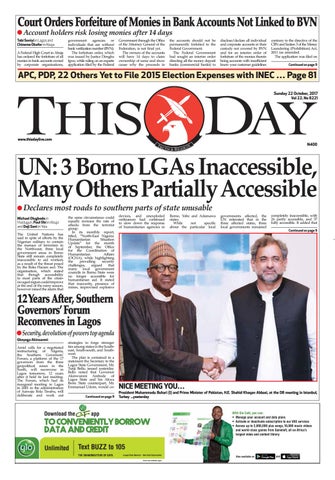
NICE MEETING YOU… President Muhammadu Buhari (l) and Prime Minister of Pakistan, H.E. Shahid Khaqan Abbasi, at the D8 meeting in Istanbul, Turkey ...yesterday
2
T H I S D AY SUNDAY OCTOBER 22, 2017
T H I S D AY SUNDAY OCTOBER 22 2017
3
4
T H I S D AY SUNDAY OCTOBER 22, 2017
T H I S D AY SUNDAY OCTOBER 22 2017
5
6
T H I S D AY SUNDAY OCTOBER 22, 2017
T H I S D AY SUNDAY OCTOBER 22 2017
7
8
T H I S D AY SUNDAY OCTOBER 22, 2017
9
ͺͺ˜ ͺͿ ˾ T H I S DAY, T H E S U N DAY N E W S PA P E R
PAGE NINE
Director Hangs Self in Kogi over Unpaid 11 Months’ Salary Arrears Leaves behind wife, new set of triplets Yekini Jimoh in Lokoja A director in the Kogi State civil service, Mr. Edward Soje, whose wife recently gave birth to a set of triplets after 17 years of marriage, has committed suicide in Lokoja, the state capital, following the non-payment of his 11 months salaries by the state government. THISDAY gathered from family sources that the 53-year-old man was being owed 11 months’ salary arrears by the state government before his untimely death. It was further gathered that the body of Soje, a civil servant with the Teaching Service Commission, was
discovered on Thursday hanging on a tree beside Mammy Market at the Maigumeri Barracks, in Lokoja, which houses both the Nigeria Army Record Command and civilians. Sources disclosed to THISDAY that the civil servant decided to take his life barely 10 days after his wife of 17 years gave birth to a set of male triplets at a private hospital in Abuja. The couple had been childless before then. Soje, a Grade Level 16 Officer hailed from Ogori town in OgoriMagongo Local Government Area of Kogi State. He had before killing himself travelled to Abuja and left a suicide note for his wife
who works in one of the federal ministries, THISDAY learnt. His suicide note read, “Psalm 121:3 God will not suffer your foot to be moved: He that keepeth you will not slumber. Amen. You and the three boys, God Almighty keep you and prosperous, Amen. I love you.” Meanwhile, confirming the incident to newsmen on Saturday, the state police command Public Relations Officer, ASP William Aya, said the dangling body of Soje was found on a tree behind the barracks about 5:55pm on October 16. Aya said the Divisional Police Officer in charge of Area D Division received information
about the incident from the military intelligence office in the barracks. “Police moved to the scene, removed the corpse to the morgue of the Federal Medical Centre in Lokoja. Investigation is on-going,” Aya said. According to the police, nothing was found on the man to help trace his address and family. However, a search party organised by his relations and friends found his corpse at the morgue of the hospital on October 20. Family sources said Soje had before the incident been going through a lot of financial pressure due to non-payment of his salaries for 11 months by the
Kogi State government. He was among thousands of civil servants being owed between two and 21 months’ salary arrears by the state government. As a way out, he was said to have sold his only car and a three-bedroom bungalow he was building at Otokiti area of Lokoja. The building, which was at lintel level, was sold by Soje at a give-away price of N1.5 million in April to meet urgent family needs, it was gathered. According to the sources, Soje’s financial woes became compounded when his wife gave birth to a set of triplets through Caesarean section at a private hospital in Abuja on October 7.
The deceased remained at the hospital to look after his wife and the babies until October 13, a day before the naming ceremony, when he decided to come back to Lokoja. On getting to Lokoja, Soje went straight to his bank to collect the remaining N30, 000 in his salary account with one of the commercial banks and thereafter informed the bank in writing about his decision to close the account. He immediately left Lokoja for the hospital in Abuja where he joined his wife and handed over the N30,000 cash to her.
decimation of the BHTs and breaking their will to continue their terrorist attacks on innocent Nigerians." But in what seemed like a confirmation of fears raised in the UN report, Boko Haram insurgents at the weekend abducted three young women in Maggar village of Madagali council, Adamawa State. Chairman of the council, Yusuf Muhammad, confirmed the abduction to THISDAY and revealed that the women were abducted by the insurgents while working on their farms on the outskirts of Maggar village He said soldiers and local hunters had been mobilised to track down the abductors with a view to
rescuing the victims. But at the time of filing this report, there was no news on their whereabouts. Muhammad lamented that the insurgents had been launching a series of attacks on his council, saying proactive measures need to be taken by the federal government to curtail the attacks in the area. Eyewitnesses from the area have also confirmed the development. Magar is a remote village, about 25 kilometres from Gulak town, the headquarters of Madagali Local Government Area. The area had fallen to Boko Haram control before its liberation by the military in 2015.
Read the concluding part on www.thisdaylive.com
UN: 3 BORNO LGAS INACCESSIBLE, MANY OTHERS PARTIALLY ACCESSIBLE all the inaccessible and most of the partially accessible local government areas were in Borno State, the birthplace and hotbed of the Boko Haram insurgency. However, a source in Borno State identified the three unreachable local councils as Abadam, Kukawa, and Mobbar. "Most roads to the south, south-west and east remain unusable due to security concerns and most humanitarian personnel movement is done through air assets. Cargo, however, is being transported via road with armed escorts as a last resort," the UN said. According to it, "No humanitarian aid is currently reaching locations in these LGAs outside of the LGAs' main towns called ‘headquarters’. Major humanitarian supply routes towards the west, northwest and north are open for humanitarians without the use of armed escorts. Following advocacy efforts, Konduga and Mafa are now also accessible to aid groups
without military escorts." But the UN has complained that the failure of donors worldwide to fully meet their financial commitment towards the North-east has made it impossible for interventions. The UN said, "As the response enters the final quarter of the year, additional funding is needed to meet the targets laid out in the 2017 Humanitarian Response Plan. Certain sectors that are key in kickstarting the transition into the recovery phase, such as Health, Education and Response and Recovery Planning have continued to be dramatically underfunded with 21, 12 and 5 per cent of the required funding received as of 30 September." But the Director of Army Public Relations, Brig. Gen. Sani Usman, while speaking to THISDAY, said the Army would not comment on the matter until it had studied the report. Usman noted that while the Army was not in a haste to dispute the UN OCHA report, it would be discreet in responding to such
12 YEARS AFTER, SOUTHERN GOVERNORS’ FORUM RECONVENES IN LAGOS host the meeting. Bello explained the significance of the platform, which he said, was a replica of the Northern States Governors Forum, a platform for peer review among the 19 governors in the northern part of the country. As the forum reconvenes in Lagos on Monday, the statement said its core agenda would include deliberation on issues such as armed robbery, kidnapping, devolution of powers, and fiscal federalism. The statement said each of the agenda had gained prominence in the country’s public space in the last two years, noting that it has become imperative to build stronger ties to respond to issues of common interest to the member-states. Unlike in the post-2005 period, when southern Nigeria had divergent views on issues of common interest, the statement said the forum would henceforth enable all states in the South-east, South-south and South-west to speak with one voice. It added that the meeting would address issues germane “to the development of the three contiguous zones. This is in line with the realisation that the different states in the South have since 2005 developed several areas of comparative advantage. “This could be harnessed and become mutually beneficial. The governors
will also be expected to adopt a common position on the issues of armed robbery, kidnapping, devolution of powers and the issue of fiscal federalism, which have all gained prominence of late.” The statement noted that the 2017 Lagos summit of the 17 southern governors, representing the South-south, South-west and South-east geo-political zones, would come up with a communiqué after their deliberation. It said that the predominance of views “is that if the southern states speak with one voice, they are bound to attract weighty and credible listenership.” The statement said the summit would be attended by the co-hosts and their colleagues, namely, Prof. Ben Ayade of Cross River State, Mr. Godwin Obaseki of Edo State, Mr. Nyesom Wike of Rivers State, Mr. Ifeanyi Okowa of Delta State, Mr. Seriake Dickson of Bayelsa State, and Owelle Rochas Okorocha of Imo State. Others are Mr. Willie Obiano of Anambra State, Dr. Okezie Ikpeazu of Abia State, Mr. David Umahi of Ebonyi State, Mr. Ifeanyi Ugwuanyi of Enugu State, Mr. Rauf Aregbesola of Osun State, Sen. Abiola Ajimobi of Oyo State, Sen. Ibikunle Amosun of Ogun State, Mr. Oluwarotimi Akeredolu of Ondo State, and Mr. Ayodele Fayose of Ekiti State.
report. In a related development, the Nigerian Air Force yesterday said it had bombed Boko Haram locations and scattered their hideouts. NAF Director of Public Relations and Information, Air Commodore Olatokunbo Adesanya, stated, "The Nigerian Air Force (NAF) Component of Operation LAFIYA DOLE conducted an attack on a location in URGA area close to KONDUGA. "Previous intelligence reports gathered through Intelligence, Surveillance and Reconnaissance (ISR) missions by NAF ISR platforms, had indicated the presence of a large number of
Boko Haram Terrorists (BHTs) in DURWAWA settlement in the outskirt of URGA. "Accordingly, one Alpha Jet aircraft was detailed to carry out air interdiction on the target. Overhead the location, the aircraft acquired and attacked the target twice with bombs." Adesanya maintained, "Subsequent Battle Damage Assessment revealed that the aerial attack set off a fire, causing damage to the BHT structures within the settlement and neutralizing most of the BHTs while a few of them fled the location. The aerial attack by the NAF is in furtherance of efforts at ensuring the complete
COURT ORDERS FORFEITURE OF MONIES IN BANK ACCOUNTS NOT LINKED TO BVN September 28th, 2017. The judge ordered the banks to file an affidavit of disclosure before it, showing the names of the affected accounts, the account numbers, outstanding balances, domiciliary accounts and the branch, where the accounts are domiciled. In specific terms, here are the orders made by the judges: "1. That the 1st-19th defendant banks shall filed an affidavit of disclosure before this court deposed to by the Chief Compliance Officer of all accounts of: (a) Individuals; (b) corporate bodies and (c) government agencies in their custody without BVN and serve same on the Central Bank of Nigeria. "2.That the 1st-19th defendant banks shall disclose: (a) the names of the accounts as opened; (b) Account Numbers; (c) outstanding balances (d) Domiciliary Accounts and (e) the branch/location where the accounts are domiciled of all accounts without BVN. "3. That the 1st-19th defendant banks to disclose any investments made with funds from these accounts without BVN in any products including fixed/term deposits and their liquidation and interest incurred, Bank Acceptances, Commercial Papers and any other relevant information related to the transaction made on the accounts. "4. That an order is hereby made freezing the said accounts freezing the said accounts by stopping all outward payments, operations or transactions (including any bill of exchange) in respect of the accounts pending the hearing and determination of the substantive application "5. That an order is hereby made directing the 1st-19th defendant banks to disclose
any investments made with funds from these accounts without BVN in any products including fixed/term deposits and their liquidation and interest incurred, Bank Acceptances, Commercial Papers and any other relevant information related to the transaction made on the accounts. "6. That an interim order is hereby made directing the CBN and the Nigeria Interbank Settlement Systems (NIBSS) to validate the information contained in the affidavit of compliance/disclosure filed by the respective 19 banks within 7 days from the date of service on the CBN and NIBSS. "7.That an interim order is hereby made appointing a bank examiner from the books or any bank that fails to comply with the order of the court to file affidavit of disclosure. "8. That an interim order is hereby made granting leave to the applicants or any officer authorised by them to advertise the accounts without BVN disclosed by the banks in a widely circulated national newspapers as notice to any person or body corporate or financial institution who may have any interest in any of the said accounts to claim ownership within 14 days of the publication of the order and show cause why the proceeds in the account should not be permanently forfeited to the Federal Government." In another development, the Central Bank of Nigeria has given the Nigerian Bulk Electricity Trading Plc (NBET) up till December 31, 2028 to fully liquidate the N701 billion loan borrowed from it to guarantee full monthly payments of electricity generated and supplied to the national grid by power generation
companies (Gencos), THISDAY has learnt. The N701 billion loan had been approved by the Federal Executive Council in March this year. As part of the agreement on the loan, THISDAY also gathered, the CBN granted NBET two-year moratorium on the principal repayment, implying that it would only begin to pay back the loan from January 2019, while repayment of the interest would start from January 2018. Details obtained from the final term sheet for the loan, showed NBET was now in a firm position to meet its payment obligations to the Gencos, and has even paid the Gencos’ full bills for energy supplied to the grid up to June 2017. According to the term sheet, which both the Ministry of Finance, Debt Management Office (DMO) and Ministry of Power have equally approved, NBET would also pay back the loan with a single-digit interest of five per cent per annum as against the 10 per cent CBN had earlier proposed. Following the approval granted NBET by FEC in March to negotiate the loan with the CBN to support its monthly payment to Gencos because of the revenue shortfalls in the electricity market, the two parties engaged in a drawn-out negotiation on the loan terms with the CBN reportedly placing before NBET terms of condition, which it reviewed and subsequently rejected. THISDAY learnt that one of the issues that contributed to the lengthy negotiation was its annual interest, which CBN allegedly raised to 10 per cent. But in the final term sheet, the NBET will, however, provide a letter of commitment to back up its repayment obligation through its annual budget. The ministry
of finance, budget and national planning are also expected to guarantee that repayments would be done as scheduled should there be any case of non-release of funds from budgetary allocation. In this regards, repayments from the ministry of finance would have to be debited directly to the Consolidated Revenue Fund, subject to appropriation as required in line with Section 80 of the federal constitution. But this condition was found by THISDAY to have been flagged down by the DMO in its comments on the loan which it sent to the CBN in August shortly before the final outcome was agreed in September. THISDAY also gathered from sources that were privy to the negotiations that a proposal by the CBN to set up a vehicle – the NESI Stabilisation Strategy Limited (NESI SS Ltd) to issue bonds or debentures on behalf of the NBET to finance the Gencos payments was not accepted by NBET. To ensure transparent disbursements of the funds in the loan, the term sheet stated that: “Drawdowns will be made on a monthly basis based on invoices over a period which shall not exceed 24 months from the effective date. “The applications for disbursement will contain comprehensive breakdowns of the elements of the payment showing the amounts due to each participating generator and its approved third parties. CBN will review NBET’s submission and credit the beneficiaries that meet full disbursement criteria.” It equally noted that such applications for disbursement would have to be confirmed by the permanent secretary in the ministry of power, works and housing.
10
OCTOBER 22, 2017 ˾ T H I S D AY, T H E S U N D AY N E W S PA P E R
SUNDAY COMMENT
Editor, Editorial Page PETER ISHAKA Email peter.ishaka@thisdaylive.com
T HE SIX-YEAR SINGLE T ERM P ROPOSAL Nigeria’s challenge with the presidential system is not with numbers or terms, but seriously with governance
T
he debate on the number of years and terms a Nigerian President should spend in office was recently reopened by the Deputy Senate President, Ike Ekweremadu, when he had in audience Garcia Moreno Elizondo, the ambassador of Mexico to Nigeria. Mexico, like our country, practises a presidential system of government, but with a single-term presidency of six years. However, in as much as we can borrow ideas from anywhere in the world in the bid to enhance democratic culture and good governance in Nigeria, we hasten to express our strong reservations about opening another round of debate on tenure of office at this period. Nigeria, according to Ekweremadu, was looking at “a possibility of constitutional reform that can guarantee a single term so that the money we spend in running elections and the problem of chief executives concentrating to come back, using resources and instruments of state can be overcome”. But the idea for a single term of six years has been around for some years now. Former President Goodluck Jonathan canvassed it early in his presidency in 2011 on the basis that it would stem political acrimony during change of government and cut down drastically on costs of electioneering campaigns. Besides, the Senate Committee on the review of the constitution, chaired incidentally by the same Ekweremadu, had also in the past recommended a single term of six years based on similar grounds that it would be healthier for
the nation. The argument at the time was that six years is long enough for any chief executive to execute policies that would impact on the people. But that also failed to attract any traction which may explain why Ekweremadu is inventing a new excuse: “When we are talking about devolution of power, strengthening our federalism, Mexico is a place where we can look at.”
W
Evenwithallits limitationsand imperfections, atwo-term presidencyof fouryears each, aspresently practiced,isabetter alternativetoan imperialpresidency constitutingof onlyonetermofsix years
Letters to the Editor
S U N DAY N E W S PA P E R EDITOR TOKUNBO ADEDOJA DEPUTY EDITORS VINCENT OBIA, OLAWALE OLALEYE MANAGING DIRECTOR ENIOLA BELLO DEPUTY MANAGING DIRECTOR KAYODE KOMOLAFE CHAIRMAN EDITORIAL BOARD OLUSEGUN ADENIYI EDITOR NATION’S CAPITAL IYOBOSA UWUGIAREN
T H I S DAY N E W S PA P E R S L I M I T E D EDITOR-IN-CHIEF/CHAIRMAN NDUKA OBAIGBENA GROUP EXECUTIVE DIRECTORS ENIOLA BELLO, KAYODE KOMOLAFE, ISRAEL IWEGBU, IJEOMA NWOGWUGWU GROUP FINANCE DIRECTOR OLUFEMI ABOROWA DIVISIONAL DIRECTORS PETER IWEGBU, FIDELIS ELEMA, ANTHONY OGEDENGBE DEPUTY DIVISIONAL DIRECTOR OJOGUN VICTOR DANBOYI SNR. ASSOCIATE DIRECTOR ERIC OJEH, PATRICK EIMIUHI ASSOCIATE DIRECTORS HENRY NWACHOKOR, SAHEED ADEYEMO CONTROLLERS ABIMBOLA TAIWO, UCHENNA DIBIAGWU, NDUKA MOSERI GROUP HEAD FEMI TOLUFASHE ART DIRECTOR OCHI OGBUAKU II DIRECTOR, PRINTING PRODUCTION CHUKS ONWUDINJO TO SEND EMAIL: first name.surname@thisdaylive.com
e understand that those enamoured by a single term for the president may be worried about the trajectory of our democracy, particularly re-election pressures on the system. For one, the costs of electioneering campaigns are prohibitive. The 2015 presidential campaigns and elections, for instance, cost the nation a staggering amount of money that could have been put to better use in creating employment for the jobless and building infrastructure across the nation. That is aside the violence associated with elections that have become the political equivalent of war. However, even with all its limitations and imperfections, a two-term presidency of four years each, as presently practised, is a better alternative to an “imperial presidency” constituting of only one term of six years. A single term, according to most analysts, is not only a constraint to continuity and predictability, but a “blow to presidential accountability.” Aside the foregoing, in all the African countries where term limits have been tampered with, it has become an instrument of manipulation by the sitting incumbents who would, to elongate their tenure, suggest going back to the previous arrangement in what has become a vicious cycle in democratic deception. Therefore, what Nigeria sorely lacks and needs, especially at this period, is good governance, not another sterile debate about terms of office. It is not enough to transpose the Mexican system which reportedly is working “brilliantly” to Nigeria and expect that it would fit into our democratic structure weighed down by many anomalies. The challenge of our present system is not in the number of years or terms, but rather in lack of good governance across board. The problem is not how long or short the tenure is, but who we elect, how we elect them and the structure of the institutions. At a most difficult period for most of our citizens, what Nigerians demand, and deserve, is not the subterfuge of tinkering with the tenure of office holders but rather serious governance anchored on meeting the aspirations of the people, at practically all levels.
TO OUR READERS Letters in response to specific publications in THISDAY should be brief (150-200 words) and straight to the point. Interested readers may send such letters along with their contact details to opinion@thisdaylive.com. We also welcome comments and opinions on topical local, national and international issues provided they are well-written and should also not be longer than (950- 1000 words). They should be sent to opinion@thisdaylive.com along with the email address and phone numbers of the writer.
ATIKU: WHEN GENEROSITY BECOMES A LIABILITY
T
here are some certain people in life who are inherently generous and charitable. Nothing pleases them than the act of “giving”. They are natural born givers! A famous artist once said, “Because you love something, you want to do it all the time, even if no one is paying you for it. At least that’s how I felt about drawing”. Hence, givers cannot live without having anything to give. It is such an extraordinary virtue which is also enjoyed by the common people, especially the less privileged who take advantage of such benevolence. However, it is also often envied by many, especially rivals, because generosity endears a person to the people, and it is not something that anybody else without such inclination can wake up one day and start practicing. A sociologist researcher, Kyle Irwin from Baylor University
in Texas revealed that “givers” can be quite unpopular at times, because they make certain people look bad. Or make them feel jealous or like they are not doing enough. Hence, they ensure that “givers” are punished at all cost! In politics especially, politicians usually appeal to people with some certain qualities or traits that they possess. Those qualities if popular with the people are a threat to political opponents. To counter such a threat, political opponents can at best try to match those qualities and at worst resort to calumnious propagandas hoping to strip their opponent of his/her popularity with the people using the same factor. However, rivalry in partisan politics is a norm, but in Nigeria, it’s almost like a war, whereby every soldier’s intention is to “eliminate the enemy”. The worst weapon that your opponents could use against you in
this kind of ‘warfare’ is nothing less than “corruption”. It is like a nuclear bomb in Nigerian politics, which comes first before sectionalism which is another. Because if you are accused of corruption, everything else comes second. Political ideologies are hardly the issue. Alhaji Atiku Abubakar, Wazirin Adamawa, Nigeria’s former vice-president, is the one most visible example of a “giver” who has become the victim of such vicious political propaganda. It is his own ‘punishment’ I assume. This is a person who has earned the reputation of being a philanthropist in Nigeria but today is accused by even some of his beneficiaries of ‘corruption’ on the pages of newspapers and public conversations. I see no problem with the kind of “giving” Atiku is involved with, because it is the sort that adds value to the society. It is not the kind that turns people
into beggars. Whatever Atiku gives, is something that one can capitalise on to do something serious with his/her life, because he gives big! Scholarships, jobs, donations, etc! Perhaps, he is the only Nigerian politician who twitter users are fond of tagging whenever there’s need for help to sponsor a patient abroad or talent for scholarship. But why is he still a victim? Another factor is that Nigerians have developed the belief that every wealthy person who has been in public service must have acquired his/her wealth through illegal or unfair means. Hence, one cannot be wealthy in the political class except he/she is corrupt. Period! Nigerians although have their own way of measuring ones wealth. It’s typical of a common Nigerian to assume that the most charitable people are the richest, because they spend in the eyes of everyone. “Biggest spenders are the highest earners and highest earners are the biggest spenders.”
Such a wrong assumption! How can it be so when we know for a fact that there are earners/savers who don’t spend and earners/spenders who don’t save because of their generosity. Most of these “savers” lock up everything they have in the banks and safes for their families alone and would dislike anyone who does otherwise. “He is spoiling them!”, they would say. No wonder even among the elite there are people who don’t like Atiku. Most of them are eager to save themselves from the liability of generosity in Nigeria. However, this is not to insinuate that everyone in high political position is rich enough to give as much as Atiku does or that “giving” is the only act of righteousness. Lack of it also isn’t a total flaw but having it is a divine blessing. Thus, punishing those who are generous with their wealth is absurd! ––Bello Shagari, filmmaker and advocate of youth and entrepreneurship
T H I S D AY SUNDAY OCTOBER 22 2017
11
5@5H B;
| { | | = | x ~ ~
_i_q m_vlrq [  ƚÁÉ úƚäÉƚúÉçØƚ ¡Øª  Üƚ  ƚ¡ Áª»úƚôªä§ ƚä§ ªØƚէɠƚÂçÁ ØŪƚ Á ª»ƚ Ø ÜÜƚÉØƚ ÜÉ ª »ƚÁ ª ƚ§  » ů
b x { CKB@C58 H<9 5@@lB9K & . 5DD CB !CC;@9 *@5M CF H<9 =)- DD -HCF9 BCK 5B8 G=;B ID HC IG9 & . *5MCIH 5@5HtB;
5@5HtB;
5@5HB;
<9@@C 5@5H B; w OVOOQQTTQTQW
12
T H I S D AY SUNDAY OCTOBER 22, 2017
T H I S D AY SUNDAY OCTOBER 22 2017
13
14
ͰͰ˜ Ͱͮͯ͵ ˾ THISDAY, THE SUNDAY NEWSPAPER
OPINION Fela And The Spirit Of Lagos The 20th anniversary of Fela’s death turned out to be a carnival of sorts, writes Tayo Ogunbiyi
T
hough the 2017 edition of Felabration has come and gone, its memories linger on. This year’s edition ended with a special Lagos Jump at the New Afrika Shrine in honour of the 79th posthumous birthday of the late Afro beat icon, Fela Anikulapo Kuti. Originated by Fela’s eldest child, Yeni, as a way of immortalising the late Afro beat maestro, Felabration has since grown to become a huge entertainment and tourism event that attracts thousands of visitors annually into the country from all over the world. This year’s edition also marks the 20th anniversary of Fela’s death in 1997 and it incorporated events such as musical performances, art competition, Afrobics Talent Hunt, Fela Debates, symposium, secondary schools debate and the Felabration Carnival. The involvement of the Lagos State Government in this year’s edition of Felabration is, no doubt, a reflection of the current administration’s resolve to make Lagos the tourism and entertainment hub of Africa. Aside this, it is an opportunity to celebrate the ‘Spirit of Lagos’ which the late music maestro, through his music, amply typified. The ‘Spirit of Lagos’ is a metaphor for the never say die instinct of a typical Lagosian who is rugged, determined and relentless. Even in the face of adversity, he stands strong and refuses to give in to defeat or failure. Fela surely represented this in his lifetime. He was bold, strong and unbowed. Lagos is a land of freedom, a place where the struggle for the country’s political independence was conceived, fought and won. Lagos is a place where opposing voices against repressive government is often the loudest. Activists such as the late Chief Gani Fawehinmi, Beko Ransom Kuti, Ayodele Awojobi, Olisa Agbakoba, Femi Falana, and a host of others found their voices against oppression in Lagos. Fela was a freedom fighter who used his lifetime, music career and resources to promote the liberation of the African people from both colonial and neo colonial tyranny. Not only this, Fela fought all manner of political tyranny - from both military and political leaders in the country to a standstill. In the process, he sometimes lost his freedom, got bruised but was never cowed. This, of course, is the ‘Spirit of Lagos’. Lagos is a land of confidence and opportunity. In Nigeria, Lagos remains a bastion of hope for thousands of people, especially youths, who aspire to fulfil their dreams in life. Lagos
is a place where a ‘nobody’ could rise to become a noticeable figure in the society. Many have arrived the city-state without a clear-cut picture of what the future holds. But somehow, they eventually become a reference point in their chosen career. And providentially, Lagos never disappoints! There is something for almost everyone in the city. No focused man stays in Lagos and wallows in hopelessness. Another popular cliché in the city goes this way: “it is only a lazy man that stays in Lagos and has nothing doing’. True! Lagos offers everyone something. From art to entertainment, from sports to tourism and across every sector, Lagos gives something refreshing to everyone. Like Lagos, Fela equally provided lots of opportunities for Nigerians from all walks of life. The brand of music he invented has become a source of livelihood to thousands of Nigerians who are involved the genre, one way or the other. Fela gave Nigerians lots of confidence through his music, which he used as a weapon to fight against social injustice and oppression of the masses. He gave them the confidence and voice against oppression and injustice. He sang: “If you no talk your own, one day of course you will die”. This spurred many Nigerians not to tolerate injustice and tyranny. This is the ‘Spirit of Lagos’. Fela was a detribalised Nigerian who never fought a sectional course. His life transcends parochial interests. He was a figure with the whole country as his constituency. He never dealt with people or issues on the basis of ethnic, tribal and other such primordial
Fela fought all manner of political tyranny - military and political leaders in the country - to a standstill. In the process, he sometimes lost his freedom, got bruised but was never cowed. This is the Spirit of Lagos
considerations. This, of course, is the Spirit of Lagos. This is what Lagos stands for: a land for all. Lagos is a multi-ethnic and multi -cultural metropolis where everyone, irrespective of tribe, ethnic and religion affiliation has a voice. The hospitable disposition of Lagosians is legendary. It is a legend that Lagosians are hospitable people who go the extra mile to accommodate visitors. In Nigeria, Lagos remains a major melting point where all Nigerians could feel at home, irrespective of ethnic and religious differences. Everyone who resides in Lagos is traditionally referred to as a Lagosian. In Lagos State, excellence and competence remain major factors in the recruitment of its workforce. Apart from the Federal Civil Service, the Lagos State Public Service remains, perhaps, the only one in the country that employs its personnel without regard to ethnic and tribal factors. Fela’s nationalistic outlook is, therefore, a true reflection of the nature of Lagos. Lagos is home to all. Subsequent administrations in the state, especially since the dawn of current political dispensation, have gone at great length to preserve the multiethnic status of Lagos. Indeed, the peace the state has enjoyed over the years is a manifestation of unrelenting efforts of the state government in accommodating various interest groups in the state. Lagos is the home of rhythm. Indeed, it is from Lagos that the nation gets its groove. It is in Lagos that Fela invented the now famous Afro beat. Many artistes have found in Lagos a place where the beats never die. In Lagos, the beat goes on. While other cities go to sleep, Lagos doesn’t because the beat must go on. For years, using Lagos as a springboard, Fela dazzled the world with his unique kind of beat. Though he died 20 years ago, the beat is still on. Lagos is the home of rhythmic splendor. The late Bobby Benson, Victor Ola Iya, late Fatai Rolling Dollar, late Ayinla Omowura, Ebenezer Obey, King Sunny Ade, Onyeka Onwenu, Jide Obi, Chris Okotie, The Mandators, Daddy Showky, Sir Shina Peters and a host of other top artistes have discovered the nexus between Lagos and rhythm. It is in Lagos that they all had the opportunity to showcase their musical dexterity. Lagos gave them the platform. They enthusiastically grabbed it and in return, Lagos happily wriggles to their beats. ––Ogunbiyi is of the Ministry of Information & Strategy, Alausa, Lagos
What Are We Restructuring? (11) Bernard Balogun outlines how the restructuring of the federation could be done
I
like to respectfully submit that the Nigerian Bar Association (NBA), Social Economic Rights and Accountability Project (SERAP) and the Nigerian Labour Congress and its affiliates, as pressure groups that have creditability in the eyes of Nigerians, to joint and urgently too, sponsor a bill in the National Assembly that will amend the constitution, essentially to take away powers of the legislature where it exist on matters such as agitation for restructuring, state creation, address issues pertaining to marginalisation, devolution of powers to the states and local governments, fiscal monetary policy as regards monthly Federal Allocation. If we continue to trust the National Assembly to take decision on our behalf in respect of restructuring, we may never get anywhere with this their apparent lackadaisical attitude. The current pantomime situation will only get worse. Therefore a statutory body that will be saddled with the responsibilities excised from the Senate legislative list be established. This statutory body could be given any appropriate nomenclature. The body should be headed by a retired Supreme Court Justice and assisted by a Senior Advocate of Nigeria. They shall be appointees or nominees of the federal government. The composition of this body shall not exceed 250 men and women of proven integrity. They shall be men and women who have no criminal records and intelligent enough to represent their places of residence, not states of origin. They shall run full time. Their emoluments should not be something extra-ordinary but attractive enough to draw the right calibre of personalities envisaged. The life-span of this august body should be two-year duration. After another five years interval, another august body shall be inaugurated to address national burning issues as spelt out above. Candidly, I think, the suggested august body should be nominees of states and constitutionally so recognised. Consequently, as a result of the amendment to the constitution, and establishment of this august body, the Federal House of Representatives shall cease to exist constitutionally. For purposes of cost saving effect, the Nigerian Senate shall be part-time and they shall meet for 180 days in a year. Their salaries should be handsome enough to attract the right calibre of persons, not the present humongous salaries they earn now for literally doing nothing, that is not beneficial to the Nigerian people. Whatever decision taken by this august body shall be forwarded to the President for assent and immediate implementation, without any recourse to the Senate since their roles in such matter had been constitutionally abrogated.
Consequently, this august body shall recommend devolution of powers to states and local government and scrap the following Ministries and its parastatals. These are agriculture, education, labour, information and culture, power, housing, and solid minerals. If need be, and in the wisdom of this august body may recommend that some of the scrapped ministries be reduced to parastatals under the Presidency. However, Ministries of Foreign Affairs, Interior, Defence, and of course, the Armed Forces, the Police, Civil Defence, Peace Corps, FRSC should remain in the Federal list. That aspect of the constitution that talked about each state to produce one minister should be abrogated. Federal permanent secretaries should head such parastatals. The purpose is to have a weak centre and strengthen the states and local governments. This means that electorate at states and local council areas must take their civic responsibility, a lot more serious, by voting for a credible, matured and genuinely committed person for the positions of Governors and LG Chairmen. The current practice of “money for hand, ballot card for your box” must be discouraged. Our attitude in this respect must change in the overall interest of an enduring, virile and progressive state/council. This devolution exercise will encourage states to be proactive in their revenue generation drive. Each state has its own peculiar problem and knows how to go about it or prioritise such problem in line with the desire of the local people. There should be no such a thing as federal roads. Any road that runs through any state becomes, automatically, the responsibility of the state involved to construct, reconstruct, rehabilitate and generally maintain. The Abuja-Abaji expressway that runs onto the boundary of Kogi State is the responsibility of FCT to handle. Then that of Kogi government begins from where FCT stops. The road that runs from Okene to Ukpella (the Edo State boundary) is the responsibility of Kogi State government to handle. Edo State government responsibility begins on the road from where that of Kogi ends. With this kind of arrangement each state government will be challenged to be responsive to the yearnings of its citizens, by providing good and motoring inter and intra city road net-works in any given state. Let each state develop its agricultural potential according to its pace and aspiration of its citizens. For instance, if Gombe State government is known for the production of gum Arabic in
commercial quantity, let that area be maximally exploited by the state and go further to establish cottage industry in designated councils in the state. Consequently, providing job opportunities for not just the youths of the area but also every employable adults in the area. There shall exist opportunity to attract foreign investors. Benue State, for instance, reputed for production of mangoes, oranges, yams and other food stuffs in large commercial quantities, can maximally exploit/harness for commercial gains, establish cottage industries, and consequently export its finished products. This is a source of foreign exchange earning to the state and providing gainful employment to the youths and employable adults from the state. In fact, foreign investors may be attracted, provided there is an attractive environment for such investment. South West, especially Ondo and Ekiti States are major producers of cocoa and timber woods, with high economic value. These states and others in South West should primarily focus its attention on the harnessing these agricultural potential of the states, establish cottage industry that will offer employment. South-Eastern states are well known for the production of leather shoes, lady handbags, belts, etc. Let the states in this region provide an encouraging environment for these businesses to thrive and provide soft loans to these enterprising youths. Ministry of Commerce and Trade in each state in the region should help these youths with entrepreneurial skills and market their products abroad. Engage the youths in all ramifications. Each state should develop and market its own solid mineral resources buried within its territory and pay royalty to the federal government. The amount of royalty payable by states shall not be across board. There shall be percentage differentials. Oil-producing states shall pay as much as 45% based on its accruable there-from, while the non-oil-producing states shall about 25% . The three mega states of Lagos, Kano and Rivers shall have special arrangement regarding revenue generation into the coffers of the Federation. An acceptable and achievable formula by the states involved and the august body to propound the sharing ratio. ––– Balogun wrote from Wuse District, Abuja and can be reached via bernardbalogun1@yahoo.com
15
T H I S D AY, T H E S U N D AY N E W S PA P E R ˾ OCTOBER 22, 2017
LETTERS Rochas And The Liberian Children
A
gainst the backdrop of the recent euphoria and backlash in the media against the Imo State Governor, Owelle Rochas Okorocha, for hosting the South African President, Jacob Zuma, attention shifted from a very important part of activities marking the 55th birthday of the seeming controversial politician. Notably, focus was lost on the teeming children rescued by the governor through the Rochas Foundation. The children, drawn from several African countries, were specially honoured by the celebrant and the expectation was that the milk of kindness and heart of compassion essential in defining the essential Rochas, more so because this aspect of the man’s worldview and commitment to philanthropy had not been exposed. Granted that the Rochas Foundation had been known to engage in charity even before Owelle became Governor, with schools in parts of Nigeria, many had thought that the activities of the group was restricted or confined to Nigeria alone. Thus, the 55th birthday celebrations provided a rare opportunity to unveil the politician’s heart of gold and it’s broad extension to several African countries as well as the chilly stories of abandonment, neglect, excruciating hunger and deprivation that was the lot of the children until they were rescued by the Rochas Foundation. Of course, the visit of Jacob Zuma and the unveiling of a statue and road named after him blighted other important aspects of the ceremonies as well as benefits to Imo State. And the governor was portrayed as insensitive, obtuse and outright stubborn - a clear deviation from the objective that informed the visit in the first place. Notwithstanding the controversy trailing the visit of the South African leader, special focus or attention must be given to the philanthropy that has
Okorocha unquestionably made a Rochas an outstanding personality in the black continent. It will be a great disservice to humanity to do otherwise. Unknown to many of his critics, the governor had meant to reserve a special place for the African child as part of activities to mark his 55th birthday. Though considered rather ambitious by close aides and those who make up his kitchen cabinet, Owelle was determined to see the project to a hasty start, a fact that even the worst traducers cannot wish away. The plan, according to insiders, was for the setting up of Rochas Foundation College of Africa in Owerri, capital of Imo State, with five orphaned children each from 55 African countries. Meaning that the school is to have 275 children for its take off. A bold and audacious project no doubt. Of course, the dream became a reality and the children resumed at the beginning of the first term of academic calender for the 2017/2018 school year. Sadly, not many knew of this historic and unprecedented feat and the benefit of these children to the state and the significance of this rare act of charity was banished to ignominy.
Perhaps, it may be necessary at this stage to highlight the story of the children from Liberia on whom fate has smiled on and are today part of the the Rochas Foundation College of Africa in Owerri. Their chilly stories undoubtedly epitomises and mirrors what has become the circumstance and life of other children in the school.
T
First is Hada Sue who lost her mother during childbirth. She has never seen her father since she was born but believes he may still be alive. She had been surviving in a local orphanage until Rochas Foundation found her. Today, she’s among those who have found hope and by reason of being given the opportunity of a good education, even the sky cannot hinder her goals or stop her from fulfilling destiny. The story of Hawa Karsieh is no less interesting. She lost her mother in 2011 and her father in 2012. Life as an orphan had been very difficult for her. She was in an orphanage boarding school, unsure of what the future holds or would offer until Rochas foundation found her. Again, she has a song of renewed hope on her lips. And feelings of despair that was her lot in the past has totally disappeared. For Abdulah Farsahwuo, Rochas Foundation was God sent. The dreaded Ebola had abruptly altered his destiny and dealt him a deadly blow never to be forgotten. Everyone simply pointed at him as theorphan who survived Ebola. The Ebola pandemic almost wiped out his entire family including his father and mother. The young Abdulah was living
A
the task of making Lagos State “the model of excellence in the provision of education in Africa” requires meticulous attention. To this end, the sum of N92.4 billion, representing 11.37 per cent was allocated to education sector in the state budget for 2017. Government has directed the policy toward ensuring equal educational opportunity in the state, encourage parents who might otherwise neglect their children’s education to send their children to school and making education affordable for everyone. So, within the half- time of the administration’s tenure, the wheels of what is mutating to be a historic education revolution in Lagos were rolled off with aggressive rehabilitation of public schools throughout the length and breadth of the state. Several hundreds of classroom blocks have been built and renovated while thousands of students and teachers furniture supplied to various primary and secondary schools.
of the kids who survived the killer disease known as Ebola. She was banished to a home, forlorn and sad, until hope came through the Imo State Chief Executive. By and large, it is definitely impossible to seek to tell the story of 275 orphans quartered and learning in the Rochas Foundation College of Africa in Owerri. It is also possible that the stories of these children and circumstances of how they were picked may never be told. It is even doubtful if the man behind this noble project would really tolerate real focus of these children to whom he has come to be known and regarded as a father. But it would be uncharitable, albeit unAfrican, not to appreciate this unprecedented display of philanthropy. And posterity would definitely be kind to him each time attempt is made to review what Rochas has done. Yes, he may have some flaws as any human being. Some mistakes could also be traced to him since he is fallible. No one, it must be stated, could wish away or forget Owelle who opened his heart and showed love to children of Africa. About time this reality or fact sinks! ––Bekee Igwe writes from Ikeduru LGA of Imo State
NYSC AND NATION-BUILDING
he times are fragile because of a combination of factors which have coalesced to pose formidable threats to the continuous existence of Nigeria as a united political entity. There are varying degrees of socio-political agitations from sections of the Nigerian nation. Some of these agitations are political in nature, emanating from the missing links and/or collapsing leadership qualities at many levels of the governance process. Other agitations can be attributed to some policy missteps in deploying the necessary institutional mechanisms to resolve the festering crises of
confidence amongst the various segments of the society. This writer has often believed that the Nigerian state has not sufficiently utilised the potentially- rich human resources within the many institutions created over the years by successive administrations for the promotion of national unity and the integration of the different segments. There are still feelings of mutual mistrust and lack of social cohesions amongst and within the component parts that constitute the nation. These unsettling perceptions of alienation by certain component parts of the country are further aggravated by the
Lagos’ New Lease of Life For Education ccording to famous American scientist, George Washington Carver, ‘education is the key to unlock the golden door of freedom’. Education is critical to the growth and development of any society. It empowers the individual with necessary knowledge and set of skills to actualise potential and maximise opportunities in life. It is for this reason that governments across the world devote a good chunk of available resources to the development of the educational sector. In Nigeria, Lagos is unarguably the state with the highest number of public schools, students and teachers. It has consistently been churning out the highest number of candidates for public examinations in Nigeria since 1967. As a melting point with a bourgeoning population in excess of 20 million, provision of qualitative education in Lagos State has been a daunting task. The current administration in the state clearly understands that
with his aunt as a house help without going to school until Rochas foundation found him. The opportunity of being in school has imbued feelings of nostalgia and euphoria alike. On one hand, he is extremely happy that Rochas has filled the void he lost while wishing that children back home in Liberia could find someone with similar heart of gold to rescue them. But, he’s almost sure that tomorrow will bring good tidings courtesy of Rochas Foundation. In the case of Kokuloi Mulbah, he found out early that fate can sometimes be cruel and wicked. Talk of a child who grew up deprived! Kokuloi lost his mother at a very young age. He has never met his father since he was born. Neither does he know if the man is alive. He used to live in a local community in a remote part of Liberia with no access road. He has not recovered from the circumstance of how he was discovered by Rochas Foundation. Eternal gratitude to the Governor and his family remains a song on the lips of Kokuloi. Musu Masaaki, the fifth Liberian child equally had a tale of woe before he was rescued by the Rochas Foundation. She is among the 275 children in the school in Owerri. She is also one
In line with the commitment of the present administration to expand access to knowledge for Lagosians, the state’ science laboratories are now better equipped and the enthusiasm of students to be science inclined has become very high with a lot of success recorded. Equally, the state government has completed the renovation and upgrade of public libraries in 18 secondary schools across the state with top class facilities. Lagos Digital Library, an online repository of education content, is ready and will as well be launched in February, 2017. The Lagos State government appreciates that as much as physical infrastructure is important, adequate and quality teachers in schools are as important. Thus, as part of measures to bridge the gap in the teacher/pupil ratio in the state, the government recruited 1,300 teachers for primary schools while another 1000 teachers were recruited for public secondary schools in 2016. Similarly, government has
been paying attention to teachers’ welfare. Also, since April 2017, Code Lagos centres have been launched in primary, secondary and tertiary institutions (private and public) across the state, as well as in all public libraries and ICT spaces. The ultimate goal is for one million students in the state to have access to the coding system by the year 2019. Cheeringly, the dividend of the state’s investment in education is paying off. For instance, Governor Akinwunmi Ambode was declared the “Teachers Most Friendly Governor” by the Nigeria Union of Teachers during the celebration of the last World Teachers’ Day in Abuja. The same day, President Muhammadu Buhari rewarded the hard work, high performance and high productivity of three Lagos State school teachers and administrator with the “President’s Teachers and Schools Excellence Award”. ––––Adesegun Ogundeji, Alausa, Lagos
seeming inability of those who hold oversight powers to strengthen institutions and deliver the relevant institutional support to enable them activate in-built mechanisms to achieve their mandates which largely and substantially are tied to the need to promote national integration. The above thinking came to the fore recently when President Muhammadu Buhari made a very profound statement on the essence of setting up of the National Youth Service Corps (NYSC). The immediate consequence of that speech goes to show what can be achieved by way of reuniting a rapidly divided nation if the concept of the NYSC scheme is to be comprehensively adopted and the needed funding components approved by the National Assembly to enable the institutional deployment of trained minds and resources towards the consolidation of the mandate of the NYSC project. The Presidential speech also reminds the audience that the rash of agitations and restiveness of mostly young Nigerians can be resolved if participants of the NYSC scheme are empowered to function as positive agents of change and national integration. The NYSC is set up basically to provide the avenue for the acquisition of basic youth leadership skills which are to be deployed specifically to build a united Nigeria devoid of political agitations which threaten national integration. Brigadier General Sule Zakari Kazaure, the current Director General, must be a lucky man to have received Presidential commendation twice now since he assumed office only few months ago. Observers are of the opinion that the Presidential commendation is a symbol of the need and desire by the Nigerian people to
see that the NYSC continues to live up to its billing in line with the aspirations of the founding fathers. Recently, a rancour-free management promotional examination was conducted by the NYSC under the strict adherence of the rules of engagement and those who merited promotions based on their performance in both the written examination and their practical applications of skills in running their offices were promoted. The current hierarchy was said to have released the results on time so as to beat any kind of external lobbying that could mar the smooth conduct of the exercise. Observers who should know say that this adherence to civil/public service rules by the incumbent leadership of the NYSC may have informed the reason for the Presidential commendation. President Buhari said he is always pleased to see the NYSC achieving the purpose of national unity that inspired its creation since 1973. These profound pronouncements of President Muhammadu Buhari needs to be further and fully concretised by way of making sure that the necessary legislative reforms are introduced to provide legal, financial and manpower backups for the continuous implementation of the original mandates of the scheme. The NYSC scheme fundamentally was created in a bid to reconstruct, reconcile and rebuild the country after the Nigerian Civil war. As captured in the official website of the scheme, the current hierarchy is said to be working relentlessly to maintain the rich traditions of using the scheme as a major national platform for youth mobilisation towards nation-building. ––Emmanuel Onwubiko, Human Rights Writers Association of Nigeria
16
THISDAY, THE SUNDAY NEWSPAPER ˾ ͰͰ˜ Ͱͮͯ͵
INTERNATIONAL
Nigerian Society of International Law and the ChallengesofInternationalLawinaSeasonofChange
‘I
nternational Law in this Season of Change,’ was the theme of the 40thAnnual Conference of the Nigerian Society of International Law, held on Thursday, 19th and Friday, 20th October, 2017 at theAyoAjomoAuditorium of the Nigerian Institute ofAdvanced Legal Studies (NIALS), Unilag Campus, University of Lagos. One major rationale for the conference, apart from the need to celebrate forty years of existence of the society, is the determination of the place of international law in a globalising world of deepening disregard for the law of nations. International law, often referred to as the Law of Nations, is generally weak in terms of enforcement essentially because there are no enforcement agents in the manner of municipal law. Put differently, what would the world be like in the absence of international law, as a regulatory mechanism and in light of mounting nationalism? The conference was structured into four main parts: the opening session, working session during which five lead papers were presented, dinner session during which awards were given to some members of the society, and the communiqué session during which policy-related questions were critically debated before final adoption. The opening session was significant from the perspective of the issues raised in both the welcome address of the President of the Nigerian Society of International Law (NSIL), Emeritus Professor Isaac OluwoleAgbede, and the keynote address given by Professor Akin Oyebode, former Vice Chancellor of the Ekiti State University. ProfessorAgbede lamented on the challenges of the NSIL, especially in terms of its inability to seriously impact on global trends.As he put it, ‘the period between the lastAnnual Conference and this time has not been particularly eventful. When a nation is in recession practically everything within it will be compressed. So compressed is our long standing efforts to build a befitting secretariat for our proposedAcademy of International Law. Similarly compressed is our efforts to raise our moot trial competition to a continental level for all English speaking universities inAfrica. That also has been the fate of our proposed Journal of International Law designed to attain world’s standard. Indeed, efforts to boost attendance at our monthly meetings have not been particularly fruitful.’ Thus, from the perspective of ProfessorAgbede, the country’s recession explains in part the ordeals of the NSIL. ‘The ManyAfflictions ofAnti-corruption Crusade in Nigeria,’ being also the title of a lecture delivered by Professor Itse Sagay, also explain in part why the NSILhas not been upcoming as it used to be, particularly when the annual conferences of the NSIL‘were attended by invitees from practically every continent of the world.’ While ProfessorAgbede focused largely on the challenges of the NSILwithin the context of the economic recession in Nigeria, ProfessorAkin Oyebode provided some random reflections on ‘International Law in a Season of Change.’ For instance, he noted that the ‘MutuallyAssured Destruction (MAD) or mutual balance of terror, which hitherto served as the overarching bulwark for international peace and security, has since given way to unilateral and untrammelled diktat by a single arrogant superpower, hellbent on putting its interests first before those of the entire world and decidedly paying scant regard for global peace and international cooperation and other norms of contemporary international law.’ He also noted the major events that have significantly impacted on the codification of international law: the collapse of the global colonial system which prompted the need to accord recognition to the new states; the establishment of the Group of 77, which ‘heralded the struggle to de-europeanise the international system in favour of a broader, more democratic arrangement, as well as an increased input by the Third World in the progressive development and codification of international law; the collapse of the USSR and the East European socialist community, which led to the dismantlement of the historic Berlin Wall and the new challenges of how to cope with anAmerican-led unipolar world. What is particularly of interest in Professor Oyebode’s keynote address is his belief that ‘forces represented by MASSOB and IPOB have turned out to be poor students of history and demonstrated crass ignorance of the dictates of international law in their irredentist quest for the dismemberment of Nigeria. In this regard, he posited that ‘there might be some merit in treating the quest for inclusion in post-colonial situations as more of the right to development rather than self-determination per se, except where and when a case can be established of internal colonialism and a successful turnaround
VIE INTERNATIONALE with
Bola A. Akinterinwa Telephone : 0807-688-2846
e-mail: bolyttag@yahoo.com
on 16 December 1966 and which entered into force on 23rd March, 1976 in accordance withArticle 49 of the Covenant, ‘all peoples have the right of self-determination. By virtue of that right, they freely determine their political status and freely pursue their economic, social and cultural development.’ It is important to note the words, ‘all peoples.’ The provision is not restricted to a given stratum of society or to any given people in Asia orAfrica orAmerica. The Igbo in Nigeria constitutes ‘a people’ per excellence, and therefore,Article 1 of the covenant applies to MASSOB and IPOB as a people of whatever kind. Perhaps more importantly, paragraph 2 of the sameArticle 1 not only says that ‘in no case may a people be deprived of its own means of subsistence,’ paragraph 3 of theArticle also states that ‘the States Parties to the present Covenant, including those having responsibility for the administration of Non-Self-Governing and Trust Territories, shall promote the realization of the right of self-determination, and shall respect that right, in conformity with the provisions of the Charter of the United Nations.’
Issues at the Working Session
Onnoghen, Chief of Justice of Nigeria
would then beget its own legality.’ Without scintilla of doubt, this argument has merit, but only to a limited extent for various reasons. World War IIAllies endorsed the principle of self-determination in their 1941Atlantic Charter. Since then, it has always been endorsed. However, Professor Oyebode’s argument has ignored the fact that self-determination has evolved from being a political principle to a right, and therefore, making the conditionality of colonial dependency, at best, irrelevant in the context of both the Movement for theActualisation of the Sovereign State of Biafra (MASSOB) and Indigenous People of Biafra (IPOB) in Nigeria. True enough, self-determination initially began as a ‘political principle’ and has now been elevated to a ‘right’ in international law. However, as a right, international law does not support or oppose secession, which in itself, is not a right. Hence, this column posits that, since self-determination has become a right in international law, and no longer simply considered as a political principle, and since international law has also not limited the scope of the ingredients of self-determination, secession as an objective of self-determination and ultimately of nationhood, cannot be illegal, internationally and municipally considered. The truth in state practice is that no sovereign state wants dismemberment of any of its component parts. State practice is generally hostile to unilateral and even negotiated secession. The policy stand of the United Nations is noteworthy: in 1970, Mr. U Thant, then Secretary General of the United Nations declared that ‘the United Nations will never accept the principle of secession of a part of its Member States.’ This policy position was good and ideal but had no relevance, bearing in mind that Eritrea, for example, was carved out of Ethiopia, which was, and still is, a member of the United Nations. In essence and put differently, the dependency of a people as a sine qua non for self-determination is no longer the only condition required.As provided inArticle 1 of the International Covenant on Civil and Political Rights, which was adopted for signature, ratification and accession by GeneralAssembly resolution 2200A(XXI)
The truth in state practice is that no sovereign state wants dismemberment of any of its component parts. State practice is generally hostile to unilateral and even negotiated secession.The policy stand of the United Nations is noteworthy: in 1970, Mr. UThant, then Secretary General of the United Nations declared that‘the United Nations will never accept the principle of secession of a part of its Member States.’This policy position was good and ideal but had no relevance, bearing in mind that Eritrea, for example, was carved out of Ethiopia, which was, and still is, a member of the United Nations
In his paper on “The Development of International Law in the Era of Change,’ ProfessorAdeniyi Olatunbosun of the Department of Jurisprudence and International Law, Faculty of Law, University of Ibadan, drew attention to the issues of legal personality of entities other than state in international law, such as international organisations, individuals and companies, as well as the trending issue of state responsibility for internationally wrongful acts and methods of conflict resolution. More important, he explicated the changing nature of international law.As he put it, ‘the concept of international law has changed from a system of coordination of the international co-existence of mainly European states in limited aspects, such as diplomatic relations and war, to a universal system of cooperation in numerous areas among nations through the advances of natural sciences and technology.’ Additionally, what is noteworthy in Professor Olatunbosun’s paper is his observation on same sex marriage: ‘the Same Sex MarriageAct of Nigeria, which provides that no certificate issued or obtained from such a union celebrated abroad will be recognised in Nigeria contradicts (the) cardinal principle of conflict of laws which aims at protecting the rights of persons in their private dealings as they move across national boundaries.’ Dr. DawoodAdesola Hamzah, an international and Islamic law scholar, noted in his own paper on “Contextualisation of Nationalist movement in Nigeria within the Framework of Nationalism and Internationalism,’ that the ‘traditional Westphalian primacy of territorial integrity and sovereignty of states has been challenged by the emerging reality of nationalism.’ His paper essentially addressed the extent of communality or conflict between nationalism an internationalism as concepts, and especially the extent to which the Igbo nationalism achieve its aspirations for self-determination. In his evaluation, ‘the Igbo nationalists of pre- and post Biafra civil war are consistent in their demand for independence. They simply want to secede from the Nigerian state. The prospect of achieving this goal may be elusive considering the persistent schism within the rank and file of the Igbo nationalists on (the) one hand, and inconsistent position of internationalism and international law on the issue of secession, on the other hand.’ ProfessorAdemola O. Popoola of the Department of International Law of the ObafemiAwolowo University, Ile-Ife, addressed a number of issues in his paper on ‘International Law and the Challenge of Diversification of the Nigerian Economy. These issues include the New International Economic Order (NIEO) under which international trade, technology transfer, reformation of the International Monetary System and regulation and control of the activities of the Multinational Companies were discussed. He analysed the law and the protection of Indigenous Knowledge System, as well as the problem of repatriation of displaced cultural property. He submitted that international law supports the demand for restoration of displaced cultural property.As he put it, ‘UNESCO has, indeed, established a special Intergovernmental Committee for Promoting the Return of Cultural Property. Regarding the international war on corruption, Professor Popoola has it that ‘until recently, nobody talked about corruption in circles of intergovernmental organisations, lest some political and diplomatic sensibilities be offended.’ However, the President of the World Bank, James Wolfensohn, ‘broke the ice in 1996 on the occasion of the annual meeting of the World Bank, kick started the general consciousness when he said that ‘we need to deal with the cancer of corruption.’ The presentation ofAmbassadorAyo Olukanni was on ‘International Law in the Era of Change: the New Frontiers of International Migration and Development and Strategic Options before Nigeria.’ While admitting that ‘for decades, international law has provided legal solutions to global problems through the development of substantive areas of law, court systems, and a framework for modern international relations,’ he also raised some posers: is the post-World War II regime still relevant? Can international law meet the needs of the global community in a rapidly changing global landscape and in the face of unprecedented health crises, massive refugee outflows, climate change, gender inequality...’ (See concluding part on www.thisdaylive.com)
17
T H I S D AY, T H E S U N D AY N E W S PA P E R ˾ OCTOBER 22, 2017
BUSINESS
Business Editor Vincent Obia Tel: 08054681757 Email: vincent.obia@thisdaylive.com
LAST WEEK Broadband Nigeria is committed to increasing the current coverage of the active mobile broadband subscription per 100 persons from 20.95 per cent to 50 per cent by 2020. Minister Plenipotentiary, Permanent Mission of Nigeria to the UN, Bolaji Akinremi, stated this while delivering Nigeria’s statement on “Information and Communications Technologies for Development” at the UN General Assembly’s debate in New York. He said, “The government of Nigeria recognises the reality that Information and Communications Technologies has a direct impact on the nation’s ability to improve the economic well-being of its people.”
An oil worker at a flow station...oil is the mainstay of Nigeria’s economy
Rencap: Federation Account Revenue Fell 33% Below Target in 7 Months Debt/service ratio rose to 62%in June Shift to external debts meant to lower borrowing costs Presidential amnesty expenses caused other service-wide votes to shoot up by 400 % Kunle Aderinokun The federation account revenue, which the federal government had estimated in its budget to hit N7.8 trillion, dropped 33 per cent below its target in seven months, analysis by Renaissance Capital has revealed. In a research note by Sub-Saharan Africa Economist, Yvonne Mhango, titled, ‘Nigeria: Fiscal Operations in 7 M17 - Capex-light and Debt Service-heavy’, Renaissance Capital, a leading emerging and frontier markets investment bank and research company, explained that the revenue fell short of the target because oil revenue came in 37 per cent below its (pro-rata) target, at N1.2trillion, and non-oil revenue 30 per cent below target, at N1trillion. According to Mhango, this largely explained why the FGN revenue allocation from the federation account was 55 per cent below target, at N855billion, in seven months. “This sizeable shortfall in FGN revenue was mitigated by the Paris Club’s N467billion refund.” “Three-quarters of the FGN’s planned revenue for FY17 is expected to come from the federation account, of which two-thirds will stem from oil revenue. At 7M17, the federation account’s revenue was one-third below its NGN7.8trillion target,” she stated. Similarly, Mhango estimated that, Nigeria’s debt service/revenue had risen sharply in recent years, moving up significantly to 62 per cent as at June 2017 from 29 per cent in 2014. This, it explained, “largely reflects the FGN’s low revenue/GDP (the FY17 target is 4 per cent, by our estimate).” The economist acknowledged that the federal government planned a $5.5billion Eurobond issuance before the end of this year, as part of its efforts to lower lofty
ECONOMY local interest rates, by reducing domestic debt/total public debt to 60 per cent from the current level of over 70 per cent today. According to her, “This shift towards a larger share of external debt is also intended to help lower the government’s borrowing costs. There is almost a 10-percentage point spread between domestic and foreign borrowing costs, according to a comment the head of the Debt Management Office made to the media. The $5.5billion debt issuance implies external debt will increase to 5.3 per cent of GDP at YE17, vs. 3.9 per cent in June, by our estimates. That implies a 10 per cent increase in total public debt, to 18 per cent of GDP at YE17, by our estimate, assuming no domestic borrowing in 2H17. This would bring debt service/revenue to c. 70 per cent at YE17 vs. 62 per cent in June, by our estimates.” This report coincided with the appearance of the Minister of Finance, Mrs. Kemi Adeosun, before the Senate Committee on Local and Foreign Debts, where she confirmed that, 77 per cent of Nigeria’s total debt stock of N19 trillion was secured from the domestic market, which could create crowding out and reduce the availability of funds to the private sector. Adeosun, who was represented by the Director-General, Debt Management Office (DMO), Ms. Patience Oniha, was at the legislature to defend the $5.5 billion foreign loan request of the executive. President Muhammadu Buhari in a letter dated October 4, 2017 had sought the approval of the National Assembly for the issuance of $3 billion Eurobond/Diaspora Bond in the international capital market to refinance maturing domestic debts, and $2.5 billion external borrowing to finance the capital component of the
2017 budget. Nevertheless, Mhango noted that, strong increase in domestic debt explained lofty yields. “Nigeria’s public debt/GDP is low vs. the Sub-Saharan African average of 45per cent, but it has seen a strong increase in recent years. Since 2014 it has risen by 7 percentage points of GDP to 16.4per cent of GDP in June 2017, by our estimate; 70 per cent of this increase was due to domestic debt. The FGN’s domestic debt has increased by 4 percentage points of GDP since 2013, to 10per cent of GDP in June. The states’ domestic debt saw its biggest annual increase this decade in 2015, when it jumped to 2.1per cent of GDP, vs. 1.4per cent in 2013. It edged This shift towards a larger share of external debt is also intended to help lower the government’s borrowing costs. There is almost a 10-percentage point spread between domestic and foreign borrowing costs
up further to 2.5per cent in 2016 and has since plateaued. External debt saw a significant 1 percentage point of GDP increase in 1H17, in part due to a $1.5bn Eurobond issuance. External debt now accounts for 25per cent of public debt, vs. 19per cent at YE16,” it explained. On capital expenditure, Mhango noted that, “In June, the federal government of Nigeria’s (FGN) FY17 NGN7.4trillion budget (6.2per cent of GDP, by our estimate) was signed by the executive, after being passed by the Senate in May. Of this, NGN3.1trillion (2.5per cent of GDP) was spent in 7M17.” In her analysis, she stated that, “Expenditure in 7M17 was 30per cent below the (pro-rata) target and was entirely made up of recurrent spending. There were no capital releases from the FY17
budget because of its late approval. “ “However, capital releases did take place in 7M17, as the FY16 budget continued to be implemented into 1Q17. Revenue came in on target, at NGN2.6trn (2.1per cent of GDP) because of a one-off refund from the Paris Club. When this is stripped out, there was a 20per cent shortfall in revenue. Below-target spending – due to delayed capital releases – explains the small budget deficit for 7M17 of 0.8per cent of GDP, by our estimate, vs. the 1.5per cent (pro-rata) target,” she added. Mhango pointed out that, for the recurrent non-debt expenditure, shortfall in personnel costs was offset by presidential amnesty expenses. According to the firm, “Total FGN expenditure in 7M17 may have been 30per cent below target, but recurrent expenditure was in line with the target. Of the NGN5.3trillion total recurrent spending budget planned for FY17, 50per cent was allocated to non-debt expenses, 42per cent to debt expenses and the remainder to transfers. Of the recurrent non-debt expenses, 70per cent was assigned to personnel costs. At 7M17, personnel costs were 30per cent below target.” Nevertheless, the economist added, “Total recurrent non-debt expenditure was on target because expenditure on Other service wide votes (which is like a contingency account for unforeseen events) was 400per cent higher than projected, because of the inclusion of expenses related to the Presidential Amnesty (which we assume is related to the Niger Delta amnesty deal that was brokered in 2Q17).” “The difference between expenditure planned for other service wide votes (NGN126billion, pro-rata) and actual spending in 7M17 (NGN541billion) was NGN415billion, which we assume went towards the Niger Delta Presidential Amnesty,” she explained.
Food The African Development Bank will invest $24 billion in agriculture over the next 10 years to help unlock its potential and assure food security in Africa. AfDB president, Akinwunmi Adesina, disclosed this at a side event of the Borlaug Dialogue International Symposium in Des Moines, Iowa, USA. He said AfDB would provide support to strengthen African agricultural researchanddevelopmentsystemsto play significant roles in the continent’s transformation process. Adesina said there was need for supportive public policies and significant investments in infrastructure, especially for roads, irrigation, storage, warehousing, and agro-processing. Oando The Johannesburg Stock Exchange on Thursday suspended trading in the shares of Nigerian oil company, Oando. The suspension came after an order by Nigeria’s Securities and Exchange Commission prompted the Nigerian Stock Exchange to suspend the embattled company the previous day. The suspension was effected based on a correspondence between the Nigerian bourse and JSE. “The company has received communication from its primary listing, the Nigerian Stock Exchange, that the Securities and Exchange Commission have issued a directive to immediately suspend the trading of Oando shares, a directive to which the NSE has complied,” the JSE said. BVN In exercise of its powers and in line with its desire to promote the development of efficient and effective payment systems in the country, the Central Bank of Nigeria issued a regulatory framework for the bank verification number operations and a watch-list of fraudsters in the banking industry.The framework also defined the establishment and operations of watch-list for the banking industry, to address the increasing incidences of frauds, with a view to engendering public confidence in the banking industry. Naira The naira onWednesday exchanged at N361.50 to the dollar at the parallel market, maintaining same rate for the past one-week, the News Agency of Nigeria reports. The Pound Sterling and the Euro traded at N475 and N425, respectively. At the Bureau De Change window, the naira was sold at N361.50, while the Pound Sterling and the Euro closed at N475 and N425, respectively. Trading at the investors’ window saw the naira close at N360.27. BDCs buy dollars at N360 from the CBN and sell at N362 per dollar. Following the drop in rate to N362, BDCs had been selling at a loss, leading to the boycott of the CBN window by some BDCs
18
T H I S D AY, T H E S U N D AY N E W S PA P E R ˾ OCTOBER 22, 2017
BUSINESS/ENERGY
As World Seeks Alternative to Crude Oil, Nigeria Remains Fixated With the EU and China unveiling plans to ban petrol vehicles in the foreseeable future, Ejiofor Alike reports on the pressure on Nigeria to adapt to the global shift towards electric vehicles and redeploy the resources earmarked for oil exploration, especially in the North, to the exploration of alternatives to fossil fuel
Barrel of oil
T
he future of crude oil in the global energy dynamics has again been threatened by the recent revelations that several countries, including China, the world’s biggest car market, plans to ban the production and sale of diesel and petrol vehicles. The proposed ban will, no doubt, hurt Nigeria’s revenues adversely, as crude oil remains the country’s major source of revenue, coupled with the fact that China is currently the world’s second-largest crude oil consumer, after the United States. With the discovery of shale gas in the United States, Nigeria has turned to the Asian markets for shipment of crude oil, especially as the United States, which was the largest importer of Nigeria’s crude, is increasingly becoming less-reliant on Nigerian crude. This development has forced Nigeria to focus on the Asian markets for the sale of her crude, resulting in the emergence of India as the largest importer of her crude. China 2025 Projection But with China’s plan to ban petrol vehicles, Nigeria’s major revenue source is potentially under threat. China wants electric battery cars and plug-in hybrids to account for at least 20 per cent of its vehicle sales by 2025. According to China’s Vice Industry Minister, Xin Guobin, the country has started“relevant research”, but it has yet to decide when the ban would come into force, according to reports. “Those measures will certainly bring profound changes for our car industry’s development,”Guobin was quoted as saying. China made 28 million cars in 2016, almost a third of the world’s total production. Chinese-owned carmaker, Volvo, said in July that all its new car models would have an electric motor from 2019. Geely, Volvo’s Chinese owner, aims to sell one million electric cars by 2025. Other global car firms, including Renault-Nissan, Ford, and General Motors
are all working to develop electric cars in China. Campaign against Air Pollution China’s position is coming just few months after the UK, Germany, France, India, Norway and Netherlands unveiled similar plans to ban fossil fuel-run cars, as part of the global campaign to reduce air pollution. The UK was the latest European country to mark the end of the line for diesel and gasoline fueled cars. UK’s decision followed stringent European Union emission rules that the country must obey even as it is set to leave the EU. In response to the changing trend, vehicle manufacturers, such as Volvo, target to build electric vehicles to avoid the consequences of being left behind. The UK government said it would ban sales of the vehicles by 2040, barely two weeks after France announced a similar plan as part of the country’s efforts to reduce air pollution and become a carbon-neutral nation. Vehicle manufacturers had raised the alarm that outright bans could threaten over 800,000 jobs across the UK alone. While Daimler AG, manufacturers of MercedesBenz cars, plans to shore up diesel, since it powers many of its lucrative sport utility vehicles, other manufacturers are reportedly embracing the new reality. For instance, Sweden’s Volvo Car Group said that by 2019 all of its cars would be equipped with an electric motor. Similarly, BMW AG has unveiled plan to build an electric version of its iconic Mini compact car in Britain. However, to avoid massive job losses, Germany is looking for ways to reduce automotive emissions without moving toward an outright ban on vehicles with combustion engines Nigeria’s Strange Oil Search There is no doubt that the global shift towards
electric vehicles will hurt many sectors of the global economy, from oil majors who would be harmed by reduced petrol demand, to spark plug and fuel injection manufacturers, whose products will no longer be needed by plug-in cars. However, the greatest losers will be countries like Nigeria that depend almost solely on crude oil as revenue source. But rather than invest in alternative sources of energy to avoid being left behind in the global shift toward electric vehicles, the federal government is fixated on crude oil search in the North. The UK, for instance, plans to invest more than 800 million pounds ($1 billion) in driverless and zero-emission technology and has unveiled plans to invest 246 million pounds in battery technology research. This is a clear message that the end of crude oil as the major source of energy is near. Also with plunging battery prices, electric vehicles will likely grow in popularity in the second half of the next decade, according to a report from Bloomberg New Energy Finance. Nigeria appears to be unaware of this new shift as emphasis is still placed on the search for oil. The Nigerian National Petroleum Corporation has spent billions of naira of state funds in the search for crude oil in the North, when other countries are deemphasising fossil fuels and embracing clean technology. In searching for oil in the North, the federal government abandoned the successful models used in the Niger Delta, Anambra and Dahomey Basins, where oil companies were incentivised to embark on exploratory activities in new frontiers. THISDAY had reported that the Niger Delta, which largely dominates the oil-rich Gulf of Guinea, did not join the league of oil-producing regions, such as the United Kingdom’s North Sea, United States’Gulf of Mexico, and the Middle East’s Persian Gulf, due to the efforts of the federal government or the NNPC. It was the private sector-led initiative by Shell
and other private companies that catapulted the Niger Delta and Lagos to their current positions of crude oil producers. Apart from Lagos’Dahomey Basin and the prolific Niger Delta, the efforts of the private sector led by Orient Petroleum Resources had also paid off in Anambra Basin with the discovery of about 30 trillion cubic feet of gas and one billion barrels of crude oil, according to the initial estimates by the Department of Petroleum Resources. So, having used the private sector to successfully explore and discover crude oil in the Niger Delta, Anambra and Dahomey Basins, many think it amounts to a waste of the country’s resources for the NNPC to continue to spend billions of naira of state funds in what is widely regarded as a political, rather than economic, search for crude oil in the Chad Basin. Though the search for oil and gas in the North seems to be politically in the right direction, the use of state funds is a misplaced priority, especially at a time it is becoming increasingly evident that the end of oil is near, many have said. While it may be the wish of every Nigerian for oil to be found in all the states of the federation, this is clearly impossible. The general opinion is that the government should not waste resources on a politically-motivated search for oil in every nook and cranny of the country. If it is a worthwhile business venture, the private sector should be incentivised to lead the exploratory efforts in the new frontiers. In line with the theory of comparative advantage, the federal government can then partner states with high deposits of mineral resources in the exploitation of the resources. States with solid minerals can operate on a business model to be self-sufficient and financially independent of the federal government’s allocations. Many Nigerians believe that the federal government should leave oil exploration for private investors and deploy state funds to sectors that would guarantee the survival of Nigeria after oil.
19
T H I S D AY, T H E S U N D AY N E W S PA P E R ˾ OCTOBER 22, 2017
BUSINESS/MONEY
Nigeria’s Fixed Income Market Records N103 Trillion in 9 Months Bamidele Famoofo reviews investment in the country’s fixed income market in the last nine months he value of investments in the Nigerian fixed income market in the first nine months of 2017 is put at N102.88 trillion. That value will finance the country’s 2017 budget 14 times. Also, investments in the market have consistently outperformed the capital market, where long term instruments are traded. Data made available by the FMDQ OTC Securities Exchange showed that the Treasury Bills segment of the market remained the most patronised by investors. This is followed by the Foreign Exchange segment. Investment in Treasury Bills between January and September 2017 stood at N45.8 trillion, which represents 44.52 per cent of total turnover the market recorded in the review period. Foreign Exchange accounted for 24.21 per cent of gross turnover in the OTC Securities Market as at the last trading day in September, which amounted to N24.91 trillion, while Repos/buy-backs and Unsecured Placement/ Takings recorded transactions worth N24.7 trillion, representing 24.0 percent. Investment in the Federal Government Bonds enjoyed least patronage by investors at N7.42 trillion, representing 7.2 percent of the market’s gross turnover as at the end of third quarter period ending September 30, 2017.
market, for February, accounted for 16.47% compared to 14.90% of the total turnover in January. At the close of the first quarter, in March 2017, total turnover increased to N13.42 trillion; a 10.50% (N1.27trn) increase from the value recorded in February and a 52.16% (N5.13trn) increase YoY.
T
January Records Low Start-up Turnover of transactions carried out in the Fixed Income and Currency markets for the month of January 2017 amounted to N10.65trillion, implying a 13.09% (N1.65trn) reduction from the value recorded in December 2016 and a 42.91% (N3.19trn) increase YoY1. Treasury bills transactions, which continued to dominate, accounted for 48.00% compared to 45.20% of the total turnover recorded in December 2016, while FGN2 bonds recorded 11.56% (December 2016 – 10.62%). Activities in the Money Market (Repos/ buy-backs and Unsecured Placement/Takings) accounted for 25.34% as against 22.76% in December 2016, while the Foreign Exchange market for the first month in year 2017 accounted for 15.10% compared to 21.39% of the total turnover in December 2016. Transactions in the foreign exchange market settled at $5.20bn (about N1.6 trillion) in January, a decrease of 38.09% ($3.21bn) when compared to the value recorded in December 2016 ($8.41bn). The seventh Naira-settled OTC FX Futures contract NGUS JAN 25 2017, with total open contracts worth $274.38million, matured and settled within the reporting month. The CBN revised its rates upwards on all open OTC FX Futures contracts, whilst a new 12-month contract – NGUS JAN 31 2018 - was introduced at $/N281.50 while Member-Member trades stood at $0.64bn in the month of January, a decrease of 13.69% ($0.10bn) compared with trades recorded in December 2016 and a decrease of 47.39% ($0.58bn) Year-on- Year, while Member-Client trades decreased by 36.08% ($2.24bn) from the previous month and decreased by 48.45% ($3.73bn) Year on Year . Member-CBN trades stood at $0.59bn in January (December 2016 - $1.45bn), representing a decline of 59.13% ($0.86bn) MoM4 and a decline of 61.37% ($0.94bn) YoY In January 2017, the Naira remained relatively flat to close at $/N305.00 in the inter-bank market and depreciated by 2.68% to close at $/N485.00 in the parallel market. Turnover in the Fixed Income market in January, 2017, settled at N6.34trn, 7.31% (N0.50trn) below the previous month’s value, with transactions in the T.bills market accounting for 80.60% of the Fixed Income market turnover. Outstanding T.bills at the end of the month amounted to N8.32trn (December 2016 –
CBN Governor, Godwin Emefiele
N7.53trn) whilst FGN bonds outstanding value increased by 3.23% (N0.215trn) Month-on-Month to close at N6.88trn in the period under review. Trading intensity in the Fixed Income market settled at 0.64 and 0.18 for T.bills and FGN bonds respectively, with maturities between 1 – 3 months being the most actively traded (N1.51trn). Short-term yields on the FGN bond yield curve declined an average of 1.59%, whilst yields in the medium- and long-term spectrum gained by averages of 0.31% and 0.61% respectively. The spread between the 10-year and 3-month benchmark closed at 2.41% points at the end of the month under review, compared with 2.30% points recorded in December 2016. Activities in the Secured Money Market (Repos/Buy-Backs) settled at N2.66trn, 4.54% (N0.12trn) above the value recorded in December 2016. On a YoY basis, Repos/ Buy-Backs turnover recorded an increase of 48.00% (N0.87trn). Unsecured Placements/Takings reduced by 83.65% (N0.21trn) MoM to close the month at a turnover of N0.04trn; a decline
of 83.20% (N0.19trn) YoY. The number of executed trades captured on the E-Bond trading platform for the month of January amounted to 20,220 as against 20,601 recorded in the December 2016. Executed trades on T.bills and FGN bonds recorded an increase of 13.02% and 34.46% respectively at the end of the month. First quarter performance review Investments picked up at the OTC Securities Market in February, after the lull experienced in the first month of the year, when investors awaited the passage of the 2017 Budget. Transaction turnover in the fixed income and currency markets for the month of February amounted to N12.15trn; a 12.01% (N1.30 trn) increase from the value recorded in January and an 80.57% (N5.42 trn) increase YoY. Breakdown of transactions showed that the treasury bills segment continues to dominate, accounting for 52.20% (48.51% in January) while FGN2 bonds recorded 9.01% (11.60% in January) Activities in the Money Market (Repos/ buy-backs & Unsecured Placement/Takings) accounted for 22.19% lower than 27.03% in January, while the Foreign Exchange (FX)
Huge Drop in Turnover in Q2 The fixed income market recorded a huge drop in turnover in second quarter as the relevant arms of government delayed the signing of the 2017 Budget of ‘Recovery and Growth’. Investments in the market dropped by 34.68% ((N4.67trn) to N8.79trn; decrease from the value recorded in March and a 7.91% (N0.76trn) decrease YoY. Transaction turnover in the month of May amounted to N9.49trn; a 7.32% (N6.95trn) increase from the value recorded in April and a 18.90% (N2.21trn) decrease YoY. The treasury bills segment continued to dominate, accounting for 40.73% (40.24% in April) while FGN2 bonds recorded 5.23% (7.19% in April) of total turnover in May. Activities in the Foreign Exchange (FX) market accounted for 24.88% (27.71% in April) while Money Market (Repurchase Agreements (Repos)/Buy-Backs & Unsecured Placements/Takings) accounted for 29.13% (22.85% in April) of total turnover for the reporting period. After the much awaited Budget for fiscal year 2017 was finally signed by the Vice President of Nigeria, Professor Yemi Osinbajo, in June, 2017, transaction value moved up by 32.98 % or N3.13trillion to hit N12.62 trillion in June. It turnover value in June represents an increase of 34.65% or N3.24trillion Year-on-Year for investors at the short-term instruments market. Turnover Fluctuation in Q3, Despite Signs of Recovery While turnover value in the fixed income market showed some signs of recovery from the noticeable drop recorded in second quarter, it failed to match the closing record of N13.42 trillion achieved in March. Turnover value in September closed at N11.34 trillion lower than the N11.53 trillion opening figure in July and a 12.05% (N1.55trn) decrease from the value recorded in August, and a 1.79% (N0.22trn) increase YoY. The treasury bills segment accounted for 38.45% in September (41.01% in August) while FGN2 bonds recorded 9.08% (4.21% in August) of total turnover in September. Nevertheless, activities in the foreign exchange market accounted for 36.49% of turnover value in September up from 31.12% recorded in August while Money Market (Repurchase Agreements [Repos]/ Buy-Backs & Unsecured Placements/Takings) accounted for 15.92% down from 23.42% of total turnover recorded in August.
FMDQ-OTC SECURITIES EXCHANGE NINE MONTHS TURNOVER VALUE SUMMARY Month
January February March April May June July August September
Turnover Value (N’trillion) 10.65 12.15 13.42 8.79 9.49 12.62 11.53 12.89 11.34
FGN Bond (N’trillion)
Unsecured (N’trillion)
1.23 1.10 1.08 0.63 0.50 0.79 0.52 0.54 1.03
2.70 2.70 2.61 2.01 2.77 3.65 3.43 3.02 1.81
Foreign Exchange (N’trillion) 1.61 2.00 3.08 2.44 2.36 2.73 2.54 4.01 4.14
Treasury Bills (N’trillion) 5.11 6.34 6.64 3.71 3.87 5.45 5.03 5.29 4.36
T H I S D AY, T H E S U N D AY N E W S PA P E R ˾ OCTOBER 22, 2017
20
BUSINESS/ECONOMY
Nigeria’s Rising Debt Debate As the country’s debt profile rises, many fear that the most populous black nation is being prepared for a difficult future. Vincent Obia writes
I
f the present provides a lot of headroom for borrowing, what does the future hold for repayment? This is the question at the forefront of many minds as the President Muhammadu Buhari government takes advantage of its considerable latitude in borrowing. Minister of Finance, Mrs. Kemi Adeosun, escalated the issue last Sunday in Washington, when she said Nigeria would continue to borrow to be able to deliver critical infrastructure across the country.
Efficiency Boyo says deepening the country’s debt burden would do more harm than good to the economy. He recommends greater efficiency, prudent management of resources, and deliberate measures to minimise waste as the way to get the economy out of the woods. He is reported as saying, “If you are already neck deep in debt, the sensible thing to do is to stop borrowing and see how you can redress the requirement you have budgeted for. “In this kind of situation, you cut down on your expenses – takeaway the frivolities or reduce the amount you need to spend. Secondly, you reduce your borrowing, especially when you are paying 50 per cent of your revenue to service debt. “If you have to borrow, it means you are compounding your already existing debt and you have not created a link for servicing those debts without further borrowing. At the end of the day, you find out that in spite of your heavy recurrent expenditure, you are actually borrowing to spend for recurrent expenditure.”
Comfortable Margin “Nigeria’s debt-to-Gross Domestic Product ratio is one of the lowest actually. It is about 19 per cent. Most advanced countries have over 100 per cent. I am not saying we want to move to 100 per cent. But I’m saying we need to tolerate a little bit more debt in the short term to deliver roads, rail, and power,”Adeosun stated at a press conference to mark the end of the 2017 World Bank/International Monetary Fund Annual Meetings in Washington DC. With a debt-to-GDP ratio of 19 per cent, Nigeria is in a good position to borrow. And it has exercised that freedom quite extensively in the last two years, piling up some $15.1 billion and N14.1 trillion in total domestic and foreign debt stocks, respectively, as at June 30, according to a September report by the National Bureau of Statistics. NBS said the total foreign debt profile of the federal government, the 36 states governments, and the Federal Capital Territory rose from $10.718 billion in 2015, to $11.406 billion in 2016, and $15.047 billion in 2017. The federal government accounts for $11.106 billion (about 74 per cent) of the current total debt of $15.047 billion, while the 36 states of the federation and the FCT owe $3.94 billion, or about 26 per cent. The federal and state governments’shares of the debt stock grew from $7.349 billion and $3.369 billion in 2015, to $7.84 billion and $3.568 billion in 2016, and $3.94 billion and $11.106 billion in 2017, respectively. Debt-to-revenue Issue Even though the country remains in a comfortable debt-to-GDP position, there are concerns about the debt-to-revenue ratio, which is said to have increased by 25 per cent within the last one year. “Nigeria has a decent debt-to-GDP ratio, currently about 19 per cent. It is the debt to revenue ratio that is of concern,”Senior Economist at the World Bank, Gloria Joseph-Raji, is quoted as saying.“That is of concern to us and that is also of concern to the government. The government is aware that the debt is looking more unsustainable from the point of debt service to revenue ratio. The estimate we had for last year at the federal level was about 60 per cent. That is coming from about 35 per cent in 2015.” The states are also in dicey financial positions, as many of them are said to be using about 50 per cent of their federal allocations to service debts. Intensified Borrowing Nigeria has been hurting since 2014, when oil prices began to dip. It slipped into a recession in the second quarter of last year, but announced an exit last month after the NBS reported a GDP growth of 0.55 per cent in the second quarter of 2017. The government says it needs to borrow to engender economic growth. The federal government has been borrowing to fund this year’s budget and has a series of debt issues piled up. The Debt Management Office says the country is in talks with the World Bank and African Development Bank for concessionary loans. The amount being discussed is said to be about $3.5 billion. In a letter to the Senate, which was read at plenary on October 10 by Senate President, Bukola Saraki, Buhari sought the legislature’s approval to borrow $5.5 billion, comprising the issuance of $2.5 billion in the international capital market through Eurobonds or a combination of Eurobonds and Diaspora bonds for the financing of the 2017 budget and capital expenditure projects in the budget; and issuance of Eurobond in the ICM and/or loans syndication by the banks in the sum of $3 billion for refinancing of maturing domestic
Director-general, Debt Management Office, Patience Oniha
debts obligations of the federal government. The 2017 budget of N7.441 trillion has a deficit of N2. 356 trillion, with a projected quarterly fiscal deficit of 589.19 billion, which the government plans to finance through privatisation proceeds ( 2.50 billion), foreign borrowing ( 266.88 billion), domestic borrowing (FGN Bond of 313.57 billion), and sale of government properties ( 6.25 billion). The Buhari government appears to be hellbent on maximising the country’s comfortable debt-to-GDP position, which stands it in good stead for loans. The government has declared a preference for foreign loans, which have low interest rates. Future Risk Adeosun says the government’s borrowings are intended to build infrastructure that would generate economic activities, create jobs, and increase incomes. “It is a strategic decision that as a country we have to make,”she says, declaring,“What I will assure you is that this government is very prudent around debt. We don’t borrow recklessly. We have no intention of bequeathing unserviceable debts to Nigerians. What we are simply trying to do is to ensure that we create enough headroom to invest in the capital projects that the country desperately needs.” But many stakeholders think that the government’s belief that it can through much borrowing deliver the gravely needed critical infrastructure and stimulate growth is a wrongheaded notion. They believe the government has displayed a lack of capacity to prudently manage the borrowed funds, saying it is merely exposing the country to future risks and difficulties by choosing the easy way out. “The federal government says they are borrowing for infrastructure development. And we know that government does not spend money judiciously when it comes to infrastructure,” says National President, Manufacturers Association of Nigeria, Dr. Franks Jacobs.“The cost of provision of infrastructure
by the government is usually very high compared to what is real and what obtains elsewhere. So if you are borrowing for infrastructure and the money is not judiciously utilised, that amounts to mortgaging the future of the country. And that is not the right thing to do.” Jacobs believes,“There are other ways you can build infrastructure instead of borrowing money for that purpose.” Concession The MAN president says a more pragmatic solution to the problem of infrastructural deficit is for government to grant building and operating concessions for projects to the private sector. “We think that government should not borrow money for infrastructure because they will mismanage the fund,”Jacobs says. He says,“The alternative is concession, getting the private sector involved in building infrastructure through concession. There are a lot of investors from within and outside the country that would be willing to invest. That way, we will get value for our money when we build those infrastructure, than when government does it. “The amount of money required to build infrastructure, government cannot even afford it. The cost is very high. It is better they do it in a more efficient manner, and the efficient manner is to involve the private sector to help build the infrastructure at an appropriate price.” Economic analyst Henry Boyo also faults the government’s claim that it is borrowing to fix infrastructure and stimulate the economy. Boyo says it is the private sector, which has an“infinitely elastic amount of credit available,”that largely drives the economy, and not government spending.“It is not the budget for the capital expenditure that is really important because that is too small an amount to drive any economy. What drives the economy is in the private sector,” he is quoted as saying.“The total budget for this year is about N7 trillion. Nigeria needs about $100 billion to fix power alone.”
Walking into a Debt Crisis Nigeria is still reasonably worthy of credit, and analysts say its Eurobond offers would attract considerable interest from foreign investors. With current total debt of about $15.047 billion, the loan of $5.5 billion being sought by the government, if approved by the legislature, would bring the total debt to less than $21 billion, which is less than the current foreign reserves of about $32.491 billion. Yet, there are fears that the country may be walking into a debt crisis with the present tempo of borrowing. The International Monetary Fund predicted in its World Economic and Financial Surveys released in May that Nigeria’s indebtedness would reach 23.3 per cent of the GDP by the end of 2017, and 24.1 per cent of GDP by 2018. According to the IMF surveys, the country had a debt-to-GDP ratio of 18.6 per cent at the end of 2016, and 12.1 per cent at the close of 2015. NBS said Nigeria’s GDP for the year ended December 31, 2016 stood at N67.98 trillion. From the IMF projection of 24.1 per cent debtto-GDP ratio for 2018, the country’s debt-to-GDP ratio would increase by over 100 per cent in three years, 2015-2018. Which is hardly good news for a country trying to keep its debt-to-GDP level as low as possible. Reservation Many cannot make sense of the government’s penchant for loans. On the face of it, it would seem that the fall in the price of oil and declining government revenues in the oil-dependent country is behind the increasing tendency to borrow. But recent improvements in revenue make the revenue shortfall argument difficult to sustain. Director General of the Budget Office Ben Akabueze told the Senate on October 3 that Nigeria made N2.305 trillion revenue in six months, which is nearly the budgeted amount for the period. Akabueze said the total revenue projection for 2017 was N5.084 trillion. Minister of Budget and National Planning, Udoma Udo Udoma, also told the senators,“Right now, we are producing about two million barrels per day, but we have the capacity to produce 2.2 million barrels per day, though, we are not there yet.” With crude oil sales above the budget benchmark price of $44.5 per barrel, as well as rises in tax and other revenue sources, reservations have continued to mount about the rationality of the government borrowings. Besides, high oil prices in the past did not quite stop Nigeria’s debt from increasing. This makes it difficult to sustain the Buhari government’s argument that revenue shortfall is behind its borrowings. The country’s debt stock increased from N5.3 trillion in 2010 to N9.5 trillion in 2014, despite record increases in oil prices. With the federal government’s seemingly uncompromising commitment to borrowing, a strong debate will continue to rage over the wisdom in acquiring the debts. As the debate rumbles on, what may, of course, swing opinions in favour of the government is prudent utilisation of the borrowed funds and genuine economic recovery.
T H I S D AY, T H E S U N D AY N E W S PA P E R ˾ OCTOBER 22, 2017
21
BUSINESS/ECONOMY
A local market in Nigeria... although CPI is dropping, food price index remains high
As Inflation Dips Further... Analysts share their interpretations of the recent data released by the country’s official statistics agency, which reveal a further dip, for the eighth consecutive month, in inflation rate, in this report by Olaseni Durojaiye
F
or the eight consecutive months Nigeria’s inflation rate dropped to 15.98 per cent in September, from 16.01 per cent in August, indicating stability in the economy. But food prices remain high, rising by 0.07 per cent during the same period, according to data released by the National Bureau of Statistics last Tuesday. A review of the latest data showed that the consumer price index, which measures inflation, increased by 15.98 per cent (year-on-year) in September 2017, down 0.03 per cent from the rate recorded in August, 16.01 per cent, making it the eighth consecutive decline in the rate of headline inflation year-on-year since January 2017. The NBS noted that increases were recorded in all the divisions of the classification of individual consumption by purpose that yielded the top line index. COICOP is a classification used to classify both individual consumption expenditure and actual individual consumption. The September drop is the eighth consecutive decline in the rate of headline year-on-year inflation since January 2017. On a month-on-month basis, the headline index increased by 0.78 per cent in September 2017, 0.19 per cent points lower from the rate of 0.97 per cent recorded in August. The percentage change in the average composite CPI for the 12-month period ending in September 2017 over the average of the CPI for the previous 12-month period was 17.17 per cent, showing 0.16 per cent point lower from 17.33 per cent recorded in August 2017. The urban index rose by 16.18 per cent (year-on-year) in September 2017, up by 0.05 per cent point from 16.13 per cent recorded in August and the rural index increased by 15.81 per cent in September down from 15.91 per cent in August. On month-on-month basis, the urban index rose by 0.84 per cent in September 2017, down from 0.99 per cent recorded in August, while the rural index rose by 0.74 per cent in September 2017, down from 0.95 per cent in August. The corresponding 12-month year-on-year average percentage change for the urban index decreased from 18.15 per cent in August to 17.87 per cent in September, while the corresponding rural inflation rate in September was 16.52 per cent compared to 16.58 per cent recorded in August 2017. Food Prices on Increase Food price pressure continued into September as all major food sub-indexes increased. The Food Index increased by 20.32 per cent (year-on-year) in September, up marginally by 0.07 per cent points from the rate recorded in August (20.25 per cent). The rise in the index was caused by increases in prices of potatoes, yams and other tubers, milk cheese and eggs, bread and cereals,
coffee tea and cocoa, soft drinks, fish, meat and oil and fats. On a month-on-month basis, the food sub-index increased by 0.87 per cent in September, down from 1.14 per cent recorded in August. The average annual rate of change of the food sub-index for the 12-month period ending in September 2017 over the previous 12-month average was 18.88 per cent, 0.31 percent points from the average annual rate of change recorded in August (18.57) per cent. The“All Items less Farm Produce”or core sub-index, which excludes the prices of volatile agricultural produce eased further during the month of September to 12.10 per cent points from 12.30 per cent recorded in August, as all key divisions, which contribute to the index, increased. On a month-on-month basis, the core sub-index increased by 0.80 per cent in September, lower from 0.93 per cent recorded in August. The highest increases were recorded in clothing materials and articles of clothing, solid fuels, garments, passenger transport by air, motorcycles, shoes and other footwear, furniture and furnishing and non-durable household goods. The average 12-month annual rate of change of the index was 14.90 per cent for the 12-month period ending in September 2017, that is 0.47 per cent points lower than 15.37 per cent recorded in August. Insignificant Drop Analysts at Financial Derivatives Company had projected marginal
The recent decline in inflation level is very small; it is not significant enough to affect prices of goods, principally, because it is not inclusive. It has not gone down to every facet of the economy. Even though we have exited recession, we’re no better than when we were in a recession. The fundamentals have not changed. Inflation is still high at double digits. We won’t feel the impact until it comes down to below 10 per cent
decline in headline inflation year-on-year to 15.99 per cent for the month of September 2017, adding that continued marginal decline might encourage the Central Bank of Nigeria to maintain a contractionary monetary policy through mopping liquidity from the system to prevent a relapse in inflation levels. But speaking with THISDAY, President of the Manufacturers Association of Nigeria, Dr. Frank Jacobs, questioned the rationality behind the apex bank’s continued liquidity mopping policy and insisted on the need to stimulate the economy before considering inflation. While reacting to the latest decline, Jacobs noted that the latest decrease in inflation rate was“very small”and not significant enough to affect the state of the economy. He also stated that the current inflation rate had not impacted the manufacturing sector any positively, adding that operators in the sector currently complain of high inventory of unsold stock, which he traced to very low liquidity in the system. He added that the CBN was currently mopping up liquidity in the system. According to Jacobs,“The recent decline in inflation level, 0.03, is very small; it is not significant enough to affect prices of goods, principally, because it is not inclusive. It has not gone down to every facet of the economy. Even though we have exited recession, we’re no better than when we were in a recession. The fundamentals have not changed because even with the latest decrease, inflation is still high at double digits. We won’t feel the impact until it comes down to below 10 per cent. Responding to questions on how the latest decline was impacting the manufacturing sector, particularly, against the backdrop of the CPI, explained it as a result of lack of liquidity in the system. He called for a review of the CBN policy of mopping liquidity from the system in the name of guarding against rise in inflation level. “There is still large stock of finished goods not being bought, as there is no money in circulation. The CBN is mopping up liquidity right now, even the banks are having tough times because of restrictions and limitations of money in circulation. We expect that the CBN should do something to make more money available, even though they argue that that may lead to another round of inflation. But I feel it is important to stimulate the economy before you begin to talk of inflation.” he stated. In his response to enquiries, an economic policy analyst with the Nigerian Economic Summit Group, Rotimi Oyelere, stated, “The downward adjustments in inflation indicate that the macroeconomic environment is stable.”Oyelere added,“This stability has the potential to facilitate investment in flow into the country; even though the real interest rate is still negative. The economy needs investment to consolidate the economic recovery.”
22
T H I S D AY, T H E S U N D AY N E W S PA P E R ˾ OCTOBER 22, 2017
BUSINESS INTERVIEW
Kim
Kim: Nigeria Must Invest in Things That’ll Make Economy Thrive, Grow Rapidly At the just-concluded 2017 annual meetings of the IMF-World Bank in Washington DC, President of the bank, Dr. Jim Yong Kim, in his opening press conference, analysed the challenges and opportunities in the global economy. Kim, who fielded questions from journalists, also suggested ways Nigerian government can fast-track economic growth. Kunle Aderinokun, Chika Amanze-Nwachuku, Obinna Chima and Nume Ekeghe, who attended the briefing, present the excerpts: Global Economy ood morning and welcome everyone to the 2017 World Bank and IMF annual meetings. This week finance ministers and central bank governors from our 189 member countries are gathering here in Washington to discuss the challenges and opportunities we face as a global community. These discussions will help countries chart the path forward for how to improve the lives of their people, and in doing so this should help set the agenda for the world’s economy for the coming year. Here’s what we’re seeing now. After several years of disappointing growth, the global economy has begun to accelerate, trade is picking up, but investment remains weak. We’re concerned
G
that risks such as a rise in protectionism, policy uncertainty, or possible financial market turbulence could derail this fragile recovery. Overall, we’re seeing growth rise in most developing and advanced economies which is why countries need to make critical investments now. This is the time to implement reforms that have been insulated against potential downturns in the future. Countries need to build resilience against the overlapping challenges we face today including the effects of climate change, natural disasters, forced displacement, famine, and disease. To help countries address these challenges we’re working to maximise finance for development. We’re pursuing private sector solutions whenever they can help achieve development goals and reserving scarce public finance for where it’s
most needed, particularly investments in human capital. All countries need to invest more in their people. Last week, I spoke to Columbia University where I explained why this is so critical, and I introduced an accelerated effort we’re undertaking at the World Bank Group called the Human Capital Project that will help countries invest more and more effectively in their people. We’re hoping that this project can show heads of state and finance ministers how long-term investments in their people can help grow economies and it can help create the political space for leaders to make these critical investments. Over the next year leading up to the 2018 annual meetings in Indonesia we’ll be working with a wide range of experts in economics, global health, and education to develop the Human Capital
Project. We think this effort has the potential to be a game-changer in the same way that our Doing Business Report was when it launched 15 years ago. This is the latest effort by the World Bank Group to meet rising aspirations all over the world, to truly create equality of opportunity and build new foundations in the project of human solidarity. Thanks very much for your attention and I’d be happy take your questions. China’s battle against poverty Thanks very much. You know, this is one of the great stories in human history, frankly. Starting in 1990 with the evolution of the Chinese economic system and its embrace of the global market China has lifted over 800 million out of poverty. So, most of the progress that’s been
23
T H I S D AY, T H E S U N D AY N E W S PA P E R ˾ OCTOBER 22, 2017
BUSINESS INTERVIEW
Kim: Nigeria Must Invest in Things That’ll Make Economy Thrive, Grow Rapidly
Cont’d from Pg. 22 industry. How many countries in Africa will actually experience that, and do we need to really think about another kind of path to economic growth that’s very focused on a small to medium enterprise as an entrepreneurship as they have in other parts of the world. I think we still don’t know that. But the one thing we know is that better health outcomes, better education outcomes will be critical, no matter what the global economy looks like. So, yes focus on the north, hope that as commodity prices stabilise, oil prices come back up and the economy will grow a bit more but very, very much focus on what the drivers of growth in the future will be.
made in going from 40 percent of the world living in extreme poverty to now less than 10 percent most of that progress happened in China. So, we’re always looking for the lessons from that experience and it continues. We’ve been working very closely with China on things like ensuring that some of the more distant regions in China are also getting access to social services and healthcare. We’re working right now on a major overhaul of the healthcare system -- not an overhaul, right now it’s in the form of a pilot project. But if it works out it could lead to a major change in the healthcare system that would I think help to improve outcomes overall. So, this effort has been historic. I think we’re still trying to understand exactly how 800 million people were lifted out of poverty, but it was one of the great successes. In terms of the Party Congress, of course, these are internal Chinese political matters, but I think China has been pretty clear about the direction it’s going. In our joint document that we published some time ago called China 2030, it was very clear about how it’s going to change the path of growth from focusing so much on investment and export to unfocused on services and consumption, and that’s actually happening. So, we’re encouraged that China has stayed on a course of this change from what they call rapid growth to more quality economic growth. And while we think that the growth rate is going to remain stable in China this year we’re waiting to see what comes out of the Party Congress just like everyone else. But I don’t expect a major change in policy. I mean, the economic growth strategy has I think been made clear and we’ve been watching as they’ve kept to the plan. World Bank’s capital increase We have been arguing that we need a capital increase just because of the demand we’re seeing from countries. This is not just the large middle income countries like China, we’re seeing it from the fragile and conflict-effected countries, we’re seeing it from middle income fragile and conflict-effected states. And we also continue to get requests from our shareholders to do more in this area, and that area, and in other areas. So, the demand has just exploded for us. I think we’ve done pretty well in making the argument for why we need a capital increase. Now, the point that the U.S. makes is not a point that only the U.S. is making. There is an ongoing discussion about who should qualify for loans and who should not qualify for loans, and that is actually a shareholding decision because we have to bring every loan; every project has to go to the Board and the Board says yes or no. So, things like a capital increase are also a shareholder decision. We make the case and then the shareholders decide whether we get one or not. The good news is the U.S. is now very much a part of the discussion. A new administration takes time to get organised. I think now the fact that the U.S. is part of the discussion is really encouraging. And it shouldn’t be surprising to us that something as significant as a major capital increase for the World Bank Group would take time and everyone would want to know the details of why we were doing it or not doing it. So, I think on China for me the rationale for us working in China is quite clear. Not only are we helping them along the development path, but the lessons we learn in China, just like what we were talking about, the fact that 800 million people were lifted out of poverty, the lessons we learned by working in China are very helpful to other middle income countries. But again, this is a decision by shareholders. The shareholders together make the decisions about who qualifies, who doesn’t qualify. We will provide all the information they need. And we look forward to a very good discussion on Saturday at the Development Committee and then we hope to move to some sort of decision in six months. Now, I remain extremely optimistic. I mean, I think that once shareholders see how much they’re asking us to do and then look at the capital we have to actually get that done I think eventually we’ll get to a capital increase. But we’re going to have to keep answering questions for at least the next six months. I think the result will end in a significant capital increase but, again, it’s not something that management can decide on its own.
Lending to the Poor You know, it’s very related to the answer to Shawn’s question. This is an ongoing conversation on the Board of the World Bank Group. It’s true that many countries have gone from being very poor to having developed quite a bit. The UK government, rightly, is very focused on lower middle income countries. Countries that have just graduated from our fund from the poorest. There is no question that that’s the direction that our lending is going. The question that the Board will have to take up with us providing information is what percentage of our lending will go to these different client segments. I think that the request to us to be more systematic about it, to have a strategy and to move forward in that strategy is perfectly reasonable. That’s the discussion we’ll have at the development committee and that’s the discussion we’ll have over the next six months as we talk about a capital increase.
Kim Reforms in India I think that the point that I was making is that our team feels that the slowdown has been the result of waiting for the passage of the goods and services tax. But the goods and services tax, we have to understand, is something that India has been talking for a long time, well before Prime Minister Modi took power. The goods and services tax is going to stop things like trucks being stalled for such a long time in transporting things through India because every border they have to stop and go through a complicated tax payment process. The goods and services tax will be very good for Indian growth. But for now, the sense is that companies are waiting until that passes before really making investments and taking action. So, our sense is that this is temporary. Prime Minister Modi took a very different approach to a doing business report. His approach was, we are going to move up quickly and we’re going to do the things that we need to do to reform the business environment. And the actions that he’s taken are really quite substantial. So, we’ll wait to see what happens in the business report this year but we’ve been very encouraged with the reforms that he has already taken. Now he knows that there are more to do. I won’t be specific about them because they have prioritised them for the government but the reform process has been significant. And we think that it is certainly in the medium and long term, the growth will reflect the seriousness of Prime Minister Modi’s government in making those reforms. Intervention in north-eastern Nigeria You know, in my very first meeting with President Buhari he said specifically that he would like us to shift our focus to the northern regions of Nigeria and we’ve done that. Now, it has been very difficult. The work there has been very, very difficult. I think Nigeria, of course, has suffered from the dropping oil prices. I think things are just now getting better. But the conversation we need to have with Nigeria, I think, is in many ways, related to the theme that I brought to the table just this past week which is, investment in human capital. The percentage of GDP that Nigeria spends on healthcare is less than one percent. Despite
that, there is so much turbulence in the northern part of the country, and there is the hit that was taken from the drop in the oil prices. Nigeria has to think ahead and investing in its people, investing in the things that will allow Nigeria to be a thriving, rapidly growing economy in the future, is what the country has to focus on right now. It can’t rely just on oil prices going back up. It has to think, what are going to be the sources of growth in the future for Nigeria in what will surely be a more digitalised economy. And this is true for most of Africa. If you look at the numbers in terms of how successfully African countries have invested into their human beings versus other regions, there is a real issue. And so, over this next year, not only in Nigeria but in all of Africa, we’re going to focus on accelerating investments in human capital- we call it but investments in health, education, social protection, so that Africa can prepare itself for the next phase in economic development. One of the real questions that we all have is our traditional notions of economic growth which are agriculture, to light industry to heavy
Nigeria has to think ahead and investing in its people, investing in the things that will allow Nigeria to be a thriving, rapidly growing economy in the future, is what the country has to focus on right now. It can’t rely just on oil prices going back up
Support for startups So, I haven’t had the privilege of meeting President Biya, but let me get to the question of entrepreneurship. So, we’re just on Saturday, we’re launching a major new effort that we worked on with the United States government and Ivanka Trump, called the Women’s Entrepreneurship Financing Initiative. And in a very short period of time, we were able to raise $350 million of grant based financing which will be leveraged into at least one to two billion dollars of support for women entrepreneurs. Now, this is something that we’ve done before and been very successful with at IFC. IFC has also financed small and medium enterprises and entrepreneurs in other parts of the world. This is a major issue though because it is very difficult for big institutions like ours to get the relatively small amounts of money that are required for small and medium enterprises. So, that’s why we’re working with companies like Alibaba. Alibaba in China, has developed a system where within five seconds, literally within five seconds, they can provide loans to small and medium enterprises for up to $160,000. And they do that solely based on the online activity. So, online activity for Alibaba is a better measure of credit worthiness than the traditional processes that we call KYC, Know Your Customer. So, what we’re looking at is, can we utilise some of these methods, these rapid disbursements of capital to small and medium enterprises in Africa. Right now, the answer is not yet, because we don’t have enough information on online behavior. So, Jack Ma, the CEO of Alibaba, recently visited Kenya which is probably one country that has the most information on people’s online behavior. 98 percent of Kenyan’s do some form of financial transactions online. So, it gets back to the question of Nigeria. I think with Africa, we have to be much more creative. We have to think, so what are going to be the drivers of growth if, in fact, light manufacturing is becoming mechanized. If 3D printing is going to make garments and shoes, what is going to happen with the light manufacturing industries? Are they going to go back to the developed countries? And then if you don’t attract light industry what about heavy industry. So, it might be a different path altogether and if that’s the case, again, investing in people is important and then looking at innovative ways of moving capital. Moving capital quickly and efficiently to people who are going to start promising business is probably a major direction we have to go. Right now, it is still pretty slow and pretty difficult because we’re always working with financial intermediaries which makes things much more difficult for us.
24
T H I S D AY, T H E S U N D AY N E W S PA P E R ˾ OCTOBER 22, 2017
INTERVIEW Okolonkwo: We’re Transforming the Market Space with Technology For many Nigerians, the talk of e-commerce brings to mind images of buying and selling among the wealthy. But in reality, no matter your social status, you can operate in the e-commerce ecosystem and reap huge benefits from conducting commercial transactions electronically. Gilead Okolonkwo, the managing director and chief executive officer of BeepMAGNET Group International, explains just how, in this interview. Okolonkwo’s firm, which clocked one year on September 29, is dedicated to wealth creation in the e-commerce ecosystem through discount services and mentoring programmes. He spoke on Tuesday in Lagos, on the sidelines of the launch of BeepMAGNET’s GOLDCITY Project, the third aspect of the company’s business model focussing on real estate development. Vincent Obia was there. Excerpts:
O
n the prospects of e-commerce in Nigeria.
use that model. Facebook registration is free, just like Gmail, twitter, Whatsapp, etc. But is it really free? It is not. During the time you are doing your registration, they ask you very tricky questions. Do you like long hair, you say, yes; do you like sports, you say, yes; do you like xyz, you say, yes. They would then package the choices that you have made for advertisers and say, if you need individuals who love football, we have their data, and so on. You answered those questions while you were getting into their package for free. And you did that honestly because you were neither paid nor compelled. For every account you create, it turns into tens of thousands of dollars for them.
Basically, if you look at Africa at large, there is a knowledge gap, and this has affected us so badly that sometimes when opportunities come with regard to the e-space, we tend to miss them. I have taken a close look at the young generation, especially, the youth. Many of these youths have spent quality time to go to the university and after graduation, they hope to see dream jobs that they desire. But what is the reality? The reality is that upon graduation, they start looking for blue and white collar jobs. Most times, they are not forthcoming. This is actually a challenge, because if you look at the statistical ratio in terms of the number of the people graduating from the universities, and more that are yet to go into the tertiary institutions, it is on the increase. What then is the statistics of those that after graduating are able to secure jobs? It affects the family because the parents spend so much to send their children to school and upon graduation, they are expected to give back. That, for us, is a major challenge. We believe we should be able to contribute our quota and that particular aspect of the challenge is one of the driving forces of the solution that we are providing as an organisation. E-commerce is an area I have passion for, and we have been able to put years of experience together to provide solution to some of the challenges that are affecting our society today.
On BeepMAGNET’s model. We have decided to say to Nigerians that it is possible for us to solve the problems of unemployment and e-commerce knowledge gap, and provide financial freedom. We believe that information is power. But we must first build the community. With your mobile phone, when you pass through some of our programmes, it is possible for you to package it electronically, do a broadcast and put online. One or two persons who may be interested in getting additional information can contact you and pay for the broadcast. Maybe I am an expert in bead making. All I need is spend time and put together a book on how bead is made and do a broadcast on it to say if you want to know how to make bead, pay me N500. If on my WhatsApp page I have 1, 000 friends, that is N500 times 1, 000.
On what BeepMAGNET is bringing to e-commerce. We are bringing a first of its kind. I call it the e-commerce hub. We have been able to create a slogan, which has been a boost to us. We say, “Matching technology with innovation.” Technology is the key. The scope at which technology would provide the solution cannot be compared to when things are done in the traditional way. Let’s take for an example what is happening in our traditional market space. Sometime in the past, Main Market in Onitsha was very vibrant, the transaction there was crazy. And when you look at the cash flow in that market, it’s really interesting. But what has happened today? You cannot compare the transaction that happens in Amazon or eBay with what happens in Main Market. Amazon, eBay, or Alibaba don’t have physical structures. Have they provided solution to people? Yes. Individuals have gotten space that is virtual and they do their business there. That is electronic transaction, e-commerce.
On block chain technology. When we look at what is happening in the digital space, too, I think it is another area that there is a gap. It has to do with crypto-currency. I am an advocate of crypto-education. What you do not know is bigger than you. Crypto-education is something that Africa needs to go back to the drawing board to acquire. When we talk about crypto-education, we are looking at how we can bring this technology to solve problems. That draws our attention to block chain. When you talk about block chain technology, one of the areas that are visible is crypto-currency. But block chain technology is not only powering crypto-currency. From our research, there are other areas where block chain technology can be used. Think about land
On GOLDCLUB 3.0.
Okolonkwo registry, microcredit financing, or law. When you talk about the open-ledger system, you are talking about a system where manipulations cannot be done. Sometimes we hear cases whereby land is purchased and it cannot be verified. As somebody in the United States, how do I know that this title is yours? We are looking at the government considering block chain that has two keys – the public and the private keys. What that means is that from the public point of view, anywhere in the world, when it is keyed in, it will bring out the corresponding owner of the title. Crypto-education is key.
On whether Nigeria has the infrastructure, especially electricity, to drive the innovation. The answer is, yes. E-commerce has taken another dimension. Virtually every one of us has a mobile phone. The mobile phone does not consume much power. In e-commerce, electricity is not the problem, but the ability to understand its usage. Your mobile phone can actually be your shop. With the application that has been designed today, all you need is an android app. So we do not see electricity as a challenge in e-commerce.
Another area we are looking at is knowledge. For example, eBay and Amazon are doing something that is very popular. We do it traditionally, but they have been able to put it in another dimension. And what is that? If you go to the East, they call it osoafia (taking buyers to sellers of desired goods and services). Do you know that you can do osoafia electronically on the internet? It is called drop-shipping. What that means is that eBay and Amazon are places where I can go and buy. I may not have the goods, but I could do research in Amazon, get merchants who sell at a lesser price, and refer them in eBay. If you buy, I get some commission. These are areas that we can take advantage of. Look at the time we spend on WhatsApp and Facebook. I ask people, you have WhatsApp and Facebook, those who invented this idea, what value does it bring to them? You sit back and relax; they take advantage of your data and make money. In fact, they profile you from day one. They use what is called the freemium model. Freemium model simply means, give free, lure them, and later, they will pay. Almost all the big corporations that are taking over the world
We started by building a closed community. That closed community is called GOLDCLUB. It is a closed e-commerce community where our focus is to take our members from the dungeon of e-commerce lag to a place of knowledge and financial freedom. We started from a closed community. But we looked at it, how can individuals actually identify with our community? So we decided to monetise the e-commerce space to give them a sense of belonging. We created one of the best affiliate models for our community. We are saying to the government, come and look into our model. What is the model? We have looked at our society and discovered that there is a gap between those who have and those who do not. But there is something that both those who have and those who do not have are interested in: need. When a product is connected to need, it will stand the test of time. Our e-commerce solution is connected to need. What is that need? Provision of discount service. We would be the ones to negotiate for our closed community. You don’t need to bother; all you need to watch out for is our brand or tag in these merchant locations. We believe discount is appealing to those who are rich and those who are poor. On the pillar of the BeepMAGNET. The pillar of our organisation is connected to three principles. The first is provision of discount service. The second is mentorship, and the third is personal development in real estate. We negotiate discount on behalf of our members and provide them with our online and offline cards. With this, you can walk into locations where we have negotiated discount and use our online card to make payment.
25
˜ ˞ OCTOBER 22, 2017
MARKET NEWS
Unilever Nigeria’s Profit Jumps from N1.6bn to N4.8bn in Nine Months Goddy Egene Unilever Nigeria Plc last Friday recorded  impressive performance for the nine months ended September 30, 2017, showing a jump of 206 per cent. The results showed revenue of N69.1 billion in 2017, up 38 per cent from N49.8 billion in the corresponding period of 2016. Sales and distribution expenses rose from N2.2 billion to N3.1 billion, while marketing and administrative expenses fell from N9.371 billion
to N9.1 billion. Finance costs increased by 70.2 per cent from N1.75 billion to N2.98 billion in 2017, while net profit soared by 206 per cent from N1.6 billion to N4.8 billion in 2017. Market operators said the performance is impressive and would be improved upon going forward once the finance costs further reduce after the receipt of the proceeds of the last Rights Issue of N58 billion. Looking at the third quarter results, analysts at Cordros
A Mutual fund (Unit Trust) is an investment vehicle managed by a SEC (Securities and Exchange Commission) registered Fund Manager. Investors with similar objectives buy units of the Fund so that the Fund Manager can buy securities that willl generate their desired return. An ETF (Exchange Traded Fund) is a type of fund which owns the assets (shares of stock, bonds, oil futures, gold bars, foreign currency, etc.) and divides ownership of those assets into shares. Investors can buy these ‘shares’ on the
Capital Limited said  revenue and net profit grew by 36.6 per cent and 142.7 per cent   respectively. “Compared to our estimate, the reported revenue was ahead by two per cent while PAT lagged by 37 per cent on significantly higher-thanexpected (278 per cent variance) finance charges,� they said. The explained that finance costs increased by 48 per cent  and 25 per cent q/q, on the repayment of short term USD intercompany loans. “As at end September, gross
floor of the Nigerian Stock Exchange. A REIT (Real Estate Investment Trust) is an investment vehicle that allows both small and large investors to part-own real estate ventures (eg. Offices, Houses, Hospitals) in proportion to their investments. The assets are divided into shares that are traded on the Nigerian Stock Exchange. GUIDE TO DATA: Date: All fund prices are quoted in Naira as at 19-Oct-2017, unless otherwise stated.
debt stood at N7.96 billion, the lowest since Q1-14, suggesting – and validated by the N30.7 billion outflow reported under financing cash flow – that management has commenced the process of significantly deleveraging the balance sheet following the recently concluded rights issue. The higher-than-expected finance cost signal possible changes (presumably exchange rate) to the terms of the intercompany borrowings,� the analysts said. The Managing Director of Unilever,   Mr.
Yaw   Nsarkoh  has said  that  through this rights issue,  the company will be able to reinforce  its financial flexibility to support its growth initiative.. “The rights issue is part of Unilever Nigeria’s long term strategic intent to strengthen the company’s capital base by deleveraging its balance sheet, support its working capital needs and position the company to exploit value accretive opportunities,� Nsarkoh said. He explained that the net
proceeds would  help the company repay outstanding foreign currency denominated liabilities, purchase additional raw materials required for Unilever’s products and to meet other working capital requirements in order to build long term value for all stakeholders. He noted that even in this period of economic downturn, Unilever Nigeria  was   dogged about ensuring sustained and steady growth in the company’s operations to achieve improved returns on investments.
Offer price: The price at which units of a trust or ETF are bought by investors. Bid Price: The price at which Investors redeem (sell) units of a trust or ETF. Yield/Total Return: Denotes the total return an investor would have earned on his investment. Money Market Funds report Yield while others report Year- to-date Total Return. NAV: Is value per share of the real estate assets held by a REIT on a specific date.
DAILY PRICE LIST FOR MUTUAL FUNDS, REITS and ETFS MUTUAL FUNDS / UNIT TRUSTS AFRINVEST ASSET MANAGEMENT LTD aaml@afrinvest.com Web: www.afrinvest.com; Tel: +234 1 270 1680 Fund Name Bid Price Offer Price Yield / T-Rtn Afrinvest Equity Fund 176.48 177.40 39.05% Nigeria International Debt Fund 233.48 234.53 10.45% ALTERNATIVE CAPITAL PARTNERS LTD info@acapng.com Web: www.acapng.com, Tel: +234 1 291 2406, +234 1 291 2868 Fund Name Bid Price Offer Price Yield / T-Rtn ACAP Canary Growth Fund 0.81 0.82 16.25% ACAP Income Funds 0.61 0.61 74.99% AIICO CAPITAL LTD ammf@aiicocapital.com Web: www.aiicocapital.com, Tel: +234-1-2792974 Fund Name Bid Price Offer Price Yield / T-Rtn AIICO Money Market Fund 100.00 100.00 18.14% ARM INVESTMENT MANAGERS LTD enquiries@arminvestmentcenter.com Web: www.arm.com.ng; Tel: 0700 CALLARM (0700 225 5276) Fund Name Bid Price Offer Price Yield / T-Rtn ARM Aggressive Growth Fund 17.48 18.01 41.58% ARM Discovery Fund 367.62 378.71 28.01% ARM Ethical Fund 25.79 26.56 15.42% ARM Money Market Fund 1.00 1.00 17.77% AXA MANSARD INVESTMENTS LIMITED investmentcare@axamansard.com Web: www.axamansard.com; Tel: +2341-4488482 Fund Name Bid Price Offer Price Yield / T-Rtn AXA Mansard Equity Income Fund 146.23 147.26 39.03% AXA Mansard Money Market Fund 1.00 1.00 17.84% CHAPELHILL DENHAM MANAGEMENT LTD investmentmanagement@chapelhilldenham.com Web: www.chapelhilldenham.com, Tel: +234 461 0691 Fund Name Bid Price Offer Price Yield / T-Rtn Chapelhill Denham Money Market Fund 100.00 100.00 19.04% Paramount Equity Fund 11.57 11.87 23.63% Women's Investment Fund 94.94 97.47 12.28% CORDROS ASSET MANAGEMENT LIMITED assetmgtteam@cordros.com Web: www.cordros.com, Tel: 019036947 Fund Name Bid Price Offer Price Yield / T-Rtn Cordros Money Market Fund 100.00 100.00 18.47% FBN CAPITAL ASSET MANAGEMENT LTD invest@fbnquest.com Web: www.fbnquest.com; Tel: +234-81 0082 0082 Fund Name Bid Price Offer Price Yield / T-Rtn FBN Fixed Income Fund 1,101.55 1,102.64 8.80% FBN Heritage Fund 146.88 148.13 31.75% FBN Money Market Fund 100.00 100.00 17.84% FBN Nigeria Eurobond (USD) Fund - Institutional $111.55 $112.71 8.54% FBN Nigeria Eurobond (USD) Fund - Retail $110.82 $111.97 8.57% FBN Nigeria Smart Beta Equity Fund 155.08 157.34 37.74% FIRST CITY ASSET MANAGEMENT LTD fcamhelpdesk@fcmb.com Web: www.fcamltd.com; Tel: +234 1 462 2596 Fund Name Bid Price Offer Price Yield / T-Rtn Legacy Equity Fund 1.38 1.40 47.87% Legacy Short Maturity (NGN) Fund 2.90 2.90 12.97% FSDH ASSET MANAGEMENT LTD coralfunds@fsdhgroup.com Web: www.fsdhaml.com; Tel: 01-270 4884-5; 01-280 9740-1 Fund Name Bid Price Offer Price Yield / T-Rtn Coral Growth Fund 2,902.27 2,942.51 31.99% Coral Income Fund 2,391.15 2,391.15 14.74% GREENWICH ASSET MANAGEMENT LIMITED assetmanagement@gtlgroup.com Web: www.gtlgroup.com ; Tel: +234 1 4619261-2 Fund Name Bid Price Offer Price Yield / T-Rtn Greenwich Plus Money Market Fund 100.00 100.00 17.82% INVESTMENT ONE FUNDS MANAGEMENT LTD enquiries@investment-one.com Web: www.investment-one.com; Tel: +234 812 992 1045,+234 1 448 8888 Fund Name Bid Price Offer Price Yield / T-Rtn Abacus Money Market Fund 1.00 1.00 17.81% Vantage Balanced Fund 2.06 2.08 22.41% Vantage Guaranteed Income Fund 1.00 1.00 18.58% Kedari Investment Fund (KIF) 111.73 111.73 15.15%
LOTUS CAPITAL LTD ďŹ ncon@lotuscapitallimited.com Web: www.lotuscapitallimited.com; Tel: +234 1-291 4626 / +234 1-291 4624 Fund Name Bid Price Offer Price Yield / T-Rtn Lotus Halal Investment Fund 1.14 1.16 15.54% Lotus Halal Fixed Income Fund 1,025.80 1,025.80 8.98% MERISTEM WEALTH MANAGEMENT LTD info@meristemwealth.com Web: http://www.meristemwealth.com/funds/ ; Tel: +234 1-4488260 Fund Name Bid Price Offer Price Yield / T-Rtn Meristem Equity Market Fund 13.02 13.12 34.68% Meristem Money Market Fund 10.00 10.00 18.82% PAC ASSET MANAGEMENT LTD info@pacassetmanagement.com Web: www.pacassetmanagement.com/mutualfunds; Tel: +234 1 271 8632 Fund Name Bid Price Offer Price Yield / T-Rtn PACAM Balanced Fund 1.20 1.22 20.40% PACAM Fixed Income Fund 10.85 10.89 4.29% PACAM Money Market Fund 10.00 10.00 13.95% SCM CAPITAL LIMITED info@scmcapitalng.com Web: www.scmcapitalng.com; Tel: +234 1-280 2226,+234 1- 280 2227 Fund Name Bid Price Offer Price Yield / T-Rtn SCM Capital Frontier Fund 125.27 127.63 23.69% SFS CAPITAL NIGERIA LTD investments@sfsnigeria.com Web: www.sfsnigeria.com, Tel: +234 (01) 2801400 Fund Name Bid Price Offer Price Yield / T-Rtn SFS Fixed Income Fund 1.39 1.39 11.72% STANBIC IBTC ASSET MANAGEMENT LTD assetmanagement@stanbicibtc.com Web: www.stanbicibtcassetmanagement.com; Tel: +234 1 280 1266; 0700 MUTUALFUNDS Fund Name Bid Price Offer Price Yield / T-Rtn Stanbic IBTC Balanced Fund 2,197.15 2,210.35 20.01% Stanbic IBTC Bond Fund 171.07 171.07 11.11% Stanbic IBTC Ethical Fund 0.98 0.99 27.92% Stanbic IBTC Guaranteed Investment Fund 213.03 213.03 13.99% Stanbic IBTC Iman Fund 171.12 173.33 31.80% Stanbic IBTC Money Market Fund 100.00 100.00 18.23% Stanbic IBTC Nigerian Equity Fund 9,518.57 9,629.96 25.52% Stanbic IBTC Dollar Fund (USD) 1.04 1.04 4.00% UNITED CAPITAL ASSET MANAGEMENT LTD unitedcapitalplcgroup.com Web: www.unitedcapitalplcgroup.com; Tel: +234 803 306 2887 Fund Name Bid Price Offer Price Yield / T-Rtn United Capital Balanced Fund 1.33 1.34 18.58% United Capital Bond Fund 1.46 1.46 19.45% United Capital Equity Fund 0.86 0.88 28.60% United Capital Money Market Fund 1.00 1.00 18.50% ZENITH ASSETS MANAGEMENT LTD info@zenith-funds.com Web: www.zenith-funds.com; Tel: +234 1-2784219 Fund Name Bid Price Offer Price Yield / T-Rtn Zenith Equity Fund 12.55 12.74 29.11% Zenith Ethical Fund 13.20 13.34 20.34% Zenith Income Fund 18.65 18.65 12.75%
REITS NAV Per Share
Yield / T-Rtn
11.41 131.22
1.01% 5.85%
Bid Price
Offer Price
Yield / T-Rtn
10.72 137.20 106.77
10.82 140.17 108.78
24.24% 38.69% 40.90%
Fund Name FSDH UPDC Real Estate Investment Fund SFS Skye Shelter Fund
EXCHANGE TRADED FUNDS Fund Name Lotus Halal Equity Exchange Traded Fund SIAML Pension ETF 40 Stanbic IBTC ETF 30 Fund
VETIVA FUND MANAGERS LTD Web: www.vetiva.com; Tel: +234 1 453 0697 Fund Name Vetiva Banking Exchange Traded Fund Vetiva Consumer Goods Exchange Traded Fund Vetiva GrifďŹ n 30 Exchange Traded Fund Vetiva Industrial Goods Exchange Traded Fund Vetiva S&P Nigeria Sovereign Bond Exchange Traded Fund
funds@vetiva.com Bid Price
Offer Price
Yield / T-Rtn
4.55 8.95 17.13 20.45 139.72
4.59 9.03 17.23 20.65 141.72
64.29% 27.16% 44.71% 28.04% 10.19%
The value of investments and the income from them may fall as well as rise. Past performance is a guide and not an indication of future returns. Fund prices published in this edition are also available on each fund manager’s website and FMAN’s website at www.fman.com.ng. Fund prices are supplied by the operator of the relevant fund and are published for information purposes only.
26
T H I S D AY, T H E S U N D AY N E W S PA P E R ˾ ͺͺ˜ ͺͿ
27
˜ ˾ OCTOBER 22, 2017
$ ,(* *)+% $ ! %
" & ' #
& ' #
" & " ' #
& ' #
28
T H I S D AY, T H E S U N D AY N E W S PA P E R ˾ ͺͺ˜ ͺͿ
TR
UT H
& RE A S O
N
LIFE LESSONS ayo.arowolo@thisdaylive.com
WITH AYO AROWOLO
09067059433 (SMS only)
MENTORING SESSION 2 Since 23 weeks ago when the Life Lessons Interview column was introduced, it has continued to attract increased followers, as over 250,000 persons now track it directly weekly, minus the pass on rate. Significantly, too, text messages and e-mails have continued to pour in from readers with some asking for a platform to interact with the guests we have featured for deeper insights into some of the issues we raised with them. This is the second in the series of what could be described as mentoring sessions. In this second edition, we are featuring responses from three of our national mentors, Mazi Sam Ohuabunwa; Engineer Yemisi Shyllon and Dr. Sunny Emmanuel-Ojeagbase. Please enjoy the insights.
Yemisi Shyllon I read that you were trained as a chartered engineer, chartered stockbroker, chartered marketer, chartered business administrator, qualified lawyer and art collector; and you seemed to have excelled in all. How were you able to do this while in paid employment? Do you really need all of them to succeed? On how I manage to acquire different skills while in full paid employment, the answer is multi-tasking. I believe very strongly that when we have clear and compelling goals, we can do so many things simultaneously, and also excelling in them. That has been my experience. When I was studying Law at the University of Lagos (UNILAG), I had to combine that with being the Board Chairman of two giant entities with over 200 staff and also an Executive Director of another company. I was also involved in construction activities. Interestingly, I still ended up having the best result in Law during my set. I registered for my Chartered Institute of Stockbrokers Examinations while I was still with Nigerite. I remember that I would go for lectures immediately after office work and I used every free period, including weekends and night time, to study. One thing
that also helped me was that I encouraged other people to also register for the same professional examinations and that made it possible for us to read and study together. I applied the same strategies for all the other examinations and I
Mazi Sam Ohuabunwa
allowed none to affect my official assignments. The point I am making is that a lot depends on multi-tasking, focus and time management. On the second question, I would say it depends on your objective. In my own case, the reason I decided to go for the stockbroking certification was that I knew I was going to participate heavily in stocks and it came very handy in helping me to upgrade the way I select stocks. At the initial stage, I relied essentially on government policies. At the time, there was this indigenisation policy in which shares being held by foreigners were being transferred to Nigerians. Some of the companies also Nigerianised by transferring their operations to Nigerians. I used to read newspapers a lot from where I was able to gather a lot of information to analyse the situation of things. My perception, then, was that the Stock market would grow and the value of the shares would increase. So I started to buy shares. But as time passed, things were not going on as expected. Some of the Nigerians who took over from foreigners abused the privileges. They did not follow the corporate governance rules strictly adhered to by those who handed over to them. Consequently, I had to train to become a chartered stockbroker. I had to apply strict rules of professional practice to my investment in shares by subjecting the stocks I wanted to invest in to both trend and fundamental analyses. Trend analysis allows you to look at the trend and regression lines of the value of the stock. And if it points upward combined with the perception that it would continue to grow,
Questions to any of the featured guests could be sent as SMSs to 09067059433, or as e-mails to ayo.arowolo@thisdaylive.com. Past editions can be viewed at: http://tinyurl.com/y8bodjaa
Dr. Sunny Ojeagbase you get personally involved?
You said you made a mistake in the choice of the person who succeeded you. What would you do differently? As I said in the interview while preparing for my retirement and in deciding who succeeded me, I had been inundated with rumours which I dismissed off- handedly, but I discovered I could have handled the issue differently. If I were to do the same thing again, this would be my approach: In the first place, I would not have relied on just a person in the consideration of who would be my successor. I would have recommended at least three persons and allowed the Board to make a choice. Second, I would have listened to and investigated the rumours and gossips concerning my preferred successorcandidate then. I have since discovered that in every rumour, there could be an element of truth which should not be ignored completely. Third, to ensure good succession, it is important that more than a candidate is being groomed and positioned for succession, especially at the Chief Executive Officer (CEO) level. At the time of decision-making, if there are not enough in-house potential (as was in this case because of retirements),
then, you would buy. Fundamental analysis enables you to analyse the financial accounts of the companies issuing the shares to determine what the true real value of the shares would be vis-à-vis the market value of the shares. If there is a positive difference, that is, the market value of the shares of the companies is much lower that the true value, then, you buy because there is the likelihood that the share price would increase in future and vice-versa if the market value is far higher than the true value, because the potential for price appreciation is low. Without my training as a stockbroker, this would not have been easy for me. I would still have relied possibly on my stockbrokers to do the analyses for me. It is the same thing with my Law training. This has helped me on many occasions. An example was when I was invited by a close relative who was floating a bank together with his friends. It was under former President Ibrahim Babangida’s Administration, which was issuing banking licences then. When I told him I did not have money, he said they could use my five-storey building as equity. Eventually, the licence did not come, and they had borrowed heavily, and it was a problem repaying the loan. Unfortunately, I gave a personal guarantee. Before I knew what was happening, they wanted to sell my house to redeem the loan. But thank God, I put my knowledge of Law into good use and that saved the house. I published a caveat emptor in the paper to tell the prospective buyer that there is a difference between Yemisi Shyllon as the landlord of the property and Yemisi Shyllon as a member of a limited liability company. That’s part of the advantages of being a lawyer. But there was a personal guarantee that would not save me. I thought of a way out, then, I told members of my chambers that there is a doctrine in law which made me to realise that what I signed was not what was before me. They said it is not possible. Then, my friend who stepped in to help me; he agreed with me and took it to another fantastic lawyer. He looked at it and said it would work, because the personal guarantee was stapled. I signed the last page, I didn’t sign the other pages. That was what saved me; they would have sold my property. So, in this case my decision to study Law paid off. Don’t get me wrong: I am not saying that you have to acquire every skill you need in all aspects of your business and life transactions. You can engage professionals. But in my own case, I considered those skills necessary.
then, candidates from outside should be considered. And finally the Board must play a very effective role in succession planning and execution. I believe that when all these are considered, the possibility of making errors in succession planning would be greatly reduced.
You said the advice by one of your mentors saved you from embarrassments. Could you share one of such with us and what approach would you suggest is the best way to keep record? Should you leave this for your accountant, or should
Yes, there were many instances but all revolved around people claiming I had not made certain payments even though my records suggested otherwise. It was my record keeping practice that vindicated me in all the cases. And that is why I advise that one of the skills you need to develop fast is the ability to keep good records. One of the best ways for keeping record in your business is to record them as they are happening. Never commit anything to memory because you will easily forget them and omit some. When you omit some, your record will not be accurate; it will not reflect the true picture of what your business is doing. If you start your business on a shoestring budget, you may not be able to hire an accountant immediately. You should get over that hurdle by ensuring that you keep every invoice and receipt properly for the bookkeeper to work on your account at least once a month. But as soon as your business is able to, you should hire an accountant. With these you should be able to save yourself from embarrassment.
A
WEEKLY PULL-OUT
STANDING OVATION FOR
YAKUBU GOWON
22.10.2017
30
T H I S DAY, T H E S U N DAY N E W S PA P E R ˾ ͰͰ, Ͱͮͯ͵
COVER
STANDING OVATION FOR YAKUBU GOWON Nseobong Okon-Ekong and Vanessa Obioha report on a unique gathering that was enriched with a rich sense of Nigerian history because of the presence of one man
“I
wonder why you are still standing,” he queried the congregation who were visibly awed by his towering personality. He turned around to look at the faces of his host and those close to him. No one seemed to have an answer. A few heads shook, but it was not clear if the nod was in disagreement or affirmation. From somewhere in the crowd, the cry of ‘I love you’ rang loud and clear. Still no one made an attempt to grab their seat. “I expect you to be seated.” “Please sit down,” he urged them to sit, but there was a resounding, ‘No’ from the congregation. The next incident was spontaneous. It was totally unplanned. One lone, but strident clap was all it took to build a momentum. A loud cheer and applause drowned his protesting voice. Who would want to sit when an army general was standing, regardless of the fact that he no longer wears his military regalia. Although he could be seen by all from where he stood, many still stretched their neck to catch a better glimpse of the man around whom a significant part of Nigeria’s history revolved. The man credited with the famous patriotic slogans like the ‘3 Rs-Reconstruction, Rehabilitation and Reconciliation’, ‘to keep Nigeria one is a task that must be done’ and the ingenious coinage of his name (Gowon) ‘Go-on-with-One-Nigeria’. The elderly ones in the audience looked at him with a mixture of admiration and awe; while the young stared at him with a sense of privilege. Many of them would return home that day to boast to their parents and anyone who cares to listen that they were in the same hall with Gen. Gowon. Flanked by the convener of the award, Pastor Ituah Ighodalo, his wife Ibidunni, past awardee Chief Obafemi Olopade and others, the former Head of State, Gen. Yakubu Gowon, would finally give in and joined in the nostalgic moment created by his presence. His voice was emotion laden; dragging a little now, it still carried that finesse and impeccable delivery associated with the Sandhurst trained officer who ruled Nigeria in what is arguably her saddest
and glorious periods of nationhood. He started his speech with homage to the divinity by honouring the presence of the Holy Trinity. He also expressed his gratitude to the Ighodalos, the congregation and to Nigerians. Gowon is not particularly a stranger to an environment of piety. He is better known these days for one passion, prayer. Much of his pleas to spirituality have been tied to the wellbeing of Nigeria, through the nondenominational platform known as, Nigeria Prays. “Thank you for this award, I will cherish it because this is done in the House of God. I will like to say any achievement that I have made all through the years, especially for leadership, was because all Nigerians gave me their support to make sure that we run the country correctly. I honour all young people today because your parents were working with me during that time and gave me all the support.” He continued: “My concern is for the well-being of the younger generation who will be the leaders of the future. That is why one of my instructions during the war was that they must not harm any elderly person, women and children. We must give them all the protection that they need. I’m delighted to also say that a lot of those young people advised me at the end of the war that we as elders and leaders must not allow any Nigerian child to suffer what they suffered during the civil war. That is the reason why we paid a lot of attention to the young people at the time because they are the future. I say thank you to Nigerians both old and young at that time and today, thank you and I plead with all young Nigerians, my charge is hold Nigeria dear to your heart. May we work together for the peace of this country,” he concluded. Another round of loud ovation rent the air. This spirit of patriotism by the former military ruler who is notable for bringing the dark era of the Nigerian civil war to an end is what the Honour Nigeria Awards embodies. Established by Pastor Ituah Ighodalo of Trinity House in 2011, the awards seek to recognise and acknowledge outstanding
Cont’d on pg. 31
Gen. Yakubu Gowon
PLEASE SIT DOWN,”HE URGED THEM TO SIT, BUT THERE WAS A RESOUNDING, ‘NO’ FROM THE CONGREGATION. THE NEXT INCIDENT WAS SPONTANEOUS. IT WAS TOTALLY UNPLANNED. ONE LONE, BUT STRIDENT CLAP WAS ALL IT TOOK TO BUILD A MOMENTUM. A LOUD CHEER AND APPLAUSE DROWNED HIS PROTESTING VOICE. WHO WOULD WANT TO SIT WHEN AN ARMY GENERAL WAS STANDING, REGARDLESS OF THE FACT THAT HE NO LONGER WEARS HIS MILITARY REGALIA. ALTHOUGH HE COULD BE SEEN BY ALL FROM WHERE HE STOOD, MANY STILL STRETCHED THEIR NECK TO CATCH A BETTER GLIMPSE OF THE MAN AROUND WHOM A SIGNIFICANT PART OF NIGERIA’S HISTORY REVOLVED
31
OCTOBER 22, 2017 ˾ T H I S DAY, T H E S U N DAY N E W S PA P E R
COVER Nigerians who have contributed to the country’s national development in areas of leadership, professionalism, industry, philanthropy, female leadership and role model; and the elder statesman and Africa prize. These outstanding personalities are presented as role models to the present and future generations. The awards are also a way to commemorate the country’s independence anniversary. That is why it is programmed to hold in Nigeria’s independence month - October. So far, prominent personalities like Chief (Mrs) Opral Benson, retired Lt. Gen. Theophilus Y. Danjuma, Akintola Williams, Dr. Christopher Kolade and late Dr. Ameyo Stella Adadevoh have been recognised in past editions of the awards. The presentation of the Leadership Award to the ex-general was the crowning point of the seventh edition of the Honour Nigeria Awards held recently at the Church’s auditorium in Victoria Island, Lagos. For this particular edition, patriotism was the core consideration. This virtue was felt in every aspect of the event; whether it was symbolic or concrete. Right from the entrance, where a red carpet was laid and a host of ushers dressed in different shades of green, to the members of the choir donning the national colours in their attires as well as congregants waving miniature Nigerian flags, the entire auditorium itself assumed prominent display of Nigerian colours. Usually, Trinity House holds two services on Sundays but due to the awards, only one service was held. However, this called for things to be done swiftly without detracting from the purpose of the occasion. Once the national anthem and other
I’M TOTALLY OUT OF THE GENERATION OF PAST WINNERS OF THIS AWARD,”SHE SAID DURING HER ACCEPTANCE SPEECH. “I FIND IT QUITE DAUNTING TO FALL INTO THAT CATEGORY AT THIS STAGE OF MY LIFE. SO THAT’S WHAT MAKES IT A GREATER HONOUR FOR ME protocols were observed, the awards kicked off. The first awardee was a nonNigerian, Dr. Yolanda George-David, who was not available at the time but later came on stage to receive her award. She was recognised in the Contribution to Society category for her immense contribution towards counselling and rehabilitation of over 25,000 sexually abused teenagers through her Aunt Landa’s Bethel Foundation. The Executive Managing Director of Greenlife Pharmaceuticals Ltd, Clinix Health Diagnostics Ltd among other companies, Peter Nwosu won the Philanthropy Award. However, his wife, Joy represented him for the recipient was away due to the recent passing of his older brother. Nwosu’s philanthropy works are enormous. They include his foundation Ezeudo Nanka Foundation which empowers and develops youths from
his hometown, Nanka in Anambra state, through scholarship programmes; organises free medical outreaches in Nanka, alleviates the plights of 100 widows and 100 Nanka indigenes through distribution of food items, cash donations during the yuletide period. By all standards, Mrs. Ibukun Awosika, the Board Chairman of First Bank Nigeria Limited thought she was undeserving of the Female Role Model Award, going by the giant names who have been past awardees in the category. “I’m totally out of the generation of past winners of this award,” she said during her acceptance speech. “I find it quite daunting to fall into that category at this stage of my life. So that’s what makes it a greater honour for me.” Indeed Mrs. Awosika is greatly deserving of the award, going by the number of corporate and not-for-profit boards she serves. Her achievements are inexhaustible. From co-founding the Women in Business, Management and Public Service (WIMBIZ), to being the first Nigerian recipient of the prestigious International Women Entrepreneurial Challenge Award (IWEC) as a nominee of the US Department of State in 2008. The 2017 Industrialist Awardee was none other but Dr. Stella Okoli, who incorporated Emzor Pharmaceutical Industries in 1984. Dr. Okoli worked briefly in London before returning to Nigeria where she worked at Massey Children Hospital Lagos. She would later join a pharmaceutical manufacturing company Park Davies Nigeria Limited that is known today as Pharma-Deko Plc as a medical representative, and later sales manager. It was while working there that her entrepreneurial spirit was ignited. She got involved in drug importation business and has since attained
the position of one of the leading industrialists in the country. An excited Okoli was surrounded by her family, friends and loved ones on stage. The Dafinone family was next to grace the stage. They are famous for making the Guinness World Records as the nuclear family with the highest number of chartered accountants. However, at the Honour Nigeria Awards, their father, Senator David Dafinone, was honoured with the Professionalism Award. Ably represented by his children, Dafinone who is 90 years old was extolled with accolades. His professional laurels include being an accomplished accountant, administrator and erudite politician. Pastor Ituah Ighodalo capped the event with a thought-provoking sermon on Nigeria maximising her potentials. Using his mother and other patriotic Nigerians of the past as well as biblical verses, he stirred the spirit of loyalty to one’s country in the congregation. He pointed out that Nigeria is blessed with many resources but lacks the capacity to maximise them, a point that was earlier raised in a short documentary on Nigeria that was shown to the audience. However, Ighodalo pointed out that for Nigeria to maximise her full potentials, she needs patriotic people who are humble and compassionate; partners (internal and external); knowledge, information and technology; and prayer. Members of the Trinity House were ever so accommodating at the service. Playing the perfect host, many inquired after the comfort of visitors and gave no room to anyone who make a fuss about going to their own church.
Pastor Ituah Ighodalo , Mrs titi Oseni and Chief (Mrs) Stella Okoli
Gen. Yakubu Gowon, Aunt Yolanda David and Mrs Ifeoma Nwosu
Pastor Ituah Ighodalo, Ladi Balogun, Ibukun Awosika , Ibidunni Ighodalo
Mrs Ibukun Awosika, one of the awardees, Mrs Ifeoma Nwosu, wife of Peter Nwosu one of the awardees and Prince Adeniyi Photos: SUNDAY ADIGUN
32
T H I S D AY, T H E S U N D AY N E W S PA P E R Ëž Í°Í°, Í°ÍŽÍŻÍľ
with Ě“ ÍŽÍśÍŻÍŻÍ˛Í˛ÍˇÍłÍąÍ°Í˛Ëœ nseobong.okonekong@thisdaylive.com
Prof. Wole Soyinka on the Felabration stage
Felabration 2017: Spectacle of Theatre, History and Chaos Nseobong Okon-Ekong and Vanessa Obioha capture the frenzy of the last day of the week-long commemoration of Afrobeat legend Fela Anikulapo-Kuti
“M
ove back!� The security guard shouted at the man before him. “But e say make I enter� the young man replied in pidgin English, pointing to the other security guard who wore a vacuous expression. From his look, he either could not afford the N1,000 gate fee or there was no more space to accommodate another excited reveller. The guards were forced to turn back many as they could from accessing the New Afrika Shrine, but the crowd showed no sign of diminishing. Ahead of them, armed policemen issued threats to the bustling crowd. Another group of uniformed men tried to control the traffic which stretched almost from the beginning to the end of the NERDC Road. It was 3am. People were still arriving in large droves to catch the last day of Felabration-the annual weeklong commemoration of Afrobeat originator, Fela Anikulapo Kuti. The frenzy was heightened by the lined-up artistes like Wizkid, Tekno, Nairobi based Sauti Sol, Burna Boy, Ycee and Oritsefemi billed to perform on the closing night. While many struggled to enter the venue, others created their own fun outside. Ladies sat on bumper of cars while the men serenaded them with drinks and talk. Others set up their drinking spot where alcohol and argument flowed generously. In the midst of this chaos, commercial activities thrived. Hawkers of alcoholic and non-alcoholic beverages, snacks and foods beckoned to the enthusiastic crowd. The same atmosphere was replicated inside. Overflowing with happy feet, music lovers struggled to get closer to the
stage to have a beetr look. They didn’t want to miss out on any action. They also wanted to take a closer look at their idols. In the rush, arguments ensued and some nearly came to blows if not for the quick intervention of the ‘Shrine Police’. Few hours earlier, there was decorum in the shrine. The unusual calm attended the scheduled visit of the Lagos state governor, Akinwunmi Ambode. The visitor demanded orderliness; a sizeable section of the shrine was cordoned. Only the governor and his invited guests were allowed inside. In honour of the August visitor, the shrine got an amazing face lift. The last time this space was transformed in similar fashion was at the wedding of Yeni Kuti’s daughter. Ared carpet was rolled out, the roof was draped with colourful fabrics suitable for a banquet, shiny glassy tables for six or ten were set and decorated with flower vases. Soon, they were dotted with bottles of the choicest wines, champagnes and water. The stage was a flurry of activities with the band stand, a back screen and two screens on both sides of the stage displaying advertorial messages from brands as well as providing extra view. Scheduled for two hours, the show kicked off without much ado, as Mr. Ambode arrived right on time. Yeni had the privilege of performing the opening formalities. Thanking Ambode for being the first sitting governor to visit the shrine formally, she revealed that she only met the governor a few days before as initial communication between them began with an email. Agood Sunday, when he is in town, Femi Kuti and the Positive Force Band entertain at a show
L-R: Lagos State Governor, Mr. Akinwunmi Ambode; Yemisi Ransome-Kuti; Yeni Kuti; Senator Solomon Olamilekan Ade Anikulapo-Kuti Liberation Statue, at Allen Roundabout, Ikeja
called Sunday Jump. This particular edition with the governor was called Special Lagos Jump. It was necessarily enlarged to parade other artistes. The show opened with a surprise tribute from a group of intrumentalists who sought to draw attention to Fela’s love for wind instruments. In honour of the late Abami Eda who started his career playing on the trumpet, the Nigeria Trumpeters Guild opened the show with some of the songs of the legend. It was such a delight to listen to over 20 different horns blasting the tunes. They were quickly followed by Nneka who gave an effortless performance as she struck the strings of her guitar. Ahype man heralded the performance of Humblesmith who hit the stage singing ‘Ain’t no other Place like Lagos’. Indeed, Lagos state is home to many whose dreams have come true in the bustling city. It was a fitting encouragemet to Ambode and his team who are evidently keen on transforming the state to a cosmopolitan city. The Osinachi crooner at a point urged the sophisticated crowd to raise their hands up, but few did his bidding. He performed Fela’s ‘Lady’ and even imitated his dance. Not done with the afrobeat styles, he greeted the crowd with Femi’s signature style, ‘Arararara’, yet only a fraction of the crowd responded. Humblesmith decided to take another route by raining praises on Ambode. He effusively declared that Ambode will retain his seat in 2019. Still in hyper mood, he made another futile effort to draw the governor out. After a while, he gave up, removed his white jacket and launched into hisbest known song yet, ‘Osinachi’. He danced for a while before exiting the stage. While the performances were going on, some fair-skinned ladies in African print costumes that revealed their midriffs as well as their legs and thighs distributed the Lagos State published magazineLagos Quarterly. The waiters also served the guests a platter of finger foods with assorted meat. By this time,
Seun Kuti was on stage performing ‘Expensive Shit’, a Fela song which spoke about his ordeal in the hands of drug law enforcement agents. The narrative was that officials of the agency forced the singer to empty his bowels on suspicion that he may have ingested some weed. Seun Kuti and Fela’s Egypt 80 band were a spectacle to watch. Although, his band boasted fewer female dancers, they were entertaining all the same, particularly his sekere player who moved his body fluidly as if he was interpreting the songs. Within minutes, Seun was soaked in his sweat. His vigorous performance even got his late father’s manager Ricky Stein dancing on his feet as he sang ‘Theory of Yam and Goat’, an analogy of the corruption in the country. At the end of his performance, he got a round of applause and went ahead to show a rare side of him. Coming down into the audience, he greeted and hugged the governor. Still in quick succession, Femi and his Positive Force band graced the stage. The trumpeters came out first, followed by the eclectic female dancers. Femi then waltzed in amidst a loud cheer. He went straight to the keyboard and attacked it with such vigour that showed his craftsmanship. Adding to the flair of his performance, fireworks erupted on stage while more dancers mounted the big fish net stands situated in front of the stage. For his first performance, he gave a fast-paced rendition of ‘Truth Don Die’ , and then played the saxophone for as long as his breath could carry. This earned him a standing ovation. Known for their scathing criticism of successive Nigeria governments, the Kuti brothers didn’t disappoint. They characteristically performed politically charged songs. However, Femi was quick to point out to the governor that their criticism was not a sign of hatred. “We do not criticise the government because we want them to fail but because we want them to do better. So that the people will be happy and you will be proud of your state. So don’t take whatever I tell
OCTOBER 22, 2017˾ T H I S D AY, T H E S U N D AY N E W S PA P E R
57
ENTERTAINMENT
L-R: Tomi Owo, Aramide and Chinny
WELCOME ALTERNATIVE MUSIC 2.0 Organisers of the second edition of the Alternative Music, Efizzi Worldwide Entertainment Company and its collaborators Bmitchpanache, a bespoke brand consulting agency in partnership with Hard Rock Cafe Lagos confirmed at a recent meeting with journalists that all is set for the concert which headlines South African group, MI Casa. Addressing the media on its readiness, Collins Akpapunam, the CEO of Efizzi Worldwide Limited, Michelle Omoregha of BmitchPanache and Dhiren Pawar of Hard Rock Cafe confirmed that they pooled resources to support a music genre often considered disadvantaged owing to little patronage. Three of the Nigerian artistes billed to perform at the concert were at the press conference.They include Tomi Owo, Aramide and Chinny. They all commended the effort of the organisers and called for more patronage for that genre of music.
eola and the Special Adviser to the Governor on Arts & Culture, Mrs. Adebimpe Akinsola, during the unveiling of the Fela Photo: KOLA OLASUPO
you here personal.” Femi sang most of his popular hits but the most memorable was ‘‘No place for my dream’. For this particular performance, all his dancers came out with their back to the audience, Femi stood in the middle as they swayed from left to right while rotating their rear very seductively. Without warning, he put the governor on the spot by asking him to dance. A loud cheer filled the hall but quite a few wondered if the governor would accept Femi’s challenge. Not one to be ignored, Femi asked his sister to put the governor through the dance steps. At this juncture, Ambode had no choice than to comply. He left his seat,came closer to the stage, surrounded by his aides, he followed Yeni’s guide in moving left, right, then turned around and repeated the steps. The crowd went wild with excitement. By this time, the half-filled hall was brimming with many heads who wanted to witness the historic act. After a few steps, Ambode returned to his seat amidst a loud cheer and applause. Bringing the show to a climactic end, Femi performed one of his father’s popular hit ‘Water no get Enemy’, which Femi Falana (SAN) and Yeni admirably danced to. Before the governor finally took his leave, Femi wished him well and hoped that the citizens of his state will be proud of his deeds. Ambode’s visit to the shrine is another signpost of his administration’s unwavering support for the arts and tourism as well as his respect for the afrobeat icon which he has expressed in more ways than one. The visit to the shrine was preceded earlier in the day with the unveiling of a Fela statue ‘Liberation’ at the Allen Avenue Roundabout in Ikeja, Lagos. From there, the governor and his entourage proceeded to Kalakuta Museum, the former home of the afrobeat legend which was transformed to a museum in 2012 with support from the Lagos State Government by architect Theo Lawson. Other ex-governors who have graced the New Afrika Shrine include Donald Duke and Babatunde Fashola.
Although, the closing concert didn’t kick off immediately, fans and lovers of music scrambled for seats while waiting patiently for the show to kick off. Budding artistes were given a chance at the mic. Some earned the admiration of the crowd while others were booed off stage. For instance, a singer identified as Lionheart came on stage with heavily patterned blouse and lemon underpants. Of course, the crowd focused on her underpants instead of her song. Teasing her, the emcee asked for a hug after her performance. Another surprise was in store for the crowd as Nobel Laureate Professor Wole Soyinka appeared on stage. Not a few perked their ears waiting to pick a new English word from the literary icon. But his message was simple and clear, a mere appreciation to the crowd and the organisers of the show who are members of his family. Legend Extra Stout, one of the key sponsors of the festival gave out household gifts to some lucky winners. The crowd went agog with excitement at the performances of Ycee, Oritsefemi, Wizkid, Tekno, Dice Ailes and others but failed to connect with the Kenyan music stars Sauti Sol. Although they did their best to endear the crowd by performing some of the songs they featured Nigerian artistes like 2Baba and Yemi Alade and Fela’s songs, their attempts was lost on the crowd who cheered them to leave the stage. Felabration this year which ran ran on the theme, ‘The Prophesy’ kicked off on October 9 with a lecture by famed Kenyan academic and critic, Professor Patrice Lumumba and continued with different music sessions as well as discourses holding at The Freedom Park, Lagos Island and New Afrika Shrine simultaneously. Also, for the first time, another venue was used for the festivity. The Federal Palace Hotel was the venue for the brothers Femi and Seun performance which pooled a very enthusiastic crowd. This year also marked the 79th posthumous birthday of the legend.
THE ‘IDYL’ VOICE NIGERIA WINNER When it comes to profiling winners of reality music competitions, there seems to be a common narrative running through them all. The winner is either a nobody who suddenly became a somebody, or a very determined artiste keen on achieving his dreams. Whichever category you put the Voice Nigeria season 2 winner, Idyl, he certainly fits in. For all he knew, he was just a young musician, performing at a Karaoke bar in his state, Bayelsa, last year when a dreadlocked man walked up to him, told him he has a very beautiful voice and took his number. Idyl didn’t hear from him till six months later. “He told me there is supposed to be a music competition in Nigeria from a trust fund in the UK and that he wanted to give me the opportunity.” Idyl didn’t take him serious at first but the persistent calls as well as monies to process his UK visa from this kind stranger made Idyl think twice. Unfortunately, he wasn’t given the visa but he was compensated with a scholarship in MUSON School of Music and a new apartment in Lagos. Towards the end of his programme, he learnt about the Voice Nigeria 2 auditions and applied. Born Daniel Diongoli decision to pursue music didn’t come so early in life. Of course he knew he could sing. His friends told him so when they play in the fields. Moreover, his father was an avid music lover, and his reggae collections had a great influence on Idyl. It was when he got into the university that he considered pursuing a career in music. He never joined the choir because a background singer wasn’t the picture he had in mind. “I found out that music was the only way I could express myself. This is the best thing you can do. Why not put it out there and let the world hear you.” To show how determined he was to showcase his voice to the world, the undergraduate of Economics suspended his studies for a year to participate in the reality music show. “I can do anything for the music. I can pause the world
for music.” The rest, they say, is history as Idyl emerged the winner of The Voice Nigeria season 2. He was rewarded with a recording deal with Universal Music Africa, an SUV from GAC motors and an expense paid-trip to Dubai by Ajala.com “It’s still like a dream to me”, he said at the prize handing ceremony at Wheatbaker Hotel, Ikoyi. “Grace brought me here. It still feels like a movie, everything that have happened in my life from last year to this year. It feels like a puzzle and the pieces are coming together, forming something reasonable. I didn’t see it coming. It’s not by my power. I wasn’t born with a silver spoon. Considering growing up without having those things your peers have, it wasn’t really easy. Where I’m coming from and where I am today is a story to motivate people. It’s just my belief that my gift will make a way for me. It’s grace.” Little wonder, he was given the moniker ‘Grace Pikin’ by his fans on social media. He was the least expected to win but as fate would have it, he emerged victorious, making his coach Timi Dakolo who happened be from Bayelsa too very proud. ARA VERSUS ARA THUNDER Otunba Wanle Akinboboye-owned Atunda Entertainment takes the credito for gifting the world with unique performing artistes. Akinboboye, it was who groomed Ara, the first female to gain proficiency on the male dominated musical instrument, talking drum. Ara benefited from his guidance, support, experience and influence to gain exposure to major world platforms, that gave her an opportunity to perform at the UN General Assembly, UNESCO and before several world leaders. She also got the keys of many cities in the United States of America. However, the unexpected happened and Ara exited Atunda. Unbowed, Akinboboye started to nurture other female entertainers, using the same template of making them proficient in an identified Nigerian musical instrument. Thus emerged, Anu, the Lady Ekwe, a former beauty queen turned player of the wooden gong (Ekwe), Olomidan Bata and Ara Thunder. Like the successful experiment with Ara, the attraction was to make them entertain with a Nigerian musical instrument normally associated with the male folk. The emergence of Ara Thunder, bearing an identical name and performing on the same instrument has caused an identity crisis of sorts. Many were misled to think that Ara had returned to Atunda. This is not true. Ara Thunder has announced her presence resence on the musical m sical scene with mu he release o her first the of single, ngle, titled, Fimisile. Her real r al name is re Ofurum Chinedu, C inedu, from Ch Ohaji j Egbema g Ohaji Local L cal GovernLo Governm nt Area of me ment Imo I o state. Im
Ara
Ara Thunder
58
T H I S D AY, T H E S U N D AY N E W S PA P E R ˾ OCTOBER 22, 2017
IMAGES
L
ast Friday, the University of Lagos Alumni Association, organised a dinner to celebrate the 55 years of its establishment and seized the occasion to honour some of its prominent members with the 2017 Award of Distinguished Alumni. In this category were Vice-PresidentYemi Osinbajo, SAN as Special Guest of Honour; the Pro-Chancellor, Dr. Wale Babalakin, SAN and the National President of the University Alumni, Olorogun Sunny Kuku. The association also honoured a former Managing Director/CEO, Assets Management Corporation of Nigeria (AMCON), Mr. Mustafa Chike-Obi, Dr. John Abebe, Mr. Godwin Obla, Hon. Femi Gbajabiamila and NDDC Chairman, Senator Victor Ndoma Egba, SAN. Photos: Kola Olasupo
̋ ˝ ËÞÓÙØËÖ ÜÏÝÓÎÏØÞ˜ ÖÙÜÙÑßØ ̙ Ü̚ ßØØã ßÕß áÓÞÒ ÞÒÏ ÝÙØ ÙÐ Ë ÐÙÜ×ÏÜ ÓÍÏ ÒËØÍÏÖÖÙÜ ÙÐ ÞÒÏ ØÓàÏÜÝÓÞ㘠ØÑܲ ËÓ ×ÙÞÙÖË
̋ ˝ ËÝÞ ÜÏÝÓÎÏØÞ˜ ÒÓÏÐ ÓÍÒËÏÖ ÖËáËÖÏ ÙÖÏ ËØÎ ÒÓÝ áÓÐϘ ÙÖË
̋ ˝ ØÓàÏÜÝÓÞã ÙÐ ËÑÙÝ ÓÍÏ ÒËØÍÏÖÖÙÜ ËØÎ áÓÐϘ ÜÙÐ˛ ËØÎ Üݲ ËÒ×ËØ ÎÏ ÏÖÖÙ
˾ ÙÜ×ÏÜ ÏÚßÞã ÙàÏÜØÙÜ ÙÐ ÏÖÞË ÞËÞϘ ÜÙÐ ×ÙÝ ãßË×Ë ̙ ̚ áÓÞÒ áÓÐϘ ÏÖÖã
L-R: Prof. Olatunde Makoju; Dr. Muiz Banire (SAN) and Prof. Omololu Soyombo
̋ ˝ ÜÙÐ ÕÓØ ÝÒÓØÌÙÑßؘ ÒÓÏÐ ÎÏÕÙÖË ËäÏÏ× ̙ ̚ ËØÎ ËÞÓÙØËÖ ÏÑËÖ ÎàÓÝÏܘ ܲ ËÝÝã ßÝßÐ
̋ ˝ ܲ ÙÒØ ÌÏÌÏ ËØΠܲ ßÝÞËÐË ÒÓÕÏ̋ ÌÓ
̋ ˝ ܲ ËÎÓ ËáËØÝÙؘ Üݲ ËÖË×ÙÞß ÌËÔËÌÓË×ÓÖ˘ ÒÏÜ ÒßÝÌËØÎ ËØÎ áËÜÎ ÜÏÍÓÚÓÏØÞ˜ ÙØ˛ Ï×Ó ÌËÔËÌÓË×ÓÖË ËØÎ ÒÓÝ ãÙßØÑÏÜ ÌÜÙÞÒÏܘ ܲ ËØÜÏ ÌËÔËÌÓË×ÓÖË
̋ ˝ ÜÙÐ ÙÖËÝÒËÎÏ ÑßØÝÒÙÖ˘ ÏàÏÖÙÚ×ÏØÞ ÏÜàÓÍÏÝ ̙ÖÏÐÞ̚ áÓÞÒ ÜÙÐ˛ ˛ ˛ ÒßÕáߘ ÓÜÏÍÞÙÜ ßËÖÓÞã ÝÝßÜËØÍÏ
59
T H I S D AY, T H E S U N D AY N E W S PA P E R ˾ OCTOBER 22, 2017
IMAGES
L-R: Mr. Segun Senbanjo, Mr. Godwin Obla, Senator Victor Ndoma Egba and Mr. Mustafa Chike-OBI
L-R: Chief Peter Okocha (left) with Mr. Albert Okumagba
L-R: Mrs. Ronke Odubanjo, Chairman, 2017 Distinguished Alumni Committee, Otunba Seni Adetu and wife, Janet
L-R: Senator and Mrs. Victor Ndoma Egba with Senator Ganiyu Olanrewaju Solomon
L-R: Prof Oluwatoyin Ogundipe with wife, Oluwaseun
L-R: Vice-President, Prof. Yemi Osinbajo (SAN) with the Executive Chairman, Channels Television, Mr. John Momoh
L-R: Chief Adebutu Kessington with wife, Kofoworola
Managing Director/CEO, Airtel Nigeria, Mr. Segun Adesanya and Group Managing Director/CEO, Fidelity Bank Plc, Mr. Nnamdi Okonkwo
Pro Chancellor, University of Lagos, Dr.Wale Babalakin (SAN) and wife,Tinu
L-R: Past President, Yemi Adefulu and wife
L-R: Mr. Dosunmu Lateef, Mr. Kunle Adeleke Stone, Mr. Panaf Olalekan and former Director, General Services, R-L:OsunStateDeputyGovernor,Mrs.TitiLaoyeTomori,JusticeToyinOyekan-AbdullaiandJusticeDotunOnibokun THISDAYGroup, Mr. Gbayode Somuyiwa
60
T H I S D AY SUNDAY OCTOBER 22, 2017
ARTS & REVIEW A
PUBLICATION
BUILDING A BRIDGE OF EXCHANGE PAGE 64
22.10.2017
ART X 2017 A SEASON OF ARTANNIVERSARIES Tokini Peterside
EDITOR OKECHUKWU UWAEZUOKE/ okechukwu.uwaezuoke@thisdaylive.com
62
OCT ͰͰ˜ Ͱͮͯ͵ ˾ THISDAY, THE SUNDAY NEWSPAPER
ARTS & REVIEW\\VISUAL ARTS
ART X 2017: A SEAS OF ART ANNIVERSAR
Burrowing through economic recession, the Founder and Director of West Africa’s first international ar made a bold statement for visual arts last year and now, is poised to celebrate iconic artists and lan and across Africa this November. Yinka Olatunbosun reports.
I
t was an unprecedented challenge to any rationale thinking: in the heat of economic recession in 2016, this young art enthusiast named Tokini Peterside ventured into a massive art project called Art X. The apprehension on the success of the project vanished what with the huge number of visitors at the international art fair venue, Civic Centre, Victoria Island, Lagos and the success story that followed. No fewer than 5000 visitors thronged to the building with a geographical location that resonates in the nature of the event, which is a gathering of Africa’s and Nigeria’s finest fine artists, permit the rhyme. Tokini, who breathes art, collects artworks and showcases artists, devoted a few minutes of her busy schedule recently for an exclusive interview with THISDAY at her eco-friendly Ikoyi office where her TP Collective is based and creative ideas are brewed. “Expect a really enriching experience,” she began, looking up from her laptop computer. “Last year, Art X was a big bang. I remember you Yinka asking me last year if Art X was a wise investment, especially knowing that a lot of people don’t go to art exhibitions? Afterwards, I was so nervous that if this experienced journalist is telling you this, what hope do I have? But we were dogged, we pushed, we didn’t stop and in the end, we had 5000 visitors. The point of last year was to make a statement about the visual art sector as a very important aspect of our creative economy. We wanted our audience to be excited and inspired by the tremendous display of talents from Nigeria and across the continent and we achieved that. This year, we want to continue and go deeper. We want to provide an enriching educational experience so that people can learn some critical things about their country.” For everyone in the art community in Nigeria, 2017 is quite historical. Asides being the 50th year anniversary of the war that almost tore Nigeria apart, literally, there are also more cultural anniversaries that must not be missed as Tokini observed. “2017 is the 100th anniversary of Ben Enwonwu's birth. We are proud to say that at Art X Lagos, we are going to exhibit sculptures from 1960 that had never been seen in public before. These sculptures had been at the Head Office of Access Bank and the bank has been generous to show these sculptures to the Nigerian public at Art X. For this edition, the sense of history and heritage is very strong and you can perceive it right from when you enter the art fair. “The next anniversary we will be looking at is the FESTAC ’77. We will be showcasing a phenomenal art exhibition of the most amazing black and African minds in art. As you know, it is 40 years since Nigeria hosted the festival of arts and culture in Lagos. We're inviting a panAfrican platform to present all the pieces they had been researching for decades. We are going to have an enriching panel discussions. Many people of my generation knew that FESTAC happened but not a lot know the significant landmark occasion it was.” It's also noteworthy that 2017 is the 20th anniversary of the death of the legendary Afrobeat musician and activist, Fela Anikulapo Kuti. A statue in his honour had been unveiled in Lagos and one catchy feature is the missing head. To many observers, Fela's controversial life may have outlived him. Even as he is immortalised, the “headless” sculpture at Allen Roundabout
Top and Bottom: A view of the exhibition hall at ART X 2016
has been a subject of debates, both informed and contemplative. At Art X 2017, it will be inevitable to discuss Fela and how his movement in music had influenced the works of Lemi Ghariokwu, the artist famed for designing Fela Album covers as well as other international artist(s) such as Bob Marley. “We are going to be in conversation with Lemi Ghariokwu, a core member of Fela’s pioneer movement. Lemi will be talking to us about his works at that time and showing Fela canvas as well as other archival drawings that had never been exhibited to show us what it was to be an artist and a creative at that time in history,” said Tokini. The Art X Fair, which runs from November 3 to 5 ,will also focus on women who are trailblazers in art. For instance, Njideka Crosby Akunyili, recently awarded $600,000 grant by MacArthur Grant Foundation, a genius grant, is expected at Art X talk sessions. It took several months for Tokini and her
team to secure her homecoming and this grant came just in time- before the talks. “Our audience will have the opportunity to hear from this phenomenal young woman on how she is able to make all these marked achievements and how she went from selling her works at $100,000 at auction to $3m in six months,” she said. “We want to encourage such conversations. Peju Alatise will be in conversation with Wura Natasha Ogunji talking about what it means to be an artist in the present day, being a vocal citizen and inspiring other artists to do the same. These are just very few examples of the meaningful conversations that we'd be stirring up at Art X Lagos.” The vibe from Absolut, one of Art X sponsors this year is about freedom of expression. The Absolut stand which overlooks the lagoon front is the heartbeat of the show where drinks, live
music and live digital art will intersect. The brand, known for supporting global artists will be part of this pan-African fair which as theme, “The Artist as the Citizen”. Two singers, one rapper, two music producers will take over the stage at the Absolut stand. Issues that artists feel strongly about will be brought to the fore. In the curated project, a 25-yearold artist had been selected to present a project on mental illness. His name is Olatunde Alara. “Many Nigerians and West Africans are struggling with mental illness but in our society because it is a taboo, people hardly talk about it,” Tokini observed. One of the valid feedbacks Tokini received from the visitors at the maiden edition was that the allocated halls for the talk sessions were crowded. She explained that since it was the first time that an event of its kind would take place, the large turn out was beyond expectation. However, she promised that such inconvenience would not be repeated this year now that the organisers know the size of their audience. “The truth is that we prepared a room with 80 seats and there were more people standing than sitting. We were shocked. So we have taken that into consideration. On Saturday, we have two talks. On Sunday, we have three talks. On that Sunday, we will use the bigger room. We will also have the sponsors’ talk with Stanbic IBTC. Last year, we opened with our VIP preview on Friday evening. We will do the same this year. VIP preview is a preview specifically for collectors. Many collectors want a quiet opportunity to see the works, converse with the gallery and make their interest known.” In selecting the participating galleries last year, the organisers of Art X only issued invitation to all the Nigerian galleries and prominent international galleries and not everyone responded. Now that
63
THISDAY, THE SUNDAY NEWSPAPER Ëž BER 22, 2017
ʜ ˺˺
SON RIES
Ăž Ă?Ă‹Ă“ĂœËœ ĂœĂž Ëœ Ă™Ă•Ă“Ă˜Ă“ Ă?ĂžĂ?ĂœĂ?Ă“ĂŽĂ? Ă˜ĂŽĂ—Ă‹ĂœĂ• Ă‹ĂœĂž ĂĄĂ™ĂœĂ•Ă? Ă“Ă˜ Ă“Ă‘Ă?ĂœĂ“Ă‹ these galleries have seen the outcome of the fair, it was extremely competitive to select 50 artists spread across scores of galleries. “In the end, it worked quite well for us and we have a lot of variety this year. Last year, we had Nigeria, Ghana, Mali and South Africa. This year, we have gallery from the UK, Senegal and Ivory Coast. In total, they are bringing works from different artists and some of the South African galleries are representing artists from Botswana and Zimbabwe.â€? At fairs, visitors expect the best bargain. At Art fairs, it is certainly not a lower-price bonanza but an avenue to foster relationship between the artist or gallery and the collector. Tokini further explained that it is in the artist’s interest for the gallery to keep consistent prices for the artworks. “You don’t want to expose your artist to unnecessary fluctuations in price,â€? she explained. “It’s an atmosphere of new collectors, meeting new galleries and new relationships are formed and new conversations are stirred up. It is not at the art fair that the deal is closed. Sometimes, it is after the art fair. Most fairs spark the initial conversation or connection and then negotiations. And then you buy sometimes later. We hope people buy on the spot but if the pieces are not bought immediately, it doesn’t mean that something is wrong.â€? Art X sponsors had grown from four to nine this year. With limited budget, Tokini was able to swing an idea into fruition. She expressed gratitude to all the sponsors, including Ford Foundation that is bringing Professors from different Nigerian Universities, two from Nsukka and another two from Zaria. To debunk the misconception that Art X is for the elite, children from marginalised communities will be part of the grand show. “We will be bringing small numbers of school children from Makoko to attend the fair and to see something that they otherwise would not have had the opportunity to experience. Ford Foundation is also sponsoring Peju Alatise's session and we also have the support of Lufthansa Airlines.â€? As one who is neck-deep in art, Tokini has been monitoring the controversies trailing the new public art pieces in Lagos. The art community has been quiet before now, except for festivals and Lagos at 50. No serious intellectual argument has sent artists back to the libraries and archives for informed comments until these Lagos statues began to resurface, with the Lagos State government as initiator of the project. Tokini's view is simple- appreciate the gift, don’t question the gift wrapper or the delivery man. “I think that what Lagos State is doing at the moment is the first step in the right direction,â€? she argued. “And I think the government should be commended for that. In my lifetime, I had not seen this wide engagement with the art by the state government. Whatever you may feel about it, or how the artists were, the fact is that something is being done. What we should be doing is instead of pulling apart what the state is doing, I think those of us who are stakeholders in the industry should be part of the conversations to share experiences.â€? The Art X 2017 begins on Friday November 3 with the VIP preview at the close of work. The venue of the VIP after party is kept under wraps as buzzing activities loom for the fair, which has set a record for visual arts and is restoring the glory to Nigeria, as a cultural destination.
The Inverted Pyramid; Adapted from a novel by Emeka Dike
64
OCTOBER 22, 2017˾THISDAY, THE SUNDAY NEWSPAPER
ARTS & REVIEW\\VISUAL ARTS EXHIBITION Quintessence Hosts Artist Peju Alatise is giving back to the art industry from where she has grown and thrived Maiden Exhibition of Visual Printmakers bysettingupanon-profitartists’residencyandstudio,Ayodeji Rotinwa reports...
BUILDING A BRIDGE OF EXCHANGE
Yinka Olatunbosun
P
eju Alatise is paying it forward but she hadn’t realised it would cost so much. She will pay in full, still. We have met three times, in as many weeks talking about her new venture: a first of its kind artists’ residency dedicated to the visual arts in Nigeria. The venture will also house a ceramics studio, another first. It is to be called the Alter Native Artists Initiative (ANAI). ANAI does not necessarily have anything to do with the provocative sculptural installations through which Alatise has made a global name for herself as a visual artist, over a two decade career; and has won her commercial and critical acclaim. Her works command hammer prices in thousands of pounds at auctions all over the world. A few weeks ago she won the FnB Joburg Art Fair Prize worth R100, 000, the flagship award at Africa’s leading art fair given to ground-breaking artists. ANAI is entirely non-profit. The first time I meet Alatise it is in her home and studio in a Lekki Expressway gated estate and on a rainy day. Though I have woken her out of sleep, she recovers gracefully. Throughout the interview, she offers jokes, we swap stories about incompetent Taxify drivers, while she shares how and why and the frustrations of setting up a nonprofit foundation and ceramics studio in Nigeria. She tells me the solar power provider she hired to provide electricity – because of unreliable government supply – has taken the money but not provided the service and is also missing. The money she is at risk to lose has many zeroes and has given her many migraines. Also, the Standard Organisation of Nigeria had her jumping over bureaucratic hurdles and slipping money under tables to approve the importation of the equipment the Foundation requires. The second we meet, it is in a coffee shop and Alatise has just left a meeting where she was pitching the foundation to possible partners: cultural institutes of international embassies. She is visibly excited about the possibilities of not carrying all the weight herself. She orders a fruit cocktail that’s laced with an energy drink. She talks with her hands. Her laughter fills the room. She rehashes however she is in a legal tango with the Corporate Affairs Commission who have refused to register the foundation in the name she wishes. The third time we meet, and subsequently over the phone, the frustrations are piling. The gardener she trusted to grow plants that will carpet the grounds of the foundation has killed all the seedlings. The web designer is not picking the phone. Her financial advisors have warned that the overheads of this project are nearing suicidal heights. “We have faced all kinds of challenges and these challenges are not
A
Peju Alatise, in front of her installation, 'Flying Girls, shown in the Nigerian Pavilion, Venice Arte Biennale business challenges,” Peju tells me, in her home. “We haven’t started facing challenges of market, production, and staff. But in Nigeria you must waste money before you even start.” The idea for the foundation came from a personal need and history. Alatise found herself constantly constrained in the materials she wanted to use, in how she wanted to express herself as she became more adventurous in her work. She wondered how artists of lesser means or training got by. In addition, she had taken an early interest in ceramics and has always wanted to explore the underutilised resource, as well as inspire a revival of the now moribund industry. “In Nigeria, you don’t have to drill 200 feet into the ground to find clay. You step on it everywhere,” Alatise says. “Ikorodu is entirely clay, that’s the soil structure. Around every lagoon is clay. The raw materials for clay is there.” Also, she had found it difficult to engage with international artist colleagues who had expressed interest in collaborating with and learning from local Nigerian artists. There is currently no standard means for them to. Finally, she wished to engage and empower women in the community with creative training via which they can create goods which will turn create a source of income for them. The Foundation seeks to solve this quartet of needs. It is a purpose built residency that will facilitate training of Nigerian emerging and established artists. It will provide space for them to engage in self-chosen experimental,
traditional and contemporary projects taken on board through applications or produced from training by international experts in the field. It will be a bridge of exchange between international and local artists. World class experts in chosen mediums will train local artists on same. Local artists will engage with industry best practices. International artists will tap inspiration from the cultural and artistic wellspring that is Lagos. The foundation will be a platform for mutual exchange of ideas, culture and experiences. ANAI will be a custodian of long-standing creative and cultural industries – ceramics in particular. Alatise hopes her setting the example, creating a successful ceramics module – of production, quality control, e.t.c. – in her studio will lead to it being repeated elsewhere. According to her research, the ceramics industry was crippled in the 80s due to the economic policies of the then military president, General Ibrahim Babaginda. Today? “It is easier for me to bring in 300 containers of ceramic plates and cups than for me to bring in a kiln.” “We don’t make coasters. We don’t make tiles but we can import a million of it.” The kiln is the equipment the S. O. N. extorted money from her for. Alatise hopes the studio will attract emerging visual arts talent fresh out of school, accomplished artists like herself from all over the world, established Nigerian artists who need space and time to explore new and hopefully socially conscious, collaborative projects. Also, against all odds, she insists the studio will be ready. In two weeks. “By hook or crook.”
s the folk pop artist, 9ice once sang, “Photocopy Ko easy”, duplication is never as easy as it seems. When a collective known as Visual Printmakers Association of Nigeria (VPAN) recently held a press preview of their body of works at Quintessence Gallery, Ikoyi, they echoed the same sentiment: only an artist can replicate his own works. The artists in VPAN are drawn from an existing organisation, Society of Nigerian Artists (SNA) and they have varied skills on and off the canvas. Yinka Akingbade, Segun Oduleye, Aderinsoye Aladegboungbe, Etim Bassey, Prof. Salubi Onakuye and Dr. Kunle Adeyemi were present at the preview which gave a background to s show scheduled to open on October 28, which is the Annual Print Exhibition Day. The show with the theme, First Rhythm, will feature works from 30 artists. The participating artists had been drawn from Bruce Onobrakpeya's Harmattan School, where artists are essentially highly experimental, undocumented techniques evolve and ideas are shared and synchronised. Some of the techniques deployed in the making of some of the works in the show include plastography, lithography, etching, serigraphy, plastocasts and relief. The President, VPAN, Prof Salubi Onakuye revealed that the association was formed at the 15th Harmattan Workshop “based on cross fertilising ideas.” The collective is made up of two kinds of artists, the academic and the full-time studio artists. Between 1963 and 1964, Rudolf Harold Van Rossen, a Dutch artist introduced Professor Bruce Onobrakpeya to the graphic method of intaglio printmaking in workshops. Since then, Onobrakpeya has continued to investigate Urhobo folklores through which his works unfold. His effort has spurned on a vast number of printmakers. One of the partcipating artists, Adeyinka Akingbade, described as a mixed media artist, printmaker and a photographer, revealed that he started printmaking when he was with Dr. Adeyemi. At the completion of his education at Yaba College of Technology, he concentrated on mixed media. But after his art residency at the Harmattan School in Printmaking, he began developing his own style. For this show, he promised to showcase historical figures in monotype African print motifs. For Dr Kunle Adeyemi, the show will certainly be an Eye-opener as new areas in printmaking will be explored. “The Harmattan Workshop trains people to look at wider areas such as 3-dimension in printmaking. For instance, plastography came as a result of experiment by Nigerian artists and you will not find that word in art lexicons,” he said. Revered artists such as Bruce Onabrakpeya, Olu Amoda, Tayo Quail will be part of the show which will last for a month. Dr. Adeyemi also added that the famous Picasso also explored printmaking in his career. “Printmaking creates employment because you can’t do it alone. It doesn’t limit the variety of media that can be used. With it, Nigerian art is contributing to the global artscape. Once a work can be replicated to look like the original, it is print. It comes with certain ethics, therefore, not everything qualifies as printmaking,” he said. He observed that most art schools are opening up printmaking units to facilitate such projects. For Aladegboungbe, the early 2000 was a turning point in his career as he began to experiment with Plastography, doing in-depth research into it. For VPAN President, “if you can’t afford painting, printmaking is here.” He revealed that there are plans to organise printmaking auctions in future.
FOR 9TH COAL CITY BOOK CONVENTION, IT’S A WOMEN’S AFFAIR
T
his year’s Coal City Book Convention, the 9th in the annual series, will hold from Tuesday November 14 to Thursday, November 16 at the popular Peekay Gardens in Enugu. This celebration of Nigerian literature from the Lower Niger will confer The Olaudah Equiano Life-Award on three reverred Enugu-based women achievers – namely 83-year old Americanborn former librarian Dr. (Mrs) Dorothy Obi, educationist Dr. Veronica Mogboh, and
retired administrator Lady Bridget Orjiekwe. A statement from The Delta Book Club, organisers of the convention, explains that the choice of three women to be awarded follows on the decision of the company to conduct a wholly women’s affair this year as an improvement from past trends that have recognised mainly male achievers. Says Dillibe Onyeama, president of The Delta Book Club: “There is something of a double gain with this year’s strategy to focus on the gender issue. It underscores the truism that the principle of a book in every man
is no less applicable to the woman. Every woman also has a story to tell, and the dint of hard work, sacrifice and selfless service recorded by this year’s awardees will serve to inspire as many adult female young adults as male to show their mettle and have their own outstanding human stories recorded for posterity.” Accordingly, the keynote address will be delivered by legal luminary and erstwhile Deputy Vice-Chancellor of the Enugu Campus of the University of Nigeria, Professor Ifeoma Pamela Enemo, whose lecture will address the
theme “Women Empowerment: The Richness of the Female Character in Story-Telling”. Among a generous feast of drama, book exhibitions, workshops, lectures and poetry recitals by noted literary gurus, among them award-winning novelist Reginald Ofodile, fiery Roman Catholic cleric and published poet, Fr. Evaristus Amadi, ubiquitous broadcaster Chinemerem Anyi, and lecturer and irreverent poet of the recent tour de force Harassed, Amaka Chime, a variety of traditional music and dance will be staged with the calculation to evoke the story of the Africa of legend.
65
T H I S D AY, T H E S U N D AY N E W S PA P E R ˾ OCTOBER 22, 2017
CICERO
Editor Olawale Olaleye Email wale.olaleye@thisdaylive.com, SMS: 08116759819
IN THE ARENA
What is Human Life Worth in Nigeria? The spate of deaths and killings in Nigeria questions how much premium is placed on life here. Olawale Olaleye writes
L
ife is precious. It is the reason everyone desires it. Even those in the most difficult situations or battling distasteful challenges that life throws at them still treasure it. Of course, there are a few exceptions of those, who took their own lives almost needlessly! These insignificant few still cannot colour the beauty that life boasts and presents. It is for this reason that in civilised climes, a premium is placed on life generally – human and animal. Unfortunately, Nigeria appears an entirely different setting. Akin to the Hobbesian example, life in this part of the world is to say the least, boorish, coarse and horrid. Week in, week out, someone dies the most horrendous death in Nigeria and soon after, everyone puts it behind them as if it never happened in the first place. The toll taken on the Nigerian people by the Boko Haram attacks is one clear and indicative pointer to this. Whilst it is arguable that terrorism is a different kind of warfare that the whole world is currently struggling to battle, the fact that the Nigerian version is homegrown makes it very scary, as people heartlessly blow up their own brothers and sisters without batting an eyelid. The mode of operations of kidnappers, which often ends up making casualties of their victims, is another example of how life means nothing here in Nigeria. Everyday people die in kidnappers’ den, sometimes even after paying the demanded ransom and their corpses are dumped anywhere like a waste bag. And more often than not, the perpetrators go scot-free. Sharing closely with these are armed robbers, who daily inflict pains on their victims even as they forcefully dispossess them of their belongings. Many people have died in the process without regrets whatsoever by their assailers. Life, to these ones, means nothing because it can be taken anytime. In many communities in Nigeria, there are constant clashes amongst brothers, who have lived together for many years. Suddenly, people wake up someday and over matters as trivial as encroaching on an open
Women protesting the killings in Southern Kaduna some months ago. But the situation in that part of the country has subsided significantly
space, start a fight that would later claim hundreds of human lives, destroy homes and displace thousands. Disposition like this does not speak favourably about a people, who understand and appreciate the worth of a human life, let alone its very essence. What with the unimaginable clashes between farmers and herdsmen in some parts of the country, often leaving several painfully dead and many houses consumed in the process? Life, for these ones, means nothing. In fact, the herdsmen would rather save their cattle than waste their precious time saving humans. How does one explain such psychotic character exhibition? The last few days have witnessed repulsive attacks in Plateau state, resulting in the death of many people in the state. According to reports, over 27 persons had been killed while in their sleep in Nkiedonwhro community, Bassa Local Government Area of the state by unknown gunmen, suspected to be Fulani militants. The killings happened barely 48 hours after the imposition of a dusk-to-dawn curfew by Governor
Simon Lalong in the LGA. But the latest attack was about the third in the LGA since last Friday, when Lalong imposed an indefinite duskto-dawn on the area. When you look at this particular situation in Plateau, how does one analyse the understanding of a people with such a primitive mindset about life, much less placing a premium on it? The worst of them all is the educated club – the doctors, whose Hippocratic oath emphasises the need to save life first regardless of the circumstances. The hospital is the number one place where lives are wasted needlessly. With insensate demands from a man at the point of death, the medical practitioners appear to have become so used to having people “covered up” that they don’t care how many of such bodies are covered up in a day even where they could have saved them if mindful of time. It is trite to reiterate for emphasis that the primary function of government is to protect life and property. What is therefore disturbing is the attitude of government when it comes to rising up to this chal-
lenge of protecting life. Indeed, the failure of government to live up to this expectation is largely believed to have exacerbated the increasing contempt for life, the result of which is the gory reports about killings every time. Granted that is the role of the government. But cumulatively, running a society is about roles and responsibilities. The responsibility of the people, which is meant to complement the efforts of government on every front, is almost completely absent. This is why the country runs nearly like the Hobbesian society, worse still, without any indications that life means anything. In the final analysis, this is one change that must start with government. Government must ensure that the life of any Nigerian matters and is worth a lot more than the individual could ever imagine anywhere in the world. Government must not only go out to ensure the security of life, it must see it evidenced by actions. The time to change the impossible perception about Nigeria and Nigerians is now and the one way to do this is by starting to place a premium on life.
P O L I T I CA L N OT E S
Okorocha’s Naked Dance!
I Okorocha and Zuma
n a moment of routine recklessness, the Imo State Governor, Rochas Okorocha, last week relished in his inanity, when he unveiled a statue he had erected in honour of South African President, Jacob Zuma, at a ceremony that vividly exposed his poor judgement and lack of understanding of foreign relations. It is not news anymore that Zuma is no longer popular at home and understandably so. He is dealing with corruption charges, strangely as a sitting president. Only recently, South Africa’s Supreme Court ruled that he would have to answer to the many allegations of corruption against him. Zuma,
who has corruption allegations hanging on his neck and who is currently contending with growing resentment by his people, was the same man that Okorocha brought to Owerri to celebrate with a statue built with Imo tax payers’ money. Thus, insidiously giving credence to the perception that Nigeria is “fantastically corrupt”. It is bad enough that when many Nigerians were killed recently in South Africa as a result of the xenophobic attacks, Zuma’s body language only muttered complicit silence.Yet, he is a hero to Okorocha. By that ridiculous unveiling of Zuma’s statue and based on of his several gaffes, Okorocha has shown that he is not a worthy example in leadership.
T H I S D AY, T H E S U N D AY N E W S PA P E R ˾ OCTOBER 22, 2017
66
BRIEFINGNOTES
A scene of an attack on the Plateau
Plateau’s Endless Hydra-headed Crises Plateau State is in the news again following a gale of attacks and killings that have so far claimed no fewer than 50 people, writes Seriki Adinoyi
A
renewed violent attack came the way of the people of Plateau State, nearly after almost two years of relative peace. Although not anything unusual when compared with some of the experiences of the past, the people were no less alarmed still with the way and manner the latest attack was quick to spread, leaving in its trail, monumental havoc. Put succinctly, what happened in the last few days was a clear indication that though there might have been relative peace, the merchants of violence had their mercenaries prepared in the event of the slightest provocation. The state has a history of over a decade and a half of violence triggered either by ethnic, religious or political tussle, with attendant destruction of lives and property. And for a state that still prides itself as ‘home of peace and tourism’, what has been seen in the past over a decade describes it in the exact opposite. The crises have been multifaceted, which has made it difficult for successive governments, from the days of Senator Joshua Chibi Dariye to proffer any lasting solution to it. Interestingly, whilst the attacks hardly occur among the indigenous tribes of the state, it has always been the Hausa-Fulani settlers taking on each of the tribes, one after the other. And after their decades of sojourn and business activities in the land, they would rather prefer to be called indigenes, and demand to be given the rights accruable to the indigenes, especially when the issue involved is political. One common characteristic of all the crises is that they easily snowball into religious violence, irrespective of their initial causes. This is because the natives, who are predominantly Christians and the Hausa-Fulani, who are predominantly Muslims, would always whip up religious sentiments to attract sympathy and support. In 2001, the sectarian crisis over the
ownership of Jos, especially Jos North degenerated into serious mayhem that claimed many lives in the wake of it. It eventually culminated into the razing down of the famous Jos main market in 2002. The market, which was a commercial nerve centre for all the states in the entire Northern region and beyond had since been in ruins. The setback caused by the destruction of the market is one that Plateau has struggled endlessly to overcome 10 years after without success, as no government has been able to re-build it till today. Successive governments, including the current one, have made frantic efforts without any headway. Not only were lives and property lost in the crisis, it marked the beginning of wounds that have refused to heal as a people that once lived peacefully together now totally resent one another due to mutual distrust. The Yelwa/Shendam crisis of June 2002 and the repeat in 2004 started as inter-communal conflict between the native tribes in the Southern part of Plateau and the Hausa-Fulani in the area. But it soon snowballed into a huge religious crisis, leading to the burning of churches and mosques in the area, with many lives lost in the aftermath, and declaration of a state of emergency by the federal government. This further deepened the already existing suspicion and hatred among the people, leading to many of them relocating to be amongst the people of their faith for fear of being victims of reprisal attacks. This gave way to the 2008 post-local government election violence that claimed over 800 lives. It started like a political disturbance, when a group of youths alleged that they were being manipulated during the collation of the election results in Jos North Local Government Area. It soon metamorphosed into a religious riot, leading to full blown crisis that led to the burning of worship places and property including the Bukuru food market. Governments at both the state and
the national levels constituted panels of inquiry to unearth the remote causes of the various crises but the reports were never implemented. Among the panels constituted at various times were The Nikki Tobi Panel, Fiberesima Panel, Bola Ajibola Panel, Emmanuel Abisoye Panel, and even the one constituted by the House of Representatives. All ended up on the shelf as none was ever implemented, although it was alleged that some sacred cows were indicted. Sincerely, this has been the bane of the unending crises in the state, as people who felt terribly hurt by the loss of their loved ones and property continued to see those alleged to have been indicted in their misfortune move freely unpunished. In fact, some indicted persons allegedly got juicy federal government appointments rather than being sanctioned. Since the 2008 crisis, Plateau has suffered huge casualties especially in the villages, as those who felt that they didn’t get justice in spite of the series of panels resorted to self-help. They mobilised themselves into groups for attacks and counter-attacks leading to more casualties in the villages. While these happened in the villages, Jos the capital city was merely sitting on keg of gunpowder. Any slight provocation easily degenerated into serious mayhem. One of them was in 2010, when a man whose house was destroyed at Dutse-uku in the city centre in 2008, went back to re-build his house, and in the process, he was attacked by his neighbours of a different faith, leading to another round of riot that claimed hundreds of lives. A Berom village of Dogo Nahawa was thereafter attacked and over 200 killed. A settlement in Kuru predominated by the Hausa-Fulani was also attacked and close to 200 people were also killed. And the circle continued. Since then, Jos became a hotbed for killings in both night and broad day attacks of men in their farms and women, children and the elderly in their homes.
At a point, the government of exPresident Goodluck Jonathan had to declare a state of emergency too in some local governments after a serving Senator, Dr. Gyang Dantong, and a state assemblyman, Mr. Gyang Fulani, died in a village, where they had gone to mourn those that were killed the previous day. They were in the village when some attackers swooped on them, and as they scampered to safety, they met their deaths. The attacks and killings continued until the end of the administration of former Governor Jonah David Jang in 2015. Many blamed the crises on Jang, whom they described as stubborn and unyielding to the voice of reason. They added that Jang hated the Hausa-Fulani and did not carry them along in his government, and consequently, they paid him back by embroiling the state in series of crises and making it ungovernable for him. That, unfortunately, was a lame one. The crises had started before Jang became governor. How he was supposed to be blamed for the 2001 and 2002 Jos crises and those of Yelwa/Shendam when Dariye was the governor still beats the imagination of observers. But Jang’s supporters believed that the Hausa-Fulani are a people that are generally difficult to please and who have made crises a lifestyle, and thrive in them. They believe that Jang did well by placing them where they belonged. Now, it is the administration of Governor Simon Bako Lalong, who chose to soft-pedal on the Hausa-Fulani probably to win their favour so as to get the needed peace for the development of the state. As a way of carrying them along, he gave the Hausa-Fulani some good appointments and got them involved in the governance of the state. The governor also embarked on peace missions to all the tribes in the state, appealing to them to sheathe their swords. But that only paid off for a while. Continued on Pg.67
67
T H I S D AY, T H E S U N D AY N E W S PA P E R ˾ OCTOBER 22, 2017
CICERO/BRIEFING NOTES t‘PLATEAU’S ENDLESS HYDRA-HEADED CRISES’tContinued from Pg. 68
Plateau attacks His first two years in office experienced a fleeting peace, with few attacks including the murder of Saf Ron Kulere, the paramount ruler of Bokkos, Lazarus Agai, who was attacked and killed on his way from his farm. The police promised to investigate and bring the perpetrators to book, but it only ended up as usual – mere promises. The peace became an anthem of achievement for Lalong’s government as he claimed glory for the return of peace in the state. To be fair to him, several things began to change as commercial activities seriously sprang up, with investors considering a return to the state. Jos carnival, trade fairs, and several concerts hosted at various times in Jos were a mark of the return of peace. But it was not for too long. The entire peace began to crumble since last month, and has now totally collapsed in the past days with over 50 lives lost in the most gruesome manner. No thanks to whoever murdered a young Fulani boy in a small village of Ancha in Bassa local government area of the state in September. In a reprisal, suspected Fulani killed over 20 persons to avenge the murder. The natives, who claimed innocence of the boy’s death, had blamed it on cult activities. They had however appealed to the Fulani for calm, promising to investigate it. But before the investigation could be completed, the Fulani who perhaps became hesitant pounced on the village leaving over 20 dead. A villager in Ancha said the gunmen
invaded the community at about 1:45 am when his kinsmen were fast asleep, and attacked the people randomly, adding that the attack lasted for over an hour without resistance from the community and the security men, until the gunmen completed their mission and disappeared into the nearby hills. Police Commissioner at the time, Peter Ogunyanwo, said the attackers were suspected Fulani on reprisal, “who went from house to house killing innocent people.” He said the Fulani had written to the Police to complain that one of their boys was killed, beheaded and buried in a shallow grave in the bush, adding that the boy had ran away from home after committing a mischief, and that after three days his headless body was found in a nearby bush. Ogunyanwo said the police quickly swung into action and arrested five persons in connection with the murder, but that he did not expect anyone to take the laws into their hands to go on reprisal after reporting to the police and investigations had commenced. Since then, it has been series of attacks and counter attacks as the crisis easily spread. The most worrisome, however, was the recent reprisal against the Igbos in Jos by the Hausa over the activities of the Indigenous People of Biafra (IPOB) in the South-east leading to the death of at least two. The development led to the imposition of a dust-to-dawn curfew on the state. And according to the governor, the crisis nearly deprived
Lalong the state of the hosting right of NYSC National Management conference that was scheduled for that period. A fortnight ago, one-time Head of Service in the state, Da Moses Gwom, was attacked and murdered in his own house at Dorowa in Barkin Ladi Local Government of the state by unknown persons. His murder was just one of the several killings in the state in recent days. The development forced the state government to impose an indefinite dusk-to-dawn curfew on Bassa local government area, where the killings became frequent. But it never solved the problem as killings continued daily in the area in spite of the curfew.
The security operatives were therefore accused of complicity. The people of the area alleged that they thrive in the crises, wondering why attacks and killings should continue daily in a local government, where curfew was imposed with more security men on the ground. The alleged complicity of the security agents, especially the soldiers became more likely with the recent attack on Nkiedonwhro village in which over 27 persons were summarily killed by gunmen in a primary school classroom next to the one used as operational base by soldiers on the same block. One would wonder what exactly happened that 27 persons were shot dead in one classroom when the very next classroom on the same block was occupied by soldiers, where they used as their operational base, and no none of the attackers was killed nor arrested. Did the soldiers sleep off? Were they sedated? Did the gunshots that killed the 27 not make any sound? Did the victims not at least cry out before they were all killed? Did the soldiers go on patrol from the block and left their unarmed neighbours at the mercy of the attackers? These remain some of the unanswered questions. National President of Irigwe Development Association (IDA), Mr. Sunday Abdu, indicted the soldiers and said they gathered the villagers for the Fulani to kill. “How can the same soldiers who gathered the villagers in one classroom next to their own claim they didn’t know when the attackers came and killed all of them in one night?”, he queried. He said the soldiers had gathered the victims to the primary school in the village to protect them from persistent attacks in the area, adding that while the soldiers occupied one classroom, where they use as their operational base, the women and children occupied the next classroom. “How then did the attackers come and killed the women and children without the soldiers knowing? It is either that the soldiers are conniving with the attackers to annihilate our people or they ran away and left our people to their fate. It is even more worrisome that the same local government was under curfew imposed on it by the state government when this happened.” The fact remains that there are still unhealed wounds from past crises which need to be treated if Plateau must know a lasting peace. This cannot be covered by offer of appointments. Such will only give a temporary peace that cannot stand the test of time. The reports of the various panels of inquiry must be re-visited and those indicted punished. Then the people that have been hurt will feel that justice has been done. That way, the persistent crises would be resolved from their roots. Glossing over it will only amount to further postponing the evil days.
NOTES FOR FILE
That World Bank Debate
Buhari
A rather development debate, which unfortunately assumed an ethnic slant almost took the shine off other major news items last week. The World Bank President, Jim Yong Kim, at a forum in the United States, had said during a question and answer session that President Muhammadu Buhari had asked him to focus their assistance more on the north (not North-east). The question was basically on the efforts of the World Bank in addressing development challenges in Nigeria. Of course, the issue became very controversial following the debates that would later attend it. A majority of the people felt that by pointedly asking the World Bank to concentrate on the North, the president has again exhibited his alleged sectional disposition, a factor believed to be responsible for most of the crises in the country today. There is no debating the fact that with the devastating effects of the Boko Haram attacks in
the North-eastern part of the country, the zone would require some special focus in the areas of infrastructure development to be able to catch up with the rest of the country. That notwithstanding, every part of the country requires as much attention, including the cosmopolitan Lagos, which had for many years sought special status. To say that the Niger Delta is not equally in a good place is alluding to the obvious. Therefore, the president asking the World Bank a specific and pointed demand is bound to attract such criticisms. Thus, while the leadership of the country must avoid ethnic toga in shared interest, it is also important that Nigerians too learn to support any development effort in any part of the whole and see such as theirs too as an indivisible whole. Importantly, this World Bank debate has again exposed the nation’s fault lines and indeed, a very sad development to say the least.
T H I S D AY, T H E S U N D AY N E W S PA P E R ˾ OCTOBER 22, 2017
68
CICERO/REPORT
Emmanuel
Ekere
Between Emmanuel and Ekere: The Politics of Their Rivalry Politics and not development debate is at the heart of the unceasing rivalry between the Managing Director of the Niger Delta Development Commission, Mr. Nsima Ekere, and Governor Udom Emmanuel of Akwa Ibom State. Okon Bassey reports
T
here are evident indications that the Governor of Akwa Ibom State, Mr. Udom Emmanuel, and the Managing Director of the Niger Delta Development Commission (NDDC), Mr. Nsima Ekere, are having a cold war over the 2019 elections in the state. Until his appointment as the NDDC MD, Ekere was deputy to Senator Godswill Akpabio, although his tenure was very brief. Interestingly, Emmanuel and Ekere are from the same senatorial district, Eket Senatorial District. However, while Emmanuel is from Onna Local Government Area, Ekere hails from Ikot Abasi Local Government Area of the state. As deputy governor then, Ekere was rumoured as the likely successor to Akpabio in 2015 if he joined the governorship race. He had what it takes to achieve that. His political activities, maneuverings and connections across the state were seen as superb. However, the political forces that see tomorrow plotted his exit from government, the race and eventually, the PDP. This caused him to leave the PDP for the rival All Progressives Congress (APC). Also, his brief absence from the political scene after leaving government had made it seem like he was already finished politically. But his appointment as the NDDC MD has changed all the political extrapolations in the mind of the ruling PDP and other opposition groups. The appointment is seen by pundits as reawakening the spirit of politics in him. And since assuming office, he has been approaching the NDDC job seriously and creating the necessary impact across his area of jurisdiction, covering the nine Niger Delta states. In Akwa Ibom State, the work of the NDDC under Ekere could easily be seen and felt by residents across the three senatorial districts of the state. Besides, he has also reactivated and reinvigorated his political machines across the three senatorial districts. With his involvement, APC in the state is now becoming lively as people defect to the party almost on a monthly basis. People are now talking good about the works of NDDC and the state government feels slighted and intimidated in terms of performance and popularity. Although Ekere has not openly expressed his intent to contest the 2019 governorship election or his party coming forth to say so, series of consultations and alignments indicate that he might be that bride of the party in the election. Perhaps, this is one reason Governor Emmanuel, PDP and top government functionaries in the state see Ekere’s position in the NDDC as a threat to the PDP in 2019. Emmanuel wants to return to office in 2019. But the fear of Ekere is generating palpable tension in the camp of the PDP. The party and top political office holders will in any comfortable forum try to run down or rubbish the activities of the NDDC, under Ekere’s leadership.
It is not only the NDDC activities that attract heavy criticisms from the ruling party in the state and government officials, there are instances that where APC and Ekere names are mentioned, the PDP will find or create lope-holes either to snide at or ridicule the NDDC. On October 3 when the Inspector General of Police, Ibrahim Idris, held a security summit and lecture for the people of the South-south in Uyo, Akwa Ibom State, it was a good forum for Governor Emmanuel to run down the NDDC before its MD, Ekere who was quietly sitting among top guests on the high table “The federal government should look at development agencies that were set up. Have they performed? You can’t set up a development agency and hand it over to politicians. They will politicise the development. Let development agencies go to people that know how to manage resources, people who have done it overtime and know what to do with it so that they can also bring development into the region. “Let me also use this opportunity that the MD of Niger Delta Development Commission (NDDC) is here to state clearly that NDDC does not own even a piece of land. It is the governors that are in charge of land. NDDC should not enter any of the nine states to do any project without permission from the governors. That is why they have not been able to execute even a kilometer of road in my state, they have never commissioned even one kilometer of road in my state, because the projects are politicised. “This thing is a joint force. The state government, federal government agencies joining together to actually make sure we impact on the lives of our people. When it is time for politics, we will play politics; when it’s time for development, let’s develop and impact on the lives of our people and leave some of these things that we are doing. Let’s know that it is time we come together and get some things done for our people”, Emmanuel fumed at the summit. Curiously, the state government and PDP soon took their rivalry of the NDDC and Ekere to the United States of America. At this year convention of the Akwa Ibom State Association of Nigeria (AKISAN), USA, held in August in Atlanta, Georgia, the 42-man Akwa Ibom State government delegation was said to have boycotted the conference for the first time after arriving at the venue. The delegation reportedly led by the Senate Minority Leader, Senator Godswill Akpabio with other top government officials returned home unfulfilled, because the organisers ignored their request and agenda for the meeting. Some of the demands the leader of the government delegation had reportedly asked for was the picture of the NDDC Managing Director, which was on the cover of the convention programme to be replaced with that of the governor, Emmanuel. The delegation was said to have demanded a withdrawal of the programme and a quick reprint of same with the governor’s
photograph replacing Ekere’s, amongst other things. Unfortunately, the request was turned down with genuine explanation. Again the delegation had sought to know why the APC members were allowed to hold a meeting on one of the floors of the hotel. “This is the US and we will not pay thugs to disrupt their (APC) meetings or interfere with the right of people to peacefully converge. We told them that they could also pay for a conference room and have a Peoples Democratic Party (PDP) meeting. We were surprised because we thought the delegation represented all Akwa Ibom people. We do not care about PDP or APC; they are the two faces of the same coin,” an official of AKISAN was quoted to have told the government delegation. Also, when a reception and a church service were held for the MD of the NDDC by his kinsmen of Ikot Abasi on July 22 and 23, 2017 respectively, there was no state government present in the two events that attracted guests from across the country. According to explanations from some government officials, the photograph of the governor on the programme brochure was belittling, not the official portrait of the governor and was deliberate. To further demean the governor, it was noted that neither the prefix ‘Mr’ or ‘His Excellency’ was added to the governor’s name on the brochure. “Publishing an ‘unofficial’ photo of Mr. Emmanuel and not attaching ‘His Excellency’ or ‘Mr.’ to the governor’s name was the latest evidence of the NDDC hostility”, a top government official was quoted to have said, adding: “It was discovered at the just concluded event that, while the compliments: ‘His Excellency, Sir and KJW’, were attached to the name of Ekere (the NDDC MD and a former deputy governor of the state), the governor, Emmanuel, was simply addressed as ‘Udom Gabriel Emmanuel’ on page five of the programme, without the corresponding titles and prefix. Ekere also attracted criticisms over alleged pettiness as captured in the programme, when he presented the governor in a tired and casual mood by refusing to use the governor’s official portrait, while presenting himself in a dignified robe. “If Ekere’s first act was to be regarded as a mere typographical error, what justification would be offered for his refusal to use the governor’s official portrait? And why was the blunder in the programme particularly committed?” But reacting, an official of the committee that arranged the reception said, “We are aware that Sir Ekere holds the office of Governor of Akwa Ibom State in high esteem. That was why we sent two official invitations to the Governor for the thanksgiving service and Sir Ekere followed up by personally calling the governor to invite him. We are aware that the governor promised to attend the event. Why the governor neither attended the event nor sent any representative, unlike his counterparts in the Niger Delta region, is not known to us.
69
T H I S D AY, T H E S U N D AY N E W S PA P E R ˾ OCTOBER 22, 2017
CICERO/REPORT
Jonathan, Dickson and the Growing Ijaw Discontent It’s been over two years since Ex-President Goodluck Jonathan left office as Nigeria’s leader, yet his performance or the lack of it during his tenure continues to elicit somewhat emotive reactions any time the issue is up for discussion. Emmanuel Addeh examines the recent outburst of Jonathan’s kinsmen vis-a-vis the “wasted six years ljaw presidency” remarks attributed to the Bayelsa State Governor, Mr. Seriake Dickson, predicting that the seeming discontent with the only Ijaw man to have occupied the presidency will grow even more as the politics of 2019 ramps up
I
t could probably pass as one very touchy issue yet on the social media by his kinsmen. But given the huge interest it generates each time an appraisal of former President Goodluck Jonathan’s six years in Aso Rock is put up for debate among his people, all hell is usually let loose, literally. While some of the former president’s critics, especially those from his immediate clan in Ogbia, might have personal axe to grind with him, what has largely distilled from the back and forth argument is that there are those who genuinely believe that Jonathan should have done a lot better for his people. Following Governor Dickson’s veiled jibes against the ex-President from his home state in Bayelsa, many loyalists of Jonathan had come for the governor’s jugular, insisting that he could not publicly pillory Jonathan since he (Jonathan) made him. That again remains a controversial issue for another day as many of Dickson’s loyalists will argue that the relationship between the governor and Jonathan has never been that of superior and subordinate but between two political allies, who have at different times in their separate political careers dating back to almost two decades, assisted each other to defeat the opposition at different times. That aside, recent uncurbed verbal eruptions even by his close allies may have opened a new vista of discourse as to the propriety or otherwise of Mr. Dickson’s comments, though he insists he never specifically mentioned Jonathan in his comments, but stood by the remarks he made during the last Isaac Boroh day festivities. However, as the race to who takes over from the current governor intensifies and each camp begins to take positions, exposing the underbelly of each of the personalities involved directly or indirectly in the shaping of the politics of 2019/2020, is likely to become more aggressive. From Chief Richard Kpodoh, a passionately vocal Ijaw man, who has consistently put Jonathan on the spot in terms of the value (or the lack of it) he added to the life of the average Ijaw man as President to Senator Clever Ikisipo, formerly a strong Jonathan ally, and even the traditional ruler of Jonathan’s town, Ogbia, who was somewhat cautious and royally in his comments on the Jonathan presidency, the cry of disappointment has been in torrents. These not so complimentary remarks have also brought to the fore as to whether Dickson’s purported comments on the wasted six years of the Ijaw presidency was justified by any standard. Recent events may indeed be leading in that direction. In some of his most scathing criticisms, Kpodoh had variously described the administration of the former President as the “worst in the history of Nigeria”, with nothing for the Ijaw people to show that any of their kin ever ascended Nigeria’s most coveted political position. In fact, in a piece that sparked public debate recently, Kpodoh said Jonathan’s period of reign were to the Ijaw man, “years of the locust.” He said the former president “short-changed” the people of the region in his six years in power. How altruistic these harsh words for the ex-President are could be argued, however, there are also those who believe that Jonathan could have collaborated with leaders at the state level in Bayelsa at the time to implement big ticket projects that were capable of changing the Niger Delta narrative. Projects like the development of the Deep Seaport in Agge, the multibillion naira Brass LNG project, Brass Fertiliser and Petrochemical Company Limited, fulfillment of the federal government’s contract with Bayelsa to partly fund the airport project on the outskirts of Yenagoa and even the completion of the now deadly East-West road, perhaps the only one that connects the South-south region with the rest of Nigeria. For instance, 12 years after former President
Jonathan and Dickson
Olusegun Obasanjo conceived the Brass LNG project, designed to produce 10 million metric tonnes of Liquefied Natural Gas (LNG) per annum, the project remains stalled even with a president from the state who spent six years in Abuja. In effect, many believe that the transformational effects of these life-changing projects would have helped empower a huge chunk of the youths, who are today back in the creeks blowing up pipelines. Ikisipo was not sparing in his appraisal of the Jonathan presidency and what the former president could have done to lift his people from poverty and empower the youths who are still agitating today. “I want to tell you some bitter truth”, he said while receiving an award from students of his senatorial zone. “There is an adage that says, ‘before you remove the speck in someone’s eyes, first remove the log in your own eyes’”, in apparent reference to the upbraiding of the Muhammadu Buhari government by youths of the area, who accuse him of not doing enough for the region. He continued: ‘’God gave us an elephant but we allowed the elephant to get rotten.” Some may not get the adage perhaps. God gave us an elephant but we allowed the elephant to get rotten”, he repeated for full effect. “If we had judiciously used that elephant properly, I think by now, Bayelsa East would have become a ‘small Dubai. But we misused the opportunity. Through that opportunity, we could not get oil blocks; through that opportunity, we could not get even modular refineries in Bayelsa East. “Bayelsa East is the first place to produce crude oil in Nigeria, but go to where they call Oloibiri, where oil was first discovered in commercial quantity, the place is a thick forest, where you can kill the biggest animal on earth. Is it supposed to be so? “When I entered the House of Representatives, the first position given to me was deputy chairman, House Committee on Appropriation. The former Governor of Benue State, Gabriel Suswan,
was our chairman. I told him in our first budget meetings that what I wanted was the YenegweOkaki-Kolo-Nembe-Brass Road. “When we met with the Budget Office, they asked if the road was a federal government road. I said yes. And they said, go and bring documents. We got the documents at Federal Ministry of Works and presented them. That was a project that was started during Melford Okilo’s administration, but was abandoned and it went into oblivion. “Today, the project has been forsaken. Like I said, we were given an elephant, if the elephant that we were given had used the opportunity very well, that road would have moved up to Brass today. Today, an Ogbia man, Dr. Eruani Azibapu, has been given a licence to build a private refinery. We had an opportunity given to the people of Ogbia, Nembe and Brass to own oil blocks in the past, did we get any? No. “If the refinery is built today, it will take not less than 10,000 workers. Will Brass, Ogbia and Nembe, not get up to 3,000 workers there? Then, would you not be empowered? The oil block we could not get is to be given to one of us. If oil block is given to an Ogbia, Nembe or Brass person, then are we not going to get one of the Alakijas? Are we not going to get one of the Danjumas? Oil block is one of the things that make those people billionaires. Today, Danjuma can give somebody N2bn without batting an eyelid”. ‘’A minister from Bayelsa then would use $80m, approximately (N28bn) to buy a yacht for her personal enjoyment alone. That amount, N28bn can dualise a road from Ogbia to Brass. Those were the kinds of aides that we had that were supervising the money coming into Bayelsa. Instead of them to use the money to benefit you and I, they used the money to buy a yacht. What is a yacht?” If Ikisipo’s comments were caustic, his Royal Majesty, Owaba Charles, the Obhanoban Of Ogbia Kingdom, Bayelsa State, the community Jonathan hails from, appeared to be more cautious and less critical in his remarks on the Jonathan
presidency, though it appeared his position was largely influenced by his position as the father of all, including the good, the bad and the ugly. Asked recently by a journalist what the Ogbia kingdom benefitted from the Jonathan presidency, he said the greatest contribution of the former number one man was not something tangible or can be touched. “His presidency made my people to be very conscious of government activities, both at the state and federal levels. My people are now much more aware of the happenings around them. This cannot be quantified in terms of money”, he said, adding that “Even though we had a president from here, these areas of the country are still very backward in terms of infrastructure development. Oloibiri, where oil was first discovered in Nigeria is in my kingdom. “The crude oil money made it possible for many areas of the country to be developed today. The oil wealth from these areas also made it possible for people across the country to send their children and relatives to good schools in and outside the country. “So, it is just and proper that people from my kingdom are given proper treatment. Part of the treatment we are asking for are good infrastructure. Oil companies and the government at the centre should make it a point of duty to come and develop this part of the country. Once this is done, we will not complain.” But like many others, the King had a reason Jonathan could not change the narrative of the state and indeed his region. “If I must put it straight, even while Jonathan was still in government, there were so many things we could not get, just because he was a president from a minority tribe in Nigeria”. His majesty believes that despite the flaks received by Jonathan for allegedly not developing his people and his land, the former president did a few things that are commendable. “As you know, no matter his efforts, you don’t expect everybody to be pleased with him”, he concluded.
70
T H I S D AY, T H E S U N D AY N E W S PA P E R ˾ OCTOBER 22, 2017
CICERO/REPORT
Gani Adams,Truly theYoruba Generalissimo! Since the announcement of the National Coordinator of the Oodua Peoples’ Congress, Otunba Gani Adams, as the new Aare Ona Kakanfo, a few days ago, divergent views have been expressed about his suitability or otherwise for the exalted seat of the Yoruba Generalissimo. But depending on which side of the divide you are, the generality of opinions is that Adams truly deserves the highest Yoruba Warrior title conferred on him by His Imperial Majesty and custodian of the title, the Alaafin of Oyo, Oba Lamidi Adeyemi III, writes Ademola Babalola
T
hose close to the Alaafin of Oyo, Oba Lamidi Adeyemi III, know he is one monarch with unmatched intellectual prowess, who is well versed in the Yoruba ancestral lineage and modern education, often to the consternation and utter disbelief of many. Each time the occasion demands, he holds his audience spellbound as he recalls events in centuries past with precision. He combines earthly knowledge with heavenly wisdom to mesmerize his friends and enemies alike. Alaafin is one king you cannot but love for his historical sagacity, unfathomable mien and generosity, often to a fault! And Yoruba’s history and progenitors are kind to him as his words are laws and no one queries his stand on issues affecting the Yoruba race. Reports say prior to Gani Adams announcement, coming 19 years after M.K.O. Abiola’s death, two prominent Yoruba elders in the mould of a former President and erstwhile Governor of the most Cosmopolitan city in the Yoruba land (Lagos), Chief Olusegun Obasanjo, and Senator Bola Tinubu respectively, had been variously consulted by the Alaafin but declined the offer for reasons best known to them. Unlike Adams, both wield enormous political power in and outside of Yoruba land and their suitability for the post might not have generated the kind of heat that attended Adam’s choice. However, history is replete with how Alaafin appointed the previous Aare Ona Kakanfo as Yoruba’s field marshal and supreme warrior, who usually protects the territorial integrity of the ancient Oyo and Yoruba land. Could the duo of Obasanjo and Tinubu be weary of what would befall them should anyone of them accept the offer? Back in the days, the singsong was “Aare, Olorun ma je n je Aare Ona Kakanfo”, meaning, God forbid I am made the Yoruba Generalissimo. The illustration is so apt, because of the way and manner past occupants of the stool died, albeit in a rather shocking, unimaginable, controversial and gruesome manner. The past Aare Ona Kakanfos of Yoruba land were warriors, who fought and died for the Yoruba cause. They were war leaders as their exploits were felt in all Yoruba territories at a time in the past, extending to as far as Togo, Benin Republic and Ghana. Prior to the introduction of the title, history says there was the need to fortify the ancient, pre-colonial army of the old Oyo Empire, which at one time could boast of over 100,000 horsemen. So, the Kakanfo was the Field Marshall and Supreme Generalissimo of the then dreaded military of the Oyo Empire. And because of the enormous powers he wielded as the Supreme Commander of the native Army, the Kakanfo conquered several wars but never lived in the capital with the Alaafin. Immediately after the installation of Aare Ona Kakanfo, he dares not see eye to eye with the Alaafin again. They were like parallel lines that should never meet. The relationship is a mystery that historians are yet to unravel till date. In the modern era, the title has become largely ceremonial especially if the experiences under the late Chief M.K.O. Abiola and Chief Ladoke Akintola were anything to go by. With the world now a closely knit global village, the selection nowadays seems to have been informed by other considerations. And chief of which is the acceptability of the leader among a large section of people of the South-west and such a leader being accepted as worthy Yoruba leadership by other nationalities in Nigeria. The past holders of the title included Kokoro igangan of Iwoye-Ketu, Oyatope of Iwoye, Oyabi of Ajase, Adeta of Jabata, Oku of Jabata, Afonja l’aiya l’oko of ilorin, Toyeje of Ogbomoso, Edun of Gbogan, Amepo of Abemo, Kurumi of Ijaye, Ojo Aburumaku of Ogbomoso (son of Toyeje), Latoosa of Ibadan, Ladoke Akintola (the premier of western region during the first republic) and MKO Abiola, who earned the title in 1988.
Adams...a new challenge beckons History also shows that this highest war title in Yoruba land, which was created between 16th and 17th centuries by the Alaafin Ajagbo, who reigned in Oyo-Ile, the then headquarters of the Oyo Empire, is bestowed on someone considered to be brave and loyal to the Alaafin and the Yoruba cause. The holder of the title served as the Field Marshall and Commander of the military arm of the Oyo Empire. It symbolised the power of the Oyo Empire and it is only the Alaafin, who has the right to bestow such title on any deserving Yoruba son. Obviously, the holder of the title must not be defeated in war. He is expected to either win the battle or die on the battlefield. And considering the circumstances that led to the death of the last (14th) holder of the title, Abiola and the holder before him, Akintola, who both died in circumstances that could be likened to the very essence of the title they held, one could say the general belief on the effect of the title is more real than surreal. As the end of the holders of the title could be scary, a newly appointed Aare Ona Kakanfo, Adams, said he opted to accept the chieftaincy title to further promote the interest of Yoruba race. From a relatively unknown background, Adams who had been hounded into prisons many times under President Olusegun Obasanjo’s administration is believed to have outlived some of his exuberant excesses to become a renowned freedom fighter. Adams’ case represents that of grass to grace.
The Man, Gani Adams His sojourn in life started on April 30, 1970 at Arigidi-Akoko, in the present Akoko North-West Local Government Area of Ondo State, Nigeria. He attended many primary schools due to the nature of his father’s job. His educational exploits started at the Army Children’s School, Oturkpo, Benue State, where he got as far as primary three (3) before his father was transferred to Lagos,
where he completed his primary school education at the Municipal Primary School, Surulere, Lagos, in 1980. Adams proceeded to Ansar-Ud-deen Secondary School, Randle Avenue, Surulere, Lagos, for his secondary education before picking an interior decoration job at an Italian Construction Company, Visinoni Stabilini, Apapa, Lagos, from where he voluntarily resigned after some urge to establish his own Interior decoration business, Gadson Interior. But sequel to the bastardisation of the socio-political and economic life of Nigeria, occasioned by the military fascist rule of that time, Adams became an active Pro-Democracy Activist in 1992. He pitched his tent with the Campaign for Democracy (CD), in the struggle to end military rule in Nigeria and install participatory democratic governance. A young Adams had a big and daunting responsibility thrust on his shoulders, when he became the Public Relations Officer (PRO), of Mushin Local Government Chapter of CLO in 1993 and Member of Oodua Youth Movement, OYM, a pro-Yoruba self-determination group. He was a foundation member of the Oodua Peoples’ Congress (OPC), when it was formed in 1994. And like the huge elephant that cannot pass unnoticed, he was the overwhelming choice for the position of the first Deputy National Coordinator and now the National Coordinator of the group. Adams presents an interesting character with his crusade of selfless commitment to protecting Yoruba interest, not minding whatever happens to him in the course of the struggle. With his dedication to the wellbeing of the Yoruba race, it is obvious that he has consciously acted his script into history book. And in spite of the vicissitude, Adams is optimistic with great hopes and unwavering determination that Nigeria cannot survive as one entity unless the union is decentralised and the federating units granted autonomy status.
Thirsty for self-improvement in the present challenging times, Adams returned to school to bag a Diploma in Tourism Management from the International Aviation School, Tema, Ghana in 2003. Not done, he went further to obtain another Diploma in International Relation and Strategic Studies from the Lagos State University (LASU) and capped it with a Bachelor’s Degree in Political Science from same Lagos State University (LASU). He is a firm believer in the fact that culture can be used as a vehicle for national integration and a platform for the realisation of the elusive peace and love in the society. As a strong believer in the attributes of the Yoruba cultural heritage, his organisation, the Olokun Festival Foundation, today remains the only Non-Governmental Organisation (NGO) that is dedicated to the promotion and preservation of Yoruba culture and tradition. The Olokun Festival Foundation sponsors and participates in the following festivals across Yoruba land: Eledumare Festival Ijora, Lagos; Ajagunmale Festival Lekki, Lagos; Osun Osogbo, Osogbo; Olokun festival, Badagry, Lagos; Oya festival, Kwara State; Oke Ibadan festival, Oyo State; Oodua festival, Ile-ife; Grandmothers’ festival, Epe, Lagos; Olumo festival, Abeokuta, Ogun State; Ifa festival, Lagos; Aje festival, Agege, Lagos; Obatala festival, Oyo State; Oranmiyan festival, Oyo State; Okota festival, Ondo State; Oro festival, Iseyin, Oyo State; Ogun Festival, Ikorodu, Lagos and Elegbara Festival, Shasa, Lagos, amongst others. He has carried his cultural crusade across continents, Africa, Asia, Europe, Australia, North America, South America, including Brazil, Ghana, Ethiopia, Namibia, South Africa, India, Britain, France, Holland, Germany, Belgium and many others through Oodua Progressive Union (OPU), a Yoruba Socio-Cultural group in the Diaspora. In 2011, he made landmark feats in major countries across Europe, Asia, Africa North America and South America, where he launched chapters of the OPU. Today, the OPU has registered its presence in 78 countries, where it has been launched, with more countries eager to join. It can be said that OPU is the largest Yoruba socio-cultural association in the Diaspora It is to his credit that a Yoruba socio-cultural organisation has good representation in the United Kingdom, UK, Germany, Holland, France and many other countries spread across the globe. In furtherance of his efforts to ensure that the less-privileged in the society are lifted out of the dungeon of poverty, he founded the Oodua Economic Empowerment Initiative and the Gani Adams Foundation, designed to empower the poor by giving them economic freedom. As a firm believer that peace is crucial to development, Adams participated at the National Peace Forum (NPF), in the interest of peace and unity among Nigerians, and was subsequently appointed a Peace Envoy. Beside the NPF honour, he was also awarded the Ambassador for peace by the Universal Peace Federation and International Federation for World Peace. As a result of his selflessness, dedication and forthrightness to the human race, Adams was nominated to represent the Yoruba race at the National Conference organised by the Federal Government of Nigeria in 2014. In recognition of his well-placed understanding of national and global security matters, he was made a member of the National Security Committee in the National Conference and Vice Chairman of the National Security Management, Sub Committee on National Security. It is also on record that he was in the thick of the battle to ensure that the military returned to the barracks to guarantee the return of democracy to Nigeria in 1999. This can be said to be one of his major achievements in life. For his belief and commitments to the struggle, he has visited and resided in several detentions in the Nigerian prisons and police cells. But at each occasion, he has come out stronger and more resolute. (See concluding part on www.thisdaylive.com)
71
T H I S D AY, T H E S U N D AY N E W S PA P E R ˾ OCTOBER 22, 2017
CICERO/ONTHEWATCH
TheRaceforPDPNationalChairmanship The race for Peoples Democratic Party national chairmanship will be interesting because a lot is at stake. Onyebuchi Ezigbo writes
T
he tussle for the emergence of a new and substantive national chairman of the Peoples Democratic Party (PDP) has begun. Aspirants gunning for the coveted seat have started emerging ahead of the national convention, which is expected to hold in December this year. Among the politicians from the South-west that are in the race are a former Deputy Chairman, Bode George, former Ogun State governor, Otunba Gbenga Daniel, former Minister of Education, Prof. Tunde Adeniran, and a former PDP governorship aspirant in Lagos State, Jimi Agbaje. For now, it is the South-west all the way as it is the only zone, where aspirants have come out openly to declare interest in the office. One of the aspirants, George, launched his campaign in Lagos recently with a challenge to other contestants to match his experience and competence on the job. Having been around for quite some time within the leadership circle of the PDP, George confidently believed that with his intimidating experience and candor, he stood a good chance of securing the position. He has boasted that he possessed what it would take to rebuild the PDP and to put it in a position to win the 2019 elections. For him, there is no need to experiment with persons that have not tested leadership at that level. But George does not seem to be in the good books of one of the power brokers, the group of PDP governors whose role in the emergence of national leadership of the party cannot be ignored. Apart from his not being able to resolve the crisis that engulfed the party in the South-west zone even as then Vice Chairman, those who are against his candidacy feel he would be arrogant and stiff in handling difficult issues in the party. Another aspirant, Daniel, has paid his dues in the party and wields considerable influence having been part of the many efforts to rebuild the party and to reconcile disputes amongst its ranks. Daniel spoke of his aspiration recently saying, “It is not a do-or-die affair. It is an in-house contest and I’m running to win so as to bring my experiences to bear on the party and work on re-positioning the party”. But the crisis in his South-west zone has not abated despite the series of peace efforts. Presently, the dispute between him and another party stalwart, the Senator representing Ogun East Senatorial District, Buruji Kashamu, has persisted with no signs of abating. His declaration for the chairmanship contest has sparked off further tussle between him and Senator Kashamu. Former education minister, Adeniran, is an Ekiti State-born political tactician, who is going on with his well-laid out campaign for the plump job at the PDP. A visit to his campaign, office located in Wuse area of Abuja will convince anyone of his seriousness and cool-headed approach to the contest. Adeniran is well-connected to all the power blocks in the party and boasts a good knowledge of the workings of the party and its core vision, having been one of the founding fathers. He served as the chairman of the sub-committee of the party on strategy during the effort to resolve the leadership crisis in the party. The other aspirant, Agbaje came into limelight in the PDP when he flew the party’s flag in the 2015 governorship contest. Agbaje also almost emerged as the PDP joker, whom some of the governors wanted to succeed the ousted former National Chairman, Senator Ali Modu Sheriff, at the botched May 21, 2015 national convention in Port Harcourt, Rivers State. He is expected to assert his personality again this time around, perhaps, not as anyone’s stooge. But the list is not yet complete as a former Minister of Sports, Prof. Taoheed Adedoja, is also said to be interested in the job. Although he has not come out strongly as others have done, there are indications that he has a keen interest in the job and has begun to consult to that effect. However, one of the issues believed to be heating up the polity as far as the PDP national convention is concerned is the controversy over the zoning of the chairmanship seat to the South-west. Before the botched May 21 Port Harcourt national convention in 2016, the party had zoned the position of
George
Daniel
Agbaje
Adeniran
national chairman to the South and the presidential ticket to the North. In the same manner, stakeholders of the party in the South met and endorsed an agreement to further zone the chairmanship seat to the South-west since in their wisdom, the zone deserved to produce the person to occupy the seat. But from all indications, the jostle for the coveted position may not be limited to one zone in the South as there are signs of maneuvering by some other interested persons, who are being supported by influential stakeholders like the governors elected on the party’s platform. Certainly, the old intrigues are here again. For instance, there are reports of plans to reorder the micro zoning arrangement that ceded the chairmanship seat to the South-west in order to suit the desires of those scheming to control party mechanism ahead of the 2019, even though such fears have been dispelled by some of the chairmanship aspirants. Yet, the plot of a possible hijacking of the process by powerful forces is getting thicker by the day. In his intervention on the matter, the Chairman of the National Caretaker Committee, Senator Ahmed Makarfi, clarified the position of the party on the issue of micro-zoning of other national executive
offices, saying it is not binding on members. At a consultative meeting of party stakeholders from the North held in Abuja last week, Makarfi said in order to avoid dispute arising from the contest, party leaders in the South would be encouraged to also explore ways of amicably resolving the issue of zoning through dialogue and consultation of the stakeholders. A lot has been said about how PDP’s penchant for imposition and anointing of candidates without regard to rules and processes had impacted negatively on the party’s electoral fortune. In the same vein, the party has suffered greatly in the past due to its style of politics, especially in the handling of processes leading to filling of elective positions in the party but it does not seem that it has been completely exorcised. Thus, as the aspirants file out to contest for the chairmanship position and other elective positions, all eyes are on the leadership of the PDP to prove doubting Thomases wrong that it has sufficiently learnt its lessons from the mistakes of the past and that it is now ready to chat a new course by ensuring smooth and transparent emergence of new leaders of the opposition party.
72
T H I S D AY, T H E S U N D AY N E W S PA P E R ˾ ͰͰ˜ Ͱͮͯ͵
PERSPECTIVE ConstitutionalismandtheChallengesofLeadershipinAfrica Ike Ekweremadu
Parliamentary System: The American presidential system is, no doubt, ideal for welding the pluralism inherent in fricans’ wishes for good African nations together. However, governance, an end to there is need to modify our presidential leadership excesses system to curtail executive excesses, and abuses, fair and and importantly, create greater overlap equitable distribution of and affinity between the executive and national resources, and the legislative arms of government. respect for their rights A hybrid of both the presidential and have not materialised. parliamentary systems will go a long Instead, agitations for partitioning way in keeping the presidency in check, , restructuring, ethnic irredentism, while also reaping the benefits inherent systemic injustices and inequities, in presidential system. weak, ineffective and overbearing leadReducing Presidential Discretion: ers have increasingly become salient South Africa provides additional good features in Africa. approach to managing the excesses of the So many Africans identify the conpresident. Article 85 of the South African stitution as the origin of the problems Constitution expressly prescribes how that undermine national unity and the President of South Africa can exercise social equilibrium. Therefore, clinging presidential powers, thus limiting discreon to the status quo is unwarranted and tional exercise of powers. This should be unwise. Rather than treating the constiemulated by other African nations. tution as an instrument of compromise, Replacing Impeachment with Vote of a vehicle for reconciling differences, No Confidence: The very cumbersome, or a means for peacefully resolving windy nature of the impeachment problems, some citizens view the process as a way of kicking out a chief constitution as a vehicle for legitimising executive is another reason leaders their exclusion and domination by some disregard the constitution and even shun ethnic irredentists. clear orders of the court, among other Some citizens believe that the current excesses. This process should be replaced constitutional arrangement has confined with or backed up with a Vote of No them to the margins of national life Confidence. That way, early elections and deprived them of the benefits of could be called to test the popularity of belonging to their nation. Efforts to sell the government, as is the case in France the status quo by some leaders have and South Africa. been met with calculated coldness by Although Section 87 of the Constitution citizens reeling under the inequities and of South Africa makes provisions for the excesses of the system. impeachment of the President, Section African leaders recognise the prob93 also provides for the compulsory lems with their constitutions and have resignation of the President at any time tried with varying degrees of seriousthe parliament indicates that it no longer ness and commitment to amend existing has confidence in him. It also allows constitutions to reflect the aspirations of Moussa Faki, AU chairman the parliament to sack the President’s the people. In Nigeria, we have spent thus threatening their democracy. As cabinet. significant time and resources reviewing how? a solution, they adopted the single Removal of presidential assent to the constitution. Several amendments To revitalise democracy and enhance term presidency until such a time their constitution amendments: Importantly, have been made, while some worthy the prospects of a durable social order respective democracies matured and the idea of presidential assent and signproposals succumbed to the interplay through the constitution, there is the stabilized. Mexico still practices a single ing of a constitutional amendment are of politics and ethnic consideration need to address the question of governterm of six years known as sexinio. unnecessary and an aberration. The and could not pass. The constitutional ment structure and check executive In addition, the president should decision of the United States Supreme review process is still ongoing and excesses. Some African leaders conduct also appoint all or a predetermined Court in Hollingswort V. Virginia in 1798 hopefully more amendments will be themselves with stunning indifference number of his/her ministers from the on the question of presidential assent to possible. to the restraints and limitations on their parliament. Ghana and Kenya are good constitution amendment as prescribed Nevertheless, I doubt that the issues powers. A system of government that examples. This, in addition to providing by Article V should be the standard for that plague Africa can be meaningcan check the tendencies, inclinations African states. The apex court held that fully addressed, in most cases, through and opportunities for leadership excesses for Question Time, will drastically amending existing constitutions. Colowill serve Africa very well. To this end, I reduce legislative-executive gridlock that “while it is permissible, a Presidential has become a notorious feature of the signature is unnecessary”. nialism and military rule ended decades will render some suggestions. presidential system, help create greater Timeframe for assent to bills: Related ago, but they left residues of bitterness, overlap and affinity between them, and to the foregoing is the presidential veto suspicion, and resentment that underSingle Term of conventional legislations. While in mine efforts to promote national unity A more modest proposal seeks not the also reduce the cost of governance. some African presidential systems, such in most African nations. abandonment of the presidential system as Nigeria and Uganda, the presidential The fears, anxieties, and concerns that per se, but the redesigning of term Rotational Presidency veto can be overridden by two-thirds of distort and deform Africa are in part limits for political chief executives in Government is the dominant player the parliament, in most parts of Africa, traceable to citizens’ views and feelings order to reduce the acrimonious conflict, in African economies. Access to power Nigeria inclusive, presidents can leave a about the constitution. Africans, in most divisiveness, and instability arising from or lack thereof affects public attitude to bill they are not interested in or consider cases, have never really engaged in partisan or factional competition for both governance and democracy. Thus, inimical to their personal interests to substantive deliberations and dialogue executive offices in the federation. a single term presidency that rotates gather dust on the shelf for as long as about the constitutional format for I support the proposals to transform among the ethnic groups or geographithey want or until the expiration of the governing themselves. It may well be the current tenure of two terms into a cal zones, even if for a defined period, parliament that passed it. This way, great time for such a dialogue. The outcome single term of five or six years. Among may prove reassuring to ethnic groups initiatives have been buried and public and result of such dialogue and discus- other advertised benefits, single-terms and promote loyalty to the nation resources expended on processing such sions will be a constitution acceptable would avoid the distractions, manipulabecause every constituent part will be bills wasted. to all. tions and divisiveness of re-election reassured that power will come their There is need for the equivalents of Based on my experience as the campaigns, while facilitating a more way at a given interval. Article I Section 7 of the United States Chairman of the Senate Committee on rapid circulation or rotation of power To further safeguard such arrangeConstitution Review for about the last among the various groups. But critics ments, they can be locked as entrenched Constitution on the timeline of ten days (except Sunday) for presidential assent one decade, I can state that African contend that such a change in term constitutional provisions. to a bill failing which it automatically constitutions face the following major limits could remove electoral incentives becomes a law. challenges: devising an appropriate for good governance, while further Checking the Excesses of the A constitution amendment to provide governmental structure that can address entrenching corrupt ethnocentric politics. Executive/Imperial presidency for a 30-day mandatory period for the the unique problems and challenges in Others also oppose it purely on ethnoOne of the greatest threats to constimulti ethnic societies; a constitutional sectional and political interests- the very tutional democracy in Africa is imperial president to sign or return a bill, failing which it automatically becomes a law framework that will check the excesses reason an attempt to include it in the presidency. Imperialist tendencies of was recently approved by the National of leaders and promote accountability Nigerian constitution failed in 2014. many African leaders must be checked Assembly of Nigeria and is awaiting the in government; a framework – govHowever, we must learn from the and disciplined if Africa is to make approval of State Houses of Assembly ernmental and institutional – that will failures and successes of older democra- progress. Improvement depends on allay fears of marginalization, exclusion cies. For instance, it is a fact that the insisting that African leaders govern like and subsequently, the president. and domination widely prevalent Latin American democracies faced the democrats and imposing consequences among minority ethnic groups in Africa; same challenges we are facing today up on those unable or unwilling to do so. ––An abridged version of the 10th anand a system for addressing systemic to the 1970s. As many of them transited That is what a country’s constitution niversary lecture of the Centre for Media injustices and ethnic inequities that fray from military and autocratic regimes and the democratic process are designed and Peace Initiatives delivered by Senator the bonds of national unity and sense of to democratic regimes, they discovered to accomplish. Ike Ekweremadu, Deputy President of the patriotism. that the politics of succession, including To achieve this, the following are Nigerian Senate in New York, USA. The pertinent questions are: can incumbents’ penchant for self-perpetsuggested: (See concluding part on www.thisdaylive.com) Africa’s problems be fixed? And if so, uation, was overheating the system, Hybrid Model of Presidential and
A
73
OCTOBER 22, 2017 ˾THISDAY, THE SUNDAY NEWSPAPER
PERSPECTIVE
Restructuring Hate-Public Policies in National Democratic Life Dafe Otobo
A
few days ago, as I slumped onto a chair in some eatery after one very hectic day at work, which also took in robust discussions on the state of the country, and watching some politicians and guest speakers on some random television station pontificating on same, when I overhead this very animated verbal exchange between two persons. I do not know why God is so partial towards these Naija people, one said. Why do you say this, countered the other. Why not? He just waved his hand, all the fighting and selling their own people to North Africa, West Indies, the Americas…No, no, no, interjected the other. Who told you they were from Naija area? My friend, do not interrupt me. You sabi nothing! Go to Cuba, go to Haiti, go to Bahia in Brazil, you’ll find original Sango and juju rites…konk version... and millions in the Americas. Leave dat matter. Anyway, look, Oyinbo companies that were buying slaves, palm oil, and other things, built barracks and compounds in Lagos, and declared it a colony. Another strong oyinbo company commandeer the Niger Delta area and call-am Niger Delta Protectorate with headquarters at Old Calabar; while the traders and oyinbo soldiers, who don form army, just tear race pass Benin, Oyo, Ife, Ibadan and all the other Yoruba-speaking kingdoms and formed Protectorate Territories of Yorubaland, ruled from Lagos. Then, this ogbonge Colonel, Lugard, first work for trading company….Oh yes, that National African Company that became UAC?, offered the other. Yes-o, you try sef. Anyway this no-nonsense man nonsense in the oyinbo army make London appoint-am Governor of all the Protectorates. The man take soldiers scatter Ilorin, Zaria, Kano, Sokoto, and everywhere north of Lokoja and put capital for one small riverside village, Asaba. Asaba? Yes-o…dem rule Sokoto and Kanemi empires…dose Maiduguri and Boko Haram people…from Asaba. London come vex with oyinbo companies and all their wahala, just jam all the protectorates together as one Nigeria, capital in Lagos. Shikena! Chei! Yes-o, no bi small tin-o! But…if I may ask, what is Protectorate? Which kain nonsense question be dat? If you like, call-am protectorate, province, region, state, local government area, same ten and ten pence – just divide natural communities into any number of groups you want for tax purposes….No, come on! interjects the other. Shooo! See me see trouble-o. Just jam military conquest with colonialism gbagam you get grandmother of all looting – women, men to work without pay, taxes in form of cowrie shells, cattle, paper money and whatever, rubber, palm oil, palm kernel, groundnuts, cotton…Be serious, my friend, protests the other. I am…oyinbo companies and their Naija agents all over the country were very nice and wonderful in buying all agricultural produce at
Information Minister, Lai Mohammed the price they wanted, and you paid price they demanded for their imported goods! Very good business all round, abi? So, you are telling me this economic short-changing started long…My frend, my frend, take-am easy. Na business…but wetin you dey do with the rubber, cotton and others before? When oyinbo stop buying them, nko? Leave dat matter, joor. Na today? Yes, yes…stutters the other…you were talking about protectorate. Yes, Protectorate. You see, power is good-o. Money too. Wen you blend both of them…hmmm…you near God-o! Stop blaspheming…My frend, siddon there. Hear me so? You fit do anything you want, you nor go remember you be human being…Look, look, I know this part of the story…Governor in Lagos, assisted by two High Commissioners (renamed Lieutenant-Governors), one in Enugu for Eastern Provinces and another in Kaduna for Northern Provinces, made whomever they liked emir, oba, kings, and whom they relied upon for “indirect rule” system of alkali and sharia courts, and created “chiefs” in areas in northern and southern provinces where such characters never existed to function like traditional rulers and dashed them “native courts” to do whatever they liked. The burdens of taxation, corruption and arbitrariness of ensuing administrative practices were so devastating in scale and defeating of any decent existence that from 1927 communities exploded in waves of riots, at Aba, Burutu, Warri, especially violent and
Okay, Professor, dat one don pass, sha, abi? Not really…it was the beginning of Hate-Public Policies. Hate kini? Means official social, economic and other policies, institutions and administrative structures and practices based on racism, ethnic chauvinism and religious bigotry – in short, discrimination along all dimensions. Ah… iwe…you sef. The policies were based on hate, thrived on hate, generated hate and created a disorganised national society. So, naim make all the lawyers and professionals wen full the political parties from 1930s and 1940s and with dose trade union people fit give fire-for-fire, pepper oyinbo yansh so-tay ‘im no know wen dem organise elections in 1951, give internal self-government 1954, arrange constitutional talks and knack Independence for ground for 1960, abi? To madala! Dis your hate policies…Not mine, theirs. First, the colonial administration gave European public servants higher salaries and used everyone else without pay and began paying very little when people ran away from railway construction and other projects, and when workers in public services and private mining sector protested, used the soldiers, police, emirs, obas, chiefs, and the courts to suppress all and kill some. The routine, brutal attacks on demonstrators and strikers were adopted by succeeding nationalist politicians and security agencies, as if protests have nothing to do with correcting existing wrongs. This way, ought-to-be country-protective institutions, have become regime-survival/perpetuation instruments. Old boy, wetin naa? Small small…wetin dis one mean? For most politicians, politics is business extensive in Tivland in 1929, 1939, 1945, and 1949 and other areas that had successfully resisted Islam and in course of doing whatever it is they do with power and hang on to it, create a mixture till that point. Ah, my friend you try too-o! Were of few good things, challenges and problems for you sabi all these ones? Pretty well documented… different segments of the population at different great scholars…Dike, Biobaku, Afigbo, Tamuno, times. The National Assembly, civil service, Ikime, Ezera, Ade-Ajayi, Coleman, Sklar, Crowder, Billy Dudley…E do, e don doooo se…and Okonjo. judiciary, intelligence and security agencies, other parastatals, trade unions, students’ organisations, Okonjo…which Okonjo? E fit be papa of dat communities and other interest groups in society former Minister woman-o…sabi book sha. react and should function in a manner to ensure That’s not all. Nationalist politicians…I know, laid down procedures, the law and Constitution I know…Lugard and ‘im northern Deputy nor are duly followed and negative impacts of like Lagos, all the Lagos lawyers, Lagos Colony even well-intended policies are minimised, if wen get ‘im own National Assembly, Supreme not eliminated. I see-am now…so for example, Court, High Court, Magistrate court, and co and security people nor suppose to use people co, abi? More than that…Lagos had over 40 years money to organise counter-protest against order head-start, since 1862, in more democratic political people wen dey demonstrate against one tin or practices Lugard wanted not only to roll back but de order…na the business of the party…and the prevent from “threatening” his “indirect rule” in demonstrators wan make government do the the Northern Provinces. Not only were professioncorrect thing, abi? And if dem nor demonstrate, als of all description excluded from mainstream of bad bad things go just dey continue. Yes, no colonial administration, lawyers in particular were dissent, no protests, no following procedures prevented from practising by the simple device of by those in authority, means no democratic life denying legal representation to all those brought especially when the constitution itself overbefore the various courts. The Supreme Court of whelmingly protects particular interests of the Northern Provinces in its whole existence from those who imposed it. General Elections 1900 to 1914 when amalgamation was decreed, (General Elections because there have always tried no criminal cases, and only civil case. And been Elections right from ancient times, the issue when it was scrapped post-Lugard period in being number of persons allowed to participate) preference for Lagos-based Supreme Court for the are merely a more democratic way of electing whole country, the northern lieutenant-governors persons into political positions and it is after that sought to restrict its activities to Lagos alone… democracy as a way of life is reflected in checks and balances and decisions which protect and enhance individual, community and human rights. We see that power-drunk bigots and their minnows deceitfully hold out Elections as the beginning and end of Democracy. Not true, for a majority can perpetuate tyranny by merely voting to do so, as Adolf Hitler’s National Democratic Party voted democratically to exterminate Jews, or how we invented “Ghana-Must-Go-Bags” after Shehu Shagari’s political party sent packing overnight thousands of hapless and hardworking Ghanaian economic migrants amongst us on the shameless pretext of their planning to vote for the Opposition (not minding his government was in-charge of organising the general elections), or the National Assembly conniving with the military to occupy the Niger Delta and Southeast as a power-loving Chief of Army Staff fancies himself in the role of defining and decreeing, in a supposedly civil, democratic political dispensation, to the country and world his new terrorist organisations. ––Professor Dafe Otobo is of the Faculty of Business Administration, University of Lagos. (See concluding part on www.thisdaylive.com)
The creation of regions…There was nothing smaller ethnic groups in Eastern, Northern and Western regions did not do to get their own regions but were denied by the colonial administration during and after the Big 3 in successive constitutional talks opposed them, and in spite of the fact that population-wise the smaller ethnic groups collectively constituted majority in each region...No… you dey joke, fa. Not at all…instead they became officially labelled, literally cursed and treated as minorities, with minority rights. Non-Hausa-Fulani people were ostracized outside protective walls of cities in“strangers’quarters”, sabon garis, and when these grew rapidly the inhabitants were denied political representation, being under-handedly“indigenised”, much unlike in Lagos and Western region. But throughout the minority areas in Northern region, stretching from Ilorin, Minna, Jos, Mubi to Maiduguri, force was used to create local governments for Hausa-Fulani settlers.The random creation of new emirates and emirs in Northern region continued unabated (even attempted in Abuja decades much later), several met with resistance and violence, just as many kings and chiefs mushroomed in the Eastern and Western regions
74
T H I S D AY, T H E S U N D AY N E W S PA P E R ˾ ͰͰ˜ Ͱͮͯ͵
PERSPECTIVE
Ekiti 2018:Will FayemiThrow His Hat in the Ring? Seyi Ibiloye
A
s the Independent national Electoral Commission (INEC) formally released timetable for the 2018 governorship election in Ekiti State, tongues are beginning to wag in which direction the pendulum will swing in the state. Although no fewer than forty aspirants, including prominent names like former Governor Segun Oni, Senators Babafemi Ojudu and Gbenga Aluko, have emerged on the scene, the big conundrum on the horizon in APC is whether the immediate past governor of the state and current Minister of Mines and Steel Development, Dr Kayode Fayemi, is going to throw his hat in the gubernatorial ring. While it is not clear if Fayemi is keen to do so having spoken about the unfinished business of the 2014 election in the state (in reference to the criminal role of security agencies in that election) and the determined effort of his party to seek judicial review of what has become popularly known as EkitiGate, there is a growing campaign on the part of some of his loyalists that regardless of the outcome of the judicial review, Ekiti needs him to return to rescue her from years of ruin, pillage and pestilence. Even at that, opinion remains divided among political pundits between those who favour his return, as the most prominent and visible politician in APC who has been uncompromising in his opposition to the PDP juggernaut in the state and the one capable of rallying both local and national support to rout Fayose and those who believe he should stay above the fray and help to determine who gets the APC ticket in the state. As someone who does not see politics as a ‘do or die’ affair, it is difficult to discern any burning ambition in the Minister. Many remember with admiration how he conceded defeat in the controversial 2014 election in a manner atypical of an average Nigerian politician. Every time he is asked the million dollar question as to whether he plans to return to Ekiti, he has always insisted that he has a job courtesy of the President’s good gesture and he is committed to the success of the Buhari administration through effective accomplishment of promises made to Nigerians. As a prominent member of the Federal Executive Council, there is no doubt that a lot will depend on whether or not President Buhari would release him to go back to Ekiti to run. He remains one of the most trusted “Buharists” from the Southwest zone and it is almost certain that if the President is positive about him running as part of a bigger picture in the 2019 plans, he will do it. Equally, if the President says that he still needs him in Abuja – as part of plans to consolidate the Buhari administration, it is difficult to see him do otherwise. There is of course little doubt that he clearly has a pride of place in President Buhari’s heart ever since he conducted the well regarded December 2014 Presidential primaries that gave candidate Buhari the APC ticket. And since his appointment as a Minister against all the odds, he appears to have remained strongly in the good books of his boss. To confirm his pride of place in President Buhari’s heart, virtually every federal appointment from his state has been ceded to him. In fact, only two appointments from Ekiti appeared not to have had his imprimatur - that of the Political Adviser to
Fayemi the President in the office of the Vice President, Senator Babafemi Ojudu, and the Chairman of the Board of Nigeria Ports Authority, Mr Emmanuel Adesoye. His former Commissioner for Education, Dr Eniola Ajayi, is now the country’s ambassador to Hungary; the new Solicitor-General of the Federation, Dayo Apata, was his Solicitor General in Ekiti State; his Agriculture Commissioner, Jide Arowosafe, is the Executive Director (Operations) at NIRSAL, the Central Bank subsidiary in charge of Anchor Borrowers Agric lending. His Deputy Governor, Professor Dupe Adelabu, is the Chair of the National Board for Technical Education (NBTE); and his Finance Commissioner, Dapo Kolawole, has just been appointed to the Board of the Federal Roads Maintenance Agency (FERMA). Several other appointments to the Governing Councils of Universities, Polytechnics and Federal Colleges of Education from Ekiti State clearly bear his stamp. Indeed, apart from Lagos and Ogun States, Ekiti boasts of the highest number of appointees from the South West so far. Beyond this, he has also used his position in government to gain concession for the inclusion of Ekiti State into the Western Standard Gauge Rail Line and also attracted the construction of the Federal Secretariat in Ado Ekiti. Only recently too, he facilitated relief materials for flood victims in the state through the National Emergency Management Agency (NEMA). This is in addition to other Ekiti sons and daughters he has assisted with employment in various institutions of state.
In the politics of the South West, he is often regarded with Governor Amosun of Ogun State as the leader of the Young Turks who consistently argue that South West political leadership should be more inclusive and supportive of President Buhari. In this regard, he became the arrow head for the delivery of the APC candidate Rotimi Akeredolu in the November 26, 2016 election in Ondo State. Ondo was a difficult assignment for which he was wrongly derided in some circles as a betrayer and the ‘Akintola’ of South West but he said his action was driven by conviction and loyalty to his party and the president. His delivery on that assignment has enhanced his standing politically in the President’s circles - especially given the forces arrayed against the President’s team in Ondo. His involvement in promoting the Buhari brand in the political realm has not deterred him from expanding the importance of a hitherto redundant solid minerals sector in the nation’s economy. Since assuming duty in November 2015, he has worked so hard to re-position the sector and use it as a vehicle for President Buhari’s diversification agenda. Some of his achievements include the new roadmap for the sector, enhanced geological data, increased revenue generation, financial support for artisanal and small scale miners, improved cooperation between the federal government, states and host communities in mineral resources development, improved transparency in the sector and a determined enforcement of the laws and regulations undergirding the sector, thus improving investor confidence. In addition to his work in mining, he has also been very supportive in the President’s foreign policy agenda, helping with the campaigns of Nigeria’s candidates for key positions in international organisations and also with the President’s programmes in the annual United Nations’ General Assembly amongst other mostly unreported assignments. His commitment to the success of the Buhari administration is a matter beyond debate and his optimism that the Administration will laugh last is infectious even if it runs counter to the feelings on the opposing side. Although his focus has often been party unity and effective mobilization of party members in Ekiti State ever since he left office, Ekiti APC has not been immune to internal challenges. This probably informed the Minister’s regular convening of quarterly meetings of Ward, LGAand State executives of the party since December 2015 barely a month after assuming duties as the Minister representing Ekiti and these meetings have been held consistently. The last edition took place a couple of weeks ago at his Isan Ekiti country home. At the September meeting, he was reported to have reiterated his well-known position on party unity and commended those who have expressed interest in running for office as great mobilisers that have kept the spirit of party and members alive. Many had predicted that he was going to use the September 30 meeting to announce his interest in the race, but this did not happen even as some followers openly demanded for this. ––Seyi Ibiloye, a public affairs analyst, writes from Ado-Ekiti (See concluding part on www.thisdaylive.com)
The god of Akwa Ibom Udos Silas
W
orship was exhilarating. Our then presiding teacher had just delivered a soul stirring, thought provoking sermon as usual. Soon service was over and it was time for breakfast. Breakfast after service has always been part of our retinue at Men In Worship, MIW. And then this almost heavily built, fair complexioned guy of average height, tugged at my arm. “Can I please have a word with you outside?” he said. He must have been invited as a guest speaker. I remembered he had spoken to the congregation for about 10 minutes. I recalled he said all the right things. But the things he told me outside did not complement the things I had heard him say inside. Paraphrased he enjoined me not to joke with the gift God had impacted on the fold. He spoke of having connections to the Hilltop, the seat of power in Akwa Ibom. He spoke about how close he was to a certain bishopric individual and how he was ready to give the fold access to the Hilltop mansion. That once we had the ear of the Hilltop, our coast would enlarge. It didn’t matter to him that at the time I was Senior Special Assistant to the then governor. I concluded it was possible he didn’t know. I didn’t tell anyone of this encounter not until the next Monday when he showed up at my residence for our last Monday of the month
evening service. Being a men’s only fellowship at our Men In Worship, our last Monday’s worship allows our spouses to worship with us. By the time I alighted from my living room to join the service, Pastor X was already ministering. I had no inkling he would be there. He already had the floor. I let the Almighty take charge. What happened next can be attested by many people still living. Pastor X proceeded to ask ‘Emmanuel to please rise’. Five seconds later no one rose. “The Lord says I should speak to an Emmanuel here tonight” he repeated. Again, no one rose. “Well, Emmanuel may not be your first name, but I heard Emmanuel. Maybe your middle name or even your father’s name” he said. Still no one rose. At this point our presiding teacher tactfully started a worship song, taking care of proceedings. The next day the council of elders met and set the ground rules for inviting guest speakers. This incident played up in my mind as I glimpse for the umpteenth time, the promo for our state’s upcoming annual December Christmas Carol, with its theme; “Emmanuel….God is with us” I do not know where Pastor X is today. Men like that are legion in Akwa Ibom as I am sure elsewhere. But I can only speak what I have seen, experienced and know. They have skillfully juxtaposed the psychology of the led against the carnality of the leadership and developed a handbook. While the led pretends to Godly subservience, the leadership strut their religiosity in the gallery of deceit. To men like Pastor X all is fair in the quest to propagate God and His prophecies. Their crave
for and desperation to belong, and exude earthly affluence is a direct reflection of how our society has come to interpret anointing. In Akwa Ibom, more respect is accorded any pastor or man of God that dines and genuflects at executive tables. Apologies The Oyi of Oyi. Access to and acceptance by the government in power is surely a reflection of how high in God’s Kingdom the pastor is. Pastor X may very well be Akan Weeks writ large. Big and connected enough to win the contract of spiritually cleansing the 31 local councils in Akwa Ibom. Big and connected enough to induce government to partake in the processes and momentum that led to the murder of innocents that fatal morning in Uyo Village Road. Does it mean God is with us because we have allegedly paid compensation to the families that lost dear ones at the Reigners Chapel tragedy? Does it mean families sacrificed their loved ones to prove to us that God is with us? If Emmanuel had died in that needless show of spiritual vacuity, would God still have been with us? If Emmanuel had died in that event would the theme of the upcoming carol night still had been; Emmanuel, God is with us”? These questions notwithstanding, there is no shred of doubt that Emmanuel is with us. He survived a moment that many families would never forget. Their memories lie at the tomb of kindred spirits. Emmanuel is with us because Akan weeks lives. Yes, Weeks has sprouted yet another building somewhere in Uyo, a symbol of God’s benevolence. Emmanuel is with us the same way Weeks is with us. Theirs is a two-some that would not see, hear or speak any truth that remotely reminds any of that fatal Reigners morning.
We may never in this life determine culpability in the Reigners Affair because of course Emmanuel is with us. The white paper on that devil’s morning is still being written. But because Emmanuel is with us we can never forget. Emmanuel is the umbilical cord that would always trigger the pain of our families gone. He is the oracle of God so we can do nothing. Hear him “Let me warn, those who perpetuate all forms of mischief in our state will not benefit from the mercy of God this year…Whether you say ‘amen’ or not, I am talking as the oracle of God” in Emmanuel’s world, mischief-makers are worse than murderers. It is very clear that the god of Akwa Ibom would show mercy on Weeks and his cohorts before common mischief-makers. That is the nature of the Akwa Ibom god. Yes, Emmanuel, the god of Akwa Ibom is with us. Well, this may not have been the underlying motive in the theme of our upcoming Guinness Record carol night. After all, the verse is in our holy grail. But the theme uncannily serves up the carnality and vanity of leadership. No, it is not wrong to choose what we consider the most apt verse that mirrors our motive for worship. But it is also right to point out the pun in the theme. Perhaps if not for claims to oracleship, it would have been best dismissed as no pun intended. So if we didn’t know before. Now we know. Emmanuel our god is with us. –Silas is former General Manager/ Editor-in-Chief, Akwa Ibom Newspaper Corporation
75
THISDAY, THE SUNDAY NEWSPAPER ˾ ͰͰ˜ Ͱͮͯ͵
˹
Araba: Excelling in a Male-dominated Profession Francis Ezem
I
n a male-dominated profession such as the building industry, one female has distinguished herself both in academics and practice of building profession and has therefore held her shoulders high even in the midst of male domination. It was in recognition of this fact and in appreciation of her immense contributions to the growth and development of the profession over the years that the College of Fellows of the Nigerian Institute of Builders NIOB on February 24, 2017, elected Mrs. Adebolanle Olubunmi Araba as the third chairman of the college and thus becoming the first female to be elected into this coveted office. A first class Bachelors Degree (1978) holder in Building and Master of Science Degree in Construction Management (January 1982), both from the Ahmadu Bello University, Zaria, Araba is the first female graduate of the profession in Nigeria and has since then been a lecturer at the Yaba College of Technology, Lagos, where she has held various positions. She is currently a Chief Lecturer at the college, having been the first Head of Building Technology Department, in addition to serving as Dean of Student Affairs. In addition to her robust experience in the profession spanning over three decades in the academic segment of the profession, she has also been deeply involved in the private sector, rendering building consultancy services, which is the practical aspect of the profession, an ingredient of development that has made her advance in the profession. Little wonder the Federal Government of Nigeria appointed her to the inaugural board of the Council of Registered Builders of Nigeria (CORBON), the Federal Government’s apex regulatory agency for the profession; where she helped develop the policy guidelines to regulate the practice of building in Nigeria. She is also a fellow of the Nigeria Institute of Building, where she provides professional guidance and mentorship to the members in the industry. As a building production and contract administration specialist and consultant, Araba developed and administered construction programmes, cash flow forecast and integrated into internal framework of contract administration for achievement of quality, timely and cost effective contract delivery. She has also developed and activated site integration programmes on health and safety plan in construction. This is in addition to providing and strengthening all technical support at Design, Pre-Construction, Construction and Post-Construction stages of the building process. Services rendered include, aligning resource leveling to all building projects in the achievement of Pre-determined targets, convening and presiding on site meetings with technical focus on contractual issues and coordinating as a focal professional,
Araba all professional delivery for other members of the building team. As a consultant builder, she has worked with several major consulting firms, where she has contributed great ideas in bringing about enormous changes to the building industry, including working with Quantec Consultants, Anathon Partnership, where she consults as contract administrator and Rotimi Edu & Associates, where she consults as project manager among several others. A Fellow of the Nigerian Institute of Building FNIOB since 1994, having been fully registered with the council of builders since 1992, she has attended many conferences, workshops and seminars both at home and abroad including the workshop by Women in Technology of the British Council, held in Nairobi Kenya, seminar on Building Contract in National Development organised by the NIOB, conferences on Construction Industry Development Collaboration, innovation and Capacity Building also by the NIOB and a congress by the Nigeria Building Industry and the National
Economy Synergies of Opportunities organised by Nigeria Institute of Building / Council of Registered Builders of Nigeria, among several others. Araba has made several presentations, among which is ‘Construction process and Builder’s role Nigerian Institute of Building’, having also received several recognitions including the first Female University Graduate Builder in Nigeria 1978, first Head of Building Technology Department, Yaba College of Technology, Lagos 1987, and the first female builder to be so professionally recognised by Newswatch Magazine first Edition in 1990, among others. Following her election as chairman of the college, she came up with a work plan or agenda, and has devoted her two-year tenure to building a college that would be the conscience of building practice and profession in Nigeria. As part of efforts to achieve these, the college within few months of her election has scheduled sensitisation visits to the six geo-political zones of the country to meet the various stakeholders in the industry both in the private and public sectors. The leadership in the course of these visits intends to do both inter and intra meetings with relevant agencies covering the three tiers of government in Nigeria comprising the Federal, State and Local Governments for high level networking, sensitisation and negotiations towards sustainable nation building. Already, the leadership has concluded its visits to the South-West zone even as plans are underway to commence the North Central zone covering states like Kwara, Kogi, Benue and Kaduna, among others. The Araba-led leadership of the college plans to leave an indelible legacy of giving its best to the institute, where professionalism would be so much treasured, where character devoid of ethnicity and animosity would be cherished with a view to taking the NIOB to greater heights. In striving to achieve these, the college is faced with the challenge of paucity of funds. For instance, the college plans to buy a flat at the newly acquired Builders’ House in Abuja but she is optimistic that this and many other challenges would be addressed. A society role model, happily married and mother of two, Araba is desirous of promoting the building profession through high level networking and professionalism. In line with this, the leadership is planning to address the current low level of activities by creating events and social functions where fellows would appear in their regalia to take their pride of place among professionals. The two-year tenure definitely seems too short to accomplish all these, but till then, only time will tell and she is set to take on the task at hand headlong. ––Ezem writes from Lagos
ÑáßËØãÓ˪Ý ÜßÓÞÐßÖ ØàÏÝÞ×ÏØÞ ÜÓàÏ Louis Amoke
G
overnor Ifeanyi Ugwuanyi’s administration recorded a major breakthrough in its effort to attract foreign direct investments to the state with a recent business engagement with a Chinese investment company, Lion Business Park Limited. The company is partnering the state government under a public private partnership to build an industrial market on a 2000-hectare of land located in the proximity of the Enugu Industrial Park, FTZ ( ENPOWER Free Trade Zone), at the 9th Mile Corner, Enugu, to be known as Lion Business Park, modelled after the Dragon Market in Dubai. It is interesting to note that the new business investment is the outcome of the first ever Enugu State Investment Summit, tagged “Oganiru Enugu”, organised by the Ugwuanyi administration in April last year, to showcase the economic potentials of the state. The Lion Business Park project is a bold initiative of the present administration designed to establish an integrated manufacturing industrial hub that will facilitate Chinese manufacturers’ entry into the state to feed the Nigerian and African markets through the existing sales channels in Nigeria and the West African Sub-region. It was strategically initiated to leverage on the thriving trade cooperation between Nigerian business structures and their foreign counterparts, especially from China, for the purpose of furthering their mutual interests in a more profitable, affordable, and convenient setting. As a show of commitment to the business initiative, the Enugu State government recently facilitated the formal presentation of N300 million cheques to three communities of Ogwofia Owa,
Enugu Eke, and Akama Oghe by the company as agreed compensation for the economic items on the acquired land for the development of the project. The cheque presentation was not only a pivotal step towards the commencement and actualisation of the project, but also gave credence to the governor’s promise to promote and attract private investment to the state through policies and programmes that would generate employment as well as boost the state’s economy for sustainable development. It would be recalled that Ugwuanyi, in his inaugural address, promised that his administration “will drive with full force investment promotion…(and) provide the necessary legal and policy framework to make investment thrive” in the state. The governor also promised to give attention to the 9th Mile Corner, “a long overlooked economic hub”, to harness its potentials and enjoy the full benefits of its newly acquired status as a Free Trade Zone. He noted that the initiatives will speed up urban development, generate employment, create fresh economic opportunities and reduce pressure on Enugu metropolis. Reiterating his administration’s commitment to enter into strategic partnership with the private sector in agricultural development and industrialisation, he said his government had carefully designed policies that will generate employment and provide the platform to partner with the private sector. During the cheque presentation ceremony, Ugwuanyi, who was represented by his deputy, Mrs. Cecilia Ezeilo, appreciated the massive benefits the project will bring to the economy of the state. He stated that such an enduring business venture was apt and will “stimulate investment inflow in diverse sectors of the economy and create a huge economic value chain that would engender employment as well as production and
availability of much needed goods and services”. Declaring Enugu State “ready and open for business”, Ugwuanyi reassured all foreign partners and potential investors of his administration’s resolve to sustain the business-friendly environment that exists in the state. He added that it was agreed that “the investors shall among other benefits, pay compensation for economic items on the land to the host communities through the state government”. The Commissioner for Commerce and Industry, Mr. Sam Ogbu-Nwobodo, applauded Ugwuanyi for his vision, innovation, fiscal discipline, and transparency. Nwobodo noted that the event was a major breakthrough geared towards the full actualisation of the investment vision of the present administration in Enugu State. He said the state had “witnessed a sustained high level of investment inflow”.. According to the commissioner, the event was the fruit of the Ugwuanyi government’s commitment to the economic development of the state. “Your Excellency’s interactive sessions with the revered Traditional Rulers, Presidents General of the various communities and most importantly, about 51 indigenous Professors from the areas were quite engaging and productive,” Nwobodo said regarding the governor. He said Ugwuany’s vision “is to create a conducive and profitable environment for Chinese companies to produce in Nigeria ahead of other countries and to enhance strong and enduring bi-lateral ties between the Peoples Republic of China and the Federal Republic of Nigeria.” While presenting the cheque to the host communities, the chairman of Lion Business Park Limited, Dr. Okechukwu Mbonu, also commended Ugwuanyi for his “great vision in making Enugu State a West African industrial hub”. Mbonu assured the governor of the foreign
partners’ determination to actualise their mandate in record time. From the above narrative, it is implicitly established that Ugwuanyi has risen above all odds, to fulfil his promise to drive investment promotion in the state, in a way that adds value to the lives of the people. Perhaps, confirming the above, Chairman and Chief Executive Officer of Air Peace Limited, Chief Allen Onyema, had during a recent meeting with Ugwuanyi on the economic development of the South-east region, described the governor as “a visionary and forward thinking governor who has assembled technocrats to think about what to do for his people”. The Air Peace boss, who disclosed the company’s vision to use the Akanu Ibiam International Airport, Enugu, as the economic hub of Africa, added that the decision to establish in Enugu was based on its assessment of the governor’s leadership qualities, positive impacts in governance and commitment to investment promotion. “We have in Governor Ugwuanyi the best governor in the South-east. He is very visionary; he has brought many technocrats together to think about what he will do for his people. So, we want to align ourselves with his dreams and that is why we decided to choose Enugu International Airport among all the airports in Nigeria for our business investment,” Onyema said. As Ugwuanyi has taken the lead to make the Coal City State the ultimate destination for tourism and business investments, the onus is, therefore, on the public to support this brave initiative and effort of his administration to improve the living standard of the people of the state – the true heroes of democracy. Enugu State is truly in the hands of God. –––Amoke writes from Enugu.
76
OCTOBER 22, 2017 ˾ T H I S DAY, T H E S U N DAY N E W S PA P E R
PERSONALITY
Adenuga Receives France’s Highest National Honour rAfrica’s force of nature enjoys rare tribute from French government rWhy he is the first Nigerian to ever receive the widely coveted honour Lanre Alfred
H
istory is often written by champions. Sometimes they rewrite it. But very few champs excite the splendid tribute of a cheer in the wake of their most glorious feats. Dr. Mike Adenuga Jnr., the entrepreneur extraordinaire, effortlessly commands the relentless tribute of a cheer from far and near. Thus in homage to his citizenship of humanity and relentless strides at rewriting the African business narrative, the French government invested him with the Chevalier de la Legion d Honneur, the highest French decoration and one of the most famous in the world, last month. A most exquisite, splendid and star-studded event was held at the Bellisima, Ikoyi, Lagos, where the French Ambassador to Nigeria made the formal presentation of the honour to the Africa’s most decorated and respected business genius. Yes, the glitter and gloss of bullion blocks pale to the radiance of Dr. Mike Adeniyi Adenuga Jnr., GCON, CSG, CLH. If virtue truly is the fount of honour, then The Spirit of Africa, as Adenuga is fondly called, is a virtuous man. Among other feats, the great honour was presented to Adenuga for his “remarkable contribution to the development of the FrenchNigerian relations, his appreciation of the French culture and also for the advancement and betterment of humanity.” Established in 1802 by Napoléon Bonaparte to recognize eminent accomplishments of service to France, the Chevalier de la Legion d Honneur, France’s premier award, has been presented on behalf of the President of the French Republic to only the most deserving citizens in all fields of activity. It is noteworthy that Adenuga is the first Nigerian to ever receive the award since inception. The investiture ceremony, which held on Friday, September 15, was a classy event that attracted the crème de la creme of Nigerian society and French and international diplomatic communities. The French Ambassador to Nigeria, His Excellency, Denys Gauer, conferred upon Adenuga, the honour in the presence of the special guests. While expressing his gratitude, Adenuga stated that he feels greatly humbled and motivated to do even more for the betterment of humanity. He said, “I thank you and through you the President, Government and good people of France for the singular honour of conferring on me the title of Chevallier de la Legion D’honneur. And my heartfelt appreciation and thanks to your entire embassy
Adenuga
staff who played a role in concretizing and making this award ceremony a great success. Please, rest assured of my continued attachment to the ideals of your great nation and my determination to actively pursue measures that would help to promote stronger socio-economic relations between our countries. Thank you also Your Excellency for your nice, touching words which through your kind auspices has been a most memorable experience.” Notwithstanding his depth as an entrepreneur, philanthropy and citizenship of humanity, Adenuga covets no vanities thus unlike many other multi billionaires, he demands no free verses, heroic couplets or ornamental rhymes to glorify his personage as a
man. Adenuga is hardly given to such infectious vanities. He simply wears his entrepreneurial strength and savvy like a badge of honour, on his chest; burnishing it with sweat, as true virtuous men do. He stands tall, wading through odds with the courage of a knight and confidence of a champion. Adenuga presents a rare contradiction to the notion that titans are only appreciated in death. He is a titan. He is very much alive and has become a legend in the hearts and minds of men. Stories are told of his greatness; echoes of his philanthropy are fed like fodder to the masses. In a land dogged by human and infrastructural lapses, his humanity and
entrepreneurial ingenuity nourish the glands of kith and kin even as his genius oils the wheels of industry. Yet, unlike the proverbial warrior who lives to sing the song of his own deeds and derringdo, Adenuga remains impressively humble and immune to conceit, treading a rare path to acclaim thus, attracting honour in torrents, from home and abroad. This is why he is perpetually on song, among his clan and league of extraordinary men in the world. Adenuga emerges as the perfect symbol of business excellence and he is seen at home and abroad, as a historic figure, the personification of a business calculus within Nigeria and the African continent.
COLOURS OF LIFE WITH KOKO KALANGO
I
n the 1960s, as part of the ‘Jackson 5’, the youngest of the brothers was an outstanding entertainer. In 1971 he went solo and recorded increasing success, climaxing, in the mid 80s, with the release of Thriller - the best selling album of all time! At the peak of Michael Jackson’s career Time Magazine wrote of him “Star of records, radio, rock video. A one-man rescue team for the music business. A songwriter who sets the beat for a decade. A dancer with the fanciest feet on the street. A singer who cuts across all boundaries of taste and style and colour too”. Michael Jackson, who died in 2009 at the age of 50, was indeed one of the most talented men ever.
Man in the Mirror
In his 1988 hit, Man In The Mirror, Jackson posits that to change the world we need to change ourselves. In short; ‘change begins with me’. I am sure he was not referring to the mantra of a political party! What we are discussing here is more serious than what we chant at rallies. Social commentaries show we have a passionate populace, full of ideas on how to better Nigeria. There continues to be differing schools of thought on the best way to strengthen our society - strong government, good leadership, functioning systems, etc. I agree all these are necessary but today let us take Jackson’s advice and look inwards for the solution. To bring about the kind of change we
desire, some of us need to change our mindset, some of us need to change our values, some of us need a change in our attitude, and all of us need a change of heart. It takes more than a New Year resolution, to have a change of heart. True change of heart requires a divine touch. God is waiting to give that touch so in a sense the ball is in our court. We must first come to terms with the fact that we need a saviour to deliver us from our selfish, wicked nature. To receive this new heart, we would have to believe in Jesus Christ, the son of God, and surrender to His lordship. ‘If any man be in Christ, He is a new creature: old things are passed away, behold all things are become new’ 2
Corinthians 5:17 This is how true change happens and it must have corresponding effect on the way we live. The ‘noise’ we hear on Sunday mornings should be matched by an equal measure of social reform. So, beyond looking up to blame our leaders, looking down to blame our followers, or looking around to blame the other person. Let us look inward, at the Man In The Mirror. Jackson sings: I’m starting with the man in the mirror I’m asking him to change his ways And no message could have been any clearer If you want to make the world a better place Take a look at yourself, and then make a change
T H I S D AY SUNDAY OCTOBER 22 2017
77
78
T H I S D AY SUNDAY OCTOBER 22, 2017
T H I S D AY SUNDAY OCTOBER 22 2017
79
80
T H I S D AY SUNDAY OCTOBER 22, 2017
T H I S D AY, T H E S U N D AY N E W S PA P E R Ëž ÍşÍşËœ ͺ͸͚Ϳ
SUNDAYNEWS
81 News Editor Abimbola Akosile E-mail: Ă‹ĂŒĂ“Ă—ĂŒĂ™Ă–Ă‹Ë›Ă‹Ă•Ă™Ă?Ă“Ă–Ă?̜ÞÒÓĂ?ĂŽĂ‹ĂŁĂ–Ă“Ă Ă?Ë›Ă?Ă™Ă—Ëœ ͸΀͸ͺ͚͚͝Ϳ͞͝Π̙Ă?Ă—Ă? Ă™Ă˜Ă–ĂŁĚš
STAKEHOLDERS FOR GROWTH L-R: Chairman, House Committee on Gas Resources, Hon Frederick Agbedi; MD/CEO, Development Bank of Nigeria, Anthony Okpanachi; Founder, NESH, Emeka Ugwu-Oju, and Executive Director, SMEs, Bank of Industry, Waheed Olagunju, at the 2017 NESH Oil and Gas Roundtable held at the Grand Hotel, Asaba, Delta State...recently
APC, PDP, 22 Others Yet to File 2015 Election Expenses with INEC t Poll commission to meet over violations Onyebuchi Ezigbo Ă“Ă˜ ĂŒĂ&#x;ÔË
Only five of the 29 political parties that participated in the 2015 general elections have submitted details of their election expenses to the Independent National Electoral Commission as required by law, THISDAY has learnt. The other24 parties, including the ruling All Progressives Congress and the main opposition Peoples Democratic Party, are in breach of the Electoral Act, which requires political parties to file the audited return of their poll expenditure with the commission within six months of an election. A competent source at the INEC headquarters in Abuja
said the Election and Political Parties Monitoring Committee of the commission would be holding a series of meetings from tomorrow to discuss issues relating to violations by the parties. The meetings would also review pending applications for registration of new political parties. Section 92 (3) of the Electoral Act, 2010, says, “Election expenses of a political party shall be submitted to the Commission in a separate audited return within six months after an election and such return shall be signed by the political party’s auditors and counter- signed by the Chairman of the party and be supported by a sworn affidavit by the signa-
tories as to the correctness of its contents.� The electoral law prescribes penalty for a breach of the above provision, thus, “Any political party which commits a breach of this section is guilty of an offence and shall be liable on conviction to a maximum fine of N1, 000,000 and in the case of failure to submit an accurate audited return within the stipulated period, the court may also impose a maximum penalty of N200, 000 per day on any party for the period after the return was due until it is submitted to the Commission.� It was gathered that apart from APC and PDP, the 24 parties that failed to observe the law
include All Progressives Grand Alliance, Labour Party, Alliance for Democracy, and Peoples Progressives Alliance. The chairman of INEC, Professor Mahmood Yakubu, told a quarterly interactive session for registered political parties in Abuja recently that of the 29 parties that took part in the 2015 general elections, only five had so far submitted their audited accounts. Yakubu said, “Parties are expected to submit to the commission their election campaign expenses for the 2015 general elections but as we speak only five political parties are in compliance. “While 24 other political parties did not comply, the case of
Buhari: Implementation, Not Planning, Remains Africa’s Challenge t Urges African leaders to unite Omololu Ogunmade Ă“Ă˜ ĂŒĂ&#x;Ă”Ă‹Ëœ Amby Uneze Ă“Ă˜ ĂĄĂ?ĂœĂœĂ“ Ă‹Ă˜ĂŽ Hammed Shittu Ă“Ă˜ Ă–Ă™ĂœĂ“Ă˜
President Muhammadu Buhari has asserted that the problem with Africa as a continent and her member-nations remains implementation and not in planning, as various legislative bodies bring out good proposals while the executive arm fails in their implementation. He added that it was obvious that the executive arms and legislative chambers would easily encounter well-drafted documents and initiatives, but implementing those proposals poses the problem. Buhari, who made the remark while declaring open the 48th Conference of the Commonwealth Parliamentary Association (CPA) Africa Region, held at Imo Trade and Investment Centre, Owerri on Saturday, added that, “what we need to consistently do
now is to put action behind our visions and missions as time is no longer on our side, as the countdown to 2063 has long started�. He continued, “The theme of this 48th CPA Conference, African Agenda 2063: Vision Master Plan, presents yet another crucial reflection point for those who today have the privilege of being Africa political elite. The Agenda 2063 spelt out a vision of an Africa that is prosperous, integrated, peaceful, secured and a continent that recognises the full potential of its human capital and as a respected player on the global stage�. The President, who was represented by the Vice President, Prof. Yemi Osinbajo SAN stressed “The Africa we want is an Africa that works for its people, one that ensures that Africans can enjoy decent standard of living and security, freedom and one where men
and women have equal assets and treatment, with respect to all economic, political and social good�. He added “Distinguished legislators, the power and the responsibility for rewriting the story of Africa lies in our hands; the people of our various countries have elected us to chart a course to the Africa that they want and desire. Our democracy serves no purpose if it does not advance the wellbeing of our people because we were elected to think, plan and act for the interest of the majority. We will be charlatans of the greatest order if our leadership does not provide for the present and secure the future of those that elected us�. The President further remarked “I must commend the Governor of Imo State, Owelle Rochas Okorocha for the leadership he has shown and for the great work he is doing in Imo State, and for his excellent
hospitality always. In the true spirit of African brotherhood and spirit, Imo State has in the past two weeks hosted not less than three African-centred international gatherings including the visit of two African heads of State�. Governor Okorocha in his speech at the event said, “one day Africa will sing a new song and we believe one day, we shall occupy our rightful place in the comity of nations. Therefore your meeting this time is apt and timely. It is a struggle to find the way forward for the African nations�. He continued “But one thing I have come to realise is that there is nothing wrong with Africa but there is something slightly wrong in our attitude and the way we do things. But I’m further worried by the fact that if we do not act quickly under the present ugly situation which our condition points out to us, we might be destroying the psyche of the generations of Africans yet unborn�.
17 parties is understandable because they were registered after the general elections. But for (29) parties that contested the general elections, only five complied.� Yakubu said INEC had written to the political parties to ask if there were issues that made them unable to submit audited accounts. He listed other violations by the registered political parties to include lack of authentic names of members of National Executive Committee, improper documentation of party constitution, and absence of valid party national headquarter offices in Abuja. According to the INEC boss, “The constitution is very clear on the processes and conditions
for registration that must be complied with. Section 223 of the constitution talks about the validity of the composition of the political parties NEC. “Unfortunately, out of the 46 registered political parties, only 28 parties are in compliance. Eighteen political parties have not complied. “Section 222 of the constitution requires political parties to establish offices in the Federal Capital Territory but as we speak today, only 29 political parties are in compliance, while 17 political parties have not. So, we have 17 political parties that have no offices in FCT or their rents have expired ,which amounts to the same thing, not having office in FCT.�
PDP NEC Meets Tuesday over Convention Onyebuchi Ezigbo Ă“Ă˜ ĂŒĂ&#x;ÔË
The National Caretaker Committee of the Peoples Democratic Party (PDP) has revealed that the National Executive Committee (NEC) of the party will meet on Tuesday to set modalities for its December 9 national convention. In a two-paragraph notice of the meeting issued yesterday by the NCC Secretary, Senator Ben Ndi Obi, the party said the meeting will be held at its National secretariat in Abuja. The party also said it would hold a meeting with all the chairmanship aspirants. Although the party was yet to formally fix a date for its national convention, every
indication points to the fact that event would most likely hold on December 9, being the terminal date of the three months’ extension granted the current caretaker committee. The NEC meeting is expected to among other issues formally endorse the date for the convention and approve guidelines for filling the various elective positions as well as set the stage for some of the proposed amendments to the party’s constitution. The meeting with the chairmanship aspirants is seen as a move to streamline issues and possibly encourage them to embrace consensus arrangement ahead of the convention.
Lagos Hosts 17th Women Conference
Ă“Ă?Ă? Ă™Ă? ÞÒĂ? ÑÙà Ă?ĂœĂ˜Ă™Ăœ Ă™Ă? Ă‹Ă‘Ă™Ă? ÞËÞĂ? Ă‹Ă˜ĂŽ Ă?Ă’Ă‹Ă“ĂœĂ—Ă‹Ă˜ Ă™Ă? ÞÒĂ? Ù××ÓÞÞĂ?Ă? Ă™Ă? ÞÒĂ? Ă“Ă Ă?Ă? Ă™Ă? Ă‹Ă‘Ă™Ă? ÞËÞĂ? ĘŠĂ?Ă“Ă‹Ă–Ă? Ě™ ĚšËœ ĂœĂ?Ë› Ă™Ă–Ă‹Ă˜Ă–Ă? Ă—ĂŒĂ™ĂŽĂ?Ëœ Ă’Ă‹Ă? Ă?Ă‹Ă“ĂŽ ÞÒÓĂ? ĂŁĂ?Ă‹ĂœËŞĂ? Ă‹ĂžĂ“Ă™Ă˜Ă‹Ă– Ù×Ă?Ă˜ËŞĂ? Ă™Ă˜Ă?Ă?ĂœĂ?Ă˜Ă?Ă?Ëœ ÞÒĂ? ͯ;ÞÒ Ă“Ă˜ ÞÒĂ? Ă?Ă?ĂœĂ“Ă?Ă?Ëœ ĂĄĂ™Ă&#x;Ă–ĂŽ Ă?Ă™Ă?Ă&#x;Ă? Ă™Ă˜ ÞÒĂ? Ă“Ă˜Ă‘Ă?Ă˜Ă&#x;ÓÞã Ă™Ă? åÙ×Ă?Ă˜ Ă‹Ă? Ă“Ă˜Ă˜Ă™Ă Ă‹ĂžĂ™ĂœĂ? Ă‹Ă˜ĂŽ Ă?ÙÖĂ&#x;ĂžĂ“Ă™Ă˜ ĂšĂœĂ™Ă Ă“ĂŽĂ?ĂœĂ?Ë› Ă’Ă? ĂŽĂ“Ă?Ă?Ă–Ă™Ă?Ă?ĂŽ ÞÒÓĂ? Ă“Ă˜ Ă–Ă‹Ă&#x;Ă?Ă‹Ëœ Ă•Ă?Ă”Ă‹Ëœ ĂĄĂ’Ă“Ă–Ă? Ă“Ă˜ĂžĂ?ĂœĂ‹Ă?ĂžĂ“Ă˜Ă‘ åÓÞÒ ĂšĂœĂ?Ă?Ă?Ă—Ă?Ă˜ Ă™Ă˜ ÞÒĂ? Ă?Ă™ĂœĂžĂ’Ă?Ă™Ă—Ă“Ă˜Ă‘ Ă?Ă™Ă˜Ă?Ă?ĂœĂ?Ă˜Ă?Ă?Ëœ ĂĄĂ’Ă“Ă?Ă’ ÞËÕĂ?Ă? ÚÖËĂ?Ă? ĂŒĂ?ÞåĂ?Ă?Ă˜ Ă?ĂžĂ™ĂŒĂ?Ăœ ͰͲ Ă‹Ă˜ĂŽ Í°Í´Ëœ Ă‹Ăž Ă•Ă™ ÙÞĂ?Ă–Ă? Ă‹Ă˜ĂŽ Ă&#x;Ă“ĂžĂ?Ă?Ëœ Ă“Ă?ĂžĂ™ĂœĂ“Ă‹ Ă?Ă–Ă‹Ă˜ĂŽË› Ă’Ă? ĂœĂ?Ă Ă?Ă‹Ă–Ă?ĂŽ ÞÒËÞ ÞÒĂ? Ă?Ă™Ă˜Ă?Ă?ĂœĂ?Ă˜Ă?Ă? åÓÞÒ ÞÒĂ? ÞÒĂ?Ă—Ă? ËŠ Ă’Ă? ĂœĂ?Ă‹ĂžĂ?Ă?Ëœ Ă’Ă? ĂœĂ‹Ă˜Ă?Ă?Ă™ĂœĂ—Ă?ËŞËœ ĂĄĂ™Ă&#x;Ă–ĂŽ ĂŒĂ? ĂŽĂ?Ă?Ă–Ă‹ĂœĂ?ĂŽ ÙÚĂ?Ă˜ ĂŒĂŁ ÞÒĂ? ĂĄĂ“Ă?Ă? Ă™Ă? ÞÒĂ? Ă“Ă?Ă?Ě‹ ĂœĂ?Ă?Ă“ĂŽĂ?Ă˜ĂžËœ ĂœĂ?Ë› ÙÖËÚÙ Ă?Ă“Ă˜ĂŒĂ‹Ă”Ă™ Ă‹Ă˜ĂŽ ĂŽĂ?Ă?Ă–Ă‹ĂœĂ?ĂŽ Ă?Ă–Ă™Ă?Ă?ĂŽ ĂŒĂŁ Ùà Ă?ĂœĂ˜Ă™Ăœ Ă“Ă˜ĂŽĂ™ Ă“ĂŒĂœĂ“Ă–Ă–Ă‹ Ă™Ă? ĂŽĂ‹Ă—Ă‹ĂĄĂ‹ ÞËÞĂ?Ë›
T H I S D AY, T H E S U N D AY N E W S PA P E R Ëž ÍşÍşËœ ͺ͸͚Ϳ
82
NEWSXTRA
INNOVATION FORUM L-R: Founder/CEO, Dragon Africa, Obi Asika; Chief Marketing OďŹƒcer, Sterling Bank Plc, Henry Bassey; Managing Partner, Brandzone Consulting LLC /Conference Convener, Mrs. Chizor Malize; Modera-
tor /Founder /Managing Director, Biola Alabi Media, Biola Alabi; Partner/Head, ICT and Entertainment Group, PwC West Africa, Femi Osinubi; and President, Ali Baba Hiccupuray3rd, Atunyota Akpobome, at the Brand Innovation Conference 2017 in Lagos‌recently
Pakistani PM Presents Counter-terror Manual to Buhari Omololu Ogunmade in Abuja
Pakistani Prime Minister, Shahid Khakan Abbasi, yesterday in Istanbul, Turkey, presented a manual on strategy and tactics in handling terrorism to President Muhammadu Buhari. Buhari received the manual during a bilateral meeting on the sidelines of the ninth D-8 summit in Istanbul. Abbasi who said the manual had been put together by his country’s army, told Buhari that Pakistan would continue to share experiences with Nigeria in the fight against terrorism with a view to
helping it develop effective strategies and results. A statement by the president’s spokesman, Malam Garba Shehu, said the presentation was preceded by Buhari’s disclosure to Pakistani Prime Minister that the Boko Haram terrorist group in Nigeria had been degraded and even the opposition agreed to that. Shehu quoted the president as saying: ‘�We have moved them (terrorists) out from their strongholds in the North-east; we have denied them space and even their attacks on soft targets are becoming less often. “‘Even the opposition (party) recognises that
there is a considerable improvement of security in the North East,’� he said. According to the statement, Abbasi said both countries had similar prospects and challenges, including large population, key regional players in economy and security; the fight against terrorism, improving governance and domestic economy. It also said Buhari promised that the NigeriaPakistan Joint Commission would be revamped to serve as a veritable platform to strengthen economic and trade relations between both countries. Shehu also said the pres-
ident expressed satisfaction at the level of defence and military cooperation between both countries and agreed with the prime minister that there was still room for improvement. He added that the president regretted that same could not be said on the economic and trade fronts, which he said had fallen far short of what could be achieved by both countries. “Nigeria-Pakistan cooperation is very historical. Military training has been very consistent and I am impressed by the efficiency of officers trained in Pakistan. But the performance of our countries in relation
Africa’s Vision Close to Reality, Says UN General Assembly President
US Scores NAPTIP High in Fight against Human Trafficking
Abimbola Akosile
Alex Enumah in Abuja
The United Nations General Assembly President, Miroslav LajĂĄk, has said the vision of a transformed Africa is close to reality, citing Africa’s transformative changes facilitated by the New Partnership for Africa’s Development (NEPAD). LajĂĄk, while addressing the final event of this year’s Africa Week in the United Nations at its Headquarters in New York, acknowledged the importance of NEPAD in the continent’s development. NEPAD was established in 2001 and later integrated into the African Union (AU)’s structure to facilitate and coordinate the implementation of continental and regional priority projects. He said the AU’s development agency predated the UN’s 2030 Agenda for Sustainable Development and the African Union’s Agenda 2063 by more than a decade. “NEPAD was something of a trailblazer since its adoption in 2001; NEPAD has led to transformative change. For example, NEPAD’s Comprehensive Af-
rica Agriculture Development Programme has improved agricultural productivity on the continent, changing the lives of many African farmers. “Additionally, NEPAD has led to big strides in the integration of African trade. The finalisation of the tripartite free trade agreement this summer among the Common Market for Eastern and Southern Africa (COMESA), Southern African Development Community (SADC) and East African Community (EAC) was an important step. The continental free trade area is no longer a distant dream. It could very soon be a reality,â€? LajĂĄk said. LajĂĄk said, however, that faster progress needed to be seen, not only in the two sectors of agriculture and trade but also in infrastructure, industry, economic diversification and poverty eradication. He pointed out that no development in Africa could be effective unless it was led from within, adding however that there had been many exciting developments at the national level.
The United States of America has commended the effort of the National Agency for the Prohibition of Trafficking in Persons (NAPTIP) in curtailing incidence of human trafficking in the country, going by the high number of offenders the agency has succeeded in sending to jail. The US described as laudable NAPTIP’s effort at securing 331 convictions as at September 2017 since its inception, bearing in mind “the series of technicalities associated with prosecution of cases such as human trafficking.� Adekoye Vincent, in a statement signed on behalf of Head, Press and Public Relations Unit, NAPTIP, said the Acting Director of Trafficking in Persons Office, Washington, Ms. Kari Johnstone, gave the commendation during a visit to the Director-General of NAPTIP at the Agency’s Headquarters, Abuja. He said Ms. Johnstone, who was visibly impressed with the achievements of the agency
in the areas of policy formulation, prevention, partnership, prosecution and protection of victims of human trafficking, disclosed that the said 2016 Trafficking in Person (TIP) report that led to the downgrading of the country from Tier 1 to Tier 2 was not an appraisal of activities of NAPTIP, but rather that of an aggregate assessment of responses by other parties including the government of Nigeria on issues of human trafficking. “According to her, other variable that constituted the assessment include the controversial issues of child soldiers in the North as well as the situation in the Internally Displaced Persons (IDP) camps in the some parts of the country,� he said. The statement added that the US Trafficking in Persons Report is not an indictment on NAPTIP rather to spur policy makers, government and nongovernmental actors to accord NAPTIP the desired attention in the areas of policy implementation and improved budgetary allocation to the agency in order to scale up its performance.
to trade and industrial cooperation had been very disappointing,� Buhari said. While noting that Nigeria had failed to utilise past earnings to create a commensurate level of socio-economic development, the president was said to have assured that his administration had identified the problems, and was working towards promoting national development through international trade, industrial growth and improvement on infrastructure. Shehu also said Buhari enjoined Pakistan to take full advantage of the new
climate of investment being promoted by his administration. ‘�There are a lot of opportunities, for us to harness, in the manufacturing sector, agriculture, commerce, solar energy and the electricity sector,� the president further said. He said Pakistani Prime Minister assured that his country was ready to host the next meeting on joint commission, assuring Buhari that he would personally receive the Nigerian delegation any time. He also disclosed that Abbasi invited Buhari to visit Pakistan in no distant time.
Army Promotes Diya, 122 Senior OfďŹ cers The Army Council has approved the promotion of 123 senior officers, including 66 Lieutenant Colonels and 57 Majors to the next rank. The army spokesman, Brig.-Gen. Sani Usman, on Saturday, said the promotion followed the recommendation of the Army Promotion Board 3 and 4 “as reflected in the 2017 Nigerian Army Forecast of Events.â€? Usman listed some of the beneficiaries in the category of those elevated to Colonel as the Deputy Director, Army Public Relations, 7 Division, Lt.- Col. K.M Samuel and Lt.-Col. O.O Diya of 707 Special Forces
Brigade. Others, he said are Lt.- Col.l A.M Tukur, Commanding Officer of 119 Task Force Battalion, Lt.-Co.l M.B Shehu, Commanding Officer 158 Battalion and Lt.Col. K.C Uwa, Commanding Officer 146 Battalion. According to him, one other officer, late Lt.-Col. Aliyu Suleman was promoted, posthumously. “Promoted Lieutenant Colonel is the Acting Commanding Officer of 115 Task Force Battalion, Major MD Olaseni, and Acting Commanding Officer of 151 Task Force Battalion, Major OJ Okwoli, amongst others,� he said.
Ven Akinwumi Akinyemi Passes Ă’Ă? Ă•Ă“Ă˜ĂŁĂ?Ă—Ă“ Ă?Ă‹Ă—Ă“Ă–ĂŁ Ă™Ă? Ă?Ă?ĂĄĂ‹ĂœĂ‹ Ă‹Ă˜Ă˜Ă™Ă&#x;Ă˜Ă?Ă?Ă? åÓÞÒ ĂŽĂ?Ă?Ăš Ă?Ă™ĂœĂœĂ™ĂĄ ÞÒĂ? ĂŽĂ?ËÞÒ Ă™Ă? Ă?Ă˜Ă?ĂœĂ‹ĂŒĂ–Ă? Ě™ ĂœË›Ěš Ă•Ă“Ă˜ĂĄĂ&#x;Ă—Ă“ ĂŒĂ‹ĂŁĂ™Ă—Ă“ Ă•Ă“Ă˜ĂŁĂ?Ă—Ă“Ëœ ÞÒĂ? ĂŒĂœĂ™ĂžĂ’Ă?Ăœ Ă™Ă? ĂœĂ™Ă?Ë› ÙÖËÔÓ Ă•Ă“Ă˜ĂŁĂ?Ă—Ă“ Ě™Ă?Ă™ĂœĂ—Ă?Ăœ Ă™ĂœĂ?Ă“Ă‘Ă˜ Ă“Ă˜Ă“Ă?ĂžĂ?ĂœĚšË› Ă?Ă˜Ă?ĂœĂ‹ĂŒĂ–Ă? Ă•Ă“Ă˜ĂŁĂ?Ă—Ă“ ĂĄĂ‹Ă? Ă‹ ĂœĂ?Ă˜Ă™ĂĄĂ˜Ă?ĂŽ ÚËĂ?ĂŽĂ“ĂžĂœĂ“Ă?Ă“Ă‹Ă˜ ĂĄĂ’Ă™ ĂĄĂ™ĂœĂ•Ă?ĂŽ Ă‹Ăž ĂŽĂ?ÙãÙ Ă™Ă?ĂšĂ“ĂžĂ‹Ă–Ëœ ĂŒĂ‹ĂŽĂ‹Ă˜Ëœ Ă˜Ă“ Ă?Ă—Ă™ĂœĂ“Ă‹Ă– Ă’Ă“Ă–ĂŽĂœĂ?Ă˜ Ă™Ă?ĂšĂ“ĂžĂ‹Ă–Ëœ ĂŒĂ‹ĂŽĂ‹Ă˜Ëœ Ă“ĂœĂ?Ă?ĂžĂ™Ăœ Ă“Ă˜Ă“Ă?ĂžĂœĂŁ Ă™Ă? Ă?Ă‹Ă–ĂžĂ’Ëœ ĂŒĂ‹ĂŽĂ‹Ă˜ Ă‹Ă˜ĂŽ Ă?Ă?ĂœĂ?ĂžĂ‹ĂœĂŁĚ‹ Ă?Ă˜Ă?ĂœĂ‹Ă–Ëœ Ă’ĂœĂ“Ă?ĂžĂ“Ă‹Ă˜ Ă?ËÖÞÒ Ă?Ă?Ă™Ă?Ă“Ă‹ĂžĂ“Ă™Ă˜ Ă™Ă? Ă“Ă‘Ă?ĂœĂ“Ă‹ Ě™ ĚšËœ Ă™Ă?Ë› Ă? Ă?Ă?ĂœĂ Ă?ĂŽ Ă“Ă˜ Ă?Ă?Ă Ă?ĂœĂ‹Ă– Ă?Ă’Ă&#x;ĂœĂ?Ă’Ă?Ă? Ă“Ă˜ Ă‹Ă‘Ă™Ă?Ëœ Ă–Ă?Ă?Ă’Ă‹Ëœ Ă™Ă? Ă‹Ă˜ĂŽ ĂŒĂ‹ĂŽĂ‹Ă˜ Ă“Ă™Ă?Ă?Ă?Ă?Ă?Ë› Ă“Ă? Ă–Ă‹Ă?Ăž Ă?Ă&#x;Ă–Ă–Ě‹ ÞÓ×Ă? ÚÙĂ?Ăž ĂĄĂ‹Ă? Ă‹Ă? ÞÒĂ? Ă“Ă?Ă‹ĂœĚ‹ Ă?Ă˜Ă?ĂœĂ‹Ă– Ă™Ă? ÞÒĂ? Ă˜Ă‘Ă–Ă“Ă?Ă‹Ă˜ Ă“Ă™Ă?Ă?Ă?Ă?Ă? Ă™Ă? Ă™Ă?Ë› Ă? ĂĄĂ‹Ă? Ă‹Ă‘Ă?ĂŽ ÍľÍľĂŁĂœĂ?˛˛
T H I S D AY, T H E S U N D AY N E W S PA P E R ˾ ͺͺ˜ ͺͿ
83
NEWS FG Promises Single-digit Interest Rate for Investors in N’Delta Ndubuisi Francis in Abuja
The federal government has promised to guarantee single digit interest rate for investors in the Niger Delta, in order to fast-track the economic diversification and industrialisation of the region. The government expressed willingness to guarantee inves-
tors ready to invest in the region single digit interest loans from financial institutions. The Minister of Niger Delta Affairs, Pastor Usani Uguru Usani made the promise during the visit of the Presidential Initiative for Economic Diversification and Industrialisation of the Niger Delta Region to Calabar, Cross River State.
Usani said: “The federal government has decided to facilitate availability of credit to investors through the Bank of Industry, Bank of Agriculture Development, Nigeria Export and Import Bank and other financial institutions at a single digit rate.” A statement by the Assistant Director (Press) in the Ministry
of Niger Delta Affairs, Mr. Stephen Kilebi said Usaani disclosed that the ultimate goal of the Presidential Initiative is job creation in the region. The minister disclosed that the ministry was co-ordinating the programme for successful implementation. He explained that the programme runs in a manner
whereby every investor has his/her confidence enlisted in what is being done, adding that that was why every state government is the agency of government driving the investment programme. According to the minister the expecta$on is that each state in the Niger Delta Region will choose private investors
LEGISLATIVE DELEGATES L-R: Deputy Speaker, House of Representatives, Hon. Yussuff Sulaimon Lasun; President of the Senate, Dr. Bukola Saraki; and Chairman, House of Representatives Committee on Navy, Hon. Abdussamad Dasuki, at the Inter-parliamentary Union in Russia...recently
who will carry out investment in their areas of competence, comparative and competitive advantages in their domain. Speaking at the event, the Governor of Cross River State, Prof. Ben Ayade said the state government was ready to key into the Presidential Initiative for Economic Diversification and Industrialisatioon of the Niger Delta Region. Ayade assured that the necessary support and coopera$on would be provided for the success of the programme in Cross River State. He said: “As a state governor with business background I will be 100 per cent ready to encourage investors coming to Cross River State. I am particularly thankful to Mr. President on this initiative on agriculture and industrialisation. This will go a long way in creating job opportunies for the youths and curb the rate of criminality in the state.’’ Some of the industries visited by the Presidential Initiative team and investors were the Cross River State Industrial Park, Cross River Garment Factory, Cross River Rice City, Obassi Poultry Farm, Cross River State Plastic Factory, Sancarlos Banana Plantation, National Integrated Power Plant, Real Plantation Limited, Tinapa International Resort, and Cross River State Power Plant
Obasanjo to Inaugurate ‘Smart Houses’ to Bridge Abuja Housing Deficit
Mo Abudu Makes Hollywood Reporters’ List of Most Powerful Women
Kunle Aderinokun
Anayo Okolie
The festering question over whether affordable houses for Nigerians is a reality or myth was put to rest and beyond any iota of doubt, recently in Abuja when River Park Estate launched over 3,000 structures comprising of different units of houses to bridge the housing deficit in Nigeria. The River Park Estate project, which occupies a 501 hectares of land and grouped into five clusters, all being developed simultaneously, will be formally inaugurated by President Olusegun Obasanjo tomorrow while the Inspector General of Police, will open the state-of-the -art police station situated inside the estate. It is officially estimated that there is a shortage of 16 million housing units in the country with over 80 per cent of the population living in informal housing, this housing deficit, River Park Estate is determined to close – having noted that one of the basic necessities of life is shelter and its provision has become a major concern to both private individuals and the respective tiers of governments across the country. In fact, not a few housing sector analysts and players have concluded that one of the ways to know if a government has performed well is in her ability to provide housing for its population. It is estimated by experts
that Nigeria currently requires at least one million housing units per annum to equate the housing demands of her population put at over 160 million. Despite the significance of housing, adequate supply has remained a mirage to all cadre of the society in Nigeria. This is because the country is still developing and the population is growing at exponential rate with rapid urbanisation which is a norm, thereby making housing need and supply to be very high. Following in this regard, the housing project promoters formally introduced into the Abuja housing market its range of ‘Smart Houses’, which are in three variants – ‘security, convenience and money-saver’; explained that for these group of home owners who may be away from their homes, they could randomly set lights to turn ‘on’ or ‘off’; which does not only help to save money, but is equally convenient. To further underscore this fact, is the succinct submission of Section 16 (1) (d) of the 1999 Constitution under the Fundamental Objectives and Directive Principles of State Policy, wherein, states are charged with the necessity to provide suitable and adequate shelter for all its citizenry. Armed with the fore-going therefore, and following River Park Estate’s research, which shows that majority of Nigerian citizens, who claim to live in cities and urban areas actually live
in ghettos, shanties and dirty accommodation, the promoters of the Estate, nudged by a great sense of giving back to the society and contributing their quota to the growth and development of the country, especially in the housing sector, in 2007 first came up with this mass housing project which today has finally become a reality. An elated Chairman, River Park Estate, Paul Odili, stated that “the reality, which is today River Park Estate started through one of the first approvals received by the then minister of FCT, Nasir Ahmed El-Rufai, during the Olusegun Obasanjo administration.” Continuing, Odili noted that this singular approval “was to signal and herald the introduction of Public Private Partnership (PPP) into the real estate sector between the Federal Capital Territory Authority and private developers.” The River Park Estate chairman who lauded Obasanjo for encouraging the partnership, disclosed that, “Former President Obasanjo foresaw the potential for challenges or cultural clashes between public and private elements of the partnership and decided to inaugurate Prof. Akin Mabogunje as chairman of a Presidential Committee to oversee the implementation of the ‘Houses for Africa Mass Housing Project Committee, under the auspices of the Secretary to the
Government of the Federation.” While listing what he said were major benefits of involving private developers in the development of mass housing projects to a cosmopolitan city like Abuja, Odili stressed, “Apart from the speed of housing delivery, often times, the private sector contribution, forms the secondary infrastructure that would have normally been the responsibility of the FCT – thereby, easing budgetary pressures on the public sector to deliver them.” Also speaking, Vice Chairman, The River Park Estate Project, Adrian Ogun, stated that, “four other FCT ministers, after El-Rufai have subsequently endorsed and signed addendum to the Development Lease Agreement for the project,” even as he added that, “the ground-breaking ceremony for the project held in 2008 and was hosted by the then Minister of FCT, Aliyu Modibbo Umar.” Ogun, who reminisced on how the River Park Estate project almost got stalled due to paucity of funds, appreciated the present chairman, Odili for coming to their rescue and his sense of “entrepreneurship and investment.” He disclosed that, “FCT planning approval for ‘Cluster One’ of River Park was granted in 2012 (and Clusters 2-5 in 2014), building approval from FCT Development Control for Cluster One was granted in 2013 (and clusters 2-5 in 2014/15).
TV producer and media personality Mo Abudu was among the 25 most powerful women listed by Hollywood Reporter. Mo Abudu, who is also the founder of EbonyLife TV, was the only African woman listed, amongst those from North America, Europe, Asia, South America and Australia. The category recognises female executives from around the globe who are rewriting the rules of TV, during a time when “women have to work twice as hard for the same recognition” as men. The Hollywood Reporter publishes its list of Most Powerful Women in Global Television annually, with luminaries deemed by its editors to have made a significant impact on what audiences are watching worldwide, and how women are represented
Mo Ab udu
on TV. The article describes Abudu as a woman who “has been at the forefront of media innovation on the continent” and whose goal for the coming year is “to successfully produce Africa’s first sci-fi TV series”. The first time she was included in this list was in 2013, immediately after the launch of EbonyLife TV. Since those early days, EbonyLife TV has created over 4,000 hours of original, high-quality content, including landmark drama series The Governor, Sons of the Caliphate and Fifty (the series), along with the first pan-African talk show, Moments, with different versions hosted in Nigeria, Ghana, Kenya and South Africa. EbonyLife Films made its debut in 2015 at the 59th BFI London Film Festival with Fifty, the highest-grossing Nollywood moviethatyear.In2016,EbonyLife co-produced The Wedding Party, which premiered at the Toronto International Film Festival and went on to become the biggest movie in the history of Nigerian cinema. Abudu does not take the recognition from the renowned entertainment magazine for granted. “It’s an honour and privilege to be acknowledged again by The Hollywood Reporter. I am proud to represent Nigeria and the thousands of women in Africa, striving to make their mark in a male-dominated industry,” she said.
84
˜ ˞ OCTOBER 22, 2017
SUNDAYSPORTS
Edited by Demola Ojo Email demola.ojo@thisdaylive.com
Super Eagles to Play Argentina Next Month in Glamour Friendly
N
igeria’s Super Eagles will lock horns with Argentina in a high-proďŹ le international friendly in the Russian city of Krasnodar on Tuesday, November 14, the Nigeria Football Federation has conďŹ rmed.
NFF General Secretary, Dr. Mohammed Sanusi, confirmed yesterday that arrangements have been concluded with regards to the big match, subject to approval by world football-ruling body FIFA and agreeable flight arrangements. The match is scheduled to take place at the Krasnodar Arena Stadium. “We have had long and fruitful talks, and we can say that we have an agreement. We await the approval by FIFA and also, we have to agree on the flight arrangements that would be comfortable for the players and crew,� Sanusi said in an NFF press release. “The match will come up on 14th November, four days after the Super Eagles’ final 2018 FIFA World Cup qualifying match away to Algeria. We had offers from teams like Iran, Saudi Arabia and Morocco but we have opted for the Argentines.� The Eagles, who have already qualified for the 2018 World Cup, face Algeria’s Fennecs at the Stade Mohamed Hamlaoui in Constantine on Friday, November 10. Nigeria and Argentina played two friendly matches in 2011, the first in Abuja in June ending 4-1 in favour of the Super Eagles while the Argentines replied with a 3-1 victory in Dhaka, Bangladesh three months later. Both teams have met numerous times at the FIFA World Cup. In a 1994, a Diego MAradona inspired side won 2-1 with two goals from Claudio Cannigia with the Eagles sole goal scored by Samson Siasia. In 2002, a Gabriel Batistuta goal helped Argentina to a lone goal victory at the Korea/Japan World Cup. The result was replicated at the 210 World Cup in South Africa, while the South Americans also triumphed 3-2 at the Brazil 2014 World Cup. A brace from Ahmed Musa was not enough to save Nigeria as Lionel Messi also scored two to help his team to victory.
Nigeria goalkeeper Vincent Enyeam jokes with Lionel Messi during the group F match between Nigeria and Argentina. at the 2014 World Cup
Other famous encounters between both nations include two final matches of the Olympic Men’s Football Tournament – Nigeria edging it in 1996 in America and the Argies winning by the odd goal in China 12 years later.
Tottenham Welcome Liverpool to Wembley Jordan Henderson is set to be recalled by Liverpool as they travel to Tottenham in the Premier League today. The midfielder was rested for the 7-0 Champions League victory over Maribor but will return at Wembley, meaning that James Milner could well miss out despite his impressive midweek performance. Jurgen Klopp has never won a competitive match at England’s national stadium, but the German insists that he is not thinking about his record ahead of the game on Sky Sports Premier League. “We don’t feel bad when we see Wembley, it’s a good place and a wonderful stadium,� he said. “And we never played against Tottenham there, so it’s nothing we are thinking about. We only think about the game and not where we play. “I can say that the performance was always really good. In the Champions League final [with Borussia Dortmund against Bayern Munich] the performance was really good, everybody who saw it knows that. The Capital One Cup final against City was unlucky in the penalty shootout at the end, that’s how things can happen.� For Tottenham, they will be looking to build on their first Premier League win at their temporary home after beating Bournemouth 1-0 last weekend and will be boosted by the midweek return of Danny Rose. The defender has been out for nine months with a knee injury but came off the bench towards the end of the game against Real Madrid. Although he is unlikely to start at Wembley, he could be named among the substitutes and Mauricio Pochettino insists Rose is part of his long term plans. “His mind is clear that what happened is in the past and we need to move on. He is part of my plans. The past is in the past,� the manager said. “In life they are young and they can mistakes but the most important thing is that they can learn from that. Fans want the best for the team and Danny is our player. Our fans are fantastic and they show good love and that they care for our players.�
NFF’s FIFA Match Agent Jairo Pachon of Eurodata Sport, who also organised the friendly matches with the Argentines in 2011, told thenff.com: “We are very pleased to be able to deliver such a high-profile game to celebrate the Super Eagles’ 2018
Troubled Everton Host Hungry Gunners Danny Welbeck will be sidelined for Arsenal as they travel to Everton in the Premier League today. The striker, who limped off with a groin injury in last weekend’s league defeat to Watford, missed the midweek trip to Red Star Belgrade and Sunday’s game will come too soon for him. The Gunners will be looking to build on their Europa League win in the domestic competition, and have won 11 Premier League away games against Everton - only at West Ham and Aston Villa (12 each) have they won more. The pressure will be on Ronald Koeman to improve the performance of his team, who have failed to win any of their last four games in all competitions and currently sit two places above the drop zone with eight points. Arsene Wenger will make a raft of changes for the trip after a host of first-team players did not travel to Serbia on Thursday and will return at Goodison Park, with likes of Alexis Sanchez, Mesut Ozil and Alexandre Lacazette in line to start. Wenger will also hope both Laurent Koscielny and Aaron Ramsey will be fit enough to be in contention, but along with Welbeck, David Ospina (groin) Calum Chambers (hip), Shkodran Mustafi (hamstring) and Santi Cazorla (ankle) are all out. James McCarthy could make his first-team comeback having recovered from his knee injury and while Morgan Schneiderlin limped off the field on Thursday, he is expected to be able to feature in the contest at Goodison Park. Wayne Rooney, Leighton Baines and Phil Jagielka are set to return to the matchday squad after being rested for the game against Lyon, along with Oumar Niasse, who was ineligible on Thursday. Everton have won two of their last four Premier League home games against Arsenal (D1 L1), having failed to win any of the previous six against them at Goodison Park.
World Cup qualification. “It was a lot of work over the past week but we are happy this has become reality. We will, in due course, reveal the Nigerian sponsor of the match who will have the match rights in Nigeria.�
Man City Keep Winning, United Lose at Huddersfield Manchester City moved five points clear at the top of the Premier League as second-placed Manchester United’s unbeaten run surprisingly ended at Huddersfield Town. City’s quality eventually shone through in a 3-0 home win against Burnley as Sergio Aguero equalled the club’s all-time scoring record. The Argentine tucked in a first-half penalty to equal Eric Brook’s tally of 177 before City, who had previously been free-scoring at Etihad Stadium, wore down the visitors and added further goals though Nicolas Otamendi and Leroy Sane. Neighbours United had only conceded twice in their opening eight league matches, but Jose Mourinho’s side lost their defensive solidity against newly-promoted Huddersfield. Aaron Mooy and Laurent Depoitre took advantage of first-half errors as the Terriers beat United for the first time since 1952, despite Marcus Rashford’s strike setting up a nervy finish. In the lunchtime kick-off, defending champions Chelsea came from behind in a thrilling 4-2 win against Watford. Aiming to avoid a third league defeat, Antonio Conte’s side trailed 2-1 before substitute Michy Batshuayi (2) and Cesar Azpilicueta lifted the Blues above Watford into fourth. Leicester’s players might have been “raw� after the sacking of Craig Shakespeare, but they showed few ill-effects as caretaker manager Michael Appleton began with a 2-1 win at Swansea. Federico Fernandez’s own goal and a strike from Shinji Okazaki lifted the 2015-16 champions to 13th, despite Swans defender Alfie Mawson pulling a goal back with more than half an hour to play. Stoke dropped into the relegation zone as they paid the price for a slow start against Bournemouth. Andrew Surman and Junior Stanislas put the visitors in control inside the opening 18 minutes and, despite Mame Biram Diouf narrowing the gap, the second-bottom Cherries held on to win 2-1 and move to within one point of safety.
85
T H I S D AY, T H E S U N D AY N E W S PA P E R Ëž Í°Í°Ëœ Í°ÍŽÍŻÍľ
High Life
͎͎͜;ʹ͜͜ͳ;ͳͰ
...Amazing lifestyles of Nigeria’s rich and famous
Ooni of Ife, Oba Enitan Ogunwusi, Celebrates 43rd Anniversary with Pomp and Circumstance
O
oni of Ife, Oba Enitan Adeyeye Ogunwusi, is a joyous man. His joy is thickset like an almond tree, whose boughs are bent and twisted with luscious fruit. Ooni Ogunwusi is indeed full of bliss and gratitude as he clocks the ripe royal age of 43 last Tuesday. The tall and handsome monarch celebrated his birthday at home in his kingdom. The king celebrated with his subjects as well-wishers from home and abroad trooped in to pay respect to him. Though there wasn’t much publicity of the event, it was gathered that the Ife monarch hosted a little reception for guests in the palace on Sunday. Oba Ogunwusi was treated to a surprise birthday party as he had lots of cakes brought to the palace. There was a leadership symposium in honour of His Imperial Majesty. The Ooni Annual International Leadership Symposium is designed to hold annually in commemoration of the Ooni’s birthday with view to providing the youths and other beneficiaries of his numerous empowerment schemes opportunity to showcase their success stories.
Yomi Folawiyi and estranged wife, Bimbo
TROUBLE IN PARADISE...INTRIGUES ASYOMI FOLAWIYO SUFFERS STROKE rWhy his wife, Bimbo, denies him access to their daughter Yomi Folawiyo, the younger brother of billionaire businessman, Tunde Folawiyo, probably woke up one morning looking like a bowl of sauerkraut. For the fun loving socialite, these are no times of cheers, jollity and social manoeuvres. Yomi, who was recently dumped by his wife, Abimbola, has been battling hard to save his life from the jaws of untimely death. His health has been at its lowest ebb for sometime. Though so many reasons have been adduced to the cause of the ailment, the general consensus is that Yomi is a funloving man who loves fine wine and expensive cognac like a child loves his sandbox. You couldn’t
have forgotten so soon when Yomi and his wife Bimbo engaged each other in an ugly slugfest thus giving vent to that reciprocal struggle of discordant passion that elicits hatred and dissension between estranged lovers. The ill-fated marriage broke up months ago after a messy fight. Folawiyo’s wife, Bimbo, called him out for seeking their child’s custody. They even took their fight to the social media. For instance, Bimbo posted on Instagram then that “Now u want custody of a child u denied??????I will rather die than watch that happenâ€?. ‘VICTORY’ATLAST!TOKEMAKINWA FINALLYDIVORCED ¡ Beautiful broadcaster takes the sad leap soon after estranged husband, Maje, broke her heart The tempestuous marriage of
Ooni Ogunwusi
media personality, Toke Makinwa, to her ex-husband, Maje Ayida, has finally been dissolved by an Igbosere High Court in Lagos some days ago. Miracles were unable to save her marriage from the ravages of betrayal and an unfair world. Like a seaworn vessel crashing against the trunk of an iceberg. Toke had filed for divorce in March 2016 on grounds that her husband committed adultery. Toke may wish that mankind were propagated like trees. The ravishing broadcaster rues the cost of her expensive marriage thus her application for divorce from Maje, her estranged husband. There is no gainsaying wedlock exerted a damaging cost on Toke; it caused her severe emotional woes thus making her to nurture jaded views about love and marriage. It will be recalled that Toke who is very close to Festus Fadeyi, the rich
Toke Makinwa
oil mogul, parted ways with her fitness guru husband soon after she discovered that he had impregnated another woman. Toke’s 18-monthold marriage to Ayida hit the rocks when the latter impregnated his longtime girlfriend, Anita Solomon. The controversial OAP filed a petition for decree of dissolution of marriage at the Lagos state High Court over what she considers irreconcilable differences between her and Maje. CURRENTCHAMPION‌ MOHAMMEDASIBELUAHITSITBIG WITHOML14 Until when an online business journal, Ventures Africa, released a list of 10 billionaires that many did not know about, one of them being Mohammed Asibelua, his name hardly rang a bell. Though in and around Abuja where he has sprawling, eye-popping properties, he is renowned and respected for his deep pocket and la vida loca lifestyle. Still, Mohammed’s name does not strike a chord easily elsewhere. But he is as powerful and prosperous as they come. Starting out in business with Amber Petroleum incorporated in 2006, the company has grown so big that it now has two thriving subsidiaries, Momo Deepwater JDZ Limited and Equinox Group Ltd - a global company with subsidiaries actively operating in oil trading, services, and real estate, partnering with significant international corporations such as Gazprom, Sinopec, British Gas and PetroVietnam in numerous upstream projects. In 2011, Mohammed accepted the
86
T H I S D AY, T H E S U N D AY N E W S PA P E R ˾ ͰͰ˜ Ͱͮͯ͵
HIGHLIFE
Oscar Ibru Throws Open His Cash Vaults and Wine Cellars… As Son Marries Soon
O
scar Ibru seeks to usher his son, Christopher Ibru, into marital bliss in the grandest of ways. He has planned for him the wedding of a lifetime. Oscar who is never apologetic for his high taste and for being a stylish heir apparent to the Ibru dynasty, believes no expense is too much to give his son a memorable wedding. Christopher and his wife to be, Ibiyinka Akinola, had their family introduction ceremony last weekend. The joy of the couple to-be that day knew no bounds as they swooned with joy and excitement on the dance floor. The pair waltzed across the venue like two royal scions at the threshold of their dreams. Expectedly, Oscar is leaving no stone unturned to give his son a wondrous wedding. Until their union, they were like jagged pieces of two glass hearts yearning for their missing parts. Then they found each other and fit perfectly in place. The first molded with the second and in the heat of the moment, held from head to toe. A perfect masterpiece, a love so high it despises going low. Predictably, many people are eager to be part of the memorable celebration. About the date and venue? Please stay glued to this page. position of chairman, Board of Directors of Mira’s Resources Corp, a leading independent exploration and production company within Nigeria as well as the other countries within West Africa. Mohammed’s business successes aside, he is a man that loves to live life to the fullest. In his early 40s and with looks that good money and good living have helped to further burnish, you may call him an Adonis or a dandy for his drop-dead dress sense and expensive taste in designer apparels especially Saville Row suits. On top of this, Mohammed has a private jet for his frequent foreign junkets and top-of-the-range cars to traverse Abuja and environs. No wonder he has been described as a lady-killer whose aura effortlessly draws the finest species of womenfolk ranging from blacks, blondes to brunettes, Orientals and occidentals. Married to Fati, proprietress of one of Abuja’s biggest fashion houses, Momo Couture, Asibelua holds a majority
Mohammed Asibelua
equity interest in OML 14 Tom Shot Bank Field through Associated Oil & Gas Services. TINA OGUNDOYIN,HANNAH AFOLABI:ATALEOFTWOPOPULAR WIDOWS To many a woman, the miasma of peace seems more suffocating than the bracing air of malice. But not to Tina Ogundoyin, the widow of late Chief Adeseun Ogundoyin, and Chief Hannah Afolabi, the widow of Chief Sunday Afolabi. As you read this, the many years acrimony between the veteran socialites has been brought to an end. We can confirm that the two women have finally sheathed their swords to embrace the peace they had persistently scorned for years. It is no secret that when the news of their disagreement broke out, both women feverishly issued strong denials. They spiritedly engaged in damage control measures, thus fabricating amazing stories of their inseparableness. However, they both tired out in their perpetration of farce and eventually lost the nerve to carry on the charade sooner than they could ever imagine. Without a doubt, both Tina and Hannah are among the vibrant women in Ibadan in-crowd. In their days of yore, when Tina and Anna were in top form, they had the social scene in Ibadan locked down. So socially domineering were these society women that the chic scene palpitated and buzzed at their whim until the story of a popular former customs officer Soogo Agboola began to spread like wildfire. This explained why they both went their separate ways.
Christopher Ibru
HEHAS‘ARRIVED’!WALTER AKPANITHE’SENVIABLETRYSTS WITHFORTUNE Walter Akpanithe, the Managing Director (MD) of newly established Providus Bank is immune to the wiles and ravages of money. Unlike too many of his peer that have fallen to money’s devious charms, Walter, who also owns North West Petroleum is invulnerable to the terrifying charms of the legal tender. Despite his intimidating wealth and stature, Walter is hardly goaded to believe himself capable of feats otherwise unachievable if he were of modest means. Even though his company recently won crude oil contracts from the Nigerian National Petroleum Corporation (NNPC), Walter shies from living out loud. Notwithstanding, everybody is talking about him. Close friends, family, business associates and even casual acquaintances believe Walter has arrived. They believe that it is only a matter of time before he yields to the charm and grandeur of money. When he does, he will join his peer in the mad dash for private jets, luxury yacht and apartments in posh locations across the world. They believe that the new generation bank boss and oil mogul will discard his garment of modesty very soon but sources close to him argue that no amount of money could make him lose his towering modesty and grace. Walter they argued, understands that it takes a steel heart and keen will to make money, and a great deal of character and wisdom to tame it. This is why he has never fallen to the lure and caprices of money. Having seen too many people and nations
Walte Akpani
become whores in their feverish pursuit of money, Walter decided very early in life to live like a master to money. This is why he is never enslaved to riches. MARITALBLUES!HOWATIKU ABUBAKAR’SSON,AMINU,GOT SCHOOLED Fervour is the weapon of choice of the impotent. Ask Aminu Abubakar. The gangling son of Nigeria’s former Vice President, Atiku Abubakar, is currently in shock. Grief tears at his heart because he has been reduced in stature and worth. He is particularly livid and ashamed because it happened in the full glare of the world. Aminu recently suffered the brute end of disgrace and tough luck as his father’s money and political status failed him at crunch time. For disobeying a court order, Aminu was on Wednesday remanded in the transit cell of
Ͷ͵
T H I S D AY, T H E S U N D AY N E W S PA P E R ˾ ͰͰ˜ Ͱͮͯ͵
HIGHLIFE
Throw Me No Feast! Patience Jonathan Scorns Friends’ Attempt to Honour Her with a Banquet ˾ Òã ÞÒÏ ÐÙÜ×ÏÜ ʨÜÝÞ ÖËÎã ÜÏÔÏÍÞÏÎ ÐÜÓÏØÎÝ˪ ÑÓʰ ÙÐ ÏâÚÏØÝÓàÏ ͗͑ÞÒ ÌÓÜÞÒÎËã ÌËÝÒ
T
hese are hard times and Dame Patience Jonathan, the wife of the former President Goodluck Jonathan understands this sad fact. Hence her reluctance to be facetious. As she clocks 60 in few days, October 26th to be precise, she has refused to deify licentiousness and scorn wisdom. That is why she refused to throw a lavish party in celebration of her birthday. More importantly, Patience firmly impressed it upon her closest friends and associates to ditch any idea and plans to host her to any lavish birthday party. Unlike too many of her peers who would rather ignore the harsh realities of the day to cavort with friends and family, Patience, like a catechist burdened with the sins of his parish, called for deeper reflection and sensitivity to the plight of the country’s long-suffering
citizenry amid the state of the economy. Unlike the past, her 60th birthday will be markedly drab and shorn of the congratulatory adverts usually paid for in major newspapers by many of her underlings, business associates and lobbyists perpetually seeking her audience over one favour or the other. Patience will get to understand that it’s not actually her person that commanded the generous love and affection she enjoyed but her office. Hence when she opens many major newspapers, the pages will be bare of imposing pictures of her and accompanying well wishes. She won’t see profuse eulogies describing her as ‘a woman of substance’, ‘the mother of the nation’ ‘a woman of distinction’, ‘the amazon of the Aso Rock’ and many other superfluous plaudits that erstwhile made her day on her previous birthdays.
Tinubu Chief Magistrates’ Court, Lagos. He allegedly disobeyed an order made by Chief Magistrate Kikelomo Ayeye on October 11 over the custody of his child, sixyear-old Amir Abubakar, who he reportedly took from the custody of his estranged wife, Fatimo Bolori. Bolori reportedly arrived their daughter’s school in Parkview estate but could not go with the child after Aminu stormed the school with his police escorts. The estranged couple took their beef to the street in Parkview estate as they shouted at each other for over one hour before the DPO attached to the Divisional headquarters in Ikoyi arrived the scene. At the end, the child went in the company of his mother in the DPO’s car, while Aminu drove down to the Divisional headquarters with his police escort where they went for a dialogue with their lawyers. The estranged couple who got married in Borno State in 2007, enjoyed a five-year marriage before their union was dissolved by a Sharia Court in Maiduguri. The children were living with their mother, Fatimo, with an arrangement that they should be allowed to spend their vacation with their father. However, when the children were on holidays in 2013, Aminu requested that they should be released to him to travel abroad for vacation and thereafter, refused to let them return to their mother. Following their separation and battle over their children, on October 11, Bolori secured a court injunction to take custody of their daughter upon reports that her children who had been with their father, were lacking motherly care. When the case came up for
the discharge of “Emergency, Evacuation/Protection Order” made by the court, the court was informed that the parties were planning to settle out of court. In response, Bolori’s lawyer, Nwabuzor Okoh, denied receiving any notification from the respondent to settle out of court. Consequently, Chief Magistrate Ayeye cited Atiku for contempt for disobeying court order issued on October 11. She ordered that the respondent should be remanded in transit cell and the case stood down pending when he would produce the boy. He was later released and the children have been released to their mother. Aminu’s detention serves as a big blow to his reputation and a dent to his father’s name. INTRIGUESASCHRISATTOHWALKS OUTONWIFE,DAMILOLAADEGBITE There is no woman so bound to grief and the lattices of disaster that she would not relish the hope of rediscovering bliss and re-emerging stronger from her wounds. In the same vein, Damilola Adegbite, the beautiful actress has rediscovered her joy and the eternal brightness of hope and fulfilment soon after her husband walked out of the marriage. However, bliss sputters to untimely death in the wedlock of Chris Attoh and Damilola Adegbite. Although friends and family of the couple rue the crash of their marriage claiming they are still in love, they forget that in separation, few husbands and wives choose to follow their hearts, instead, they follow their heads. Thus as you read, the much celebrated society marriage between them has collapsed, according to source close to the family. Findings revealed that Chris has moved out of his
Patience Jonathan
matrimonial home leaving his wife and kid behind. The actual details of the controversies that led to their separation are yet to be ascertained but different factions of the couple’s friends and family have different things to say about the reasons for their separation. A close friend to the estranged couple disclosed that their once rosy marriage suddenly became a bed of thorns at the interference of Chris’s family and friends. Another claimed Damilola reportedly failed to perform her duties as a wife rather she concentrated on her social life and business. Chris proposed to Damilola on an Atlantic boat cruise in Manhattan in August 2014 and the duo tied the nuptial knot at a glittering ceremony on Valentine’s Day in 2015. MARRIAGEANDPOLITICS...NOW THATTHEYAREIN-LAWS,WILL BAMANGATUKURENDORSEHIS SON IN-LAW’SAMBITION?
Bamanga Tukur
Fortune indeed, favours the prepared man. Who would forget how it favoured brilliant Fleming? Yet had Fleming not possessed immense knowledge and an unremitting gift of observation he might not have observed the effect of the hyssop mould. In the same vein, the former Sports Minister, Prof. Taoheed Adedoja, may have taken his first conscious, premeditated step to exploit proverbial fortune – by being the son in-law of former PDP chairman, Alhaji Bamanga Tukur. Adedoja who lost his first wife years ago, married Jamila in well attended Nikkah ceremony in Abuja some months ago. However, Jamila’s marriage to Adedoja will be her second attempt at marriage. It would be recalled that she quit her first marriage in London due to incompatibility with her first husband. Jamila’s first marriage was severely hampered by irreconcilable differences with her estranged husband. The marriage which produced beautiful kids eventually crashed despite friends and family’s heartfelt attempts to reunite Jamila and her first husband. It is an open secret that Bamanga Tukur is a mentor to Prof. Adedoja. While the families bask in the euphoria of the union, pundits aver that it signals the possibility of having Bamanga endorse Adedoja’s PDP chairmanship ambition. Speculations abound in political circuits that it may facilitate Adedoja’s easy ride into Wadata House, Abuja. However, Taoheed also paid homage to former President Olusegun Obasanjo, describing him as a quintessential statesman and Pan African leader. He visited him in his house in Abeokuta, Ogun State, for endorsement.