FG Set to Release Second Tranche of Capital Budget Omololu Ogunmade in Abuja
budget, THISDAY has learnt. The Minister of Finance, Mrs. Kemi Adeosun, who made the disclosure at the State House in response to enquiries by THISDAY on the implementation of the budget, said the first release
Barring any unforeseen circumstances, the Ministry of Finance will soon release the second tranche of the N2.1 trillion capital expenditure for the 2017
of N336 billion from the capital budget was made in August shortly after the government announced its preparedness to release N350 billion. Eventually, the government released N336 billion, leaving
a balance of N14 billion which the minister said was currently being processed for eventual release. According to her, the Ministry of Finance was last Tuesday compelled to announce the release of
the N336 billion, following a report that the ministry had kept mum on the release of N350 billion shortly after the budget was signed by the then acting President Yemi Osinbajo on June 6, this year.
Adeosun who had been summoned by the Senate last week to appear before it along with the Minister of Budget and National Planning over the perceived Continued on page 35
Dangote: Rumour of 10-year Tax Holiday Granted Me Preposterous, Untrue… Page 36 Tuesday 3 October, 2017 Vol 22. No 8202. Price: N250
www.thisdaylive.com TR
TODAY'S WEATHER
ABUJA 16°C-33°C
MAIDUGURI 15°C-35°C
UT H
& RE A S O
ENUGU 22°C-34°C
N
KANO 11°C-33°C
LAGOS 23C-31°C
PORT HARCOURT 20°C-30°C
NJC Sets up Panels to Probe 15 Judges for Corruption Zamfara approves sack of Justice Anka over N200,000 bribe Tobi Soniyi in Lagos and Alex Enumah in Abuja The National Judicial Council (NJC) has said that fifteen judges including two chief judges are being investigated for alleged violation of the
code of conduct for judicial officers. A statement by NJC’s Director of Information, Mr Soji Oye added that the decision to investigate the Continued on page 10
58 Killed, Over 500 Injured in Deadliest US Shooting Trump calls shooting 'act of pure evil', other world leaders react Okechukwu Uwaezuoke with agency report At least 58 people have been confirmed dead and over 500 wounded in what has been described as the deadliest mass shooting in modern U.S. history. A gunman identified
as 64-year-old Nevada resident, Stephen Paddock, opened fire from the 32nd floor of the Mandalay Bay Hotel towards an open-air music festival attended by 22,000 in Las Vegas. Continued on page 35
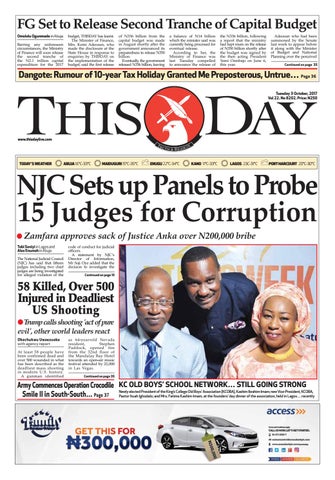
Army Commences Operation Crocodile KC OLD BOYS’ SCHOOL NETWORK… STILL GOING STRONG Newly elected President of the King’s College Old Boys’ Association (KCOBA), Kashim Ibrahim-Imam; new Vice-President, KCOBA, Smile II in South-South… Page 37 Pastor Ituah Ighodalo; and Mrs. Fatima Kashim-Imam, at the founders' day dinner of the association, held in Lagos… recently
2
T H I S D AY TUESDAY OCTOBER 3, 2017
T H I S D AY TUESDAY OCTOBER 3, 2017
3
4
T H I S D AY TUESDAY OCTOBER 3, 2017
T H I S D AY TUESDAY OCTOBER 3, 2017
5
6
T H I S D AY TUESDAY OCTOBER 3, 2017
T H I S D AY TUESDAY OCTOBER 3, 2017
7
8
T H I S D AY TUESDAY OCTOBER 3, 2017
T H I S D AY TUESDAY OCTOBER 3, 2017
9
10
˜ ͱ˜ ͺ͵ ˾ T H I S D AY
STARTERS
Obasanjo to Make Acting Debut in Comedy Skit Nollywood star Samuel Ajibola has
unveiled a behind-the-scenes photo from the widely anticipated episode of ‘Dele Issues’, starring former President Olusegun Obasanjo and is scheduled for release on October 14. Ajibola who is popularly known as Spiff in the sitcom ‘The Johnsons’ made the announcement on Instagram. He said: “I’ve had this picture for months, but I’ve been looking at this picture for the past 3 days, knowing I was going to post it up this morning but not knowing what to write under it as a caption. Then I woke up this morning and the first song that came to me was ‘you raised me up so I can stand on mountains, you raised me up to walk on stormy seas, I am strong when I’m on your shoulders, you raise me up to more than I can be’. “And then I got it! This is it! What I’ve been looking for? My caption would revolve around the Grace of God. To start with, who am I? That on my very own first project as a producer (I’m talking about the Dele Issues nonsense I’ve been disturbing you guys with every time on social media..lol), that I would have the privilege of having a former president of my country (Chief Olusegun Obasanjo) feature in my own skit because of an idea I just conceived in my mind once? “I meant, as at the time I thought of this idea I thought I was just being crazy, but then again I remembered a quote I’ve (sic) seen some time ago that says: ‘Your dreams are not big if they don’t scare you.’ All I did thereafter was to chase this dream and I left everything to God’s hands. Now I can confidently say that on the 14th of October on my YouTube channel (just search ‘Samuel Ajibola TV’ and you will see it) I would be posting the #Deleissues (special edition) skit by 12 pm. “If there is any advice I can give you young guys out there, it is this. Please don’t be ever scared to chase your dreams that came from any crazy idea you’ve ever thought of in your head. Write it down and chase that dream with every single thing you’ve
NEWS TSA: FG Commences
Enforcement of GIFMIS for Revenue Collection In order to properly classify receipts and ease reconciliation inflows into theTSA, FGhas directed that with effect from October 1, 2017, all banks must… Page 36
EDITORIAL On nigeria’s Migration
Problem he stories being told by Nigerians who are increasingly being deported from Libya after their failed efforts to cross to Europe are harrowing.While many of them have become destitute upon return home… Page 15
POLITICS Anambra Guber: Let the Battle e Begin With the clearance of 37 candidates for the Anambra State e gubernatorial election by INEC, the stage is set for the candidates to put their arsenal at work for the race, Davidson Iriekpen writes Page 16
FEATURES Anioma’s Back to School
Project Chiemelie Ezeobi writes that the maiden edition of the 'Back to School Project' initiated by the AniomaYouths Network for Development started off on a high note, as 130 less-privileged primary and secondary school students benefitted immensely Page 18
Obasanjo and Samuel Ajibola on the set of Dele Issues got. I mean, you’d never know…Just like me.” The special episode would mark the high point of the entire web series as Obasanjo makes his acting debut and shows the world a side they’ve never seen or heard of before.
The web series, Dele Issues (Daily Issues) revolves around the main character Dele, who always takes on different roles. The skits are popular for having elements of comedy and satire, ultimately making the series a must-watch.
NJC SETS UP PANELS TO PROBE 15 JUDGES FOR CORRUPTION judges was taken at the council’s 83rd meeting at which the Chief Justice of Nigeria (CJN), Justice Walter Onnoghen, who also doubles as its chairman, presided. The statement said fifteen separate committees had been constituted to investigate the judges. Each committee will investigate each judge and submit its report to the council which will take a final decision on their reports. Oye said the NJC decided to investigate the judges after considering reports of its two preliminary complaints assessment committees on 46 petitions written against judicial officers at both the federal and state levels. He said the council also issued letters of advice to Justice M.A. Dada of the Lagos State High Court of Justice and Justice Chukwudi Charles Okaa of the Anambra State High Court for violation of extant laws in the course of their judicial duties based on petitions written against them by Dayo Adamolekun & Ridwanulah Olanite, and Reverend F.U. Ekavhiare & Associates, respectively. He also said that the council dismissed 31 petitions, 29 of which it found unmeritorious, while the remaining two written against Justice J.T. Tsoho of the Federal High Court, Abuja and Justice O.O. Akeredolu,
Two-Minute Briefing
the acting Chief Judge of Ondo State were withdrawn by the petitioners. The statement said: “Al-Sagr National Insurance Company which wrote against Hon. Mr. Justice Tsoho withdrew its petition since the judge had delivered the ruling in its case. “Chief Raheem A. Badmus who wrote against Hon. Justice Akeredolu also voluntarily withdrew his petition for personal reasons. “Council treated the two petitions as withdrawn since it did not find anything in them sufficiently serious for further consideration as stipulated in Regulation 9 (1) of the Judicial Discipline Regulations.” However, NJC said it considered and found worthy of further investigation, the petition written by Azi A. Phillip on behalf of All Farmers Association of Nigeria (AFAN), Plateau State Chapter, accusing Justice P.D. Damulak, the immediate past Chief Judge of Plateau State of bias, for failing to make his judgment in Suit No. PLD/J/236/16 delivered on 4th November 2016 available to the parties till the time the petition was written against him. But NJC said it decided not to constitute a committee to look into the matter because the chief judge had already retired from service and was therefore no longer in the employment of the council.
The council also considered and dismissed petitions written against two other judges, namely, Justice L.T.C. Eruba of the High Court of Justice, Abia State and Grand Kadi Abdullahi Waiya of the Sharia’h Court of Appeal, Kano State, for lack of merit. Oye said NJC further agreed to report a legal practitioner Mr. Adesina Ogunlana to the Legal Practitioners Disciplinary Committee (LPDC) for misconduct, for the use of uncouth language in a petition written to the NJC against Justice O.O. Atilade, the immediate past Chief Judge of Lagos State. The statement further read: “Council welcomed as good development, a letter from the Zamfara State Government approving the recommendation of the NJC for the compulsory removal of Justice Musa Ibrahim Anka from office for allegedly receiving a bribe of Two Hundred Thousand Naira (N200,000) from one Zubairu Abdumalik in order to deliver judgement in his favour.” NJC had in 2011 made a recommendation to the Zamfara State Government for the removal of the judge. The council last week also set up a mixed committee headed by a former President of the Court of Appeal Justice Ayo Salami to monitor judges handling corruption cases.
BUSINESS NERC Mulls Three Metering
Options to Eliminate Estimated ed Billing NERC is considering three innovative options to improve the metering obligations of Discos to their customers, with a view to eliminating the regime of estimated ed billing of consumers by Discos. Page 21
PROPERTY Developer Advises FG to
Reform Land Use Act to Create Affordable Housing A real estate developer, Bamidele Onalaja believes that if the federal government reforms the Land Use Act, the challenges of homelessness in the nation … Page 28
NEWSXTRA Kukah, Enelamah, Adeniyi,
Others Warn Nigeria is on Dangerous Precipice Notable Nigerians yesterday agreed that the current situation in the country characterised by hate speech, sectional agitations and separatist movements… Page 37
SPORTS 15 Eagles Land in Uyo for
Zambia Super Eagles countdown to Saturday’s 2018World Cup qualifier against Zambia’s Chipolopolo began last night with 15 players arriving the team’s camp in Uyo. Page 38
T H I S D AY TUESDAY OCTOBER 3, 2017
11
12
T H I S D AY TUESDAY OCTOBER 3, 2017
T H I S D AY TUESDAY OCTOBER 3, 2017
13
14
T H I S D AY ˾ ˜ ͱ˜ 2017
COMMENT
Editor, Editorial Page PETER ISHAKA Email peter.ishaka@thisdaylive.com
ANGELA MERKEL’S DRY TEARS
Okello Oculi argues that President Trump’s labelling and crude language must be challenged
C
hancellor Angela Merkel’s electoral victory on September 25, 2017 by a low 34 % of total votes cast was received with relief by Euro-America’s corporate class fearful that their destruction of improved standards of living earned by working classes during threat of seizure of Europe by Soviet Communism and socialists would be punished by what was derogatively labelled as ‘’populism’’. The racist wing of that ‘’populism’’ diverted blame for their economic losses to well-educated ‘’Arabs’’ - also tagged as ‘’Islam’’ – that were almost certainly roused and imported by Merkel’s secret service operatives. These fascists had not blamed her for supporting brutal attacks with police batons against desperate Greek workers cursing German banks insistent on repayments of loans - and lending of new ones - at extortionate interest rates. That ruthlessness wrecked electoral support for her socialist allies in the SPD; reducing it to only 20% of votes. Her response to Africans drowning in the Mediterranean Sea held no vision of a ‘MERKEL PLAN’ for African post-IMF destruction that would compete with America’s ‘’Marshall Plan’’. That American economic ‘blood transfusion’ saved Europe from domination by Soviet Communists. It was an alternative to a repeat of American exploitation of South America. No such plan has yet come out of her vaults. She must know of ‘’Holocausts’’ against Africans; as well as the one during the 1938-45 War against Jews. The late Professor Ali Mazrui reported that when in a public lecture at the Binghamton Campus of the State University of New York, he asserted that the most grave and long-lasting ‘’holocaust’’ perpetrated by a collective of European peoples was the combined decimation of Africans by 400 years the slave trade and over 75 years of direct colonial domination, angry Jewish groups demanded for his dismissal from his job. To them the term ‘’holocaust’’ had a TRIBAL ownership as barbarism against Jews. It was a weapon for bashing consciences of Europeans and their descendants in the Americas, Australia and New Zealand. Yet Mazrui was no intellectual lightweight. He was a general in Chief M.K.O Abiola’s war for ‘’reparations’’ for the slave trade in which Jews were also beneficiaries. He also argued that Germans rehearsed their inhuman decimation of Jews by exterminating the Herero peoples of Namibia. In this regard, Angela Merkel has the duty of correcting Germany’s discriminatory repayments of reparations to Israel while being deaf to curses from descendants of Hereros in Namibia. Tanganyika, Togo and Cameroun also bore human decimation under German colonisation at levels which Belgium, Holland, France, Spain, Portugal and Scandinavians did not suffer under German colonial boots during the 1938-1945 War. Africans believe that our dead ancestors do come back to intervene in our affairs as caring ‘’spirits’’; and as children. But the dead do die beyond release from that prison. Yet, we carry out rituals to appease spirits of those unjustly terminated. Several areas of appeasement offer themselves. For a start, German archaeologists have looted the pyramids of Ancient Egypt for gold, architecture, works of art and medical knowledge – including surgery. Nuclear science research on bodies of Ancient Egyptian Pharaohs
HER RESPONSE TO AFRICANS DROWNING IN THE MEDITERRANEAN SEA HELD NO VISION OF A ‘MERKEL PLAN’ FOR AFRICAN POST-IMF DESTRUCTION THAT WOULD COMPETE WITH AMERICA’S ‘MARSHALL PLAN’
disproved claims which deny that these rulers and builders of that great civilisation were Black Africans. They were NOT Germans. Germany owes Africans broadcasts of the truth of this black African identity; and vigorously counter current contrary Caucasian television and Arab tourist propaganda. The Germans have the merit of rebelling against the use of Latin as the language of official, religious, and university lectures. The use of ‘’vernacular’’ - namely German - as a medium for university lectures, publication and research was later followed by American universities who turned to the use of English. This is a cultural practice which German institutions –such as the Goethe Institute -should fund intensively and devotedly across Africa. India has been very successful in this cultural practice. The early adoption of German for the development of scholarship aided the growth of original scientific research and philosophy. The Japanese teach the same lesson. Germany owes their former colonies of Tanzania, Cameroun, Namibia and Togo an institution for promoting rigorous scientific research, technological inventivity and philosophy. A combination of Mwalimu Nyerere’s achievements in translating into Swahili Shakespeare’s JULIUS CEASER and MERCHANT OF VENICE; as well as works of political philosophy, makes Tanzania a strong candidate for its location. European Classical Music has been much nurtured by German genius. Beethoven has competed with Wagner for tilting souls and minds of European man. Wittgenstein, Max Weber and Karl Marx have wrestled over ways of understanding world history, if not for changing it. Out of Ancient Egypt came the development of knowledge in Mathematics, Anatomy, Religion, Philosophy, Literature and Astronomy. Post-colonial Africa has sprouted synthesis of music and dance, notably: by a choreographer in Guinea and Okot p’Bitek’s ‘’Heartbeat of Africa’’ in Uganda; a symphony from various sizes of drums by a conductor in Dakar, Senegal; the ‘’Sikelele Afrika’’ by a young South African music composer and Fela Kuti’s ‘’Afro-Beat’’ in Nigeria, and Manu Dibango’s ‘’Soul Makosa’’ from Cameroun. German cooperation in this sector would be a worthy initiative during Angela Merkel’s possible farewell trip. Long before President Barack Obama occupied the White House in Washington, D.C., the Senegalese Egyptologist and nuclear scientists, Professor Cheik Anta Diop, had in a series of television interviews and public lectures fired the imagination of African-American youths with revelations that the architecture of power symbolising America’s sovereignty was copied from ancient Egypt of the Black Pharaohs. African-American students we met at Atlanta University in 1989 carried T-Shirts with inscriptions of pride in that historical fact. Post-colonial capitals in Africa need to borrow from that ancestry as well as from new academies of architectural design, creativity and social imagination. Chancellor Angela Merkel can hug Africa with dry eyes that will join Africa’s innovators in seeing a future of dignified Africa-German partnership in architectural construction of the future. AFRICA Vision 525 Initiative
CALLISTHENICS AS SOCIAL INSTRUMENT OF ORIENTATION The sport enhances organisational capacity, precision and understanding among the youth, writes Yaya A. Adekunle
Q
uoting copiously from the postulation of the late American social crusader, Malcom X, the Osun State Governor, Ogbeni Rauf Adesoji Aregbesola in December 2012, at the NYSC orientation camp at Ede, told the mammoth crowd of both secondary school students and primary school pupils that “education is the passport to the future, because the future belongs to those who prepare for it today.” The governor, in his usual self, asserted the second time: “I want you to listen very attentively, Malcolm X was a black American social crusader, he recognised education as the bedrock of every success, that was the reason why he described it as the passport to the future. You know, if you don’t have passport, you can’t travel to other country, it means the sequence of advancement in life is being determined by education, you have to take it serious”. Aregbesola, at the point of making this assertion was at the event where free school uniforms were distributed to students and pupils in all the local governments of the state. The governor, at the event, reiterated his resolve to transform the education sector in the state as part of his six integral plans through which he canvassed for votes in 2007. The government of Osun, as part of its revolutionary move in the educational sector also introduced school feeding system in the elementary schools, a project that annually gulps billions of naira, and surprisingly survived the heat of economic quagmire the state experienced in the last two years as a result of acute reduction in the statutory allocations due to the state. However, the governor further moved to consolidate his giant impact on education for the
purpose of building young men and women with requisite cognitive reasoning and social orientation to complete anywhere around the globe. Aregbesola introduced a gymnastic sport called Callisthenic into public schools, with performances/displays at various anniversary celebrations initially restricted to about 20,000 pupils from schools in Osogbo and Olorunda Local Government Areas. The wide acceptability of the sport activity coupled with eagerness on the part of the government to start and complete intellectual rebirth of the young generation in the state made Governor Aregbesola to introduce a new template of the game which accommodated selected public schools in all the nine federal constituencies as well as interested private schools. According to a senior official in the Department of Social and Grassroots Mobilisation and Guidance, Office of the Governor, Mr. Yaya Ademola Adekunle, who also doubles as one of the team leaders of callisthenics, the new template of the gymnastic sport will be enhanced by making it a competition of mouth-watering reward. “Participation is voluntary, with the parents/ guardians of the participating students responsible for their costumes. The government will only be responsible for the training and competitions which will hold in two stages – at the Senatorial level between teams representing federal constituencies and at the state level between the first placed teams at the Senatorial level competition. “In addition to trophies, plaques, medals and certificates of participation for the participants, prize monies of One million naira; N750,000, and N500,000 will be won by the first, second and third placed teams respectively at the Senatorial level competition in September, 2017. By November 2017, the first team in each of the Senatorial level,
along with teams by interested private schools, will compete for N2 million ; N1,000,000 and N750,000 for first, second and third positions respectively, and other consolation prizes. These prize monies will be used by the authorities of the combined participating and the host schools for the development of their sporting facilities and activities. “Calisthenics is very flexible. It all depends on creativity. At our level, displays take two levels – field composition and background display. Activities at the federal constituencies to the Senatorial competition are only based on the field compositions. At the state level on the anniversary day, a background display consisting of rows of pupils seated in a gallery at Osogbo Township Stadium will be forming captions of different words and patterns, speaking to the competing teams in the main bowl, as well as to the audience. The background will not be competing. It will only add flavour and glamour to complement the competing teams and entertain the audience. Displays can involve from a few dozen up to thousands of persons exercising in unison. As stated already, it is a function of creativity,” Adekunle said. It was in the spirit of that new template that callisthenics game schools competition was flagged off on Monday, September 25, 2017, among students of the secondary schools across the nine federal constituencies of the state. The Director of Department of Social and Grassroots Mobilisation and Guidance, Mr. Adebayo Ojo, who spoke to newsmen at the St. Paul Middle School, Ilobu after the display of the callisthenics sports by the students expressed his satisfaction with the excellent performance of the students, and commended the exceptional vision of Gov. Aregbesola for the adoption of the sport as a co-curriculum activity for students in more
schools across the state, noting that the sport has no rival for enhancing organisational capacity, orderliness, precision, cooperative spirit, discipline and understanding among the youth, attitude and character traits fundamentally responsible for personal success in life and social progress. “The scope of selection of students for this sport has been expanded with the new template, to include all interested public and private schools, and to give a new social orientation to students in the state as part of its educational transformation. “Team of coaches, panel of judges as well as zonal and local inspectors of education are to be on ground, in the presence of several dignitaries, and access the performances of the participants and accrue them award according to their performances. The introduction of Callisthenics to schools’ scheme is not by chance, but an integral part of the total transformation of education in the state targeted at the eventual production of best-oriented future citizens who are socially well-adjusted, in addition to being knowledgeable and skillful. It also encourages school children to be physically strong and mentally sound through varieties of movements such as running, standing, grasping and pushing, among others, often performed rhythmically and generally without equipment or apparatus. They are, in essence, body-weight training and are intended to increase body strength, fitness, and flexibility through movements such as pulling or pushing oneself up, bending, jumping, running, kneeling, swinging, et cetera,” Ojo said. He said that the special sports activity with a new and wider template would teach and instil the spirit of team coordination, unity of purpose and strength of problem-solving in the students, and prepare them for future challenges. Adekunle wrote from Osogbo
15
T H I S D AY Ëž Ëœ ÍąËœ 2017
EDITORIAL ON NIGERIA’S MIGRATION PROBLEM The tragedy exposes the monumental ills in our economy
T
he stories being told by Nigerians who are increasingly being deported from Libya after their failed efforts to cross to Europe are harrowing. While many of them have become destitute upon return home, some nurse terminal diseases like cancer and HIV without any support. For these unfortunate Nigerians whose quest for a better life across the Mediterranean Sea ended in disappointment, the future seems bleak, except the authorities can come to their aid. Ironically, the current migration crisis is a cruel twist of the logic of the transatlantic slave trade. In the old trade, African agents of European slave traders hunted men and women and forcibly sold them off to be transported across the Atlantic to the new world. In the new ‘trade’, Africans are willingly subjecting and submitting themselves as fodder and merchandise for enslavement across the Mediterranean. Driven by economic desperation and sometimes laziness, thousands TODAY, WE LIVE IN A of able-bodied young COUNTRY WHERE MANY men and women are, ARE NOT ONLY POOR BUT almost on a daily CANNOT FIND JOBS basis, embarking on suicide missions in the bid to migrate towards the northern hemisphere in search of opportunities that have since disappeared in those very societies. While only a small fraction eventually reach their destinations where they face disappointment and frustration, majority of them usually perish on the way. From the accounts of some of the returnees, many who made it to Europe or the Middle East were usually forced into prostitution, used as mercenaries, deployed as household servants, factory workers, drug couriers and even as organ donors. And they would be beaten, starved and subjected to other forms of torture if they tried to resist. However, as we have argued in the past, it is important to interrogate the conditions that create the desperation to leave the country for unknown
Letters to the Editor
destinations. Today, we live in a country where many are not only poor but cannot ďŹ nd jobs. Factories are closing down and selling their warehouses to promoters of religious organisations while several businesses are shut down or moving out of the country due to lack of electricity. In the circumstance, vibrant young men and women are leaving the country to embark on journeys which for many of them tragically end at sea.
T T H I S DAY EDITOR DEPUTY EDITORS ˜ MANAGING DIRECTOR DEPUTY MANAGING DIRECTOR CHAIRMAN EDITORIAL BOARD
EDITOR NATION’S CAPITAL
T H I S DAY N E W S PA P E R S L I M I T E D EDITOR-IN-CHIEF/CHAIRMAN GROUP EXECUTIVE DIRECTORS ˜ ˜
˜ GROUP FINANCE DIRECTOR DIVISIONAL DIRECTORS ˜ ˜ DEPUTY DIVISIONAL DIRECTOR
SNR. ASSOCIATE DIRECTOR ASSOCIATE DIRECTORS ˜ CONTROLLERS ˜ ˜
GENERAL MANAGER
GROUP HEAD DIRECTOR, PRINTING PRODUCTION TO SEND EMAIL: ďŹ rst name.surname@thisdaylive.com
TO OUR READERS Letters in response to speciďŹ c publications in THISDAY should be brief (150-200 words) and straight to the point. Interested readers may send such letters along with their contact details to opinion@thisdaylive.com. We also welcome comments and opinions on topical local, national and international issues provided they are well-written and should also not be longer than (9501000 words). They should be sent to opinion@thisdaylive.com along with the email address and phone numbers of the writer.
57YEARS OF DEPENDENCE
O
ver five decades ago, Nigeria started her final rites of passage from an adolescent colony of the British to a sovereign adult nation. Seemed like a whole lot of responsibility, but not such the excited leaders at that time couldn’t handle. Well, at least they thought so. Some 57 years down the line, it appears Nigeria has only grown in age and not in stature. Terrorism, economic recession, rapid unemployment/ underemployment, election violence, corruption, disregard for human rights and tribal/ethnic disunity, continue to plague the nation. Nonetheless, Nigerians do have a reason to celebrate: the priceless privilege of independence! Just like the previous years of itemising the nation’s progress and achievements every October 1, the rating for this year’s Independence Day anniversary hasn’t particularly added any new figures. Nigeria enjoys independence while in dependence.
here is also a criminal dimension to the problem with some unscrupulous Nigerians now recruiting from their villages and towns young girls with the promise of securing for them good jobs abroad only to turn them to prostitutes. There are chilling statistics which suggest that human trafďŹ cking has become one of the biggest money making businesses after drug trafďŹ cking. Today, our country is regarded not only as a transit route for this illegal trade but also a source as well as a destination with children and young adults, especially of the womenfolk, now becoming merchandise for what has become a cross-border crime. The Deputy Head of European Union (EU) Delegation in Nigeria, Mr. Richard Young, has repeatedly expressed concerns over the increasing number of illegal migrants from Nigeria to Europe. Yet, many of those people are merely compounding their miseries because what await them on the other shores are no longer opportunities but detention, most often under subhuman conditions. In urging Nigeria to grow its economy and tackle the challenge of poverty, Young also warned that if the immigration issue was not addressed, it might have long term impact on the EU-Nigerian relations. The biggest challenge is a mind-set issue as there are many young men and women who believe they can only make it abroad and will do anything to travel outside the shores of the country. So, apart from remaking the socio-economic structures of our country, that is also an issue the authorities must deal with. But the ďŹ rst task is to provide opportunities at home for our teeming population of young people.
Despite the country’s wealth—and a whopping 57 years after independence, Nigeria is continually dependent on external loans to keep its frail economy alive. Nigeria is in dependence of foreign assistance to help wrestle Boko Haram down to the ground. Nigeria is still in dependence of the constant reminder by its citizens through risky agitation and protests that the country is still a democracy and not governed by reformed military decrees. Nigeria is in complete dependence on the petroleum sector for survival to the detriment of other promising sectors. Most unfortunately, Nigeria is in dependence of the strength of the elderly to speedily provide the desired change for the future. It takes great courage to agitate for independence, but requires a great deal of responsibility to be truly independent. If Nigeria is still learning on the job after 57 years as a sovereign nation, then it defeats the purpose of our independence. Nimi Princewill, princewill.nimi@yahoo.
IS THERE ANYTHING TO CELEBRATE?
I
s there anything tangible to celebrate in Nigeria? Celebrating our inability to curtail the menace of Boko Haram and Fulani herdsmen? Or celebrating the inability of average Nigerians who couldn’t afford three square meals daily? I am a Nigerian, but I have chosen to be sober on this day rather than celebrate the unseen and unfelt. At 57, all we hear is the cry of marginalisation and the horror of war drums. At 57, terror is walking freely in the street of Nigeria, and chooses whoever will be the next victim. At 57, Nigeria is stratified into first class citizens, second class citizens, third class citizens, and some classless survivingbeings. At 57, Nigeria has failed woefully in the hands of visionless and missionless mediocres who parade themselves as leaders; and under a failed system that makes a politician a billionaire overnight of joining politics and winning an election
in the same country where civil servants and professionals work all through their life without being able to afford a decent home. At 57, the nation is polarised, the economy is somersaulted, the education sector is in a shambles, justice is costlier than gold; free flow of blood with the military, paramilitaries and all security agencies politicised and doing the bidding of government. At 57, Yoruba’s would say, “When you use 20 years to prepare for madness, when actually are you going to do the madness properly?� A nation founded on lies, modern slavery, deceptiveness, marginalisation, weak and faulty foundations can never stand focused on development and growth. It is so pathetic that in Nigeria at 57, there is nothing to celebrate for an average Nigerian, except that we are alive, which is a privilege from Almighty God. Bamidele Williams, Ibadan
16
T H I S D AY ˾ TUESDAY, OCTOBER 3, 2017
POLITICS
Group Politics Editor Tobi Soniyi Email tobi.soniyi@thisdaylive.com 08033146139 SMS ONLY
EXECUTIVE BRIEFING
Anambra Guber: Let the Battle Begin Withtheclearanceof37candidatesfortheAnambraStategubernatorialelectionbytheIndependent National Electoral Commission, the stage is set for the candidates to put their arsenal at work for the race, Davidson Iriekpen writes
Obaze
A
ll is set for the Anambra State governorship election with the final clearance of 37 candidates for the poll by the Independent National Electoral Commission (INEC) last week. Among the frontline candidates are the incumbent governor of Anambra State, Chief Willie Obiano, who is contesting on the platform of the All Progressives Grand Alliance (APGA); Oselola Obaze, the candidate of the Peoples Democratic Party (PDP); and Tony Nwoye, the candidate of the All Progressives Congress (APC). There are 34 other candidates who will also be contesting in the governorship election in the state on November 18. A statement by the commission also said it had given the nod to 38 domestic and six international observer groups to monitor the election. This, according to the commission, was in accordance with Section 31(3) of the Electoral Act. A cursory look at the list revealed that other than the three leading candidates, five female candidates will also be contesting for the governorship poll, while eight other female candidates have been picked as running mates. A breakdown of the list of the parties and candidates showed that Obiano and his deputy, Nkemakonam Okeke, will fly the flag of APGA, while Obaze was listed to run on the ticket of the PDP with his running mate, Chidi Alexandra Onyemelukwe. Also on the list is Nwoye of the APC and his running mate, Dozie Arinze Ikedife. Other parties and their candidates include the United Peoples Congress (UPP) – Osita Chidoka and running mate, Okeke Marcel Ogbonnaya; Progressive Peoples Alliance (PPA) – Godwin Ezemmo and running mate, Leonard Uchendu; and the Democratic Peoples Congress (DPC) – Chibuike Yul Edochie and running mate, Oluchukwu Okeke. Some of the international observer groups accredited by INEC for the election include the British High Commission, International Foundation for Electoral Systems (IFES), American Embassy, European Union, High Commission of Canada, and African Union Economic Social and Cultural Council, while domestic groups include African Centre for Leadership, Strategy and Development, and the Centre for Credible Leadership and Citizens Awareness. The commission said it would start the issuance of Form EPMC 002 to the approved groups next week. It also said it had approved the change of name and adjustment of logo of the All Democratic Peoples Movement (ADPM) to the All Grand Alliance Party (AGAP). It said it
Obiano
had approved the issuance of a certificate of registration in the name of AGAP. Even though INEC approved 37 candidates for the Anambra governorship poll, many analysts are of the vviews that the contest is a three-horse race between Obiano of APGA, Obaze of PDP and Nwoye of the APC as many others are considered as just jesters. With the first hurdle over, there is no doubt that the next stage which is campaign will be very hot and security agencies have to be alive to their responsibility to keep the peace. On the day of the election, INEC is expected to do better by making sure that likely logistic issues are proactively taken care of. This was corroborated by the Chairman of the Obiano Re-election Campaign Organisation and former National Chairman of APGA, Chief Victor Umeh. Umeh while briefing journalists last Friday,. Umeh said the two groups would make for the success of the election are INEC and security. He said the impartiality of INEC and the conduct of security operatives would go a long way in determining how the election would go. The former APGA boss said the security operatives should allow the election to be conducted under peaceful atmosphere and protect the integrity of the election. “Allowing the votes of the people to count is the major ingredient for the success of the election. INEC will make or mar the election. If INEC wants to be impartial, this election will be successful. Don’t allow politicians to intimidate the electorate. Politicians should eschew desperation,” he said. Already, political parties have commenced strategies to win the election. Last week, the APC inaugurated a 48-member campaign committee for the governorship election. The committee is headed by the Bauchi State Governor, Mohammed Abubakar. Other members of the committee include big names such as Governors Rochas Okorocha (Imo), Simon Lalong (Plateau), Nasir el-Rufai (Kaduna), Yahaya Bello (Kogi), Rotimi Akeredolu (Ondo) and Godwin Obaseki (Edo). Others are Ministers of Labour and Employment, Chris Ngige; Minister of Transportation, Rotimi Amaechi and Ogbonnaya Onu of Science and Technology. The National Chairman of APC, Chief John Odigie-Oyegun, challenged the committee to work to bring the South-east into the main stream of Nigerian politics and into the progressive family by winning the Anambra State governorship. He also challenged the committee to mobilise the entire people of
Nwoye
Anambra State for victory saying the state was very important to the APC, pointing out that a victory for the party in Anambra would help address the cries of marginalisation from the South-east ego political zone. Oyegun said the party recognised the fact that the election would not be a bed of roses in view of the fact that there is an incumbent governor in the state, adding that “if the APC can defeat an incumbent president, we can also defeat an incumbent governor, we have done it before in Kogi and Ondo States.” He said: “It is important that we do everything we can, fair and square, to bring Anambra State into the fold of the progressives for a lot of reasons. Until we manage to bring a few states into the mainstream of progressives’ politics, we may not see the end of this continued cry of marginalisation. It is important that we work and work very hard to win Anambra being a critical state in the South-east. It is not going to be a small political struggle. We must work hard with unity of purpose to break through to the South-east in a major way to win Anambra. It is very important, essential and vital that we manage to hammer together not just a patch work of peace or make-believe kind of camaraderie but a very serious unity of purpose between all those who aspired to that office to act as a serious guarantee that we are indeed also serious in winning the Anambra governorship seat.” But Umeh described Oyegun’s statement as reckless, inflammatory, intimidating and undemocratic. He called for fairness on the part of INEC and security agencies to all parties in the contest, in accordance with standard best practices. The former APGA boss called on the people of the state to be vigilant and prepare against any evil plot to subvert their decision at the poll. “We don’t want to go into this election with such inflammatory statement as that of Oyegun. That statement is an intimidation to the people of Anambra State. Buhari that ushered in hope to Nigerian democracy should not allow anybody to intimidate any person in Anambra election. Under his watch, we expect a perfect electoral system. The people’s votes should count. The umpire is responsible for the conduct of elections. So, it’s INEC that will make or mar Anambra poll. So, we ask INEC to be determined, impartial, and fair to everybody in the election.” he said. Many analysts are wondering why Oyegun and his party are eager to win Anambra when they cannot manage the states they have under
its control and when President Muhammadu Buhari has not justified the mandate given to him by Nigeria. “APC is just embarking on territorial acquisition with the help of INEC and security. Tell me, what have they achieved in the some of the states under their control? In Ondo, Osun, Kogi to name a few, there is virtually nothing to show for it; they are owing backlog of salary arrears, yet they want to takeover Anambra that is not owing a single month salary. “What has Buhari done with the mandate given to him by Nigerians? His administration is the worst in recent times. People have been killed more in his time. Life is harder under him. Roads are worst under him, yet people are clamouring for him to contest in 2019 because INEC and security are in their pockets?” asked Nnamdi Amadi, a social public affairs analyst in based in Lagos. Meanwhile, why APC is busying strategizing, APGA, the party on ground in the state, is consolidating on its support base. In the last two months, over 100 groups including town unions, farmers associations, tricycle operators have all endorsed Obiano, concluding that another four years for him, would help place the state on the path of development. The PDP candidate, Obaze is also not leaving any stone unturned. He had accused the incumbent governor of not following the developmental plans laid down by his predecessor, Peter Obi. According to him, under Obiano, some of the successes recorded by Anambra State under Obi are not being sustained. Obi, who had thrown his weight behind Obaze and who incidentally brought Obiano to office, had promised to ensure that he is removed from office. Obi has severally criticised Obiano for running the state aground in the last four years and frittering away the resources of the state in four years, despite inheriting assets and cash to the tune of N75 billion. But Umeh has dismissed the allegations, saying the former governor could not have left N75billion when he left a total debt of N185 billion on road construction alone and employed 6,000 workers at the twilight of his administration. “This is the time to tell the truth. I was there at the governor’s lodge where Obi gave Obiano hand-over note. There was no issue of N75 billion left for Obiano. Some of the money left included bonds, some of them cannot be accessed until 2030, he said.
17
T H I S D AY ˾ TUESDAY, OCTOBER 3, 2017
POLITICS
Katsina State Celebrates 30 Years of Statehood Aweek ago, Katsina State rolled out the drums to celebrate 30 years of its creation with pomp and pageantry. Ibrahim Shuaibu was there and files this report
K
atsina usually referred to as Katsina state to distinguish it from the city of Katsina, is a state in North-west zone of Nigeria. It’s capital is Katsina city and has 34 local government areas. Carved out of Kaduna State on 23 September 1987 Katsina was founded by Kumayo. Before the Fulani conquest, Katsina was an important seat of learning and a commercial centre of the Trans-Saharan trade. The people of the state are mainly Hausa and Fulani. The state had 34 local government areas which comprises Bakori, Batagarawa, Batsari, Baure, Bindawa, Charanchi, Dandume, Danja, Dan Musa, Daura, Dutsi, Dutsin-Ma, Faskari, Funtua, Ingawa, Jibia, Kafur, Kaita, Kankara, Kankia, Katsina, Kurfi, Kusada, Mai’Adua, Malumfashi, Mani, Mashi, Matazuu, Musawa, Rimi, Sabuwa, Safana, Sandamu, Zango. Katsina State occupies 24,192 square kilometres with a population of approximately 7.6 million people. Katsina is endowed with good soil and climatic condition suitable for agricultural production within three ecological zones of Sahel, Guinea and Sudan Savannah in the north, central and southern parts, respectively. The state has over 80 surface water bodies, among which are: Zobe Dam with 140 million cubic meters reservoir capacity; Jibia Dam with 140 million cubic meters and Sabke Dam with 37 million cubic metres. The first military administrator of the state was Colonel Abdullahi Sarki Mukhtar who governed the state from September to July 1988; Colonel Lawrence Onoja 1988 to 1989, John Madaki 1989 to 1992, the fist civilian governor was Alhaji Saidu Barda who ruled the state from 1992 to 1993, Mr. Emmanual Acholonu 1993 to 1996, Mr. Samaila Bature Chama 1996 to 1998, Col. Joseph Akaagerger 1998 to 1999. The second civilian governor is Malam Umaru Musa Yar’Adua from 1999 to 2007 who went on to become the president. Ibrahim Shehu Shema succeeded him on 29 May 2007. He left on 29 May 2015 when he handed over to the incumbent governor Aminu Bello Masari. Katsina state has recorded enormous successes in agriculture, education, economics, trades and other spheres of life within its 30 years of existence. Masari is determined to sustain the tempo of development in the state. He has given priority to provision of portable water supply. Masari’s administration intervention has led to the resuscitation, upgrading and expansion of many water supply projects across the state. Major works were carried out in six major water works to boost supply to towns and villages. Work is going on to resuscitate the Ajiwa Water Works which has a capacity to treat 50 million litres per day and is serving Katsina township and environ with portable water for both domestic, commercial and industrial purposes. It is now a dilapidated condition operating at 40% of its install capacity. In order to restore back the design capacity of both the dam and the treatment plant the current administration through the Ministry of Water Resources has entered into a contract for the rehabilitation and upgrading of the Ajiwa Dam and Water Treatment Plant with Kaibo International Limited at the total cost of N1,996,861,690.85 with 40 per cent of the contract sum paid to the contractor. The Malumfashi water supply scheme was constructed and commissioned in 1983 with a capacity of 4,500 cubic meters per day and the scheme is meant to supply water to Malumfashi, Kankara towns and the villages along the pipeline. However, the devastating flood of 2008 washed away a portion of the pumping main and high tension line near Bonn dawa village, consequent upon which Malumfashi was cut-off from the water works thus making pumping of water from the treatment plant to Malumfashi impossible. The damage was not attended to since then. However, the Masaru’s administration awarded the contract for the repairs of the damage portion in October, 2015 under the
Masari
emergency rehabilitation of Malumfashi water supply scheme at N141,705,983.05. The work has since been completed and water supply restored to Malumfashi town since March 2116. The Funtua Water Supply Scheme as well as Daura Urban Water Supply Scheme have also been rehabilitated by the present administration. Power remains a major problem and where necessary, the Masari-led government procured transformers and generators to power these water schemes. For instance, prior to the coming of Masari, the Dutsinma water supply scheme operated for less than 8 hours daily but now it is operating between 16 hours per day due to increased diesel supply by the state government. The state government through its Rural Water Supply Agency, (RUWASSA) was able to provide 464 hand pump boreholes, 20 motorised boreholes, 130 hand pump boreholes and latrines in primary schools, 25 hand pump borehole and latrines in health centres and 85 hand pump boreholes in communities across the state. It is to be noted that increase supply of clean water has imparted in the area of education. Now more children are attending schools because of the proximity of water source. Likewise in the health sector availability of clean water prevents water borne diseases which in turn saves a lot of money that would otherwise had been spent in treating diseases. In agriculture sector, the availability of more water from the dam reservoirs allows for irrigation and help farmers to plant throughout
Katsina State has recorded successes in agriculture, education, economics, trades and other spheres of life within its 30 years of existence
the seasons. This in turn ensures the food security of the nation. The water resources sector has also impacted on the industrial development of the state. The governor had also introduced the restoration project with the view to restoring the lost glory of Katsina State in agriculture. When the programme began in 2016, more budget was allocated to agriculture. To ensure proper planning, the state government engaged over 2,000 youths, majority of whom are unemployed graduates to capture farmers’ data in order to generate and store authentic data on farmers’ land size, location and soil type. This will put the state in a better stead for proper planning on extant and future projects and programmes. More importantly, government needed to know the number of its people engaged in farming activities, their categories, location and other parameters necessary for effective governance of the sector. The agricultural resources available in the state also needed to be documented for proper planning. In its effort to develop the state economy based on agriculture through ensuring food security and provide raw materials for agroallied industries, the state has chosen four value chain crops (rice, wheat, cotton and tomato) and aquaculture (fish production), sheep and goats. The state has secured Central Bank of Nigeria (CBN’s) approval for participation in its Anchor Borrower’s Programme on massive production of these crops and livestock species. The programme will ensure adequate and timely provision of needed inputs to the participating farmers, while linkage to market is ensured through readily available up-takers. ABP began with 20,000 farmers for rice and wheat production for the 2016 dry season. This was followed with cotton and tomato for the year 2017 and later culture, sheep and goats will follow. As an additional boost, the state has keyed into the Competitive African Rice Initiative (CART), which aims at facilitating the production of rice in a competitive manner (comparing with international standards), and the improvement of the output of the smallholder farmer. In order to move from subsistence farming to mechanised farming, Katsina State government is deploying 325 tractors, 1,083 power tillers; and 300 gravitational drip Irrigation kits to
farms in the state. For Masari, economic empowerment of women, youth and the less privileged in the society remains a cardinal point of his administration. To this end a special directorate was created and mandated to spread wealth across the society. Since the coming of the directorate many programmes and projects have been executed and loans disbursed to many beneficiaries. A special data collection commenced in earnest with over 500 forms issued and about 490,200 beneficiaries enrolled from 4902 economic centres created across the state. To ensure that more women benefited a ratio of 60/40 female and male respectively was strictly followed. A N2 billion CBN loan was secured and disbursed. The government is also giving a great deal of attention to the health sector in view of the deteriorating situation it inherited. Health centres are being rehabilitated expanded and upgraded. While development of manpower, provision of drugs and other essentials are also receiving attention. The state’s three general hospitals are receiving a massive face lift . Among others the following projects are ongoing: construction and remodeling of General Hospital Katsina, construction of new mortuary at General Hospital Katsina with similar works going on at Daura and Funtua general hospitals as well as the construction of two blocks of classrooms at the School of Health Technology Daura. The state is providing free medical schemes for patients on renal dialysis, accident victims, pregnant women including caesarean section (CS), patients with malaria and children under five years at government hospitals across the state.The government has expanded the free medicare scheme to cover psychiatric patients so that they get all their medications free. In his drive to diversify the state economy, encourage private sector, create jobs and entrepreneurial promotion through generation of viable investment opportunities in the state, Masari set up the Katsina Economic & Investment Summit Committee (KASEIS) to amongst others promote investment opportunities and host the Katsina Economic & Investment Summit with the aim creating awareness and get the buy-in of citizens of the state on the government’s policy thrust and intended investment climate and also create a platform for dialogue with potential Investors. The committee is also mandated to: share emerging investment ideas with target audience, engage all the state’s unutilized and underutilized natural resources towards creating an efficient investment climate thereby creating prosperous state; revitalize the state’s private sector for higher returns and employment generation; and enhance the visibility of the state as a viable investment hub. The summit priority sectors are: agric– business, power and energy, solid mineral, property development and hospitality and creative arts industry. Already, the state has started counting the gains of the summit which brought the attention of the investment community to Katsina. The eyes of the world were riveted on Katsina State before, during and immediately after the summit. Over thirty business memorandums of understanding were signed during the summit including the handing over of the moribund Kankia metal works to an indian company through concessionary arrangement. The summit led to: the foundation laying ceremony of multi million Naira tomato farm and tomato processing plant in Sabuwa Local Government Area by Erisco Foods Nigeria Limited; securing land for rice milling and cotton ginning factory by Jargaba Nigeria Limited; securing of land for cluster of agro industries projects at Sheme in Faskari Local Government by Jifatu Group of Companies; commissioning and engagement of consultant for establishment of industrial park in Katsina LGA; commencement of establishment of agro allied company by AMMASCO in Katsina; securing of site for the establishment of tomato factory in Banjo Local Government; and in flow of prospective investors to the state for businesses.
18
TUESDAY, OCTOBER 3, 2017 ˾ T H I S D AY
FEATURES
Acting Features Editor Charles Ajunwa Email charles.ajunwa@thisdaylive.com
Anioma’s Back to School Project Chiemelie Ezeobi writes that the maiden edition of the 'Back to School Project' initiated by the Anioma Youths Network for Development started off on a high note, as 130 less-privileged primary and secondary school students benefitted immensely
Some of the beneficiaries with the Anioma Youth Development Project members and special guests
"
I have always wanted to go to school but I had no idea where I will get the basic requirements to start the new school session until help came from Anioma Youths Network for Development (AYND), who provided me with all I need for the school session." Those were the words of Ugochukwu Ebube, one of the less-privileged 130 primary and secondary school pupils and students recently given a new lease of life by Anioma Youths Network for Development (AYND), a non-governmental organization (NGO), the Anioma nation from the Delta North Senatorial District. Ugochukwu and others might have been lucky but recent statistics by UNESCO has unfortunately revealed that Nigeria has the highest number of out-of-school children in sub-Sahara Africa to the alarming tune of 10.8 million. Encouraged by the saying, 'little drops of water makes a mighty ocean', the Back to School Project by the AYND, recently took up the gauntlet to rectify this anomaly by providing educational materials to these less-privileged kids in five communities in the Anioma community. With a vision to transform the society by
Unarguably, it is a period parents are usually under pressure to pay school fees and buy all the necessary books and materials for their children and wards
empowering disadvantaged children to realise their full potential, the Back to School Project for 130 less-privileged primary and secondary school students held in September at OnichaUgbo, Delta State where the beneficiaries from various secondary and primary schools in Onicha-Ugbo, Ubulu-Uku, Issele-Uku, Obior, Igbodo all in Anioma area were given high quality school bags, note books, mathematical sets, biros and other accessories to aid them as the 2017/2018 school year begins. With its laudable dreams, the AYND said it’s already in the pipeline for the NGO to commence skills acquisition and ICT training for the youths in Anioma, adding that their vision is to positively impact the lives of the young ones in their communities. The beneficiaries Cutting across five communities in Anioma area, the beneficiaries include those from Onicha-Ugbo and they include Praise and Ebube Ugochukwu, Chibueze, Neboliseh, and Munachi Okafor, Justine Emmanuel, Ugo, Ebube and Dumebi Onyeoka, Emeka and Chibuike Eduwa, Sunday Bioloseh, Okonkwor Somto, Ekwubi Isioma, Aisha, Idris and Yusuf Mohammed, Obioma Mary, Funanya, Chinye, Isioma and Nonso Abiamuwe, Peter Lucky, Onochie, Chidinma and Mirabel Nkeafuonye. Others include Uwaeju Blessing, Iliya Sheto, Ekwubi Cynthia, Michael Jennifer, Njokede Ozioma, Nkechor Miracle, Ifechukwude Emmanuel, Ikechukwu Prosper, Nwabuisi Ebube, Kevin Ebegbune, Okafor Emeke, Ngozi Uzu, Akabude Precious, Alex Favour, Ofili Samuel, Uzu Daniel, Akaeze Ifechukwude, Agbor Favour, Odoh Chinasa, Rachael and Emmanuel Ogwugwua, Victor, Favour and Daniel Okwunodu and Okwechime Amaka. Students like Bioseh Frank, Nnyaha Chiamaka, Odor Gift, Amumbor Ogochukwu, Okolie Azuka, Osemeke Chekwube, Success and Praise Afamefuna, Onwe Ogechi, Chisom Divine, Ekwubi Ifeanyi, Echezona Nkechor, Amarachi Emmanuel, Abia Ruth, Sunday
Emmanuel, Chioma Obi, Monye Kosiso and Ifeanyi Nwaghodo, also benefitted. Beneficiaries from Obior Town include Tobe Egeuyenga, Joy Isichei, Odumakin Ifechukwu, Miracle Ugeh, Ndubuisi Nkwor, Chiefuna Chioma, Emmanuel Maduka, Igwe Chinaza, Maxwell Cynthia and Nwaokolo Favour. Other beneficiaries from Igbodo Town include Glory Ekwamaka, Chigbue Favour, Happy Nedum, Chukwudi Chinonso, Chidera Emeka, Osakwe Chukwueku, Okeleke Nonso, Ojogbo Bright, Chidi Unakpa and Esther Emmanuel. From Ubulu-Uku Town were beneficiaries like Chukwunyem Okonta, Anwuli Emordi, Amechi Okonkwo, Elo Adigwe, Nkechi Okafor, Emeka Okonkwo, Ekene Okocha, Amaka Adoh, Ugbechie Jennifer, Chinedu Okafor, Rebecca Okocha and Afamefuna Adoh. From Isele-Uku, the beneficiaries include Chukwudi Ifeoma, Moluba Esther, Maureen and Isioma Anika, Ebijie Isioma, Obiokor Victory, Imudia Juliet, Odio Uche, Justin Afamefuna, Nwanjor Nkem and Ifeanyi Chukwudi. A barrel of dreams In his speech, the President, AYND, Mr. Sunday Odita, who also doubles as the President, Crime Reporters Association of Nigeria (CRAN) said, "This great event was strategically planned to take place now that primary and secondary schools in the country are about to resume for the 2017/2018 academic year. "Unarguably, it is a period parents are usually under pressure to pay school fees and buy all the necessary books and materials for their children and wards. We are very much aware of the fact that there are some children in our communities whose parents are not well placed to cater for their needs at this time of school resumption; hence we have chosen to lend some support, no matter how small. "I need not over-emphasise the fact that today brings an immense joy to me as a person and to other members of Anioma
Youths Network for Development (AYND) as a dream nurtured over the years to positively affect the lives of our brothers and sisters in Anioma is being crystalised through our gathering here today. "Historically, the AYND NGO with the youths as its centre-piece was founded about three years ago by a few of us following an idea mooted by my humble self (among other things), to advance issues that affect the lives of young people (youths) largely in the various communities that make up the Anioma nation – (Delta North Senatorial District). "It is an open secret that the youths in our society constitute a large percentage of the unemployed and under-employed. While a good number of them are well educated in tertiary and post primary institutions, many others either dropped out of schools or learnt some trade but do not have what it takes to establish some business that could meaningfully engage them. "Many of these unemployed and underemployed are part of us and our association is calling on government and development agencies, well placed individuals and organisations to assist in any way they can afford to create means of livelihood for these jobless youths. "Specifically; our gathering here today is to kick-start what we have christened ‘back to school programme' which is designed to be an annual thing, God willing. As the founder and National President of the AYND, I thought it wise and necessary that one would not have to wait until he becomes a billionaire before giving a helping hand to those who really need help. "None of us at AYND is yet in the billionaires’ club, but we have the passion to be our brother’s keeper hence we believe so much in using this programme to identify with our brothers and sisters in the secondary and primary schools. "Personally, I embarked on this initiative
19
˾ T H I S D AY TUESDAY˜ ͱ˜ Ͱͮͯ͵
FEATURES
Mrs. Kachikwu presenting one of the educational materials to a beneficiary while the organiser, Mr. Odita Sunday looks on
Excited beneficiaries with organisers of the Back to School Project
with my salary as a journalist (with Guardian Newspaper) and some support from friends (largely in security organisations) and kindhearted politicians like Prince Ned Nwoko and my cousin Mr. Dumebi Kachikwu, both of whom lent their financial support to this maiden edition of the programme. "May I also use this medium to appreciate Dr. Brasca Ifeadi (from Ubulu-Okiti) and Barrister Mike Ejiofor (from Ubulu-Uku) both of who served this nation meritoriously and retired graciously in recent time as Deputy Comptroller General of Immigration (DCG) and Director, Department of State Services respectively. Both of them share so much in the aspiration of AYND and have been supportive. We are proud to say that they were the first recipients of AYND award of honour in 2016. "Worthy of appreciation also, is the Commissioner of Police, Delta State Command, Mr. Ibrahim Zanna who, in spite of his relative newness in Delta State, has given encouragement to us. "Without sounding immodest, may I say that my strong belief for fiscal integrity and transparency largely prompted some friends whom I had met in my over 15 years of crime and security reporting to buy into this lofty idea of giving a helping hand to the youths. I wish to warmly appreciate them for believing in me and giving their support. "As we witness the maiden edition of the back to school programme with the extension of hands of love to our young brothers and sisters; we are quite hopeful that in no distant time, AYND would commence
skill acquisition and ICT training for the youths in Anioma. "In these days of unemployment, I firmly believe that graduates of tertiary institutions can seek more knowledge by acquiring skill in some trades. To do so, is not a rocket science, but a self-will and determination to succeed. I am an example of the message I am trying to preach now. "I am a graduate of Mass Communication and even though I am gainfully employed as a journalist, I still went out of my way to train and acquire professional skill in
We are very much aware of the fact that there are some children in our communities whose parents are not well placed to cater for their needs at this time of school resumption; hence we have chosen to lend some support, no matter how small
photography from a top-rate photography studio in Lekki, Lagos. I can proudly say that today, I make more income from photography than my journalism job. "As a non-governmental organisation with a vision to positively impact the lives of the young ones in our communities, Anioma Youths Network for Development strongly believes that one does not need to have so much money before he could make impact in the life of others. "This belief aptly brings to mind Etienne de Grellet’s saying that: “I shall pass through this life but once. Any good therefore I can do, or any kindness I can show, let me do it now. Let me not defer or neglect it. For I shall never pass this way again.” "This event will witness the modest benevolence of AYND to no fewer than 120 students and pupils drawn from secondary and primary schools in various communities in Anioma. I congratulate them and pray that their future will bring greater joy to humanity in general and to Anioma in particular. "In conclusion, on behalf of AYND, I want to passionately appeal to well placed personalities in Anioma and elsewhere to key into what we are doing today to contribute in uplifting the less privileged ones in our communities. We cannot wait for government to do much for us; otherwise we would be waiting for ever." A helping hand Given the laudable vision of the group, it was only fitting that notable individuals in the Anioma community teemed up to give a helping hand by either moral support of financial assistance to the back to school project.
In his speech, former member of Nigeria’s House of Representatives, Hon. Ned Nwoko described the youths as the hope of the future, adding that their potentials can only be harnessed through quality education. Represented by Mr. Chike Okolo, the former federal lawmaker who was the chairman of the occasion, harped on the need to celebrate the youths because they are the future of any society. Further quoting South Africa’s former nationalist and President, Nelson Mandela who said, “education is the most powerful weapon which you can use to change the world,” he said no society can make any meaningful progress without education. According to him, there must be a deliberate effort towards providing empowerment for the youths through education. Towards achieving this, he assured that he would continue to make impact through support to the education of the less-privileged ones in the society, just as he called on those willing to join him in keeping the vision on education to come on board. One of the special guests; a former Deputy Comptroller-General of Immigration Service (DCG) Dr. Brasca Ifeadi in his goodwill message said, he did not initially believe in AYND when he got to know about its existence “because over the years, so many non-governmental organizations had existed only on the pages of newspapers as some desperate Nigerians had used such platforms to feather their own nest without positively impacting the lives of people they claimed to be working for.” According to him, his impression however changed when he had the first physical contact with the leadership of AYND in December, 2016 during which himself and one other illustrious son of Anioma (Barrister Mike Ejiofor) were honoured by AYND for “serving the Federal Republic of Nigeria meritoriously and retiring gracefully after 35 years of service.” The former immigration boss added that, “this award was unsolicited and not for sale, because if it were so, I would not have been considered as I do not have the kind of money that would pay for it. I saw it purely as a recognition that came from sincere hearts.” He commended the AYND particularly for the effort to assist the less privileged ones and added that he would always give a helping hand as the NGO has shown “that it is on divine mission to uplift fellow human beings.” Speaking in the same vein, Barrister Mike Ejiofor who retired as a Director, Department of State Service (DSS) few years ago challenged Nigerian electorate to use their votes during elections to put good persons in positions of leadership as what AYND has done through the Back to School Programme ought to be the responsibility of government. He decried the deplorable state of Nigeria’s educational system and called for urgent intervention with a view to bringing back the lost glory. In the words of Delta State Chairperson, House of Assembly Commission; Chief (Mrs) Josephine Kachikwu, “it is regrettable that level of education in Nigeria has fallen to such deplorable state that some children in senior secondary schools cannot even communicate in simple English Language.” She encouraged parents to ensure that they provide adequate parental attention to the upbringing of their children both in academics, moral lessons and cultural values as these form the foundation of any child, stressing that once the values are out of place in the life of a child, the future of such a child remains bleak. The Onicha-Ugbo monarch, His Royal Majesty Obi Victor Chukwumalieze I, who was the Royal Father of the Day, was highly enthused that the maiden edition of the Back to School programme which he considered a very laudable initiative was held in his domain. He commended the convener and members of AYND for the programme which attracted many other dignitaries like Hon. Emeka Nwaobi of Delta State House of Assembly, Chief Madu Nwayorbuije (The Ihama of Onicha-Ugbo) , Delta State Police Commissioner, Mr. Zanna Ibrahim who was represented by the Command’s Public Relations Officer; Mr. Andrew Aniamaka. The Ihama, at the occasion announced a financial support of N500,000 towards the Back to School Programme. A few other guests also made some contributions including the Delta State Police boss who donated some hundreds of notebooks.
20
T H I S D AY TUESDAY OCTOBER 3, 2017
A
03.10.2017
WEEKLY PULL-OUT
‘MY TRIPLE PORTFOLIO IS NOT AS DAUNTING AS PEOPLE THINK’
Mr. Babatunde Fashola, Mr Fas SAN
10/COVER
03.10.2017
‘MY TRIPLE PORTFOLIO IS NOT AS DAUNTING AS PEOPLE THINK’
issue of water supply, many parts of the State now are presently without water. I am a citizen myself, and I think that we must respect the right of the leader of the State, to continue to do the best that he can to deliver services to all of us. Your Party, APC, recently suspended its National Legal Adviser, Dr Muiz Banire, SAN, creating an impression that the cracks in APC especially the Lagos State Branch, are getting deeper. Kindly, comment on this. Again, I don’t have all of the facts. Most of the facts that I have, are those that I read about in the newspapers. But I think that if you read the Constitution of the Party, it will be very clear what responsibilities lie to be dispensed at State level and what responsibilities lie to be dispensed at National level. From my general observation of things, I think that there has been some misunderstanding in the position that is being canvassed by Dr Banire on the one hand, and the position that is being canvassed by other interests in the Party on the other hand, about what internal democracy is. Those are issues that will not go away. The interesting thing is that the issue of internal democracy, is not a unique problem to Nigeria. I keep telling people this. We saw challenges with internal democracy, in the last American elections. There was evidence by email, that the Democratic Party leadership had decided that Senator Bennie Sanders, was not going to win their ticket. What we don’t have evidence of, is what they did to frustrate his ambition. So, that is an internal democracy issue. In all the other Parties to, you will see that immediately after Primaries or Congresses, somebody would say I was excluded and so on. It’s in the nature of human agitations for rights and jostling for positions, that this conflicts will happen. There are mechanisms within the Party Constitution and within the framework of the rule of law, to resolve all these issues. Honourable Minister, could you please educate us on the Mambilla Electricity Project. What is the reason for siting the project in Mambilla, when there is also Zungeru in the same region of Nigeria? Why are such projects not being cited in the other parts of the country as well? Why did it take Nigeria over 40 years to bring the project into reality? This is a very, very interesting question that you raised. First, one of the weaknesses of our power supply, power production cycle, is its vulnerability and over-dependence on one source, which is gas. But the truth is that every power source is also vulnerable. So, whether it is coal, gas, hydro, solar, whatever, they have their vulnerabilities arising either
from the lack of sustainability of supply and the ecological jammies that sources like coal do, and pollution and all of those. So, what nations do, is to diversify their sources of supply such that they have what you call an energy mix. We did not really pay enough of attention to this problem, until last year when our Ministry announced an energy mix for Nigeria; and that energy mix targets that by 2030, we will have 30% of our total energy component, from renewables, and those renewables include solar and hydro. And they will help us also respond to our commitment under the Paris Climate Change Agreement for Cleaner and Safer Energy. So, those are the underpinning drivers of more Zungeru more Mambilla, because that belt, has a rich and generous store of moving water bodies that provide energy to turn turbines. So, Niger State, because of the confluence of the River Niger, that is why Jebba, Shiroro and Kainji Power Plants are hosted by Niger and that is why Zungeru is also sited there. There is also Guarara Dam, also in Niger and there’s Dadinkowa Hydro Power in Gombe. There is also a Kashimbila Hydro Power Plant in Taraba. Now all of these serve many purposes. As to why they are not in the other parts of the country, they actually are. There is the Oyo Dam, the Ikere Gorge, there is the Tiga Dam in Kano, and there are six others, but they are smaller dams that we are working on and the record of dams and potentials for hydro power that the Ministry of Water Resources has, because they have oversight for water management, is in excess of fifty-four. All of these were created since the seventies, but we haven’t optimised them for power. They have been used largely for irrigation, agriculture and flood protection. Now, the Mambilla, has a height and because it is in a plateau, water drops from a very high altitude and therefore, that is a potent force to harness for driving turbines. So, that is why that one is in Mambilla. What about Abeokuta? Well there’s no water falling from the top of that rock. There is no water in that sense. And that is why the scope and the design of the project, is such that you have some of the dams rising and walls rising up to about one hundred and fifty metres, which is the equivalent of a fifty storey building and some up to seventy metres, which is the equivalent of about a twenty-three storey building. So, those are the sites, and potentially to deliver three thousand and fifty mega watts. When Mambilla is ultimately built, it will also give us a balance and more security over our dependence on gas. It is a plan towards ultimate energy security for the country. That said, why did it take so long? I don’t
CONTINUED FROM PAGE 9
"WHEN MAMBILLA IS ULTIMATELY BUILT, IT WILL ALSO GIVE US A BALANCE AND MORE SECURITY OVER OUR DEPENDENCE ON GAS. IT IS A PLAN TOWARDS ULTIMATE ENERGY SECURITY FOR THE COUNTRY"
like to criticise others that have served before me, because we have built on some of what they had started since the 1970s, but I just think that we could have reached this point much earlier than now. I think that we could even have built this dam with our own money, when we had $100 per barrel of oil everyday, instead of now going to borrow over $5 billion to do the project. But it is better late than never. It’s a five to six year project ahead and it’s already beginning. Just awarding that project, we are already beginning to receive expressions of interest, it is already beginning to affect the economy. Expressions of interest from Insurance Companies, who are looking to provide services during that construction project, where all sorts of things are going to be shipped, manufactured, transported, goods in transit, workmen’s compensation, workmen’s insurance, employers liability, that is already happening. Just yesterday, I received a letter from a group called Heavy Lift or so, that their own specialty is moving heavy things across the country, and they are again responding to the announcement of Mambilla . And you can just imagine what is going to unleash really, as construction starts. So, it is good for the economy. It has come at a time when we are exiting recession and implementing our economic recovery and growth plan, and power is one of the five pillars of implementing the growth plan. I think everything is converging for the better. We have momentum and we are not going to lose it. When do you expect to move to the Mambilla site? Well the next stage now, is to formally sign the contract documents, which will happen hopefully before the end of this month. After that, it is for Ministry of Finance to lead the negotiations for the loans, which should happen this year. Touch wood, I’m
hoping that before the end of the year, we can do some kind of ground breaking thing, because we have some position in the 2017 budget to pay our counterpart fund, and that is part of the process to start some preliminary work. So, every civil and in aid of civil works that we do, the project start, the contracting firms have already started. Work has really started. It’s just the construction work in that sense, because they have undertaken a root survey from the South to North looking at Ports. Which Ports, which roads, are they going to dedicate for moving their equipment? Because, there is a lot of work to be done. So they are already looking at logistics, how they are going to move cargo in. The work to the project is going on, the contract signing will happen, the Legal Department is tidying that up and we will finish that anytime now. Finance is tidying up, so that we can conclude the financing and we are preparing the logistics. We have set up a Joint Implementation Team between the Government of Taraba and ourselves. So, all of that has been done. It’s just a logistics operation that we need to fine tune and drive. Some power stations in Nigeria, like Calabar Power Station, Egbema Power Station in Imo State, are not operational, while that of Egbin is only partly operational. What is being done to get these power plants fully operational? Our target, is to optimise the stalled power generation capacity in the country and that is why we talked of our road map as being first incremental power, steady power, then uninterrupted power. And we are doing that by a combination of actions. Some of the power plants, are not operational because they have evacuation problems. We are increasing transmission capacity as I have announced, from the proverbial 5000 mega watts. As at first week in September this year, the figures were that we have a transmission capacity of 6700 mega watts, so we added 1700 mega watts to what we met. From the figure of 2690 mega watts, which was the power produced on May 29, 2015 when the Buhari Government was sworn in. As at 11th or 12th of September, 2017, our power production capacity reached 7001 mega watts. And this is because our power sector recovery program is working, and includes expansion of the transmission system to solve those that need transmission solutions. The gas production service - to create peace in the Niger Delta, so that we can produce more oil and gas into the system. That has happened. Assurance also that those who produce power, will get paid; and so the Payment Assurance Guarantee of N701 billion CONTINUED ON PAGE 11
03.10.2017
COVER/11
‘MY TRIPLE PORTFOLIO IS NOT AS DAUNTING AS PEOPLE THINK’ is triggering that. My best story on that, is that one week after we announced that FEC (Federal Executive Council) had approved the Payment Assurance Guarantee, a Power Plant Operator called me and said “Minister, please, come and help me commission my new power plant, 119 mega watts, gas power fire power”. You don’t build a 119 mega watts gas fire power plant in one week. What it simply meant, was that it was there. They were not sure that they would get paid, so they just switched it off. So, all of these things are releasing power to the grid. Confidence that liquidity will persist. Government is also verifying MD Agents. There is a lot that is being done. We are also promoting the use of solar, mini grid; we have issued regulations. We are doing a lot to solve all of those problems. Egbin for example. Again we must remember that power plants don’t run perpetually all year round. They must be shut down from time to time for maintenance. Just like the generator in your home. That is what they are. They are just big generators. Steady power will mean that we have enough, and that we also have maintenance back up. We can switch off one while we are maintaining it and compensate. We know that as at September 2nd, 2017, two of Egbin’s six turbines were out for maintenance repairs. I am sure that those are some of the challenges. Its either gas or transmission or routine maintenance that is also affecting them. Is there a blue print for affordable housing for all Nigerians? There is a program, not a blue print. Affordable housing is a policy and it is a good policy, and every Government that I know that cares for its people adopts that policy. So, from the last Administration to President Shagari’s Administration, everybody wanted affordable housing. To the UK Government, to the United States Government, to the Ghanaian Government, everyone wants affordable housing. The question is, what is affordable? It is a very subjective definition. It is also relative to where you want to live. So, we have developed a program which we are piloting. We are building in thirty-three States based on designs that we consulted people about, because we found out there were flaws in the old design. People were not consulted about what they wanted. So, we see a lot of empty houses around the country, because the off-takers were not consulted. When we finish the first pilot, we will then be able to see how much it actually costs, from what we conceived on the drawing to what actually happens. There will be local costs that were not in our books because we could not foresee them. There are cases where Communities have forced us to relocate our land which is at extra cost. There are cases where they have taken us to Court. There are cases where the land is a bit more swampy than we thought it was; and all of those kind of issues. That is when you will know the actual cost. And then you disaggregate it per unit. Then the other issues will arise. Firstly, is it acceptable? Did it meet the acceptability standard? Secondly, is it affordable? Can people pay for it? Those who it is intended for. So, we are still at the pilot stage. But what is remarkable about the pilot stage, is that it is having very pronounced consequences on
the economy. It is creating jobs. We have six hundred and fifty-three Contractors, who are beneficiaries nationwide. We have over thirteen thousand direct employees, and we have about forty-one thousand indirect employees, who are Vendors, Suppliers, and all of those who support the eco-system in a built environment. So, that is a plus, in the very first place. That pilot is driving demand for the mining industry, you are seeing this effect in solid minerals in the last nine quarters dating back to 2014, because we are spending on housing, construction, road construction, rail construction under the Ministry of Transport, and the civil engineering work that supports power and transmission work. As a Lawyer, a Senior Advocate for that matter, what is your opinion of the 1999 Constitution? Is it adequate or do you think it requires rewriting? How do you think Government should resolve the issue of the ongoing agitations for Restructuring? The Constitution is a document legislation made by men, and therefore, it is always limited and subject to the imperfections that characterise the human being. Every generation perhaps, wants to see a revised document. Those who made the laws, can only make laws within what they can contemplate, and they cannot contemplate forever. They can only contemplate within a time space, and that is why constitutional amendments are a normal occurrence. But they must not be a daily occurrence. I think that some of the limitations to the Constitution, can be managed by some other processes, other than routine default desire to amend. I think that, to the extent that the 1999 Constitution adopts substantially most of the 1979 Constitution, there is some respect for the provisions of the Constitution. And I say this only to the extent that I know that the 1979 Constitution, was the product of a Constituent Assembly properly elected and was chaired by the late Chief FRA Williams, SAN, and all of the provisions were properly debated upon, before people had taken political partisan positions. To the extent that that document was a well received document, which people still hold fond memories of; to the extent that the 1999 Constitution seemed to copy it and adopt most of it, with changes
CONTINUED FROM PAGE 10
here and there; except to the extent that it was enacted as a military decree which makes it tell a lie about “We, the People and We not the People”, I don’t have too much of a grouse with it. I think that every time people focus on constitutional amendments as the go-to answer for all our problems, I have argued and urged, that we must be careful. It is not a document that must be amended with such rapidity; that when our people are complaining, we just run to the laws and constitution. It is not really a better document that our people want. It is a better life! And we can actually give our people a better life, more by consensus, by compromise, rather than strict letters of law. As far as the agitation for Restructuring is concerned, I think that all I want to see first, is an understanding of those who ask for restructuring. What do those who ask for restructuring mean? What do they want? Because, if we have a common purpose of what we want, our actions would be united, and our efforts are likely to produce more results. But, if we have disparate understanding of restructuring means, then the likelihood of even achieving restructuring becomes more difficult. In terms of governmental restructuring and political arrangement, I think nobody can debate that that is a desire that anybody can wish to have and you can’t take that away.
"IT IS NOT REALLY A BETTER DOCUMENT, THAT OUR PEOPLE WANT. IT IS A BETTER LIFE! AND WE CAN ACTUALLY GIVE OUR PEOPLE A BETTER LIFE, MORE BY CONSENSUS, BY COMPROMISE, RATHER THAN STRICT LETTERS OF LAW"
How it ultimately evolves is quite another thing, because the political structure of Nigeria itself, is not divine. It was made by men. Up until 1914, there was no Nigeria. It was one man that coupled it together. Then from then, it was Northern and Southern Protectorates and the Colony of Lagos. Then later, it became Regions, there were three. Then later they cut one Region to create the Mid-West. We have always restructured the political, until we reached thirty-six States. So, you can continue to cut it up all you like. But I think that, it is the question whether that political arrangement adequately caters for all of the interests that has led to the agitations. Of course, there are those to whom restructuring means something else. These are some of the things that this Government is already addressing. We are handing over some of the roads that used to be Federal Roads, to State Governments. That is why I have said that what can be achieved by consensus, is greater than what can be achieved in the book. So long as you don’t break the law. But handing over some of the roads to State Governments, are you also handing over the resources in the different States, so that they have revenue to take over the road works? Again it is by creativity. Let me give you an example. They say there is one Police. When we wanted to do police funding in Lagos, people were dying, and the citizens didn’t want to know who controls the Police. What was important was, is the Police effective? That is all. And I came to President Yar’Adua and I told him that I needed to buy guns, because I had investigated. My policemen didn’t have guns. We had about twenty-seven rifles for the whole of Rapid Response Squad (RRS) for Lagos or something like that. And we had over two thousand RRS personnel. I told the President that I needed to purchase one thousand rifles and two million rounds of ammunition. President Yar’Adua got Inspector General of Police Mike Okiro then, to find a way with the National Security Adviser on how we could make it work, without breaching the Constitution. And they said “Buy it; we will give you the import permits and all of that, hand them over to me and I will issue them back to your Commissioner of Police, so that we can secure the State". This is the practicality of some of these things. When we are talking about State Police, every State already has a State Police. Every one, because don’t forget, that the traditional police had departments, sanitation police, traffic police. Every State has set up its own traffic warden. Really and truly, Police is not just arms. It is enforcement of laws. So it is an idea whose time has already passed; and most of those standing in the way of it will ultimately succumb. These things are already evolving. So, if this is what restructuring means, to give a legal framework to it, we must define what it means, what we want to do. But all of these things are already being done. There are partnerships between States. Solid Minerals is saying that inspite of the law, it wants to work with Communities, so that they can benefit from the mining resources that are in their States. Leave the law, but we can work together. Let us begin to give a legal framework to these areas of co-operation. The Central Bank which is a Federal Institution, does not distinguish between State and Federal , when it begins to go and give money for agriculture and so on. Everybody receives the loans that it disburses to rural Communities. So, again give a legal framework to some of these things. Religion seems to have become a big issue in Nigeria, causing countless controversies. As a Muslim who is happily married to a Christian wife, what advice can you give to Nigeria on how to achieve the right balance? Keep religion where religion belongs, in the Houses established for worship. Take religion out of the offices. Take religion out of the public places. Stop this public prayer. No country does them except us. Not even those who originated the faiths, because they have kept religion where it belongs; in the places of worship, in the schools where children are taught and introduced to God early in their lives to fear God; and out of the offices and work places. That is my advice. Thank you very much Honourable Minister Thank you for having me
12/
03.10.2017
A Critical Analysis of Credit Information Sharing Under the Credit Reporting Act 2017 This article by Dr. Kubi Udofia, discusses the importance of reliable credit information, in order to ease the difficulties faced by Nigerian businesses in accessing credit from financial institutions; and in so doing, he critically examines and analyses the Credit Reporting Act 2017 which was signed into law on May 30, 2017
C Introduction
redit is the lifeblood of business, and difficulty in accessing credit has been the bane of many businesses in Nigeria. One of the primary reasons for the unwillingness of financial institutions to extend credit to businesses, is lack of reliable credit information of the businesses. Ironically, this has also been the reason for some bad lending decisions resulting to non-performing loans. An efficient credit reporting system is therefore, essential to the functioning of a strong financial system. A primary objective of a credit reporting system, is the facilitation of accurate and reliable credit information sharing. Credit information sharing, enables lenders to properly assess borrowers’ performance/ nonperformance record in credit transactions, before making decisions. This enhances responsible lending and borrowing, improves access to credit, and reduces operational costs and the risk of default and fraud. On 30 May, 2017, the then Acting President Yemi Osinbajo, SAN signed into law the Credit Reporting Act 2017 (CRA). Some of the objectives of the CRA, set out in section 1, include promoting access to accurate, fair and reliable credit information, whilst protecting the privacy of the information; promoting fair and competitive credit reporting system, and facilitating credit information sharing. Prior to the CRA, the Central Bank of Nigeria (CBN) had on 14 November, 2013 issued Guidelines for the Licensing, Operations and Regulations of Credit Bureaux and Credit Bureaus Related Transactions (2013 Guidelines) pursuant to section 57 of the CBN Act 2007. The 2013 Guidelines replaced the earlier guidelines issued in October 2008. Prior to the guidelines, the Credit Reporting Management System (CRMS), a public registry for financial institutions to register/check-up credits above N1 million, was established pursuant to sections 28 and 52 of the CBN Act 1991. Comedy of errors? A comprehensive review of the CRA is beyond the scope of this piece. However, the CRA is characterised by inelegant drafting and riddled with errors which are worth pointing out. For instance: (i) “Central of Nigeria” is used in section 2(2). Even if Central Bank of Nigeria was intended, “Bank” which is defined in section 27 as “Central Bank of Nigeria” ought to have been used. (ii) “CRMS” is used for the first time in section 4(2) without any explanation of its meaning. Interestingly, Credit Reporting Management System is mentioned in section 4(1) without any indication that it is the same was “CRMS”. (iii) The disjunctive “or” has been misplaced thus altering the construction of section 9(2) (b) and causing it to be in conflict with sections 3(3)(e) and 12(e). (iv) Section 12(f) references “paragraphs (viii) and (ix) of the definition of Credit Information Providers”. However, lowercase letters (h) and (i) are used in listing the paragraphs. (v) Section 13(5) requires a credit infor-
mation provider to forward a rectified credit report to the “credit information provider” and the data subject. (vi) Section 27 says permissible purposes are listed in section 9 of the CRA, whereas they are set out in section 7(2). (vii) There is inconsistency in capitalising the first letters of key terms. (viii) “Data Subject”, a key term, is used 32 times in the CRA, but is not defined in section 27. In contrast, it is defined in section 2.16 of the 2013 Guidelines. Sharing credit information with credit bureaux Information sharing in credit reporting systems, are initiated with credit information providers disclosing information to credit bureaux. Credit information providers may disclose credit information of data subjects to credit bureaux without the data subjects’ prior consent: section 9(2)(a) of CRA. Requiring consent would potentially and unnecessarily impede information sharing. Section 5.3.1 of the 2013 Guidelines requires notice to be given to data subjects, before their credit information can be disclosed to credit bureaux. This does not substantially deviate from section 9(2)(a) of CRA. A data subject’s non- concurrence will not prevent information sharing. The absence of consent requirement, may be rationalised on the ground that credit bureaux are not end-users of credit information. Credit bureaux do not rely on the information, in making any transaction decisions in relation to data subjects. Further, the credit information are confidential, and cannot be disclosed to credit information users without data
exchange agreements or data subjects’ consent. Limited exceptions where disclosure may be made without data subjects’ consent include disclosures to CBN, in compliance with court orders or laws: section 9(3). These exceptions arguably, underpin a case for notifying data subjects before the sharing of their credit information with credit bureaux. Section 4(2) permits credit bureaux, to request and obtain credit information from the CRMS and other public registries. The information may be shared with credit information users. Sharing credit information with credit information users Credit bureaux are required to receive, collate and compile credit information and issue credit reports: section 3(1). These responsibilities are sequel to the receipt of credit information from credit information providers. A credit bureau may disclose a data subject’s credit information to a credit information user where the conditions in sections 9(2)(b) (i) and 9(2)(b)(ii) are satisfied. Section 9(2) (b)(i) requires the credit information user to have a data exchange agreement with the credit bureau, and the disclosure to be for a permissible purpose. Section 9(2)(b) (ii) requires the credit information user to obtain the data subject’s written consent. In the absence of the disjunctive “or”, the logical conclusion is that both conditions must be satisfied. Curiously, “or” is placed after section 9(2)(b)(ii) and before section 9(c). Section 9(c) deals with information sharing by credit information users to third parties; a completely different issue. The disjunctive
"A PRIMARY OBJECTIVE OF A CREDIT REPORTING SYSTEM, IS THE FACILITATION OF ACCURATE AND RELIABLE CREDIT INFORMATION SHARING. CREDIT INFORMATION SHARING, ENABLES LENDERS TO PROPERLY ASSESS BORROWERS’ PERFORMANCE/NONPERFORMANCE RECORD IN CREDIT TRANSACTIONS, BEFORE MAKING DECISIONS"
“or” has been placed after section 9(2)(b) (ii) in error. Pursuant to section 3(3)(e), credit bureaux are not permitted to provide credit information to credit information users with which they do not have data exchange agreements, unless the data subjects consent in writing. Further, section 12(e) imposes an obligation on credit information users, to enter into data exchange agreements with credit bureaux to enable receipt of credit information. Section 12(e) also provides that where there is no data exchange agreement, credit information may be accessed upon a data subject’s written consent. Both sections 3(3)(e) and 12(e) would be in conflict with a conjunctive reading of the conditions in section 9(2)(b) given that sections 3(3)(e) and 12(e) make a data subject’s consent an alternative to a data exchange agreement. This conflict may be resolved, by placing the disjunctive “or” (misplaced after section 9(2)(b)(ii)) between sections 9(2)(b)(i) and 9(2)(b)(ii). Instructively, section 5.4.1 of the 2013 Guidelines makes it mandatory for all banks and other financial institutions, to have data exchange agreements with at least two licensed credit bureaux. This appears to be in conflict with sections 3(3)(e), 9(2)(b) and 12(e) of CRA, which indicate that a credit information user may access credit information if the data subject consents, notwithstanding the absence of a data exchange agreement with a credit bureau. Further, while section 12(f) of CRA requires credit information users to obtain credit report from at least one credit bureau before granting credit, section 5.4.2 of the 2013 Guidelines requires all banks and other financial institutions to obtain credit reports from at least two licensed credit bureaux before granting any facility. These seeming conflicts may be resolved, when it is considered that the 2013 Guidelines apply only to banks and other financial institutions. In contrast, section 27 of CRA defines credit information users to include electricity companies, telecoms firms, leasing companies, CONTINUED ON PAGE 13
03.10.2017
THE LIGHTER SIDE/13
LEGAL HUMOUR
We Hold Your Brief JUDE IGBANOI jude.igbanoi@thisdaylive.com Dear Counsel, I look forward to a prompt response from you, as I contemplate my next steps in this matter. My younger brother who lives with me, was arrested along with three of his friends where they went to play snooker a few streets from ours. It was at about 10pm, and the Police were said to be looking for some young men alleged to have vandalised the Cell Site (base station) of a telecommunications company nearby. From the onset, it was clear to everyone that the Police made a mistake with the arrest, but the boys were detained for three days at the Police Station. When they were eventually released on bail, I found deep cuts on my brother’s back and laps, apparently inflicted by the Police. He later told me that they were tortured in the cell, beaten with electric cables and even threatened with more bodily harm, if they refused to ‘confess’ to the crime. They now report to the Police Station twice a week, and each time I try to speak with the DPO, the Investigating Police Officer, threatens that they will be re-arrested and detained. What should I do? They are not even serious with the matter, other than to make the boys come to the Police Station twice a week. G. A. Lagos Dear G.A., Officially, the Nigeria Police authorities, keep denying
that torture still goes on in police cells across the country. This is in spite of the fact that, there are wide spread reports by individuals and human rights NGOs that it is a common feature in Police Stations. However, our laws provide adequately against torture, maltreatment, threat or assault of an arrested person. Section 36(5) of the 1999 Constitution provides that anyone charged for a criminal offence shall be presumed innocent until proven guilty by a court of competent jurisdiction. So, if anyone is subjected to any inhumane or degrading treatment while in police custody, it is a violation of his fundamental rights. It must also be pointed out that Section 341 of the Police Regulations provides that, any police officer who misuses the powers of the police, will be held personally liable. Section 15 of the Criminal Code expressly provides that police officers are not exempted from its provisions which include unnecessary and unlawful use of firearms, excessive force, wrongful and malicious arrest, etc. I would therefore, advice you to retain the services of a Lawyer immediately, to take up this matter with the Police authorities. It must also be borne in mind that, Section 35(6) of the 1999 Constitution provides that any person unlawfully arrested, detained or tortured shall be entitled to compensation and public apology from the appropriate authority. Your lawyer should be able to point this out to you in detail, as you contemplate your next steps.
An attorney ran over to the office of his client. "I can't believe it!" said the angered attorney, "You sent a case of Dom Perignon to the judge in your case? That judge is as straight as an arrow. Now we're certain to lose this case!" "Relax," said the client, "I sent it in the prosecutor's name. ˾˾˾ A defendant was asked if he wanted a bench trial or a jury trial. "Jury trial," the defendant replied. "Do you understand the difference?" asked the judge. "Sure," replied the defendant, "That's where twelve ignorant people decide my fate instead of one." ˾˾˾ Your attorney and your mother-in-law are trapped in a burning building. You only have time to save one of them. Do you: (1) have lunch?, or (2) go to a movie? ˾˾˾ George and Harry set out in a trans-Atlantic hot air balloon race. After 37 hours in the air and appearing lost, George offers, "We had better lose some altitude Harry so we can see exactly where we are." Hesitantly, Harry lets some hot air out of the balloon, and it begins to slowly descend below the cloud cover. Still confused as to their exact location George again offers, "I still can't tell where we are Harry, let's ask that gentleman down there on the ground." Harry yells down to the stranger, "Hey, Mister can you tell us where we are?" "You're in a balloon about 100 feet up in the air," came the reply. "That man must be a lawyer," George quipped. "How can you tell?" said Harry. "Because the answer he just gave us is 100% accurate and totally useless!" ˾˾˾ A Mexican bandit made a specialty of crossing the Rio Grande from time to time, robbing banks in Texas. Finally, a reward was offered for his capture, DEAD or ALIVE! A trigger happy, young, enterprising Texas Ranger decided to track down the bandit on his own and collect the reward. After a lengthy search, the Ranger tracked the bandit to his favourite cantina and snuck up behind him. At the sound of the Ranger's guns cocking and preparing to fire, the surprised bandit sped around only to see both of the Ranger's six-shooters bearing down on him. The Ranger announced, "You're under arrest! Tell me where you hid the loot or I'll drop you where you stand," his finger becoming itchy on the trigger. However, the bandit didn't speak English and the Ranger didn't speak Spanish. Fortunately for the Ranger, a bilingual lawyer was present in the cantina and translated the Ranger's demand to the bandit. The terrified bandit blurted out, in Spanish, that the loot was buried next to an old oak tree behind the cantina. "What did he say, what did he say?", the Ranger hurriedly asked. To which the lawyer replied, "Well, the best I can make out he said ... DRAW
ANAMBRA CJ URGES THAT RULE OF LAW MUST BE PILLARCONTINUED FROM PAGE 5 sooner that we start discussing the issues confronting us as a nation, as a judiciary, the more we would be getting close to the solution. Today, there is no hope for the poor, the level of poverty is so high, the rich seek medical attention abroad, build good houses, move around with security. Men have failed the nation, women should be give a chance. Men have been Governors all along, if people like you don’t sit up, there will be a revolution. As we read in Exodus Chapter 23: 1-9, You are there to dispense truth and justice. "The Senior Advocates of Nigeria, should extend justice to the poor, to those whose land are being taken by force from them in the villages. You are in the judiciary to fight injustice, to fight corruption and to fight for the poor. In the book of Esther Chapter 4, She rose up to the challenge and said: “ I f I perish, I perish”. Without prayers internally, there will be problems externally. The children of Israel prayed internally and were saved
from Haman externally. Let your communion be with God Almighty, because He is the ultimate judge and has placed you there to glorify God Almighty. Time will come when all the judges including those they judge, will sit before God Almighty to face judgement. The Bishop chided Nigerians who always say negative things about the country, saying that our attitude everyday would always be that it shall be well with Nigeria, just like Americans would always say about America." The Chief Judge, Justice Umeadi, stated that this is the Anambra State of our dream, this is the legal year of our dream, it starts from the top he said: “We must thank people like Peter Obi, who brought civility into the governance of Anambra State. Before him, Chris Ngige was there and did his best, and people like Chief Willie Maduabuchi Obiano, are people that the judiciary does not want to erase in a hurry.
“I am a Judge, since you came into office as Governor of Anambra State, there has been no requisition for funds to fund any of our programmes like the legal year or the Chief Judges’ Annual Dinner, because we believe in the separation of powers. So whatever you have, you share. I thank the Governor for making the judiciary funds available for us, as at when due. I will continue to defend the principle as a Judge, to dispense justice without fear, favour or ill will no matter whose Ox is gored”, Justice Umeadi said. In his speech, the Attorney-General and Commissioner for Justice in Anambra State, Mr. Anali Chude, expressed gratitude to the Governor for giving the Anambra State Judiciary Headquarters, a face lift, making it possible for the Judiciary in Anambra State to continue to work in a very conducive environment, even as he commits himself to timely release of allowances due to the Judiciary in the State.
A CRITICAL ANALYSIS OF CREDIT INFORMATION SHARING UNDER THE CREDIT REPORTING ACT 2017 cooperative societies and suppliers of goods/services on credit. The 2013 Guidelines provides a higher threshold for banks and other financial institutions under CBN’s regulatory purview, given their higher prudential needs. Moreover, section 12(g) of CRA requires credit information users to fulfil any other obligations in accordance with any other law, and CBN regulations and guidelines. Section 6(1)(b) directs credit bureaux to use credit information solely for permissible purposes. Further, section 7(1) requires credit information users, to seek credit information from credit bureaux only for permissible purposes. The word “includes” is used in introducing the permissible purposes in section 7(2). This means that the list of permissible purposes is not exhaustive. Further, the permissible purpose under 7(2) (m) is stated as “such other purposes as the Bank may specify or direct”. This re-enforces the view that the list of permissible purposes is open-ended. Instructively, the permissible purpose in section 5.1(b)(xii) of the 2013
Guidelines (not included in CRA) is stated as “other purposes with the written consent from the individual or entity”. This does not conflict with CRA’s provisions given that section 5.1(b)(xii) of the 2013 Guidelines was issued by the CBN as contemplated by section 7(2)(m) of CRA. Credit bureaux are not permitted to share/include information relating to data subjects’ race, ethnicity, colour, religion or political affiliation: section 3(3)(d). This is plainly justifiable, considering that these are irrelevant to data subjects’ credit history. Where the licence of a credit bureau is revoked or the firm is put in liquidation or dissolved, section 26 requires the credit bureau to immediately hand over its entire database to the CBN. Sharing credit information with third parties On receipt of data subjects’ credit information from credit bureaux, section 9(2)(c) of CRA, requires credit information users not to (i) disclose the information to
CONTINUED FROM PAGE 12
any person, or (ii) use the information for any purpose other than a permissible purpose. Section 12(a) and (b) re- enforce section 9(2)(c) by imposing an obligation on credit information users to (i) protect the integrity and confidentiality of information obtained on data subjects, and (ii) use credit reports from credit bureaux only for permissible purpose(s). Credit information users may disclose credit information to third parties or use same for purposes outside the permissible purposes, if data subjects consent in writing: section 9(2)(c). Conclusion Efficient credit information sharing, is essential to the success of any credit reporting regime. To maximise the potential benefits of the CRA, all stakeholders therein, must be fully committed to religiously performing their information sharing obligations. Dr Kubi Udofia, Insolvency Law Expert, Senior Associate at Fidelis Oditah & Co
14/
03.10.2017
Readings On Matrimonial Disputes Resolution in Nigeria Book Review Title: Editor:: Publisher: Pagination: Date : Reviewer:
T
Readings On Matrimonial Disputes Resolution In Nigeria Professor Olusesan Oliyide TOG Publishers, Lagos 465 pages September 2017 Dr. (Chief) Fassy A.O. Yusuf, LL.B(Hons.), BL, M.Sc., MBA, M.CAM, Ph.D, FIoD.
his book is in honour of one of the pioneer law teachers at Olabisi Onabanjo (Ogun State University) who is joining the Septuagenarian Club, Professor Mojisola Oluyemisi Ogungbe, nee Onalaja. The honouree started out life as a secondary school teacher and by Providence, she went ahead to secure first and second degrees in Law and equally enrolled as Solicitor and Barrister of the Supreme Court of Nigeria. She thus, secured the proverbial Golden fleece, which is a symbol of authority and kingship (queenship).” No wonder, she much later secured authority as a Law Professor, Dean and Queen of Law, and the “mother” of many Law students, teachers, and lawyers (including Senior Advocates of Nigeria and this reviewer). Edited by a the current Dean of Law at Olabisi Onabanjo University, Professor Olusesan Oliyide, the 465-page collection of Readings on Matrimonial Disputes’ Resolution in Nigeria in twenty chapters, is a monumental contribution to the body of knowledge on Alternative Dispute Resolution mechanisms and marital matters. The foreword is written by a legal colossus, an expert in Land law and someone who once traversed the OOU Law Faculty, Professor Oluwole Smith, Senior Advocate of Nigeria and currently of the Department of Private and Property Law, University of Lagos. An excerpt from his foreword: “The family is the nucleus of the society and was designed as the very institution through which God’s dominion and royal purpose for humans can be achieved on earth. The organic nexus between marriages and world order and progress, (which) is carefully discussed in virtually every chapter of the book...” Characteristically, this seminal collection has a Table of Contents, Index consisting of Name and Subject Indexes, Table of Cases and Statutes, and List of Abbreviations. Readings on Matrimonial Disputes’ Resolution in Nigeria open with Legal and other Perspectives of Matrimonial Disputes and Resolution anchored by the Editor, Olusesan Oliyide, a Professor of Law and current Dean of the Law faculty of Olabisi Onabanjo University. His 54-page chapter approaches the topic from biblical, spiritual, moral and legal perspectives. A Don, Adewale Ismail Hassan of Adeleke University, discusses Domestic Violence as Key Aspect of Matrimonial Disputes in Chapter Two
A product of OOU Law faculty, former Ogun State Commissioner for Information and a Fellow at the University of Lagos, Dr. Fassy Yusuf handles Comparative Analysis of Marital Disputes Resolution Mechanisms in Chapter Three, while Marital Disputes Resolution under Customary Law is treated in Chapter Four by Professor Toriola Oyewo of Crescent University. Mrs. A. K. A. Kolawole of the Department of Private Law, Faculty of Law, Olabisi Onabanjo University anchors Chapter Five dealing with Marital Disputes Resolution under the Sharia. Human Rights Dimensions of Marital Disputes’ Resolution is handled by Dr. Oluwakemi Adekile of University of Lagos in Chapter Six. Abayomi Sogunle, senior lecturer with Olabisi Onabanjo University’s contribution in Chapter Seven is on Marital disputes resolution through mutual respect for Spouses’ rights. The Dean, School of Law and Security Studies, Babcock University handles Chapter Eight captioned Respect for Spouses’ Rights as model for marital disputes’ resolution. An Associate Professor with Olabisi Onabanjo University, Olanrewaju Oladokun Adeojo’s discourse in Chapter Nine is on Respect for Succession and Inheritance Rights in Customary Law as Matrimonial disputes’ resolution model. A distinguished Professor of Family law and presently the Head of Department of Public and International Law, Bowen University, Professor Mosun Imasogie, in Chapter 10, discusses Succession-related Matrimonial Disputes’ Resolution. Legal and other impacts of marital disputes on children of estranged marriages is covered in Chapter 11 and written by Adekunbi O. Johnson-Odusanya of Olabisi Onabanjo University. Chapter 12 by Dr. M. O. Oseghale of Ambrose Alli University deals with Applicability in Nigeria of International Legal Instruments on the protection of the rights of the child. Admirably, but curiously, Architect Ohuntoluwase Oliyide has a unique contribution! Her contribution is to be found in Chapter 13 with the title Conducive Physical Home Planning and Management as marital disputes resolution model. Mrs. Oluwakemi Amudat Ayanleye of the Faculty of Law, Olabisi Onabanjo University deals with Marital Disputes Resolution in Nigeria: Practice and Procedure in Chapter 14. A Judge of the Ogun State Judiciary, Justice Sonia Akinbiyi’s chapter on Approach of Nigerian Courts to Matrimonial Disputes Resolu-
tion is the fifteenth contribution. Alternative Disputes’ Resolution as a Model for Marital Disputes Settlement in Chapter 16 is delivered by O. A. Leigh of Olabisi Onabanjo University’s Faculty of Law. Gbade Akinrinmade of Olabisi Onabanjo University in Chapter 17 discusses Contemporary Distractions in Marriages and their Social Impact. ATUMP (the acronym for Agreement, Tolerance, Understanding, Maturity and Patience) as Inviolable Marital Disputes Resolution Model is Olusegun Osinibi’s treatise presented in Chapter 18. Mr. Idowu Adegbite, Associate Professor and immediate past Dean of the Faculty of Law, Olabisi Onabanjo University’s contribution is the Challenges and Prospects of Marital Disputes Resolution and it is the nineteenth chapter of the book. The last contribution, which is Chapter 20 of the book is
titled Recommendations for the Reform of Matrimonial Disputes Resolution Laws in Nigeria and is contributed by Professor Damilola S. Olawuyi of Afe Babalola University and Abimbola Olawunmi of Afe Babalola & Co. The institution of marriage surely needs this book, nay the centre. However, like any human endeavour, there are some areas in the book that require attention and brush- up. A common fallacy in Nigeria, is to combine USA English with UK English. Wrong! They are not to be used interchangeably. Nigeria adopts UK English and writing for a Nigerian audience, requires only the use of UK English. Other typographical errors should be addressed. The book is a timely, relevant, expedient, and a worthy testimony to the works of Professor Moji Ogungbe. It is indeed, a befitting seventieth birthday to “Mama Law”. Chief) Fassy Adetokunboh Yusuf, Ph.D.
03.10.2017
/15
INSIGHT ABUBAKAR D. SANI
xL4sure@yahoo.com
Is IPOB’s Ban Generating More Heat Than Light?
U Introduction
nsurprisingly, public reaction has continued to trail the proscription, two weeks ago, of the Indigenous People of Biafra (IPOB). Those reactions have ranged widely between the sublime to the ridiculous, the informed to the not-so-informed, and the out rightly mischievous. It is fair to say that the informed opinion has largely focused on the legal personality - or lack of it - of IPOB under Nigerian law, the procedure adopted in it’s proscription (ex parte), and whether it was even warranted at all; in other words, whether it was not merely a convenient means of demonising an otherwise innocuous entity, or using a sledgehammer to kill an ant. We shall see.... Does the Ban Violate IPOB’s Right to Fair Hearing? The view that not hearing IPOB in its defence, prior to its proscription inevitably invalidates the ban, however, only tells half the story, and thus, it possesses the potential to misinform and therefore, mislead. This is because, the proviso to Section 36(1) of the 1999 Constitution, in my view, contradicts this assumption. The point is best appreciated by reading the whole clause, which is as follows: “In the determination of his civil rights and obligations. . . a person shall be entitled to a fair hearing within a reasonable time by a court or other tribunal established by law and constituted in such manner as to secure its independence and impartiality. 2. Without prejudice to the foregoing provisions of this section, a law shall not be invalidated by reason only that it confers on any government or authority power to determine questions arising in the administration of a law that affects or may affect the civil rights and obligations of any person, if such law: a. provides for an opportunity for the person whose rights and obligations maybe affected to make representations to the administering authority before that authority makes the decision affecting that person; and b. contains no provision making the determination of the administering authority final and conclusive” In BAKARE v L.S.C.S.C (1992) 3 NSCC 218 @ 247, the Supreme Court held in relation to Section 33(1) & (2) of the 1979 Constitution (which is in pari materia with Section 36(1)&(2) of the 1999 Constitution), that: “Subsection (2) deals with the question of the validity of such enabling laws. Under the subsection, which is without prejudice to the provisions of subsection (1) of the section, any law that affects or may affect the civil rights and obligations of any person is valid if: (a)It provides an opportunity for the person affected to make representation to the person taking the decision before the decision is taken; or (b)the decision made without hearing is not final and conducive. The two conditions are independent of each other and are in the alternative” The clear purport of these provisions is that, where, pursuant to the provisions of any statute, a person was not heard prior to any determination which affects his civil rights and obligations, such proceedings are not, ipso facto, vitiated so long as that statute does not provide that those proceedings are final and conclusive. Section 2(1) of the TPA makes no such provision. What of the Right to Equal Protection of the Law? A related issue is whether Section 2(1) of the PTA violates the right to equal protection of the law under Article 3(2) of the African Charter on Human and People’s Rights. In my view, this right is violated by the unequal treatment given by the provisions of Section 15(3), (5), (7) and (9) of the TPA as amended, on one hand, and the said provisions of Section 2(1) of the TPA, on the other. Before going any further, however, it is important to understand what the right to equal protection entails. According to Black’s Law Dictionary, 8th Edition, page 577, “Equal protection guarantees that the government must treat a person the same as it treats other persons or class of persons.... Equal protection means that a legislation that discriminates must have a rational basis for doing so, and if the legislation affects a fundamental right or involves a suspect classification, it is unconstitutional unless it can withstand strict scrutiny”. In Nigeria, virtually the only precedent on this right is the decision of the Court of Appeal in N.N.P.C v FAWEHINMI (1998)7 NWLR pt. 559, pg.598 @ 616, where it held that “the guiding principle is that all persons should be treated alike both
Proscribed IPOB Leader, Nnamdi Kanu
in privileges conferred and liabilities imposed ... what it forbids is discrimination between persons who are similarly in similar circumstances or conditions. It does not forbid different treatment of unequals. The rule rather is that like should be treated alike and that unlike should be treated differently”. It is against this backdrop, that we must assess the provisions of Sections 2(1) and 15(3), (5), (7) & (9) of the TPA. The former, i.e., Section 2(1), is fairly well-known. The AGF applied under them, to obtain the proscription order. Less well-known are those of the latter, which for ease of reference, are as follows: 15(3): “where a person is charged or about to be charged with an offence under this Act, the Attorney General shall apply to the Judge in Chambers for a provisional order to attach all monies and other property belonging to, or held on behalf of the suspect. “(5): the Attorney General shall a) Cause notice of the order to be published in the official Gazette and in two national newspapers; and b) Give notice of the order to: i. Banks, financial institutions and cash dealers, or ii. Any person who may hold or be vested with property belonging to or held on behalf of the suspect. “(7): Where an order under this Section ceases to have effect, the Attorney General shall cause notice to be published in the Official Gazette and two national daily newspapers. “(9): Where the Attorney General has reasonable grounds to suspect that a person has committed, is committing or is likely to commit an act of terrorism or is in possession of terrorist property, he may for the purposes of an investigation under this Act apply to a judge in chambers in the presence of the counsel for the accused person for an order compelling the suspect to deliver to him any document relevant to identifying, locating or quantifying and property belonging to, or in the possession or
"IF NOTHING ITS MEMBERS ALLEGEDLY DID OR PLANNED TO DO, COMES WITHIN THOSE PROVISIONS, THEN ITS MILITARY-STYLE UNIFORM AND BERET-WEARING MEMBERS, MIGHT WELL BE NO MORE SINISTER THAN A BOYS SCOUT OR MAN O’ WAR BRIGADE"
control of that person”. I submit that, it is plainly evident that both IPOB and the persons who are the subject of Sections 15(3),(5),(7) & (9) of the TPA, are similarly circumstanced for the purposes of the right to equal protection of the law, as expounded by the Court of Appeal in FAWEHINMI’s case (supra). To that extent, it is unacceptable that while such persons enjoy the privilege of a provisional forfeiture of their assets – in one instance, that such interim orders, should only be obtained in the presence of their counsel – the same is denied to a group or entity prior to its proscription. I believe that nothing justifies such discrimination, either in the text of the TPA, or judicial precedent – at least none that I am aware of. Accordingly, I submit that it smacks of flagrant violation of the right to equal protection of the law under Article 3(2) of the African Charter. See IGP v ANPP - CA/A/193/05 Conclusion IPOB’S proscription, remains a matter of compelling public interest like few issues in our recent political history. But for this fact, the foregoing and other commentary would be legally inappropriate on the ground that it is sub judice. That said, however, it is imperative that any intervention on the issue in the public space, should be scrupulously fact-checked and based on a dispassionate analysis of the relevant law. It is in this context, that I believe that certain opinions being freely bandied about on the legality of the procedure antecedent to IPOB’s proscription and the alleged absence of any justification for it, ought to be tempered by a healthy dose of reality, especially by those who by virtue of their training (read: lawyers), ought to know better. Regrettably, this refrain appears to have been more observed in the breach. As officers in the temple of justice, I believe that we owe a bounden duty to our ‘unlearned’ compatriots, to discuss the law objectively and dispassionately. In other words, we should strive always, to present the truth in its unvarnished glory. Posturing, playing to the gallery and grand- standing, will serve neither the cause of IPOB, the national interest or the Constitution, which we have all sworn to protect and uphold. In the final analysis, whether anyone deserves judicial sanction depends on the existence or otherwise of a written law which censures such behaviour: Section 36(11) of the Constitution. In IPOB’s case, it is Section 1(2) of the TPA. If nothing its members allegedly did or planned to do, comes within those provisions, then its military-style uniform and beret-wearing members, might well be no more sinister than a Boys Scout or Man O’ War Brigade. We shall see.
16/
03.10.2017
2/DASHBOARD
03.10.2017
Effect of Failure to State Offence or Particulars Required in Charge PAGE 4
Declare State of Emergency in Judiciary, Group Urges CJN PAGE 5
EKSU Pro-Chancellor Tasks Nigerian Universities on Productive Ventures PAGE 5
Anambra CJ Urges that Rule of Law Must be Pillar PAGE 6
QUOTABLES 'Convinced that this is the time for the House of Representatives to hold brief for their teeming constituents, to drop partisan politics, ethnic and religious interests and biases, and speak in one voice to save our country from disintegration.' – Olufemi Gbajabiamila, Lawyer, APC Member Representing Surulere 1 Federal Constituency, Majority Leader, 8th Assembly, House of Representatives, Federal Republic of Nigeria
'There are some allowances that are totally uncalled for. Hardship Allowance, what hardship are they facing in that hallowed chambers? Even the air conditioner and most of the conveniences are provided by the Government and they are taking hardship allowance. It sounds very funny, very callous. Newspaper Allowance? Even the Secretary in my office buys his own newspaper, not to talk of a Senator. Wardrobe Allowance? Who among them came to Abuja naked?' – Kayode Ajulo, Lawyer, Former National Secretary, Labour Party
COLUMNIST ABUBAKAR D. SANI Abubakar D. Sani holds a Bachelors degree from the University of Maiduguri, and has been in active private legal practice since he was called to the Nigerian Bar in 1987. He is the Principal of Abubakar D. Sani & Co., which has offices in Abuja and Kano. " INSIGHT" aims to unravel, analyse and proffer solutions to numerous anomalies in Nigerian law and practice, particularly statutes, vis-a-vis the Constitution, International Treaties and Conventions to which Nigeria is a signatory, Judicial Precedent and other relevant statutes and issues.
‘Law Profession Is Not A Get-Rich Quick Scheme’ PAGE 6
The Unsatisfactory State of our Justice System (1) PAGE 7
A Critical Analysis of Credit Information Sharing Under the Credit Reporting Act 2017 PAGE 12
ONIKEPO BRAITHWAITE EDITOR JUDE IGBANOI DEPUTY EDITOR AKINWALE AKINTUNDE REPORTER TUNDE BUSARI GROUP HEAD OCHI OGBUAKU II ART DIRECTOR
/3
Law and the Different Faces of Marriage
I
Bridegroom X attended a traditional wedding some time ago, what we Yorubas call ‘Gage’ (Engagement Ceremony). It was a very lavish affair. I knew the Bride’s family, but I only met Bridegroom X for the first time at the ceremony, when I went to offer the new couple my heartfelt congratulations and best wishes for their future. Bridegroom X greeted me warmly and told me that his Bride was his ‘one and only’, and he would love and cherish her forever. I was so touched and happy for the couple. Little did I know that my joy would be short lived. A week or two after the wedding, I had a matter in Court, and as I was scanning through the cause list to check what number my matter was on the list, to my utmost shock, I came across Bridegroom X’s name and that of another woman bearing his surname under New Motions (Divorce). The wife was even the Petitioner! I thought to myself, this is more or less like R v Princewill (1963) NWLR 54 all over again; the only reported Nigerian case of Bigamy which we studied at Law School. Princewill had married under the Marriage Act in 1950. Subsequently, in 1960, he changed his religion and became a Muslim. He then purported to marry another wife under Islamic Law, without dissolving his previous marriage contracted under the Marriage Act. The Court held that Princewill had committed Bigamy. He was however, only sentenced to seven months imprisonment, though the law provided a maximum of seven years imprisonment for the offence. Bigamy Bigamy, is simply “the criminal offence of wilfully and knowingly contracting a second marriage while the first marriage to the knowledge of the offender, is still subsisting and undissolved”. The second marriage in these circumstances, is null and void, and of no effect, while the first marriage remains valid, with the second marriage having absolutely no effect on it. While abroad, in places like USA for instance, bigamy usually entails one person contracting a marriage say in California, and without divorcing that spouse, contracts another one in Utah, both under the two State laws; here in Nigeria, the situation is somewhat different. It is usually contracting different forms of marriage simultaneously like Bridegroom X, that is, under the Marriage Act (Statutory Marriage) and Customary Law. Islamic and Customary Marriages, permit more than one wife, as long as they are all married in that same traditional or religious manner/pattern. There is also divorce in the Customary and Islamic Marriages. Divorce in the former can be Judicial (from a Customary Court or some Magistrates Courts) or nonjudicial (returning of bride price/dowry), and in Islamic Marriage, also by judicial (Sharia
Court) or non-judicial (Pronouncement by the Husband - Talaq). Section 370 of the Criminal Code Act 2004 makes bigamy an offence punishable with seven years imprisonment. However, it seems that many Nigerians are either oblivious to the laws governing marriage, or they simply do not care about them and therefore, pay them no mind, especially as the offence of bigamy seems to be inactive here. In the olden days, it was the practice for many men not to divorce their first wives who they married under the Act, but simply to move in other women whom they married under native law and custom, into their matrimonial homes, with or without the first wife in residence. Though many couples now go to court to obtain divorces, there are still many Bigamists like Bridegroom X all over the place, including Lawyers. There are some defences against the offence of bigamy; if the person genuinely believed that the spouse was dead, or the spouse had been missing for up to seven years or the person genuinely believed that the previous marriage was void. Of course, none of this was the position in Bridegroom X's case. Marriage Act 2004 Section 35 of the Marriage Act 2004 (Marriage Act) unequivocally I might add, provides thus: “Any person who is married under this Act, or whose marriage is declared by this Act to be valid, shall be incapable, during the continuance of such marriage, of contracting a valid marriage under customary law, but, save as aforesaid, nothing in this Act contained shall affect the validity of any marriage contracted under or in accordance with any customary law, or in any manner apply to marriages so contracted”. Simply put, if a person married under the Act, purports to marry another person through customary law without going to court to obtain a divorce from the first spouse, such person commits the offence of bigamy and is liable to five years imprisonment (Section 47 Marriage Act). I would imagine that going by the precedent of R v Princewill, the provisions of Section 35 of the Marriage Act will also apply to Islamic Marriage like Customary Marriage, though it is not expressly mentioned therein. However, marrying the same person customarily and statutorily, does not constitute the offence of bigamy. In fact, most people tend to celebrate the traditional wedding, just before the statutory wedding. Christian weddings celebrated in a registered place of worship, are covered by the Marriage Act, and a marriage certificate issued by the Registrar is given. A person married to a spouse customarily and statutorily, cannot marry another spouse customarily, unless the statutory marriage is dissolved first. Section 33(1) of the Marriage Act also
provides that “No marriage shall be valid where either of the parties thereto at the time of the celebration of such marriage is married under customary law to any person other than the person with whom such marriage is had”. I am acquainted with a lady who married a man under the Marriage Act, knowing that he was already married under native law and custom to another woman. She erroneously believed that her marriage was superior to her husband’s prior native law and custom marriage, because hers was a Statutory Marriage. Tah! Section 39 of the Marriage Act, provides an equally stiff punishment of five years imprisonment, for an unmarried person who knowingly contracts a marriage with a person, whom they know to be validly married to another person. Suitably of the Marriage Act for Nigeria Some have argued that the provisions of the Marriage Act, offend our Nigerian/ African Culture, which they believe is potentially polygamous. I disagree. For those who want to live a monogamous life and on their deaths, have their possessions distributed according to the law, the Marriage Act beckons. Likewise, for those who want to live a polygamous life and marry ten wives, Native Law and Custom is there for them to take advantage of. For Muslims, there is Islamic Law which permits marriage to a maximum of four wives (subject to certain conditions). The solution - simply choose the form of marriage which suits your purpose. Do not mix the different forms of marriage, unless one form is brought to an end before embarking on another!
ONIKEPO BRAITHWAITE
THE ADVOCATE onikepo.braithwaite@thisdaylive.com onikepob@yahoo.com
"HOWEVER, IT SEEMS THAT MANY NIGERIANS ARE EITHER OBLIVIOUS TO THE LAWS GOVERNING MARRIAGE, OR THEY SIMPLY DO NOT CARE ABOUT THEM AND THEREFORE, PAY THEM NO MIND, ESPECIALLY AS THE OFFENCE OF BIGAMY SEEMS TO BE INACTIVE HERE"
Dear Editor Dear Editor, What is the official price to do an affidavit in Nigeria? Because some weeks ago, the UN and NBS said that the Nigeria Police and the Judiciary, are the two most corrupt institutions in Nigeria. Both the Police and Judiciary reacted against the findings immediately. I wonder about that. My protest today, is about the exorbitant fees that staffers of courts across the country, charge to do affidavits for hapless citizens of Nigeria. They charge as much as N2000- N4000. If this is not corruption, then I wonder what corruption is? Lastly, all over the country, we know that bail is not free across police stations in Nigeria, but who will speak for the poor masses of Nigeria? If the laws of the country are not enforced, how do we expect Nigeria to get better? I appeal to the Nigerian Bar Association, Chief Justice of Nigeria, Attorney-General of the Federation and National Judicial Council, to see that these acts of corruption in these two institutions are curbed. Thanks in anticipation. Yours In Nigeria, Feyisetan Akeeb Kareem, President, Change Makers Forum & Coordinator, Committee for the Defence of Human Rights Aniocha South Local Govt Area, Ogwashi-Ukwu Delta State Dear Mr Kareem, Filing an affidavit should cost no more than N500-N750. The price increases, if there are exhibits attached to the affidavit. I believe that the cost is N100 per exhibit. Editor Dear Editor, Re: Restructuring: Notes from my Father I read your column on restructuring. It was beautifully written. Good job. KB, Lagos
Dear Editor, Re: Needed? Mental Abuse Law In as much as you tried to balance the gender equation in this wonderful write up, you lay more emphasis and seek protection for the women, maybe because of your friend's case and other similar female folks. But, men are not left out of this psychological/mental abuse from their wives and female relatives. In fact, most men do not even dare to go and report abuse from their wives at police stations, because they are ashamed. Many men have turned to bad habits like drunkenness, womanising, and returning home late, just to avoid their wives, while some have gone as far as attempting suicide. Others have developed mental issues, or even been violently killed or poisoned by their wives. Yes, I agree with you. I do think that Nigeria needs this law to be enacted, as quickly as possible. Though majority of psychological/ mental abuse victims may be women, there are also many men that are suffering in silence. In fact, almost 6 out of 10 families, now suffer this psychological/mental abuse, in one way or the other. I have an Aunty who is now almost insane, after constantly receiving of this type of abuse from her husband, over a long period of time. Just last Sunday, my neighbour was stabbed by his wife, because of issues they are having in their marriage. TO, Lagos Dear Editor, Re: Needed? Mental Abuse Law Thank you for your column in today's Thisday Lawyer. It is a subject, I am very passionate about, especially in the case of women. I really do hope that, this subject will gain the much needed traction which it deserves, and that favourable laws will be passed on same, here in Nigeria, Warm regards. Chinweoke Okpalaji
4/LAW REPORT
03.10.2017
Effect of Failure to State Offence or Particulars Required in Charge
T
the Appellant was not cross-examined on this point which is the root of the problem, and submitted that where a party is not cross-examined on a piece of evidence, and there is no counter-evidence, the court is bound to believe the evidence as true. He stated that the trial Court failed to consider his defence, to enable it determine whether it was false or unlikely. Counsel also argued that by Section 12 of the Advanced Fee Fraud and Other Related Offences Act (as amended), the trial Court lacked the jurisdiction to try offences under the Act before the 5th June, 2006, unlike the Federal High Court. It was the submission of Counsel for the Respondent on this issue, that the trial Court properly evaluated the evidence of the Prosecution and Defence Witnesses before making clear findings of facts. On the issue of jurisdiction, the Respondent argued that the jurisdiction of the trial Court to try offences under the Act, was never removed.
Facts
he Appellant obtained the sum of N399,000.00 (Three Hundred and NinetyNine Thousand Naira) from a certain Mrs. Justina Okeke (PW2), on the understanding that he would supply her with gold wristwatches and trinkets which he claimed were to be cleared at the Wharf. After collecting the money from PW2, he absconded without supplying the goods, but was later arrested by the police. The Appellant was consequently, arraigned before the High Court of Imo State on a two count Charge of conspiracy to commit felony (count one) and obtaining money by false pretence (count two). At trial, the Appellant testified solely in his defence. He claimed that PW2 framed him, because he refused to marry her daughter (PW1) who was his girlfriend. At the conclusion of trial, the Court found that the Prosecution proved count two of the Charge, but failed to prove count one of the Charge. Dissatisfied, the Appellant unsuccessfully appealed to the Court of Appeal and further appealed to the Supreme Court. Issues for Determination The issues considered by the Supreme Court were as follows: (i) Whether the Court of Appeal was right to hold that the Charge contained in count two of the Information was substantially in conformity with the provisions of Sections 151, 338 and 463(1) of the Criminal Procedure Act; (ii) Whether the Particulars of offence related to a future event or representation; (iii) Whether the Prosecution proved its case beyond reasonable doubt; (iv) Whether the trial Court considered the Appellant’s defence or evaluated his evidence, before convicting him for the offence charged against him. Arguments On issue one, Counsel for the Appellant submitted that, the law mandates the Prosecution, when drafting a Charge, to follow the words of the provisions of law under which the Charge was laid. He argued that the Charge in this case, did not reflect the full details of particulars of the offence for which he was charged. He argued that Section 1(1) of the Advance Fee Fraud and Other Fraud Related Offences Decree under which the Appellant was charged, makes “intent” an essential element of the offence, but the words - “and with intent to defraud” - was not part of the said particulars. He opined that where an offence consists of doing an act with particular intent or manner, the Charge must allege it was done with that intent or manner. He also contended that Section 1(3) of the Decree did not disclose any definition of offence, and that the Appellant was only charged under a punishment Section of the offence, which provision in law was not expressly stated in the Statement of Offence. Consequently, the Appellant was not charged under any substantive law. He cited A-G FEDERATION v DR. CLEMENT ISONG (1986) 1 WLRN 75. Counsel for the Respondent on the other hand, argued that the Charge complied with the requirements stipulated in Section 151 of the Criminal Procedure Act by stating the specific name of the offence, and that the law permits the use of the punishment Section of the offence in drafting the Charges. He submitted further that, the Charge used the term “fraudulently obtained” which is defined to mean “intended to deceive somebody”. Therefore, the words “with intent” are clearly embedded in the Charge. He stated that sufficient notice of the Charge was given to the Appellant, and he was not misled. He cited OKOYE v POLICE (1964) NMLR 146. On issue two, Counsel for the Appellant contended that the Particulars of offence in the Information relate to a future promise, future conduct and representation. He argued that the portion of the Particulars of offence which says “under false pretence that you will supply to her golden wristwatches and trinkets”, related to a future representation. It was therefore, wrong and incompetent. He relied on the cases of ACHONRA v IGP (1958) 3 FSC 30 and ANU v IGP (1958) 3 FSC 38. The Respondent countered the argument and submitted that, the Particulars of offence do not relate to any future event or representation, as it disclosed that the Appellant knew he had no trinkets to supply to the Complainant at the time of the representation.
Amina Adamu Augie, JSC
In the Supreme Court of Nigeria Holden at Abuja On Friday, the30th Day of June, 2017 Before Their Lordships Ibrahim Tanko Muhammad Mary Ukaego Peter-Odili Olukayode Ariwoola Kumai Bayang Aka’ahs Amina Adamu Augie Justices, Supreme Court SC.531/2012 Between Ikechukwu Ikpa ........ Appellant And The State ........Respondent Lead Judgement delivered by Hon. Amina Adamu Augie, JSC On the third issue, Appellant contended that there were contradictions in the evidence of the Prosecution, and where such contradictions are on material facts which are not explained by the Prosecution, the trial Court must not be left to speculate or proffer explanations for the contradiction. Counsel argued that, where the Court entertains even the slightest doubt, it should be resolved in favour of the Accused person. The Respondent on the other hand argued that the Prosecution proved the ingredients of obtaining by false pretence against the Appellant, and that there were no material contradictions in the evidence of the prosecution witnesses. On the fourth issue, the Appellant's Counsel submitted that the allegation against the Appellant, was orchestrated by PW2’s family out of malice, for his refusal to marry PW1. He stated further that,
"BY SECTION 166 OF THE CRIMINAL PROCEDURE ACT (CPA), NO ERROR IN STATING AN OFFENCE OR PARTICULARS REQUIRED TO BE STATED IN THE CHARGE, AND NO OMISSION TO STATE THE OFFENCE OR THOSE PARTICULARS, SHALL BE REGARDED AT ANY STAGE OF THE CASE AS MATERIAL, UNLESS THE ACCUSED WAS IN FACT MISLED BY SUCH ERROR OR OMISSION"
Court’s Judgement and Rationale On the first issue, the apex Court considered Section 1 of the Advance Fee Fraud and Other Fraud Related Offences Decree (the Decree) to hold that the offence of obtaining property by false pretence is defined in subsections (1) and (2) of Section 1 of the Decree and the penalty for the offence is stated in its subsection (3). Therefore, count two of the information should have read “obtaining money by false pretence contrary to Section 1(1) or (2) of the said Decree and punishable under Section 1(3) of the Decree” as opposed to “obtaining money by false pretence contrary to Section 1(3) of the Advance Fee Fraud and other Related Offences Decree.” The Court however, held that by Section 166 of the Criminal Procedure Act (CPA), no error in stating an offence or particulars required to be stated in the Charge and no omission to state the offence or those particulars, shall be regarded at any stage of the case as material, unless the Accused was in fact misled by such error or omission. The Court also held that by Section 167 of the CPA, any objection to a Charge for a formal defect on the face of it shall be taken immediately after the Charge has been read over to the Accused and not later. The Court concluded that the Appellant was not misled, and that no miscarriage of justice was occasioned thereby. On the second issue, the Supreme Court held that Section 1(1) and (2) of the Decree creates the offence of obtaining property by false pretence. In this case, the Appellant is alleged to have fraudulently obtained the sum of N399,000.00 from PW2, under a false pretence that he would supply her with the jewellery that he knew he did not have. It was an existing fact, and not a representation to do any act in the future. The Court held that the cases of ACHONRA v IGP (supra) and ANU v IGP (supra) are distinguishable from the instant case, as the alleged representations in the said cases, were clearly to do future acts. In resolving the third issue, the Court opined that it is not every minor contradiction in the evidence of witnesses that matters. For a trial judge to disbelieve a witness, the contradiction is his evidence must be on a material point. KALU v STATE (1988) 3 NSCC 1. Thus, the Court of Appeal was right when it held that the alleged contradictions, could be held to be material since they did not impugn the Prosecution’s case. On the fourth issue, the Court held that, the power and privilege of a trial Court to believe one side or disbelieve the other, can only be questioned on appeal, if it is against the drift of the evidence when considered as a whole. Where there is evidence to support concurrent findings of fact by two lower courts, such findings of facts will not be disturbed, unless there is significant error apparent on the record and in this case, there is nothing perverse about the decision of the trial Court. On the issue of jurisdiction raised by the Appellant, the Supreme Court upheld the decision of the Court of Appeal, that there was no time when the High Court of a State was deprived of jurisdiction to try cases of Advance Fee Fraud. Appeal Dismissed. Representation: J.C. Okafor for the Appellant K.A. Lewenyan (Mrs) for the Respondent. Reported by Optimum Publishers Limited (Publishers of Nigerian Monthly Law Reports (NMLR))
03.10.2017
NEWS/5
CONFERENCE
ANNUAL GENERAL MEETING
L-R: Facilitator on Fundamentals of Oral Analysis Mrs. Demi Herman, Facilitator on Cross Examination Mr. Fola Arthur with Coordinator of the Workshop Mrs. Ebelechukwu Enedah during the Conference of Western Attorney General (CWAG) Africa Alliance Partnership in Abuja, recently Photo: Kingsley Adeboye
New President of Business Recovery and Insolvency Practitioners Association (BRIPAN), The Akarigbo of Remo land, Oba Babatunde Ajayi (left) and newly inducted Fellow of the Association, Mr. Benjamin Obidiegwu at BRIPAN Annual General Meeting/Induction held in Lagos, recently
Declare State of Emergency in Judiciary, Group Urges CJN Akinwale Akintunde A human rights advocacy group, Access to Justice, has urged the Chief Justice of Nigeria, Hon. Justice Walter Onnoghen, GCON, to declare a state of emergency on the Nigerian Judiciary immediately. Access to Justice said this is needed now, to because the delivery of justice services in Nigeria is in dire straits. The group made the call in Lagos last Thursday at a press conference addressed by its Executive Director, Mr. Joseph Otteh and the Deputy Director, Dr. Adenike Aiyedun. In a statement titled, “Worn Platitudes Won’t Do Now: Why The Chief Justice Of Nigeria Needs To Declare A ‘State Of Emergency’ On The Nigerian Justice System”, read by Dr. Aiyedun, stated that without an iota of doubt, Nigerians want to see more judicial reforms executed, with more speed and urgency. “We need more traction and more resolve applied, in the fight to transform the delivery of justice in Nigeria. Our concern is that the current speed and pace of reforms, is neither strong nor
vibrant enough and it is not creating the kind of momentum or impetus that Nigerians are eager to see. “Furthermore, it is not galvanising change across the landscape, or demanding change from every constituent part of the Judiciary. Undoubtedly, the Chief Justice of Nigeria has a zeal to reform the Judiciary, but stakeholders in the justice system are not feeling the impact just yet. In our view, the Judiciary does not have the luxury of time, to enable it stretch a reform plan over the course of many years, and for an institution in distress, it ought not take too much time for far-reaching changes to be delivered. “We can look at other African countries, to see how their own Judiciaries were revived, with particular reference to Kenya, whose Judiciary was the object of much ridicule before 2011. After Chief Justice Willy Mutunga took over as Chief Justice in 2011, however, he embarked on a far-reaching programme of action to reform the Judiciary. Although Chief Justice Mutunga did not achieve all his reforms in one day, he hit the
ground running, and succeeded in overhauling a once-maligned institution into a now respectable voice of the rule of law and a strong pillar of democracy, in Kenya. Only recently, the Kenyan Supreme Court annulled the just concluded elections and ordered an immediate re-run, as a testament that things are no longer the same, in Kenya. “It is time to acknowledge that, the delivery of justice services in Nigeria is in dire straits, and, we urge the Chief Justice of Nigeria, to declare a state of emergency on the Nigerian Judiciary immediately. This will provide a rallying urgency to the change we passionately aspire to. “While we acknowledge that, some reforms may take more time to be implemented in order to produce results, we do believe that there are others that will not require a long berth, but can change the dynamics on the ground in remarkable ways. For example, Court delays at both trial and appellate levels are not inevitable, and human factors (more than the inherent features of trial dockets), contribute to
the prolongation of trials in our courts. There are steps that can address the causes of delays immediately and we have outlined some below. It behoves the Judiciary, therefore, and we urge the Chief Justice of Nigeria and the National Judicial Council, to adopt a three phase reform plan, that will include programmes to be implemented in the short-term, medium-term and long term”, the group stated. Going forward, Access to Justice, suggested a 9-point agenda reform, which includes reduce court delay, Combat Corruption, Strengthen Judicial Integrity, Transparency and Accountability and Initiate Institutional Reforms. According to the group, the National Judicial Council (NJC) should end arbitrary court closures, adding that many Judges often leave their primary adjudicative assignments to attend non-adjudicative functions, many of which are ceremonial events. “The National Judicial Council (NJC), should end arbitrary court closures. Many Judges often leave their primary adjudicative assignments to attend non-adjudicative functions,
many of which are ceremonial events, as it happened in the Federal High Court a few days ago, when Judges of the court unceremoniously left their courts in order to attend the valedictory ceremony of the out-going Chief Judge of the Court - Justice Ibrahim Auta. These “no-shows” have huge cost implications on everyone – litigants, lawyers and witnesses (some of who may have travelled long distances to be in court). They also cause terrible delays in the hearing of cases, thereby creating frustrations for many court users, congestion of dockets and diminish public confidence in the administration of justice. “End practices of transferring judges from one jurisdiction to another, before the Judges conclude the cases on their court’s docket. Judge transfers take a huge toll on the time for completing cases, and entail many cases starting afresh, even where they may have been pending in court for many years, and are nearing completion. “Judges’ vacation time should also be reviewed. The Chief Justice said Chief Judges of States, had been directed to create special anti-corruption courts. But if Judges of these
courts, have to be away for about 3 months each year, not counting other “no-show” days, we may not see the expected changes, in the time taken to conclude corruption cases. Let us bear in mind that there are already designated courts in various states handling corruption cases, but it does not appear that these courts have achieved, their designed purpose. The Judiciary can begin by saying that Judges handling anti-corruption cases, should not go on extended holidays like other Judges, but arrange their own individual vacation schedules. There are countries that already do this. This will give a ring of urgency, to the anti-corruption role of courts." Access to Justice also pointed out that, in order to restore public confidence in the Nigerian Judiciary, reforms must target all courts and their leadership administration/management. “The Chief Justice of Nigeria, as well as the NJC, should provide the inspiration and framework toreform Federal and State judiciaries, as well as rebuild and reform the delivery of justice, and fight corruption to win back public confidence in the justice system”, the group stated.
Group Builds Capacity of EKSU Pro-Chancellor Tasks Nigerian Professionals to Fight Against Torture Universities on Productive Ventures Following its resolve to reduce the prevalence of torture, inhumane and degrading treatment in Nigeria, Avocats Sans Frontières France (ASF France), also known as Lawyers Without Borders in partnership with the National Human Rights Commission (NHRC), has again completed an awareness and capacity building session for 37 professionals from various institutions in the criminal justice sector in Kaduna State, to champion the campaign against torture by security agencies in the State. The one week long training, had participants drawn from the Judiciary, the Nigerian Medical Association, the Ministry of Justice, the Nigerian Bar Association, Legal Aid Council of Nigeria on one hand, and the Nigerian Police, the Nigerian Prisons Service, the Nigerian Security and Civil Defence, the Media, Civil Society Organisations and the NHRC in
Kaduna State on the other hand. At the opening of this year's training, the Kaduna State Commissioner of Police, Agyole Abel, described the act of using force during investigation to obtain information from suspects, as unjust, and would not be tolerated in the State, noting that his command is working tirelessly and his officers are continuously being educated, to ensure that cases of torture are brought to the barest minimum under his watch. The Commissioner who spoke through his representative, Assistant Commissioner of Police, Abdulazeez Sanni, noted that “the UN basic principles on the use of force and firearms, states that use of force by law enforcement officials must be prescribed by law, necessary and proportionate”. On her part, Angela Uwandu, the Head of Office of Avocats Sans Frontières France in Nigeria, insisted that torture is expressly
prohibited by law, and there are no exceptional circumstances where torture may be used by security agencies. At the end of the training, participants pledged to immediately begin to apply the knowledge they have acquired from the training, in their various professions as part of their contribution towards ensuring that torture is checked in their State. They emphasised on the need for intelligence gathering and proper investigation, rather than the use of torture to elicit confessional statements from suspects. The ProCAT project is a human rights project implemented by ASF France in Nigeria, in partnership with the NHRC to promote knowledge of the principles of the United Nations Convention Against Torture (UNCAT) and to enhance access to justice for victims of torture in Nigeria.
Akinwale Akintunde A Senior Advocate of Nigeria who was recently appointed as the Pro-Chancellor and Chairman of Council, Ekiti State University (EKSU), Pastor Dele Adesina, has tasked Nigerian Universities to be more productive in the way things are done, so as to impact more positively on the Nigerian people. Adesina gave this admonition last Thursday, when the University management paid a courtesy visit to his Lagos office, for the first time after his appointment as Pro-Chancellor two weeks ago. The University team, led by the Vice Chancellor, Professor S.O Bandele included the Deputy Vice Chancellor, Professor I.O Oluwaleye, University Registrar, Mr. Akin Arogundade, Bursar, Mr. Amos Taiwo, Librarian, Mr. Nathaniel
Ajayi, and Acting Director of Information, Mr. Olubunmi Ajibade. In his welcome address to the University management team, Adesina made it known that it would not be business as usual as he expects the university to be innovations and ideals driven. “EKSU, must be recognised by the ideals that Ekiti State is known for. We are known for quality education. Parents all over Nigeria used to bring their children to Ekiti to study, even at secondary school level. The University therefore, must focus on productive ventures, there must be accountability and probity, students must not only live together, they must also live well. By its very nature, Universities are designed to solve the problems of their societies. EKSU therefore, must be at the forefront of institutions that can solve Nigeria's various problems,
through creative thinking and products that could solve societal problems." The Pro Chancellor reminded the University team, that the society is full of high expectations from them. “We must not fail our people. Let us plan to succeed together. We must learn to work together to achieve our set goals, without minding who gets the accolade. I want you to know that I am fully committed to these ideals”, he said. The Vice Chancellor, Professor Bandele, gave an executive summary of the prospects and challenges facing the university. He informed the ProChancellor that the University currently has 20,000 students, 8 faculties, 51 Departments, and that the National University Commission (NUC), has just approved 11 new programmes for the institution.
6/
03.10.2017
Anambra CJ Urges that Rule of Law Must be Pillar Jude Igbanoi The Chief Judge of Anambra State, Justice Peter Nnanna C. Umeadi, last week in Awka, urged the State Governor, Chief Willie Maduabuchi Obiano, to make the judiciary one of the pillars of his wheels of development to open Anambra State for massive and unprecedented foreign investment. Justice Umeadi made this statement in response to Governor Obiano’s speech at the Church service marking the commencement of the Anambra State Judiciary 2017/ 2018 Legal Year, held at the Cathedral Church of St. Faith Awka. Governor Obiano had in his speech at the event stated that: “Based on constant promptings of my lord the Chief Judge, I have elevated the Judiciary as an Enabler in the State. This means an increase in its budget, which will be reflected in its budget next year”. The Anambra State wheels of development are comprised of Pillars, Enablers and Outcomes, and the Governor stated that he has made the Judiciary an enabler. In a chat with The Nation on how he feels about this development, the Chief Judge, Justice Umeadi said: “During the service to usher in the 2017/2018 legal year, I did hear the Governor, Chief Willie Obiano say that and I began to applaud, but I stopped, when he said that he has now elevated the rule of law on the constant prodding of my humble self, to one of the Enablers in Anambra State development wheel of progress as they say. On why he stopped clapping, the CJ said: “I stopped clapping because much as I appreciate what His Excellency has done by bringing out in public what I have been saying to him, trying to place the rule of law where it belongs, I do not think that he has gone far enough, if you look at the Anambra State wheel of developments, they are broken into pillars, enablers and outcomes.
“The Governor has four pillars which spill over to Enablers and Outcomes. In my speech at the fifth Annual Chief Judges Dinner and Awards Night here in Awka on March 19, 2016, I did say something like this that "A look would show that the Anambra State wheel of development are broken into pillars, enablers and outcomes". With humility, it is located that the pillars would need one cardinal, irreducible, irreplaceable and yet fundamental element of development, which is the rule of law. “Let the rule of law be added as one of the pillars, bringing the total number to five, the Enablers for this new pillar of rule of law will be the erection of infrastructure for the dispensation of justice, coupled with the systematic funding of the judiciary to enable training and retraining of the of the requisite manpower. The outcomes will include unenforced inflow of foreign investments, protection of intellectual property, enhanced standards of living and the tendency to explore the realms of science and technology.” Justice Umeadi stated that: “Anambra State is building a structure that can survive without external funding, including the Federal Allocation at the centre. And that is what the Governor is saying, that his aim is to build Anambra State, so that those coming after him can pay salaries without external aid and he has done creditably well. “As he said in Church if you remember, on September 23, that he had paid salaries. As he stood there speaking on September 25, theFederal Allocation had not come and that is wonderful, in the whole of the country with the current economic challenges, Anambra State has not broken in the payment of salaries, pensions and emoluments to people. “But then, coming to what you are saying, if my persistence in drawing the attention of the Governor to the rule of law has yielded fruits for him to bring us to an
enabler, and because of that, it is going to affect our budget and perhaps, the things we are doing in the judiciary will receive an upbeat the next financial year, and our budget will be higher, that is a wonderful thing to know. “But then if you understand even asking that the rule of law be made the fifth pillar, is a contradiction in terms, because the rule of law ought to be the first pillar. I give you an example, he is banking on influx of capital of investment from outside, to drive the economy of Anambra State. Now, the primary concern of every investor is that when that dispute comes up which must come, how would he fare? “If investors are assured that when they invest in Anambra State and they have an issue against the Government itself, that they can quickly get justice where they have the better facts, then you don’t have to make any advertisements for them to come. Otherwise you can spend all the money you have advertising and nobody will show up. So, at all times it has shown that if you build up your justice delivery system, in such a way that it could be trusted to be above corruption, to be speedy and for persons to come and win the big and mighty on issues like I have said which are clearly on their side, then you will be struggling for space to contain developers, to contain investors, so that is the line which I have been selling to the Governor. “That for you to develop, for you to bring your dream of investors to come and invest in Anambra State, you must first of all strengthen your justice delivery system which is based on the rule of law, which by the way it is fashioned, it is run only by the judiciary, nobody is exempt, that even the judiciary is also under the rule of law, So that if the judiciary does anything that is wrong, it will come under the weight of the law.
The point is that as I started clapping and stopped, I am happy that the Governor never gave me any hint that he was going to say that, it is good that he has been listening to me. “I think the Governor is being blocked by a not too sure economic team, who perhaps do not want to be seen to have got it wrong in the first place. You don’t move on like that; they got it wrong when they did not put the rule of law there as they should, fix it, and now that the Governor has come up to say he has now accepted that we should be enabler, they should help him more by saying to him this is the number one pillar, they should go ahead and do that and if they do that, the judiciary should be the one smiling, because if you move us now from Enabler to Pillar, that means if he had wanted to give us times five, he will give us times fifteen, for us to get ready for him to achieve what he wants and there is no other way to do it. I am happy that the train has left station, but it is still one quarter way, it cannot be said to be completely done until you make the rule of law the number one pillar in Anambra State, then let the Governor sit back and see what benefits will come in during his term.” Speaking at the Legal Year Service, on the topic "Why are you in the Judiciary at a time like this, why are you a Lawyer, a Magistrate, a Judge, a Senior Advocate of Nigeria in such a time as this?" The Lord Bishop of the Diocese of Awka, Anglican Communion, Rt. Revd Alexander Chibuzo Ibezim, admonished those in the justice sector, to rise and defend the rights of the poor and less privileged in the society. He said: “The passages we have read this morning here, spoke the sermon and it remains for someone to verbalise it. There is a problem in the Legislature, there is a problem in the Judiciary and in the Executive arm of Government. The CONTINUED ON PAGE 13
Legal Personality of the Week Adeleke Alex-Adedipe
‘Law Profession Is Not A Get-Rich Quick Scheme’ My name is Adeleke Alex-Adedipe. I am a Corporate Commercial Lawyer and a Partner in the law firm of Duale, Ovia & Alex-Adedipe (DOA). My areas of specialisation include: Banking and Finance, Real Estate, Private Commercial, Aviation Law and general corporate practice. I graduated from Obafemi Awolowo University, Ile-Ife. I began my legal career at Standard Chartered Bank Plc, but then proceeded to full active legal practice at Paul Usoro & Co, subsequently moving to Aluko & Oyebode. During my work life in Aluko & Oyebode, I was seconded to work in DE BRAUW BLACKSTONE WEST BROEK, a top tier firm in the Netherlands. I am happily married, and my hobbies include reading, exercising, attending social functions, watching football and engaging in political discourse. Have you had any challenges in your career as a Lawyer and if so, what were the main challenges? Most definitely. I encounter them regularly. Like most Lawyers these days, billing clients, negotiating fees and collection of fees, is always a challenge. Another challenge would be sourcing and retaining talent. This of course, has been a subject of discussion at many fora lately. What was your worst day as a Lawyer? Just like every other lawyer, I am sure I have had bad days. Unfortunately, none comes to my mind right now. I guess it’s part of my nature to learn
Adeleke Alex-Adedipe
the lesson, forget and move on. What was your most memorable experience as a Lawyer? My most memorable experience would have to be setting up DOA with my partners. I became a partner- a co-owner of a business. I cannot lie, the process has been painful, yet rewarding. To be a part of an organisation, that would contribute to the Nigerian legal industry. To be responsible for teaching and also learning. It was the start of my dreams being actualised. The possibilities were
endless. To be honest, I cannot wait to see what happens in the near future, and create more “memorable” experiences.
myself, than being a Lawyer. Law is a noble profession, and it is as rewarding as it is challenging.
Who has been most influential in your life? I don’t want to limit this to one person. My mantra is to learn from every situation and I would say however, that the most influential person in my life is my mother. By her courage, sheer dedication, and persistent prayers, I have come this far. My mother single handedly raised four children, three of whom are Lawyers today. She was and still is, my pillar of strength Another influential person in my life, is my wife. My wife has also played a great part in my success story. She has supported and encouraged me to pursue my dreams, and has also held the reins during the times that the situation demanded it. Last but certainly not the least, Mr. Gbenga Oyebode, MFR. He helped to shape the man and Lawyer that I am today, both from a legal and business point of view.
What would your advice be to anyone wanting a career in Law? I would say that with Law, the opportunities are endless. There is room for everyone. While as a startup Lawyer, I learnt that patience, dedication, and smart work, yield profitable results. And being a successful Lawyer, is no guarantee that you will be the richest in the room. It is important to note that the law profession is not a “get rich quick” scheme.
Why did you become a Lawyer? I come from a 2nd generation of lawyers, and as such was exposed to the profession. From an early age, I had a passion for solving problems. Importantly, I regard the legal profession as one that affords the opportunity to solve people’s problems, either as an advocate or a corporate commercial Lawyer. For these reasons, I couldn’t have thought of a better profession for
If you had not become a lawyer, what career would you have chosen? If I had not become a Lawyer, I would have become a Banker. Where do you see yourself in ten years? I see myself still as a Partner in Duale, Ovia & Alex-Adedipe, and by which time it would be a top tier firm. I see myself being at the forefront of legal practice and a pioneer for a better Nigeria. In ten years, DOA would have expanded its practice areas, grown its fee earning base tremendously, and of course, become a force to be reckoned with in the legal industry in multiple practice areas. Lastly, I would like to have contributed to both the legal community and outside the legal community, in every way that I can; help as many people to grow, mentor the younger aspiring business and legal minds, and give back to my society.
03.10.2017
SPECIAL REPORT/7
The Unsatisfactory State of Our Justice System (1) This is the first in a series of write-ups by Olawale Fapohunda and Onikepo Braithwaite, directed at the three branches of government, aimed at drawing attention to the unsatisfactory state of our administration of justice system. We seek to articulate the views of several Government and non-Government Justice Sector Stakeholders, that are committed to achieving concrete deliverables in ensuring Justice Sector Reforms. We begin with the Executive, with focus on the Presidency. Subsequent editions will review the state of the Judiciary, the place of the National Assembly, the Nigeria Police, the Nigeria Prisons Service and the state of human rights within the context of administration of justice First, we ask that Mr. President meet with Justice institutions under the purview of the Executive. The Federal Ministries of Justice and Interior, including their various parastatals, agencies and institutions. We suggest the following agenda: (1)Review adequacy of Legal & institutional framework of each institution. (2) Identify forward looking interventions within the purview of the Presidency in council (3) Agree on strategies for improved coordination (4) Develop protocols for monitoring, evaluation, reporting and at least quarterly review meetings. Second, we ask that Mr. President meet with National Assembly, to discuss the need for a legislative agenda for justice sector reforms. Third, we propose a meting with the Judiciary, based on a single item agenda- strengthening the judiciary.
An Appeal to President Muhammadu Buhari ‘As you all know by now, this administration has taken on the challenge of improving security, fighting corruption and revamping the economy, among many others. Security obviously depends on law and order. It also depends on the entire justice system working efficiently to ensure compliance with laws and appropriate safeguards for human rights’. ...President Muhammadu Buhari at the 55th Annual General Conference of the Nigerian Bar Association.
I
Between Judicial Reform and Justice Sector Reform n previous publications, The Law Page has been emphatic that the responsibility for facilitating important reforms in the justice sector, lies with Mr. President. Concerns have been raised about Mr. President's frequent calling out the judiciary. Blaming the judiciary for all the things wrong with the justice sector, is as unfair as it is unhelpful. Things like the absence of forensic analysis; the underfunding of the DPP’s office within an under-resourced Justice Ministry; poor evidence gathering; an archaic legislative regime to mention a few, are some of the things that the Judiciary have no control over, but for which it always seems to take the blame. The Judiciary should only be accountable for the things that the Judiciary controls. It is easy to become impatient -- as we often have, at the pace of change within the Judiciary. Next week we will highlight the structural and cultural impediments to performance that continues to bedevil the Judiciary. To be sure, the Judiciary is only one part of the administration of justice system. Judicial reform and Justice sector reform are not the same. In as much as judicial reform is desirable, what Nigeria needs is a holistic reform of the justice sector. The difference is significant and it will be a mistake to confuse or equate the two. In any case we go as far as saying that in matters of justice sector reform the buck stops with Mr. President. Crisis of Faith President Muhammadu Buhari was voted into office based on three main intervention areas. Security, Economic Growth and Anti-Corruption. The importance of a strong, vibrant justice system to a secure society, curbing corruption and supporting a growing economy, remains widely acknowledged. More seriously, the present unsatisfactory state of affairs seriously undermines the capacity of the system to fight the scourge of criminality plaguing our country. Achieving any of Mr. President’s three intervention areas, will require prioritising the administration of justice. Sadly, as we approach the end of 2017, wherever we look, there is cause for concern. Indeed every aspect of our justice system is struggling and requires fundamental rethinking. While these are serious enough concerns, there is another aspect of the current state of affairs, which despite having disastrous impacts, has been much neglected – the increasing collapse of the justice system as a protector of anyone other than the wealthy and powerful. We are facing a crisis of faith. Our justice system has become inaccessible to millions of poor people, threatening to erode the faith of our people in our justice institutions. President Muhammadu Buhari has stated his commitment to ensuring a justice system that promotes constitutional values, is transparent, responsive and provides justice for all. Two years into his administration the country is grappling with how to translate this statement of commitment to tangible outcomes for all Nigerians and all communities, regardless of ethnic group, gender, money, social class or any other difference. The state of our justice system, seems permanently in the public mind, but nearly always as a result of
President Muhammadu Buhari
sensational incidents as reported by the media. The core concerns and solutions are rarely publicly debated. Government’s response to this emphasis on sensationalism, has been the adoption of ad-hoc measures to administration of justice management. Is it too late? Many justice sector stakeholders, have said that it is too late to expect any radical review of the justice system from the Buhari administration. We disagree. As simplistic as it reads, it is our view that, the Buhari administration will have made much progress in the sector, if the administration had provided leadership to a consultative process that will have lead to an acceptable policy framework and plan of action for the justice sector. Mr. President must seek consensus and try to help others to understand and embrace the need for reforms, and that involves explanation, consultation and sometimes persuasion, It is in line with this reasoning, that we urge Mr. President to consider the following zero budget consultations on the state of administration of justice system.
"WE URGE PRESIDENT BUHARI, TO CONSIDER THE INAUGURATION OF NATIONAL COUNCIL ON ADMINISTRATION OF JUSTICE, TO PROVIDE HIGH-LEVEL POLICY MAKING, IMPLEMENTATION AND OVERSIGHT OF INTERVENTIONS IN THE JUSTICE SECTOR. ITS MANDATE SHOULD BE TO ENSURE A COORDINATED, EFFICIENT, EFFECTIVE AND CONSULTATIVE APPROACH IN THE ADMINISTRATION OF JUSTICE AND REFORM OF THE JUSTICE SYSTEM"
A National Policy on Administration of Justice The reports of these meetings, should then be placed on the agenda of the meeting of the National Council of States, with a view to seeking agreement on the framework for a National Policy and action plan on Administration of Justice. This will include who does what, when and within what timeframe. This should also include a budget, monitoring and report-back mechanisms. We believe that justice sector reforms stand a better chance of success when the government has a clearly stated policy, setting out the official vision of the reform objectives, and committing government to specific reforms necessary to realise that vision. This is an important reference point, for any strategic approach to justice sector development. The Federal Ministry of Justice, recently facilitated a consultative process aimed at developing a National Policy on Administration of Justice. As commendable as this initiative is, it is our respectful view that, the nature of the challenges facing the sector and the gamut of what needs to be done, requires Presidential and not Ministerial intervention. A National Policy on Administration of Justice should be the end product of a deliberate process of consultation between the Executive, Legislature and the Judiciary, with the active participation of the States. The National Policy on Administration of Justice that is proposed, should include a number of key policy priorities for example, the needs of poor, vulnerable and marginalised groups; promotion and implementation of zero tolerance for corruption within the justice system; access to Justice; gender; linking human rights with security and appropriate funding. National Council on the Administration of Justice It is worth repeating, that the goal of a justice system capable of upholding the principles of the rule of law remains largely a challenge, due in large part to a fragmented institutional structure and the resulting lack of co-ordination among the numerous levels of government and relevant justice institutions. The idea of a single forum in which the three arms of government, agencies with a justice sector mandate and civil society organisations, meet to discuss and agree on concrete interventions for the justice sector has long been proposed. We urge President Buhari to consider the inauguration of National Council on Administration of Justice, to provide high-level policy making, implementation and oversight of interventions in the Justice Sector. Its mandate should be to ensure a coordinated, efficient, effective and consultative approach in the administration of justice and reform of the justice system. In conclusion, much of this appeal to Mr. President, has been the subject of multiple articles and resolutions of several meetings and conferences on the justice sector. Therefore, if what we have written reads familiar, it is because sometimes, it is necessary to keep hammering away at the same issues until we reach a tipping point. It is our view that, we have reached that point. Olawale Fapohunda & Onikepo Braithwaite
8/COVER
03.10.2017
Mr. Babatunde Fashola, SAN
‘My Triple Portfolio Is Not As Daunting As People Think’ Only a workaholic like the former Governor of Lagos State, Babatunde Raji Fashola, SAN could muster the verve, brain and brawn to function in the threefold Federal Ministry of Power, Works and Housing. But the Senior Advocate of Nigeria, inspite of the challenges, is trying to prove his mettle, having superintended one of Nigeria’s most challenging Ministries for over 20 months. As he told Onikepo Braithwaite and Jude Igbanoi in a recent interview, the job is actually not as daunting as many think. He also gave an insight, into the plans he has to get Nigeria out of its perennial power problems, improve the road infrastructure and provide affordable housing for all Nigerians
H
ow do you cope with your portfolio? Power is challenging enough on its own, not to talk of combining it with Works and Housing. Some people believe that you were set up to fail. How do you plan to prove them wrong? With most parts of the country constantly without power and the decaying road infrastructure, what is your road map for radically revamping these crucial sectors? Well, I think that there’s been an understandable concern about the size of the Ministry, but I think that it has been prompted by the
fact that Power is now a part of it. But the truth is that, the Ministry has always been three. It was previously Federal Ministry of Works, Lands and Housing, now it is Federal Ministry of Power, Works and Housing. And the truth also is that, the Power side of the Ministry now, is the smallest size. People must also understand that some of the Power Assets have actually been privatised. All the DISCOs that used to be part of ECN, NEPA, PHCN, are now in private hands. Most of the Power Plants, Egbin, Kainji, Jebba, Shiroro, Sapele have been sold or concessioned. So what is left really, is, for want of a better description, a shadow of the old Ministry of Power as we knew it. In real terms, it is now a staff strength of under one thousand people, from over fifty-something thousand.
Compared to Works and Housing which are actually four plus five thousand individually. That is only one side of the Ministry, which people should know.
"I AM GOING TO DO MY VERY BEST, AND I HAVE NEVER TAKEN A JOB AND DONE IT HALF HEARTEDLY. I DO IT WHOLE HEARTEDLY, WITH EVERYTHING THAT I HAVE"
The other side is that, we have a Permanent Secretary for Power. We have a Permanent Secretary that combines Works and Housing, and because we are in contiguous buildings, I am also able to manage my time quite well. I also have now two Ministers of State. Beneath all of that structure are Directorates, headed by Directors, so it is not as daunting as people think. In fact the files that I deal with here, are nowhere near what I dealt with in Lagos on a daily basis. And the decision of Government is taken in files. You must understand this also because, agencies like TCN and all so on, I just have supervisory roles over them. There are Implementing Agencies to do certain things, with Managing Directors. Federal Mortgage Bank on the Banking and Housing side,
03.10.2017 "I WILL BE PROPOSING TO THEM THAT THEY SHOULD ALSO REVISE THEIR MAGISTRATE COURTS LAWS, SO THAT THEY INCREASE THE FINANCIAL JURISDICTION OF MAGISTRATES, AS WE DID BACK IN LAGOS STATE, SO THAT SOME OF THESE, PETTY THEFT, STEALING OF METERS, DIVERSION OF METERS, CAN BE TRIED BY THE MAGISTRACY"
Nemsa. So, it is just really co-ordination and I’m on top of what I am doing. I think that every generation must come to a point where it takes on what is perhaps, a very profound responsibility. So, to the extent that roads have been in neglect, to the extent that Power has not been in good supply, to the extent that everybody really deserves to own a house, I have a problem that I welcome. You see, you don’t have this kind of job if there are no problems, and the optimism with which to do your job really, is to take on a challenge instead of feeling sorry for ones self. I don’t feel sorry for myself. I am going to do my very best, and I have never taken a job and done it half heartedly. I do it whole heartedly, with everything that I have. In twenty months since I have been here, we have seen progress. Things are turning around. We are gaining control. And just like any undertaking that you take over, you need time to study how it works, you need time to know more of the people you are working with, all your Directors, who are your Controllers at the State level, who are the Managing Directors of your parastatals, who are the members of their Management Committees, and that has taken some time and that is like almost getting to half of our term. You also need to see the asset that you are managing, so I have travelled extensively around the country by road. I have also travelled by air, to go and see some of the Power Plants. By road, we have driven through thirty-four States to see the condition of the roads. And some of the things that I hear, do not reflect some of the things I see. And because there is a lot that is out there like dogma, all the roads are death traps, that is not quite true. There are sections of our roads where you have motorability over certain distances, there are portions that need to be repaired, that we have neglected. So, we have a better understanding. At this time, we have momentum, and it is beginning to reflect in the numbers, in the GDP growth, we are out of recession, that is because of all of what we have done since we came in, and we must just build on the momentum. I don’t see failure. Many Nigerian roads are in a deplorable condition. They have more or less become death traps. New roads are not really being constructed, while the old ones are not being maintained. Even the East West Road which has been in the works for ages, has not received any attention since the inception of this Administration. What are you doing with roads like Lagos Ibadan Expressway, Second Niger Bridge, Odukpani Road in Ikot Ekpene and so on? Thank you for this interesting question. Some Contractors are preparing to mobilise to site. The Odukpani Road has been contracted. The Second Niger Bridge is a project conceived by the last administration, which we are continuing with. We have approved for further work to continue on it. We are trying to get funding for the Contractor to start early works so that the road can progress. The design for the Onitsha and the Asaba end of the Bridge, because the
COVER/9 Bridge is only one component, the roads that connect the Bridge are another thing. Those designs have been awarded, and they have either been completed or nearly completed. If it is the same East West Road that I travelled on, it is not in a deplorable condition. I disagree and I challenge anybody. But let me first say, the East West Road is not under my Ministry. Let me say that very clearly. It is under the Ministry of Niger Delta. The Ministry of Niger Delta, and not the Ministry of Works, is responsible for the East West Road. I travelled that road from the Bayelsa side down to the Asaba side through Sapele Warri, all the way, and it is a total mis-description, to say it is in a deplorable state. So, we should be careful what we repeat. Let me tell you the factual situation, there are sections of the Bayelsa side of the road, that haven’t been completed. The reason they were not completed, is because of militant actions that provided security challenges. There are sections towards the Warri Sapele side that also need attention, which have not been addressed partly because the funding wasn’t there. You will see from the Report released by my colleague the Honourable Minister of Niger Delta, that most of the monies that were even given to Contractors under the NDDC and all of those things, they received like 80% mobilisation and the validated works done is about 12% or something like that. I think that because somebody has described it in a particular way, many people who have never even driven on it, just repeat the same definition. So, if an assessment was right, I would say that on a scale of one to ten percent, about seven percent of that road is very very motorable. The road has a central reservation and it drives well, but there are parts of it that need to be done. We need to be a little restrained in repeating things that we have not seen. That is why I refused to fly to go and see the roads. We bought a new Toyota Coaster bus, and we drove twelve hours everyday from eight to eight, sometimes longer. There was a day we drove from Ilorin to Niger back to Abuja through to Zungeru and we left Ilorin at 8am. The entire drive for that day was almost 18 hours. We got back to Abuja at about 2am. So, this is what it has taken. And where the roads are bad, you can have a road that is 200km and maybe sections of it have totally failed. Understandably, it is not a nice experience, but it doesn’t mean that the entire length of road doesn’t exist. In the South South side of Calabar Odukpani, that place is part of the mangrove terrain rain forest of Nigeria. So, it is not very solid road and there is a lot of mining activity there for gypsum, for limestone, for cement. So, the heavy duty trucks make the
road vulnerable. But we are responding. The Oshodi Airport Road is finally receiving some attention, as work has started on the road, after what many perceived to be the consequence of a face-off between you and Governor Ambode. How was the impasse finally resolved? First of all, there was no face-off. Secondly, as I said, we were working through a process and that process was ultimately completed. And I made the recommendation to the President to hand over the road. The truth is that under the Federal Highways Act, the responsibility to recommend the hand over of a road, is that of the Minister. And without those recommendations, nothing gets done. So, we made the recommendation when we had completed the process of compliance; and the Vice President who was then the Acting President, did not see any reason not to approve the handover. Many Lawyers complained that for an extremely long period of time, you did not sign any certificates of occupancy or give any consents for Federal Ministry of Works. What informed your decision not to do so, knowing that it would affect the economy and society in general, negatively? What is the present position? It was not a decision not to do so. It was that I didn’t have the Constitutional Mandate to do so. If you read the Land Use Act, any well meaning and fair minded person who reads those sections, will understand that the powers to sign consent is vested with respect to State land, in the Governor, and with respect to Federal Government land, in the President, and with respect to the FCT land, in the FCT Minister. The only way that any Commissioner at State level, or any Minister at Federal level can exercise that power is by Delegation; and so, immediately the delegation was given, we started signing. I can tell you today that, the first batch of 615 consents have been signed. They were based on my request for Delegation to do so. When my request was finally granted on the 27th of July, by the 3rd or 4th of August, I had signed 615 consents. We have issued letters for all of them. As at yesterday, because I’m also checking, because I am concerned about the economy, I’m concerned about ease of doing business, 227 people had collected their letters. We are still waiting for the others. I think there are 189 new applications that I have again, approved for consent. And I have issued directives now that, in addition to the new consents that I have signed, those who have not collected their letters out of the old 615, if you deduct 227, they should publish all of their names and tell them that their letters are awaiting collection.
Some State Governments have invested huge sums of money on power generation. Such investments are expected to give social and economic benefits to their constituents. However, this is not so, because the power they generate is not distributed exclusively to their States, particularly if they are on the national grid. What legal regime have you considered implementing to obviate this complaint and encourage more States to invest in power generation? As far as power generation by the States is concerned, I think first of all, I want to encourage every Nigerian to read the Power Sector Reform Act. It is an easy to read legislation. It has only 101 Sections, and I think that if you read through it, you will be really and pleasantly amazed at the provisions that it has made, and how limitedly we have understood its intent. So, that law allows States to generate their own electricity. There is really nothing standing in the way of States, except licensing under NERC (Nigerian Electricity Regulatory Commission), is body with authority for the regulation of the electric power industry in Nigeria. In terms of the investments that have been made, they were made in the distribution side of the business largely by States, either through transformers or grid extensions supply at 11KV lines running from one community to the other. I know that the NERC and BPE, are asking those States to also submit their claims with respect to this, so that they can conclude the verification of assets that were invested in by them. There are one or two States, that still are yet to respond. But we are trying to account for all of this investments. The fact that you have made investments in distribution at State level, doesn’t mean that power that is then generated, is dedicated to your State. Again, there is a misconception that all the power must go to the grid. That is not the situation now under the existing law. The 7 IPPs that we built during my time as Governor of Lagos, didn’t go to the grid. They served the Secretariat, Ikeja High Court, Lagos High Court, our Water Works, Lekki Street lighting and Victoria Water Works and the Lekki Free Trade Zone. So, they were not put on the grid. They were dedicated to serve certain purposes. We need to see more of this. Conceptually, there is nothing limiting the States, and these are matters that I will be speaking about in more detail at the National Council on Power. But, the States have a big role to play in helping us reduce the incidence of energy theft, in prosecuting those who steal energy, because this helps to address the liquidity problems. I will be proposing to them that they should also revise their Magistrate Courts Laws, so that they increase the financial jurisdiction of Magistrates as we did back in Lagos State, so that some of these petty theft, stealing of meters, diversion of meters, can be tried by the Magistracy. We also need States to help us with enforcing regulations for the installation of buildings and other structures, in compliance with the regulations of setback from 330 by 132 KV lines that we call the high tension wires, and also the 33 and 11 KV lines that are used for distribution. So that we can improve safety and service delivery. So, the States have a big role to play. As States themselves, they also have debts that have accrued. I want them to verify those debts, negotiate what they can pay, arrange a payment plan with their DISCOs and let’s move on. And then, ensure that meters are supplied to their State and Local facilities, so that we don’t owe the system. This will ultimately be cheaper than using diesel and generators, and we have done it before and it has proven to be quite successful. I also expect that States will work with their DISCOs, they are their service providers and they have to do everything in terms of policy, actions to enable them to serve them better, instead of some of what we have now, where some States are quarrelling with their DISCOs. I don’t think quarrels will solve the problem. I think it is to understand how they work, what their limitations are, and what you can do to help them improve their service delivery. Looking at your legacies in Lagos State, to what extent would you say that there has been continuity? Take for example the CONTINUED ON PAGE 10
21
T H I S D AY Ëž Ëœ ÍąËœ Í°ÍŽÍŻÍľ
BUSINESSWORLD R A T E S NIBOR OVERNIGHT 1-MONTH
Ͱͯ˛͹;ͳ͎ Ͱͯ˛͎͎͹͜
A S 3-MONTH 6-MONTH
A T ͰͰ˛ͳ͹͹ͯ ͰͲ˛ʹ͜ͳʹ
Group Business Editor ChikaAmanze-Nwachuku Email: chika.amanzenwachukwu@thisdaylive.com 08033294157, 08057161321
S E P T E M B E R NITTY 1-MONTH 2-MONTH 3-MONTH
Ͱ͎˛ͯ͜Ͱ; ͯ͡˛͎Ͱ͜ʹ ͯ͡˛͹͜ͳͳ
6-MONTH 9-MONTH 12-MONTH
2 9 , Ͱͯ˛͹͜ʹͯ Ͱͯ˛ͳ͎ͳ͜ ͰͰ˛ͳ͹͡Ͱ
2 0 1 7 EXCHANGE RATE ͹͎ͳ˛͹ͳ˚
Quick Takes Shell Launches NXplorers Education Shell has launched its global education initiative, NXplorers, in Nigeria, in the latest effort to inspire young people to find solutions to the global challenges of food, water and energy in the face of an increasing global population. “NXplorers will connect Nigeria to the global search for solutions to the interlinked challenges of food, water and energy by inspiring, preparing and enabling young Nigerians to embrace complexity and address these real-life issues,� said the General Manager External Relations of Shell Nigeria, Igo Weli. “As the world population grows, the challenges of food, water and energy also increase. These challenges do not have set solutions but look to innovations that can address them in a sustainable manner,� he added. About 150 students from 12 public and private secondary schools in Port Harcourt and Lagos have been enrolled on the programme and trained by local and international consultants in collaboration with Mind Africa and LEAP Africa. NXplorers uses a unique combination of three methodologies of Systems thinking; Scenario planning; and Theory of change, to explore the issues, create solutions and effect sustainable changes that directly impact the food-water-energy nexus challenges in the local environment.
Global LNG Prices Up 10%
BRAINSTORMING FOR GAS INTENSIVE FUTURE
L-R: A former Director of Department of Petroleum Resources (DPR), Mr. Osten Olorunsola, and Energy and Natural Resources Partner, Streamsowers & Kohn, Mr. Chiagozie Hilary-Nwokonko, at the 2017 Nigeria Gas Summit held in Lagos‌recently
NERC Mulls Three Metering Options to Eliminate Estimated Billing Chineme Okafor in Abuja The Nigerian Electricity Regulatory Commission (NERC) is considering three innovative options to improve the metering obligations of electricity distributions companies (Discos) to their customers, with a view to eliminating the regime of estimated billing of consumers by Discos. According to a document the commission posted on its website, the three options under consideration are Meter Service Providers (MSP) scheme, modi-
ENERGY fied Credited Advance Payment for Metering Implementation (CAPMI), and franchising in rural an urban settlements. Under the MSP scheme, NERC explained that MSPs could be financial institutions, venture financiers or even Original Equipment Manufacturers (OEMs) and meter manufacturers with the capacity to provide comprehensive meter services to electricity customers. It said the MSPs would own the metering infrastructure on
a lease basis including replacement of faulty and obsolete meters, but will also enter into medium to long term meter service agreements with Discos which would then integrate in their vending systems provisions that allow the MSPs to get deductions from customers’ vending. Likewise, it explained that guarantees for this financing option could come from the World Bank or the N39 billion metering loan recently disclosed by the federal government. In terms of obligations within
the MSPs, NERC stated that Discos would provide details of customer base for the scheme to provide financing, the MSPs would provide financing for procurement, installation and maintenance of metering infrastructure, while NERC will approve all metering agreements between Discos and MSPs. Also, MSPs would be expected to supply meters to Discos Discos based on supply and installation contract, Discos Continued on page 22
FG Receives Knocks over New National Gas Policy Ejiofor Alike Operators in Nigeria’s oil and gas industry have picked holes in the 2017 National Gas Policy unveiled by the federal government, saying the new policy document would not encourage new investments for gas development. The Federal Executive Council (FEC) at a meeting presided over by the Vice President, Prof. Yemi Osinbajo then in his capacity as the Acting President, had on June 28, 2017, approved the National Gas Policy, following a presentation by the Minister of State for Petroleum Resources, Dr. Ibe Kachikwu. The new gas policy document seeks to pursue the policy goals
ENERGY of the federal government for the gas sector as presented in the 7 Big Wins developed by the Ministry of Petroleum Resources and the National Economic Recovery & Growth Plan (ERGP 2017 – 2020). The policy, which intends to remove the barriers affecting investment and development of the sector, also sets an implementation plan for the introduction of an appropriate institutional, legal, regulatory and commercial framework for the gas sector. But oil and gas operators, who gathered at a three-day Nigeria Gas Summit 2017, which ended in Lagos at the
weekend, argued that the new policy framework would favour those who are already producing crude oil against those who want to make new investments in gas production. The various discussants, including the Chief Executive Officer of Seven Energy, Mr. Manish Maheshwari, who was represented by James Odiase, were unanimous that the new gas policy would favour only a certain type of investors. In his contribution, a renowned lawyer and Head of Energy and Natural Resources at Streamsowers & Kohn, Mr. Chiagozie Hilary-Nwokonko, said the policy did not provide a level-playing field for all the categories of investors.
In a lead presentation on “Updating the Nigerian Gas Framework for a Gas Intensive Future,� Hillary-Nwokonko dismissed the gas policy document as a mere federal government’s wish-list, which would not form a basis for new investments. “When you read the policy, for me, it is more of a wish list and frankly speaking, it is not a basis for significant new investments. The way the framework is structured at the moment – it favours certain type of investors. It favours basically, those who are able to recover their gas costs against their oil income. Continued on page 22
Asian spot LNG prices jumped more than 10 per cent last week on bullish tender results, but the rally may lose steam as prices near oil-link contract parity levels ahead of a public holiday in China and South Korea this week. Spot prices LNG-AS for November delivery rose 80 cents to $8.40 per million British thermal units (mmBtu). December contracts are trading at strong premiums to November. Two major tender awards this week underscored Asian markets’ demand. Papua New Guinea LNG (PNG) sold a November cargo at around $8.50-$8.60 per mmBtu, while sales of January and March cargoes fetched a premium, traders said. “January was the highest price in the high $8‘s, slightly below 15 percent of Brent,� a trade source said. PNG launched a four-cargo sell tender recently for two November-loading cargoes and one cargo apiece in January and March. At the same time, Chinese state-run energy giant CNOOC concluded its four-cargo buy tender, paying about $8.40 per mmBtu for November supply. Unexpectedly strong Chinese demand has helped spur spot prices 55 percent higher from their 2017 lows, but some trade sources say PetroChina and CNOOC are well covered until January, potentially moderating price gains. Three Indian prompt buy tenders are currently active. Gujarat State Petroleum Corporation (GSPC) is seeking two cargoes, Gail India wants three across November and December, and Reliance Industries also seeks supply.
Etihad Appoints CEO of Aviation Group The Chairman of Etihad Aviation Group, His Excellency Mohamed Mubarak Fadhel Al Mazrouei, has confirmed the appointment of Tony Douglas as Group Chief Executive Officer, who will join the company in January 2018. Douglas joins Etihad from the United Kingdom’s Ministry of Defence, where he has served as CEO of the Defence Equipment and Support department, responsible for procuring and supporting all the equipment and services for the British Armed Forces. In the UK, he held senior positions with airport operator BAA, and as Chief Operating Officer and Group Chief Executive designate of Laing O’Rourke. His roles under airport operator BAA included Managing Director of the Heathrow Terminal 5 project, Group Supply Chain Director, Group Technical Director, and CEO of Heathrow Airport. Previously, Mr. Douglas held senior positions in the UAE, most notably as CEO of Abu Dhabi Airports Company and as CEO of Abu Dhabi Ports Company where he was responsible for the successful delivery of Khalifa Port.
“The power privatisation was done in a political arena where people thought that once you privatised, that was all� Minister of Power, Works and Housing, Mr. Babatunde Fashola
22
T H I S D AY ˾ ˜ ͱ˜ 2017
BUSINESSWORLD NERC MULLS THREE METERING OPTIONS TO ELIMINATE ESTIMATED BILLING
will then own and maintain the meters. They will also retain billing and collection activities while collection accounts will be backed up by irrevocable payment orders. The ultimate goal however would be to provide meters to consumers but with the financial burden of such venture taken off the shoulders of the Discos. In terms of the benefits of the MSPs option, NERC said: “A large number of customers will be metered quickly in NESI, issues of electricity theft and meter bypass will be eliminated due to enhanced vigilance by MSPs, increased revenue protection for Discos due to focus on billing and collection, guaranteed repayment arrangement will encourage financiers to support MSPs.” It however stated there were other considerations such as Discos’ reluctance to cede control over the meter as part of their assets and financiers possible request for more stringent guarantees and conditions for participation in the scheme, which could stand in the way of this option. FG RECEIVES KNOCKS OVER NEW NATIONAL GAS POLICY
So, in that sense, you can argue that the playing field is not level for all kinds of investors,” Hilary-Nwokonko explained. He argued that even the category of investors favoured by the new policy would be forced to invest across the value chain. According to him, the joint venture companies, which have focused on export projects, will be forced by the new policy to invest in domestic gas utilisation project. “So, the existing solutions to develop gas have created their own problems, including favouring those who are already producing crude oil against those who want to develop gas. There is a lack of framework for gas development, which has created uncertainty and clearly hampered development,” he added.
Group Business Editor
Chika Amanze-Nwachuku AgriBusiness/Industry Editor
Jonathan Eze
Comms/e-Business Editor
Emma Okonji
Capital Market Editor
Goddy Egene
Senior Correspondent
Raheem Akingbolu (Advertising) Correspondents
Chinedu Eze (Aviation) Linda Eroke (Labour) Eromosele Abiodun (Maritime) Ejiofor Alike (Energy) James Emejo (Nation’s Capital) Obinna Chima (Money Mkt) Chineme Okafor (Energy) Reporters
Nume Ekeghe (Money Market) Nosa Alekhuogie (Cap Mkt)
NEWS
FirstBank’s Payment Card Issuance Hits 10 Million FirstBank of Nigeria Limited said it has emerged as the first financial institution in Nigeria and West-Africa to issue 10 million cards to customers across the sub-region. This makes FirstBank the second bank in Africa to achieve this feat. According to the Managing Director/Chief Executive Officer, First Bank of Nigeria Limited, Adesola Adeduntan, delivering this feat was a testament to the bank’s brand promise to put its customers first and continuously improve its business to serve them better. The FirstBank boss added: “We can attest that our customers have become more technology savvy and we will continue to encourage this attitude with our commitment to world class service delivery as we work to ensure optimal performance and availability of all our alternative channels, to meet and exceed the expectations of our customers. “The bank currently processes over 78 per cent of its customer transactions through self-service channels.” He further explained that the accomplishment was reminiscent of a similar milestone achieved two years ago when the bank in December, 2015 and May 2016, was named the first financial institution in the country to achieve sustained alternative channels transaction volumes of 100 million transactions in December 2015 and May 2016. FirstBank said it has sustained its edge in payment card issuance with its Instant issuance/Instant activation technology, which was pioneered about seven years ago. This, it stated informed its consistency in maintaining the
highest active card ratio in the industry. The bank also noted in a statement that it recently won three Interswitch awards in electronic payment as the fastest mobile penetration bank across Africa, the highest card transacting bank and the highest issuer of Verve cards. These, it said were clear indications that “the giant strides taken by the subSaharan leading bank brand towards fostering its banking technologies are well aligned to the fast-paced technological advancement in today’s ever
evolving financial ecosystem.” Last week, First Bank announced the acquisition of the remaining shares in FBNBank DRC Limited (FBNBank DRC), making the bank FirstBank’s wholly owned subsidiary. The move, according to the bank, followed its initial investment in FBNBank DRC (formerly Banque Internationale de Credit) in 2011, when it acquired a 75per cent stake in FBNBank DRC. The bank said in a statement that following the acquisition, FBNBank DRC has continued to expand its product offerings,
deepen its customer base and is currently ranked amongst the top five banks serving the Democratic Republic of Congo (DRC), a country with a population of more than 82 million. Commenting on the acquisition, Adeduntan said: “This transaction underscores our belief in sub-Saharan Africa’s growth and our focus on providing a differentiated banking experience throughout Africa. This acquisition further consolidates our already robust African footprint and positions FirstBank to take advantage
of emerging opportunities in DRC and the sub-region. This increased investment by FirstBank in FBNBank DRC – the 3rd largest banking entity in the group, will surely accrete value for shareholders.” Also in his remark, the CEO, FBNBank DRC, Mr. Akeem Oladele pointed out that with 100 per cent holding by FirstBank, FBNBank DRC now has much greater flexibility to deliver differentiated propositions by fully tapping into the resources and innovative capabilities of FirstBank in eight countries, on three continents.
FOR TECHNOLOGY ADVANCEMENT
L-R: Managing Director, BCX Nigeria, Ayo Adegboye; Marketing Manager, CISCO Nigeria, Morenike Alder; Channel Manager, CISCO Nigeria, Isioma Udeozo, and Sales Director, BCX Nigeria, Olatayo Ladipo-Ajai, at a technology forum organised by BCX and CISCO in Lagos...recently
Nigeria Recovers $3bn Unpaid Oil Monies, Says NEITI Stories by Chineme Okafor in Abuja The total amount of unpaid oil and gas monies that Nigeria’s government has recovered using audit reports of the Nigeria Extractive Industries Transparency Initiative (NEITI) has hit $3billion, the Executive Secretary of NEITI, Mr. Waziri Adio has disclosed. Adio stated in a presentation he made at the 2017 edition of the annual lecture series of the Dauda Adegbenro Foundation held at the University of Ibadan, Oyo State, that through the instrumentality of NEITI’s audit reports, the various agencies of government relevant in this regard have reclaimed $3 billion of the unpaid oil revenues from operators in the oil industry. He said despite the transparency drive championed by the NEITI in Nigeria’s extractive sectors, the country was yet to escape from the impacts of resource curse, adding that this was because it had not deepened the principles of NEITI in its management of her extractive sectors. “Through NEITI’s reports and interventions, Nigerians now know more about the operations of the sector that, despite low commodity prices, (oil) still remains the backbone of their economy. Citizens, civic groups and the media
are now better armed with information that they can use to ask probing questions and make informed contributions to governance. Over time, various governments have used information from NEITI’s reports to recover almost $3 billion that would have ended up unpaid. NEITI’s recommendations are driving the on-going reforms in our oil and gas and mining sectors,” Adio explained. He added that despite the country’s poor appreciation of the ideal of NEITI, it has however set the pace among EITI implementing countries, which now include the United Kingdom, United States, and Germany. “In 2013, Nigeria was voted as the best EITI implementing country in the world. Different countries, notably Ethiopia and Malawi, have come to Nigeria to understudy how EITI is implemented in Nigeria. Despite the well-acknowledged progress that our country is making in EITI implementation, Nigeria is yet to escape resource curse. EITI has not failed us. We, especially at moments of high oil prices, failed ourselves. Our country will benefit more from faithfully implementing the recommendations of the NEITI audit reports, which are done at considerable public expense. On-going reforms of the extractive sector deserve special commendation and should be
sustained. Yet much more needs to be done to ensure prudent, accountable and optimal use of our extractive resources. “One, we need to know exactly how
many barrels of crude oil we produce, not just how many barrels that we export. NEITI’s first audit report covering the period 1999 to 2004 claimed
that Nigeria did not know or could not independently and scientifically state its oil production beyond the say-so of the operators,” Adio said.
WorldBank’sProjectinKainjiPowerPlantYields 340MW An intervention work done by the World Bank under the Water Resources Development and Sustainable Ecosystems Management Programme (WRDSEMP) in Kainji hydro power plant has resulted in a capacity upgrade of the plant by 340 megawatts, the Project Management Unit (PMU) of the Transmission Company (TCN) has disclosed. According to PMU’s Project Manager, Mr. Abubakar Gwadabe, the WRDSEMP retrofitted two generating units in Kainji, and rehabilitated an additional unit of the plant to recover 340MW of its generation capacity. Gwadabe made this disclosure at a workshop organised by the PMU to identify and dimension stakeholders that are relevant to the success of its projects in Nigeria’s electricity industry. He explained that the PMU, which was set up in 2000 to manage World Bank-
financed power projects in Nigeria, has so far successfully implemented the Nigerian Transmission Development Project (NTDP), the National Energy Development Project (NEDP), and WRDSEMP. Under the WRDSEMP, Gwadabe said: “The PMU successfully carried out the retrofitting of two generating units and rehabilitation of one generating unit at Kainji Power Plant (with total grid impact of 340MW) and also the rehabilitation of the Jebba spillway discharge channel at Jebba dam.” “Under the same project, we conducted a study on the prevalence of water-borne diseases around the Kainji and Jebba dam areas. The PMU also carried out capacity building and training for sector institutions and regulatory agencies such as ministry of environment, Nigerian Electricity Regulatory Commission (NERC) and Nigerian
Bulk Electricity Trading Plc (NBET).” He noted that: “Under the NTDP and NEDP, we successfully implemented power projects ranging from transmission substation rehabilitation and reinforcement, transmission line rehabilitation, supply and installation of distribution equipment, conversion of low voltage to high voltage distribution systems (Mambolo - Zone 2 Abuja, Ogba – Lagos), establishment of pilot billing systems for selected business units, massive rehabilitation of distribution networks in selected locations like Abuja, Lagos and Ibadan, supply and installation of prepaid meters in Abuja (Karu and Kubwa).” According to him, the NEGIP which is expected to improve transmission infrastructure and gas supplies to gas power plants in the country would soon commence and as such, consultations on its smooth implementation were necessary.
T H I S D AY ˾ ˜ ͱ˜ 2017
23
BUSINESSWORLD
ENERGY
CelebratingRecoveryofNigeria’sOilOutput As Nigeria celebrates her 57th Independence Anniversary, there is renewed hope in the oil and gas industry, as the third quarter 2017 witnessed recovery of oil prices and crude oil production. Ejiofor Alike reports When this present administration assumed office on May 29, 2015, Nigeria’s crude oil production was around 2.1 million barrels per day. But sustained attacks by the Niger Delta militants led to consistent production disruptions and deferments. From this peak level of 2.1 million barrels per day, the country’s daily output had dropped steadily to a half decade low of 1.3 million barrels per day sometimes in 2016. The level of disruption on Nigeria’s crude output in 2016 could be compared to the 2009 experience which prompted the late President Umaru Musa Yar’Adua to declare amnesty for repentant militants to end the hostilities against oil and gas workers, and installations. The devastating impact of militancy and vandalism on the country’s oil production in 2016, no doubt eclipsed the giant strides recorded in the areas of stabilising fuel supply, improving the oil and gas sector’s transparency, accountability, corporate governance, and the country’s increasing relevance in the global energy dynamics. According to statistics released by the Security Subcommittee of the Oil Producers Trade Section (OPTS) of the Lagos Chamber of Commerce and Industry (LCCI), Nigeria lost over 130 million barrels of crude oil from January to November 2016 to activities of 32 militant groups in the Niger Delta region, led by the Niger Delta Avengers (NDA). As Nigeria’s crude oil production was declining, it was a double jeopardy for the country as Buhari the price of crude in the international was also dropping. Crude price hit the bottom level of highest settlement since late May 2017, the $27 per barrel in February 2016, from the $147 global benchmark, Brent, settled at $56.19 a peak in June 2014. barrel, thus setting for the highest finish since mid-April. In fact, Brent was on course for a OPEC’s relief and oil prices rise of nearly 16 per cent in third quarter 2017, To remove the excess inventory in the oil market, which would make this year’s rise the highest which was believed to have caused the drop in for any third quarter since 2004. crude oil prices, the Organisation of the Petroleum Exporting Countries (OPEC), Russia and other Recovery of Nigeria’s crude output producers resolved to cut oil supply to the global As the oil prices are recovering in the third market by 1.8 million barrels per day for six quarter 2017, it is a double blessing for Nigeria months beginning January 1, 2017. as her crude oil output is steadily rising as a OPEC and its allies had since agreed to extend result of the constructive engagements with the output cut until March 2018. all the agitating groups in the Niger Delta by This was the decision reached in their May the Vice President, Prof. Yemi Osinbajo and 2017 meeting where the producers decided to the Minister of State for Petroleum Resources, extend cuts in oil output by nine months to Dr. Ibe Kachikwu. March 2018. With Nigeria’s daily production below 1.4 Indications had since emerged that the million barrels per day at a point in 2016 as a producers are discussing a further extension result of militant attacks on oil facilities, OPEC of the oil production cuts ahead of a ministerial exempted Nigeria from its production cut when meeting scheduled for late November in Vienna, the output deal was sealed in November 2016. Austria. However, in order to help Nigeria and Kachikwu had in July 2017 hinted that Libya’s oil and gas industries to recover from Nigeria would voluntarily join the cut when years of unrest, OPEC exempted the two countries from the output cut. The output cut by OPEC and non-OPEC had propelled crude prices above $58 per barrel in January 2017 but they later since slipped back to a $45 to $50 range as at August 2017. However, with the sustained commitment by OPEC and its allies, there has been a gradual recovery of crude oil prices, with global benchmark crude, Brent touching a five-month high in the middle of September 2017, when it hit a session high of $55.99, its highest since April 13, 2017. On that same day, the US West Texas Intermediate touched $50.50, its highest since May 25, 2017 and surpassed its 200-day moving average. A week ago, precisely on September 25, the prices of crude oil hit a new 2017 high, thus continuing a rally fueled by improving demand and expectations that the OPEC and non-OPEC producers will extend output cuts until the end of 2018. While the International benchmark, Brent crude rose to $58.38 per barrel, surpassing the highest level in 2017, the United States West Texas Intermediate crude, however, remained well below its 2017 high at $51.72 per barrel. Earlier on September 20, crude oil had headed for its largest third-quarter gain in 13 years as prices rose after the Iraqi oil minister said OPEC and its partners were considering extending or deepening output cuts. While the West Texas Intermediate crude settled at $50.35 a barrel and headed for its
As the oil prices are recovering in the third quarter 2017, it is a double blessing for Nigeria as her crude oil output is steadily rising as a result of the constructive engagements with all the agitating groups in the Niger Delta by the Vice President, Prof. Yemi Osinbajo and the Minister of State for Petroleum Resources, Dr. Ibe Kachikwu
Kachikwu her production level recovered appreciably. It was a relief for Nigeria when OPEC and non-OPEC producers, led by Russia on July 25, 2017 approved the decision of the federal government to cap Nigeria’s oil production at a sustainable volume of 1.8 million barrels per day (mbpd). Today, Nigeria’s crude oil production is already above 2 million barrels per day but this includes large volumes of condensates, which are in high demand by foreign refineries but are not included in OPEC cut. Despite this improvement, the producers after a meeting in Vienna, Austria, on September 22, extended Nigeria’s exemption from crude oil production cut. The meeting endorsed the country’s position that the exemption granted it at the November 2016 Ministerial Conference and extended by the May 2017 Ministerial Conference should be sustained until it stabilises its crude oil production. Kachikwu, who led Nigeria’s delegation to the meeting, had argued that although Nigeria’s production recovery efforts have made some appreciable progress since October last year, Nigeria is not yet out of the woods. He noted that even though Nigeria hit 1.802 million barrels per day in the month of August 2017, the improvement was not enough justification for a call by some countries for Nigeria to be brought into the fold. The President of the OPEC Conference and Minister of Energy, Industry and Mineral Resources of the Kingdom of Saudi Arabia, Khalid A. Al-Falih, who participated in the meeting by telephone, thanked Libya and Nigeria for their positive engagement and their ongoing coordination with the participating countries in the Declaration of Cooperation. Passage of reform bill After the failure of the previous administrations to consolidate all the existing legislations in Nigerian oil and gas sector in the form of Petroleum Industry Bill (PIB) and pass it into one law, the present administration had split the PIB into four separate reform bills to facilitate quicker passage. One of the recent successes recorded was the passage of one of the reform bills - the Petroleum Industry Governance Bill (PIGB), by the Senate in May 2017. The bill, when concurred to by the House of Representatives and assented to by the president, would institute a new governance structure in the management of the nation’s oil industry assets and its manager, the Nigerian National Petroleum Company (NNPC). The Senate President, Dr. Bukola Saraki
said last week that the Senate would pass the remaining versions of the petroleum reform bills - Petroleum Industry Administration Bill (PIAB), Petroleum Industry Fiscal Bill (PIFB), and Petroleum Host Community Bill (PHCB) within the next six months. Speaking at the opening session of a threeday Nigeria Oil and Gas Industry Research and Development Fair and Conference 2017 organised in Lagos by the Nigerian Content Development and Monitoring Board (NCDMB), Saraki, who was represented by the Chairman of Senate Committee on Petroleum Resources (Upstream), Senator Tayo Alasoadura said the senate had done tremendous work on the bills, adding that it was working towards passing them by December and in the event of that not achievable, they would be passed at the latest first quarter of 2018. The previous PIB had sought to replace about 16 obsolete legislative and administrative instruments in Nigeria’s oil and gas industry and transform them into a single law. Failed promises on refineries As the country’s oil and gas sector counts the gains of the recovery of oil production and crude prices, opening up the oil and gas sector to public scrutiny, and restoring the confidence of investors, the government’s promise to revamp the refineries has remained an unfulfilled promise. The federal government had in May 2016 taken a bold step to encourage private sector to invest in the downstream and private refineries when it partially liberalised the downstream sector by ending the subsidy regime and increasing the pump price of petrol from N86.50 to N145 per litre, thus ensuring uninterrupted availability of petrol across the country. But the issue of revamping the refineries to boost Nigeria’s local refining capacity and make the country less dependent on petrol importation has remained a mirage. Kachikwu had in September 2015, as the then Group Managing Director of NNPC, given a 90-day ultimatum to the Warri Refining and Petrochemicals Company (WRPC), to commence full production at 125,000 barrels per day. However, exactly 24 months after the expiration of the ultimatum, the poor performance of the country’s refineries in Warri, Port Harcourt and Kaduna have forced the country to depend solely on imported petroleum products. After failing to bring back the refineries to full production, the government is wooing private investors to invest in the old refineries and in the co-location of refineries.
T H I S D AY ˾ ˜ ͱ˜ Ͱͮͯ͵
24
BUSINESSWORLD
ENERGY
Inyang: With Improved Electricity, Akwa Ibom’s Industrialisation is Certain Mr. Etido Inyang was a former Commissioner for Special Duties in Akwa Ibom State and is currently the Chairman of Ibom Electricity Board. In this interview with Okon Bassey, he highlighted the efforts of Governor Udom Emmanuel’s administration to boost power supply to achieve the state’s industrialisation drive. Excerpts: As the Chairman of the Ibom Electricity Board (IEB), what is the power agenda and vision of the state government? The vision of His Excellency, Udom Emmanuel for the people of the state has foundation for the industrialisation of the state. If you look at the five point agenda of the governor, you will definitely agree with me that the bed rock of this administration cannot succeed without adequate power. That is why he had a vision for the power industry before he even commenced his administration. Remember that he was the Secretary to the State Government (SSG); so he saw things all so when he had those vision, he knew that he must have what I call a catalyst in his agenda that will drive the power. He has carefully selected the team for the board and of course as I said without power he will succeed but he cannot get to the level which I know him as an excellent man he wants to achieve. He had thought of the industries even before I came into the board. I will want to say my vision is to drive his vision into implementation. My vision as the chairman of the Ibom Power is to drive the vision of His Excellency which is to industrialise the state to implementation level and that bring us to driving the power sector to a whole lot of things he had in mind. I will like to start with the power generation because that is where the foot print is. Akwa Ibom State Government owns 100 percent of the Ibom Power Plant (IPP) which has a total capacity of generating 191MW of power, but currently generating 154MW. We are working assiduously to make sure we start up the third turbine. By the first quarters of next year we will fully be running the 191MW. His Excellency has secured a license before now of 685MW of power. Remember we are generating 191MW so we have a gap of 494 MW call it 500 MW. Apart from generating this 154 MW, which we are pushing to generating the 191 MW we are equally tasking the investors to come into what we call the phase 2 of the power plant. We have an array of investors that are willing. We are looking at investors from Canada and Europe and the financial outlay at the region of $600 million in the new investment. They have come, met the Board of IEB and made their presentation including finances capability. So we are now carefully as a board in the selection process. That is also going to be driven by time. Some people are saying is going to be ready three years, some two years and some 12 months. These are things we are considering. Can you give us up date on power infrastructure so far in the state? This government has fixed three turbines. We are also helping TCN to push for evacuation. The state government even paid for that evacuation and we are asking TCN for a refund. The PHEDC, I need to really say this, they are not standing up to their responsibility. Cables, poles that are fallen are being fixed by the state government on behalf of the TCN. This year alone the state government has fixed over 50 transformers. We are talking about Ekim injection sub-station of 2/60MVA on completion. The Governor has approved dedicated power to Ikot Abasi because they are the provider of this power. Before Christmas that one will definitely be completed. Work has commenced. But generally the drive of Ibom power with His Excellency vision is to improve general power supply in Akwa Ibom State. It is not only in Uyo metropolis but what Uyo metropolis is enjoying is 20 hours power supply. If you go to Ikot Ekpene people are enjoying because of improved electricity supply. So everybody tends to have a sense of relief of the fact that the power situation
in collaboration with the state government. So Akwa Ibom will be the first to start enjoying 80percent of meter availability for consumers. On billing system and tariff, I will not encourage the increase in the tariff but rather encourage consumers paying for what it is today. The issue of estimated bill or people are refusing to pay will not be there. So meter is the solution and there should not be any excuse in the country. Anybody that need electricity should pay for it. What is the state government benefiting or plans to get back its huge investment in the power sector? When you have steady power in the state, a lot of people will want to relocate to the state, business will spring up and industries will develop from their taxes are paid. The benefits will come when industries start coming. The youth will be employed, so many things will start happening in Akwa Ibom for me is not going to be long. At the Ekim axis of the state, you can see industries coming up because we are fixing the sub-station there. The next one we are working with the TCN and federal government is to assist give us a sub-station again at Oron. At Oron we should be able to take care of that franchise. That is to tell you that there is a complete plan to power the whole state
Inyang in Akwa Ibom has generally improve. Can the State Government utilise all the power to be generated or government will sell them? Yes, we are selling. We want to become a power hub. So we are not only developing, I will come down to what the state needs and what we are doing to retain power in the state. We are working on the 500 MW, and we are equally working with the Transmission Company of Nigeria (TCN) on evacuation into the national grid. We have a deal because that transmission line has been achieved and they are in the process of reactivating the contract with various issues. Coming to retaining electricity generated in Akwa Ibom State, there is a ring we are building in collaboration with PHEDC. This is actually to give us the ability to retain or hold what so ever we generated; Akwa Ibom as at now demands 70-80 MW of power. The state government is doing what the Federal Government supposed to do with regard to the PHEDC when they have this deal it is their responsibility to provide transformers, like the injection sub-substation, government did it but it is supposed to be done by the PHEDC or federal government. So its takes a vision for a governor at this recession to decide to do injection sub-station it is not done by any of the state governor in Nigeria. This is the first of its kind. Looking at the transformers, from the beginning of this year till now, the state government has deployed over 50 transformers. This is to get power to the people. You can retain power in the state but the people cannot use it if they don’t have good transformers. You planned to commence work on the second phase of the 500 MW, have you a concrete date of completion?
We believe by the first quarter of next year, we should be able to start it. If I say by the end of 2018, we will be in the process of pumping in 500 MW of power into the system I will not be mincing words at all. The beauty is that we have a land already annex to the phase one, we have a gas right there to power the phase two. We are just looking at the situation where the front line engineering will be done by the investors just to bring in the plant and fix, the land is there, the license is there , we will get the power purchase agreement (PPA) for them. That is why we believe that a period of one year when we key into the investors by the next year we should be able to have the 2nd phase in place. Is the state government investment in the power sector just to meet the yearning of the people that electricity is a social service? It is very clear to all Nigerians that both federal and state governments cannot survive giving power as a social service in term of consumption now. People have to pay for the power. I vote for that completely because if you don’t pay the Generators, the Discos cannot have enough money to pay for the gas and maintenance; all the spare parts in any turbine are imported. I believe in government subsidising power but not totally free. In Africa and in Nigeria, government will think seriously subsidising it but can never be free. Presently, we are not subsidising. What the PHEDC is witnessing is that the people are not paying so that is why the state government is encouraging them to come and deliver the metering factory. That is where the metering factory comes in. we have extracted commitment from the PHDC to manufacture the meters, they promised us by October there will be meters on ground for sale. The metering factory is just
With all these investments and infrastructure development in the power sector, could we have 24 hours power supply across the state if powers were not being sold? That will definitely help us to be on 24 hours power supply; remember there are a lot of infrastructures that are decayed. We call on PHEDC to live up to its expectation. They are trying but they should do more. They are a lot of electricity lines but the cables are weak. These cables have taken many years, up to 60 years so their live spans have expired. PHEDC knows because it was part of the agreement that they will change a lot of these infrastructures to enhance power distribution. The PHEDC has the responsibility to change most of the infrastructure some of the transformers that are down should be replaced to take power to a particular area. Do you have any challenges in this power revolution in the state? The challenge in the system is compound. The issue of vandalisation can take you from 100 per cent to zero level and you are off the power. The issue of payment by consumers, gas supply, servicing of the turbines are major issues in term of power supply. The federal government should do something about it; the consumers should not consume power and still decide not to pay. They should pay so that the circle continues, this is important. Again, the vandalisation of power infrastructures is a lost and there should be a bill in this direction. It is in the exclusive list of the federal government hence the need for government to do something because the theft or corruption level is high. Fighting corruption should be extended to the power sector. The issue of vandalization in the power sector is done systematically. Most of the dealers of electrical equipment are guilty of it because they aid and abet in the vandalisation. In Akwa Ibom State, we are facing that threat seriously. There are compromise by some people, there are a lot of intrusion from the negibouring states coming into the state to purchase this vandalised infrastructure. So we should be able to put in place policing policy within the state. We are looking at drafting a bill to send to the State or National Assembly.
25
T H I S D AY Ëž Ëœ ÍąËœ Í°ÍŽÍŻÍľ
NSDC: Nigeria Loses $ 600 Million Annually to Sugar Importation Bassey Inyang in Calabar Nigeria is said to be losing at least $600million foreign exchange annually to the importation of sugar for domestic consumption. Director Policy, Planning, Research and Statistics, National Sugar Development Council (NSDC), Mr. Hezekiah kolawole, disclosed this in his address at a Sugar Sensitisation Workshop on the implementation of the national Sugar Master Plan, held recently in Calabar. Kolawole said: “Our nation is well endowed with the resources in terms of land, water, and human capital that
Dorman Long, NCDMB Develop Local Capacity, Graduate 83 Beneficiaries of Stream two of the Nigerian Content Development and Monitoring Board (NCDMB) Human Capacity Development Initiative Training (HCDIT) facilitated by Dorman Long Engineering Limited graduated recently. This batch of trainees was trained in Welding Techniques, Health, Safety and Environment Management. At the graduation ceremony held at the Dorman Long facility at Agege, the 83 graduands were presented with certificates and charged to capitalise on the knowledge gained in order to better maximise opportunities in the job market. In his opening remarks, NCDMB Monitoring Supervisor, Adike Kopiam explained that the NCDMB has a mandate to develop local capacity and position Nigerians to participate more effectively in the oil and gas industry. He further stated that with the support of responsible corporate organisations like Dorman Long Engineering Limited, their success rate continues to increase. Presently, there are about 20 training programmes being conducted across Nigeria as part of these efforts. He expressed the gratitude of the NCDMB for the support of Hyundai Heavy Industries (HHI) and Chevron Nigeria Limited (CNL) in sponsoring the present training. He also commended Dorman Long especially for facilitating the training and dedicating three months to building the Nigerian youths On his part, General Manager Operations, Hyundai Heavy Industries (HHI) Prince Nwosa, explained that HHI’s commitment to the training programmes was hinged on the significant value added to the trainees. He reminded the beneficiaries that the course content was designed to increase their competitiveness as skilled manpower. He advised the graduating trainees to continue improving and expanding their knowledge and skills as it would enhance their appeal to prospective employers. In his remarks, Chairman of Dorman Long, Dr. Timi Austen-Peters, expressed delight at the success of the programme and the NCDMB, Hyundai and Chevron Nigeria Limited without which the programme would not have been possible.
is required to produce sugar in large quantities to not only satisfy her domestic and industrial requirement but also for export to earn foreign exchange. Sadly however, Nigeria has negative balance of trade in this promising sub-sector as it incurs a huge annual import bill of about $600 million to $650 million on sugar for her local requirements.� He stated that in order to address the situation, which has affected the nation’s economy adversely, the federal government recently took some practical action to reverse the negative trend. “The urgent need to reverse
the trend of previous dependence on sugar importation, and to harness the apparent comparative advantages for massive local production of the commodity, led to the formulation of the Nigeria Sugar Master Plan (NSMP)�, he added. Stressing that sufficient production of sugar for local consumption, and export would have positive impact on the nation’s economy, Kolawole added: “If the commodity were produced from within, no foreign exchange will be required and there will be market stability and commodity availability.� Kolawole added that in terms of employment
generation, the sugar industry was next to the textile industry. He, however, stated that a lot has been done by the federal government and the private sector towards increasing the quantum of sugar produced for local consumption, and generation of foreign exchange. “The implementation of the NSMP commenced in January 2013, and it is expected that by the end of the 10 years plan period, Nigeria would have built up the industrial capacity required to, among other benefits, produce about 1.79 million metric tones of sugar and 161. 2 million litres of ethanol, substantially
reduced importation of sugar to conserve the huge foreign exchange spent on imports annually, generate about 411 MW of electricity, and create about 117, 000 jobs ; etc�. He said that if Nigeria was able to meet its sugar production target, 37,378 permanent jobs, and 79,803 seasonal jobs would be created from the sugar sector alone. Speaking in the same vein, the chairman of the Senate Committee on Industry, Dr. Sam Egwu, said Nigeria needed to move away from its current toddler status in sugar production because the nation was seriously endowed with the
natural and human resources to be one of the leaders in the sector globally. Egwu, who was represented at the event by Senator Barnabas Gemade, said the nation was losing a lot in economic terms by continuously importing sugar for domestic consumption. “In spite of the comparative and competitive advantage the industry is still in its infancy stage. Most painful of all are the annual drain on the national foreign exchange earnings of over hundreds of billions of naira, loss of employment opportunities of both skilled and semi-skilled labour�, Gemade said.
26
T H I S D AY TUESDAY OCTOBER 3, 2017
T H I S D AY TUESDAY OCTOBER 3, 2017
27
28
T H I S D AY ˾ TUESDAY, OCTOBER 3, 2017
PROPERTY & ENVIRONMENT Developer Advises FG to Reform Land Use Act to Create Affordable Housing A real estate developer, Bamidele Onalaja believes that if the federal government reforms the Land Use Act, the challenges of homelessness in the nation will be resolved in a short time. Bennett Oghifo reports
P
rofessionals in the housing sector have been calling for transformation of the Land Use Act to make land transaction easy. The call is turning into an uproar because there is no recognisable sign that the government is listening, even now that the reform can be done with on-going constitutional amendments. Some players in the sector have recommended that the Act should be removed from the constitution to make its amendment easy, and as the need arose. Recently, a real estate developer, Bamidele Onalaja appealed to the Minister of Power, Works and Housing, Mr. Raji Fashola, SAN, to carry out reforms in the house sector that would yield affordable housing so as to reduce the perennial shortage of houses in the country. Onalaja, the Managing Director of RevolutionPlus Property Development Company Ltd made the appeal last weekend during the commissioning of the his company’s head office, RevolutionPlus House, in Ikeja, Lagos. The reforms, which Onalaja suggested, include restructuring of the Land Use Act, as well as a review of the process of accessing facilities from mortgage banks, stating that these, along
Pastor Tunde Olufowora, Int’l Director of the Haven, Christ Embassy Church, (right) cuts the tape, assisted by Nollywood veteran, Rachel Oniga, musician, Kunle Gold, Bamidele and Tolu Onalaja Chief Executive Officer and Executive Director, RevolutionPlus Property Ltd., respectively; and Olutomi Sangowanwa, Surveyor-General of Lagos State, during the official commissioning of RevolutionPlus House in Ikeja, Lagos… recently
with easing of land documentation processes, would lead to availability of affordable housing schemes nationwide. Onalaja stated that efforts by successive
government, such as the famous ‘housing for all by year 2020’, aimed at stimulating the sector to meet the housing demands of Nigerians have not yielded the desired results.
On the important role of the private sector in increasing the nation’s housing stock, the Surveyor-General of Lagos State, Mr. Oluwatomi Sangowanwa acknowledged the impact of private investors, stating that they are indispensible partners, and that the government alone cannot do all that was needed to make homes available for all Nigerians. Sangowanwa said, “The Governor Akinwumi Ambode-led administration in Lagos State is working round the clock to ensure the speedy perfection of land documentation within 30 days.” He praised RevolutionPlus Property Development Company and other private investors in the housing sector for their intervention, saying government alone, at any level, “cannot take the land, acquire the land, compensate the people and build the houses” and that it was the reason the banking industry is providing mortgage facilities to the private sector-driven revolution in the housing sector. The RevolutionPlus house, located on Olufunmilayo Okikiolu, off Toyin Street in Ikeja Lagos is a magnificent one-storey building bought over by the company and reconstructed into a befitting office complex, and fully branded in the RevolutionPlus corporate colours.
Gidado: Nigerians Must Benefit from GM Products Potential to Mitigate, Adapt to Climate Change Bennett Oghifo Nigerians have been advised to focus on the potential of GM products’ resistance to climate change, as well as its ability to increase food security in the country, as it does in other countries that have adopted the technology, rather than dwell on ideological arguments that are of no benefit. Nigeria’s adoption of GM products is a step in the right direction, said Dr. Rose Gidado, Coordinator of the Open Forum for Agricultural Biotechnology (OFAB), Nigerian Chapter, in her presentation ‘GMOs: Pots of Gold for Nigeria.’ Gidado said, in a statement recently that “Nigeria must promote and support this technology that is efficient, inclusive, climate-smart, sustainable, nutrition- and health-driven, and businessfriendly in order to ensure that no Nigerian goes to sleep hungry by 2025. “Obviously, the high adoption rate of GM all over the world is testimony to the trust and confidence of millions of small and large farmers in crop biotechnology in both industrial and developing countries, despite pockets of opposition at very insignificant local level. There is the need to avoid ideological arguments and stick to strategies to benefit from GM products potential to increase food security in Nigeria.” She said during the Twenty Third Ordinary Session of the Africa Union Assembly in Malabo, Equatorial Guinea, the heads of States and Governments of Africa undertook to eliminate hunger on the African
continent by the year 2025. Put in simple terms, the Malabo Declaration states that by 2025, no African should go to bed hungry. She noted that this was in line the vision of President Muhammadu Buhari’s administration, quoting the president’s declaration that: “Agriculture must cease from being treated as development Programme; Agriculture must be treated as business. We will intervene in mining and agriculture, and we will upgrade the country’s physical and social infrastructure, which will broaden our revenue base and significantly improve the level of employment, especially among the youth.” Nigeria, Gidado noted is a signatory to this declaration “but as at date, 10 per cent of the nation’s population is still unable to meet their daily calorific needs due to affordability, effective mass food production, storage and distribution. Nigeria tops the list of eleven ECOWAS countries that have over one million people affected by hunger and undernourishment while 63 per cent of the population lives below the poverty line of less than one dollar per day. The challenges are bare. There is no solution in sight other than a very pervasive agricultural practice that will make food abundant and available to the generality of the masses.” Considering the benefits of GM products to food security, she said the federal government laid solid foundation for application of modern biotechnology in the country, stating “First Nigeria signed
Rose Gidado
the United Nations Cartagena Protocol on Biosafety (CPB) in 2000, which was ratified 2003 and came into force on 11th September 2003. Secondly, the Nigerian government signed the National Biosafety bill into law in 2015 after the bill had scaled through the two chambers of the National Assembly since the anti GM groups had no solid arguments to convince the Senators and the House of Representative members to discard the bill during the public hearings. The National Biosafety Act provides for the establishment of the National Biosafety Management Agency (NBMA).” Gidado said NBMA is saddled with the responsibility of ensuring adequate level of protection in the field of safe transfer, handling and use of genetically modified organisms (GMOs) resulting from modern biotechnology that may have adverse effects on conservation and sustainable use of Biodiversity taking into account risks to human health, animals, plants and environment. Also, the Federal Government appointed a seasoned scientist, Mr. Rufus Ebegba, a profes-
sionally qualified Agriculturist and Environmental Biologist/ Biosafety specialist to head the agency. He has garnered over 25 years working experience in various areas of Biosafety Management, Biodiversity Conservation and sustainable utilisation of renewable natural recourses. “True to expectations, Mr. Ebegba had in January 2016 called on all owners of Genetically Modified Organisms (GMOs) suspects that are already in Nigeria to formalise them, as the six months moratorium given them had expired. He announced that the enforcement of NBMA would commence in 2016 and has left no stone unturned in achieving this. The stakeholders have been fully sensitised and the security agencies have pledged their support and cooperation to the NBMA’s enforcement drive. She said Nigerians are assured of safety of their health and environment with NBMA in place, saying “Nigeria should join the league of nations of the world that are transforming the lives and fortunes of their people using this technology.” On issues of exploitation and safety, she said “Many public-private partnerships in Africa, where companies donate their technologies for free, disprove the anti-GM lobby’s arguments that poor African farmers are being exploited by the big multinationals. The arguments about the safety and health concerns around GM products are unfounded. For instance only healthy dosages of chemicals and
pesticides are used in genetic modification. This technology reduces the use of chemicals and pesticides. For example, in Bt cotton the number of chemical spray reduces from 9 to 2. “The fears around glyphosate being carcinogenic have been allayed by the European Food Security Authority (EFSA) when in November, 2015 it published the EU’s peer review of the active substance, glyphosate.” She quoted EFSA, “The report concluded that glyphosate is unlikely to pose carcinogenic hazard to humans. This is a direct contradiction to the International Agency for Research on Cancer (IARC), which classified glyphosate as ‘probably’ carcinogenic. The IARC classification has caused widespread media attention…” Gidado said, “It is known that there are many kinds of foods, cosmetics, etc that can cause cancer or kidney diseases. In fact any food taken in excess can cause cancer. For example cyanide in cassava, aflaxtoxin in groundnut, mould growth in dry fish, among others cause cancer. “It is heart warning to hear the Nigerian Textile Manufacturer’s association express their readiness to adopt Bt cotton to revive the ailing textile sector. The Nigerian Textile Manufacturers Association (NTMA) has expressed its support for the environmental release and commercialisation of genetically modified Bt Cotton, which is known to be resistant against pests for Nigerian farmers. According to her, a position
paper signed by the Acting Director General of the Association, Alhaji Hamman Kwajaffa noted that while the Nigerian textile industry was a strategic non-oil sector and the largest after oil and agriculture, it was also the largest in SubSaharan Africa. “It is estimated that about 30,000 Nigerians are employed in the textile industry and an additional one million small farmers and labourers are both in direct cotton production and within the value chain, probably supporting five million more people. This is a sharp contrast from over 400,000 people employed across over 250 textile mills in the country in the 80s.” The Minister of Science and Technology, Dr. Ogbonnaya Onu who recently said the government has interest in utilising the potentials of Bt Cotton to revive the industry. Globally, markets for GMOs are swelling, she said and that “Nigerian GM products can be exported to US, Canada, Japan, Brazil, India, South Africa, Argentina, Mexico, among others. “With GM technology already in place, there is no doubt that Nigeria will indeed find a pot of gold at the end of the transgenic rainbow.” At global level, she said countries of the world faced with similar challenges of food insecurity have attempted to address them using new technologies, especially biotechnology. Countries under pressure to produce more food for their growing population have started growing genetically modified (GM) crops.
T H I S D AY TUESDAY OCTOBER 3, 2017
29
30
T H I S D AY TUESDAY OCTOBER 3, 2017
T H I S D AY TUESDAY OCTOBER 3, 2017
31
32
T H I S D AY TUESDAY OCTOBER 3, 2017
T H I S D AY TUESDAY OCTOBER 3, 2017
33
34
T H I S D AY TUESDAY OCTOBER 3, 2017
35
˾ TUESDAY, OCTOBER 3, 2017
PAGE THIRTY-FIVE 58 KILLED, OVER 500 INJURED IN DEADLIEST US SHOOTING The shooting, said the local police, started at 22.08 local time on Sunday (05:08 GMT on Monday). Paddock, a native of Mesquite, some 60 miles (100 km) north-east of Las Vegas, was believed to have been living in the hotel since September 28 and had unleashed hundreds of rounds of ammunition from a cache of weapons towards the revellers. According to eyewitness accounts, hundreds of shots were fired as hundreds of people fled the scene. The sound of what appeared to be prolonged automatic gunfire could be heard on videos posted on the social media. Many hotels on the Las Vegas strip close to the scene remained on police lockdown and parts of the Las Vegas Boulevard were shut. The shooter, according to the Las Vegas Metropolitan Police Department Sheriff Joseph Lombardo, was later found dead in a room on the
32nd floor of Mandalay Bay Hotel in an apparent suicide. Lombardo said Paddock opened fire from the room and had acted alone. The authorities, according to him, had not completed an investigation into Paddock’s background and history. But the police department, he added, had located a number of firearms in the room he occupied in the hotel. Officers will also be carrying out a search on Paddock’s residence. Earlier, the police announced they were seeking a woman, Marilou Danley, Paddock’s partner, in connection with the shooting. But in his latest update, Sheriff Lombardo said she had been located outside the U.S. and was believed not to have played any role in the massacre. Danley was believed to have lived with Paddock, and Sheriff Lombardo said he used some of her identity documents to check into the hotel.
The FBI also spoke with Eric Paddock, the brother of the gunman, at his home in central Florida. Eric also gave a few interviews at greater length. “He was my brother and it’s like an asteroid fell out of the sky,” Eric told CNN. He said he last spoke to his brother when Stephen wanted to check in on their mother after Hurricane Irma. He also expressed shock and horror to CBS that his brother could commit such a crime. He had “no religious affiliation, no political affiliation, he just hung out”, Eric said. “He’s not an avid gun guy at all. The fact that he had those kinds of weapons is just – where the hell did he get automatic weapons? He has no military background or anything like that. He’s just a guy who lived in a house in Mesquite, drove down and gambled in Las Vegas. He did stuff. Ate burritos,” the gunman’s younger brother said.
Eric said when he heard the news he became scared for his brother’s girlfriend, Marilou Danley, worrying that “he might’ve hurt her too”. Even as the police said Paddock had no known connection to terrorism, the so-called Islamic State claimed responsibility for the shooting – an assertion dismissed by the FBI. The terror group’s news agency Amaq had claimed: “The Las Vegas attack was carried out by a soldier of the Islamic State and he carried it out in response to calls to target states of the coalition,” adding: “The Las Vegas attacker converted to Islam a few months ago.” The FBI, however, said yesterday that it found no evidence that the attacker had ties to any international terror group. “We have determined at this point no connection to an international terrorist organisation,” the New York Post quoted an FBI agent as
saying in a press conference. The U.S. newspaper also noted that the IS statement did not include the attacker’s name and came after the group had on Friday released an audio recording of what it alleged was the voice of its leader Abu Bakr al-Baghdadi calling on jihadists in Syria and Iraq to “resist” their enemies. In an address from the White House, U.S. President Donald Trump said the nation was “joined together today in sadness, shock and grief”. Describing the attack as “an act of pure evil”, he reassured Americans that the security agencies “are working closely with local authorities to assist with the investigation and they will provide updates as to the investigation and how it develops”. Among the other reactions were those of UK Prime Minister Theresa May, who tweeted: “The UK’s thoughts are with the
victims and emergency services responding to the appalling attack in Las Vegas,” and UK Foreign Secretary Boris Johnson, who said: “The United Kingdom stands with the American people against this indiscriminate violence. My thoughts are with all those caught up in it.” Also reacting to the attack, American country music singer Jason Adlean, who was performing at the festival at the time of the mass shooting, wrote on his Instagram account: “Tonight has been beyond horrific... My thoughts and prayers go out to everyone involved tonight. It hurts my heart that this would happen to anyone who was just coming out to enjoy what should have been a fun night.” Australian Prime Minister Malcolm Turnbull also tweeted: “Australia mourns with America tonight after shocking senseless attack in Las Vegas.”
ANOTHER MASS SHOOTING IN THE U.S. Concert goers trying to help victims of a deadly mass shooting at a concert in Las Vegas, United States, where at least 58 were killed and over 500 injured… yesterday
FG SET TO RELEASE SECOND TRANCHE OF CAPITAL BUDGET poor implementation of the 2017 budget, however, denied any inherent problem in the implementation of the budget. According to her, the budget’s implementation was predicated on the release of funds on a quarterly basis, explaining that following the signing of the 2017 budget in June, the period of June and September marked the first quarter of the budget’s implementation, during which she said the government had done the needful by releasing N336 billion. She said on this basis, the government was getting set to make the second capital release for the last quarter of the year, but was silent on the exact time the next tranche would be released. She said the capital budget would be
implemented despite the fiscal challenges confronting the nation in terms of the government’s commitment to infrastructure development and efforts to grow the economy. “The 2017 budget was signed in June and we released N336 billion in August. I only made a statement yesterday in response to a misleading report by the press. “That money was actually released in August and we are on course, getting set for the next set of releases. We are on course. There is always three months of the budget. “If you work from June, the first quarter of the budget is over. So it’s the next quarter that we are getting set for. There is really no problem at all about releases. We are on course.
“Even with the fiscal challenges we have, we are committed to infrastructure expenditure that will get the economy out of the recession and indeed on the path of growth and we will continue with that. “So the statement was only released because of the confusion that no money was released. “We had said in the beginning that we had N350 billion and it was on the day that we said we had N350 billion that we started releasing it but there was misinformation (in the press) and the other N14 billion is being processed,” she explained. When pressed for the exact time the next release would be made, Adeosun said the last release was still being utilised. While signing the budget in June, Osinbajo had said
the 2017 Appropriation Bill was designed to complement the Economic Recovery and Growth Plan (ERGP) with the aim of stimulating economic recovery. He listed the priorities of the budget to include: macroeconomic stability, agricultural growth, energy sufficiency, improved transport infrastructure and industrialisation through support for Medium Small and Medium Enterprises (MSMEs). The N7.44 trillion budget, with a projected fiscal deficit of N2.36 trillion, comprises N2.9 trillion recurrent non-debt expenditure, N2.177 trillion capital expenditure, N1.84 trillion for debt service and N177.4 billion for the sinking fund. The budget deficit will largely be financed through borrowings.
Osinbajo said implementation of the budget would trigger economic activities, which he pointed out would lead to job creation for young Nigerians, adding that the government was working hard to improve revenue collection efficiency through technology. Osinbajo had also said the Treasury Single Account (TSA) was designed to improve transparency and accountability, observing that recoveries of looted funds had been factored into the budget. However, concerns persist that the 2017 budget may fail to achieve the listed objectives, bearing in mind that less than 20 per cent of the N2.1 trillion capital budget has so far been released despite the advent of the last quarter of the year.
It was on this basis that the Senate recently raised concerns over the poor implementation of the budget and its decision to summon the two ministers responsible for its execution.
TOP GAINERS NGN NGN C & I LEASING 0.11 1.63 STERLBANK 0.05 1.05 TRANSCORP 0.06 1.36 CAVERTON 0.04 1.04 SKYEBANK 0.02 0.53 TOP LOSERS NGN NGN AGLEVENTIS 0.03 0.59 UPDC 0.13 2.72 LEARNAFRICA 0.03 0.74 GUINNESS 3.68 95.01 VITAFOAM 0.06 2.51 HPE Nestle Nig Plc ₦1,220.11 Volume: 323.824 million shares Value: N3.833 billion Deals: 2,809 As at 29/09/17
% 7.2 5.0 4.6 4.9 3.9 % 4.8 4.5 3.9 2.3 2.3
TUESDAY, OCTOBER 3, 2017Ëž T H I S D AY
36
NEWS
Ă?ĂĄĂ? ĂŽĂ“ĂžĂ™Ăœ Davidson Iriekpen Ă—Ă‹Ă“Ă– davidson.iriekpen@thisdaylive.com, 08111813081
TSA: FG Commences Enforcement of GIFMIS for Revenue Collection Obinna Chima
In order to properly classify receipts and ease reconciliation inflows into the Treasury Single Account (TSA), the federal government has directed that with effect from October 1, 2017, all banks must ensure mandatory use of the Government Integrated Financial Management Information System (GIFMIS) Revenue Reference Numbers (RRN) at the point of revenue collection into the TSA. Therefore, the Central Bank of Nigeria (CBN), in a
letter that was signed by its Director, Banking and Payment System Department, Mr. Dipo Fatokun, a copy of which was posted on its website, urged all banks to ensure compliance. GIFMIS is an IT-based system for budget management and accounting that is being implemented by the federal government to improve public expenditure management processes, enhance greater accountability and transparency across Ministries, Departments and Agencies (MDAs). The central bank stated that
the Office of the Accountant General of the Federation (OAGF) had introduced the GIFMIS revenue reference number for all revenue collected on behalf of MDAs for federal government through the Remita platform into the TSA. It explained: “As part of efforts to boost revenue allocations, the federal government mandated the use of electronic means for all its revenue inflows into the TSA. “In order to properly classify receipts and ease
reconciliation, the Office of the Accountant General of the Federation (OAGF) has now introduced GIFMIS revenue reference number for all revenue collected on behalf of MDAs for federal government through the Remita platform into the TSA.� However, it pointed out that the federal government noticed that the use of GIFMIS revenue reference number was not being adhered to, thereby making it almost impossible for OAGF to reconcile revenue collected to the TSA. “With effect from October
1, 2017, all deposit money banks are to ensure mandatory use of the GIFMIS revenue reference numbers at the point of revenue collection into the TSA. “The GIFMIS RRN shall be provided by the respective MDAs to the revenue payer, to enable them remit the funds. “You may wish to note that the OAGF has issued a Treasury Circular dated May 17th, 2017, to all MDAs in that regard and also concluded sensitisation,� it added. GIFMIS was designed to make use of modern
information and communication technologies to help the federal government plan and use its financial resources more efficiently and effectively. It would cover the entire financial management cycle including: budget preparation and execution; treasury management and reporting; general ledger and financial reporting; procurement, among others. All federal government spending units including the missions abroad would be linked to GIFMIS.
Former Kaduna Military Governor, Mohammed Dies at 73 Buhari, Shetttima Mourn Omololu Ogunmade Ă“Ă˜ ĂŒĂ&#x;ÔË Ă‹Ă˜ĂŽ Ibrahim Shuaibu Ă“Ă˜ Ă‹Ă˜Ă™ Former Military Governor of the old Kaduna State, Air Vice Marshall Mouktar Mohammed  (rtd), is dead. He died at the age of 73 in a hospital in London last Sunday after a protracted illness. Mohammed was appointed into the highest decision making body in Nigeria, the Supreme Military Council, in 1975. Until his death, he held a traditional title of  Wazirin Dutse, and was the Chairman of Freedom Radio Group Board of Directors. Mohammed was recently appointed  by the federal government as the Chairman Governing Council of Ahmadu Bello University Zaria in Kaduna State He was appointed the Federal Minister of Housing, Urban Development and Environment in 1976 and  was instrumental  to the creation of the Federal Capital Territory, Abuja. The deceased was  also the Chairman of the National Cash Crops Rehabilitation Project in 1975. Mohammed was the Chairman of Terytex Limited, Dailfam Nigeria Limited, Zamani College, Kaduna and Director, Automotive Components Industry, Kaduna. He is survived by wife, many children and relatives. Meanwhile, President Muhammadu Buhari and Borno State Governor and Chairman of the Northern States Governors’ Forum, Kashim Shettima have described the late Mohammed as “one of the finest, most principled, patriotic and loyal military officers,â€? they have ever known and respected. According to a statement by his spokesman, Malam Garba Shehu, Buhari said Mohammed was so passionately committed to his principles and beliefs that he had to leave his military career earlier than expected.
“Very few Nigerians are ready to lose their jobs or offices on account of their beliefs, but late Mohammed was an exception to this ugly reality of Nigeria, a society where public office holders respect power more than principles,� he was quoted as saying. Shehu said Buhari also described the late chairman of the Freedom Radio Kano as a fountain of inspiration who loved the progress of Nigeria at all times. “The president also recalled the significant role played by the late Air Force officer in the realisation of his people for the creation of the present Jigawa State. “He extended his condolences to the government, the family and people of Jigawa and Kano States over the loss of this illustrious public figure. He prayed to Allah to forgive his gentle soul,� the statement added. On his part, Shettima expressed shock over the demise of Mohammed. In a statement by the governor’s spokesman, Isa Gusau, said:: “This is shocking! Coming few months after the death of Alhaji Yusuf Maitama Sule, the demise of Muhammad is yet another big loss to the northern voice. He was a sound and eloquent statesman who cared about the competitiveness of the North in all affairs of the country. “It was out of his genuine passion for northern Nigeria that he invested in the establishment of freedom radio even when radio broadcasting was not known to be a lucrative business but rather a social service. He wanted to open a station in Maiduguri in spite of our challenges. He was in the state on different occasions to either lead or be part of delegations on issues relating to the challenges posed by Boko Haram and other issues concerning northern Nigeria.�
ZONAL PDP MEETING
L-R: Former Vice President, Dr. Alex Ekwueme; South-east Zonal PDP Chairman, Chief Austin Umahi; Governor Ifeanyi Ugwuanyi of Enugu State; his Abia State counterpart; Dr. Okezie Ikpeazu; Deputy Governor of Ebonyi State; Dr. Kelechi Igwe; and Deputy Senate President, Senator Ike Ekweremadu, during a meeting of PDP Zonal Executive Committee at the Government House, Enugu, yesterday.
Dangote: Rumour of 10-year Tax Holiday Granted Me Preposterous, Untrue Jonathan Eze Africa’s richest man and business mogul, Aliko Dangote, has debunked the rumours in public domain that his company will benefit 10-year tax holiday after constructing the 35 kilometres Apapa-Oworonshoki highway end of the Lagos-Ibadan expressway, describing it as preposterous and untrue. Speaking to a cross section of journalists in his Ikoyi office yesterday, the Group Executive Director, Strategy, Portfolio Development and Capital Projects of Dangote Industries Limited, Mr. Devakumar Edwin, revealed that the company has never benefited any tax waiver or credits in its  history except when it is industry-based and only when it applies to all its competitors. He explained that while the company has volunteered to repair the Apapa road as part of its Corporate Social Responsibility (CSR) at no cost to the federal
government, the construction of Apapa to Oworonshoki long highway will be done at 15 to 25 per cent less than the lowest bid. According to him:, “It is very painful when some people accuse our company of benefitting 10 years’ tax rebate from the government. There is nothing like tax credit in all these. We volunteered to construct the Apapa to Oworonshoki highway at a cost that will be about 15 to 25 per cent less than the lowest bid on the road‌We hope to get back our money after three years by removing the sum from the tax we are supposed to pay.â€? He explained that the company proposed to the government to reduce 50 per cent of the total cost of the road, from its proposed tax, on its first year after completion and 25 per cent of the costs respectively for two years from its proposed tax. “:The government came forward and said, you guys
are repairing the road, good enough but this road is very important to all Nigerians. Is it possible to help us do proper road construction of 35 kilometers from Apapa to Oworonshoki? “We advised the government to go for a competitive bidding and also that we will take it up at a cost that will be lower than the lowest bid received by the government since the government may not be handy with cash.  “We proposed that we will recover our money in three years at installments against our future tax, so in fact, the government will not pay anything to us, we will only offset our costs against our three years tax, so government will not pay us a dime for the road and it is not as if we are not paying tax,� Edwin said. Recently, the federal government said it would give tax relief to private sectors that invest in road construction in the country.
Speaking at the Road Construction Summit 2017 organised by  Business Day at the weekend in Lagos, the Minister of Power, Works and Housing, Babatunde Fashola, said there were a lot of possibilities that lie ahead when private capital comes into road construction under the tax relief order as proposed to be amended and complements government spending. According to him, the government has just concluded an agreement using the tax incentive order to hand over the Apapa area comprising Creek road, Liverpool road, Marine Beach to Mile 2, Oshodi, Oworonshoki to the Lagos end of the Toll Gate on the Ibadan expressway to Dangote Group. Also, he said the government has signed an agreement with NLNG to construct the Bodo-Bonny Bridge at the cost of N120.6 billion with NLNG and federal government sharing the cost.
37
TUESDAY, OCTOBER 3, 2017˾ T H I S D AY
NEWSXTRA
Kukah, Enelamah, Adeniyi, Others Warn Nigeria is on Dangerous Precipice Utomi: Restructuring is not panacea for Nigeria’s challenges Shola Oyeyipo Notable Nigerians yesterday agreed that the current situation in the country characterised by hate speech, sectional agitations and separatist movements was precarious and requires urgent and strong collaboration between the leaders and the followers to curtail it and bring about peace and unity. This was the position collectively taken by eminent Nigerians, including the Minister of Industry, Trade and Investment, Dr. Okechukwu Enelamah; the Bishop of Sokoto Catholic Dioceses, Bishop Mathew Kukah; Chairman, THISDAY Editorial Board, Mr. Segun Adeniyi; former Super Eagles player, Chief Segun Odegbami; and Professor Pat Utomi, while speaking at “The Platform,’’ a national discourse forum organised by the Covenant Christian Centre in Lagos. Kukah, who addressed the topic: ‘Weakness of Power’, was particularly disturbed about the ethnic fault lines now common among the people of Nigeria, noting that every Nigerian feels disgruntled about various things. “All of us are unhappy and I believe the president too is unhappy because this is not the country he sacrificed for. The president said he fought
a civil war to keep Nigeria as one, but if we fought a civil war over 40 years ago and the problem persists, then it means something is wrong. “The country has become chaotic. Collectively, we are frustrated in Nigeria. The issue now is, how do we process this anger?” He asked, stressing that “where we are now, anything can go wrong because we are at a tipping point. Nigeria is on a dangerous precipice and we must therefore be careful.” According to him, anger is prevalent everywhere in the country, and the people are seeking means of expressing their anger, therefore, he argued that the best option is to address their grievances and not attempt to silence the people. But despite this, he opined that the people should continue to enjoy their inalienable right to talk. He however warned Nigerians against hate speech, which he said is always a prelude to massacre, adding that “we cannot begin to deploy hatred. Before every killing, you have to reduce the other person to justify the killing and that is what you do with hate speech.” The cleric also expressed a situation where ethnicity is becoming a standard for evaluating persons. But earlier, when delivering
his keynote address, Enelamah, who had noted that the President Muhammadu Buhari administration is leaving no stone unturned to ensure that Nigerians begin to feel the positive impacts of his leadership, said one major problem confronting the country is that not every hands are on the deck in the quest to change the Nigerian narratives positively. According to him, “A fundamental flaw in the Nigerian debate is the absence of self-responsibility.” Drawing example from the Spanish miracle between 1959 and 1974 when Spanish technocrats brought about rapid development in the European country, he said: “It takes only one committed generation to build a Nigerian of our dream. We must start with the end in mind.” He also stated that the current administration is working to change the Nigerian story by creating conducive environment
for the people to thrive in their legitimate businesses. The minister said: “We need to create an environment for us to succeed. Nigerians succeed outside the country but when you give them the same hurdle in Nigeria they fail. Government, civil society groups and the people must partner to inspire and foster the new generation of Nigerian to bring about a new Nigeria, and why not this generation?” Adeniyi, who on his part dwelled more on issues pertaining hate speeches, which he said is further putting Nigeria on the edge, cited the reversed Arewa Youth Consultative Forum ultimatum to Igbo in the North to quit, which though had been withdrawn, saying: “The damage done was unprecedented.” He added that: “However, the fact was that the ultimatum was triggered by hate speeches made by Nnamdi Kanu and many elders from other climes who
felt that the Igbo elders who were old enough to give birth to Kanu failed to call him to order and were genuflecting with him until the situation nearly got out if hand.” The former presidential spokesperson therefore advised that “rather than directing our angers at other ethnic nationalities, we should look for ways to move the country forward because bad governance is not peculiar to the federal government; it also affects the states and the local governments.” On his part, Odegbami said corruption is one of the banes of the growth of Nigeria. He drew inference from sharp practices in the sports sector, which he said ought to have been one of the veritable tools to move Nigeria forward through empowerment of youths. Also, Utomi said restructuring alone would not solve Nigeria’s development challenges.
Utomi said empirical evidence showed no link between more resources and development in the country. He said some states with less resources were more developed than some resource-rich states. The APC member, therefore, said that the belief that the states would do better with more resources was a myth. He added that only those states that made the people the core of their governance would develop. Utomi decried the costs of governance at the various levels of government, saying the situation was a drain on the country’s resources. He described governance in most states as poor, while saying local governments in the country were dysfunctional. “The local governments in the country are dysfunctional and are a bloody waste of resources,’’ he said.
Army Commences Operation Crocodile Smile II in South-South The Nigerian Army yesterday announced that it would begin Operation Crocodile Smile II in the South-south part of the country. This was disclosed in a statement made available to THISDAY yesterday and signed by Colonel Aminu Iliyasu, Deputy Director, Army Public Relations. The Nigerian Army said the exercise was in line with the it’s training directive for 2017. “In line with the Nigerian Army’s training directive for 2017, troops of 6 Division Nigerian Army in Port Harcourt including its affiliated formations and units located within its entire Area of Responsibility (AOR) that covers the core Niger Delta states of Akwa Ibom, Bayelsa, Delta and Rivers States would participate in this year’s exercise from October 7 to 28, 2017 within the entire Niger Delta region. “The exercise is intended to practice troops on admin, operational, logistics as well as civil-military cooperation aspects in a military operation such as the provision of free medical care to host communities, Quick Impact Projects (QIP) and the conduct of sanitation exercises to be undertaken by the troops for the benefit of their host communities and distribution of educational materials to schools as part of Corporate
Social Responsibility (CSR). It will also avail troops the opportunity to sharpen their combat skills in the conduct of land based as well as joint riverine operations,” the statement said. The army also explained that the exercise would also aim at imparting on the troops the importance of equipment maintenance, reconnaissance, inter-service and inter-agency cooperation, effective application of the Nigerian Army Code of Conduct, as well as strict adherence to Rules of Engagement (ROE), proffer handling of Internally Displaced Persons (IDPs), captured or surrendered hostile elements in line with international best practices. “In light of the foregoing, the authorities of 6 Division Nigerian Army wishes to inform the public as well as solicit their usual understanding and cooperation during the period of the exercise and beyond,” the army said. According to the statement, dates and locations of the various CSR, sanitation and free medical interventions would be announced in due course. “The command also wishes to allay the fears of the public as they will witness increased movements of troops and equipment during the period,” the statement added.
SHOWING LEADERSHIP
Abia State Governor, Dr. Okezie Ikpeazu (second left), Chairman, Umuahia South Local Government Area, Eyinnaya Ogbulafor and other top government officials inspecting the Ubakala flood area along Ubakala-Aba Road in Umuahia south...recently
Patience Jonathan Petitions Buhari, Asks Him to Call Magu to Order Former First Lady, Mrs. Patience Jonathan, has called on the acting Chairman of the Economic and Financial Crimes Commission (EFCC), Ibrahim Magu, accusing him of relentlessly prosecuting a plot to destroy her family. For this, Mrs. Jonathan has enjoined President Muhammadu Buhari to call the EFCC boss to order, stressing that Magu’s vindictive disposition towards the former first family is portraying the organisation as an agency for revenge. Mrs. Jonathan also counselled that bringing Magu back to the path of sanity and reason would serve as a means of salvaging the image of the presidency which she said the EFCC boss was ceaselessly desecrating through his malicious actions.
In the statement signed by her media aide, Belema Meshack-Hart, the former first lady also accused Magu of bias and intimidation, and lamented that the EFCC boss had been spreading barefaced falsehood and propaganda against her in the name of investigations. She further claimed that Magu’s actions were tantamount to “unjustified witch-hunt,” stressing that no other first lady had faced such fate of brazen intimidation in the history of this country. The statement said: “We wish to bring to the attention of Nigerians, the unjustified witchhunt and media propaganda against the former First Lady, Dame Patience Jonathan and her family by the agents of the acting chairman of the EFCC, Magu and his media hirelings.
“For almost three years, this agency of the government has beamed its searchlight on her, her family members including siblings and parents, as well as her foundation and nongovernmental organisation; A. Aruera Reach Out Foundation, and Women for Change and Development Initiative, in the name of investigating their activities. However, we have since discovered that the real intention is to disgrace, intimidate, dehumanise and ridicule her and her family, through sheer cheap propaganda, sensational investigation and media trial that have been going on for too long. “We wish to place it on record that in the history of this country, no wife of any president had been so far
investigated in such flagrantly vindictive and disgraceful manner, as has been the fate of Mrs. Jonathan, in the hands of Magu’s EFCC. “As a tradition, every first lady in this country has had one pet project or the other, with which they sought to intervene in the lives of the less privileged. Mrs. Jonathan started her NGO in Bayelsa State 11 years ago when her husband was the governor of the state. With it, she has, over the years, touched the lives of many Nigerians in different ways. It is then surprising that while other, First ladies and their pet projects were left alone, it is only her activities and that of her NGOs that are being subjected to indefinite probe and microscopic scrutiny by the Buhari administration.”
˜ ͻ˜ ͺͿ ˾ T H I S D AY
38
TUESDAYSPORTS
Group Sports Editor Duro Ikhazuagbe Email duro.ikhazuagbe@thisdaylive.com
RUSSIA 2018 QUALIFIER
15 Eagles Land in Uyo for Zambia Duro Ikhazuagbe Super Eagles countdown to Saturday’s 2018 World Cup qualifier against Zambia’s Chipolopolo began last night with 15 players arriving the team’s camp at the Le’Meridien Ibom
Hotel and Resort in Uyo. Nine players led by skipper John Mikel Obi joined Technical Adviser, Gernot Rohr, on the flight from Abuja to Uyo to meet the six early birds that included Hapoel Beer Sheva duo of Anthony Nwakaeme
FIFA Fines Nigeria over Crowd Control World governing body FIFA has slammed Nigeria with a fine of 30,000 Swiss Francs for fans’ unruly behaviour after the Super Eagles’ 4-0 win over Cameroon at the Godswill Akpabio Stadium in Uyo last month. Nigeria was also warned against future occurrence. According to a statement on the official website of FIFA yesterday, Nigeria violated article 65 and 67 of the FBC FIFA stadium safety and security regulations. Nigeria was also charged for
improper conduct amongst spectators (pitch invasions by supporters and invasions of restricted areas by supporters other than the pitch). The Super Eagles face Zambia on Saturday at the Godswill Akpabio Stadium in a crucial 2018 World Cup qualifier. Other countries fined for various offences according to the statement include Germany, Brazil, Burkina Faso, Chile, England, France and Guinea.
and John Ogu. Home-based Plateau United safe hands, Dele Ajiboye, Elderson Echiejile and Oghenekaro Etebor were the other players who received the contingent from Abuja. Super Eagles Media Officer, Toyin Ibitoye confirmed to THISDAY last night that those expected to hit camp today for a full house include; Arsenal forward, Alex Iwobi, Victor Moses of Chelsea, Ola Aina (Hull), Uche Agbo (Standard Liege, Belgium), Chidozie awaziem (Nantes, France) Ogenyi Onazi (Trabzonspor, Turkey) and Moses Simon (KA Genk, Belgium). Ibitoye also hinted that formal training is not likely to
start until in the evening as the Franco-German coach needs the full complement of his wards to begin plotting how to seal the passage to Russia with victory at the Godswill Akpabio Stadium on October 7. “We are not going to train in the morning. Those that arrived last night will only do normal light warm up to ease off jet-lag. Full training will hold in the evening,” stressed the team’s media officer who arrived Uyo yesterday. Meanwhile, Super Eagles Assistant Coach, Salisu Yusuf, is unfazed by threats from the Zambians to put spanners in Nigeria’s smooth drive to
grabbing the lone Group B ticket to Russia. Salisu admits he knows the match will be a very tough one but the Super Eagles are clearly up to the task of carrying the day. “We want to win but it’s going to be a very difficult match for the Eagles but I am very confident we will win. “It’s going to be a tough game because the Zambians had fantastic results coming into this game as they beat Algeria back-to-back. Their confidence level is definitely very high now. “The game is a big motivation for them (Zambia) because they know what a win means and they are going to come out with
GOtv Boxing Night 12: Edo Boy Retains ABU Title, Wins N2.5m
Nigeria’s Stanley “Edo Boy” also saw Nigeria’s Oto “Joe Boy” Eribo, on Sunday, retained his Joseph makes history as he became African Boxing Union (ABU) the first ever winner of the welterweight title by defeating Commonwealth Africa Lightweight Tanzania’s Ramadhani Shauri via title. He also won N500,000 as the a unanimous decision at GOtv second-runner up for the best boxer prize. Joseph defeated Boxing Night 12. The event which took place Israel “Forget” Kwamwamba of at the Indoor Sports Hall of the Malawi via a unanimous decision. National Stadium Lagos, was Another big winner on the night watched by a capacity crowd. was Nigeria’s Olaide “Fijaborn” Eribo also won N2.5million Fijabi, who saw off Ghana’s Ben attached to the Mojisola Ogunsanya “Congo Soldier” Ankrah to retain Memorial Prize for the best boxer his West African Boxing Union light of the night. The seven-fight event welterweight title.
Super Eagles will today in Uyo begin training ahead of the clash with Zambia on Saturday
Rexona Announces Partnership with Chelsea FC Rexona, Nigeria’s Number 1 selling deodorant brand, has announced a partnership with Chelsea Football Club. The two champion brands have come together to celebrate and inspire Africans who are making moves - both on and off the field. According to a press statement released yesterday by the brand, the new agreement is expanding on Chelsea’s existing partnership with Shield in South Africa. “The new partnership between Chelsea and pan-Africa will inspire young, ambitious Africans who understand that achieving success requires hard work, practice, and absolute dedication – both on and off the field,” the statement added. Regional Marketing Manager for Rexona Africa, Mark Aschmann, said of the partnership: “We are thrilled to announce our partnership with Chelsea Football Club in Africa. Football is the most loved sport in Africa and is a key passion point
for our consumers. “Through this partnership, Rexona wants to provide aspiring and talented footballers across Africa with the opportunity to shine and achieve their goals. Rexona’s aim is to develop football at grassroots levels, giving African millennials the chance to change their lives.” . Chelsea FC Commercial Director, Chris Townsend, said: “We are delighted to welcome Rexona as our Official Personal Care Partner across Africa. At Chelsea we pride ourselves on working with some of the world’s leading companies and so partnering with Africa’s number 1 selling deodorant brand is very exciting for us. “The Chelsea Foundation continues to lead the way in improving the lives of young people all over the world and we now look forward to extending across Africa, the fantastic grassroots initiative that we have already delivered in South
Africa with Shield”. Assistant Category Manager, George Enema, concluded: “Confidence to perform in the moments that matter can often be the difference between winning and losing. With Rexona, anyone can have the confidence to take on the day, no matter what their movements are. “When you move with purpose, you get things done. This partnership will paved the way for future African footballers and will give them the confidence and skills to make their dreams to become a reality!” Chelsea F.C. is considered one of the most successful soccer clubs in the world, representing athletes at the top of their game. Players like Eden Hazard, Victor Moses and Cesc Fàbregas are the embodiment of hard work, commitment, and absolute dedication.
Singabele’s CAF Job Excites Egbe FIFA match agent and sports facility expert, Ebi Egbe, has described the decision of CAF executive committee to name Dr Peter Singabele a member of its Medical Committee as a welcome development. Egbe while congratulating the Bayelsa State born surgeon on the CAF appointment said he is
happy the Ahmad led African football governing body is going for the right people that can change the face of the game in the continent. “Singabele is a passionate football lover. He richly deserves to be in CAF. I must also commend Pinnick for the good job they are doing to take African football to
the next level,” Egbe said. Egbe whose outfit, Monimichelle is re-grassing the Samson Siasia Stadium in Yenagoa urged CAF to ensure that they do something about the poor playing pitches in Africa, insisting that the continental must embrace the latest technology if football must grow in the continent.
everything they have got because they know this is like a final for them. “The Super Eagles are well motivated because everybody wants to play at the World Cup. We need to work very hard to beat them and I am optimistic and confident we can do it,” Salisu stressed with confidence. The Zambians who are trailing Nigeria with three points began final preparations for the showdown in Uyo on Saturday with serious training at the Marcel Dessaily Sports Complex in East Legon, Accra under the watchful eyes of coach Wedson Nyirenda and his assistants.
T H I S D AY TUESDAY OCTOBER 3, 2017
39
Tuesday October 3, 2017
TR
UT H
& RE A S O
N
Price: N250
MISSILE Bande to UN “Clearly, it is an anachronistic notion to have a body composed of a few countries that can veto the entirety of the global community through the council is not representative.” Nigeria’s Permanent Representative to the UN, Prof. Tijjani Bande criticising the present composition of the United Nation’s Security Council and making a case for Nigeria’s inclusion as a member.
TUESDAY WITH REUBENABATI abati1990@gmail.com
Ambazonia, Biya’s Intolerance and Internet Democracy
A
Biafra-like agitation for independence has been unfolding in neighbouring Republic of Cameroon since November 2016. The people of Northern and Southern Cameroons under the umbrella of the Southern Cameroons Ambazonia Consortium United Front (SCACUF) finally decided to affirm the independence of the English-speaking sections of Cameroon from the Republic. Like the Indigenous People of Biafra, the Ambazonians as they have called themselves since 1984, are protesting against their alleged marginalization by the dominant Francophone Cameroon and the Paul Biya government in Yaounde. They insist that whereas oil is found in the English-speaking South Western part of Cameroon, the central government has practically neglected the region, and the people have been turned into “slaves” on their own soil. Like the Biafran movement in Nigeria, they have their own flag (white and blue) and a national anthem. The Cameroonian Anglophones claim that their struggle is nonviolent and peaceful but they will insist on their independence, and the declaration of their own Republic. They further argue that whereas French and English are the official languages of Cameroon, the central government has imposed French as the language to be spoken in Anglophone Cameroon. They insist on their right to speak English. After World War 1, the League of Nations shared the geographical territory known as Cameroon between the French and the British. The latter administered its own share from Nigeria. On October 1, 1960, Nigeria gained independence from Britain. British Cameroon had a choice between joining Nigeria or Cameroon. In a referendum conducted in 1961, the people of British Cameroon chose to join French-speaking Cameroon to form a Federation. But the planned federal system never really worked. In 1972, Cameroon changed its name to the United Republic of Cameroon. In 1984, the word “United” was removed from the country’s name by the Paul Biya administration, thus adopting the pre-unification name of French Cameroon and effectively raising fears of alienation among English-speaking Cameroonians. Colonialism and its legacy may have been the foundation of many of the crises in post-colonial African states, but poor governance, ethnicity, competition over power and national resources, religion and sheer leadership incompetence have done worse damage. Post-colonial African leaders have failed to act as statesmen but as new colonialists adopting in West Africa, the twin colonial policies of divide and rule and assimilation. Cameroon has been a long-suffering country, first under former President Ahmadu Ahidjo and especially under 84-year old Paul Biya, who has been President for 35 years. It is ironic that 56 years after the country became a Republic, English-speaking Cameroonians are fighting against the seeming attempt by their French-speaking compatriots to “assimilate” and “marginalize” them. The two Cameroons are fighting over the language of the colonialists, national resources, and power-relations. On Sunday, October 1, 2017, Sisiku AyukTabe, Chairman of the Southern Cameroons Governing Council, formally declared the independence of Southern Cameroons or the Federal Republic of Ambazonia: “We, the people of Southern Cameroons are slaves to no one”, he said, “Not now, not
President Paul Biya of Cameroon ever again! Today we reaffirm autonomy over our heritage and over our territory…It is time to tell Yaounde that enough is enough!” The response from Yaounde has been characteristic. Weeks before the protests and the declaration of independence in Southern Cameroons, soldiers were sent to the region to shoot in the air, prevent rallies, and intimidate the people. About 15 persons have so far been killed. “This division will never happen”, says Cameroon’s Communications minister, Issa Tchiooma Bakary, speaking for the central government. Just like IPOB and NIgeria? Yes. Since the end of the Cold War, there has been a wave of nationalist agitations across the world resulting in self-determination, secession and partitions, and the emergence of new countries. But self-determination or secession is not an automatic process, and it is not in every instance that the protests result in the Nirvana that the separatists seek. In Cameroon, the Biya administration must get off its high horse and engage the leaders of the separatist movement in dialogue. The international community must prevail on him to put an end to the abuse of human rights and the killings in Southern Cameroon. It is the refusal of the central government to address the grievances of the people of Southern Cameroon that has brought Cameroon to this moment. To quote AyukTabe, again: “The union was always intended to be a union of two equals. Unfortunately what our peace-loving people have experienced ever since is oppression, subterfuge, discrimination, violence, intimidation, imprisonment, forced occupation, cultural genocide, and misappropriation of our natural resources by the leaders of the Republic of Cameroun.” It is instructive to note the similarity between the expressed concerns of the Ambazonian movement and similar movements in recent times in other parts of the world, and the attitude of the governments in power. In Spain (the Catalan secessionist move), Nigeria (the Biafra movement) and Iraq (the Iraqi Kurdistan) – the Catalans have held a referendum to leave Spain, but the Spanish government says this is “unconstitutional.” Biafrans want a referendum in Nigeria – the government says this is unconstitutional because Nigeria’s unity is not negotiable. The Kurds also want out of Iraq,
but the central government is opposed to it on the grounds that the September 25 referendum is unilateral and unconstitutional! It is not just rhetoric that is involved, the military is deployed, violence is unleashed on separatists or critics of the extant union and the government. While these may seem to be traditional responses, the assault on the human rights of protesters now includes an increasingly important territory: the internet. The internet is perhaps the most striking phenomenon of the century, in the manner in which it has extended the frontiers of human freedom and expression. It is the most modernist icon of globalization and the borderlessness of space and time. The internet does not know fear. It is an irreverent tool of political mobilization, commerce and social networking. It is the public mind in motion, and the anonymity that it offers in certain forms makes it a strong instrument of revolt. Elections can be won or lost, governments can be pulled down or popularized, through the mind of the internet. Given its power, reach, and impact, dictators are uncomfortable with the democracy of the internet which has proven to be much stronger than dictatorships, tyrants and intolerant governments. The relationship between the internet and authority has therefore been one of unease and distrust. The result has been the attempt by intolerant governments and political figures to control the internet, shut it down or violate the rights of its users. China has an internet police that filters internet traffic. In 2011, Egypt tried to stop the people’s revolution by shutting down the internet. Tunisia, Italy, North Korea, Syria, Iran, Libya, India, Bangladesh, Burma, Nepal, Maldives, Iraq are other countries where the internet has been censored in one form or the other or completely shut down. The degree of civil society repression varies from one country to the other, but the excuse for abridging internet democracy could be as ridiculous as saying that the internet had to be shut down in order to prevent cheating in students’ examinations as has been the case in Iraq and Ethiopia. Generally, shutting down the internet has become the new mode of repression and a standard response to dissent. African states and governments have joined the trend. In the last year alone, 11 African governments have shut down the internet in one form or the other. These include the Democratic Republic of Congo (ostensibly to reduce the capacity to transmit “abusive messages,” but actually to stop the people from opposing President Joseph Kabila’s attempt to prolong his tenure); Gambia (a few days to the 2016 elections), Togo (to check protests against President Faure Gnassingbe, and the people’s request for multi-party elections and Presidential term-limits), Ethiopia, Gabon, Gambia, Egypt, Uganda, Zambia, Zimbabwe and Morocco. In Nigeria, there has also been so much official discomfort with what is termed “hate speech” on social media platforms particularly whatsapp, instagram, blogs, and twitter. One lawmaker even proposed a Social Media Bill which criminalises internet democracy. The worst anti-internet culprit so far in Africa would be in my view, not Egypt (where the revolution succeeded in spite of the repression) but Paul Biya’s Cameroon where intolerance and unpleasantness have been elevated to the level of state policy. In January, the government of Cameroon shut down the internet
in English-speaking parts of the country. This lasted for more than three months. This has again been repeated. It is unacceptable. The cost of internet shutdowns is enormous and disruptive, and the gain for governments is so small. The free flow of information is breached, the targeting of specific regions as in Cameroun is discriminatory; the right to free speech is violated, along with other rights: association, choice, and freedom of thought. The UN Human Rights Council in 2012, 2014 and again in July 2016, resolved that “the same rights that people have offline must also be protected online”, and all states must refrain from taking such measures that can violate internet freedom. The African Union Declaration on Internet Governance (Algiers, February 13, 2017) is on all fours with this UN Resolution. The UN should go further and impose sanctions on countries that violate internet freedom. Worse, businesses suffer in the event of an internet shutdown. Internet services are accessed through broadbands provided by mobile telecom companies. When such companies are asked to shut down their services, they easily comply out of fear of being blackmailed by the government. They can be accused of supporting terrorism for example! By co-operating, they incur losses, part of which they may eventually pass to their subscribers. Similarly, with growing internet penetration in Africa, so many other businesses are dependent on the internet. Indeed, the internet is increasingly a shopping mall - for bloggers, advertisers, consultants and the average consumer of services, an internet shutdown in the light of this, undermines economic growth and development. Human dignity and relationships are also affected. The internet is a networking tool, so much so that many families depend on it for contact and interaction, and many individuals on it for survival. Shutting down the internet rolls back the gains of the democratization process in Africa. African countries seeking growth and investment in the telecommunication sector, and within the economy generally shoot themselves in the foot when they seek to destroy such a significant tool. Internet registries worldwide should sanction errant governments which deny their citizens access to the internet. Men of conscience and thought leaders should speak out against the growing trend of internet shutdown or violation by African governments. In Nigeria, we must continue to discourage the government from ever contemplating any such misadventure. I am not in any way recommending, by this article a “sovereignty of the internet” in the sense in which John Perry Barlow, an internet activist spoke, when he issued “A Declaration of the Independence of Cyberspace” (1996), rather I urge the protection of the democracy of the internet and this democracy is about rights, obligations and the rule of law. To return to the politics of imperialism and dissidence in Cameroon, Nigeria (for strategic reasons – the proposed Ambazonia being a buffer zone between Nigeria and Cameroon), ECOWAS and the African Union should intervene early to prevent an outbreak of social and humanitarian crisis, if not chaos in North West and South West Cameroon. The feuding parties should be encouraged to go to the negotiating table. What is going on in that country is as much a Cameroonian problem as it is a Nigerian problem.
Printed and Published in Lagos by THISDAY Newspapers Limited. Lagos: 35 Creek Road, Apapa, Lagos. Abuja: Plot 1, Sector Centre B, Jabi Business District, Solomon Lar Way, Jabi North East, Abuja . All Correspondence to POBox 54749, Ikoyi, Lagos. EMAIL: editor@thisdaylive.com, info@thisdaylive.com. TELEPHONE Lagos: 0802 2924721-2, 08022924485. Abuja: Tel: 08155555292, 08155555929 24/7 ADVERTISING HOT LINES: 0811 181 3086, 0811 181 3087, 0811 181 3088, 0811 181 3089, 0811 181 3090. ENQUIRIES & BOOKING: adsbooking@thisdaylive.com