Credit to Private Sector Rises to N22.2tn Obinna Chima
Banking sector credit to the private sector increased year-on-year to N22.172 trillion at the end of July 2017, compared with the N21.978 trillion it stood at
the end of June 2017. This was revealed by data gathered from the Central Bank of Nigeria's (CBN) money and credit statistics for July 2017, obtained from its website. Also, broad money (M2),
which generally is made up of demand deposits at commercial banks and monies held in easily accessible accounts climbed year-on-year to N22.200 trillion as at July, from N21.674 trillion at the end
of June. Similarly, narrow money (M1), which includes all physical monies such as coins and currency along with demand deposits and other assets held by the central bank edged higher year-on-
year to N10.325 trillion in the review month, as against the N9.883 trillion recorded the previous month. But currency-in-circulation dropped to N1.769 trillion at the end of July, compared with the N1.873 trillion
position it was the previous month. However, while Banks’ Reserves increased to N3.446 trillion as at July, from N3.266 trillion, Quasi Money, which are highly Continued on page 34
Nigeria Loses $1bn to Illegal Bunkering Annually as Oil Companies Patronise Illicit Market… Page 34 Tuesday 5 September, 2017 Vol 22. No 8174. Price: N250
www.thisdaylive.com TR
UT H
& RE A S O
N
Patients Stranded as Doctors Ground FG Hospitals Ngige: Strike in bad faith
Martins Ifijeh in Lagos and Senator Iroegbu in Abuja Many Nigerians who reported sick at federal
government-owned medical facilities nationwide yesterday were stunned to find out that doctors had embarked on an indefinite strike, leaving
Return to work, Adewole pleads
them stranded and at the mercy of private hospitals. Their woes were compounded by their inability to access funds to
look elsewhere for medical care as banks were closed as a result of the Eid-Maulud holiday which began last Friday.
Medical doctors under the umbrella of the National Association of Resident Doctors (NARDS) had commenced an indefinite
nationwide strike in the early hours of yesterday following the rejection by its National Continued on page 8
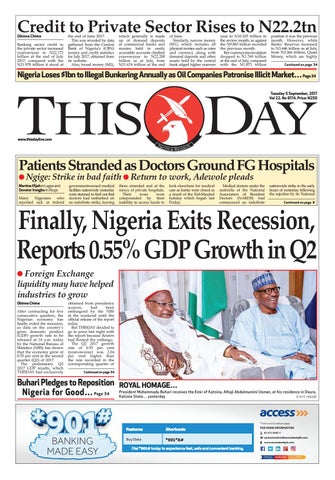
Finally, Nigeria Exits Recession, Reports 0.55% GDP Growth in Q2 Foreign Exchange liquidity may have helped industries to grow Obinna Chima After contracting for five consecutive quarters, the Nigerian economy has finally exited the recession, as data on the country’s gross domestic product (GDP) growth rate to be released at 10 a.m. today by the National Bureau of Statistics (NBS) has shown that the economy grew at 0.55 per cent in the second quarter (Q2) of 2017. The preliminary Q2 2017 GDP results, which THISDAY had exclusively
obtained from presidency sources, had been embargoed by the NBS at the weekend until the official release of the report today. But THISDAY decided to go to press last night with the report because Reuters had flouted the embargo. The Q2 2017 growth rate of 0.55 per cent (year-on-year) was 2.04 per cent higher than the rate recorded in the corresponding quarter of Continued on page 34
Buhari Pledges to Reposition ROYAL HOMAGE… Muhammadu Buhari receives the Emir of Katsina, Alhaji Abdulmumini Usman, at his residence in Daura, Nigeria for Good… Page 34 President Katsina State… yesterday state house
2
T H I S D AY TUESDAY SEPTEMBER 5, 2017
Nothing to declare. Get the GTBank Dollar Card.
For more information, kindly visit www.gtbank.com/cards
T H I S D AY TUESDAY SEPTEMBER 5, 2017
3
4
T H I S D AY TUESDAY SEPTEMBER 5, 2017
T H I S D AY TUESDAY SEPTEMBER 5, 2017
5
6
T H I S D AY TUESDAY SEPTEMBER 5, 2017
T H I S D AY TUESDAY SEPTEMBER 5, 2017
7
T H I S D AY TUESDAY SEPTEMBER 5, 2017
9
10
T H I S D AY TUESDAY SEPTEMBER 5, 2017
11
T H I S D AY TUESDAY SEPTEMBER 5, 2017
ZZZ ZHPDEDQN FRP
/HWȇV KHOS \RXU EXVLQHVV
5(&(Ζ9( SD\PHQWV RQOLQH
)UHH SD\PHQW HQJLQH VHW XS )UHH VXSSRUW VHUYLFH
Ȑ5HFHLYH 0RUH )RU IXUWKHU HQTXLULHV SOHDVH FRQWDFW 3XUSOH&RQQHFW YLD
3853/( SXUSOHFRQQHFW#ZHPDEDQN FRP ZZZ ZHPDEDQN FRP
606 :KDWV $SS
12
T H I S D AY TUESDAY SEPTEMBER 5, 2017
T H I S D AY TUESDAY SEPTEMBER 5, 2017
13
14
T H I S D AY Ëž Ëœ ÍłËœ 2017
COMMENT
Editor, Editorial Page PETER ISHAKA Email peter.ishaka@thisdaylive.com
ASUU, STUDENTS AND THE EDUCATIONAL QUAGMIRE Charles Dickson argues for a functional education
T
he kind of debates we had then or the quotations you have to search for in the library just to speak at SRC meeting or congress when there was no google o! O su mi o. Wale Fatade The current Academic Staff Union of Universities (ASUU) industrial action enters its third week, and we all know the drill. And for patriotic minds we are left again asking what is wrong: is it the teacher, student, curriculum, infrastructure, the English premier league...and other foreign soccer leagues. We know that there is a dearth of basic instructional materials and infrastructure, poor remuneration of teachers, among other social factors that are facing particularly public schools in the country. Also as a teacher I have seen countless university students continue to exhibit shallow knowledge of the subject matter of their respective courses, poor command of the use of English language, poor knowledge of examination techniques, as well disregard for correct interpretation of questions before attempting them. I am not an expert in math, but I see students that lack requisite mathematical and manipulative skills for subjects involving calculations, while handwriting of some are illegible and their answers scripts are full of spelling errors. The condition is made unbecoming as students try to cut corners by engaging in various forms of examination malpractice in order to obtain marks, and this is done with parents and teachers as accomplices In 1968, Tai Solarin, writing in the Daily Times under the title, ‘The education we want must have technical bias’’ said, “A good many of us spat on the education we had yesterday, and of course what passes for education today. And there is, certainly, a stratum of our society that looks back, nostalgically, at the quality of yesterday’s education�. How many of us today can argue that this is not the truth, even the generation that had its education in 1980 now looks back with nostalgia. Our educational system today only sharpens the head to near pin end quality, but it also makes the possessors limb atrophied by long disuse. Our education is money centered. It is an education which goads the possessor asking, “What can my country do for me?� not as J. F. Kennedy requests immortally, “what can I do for my country?� In 2017 we are left to define the quality of education we want for tomorrow when our peers have gone far in Japan, Malaysia, Singapore; neighbouring Ghana has even refused to wait for us. To chart out how to tread to win through we now send our kids anywhere so far it is outside the country; the education is better, be it Iraq or Zimbabwe. Solarin had asked that we bring in functionality into our education. He said: “There is, I think only one significant thing we want in our education for tomorrow-FUNCTION. That we arm our children with functional education.� However, today, the education is not functional, we have unemployable graduates, because we care less about the structure and systems. While Tai anchored his stand on state-owned schools as an atheist, I advocate government’s participation as matter of social contract and responsibility to the people. That way we could boast an education that ‘Lives’.
OUR EDUCATION IS MONEY CENTERED. IT IS AN EDUCATION WHICH GOADS THE POSSESSOR ASKING, ‘WHAT CAN MY COUNTRY DO FOR ME?’
Today what is the value of the education given to a young man who lives or is doing his mandatory service year in a guinea worm-infested area and yet is incapable of causing a revolution in the lives of the villagers by transforming their drinking water into healthy supply? Today every graduate desires Shell, Chevron, MTN, GTBank, etc. Please what is the use of education given in physics to a young girl when the lights go out, she does not know what to do to get light again? In Nigeria, how many graduates can carry aloft an oasis of light? Very few because the education is short on quality and is therefore poor. What the federal government wants out of the system is what it would get, if it cares less about teachers, infrastructure, curriculum, and the students, it would get what is currently on sale. We are of the opinion that our education should be one that gives the three-Rs Reading, ‘Riting and ‘Rithmetic. During the formative years, our kids should be made to know that they are members of a society to which they owe so much, not the present Tokunbo arrangement. Today how many young persons want to go home and at the beginning of the year cut the bush in readiness for the New Year’s planting; making of garri or pounding the yam or preparing the ‘ewedu’ soup? If these children do not participate how can they be integrated into the society? If all the values they see are big cars, big mansions, how they integrate should not be surprising. In an essay on the National anthem I deplored a situation where kids could no longer recite the nation’s national songs. Are these children taught to sing or compose songs? Folk songs Solarin sang during his time are still being sung, hardly enriched. In our secondary schools boys should not only cultivate farms communally but also individual boys should during their last years in school own plots which they should run in the modern way of rotation farming, getting dirty at the farm and yet appearing clean in the classroom. The only minus to the above is that today agricultural science is a theoretical subject and schools do not even have farms no more; University of Agriculture takes more students for Law than Agricultural Extension courses. The boarding system which was the best is gradually fading or negatively modernised, it was where we learnt to queue up, collect our food, sit down at prescribed tables and organise the cleaning of those tables; washing up by all who partook of the food. However today as ASUU continues its ritual of government negotiation, one wonders where are the students who should be leading the charge, where is NANS‌ Is the education being given to our children today, capable of giving us a newer and nobler Nigeria? Is the continuous killing of our educational system deliberate? Is any effort being made to change the status quo? Do we really care, or we are safe politicising the entire structure; whether it is the removal of history or the addition of faith- based subjects, or the abysmal reduction of university entry score? The naked dance continues, but for how long—only time will tell. Dr. Dickson is a Freelance Journalist
A SPLASH OF RUBBISH
M
Yinka Odumakin’s attack on Adams Oshiomhole, former Edo State Governor, is ludicrous, writes Segun Arogundade
uch as the proliferation of columns in Nigeria’s print media today offers a plethora of perspectives to public issues, the downside is the high incidence of abuse. A vivid illustration is a piece entitled “The disintegration of Oshiomhole� written by Mr. Yinka Odumakin, a self-styled “Yoruba leader�, published in his column in Vanguard of Tuesday (August 29, 2017). Maybe, I should begin by explaining myself. I am a keen follower of political events in Nigeria, though neither a sympathiser of All Progressives Congress nor Peoples Democratic Party. However, based on my own deep knowledge of the events Mr. Odumakin wrote erroneously about, I thought I am morally obliged to weigh in in public interest. In an attempt to settle personal scores with Comrade Adams Oshiomhole, the slayer of PDP godfathers, Odumakin literally went berserk, audaciously descended into libel, dressing hear-say as facts and passing judgment based on utter falsehood. Barely disguising his malice, he conveniently took off with the “unpopular view� reportedly expressed by the former Edo governor at the colloquium organised by the Nigeria Labour Congress two weeks ago on restructuring - the burning issue of the day. To be sure, I watched television footage of the event at issue as well as reports by at least four of the leading national dailies. Contrary to the spin by a section of the press, I don’t see anywhere where Comrade Oshiomhole spoke against devolution in
a manner that would obstruct good governance of the country or impede the deliverance of succour directly to the long-suffering masses of Nigeria. Comrade Oshiomhole is not just a talker, but also a doer, as can be verified from his stellar performance as two-term governor of Edo State. The memories of the likes of Odumakin may be short, but the real Nigerian workers will certainly not forget the man who never failed to champion their cause, even as Edo governor. When it was most “unpopular�, Oshiomhole once broke ranks with his fellow governors to join NLC street protest in Abuja, demanding that the N18,000 minimum wage remain sacrosanct. Just as Edo teachers will certainly not forget who pioneered the payment of TSS in 2011 when the relatively “richer� states were foot-dragging. I think Oshiomhole’s only point of departure was the view that rather than be fixated on the current elite game of endless “talk talk� on restructuring, we should not forget to channel more energies towards evolving ideas that will immediately better the living conditions of the masses of Nigeria. He definitely speaks from rich hand-on experience in political office and genuine concern for the poor at the receiving end of the harsh economic climate today. In any case, having also been a two-term president of the NLC, a pan-Nigerian institution for that matter, how do you expect Oshiomhole to, at this point, descend so low as to be mouthing divisive or separatist rhetoric being indulged in by ethnic entrepreneurs and sectional irredentists like the Odumakins of this world? NLC only
recognises one Nigeria. NLC is religion-blind and ethnicity-void. That is the pan-Nigeria movement Oshiomhole represents and on whose behalf he speaks. However, the former Edo governor expressed misgivings at what he described as the desperate attempt to hijack the restructuring debate by PDP and its apologists who he believes rather view it primarily as a tool to attack and vilify the ruling APC of which he is a proud member. Oshiomhole’s “yabis� against PDP is what I think actually annoyed Odumakin. If truly Odumakin and his co-travellers were truly sincere about implementing the recommendations of the 2014 confab report and were so committed to “restructuring� then, how come they could not persuade their PDP paymaster then to implement aspects of the proposal that did not require legislative reengineering? These were the factual points Oshiomhole was trying to make, but which the Odumakins of this world are now labouring futilely to twist out of context. To show how jaundiced he was against Oshiomhole, Odumakin raked up the issue of the ultra-modern Five-Star Hospital in Benin for which the former governor has been praised by all and sundry, but which PDP has expectedly been battling to discredit. Thank God, no one is accusing Oshiomhole of laying claim to a structure that does not exist, as was the case under PDP. The truth of the matter is that Edo now has a new governor in person of Godwin Obaseki who appears to have a different
view on how best to manage the hospital. The latter, being a technocrat, believes the edifice and its modern appurtenances are better left not in the hands of civil servants, but managers from the private sector to be given strict targets to deliver value to the public and the investor (government). Should Oshiomhole now be crucified for Obaseki’s different idea? But, for God’s sake, what has the Benin hospital got to do with the colloquium in Abuja? To hatchet men like Odumakin, a connection had to be made, no matter how ludicrous. He devoted a huge space in his pathetic write-up to quote all the foul things earlier uttered by the voluble chairman of Edo PDP, Mr. Daniel Orbih. Just to get at Oshiomhole. What a shame! Most pathetic of all drivel written by Odumakin is his attempt to belittle Oshiomhole’s remarkable achievements as an individual who rose from humble background to national limelight and his monumental contributions to the labour movement in the last three decades as a committed unionist. It is pointless even replying Odumakin here. Right-thinking Nigerians already know the truth. Overall, it is a measure of the political tragedy of Nigeria today that in an environment where you have the likes of Chief Olusegun Obasanjo and Asiwaju Bola Ahmed Tinubu, both phenomenally accomplished in politics and professional calling by any standard, people like Odumakin will take liberty to parade themselves as “Yoruba leaders�. Comrade Arogundade wrote from Ilasa, Lagos
15
T H I S D AY Ëž Ëœ ÍłËœ 2017
EDITORIAL THE SEARCH FOR MISSING PERSONS
N
The authorities could do more to end the anxiety of relatives
igeria, last Thursday, joined the rest of the world to honour the disappeared and missing. The National Technical Committee on the Establishment and Management of Missing Persons Database in Nigeria (NTC) also used the occasion to renew the call on the authorities in the 36 states and other stakeholders to “now, more than ever, work together to ensure that identities of those missing are not lost forever�. We must commend the NTC for helping to draw attention to all the people within our various communities whose whereabouts remain unknown. For the affected families, living through the ordeal of having a missing relative can be a most traumatic experience. And at a time the nation is grappling with the challenge of human trafficking, it is worrisome that many Nigerians are leaving their homes and workplaces without coming back. Available records indeed revealed that while some missing persons have been found after some days, weeks or months, sometimes in locations far away from home, others are never found, thus prolonging the anxiety of their family members who would forever THE SITUATION HAS wonder whether they are BEEN COMPOUNDED BY dead or still alive. INSUFFICIENT OR LACK Meanwhile, the OF NATIONAL DATABASE humanitarian and OF PERSONS IN NIGERIA, human rights crises resulting from activities MAKING IT NEARLY of criminal gangs, insurIMPOSSIBLE TO TRACE AND REUNITE DISPLACED gents, political unrest, AND MISSING PERSONS IN communal and religious conflict, kidnappings, THE COUNTRY have continued to pose challenges to government at all levels in Nigeria. Many of these activities have led to some senseless killings with monumental casualties among the civil populace aside the forced displacement and disappearance of people leading to numerous cases of unaccounted and missing persons. In addition, there are hundreds of unknown victims lying in our mortuaries, hospitals and detention centres while their relatives continue to search for them.
Letters to the Editor
I
The foregoing situation has been compounded by insufficient or lack of national database of persons in Nigeria, making it nearly impossible to trace and reunite displaced and missing persons in the country. As a result, many persons are unaccounted for, with loved ones and family members unable to confirm their status and therefore unable to have the much-needed closure.
I T H I S DAY
EDITOR DEPUTY EDITORS ˜ MANAGING DIRECTOR DEPUTY MANAGING DIRECTOR CHAIRMAN EDITORIAL BOARD
EDITOR NATION’S CAPITAL
T H I S DAY N E W S PA P E R S L I M I T E D
EDITOR-IN-CHIEF/CHAIRMAN GROUP EXECUTIVE DIRECTORS ˜ ˜
˜ GROUP FINANCE DIRECTOR DIVISIONAL DIRECTORS ˜ ˜ DEPUTY DIVISIONAL DIRECTOR
SNR. ASSOCIATE DIRECTOR ASSOCIATE DIRECTORS ˜ CONTROLLERS ˜ ˜
GENERAL MANAGER
GROUP HEAD DIRECTOR, PRINTING PRODUCTION TO SEND EMAIL: first name.surname@thisdaylive.com
TO OUR READERS Letters in response to specific publications in THISDAY should be brief (150-200 words) and straight to the point. Interested readers may send such letters along with their contact details to opinion@thisdaylive.com. We also welcome comments and opinions on topical local, national and international issues provided they are well-written and should also not be longer than (9501000 words). They should be sent to opinion@thisdaylive.com along with the email address and phone numbers of the writer.
BWARI COMMUTERS AND BAD ROADS
t is a common all over the country today as urchins and jobless youths take to road repairs to elk out a living. The vacuum created by the absence of federal roads maintenance agencies made it possible for this army of the unemployed to resort to voluntary road rehabilitation work for instant reward. They wave to motorists plying the roads for reciprocation. Bwari Area Council has its own fair share of this voluntary public work army of the jobless. Bwari area council is one of the six area councils in the Federal Capital territory. It is strategically ensconced between hard high-rise rocky hills that border Niger and Kaduna States. The natural monument gives the area its beautiful and splendid panoramic view accentuated with conducive atmospheric ambience. Bwari village, which over time has been undergoing rural urban gentrification is host to the Nigeria Law School, JAMB headquarters, Usma Dam, Military Defence Camp, Bwari Pottery and other private hospitality services. This process of rural gentrification perhaps was occasioned by the location of the area council secretariat on the land. Since then, other intervening social factors have helped in triggering influx of people, trade and services into the area. Top among these factors is the threat of demolition and actual demolitions in some parts of the FCT in the past. Another worthy factor of note that escalated the influx is the worsening economic crisis. The centre
n a bid to create a platform for addressing this challenge, the National Human Rights Commission (NHRC), in collaboration with other government ministries, departments and agencies (MDAs) and civil society organisations, has commenced the process for the establishment and management of missing persons’ database. The committee is expected to establish a platform for public engagement, as well as come up with a comprehensive database registry of missing and unaccounted-for persons in Nigeria. The idea is to enable integration with existing data, continuous updating, as well as for the collection, verification and sharing of useful information aimed at bringing relief and closure to families and the missing persons, in conformity with the standards on the protection of personal and sensitive information. The committee is also expected to carry out other measures necessary to investigate and verify pertinent information, including the recovery and identification of human remains while engaging with relevant stakeholders for appropriate measures to be taken in resolving cases of missing and unaccounted for persons. That would necessitate follow up, assessment and clarification, as well as providing information to the relevant enquirers (families or authorities) relating to the fate of missing persons and, if found dead, the location of the human remains. However, the establishment of a National Database of Missing Persons in Nigeria does not attempt to attribute responsibility for the deaths or the disappearance of any missing person, nor would it make findings as to the cause of such incident. It is, rather, an independent humanitarian mechanism that aims at responding to the rights of the families to know the fate and whereabouts of their missing relatives, a need often considered by the families as priority, if it can provide them with meaningful answers.
has become too expensive for the average income earners. Artisans and traders are perennially under siege by government agents over environmental related laws and its violations. Hence, given the contiguity of Bwari to AMAC, it becomes the refugee location for all those fleeing from pain, embarrassment ensuing from constant harassment. This influx has mixed impact on the host community as available land and roads came under severe utilisation and stress. The village became over populated and very sordid, lacking sanitation and social amenities. The roads came under severe decline due to over use and lack of maintenances and rehabilitations. For vehicle owners and commuters alike, the fear of Bwari road is the beginning of wisdom. What would have been a sigh of relief for the residents is the urban mass transport service. This relief was cut short no sooner than it started. Reasons abound as to why the service has been far from the expected objectives right from the outset. The fleet deployed on that route is hardly sufficient due to huge population of commuters. Bwari residents overflow to encompass adjourning areas like Kuduru village, Kichiko after Law School, Garam in Niger State and all the settlements enroute Dutse town. It is a long stretch of rural road commuted on a daily basis by numerous suburb dwellers. It is home to many who commute from the city arterials to their various places of endeavour. Comrade Ogbu A. Ameh, Author of In The Struggle
APC: STOP DOING THINGS TECHNICALLY
W
henever the ongoing administration under the leadership of President Muhammadu Buhari, announces that it has achieved or rather defeated something technically, it shows that it is not over. Before now, Nigerians were told by President Buhari and his team that “Boko Haram terrorists have been technically defeated�. Are the terrorists no more killing? Are they no more bombing? Are they no more holding Chibok girls hostage? Note that one of the promises made by President Buhari during his campaign rallies was to defeat Boko Haram terrorists completely and not technically. Why has he done it technically instead of completely as he promised? Therefore, I can now see why Nigerians are complaining; I can now see why the federal government can order the court to re-arrest IPOB’s leader, Nnamdi Kanu but the same government cannot order for the arrest of Arewa Youths that called for the vacation of Igbos residing in the northern part of the country. I can now see why my petition against ITF office is still pending at the EFCC head office in Abuja; I can now see why Nigerians are angry; I can
now see why Nigerians are hungry; I can now see why Nigerians are suffering; I can now see why Nigerians are agitating; I can now see why Nigerians are calling for restructuring; I can now see why Arewa Youths issued quit notice to Igbos; I can now see why Fulani herdsmen have joined Boko Haram terrorists to massacre Nigerians; I can now see why education sector is not improving; I can now see why the healthcare services are still poor; I can now see why the corrupt APC members cannot be arrested by EFCC; I can now see why prostitution business is booming; I can now see why men of the Nigeria Police Force cannot prevent Arewa Youths from protesting but can prevent Charly Boy Oputa and his members of “Ourmumudondo�. However, if the ongoing administration under the leadership of President Buhari can immediately start doing things completely and not technically, the above listed issues and more won’t be experienced again. After that, understanding, peace, love, unity and development can be achieved. Note that the word “technically� is presented and explained here based on how it has been used by the administration in her fight against Boko Haram terrorists. Awunah, Pius Terwase, Mpape, Abuja
16
T H I S D AY ˾ TUESDAY, SEPTEMBER 5, 2017
POLITICS
Group Politics Editor Tobi Soniyi Email tobi.soniyi@thisdaylive.com 08033146139 SMS ONLY
EXECUTIVE BRIEFING
Too Weighty to Be Ignored Davidson Iriekpen posits that the allegations of shady dealings levelled against the Inspector General of Police, Ibrahim Idris, by the senator representing Bauchi Central Senatorial District, Isah Missau will do incalculable damage to President Muhammadu Buhari’s anti-corruption war if not investigated.
T
he senator representing Bauchi Central Senatorial District, Isah Mohammed Misau, stirred the hornets’ nest two weeks ago when he raised allegations of monumental corruption against the Inspector General of Police (IG), Ibrahim Idris. Misau at a press conference in Abuja, alleged that the police authority was fighting him because he was opposed to the mismanagement of human and material resources under the current IG. According to him, aside from huge sums generated from corporate organisations and important personalities who require police protection, the IG, he said, has also formed the habit of attaching policemen to known criminals like drug dealers who can pay for the services of having police orderly. He said more than 50,000 men of the police are being used as “body guards” while the common man on the streets are left without protection. He said police under Idris is “a cesspool of corruption, nepotism, indiscipline, favouritism and lowest level of morale that must not be allowed to continue in the interest of the on-going anti-corruption war and there is urgent need to stem the tide of increasing rate of crime and criminality in the country. “The incumbent IG based on available records and series of petitions and reports from insiders, has no capacity to run the police. Specifically, the IG on good authority from within the force, collects over N10 billion on monthly basis as money for special security provided by men of the force to corporate bodies and highly placed individuals including criminals, running to N120 billion on yearly basis without any reflection in police annual budgets or internally generated revenue.” He said: “Let me give you an example of the so many corruption cases that are taking place. More than 10,000 policemen are working with oil companies and every month the companies are paying money. Where is the money going? Is the money going into the federal government’s coffers or into some people’s pockets? We have over 10,000 officers working in banks. Are they paying money to the federal government? Who are they paying the money to? Where is the money? We have policemen in thousands working for companies and private individuals. Go to the airports and you will see that people of questionable character have policemen attached to them. Are they paying money to the federal government? Why should the federal government train a policeman, give him uniform and gun; and then he is passed to an individual who will not pay anything to the federal government. Is that right under President Muhammadu Buhari’s administration? Last week, an organisation accused the Nigeria Police of bribery. Am I the person who said it?” While Nigerians are inundated with claims of inadequate funding, the police have never explained what they do with the funds realised from security protection operations officers of the force render to very important personalities, corporate organisations, and institutions. The questions that readily come to mind are: Are these security protections free? If they are not, how much do these organisations pay for a police personnel and where does the money go? The force has however denied any wrong doing and described the allegations as base less. The Police Public Relations Officer, CSP Jimoh Moshood, said any attempt by the senator to disparage the IG, Idris, would not work. In a statement, he said: “The force’s attention was drawn to the publications in the media which the caption ‘Senator accuses IG of cornering N10billion monthly IGR, taking bribe to post CPs to juicy states’. It’s expedient to disabuse the minds of members of the public, most especially the people who must have
Will the president order his probe?
read the story or listened to the fabricated lies, unsubstantiated allegations and shallow imaginations of a personality claiming to be a senator with premeditated evil plans to incite the public against the Nigeria Police Force. The misleading, misrepresentation of facts and concocted allegations by the senator against the IG and the Police Force are unfounded fallacies aimed at casting aspersions on the renewed commitment of the Force to ensure law and order as well as protect the lives and property across the country.” Last June, the IG said the major challenge confronting the organisation in executing its constitutional responsibility of effectively policing the country was the paucity of funds, as the annual budgetary allocation for the force is grossly insufficient. He stated that he was already discussing with the leadership of the National Assembly to revive the Police Trust Fund Bill currently at the National Assembly. He said if passed into law, the bill would make more funds available to the force because its funding will come from first line charge as states, local governments and private organisations will be expected to make contributions to the trust fund. He said: “During the security summit we held in Abuja recently I said that the police is under funded and that we want to revive the Police Trust Fund Bill and we are in touch with the leadership of the National Assembly and when passed into law it is going to be a first line charge as private organizations, states and local governments will contribute to the fund.”
The question is: will the allegations be investigated or will President Muhammadu Buhari set up another administrative panel to investigate alleged crimes?
Tow weeks ago, Idris also complained to the House of Representatives Committee on Police Affairs that ‘budget allocation to the force is grossly inadequate despite the increasing security challenges it has to contend with. He said the force was granted N9.2 billion to cover overhead costs but received N6.3 billion. That was about 68.5%. Out of the N283 billion appropriated for personnel, N273 billion or about 96.5% was released with the consequence that the force could not pay promoted officers their due entitlements, and could not meet its commitments to the Police Cooperative Society, the Federal Inland Revenue Service and the National Housing Fund. According to him, capital project allocations have suffered underfunding too. In 2015, for instance, the force received only N8.9 billion or 50% of the N17.8 billion appropriated. However, each time successive IGs, including Idris, reel out these figures, they have never disclosed to Nigerians how incomes running into billions of naira accruing to the force from proving protection to VIP and others are spent. “I am sure there are over 9,000 bank branches across Nigeria, and there is branch that you will go that you won’t find at least two policemen. Some, you will see up to four. The chief executive officers of these banks and chairmen have policemen protecting them and guarding their houses and some as escorts. How much do they pay and how are these monies remitted? Thank God this issue is coming up at least for once. Because nobody has ever asked these questions. “Even the VIPs and all Tom, Dick and Harry go about with police escorts. How much do they pay and which accounts do these monies enter? There is no IG in this country that has ever disclosed this. All they tell Nigerians is that the force is inadequately funded,” said a Lagos-based lawyer who did not want his name in print for security reason. Many analysts wonder what the police force does with these funds when in actual fact, the state government practically fund the organization at the state level For instance, in the last 20 months, it is believed that the police force has received over 850 patrol vehicles from 13 state governments. The force also received 700 motorbikes, 30 Armoured Personnel Carriers (APCs), three choppers, 10 gunboats, and eight ambulances from May 29, 2015 to date.
The highest donor to the force is Lagos State, which donated 295 patrol vans, 450 power bikes, three helicopters, two gunboats, 15 APCs within the period under review. The state also acquired revolving lights, sirens and public address systems, vehicular radio communications, bullet-proof vests and helmets for the police. Kaduna State followed with a donation of 107 new patrol vehicles fitted with communications equipment, three ambulances, five space buses, 50 police surveillance patrol motorcycles, 30 Cruiser motorcycles, and 135 walkie-talkie sets. Kogi State donated new ford vans; Rivers states donated 30 patrol vans; Kano donated 27 new Toyota Hillux vans, three Volkswagen Golf cars; Anambra gave 25 new Toyota Camry saloons; Abia 20 SUVs; Bauchi nine Hillux vans, and Bayelsa four refurbished APCs. A report released recently by the National Bureau of Statistics (NBS) and the United Nations Office for Drug and Crimes (UNODC) indicted the police officers as part of the most corrupt public officials in Nigeria. The 2017 National Corruption Survey said 46.4 per cent of Nigerian citizens have had “bribery contact” with police officers, 33 per cent with prosecutors and 31.5 per cent with judges/magistrates. The survey, tagged: ‘Corruption in Nigeria Bribery as Experienced by the Population’ also revealed that custom officers, judges, magistrates and prosecutors were the public officials who received the largest average cash bribes. The survey also listed police officers and tax/revenue officers as public officers to whom the highest number of bribes were paid. It said 29.7 per cent of all bribes are paid to police officers upon a direct request before the service is provided. Coming on the heels of the NBS report, one would have expected anti-corruption agencies to swing into action. The Presidency is also looking the other way. This is why an anti-corruption group, United Global Resolve For Peace, has called on the federal government to commence immediate investigation and prosecution of Idris over the allegations. In a statement issued in Abuja by the Executive Secretary of the group, Mr. Pelumi Olajengbesi, the group said that Nigerians have lost total confidence in the police as a result of the ineptitude of its leadership.The question is: will the allegations be investigated or will President Muhammadu Buhari set up another administrative panel to investigate alleged crimes?
17
T H I S D AY ˾ TUESDAY,SEPTEMBER 5, 2017
POLITICS
Ambode’s Case for Devolution of Power
The urge to unleash the potentials of Lagos State is behind the state governor, Akinwunmi Ambode’s craving for devolution of powers, writes Gboyega Akinsanmi
T
he debate for a restructured Nigeria reached a high point last week. Three main positions by critical actors attested to the necessity of a truly negotiated restructured Nigeria, which former Vice-President, Alhaji Atiku Abubakar said, was a fundamental condition for economic growth and political stability. The first position was made by the Southern Leaders’ Forum. The forum comprises notable socio-political figures in the South-west, South-east and South-south. At a meeting n Lagos the forum rejected President Muhammadu Buhari’s standpoint on restruturing. The forum argued that Buhari’s attempt “to play down the demand for the renegotiation of Nigeria is untenable.” It, thus, said only restructuring “will guarantee the unity, peace and development of Nigeria.” It also strongly cautioned the president against the use of force to address public dissent. The second position emanated from the resolution of the Southern Leaders of Thought after a meeting also held in Lagos. The group comprises such leaders as Prof. Ben Nwabueze, Chief Emeka Anyaoku, Prof. Akin Oyebode, Prof. Pat Utomi, Chief Ayo Adebanjo, Obong Victor Attah, Admiral Ndubisi Kanu, Chief Donald Duke, Gen. Alani Akinrinade, Prof. Kimse Okoko and Chief Tola Adeniyi among others. Like the forum, the group demanded a negotiated restructuring implemented through a new constitution, which it described as the best assurance for the realisation of collective desire for one Nigeria. It, therefore, rejected Buhari’s proposal that the National Assembly and Council of States “are the two legitimate bodies to people’s demand for political restructuring.” It equally warned against imminent trouble. It said the trouble would ensue if the federal government “fails to accede to people’s yearning for a new political order that equity, fairness and justice.” It warned that the trouble would not erupt because people “are demanding a negotiated restructuring.” Rather, it argued, the trouble would ensure because the present leaders did not honour people’s will. Undoubtedly, the two groups have been active in the political space in the last two years, ardently demanding a new political order and disputing the claim that the unity of Nigeria is not negotiated. Amid the debates on the positions of the two groups, last week, the Lagos State Government reeled out its own position on restructuring on two different occasions. And its position was the high point in the demand for a negotiated restructured Nigeria. It was the high point because Lagos was the first federating unit to publicly declare its standpoints in the debate for a fair federal order. The first occasion was at the 57th Annual General Conference of the Nigerian Bar Association (NBA) held in Lagos. At its opening session, the state governor, Mr. Akinwunmi Ambode urged legal practitioners “to support the demand for devolution of power and fiscal federalism.” He demanded a review of the subsisting revenue allocation regime, which according to him, put the national government at advantage. In a rather radical manner, Ambode declared the conference open with the demand for a true federal democracy, which he believed, would redress all the aberrations created by the military. These aberrations, he argued, had stunted and inhibited the capacity of the federating units “to harness the huge potentials of our nation.” Aside, he said, the demands were to create an enabling environment that would accelerate development in all parts of Nigeria. After Ambode had declared the conference open, the Secretary to the State Government, Mr. Tunji Bello also addressed a session that focused on Lagos. Bello, also an attorney, noted that Lagos could “have been the African version of a Hong Kong. However, the challenge before us is first to overcome the obstacles posed by the present federalist structure.” At the session, Bello pointed out aberrations inherent in the current federal order one after the other. First, he observed, the current federal practice “is skewed and military in nature.” Second, he rejected a proposal that would give the
Ambode...wants states to have more powers
power to conduct local government elections to the Independent National Electoral Commission (INEC). Third, he disapproved a regime that currently “allows the federal government to take 52.68% from the Federation Accounts, leaving 26.72% and 20.60% respectively for state and local governments.” Even by logic, he argued, a federation derives its strength from its constituents. He cited the 1960 and 1963 constitutions, which he said, largely guaranteed the constituents some level of autonomy and independence. Under the regimes, Bello noted that the founding fathers of Nigeria “obliged us with constitutions that guaranteed that each region kept 50% of its natural resources. “Each region contributed 20% to the federal government, and the remaining 30% was shared by all the regions on the basis of need. Unfortunately, today, our nation has unwittingly locked up itself and it urgently needs to free itself so that the full potential of our country in its entirety can blossom. It is time to move forward and truly practise what is just for a true federation.” He therefore, canvassed the need to institutionalise the principles of true federalism, which he said, formed the core attributes of the 1960 and 1963 constitutions. By implication, he explained the essence of true federalism, which according to him, is “to exploit the untapped and hidden potentials of each state, create employment opportunities for the large army of unemployed youths and guarantee a better future for us all.” Ambode had earlier captured it graphically
In a rather radical manner, Ambode declared the conference open with the demand for a true federal democracy, which he believed, would redress all the aberrations created by the military
in a position paper he presented before the Constitutional Amendment Committee of the National Assembly on July 14 when he described the defining feature of federalism “as the autonomy and recognition of the separateness and independence of each government that makes up the Federation.” Founded on this premise, thus, Ambode asked five salient questions, which he said, should shape the push for a new federal order. The questions include: “Why states should be precluded from performing several important constitutional responsibilities? Why does the federal government hold legislative and executive powers on matters of local concern which over-stretch its administrative and supervisory abilities? Why should the Land Use Act, NYSC Act, Code of Conduct Act form part of the 1999 Constitution? Other questions are: “Should we not have a sharing formula that ensures that state and local governments are empowered to discharge their constitutional responsibilities? Should our constitution not confer power on state houses of assembly to establish state police with clear jurisdiction and well-articulated protocols for the regulation of its relationship with the federal police?” In a nutshell, Ambode identified five major areas Lagos State “wants amendment to the 1999 Constitution.” First, he cited devolution of powers based on the principle of appropriateness, which he said, should guide the sharing of powers between the federal and state governments. He deplored an arrangement that guaranteed the national government both legislative and executive powers on matters of local concern. He explained that the country’s political experience and long era of military rule “has resulted in the Exclusive Legislative List being tilted heavily in favour of the federal government at the expense of the state governments. The effect is that while the states are precluded from performing several important constitutional responsibilities, the federal government is equally unable to function effectively.” Second, Ambode demanded the removal of the Land Use Act from the constitution, which he said, was an aberration in any federal practice. He said it was the position of Lagos State that the Land Use Act “be separated from the constitution and made applicable only to the Federal Capital Territory. Land has always been and should remain a residual matter for the state houses of assembly to legislate upon, hence the Land Use Act should become Land Use Law of the states.” Third, he demanded a new revenue allocation regime. He said the current revenue allocation
formula “has created a glaring and unacceptable imbalance in the financial resources of the three tiers of government.” The implication of the current allocation regime is huge. He then canvassed a fair revenue allocation regime, which he proposed, should be limited “to federal and state governments. Since local governments are to come under the purview of the states, allocations to them should be shared to states as they can have as many local governments as they wish. The 774 formula is inequitable.” As the former federal capital territory of Nigeria and its economic nerve centre, Ambode proposed an amendment that would accord Lagos State a special status. Across the world, he argued, it is a standard practice taking into cognisance of its high population density and the influx of citizens from all geo-political zones into the state by the day. The case of Lagos, he said, should not be different. Fourth, he cited the inability of the federal government “to prioritise and provide the resources that are necessary to pay, equip and train policemen to the level required by the challenges they face.” He provided a graphic illustration to support his demand for state police. Across the federation, he said, security challenges have constituted grave threat to lives and property. He explained that the Nigeria Police “has only 300,000 officers compared to a population of 186 million.” By analysis, a police officer has a duty to provide security for 620 citizens daily. As Ambode argued, this analysis obviously shows that Nigeria is grossly under-policed. Aside, he said the inadequacy “is most keenly felt in the more populated areas of Nigeria like Lagos and in spite of a growing army of educated job seekers flocking the cities. This inadequacy in the number of policemen has not been remedied due to funding constraints and administrative inefficiencies of the Nigeria Police itself.” Ambode’s last demand centres much on the need to scrap the Federal Land Registry. His request was based on a federalist argument that the national government “can only exercise in reality some powers or responsibilities that the federating units are willing to surrender or let go for the purpose of national defence, foreign policy, common currency, international trade and immigration…” He argued that it was an aberration for the federal government “to continue to operate land registry in Lagos State. The Federal Land Registry which was established when Lagos was Federal Capital Territory ought to have been closed down and all title therein moved to the Lagos State Land Registry.”
18
TUESDAY, SEPTEMBER 5, 2017 ˾ T H I S D AY
FEATURES
Acting Features Editor Charles Ajunwa Email charles.ajunwa@thisdaylive.com
Where Will You Spend Your Twilight Years? Solomon Elusoji recently visited an old people’s home in Lagos and wonders about the manner in which we treat the aged
One of the rooms at Purple Square
S
ometime in 2015, in Calabar, some persons, stricken by dotage, were thrown out by their families for being in possession of witchcraft powers. Although it was an isolated incident, it is a symbolic commentary on what it means to grow old in a Nigerian society. In Nigeria, “older people’s lives are characterised by growing inadequacies in customary family supports, social exclusion and non-existent social security targeted at them, thus being very vulnerable to poverty and diseases,” an instructor at Covenant University’s Department of Psychology, Dr. Adekeye Olujide said, in a paper published in 2011 by the Network for Health, Education and Welfare of Special People. The conditions of old people – and societal expectations – in Nigerian communities are not a Hamlet-esque story though. If they escape the witchcraft tag, they are revered as monuments of wisdom and command a great deal of respect from the young generation. A Yoruba proverb suggests that what a child sees from climbing a tree, an elder sees by just sitting on a chair. The nurture sociology model of most Nigerian communities, too, is shaped like a cycle. It starts from a parent raising and nurturing a child and then the child nurturing and lowering the parent, as careful as possible, to the grave. And then the process is expected to be repeated. But what happens in a world when the nature of that cycle is being threatened? If the 20th century was the age of machines, this century is the age of information, a phe-
nomenon which has given rise to fast living
Today, in well developed countries, nursing homes have become a standard form of care for the most aged and incapacitated persons. These homes ensure they receive proper nutritional, psychological and medical care, providing an easy transition to the Great Beyond. But in Nigeria, nursing homes are stigmatised. In fact, sending your elderly ones – especially your parent – is a sign of abandonment and irresponsibility
Oyinlola...caring for the aged
and fast expectations; more and more, young people are being forced to do whatever it takes to fast-track their careers and optimise their lifestyles, they – millennials – are being advised to live for themselves and make their mark, because life is fleeting and opportunities are scarce. Of course, these sorts of expectations take a toll. They become overbearing when there is a parent or sibling struggling with the biological consequences of old age who expects to be nurtured by family, hands-on; many resort to house-helps and other family members who are, ironically, constrained by the same dynamic limitations. The result is, unfortunately, that more people died less happier than they could have been when
the Grim Reaper showed up. Today, in well developed countries, nursing homes have become a standard form of care for the most aged and incapacitated persons. These homes ensure they receive proper nutritional, psychological and medical care, providing an easy transition to the Great Beyond. But in Nigeria, nursing homes are stigmatised. In fact, sending your elderly ones – especially your parent – is a sign of abandonment and irresponsibility. Other than the nutritional cycle model found in most Nigerian societies, the stigma arises from the fact that most of the nursing homes – there are about 13 of them – present in the country are not well equipped for the job. From cases of temporary abandonment to interruptions in the supply of basic amenities like food, water and power, the happiness which these homes are supposed to deliver is only a mirage. So, the first step in helping Nigerians adjust the nutritional cycle model, obviously, will be to provide standard nursing homes where quality care – as it relates to nutrition and mental support systems – is assured. A modern nursing home for the old This August, this reporter visited Anne Oyinlola at her Lekki residence. Mrs. Oyinlola is the founder of Purple Square Limited, a company she describes as a Senior Living Solutions Provider. “We provide temporary living solutions with day-to-day activities, within a home setting, for patients not required to stay at the hospital,” she said.
19
Ëž T H I S D AY TUESDAYËœ ÍłËœ Í°ÍŽÍŻÍľ
FEATURES Oyinlola grew up in Nigeria, attending Queens College, before going ahead to study Marketing at the American University of Applied Arts in Atlanta. She returned to Nigeria for the mandatory national youth service programme, worked for a while at UTC as a merchandise buyer, got married and then embraced a life of constant travel abroad. Now, she shuttles between Houston and Lagos. About five and a half years ago, her father passed on. But before he did, he had some health issues which required, not hospitalisation, but special care. The family got an in-house caregiver to attend to him, but Oyinlola always felt he could have had a better quality of life. “I am not saying the in-house care wasn’t good, but it wasn’t adequate,� she said. “He was just indoors. I felt he would have done better if he had other people to talk to, if he could go for a walk, do exercises, all in a nice, serene environment that would enhance his rehabilitation.� The concept of Purple Square started brewing within her. At first, she was sceptical of going forward with the idea after studying the dearth of such institutions in Nigeria and observing the nutritional cycle model. But after speaking to several of her Diaspora friends – most of whom had problems with taking care of their aged folks back home – she realised there was a gap that needed to be filled. She took a course on elderly care and interned with several convalescent homes around her Houston home before deciding to establish her first centre in Lagos. “We provide our patients with everything, with fully personalised care,� she said, “and this is done by working with the patient’s family.� For its patients, Purple Square offers doctor visits, physical therapy, dietary supervision, and active social participation through religious and inspirational visits. In essence, it is designed to be a bridge between the hospital and the home. “We give them their independence, encourage them to move around and assist them in the restoration of their well-being,� she said. When this reporter asked Oyinlola whether she would love to spend her twilight years in a home like Purple Square, she said “I wouldn’t want to be a burden to anyone, I would want to remain as active as possible, and that’s what Purple Square helps people achieve.� The next day after the interview with Oyinlola, this reporter took a trip to Purple Square’s debut home at Heritage Place in Sangotedo, a 41 minutes drive from the Lekki Toll Gate in Lagos. Heritage Place is a private estate just behind the still recent, sparkling Novare Mall. At the gate, security men requested formal invitation before granting access. The Purple Square homes – all stately bungalows – are the first buildings to the left. A lady – Blessing Atewogboye – opened the front door at the behest of a gentle knock. Blessing is a graduate of Mass Communication from Kogi State University and oversees Purple Square’s operations. “It is not easy to take care of old people, but we do an excellent job,� she said. Inside, the rooms are airy and comfortable. The furniture is coated in an endearing brown, the white ceilings perfectly complements cream-coloured walls (hallway colours are white). There is a front desk with a shelf of
For its patients, Purple Square offers doctor visits, physical therapy, dietary supervision, and active social participation through religious and inspirational visits. In essence, it is designed to be a bridge between the hospital and the home
Purple Square's reception room
The outhouse setting
An assisted-care washroom
supplements, toiletries and basic first aid. “We have an in-house doctor and specially trained nurses,� Atewogboye said. The medical personnel monitor every aspect of patient care. There is special attention paid to bathroom fitting, with the provision of support systems like hand rails and stools. A cursory inspection of the rooms, some of which have double beds (“I found out that not everyone wants to stay alone in a room,� Oyinlola says), is followed by a visit to the kitchen. “We have an in-house cook,� Atewogboye explains. Each patient,
upon admission, has a diet plan designed to encompass his or her specific requirements. There is also an outhouse with orthopaedic seats where patients can relax and share memories, a massage parlour – housed in an environmental friendly, beautiful red container for physical therapy, and a restaurant – with glass walls – built to encourage social interaction. Just in front of the bungalows is a small field. When this reporter was done with the tour, some boys were on it, engrossed in a game of soccer. The view, from the out-house,
is refreshing, therapeutic even. “I’ll not mind spending some of my last days here,� Atewogboye said, “I’ll love it; you have everything at your beck and call.� Although there were no old persons yet at Purple Square when this reporter visited – Oyinlola said they were already working with some hospitals – it is only a matter of time before the applications turn into an avalanche. However tempting it might be to argue the morality of altering the nutritional cycle mode, change is a constant thing. The 21st century demands different answers.
20
IMAGES
T H I S D AY Ëž Ëœ ÍłËœ Í°ÍŽÍŻÍľ
Photo Editor ĂŒĂ“Ă™ĂŽĂ&#x;Ă˜ ÔËÖË Email Ă‹ĂŒĂ“Ă™ĂŽĂ&#x;Ă˜Ë›Ă‹Ă”Ă‹Ă–Ă‹ĚśĂžĂ’Ă“Ă?ĂŽĂ‹ĂŁĂ–Ă“Ă Ă?Ë›Ă?Ù×
From left;Senator Ibikunle Amosun,Executive Governor of Ogun State;HRM Oba Sikiri Adetona,The Awujale of Ijebuland and Dr Suleiman Adebola Adeguwa,Chairman of the occassion.at the 2017 Ojude Oba festival at Ijebu ode Ogun state yesterday.
L-R; Dr. Kingsley Ekwe, Dr. Felix Ogedegbe, Medical director, Dr. Adedapo Olusanya, Dr. Martina Agberien, all of Cedarcrest Hospital and Lagos State Commissioner for Wealth Creation and Employment, Mr. Babatunde Durosinmi Etti, at the oďŹƒcial commissioning of Cedarcrest expansive hospital complex in Lagos...recently
L-R: The Amir, Ahmadiyya Muslim JamaĂat Nigeria, Dr MashĂhud Adenrele Fashola; Sadr, Majlis Ansarullah Nigeria, Alhaji Abdul Waheed Adeoye; Deputy Speaker, Kogi State House of Assembly, Hon. Hassan Abdullahi; The Ohimeje of Kotonkarfi/Chariman, Kogi/Lokoja Area Traditional Council, Alhaji Abdur Isa Koto; Representative of Chief Imam Lokoja, Muallim Muhammed Tahir ,and Chairman, Okehi L.G.Traditional Council, Alhaji Ahmed Abdur-Raheem, during the 42nd Annual National Ijtema Kogi 2017 in
L-R: Auditor, Okugbe Social Club,Chief Alex Egberughe; Organising Secretary, Isaac Najuvie; Secretary, .Daniel Rhogho; Vice President, Alfred Okrukpe; President, Dr. Jacob Otabuko; Members, Elder Sunday Ess; Stephen Iriruage; Pastor John Power Orhe and Boje Gift Eseoghene. during the visit by the members of Okugbe Social Club to Lagos State Ministry of Youths and Social Development, Rehabilitation Training centre in Owutu, Ikorodu, Lagos... recently
L-R, Co-founder Michael and Cecilia Ibru university, Dr. Mrs. Cecilia Ibru, Former Delta state Governor James Ibori, Guest speaker /former minister of information Ghana Hon. Fritz Baour, former president Lagos Chamber of commerce and industry Mr. Goodie Ibru, at the 1st annual memorial lecture of late Olorogun Michael Ibru in Agbarha Ottor Delta state on Monday 4th September 2017
L-R:Legal Aairs Manager, Total Nigeria Plc, Mark Mannok; Purchasing Manager, Charles Eigbe; Managing Director, Banner Energy Ltd.,Nuhu Yakubu; Partner, Okonjo Odiawa &Ebie, Patrick Okonjo; and Director, Power Project, Banner Energy Ltd., Chudi Onwunyirigbo, during the signing of Memorandum of Understanding by the companies in Lagos... recently
L-R: Snr Brand & Sponsorship Manager, Airtel, Opeyemi Lawal; Winner, The Voice Nigeria season 1, Arese Emokpae; Head, PR and Talent, Africa Magic, Efosa Aiyebowvan; Snr Brand Manager, Colas, CocaCola Nigeria, Adesoji Omoigui and Marketing Manager, DStv, Tope Oshunkeye, during the exclusive live screening of The Voice Nigeria season 2 in, Lagos ...recently . KOLA OLASUPO
21
T H I S D AY Ëž Ëœ ÍłËœ Í°ÍŽÍŻÍľ
BUSINESSWORLD NIBOR OVERNIGHT 1-MONTH
R A T E S Ͱͯ˛͹;ͳ͎ Ͱͯ˛͎͎͹͜
A S
3-MONTH 6-MONTH
A T
ͰͰ˛ͳ͹͹ͯ ͰͲ˛ʹ͜ͳʹ
Group Business Editor ChikaAmanze-Nwachuku Email: chika.amanzenwachukwu@thisdaylive.com 08033294157, 08057161321
S E P T E M B E R
NITTY 1-MONTH 2-MONTH 3-MONTH
Ͱ͎˛ͯ͜Ͱ; ͯ͡˛͎Ͱ͜ʹ ͯ͡˛͹͜ͳͳ
6-MONTH 9-MONTH 12-MONTH
1 ,
Ͱͯ˛͹͜ʹͯ Ͱͯ˛ͳ͎ͳ͜ ͰͰ˛ͳ͹͡Ͱ
2 0 1 7
EXCHANGE RATE ͹͎ͳ˛͹ͳ˚
Quick Takes LCCI Celebrates Members’ Day
ROYAL ENDORSEMENT
L-R: Marketing Director, Nigerian Breweries Plc, Franco Maria Maggi; His Imperial Majesty, the Ooni of Ife, Oba Adeyeye Enitan Ogunwusi Ojaja II and Portfolio Manager, Mainstream Lager and Stout Brands, Nigerian Breweries Plc, Emmanuel Agu, during the flag o of Goldberg’s Isedowo, a youth empowerment initiative, at the Ooni’s palace in Ile Ife, Osun State ‌recently
USCongressmenExploreAreasofIntervention in Nigeria’s Power Sector Ejiofor Alike An eight-member Congressional delegation from the United States led by Senator Christopher Coons (D-Delaware), a member of the Appropriations, Foreign Relations, Judiciary, Small Business and Entrepreneurship, and Ethics committees, recently visited Egbin Power Station in Lagos to explore areas of intervention in Nigeria’s power sector. Other members of the delegation, accompanied by the US Ambassador to Nigeria, Stuart Symington are Senator
ENERGY Gary Peters (D-Michigan); Senator Michael Bennet (DColorado); Representative Lisa Blunt Rochester (D-Delaware); Representative Terri Sewell (D-Alabama); Representative Charlie Dent (R-Pennsylvania); Representative Barbara Lee (DCalifornia); and Representative Frederica Wilson (D-Florida). Speaking after the tour of the 1,320MW capacity plant, Coons said that the United States would continue to support any project that would guarantee success of Power Africa, its initiative to ensure
power supply sufficiency across Africa. Power Africa seeks to bring together experts, private sector, and governments from around the world to work in partnership to increase the number of people with access to power. Power Africa played a key role in the power privatisation programme of the federal government and more recently, Power Africa assisted the federal government to finalise power purchase agreements for 14 utility-scale solar IPPs totaling over 1125 MW of power, as part of the efforts to
diversify the country’s energy mix, and attract investors into the solar market. Coons said the United States would also continue to support Nigeria’s economic growth and development, adding that the delegation visited the power station to see the investments and “the work you are doing here and to see the significant improvement in performance and efficiency,� so as to “better understand what are your challenges, what are your actions.� Briefing the delegation, Continued on page 22
FG Plans New Model to Equalise Gas Prices across Nigeria Chineme Okafor in Abuja The federal government would work out a new gas pricing and supply model – likely to be the type adopted by it to ensure equal pump price for petrol across Nigeria, to get gas to all parts of Nigeria, especially the northern states, the Minister of State for Petroleum Resources, Dr. Ibe Kachikwu, has disclosed. Kachikwu, stated this in Abuja when a Gas Sale Aggregation Agreement (GSAA) was signed between the Nigerian National Petroleum Corporation (NNPC), Total Exploration and Production Nigeria (TEPNG) joint venture (JV), Gas Aggregation Com-
ENERGY pany of Nigeria (GACN) and Greenville Oil and Gas for the supply of natural gas for liquefaction at a $500 million mini Liquefied Natural Gas (LNG) plant to be built by Greenville in Rumuji Rivers State. According Kachikwu, the government would adopt a price equalisation model to ensure that gas was supplied at equal and competitive rates to industries and other end users across the country. He noted that the price equalisation plan would be targeted at states in the north where he said industries were likely to fold up because of high
cost of gas supplies to them. The minister explained that the ministry would have to work out a payment or offset mechanism that will guarantee gas supplies to all parts of Nigeria at the same rate. “Under the leadership of His Excellency, President Muhammadu Buhari, we are going to see whatever we can do to provide the needed incentives that this sector needs to be able to move adequately and fairly fast and from an oil-focused zone into a gas-focused zone,� Kachikwu said. He further explained: “Obviously, we are going to be looking at the (Petroleum Equalisation Fund) PEF type
model – how do we ensure that gas is provided both in the north and south at about the same pricing model because right now most of the industries in the north are dying because of their inability to provide power quite frankly to some of the industries there at competitive prices.� “This virtual supply (mini LNG) can be the bedrock but additionally we need to as an incentive, work through a payment or an offset mechanism that enables everybody in the country get gas at about the same pricing equation, that is still some extra work to be Continued on page 22
The Lagos Chamber of Commerce and Industry (LCCI), the premier Chamber of Commerce and a leading voice in the organised private sector (OPS) in Nigeria, is set to stage a world-class business exhibition and networking event to celebrate its numerous members at the 2017 Annual Members’ Day. The theme of this year’s celebration is ‘Promoting Brand Visibility for Increased Market Reach.’ The Members’ Day Exhibition, according to the Director General of LCCI, is scheduled to hold on Wednesday, August, 6, 2017 at the LCCI Conference and Exhibition Centre, 10, Nurudeen Olowopopo Street, Alausa, Ikeja, Lagos at 10am. It would also be used to showcase products and services of LCCI members to the public and to enhance networking and business Interaction amongst members. Yusuf said: “Some of the LCCI Members participating at the event include: Berger Paints, Oriental Foods, Dugo, Celplas, Globus Resources, KSP Shipping, Perfection Real Estate e.t.c. The event is expected to be chaired by the President of The Lagos Chamber of Commerce and Industry, Dr. Mrs. Nike Akande, CON.� He stated that relevant agencies and institutions such as Bank of Industry (BoI), Nigerian Export Promotion Council (NEPC), Federal Institute of Industrial Research, Oshodi (FIIRO) would be available to educate the public and provide relevant information concerning regulatory rules of engagement to exhibitors.�
IBEDC Restores Power in Communities
Ibadan Electricity Distribution Company (IBEDC) has restored power supply to Ijebu -Ijesa, Podo and Otte communities in Osun,Oyo and Kwara states and had also improved power supply in Shokas, Lalupon, Iseyin communities also in Oyo State. In the company’s goodwill message to its customers to mark the Sallah celebration, the Chief Commercial officer of IBEDC, Mr. Deolu Ijose also disclosed that as part of the company’s commitment to satisfy customers, its offices were opened for business throughout the holiday for payments, complaints/enquiries. Responding to the public outcry on inadequate power, he reiterated the commitment of the company to ensure that communities, who are yet to enjoy improved service delivery, will in no distant time, get improved power supply. Ijose further cautioned the customers on basic safety precautions. He advised parents to supervise their children/wards around electrical appliances, such as pressing Iron, electric kettle, electric cookers.
Nestoil Showcases Superior Technology
Nigeria’s indigenous leader in pipeline construction, Nestoil Limited is set to take advantage of the Nigerian International Pipeline Technology and Security Conference (NIPITECS) holding in Abuja this month to showcase its innovative technology and expertise in pipeline construction. The company, which has acquired reputation for executing complex projects and working in challenging terrains, has described the conference as a veritable platform for collaboration and an avenue for showcasing the capacity of indigenous companies operating in the pipeline construction, engineering, operation and maintenance subsector of the Nigerian Oil and Gas sector. Speaking on the company’s participation at the conference, its Executive Director, Dr. Umeh said that “a conference like this provides an avenue for pipeline construction companies in Nigeria to showcase their response to the socio-environmental challenges that have made pipelines less optimal in Nigeria�.
“The trust deficit still remains very high; people still do not trust the oil sector; they still do not trust the NNPC; they still do not trust the DPR� Minister of State for Petroleum Resources, Dr. Ibe Kachikwu
22
T H I S D AY Ëž Ëœ ÍłËœ Í°ÍŽÍŻÍľ
BUSINESSWORLD US CONGRESSMEN EXPLORE AREAS OF INTERVENTION IN NIGERIA’S POWER SECTOR
the Chief Executive Officer of Egbin Power Plc, Mr. Dallas Peavey disclosed that only two units of the six-unit capacity plant were partially operational when the plant was handed over to the private investors in November 2013. He added that the plant also had an excess of 1,000 employees most of whom were aging experienced workforce, who were approaching retirement. According to him, the company’s administrative building was also unsafe, in a dilapidated state, and a very bad occupational environment that was not conducive for productivity. Peavey also added that the employee staff housing complex and community centre was closed as a result of its uninhabitable state. The Egbin CEO also stated that the major spares necessary for plant operation and for preventive maintenance were unavailable, while materials in inventory warehouse were poorly stored, and largely obsolete. According to Peavey, mobile equipment were old and in a state of disrepair, with most of the necessary plant auxiliaries systems, including demineralization and hydrogen processing plant non- functional. FG PLANS NEW MODEL TO EQUALISE GAS PRICES ACROSS NIGERIA
done,� the minister added. Currently, the PEF which was established in 1975 is charged with the primary responsibility of reimbursing petroleum marketing companies for any losses suffered by them, solely and exclusive, as a result of sale of petroleum products at uniform prices throughout the nation. It was set up by the government to bridge the inequality in the transportation cost of distributing petroleum products throughout the country.
Group Business Editor
Chika Amanze-Nwachuku AgriBusiness/Industry Editor
Jonathan Eze
Comms/e-Business Editor
Emma Okonji
Capital Market Editor
Goddy Egene
Senior Correspondent
Raheem Akingbolu (Advertising) Correspondents
Chinedu Eze (Aviation) Linda Eroke (Labour) Eromosele Abiodun (Maritime) Ejiofor Alike (Energy) James Emejo (Nation’s Capital) Obinna Chima (Money Mkt) Chineme Okafor (Energy) Reporters
Nume Ekeghe (Money Market) Nosa Alekhuogie (Cap Mkt)
NEWS
Report: Petrol, Kerosene Supplies from NNPC’s Refineries in June Averaged 16.5% Chineme Okafor in Abuja Three of the refineries owned and operated by the Nigerian National Petroleum Corporation (NNPC) in Port Harcourt, Warri, and Kaduna, have continued to operate below their expected profit levels, the June 2017 edition of the monthly operations and financial report of the corporation has disclosed. According to data in the report which was released by the NNPC recently in Abuja, the refineries produced just about 16.56 per cent of the total volume of petrol and kerosene consumed in Nigeria within the period under consideration, with the Port Harcourt refinery clearly the best of them all. The report explained that while 1,205.97 million litres of white products were distributed and sold by the Pipeline and Products Marketing Company (PPMC) of the NNPC in June, about 1,124.15 million litres of petrol and kerosene were distributed with 186.26 million litres of them provided by the refineries. It said: “The petroleum products (PMS and DPK only) production by the domestic refineries in June 2017 amounted to 186.26 million litres compared to 222.02 million litres in May 2017 “A total of 1,205.97 million litres of white products
were distributed and sold by PPMC in the month of June 2017 compared with 1,204.30 million litres in the month of May 2017. “This comprised of 1,083.91 million litres of PMS, 40.24 million litres of kerosene and 81.82 million litres of diesel.� “Total sale of white products for the period June 2016 to June 2017 stood at 15.08 billion litres, PMS amounted to 13.20 billion
litres and accounts for 87.51 per cent. While total special products for the month of June 2017 was 129.49 million litres comprising of 33.33 million litres of LPFO (Low our Fuel Oil) and 96.16 million litres of other special products,� it added. Though the corporation’s refineries have mostly operated below profitability levels, the report however affirmed that
the NNPC in January 2017, adopted a Merchant Plant Refineries Business Model for its refineries, in which it takes cognisance of the products worth and crude costs. According to it: “The combined value of output by the three refineries (at import parity price) for the month of June 2017 amounted to N37.17 billion while the associated crude plus freight costs and
LUCKY WINNER
L-R: Regional Retail Head, Abuja & North, First City Monument Bank (FCMB), Mr. Sunday Egele; a manager with the National Lottery Regulatory Commission, Mrs. Eucharia Umeh; winner of N1million at the second draw of the FCMB Millionaire Promo Season 4 in Abuja & North Region, Mr. Yusuf Usman; Regional Director of FCMB, Mr. Lukman Mustapha and the Bank’s Zonal Head, Wuse, Mr. Baldwin Onuigbo, during the cheque presentation ceremony to the winner in Abuja‌recently
Cooking Gas Marketers Seek Fashola: Buhari Will FG’s Policies to Deepen Market Uninterrupted Power Penetration Ejiofor Alike Marketers of Liquefied Petroleum Gas (LPG), better known as cooking gas, have called on the federal government to develop effective policies to incentivise investors to come into the LPG sector to deepen market penetration, boost the country’s economy and protect the environment. Speaking to journalists at the association’s gas terminal after he led the new governing council of the Nigerian Association of Liquefied Petroleum Gas Marketers (NALPGAM) on a courtesy visit to NIPCO Plc, the new President of NALPGAM, Mr. Nosa Ogieva-Okunbor stated that investors are scared by the high import duties and Value-Added Tax (VAT) paid on LPG equipment in the country. He disclosed that investors pay millions of Naira to clear LPG equipment at the country’s ports and described the high duties and VAT as disincentive to investments. According to him, Nigeria has become a laughing stock in the committee of nations because of her low LPG consumption, despite the huge abundant gas resources in the country. Ogieva-Okunbor urged the federal government to remove VAT on LPG equipment completely and also reduce import duties drastically. “We are going to appeal to the federal government to remove VAT on LPG equipment
operational expenses were N24.74 billion and N9.09 billion respectively. “This resulted to an operating surplus of N3.34 billion by the refineries. Also, during the period under review, refineries combined capacity utilisation was 12.73 per cent with PHRC (Port Harcourt Refining Company) recording the highest capacity utilisation of 26.98 per cent.�
if they really want to deepen gas penetration. The import duties on all the equipment that have to do with LPG have to be drastically reduced. They should remove VAT completely. When they do this, you will now see investors coming into the sector massively and this will help the country because it is a thing of shame in the committee of nations that Nigeria is being ridiculed when you consider the per capita consumption of LPG among countries. Nigeria is less than 5kilogramme. It will assist the economy and protect the environment,� he explained. Speaking on why gas price has not crashed in Nigeria, he explained that “there are two seasons that control the price of LPG�. “When it is winter time, price tends to go up; but when it is summer, they don’t use much gas in the western world and the price will come down. These two factors affect the price of LPG. The product is being benchmarked on international price. The product we are getting from the NLNG is benchmarked on international price,� he added. He also explained that the new governing council of the association visited NIPCO as part of the efforts to reach some of the key stakeholders in the industry and also to congratulate NIPCO for the initiative they took in expanding their LPG facility to 10,000MT capacity.
Chineme Okafor and Nnenna Akuma in Abuja
The Minister of Power, Works, and Housing, Mr. Babatunde Fashola, has reassured Nigerians that plans by the federal government to provide them with uninterrupted electricity supply would be achieved meticulously, but not with any ‘magic wand’. Fashola said there was no magic wand to getting uninterrupted power supply to Nigerians, but that it required a process which involved all stakeholders in the sector including users of electricity conserving and efficiently using whatever energy the country generates. The minister stated this when he spoke in Abuja at the launch of the National Building Energy Efficiency Code (BEEC) which was developed by the Nigeria Energy Support Programme (NESP) for use in Nigeria’s built industry. According to him, improved conservation and efficient use of generated electricity in the country would contribute to the government’s plan of incremental, stable, and uninterrupted power in Nigeria, instead of the propensity to waste energy. He also noted that a revised national building code with all the contents of the BEEC would be launched by the government before the end
Give
of 2017. He explained that the BEEC specifies minimum energy required to achieve energy efficient buildings which in turn impacts on the socio-economic wellbeing of Nigeria, adding that it will complement the revised national building code. “In our roadmap for the power sector, we have said we want to first get incremental power; the second leg of that roadmap which you can call the medium stage is stable power, when we have had enough power and taken our energy audit to know how many people need electricity and when they need it, we know what is peak and off peak demand, then we now build a redundancy for repair and upgrade. “As the ambassador has said, there is no hocus-pocus here, there is no magic wand, it is a journey. But even if we have stable power, there is a place the Buhari government wants to take Nigerians to – uninterrupted power, that is the part that deals largely with you and I, that is the part that deals with conservation, reduction of waste, and efficient use of energy,� said Fashola. He further stated: “We don’t have to wait for stable energy before we start conserving (power), even what is not enough now can be optimally utilised if we conserve it. Conservation, waste reduc-
Nigerians
tion, and efficient energy use case are critical contributors to increasing supply of energy, stabilising supply of energy and ensuring unfailing supply of energy because whatever is wasted will never be enough.� Speaking on the significance of the BEEC in Nigeria’s built industry, the minister explained that the National Council on Housing has approved its inclusion in the revised national building code, adding that the BEEC was in line with Nigeria’s commitment to the Paris Agreement on climate change. He said: “If there is any group of people who still deny climate change, they are denying the obvious. The evidence is clear in extreme weather conditions, when it is hot, it is extremely very hot, and when it is raining, it doesn’t rain anymore, it pours. “We have a role to play, we have seen evidence of it locally. When we talk about energy efficiency, we are not asking people to do government a favour, we are asking people to actually do themselves a favour. Energy efficiency is about cost of living, it is about economy and how much money you spend.� In his remarks, the German Ambassador to Nigeria, Mr. Dietmar Kreusel, noted that with the BEEC, Nigeria could save up to 40 per cent of energy usage in buildings in Nigeria.
23
T H I S D AY Ëž Ëœ ÍłËœ Í°ÍŽÍŻÍľ
BUSINESSWORLD
ENERGY
Egina’s FPSO Sets New Milestones in Nigerian Content With the completion of the first ever fabrication and integration yard in Nigeria and near completion of local fabrication works, Samsung Heavy Industries has obviously surmounted the odds with local integration of a Floating Production Storage Offloading (FPSOs) facility. Ejiofor Alike reports Nigeria’s oil and gas industry is set to record another landmark development with the planned in-country fabrication and integration of the Floating Production Storage Offloading (FPSO) facility being built by Samsung Heavy Industries (SHI) of Korea for Nigeria’s Egina deep-water oil field. Located at the Oil Mining Lease (OML) 130 offshore, the 200,000 barrels –per-day capacity Egina deepwater field, which will start production in 2018, is being developed by the French oil major, Total Upstream Nigeria Limited (TUPNI). The capital expenditure (Capex) for the six packages in the oilfield development is $16 billion, out of which $3.3 billion is earmarked for building the FPSO. Total awarded the contract to SHI in 2014 after the Korean firm emerged the winner, following a rigorous tendering process. The Egina FPSO is not the first FPSO to be deployed in Nigeria’s oil and gas industry as the country currently has 14 FPSOs all built in foreign yards. Out of these 14 FPSOs, five were built for giant deep offshore oil fields – Shell’s Bonga, ExxonMobil’s Erha, Chevron’s Agbami and Total’s Akpo and Usan fields, all located several kilometres offshore, in water depths ranging from 200 metres to 1.2 kilometre. However, the uniqueness of the Egina FPSO lies in the fact that apart from being the largest FPSO in Nigeria, it will also be the first FPSO to be fabricated and integrated locally in Nigeria, and indeed, Africa. All the FPSOs operating in Nigeria’s oil and gas industry currently were built and integrated in foreign yards, thus denying Nigeria the huge benefits of growing her Gross Domestic Product (GDP) through in-country domiciliation of the huge expenditure, and local capacity development, as well as job creation. But with the signing into law, the Nigerian Oil and Gas Industry Content Development (NOGICD) Act on April 22, 2010 by former President Goodluck Jonathan, the law mandated the Nigerian Content Development and Monitoring Board (NCDMB) to deepen the participation of Nigerians and Nigerian facilities in the oil and gas industry, by facilitating local capacity development and ensuring that the execution of large components of any project is domiciled in-country.
Samsung Yard (SHI-MCI FZE) in LADOL Free zone, Lagos
FPSO fabrication and integration yard Though the implementation of the Nigerian Content Act, it had led to increased indigenous asset ownership, particularly marine vessels, in-country fabrication and manufacturing capabilities, as well as local human capital development. The country had lacked facilities for integration of FPSOs before Total awarded the Egina FPSO contract to SHI. In order to carry out the local fabrication and integration of the Egina FPSO as required by Total, and the NCDMB, Samsung Heavy industries surveyed local facilities, but eventually Samsung decided to build a new fabrication and integration yard with $300million of investment to keep the international standard level of quality and safety, within Takwa bay, LADOL free zone, a portion of approximately 121,000m2 which Major driver for fabrication and integration was a virgin land mass of Egina FPSO As already highlighted, the NOGICD Act of 2010, better known as the Nigerian Content Law empowers the NCDMB to maximise local participation in the oil and gas industry as part of the efforts to build local manpower and facilities, curb capital flight and create job opportunities for Nigerians in the industry. With the backing of this piece of legislation, the NCDMB not only insisted that any future integration of FPSOs must be carried out locally, the agency also directed that a large fabrication scope of FPSO project must be performed in Nigeria. By insisting on domiciling certain scopes of oil and gas industry jobs in-country, the NCDMB incentivised indigenous providers of services to invest heavily to build capacity to be able to meet the expected demand in more challenging jobs. However, it was quite a challenge to find the shipbuilding company, which will be able to make such commitment and that plan to come true. SHI has committed to make local entity within the Free Zone, and against all owes, has shown to make No.1 yard in Africa. Thus, the planned local fabrication and integration of Egina FPSO and indeed, all future FPSOs built for the West African sub-region by SHI, is a game changer in Nigerian Content development with its potential to make the country the hub of oil and gas business with huge Nigerians expected to be gainfully employed directly and indirectly.
Being the first fabrication and integration facility in Africa, the Samsung Yard (SHI-MCI FZE) will catapult Nigeria to become the hub of oil and gas business and shipbuilding in the continent as all future FPSOs in the Gulf of Guinea will be fabricated and integrated in Nigeria
The investment led to the creation of an independent entity, Samsung Yard (SHI-MCI FZE) in LADOL Freezone Tarkwa Bay. It is well known in oil and gas sector that the fabrication and integration of the FPSO modules requires the high-end technology and only a few international EPC companies are able to take those scopes under their responsibility. Now over 1,200 of Nigerian technical experts, fully trained by Samsung are successfully performing the fabrication of Egina FPSO topside modules with 95 per cent of progress and are preparing the forthcoming integration work while Ladol a logistic company and a partner in the SHI/ MCI/FZE yard will be providing ferry and electricity service. Even after the creation of this investment, NCDMB and other stakeholders in Nigeria’s oil and gas industry were still skeptical about the success of the planned local integration of the Egina FPSO as a result of the high risk factors such as potential leakage on high sea and other dangers prevalent in local integration. With no margin of error tolerated in such projects, SHI has kept its eyes on the ball, despite the initial challenges. As a corporate financial giant, SHI has made a foreign direct investment (FDI) of $300 million to this fabrication facility, a legacy investment that was completed through 2014 to 2016. Major benefits The local fabrication and integration of the Egina FPSO will boost technology transfer and the development of indigenous manpower and facilities, as evidenced in the construction of the Samsung Yard and the training of Nigerian technicians, engineers and other professionals by SHI. The yard has already provided 1,200 employment opportunities in the areas of welding, fitting and other support services; while the cascade effect outside the yard will generate huge jobs over the coming years. The Local Fabrication and Integration of the Egina FPSO in Samsung yard has helped Nigerians to build more local capacity in increasingly challenging skills. By executing these jobs locally, the funds that could have left the shores of Nigeria for financing the fabrication in foreign yards are retained in the Nigerian economy. Apart from Nigerians acquiring new skills set in the oil and gas sector, the execution of the
project locally also contributed to Nigeria’s GDP Many scopes of the Egina FPSO project are also being executed in other local yards, such as Saipem, Nestoil, Dorman Long, Nigerdock and Aveon Offshore, among others, thus ensuring the development of local capacity and capability, in line with the NOGICD Act of 2010. With its 200,000 barrels per day capacity, Egina will increase Nigeria’s daily crude oil production by about 10 per cent, thus generating additional revenue for the country. Being the first fabrication and integration facility in Africa, the Samsung Yard (SHI-MCI FZE) will catapult Nigeria to become the hub of oil and gas business and shipbuilding in the continent as all future FPSOs in the Gulf of Guinea will be fabricated and integrated in Nigeria. The local fabrication and integration of the FPSO will also help to ensure that the huge revenue and the industry spend in the oil and gas sector are linked to the Nigerian economy. Before now, a major challenge that faced the Nigerian economy was that the huge revenue and huge industry spend in the sector was not effectively linked to the economy, apparently due to low participation of indigenous manpower and facilities in the oil and gas business. With the low participation of the local facilities and manpower, a greater chunk of the industry spend was not domiciled in the country to create an attendant multiplier effects on the Nigerian economy. Before the federal government made a bold attempt to domicile a large scope of the industry jobs in the country through the enactment of the NOGICD Act, which created the NCDMB, only less than 10 per cent of the then about $15 billion spent yearly in the industry was domiciled in Nigeria. However, the implementation of the NOGICD Act has incentivised many foreign and indigenous players to invest heavily in local capacity development to compete with foreign yards in certain scope of engineering and fabrication jobs. The Samsung Yard(SHI-MCI FZE)and the Fabrication and integration of the Egina FPSO locally, represent an ambitious attempt by NCDMB, SHI and Total to build local capacity so that Nigeria can retain in-country, a large chunk of the yearly industry spend for the benefit of her economy.
24
T H I S D AY Ëž Ëœ ÍłËœ Í°ÍŽÍŻÍľ
BUSINESSWORLD
ENERGY
Okereke: Nigeria’s Oil Industry is Very Vulnerable to Climate Change Prof. Chukwumerije Okereke leads the Governing Inclusive Green Growth in Africa, a research think-tank funded by the United Kingdom Research Council to help Nigeria and other African countries transit into the green economy. On the sidelines of GIGGA’s recent meeting in Abuja, he spoke to Chineme Okafor on the pressures climate change is exerting on Nigeria’s oil industry. Excerpts: fact that other countries are moving ahead to develop renewables, and that leaves us with a question of who will buy our oil. Nigeria is very vulnerable to climate change; most of the oil installations we have in the coastal regions are vulnerable to climate change impacts. Less than one metre rise of the sea level stands to wipe the entirety of Lagos and about 40 metres from the coast into the hinterland, which covers a lot of Delta; Warri, Port Harcourt and others. There is the possibility that we can lose a vast amount of our oil installations. So, Nigeria should be at the forefront of driving the conversation in climate change and green economy. China is the world’s fastest developer of wind turbine; Germany has indicated its interest to go completely green and set a moratorium on nuclear energy. Even Saudi Arabia and other Gulf countries, which is a major oil producer is developing renewables. A vast proportion of the Abu Dhabi city is on renewable, and so there is the dynamics that if we don’t shift to renewable energy, oil prices could fall to a point that it is unable to support the economy.
It is a pleasure to have you talk to us about climate change and the risks it portend to Nigeria’s energy industry. Could you tell us about yourself and works? Thank you. My name is Chukwumerije Okereke. I am a professor in environment and development at the Department of Geography and Environmental Science at the University of Reading. I am also a senior fellow at the Oxford University Centre for the Environment, in the UK, and I am the Associate Director of the Leverhulme Doctorate scholarship programme on climate justice at the University of Reading. Before joining Reading, I was the head of the Centre for Climate and Development at the Smith School of Enterprise and Development at the University of Oxford. My specialisation is in the area of the interlink between environment and development with special emphasis on climate change governance, as well as the governance of energy globally. Recently, you led a group of intelligentsias and researchers to brainstorm in Abuja on climate change and energy issues in Nigeria, Kenya, and Ethiopia. What really went down? Yes; very recently, the government of the UK made a call for research proposals that will help address major 21st century global challenges, and they titled it the ‘Global Challenges Research Fund’. As part of response to that call, I put a proposal to explore the dynamics of the governance of green economy in Africa. I suggested to the UK Research Council that understanding the dynamics of the governance of the green economy in general and particularly the governance of inclusive green economy is a major challenge facing Africa and the world. My proposal was one of the 22 that were accepted for funding by the UK government under the Global Challenges Research Fund. What my project seeks to do is to form a multidisciplinary and international network of academics, practitioners, think-tanks, NGOs, governments and entrepreneurs, to come together to deliberate and come up with research agenda that can move our understanding of the development of green economy growth in Africa forward. We had a workshop meeting in Ethiopia in March of the Governing Inclusive Green Growth in Africa (GIGGA) network, and the second leg of the GIGGA network was what happened in Abuja. Paradoxically, Nigeria, one of your focal points, has longstanding energy poverty, despite her huge energy resource base. Are you getting anything different from the known reasons for this? I should have stepped back to clarify that the GIGGA network is interested in understanding the dynamics and investment options, and how Africa as a whole can move forward in the area of governing green growth. There are three focus countries – Ethiopia, which has made tremendous advancement in the governance of green economy; Kenya, because it is also a leader in green economy and growth in Africa; and Nigeria, because it is the biggest economy in Africa and has made some steps in green economy governance. However, Nigeria’s challenges are multifocal and the key paradox is that it is too poor to be rich and too rich to be poor. It is endowed with enormous natural resources especially oil and gas, but the bulk of these resources is exported in a low value form with very little value addition. We, now, have a situation, where the future of crude oil is no longer certain and there are multiple forces that are acting on this. We, now, have climate change which is a development challenge for the entire globe, and an international agreement that is seeking to curtail the amount of CO2 emission from companies and countries,
Okereke and that means that oil is now being seriously regulated. In addition to that, we, now, also have a revolution occurring in the world where a number of countries are investing in renewables and the US now profiting from fracking of gas, to mean that the cost of our oil is going down. In response to climate change, many countries are taking actions to encourage renewable energy. Secondly, Nigeria actually has an abundance of renewable energy resources and so it is entirely possible to close the huge energy gap we have now. There is massive energy gap and one of the problems for that is that it costs a lot to generate electricity from oil sources, and the idea of a green economy offers Nigeria the
We need the research to understand really what colour of green that suits Africa; what are the strategies that countries need to embark on to produce better strategies, amongst others. And then we are hoping that we will get further funding from the UK to then engage in more details with those researchers. However, we are already working towards some tangible deliveries before the end of the project cycle
opportunity to close this massive energy gap through solar and wind. But why is it that this is not happening? There are many reasons – lack of awareness. I designed the first green growth strategy in Africa, which was the Rwandan national green growth plan, and the reason it happened was because President Kegame understood the situation and that Rwanda, which imports oil could close its energy gap by investing in green growth. The second barrier is the myth that we are still better off mining our oil. There is inertia in life that people cling to what they know, but the future belongs to people who are able not to think about the present but also project into the future and ask: where would the energy resources from the future come from? And take decisions to tap into it as frontrunners because the question is not if every country will go green or not but when they will, and those who start now will put themselves in a vantage position to become exporters of green technology, otherwise, we will end up importing solar PVs and batteries. The green economy has the potential to offer far more jobs than oil. For over 40 years of digging up oil, we have employed less number of people, but renewables can employ more people. We also have vested interests, and it is not peculiar to Nigeria because it is not in the interest of those who are profiting from the structure now to allow governments to move away from oil. We have over 40 years of people who have invested so much in oil and they would not sing the praises of governments moving away. But this is where the lack of political will comes into play because it is not enough to make statements without some political backings. Are there obvious risks that climate change portends for Nigeria’s oil industry? There are two key forces – climate change impacts and desertification, but especially through flooding and sea level rise and vast proportion of the oil installation we have in the Niger Delta region can be affected by climate change. We had a devastating flood in 2011 and I think a lot of the installations were affected. So, one dimension is the climate change impact, which is bound to affect oil facilities. The second is the
In terms of green funding out there, what is Nigeria losing from its poor or non-existent green growth governance framework? Nigeria loses billions actually, because even a country like Rwanda attracts more money than Nigeria, and it is country of about 16 million people. This is sad because a number of developed countries actually expect Nigeria to lead in this area because we have the sun, wind, know-how, and people, but need a clear strategy to begin to develop bankable proposals on projects and go to the green climate fund and others to begin to attract big scale renewable energy projects. When will you finish work on the framework you are developing and what are the expectations from it? Our next meeting will be in Kenya, in February 2018, and then, we will have a round-off seminar at Reading in the UK in July 2018. We will produce a report, which will outline the crucial questions that need to be asked, explored in more details to understand the dynamics of green economy because we know that green economy is good for the country. But a lot of research needs to be done to unpack its offerings to say in specific terms the amount of jobs it could generate; what are the vested interests; what are the political economic questions that need to be answered; what are the core motivations that are driving African countries that are embarking on greens; and what are the key things that are barriers to further movements; what is the financial implications of particular projects. We need the research to understand really what colour of green that suits Africa; what are the strategies that countries need to embark on to produce better strategies, amongst others. And then we are hoping that we will get further funding from the UK to then engage in more details with those researchers. However, we are already working towards some tangible deliveries before the end of the project cycle. There are three project deliverables – mapping of green economy activities in the whole of Africa, literature review of what has been published in green economy in Africa, and then capacity gap analysis which is seeking to understand the capacity needs of Africa in terms of moving towards green economy. There has to be a plan to substitute oil with renewables because if you just stop digging oil, you are going to go poor, so there has to be a phased in strategic substitution of oil with renewables. I am not advocating that we completely stop oil but a balanced energy mix.
25
T H I S D AY Ëž Ëœ ÍłËœ Í°ÍŽÍŻÍľ
Investing in Woven Sacks Production Uba Godwin writes that woven sacks production is a business that can guarantee good returns on investment The National Bureau of Statistics (NBS) released the inflation figure for May 2016 on June 18. The Economic Intelligence Group forecasts headline inflation rate (year-on-year) rose to 14.7% in May 2016 from 13.7% recorded in April 2016. The inflation rate has been on an increase since 2015. The upward momentum in headline inflation in May reflected increases in both foods and core consumables. With a 51.8% weighting in the inflation basket, the food component has been responsible for a sizeable amount of overall price pressure. Specifically, increases in the prices of cereals, fruit, meat, fish, dairy, tubers, tomatoes, and vegetables are the main culprits behind the acceleration The review of petrol pump price is likely to have mounted further pressure on May inflation numbers, driven by the transport component and the electricity, gas and other fuels components, which together contribute 23.2% to the CPI weighting. Continued weakness in the Naira, following the announcement of the deregulation of the downstream petroleum sector has also placed significant pressure on the inflation rate. This will have filtered into consumer prices as some firms may have sourced scarce foreign exchange (FX) from the parallel (black) market to import intermediate goods to maintain operations. The regulation of foreign exchange market by Central bank of Nigeria, which saw Naira depreciating further against other major currencies with dollar exchanging for N358 to a Dollar is a an indication that Nigerian economy is due for reformation. Nigeria must change to a producing nation rather than its massive consuming status at present. We must invest into Agriculture, small and medium scale manufacturing industries; diversify into other solid minerals and technology. Packaging is one of the requirements in agriculture and industrial projects. Here we discussed the production woven sacks which are very important for industrial projects developments. HDPE/PP packing materials have become popular on account of their inertness to chemical, moisture and resistance to fungus and rotting. They are light in weight and withstand stringent conditions than conventional bags. Compared to jute the prices are stable and competitive. Market Potential The major users of HDPE/PP woven sacks are fertilizer, sugar, animal feeds, and cement. Starches, pesticides, detergents and many other industrial bulk items are also being packed in woven sacks. HDPE strips also used for
Raw-Materials 40T HDPE/PP granules; printing accessories; packing accessories. These raw materials are all available within the country. Utilities The project requires 300kva generator set, 11kva transformer; Electricity & water Financial Implications The cost of the project depends wholly on the scale the investors want to run for a start. Generally, the feasibility studies will be carried out, putting the proposed location into consideration in determining the actual cost of establishing the proposed project. You can run the project on small, medium and large scale.
wovensack deck chairs, etc. PP strips used for marine rope manufacturing. With the introduction of circular looms, cost of production has come down drastically and making these sack more preferable now. Demand is ever growing with more and more factories preferring woven sacks for packaging. 90% of the production is consumed in the domestic industry while a little is being imported to border countries. With small and medium scale industries/ agricultural projects springing up, the demand also increases. The market cuts across the whole parts of the country and neighboring African countries. Manufacturing Process First the tape is produced through the tape extrusion machine. This tape is fed to knitting machine to form cloth on circular weaving machine. Cloth thus formed is cut to required dimensions and stitched to size. Printing is also done as per requirement and plan according to IS standards to meet customers’ requirements. Location of the Project The project can be located in any part of the country either in the Northern and Southern Nigeria. Project Estimation Unit runs on single shift 25days per month;
Ministers to Chart Africa’s Future ICT at Nigerian Summit Emma Okonji As new technologies and innovations emerge and become ubiquitous and demanding, African communications ministers led by Nigeria’s Communications Minister, Adebayo Shittu, and his Ghanaian counter, Mrs. Ursula Owusu-Ekuful, will discuss and design the future roadmap for Africa’s ICT at a summit billed to hold in Nigeria from September 6 to 7. African ministers, with their Indian counterpart, Shri Manoj Sinha, are determined to fashion the future of Africa’s Information and Communications Technology (ICT) industry. The occasion is the IndoAfrica ICT Expo & Summit 2017, a two-day forum designed to strengthen the Indo-African relations and
essentially to move the African ICT industry to greater heights with the theme ‘Digital Dreams of Developing Nations’. The Director-General, Telecom Equipment and Services Export Promotion Council (TEPC), Shri Rajesk Kumar Bhatnagar, the body set up by the Indian Government to organise the event, said the programme presents African ICT experts, the unique opportunity to present and review their nations’ ICT plans over short, medium and long term periods. “Digital Transformation is the need of the time for all the developing world and nations in Africa and India can share their experiences on embracing digital technologies, digital competencies, digital literacy for re-inventing lives and changes covering all aspects of human society in
the respective nations,� Shri Bhatnagar noted. Other topics for the conference also range from training, regulation in telecom sector, convergence of IT and Telecom, e-Health, e-Governance, e-education, e-finance, infrastructure, new technologies, standardisation,spectrum auction and optimisation, licensing, evolving needs of consumers, service providers, among others. India’s giant strides in ICTs are globally recognised as a shiny example for all developing economies to emulate, hence, this event being organised by the TEPC in conjunction with the National Association of Software and Services Companies (NASSCOM) of India, offers the African continent a huge opportunity to learn and adopt new strategies for technology growths.
Wastage of raw materials estimated is around 2%; Number of bags per kg depending on the density used; uninterrupted power availability is assumed, therefore there should adequate arrangement for power generating set and other alternatives to power.. 450MT production capacity is estimated to be economically viable for a small scale industry.
Investment Analysis Payback Period: Within 2years Rate of Returns on Investment: 40.4 % Break Even Point : B.E.P 55.0% Profitability: The project is very profitable and raw materials could be obtained within the country. Detailed structure of the production processes, Including personnel and manpower requirements, Plant layout, Raw materials sourcing, Marketing Techniques etc, will be embodied in a Comprehensive Feasibility Report for interested investors. Uba Godwin Global Trust Consulting, 56, Ishaga Road (1st floor),Surulere, Lagos Tel: 08034494437, 08023664368, 09093939140 E-mail: ubagodwin@yahoo.com
26
T H I S D AY TUESDAY SEPTEMBER 5, 2017
T H I S D AY TUESDAY SEPTEMBER 5, 2017
27
28
T H I S D AY ˾ TUESDAY, SEPTEMBER 5, 2017
PROPERTY & ENVIRONMENT Wharf Road: Buhari Appreciates Dangote’s Civic Obligation, Says Fashola The on-going reconstruction of Wharf Road in Apapa, Lagos is a unique intervention that is led by the Dangote Group, and is well appreciated by President Muhammadu Buhari, says the Minister of Power, Works and Housing, Mr. Babatunde Fashola. The minister, who inspected some rehabilitation and reconstruction projects in the Apapa axis of Lagos at the weekend, states that the model, though helpful, would not be ideal for building social infrastructure. Bennett Oghifo reports
“
The responsibility of the private sector is not to build social infrastructure, that is government responsibility, but we are seeing a global development, wherever there is a commercial benefit the private sector can come in.” The Minister of Power, Works and Housing, Mr. Babatunde Fashola stressed this point, during his inspection of on-going reconstruction and rehabilitation works on some roads in Apapa, Lagos, at the weekend. Fashola said, “President Muhammadu Buhari appreciates this public gesture and civic obligation from the private sector- Dangote Group, Flour Mills Nigeria and NPA, which is a government institution. Nevertheless, this is what the president is talking about; coming together to improve Nigeria, to contribute to the development of our country. The model is good, the minister said, adding that he was in a meeting with the infrastructure sub-committee of the Industrial and Competiveness Council that was set up by Vice President Yemi Osibanjo. “These are some of the things we are looking at, how private sector can intervene in critical infrastructure such as roads, drains, power assets, among others and it is looking good. “We are working with the Ministry of Finance, who are reviewing the existing regulations; the type of regulation that Dangote and Lafarge utilised on the Obajana road, where they can invest money on a road that the public will use and claw it back through tax relief. “But that can’t build Nigeria, but it would help. It will also apply to power assets; we are looking at partnership also in housing. As I say, it is easier to say it than to do it because you have to go through all sorts of agreements, among others.” The minister, who saw manholes without their covers on Funsho Avenue, also inspected road rehabilitation work at Ijora, where he instructed the contractor to find a suitable material for use as bridge rails to replace the aluminium being stolen. He also noted the absence of street
L-R: Minister of Power, Works and Housing, Mr. Babatunde Fashola; and the Federal Controller Works, Lagos, Mr. Godwin Eke on Wharf Road, during the minister’s inspection of ongoing rehabilitation of some roads in Apapa, Lagos... recently
lights at some points. Giving update on the two-kilometer Wharf road being reconstructed with concrete by the Dangote Group in collaboration with Flour Mills and the Nigerian Ports Authority, the minister said work was progressing without hindrance to traffic because of the presence of a traffic management consulting firm. “We are standing in the first 500 metres of excavated section; this is a 200 metres road/2 kilometres road linked to the Port. They are going to work in four sections and will take about a year to complete.” The road’s alignment, he said had to be shifted because of some critical services like gas pipelines and cables that could delay the project and probably increase its cost if they were to be relocated. He said, “They had to adjust the alignment of the drain in order to preserve the gas pipeline.
This is what happens in construction, with all your best plans; you don’t know what is under until you actually start excavating and then you fix things as you go ahead. But that wouldn’t be a problem. They have also employed a traffic adviser, Mr. Kayode Opeifa, who was Commissioner for Transportation, who, incidentally, knows this place very well.” According to the minister, “We want to restore some motorability here (Wharf Road) while the Liverpool end is still being designed for award. This is so critical to the national economy, if this place collapses, our Port will shut down. We are trying to avoid that while we are doing this, we are also trying to do some maintenance of the bridge, the ramps,” which he said have been under unbearable pressure from heavy tonnage vehicles. He said, “We hope that while we are doing
this and fixing the port, and with my colleague who is in the Ministry of Transportation, Mr. Chibuike Amaechi, who is working on the rail tracks things would be fine. As the rail comes on, then we will have a more reliable port evacuation system and then our roads will be better for it, because we will be able to move all of this heavy cargo through rail tracks.” He said they were organising with the residents association of Apapa to see how to minimise the impact of construction on residential community activities, saying everything was set and that the results would show down the line. The minister, who entered one of the drains, cast off site, to measure its height put it at about 5ft and 1.3 metres wide, stating “once the finish the excavation of this section and they are ready to lay the drains, it is going to be almost automatic, they will use mechanical shovels to excavate and insert and get the alignment.” He also noted the presence of a concrete laying machine and the thickness of a sample of concrete overlay done close to the construction site. “The machine that will lay the concrete has arrived and waiting to start work. So, we are good to go.” Addressing the cost of the project, which the minister said was slightly over N4 billion, he said, “This was cost with the private sector, so there are no hidden corners and, most times, there are none.” He said the work was tedious and needed to be handled with care, particularly with the replacement of cables destroyed during excavation and several other functions, adding that it was easier to build in virgin area than in a fully built-up area like Apapa. Fashola said the reconstruction work would result in “very efficient business-friendly Port that improves the ease of doing business.” Another treacherous stretch of road being rehabilitated is at the Ijora-end of the bridges from Alaka and Orile. This portion has been rehabilitated over but erodes within a short time because of its water content and maybe poor workmanship.
Honours for Governors, Professionals at International Imperial Business City to Have Abuja Housing Summit Independent Electricity Bennett Oghifo In its quest to make Nigeria’s real estate/building industry occupy its rightful place in the nation’s economic rating, Housing Circuit Magazine has announced its nominations for the forthcoming Housing Circuit Awards Night. The exclusive gathering, scheduled to hold at the Abuja Sheraton Hotel and Tower on September 27, 2017 will wind up series of activities for the forthcoming Housing Summit 2017, a joint initiative of Housing Circuit Magazine and the Senate Committee on Lands, Housing and Urban Development, National Assembly. In a statement by the Publisher/CEO of Housing Circuit Magazine, Mr. Seun Jegede, “recipients are meritoriously drawn from both the public and private sector and the list of Twelve nominees include
state executives, technocrats and professionals from the built sector. “As an active player in the housing sector and watchdog of operators in the Industry, the Awards night is a way of celebrating, recognising and invariably appreciating excellent performances in the Sector.” The list of awardees include: Barr Nyesom Wike, Governor Rivers State; Senator Ibikunle Amosun, Governor Ogun State; Mallam Nasir El Rufai, Governor Kaduna State and Alhaji Dr Abdulaziz Abubakar Yari, Governor Zamfara State. Others are Surv. Akhigbe Klein Irene, Managing Director Digital Horizon Ltd; Alhaji Abdullahi Runai, Managing Director Brains and Hammers Ltd; Mr Herbert Wigwe, Managing Director Access Bank Plc; Professor Charles Inyangete, Managing Director, Nigeria Mortgage Refinance
Company; Engr Kamila Maliki, Registrar COREN; TPL Wasiu Anifowoshe, Lagos State Commissioner for Physical Planning and Urban Development; Mrs Mercy Torkwase Iyortyer, President Nigerian Institute of Quantity Surveyors and Arc Mrs. Olajumoke Adenowo, Managing Director AD Consulting Limited. The main conference, scheduled for September 26/ 27 on the theme ‘Addressing Housing Stock Deficit in Nigeria’ has the Minister of Finance, Mrs. Kemi Adeosun as the Lead Speaker and will be chaired by Alhaji Aliko Dangote. The Vice President, Professor Yemi Osinbajo, SAN, is to declare the conference open. The Awards Dinner will also witness the investiture of Senator Gbenga Ashafa, Chairman Senate Committee on Land Transport as patron of the Magazine.
The promoter of International Imperial Business City (IIBC), ChannelDrill Resources Limited, has plans to build an independent electricity project to power the development. The IIBC is a planned smart city located on a 200 hectare expanse of land in Ikate Kingdom to be reclaimed from the Lagos Lagoon. The city is designed to have uninterrupted power supply from clean energy sources, according to the Managing Director of ChannelDrill, Mr. Olufemi Akioye, who explained that the IPP in the smart city would ensure it is self- sustaining. “Besides, the use of IPP within the city will ensure that there is no need for the use of generators by inhabitants of the city, leading to clean energy.” Also included in the city’s master-plan is the construction of a waste treatment plant that would produce methane for use in the production of more electricity or cooking gas.
“Electricity will be available on 24/7 basis; cooking gas will also be piped into each building thereby eliminating the usage of gas cylinders in the city,” Akioye explained. He said, “Due to power supply intermittency, the developers have assumed that Lagos does not have capacity to uptake the new demand levels of the island. Therefore, a new intake substation on the Island would be supplied directly from an existing substation on the mainland via a subsea cable.” He said this would act as a secondary supply to the city and could potentially be used to export surplus electricity to the existing Lagos distribution network. Akioye said exhaust gasses from the generators used in the IPP would be treated by a dedicated gas cleaning plant to ensure that fumes released into the atmosphere complied with international
standards. “Secondary power will be generated by alternative sources such as waste to power plants, while the fuel that is, liquefied natural gas (LNG) will be supplied to the city via barges. Fuel will be pumped into bulk fuel storage bays via pipelines from the coast. Bulk storage feeds into a treatment plant before entering generator supply streams,” he explained. He said, “The infrastructure consultants to the project, Mott MacDonald Limited, London, United Kingdom, are also banking on past project experience on past Master Plans that were executed in climatic conditions similar to those of Lagos to estimate power density figures.” He said this would be calculated for each load zone based on land allocation. “We are aware that air-conditioning is a large element within power demand in a highbrow area like the IIBC, so preliminary load estimate per plot is 100MVA.”
T H I S D AY TUESDAY SEPTEMBER 5, 2017
29
30
T H I S D AY TUESDAY SEPTEMBER 5, 2017
T H I S D AY TUESDAY SEPTEMBER 5, 2017
31
32
T H I S D AY TUESDAY SEPTEMBER 5, 2017
)('(5$/ 5(38%/,& 2) 1,*(5,$
)HGHUDO 0LQLVWU\ RI $JULFXOWXUH DQG 5XUDO 'HYHORSPHQW )0$5'
$I'% $VVLVWHG $JULFXOWXUDO 7UDQVIRUPDWLRQ $JHQGD 6XSSRUW 3URJUDP 3KDVH $7$63
/RDQ 1R *UDQW 1R 3URMHFW ,' 1R 3 1* $$ 1DWLRQDO 3URJUDP &RRUGLQDWLRQ 7HDP 13&7 1R $WEDUD 6WUHHW %\ &DLUR 6WUHHW 2II $GHWRNXQER $GHPROD &UHVFHQW :XVH ,, $EXMD
&255,*(1'$
(;7(16,21 2) %,' 68%0,66,21 $1' 23(11,1* '$7( )25 $'9(57,6(' 352-(&76 ¾ 3DFNDJH &RQVWUXFWLRQ RI )HHGHU 5RDGV 6RNRWR W K 6HSWHPEHU
7KLV LV WR QRWLI\ WKH JHQHUDO SXEOLF WKDW WKH FORVLQJ GDWH IRU VXEPLVVLRQ RI ELGV DQG ELGV RSHQLQJ KDV EHHQ H[WHQGHG IRU WKH UHVSHFWLYH =RQHV DV IROORZV $GDQL 2PRU =RQH WK WK ¾ 6 L W H 9 L V L W 3 U H E L G 0 H H W L Q J D Q G 6 H S W H P E H U WK ¾ 3DFNDJH &RQVWUXFWLRQ RI )HHGHU 5RDG ZLWK %ULGJH 6HSWHPEHU ¾ 3DFNDJH /DQG 'HYHORSPHQW WK 6HSWHPEHU WK ¾ 3DFNDJH &RQFUHWH /LQLQJ 6HSWHPEHU &RQWDFW =RQDO 3URJUDP &RRUGLQDWRU $JULFXOWXUDO 7UDQVIRUPDWLRQ $JHQGD 6XSSRUW 3URJUDP 3KDVH 2QH $7$63
$GDQL ± 2PRU 6WDSOH &URS 3URFHVVLQJ =RQH ,PSOHPHQWDWLRQ 8QLW 3=,8
1R (PHND1ZRVX $YHQXH $EXMD (VWDWH 2SSRVLWH *RYHUQPHQW +RXVH GLUHFWO\ 2SSRVLWH )HG 0LQ RI $JULF 5XUDO 'HY $ZND $QDPEUD 6WDWH 7HOHSKRQH (PDLO URPDHJED#\DKRR FRP D D REDVL#EWLQWHUQHW FRP %,'$ %DGHJJL =RQH ¾ 6LWH 9LVLW 3UH ELG 0HHWLQJ WK DQG WK 6HSWHPEHU ¾ 3DFNDJH &RQVWUXFWLRQ RI )HHGHU 5RDGV ± WK 6HSWHPEHU ¾ 3DFNDJH &RQVWUXFWLRQ 'ULOOLQJ RI 7XEH ZHOOV WK 6HSWHPEHU WK ¾ 3DFNDJH &RQVWUXFWLRQ RI ,UULJDWLRQ 6FKHPHV 6HSWHPEHU &RQWDFW =RQDO 3URJUDP &RRUGLQDWRU
$JULFXOWXUDO 7UDQVIRUPDWLRQ $JHQGD 6XSSRUW 3URJUDP 3KDVH 2QH $7$63
%LGD %DGHJJL&URS3URFHVVLQJ =RQH ,PSOHPHQWDWLRQ 8QLW 3=,8
.P %LGD ± /HPX ([SUHVVZD\ %LGD 1LJHU 6WDWH 7HOHSKRQH &F (PDLO PDLO PDQWD#\DKRR FRP &F \DKD\DLGULV #JPDLO FRP
&RQWDFW =RQDO 3URJUDP &RRUGLQDWRU
$JULFXOWXUDO 7UDQVIRUPDWLRQ $JHQGD 6XSSRUW 3URJUDP 3KDVH 2QH $7$63
.HEEL ± 6RNRWR &URS 3URFHVVLQJ =RQH ,PSOHPHQWDWLRQ 8QLW 3=,8
.P .DOJR -XQFWLRQ %LUQLQ.HEEL ± -HJD 5RDG 7HO (PDLO DOL\XDGGDML#\DKRR FRP &F DOLPRKPG #\DKRR FRP &RPSOHWH VHW RI ELGGLQJ GRFXPHQWV IRU DOO SDFNDJHV PD\ EH SXUFKDVHG DW WKH UHVSHFWLYH RI¿FH DGGUHVVHV XSRQ SD\PHQW RI D QRQ UHIXQGDEOH IHH RI ¿IW\ WKRXVDQG 1DLUD 1 RQO\ IRU DQ\ ORW DQG 1 IRU DGGLWLRQDO ORW RI WKH VDPH SDFNDJH 7KH PHWKRG RI SD\PHQW VKDOO EH E\ EDQN GUDIW RU GLUHFW WUDQVIHU RQO\ LQ IDYRXU RI DQ\ RI WKH SURFHVVLQJ ]RQHV WKH SXUFKDVH LV UHTXHVWHG
$GDQL 2PRU 3URFHVVLQJ =RQH $FFRXQW 1DPH $I'% $7$63 $GDQL 2PRU 3URFHVVLQJ =RQH &RXQWHUSDUW
$FFRXQW 1R 1DPH RI %DQN =HQLWK %DQN
%LGD %DGHJJL 3URFHVVLQJ =RQH 1DPH RI $FFRXQW $I'% $7$63 %,'$ %$'(**, 352&(66,1* =21( 1DPH RI %DQN =(1,7+ %$1. 3/& $FFRXQW QR $FFRXQW FXUUHQF\ 1*1
.DQR -LJDZD =RQH ¾ 6LWH 9LVLW 3UH ELG 0HHWLQJ WK DQG WK 6HSWHPEHU ¾ 3DFNDJH &RQVWUXFWLRQ RI )HHGHU 5RDGV .DQR ± WK 6HSWHPEHU ¾ 3DFNDJH &RQVWUXFWLRQ RI )HHGHU 5RDG -LJDZD WK 6HSWHPEHU
.DQR -LJDZD 3URFHVVLQJ =RQH 1DPH RI $FFRXQW $7$ 6 3 . D Q R - L J D Z D 3 U R F H V V L Q J = R Q H FRXQWHUSDUW
1DPH RI %DQN *XDUDQWHH 7UXVW %DQN $FFRXQW 1R $FFRXQW FXUUHQF\ 1LJHULDQ 1DLUD
&RQWDFW =RQDO 3URJUDP &RRUGLQDWRU $JULFXOWXUDO 7UDQVIRUPDWLRQ $JHQGD 6XSSRUW 3URJUDP 3KDVH 2QH $7$63
.DQR -LJDZD &URS 3URFHVVLQJ =RQH ,PSOHPHQWDWLRQ 8QLW 3=,8
1R $KPDGX %HOOR :D\ %\6HUYLFRP 2I¿FH .DQR 6WDWH 7HOHSKRQH (PDLO DDGRVKHKX#\DKRR FRP EDIIDEHOOR #\DKRR FRP
.DQR -LJDZD 3URFHVVLQJ =RQH 1DPH RI $FFRXQW $7$63 .HEEL 6RNRWR 3URFHVVLQJ =RQH 1DPH RI %DQN =HQLWK %DQN 3OF %LUQLQ .HEEL $FFRXQW QR $FFRXQW FXUUHQF\ 1LJHULDQ 1DLUD
.HEEL 6RNRWR =RQH ¾ 6LWH 9LVLW 3UH ELG 0HHWLQJ WK DQG WK 6HSWHPEHU ¾ 3DFNDJH &RQVWUXFWLRQ RI )HHGHU 5RDGV .HEEL WK 6HSWHPEHU
$OO VXEPLVVLRQV PXVW EH PDGH RQ RU EHIRUH QRRQ RI WKH VWDWHG GDWH DERYH :KLOH ELG RSHQLQJ ZLOO FRPPHQFH DW SP DW WKH GHVLJQDWHG ]RQHV RQ WKH VDPH GDWH UHVSHFWLYHO\
6,*1 13&7 0DQDJHPHQW $JULFXOWXUDO 7UDQVIRUPDWLRQ $JHQGD 6XSSRUW 3URJUDP 3KDVH $7$63
33
TUESDAY, SEPTEMBER 5, 2017 ˾ T H I S D AY
INTERNATIONAL
email:foreigndesk@thisdaylive.com
North Korea Nuclear Crisis: US Seeks Tough UN Approach The US envoy to the UN has urged the Security Council to take the “strongest possible measures” against North Korea after its latest nuclear test. “The time has come to
exhaust all diplomatic means before it is too late,”Nikki Haley told an emergency meeting of the council in New York. The US will circulate a new draft Security Council resolution,
hoping for a vote next Monday. South Korea is set to scrap a warhead weight limit on its own missiles. President Moon Jae-in agreed in a phone call with his US
Myanmar Conflict: Aung San Suu Kyi ‘Must Step In’ The UN’s special rapporteur on human rights in Myanmar has criticised the country’s de facto leader, Aung San Suu Kyi, for failing to protect the Rohingya Muslim minority. Yanghee Lee said the situation in Rakhine was “really grave” and it was time for Ms Suu Kyi to “step in”.
Her comments came as the number of Rohingya fleeing to Bangladesh reached 87,000, according to UN estimates. That is more than the exodus after the October 2016 violence in Rakhine. Both outpourings were sparked by attacks by Rohingya militants on police
posts which triggered a crackdown by the Burmese military. The Rohingya are a stateless Muslim ethnic minority who have faced persecution in Myanmar. Many of those who have fled describe troops and Rakhine Buddhist mobs burning their villages and attacking civilians. Satellite images show many fires across northern parts of the state, and Human Rights Watch has released an image which it says shows that more than 700 homes were razed in one Rohingya village. The military says it is fighting a campaign against Rohingya militants who are attacking civilians. Independently verifying the situation on the ground is very difficult because access is restricted.
counterpart, Donald Trump, to remove the current cap of 500kg (1,100lb), the South Korean presidential office said. It carried out live-fire exercises on Monday, simulating an attack on the North’s nuclear test site. Reports suggest the North is preparing new test missile launches. It tested a nuclear bomb underground on Sunday. Estimates of its power range from 50 kilotonnes to 120 kilotonnes. A 50kt device would be about three times the size of the bomb that destroyed Hiroshima in 1945. ‘Begging for war’ Opening Monday’s meeting, UN Under Secretary General
Jeffrey Feltman said North Korea’s actions were destabilising global security, and he called on Pyongyang to abide by Security Council resolutions. “The DPRK [North Korea] is the only country that continues to break the norm against nuclear test explosions,”he said. Ms Haley argued that only the strongest sanctions would enable the problem to be resolved through diplomacy. North Korean leader Kim Jong-un had shown through his actions that he was“begging for war”, she said. “War is never something the United States wants,” she continued. “We don’t want it
now but our country’s patience is not unlimited.” She was speaking after President Trump warned the US might consider stopping all trade with any country doing business with North Korea. “The United States will look at every country that does business with North Korea as a country that is giving aid to their reckless and dangerous nuclear intentions,” Ms Haley said. The British ambassador to the UN, Matthew Rycroft, said direct talks with North Korea were only possible if Pyongyang stopped the escalation.
Kenya Election: Date Set for Kenyatta-Odinga Re-run Kenya’s presidential election will be re-run on 17 October after the original result was annulled, the electoral body has announced. The election commission head said that only President Uhuru Kenyatta and opposition leader Raila Odinga would be on the ballot paper. Mr Kenyatta had been declared the winner, with 54% of the vote. But Mr Odinga complained
of widespread irregularities and the Supreme Court declared the first poll null and void. The opposition has demanded that some Independent Electoral and Boundaries Commission (IEBC) officials be removed before the re-run to ensure that the problems are not repeated. In a shock verdict, the Supreme Court announced on Friday that the IEBC had
not complied with parts of the constitution during the transmission of the results but said it would give further details within 21 days. In announcing the new date, IEBC chair Wafula Chebukati said it was “imperative that a detailed judgement... is released in order to allow the commission to identify areas that require improvement”.
34
Ëœ ÍłËœ ͺ͸͚; Ëž T H I S D AY
PAGE THIRTY-FOUR
Nigeria Loses $1bn to Illegal Bunkering Annually as Oil Companies Patronise Illicit Market Ejiofor Alike Nigeria loses an estimated $1 billion yearly in the West African bunkering market valued at over $3 billion as some oil companies operating in the country patronise cheaper petroleum products sourced from illegal bunkering activities to fuel marine vessels and Floating Production Storage Offloading vessels (FPSOs), THISDAY’s investigation has revealed. In the global petroleum and marine industries, oil bunkering is a legitimate business that involves the process of supplying vessels with fossil fuel products such as diesel, Heavy Fuel Oil (HFO) and Low Pour Fuel Oil (LPFO), which are also used by oil firms largely as bunkers for their vessels and to power their drilling rigs for exploration and production. Investigation showed that most leading international and indigenous oil and gas companies, through their procurement process, have continued to patronise illegally refined products and products obtained from vandalised pipelines, thus aiding and abetting crude oil theft and robbing the country of revenue from genuine bunkering operators. It was gathered that the loss of revenue by the country from illegal bunkering is worsened
by the fact that foreign vessels that come to Nigeria choose to refuel offshore Cotonou and Ghana for security reasons. But in a swift reaction to the menace of illegal bunkering in the country, a spokesman for
the Department of Petroleum Resources (DPR), Mr. Paul Osu, told THISDAY that the agency was determined to ensure that Nigeria becomes an attractive bunkering hub, stressing that “a viable bunker trade operation in the country is capable of spawning quite a few other activities that revolve around vessel bunkering with correspondent multiplier effect.� He acknowledged the menace of illegal bunkering, but added that the agency was “engaging all stakeholders towards strengthening regulations that will kick-start a robust bunker trade system in the country’s territorial waters as an anti-thesis to spots of illegal activities being reported�. It was further gathered that as the market shrinks for local licensed bunkers trading companies, they still have to battle with illegal bunkering operators, who have now penetrated the mainstream consumer base by offering very low prices, against the principle of superior product quality and evidence of genuine sourcing. Some of the bunkering operators told this paper that oil companies' procurement system is designed in such
a way that price is basically the sole criterion considered in awarding contracts for the supply of petroleum products. According to these operators, ‘briefcase’ companies that source products from illegitimate sources are awarded contracts because they are the lowest bidders. One of the operators told THISDAY that the trend is to quote as low as possible to win the contract, “despite the facts of the trade, and thereafter resort to illegally refined products, stolen products and products obtained from vandalised pipelines to service the contracts.� A source said: “Unfortunately, the off-taking companies will accept such products without scrutiny to determine the source, thereby patronising illegally refined products and by extension, causing gross loss of revenue to the federal government. The current price of gasoil at Intercontinental Exchange (ICE) is about $500 per metric tonne. Granted that gasoil is deregulated in Nigeria, the local price for imported cargo is derived from and determined by the international market as published on the ICE or Platts. “So, the price of an imported cargo of gasoil is a factor of ICE or Platts plus contractor's premium to take care of freight and other associated costs. An importer cannot successfully import gasoil into Nigeria at a cost lower than ICE or Platts price converted to Naira at parallel
market exchange rate or CBN intervention rate or at a price lower than fixed refineries’ price.� He argued that any contract price that is lower than the international market price of gasoil based on ICE/Platts or local refinery price - inclusive of freighting cost - automatically implies that the importer did not import the product from a legitimate international market. THISDAY gathered that one of the reasons foreign vessels refuel outside the Nigerian coastal waters is that vessels and barges that are not seaworthy are regularly engaged to supply bunker fuels in Nigeria, with the attendant health, safety, security and environmental hazards. The vessels, which are not seaworthy, it was learnt, pose the risk of grounding, and collusion with other marine structures and equipment, potentially causing fire outbreak and the resultant loss of lives and property. It was also learnt that there is also a high risk of such vessels spilling the products onboard, thereby causing pollution to the marine environment. The award of contracts to vendors to supply bunker fuels piecemeal, it was gathered, is another strong evidence of complicity of some oil companies in illegal bunkering. According to the bunkering operators, no legitimate importer of products imports cargoes or buys from the refinery in piecemeal as it makes no business
sense because the prevailing hire rate for vessels needed to import bulk gasoil is the same for small quantity. “Vessels are hired in dollars ranging from $6, 000- $25, 000 per day, depending on the capacities. So, it makes no business sense to hire a small vessel for the importation of cargoes,� said an operator. “The fact that these oil companies accept products in piecemeal beats the principle of international oil trading and price build up and also a tell-tale sign of dubious sourcing,� he added. But officials of some of the oil firms, who spoke off the record, denied their companies’ alleged involvement in off-taking illegally sourced fuel products, saying their procurement processes are in line with best practices. “We strongly dismiss these allegations as false. Critical considerations in our contracts are: the source of origin; quality of the product in line with Petroleum Act and regulator’s specifications; as well as the assurance of the quality of vessels and road tankers to be used. As a prudent company with a focus on commercialisation and profitability, the cost is indeed a factor. However, this is just one element,� said one of the officials. An official of another oil company told THISDAY that as a victim of crude theft, his company always ensures that
its supply sources are credible and in line with all applicable laws. “We wish to clarify that the lowest bid policy is adopted by all world-class organisations, including governments, as a governance model focused on matching quality with cost by awarding contracts to the lowest ‘evaluated’ bidder where evaluation is based on proven technical ability and cost-efficient commercially-proven rates. Using the lowest bid policy, organisations subject bidders/ suppliers to a process that ensures that commodities are obtained at competitive market rates,� he explained. Osu, however, noted that in the case of coastal trade, it is a regulatory requirement that any vessel loading or discharging petroleum products at facilities licensed by the DPR should also be licenced by the regulator. “For the purpose of clarification, coastal vessel licence is distinct from bunkering licence. Coastal vessel licences are issued to vessels engaged in the transportation of Petroleum and its products from one Coastal location or Mother Vessels out at sea to coastal storage facilities. The coastal vessel licence was never meant to be used as bunkering licence or to bunker other vessels. So any coastal vessel involved in bunker trade is clearly engaging in an illegal activity,� Osu explained.
Buhari Pledges to Reposition Nigeria for Good Omololu Ogunmade in Abuja President Muhammadu Buhari yesterday in Daura, Katsina State, assured Nigerians that he would deploy the grace of his recovery to serve the country with renewed strength. Buhari who described his recovery from illness as the act of the Almighty God said
he returned to the country with renewed hope and strength to pursue policies that would improve the livelihood of Nigerians and also reposition the country for good. A statement by his spokesman, Malam Garba Shehu, said Buhari made this remark while receiving associations of farmers, businessmen, youths, elders and
politicians from Katsina State. He stressed that Buhari who said his government was doing its best to address the challenges facing the nation, thanked his visitors for their prayers and also solicited their support. Buhari told his visitors: "Considering the challenges we are facing as a nation, we have been doing our best to provide
Alhaji Sani Ahmed Daura, said the president’s return underscored God’s interest in turning around the fortunes of the country. “On behalf of all the elders here, we are grateful to God you returned alive, and in good health,’’ he said. Daura, a former Assistant Inspector General of Police, said
the president’s life of patience, endurance and contentment were exemplary, praying that God would give him more strength and wisdom to lead the country. Garba added that Buhari had earlier received the Emir of Katsina, Alhaji Abdulmumin Kabir Usman, and his entourage.
cent in Q2 2016, while trade which has a dominant share of GDP remained negative at -1.62 per cent, but the contraction in the sector decelerated from the -3.08 per cent recorded in Q1 2017. Furthermore, electricity and gas and financial institutions sectors also recorded strong growths, with electricity and gas growing by 35.5 per cent, compared to -5.04 per cent in Q1 2017 and -10.46 per cent
in Q2 2016 and financial institutions growing by 11.78 per cent in Q2 2017, compared to 0.60 per cent in Q1 2017 and -13.24 per cent in Q2 2016. The results also showed that the industry sector grew positively by 1.45 per cent in Q2 2017, after nine consecutive quarters of negative growth since Q4 2014. As a percentage of GDP, services retained the giant share of GDP at 53.73 per cent in Q2
2017, down by 1.94 per cent points (55.67 per cent) from the first quarter of 2017 and 54.80 per cent in Q2 2016; industries accounted for 23.31 per cent of GDP, compared to 22.90 recorded in Q1 2017 and 22.65 per cent in Q1 2016; while agriculture accounted for 22.97 per cent of GDP in the quarter under review, compared to 21.43 per cent in Q1 2017 and 22.55 per cent in Q2 2016.
we can blacklist that person and he cannot have access to credit in the system. “The fact that I can’t lend to somebody who had defaulted means that, that person has been excluded from borrowing in the system. Now, as banks are beginning to look for other ways to make money, look at even the EMTS exposure we are talking about, God knows how many millions of Nigerians you would have lent to, for you to have that amount of bad loan. But it is not even going to happen! “So, people are looking for more ingenious ways to make
money and it is happening. There is increased agency banking. One thing I can tell you for sure is certain, the proportion of loans that are going to be lent to retails and SMEs is going to be a lot more in 2017 than it was in 2016. “And in 2018, it would be a lot more. If you take my bank, for instance, our traditional arrangement was we were a wholesale bank, but we are now a large diversified bank and we have invested significantly this year as far as expanding our channels and the retail network is concerned,� Wigwe explained.
TOP GAINERS NGN NGN FLOURMILLS 2.49 31.00 TRANSCORP 0.08 1.42 HONEYWELL 0.10 2.10 DANGFLOUR 0.30 6.30 LEARNAFRICA 0.04 0.85 TOP LOSERS NGN NGN VITAFOAM 0.14 2.66 AXAMANSARD 0.10 1.95 SCOA 0.17 3.42 PAINTCOM 0.03 0.62 SKYEBANK 0.03 0.64 HPE Nestle Nig Plc â‚Ś1,200.01 Volume: 368.381 million shares Value: N6.272 billion Deals: 3,729 As at 31/08/17
sustainable solutions, and we will keep doing our best. “I am happy you came here today, and I am thankful for all the prayers. You are leaders of various groups at the grassroots and you are closer to the people, so you understand these problems as well. We need your support.’’ The leader of the groups,
FINALLY, NIGERIA EXITS RECESSION, REPORTS 0.55% GDP GROWTH IN Q2 2016 (-1.49%) and higher by 1.46 per cent points from rate recorded in the preceding quarter, which was revised to –0.91% from –0.52% due to revisions to crude output for March 2017. According to the preliminary results for the second quarter of the year, Nigeria’s economic recovery was driven principally by the performance of four main economic activities comprising oil, agriculture,
manufacturing and trade. The results revealed that Oil GDP recovered significantly from -11.63 per cent in Q2 2016 and -15.40 per cent in Q1 2017 to 1.64 per cent in Q2 2017. But while Oil GDP expanded considerably in the second quarter of 2017, Non-oil GDP only grew at 0.45 per cent, down from 0.72 per cent in the preceding quarter and -0.38 in the corresponding period in 2016.
It also showed that agriculture continued its strong and positive growth, which it had maintained throughout the recession, growing by 3.01 per cent in Q2 2017, from 3.39 per cent in Q1 2017 and 4.53 per cent in Q2 2016. Manufacturing retained its positive growth for the second consecutive quarter in Q2 2017, growing at 0.64 per cent compared to 1.36 per cent in Q1 2017 and -3.36 per
CREDIT TO PRIVATE SECTOR RISES TO N22.2TN liquid assets other than cash, that can be quickly converted, stood at N11.874 trillion as at the review month, from N11.790 trillion. The Group Managing Director and Chief Executive Officer of Access Bank Plc, Mr. Herbert Wigwe, last week predicted a jump in banks’ lending to the private sector. Wigwe, who said this during an interview on ARISE TV, the sister broadcast station of THISDAY, was optimistic that with the Secured Transactions in Movable Assets Act (otherwise known as National Collateral
Registry Act) and the Credit Reporting Act, there would be an expansion in banks’ lending to Micro, Small and Medium Scale Enterprises (MSMEs) in the country. The Collateral Registry Act ensures that MSMEs in Nigeria can register their movable assets such as motor vehicles, equipment, and accounts receivable in the National Collateral Registry, and use same as collateral for accessing loans. On the other hand, the Credit Reporting Act provides for credit information sharing between Credit Bureaus and
lenders (such as banks), as well as other institutions that provide services on credit such as telecommunication companies and retailers. Continuing, Wigwe, who was responding to question on what to expect from banks following the new legislations, said: “I think seismic is too strong a word to use. A couple of steps have been taken that would ensure that you start to see those shifts. “First of all, the Credit Registry Act and secondly the use of Bank Verification Numbers (BVN), which means that if somebody defaults on a loan,
% 8.7 5.9 5.0 5.0 4.9 % 5.0 4.8 4.7 4.6 4.4
35
TUESDAY, SEPTEMBER 5, 2017Ëž T H I S D AY
NEWS
Ă?ĂĄĂ? ĂŽĂ“ĂžĂ™Ăœ Davidson Iriekpen Ă—Ă‹Ă“Ă– davidson.iriekpen@thisdaylive.com, 08111813081
FIRS Generates N2.11tn in Seven Months The Federal Inland Revenue Service (FIRS) through tax collections, generated the sum of N2.11 trillion as revenue from January to July, 2017. This is contained in a progress report of the FIRS
from January to July, 2017 obtained by the News Agency of Nigeria (NAN) yesterday, showing their revenue performance and impact of the new tax regime. The aggregate revenue projected in the 2017 budget
AMCON Refutes Talks with Ethiopian Airlines over Arik Air Obinna Chima The Asset Management Corporation of Nigeria (AMCON) yesterday restated that it had not entered into negotiation with the management of Ethiopian Airlines regarding Arik Air Limited (Arik), which it took over recently. AMCON’s Head, Corporate Communications, Jude Nwauzor, in a statement yesterday, said the attention of the corporation was drawn to a barrage of media reports on the matter. He explained: “Our attention has been drawn to a barrage of media reports, which claimed that there are discussions going on with Ethiopian Airlines for the carrier to render management services to Arik. Contrary to these reports, the Asset Management Corporation of Nigeria is not aware of any current discussion or negotiation with the management of Ethiopian Airlines regarding Arik Air Limited (Arik).� Arik was placed in receivership last February, following the airline’s inability to repay debts in excess of N300 billion to AMCON and other creditors in Nigeria and around the world. It had been reported that the Receivership Team had
within the period stabilised the operations of the airline, marked by stability of schedules; improved OnTime-Performance (OTP) and revamped customer service among others. “Today, the Airline has regained its dominance as the most reliable carrier in the country with growing passenger patronage and confidence. The general public and all stakeholders will be kept duly informed on issues relating to the airline’s divestment plan,â€? Nwauzor added. It was reported last week that Africa’s leading airline, Ethiopian Airlines, said that it had submitted a formal offer to take charge of troubled local carrier Arik Air, which accounts for more than half of Nigeria’s air passenger traffic. “We have outlined our terms and conditions to the Nigerian government and we are waiting to see if they agree,â€? Esayas WoldeMariam, the airline’s managing director of international services, had told CNN. “We are capable and desirous of handling the airline,â€? he stated.Â
is N4.94 trillion, out of which oil revenue will contribute N1.98 trillion. This is based on an estimated crude oil production of 2.2 mbpd converted at an exchange rate of N305 to a dollar. Non-oil revenue for the year is projected at N1.37 trillion, which represents about 28 per cent of the budgeted revenue. Independent revenues, various recoveries and mining will account for the balance of about N1.58 trillion. A breakdown of the report showed that the FIRS from January to July this year collected N720.28 billion as Petroleum Profit Tax (PPT) while the Value Added Tax (VAT) revenue collected in the same period was N548.22 billion. The federal government had also collected the sum of N679.9 billion as Company Income Tax (CIT) and N91.4 billion as Education Tax collection. The report also showed that consolidated tax revenue for the first seven month of
the year was N62.3 billion, which already supersedes the N59.8 billion generated from the area in the entire 2016 financial year. Also, the service recorded success in boosting its collection of National Information Technology Development Fund (NITDEF) levy, which went from N6.75 billion in 2016 to N9.87 in the first seven months of 2017. A further analysis of the report showed that the service generated more money from taxing the non-oil sector compared to the oil and gas sector. The report showed that non-oil tax revenue contribution was at 65.9 per cent while oil and gas contribution to revenue for the year was at 34 per cent so far. According to the report, tax improvements recorded so far was due to the latest steps by the service to increase tax collection. “FIRS have adopted e-services as a medium to achieve innovation, convenience and transparency of its
operations to ensure that every effort is made to improve efficiency in collections and tax administrations. “A 45-day window from October 5 to November 2017 was given to tax payers with tax liabilities to come forward and pay 25 per cent of the agreed tax liability, spreading the balance liability while waiving penalty and interest. “FIRS in collaboration with Corporate Affairs Commission (CAC), Central Bank of Nigeria (CBN) and Nigeria Customs Service (NCS) undertook a massive Nationwide registration exercise of new taxpayers in 2016. “We are also carrying out a sector-by-sector tax audit, which have increased compliance across all tax types and taxpayers categories. Over N8 billion have been recovered through this. “Also, the Voluntary Assets and Income Declaration Scheme (VAIDS) encourage voluntary disclosure of previously
undisclosed assets and income for the purpose of payment of all outstanding tax liabilities to boost revenue collection. “All this will help improve the low tax ratio from 6 per cent to 15 per cent by 2020 and curb the use of tax havens for illicit fund flow and tax avoidance,� it stated. According to the report, the service was instrumental in the signing of a Bilateral Taxation Agreement on double taxation on income and capital gains. Also, the service had signed the Organisation for Economic Co-operation and Development’s Multilateral Instrument, which aims to tackle issue of base erosion and profit shifting by multinational companies operating in the country. The report showed there were currently a number of bills at the National Assembly that when passed would help to improve tax revenue. Some of the bills include the Stamp Duties Act Bill, 2017 and the Value Added Tax Bill, 2015.
Dangote: I Am Not PDP Candidate Africa’s richest man, Aliko Dangote, has denied reports he will run for the presidency on the platform of the Peoples Democratic Party (PDP), in 2019. Dangote made the denial in an interview with Daily Times. He was reacting to a report that officials of the PDP thinktank programme set up by former President, Goodluck Jonathan had contacted him to be the party’s presidential candidate in 2019. “I am an entrepreneur. My passion is to create jobs for Nigerians and not otherwise,� Dangote told Daily Times. “I am not interested in politics and this is authoritative. No member of any think tank committee has contacted me. People should stop dropping my name for the 2019 presidency. “This whole thing is an attempt by people who do not like me. They are doing all these with a view to putting me on a collision course with President Muhammadu Buhari and the ruling party. They are people who are jealous of the successes I have so far recorded in business. “My passion is for business development, provision of jobs
and wealth creation, not politics. I have never shown interest in politics. I’m not interested in politics. I am not a politician. My passion has always been business and business.� The business mogul, according to the News Agency of Nigeria (NAN), said: “Buhari is like a father to me. Nobody should try to set me on a collision course with President Buhari. That will not work. I have high regard and respect for the president. “For emphasis once again, I am not a politician. I can’t and won’t confront President Buhari. They should leave me out of any high wire politics and horse trading. “I also seize this opportunity to warn name droppers to desist from their infamous act. They should stop using my name for politics. They should not set me on collision course with President Buhari and the government in power. “By the time the ongoing Dangote refinery in Lagos and the sugar projects come on stream fully, there will be a great positive development and thousands of jobs created that will change the narrative in the country. That is my passion.�
NETWORKING
L-R: Executive Chairman, Stanel Group, Mr. Stanley Uzochukwu; Executive Chairman; Dangote Group, Alhaji Aliko Dangote; Executive Chairman, Heirs Holding, Mr.Tony Elumelu; United States House of Representatives Member representing Florida, Mrs. Fredirica Wilson; and Executive Director, Sahara Group, Tonye Cole, when some top Nigerian business leaders met with Aan eight-member congressional delegation from the US at the Consulate-General’s residence in Lagos....recently.
APC Begins Campaign for Buhari’s Second Term in Ebonyi The Ebonyi  State chapter of the All Progressives Congress (APC) yesterday in Abakaliki held a rally to celebrate President Muhammadu Buhari’s return from medical vacation, as well as drum support for his second term in 2019. The News Agency of Nigeria (NAN) reported that the rally created heavy human and vehicular traffic along Afikpo and old Enugu roads, among others. Acting state APC Chairman, Mr. Eze Nwachukwu, who addressed the rally, commended party faithful and other teeming supporters of APC for turning out in their large numbers for
the rally. “We thank God for the recovery of Mr. President from his sickness and successful return from the medical vacation in London to resume his normal duty as president. “The overwhelming crowd that attended the rally is a clear indication that Ebonyi State is indeed an APC state and by massively attending this solidarity rally is another indication of the love Ebonyi people have for our president and his populist government. “This is the third time APC in Ebonyi is organising this type of rally to demonstrate its love, support and loyalty
for Buhari and APC led central government,� Nwachukwu said. He said that the rally was also to drum support for the people – oriented programmes and policies of the present administration, stressing that the anti- graft war of the administration had redeemed the battered image of the country at the international community. “We have witnessed tremendous live-transforming programmes and policies which are impacting positively on the lives of the ordinary citizens, including job creation, economic repositioning, infrastructure, anti-graft and fight against insecurity, among others.
“We are calling for more support for Mr. President while urging him to avail himself for 2019 to enable him consolidate on the many achievements so far recorded by his administration. “We want to reiterate that Ebonyi is an APC state and that we pledge our unalloyed and unflinching support and loyalty to the President and Commander-in-Chief of Armed Forces of the Federal Republic of Nigeria,� Nwachukwu added. The rally was attended by the Minister for Science and Technology, Dr. Ogbonnaya Onu, former Governor of Ebonyi State, Chief Martin Elechi, among other top party members.
36
TUESDAY, SEPTEMBER 5, 2017˾ T H I S D AY
NEWSXTRA
Lagos Flags off Reconstruction of 10-lane Oshodi-Int’l Airport Road Project to be completed in 15 months with flyovers of residents, motorists The Lagos State Government yesterday flagged off the reconstruction of the OshodiInternational Airport Road, with a pledge to complete the project within the next 15 months. The state Governor, Mr Akinwunmi Ambode, had last month at the quarterly Town Hall meeting held in Badore area of Ajah, announced that the reconstruction of the road, which is a major gateway to the country, would commence in September, and that the construction would facilitate the transformation of the road to a world class standard. Specifically, the design of the project include the reconstruction and expansion of the existing carriage to three-lane expressway on both directions, construction of two-lane service road in both directions, construction of ramp bridge to provide a U-turn from Ajao Estate
to airport, construction of a flyover at NAHCO/Toll Gate and drainage works. Others include the removal of existing pedestrian bridge at Ajao Estate and construction of pedestrian bridges at Ajao Estate and NAHCO/Hajj Camp, construction of slip road to provide access to Ajao Estate, construction of lay-bys and installation of street lights, among others. Speaking while flagging off the project, the state Commissioner for Waterfront Infrastructure Development, Mr. Adebowale Akinsanya said the commencement of the project was in line with the commitment of the present administration to transform the entire axis, being the major gateway to the country’s commercial nerve centre. He said the state government took it upon itself to undertake
the reconstruction of the road being one of the busiest roads in the state with vehicular volumes averaging 50,000 vehicles daily, and that its poor state was not acceptable for the status of the State as the fifth largest economy in Africa and the nation’s commercial hub. Akinsanya said some of the fences along the corridor have been identified to be within the right of way, but that government would minimise the impact of the project on property owners. He said in order to properly carry along people of the area, a stakeholders’ meeting would hold on Thursday to sensitise the people whereby they will have an opportunity to ask the necessary questions. Akinsanya said to fast-track the project, three group of workers would work on the
Govt appeals for cooperation
project and they would work day and night, while upon completion, the project will be linked to the Oworonshoki reclamation project, which is also ongoing and is aimed at transforming the corridor to a major entertainment and tourism hub. The commissioner, however, urged residents and motorists to cooperate with the state government while the construction last, saying the intention was to transform the area. “There will be some minor inconveniences but we are going to try to mitigate the impact. The work will be accelerated. The project is to make life easier for everybody. We just want to appeal to people to cooperate with us. We will be here to talk to the people in case of any issue and we are also working with our partner, the Federal Airport
Authority of Nigeria (FAAN),” the commissioner said. Also speaking, Managing Director of Planet Projects, the firm that designed the project, Mr. Biodun Otunola, said prior to the commencement of the construction, adequate feasibility studies were carried out, and that the project, upon completion, would facilitate total transformation of Oshodi and International Airport corridor. He said in as much as there would not be alternative roads created specifically for the project, adequate measures have been put in place to educate the public on the staging that would be developed, saying the project would be executed in phases, while motorists will make use of other sections of the road during construction work on a particular section. Otunola, whose company is
also handling the construction of the Oshodi Transport Interchange, said by the time the road project and the interchange are completed, the whole axis would have been transformed to world class standard. “The desire of the state government under Ambode is to ensure that this whole corridor is turned into an international corridor so that investors and the people can be proud that we have an international gateway. “We are not just building roads, we are thinking of the transportation implication and so there is a bus reform project that is ongoing and every part of Lagos will be connected by bus and that is why this road project will be linked to the Oshodi interchange. So, there will be about 20 lay-bys, bus terminals and so on which are all flowing from the same Master plan for this area,” he said.
Quit Notice: NOA Pays Advocacy Visit to Igbo Community in Bauchi
Segun Awofadeji ÓØ ËßÍÒÓ
The acting Director of National Orientation Agency (NOA) in Bauchi State, Alhaji Nuru Yusuf Kobi, and his management team of the agency at the weekend paid an advocacy visit to the Igbo community in the state to reassure them of the state government commitment to their safety and security. The visit, according to a statement made available to THISDAY last Sunday by the agency’s Head of Media and Communications in the state, Shuaibu Danjuma, also emphasised the federal government’s commitment to a united Nigeria where all ethnic nationalities residing in
the state can actualise their dreams. The statement disclosed that the acting director assured the Igbo community of government commitment and determination towards ensuring peaceful coexistence of all Nigerians irrespective of their cultural inclinations and associations. It added that Kobi further said the unity and diversity of Nigeria are the country’s strength, declaring that every citizen is guaranteed by the constitution to live in any parts of the country. He, however, urged the Igbo people in the state to disregard the quit notice given to them by the Coalitions of the Arewa Youths.
Troops Kill Several Boko Haram Terrorists in Borno Paul Obi ÓØ ÌßÔË As the military intensifies its onslaught against Boko Haram terrorists, troops under Operation Lafiya Dole yesterday ambushed the Islamic sect, resulting in casualties on the side of the sect in Banki, Borno State. The Director of Army Public Relations, Brig. Gen. Sani Usman, explained that “the troops of Mobile Strike Teams (MSTs) 21, on operation Lafiya Dole, deployed within the 21 Brigade Nigerian Army Area of Operations, at the early hours of September 4, 2017, laid a successful ambush on a suspected Boko Haram terrorists crossing point along Firgi- Banki Junction road, Borno State. “The troops neutralised a large number of the Boko Haram terrorists, while other terrorists sustained gun shot
wounds.” According to Usman, “The troops recovered the following items from the terrorists; 18 bicycles, 15 bags of grains, 17 gallons of grain, five empty gallons, six cutlasses, a sword, water bottles and pairs of slippers. “It will be recalled that the Chief of Army Staff, Lieutenant General Yusuf Buratai, through the Theatre Commander, Operation Lafiya Dole, Major General Ibrahim Attahiru, recently inaugurated the Mobile Strike Teams (MSTs). “The teams are highly trained and well equipped groups injected into Operation Lafiya Dole with the mandate of securing the Main Supply Routes (MSRs) in addition to conducting limited clearance operations,” he stated.
STRENGTHENING TIES
Sokoto State Governor, Aminu Waziri Tambuwal (left), with the President of Niger Republic, Mahamadou Issoufou, during their meeting at the presidential palace in Niamey...yesterday
FG Using Nnamdi Kanu to Destroy Biafra, Says MASSOB Founder, Uwazuruike Says Nigerians will beg Jonathan to return
The founder of the Movement for the Actualisation of the Sovereign State of Biafra (MASSOB), Chief Ralph Uwazuruike, has said the federal government is using the leader of the Indigenous People of Biafra (IPOB), Nnamdi Kanu, to destroy Biafra. In an interview in the current edition of The Interview, Uwazuruike accused Kanu of working hand-in-glove with the security services to destabilise the struggle for Biafra, starting with the forthcoming November 18 governorship election in Anambra State. Uwazuruike said: “Nnamdi is fighting against Biafra.” “The security agencies have seen Nnamdi as somebody with a high value that they can use.
They heard him shouting on radio and they approached him and he accepted to work with them.” He continued: “No election in Anambra State is aimed at favouring the All Progressives Congress (APC) to edge out Governor Willy Obiano through destabilisation; that’s the only thing and it’s being arranged by the security agencies, using Kanu.” The MD/Editor-In-Chief of The Interview, Azu Ishiekwene, described the current edition as “a rare insight into the complex and troubling identity politics confronting the country.” The MASSOB founder said it was regrettable that his efforts to achieve Biafra by peaceful means were being sabotaged
by Kanu who has been hijacked by security agencies and some pay masters he refused to name. In the interview, Uwazuruike said:, “I know the mansions that Kanu and people like him have abroad…let Kanu keep disgracing himself like he’s doing now, because I know he’s being funded and I know those funding him.” He described Kanu’s arrest and bail conditions as a set up, wondering why a man who was released on health grounds has not visited any hospital since his release from detention. Uwazuruike said: criticised the President Muhammadu Buhari administration for lacking the capacity to govern, saying:, “APC won an election but didn’t
have a plan to govern.” Uwazuruike said former Independent National Electoral Commission (INEC) Chairman, Professor Attahiru Jega, rigged President Goodluck Jonathan out of office, adding that, “If Jonathan had remained the president of Nigeria till today, the United dollar would not have exchanged for more than N50. Nigeria will still beg Jonathan to come back.” Also in this edition, Chief Mike Ozekhome (SAN) reflects on his recent legal battles with the Economic and Financial Crimes Commission (EFCC); while development activist, Furera Isma Jamure, provides some insights on her efforts to raise role models in the North.
37
TUESDAY, SEPTEMBER 5, 2017˾ T H I S D AY
NEWSXTRA
FG Approves Privatisation of Afam Power Plant Omololu Ogunmade ÓØ ÌßÔË The National Council on Privatisation (NCP) chaired by Vice-President Yemi Osinbajo has approved the commencement of the privatisation of Afam power plants 1-5 with the aim of injecting additional power into the national grid. The approval, according to a statement by Osinbajo’s spokesman, Mr. Laolu Akande, last night, was intended to improve electricity nationwide. The statement added that the council also approved
the pursuit of an out-of-court settlement involving the privatisation of Aluminium Smelter Company of Nigeria (ALSCON). Akande said the move aimed at resolving the lingering dispute between the federal government, BFIG and United Company RUSAL through the mediation of the secretariat with the active collaboration of the Federal Ministry of Mines and Steel Development. He said the council advised that “the mediation efforts should take a holistic view of the
entire sector and the overriding national interests to jumpstart industrial development through the steel sector in arriving at a resolution on the matter.” He said the council, in a meeting held on August 22 and 23, reviewed the proposals presented by its Secretariat, the Bureau of Public Enterprises (BPE) for the reform and restructuring of various sectors of the economy. He also said the council approved the immediate revocation of the concession
of the Lagos International Trade Fair Complex, and the immediate commencement of a fresh privatisation of Yola Electricity Distribution Company. These approvals, according to the statement, were aimed at giving traction to key infrastructure facilities in the country that are currently under concession, but have been adjudged to be performing sub-optimally. He listed other key decisions taken by the council to include the approval of amendments to
work plan for the conclusion of the transaction involving the concessioning of Terminal “B” Warri Old Port; the restructuring and recapitalisation of Bank of Agriculture. “The restructuring of the BOA is in alignment with the government’s desire to make financing options readily available to farmers for an aggressive diversification of the Nigerian economy,” Akande quoted the council as saying. “It further stated that it
approved the immediate commencement of the reform and commercialisation of the River Basins Development Authorities to revitalise the irrigation and river basin potential for agricultural purposes. “Similarly, to harness the nation’s untapped tourism potential, the council approved the partial commercialisation of the National Parks using three key national parks as pilot projects,” the statement added.
Kogi Female Patient with Lassa Fever Dies in Edo
Yekini Jimoh ÓØ ÙÕÙÔË
The female patient, Miss Aisha Jimoh, who was confirmed with Lassa fever, died yesterday in Irrua Specialist Hospital in Edo State. The management of the Federal Medical Centre (FMC) in Lokoja, Kogi State, had Sunday confirmed to journalists that they discovered a suspected that female patient with Lassa fever was admitted in the hospital. However, the Head of Clinical Services (HCS) of FMC Lokoja, Dr. Jones Taiwo, said the patient had been transferred to Irrua Specialist Hospital for further test to confirm if her case was Lassa fever. He, however, said clinical tests carried out by FMC showed symptoms of Lassa fever on the patient. Meanwhile, THISDAY gathered that the patient died yesterday in Irrua Specialist Hospital.
The brother to the deceased, Mr. Asipita Jimoh, also disclosed to journalists that Aisha, 18, died last Sunday. He said his family was contacted on the development shortly after Aisha, a student of the Muslim Community Secondary School, Lokoja, gave up the ghost. According to him, Aisha’s sickness started about five days ago, adding that the lady was taken to the FMC in Lokoja from where she was transferred to Irrua. “We lost our parents about two years ago and we have lost our sister again,” Asipita lamented. He said other members of the Jimoh’s family would need medical assistance to stop the spread of the disease. All efforts to speak with the Kogi State Commissioner for Health, Dr. Saka Audu, on the latest development proved abortive.
15 Die in Cross River Flooding Fifteen people have lost their lives in severe flooding in 21 communities in Cross River in July and August this year. The Director-General of the Cross River State Emergency Management Agency, Mr. John Inaku, made the disclosure while assessing the extent of damage in flooded areas in Calabar South yesterday. Four major streets in Calabar South, including Goldie, Target, Yellow-Duke, Ekpo-Abasi and others were heavily flooded after a down pour early yesterday. Inaku listed Local Government Areas in the state affected by flooding as Obudu, Yala, Ogoja, Boki, Etung, Ikom, Obubra, Abi, Biase, Akamkpa, Odukpani and Calabar South. According to him, no fewer than 21 communities in 12 local government areas in the state have been flooded with thousands of residents displaced. Inaku told NAN on the sidelines of the tour that crops such as cassava, yams, groundnuts, okro, vegetables and other cash crops had been destroyed by the flooding. “Between July and August this year, we have witnessed 217 flood cases in 21 communities in 12 local government areas of the state. “Sadly, 15 people have lost their lives to the tragic incidents. Seven died in Biase, four in
Ogoja, three in Yala and one in Obubra Local Government Areas. “We are appealing to the state and federal government to look into the plight of these people, particularly Biase people, where water washed away people while they were asleep. “Some of the victims died as they went to harvest their farm produce while others died while trying to safeguard their canoes and fishing nets.’’ The Director-General, however, warned residents in Calabar metropolis to stop dumping refuse in water channels, saying that such acts were blocking drainage and causing flooding. One of the flood victims in Calabar South, Mr James Okon, who was seen removing valuables from his house, said the area usually witnessed flooding during the rainy season. According to Okon, efforts by residents in the area to draw the attention of government to their plight have not yielded any result. “The issue of flooding in this area has been given less attention by the state government. You can see for yourself how water has destroyed all my property. “I am appealing to the state and federal government to come to our aid. We are suffering in this area,’’ said Okon.
ASSESSMENT TOUR
L-R: Director of Project Planning and Design, Lagos State Ministry of Works and Infrastructure, Mr. Rotimi Thomas; Managing Director/ CEO, Planet Projects, Mr. Biodun Otunola; Managing Director, Hitech Construction Company Limited, Mr. Ivan Bekker; Lagos State Commissioner for Waterfront Infrastructure Development, Mr. Ade Akinsanya; and Deputy Managing Director, Hitech Construction Company Limited, Mr. Dany Abboud, during an inspection to flag-off the reconstruction of Oshodi-International Airport Road, Lagos.... yesterday
FG Launches One-Stop-Shop in More States to MSMEs Growth Omololu Ogunmade ÓØ ÌßÔË The federal government yesterday said it would launch one-stop shop programmes in seven states of the country to significantly boost Micro, Small and Medium Scale Enterprises (MSMEs) in Nigeria. It said the launch would facilitate smoother government regulation and interface between entrepreneurs and agencies of government such as the National Agency for Food and Drug Administration and Control (NAFDAC), Corporate Affairs Commission (CAC), Standards Organisation of Nigeria (SON), Federal Inland Revenue Service (FIRS) and others. The government which recalled that the first one-stop shop was launched recently in Jos, the Plateau State capital, said MSMEs clinics which had held in several states provides opportunities for entrepreneurs and local producers to interact with regulatory agencies. It said the programme creates opportunities in a permanent location to achieve the same purpose. A statement by VicePresident Yemi Osinbajo’s media aide, Mr. Laolu Akande, listed the next beneficiaries of
the programme to include: Abia, Cross River, Ogun, Akwa Ibom, Kwara, Kano, Benue and the Federal Capital Territory (FCT). He said the states are scheduled to have their own share of the programme in September and October while more of one-stop shops are expected to be launched in other states before the end of the year. Akande described onestop-shop programme as part of the on-going nationwide MSME clinics initiated by the Presidency in January 2017 with the aim of providing a platform for convenient, continuous and easy interactions between regulatory agencies and MSMEs doing businesses in Nigeria. “The MSMEs Clinics, one of the diversification initiatives of the Buhari administration, was designed to give small businesses the opportunity to meet with the industry regulators, to talk to them and to hear their problems in an effort to spur local production and harness the nation’s export potential in the process. “Already, one of such one-stop shops for MSMEs
in Plateau State had officially been launched in Jos on Thursday, 24th of August 2017 and would be housed by the Plateau State MicroFinance Development Agency (PLASMEDA). “The agencies to be housed in the One-Stop Shops include the Bank of Industry (BOI), Bank of Agriculture (BOA), CAC, FIRS, SON, NAFDAC, Industrial Training Fund (ITF), Nigerian Export-Import Bank (NEXIM), Nigerian Export Promotion Council (NEPC), and Small & Medium Enterprises Development Agency of Nigeria (SMEDAN). “It will also be a onestop destination housing representatives of key government agencies under one roof where members of the public, entrepreneurs and potential entrepreneurs, can visit to engage with these agencies, make enquiries, report complaints and receive information that can boost their business plans and ideas. “At the launch of the Katsina State’s MSMEs Clinic in Katsina in May, Vice President Yemi Osinbajo, SAN, noted that the MSMEs clinics were the Buhari administration’s effort to bridge the gap between MSMEs and relevant
FG regulatory agencies, like NAFDAC, CAC, BOI, FIRS and others and ensure that those agencies become facilitators of businesses, not obstacles to business development. “The evidence is that over the years government and its agencies are seen more as an obstacle, a hindrance rather than a facilitator, and this is across all arms of government; the executive, the judiciary and the legislature. We have talked extensively about the executive and about the problems that people have interacting with the executive agencies but so it is with the Judiciary as well. “Similarly, the Vice President had urged public servants to imbibe the administration’s culture of transparency and accountability in discharging their respective duties, especially regarding the creation of an enabling business environment. “Every time that a public servant is an obstacle to anyone seeking approvals or licenses, he or she attacks the Nigerian economy and its future. Our individual and collective vision or objective as civil or public servants must be advancing the social and economic prosperity of Nigeria,’’ the statement said.
38
TUESDAY, SEPTEMBER 5, 2017˾ T H I S D AY
NEWSXTRA
NEMA Boss Inherits N2.8bn Liabilities, N665m Suspicious Staff Claims The new management of the National Emergency Management Agency (NEMA) led by its Director-General, Mr. Mustapha Maihaja, inherited about N2.8billion liabilities, including N665 million which was alleged to be suspicious claims from some of its staff. According to a source, the unverified claims has been
causing tension between the new management and the workers especially the Association of Senior Civil Servants of Nigeria (ASCSN). The source stated that while the workers were demanding wholesale payment of N665 million, the management has been insisting on the verification of the claims.
Okowa, Ibori’s Relationship Very Cordial, Says Gov’s Aide Martins Ifijeh The Executive Assistant on Communications to Delta State Governor, Fred Oghenesivbe, has debunked rumours by some online media that his principal, Governor Ifeanyi Okowa, is at loggerheads with the former Governor of the state, Chief James Ibori. He said the Peoples Democratic Party (PDP) faithful and the public should disregard the reports, as the governor and Ibori enjoy robust friendship and political partnership. Oghenesivbe said: “My attention has been drawn to a mischievous and misleading news report published by the All Progressives Congress (APC) Delta news portal and widely circulated by their social media team, titled: ‘Okowa is not your puppet, Latimore to Ibori.’ “The said the piece is a direct opposite of my article titled: ‘DESIEC Dissolution prompted by defects, shortcomings,
proposed bill, to enhance process in Delta State, with a sub-rider; Okowa, Ibori enjoy robust friendship, political affiliations and partners for 2019. He said PDP party faithful were aware he wrote several positive and quality articles and news reports about the indefatigable leader, Ibori, prior to his arrival in Nigeria and till this very moment. “The love I have for Ibori is age-long and Urhobo Voice Newspapers readers can testify that I used my then column ‘Political Panorama’ from 2012 to 2013 to substantially discuss the enormous contributions of Ibori to the development of the state and by extension the Niger Delta region especially his advocacy for increased revenue derivation, socioeconomic and infrastructure development. He said the state APC has continued to groan over his return to the PDP, hence the misleading social media reports.
Falana Tackles Lagos Commissioner, Says Statement on Domestic Violence Wrong Martins Ifijeh A women’s right activist and National Director of the Women Empowerment and Legal Aid (WELA), Funmi Falana, has expressed displeasure over a statement credited to the Lagos State Commissioner for Women Affairs and Poverty Alleviation, Mrs. Lola Akande, at a public event in Lagos last week where she partly blamed women for domestic violence. She noted that the commissioner was reported to have said: “It is no longer news that many women have lost their lives through domestic violence. The more we try to put the blame on the menfolk, the more we will continue to turn blind eyes to the fact that many women are the cause of the domestic violence that we see today ...Some women also cause violence by using abusive words and misguided utterances that can provoke the men.” Falana said as such statement flies in the face of reality, it was a gross embarrassment to womenfolk especially coming from a person appointed to protect and defend the rights of women against domestic violence in Lagos State. “By this statement, the
commissioner has portrayed herself as an ally and defender of men who perpetrate domestic violence in the society. Certainly, the commissioner did not assort her mind to the fact that domestic violence includes rape, abandonment of spouses and children, denial of care and provision for pregnant women, denial of children’s rights to education and other socio-economic rights. Are we to believe that the many under age girls sexually abused by step fathers, co-tenants and neighbours or even girls taken out of school provoke the perpetrators of such acts of domestic violence? “It was recently reported in one of the states in the North Central zone that not less than one thousand women have been raped by criminally-minded men in the last one year. Many more have been victims of kidnapping, slavery and ritual killings. Since the commissioner cannot defend her position in the light of the increasing wave of abuse of women in the society, WELA is compelled to demand a retraction of the statement as it is capable of encouraging men who may want to engage in domestic violence,” she added.
The ASCSN is also opposed to the transfer of the Secretary of the Women Commission Member of the Trade Union Congress (TUC), Shaibu Afusatu who had been redeployed to Lagos, the source revealed further, as it demanded the reposting of the female staff to NEMA headquarters. It was learnt that the workers’ demand for the payment of the unverified claims was behind the threats by NEMA workers to go on strike. Maihaja, however said he has no anti-labour agenda, saying that since he came on board, NEMA workers had been receiving their salaries and claims on time. He also said he had redeployed the President of ASCSN in NEMA back to the headquarters in Abuja. He confirmed that he inherited about N2.8billion
including N665 million unverified staff claims. According to the factsheet, the breakdown of the liabilities profile of NEMA which the new DG inherited was as follows: N82,019,313.90(2015); N1,212,063,635.77(2016); and N1,507,087,420.82(Jan-March 2017). The inherited staff liabilities were N9,553,400(2015); N273,592,861.12(2016) and N382,096,780.02). The document showed that the unverified N665 million became subject of dispute when it was discovered that a Level 08 officer applied for N14million as outstanding claims. Another senior staff asked for the refund of N58 million he spent on behalf of NEMA. The reliable source at NEMA said: “While the
workers were mounting pressure for payment of claims, NEMA management is insisting on verification of all outstanding claims. The next we received was threat to go on strike action.” The source said the redeployment of a staff, Shaibu Afusatu, out of Abuja was also an issue raised by the Trade Union Congress (FCT Council) against NEMA. The leadership of the Trade Union Congress (FCT Council) asked NEMA management to “reverse the posting in line with extant labour laws, international conventions and a subsisting agreement.” But NEMA in its response said: “The redeployment of the affected staff was a routine exercise carried out within the statutory responsibility of the management stipulated in their letters of appointment.
“The action of redeployment of staff does not in any way amount to violation of relevant section of ILO Convention 87. The agency, however, supports and encourages and allows free and legitimate association among its staff and will continue to do so.” Speaking with journalists, Maihaja said: “I inherited the liabilities and for all intents and purposes, a chief executive ought to verify all claims that are not paid before he resumes. I am doing exactly that. “I have not owed workers their salaries since I came on board. Also, I have been paying all the claims of workers of NEMA as and when due since I resumed in April 2017. “I am not anti-labour, but I am insisting on due process to verify the outstanding claims which I inherited.”
CALL TO SERVE HUMANITY
L-R: District 9110 Governor, Dr. Wale Ogunbadejo; his wife, Funmilayo; Wife of the President, Rotary Club of Lagos Island, Geetika Tandon; her husband, Sanjeev Tandon; and former President, Vinod Garg, at the installation of Sanjeev Tandon at Victoria Island, Lagos...weekend.
Benue Hit by Ecological Problems, Says Ortom FG’s emergency medical team reaches 700 households Senator Iroegbu ÓØ ÌßÔË Still baffled by the destruction caused by recent floods in Benue State, Governor Samuel Ortom, has said 21 local government areas were facing ecological problems. Ortom told the Minister of State for Environment, Mr. Ibrahim Jibril, who visited Makurdi yesterday to assess the damage caused by the floods. He decried the devastation caused by floods in the state. The governor said the heavy flooding caused other problems which included collapsed bridges, culverts, roads, destruction to farmlands and houses. Ortom said the erosion sites were in Guma, Makurdi, Tarka, Gboko, Obi, Otukpo, Ukum, Kastina -Ala and others. He said River Benue and River Kastina-Ala needed to be dredged as another major measure to control flood in
the state. “We are really handicapped with the situation. We need funds to build massive waters channels and big drains for uninterrupted water flow to River Benue. He gave the assurance that the state would judiciously use any money given to it by the federal government to address the flood problem. The governor directed those living in the waterways to relocate on or before the first quarter of 2018 or face eviction. Earlier, in his address, the minister called for the implementation of town planning regulations across the country to mitigate flood disaster. Jibril said town planning regulations needed to be fully implemented to address some ecological issues such as flood. He said the regulations would prevent people from building on waterways and drains.
Jibril said the federal government would provide “emergency measures that would evacuate people easily and quickly during disasters.’’ According to him, it is not easy to completely relocate people from their ancestral homes. “We may not be able to relocate people completely from flood-prone areas but we can provide basic emergency measures to assist victims during disasters,’’ the minister said. He described the Benue flood incident as “an urgent national issue that needs to be addressed.’’ Jibril said that he was in the state on the president’s directive to inspect the challenges that lead to the flood disaster and report back to him. Minister of State for Environment, Alhaji Ibrahim Jibril, has expressed shock over the devastation of flood in Benue State, saying federal
government has put measures in place to end the disaster in the state. The minister who stated this after carrying out assessment of the affected places within Makurdi including Idye village, Achusa, North Bank and Wurukum areas of the state yesterday, said the federal government will continue to assist the state to go through the calamity while adding that NEMA and SEMA had already provided relief materials to some of the victims. In his remarks, the state Deputy Governor, Mr. Benson Abounu, who conducted the minister round the affected areas, said the Samuel Ortom administration through SEMA has allocated the new international market Makurdi to serve as a temporary abode for the victims as well as relief material to cushion the effect of the displace.
39
T H I S D AY ˾ TUESDAY, SEPTEMBER 5, 2017
TUESDAYSPORTS
Group Sports Editor Duro Ikhazuagbe Email duro.ikhazuagbe@thisdaylive.com
Cameroun Holds Eagles to Delay Nigeria’s Qualification for Russia 2018 Duro Ikhazuagbe in Yaoundé
Nigeria’s desire to seal the qualification for the World Cup 2018 with two legs victories over Cameroun failed to material last night as the Indomitable Lions battled back from first half one goal down to share points with the Super Eagles in Yaoundé. Now, Nigeria will have to wait for the October 7 clash with the Chipolopolo of Zambia in the Match day 5 clash in Uyo to pop the Champagne iced since last Friday after the 4-0 crushing of Cameroun. Yesterday, the Camerounians fought like wounded Lions to be able to rescue something from the clash to save their faces before their partisan home crowd. Until Moses Simon stabbed in the winner in the 30th minutes, the reigning African champions controlled the game, straying into Nigeria’s half with relative ease. Coach Hugo Broos who benched both Aboubakar Vincent and Christian Bassogog for Zambo Anguissa and Jean Pierre Nsame, sought the maximum damage but it failed ,to happen before Simon’s goal came of the beautiful exchanges between Odion Ighalo and Victor Moses. That first stanza ended in favour of Nigeria but the hosts had clearly, the most chances. On resumption for the second half, the Cameroun gaffer introduced both Aboubakar and Bassogog as his joker. The
GROUP B Team Nigeria Zambia Cameroun Algeria
P 4 3 4 3
W 3 1 0 0
D 1 1 3 1
two substitutions changed the game in favour of the e Lions. It appears Broos suddenly realised that Elderson Echiejile was the weak link in the Nigerian defence line and instructed his wards to be exploit that. A float from that area to the middle led to Ezenwa coming out to gun for the ball with onrushing Aboubakar. The FC IfeanyiUbah goal keeper tripped the Lions’ star forward for Zambian center referee, Bakare Papa Gassama to signal for a penalty kick. Aboubakar converted the kick for Cameroun’s equalizer. Nigerian Coach, Gernot Roth introduced Kelechi Iheanacho, Mikel Agu and Oghenekaro Etebo deep into the game but the resolute Lions refused to budge. Not even the added five minutes could change the course of the game. Speaking at the post match, Coach Roahr said he achieved his aim of picking four points from the six at stake against the African champions. “It is not easy to play the AFCON champions and pick four points out of six. We have e achieved our aims with the victory in Uyo and the draw here in Yaoundé. The Camerounians have only delayed our party. We still have two more games to achieve our aim of qualifying to the World Cup in Russia,” observed the Franco-German coach last night.
L 0 1 1 2
GF 10 5 3 3
GA 3 4 7 7
GD 7 1 -4 -4
Pts 10 4 3 1
US OPEN
Venus Williams Hit Q’finals after Win over Navarro
Venus Williams booked her place in the US Open quarter-finals with a three-set victory over Carla Suarez Navarro. The Spanish world number 35 capitalised on an error-strewn Williams display in the second set to level the match and take it to a decider. But the 37-year-old American ninth seed recovered to win six games in a row and came through 6-3 3-6 6-1. She will now face Petra Kvitova after the Czech 13th seed beat Garbine Muguruza. “The energy of the crowd here, it makes me feel I’ve got to hit a winner, I’ve got to hit an ace. I love it here,” Williams said in front of the Arthur Ashe Stadium crowd. Williams has now progressed from the last 16 at Flushing Meadows 12 times since making her debut in 1997. She has won the title on two occasions, beating Lindsay Davenport in 2000 and her younger sister Serena the following year. “I don’t know how to explain
President Muhammadu Buhari watching the return leg of Nigeria-Cameroun World Cup qualifier match in Yaounde Cameroun at his home town in Daura, Katsina… yesterday
Esan Debunks Crisis Claim in AFN
A board member of Athletics Federation of Nigeria (AFN), Mr. Dare Esan has debunked reports that the less than two months old board is in crisis. Esan, a well travelled track and field journalist and the Sports Writers Association of Nigeria (SWAN) representative on the board of the federation insists there is no iota of truth in reports of crisis in both the conventional and social media. “There is no crisis whatsoever in the federation. What rumour mongers are feeding fat on are mere figment of imaginations of the fabricators who are determined to ensure the board is discredited even before it sets out to work,” Esan asserted. “I really don’t know where people got the information from
that the AFN president plans to make the athletes’ representative the technical committee chairman. This is far from the truth because there were some elections that came with positions during the June 13 polls into the board of the federation in Abuja. “The positions of technical committee, athletes representative and media representative on the board cannot be filled by just anybody. For example Sunday Adeleye was elected to represent the interest of the athletes on the board while Brown Ebewele was elected as the representative of the technical bodies of the federation viz the coaches and the technical officials which means he is the natural head of the technical committee of the AFN,” he explained.
He added further that his position as the head of media and communications in the federation is also not negotiable. “The AFN president is a responsible and reasonable person who knows about rules and regulations governing the administration of track and field in Nigeria. He knows that it is the board of the federation and not just an individual that will constitute its sub-committees. The code of governance booklet handed over by the Sports Ministry to all federations clearly states under article 9.1 that the board of each National Sports Federation shall constitute the committees listed below, and or any other sub-committees as it deems fit, to perform specific functions and make
recommendations to the board. Esan was also surprised about insinuations that the board plans to make a confirmed Charity Opara as the head of its youth sub-committee. “We are not fools in the federation. If Opara, an Olympic silver medalist and the fastest 400m runner in the world in 1998 could be disqualified from contesting the AFN elections in June on account of her doping infractions in the past, we certainly will not shoot ourselves in the leg by endangering the lives of our youths by allowing her to lead them. This is far from the truth and the AFN president is a reformist and has vowed to ensure tainted individuals are not allowed to pollute the federation,” Esan stated last night.
FIDE WORLD CUP 2017
Chess Family Salute Gallant Balogun after Carlsen Blow Femi Solaja
Williams my longevity,” said Williams. “If I did I would bottle it and sell it. My sister and my family motivate me a lot. “I am focused on myself and being as aggressive as possible. Nobody gives you a Slam, you got to take it and I am trying to take it.”
Nigeria’s story at the ongoing FIDE World Cup in Tibilis, Georgia finally came to an end after Oluwafemi Balogun lost the reversed fixture against World Champion, Magnus Carlsen yesterday. The result was a follow up of the first game on Sunday in which the International Master elect, Balogun lost on time but yesterday, the Nigerian won accolades from millions of chess pundits that followed the proceedings because of his fighting sprit before he resigned on move 53. Although the gulf between the two contestants is wide, Balogun playing in white pieces opened up with 1. Nf3! and followed through
with the King Indian’s attack setup. There was no significant edge from either player and the position of play remained equal even after exchange of Queens to the amazement of pundits monitoring the proceedings online. Several of Balogun’s fans are already anticipating a draw as the Nigerian refused to shift ground in the middle play with the World champion not having any chance to dig deep from his wealth data to oppress the least rated player in the competition. However the turning point against Balogun was on move 43 with Nb3 and allowed the Carlsen to seize the initiative from there and created a wining position and secured two nil first round
knockout of the Nigerian star from the tournament. “The worst is over and I am happy I did my best but it wasn’t my limit. At the beginning I was waiting for Carlsen to crush me the same way he crushes 2700+ but it wasn’t easy for him,” Balogun reacted briefly to chess family WhatApp group chart shortly after the match yesterday. Notable member of the chess family paid glowing tribute to the gallant player after the match last night. Ayo Tuase who monitored the proceedings from his base in Texas said “Carlsen knows the end game too well and was why he traded off the queen. He was waiting for Balogun to make a fractional error and that was it”
The Director at BruvsChess Academy, Oyeyemi John Fawole, commended the fighting spirit of Balogun but noted that “Carlsen is saying there is more to play in this position when he refused to Bishop exchange”. But as the game drags on he noticed the weakness on b4 which he knew the world champion will exploit much later. Former National Female champion, Labake Coker could not contain the pressure further as the game drags into long end game as she screamed “can’t watch anymore because my heart is pounding”. But Ayodele Abejide from his Chicago base summed up the match that “Balogun should not have exchanged his queen with Carlsen.
Tuesday September 5, 2017
TR
UT H
& RE A S O
N
Price: N250
MISSILE Southern Leaders of Thought to FG “The 1999 Constitution is not a democratic constitution. Indeed, it is a constitution only in a loose sense of the word, but not in the strict, generally accepted sense of an original act of the people by which a state and its government are constituted.” The Southern Leaders of Thought (SLT), a group comprising of elder statesmen and influencers calling on the federal government and National Assembly to restructure the country and draft a new constitution.
TUESDAY WITH REUBENABATI abati1990@gmail.com
Akwa Ibom Churches as Parastatals
R
eligion was not quite a major divisive issue in the community in which we lived in the Old Cross River State in my days as a student there. On Sundays, students felt free to attend church service either within the campus or outside. I do not recall any major religious upheaval in the largely Christian community that the old Cross River was. In those days, there was the Brotherhood of the Cross and Star (Olumba Olumba), the indigenous Qua Iboe church, the Presbyterian church, the Anglican Church, the African Church, the Apostolic Church, the Foursquare Church, the AME Zion and the Methodist. The Pentecostal Churches were beginning to spread and take root. On campus, there was the formidable, evangelical Scriptures Union. So much has changed between then and now. The return to civilian rule has worsened the political exploitation of religion in Nigeria, and the old Cross River is not exempted. The politicians who took over from the soldiers after Nigeria’s second independence in 1999, have made it all the more tragic, as the lines between religion and politics have become blurred. No part of the country is exempted and many of our clerics are no better than government agents and spokespersons. This is sad because Nigeria’s second independence was a long battle that was won with the support of the religious establishment. With the annulment of the June 12, 1993 Presidential election, many clerics became pro-democracy activists. These clerics found the courage to turn the pulpit and the prayer ground into platforms for opposing military despotism. The Nigerian church became the church of the poor, defending the people against their tormentors. Many religious leaders saw the need to speak the truth to power and they did. But in the last 18 years, one of the most grievous outcomes of our democratic experience has been the manner in which religious platforms have become vehicles for opportunism, alimentary politics and sickening hypocrisy. The consequence could be as bizarre as the Boko Haram posing a threat to national sovereignty, and as treacherous as the clerics becoming government consultants and the churches no better than government parastatals. I find the most pernicious devaluation of religion in this manner in the Old Cross River State, especially the part of it now known as Akwa Ibom State. Akwa Ibom is predominantly Christian and animist, with Christianity as the popularly advertised face of religion in the state. For some reason in that state, the churches and the state have closed ranks in the last 18 years to the clear disadvantage of the people. Churches in Akwa Ibom operate more like government parastatals. Our investigation reveals that the best title for anyone to bear in any government establishment in the state is Elder, or Apostle, or Evangelist, Supreme Leader, Pastor, Deacon…that is - it is increasingly the norm for government officials to identify
Governor Udom Emmanuel of Akwa Ibom State
with a particular church and to use their position to mobilize religious support for the government of the day. The state government also does not joke with the churches. It is a vicious and cynical mind-control game going on yonder. Akwa Ibom pastors and religious leaders have learnt to defer to the state government and they are well-patronized in return for their loyalty. Our investigation, inspired by a recent scandalous incident, further shows that we are not generalizing when we say that in Akwa Ibom state, the biggest business is church business and sycophancy. The church in that state is distancing itself from the poor and lending itself to the state as an instrument. In some of the churches, sermons are delivered and dedicated specially to the state Governor. When pastors begin to behave like praise-singers, the Church would need to take a second look at its men. The Christian Association of Nigeria (CAN) may soon find the need to intervene in Akwa Ibom state to remind the Pastors that their job is to provide leadership and succor for the people, and not to serve as an extension of the state government secretariat. In other states where the clerics have become partisan politicians, and I am sure if the Christian body looks closely enough, it will find other examples, there should be an internal crusade to rescue the Church and sanction erring pastors. I am using Akwa Ibom as an example because of the aforementioned recent incident: In August, Inibehe Effiong was suspended from the African Church, St. Paul’s Parish, Uyo Central Diocese, Eket, along with other members of the church who participated in a protest in Uyo against the plan by the state Governor to build a second Governor’s lodge in Lagos. In a letter titled “Suspension of Bar. Inibehe Effiong and other protesters of government policies” signed and dated 16th August 2017, one Rev. Richard Peter, “Chairman in Council,” as he describes himself, ex-communicated Inibehe Effiong and other Christians from the African Church. He says: “We write with total dissatisfaction over the ugly incident of protest carried out by Barr. Inibehe Effiong and other indigenes of Akwa Ibom State of which majority are Christians.” Richard Peter may not be a
lawyer, and he doesn’t have to be one, he only needs to be intelligent enough to know that the right to protest, differ, associate or express one’s opinions, is a constitutional right, and that there is nothing dissatisfactory in a group of citizens whatever be their religious affiliation, expressing an opinion about government. But he adds: “No sane individual can wake up and start protesting against the Government of Akwa Ibom State, owing to the fact that Akwa Ibom State is one of the Economy recovery/Investment Centre (sic) Globally.” Richard Peter is obviously bored with his job as a cleric. He should be advised to pull off his cassock and join the Akwa Ibom State Ministry of Information. Hear him: “Our Governor deserves respect, appreciation and maximum support, instead some evil minded/demonic sponsored persons disguise themselves in the name of protest to destroy the hard earned reputation/ achievement of His Excellency the Governor. The relocation of Akwa Ibom State Governor’s Lodge at Lagos is not only timely but is also what the entire citizens are yearning for and our Dear Governor hearkened to the yearnings of his people. We commend the amiable Governor for his efforts so far in making our dear state the desire of many and we endorse him for 2019 and beyond.” On the basis of this gibberish, Richard Peter urges the Christian Association of Nigeria (CAN) to set up a panel to investigate all the Christians who took part in the protest and suspend them, write to the law enforcement agencies and ask for the arrest of the protesters (Je-su-s Chri-st!), direct Inibehe Effiong and co to apologise to the Governor/Government of Akwa Ibom state, and that the pastors of the said protesters be suspended if they fail to “educate them on the dangers of standing against the “Divine Rule”. Please, in what way is the Udom Emmanuel government divine? Richard Peter further accuses Inibehe Effiong of “fraudulent activities” and concludes: “We urge all Akwa Ibom sons and daughters to DAKKADA and resist any attempt to bring down peace, progress and development in our loving state”. DAKKADA is a campaign slogan of the Udom Emmanuel administration in Akwa Ibom state, and obviously Reverend Richard Peter is already positioning himself as a campaign manager for the Governor’s second term ambition. Inibehe Effiong whose interventions in the public arena are usually informed, incisive and learned should sue Rev. Peter for his malicious and defamatory allegations. The only problem is that this Rev. Peter is not alone. He speaks the mind of a growing crowd of pastors in Akwa Ibom and elsewhere, and draws attention to the crisis within the Christian body in Nigeria. The church in Nigeria must beware of the creeping triumphalism of the politics of stomach infrastructure in the House of God. What else could ever motivate a man of the cloth to refer to a Governor’s rule as “Divine Rule”? This Peter, like the Biblical Peter,
obviously denied his calling, the moment the cock crowed. In an unsigned letter, the Management of the African Church, St. Paul’s Parish Eket, purportedly dismissed the letter by Richard Peter and promised to set up a disciplinary and investigative panel. Three weeks later, we have not heard anything. Peter is Chairman in Council of the same church management that is pretending to investigate him. I think the disclaimer is ineffectual and is probably of no consequence. The African Church Incorporated and the Christian Association of Nigeria to which the Rev. Peter letter was addressed should respond to the incident and publicly state their position. Rev. Peter wants CAN not only to ex-communicate Effiong but also Christians of other faiths who may have queried Udom Emmanuel’s “divine mandate” in Akwa Ibom State. He is wrong. It is a stinging shame that a Reverend of the African Church, founded in 1901 as a protest movement, with the motto: “heaven’s light our guide” and a Reverend Richard Peter, whose two names speak to courage and strength, is now the one championing the politics of cowardice and acquiescence in Akwa Ibom state. The decision by the Akwa Ibom State Government to build a new Governor’s Lodge in Lagos, worth N9. 1 billion or N2.1 billion, in order to have a befitting, presentational house for receiving foreign investors and diplomats at the country’s commercial capital is of course wrong-headed and even if it can be justified, the public has a right to comment on it. Akwa Ibom has a liaison office in Lagos and other buildings. Why not renovate one of those buildings? And why erect a special edifice in Lagos for meetings with foreign dignitaries when the embassies have their main offices in Abuja? If the Akwa Ibom state Governor needs to meet with investors, why should he meet them in Lagos? Akwa Ibom state has an airport and dignified places where important meetings can also be held. Is it not better to take potential investors to Akwa Ibom instead of giving them a treat in Lagos? The problem with many of the Governors across Nigeria is the Lagos syndrome. They have lived in Lagos and worked all their lives in Lagos; when they go back home to become Governors or whatever, Lagos never leaves their system. They recruit their closest aides from Lagos, take Lagos ideas to the hinterland, and struggle to connect the future of their states to Lagos. In the process they create contradictions. It is a fact for example that many Akwa Ibomites want the headquarters of Mobil, a major oil and gas explorer in their state, relocated from Lagos to Eket. Why should Mobil go to Eket, if as Reverend Peter and the Udom Emmanuel administration tell us, Lagos is a better meeting venue than either Uyo or Eket? Since Lagos has become the front desk for Akwa Ibom state, all international companies doing business in Akwa Ibom should also have their front desks in Lagos.
Printed and Published in Lagos by THISDAY Newspapers Limited. Lagos: 35 Creek Road, Apapa, Lagos. Abuja: Plot 1, Sector Centre B, Jabi Business District, Solomon Lar Way, Jabi North East, Abuja . All Correspondence to POBox 54749, Ikoyi, Lagos. EMAIL: editor@thisdaylive.com, info@thisdaylive.com. TELEPHONE Lagos: 0802 2924721-2, 08022924485. Abuja: Tel: 08155555292, 08155555929 24/7 ADVERTISING HOT LINES: 0811 181 3086, 0811 181 3087, 0811 181 3088, 0811 181 3089, 0811 181 3090. ENQUIRIES & BOOKING: adsbooking@thisdaylive.com