9Mobile Proves Attractive to BUA, Virgin, Vodacom, Others Emma Okonji BUA Group, Virgin Mobile from the United Kingdom and Vodacom of South Africa and other investors have expressed interest in acquiring 9Mobile, Nigeria’s fourth largest telecoms company,
THISDAY has gathered. The telecoms company, which recently unveiled its new logo and brand identity as 9Mobile, is said to be open to new investor that is willing to invest heavily in the telecoms company in such a way that it will
have the required amount of money to offset its $1.2 billion bank loan. THISDAY authoritatively gathered that BUA Group, Virgin Mobile and Vodacom amongst other investors, have indicated their interests to invest in 9Mobile and
fully acquire the telecoms company. BUA Group and the two operators along with the others were already making plans to submit their memorandum of interest and technical presentations to a consortium of banks.
The BUA Group were trying to put together a bid with their technical partner. The consortium of banks has appointed advisers, which include Standard Bank of South Africa and Citibank of New York to receive and evaluate bids.
Every bid will be reviewed before bringing them to the board of new directors. A statement made by the CEO of 9Mobile, Mr. Boye Olusanya, during the media unveiling of the 9Mobile Continued on page 9
Capture Shekau Dead or Alive in 40 Days, Buratai Orders War Commander ...Page 12 Sunday 23 July, 2017 Vol 22. No 8130
www.thisdaylive.com TR
UT H
& RE A S O
N400
N
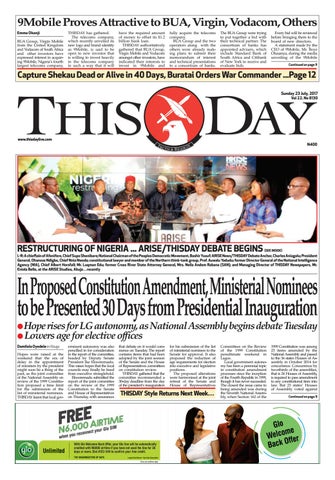
restructuring of nigeria ... arise/thisday debate begins
(SEE INSIDE)
L-R: A chieftain of Afenifere, Chief Supo Shonibare; National Chairman of the Peoples Democratic Movement, Bashir Yusuf; Arise News/THISDAY Debate Anchor, Charles Aniagolu; President General, Ohaneze Ndigbo, Chief Nnia Nwodo; constitutional lawyer and member of the Northern think-tank group, Prof. Auwalu Yadudu; former Director General of the National Intelligence Agency (NIA), Chief Albert Horsfall; Mr. Luqman Edu; former Cross River State Attorney General, Mrs. Nella Andem Rabana (SAN); and Managing Director of THISDAY Newspapers, Mr. Eniola Bello, at the Arise Studios, Abuja…recently
In Proposed Constitution Amendment, Ministerial Nominees to be Presented 30 Days from Presidential Inauguration Hope rises for LG autonomy, as National Assembly begins debate Tuesday Lowers age for elective offices
Damilola Oyedele in Abuja Hopes were raised at the weekend that the era of delay in the appointment of ministers by the president might soon be a thing of the past, as the joint committee of the National Assembly on review of the 1999 Constitution proposed a time limit for the submission of the list of ministerial nominees. THISDAY learnt that local gov-
ernment autonomy was also pencilled in for consideration in the report of the committee, headed by Deputy Senate President Ike Ekweremadu. This raises hopes that the local councils may finally be freed from executive stranglehold. Ekweremadu submitted the report of the joint committee on the review of the 1999 Constitution to the Senate and House of Representatives on Thursday, with assurances
that debate on it would commence on Tuesday. The report contains items that had been adopted by the joint session of the Senate and the House of Representatives committees on constitution review. THISDAY gathered that the committee recommended a 30-day deadline from the day of the president’s inauguration
for his submission of the list of ministerial nominees to the Senate for approval. It also proposed the reduction of age requirements for election into executive and legislative positions. The proposed alterations were harmonised at the joint retreat of the Senate and House of Representatives
THISDAY Style Returns Next Week…
Committees on the Review of the 1999 Constitution penultimate weekend in Lagos. Local government autonomy has been a perennial topic in constitution amendment processes since the inception of the Fourth Republic in 1999, though it has never succeeded. The closest the issue came to being amended was during the Seventh National Assembly, when Section 162 of the
1999 Constitution was among 23 items amended by the National Assembly and passed to the 36 states Houses of Assembly in October 2014 for concurrence. Concurrence by two-thirds of the assemblies, that is 24 Houses of Assembly, is required to pass amendment to any constitutional item into law. But 23 states’ Houses of Assembly voted against Continued on page 9
2
T H I S D AY SUNDAY JULY 23, 2017
T H I S D AY SUNDAY JULY 23, 2017
3
4
T H I S D AY SUNDAY JULY 23, 2017
T H I S D AY SUNDAY JULY 23, 2017
5
6
T H I S D AY SUNDAY JULY 23, 2017
T H I S D AY SUNDAY JULY 23, 2017
7
8
T H I S D AY SUNDAY JULY 23, 2017
9
T H I S DAY, T H E S U N DAY N E W S PA P E R ˾ JULY 23, 2017
PAGE NINE
Fuel Subsidy, Pipeline Repairs Hinder NNPC’s Profitability ÒÓØÏ×Ï ÕËÐÙÜ in Abuja The Nigerian National Petroleum Corporation (NNPC) is currently unable to make profits from its operations because it is subsidising consumption of petrol by Nigerians and also paying heavily to repair and maintain its networks of pipeline that run across the country, its monthly financial and operations reports have revealed. According to the first five operations reports the NNPC has released so far in 2017, it has raked up as much as N67, 718,819,452 on under recovery for importation and sale of petrol in the country. The NNPC also recorded a trading deficit of N3.55 billion in May; N5.27 billion in April; N5.62 billion in March, as well as N14.12 billion and N14.26 billion respectively in February and January 2017. The reports, which were obtained by THISDAY yesterday in Abuja, explained the operations of the corporation in Nigeria’s downstream
sector from January to May. They also suggested this was impacting heavily on the NNPC’s books. In the downstream petroleum sector, under recovery happens when the expected open market price of petrol (pump price per litre), which comprises the cost of importation and distribution of petrol like marketers’ margins; landing cost; freight cost; administrative charges; and lightering or ship-to-ship charges, is below the federal government’s approved official retail price at the service stations. The corporation at the moment has become the sole importer of petrol in Nigeria, doing close to 100 per cent of importation, and as such bearing the burden of keeping up the country’s petrol supplies. Its monthly financial reports for January, February, March, April and May, however indicated that it had been doing this at the expense of its corporate profitability.
The reports quoted NNPC’s under recovery from its supplies and distribution of petrol in January to be N37,263,846,591; that of February was N6,297,594,169; while for March, it recorded a N8,206,727,836 under recovery. For April, it was N8,206,727,836; and N7,743,923,020 in May, to bring the corporation’s total under recovery on petrol supplies for these months to N67,718,819,452. THISDAY also learnt from sources in the NNPC and ministry of petroleum resources that subsidy on petrol was back but that the government was quiet about it. These sources explained to THISDAY that since subsidy payments was not provided for in the 2017 budget, the NNPC was asked by the government to ensure that it keeps up petrol supplies in the country. The corporation though has a products supplies framework –Direct Sales – Direct Purchase (DSDP)- in
which it commits parts of its 445,000 barrels a day (bd) daily domestic allocation to third parties or refiners in return for equivalent worth of products. Similarly, in May, 2017, the Minister of State for Petroleum Resources, Dr. Ibe Kachikwu, confirmed in a podcast message that the NNPC was recording under recoveries in its petrol importation and supplies. Kachikwu explained that the operational environment had changed since May 2016, when the government opted for a price modulation mechanism in the downstream petroleum sector, as against full deregulation of the sector, hence the under recoveries. He stated then: “When we did all these, pricing for crude oil was more in the $25 to $30 per barrel; today, it is in excess of $54, which is fantastic because it means that our revenue stream is improving. “But, it is a twin window, whenever the price of crude
oil goes up, obviously the price of refined petrol goes up and we begin to have systemic challenge in terms of the pricing on the local base.” “So, that gap has begun to return and today, what you find is that the NNPC continues to import massively on behalf of the federal government. It has gone back to about 90 to 95 per cent for the whole country; therefore, its books are absorbing some of the cost implications of this,” he added. The minister also confirmed that independent marketers were no longer importing petrol into the country. According to him, “The second is that once this happens the marketers begin to shift backwards. Participation by individual marketers to help us continue the normal business and marketing cycle that should be what you expect does no longer exist. Most of them are not importing.” But it was not only subsidy for petrol that has
kept NNPC on a deficit trend in its operations, as its reports indicated that crude oil and products losses, as well as expenditure on repairs of its pipelines had equally contributed in great measures. For crude oil losses within the periods, the report noted that in January, the corporation recorded a loss of N1,117,572,295; February - N1,569,328,834; March - N2,024,222,976; April - N2,388,208,668; and May - N4,121,733,826, to bring the total to N18,168,376,586. On product losses, NNPC in March lost N680,504,246; in April, it was N1,245,703,210; and May - N1,328,119,100, to sum it up to N5,845,008,232. No product losses in January and February, 2017 were recorded. Similarly, expenditure on pipeline repairs and management for January was N11,223,583,353; February - N15,803,186,300; March - N11,530,599,643; April - N8,571,810,550; and May -N7,786,598,978.
Account and state governments. The National Assembly proposed the lowering of age qualifications for elective positions. Under section 130 of the 1999 Constitution, a person must be at least 40 years of age to be elected President or Vice President of Nigeria. Section 68 sets 35 and 30, respectively, as minimum age for senators and House of Representatives members, and section 177 provides that a person must be 35 years of age to be elected governor of a state, while section 106 sets 30 years as minimum age for membership of a House of Assembly. The amendment to section 121 of the constitution seeks to enhance legislative processes in states by granting financial autonomy to the Houses of Assembly and placing the state legislatures on First Line charge. This would reduce executive control over funds meant for the House of Assembly from the Consolidated Revenue Fund of a state, as monies would be paid directly to the institution. The joint committee on constitution review also recommended alterations to sections 58, 59, and 100 of the constitution, to provide a 30-day timeframe for the president or governor to assent to a bill passed by the National Assembly or state Assembly, or indicate his refusal of assent. The
amendment provides that if executive assent is not granted in 30 days, the bill automatically becomes laws without the legislature having to activate the process of veto. Amendments to sections 82 and 122 of the constitution seek to reduce the time within which the president or state governor may authorise expenditure from the Consolidated Revenue Fund from six months to three months. The move is to ensure that the executive sends the appropriation bill in time. The joint committee also recommended a timeframe within which the president or governor must appoint the cabinet, in addition to a provision that at least 35 per cent of the positions must go to women. It suggested that the proposed portfolio of each nominee for minister or commissioner must accompany the letter of nomination to the legislature. Alterations proposed to sections 150, 174, 195, 211, 318 and the Third Schedule to the constitution seek to separate the office of the Minister of Justice or Commissioner for Justice, in the case of a state, from that of the Attorneygeneral of the Federation or of a state. This is to insulate the attorney-general from partisan politics by granting him financial autonomy and security of tenure.
IN PROPOSED CONSTITUTION AMENDMENT, MINISTERIAL NOMINEES TO BE PRESENTED 30 DAYS the amendment that would have given the 774 local governments listed in the 1999 Constitution financial and administrative autonomy. The surprising decision of the state legislatures was believed to have emanated from the governors, who are accused of diverting council funds from the Federation Account paid into the joint state/local government account to the pursuit of their inordinate ambitions.
But last week, hopes of independent local government areas were rekindled, when amendment to sections 7 and 162 featured among items listed for debate in the current constitution amendment process. If the amendment succeeds, the joint state/local government account would be abolished to enable the third tier of government maintain and run independent accounts into which allocations from the Federation Account and
the state governments would be directly paid. Lawmakers of the two chambers of the National Assembly were expected to use the weekend to study the report of the ad hoc committee on constitution review before the commencement of debate on the items list for review on Tuesday. The amendment in favour of local government autonomy also seeks to implement uniform three-year tenure for
elected local government officials across the country. This would eliminate the practice whereby state governors sack elected officials at the third tier of government at will and install their protégés as heads of caretaker committees for months on end. The amendment to Section 7 provides that only democratically constituted local governments can receive and administer the allocations received from the Federation
9MOBILE PROVES ATTRACTIVE TO BUA, VIRGIN, VODACOM, OTHERS brand in Lagos last week, that the company is open to new investors, confirmed the situation that some investors had already indicated interest to invest in 9Mobile. BUA Group is a fullyfledged, diversified business with a stake in a wide range of business sectors. Virgin Mobile is part of the Virgin Group, founded by the maverick and successful UK entrepreneur, Richard Branson. THISDAY gathered that Virgin Mobile’s bid is being promoted by a starstudded team of executives with many years of experience in the telecoms sector in Africa as well as other parts of the world. Several former top executives of MTN Nigeria are said to be behind this bid, which has offered to buy over Emerging Markets Telecommunications Services (EMTS), trading as 9Mobile, and absorb the balance of the $1.2 billion debt, which it owes the 13 financial institutions. It is also said to have outlined a repayment plan for this debt. According to THISDAY source, Virgin Mobile's plan is not just about repaying the debt owed by 9Mobile. It has also carefully outlined a financing strategy and a
very ambitious network development strategy in which every cell-site will either be a third generation (3G) or a fourth generation (4G/LTE) cell site. Currently, majority of cell sites in Nigeria operated by the country’s pre-existing mobile networks, are second generation (2G) with a sprinkling of 3G sites. THISDAY also gathered that South Africa’s Vodacom is backed by some Nigerians that had at one time operated telecoms business in Nigeria at a small-scale level. The industry stakeholders, who analysed the antecedents of the two telecoms operators interested in 9Mobile, said Vodacom did not bid for the initial GSM licenses in 2001, for which MTN, its major rival at the time in South Africa, paid $285 million. MTN received plenty of flak globally at the time and its share price on the Johannesburg Stock Exchange fell, for what was perceived as an error of judgement in overpaying for a license in a supposedly poor country like Nigeria. But the joke was soon on Vodacom as MTN’s success story in Nigeria proved irresistible to a growing global audience. On the back of its
incursion to Nigeria, MTN swiftly overtook Vodacom and became the leading telecoms company in Africa. Vodacom, however, made a bid to return to Nigeria by acquiring the then VMobile in 2004. But like today’s circumstances with 9Mobile and Etisalat, the then technical partners, Econet Wireless had divested from the company leading to an opportunity for acquisition by new partners. Indeed VMobile had for a few weeks been re-named Vodacom at the time. Unfortunately a serious corporate governance breach that entailed the payment of fees without board approval truncated the deal and the board of Vodacom took a decision to exit the country. The challenge for a potential investor, therefore, at this time in the life of 9Mobile with its over 20 million subscribers is the wherewithal – the financial muscle as well as the technical expertise – with which to turn the organisation into a profitable one in the shortest time possible. Nigerians are not likely to forget the remarks that Vodacom made about Nigeria many years ago, when it
refused to be part of the original bid for GSM licenses. Vodacom’s second adventure in Nigeria, which was aborted by corporate governance breaches may also be a burden, which the company will need to assure and reassure stakeholders especially regulators about. What is however, likely to be Vodacom’s biggest albatross is its South African origins. Is Nigeria ready to embrace yet another South African operator in an industry where a South African operator, MTN, is by far the dominant operator? Is Vodacom capable of shaking off the negative perceptions that Nigerians have about South Africans? Ultimately, however, the choice of any of the investors will rest on the management of 9Mobile with the guidance of the two regulators, the NCC and the Central Bank of Nigeria (CBN) that have interceded for the company all these while. It is hoped that this choice will be guided by the potential of the partners to move the company forward, judging by the clarity of plans and the expertise of its promoters.
CORRECTION In our story titled, “In Ex Parte, Court Orders Seven Banks to Remit $793.2m to TSA, Banks Deny,” published in the Friday, July 21, 2017 edition of the paper and in a follow up story in the Saturday, July 22, 2017 edition of the paper, we erroneously referred to Keystone Bank as a defunct bank which had been acquired by Heritage Bank. Keystone Bank is not defunct and was recently acquired by the Sigma Golf-Riverbank Consortium, while Heritage Bank acquired the defunct Enterprise Bank in 2014. The mix up is most regretted. - Editor
10
JULY 23, 2017 ˾ T H I S D AY, T H E S U N D AY N E W S PA P E R
SUNDAY COMMENT
Editor, Editorial Page PETER ISHAKA Email peter.ishaka@thisdaylive.com
PUBLIC UNIVERSITIES AND FUNDING CHALLENGE Our public universities need to think out of the box to find creative solutions to their funding crisis
T
he nation woke up recently to the decision by 38 public universities to jack up their tuition fees. According to the Chairman of the Academic Staff Union of Universities (ASUU), Dr. Deji Omole, the hike was necessitated by poor funding from the owners, the federal and state governments. Whatever may be the merit of this decision, we are concerned that it may obstruct the peace of the universities, whose students have already notified the authorities of their intention to oppose the proposal because it would shut out many of them who might not be able to afford the increment. There is no doubt that the nation’s public universities are facing hard financial times. This is a corollary of government’s meagre attention to education, a fact attested to by its poor annual budgetary to Elsewhere, universities allocation the sector. The have explored several United Nations Eduways of raising money cational, Scientific and to fund their operations. Cultural Organisation (UNESCO) recomIn this regard, ours mends that developing need not reinvent the nations allocate 26 per wheel. The common cent of their annual avenues include budgets to education donations, endowments, to enable them close professional chairs, the yawning gap in the sector’s development gifts, grants and and to lay a solid consultancy services. foundation for their We note that many of future growth, which our universities have would rely largely on embarked on these but the quality of their their performance needs human resources. Government, at all to be stepped up levels in our country, has performed abysmally on this front. In this year’s budget, for instance, the share for education in the federal government N7.3 trillion appropriation is a mere N448.01 billion, a miserly six per cent. But nothing demonstrates the perennial disdain for the sector than the allocation of a miserable N50 billion to capital development while a whopping N398.01 billion is allotted to recurrent expenditure. But reports on education from the 36 states of the federation are no better. The figures for 2016, for instance, showed that 33 of the 36
states allocated N653.53 billion, representing 10.7 per cent of their combined total budget estimates of N6.1 trillion to the sector.
T
S U N DAY N E W S PA P E R EDITOR TOKUNBO ADEDOJA DEPUTY EDITORS VINCENT OBIA, OLAWALE OLALEYE MANAGING DIRECTOR ENIOLA BELLO DEPUTY MANAGING DIRECTOR KAYODE KOMOLAFE CHAIRMAN EDITORIAL BOARD OLUSEGUN ADENIYI EDITOR NATION’S CAPITAL IYOBOSA UWUGIAREN
T H I S DAY N E W S PA P E R S L I M I T E D EDITOR-IN-CHIEF/CHAIRMAN NDUKA OBAIGBENA GROUP EXECUTIVE DIRECTORS ENIOLA BELLO, KAYODE KOMOLAFE, ISRAEL IWEGBU, IJEOMA NWOGWUGWU GROUP FINANCE DIRECTOR OLUFEMI ABOROWA DIVISIONAL DIRECTORS PETER IWEGBU, FIDELIS ELEMA, ANTHONY OGEDENGBE DEPUTY DIVISIONAL DIRECTOR OJOGUN VICTOR DANBOYI SNR. ASSOCIATE DIRECTOR ERIC OJEH, PATRICK EIMIUHI ASSOCIATE DIRECTORS HENRY NWACHOKOR, SAHEED ADEYEMO CONTROLLERS ABIMBOLA TAIWO, UCHENNA DIBIAGWU, NDUKA MOSERI GROUP HEAD FEMI TOLUFASHE ART DIRECTOR OCHI OGBUAKU II DIRECTOR, PRINTING PRODUCTION CHUKS ONWUDINJO TO SEND EMAIL: first name.surname@thisdaylive.com
SUNDAY PHOTO
LagosStateGovernor, AkinwunmiAmbode, waitingon a queuein Papa,Epe tocasthisvote during yesterday‘s localgovernmentelections
hese poor allocations fly in the face of government’s own realisation of the dire situation in the Nigerian universities. An enquiry commissioned by the President Goodluck Jonathan administration in 2012 on the needs of these universities led the federal government to earmark N1.3 trtillion for special intervention in the Nigerian public universities over the next six years. Only N200billion has been released to date. With low budgetary allocation to education, it is little wonder why tertiary institutions, particularly universities are broke with the attendant degeneration of their infrastructural facilities as well as lowering of standards of teaching and learning. The situation has led to perennial shut down and instability in the public institutions. Their global ranking has sunk so low that none of them is ranked among the top 800 in the world or among the top 10 in Africa. Meanwhile, in spite of government’s stated commitment to education, widespread agitations for increased budgetary allocation to the sector has not persuaded it to take more substantive steps in that direction, notwithstanding its complimentary funding of tertiary education through the Tertiary Education Trust Fund (TETFUND). While we support the clamour for increased funding, we nonetheless think that given the dwindling resources of government, the tertiary institutions need to think out of the box and find more creative solutions to the problem. Elsewhere, universities have explored several ways of raising money to fund their operations. In this regard, ours need not reinvent the wheel. The common avenues include donations, endowments, professional chairs, gifts, grants and consultancy services. We note that many of our universities have embarked on these but their performance needs to be stepped up. The total earning of Nigeria’s 89 universities was N340.6 billion in 2016. Clearly much more work has to be done to shore up internally generated revenue in order to wean the universities of their virtual total dependence on government funding. More importantly, our universities’ administrators also need to manage their resources prudently and transparently as part of the challenge in several cases has been misappropriation of funds kept in their care.
T H I S D AY SUNDAY JULY 23, 2017
11
12
T H I S D AY, T H E S U N D AY N E W S PA P E R Ëž ULY 23, 2017
SUNDAYNEWS
News Editor Abimbola Akosile E-mail: abimbola.akosile@thisdaylive.com, 08023117639 (sms only)
Capture Shekau Dead or Alive in 40 Days, Buratai Orders War Commander t DHQ: Inappropriate marking of areas caused Rann IDPs bombing Paul Obi in Abuja
In a renewed onslaught against Boko Haram, the Chief of Army Staff (COAS), Lt. Gen. Tukur Buratai, yesterday gave a 40-day ultimatum to Major General Ibrahim Attahiru, the Theatre Commander of Operation Lafiya Dole in the North-east, to capture the terror group leader, Abubakar Shekau, dead or alive. Announcing the ultimatum in a statement yesterday, the Director of Army Public Relations, Brig. Gen. Sani Usman, said, “The Theatre Commander has further been directed to do so within 40 days. He is to employ all arsenals at the disposal of the Theatre Command to smoke out
Shekau wherever he is hiding in Nigeria.� He urged the general public to assist by volunteering information that would lead to the accomplishment of this task. This is the first time the military would be giving an ultimatum to its commanders for the capture or elimination of Shekau and it is believed that the capture or elimination of Shakau will be a turning point in the war against terror which the nation has been waging in the past six years. Though Shekau’s location is currently unknown, he is believed to be hiding on the fringes of Sambisa Forest. The military had, on more than two occasions claimed it
killed Shekau, only for the Boko Haram leader to resurface on each of those instances in videos to debunk such claims. Even when the military announced the capture of Sambisa forest, it was evidently clear that Shekau had escaped their radar as there were no reports of his death or capture. While it has been established that there are two factions of Boko Haram groups that the federal government has been waging war against, it is believed that the one, which released the Chibok school girls was not the Shekau faction. In another development, the Nigerian Defence Headquarters (DHQ) yesterday said inappro-
priate marking of areas in Rann, Borno State was the cause of the erroneous bombing of the Internal Displayed Persons (IDPs) camp earlier this year. Making public the outcome of three investigations, Director of Defence Information, Major General John Enenche, explained that DHQ constituted Boards of Inquiry to investigate the incidents and come up with their reports. He said: “Some of the services and commands, who were directly affected also constituted their boards of inquiry in line with service regulations.� On the bombing of Internally Displaced Persons (IDP) near the Camp in Rann, on 17 January
2017, Enenche stated that, “The main reason that caused the unfortunate airstrike near the IDP camp at Rann, was lack of appropriate marking of the area, near the Camp where the IDPs were struck. “Hitherto, people were not expected to amass at that location. Furthermore, the location was not reflected in the operational map as a humanitarian base. “The normal pattern for Boko Haram terrorists to form up, before attacking innocent civilians and troops is to amass. Hence, it appeared as a place that could equally be used for enemy activities. “Thus, when mass movement was noticed through aerial satellite observation, it was taken for Boko Haram Terrorists activity, which needed to be neutralised with speed.� He added that, “All locations where humanitarian activities take place in the theatre
of operation should be marked appropriately for ground and aerial identification in line with international best practices. “The geographical and spatial coordinates of all areas of humanitarian activities within the Theatre, should be provided to the Theatre Command Headquarters. “There should be timely and mandatory exchange of information between stakeholders, for all activities in the Theatre of operation. Concerning the armed clash between some Nigerian Army and Police personnel under Operation Lafiya Dole in Damaturu on April 11, 2017, which led to the death of one soldier and three policemen, with 7 other policemen injured, Enenche said: “It was caused by an avoidable misunderstanding from exchange of words and later physical confrontation.
Building Collapse Claims Mother, Daughter in Lagos Chiemelie Ezeobi
RECOGNISING EXCELLENCE R-L: Minister of State, Health, Dr. Osagie Ehanire, presenting a Certificate of Academic Excellence to Zainab Yakubu Lado who emerged as
the 2017 Overall Best Graduating Student of Nile University; while Senator Yakubu Lado and his wife, mother of the celebrant , look on during the graduation ceremony of the university in Abuja...weekend
Despite Voter Apathy, APC Leads in Lagos LG Polls t Ambode satisfied with outcome, PDP, LP reject results t Voters, stakeholders react as rain disrupts exercise Abimbola Akosile, Shola Oydyipo, Segun James, Gboyega Akinsanmi, Anayo Okolie and Sarah Agbamuche
The ruling All Progressives Congress (APC) in Lagos, yesterday led comfortably in the elections conducted into all the 20 Local Government Areas (LGAs) and 37 Local Council Development Areas (LCDAs) across the state, despite the overwhelming voter apathy that typified the exercise amid the heavy downpour, which rained all day and almost disrupted voting in many of the designated centres. Although Governor Akinwunmi Ambode of Lagos State, who also recorded landslide result at his Epe polling unit, expressed satisfaction with the outcome of the exercise and described the election as peaceful, some of the opposition parties, including the Peoples
DemocraticParty(PDP),theLabour Party (LP) and the Accord Party (AP) that participated in the election have called for a cancellation of the election over alleged malpractices, despite competing keenly in many of the wards. Some of the voters, who also spoke to THISDAY, gave mixed reactions on the outcome of the exercise. While some were satisfied with the conduct, others had cause to complain, either for logistics reasons or general mobilization for an exercisethatheldbetweenmorning and 3pm yesterday, during which movement restriction was also observed maximally. Unfortunately, however, results were still being counted as at press time last night, but from the exit polls, the APC still proved its mettle as the party to beat in Lagos as it led comfortably in practically all the councils.
Although LASIEC gave no reasons for not announcing results of the elections last night, it was however believed that the weather and other logistic reasons might have contributed significantly to why the electoral body shelved the announcement of results. Meanwhile, as THISDAY editors and reporters monitored the elections across the state yesterday, it became evident that the persistent downpour had kept many people awayfromvoting,compoundedby the general voter apathy to council administration in the state. For instance, along Agege Motor Road from Iju-Ishaga to Pen Cinema down through Ikeja-along, Oshodi, Mushin, Ojuelegba, and Apapa between 10am and 12.20 pm revealed just a few residents, who visited the voting centres to
carry out their accreditation and also vote for the candidates of their choice. Ironically, the rain, which had been falling consistently in places like Ikeja, Surulere, Apapa, Agege, Ishaga and Mushin, did not stop some youths and children from playing soccer and playing around on the vehicle-free roads, as witnessed by THISDAY. There was police presence at Ishaga-Elliot, Agege Pen Cinema, Oshodi underthebridge,Ojuelegba at Barracks bus-stop, and in front of AreaBCommandinApapa,where vehicles were stopped and the occupantssubjectedtoquestioningfor moving around during the election period, in spite of restrictions on movement. At Ojodo, most polling stations were without voters.
(See concluding part on www.thisdaylive.com)
Following the heavy downpour that was witnessed across Lagos yesterday, a building collapse at the Meiran-Abule Egba area of the state has claimed the lives of a mother and her daughter. But for providence and the emergency responders on ground, the 30-year-old mother simply identified as Basirat and her daughter identified as Bisoye, would not have been the only casualties, THISDAY learnt. It was gathered that emergency responders led by the Lagos State Emergency Management Agency (LASEMA), had rescued the deceased’s five-year-old daughter. Confirming the incident, LASEMA General Manager, Mr. Adesina Tiamiyu said, “The agency received a distress call via the emergency toll free number 767/112 concerning a collapsed building at No 7 Saidu Okeleji Street, Alaro Street Meiran, Abule Egba. This prompted the immediate activation of the agency’s Emergency Response Team (ERT) to the scene of the incident. “Investigation conducted by the agency at scene of the
incident revealed that an existing uncompleted bungalow under construction with sand and concrete blocks seen on the deck suddenly caved in with three people trapped under the rubble. “The prompt response by emergency responders led to the rescue of five- year- old girl identified as Moyin, who was immediately moved to General Hospital Ikeja by the Lagos State Ambulance Service. “Meanwhile two persons, 30-year-old mother identified as Basirat and another daughter identified as Bisoye were both recovered dead and moved to the mortuary by the State Environmental Monitoring Health Monitoring Unit (SEHMU). “The agency’s LASEMA Response Unit and the Fire Unit, Lagos State Fire Services, Nigerian Police Force, LASAMBUS, RRS and Red Cross were responders present at the scene of the incident. “Proper investigation would be conducted on the incident by the appropriate agencies. We advise owners and developers of buildings in the state to adhere to building codes and physical planning laws of the state so as to advert unnecessary loss of lives.�
Arthur Nylander Passes On
The death has been announced of Dr. Arthur Nylander, SAN, who ĂŽĂ“Ă?ĂŽ Ă™Ă˜ Ă’Ă&#x;ĂœĂ?ĂŽĂ‹ĂŁ Ă&#x;Ă–ĂŁ ÍŻÍąËœ Ă‹Ăž ÞÒĂ? Ă‹Ă‘Ă? Ă™Ă? ͜͡ ĂŁĂ?Ă‹ĂœĂ?Ë› Ă“Ă? Ă?Ă™Ă˜ Ă?Ă?Ă–Ă“Ă? Ă–Ă&#x;ÞËãÙ Nylander, also a lawyer, made the announcement from the Arthur ĂŁĂ–Ă‹Ă˜ĂŽĂ?Ăœ Ă’Ă‹Ă—ĂŒĂ?ĂœĂ? Ă“Ă˜ Ă‹Ă‘Ă™Ă?Ë› ĂŁĂ–Ă‹Ă˜ĂŽĂ?Ăœ ĂĄĂ‹Ă? Ă™Ă˜Ă? Ă™Ă? ÞÒĂ? Ă?Ă‹ĂœĂ–ĂŁ Ă?Ă?ĂžĂ? Ă™Ă? Ă?Ă˜Ă“Ă™Ăœ ĂŽĂ Ă™Ă?Ă‹ĂžĂ?Ă? Ă™Ă? Ă“Ă‘Ă?ĂœĂ“Ă‹ Ă“Ă˜ ͯͯ͜͡ Ă‹Ă˜ĂŽ Ă’Ă“Ă? Ă‹ĂœĂ?Ă‹ Ă™Ă? Ă?ĂšĂ?Ă?Ă“Ă‹Ă–Ă“Ă?Ă‹ĂžĂ“Ă™Ă˜ ĂĄĂ‹Ă? Ă“Ă˜ Ù××Ă?ĂœĂ?Ă“Ă‹Ă– Ă‹ĂĄËœ Ă˜ĂžĂ?Ă–Ă–Ă?Ă?ĂžĂ&#x;Ă‹Ă– ĂœĂ™ĂšĂ?ĂœĂžĂŁ Ă‹ĂĄ Ă‹Ă˜ĂŽ ĂœĂ‹ĂŽĂ?Ă—Ă‹ĂœĂ•Ă?Ë› Ă? ĂĄĂ‹Ă? Ă‹ Ă?Ă™ĂœĂ—Ă?Ăœ Ă‹ĂžĂ“Ă™Ă˜Ă‹Ă– ĂœĂ?Ă?Ă“ĂŽĂ?Ă˜Ăž Ă™Ă? ÞÒĂ? Ă“Ă‘Ă?ĂœĂ“Ă‹Ă˜Ě‹ Ă—Ă?ĂœĂ“Ă?Ă‹Ă˜ Ă’Ă‹Ă—ĂŒĂ?Ăœ Ă™Ă? Ù××Ă?ĂœĂ?Ă? Ă?ĂœĂ™Ă— ͯ͜͡Ͳ ÞÙ ͯ͜͡ʹ Ă‹Ă˜ĂŽ ĂĄĂ‹Ă? Ă‹ Ă?ÖÖÙå Ă™Ă? ÞÒĂ? Ă“Ă‘Ă?ĂœĂ“Ă‹Ă˜
Ă˜Ă?ÞÓÞĂ&#x;ĂžĂ? Ă™Ă? Ă‹Ă˜Ă‹Ă‘Ă?Ă—Ă?Ă˜ĂžË› Ă? Ă‹Ă–Ă?Ă™ Ă?Ă?ĂœĂ Ă?ĂŽ Ă?Ă™Ăœ Ă—Ă‹Ă˜ĂŁ ĂŁĂ?Ă‹ĂœĂ? Ă™Ă˜ ÞÒĂ? Ă“Ě‹ Ă™Ă?Ă?Ă?Ă‹Ă˜ Ă™Ă‹ĂœĂŽ Ă™Ă? ÞÒĂ? Ă˜Ă‘Ă–Ă“Ă?Ă‹Ă˜ Ă“Ă™Ă?Ă?Ă?Ă? Ă™Ă? Ă‹Ă‘Ă™Ă?Ë› Ă˜ ͯ͡ʹ͡ ĂĄĂ’Ă“Ă–Ă? ĂœĂ&#x;Ă˜Ă˜Ă“Ă˜Ă‘ Ă’Ă“Ă? Ă?Ă‘Ă‹Ă– ĂšĂœĂ‹Ă?ÞÓĂ?Ă?Ëœ Ă’Ă? ĂĄĂ‹Ă? Ă‹Ă–Ă?Ă™ Ă‹ Ă?Ă˜Ă“Ă™Ăœ Ă?Ă?ĂžĂ&#x;ĂœĂ?Ăœ Ă‹Ă˜ĂŽ Ă&#x;ĂŒĚ‹ Ă?Ă‹Ă˜ Ă™Ă? ÞÒĂ? Ă‹Ă?Ă&#x;ÖÞã Ă™Ă? Ă‹ĂĄ Ă‹Ăž ÞÒĂ? Ă˜Ă“Ă Ă?ĂœĂ?ÓÞã Ă™Ă? Ă‹Ă‘Ă™Ă? Ă‹Ă˜ĂŽ ÞËĂ&#x;Ă‘Ă’Ăž Ă—Ă‹Ă˜ĂŁ Ă™Ă? ÞÒĂ? Ă?Ă&#x;Ă?Ă?Ă?Ă?Ă?Ă?Ă&#x;Ă– Ă–Ă‹ĂĄĂŁĂ?ĂœĂ?Ëœ Ă”Ă&#x;ĂŽĂ‘Ă?Ă? Ă‹Ă˜ĂŽ Ă?Ă˜Ă“Ă™Ăœ ĂŽĂ Ă™Ă?Ă‹ĂžĂ?Ă? Ă™Ă? Ă“Ă‘Ă?ĂœĂ“Ă‹Ë› Ă? ĂĄĂ‹Ă? Ă?Ă‹Ă–Ă–Ă?ĂŽ ÞÙ ÞÒĂ? Ă˜Ă‘Ă–Ă“Ă?Ă’ Ă‹Ăœ Ě™ ĂœĂ‹ĂŁËŞĂ? Ă˜Ă˜Ěš Ă“Ă˜ ͯ͡ͳ; Ă‹Ă˜ĂŽ Ă“Ă‘Ă?ĂœĂ“Ă‹Ă˜ Ă‹Ăœ Ă“Ă˜ ͯ͡ͳ͜ Ă‹Ă˜ĂŽ ĂŽĂ“ĂŽ Ă’Ă“Ă? Ă‹Ăž Ă‹ĂœĂ Ă‹ĂœĂŽ Ă‹ĂĄ Ă?ÒÙÙÖ Ă“Ă˜ ͯ͡ʹ͎˛ Ă“Ă? Ă™Ă?ĂžĂ™ĂœĂ‹ĂžĂ? ĂĄĂ‹Ă? Ă™ĂŒĂžĂ‹Ă“Ă˜Ă?ĂŽ Ă‹Ăž Ă˜Ă“Ă Ă?ĂœĂ?ÓÞã Ă™Ă? Ă™Ă˜ĂŽĂ™Ă˜Ë› Ă“Ă? Ă?Ă‘Ă‹Ă– ĂšĂ&#x;ĂŒĂ–Ă“Ă?Ă‹ĂžĂ“Ă™Ă˜Ă? Ă“Ă˜Ă?Ă–Ă&#x;ĂŽĂ? ÞÒĂ? Ă˜ĂžĂ?ĂœĂ˜Ă‹ĂžĂ“Ă™Ă˜Ă‹Ă– Ă˜Ă?ĂŁĂ?ÖÙÚËĂ?ĂŽĂ“Ă‹ Ă™Ă? Ă™Ă—ĂšĂ‹ĂœĂ‹ĂžĂ“Ă Ă? Ă‹ĂĄ ̙ͯ͡;ͯ̚˛ Ă? Ă“Ă? Ă?Ă&#x;ĂœĂ Ă“Ă Ă?ĂŽ ĂŒĂŁ Ă’Ă“Ă? ĂĄĂ“Ă?Ă?Ëœ Ă?Ă’Ă“Ă–ĂŽĂœĂ?Ă˜ Ă‹Ă˜ĂŽ Ă‘ĂœĂ‹Ă˜ĂŽĂ?Ă’Ă“Ă–ĂŽĂœĂ?Ă˜Ë›
T H I S D AY SUNDAY JULY 23, 2017
13
14
T H I S D AY SUNDAY JULY 23, 2017
#PPL 3FWJFX
<287+ (17(535,6( :,7+ ,1129$7,21 ,1 1,*(5,$ 0\ %XVLQHVV 6WRU\
5IF 4UBSUVQ 1MBZCPPL
'SPN /VJTBODF UP /VBODF &OUSFQSFOFVS 5VSOT +VOL JOUP .BTUFSQJFDFT
4FDSFUT PG UIF 'BTUFTU (SPXJOH 4UBSUVQT GSPN 5IFJS 'PVOEJOH &OUSFQSFOFVST
*G POF NBOhT NFBU JT BOPUIFShT QPJTPO UIFSFhT BO FOUSFQSFOFVS XIP IBT BMTP GPVOE UIBU IF DBO UVSO POF NBOhT KVOL JOUP B USFBTVSF USPWF )JT TUPSZ JT B NVTU SFBE PDWHULDOV" ,W VRXQGHG OLNH D IDPLOLDU TXHVWLRQ 6KH VPLOHG DQG VDLG ³7KH IDFW WKDW ZH FDQ FRQYHUW W\UHV RI DOO VL]HV WR VRPHWKLQJ \RX FDQ XVH WR EHDXWLI\ \RXU K R P H V D Q G HQYLURQPHQW PDNHV RXU EXVLQHVV XQLTXH ,W LV QRW WKH XVXDO UHF\FOLQJ V\VWHP VHHQ DURXQG 2XU SURGXFWV DUH %XVLQHVV %ULHI ,'($ 7KHUH DUH XVHG XQLTXH DQG W\UHV HYHU\ZKHUH LQ /DXQFKHG H[FHSWLRQDO :H 1LJHULD -XVW WDNH D ORRN NQHZ W\UHV FRXOG :HEVLWH DURXQG \RX IURP MGUHF\FOLQJ FRP EH UHF\FOHG EXW PHFKDQLF ZRUNVKRSV WR ZH GLG QRW ZDQW KHDSV VWUHHW FRUQHUV DQG W K H X V X D O URDGVLGHV WKH\ OLWWHU UHF\FOLQJ PHWKRG HYHU\ZKHUH DQG FRXOG VRPHWLPHV EH 7KURXJK UHVHDUFK ZH ZHUH DEOH WR DQ H\HVRUH DQG D URDG XVHU V JHW WKHVH LGHDV ´ QLJKWPDUH DW WKH VDPH WLPH %XW RQH VWDUW XS KDV GHFLGHG WR WDNH WKHP RII )RU EHWZHHQ 1 DQG 1 WKH VWUHHWV LQ D TXLWH XQLTXH ZD\ RQH FRXOG SXUFKDVH D FKDLU PDGH RI D RU LQFK W\UH 2ODLGH $GH\HPL $\RGHOH KDG ZRUNHG VRXUFHG E\ 2ODLGH DQG KHU WHDP IRU LQ WKH ILQDQFLDO VHFWRU IRU \HDUV DURXQG 1 7KH SURFHVV LQYROYHV RI WKHP LQ EDQNLQJ ,Q VKH SLFNLQJ ZDVKLQJ GLVLQIHFWLQJ GHFLGHG WR WDNH DGYDQWDJH RI WZR VWDSOLQJ JOXLQJ VFUHZLQJ DQG PDMRU VLWXDWLRQV WR YHQWXUH LQWR ZDVWH GUHVVLQJ DPRQJ RWKHUV ± LW PHDQV PDQDJHPHQW DQG UHF\FOLQJ D ORW RI ZRUN 6KH VDLG ³:H KDYH D IDPLO\ EXVLQHVV RI FOHDQLQJ DQG IXPLJDWLRQ 6R LQ WKH FRXUVH RI WKH EXVLQHVV ZH UHDOL]HG WKDW RQH RI WKH FKDOOHQJHV FRQIURQWLQJ /DJRV DQG PDQ\ RWKHU VWDWHV LQ 1LJHULD ZDV VDQLWDWLRQ DQG ZDVWH PDQDJHPHQW ´ $FFRUGLQJ WR 2ODLGH DQRWKHU IDFWRU ZKLFK HQFRXUDJHG KHU WR ZDQW WR PDQDJH DQG UHF\FOH ZDVWH ZDV WKH HIIRUW RI WKH /DJRV 6WDWH JRYHUQPHQW WRZDUGV HQVXULQJ D EHWWHU VDQLWDWLRQ DQG FOHDQHU HQYLURQPHQW ³7KHUH LV VR PXFK ZDVWH LQ /DJRV ´ VKH VDLG ³)RU H[DPSOH YHKLFOH W\UHV SODVWLF ERWWOHV SXUH ZDWHU VDFKHW DQG WKH OLNH DQG WKH VWDWH JRYHUQPHQW KDV EHHQ SXWWLQJ LQ VR PXFK HIIRUW WR UHGXFH WKLV ZDVWH DQG LWV HIIHFW RQ WKH HQYLURQPHQW 0\ KXVEDQG DQG , VDZ WKH GDPDJH WKDW ZDVWH ZDV FDXVLQJ WR LQGLYLGXDOV FRPPXQLWLHV WRZQV FLWLHV FRPSDQLHV DQG WKH QDWLRQ DW ODUJH DQG ZH GHFLGHG WR GR VRPHWKLQJ ´ :+$7 1(;7" 2ODLGH VWDUWHG FROOHFWLQJ XVHG W\UHV LQ 2FWREHU DQG HDUOLHU WKLV \HDU VKH UHJLVWHUHG -' 5HF\FOLQJ D ILUP WKDW PDNHV KRXVHKROG LWHPV IURP XVHG W\UHV 7KH PRWKHU RI WZR DQG KHU WKUHH VWDII PDNH FKDLUV WDEOHV ZDOO FORFNV ZDOO GHVLJQV ODQGVFDSH GHVLJQV ZDOO SODQWHUV SOD\JURXQG LWHPV DQG RWKHU XWLOLWLHV IURP XVHG W\UHV FROOHFWHG IURP PHFKDQLF VKRSV GXPSVLWHV DQG LQ WKH VWUHHWV RI /DJRV %XW ZK\ W\UHV RI DOO UHF\FODEOH
%5($.7+528*+ 020(17 6KH VDLG ³:H FUHDWHG GLIIHUHQW SURGXFWV OLNH ZDOO FORFNV ZDOO KDQJHUV WDEOHV FKDLUV JDUGHQ SODQWHUV DQG SOD\JURXQG LWHPV WR H[SDQG RXU VDOHV RSWLRQV DQG WR VXLW GLIIHUHQW LQGLYLGXDO RU FRUSRUDWH QHHGV :KDW WKLV PHDQV LV WKDW ZH DUH DEOH WR SURGXFH GLIIHUHQW LWHPV VXFK WKDW QR PDWWHU ZKR \RX DUH RU ZKDW \RX GR \RX ZLOO QHHG RQH RI RXU SURGXFWV ´ 6KH DOVR KDV WR FRQVWDQWO\ ³FRQYLQFH WKHP ZLWK TXDOLW\´ EHFDXVH LQ KHU ZRUGV TXDOLW\ LV DW WKH KHDUW RI PDNLQJ SURGXFWV OLNH KHUV $OWKRXJK -' 5HF\FOLQJ FXUUHQWO\ DYHUDJHV D PRGHVW FXVWRPHUV SHU PRQWK 2ODLGH EHOLHYHV WKDW RQFH DZDUHQHVV DERXW ZDVWH PDQDJHPHQW DQG UHF\FOLQJ LV LQWHQVLILHG VDOHV ZLOO LQFUHDVH
6KH VDLG ³:H DUH PDNLQJ G L II H U H Q W H II R U W V V X F K D V SDUWQHULQJ ZLWK IXUQLWXUH DQG LQWHULRU GHFRUDWLRQ FRPSDQLHV UHJXODUO\ JRLQJ IRU H[KLELWLRQV DQG FRQQHFWLQJ ZLWK SHRSOH WKURXJK DGYHUWV DQG ZH DUH UHJLVWHULQJ DQG SDUWQHULQJ ZLWK /DJRV 6WDWH UHJDUGLQJ ZKDW ZH GR :H DUH DOVR DSSURDFKLQJ VFKRROV ERWK SXEOLF DQG SULYDWH WR WUDLQ WKHLU VWXGHQWV DQG ZH DUH PDNLQJ RXU SUHVHQFH NQRZQ ,W WDNHV IURP D ZKROH GD\ WR XS WR D RQOLQH ´ PRQWK IRU D SURGXFW WR EH PDGH GHSHQGLQJ RQ LWV FRPSOH[LW\ ,W LV 6(7%$&. ,QDGHTXDWH FDSLWDO WKHUHIRUH XQGHUVWDQGDEOH WKDW WKH KDV VR IDU SUHYHQWHG 2ODLGH IURP &(2 RI -' 5HF\FOLQJ JHWV DQ[LRXV YHQWXULQJ LQWR RWKHU IRUPV RI ZKHQHYHU SRWHQWLDO FOLHQWV KDYH D UHF\FOLQJ UHOXFWDQW DQG KHVLWDQW YLHZ RI KHU $VNHG LI VKH KDV VRXJKW ILQDQFLDO SURGXFW VXSSRUW VKH VDLG ³(YHU\WKLQJ ZH VWDUWHG ZDV ZLWK RXU VDYLQJV 2ODLGH VDLG ³7XUQLQJ YHKLFOHV XVHG WKRXJK ZH ZRXOGQ W PLQG JHWWLQJ W\UHV WR KRXVHKROG EHDXW\ LV D KHOS IURP D EDQN GXH WR WKH FRQFHSW WKDW LV YHU\ QHZ LQ 1LJHULD H[SDQVLRQ RI WKH EXVLQHVV EHLQJ 6RPH SHRSOH ILQG LW IDVFLQDWLQJ SODQQHG )RU LQVWDQFH ZH LQWHQG ZKLOH RWKHUV FDQQRW MXVW LPDJLQH WR H[SDQG RXU EXVLQHVV WR KDYLQJ XVHG W\UHV DV IXUQLWXUH LQ UHF\FOLQJ SXUH ZDWHU VDFKHW EXW WKHLU KRPHV RU RIILFHV 3HRSOH V IRU QRZ EHFDXVH RI IXQGV WR EX\ PLQGVHWV ZHUH D PDMRU FKDOOHQJH LQ PDFKLQHV ZH RQO\ SLFN SXUH DFFHSWLQJ RXU SURGXFWV %XW ZH DUH ZDWHU VDFKHWV DQG VHOO WR JUDGXDOO\ JHWWLQJ RYHU WKDW DQG FRPSDQLHV WKDW SURFHVV WKHP JUDGXDOO\ JHWWLQJ WKHUH ´ 7KH WUXWK LV WKDW ZH ZHUH YHU\ UHOXFWDQW WR DSSURDFK DQ\ EDQN 7KH JUDGXDWH RI $FFRXQWLQJ IURP IRU REYLRXV UHDVRQV ´ <DED &ROOHJH RI 7HFKQRORJ\ /DJRV GHYLVHG D PHDQV WR FRQIURQW & 8 5 5 ( 1 7 6 7$7 8 6 6 K H S H R S O H V D W W L W X G H E \ E H L Q J ODPHQWHG DERXW H[WUHPHO\ KLJK DQG XQUHDOLVWLF LQWHUHVW UDWHV LQQRYDWLYH XQQHFHVVDU\ GHOD\V FXPEHUVRPH SDSHU ZRUNV :H VDZ WKH GDPDJH XQFHUWDLQW\ DERXW VHFXULQJ ILQDQFLDO VXSSRUW DW WKH HQG RI WKH WKDW ZDVWH ZDV GD\ DQG WKH IDFW WKDW QR 1LJHULDQ FDXVLQJ WR EDQN ZRXOG OHQG VWDUW XSV PRQH\ ZLWKRXW FROODWHUDOV ,W LV KRZHYHU D LQGLYLGXDOV PHDQV VKH ZRXOG OLNH WR H[SORUH
³
FRPPXQLWLHV WRZQV FLWLHV FRPSDQLHV DQG WKH QDWLRQ DW ODUJH DQG ZH GHFLGHG WR GR VRPHWKLQJ
%BWJE ,JEEFS
)RU QRZ WKRXJK 2ODLGH V LPPHGLDWH FRQFHUQ LV KRZ WR SXW KHU MLJVDZ GULOOLQJ PDFKLQH VWDSOH PDFKLQH JXP JXQ URSH JODVV FXWWHU DQG KDPPHU WR ZRUN WR PDNH D PDVWHUSLHFH RXW RI \HW DQRWKHU HQYLURQPHQWDOO\ XQIULHQGO\ GLVFDUGHG W\UH
5
IF 4UBSUVQ 1MBZCPPL XJMM IFMQ FOUSFQSFOFVST TVDDFFE (PJOH JOTJEFS UP JOTJEFS XJUI VOQSFDFEFOUFE BDDFTT /FX :PSL 5JNFT CFTUTFMMJOH BVUIPS BOE $MJDLBCMF $&0 %BWJE ,JEEFS TIBSFT UIF IBSE IJUUJOH FYQFSJFODFT PG TPNF PG UIF XPSMEhT
NPTU JOGMVFOUJBM FOUSFQSFOFVST BOE $&0T SFWFBMJOH UIFJS NPTU DMPTFMZ IFME BEWJDF 'BDF UP GBDF JOUFSWJFXT XJUI GPVOEFST HJWF SFBEFST LFZ JOTJHIUT JOUP XIBU JU UPPL UP CVJME 1BZ1BM -JOLFE*O "0- 5&% 'MJDLS BOE NBOZ PUIFST JOUP IPVTFIPME OBNFT 4QFDJBM TFDUJPOT JODMVEF UPQJDT SBOHJOH GSPN IPX UP TFMFDU UIF SJHIU JEFB UP QVSTVF UP GJOEJOH GVOEJOH BOE PWFSDPNJOH JOFWJUBCMF PCTUBDMFT *O BO FDPOPNZ EFNBOEJOH DIBOHF 5IF 4UBSUVQ 1MBZCPPL JT UIF HP UP GPS FOUSFQSFOFVST CJH BOE TNBMM 4PVSDF "NB[PO
"TL UIF &YQFSU 1BSU 2 )PX EP * NBLF B HSFBU CVTJOFTT QJUDI UP QPUFOUJBM WFOUVSF DBQJUBM JOWFTUPST 0VS "EWJTPSZ #PBSE NFNCFS 'PVOEFS .BOBHJOH %JSFDUPS PG 4BOLPSF *OWFTUNFOUT BOE WFOUVSF DBQJUBMJTU .ST 5JUJ 0EVOGB "EFPZF BOTXFST UIJT XFFLhT RVFTUJPO *U JT JNQPSUBOU GPS BO FOUSFQSFOFVS UP CF TQFDJGJD BCPVU UIF VOJRVF WBMVF QSPQPTJUJPO PG IJT QSPEVDU XIFO TQFBLJOH UP QPUFOUJBM JOWFTUPST "O FOUSFQSFOFVShT QJUDI JT POF PG UIF NPTU JNQPSUBOU QJFDFT JO MBOEJOH PS TFDVSJOH UIF JOWFTUNFOU 5IF QFSGFDU QJUDI UP B WFOUVSF DBQJUBM JOWFTUPS TIPVME DBQUVSF UIF GPMMPXJOH GVOEBNFOUBMT 0QQPSUVOJUZ *OWFTUPST BSF LFFO PO UIF NBSLFU PQQPSUVOJUZ PS QSPCMFN IJHIMJHIUFE BOE IPX ZPVS CVTJOFTT XPVME BEESFTT PS QSPGGFS TPMVUJPO T UP UIF QSPCMFN GBDFE CZ ZPVS
UBSHFU NBSLFU 'PDVT PO UIF QSPTQFDUJWF UBSHFU NBSLFU BOE IJHIMJHIU NFBOJOHGVM NFUSJDT UIBU XJMM TIPX UIF FYJTUJOH DVTUPNFS CBTF BOE QSPWF NPNFOUVN CZ TIPXDBTJOH BOFDEPUFT PG QFPQMF XIP IBWF USJFE BOE UFTUFE UIF TBNF PS SFMBUFE QSPEVDUT BOE SBUF UIFN TVDDFTTGVM 5IJT TIPVME DPWFS CFUXFFO UXP BOE UISFF TMJEFT GPS DMBSJUZ BOE QSPQFSMZ DPOWFZ UIF OBUVSF PG UIF PQQPSUVOJUZ 5P CF $POUJOVFE 7JTJU PVS XFCTJUF XXX ZPVXJODPOOFDU PS H OH GPS NPSF DPOUSJCVUJPOT GSPN PVS &YQFSUT 4FOE ZPVS CVTJOFTT RVFTUJPOT VOEFS UIF IFBEFS h"TL UIF &YQFSUh UP BENJO!ZPVXJODPOOFDU PSH OH 2VFTUJPOT QMVT UIF BVUIPShT OBNF MPDBUJPO BOE QIPOF OVNCFS TIPVME OPU CF NPSF UIBO DIBSBDUFST
T H I S D AY, T H E S U N D AY N E W S PA P E R Ëž ÍšÍźËœ ͺ͸͚Ϳ
"DBEFNZ #SFBLJOH 6Q *T )BSE &WFO *O #VTJOFTT 1BSU ,Q DQ\ UHODWLRQVKLS ZKHUH SHRSOH DUH PXWXDOO\ GHSHQGHQW RQ RQH DQRWKHU IRU WKHLU FRQWLQXHG VXUYLYDO WKH SRWHQWLDO IRU FRQIOLFW LV KLJK $ EXVLQHVV UHODWLRQVKLS LV FHUWDLQO\ QR H[FHSWLRQ ,W VKRXOG EH QR VXUSULVH WKHUHIRUH WKDW RSSRUWXQLWLHV IRU IULFWLRQ DQG GLVFRUG DPRQJ MRLQW EXVLQHVV RZQHUV DERXQG $FFRUGLQJO\ SDUWLHV VKRXOG JR LQWR EXVLQHVV ZLWK JRRG FRQWUROV LQ SODFH WR GLFWDWH KRZ PDWWHUV ZLOO EH KDQGOHG ZKHQ WKH LQHYLWDEOH FRQIOLFWV DULVH :LWK D WKRXJKWIXO DSSURDFK E\ WKH SDUWLHV DW WKH RXWVHW RI WKH QHZ YHQWXUH D ZHOO FUDIWHG RZQHUV DJUHHPHQW FDQ HVWDEOLVK DQ DJUHHG XSRQ DQG ELQGLQJ SURFHVV IRU DGGUHVVLQJ DQG UHVROYLQJ NH\ GHFLVLRQV DQG FRQIOLFWV 2I FRXUVH FRQIOLFW DPRQJ EXVLQHVV RZQHUV FDQ EH DYRLGHG HQWLUHO\ E\ QRW VKDULQJ RZQHUVKLS +RZHYHU VROH RZQHUVKLS RI D EXVLQHVV LV QRW GHVLUDEOH RU IHDVLEOH IRU PRVW QHZ EXVLQHVV RZQHUV $ VXFFHVVIXO QHZ EXVLQHVV UHTXLUHV WKUHH LQJUHGLHQWV²7DOHQW 0RQH\ DQG 2SHUDWLRQV²RIWHQ LQ WKH IRUP RI WKUHH RU PRUH MRLQW RZQHUV
DWWRUQH\ EHFDXVH ³WKH\ ZDQW WR GR WKLQJV ULJKW´ 7KDW DWWRUQH\²ZKR UHSUHVHQWV 1HZ &R DQG QRW DQ\ RQH RI WKH SDUWLHV ¹ LV HQJDJHG WR SUHSDUH DQ RZQHUV DJUHHPHQW $V VXFK WKH DWWRUQH\ FKRRVHV D QHXWUDO IRUP RI RZQHUV DJUHHPHQW²RQH WKDW WUHDWV HDFK RI WKH RZQHUV WKH VDPH DQG FLUFXODWHV LW WR HDFK RI WKH RZQHUV IRU UHYLHZ DQG FRPPHQW 7KH DWWRUQH\ H[SODLQV WR WKH RZQHUV KRZ WKH SURYLVLRQV RI WKH RZQHUV DJUHHPHQW JHQHUDOO\ IXQFWLRQ DQVZHUV WKH RZQHUV TXHVWLRQV LI DQ\ DQG ZLWK PLQLPDO GLVFXVVLRQ DQG DOPRVW QR UHYLVLRQV WKH RZQHUV H[HFXWH 1HZ &R V RZQHUV DJUHHPHQW $V WLPH JRHV RQ FRQIOLFW DPRQJ MRLQW RZQHUV FDQ DULVH IURP PDQ\ GLIIHUHQW VRXUFHV SHUVRQDOLW\ FRQIOLFWV GLIIHUHQFHV LQ WKH YLVLRQ IRU WKH EXVLQHVV JUHHG DFFRPSDQLHG E\ SRZHU JUDE DQG SHUFHLYHG LQHTXLWLHV LQ WKH RZQHUV UHVSHFWLYH UROHV DQG FRQWULEXWLRQV
:KHQ FRQIOLFW DULVHV WKH RZQHUV VWDUW WR WKLQN DERXW WKLQJV LQ ZD\V YHU\ GLIIHUHQW IURP WKH ZD\V WKH\ GLG LQ WKH VXQQ\ GD\V ZKHQ WKH FRPSDQ\ ZDV IRUPHG 7KDW FKDQJH LQ SHUVSHFWLYH FDXVHV WKH RZQHUV WR ORRN DW WKH RZQHUV DJUHHPHQW LQ D YHU\ GLIIHUHQW FRQWH[W )RU SHUKDSV WKH ILUVW WLPH LQGLYLGXDO RZQHUV PD\ DVN :KDW FDQ , GR LI , GLVDJUHH ZLWK P\ SDUWQHUV" :KDW FDQ VKH GR LI VKH ZDQWV WR SXOO RXW" :KDW FDQ WKH\ GR LI WKH\ DOO YRWH DJDLQVW PH" :LOO WKH EXVLQHVV VXUYLYH" :LOO , $W WKLV SRLQW WKH LQWHUHVWV RI DOO WKH ORVH HYHU\WKLQJ" SDUWLHV 7DOHQW 2SHUDWLRQV DQG 0RQH\ DUH DOLJQHG DQG HDFK ,Q WKHLU UHYLHZ DQG GLVFXVVLRQV DERXW UHFRJQL]HV WKH QHHG IRU DQG YDOXH RI WKH RZQHUV DJUHHPHQW MRLQW EXVLQHVV ZKDW WKH RWKHU RZQHUV EULQJ WR WKH WDEOH RZQHUV W\SLFDOO\ IRFXV RQ FHUWDLQ SURYLVLRQV WKH SHUFHQWDJH LQWHUHVW RI -RLQW EXVLQHVV RZQHUV W\SLFDOO\ GRQ W HDFK RZQHU WKH PHDQV E\ ZKLFK 1HZ VWDUW RII SUHGLFWLQJ GLVDVWHU 7KH\ JR LQWR &R ZLOO EH PDQDJHG E\ WKH PHPEHUV EXVLQHVV ZLWK JUHDW H[FLWHPHQW E\ D PDQDJHU RU E\ D ERDUG RI HQWKXVLDVP DQG WKH H[SHFWDWLRQ WKDW PDQDJHUV HDFK RZQHU V UROH LQ WKH WKHLU EXVLQHVV SODQ LV JRLQJ WR SURGXFH RSHUDWLRQV RI 1HZ &R DQG ZKHWKHU JUHDW UHVXOWV DQG EH VXFFHVVIXO 7KH\ WKH FDVK WKDW HDFK RZQHU FRQWULEXWHG KDYH MRLQHG IRUFHV ZLWK SHRSOH ZKR ZLOO EH WUHDWHG DV HLWKHU D FDSLWDO VKDUH WKHLU YLVLRQ DQG SDVVLRQ DQG VKRZ FRQWULEXWLRQ RU D ORDQ $UPHG ZLWK WKDW WKH VDPH HQWKXVLDVP DQG FRPPLWPHQW XQGHUVWDQGLQJ WKH SDUWLHV JHW WR ZRUN WR WKH EXVLQHVV 2YHU GLQQHU GULQNV DQG DQG 1HZ &R LV LQ EXVLQHVV WH[W PHVVDJHV DQG HPDLOV 7DOHQW 2SHUDWLRQV DQG 0RQH\ GHYHORS $Q RZQHUV DJUHHPHQW LV WKH SODFH WKH EXVLQHVV SODQ FRPH XS ZLWK WKH ZKHUH WKH RZQHUV FDQ KHDG RII SHUIHFW QDPH IRU WKH FRPSDQ\ DVVLJQ DYRLGDEOH GLVSXWHV EHIRUH WKH\ KDSSHQ UROHV DQG PDNH PDQ\ RWKHU GHFLVLRQV DQG FUHDWH WKH IUDPHZRUN IRU UHVROYLQJ QHFHVVDU\ WR WKH VWDUW XS XQDYRLGDEOH GLVSXWHV &RPPRQ SURYLVLRQV LQ RZQHUV DJUHHPHQWV $V ZLWK PDQ\ UHODWLRQVKLSV HDFK GLFWDWH PHPEHU LV DVVXPLQJ WKH EHVW DERXW HDFK RI WKH RWKHU RZQHUV DQG IRU D KRVW :KDW DFWLYLWLHV RI 1HZ &R UHTXLUH D RI UHDVRQV WKH\ DYRLG KDYLQJ DQ\ YRWH E\ WKH RZQHUV WR DSSURYH GLIILFXOW GLVFXVVLRQ ZKLFK PLJKW FDVW D :KDW KDSSHQV LI DQ RZQHU ZDQWV WR FORXG RYHU WKLV YHU\ H[FLWLQJ WLPH RU VHOO WKHLU LQWHUHVW LQ 1HZ &R WR D WKLUG GHUDLO WKH EXVLQHVV $V D UHVXOW WKH SDUW\ SDUWLHV W\SLFDOO\ GHFLGH WKDW WKH\ ZLOO DOO :KDW KDSSHQV LI DQ RZQHU GLHV RU EH HTXDO RZQHUV WKH\ FDOO DQ EHFRPHV GLVDEOHG DFFRXQWDQW IRUP WKH FRPSDQ\ ZLWK WKH :KDW KDSSHQV LI DQ RZQHU V HTXLW\ UHTXLVLWH VWDWH DXWKRULW\ E\ WKH ILOLQJ RI LQWHUHVW LQ 1HZ &R EHFRPHV VXEMHFW WR WKH PLQLPDO RUJDQL]DWLRQDO GRFXPHQWV FUHGLWRU FODLPV L H ILOLQJ IRU SHUVRQDO VHW XS D EDQN DFFRXQW SXW LQ WKHLU FDVK EDQNUXSWF\ E\ DQ RZQHU
VLJQ D OHDVH DQG²YRLOD ²WKH\ DUH LQ EXVLQHVV 5P #F $POUJOVFE /FYU 8FFL 7DOHQW DQG 2SHUDWLRQV ODFN VXIILFLHQW FDVK WR ODXQFK WKH YHQWXUH RQ WKHLU RZQ VR WKH\ LQHYLWDEO\ EULQJ 0RQH\ LQ DV DQ RZQHU 0RQH\ KDV QHLWKHU WDOHQW QRU RSHUDWLRQDO VNLOOV LQ WKH EXVLQHVV VR VKH QHHGV 7DOHQW DQG 2SHUDWLRQV WR PDNH WKH EXVLQHVV ZRUN 7DOHQW PD\ EH VNLOIXO RU DUWLVWLF LQ WKH EXVLQHVV EXW KH QHHGV 2SHUDWLRQV WR WDNH FDUH RI DOO WKH EXVLQHVV DFWLYLWLHV WKDW KH FDQQRW RU ZLOO QRW GR KLPVHOI
$UWLFOH ZULWWHQ E\ 0LFKDHO /RQJ DQG 7KH RZQHUV QH[W GHFLGH WR HQJDJH DQ VRXUFHG IURP )RUEHV
7KLV HQWHUSULVH HGXFDWLRQ SDJH LV DQ LQLWLDWLYH RI WKH )HGHUDO 0LQLVWU\ RI )LQDQFH
15
NEWS NDDC Cancels 600 Contracts Worth N200bn t Vows to prosecute defaulting contractors, banks Ernest Chinwo in Port Harcourt The Niger Delta Development Commission (NDDC) has said it has cancelled over 600 contracts worth more than N200 billion, in its efforts to streamline the procurement processes in the commission. The commission also said it would prosecute contractors who abandoned its projects after collecting advance payments, as well as commercial banks that issued advance payment guarantee for the defaulting contractors. Addressing journalists at the commission’s office in Port Harcourt yesterday, Managing Director of NDDC, Nsima Ekere, said the commission discovered irregularities in the cancelled
contracts. He said the commission was also working with the Presidency to arrest and prosecute the defaulting contractors and the commercial banks that provided guarantees for the contractors. His words: “We are determined to go after all the contractors who got money from the NDDC and abandoned their projects. We are not going after the contractors only, but we are going after the banks they issued the advance payment guarantee. We have already recovered about N60 million from the banks. “We have a committee that we set up that is working on it to identify all NDDC funds that are in the hands of contractors and projects have not been executed to match
those funds that have been paid out. We will recover those monies and put them back in the system and then, prosecute the contractors involved. We are working with the Office of Mr. President on the prosecution of these defaulting contractors.� He emphasised that the commission had to cancel the 600 contracts as part of its efforts to restructure the NDDC balance sheet. The NDDC boss said, “So, the process and system of running the NDDC must be properly reformed so that it can run efficiently and deliver efficiently. We said we must restructure our balance sheet. The NDDC balance sheet is presently over-bloated, we have contingent liability in excess of N1.3 trillion.
FirstBank, Keystone Deny Concealing TSA Funds Obinna Chima FirstBank Nigeria Limited has denied reports that it failed to comply with the federal government’s Treasury Single Accounts (TSA) policy. The bank said this in a statement yesterday. Ten months after the Central Bank of Nigeria (CBN) suspended nine commercial banks from trading in the interbank foreign exchange (IFEX) market for failing to remit a total of $2.33 billion belonging to the Nigerian National Petroleum Corporation/Nigerian Liquefied Natural Gas Company to the federal government’s TSA, a Federal High Court in Lagos had Thursday ordered seven of the banks to temporarily remit a total of $793.2 million allegedly still domiciled with them in contravention of the TSA policy. Justice Chuka Obiozor had or-
dered the seven banks – Diamond Bank, United Bank for Africa (UBA), FirstBank, Skye Bank, Fidelity Bank, Sterling Bank and the defunct Keystone Bank (acquired by Heritage Bank) – to remit the various amounts allegedly kept “illegally in their custody� to the designated federal government asset recovery dollar account domiciled with the CBN. According to the court papers filed by counsel for the Attorney General of the Federation (AGF), Prof. Yemi Akinseye-George (SAN), a total of $367.4 million was illegally hidden by three government agencies in UBA, while the sum of $41 million was illegally kept in a National Petroleum Investment Management Services (NAPIMs) fixed deposit account with Skye Bank. But FirstBank in the statement explained “that it does not hold
any funds due NPDC and NNPC that are TSA eligible as carried in recent media reports as the bank has since transferred all funds due to the TSA accounts in compliance with the policy directive.� It added: “FirstBank remains a compliant institution and always abides by all extant regulatory rules and regulations.� Meanwhile, the management of Keystone Bank Limited has insisted that the lender did not and has never hidden any fund belonging to the Federal Government or its agencies. Justice Chuka Obiozor of a Federal High Court sitting in Lagos had recently ordered seven banks to remit the various sums allegedly being kept illegally in their custody to the designated Federal Government’s Asset Recovery dollars-account domiciled with the CBN.
2019: Coalition Endorses Dankwambo for Presidency Gombe state Governor, Ibrahim Hassan Dankwambo, has been urged to join the race for the 2019 presidential election so that he can replicate what he has done in term of development in his state at the national level. The call was made in Abuja yesterday by the national executive of Democratic Youths Alliance (DYA), a coalition of democratic youths across the country at the end of their two-day meeting in the FCT. According to a statement signed by Tersoo Yisa and Barrister Daniel Fajana on behalf of the group, their decision to zero in on Dankwambo in their search for young and brilliant candidates to support for the 2019 presidential election was based on his age, track records and performance as
Gombe governor. “Governor Dankwambo was rated based on his outstanding achievements in road infrastructure and maintenance since his swearing into office on May 29, 2011, which has drastically reduced the spate of accidents usually recorded on roads in the state due to their bad nature. “On behalf of the national executive of DYA, we commend the service and developmental strides of Governor Dankwambo and urge him to as a matter of urgency show interest in the 2019 presidential race so that our members nationwide can intensify ongoing efforts to mobilise for him.� They further said they were convinced of the governor’s capabilities to transform Nigeria
after their quiet and secret visit to Gombe last week. “We were particularly impressed by the Governor’s milestone achievements in road infrastructure in Gombe township, Kumi township road and Biliri township road.� “Within the Gombe City metropolis alone, we noticed 87 roads including 6 dual carriageways have been constructed; over 300 kilometres cumulative length of asphalted roads in the state. Over 400kms cumulative length of surfaced-dressed roads, 53kms cumulative length of walkways with an additional 280kms nearing completion. Several bridges scattered across different towns and villages including the six span Kuri bridge to connect communities that were previously cut off.
The 2017 RCCG Teens Conference Holds August 26 The second edition of the RCCG (TEAP Zone) Abuja Teens Career Conference will hold on August 26, with the theme, ‘Life is a Stage’. Among the invited guests who have agreed to speak at the event are veteran actor, Mr. Richard Mofe Damijo (RMD); former Education Minister, Mrs. Oby Ezekwesili, and wife of former Kaduna State Deputy Governor, Mrs. Charity Shekari. According to the programme
coordinator, Mr. Olusegun Adeniyi, the conference is expected to bring together teenagers from Abuja and its environs to listen to expert advice on career choices in today’s dynamic and challenging world. Specifically, the objectives of the Teen Conference are to: Teach the teenagers to take responsibility for their future; have their imagination fired through interaction with accomplished professionals in the
society; make them realise that no matter the odds, they can reach their goals, and get them to understandthatGodstillintervenesinthe affairs of men. According to a release, attendance at the conference, which promises to be a day of fun with music, food and drinks, is free but will be by online registration which opens on Thursday, July 27 and closes on Saturday, August 12.
16
Ͱͱ˜ Ͱͮͯ͵ ˾ THISDAY, THE SUNDAY NEWSPAPER
OPINION The Bane of The Igbo Tochukwu Ezukanma contends that unlike other groups, the Igbo seek redress for their grievances outside of Nigeria
A
onetime British Prime Minister, William Gladstone, called the Constitution of the United States of American, “the most wonderful work ever struck off at a given time by the brain and purpose of man.” And America was conceived in “such brave hope and largeness of ideas”. The ideals that underpinned the nation were encapsulated in her creed, “we hold this fact self-evident that all men are created equal.” It was an article of faith both revolutionary and transcendental by the standards of the time (the 18th Century). Ironically, America evolved one of the most entrenched and intractable racism in human history; an ingrained and perverse racism that once informed a US Supreme Court ruling that blacks in America have no right “which any white man was bound to respect”. If a country governed by an unbeatable constitution and inspired by pious and pioneering idealism produced such racism that so thoroughly disfranchised a section of her citizenry, it is then “self-evident” that no country’s political arrangement or human institution can be perfect. If countries with all the essentials of nationhood have daunting and lingering problems, what then is expected of Nigeria, a farrago of peoples, cultures and religions roped together purposely in furtherance of British colonialism? At inception, Nigeria lacked the basic elements of nationhood: unifying theme, rallying points, article of faith, etc. The closest thing to a Nigerian creed was a refrain in our now discarded national anthem, “though tribe and tongue may differ, in brotherhood we stand”. It was written by an English lady. The denizen made reference to a brotherhood that was, for the most part, none existent. What brotherhood – kin, linguistic, or religious – was she referring to? For initially none of these existed in any substantial form in the unwieldy artificial sovereignty. Despite these limitations, the different peoples of Nigeria, with varying degrees of commitment, resolved to keep Nigeria united. But then, it was to be a union of understandable delicateness; requiring cautious and subtle handling. Without rally points like a nationally-spoken language and common history, the complex task of forging a nation out of Nigeria overwhelmed our leaders. They tried very hard but did not have much success; they failed to give Nigerians a unified sense of purpose. Without an overarching heritage and a unified
sense of purpose, the new country was beset with many problems, especially, tribalism, and its attendant ethnic rivalry, ethnic hegemony, ethnic strife, fear of real and supposed victimisation, etc. Quite naturally, at different points, different ethnic and regional groups felt aggrieved, and invariably, sought justice and/or redress for their grievances. Refreshingly, Nigerian history has shown that offended groups in Nigeria that patiently sought redress usually attain the object of their quest. For example, the peoples of the Niger Delta were understandably pained. In extracting the oil, that keeps Nigeria financially afloat, the oil companies pollute the land and waterways. This created serious health hazards, and made it impossible for the people, traditionally, farmers and fishermen, to farm and fish. With their health imperilled and sources of livelihood ruined, the people wasted away in sickness, disease and raw-dirt poverty. Still, the federal government and the oil companies, in their snootiness and insensitivity, refused to use some of the oil revenue to create jobs and economic opportunities, and provide schools, hospitals and other social facilities in the area. They demanded justice and fought for it. Interestingly, they did these as Nigerians in Nigeria. They did not try to secede and become citizens of an oil-rich Fantasy Island. For the most part, they achieved their objectives. More money was made available to their states’ governments; the derivation for oil producing states
The restoration of the Igbo will come from a total renunciation of Biafra; and seeking redress for our grievances and finding solutions to our problems in Nigeria, and not in a daydream wonderland, Biafra
was increased from 3% to 13%. Federal government agencies, like the Ministry of Niger Delta and Niger Delta Development Commission, were created to attend to their needs and advance their welfare. And the annulment of the June 12, 1993 election incensed many Nigerians, mostly, the Yoruba. The cancellation of a free and fair election because a non-Hausa/Fulani, a Yoruba, was poised to win the election was apartheid in its most brazen form. The Yoruba were justifiably roiled by Hausa/Fulani rendition of apartheid, unyielding, systematic attempt by the Hausa/Fulani to retain an exclusive hold on political power, even in defiance of the collective will of Nigerians. They defended Moshood Abiola’s presidential victory in Nigeria, not in secession from Nigeria. They were victorious; they got eight years of Yoruba presidency. The bane of the Igbo is that unlike the other peoples of Nigeria, we seek redress for our grievances outside of Nigeria, in Biafra. Earlier, before we started seeking restitutions and remedies in Biafra, the Igbo were the most committed to Nigerian unity and then, we excelled in every spectrum of the Nigerian social life to the point that other Nigerians became jittery of “Igbo domination”. The January 1966 coup and its aftermath deeply and unappeasably enraged the Hausa/Fulani. Their rage found expression in murderous fanaticism; they murdered about 30,000 Igbo. Still, the mass-murder did not justify Igbo secession from Nigeria. But swayed by the oratorical flourishes and propagandistic exaggerations of a selfishly ambitious rabble-rouser, we, for the first time, looked for justice and restitution not in Nigeria but in a make-believe utopia, Biafra. It was Ojukwu’s Biafranism that caused the war. The realities and consequences of war were cruelly different from the hopes raised by Biafra. The war came with a tsunami of gloom: devastation, death, dispossession, etc. It dealt us a bludgeoning blow that has left us reeling for the past nearly 50 years. Above all, it dealt us a psychological blow that we may not recover from for hundreds of years. Without secession, the pogrom and all that were associated with it would have been a major drawback for the Igbo. But we would have, for the most part, retained most of our earlier successes and achievements in Nigeria. ––Tochukwu Ezukanma wrote from Lagos.
Restructuring and Quest for Balanced Federation
I
Restructuring will encourage healthy rivalries and competitive development among the units of the federation, argues Emeka Nwosu
must confess that I have been following with keen interest the raging national debate on the issue of restructuring the Nigerian federation. For those who are conversant with the political history of this country, the on-going discourse is nothing new or novel. All the constitutional conferences that were held in London and Ibadan in the 1950s in the run-up to independence in 1960 were meant to work out an acceptable political structure for the emergent nation. At the end of it all, the nationalist leaders, including Dr. Nnamdi Azikiwe, Alhaji Ahmadu Bello and Chief Obafemi Awolowo, settled for a federal system of government. It is not by sheer happenstance that these leaders agreed on a federal structure for the country. In the light of reason and experience arising from successful experiments elsewhere, like the United States, Canada, India, Switzerland, Malaysia, Brazil, etc., it was agreed that federalism was best suited for a diverse, heterogeneous, disaggregated and complex society like Nigeria. The federalist principle was adopted by our founding fathers not because it was a perfect model of governance. Rather, the choice was dictated by the need to promote unity in diversity. It is a system of governance that permits a plural society to forge a nation from its diversity without stifling or muzzling the interests of the co-habiting groups in the federation. Under this model, the federating units have the powers to chart their independent paths of development, moving at their own pace while subscribing to a common central authority. The system encourages healthy rivalries and competitive development among the component units of the federation. This was evident in the First Republic when the Northern, Western and Eastern Regions engaged each other in a healthy competition for infrastructural provisions. Federalism, as it is known in the classical political science parlance, is the system of governance that ensures that power is shared among the component units of a federation in a manner that guarantees the units autonomy to pursue their political, economic and social aspirations at their own pace. Under this arrangement, it is the federating units that sustain the centre from the resources generated from within their territories. The agreed fiscal contributions to the centre are mainly to maintain common services like national defence and security, foreign affairs, immigration, customs, census, citizenship, currency, etc., which are under the exclusive control of the central government. A former Vice-Chancellor of the University of Ibadan and respected historian, Professor Tekena Tamuno, in his work, Nigerian Federalism in Historical Perspective, defined federalism as “that form
of government where the component units of a political organisation participate in sharing powers and functions in a cooperative manner though the combined forces of ethnic pluralism and cultural diversity, among others, tend to pull their people apart”. The incursion of the military into the political arena in 1966 and their subsequent prolonged domination of power led to a huge distortion of the federal structure that was delicately woven by the nationalist leaders. The command and control system of the military which they transposed to the political arena effectively ensured the stifling of the federating units; to the effect that they were turned into almost vassal states and conquered territories. The resources belonging to the regions were forcefully hijacked by the military with scant regard for the feelings of the people in whose domains these resources reside. Within this period, states and local government areas were arbitrarily created with more in the North than in the South, thereby creating and deepening the structural imbalance in the federation. The regions, which were supposed to hold the balance in the federation, became politically and fiscally emasculated to the extent that they were no more than mere appendages of the centre with no powers and control whatsoever over their God-given resources. This has led to a situation where the federating units go to Abuja every month end with a begging bowl to collect financial allocation. Nigeria appears to be the only known federation in the whole universe where this kind of strange fiscal arrangement takes place. This situation is further compounded by the fact that the federal government overloads itself with too many responsibilities as evident in the items contained in the Exclusive Legislative List of the 1999 Constitution (as amended). The list contains 68 items, many of which have no business being under the control of the centre. For instance, we have items like labour relations, drugs, mineral resources, insurance, meteorology, railways, stamp duties, museums and monuments, marriages, weights and measures, etc., in the exclusive legislative list. It is such tinkering by the military that has turned Nigeria into a unitary system in reality. These actions, however, never went unchallenged. Strong criticisms and pressures have always been mounted by some sections of the populace who saw in all the actions of the military as a wilful subversion of the visions of the founding fathers of the Nigerian federation. In response to these pressures, some half-hearted attempts were made by the military through the engineering of constituent assemblies and constitutional conferences, which did little or nothing to return Nigeria to
the path of true federalism. With the return to civil democratic rule in 1999, there were heightened expectations among the populace that things might get better. But this was a misplaced optimism, as nothing has changed from the lopsided and inequitable federal structure inherited from the military. The ensuing crisis of expectations has resulted into social frustrations, mounting agitations and complaints of ethnic marginalisation. It is against this background that the current national clamour for restructuring and separatist campaigns can be understood and greatly appreciated. Such agitations are not out of place in a federal arrangement like ours. And as Kunle Amuwo and Georges Herault noted in their work, Federalism and Political Restructuring in Nigeria, “political restructuring is intended to lay an institutional foundation for a more just and a more equitable sharing of the political space by multi-national groups cohabiting in a federal polity.” Since the renewed national conversation on the restructuring of the polity commenced a few months ago, a lot of people, groups and civil society organisations have continued to make their interventions. The views being canvassed on the matter are as divergent as they can be depending on where the propagators stand on the nation`s geo-political prism. One thing that is clear, however, is the existence of near unanimous national consensus on the need for the restructuring of the federation to ensure political balance and fiscal equity. As at the last count, four of the geo-political zones in Nigeria, namely South-east, South-west, South-south and Middle Belt have affirmed support for restructuring. The streaks of opposition so far are coming from some elements and groups in the North-west and North-east. This is understandable! It is, therefore, hardly surprising that someone like Governor Nasir el-Rufai of Kaduna State is leading the opposition to restructuring, and labelling the protagonists as opportunistic and irresponsible. With such uncharitable and unguarded outbursts from the diminutive governor, I think he deserves nothing but pity. The truth of the matter is that the Nigerian federation as presently structured is not working. What is in place is the over centralisation of governance and abdication of government in its responsibilities to the people. A phenomenon which Professor Sam Oyovbaire described as the “retrenchment of the Nigerian state”. –– Nwosu is former Political Editor of the Daily Times.
17
T H I S D AY, T H E S U N D AY N E W S PA P E R ˾ JULY 23, 2017
LETTERS Why State Police Is Desirable
T
he debate over the necessity for state police has been on for quite some time. Before now, the most vociferous advocates of state police were members of the opposition as well as notable civil society activists. It is, however, crucial to stress that agitation for the creation of state police should not be viewed as a partisan or an anti-federal government crusade. Neither can it be said to be the handiwork of mischief-makers or rabble-rousers. State police is an important component of true federalism and emblem of authority of governance, since sovereignty is divided between the central authority and federating state authorities. It is not a new concept in Nigeria, but is rather a clamour for modification to the colonial legacy of Native Authority Police, which successfully worked alongside the Nigeria Police Force till the 1970s before it was abolished and integrated into a single Nigeria Police Force by the military oligarchy to achieve their unitary command system. The Native Authority police was very effective as a tool for combating crime and maintaining orderliness then, though with some excesses and abuses typical of the party politics as it was played at that time. The 1999 Constitution provides for a
Idris, IGP
single federal police and this precludes state governors from taking charge of the protection of lives and property of their people as chief security officers and denies them the emblem of authority. If Nigeria is really a federation, this is a constitutional lacuna that must be addressed through constitution amendment to pave way for state police. Considering recent level sof threat to public security across the country, taking recourse to state police seems a more attractive option. Without a doubt, the centralised policing system has not really been effective and it is only logical that we consider other plausible options. Aside the well ac-
cepted philosophy that that policing is essentially a local matter, every crime is local in nature. Hence, it is only rational to localise the police force. No matter its form, crime detection needs a local knowledge that state police can better provide. Perhaps, more importantly, it is vital that a state governor who is the chief security officer of his state has control of the police command in same state. The current trend where the police commissioner in a state will have to take orders from Abuja concerning security issues in a state doesn’t look tidy. Ironically, almost all state governments in the country are investing heavily in the
diverse security agencies in their respective states. In Lagos, for example, the state government has in the last 17 years invested billions of naira on public security. In fact, the first security trust fund to be established by any government in the country was initiated by the Lagos State Government. Presently, the Lagos State Government has rebranded and repositioned the state’s Rapid Response Squad. Within six months of its inauguration, the administration procured and handed over to RRS some equipment, which included three helicopters, two patrol boats, 100 motorcycles, 13 BM power bikes, 60 Ford Salon cars, 55 Ford Rangers, 40 Toyota Land Cruiser SUVs, 31 Armoured Personnel Carriers as well as police uniforms and other kits. This is in addition to the purchase of 100 new squad cars for a new initiative tagged Special Operation Service (SOS) which harmonises community policing in partnership with the Rapid Response Squad (RRS). Similarly, an integrated security and emergency control platform that interfaces with all security networks in the state was set up. In spite of this massive investment in public security, the Lagos State government did not rest on its oars as it again donated security equipment worth N4.7 billion to the State Police Com-
REUNITING FAMILIES DISPERSED BY BOKO HARAM
C
onflicts, crises and wars have been an inherent part of man’s existence. These phenomena have their immediate and long term effects in varying contexts and degrees. One of the most devastating aspects is the issue of families being separated from their loved ones and the attendant mental and psychological stress of not knowing the fate or whereabouts of these loved ones. If this is not bad enough, then, worse is the scenario where there are no formal or well organised platforms to help in reuniting families in the aftermath of these harrowing situations. Perhaps the key to reuniting families post-conflict is the availability of information and a veritable
platform to disseminate such information. Particularly, a platform that is easily accessible to all and sundry. It is to this end that journalists and the media have come to be vital and very key actors in this very critical aspect of human endeavour. No group of people is closer to the generality of the people and easily accessible like the journalists; just as no platform of information has the reach and coverage of the mass media. Nigeria and in particular the north-eastern part of the country has been devastated by frequent and incessant attacks by the hydraheaded monster of the Boko Haram insurgency. The aftermath of these attacks have been the displacement of families and the
separation of people from their loved ones. This has occurred in various ways, ranging from people running away and leaving behind their loved ones when their communities were attacked, to people abducted by the insurgents and never heard of again. With the war on insurgency recording massive success, it is becoming increasingly important to tackle the post-insurgency issues head-on and in a timely manner, particularly finding veritable ways of reuniting displaced persons with their families. Post-traumatic experiences cannot be adequately addressed unless the issues of missing persons are adequately put to rest. This is critical in ensuring that people can go about resettling and
rebuilding their lives on a solid foundation. However, the issue of reuniting families separated by the menace has not been given the attention it deserves. The mass media with its reach and coverage is, perhaps, best equipped to spearhead this endeavour of reuniting friends and families. This would have tremendous impact in helping the victims of insurgency to rebuild their lives. It would also help government and other stakeholders to better realise the need to properly channel efforts in reuniting families post crisis. ––Sakeenah Saleh Joji and Zainab Idris Abdullahi, Mass Communication Department, University of Maiduguri
mand. As massive as this intervention is, the administration has continued to promote the course of public security in the state as it also made a presentation of additional security equipment at a cost of N1.85 billion to security agencies in the state. The equipment, which was officially presented by the Acting President, Professor Yemi Osinbajo (SAN), was distributed to the RRS, 107 Police Stations and 13 Police Area Commands in Lagos State. Other beneficiaries include the Nigeria Customs, Immigration Services, the Nigeria Army, Air Force, Navy, DSS, AIG Zone 2, Civil Defence, Federal Road Safety Corps, LASTMA, NDLEA, Lagos State Task Force and the Nigeria Prison Services. Provision of this equipment is a deliberate attempt to fast-track investigation, surveillance and intelligent information in the state. Now, will it not amount to double standard that a state government bears such a huge financial burden for its state police command, and yet has little or no control over such security organ? To properly address the security question
in the country, we need to tackle the issue of state police. No matter how much a state government spends on security, the reality is that it has no direct control over any of the national security organs. The current centralised police structure in the country will continue to limit the capacity of states to effectively address security issues. It has been argued severally that state police is nothing but a recipe for anarchy, as it could lead to abuse of power. The reality, however, is that the present centralised policing arrangement has, over the years, equally been subjected to limitless abuse by the central authority. In spite of all the arguments against state police, the fact is that Nigeria is too large and complex to be policed centrally. In an ideal federal system, the issue of state police should not be a contentious matter. If we are really serious about overcoming current security challenges in the polity, the time to embrace the option of state police is now. ––Tayo Ogunbiyi, Ministry of Information & Strategy, Alausa, Lagos.
PUBLIC UTILITIES AND ARRESTED DEVELOPMENT
T
he feature by a national newspaper of Saturday, July 1, 2017 on Candido Joao DaRocha, Nigeria’s first millionaire, was enriching, and it was an entertaining excursion back in time to the functional, nostalgic world of Nigeria pre-independence. What especially caught my interest was the private-sector i nvolvement i n utilit y services as was i ndicated in the storyline of Mr. DaRocha privately ru n ni ng the Iju Waterworks that supplied potable water to the then wider Lagos metropolis and, thus, getti ng remu nerated appropriately by the colonial government of the day. This entertaining excursion back in time has now become a veritable lesson for the wanton service failures that we are experiencing in our time because government has nationalised utilit y services and we are burdened
by u nwieldy and dysfu nctional, high-sou nding, stateowned alternatives. One should not be surprised much that almost 60 years after independence, commonplace convenience like electricit y is still a luxury for the greater proportion of Nigerians and a stat us symbol for the “big man” class. When pipe-borne potable water supply and u ninterrupted electricit y supply are symbols of wealth in any societ y, then large-scale development would be thoroughly arrested. When this nationalisation policy is extended to parochial schools and standard private schools, largescale arrested development would also be the norm. This state of affairs has been the bane of Nigeria’s development si nce independence. – –Sund ay A dole Jonah, De par t me nt of Physics, Fede ral Unive rsit y of Technolog y, Minna .
18
THISDAY, THE SUNDAY NEWSPAPER ˾ Ͱͱ˜ Ͱͮͯ͵
INTERNATIONAL
French Language: A Way Forward to Global Peace and Security
L
’Organisation Internationale de la Francophonie (OIF) et les Balises de la Paix en Afrique: Les Apports du Français à l’Université et d’autres Recherches Connexes Participantes (The Way Forward to Peace inAfrica: Contributions of French and other University Related ResearchActivities), was the theme of the three-day international conference organised by the Department of European Languages and Integration Studies of the University of Lagos. The conference was held from Sunday, 16th to Wednesday, 19th July, 2017 at theAfe Babalola Conference Hall of the university. The organisation of the conference is quite important from three main perspectives. First, it is much concerned by the future of the French language in international relations, and particularly inAfrica. Is the influence of French language on the wane or on the increase? Second, it focused on the dilemma of international insecurity and what had been theorised by various French philosophers and what had been said in French literature in the making of peace. Put differently, to what extent has French contributed to the maintenance of international peace and security? Third, it looked at the extent of teaching and learning of French in Nigeria. Is French now a second lingua franca? Can we talk about a Francophone community in Nigeria? In fact, to what extent has French-speaking enhanced Nigeria’s relationship with her immediate neighbours?And perhaps, most importantly, to what extent has regional integration been helped by the factor of the French language? The OIF was specifically established to promote the use of the French language in international relations. It is one important instrument for the projection of French influence bilaterally, plurilaterally and multilaterally. This explains why, initially the French differentiated between the French Community and all others. For instance, there was the Ministry of Cooperation specifically set up to deal with France’s relations with the FrancophoneAfrican countries while the Quai d’Orsay (Ministry of ForeignAffairs) deals with all other member states of the international community. Without a scintilla of doubt, the elevation of the French language, either by way of teaching and learning, or by its adoption as a second lingua franca, has the potential to considerably enhance the international status of the language. For instance, the number of speakers of French cannot but increase with Nigeria’s big population. As noted by France Diplomatie, ‘French is spoken by 274 million people throughout the world. It is the fifth most widely spoken language after Mandarin Chinese, English, Spanish, and according to estimations,Arab and Hindi. French is the fourth most common language (used) on the internet, the second most used language for international news in the media, the third most used language in business, the second leading working language of most international organisations and the second most learned language in the world with 125 million students and half a million of French teachers abroad’ (http://www.diplomatie.gouv.fr/en/french-foreign-pol). Additionally, Francophone countries and Francophiles ‘accounted for 16% of the world’s GDP in 2012 with an average growth of 7%, and accounted for nearly 14% of the world’s mining and energy resources, despite the fact that French speakers only account for 4% of the world’s population.’ Currently, the Francophonie is considered the sixth largest geopolitical area in terms of population and is expected to have about 770 million speakers of French by the year 2050 to become the fourth largest geopolitical area in the world. In these geo-demographic calculations, Nigeria does not appear to have been factored into the expected population by 2050, because of the current ambivalent official attitudinal disposition to the language. However, it is the expectation of many observers that the future shall determine the fate of French in Nigeria positively, particularly in light of the fact that Nigeria’s immediate neighbours are all Frenchspeaking and that Nigeria has little or no means to make any change to the situation. The neighbours are unavoidable for reasons of geographical proximity and political propinquity. There will have to be all manners of relationship. As rightly pointed out in her letter with the reference number: CAB/DC/ITF/mc/20161124-G20 of 28 November, 2016 to Professor VictorAriole, current Head of Department of the Department of European Languages and Integration Studies, Her Excellency, Michaelle Jean, Secretary-General of the OIF and former Governor General of Canada of the Paris-based office of the OIF, said:‘nous nous réjouissons de l’intérêt de votre Université pour la langue française et pour la Francophonie.La promotion du français et de la coopération francophone dans votre pays,le Nigéria,est en effet essentielle pour le développement des relations économiques et politiques entre les pays d’Afrique de l’Ouest.’ Put differently, ‘we are happy with the interest of your University in
VIE INTERNATIONALE with
Bola A. Akinterinwa Telephone : 0807-688-2846
e-mail: bolyttag@yahoo.com
of French, especially in the light of the fact that many people want to learn French but the teachers of French are not many. In spite of the foregoing, the influence of the use of French as a language of diplomacy, as at today, is waning, especially because of the ascendancy of the English language following World War I. The decline in influence is also traceable to the foreign policy and strategic miscalculation of the French Government, especially in terms of Franco-African relations and waning support for the learning and teaching of French inAfrica. If French, as a language of communication, is yet to have a great impact in Nigeria like the English language, it is largely because of the attitudinal disposition of the Government of France towards Nigerians, particularly the alumni of French educational institutions. Additionally, the allegations of passengers patronising theAir France are not helpful. They raise issues of discrimination. Even though the allegations are difficult to believe, the point to note is that some other people hold the belief. In all, no matter the extent of decline of use of French in Nigeria or in international life and relations, there is no way it will not continue to be relevant in international relations, being an official language of the United Nations, and particularly in terms of Nigeria’s relations with her immediate neighbours. With this optimism, how will the Francophony affect the making of peace in the WestAfrican region in the foreseeable future?
French in Regional Peace and Security
Macron, French President
the French language and Francophony. The promotion of French and Francophone cooperation in your country, Nigeria, is, in fact, essential for the development of economic and political relations among the WestAfrican States.’ Mrs. Ojini Olaghere, the Executive Director of Operations and IT at theAccess Bank Plc, also supported the OIF Secretary General in her paper at the conference by noting that in an age, where communication has no borders, language not only ‘stands as a tool for creating opportunities and building relationships that foster socio-economic growth and development, but also one that ‘affects a number of economic outcomes such as trade, economic growth and the provision of public good.’ True enough, the OIF Secretary General appeared to have said it all and could not have been more correct. For three complementary reasons, the understanding of French, especially by public servants in Nigeria, is a desideratum, because of relationships with the immediate neighbours and because of ECOWAS region, where Nigeria is a regional influential, and also because French is a language of imperium and self-reliance. Right from the 13th Century, French has always been a language of imperium, that is, of authority and self-reliance. It is a language of authority, because it is a language of precision. It is a language of precision because of its richness in vocabulary. The richness in its vocabulary is traceable to the diversity of its origins. French is a language of romance and also that of the modern diplomatist. It is an official language of diplomacy, and more importantly it was the first diplomatic language of the United Nations after Latin in the 17th Century. English language has always been the first international language of business. Its diplomatic character was given following the negotiations ending World War I in Versailles in 1919. What is important to note at this juncture is that the international conference came on the heels of the French Language and Francophony Week and the celebration of the French National Day, last July 14. The conference is consistent with the priority of French diplomacy, which is to sustain and spread the learning and teaching
The attitude of the Embassy of France in Nigeria is nothing to write home about on this matter, and therefore, has to be reviewed along the lines of stronger French ties with Africa, a promised by the newly elected President of France, Emmanuel Macron. It is by so doing that peace and security can be fostered through the Francophone factor
In the foreseeable future, French, as a people, have the potential to divideAfrica more than ever before mainly because of Morocco, which is seeking full membership of the ECOWAS. The full membership of the ECOWAS reportedly has the support of the Francophones. As at today, both at the continental and regional level, the Francophones are in control of the levers of ECOWAS and theAfrican Union authority. It is the opportunity of this Francophone factor that Morocco is trying to capitalise on.Apointer to this observation was the representation of Nigeria at a low level at the last ECOWAS Summit held in Liberia Second, the possible use of Francophone WestAfrica to push the Economic PartnershipAgreement (EPA) agenda in the ECOWAS region may not be ruled out outright, as Nigeria and The Gambia are the only countries left in the region yet to sign the EPA. The European Union is actually targeting the Nigerian market but Nigeria has not been forthcoming, hence the need for the European Union to take advantage of Morocco’s in ECOWAS membership. The disturbing aspect of the interest is that Morocco left the Organisation ofAfrican Unity (OAU), the predecessor of theAfrican Union, because the OAU not only recognised the sovereignty of the SaharawiArab Democratic Republic (SADR) but also admitted it to membership of the organisation. Today, Morocco has returned to the African Union even though the dispute Morocco had with the SADR is still far from settled. Is the SADR no longer an issue in the foreign policy calculations of Morocco? Third, and more importantly, the acquisition of proficiency in the French language in Nigeria, which has the potential to also prompt a better understanding of the way of life in FrancophoneAfrica, and therefore, an appreciation of better understanding as a basis for maintenance of regional peace and security, cannot but be made difficult. The generality of the diplomatic elite in Nigeria is not favourably disposed to the admission of Morocco’s membership. Besides, French as a possible lingua franca in Nigeria cannot but also suffer major setbacks. For now, French as a lingua franca in Nigeria has the potential to generate national controversy, not necessarily because French has any problem of its own, but mainly because of its politics and the perception of how the Embassy of France is perceived in Nigeria. Also put differently, the current attitudinal disposition of the French government towards raising the profile of the French language in international relations does not suggest any seriousness of purpose. For instance, in terms of policy attitude at the bilateral and plurilateral levels, the Matignon wants to promote cooperation projects in which at least two foreign languages will be taught, teachers are trained, and there is bilingual education in the educational systems of the partnering countries. At the multilateral level, the policy attitude is to make Francophonie a political community. This was why France gave active support to the establishment of the InternationalAgency of La Francophonie in 1970, which now has 84 member states and observers. However, as good as these foreign policy foci may be, they cannot but be a child’s play in the absence of sustainable support. Support should not be seen in terms of mere logistics, but also on a wider scale of French policy attitude towards foreigners, and particularly the Francophiles, and former French alumni in Nigeria. The attitude of the Embassy of France in Nigeria is nothing to write home about on this matter, and therefore, has to be reviewed along the lines of stronger French ties withAfrica, a promised by the newly elected President of France, Emmanuel Macron. It is by so doing that peace and security can be fostered through the Francophone factor. When considering the need to go beyond French as an imperium, French, in all its ramifications, cannot but continue to be seriously challenged by globalisation, especially in terms of possible extinction of the French cultural identity in international relations. (See concluding part on www.thisdaylive.com)
19
T H I S D AY, T H E S U N D AY N E W S PA P E R ˾ JULY 23, 2017
BUSINESS
Editor Vincent Obia Email vincent.obia@thisdaylive.com (08054681757)
LAST WEEK WEEK
Inflation
The annual inflation rate fell in June for the fifth straight month, the National BureauofStatisticssaidMonday,raising optimismthattheeconomymaysooncome outofrecession.Thebureausaidinflation, measured by the Consumer Price Index, fell to 16.10 per cent, lower than 16.25 percentrecordedinMay.“Thelatestindex representsthefifthconsecutivedeclinein the rate of inflation since January 2017,” the statistics agency said. The index reflects the average change over time in pricesofgoodsandservicesconsumedby people for day-to-day living.
Stock Exchange The Nigerian Stock Exchange launched a new technology that would help it monitor market manipulation and supervise participants at the stock exchange. This followedapartnershipagreementbetween theNSEandNasdaq.Theinitiativeisanew marketsurveillanceplatformpoweredby SMARTS,Nasdaq’sflagshipsurveillance solution.Thetechnologywill,amongother things,enableNSEto“proactivelymonitor marketmanipulation(includingspoofing andlayering),detectanddetermanipulativetendencies,gatherintelligence,carry out traders’ monitoring and analysis, conduct multi-asset and cross-market surveillance, and execute risk-based supervision of flagged participants.”
Tax Revenue A tomato seller anxiously waiting for buyers
With Steady Decline, Hopes 5HNLQGOH IRU 6LQJOH GLJLW ,QÁDWLRQ Kunle Aderinokun
Consistent decline in consumer price index since the beginning of this year may be sign that the index, which gauges inflation, would continue further downward slide and eventually hit single digit. CPI for June, according to data from the National Bureau of Statistics, declined for the five consecutive times this year. The index, which increased by 16.10 percent (year-on-year) in June, was 0.15 percent points lower than the 16.25 percent recorded in May. It dropped 0.99 percent points to hit 16.25 per cent (yearon-year) in May from 17.24 per cent in April. Analysts believe indications are rife that the downward streak would prevail and cross over to the single digit level in not too distant a time. This notion, however, came with cautious optimism and concern that the rate of decline is reducing, even though the forthcoming harvest season is expected to provide a relief and widen the gap of decline. According to the CEO, The CFG Advisory Ltd, “The data now confirms that the downward trajectory for inflation is sustained and this is good news for stimulating GDP growth and ensuring positive real rates.”
ECONOMY
“The good rains this year and an expected bumper harvest this year, should tame the stubborn rise with food inflation,” he added. Similarly, Executive Director, Corporate Finance, BGL Capital Ltd, Femi Ademola, is optimistic that the CPI would drop significantly and could be as low as 15 per cent in the coming months. Ademola attributes the decline in headline inflation to a number of reasons, namely, “the stable and in fact moderating exchange rate, the improved productivity level, the commencement of the harvesting season and most importantly, the high base effect.” “And because the inflation rate is even higher in the second half of 2016, the inflation for the rest of the months in the year is expected to be significantly lower than what we currently have. We could expected to get to as low as 15 per cent in the coming months,” he posits. Pointing out that, “The lower inflation figures experienced is mostly due to the base effect,” they believed, “it has the potential of encouraging consumption with positive
effects on production and economic growth.” The Director, Union Capital Ltd, Egie Akpata, who says, “The continued decline in inflation is a positive development,” is, however, worried that, “The monthly rate of decline is reducing and CPI does not seem to be falling fast enough to have a material impact on key economic indicators.” According to him, “The slow rate of decline is likely The inflation for the rest of the months in the year is expected to be significantly lower than what we currently have. We could expect to get to as low as 15 per cent in the coming months
to continue over the next few months and there is a potential risk that we could have months without any meaningful decline in CPI. The annual and month over month increases in food prices is a cause for worry as this alone can impact future levels of CPI if the trend continues. Unfortunately, this inflation trend is unlikely to motivate the MPC to start reducing rates until inflation is materially lower than the current levels. At this rate, such rate reduction might not happen if at all till very late this year. Significant reduc-
tion in inflation would be driven by a good harvest, improved power supply and continued FX supply and stability.” To the CEO, Global Analytics Consulting, Tope Fasua, the decline was not unexpected. “The forces of demand and supply ensures a balance. The galloping inflation we witnessed was supply-side driven because of currency devaluation and higher input prices. But there is a limit to the elasticity of many markets. At some point people start to substitute, or avoid buying even essential goods altogether. Then inflation slows down,” he explains. He adds: “Perhaps we could have had a sharper correction but for food inflation. Recently there has been uproar about Yam exportation, with the local prices of yam more than doubling. Such occurrences are responsible for the continued double-digit inflation as food is a major part of the CPI basket.” “With the right economic policies, we should be looking at a single digit figure as the economy pulls out of recession early next year. My advice remains that we look seriously at fiscal responsibility and shrink government,” he concludes.
The Federal Inland Revenue Service collected N1.782 trillion as tax between January and July 2017. The service said the performance of Nigeria’s 2017 budget would be driven by Value Added Tax,addingthattheservicenowhasanew VATprojectionofN1.8trillionfortheyear. The VAT target was up, from the current annual N828 billion, representing 125 per cent increase. The chairman of FIRS, TundeFowler,madethedisclosureduring the presentation of the agency’s budget beforetheSenateCommitteeonFinance on Monday.
Creative Industry
The federal government unfolded a $1million seed capital to boost the creative industry. Minister of Information and Culture, Lai Mohammed, announced the package at the opening of a two-day creativeindustryfinancingconferencein Lagos. He said the fund would be sourced from20people,eachinvesting$50,000. Mohammedrevealedthat$250,000had in the meantime been guaranteed from five individuals, who had volunteered to invest $50,000 each.
Oil Prices
Oilpricesinchedup,supportedbystrongrefinerydemandfromChinaandaslowdown inthegrowthofrigslookingforcrudeinthe UnitedStates,accordingtoReuters.Brent crudefutureswereat$49.02perbarrel,up 11 cents, or 0.2 per cent. U.S.WestTexas Intermediate(WTI)crudefutureswereat $46.64 per barrel, up 10 cents, or 0.2 per cent.Theslightrisesextendedstronggains from last week.The climbing prices were aresultofstrongdemandaswellassigns thatrelentlessgrowthinU.S.oilproduction was slowing.
NEITI The Nigerian Extractive Industries TransparencyInitiativeaskedthefederal governmenttotransferthemanagementof theExcessCrudeRevenueAccountandthe StabilisationFundstotheNigerianSovereignWealthFundforeffectivecoordination. NEITIsaidsucharrangementwouldenable thecountrydevelopacoordinatedpolicyto saveaportionofitsoilandgasrevenuefor therainydayandmanageitforthebenefit of future generations of Nigerians.
20
T H I S D AY, T H E S U N D AY N E W S PA P E R ˾ JULY 23, 2017
BUSINESS/ECONOMY
On the Aggressive Tax Drive As realisation dawns on the Nigerian government that tax is an important revenue source, many believe there is need to temper the tax drive with the imperative to incentivise investment. Vincent Obia writes For a long time, the imperative of tax revenue has been lost in the debate about government finances in Nigeria. But the federal government is trying to reverse the trend, especially with the decreasing oil receipts. Of late, the government has brought the issue of tax to the fore, fuelling fears about its effect on business, and reservations about the rationale for such levy on a largely deprived citizenry. Nigerians harbour particularly grave misgivings about tax payment, which are accentuated by weak institutions and a nearly total dependence on crude oil revenue. The result is a general view of tax as a mere side issue in government finances. But the Federal Ministry of Finance is poised to change all that. The pressure to look to tax is heightened by the record fall in the prices of crude oil in the last few years. The prices have fallen from over $100 per barrel in 2012 to less than $50 per barrel currently. VAIDS The Federal Ministry of Finance has launched a campaign, through the Federal Inland Revenue Service, an agency under the ministry, to increase tax revenues. The campaign is driven by a tax amnesty initiative anchored to the Voluntary Assets and Income Declaration Scheme. VAIDS was launched by Vice President Yemi Osinbajo on June 29 in Abuja after he had signed an Executive Order to back it. The scheme aims to increase tax revenue through tax awareness and increased compliance by granting tax payers, who had defaulted, a time-limited opportunity to regularise their tax status without penalty. It is jointly implemented by the federal and state governments. Hitherto, the emphasis had been on very few compliant corporate organisations and persons under the Pay As You Earn system. But the new tax policy is trying to widen the tax net by putting together a robust data base. VAIDS, a nine-month programme, runs from July 31, 2017 to March 31, 2018. In exchange for full and honest declaration of previously undisclosed assets and incomes within the amnesty period, tax payers are promised forgiveness of overdue interests and penalties and assured they would not face criminal prosecution or tax investigation. Tax payers who take advantage of VAIDS between July 1 and December 31, 2017 would pay the tax liabilities owed without the associated interests and penalties. But those who join the scheme between January 1 and March 31, 2018 with pay their taxes with the accruing interest, without the penalties. VIADS is implemented by the FIRS and the boards of internal revenue of the 36 states of the federation and the Federal Capital Territory. It affects Nigerian nationals and residents earning incomes both in the country and abroad. Already, the federal government has contracted asset tracers to try to find Nigerian companies and assets hidden under various covers overseas. This is for purposes of tax assessment under the VAIDS initiative. The finance minister says 150 companies belonging to Nigerians would be traced in the first phase of the programme. Rationale Nigeria has an abysmal tax compliance rate, which the finance ministry is trying to change through the current aggressive tax drive. The Joint Tax Board revealed that only about 14 million of an estimated 69. 9 economically active Nigerians paid taxes as at May. The 14 million, which represents less than 20 per cent of the economically active population, are said to be mainly persons in the formal sector and people under the PAYE system. Self-employed persons, professionals, and high network people are widely accused of tax evasion. There are an estimated 37. 5 million small scale businesses in Nigeria, out of which only about 10 million are in the FIRS tax net. The country’s tax to GDP ratio of six per cent is among the lowest in the world. It compares poorly with India’s 16 per cent, Ghana’s 15. 9 per cent, and South Africa’s 27 per cent, and even more so with the ratio for most developed countries, which ranges between 32 per cent and 35 per cent. Minister of Finance, Mrs. Kemi Adeosun, says, “The majority of people that are paying tax at the moment are PAYEs, people whose taxes are deducted at source. But the people who seem to be evading taxes are the people who either have their own business or are on high network. Ordinarily, they are supposed to bear the biggest share of the tax burden. “What is happening at the moment is that the lower end people are carrying the highest burden, which is unfair. We need to reverse that. Everybody has to pay their fair share, according to their level of income. That is how progressive taxes work everywhere in the world. “Tax is one of the things that government uses to redistribute income; take from the rich to support the poor.” Adeosun, who spoke at a recent forum on VAIDS in Lagos, also believes increased tax compliance would improve Nigeria’s
Adeosun
Fowler
poor budget to GDP ratio, which is put at 11 per cent. The ratio for Chad is 14. 3 per cent, Central African Republic has 12. 4 per cent, and India 27.9 per cent. The federal government wants to change an ironical situation where oil, which accounts for just about 10 per cent of the economy, is responsible for over 80 per cent of government budgets. The finance minister had stated that research showed only 214 Nigerians, out of a population of nearly 180 million, paid taxes of N20 million or above. This is despite the countless millionaires and billionaires in the country.
nature, to say, what would the implication of this action on the revenue of this company be?” former chairman of FIRS, Mrs. Ifueko Omoigui-Okauru, tells THISDAY at a recent interview. “Would they be able to employ more staff? And if they employ more staff, would that add to the tax base and, therefore, would the multiplier effect of whatever decision I take now come back to me as additional revenue? I’m not sure we have put in place that rigour and discipline to go the whole hog. That is why I think we need to shift from mere collection to the totality of administration of tax.”
Target Last year, the FIRS did an initial amnesty for corporate organisations and said about 2, 700 corporate organisations were brought into the tax net. Chairman of FIRS Babatunde Fowler disclosed recently that the newly captured corporate organisations paid their outstanding taxes and on that alone, the agency generated about N27 billion within 45 days. The government has set a preliminary target of $1 billion as expected fund from VAIDS. “We think we might get more, but let’s see how it goes,” Adeosun says. She stresses, however, “For me, it’s not really about how much money we recover. It’s about getting people to pay the right taxes continuously. How much we recover from VAIDS is not as important as getting people into the tax net and paying the right taxes.” The minister also tries to respond to reservations about judicious utilisation of funds realised from tax, saying, “Why I am sure that the tax would be used judiciously is that when people pay tax, they get involved.” Most Nigerians believe that an efficient and effective tax regime would have a significant impact on government revenue. However, they are wary of corrupt officials at various levels of government, who may siphon the funds. Adeosun says the present regime has summoned the technology, orientation, and will to efficiently and prudently collect and manage tax.
Double Taxation Double taxation, which is prevalent in many urban areas of Nigeria, is one factor of tax administration in the country that has remained a nightmare to business and investment. Though, constitutionally, individual income taxes belong to the states – the federating units – while corporate organisations pay their taxes to the federal government, the lines of demarcation are so thin that conflicts often arise over who should collect what, with private business owners always at the receiving end. Chairman, National Tax Policy Review Committee, 2017, Professor Abiola Sanni, acknowledges the constitutional inconsistencies in tax administration in the country. The lecturer in the Faculty of Law, University of Lagos, whose committee’s recommendations gave rise to the tax amnesty scheme, believes, “The constitutional framework for allocation of taxing powers is problematic because you have a situation where personal income taxation in terms of administration is at the state level. This inexorably would lead to leakages because people can move in from across states and also across the country. “This calls for cooperation between stakeholders, principally, the state and the federal governments.” That cooperation has remained illusory in most cases, resulting in situations where private business owners are subjected to multifarious tax liabilities across tiers of government and between states. For the current tax drive to actually support economic growth – and not discourage it – experts say there must be an effective framework to guard against the problem of overlapping and conflicting tax liabilities.
Effect on Business But as the finance minister ratchets up her campaign for more tax compliance, questions are raised about whether the fierce tax drive would conduce to badly needed investment in the economy. Director-general of the Lagos Chamber of Commerce and Industry, Mr. Muda Yusuf, says, “The investment argument in our tax system is almost been crowded out by the focus on revenue.” According Yusuf, “When we talk of tax, there is too much emphasis on revenue. We also need to use tax to stimulate investment. We need to encourage the private sector to create wealth.” There is a growing recognition of the need to deploy tax to not only raise revenue for government, but also stimulate business. “There is a difference between having a collection mind-set and a larger mind-set that is more administrative and long term in
Tax Law Reform Partner at KPMG, Ayo Salami, says, “Beyond trying to expand the tax net, the greater factor is that tax laws also have to keep pace with the realities of our time.” The National Tax Policy Review Committee has reviewed the federal government’s tax policy and made recommendations. Besides the tax amnesty being implemented by the federal and state governments, Sanni says, “The tax policy document had proposed major review of the tax law. “I believe that the Federal Ministry of Finance is going to set that process in motion very soon.”
21
T H I S D AY, T H E S U N D AY N E W S PA P E R ˾ JULY 23, 2017
BUSINESS/ECONOMY
Deploying Accounting for Good Governance In a bid to enhance corporate governance and check corrupt practices, the global regulatory body of accountants has adopted a new accounting standard for professional accountants and auditors. In this report, Olaseni Durojaiye looks at the economic impact of the new code of ethics, which has been adopted by ICAN
T
he adoption of a new global accounting standard by the International Federation of Accountants has begun to elicit optimism among experts who feel it would positively impact the economy. Dubbed, “Responding to Non-compliance with Laws and Regulations,” the Institute of Chartered Accountants of Nigeria (ICAN) has signed on to the new standard. ICAN believes its adoption would raise the bar of ethical behaviour among professional accountants and auditors, and in the long run, reduce the level of sharp practices in both public and private organisations. The standard is premised on the major role that accounting professionals play in the perpetration and detection of sharp practices in both public and private sectors. Some of them might have been handicapped by previous ethical codes. The argument for the new code, findings show, gains more plausibility considering the fact that accounting professionals often hide under the cover of confidentiality to indulge in corporate governance breaches. The new standard is set to address that. Expectation There is the expectation that, on the public sector side, the new standard would boost the current administration’s anti-corruption fight and its Voluntary Assets and Income Declaration Scheme. It is expected to bring more transparency into financial reporting and corporate governance in private sector concerns. The current administration is according expansion of the tax net a lot of attention due to the disturbing rate of tax evasion in the country, a practices that is often aided by accounting professionals. Nigeria’s tax to GDP growth is the lowest in the world. Speaking during the launch of VAIDS in Abuja recently, and quoting figures from the Nigerian Bureau of Statistics, the acting president, Professor Yemi Osinbajo, lamented that Nigeria had a taxable population of nearly 70 million people but only 14 million were in the tax net. Osinbajo said, “Taxes are not only about boosting government revenues. When people pay taxes, they hold the government to account more… “All of these 214 Nigerians who pay N20 million or more in taxes annually are to be found in Lagos State. I’m sure in this room (and I’m not looking at anyone), there are another 214 people who earn more than N80 million annually. Tax evasion is not
Ismaila limited to wealthy Nigerians and also not limited to individuals. Many companies maintain three sets of books.” NOCLAR Though IFAC remains the global regulatory body for accountants, Responding to NOCLAR is a creation of the International Ethics Standard Board for Accountants, which is the body saddled by IFAC with the task of setting code of ethics for professional accountants. Accounting sector stakeholders opine that NOCLAR sets out a first of its kind framework to guide professional accountants in what actions to take in the public interest when they become aware of potential illegal acts committed by clients or employers in any jurisdiction worldwide. Findings also reveal that, among others, the standard seeks to address the code of confidentiality acting as a barrier to the disclosure by professional accountants of potential non-compliance to public authorities in the appropriate circumstances. Expectations are also high that it will address the practice before now whereby auditors simply resign from clients without
NOCLAR issue being appropriately addressed. This is often because there is a no clear guidance to guide professional accountants and auditors on how best to respond to cases of non-compliance with extant laws and regulations, especially in terms of alerting the appropriate authorities. Interestingly, many companies have suffered setbacks in the past due to avoidable corporate governance issues. Cadbury Nigeria is one, others abound. In some of the cases, the auditors insisted that they were handicapped in reporting same due to the confidentiality code which prevents accounting professionals from disclosing non-compliance. The new standard has removed that lacuna. According to the letters of the NOCLAR code, professional accountants and auditors are required to inform the management and board of breaches when such are discovered. The new standard also requires the professional to escalate it further if the management and the board failed to take action. The standard also states that any auditor who failed to disclose same will be deemed to be in collusion in the non-compliance issue.
Opinions of Experts Accounting professionals have been reacting to the newly adopted standard and insist that it means well for private establishments and governments. Those who spoke to THISDAY include President of ICAN, Ismai’lla Zakari, and author of a book on financial reporting and banker, Dr. David Isiavwe. They said the NOCLAR code would impact the Nigerian economy as well as aid the current administration’s anti-corruption battle and the recently launched VAIDS initiative. Others add that it would force accounting professionals, whether as accountants or auditors, to ensure that corporate organisations comply with regulations regarding the filing of the tax obligations and the prevention and detection of other forms of financial fraud. Isavwe, a chartered accountant, said, “The adoption of NOCLAR is a significant development for practising accountants and auditors across the world. it is a significant step towards further sanitising the corporate governance space to ensure that business leaders do the right thing always.” Isiavwe, a general manager in the audit section of Union Bank Plc and author of Corporate Disclosure in the Banking Industry, Evidence From Nigeria, said, “NOCLAR is very much in alignment with the anti-corruption drive of the federal government and is, thus, a major boost to it as it with compel accountants to urge companies to fulfil their tax obligations to governments at all levels.” On his part, Zakari, who is the 53rd president of ICAN, argued that the adoption of NOCLAR “raises the ethical bar for global accountancy profession and provides an opportunity for it to demonstrate its unflagging commitment to act in the public interest. “It provides clear pathway for auditors and other professional accountants to disclose potential non-compliance situations to appropriate public authorities in certain situations without being constrained by ethical duty of confidentiality. Of course, it also stimulates greater accountability among organisations.” Another chartered accountant based in Lagos, Subomi Owoseni, stated, “NOCLAR is a welcome development for the practice globally, especially in Nigeria. Its coming at this time is timely, it will add fillip to the President Muhammadu Buhari administration’s anti-corruption fight. And on the side of the private sector, it will help to make financial reports of companies more believable.”
Agwu: How to Explore Potential of Palm Oil Technology Tunde Bodunrin
N
igeria is the 5th largest palm oil producers in the world. She used to be number one but since the discovery of crude oil in commercial quantities successive governments in the country have neglected the sector; resulting in Nigeria becoming one of the major importers of palm oil which used to be among her highest foreign exchange earner. Analysts in the oil palm industry say that the country has over $45 billion yearly potential earnings untapped from the sector. But unfortunately for the country, not many including the government are positioned to tap seriously into the numerous potentials of palm oil production in the country especially now that crude oil is no longer sufficient to sustain the developmental expectations of a massive population of over 182 million people. Rescue plans for the palm oil production in Nigeria is underway as two globally acclaimed Fairs and Exhibitions companies: BKG Exhibitions Ltd, Nigeria and WorldEx Media Trade Group of Malaysia are partnering to organize a world class exhibition and conference aimed at resuscitating the sector in Nigeria. The event: “Nigeria International Palm Oil Technology Expo
and Conference” [PALMTECH] is scheduled to hold at the Golden Royal Hotel, Enugu, Enugu State, from September 12-14, 2017. PALMTECH Expo will bring together over 70 exhibitors and experts from diverse fields in the oil palm and allied industry from different countries to showcase latest equipment, technology, products/services. There is also a conference segment that will dwell on imparting knowledge, innovation etc. to help in resuscitating and harnessing the abundant potentials in the sector for the rapid socio-economic development of the nation. The Chairman organizing committee, Mr. W. Ifeanyichukwu Agwu, who made these revelations recently in Lagos in a chat with journalists noted that besides the fact that the move is in line with government’s agricultural transformation drive and need to boost revenue, BKG Exhibitions Ltd believes in contributing to the development of Nigeria outside the gain in its business activities. According to Mr Agwu, every business has its own contribution even as much as such still gets profit out of what it does just like somebody who is working and getting paid. ”You know when you run a business, some businesses are run out of passion, some are run out of basically business interest. But whatever is the cause of your running a business, it still has its own
contributions to the general economic environment of wherever it is situated. Like BKG Exhibitions, we believe very strongly in using our business in our own small way to highlight certain areas to both government and stake holders within the economy. So whatever we can contribute at the same time doing our business to grow the national economic environment, we will do that. And that’s why this palm event came into being”. He reiterated that conscious and developmental efforts by managers of the Nigerian economy towards oil palm production could generate huge amount of foreign exchange within the next three years. Mr. Agwu, who is also the Managing Director of BKG Exhibitions Limited, one of the organizers of PALMTECH Expo, maintained that besides the huge potential the sector has to attract foreign exchange, it also offers enormous employment opportunities for hundreds of thousands of teeming unemployed Nigerian youths. According to him, if the sector is given the necessary attention it requires, Nigeria will not even have enough labour force for the oil palm industry; the country will even need to import more labour from other countries. Stressing that “There is no reason for Nigerian youths to be unemployed”. The oil palm sector’s potential is even more than the labour force we have
in this country. This is why we are using this conference to showcase the potentials of oil palm production which is even less expensive to invest in than crude oil.” The Organizing Committee chairman advised the federal government to as a matter of fact prioritize its developmental objectives towards agricultural empowerment initiatives rather than investing in motorcycles and tricycles for youth empowerment. Oil palm plantation will outlive farmers. Nigeria is blessed in so many natural resource endowments. The government must look at this area seriously, although some state governments have already started to look inwards to harnessing their potentials in the sector. All the sector needs right now are right policies and a conducive environment for businesses to thrive.” Speaking on financing, Agwu also challenged the Federal Government to come up with a financial policy suitable for the oil palm sector through the central bank arguing that you cannot finance rice and oil palm with the same interest rate. Rice takes about 9 months to harvest while oil palm takes minimum of four years before harvest could commence. “So, if you finance with the same interest rate you finance rice, it will not work. So, they need to come up”.
22
T H I S D AY, T H E S U N D AY N E W S PA P E R ˾ JULY 23, 2017
INTERVIEW Carpenter: Leaders Must Inspire Innovation to Achieve Sustainable Competitive Advantage Clive Carpenter is the Vice Chairman, Business Council for Africa, UK. He is an international banker and company director with a proven track record in management at board level and board coach par excellence. He has specialist skills operating in Kenya and Nigeria, countries with which he maintains extensive contacts at all levels. In this interview, Carpenter, who, with Professor Rodria Laline (Visiting Professor of Harvard, Insead and IESE), will be delivering TEXEM’s forthcoming programme on Inspiring an Innovative Organisation for Sustainable Competitive Advantage, shares actionable insights on how leaders can inspire innovation in their organisations to achieve sustainable competitive advantage. Excerpts:
W
hat is TEXEM? These Executive Minds (TEXEM), UK offers customised executive education programmes and executive sourcing for their clients and TEXEM has an impeccable track record off adding value to many clients across a wide range of sectors. Also, TEXEM and its world class faculty partners have a very good grasp of contextual realities of developed countries and (Africa vis-à-vis fragile institutions, resource dependence, limited infrastructure and the huge size of government)-Thus, these world renowned faculties could share insights of lessons learnt from the mistakes that organisations in developed countries made when they were experiencing similar contextual realities that African organisations are presently undergoing. The company has an impressive track record on customer satisfaction with 60% of her delegates being repeat customers-This is commendable for a company that offers an ‘intangible’ service. TEXEM’s forthcoming programme on Inspiring an Innovative Organisation for Sustainable Competitive Advantage would be delivered by me and Professor Rodria Laline (Visiting Professor of Harvard, Insead and IESE) at the British Deputy High Commissioner’s residence on the 26th and 27th of July. (For more information, please email exec@texem.co.uk or visit https:// texem.co.uk) This training is very important for organizations to understand the many vista of innovation methodologies they can use to provide strategic repositioning of their organisations, especially in this critical time in terms of return on investment, staying afloat and forging ahead. We look forward to having C-suite executives from various organisations as participants as they will be exposed to several contextually relevant case studies second to none. Through this programme participants would be able to build a culture of creativity (structure, strategy, value chain and business model), lead successful innovation initiatives in different areas of their organization and target areas that require strategic advancement to achieve breakthrough performance for sustainable competitive advantage. What sets TEXEM apart from the competition? To answer your question, please allow me to share with you some of TEXEM’s unique selling points: r(PPE SFQVUBUJPO JO PGGFSJOH UBJMPSFE SFMFWBOU and context-rich executive education programmes which is relevant and has impact on the bottom line. r/FUXPSL PG LFZ TUBLFIPMEFST JO &VSPQF BOE North America that TEXEM have worked with in the past, which the company could deploy towards delivery of executive development programmes. r*NQSFTTJWF USBDL SFDPSE PO DVTUPNFS TBUJTGBDtion with 60% of her delegates being repeat customers-This is commendable for a company that offers an intangible service. r6OEFSTUBOEJOH PG UIF DIBMMFOHFT UIBU PSganisations face and committed, distinguished advisory board, which have a passion for the growth of Africa. r(SFBU OFUXPSLJOH PQQPSUVOJUJFT XJUI WFSZ senior executives as participants have over six
The most fundamental element of corporate culture is the attitude of those within a company. When executives, managers, and indeed all employees are all ‘on the same page’, it creates an inclusive environment, allowing free communication between everyone involved in the business. How can a leader sustain his / her advantage in the market? Well, my answer to question 3. above goes some way to answering that. However, beyond developing the appropriate corporate culture, there is a constant need for strategic review and change in today’s world but within a business it is not something that should simply be dictated. The ideas and thoughts of all stakeholders should be taken into consideration. Change needs a ‘cast of characters’, a ‘guiding coalition’ and employees need to be empowered to implement the changes that are agreed.
Carpenter hundred years of experience of participants and faculties in every programme thus steepening the learning curve of participants via peer to peer learning moderated by world renowned faculties. How can a leader successfully lead an organization in times of uncertainty and limited resources? Leadership is leadership be it in good times or in bad, what is different is the speed of action required of leaders in turbulent times. The Leader needs to continuously monitor and maximize cash, tightly manage credit, carefully manage working capital as well as review and reform financial structure. Furthermore, in turbulent times, the leader needs to reduce costs, drive efficiency via innovation and focus on the top line-e.g. customers. The leader should constantly review product/service mix and pricing and where possible do things differently. Importantly, the leaders needs to communicate to investors that they are ready for the worst case scenarios. Also, the leader should inform stakeholders that they have a view beyond the horizon. Furthermore, it is critical that the leader has a clear vision of what the business is seeking to achieve, involving all employees and stakeholders in formulating that vision. It is essential that everyone works in unison to achieve the ultimate objective. The leader then needs to provide the information, knowledge and methods to realise the vision and, at the same time, manage the conflicting interests of all the members and stakeholders. These and more would be covered in TEXEM’s forthcoming programme later this month.
How could organizational politics be properly managed for superlative results? This subject commands a whole lecture but in brief : A leader must be totally honest and transparent using facts to support any argument and being willing to admit when he or she is wrong; Base all arguments on what is in the best interests of the company; Agree to disagree when necessary; Minimise e-mail on sensitive matters and engage in face to face, open dialogue; Praise freely when it is deserved and discipline when it is needed; Be scrupulously fair in all dealings with employees, where necessary involving an independent third party to give an opinion; Accept that some employees are square pegs in round holes and have the courage to either move them to a more appropriate position or to disengage them, especially if they become a disruptive or negative influence. How can leaders develop culture that could help position their organizations for sustainable competitive advantage? It is often held that a strong corporate culture is actually the only sustainable competitive advantage because, unlike a product which can be copied by others, a culture cannot be easily duplicated in another organisation. This is because it relies on people to make it work and people cannot be duplicated. Each individual is unique. An organisation’s culture is driven by strategy and by social and structural influences. Values, beliefs and behaviours need to be clearly articulated and constantly monitored.
How can innovation be developed following the turbulent economic landscape? Change and innovation go hand in hand in the creation of a sustainable and successful business and, of course, become especially important in times of economic turbulence. No business can ever stand still - even if it is highly successful today, without change and innovation, it will not be successful tomorrow. To quote a far greater expert than myself, ‘’Innovation embodies the improvement of something that has come before and is the evolution of convenience, efficiency and effectiveness.” In fact, if you are not innovating, you are just waiting for the expiration date of your business. There are a variety of different strategies that can be adopted for innovation and me and Prof Rodria will be covering those in my forthcoming presentations at TEXEM’s forthcoming executive education programme on Inspiring an Innovative Organisation for Sustainable Competitive Advantage. How could innovation help the public sector? Public sector innovation relates to creating, developing and implementing practical ideas that achieve a public benefit. The ideas should be new ones, not simply improvements, that are useful. Innovation in the public sector is especially difficult to achieve because public sector employees are not encouraged or rewarded for being innovative - in fact it might cost them their job. It is far easier and less risky to just go with the status quo. Another drawback is the lack of dedicated budgets, teams, processes and skills. What advice would you offer the head of public organizations to enable them create opportunities for innovation? My advice draws on my foregoing response. Put in place a reward and incentive system that will properly recognise good ideas for improvement and change, and progress them. Have a dedicated budget and team of people (with the right skills) to process innovation and remove blockages that prevent the sharing of innovative ideas. Read the concluding part online at: www. thisdaylive.com
23
T H I S D AY, T H E S U N D AY N E W S PA P E R ˾ JULY 23, 2017
SUNDAY INTERVIEW NSIMA EKERE
To Make Meaningful Impact, NDDC Must Go Back to Its Core Mandate Managing Director and Chief Executive Officer of the Niger Delta Development Commission (NDDC), Nsima Ekere, in this interview, says for the commission to make any meaningful impact in the development of the Niger Delta region, it must go back to its core mandate and operate without political interference. He also speaks on the activities of the commission under his leadership and challenges confronting the intervention agency. Ernest Chinwo brings excerpts
Y
ou have been in office for about six months plus. What challenges did you meet and what achievements have you recorded so far?
The NDDC you all know and some of you have been in this commission much longer than I have been. I am not coming to tell you anything that you already don’t know. When we came in and we looked at what we found on ground. I mean without disparaging the efforts and contributions of past managements and board, we will first of all acknowledge their contributions in laying a solid foundation for the take-off of the NDDC. We also saw that a whole lot needs to be done. One of the things that stunned me and members of my team when we came in was the report of the Orosanya Panel that was set up to restructure the NDDC. The second thing that struck us was the report of the Bureau of Public Service Reforms that had looked into the NDDC and with the view to re-structuring it and getting it set to do business and deliver efficiently. Now, the conclusion of that report as presented to us by Dr. Joe Abbah, was that when they studied NDDC, they found out that virtually everything that can possibly be wrong with an organization
was wrong with the NDDC. So, based on that, we came up with a very ambitious and well-articulated reform programme that we tagged the 4-R strategy aimed at reforming the NDDC, restoring it back to its core mandate and getting it to deliver efficiently for the good of the Niger Delta people, the government and all the stakeholders in the region. And we said that we must first of all, reform the governance system, to put in place the right system to run the NDDC. So, the process and system of running the NDDC must be properly reformed so that it can run efficiently and deliver efficiently. We said we must restructure our balance sheet. The NDDC balance sheet is presently over-bloated. We have contingent liability in excess of N1.3 trillion. Therefore, there is the need to look at the resources of the commission, whatever the receivables that come on monthly and yearly basis is and then reform that balance sheet so that it can become more meaningful and achievable. One of the steps we have taken already and we have already done this, at the last management meeting, we approved the cancellation of over 600 projects that the NDDC already procured. We discovered that those projects, some of those contracts were either not
properly procured, some of them were procured while the contractors had not gone to site and some of them were as late as 2001. Surprisingly and sadly also, some of the contractors already have collected advance payments from the commission and yet zero work have been done on site. So, we terminated those contracts worth about N200 billion. That is the first phase of reforming of the balance sheet that we are doing. The second phase is going to involve projects that are between zero and five per cent completion, because some of the contractors also have gone to site quite alright but they have achieved very negligible work compared to what they were originally contracted to do. If you look at the scope of work in their Bill of Engineering Measurement (BEM) estimate and see what they have achieved is very negligible. So, we are going to look at some of them. Some contractors have not been to site for upward of five, six, seven years and they have achieved so little. The next phase will be to look at those contracts and we will determine them as well. And then, we must restore the commission to its core mandate.
24
T H I S D AY, T H E S U N D AY N E W S PA P E R ˾ JULY 23, 2017
SUNDAY INTERVIEW
We Are Going After Contractors Who Received Funds and Abandoned Projects The NDDC was set up for the rapid, economic and integrated development of the Niger Delta region. So, we want to ensure that the projects that we do going forward, will be geared towards achieving what the core mandate of the commission was. In the past, you will see that some of our contracts and some of the projects we do were politically-motivated, some of them were done to satisfy one person or one interest or the other. And we are saying that this is not good enough. We believe that if we have a master plan, if we have a design to achieve a certain milestone within a certain period, every year or every month we spent should be a fundamental step towards achieving what the certain milestone is. So, we looked at the master plan and of course, the master plan is about 10 years old already. It was supposed to have been accomplished within 15 years period but we have spent a little over 10 years already and not much have been achieved. We are supposed to go back to the NDDC master plan, to the Niger Delta Integrated Development Master plan. One point that I will like to emphasize is that the Niger Delta Regional Development Master plan is not only an NDDC Master plan, it is a plan that articulates and clearly spells out the policies and programmes that are collectively executed by all the development centres; you have the Federal Government, you have the NDDC, you have Ministry of Niger Delta, the international oil companies, the state governments in the Niger Delta region, the local government councils as well. These are all independent centres of development. The master plan is supposed to integrate the efforts of all of these development partners so that at the end of the day, we can achieve an integrated development for the entire region. So we want to get more stakeholder buy-in and engagement with all the state governors, the local government councils, international oil companies, even the international development agencies. You have the World Bank, you have the European Union, you have USAID and other partners that are helping to develop and work in the Niger Delta region. So, we must get the buy-in of everybody so that if we know that by 10 or by 5 years, this is what we will achieve and then all the people working in the area must work together, take projects that will jointly and ultimately result in achieving a certain set milestone for the region. We want to go back to the core mandate; the days of struggling and competing with local government councils on who will buy chalk for the blackboard in schools must be over. We must bring that to an end. We must do less of the smaller projects, we want to do more of regional and bigger projects that will ultimately impact on the socioeconomic life and development of the entire region. So that is the second R. I have talked about re-structuring of the balance sheet, I have talked about restoring the commission back to its core mandate, I have talked about reforming our governance system; that we must reform the way we run NDDC. We must agree on the procedures, the steps we must take on whatever we want to do as a commission. We will rely a little bit more on technology; we will employ IT because the world has advanced very drastically in the last couple of years. There are IT programmes, people that design IT programmes can make it achieve everything that you want to do. So, we want to employ a little bit more of technology in the way we work and the way we do our things so that it can help us to design and reform our governance system. Generally, we are also working on the staff; we work on the mind-set, the thinking of our staff so that everybody jointly agree and generally reaffirm our confidence and belief, to do what is right and proper at all times. We believe that if we follow this very ambitious reform agenda, we will be able to bring NDDC back on track for the rapid socioeconomic development of the Niger Delta. So that is what we met and that is what we intend doing to move forward.
It appears that there are contractors, who even before they are awarded contracts, have a mind-set that they are coming to defraud the NDDC and the region. What steps are you taking to ensure that such persons are punished? First of all, I will like to acknowledge the effort of the last board and management of the NDDC, conscious of the fact that some contractors are so fixed in getting the money and running away. They came up with this policy of not making advance payments for projects, even though before now, all advance payments to contractors were backed by advance payment guarantee from banks but we found out that some people were still able to beat that system. So, they came up with the idea of not giving advance payments at all. It is good and then, it is bad. We are determined to go after all the contractors who got money from the NDDC and abandoned their projects. We are not going after the contractors only, but we are going after the banks they issued the advance payment guarantee. We have already recovered about N60 million from the banks. We have a committee that we set up that is working on it to ensure that all NDDC funds that are in the hands of contractors and projects and have not been executed to match those funds that have been paid out, we will recover those monies and put them back in the system and then, prosecute the contractors involved. We are working with the Office of Mr. President on the prosecution of these defaulting contractors.
Cont’d from Pg. 23
Ekere
Is there a way NDDC projects can be linked to the economic prospects of the Niger Delta region? By the time we update the master plan, we will then have an integrated development plan for the region, so that every project that is done would be within the master plan. That will almost drastically reduce and eliminate incidents of having duplication of projects. We have had cases in the past where state governments is doing one project, the NDDC is doing same project; we have had cases where the Ministry of Niger Delta is doing the same project, state government is doing the same project. In fact, we had one project where we had the state government involved had awarded that project to a different contractor and money had been paid to the contractor, NDDC awarded the contract of the same project to another contractor and money had been paid and the Ministry of Niger Delta awarded the same project and money was paid. That is because there is no coordination. First of all, development agencies must partner together. The idea of competing between government agencies must be totally avoided. We must partner each other, we must engage each other; we must know what each person is doing so that the incidences of having the same project being done by different agencies of government must be totally eliminated.
What is happening to the overseas scholarship scheme of NDDC and why are some of your scholars abandoned? Let me say that NDDC does not have the intention and will never abandon any of its scholars. When we came in, we discovered that there were a lot of discrepancies in the way
We want to go back to the core mandate; the days of struggling and competing with local government councils on who will buy chalk for the blackboard in schools must be over. We must bring that to an end. We must do less of the smaller projects, we want to do more of regional and bigger projects that will ultimately impact on the socioeconomic life and development of the entire region
the scholarship programme was being administered. These scholarships were for studies abroad but we found out that monies were paid to people who were still in Nigeria and we didn’t see why that should happen. In other cases, when people get admission in certain course, in certain university, they get approved for the NDDC scholarship and then, along the line, because it is a fixed amount that is paid to every scholar, they will go to another university for a different programme from what they got the scholarship for, just because maybe, the university is cheaper. They will go to another university and in our record here, you will see that the scholar is possibly in the University of Aberdeen and meanwhile, we are getting an invoice from a university in Canada or sometime a university in Ukraine from the same student. Then, the course of study, NDDC has areas that it wants to concentrate on, that it wants to develop manpower and specialist personnel for, we discovered that some of them have gone for other courses different from what they were approved for. So, these are some of the issues that we discovered. Then, we set up a committee in-house, to look into all these issues and resolve all these discrepancies and they are trying to resolve them. Within two weeks of setting up that committee, the first phase of disbursement was made for those people that have no issues whatsoever. So, we have made the first releases and they continue working. Just recently, we made another set of release, which over 80 of the scholars benefitted from them. What is remaining is just a very negligible number which we are still working on and we intend to resolve. I understand and sympathise very much with what the scholars are going through, for the genuine cases. That is why anytime we see a genuine case, not waiting to treat them in batches, we treat them immediately. Okay, we understand what they are going through but we also seek their understanding because a lot of people have abused the scholarship scheme of NDDC. A lot of people have defrauded the government using this NDDC scholarship scheme. Because it is based on foreign currency, a lot of people want access to foreign currency so they pretend to be NDDC scholars when sometimes they are not. So, this is the problem we have had and this is why it has taken time and why some scholars didn’t get their money on time. The assurance I want to give to all genuine NDDC scholars is that they will most definitely receive their due disbursement. It might take time but we regret the delay and the hardships they have been occasioned because of the delay. We are doing everything possible to ensure that we resolve these issues and get the funds to them as soon as possible.
Recently, we heard that the NDDC pulled out of its partnership with the Rivers State government in respect of the Mother and Child Hospital. What really transpired? NDDC did not pull out of the partnership but rather, the Rivers State government, because, I mean as part of the programme they were trying put together for the 50th anniversary celebration of the creation of the state, did us a letter, which we are still looking into, informing us that they want to pull out of the project. We are still looking into the details to see a way we can resolve it. The Rivers State government is our host and we have a very robust
T H I S D AY, T H E S U N D AY N E W S PA P E R ˾ JULY 23, 2017
25
SUNDAY INTERVIEW
We Are Going After Contractors Who Received Funds and Abandoned Projects and good relationship with them in the past. We are very intent on continuing with this very robust and good relationship with the Rivers State government and indeed all the state governments in the Niger Delta region. We will try the very best we can to reduce areas of conflict with our state governments. That we are committed to doing and we are working to resolve it.
You have just stated that you have a cordial relationship with the Rivers State government and the governments of the eight other states in the Niger Delta region, but just on July 13 this year at Bori Camp, during the operationalisation of the 6 Division of the Nigerian Army, Port Harcourt, Rivers State, which you attended, Rivers State Governor, Nyesom Wike, said the state did not have a good relationship with the NDDC. What is responsible for the strained relationship and what is the way forward? Our target in the current board and management of NDDC is to ensure that we have a very cordial relationship, with not just the Rivers State government, which is our host state government, but with other state governments in the Niger Delta region. The major problem in the past was the disconnect between NDDC and the state governments in the projects being planned and executed in the respective states. I have had a meeting with His Excellency, Governor Nyesom Wike of Rivers State and he highlighted the key areas that he had concerns about, basically more of engagements. We need to engage with the government of Rivers state and indeed the governments of all the Niger Delta states, because the projects that we want to do are in their states. They (governors of the nine states in the Niger Delta) must know about what we are doing. So that there will be no conflict and we do not have to duplicate projects in the states. So, we are going to keep engaging more with the Rivers state government and all the governments in the region. One thing that we have done differently, since we assumed office, is that we set up state budget committees. In drawing up budgets for the various states, we set up state budget committees that will sit down with their state governments and look at the development plan and agree on projects, based on the needs analysis that was done by our consultants. So that there will be no conflict with the state government and that there will be no duplication of projects. We must agree that these are the areas we want to focus on, because the state governments and NDDC, we do not have infinite funds. We have got to be able to agree. The little resources that we have, how will they be deployed? So that we have the greatest good for our people and for the region. That is the problem that we had, but we believe that with more engagements with the relevant stakeholders and the state governments, that these problems will be eliminated and the relationships, which we actually crave, will be very good, will be developed and will be better.
The National Assembly members took steps to amend the Nigerian Liquefied Natural Gas (NLNG) Act. While the NDDC supports the amendment, State governors of the region appear opposed to the amendment. Why the opposing stands? NDDC is committed to continuously improve the engagements that we have with the respective state governments in the Niger Delta region, to agree on the projects to do. Generally, the needs of the Niger Delta region are well known. They are there for everybody and all the development points to see. If you engage more with the relevant stakeholders, areas of conflict will be eliminated. That is what we are committed to doing.
What is your reaction to the underfunding of NDDC, especially the refusal of the oil companies to properly support the commission, the disagreements on funds to be
Ekere
contributed to the Federal Government’s interventionist agency and huge funds still yet to be released to NDDC by the Federal Government, as its contribution to the commission? It is true that there have been disagreements in the Office of the Accountant-General of the Federation, the Federal Ministry of Finance and NDDC over what should actually be paid to NDDC, in accordance with the provisions of the NDDC Act. We did a letter to President Muhammadu Buhari on this. Fortunately, Mr. President has directed that we (NDDC officials) should sit together with officials of the Federal Ministry of Finance and the Federal Ministry of Budget and Planning, to set up a reconciliation committee that will reconcile exactly what has been paid, what is supposed to be paid and then when we know what is due us and what is outstanding, we will agree on a payment plan, based on the resources available to the Federal Government. Something acceptable between NDDC and the Federal Government. We believe that this is going to be resolved and then the Federal Government will make good its contributions to NDDC’s funds.
How much is the Federal Government owing NDDC? From our records, we have something in the neighbourhood of about N1.7 trillion that is outstanding in favour of NDDC. There is a reconciliation presently going on, as directed by President Buhari. At the end of the reconciliation, we intend that the Federal Ministry of Finance and the Budget Office will have one figure and NDDC will have the same figure. So that we know that it is exactly what it is and the Federal Government will work towards the payment.
Some contractors have been grumbling that every new board/ management of NDDC comes
and awards fresh contracts while abandoning old projects. What is your management doing about the payment plan for executed projects? If you look at the framework of the present budget that we are doing, we have 60:40 split; 60 per cent for ongoing projects and 40 per cent for new projects. That is what we are doing. In view of the number of all ongoing projects, we cannot realistically take on all of them. We have set up a committee. We are looking at the projects that will deliver the greatest good to our communities and the region. Then, we will prioritise those projects that we can complete very quickly, that will give the highest impact for the people of the host communities and the region. Then, we will concentrate on those and we are advocating 40 per cent of our budget to continue with those projects. The rest will take care of overheads, staff and everything and new projects. We are not going to go that much into brand-new projects, except the regional projects that will be deliberately targeted at creating an integrated regional economy. Those are mostly the new projects that we are going to start. Otherwise, the concentration will be working on the projects that are already on-going. So that we can deliver on them for the good of our people and the Niger Delta region.
What are you doing to engage idle youths in the Niger Delta region, especially those who beg for alms from visitors and staff of the NDDC at the gate of the commission’s headquarters? Well, it is unfortunate that when we resumed, we found out that there were a group of young people who usually stay around the gate of NDDC. We understand that some of them have been there right from the inception of the NDDC. We also understand that some of them have even benefitted from training programmes that NDDC have had over the
In fact, we had one project where we had the state government involved had awarded that project to a different contractor and money had been paid to the contractor, NDDC awarded the contract of the same project to another contractor and money had been paid and the Ministry of Niger Delta awarded the same project and money was paid. That is because there is no coordination
Cont’d from Pg. 24
years. And after the programmes, they get the starter-packs but unfortunately, they sell them off and then, get back to the gate. I had to find out from the staff of the commission. Is it that it is more profitable to remain at the gate than to be self-employed? But I think that this is one of the larger problems of the region. We need to educate the mind-set of our youths, of our people. We need to restructure their thinking so that they think more of sustainable economic activities other than just harassing people and receiving money from them. That attitude and that very unfortunate way of thinking is responsible for part of the problems we are having in the region and why most of the businesses that were here have moved out of the region. So, we keep working with the youth. We are committed to developing a sustainable economic model that will get the youths engaged, get them employed in sustainable livelihoods. Most of the training programmes that the NDDC had done over the years and what we are going to do going forward will be geared and tailored towards ensuring that the beneficiaries are involved in meaningful sustainable economic livelihood activities. Going forward we will have several skill acquisition programmes in agriculture, in aquaculture, in welding. The idea is get our youths properly trained with the right skills that the oil and gas industry needs, be useful for themselves and be engaged in oil and gas companies and also provide the needed manpower that the oil and gas industry needs. We also have several kinds of skill acquisition training. For instance, recently, we had training in catering, home management, food processing and other kinds of ventures. So, we are looking at an entire package, a new way of developing skills acquisition training, equipping them with the right skills that will make them useful to themselves and the society on a sustainable basis. Another thing we are thinking of doing is direct support to small and medium scale enterprises and we are going to work with development partners and institutions to achieve this over a long term. Now, there is something we also discovered that we must deliberately do. Ordinarily, the Niger Delta region is one region in this country that does not ordinarily attract industrial activities. I mean the people that are here are here mainly to exploit hydrocarbons and natural products that God has given to us. This is a region that has over nine months of rainfall in a year. Now, over 70 per cent of the core Niger Delta states are below sea level. The terrain is not very friendly; it is not very attractive because of cost of development. That is why Niger Delta is very difficult to build because of our terrain. We have a very peculiar terrain. It is a rain forest and we have infestations of mosquitoes, of all kinds of natural challenges that make the region a little less attractive for investment and industrialization. So, we must come up with a very well-articulated plan to attract businesses and attract investment to the Niger Delta region. That is the way we are thinking. We are articulating a programme right now, which we are working on with our consultants and we shall be able to unveil it in the next couple of months. Apart from getting our youths busy, we want to ensure that over the medium and long terms, that the Niger Delta region can attract industries and other business activities that will sustain/grow our economy and improve/ increase our Gross Domestic Product (GDP) and generally lead to prosperity and wellbeing of our people.
What is NDDC specifically doing to employ the teeming qualified youths of the Niger Delta? Agriculture has been and will always be one of the greatest ways of creating jobs and helping with the socio-economic wellbeing of an area. Apart from providing food and stopping importation of food, it will of course help to create jobs for the teeming youth population of the Niger Delta. We had many agricultural programmes in the past. One of which is the rice mills that NDDC built about 10 years ago. A couple of weeks back, I had cause to go and have a look at the rice mills. We have two of them, one in Elele, Rivers State and a second one, which is in Akwa Ibom State.
26
T H I S D AY, T H E S U N D AY N E W S PA P E R ˾ ͺͻ˜ ͺͿ
MARKET NEWS
Meristem Recommends Buy for Forte Oil, Projects N77.41 Price Goddy Egene Investors in Forte Oil Plc stand to witness more capital gain asleading investment banking firm, Meristem Securities Limited (MSL) raise its target price for the oil stock from N64.09 to N77.41. The investment advisory firm also upgraded its recommendation on stock to buy from hold. MSL raised the target price to N77.41 from N64.09 and with a closing price of N57.96 per share last Friday,
the new target price implies a 34 per cent upside potential. According report, MSL had before now advised investors in the equities market to hold shares of Forte Oil and investors who followed MSL’s recommendation would have received a 58 per cent return in the past year before last Friday, compared with the negative 78 per cent return on the shares. In the past three years and four months, MSL has rated Forte Oil hold once, buy once
A Mutual fund (Unit Trust) is an investment vehicle managed by a SEC (Securities and Exchange Commission) registered Fund Manager. Investors with similar objectives buy units of the Fund so that the Fund Manager can buy securities that willl generate their desired return. An ETF (Exchange Traded Fund) is a type of fund which owns the assets (shares of stock, bonds, oil futures, gold bars, foreign currency, etc.) and divides ownership of those assets into shares. Investors can buy these ‘shares’ on the
and sell once. The shares fell 23 per cent in the period rated hold, fell 11 per cent in the period rated buy and rose 146 per cent in the period rated sell. Analysts raised their consensus one-year target price for the stock by 4.8 percent in the past three months. Forecasts range from N61.44 to N202.87. Foremost ratings and research agencies, Agusto & Co. and Global Credit Rating Co. (GCR), had recently affirmed Forte Oil Plc investment grade rating.
floor of the Nigerian Stock Exchange. A REIT (Real Estate Investment Trust) is an investment vehicle that allows both small and large investors to part-own real estate ventures (eg. Offices, Houses, Hospitals) in proportion to their investments. The assets are divided into shares that are traded on the Nigerian Stock Exchange. GUIDE TO DATA: Date: All fund prices are quoted in Naira as at 20-July-2017, unless otherwise stated.
Both agencies stated that the long term outlook for the oil and gas company remained stable. The credit ratings were given to Forte Oil Plc based on the company’s top-tier position in the Nigerian downstream sector, underpinned by a strong and visible brand, significant assets across the energy value chain, and strong relationships with suppliers, strong corporate governance framework, and an experienced and stable management team.
The company is currently making efforts to inject more equity capital in its operations. Shareholders of the company early this month authorised the board of directors to raise, by way of public offering, right issue or any other method they deem fit, additional N20 billion, whether locally or internationally or a combination of both through the issuance of shares, convertible securities, and/or any other instrument(s) at such dates and time on such terms and
conditions, including through a book building process or other process(s) all of which shall be determined by the directors subject to the approval of relevant regulatory authorities. The Group Executive Director, Finance and Risk, Forte Oil, Mr. Julius Omodayo-Owotuga, had said the proceeds realised from the fund raising exercise would be used for business expansion, enhancement of working capital and downstream businesses, among others.
Offer price: The price at which units of a trust or ETF are bought by investors. Bid Price: The price at which Investors redeem (sell) units of a trust or ETF. Yield/Total Return: Denotes the total return an investor would have earned on his investment. Money Market Funds report Yield while others report Year- to-date Total Return. NAV: Is value per share of the real estate assets held by a REIT on a specific date.
DAILY PRICE LIST FOR MUTUAL FUNDS, REITS and ETFS MUTUAL FUNDS / UNIT TRUSTS AFRINVEST ASSET MANAGEMENT LTD Web: www.afrinvest.com; Tel: +234 1 270 1680 Fund Name Afrinvest Equity Fund Nigeria International Debt Fund ALTERNATIVE CAPITAL PARTNERS LTD Web: www.acapng.com, Tel: +234 1 291 2406, +234 1 291 2868 Fund Name ACAP Canary Growth Fund AIICO CAPITAL LTD Web: www.aiicocapital.com, Tel: +234-1-2792974 Fund Name AIICO Money Market Fund ARM INVESTMENT MANAGERS LTD Web: www.arm.com.ng; Tel: 0700 CALLARM (0700 225 5276) Fund Name ARM Aggressive Growth Fund ARM Discovery Fund ARM Ethical Fund ARM Money Market Fund AXA MANSARD INVESTMENTS LIMITED Web: www.axamansard.com; Tel: +2341-4488482 Fund Name AXA Mansard Equity Income Fund AXA Mansard Money Market Fund CHAPELHILL DENHAM MANAGEMENT LTD
aaml@afrinvest.com Bid Price 164.77 227.27
Offer Price Yield / T-Rtn 164.97 29.56% 227.43 6.87% info@acapng.com
Bid Price 0.75
Offer Price Yield / T-Rtn 0.76 7.72% ammf@aiicocapital.com
Bid Price Offer Price Yield / T-Rtn 100.00 100.00 18.89% enquiries@arminvestmentcenter.com Bid Price Offer Price Yield / T-Rtn 15.73 16.20 27.38% 341.46 351.75 18.90% 24.47 25.20 9.51% 1.00 1.00 17.72% investmentcare@axamansard.com Bid Price Offer Price Yield / T-Rtn 133.73 134.67 27.14% 1.00 1.00 18.77% investmentmanagement@chapelhilldenham.com
Web: www.chapelhilldenham.com, Tel: +234 461 0691 Fund Name Bid Price Offer Price Yield / T-Rtn Chapelhill Denham Money Market Fund 100.00 100.00 0.00% Paramount Equity Fund 10.97 11.25 17.19% Women's Investment Fund 92.36 94.73 9.18% CORDROS ASSET MANAGEMENT LIMITED assetmgtteam@cordros.com Web: www.cordros.com, Tel: 019036947 Fund Name Bid Price Offer Price Yield / T-Rtn Cordros Money Market Fund 100.00 100.00 18.47% FBN CAPITAL ASSET MANAGEMENT LTD invest@fbnquest.com Web: www.fbnquest.com; Tel: +234-81 0082 0082 Fund Name Bid Price Offer Price Yield / T-Rtn FBN Fixed Income Fund 1,091.71 1,092.80 7.90% FBN Heritage Fund 133.20 134.32 19.47% FBN Money Market Fund 100.00 100.00 18.54% FBN Nigeria Eurobond (USD) Fund - Institutional $108.66 $109.64 5.68% FBN Nigeria Eurobond (USD) Fund - Retail $107.92 $108.90 5.69% FBN Nigeria Smart Beta Equity Fund 142.68 144.49 26.61% FIRST CITY ASSET MANAGEMENT LTD fcamhelpdesk@fcmb.com Web: www.fcamltd.com; Tel: +234 1 462 2596 Fund Name Bid Price Offer Price Yield / T-Rtn Legacy Equity Fund 1.24 1.27 33.51% Legacy Short Maturity (NGN) Fund 2.80 2.80 8.89% FSDH ASSET MANAGEMENT LTD coralfunds@fsdhgroup.com Web: www.fsdhaml.com; Tel: 01-270 4884-5; 01-280 9740-1 Fund Name Bid Price Offer Price Yield / T-Rtn Coral Growth Fund 2,606.19 2,649.36 18.25% Coral Income Fund 2,304.07 2,304.07 9.50% GREENWICH ASSET MANAGEMENT LIMITED assetmanagement@gtlgroup.com Web: www.gtlgroup.com ; Tel: +234 1 4619261-2 Fund Name Bid Price Offer Price Yield / T-Rtn Greenwich Plus Money Market Fund 100.00 100.00 13.47% INVESTMENT ONE FUNDS MANAGEMENT LTD enquiries@investment-one.com Web: www.investment-one.com; Tel: +234 812 992 1045,+234 1 448 8888 Fund Name Bid Price Offer Price Yield / T-Rtn Abacus Money Market Fund 1.00 1.00 17.59% Vantage Balanced Fund 1.99 2.01 18.30%
Vantage Guaranteed Income Fund 1.00 1.00 18.40% LOTUS CAPITAL LTD fincon@lotuscapitallimited.com Web: www.lotuscapitallimited.com; Tel: +234 1-291 4626 / +234 1-291 4624 Fund Name Bid Price Offer Price Yield / T-Rtn Lotus Halal Investment Fund 1.08 1.10 9.33% Lotus Halal Fixed Income Fund 1,021.75 1,021.75 6.37% MERISTEM WEALTH MANAGEMENT LTD info@meristemwealth.com Web: http://www.meristemwealth.com/funds/ ; Tel: +234 1-4488260 Fund Name Bid Price Offer Price Yield / T-Rtn Meristem Equity Market Fund 12.91 12.99 33.46% Meristem Money Market Fund 10.00 10.00 19.08% PAC ASSET MANAGEMENT LTD info@pacassetmanagement.com Web: www.pacassetmanagement.com/mutualfunds; Tel: +234 1 271 8632 Fund Name Bid Price Offer Price Yield / T-Rtn PACAM Balanced Fund 1.13 1.16 14.66% PACAM Fixed Income Fund 10.66 10.72 2.56% PACAM Money Market Fund 10.00 10.00 15.30% SCM CAPITAL LIMITED info@scmcapitalng.com Web: www.scmcapitalng.com; Tel: +234 1-280 2226,+234 1- 280 2227 Fund Name Bid Price Offer Price Yield / T-Rtn SCM Capital Frontier Fund 151.22 153.48 49.03% SFS CAPITAL NIGERIA LTD investments@sfsnigeria.com Web: www.sfsnigeria.com, Tel: +234 (01) 2801400 Fund Name Bid Price Offer Price Yield / T-Rtn SFS Fixed Income Fund 1.33 1.33 6.52% STANBIC IBTC ASSET MANAGEMENT LTD assetmanagement@stanbicibtc.com Web: www.stanbicibtcassetmanagement.com; Tel: +234 1 280 1266; 0700 MUTUALFUNDS Fund Name Bid Price Offer Price Yield / T-Rtn Stanbic IBTC Balanced Fund 2,084.89 2,096.72 13.86% Stanbic IBTC Bond Fund 163.15 163.15 5.97% Stanbic IBTC Ethical Fund 0.92 0.94 20.78% Stanbic IBTC Guaranteed Investment Fund 203.44 203.44 8.86% Stanbic IBTC Iman Fund 158.33 160.48 21.99% Stanbic IBTC Money Market Fund 100.00 100.00 18.55% Stanbic IBTC Nigerian Equity Fund 8,942.73 9,044.03 17.91% UNITED CAPITAL ASSET MANAGEMENT LTD unitedcapitalplcgroup.com Web: www.unitedcapitalplcgroup.com; Tel: +234 803 306 2887 Fund Name Bid Price Offer Price Yield / T-Rtn United Capital Balanced Fund 1.27 1.28 13.49% United Capital Bond Fund 1.36 1.36 11.58% United Capital Equity Fund 0.80 0.81 18.60% United Capital Money Market Fund 1.13 1.13 3.54% ZENITH ASSETS MANAGEMENT LTD info@zenith-funds.com Web: www.zenith-funds.com; Tel: +234 1-2784219 Fund Name Bid Price Offer Price Yield / T-Rtn Zenith Equity Fund 11.92 12.12 22.94% Zenith Ethical Fund 12.61 12.75 15.29%
REITS NAV Per Share
Yield / T-Rtn
11.41 128.54
1.01% 3.69%
Bid Price
Offer Price
Yield / T-Rtn
9.95 98.08
10.05 99.90
13.25% 29.42%
Fund Name FSDH UPDC Real Estate Investment Fund SFS Skye Shelter Fund
EXCHANGE TRADED FUNDS Fund Name Lotus Halal Equity Exchange Traded Fund Stanbic IBTC ETF 30 Fund
VETIVA FUND MANAGERS LTD Web: www.vetiva.com; Tel: +234 1 453 0697 Fund Name Vetiva Banking Exchange Traded Fund Vetiva Consumer Goods Exchange Traded Fund Vetiva Griffin 30 Exchange Traded Fund Vetiva Industrial Goods Exchange Traded Fund Vetiva S&P Nigeria Sovereign Bond Exchange Traded Fund
funds@vetiva.com Bid Price
Offer Price
Yield / T-Rtn
4.12 7.86 15.67 19.82 130.27
4.16 7.94 15.77 20.02 132.27
48.93% 11.74% 31.31% 24.11% 1.06%
The value of investments and the income from them may fall as well as rise. Past performance is a guide and not an indication of future returns. Fund prices published in this edition are also available on each fund manager’s website and FMAN’s website at www.fman.com.ng. Fund prices are supplied by the operator of the relevant fund and are published for information purposes only.
T H I S D AY SUNDAY JULY 23, 2017
27
Signed:
Senator Ibikunle Amosun + Dr. (Mrs.) Olufunso Amosun
28
JULY 23, 2017
INFOGRAPH TR
UT H
& RE A SO
N
LIFE LESSONS WITH AYO AROWOLO
ayo.arowolo@thisdaylive.com
09067059433 (SMS only)
˾ THISDAY, THE SUNDAY NEWSPAPER
The truth is that I married the person I loved. I married the person that God gave me. We had a long courtship; so I knew who I was getting married to. She is not just my wife. She is my sister, my best friend, my partner. My wife is the mother of my children, and she knows me inside out. We’ve come a long way. We’ve been married for 35 years. The children have been a good mirror because you have to look at them and justify your actions and be a good role model. Someone they can be proud of.
LESSON
YOU CAN BE RICH, YET NOT A SUCCESS
6
Spirituality: Love your enemy. That sounds so simple, yet it is the most spiritual test we all face as Christians. One important lesson I have learnt as a Christian is love your enemy. This lesson has helped me to go through life with little stress. In politics or business, there are many people who want you to fail and you know. When you find it in your heart to love your enemy, you are at peace with yourself and will have minimal stress because you know God is in your corner.
LESSON
7 –Jimi Agbaje By all standards, Olujimi Agbaje, OON, FPSN, FPCPharm, FNAP, has remained one of the leading pharmacists in the country, and has made outstanding contributions to the development and growth of community pharmacy in Nigeria. Agbaje, popularly known as JayKay, ventured into political activism, following the annulment of the election results that would have made the late media mogul, MKO Abiola, the country’s elected President in 1993. Twice, Agbaje vied for the governorship of Lagos State; though favoured to win, it just didn’t happen and he took it in good faith. He relied on the lessons he had learnt while in secondary school that the best could fail. Unknown to many, Agbaje was one of the concerned professionals who worked behind the scene to develop the blueprint that has made Lagos State one of the best run states in the country today. When I asked Agbaje one great lesson he has learnt in his foray into politics, without mincing words, he said: ‘There are no tenable excuses for not serving people that put you in power.’ He added: “Interestingly, I discovered that people’s needs are not many and can be met, but in Nigerian politics people pay attention to their selfish ambitions.” You will also enjoy other life lessons shared by Agbaje. Enjoy the reading. LESSON
1
Career: Stick to what your passion is. At the time I graduated as a pharmacist, the most lucrative area of practice was to be a Pharmaceutical Sales Representative, which entitled you to many nice things: an air-conditioned car, a driver and a much better salary than other areas. But deep down, I knew I was not cut out to be a Sales Rep. I preferred to be a community pharmacist and began my career as one with less attractive perks of office. I gave it my absolute best working as though it was my own practice. I believe my hard work paid off as my boss bought me a brand new air-conditioned Volvo car, which was bigger and better than my colleagues’ official cars. The lesson here is that if you follow your passion, it may appear you are short-changed at first. But, if you keep at it, satisfaction, comfort and the money will follow.
LESSON
2
their commitments. Their sole purpose was profit for themselves by all means. My consolation was that I was able to dissuade many younger colleagues from going down the same path. Better to build your own brand from scratch than build somebody else’s that has no commitment to you. The lesson: there is no guarantee that your best plans cannot fail.
LESSON
3
There is no tenable excuse for not serving people. I started politics from activism. I was a typical young man who didn’t believe in government, didn’t believe in our leaders until the 1993 Abiola versus (Bashir) Tofa election debate. It encouraged me to vote, but then the
Business: No guarantee that your best plan cannot fail. In setting up my business I made it very clear that I wasn’t going to run a family business. I was going to run a business that LIFE CRITICAL SUCCESS FACTORS(LCSF) will outlive me and that meant that I needed to put in place a solid structure to have some KEY MAX MY measure of succession plan. I was fortunate AREA SCORE GUESS to have very good hands working with me. In putting a succession plan in place, I relied 1 Academics/Education 10 7 on brilliant people who were in their young 2 Career/Business/Investment 10 7 marriages at the time. The two I was relying 3 Friendship/ networking skills 10 7 on to take over left. The balancing of work 4 Mentoring 10 8 and spouses by them affected my business 5 Significance/Giving back 10 7 at a time I had already gone into another 6 Parenting 10 8 calling, i.e., politics. This left a big gap that 7 Health 10 8 slowed down the growth of the business. 8 Marriage 10 8 I also took up agencies and distributorships 9 Happiness/Fulfilment 10 7 for well-established multinationals. I Spirituality/God 10 7 exposed my company financially only to Total 100 74 realise that they didn’t ever really stick to
election was annulled. I felt molested and joined the ‘concerned professionals’. We marched and protested, joined late Tai Solarin on the walk from Yaba to Tafawa Balewa Square, in Lagos. From there, things began to change for me and I offered myself for service to the people. One thing I have learnt going round the country as a politician is that people are not asking for the impossible. Their needs are things that can be provided, once the political leadership decides it wants to put the people first rather than before itself. This will influence policies and programmes that are formulated and properly implemented.
LESSON
4
Money and Investment: You can be rich, but not a success. Wealth for me is a combination of things: it is not just money. Wealth is something that should be leveraged. I believe wealth comprises a lot of things: your name, integrity, beliefs, network, how much you give back to society, and your money however little. Money without all the others does not constitute a success.
LESSON
5
Marriage and Family: Make Your Immediate Family Your Strength. Many great men of history had less than salutary family life. A fine balance of public and family life is required. The right choice of a life partner is most beneficial. I learnt the importance of having my family as my first sphere of influence. Sharing my dreams, successes and failures with family members has been a source of great strength.
Work hard and play hard. I have not really had health issues, but I think as you grow older you begin to consider your health. I sleep very well and that is because I am at peace. If you can sleep well, it relieves you of a lot of problems. I have good and bad eating habits. The good one is that I don’t miss a breakfast and I don’t eat between meals. I skip a lunch and have a dinner. The bad one is that my dinner is as late as 10p.m. while listening to the news. That is a carryover from my years as a community pharmacist when I closed at 8p.m. to the general public and still had to do my paper work. However, I do exercise and socialise. My motto thus is: “Work hard and play hard.”
RELATIONSHIP: Be yourself. In building relationships, the rule is just be yourself. When you are yourself, you are genuine. When you then meet somebody else who is also genuine then, the bond is stronger. But if I am talking to someone and I don’t see that genuineness, then the person will just be an associate rather than a friend. My true friendships have lasted forever. You don’t stab your friend in the back; you don’t bring him or her down; you remain a good sounding board. You are there for each other through thick and thin.
WORST MISTAKE Anchoring my succession plan on key staff without factoring in the influence of their spouses. It was a costly error.
REGRET(S) I still believe elections can be won by playing fair like in advanced democracies. My major regret is that I have not been able to add my name to that illustrious list of politicians who have played the fair game, won elections and performed well in office.
3 PIECES OF ADVICE Never fight with an African over untitled land. It is nearly always a life-and-death matter - My father Share your assets without having to write a will - My Brother-in-law Life is like a football game. Always fix your eyes on the ball rather than the player’s legs. That way, you will not waste time and energy on irrelevancies. - Anonymous
BEST BOOKS Rich Dad Poor Dad by Robert Kiyosaki Chief Obafemi Awolowo’s several titles From Third World To First World by Lee Kuan Yew
VIEW ON RESTRUCTURING Nigeria is definitely not working as we would want. We need to run it differently.
A
WEEKLY PULL-OUT
23.07.2017
STANLEY ENOW HIS EYES ON NIGERIAN MARKET
30
T H I S DAY, T H E S U N DAY N E W S PA P E R ˾ Ͱͱ, Ͱͮͯ͵
COVER
STANLEY ENOW
HIS EYES ON NIGERIAN MARKET Nseobong Okon-Ekong writes on Cameroonian rapper, Stanley Ebai Enow, who nurses the big dream of conquering the world with his music, starting from Nigeria, a juicy and strategic market, which he considers premium
M
ost of the time he sits by himself, enjoying his own company. We are in the Gambia for an All Africa Music Awards, AFRIMA, sensitization event. I need to explain that I did not perceive him as snobbish. Let’s say he likes to observe things from a distance and get a thorough understanding of the event before venturing into it. Unlike many of his peers in the hip hop and rap music genre, Stanley Ebai Enow does not have an exaggerated respect for high social position or seek to associate with social superiors, while looking down on those regarded as socially inferior. So, when I go over to say ‘hello’ to him, his response is quite warm. That sincere welcome opens the door for further fraternal interactions. First, we start talking about the humongous logistics involved in moving people and materials across Africa for AFRIMA events, like the one we are attending. He has come in from his home country, Cameroon, and because he has been travelling quite a bit for a while, he really needs some rest. Maybe, it is the stress from these frequent journeys that is taking its toll on him; what makes him appear standoffish from a distance. But he feels a sense of debt to AFRIMA, the continental reward body that honoured him as the Best Male Artist from Central Africa. He comes with AFRIMA to the Gambia to fulfil that obligation. We are back at the hotel in Banjul from the countryside where we had gone to perform an important function on the AFRIMA itinerary-that of presenting musical instruments and computers to selected public schools in that country. The visiting team is led by AFRIMA President and Executive Producer, Mike Dada. The trip is somewhat tiring and it is very thoughtful of the AFRIMA
coordinators to make dinner more fun by requesting a DJ to play upbeat and danceable tunes on the side with the noble intention of rejuvenating flagging spirit. Not totally surprising, much of the music on rotation are from Nigerian musicians. Obviously, the Nigerian party are enjoying all the courtesies of being conversant with the sounds-nodding their heads; a few are even fired up enough to dance. It is in this seeming cheerful atmosphere that I approach the respected Cameroonian rapper, Stanley Enow, who is a bit removed from it all. In his late 20s, Enow is in the vanguard of a new generation of Cameroonian musicians who are upturning the status quo of what used to be known as a very conservative and traditional sounds performed by the likes of Salle John; and Manu Dibango, arguably, the most famous musician out of Cameroon. Enow acknowledges that he is standing on the shoulder of giants including the famous CameroonianNigerian composer and performer of the hit, ‘Sweet Mother’, Prince Nico Mbarga. He says, “Every discipline that exists in this world has its predecessors. You have old school artistes who were interested in the hip hop game before we came in but maybe due to the fact that they became old or at a certain age they became fathers and some became mothers, they took a back seat; so most definitely there are people who started everything we see in the world. However, in a few cases, there are people who are pathfinders. They are credited with starting a thing and there were no persons before them.” Enow has one album. That is all his claim to fame, for now. But in a country where there are only a handful of rappers, he has established himself. That is not to say that the rigours of making commercial music is less demanding. He explains how the music industry in Cameroon works. “In the Cameroonian structure
Enow
31
JULY 23, 2017 ˾ T H I S DAY, T H E S U N DAY N E W S PA P E R
COVER
Enow with Psquare
where I come from, you don’t release albums just like that. You release albums as per demand. You start from dropping a single. After that you go to a second single, if people like it, then you can drop an EP before you go on to a full album.” Sounds like a tortuous route to travel, but he does not mind. The landmarks leading to the destination of his first single, ‘Hein Pere’, on April 13, 2014 registers lasting impressions with so much force that he cannot forget the dates. The full album, ‘Soldier Like My Papa’ follows on July 25, 2015. “The first single, ‘Hein Pere’ is the song that took me everywhere and brought attention to my craft. That was my debut single. Before that, I was singing. I had some songs, but it did not make sense to people. With the debut single which became a hit, people were saying bring back those previous singles. What that taught me is that an artiste only needs one song to be able to make an impression on people, he says.” Stanley Enow is a rapper, radio and TV presenter and voice actor. He is the co-owner of the record label, Motherland Empire. He is the first Cameroonian to win in the Best New Act category at the 2014 MTV Africa Music Awards. Enow was born in Bamenda, the capital of the Northwest Region of Cameroon. He is Bayangi from the Southwest Region, giving rise to his nickname ‘Bayangi Boy’. He holds a degree in Business Journalism from the University of Douala. “I am a journalist by training and an artiste by profession.” Enow started writing rap lyrics and break-dancing while in secondary school. He hosted two popular night shows on Cameroonian television. He also performed on several private radio stations, where he worked as an animator and director and did voice-over advertising. This explains his insistence that he was into music before the hit single brought him public reckoning. To underscore the struggles he goes through in the quest to continue to better his craft. He says, “I am blessed to have a team that tries to portray me well for who I am. Because there is a struggle from back home. People regard me as a riffraff. But I try to make music and inspire others. Now, people don’t only regard my music, they regard my personality. They regard everything else about me.” Enow’s parents were choristers in the Presbyterian Church. However, he is taking the family’s love for singing to higher levels by pursuing a professional career in music. He is encouraged with a plethora of awards in a career that is still growing. In 2013, the Cameroon Academy
IN 2013, THE CAMEROON ACADEMY AWARDS REWARDED HIM WITH BEST MALE ARTISTE AND BEST URBAN ARTISTE TROPHIES. THE SAME YEAR, HIS VIDEO FOR ‘HEIN PERE’ CAME TOPS AT THE BALAFON MUSIC AWARDS. THE MTV AFRICA MUSIC AWARDS NAMED HIM THE BEST NEW ACT IN 2014. HE WON IN THE SAME CATEGORY AT THE AFRICAN MUZIK MAGAZINE AWARDS OF THE SAME YEAR. AT THE CANAL 2 INTERNATIONAL AWARDS IN 2015, HE WAS DECORATED AS BEST NEW ACT AND BEST URBAN ARTISTE. THANKFUL AS HE IS FOR THESE RECOGNITIONS, ENOW IS NOT CAJOLED. HE SAYS,“IT HAS GIVEN ME RECOGNITION AS ONE OF THE MOST INFLUENTIAL RAPPERS IN FRANCOPHONE AFRICA. IT HAS GIVEN A BOOST TO MY CAREER. I AM VERY HUNGRY AND I HAVE TO CONQUER THE WORLD… Awards rewarded him with Best Male Artiste and Best Urban Artiste trophies. The same year, his video for ‘Hein Pere’ came tops at the Balafon Music Awards. The MTV Africa Music Awards named him the Best New Act in 2014. He won in the same category at the African Muzik Magazine Awards of the same year. At the Canal 2 International Awards in 2015, he was decorated as Best New Act and Best Urban Artiste. Thankful as he is for these recognitions, Enow is not cajoled. He says,
“It has given me recognition as one of the most influential rappers in Francophone Africa. It has given a boost to my career. I am very hungry and I have to conquer the world. To reach this lofty height that I have set for myself, I cannot afford to be distracted by awards. I feel like I have not done anything before. That is the best attitude to adopt in order to keep working harder. I really want to go to higher heights.” And the rewarding Nigerian market is one of the juicy pies, he is hoping to sink his hungry teeth into. Hailing from Mamfe, the English-speaking Cameroonian town which shares a border with Ikom in Cross River State, Nigeria gives him that sense of affinity to Nigeria. His artistic incursion into Nigeria has progressed steadily. He says, “From Nigeria, there is a lot of love. It is a gradual process. The guys on the streets of Lagos may not know me now, but we are getting there. My name is already out there. The time for my international breakthrough is coming and I think if I can conquer Nigeria, I am well on my way.” Enow is on 2Baba’s 10th anniversary album, ‘From Grass to Grace’. He has a single titled, ‘Yours’ in which he collaborated with Chocolate City artiste, Ice Prince. What has become another nickname of his, ‘King Kong’ is actually the title of a single in which he featured Nigeria’s DJ Neptune. His biggest collaboration yet is with Mr. Eazi, the Ghanaian-Nigerian born artiste on the single, ‘Adore You’. The song draws wider admiration because Enow expresses his love for strong and independent women worldwide. He says women are lucky charms to be treasured. The song was released on the Motherland Empire label which he co-owns. Enow is respected in his home country as one of those who really understands the business of rap and hip hop music. He is showing the way to go by investing in the industry to grow his craft and extend the benefits for himself and others. One of the copious ways he is demonstrating this is the huge capital outlay on his videos. He stops at nothing to produce clean and clear videos always. Enow also extends the tentacles of his collaboration to South Africa; working on the single, ‘Bounce’ with SA rapper, AKA and Locko. Many critics see Enow as the rapper who has the capacity to merge his style of rap with Cameroon’s conventional genres like, Makossa and Bikutsi. His success at creating such a fusion may very well achieve the world conquest that he has set his eyes on.
32
T H I S D AY SUNDAY JULY 23, 2017
33
T H I S D AY, T H E S U N D AY N E W S PA P E R ˾ Ͱͱ˜ Ͱͮͯ͵
ON THE COUCH
ZIZI CARDOW (FASHION DESIGNER)
I Always See My Fashion Business as a Career Interviewed by Funke Olaode the God I serve and I don’t have to prove it to anybody. I once engaged a customer on phone for two hours trying to explain the misconception about the white garment church. By the time she showed up we ended up fellowshipping in the shop. I have had a situation where a client will walk in and we will be discussing fabrics then switch to conversation about the beauty of God and who He is. We end up praying together.
Yours has been an enduring fashion business. What has kept you going over the years? I started out as a fashion designer in the year 2000. And what has kept me going is the passion for fashion. It is what pays my bills. For me, it is a career. And for every career or business one has to think about sustainability and long term. Prior to my foray into fashion business I was into contract. With contract, you may get a job and in the next three months you don’t get anything. I realized I had free time on my hands. Instead of hanging around friends, I decided to nurture my passion and here I am. With all the efforts I have put into it in the last 17years, I want my fashion business to outlive me.
What are the things people don’t know about you? I am a very shy person. Though I have my alter ego when I go on stage and that is Zizi Cardow but when I am in my closet I am a different person. That’s why at any fashion show I don’t like hanging around or strolling with my models. I will show my face and take a bow because I believe it is not about me but my work.
You started out when fashion wasn’t that lucrative, what gave you the assurance that you were going to succeed? I had a clear cut of what I wanted from the onset. When I started it was like a vision for me. Again, I wanted to be different. I think with the difference people who didn’t understand the vision and brand were somehow confused because they couldn’t understand where I was coming from. I got a lot of funny names. I remained focused because I believed in my vision. I wasn’t accepting fabrics for five years. Zizi Cardow is purely a brand and a boutique where you can walk in and buy what suits your taste. There was a time your brand was synonymous with Ankara fabrics. Why Ankara? Even though Ankara wasn’t made in Nigeria or Africa it was something we have always been identified with. I am not for expensive things. Given a chance back, the fabric can actually compete with other fabrics on the runway or red carpet at international events such as the Oscars, New York Fashion Week and London Fashion Week. It is also a way of promoting our culture. Most of my designs were inspired by my Igbo heritage. I was trying to use Ankara to promote my culture and at the same time give it a global appeal. Of recent people see you more of a fashion designer com evangelist. How do you strike a balance between the two?
Outside fashion what other things do you have a passion for? I would like be to be a forensic profiler. I love the idea of getting into people’s heads, understanding why they do things, why crimes are committed. It is fascinating. It also teaches you to tolerate and understand people. What do you do when you wake up in the morning? I tried at some point to do some exercise but it didn’t last up to a month. These days I dedicate one hour every day to praise and worship my Maker. It is not about praying or asking for one thing or the other but praises. It is a wonderful moment. I think all of us are called to the service of God. Initially, I thought it was going to be difficult to be committed to the two, surprisingly I have done well. Being an evangelist hasn’t affected my job. I am a member of Eternal Sacred Order of Cherubim and Seraphim. I joined the church long before I got married. I was about 18 years. My daughter was dedicated in the church. People always have this perception that may be one goes there because of one problem or the other. No. It is a personal thing as you find your salvation where you find it. That is where I found Christ and I got to know His awesomeness. In life, God places us in different positions to propagate His word, which is the purpose we are all created. I come from a liberal
home. Growing up my father was attending Cherubim and Seraphim before he stopped. I am not a fanatic as I can worship in any church. Beyond church and denomination, I think our relationship with God matters. And being a church addict doesn’t make you better than those who don’t go and it doesn’t guarantee your salvation. There is this ill perception attached to the white-garment church. How do you handle it in your day-to- day relationship? The perception is still there. You always find this funny look on people. I have seen some clients withdrawing their fabrics because of my religious belief. Such things don’t bother me anymore because I know
If you had to rate your satisfaction with life so far, how would you rate yourself? I would probably rate myself 15 over 10 because knowing where I came from and where I am today it is only by God’s grace that I am here. There have been ups and downs, but most times people only see the glory but don’t know your story. Life is not a bed of roses but how you handle the situation makes the difference. What lesson has life taught you? Life has taught me patience, tolerance, humility and the fact that at the end of the day everything is vanity. The most important things life has taught me is not to cling to material things.
FOCUS
Alex Okosi to Lead BET International Vanessa Obioha
V
iacom International Media Networks (VIMN), a division of Viacom (NASDAQ: VIAB, VIA), recently announced key appointments for two of Viacom’s flagship brands: The Paramount Channel and BET International. Alex Okosi, Executive Vice President and Managing Director of VIMN Africa, will expand his role to include oversight of BET in all markets outside of the US. In other senior appointments, Jill Offman was promoted to Executive Vice President, and will add oversight of The Paramount Channel to her current role as Head of Comedy Central International and Managing Director of MTV UK and
Comedy Central UK. In his expanded role, Okosi will manage the development and overall strategy for BET International. The driving force behind VIMN Africa, he will continue to oversee entertainment brands MTV Base, MTV, Comedy Central, Nickelodeon, Nick Jr., NickToons, VH1 Classic and BET on the African continent. President and CEO of VIMN, David Lynn said; “Alex expertly spearheaded the growth and expansion of Viacom in Africa and has overseen the creation of an incredible variety of content and experiences that spotlight the best of African-American and African culture and creativity. I look forward to seeing him bring that same passion and strategic approach to the BET brand in
markets around the world.” “Jill is a creative, strategic leader whose vision continues to drive share and distribution growth for Comedy Central internationally. In this new role, she will lead the international development of one of the most iconic entertainment brands in the world,” added Lynn. Appointed Executive Vice President and Managing Director of VIMN Africa in early 2017, Okosi joined Viacom in 1998 as part of the Trade Marketing team in New York, prior to joining MTV Networks Affiliate Sales and Marketing division in Los Angeles in 2000. By mid-2003, Okosi transferred to MTV Networks International’s Strategy and Business Development team in London where he created the business plan that led to Viacom’s expansion into Africa.
Okosi
34
T H I S D AY, T H E S U N D AY N E W S PA P E R Ëž Í°ÍąËœ Í°ÍŽÍŻÍľ
Ě“ ÍŽÍśÍŻÍŻÍ˛Í˛ÍˇÍłÍąÍ°Í˛Ëœ nseobong.okonekong@thisdaylive.com
Jire...on the Felabration stage
Jire Looks to a Promising Future Dropping an average of two singles a year since his promising debut in 2015, giftedAfropopsinger,Jiredisplaysabundletalentandenthusiasmthatishardto ignore, reports Nseobong Okon-Ekong For some reason I can’t explain, I want to take emerging Afropop singer, Olajire Ayodeji Ajiboye, better known as, Jire, away from his familiar props. The plan is not to distabilise him, but to find just how much grit he has. We are sipping freshly ground fruits at a mall in Surulere-Lagos. I ask him, ‘what annoys you most about this country?’ His answer is uncharitable and inspiring at the same time. While he is most definitely angry at the frustrating circumstances that stares one in the face at every turn, he is not planning to beat a quick retreat. Rather, he is looking for opportunities in the apparent confusion. His response belies his diminutive frame. He reasons beyond the understanding of the typical 18 year-old Nigerian. He says, “What annoys me about the Nigerian situation is the battered economy. Our economy is bad. We don’t have honest leaders. There is corruption everywhere. If you are not connected to somebody high up, you can’t have particular things. Most poor people can’t have access to certain things like the rich. We don’t know how to manage the resources that God has blessed us with as a nation.� While the stifling Nigerian situation has not affected him directly, he is nonetheless sympathetic to the less fortunate. He offers an example. “I know a lot of friends that it has affected. Some of my friends were withdrawn from school. Their parents took them to another school where they could pay less fees.� Although, he feels strongly about this absurd situation in Nigeria, he chooses to react differently. His reply is astonishing. “If you live in a country where you can’t accomplish what you are supposed to because of the bad economy, I don’t think the right thing to do is to run away, at the least opportunity. Most Nigerians who travel out are hoping they can find greener pasture or earn more. It actually depends on you. Sometimes you can turn your life around depending on what you do. Many poor people yesterday are rich today. Many of the rich people in Nigeria went to public schools. It doesn’t really matter where you are coming from. It depends on what you believe you can do and your determination on what you believe you can achieve.� Jire is lucky to have parents who support his dream. He likes to explain that. “In the begin-
Jire
Jire with Mrs. Funke Moore, GM of LTV
ning, I only had the understanding of my mother. My father became convinced later.� From the International School in Ibadan to Christ the Redeemers School in Gbagada in Lagos where he finishes his secondary education, he keeps his interest in music alive. At Redeemers, he even brings his friends together to form a group, New School Gang, NSG. His classmates urge them on with boisterous applaud whenever they perform. He looks on with interest as the wind of music is blowing his ambition in a different direction from Petroleum Engineering which he was working to achieve. His father does not want to hear of it, at first. His mind changes when he listens to a Jire recording. How did that happen? “I am the quiet type; so that recording was a pleasant surprise to my father. He did not believe that I could do anything like that. It was enough to change his mind. He entered a deal with me. I had to promise that I will finish secondary school and score good grades. He promised to support me if I would keep my part of the bargain. That is where we are now. I did very well in my WASCE exams and my father has given me all the funding I need.� In 2015, Jire releases his first single. His
father offers his corporate platform, Logica Records, to make the song public. It is titled, ‘Koko’. Jire seizes the moment of the release of his debut single to embark on a tour of radio stations, even as the song receives massive airplay. The tune is a promising fusion of contemporary Nigerian sound and Afropop with a groovy feel that moves people to the dance floor at the first encounter. ‘Koko’ becomes a staple on many radio stations. On one of the programmes, Jire promises that he is in music for the long haul, saying that his intention is to give afropop a fresh dimension. The song tops in a radio contest for new songs decided by fans. Jire’s ‘Koko’ is adjudged the best fresh beat, shoving aside tracks like ‘Yetunde’ by LAX, ‘Susanna’ by Harrysong and ‘Orekelewa’ by Jumbo. Jire’s ‘Koko’ gets the top mark with 64 votes. LAX follows with 55 votes. Voting is done on Twitter. He goes on to showcase a captivating performance at an Indomie Noodles event. His string of live shows continues to grow as he performs at the Naija/BeatFM NYSC Camp show. A very promising beginning Jire draws inspiration from successful Nigerian acts like Brymo, Davido and Olamide. ‘King of my Hood’ follows. His latest single is
‘International Mami’. This is the fifth official single since Jire made his debut. The song is actually making waves now. It is a love song about a disadvantaged man who is trying to woo a girl who is above his social status. He is trying hard to make her feel he is worth her love. His other singles are ‘Owonieje’ and ‘Zombie’ in honour of Afrobeat maestro, Fela Anikulapo-Kuti. ‘International Mami’ produced by Slimfit shows Jire’s determination to carve a niche for himself. Jire’s social consciousness and his empathy for the downtrodden is yet to reflect in his songs, so far. His management needs to chart his career path towards a profound direction other than singing about girls and loud living. Jire has performed at very big events sharing same stage with notable pop stars like Davido at the Lagos Access Bank marathon; Oritshefemi and Shina Peters at the Nigerian Telecom Awards; Korede Bello at the Beat FM NYSC Camp Storm, AFRIMA and Felabration. In the coming new school session, Jire will begin his studies of Music at Babcock University to give fillip to his dream of not only being a performing artiste but a respected academic in music who will go on to establish a school where people can get formal training in music. Already, he plays the keyboard and his mastery of the instrument is growing by the day. This is a clear indication that Jire is determined to distinguish himself from the run-of-the-mill and take his craft to a height of distinction.
JULY 23, 2017 ˾ T H I S D AY, T H E S U N D AY N E W S PA P E R
35
ENTERTAINMENT
This is the Voice Nigeria By Vanessa Obioha
Dplus and Lagbaja
D’PLUS RECOLLECTS WORKING EXPERIENCE WITH LAGBAJA Dayo Ajayi, who is better known as, D’Plus, the Sociology and Anthropology graduate of the University of Ado Ekiti, Ekiti State has compared his working experience as the youngest member of the Masked Musician, Lagbaja’s Africano Band to post graduate studies. The 25-year-old, who had worked with a number of home-grown and international artistes like Banky W, Humblesmith, Wizboy, Yinka Davies, Capital FEMI and Ben Ogbeiwi of the MTN Project Fame, he said he was made to undergo a different kind of tutelage under Lagbaja. Recalling how they met, D’Plus said he was recommended by a friend and then invited to Motherlan’ Opebi, Lagos, Lagbaja’s music sanctuary. “He personally called to tell me to be at Motherlan’ by 7am and I knew instinctively that was my first test. I got there early and met him auditioning a singer. When it was my turn, he gave me several tasks on the piano and when we were done, he said if I passed I would be invited. Before the end of that day, he called.” From then on, he was integrated fully into the band. D’Plus’ first performance with the band was at the Glo CAF Awards ceremony in Lagos. Describing the experience as awesome, he said, “I was excited to share the same stage with Hugh Masekela, P-Square, Flavour, Cabo Snoop and so on.” Speaking further, the dark-hued D’Plus, now a full-fledged member of widelytravelled gospel artiste, Frank Edwards’s band, said, “Lagbaja gave me so much to do. I don’t know why but I thought then that he was too hard on me. In retrospect, I think he was just preparing me for the future. I am better for it now.” His rebirth came while the band was preparing for a week-long performance trip to Paris, France, last year. “We didn’t have a bass guitarist in the band so I had to take it on. I didn’t really mind though. Then, he asked me to learn how to play the talking drum. I was shocked because I had never played it before. He told me to see myself as an utility player in a football team who could play any role. As God would have it, I learnt it fast enough and he was pleased but it was very tough for me. At a particular show, I was literally playing the piano, chords on one hand, bass on the other and I was still controlling the computer almost at the same time. It was tasking, yet, he would yell at me like I wasn’t doing anything. But after our last show in Paris, he gave me a pat on the back and said he was proud of my performance. It felt like I was gifted a million dollars,” he said. D’Plus described Lagbaja as “a stickler for perfection, very painstaking and tough to work with, but a very wise and exposed man. I learnt the virtues of discipline and hard work from him.” Literally born into music as his father was a singer and pianist, D’Plus, also a producer and composer, says he is currently working on his own EP, a six-tracker where he samples several genres of music, a skill he said he acquired from the masked musician. LAI MOHAMED, OTHERS GRACE LAFFTA FEST IN LAGOS Again, up-and-coming comedians put up a brilliant performance alongside worldclass comedians, attracting uproarious applause at the recent Glo Laffta Fest event in Victoria Island, Lagos. Glo Laffta Fest is Nigeria’s biggest comedy concert, currently on a 27-city tour. It will end in October. As has become customary with the show,
Prior to its debut last year, concerns were raised on how the Voice Nigeria will meet the standard of the American reality singing competition. The Voice is very distinctive in its concept. Unlike other competitions of similar genre, The Voice prides itself in making the judges/coaches an integral part of the show. Through a series of auditions known as blind auditions, the coaches choose initial members of their teams. With their chairs facing the audience instead of the artiste, they choose the contestant whose voice appeal to them most by pressing a button which automatically turns the chair towards the artiste. In a case where more than one coach turns for a particular contestant, the coaches have to compete with one another to win the contestant to their team. Arguably, this is the most interesting part of the competition as coaches make ridiculous comments, pitches and banters to clinch the contestant. This was why it was important that the Nigerian version got it right. The first season saw Waje, 2Baba, Patoranking and Timi Dakolo playing the part. 2Baba came off as the most difficult judge to please; Timi assumed the role of the preacher; Waje was the mother to all even if she had her favourite children; then Patoranking, the youngest in the group fought to live up to expectations. The foursome did their best to enliven the show given the outcry over the production taken outside Nigeria shores. Yet, the show lacked the lingo and rapport peculiar to Nigerians. But that was last year. This year, the tempo has admirably changed and increased. From the very first episode of season 2, it was clear that the production team paid attention to feedbacks from the previous edition. The script this year is full of humour, drama and honest dialogues in local lingo. With Yemi Alade replacing 2Baba, Waje
found an ally, although she leans towards Timi sometimes. Timi is definitely in his element this season. He apparently had divested himself off the preacher man toga and assumed the role of a coach whose ears pick only the best sounds. It works for him very well, in addition to a humourous side which was deftly hidden last season. He is constantly unleashing slangs peculiar to his state of origin, Bayelsa. Interestingly, Patoranking is the audience’s favourite coach. His catchphrases like ‘Sky level’, ‘Winneranking’; antics and cheeky remarks to his fellow coaches has endeared him to the crowd. Yemi Alade brings the feisty edge to this show. Very gifted with the gab, she often is caught between Waje and Patoranking. Her dramatic attitude gives the show that feminine flair it needs. It will not be an understatement to say that Waje has delivered the most appealing sales pitch in the show so far. Perhaps she might consider a career in advertising. In addition to that, she thrills the audience with her dance steps each time a contestant chose her. Indeed the season exudes the Nigerianness of the show, although the idea of shooting outside the country is yet to find a soft spot on most Nigerians. Nevertheless, we love the coaches for the fun they bring in each episode. The gang-ups, the lingos, and the humour resonate the Nigerian identity. Of course, the contestants have contributed to the success of the show so far. Who could forget the shocking moment when 38 year-old Henry McJohn walked out on the coaches after his performance because they didn’t turn for him. He left angrily saying ‘You people are not my mate.’ Or the inseparable siblings Jahnomso and Jahtell Ilem who got IK looking at them weirdly. Now that the blind show will be rounding off today, we simply can’t wait to see what the rest of the show offers. For now, we can proudly say that this is the Voice Nigeria.
A’rese...winner of The Voice Nigeria 2016
the Lagos event, which was strategically hosted at the posh Eko Hotel and Suites, was attended by an A-class audience. In the hall were the Minister of Information, Culture and Tourism, Alhaji Lai Mohamed,and the Lagos State Commissioner for Information and Strategy, Mr. Steve Ayorinde, among others. Also in the audience to the delight of the fans were Nollywood stars like Richard Mofe-Damijo and Adekola Odunlade. Songster, honey-voiced Omawumi Megbele, was also called up stage, with the other stars to greet the crowd. The show got on the way quite early in the evening with audience-participation activities among which was a dancing competition for male and female guests. The winners, who were voted for by the audience, went home with beautiful prizes from Globacom. Up-and-coming comedians from Lagos such as Kemex, MC Medical, Koye from Rock City and the duet act called British Pastors opened the performance for the evening, and they did quite well to impress the sophisticated audience that filled the Convention Centre of the Hotel. All the budding comedians dished out very mature and funny jokes that kept the crowd laughing all through their time on
stage. They were so impressive that no one would have known they were not the main acts if not for their names. The filled-to-capacity hall responded with waves upon waves of laughter and applause.
Olamide...leading the cleaning of Lagos streets
At the end, each one received a massive ovation. They poked fun at the police, poked fun at themselves, poked fun at Lagos residents, especially those who live in highbrow Lekki Peninsula that was recently affected by flood. They also made fun out of the stereotypes associated with the major tribes in the country. After the budding comedians, the big boys of the day took to the stage. While the supporting acts were a surprise, the main acts did not disappoint. OLAMIDE EXCITES WITH SKATE AND CLEAN FLASH MOB After a dreary weekend marred by flash floods, the resilient city of Lagos got its groove back. Thanks to a colourful flash mob of street sweepers that toured the metropolis for three days doing choreographed dances while “cleaning” on the go. Aptly named Skate and Clean, the youthful and colourful team of street sweepers on skates were led by A-list hip hop artiste, Olamide Adedeji popularly known as Olamide Baddo. Quite a spectacle, they wore and added class to the bright orange overall uniform of the Lagos Waste Management Authority (LAWMA) employees, courtesy of Sterling Bank. Skate and Clean was initiated by Sterling Bank as a pre awareness campaign for the Sterling Environmental Makeover (STEM) programme. STEM is Sterling Bank’s corporate social responsibility initiative which promotes practices that protect the environment for the benefit of humanity in 14 states of the federation. For three days, using the power of music and dance, the youthful street sweepers toured Lagos on skates cleaning and dancing to a special theme song produced byOlamide Baddo. In the melodious theme song, Olamide Baddo waxed lyrical while imploring Nigerians to keep their environment clean and shun dumping of refuse in drainages. In addition, the timely Skate and Clean flash mob vigorously proclaimed the positive STEM message on hygiene and sanitation in order to influence lifestyle change among Nigerians. The Skate and Clean flash mob attracted a large crowd and following as they move around commercial and residential hot spots that include Apongbon, Marina, Osborne, Ojota, Maryland, Ikorodu and Victoria Island, all in Lagos. The crowd rocked and danced to the hip, melodious and club ready STEM theme song recorded by Olamide Baddo to tackle the menace of indiscriminate dumping of refuse in the drainage and its negative impact on the environment. The star artiste urged the crowd to protect and keep the environment clean. Last year, the MD/CEO of Sterling Bank, Yemi Adeola and popular Nollywood actor, Funke Akindele popularly known as Jenifa, made the news when they led employees of the bank to clean up Oyingbo – one of the oldest and busiest markets in Lagos. This year, corporates that include L’Oréal, Guinness Nigeria, British Council, Megaletrics Limited, Viacom, DAAR Communication, Businessday Newspaper, Seahorse Shawarma and Wecyclers, are partnering with Sterling Bank to make the national cleaning exercise a success.
JULY 23, 2017 Ëž T H I S D AY, T H E S U N D AY N E W S PA P E R
36
ENTERTAINMENT NEWS
Why Do Most Rock Artistes Commit Suicide? Vanessa Obioha The shocking news of the death of Linkin Park’s lead singer Chester Bennington recently brings to fore the rate of suicides among most rock stars. The 41 year-old singer was found dead at his private residence in Palos Verdes Estates in Los Angeles County on Thursday, July 20. Police say that the singer, who struggled with substance abuse, is suspected to have killed himself. Coincidentally, Bennington died on the birthday of his friend Chris Cornell of Soundgarden and Audioslave who also committed suicide two months ago. The father of six joined the rock band in March 1999 to replace a former member Mark Wakefield. At the time, Linkin Park was known as Xero. He became a household name the year after with the release of the band’s debut album Hybrid Theory, which was nominated for a Grammy award for best rock album. Their second album, Meteora, has sold over 27m units and the band collaborated with Jay-Z for 2004 EP Collision Course. They were also featured in Busta Rhymes hit track ‘We Made it’. Linkin Park’s most recent album ‘One More Light’ was released in May and Bennington’s death came just days before the band was due
to kick off the US section of their latest world tour. While rock denizens are still reeling in pain oher the loss od yet another star, the question of these artistes taking their own lives begs to be answered. Heroin addiction, alcohol, depression are some of the reasons given. Till date, Kurt Cobain’s suicide on April 5, 1994 is the most devastating of all. The Nirvana star who was at the peak of his career blew himself up with a shotgun. There were claims that he couldn’t handle the conflicts that came with his fame coupled with his heroin addiction. Another grunge star, Chris Cornell who was a great friend to Bennington killed himself unexpectedly on May 18, 2017. He was found dead in the bathroom of his MGM Grand Hotel with a strap around his neck. Other artistes like Scott Weiland of Stone Temple Pilots and Layne Staley died of heavy drug overdose. With these deaths, it is becoming apparent that this genre of music requires a lifestyle which most of its stars cannot sustain. The pressures, temptations and excesses of the rock n roll lifestyles have resulted to the untimely passing of these talents. Maybe if the living ones dispel the illusions of fame, suicides may become a thing of the past.
Chester Bennington in a concert
MEET THE FIRST FEMALE DOCTOR WHO For the first time in the history of the TV series, a female will take the lead character. The producers recently unveiled award-winning actress Jodie Whittaker as the new Time Lord. She will replace current lead Peter Capaldi who will relinquish his role after this year’s Christmas special. She is the 13th Time Lord, a change the show’s creator Chris Chibnall said he’s been harbouring. Elated by the news, the 35 year-old Yorkshire actress described the role as incredible and asked fans not to be scared by her gender. Whittaker is most famous for her role as Beth Latimer in Bafta-winning drama ‘Broadchurch’. Other films she had featured include ‘Harmony’ and ‘One Day’. MADONNA BLOCKS ANOTHER ATTEMPTTO INVADE HER PRIVACY For the second time this year, pop singer Madonna halts an attempt to penetrate her private life. Earlier this year, she bluntly disapproved Universal’s biopic on her ‘Blond Ambition’, claiming that she is the only one who can tell her story. In a recent lawsuit, she blocks the auction of some of her personal items which she claimed were stolen. According to reports, the singer was nonplussed when she learnt that a love letter written to her by her late ex-boyfriend Tupac Shakur was to be auctioned among other personal items such as underpants and a hairbrush with traces of her hair. Outraged by this invasion of privacy, the Material Girl singer sought a court order to block the auction which was granted to her by a New York Supreme Court Judge. “The fact that I have attained celebrity status as a result of success in my career does not obviate my right to maintain my privacy, including with regard to highly personal items,� Madonna said. The letter and the other two items were to be auctioned on the Gotta Have Rock And Roll website later this month. Court papers said the Tupac letter was expected to fetch up to $400,000, and state Madonna’s former friend and art consultant Darlene Lutz as the person behind the sale. “I understand that my DNA could be extracted from a piece of my hair. It is outrageous and grossly offensive that my DNA could be auctioned for sale to the general public,� Madonna said. Meanwhile, a spokesman for Lutz and the auction house said the decision will be challenged and refuted in court, after the singer alleged the items were taken while she was not in residence. The spokesman expressed confidence that the auction will still take place.
Jodie Foster
PRIYANKA CHOPRA TO BE HONOURED ATTIFF GALA Bollywood icon Priyanka Chopra will be celebrated at the 42nd Toronto International Film Festival Soiree on September 6, a day before the official opening of the film festival. The festival is celebrating her for her activism as a goodwill ambassador for UNICEF. Chopra who joined the likes of Ava Duvernay, James Franco and Ben Richardson as part of a short films jury for a TIFF competition last year, is expected to talk about her career as a Bollywood icon, as well as her transition to Hollywood. She made her debut in Hollywood with ‘Baywatch’. She will also be in conversation with festival artistic director, Cameron Bailey. Proceeds from the TIFF gala will help fund talent development programs that will fetch more women behind and in front of the camera at the Canadian festival. MOMA HOLDS FIRST FASHION EXHIBITION 73 YEARS LATER A question “Are Clothes Modern?,� posed by curator and architect Bernard Rudofsky 73 years ago is the inspiration behind The Museum of Modern Art’s first fashion exhibition since 1944. Organised by senior curator Paola Antonelli, the exhibition themed “Items: Is Fashion Modern?,� is an investigation of 111 garments and accessories that have had a profound effect on the world over the last century, spotlighting pieces that have had a lasting or tangible effect on American culture. Other pieces in the exhibition include Converse All-Stars and Calvin Klein briefs, as well as several iterations of “concept pieces,� like the Little Black Dress or the Wonderbra. Items are organised within several galleries, each with a unique theme. A space highlighting issues of size and form is where you’ll find the Wonderbra, while a gallery devoted to technology will house Issey Miyake’s A-POC and the Moon Boot. Another section examining the relationship between modesty, introversion and rebellion will display hoodies, turtlenecks and the hijab alongside bikinis, the slip dress and leather pants. The concept of power is presented with a selection of suits and stilettos; athletic wear and pieces with overt messages (be it in the form of a graphic tee or a Birkin bag) will also be housed within the installation. The exhibition will take place on the entire sixth floor of the museum, and is set to run Oct. 1 through Jan. 28, 2018. t4PVSDF 5IF )PMMZXPPE 3FQPSUFS
Madonna
Priyanka Chopra
ARTS & REVIEW A
PUBLICATION
PATRICK DIABUAH’S GLIDE FROM STAGE TO SCREEN PAGE 40
23.07.2017
IT'S JAZZ UNUSUAL! Olla croons...
EDITOR OKECHUKWU UWAEZUOKE/ okechukwu.uwaezuoke@thisdaylive.com
38
JUL Ͱͱ˜ Ͱͮͯ͵ ˾ THISDAY, THE SUNDAY NEWSPAPER
ARTS & REVIEW\\CONCERT
IT'S JAZZ UNUSU
On its third edition, the Orpheus Steinway Piano Concert series takes an unusual turn towards the “eas away from the more solemn classical compositions. Okechukwu Uwaezuoke reports
G
reat voice. With a voice like that, this young lady should be on a steady ascent to stardom. Olla, the concert programme calls her. But further enquiries reveal her full names as Olanrewaju Omowa. Then, a further citation eulogises her as “a highly experienced and talented musician, with the ability of casting a musical spell over the audience”. A musical spell... Her rendition of Bill Withers’ 1971 song “Ain’t No Sunshine” does indeed qualify as one. But to a weepy nostalgic sentimentalist, it is also a sure lachrymal. And that, of course, is partly because the song, taken from Withers’ album Just As I Am, propagated itself to further versions – one of which is Michael Jackson’s. Also, Olla exudes so much confidence with her good stage business. Thus, she corroborates what the citation further reveals about her: “Passionate about music with the natural ability to adjust own style to suit different [musical genres]...having good coordination with other musicians.” Talking about adaptability to genres, she earns her stripes with the follow-up song “Bridge over Troubled Water”. This song, which easily stirs up nostalgic memories, is an offering by Paul Simon and Art Garfunkel. It followed closely on the heels of the American duo’s previous highly successful single, “The Boxer”, in 1970. This, by the way, is already far into the programme of the Orpheus Steinway Piano Concert Series. The third in the series, actually, because the one held by the Swiss and French embassies at this same venue do not count. Nonetheless, the previous editions held here at the Steinway Showroom in Victoria Island, Lagos, were exclusively classical music concerts. Now, this is what makes this third edition unusual. It is a smooth mishmash of “easy listening” genres like jazz,, afro-beat and, of course, some classical choral music. A little tweak in the original concept of the concert series, one may choose to call it. Even so, that doesn’t hurt the fact that the entire endeavour pivots on the Steinway brand. Still on voices. Joseph Oparamanuike, remains in a distinct class of his own. Sometimes, it looks as though the veteran tenor, who over a decade ago wormed his way into the industry consciousness, ups the ante with each of his performances. There is no doubting his vocal artistry as he sings “Now Sleeps the Crimson Petal” earlier in the concert. But the Lord Alfred Tennyson’s sonnet poem set to
Joseph Oparamanuike sings... music by the English composer Roger Quilter seems somewhat to constrict his potentials even when he earns a resounding applause for his efforts. But moving on to the traditional Neapolitan song, “Santa Lucia” (translated into Italian by Teodoro Cottrau), he progresses to a five-star performance. This also whets the audience’s appetite for his later appearance in the programme for “Can’t Help Falling in Love” (a pop ballad originally recorded by the legendary American musician Elvis Presley but written by George David Weiss, Hugo Peretti and Luigi Creatore) and “My Way” (a song popularised by Frank Sinatra but written and set to the music of the French song “Comme d’Habitude” by Paul Anka). Besides the vocals, Tunde Sosan’s virtuosic
performance on the piano is nothing less than first-rate. From the opening pieces, “Don’t Get Around Much Anymore” (a jazz standard with music by Duke Ellington and lyrics by Bob Russell) and Billy Taylor’s “Cool and Caressing”, he displays great skills as an accompanist to the tenor Joseph Oparamuike and eventually climaxes his performance with a medley of popular classics, arranged by him. The former MUSON School of Music’s acting director – arguably one of the industry’s frontliners – flaunts an impressive musical credentials. Currently the international music consultant for his company DE Studios Lyrical Keys, he is also the incumbent
FotoFactory Lagos Enters Its Second Edition
F
otoFactory Lagos, a teaching programme aimed at young Nigerian photographers who are interested in developing their skills and careers, enters its second edition . The programme, founded and developed by Eva Maria Ocherbauer and Sylvester Okwunodu Ogbechie, is opening tomorrow, Monday, July 24 at the Centre for Contemporary Arts (CCA), in Yaba, Lagos. On until Thursday, July 28, the workshop is facilitated by EvaMaria Ocherbauer and Abraham Oghobase. The workshop covers conceptual project-based thinking through
sequences of lectures and critiques, offering students the opportunity to get trained on how to gain a conscious and intuitive understanding of the visual language of photography. The programme also aims at building up an archive of Nigerian photography. "Students will learn about the history of African photography, the practice of research as well as examining archival storage," the organisers explain. "One of the achievements of this programme will be a comprehensive book on Nigerian photography, including images from the past up to contemporary positions. Students will be integrated in all production steps of the publication, to gain insight into the publishing industry." Ocherbauer,
an internationally-acclaimed Austrian photographer based in Berlin, lectures at the Neue Schule für Fotografie while Ogbechie, who specialises on the arts and visual culture of Africa and its Diasporas, is also a professor of history of art and architecture at the University of California Santa Barbara as well as the director of Aachron Knowledge Systems. Oghobase is a Nigerian photographer and mentor, who though working worldwide is based in Lagos. Helene Mildenberger, a student of social sciences in Berlin, is in charge of the organisation. The entire endeavour is being supported by The Femi Akinsanya African Art Collection and Aachron Incorporated.
MUSON Centre’s resident pianist. Even as a great-grandson of the legendary T. K. E. Phillips, his musical first steps were guided by his grandmother Arinola Sosan and an organist at the Cathedral Church of Christ, Mrs Tolu Obajimi. After his graduation as a physiotherapist from the Lagos University Teaching Hospital’s College of Medicine, he had enrolled for a five-year course at the renowned Trinity College of Music in Greenwich, England, where he graduated with a Bachelor of Music degree (with honours) in piano and organ performance. Besides featuring in different other prestigious platforms, he also bagged several awards, which included the Performance Merit Award from the Cathedral Church of Christ (presented to him by the former Lagos State governor, Asiwaju Bola Ahmed Tinubu). He was also a finalist at the English and Song Vocal Competition at the Trinity College of Music, London. Now, moving on to the entertaining fiveman band. First, there is the saxophonist simply called Perpie (full names: Perpetual Nwaefido). Next is Timothy Ogunbiyi on the keyboard. Philip Uzo plays the lead guitar. The bass guitarist is Samson Ita. And Michael Oloyede is the guy that makes the racket with the percussion. For a concert that has gleefully lurched towards the “easy listening” genres, the choice of Gabriel Fauré’s haunting “Après Un Rêve” is rather confounding. Even curiouser is the fact that it is the quintet’s entrée. Fauré, often considered a boring
39
THISDAY, THE SUNDAY NEWSPAPER ˾ Y 23, 2017
ARTS & REVIEW\\CONCERT
UAL!
sy listening” popular genres,
salon composer, was known to be a strict adherent of classical purity and for that reason seen as conservative and less daring than Wagner, Debussy and Stravinsky. There is also the fact that this composition – arguably one of his best known melodies – unfurls a first-person narrative swirling around his break-up with his fiancée, Marianne Viardot. The mood perks up with Gerald Albright’s arrangement of the 1987 smooth jazz composition, “So Amazing”, which is actually a love song. Then, it exults into the light-heartedness of Anita Franklin’s “(You Make Me Feel Like) A Natural Woman” before lapsing into the sobriety of “Meditation”, arranged by Perpie. Talking about Perpie. Her facility with wind instruments makes her one of the most outstanding stars of this concert. She pairs up beautifully with Joseph Oparamanuike for “Can’t Help Falling in Love” and “My Way”. Then, treats the audience to her soul-stirring reprises of oldies like Fela Anikulapo-Kuti’s “Palaver” and the Peacock International Band’s “Eddie Kwansa” (arranged by Philip Uzo). All in all, the concert’s experimental lurch to the popular side seems to have paid off. Kudos to the organisers and to the qualitative – rather than quantitative – attendees. ––This concert held on Saturday, July 15
The Inverted Pyramid; Adapted from a novel by Emeka Dike
40
JULY 23, 2017 ˾THISDAY, THE SUNDAY NEWSPAPER
ARTS & REVIEW\\ENCOUNTER
PATRICK DIABUAH’S GLIDE FROM STAGE TO SCREEN Yinka Olatunbosun
"S
tardom is both a blessing and a curse,” Patrick Diabuah was saying. Stardom seems already within his reach. After all, featuring in box-office stage productions such as Saro, Wakaa and Kakadu the musical makes him an easily recognisable face in the industry. He recalled a recent experience in a market. A journalist had spotted him and had tapped on his shoulder, telling him: “Very soon, you won’t be able to go to market again.” This drummed in the reality of being famous... But in this large shopping mall in Ikeja, Diabuah might just as well have been another regular guy to the passers-by. Perhaps, only the fact that he was speaking to a journalist would have elicited curious glances. The story of Patrick Diabuah's acting career may have started like the usual narrative of a steady climb to fame. But there are a few intrigues to it. One is that his parents are yet to watch any of his famed stage performances while another is that he recently landed himself a lead role in a movie that is yet to hit the cinemas. Starting with the first intrigue, Diabuah, a native of Asaba, Delta State, has very loving parents who showed their support for his acting career at different stages in his life. Initially, it was his mother who developed an interest while his father, for a long time, remained apprehensive of the son's career choice and how lucrative it is. But when their son was featured on a national television because of his role in a theatre productions, they became more interested. This naturally translated to their encouragement. His mother once came to watch him at the theatre. But, the show was sold out and there was no seat left. Patrick, who was backstage waiting for lighting cues, was not in position to let her into the auditorium. That was how his mother missed what would have been her first view of her son's live performance. The graduate of creative arts at the University of Lagos began professional acting in 2011 and had featured in many television series. Before then, he had been an animated child, who loved mimicking some scenes from television drama. “I was influenced by the BBC series called the Many Wives of Patrick,” he said. Then, the desire to become an actor burned in him. This was as he was concluding his secondary school education. “That was in 1994,” he recalled. “I wasn’t sure what I wanted to do. My father wanted me to be something else. He was a civil servant. He worked with the British Airways. He wanted me
Diabuah to be successful. But at that point in my life, I was crazy about joining the military. I wanted to be a Nigerian Army pilot but mother must have prayed it out of my brain. She didn’t like it. I wanted to be so many things at the same time. It later dawned on me that perhaps acting was what I should do.” His father must have noticed that he needed some guidance and counselling. He didn’t spare him any of those. Even when young Diabuah joined a music band, his father was watching from the sidelines. Once, he told his son after one of those rehearsals that they should try some different chords. Being a trumpeter himself, Patrick's father encouraged his first son to sing. But as for making a career out of singing and acting, he wouldn’t count on it. Diabuah continued to develop skills that would later come in handy when he started professional acting. Some may argue that acting doesn’t require training since it is much rooted in
talent. But Diabuah thought his time at Jovis, a club in Ojuelegba where he honed his acting skills may have paid off. “There are people who should be actors today but they have been assumed as non-actors because they didn’t seem to have the traits. But after training these ones, you can awaken the sleeping giant in them.” He believes that acting is worth studying at a higher institution just as music, medicine, law and architecture. For him, starting off as an actor may not be financially rewarding at first but in time, bigger roles and greater opportunities could change all that. “I started with Kakadu the musical. It was the first sold out show that I had ever acted in. I played the role of Emeka. Before being selected to play that role, I was losing interest in singing. I stopped going to church choir practice. I shifted music aside. But then, I met Ben Ogbeiwi and I couldn’t sing rubbish before him. “In Saro, I played a contracted character, according to Anton Chekov. I played an introvert which was a challenge for me. I used to grumble to my director, Kenneth Uphopho that ‘I no like this character wey una give me’ (I don’t like this role).” Diabuah plays the ghost in the movie, Banana Island Ghost, which is a lead male role. Before this movie, he had played supporting roles such as one of the guards in Tunji Bamisigbin's Boomerang. “It's what you will call ‘waka pass'. In my first year at the university, I went for the audition for Greg Odutayo's My Mum and I. My course mate got a lead character and in my fourth year at the university, I got a role in the television series, ‘Binding Duty’.” Meanwhile, the lead role was a pleasant surprise. He met Bodunrin Shasore who gave him a copy of the Banana Island Ghost script to read. After reading, Diabuah learnt he would play the ghost. “I was excited and at the same worried that I might not pass the screen test. There was this notion that stage actors can not act on screen. I kept going to auditions but I never passed the screen test. I began to think I belonged to the stage only.” Diabuah had broken the ice with Zone 222, a comedy series by Rogers Ofime and later, 93 Days. It wasn’t easy to switch from stage, which demands a more dramatic approach to acting, to screen which requires some naturalness. “I used to frustrate my D. O. P. I would move away from the marks made for me at the location. But my saving grace was that I worked with directors who were ready to put me through.” Other actors that Patrick Diabuah admires are Sean Connery, Johnny Depp, Late Funsho Alabi, Taiwo Ajai-Lycett, Olu Jacobs and Joke Silva, amongst others. When he was asked whether anyone had ever told him he has a rich, baritone voice, his response was humorous. “I try not to listen. I don’t want it to get into my head,” he said.
PROSE “AreyouUgomma?”heaskedpointingatherbracelets. “No,Ugbomma,”shesaidandtookaspoonfulofherfish peppersoup. “Ugbomma,that’sabeautifulname.”Andshesmiled, thekindofsmilethattoldhimthatshehadheardthat somanytimesbefore.“I'msorryifthatsoundedalittle clichéd,”hesaidashesippedmorewine. “Itwasterriblyclichéd.” “Butyournameisbeautiful,”herepeated. “Thankyou,”andshechewedthefish.Thewaitercame andhandedEbubethespoon.Herinsedhisoilyhandand tookaspoonfulofthesteamingsoup.“Don’tjusttakethe soup,takethefishtoo.” Heobeyed,andashechewedthefish,shewatchedhim keenly,expectinghimtomaybehaveanepiphanyofsorts. Hedidenjoyit,thewaythefishmeltedinhismouth,the tastethathecouldnotcomparewithanythingelsehehad evereaten,henodded,“Thisissogood.” Shesmiled,fulfilled.“Itoldyouso”shesaidasshe finishedherglassofwineandpouredanother.Ebubetook anotherpieceofhisNkwobi. “So,it'syourbirthday,eh?”shesaidafewminuteslater. “Whyareyouhere?” “Where?” “Hereandnotatapartyorperhapsthemall.” “Themallissuchapedestrianthingtodoonones birthday,”hesaid,dismissively.Shesmiledandputher spoonbackontheplatethenkeptherheadonherhand. “Really?” “Everybodydoesthat,gotothemallontheirbirthday, roamaroundtheshops,buycakeandmaybeicecream, takeagazillionselfiesandfloodFacebookwiththe photos.” “Hmm,”shenoddedslowly “Don’tgetmewrong,”hesaid“Ilovethemall,IgowhenI can,mainlytothecinemaortoColdstone,theicecreamis todiefor.Buttogoonmybirthday,likethereissomething specialaboutmalls,isnotsomethingIwanttodo.” “So,youarehere.” “Yes,”hesaidandpouredhimselfanothercupofpalm wine,onlytofindoutthathehadfinishedthebottle.He becamedisappointed,hewantedanotherone.“Asforthe party,Iamsurethereisonewaitingformeathome,my roommateistryingtosurpriseme.Discretionisnotreally hisstrongsuit.” Shechuckled. “Soyou'reastudent,”shesaid “Iam,atUmudike.” Thewaitercameagainwithalargemortarcontaininga goatheadsoakedinoilliketheNkwobiandgarnishedwith onionringsandvegetables. “CanIhaveanotherbottleofpalmy,please” “Metoo,”Ugbommasaid,thewaiternoddedandleft. Itwasalreadydarknow,nighthadcreptuponthem. Thecompoundwasnowlitbycolouredbulbsonthetrees,
DIMGA’S PLACE (II)
therewasagreenbulbinthetreejustbehindUgbomma andEbubemarvelledathowbeautifulshelooked,evenin greenlight.Fela'sITTsaxophonesolofilledthenightair,a coupledancedcloseby. “Whatareyoustudyingthere?”sheasked “Mechanicalengineering.” “Really?”sheasked,shedrankherlastglassofwine. “Iwasexpectingyoutomentionanartdiscipline,thatis exactlyhowyousound.” “Youdon’tlooklikeonetostereotype.” “Iknow,right.” “Well,Iwritetoo,”hesaidashepickedthelastpieceof meatfromthemortar. “That’sawesome,whatdoyouwrite?” “Fornow,shortstories,spokenword.” “About?” “Africa.” “Huh?” “Ihaveaburden,IfeelthateveryyoungAfricanshould know,thatAfricaismovingforward.Thatourplaceisnot intherear,thatitistimewestoprunningawayandwear Africaproudly,thatitistimewestopconformingandbe whowearesupposedtobe, elsewemightbeleftbehind, becausethechangeisinevitable.Soitisasubplotorthe mainplotinmanyofmystories,Africa”.Hedumpedthe lastboneintheNkwobimortarandfacedthegoathead. “Thatisjustbeautiful,”shesaid,hereyesexpressingjust howmuchinaweshewas. “Imustreadsomethingofyours.” “Ihaveablog.” “Great,sendmethelinkonWhatsApp,”shepushedher phonetohim.“Typeinyournumber,”hesmiledwhenhesaw herGameofthroneswallpaper.Hetypedwithhisfreeleft handandpushedthephonebacktoher. Thewaitercamebackwiththeirbottlesofpalmwine andleftafterplacingthemonthetable. Ebube'sphonevibratedinhispocket. “That’smecalling,”Ugbommasaidashereachedintohis pockets.“Savemynumber.” “Whatdoyoudo?”heaskedaftersavinghernumber. “Iamastudent,computerscienceatIfe,”sheanswered. “Iamanartistalso,Ipaint.” “Nice” “Letmeshowyousomeofmywork,”shetookher phoneandopeneditsphotogallery,thenshowedhima pictureofthepainting.Itwasapaintingofaroad,abusy road,withcarsandbuseslitteredalloverandpeople strugglingtogetacross.Itwaschaotic,beautifulchaos.In thebackgroundwasthelargefaçadeofabuilding,onthe topwerethreelettersREX. “Iknowthisplace,itisAba,itisPark,Aba.”
“Yesitis.” “Thisissobeautiful,sorealistic,IfeellikeIcantouchthe maninredshirt.” “ThispaintingisondisplayattheNationalArtGallery.” “Wowthatisawesome,congrats.” “Thankyou,”shesaid.“Whatrulesyourmind,your machinesoryourstories?”sheaskedlater. “Africa,howIcancontributetohergreatness,beitbymy storiesormymachines,”hereplied.“Andyou,computersor thecanvass?” “Computers,theyaresuchintricatebeings,thereis somuchsophisticationtotheminthewaythatcanbeso smallandyetsobigatthesametime.Theyenthralme.The canvascomessecond,aclosesecond.” Ebubenoddedandtorefleshawayfromthegoathead andate,itwasdivine–thegoatmeatflavour,different fromthatofanyothermeat,coatedinthespicyoilgoo. “Thisisbetterthanthenkwobi,evenbetterthanyour point-and-kill,”hesaid. Shechuckledandpushedawaythenowemptyfish peppersoupplateandtoreapiecefromthegoatheadand ate.“Itisverygood,almostasgoodasthefish,”shesaidas shechewed.“Youknowthattheyboilthebrain,thenmash itandmixitwiththeoilpaste,itaddstotheuniquetaste.” ThelongintroofFela’sITTwasplayingastheyatethe goatheaduntiltherewasnothingleft.Theydrankand talkedandtalked,aboutbooks,movies,GameofThrones, school,aspirationsafterschoolandthefuture. “YouknowOlannaispremieringthisweekend,”Ebube mentioned. “Yes,GenevieveNnajiandNwokoye,mytwobest actresses.Thetraileralmostbroughtmetotears.” “KunleAfolayancannotdisappoint.” “Verytrue.” “Youwanttogoseeitwithme?”Ebubeventured,“On Friday.” Shesmiled,“Ofcourse.” Ebubesmiledtoo,hisheartreturnedtoitsnormal beatingpace,hehadn’trealiseditwasracing. “What’sitwiththeFelasongs?”Ebubeaskedamoment laterasITTended. “Dimgaisobsessedwithveryoldsongs”shesaidlaughing“heclaimsthatitaddscharactertohisestablishment. “Itdoesthough.” AsifDimgahadheardEbube'squestion,another songfilledthenight,thistimeOnyekaOnwenu'sIyogogo. Ugbommalaughedloudlyastheafrobeatsroseintothe air. “Ilovethissong,”shesaid,dancinginherseat. “Doyouwanttodance?”Ebubeasked.Hedidn’t knowwhenthequestionlefthismouth,thepalmwine hadpushedthenout.Shenoddedandhestoodand
stretchedouthishandtoher,shetookitandtheywalked tothemiddleofthecompound.Theydancedanddanced anddanced,tilltheirfeetachedandtheywerelostinthe soundsoftheirlaughter. EbubedidnothearDimga'sgatebeingrudelypushed open,hisearswerefilledwithUgbomma'slaughterashe unsuccessfullytriedtosingalongwithSirVictorUwaifo's Joromi.Hehadhishandsonhertinywaistastheydanced tothesong,Ugbommatwistingherwaistthiswayand that.Heletoutashriekasablowlandedonhisshoulder andheimmediatelyturnedtoseewheretheblowhad comefrom. “Takeyourhandsoffmydaughter,osiso,”aheavyset womanstandingbeforehimbarked.Ebube,sawthe resemblanceeveninthedimlights,theshortnoseandthe darkeyes.Onlythatthiswoman’seyeslookedtired,likethe manystoriestheyhadtotellweighedthemdown.Ebube removedhishandsimmediatelyfromUgbomma'swaist asthewomanraisedherhandtohithimagain.Shelooked likearagingbullwrappedinmanylayersofcloth.Shewore alongskirtthatwouldhavebeensweepingtheground ifshehadn’tpulledituptoherstomach,anunflattering shirtthatseemedtowanttoburyherandaheadscarf thatswallowedherhair,earsandmostofherface.Ebube decidedshewascomingfromchurch. “Mummy,goodevening,”Ugbommagreetedasifshe didnotseetheragethatburnedinhermother’seyes. “Whatareyoudoinghere?Whydidn’tyoucometo prayers,eh?”thewomanbellowed “Wewereinchurchyesterday,andthedaybefore, andtheonebeforethat,”Ugbommasaidlookingaround, carefullyavoidinghermother’sgaze,thenaddingunderher breathsothathermotherwon’thear“ifJesuswantedusto liveinhishouse,hewouldhavesaidso” “Eh?”hermotherasked“Whatdidyousay?”Ugbomma didn’tsayanswer,“insteadofcomingtochurch,youare herefrolickingwithsomeboy.”ShethrewEbubeadirty look,thengrabbedherdaughter’swrist “Oyalet’sgohome,” shedraggedher“youalwaysfeellikeyouknowsomuch, stupidgirl” “SeeyouFriday,”UgbommasaidtoEbubeasshe allowedhermotherdragheraway.Ebubestoodtransfixed ashewatchedherbeingpulledawayandhemissedher immediately.“Andwhatisthisyouarewearing?”heheard hermotherask “Itisveryhot,mum,IwouldmeltifIwastodresslike you...”shesaidandhervoicefadedintothenight.Ebube discoveredthenthatSirVictorUwaifo'sJoromiwas stillplaying,albeitcomingtoanend,thatonlyafew peoplehadtakennoticeofthelittlescenethathad justplayedout,thathehadfoundthatlittlescenevery amusing,thathewasstillsmiling,thathewouldalways comebackheretoDimga'splace,toeatNkwobi,isiewu andevenpoint-and-killanddrinkPalmwineandthat Ugbommawouldneverleavehisthoughts.
41
T H I S D AY, T H E S U N D AY N E W S PA P E R ˾ JULY 23, 2017
CICERO
Editor Olawale Olaleye Email wale.olaleye@thisdaylive.com, SMS: 08116759819
IN THE ARENA
Time to Approach the Supreme Court It’s about time both the executive and the legislature sought a proper interpretation of Section 171 of the constitution at the Supreme Court as it affects the Economic and Financial Crimes Commission Act, writes Olawale Olaleye
T
he rigmarole has gone on for too long and has become some sort of recurring decimal with each new administration, creating a gratuitous gulf between the Executive and the Legislature. Like Sections 59, 80 and 81 of the 1999 Constitution as amended, which deal with the powers of the National Assembly on the issue of budget and which of course remain controversial in recent years in view of the differing interests between the two arms of government, Section 171 of the Constitution has also caught the bug even more intensely. This rivalry became more pronounced by the two times that the acting chairman of the Economic and Financial Crimes Commission (EFCC), Mr. Ibrahim Magu, was rejected by the Senate, following his indictment by the reports written on him by the Department of State Service (DSS) on those two occasions. A few weeks ago, the National Assembly was reported to have gathered that the acting president, Professor Yemi Osinbajo, had begun to seek legal opinions from practically all the lawyers in the President Muhammau Buhari’s cabinet, particularly the Senior Advocates of Nigeria (SANs) among them. The lawyers in the cabinet, according to a report by THISDAY, were directed to produce their opinions inform of a memo to the acting president through his Chief of Staff, Mr. Ade Ipaye, who is also a lawyer and SAN, in addition to reportedly contacting some other constitutional law experts in the country. Minister of Power, Works and Housing, Mr. Babatunde Fashola, was believed to have given the debate its current force, when he recently came out with an opinion that the legislature went beyond its powers in tampering with certain parts of the budget. Fashola however considered the idea of approaching the Supreme Court a healthy one in national interest and craved a one-off judicial interpretation in resolving the matter. On his part, Professor Itse Sagay, Chairman, Presidential Advisory Committee on Anti-Corruption, also expressed similar opinion. But the Senate had quickly come out to dismiss Fashola’s claims as half-truths and claimed it was not consistent with the reality on the ground. The fact that some of these developments were known to the National Assembly and reports that a suit on the issue to be filed at the Supreme Court was in the offing gave an entirely new twist to this avoidable rivalry. Again, because the National Assembly did not want to be caught unawares or ambushed by the executive, it was said to be monitoring events and that the leadership had equally decided to respond appropriately to any of the moves by the executive. It is for this reason, perhaps, that the senators remain unfazed by reports that the presidency might likely head to the nation’s apex court to seek a judicial interpretation of Section 171 of the constitution to resolve the impasse on the powers
of the Senate to confirm the nominees of the president and by extension whether Magu, could remain in office despite his rejection by the upper legislative chamber, twice. Osinbajo, first gave hints that Magu would be retained despite the fact that his nomination was rejected by the Senate. He had cited an opinion expressed by prominent lawyer, Mr. Femi Falana, SAN, that Magu’s name ought not to have been sent to the Senate for confirmation in the first place because the chairmanship of the EFCC did not fall into the category of appointments that needed Senate confirmation as stated in Section 171 of the constitution. Even though the EFCC Act stipulates that a nominee for the chairmanship of the anti-graft agency must be confirmed by the Senate, Falana had argued that the Act setting up EFCC was inferior to the constitution, because the constitution did not include the EFCC as one of the agencies whose head must be cleared by the Senate. This stance, notwithstanding, prompted a reaction from the Senate, which accused the presidency of double standards for sending the name of another nominee, Mr. Lanre Gbajabiamila, for the post of Director-General of the National Lottery
Commission for confirmation, after dismissing its powers to consider and confirm nominees and on that basis, said it would no longer consider nominees sent by the presidency except Magu ceases to act as EFCC chairman. But as a result of the impasse over the powers of the Senate to confirm the nominees of the president, which was further aggravated by the appropriation debate, Osinbajo had held a series of meetings with the leadership of the National Assembly to resolve the disagreement. Interestingly, they all seemed to have come to the conclusion that only a judicial interpretation of Section 171 of the constitution could resolve the matter once and for all. Certainly, for all the time wasted and distraction created by this rather needless and avoidable debate, the time to approach the Supreme Court for a final adjudication on this matter is now. This will not just resolve the matter, it will further strengthen the nation’s democracy as well as situate even more properly, the principles of Separation of Power that had being eroded over time by the actions of both arms of government. Indeed, it is a worthy move in the nation’s interest.
P O L I T I CA L N OT E S
Shangisha Drama and Osun Perm Sec’s Murder
T
Kolawole
Ogundare
he suspension, removal and the commencement of prosecution of the Baale of Shangisha in Lagos, Chief Yusuf Ogundare, who faked his own kidnapping for financial gains, was an excellent decision by the Governor of Lagos State, Mr. Akinwunmi Ambode, coming at a time the state is faced with serious security challenges. For a community leader to have traveled such an ignoble route, an example must be made of him. If the Baale of Shangisha, who, by virtue of his position in the community, should be the custodian of the values of his people, could descend so low for financial reasons, it speaks to the moral degeneration in the society. This should therefore serve as the basis for an urgent review of the process that puts people like Ogundare in
leadership position in communities. Away from the despicable incident in Shangisha, a sad news came out of Osun. Mrs. Olufunke Oluwakemi Kolawole, the Permanent Secretary in charge of the Bureau of General Services in Osun State, was abducted and killed on her way to Abuja, the federal capital city. Mrs. Kolawole, it was learnt, left Osogbo, the capital of Osun State for Abuja on Thursday July 13, but was reportedly murdered in Okene by her abductors for unknown reasons. In fact, it could have been sheer assassination disguised as kidnapping. But the pictures surrounding her death are not clear yet. While government must begin to ensure the safety of travelers on highways across the country, no effort must be spared to get to the root of Mrs. Kolawole’s gruesome death. Her killers must be brought to justice.
42
T H I S D AY, T H E S U N D AY N E W S PA P E R ˾ JULY 23, 2017
CICERO/REPORT
When Delta Central Held its Mega Rally
Esiso, Okowa and Oborevwori at the rally.jpg
The absence of some prominent chieftains of the Peoples Democratic Party from the ‘Mega Rally’ of the party held recently in Delta Central senatorial zone, where Delta State Governor Ifeanyi Okowa was unanimously endorsed for 2019 gubernatorial election, has undeniably put some leaders of the party on the defensive as Delta journeys towards 2019. Omon-Julius Onabu writes “We have come this far; we have endorsed Dr. Ifeanyi Okowa for 2019. We need your prayers to achieve that agenda.” – Monday Igbuya, February 2016.
D
espite the excitement that resonated in the camp of the Delta State chapter of the Peoples Democratic Party (PDP) especially among supporters of the state governor, Dr. Ifeanyi Okowa, following the apparent success of the recent gathering of party faithful in Sapele tagged: “Delta Central PDP Mega Rally”, the conspicuous absence of a handful of influential members of the party has kept tongues wagging about possible cracks in the party concerning the 2019 governorship election. Among the party’s notable figures that did not attend the Sapele rally was Hon Monday Igbuya, the erstwhile speaker of the state legislature who was impeached on May 11, 2017 by his co-lawmakers that staged a “coup”, accusing Igbuya of sundry transgressions. Some reasons have been advanced for the former speaker’s absence at the mega rally. While some believed he was still smarting from the injury inflicted on his hitherto towering political ego by that legislative demotion, others believed it was his own way of washing his hands off the Okowa-for-2019 campaign of which he (Igbuya) was initially the chief protagonist. As a matter of fact, Igbuya was probably the foremost politician in the state to publicly make the typical Nigerian no vacancy in government house declaration less than one year into the tenure of Governor Okowa. As the quotation at the beginning of this piece clearly shows, Igbuya was a strong advocate of the Okowa 2019 campaign. The aforementioned statement were the very words of the former speaker of the Delta State House of Assembly, Igbuya, when he played host to members of the interim executive committee of Urhobo Progress Union (UPU), the socio-cultural organisation of the Urhobo ethnic nationality, in Asaba. So confident was Igbuya about the second term campaign for Okowa that he would not be persuaded by the call for caution by even his kith and kin in the UPU.
This is contrary to the insistence by the UPU President-General, Chief Gabriel Ofotokun, that a repeat of the Urhobo unpleasant experience in the 2015 elections especially at the state level would be better avoided if the ethnic nationality went about its 2019 political agenda through negotiation without sentiments. “Whoever is going to take over from Dr. Ifeanyi Okowa (in 2019) must be an Urhobo”, Ofotokun stressed. But Igbuya shrugged off the flurry of criticisms about the implication of his action for the separation of power between the executive and legislative arms of government, vis-à-vis the latter’s statutory oversight functions. He saw no wisdom in the widespread denouncement of premature 2019 campaign by the state legislature spearheaded by him as not only a distraction but an embarrassment to the generality of the citizenry. For instance, while carpeting Igbuya and his co-travelers on the Okowa-for 2019 campaign train early 2016, a chieftain of the Social Democratic Party (SDP) in Delta State, Mr. Felix Edemanya, observed that the action of the state legislators portrayed them as bootlickers of the executive arm, which reduces them to a mere rubber stamp rather than an independent arm of government. “Being subservient to the executive arm of government in the state as our lawmakers are clearly doing is inimical to the tenets of accountability and democracy”, Edemanya stressed, adding, “The legislators in Delta State have abandoned their primary responsibility of lawmaking and oversight functions to become stooges of the executive.” Another notable political figure whose absence many did not fail to notice was the immediate past governor of the state, Dr. Emmanuel Uduaghan. Although he is not really from the Delta Central zone, Uduaghan has very strong family, social and political connections with the area, where he also had his formative years. Moreover, his personality could not be confined to one senatorial zone as a former governor, aside the fact that the event in Sapele was actually about the PDP family in the state, of which he is an eminent member. Observers argued that Uduaghan should have at least been represented at such an event, the first by the party since the conclusion of the 2015 electioneering that brought in his successor, Okowa, to power. Some alluded to the somewhat strained cordiality between
Okowa and Uduaghan in the buildup to the December 2014 PDP gubernatorial primary, due to the conflicting interests and intrigues that took the contest to the wire. There were also unpleasant insinuations in certain quarters about the absence from the Sapele rally of another former PDP governor, Chief James Ibori, and his daughter, Erhiatake, who is a member of the Delta State House of Assembly. Some commentators even jumped to the hasty conclusion that it all signaled a vote-of-no-confidence on Okowa’s second term ambition despite his reported assurances to Okowa and Delta North leaders on his return from London. This was believed to be due to his exasperation with the alleged refusal of Okowa to use his good offices to save Igbuya’s job as Speaker amid claims that the governor actually ‘sacrificed’ Igbuya to consolidate his 2019 relection chances. But the camp of Okowa’s supporters and party faithful debunked claims that there might be cracks in the PDP especially as 2019 calculations gather momentum among the contending forces. Executive Assistant to the Governor on Communications, Dr. Fred Latimore Oghenesivbe, told THISDAY that claims of any division in the PDP on account of those perceived to have distanced themselves from the Sapele rally, was erroneous. Oghenesivbe asserted that “I am not aware of feuding groups or division within Delta PDP. Delta PDP is one united political family. Hon Igbuya’s impeachment is entirely the internal affairs of the state House of Assembly.” On claims that Ibori might have fallen out with Okowa so soon after reportedly endorsing him for 2019, Okowa’s aide said, “After the Delta Central Mega Rally in Sapele, same day, party leaders and Governor Okowa as well as his aides were hosted to a lunch at Oghara by Chief James Ibori, a clear indication that Ibori was part of the rally.” Nonetheless, amid the roll-call of whois-who in the party and especially Delta Central zone, the declaration was resounding and unanimous and reechoed by leaders including erstwhile information minister, Prof Sam Oyovbaire, Speaker of Delta State House of Assembly, Hon Sheriff Oborevwori, Senator Emmanuel Aguarivwodo and Senator Ighoyota Amori. Prof Oyovbaire said, “You (Okowa) will do full term. Here in Delta Central, ‘decampees’ have also agreed that Senator Okowa will be governor till 2023.”
The return of a prominent ‘runaway’ member of the PDP, Chief Paulinus Akpeki, was probably the climax of the Sapele rally. The one-time influential member of the party, who had in 2015 caused a stir by defecting to the rival party, the All Progressives Congress (APC) with several other PDP chieftains across the state, returned to the PDP fold. Chairman, PDP, South-South Zone, Mr. Emmanuel Ogidi, the state chairman of the party, Mr. Kingsley Esiso, and other leaders of the party formally received Akpeki and defectors from other parties at the rally. They included some members of the Delta State House of Assembly who won their elections on the tickets of other political parties like the Labour Party (LP). A PDP chieftain from Delta South and Minority Leader of the House of Representatives, Hon Leo Ogor, had moved the motion for Okowa to be returned as sole gubernatorial candidate of the PDP in 2019 while the representative of Sapele Local Government Area, Hon Ejaife Odebala, seconded the motion amid a thunderous shout of approval by the frenzied sea of heads at the arena in Sapele. The state party chairman, Esiso, gave what might be regarded as the final seal to the endorsement of Governor Okowa for a second term when he said, “In 2019, it is Governor Okowa again! The Urhobo Nation appreciates you, because of what you have done. We are here today to celebrate progress, to celebrate prosperity. Members of our party who left for other political parties are back to the family they belong to. We are one only.” Governor Okowa at the occasion said the PDP would be stronger if they were united and work for a common purpose. At the well-attended rally, Okowa disclosed that ahead of the local government elections, candidates of the party for the local government council elections would emerge through a free, fair and acceptable process. Okowa, who was full of gratitude to the organizers of the rally and welcomed the returnees as well as new members, described the event as “very successful”, saying it signaled a greater future for the party. According to the governor, “The future is better and greater for us as a family. We should remain united as members of the PDP. We will continue to work hard so that every Deltan will continue to sing the same song.”
43
T H I S D AY, T H E S U N D AY N E W S PA P E R ˾ JULY 23, 2017
CICERO/REPORT
Adeyemi’s New Romance with Bello Senator Smart Adeyemi recently stormed Kogi State to register his loyalty to Governor Yahaya Bello at the Lugard House, Lokoja. Yekini Jimoh reports
T
he event was colourful in the sense that the senator, who represented Kogi West senatorial district in the seventh National Assembly, officially visited the seat of power for the first time after he defected from the Peoples Democratic Party (PDP) to the All Progressives Congress (APC). Hundreds of people trooped out to receive the ‘Big Fish’ into the fold of the New Direction Team of Alhaji Yahaya Bello’s government. As early as 7am, the small town of Jamata along the Lokoja-Abuja axis was already besieged by supporters of Senator Smart Adeyemi, who had left their various towns and villages to formally welcome him to Kogi State. The situation at Jamata was hectic as motorists traveling through Abuja-Lokoja and Okene had to spend many hours before they could find their way out of the traffic jam created as a result. Adeyemi, in the last few years, had refused to speak publicly on issues and as a politician, people expected him to always do so as it affects the nation and his state. Some political observers, who spoke to THISDAY, said the state government had to celebrate Adeyemi’s home coming, because Bello sees him as the only person that could to take on Senator Dino Melaye, who happened to come from the same local government area of the state with him. Senator Melaye, on the other hand, had been a thorn in the flesh of the Kogi State government. Aside serving as a much needed booster, the arrival of Adeyemi to Bello’s government was like the arrival of a Messiah that had come to deliver them from Melaye’s torment. Addressing a sea of heads at the Lugard House, Adeyemi said his visit to the state was the fallout of a recent interview he had in Lagos, where somebody said ‘he cannot walk on the streets of Lokoja’, so we had to remind him that Lokoja is our home. “As at this morning,” he continued, “there were 65 buses waiting to join me to come and see you as our governor. I have always collectively defended Kogi State in my political journey. I have always fought for big projects. Today, I have a golden opportunity to speak and I thank you for this privilege, Your Excellency, to let opinion leaders of our state know what it means to have a good representative. “Your Excellency, you are not doing badly as the governor of our state, based on the resources available and problems you inherited. We are aware in Kogi
Bello in a warm handshake with Adeyemi
State that there were people living in Enugu, Lagos, Kano, whose names were on the payroll in Kogi State. Before you came on board, Your Excellency, there were people they called ‘Stakeholders’. “Every month, they take money from local government areas and give to them. We had institutionalised corruption in this state and if such situation is not remedied, there is no way the state can move forward. I commend your political will to embark on the civil service reform,” Adeyemi added. On the improved security situation in the state, Adeyemi said the governor had done exceptionally well in the area of security adding that “there was a time we could not come to Kogi. Today, when I was coming, somebody asked how many Mopol (armed police officers) do I need, and I said Kogi is not like you know it before. I must thank you for making our lives and property safe”, he said. Adeyemi, who commended the governor for improving the signatory condition of Lokoja metropolis, also commended him for installing leadership of purpose while urging him to remain focused and not give attention to distraction by those
he termed ‘enemies of the state’. “When I came into Lokoja, I saw a face of what a state capital should be. As I approached the Government House, I was asking myself, ‘Is this the Government House?’, because it was like I was in the Villa as this place has changed”. While describing criticism as catalyst for development, Adeyemi charged those who criticise the government to be constructive when they have cause to do so. “When you engage and have cause to criticise, you criticise on the basis of programmes and policies and you don’t go personal or condemn them. I was in the PDP. I had cause to disagree with governors, but I never went personal with them. Criticism is a catalyst for development, if it is constructive.” While thanking him for joining his New Direction Team, Bello, in his speech said, “Having Senator Smart Adeyemi in the New Direction Team confirms that we are heading in the right direction. We won’t go wrong with his experience, knowledge and smartness. We will deliver. We shall work together to deliver good governance to the people of the state, because we discovered that one major thing that Kogi lacked was good
governance. We are on a journey towards a greater destination “. The governor said he would not be distracted by the barrage of negative comments about him and his government, stating that he was too focused to be distracted by the “noise” of some Abujabased leaders of the All Progressives Congress (APC), who had constituted themselves into “diaspora” politicians, criticising away from home. Bello said the leaders speaking against him were engaging in the act, because he refused to be pocketed and allow them to distribute the commonwealth of the people of the state. He explained that the 21 year-old state, deserved a greater place in the comity of states in the country, saying he was focused and determined to reposition Kogi. He urged the people of Kogi West to be careful when choosing somebody to represent them in the National Assembly. However, in the face of the new alliance, amidst the cacophony of shouts, back-stabbing and handshakes, the people of Kogi are watching to know how long this new love between Adeyemi and Bello will last. To this, observers can only say, time will tell.
NOTES FOR FILE
The Insubordination at NHIS Last week, the Minister of Health, Professor Isaac Adewole, suspended the Executive Secretary of the National Health Insurance Scheme (NHIS), Usman Yusuf, over allegations of fraud, by two separate groups, in order to ensure a thorough investigation of the allegations. But in a rare show of arrogance and insubordination, the type alien to structured public service, Yusuf slammed back at the minister and said he had no such powers to suspend him and that only the President could exercise such power of sanction. Chief of Staff to acting president Yemi Osinbajo, Mr. Ade Ipaye, had in
a letter dated July 10, 2017, acknowledged the receipt of two separate petitions against Yusuf, dated April 21, 2017, from one Solomon Agbo and another, dated May 12, 2017, from Dr. Tunde Ladele. Consequent upon this, Osinbajo directed Adewole, to further probe the allegations against Yusuf. Barely 24 hours after Osinbajo’s directive, the House of Representatives stepped in and asked the minister to recall the embattled NHIS boss. This was believed to have emboldened Yusuf, who rejected the suspension order and said Adewole suspended him, because he refused to accede to a political request
from the minister. The intervention of the House of Representatives without a whiff of effort to first find out what was wrong, is not only uncalled for, it could also deepen the culture of indiscipline in the public service. There is no gain saying that this intervention has put the federal legislature in bad light. Attempting to reverse a lawful order of a minister over an agency under his supervision, especially as it relates to issues of fraud, could encourage insubordination in public service. This must not be allowed to become a horrible precedent in the public service.
Yusuf
44
T H I S D AY, T H E S U N D AY N E W S PA P E R ˾ JULY 23, 2017
CICERO/REPORT
Gowon, Clark, Soyinka Converge on the Creeks Bayelsa recently played host to former Head of State, General Yakubu Gowon (rtd), Nobel Laureate, Prof. Wole Soyinka, and First Republic Minister, Chief Edwin Clark, during which they visited the Ijaw National Academy, one of the key projects of Governor Seriake Dickson administration. Segun James, who was there, reports
F
or Bayelsa State Governor Henry Seriake Dickson, charity should always begin at home. After all, as the adage goes, if you give a hoe to a man, he will always hoe towards himself. It was this that has propelled his undertakings since assuming public position - that he would always be measured by the level of his achievements as governor of Bayelsa state even if he becomes the president of Nigeria or whatever position he occupies in future. So it was when he rolled out the drums to welcome Africa’s first Nobel Laureate in Literature, Prof. Wole Soyinka, to the Ijaw National Academy, a secondary school he founded penultimate week. In the life of young and impressionable people, little things no matter how insignificant, matters, but being in the presence of an academic colossus like Soyinka even matters more. So it was that as the governor escorted Soyinka out of the school, he was told that the students were grumbling he never allowed them to have enough time with the Emeritus Professor of Comparative Literature and Drama; to question him, interact with him and of course, have a photo opportunity. It was this that prompted the decision of the state government to appoint Soyinka as the Honorary Education Ambassador of the state. In making the award, Dickson stated that Soyinka’s exceptional accomplishments in the field of Literature and his irrepressible spirit in espousing the right values of socio-political theory and ethical standards had placed him in a good position to fly the Bayelsa flag in the fight against ignorance and poverty of the mind. He also appealed to the Nobel Laureate to use his clout to canvass support for the programme and assured prospective donors that any funds realized would be put to judicious use. “Let me also appreciate you for your long years of commitment and dedication to the issues and causes affecting our people. And, you are still going on championing the cause for restructuring and bringing about a just and equitable world, Nigeria and the Niger Delta. ‘’I therefore have the honour to appoint you as a Special Honorary Education Ambassador of Bayelsa State. This appointment is made not only on account of your exceptional global profile and reckoning as a Noble Laureate but also for your well known love for our people and passion for the democratization of knowledge world-wide. ‘’It is my considered opinion that your exceptional accomplishments in the field of literature as well as your irrepressible spirit of espousal of the right values of socio-political propriety and ethical correctness stands you in good stead to fly the Bayelsa flag to fight against ignorance and poverty of the mind. It is therefore, my fervent hope that in your new role, you will enlarge the coast of the restorative educational programmes of the state government.’’ While accepting the conferment, Soyinka expressed appreciation for the honour done him and assured the state government that, he would do his best in advancing the cause of education in the state. The Ijaw National Academy, Kiama, was set up by Dickson in his bid to advance the academic position of the state and ensure very talented young children from the state who are trapped in the deep back waters of the Niger Delta have the opportunity of education which was never available to their parents. The governor drew inspiration from his own days as a young man in the then deep riverine community of Toru Orua where he had to row the canoe everyday over five kilometers to go to school. It was this that made him join the police force while also sponsoring himself through the university to become a lawyer. Dickson insisted that this had indelible impression on his mind that when he became the governor, he knew his main priority would be the education of the Bayelsan child. He has never wavered since then. The Ijaw National Academy is a co-educational boarding school of 1,000 pupils which is not only
Bayelsa State Governor, Hon. Seriake Dickson (centre) introducing the Principal of the Ijaw National Academy, Prof. Charles Johnson (left) to Prof. Wole Soyinka (right) shortly on his arrival at the School to interact with the Students at Kaiama in Kolokuma/Opokuma Local Government Area of the State academic excellence and capacity building. non-fee paying, but dedicated to the study of the Edwin Clark, attributed the lack of development While charging the students to make optimal sciences and mathematics. The school is not just in Ijaw land to the absence of educational use of the scholarship programme and protect free of all tuition but all the pupils’ books and institutions in the area and therefore called on the facilities provided for them, he expressed feeding is borne by the state government as part the people to support the free education policy optimism that they would be among other of plans to relieve their parents from any burden. and programmes of the Dickson’s administraAll the children in the school were pooled after Nigerians that would take the country to greater tion regardless of their political differences. heights in the foreseeable future. an exhaustive assessment from all the eight local He commended the governor for his Although the education of the children is free, government councils of the state. wisdom in using education to fight poverty and the sponsorship of the academy and other similar underdevelopment, expressing optimism that According to the Special Adviser to the schools located in the headquarters of the eight governor on Student Affairs, Mr. Austin Adigio, the Academy would achieve its set objective of local government areas of the state is pooled from producing quality students for higher institua lawyer, the first indication to the governor the salary of every government worker in the that his investment on the children was not in tions of learning both within and outside the state beginning from the governor himself. vain happened soon after the school resumed country. Every worker in the state including all political operation and the pupils were to go on their first The Ijaw national leader used the opportuoffice holders are made to contribute a percentage nity to restate the need for the country to be midterm break. of their salaries to the Education Trust Fund set “They called me that most of them would restructured to give both minority and majority up by the government to manage the affairs of rather stay back at school and read instead of groups a sense of belonging to enhance national the schools so that it does not have any financial taking a tortuous journey along the serpentine security and development. hitch. waters of the Niger just for a two day holiday. In his speech, the chairman of the state The Fund is managed by prominent and The governor was impressed and happy. But Traditional Rulers Council, King Alfred Diete elderly academics and elder statesmen from the this also inspired the governor to embark on Spiff, noted that, the Ijaws in Bayelsa would state. At the commissioning ceremony of the the massive road construction projects that is not have witnessed the level of development, Academy in Kaiama, Dickson presented a cheque if it had not been for the benevolence of Gen. linking the deep riverside areas to the upland. In of N97 million to the State Education Developfact, in no distant future, most communities on Gowon, who created the old Rivers State from ment Trust Fund Board. the fringe of the Atlantic Ocean would soon be which Bayelsa was carved out in 1996. Presenting the cheque, Governor Dickson linked to the state capital. That also applies to my A representative of Kaiama Community, explained that, in addition to the N100 million community in Brass Island, Okpoama.” Chief Ekpein Appah, and a member of the recently released to the Trust Fund, government The enthusiasm of Adidio about the achieveHouse of Representatives, Hon Douye Diri, deducted N97 million from the salaries of both ments of Dickson as governor is shared by expressed gratitude to the governor for carrying political appointees and civil servants for the former Head of State, General Yakubu Gowon, the people of Kolokuma/Opokuma Local month of June, 2017 including the 5% contribuwho formally commissioned the school. Government along in the scheme of things, tion from the State monthly internally generated A very impressed Gowon wondered how adding that no government has been so kind to revenue. Dickson could have achieved so much at a time the area as the present administration. The governor said he was proud of his of deep recession in the country. While urging During the facility tour of the school, a achievements in the education sector, noting him not to rest on his oars, the general was portrait of the General Gowon painted by an that it was under his leadership that boarding particularly elated that the school was built in the SS1 student of the Ijaw National Academy, schools were established and funded by the state home community of his former colleague in the Master Ebidoumene Godsfavour, was presented government, 20 years after the creation of Bayelsa army, Major Jasper Isaac Adaka Boro, the man to the former Head of State. to nurture and build a crop of future leaders for who helped to liberate the Niger Delta area from Dignitaries who graced the commissioning the Ijaw nation and the country as a whole. the invading Biafran Army during the Nigerian include the Bayelsa’s First Lady, Dr Rachel Dickson used the opportunity to name the civil war. Dickson; a former Deputy Governor of Sokoto access road linking the Academy to the East-West Gowon said Dickson’s revolutionary approach State, Alhaji Muktar Shagari; retired federal Road after Late Prof. Kay Williamson in recognito educational development would turn around permanent secretary, Amb. Godknows Igali; tion of her contributions to the development of the fortunes of Bayelsa State in no distant future. former Information Minister, Mr Labaran Maku; Ijaw language and culture. He stated that other He described the facilities at the Academy as Prof. John Pepper Clark, Dr Gabriel Okara, late key facilities would be used to immortalise impressive, adding that the vision behind the Isaac Boro’s compatriot, Capt Sam Owonaro eminent sons and daughters of Ijaw land. setting up of the free boarding secondary school (Retd), King Alfred Diete Spiff and other royal In his remarks, Ijaw National Leader, Chief is commendable as it is designed to achieve fathers.
45
T H I S D AY, T H E S U N D AY N E W S PA P E R ˾ JULY 23, 2017
CICERO/REPORT
For Ikpeazu, It’s Another Feather in His Cap Last week, some of the results of hard work gave way for the Abia State Governor, Dr. Okezie Victor Ikpeazu, who was honoured at the Business Day Awards for Good Governance 2017 in Abuja, the nation’s capital for uniquely and devotedly marketing the country through some of the products manufactured in his state. A few days after, he took the honour a notch further by holding a fashion show, again, in Abuja, where he showed off some of his talents imbued in his people. With his dynamic approach to the complex politics and governance in Abia, Ikpeazu may have set the state on a high pedestal for a competitive future, writes Olawale Olaleye
Q
uite a few lines fell in the right places for the Abia State Governor, Dr. Okezie Ikpeazu, in the week that just ended. First, he was honoured by Business Day Newspapers at its recent awards for good governance in Abuja for being a worthy ambassador in the marketing and positive projection of the country, beyond the South-east Abia enclave. About 15 other governors were shortlisted for different categories of the awards, but Abia’s Ikpeazu was practically the cynosure of eyes, interestingly without flexing muscles. A few days after the awards, the state also hosted the nation’s capital city to the first of its kind fashion show, which paraded exclusive Made-in-Nigeria products with the best of qualities available in any part of the world and for any class of people. From leather works to fabrics and other finished ornamental products, a vestige of the incredible talent deposit in Abia was gladly showed off at the event without as much a doubt that they would compete anywhere in the world. But that was not all to celebrate in Abia in the week that ended yesterday. A testament to why Abia is churning out incredible talents later came as the icing: it was the result of this year’s West Africa Examination Council (WAEC), where Abia again topped as it has been doing in recent years. And when these are put together, it is understandable why the governor has chosen to run a knowledge economy for competitive engagement in the comity of states. In a lot of ways, particularly through style and personal disposition, Ikpeazu has given fillip to the truism that a leader’s capacity is first defined by his vision and exposure before other complementary factors can be considered. His evidently promising leadership in Abia is undoubtedly guided by his sound education and exposure, both of which are always evident in every of his effort. From his ability to think through issues with attention to details and relating them to practical real life challenges with profound solutions provided almost on the spot, Ikpeazu has been able to hold the difficulties that are peculiar to governance in Abia and despite having about two years of his time wasted fighting to legitimize his mandate, he has left nothing to chance in making sure that he did not falter on the promises that brought him on board. It was no wonder, therefore, that when the Transcorp Hilton Hotels, Abuja played host to the gathering of about 15 governors in recognition of their efforts towards encouraging competitive good governance at the recent Business Day Good Governance Awards 2017, Ikpeazu literally stole the show through his aggressive Made-in-Nigeria obsession. Specifically, Abia was recognised for this initiative, which is also believed to have helped to create more employment, food security, entrepreneurship as well as enhanced inclusive growth for the overall economic health of the state. In fact, the organisers of the awards, admitted that Abia at the moment was top on the list of states that have transited into the phase of dynamic governance component, which has seen it enhance its internally generated revenue, improve its economic wellbeing of its citizenry, creating integration and most importantly delivering value to the masses either through its cardinal governance agenda like agriculture, minerals, industry, commerce or enterprise as espoused by Ikpeazu himself. And these too, Business Day identified as the door to self-sufficiency in the near future. As the Marketer-in-Chief of Made-in-Aba/ Nigeria products, the first thing Ikpeazu did was to take the campaign to the federal
Ikpeazu (2nd right) receiving the award of the best state in the promotion of made in Nigeria goods and best state in the promotion of SME from the publisher of Business Day Newspaper, Mr. Frank Aigboun (1st left), assisted by a former Senate President, Senator Adolphus Wabara (middle), while Senator Representing Abia North senatorial district, Mao Ohuabunwa (right) looks on
legislature by way of promotion. From there, he took the campaign to the presidency, where he secured the federal government’s commitment and support. And after a few trips abroad, particularly to China, Ikpeazu changed the narrative from Made-in-Aba to Make-in-Aba, a change in slogan conceived to lure investors to come and domicile their industries in Aba for export purposes. Commendably, this initiative has been complemented with the training of some youths in China to understudy the art of shoe-making and other accessories to meet international standard and with exportation in mind. With Abia on the map now as one of West Africa’s fast growing economic hubs, Ikpeazu has been described variously as one of the best governors in terms of the ease of doing business in the country. And with a handful of laurels to his label, both locally and internationally, the Business Day Award comes as a worthy addition in recognition of his stellar performance despite his challenges as well as his indomitable commitment to changing the course of history in the state, which is sure to make Abia a self-reliant economy in the foreseeable future. However, to think that the Abuja Fashion Show gave it more weight and blitz by way of creating increased awareness amongst the Nigerian people on the inherent potential in Abia, makes this very season one to recall for a long time for the governor. With finished works in leather shoes, belts, bags and garments – all made in Abia – the Abuja show turned out yet another huge success. The focus of the fashion show was to encourage patronage of locally made products and by extension, change the taste board of the Nigerian people for foreign products. Thus, stakeholders, governments, embassies, diplomats and retailers, among others watched as each fashion designer, bag or shoe maker showcased a collection of their quality crafts. To think that Aba, the economic hub of the state, has one of the largest concentrations of micro, small and medium enterprises (MSMEs) in the country and a bulk of this number is
engaged in leather works, steel fabrication and garment making, which could be attributed to the popularity of the city, the Abuja fashion show could not have come at a better time, playing host to about 110,000 shoemakers and 50,000 garment makers. It was no surprise too that these positive projections especially, the garment and leather clusters, comprising the shoe, belt and bag makers, attracted the United Nations Industrial Development Organisation (UNIDO) in partnership with the federal government, to set up a Common Facility Centre (CFC) in the city, to support the clusters to further develop their skills. Ikpeazu is also not resting on his oars as far as such partnership is concerned. He has affirmed his resolve to create an industrial markets and parks, to include crucial developments of business and leisure along the Aba River, and new residential and business locations. However, while these intertwined economic development feats were being celebrated across the state, the news came that the state came tops again in the May/June 2016 West African Examinations Council (WAEC). This is the second year in a row that the state is leading in WAEC with the highest number of candidates, who obtained five credits, including English Language and Mathematics. In the May/June 2016 WASSCE statistics released, Abia was profiled as having retained the first position among the 36 states and the Federal Capital Territory (FCT), whose candidates made five credits, including English Language and Mathematics. The statistics showed that the South-south and South-east dominated the top 10 ranking. Taraba State recorded a major improvement in its students’ performance as it placed eighth in the state ranking from 21st position in 2015. The performance chart revealed that South-south topped with Rivers, Edo, Bayelsa and Delta placing second, third, fifth and 10th, respectively. South-east however had three states in the top 10 ranking with Abia as first, Imo fourth and Anambra sixth. The statistics
further revealed that 840,144 candidates out of 1,543, 976, who sat for the school examination obtained five credits, including English Language and Mathematics, in the May/June 2016 WASSCE. With this latest ranking, Abia, which presented 51,839 candidates recorded 81.54 per cent of students, who obtained five credits with English Language and Mathematics. Ikpeazu, while reacting to the news, congratulated Abia students for emerging as the overall best performers in the examination and applauded both the students and their teachers for a job well done, while vowing to prioritise the welfare of teachers within the state’s school system. He also called on the newly inaugurated state scholarship board to ensure that the best performing student from each of the 17 local government areas was given tertiary education scholarship to study in any school in Nigeria. Ikpeazu assured the people that his administration would continue to work hard to ensure that the state maintained its prime position in education in Nigeria and re-stated his commitment to constructing new model schools that would be equipped with modern learning tools and resources across the state before the end of the year. The significance of the exams results is that the success of any nation is measured by the standard of education or how much attention education is accorded in such societies and with Abia pushing hard on education to complement the natural talent his people are endowed with, Abia remains the state to watch out for in the Nigeria of tomorrow, quietly streamlining its inadequacies and positioning higher for better competition. It is certain that by the time the story of Abia will be rewritten many years to come, the place of Ikpeazu is assured. It is also the belief of observers that with his commitment to good governance, flanked by sincere leadership and capacity, Abia will soon become the nation’s poster state, particularly so if the people can rally round their governor and support his effort at changing the face of the state for good.
46
T H I S D AY, T H E S U N D AY N E W S PA P E R ˾ JULY 23, 2017
CICERO/ONTHEWATCH
Fayose in a solidarity rally with supporters
Ekiti 2018: It’s Still an All-comers Affair The Ekiti State governorship election slated to hold sometime next year is already gathering momentum as the gladiators and their political parties gear up to outdo one another. But as fierce as the battle promises to be, it is still a free-for-all, albeit guided by certain factors. Victor Ogunje reports
T
he political chess game towards the 2018 governorship poll in Ekiti State is becoming more exhilarating and intriguing by the day. The two major political parties, the All Progressives Congress (APC) and its rival Peoples Democratic Party (PDP) are on a daily basis upping the their games to prove that they have the strategies up their sleeves in the bid to outdo each other. The battle is going to be fierce for many reasons. The recent judgment of the Supreme Court, which validated the Ahmed Makarfi-led PDP and de-legitimised that of the Senator Ali Modu Sheriff, has re-energised the PDP. This, it is believed, may be the needed tonic for it to be able to prove a point. The party also has a good ally in Governor Ayodele Fayose, who has been rated as the political generalissimo of Ekiti State. At various fora, the APC had openly owned up to the fact that it would be an uphill task to defeat the PDP at a time Fayose holds sway. The governor’s grassroots connection has spanned over a decade and dislodging such long standing political ties he had built with the people would require extra efforts from the opposition party in the state. The APC too is not going to pose like a minnow in this game, considering the enormous powers the federal government boasts in Nigeria’s political parlance. The APC would also use the opportunity to settle scores with Fayose, who has proved to be the most vociferous opposition to President Muhammadu Buhari’s government. Recently, the governor stirred the hornet’s nest when he accused the presidency of covering Buhari’s health and that the president had been on life support in London since May 7, 2017. Also, Dr. Kayode Fayemi, Minister of Mines and Steel Development, appears determined to avenge the defeat he suffered in 2014 while seeking re-election. The accumulation of all these factors would invariably make the battle
very ferocious and pulsating. More importantly, certain factors will determine who holds the ace in the race. The Zoning Question: The issue of zoning is no doubt generating a lot of ripples in the APC. The people of the South senatorial district had consistently been beating the war drum that the next governor must come from the zone. In fact, the zone has not produced the governor since 1999. The agitations in APC have been deafening and gradually gaining currency and attentions. The last time they made efforts was in 2014 but a smarter and more acceptable Fayose from the Central snatched the ticket. This is not to say that the PDP may not feel a dose of the agitations but it seems the party is ready to toe the direction Fayose goes for the actualisation of the continuity programme of the party. As sweet as this may seem, the former Minister of Works, Dayo Adeyeye, who is from the South was said to be unrepentant about zoning and seems determined to fight virulently to actualise this in PDP. Before now, some notable leaders, though across all the three districts, like the deputy governor, Kolapo Olusola, former deputy governor, Dr. Sikiru Lawal, Adeyeye, former Commissioner for Works, Mr. Kayode Oso, Senator representing Ekiti North, Mrs Biodun Olujimi, former GMD, Wema Bank, Mr Bisi Omoyeni, were rumoured to be interested in the race under PDP and this vividly showed in their respective body languages and those of their supporters. But no open declarations have been made in this regard. From all indications, Fayose is believed to be interested in installing a successor he could trust. A source close to the governor told THISDAY that he was being circumspect this time, taking cognizance of how he was allegedly betrayed by some of his allies after his ill-fated impeachment in 2006. The source said the governor had preference
for his Deputy, Dr. Olusola, who hails from Ikere in the south district but seems he has changed his mind. If information from other sources is correct, the governor may have settled for Oso, his former commissioner and chief of staff. Oso, according to sources, readily came to the governor’s mind because of his loyalty and he is also an indigene of Ado Ekiti with very intimidating numerical strength in voting pattern. To underscore how serious some APC leaders were over the contentious zoning, a member of the seventh House of Representatives and governorship aspirant, Hon. Bamidele Faparusi, and party’s bigwigs from the zone had threatened that they would join forces with other like-minded politicians to prevent some APC leaders from relegating Ekiti South senatorial district in the politics of the state. The party, which hitherto had over 20 aspirants, became agitated when former governor Segun Oni from the North declared interest in the race. Reacting to this development, they stated that for the party’s National Working Committee to keep its integrity intact before and after the primary, Oni, who is the Deputy National Chairman (South) of the party should immediately relinquish his position, having plunged into the governorship race. What actually fuelled the fear was the rumour that Oni was being backed by the presidency, NWC and some power brokers in the South-west, including three of the APC governors. Another factor that had created room for suspicion that zoning could be muzzled in APC was the rumour flying around that Fayemi was also interested in the race. Fayemi hails from Isan Ekiti in Ekiti North. Some opinion moulders from the south suspected that Fayemi could use his connection with Buhari’s kitchen cabinet to swing the pendulum to his side at the primary. Some of them took a cue from the Ondo governorship primary, in which Governor Rotimi Akeredolu
emerged controversially. Faparusi said he suspected that deliberate conspiratorial strategies were being contrived by some powerful leaders in the state and beyond to perpetually keep the people of the area from having a shot at the governorship seat. “Our party is bigger than any individual and the party should not allow itself to be put to disrepute by Oni and his cohorts. I, therefore, wish him well in his constitutional but immoral pursuits of his self-serving governorship ambition. But it has to be reminded that one doesn’t win election through fantasy or arm-chair analysis. I pray that God will grant him the fortitude to be able to absorb the shock that will be his fate at the primary”. Scores to Settle Whichever way it swings, the coming election is going to wear a toga of personality clash between Fayose and Fayemi. Fayose had consistently boasted that Fayemi could only become a councillor in his Isan/Ilemeso/Ilafon ward in Oye local government. The taunt came about because Fayemi lost in virtually all the wards in Oye Local Government in the last election with the exception of his own ward. Fayose has this impression that the game will be easier with Fayemi being the governorship candidate. Whether Fayemi is picked or not, he has scores to settle with Fayose. But the APC State Publicity Secretary, Hon. Taiwo Olatunbosun contended that it was sheer illusion for Fayose to think he could defeat the APC this time, predicating this on the governor’s waning popularity due to his inability to pay workers’ salaries. Ekiti is predominantly a civil service state, where wealth can only be redistributed via salary payments. There was this impression within the APC that Fayose muzzled the party with federal might to win the 2014 poll. Olatunbosun corroborated this when he said: “Are you talking of election where the PDP used the federal might to arrest and intimidate our members? Over 50
47
T H I S D AY, T H E S U N D AY N E W S PA P E R Ëž JULY 23, 2017
CICERO/ONTHEWATCH/TRIBUTE t A&,*5* *5 4 45*-- "/ "-- $0.&34 "''"*3 t Continued on Pg. 46 of our members were arrested a night before the poll, was that an election? “Some notable leaders of our party including me, Hon Sunday Ibitoye, Bimbo Daramola, Bamidele Faparusi, our State Chairman, Chief Jide Awe, Senator Babafemi Ojudu, Hon Dapo Karounwi and others were prevented from coming near their polling units. Should we conclude that there was fairness in that election? Was there any fair play?� he queried. The relationship between the two gladiators had worsened to the extent that they no longer exchange pleasantries anytime they meet at functions. An APC chieftain, who spoke under the condition of anonymity, said the election would be tension-soaked because these two most popular gladiators don’t see eye-to-eye. “Didn’t you see what happened in Isan Ekiti recently when a new Onisan was installed? Their supporters nearly exchanged fisticuffs if not for the interventions of stakeholders. When they also met at Ilawe Ekiti during the fifth coronation of Oba Adebanji Alabi, they refused to greet each other. So, you should expect that the election will be tough�, he said. Defection Fever As prepared as the APC and PDP seem to be for the impending political battle, there were apprehensions that the parties may be approaching the election factionalised. The APC may be badly affected if this happens due to poor administration. A close watcher of the events since Oni joined the race would find it easy to conclude that the party is no longer one. There have been ill-feelings and exhibition of unnecessary ego that Oni, being a former governor couldn’t have contested, the way they expected Fayemi to also steer clear. To this extent, the former governor had been under harsh criticisms by APC foundation members on the strength that he was coming from the PDP to take over the party structures. Many party leaders said they never imagined Oni, who is the National Deputy Chairman (South) of the party to descend so low from that Olympian height to vie for the governorship. With the way they sounded, they were bent on stopping the former governor at all costs not minding the consequences, because
Oni (left) with Fayemi middle) during Fayemi’s governorship re-election campaign in 2014
he has little control over the delegates. But it appears Oni is presently enjoying popularity growth among the populace and whoever despises that may end up committing political suicide. To confirm this, Fayose was said to have been rattled by the huge crowd that accompanied Oni to the APC secretariat in Ado Ekiti while declaring his intention. To mitigate the effect on the PDP, the governor was said to have hurriedly left for some towns noted to be swing towns in the politics of the state to distribute rice and money the second day. Some practical politicians in the party, who didn’t mind whoever flies the party’s flag, were apprehensive that the war of attrition among them may push former governor Oni out of the party. It was even gathered that many of his handlers were already thinking of the Labour Party as a viable alternative should the conspiracy against him materialise at the primary. But Oni, while declaring his intent for the plum job said, “This is not a do-or-die affair for me. I am not hungry for power but I only think
of the future of this state. People are beginning to appreciate my programmes during my first term and if given the opportunity, I will do more. In actual fact, it must be noted that I am coming on a rescue mission�. The PDP is not immune to this imminent crisis as well. There were fears that Adeyeye was determined to pursue his aspiration not minding whose ox is gored. The former SUBEB Chairman under Oni’s government was being suspected to be mooting a second option to actualise his dream and might end up joining Oni in the APC if picked at the primary or defect with him to other party to fight both the APC and the PDP. The Ekiti Voters‌ The sophisticated and unpredictable nature of the electorate is another factor giving the two sides some sleepless nights. The way they revolted against Fayemi in 2014, where Fayose won in all the 16 local government areas still remained a mystery and instructive for the incumbent to be wary of his actions. Added to
this was the epileptic payment of salaries to Ekiti workers. Largely, Ekiti runs a civil service state and whatever disquietude emanating from the civil servants could have a devastating effect on the outcome of the election. As positive as this appears for the APC, the people on the streets are also expressing deep disenchantment with President Buhari’s government on account of lacklustre performance. The hike in prices of foods and the rising unemployment in the country have also hardened the people’s hearts and might force them to vent their venom on the party if things remain the same. With the way things are now, the two parties can’t predict where the pendulum will swing. But the outcome of the election will depend largely on how the parties could manage the foregoing variables. The truth, however, is that Fayose would have to put in more effort to establish his stronghold on the state, including fine-tuning his approach to governance, failing which he risks being completely exterminated at the state and national political levers.
20 Years Gone: Remembering Bode St. Matthew-Daniel Alexander St. Matthew-Daniel Gone is the face we loved so dear, Silent is the voice we loved to hear;Too far away for sight or speech, But not too far for thought to reach,Sweet to remember him who once was here, And who, though absent, is just as dear.
I
t falls to me as eldest son to fashion a remembrance of Bode St Matthew-Daniel’s - BDS (Birmingham) LDS RCS (London) - life. Twenty years gone by. Twenty years of missing our father, husband, brother, uncle. I remember well his funeral. I remember well his clothes hanging in the wardrobe, life’s static still there. I remember him well now, on the occasion of 20 years since his passing. He is gone of course, that wrenching brutal parting, that shocks us all in our mortality - but, he is not forgotten. He was a son of the soil, born on 2nd October 1940 in Lafiaji, Lagos. He was fiercely proud of his roots. “A river cannot forget its source;� a descendant of the Royal House of Gbadela in Owu Abeokuta on his mother’s side and a father who was a distinguished Lagos financier and property owner. His early education was completed in Lagos. He then travelled to England, completing his secondary education and attending the faculty of Medicine and Dentistry at the University of Birmingham. It was hard graft but he prevailed, graduating with honours and further distinction in winning the Leith Newman prize for General Pathology and Bacteriology; the first African to have done so. Licensed to practice dentistry in 1968, he quickly established two Practices. His compelling combination of skill and the “gift of the gab,� drove his reputation, endearing him to a broad and loyal following of patients from every race, creed and age, particularly children. Beyond his Practices, he was notably elected as the secretary of the British Dental Association South
Late St. Matthew-Daniel Birmingham Central Counties, followed by the Central Counties Council in 1974 and the Walsall Family Practitioner Committee in 1975. He was a passionate professional also lecturing in Dentistry on his favourite topic, Orthodontics. Although remarkably successful in England, he never
forgot his African heritage. He was a driven idealist. He was always so hopeful and proud of his Nigeria, his people. Desperate to make a contribution, he set his focus on the agriculture sector; what better way to support the needs of a growing nation? He established Bettafeeds Nigeria Ltd, producing high quality animal feed in Nigeria. Again his influence was felt beyond the company, notably being appointed as a Director of the Central Bank of Nigeria Agriculture Credit Guarantee Scheme Fund in 1985, Chairman of the Commercial Feedmillers Association in 1986, member of the Advisory Council on Export Risk at the Central Bank of Nigeria and President of the Nigerian – Netherlands Chamber of Commerce. He was a hugely gregarious and charming man, a real character, a raconteur holding court wherever he went; a candle burning twice as bright; perennial life and soul of the party. You couldn’t go anywhere with him without people gathering. Famously, he was travelling in the Austrian Alps, when an entire village turned out to greet him. They had never seen a black man before. Typically undaunted and best foot forward in self-taught German, he entertained the whole crowd for hours, leaving to huge cheers and roars of laughter. He had a love of the arts with membership of the Royal Shakespeare and Royal Operatic Societies. He was musically gifted himself and known for his singing voice, breaking into song whenever and wherever the occasion lent itself. He was a connoisseur priding himself in both his wine cellar and his generosity in sharing it. He loved his clubs and was an active member at the Edgbaston Priory Squash and Rackets Club, his favourite haunt being Les Ambassadeurs Club in Mayfair London, where he savoured expanding his largesse. Finally he was a good Christian, born again and often seen on the streets of Lagos giving alms. Father, husband, brother, uncle, you may be gone sir but you are definitely not forgotten. “Sleep with one eye open.� ––St Matthew-Daniel is a retired major.
T H I S D AY, T H E S U N D AY N E W S PA P E R ˾ JULY 23, 2017
48
CICERO/INTERVIEW
Eta: Opposition to Restructuring Caused by Misplaced Fears In this interview with Onyebuchi Ezeigbo, National Vice Chairman of the All Progressives Congress, South-South Zone, Chief Hilard Eta, says the best way to address the raging agitation for restructuring of the Nigerian federation is dialogue. Eta also speaks on the likely shape of the political landscape as 2019 approaches. Excerpts:
W
hat is your view on the clamour for restructuring of Nigeria? First of all let me start by saying that it is true the APC has restructuring of the federation as one of its cardinal programmes in the manifesto of the party but let me also say that the word restructuring in Nigeria means different things to different people and no one has been able to come up with a definition that will meet all of those that are clamouring for one kind of restructuring or the other. That isn’t to say that we don’t know that at the heart of all of these agitation is the fact that the way federal system is structured in Nigeria makes it too heavy at the top and there is a need for devolution of powers. You see, the resistance to restructuring has always come from the northern part of the country and I think it is born out of fear that is misplaced and that fear for me is due to not being able to clarify, not being able to interact and discuss with our brothers from the North and let them know exactly what some people in the South are looking for. There are people who think that restructuring means resource control. There are others who think restructuring means confederation. There are others who also think that restructuring means taking away the powers some people have been enjoying over time. I think the first thing those who are campaigning for restructuring should do is to come together and define it to other Nigerians who may be skeptical about what we mean by restructuring. Let me tell you if you look at the constitution of the Federal Republic of Nigeria, you will find so many reasons for wanting to restructure the governmental setup of Nigeria. Take for instance, you go to the constitution and it tells you that it is the president of the Federal Republic of Nigeria who issues you your driver’s licence. I mean it is ridiculous to even think about the president being involved in the issuance of my driver’s licence. So for something as mundane as the issuance of licence, it is funny; I mean you have a multitude of other things. So there is need for us to transfer the power to deal with this very mundane matters to the states of the federation. I think that the first thing to do is to agree on what we mean by restructuring and then we can go ahead from there. Part of the disagreement over restructuring is that of the process for implementing it. Should it be National Assembly doing constitutional amendment or should it go by referendum? Of course whether anybody likes it or not, whether you want to do a referendum or not, the constitution must be amended to reflect any new idea. Even if you want to devolve all powers from the centre to the constituent states you must amend the constitution to give it effect. So I think any document that can help the representative of the people which is the legislature of this country, any document, whether it was in 2014 or in 2010 or wherever it was, wherever it can be found should be brought together to be used as a working document for the National Assembly. We should also give opportunity to people who have new ideas, people who have other ideas apart from the one we canvassed in 2014 conference. I think it is a good place to start, all of these documents from the 2014 conference, the ones that was conducted by Babangida or Abacha, whenever it was conducted, should be brought together, and you can find that Nigeria has never been short of ideas. These ideas are found at the
we see Nigeria 40, 50, 100 years from now then we need to sit down and discuss. That is my position on the matter.
Eta shores of government and that is a good place to start and Nigerians who may not have had an opportunity to contribute to the debate should also be given an opportunity to do so. We heard that your party APC has already taken a position on the issue of restructuring and all that. Can we have an idea of the position the party has taken? If you have restructuring in the manifesto of the party, it is settled that the APC is for restructuring. Not only is the APC for restructuring, the governors elected on the platform of our party have come out to tell the nation that they are also for restructuring. I prefer that the restructuring that Nigeria must have, the process should start immediately. The reason is that our economic backwardness, our political backwardness, our social backwardness can be traced largely to the awkward and unsustainable super structure of the country and not the sub structure of the country so it is important that we restructure now so that we will not have the unnecessary duty of having to force ourselves to the table. I don’t know if it is essentially about the APC but some Nigerians are very quick into judgement in regards to APC. APC has been in power for two years. It is disingenuous for people to now look at the APC and say those types of things that they say. The PDP unfortunately, because whenever these things are done I think that they are just amplifying or reciting the propaganda of the PDP, but I beg to tell you that the PDP was in power for 16 years and hey never cared about restructuring; today PDP is all over the place talking about restructuring. So I think Nigerians should be a little patient with us. It is unfortunate that the unsustainable sub
structure of Nigeria has brought the agitations that has come to Nigeria in the manner it has come at this time where the APC is in power and we are not afraid of the responsibility and the challenges of this time that is why today we are supposed to meet with the governors but by tomorrow we will meet with them. We will meet with the critical stakeholders, it is the APC led legislature that has accepted to look at the 2014 constitutional conference report. It is not a PDP led legislature. Let’s give a breathing space to this party. In 2014 your party refused to participate in the said Jonathan conference. Will you be happy if the report that your party didn’t participate in is implemented? I have said that there is no report that can be implemented holistically. I don’t think that the report is one that everything in the report will have a place in the sun. What I am saying is that it is one of the working documents. Even if Nigerians have had to discuss in a pepper soup bar it doesn’t matter as long as they are Nigerians. Let us begin to talk because when you look at what has happened in other countries, when you hear the history of Yugoslavia, Czechoslovakia, you have all this history and you think those things can’t happen in our country, you are just being naive. So if we must prevent those things happening to us, because when these people are beating the drums of war, most of them don’t have the benefit of the experience of war; so it is better for us that we restructure than when we are forced on a table to talk to ourselves. Now nobody is going to put a gun to our heads to talk but it is better if we are patriotic, if we are forward-looking, if we are visionary, if
Some APC leaders are saying that the quit notice and the agitation to pull out by pro-Biafran groups are all being politicised. Do you agree with that? My comment is that the agitations from almost all parts of the country; the almajaris are agitating for a better life, the Yoruba man is agitating for better governance, the Igbo man is agitating, the Calabar man is agitating, there is no ethnic nationality in this country that isn’t agitating. Now we must interrogate; who are they agitating against and who should they agitate against? I laugh when I hear my Igbo brothers agitating against the Hausa/Fulani, and they are saying that it is the Hausa/Fulani that have marginalised them. When I see the Almajiris agitate. Are they to say that it is not even the Hausa/Fulani that has marginalised them? The same thing for the Yoruba, the same for the Igala people, the same thing for the Efik people, the same for the Ibibio people’ the truth of the matter is that Nigeria is sharply divided into two; the elites and others and the people that have marginalised all ethnic nationalities are less than one percent of the population of Nigeria and they come from all ethnic nationalities. I have done a personal interrogation of those who have superintended over Nigeria and very sadly I have come to realise only three Hausa/Fulani people have been in charge of Nigeria since independence. The first was Tafa Balewa, the second was Buhari and the third was Yar’dua; all others are not Hausa/Fulani but you hear everywhere you go to that it is Hausa/Fulani that has ruled us. Let me tell you; the relationship between the minorities and the majorities is such that at every point where you have a majority in a human setting not just restricted to Nigeria, the tendency is for the majority to appropriate to itself the space, the resources and the time of that environment. Between 1954 and 1967 when the war broke out in eastern part of Nigeria and Nigeria generally, in the eastern part of Nigeria where Ndigbo and other ethnic groups made up eastern Nigeria of that time, go and find out who were in the leadership roles whether in the judiciary, executive or the legislature, you will find out that more than 90 percent of them were Igbos. That is the truth of the matter, the Igbos were in the majority and the human tendency is that the moment you are in the majority you will like to dominate your space. Now even till today, go to Edo State today, in fact the first governor in Edo State who is not of Benin extraction was Ambrose Ali, Professor Osunbor and Oshiomhole; but every other one was from Benin and if you give the Benin people the opportunity they will rule till perpetuity; it is human. Take Delta State for example again; the first non Urhobo governor was Uduaghan and the second is Okowa, so it is a human phenomenon. Now I know that within the human environment are certain things that are completely divine that makes it impossible for that kind of domination to go on in perpetuity, so now everybody in Nigeria is complaining of marginalisation but I tell you even a man from Bayelsa today is complaining of marginalisation whereas Ebele Jonathan was president for 6 years. So I think the first thing we need to do is to identify the people that are marginalising us and then we put them away from leadership. I watched a television skit where Nnamdi Kalu was canvassing for arms and ammunition in America and an Igbo man stood up and asked him why can’t we start from within our state and ask for good governance. Those people that
49
T H I S D AY, T H E S U N D AY N E W S PA P E R ˾ JULY 23, 2017
CICERO/INTERVIEW/TRIBUTE
Osoba at 78: A Continuing Political Relevance Kayode Odunaro
O
n Monday July 10, 2017 about 5000 Ogun State women under the auspices of “Gracious Sisters for Yayi Movement” in All Progressive Congress, APC, gathered in the specious private residence of Chief Olusegun Osoba at Ataba Close, Ibara GRA, Abeokuta to launch their support for the ambition of Senator Solomon Adeola as a governorship aspirant in Ogun State in 2019. Osoba was not at home. He was not even in the country. Some weeks back another politician similarly announced his ambition to contest for a position in the state under the leadership of Osoba. Numerous other meetings of APC Ogun state are similarly held at Osoba’s. That is a trend that was sanctioned by Osoba in his position as not only a leader in his party APC in Ogun State but also a prominent national leader of his party and nation. For many wards in Abeokuta South LGA where the residence is located, Osoba’s house is the venue for their regular meeting of APC. Not many politicians will so indulge his supporters and loyalists particularly when they are not running for any public office. But such is the democratic and unifying nature of the two time governor of Ogun State that his house is now a rallying point for resurgence of progressive participatory democratic politics in Ogun State. As a former chief press secretary to Osoba as governor of the state, I am aware that many decisions affecting appointments and the governance of Ogun State were taken in a democratic setting under the shadow of the trees in the court yard of Osoba’s residence. For many that are associated politically with Osoba, his democratic credentials have never been in doubt. Till date, I have never heard anyone accused Osoba of dictatorial or unilateral tendency in relations to his style of governance. Neither have I heard it said that he exhibit a ” know it all “, “do it all” attitude in public affairs in spite of his rich and variegated experience as a top notch journalist and successful media executive. As a governor in Ogun State, Osoba’s development approach was biased towards the rural areas of the state and to his credit, many communities in the hinterland of Ogun State enjoys pipe-borne water and electricity courtesy of Osoba’s administration rural development initiatives. Urban renewal as well as social intervention programmes particularly geared towards qualitative education and payment of qualifying examination fees for students also felt the impact of Osoba. Many will gladly give it to Osoba as impacting on people’s lives as a governor for about 6 years. No wonder many are making his private residence a melting point for all desirous of a people’s government. Osoba by all standards is an elder statesman that had paid his dues adequately in national development first as a renowned journalist, then administrator and politician. It has not always been smooth sailing for Osoba. Indeed
Osoba the story of Osoba’s life has many up and down that has seen many associates desert him and later come back as whatever Osoba went through with people, he is not a man that harbours grudge for long and you can never see him harbor bitterness against even those that are ingrates and back stabbers. And there are many in that category of ingrates and back stabbers whose bread were once buttered by Osoba. Many that had at one time or the other fell out and strayed away from the Osoba Political Family always still feel proud to be associated with him and many had staged a comeback to the welcoming arms of a man with a good heart and unpretentious ways. Osoba has passed
through some harrowing times in his political life and narrowly escaped violent death as well as survived detention and going underground in the struggle for a democratic Nigeria. In his home state of Ogun, there are probably no political leaders alive except former President Olusegun Obasanjo that has had a more variegated political history over the years than Osoba. At 78 on July 15, Osoba as a former governor of Ogun state and an elder statesman with an unblemished record of public service, contribution to political party formation and development, is still expected to play a prominent redemptive role in the good governance of not only his state but the nation at large. In this wise, the expectation is that he will use his wealth of experience to guide and influence positively development in the political arena in his state and indeed Nigeria to enthrone true participatory democracy beginning from internal party democracy that he is noted for. Indeed it was absence of internal democracy that led to his surprising temporal exit to SDP from APC, a party he was one of its brains in the critical formative stages. Today he is back and all eyes are on him so to speak to play an active last winning card in ensuring good governance and sustainance of democracy. At all events it is certain that Osoba has carved an enviable record as a peoples politician that endures. Certainly he is not your usual garrulous flash in the pan politician. Born to the family of Pa and Madam Jonathan Babatunde Osoba at an Egba settlement, Egbatedo, in Osogbo on July 15, 1939, Osoba attended African Church School, Osogbo, Methodist Boys High School, Lagos. He was at University of Lagos for his Diploma in Journalism. He took courses at Oxford University, Oxford, United Kingdom, Indiana University, USA and Harvard University, Cambridge, Massachusetts, USA. Beginning a career in journalism that spanned 25 years at the Daily Times and moving from the bottom rung to the pinnacle of the profession, Osoba naturally identified with popular causes and advocacy for the downtrodden that the profession of journalism entails in addition to its enlightening role. Osoba is accepted as a role model in the profession of journalism from his days as a reporter in Daily Times, to his managerial position at Nigerian Herald, Sketch Newspapers and Daily Times, all of which flourished under his management. Internationally, Osoba practiced the profession with BBC, Times of London, Newsweek Magazine of USA, UPI News Agency and is a prominent member of the International Press Institute (IPI) being the second African to be a member of the Executive Board of the prestigious international professional body after Alhaji Lateef Jakande, another prominent journalist and former governor. Osoba who holds several chieftaincy titles across Ogun State is married to Aderionsola Osoba (nee Adeyemi) with four children and grandchildren. Chief Kayode Odunaro is former Chief Press Secretary to Governor Segun Osoba
t A01104*5*0/ 50 3&4536$563*/( $"64&% #: .*41-"$&% '&"34 t Continued on Pg.48 have collected our hundreds of billions of naira, why can’t we ask them to use those billions to develop our environment. That is where we must begin because something interesting happened yesterday where the people of Anambra State warned Nnamdi Kalu to stay in Abia and stop threatening them. I knew this was going to happen because you see it is human nature. So I am not oblivious of the fact that there are certain areas of Nigeria that have the little that the elite has allowed to trickle out of their grasp, that a part may have had more than the other but you know one thing I see that is common is that poverty, ignorance has found their way to almost every corner of Nigeria. So it is not restricted to any ethnic nationality. That is my position on agitation for secession and the balkanisation of Nigeria. What is it that has prevented your party from holding its mid-term convention months after it was due? Finance. A lot of people would not like me to have said that but I would say it again and again; it is finance. The reason the party hasn’t had that midterm convention is because of finance. Would you like to give us the details of this financial constraints? I wouldn’t like to go into details but I do know that the party hasn’t been able to do that because of lack of finance. Are you not worried as a member of the NWC that you are breaching the party’s constitution by not holding the convention? I am seriously worried that we cannot convene this midterm convention but I have told you that the convention has been shifted to September and we hope by the special grace of God that we
will be able to have the finance to conduct this convention. It appears that there are some cracks within your party, that your governors are not solidly behind the NWC. There is no crack at all. I think you should take what the national chairman told you as it is, it is the truth of the matter. Lastly, ahead of the 2019 elections, it appears that there are a lot of crises in all the states being controlled by APC: Kogi, Baylesa, Rivers, Bauchi and others, especially in Kogi State where people are already being killed. How do you want to resolve all these crises? Let me tell you, I keep answering this question over and over again and I don’t know how else to say this, political party is a human organisation. Even in your family you have disagreements. There is simply no way where you can put more than two people together, even when you have only two people together, there naturally will come a day where both of you will disagree and that doesn’t mean a meltdown of the party. I have it very difficult to understand because all of us were here when between 1999 and 2003 where there were about four senate presidents of the PDP and nobody was talking about the party having crisis here and there. The party is on top of every situation. One of the fundamental tenets of politics is conflict resolution. The reason that has been accepted as a fundamental tenet of politics is because it is a known fact that when you put two or more people together that there would be disagreements so you must create both in your constitution and you step up institutions for conflict resolution. As you are aware in the matter of Kogi, a very high level committee was
setup, which means that the party is on top of that situation. There is no situation in the country about the party where the party hasn’t taken proactive measures to deal with the situations as we find them and hundred years from now, as long as it is a political party where people come with likely self interest, you must have acrimony and it is only a party that isn’t worth its name that will not be in a good place to resolve all the conflicts as it finds in the party. I must say this again; the Nigerian public and when I saw this it is squid towards the South East and South South and the media hasn’t given us the benefit that they gave to our predecessors. Regardless of the fact that we have had disagreements within the party this party has had one set of leadership in the National Assembly, we have had one set of leadership in the presidency and for a party that came together from different political affiliations and.. I think that we have done well. The next thing you will hear is ‘the change that you people promised us?’ Like Ameachi said the other time, the party promised change not miracle and for every change to occur there must be a gestation period. If you stop planting corn in your corn farm and you begin to plant yam you must wait for that yam to germinate, to grow to a point where you can harvest it. So please I want to beg the media and I also want to beg the public especially from the South East and the South South that we are not doing well in terms of nation building. No matter how much you hate a man the moment he becomes the president of your country, the moment he becomes the symbol of your country you must now begin to think only of your country. These are my views. PDP has accused the APC of attempting to cover up the involvement of a recent defector to APC, Senator Ita-Giwa in the
alleged diversion of relief materials meant for victims of fire outbreak in Bakassi area of Cross State, that your sole aim is to cover up her involvement in that saga. What is your reaction to this? First of all if I give you the details of that situation you will even find it ridiculous that anybody will think that the APC and my humble self will want to cover up distinguished Senator Florence Ita-Giwa as if she had committed a crime. All of the relief materials that are involved couldn’t be up to 10 million naira and with all sense of responsibility I think that Senator Florence Ita-Giwa will not want to be accused of diverting relief materials for that course. I have written to EFCC, I have written to the IG of police so I don’t want to cause some discomfort for anybody who is interested in investigating the matter. I think they should be given access to the matter for them to investigate and come to the truth. If the truth is that Senator Ita-Giwa was the one who diverted these materials, our position is that she should be apprehended and prosecuted, but if she is not, then those who diverted these things must also be apprehended and prosecuted; but until that is done I have very little or nothing to say about that saga. But as a Cross Riverian I must say this, everything is pointing to the victory of APC in Cross River State. The cream de la creame of the political class has all moved over to the APC. The governor unfortunately has become jittery and it is an old politician who told me once that when you become jittery, when you become upset you are likely to make mistakes and he is making mistakes all over the place. The present governor knows that he has to call time in 2019 and APC is ready to take over. So that is the situation as we have it in Cross River State, Cross River State is the lowest hanging fruit for the APC in the South South and the governor is aware of that.
T H I S D AY, T H E S U N D AY N E W S PA P E R Ëž JULY 23, 2017
50
CICERO/TRIBUTE
SHOWING
LIVE ON
CHANNEL
416
CHANNEL
44
NOWHIRING
Ahead of a formal launch, The ARISE NEWS Channel, the one and only international news broadcaster out of Africa, is now hiring top talent: Anchors, Presenters, Producers, Special Correspondents, Business Correspondents, Investigative Journalists, Reporters, Writers, Documentary Makers,Video Editors, Studio Directors, Shooters, Sound and Broadcast Engineers, ETC, for assignments in Lagos, Abuja, Nairobi, Johannesburg, London, Washington DC and around the world. If you are world class, driven, well educated, ambitious, and able to work under pressure in a challenging environment, we would like to speak with you. Please send your complete profile to employment@arisenews.com www.arise.tv
T H I S D AY SUNDAY JULY 23, 2017
51
A S P E C I A L R E P O RT
NIGERIA: TO RESTRUCTURE OR NOT? Today, if you ask anyone outside Nigeria why the country has performed poorly in the last 55 years or so, they are likely to attribute it to corruption, ethnic rivalry, religious divisions, and poor leadership. Inside Nigeria, a new movement has emerged to challenge those accepted reasons for Nigeria’s underdevelopment. The movement is made up of Nigerians from all walks of life, including politicians, a prominent former vice president, diplomats, notably, the former Commonwealth Secretary General, Chief Emeka Anyaoku, and a host of civil rights campaigners, journalists, traditional rulers, members of the armed forces, and millions of ordinary Nigerians. They are all calling for one thing: the restructuring of Nigeria for national cohesion and good governance. And they have set out to show a close link between Nigeria’s multiple development challenges and its pseudo-federal and virtually unitary constitution. They argue that the present constitutional structure of 36 states and 774 local governments along with an all-powerful central government that owns, collates and shares virtually all the country’s revenues is quite simply unsustainable, inherently prone to instability, and is unlikely to lead to the emergence of a strong united nation. What does restructuring mean, and how would it translate into practical policy? What would be the benefits of restructuring Nigeria, and how can it improve governance? Would it bring an end to the growing pressure for secession? What system of government would the country operate under this restructuring arrangement? How would it affect Nigeria’s current 36-state structure? And beyond the politicians and the pundits, how popular is the idea of restructuring among ordinary Nigerians? Is the clamour for restructuring simply not diverting attention from the real issues confronting Nigeria? Is there an alternative to restructuring? Last week, THISDAY Newspapers in conjunction with its broadcast wing, Arise News Network, rose to the lingering challenge of nation-building, as it attempted to provide answers to the crucial national questions through a debate by a panel of nine distinguished Nigerians who expressed divergent views on the issue. The panel included: former SecretaryGeneral of Commonwealth, Chief Emeka Ayanoku; Managing Director, THISDAY, Mr. Eniola Bello; a Senior Advocate of Nigeria and former Attorney General of Cross Rivers, Nella Rabana; a representative of youths, Luqman Edu; former Director General of National Security Organisation (NSO), Chief Albert Horsefall; former Vice Chancellor and author of Nigeria’s 1999 Constitution, Auwalu Yadudu; President, Ohaneze Ndigbo, and former Minister of Information, Chief John Nnia Nwodo; a political leader and intellectual from Kano State, Bashir Yusuf; and a chieftain of Afenifere, a pan-Yoruba socio-cultural group, Chief Supo Sonibare. Although not a consensus as such, there was a meeting point – somewhat – as practically all the panellists concurred that the growing call for restructuring has been stoked by the absence of good governance, equity, justice and fairness in the country. In the end, their positions, although largely divergent, did not fall short of expectations. Many believe that if engagements like this one are sustained, the country may begin to travel the road to the answers to its myriad challenges. Let’s take you through this incisive session.
53
SUNDAY, JULY 23, 2017 ˾ T H I S D AY T H E S U N D AY N E W S PA P E R
Nigeria: To Restructure or Not?
L-R: Arise News Anchor, Charles Aniagolu; President General, Ohaneze Ndigbo, Chief Nnia Nwodo; constitutional lawyer and a member of the Northern think-tank group, Prof. Auwalu Yadudu; and a former Director General of the National Intelligence Agency (NIA); Chief Albert Horsfall; at the Arise Studios, Abuja…recently
You are a newspaper man, Eniola Bello, tell us what this mean from your perspective? Eniola Bello: Essentially, it is just one of those words that our elites invent when they want to create problems for the country. I will rather see it as a pot because whoever you ask, it differs from one person to another; so, let’s have a pot and have different things in that pot. When you talk about state police, should there be state police? Should we have fiscal federalism or not? Is the centre too powerful or not? Should states or the regions have their purse increased or not? Should resources for example be owned by the states or the centre? Those are the issues that come up depending on who is talking about restructuring, and so essentially, let us look at those issues.
Luqman, you represent the youth – I mean, you are younger than everybody here. She is right to the extent that Nigeria has in fact been undergoing a kind of evolutionary form of restructuring already because in the 60s you had three regional government, a parliamentary government, a military dictatorship over a period of years and the 12 states structures, which metamorphosed into the 36 states, and all of it rightly or wrongly aimed at improving governance and national cohesion. What’s different this time? Luqman Edu: Well, I know what I think should be different. Firstly, I think we should have a stronger intergenerational partnership. As I said, I am one of the youngest people here, things need to start shifting towards the younger people, get us more into politics.
Nella, for some people, it means seceding from Nigeria; others talk about fiscal federalism as being at the core of restructuring where states control resources, and a lot of that is coming from where you come from – the Niger Delta. Still, others focus on changing Nigeria’s presidential system of government and adopting a parliamentary system, abandoning the 36- state structure in favour of the six regions that form the geopolitical zones in Nigeria. Which is it for you? Nella Rabana: Well for me, when I hear that restructuring is likely to disintegrate the country, I think that is mischievous. I say that because in my opinion, Nigeria from the 60s continued to restructure. So, the concept of restructuring is a kind of adjustment from the existing system. From 1960, you’ve had for instance-from regions to states is a form of redistricting. Even diversification in my opinion is restructuring. But primarily, it is a devolution of either political power or fiscal, and one of the features which to me is central and which I believe has triggered the restiveness in parts of the country is the element of fiscal federalism; so, it is an element. How are powers devolved? If it is the federal system of government, which we claim it is, then, what are the features? Are we governed in a manner that is contemplated by either the law--as it is or the law as it was when we got independence? What was the belief? What was the concept? What were the structures, how were powers devolved? In my opinion, it is a manifestation of governance, it is a system that the amendments or the various changes that occur, which hopefully would be to make us better, especially in issues of development because if you look at fiscal federalism, it is a philosophy of development. And so, if you are not developing - technologically, you are not developing; then the questions would be: are we doing what we are supposed to do?
Do you see this restructuring then as a potential way of achieving what you liked to see happened? Luqman Edu: You see, there is a fundamental issue with Nigeria that it isn’t working. As far as I’m concerned, it will start from asking the question. Are we actually practicing democracy in Nigeria? That’s where I want us to start, and I’m not sure we are, that’s the truth’; if you look at the level of education and the level of poverty in Nigeria. Do we even know what’s right for us, meaning that us here, we probably represent one per cent of Nigerians? With the level of poverty in Nigeria, really when it comes to elections, it’s really the person with the biggest pockets, the person who can give the biggest pack of rice that will get the votes. Because of the level of education in Nigeria, people are now picking sides depending on tribalism, religion and political associations. Does that really change? We have seen Goodluck Jonathan-led regime and the Igbos then, how much development happened then when he was around? Now, we hear about Buhari and northerners around, how much of that is affecting the northerners? So really, restructuring has to consider all these things; it has to create more competition. We talked about institutions, we hear about the same thing all over again; before all of that, we need to bring the right people to talk; We need to bring young people to these discussions. You are possibly the most respected international diplomat to emerge from Nigeria. You were former commonwealth Secretary General, bestriding the global stage and would continue to enjoy the good will that you gathered during your time in office without getting stuck in messy Nigerian politics and yet you have come out not just in support of but an advocate of restructuring Nigeria, why?
Chief Emeka Ayanoku: Well let me say that I am not in Nigerian politics as such because I don’t belong to any political party and I don’t carry any political party card; but I felt that with time I should make known my views in very major national issues and I happen to believe that at this time, given the situation in Nigeria, we need restructuring of the governance architecture. We believe that restructuring will help Nigeria achieve greater national cohesion, greater national development and greater national political stability. And why now? Chief Emeka Anyaoku: Because Nigeria at the moment is far more divided than it has ever been. I remembered the golden age of Nigeria’s nationalism and patriotism, immediate years after the independence in 1960 when we had a true federal system of governance and our founding fathers, most prominent of them: Amadu Bello, Dr Nnamdi Azikwe and Chief Awolowo, after many conferences, they agreed that the best form of system to serve the multi-ethnic religious Nigeria was true federalism and I believe that we departed from that following the military intervention in Nigeria, (Since then) we have being moving backward. And is it fair to say that you talked about the 60s and so on and we all remember the Nigerian civil war 50 years ago that broke out when Nigeria almost broke apart and a bruising war over partly the regions and their power relations to the federal government. In other words, the structuring of Nigeria, to some extent, that the issues have surfaced again with all its potentials and it is dominating political discourse in Nigeria today. Chief Emeka Anyaoku: We must be very clear on one point; the structure of governance had nothing to do with the crisis that ended up in the civil war. The crisis originated then from the killing of the southerners in northern Nigeria and what followed after. But it had the same theme of inclusion and the sense of corruption was sort of taking over the country and all those type of things which eventually led to a coup, which eventually led to a war. Chief Emeka Anyaoku: Yes, but not in the sense that the structure of government had anything to do with it and what has happened since the military intervened in governance the constitution of Nigeria which was originally truly federal has continued to be eroded to reflect the military, the command structure in the army, with the result that we now have a very powerful centre
54
Ëž SUNDAY, JULY 23, 2017
THE ARISE/THISDAY DEBATE and the powerful centre provokes do-or-die, as they say in political competition of that centre and this sort of competition accentuates the divisive tendencies in the country, whether religious or ethnic or what have you; and I believe we must return to true federalism, which enables each section of the country, each federating unit to develop at its own pace and which will look forward to dealing with the centre, which will have far diminished responsibility as it currently has and it is in that way we will be able to revive the national spirit that existed when we were a true federation. And you talk about you wanting to ensure that the federating components of Nigeria are functioning properly. Is that what motivates the people to call for restructuring? There is a political side of it in the sense that perhaps that all Nigerians don’t feel that they have an equal stake in this country. In the economic side of it, people feel that revenue sharing and resource sharing isn’t equal and that sort of thing, there seems to be so many strands to this. Chief Emeka Anyaoku: There are a lot of strands to it. I think that virtually everyone recognizes that the 36 state structure that we have at the moment is unsustainable. We have a situation where no less than 27 of the 36 states are no longer able to pay the salaries of their civil servants. What guarantee is there that if you devolve powers to the regions or the states that the same multi issues that you are talking about that plays out regularly on the national stage - corruption, nepotism and all these things - will not accompany this devolution? Chief Emeka Anyaoku: Well, to start with, if you create five federating units, in my view six federating units, we will have a basis that lends itself more readily to accountability. Is that feasible? Chief Emeka Anyaoku: Yes, it should be. The reason I said that is because I was in a meeting a few days ago and people talked about agreeing with the concept of restructuring and when they talked about the South South for example, you have got homogenous groups in the South East and the South West but not in the South South and places like that, not in the middle, central region. And the people said essentially, “there was no way we are going to be consumed under the weight and population of the Ijaws, we are not going to accept that�; the point of putting us in our own state is to get away from that domination. Chief Emeka Anyaoku: I think that can be addressed by retaining the existing states as developing zones in the larger federating unit and if within the larger federating unit the existing states were to become the development zones, they can continue to look after their development and after their various sectional aspirations, and indeed if there were to be another pressure arising from the federating units, the federating units should be free to create new development zones to cater for aspirations, sectional ambitions within the federating unit. But the point is that the 36 states that we have at the moment means 36 administrative structures, 36 state assemblies, 36 civil services, 36 judiciaries and the result of all that is that if you take Nigeria as a whole the country is spending about 80 per cent of its revenue on administration leaving 20 per cent or less on capital development. No country has developed with that degree of allocation of its revenue to administration. Well, you have got a similar structure in the United States, the difference is that each state has control over the resources within its territory. Could that happen in Nigeria because I see this as much as I understand the argument that you are making and the logic of it; but I see considerable problems because the reason people agitated for states was because they didn’t want to be subsumed under the weight of bigger ethnic groups and their domination and all that. Chief Emeka Nayaoku: The thing is that if you retain the structure that has enabled them to fulfil their various aspirations, if you retain those structures within the larger federating units that we will have, you will have a situation where resources that would be available to the larger federating units and the bigger; more viable basis of planning development that would be available to the larger federating units, you will have the opportunity of addressing the sectional feelings and sectional interests of these less viable units. So what system of government would you propose under such a regional arrangement? I mean there are those who favor parliamentary system of governance, for instance, where lawmakers serve on a part time bases, making it less expensive like than the current presidential system. Chief Emeka Anyaoku: I think that first and most important thing is to agree on the structure of governance. Is to agree that instead of 36 largely nonviable states, you have six federating units, where
whether it is a presidential system or a parliamentary system, you could come up with a system that will be less expensive than what we have today. What we have today is mimicking of the United States because the Nigerian parliamentarians we have today are far more remunerated than the US Congressmen and women and you can have a presidential system with much reduced cost of running it. And that’s a consideration that a lot of Nigerians will be looking keenly at, because there is also the concern about the expenses of running government. So what should be the mechanism now of getting this idea of restructuring to the political agenda? What are you asking for? Referendum, another constitutional conference, a bill to the National Assembly; all of them in various forms or bits? Chief Emeka Anyaoku: Well, I am asking for a combination of an executive acceptance of the idea to enable the executive prepare Anyaoku a bill, which will go to the National Assembly and the National Assembly, which is already dealing with constitutional review will take that into account and the new constitution that will emerge from this consultations will then be put to a national referendum. For the first time we will have a constitution that can truly be described as ‘we the people of Nigeria are responsible for the constitution.’ Chief Horsfall, you were a former Security Chief, what is restructuring to you, looking at what is happening in this country, how big a movement is it and how important is it? Chief Horsfall: Well, it is an inevitable trend in the process that we started in 1960. If you asked me and my own people in the Niger-Delta, we have been talking about resource control; we have been talking devolution; there is too much power in the hands of the federal government. Why should the federal government be dividing money that is our own, we produced the money; we bring it here for them to give us back the little we should get. We think very sincerely and seriously that monies, resources are the key element to this restructuring we are talking about; it is fiscal federalism. Why should I produce the money, somebody here in Abuja shares that money and gives me what he thinks I should get? Restructuring should mean everybody should go back to work. In this country, we use to have major productive areas. In the North, it was groundnut and cotton; in the East, it was palm oil and rubber; in the West, it was cocoa, etc. Then, came the issue of oil, and everybody stopped working. We don’t produce groundnut anymore, no more cocoa that is marketable to sustain resources of the West, which was the largest cocoa producer before
EMEKA ANYAOKU: I believe we must return to true federalism, which enables each section of the country, each federating unit, to develop at its own pace and which will look forward to dealing with the centre, which will have far diminished responsibility
Ghana took over and so on. The basic challenge that is facing this country is for us to be able to produce and contribute to a central government that is structured in a manner that has very little control over what I do in Rivers State or in the South-South. We should be able to run our affairs as much as possible as prescribed by the constitution. Let’s get the view of Prof. Auwulu Yadudu. If you did restructure along the lines Horsfall was talking about, you will still keep moulding and restructuring over a period of a time in order to achieve the reforms you need; it will be accompanied by a lot of disgruntlement, won’t it? Professor Yadudu: I like to pick up where Eniola Bello stopped. This whole discussion about restructuring at the moment is a construct. It is not something new; it is what the elite do when they are left out. If you roll back the years, it was the National Sovereign Conference, it was power shift and rotation. Once the elite, who in Nigeria have tended to reach some level of consensus on how to move forward. If you are out of government, the tendency is to now construct some object and keep pursuing it and undermining the authority of the state. When I said this, I don’t mean to say that we have a perfect constitution; we have a perfect political system; we have a perfect legal system; we don’t. As one of us has said also, we have been restructuring, not only in terms of division of the existing political units, but even in the system where we ran a parliamentary Westminster system; we had three regions; we had four regions; we had states; and we keep changing. The problem I have with the ongoing discussion, the tendency by the elite, depending on the trajectory they are taking, is that if it is not done this way, it’s not restructuring; you are wasting your time; we will continue to have the problem and the doomsday is around the corner. Then, you take the different varieties in the continuum that have been painted, from the secessionists. If you ask Mazi Kanu, the man who lead the Indigenous People of Biafra (IPOB), if you don’t’ allow Biafra to go, you are not restructuring. If you ask the Afenifere, we have their representative here, if you don’t implement the 2014 National Conference Report, you are wasting your time, you are not restructuring. We have had other reports that have made recommendations, which go to change the system, which we must all accept that it’s not working. Chief Nwodo, what is your take on it? Chief John Nnia Nwodo: Charles, thank you for having us; I thank THISDAY also for promoting this kind of discussion. I think we started with a definition pattern, which seems to be eclipse kind of pattern. We have had three constitutions since independence – the 1960 constitution negotiated between 1958 and 1960, which transformed into the independence constitution; the 1979 constitution of Obasanjo and the 1999 constitution. The 1979 and 1999 constitutions were
55
SUNDAY, JULY 23, 2017 ˾ T H I S D AY T H E S U N D AY N E W S PA P E R
THE ARISE/THISDAY DEBATE
Bello
of the ENIOLA BELLO: creations military. In fact, an aberration Restructuring? You itofistruth that the 1999 constitution talk about state should start with “We, the people of Nigeria”. police ... should We never got together to write there be state the constitution. I was a minister in police? Should the government of General we have fiscal Abdulsalami and federalism or not? Abubakar I never had an Executive Is the centre too Council memo on the powerful or not? constitution. It a discussion Should states or the was of the Armed Ruling regions have their Forces Council. And even the purse increased conclusions and the printing of that constitution or not? Should were not ready until the elections resources, for were fixed. So, it an attempt example, be owned was by the military us by the states or the toas transit quickly as to a centre? Those are possible civilian regime doctored to the issues that come but suit the political of up, depending on nuisances those who the who is talking aboutconstituted ruling council. It was an unelected restructuring council. It did
not reflect the representations of the various areas. Prof. Auwalu Yadudu is a professor of law. He knows that in jurisprudence, the effectiveness of the law is measured by its acceptance by the people. This is an aberration. This is the only country in the world, which answers a federation but has no characteristic of a federal structure. We have 36 states but unfortunately, there is no independence of the federating units. That is what a Federation is all about. Now, the question is: this 1999 constitution that we have now, you can see that a cross-section of the country is dissatisfied with it. These two military constitutions were created with, in my view, the concept of sharing national wealth,
Rabana
rather than the engine of locomotive for the economic and political transformation of the country, namely: enhancing production. Why did I say that? I grew up in Enugu in the time of the 1960 constitution. Using myself as typography of a basic Nigerian, when I was growing up, I went to a primary school in Enugu, in what we called the provincial part of Enugu; away from the city – St. Patrick’s School Iva Valley. My classmate in that school was Peter Enejere. My father was a member of Parliament and a Parliamentary Secretary, which in today’s parlance is called a Minister of State. Peter Enejere was a junior brother of James Enejere, who was my father’s driver. There was no school for the minister’s son and another school for the driver’s son; the quality was the same. Chinua Achebe went to school in his native Ogidi and he grew to that best. What I am trying to tell you is that when we had the regional structure, there was production and there was competition among us. You see, this idea of creating a federation that waits every month for wealth collected from every part of Nigeria to be shared has destroyed production. What I am trying to say is that, call it whatever you like. Restructuring today says ‘change our constitution’ it is not autonomous, it doesn’t promote competition, it doesn’t promote production and if you give me another chance I can amplifier it. I would actually like to get Mr Yadudu’s response to this but obviously I would like to get other people’s response who are here and also get their take, and it is back to Yusuf who is a political leader and an intellectual from Northern Nigeria. You state what you understand restructuring to be? Bashir Yusuf: I want to be honest with you, I think the overwhelming majority of the people agitating for restructuring are actually scrambling for political offices and resources. There is no discussion about values; for example, throughout this agitation you wouldn’t hear someone discuss what constitutes Nigeria’s value. Everyone is talking about replication of federating units or collapsing them. The people forgot that we have been there before, we have had regions before and Nigerians were always fighting over non-multiplication of these confederating units. Nigerians agitating for creation of states in 2014 at the National Conference recommended 18 more states and I am surprised that the same people that are calling for the restructuring of Nigeria, who do not know whether the restructuring are efficient or workable, are also calling for multiplication of constituent units. So, for me personally, Nigeria isn’t working because of a bad structure; Nigeria isn’t working because we Nigerians don’t stand for any set of values. So any talk about restructuring must address the issues of value. What do we believe in as Nigerians? If you go to France for example, you hear terms like liberty and fraternity; in Nigeria what do we talk about? We just talk about national unity. National unity is up in the air; it doesn’t say anything. What are the bases for national unity? What are those values that will bring us together and make us a nation? I do concede that there
is tiny minority of Nigerians that are really interested in a more efficient federation whereby you devolve more powers to the states and even maybe reduce the number of constituents for economy of scale, but these Nigerian visionaries are very few. Most of us that are agitating for restructuring are doing so for the spoils that restructuring promises. I am not in Lukman’s generation and I am also not in Nwodo’s generation; so I don’t want a Nigeria whereby we scapegoat the structure; and we say we are not functioning because our structures are bad. The truth of the matter is that we Nigerians that operate these structures, should accept the responsibility for the failure in order to make this structure efficient.
NELLA RABANA: ... Even diversification, in my opinion, is restructuring. But primarily, it is a devolution of either political power or fiscal federalism ...
So, let’s get the final views in this first round, Mr. Shonibare. What is your take on what restructuring is all about, how has it come to this and how much of this has to do with simply what he suggested - bad leadership? Chief Supo Sonibare: Well I think we have to be true to ourselves in accepting the fact that there is nowhere in the world where a multi-ethnic collection of peoples run a unitary system. We will understand that we will accept the fact that a lot of people asking for restructuring are simply saying that we need a departure from the unitary system to federal system and the basis of even starting this entity called Nigeria, which is talking about our identity is that we had a federation. Our three founding leaders. Eniola Bello, judge for us the real strength to restructure Nigeria and what resilience does it have among ordinary Nigerians? Eniola Bello: Essentially, I think it’s an elite thing. They want the same things. They want the good things of life. They are ordinary people. What they want is simple. They want good schools, good public health system, they want to have their salaries paid , they want employment. The way the country is today, they don’t have those things. They don’t know what this restructuring is all about, the big things you mention, they are not aware of it. What is obvious to everybody now is that the way the country is, it’s not working. So something has to be done or there would be problem.
56
Ëž SUNDAY, JULY 23, 2017
THE ARISE/THISDAY DEBATE
Yusuf
Can I get you take on that (directed to Nella Andem Rabana (SAN) Nella Andem Rabana (SAN): Ordinary Nigerians may not necessarily know what restructuring is all about. But they want a change. There is hardly any Nigerian that will tell you that they are comfortable or are happy with the way things are. So people as basic as their understanding may be‌ sometimes because we talk of concept, it removes the essence of what we are talking about. Is there effective economic governance? No! Do you have good schools? No! Do you have access to good medical care? No! Do you have good roads? No! Are you feeling affected? Yes! The basic things that you ordinarily would have taken for granted, they know that they don’t have it. The youths in particular, do they have any hope? Because they think that there is no hope for them. They are not sure what the purpose of their education is for. With this sad background, how sound or how real is this move? It is fundamental, it is so clear. A point was made that for restructure to occur, you have to first of all restructure your constitution. Because like they said, I think Chief Nwono also mentioned, we the people we are funny. On top of being funny, I think it is even evil that chapter two which contains the values, which gives all the government agencies and platforms a responsibility to ensure that they effectively manage the responsibilities and resources for the benefits of the public. It is not justiciable. So it is academic and gives the people the impunity to do or even take the light and still remain in office. So if you don’t have water running from your tap, you have a borehole, nobody is accountable. So as far as that is concerned, if you forget all the concepts and all of that and talk to the ordinary man on the street, he will tell you in plain language we want a change, we are tired of these people, they are telling lies, we want a change.
BASHIR YUSUF: For me personally, Nigeria isn’t working not because of a bad structure; Nigeria isn’t working because we Nigerians don’t stand for any set of values. So any talk about restructuring must address the issues of value. What do So, it’s all about the leadership, but I’m going we believe in as to ask you if this movement for restructuring is less visible in the northern part? Nigerians? Luqman Edu: Everyone has realised that there is failure and I have heard a lot of interesting things about this restructuring. My idea is that if we have weak leadership, we are going to have the same problem. In my little understanding of economics, in a monopoly you pay high price to get more output. I think that is where we need to focus on in that we need to create more competition. The developmental goalpost is a process. It is a journey that we need to go through. We need to build the institutions and create a situation where bad people don’t get in. and if bad people get in, we will still have the same process. Restructuring can make people more accountable. There is a general consensus certainly on this restructuring or fundamental reform is needed in Nigeria. What should be the next step and what form should it take - a referendum or constitutional change at the National Assembly? Chief A.K. Horsfall: All of these. Not only restructuring – political, administrative and fiscal. We need laws to promote all of these. The process to promote this has to
Shonibare
do with the legislature. The people have indicated several times, talking of secession and avengers and so on. The whole political structure gives so much authority to the federal government which should in effect have the least of all powers, not skewed in the interest of ordinary people.
SUPO SHONIBARE: The justiďŹ cation Would you support state police and also what form would that take? for restructuring Chief A.K. Horsfall: It has become obvious that unless you give authority to state to create is that Nigeria is their own forces, the crime now in various parts of the country‌whereas there is Boko Haram not working ... I in the north, in the South is cult and cultism. Only local police can handle this matter think we have to be effectively. The local policemen who come from the system who see it every day will know how true to ourselves to handle these things in their specific ways. in accepting the Whatever happened to the 2014 constitution and the recommendation? Why can’t it be the basis with which Nigeria can fact that there move forward? AuwaluI Yadudu: I hate to have to correct is nowhere in you. I was not in the military and the Supreme the world where Military Council. For the 1999 constitution, there was a process that brought it about. If you have a problem with it, state what problem a multi-ethnic you have with it. My view about the 2014 conference is that it is a team of distinguished collection of peoples ladies and gentlemen that would not have submitted themselves to an elective post. run a unitary They did their best. I have serious reservations about the conclusion of the conference. This system. claim about consensus is not a consensus. Surreptitiously, 18 states were created. You don’t create states like that. The conference can be part of what would bring about changes in the system. You cannot just dignify it and make it look like the best thing to have come out of Nigeria. How would you recommend that this country deal with the issue of herdsmen? AuwaluI Yadudu: It is not a constitutional issue. Not that I know too much about it. We have the problem of herdsmen as both environment and a misunderstanding. Every small event that has happened has been blamed on the herdsmen. Herdsmen is not a specific way of describing who is doing what. Do you feel that government is listening to this growing agitation and it is likely to act on it? Bashir Yusuf: I don’t think it has to be government to either decide or not decide to restructure Nigeria; it is up to Nigerians. But there is a lot of revisionism taking place, a lot of attempts to rewrite history and as very, very distinguished as Chief Anyaoku is, if you listen to him, he was talking about the current structure being unwieldy; that is 36 states, but what he was actually saying is that we now create another level of six zones and then keep the 36 states. So how do we reduce costs? There is not much thinking going on this restructuring exercise and let me say this, I still stand by my position that overwhelming majority of those agitating for restructuring are agitating for political offices and for resources. I do not hear anything about values to restructuring. Nobody is asking why are we stealing resources that are meant for
SUNDAY, JULY 23, 2017 ˾ T H I S D AY T H E S U N D AY N E W S PA P E R
57
THE ARISE/THISDAY DEBATE
Charles (left) in a handshake with Edu to the admiration of Horsefall, while Nwodo and Yadudu chat on after the debate
development. Some people are conflicting restructuring issues with governance issues. We are missing the real issues here; whether the local, state and federal government levels are not delivering Bashir Yusuf: At one point one politician actually abducted a governor (Anambra State). So this is governance issues, not restructuring issues because they are all the same people, in the same locality, managed by the same values and they inflicted that kind of thing. Also the resources that go to the local government chairman; from which part of the country is your local government chairman? He is from your locality. What does he deliver? What does the governor deliver? Chief Nwodo: I mean you can’t drive from Abuja to Kaduna, people are being kidnapped every day; legislators can hardly go home to their constituencies because there’s no devolution of security power; you know the local thief in your community. As long as you have this omnibus policy… and only a federal structure. How can you have a security system in a country that is headed mostly by one part of the country? There’s no one from the South East who heads any part the security outfits in this country - whether it’s the head of the navy, air force, army, Chief of Defence Staff, road safety corps, even the civil defence, even the National iitelligence Agency, SSS, minister of Interior, minister of defence. What are your thoughts about restructuring? Chief Nwodo: First of all, I will like to apologise to all those who advocate for restructuring who have been described variously by some people in the panel as opportunists, job seekers, people who are looking for new advantages. I think this is unfair and I wish to dissociate myself from it. I don’t think General Ibrahim Babangida (retd) is one; I don’t think Chief Emeka Anyaoku is one; I don’t think Alhaji Atiku Abubakar is one; or am I one. I was a minister at 31 and I didn’t forget anything in government and I have no desire to go back there; but I would like to meet a better Nigeria than I met. Secondly, the ideas of some of the things we are talking about that are referred to as governance issues are, in my view, not correct. This is because governance is derived from the constitution. The whole power to govern is a function of the laws provided in the constitution. Now, we all agree on this panel that our situation is bad. Our economic situation is bad; our political situation is bad and social cohesion is extremely bad. It has never reached such a crescendo like this. As I grew up, a Katsina man was the Mayor of Enugu. He was elected by adult suffrage, Umaru Atini, and nobody cared about where he came from. As I grew up, Dr Nnamdi Azikiwe won election in Lagos, into the City Council and tried to become Premier of Western Nigeria. Mbonu Ojike was Deputy Speaker,
Western Nigeria. In the North there was an Igbo man who was a member of House of Chiefs, Okonkwo Ikeazor. When I went to the University of Ibadan, it was a Yoruba dominated university, but I stood for election of the Students Union and I won the election; that is in a Yoruba dominated environment. That was the product of 1963 atmosphere. So what do you think has happened? Chief Nwodo: What has happened was that the army plunged us into a civil war because they could not agree on Aburi and thereafter we discovered oil. Don’t forget that before the war, natural resources were within the exclusive control of regional governments. There was acute competition among the regions. The North fired Ahmadu Bello University from the proceeds of groundnut; they fired textile industry; they fired cotton industry. The East fired the University of Nigeria; they fired Dunlop tyres, Michelin tyres; they fired the first brewery in the South East, they fired the first cement industry. In the West we had the first television station in Africa, the first stadium from proceeds from cocoa. Now, that kind of competition is no longer there. All those industries have died. Oil was the basis of 1979, 1999 constitutions and it is a disappearing asset; by the time it finishes what happens to this country? Look at a country like Netherlands. Netherlands exports $100 billion worth of agricultural related products, mainly dairy and vegetables. In the last 10 years our annual revenues from the proceeds of oil has not reached $100 billion. Northern Nigeria has the greatest endowment in agriculture, but the attention of the ordinary man has been removed from production because of the money that is shared every month. It is the same thing in the East. As a child, I knew every specie of yam. My father was a farmer, but my children and I are not because we have all taken to consultancy on businesses associated with oil and production has been forgotten. And in order to lace our conversation to appear to be proper, we defend the status quo because it patronises our laziness. We need to break up into independent federating units and challenge each other and I bet you that if this oil is not there Nigeria will still survive. What’s the possible timeframe for restructuring with presidential election barely two years away? Should restructuring be left till after the elections or before it and in either scenario, what would be the justification? Supo Shonibare: I think the justification is that Nigeria is not just working. I have suggestions: the 2014 Confab report. No one is saying it’s the panacea to all the diverse problems in Nigeria but it’s the template that can address most of the issues; it has a solution to issues of open grazing; it has a solution to the issue of state
police and has a solution to a plethora of challenges that the country is facing. What Afenifere is also suggesting is that the government should take a look at the 2014 national confab report. That report has suggestions on what the president can do that could only require executive orders. I think the present government should look at it and adopt aspects of it. I think most of the aspects of it are aspects that could move Nigeria forward; most of the aspects are aspects that’ll move us away from this unitary system; our problem is in operating a unitary system. If we don’t address evolving powers for people in ethnic nationalities and people in particular settlements to take the future of their economic and social well-being to take decisions on it, if they don’t allow that to happen, then this country with great respect, will not hold. Even the United Kingdom, there are levels of development even in Liverpool, they’ve Council on Liverpool; and people are suggesting that regional governments should exist as a point of coordinating functions that Federal government is now exercising in the states. The regions will not necessarily subscribe to the size of state governments that we presently have. But because the states are federating units, and people are taking money from the center, there’s no template on determining 36 states and that’s the problem. Twenty-five stateside as desirable as 36 states because the template the military left in determining those states is not of general application and the only thing that can be of general application is to have regions that can ensure that we can carry on the equality between the northern protectorate and southern protectorate, which is how we started this country called Nigeria and we have even federating units between the north and south. Once you do that, you douse ethnic tensions and it’s only if you douse ethnic tensions that you can build a Nigerian nation. If ethnic tensions are allowed to fester, if ethnic tensions are allowed to determine the sharing of our common wealth, then I’m afraid it’s very difficult to keep the Nigerian unity. Chief Nnia Nwodo: (To Bashir) the reference you made on Anambra is a constitutional issue. If we had state police the governor of Anambra state would have been protected. I don’t know whether you read an article written by Mike Ozhokome (SAN) about his recent visit by road to the South East. I am inviting you to come to the South East. If you come to the South East you will wonder whether we live in the same country. Every city in the South East is garrisoned by police and army. If they were looking for weapons or they were looking for drugs it would be said it is on national security but they are open day toll gates. With eight distinguished panelists voicing out their opinions on the agitations on restructuring Nigeria its implication of what might be. We have had renewed
58
Ëž SUNDAY, JULY 23, 2017
THE ARISE/THISDAY DEBATE
Yadudu
militancy in the Niger Delta, the Biafra secessionist in the South East, North West, North Central and even the South-west with loud noises threatening each other. What is behind this rise been intensified since the president came to power? Eniola Bello: Essentially, I think the president himself has been responsible for this. He came in with a popular vote because people were not happy with the past government and people wanted change and he was massively voted for. His first steps as first president was his approach on sections of the country that didn’t vote for him (that only 5 per cent), that was a wrong step, taking two zones of the country. Also, all his appointments came from one section of the country. People complained about it but he didn’t do anything about it. When the issue of herdsmen attacks came up Mr. President was indifferent because they were Fulanis and they can do what they want. Essentially, Mr. President’s response intensified the agitations that came up
AUWALU YADUDU: There is no such thing as Hausa/ Fulani: We have more ethnic nationalities in the North than you can have in the South
Nella Andem Rabana (SAN): I think I agree with what Eniola Bello has said. The euphoria of change. I remember I went to the market and the price had skyrocketed and this has anything to do with dollars. But the traders will tell you it is the exchange rate. And they would tell you after all ‘It is change’. It is like we seem to underestimate an average Nigerian public but they are aware of what is going on. An average Nigerian is well informed. It is not everyone that will effect the change but a group of them are there talking. If you put on the radio, the social media the national issues are there. An average Nigerian on the streets has expectations, basic understanding and they feel they have the right to ask what is going on in terms of development and progress. And when it appears that nothing is happening, when it seems that the road we are today there is no clear direction, the youths in particular are protesting. People are asking questions and the issues is that if the restructuring of governance is not yielding results, there is no human capital development, if no clear vision on the economy, if there is no hope and some areas feel that they have been marginalized, naturally, there will be a clamour for restructuring. And the restructuring we are talking about was intended at the federal system of government, for as long as the federating states are not
Nwodo
coordinate, the intensity of the resistance is clear and if it is not addressed ,the agitation will continue. It is also important for me to note, however that the issue of values, the issues of character is really fundamental and there is no way we can pretend that they don’t exist. When you look at the issue of education for instance, we have developed a generation that don’t have the kind of values we grew up with. The current agitators are mainly youths. Do you see an opportunity in turning that channel to a political movement that will benefit all? Lukman Edu: Yes. The youth came out to vote for President Buhari and it was the first time that the youths came out massively to choose the next president. I believe it was the right choice not for us only but for the growth of the nation. We thought we were in charge. But then the change we voted was not what we got. Let’s look at the history of Nigeria and the past presidents: From Obasanjo who came twice, Gen. Ibrahim Babangida, Gen. Abdulsalam, Mallam Yar’Adua, this is Gen. Buhari’s second time. These are the same generations of people that have ruled Nigeria for how many years now. How many generations have been missed out? And that is why Nigerian youths now realise that the real change is a shift of Nigerians from one generation to another. When people talk about community policing and think that is what will fix it, what happens when elections come and we have the same people that now have access to power? I think we have to be careful if we are going down that way. AK Horsfall: What we see now is the same expression of sectional interests. We are talking about moving Nigeria forward, if we are to achieve the sentiments based of sections, ethnicity nationalism must begin to disappear otherwise we will not get anywhere. What took us to the civil war was because people did not trust one another: the Hausas Fulani, the Ibos, the Yorubas don’t trust one another. I think we must find a way to accommodate one another. To avoid similar things happening we must have a way of overcoming it. If have a problem there must be a solution and if left unsolved it becomes inevitable. The restructure we are talking about is a separation and we would have to reduce ourselves to units of ethnic governance, which can manage themselves and agree. For instance, I come from South South with several ethnic nationalities and we would never be able to agree. What I will advocate and I think the country should walk towards is a system that works towards justice whether it is Hausa Fulani, Ibo, Yoruba or Ijaw in charge. There must be a balance of fairness of justice and fairness for all. It doesn’t matter who is in charge we must experience similar standards. If I can trust you wherever you come from we will make a headway. Auwalu Yadudu: Sometimes I think we misunderstand things. When we speak about ethnic nationalities, you lump the entire North as HausaFulani. If you go to Adamawa, in a small local government, you have as many as 10 to 15 ethnic
nationalities. We have more ethnic nationalities in the North than you can ever have in the South. So this construction of HausaFulani ruling all and lording it over all is a problem‌
NNIA NWODO: Now, the question is: this 1999 Constitution that we have now, you Well you can’t deny the can see that a crossfact that they are the most section of the country dominant group in the is dissatisďŹ ed with it. country‌ These two military Auwalu Yadudu: constitutions were There’s no such thing as created with, in my Hausa-Fulani but that’s view, the concept for another segment. May I of sharing national just address the issue which is wealth, rather the mechanics. How do we go about this than the engine restructuring of locomotive thing either between now for the economic and 2019 or when will it be best to go about and political it? Most people transformation of the will want to avoid doing the right thing but country would rather in a manner that is illusory. But whatever form, whatever idea of restructuring you want to buy into, and you want to make a change to the system, there is a laid out, legal, constitutional order that you need to follow. We may not like the national assembly, we may not like the state houses of assembly, we may not like the way we go about altering our constitution, but there is no other way of changing things, of modifying, altering, to whatever extent you want, of the existing legal order. And you have to follow that‌ Now, I heard Chief Anyaoku talk about a referendum. Well, I don’t know the magic wand in a referendum. But the thing is, we can change the present constitution to admit a referendum but as it exists now, there are a thousand and one recommendations in the 2014 national conference. Which one do you want to
59
SUNDAY, JULY 23, 2017 ˾ T H I S D AY T H E S U N D AY N E W S PA P E R
THE ARISE/THISDAY DEBATE
Edu
submit for referendum? Is it the entire report or the constitutional amendment? By the way, there are three distinct recommendations that the conference has made. There are a set of recommendations that need constitutional amendment, and there is a whole volume that has been described as such submitted to the national assembly as a draft recommendation for amendment. So there’s a recommendation to government to… Auwalu Yadudu: Well, we have separate institutions… it’s not for the government. You see President Jonathan received that report and dumped it and did nothing about it,
LUQMAN EDU: The youth came out massively to vote for President Buhari, which I believe was the right decision. But the change we voted for is not what we are getting
It was the last days of his administration Auwalu Yadudu: well, I don’t know about that one. It was submitted in august and he had 10 months to do something about it. Nothing stopped him and of course nothing stops the government now from tabling the set of recommendations as constitutional amendment and the Nigerian people also wanting to bring some more things to that because as he said, it’s not the panacea for our ills. You can do that, but to say you have no regard for the national assembly or the house of assembly, or we want to do something ready made for referendum in a system that is not recognized by law or a system that is not recognized by the constitution, I think that is dangerous. I actually think that is a very valid point, and I want to put this to you, Chief Nwodo because obviously you have legal experience as well among other things … he talked about the necessity of the legal process, let’s look at one example of the sort of grievances that has led to the heightened agitation for restructuring, the call for an additional state in the South east and the feeling that the region is being denied an extra state as punishment or to disadvantage it, yet there is a legal, constitutional means by which the people of the South east can apply to have an additional state through the national assembly, and as Mr Yadudu said, have it debated and possibly passed, yet for all the outpouring of emotions over this one issue, nobody has ever thought to identify an area in the South east where an additional state is needed and file a legal constitutional application accordingly. What is your take in that? Chief Nwodo: That is not true, first of all, under general Abacha, there was a constitutional conference. A clear decision was taken to create a state in the South east. All the states created are products of military administrations. If they created 36 states, and under their rulership, there was a decision of the national conference, that was the decision in which the six zones of Nigeria were created, and the remaining administrative zones. Every political party in Nigeria shares its offices among the six zones, most federal government establishments operate on the basis of the six zones. But it has no legal enforcement. They just refused to enact it into law. At that time, you just needed a group of soldiers to promulgate a law. You didn’t need this kind of national conference. And while my colleagues here are disparaging the discussions of several Nigerians, who sat down at a constitutional conference, they are acknowledging with audacity, the legal enforcement of a constitution written by a set of soldiers who were members of the Armed Forces Ruling Council as representing the will of Nigerians. However, we are at a logjam. Anybody who says he cannot feel the tension in our country, today, is deceiving himself. This is the kind of situation we were in 1966 before we ended in war and God forbid that in our lifetime, we should experience war twice. The rhetoric of our children is uncontrollable. Their tendency for violence is uncontrollable. Part of the problem in the south east is this kind of situation that
Horsfall
has emerged now with the Arewa youths. The Arewa youths have asked for a country that does not include the south east of Nigeria. In other words, they are declaring a new state of Nigeria without the South east, that’s treasonable, that’s against our constitution. They have issued an order for the inventory of property of people from the South east. That’s completely against our law of acquisition of property/.. But they don’t represent the majority of the people of the North,,,
AK HORSFALL: We think very sincerely and seriously that monies, resources are the key element It’s a total breakdown. Chief Horsfall has said something here, which is very interesting. to this restructuring In the milieu of this ethnic controversy, the truth is inflexible and statesmanship is inflexible. we are talking There comes a time when you have to look at things barefacedly and say haba! This is right about; it is fiscal or wrong. We can’t have double standards for two different situations that are identified by…. federalism. Why having said so, I think… it is so painful that the head of state is presently unable to be on seat to should I produce the address this matter. When you ask for something from someone money, somebody is not the same as when the… And given his wide experience in the governance of Nigeria, I felt that if he were here, he would have been here in Abuja shares more decisive because we need an urgent intervention in order to arrest the anxiety in the that money and country. gives me what he I need your take on whether or not you believe that restructuring is now real force in thinks I should get? the Nigeria politics? Bashir Yusuf: I think the most productive Restructuring should contribution made during this debate is from Horsfall… No country can endure without mean everybody good faith. These shifting sands of ethnicity, religious sanctions and so forth, this is not should go back to the main problem that afflicts the common Nigerian. The common Nigerian doesn’t care work about that. Chief Nwodo: Yes, but neither does Nnamdi Kanu represent the majority of those in the South east, but he’s been incarcerated for it and his bail refused three times. And these gentlemen have been ordered to be arrested by the inspector general of police and the governor of Kaduna state and they dared them openly. You arrest us and you see the consequences.
I remember when Buba Marwa was a military administrator in Lagos. When he left, Tinubu came in as a governor and for the first six months, he pulled down Marwa and Lagosians were like, what do you have to offer? Stop talking about the guy who …. So this is the kind of experience that Nigerians should… we are conflicting purely failures of governors with failures of structures. Our structures may not be perfect but it is not our problem. Supo Shonibare: The structure is the real thing we need to address. If we do not address the structure that is imperfect structure, if you do not ensure that you return back to devolution and regional government, the issues of ethnic tension will foster and end up in a failed republic. TO BE CONTINUED...
60
˜ ˞ JULY 23, 2017
SUNDAYSPORTS
Edited by Demola Ojo Email demola.ojo@thisdaylive.com
How PSG Can Afford £196m for Barcelona’s Neymar
P
aris St-Germain are reportedly ready to pay ÂŁ196m for Barcelona forward Neymar. One hundred and ninety-six million pounds for one player. Just let that sink in. It is more than double the current world record fee of ÂŁ89m paid by Manchester United for Paul Pogba and almost two and a half times that paid by Real Madrid for Cristiano Ronaldo
the sales. So, for example, the ÂŁ75m Adidas pay Manchester United per year is a fixed fee. It doesn’t matter how many shirts they sell and the players that help sell those, they’ll only have that ÂŁ75m per year. “You can never safely think the investment in one player will be paid back through a revenue-generating point of view. However, the impact of the playing success of the team as a result of having Neymar might result them in generating more money which, in turn, could recover what they will have spent on him.â€?
in 2009. Both United and Real have an estimated worth of almost £3bn, according to Forbes, so it is not beyond the realms of comprehension that they could afford Neymar. But how are Paris St-Germain, not in the top 10 of the world’s richest clubs, able to spend almost a third of their value on one player?
Financial Fair Play
They Could Structure the Payments Will it be ÂŁ196m in one go? Instalments? A deposit-plusinterest-free payments for three years? Football finance expert Dr Rob Wilson of Sheffield Hallam University told the BBC how they might come to an agreement: “What you tend to find is when clubs buy a player - for large amounts or small - they will stagger these payments over a course of a contract,â€? Wilson says. “Let’s assume PSG pay ÂŁ200m for Neymar and he signs a 10-year contract - they will pay ÂŁ20m per year to Barcelona. Of course, the selling club has to agree to that length of time. “You expect there to be a decent upfront payment though. When Cristiano Ronaldo signed for Real Madrid from Manchester United for ÂŁ80m in 2009, the English club demanded the fee was paid in full before it was allowed to happen. “Regarding Neymar, I think you’ll probably see a substantial initial payment - let’s say ÂŁ100m - and a couple of payments afterwards to make the balance.â€?
How to Recoup the Investment PSG are set to pay huge bucks, and will be paying huge wages, for a player who is not only highly talented but also highly marketable. According to Forbes, the Brazilian is the 18th highest-paid sports star in the world with ÂŁ11.54m earned from his salary and ÂŁ17m from endorsements alone, thanks to deals with Nike, Gillette, Panasonic and Beats by Dre. That is great for him, but how can PSG get a slice - a large one at that? “I think they’ll generate funds from commercial endorsements and additional sponsorships because he’s obviously a very marketable player,â€? Wilson says. “PSG will be able to come to agreement with the player and his agent over image
Neymar rights, and how best they can use him to promote the club. “I think when you sign a player of that magnitude they tend to bring a level of excitement, so commercial enterprises will be more interested in partnerships with PSG.â€? There are, of course, shirt sales. Fans of PSG and football fans in general will flock to the shops to buy the new Neymar shirts. But how much will the cash will the club get from the tills? Their shirts are sponsored by Nike and, according to reports, the club are paid about 24m euros (ÂŁ21.5m) per season by the sportswear company. “There’s a myth around shirt sales,â€? adds Wilson. “The shirt manufacturer will take the lion’s share of the profits from
FFP was the rage when it was introduced by Uefa in 2014 with the aim of preventing teams from spending beyond their means. Clubs were asked to balance football-related expenditure - transfers and wages - with TV and ticket income, plus revenues raised by their commercial departments. Manchester City, Monaco, Inter Milan and Roma were among Europe’s top-flight clubs who were punished for breaking FFP rules following its introduction - they were handed fines and transfer restrictions. In 2014, PSG fell foul because their ÂŁ167m commercial contract with the Qatar Tourism Authority was deemed to have an unfair value by Uefa’s independent investigation panel. They were given a ÂŁ20m fine, their spending was capped to ÂŁ49m and they competed in the 2014-15 Champions League with just 21 players instead of the usual 25. What is specific to PSG is that they are essentially owned by the Gulf state of Qatar via a fund, Oryx Qatar Sports Investments. Uefa FFP regulations - updated in June 2015 state that clubs will be investigated if the owner - through a commercial sponsor he is related to - pumps more than 30% of the club’s revenue into a team. Barcelona club president Josep Maria Bartomeu says the six-time Ligue 1 champions will not be able to comply with FFP rules if they pay ÂŁ196m for Neymar, having previously stated that he is intent on keeping his Brazilian player. “Whether they breach them or not will depend how the set of accounts will look like the next couple of years,â€? Wilson adds. “We don’t know really what amount of debt they will look at bringing in or how much the owners - Oryx Qatar Sports Investments - can realistically invest. “If they find a new commercial partner or sponsorship deal, that will offset the outlay for Neymar. You expect they have things in place to ensure that the impact of FFP is limited. “PSG are OK at the moment with FFP. But I expect them to sell a couple of players to try to balance the books a bit more.â€?
NEWSXTRA
Ngilari’s Acquittal: Again, PDP Faults APC’s Anti-graft War Onyebuchi Ezigbo in Abuja The Peoples Democratic Party (PDP) has expressed concern over the rate at which the All Progressives Congress-led Federal Government have been losing cases of corruption it brought against past government officials. However, PDP said this development has once again, affirmed its earlier position that the anti-corruption war of the current administration of the APC “is a vendetta targeted at former PDP leaders and members and other perceived enemies of the government.� In a statement issued by the PDP spokesman, Prince Dayo Adeyeye, the party said, “the development
has clearly shown that the APC had no concrete evidence to prove their corruption allegation but were merely on vendetta mission.� PDP made reference to former Governor of Adamawa State, Hon. James Bala Ngilari who was discharged and acquitted by the Appeal Court in Yola last Wednesday, saying the party’s position has been vindicated. According to the party, Ngilari was one among many innocent PDP members and other Nigerians that were wrongly accused of corruption by the APC government that have been vindicated in recent times. Adeyeye also called on the Acting President, Prof. Yemi Osinbajo, SAN, to release the report of Presidential Investigative Committee
that was set up in April. The committee, headed by Osinbajo, was set up to investigate the suspended Secretary to the Government of the Federation (SGF), Mr. David Lawal; and the Director General of the National Intelligence Agency, Amb. Ayo Oke. The statement reads: “These innocent men and women have been harassed, intimidated and subjected to harrowing legal prosecution simply to score cheap political points and cow the opposition into silence. “Nigerians will recall the case of the former Minister for Niger Delta Affairs and the PDP Agent in the 2015 Presidential Election, Elder Godsday Orubebe, who was wrongly accused of fraud to the tune of N1.97 billion. He was later discharged and acquitted by Justice Olukayode Adeniyi of the FCT High Court on April 4, 2017.
“Nigerians may also recall the Gestapo and commando-style arrest and detention of some Justices of the Supreme Court by the DSS on account of various allegations of bribery and corruption. Some of these judges till date have not been charged to court for the alleged offences while Justice Ademola, his wife and Barrister Joe Agi, SAN were all discharged and acquitted by another FCT High Court on April 5, 2017.� PDP said Nigerians and members of the international community are still waiting for the report of the Presidential Committee headed by the Acting President, Prof. Yemi Osinbajo investigating the PINE allegation involving the Secretary to the Government of the Federation (SGF), Mr. David Babachir Lawal and the cash recovered at Osborne Road, Ikoyi Lagos.
‘Nigeria Has DeďŹ ned Pathway for Attainment of SDGs’ Abimbola Akosile
FOCUS ON MANUFACTURING L-R: Legal Officer, Seven Up Bottling Company Plc, Mr. Chima Obinna; the company’s Legal Adviser, Mrs. Ngozi Giwa-Amu; and Zonal Coordinator, Consumer Protection Agency, Alhaji Garba Shittu Hammad, during the inaugural conference of the Association of Company Secretaries and Legal Advisers (ACSLA) of the Manufacturing Sector held at Oriental Hotel Lagos...weekend
Nigeria has a clearly-defined path towards the achievement of the Sustainable Development Goals (SDGs) agenda by the target date of 2030, the Senior Special Assistant to the President on Sustainable Development Goals, Princess Adejoke Orelope-Adefulire has asserted. The presidential aide made this disclosure while presenting Nigeria’s Voluntary National Review on the implementation of the 2030 Agenda and SDGs on behalf of President Muhammadu Buhari, at the ongoing United Nations High-Level Political Forum in New York, USA. She, however, added that strong commit-
ment and collaboration of all stakeholders was necessary if the quest to bequeath to the “people a desired future in which no one is left behind� as stated in the SDGs agenda is to be achieved. “I wish to reaffirm that Nigeria has clearly defined her path to the 2030 Agenda. We count on the strong patriotism and goodwill of the citizenry, the commitment of the stakeholders as well as the support from the global fraternity of nations to ensure that no Nigerian is left behind,� the presidential aide said. Orelope-Adefulire noted that following the adoption of the 2030 agenda for sustainable development, Nigeria has made significant progress in mainstreaming the SDGs into her national development plan.
61
T H I S D AY, T H E S U N D AY N E W S PA P E R Ëž Í°ÍąËœ Í°ÍŽÍŻÍľ
High Life
͎͎͜;ʹ͜͜ͳ;ͳͰ
...Amazing lifestyles of Nigeria’s rich and famous
Mohammed Babangida’s SecondWife Delivers Baby Boy
M
irth and merry have taken residence again in the heart and home of Mohammed, the ďŹ rst son of former military president, Ibrahim Babangida. Umali, the second wife of polo-loving Mohammed just gave birth to a baby boy. Mother and child are said to be in tip-top shape. In view of recent happenings around his marital life, Mohammed and his close circle are keeping the news hushhush but his joy can hardly be contained. The new baby is not his ďŹ rst though. He has a healthy brood. However, the new baby has proved true the saying that babies are like little suns that in a magical way bring warmth, happiness and light into their parents’ lives. Mohammed is gay again and his gait has added more bounce. Less than a year ago, he was enmeshed in a sordid, acrimonious separation from his ďŹ rst wife, Rahama, whose father is the Maiduguri-based billionaire, Mohammed
Indimi. Growing up, Mohammed’s ďŹ rst love was actually Umma, the daughter of Ambassador Aminu Wali. Like it is in aristocratic families, where matchmaking their children is the norm, Rahama was married o to Mohammed with a view to cementing the relationship between the two inuential families. But Umma was the woman who made his heart to utter. Thus, his heart and thoughts remained with her. After a few years, he made a ďŹ rm decision to get a second wife which Rahama wasn’t totally comfortable with. His wish was granted. Consequently, in 2008, Rahama, the CEO of Deva Petals and Fashion Cafe, a luxury fashion platform in Abuja, moved out of her matrimonial home but reasons prevailed after some months of initial grandstanding. Last year, however, the marriage broke down irretrievably, leaving Mohammed to concentrate all his energy on his childhood love, the result of which just became manifest.
ABDULSAMAD RABIU COMPLETES BANANA ISLAND MANSION The exclusive haven of the wealthy and powerful, Banana Island, Ikoyi, Lagos, is set to welcome its newest resident. Sources have confirmed authoritatively that Abdulsamad Rabiu, the billionaire owner of BUA Group, has just completed a jaw-dropping mansion in the private estate and is all set to move in. Those who have been there say Abdulsamad must have spent a couple of billions to put up the wondrous edifice. This is however not a surprise to those who know him intimately or remotely. Rated by the American financial publication, Forbes, as one of the
Abdulsamad Rabiu
Mohammed Babangida
world’s richest men, his BUA group, which started business in the late 80s as a private company, is one of Nigeria’s largest conglomerates specializing in the importation and marketing of iron and steel, shipping, port concessions, real estate and agricultural and industrial chemicals among others. Over the years, the company has diversified into a wide range of sectors including oil and gas and shipping. He also served as Chairman, Bank of Industry and is known for his philanthropic activities.
SISI ABAH FOLAWIYO POSTPONES 75TH BIRTHDAY PARTY Ageless fashionista and one of high society’s most enduring names and faces, Sisi Abah Folawiyo of the Labanella Fashion fame, has inadvertently broken the hearts of many of her friends and social butterflies. Sisi Abah who clocks 75 on July 22nd has postponed indefinitely the party scheduled to hold in her honour. However, her son, Segun Awolowo, hosted a special prayer in her honour yesterday. No reason was given for the postponement despite the elaborate plans that had been put in place. Money could never have been a factor. After all, she is the widow of billionaire industrialist, Wahab Iyanda Folawiyo, whose businesses, spanning several lucrative sectors, are still a force in the Nigerian economy. Easy-going and matriarchal in comportment and carriage and character, she has never been heard to have a quarrel with any of her step-children who sit atop their father’s businesses. Her
Abah Folawiyo
own son, Olusegun Awolowo Jnr., is the chief executive officer of the Nigerian Export Promotion Council. Sisi Abah was married to Segun, scion of the influential Obafemi Awolowo dynasty until death did them part in 1963. Segun died in his prime in a ghastly motor accident that rattled the Awolowo family. The half Ghanaian, half Nigerian woman remarried and this time, to billionaire Folawiyo who died in 2008.
THE HUMBLING OF MUIZ BANIRE It is unlikely that in his storied and sensational life Muiz Banire, a three-time Commissioner in Lagos State, has been more harangued as he has in the last one week. Eventually, like all man-made deities, Muiz
has stopped resembling a ‘god’ or something like that. He began to lose worth like the last fading smile of a cosmic Cheshire cat. Gone are the days when his words were laws. Banire, then a senior lecturer in the Faculty of Law, University of Lagos and practicing lawyer, was appointed Commissioner of Environment in 1999 by then Governor Tinubu. He would spend the next 12 years in the service of the Lagos State government, traversing the Transport and Special Duties Ministries and acquiring staggering wealth and power along the way. Now the National Legal Adviser of the APC, Banire has no doubt come into his own; he has become his own man and now wants to usurp his benefactors. A political chameleon, in his characteristic manner exhibits the power of changing colours with the environment, so as not to be easily detected. But with Nigeria’s evolving democratic dispensation his type are getting exposed on daily basis. If not, how do we begin to describe a legal adviser to the ruling political party whose stock-in-trade is to say one thing at night and do the exact opposite the next dawn? Banire’s increasing anti-party antics are diametrically opposed to that of the body he says he serves. A few instances would suffice. Not too long ago he went to court seeking injunction to restrain LAISEC from conducting election without joining APC as a party to the suit. Without blinking an eye, the judge threw out the suit! That triggers the pertinent questions: Was it not the same Muiz Banire that supported incumbent Governor Yahaya Bello of Kogi State, known for his anti-party activities,
T H I S D AY, T H E S U N D AY N E W S PA P E R ˾ Ͱͱ˜ Ͱͮͯ͵
ʹͰ
Aliko Dangote, Emir of Kano Meet at the Access Bank Uk Polo Day
W
hen Access Bank UK hosted the 10th annual Access Bank Polo Day at the Guards Polo Club, Windsor, days back, two prominent guests at the event were the Emir of Kano, Sanusi Lamido Sanusi, and worldfamous businessman, Aliko Dangote. Dressed in his full traditional robe, the banker turned Emir and Dangote, in a sharp suit, were understandably conspicuous at the event as they had enough time to chit-chat and catch up on events since they last met without the intrusion of overzealous palace guards or aides of the billionaire. Indeed, it is not every day that an event held outside the shores of Nigeria would have the company of the two most prominent sons of the powerful Kano caliphate. The Access Bank/UNICEF Charity Shield is no ordinary event. Since 2007, it has grown to be the biggest charity polo tournament in Africa and generates interest and support from organisations and individuals across Africa for the UNICEF/ Access initiative. The climax of the event is the always well-attended polo tournament, celebrating a decade of commitment to UNICEF projects and aimed at reaching out to and highlighting the plight of vulnerable children and orphans and internationally displaced persons. The initiative, according to Herbert Wigwe, MD/CEO, Access Bank, has seen the rebuilding of two schools in Kaduna and more than 8,000 students sustained in continuous education while developing new school blocks and a computer literacy building all in a more secure and friendly school environment. “The communities surrounding the schools are supported with bore-holes for water and sewing and grinding machines to secure employment and stimulate economic and social development,” he said. against the APC? Again, was it not Banire who met with the legal luminary, Wole Olanipekun(SAN) pretending to fashion out how to move against the controversial APC primaries in Ondo State only to appear the following day in support of Bello against Faleke? Not done, he attempted but all in futility to set up legal hurdles in the path of APC primaries in Lagos. Interestingly, yesterday, Saturday, people trooped out en mass to participate fully
Muiz Banire
Aliko Dangote giving out prizes at Access Bank Polo day
in the local government elections which Banire wanted to stop. They know that Governor Ambode who has amply demonstrated high level of intelligence, panache in power politics, political sagacity and leadership dexterity to navigate the swelling waters of inter-party opposition means well for them. They know that when Gov. Ajimobi of Oyo state described him recently as a bridge builder across all divides, going by his humility and honesty of purpose it was no exaggeration. They are also aware that when Gov. Rauf Aregbesola of Osun State referred to Ambode as the Governor-General of Nigeria he was not playing with words. Banire, then a senior lecturer in the Faculty of Law, University of Lagos and practicing lawyer, was appointed Commissioner of Environment in 1999 by then Governor Tinubu. He would spend the next 12 years in the service of the Lagos State government, traversing the Transport and Special Duties Ministries and acquiring staggering wealth and power along the way. Now the National Legal Adviser of the APC, Banire has no doubt come into his own; he has become his own man and now wants to usurp his benefactors. For, any politician who has employed uncommon administrative wisdom to pilot the affairs of Lagos, a microcosm of the country in such
superlative form with achievements in security, infrastructural development, education, healthcare delivery, transportation and job creation within two years can translate that to a wider spectrum.
ABOUT MO’, GOVERNOR AYO FAYOSE’S SISTER’S INSECURITIES Very little is known about Mo, the younger sister of Governor Ayodele Fayose. His more prominent sister, Bimpe Sorinolu, died some years back due to cancer. Typical Fayose, he had a long-drawn media battle with Bimpe before her death. But not at anytime did Mo’s name come up. Apparently, the mental health student nurse in the UK, who shares a striking resemblance with his brother, has decided to chart her own path away from obscurity. Last week, Mo had a video session on her Facebook page where she shared with her followers her views about the insecurities some women suffer about their breast sizes. In November 1993, she had an accident which left her blind in one eye and disfigured her face. It was so bad that she labelled herself a monster and was demoted to a porter in the school where she worked because the pupils dreaded her sight. Then, she got married, according to her, to a man who didn’t love her and subsequently had a baby prematurely. She not
only lost confidence in herself, she lost confidence in her boobs and still has little or no confidence in them. In view of the insecurities that have stuck with her like a shadow, she said in the viral video, “If I win a lottery now, the first thing I would do is a boobs lifting surgery because women with boobs they don’t like have low self esteem and tend to hide them when they get intimate with their lovers.” Mo further said that even at this time in her life, when she wants
Bimpe Sorinolu
63
˜ ˞ JULY 23, 2017
HIGHLIFE
Senator Daisy Danjuma Plans Grand 65th Birthday
A
bout two weeks from now, Senator Daisy Danjuma would clock 65. As the only pebble on the beach of a primus inter pares among Nigeria’s billionaires, General Theophilus Yakubu Danjuma (rtd), the ravishingly beautiful ‘birthday girl’ would have her pick of any choice location in the world to ferry her guests and throw a party befitting her status. If she chose to celebrate it in Nigeria, venue would be Eko Hotel or Wheatbaker Hotel, Ikoyi, which they own. Either way, prospective guests and regular fixtures on high society scenes are already looking forward to a marvellous time. A destination birthday celebration would come as no surprise to mere mortals. After all, when her son, Yuki Ehime Omenai, from her first marriage, got married in May 2014, it was to the idyllic city of Marbella, Spain, where they have a stately home that they took about
300 guests. Forever fresh as a daisy, the elegantly tall former senator is the one who adds plenty sheen to the septuagenarian general’s glowing and glorious being. And no amount of money from his vast, reportedly limitless, wealth would be too much to spend for his beloved wife’s birthday. Indeed, it promises to be a celebration of love and enduring partnership. From Warri, Delta State, Senator Daisy, a law graduate of the Ahmadu Bello University, Zaria, with over 35 years post-call experience, is currently the executive vice chairman of the family-owned South Atlantic Petroleum (SAPETRO), an indigenous oil and gas exploration and production company, focused on creating value in the pursuit of rewarding exploration, development and production opportunities in Africa.
to get intimate with any man, she has to turn off the light just because she feels insecure about her boobs. She advised women to do whatever they can to ensure they have confidence about their body.
HONOUR FOR THE HOME BOY... AS CHURCH FETES NDDC MD, SIR NSIMA EKERE
DEVIL MAY CARE!!! AS ASIWAJU BOLA TINUBU ACQUIRES NEW PRIVATE JET Flying is like good music; soothing and therapeutic. It elevates the spirit and offers an exhilarating freedom. When you then do it in a private jet, effectively separating yourself from lesser mortals and the hassles of long wait and airport queues, it is the height of comfort and style. Since his first taste of money, the former governor of Lagos State, Asiwaju Bola Ahmed Tinubu, had sworn by this creed. Personal comfort, for him, supersedes any other interest. A man constantly aware of his own mortality and the fact that wealth is better enjoyed while alive, he reportedly forked out a princely $60 million recently to buy the ultimate in toy for the big boys, a private jet; the second in his burgeoning fleet. The All Progressives’ Congress, APC, chieftain settled for the Global Express XRS which is able to complete transcontinental and intercontinental flights due to its incredible powerhouse. A statement on the jet’s site, which can only accommodate 19 people posits, “The Global Express XRS is an improved version of the original aircraft, offering higher cruise speed, increased range, improved cabin layout and lighting. Such features, in addition to the multiple bespoke luxurious configurations, make it a perfect choice for business
Daisy Danjuma
Bola Tinubu
travel worldwide.� It was further revealed that the plane has a range of 6170 nautical miles meaning it is able to fly from Los Angeles to Tokyo or London without the need to refuel. The review states further, “The plane also features a unique system which allows the plane to be refuelled in less than 15 minutes which is unique for an aircraft of its class.� A former treasurer at Mobil before he emerged governor of Lagos in 1999, it has been reported over the years that Tinubu’s financial arsenal is yet unrivalled in political circles. His real worth is what no one has been able to accurately estimate in view of his multiple business and political interests. The recent acquisition only underscores his multi billionaire status.
On Sunday, July 23rd, the sleepy town of Ikot Abasi, Akwa Ibom State, would rouse in celebration as the local diocese of the Methodist Church of Nigeria honours its preeminent son, Sir Nsima Ekere, managing director, Niger Delta Development Commission, NDDC. According to the invite sent to The Capital, a thanksgiving service holds in the morning while a grand reception where friends and associates of the former Deputy Governor of Akwa Ibom State would be feted is planned for noon. It is the first reception to be held in his honour by his kith and kin since his new appointment. Indeed, congratulations and cheery pats on the back are in order for Ekere. Barely one year that he was appointed to steer the affairs of the NDDC, Ekere’s achievements have been hailed across the region. A pragmatic and proactive leader, he introduced the robust and revolutionary 4-R strategy, which he described as “Reforming the governance systems to ensure that as an organization, they comply with extant rules and regulations and prevent mistakes of the past from recurring; Restoring the core mandate of the commission by ensuring that they have a properly prepared set of master plans for the nine states; and reaffirming the commission’s commitment to doing what’s right and proper.� According to the native of Ikot Oboroenyin, Edemaya Clan in Ikot Abasi Local Government Area of Akwa Ibom State, weak organizational
structure, procedures and processes were among the factors that limited the implementation of the NDDC mandate. Among other laudable achievements, he also created the Project Monitoring Information System, a dedicated portal where a breakdown of all contracts awarded, projects/programme status and locations, contractors’ information, project value and other information from inception to date are made available for the public to access. The PMIS, which fosters engagement between all stakeholders in the value chain including stakeholders, has been described as revolutionary especially by those familiar with the opaque operations of the commission before now.
Nsima Ekere Anslem Madubuko
Sunday July 23, 2017
TR
UT H
& RE A S O
N
Price: N400
MISSILE Ita-Giwa to FG “The Federal Government should resettle us. And that is why I say the issue of going for an appeal on Bakassi is an exercise in futility and it would only drag the suffering of the people more. It has been overtaken by time. That money they would have wasted for appeal should be used to resettle the people. We have our solution. We have found our place.” – Former Presidential Adviser Senator Florence Ita-Giwa advising the federal government to channel the resources meant for appealing against judgment that ceded oil rich Bakassi Peninsula to Cameroon to resettle the people of the area.
SIMONKOLAWOLE SIMONKOLAWOLELIVE!
simon.kolawole@thisdaylive.com, sms: 0805 500 1961
The Pursuit of ‘True’ Federalism
W
hat is federalism? To use the simplest definition at my disposal, federalism is a political system in which powers are shared between two “equal” levels of government: namely national and sub-national governments. Nigeria and Brazil have a third tier — local or municipal government. These powers are fundamentally to make laws. The powers held by each tier of government are determined from country to country. That is it why it is impossible to find two countries practising federalism exactly the same way. Every country has its own peculiar formation, politics, evolution, experience, culture and circumstances. One major factor that accounts for the differences in the practice of federalism is the history of state formation. Some countries, such as the United Arab Emirates, voluntarily agreed to form a federation. They pre-defined the terms of their engagement before consummating their political matrimony. Many others, such as Nigeria, are colonial creations. It is a case of “arranged marriage”. However, there are usually some basics across federalisms: the national government, or central government, which we call federal government in Nigeria, typically takes control of foreign affairs, monetary policy and defence. These I would describe as the “irreducible minimum”. What then is “true” federalism? For decades, different sections of Nigeria, particularly in the south, have been campaigning for restructuring, with “true federalism” being the focal point. It is argued that Nigeria currently runs a unitary system in which most powers are in the hands of the central/federal government. Indeed, federalism is designed to accommodate diversity so that no part can lord it over the other. The diversity could be ethnic, political, religious or even historical. The federating units — called states in Nigeria, provinces in Canada, cantons in Switzerland and emirates in the UAE — are equal: they are not subordinate to the centre. In comparison, a unitary system has an all-powerful centre and the units are subordinate to this centre. Confederacy is a different proposition altogether: it is merely an association of independent countries such that the centre is subordinate to these units. Any of the units can pull out of the union at anytime. There is no country that currently has a confederacy; it exists mainly in associations, leagues and unions, such as AU, ECOWAS and FIFA. Belgium and Switzerland are the closest to confederacy today — but without the “free exit” clause. The Senegambia confederacy, established by Senegal and Gambia in 1982, dissolved in 1989 because it just did not work. Back to the question: what is “true” federalism? One common definition among the agitators in Nigeria is self-determination for the federating units. For example, any state that has oil should take charge of the oil, determine who mines it and under what conditions, pocket the revenue and donate a maintenance allowance to the federal purse. This should also apply to every other mineral wealth. Currently, the centre controls that. Derivation and resource control are thus among the key demands. It is also argued that states should be allowed to set up a police force, levy taxes as they may wish, and decide if they want to run Sharia or Canonical legal systems. To achieve “true” federalism, there are also suggestions that Nigeria should be restructured to a six-zone nation in line with
Buhari the current six geo-political zones: north-east, north-central, north-west, south-east, southsouth and south-west. In 1963, we had four regions: north, east, west and mid-west. We currently have 36 states. Under the proposed regional structure, it is expected that the cost of running government will also come down dramatically: from 36 state governors to six regional governors, and from 36 state houses of assembly to six regional assemblies. It is also projected that the six regions will compete “positively” in development terms. A clear argument that has been advanced over time is that in the first republic, the three (and later four) regions competed positively. The north had groundnuts, the west cocoa and the east oil palm. If one region set up a university, the others would follow suit; if one region started a TV station, others would do theirs; and such like. To return to the era of healthy rivalry, we need to return to the regions, according to the proponents of regionalism. The distortion to our federalism is generally believed to have started in 1966 when the military adopted their central command system to run the country. The military went on to do significant violence to federalism for three decades. Now where do I stand on “true” federalism? Before I proceed, we need to get some misconceptions out of the way. There is this impression that the regions had healthy rivalry and developed cocoa, groundnuts and oil palm in the first republic because of the truly “federal” constitution, and that the 1999 “unitary” constitution stopped agricultural development. This is urban legend. I can confirm that there is nothing in the 1999 constitution that stops Bayelsa state from developing its rice potential to feed Nigeria — and even export. What has dwarfed agriculture is the oil boom (and I
will discuss this in greater detail in my next article: “The Pursuit of ‘Fiscal’ Federalism”). Actually, the three regions “competed” in the 1960s and created three TV stations, but as 36 states “compete” today, there are at least 36 state-owned stations. Those three regions also “competed” and built three universities, but 36 states are “competing” today and, the way I count, we now have more than three state-owned universities. Competition, narrowly defined, is seen as only possible between regions and not states. I object. In the south-east alone today, Abia prides itself as the SME state, Ebonyi calls itself the rice state and Anambra brands itself the home of science and technology. That’s called healthy competition, according to my English tutor. I love the argument about reducing the number of states. Most states are not viable, it is argued, and cannot survive without the petrodollar-funded federation allocation. This is a sound argument, but it ignores two factors. One, there is no state in Nigeria that is not viable. We have reduced the definition of viability to federation allocations, yet oil-poor Ekiti can make more money than oil-rich Bayelsa through visionary leadership. What natural resources does Japan have? What allocations does Las Vegas collect? Two, states were created for political reasons, so as you collapse them into one region, you may solve an economic problem and create multiple political crises. Let us take another look. Under the “true” federalism proposal, we are to revive the 1963 constitution and amend a few provisions to pave the way for a return to regions and provinces in place of states and LGAs. Meaning Akwa Ibom, Edo, Delta, Bayelsa, Rivers and Cross River, for example, will now have one governor. Like seriously? Kogi state will return to Kabba Province, as it was called in 1963, consisting of today’s east, west and central senatorial districts with roughly 10 ethnic groups: Igala, Ebirra, Okun, Nupe, Ogori, Bassa, Gwari, Kakanda, Oworo and Ogori/ Magongo. They will be re-united under one provincial chairman. Are you joking me?! My stand: I’m not opposed to restructuring. Change is the only constant in life. But I think we are still badly missing the point. We think our problem is the system of government; I think our problem is inept and corrupt governance at every level of government. It is not as if we have not tried state police, regionalism, etc, before. But does anyone still remember what Major Kaduna Nzeogwu said in his coup speech? He spoke about “the political profiteers, the swindlers, the men in high and low places that seek bribes and demand 10 percent… the tribalists, the nepotists…” In 1966!!! The way some people talk about the first republic, you would think Nigeria was the best thing after paradise. That is why I am saying, yet again, that we should perform the experiment I’ve been suggesting all along: relocate Germans to Nigeria; let them come and operate the same demonised 1999 constitution; don’t change a word in the document; also relocate Nigerians to Germany and let them operate the perfect federal constitution over there; and give both sets of human beings 10 years each in their new country. Return in 2027 for development assessment. I promise you: Nigeria will turn to Germany and Germany will turn to Nigeria within 10 years. You see, our problem is not the law. It is the kind of human beings we have as leaders. Rwanda is my witness
And Four Other Things... PERISH CLUB Heavenly Father, 36 states and FCT have just shared over N243 billion from the Paris Club refunds. Merciful Father, when the first tranche was refunded, the agreement was that 75% would be used to offset arrears of salaries owed to labourers who, you said, deserve their wages. We later found out that while Nigerian workers and pensioners were perishing, some governors were spending the money building hotels and buying up mansions home and abroad. Loving Father, please touch the hearts of these wicked leaders to clear the backlog of salaries before they start building hotels again. Dear Lord, blind their eyes to the private jets, the yachts and those tiny girls. Amen. EG ON THE FACE Nothing ever changes in Nigeria. In 1990, FIFA suspended Nigeria from all age-group competitions for just one reason: they wrote to the NFA asking for explanations on the discrepancies in the dates of birth of Samson Siasia, Andrew Uwe and Dahiru Sadi, and we failed to reply until it was too late. Here we go again. In 2013, the Egmont Group, a global body central to the antigraft war, asked Nigeria to make its financial intelligence unit autonomous but we ignored them. Now we’ve been suspended. If we don’t do the right thing by January 2018, we will be expelled altogether, and this will affect not just the anti-graft war but millions of Nigerians doing business abroad. Sigh. TSA PUZZLE Did I just read that the federal government has filed a suit seeking the remittance of $793m, “hidden” by seven Nigerian commercial banks, to the treasury single account (TSA)? Although most of the accused banks and agencies have denied hiding any money, my real puzzle is why the federal government will engage the services of a lawyer and incur legal costs on a matter that is purely administrative. Is it not as simple as writing a memo to the defaulting government agencies to remit the money and getting the CBN to discipline the banks? Why engage lawyers on such a straightforward matter? Is it just another job for the boys? Change! CANCEL POLLS Lagos state held polls yesterday into 20 councils and 37 LCDAs. If you are like me, you would have concluded years ago that APC would sweep the poll. Why? Exhibit One: In Ebonyi, PDP won all the 13 chairmanship seats and 171 councillorship seats last April. Exhibit Two: in July, APC won all the 27 chairmanships and 287 councillorships in Jigawa. Sitting governors simply put their guys there. That is the way state “independent” electoral commissions roll. And on the issues of restructuring, can we cancel council polls and just ask governors to appoint the chairpersons and councillors? Why waste billions when we already know the results before election? Farce.
Printed and Published in Lagos by THISDAY Newspapers Limited. Lagos: 35 Creek Road, Apapa, Lagos. Abuja: Plot 1, Sector Centre B, Jabi Business District, Solomon Lar Way, Jabi North East, Abuja . All Correspondence to POBox 54749, Ikoyi, Lagos. EMAIL: editor@thisdaylive.com, info@thisdaylive.com. TELEPHONE Lagos: 0802 2924721-2, 08022924485. Abuja: Tel: 08155555292, 08155555929 24/7 ADVERTISING HOT LINES: 0811 181 3086, 0811 181 3087, 0811 181 3088, 0811 181 3089, 0811 181 3090. ENQUIRIES & BOOKING: adsbooking@thisdaylive.com