El-Rufai Heads APC C’ttee to Define Its Stance on Restructuring Govs concerned over delayed convention Atiku: Country is drunk on easy oil money Onyebuchi Ezigbo in Abuja and Christopher Isiguzo in Enugu The All Progressives Congress (APC) has set up a committee to be chaired by the Kaduna State governor, Nasir el-Rufai to articulate its position on the
nation’s restructuring. The party said it was uncertain as to what Nigerians meant by restructuring of the country, hence the decision to set up the committee to
come up with the party’s own definition on the concept of restructuring. The decision to put together a committee on restructuring came just as governors elected
on the APC platform expressed frustration over the continued delay in organising the party’s convention. Addressing journalists after a two-hour meeting of the
governors and the leadership of the party, Zamfara State governor and the Chairman of Nigeria Governors’ Forum (NGF), Abdulaziz Yari said the leaders discussed key
Olusanya: 9Mobile is Open to Willing Investors… Page 47
issues including the issue of restructuring and the party’s national convention. He said they decided that the regular meeting with the governors will be extended to include the principal officers Continued on page 9
Thursday 20 July, 2017 Vol 22. No 8127. Price: N250
www.thisdaylive.com TR
UT H
& RE A S O
N
US State Dept: 75% of Terrorist Deaths in 2016 Were from Nigeria, Four Others … Page 47
Nigeria’s Suspension by Egmont Group Forces Senate to Make NFIU Autonomous Suspension, threat to country’s financial system Senate passes Whistle Blower Protection Bill Damilola Oyedele in Abuja In a bid to avert the expulsion of Nigeria from the Egmont Group, a network of 152 financial intelligence units (FIUs) across the world, the Senate yesterday begun processes that would grant legal, operational and financial autonomy to the
Nigeria Financial Intelligence Unit (NFIU), leading to its decoupling from the Economic and Financial Crimes Commission (EFCC). This is as it accused the Acting Chairman of the EFCC, Mr. Ibrahim Magu, of contributing to Nigeria’s Continued on page 8
Court Orders Temporary Forfeiture of Alison-Madueke’s Banana Island Property Davidson Iriekpen Justice Chuka Obiozor of the Federal High Court in Lagos yesterday ordered the temporary forfeiture of a property in Banana Island, Lagos bought for $37.5 million by a former Minister of Petroleum Resources, Mrs. Diezani Alison-Madueke. The former minister was alleged to have bought the
property in 2003. Designated as Building 3, Block B, Bella Vista, Plot 1, Zone N, Federal Government Layout, Banana Island Foreshore Estate, the property has 24 apartments, 18 flats and six penthouses, according to the court papers presented by the Economic and Financial Crimes Commission (EFCC). Continued on page 8
Tanker Drivers Burn Bank Branches in Apapa After Police Killing... Page 9
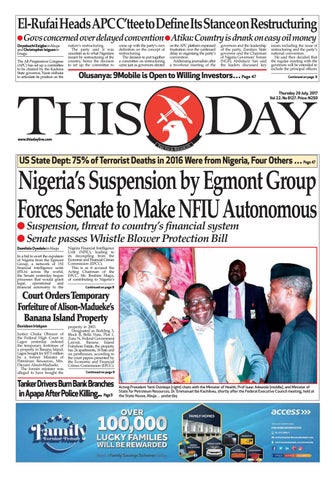
Acting President Yemi Osinbajo (right) chats with the Minister of Health, Prof Isaac Adewole (middle), and Minister of State for Petroleum Resources, Dr. Emmanuel Ibe Kachikwu, shortly after the Federal Executive Council meeting, held at the State House, Abuja… yesterday
2
T H I S D AY THURSDAY JULY 20, 2017
T H I S D AY THURSDAY JULY 20, 2017
3
4
T H I S D AY THURSDAY JULY 20, 2017
T H I S D AY THURSDAY JULY 20, 2017
5
6
T H I S D AY THURSDAY JULY 20, 2017
T H I S D AY THURSDAY JULY 20, 2017
7
8
THURSDAY, ͺ˜ ͺͿ ˾ T H I S D AY
PAGE EIGHT NIGERIA’S SUSPENSION BY EGMONT GROUP FORCES SENATE TO MAKE NFIU AUTONOMOUS recent suspension from the group by his interference in the operations and staffing of the NFIU, despite claims that the unit was autonomous. Magu’s meddlesomeness, the Senate said, has led to the exit of many competent hands from the NFIU. The Senate therefore directed its Committee on AntiCorruption and Financial Crimes to prepare and submit a draft bill for the enactment of a law that would create a substantive and autonomous NFIU and make it autonomous with powers for the employment, reward, training, promotion and discipline of its workforce independently. The committee is expected to submit the draft bill in four weeks. The Egmont Group is the highest inter-governmental association of intelligence agencies in the world with membership by 152 countries. It provides a platform for sharing criminal intelligence and financial information bordering on money laundering, terrorism financing, proliferation of arms, corruption, financial crimes, economic crimes and similar offences geared towards the support of local and international investigations, prosecutions and assets recovery. Nigeria was fully admitted into the coveted body in 2007, after operational admittance in 2005, in what was considered one of the biggest achievements of the Olusegun Obasanjo administration. Some of the agencies that benefit from the activities of the group include the Central Bank of Nigeria (CBN), Nigerian Customs Service, Independent Corrupt Practices and Related Offences Commission (ICPC), the EFCC, Nigeria Immigration Service (NIS), Federal Inland Revenue Service (FIRS), and the Securities and Exchange Commission (SEC) among other relevant governmental agencies. The country’s membership paved the path for the removal of Nigerian banks from the blacklist of international finance. The blacklisting had prevented the banks from engaging in correspondent banking with foreign institutions and also denied Nigerians access to foreign credit cards. The NFIU, which represents Nigeria in the Egmont Group, was suspended at its July 2017 meeting in China, following Nigeria’s failure to grant operational autonomy to the
financial intelligence unit, a situation which the group has objected to for years. Nigeria was also accused of divulging confidential information and constant leakage of sensitive intelligence to the Nigerian media, contrary to global best practices the country signed up for. The group also issued a December 2017 ultimatum to Nigeria to address the issues that led to the suspension or be expelled, which will attract international sanctions against Nigeria’s financial system. The Senate accused the EFCC of aggressively resisting all efforts to grant the requisite autonomy to the NFIU to allow it meet its mandate, technically and logistically. The senators further noted that the Ministries of Justice, Finance and Interior did not complement the efforts of its Committee on Anti-Corruption to avert the suspension, despite pleas and correspondences for action. The position of the Senate was sequel to a motion sponsored by Senator Chukwuka Utazi (Enugu North), who highlighted the implications of the suspension of Nigeria from the Egmont Group. “Nigeria relies on the Egmont Group for assistance in the investigation of the crimes listed above (corruption, money laundering, terrorism financing, financial and economic crimes), as all bank accounts and other assets of suspects are made available to the country wherever they are located in the world. “Be informed that one of the immediate effects of Nigeria’s suspension from the group is that the Egmont Secure Web, (ESW) is currently shutdown against Nigeria. “The implication is that Nigeria can no longer exchange sensitive information with other member countries in order to carry out our investigative and regulatory responsibilities as they affect local and international investigations. “We observe that apart from the suspension of Nigeria this July, the group has given Nigeria up to December 2017 to address the issues raised in the suspension or be expelled, which will attract international sanctions against Nigeria’s financial system. “Nigeria can ill-afford to be blacklisted as the implications are dire, not only to our aspiration for membership of the Financial Action Task Force
(FATF) into which so much energy, time and resources have been invested but the country will also be listed in the G8 list of Non-Cooperating Countries and Territories (NCCT). “Be informed that if expelled, the United Nations Convention Against Corruption (UNCAC) Implementation Reviewing Group will be served notice against Nigeria, and most countries, including the United States, the UK, Germany, Switzerland, etc., would alert their financial institutions and services through the issuance of advisories such as the Financial Criminal Enforcement Network Advisory and Foreign Assets and Cash Directive, to warn them to apply extra care and diligence in transacting with Nigeria and Nigerians. “The huge political and economic implications of such actions are better imagined. An expulsion might also, under certain conditions, attract the imposition of financial transaction limits, including the withdrawal by certain countries of scholarships to students of Nigerian origin. “Concerned that these sanctions will necessitate that Nigeria will undergo the process of fresh application which takes years to accomplish, in addition to subjecting Nigeria’s financial standards to a total and strict review by international bodies such as the World Bank and the IMF, and assets recovery or repatriation to Nigeria can be slowed down or even stopped, and all painstaking efforts for the full membership of FAFT would be in vain if this suspension is not quickly reversed,” Utazi warned. Contributing to the debate, Senator Dino Melaye (Kogi West) added that the suspension would negatively affect Nigeria’s ratings by global organisations such as Transparency International. “There is serious interference with the activities and operations of the NFIU,” Melaye stated. “I want to ask this Senate, as a matter of urgent national importance, to immediately start the process of enacting this law. The disease that is bedeviling EFCC is a communicable one, so that it will not affect the NFIU,” the senator added. Deputy Senate President, Senator Ike Ekweremadu recalled that in the last Senate, there was a huge debate on where to domicile the NFIU, particularly because it was very influential and had access to international funding.
“The NFIU used to be a department in the EFCC and what they do is to gather financial intelligence about bank transactions. “Because it gets international funding and it is very influential, there was a huge debate on where to domicile it either in the Central Bank of Nigeria or Office of the Attorney General of the Federation (OAGF) or Office of the National Security Adviser (ONSA). “Eventually, the last Attorney General of the Federation (Mohammmed Adoke), because EFCC reports to his office, was able to domicile it with the EFCC. “The problem now, which the Egmont Group is complaining about, is that all the staff of NFIU are from the EFCC and they believe that it is not right; that it is supposed to be independent,” Ekweremadu noted. The Deputy Senate President suggested that an urgent meeting of stakeholders from the CBN, OAGF, ICPC, EFCC, ONSA and the Department of State Services (DSS) be convened. “Let them sit down and look at the best practices. Where are they (the units) domiciled in other jurisdictions? Then we can now come back and have an informed opinion on what to do,” he said. Presiding, Senate President Bukola Saraki said the suspension was a setback for Nigeria’s anti-corruption fight. “As such, we must move swiftly because we cannot afford to be cut off from the Egmont Group. We must move swiftly and ensure that this suspension is lifted and one of the things we need to do is to ensure that we pass this bill as soon as possible and give independence to NFIU,” Saraki said. “Other activities that must have led to this must be stopped. The Committee on Anti-corruption will carry out its oversight functions to ensure that the sooner we get the suspension lifted, the better for our image and the fight against corruption,” he added.
Politics and Infighting over NFIU According to online news site, The Cable, Nigeria started getting into trouble with the Egmont Group in 2008 when Farida Waziri was appointed EFCC chairman by President Umaru Musa Yar’Adua.
Because of the circumstances surrounding the removal of Nuhu Ribadu as EFCC chairman and the perceived romance of the Yar’Adua government with corrupt politicians, Nigeria was isolated within the group. NFIU’s access to sensitive financial intelligence on the Egmont Group portal was curtailed — it was believed that information was being shared with those under investigation by the EFCC. The group demanded that Nigeria should make the NFIU independent of government control. Recommendation 29 of the international standards set by the FATF says the FIU must be an independent institution free of interference from anybody or institution. To comply with the Egmont requirement, President Goodluck Jonathan, on assuming power in 2010, set up a presidential committee on FATF. He also appointed Ibrahim Lamorde as the new chairman of the EFCC, and the NFIU access was restored by the Egmont Group. In 2013, Jonathan sent a bill to the National Assembly to make NFIU autonomous and both chambers passed the bill, but things fell apart when it came to harmonisation. An official of the EFCC, who asked not to be named, said the bill did not see the light of day because of “selfish power play”. “The original proposal was that the NFIU would report to the Office of the AttorneyGeneral in rendering accounts,” he said. “However, a former head of service who was eyeing the position of the chairman of the central bank board went and lobbied the lawmakers to put the unit under CBN, insisting that NFIU is a financial matter. “To make matters worse, the EFCC wanted to be in control of NFIU. This too frustrated the legislation. At the end of it all, the law was neither harmonised nor passed,” he revealed.
Whistle Blower Bill Passed Meanwhile, the Senate yesterday also passed the Whistle Blower Protection Bill intended to protect persons who make disclosures of improper conduct by public officers and public bodies. If signed into law, the bill provides that false whistle
blowers would be liable to a minimum of five years imprisonment or a fine of N10 million. The bill also adopted the federal government policy to reward whistle blowers with five per cent of the recovered loot, which their disclosure led to its recovery. Known as “An Act to Protect Persons Making Disclosures for the Public Interest and Others from Reprisals, to Provide for the Matters Disclosed to be Properly Investigated and Dealt with and for Other Purposes Related Therewith”, the bill was sponsored by Senator Biodun Olujimi (Ekiti South). Under the new bill, a person who makes a disclosure shall not be victimised by his or her employers or by fellow employees. The whistle blower would be considered as having been subjected to victimisation if because of making a disclosure, he/she is dismissed, suspended, declared redundant, denied promotion, transferred against his or her will, harassed and intimidated. The person has the right to institute legal action if he/she suffers as a result of his/her whistle blowing. Contained in the report of its Committee on Judiciary, Human Rights and Legal Matters, the bill also outlines the processes that must be undertaken after a person has made a disclosure. It also provides for the establishment of a public interest disclosure reward fund to serve as incentive to potential whistle blowers. Speaking on the passage of the bill, Saraki described it as a promise kept. “Today, we have passed a landmark piece of legislation to fight corruption and protect patriotic Nigerians who are fighting corruption. “This bill will protect the lives of those who risk themselves to expose corrupt practices in Nigeria,” Saraki said. With the passage of this bill, the Senate has concluded work on the three anti-corruption bills before it. Last May, it passed the Mutual Assistance in Criminal Matters Bill, while in June it passed the Witness Protection Bill. The Bill to Establish Special Anti-Corruption Courts has been sent to the Constitution Amendment Committee, while the Proceeds of Crime Bill has been sent to the Senate Joint Committee on Anti-Corruption and Judiciary.
COURT ORDERS TEMPORARY FORFEITURE OF ALISON-MADUEKE’S BANANA ISLAND PROPERTY Apart from the property, the court also ordered the temporary forfeiture of the sums of $2,740,197.96 and N84,537,840.70, said to be part of the rent collected on the property. The funds were said to be domiciled in a Zenith Bank, account number 1013612486. Justice Obiozor gave the order following an ex parte application filed before him by counsel for the EFCC, Mr. Anselem Ozioko. Ozioko told the judge that the EFCC reasonably suspected that the property was acquired with the proceeds of alleged unlawful activities of the former minister. The lawyer said investigations by the EFCC revealed that Alison-Madueke made the $37.5 million payment for the purchase of the property in cash, adding that the money was moved straight from her house in Abuja and paid into the seller’s First Bank account in Abuja. “Nothing could be more suspicious than someone keeping such huge amounts in her apartment. Why was she doing that? To avoid attention.
“We are convinced beyond reasonable doubt, because as of the time this happened, Mrs. Alison-Madueke was still in public service as the Minister of Petroleum Resources,” Ozioko told the court. The ex parte application taken before the judge was filed pursuant to Section 17 of the Advance Fee Fraud and Other Related Offences Act and Section 44(2)(k) of the Nigerian Constitution. Listed as respondents in the application were AlisonMadueke, a legal practitioner, and a company, Rusimpex Limited. In a 41-paragraph affidavit attached to the application, an investigative officer with the EFCC, Abdulrasheed Bawa, explained that the legal practitioner, in connivance with Alison-Madueke, purposely incorporated the company, Rusimpex Limited, on September 11, 2013 to facilitate the alleged fraud. According to Bawa, when the lawyer was questioned by the EFCC, he explained that
he had approached AlisonMadueke for opportunities in the oil and gas industry but the ex-minister told him that being a lawyer, she did not have any such opportunity for him and asked him whether he could in the alternative manage landed properties, an offer which he accepted. Bawa said the legal practitioner later registered Rusimpex Limited at the Corporate Affairs Commission (CAC), wherein a lawyer in his law firm, Adetula Ayokunle, and a Russian, Vladmir Jourauleu, were listed as the directors of the company, while the address of the legal practitioner’s law firm in Ikoyi, Lagos, was registered as the business address of Rusimpex Limited. The investigator added that when Ayokunle was questioned by the EFCC, he explained that he only appended his signature on the CAC documents on his boss’ instruction, while Jourauleu denied knowledge of the company. The investigator explained: “Sometime in 2013, the former
Minister of Petroleum Resources, Mrs. Alison-Madueke, invited the legal practitioner to her house in Abuja for a meeting where she informed the said lawyer to incorporate a company and use same as a front to manage landed properties on her behalf without using her name in any of the incorporation documents. “She further directed the lawyer to meet with Mr. Bisi Stephen Onasanya, the former Group Managing Director of First Bank of Nigeria Plc for that purpose. “Mr. Stephen Onasanya was invited by the commission and he came and volunteered an extrajudicial statement wherein he stated that he marketed a property at Bella Vista, Banana Island, Ikoyi, Lagos, belonging to Mr. Youseff Fattau of Ibatex Nigeria Limited to Mrs. Alison-Madueke and Mrs. Alison-Madueke later bought the property from Mr. Youseff Fattau, through her lawyer (who she introduced to him) and that payment for the said property was made through the Abuja office of First Bank of Nigeria Plc.
“First Bank of Nigeria Plc, through Mr. Barau Muazu, wrote to the commission and also volunteered an extrajudicial statement in writing that they made the payments totalling US$37,500,000 to Ibatex Nigeria Limited & YF Construction Development and Real Estate Limited on behalf of Mrs. Alison-Madueke and that they collected the entire cash from Mrs. Alison-Madueke at her residence of No. 10, Fredrick Chiluba Close, off Jose Marti Street, Asokoro, Abuja and paid into the First Bank of Nigeria Plc accounts of Ibatex and YF Construction Development and Real Estate Limited on her instruction.” After listening to Ozioko, the EFCC counsel, Justice Obiozor made an order temporarily seizing the property and the funds. He directed that the order should be published in a national newspaper. He adjourned till August 7, 2017 for anyone interested in the property and funds to appear before him.
TOP GAINERS TRANSCORP PZ SKYEBANK OANDO GUINNESS TOP LOSERS MRSOIL PRESCO JAIZBANK
NGN NGN 0.12 1.49 0.22 1.05 0.03 0.63 0.34 7.15 3.10 66.10 NGN NGN 1.86 35.44 3.22 61.32 0.03 0.60 LIVESTOCK 0.04 0.87 AXAMANSARD 0.09 2.03 HPE Nestle Nig Plc ₦903.50 Volume: 331.43 million shares Value: N3.244 billion Deals: 4,055 As at yesterday 19/7/17 See details on Page 42
% 8.7 5.0 5.0 4.9 4.9 % 4.9 4.9 4.7 4.4 4.2
9
THURSDAY, ͺ˜ ͺͿ ˾ T H I S D AY
NEWS
Tanker Drivers Burn Bank Branches in Apapa After Police Killing Drivers condemn constant police harassment, extortion Diamond, Sterling Banks confirm fire incident Chiemelie Ezeobi Pandemonium erupted yesterday on Creek Road, Apapa, Lagos, when dozens of truck drivers attempting to access the Apapa seaport went on the rampage over the death of one of their colleagues and set the Diamond and Sterling Bank branches on fire. The aggrieved drivers had targeted the banks, following the death of their colleague who was allegedly shot by a mobile policeman attached to the Diamond Bank branch on Creek Road. It was gathered that the policeman, a sergeant attached to the Mobile Police (Mopol) unit of Lion Building, Lagos, had fired shots at the trailer drivers who as usual had blocked the entrance of the bank. According to an eyewitness report, the drivers had used their trucks to block the entrance of the bank, an action that drew the ire of the bank’s management. The policemen who were attached to the bank at first approached them to move their trucks in order to give access to the bank’s customers entering and exiting the bank. When attempts to get them to comply proved abortive, one of the policemen shot sporadically into the air to scare them off. However, one of the expended bullets hit one of the drivers, who bled and died on the spot before help could come. Angered by that move, other drivers regrouped and after setting Diamond Bank ablaze, also set the neighbouring Sterling Bank branch on fire. Attempts by men of the Lagos State Fire Service, Iponri, who rushed to the scene to put out the raging fire were rebuffed by the drivers. It was gathered that the firemen had to leave the area for fear of getting lynched by the drivers and their fire trucks vandalised. Meanwhile, the policeman who fired the shots and six other hoodlums who tried to capitalise on the situation to rob the banks, have been arrested. Although the corpse of the
trailer driver was deposited at the morgue of the Apapa General Hospital, the sergeant in his preliminary statement had pleaded self-defence. According to him, he shot the driver in order to defend himself, adding that the deceased had first stabbed him on the leg with a dagger, which prompted him to shoot him in self-defence. Following the incident, it took the efforts of some soldiers deployed from the Signal Corps of the Nigerian Army to douse the situation and restore sanity to the area. Their efforts were complemented by men of the Rapid Response Squad (RRS) of the Lagos State Police Command, led by their commander, Olatunji Disu, an Assistant Commissioner of Police. While the soldiers doused the situation, the policemen moved in to prevent hoodlums who had tried to loot the banks and vandalise some cars parked within the premises of the banks. Also at the scene afterwards to douse the fire were firemen from the Nigerian Ports Authority (NPA) and NPA mobile policemen. Speaking on the condition of anonymity, a senior police officer said: “Those trailer drivers are very irrational. When the policemen attached to the first bank (Diamond) shot at the tanker drivers, they regrouped and stormed the bank in anger. “They were said to have first demanded that the policeman who shot their colleague be released to them. When their demands proved abortive, they took the law into their hands. “They contributed fuel from their trucks and set the bank ablaze. The entire situation caused a stampede, as both workers and bankers scrambled to escape through the back of the bank to safety. “The drivers were still on rampage in the first bank when they heard that the policeman had taken refuge in the next bank. “Armed with that information, they simply went over to the said bank and carried out the same carnage, irrespective of the
Lagos State Commissioner of Police, Fatai Owoseni presence of innocent bystanders.” He added that the incident would be treated as arson, given the evidence of several burnt computer sets, air conditioners and other properties of the banks destroyed by the fire. When contacted, the Command Information Officer, Western Naval Command, Apapa, Lieutenant Commander Chinwe Umar, confirmed the incident. She said: “When the information filtered in, we deployed some personnel from the Nigerian Navy Ship (NNS) Beecroft, our operational unit, to the scene to help douse the situation.” Also contacted, the state Police Public Relations Officer, Olarinde Famous-Cole, an Assistant Superintendent of Police, said: “The situation is under control and we have taken charge of the environment. “We have obtained different accounts from eyewitnesses of what happened and it will help us ascertain the true picture and aid our investigation. “Currently, at the scene of the accident are the Area B Commander and Apapa Divisional Police Officer, with complement of the RRS.” Some of the drivers who spoke to THISDAY said the clash was a long time coming, given the enormity of harassment
and degradation they have been forced to endure from the security agents at the ports. However, while some maritime operators blamed the fuel tanker and trailer drivers for their reckless way of parking, resulting in the fracas, the drivers begged to differ. According to the drivers, the reason they park on the road should be blamed on the poor traffic management at different terminals that delay the release of their cargoes. They also blamed the respective security agencies for their plight, adding that they usually face constant harrassment and in most cases, have to bribe their way through. Giving instances, they alleged that the security agencies, especially the police deployed to man the ports, usually task them daily to bribe them with money to allow them park on the road. THISDAY gathered that the security agencies have termed the lanes highways and low ways and have devised different prices for the lanes. The drivers alleged that while they pay N1,000 for the highway, which is on the right and moves fast, those who can only cough up N500 are left on the low way. They also alleged that their reluctance to move from the front of the bank was because they had all paid the security agencies their daily contributions and as such, they had no right to pursue them afterwards. Also, commenting on the incident, the Chairman of the Nigeria Union of Petroleum and Natural Gas Workers (NUPENG), Folawiyo Oil and Gas branch, Mr. Samuel Owolani Gbenle, whose head office is also on Creek Road, spoke with THISDAY narrating how the crisis started, stating that a policeman attached to Diamond Bank on Creek Road wanted to collect money from a container driver but the driver tried to escape, leading the policeman to shoot him. Gbenle said that because the bank officials refused to produce the policeman, the angry drivers
set the bank ablaze. He denied that oil tankers drivers were involved in a clash between policemen and some drivers in Apapa. Gbenle who visited THISDAY’s office to debunk the rumour that oil tanker drivers were responsible for the reappraisal attack on some banks, clarified that the clash was between police and container drivers and not fuel tanker drivers. According to him, “What really happened this morning (yesterday) was that the police wanted to collect money from a container driver and the man tried to escape, but a policeman shot him and they then pursued him and he ran inside a bank. That was why they started burning the bank. “But the news that we are hearing now is that fuel tanker drivers are the ones burning banks in Apapa, which we came here to come and correct.” Asked if there was any possibility that his men were in solidarity with the container drivers, Gbenle said: “They were not even there at all. We are not involved at all.” In a statement from one of the affected banks, Mr. Henry Bassey, Sterling Bank Chief Marketing Officer, Brand Management and Communications Group, the bank said they are working with the security agencies to resolve the issue. The statement said: “An armed mobile policeman fleeing from an irate mob after shooting a tanker driver disrupted banking operations at the Sterling Bank branch on Creek Road this morning. “He ran into the premises of the bank to escape being lynched. Security operatives attached to the bank disarmed and arrested the fleeing mobile policeman but did not hand him over to the irate mob. “The mob got upset and attacked the bank with the intention of unleashing mayhem on staff and customers. The branch’s reception area was vandalised and set ablaze. “The security operatives attached to the branch prevented
the mob from entering the branch while evacuating staff and customers before the arrival of police reinforcement. The branch has been temporarily shut down. “We wish to inform all our customers that normal services will continue at nearby branches and through all our electronic channels.” In its statement, the management of Diamond Bank confirmed that there was a fire incident as a result of mob action at its Creek Road, Apapa branch in Lagos. In the statement issued by the Head of Corporate Communications, Chioma Afe, the bank said its branch was set ablaze by an angry mob after a policeman allegedly shot dead a trailer driver outside the bank premises. “We had a fire incident at our branch office on Creek Road, Apapa, which severely damaged branch infrastructure as a result of mob action. “While the situation is under control, we are working with the Nigeria Police Force and other law enforcement agencies to investigate actions leading to the fire incident. “While these investigations are ongoing, the branch will be closed to customers for their safety and to allow for completion of all repairs. “We will continue to provide updates to our customers via our social media platforms and print media and we urge those customers in the Apapa area to use our broad range of alternate delivery channels like the Diamond Mobile app, Diamond Online, Diamond ATMs and Contact Centre to carry out their transactions. “For those who need to visit a branch location, our closest branches to the Apapa area are situated in Ebute Metta, 1, Market Street, Oyingbo, opposite Bhojsons Ltd Yaba, Iddo Market Mini, Iddo Ultramodern Market, Surulere, 31, Bode Thomas Street and Amuwo Odofin, and Plot Nos. 21, 22 & 23 Opposite ABC Transport Terminal are available to process their requests,” said the bank.
“People have said that the APC promised restructuring. So we need to sit down as a party to develop a shared understanding of what we mean by restructuring in our manifesto. “This committee that is set up which will be chaired by the governor of Kaduna State is mainly to define exactly what APC means by restructuring so that every member will know what exactly we mean. It is not a committee to set up the modalities for restructuring,” he said. Yari also spoke of the party’s outlook for the 2019 elections, insisting that the judgment of the Supreme Court that restored the Senator Ahmed Makarfi leadership of the rival opposition party, would not in anyway affect the APC. The members of the Restructuring committee are el-rufai (chairman), Governors Rauf Aregbesola (Osun), Dr. Abdullahi Umar Ganduje (Kano), Simon Lalong (Plateau),
IbikunleAmosun (Ogun), former governor of Edo State, Prof. Oserheime Osunbor, and the APC National Organising Secretary, Sen. Osita Izunaso. Others include Bolaji Abdullahi and Senator Olubunmi Adetunmbi (Secretary). However, as the ruling party sought to refine its understanding of the clamour for Nigeria’s restructuring, one of its chieftains, former Vice President Atiku Abubakar had no misgivings about its definition, when he said that he backs the concept because of his conviction that it would guaranty equity and a united Nigeria. He said reordering of the country’s governance structure will take power from the elite and give it back to the people, adding that it would ensure that “everyone has a chance to build and share in this great nation’s potential”.
EL-RUFAI HEADS APC C’TTEE TO DEFINE ITS STANCE ON RESTRUCTURING of the National Assembly. Yari said: “We discussed the issue of the relationship between the governors and the National Assembly and the need to have this meeting between the principal officers of the National Assembly, the governors and the party. “We also discussed a number of issues ranging from state congresses which will commence on Saturday to elect two delegates for the convention.” On the delayed APC convention, Yari said that the party had been working on the process but since President Muhammadu Buhari was expected to be in attendance, it was delayed. He however assured that the process would now kick off with congresses at the state level on July 29, leading to the election of three delegates for convention and also fill some of the existing vacancies. “We have been on this issue of the convention for sometime.
But you know that the president is the leader of this party and before getting to the convention, there is a process. “The NWC (National Working Committee) must agree on the time and we have to adopt the report of the NWC, send to the NEC and the president must be in attendance as the leader. “You know the situation of our president today. We have fixed dates, but because of his illness, we have not been able to hold the meeting. However, we have to put a process in place so that we can hold the mid-term convention,” he said. THISDAY also gathered that the governors told the party leadership that they were no longer prepared to keep delaying the convention and other activities, pointing at the speed with which the Peoples Democratic Party (PDP) was able to meet and immediately fixed a date for its national convention. A reliable source at the
meeting said the governors resolved to meet with Acting President Yemi Osinbajo yesterday night to iron out issues relating to the convention and on the outstanding federal government board appointments. Other than the party’s convention, the Zamfara governor said that the meeting assessed the situation leading to the defeat of the party by the candidate of the PDP in the recently held senatorial bye-election in Osun State and measures to avert another recurrence. “We also discussed the bye-election in Osun State. We all know what happened and the fact that it was APC all the way and not because PDP had the power to win the election. “We know what happened there and we are on top of the situation and a committee made up of governors and officers from the national secretariat was formed to revisit the issue.
“Let me say it is a wake up call on how to deal with things like that in future. We are in a democratic setting and Senator Adeleke is from APC and his late brother was from APC and we all know what happened. “We have discussed that extensively and measures have been taken to avoid future occurrence,” he said. Also speaking on the resolutions reached at the meeting, APC spokesman, Malam Bolaji Abdullahi said the reason for setting up the committee on restructuring was to articulate what the APC means by restructuring. “I have repeatedly mentioned it that when we mentioned the setting up a committee on restructuring, what we are talking about is a committee that will articulate what the APC means by restructuring. “We have realised for sometime now that when people talk about restructuring, we are no longer sure if they are talking about the same thing.
Continued on page 51
10
T H I S D AY THURSDAY JULY 20, 2017
T H I S D AY THURSDAY JULY 20, 2017
11
12
T H I S D AY THURSDAY JULY 20, 2017
T H I S D AY THURSDAY JULY 20, 2017
13
14
T H I S D AY THURSDAY JULY 20, 2017
COMMENT
Editor, Editorial Page PETER ISHAKA Email peter.ishaka@thisdaylive.com
MOROCCO AND PAN-AFRICANISM AGAINST AFRICA Morocco is struggling to build into human civilisation, writes Okello Oculi
T
he Kingdom of Morocco has a legacy of over four hundred of rule by Ottoman Turks that primarily slaughtered and exploited local Berbers, Arabs and others; blocking their development and welfare. As a territorially African country it controls a tip of the African landmass that almost kisses the Iberian Peninsula at Tangier with deep historic burdens. Being of Africa and proximate with affairs of Europe flows in her diplomacy. In 1961 a group of ‘’radical’’ African leaders met at Casablanca and declared a vision of Africa united under one government with a commitment to ending colonialism and racial politics in Africa. Her anti-colonialism targeted France’s war in Algeria under the ill-conceived conviction that the territory was a part of France and must remain so. It was also silently against Spanish rule in Western Sahara. She, however, turned around to seize rule over Western Sahara, presumably with the promise to NATO countries to deny access to its rich phosphate deposits by communist Soviet Union and China. Morocco argued that she was merely re-uniting with her portion in the Roman empire yanked away by Spain. Somalia had made similar claims for her diaspora populations in Ogaden in Ethiopia and north-eastern Kenya. Ethiopia made claims on Eritrea. Historians, including the late Dr. Yusuf Bala Usman, warned that Morocco’s case if endorse by the OAU would lead to her amassing troops at gates of Sokoto and Kano with claims that Moroccan travellers once visited there. Moreover, her possession of overwhelming military force over opposition by Polisario, would encourage South Africa to sit tight over Namibia which she ruled as a trust territory for the United Nations. Morocco sought to legitimise her militarism by posing as a brother heeding calls for help by a fellow African country being invaded from another African country. In 1977, President Mobutu asked for help from the OAU to repel invasion by former police units that fled to Angola from Congo after Moise Tshombe’s secession was crushed in 1963. Mobutu had soiled his fate with the blood of Patrice Lumumba, the first democratically elected Prime Minister of Congo following elections for independence on June 30, 1960. The Americans, Britain and France feared that he would allow the Soviet Union to mine the rich uranium deposits in Kolwezi. Cheik Anta Diop, a nuclear physicist, who conducted research in a French nuclear research institute, claimed that the United States dug out uranium from one known site and carried it away in fear that the departing Belgian officials could no longer guarantee Soviet scientists being kept off the site. It was a lesson that Morocco learnt well and would use to win NATO’s support for his annexation of Western Sahara in 1975. Mobutu has kept Congo away from Lumumba and his communist allies. Between 1965 and 1977 he exerted enormous effort in uniting a vast country. His tours every six weeks hosted eloquent speeches he made to huge rallies as he whipped up a sense of Congolese nationalism. Surrounded by echoes of ‘’socialism’’ and ‘’humanism’’ from Nyerere (in Tanzania) and Kenneth Kaunda (in Zambia), he announced the nationalisation of foreign-owned businesses, huge farms and mines. The IMF and the World Bank were deeply angered; but not enough for NATO to abandon Mobutu. France and the United States sent military aircraft to
ON JUNE 4, 2017, A HUGE MAJORITY OF 12 OUT OF 15 MEMBER STATES GLADLY WELCOMED MOROCCO’S COMING FROM UNDER THE ATLANTIC OCEAN TO SHOUT INTO CAPITALS LOCATED ON COASTS. SHE HAS SPAT ON AFRICAN UNION’S CONTINUING TO BALKANISE AFRICA INTO REGIONAL BLOCS BASED ON GEOGRAPHICAL PROXIMITY
fly Moroccan troops to fight for Mobutu and dramatise their country’s pan-African credentials. Following his burst of economic nationalism, Mobutu, not surprisingly, earned hostile coverage by Euro-American media despite his collaboration with NATO against the socialist MPLA liberation fighters in Angola. From Addis Ababa, Nigeria’s General Murtala Muhammed grabbed praises across Africa by rejecting President Gerald Ford’ wishes; and winning OAU support for Neto’s socialist government in Angola. Morocco had invested badly in supporting Mobutu. Nigeria’s successful diplomatic momentum would roll into the admission of Western Sahara into the OAU as a member state-in-waiting. Morocco folded her wings and left the organisation; while heeding to Bob Marley’s advice to run away and return to fight another day. It is clear that she heard out of Addis Ababa the notion that, with the end of colonialism and apartheid, Africa must focus on economic diplomacy, notably: intra-African trade among member states. By 2015, Morocco had signed 1,000 agreements and treaties with other African states. Her banks were operating in 20 African states. Her direct investments in Tanzania, Botswana, Chad, and Ethiopia were higher, in each case, than those in her neighbours Algeria, Tunisia, and Egypt. Botswana received the highest (outside North Africa), at 600 million dollars; while Egypt led her region with 125 million dollars. Morocco’s pan-Africanism is rattling in pockets and handbags across Africa. Her pan-Africanism has returned to Casablanca Group’s waving Kwame Nkrumah’s flag with bold letters of ‘’AFRICA MUST UNITE !’’. Within the member countries of ECOWAS, Morocco exported three million tonnes of goods in 2016. Landlocked countries of Mali and Burkina Faso are also getting the Moroccan hug. That might explain why Morocco, with solid knocks of arrogance and rudeness, applied to be a member of ECOWAS - a regional organisation where she is NOT geographically located. On June 4, 2017, a huge majority of 12 out of 15 member states gladly welcomed Morocco’s coming from under the Atlantic Ocean to shout into capitals located on coasts. She has spat on African Union’s continuing to balkanise Africa into regional blocs based on geographical proximity. It is not clear that Morocco is the new shining pan-Africanist. The vigorous push by a French shipping company to carry goods from Moroccan ports, including Tangiers across from Europe, suggests that goods from Europe are being labelled as Moroccan. If in 1977 she could send her troops to bleed in Mobutu’s Zaire (now D.R. Congo) in defence – according to The New York Times - of ‘’the stake of French multinationals such as Alsthom and Ttiomson, and concessions for prospecting the mineral riches’’, she can, in 2017, be a courier state for the European Union. That form of pan-Africanism is economic colonialism passing for the ‘’intra-African trade’’ preached by the AU. Yet Morocco’s trade and investment as ‘’propaganda of the deed’’ must alarm those in Nigeria or Ghana or Kenya or Uganda who hide funds in Dubai or Panama while Morocco pours her funds into member economies of ECOWAS and beyond. Prof. Oculi is a member of THISDAY Editorial Board
LEADERSHIP ROLE IN CONTEMPORARY MANAGEMENT Akintola Benson-Oke writes that training programmes enhance human capita development for better performance
I
t has been observed that, contemporary “leaders have four tools in their possession, which they use to influence employees and create commitment to the company’s goals. [First, these leaders are charismatic. Charisma refers to behaviours leaders demonstrate that inspire confidence, commitment, and admiration toward the leader. These individuals have a “magnetic” personality that is appealing to followers. Second, these leaders use inspirational motivation or come up with a vision that is inspiring to others. Third is the use of intellectual stimulation, which means that they challenge organisational norms and status quo, and they encourage employees to think creatively and work harder. Finally, they use individualised consideration, which means that they show personal care and concern for the well-being of their followers.” The government of Lagos State led by Governor Akinwunmi Ambode fully recognises the enormous value that knowledge and soft skills training bring to bear on the attainment of the strategic objectives of the government and the public service of Lagos State. Also, the Ministry of Establishments, Training and Pensions has always been in the vanguard of advocating for the institutionalisation of essential training programmes that benefit the most strategically-placed officers in the public service. Thus, I am delighted that we are witnessing yet another occasion to demonstrate this noble commitment of the Lagos State government. Without doubt, it is true that “high performances have been known to increase in organisations that expose their human capital to leadership development through training programmes and I am hopeful that the learning outcomes will translate into more dynamism, effectiveness and efficiency for the public service. The need for ensuring and assuring the efficiency and effectiveness of public institutions has never
been greater than now. In our contemporary age of constant changes, it is widely agreed that institutions must have clearly-defined missions that are relevant to the needs and aspirations of its stakeholders. Following this, the human capital at the helm of leadership in these institutions must have the courage to envision a future that realises the attainment of the defined mission of the institutions. In order to actualise the vision, however, leaders must be trained to possess both the hard and soft skills that are fundamental for success. This is where training programme becomes relevant. In contemporary times, it is expected that the managers of men and resources should be able to: one, clearly and repeatedly, through both words and actions, send the message that effective communication is essential for organisational success and career advancement. This is a powerful, indispensable message. But it requires consistent, hard-nosed follow-through, including compensation incentives that promote good communication practices. Two, inject science into your communications strategy. Neuroscience and behavioural economics, in addition to the best polling and statistical techniques, have opened vast new areas of knowledge that leaders can use to their advantage to heighten their credibility and increase the effectiveness of their messages. Sophisticated research grounded in science is an excellent tool for developing strategies and messages that move people to desired actions. Three, mandate a holistic assessment of the communications status quo in your organisation. In this assessment, do not be limited by the traditional definition of “communications.” Review both the verbal and non-verbal ways in which the organisation projects an image of itself through its various activities. Include a study of every internal and external constituency that presents exposures and opportunities for the organisation. Assess how
it creates relationships with those constituencies, from the body language of a customer service agent to the treatment of laid-off employees, to positions on sensitive public-policy matters, to the design of products and services, to the public visibility of the leader, and so on. Along the way, remember that communication is a two-way street, so it is essential to evaluate the organisation’s ability to identify problems and opportunities and then reliably report that information through feedback channels up the hierarchy. Further, the assessment work should be done in an integrated manner and managed strategically from the top. Four, make sure that any person at any level who has responsibility for some form of communication (verbal or non-verbal) can do it well. The leader should develop a solid understanding of what constitutes good communication practices and insist on training initiatives to ensure people have the ability to carry out their communications duties effectively. The leader should lead by example, refining his or her own skills as a communicator. To be clear, the administration of Mr. Ambode wants a public service where every officer is able and empowered to set a clear vision regarding his duties and effectively communicate it to colleagues, providing them with a clear understanding of the desired direction; understands that effective planning is important when it comes to meeting organisational goals; is able to provide stability, inspiration, courage and direction during times of crisis and when dealing with relationships between co-workers; aims at improving employee relations and more closely aligning the team and individual objectives; and is an indispensable contributor to growth such that the public service maintains its effectiveness, productivity and competitiveness. To this end, a set of useful questions that can
help in assessing an individual’s standing vis-à-vis leadership qualities have been developed. It will be well-served by considering them:.Do you provide guidance? A leader not only have to supervise but must also play a guiding role for the subordinates. Guidance here means instructing the subordinates on the way they have to perform their work effectively and efficiently. Do you instil confidence? Confidence is an important factor which can be achieved through appreciating the work efforts of the subordinates, clearly explaining to them their role and giving them guidelines to achieve the goals effectively. It is also important to hear the employees with regard to their complaints and problems. Are you able to maximise efficiency in your use of time and resources? Leadership calls for maximising efficiency. It is an important function of management which helps to maximise efficiency and to achieve organisational goals. Do you seek to create and maintain an efficient work environment? Leadership is about getting things done by members of the organisation. An efficient work environment helps in sound and stable growth. Therefore, human relations should be kept in mind by a leader. He should have personal contacts with employees and should listen to their problems and solve them. He should treat employees on humanitarian terms. Are you able and willing to initiate action? Confident leadership initiates action. The leader is a person who starts the work by communicating the policies and plans to the subordinates from where the work actually starts. Do you instill motivation? The leader is the one motivating others with economic and noneconomic rewards in order to get the work done. Excerpts from a speech by Dr. Benson-Oke, Commissioner for Establishments Training & Pensions, Lagos
15
T H I S D AY Ëž Í°ÍŽËœ Í°ÍŽÍŻÍľ
EDITORIAL WHEN WILL OGONI CLEAN-UP BEGIN? Government should live up to its promise in Ogoniland
M
ore than a year after the federal government launched the implementation of the Ogoni clean-up project, not much has been done to inspire anyone, not least the affected communities. The project is weighed down by all kinds of silly excuses and institutional bureaucracy, but all boiling down to lack of commitment by the government. “I am absolutely disappointed,â€? said Ledum Mitee, former President of the Movement for the Survival of the Ogoni People (MOSOP). “I feel that our people have been deceived and they have used us to play a very dangerous politics.â€? It is noteworthy that in June 2016, President Muhammadu Buhari, represented by Vice-President Yemi Osinbajo, launched the clean-up of Ogoniland in fulďŹ lment of his electioneering campaign. The elaborate exercise had raised the hope of many, particularly those in the immediate neighbourhood, conďŹ ned to drinking contaminated waters and eating poisoned ďŹ shes due decades of oil spillage, that some good was in the air. “The methodology for the clean-up will ensure FOR A GOVERNMENT THAT job creation for young IS NOW BEING ACCUSED people. The agro-allied OF MAKING EMPTY industries required for PROMISES IN ITS BID processing of agriculTO GET TO POWER, THE tural produce will also BUHARI ADMINISTRATION be put in place,â€? said WILL DO WELL TO DELIVER Buhari who added that ON THE OGONI CLEAN-UP approval had been given to establish the necessary institutional framework to drive the process. However, not much has happened in the past one year as the hopes again seemed misplaced. Perhaps the only thing of “valueâ€? is that the Hydrocarbon Pollution Restoration Project (HYPREP) has called for the expression of interest from members of the public to prequalify for implementation of some aspects of the cleanup exercise. And perhaps the inauguration of the governing board earlier in the year. Even when the former Minister of Environment, Mrs Amina Mohammed, now of the United Nations, inau-
Letters to the Editor
gurated the Integrated Contaminated Soil Management Centre in Bori last February, there was no follow up as the place has been overtaken by weeds.
T
T H I S DAY EDITOR DEPUTY EDITORS ˜ MANAGING DIRECTOR DEPUTY MANAGING DIRECTOR CHAIRMAN EDITORIAL BOARD
EDITOR NATION’S CAPITAL
T H I S DAY N E W S PA P E R S L I M I T E D EDITOR-IN-CHIEF/CHAIRMAN GROUP EXECUTIVE DIRECTORS ˜ ˜
˜ GROUP FINANCE DIRECTOR DIVISIONAL DIRECTORS ˜ ˜ DEPUTY DIVISIONAL DIRECTOR
SNR. ASSOCIATE DIRECTOR ASSOCIATE DIRECTORS ˜ CONTROLLERS ˜ ˜
GENERAL MANAGER
GROUP HEAD DIRECTOR, PRINTING PRODUCTION TO SEND EMAIL: ďŹ rst name.surname@thisdaylive.com
he United Nations Environment Programme (UNEP) report submitted since 2011 had recommended a scientiďŹ c rectiďŹ cation of the environment in Ogoniland which is expected to take about 30 years to accomplish with an estimated take-off cost of $1billion. The three-year investigation leading to the report had come up with far-reaching and alarming revelations among which were heavy contamination of land and underground water courses, and that the drinking water in the communities contained dangerous concentrations of benzene and other pollutants. The report further revealed that there was clear evidence of oil ďŹ rms dumping contaminated soil in unlined pits and accused Shell and other oil ďŹ rms that the endemic environmental crisis in Ogoniland was as a result of their failure to meet the minimum requirements of their own environmental standards. Indeed, while submitting the report of what happened in Ogoniland, Mr. Achim Steiner, Executive Director of UNEP, who was present at the so-called commencement of the clean-up, said the study “offers a blueprint for how the oil industry and public authorities might operate more responsibly in Africa and beyond at a time of increasing production and exploration across many parts of the continent.â€? Unfortunately, there is little to show that the government of the day is serious about the welfare of the Ogoni people, not to talk of holding the oil companies to account. “We are tired of these gimmicks and we want action on the cleanupâ€?, said Fegalo Nsuke, spokesman of MOSOP. “We want Nigeria to respect us as Ogoni people and treat us as human beings with rights. Nigeria and Shell should as matter of urgency clean up their mess in Ogoniland and respect our rights to live a digniďŹ ed lives.â€? For a government that is now being accused of making empty promises in its bid to get to power, the Buhari administration will do well to deliver on the Ogoni clean-up if it is not suffer further reputational damage both locally and internationally.
TO OUR READERS Letters in response to speciďŹ c publications in THISDAY should be brief (150-200 words) and straight to the point. Interested readers may send such letters along with their contact details to opinion@thisdaylive.com. We also welcome comments and opinions on topical local, national and international issues provided they are well-written and should also not be longer than (9501000 words). They should be sent to opinion@thisdaylive.com along with the email address and phone numbers of the writer.
AS PDP LOOKS TO NORTH
T
he Peoples Democratic Party (PDP) is making some frantic efforts to reposition itself, rebrand its image and recapture its lost fortunes and supporters in northern Nigeria. The PDP should look back and analyse its blunders. After losing the 2015 elections, without proper analysis of the situation, the PDP, in haste, asked its then National Chairman, Ahmed Adamu Mu’azu to resign. The PDP failed to see that its woeful performance in the north during the 2015 elections was strongly due to the unprecedented Buhari ‘Tsunami’, the SAK phenomenon; the failure of the then central government to effectively tackle the Boko Haram insurgency, and the name Goodluck Jonathan. PDP’s first priority should be Northern Nigeria; the party’s resurrection, re-imaging and a ‘restart’ must begin from the north. The PDP must bring on board bigwigs from the north to help the party to ‘come to life’ in the north and the country in general. Most of the party’s fortunes in the north are lost. Thus, the party needs people who understand how politics play out in the north. Apart from having a chairman who has such capacity, the PDP also needs its founding members who understand the fundamentals of northern politics. People like Sule Lamido, who is a product of the Aminu Kano radical politics of the north. Lamido is from the core Hausa-Fulani states and has large followers. Furthermore, his ‘cousins’ in the northeast will have nothing against him. The Middle Belt and many northern minorities share his politics of radicalism. Lamido’s greatest shortcoming is the corruption case hanging on his neck. But with his excellent performance as governor of Jigawa State and he is known throughout the country, just some ‘little packaging’ is what he needs. Hate him or love him, Ali Modu Sheriff is one of those adventurous politicians in the north who have grabbed the nitty-gritty of the politics in the north and have connections in the south. The ‘amnesty’ purported to have been granted Sheriff and his bloc was a mistake. The victor; no vanquished
declaration made by Ahmed Makarfi should be marched with real action. The PDP truly needs Ali Modu Sheriff. Though he is not a presidential material, but he is an astute politician. Looking at his style of politics, the love for adventures in politics and opportunistic tendencies former Vice-President Atiku Abubakar cannot resist an offer from the PDP and the PDP cannot also resist an Atiku in its ‘house’. Because, Atiku has immense war chest that easily scares off his opponents and vast political network and connections. Former Vice-President Muhammad Namadi Sambo appears so jittery to play active role in the PDP. But Namadi has no option than to play active role if he is still a member of the PDP. Though, PDP’s presidential ticket may not fit him now. One man that can pull crowd and make impact in the politics of PDP’s presidential ticket is Gombe State governor, Ibrahim Hassan DanKwambo. Dankwambo is one of the highflyers governors with massive youth’s support. For the PDP to really begin a new start, it must take advantage of some of its bigwigs in the north who have adept understanding of the nexus of Hausa-Fulani and the minority politics in the north. Late MKO Abiola’s inroad in the north was ‘motorised’ on the basis of utilisation of the experience of individuals who understand that nexus. PDP’s future depends on whether it recaptures its lost fortunes in the north and how well it takes advantage of its experienced members who have gone through mills of the politics of the north. However, for the party to make a full and politically-fruitful come back, some external factors has to play to its advantage: Buhari’s cult-like popularity and supporters in the north fades out; the APC grossly continues to mismanage its political fortunes, some members of the New PDP from the north pulling out of the APC and the northern Talakawas’ anger against the party subsides. Zayyad I. Muhammad Jimeta, Adamawa State
OIL FIRMS: GO TO THE NIGER DELTA
R
ecently, the federal government directed International Oil Companies operating in the Niger Delta region to relocate their headquarters to their states of operation to mitigate tension in the host communities. This is the right thing to do. I fully support this federal government directive because it has the potential to bring peace to the region. It can also bring development to the host communities through the provision of jobs for the youths. This can arrest most of their agitations and grievances. Assurance Ovie, Benin – City.
16
T H I S D AY THURSDAY JULY 20, 2017
T H I S D AY THURSDAY JULY 20, 2017
17
18
T H I S D AY ˾ THURSDAY, JULY 20, 2017
POLITICS
Group Politics Editor Tobi Soniyi Email tobi.soniyi@thisdaylive.com 08033146139 SMS ONLY
PERSONALITY INTERVIEW
Namdas: Executive Ignorance Responsible for Budget Disagreement Chairman, House of Representatives’ Committee on Media and Public Affairs, Alhaji Abdulrazak Namdas, says the dispute over the powers of the National Assembly to alter the budget is fuelled by ignorance of the budgeting process by the executive. He spoke with journalists in Yola. Daji Sani was there and presents the excerpts:
H
ow does the entire budget process run between the legislature and the executive? The executive is responsible for submitting estimates and proposals that is later known as budget to the National Assembly and that is done by the president? When that is done, the document submitted by the executive ceases to be the property of the executive, it becomes the property of the legislature. The law makers will then process it into a bill that is deliberated upon in the house as to the general principles of the budget. We then go through the second reading of the budget, after that, it is sent to the Appropriation Committee, it is at this point that we interface with Ministries, Departments and Agencies (MDA). They will meet with various committees of the house to go through the budget, after which the committees submit their reports to the Appropriation Committee. The committee studies it and makes necessary adjustments and thereafter interfaces the work in the house with that of the Senate to be sure we are on the same page because we operate a bicameral legislature, and if there are differences, we set up a conference committee and after the conference committee, we then submit a single document at the plenary, so that every member would see it, a document which is then sent to the president for assent as the country’s budget. Once he signs it, it becomes binding on the president to execute it. In the event the president refuses to sign, if the National Assembly could muster a two-third majority of the house, then we can veto the president and the budget will be passed. There is a fine line of distinction between our role and theirs. Why is there always a disagreement between the executive and the legislative over the budget? Honestly speaking I don’t know what is causing this misunderstanding but sections 4, 59, 80, 81 of the 1999 constitution, as amended are very clear about the roles and powers of the National Assembly. Right now, there is a judgment in favour of the National Assembly, when Femi Falana, SAN challenged whether the National Assembly had the right to reduce or increase the budget, the court ruled in favour of the National Assembly, stating and insisting clearly that we have that power, or else we would be a rubber stamp of executive. I am not arguing with the minister but he started it first and responded after we have spoken, so I am obliged to make these clarifications. I see the problem emanating from the background of some of the ministers who used to be governors and were accustomed to bye-passing their state legislators and now find it difficult to accept reality. The propaganda churned out by the executive arm of government is partly buoyed by ignorance of the budgeting process by the class of people in the executive arm of government who were former governors and were used to bye-passing their states’ houses of assembly. They are yet to come to terms with the reality of a true democratic process of being vetted by the legislature and largely I think it is an orchestrated mischief rooted in a needless exercise in power play at the expense of the overall interest of serving the Nigerian people.
Namdas...law makers owe the public a duty to ensure public funds are not wasted
The entire process of budgeting was never designed to be played out in the executive arm of government without the intervention of the legislative arm of government in the interest of federal character and national harmony. If the ranting of the executive was correct, there would not have been the need for the budget to be submitted to the National Assembly in the first instance. The executive would have raised the proposals, verified it and passed the budget itself. The power of the purse rests with the National Assembly and not the executive arm of government. There are 487 elected officials in the National Assembly as against two elected officials in the executive arm, the president and the vice president. The legislature is the true representation of Nigerians and the legislature has the responsibility to ensure that every interest is represented and every cry is at least heard. When we fail to do that, democracy itself fails. It is unfortunate that after 17 years of democracy, these teething budgeting issues remain highly contentious. Some of us are still grappling with the basics in the process of our democratic learning curve. I believe by now, we should have overcome the question of who does this and who does what. We should
If the ranting of the executive was correct, there would not have been the need for the budget to be submitted to the National Assembly in the first instance
be actively collaborating with the executive to foster the interest of Nigerians. It should not be about ego trips or some futile exercise in who is more powerful. It was clear that the legislature took the liberty to move some funds around, that seems like a clear case of the legislature ‘usurping executive powers’. No, no, no, one thing I want you to understand is that the legislature does not write budget because we make laws and the appropriation bill is a law, we work on the bill. The executive decides, this is what it wants to do in a particular current year, its expected revenue and this is how much it intends to spend and, if it runs into deficits, it will need to borrow, among other things. In the National Assembly there are about 469 law makers. We represent every interest, culture, every ethnic group and every region in the country. So, if the executive sends its proposals and it does not pass the test of carrying everyone in the country along, it is within our constitutional powers to see to it that every interest is at least addressed and that does not amount to interfering with executive powers. Whenever it happens that we do that, we always do it in good faith, not in any way attempting to run into power politics. Nigerians should ask the most common sense question, that if the National Assembly is not allowed to make any amendments in the budget, why should it be brought to the assembly in the first place? We are operating a democracy and the executive must be accountable to the people and we are the representative of the people, the power of the purse belongs to the representatives of the people. If the estimate was submitted for example with zero allocation to a particular constituency and an allocation was made to another constituency somewhere else that was apparently needless, would the people of the constituency with zero allocation travel to Abuja to ask why, no, it our duty to do so.This is done in the
spirit of nationhood and the sense of national responsibility to ensure a true federal character and representation. Right now, the country is faced with all kinds of agitations, secession calls, restructuring, among other outcries. It is because people, for a very long time, have been feeling marginalized, it is because the National Assembly has not been allowed to do its job properly, and that is the tactics applied here. We have a duty to ensure that there is no nepotism, no marginalization, no tribalism, then all these agitations will naturally go away. You alleged the executive smuggled in ‘ghost allocation’ and suggested that they even deny some obvious dubious allocations when you raised question without going into specifics, could you explain? Ok, when the minister was asked about the N20 billion allocations, he did not deny it, he simply explained that it was for the purpose of planning, my quarrel is that even if you have a contingency plan, N20 billion is a huge amount. The Second Niger Bridge alone has a budget estimate of about N12 billion, why would anybody have N20 billion for contingency, if every ministry in the country will have N20 billion for contingency alone, then the budget of the country will be exhausted on contingencies. Then he has the issue of N17 billion for Economic Impact Assessment (EIA) for Mambilla plateau power project, N17 billion not million, it is too bogus. There is nothing personal here; it is just injustice to the budget itself to have those amounts approved. We have made valid observations to Mr Fashola and he agreed to them, he should be humble enough to admit it instead of trying to paint the National Assembly black in the eyes of the public, tomorrow he might find himself in the National Assembly and the negative image he has been trying to create for the assembly might become his. We have introduced for the first time, public hearings in the assembly. People come to give us their opinion about the budget, we deserve some credit.
19
T H I S D AY ˾ THURSDAY, JULY 20, 2017
POLITICS
Okorie: Councils Run By Caretakers, Not Entitled to Federal Allocations Chairman, House of Representatives Committee on Agricultural Colleges and Institutions, Linus Okorie, argues that it is unconstitutional for local governments run by caretaker committees to benefit from federal allocations. He spoke to Benjamin Nworie who now presents the excerpts:
W
hat inspired you to sponsor a bill to grant amnesty for treasury looters? The Nigerian economy is in its first recession in more than 20 years with activity across all sectors slowing and unemployment rising. It means that the Federal Government needs innovative sources of financing to resuscitate the economy. With some of the policies not yielding the desired results, government faces a dilemma; whether to accept the return of even a small part of stolen assets in return for reduction in scope or full cessation of criminal prosecution, or faces the almost certain prospect of getting nothing at all. This situation can be so intractable that many African governments that faced similar challenges ended up leaving office without any satisfactory resolution of these cases. With the poverty rate higher than 70 per cent, the seriousness of the problem cannot be overstated. Most Nigerians living above the poverty line still have only limited access to education, health facilities, water and sanitation as well as basic services. Nigeria also has very serious infrastructure financing challenges which need to be overcome if economic recovery is to be attained and growth sustained. In full appreciation of the challenges inherent in legal repatriation, arising even in the rare event that the prosecutorial approach agains those suspected of economic crimes has been successful, and recognising the enormous potential of Nigeria to finance more of its own development with funds generated internally, the Economic Amnesty Bill is therefore a launchpad for alternative policy direction and mechanism for enhancing the ability of quick recovery of hidden funds. Endless litigation should be balanced against the needs to raise funds to tackle poverty and plug the infrastructure gap. Consequently, owing to the above imperatives, Nigeria urgently requires a more effective means of securing the return of stolen loots to Nigeria to be invested in development. This mechanism must have the legal, economic, political, social, and moral legitimacy to deliver for the most disadvantaged Nigerians. The Economic Amnesty Bill is, in my considered opinion, that win-win mechanism to actualise this new paradigm. Instructively, it was most encouraging to learn from the papers, a few days back, of the planned implementation of a tax amnesty by the Federal Government; barely two weeks after the first reading of mybill in the House of Representatives. Attributed to the Minister of Finance, Kemi Adeosun, the tax amnesty is expected to commence from July 1, 2017 to December 30, 2017 and is estimated to generate over $1 billion dollars while raising the country’s tax base. As encouraging as the programme appears, it falls far short of expectation because it addresses only a part of the area covered by the Economic Amnesty Bill. Moreover, the scheme, as announced, would face legal challenges in granting “prosecutorial amnesty” to people without first putting in place a legislative framework. That framework is the Economic Amnesty Bill. My appeal, therefore, is that the Federal Government should demonstrate the requisite political will by supporting the bill. I also wish to appeal to the House of Representatives to grant the bill accelerated passage. Your assessment of Governor David Nweze Umahi’s two years in office? His performance has been superlative. The governor has so performed that even those who believed and wished him bad now come out to confess openly that he had indeed performed
Okorie...defended his amnesty bill for looters
creditably well. He has so performed that those who support him and work with him are so proud of him. He had removed the divisions among the people of Ebonyi. Umahi has so transformed Abakaliki now to urban city that we are now very proud to bring anybody in any part of Nigeria to come and visit Ebonyi State. He is now building concrete roads all over the city and also in local government areas across the state. Today, security is assured in Ebonyi and the greatest of it all is the peace and unity he has engendered all over especially in the Ezza/Ezillo axis. He has touched every local government area with one project or the other The governor’s two years in office has been excellent. Is the continuous registration of political parties healthy for our democracy? Yes it is. Sometime in Nigeria, we had Radio Nigeria as the only radio station that was available. Should we have said that Radio Nigeria was so good and that we didn’t want another station to come up? The foundation of our democracy is freedom, freedom of association and that is exactly what is going on. If you refuse to register any group that has met such conditions of the constitution and by INEC, that would be undemocratic. I mustn’t be in a big party; I can choose to pursue only a cause such as environmental, human rights or human rights. So, I think it is the best thing that is helping our democracy; that people can freely enter and exit political parties and can come together anytime when they feel compelled especially when the party they are, is not serving the vision they have, to form a new association and apply to INEC for registration. There is nothing that says every party should win elections. It may just be an
advocate of issues, that maybe the objective. If you convince the electorates you can win election. Look at the case of Donald Trump who was rejected by his own party but elected based on his ideas. So I am of the opinion that in Nigeria, we should champion that freedom and allow people the opportunity. Do you think it is right for local government administrations that are not democratically elected to continue receiving federal allocations? Section 7 of the constitution guarantees democratic governance at all levels, especially at the local government level. The present national Assembly is always very sensitive to the fact that until we have democratic governance at all levels we cannot be said to be practising a federal system.The Speaker of the House, Rt. Hon Yakubu Dogara, had said it in many fora that these allocations should not continue to go to local governments that are not democratically administered. However, until an amendment of the constitution is made to remove the Joint Local Government Account, this anomaly will continue to exist. Yes, the National Assembly strongly believes that it is an aberration to allow a caretaker system in a democratic system, it’s unconstitutional and the implication of an unconstitutional act is that sanction should come; that sanction is that local government areas run by caretakers should not benefit from constitutional allocation of funds. The National Assembly alone cannot just do it, first you have to make amendments, it has to be agreed to by two-third of the states. More importantly, it must be the majority decision of Nigerians because laws are made for the people. So I think it is not a matter for lawmakers alone, it is more of a matter for the society. We have to determine what we really want.
The National Assembly will only respond to the stimulus they get from the public. Do you agree that the 2014 National Conference report should be presented to the National Assembly for deliberations? In 2015, I approached the secretariat of the defunct National Conference Committee, I wanted to get the conference’s report to enable me sponsor it as a private member bill because I wanted the report implemented. I feel very strongly that irrespective of our differences, that conference remains the best to help build a contemporary Nigeria. It addressed the issues affecting us today. Such as ethnicity insecurity and much more important - restructuring. There is need to restructure Nigeria and you can’t run away from it. The story of Boko Haram, whether we accept it or not, the religious undertone, the issue of IPOB, MASSOB and agitation for secession, all point to the need to address alleged feelings of marginalisation. The Issue of militancy in the South-south is fuelled by the feeling that the resources the people believe belonged to them are being taken away and expended in far away areas while they are neglected. The South-west also believes it is not getting enough from the present arrangement. The same applies to the middle belt.Therefore we need to address the fundamental issue of restructuring in a way that Nigerians can feel comfortable to address their fears and accept that other parts of the country mean well for them. The 2014 conference report still remains the best option for addressing the issues. In any case, if it is sent to the National Assembly, Nigerians, who did not participate in the conference, will get the opportunity to air their views.
20
THURSDAY, JULY 20, 2017 ˾ T H I S D AY
FEATURES
Acting Features Editor Charles Ajunwa Email charles.ajunwa@thisdaylive.com
Facelift for Edo Roads Adibe Emenyonu writes on the reconstruction of roads, using the concrete technology by Edo State governor, Godwin Obaseki
L-R: Edo State governor, Mr. Godwin Obaseki. MD of AG-Dangote, Mr. Ashif Juma and Edo deputy, governor, Hon. Philip Shaibu, as Governor Obaseki cuts the tape to inaugurate one of the reconstructed roads in Benin City
B
efore the swearing-in of Godwin Obaseki as governor of Edo State, most adjourning streets in Benin metropolis were in a state of disrepair as the immediate past government mostly concentrated its road infrastructure development on major roads that led in and out of the state capital and other major cities in the state. Consequent upon this, those living within these adjourning streets were not having life easier, which in turn made it difficult for them to access the major roads. However, with the massive reconstruction of these roads, "life is getting easier," said Iyoyin Shekiri, a fabricator who has his workshop along Wire Road during a tour of rehabilitated roads within the capital city. Shekiri, who expressed joy over the development, noted that the Obaseki-led administration had started to follow the developmental footsteps of his predecessor, Comrade Adams Oshiomhole by making sure citizens and inhabitants have access to good and quality roads. He said, "Wire Road has never had it good in terms of access to good roads until Governor Obaseki assumed office to redeem the people from the road that had suffered years of abandonment and had become a death trap." Shekiri is not alone in this expression of joy. Daniel Ohenhen, also a resident on Wire Road, thanked the governor for doing a good job, and appealed that more of these need to be replicated across the state. The situation was not different at Nevis Street, one of the streets connecting Mission
Road and Forestry Road as residents came out in their large numbers to applaud the governor on his determination to improve the socio-economic well-being of the people through massive road construction and rehabilitation across the state. The case of Nevis Street is peculiar. It ranked among areas with very marshy terrain which had defied all rehabilitation works carried out until the innovation of using concrete pavement as a lasting remedy. Other roads in that category include Oba Eweka/Ogbetuo Oni Road, Osabuihien Close GRA, Wire Road, Nevis Road, Ugbor, Nekpenekpe, Oni Street, Jemide/Akhiobare and Ikpokpan Road, GRA.
Wire Road has never had it good in terms of access to good roads until Governor Obaseki assumed office to redeem the people from the road that had suffered years of abandonment and had become a death trap
The Director of Construction in the state Ministry of Works, Mr. John Obanor, explained that from the total figure of 29 roads of over 50km earmarked for rehabilitation, 15 have been completed with either flexible pavement or rigid pavement. For instance, he said the Ikpokpan Road in the Government Reservation Area (GRA), was done with rigid pavement with concrete to check areas susceptible to erosion. According to him, lkpokpan Road, which was about 60 to 70 metres of rigid pavement, was expected to stand the test of time for a minimum of 25 years. Explaining the technique behind the construction, Obanor said: “We have done quite well as regards reconstruction and rehabilitation of the roads. In fact, we are sure of completing all these roads before the rains set in proper. "As you may have noticed, we adopted quite a number of measures to ensure these roads last longer. These measures are the combination of rigid pavement and flexible pavement. Areas that are prone to environmental conditions, we use rigid pavement while we use flexible pavement for the areas that are not prone to environmental condition such as flooding.” Speaking further, the Director of Works said: "concrete pavement is like a new innovation we introduced recently here, of particular interest to you should be that of Nevis Street that was reconstructed with rigid pavement. "We also provided side drains in some of the roads where necessary. These roads were not just in the GRA, but around Benin
city." Nevertheless, Obanor said the roads were carefully chosen to ease traffic flow within the city and also provide alternative routes to motorists. "You know some of these roads were completely bad that they became nightmare to motorists," he said. On his part, Ashif Juma, the Managing Director of AG-Dangote, the company contracted to refurbish the roads with concrete, said the construction was in compliance with Governor Obaseki’s directive that the materials must be sourced locally Continuing, he said that his company had proved that concrete roads could be built within a short period, and that it was durable and cheap. According to him, “concrete has always made most sense in the long run. No other paving materials match concrete's strength and durability in standing up to heavy usage and truck traffic. Concrete lasts longer without the need for resurfacing, patching or surface sealing. Concrete delivers structurally, financially and environmentally." Inaugurating the newly reconstructed 500 metres Nevis Street, Edo State governor, Obaseki, restated his commitment to completing 3,000km of roads within four years in office, adding that more youths would be trained in road design and construction using concrete technology. The newly reconstructed Nevis Street, he noted, was the first road to be reconstructed in the state, using concrete technology to facilitate durability. He pointed out that with the success
21
˾ T H I S D AY THURSDAY˜ Ͱͮ˜ Ͱͮͯ͵
FEATURES
Reconstructed 500m Nevis Street with concret pavement
Rehabilitated 5km Wire Road, Benin
recorded in the use of concrete technology, he would, in the next few weeks, award contracts for the construction and reconstruction of 45 roads across the state with raw materials sourced locally. The governor also noted that the state did not need to depend on foreign exchange for road construction as all materials and human capital could be found locally, while urging youths in the state to register in the Edo Jobs Initiative to be gainfully employed. He said, "I have come to change the face of politics in Nigeria. The construction of this Nevis Street within seven weeks showed that this government can make promises and fulfill them. This is a revolution in our road construction. We will design our roads, and we will train our youths on roads design and construction without waiting for foreign exchange. We have all the raw materials here." Against this backdrop, residents of affected areas have expressed delight and satisfaction over the reconstruction and L-R: Edo COS, Mr. Taiwo Akerele, Governor Obaseki, MD of AG-Dangote, Mr. Ashif Juma and deputy governor, Hon. Philip Shaibu, during the inauguration of the rehabilitated roads in Benin
I have come to change the face of politics in Nigeria. The construction of this Nevis Street within seven weeks showed that this government can make promises and fulfill them. This is a revolution in our road construction. We will design our roads, and we will train our youths on roads design and construction without waiting for foreign exchange. We have all the raw materials here
Second portion of Ikpokpan Road GRA under construction with concret technology
rehabilitation of major roads in the city centre with some disclosing that they had
heaved sighs of relief since the projects commenced. Meanwhile, those whose roads
are still in a state of disrepair have equally called on government to remember them.
22
IMAGES
L-R: Oyo State Governor, Senator Abiola Ajimobi, receiving the final draft copy of the Ibadan city master plan from the representative of Design and Architecture Bureau Consulting Engineers (dar)/ Project Manager, Mr Yann Leclerq, at the Governor’s Office, Ibadan...recently. Photo: Governor’s Office
T H I S D AY ˾ ˜ Ͱͮ˜ Ͱͮͯ͵
Photo Editor ÌÓÙÎßØ ÔËÖË Email ËÌÓÙÎßØ˛ËÔËÖË̶ÞÒÓÝÎËãÖÓàÏ˛ÍÙ×
L-R: Directors, IBILE Microfinance Bank, Mr. Abiodun Awokomowo; Princess Bola Kazeem; Chairman, Hon. Kolawole Taiwo; Lagos State Commissioner for Finance, Mr. Akinyemi Ashade; Managing Director, Mr. Adegboyega Kazeem; Executive Director, Mr. Abiola Masha; Director, Ms. Folasade Folivi and the Company Secretary, Ms. Olayemi Oni, during the unveiling of corporate Head Office of the Bank at Obafemi Awolowo Way, Ikeja...recently
L-R: Chief Risk Officer, Nigerian Stock Exchange (NSE), Tunji Kazeem; Executive Director, Stanbic IBTC Asset Management Ltd (SIAML), Babalola Obilana; Chief Executive, SIAML, Bunmi Dayo-Olagunju; Executive Director, Business Development, NSE, Haruna Jalo-Waziri; Chairman, SIAML, Ifeoma Esiri; Executive Director, SIAML, Shuaib Audu; Chief Executive, Stanbic IBTC Stockbrokers Ltd, Titi Ogungbesan; Head, Domestic Primary Markets, NSE, Tony Ibeziako; and Executive Director, Stanbic IBTC Pensions Managers Ltd, Oladele Sotubo; during the bell ringing ceremony for the listing of the SIAML Dollar Fund
L-R: Director, Lagos State Fire Service, Razak Fadipe; Commander, Rapid Response Squad (RRS), ACP. Olatunji Disu; Assistant Director, LSFS, Mr. Sule Samson and 2ic RRS, CSP. Samuel Awopetu, during familiarization visit to Lagos State Fire Service by RRS Team in Lagos...recently SUNDAY ADIGUN
L-R: Managing Director, CEO, Bank of Industry (BOI), Olukayode Pitan, Former MD/ CEO, Bank of Industry, Waheed Olagunju, CEO, Bureau of Micro Small and Medium Enterprises (MSME), Olusegun Soewu and Kwara State Governor, Dr. Abdulfatah Ahmed, during courtesy visit to the Governor by BOI Management at Government House, Ilorin...recently
L-R, Executive Director, Rybeka Model College, Ajegunle, Hillary Oyeka; Marketing Manager, Gotv, Johnson Ivase; Best graduating pupil, primary six, Samuel Akintoye; Gotv Ambassador, Daddy Showkey and Director of Studies, Rybeka Model College, Charles Oyeka, at the presentation of GOtv decoders to the best students during the Rybeka Model College School end of the session ceremony in Ajegunle,
L-R: Retired Justice of Supreme Court, Justice George Oguntade; M.D, Ibile Microfinance Bank, Mr. Adegboyega Kazeem; Executive Secretary, Lagos State Employment Trust Fund (LSETF), Mr. Akin Oyebode;a member, Federal House of Reps, Epe Federal Constituency, Hon Wale Raji and Oloja of Epe, Oba Kamorudeen Ishola Animashaun, during the Cheque Presentation to LSETF for Hon. Wale Raji Women Empowerment Scheme ceremony in Epe, Lagos...recently. KOLAWOLE ALLI
T H I S D AY Ëž Ëœ Í°ÍŽËœ Í°ÍŽÍŻÍľ
23
BUSINESSWORLD R A T E S NIBOR OVERNIGHT 1-MONTH
Ͱͯ˛͹;ͳ͎ Ͱͯ˛͎͎͹͜
3-MONTH 6-MONTH
A S
ͰͰ˛ͳ͹͹ͯ ͰͲ˛ʹ͜ͳʹ
A T
NITTY 1-MONTH 2-MONTH 3-MONTH
Group Business Editor ChikaAmanze-Nwachuku Email: chika.amanzenwachukwu@thisdaylive.com 08033294157, 08057161321
J U L Y Ͱ͎˛ͯ͜Ͱ; ͯ͡˛͎Ͱ͜ʹ ͯ͡˛͹͜ͳͳ
7 ,
6-MONTH 9-MONTH 12-MONTH
2 0 1 7 Ͱͯ˛͹͜ʹͯ Ͱͯ˛ͳ͎ͳ͜ ͰͰ˛ͳ͹͡Ͱ
EXCHANGE RATE ͹͎ͳ˛͹ͳ˚
Quick Takes Chelsea Partners Ericsson
ĂœĂ“Ă?Ă?Ă?Ă™Ă˜ Ă’Ă‹Ă? ĂŒĂ?Ă?Ă˜ Ă&#x;Ă˜Ă Ă?Ă“Ă–Ă?ĂŽ Ă‹Ă? ÞÒĂ? Ă?Ă™Ă˜Ă˜Ă?Ă?ÞÓà ÓÞã ĂšĂ‹ĂœĂžĂ˜Ă?Ăœ Ă?Ă™Ăœ ÞË×Ă?Ă™ĂœĂŽ ĂœĂ“ĂŽĂ‘Ă? ĚŽ Ă’Ă?Ă–Ă?Ă?Ă‹ Ă™Ă™ĂžĂŒĂ‹Ă–Ă– Ă–Ă&#x;ĂŒËŞĂ? ÒÙ×Ă? Ă?ÞËÎÓĂ&#x;Ă— Ă“Ă˜ Ă&#x;Ă–Ă’Ă‹Ă—Ëœ Ă™Ă˜ĂŽĂ™Ă˜Ë› ĂœĂ?Ă? Ă“Ě‹ Ă“ Ă?Ùà Ă?ĂœĂ‹Ă‘Ă? ĂĄĂ“Ă–Ă– ĂŒĂ? ĂšĂœĂ™Ă Ă“ĂŽĂ?ĂŽ Ă Ă“Ă‹ ÞÒĂ? Ă—Ă‹Ă–Ă– Ă?Ă–Ă– Ă‹Ă? Ă‹ Ă?ĂœĂ Ă“Ă?Ă? Ă?Ă™Ă˜Ă˜Ă?Ă?ĂžĂ?ĂŽ Ă Ă?Ă˜Ă&#x;Ă? ĂŒĂ&#x;Ă?Ă“Ă˜Ă?Ă?Ă? ×ÙÎĂ?Ă– ĂĄĂ’Ă?ĂœĂ?ĂŒĂŁ ĂœĂ“Ă?Ă?Ă?Ă™Ă˜ ĂŽĂ?Ă?Ă“Ă‘Ă˜Ă?Ëœ ĂŒĂ&#x;Ă“Ă–ĂŽĂ? Ă‹Ă˜ĂŽ ÙÚĂ?ĂœĂ‹ĂžĂ?Ă? ÞÒĂ? Ă˜Ă?ĂžĂĄĂ™ĂœĂ• Ă™Ă˜ ÞÒĂ? Ă?Ă&#x;Ă?ÞÙ×Ă?ĂœËŞĂ? ĂŒĂ?Ă’Ă‹Ă–Ă?Ë› Ă? Ă‹ ĂœĂ?Ă?Ă&#x;Ă–ĂžËœ Ă’Ă?Ă–Ă?Ă?Ă‹ ĂĄĂ“Ă–Ă– ĂŒĂ? Ă‹ĂŒĂ–Ă? ÞÙ ĂšĂœĂ™Ă Ă“ĂŽĂ? Ă?Ă‹Ă˜Ă? ĂžĂ’ĂœĂ™Ă&#x;Ă‘Ă’Ă™Ă&#x;Ăž ÞÒĂ? Ă?ÞËÎÓĂ&#x;Ă— åÓÞÒ Ă‹ ĂœĂ“Ă?Ă’Ă?Ăœ Ă?âÚĂ?ĂœĂ“Ă?Ă˜Ă?Ă? ÞÒËÞ Ă?Ă˜Ă‹ĂŒĂ–Ă?Ă? ÞÒĂ?Ă— ÞÙ Ă“Ă˜ĂžĂ?ĂœĂ‹Ă?Ăž ÎÓÑÓÞËÖÖã åÓÞÒ Ă?Ă‹Ă?Ă’ ÙÞÒĂ?ĂœËœ ÞÒĂ? Ă?Ă–Ă&#x;ĂŒËœ Ă?ĂœĂ“Ă?Ă˜ĂŽĂ? Ă‹Ă˜ĂŽ Ă?Ă‹Ă—Ă“Ă–ĂŁË› Ă˜ ĂĄĂ“Ă˜Ă˜Ă“Ă˜Ă‘ ÞÒĂ?Ă“Ăœ ʨʰÒ ĂœĂ?Ă—Ă“Ă?Ăœ Ă?Ă‹Ă‘Ă&#x;Ă? ÞÓÞÖĂ? Ă“Ă˜ Í°ÍŽÍŻÍ´ËšÍ°ÍŽÍŻÍľËœ Ă’Ă?Ă–Ă?Ă?Ă‹ Ă?ÙÖÎ Ă™Ă&#x;Ăž Ă?Ă Ă?ĂœĂŁ ÒÙ×Ă? Ă—Ă‹ĂžĂ?Ă’ ĂŽĂ‹ĂŁ Ă‹Ăž ÞË×Ă?Ă™ĂœĂŽ ĂœĂ“ĂŽĂ‘Ă?Ë› Ă‹Ă˜ĂŁ Ă?Ă‹Ă˜Ă? Ă&#x;Ă?Ă?ĂŽ ÞÒĂ?Ă“Ăœ Ă?Ă—Ă‹ĂœĂžĂšĂ’Ă™Ă˜Ă?Ă? ÞÙ Ă?Ă’Ă‹ĂœĂ? ÚÒÙÞÙĂ? Ă‹Ă˜ĂŽ Ă Ă“ĂŽĂ?Ă™Ă? Ă Ă“Ă‹ Ă?Ă™Ă?Ă“Ă‹Ă– Ă—Ă?ĂŽĂ“Ă‹Ëœ ÙʰĂ?Ă˜ Ă?ĂžĂœĂ?ĂžĂ?Ă’Ă“Ă˜Ă‘ Ă?Ă?Ă–Ă–Ă&#x;Ă–Ă‹Ăœ Ă˜Ă?ĂžĂĄĂ™ĂœĂ•Ă? ÞÙ ÞÒĂ? ÖÓ×ÓÞ˛ Ă™ Ă?Ă˜Ă?Ă&#x;ĂœĂ? Ă Ă“Ă?Ă“ĂžĂ™ĂœĂ? Ă?Ă‹Ă˜ Ă?Ă˜Ă”Ă™ĂŁ Ă‹ Ă?Ă?Ă‹Ă—Ă–Ă?Ă?Ă? ÎÓÑÓÞËÖ Ă?âÚĂ?ĂœĂ“Ă?Ă˜Ă?Ă?Ëœ ĂœĂ“Ă?Ă?Ă?Ă™Ă˜ ĂĄĂ“Ă–Ă– ĂŽĂ?Ă?Ă“Ă‘Ă˜Ëœ ĂŒĂ&#x;Ă“Ă–ĂŽ Ă‹Ă˜ĂŽ ÙÚĂ?ĂœĂ‹ĂžĂ? Ă‹ Ă?Ă‹ĂœĂœĂ“Ă?ĂœĚ‹Ă‘ĂœĂ‹ĂŽĂ? Ă“Ě‹ Ă“ Ă‹Ă?Ă?Ă?Ă?Ă? Ă˜Ă?ĂžĂĄĂ™ĂœĂ• Ă‹Ă˜ĂŽ ÞÒĂ?Ă˜ Ă—Ă‹Ă˜Ă‹Ă‘Ă? Ă“Ăž Ă™Ă˜ Ă’Ă?Ă–Ă?Ă?Ă‹ ËŞĂ? ĂŒĂ?Ă’Ă‹Ă–Ă?Ë› Ă’Ă?Ă–Ă?Ă?Ă‹ Ù××Ă?ĂœĂ?Ă“Ă‹Ă– Ă“ĂœĂ?Ă?ĂžĂ™ĂœËœ Ă’ĂœĂ“Ă? Ă™ĂĄĂ˜Ă?Ă?Ă˜ĂŽËœ Ă?Ă‹Ă“ĂŽË? ËŤ Ă? ÖÙÙÕ Ă?Ă™ĂœĂĄĂ‹ĂœĂŽ ÞÙ Ă‹ ĂœĂ“Ă?Ă’ ĂšĂ‹ĂœĂžĂ˜Ă?ĂœĂ?Ă’Ă“Ăš åÓÞÒ ĂœĂ“Ă?Ă?Ă?Ă™Ă˜ ĂĄĂ’Ă“Ă?Ă’ ĂĄĂ“Ă–Ă– ĂŽĂ“ĂœĂ?Ă?ÞÖã Ă‹Ă?Ă?Ă“Ă?Ăž ÞÒĂ? ÞÒÙĂ&#x;Ă?Ă‹Ă˜ĂŽĂ? Ă™Ă? Ă?Ă‹Ă˜Ă? ĂĄĂ’Ă™ Ă?Ù×Ă? ĂœĂ?Ă‘Ă&#x;Ă–Ă‹ĂœĂ–ĂŁ ÞÙ ÞË×Ă?Ă™ĂœĂŽ ĂœĂ“ĂŽĂ‘Ă?Ë›
Spectranet Introduces Freedom MiFi
SENATORIAL VISIT
L-R: Chief Executive OďŹƒcer, MainOne, Ms. Funke Opeke; Chairman, MainOne, Mr. Fola Adeola; Chairman, Senate Committee on ICT and Cybercrime, Hon. Buhari Abdulfatai; Committee member, Abdullahi Gumel; another Committee member and former Deputy Governor of Ekiti State, Biodun Olujimi, during the Senate Committee visit to MainOne Data Centre, MDXi in Lagos...recently
Senate Moves to Address Delays in Licensing InfraCos, Infrastructure Rollout Emma Okonji Disturbed by the low broadband penetration in the country, the Senate Committee on Information and Communications Technology (ICT) and Cybercrime, has pledged its readiness to expedite the licensing of the second phase of Infrastructure Companies (InfraCos) that are supposed to drive broadband rollout in the country. The Senate Committee gave the assurance during its recent working visit to MainOne’s Data Centre, MDXi in Lagos, as part of its oversight function. Specifically, the committee promised to facilitate the rollout of broadband infrastructure by the
ICT two InfraCos that were already licensed to provide broadband infrastructure in the first phase licensing. A recent data released by the Nigerian Communications Commission (NCC) put the current broadband penetration at 21per cent. The NCC had in January, 2015, licensed two InfraCos: MainOne for Lagos zone and IHS for North-central zone, to deploy metro fibre optic network. Shortly after the licensing of the InfraCos, the NCC published a notice of the commencement of the process for the licensing of more InfraCos on Open Ac-
cess Model for the deployment of optic fibre infrastructure broadband network in the remaining five zones- Northeast, North-west, South-south, South-east and South-west. Till date, the InfraCos for the remaining five zones have not been licensed and the initial two that were licensed have not commenced full rollout of broadband infrastructure, a situation that the ICT stakeholders blamed for the low broadband penetration in the country. The Senate Committee on ICT and Cybercrime, led by its chairman, Senator Buhari Abdulfatai, also stated that the delay in licensing Infrastructure Companies and deploying
network infrastructure after licensing, posed a major threat to the achievement of the nations’ technology goals, which he said, largely depended on broadband infrastructure to be provided by the InfraCos. He however pledged that the Senate would do all it could within its powers to facilitate ICT/broadband development and give legal substance to ICT policies including the National Broadband Plan and the Cybercrime Act. During the tour of the MainOne Data Centre facility, Abdulfatai described MainOne’s Data Centre as a world-class Continued on page 24
NACCIMA Tasks FG to Improve IGR, Block Leakages Jonathan Eze The Nigerian Association of Chambers of Commerce, Industry, Mines and Agriculture (NACCIMA), has called on the federal government to ensure improvement in internally generated revenue (IGR) and block leakages caused by corruption, inefficiency and poor policy implementation in order to exit the country out of its present economic doldrums. The body noted that based on current economic indicators, if the government can
ECONOMY consistently implement and efficiently monitor its fiscal and monetary policies, medium, long term plans and strategies such as the Economic Recovery and Growth Plan (ERGP), the nation’s economy will swiftly improve and the recession short-lived. The National President, of NACCIMA, Mrs. Alaba Lawson gave the advice at a media on the review of the state of economy and other trending socio-economic issues. She traced the current economic situation to over-
dependence on oil, persistent increase in inflation, unemployment and interest rates, the unstable foreign exchange system that has drastically reduced investors’ confidence and failure of government to successfully diversify the economy. Lawson, who though, lauded the ERGP programme, called on all ministries, departments and agencies of government in charge of key activities to set out measurable guidelines of their programmes which can be tracked and evaluated. On Nigeria’s external debt
profile, the association is of the view that if the government must continue to borrow, it must be for investments and capital projects and not for consumption like paying of salaries. It counsels the Central Bank of Nigeria to put measures in place to mitigate the risk of sudden reduction in revenues from crude oil and to monitor policies which will strengthen the naira as well as ensure stability and better naira/ dollars exchange. Continued on page 24
ĂšĂ?Ă?ĂžĂœĂ‹Ă˜Ă?Ăž Ă’Ă‹Ă? Ă“Ă˜ĂžĂœĂ™ĂŽĂ&#x;Ă?Ă?ĂŽ ÞÒĂ? Ă‹Ă–Ă– Ă˜Ă?ĂĄ ĂœĂ?Ă?ÎÙ× Óʨ åÓÞÒ ÍŻÍł Ă?ĂœĂ?Ă? Ă™Ă? Ă?Ă&#x;ĂšĂ?ĂœĂ?Ă‹Ă?Ăž Ă˜ĂžĂ?ĂœĂ˜Ă?Ăž Ă?Ă™Ăœ Ă”Ă&#x;Ă?Ăž ÍŻÍ´ËœÍŽÍŽÍŽË› Ă’Ă? ËŤ ĂœĂ?Ă?ÎÙ× Óʨ Ă?Ă™Ă˜Ă˜Ă?Ă?Ăž Ă˜Ă™ĂĄËŹ ĂšĂœĂ™Ă—Ă™ ÙʼĂ?ĂœĂ? Ă?Ă™Ă˜Ă?Ă&#x;Ă—Ă?ĂœĂ? ÞÒĂ? Ă™ĂšĂšĂ™ĂœĂžĂ&#x;Ă˜Ă“ĂžĂŁ ÞÙ ĂšĂ&#x;ĂœĂ?Ă’Ă‹Ă?Ă? ÞÒĂ? Ă?Ă–Ă?Ă?Ă•Ëœ ĂŒĂ–Ă‹Ă?Ă•Ëœ ĂšĂ™ĂœĂžĂ‹ĂŒĂ–Ă? Ă—Ă“Ę¨ËœĂĄĂ’Ă“Ă?Ă’ Ă?Ù×Ă?Ă? åÓÞÒ Ă?ĂœĂ?Ă? ÍŻÍł Ă™Ă? Ă?Ă&#x;ĂšĂ?ĂœĂ?Ă‹Ă?Ăž Ă˜ĂžĂ?ĂœĂ˜Ă?ĂžËœ ÞÒĂ?ĂœĂ?ĂŒĂŁ Ă‘Ă“Ă Ă“Ă˜Ă‘ Ă?Ă™Ă˜Ă?Ă&#x;Ă—Ă?ĂœĂ? Ă“Ă—Ă—Ă?ĂŽĂ“Ă‹ĂžĂ? Ă‹Ă?Ă?Ă?Ă?Ă? ÞÙ ÞÒĂ? Ă“Ă˜ĂžĂ?ĂœĂ˜Ă?Ăž Ă?Ă™Ăœ ÍŻÍ´ËœÍŽÍŽÍŽ Ă™Ă˜Ă–ĂŁË› Ă?Ă‹ĂŽ Ă™Ă? Ă‹ĂœĂ•Ă?ĂžĂ“Ă˜Ă‘ Ă‹Ăž ĂšĂ?Ă?ĂžĂœĂ‹Ă˜Ă?ĂžËœ Ă“Ă•Ă? Ă‘Ă™ĂœËœ Ă?ĂšĂ?Ă‹Ă•Ă“Ă˜Ă‘ Ă™Ă˜ ÞÒĂ? ĂŒĂœĂ‹Ă˜ĂŽ Ă‹Ă?ĂšĂ“ĂœĂ‹ĂžĂ“Ă™Ă˜ Ă?Ă‹Ă“ĂŽËž ËŤ ĂšĂ?Ă?ĂžĂœĂ‹Ă˜Ă?Ăž Ă“Ă? Ă‹ Ă?Ă‹ĂœĂ“Ă˜Ă‘ĂŒĂœĂ‹Ă˜ĂŽ Ă‹Ă˜ĂŽ Ă’Ă‹Ă? ÞËÕĂ?Ă˜ Ă?Ă™Ă‘Ă˜Ă“Ă¤Ă‹Ă˜Ă?Ă? Ă™Ă? ÞÒĂ? Ă?Ă’Ă‹Ă–Ă–Ă?Ă˜Ă‘Ă?Ă? Ă?Ă‹Ă?Ă?ĂŽ ĂŒĂŁ Ă—Ă‹Ă˜ĂŁ ÞÙÎËã ĂœĂ?Ă?Ă’Ă‹ĂšĂ?ĂŽ ÒÙå ĂŒĂ?Ă?Ăž ÞÒĂ?ĂŁ Ă?Ă‹Ă˜ Ă?Ă™Ă˜ĂžĂ“Ă˜Ă&#x;Ă? ÞÙ Ă?Ă˜Ă”Ă™ĂŁ ÞÒĂ? Ă“Ă˜ĂžĂ?ĂœĂ˜Ă?Ăž åÓÞÒÙĂ&#x;Ăž Ă?âĂ?Ă?Ă?Ă?Ă“Ă Ă? Ă?ĂšĂ?Ă˜ĂŽĂ“Ă˜Ă‘Ë›ËŹ Ă? Ă˜Ă™ĂžĂ?ĂŽ ÞÒËÞ Ă“Ă˜ Ă‹ĂŽĂŽĂ“ĂžĂ“Ă™Ă˜ ÞÙ ÞÒĂ? ĂšĂœĂ™ĂŽĂ&#x;Ă?Ăž ĂŽĂ?Ă Ă?ÖÙÚ×Ă?Ă˜ĂžËœ ĂšĂ?Ă?ĂžĂœĂ‹Ă˜Ă?Ăž Ă’Ă‹Ă? ĂšĂ&#x;Ăž Ă‹ Ă?ĂžĂœĂ™Ă˜Ă‘ Ă?×ÚÒËĂ?Ă“Ă? Ă™Ă˜ Ă’Ă“Ă‘Ă’ Ă›Ă&#x;ËÖÓÞã ĂžĂ?Ă?Ă’Ă˜Ă™Ă–Ă™Ă‘Ă“Ă?Ă‹Ă– Ă?Ă?ĂœĂ Ă“Ă?Ă?Ă? ĂĄĂ’Ă“Ă?Ă’ ÙʼĂ?Ăœ ÞÒĂ? ĂŒĂ?Ă?Ăž Ă™Ă? Ă˜ĂžĂ?ĂœĂ˜Ă?Ăž Ă?âÚĂ?ĂœĂ“Ă?Ă˜Ă?Ă? Ă‹Ăž Ă‹ĘĽĂ™ĂœĂŽĂ‹ĂŒĂ–Ă? ĂšĂœĂ“Ă?Ă?Ă?Ë› ËŤ Ă’Ă? ĂœĂ?Ă?ÎÙ× ×Óʨ Ă“Ă? Ă&#x;Ă˜Ă“Ă›Ă&#x;Ă?Ă–ĂŁ ĂŒĂ?Ă‹Ă&#x;ÞÓĂ?Ă&#x;Ă–Ëœ Ă Ă?ĂœĂŁ Ă‹ĂŽĂ—Ă“ĂœĂ‹ĂŒĂ–Ă?Ëœ ÚÙĂ?Ă•Ă?Þ̋Ă?ĂœĂ“Ă?Ă˜ĂŽĂ–ĂŁ Ă‹Ă˜ĂŽ ĂžĂœĂ?Ă˜ĂŽĂŁËœ Ę¨ĘľĂ“Ă˜Ă‘ Ă“Ă˜ĂžĂ™ Ă?Ă Ă?ĂœĂŁĂŽĂ‹ĂŁ Ă–Ă“Ă?Ă? Ă™Ă? Ă™Ă˜Ă? ĂĄĂ’Ă™ Ă‹ĂšĂšĂœĂ?Ă?Ă“Ă‹ĂžĂ?Ă? Ă?Ă–Ă?Ă‘Ă‹Ă˜Ă?Ă? Ă‹Ă˜ĂŽ Ă›Ă&#x;ËÖÓÞã Ă?Ă?ĂœĂ Ă“Ă?Ă?Ă?Ë› Ă’Ă? ĂŒĂ‹ĘľĂ?ĂœĂŁ Ă–Ă“Ă?Ă? Ă?Ă‹Ă˜ Ă?ÞËã Ă&#x;Ăš ÞÙ Íś Ă’Ă™Ă&#x;ĂœĂ? åÓÞÒÙĂ&#x;Ăž ĂœĂ?Ă?Ă’Ă‹ĂœĂ‘Ă“Ă˜Ă‘Ë›
BRANDish Meeting of Minds Holds
Ă?Ă‹ĂŽĂ“Ă˜Ă‘ Ă—Ă‹ĂœĂ•Ă?ĂžĂ“Ă˜Ă‘ Ă‹Ă˜ĂŽ ĂšĂ&#x;ĂŒĂ–Ă“Ă? ĂœĂ?Ă–Ă‹ĂžĂ“Ă™Ă˜Ă? ĂšĂœĂ‹Ă?ĂžĂ“ĂžĂ“Ă™Ă˜Ă?ĂœĂ?Ëœ Ă‹Ă—ĂšĂ? ×ÙãĂ?Ă–Ă? Ă‹Ă˜ĂŽ ÙÖËÔÓ Ă•Ă&#x;Ă?Ă‹Ă‘Ă‹ Ă‹ĂœĂ? Ă?âÚĂ?Ă?ĂžĂ?ĂŽ ÞÙ Ă–Ă?Ă‹ĂŽ ĂŽĂ“Ă?Ă?Ă&#x;Ă?Ă?Ă“Ă™Ă˜Ă? Ă™Ă˜ ÞÒĂ? Ă—Ă™Ă?Ăž ĂšĂœĂ™Ę¨ĂžĂ‹ĂŒĂ–Ă? Ă˜Ă‹ĂžĂ“Ă™Ă˜ ĂšĂ&#x;ĂœĂšĂ™Ă?Ă? Ă?ĂžĂœĂ‹ĂžĂ?Ă‘Ă“Ă?Ă? Ă‹Ăž ÞÒĂ? Ă?Ă?Ă?Ă™Ă˜ĂŽ Ă?ĂŽĂ“ĂžĂ“Ă™Ă˜ Ă™Ă? Ă“Ă?Ă’ Ă?Ă?ĂžĂ“Ă˜Ă‘ Ă™Ă? Ă“Ă˜ĂŽĂ?Ëœ Ă?Ă?Ă’Ă?ĂŽĂ&#x;Ă–Ă?ĂŽ Ă?Ă™Ăœ Ă˜Ă?âÞ Ă—Ă™Ă˜ĂžĂ’ Ă“Ă˜ Ă‹Ă‘Ă™Ă?Ë› ÓÞÒ ÞÒĂ? Ă’Ă?Ă—Ă?Ë? ËŤ Ă˜ Ă?Ă‹ĂœĂ?Ă’ Ă™Ă? ÞÒĂ? Ă“Ă‘Ă’Ăž Ă&#x;ĂœĂšĂ™Ă?Ă? Ă?Ă™Ăœ ÞÒĂ? Ă“Ă‘Ă?ĂœĂ“Ă‹Ă˜ ĂœĂ‹Ă˜ĂŽËŹËœ ÞÒĂ? Ă?Ă Ă?Ă˜Ăž Ă‹Ă“Ă—Ă? ÞÙ Ă‹Ă‘Ă‘ĂœĂ?Ă‘Ă‹ĂžĂ? Ă“ĂŽĂ?Ă‹Ă? Ă‹Ă˜ĂŽ Ă—Ă‹ĂœĂ•Ă?ĂžĚ‹Ă™ĂœĂ“Ă?Ă˜ĂžĂ?ĂŽ Ă?ĂžĂœĂ‹ĂžĂ?Ă‘Ă“Ă?Ă? Ă?Ă™Ăœ Ă‹ ʨÞ̋Ă?Ă™ĂœĚ‹ĂšĂ&#x;ĂœĂšĂ™Ă?Ă? ÚÙĂ?Ă“ĂžĂ“Ă™Ă˜Ă“Ă˜Ă‘ Ă?ÞËÞĂ?Ă—Ă?Ă˜Ăž ĂŒĂŁ Ă“Ă‘Ă?ĂœĂ“Ă‹ ĂŒĂ?Ă?Ă™ĂœĂ? ÞÒĂ? ĂœĂ?Ă?Ăž Ă™Ă? ÞÒĂ? ĂĄĂ™ĂœĂ–ĂŽË› ĂšĂ?Ă‹Ă•Ă“Ă˜Ă‘ Ă™Ă˜ ÞÒĂ? Ă?Ă™ĂœĂžĂ’Ă?Ă™Ă—Ă“Ă˜Ă‘ Ă?Ă Ă?Ă˜ĂžËœ Ă˜Ă‹Ă–ĂŁĂ?ĂžĚ‹Ă“Ă˜Ě‹ Ă’Ă“Ă?Ă?Ëœ Ă“Ă?Ă’Ëœ ĂœË›
Ă•Ă?Ă— Ă•Ă&#x;Ă’Ă&#x; Ă?Ă‹Ă“ĂŽ ĂŽĂ“Ă?Ă?Ă&#x;Ă?Ă?Ă“Ă™Ă˜Ă? Ă?Ă&#x;Ă?Ă’ Ă‹Ă? ÞÒÓĂ? Ă’Ă‹Ă Ă? ĂŒĂ?Ă?Ù×Ă? Ă&#x;ĂœĂ‘Ă?Ă˜Ăž Ă?Ă?ĂšĂ?Ă?Ă“Ă‹Ă–Ă–ĂŁ ĂŒĂ?Ă?Ă‹Ă&#x;Ă?Ă? Ă“Ă‘Ă?ĂœĂ“Ă‹ Ă’Ă‹Ă? Ùà Ă?Ăœ ÞÒĂ? ĂŁĂ?Ă‹ĂœĂ? Ă?ĂžĂœĂ&#x;Ă‘Ă‘Ă–Ă?ĂŽ ÞÙ Ę¨Ă˜ĂŽ Ă‹ Ę¨ĘľĂ“Ă˜Ă‘ ĂšĂ&#x;ĂœĂšĂ™Ă?Ă? Ă?Ă™Ăœ ÞÒĂ? Ă?Ă™Ă&#x;Ă˜ĂžĂœĂŁËœ Ă‹ĂŽĂŽĂ“Ă˜Ă‘ ÞÒËÞ Ă—Ă™Ă?Ăž ĂšĂœĂ?Ă Ă“Ă™Ă&#x;Ă? Ă?ĘĽĂ™ĂœĂžĂ? Ă’Ă‹Ă Ă? Ă˜Ă™Ăž ĂĄĂ™ĂœĂ•Ă?ĂŽ ĂŒĂ?Ă?Ă‹Ă&#x;Ă?Ă? ÞÒĂ?ĂŁ ĂĄĂ?ĂœĂ? Ă‹Ă˜Ă?Ă’Ă™ĂœĂ?ĂŽ Ă™Ă˜ Ă?Ă—Ă™ĂžĂ“Ă™Ă˜Ă? ÞÒËÞ Ă‹ĂœĂ? Ă?Ă–Ă?Ă‹ĂœĂ–ĂŁ Ă‹Ă˜ĂžĂ“ĂžĂ’Ă?ÞÓĂ?Ă‹Ă– ÞÙ ÞÒĂ? ĂœĂ?ËÖÓÞã Ă™Ă? ÞÒĂ? Ă?Ă™Ă&#x;Ă˜ĂžĂœĂŁ Ă™Ă˜ Ă‘ĂœĂ™Ă&#x;Ă˜ĂŽ Ă‹Ă˜ĂŽ ĂĄĂ’Ă“Ă?Ă’ ĂĄĂ?ĂœĂ? Ă˜Ă™Ăž ĂŽĂ?Ă?Ă“Ă‘Ă˜Ă?ĂŽ Ă?Ă™Ăœ ÞÒĂ? Ă˜Ă‹ĂžĂ“Ă™Ă˜ ÞÙ ĂšĂœĂ™Ę¨Ăž Ă?ĂœĂ™Ă— ÞÒĂ? Ă‘Ă–Ă™ĂŒĂ‹Ă– ĂŒĂ&#x;Ă?Ă“Ă˜Ă?Ă?Ă? Ă?ÚËĂ?Ă?Ë›
BIC 1 Shaver Unveils Consumer Promo
ÍŻ Ă?Ă’Ă‹Ă Ă?ĂœËœ Ă‹ Ă–Ă?Ă‹ĂŽĂ“Ă˜Ă‘ Ă?Ă’Ă‹Ă Ă“Ă˜Ă‘ ĂŒĂœĂ‹Ă˜ĂŽ Ă“Ă˜ Ă“Ă‘Ă?ĂœĂ“Ă‹ Ă’Ă‹Ă? Ă?Ă™Ă˜Ă?Ă–Ă&#x;ĂŽĂ?ĂŽ ĂšĂ–Ă‹Ă˜Ă? ÞÙ Ă•Ă“Ă?Ă•Ě‹Ă?ĂžĂ‹ĂœĂž Ă‹ Ă?Ă™Ă&#x;ĂšĂ™Ă˜ ĂŒĂ‹Ă?Ă?ĂŽ ĂšĂœĂ™Ă—Ă™ĂžĂ“Ă™Ă˜ Ă‹Ă“Ă—Ă?ĂŽ Ă‹Ăž ĂœĂ?ĂĄĂ‹ĂœĂŽĂ“Ă˜Ă‘ Ă“ĂžĂ? Ă?Ă™Ă˜Ă?Ă&#x;Ă—Ă?ĂœĂ? Ă?Ă™Ăœ ÞÒĂ?Ă“Ăœ ÖÙãËÖÞã Ă‹Ă˜ĂŽ ĂšĂ‹ĂžĂœĂ™Ă˜Ă‹Ă‘Ă? Ùà Ă?Ăœ ÞÒĂ? ĂŁĂ?Ă‹ĂœĂ?Ë› Ă’Ă? ĂšĂ‹Ă˜ Ă“Ă‘Ă?ĂœĂ“Ă‹ Ă?Ă™Ă˜Ă?Ă&#x;Ă—Ă?Ăœ ĂšĂœĂ™Ă—Ă™ ĂĄĂ’Ă“Ă?Ă’ ĂĄĂ“Ă–Ă– Ă‹Ă–Ă?Ă™ Ă“Ă˜ĂŽĂ&#x;Ă?Ă? ĂžĂœĂ“Ă‹Ă– ĂŒĂŁ Ă˜Ă?ĂĄ Ă&#x;Ă?Ă?ĂœĂ? ĂĄĂ“Ă–Ă– ÙʼĂ?Ăœ ĂšĂœĂ™Ă?ĂšĂ?Ă?ÞÓà Ă? Ă‹Ă˜ĂŽ Ă?âÓĂ?ĂžĂ“Ă˜Ă‘ Ă?Ă™Ă˜Ă?Ă&#x;Ă—Ă?ĂœĂ? ÞÒĂ? Ă™ĂšĂšĂ™ĂœĂžĂ&#x;Ă˜Ă“ĂžĂŁ ÞÙ ĂŒĂ&#x;ĂŁ Ă‹ ÚËĂ?Ă• Ă™Ăœ Ă—Ă™ĂœĂ? Ă™Ă? ÍŻ Ă’Ă‹Ă Ă?Ăœ Ă‹Ă˜ĂŽ Ę¨Ă˜ĂŽ ÞÒĂ? Ă?Ă™Ă&#x;ĂšĂ™Ă˜ ÚÖËĂ?Ă?ĂŽ Ă“Ă˜Ă?Ă“ĂŽĂ? ÞÒĂ? ÚËĂ?Ă•Ë› Ă’Ă?ĂœĂ?Ă‹Ę°Ă?ĂœËœ ÞÒĂ? Ă?Ă™Ă˜Ă?Ă&#x;Ă—Ă?Ăœ Ă?Ă?ĂœĂ‹ĂžĂ?Ă’Ă?Ă? ÞÒĂ? ĂšĂ‹Ă˜Ă?Ă– ÞÙ Ă‘Ă?Ăž ÞÒĂ? Ă’Ă“ĂŽĂŽĂ?Ă˜ Ă˜Ă&#x;Ă—ĂŒĂ?ĂœË› Ăž Ă“Ă? ÞÒÓĂ? Ă’Ă“ĂŽĂŽĂ?Ă˜ Ă˜Ă&#x;Ă—ĂŒĂ?Ăœ ÞÒËÞ ÞÒĂ? Ă?Ă™Ă˜Ă?Ă&#x;Ă—Ă?Ăœ ĂĄĂ“Ă–Ă– Ă?Ă?Ă˜ĂŽ ÞÙ Ă‹ Ă?Ă’Ă™ĂœĂž Ă?ÙÎĂ? Ă?Ă™Ă–Ă–Ă™ĂĄĂ“Ă˜Ă‘ ĂĄĂ’Ă“Ă?Ă’ Ă’Ă? Ă‘Ă?ĂžĂ? Ă?Ă?Ă?ĂŽĂŒĂ‹Ă?Ă•Ă? Ă™Ă˜ ĂĄĂ’Ă‹Ăž Ă’Ă? Ă™Ăœ Ă?Ă’Ă? ĂĄĂ“Ă˜Ă?Ë› Ă’Ă? ĂšĂœĂ™Ă—Ă™ĂžĂ“Ă™Ă˜ ĂĄĂ’Ă“Ă?Ă’ ĂĄĂ“Ă–Ă– Ă–Ă‹Ă?Ăž Ă?Ă™Ăœ ÞåÙ Ă—Ă™Ă˜ĂžĂ’Ă? ĂĄĂ“Ă–Ă– Ă’Ă‹Ă Ă? Ă‹ ĂŽĂœĂ‹ĂĄ Ă‹Ăž ÞÒĂ? Ă?Ă˜ĂŽ Ă™Ă? Ă?Ă Ă?ĂœĂŁ Ă—Ă™Ă˜ĂžĂ’ ĂĄĂ’Ă?ĂœĂ? ÖÙËÎĂ? Ă™Ă? ĂšĂœĂ“Ă¤Ă?Ă? Ă‹Ă˜ĂŽ ÞÒĂ? Ă?ĂžĂ‹Ăœ ĂšĂœĂ“Ă¤Ă? Ă™Ă? Ă‹ Ă?Ă‹Ăœ ĂĄĂ™Ă&#x;Ă–ĂŽ ĂŒĂ? ĂĄĂ™Ă˜
“The CEO of 9Mobile, Boye Olusanya is experienced in the telecoms industry, with good knowledge in ďŹ ber transmission and mobile services segmentâ€?
President, Association of Telecoms Companies of Nigeria (ATCON),
Mr. Olusola Teniola
24
T H I S D AY Ëž Ëœ Í°ÍŽËœ Í°ÍŽÍŻÍľ
SENATE MOVES TO ADDRESS DELAYS IN LICENSING INFRACOS, INFRASTRUCTURE ROLLOUT facility and reiterated the importance of having Nigerian institutions host data locally within the country in order to ensure national security, drive job growth, improve the quality of online services and guarantee Nigeria’s participation in the emerging global digital transformation. The Committee commended the incredible capacity available on MainOne’s submarine cable system and data centre, which it acknowledged to represent the most significant infrastructure of its kind in Nigeria. It acknowledged that with the kind of capacity already available in the country, there is no reason for the country’s broadband penetration rate to remain as low as 21 per cent, given the booming demand for data and connectivity services in the country. In her remarks, MainOne’s Chief Executive Officer, Funke Opeke lauded the Senate Committee’s efforts in ensuring the development of ICT across the country via its support of homegrown enterprises and called for legislation especially in the areas that would positively impact on infrastructure development including possible interventions to address the high cost of capital crippling telecoms companies. NACCIMA TASKS FG TO IMPROVE IGR, BLOCK LEAKAGES NACCIMA restated its call for a single digit interest rate system, noting that high interest rates have been a major impediment to enterprise development. It added that although the power sector plays a major role in the nation’s industrialisation, it has continued to remain a very problematic sector of the economy despite government’s effort to improve power supply. NACCIMA recommended that all MDAs who have been assigned key activities under the power programme in the ERGP, to state the progress they have so far achieved from the 32 key activities under the power programme and provide specific timelines on how they intend to achieve the power sector recovery plan.
ALTON Raises the Alarm over House C’ttee Overlapping Role Emma Okonji The Association of Licensed Telecommunication Operators of Nigeria (ALTON) has expressed worries over what it described as the overlapping supervisory activities of the various committees of the House of Representatives on telecoms operations. According to ALTON, the various ad hoc committees in the House of Representatives, such as committees on Land, Health, Environment, Labour, Employment and Productivity, among others, often invite telecoms operators to make presentations on telecoms matters, adding that the invitations were becoming too frequent and inconveniencing to the telecoms operators. Chairman of ALTON, Mr. Gbenga Adebayo, told THISDAY that the frequent summon of its members by the House of Reps Committees, is becoming embarrassing and affecting the smooth operations of telecoms operators. He said heads of the ad hoc committees, should streamline their functions To avoid overlapping. In a letter to the Speaker of the House of Representatives, Honorable Yakubu Dogara, dated July 3, 2017, which was signed by Adebayo and the ALTON Executive Secretary, Mr. Kazeem Ladepo, ALTON, the body requested for intervention of the Speaker and the Chairman, House Committee on Communications, to save the
situation. Part of the letter read: “We wish to bring to your attention an increasing incidence of enquiries and investigations with overlapping supervisory purview by various Committees of the House of Representatives with regard to the telecoms industry and the operations of our members. The key cause of concern for us in this regard is the fact that oftentimes, the
subject matter and requests of these Committees tend to replicate the same purview/scope with the attendant duplication of multiple requests for the same information. In some instances, the same documentation is required by different ad-hoc Committees investigating different aspects of the industry thus leading to a confusion in assembling the documentation. According to Adebayo, “Our
members are also faced with the challenge of honoring concurrent public hearings and meeting requests from these various committees. By way of illustration, our members were recently invited by the House Committee on Telecommunications to two separate hearings/sittings on ‘massive job losses’ and ‘massive revenue losses’ respectively. On the same date, our members also had an invitation from
an ad hoc Committee of the House, investigating ‘the Health Implication of the Mounting of Telecommunications Masts close to Buildings.� In this respect the operators have had to send representatives on several site visits across about 11 states in the country and have attended about nine public hearings/technical sessions on the same, incurring huge cost, Adebayo lamented.
SUCCOUR TO RURAL WOMEN
L-R: Retired Justice of Supreme Court, Justice George Oguntade; M.D, Ibile MicroďŹ nance Bank, Mr. Adegboyega Kazeem; Executive Secretary, Lagos State Employment Trust Fund (LSETF), Mr. Akin Oyebode; Member, Federal House of Reps, Epe Federal Constituency, Hon Wale Raji and Oloja of Epe, Oba Kamorudeen Ishola Animashaun, during the cheque presentation to LSETF for Hon. Wale Raji Women Empowerment Scheme ceremony in Epe, Lagos... recently
BOA, Three States Partner Canadian Govt on Multimillion Dollar Project Jonathan Eze The Managing Director of Bank of Agriculture, Alhaji Adamu Kabir Mohammed has initiated plans to partner the Canadian government on a multi-million dollars ultramodern Agricultural projects in three states -Kano, Benue and Abia. The projects will focus mainly on the design and development of a fully integrated production system in the pilot states. It is envisioned
that this would be fashioned after the successful Canadian Agricultural System while taking into account the specific needs of the Nigerian climate and economic goals. Areas including animal production; breeding, dairy and pasture development will be widely explored, followed by the extensive implementation of technologies that will enable the realisation of various benefits of the value chains from animal by-products including; leather ware pro-
duction, cosmetic production, pharmaceutical production, methane capturing , bio friendly adhesive production etc. Hence, creating additional employment opportunities for those not directly involved in animal production. In a statement made available to THISDAY, there are plans to cross breed local livestock with the various suitable livestock breeds which Canada has to offer with a goal to improve animal slaughter weight and boost Fresh milk production.
Pasture Development using the Canadian Bio-Farms Management system is expected to improve yield and is aimed at providing suitable cost effective alternatives to nomadic grazing. The Project will witness adequate trainings being organised by Canadian Agriculture institutes including the Olds Agricultural College, Alberta, Canada for those directly involved in Cattle Raring/Animal production thereby facilitating full technology transfer on the long run.
With the full support of the Canadian Deputy High Commission in Nigeria, the Project is directly being supervised by Mrs. Sarah Branco; the Canadian Trade Commissioner in Nigeria and the Key facilitators are Fin-Jake Global Ventures Nig Ltd (F.J Global Ltd) and Finn-Lake Ltd Canada (The Fieldberg Group), with the support of LP Consults and Projects Nig Ltd alongside the various Commissioners of Agriculture and Rural Development of the three states.
NSE Urged to Partner Tech Companies to Boost National Devt Emma Okonji
Group Business Editor
Ă’Ă“Ă•Ă‹ Ă—Ă‹Ă˜Ă¤Ă?Ě‹ ĂĄĂ‹Ă?Ă’Ă&#x;Ă•Ă&#x; AgriBusiness/Industry Editor
Ă™Ă˜Ă‹ĂžĂ’Ă‹Ă˜ äĂ? Comms/e-Business Editor
Ă—Ă—Ă‹ Ă•Ă™Ă˜Ă”Ă“ Capital Market Editor
ÙÎÎã Ă‘Ă?Ă˜Ă? Senior Correspondent
Ă‹Ă’Ă?Ă?Ă— Ă•Ă“Ă˜Ă‘ĂŒĂ™Ă–Ă&#x; (Advertising) Correspondents
Ă’Ă“Ă˜Ă?ĂŽĂ&#x; äĂ? (Aviation) Ă“Ă˜ĂŽĂ‹ ĂœĂ™Ă•Ă? (Labour) ĂœĂ™Ă—Ă™Ă?Ă?Ă–Ă? ĂŒĂ“Ă™ĂŽĂ&#x;Ă˜ (Maritime) ÔÓÙĂ?Ă™Ăœ Ă–Ă“Ă•Ă? (Energy) Ă‹Ă—Ă?Ă? Ă—Ă?ÔÙ (Nation’s Capital) ĂŒĂ“Ă˜Ă˜Ă‹ Ă’Ă“Ă—Ă‹ (Money Mkt) Ă’Ă“Ă˜Ă?Ă—Ă? Ă•Ă‹Ă?Ă™Ăœ (Energy) Reporters
Ă&#x;Ă—Ă? Ă•Ă?Ă‘Ă’Ă? (Money Market) Ă™Ă?Ă‹ Ă–Ă?Ă•Ă’Ă&#x;ÙÑÓĂ? (Cap Mkt)
The Chairman, SmartCity Resorts Plc and Advisory Board member for TechPlus,, Mr. Demola Aladekomo, has implored the management of the Nigerian Stock Exchange (NSE) to partner indigenous technology firms and encourage them to be listed on the exchange. Aladekomo who made the appeal when he led the leadership team of TechPlus to the NSE to ring the bell at the close of trading, said the move would help the indigenous technology companies to grow and contribute immensely to national development and GDP growth of the country. Aladekomo, who stated that technology has the power to change lives and economic fortune, stated that the efforts
of tech start-ups needed to be supported in order for Nigeria to be able to create the vast amount of wealth needed for the country. He noted that the richest companies in the world are technology companies and the tech start-ups possess the biggest potential growth in the country, not the longestablished companies that the exchange management are currently courting. “Of the nine richest men in the world, six of them are into technology. The first, third, fourth, fifth, sixth and nineth richest persons in the world are into technology. The richest and largest companies in the world are mostly all technology companies. “The mega billions are not going to come from the current companies you are targeting, they are going to come from the start-ups and
technology related firms. If you are going to get the next set of billionaires in this country, not just in naira but in dollars, it’s going to come from the efforts of the start-ups and current firms in technology�, he said. He called for collaboration between the NSE and TechPlus, adding TechPlus already had one of the biggest technology platforms in Africa, which could become the future enabler of the country’s economy if well harnessed. “Of all the platforms we have in the country today, even on the continent of Africa, apart from the one in Rwanda, TechPlus is about the largest platform we have in Africa today that can increase the wealth of our nation. “What I seek from the management of the NSE is a close partnership and a close
relationship with TechPlus. We would like to strategically partner, to be with us at our events and interact with our young developers. This is the future and we are giving you the future. You coming in and working with us will make a lot of difference,� Aladekomo added. The Executive Director, Market Operations and Technology, NSE, Mr. Ade Bajomo, said the management of the exchange, in recognising the role and impact of technology, has employed a significant usage of it into its market operations. He expressed delight with TechPlus for its performance, stating that the NSE would provide a scope of partnership and support for the tech start-up company. According to Bajomo, “We know technology is an enabler.
We do several things in the exchange, we regulate the market but we cannot do all of these without employing technology. We have also brought in significant use of technology into the market as within our ecosystem. If you look behind the scenes, what you would see behind the scenes is actually technology driven the market. “We are really delighted about what you guys are doing. We know this is the starting phase, but we are extremely encouraged about how you have started and in any way that you need support, we will be very delighted to support you. We will certainly have a lot of scope in terms of collaborating further and finding innovative financial means to raise capital for those entrepreneurs.�
25
T H I S D AY ˾ ˜ Ͱͮ˜ Ͱͮͯ͵
BUSINESSWORLD
ANALYSIS
Lessons for 9Mobile from Mobitel The current financial challenges facing 9Mobile are reminiscent of what befell Mobitel in 2005, but the latter could not survive the storm because of the system applied by the lenders in recovering the loan, writes Emma Okonji
Danbatta
Etisalat Nigeria, last week, was compelled to change its brand identity to 9Mobile, following the collapse of negotiations with its lenders, after its failure to repay the $1.2 billion loan it took from a consortium of 13 local banks in 2013 for network upgrade and expansion. Mobitel in the past faced similar challenge owing to its inability to the loan it borrowed from one of the new generation banks then. The company, which was among the few fast growing ones then went into extinction. The pressure on Etisalat Nigeria, was so intense, resulting in the withdrawal of AbuDhabi-based Emirates Telecommunications Group Company (Etisalat Group) from Etisalat Nigeria, leaving the other two core investorsMubadala Development Company of the United Arab Emirates (UAE) and Emerging Markets Telecommunications Services (EMTS),which is a Nigerian group of investors. Few days after it pulled out of the shareholding structure, six Mubadala and Etisalat Groupappointed non-executive directors (NEDs), all nationals of the United Arab Emirates, resigned their appointments, followed by the resignation of its board chairman, Mr. Hakeem Bello-Osagie, who is a Nigerian. Thereafter, its Managing Director/Chief Executive, Mr. Matthew Willsher and the Chief Finance Officer, Mr. Olawole Obasunloye also resigned their appointments. A five-man board was thereafter reconstituted, with Dr. Joseph Nnanna, an economist and Deputy Governor of the Central Bank of Nigeria, as the new board chairman. Mr. Boye Olusanya, the former Deputy Managing Director of Celtel, which now operates as Airtel Nigeria, as its Md/CEO and Mrs. Funke Ighodaro as Chief Finance Officer. Others are: Mr. Oluseyi Bickersteth and Mr. Ken Igbokwe as none-executive directors. Unsatisfied with the collapse of the structure of the former Etisalat Nigeria, the Etisalat international, penultimate week, issued a threeweek ultimatum to the Nigerian operations to stop using the Etisalat brand name, a situation that compelled the telecoms company to change its brand identity to 9Mobile last week. The problem of the former Etisalat Nigeria took a worrisome dimension when the banks threatened to takeover the telecoms business, should it fail to repay the loan. Such was the case of Mobitel, a telecom-
Olusanya
munications company that also took loan from the defunct Intercontinental Bank. The company was still struggling to repay the loan when the bank dragged it to court and a receiver manager was appointed to retrieve its loan and in the process, the then Managing Director/ Chief Executive of Mobitel, Mr. Charles Alaba Joseph died in a mysterious manner on the same day that the receiver manager stormed the premises of the telecoms company with policemen. His death terminated the dream of Mobitel, a once vibrant telecoms company. Industry observers have, however warned the
Citing the economic downturn of 2015-2016 and the naira devaluation, which negatively impacted the dollardenominated component of the loan, the Etisalat Nigeria wrote its creditors informing them of its intention to halt the repayment of the loan in installments, until such a time that it would be able to raise more moneyCiting the economic downturn of 2015-2016 and the naira devaluation, which negatively impacted the dollardenominated component of the loan, the Etisalat Nigeria wrote its creditors informing them of its intention to halt the repayment of the loan in installments, until such a time that it would be able to raise more money
banks to thread softy with 9Mobile concerning its current financial crisis with the banks, in order to keep its dream alive. The story of 9Mobile 9Mobile, formerly known as Etisalat Nigeria, became the fourth entrant into the GSM space in Nigeria, when it rolled out its commercial service on October 23, 2008. One of its first television commercials called the 080-9ja4life, was a great hit for the telecoms company, a situation that earned the telecoms company great respect among Nigerian youths, coupled with its innovativeness in product deliveries, especially on data services. But in order to expand and upgrade its network, the telecoms company in 2013, approached a consortium of 13 local banks for a loan of $1.2 billion. The money was sourced in dollar and naira denominations. However, citing the economic downturn of 2015-2016 and naira devaluation, which negatively impacted on the dollar-denominated component of the loan, the former Etisalat Nigeria wrote its creditors informing them of its intention to halt the repayment of the loan in installments, until such a time that it was able to raise more money. Unsatisfied with the excuse from the telecoms company, the banks threatened to take over its operations, should it fail to meet its payment obligations. The situation forced the telecoms company to enter into series of negotiations with the banks, which eventually collapsed, following disagreement from the banks. Banks involved in the loan deal were: Zenith Bank, GTBank, FirstBank, UBA, Fidelity Bank, Access Bank, Ecobank, FCMB, Stanbic IBTC Bank and Union Bank, among others. A breakdown of the amounts owed the banks showed that Zenith Bank has the highest exposure to Etisalat amounting to $262 million and N80 billion, GTBank has the second highest exposure of $138 million and N42 billion, Access Bank follows with $131 million and N40 billion. Etisalat also owed UBA $125 million and N38 billion; FirstBank – $79 million and N24 billion; Fidelity Bank – $56 million and N17 billion; Stanbic IBTC – $25 million and N7.5 billion; FCMB – $15 million and N4.5 billion;
and Ecobank – $10 million and N3.1 billion. The unsettled debt In spite of the pressure mounted by the banks, which raised national concerns, the telecoms company (9Mobile) in a statement, had said that it had paid $500 million out of the $1.2 billion, up till February 2017. It said the outstanding loan to the lenders stood at $227 million and N113 billion, a total of about $574 million if the naira portion is converted to US dollars. That was the crisis that adversely affected the telecoms company, leading to its name change last week to 9Mobile. Although its new management had said it would return 9Mobile to the track of profitability, industry watchers are skeptical that the matter could wipe out the telecoms company, if poorly managed. Managing telecoms’ indebtedness Worried about the future survivability of the telecoms company, the NCC has said it would do everything possible to protect the telecoms company from going into oblivion. The Executive Vice Chairman of NCC. Prof. Umar Garba Danbatta, in a letter to the banks, had warned them of what could befall the former Etisalat Nigeria, if the banks are allowed to make do their threats. The letter from NCC, was a follow up of series of meetings held in the past between the NCC, the Central Bank of Nigeria (CBN) and the banks, at the instance of the NCC, designed to address the financial crisis. The NCC’s letter, which was addressed to the Managing Director of Access Bank, and dated June 21, 2017, was also sent to the Governor of Central Bank of Nigeria (CBN), and the managing directors of GTBank and Zenith Bank, who are part of the consortium. Part of the letter read: “The Commission, as a responsible regulator, is concerned about the likely implications of the takeover for subscribers on the Etisalat network in particular and the telecoms industry at large.” Citing the Commission’s Act 2003, Danbatta insisted that Etisalat’s licence cannot be assigned or sub licenced or transferred to any other party, unless the prior written approval of the Commission has been granted.
26
T H I S D AY Ëž Ëœ Í°ÍŽËœ Í°ÍŽÍŻÍľ
Ě“
Nigerians Laud MTN Foundation on Skills Devt Emma Okonji Parents and guardians of 26 MTNF/MUSON Scholars have commended the efforts of MTN Foundation for sponsoring the training of students on skills development. They gave the commendation as the 10th set of music scholars graduated with the Diploma in music certification in Lagos. The graduating students
were provided a great opportunity to exhibit their mastery of musical instruments and vocal renditions, while demonstrating to the audience some of the dexterous skills they have acquired after the rigorous music training. Speaking at the event, Director, MTN Foundation, Mr. Dennis Okoro, said: “I must commend the students and the board of MUSON for living
the values of the initiative as enabled by MTN Foundation through the years. We have no doubt that you will make this country proud with your acquired skills.� While presenting the best three graduating students, who lived up to the standards of the MTN Foundation and greatly exhibited values of excellence, creativity, leadership and integrity, the Executive Secretary
of the MTN Foundation, Ms. Nonny Ugboma, lauded the tenacity and dedication of the graduands. “Your tenacity, hard work and dedication to your craft have inspired us to extend the same opportunity given you to others, year after year. The vigour you have displayed in the two years of this program will serve you well in the real world. Yes, it is highly
competitive out there but if you keep working hard and stay true to yourself you will be successful,� she said. Impressed at the outstanding performances, the director of the MUSON School of Music, Mrs. Marion Akpata, described the display as scintillating and extolled MTNFoundation’s gesture at investing in the lives of the Nigerian youth particularly through music.
“At MUSON, we are deeply grateful and excited about this productive partnership with MTN Foundation which has ensured the renaissance of classical music in Nigeria. Real music demands training, talent, focus and devotion and these have been properly instilled in the graduands as we hope to see them excel in whatever capacity they chose to practice,� Akpata said.
TECNOPartnersSLOTonCamon CX Smartphone Sales Emma Okonji TECNO Mobile, one of the leading mobile phone makers and the official tablet and handset partner of the Manchester City Football Club, has announced exclusive sales agreement with SLOT Systems outlets. The contractual partnership provides for the exclusive nation-wide distribution of Camon CX Manchester City Limited Edition smartphones. Addressing the media on the partnership and unveiling of the Camon CX Manchester City Limited Edition in Lagos recently, the Deputy Marketing Manager, Public Relations, Offline Events and Sponsorships at TECNO Nigeria, Attai Oguche, said: “TECNO aims to leverage SLOT Systems’nationwide presence to connect with local consumers who wish to experience or buy the flagship. “Only 200 units of Camon CX Manchester City Limited Edition Smartphones will be shipped to Nigeria this summer and we want to make the distribution nationwide. SLOT Systems stands out
as the retail partner that can deliver high quality of customer service for this unique flagship.� The Managing Director, SLOT Systems Limited, Mr. Nnamdi Ezeigbo, said: “Over the past decade, SLOT Systems Ltd has been delivering tailor-made customer service to Nigeria’s mobile phone consumers by leveraging advanced technology and trained personnel. We are happy to partner with TECNO to provide our consumers with unparalleled mobile experience with the introduction of the new Camon CX Manchester City Limited Edition smartphones.� TECNO Camon CX flagship is the latest in a line of photo-focused smartphones of the TECNO Camon series; best known for its premium camera upgrades and pocket friendly price tag. The Camon CX Manchester City Limited Edition features the City blue color and includes the official crest on the reverse. Camon CX Manchester City Limited edition stays true to the revolutionary pixel sensor and denoising camera technologies of the latest Camon CX/ CX Air flagships.
Coscharis Technologies to Boost Mobile School in Nigeria Emma Okonji Technology solution providers have continued to release latest technology solutions that would advance technology development across globe. Coscharis Technologies, a fast growing technology company, last week, joined other technology innovators to announce the introduction of its latest innovative product, Coscharis Mobile School. This unique product is objectively designed to meet Nigerian educational needs, principally at the basic primary, secondary education levels and for teachers’ development towards improving their learning and teaching techniques in the digital age. Announcing the product, its Managing Director, Mr. Sunday Mukoro, said; “The Coscharis Mobile School product device is an indispensable digital companion for pupils in Primary 1 to 6, and for students in JSS 1 to 3 and SSS 1 to 3 as well as for all teachers across these levels of education. “The device is handmade thus guarantee its durability, and most importantly, all the installed software applications
are products of research and development in the Information Technology (IT) industry based on the updated Nigerian educational curriculum, both the new nine years and the Senior Secondary School curricula in all subjects. “We are excited to be a pacesetter in this landmark innovation which breaks the glass ceiling in our educational sector in Nigeria. We strongly believe this is a turning point for domestic growth and development in our local educational sector.� Speaking on its features and warranty level, Mukoro, said the device is customisable to meet the needs of every user, particularly for the Nigeria market space, and it comes in 10’’ tablets with several features such as 10’’ IQuad Core 1.2 GHz processor, IPS Display, 1GB, 16GB memory, and Micro-SD slot for up to 32GB expandability, Dual SIM, 3G + Wifi, Android 6.0 OS, BT, Front Camera of 2MP, Rear Camera of 5MP, 5000mAH battery, one year warranty with plastic back panel, Adaptor and pouch cover. It comes with preloaded curriculum that could be assessed online and offline.
A BOOST FOR MOBILE SCHOOL
L-R: CEO Heckerbella Ltd, Mrs. Yemi Keri; General Manager, Marketing and Corporate Communications, Coscharis Group, Abiona Babarinde; Managing Director, Coscharis Technologies Ltd, Sunday Mukoro Emomine and Sales/Marketing Consultant for Coscharis Technologies Ltd, Julie Eno, during a media launch of Coscharis Mobile School tablet in Lagos...recently
CFL Group to Replicate Silicon Valley, Unveils N5bn IT Mart
Galaxy Backbone Restates Commitment to ICT Service Delivery
Gboyega Akinsanmi
Emma Okonji
A subsidiary of CFL Group, Master Reality Int’l Concept Limited, has unveiled a comprehensive plan to replicate Silicon Valley, the United States site of technology-focused institutions, in Ikeja, Lagos. Consequently, the group has perfected plan to construct a N5 billion information and communication technology (ICT) hub, which it christened Ikeja IT Mart to kick-start a similitude of Silicon Valley in Lagos. The firm’s Group Managing Director, Mr. Lai Omotola revealed the plan at an interactive session with journalists in Lagos recently, noting that his firm’s strategic vision is “to build our own Silicon Valley in Ikeja and in Lagos.� Silicon Valley is home to many start-up and global technology companies like Apple, Facebook and Google among others. It is also the site of technologyfocused institutions centered around Palo Alto’s Stanford University. Omotola disclosed that Nigeria should not be left behind in the IT world, noting that content and content development would the country’s next crude oil if properly harnessed. He said that was the main reason his firm conceived Ikeja IT Mart, which he said, would
be a similitude of Silicon Valley where ideas, innovation and development would happen in the nearest future. “What we want to achieve with this is to build our own Silicon Valley in Ikeja and in Lagos. When it comes to anything concerning IT, the first point of call will be Lagos and Ikeja. So, we are building up an edifice that the entire globe will recognise as our own IT super house. But when we say Silicon Valley, our own mart is not compared to what Silicon Valley is now. But it is a starting point towards it. What we are saying is that content is the next crude oil for Nigeria. It is going to be bigger than crude oil. We are confident about this,� he said. Omotola explained that with the population of Nigeria, the network providers could no longer operate seamlessly, noting that there “is no single network today that operates a seamless communication. This is because the number of people on each network is just too much. “The demand is overwhelming. But the capacity and critical infrastructure to hold on to it are not there. So, it hampers revenue that the government could have raked in. It equally hampers the number of job opportunities that would have been created. Content is the next crude oil.
The Managing Director/Chief Executive Officer of Galaxy Backbone, Yusuf Kazaure has restated the government agency’s commitment to delivering quality and core information and communications technology (ICTs) services to all federal government agencies and parastatals across the country. He restated the commitment when the leadership of the National Information Technology Development Agency (NITDA), visited Galaxy Backbone in Abuja recently, to discuss opportunities for both agencies to share ideas on how they could use their unique roles as agencies of government, in driving technology development of the nation. Kazaure, while welcoming the NITDA team, led by its Director General, Dr. Isa Ali Ibrahim Pantami, expressed delight at the visit, which he said showed a commitment to working together to institute and deliver a more service driven technology experience to the government. The visit afforded him and his team an opportunity to also take a tour of Galaxy Backbone’s world class Data centre and network operating centre. The Galaxy Backbone CEO used the visit to share the organisation’s role as the shared services provider to
government agencies and the active work going on within the organisation to ensure that government agencies experience world class connectivity and hosting services. He also expressed his apologies on the poor service most agencies experienced in the last two weeks which was caused by a fault in one of the country’s international upstream service providers that affected internet services across the nation. According to him, the problem has been completely resolved and all the agencies affected have been brought back to normalcy. However, more proactive efforts have been put in place to ensure that such down time is never experienced in the future. Kazaure stated that Galaxy Backbone would like to partner NITDA to actively drive capacity building across government agencies to ensure full adoption of its services. He also commended the role NITDA is playing in crafting out policies and standards. As an organisation committed to excellence in service delivery across all the agencies and institutions and the nation as a whole, Galaxy Backbone was recently recognised by the British Standards Institute (BSI), with the ISO 20000 certificate for excellence in service delivery. In his response.
T H I S D AY Ëž Ëœ Í°ÍŽËœ Í°ÍŽÍŻÍľ
27
Obozuwa: Lagos Garage Will Revive Interest in Manufacturing The Director, Communications and Public Affairs, GE Africa, Patricia Obozuwa, spoke with Emma Okonji on the activities of GE Lagos Garage, a unique technology-based training programme that recently churned out the third batch of young Nigerian entrepreneurs. Excerpts: What is GE Lagos Garage initiative all about? The GE Lagos Garage programme is a part of a series of programmes around the world tagged GE Garages. The origin is that we wanted to reinvigorate interest in manufacturing in the United States (US),where it started. We had quite a few pop-up shows in different locations where we set up advanced manufacturing equipment like 3D printers, CNC mills, and laser cutters for people to come in and make things using these advanced technologies. It was interesting to see the kind of acceptance and the interest from the public, especially the big maker community in the US. The first time we took that programme outside of the US was to Nigeria in 2014. What we did then was to have a three-week programme like what we had done in the US where we put the equipment out there. The reaction was very different here to what it was in the US because for most people coming to the Garage in Nigeria, it was their first time of encountering such advanced manufacturing equipment. We tried out a pilot in December, 2014, a six-week programme, where we built a bigger curriculum, which wasn’t just about prototyping and learning the technical skills but also business development and marketing as well.
philosophy to diversify the economy? I think the federal government has made quite some progress in diversifying the Nigerian economy focusing more on agriculture and other sectors. GE, as a company, is diversified in terms of our industrial businesses and digital, and we are committed to working in partnership with governments and private companies across Africa, and certainly in Nigeria, to really build a sustainable future. By bringing our technologies, we can work with governments and companies to develop infrastructure across Nigeria. GE is generally involved in platforms to discuss ways to advance the industrial sector in Nigeria. Our Nigerian CEO was recently appointed to the Nigerian Industrial Policy and Competitiveness Advisory Council. Jay Ireland, who is our CEO for Africa, is also on the presidential council in the US on Doing Business in Africa. GE leaders get involved in these kinds of things because people see the value that GE can bring with our knowledge of business and industry.
Obozuwa
Can this be likened to a technology hub? You can liken it in the sense that it is technology that people are exposed to when they come into the Garage. This is advanced manufacturing technology. It is really to build a manufacturing ecosystem and teach people the skills that are needed to be competitive in the future. These advanced technologies are new globally and in the same way that Nigerians have crossed the whole traditional telecommunications system and moved straight to mobile phones and adopted it in a big way, we anticipate that Nigerians will embrace these advanced manufacturing technologies and become immediately competitive globally. That is where industry is heading all over the world. Any manufacturing outfit that isn’t refining its production by using these advanced technologies will be left behind. Is this a one-off training or is GE sustaining it over a period of time ? It is not a one-off training. We will sustain this over a long period of time. We have four-week sessions that we are running once a quarter. Since we launched last year, we have successfully completed three training sessions. We had one in December 2016. We had another one in February and we just completed one in June. We bring in about 25 people and over the four-week period, they have full access to the advanced technology equipment in the GE Lagos Garage. We have instructors who instruct them specifically on how to use the different equipment and help them work to produce prototypes. We have an instructor for 3D printing; we have an instructor on laser cutters; and we have an instructor for CNC mill. These instructors are there full time to work with them. And then we bring in experts to run sessions with them around business development, around marketing, around prototyping and really develop their technical expertise. Do you have any form of collaboration with the federal government on this project? We are committed to supporting skills development in Nigeria, actually across Africa. We have a corporate social responsibility platform called GE Kujenga, across Africa. Kujenga is a Swahili word that means ‘build’. And why we chose it as our platform for Africa is that we see ourselves as partners in building a sustainable future for Africa. And we do this by three things: Empower, Equip and Elevate. We empower people, building valuable skills; we equip communities and institutions with new tools and technologies; we elevate innovative ideas that are helping solve Africa’s challenges. The empower piece, that’s building valuable skills, is where this skill development programme
in the face of investors. is centered around. What are the criteria for taking part in the training at the GE Lagos Garage and how do people who are interested get access to the training? Before we start any session, we call for applications. Traditionally, we have called for applications quite broadly and we put a set of criteria. These are: Practicality‌does their idea fit in with the machinery and technology available in the Garage, feasibility of venture, viability of the business idea, synergies between what the program can offer and the participant’s business idea, local content‌can the idea or product promote job creation locally and empower Nigerians and finally, potential for collaboration Thereafter, a panel of assessors ranked each participant’s idea, conducted verbal interviews and confirmed each applicant’s availability and commitment to the programme. The final 25 candidates who scale the above criteria and processes are then selected and offered admission. But the bottom line is that you need to have an idea that your training at the Garage will help you take it to the next level. They tell us their ideas in advance and it is based on those ideas that we take them in and give them the tools that will help them develop those ideas into business ventures. For the session we did in February, it was from a partnership we had with Tony Elumelu Foundation. They already have an entrepreneurship programme – The Tony Elumelu Entrepreneurship Programme (TEEP). We just partnered them to provide people on their programme whose businesses are around manufacturing, with the knowledge of advanced manufacturing technologies. Do you have after-training support for those who go through the training? At the end of the day when a person comes in to try and advance their ideas, there is a personal responsibility that comes with it. People who have taken time to develop these ideas, are generally committed to making them happen. So what we do is while we provide them with all these trainings, we also provide them with avenues for them meet potential investors who will help advance their business by providing grants or loans. Graduates from the programme have secured about $1 million in funding so far; some during the programme and others after the programme by being able to show the investors prototypes made at the GE Garage. We are also working on other possible partnerships that could see people from the Garage go straight into other programmes that will get them
Is there any plan to expand this programme and take it outside Lagos to other states in the country? We will be looking to work with partners to consider ways that it could expand. Very importantly, it has to be something that is sustainable. We are open to talking to potential partners about the possibilities of expanding the programme. Do you have any partnership with Lagos State in driving this initiative? Lagos State is very interested in skills development. I will say they are committed to it. The state government has been very interested in this programme. When we launched it end of November last year, we had the permanent secretary from the ministry of employment and wealth creation and he spoke passionately about Lagos State’s plans for skills development. We are in conversation with that ministry around ways we could potentially work together in future to support skills development. How does this GE Lagos Garage programme ďŹ t into GE’s digital industrial transformation? Today, we define GE as the world’s premier digital industrial company. GE operates in several sectors. In Africa, GE is in oil and gas; we are in rail transportation; in power generation; we have an energy connections business; an aviation business; and a healthcare business. All of these are industrial equipment businesses. Traditionally, GE has been a conglomerate in several areas. We had a media company; we had an appliances business; there is GE Capital, we were in the financial services business. But over the past few years, we have consolidated our industrial businesses and have divested from some of the businesses like the media company and GE Appliances, to really focus on the industrial side. With the acquisition of Alstom late 2015, we have a much stronger industrial portfolio. Also in 2015, we launched GE Digital. In the digital business, we are looking to be amongst the global top 10 software companies by 2020. That is how aggressive our ambitions are there. The transformation to digital industrial is a process where physical operations intersect physical sciences, data and advanced analytics. GE Digital is the leading software company for the industrial internet and we are helping other companies accelerate their own digital transformation to fuel productivity and growth using ‘Predix’, GE’s operating system for the industrial internet. Given that GE is a multi-sector business, how can you advise Nigeria, using GE’s
What has been the impact of this training at the GE Lagos Garage, in terms of the number of people trained? First, let me talk about the impact. We have had about 95 people pass through the programme so far. We are looking to get a lot more. Typically, we have 25 people in each session, but we expect that it influences further than the number of people that come through the programme. More than 40 businesses have been influenced by what people have learnt from the GE Garage. Over 100 prototypes have been developed in this GE Lagos Garage. People who came in with ideas have worked with like minds and developed ideas into prototypes that are now being used to build business models across Nigeria. Then 20 ideas that we can point at have transformed into actual business models. It’s quite an impressive impact for a programme that 95 people have gone through. What has been the success story of GE Lagos Garage? There is a young man that was on our programme in December. His name is Anjola Badaru. He successfully designed and built a fully functional AC blower for his friend’s car. Instead of his friend spending an equivalent of $900 to buy that AC blower for his Mercedes Benz car, he re-designed and built a new fan. That has made him to actually start an automotive parts business. Another one is Juliet Aliu, a woman that came through the programme. She successfully prototyped soles for her shoe business. She created the sole design at the GE Garage. There is another graduate, Henry Ibitolu that had this vision of developing affordable telescopes that can be used in schools. He too came through the programme and has developed prototypes of that telescope. Also, there is Tochukwu Chukwueke, who developed a product called the Toochi Device which enables students read better. Basically, it is a stand for a book that has some support to hold down a page and it is adjustable. The device has won two awards so far: one from the American Society for Mechanical Engineers for Innovation and another International Innovation Award. He actually won a more industrial sized 3D printer that he is now using in Nigeria and helping developing these skills for other people. There are several others of these success stories we can name. The world is undergoing a digital revolution. Do you see Nigeria catching up with the rest of the world in terms of skills development and infrastructure? We absolutely believe that by developing advanced manufacturing skills needed for this digital revolution, Nigeria can leapfrog the traditional industrial stages and become globally competitive. Investment in developing skills is very important and it involves several things.
28
T H I S D AY Ëž Ëœ Í°ÍŽËœ Í°ÍŽÍŻÍľ
Samsung’s 70% Energy Savings Claim Comes under Scrutiny With the controversy trailing the claim that Samsung’s Eco bubble range of washing machines, remove stains from fabrics even with cold water, Raheem Akingbolu asks that regulatory agencies be more reactive and proactive in responding to issues that border on consumer abuse and misleading campaigns
While struggling to outplay one another in their various creative zones, advertising agencies are often warned by regulators to watch out for words that can mislead consumers. In particular, the Advertising Practitioners Council of Nigeria (APCON) has said in many fora that it would not tolerate misleading campaigns that tend to swindle consumers and possibly endanger their lives. Of course, this also extends to business and brand owners, who come to market with various promises. Brand Promise is important to brand positioning and growth. That is why brand management experts urge business owners to always think twice about the consequence of not keeping the promise before crafting one. Crafting a brand promise means following through on a sustained building of trust that nurtures customer loyalty. To this end, experts often advise marketers on the need to rethink brand strategies to ensure that they deliver on promises. Global electronics manufacturer, Samsung, appeared to have erred in this direction, over the brand promise of one of its products; Ecobubble range, a watching machine. The unique feature of this range of washing machines, according to Samsung, is that it removes stains from fabrics even while using cold water, thereby saving a whopping 70 percent energy for the user. At a time manufacturers of watching machines are competing for the minds of Nigeria consumers as a result of switching from manual laundering to machine, the campaign quickly attracted traction in the market. Aside Samsung, other manufacturers are also not living any stone unturned in their desperate move to position their products and this has given birth to more innovative products. According to promoters of Samsung, its new product uses bubble technology in the eight kilogramme drum to effectively remove stains on cooler settings just as in warm water. Through this, the company argues that the machine saves up to 70 percent of the energy which the warm setting would have used up. Debate over the claim As soon as handlers of the Samsung brand began to enjoy the euphoria that greeted their
new product, questions sprang up from some quarters over whether the claim was true or not. First, some Nigerians had curiously dug into the record of how the same claim had landed the global brand in trouble in Australia. It was reported that few years ago, the said energy saving claims had pitted the Korean firm with the Australian Competition and Consumer Commission with a court enforceable undertaking following ACCC concerns that Samsung may have breached the Australian Consumer Law by misrepresenting the energy savings of its Bubble Wash washing machines compared to conventional washing machines. The ACCC’s concerns relate to the energy savings representations made by Samsung in an in-store demonstration kit featuring a promotional video. The ACCC considers that the comparative energy savings representations made in the demonstration kit and incorporated promotional video were likely to have been misleading as Samsung represented that its Bubble Wash washing machines when using cold water offered significant energy savings over conventional washing machines using cold water, when this was not the case. According to the Australian Competition and Consumer Commission, chairman, Rod Sims, “It is important for consumers not to be misled by manufacturers’ comparative advertising claims.� “Where a company compares the energy savings that can be obtained from its own product with other competing products on the market, the comparisons made must be accurate, thereby enabling consumers to make informed purchasing decisions,� Mr. Sims said. But recent visits by this reporter to the Ogba, Lagos’ Samsung showroom where the said eco bubble machine products were on display. A sales representative at the store though admitted that the global brand was actually sanctioned by some countries over the energy saving claims, he was quick to add that it hadn’t attract any query from any Nigeria agency . The sales man explained that the energy saving claim simply works by the machine mixing air bubbles in with the water and detergent which gets detergent into the fabric 40% faster allowing lower temperatures to achieve good results using 70% less energy.
Response to competition In what looked like a direct response to competition, not long after the news hit the Nigerian market that another global electronics and home appliances manufacturer, LG Electronics, countered the claim and followed up with its own product. Handlers of the LG brand described their version as the real deal as well as telling those who cared to listen that the recent claim in the market that a particular product had the capacity of saving up to 70 percent energy as nothing but ruse. The products tagged expanded range of LG Washing machines include; Turbo Wash, 6Motion, Twin Wash, Front Load/ Top Load. All of them ride on the back of a touted super tech called the Direct Drive, DD, motor technology and were all said to be specifically designed for simple living. Introducing the product line recently, an official of the company, Mr. Olugbenga Ogunbayo said that washing machines from LG Electronics are designed with human-centric features, in consideration of the interest of numerous consumers anywhere in the world. According to him; “Against the background that most washing machines are able to carry out just one wash motion, this necessitated the introduction of the LG 6-Motion washing machine which has the capacity to replicate six different wash motions for every fabric type. “These washing machines ride on the back of DD motor, which makes it possible for 6 different motions which include scrubbing, stepping, swing and rolling motion like a real hard wash would do. It is fabric sensitive and as such helps to select appropriate motions for better washing performance with less damage by selecting stepping or scrubbing for stains and swing or rolling for delicate clothes�. He also challenged the Samsung’s 70 percent energy saving claim saying that “unlike other washing machine brands that are laying claim to saving 70 per cent energy when using cold water, it is common knowledge that using 15 degree tap water can save 60-70 per cent of energy compared to 40 degree heated water, so that claim tells nothing new. ‘We can also confirm to you that LG washing machines
genuinely save 60-70 per cent energy in 15 degree tap water cycle compared to 40 degree warm water cycle but the clincher is the ability to undertake six tasks at the same time, thereby saving a lot more time and energy. “In 2015 LG DD (Direct Drive) in washing machines was certified by Verband Deutsher Rlekrotechniker as a product with a life span of 20 years which is the longest to be so certified by VDE in recent times. This is to confirm the reliability and durability of LG washing machines which is what every consumer desire in a product. ‘What we want consumers to always do is crosscheck claims on every product before buying because some manufacturers come to Africa to dump products that have attracted them fines and penalties in other climes� he added. Apparently, this war could only be settled at the doorstep of women who the products are particularly targeted at. The washing machine, perhaps, more than any other home appliance, is of great help and relief to women, particularly the working class, in handling their laundry at the home front. Since response from competing brands and some experts cannot be said to be totally objective because of vested interest, one will expect that the intervention from the Standard Organisation of Nigeria and Consumer Protection Council can unravel the knotty issue. Samsung Responds Meanwhile, in response to THISDAY enquairy over the issue, Samsung responded through its Public Relations agency in Nigeria -XLR8 and insisted that the product meets the Nigerian energy efficiency standards. “Its products are routinely tested in accordance with harmonised Nigerian standards to make sure that advertised energy ratings are accurate and fully compliant with the standards set. Samsung is very proud of its energy saving technology, which is helping its customers to save energy every day. And it are committed to innovating more in this area to further minimise our impact on the environment,� the company stated.
T H I S D AY Ëž Ëœ Í°ÍŽËœ Í°ÍŽÍŻÍľ
29
HowGOtvUsedPromostoBoostConsumer Experience Competition in the pay tv market has assumed a new dimension since the emergence of GOtv and Startimes in the Nigerian entertainment sector, writes Raheem Akingbolu Since the emergence of GOtv and Startimes in the Nigerian entertainment sector, competition in the Pay tv market has assumed a new trend. The two, which try to democratise the Pay tv market have always competed with ideas and innovative marketing strategies to woo patrons. The market, hitherto dominated by DSTV, prior to the lunch of the two, has witnessed tremendous growth in consumer promotion deployment, brand activation, thematic and tactical creative campaigns and actual share of voice in the media. To this end, pundits believe that the marketing antics of the two brands in the market would take a while to abate. But the exciting part of the whole episode is that consumers are at the centre of this epic battle. At the first quarter of this year, MultiChoice introduced two new incentive programmes, DStv THANKS and GOtv WOW, to reward subscribers for their loyalty. The programmes, which started on March 7 helped all DStv, GOtv Plus and GOtv Value customers to have unlimited access to exciting channels offering a range of the latest quality content. In the last few months, patrons of the brand, who experienced the GOtv WOW, have described it as a rewarding scheme that gave consumers value for their money. For Mr. Emmanuel Oshin, a Lagos State civil servant, his television viewing experience is akin to that of a guest at a buffet table, offering so much to choose from. A GOtv subscriber since 2012, Oshin is thrilled by the diversity of exciting content offered by the pay-tv service. GOtv, he said, gives his family exciting times together, with something for every member to enjoy. “GOtv gets us spending time together. Channels such as ZeeWorld and Africa Magic are for everybody in my family. I love watching films, while my kids love watching cartoons, which are very entertaining. Every member of the family is taken care of,� he said. His experience mirrors that of Mr. Bankole Ezekiel, also a civil servant and a GOtv subscriber since 2014. Ezekiel believes that the biggest benefit provided by the service is quality family time. Members of his family, he disclosed, are huge fans of the AfricaMagic channels. He is especially excited about the two free additional channels and airtime bonus made available to him through the GOtv WOW reward promo. “I remember that I called my wife with the last airtime bonus I earned and we spent a long time speaking. These days, before my subscription expires, she would have called me to renew it. And with mobile banking services, I renew on the go, sparing me the stress of going to an outlet,� he said. Ezekiel is persuaded that GOtv has revolutionised television-viewing experience in the country by providing, at greatly affordable rates, a vast array of compelling content via the most modern technology platform. This, he said, has made him spoilt for choices. “There are so many channels available and
BUSINESS COLLABORATION
L-R: Executive Director; Retail & SME Bank,Mrs. Adaeze Udensi; Executive Director Business Banking, Jude Monye; who both represented the MD/CEO of Heritage Bank Plc, IďŹ e Sekibo; presenting a gift to the General Manager, Biase Plantations Limited (BPL), Mr. Ahmad Mustaa Goh, at the signing ceremony of N232million Pilot Out-growers’ Agreement between the bank and BPL at Heritage Bank’s Head OďŹƒce in Lagos... recently the service is affordable. I love AfricaMagic channels because of their educative and entertaining movies. I now enjoy unlimited movie hours with several options to choose, unlike in the days of terrestrial TV when movies were at the discretion of the TV stations,â€? he stated. Mr. Aliyu Shittu, a butcher, finds the Islamic religious channels providing his spiritual diet. As a Muslim, he said that the Islam channel enriched his Ramadan experience. He also enjoys the movies on AfricaMagic Yoruba while his children enjoy cartoons. Miss Adeyinka, a hair stylist, keeps her customers entertained with exciting programmes on GOtv. Importantly, she never endures boredom during off-peak periods, as she spends time watching movies on the AfricaMagic range of channels. Through GOtv WOW, she has two additional channels and won airtime bonus to connect with her
customers and loved ones. Reacting to this, Managing Director, MultiChoice Nigeria, John Ugbe, said the company was excited about the role of GOtv in various homes. “It is a true testament of our vision to transform the pay television landscape in the country and make digital television services a must – have for all Nigerians. GOtv forms part of our broad-based strategy to contribute to Nigeria’s digital migration via sensible infrastructure investment and competitive service delivery. We realised that when people think of digital television they immediately imagine it has to be expensive, but this is not the case with GOtv which offers great family entertainment at affordable prices,� he said. With three bouquets - GOtv Plus, GOtv Value and GOtv Lite - GOtv offers subscribers broader and pocket-friendly packages in the market. As a matter of fact,
GOtv Lite, introduced in 2017, is said to be the cheapest pay-TV package ever. ‘’At N400 monthly, N1050 quarterly or N3100 annually, the subscriber has access to 20 world class channels as well as two audio channels, Wazobia FM and Naija FM. GOtv Value subscribers have access to over 40 channels at N1,250, while those on GOtv Plus, at N1,900, can watch 50 channels,’’ the company had said in a statement. The affordability also applies to the price of the hardware, which comes with a free one-month subscription at N7,700, a price informed by a desire to provide consumers the chance of joining the digital television revolution. While GOtv is not the country’s first digital terrestrial television (DTT) operator, it is believed that the company was the first to move to assist in the country’s march towards digital migration.
Shittu, Danbatta to Tackle Broadband Challenges at CEO Forum Emma Okonji The Minister of Communications, Adebayo Shittu, and the Executive Vice Chairman of the Nigerian Communications Commission (NCC), Prof. Umar Garba Danbatta, will join other industry stakeholders to address broadband challenges at the 2017 edition of the Nigeria ICT Impact CEO Forum (NIICF) & Africa
Digital Awards (ADA). The event with the theme: “Broadband Access: The Challenges of Cyber Security Threat & Effect of Social Media Era,� will bring together information and communication technology (ICT) leaders driving the Nigeria growth. Billed to hold on August 25, 2017 in Lagos, the event will feature a welcome address by
the minister and two keynotes from Danbatta and the Chief Executive Officer of MTN, Mr. Ferdi Moolman. Other speakers at the annual twin-forum include: the Managing Director, MainOne, Ms. Funke Opeke; and the Managing Director, Nigcomsat, Ms. Abimbola Alale; the Director-General, National Information Technology Development Agency
(NITDA), Dr. Isa Patami; Director General, National Broadcasting Commission (NBC), Mr. Is’haq Kawu; Managing Director, Galaxy Backbone, Mr. Yusuf Kazaure; President, Nigeria Internet Registration Asociation (NIRA), Rev. Sunday Folayan, and Partner Muiz Banire & Associates, Mr. Kunle Adegoke. The event coordinator,
Mr. Tayo Adewusi, said the forum would offers exclusive sessions around the latest developments and trends in Nigeria’s ICT landscape and corporate environment, especially around broadband, Internet security, IoT and social media. “The forum is envisioned as the foremost impactful meeting of top C-level executives in the industry,� he said.
According to Adewusi, Nigeria has come to appreciate the importance of ICT to simplify and improve productivity and efficiency, stressing that this has informed a need to have a platform such as ICT Impact CEO Forum , which creates a plaform for C-level executives to meet with industry players to discuss the current trends and project into the future.
30
T H I S D AY Ëž Ëœ Í°ÍŽËœ Í°ÍŽÍŻÍľ
Oniha: New Era Begins At DMO Abimbola Johnson The economy of Nigeria is set to be exposed to a fresh chapter of growth and development that will be as challenging as it will be rewarding with the appointment of Ms. Patience Oniha as the new DirectorGeneral of the Debt Management Office (DMO), the agency of government put in place to oversee and manage public debt. Ms. Oniha began her career at Icon Limited Merchant Bankers in 1986, during which time she rose to the position of a Manager, before joining First Securities Discount House Limited (now FSDH Merchant Bank Ltd.) as a pioneer staff in 1992. She rose to the position of General Manager/Director before joining Ecobank Nigeria Limited in 2000. Between 2004 – 2008, Oniha was in Standard Chartered Bank Nigeria Ltd. as a General Manager. After a fulfilling career in the banking sector spanning over 22 years, she left after acquiring skills in Credit, Marketing, Treasury and Investment Banking. Ms. Oniha made a career move to the public sectors when she joined the DMO in 2008 as Director, Market Development Department. In this capacity, Ms. Oniha brought her banking experience to bear on various aspects of the DMO’s activities. Amongst her achievements during her 8 years at the DMO was the introduction of Benchmark Bonds to develop the domestic bond market in order to improve liquidity and to create a sovereign yield curve which created opportunities for State Governments, Multilaterals and corporates to raise long term funds. The purpose behind this drive was to create a debt capital market where the public and private sectors can access long term funds to finance Nigeria’s growth and development. For sustainable development of the debt capital market, she actively engaged with local and foreign investors, regulators and other stakeholders to develop a large and diversified investor base for FGN Securities and Bonds issued by other borrowers. Oniha recorded quite a number of “firsts� during her time in DMO as she managed the successful issuance of Nigeria’s debut USD500 million Eurobond in January 2011. The debut Eurobond
Oniha
opened a new source of funding for the Federal Government and Corporates. Thus, it was not a surprise when in 2013, she also managed the issuance of the dual-tranche USD1 billion Eurobond which was subscribed to the tune of about 400%. A number of Nigerian banks also tapped into this funding window by issuing Eurobonds. She was also responsible for the inclusion of FGN Bonds in the J.P. Morgan Government Bond Index – Emerging Markets (GBI – EM) in October 2012 which made Nigeria the second country in Africa, after South Africa to have its local currency sovereign bond included in the Index. The inclusion of FGN bonds in this Index attracted foreign investors to the domestic bond market as a whole.
digitXplus Nigeria Holds Facebook Academy in Lagos Raheem Akingbolu digitxplus Nigeria with the support of Facebook Africa recently conducted Facebook Academy for their clients from West Africa. the academy held in Lagos. Spanning over a period of two days, the training titled “Facebook Agency Ambassadors at digitXplus� was jointly facilitated by Patrick Gomes and Jelil Adedoyin, together with Elizma Nolte, Regional Marketing Manager Facebook Africa; Sifiso Mazibuko, Regional Agency Partner, Facebook Africa; and Abi Williams, Small and Medium Business Sales Manager, Facebook Europe, Middle East and Africa. Facebook Academy is a programme intended for the Media and Marketing industry, to help unlock business value using the Facebook and Instagram platforms. The half-day course covered ten “Brilliant Basics� of advertising on Facebook and Instagram from a Media and Marketing perspective. They include Brilliant Basic one: Start by solving for a Business’ Objectives; Brilliant Basic Two: Target, target, target; Brilliant
Basic Three: Deliver your message with Reach & Frequency; Brilliant Basic Four : Build thumb-stopping creative; and Brilliant Basic Five : Understand People based Measurement. Others are Brilliant Basic six: Think Full Funnel; Brilliant Basic seven: Instagram is about Inspiration - get it right; while Brilliant Basic eight to ten is: It works, Play More, and, Keep Up. Commenting on this initiative, the Chief Executive Officer, Patrick Gomes, digitXplus, said “It’s our endeavour to conduct these trainings for our clients. Our objective is to facilitate the digital marketing ecosystem in Nigeria and we appreciate Facebook coming forward to support us in conducting Facebook Academy for the first time in Nigeria. Our effort will be to continue with Facebook Academy in different forms and broaden the horizon by taking it to a larger community who can benefit from it�. Also, Elizma Nolte, Regional Marketing Manager, Facebook Africa, said “Agencies like digitXplus are key partners in helping educate businesses and marketers about the power of digital marketing to generate business value.
This was followed by the inclusion of FGN Bonds in the Barclays Capital Emerging Markets – Local Currency Government Bond Index (EM – LCBI) in March 2013. While still at the DMO, Oniha was appointed as pioneer Head of the Efficiency Unit at the Federal Ministry of Finance. To execute the mandate of the Unit which was to moderate government’s Overhead Expenditure and generate savings from the procurement process, Oniha leveraged on her experience and global best practice to introduce a number of initiatives. Amongst them were the issuance of 7 Circulars to control expenditure on specific Overhead items and the negotiation of discounts with airlines. These delivered savings estimated at N17 billion to the Government. She
Pladis Begins Promotional Campaign to Mark 125th Anniversary Raheem Akingbolu Biscuits and confectionery manufacturers, Pladis, has inaugurated a grand promotional campaign in celebration of the 125th anniversary of its popular brand, McVitie’s Digestive biscuits. Pladis, whose brands include McVitie’s, Godiva, Haansbro and Ulker, announced the promotion at a media launch held in Lagos recently. According to the company, the 125th anniversary promo, which commenced on July 4, will last for three months and see customers winning a lot of prizes such as N1m each for three consumers; N500,000 each for six consumers; N200,000 each for 15 consumers; and instant airtime for 45,000 consumers. Commenting on the decision to launch the campaign in celebration of the milestone, the Country Manager, Pladis Nigeria, Kwame Wiafe, said, “The McVitie’s Digestive brand has enjoyed a lot of consumers’ love and support for over 12 decades across the globe, including in Nigeria. We therefore decided to commemorate this great milestone by rewarding
our loyal consumers who have made the McVitie’s Digestive brand story a successful one.� Wiafe urged consumers to buy any of the McVitie’s Digestive anniversary promotional pack, scratch the foil to reveal a unique promo code and text the code to an SMS short code to stand a chance of winning one of the gifts. The Marketing Director, Pladis Nigeria, ToyinNnodi, explained that in order to make the promotion transparent and fair, all prizes won would be mutually exclusive to consumers. He said, “This means that once a particular phone number has been drawn for any of the prizes, it will be excluded from subsequent draws. This has been done to give all McVitie’s Digestive lovers an equal chance to win prizes at any time within the duration of the promo, irrespective of when they entered into the promo and to avoid unchecked multiple winnings.� Nnodi noted further that the anniversary promotion was the first rollout of new developments from the brand.
was working on the introduction of new processes for payment and procurements when she was appointed Director-General of DMO with effect from July 1, 2017. This lady of distinction bagged a B.Sc. Economics, First Class Honours from the University of Benin in 1983 and went on to earn an M.Sc. Finance from the University of Lagos in 1985. She widened her scope and horizon by becoming a member of the Institute of Chartered Accountants of Nigeria in 1990 and a Fellow in 2008. Ms. Oniha is also an Associate Member of the Chartered Institute of Taxation of Nigeria. In recognition of her antecedents and as a resourceful and result oriented person, the news of her appointment was welcomed by Stakeholders with statements such as: Since your student days, it was clear to those of us who knew you that you were destined to excel in Scholarship, Career, Profession and be a great woman of distinction; Congratulations on this well-deserved appointment and for flying the flag for us women; This is a most well deserved promotion. Well done; You truly distinguished yourself at the Efficiency Unit; The Country will benefit immensely from your tenure; I thank God for the excellent spirit and service you have been rendering; I definitely know you will serve the country better once more; Your appointment was indeed expected, having been part of the success story of the DMO. I must also commend you on your numerous achievements during your stay as the Head, Efficiency Unit of the Finance Ministry. The foundation you have built will serve as a template to be adopted by State, Local and other arms of government. Oniha’s performance at the DMO between 2008 and 2015 are a testament to her hard work and dedication towards the betterment of Nigeria. Her emergence as Director-General, Debt Management Office, recognizes her professional knowledge, notable focus and bold, unassuming approach - qualities needed to provide critical leadership to a hugely important agency in a period where growth and development need to be achieved in spite of economic challenges facing the country. -Johnson wrote in from Channelkoos. com
Digital Encode Bags IT Security Innovation Awards Digital Encode, a leading Information Security Management and Compliance Advisory company, has won three awards from two different groups in separate events for its professionalism and innovation in information security. Digital Encode emerged winner as the Best Information Security Management Consultancy in West Africa and Excellence Award for Security Assessments 2017 from a United Kingdom group, Corporate Vision, during its 2017 Technology Innovator Awards. Digital Encode at this year’s Beacon of ICT Awards organised by Nigeria CommunicationsWeek, won Cybersecurity Company of the Year and Compliance Advisory Company of the Year. The two organisations said in their statements conferring the awards, that Digital Encode won through a combination of votes gathered from their network of respected industry partners and their own rigorous in-house research, performed by dedicated network of industry insiders and corporate specialists. The Chief TechnicalOfficer, Digital Encode, Oluseyi Akindeinde, expressed delight over the honour given to his company which has distinguished itself
in the business of information security in Nigeria and beyond. “It is perhaps a further reflection of our overall quality of service. You only need to check the trending topics in the media these days to see that cyber hacks are happening at alarming rates. We are quite delighted that not a single one of our clients have been affected. The honour definitely means a lot to us,� Akindeinde, said. He added that Digital Encode assists corporations and businesses achieve compliance to global cyber security standards. “We basically handhold them and give further advisory services in order to mitigate the risks associated with cyber attacks.� Explaining its innovative service, Shift Blockchain, Akindeinde said: The blockchain is indeed an innovation only comparable to the Internet itself and we launched Shift Blockchain to apply the technology in the area of financial services and payment systems. He noted that Digital Encode is driven by its service excellence. According to him, “We know that the company of the future is one that can effectively use technology to save costs and solve problems of consumers.�
T H I S D AY Ëž Ëœ Í°ÍŽËœ Í°ÍŽÍŻÍľ
31
Unlocking Benefits of the Agriculture Value Chain Agriculture has been projected as a major driving force of Africa’s economic resurgence and in Nigeria, its contribution to the GDP is put at about 22 per cent. However about 90 per cent of agricultural output is accounted for by subsistence farmers. Ugo Aliogo writes that this situation presents huge gaps that can be exploited Agriculture is the most important sector of the African economy and will drive its rise to economic power. In deed agriculture has been predicted as one of the major driving forces of Africa’s economic resurgence, complimented by a growing interest in the continent’s natural resources. For Nigeria, agriculture contributes about 22 percent of its GDP and over 50 percent of informal employment. However, about 90 percent of the agricultural output is accounted for by small scale farmers with less than two hectares under cropping. This situation presents huge gaps that can be exploited for good and also help in putting to an end the era of treating agriculture as a developmental programme, rather than a business venture. With the economic recession the country is currently grappling with, there is consensus across board that there is no better time to leverage the potential of the agriculture sector, not just to pull out of recession, but also to diversify the economy and place it on the path of sustainable growth and development. The ban on importation of goods which can be produced locally is one step the current government has taken in demonstration of the renewed focus on agricultural development to ensure diversification of the country’s revenue source away from oil. Minister of Agriculture and Rural Development, Chief Audu Ogbeh, while speaking at the inauguration of the Technical Working Group of Agricultural Roadmap, last year emphasized that the decline in global oil prices had made it imperative for the country to diversify the economy, with agriculture as a major anchor. “We have to diversify and that diversification holds a lot of promise through agriculture,� Chief Ogbeh stated. One of the factors bedevilling the industry is the lack of access to finance, a major impediment
Sogunle
that prevents farmers from investing in basic inputs, such as good seeds, fertilizers and smallscale irrigation needed to raise productivity and generate sustainable income. As a result, yields have not increased significantly, leading to pervasive hunger and poverty. Similarly, with little or no commercial financing and other incentives available to entrepreneurs seeking to build businesses that could boost food production, agricultural production remains at a subsistence level. “Regarding agriculture, the opportunity is immense,� said Dr Demola Sogunle, Chief Executive, Stanbic IBTC Bank PLC. “Though
much is required, and a collective inertia still remains, there are increasing signs of how agricultural transformation can change the country’s fortunes. The current economic situation, especially with strong government backing, makes agriculture an attractive prospect for the country,� he added. Hitherto, various governments and the Central Bank of Nigeria have introduced financing initiatives to encourage local banks to finance agriculture and also help to reduce the cost of finance for investors/ entrepreneurs in the sector. Some of these initiatives include the Nigeria Incentive-Based Risk Sharing Model for Agricultural Financing, an initiative that provides guarantee on exposure to the financing institution while also providing interest rate rebate for the borrower. Another one is the Commercial Agriculture Credit Scheme (CACS), a CBN initiative that provides single digit financing through commercial banks at nine percent annually for commercial farmers. The Real Sector Support Fund (RSSF), also a CBN initiative which provides single digit financing to the real sector, including the agric sector, for periods of up to 15 years at an interest rate of nine percent per annum. The Anchor Borrowers Programme, another CBN initiative, also provides financing at an interest rate of nine percent per annum. The scheme was recently established to specifically cater to smallholder farmers via an ‘anchor’ platform, by creating markets/offtake for the smallholder farmers. The above are also supported by efforts from international multilateral agencies like the International Institute of Tropical Agriculture (IITA), and German Technical Cooperation (GIZ), among others that have developed various initiatives towards providing technical support for
primary production and other critical aspects of the agri-business value chain. International funding agencies like the African Development Bank are also not to be left out via provision of on-lending facilities to support agri-business development. “The quest to unlock Nigeria’s agricultural sector, given its massive transformative potential, continues to gain interest and momentum from within Nigeria and abroad,� said Sogunle. He noted that developments in the agricultural sector can increase the volume and value of exports from Nigeria to other parts of the world especially if we focus on value-added and semi-processed product instead of raw produce. To move forward, experts say Nigeria must look inward for local financing solutions. Several local banks are gradually becoming quite active in the agric space, providing both financing and other support to the industry. For instance, a few years ago, Stanbic IBTC Bank PLC collaborated with Tata Africa Services and John Deere Financial, a division of United States-based John Deere, through which the bank is providing a range of financial services to customers of John Deere. The bank also recently commenced some collaborative efforts with NIRSAL by providing finance towards supporting critical areas of the agri-business value chain. With better governance and stable policies in place, Nigeria will reap the economic benefits of having a greater proportion of the population in the economically active sector. The large share of agriculture in Nigeria’s GDP, according to experts, suggests that a strong growth in agriculture is necessary to trigger overall economic revival and growth.
The Gradual Transformation in CAC Abubakar Ismail writes that with the recent automation of its system, the Corporate Affairs Commission has been transformed to a model public agency Many years ago, one of the biggest frustrations of investors and potential investors within Nigeria and from outside the country was the difficulty in the process of registering a company, filing annual returns and other business matters to do with the Corporate Affairs Commission (CAC). Many foreign investors who wanted to do business in the country ended up changing their minds when they discovered the trouble it took to incorporate their firms. This, for many potential foreign investors, was a first sign that a lot of bureaucracies awaited them even after incorporation. As such, they often backed out even before they fully got in. The CAC has however significantly transformed over years. The previous management did a lot to modernise the operations and automate the agency’s systems. But the agency still wasn’t able to deliver services online-real time, which is a key ingredient in speeding up the process of company registration and filings. So, when Bello Mahmud emerged as the Commission’s Registrar General in 2009, there was still a lot of work to be done to realise the Vision of its founders. He then vowed to make the CAC a model public agency of reference in terms of effectiveness, efficiency and general excellence. Mr. Mahmud, who recognised that industrial harmony at the workplace was critical for any transformation of the systems and processes began by having robust engagements with the different strata of the workforce, thereby enthroning a remarkable working atmosphere at the Commission. Having done that, the reputable lawyer, who had earlier distinguished himself in private practice, went on to make business easier for companies in Nigeria. Mahmud introduced
Bello Mahmud.
several reforms in the systems and processes. He did not only enhance the systems and processes at the CAC but also identified the key impediments to quick registration of companies and filing of returns. One after the other, he fixed the challenges so identified through various solutions that altered the status-quo, reduced the cost of operations, and improved efficiency. These changes ultimately led to steep reduction in the time required to register a new company or file annual returns or conduct other transactions at the nation’s business Registry. Today, companies file their annual returns in good time. Other statutory filings required of registered companies, Business Names and
Incorporated Trustees are also done speedily, making businesses and stakeholders extremely delighted. Why shouldn’t they? These are mandatory requirements that they need to fulfill in compliance with provisions of the Companies and Allied Matters Act (CAMA). While some stakeholders are amazed at the turnaround at the CAC under Bello Mahmud, it came as no surprise to people who knew him from way back in the days. This is because between 1996 to 1999 when he served as Attorney General and Commissioner of Justice in Sokoto State, he made similar strides that helped to enhance the Judiciary in the State. Today, at the CAC, he has initiated and implemented plans that have integrated the Commission’s State Offices across the country with the Head Office in Abuja. He also made sure that the efficiency and effectiveness in CAC’s operations do not stop at the Head Office. All State Offices have been compelled to up their game to meet expected standards. The impact of these reforms has been obvious. For example, between 2009 and 2011, the CAC registered almost 900,000 companies, over 1.9 million business names and almost 50,000 incorporated trustees. In fact, the number of registered business entities has gone up from less than 1.2 million in December, 2009 shortly after he took over, to about 3 million as at end of 2015. From statistics, the figures are much higher today. Most of these successes were recorded following Mahmud’s decision to upgrade the Commission’s registration software. It is said that the greatest asset of any company is its workforce. The best of strategies can fail if there aren’t the right human resources to implement them. In recognition of this fact, the
current CAC Registrar-General made tremendous efforts to improve the welfare and working conditions of the employees, he ensured that the Head Office in Maitama District of Abuja is made a befitting operations environment for staff and stakeholders alike. Using internally generated revenue, the RG also initiated plans to ensure that the Commission builds its own offices in all the 36 states of the Federation. These are expected to save the Commission from paying huge rents to landlords for buildings, some of which are not very conducive with the very sensitive work that goes on at the CAC. The story of change at the CAC will not be complete without a mention of the fact that Bello Mahmud has been able to improve internally generated revenue, moving it from N3 billion when he took over to about 9 billion as at end of 2016. Bello Mahmud once said that his vision for the CAC is to make it a world-class companies Registry that will keep accurate and reliable company records using the best technology and driven by a well-motivated workforce. As he concludes his second tenure as the Commission’s CEO, Mr. Mahmud’s achievements so far show clearly that the gentleman has matched words with action. Bello Mahmud’s idea of making the Commission a world class companies Registry perfectly fits into the present Administration’s agenda of enabling the Nigerian business environment by removing bureaucratic bottlenecks and equally easing doing business for rapid transformation and economic development. t*TNBJM XSPUF GSPN 5VEVO 8BEB ,BEVOB ,BEVOB 4UBUF
32
T H I S D AY Ëž Ëœ Í°ÍŽËœ Í°ÍŽÍŻÍľ
BUSINESSWORLD
DEVELOPMENT
Nurturing Made-in-Nigeria Products for Economic Devt Abimbola Akosile reports on the various positive observations and recommendations that emerged from a two-day dialogue and sensitisation with stakeholders on promotion of Made in Nigeria products by the CSOs Coalition for Made in Nigeria Products (CONMAP) in collaboration with the Federal Ministry of Science and Technology (FMST), which took place in Uyo, Akwa Ibom State, recently Ideal Context A two-day dialogue and sensitisation with stakeholders on the promotion of Made in Nigeria Products by CSOs Coalition for Made in Nigeria Products (CONMAP) in collaboration with Federal Ministry of Science and Technology (FMST) was held late June at Edinan Hotel, Uyo, Akwa Ibom State. The event, facilitated by the NGO Network, a national Not-for Profit entity, was a follow-up to the 2017 National Expo organised by the Federal Ministry of Science and Technology, held in April at the Eagle Square, Abuja. It was attended by representatives from the Akwa Ibom State Government, Ministerial Staff of the Federal Ministry of Science and Technology; other Ministries, Departments and Agencies (MDAs); Non-State Actors (NSAs) from different organisations; representatives of the Private Sector from across the country; the Media, among others. The event equally featured presentations, discussions, exhibition, road show, and visits, e.t.c for the realisation of the objectives of the Dialogue. Crucial Highlights The highlights of the event include a brief on the Dialogue and Sensitisation with stakeholders by the Permanent Secretary, Federal Ministry of Science and Technology, Mrs. Belema Wakama, who was represented by the Ministry’s Director of Bio-Resources Technology, Dr. Abayomi Oguntunde. There was also the unveiling the Made in Nigeria Online App by the National Coordinator, CSOs Coalition for Made in Nigeria Products (CONMAP) Mr. Mohammed Bougei Attah; Leveraging on Digital Technology as Springboard for Made in Nigeria revolution by Mr. Edward Esene of Google Digital Skills, Lagos. The event also witnessed the Plan of Actions and Strengthening Stakeholders on Step-down Advocacy by the Director General, Centre for Applied Policy and Social Advocacy (CAPSA), Abuja, Dr. Lanre Adebayo; and presentation of the Federal Ministry of Science and TechnologyNGO Network Partnership by the Legal Adviser, Federal Ministry of Science and Technology, Mrs. Yvonne Odu-Thomas. Perspectives on the Promotion of Made in Nigeria Products as Government’s Economic Recovery and Growth Plan was presented by the Commissioner, Ministry for Local Government and Chieftaincy Affairs, Akwa Ibom State, Hon. Udoh Ekpeyong. There was a keynote address by the Minister, Federal Ministry of Science and Technology, Dr. Ogbonnaya Onu, represented by the ministry’s Director, Science and Technology Promotion, Mr. Ekanem Udoh, who also declared the Dialogue open. There was also a visit to exhibition sites by the special guests and participants. Dialogue Objectives The objectives of the dialogue include; to strengthen the relationship between the Federal Ministry of Science and Technology (FMST) and Civil Society Organisations (CSOs) on the fight against unemployment and poverty in Nigeria through the promotion of Made in Nigeria products; to increase CSOs’ voice on the effort on the Made in Nigeria products at all levels of the society; and to highlight the roles of the CSOs, governments and other stakeholders on Step-Down advocacy for Made in Nigeria products. Others include: to identify obstacles to patronage of Made in Nigeria products with a view to proffering solutions; and to complement the Federal Government`s economic recovery and growth plan. Vital Observations After successful deliberations on the subject matter by the participants, the forum observed that lack of patronage to Made in Nigeria
Nigerian products deserve greater patronage Products was the root cause of the wide spread unemployment, poverty and economic crises in Nigeria; that the abundant human and material resources in Nigeria are grossly under-tapped and under-utilised; and that the obstacles to patronage of Made in Nigeria Products are enormous. The participants also observed that the Federal Ministry of Science and Technology is in the forefront of economic recovery and growth plan in Nigeria; that CSOs are vital in this fight against unemployment, poverty and economic crises through the promotion of Made in Nigeria Products; and that the Akwa Ibom State government has been frank, frantic and consistent in promoting Made in Nigeria Products to enhance economic recovery and to pursue development for lasting democracy in Nigeria. They also noted that in spite of the laudable efforts to promote Made in Nigeria Products, Nigerians still spite the consumption of their products and services, even their institutions; that there is no up-to-date data on the professionals and manufacturers of Made in Nigeria products, and that there is need for massive nation-wide advocacy,
campaign and awareness-creation on Made in Nigeria products and their impacts on national development. To the participants at the Uyo forum, there are undeniable roles of ICT Exhibitions in the promotion and consumption of Made in Nigeria goods and services. Positive Recommendations Following the various observations, participants made some recommendations on how the situation can be improved in the concerned sectors in Nigeria. They jointly resolved that the existing CSOs– FMST’s relationship should be strengthened for the continuous efforts and promotion of Made in Nigeria Products; that the citizens should be enlightened on the need to patronize Made in Nigeria products; and that producers, manufacturers and institutions should ensure quality control and standards to enhance patronage. They resolved that governments should strongly discourage the promotion and consumption of foreign goods and services; and that governments at all levels should create enabling environment for effective promotion, production and
consumption of Made in Nigeria products. To them, the Federal Ministry of Science and Technology should be encouraged and their capacity further enhanced in their noble fight against unemployment and poverty through the promotion of consumption of Made in Nigeria products. The participants also recommended that CSOs and government should forge a robust alliance to ensure the compilation of reliable data/directory on professionals, manufacturers and institutions, and their products/services; and that CSOs and governments at all levels should carry out advocacy to the grassroots level on the need to patronise Made in Nigeria products for effective utilisation of the nation’s human and material resources. They also resolved that despite the enabling laws on importation of foreign goods, stakeholders should continue to embark on massive and aggressive campaign against importation of certain foreign goods; and that the government should leverage on digital technology and exhibition as a springboard for the promotion and consumption of Made in Nigeria Products to revolutionise the economic recovery plan of the country.
RANDOM THOTS Kenyan Cuts Kenya recently announced a drastic salary cut for all cadres of state employees in a bid to reduce a swelling wage bill that was to blame for the sluggish economic growth. Chairperson of Salaries Ă‹Ă˜ĂŽ Ă?Ă—Ă&#x;Ă˜Ă?ĂœĂ‹ĂžĂ“Ă™Ă˜ Ù××ÓĂ?Ă?Ă“Ă™Ă˜ Ě™ ĚšËœ Ă‹ĂœĂ‹Ă’ Ă?ĂœĂ?Ă—Ëœ Ă?Ă‹Ă“ĂŽ ÞÒĂ? ÚËã Ă?Ă&#x;Ăž Ă?Ă™Ăœ Ă?ÞËÞĂ? oďŹƒcials would be accompanied by abolition of mileage and sitting allowances to cushion the Kenyan tax-payers from inationary pressures. Ă?Ă?Ă™ĂœĂŽĂ“Ă˜Ă‘ ÞÙ ÞÒĂ? ĂœĂ?ĂšĂ™ĂœĂžËœ Ă?Ă˜ĂŁĂ‹Ă˜ ĂœĂ?Ă?Ă“ĂŽĂ?Ă˜ĂžËœ Ă’Ă&#x;ĂœĂ&#x; Ă?Ă˜ĂŁĂ‹ĘľĂ‹ Ă‹Ă˜ĂŽ Ă’Ă“Ă? ĂŽĂ?ĂšĂ&#x;Þã William Ruto will be aected by the proposed salary cut that will be implemented from September 2017 to 2022. The move will also aect cabinet secĂœĂ?ĂžĂ‹ĂœĂ“Ă?Ă?Ëœ Ă?Ă?Ă˜Ă“Ă™Ăœ Ă?Ă“Ă Ă“Ă– Ă?Ă?ĂœĂ Ă‹Ă˜ĂžĂ? Ă–Ă“Ă•Ă? Ă–Ă‹ĂĄ-
Ă—Ă‹Ă•Ă?ĂœĂ?Ëœ Ă?Ă™Ă&#x;Ă˜ĂžĂŁ Ă?âĂ?Ă?Ă&#x;ÞÓà Ă?Ă? Ă‹Ă˜ĂŽ ĂĄĂ‹ĂœĂŽ ĂœĂ?ĂšĂœĂ?Ă?Ă?Ă˜ĂžĂ‹ĂžĂ“Ă Ă?Ă? ĂĄĂ’Ă™Ă?Ă? Ă’Ă?Ę°ĂŁ ĂšĂ?ĂœĂ•Ă? Ă’Ă‹ĂŽ reportedly exerted huge pressure on public ďŹ nances. Serem said Kenya had borrowed global ĂŒĂ?Ă?Ăž ĂšĂœĂ‹Ă?ÞÓĂ?Ă?Ă? Ă“Ă˜ Ă“ĂžĂ? ĂŒĂ“ĂŽ ÞÙ ÞË×Ă? ÞÒĂ? Ă?Ă•ĂŁĂœĂ™Ă?Ă•Ă?ĂžĂ“Ă˜Ă‘ ĂĄĂ‹Ă‘Ă? ĂŒĂ“Ă–Ă– ÞÒËÞ Ă’Ă‹Ă? Ă&#x;Ă˜ĂŽĂ?ĂœĂ—Ă“Ă˜Ă?ĂŽ economic growth and investments in poverty alleviation projects. She added that the government would critically examine the competence of civil servants ĂŒĂ?Ă?Ă™ĂœĂ? Ă‹ĂĄĂ‹ĂœĂŽĂ“Ă˜Ă‘ ÞÒĂ?Ă— Ă‹ Ă?Ă‹Ă–Ă‹ĂœĂŁ Ă’Ă“Ă•Ă?Ë› ĂœĂ™Ă— ÞÒĂ? Ă?Ă˜ĂŁĂ‹Ă˜ Ă?Ă?Ă?Ă˜Ă‹ĂœĂ“Ă™Ëœ Ă‹ Ă?Ă?ĂĄ Ă–Ă?Ă?Ă?Ă™Ă˜Ă? Ă?Ă—Ă?ĂœĂ‘Ă? Ă?Ă™Ăœ Ă“Ă‘Ă?ĂœĂ“Ă‹Ë› Ă“ĂœĂ?ĂžĂ–ĂŁËœ ÞÒĂ? Ă‹Ă–aries boss didn’t wait for any protests or opposition from the aected top government oďŹƒcials before announcing the pay cuts; which would have been
the case in Nigeria where legislators rejig the national budget to ensure a Ă‘ĂœĂ?Ă‹ĂžĂ?Ăœ Ă‹Ă–Ă–Ă™Ă?Ă‹ĂžĂ“Ă™Ă˜ ÞÙ ÞÒĂ? Ă‹ĂžĂ“Ă™Ă˜Ă‹Ă– Ă?Ă?Ă?Ă—ĂŒĂ–ĂŁË› Ă?Ă?Ă™Ă˜ĂŽĂ–ĂŁËœ ÞÒÙĂ?Ă? Ă?Ă™Ă˜Ă?Ă?ĂœĂ˜Ă?ĂŽ Ă‹Ăšpear prepared to bear the â€˜ďŹ nancial discomfort’ for the next ďŹ ve years simply for the common good. Ă‹Ă?ĂžĂ–ĂŁËœ ÞÒĂ? ÚËã Ă?Ă&#x;ĂžĂ? Ă?Ă–Ă‹Ă?Ă’Ă?ĂŽ Ă?ĂœĂ™Ă— ÞÒĂ? top echelon of government down to ÞÒĂ? ĂĄĂ‹ĂœĂŽ Ă–Ă?Ă Ă?Ă–Ëœ ĂĄĂ’Ă“Ă?Ă’ Ă“Ă? Ă‹ ĂžĂ™ĂšĚ‹ĂžĂ™Ě‹ĂŒĂ™ĘľĂ™Ă— approach showcasing sacriďŹ cial leadership and commitment to national growth and progress. If only Nigerian leaders can adopt this Kenyan model to ensure good governance‌wishful ĂžĂ’Ă“Ă˜Ă•Ă“Ă˜Ă‘ -Abimbola Akosile
33
T H I S D AY Ëž Ëœ Í°ÍŽËœ Í°ÍŽÍŻÍľ
Ëš
National Assembly Upper chamber in session
Should the Legislature be Made Part-time in Nigeria? To reduce corruption, save overall cost of governance and enhance efficiency, some concerned analysts have recommended a part-time Legislature in Nigeria, especially at the federal level; despite the strident opposition of some national lawmakers to the suggestion. To the analysts, lower salaries and allowances for the legislators with reduced number of legislative aides, will attract only the most patriotic and selfless representatives, with no corruption incentives. To you, should the Nigeria Legislature be made part-time, as being practised in around 10 states in the USA (Gold Legislatures) and in nearby Ghana? Abimbola Akosile * The biggest area of corruption is not the National Assembly because they legally approve their fantastic emoluments. Blocking of leakages should be institutionalised in every sphere of governance to reduce corruption. In my mother’s house, we were able to reduce pilfering by domestic staff by about 80 per cent, due to the new blocking of leakages that we instituted. Nigeria can learn from this. Since fighting corruption after the crime is impossible, preventing the crime before it happens should be our focus now. - Mr. Buga Dunj, Jos, Plateau State
THE FEEDBACK Yes, it should be part-time:
14
No, it shouldn’t:
0
Others:
2
Radical tip:
Scrap Legislature!
No of respondents:
16
Male:
13
Female:
3
Highest location:
Lagos (10)
* Is it not part time already, seeing that they work for less than 130 days yearly.....but steal all year round? - Mr. Aiyegbusi Abiodun, Engineer, Lagos State * Yes, part-time legislation is what obtains in many advanced climes. It ought to be run on part time basis since the lawmakers don’t sit every day. Vacations or and recesses must not attract any payments as that will be tantamount to corruption that Nigeria is already trying hard to stamp out. Such monies, time, energy e.t.c must be better invested in vital areas of need. We must block all leakages. Our two national chambers must duly get paid genuinely for work done and not put the future of Nigeria at stake by pretending to work full time and getting jumbo pays with all those holidays in place. - Miss Apeji Patience Eneyeme, Badagry, Lagos State * If it is possible, the whole legislature should be scrapped. - Mrs. Mary Ayeni Tehinse, Lagos State * Certainly, that is our way out of this shock of recession, caused by cabals, politicians - those that have no fear of God. In fact, it should be part time as board members, with only sitting allowance, transport and accommodation provided, while their sitting should be quarterly or as appropriate. On the part of Nigerians, sacrifice will be required because it is not going to be easy. Anyone who seeks wisdom for financial or self-gain has missed the point. - Mr. Dogo Stephen, Kaduna * Yes, if it is less attractive someone like Dino
tives devoid of any corruption tendencies and incentives. It’s what obtains in advance climes like USA, and even Ghana. Why not Nigeria? - Mr. Apeji Onesi. Lagos State * Yes, absolutely. It is a drain on our collective patrimony. - Mr. Tayo Olatoye, PR Practitioner, Lagos State * The answer is obviously yes. Legislative duties are there in developed countries where we copied democracy. Our problems include greed, selfishness, lack of fear of God and above all, lack of love for humanity. The legislator should sit once in each quarter, which means three times in a year. The allowance should be minimal to see those who have Nigeria at heart to serve. - Hon. Babale Maiungwa, U/Romi, Kaduna
would not be in the upper chamber. - Mr. Eyitayo Ayobamidele, Lagos State
* Yes, the legislature should be made part-time in Nigeria. - Mr. Ololade Bamidele, Lagos State
* We need a part-time legislature in Nigeria, especially at the federal level. Until the salaries, allowances and the number of aides of the legislators are drastically reduced, the Nigerian Legislature will remain largely a gathering of gold-diggers masquerading as politicians. There’s no way their huge packages would not attract people with ulterior motives, vested interest and selfish interest! To get things right, such allowances must be slashed! Then, will the Nigerian legislature attract the most patriotic and selfless representatives with no corruption incentive! * Mr. David Joshua Egbochuo, Legal Practitioner, Fidelity Law Firm, Ikoyi, Lagos State
* Given the various scandals trailing the present crop of legislators especially at the national level, it would be good for Nigeria to embrace the part-time suggestion for the Legislature. The huge funds they allocate to themselves for doing almost nothing in a calendar year cannot be justified, and if pruning to part-time would reduce the cost of governance, then I support it totally. This means overall less cost of governance, and thus less incentives for corrupt potential legislators. This disincentive will help to attract only those who are willing to serve the people, who will emerge through a transparent electoral process. - Mr. Olumuyiwa Olorunsomo, Lagos State
* Should Nigeria adopt part-time lawmaking, especially at the federal level? Yes, and yes again. We’ll save lots of money, for building schools, roads, power stations etc. By the way, what obtains now looks like ‘part-time’ legislating with ‘full-time’ pay. - Mr. E. Iheanyi Chukwudi, B.A.R Resources, Apo, Abuja * Yes, it should. To reduce corruption, save general cost of governance, enhance efficiency, part time Legislature in Nigeria, especially at the federal level. Lower salaries and allowances with reduced number of legislative aides will attract only the most patriotic and selfless representa-
* I support part-time legislature, it will reduce cost, and it will be more effective than those who are there right now. - Mr. Yusuf, M.B.O, Nda Aliu, Kwara State * Most of our lawmakers in the National Assembly have their various businesses and our constitution recognises the Legislature as a more direct involvement of the people in governance. I subscribe to part-time legislature in the federal and state levels in Nigeria, since this will help them have time for their constituents, have serious interactions, monitor the different projects and contribute some ideas to the communities at large. This does not mean that it will save cost, but it will promote development and bring
effective interactions and mutual benefit with the grassroots and indirectly bring economic growth to the society at large. It will allow them to perform their three functions, namely: enactment of laws; appropriation of funds, and oversight functions and implementation of projects, and thus breed a national culture of transparency, good governance and openness, which can make the Legislators to be more responsible in the management of public trust, and accountability, because they are being selected to help the country. - Mr. Michael Adedotun Oke, Founder, Michael Adedotun Oke Foundation, Abuja * Yes, this would help curb laziness, corruption, costs and elicit the right commitment required to move Nigeria forward. - Ms Nkeiruka Abanna, Lagos
Next Week: Is Taxation the Alternative to Vanishing Oil Revenue? Ă–Ă&#x;Ă?ĂžĂ&#x;Ă‹ĂžĂ“Ă™Ă˜Ă? Ă“Ă˜ Ă“Ă˜ĂžĂ?ĂœĂ˜Ă‹ĂžĂ“Ă™Ă˜Ă‹Ă– Ă?ĂœĂ&#x;ĂŽĂ? ÙÓÖ ĂšĂœĂ“Ă?Ă?Ă? Ă’Ă‹Ă Ă? ĂŽĂ“ĂœĂ?Ă?Ăž Ó×ÚËĂ?Ăž Ă™Ă˜ ÞÒĂ? Ă?Ă™ĂœĂ?Ă“Ă‘Ă˜ ĂœĂ?Ă Ă?Ă˜Ă&#x;Ă? Ă‹Ă?Ă?ĂœĂ&#x;Ă“Ă˜Ă‘ ÞÙ Ă“Ă‘Ă?ĂœĂ“Ă‹Ëœ ĂĄĂ’Ă“Ă?Ă’ Ă?ÞÓÖÖ Ă–Ă‹ĂœĂ‘Ă?Ă–ĂŁ ĂŽĂ?ĂšĂ?Ă˜ĂŽĂ? Ă™Ă˜ ÙÓÖ ĂœĂ?Ă Ă?Ă˜Ă&#x;Ă?Ë› ÖÞÒÙĂ&#x;Ă‘Ă’ Ă‹Ă‘ĂœĂ“Ă?Ă&#x;Ă–ĂžĂ&#x;ĂœĂ? Ă’Ă‹Ă? ĂŒĂ?Ă?Ă˜ Ă“ĂŽĂ?Ă˜ĂžĂ“Ă?Ă“Ă?ĂŽ Ă‹Ă? Ă‹ Ă Ă“Ă‹ĂŒĂ–Ă? Ă‹Ă–ĂžĂ?ĂœĂ˜Ă‹ĂžĂ“Ă Ă? ĂœĂ?Ă Ă?Ă˜Ă&#x;Ă? Ă?Ă™Ă&#x;ĂœĂ?Ă?Ëœ Ă?Ù×Ă? Ă‹Ă˜Ă‹Ă–ĂŁĂ?ĂžĂ? ĂŒĂ?Ă–Ă“Ă?Ă Ă? Ă?Ă?Ă?Ă?Ă?ÞÓà Ă? ĂžĂ‹Ă˘Ă‹ĂžĂ“Ă™Ă˜ ĂĄĂ™Ă&#x;Ă–ĂŽ ĂŒĂ™Ă™Ă?Ăž ÞÒĂ? Ă?Ă™Ă?Ă?Ă?ĂœĂ? Ă™Ă? ÞÒĂ? Ă˜Ă‹ĂžĂ“Ă™Ă˜Ă‹Ă– ĂžĂœĂ?Ă‹Ă?Ă&#x;ĂœĂŁË› Ă“Ă Ă?Ă˜ ÞÒĂ? ĂœĂ?Ă?Ă?Ă˜Ăž ĂšĂœĂ?Ă?Ă“ĂŽĂ?Ă˜ĂžĂ“Ă‹Ă– ĂŽĂ“ĂœĂ?Ă?ÞÓà Ă? ÞÙ ÞËâ ĂŽĂ?Ă?Ă‹Ă&#x;Ă–ĂžĂ?ĂœĂ? Ă‹Ă˜ĂŽ ĂœĂ?ĂšĂ™ĂœĂžĂ? ÞÒËÞ Ă—Ă‹Ă”Ă™ĂœĂ“ĂžĂŁ Ă™Ă? Ă?ÓÞÓäĂ?Ă˜Ă? Ă’Ă‹ĂœĂŽĂ–ĂŁ ÚËã ĂŽĂ“ĂœĂ?Ă?Ăž ÞËâĂ?Ă?Ëœ Ă?Ă‹Ă˜ ĂžĂ‹Ă˘Ă‹ĂžĂ“Ă™Ă˜ Ă’Ă?Ă–Ăš ÚÖĂ&#x;Ă‘ ÞÒĂ? ĂŁĂ‹ĂĄĂ˜Ă“Ă˜Ă‘ Ă“Ă˜Ă?Ù×Ă? Ă‘Ă‹Ăš Ă‹ĂœĂ“Ă?Ă“Ă˜Ă‘ Ă?ĂœĂ™Ă— ĂœĂ?ĂŽĂ&#x;Ă?ĂžĂ“Ă™Ă˜ Ă“Ă˜ ÙÓÖ ĂœĂ?Ă Ă?Ă˜Ă&#x;Ă?Ëœ ÞÙ Ă?Ă˜Ă?Ă&#x;ĂœĂ? Ă?Ă™Ă˜ĂžĂ“Ă˜Ă&#x;ÓÞã Ă“Ă˜ ÞÒĂ? Ă?Ă™Ă&#x;Ă˜ĂžĂœĂŁËŞĂ? Ă‘ĂœĂ™ĂĄĂžĂ’ Ă‹Ă˜ĂŽ ĂŽĂ?Ă Ă?ÖÙÚ×Ă?Ă˜Ăž ĂšĂœĂ™Ă?Ă?Ă?Ă?ËŁ Ă–Ă?Ă‹Ă?Ă? Ă—Ă‹Ă•Ă? ĂŁĂ™Ă&#x;Ăœ ĂœĂ?Ă?ĂšĂ™Ă˜Ă?Ă? ĂŽĂ“ĂœĂ?Ă?ĂžËœ Ă?Ă’Ă™ĂœĂž Ă‹Ă˜ĂŽ Ă?Ó×ÚÖĂ?Ëœ Ă‹Ă˜ĂŽ Ă?ÞËÞĂ? ĂŁĂ™Ă&#x;Ăœ Ă?Ă&#x;Ă–Ă– Ă˜Ă‹Ă—Ă?Ëœ ÞÓÞÖĂ?Ëœ Ă™ĂœĂ‘Ă‹Ă˜Ă“Ă?Ă‹ĂžĂ“Ă™Ă˜Ëœ Ă‹Ă˜ĂŽ Ă–Ă™Ă?Ă‹ĂžĂ“Ă™Ă˜Ë› Ă?Ă?ĂšĂ™Ă˜Ă?Ă?Ă? Ă?Ă’Ă™Ă&#x;Ă–ĂŽ ĂŒĂ? Ă?Ă?Ă˜Ăž ĂŒĂ?ÞåĂ?Ă?Ă˜ ÞÙÎËã Ě™ Ă&#x;Ă–ĂŁ Í°ÍŽ Ęś Ă™Ă˜ĂŽĂ‹ĂŁËœ Ă&#x;Ă–ĂŁ ͰͲ̚ ÞÙ abimbolayi@yahoo.comËœ greatbimbo@gmail.comËœ Ă‹bimbola. akosile@thisdaylive.comË› Ă?Ă?ĂšĂ™Ă˜ĂŽĂ?Ă˜ĂžĂ? Ă?Ă‹Ă˜ Ă‹Ă–Ă?Ă™ Ă?Ă?Ă˜ĂŽ Ă‹ Ă?Ă’Ă™ĂœĂž ĂžĂ?âÞ Ă—Ă?Ă?Ă?Ă‹Ă‘Ă? ÞÙ 08023117639 Ă‹Ă˜ĂŽËšĂ™Ăœ 08188361766 Ă‹Ă˜ĂŽËš Ă™Ăœ 08114495306Ë› ÙÖÖËÞĂ?ĂŽ ĂœĂ?Ă?ĂšĂ™Ă˜Ă?Ă?Ă? ĂĄĂ“Ă–Ă– ĂŒĂ? ĂšĂ&#x;ĂŒĂ–Ă“Ă?Ă’Ă?ĂŽ Ă™Ă˜ Ă’Ă&#x;ĂœĂ?ĂŽĂ‹ĂŁËœ Ă&#x;Ă–ĂŁ Í°Íľ
34
T H I S D AY ˾ ˜ Ͱͮ˜ Ͱͮͯ͵
BUSINESSWORLD
DEVELOPMENT
Hard work still pays; a micro-entrepreneur at work in Lagos
ABIMBOLA AKOSILE
UN Urges Accelerated Global Efforts to Achieve Sustainable Development Goals Abimbola Akosile A new United Nations report presented by the SecretaryGeneral, Mr. António Guterres, has stated that if the world is to eradicate poverty, address climate change and build peaceful, inclusive societies for all by 2030, greater efforts are needed to accelerate progress on the Sustainable Development Goals (SDGs). “Implementation has begun, but the clock is ticking. This report shows that the rate of progress in many areas is far slower than needed to meet the targets by 2030,” stated Guterres at the presentation at the UN headquarters in New York, USA.
Using the most recent data available, the annual SDGs report presented Monday provides an overview of the world’s implementation efforts to date, highlighting areas of progress and areas where more action needs to be taken to ensure no one is left behind. While nearly a billion people have escaped extreme poverty since 1999, about 767 million people remained destitute in 2013, most of whom live in fragile situations, the report noted. It added that despite major advances, an alarmingly high number of children under age five are still affected by malnutrition. In 2016, an estimated 155 million children under five years of age were
stunted. Between 2000 and 2015, the global maternal mortality ratio declined by 37 per cent and the under-five mortality rate fell by 44 per cent. However, 303,000 women died during pregnancy or childbirth and 5.9 million children under age five died worldwide in 2015. In the area of sustainable energy, while access to clean fuels and technologies for cooking climbed to 57 per cent in 2014, up from 50 per cent in 2000, more than 3 billion people, lacked access to clean cooking fuels and technologies, which led to an estimated 4.3 million deaths in 2012. From 2015 to 2016, official development assistance (ODA)
rose by 8.9 per cent in real terms to $142.6 billion, reaching a new peak. But bilateral aid to the least developing countries fell by 3.9 per cent in real terms. According to the report, the benefits of development are not equally shared. On average, women spent almost triple the amount of time on unpaid domestic and care work as men, based on data from 2010 to 2016. Economic losses from natural hazards are now reaching an average of $250 billion to $300 billion a year, with a disproportionate impact on small and vulnerable countries, a UN release on the report noted. Despite the global unemploy-
ment rate falling from 6.1 per cent in 2010 to 5.7 per cent in 2016, youth were nearly three times more likely than adults to be without a job. In 2015, 85 per cent of the urban population used safely managed drinking water services, compared to only 55 per cent of rural population. “Empowering vulnerable groups is critical to ending poverty and promoting prosperity for everyone, everywhere,” stated the Under-Secretary-General for Economic and Social Affairs, Wu Hongbo. Effectively tracking progress on the SDGs requires accessible, reliable, timely and disaggregated data at all levels, which poses a major challenge
to national and international statistical systems. The report noted that while data availability and quality have steadily improved over the years, statistical capacity still needs strengthening worldwide. The global statistical community is working to modernize and strengthen systems to address all aspects of production and use of data for the SDGs. The SDGs Report 2017 is based on the latest available data on selected indicators of the global SDG indicator framework, prepared by the UN Department of Economic and Social Affairs (DESA) with inputs from a large number of international and regional organisations.
Inadequate Funding Hinders Scientific Development, Expert Asserts Sheriff Balogun in Abeokuta Ambassador of Next Einstein Forum (NEF), Dr. Olatunbosun Sekonji has identified poor infrastructure and inadequate funding as factors responsible for the slow development of science in Nigeria. Sekonji, who spoke in Abeokuta, Ogun State capital during a programme held to showcase African Scientists to the Global Community recently, said the objective of the event was to encourage the youth by showcasing them to the world and bringing in entrepreneurs and industrial-
ists to assist them. He said “in Nigeria, unlike the other African countries like South Africa and Kenya, government has been paying little attention to the development of science; hence the poor state of the nation with respect to scientific research and its application for national development.” According to him, “it is erroneously believed that no science is happening in Africa. It is believed that Africa is a consumption continent where nothing happens. But we are trying to let the World know that Africa has some level of science. Africans are some of
the best innovators you can think of. “There is a strong correlation between Gross Domestic Product (GDP)’s growth and research output. In China and other countries, the way they turn out research is a function of how their GDP grows. “It is research that you bring to the table and turn it to product. That is what research does. If we don’t do research, we will keep on consuming. We don’t have that understanding that a lot of money needs to be pushed into research. We don’t have good managers or we don’t have the right people at the
helms of affairs. “As I am talking to you, we have what is called post-doctoral research grant in Kenya. No matter how small it is, they have it. South Africa has a lot of grants. I am a beneficiary, I have been there. My recommendation is simple. There are so many models that are working. The National Research Fund (NRF) is there in South Africa and it is working. Canada has three different research bodies for humanities, science and health. “But in Nigeria, what we have is TETFund. That is where they lump up all the money and a whole lot is
happening there. You have to unbundle that body. Make it specific. Let there be one for purely humanities. “They are going to manage the grants in that particular area of research and administer it judiciously. By that you can actually track it than everybody coming to one body to get funded. It is not working that way”, Sekonji added. However, one of the innovators, a graduate of Physics and Electronics from the Federal University of Technology (FUTA), Sanni Azeez, who presented an automatic water pump that switches
off automatically once the water tank is full, called on government to come to the aid of young scientists in areas of patenting and funding. According to him, “the device I made is Automatic Water-level Controller. What it does is to monitor the level of water in the reservoir or water tank, and when it is low, it automatically switches on the pumping machine and when it is full, it automatically switches off the machine.” “Funding is a major challenge and also patenting. I want government to come to our aid in funding and market of our products”, he added.
35
T H I S D AY ˾ ˜ Ͱͮ˜ Ͱͮͯ͵
BUSINESSWORLD
DEVELOPMENT QUOTE OF THE WEEK
“Whilethereisaconnectionbetweenterrorismand povertyand ignorance, the challengeposedbyterrorismonaglobalscaleismuchdeeper.We have to change the mindsetanddelegitimisethefalseideasandnotionsof hatred and violence. Getting peopletoenrollinschoolistheeasierpartoftheproblem.The bigger one is to ensure thatwedon’tpromotethemindsetthatgirlsare in anywayinferior” - ACTING PRESIDENT, PROF. YEMI OSINBAJO, SPEAKING IN ABUJA Agip Promotes SMEs for Community Sustainability
Trains over 250 candidates from host communities Amby Uneze in Owerri
Osotimehin: More than a Professor of Medicine Niyi Ojuolape Our journey began 15 years ago when we crossed paths for the first time in Abuja. My big Uncles; Prof. Layi Erinosho and Prof. Femi Odekunle informed me that yet another of their many Professor friends/colleagues was in town, and as usual, I was to join them as we show him our city of Abuja. Professor Babatunde Osotimehin had just arrived town to manage the World Bank HIV/AIDS programme for Nigeria. From the moment I met Prof. Osotimehin, my life never remained the same again. He was the Moses that my Israel had been waiting for. He took me as his son as I began working with him. He taught, trained and mentored me, yet condoning my glaring weaknesses. As the days progressed into years, our relationship evolved and grew, exceeding the artificial confines of an employer/employee relationship, into a father-son or indeed buddy-buddy combo. He was to me, a friend, guide, guard, manager, counselor, protector, encourager, comforter, Helper of destiny. Father, and much more! As his vision for his personal and professional goals became clearer and grander in scale, I also became a close confidant and counsellor to him. Naturally the more I learnt about his concerns, hopes and dreams, the more I felt and assumed a vested interest in his success. Prof. Osotimehin was an extraordinary man. He was the dream professional you want to entrust your business to. Replete with class, uncommon grace and impeccable style, he was easily liked and loved by people at first sight, not just for his elegance and impeccable taste, but also for his intellect and sagacity. I never cease to marvel about the depth of his knowledge; Prof knew something about everything! Although he was a professor of medicine by training, he professed in many more areas. His every effort during his time at National Agency for the Control of AIDS (NACA) was belied by this deeply ingrained sense of accountability and integ-
Late Prof. Osotimehin rity. Several years later when he applied for the job of Executive Director of the United Nations Population Fund (UNFPA), and for some reasons, the Nigerian government did not support his candidature, we had to shift efforts towards lobbying other stakeholders for support. We would later find out that as part of their vetting processes, the major donor governments had conducted confidential background checks on Prof, paying particular attention to his time at NACA to assess his performance and veracity. Despite some malicious insinuations to the contrary, Prof was found spotless, and coupled with the evident accomplishments of his time in the saddle of the HIV/AIDS response in Nigeria, there was no doubt that the organisation had the best man for the job. Serving such a charismatic, born-leader meant placing my absolute trust in him, which was a simple thing to do. It was always evident that he cared deeply for the marginalised and made it his life’s mission to be the voice of the voiceless, and to champion the fight for equal rights for women, girls and young people
everywhere. He was a man unafraid of a challenge and unwilling to compromise on his ultimate goal – the realisation of a world where every person is afforded their fundamental human rights and allowed to reach their full potential. After years of service at such high levels at the national and thereafter, the global stage, there were inevitably many fights, obstacles and storms that we weathered together. But he withstood them all with immense courage and often under unrelenting pressure. He was a fighter. With measured strategy, decisive decision-making and a native intelligence that stood him apart from the crowd, Prof. Osotimehin valiantly fought and won all his battles. His presence commanded not only respect, but also awe. The demonstration of his persuasive skills was always a beauty to behold. When I walked into Dr. Osotimehin’s home that night and saw him lying peacefully, it was obvious that death came (massively) while he was asleep. Death had to steal in on Prof, (while asleep) to take him unawares, for Prof would surely have persuaded death to go away and come another day, or he would have fought back valiantly, with the same fighting spirit he embodied throughout his life. I remain grateful to Babajide, his son, who though jarred me with the devastating news of Prof’s passing on that fateful night, held everything up till I made it there. It was indeed an honour when he introduced me to the 911 guys that ‘that is his second son. He is the one you can ask any and every question’. Most significant for me was that, by so doing, Babajide accorded me the privilege of giving a final salute to my ‘General’ before he was taken away. It was an honour and privilege to serve you, Prof. My mentor, my Oga, and my friend. My Elijah, I was alert and on standby while you were being taken away. So, your spirit (in double portion) abounds in me and your other ‘boyz’ and ‘galz’. Professor of Professors!!! Ojuolape, Special Assistant to Prof. Babatunde Osotimehin, writes
The Nigerian Agip Oil Company (NAOC), an oil giant operating in the country held a two-day Business and Leadership workshop recently for Small and Medium Scale vendors in the Oil and Gas industry. Already, over 250 candidates from catchment host communities have been trained on various projects. The workshop, which was held in Owerri, Imo State, according to the organisers, was conceived to improve the business and strategic planning skills for vendors, as well as provide a forum to get practical advice on challenges faced by the vendors in the sector. In his welcome address, the Vice Chairman/Managing Director of NAOC Limited, Massimo Insulla, said the workshop was part of the programmes planned for the 2017 Eni Nigerian Content Activities, including Succession Planning workshop and Indigenous Technology Forum and Exhibition. Insulla disclosed that prior to 2016, as part of the capacity development initiatives a total number of 370 vendors were trained under the Vendors Development Programme and Vendors Upgrade, Awareness and Sensitisation Engagement, as well as Vendors Exhibition, Gap closure and opportunities engagement. He added, “Starting 2016, we diversified into other areas of capacity development. Specifically, we focused on developing and building capacities in the areas of Small and Medium Scale businesses and Community Content. Over 150 indigenous contractors were trained in Business Leadership skills and Succession Planning. The main reason for this diversification is to entrench Small and Medium scale businesses for community content and sustainability”. He continued that, “we shall be having Business Leadership Workshop, which is designed to be an inspirational programme for business excellence. Selected role models will be sharing their success stories, challenges and critical factors to business survival and sustainability in the prevailing Nigerian economic environment, especially in the oil and gas sector of the Niger Delta region. “These initiatives are in line with Eni tradition and value of long term partnerships with territories where it operates. In Nigeria, Eni has been in the vanguard of promoting Nigerian Content Development and corporate social responsibility. We pioneered JV Independent Power Project (IPP) in Nigeria with the construction of a Power Plant in Okpai that delivers 480MW of power into the national grid to stimulate the economy and create jobs”, he stated. The Chief Executive Officer of Oando Energy Resources, Olapade Durotoye, said that the programme, which was established in 2016 “has seen significant growth in promoting Nigerian Content Development and Corporate Social Responsibility through human capacity development, skills acquisition and micro credit programmes across host communities”. Durotoye, who was represented by the General Manager External Relations, Mr. Kofo TunjiOlagunji, added further that, “we are passionate about the growth and development of our host communities and indeed our country, Nigeria. We believe that sustainable development is the pathway to the future we want for all, therefore we are wholly committed to identifying with and supporting government’s pursuit of the national objective of local content development”.
36
T H I S D AY THURSDAY, JULY 20, 2017
HEALTH & LIFESTYLE
Acting Features Editor Charles Ajunwa Email: charles.ajunwa@thisdaylive.com
Nigerian Doctor, Donald Nwosu Battles Deadly Cancer As public health physician, Donald Nwosu battles a rare type of cancer, Non-Hodgkins Lymphoma, Martins Ifijeh chronicles his fight to overcome the deadly disease, adding that he urgently needs help in order to survive it
H
is mates are living their dreams across hospitals in Nigeria or in different communities, trying to save the world from diseases and other health challenges. But Donald Nwosu, a medical doctor is currently on sick bed, battling for his life at the University of Nigeria Teaching Hospital, Enugu, where he is being managed for Non-Hodgkins Lymphoma, a type of cancer. Donald is 36 years old and desperately in need of a bone marrow transplant. Since August last year, he has spent over three million naira on purchase of drugs to manage the condition. He has exhausted his savings and currently running out of options; a scenario that unfortunately may make him not fulfill his life’s dream of saving the world if nothing is urgently done. The definitive cure for Non-Hodgkins Lymphoma is bone marrow transplant and it will cost him $86700 (N31, 212,000) in Apollo Clinic, India. But some of his former class mates; Adanna Chukwuma of World Bank, Washington DC, Jac-Okereke Nonso, Uzoma Obiaka, Igwebike Ogochukwu, Nwanna Obieze, Esomonu Dozie and Chima Charles (all doctors) have started a fundraising campaign for his transplant since resources in Donald’s circle of family and close friends have been exhausted in chemotherapy that has twice failed to resolve the cancer. They have been able to raise $25,000 (N9,000,000) through a Go-Fund Me Account they opened for him, but he still requires the sum of $61,700 (N22,212,000) for the entire procedure, which is scheduled to be done whenever the fund is ready. But with the cancer already in stage three, there is only little time left to save Donald so he can in turn save the world through his profession. Stage four cancer is said to have only little possibility of cure. According to experts, Non-Hodgkin Lymphoma is a group of blood cancers that includes all types of lymphoma except Hodgkin’s lymphomas. Symptoms generally include enlarged lymph nodes, fever, night sweats, weight loss, and tiredness. Other symptoms may include bone pain, chest pain, or itchiness. The condition originates in the lymphatic system, the diseasefighting network spread throughout the body. Its tumor develops from lymphocytes-a type of white blood cell. Speaking with THISDAY, Donald, who is from Imo State, said the issue started in June 2012 when he was undergoing his National Youth Service Corp (NYSC) in a health facility in Guma Local Government Area of Benue State. “I first noticed I was frequently having fever. So I started treating malaria. When I noticed the treatment wasn’t working, I decided to treat typhoid, but I noticed the more I treated, the more the fever continued. So suddenly I started loosing weight while my belly was protruding. “It was at that point I decided to seek help. I went to National Hospital, Abuja, where I did my Houseman-ship. Diagnosis was done, and what they told me then was leukemia. They also said the increase in belly size was as a result of my spleen enlargement. “I did a full blood count and the result was crazy. It was at that point I knew something terrible was going on. I was asked to start chemotherapy even though I will eventually need a bone marrow transplant for the cure, which will cost a lot of money. That was how the treatment started in 2012,” the public health physician said. Since Donald could not raise the money for bone marrow transplant, he was then placed on drugs, whose single dose cost N350,000. “I was asked to take a single dose of Matera every 21 days, for a total of six
Donald
times. A dose cost N350,000, but I became financially exhausted after four doses. At that point the symptoms had subsided. It was the cost of treatment that made me not finish the full dosage,” he said. Donald, thereafter went back to work in Benue where his clinic was known to help people living with HIV/AIDS. He secretly always imagined where he would get the tens
Since August last year, Donald has spent over three million naira on purchase of drugs to manage the condition. He has exhausted his savings and currently running out of options; a scenario that unfortunately may make him not fulfill his life’s dream of saving the world if nothing is urgently done
of millions of naira needed for the transplant. “I had to remove my mind from it and focus on helping people in the clinic in Guma LGA, where I was eventually retained after NYSC. At that local government, the prevalence of HIV was high, so I was focused on giving treatments to these set of people. So many of them got better, while the ones that presented late couldn’t make it.” Donald’s passion overwhelmed him all through the periods, until his body started to fail him again August last year. “By August 2016, I was back to the familiar scenario. I was told to immediately start another round of Matera drug of 600ml. At this point a 500ml vial of Matera cost N422,400. Which means to complete a single dose, I have to buy an additional 100ml vial, which cost N85,000. So all together a single dose, which is 600ml vial of Matera cost me N507,500. Every other 21 days I would have to take another dose of Matera, which is N507,500.” Donald, who has spent several millions on Matera drugs alone since August last year, said there are other types of treatments that have taken a turn on both his personal finance, that of his family, as well as his friends; making him eventually exhausted and out of options. “This has somewhat resigned me to fate, except kindhearted Nigerians come to my aid, so I can undergo the definitive cure process, which is the bone marrow transplantation. “The amount I have spent is also outside what my insurance cover. You know insurance only cover a little part of cancer treatment. One has to bear the major cost, which I’m eventually doing. But I want kindhearted Nigerians to come to my aid so I can fulfill
my life’s dream. I know I have a whole lot ahead of me. I am a very optimistic person, and I know I will be back on my feet to live my childhood dream which is caring for people through medicine,” he said. Donations can be made into his GoFundMe account http://bit.ly/SaveDonaldNWOSU; Paga for naira domiciled cards, http://bit. ly/SaveDonalDNwosu; or his direct bank account – Name: Nwosu Chinedu Donald, Account Number: 0028219856, Bank Name: GTB. He can be reached on his phone numbers: +2347062919937, +2348154342415. While Donald’s story is heartbreaking and depicts pity that should spur governments, health bodies and well meaning Nigerians to save him from the pain, the story is one which should not be told by the media before Donald gets a solution to his problem. In saner climes, he should have been saved from the chronic condition since 2012 when he first noticed it. He wouldn’t have had cause to solicit for $86700 to be able to live again. Donald is just one among over two million Nigerians who are suffering from the pain of cancer, with majority unable to buy drugs not to talk of undergoing radiotherapy. Worse still, among the few Nigerians who have been able to raise money for cancer treatment, the country does not have more than two radiotherapy machines working same time in the entire country that prides itself as the giant of Africa and the biggest economy in the continent. There are only nine radiotherapy machines in the entire country; a figure which is even only on paper, as no more than two of such machines work at a time in the country.
37
T H I S D AY THURSDAY, JULY 20 , 2017
NEWS
Saraki, Others Back Family Planning as Nigeria Marks World Population Day As Akeredolu canvasses for population control Ademola Babalola in Ibadan and Rebecca Ejiforma, in Lagos As Nigeria joined the rest of the world to commemorate the year 2017 World Population Day, Stakeholders have called for Increase in the budget allocation for Family Planning by government at all levels. This development, according to them, is a strategy to control and avert the implication of rapid population growth in order to achieve sustainable development goals. The above was the position of family planning experts as Nigeria joined the rest of the world to mark 2017 World Population Day (WPD) last Tuesday. Speaking on the 2017 WPD theme, ‘Family Planning, Birth Spacing: Empowering People, Developing Nations’, in a release by National Population Commission (NPC), its Chairman, Chief Eze Duruiheoma, stated that family planning and birth spacing are measures to attain a sustainable family size by way of allowing for adequate intervals between births, employing especially the use of contraception. Duruiheoma said that,
“Family planning is not only about saving lives but also empowering people and developing nations. Family and birth spacing are personal decisions but their profound implication on health, economic and social well-being of the society are far reaching. That is why simple individual decision has become a developmental agenda that must be addressed on a sustainable.” In a statement made available to THISDAY by founder of Wellbeing Foundation, Mrs. Toyin Saraki, “Family planning information and contraception is a fundamental human right, empowering women to decide when and where to have a child, and how many children they wish to bear, according to their circumstances, we recommend that mothers space their childbirth by 1000 days, to better sustain the health and socio-economic well-being of mother, child and family.” However to provide family planning services, governments have therefore been urged to increase funding for Family Planning and ensure increase in budgetary allocations for FP/CBS in the state to cover consumables, supplies
and infrastructure, commodity , logistics, management, training of skilled providers and demand creation. Nigeria’s population is expected to surpass that of the U.S. by 2050, according to new UN projections that predict the West African country could be the world’s third most populous by the end of this century. The 2013 NDHS results indicate that on average Nigerian women give birth to 5.5 children by end of their childbearing years, meanwhile the goal of the National Policy on Population for SDG is to achieve a reduc-
tion in the total fertility rate of at least 0.6 children every five years (National Population Commission, 2004). In a statement reiterated by the Lagos State Team Leader of the Nigerian Urban Reproductive Health Initiative, NURHI, Dr. Omasanjuwa Edun has said family planning was designed to help families have quality lives contrary to speculations that it was instituted to discourage procreation. Meanwhile, the wife of Ondo State Governor, Betty AnyanwuAkeredolu has affirmed the importance of family planning
in a keynote address she gave at an event organised by the Ondo State Primary Health Care Development Board and National Population Commission in collaboration with the United Nations Populations Fund (UNFPA) to mark 2017 World Population Day. She said: “We cannot continue to say children are a gift from God and continue to subject our women to untold hardship. We need to begin to educate our people on the need to sit down and reason with our mothers and girl-child. How do we value our women? Do
we value them as a piece of furniture or do we value them as jewels of inestimable value? Men, how about looking at our women and girl children as a jewel of inestimable value and ensure that your wife stays alive to raise your children? She queried while also charging women also to become aware of their rights. She said the issue of population growth gives rise to poverty among others, adding that institutions must rise up to the challenge of creating awareness on need for adequate family planning.
Excessive Use of Antibiotics Can Damage the System, Experts Warn Martins Ifijeh Internal Medicine and Infectious Diseases expert, Dr. Yoav Golan has cautioned Nigerians against excessive intake of antibiotics, warning that this could damage vital parts of the body system. He said taking antibiotics without prescription was wrong, adding that healthcare providers should explain to their patients why antibiotics was being given to them, in order for them not to mistake it for a regular or everyday drug. “If I will have to estimate, I think 90 per cent of antibiotics used are unnecessary. I think there are a lot of interactions that can be done between healthcare providers and their patients. They have to spend more time with patients. “When antibiotic is abused, the side effects can be diarrhoea, among others. If you use a lot of antibiotics, it will do you much more harm than good,” he said. The Deputy Vice Chancellor, Development Services, University of Lagos, Professor Folasade Ogunsola, while making her speech said Nigerians were not cautious of infectious diseases, hence little is known by Nigerians about infectious disease. According to her, Nigerians generally refer to malaria as fever without knowing that fever was just a symptom of many diseases. “Do you know we only have about 20 per cent of fever in children due to malaria, while the
remaining 80 per cent are due to other health issues? Of that 80 per cent not due to malaria, about 83 per cent of it are treated mistakenly for malaria whereas they are not.” While calling on Nigerians to be imbibe proper hygiene, she said defecating and urinating in drainage systems, was one sure way of inviting infections. The conveyer of the event who doubles as the Chief Executive Officer, Global Infectious Diseases Initiative, Dr. FolarinOlubowale, said the event was organised to awaken the consciousness of Nigerians and to collaborate with physicians on infectious diseases. “I decided to do this to bring awareness on infectious diseases into Nigeria and the possibility of having collaboration with universities and healthcare professionals who are interested in addressing infectious diseases, so that we can all look into the field and effectively tackling it. “At the end of the day, I want to be able to go into partnership with established institutions to establish a centre of excellence which will be referral from all over. People with complications, infections will have experts attending to them The Commissioner for Health, Lagos State, Dr. Jide Idris, said government has partnered with a number of organisations and persons tackling infectious diseases, adding that further collaboration was needed to address infectious diseases.
R-L President, Association of Private Dental Practitioners of Nigeria (APDPN), Dr. Ebere Nwauzor; Treasurer, APDPN, Dr. Tayo Adekusibe; Guest Speaker, Dr. Umar Sanda; Secretary General, APDPN, Dr. Yemisi Fadahunsi; Director, Dental Services, Lagos State, Titi Goncalves; and Vice President, APDPN, Dr. Mohammed Kabir, during the Annual General Meeting of APDPN held in Lagos recently ETOP UKUTH
Categorise Dental Health as Primary Care in NHIS, Association Tells FG
90:90:90 HIV/AIDS Target: Adhere to Your Treatment, Kpamor Charges Patients
Martins Ifijeh
Kasim Sumaina in Abuja
The Association of Private Dental Practitioners of Nigeria has called on the federal government to categorise dental health as primary care in the National Health Insurance Scheme, instead of the present secondary care, which it said has made it less accessible to Nigerians. Stating this in its Second Annual General Meeting in Lagos, President of the association, Dr. Ebere Nwauzor, said the NHIS has been designed in such a way that it was not favourable to Nigerians who require dental care. She said if categorised as a primary care in NHIS, an average Nigerian with tooth ache can work into a dental clinic around his or her community and access care even without cash as long as the person is on the scheme. “The private dentist should be very accessible to the average man on the street. People see dental practice as expensive because they don’t have access to it. They don’t even know that they should
go to a dentist and not general hospital when they have tooth ache. “We have the health insurance scheme that should enable people have access to dental care. Right now, the way NHIS is being run, some of us are not benefiting from it as planned, likewise Nigerians. “In the plan, dental care is placed as secondary health care. This means that when a person has dental challenges and walks into a hospital, the doctor must refer him/her to a dentist before she can access dental care. What we want and are agitating for is that dental care should be made directly accessible to the patients and it should be regarded as primary healthcare service,” she added. She debunked the claims that there were not enough dentists in the country, adding that the current NHIS was affecting penetration of dental services. “It is only when dental care is rated as primary care that we can begin to move into remote communities.”.
Country Director, Management Sciences for Health (MSH), Dr. Zipporah Kpamor has harped on the need for HIV/AIDS patients in Nigeria to adhered religiously to their treatment if the country is to eliminate the scourge. Kpamor while addressing pressmen at the sidelines of a recent programme of the Northwest Zonal dissemination of the 2016 National Guidelines for HIV Prevention Treatment and Care in Kaduna State, hinted that, for the country to eliminate the scourge, persons on treatment should adhere to it. According to her, “Every few years, the World Health Organisation (WHO) brings out guidelines that would help us to better manage HIV patients in the country or globally. And so, Nigeria looked at these guidelines and decided to adopt them to suite our situation in Nigeria.” Kpamor stated that in order to better enhance knowledge that would help meet target of 90:90:90, the Ministry of Health and its partners, came together
to look at the guidelines and to see better ways to adopt and develope it in a way that would suite the country. “We want 90 per cent of people to be able to know their status in Nigeria and globally. And the next 90 per cent who tested positive to be placed on treatment, and the remaining 90 per cent who are already on treatment to adhere to it. That is the 90:90:90 target and that is the way we can work to eliminate HIV in Nigeria,” said the country director. In his remarks, National Coordinator, National Aids and STIs Control Programme, Dr. Sunday Aboje, said, as health professionals and representatives of government, it was their responsibility to cater to the health of the people and ensure that they are able to access the very best of services. Aboje stated that the agency have done remarkably well as it has already recorded over 900,000 patients on treatment in improved and functional logistical systems for commodity, management and highly skilled manpower for the management of HIV/AIDS.
T H I S D AY THURSDAY, JULY 20, 2017
38
HEALTH
Lagos Fulfills Promise, Renovates PHCs Spotted by THISDAY Martins Ifijeh writes on the update of some Primary Healthcare Centres in Lagos spotted months ago by THISDAY for suboptimal capacities to their host communities
O
ko-Oba Primary Health Centre (PHC) in Ibeju-Lekki Local Government Area of Lagos, months ago, could be termed an abandoned building where reptiles and other animals lurk. It was home to goats, fowls and creepy animals, instead of humans. Grasses had overtaken the isolated building meant to provide healthcare for about 550,000 residents of several communities in Epe area, including Ojaoko-Oba, Tagbati, Oluwogbe, Ajigbinwa, Aromi, Arakpagi, Oriba, Maire, Onikokan, Onijigba and Alaoufun. Residents of these communities had lost faith in the facility few months after its inauguration when they discovered it was no longer meeting their needs. Their pregnant women were accessing healthcare either with traditional birth attendants around them or would have to be driven on a motor cycle on a two hour journey to Epe main town for healthcare. This, of course increased maternal and child mortality in the communities. But after THISDAY visited and listened to stories of residents of the area, in addition to other PHCs visited (Baruwa PHC in Ipaja, Akinyele PHC in Abesan Estate, and Oke-Eletu PHC in Ikorodu) a report was done to bring the plight of the residents to limelight, prompting the state government to say it would work on the facilities in addition to other PHCs it said were currently being renovated and equipped at the time. As a follow up, THISDAY visited three of the facilities few weeks ago to know if their conditions have improved, or whether the promise made by the government for their renovation and equipping were kept. The recent visit to Oko-Oba PHC suggests the facility has undergone a facelift, while members of the communities are said to be patronising the centre. The communities do not have private clinics as a form of alternative. Although THISDAY did not meet the nurse in charge of the PHC when it visited on a Thursday morning, feelers from members of the communities suggest health workers come between Mondays and Wednesdays weekly to attend to patients, while the nurse in charge is said to spend her Thursdays and Fridays at Bogije Local Government secretariat where she also work in the health centre there. According to a resident, Kemi Osunkemi, the PHC has been active for some months now, adding that deliveries, immunisations and general treatment were being done in the facility by the nurse and other health workers who come three times weekly. But what happens when people need healthcare between Thursdays and Sundays? She said: “One of the problems we have is the road. Cars do not enter these communities and transportation is expensive. If a bike wants to carry you from the road up to any community here, the minimum you will pay is N500. No health worker spend N1,000 everyday to come to work here seven times a week. If government do our roads, I know health workers will be coming everyday, because we notice now they are very eager to work, unlike before. “But another thing is, we are even grateful that we see them at all in some days of the week, because if you had come here last year, you will know no single person uses that PHC. Now that it’s being used, even if its for three days, we believe it’s a good start,” she added. According to her, the health workers sometimes go round communities to distribute mosquito nets and then, “they sometimes invite us to bring our children for immunisation. During vaccination exercise, the facility is always filled to the brim.” She, however complained that the last time she went to the centre, which was few days before this interview, she noticed the generator was no longer working, as the workers complained it was having fuel pump issue. Oko-oba PHC is still yet to be connected to electricity grid. THISDAY met a man in the PHC, Stephen
Oko-Oba PHC: Before
Oko-Oba PHC: Now
Baruwa PHC: Before
Baruwa PHC: Now
Osunkemi is happy Oko-Oba PHC is back
Nose, also known as Baba Beji, who said he was hired to cultivate crops at the back of the building, an idea he said was geared towards making sure there was no longer bushes around the centre. “Whenever I’m working in the farm, I always make sure little grasses growing around the PHC are also removed,” he said. A bike man, who took this reporter to the facility said he brought his wife few months ago to the facility for delivery, an act he said he would not have done last year when the place was under lock and key. “When I brought my wife, she gave birth here and they gave us drugs,” he added. A visit to Baruwa PHC also suggests a restructuring was done in the facility, which
a few months ago was deserted by members of the communities around it. Two nurses and other health workers were seen attending to patients. A resident, Mrs. Foluke Alao who spoke to THISDAY said the centre has come back to its past glory, adding that she now takes her children there for healthcare. “It was in that facility I gave birth to my daughters. But my last child (a son) was delivered in Ayobo PHC because this one was no longer functioning well. They lacked drugs and even nurses. Then when you come, the place will always be locked. Governor Akinwunmi Ambode has decided to favour us this time. People can now work into the centre and get treated. During immunisation, this place is always full,” she added. Asked if she will be willing to use the facility now if she was to give birth, Foluke answered in the affirmative. “In fact, there was a day my son had an injury from one of his rough plays, I rushed him here and they attended to him well. He was also given drugs,” she added. A nurse who spoke to THISDAY but did not give her name, said they get timely delivery of drugs and other materials needed to make the place running. “We are also experiencing an increase in people accessing this facility.” She dared the reporter to bring his wife for ante natal, as a trial will convince him.
When THISDAY visited Akinyele PHC, it did not see any structural change to the old building, but activities in the centre had increased. A couple, Mr. and Mrs. Anyanwu, whose new baby had just been attended to, said since four months now they have been using the facility without hassles, but complained that they are mostly referred to get drugs outside the centre. While analysis of the recent visit and the one done months ago by THISDAY showed a significant improvement in the conditions of the facilities, and by extension, health of the residents, there still exist gaps needing attention. For instance, in Oko-Oba PHC where healthcare could be accessible only thrice a week, what then happens to the remaining four days, what if there is a health emergency? What if a woman is in labour? What if there is an accident needing a first aid? What if there is a snake bite and the person urgently needs help? Who would answer these questions between Thursdays and Sundays when the health facility is under lock and key? Efforts to interview the Special Adviser to Lagos Governor on PHC, Dr. Olufemi Onanuga proved abortive, as the Public Affairs Department of the Lagos State Ministry of Health only called to know what the purpose of the interview was, with a promise to relay it to Dr. Onanuga and get back to this reporter. They never got back.
39
T H I S D AY THURSDAY, JULY 20, 2017
HEALTH
Ogundare: Private Firms Should Invest in Health, Motivate Doctors With the current state of the Nigerian healthcare service and delivery, a Dental Surgeon and CEO Newcross Petroleum Limited, Dr. Bolaji Ogundare in this interview with Rebecca Ejifoma, called on the private sector to invest in the health sector among other issues not depend anymore on government to give allocation all the time – it cannot afford it. Instead the institutions have to start reaching out to private organisations to help them in funding healthcare.
Where is the Nigerian health system heading to? The state of healthcare is not going in the right direction. We should be encouraging doctors and teachers so they can start doing things differently in the future. We have to stop doing things the way we were doing them in the past because if we continue that way, we are going to go the wrong direction. At the recent lecture I had at the 11th Dental Science College of Medicine, University of Lagos, we motivated people to look differently at what we need to do to build back the state of healthcare.
Dentistry in Nigeria is broken from all what you have said. How can it be repaired? There are many factors, but one has to tackle it one at a time. We have to tackle it from the education of the doctors. We need to make sure we improve the moral of doctors. A lot of them are demoralised. Infrastructure has to be built. The University of Lagos is supposed to be one of the top in Nigeria. And if you look at it, the level of the standard there is below what is expected. Now, neither the government nor the hospitals have money to give them. So, they have to look for a way to raise that fund themselves by partnering private institutions or by charging tuition fee. In addition, instead of dentists to go out to open their own practice, hospitals can encourage them to have a private practice within the hospital, then they share the revenues from it. That way, it is generating some money for the doctors so they don’t have to go out. It then becomes a win-win situation.
There is a missing link between health professionals and their practice. Nigerians, even her leaders, go abroad for medical attention. How can we balance this? I think one of the things that has to happen is for us to reinvest in our health institutions. Many people have money but they are not spending it on their health. We are busy building mansions and other things. But when we fall sick, we expect these doctors who have not really been invested in to treat us. We need to encourage doctors to be motivated to do their job. When you see a situation where a doctor, who has gone to school for 12 years is now earning 500 naira per hour and you expect them to be motivated. They can’t be. We need to reinvest in our healthcare. This will motivate people to do their jobs, especially those we rely on for our healthcare. How can dental services in Nigeria be enhanced? This has to do with awareness. A lot of people don’t even know what dentists do exist or if they exist. They just wait for their teeth to start aching them, then they remove it themselves. Even the dental society has to do a lot in regards to educating people in general. Besides the enlightenment, I think the institution has to invest in treating people. Right in Mushin, a lot of people still do not go to College of Medicine, UNILAG for treatment because they don’t know there is a dentist here. I was told the school organised an outreach mission outside of Mushin to
Ogundare
enlighten the people on dentistry. That has to be an ongoing campaign for the people to know where to go. That is very important and will make the changes. How can we improve the educational resources for dental services to be more effective? It’s unfortunate. I tell people, dental education is one of the most expensive in the world. When you think about medicine, they learn with their stethoscope, their brain and their hands. Lawyers learn by reading. But with
dentistry, you have to invest in equipment, materials and in treating people. Those things aren’t free. The tough part is that most people still see dentistry as free education. Even in Kumasi in Ghana, people who go to school, pay for it. You have to pay and invest in your school. A lot of people who go to school willingly spend money on IPhone and gadgets but they want free education. In addition, the private sector has to be challenged to support the hospitals. We can-
Does Lagos State need more hospitals or restructuring? Building more hospitals is not what is needed. The most important thing is getting the people to use the health institutions. It is not a matter of putting the physical structure. It is making sure we have the human resources to man those hospitals. So, you will find out that in some big hospitals there aren’t enough doctors or specialists. It is better to have primary healthcare centres in specific areas that have general doctors. The access to healthcare is what is important. What is your message to doctors and students of health profession? We should refocus. We read of different things other countries do to improve their health system, let’s replicate same here.
NIROPHARM Frowns at FG’s Bureaucratic Bottlenecks in the Pharma Sector Ayodeji Ake As part of efforts to ensure increased patronage of locally manufactured pharmaceutical goods, the Association of Nigerian Representatives of Overseas Pharmaceutical Manufacturers (NIROPHARM) has expressed its concern over federal government’s bureaucratic bottlenecks, which it said has stifled growth of business in the country. Stating this during the Association’s seminar, tagged; Ease of Doing Business in the Pharmaceutical Industry, the Chairman of NIROPHARM, Mr. Lekan Asuni, said Nigeria’s ranking globally on ease of doing business was very poor, adding that the pharmaceutical industry has the potential to be a lot bigger. He said there was also need for the federal government to effect the Economic Committee of West African States’ (ECOWAS) Common External Tariff (CET). Asuni said: “Adhering to the ECOWAS CET, would foster an enabling environment for the pharmaceutical industry, and give room for all stakeholders to partner together for a better economy,” he said.
Appreciating the recent effort of the government in providing incentives that allows a better relationship between the stakeholders, Asuni proposed that the tariff on raw materials should be different from that of manufactured goods. The pharmacist added that product on public health should be given some preference due to the need of it. Furthermore, he charged government to spur investment by ensuring that the industry local chain be self-sufficient. Asuni who is a Fellow of the Pharmaceutical Society of Nigeria (PSN) said that the ease of doing business would enable the federal government reach the 2020 vision of Nigeria being one of the 20 largest economies in the world, and would help consolidate its leadership role in Africa and establish itself as a significant player in the global economic and political arena.” Asuni stressed that removal of taxes on them means that patients that require them will expend less on them, adding that this would be a welcome relief in this economically challenging time. Speaker for the Ministry of
Industry, Trade and Investment, Dr. Francis Alaneme, reiterated the commitment of the federal government and said the bureaucracy in the MDA would be reduced to the barest minimum to support
and encourage manufacturers. Speaking on the need to improve local content, he added that 40 per cent local content would be enforced in some industries to boost economic growth. He added that the
Nigeria is considered to be a difficult place to do business but promised a turn of things before 2020. He said the vision is for Nigeria to be ranked among the first 100 rather than the
169 position it occupy in the business world. The agencies that now have moved to the online platform to ease their operations and reduce delay in waiting for procedures to be carried out.
GTB Calls for Establishment of Policy on Autism Martins Ifijeh As part of efforts to raise awareness on management of Autism in Nigeria, Guaranty Trust Bank has called on national and state lawmakers to create policies on autism. Speaking during a press conference to announce the Bank’s 7th Annual Autism Conference in Lagos, Head, Communications and External Affairs, Oyinade Adegite said though the bank, which has been on the forefront of raising awareness in the country, has sent a bill to the National Assembly, aimed at creating policies to tackling the scourge in the country, there was need for its passage, as this would help in tackling the scourge. While commending Lagos State for its law on disability,
she said parents, caregivers and the society should give support to people living with the condition, adding that they can also achieve their live’s dreams if properly cared for. According to her, the Autism conference tagged; ‘Childhood to Adulthood: Communication and Social Development’, was to enable experts address the dynamic needs of people living with Autism right from their childhood through adulthood. As part of the 2017 programme, there will be globally renowned specialists present to offer consulting services ranging from the assessment of children for Autism and other developmental challenges to the counselling of their parents from 17th to 22nd July 2017 at Digital Village, Alausa, Ikeja. Since 2009 the Autism Aware-
ness Conference has been a core part of GTBank’s Orange Ribbon Initiative, an advocacy programme designed to support people with developmental disabilities and special needs, especially Autisim Spectrum Disorders (ASD). In 2016, the 6th edition of the Autism Conference had over 1,500 participants over the two-day period, more than triple the number which attended the inaugural conference. This year is expected to attract a larger audience and will have as partners, Ministries of Health and Education, Blazing Trails International, Texas, USA, College of Medicine, Idi-Araba, Lagos, Patrick’s Speech and Language Centre and the Neuropsychiatric Hospital, Aro Ogun State. Commenting on the Confer-
ence, the Managing Director and Chief Executive Officer of Guaranty Trust Bank Plc, Mr. Segun Agbaje, said; “Over the past six editions of this conference, we have made tremendous achievements in amplifying the national awareness of Autism Spectrum Disorders and increasing the expert assistance available to people living with Autism. This year, we are going several steps forward to address the dynamic communication and social needs of children living with Autism as they transition into adulthood. He further stated “Aware that we are a voice for people who don’t have a voice, we will continue to support children living with Autism as well as their parents, teachers and care givers so that through us, the world can hear them.”
T H I S D AY ˞ ˜ Ͱ͎˜ 2017
40
BUSINESS/MONEYGUIDE
Nigeria’s Forex Inflow Hits $15bn in First Quarter Obinna Chima The aggregate foreign exchange (forex) inflow into the Nigerian economy in the first quarter of 2017 has been estimated at US$15 billion. This, however, represented a decline of 9.2 per cent below the level in the fourth quarter of 2016, but showed an increase of 1.4 per cent over the level at the end of the corresponding period of 2016. The Central Bank of Nigeria (CBN) disclosed this in its first quarter 2017 economic report that was posted on its website. It explained that the development was driven by the fall in receipts from both the central bank and autonomous sources. Oil sector receipts, which accounted for 15.9 per cent of the total, stood at US$2.38 billion,
compared with US$1.97 billion and US$2.48 billion, recorded in the fourth quarter of 2016 and the corresponding period of 2016, respectively. However, non-oil public sector inflow, at US$4.21 billion (28.1 per cent of the total), fell by 11.6 per cent, compared with the level at the end of the fourth quarter of 2016, but showed an increase of 188.4 per cent above the level at the end of the corresponding period of 2016. Also, autonomous inflow, which accounted for 56.1 per cent of the total, fell by 14.1 per cent, compared with the level in the fourth quarter of 2016. The report indicated that the performance of the external sector in the first quarter of 2017, improved with an overall balance of payments surplus equivalent to 3.1 per cent of
gross domestic product (GDP), compared with 0.6 per cent in the corresponding period of 2016. This was influenced by improvements in the price of crude oil following the decision by the Organisation of Petroleum Exporting Countries (OPEC) to curtail supply. Consequently, provisional data showed that foreign exchange inflow and ouflow through the CBN in the first quarter of 2017 were US$6.60 billion and US$3.65 billion, respectively. This resulted in a net inflow of US$2.95 billion, in contrast to the net outflow of US$0.54 billion in the fourth quarter of 2016. Inflow declined by 1.9 per cent relative to the level at the end of the fourth quarter of 2016, but rose by 67.3 per cent relative to the level in the corresponding period of 2016.
36,000 Niger Farmers BeneďŹ t from CBN’s Anchor Borrowers’ Programme Okon Bassey Ă“Ă˜ Uyo and Laleye Dipo Ă“Ă˜ Ă“Ă˜Ă˜Ă‹ The Central Bank of Nigeria (CBN) has said that not less than 36,000 farmers in Niger state are currently benefiting from its Anchor Borrowers’ Programme (ABP). The Niger state controller of the CBN, Mr. Mashud Ibrahim Tulu, who disclosed this to journalists after paying a courtesy call on Governor Abubakar Sani Bello at government house on Wednesday, said 12,000 farmers joined the scheme last farming season, while the others joined in the present cropping season. He said that the involvement of the 36,000 farmers “is responsible for the positive results being posted by the state in rice production.â€? Tulu said the CBN had rated Niger state very high among the 36 states of the federation and the FCT “ in the on- going Anchor Borrowers Scheme.â€? The central bank official attributed the success story of the state in agriculture to “the commitment and political will provided by the governor.â€? Tulu also praised the infrastructural development drive of the administration especially in the areas of road construction, water supply and equipping the state fire service. In a related development, it was disclosed yesterday that more than 17, 000 persons,
mostly women and youths in rural areas have registered for the ABP in Akwa Ibom state. The ABP in the state, which is for the cultivation of rice and catfish among others attracts over N9billion to those interested in the scheme. The Managing Director of Hebron Integrated farms and an off-taker of the ABP in the state, Mr. Alphonsus Inyang, disclosed this in Uyo, Akwa Ibom state capital. He said that the first stage of the programme, which was the development of the ecosystem, mobilising small holdings farmers and registration into cooperative society and opening of account with the recommended bank had been successfully carried out. Inyang, however expressed fear that the ABP may encounter some challenges in the state due to lack of facilities. For the programme to be successful in the state, he said, there is urgent need for the state government to come to the aids of the farmers in the deployment of heavy duty equipment. He explained that the programme was recording huge successes in the northern part of the country because they don’t have the kind of thick forest that abounds in the southern part of the country. According to him, in the north a farmer can use as little as N20, 000 to cultivate a large portion of land because it is
only grass thumps which is not the case in the south. “The funding of this program, training, land verification had been on the shoulders of Hebron Integrated Farms, we are talking about several millions of naira which have gone into this programme to make it successful. “We have talked to the government on the area of land preparation for rice. In the north, you use at least N20, 000 to prepare a land, to clear, because all you have is thumps of grasses to burnt but here in the South, we have to cut down trees, remove them, and prepare the land for cultivation. “We have asked the state government to help us deploy heavy duty equipment to clear these lands and prepare them so that these rural farmers can go in and farm. “There are over 10, 000 hectares in Uruan, the whole of Oron nation, over 20, 0000 hectares and thousands other hectares of land in Onna and Eket LGAs, we will not be able to farm on these land because of the cost to clear them,� Inyang lamented. He added: “We have done the training of participants with the best experts and specialists from the World Bank and Food of Agriculture Organisation for them to see agriculture as business and not a part time work which has been a major issue.
UBA Increases International Spend Limit on Naira Cards to $2,000 The United Bank for Africa (UBA) Plc yesterday announced an immediate upward review of the monthly international spend limit on its debit and prepaid naira cards from $100 to $2,000. The upward review, which represents a marked increase by 1,900 per cent, allows customers to withdraw up to $2,000 per month as against $100 which was obtainable previously. This, the bank said in a statement, was done in response to the growing demand for higher limits by customers who make international transactions. It further reflected the improved confidence in the
Nigerian economy as shown by increased foreign exchange in the financial system. The Executive Director, Operations & Technology, UBA, Mr. Chukwuma Nweke, who announced the review, explained that the move was intended to enable more convenient and seamless transactions when making purchases outside the country. He said: “This is in recognition of the customers’ needs and expectations. The new limit has been implemented.� According to Nweke, with the significant review, customers will now be able to carry out enhanced cross
border transactions priced in foreign currency using their debit, credit cards with improved satisfaction. He explained that customers will now be able to carry out more transactions with ease and at their convenience. “This gives our customers the opportunity to make international payments on POS and Web. In addition, you can make ATM withdrawals subject to the current limit of $100/day. “This only goes to show that, customers are at the core of our business and our unalloyed commitment to satisfying them with nothing short of unequalled service is not compromised.
MARKET INDICATORS MONEY AND CREDIT STATISTICS
(MILLION NAIRA)
DECEMBER 2016 Broad Money (M2)
23,840,392.42
-- Narrow Money (M1)
11,520,166.67
---- Currency Outside Banks
1,820,415.90
---- Demand Deposits
9,699,750.76
-- Quasi Money
12,320,225.75
Net Foreign Assets (NFA)
9,353,504.03
Net Domestic Assets(NDA)
14,486,888.39
-- Net Domestic Credit (NDC)
26,774,684.47
---- Credit to Government (Net)
4,595,579.89
---- Memo: Credit to Govt. (Net) less FMA
7,436,917.79
---- Memo: Fed. and Mirror Accounts (FMA)
-2,841,337.90
---- Credit to Private Sector (CPS)
22,374,718.08
--Other Assets Net
-12,483,409.58
Reserve Money (Base Money)
5,837,322.41
--Currency in Circulation
2,179,174.28
--Banks Reserves
3,318,344.71 Ëž Ă™Ă&#x;ĂœĂ?Ă? Ě‹
MONEY MARKET INDICATORS (%) December 2016 Inter-Bank Call Rate
10.39
Monetary Policy Rate (MPR
14.00
Treasury Bill Rate
13.96
Savings Deposit Rate
4.18
1 Month Deposit Rate
8.53
3 Months Deposit Rate
8.80
6 Months Deposit Rate
10.23
12 Months Deposit Rate
10.76
Prime Lending rate
17.09
Maximum Lending Rate
28.55
Ëž Ă™Ă˜Ă?ĂžĂ‹ĂœĂŁ ÙÖÓĂ?ĂŁ Ă‹ĂžĂ? Ě‹ ͯͲϹ
OPEC DAILY BASKET PRICE AS AT TUESDAY 18, JULY 2017
The price of OPEC basket of fourteen crudes stood at $46.45 a barrel on Tuesday, compared with $46.80 the previous day, according to OPEC Secretariat calculations. The OPEC Reference Basket of Crudes (ORB) is made up of the following: Saharan Blend (Algeria), Girassol (Angola), Oriente (Ecuador), ZaďŹ ro (Equatorial Guinea), Rabi Light (Gabon), Iran Heavy (Islamic Republic of Iran), Basra Light (Iraq), Kuwait Export (Kuwait), Es Sider (Libya), Bonny Light (Nigeria), Qatar Marine (Qatar), Arab Light (Saudi Arabia), Murban (UAE) and Merey (Venezuela
41
˾ THURSDAY, JULY 20, 2017
Nigeria’s top 50 stocks based on market fundamentals
19-July-17 18-July-17
% Change
Capitalisation
EPS
P/E
P/S
Div. Yld
Price/ Book Value
Table 1 Market Statistics Mkt Indicators
Open 18-July-1
NSE All Share Index NSE Market Cap (N'Trillion)
33,436.61 11.52
33,514.93 11.55
0.23 0.23
140.77 10.96
140.94 10.97
0.12 0.12
01 Dangote Cement Plc
208.00
210.00
-0.95%
3,544,425,540,240.00
10.95
19.08
5.79
3.83%
4.47
02 Nigerian Breweries Plc
160.00
159.11
0.56%
1,268,656,142,080.00
3.58
42.98
3.89
2.34%
7.36
03 Guaranty Trust Bank Plc
36.90
36.60
0.82%
1,086,010,513,365.60
4.49
8.14
2.60
4.84%
2.13
903.50
920.00
-1.79%
716,164,923,682.00
10.00
90.32
3.93
3.21%
23.18
05 Zenith Bank Plc
21.98
21.53
2.09%
690,094,933,416.28
4.13
5.31
1.36
8.21%
0.98
06 Stanbic IBTC Holdings Plc
32.49
31.50
3.14%
324,900,000,000.00
2.85
11.04
2.01
0.32%
2.24
07 United Bank for Africa Plc
8.90
8.80
1.14%
322,887,784,265.80
1.99
4.52
0.85
6.67%
0.73
08 Access Bank Plc
9.63
9.65
-0.21%
278,576,366,806.53
13.18
0.75
0.75
5.56%
0.63
14.72
14.28
3.08%
270,105,393,884.80
0.68
20.89
0.44
4.39%
0.41
485.00
475.02
2.10%
268,355,501,805.00 -82.02
-5.79
4.15
3.35%
0.70
11 Presco Plc
61.32
64.54
-4.99%
243,469,652,399.40
0.03 2,207.26
3.59
2.01%
6.13
12 Lafarge Africa Plc
52.00
52.00
0.00%
236,854,894,120.00
3.71
14.02
1.08
5.77%
0.95
Table 4 Top 5 Losers
13 FBN Holdings Plc
6.18
5.93
4.22%
221,832,909,454.56
0.21
29.11
0.41
2.48%
0.35
Stock
38.19
38.19
0.00%
144,484,083,787.50
0.81
40.64
1.79
0.15%
10.68
15 Dangote Sugar Refinery Plc
9.00
9.04
-0.44%
108,000,000,000.00
1.20
7.50
0.64
5.56%
1.63
16 International Breweries Plc
30.00
30.00
0.00%
98,827,478,400.00
0.02 1,396.24
3.89
0.79%
9.45
17 Guinness Nig Plc
63.00
63.00
0.00%
94,870,955,844.00
-3.06
-20.60
0.92
5.08%
2.41
18 Mobil Oil Nig Plc
260.00
260.00
0.00%
93,754,768,120.00
22.61
11.50
1.00
2.77%
4.37
19 Total Nigeria Plc
259.50
260.00
-0.19%
88,105,916,701.50
43.58
5.97
0.30
5.38%
3.75
7.15
6.81
4.99%
86,047,525,092.10
0.29
26.00
0.20
9.93%
0.47
21 Forte Oil Plc.
57.96
57.96
0.00%
75,491,804,729.88
2.22
25.31
0.49
6.14%
1.69
22 Flour Mills Nig. Plc
25.15
26.25
-4.19%
65,999,565,253.05
-1.19
-20.95
0.16
8.00%
0.66
23 Okomu Oil Palm Plc
64.50
63.00
2.38%
61,527,195,000.00
5.15
11.56
3.95
0.17%
3.34
24 7-Up Bottling Comp. Plc
94.95
94.95
0.00%
60,824,054,966.85
-0.05
0.61
2.47%
2.57
1.49
1.37
8.76%
57,694,286,163.25
-0.03
-47.76
0.91
0.00%
0.62
34.30
34.30
0.00%
45,276,000,000.00
-2.89
-11.30
0.31
4.59%
0.61
1.25
1.25
0.00%
36,203,232,115.00
0.39
3.25
0.24
12.70%
0.20
16.58
16.58
0.00%
31,847,931,536.46
3.37
4.92
0.42
6.03%
0.42
29 Sterling Bank Plc
1.01
1.02
-0.98%
29,078,322,307.26
0.18
5.69
0.26
8.82%
0.34
30 Diamond Bank Plc
1.25
1.27
-1.57%
28,950,486,210.00
-0.29
-4.36
0.14
0.00%
0.13
35.44
35.44
0.00%
24,808,000,000.00
2.29
15.47
3.64
3.24%
10.86
32 FCMB Group Plc
1.23
1.24
-0.81%
24,357,334,260.63
0.72
1.73
0.14
8.00%
0.14
33 National Salt Co. Nig. Plc
9.03
9.03
0.00%
23,924,428,553.34
0.91
10.42
1.38
5.79%
3.13
34 Glaxo Smithkline Consumer Nig. Plc
20.00
20.00
0.00%
23,917,529,760.00
3.51
5.69
1.66
1.50%
1.40
35 Cadbury Nigeria Plc
12.45
12.00
3.75%
23,383,615,398.00
-0.16
-79.59
0.79
10.35%
2.13
36 PZ Cussons Nigeria Plc
22.05
21.00
5.00%
22,050,000,000.00
5.69
3.78
1.50
0.47%
0.58
37 Wema Bank Plc
0.56
0.55
1.82%
21,601,701,005.36
0.07
8.19
0.39
0.00%
0.44
38 Mansard Insurance Plc
2.03
2.12
-4.25%
21,315,000,000.00
0.25
8.89
1.13
2.24%
1.16
39 Custodian And Allied Insurance Plc
3.56
3.40
4.71%
20,939,436,534.20
0.91
3.94
0.54
3.92%
0.70
40 Honeywell Flour Mill Plc
1.93
1.96
-1.53%
15,305,281,479.94
-0.40
-4.50
0.30
8.79%
0.43
41 Continental Reinsurance Plc
1.26
1.26
0.00%
13,069,657,833.12
0.42
3.29
0.65
8.70%
0.77
42 Cement Co. Of North.Nig. Plc
9.70
9.70
0.00%
12,189,774,330.20
0.22
44.31
1.10
1.03%
1.13
43 Skye Bank Plc
0.63
0.60
5.00%
8,744,589,888.30
-2.93
-0.21
0.05
49.18%
0.08
44 Unity Bank Plc
0.73
0.76
-3.95%
8,533,216,697.66
0.19
3.91
0.10
0.00%
0.10
45 Wapic Insurance Plc
0.50
0.50
0.00%
6,691,369,126.00
0.18
2.78
0.85
6.00%
0.41
46 Resort Savings & Loans Plc
0.50
0.50
0.00%
5,664,866,202.00
0.03
17.71
3.72
0.00%
1.94
47 UACN Property Development Co. Limited
3.00
3.00
0.00%
5,156,249,985.00
-0.90
-3.22
0.79
24.14%
0.15
48 Fidson Healthcare Plc
2.99
3.00
-0.33%
4,485,000,000.00
0.21
14.06
0.58
1.68%
0.68
49 Nigerian Aviation Handling Company Plc
2.73
2.85
-4.21%
4,434,117,187.50
0.36
8.36
0.61
6.69%
0.75
50 AIICO Insurance Plc
0.59
0.57
3.51%
4,088,820,643.20
1.48
0.41
0.16
8.20%
0.49
04 Nestle Nigeria Plc
09 Ecobank Transnational Incorporated 10 Seplat Petroleum Dev. Co. Ltd
14 Unilever Nigeria Plc
20 Oando Plc
25 Transnational Corporation Of Nigeria Plc 26 Julius Berger Nig. Plc 27 Fidelity Bank Plc 28 U A C N Plc
31 Cap Plc
TOTAL
10,973,978,150,631.30
TOTAL MARKET CAP
11,550,943,562,369.10
% OF MARKET CAP Annotation - MA* = Simple Moving Average
95.01%
Thisday BGL 50 Index Thisday BGL 50 Market Cap (N'Trillion)
Close Change % 19-July-17
Table 3 Top 5 Gainers Stock
Open 18-Jul-1
Transnational Corporation Of Nigeria Plc PZ Cussons Nigeria Plc Skye Bank Plc Oando Plc Custodian And Allied Insurance Plc
1.37
1.49
8.76
21.00 0.60 6.81 3.40
22.05 0.63 7.15 3.56
5.00 5.00 4.99 4.71
Open 18-Jul-1
Presco Plc Mansard Insurance Plc Nigerian Aviation Handling Company Plc Flour Mills Nig. Plc Unity Bank Plc
Close Change % 19-Jul-17
Close Change % 19-Jul-17
64.54 2.12 2.85
61.32 2.03 2.73
-4.99 -4.25 -4.21
26.25 0.76
25.15 0.73
-4.19 -3.95
Market gains by 0.23% as Bull Market continues Market pulse on the Nigerian Stock Exchange (NSE) today – Wednesday, July 19th, 2017 again ended on a positive note as the stock market closed green. This was further highlighted by positive performance from the NSE Subsectors: Banking and Oil & Gas (Save Insurance and Consumer Goods). Also, trading activities increased in volume as 331.43m shares worth of N3.24 billion in 4,055 deals exchanged hands today. This is an increase from 21.61 billion shares worth of N2.40 billion in 3,715 deals which exchanged hands on Tuesday. Topping in volume terms are: Zenith Bank Plc, United Bank for Africa Plc and FBN Holdings Plc; Zenith Bank Plc and Dangote Cement Plc ended trading as the most active stocks in value terms. In the ongoing futures market, Brent crude oil price moved to US$49.47 per barrel while it closed yesterday at $48.84 per barrel. The All Share Index (NSEASI) closed positive with 0.23% (+78.32) increase to close at 33,514.93 from 33,436.61 the previous trading day. Market capitalization appreciated in tandem to N11.55 trillion from N11.52 trillion of prior trading day. Similarly, the Thisday BGL 50 Index closes with an increase of 0.12% to 140. 77 from 140.77 recorded at the end of the previous trading day, while its market capitalization stood at N10.97 trillion from N10.96 trillion of the previous trading day. Market breath closed positive today as 24 stocks gained on the bourse while 24 stocks also declined leaving 53 stocks unchanged. Leading the pack was Transnational Corporation Of Nigeria Plc with a gain of 8.76% to close at N1.49 per share. It was followed by PZ Cussons Nigeria Plc with a gain of 5.00% to close at N22.05 per share. Others on the gainers’ list include: Skye Bank Plc, Oando Plc and Guinness Nigeria Plc. On the decliners’ list, MRS Oil Nigeria Plc led with a loss of 4.99% to close at N35.44 share. It was followed by Presco Plc 4.99% to close at N61.32 per share. Others on the decliners list include: Jaiz Bank Plc, Livestock Feeds Plc and Mansard Insurance Plc. Topping the Thisday BGL 50 Index gainers’ list Transnational Corporation Of Nigeria Plc as it emerged as the day’s toast of investors with a gain of 8.76% to close at N1.49 per share. It was followed by PZ Cussons Nigeria Plc with a gain of 5.00% to close at N22.05 per share. Others on the gainers list include: Skye Bank Plc, Oando Plc and Custodian And Allied Insurance Plc; while on the decliners’ list, Presco Plc lead with a loss of 4.99% to close at N61.32 share. It was closely followed by Mansard Insurance Plc with a loss of 4.25% to close at N2.03 per share. Others on the decliners list include: Nigerian Aviation Handling Company Plc, Flour Mills Nig. Plc and Unity Bank Plc. REQUIRED DISCLOSURE This report has been prepared by BGL Plc. BGL Plc does and seeks to do business with companies covered in its research reports. As a result, the firm may have a conflict of interest that could affect the objectivity of this report. Investors should use this report as one of many other factors in making their investment decisions.
For more details go to www.thisdaylive.com
T H I S D AY ˾ ˜ Ͱͮ˜ Ͱͮͯ͵
42
MARKET NEWS
Wema Bank Grows Half-year Profit Before Tax to N1.4bn Goddy Egene and Nosa Alekhuogie Wema Bank Plc has reported an improved performance for the half year ended June 30, 2017, despite the challenging operating environment. The bank recorded a gross of N30.37 billion in 2017, showing an increase of 25 per cent, while net interest income rose by 22 per cent to N5.0 billion, compared
with N4.11 billion in 2016. Profit before tax (PBT) rose by 10 per cent from N1.30 billion in 2016 to N1.43 billion in 2017, while Profit after tax (PAT) grew in same margin from N1.10 billion to N1.22 billion in 2017. Commenting on the performance, the Managing Director/ Chief Executive Officer of Wema Bank, Segun Oloketuyi said that in the first half of the year, the bank operated in an uncertain
T H E
and challenging domestic economic environment. “While we recorded notable improvements in the second quarter of the year, especially around foreign currency management, the execution of fiscal policies and the continued tight monetary policy impacted on consumers’ disposable income and invariably on banking sector performance,” he said. According to him, despite
N I G E R I A N
the relatively tough climate, Wema Bank recorded success on a number of financial and non-financial priorities. “Specifically, gross earnings recorded stable growth, increasing by 25.17 per cent from N24.26 billion to N30.37 billion. This growth resulted from a 25.84 per cent increase in interest income to N25.37 billion and a 21.92 per cent rise in non-interest income where we continue to
STO C K
see impressive growth, led by income from our mobile and digital banking offerings. The impact of the growth in gross earnings was however muted by the higher cost of funds within the sector. Despite this, we still maintained a decent interest margin while recording a 10 per cent growth in PBT,” he said. The bank also further optimised its loan book in the first half of the year by focusing on
E XC H A N G E
recoveries and supporting transaction with good and steady cash flows. “This resulted in a 9.38 per cent decline in the volume of loans and advances, while yield on assets improved. The bank’s capital adequacy ratio (CAR) increased to 12.71 per cent from 11.06 per cent as at the end of 2016, whilst non-performing loan( NPL) remained below the five per cent at 4.90 per cent as at H1’2017.
43
˾ THURSDAY, JULY 20, 2017
MARKET NEWS
CRC Credit Bureau Introduces FICO Score to Enhance Consumer Lending Goddy Egene The Nigerian consumer space and economy will soon witness a significant growth as CRC Credit Bureau Limited and Fair Isaac Corporation (FICO), an American company with over 50 years of experience in data and analytics have partnered to introduce FICO Score in the country. Unveiling the package in Lagos on Tuesday, the
Managing Director/Chief Executive Officer of CRC Credit Bureau Limited, Mr. Tunde Popoola, said FICO Scores is meant to help banks and other retailers to be able to appropriately dimension the risk on borrowers who are basically individuals He said: “FICO Scores will know the risk level of every borrower and able to dimension whether it is good, excellent, average or bad. And with that, you
A Mutual fund (Unit Trust) is an investment vehicle managed by a SEC (Securities and Exchange Commission) registered Fund Manager. Investors with similar objectives buy units of the Fund so that the Fund Manager can buy securities that willl generate their desired return. An ETF (Exchange Traded Fund) is a type of fund which owns the assets (shares of stock, bonds, oil futures, gold bars, foreign currency, etc.) and divides ownership of those assets into shares. Investors can buy these ‘shares’ on the
can now have dimension of relationship you want to have with such an individual.” According to Popoola, the introduction of FICO Score will change the face of consumer lending in Nigeria as it will give opportunity for financial inclusion and private individuals who don’t have opportunity will now have opportunity to borrow and also give opportunity to lenders to give loans to people who
floor of the Nigerian Stock Exchange. A REIT (Real Estate Investment Trust) is an investment vehicle that allows both small and large investors to part-own real estate ventures (eg. Offices, Houses, Hospitals) in proportion to their investments. The assets are divided into shares that are traded on the Nigerian Stock Exchange. GUIDE TO DATA: Date: All fund prices are quoted in Naira as at 14Jul-2017, unless otherwise stated.
have credit worthy based on the information they will get from FICO. He said that FICO Scores is a three digit scores that is between 300 to 850, noting that the higher it is the better the person is rated and the lower it is the higher the risk that individual is carrying. “No institution will give money to somebody with low scores. And once you have the scores (as lenders) you can now decide to
differentiate who you want to lend your money to, whom you want to give your product to and the kind of condition that you want to attach to such relationship between lenders and borrowers and buyers of products and makers of products. Those who score between 700 and 850 are excellent people and such people you sell to them at very reasonable price or rate and probably without any
condition attached,” he said. In his remarks, South Africa Country Manager, FICO, Derick Cluley said FICO Score is a game changer that has just been introduced to Nigeria. Speaking further on how FICO works, Cluley said it is just a number that is used to assess consumer who want borrow money. And that is why he believes it is a powerful tool for any credit loan population.
Offer price: The price at which units of a trust or ETF are bought by investors. Bid Price: The price at which Investors redeem (sell) units of a trust or ETF. Yield/Total Return: Denotes the total return an investor would have earned on his investment. Money Market Funds report Yield while others report Year- to-date Total Return. NAV: Is value per share of the real estate assets held by a REIT on a specific date.
DAILY PRICE LIST FOR MUTUAL FUNDS, REITS and ETFS MUTUAL FUNDS / UNIT TRUSTS AFRINVEST ASSET MANAGEMENT LTD aaml@afrinvest.com Web: www.afrinvest.com; Tel: +234 1 270 1680 Fund Name Bid Price Offer Price Yield / T-Rtn Afrinvest Equity Fund 163.84 164.03 28.83% Nigeria International Debt Fund 227.49 227.63 6.97% ALTERNATIVE CAPITAL PARTNERS LTD info@acapng.com Web: www.acapng.com, Tel: +234 1 291 2406, +234 1 291 2868 Fund Name Bid Price Offer Price Yield / T-Rtn ACAP Canary Growth Fund 0.75 0.76 7.70% AIICO CAPITAL LTD ammf@aiicocapital.com Web: www.aiicocapital.com, Tel: +234-1-2792974 Fund Name Bid Price Offer Price Yield / T-Rtn AIICO Money Market Fund 100.00 100.00 18.89% ARM INVESTMENT MANAGERS LTD enquiries@arminvestmentcenter.com Web: www.arm.com.ng; Tel: 0700 CALLARM (0700 225 5276) Fund Name Bid Price Offer Price Yield / T-Rtn ARM Aggressive Growth Fund 15.76 16.23 27.64% ARM Discovery Fund 342.68 353.01 19.33% ARM Ethical Fund 24.55 25.29 9.88% ARM Money Market Fund 1.00 1.00 17.64% AXA MANSARD INVESTMENTS LIMITED investmentcare@axamansard.com Web: www.axamansard.com; Tel: +2341-4488482 Fund Name Bid Price Offer Price Yield / T-Rtn AXA Mansard Equity Income Fund 133.01 133.95 26.46% AXA Mansard Money Market Fund 1.00 1.00 18.97% CHAPELHILL DENHAM MANAGEMENT LTD investmentmanagement@chapelhilldenham.com Web: www.chapelhilldenham.com, Tel: +234 461 0691 Fund Name Bid Price Offer Price Yield / T-Rtn Chapelhill Denham Money Market Fund 100.00 100.00 0.00% Paramount Equity Fund 10.91 11.19 16.56% Women's Investment Fund 92.03 94.39 8.79% CORDROS ASSET MANAGEMENT LIMITED assetmgtteam@cordros.com Web: www.cordros.com, Tel: 019036947 Fund Name Bid Price Offer Price Yield / T-Rtn Cordros Money Market Fund 100.00 100.00 18.71% FBN CAPITAL ASSET MANAGEMENT LTD invest@fbnquest.com Web: www.fbnquest.com; Tel: +234-81 0082 0082 Fund Name Bid Price Offer Price Yield / T-Rtn FBN Fixed Income Fund 1,095.87 1,096.96 8.28% FBN Heritage Fund 132.61 133.72 18.94% FBN Money Market Fund 100.00 100.00 17.96% FBN Nigeria Eurobond (USD) Fund - Institutional $108.82 $109.58 5.73% FBN Nigeria Eurobond (USD) Fund - Retail $107.84 $108.60 5.51% FBN Nigeria Smart Beta Equity Fund 142.08 143.87 26.07% FIRST CITY ASSET MANAGEMENT LTD fcamhelpdesk@fcmb.com Web: www.fcamltd.com; Tel: +234 1 462 2596 Fund Name Bid Price Offer Price Yield / T-Rtn Legacy Equity Fund 1.23 1.26 32.45% Legacy Short Maturity (NGN) Fund 2.80 2.80 8.79% FSDH ASSET MANAGEMENT LTD coralfunds@fsdhgroup.com Web: www.fsdhaml.com; Tel: 01-270 4884-5; 01-280 9740-1 Fund Name Bid Price Offer Price Yield / T-Rtn Coral Growth Fund 2,606.19 2,649.36 18.25% Coral Income Fund 2,304.07 2,304.07 9.50% GREENWICH ASSET MANAGEMENT LIMITED assetmanagement@gtlgroup.com Web: www.gtlgroup.com ; Tel: +234 1 4619261-2 Fund Name Bid Price Offer Price Yield / T-Rtn Greenwich Plus Money Market Fund 100.00 100.00 14.30% INVESTMENT ONE FUNDS MANAGEMENT LTD enquiries@investment-one.com Web: www.investment-one.com; Tel: +234 812 992 1045,+234 1 448 8888 Fund Name Bid Price Offer Price Yield / T-Rtn Abacus Money Market Fund 1.00 1.00 17.37% Vantage Balanced Fund 1.99 2.01 18.30% Vantage Guaranteed Income Fund 1.00 1.00 18.31%
LOTUS CAPITAL LTD fincon@lotuscapitallimited.com Web: www.lotuscapitallimited.com; Tel: +234 1-291 4626 / +234 1-291 4624 Fund Name Bid Price Offer Price Yield / T-Rtn Lotus Halal Investment Fund 1.08 1.10 9.34% Lotus Halal Fixed Income Fund 1,021.03 1,021.03 6.29% MERISTEM WEALTH MANAGEMENT LTD info@meristemwealth.com Web: http://www.meristemwealth.com/funds/ ; Tel: +234 1-4488260 Fund Name Bid Price Offer Price Yield / T-Rtn Meristem Equity Market Fund 12.87 12.95 33.06% Meristem Money Market Fund 10.00 10.00 19.08% PAC ASSET MANAGEMENT LTD info@pacassetmanagement.com Web: www.pacassetmanagement.com/mutualfunds; Tel: +234 1 271 8632 Fund Name Bid Price Offer Price Yield / T-Rtn PACAM Balanced Fund 1.14 1.16 14.70% PACAM Fixed Income Fund 10.67 10.72 2.60% PACAM Money Market Fund 10.00 10.00 14.90% SCM CAPITAL LIMITED info@scmcapitalng.com Web: www.scmcapitalng.com; Tel: +234 1-280 2226,+234 1- 280 2227 Fund Name Bid Price Offer Price Yield / T-Rtn SCM Capital Frontier Fund 151.22 153.48 49.03% SFS CAPITAL NIGERIA LTD investments@sfsnigeria.com Web: www.sfsnigeria.com, Tel: +234 (01) 2801400 Fund Name Bid Price Offer Price Yield / T-Rtn SFS Fixed Income Fund 1.33 1.33 6.52% STANBIC IBTC ASSET MANAGEMENT LTD assetmanagement@stanbicibtc.com Web: www.stanbicibtcassetmanagement.com; Tel: +234 1 280 1266; 0700 MUTUALFUNDS Fund Name Bid Price Offer Price Yield / T-Rtn Stanbic IBTC Balanced Fund 2,080.20 2,091.97 13.60% Stanbic IBTC Bond Fund 163.14 163.14 5.96% Stanbic IBTC Ethical Fund 0.92 0.93 20.13% Stanbic IBTC Guaranteed Investment Fund 203.31 203.31 8.79% Stanbic IBTC Iman Fund 157.99 160.15 21.73% Stanbic IBTC Money Market Fund 100.00 100.00 18.59% Stanbic IBTC Nigerian Equity Fund 8,925.53 9,026.43 17.68% UNITED CAPITAL ASSET MANAGEMENT LTD unitedcapitalplcgroup.com Web: www.unitedcapitalplcgroup.com; Tel: +234 803 306 2887 Fund Name Bid Price Offer Price Yield / T-Rtn United Capital Balanced Fund 1.27 1.28 13.49% United Capital Bond Fund 1.36 1.36 11.58% United Capital Equity Fund 0.80 0.81 18.60% United Capital Money Market Fund 1.13 1.13 3.54% ZENITH ASSETS MANAGEMENT LTD info@zenith-funds.com Web: www.zenith-funds.com; Tel: +234 1-2784219 Fund Name Bid Price Offer Price Yield / T-Rtn Zenith Equity Fund 11.92 12.12 22.94% Zenith Ethical Fund 12.61 12.75 15.29% Zenith Income Fund 18.30 18.30 10.72%
REITS NAV Per Share
Yield / T-Rtn
11.41 128.58
1.01% 3.69%
Bid Price
Offer Price
Yield / T-Rtn
10.11 97.14
10.21 98.94
15.06% 28.17%
Fund Name FSDH UPDC Real Estate Investment Fund SFS Skye Shelter Fund
EXCHANGE TRADED FUNDS Fund Name Lotus Halal Equity Exchange Traded Fund Stanbic IBTC ETF 30 Fund
VETIVA FUND MANAGERS LTD Web: www.vetiva.com; Tel: +234 1 453 0697 Fund Name Vetiva Banking Exchange Traded Fund Vetiva Consumer Goods Exchange Traded Fund Vetiva Griffin 30 Exchange Traded Fund Vetiva Industrial Goods Exchange Traded Fund Vetiva S&P Nigeria Sovereign Bond Exchange Traded Fund
funds@vetiva.com Bid Price
Offer Price
Yield / T-Rtn
4.09 7.75 15.52 19.84 131.35
4.13 7.83 15.62 20.04 133.35
47.86% 10.18% 30.08% 24.24% 1.89%
The value of investments and the income from them may fall as well as rise. Past performance is a guide and not an indication of future returns. Fund prices published in this edition are also available on each fund manager’s website and FMAN’s website at www.fman.com.ng. Fund prices are supplied by the operator of the relevant fund and are published for information purposes only.
44
T H I S D AY THURSDAY JULY 20, 2017
T H I S D AY THURSDAY JULY 20, 2017
45
THURSDAY JULY 20, 2017 ˾ T H I S D AY
46
INTERNATIONAL
email:foreigndesk@thisdaylive.com
Trump and Putin Had another, Undisclosed Conversation at G20 US President Donald Trump and Russian counterpart Vladimir Putin had another, previously undisclosed conversation at this month’s G20, the White House has confirmed. They spoke towards the end of a formal dinner but the White House has not revealed what was discussed. President Trump has
condemned media revelations of the talks as “sick”. The two leaders’ relationship is under scrutiny amid allegations of Russian interference in the US election. US intelligence agencies believe Moscow tried to tip the election in Mr Trump’s favour, something denied by Russia. Mr Trump has rejected allegations of any
collusion. The extra conversation happened during a private meal of heads of state at the G20 summit in Hamburg earlier in the month. The Kremlin said at the time
that the two leaders had had “an opportunity to continue their discussion during the dinner” but the extent of the meeting was not known. Mr Trump left his seat and
headed to Mr Putin, who had been sitting next to Mr Trump’s wife, Melania, US media said. The US president was alone with Mr Putin, apart from the attendance of the Russian president’s official
interpreter. Mr Trump had been seated next to Japanese PM Shinzo Abe’s wife, so the US interpreter at the dinner spoke Japanese, not Russian. No media were in attendance.
French Military Head deVilliers Quits over Cuts The head of the French armed forces has quit after a clash with President Emmanuel Macron over budget cuts. Gen Pierre de Villiers said in a statement he could no longer “guarantee the durability of the army model” that he considered necessary to ensure France’s protection. France’s government last week revealed major cuts to bring its budget deficit below the level of an EU cap. Mr Macron had said he would not tolerate dissent from the military. In a speech at the defence ministry last week, he said: “It is not dignified to hold certain debates in the public arena.”
Then in an interview with Le Journal du Dimanche, he said: “If the military chief of staff and the president are opposed on something, the military chief of staff goes.” But he had also said the general had his “full trust” as long as he “knows the chain of command and how it works”. The pair had been scheduled to meet on Friday to try to sort out their differences. Gen de Villiers’ replacement will be named on Wednesday, French media said. He will be Gen François Lecointre, Agence France-Presse reported, citing government sources.
Trump Tweets Health Bill ‘Will Get Even Better’ at Lunch President Donald Trump on Wednesday stepped up the pressure on reluctant Republicans to erase much of Barack Obama’s health care law, tweeting, “They MUST keep their promise to America” and vowing the measure would improve at his White House lunch with senators. In a last-ditch effort to revive the bill, Trump invited all 52 Republicans to the White House, a day after the GOP’s seven-year quest crashed and burned in a humiliating defeat for the president, Majority Leader Mitch McConnell and the GOP. Trump tweeted ahead of the session, “The Republicans never discuss how good their healthcare bill is, & it will get even better at lunchtime. The Dems scream death as OCare dies!” and “I will be having lunch at the White House today with Republican Senators concerning healthcare. They MUST
keep their promise to America!” Trump stayed largely on the sidelines as McConnell struggled unsuccessfully to round up support to make good on the GOP’s years of promises to repeal and replace Obama’s health care law. But with McConnell’s third and final effort — on a repeal-only bill — looking like it, too, had collapsed, Trump urged McConnell to delay a make-or-break vote until early next week. Trump’s lunch echoes a similar move in June after McConnell fell short on his first health care effort, and it yielded no apparent results. Indeed Trump seated himself between two GOP senators — Susan Collins of Maine and Lisa Murkowski of Alaska — who announced Tuesday they would oppose McConnell’s efforts to move forward with the latest bill.
Mr Macron and Gen de Villiers attended the Bastille Day parade last Friday
Venezuela’s Maduro Defies Trump over Constitution Re-write President Nicolas Maduro said that controversial plans to re-write Venezuela’s constitution will move ahead “now more than ever” following US President Donald Trump’s threat of economic sanctions. Maduro, speaking late Tuesday to the country’s Defence Council, also said the government will launch a “special emergency justice plan” to capture antiadministration “conspirators,” who will then receive “exemplary
punishment.” The sharp words came after Trump on Monday warned of unspecified “strong and swift economic actions” against Venezuela if the July 30 Constituent Assembly election was held. An unofficial plebiscite held by opponents to the leftist regime over weekend saw 7.6 million voters -- out of an electorate of 19 million -- reject the planned Constituent Assembly and support
early elections. The opposition, which controls the National Assembly, fears that Maduro’s plan is designed to keep the leftist administration in power indefinitely. Trump slammed Maduro as “a bad leader who dreams of becoming a dictator,” and said that the United States “will not stand by as Venezuela crumbles.” The United States and Venezuela have had decades of tense relations, dating back to the time of Hugo
Chavez, Maduro’s mentor and predecessor who died in 2013. Venezuela, which is almost entirely reliant on its oil exports for revenues, ships a third of its crude production to the United States. Venezuela’s Foreign Minister Samuel Moncada said Maduro had ordered a “profound review” of ties with Washington. Neither country has had an ambassador in the other since 2010.
Court Finds Thai General Guilty of Human Trafficking A Thai general was found guilty of human trafficking on Wednesday as a Bangkok court convicted scores of people in a mass trial exposing the lynchpin role of corrupt officials in the grim, lucrative trade in Rohingya and Bangladeshi migrants. Thailand’s junta launched a crackdown in May 2015 on a network funnelling desperate migrants through southern Thailand and onto Malaysia, holding some for ransom in
jungle camps. It unspooled a crisis across Southeast Asia as gangmasters abandoned their human cargo in the camps where hundreds died from starvation and malaria, and at sea in overcrowded boats which were then “ping ponged” between Thai, Malaysian and Indonesian waters. After a day delivering verdicts for many of the 102 defendants, Bangkok Criminal Court found Lieutenant-General Manas
Kongpan guilty of multiple human trafficking charges. A judge said he was also guilty of complicity in a “transnational organised crime” network and “worked with others to facilitate human trafficking”. The ruling is an extremely rare conviction for a senior army officer in junta-ruled Thailand. Manas, the highest-ranking official on trial, was a top figure in the security apparatus covering Thailand’s south -- a key transit
zone in a trafficking trail that stretched from Myanmar to Malaysia. The court heard he received bank transfers from trafficking agents worth 14.8 million baht ($440,000). But the police investigation found he also used his position to guide trafficking gangs around checkpoints after their arrival on remote beaches as they headed to the jungle camps.
EU Threatens Poland with Unprecedented Sanctions over Court Overhaul The EU warned Poland’s rightwing government Wednesday to suspend controversial court reforms or risk unprecedented sanctions, sharply escalating a standoff with Warsaw. Brussels threatened to
trigger moves soon aimed at halting Poland’s voting rights in the 28-nation bloc due to a “grave” threat to Polish judicial independence. It also warned it could launch other disciplinary action as early
as next week. Thousands of protesters have taken to the streets in Polish cities against the governing Law and Justice party’s reforms, which would give parliament powers over the
selection of judges. “These laws considerably increase the systemic threat to the rule of law in Poland,” European Commission vice president Frans Timmermans said after a high-level meeting on Poland.
THURSDAY JULY 20, 2017 ˾ T H I S D AY
47
NEWS
News Editor Davidson Iriekpen Email davidson.iriekpen@thisdaylive.com, 08111813081
US State Dept: 75% of Terrorist Deaths in 2016 Were from Nigeria, Four Others
Chineme Okafor in Abuja A report released yesterday by the United States Department of State has disclosed that 75 per cent of deaths caused by terrorist attacks across the globe world occurred in Nigeria, Iraq, Afghanistan, Syria; and Pakistan. The report, Country Reports on Terrorism 2016, stated that in 2016, terrorist attacks took place in 104 countries, but were heavily concentrated geographically with 55 per cent of the attacks in five countries - Iraq; Afghanistan, India, Pakistan, and the Philippines, while 75 per cent of all deaths due to terrorist attacks took place in five countries - Iraq, Afghanistan, Syria, Nigeria and Pakistan. According to the US Department of State, the report provided it with an annual Congressionallymandated assessment of trends and events in international terrorism that transpired from January 1 to December 31, 2016. It also noted that it provided it policy-related assessments; countryby-country breakdowns of foreign government counterterrorism cooperation, and contains information on state sponsors of terrorism, terrorist safe havens, foreign terrorist organisations, and the global challenge of chemical; biological, radiological, and nuclear terrorism. It explained that the total number of terrorist attacks in 2016 decreased by nine per cent and total deaths
due to terrorist attacks decreased by 13 per cent compared to 2015, adding that this was largely due to fewer attacks and deaths in Afghanistan, Syria, Nigeria, Pakistan and Yemen. “Although terrorist attacks took place in 104 countries in 2016, they were heavily concentrated geographically with 55 per cent of all attacks took place in five countries (Iraq, Afghanistan, India, Pakistan, and the Philippines), and 75 per cent of all deaths due to terrorist attacks took place in five countries (Iraq, Afghanistan, Syria, Nigeria, and Pakistan),” the US State Department in a statement that was obtained by THISDAY in Abuja, said. It further explained: “In 2016, terrorist groups continued to exploit ungoverned territory and ongoing conflict to expand their reach. ISIS remained the top terrorist threat in 2016, directing and inspiring terrorist cells, networks, and individuals around the world. ISIS was expelled from a significant amount of territory it had controlled at the beginning of 2016, a trend that has accelerated into the first half of 2017 due to coordinated military operations of the 72-member Global Coalition to Defeat ISIS. “Al-Qa’ida also remained a resilient and adaptive threat. Iran continued to be the leading state sponsor of terrorism. Terrorist groups supported by Iran – most prominently Hizballah – continued to threaten US allies and interests
Taraba Assembly Passes Anti-open Grazing Bill Wole Ayodele in Jalingo Taraba State House of Assembly has passed the state Open Grazing Prohibition and Ranches Establishment Bill 2017 into law. The passage of the bill was consequent upon the report of the ad-hoc committee which conducted public hearing across the three senatorial districts of the state which was submitted to the assembly and adopted by the ‘Committee of the Whole’ on Tuesday, July 18, 2017. Though there were agitations against the bill in some quarters particularly the Miyetti Allah Cattle Breeders Association, the bill was however supported by a cross section of the state who presented 91 oral and written memoranda to the committee across the three senatorial districts. Speaking on the bill, the Speaker of the assembly, Abel Peter Diah, commended the members of the ad-hoc committee for doing a very thorough job within the time frame given to it, saying posterity would be very kind to them. He said the law would become operative immediately it is assented to by the state Governor, Darius Ishaku, who forwarded the executive bill to the assembly. Diah beckoned on the people of the state to put aside religious and ethnic differences as he maintained that government, through the instrumentality of the law, would protect all citizens of the state irrespective of trade, tribe and religious affiliation. The members of the assembly
were unanimous that the law would go a long way to prevent destruction of crops, farm and community ponds, as well as loss of lives and properties occasioned by frequent violent clashes between farmers and herders. Besides regulating livestock production and managing the impact of open livestock farming on the environment, the law also seek to promote job creation and investment opportunities in livestock production and enhance greater productivity in the livestock business. Part of the features of the law is the power vested in the governor to establish the state Livestock and Ranch Administration Control Committee which is to be made up of no fewer than 13 members. The committee is saddled with the responsibility of keeping a register of all ranches and ranch owners in the state as well as come up with modalities and conditions for the operations of livestock farming in the state. Reacting to the passage of the bill, the state Chairman of the Miyetti Allah Cattle Breeders Association in the state, Sahabi Mahmud, said the law would not see the light of the day as the association has concluded plans to drag the assembly and the state government to court to seek redress. He, however, appealed to his people to remain calm just as he assured them that the association would do everything within the ambits of the law to ensure the rights of Fulanis are not trampled upon in the state.
even in the face of US-led intensification of financial sanctions and law enforcement.” The report also summarised how US-supported and developed multilateral institutions continued to provide platforms for action against terrorism. “In September the United Nations Security Council adopted UN Security Council Resolution
(UNSCR) 2309 (2016) – the first UNSCR focused exclusively on the terrorist threat to civil aviation. “The 30-member Global Counterterrorism Forum (GCTF), which the United States founded and co-chaired from 2011 to 2015, endorsed good practices in a number of areas relevant to terrorism prevention under its Initiative to Address the Life Cycle
of Radicalisation to Violence. “With support from the US, the GCTF also launched an ongoing soft-targets initiative to build political will and increase capacity to prevent soft-target attacks and mitigate their effects. Throughout 2016, the US and its partners pursued new, more robust counter-messaging initiatives designed to degrade the influence
of terrorist organisations online and through social media.” It stated that with the findings of the report, the US State Department would continue to devote resources towards improving the counterterrorism capabilities of key partner countries as well as focusing long-term efforts in addressing the drivers of violent extremism.
RELOADED
L-R: Vice President, Regulatory and Corporate Affairs, 9Mobile, Ibrahim Dikko; Chief Financial Officer, Funke Ighodaro; Chief Executive Officer, Boye Olusanya; and Vice President, Marketing, Adebisi Idowu, at the launch of 9Mobile’s new brand identity in Lagos...yesterday Etop Ukutt
Olusanya: 9Mobile is Open to Willing Investors Says Etisalat Group’s pullout will not affect service offerings Emma Okonji The Managing Director and Chief Executive Officers of 9mobile, Mr. Boye Olusanya, yesterday said the recent change in brand identity would not in any way affect the quality service the telecoms company offers, just as 9mobile is open to any investor who is willing to invest heavily in the telecoms company. Olusanya who addressed a press conference in Lagos yesterday, said 9mobile has reached a level where it is open to willing investors that are ready to invest in the company and make further changes in line with their goals and aspirations, which could include another name change. He said the new brand name
and logo would reflect on all its customer care centres and kiosks across the country, and that in no distant time, the centres and kiosks would be wearing new and attractive looks that would reflect the new brand identity of 9mobile. He however said the old Etisalat SIM cards would remain unchanged, and act as heritage for 9mobile. “We were known for our innovativeness, especially in data offering and we promise to maintain that standard with 9mobile and even rollout more promotional products that will benefit our esteem customers,” Olusanya assured customers. He explained that the press conference was to launch its new brand identity and unveil its new logo.
With the migration to a new name and brand, 9mobile promises to sustain and continuously provide innovative and value-adding propositions which it has delivered since inception nine years ago, Olusanya said, adding that the vivacity of the brand will enable the company connect more with its subscribers especially the youths. “In our 9 years of operations, we have remained at the forefront of innovation and take pride in consistently delivering superior experiences to our subscribers. We continue to establish meaningful partnerships with our customers and partners by providing platforms that support their goals and aspirations,” he said. According to Olusanya, the new logo represents resilience and
continuity, and also expresses the brand’s thoughts about the future, particularly of digital technology and its continued impact on communication and human interactions. Being a number-themed logo, it reflects the network’s futuristic slant. The colour green, both its light and dark variants, reflects vibrancy, dynamism, life, and youth as well as the brand’s ‘Nigerianness’, Olusanya said. Supporting the CEO’s statement, the Chief Finance Officer, 9mobile, Mrs. Funke Ighodaro, said: “The immediate focus of the business is to drive value for the benefit of its customers. The approach and timing of the rebranding is evidence of the agility and responsiveness of the business.”
Osinbajo Tasks Military to Rescue Newly Abducted Women in Borno Omololu Ogunmade in Abuja Acting President Yemi Osinbajo yesterday tasked Nigeria’s military and intelligence agencies to explore all avenues including cultivating international partners to rescue women recently abducted in Borno State. Osinbajo, according to a statement by his spokesman, Laolu Akande, last night said ongoing efforts by security agencies such as the move to establish additional military and police bases in some parts of the country and improve intelligence gathering would
continue as he commended the breakthroughs they had recorded in the battle against societal ills. He condemned what he described as the atrocious and cowardly abduction of some women in Borno State and sympathised with the families of the abducted women, assuring that the federal government would work hard to ensure the safe and speedy return of the victims. Meanwhile, the United Nations (UN) has appealed to the federal government to increase its investment in the development of women for promotion of peace in the country.
Making the appeal while answering questions from journalists after a courtesy call on Osinbajo in the State House, Deputy Secretary General of the UN, Amina Mohammed, said she led the UN team to Nigeria to discuss the implementation of agenda 2030 and 2063 and see how Nigeria could be supported on women development. Mohammed, who until her appointment was Nigeria’s Minister of Environment, canvassed the need for the federal government to give women prominence in its activities. “All our regional heads are
partnering together with the Ministry of Women Affairs and the support of the minister of for national planing. “It’s an exciting time to be here because really, we are talking about the implementation of the agenda 2030 but also 2063 and for us, it’s about how do we support Nigeria? And it’s a very difficult context to do more and to do scale so every body feels it. “We know that there are many lessons that we have learnt and there are challenges that we have but we have some successes from the North-east all the way to the South.
48
THURSDAY JULY 20, 2017 ˾ T H I S D AY
NEWS
FG: Nigeria to End Fuel Importation in 2019 Will cease to be oil producing nation soon Omololu Ogunmade in Nigeria All things being equal, Nigeria will cease to import petroleum products and totally depend on its own refined products from 2019, the Minister of State for Petroleum, Dr. Ibe Kachikwu, disclosed this yesterday. Kachikwu who made this disclosure while briefing State House correspondents at the end of the weekly Federal Executive Council (FEC) meeting at the Presidential Villa, said already, a steering committee headed by him and another technical committee had been constituted to fine-tune the process. Kachikwu, who also said the council approved a new policy document on the operations of petroleum sector, further disclosed that a gas policy had earlier been approved by FEC three weeks ago to serve as the bedrock for Nigeria’s change of status as an oil producing nation to a gas producing country. However, he said the new 100page petroleum policy approved yesterday consisted of plans for the reorganisation of the Nigerian National Petroleum Corporation (NNPC) with a view to achieving efficiency and accountability; address salient issues in the Niger Delta; guarantee stability and consistency in the oil sector, and aid cash calls. “Today, we took to council a Nigerian petroleum policy document. As you are aware, three or four weeks ago, we also considered the Nigerian Gas Policy. The essence of that gas policy was to focus increasingly on how to
change the imperatives of seeing Nigeria as an oil producing country to a gas producing country because we are a lot more privileged to have gas than we have oil. “Today’s document focused on oil. What are the imperatives for changing the policies in the oil sector? It dealt with certain fundamentals and some of the policies that we had already begun to pursue now crystalised in FECpolicy memo. For example, we are working assiduously to exit the importation of fuel in 2019. It captured the cash calls change which we have done which enables the sector to fund itself through incremental volumes. “It captured the reorganisation in the NNPC for efficiency and enabled accountability. It captured the issues in the Niger Delta and what we needed to do as a government to focus on stability and consistency in the sector. It is a very comprehensive 100-page document that deals with all the spectrum in the industry. The last time this was done was in 2007 and it has been 10 years and you are aware that the dynamics of the oil industry has changed dramatically. “Apart from the fluidity in pricing and uncertainty in terms of the price regime in crude oil, we are pushing for a refining processing environment and moving away from exporting as it were to refining petroleum products. That’s one change you will see. Secondly, how we sell our crude is going to be looked at. There is a lot of geographical market that we need to look at, long term contracting and sales as opposed to systemic contracting
Daily fuel consumption drops by 22 million litres
that we have been doing. Those are the fundamentals. It is a document that if well executed, it will fundamentally take the change process that we began in 2015 to its logical conclusion hopefully in the next couple of years,” he said. Giving a detailed breakdown of the planned stoppage of fuel importation soon, Kachikwu said 2019 timeline had already been set for the agenda and government was working assiduously towards meeting the target. According to him, both the steering committee which he heads and the technical committee headed by the Chief Operating Officer of the NNPC, had had a series of meetings with individuals whom he said were prepared to invest in the project. The minister said the plan was neither about the sale of refineries nor their concession but rather a financing scheme in which he said some groups would build the refineries while others would finance them, pointing out that at least 30 persons had already indicated interests in the financing scheme. Kachikwu also disclosed that as a result of efficiency in the management of the oil sector, the daily consumption of fuel which he said used to be 50 million litres per day when he came on board in 2015 had now drastically dropped to 28 million litres per day.
“In terms of the specifics, what a policy document does is that it gives you a general guideline in terms of where you are headed, then you go into the specifics in other separate documents for the purpose of execution. If you take the 2019 timeframe for refinery for instance, it won’t tell you what I’m doing today but will tell you that I have set a timeline to exit importation and to get the refineries working by 2019. “But if you ask me specially off the shelve, what are we doing on that? There is a steering committee already in place which I head. There is a technical committee team already set up headed by chief operating officer in NNPC. We have had series of meetings with individuals who are willing to put money into the refineries. “I need to state this clearly. This is not a sale. This is not a concession. This is a financing scheme and there are over 30 people who have indicated interest in that financing. They are going to go through the usual due process mechanism to see who qualifies for that financing. What we have resolved however, which we have at least had a landing on is that each of the refineries would be repaired by the individual company that built the refinery. “Who does the work is different from who does the financing.
We are still dialoguing on who is going to get the financing opportunity but who is going to get the contracting opportunity to do the work is already decided. If you check the companies that built, I think it is Chioda in the North; Saitem in Warri if I’m not mistaken. I have forgotten the one in Port Harcourt but all of them have reached agreement with us in terms of willingness and readiness to do the work. “Government is not putting money into this. It is going to be a sector-led effort and they will recover their money through incremental volumes that will arise from the production increase arising from the repairs. We are doing about 30 percent performances on most refineries now. So, if you get them to above 90 per cent template, we are going to use some of the product line to pay for some of the debts and free ourselves from the importation problems. “All the refineries today repaired do not cover all our consumption. So, we are banking on the fact that some level of efficiency and upgrade will increase the refineries’ capacity. That is one. We are banking on the fact that the efficiency steps we are taking will reduce the consumption. We have gone from the 50 million litres per day consumption when I resumed office down to about 28 million
litres per day,” he stated. Also briefing yesterday, the Minister of Labour, Employment and Productivity, Dr. Chris Ngige, said FEC approved a new employment policy which encapsulates the current realities in the labour market. He also disclosed that the new wage committee approved by FEC in May was yet to be constituted because some groups such as the organised labour and employment associations were yet to present their nominees. “Today, the FEC received the National Employment Policy to guide this government. The last employment policy operating in Nigeria was approved in 2002. It is 14 years old and in that same 14 years, a lot of things have changed in the labour and employment industry and market. Things like employment for people with disabilities, decent work programme for people, doing jobs without polluting the environment and other aspects that are just new and contemporary in the labour market. “So, this policy was reviewed in 2013 with technical assistance from International Labour Organisation (ILO) and the major stakeholders, the employers were involved, the unions, workers and of course, the government to crystalise this document which aims at giving decent jobs to people.”
Senate C’ttee Submits Report on Screening of 12 INEC REC Nominees Damilola Oyedele in Abuja The Senate Committee on Independent National Electoral Commission (INEC) yesterday submitted its report on the screening of 12 nominees for appointment as Resident Electoral Commissioners (RECs) in the national electoral body. The Senator Suleiman Nazif-led committee laid the report at plenary as scheduled on the order paper which outlines the proceedings for each legislative day. The report is therefore yet to be considered. It is however yet to be seen if the Senate would abide by its July 4, 2017, resolution to suspend all issues relating to confirmation of executive nominees. The decision was reached pending a clarification in the powers of confirmation by the Senate, which was allegedly called to question by acting President Yemi Osinbajo, following the continued retention of the acting Chairman of the Economic and Financial Crimes Commission (EFCC), Mr. Ibrahim Magu, despite his rejection twice, by the Senate. Magu’s nomination as the substantive head of the anti-graft commission was rejected twice by the Senate based on a report of the Department of State Services (DSS) which indicted him for criminal
and unprofessional conduct. The resolution had read: “That the Senate suspends all issues relating to confirmation of nominees from the executive until all issues of confirmation as contained in the constitution and laws of the federation are adhered to.” The request for the confirmation of the RECs has however been with the Senate since February 2017. The process suffered a setback when on March 29, 2017, the lawmakers decided to suspend the commencement of the process for a period of two weeks to protest the non removal of Magu. The Senate finally commenced the screening of the RECs on May 3, 2017, and confirmed 15 of them on June 1, 2017, leaving 12. The 12 nominees contained in yesterday’s report are Dr. Asmau Sani Maikudi (Katsina); Sam Olugbadebo Olumeku (Ondo); Dr. Mahmuda Isah (Kebbi);Ambassador Rufus Oloruntoyin Akeju (Lagos); Prof. Riskuwa Shehu (Sokoto), Mr. Kasim Gama Geidam (Yobe); Jibrin Ibrahim Zarewa (Kano); Abdulganiyu Olayinka Raji (Oyo); Prof. Samuel Egwu (Kogi), Mr. Mike Igini (Delta), Prof. Mustapha Zubairu (Niger) and Ahmad Bello Mahmud (Zamfara). Five of the nominees are for re-appointments while seven are new appointments.
REINVENTION
L-R: Chairman, PDP Ogun State; Sikirulai Ogundele; Chairman, House of Representatives Committee on Rural Development, Oladipupo Adebutu; former Deputy Governor, Osun State, Senator Iyiola Omisore; former Deputy National Chairman, South-west, Chief Olabode George; Ekiti State Governor, Ayodele Fayose; and former Minister of Aviation, Chief Femi Fani-Kayode, during the PDP National Executive Council (NEC) meeting, in Abuja....Tuesday.
Osinbajo Orders More Deployment of Security Forces to S’Kaduna Omololu Ogunmade in Abuja Acting President Yemi Osinbajo yesterday ordered fresh reinforcements of security forces in Kajuru Local Government Area of Kaduna State to quell the recent outbreak of communal clashes which had reportedly claimed over 30 lives in the area. A statement by his media aide, Mr. Laolu Akande, said the acting president also commiserated
with families of the victims, the government and people of Kaduna State and wished victims who sustained injuries a speedy recovery. The statement also said Osinbajo commended the prompt response and efforts of the state government and security agencies which he said brought the situation under control and restored the peace. It also said the acting president condemned the violence in strong terms, pointing out that the security challenges in Southern Kaduna
which had claimed several lives had been a source of concern for the federal government and all well-meaning Nigerians. Recalling previous and ongoing efforts of the federal government to address the situation, Osinbajo said no effort would be spared to fish out perpetrators of the current tragedy and consequently bring them to justice. The statement further said Osinbajo stated that Nigerians
in Kaduna and all parts of the country had the right to live in peace while the federal government would leave no stone unturned to ensure this is done. “We will not relent and won’t be deterred in our pursuit of securing the lives and property of all Nigerians, everywhere and in every part of this nation. In the end, we will not only secure the peace all around, but we shall enforce justice for the victims and all of those that are affected,”
THURSDAY JULY 20, 2017 ˾ T H I S D AY
49
NEWSEXTRA
Paris Club Refund: Nigerians Want Governors Held to Account Kwara, Bayelsa begin disbursement of funds Hammed Shittu in Ilorin and Emmanuel Addeh in Yenagoa withagency report Many Nigerian have called on state governors to make judicious use of the second tranche of the Paris Club refund which has been released to the 36 states by the federal government. The federal government on Tuesday released a state-by-state breakdown of N243.8 billion paid to state governments as the second tranche of the Paris Club refund of over-deductions on Paris Club, London Club Loans. The Minister of Finance, Mrs. Kemi Adeosun, in a statement said that the debt service deductions were in respect of the Paris Club, London Club and Multilateral
debts of the federal and states governments between 1995 and 2002. According to the statement, the payment was approved on May 4 but the breakdown of payment was only released July 18 after series of agitations from Nigerians. The News Agency of Nigeria (NAN) recalled that President Muhammadu Buhari had approved the release of N522.74 billion as first tranche of payment to states. “This is in partial settlement of long-standing claims by states governments relating to over-deductions from Federation Accounts for external debt service arising between 1995 and 2002. Most of those who reacted accused the federal government of not ensuring that the first release
was utilised by the states before releasing another tranche. Reaction on their social media pages on Twitter and Facebook, they called on the state governors to ensure that local governments got their own refunds adding that the money should be seen as an opportunity to pay arrears of unpaid salaries, allowances and pensions. On Twitter, Nas wrote: “If FG had not published the Paris Club refund i know some state will pretend as if nothing came.” Boason Omafaye of Channels Television wrote: “Are State Governments that have now received total of N767bn of FG Paris Club refunds, required to refund their various local governments as well?”
Oluseun Onigbinde of BudgIT wrote: “Low-key the second round of Paris Club bailout is going on. Money that was printed without any backing asset. Well done sir.” Mayowa Adediran wrote: “N7,901,609,864.25 from Paris Club refunds.Yes sir, the seven hills of Ibadan re watching. Clear the backlogs. Oyo workers and pensioners need those payments @AAAjimobi Paris Club refunds.” Israel Odita wrote: “Paris Club: Indeed this cash sharing system is not the way to build an economy. It is destitution as state policy. May we outgrow it soonest.” Meanwhile, following the release of the Paris Club refund, Kwara State Governor, Alhaji Abdulfatah Ahmed, has approved the release of N1billion to local government
councils in the state to offset part of their salary arrears. The state Commissioner for Finance, Alhaji Demola Banu, who made the announcement in a statement in Ilorin yesterday, said the N1billion was part of the N5.1billion received by the state government as its share of the Paris Club refunds from the federal government. Banu said the N5.1billion received by the state government was 12.5 per cent lower than the amount it was expecting from the federal government. The commissioner said the balance of the refund would be utilised for projects and programmes designed to enhance the welfare and security of all citizens and residents of the state. Also, the Bayelsa State Governor, Mr. Seriake Dickson yesterday
confirmed the receipt of N10 billion from the federal government as its share of the second batch of the Paris/ London Club refund. Dickson said that out of the money refunded , N919 million was meant for the eight local government councils, warning against misuse of the funds which was already being disbursed would not be condoned. He also directed the State Commissioner for Finance, Maxwell Ebibai to immediately release the money to enable them carry out their obligations, especially to clear some outstanding salaries. A statement by his Chief Press Secretary, Daniel Iworiso-Markson, said the governor made the confirmation at the Government House in Yenagoa when he hosted labour leaders in the state.
FG Issues New Guidelines for Reality Shows, Football League Broadcast Olawale Ajimotokan in Abuja The federal government has made an order that any broadcast programme meant for public consumption, including reality shows, must henceforth be produced locally. The new policy was contained in a statement issued yesterday by Minister of Information and Culture, Lai Mohammed. He said the National Broadcasting Commission (NBC) had resolved to amend the relevant sections of the Nigeria Broadcasting Code, making it impossible for anyone who intends to produce a reality show or similar programmes for Nigerians to take the production of such shows outside the country. He said the policy was sequel to the flurry of calls he was bombarded with by concerned members of the public, when the last edition of the ‘’Big Brother Naija’’ was produced in South Africa.
He said the action was taken to prevent jobs from being taken to other countries, stressing he was not appointed minister to develop the economy of other countries at the expense of the Nigerian economy. ‘’I didn’t say that henceforth, all music videos and films will be produced in Nigeria, or that the production of music videos or films outside Nigeria will be banned. All I said was that if a programme is designated as a Nigerian (local) content programme, we will amend the Code to ensure that it is produced in Nigeria,’’ he said, adding: ‘’On that, there is no going back.’’ In a related development, Mohammed has said the Broadcasting Code is also being amended to help develop the local football league. ‘’This is because we cannot continue to develop the economies of the other parts of the world from the sweat of Nigerians and at the expense of the Nigerian economy,’’ he said.
30 YEARS OF COMMENDABLE SERVICE
Chairman, Transcorp Hotels Plc, Olorogun O’tega Emerhor; Minister of Labour and Employment, Senator Chris Ngige; and Chariman, Transnational Corporation of Nigeria Plc, Tony Elumelu, at the 30th anniversary celebration of Transcorp Hilton in Abuja....yesterday
Bode George: Despite No Victor, No Vanquished Position, Erring PDP Members will Be Disciplined Segun James
Ex-FCT Minister, Akinjide Seeks Permission to Travel Abroad for Medical Treatment Davidson Iriekpen A former Minister of the Federal Capital Territory, Olajumoke Akinjide, who was charged with an alleged fraud of N650million, has urged the Federal High Court in Lagos to allow her travel abroad for medical treatment. Akinjide, through her lawyer, Chief Bolaji Ayorinde (SAN), appeared before Justice Chuka Obiozor, to argue his client’s application yesterday, the matter could not proceed as the judge noted that it was not listed for hearing for the day. Justice Obiozor, subsequently, adjourned till July 26 for Ayorinde to come and argue the application. The judge, however, hinted that he might not be inclined to granting the application as Akinjide was not being tried before him and he was not the
one who admitted the ex-minister to bail. But Ayorinde assured the judge that he had spoken with all the parties involved, adding that the Economic and Financial Crimes Commission (EFCC) might not be opposing the application. The EFCC had on June 22, 2017 arraigned Akinjide and one Chief Olanrewaju Otiti before the Federal High Court in Ibadan. The ex-minister was accused of conspiring with Otiti to launder a sum of N650million, which she allegedly collected out of the $115million allegedly doled out by a former Minister of Petroleum Resources, Mrs. Diezaani AlisonMadueke, to compromise the 2015 general election. The EFCC said they acted contrary to Section 18 (a) of the Money Laundry Act, 2012 punishable under Section 15 (3) and (4) of the Act.
The former Deputy National Chairman of the Peoples Democratic Party (PDP) and aspirant for the national chairmanship of the party, Chief Olabode George, yesterday sent a warning to those members whose actions led to the crisis in the party that despite the “no victor, no vanquished” position of the party, they might still face disciplinary action. George said this at a press conference in Lagos where he stated that the alliance between the PDP and the Labour Party to field joint candidate for Saturday’s local government elections in the state still stands. “While we now preach and acknowledge that there is no victor and no vanquished, we are now eternally vigilant against those serial dissidents and reckless characters who insist on betraying the party’s trust. We will not sit down and watch if anyone tramples on the core value of our party again. “We will no longer tolerate those sleek, dubious and ambivalent characters who pronounce allegiance to PDP in the day time
while they hobnob with APC in the shadows of the night. We are not fools. We know who our leaders are. We know the authentic voices of statesmanship and men and women of honourable heritage who never wavered amid the severe challenges of the tumultuous period. “As we stretch out our hands to embrace the prodigal sons, we insist that the rules and the tenets of the party constitution remain sacrosanct. We insist that there will be no sacred cows. The party remains supreme. The constituents and the ideals of our constitution must never again be eroded without the necessary consequence. According to him, “even as we insist that there is no victor and there is no vanquished, we cannot ignore the glaring lessons we have learned from these torturous two years of self-imposed chaotic eruptions that almost annihilated the cohesiveness of our party and invariably provoked a monolithic one-party state, shattering the normative essence of plural democracy. But we thank God. The legitimate and responsible opposition is back! That is the core value of democracy.”
He posited that what led to the crisis in the party was the insistence of some persons to impose some persons who do know the history, tenets and core values of the party on the members. “The first lesson here is that a free association like a party is always guided by its own rules, its own norms and principles. And once you are part of such association, you must abide by its laws. In this wise, no one is greater than the summative essence of a party. No one can rewrite the very defining identity of an association just to soothe his fancy. “Secondly, individual ambition can never override the general principles and practices of a collective organisation. The third lesson is that leaders must never play God. You cannot impose your whims and caprices upon everyone without suffering its consequences. “Those who brought Sheriff may be well meaning. But they forgot that to lead an organisation you always need those who are tested, proven and well accustomed to the tenets and the norms of such organisation. When you bring someone who is not well
attuned to the rule of the game, the result is always disastrous. That is what provoked the near destructive grapple we just went through.” Although George did not say any word about his ambition to contest the national chairmanship of the party, he however hinted that only those who are tested and know the inner workings of the party should be allowed to hold top position in the party as the 2019 election approaches fast. “Let us now look ahead with a firm grip and with a renewed focus. Let us now forge ahead with calm distinctive vision and with thorough purposeful resolve. We must never revisit the vitiating mistakes of the very recent past. We must never again mortgage our party for personal ambition. We lost Edo and Ondo because we were not united. Enough of this divisiveness. “Let me reiterate again that this is not the time to be scheming in the shadows for personal ambition. This is not the time to engage in perpetual blame game and continue to slug it out in the barricades
50
THURSDAY JULY 20, 2017 ˾ T H I S D AY
NEWSEXTRA
38 Army Officers Lament Compulsory Retirement, Seek Reinstatement Urge Osinbajo to probe decision Gboyega Akinsanmi About 38 senior officers of the Nigerian Army yesterday rejected
the decision of the Army Council to compulsorily retire them from the service, thereby asking the Acting President, Prof. Yemi Osinbajo,
Shettima, Bill Gates, Dangote HoldVideo Conference Borno State Governor, Kashim Shettima, Mr. Bill Gates and Alhaji Aliko Dangote yesterday held a video conference for live contributions to the debate on the 2017 midterm review of routine immunisation that aims at polio eradication across the 27 local government areas of the state. Gates, world’s richest man, joined the discussions from the United States, Africa’s richest man, Dangote, joined from Lagos, while Governor Shettima spoke from Maiduguri in the midst of stakeholders including officials of the National Primary Healthcare Development Agency and partners
from agencies of the United Nations and others involved in supporting Immunisation in Nigeria. The Borno State Primary Healthcare Development Agency in Maiduguri was used at the convergence point where officials from Borno State made presentations on the successes and challenges so far recorded in 2017 on coverage of immunization exercises in the state. Tagged: ’Midterm Review Meeting on Strengthening Routine Immunisation in Borno State’, the conference agreed on ways to improve immunisation coverage with commitments reaffirmed by all stake-holders.
of authorise the immediate reinstatement of all the affected officers. The officers, also, asked the acting president to authorise an impartial investigation into the allegations they brought against the army and an independent review of the Army Council’s decision. The affected officers made the demand in a petition they addressed to the acting president, lamenting that they “have been subjected to deliberate pattern of abuse including denial of access to administrative procedures for seeking redress since the Army Council decided in 2016.” After President Muhammadu Buhari assumed office in 2015, the Nigerian Army and Office of National Security Adviser instituted two panels to inquire allegations of electoral malpractices by some military personnel and corruption associated with arms procurement. In June 2016, the Nigeria Army under the leadership of the Minister
of Defense, Mr. Mansur Dan-Ali and Chief of Defense Staff, Gen. Abayomi Olonisakin presided over a sitting of the Army Council and decided to compulsorily retire 38 senior officers. But in a petition signed by their counsel, Mr. Abdul Muhammed, the officers said they did not at any time appear before any one of the two panels that were set up or any other inquiry of investigation before the Army Council recommended their compulsory retirement. The petition said the officers “were never investigated for any infraction, they were never indicted, they were never tried and they were never convicted of any disciplinary or criminal breaches whatsoever “Many of the officers had no relationship with election duties or procurement office as alleged by army leadership. They have never served in procurement capacity throughout their careers or participated in any form of election duties during the 2015
general election. “None of the 38 senior officers that were compulsorily retired was at any time ever charged, tried, tried by a court martial or found guilty of any offence in line with armed forces extant rules and regulations, before they respectively heard of their retirement in the media. “None of these officers has ever been informed of the particulars of any alleged offense till date aside the bogus assertion made by army leadership in the media. Some of the affected officers wrote to the army authority to furnish them with facts that constitute any alleged offense, but regrettably the army has failed to respond to this simple request one year after.” The petition said records of the army would confirm that some of these 38 retired officers were actually in the frontline of North-eastern operations waging war against terror which earned them official commendations and accolades for their exploits, as against the narrative
of participating in election duties. It added that some of the officers on the list of petitioners were on army posting outside the shores of Nigeria during the period of the general elections and during the entire periods that the relevant panels were sitting in Kaduna and at Abuja. It alleged that someone in the leadership of the military was involved in victimisation of the officers, noting that their names were substituted in place of the guilty ones in a case of gross corruption and abuse of office. It, thus, said the action of the military in the matter of the 38 officers was based on pure vendetta and pursuit of opaque objectives such as attempt to coerce officers “to commit crimes in future elections. “This was motivated by their desire to further their personal ambitions and interests without any consideration whatsoever for overall national interest and security.”
Discos Join Gencos to Call for Electricity Tariff Hike Allege underhand practices in Gencos’ monthly supply invoices Chineme Okafor in Abuja The 11 electricity distribution companies (Discos) in Nigeria’s power industry yesterday said they were in support of the recent request on the Nigerian Electricity Regulatory Commission (NERC) to power generation companies (Gencos) to review the electricity market tariff, saying that the renewed call has justified their prior request for such review. The Discos also alleged that the monthly electricity supplies invoices issued them by the Gencos may have been manipulated by the Gencos with the contrasting charges on capacity payments and actual energy supplies levied against them by the Gencos. The Director Research and Advocacy of the Discos trade union – Association of Nigerian Electricity Distributors (ANED), Mr. Sunday Oduntan, stated these during a press briefing in Abuja. Oduntan, said the Gencos’ call for a tariff review to appropriately price electricity service in Nigeria has vindicated the Discos who had earlier called for such review but were allegedly labelled as unpatriotic and dishonest corporate citizens. According to him, there was no way the Discos would continue to buy electricity from the Gencos at an average of N68 per kilowatt hour (kwh), and retail to consumers at N31.50/kwh, adding that the existing tariff has to be reviewed. Recently at the quarterly presidential business meeting held in Abuja, the Gencos said the government would have to increase electricity tariff in the country because of the high cost of operating in the sector. The Vice Chairman of Mainstream Energy Solution, Ismaila Funtua, told journalists on the sidelines of the meeting that Gencos were asking the
government to stop subsidising electricity and let those who can pay for it do so. Funtua also stated that the Gencos had requested the Acting President, Yemi Osinbajo and relevant government agencies to sort out the constraints they experience in their businesses. He said: “Whether government likes it or not, they have to review the tariff of power in this country. All those playing politics with it that they do not want to increase, people do not want to hear of this. This is my cell phone; you pay for it even before you make use of it. And nobody is controlling the tariff, they charge what they want and all of us have at least one cell phone, therefore government needs to do the needful. “If government wants power, then they cannot continue to subsidise for people, you were there when the minister of power was saying that people who have ability to pay will pay but those government needs to subsidise will be subsidised for.” Speaking however at the press briefing, Oduntan, stated: “ANED is not calling for an increase in tariff but only lending its voice to the call by all stakeholders, and we are saying that as Discos, we have been vindicated. “We said it over and over that a situation where you buy your product for N68 and because of the tariff that was fixed in 2015 and which allows you to sell by N31.50 kobo is not sustainable unless we can look at it and something is done. “A lot of things can be done there: subsidy to fill that shortfall and now that others have been saying it, it is a vindication and has confirmed our calls all the while. We need to look at the power problem in a holistic view. We believe those calls by other stakeholders are good and patriotic calls,” Oduntan added.
CERTIFIED
L-R: Head of Internal Audit, ARM Pensions, Mr. Segun Awode; Managing Director, ARM Pensions, Mr. Wale Odutola; Deputy Director, Trade and Investment, West Africa, British High Commission, Mr. John Woodruffe; and Head of Business Development, ARM Pensions, Mr. Abisola Onigbogi, during the presentation of ISO certificate to ARM Pensions in Lagos....yesterday Yomi Akinyele
Kachikwu: Nigeria to Shift Focus on Meeting Africa’s Growing Oil Demand Says improved law to favour indigenous oil and gas investors underway Chineme Okafor in Abuja The Minister of State for Petroleum Resources, Dr. Ibe Kachikwu, has disclosed that Nigeria will make a calculated change of direction in its oil and gas business in order to focus on meeting the growing demands of countries in the African continent. Rather than pushing further in its traditional petroleum trade destinations such as Europe and the Americas which he said their demands were thinning down, Kachikwu stated that Nigeria would now shift its focus to push to take over the African market, making sure that majority of the volumes of oil and gas demands of the continent came from her oil fields. He stated this in his opening remarks at the sixth edition of the annual Sustainability in the
Extractive Industries (SITEI) conference with the theme: ‘building local for global’ yesterday in Abuja. According to him, the country would work with Angola to ensure that both countries secure and satisfy oil demands from the continent. He also explained that within the next five years, the federal government would enact laws to favour indigenous investors in the country’s oil industry to enable them compete favourably across the globe. Kachikwu, stated that it was time for Nigeria to consider her interests first above any other interests, adding that instead of a protectionism policy, the country would adopt a policy of favouritism to protect her indigenous oil and gas operators. “Petroleum - oil and gas - is important. Why is it that up till now, Nigeria hasn’t been able to capture the African terrain of the market? You still look at how
we award our contracts whether it be crude terms or whether is the Direct Sales Direct Purchase (DSDP) formulations or whether it be investments. “How do we ensure that the African market first is number one? How do we capture that market? One of the effort we are doing right now is to bring together the African producers. Next Monday we will be hosting a conference of the 19 African producers here,” he said. Kachikwu further stated: “The whole idea is to begin to put together relationship nexus that enables us to look at the African market because make no mistake about it, in the current very competitive market environment, you have got to become sectoral in terms of regional play. You are not going to capture America, Europe which is thinning out
in terms of demand base. The only countries that are available are Africa and Asia. “So, how do we ensure that every drop of oil that comes into Africa first and foremost comes from Nigeria? That every drop of gas that gets transported into Africa comes first and foremost from Nigeria. “Those are the things countries like ourselves and Angola need to sit down and begin to fashion because if we can do that stability of our own supplies which is going to be periled over the next few years as OPEC struggles to get its market capture will become very critical.” He said the government would not focus on trade protectionism, but favouritism to give indigenous players in Nigeria’s oil industry some leading edge through critical policies that are being planned.
THURSDAY JULY 20, 2017 ˾ T H I S D AY
51
NEWSEXTRA
Four Foreign Missions at Risk over FCT Road Project Olawale Ajimotokan in Abuja A major road construction by the federal government in the Federal Capital Territory (FCT) will impact four embassies in Nigeria, whose allotted plots of land are encroaching on the proposed main carriageway. The Acting Director Engineering, Federal Capital Development Authority (FCDA), Shehu Hadi Ahmad, admitted this during an inspection tour of the Inner Southern Expressway (ISEX), by FCT Minister, Muhammed Musa Bello. Ahmad, said the encroachment of the proposed track by plots already allocated to some embassies was one of the challenges toward the speedy completion of the Ring Road. He said the affected plots had become an issue for the contractor, CGC Limited on the particular location. It was gathered that the embassies are Malaysia, Thailand, Ghana and China. The plots are close to the UN office in Nigeria. The road under construction would directly run behind the Diplomatic Drive that harbours the United States, Angolan, Canadian,
Brazilian, Liberian, Chinese and Ghanaian Embassies, among others. ISEX, also known as Goodluck Jonathan Expressway, is a carriage that runs from Galadimawa through Area 1, Area 2, the International Conference Centre and the Police Headquarters; down to the Villa Bridge before terminating at AYA Bridge as Inner Northern Expressway (INEX). The road will substantially ease traffic gridlock in the capital and provide alternative route for Airport road users. Aside, it will feature a 400 metres long flyover, which according to the FCT Minister, will resolve traffic in the environs when completed. ‘’Work has been going in this axis for the last few months without people noticing. By the time this road is completed, the entire sector right from Nyanya axis at AYA, over Villa Bridge, down to Police Headquarters, across the River State House, through CBN will link up the entire area to Galadimawa. It will open up traffic here and link up with a road traversing the Diplomatic centre as an underpass and burst out at the World Trade Centre, linking up with Abuja Metro Line,’’ Bello said acompanied by CGC Limited MD, Ye Shuijin.
FG Launches Contract Monitoring Website In a bid to improve transparency and accountability in contracts entered into by public and private enterprises in the country, the federal government has said it will launch a contract disclosure web portal. The acting Director-General, Infrastructure Concession Regulatory Commission (ICRC), Mr. Chidi Izuwah, said this yesterday in Abuja at a Public Private Partnership (PPP) training workshop organised by the World Bank. Izuwah said that the ICRC and the World Bank had been working together to ensure more openness and transparency in PPPs in Nigeria. To this end, stakeholder engagements had taken place and an improved PPP Disclosure Framework developed with MDAs input and buy in. There are currently 51 ongoing PPP projects, entered into by the federal government, cutting across all sectors and 77 pipeline projects which the public may not be aware of. He said the website was set to launch at the end of August, 2017 and that all federal government’s ministries, agencies and departments (MDAs) were expected to disclose fully all their PPP contracts. “This disclosure initiative is designed to ensure that all non-confidential information relating to PPP contracts, both pre and post contract information is made available and easily accessible to members of the public. “The disclosure is expected to bring improvement and engender confidence in PPP contract transactions in Nigeria. “It is also hoped that Nigerians, through the disclosure, will be better educated and informed on the salient features of PPP contracts.
“This includes agreed standards of service, scope of work, parties to the contract, general overview of the project, social and economic benefits of the project, as well as risk allocation and the actual performance levels achieved,’’ he said. Izuwah, according to the News Agency of Nigeria (NAN) said the portal was not just directed for local use, but would also serve to encourage foreign direct investments into the country. He said also that the new process would ensure that contractors keep their own side of the bargain. “For example, at the airport, what quality of service should you expect, what are your entitlements, what are you paying for? “All these information will be made available so that Nigerians will be equipped to be able to insist and get the services they are entitled to,’’ he said. Also, the Senior Consultant on Public Private Partnerships, World Bank Group, Mr. Prashant Sharma, said the bank was assisting Nigeria, Kenya, Honduras and Ghana develop a PPP Contract Information Disclosure website. He said this would improve transparency in the procurement process and when the website goes live in August, Nigeria would be the leading country in the world in transparency and accountability in PPP contracts. “We have been working with the ICRC over the last one year to develop an organized platform to actually deliver information and disclose information about public private partnership. “To create a platform through which all relevant information, useful for the public to know more about public private partnerships are made public in a organized and systemized way,’’ he said.
The minister said when all the several road under construction by different contractors are completed, the city will be connected. One of the projects is the Outer Southern Expressway (OSEX), which government is giving an overhaul. The expansion and rehabilitation of Phase One of the project which is only 17 per cent completed is at the cost of N39.8 billion. The contract was awarded to
CGC by FCDA in December 2013 and the completion duration is 36 months. The project starts from the Villa Roundabout to Apo Roundabout by Nnamdi Azikiwe Expressway. The total length of the carriage is 6.7 km and subgrade width is 80 metres. It is a four-way, 10-lane project which has service carriageway running parallel to the main carriageway. The construction firm said 70
per cent of the outcrop rocks have been done, in addition to 31 per cent of the required culverts. Also 34 per cent of the geological survey has been done. Four pedestrian bridges would be constructed on the route which would also have four interchange passages to allow the flow of traffic. Some of the key works along the route would include the relocation of Dantata Yard by CBN Junction, to pave way for the extension of
Muhammadu Buhari Road, which would now feature a Diamond Interchange. The Shehu Shagari Way, which previously terminated at Deeper Life Junction, would now be fitted with a Trumpet Interchange carved into rock outcrops to allow commuters from Maitama, Garki and bound for Nyanya and Yakubu Gowon Crescent in Asokoro, easy traffic without having to stop at the traffic intersection.
TO WHOM MUCH IS GIVEN....
Bayelsa State Governor, Hon. Seriake Dickson, accompanied by the state Commissioner of Police, Mr. Asuquo Amba, test driving one of the vehicles donated to the state security outfit, (Operation Doo Akpo) at Government House Yenagoa....yesterday
EL-RUFAI HEADS APC C’TTEE TO DEFINE ITS STANCE ON RESTRUCTURING In a speech delivered yesterday at the University of Nigeria Nsukka (UNN) on the occasion of the Senior Staff Club Lecture Series on Restructuring Nigeria/Award of Excellence in Good Governance which was conferred on him, Atiku said his interest in the restructuring agenda dated back to his days as a member of the defunct Social Democratic Party (SDP). Atiku said the party’s manifesto included the following words: “To improve the people’s welfare and fight for social justice.” He said restructuring might be inconvenient for the elite who are the ones profiting from the oil rent economy and the feeding bottle of our current deformed federalism. “But I believe we need to speak the truth. And the truth is this: our national wealth is being drained by a select few instead of building a country for all of us. This has to end. “We need to return the resources and power back to the local level, and from the elite to the people. “Only by restructuring can we guarantee unity, equity and security for our nation,” he said. He said except Nigeria moved from being a sharing nation to a productive one, it would continue to totter, noting that restructuring Nigeria to bring it back to the original dreams of the founding fathers to ensure equity, fairness and rapid economic development was a choice the country must quickly make. At the UNN event, chaired by the President General of Ohanaeze Ndigbo, Chief Nnia Nwodo, Atiku added that with political will, it will not take more than six months to
restructure Nigeria starting with the transfer of all the items in the concurrent list to the states, a decision he said will not require a constitutional amendment. He insisted that Nigeria was drunk with easy money from oil but needed to change that mindset. He recalled that he had been a proponent of restructuring right from when he was a member of the late General Sani Abacha’s constitutional conference of 1994/1995, but regretted that the 1999 Constitution signed into law by former military Head of State, General Abdulsalam Abubakar was entirely different from what they agreed upon. He said the 1994/1995 constitutional conference produced something similar to the 1963 Republican Constitution, which laid emphasis on true federalism, diversification and greater power to the federating units in the areas of agriculture and education, among others, which the federal government has no business handling. He said oil which has become a distraction to the nation’s leaders, as it encourages rent system, will soon be phased out by many developed countries, thereby making the development of agriculture and diversification of the economy in general, imperative. Atiku disclosed that when they came into government in 1999, he suggested to his principal then, former President Olusegun Obasanjo on the need to privatise the Nigeria National Petroleum Corporation (NNPC), but the idea was jettisoned and he made himself the Minister of Petroleum.
“To me, restructuring means making changes to our current federal structure so that it comes closer to what our founding leaders established, in response to the very issues and challenges that led them to opt for a less centralised system. “It means devolving more powers to the federating units with the accompanying resources. It means greater control by the federating units of the resources in their areas. “It would mean, by implication, the reduction of the powers and roles of the federal government so that it would concentrate only on those matters best handled by the centre, such as defence, foreign policy, monetary and fiscal policies, immigration, customs and excise, aviation, as well as setting and enforcing national standards on such matters as education, health and safety. “Some of what my ideas of restructuring involve require constitutional amendment, some do not. Take education and roads for instance, the federal government can immediately start the process of transferring federal roads to the state governments along with the resources it expends on them. “In the future, if the federal government identifies the need for a new road that would serve the national interest, it can support the affected states to construct such roads, and thereafter leave the maintenance to the states, which can collect tolls from road users for that purpose. “The federal government does not need a constitutional amendment to start that process. The same goes for education and
health care. “We must reverse the epidemic of federal takeover of state and voluntary organisations’ schools and hospitals which began in the ‘70s, and also transfer those established by the federal government to the states. “We do not need a constitutional amendment to transfer federal universities and colleges, as well as hospitals to the states where they are located,” he stated. Atiku also cautioned those seeking for the break up of the country in the erroneous belief that their new country will be turned into paradise, saying life is not as simple as that. He said the regions that are endowed with petroleum or other resources need not see restructuring as their gain, while those that feel less endowed should not see it as their loss, stressing that Japan, South Korea and other countries do not rely and do not have material resources but their brain power, education and technology. “What is in our brain is more than what is in the ground because while resources in the land is exhaustible, the brain remains inexhaustible,” he said. Nwodo and Afenifere spokesperson, Yinka Odumakin commended the former vice president for his courage in taking on the restructuring gauntlet, saying that with the voices of Atiku and that of former military president, General Ibrahim Babangida, the agitation for restructuring had assumed a national dimension and was no longer limited to what they termed as warlords.
52
THURSDAY JULY 20, 2017 ˾ T H I S D AY
NEWSEXTRA
LG Polls: Lagos Extends Restriction of Movement Ambode: APC’s internal rift detrimental to Lagos Gboyega Akinsanmi,Shola Oyeyipo and Sunday Okobi The Lagos State Government yesterday extended the restriction of movement across the state, noting that it had been slightly expanded and would now be enforced between 7a.m and 3p.m. on July 22, to allow for a smooth conduct of the local government elections and unhindered participation. In a statement issued by the state Commissioner for Information and Strategy, Mr. Steve Ayorinde, the government also reiterated the call for a peaceful and orderly conduct by the electorates on Saturday as the state holds elections that will usher in new nhairmen and councillors in the 20 local government areas and 37 Local Council Development Areas (LCDAs) across the state. According to the commissioner, the state government and security agencies would leave no stone unturned in ensuring a free and fair election, while ensuring safety of electoral officials and voters. He also urged residents to be peaceful and orderly in casting and protecting their votes in their respective wards for Chairmen and councillors who are expected to drive development at the third tier of government. Meanwhile, ahead of the elections, there are growing indications that the All Progressives Congress (APC) is heading for the polls as a divided house as barely 48 hours before the elections, the party is still at loggerheads with National Legal Adviser of the party, Dr. Muiz Banire (SAN).
While some groups in the party have been protesting and calling for the expulsion of the APC chieftain over alleged anti-party activities, as Banire and his loyalists have continued to allege imposition of candidates for the elections. A legal practitioner and Deputy Convener, United Action for Change, where Banire is the convener, Mr. Kunle Adegoke, who addressed a press conference yesterday, described those who protested against Banire last Tuesday as engaging in “inglorious show of self-immolation.” Prior to the May 27 APC primary at the National Stadium, Banire had maintained that the party must give room for internal democracy in the processes of electing candidates for the election. But Governor Akinwunmi Ambode has urged all aggrieved chieftains and members of the party to end their all differences they have with the party, saying internal rift could be detrimental to the state at large. He therefore asked all the aggrieved chieftains and members of the APC to work for the victory of the party, noting that there “are still 1001 positions to compensate and placate those left in a negative way.” The governor made the appeal after the Chairman of Lagos APC, Chief Oladele Ajomale presented flags to all chairman and vice chairmanship candidates at the State House, Alausa where he said any crack “will be detrimental
not just to the progress of the APC, but also the state in general.” Ambode personally apologised for all the party might have done wrong during the primaries, appealing “to all chieftains and members to work together as a team. If we break the house, there will be no canopy. So, it is better to call the plumber, the bricklayer, the electrician to come and do repair works, so that there will be somewhere for us to lay our head and sleep. After presenting flags to the candidates, Ajomale assured that the party would emerge victorious in all positions at the polls as a befitting gift to Ambode and Tinubu, noting
that the party had worked hard in the last few months to ensure total victory for all its candidates at the polls. Ajomale added that it was imperative for the party “to maintain its grip so as to complement Ambode’s efforts to deliver more dividends of democracy to every part of the State, charging all party leaders at the local government level to ensure victory on Saturday. Also, a chieftain of the party, Alhaji Ganiyu Kola Egunjobi, has quelled the rumours that the party is experiencing crisis at different levels. At a media chat with journalists
yesterday in Ikeja, Egunjobi, who reflected to the recent party local council primaries that was reportedly flawed, clarified that it was just a brotherly misunderstanding which has long been resolved. He added: “What happened was that the leaders and party faithful agreed on a voice vote, and that was what took place.” According to him, “The is no crises in APC; we are firmly on ground to win in all the local government elections coming up on Saturday in Lagos State, as the party has really done well at the state and national levels in the provision of solid foundation
for Nigeria’s unity and progress. Egunjobi who is also the chairmanship candidate for Agege Local Government Area, promised to run an inclusive and very transparent government if elected. The 42-year-old politician noted that he went into politics to provide selfless service to his people, having lived all his infant and adult life among his people in Agege community. He submitted that his vying for the office was to cater for the welfare of the residents, adding that “If I provide good healthcare facilities for my people, by this, I have taken care of their welfare.
Chartered Insurance Institute Elects Babington-Ashaye President The Chartered Insurance Institute of Nigeria (CIIN) has elected Mrs Funmi Babington-Ashaye as its 48th president. The new president, a former Managing Director of Cornerstone Insurance and NICON, is the sixth female president of the institute. Her investiture comes up on Tuesday, July 25 at the Intercontinental Hotel, Victoria Island, Lagos. An accomplished practitioner and seasoned underwriter with over 30 years cognate experience in the insurance industry, Mrs. BabingtonAshaye started her insurance career with Royal Exchange Assurance Plc as an Insurance Superintendent in 1987 and later joined Cornerstone Insurance PLC as a pioneer staff in 1991.= Through dint of hardwork and exceptional performance, she rose through the ranks and became the MD/CEO of the company within fifteen years. In that capacity, she brought her wealth of experience and creativity to bear on the performance of the company, which easily became the reference point in the industry. Through her sterling leadership qualities, she grew the turnover of the company by over 80 per cent within one year and also successfully recapitalised the company. =In appreciation of her invaluable wealth of experience, professional acumen and visionary leadership, she was appointed
interim Managing Director of NICON Insurance Plc by the federal government to assist in re-engineering the company to a going concern status pending the resolution of the impasse between the insurance industry, the regulator (National Insurance Commission) and the core investor. At the end of her tenure, the federal government specially commended her performance and indeed, offered to retain her as the substantive MD/ CEO but she politely declined. Winner of the Chartered Insurance Institute of London’s JC Lepine Prize Award, she is a Fellow of the Chartered Insurance Institute, London and Nigeria. She is also a Fellow of Chartered Insurance Brokers and Institute of Directors, Nigeria.= Author of a book titled Insurance in Practice: All You Need to Know about Insurance in Nigeria, Mrs Babington-Ashaye is the Founder, Managing Director/Chief Executive Officer of Risk Analyst Insurance Brokers Limited.= In a statement issued by the institute, Mrs Babington-Ashaye promised to reposition the insurance industry during her tenure. =“During my tenure, I plan to rededicate myself to the creation of the required awareness that would re-position Insurance through education and public enlightenment,” she said.
DISTINGUISHED DELEGATES
L-R: Minister of State for Petroleum Resources, Dr. Ibe Kachikwu; Convener and Founder, Sustainability in the Extractive Industries (SITEI 2017) Conference, Bekeme Masade; and Managing Partner, Zenera Consulting, Meka Olowola, at the SITEI 2017 conference in Abuja... yesterday
PDP: Sheriff’s Group in S’West Defects to Mega Party, Chides Fayose, Others Ademola Babalola in Ibadan The hope of the Peoples Democratic Party (PDP) to reclaim the presidency in the 2019 general election may be a forlorn as foot soldiers loyal to the sacked former party National Chairman, Ali Modu Sheriff, yesterday quit the party for a newly registered Mega Party of Nigeria (MPN). Citing ‘uncouth and inflammatory’ statements of some loyalists of the party’s National Chairman, Senator Ahmed Makarfi, and the last Tuesday’s position of the party that disciplinary action be set up to whip the Sheriff’s people into line, the South-west chieftains of the party said unchecked and ceaseless talks and comments of Governor Ayodele Fayose of Ekiti State was “disturbing, self-serving and unbecoming” of a party looking for unity. At the party’s new secretariat situated on Old Ife road, along Airport, Alakia, Ibadan, where MPN and Nigeria’s flag were hoisted with its maize logo, they noted that
not only was the inflammatory statements of Fayose worrisome, the latest manhandling of some party chieftains, including a former Senate Leader loyal to Sheriff at the Abuja meeting, further irked their resolve to leave the party enmass. The South-west Chairman of the group and former Chairman of PDP in Ondo State, Ebenezer Ablabi, flanked by other party chieftains from across the six South-west states and Director-General of the MPN,Adeleke Adekoya, said the South-west PDP was resolute to leave the party for Fayose and his cohorts. Alabi said though the outcome of the Supreme Court judgment was a surprise to the Sheriff’s group, the group had resolved to work with Makarfi before they began their inflammatory comments. “We are all aware of the outcome of the Supreme Court judgement which confirmed Makarfi group as the authentic group. We have our reservation on the judgement but we believe in the judiciary and we have the intention of cooperating with the Markafi group before they started
makinginflammatorycomments.They said they wanted to give us amnesty as if we were Boko Haram militants. “We heard that when Fayose was coming fromAbuja, he had a stopover on his way toAdo Ekiti, and said if the judgment had gone the other way, he could have set his party card ablaze. Is that the kind of uncultured party man we are going to work with? “Last Tuesday also, the duo of Fayose and Omisore went to Abuja and removed the names of the leaders from Southwest, including the name of the Chairman of the party in Ogun State, Bayo Dayo, who belongs to Makarfi’s faction and replaced them with the names of the people who didn’t contest for the office. The standard bearer of the Oyo State governorship election, Senator Teslim Folarin, was also manhandled to the extent that his phone was stolen. “We thought the outcome of the judgment of the court will teach us a lesson, rather, the party is being taken over by vampires. Now, those of us who believe in the leadership of Sheriff have now decided to move
out and join forces with the Mega Party of Nigeria (MPN),” the group stated. The party was registered in 2012 as Mega Progressives Peoples Party (MPPP) and by July 25 of this month, the name will be officially changed to MPN, they added. The group refuted the claim that the region belongs to Fayose and his men, adding that the 2019 elections will show that Fayose is not popular in the Southwest. “We are going to leave PDP for Fayose and his cohort. We want to see if Fayose who says he has the Southwest in his pocket can transform his pocket to electoral victory in 2019,” they groug said. Corroborating Alabi, Adekoya said Fayose does not represent Yoruba culture, adding that “a cultured Yoruba person would not say the whole Yoruba nation is in his pocket just as Fayose had said ‘Power belongs to the people and not people who are fortunate to have access to government money and boast around’.”
53
THURSDAY JULY 20, 2017 ˾ T H I S D AY
CRIME&PUNISHMENT N’Delta: Four Militants, One Civilian Killed, Four Soldiers Injured in Fresh Attack Emmanuel Addeh in Yenagoa At least four suspected Niger Delta militants were killed in the early hours of yesterday while several others who were wounded escaped into the creeks following an attack on a military House Boat in Rivers State. During the clash at about 4.30 yesterday morning , four soldiers who are currently receiving treatment in an undisclosed hospital were injured while a civilian was also shot and killed by the militants. The latest incident happened just a few days after a similar attack on a settlement for security operatives in Ogbogbagene in Bomadi, Delta State, in which one soldier was killed and a policeman as well as a civil defence operative were injured. Brig. Gen. Kevin Aligbe, Deputy
Force Commander, Operation Delta Safe, who also doubles as the commander of the land component of the special security outfit, told journalists that both attacks were “unprovoked”. “These same faceless criminals attacked own troops deployed in Tuma House Boat in Rivers State at about 04.30 hours. The bandits were repelled by vigilant troops and they suffered heavy casualties while a few of them ran into the adjoining creeks. “Unfortunately, four soldiers were injured while one civilian died”, Aligbe disclosed, adding that the crackdown on the bandits and their sponsors had been intensified. Aligbe, who spoke at the JTF headquarters in Igbogene, outskirts
of Yenagoa, noted that several suspects had been arrested and were being profiled by the military, while those found to be innocent were being released. On the attack in Bomadi and concerns raised by several Ijaw groups , the JTF said the high command of the security outfit had already visited the scenes where the soldiers were deployed, insisting that no houses were razed neither was anyone molested.
The Deputy Commander said he visited the areas accompanied by their traditional rulers, noting that the operation was abiding with the highest standard of the rules of military engagement. He added that the miscreants used the cover of darkness to open fire on the troops and killed a soldier and carted away some equipment, stressing that communities must ensure that
criminals are not shielded. “In order to arrest the perpetrators of these heinous crimes, troops are trailing the criminals who fled into the communities after the crime. Communities must not condone or harbour criminals. “Therefore, they are kindly obliged to reveal the identities of these criminals as they will be smoked out from their hideouts in order to face justice”, he said.
He explained that following the reports of invasion of local communities, he along with the paramount ruler , Godspower Oporomo, the king of Kerebiri and chiefs from 10 communities visited the affected communities, noting that the areas remained calm. Aligbe said all the wounded soldiers were in stable conditions, adding that only one of the affected security personnel was seriously wounded.
New Report Indicts SARS for 35 Corpses Found in Ezu River in 2013 David-Chyddy Eleke in Awka International Society for Civil Liberties and the Rule of Law (Intersociety) has accused the Special Anti-Robbery Squad(SARS) of the Anambra State Police Command for being responsible of the 35 corpses discovered in Ezu River, Amansea in Awka North local Government Area of the state on 19 January 2017. The group in a reports titled: ‘The Untold Story Of Ezu River Police SARS Killings, Inside Anambra’s Theatre of Butchery Where SARS Send the good and the bad to early graves outside the Law’, the group said there was need to highlight the activities of the outfit, following their continued killing of Nigerian youths in the name of fighting crime. The report which was signed by the Chairman of Board of Trustees (BoT) of the group, Emeka Umeagbalasi, and addressed to several authorities, including acting President Yemi Osinbajo and Amnesty International among others, condemned the use of force, torture and other unapproved ways to extract information from suspects. Death bodies numbering about 35 had on January 19, 2013, been discovered floating on Ezu river, a river serving as boundary between Anambra and Enugu States. The discovery which had attracted the attention of the federal government and international bodies led to the institution of a panel of enquiry, which its result was never made open. In the latest report, the group said it decided to revisit the matter following “increasing, shocking, saddening and alarming rate of torture and killings of some, if not many of the arrested and detained citizens by the Anambra State Police SARS operatives in the course of their so-called combating of
violent crimes of armed robbery and kidnapping in the state. It said instead of drastic reduction in the number of deaths and torture, the state Police SARS operatives have become deadlier and more menacing, consolidating “their atrocious practices of custodial torture and killing through their theatre of butchery. “The level of torture and killing going on at the state Police SARS headquarters at Awkuzu and its annexes or unit locations in the state has risen to a peak. “The only human rights organisation that did a comprehensive open-source or non-forensic science investigation into the Ezu River saga is Intersociety. We indict the Anambra State Police SARS operatives of sole responsibility for the torture, killing and dumping of the slain corpses inside Ezu River. “Our first reason for issuing this special report is to draw the attention of the world particularly the United Nations and its Human Rights Council; Amnesty International Human Rights Watch, World Organisation Against Torture, and other rights groups and research bodies and institutions as well as the generality of Nigerians on the raging and untamed unlicenced butcheries and cruel and degrading treatments perpetrated by the state Police SARS operatives against detained citizens in their custodies.” Attempts to get reaction from the state Police Commissioner, Umar Baba Garba, did not yield any result as he stated that he was new in the state and would not possibly know what had happened then. He however promised to refer the reporter to offices in charge for subsequent publication. Sunday Okobi Newsdesk Thisday Newspaper 08060568417 @Sonysurf Fb Sonysurf Okobi sunday.okobi@thisdaylive.com collinssundayokobi@gmail.com www.thisdaylive.com
MOB ACTION
The two banks set ablaze by angry truck drivers following the killing of their colleague by a policeman at Creek Road, Apapa in Lagos... yesterday Dan Ukana
Court Orders Developer to Remove Houses Worth Billions of Naira Tobi Soniyi An Abuja High Court has ordered a developer, White Diamond Property Development Company, to remove seven units of five-bedroom duplex worth N350 million each from a piece of land in Abuja. The court also awarded the sum of N10 million as damages against the developer of the property as penalty for encroaching on a piece of land belonging to Trade Wheels Limited. Justice Peter Kekemeke ordered the developer to, at its own expense, remove all structures or building erected on the land as well as any building materials, sands and gravels. In a 22-page judgment delivered on June 15, 2017 and obtained
by THISDAY at the weekend, Justice Kekemeke held that Trade Wheels had established its right over the property. The judge said the plaintiff also succeeded in persuading the court that the defendant encroached on its land. “It is my view, the plaintiff has proved that the defendant trespasses in its land, and I so hold,” he said. The court consequently issued an order of perpetual injunction restraining White Diamonds and its agent from further encroaching on the land or in any way or manner interfere with the statutory rights and interests over the said property. Counsel to the defendant, A. O. Okpalah, had argued that his
client in 2010 applied to the then Minister of the Federal Capital Territory (FCT) for an extension to cover the landed property in contention. He also argued that his client by a letter dated 3/12/2010 requested for an extension of the plot of land in contention and same was granted by the minister via a letter dated 19/3/2010. However, the court observed that the evidence tendered by the defendant’s witness, Rabiu Isiaku, supported the case of the plaintiff. “His testimony was a clear admission of trespass. “In his evidence, the witness stated that he was granted the subject matter by the Minister of the FCT. In my view, once a
Certificate of Occupancy (C of O) is produced, it is a prima ficie evidence of title. “The land, the subject matter of this suit was allocated to the plaintiff on October 19, 1994, while the defendant’s land was granted to it on November 2, 2010. The above evidence supports the plaintiff’s case. It is a clear admission of trespass. In my view, the plaintiff has established exclusive possession vide exhibits A and A1,” the court held. According to the judgment, trespass to land constitutes the slightest disturbance to the possession of land by a person who cannot show a better tittle. “The plaintiff’s tittle is in first time, the defendant’s C of O is not clear and readable,” the judge held.
Navy Extends Anti-piracy Operation by Six Months Paul Obi in Abuja Following the rising wave of maritime crimes in the nation’s coastal territory, the Nigerian Navy has extended the duration of the ongoing anti-piracy operation, ‘Operation Tsare Teku’ till January 2018. Recently, there has been an increase in crimes within the maritime and coastal region, with some merchant vessels been intercepted by criminals.
To this effect, the NAF Director of Information, Captain Suleiman Dahun, explained that “the operation was activated in April 2016 in response to the surge in illegalities in the nation’s water and mandated to contain these illegalities. “Against this background and the need to sustain the successes achieved so far, the Chief of Naval Staff (CNS), Vice Admiral Ibok-Ete Ibas, has directed the commencement of the fifth phase
of ‘Operation Tsare Teku’.” According to Dahun, “a total of six NN ships, NNS Okpabana, NNS Unity, NNS Nwamba, NNS Obula and NNS Sagbama have been assigned for the operation. “Some of the objectives of the operation include containing militant activities, sustaining maritime interdiction operations and blockade to deter pirates and robbers and militants. “Since the commencement of Operation Tsare Teku, there has
been a remarkable reduction in pirate attacks in Nigerian waters. “In the first half of 2016, 53 pirate attacks on shipping were recorded with 36 successful. However, in the corresponding period in 2017, only four successful attacks occurred out of a total of 17 attempted attacks. “This is attributed to the effectiveness of this dedicated antipiracy operation and enhanced patrols at sea by Nigerian Navy ships,” the director stated.
54
T H I S D AY ˾ THURSDAY, JULY 20, 2017
THURSDAYSPORTS
Group Sports Editor Duro Ikhazuagbe Email duro.ikhazuagbe@thisdaylive.com
CAF Meets in Rabat over Proposal to Expand AFCON, New Calendar
Femi Solaja The Executive Committee of the Confederation of African Football (CAF) is sure to increase countries to feature in the African Cup of Nations (AFCON) finals from 16 to 24 teams after a symposium yesterday in Rabat, Morocco recommended for the expansion of the biennial continental football fiesta. Also, the AFCON final, previously held in January/ February, is also to be moved to June and July to end constant Club-Country skirmishes over African players in European leagues. The CAF exco is meeting this afternoon in Morocco to decide on the proposals before it. Both recommendations were made after a workshop on the future of the tournament that included much of CAF’s leadership, and the decision is expected to be rubberstamped. The timing of the AFCON finals has been contentious as it has been played in January, in the middle of the league season in Europe. The majority of AFCON players come from European clubs and increasingly found themselves drawn into a club versus country tug-of-war. The increase in teams follows the expansion of the European Championship last year, which African observers said had been a success. But the tournament will
not be cut to once every four years as in Europe because its revenue remains a cornerstone of CAF’s income. It also provides much needed competitive matches in the qualifying competition for smaller African associations, whose limited finances means they rely heavily on state support. Such support across Africa is readily given for official competitions as opposed to friendly internationals. The symposium also recommended much stricter standards on stadia for the finals and said future hosts would have to prove they had the necessary infrastructure, particularly high quality pitches and hotels for teams. These are problems that have bedeviled previous AFCON finals. One of the proponents for the expansion is President of the Nigeria Football Federation and President of AFCON, Amaju Pinnick. “This proposal is hinged on sporting, commercial and infrastructural reasons, and we believe that sooner than later, everyone would come to appreciate the position of the proponents of a bigger Africa Cup of Nations. “George Weah from Liberia became the only African to have been named the World Player of the Year, same year he was voted the African Player of the Year and European Player of the Year. He is from a nation (Liberia)
Manchester Derby in Houston Live on StarTimes In continuation of their preseason training, Manchester United will on Thursday (early hours of Friday in Nigeria) take on their city rival, Manchester City in the International Champions Cup (ICC) at the NRG Stadium in Houston, Texas. Pay TV channel, StarTimes, has promised to beam the match live to its subscribers in Nigeria. After United defeated LA Galaxy 5-2 in their first game, Jose Mourinho and his wards will be looking to win this match with City. This is the first Manchester derby outside England since November 12, 1881. Manchester United won the first encounter 3-0. The last meeting between the two Manchester teams was on April 27, 2017. It ended goalless. Both teams have met 174 times, with United running away winners 72 times. City triumphed on 50 occasions, while they settled for draws 52 times. The match is a good ground for both Mourinho and his City counterpart, Pep Guardiola, to test how their teams are getting ready for the new Premiership season starting in August. It is also
an excellent opportunity to test new players. Speaking on the Manchester derby, Sports Director of the StarTimes Media Division, Cole He Xin, said that he was pleased that StarTimes is going to broadcast the match to Nigerians. “City against United is one of the must-see derbies of world football and I am pleased that we can bring it to football fans throughout the world,” stressed Hin yesterday. The Manchester United vs Manchester City derby will be broadcast live and exclusive on the StarTimes World Football and Sports Premium channels at 04:05 CAT. Another Premiership giant, Arsenal yesterday defeated Bayern Munich 3-2 on penalties after regular time ended 1-1 with Nigeria youngster, Alex Iwobi getting the equaliser for the Gunners. The game was live on StarTimes. Arsenal will next take on Chelsea in Beijing in their next warm-up game at the weekend, while Bayern play AC Milan in Shenzhen, southern China.
many would consider a minnow in the African game. If we have a bigger AFCON, there will definitely be more talented players coming onto the stage, and we could just discover that the next ‘Weah’ would come from either Djibouti or Botswana. “For commercial reason, more corporate organisations and stakeholders will be
involved and it is certainly a bigger cake for everyone. CAF will be richer and the Member Associations will surely benefit. “When UEFA staged the European Championship in 2012, when it was a 16 –team event, they made a profit of $1.5 billion. Last year, when they staged a 24 –team event for the first time, they made
$2.1 billion. “Having a 24 –team AFCON will also compel the development of stadia facilities across the African continent, as CAF will certainly encourage co-hosting, and this will also ginger general infrastructural development in the continent,” observed the NFF chief. Former Cameroon goalkeeper, Joseph-Antoine
Bell, one of over 200 African football personalities at the symposium, was however opposed to the proposal to increase the scale of the finals to 24 teams. “This will restrict to just a handful the number of African countries who are able to host future Nations Cup,” stressed the veteran goalkeeper.
Arsenal’s Alex Iwobi (right) and teammates celebrating the equaliser against Bayern Munich in Shanghai yesterday. Arsenal defeated Bayern 3-2 on penalties
PRESEASON
Iwobi Saves Arsenal from another Bayern Defeat Gunners win 3-2 on penalties Nigerian forward, Alex Iwobi, saved Arsenal blushes yesterday as his equaliser against Bayern Munich ensured that the North London team stayed alive to end a friendly in Shanghai, China 1-1 in regulation time. The Gunner went on to win 3-2 on penalties. Arsenal’s Chilean star, Alexis Sanchez, was not on duty as he is still enjoying his holidays after a grueling FIFA Confederations Cup outing in Russia. Bayern didn’t deserve to lose the friendly. Reserve goalkeeper Emiliano Martinez was the unlikely hero
for the Premier League side, saving Juan Bernat’s soft spot. It may only have been a friendly and Arsenal emerged victorious, but it made for painful viewing at times for manager Arsene Wenger, whose side suffered a 10-2 aggregate drubbing to Bayern in last season’s Champions League. Robert Lewandowski needed just nine minutes to fire Bayern ahead from the penalty spot as the German champions dominated before Iwobi headed in at the death. There will be no Champions
League for Arsenal this term and a gulf in class was evident. At one point in the opening period at Shanghai Stadium, where temperatures hovered around 36 degrees Celsius, Wenger had his arms outstretched in frustration. And at the end of a first half in which Bayern could have scored another five times but for goalkeeper Petr Cech, Arsenal playmaker Mesut Ozil booted the ball high into the air in anger. The future of the German international, and that of Sanchez, is in major doubt
with both stalling over new contracts. Sanchez’s presence could not have made a difference against Carlo Ancelotti’s side, who took the lead after Ainsley Maitland-Niles had brought down Bernat in the box and Lewandowski did the rest. Iwobi’s injury-time leveller sent the game straight to penalties. Both sides fielded a mixture of first-team regulars and reserves, with new Bayern signing James Rodriguez and new Arsenal striker Alexandre Lacazette starting.
F E M A L E FA C U P F I N A L
NFF Demands Dickson’s Action on Siasia Stadium Yenagoa’s chance of hosting her first ever national soccer event this October, may be frittered away unless the Bayelsa State Governor, Seriake Dickson, takes immediate steps to complete the upgrading of the Samson Siasia Stadium facilities. A competent NFF source disclosed yesterday that the
Glass House in Abuja has resolved to take the final of the female FA Cup now being bankrolled by oil outfit Aiteo to Yenagoa, but the provisional hosting right is tied to the facilities at Samson Siasia Stadium being fully upgraded. According to sources, the NFF President Amaju Pinnick who early this year visited the
Samson Siasia Stadium fell in love with the Geo Technology turf being installed at the arena by stadium construction outfit, Monimichelle and wants the state to use the female FA Cup final to showcase the place to the world. In spite of the fact that the turf is almost ready, the stadium would still not be able to host
a high profile game no thanks to the non availability of a floodlight, scoreboard, public address system, dressing room and even public toilet facilities. It was learnt that the NFF wants the state governor to quickly order the putting in place of the facilities still lacking at the arena if Yenagoa’s hosting right is to become a done deal.
55
THURS ˜ Ͱͮ˜ Ͱͮͯ͵ ˾ T H I S D AY
THURSDAYSPORTS TRANSFER NEWS
Chelsea Agrees Deal for Real’s Morata NPFL: Plateau Chelsea has reached an agreement to buy Spain international striker Alvaro Morata from Real Madrid for a reported €80 million, the two clubs announced yesterday. “Chelsea Football Club and Real Madrid have agreed terms for the transfer of Alvaro Morata to Stamford Bridge,” Chelsea said on its club website. “The move is now subject to him agreeing personal terms and passing a medical.” Madrid confirmed the news as well in a brief statement on its website. “The club wishes to express its thanks for the dedication, professionalism and exemplary conduct displayed by the player over the years, spanning his time in our academy right through to his spell as a member of the first-team squad,” the statement added. Chelsea had reportedly
tabled a £62 million bid for the 24-year-old last week but Madrid, according to Spanish radio station Cadena Ser, agreed the sale for €80 million. Morata is expected to leave Madrid’s training camp in the United States as soon as possible. British media reported last week that Chelsea had offered Morata a five-year contract at Stamford Bridge worth £150 000 a week. Real exercised a buy-back clause to bring Morata back from Juventus a year ago. He scored 20 goals in 43 appearances last season as Real retained their Champions League crown while edging Barcelona to the Spanish title. Morata had previously been linked with a move to Manchester United, but their reported interest ended after the signing of Romelu Lukaku from Everton.
Extends Lead
Morata... Chelsea bound
Dele Alli is World’s Most Valuable U-21 Player Tottenham Hotspur and England midfielder Dele Alli has been identified as the most valuable Under-21 player in world football by this year’s Soccerex 20 Under-21 report by Prime Time Sport. Alli is valued at £73.6m (€82.6m) in the Soccerex study, which uses Prime Time Sport’s Football Value Index, to rank footballers born on or after 1st January 1996. The 21-year-old English star, who was named the PFA Young Player of the Year for the second season in a row this April, comfortably pips AS Monaco’s Kylian Mbappé to the accolade due to the number of minutes played for his club – Alli clocked an impressive 3,044 minutes, more than double that of the Frenchman’s 1,499. Mbappé, who is valued at £55m (€61.7m) after a standout season for the 2016/17 Ligue 1 champions, scored the first hattrick of his first-team career in the 7-0 rout of Stade Rennais in the Coupe de la Ligue
round of 16 – the first hattrick scored by any Monaco player in the competition since Sonny Anderson in 1997 – and has caught the eye of Arsenal, Real Madrid and Paris Saint-Germain this transfer window. Borussia Dortmund’s Ousmane Dembélé completes the top three, after the Bundesliga Rookie of the Year was valued at £54.3m (€60.9m). The Soccerex Report utilises a Football Value Index compiled by Prime Time Sport and takes into account the player’s age, position, current club, contract length, market value perception, international caps, minutes played, goals, injuries and technical quality from a variety of sources to arrive at a final valuation. Two of England’s rising stars, Dele Alli (1st) and Marcus Rashford (7th), make the Top 10 of the Soccerex study. The valuation of Tottenham midfielder Dele Alli has
Ali
risen considerably since last year, where he was valued at £28.8m (€34.1m), on the back of consistently high standards for club and country and confirms what we saw last season, that Mauricio Pochettino may have picked up a bargain, with the midfield talisman joining from Milton Keynes Dons for just £5m back in January 2015. Alli has since gone to become a mainstay on the Three Lions’ team sheet, with
19 appearances and two goals since his senior debut in 2015. Meanwhile, Marcus Rashford’s value, double than that of last year at £36.2m (€40.6m), is likely to soar again after cementing his place with Jose Mourinho’s Red Devils. The rest of the top 20 is made up of players from France, Germany, Spain, Italy, Brazil, Belgium, Czech Republic, Denmark, Ivory Coast, Colombia and Portugal. French, German and Spanish players led the way in the top 20, each with 15 per cent hailing from the European countries, highlighting the strength of youth development in the country. The top 10 young players will all be plying their trade in the Bundesliga, Premier League, La Liga, Ligue 1 or Serie A, demonstrating the financial muscle and stature of the big five leagues. Overall, the leading 20 players have a weighted combined value of £655.7m (€738.1m) million with an
average value of over £32.8m (€36.9m) per player. The year’s list of world football’s most valuable Under-21 players is dominated by strikers and attacking midfield players although AC Milan’s goalkeeper Gianluigi Donnarumma £36m (€40.5m) did make the list, coming in ninth position. The highest ranked natural defender was Theo Hernández, who came 13th and has just joined Spanish giants Real Madrid this summer. Commenting on this year’s Soccerex 20 Under-21 Report by Prime Time Sport, Soccerex’s David Wright said: “This report demonstrates the hugely talented pool of players under the age of 21 available across the globe. “Ultimately, the lifeblood of any successful club is the players they are able to develop and nurture and the report identifies the premium that clubs place on this kind of exciting young talent.”
IBB Ladies Hold Summer Freestyle Football Final Golf Clinic for Children Venue Excites Organisers The annual Junior Golfers Clinic targeted at students has commenced at IBB International Golf and Country Club, Abuja. The programme is at the instance of the club’s ladies section currently headed by Mrs Grace Ihonvbere. IBB ladies have traditionally arranged summer developmental clinic for junior golfers to integrate them into the game and improve their golfing skills. Over 100 students whose ages range between 3 and 18 years are attending the clinic that runs for three weeks. Top professional golfers including, Uloma Mbuko, Dominic Andrew, Ayuba Musa, Gboyega Oyebanji and AU Baba among others will offer life skill training to the children. IBB club ladies have traditionally supported grassroots golf by
organising summer clinic for children while on vacation. The clinic will prepare the kids for the IBB Junior Open later this year, according to Ihonvbere. The lady captain appealed to parents to bring their children back for refresher training so as to consolidate on the gains of the academy. “The clinic is designed to catch them young. It will also be an on going programme so that the kids can be better golfers”, Ihonvbere said. The captain of IBB Club, Sunday Ameh (SAN), lauded the ladies for organising the clinic that will discover potential golfers before they embrace other sports. Ameh stressed that established golfers should help aspiring golfers grow along the various stages of the game so that they can be better golfers.
The Organisers of the forthcoming National Freestyle Football Championship in Nigeria hosted by Feet ‘n’ Tricks International Limited are excited about the venue of the final. The parking space of the Ikeja City Mall is the venue for the event and the location has been described as ‘perfect’ by the organisers. The CEO of Feet n Tricks, O’dyke Nzewi, noted that fans and participants would have fun at the event which is being sponsored by GAC Motors, a product of Guangzhou Automobile Group Motor Company Limited and the Federal Inland Revenue Service (FIRS). “We are very delighted that the venue is a centre point of the city. Because it is not hidden, we expect a huge turnout of fans and we also believe so many people go the Ikeja City mall and they will get to see
what we are doing, “Nzewi said. Thousands of entries were received via the designated registration platform where participants uploaded a 30 seconds video of themselves in freestyling. These video entries were subjected to a screening process by professional judges after which 16 male and eight female freestyle footballers have emerged for the July 23 finals. Already, the President and Founder of the World Federation of Freestyle Football, Daniel Wood, has confirmed that he would be in Lagos for the event. A former Nigerian international, Nwankwo Kanu, is one of the three judges for the freestyle football final. Other are former European Champion, Daniel Mikolaj, and another African, Joel Asare, who is a two-time Ghanaian champion.
Plateau United extended its leadership of the Nigeria Professional Football League (NPFL) with a 1-0 defeat of FC Ifeanyiubah in a Matchday 30 clash in Jos yesterday. With MFM FC versus Rangers clash in Enugu postponed till today due to heavy down pour, Plateau is comfortably straddled on the top of the topflight on 54 points from 30 games. MFM is second on 49 points from 29 matches. Akwa United is third on 47 points from same 49 matches. In Sagamu, Head Coach, of embattled Shooting Stars Sports Club (3SC), Fatai Amoo, was flabbergasted at his side’s inability to grab their first away win at top-flight newcomers Remo Stars. The Oluyole Warriors were forced to a 1-1 draw by the Sky Blue Stars in yesterday’s Match-day 30 clash at the Gateway International Stadium in Sagamu. Moses James gave the Ibadan landlords the lead while Ekene Awazie evened the scores for the Remo side in added minutes of the keenly contested clash. Amoo said ruefully that he hopes the missed opportunity to win at Remo Stars does not hurt his side in the final reckoning. “I thought we have grabbed our first away win of the season only for Remo Stars to earn the equaliser in the additional minutes of the game. “It’s an outright and total loss of concentration on our part, it beats my imagination how we openly missed the golden opportunity, I really lacked the right words to explain what happened. “The away draw looks exactly like an away loss for me considering the time we conceded the equalising goal. “This lost opportunity to ink our first away win has taught us a big lesson to play till the last whistle. “I just hope and pray the missed chance at Remo Stars does not turn around to hurt us at the end of the day. “As you can see the implication could be serious. However, we just have to take the outcome in good faith to see how we can quickly make amends in other matches. “The draw meant that we must do more in the next home match against former champions Enyimba.
MATCH DAY 30 Enyimba 2-1 Lobi Stars Gombe Utd 0-0 Tornadoes Abia Warriors 0-0 Akwa Utd Nasarawa 2-1 El Kanemi Rivers Utd 0-1 Sunshine Remo Utd 1-1 Shooting Katsina Utd 1-0 Kano Pillars Wikki Tourists 1-0 ABS Plateau Utd 1-0 IfeanyiUbah Rangers Vs MFM (Suspended)
Thursday, July 20, 2017
TR
UT H
& RE A S O
N
Price: N250
MISSILE Donald Duke to Nigerians “Restructuring is useful and indeed inevitable but it’s neither a panacea nor a substitute to good governance. Notably, the clamor for restructuring is loudest when there is poor leadership and sections of the country feel marginalized and reason they are better off having more autonomy to manage their affairs” – Former Cross River State Governor, Mr. Donald Duke on the on-going clamour for the restructuring of the country.
OLUSEGUNADENIYI THE VERDICT
olusegun.adeniyi@thisdaylive.com
What Are We Restructuring? N
obody needed any telling that he was angry as he made his presentation. “Nigeria is a failed state”, Dr Abubakar Othman, who teaches African Poetry and Creative Writing at the University of Maiduguri, repeatedly declared before launching into a song, or more appropriately, a chant, rendered in a “strange” language. Even though he did not bother with the interpretation, he nonetheless offered an explanation: “That is the anthem of the hunters who have been battling Boko Haram in my town. I don’t sing the Nigerian anthem anymore. It means nothing to me.” While I was on the panel, Andrew Walker, a Briton and author of a very revealing book on Boko Haram titled, “Eat the Heart of the Infidel”, spared me the ordeal of having to defend Nigeria. Walker, who has spent considerable time in our country, prefaced his intervention with a rejoinder of sort. “Let me say very quickly that I disagree with the notion that Nigeria is a failed state. It is not. I believe Nigeria is a state that is working but only for a few. So, you still have all the apparatus of a functioning state but the system is not working for majority of the people”, he said. The foregoing interaction took place at the Kaduna Book and Arts Festival 2017 (KABAFEST) two weeks ago at a panel discussion on “Religious violence: Picking up the pieces”. Dr Othman, who hails from Madagali in Adamawa State, gave a chilling account of how in 2014 Boko Haram invaded and occupied his town and how it took him three days, with the aid of hunters, to move out his family, a traumatic experience that still haunts his young daughter. He painted a pathetic picture of a nation that cannot protect its citizens, whether they are in the North or in the South. The frustrations expressed by Dr Othman are not in any way different from the one you hear on the streets of Port Harcourt, Kano, Enugu or Lagos where parents of the six Igbonla college students still have no clue about the whereabouts of their children who were kidnapped right in their school premises almost three months ago. Of course it is convenient for the Lagos State authorities, and indeed the society at large, to forget “the Igbonla 6”, essentially because these are children of poor people! The next speaker, Dr Razinatu Mohammed, an associate professor of Feminist Literary Criticism, also from the University of Maiduguri, was no less scathing about the state of our country but she located the problem within the context of rule of law. “I agree that Nigeria is a failed state. The evidence is there for all to see. For instance, look at what is happening in the Senate with the recall process of Senator Dino Melaye. Can you imagine our lawmakers calling a lawful process by the voters a waste of time?” I wish Dr Mohammed knew at the time that Senator Melaye had even secured a curious order from the Federal High Court
Lola Shoneyin...writer and book promoter in Abuja. Well aware of the 90-day timeframe established by the Constitution for the entire recall process to be completed by the Independent National Electoral Commission (INEC), Melaye’s Super Judge fixed 29th September as the date to hear the Motion on Notice, knowing for sure that by then the entire recall process would have lapsed-and become, in the words of the Senate leadership, a waste of time! Thanks to Ms Lola Shoneyin who provided the platform for the conversations about our country that lasted four days and successfully hosted her annual book event, Kaduna was the first in a series of several formal and informal engagements on Nigeria that I have actively participated in within the last two weeks. On Thursday and Friday last week, I was also part of the dialogue at the 4th session of the Prof Ibrahim Gambari’s Savannah Centre conference on the theme, “Is Restructuring the Panacea for National Cohesion and Good Governance?” The lead speaker for my panel, Bishop Hassan Matthew Kukah said Nigerians cannot hold conversation on more than one issue at the same time. He believes that we are good only at shouting matches on an issue that catches our fancy at any moment (corruption, recession, Biafra etc.) after which we move on without really finding solutions to any of these challenges that plague our nation. So, the issue of the day is restructuring and someone reportedly said that if you ask ten Nigerians to tell you what they mean by the term, you would most likely end up with 15 different definitions! For sure, the system is creaking beneath all of us and we must fix it but those who couch the narratives in ethnic or religious arguments miss the point. I believe we need to restructure the current system to make it work for the people but we must also
come to terms with the fact that this is not a North-South debate. And that perhaps explains why political office holders, whether in the South or the North, are not interested in the restructuring debate because what is being called to question are the undue privileges they are bound to lose under a system that places high premium on accountability. Two weeks ago in Kaduna, each of the panellists was asked to make a closing remark. Walker said most cryptically: “Let everybody begin to pay tax”. It was so odd a response that there was an exclamation from the audience. But I got his point. Until we begin to run our nation on the basis of what everyone can bring to the table by way of taxation, we are not going anywhere. And by that I mean the productive capacity of each citizen rather than the resources that are buried in their family compounds. Unfortunately, in the restructuring debate, little attention is paid to productivity as it would seem that all the agitations are about the sharing of federal allocations. Even Chief Emeka Anyaoku, at his presentation last Friday, said that “an important question to be considered and settled before the new constitution is put to a national referendum is the issue of how to ensure that all the federating units have equal share of what would in the new structure be accepted as ‘federal revenue’”. However, the question that is yet to be addressed is: In a country where those who control the levers of power, both within the public and private sectors, have overpowered the system, how will restructuring proffer any solution to the existential challenges of the poor majority? Put more succinctly, if the solution is to partition the country into six geo-political zones for the purpose of sharing federal revenues, are we going to manufacture new sets of politicians different from those who have so rigged the system that any election with their participation (whether in Arewa, Oduduwa, Egbesu or Biafra Republics) can only produce predictable outcomes? Besides, in each of these regions, are we going to add another cost centre or are we collapsing the states into one administrative unit? There are so many questions begging for answers. Meanwhile, I worry at the dummy being sold the people that once we restructure, all our problems will be solved which is almost akin to the campaign gimmick that brought the All Progressives Congress (APC) to power: once they “tackle corruption” (whatever that means now), every Nigerian would enjoy abundant life. But the Minister of Finance, Mrs Kemi Adeosun, told Nigerians last week: “Our budget is the lowest in Sub-Sahara Africa and one of the lowest in the world. Our budget size is too small and that means we can only pay salaries in some cases and we don’t have money to deliver essential services. I am sure you will say that is because people are stealing or because you are wasting money
but I am saying even if you plug all the stealing and all the waste, the budget size is not big enough.” That is the greatest understatement of the year. According to the Central Bank of Nigeria (CBN), in its latest economic report for the month of May, the country’s federally generated monthly revenue was lower than the receipt in April 2017 by 13.4 per cent, reflecting a serious decline in both oil and non-oil revenue earnings which totaled N458.42 billion. That is less than $1.5 billion, even at the official exchange rate for a country the size of Nigeria and with all the enormous challenges. But that miserable sum is not, and cannot be, a true representation of the capacity of our people when unleashed though the question remains as to how we will do that when, rather than address the governance issues that have for decades held our country back, we are tearing at one another on the basis of ethnicity and religion. Interestingly, anybody who has been following the civil forfeiture of assets proceeding instituted by the United States Department of Justice against the former Petroleum Minister, Mrs Diezani AlisonMadueke and two businessmen cannot but understand the Nigerian tragedy. In a press statement last Friday, the US Government said that “from 2011 to 2015, Nigerian businessmen Kolawole Akanni Aluko and Olajide Omokore conspired with others to pay bribes to Nigeria’s former Minister for Petroleum Resources, Diezani AlisonMadueke, who oversaw Nigeria’s state-owned oil company. In return for these improper benefits, Alison-Madueke used her influence to steer lucrative oil contracts to companies owned by Aluko and Omokore” while “the proceeds of those illicitly awarded contracts were then laundered in and through the U.S. and used to purchase various assets subject to seizure and forfeiture, including a $50 million condominium located in one of Manhattan’s most expensive buildings – 157 W. 57th Street – and the Galactica Star, an $80 million yacht.” It is instructive that ethnicity played no role in the choice of beneficiaries of these questionable deals that were clearly against the interest of the Nigerian people. But then, members of the political and business elite only use identity politics to play the people after gang-raping them. And we can all see where and on what the ill-gotten oil money was reportedly spent. It is typical. Those who use their positions or connections to help themselves to our common patrimony almost always add insult to our collective injury by spending their loot on frivolities far away from our shores. Therefore, while the debate about restructuring is important and must continue, nobody should be under any illusion that it is the silver bullet to what ails us. For the debate to be meaningful, we must also discuss the serious governance deficit in the country.
Printed and Published in Lagos by THISDAY Newspapers Limited. Lagos: 35 Creek Road, Apapa, Lagos. Abuja: Plot 1, Sector Centre B, Jabi Business District, Solomon Lar Way, Jabi North East, Abuja . All Correspondence to POBox 54749, Ikoyi, Lagos. EMAIL: editor@thisdaylive.com, info@thisdaylive.com. TELEPHONE Lagos: 0802 2924721-2, 08022924485. Abuja: Tel: 08155555292, 08155555929 24/7 ADVERTISING HOT LINES: 0811 181 3086, 0811 181 3087, 0811 181 3088, 0811 181 3089, 0811 181 3090. ENQUIRIES & BOOKING: adsbooking@thisdaylive.com