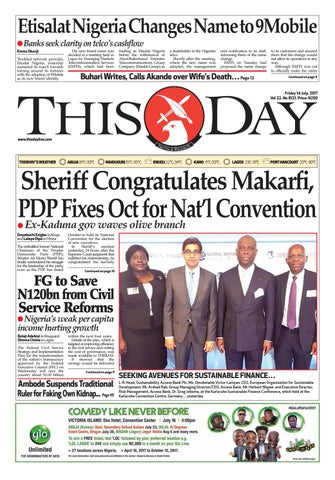
Etisalat Nigeria Changes Name to 9Mobile Banks seek clarity on telco’s cashflow Emma Okonji Troubled network provider, Etisalat Nigeria, yesterday sustained its march towards turning around its fortunes with the adoption of 9Mobile as its new brand identity.
The new brand name was decided at a meeting held in Lagos by Emerging Markets Telecommunication Services (EMTS), which had been
trading as Etisalat Nigeria before the withdrawal of Abu-Dhabi-based Emirates Telecommunications Group Company (Etisalat Group) as
a shareholder in the Nigerian telco. Shortly after the meeting, where the new name was adopted, the management
sent notification to its staff, informing them of the name change. EMTS on Tuesday had proposed the name change
Buhari Writes, Calls Akande over Wife's Death… Page 12
to its customers and assured them that the change would not affect its operations in any way. Although EMTS was yet to officially make the name Continued on page 9
Friday 14 July, 2017 Vol 22. No 8121. Price: N250
www.thisdaylive.com TR
TODBVAY'S WEATHER
ABUJA 16°C-33°C
MAIDUGURI 15°C-35°C
UT H
& RE A S O
ENUGU 22°C-34°C
N
KANO 11°C-33°C
LAGOS 23C-31°C
PORT HARCOURT 20°C-30°C
Sheriff Congratulates Makarfi, PDP Fixes Oct for Nat’l Convention Ex-Kaduna gov waves olive branch Onyebuchi Ezigbo in Abuja and Laleye Dipo in Minna The embattled former National Chairman of the Peoples Democratic Party (PDP), Senator Ali Modu Sheriff has finally surrendered his struggle for the leadership of the party, even as the PDP has slated
October to hold its National Convention for the election of new executives. In Sheriff’s reaction yesterday, 24 hours after the Supreme Court judgment that nullified his chairmanship, he congratulated the lawfully Continued on page 10
FG to Save N120bn from Civil Service Reforms Nigeria’s weak per capita income hurting growth
Bolaji Adebiyi in Abuja and Obinna Chima in Lagos The Federal Civil Service Strategy and Implementation Plan for the transformation of the nation’s bureaucracy approved by the Federal Executive Council (FEC) on Wednesday will save the country about N120 billion
within the next four years. Details of the plan, which is targeted at improving efficiency in the civil service and cutting the cost of governance, was made available to THISDAY. It showed that the savings would be delivered Continued on page 9
Ambode Suspends Traditional Ruler for Faking Own Kidnap... Page 49
SEEKING AVENUES FOR SUSTAINABLE FINANCE… L-R: Head, Sustainability, Access Bank Plc, Ms. Omobolanle Victor-Laniyan; CEO, European Organisation for Sustainable Development, Mr. Arshad Rab; Group Managing Director/CEO, Access Bank, Mr. Herbert Wigwe; and Executive Director, Risk Management, Access Bank, Dr. Greg Jobome, at the Karlsruhe Sustainable Finance Conference, which held at the Karlsruhe Convention Centre, Germany… yesterday
2
T H I S D AY FRIDAY JULY 14, 2017
T H I S D AY FRIDAY JULY 14, 2017
3
4
T H I S D AY FRIDAY JULY 14, 2017
T H I S D AY FRIDAY JULY 14, 2017
5
6
T H I S D AY FRIDAY JULY 14, 2017
T H I S D AY FRIDAY JULY 14, 2017
7
8
T H I S D AY FRIDAY JULY 14, 2017
FRIDAY, JULY 14, 2017 • T H I S D AY
9
PAGE NINE FG TO SAVE N120BN FROM CIVIL SERVICE REFORMS through the upscaling of the deployment of HR, a human resource management software that the federal government had deployed to help it weed out ghost workers from its pay roll. According to the plan, the cleaning up of HR data on the Integrated Payroll and Personnel Information System (IPPIS) would save the nation about N60 billion in the first year of implementation, while another N60 billion would be gained in the following years ending in 2020. Also to swell the treasury is an annual N2.5 billion savings from the digitalisation of the civil service, which is expected to eliminate paper trail cost and encourage transparency in government transactions. The plan would, however, cost the federal government N1.6 billion in its first year (2017) and N6 billion at full implementation. About 65 per cent of this amount is expected to be provided by development partners. The implementation plan approved by the FEC presided over by Acting President Yemi Osinbajo is instituted to give life to a four-year civil and public service reform strategy put together by the Office of the Head of Civil Service of the Federation (OHCSF) to make the nation’s bureaucracy more effective and efficient in its service delivery to the public. It was transmitted to President Muhammadu Buhari in December last year and launched by Osinbajo in February this year. A committee consisting of government agencies, leading private sector actors and development partners, was thereafter constituted to draw up an implementation plan for the strategy. The Head of Service’s strategy listed a four-point goal: “To develop and institutionalise an Efficient, Productive, Incorruptible and Citizen-centred (EPIC) culture in the civil service; design and implement an Enterprise Content Management System (ECM); develop entrepreneurship culture and commercial orientation in the civil service; and improve welfare and benefit packages for civil servants.” The strategy, the service head added, would also reposition government bureaucracy to serve as the bedrock for a sustainable global upward ranking trend for Nigeria on the Ease of Doing Business Index, explaining that the success of the implementation of the Executive Orders Nos. 001-003 of 2017 on the ease of doing business rested on the civil service. The implementation
plan, which would run from 2017 to 2020, hopes to achieve the goals of the reform strategy by training 25,000 civil servants through revamped core modules and the cultivation of 200 future leaders through a Leadership Enhancement and Development Programme (LEAD-P). Also, 25 ministries would be provided with performance management system tools, routines, and dialogues to drive results based performance, while at least three annual innovation challenges would be held to cultivate ideas, technologies, and ventures for enhanced service delivery, efficiency and productivity in the public service. The implementation plan states that by the end of its first three years, there would have been marked “improvement in staff competencies and skills through well targeted and funded programmes across all grade levels; LEAD-P presidential cohort provided with resources, mentorship, and opportunities to succeed as future leaders”. It added: “There would be a results-based performance and meritocratic environment for civil servants with clarity on metrics (e.g., individual KPIs) and linked to incentives (monetary and non-monetary) and clear career path value propositions (i.e., training, benefits and salary) that retains top talent.” It said a cohort of senior external experts providing high-impact support would be provided, while a more innovative civil service that would bring in innovation from within and outside the service to improve service delivery through dedicated innovation unit and innovation challenges would be developed. Details of the plan also showed that its implementation would deliver values driven civil service with civil servants that would be efficient, productive, incorruptible and citizen-centred. To ensure successful implementation, the plan has a three-pronged governance structure, namely, the Presidential Briefing Meeting on Civil Service Reform, to be chaired by the president; the Civil Service Transformation Steering Committee, to be chaired by the Head of Service; and the Civil Service Strategy Implementation Committee. Other members of the presidential briefing meeting are the vice-president as alternate chair, Head of the Civil Service of the Federation, Ministers of Finance, Budget and National Planning, Communicationso, Science & Technology, and
Chairman, Africa Initiative for Governance (AIG), Mr. Aigboje Aig-Imoukhuede (Left), and Head of the Civil Service of the Federation, Mrs. Winifred Oyo-Ita, exchanging signed copies of the Memorandum of Understanding (MOU) between AIG and the Office of the Head of the Civil Service of the Federation (OHCSF), detailing the collaboration between both entities for the transformation of the Nigerian civil service private sector leaders to be nominated by the president.
Weak Per Income
Capita
But as Nigeria seeks to reform her civil service, a report has shown that despite the country’s economic recovery, its per capita income is not growing fast enough because its population growth rate is outpacing GDP growth. The report by Lagosbased Financial Derivatives Company (FDC), a financial advisory and research firm, titled: “Nigeria, a Country Divided by Income and Opportunity,” pointed out that as the economy slowly crawls out of a recession, there is evidence to show that Nigeria is afflicted by general poverty, with abject poverty in the Northeastern part of the country. This it attributed to the concentration of insurgency in the region. Per capita income is often used to measure the average income in a given population, and is used to compare the wealth of one population with those of others. It also measures a country’s standard of living and helps to ascertain a country’s development status. It is one of the three measures for calculating the Human
Development Index (HDI) of a country. Continuing, the report said Nigerian politicians in recent times seem obsessed with the lexicon “restructuring”, but do not know that “you cannot restructure poverty”. It added: “The Nigerian economy is growing again, but income per capita not growing fast enough and population growth is higher than GDP growth.” It also revealed that the country’s Gini Coefficient in 2016, at 48 was below the benchmark of 50. The Gini coefficient is a statistical dispersion that measures the income or wealth distribution of a nation’s residents. It is the most commonly used measure of inequality. The report included a peer review comparing Nigeria with Ghana, Angola and South Africa, putting Nigeria’s per capita income at $2,178, GDP growth rate of -1.5 per cent in 2016 and a life expectancy of 53.34. On the other hand, Ghana had an income per capita of $1,513.5, GDP growth of 3.4 per cent in 2016 and a life expectancy of 61.72, while Angola had an income per capita of $3,110.8, GDP growth of -3.45 per cent in 2016 and life expectancy of 53.09. South Africa’s income per capita was put at $5,273.6,
recorded GDP growth of 0.5 per cent and has a life expectancy of 59.24. FDC said the peer review showed that there is income and regional inequality, adding that Nigeria is not so great. Furthermore, the FDC report also showed the correlation between poverty and financial inclusion, stating that 45 per cent of the top Nigeria bank branches (FirstBank, Zenith and GTB) are located in the South-western part of the country, compared to 16.1 per cent in the South-south; 13.7 per cent in the Northcentral; 11.6 per cent in the South-east; 8.6 per cent in the North-west; and 3.9 per cent in the North-eastern part of the country. It noted that 70 per cent of residents in the Northwestern part of the country are financially excluded, while 62 per cent of the population of the Northeastern Nigeria do not have access to financial services. In the North-central zone, 39 per cent of residents are excluded from financial services, 31 per cent in the South-south, 28 per cent in the South-east, and 18 per cent in the South-west. It noted that the most affluent Nigerians reside in Lagos and Abuja, while the rest of the country is grappling with poverty,
Mubadala Development Company which holds a 40 per cent stake in Etisalat Nigeria and EMTS, representing the Nigerian shareholders, with 15 per cent stake – have remained committed to the Nigerian telco despite its debt crisis. But even as Etisalat Nigeria moves forward with a new brand identity, its rescue has put its lenders in a quandary as they prepare
for half-year results due this month. Most crucially, the banks do not know whether to provision for loans to the company until they can work out its value. A banking source told Reuters that the lenders first wanted to determine Etisalat Nigeria’s free cashflow to
ETISALAT NIGERIA CHANGES NAME TO 9MOBILE change known to the public, sources close to the network operator said EMTS does not intend to announce the change with much fanfare. Etisalat Nigeria had said it would soon change to a new brand identity that would reflect its new aspirations and philosophy. The sudden decision to change its brand identity was sequel to the three weeks ultimatum given it
by Etisalat Group to phase out the brand in the country. It, however, said discussions were ongoing with its former Nigerian subsidiary to provide technical support. The Abu-Dhabi-based firm relinquished its shares in Etisalat Nigeria last month, following the inability of the Nigerian firm to repay the $1.2 billion loan it took from 13 local banks in 2013
for network expansion and upgrade. After the negotiations between the telco and its lenders failed, Etisalat Group pulled out and announced the transfer of 45 per cent of its stake and 25 per cent of its preference shares in Etisalat Nigeria to United Capital Trustees Limited, the legal representative of the lending banks. Two other investors –
Continued on page 10
with the North-east and the South-south, which have respectively grappled with an insurgency and militancy, being the worst hit. The FDC report also showed that states that invest the least in education were likely to have a high incidence of poverty, adding that all the states in Southern Nigeria and Abuja invest more in education than their counterparts in the North. The geopolitical zones with the lowest investment in education are the North-east and North-west. On the way forward, the report said the federal and state governments, as well as the financial sector would have to improve payment and settlement systems in the country; ensure inclusive growth; increase investment in labour intensive activities; and invest in education and infrastructure.
TOP GAINERS MOBILOIL FORTEOIL GUINNESS CADBURY CUSTODIAN TOP LOSERS CHAMPBREW FIRSTALUM NCR
NGN NGN % 22.45 259.00 9.4 3.50 53.50 7.0 3.00 63.00 5.0 0.57 11.97 5.0 0.17 3.57 5.0 NGN NGN % 0.18 2.39 7.0 0.03 0.57 5.0 0.38 7.33 4.9 BOCGAS 0.16 3.14 4.8 LINKAGEASSURE 0.03 0.60 4.7 HPE Nestle Nig Plc ₦ 903.05 Volume: 288.858 million shares Value: N3.820 billion Deals: 3,631 As at yesterday 13/7/17 See details on Page 40
FRIDAY, JULY 14, 2017 • T H I S D AY
10
NEWS
Nigeria Has Let Its Economic Crisis Go to Waste The term “dead cat bounce” derives from the fact that even a dead cat will bounce if it falls from a great height. If you imagine a dead cat soaked in crude oil and dropped from a 50-storey building, you get a rough picture of how Nigeria’s economy is performing these days. Nigeria is expected to grow 2.5 per cent this year after contracting 1.6 per cent in 2016. But the population is also growing at 2.5 per cent. So in per capita terms, things are going nowhere. The reasons for the “recovery” are twofold. First, last year’s performance was so dismal it would have been difficult for the economy to fall further. Without doing anything at all — a reasonable description of policy under Muhammadu Buhari, the country’s ailing leader and frequent London resident — the baseline effect has worked its magic. Second, the oil that makes up so much of government revenues is flowing faster. In June, production was 1.7m barrels a day, 10 per cent higher than a year ago. One should, they say, never let a crisis go to waste. That advice has clearly not
Buhari
VIEW FROM ABROAD reached Abuja, where the economic collapse brought on by swooning oil prices was supposed to spur diversification. It has not happened. The danger now is that, having apparently come through the worst, Nigeria will simply go back to business as usual. If oil prices recover, so will headline growth. But the structure and
basic dynamics of Africa’s largest economy will remain unchanged. Nigeria frustrates because of its vast potential. It has 190m people, among the sharpest, most driven and entrepreneurial on the continent. But perverse incentives have diverted the energy of the best and the brightest to mostly unproductive activities:
making money through political connections, speculation, round-tripping and arbitrage. When President Buhari was elected three years ago, he promised to end all these. The economy would be transformed. Manufacturing would be re-energised. So would agriculture, which employs three-quarters of the population but contributes only a fifth of output. The government would wean itself off oil revenue. Mr. Buhari — stern, principled, incorruptible — was said to be the man to see this through. Little has come to pass. Mr. Buhari took six months to name a cabinet and became embroiled in a necessary but distracting fight with Boko Haram. He has spent much of the past year convalescing from a mystery illness that has sapped his presidency of vigour and set off a merry-go-round of political jockeying to succeed him. There has been practically nothing in the way of coherent economic policy. True, there have been attempts to punish individuals for corruption. Yet, like weeds shorn of their leaves, graft will doubtless
spring back as lush as ever once the Buhari strimmer is back in its box. An example of failure to cut corruption at the roots is the foreign exchange policy. Mr. Buhari was determined to defend the phoney official rate. But the only way to do so was to ration dollars. Given the yawning gap with the black market, this has delivered a delicious arbitrage opportunity to anyone lucky — or connected — enough to get their hands on precious foreign exchange at the official window. Sadly for hopes of economic diversification, the lucky beneficiaries of dollars did not include manufacturers. Most were actually banned from receiving the foreign exchange they needed to buy inputs or capital equipment. Far from expanding, manufacturing actually shrank last year. The economy is back to square one, gasping for a recovery in oil prices to breathe life back into the system. There are some promising signs. Agriculture is getting more attention, and there are tentative improvements in rice and other crops. If all goes to plan, by 2019, the country will have a $12 billion oil refinery courtesy of Aliko
Dangote, Nigeria’s richest man. This is an installation that could save billions in unnecessary imports of refined products. Nigeria’s constitution is working. In Mr. Buhari’s extended absence with illness, the competent and dynamic Yemi Osinbajo has been running the show. Foreign exchange policy has improved. In April, a “growth and recovery plan” was published, laying out plans to cut red tape, improve the tax take, reform stateowned enterprises and move towards a market-determined exchange rate. Such policy prescriptions have been discussed for 20 years. The danger is Nigeria will still be talking about them 20 years hence. The immediate prospect is for a vicious and enervating power struggle to succeed Mr. Buhari, whom few expect to contest the 2019 election. Whoever emerges victorious will doubtless promise to stamp out corruption, diversify the economy and rationalise the oil sector. Cats not only bounce. They also have nine lives.
“We want to send a signal to APC that PDP has come together and they will see a virile opposition. We have given them a two-year holiday and they have run roughshod over Nigerians. “We will provide a very strong opposition to APC and make Nigerians see the evils of this government.” The party spokesman went on to appeal to those who have defected from the party to return and build the party. “We also appeal to our members who defected to APC and also our members who moved to the new parties to return. We will do justice to all,” he said. But irrespective of Sheriff’s mea culpa, the spokesman of his group Hon. Bernard Mikko had earlier said in a statement yesterday that they were shocked by the Supreme Court verdict, which sacked them from office on Wednesday. Mikko said: “We received with shock the 12th July judgment of the Supreme Court on the leadership of Peoples Democratic Party. “Though we still await the full written judgment of the highest court from our lawyers who will fully brief us on the details of the judgment, in the interim, we ask all members and supporters to remain
steadfast in prayers for Nigeria. “Meanwhile, we continue with our avowed demands that the party must be given back to the owners at the grassroots to always elect their party officials and those to contest elections for them at all levels. Internal democracy must be institutionalised in the party.” Meanwhile, the National Convention of the PDP has been slated to hold in October, the national leadership of the party has announced. Towards achieving a seamless convention, each state branch of the party has been directed to submit the names of 30 members that would serve on the convention planning committee. The Niger State chairman of the party, Alhaji Tanko Beji disclosed this in Minna yesterday while addressing a stakeholders’ meeting where the implication of the Supreme Court verdict was also explained. Beji said the leadership of the party, which met at the national secretariat in Abuja on Wednesday, after the supreme court ruling, also took a decision on the zoning of the presidency of the country in 2019 to the
Northern part of the country, while the vice presidency would go to the south. Beji advised all those with ambitions to seek the mandate of the people to do so, stating that the era of “no vacancy” had come to an end. “Anyone with ambition to seek political office should go to the people, the leadership will not allow imposition of candidates,” he said. According to Beji, each zone in the state would present 10 of the delegates allocated to Niger State and advised that each of the zones should ensure that the local government areas are represented. He said the major focus of the party was how to hold a successful national convention and win the national elections in 2019. “Our common enemy is the APC; we should all join hands to chase out the APC in 2019,” he said. Referring to the arrest and arraignment of some of the leaders of the party in the state, including himself, Beji added: “We should not be afraid of arrests, we cannot all be arrested, we cannot all die one day.” Prominent members of the PDP, among them those in the Sheriff group, attended the stakeholders’ meeting.
sparking a wider debt crisis. Etisalat Nigeria’s new chief executive, Boye Olusanya has said he was focused on getting the telco back on track to make profit, while working on the paperwork to eventually raise new capital. Renaissance Capital analysts have estimated that Etisalat Nigeria could be worth $1.2 billion based on an enterprise value to operating cashflow multiple
when compared with South Africa’s MTN and other African telecoms companies. Nigeria’s banks are set to report interim earnings this month and investors will be watching for signs of a rise in non-performing loans. The banks collected half of their interest payment for May from Etisalat so that the new team running the company has funds to keep it operating, the source said. And any provisioning
may not kick in until the next quarter. “Given the understanding that Etisalat’s debt was performing till the end of the first quarter we believe the banks ... might be required to make provisions in the second quarter,” Head of Research at Vetiva Capital, Olalekan Olabode said. “Rather than converting the debt to equity, we expect to see a restructuring in the near term,” he added.
•Culled from Financial Times
the
SHERIFF CONGRATULATES MAKARFI, PDP FIXES OCT FOR NAT’L CONVENTION recognised Chairman of the National Caretaker Committee of the party, Senator Ahmed Makarfi for his victory. Sheriff’s surrender came just as Makarfi said that the party would leave its doors open to all aggrieved members, including Sheriff and his group, for reconciliation. In a short statement posted on Sheriff’s twitter handle, the former Borno State governor said: “The Supreme Court has spoken. I congratulate Senator Makarfi. We must all put our hands together to channel a new course for the PDP. “Moving forward, we must embrace true reconciliation, so as to be united as a formidable option to send the APC packing in 2019. This is the time to build the PDP and to focus on the future, which includes reclaiming power from the APC.” Sheriff also vacated the national secretariat of the party, which he had occupied since February after the Appeal Court judgment that recognised him as chairman. One of his aides was sighted at the PDP secretariat at 1.30 p.m. yesterday after he had gone to Sheriff’s former office on the second floor to remove his personal belongings. Makarfi responded by
assuring Senator Sheriff and his loyalists that they would be given amnesty, and also declared that the 2019 general election will be a walkover for the PDP. He added that Nigerians had completely lost hope when the opposition party was in crisis. Also speaking when he met with former ministers at the party’s temporary office in Abuja, Makarfi said that some committees would be set up to resolve some outstanding issues in the South-west. He added: “We will interact with Sheriff and some of his people. We will leave the door open. Sheriff has accepted the judgment going by what I read in the media.” Reiterating Makarfi’s position after the meeting of the caretaker committee, the National Publicity Secretary of the party, Mr. Dayo Adeyeye, also urged party members who had defected to the APC and those in the newly formed political parties to return to the fold. He said: “Our hands are extended to all those on the other side. We will grant general amnesty to everybody. We have declared no victor, no vanquished. We want to give them full embrace, co-operate with them. We will extend our hand of fellowship to them.”
Adeyeye, however, warned that the olive branch to Sheriff and his followers would be predicated on their abstinence from anti-party activities. He described Sheriff as a monumental distraction who created a painful and agonising period for the party, observing that he must desist from committing further offences. Speaking on the way forward for the party, Adeyeye said that the PDP would use the model for the Osun West Senatorial election, noting that the collaboration adopted by both sides of the divide led to PDP’s victory in the poll at the weekend. “If we had done that in Edo and Ondo States we would have won. Going forward, we appeal that those who have cases in courts in the states should withdraw their cases,” he said. On PDP’s come back plan for 2019, he said: “Everybody is happy. People are happy because there is a ray of hope for them, because APC has been a disaster. When PDP had its crisis, Nigerians lost hope completely. “Now that PDP has overcome its leadership crisis, the election in 2019 will be a walkover for PDP. The arrogance of the APC is just too much.
ETISALAT NIGERIA CHANGES NAME TO 9MOBILE help them value its business before deciding on whether to impair the assets on their balance sheets or hold on to find new investors. “No bank is talking about restructuring now, but it might get to that later once we are able to ascertain the true value of the company,” the source told Reuters. Nigerian regulators intervened last week to save Etisalat Nigeria, the
country’s fourth-largest mobile operator, from collapse and prevent lenders from placing the telecoms firm in receivership, prompting a board and management change. Banks involved in the loan deal include Zenith Bank, GT Bank, First Bank, UBA, Fidelity Bank, Access Bank, Ecobank, FCMB, Stanbic IBTC Bank and Union Bank. Results are due from this month.
GT Bank with $138 million in outstanding loans and Access Bank with $131 million are among the most exposed to Etisalat Nigeria. “We think that by the time the new management settles in, makes some changes and reduces costs, the company might bounce back,” the source said, adding that he expected support from the central bank, which has sought to avoid Etisalat Nigeria’s collapse from
T H I S D AY FRIDAY JULY 14, 2017
11
12
FRIDAY JULY 14, 2017 ˾ T H I S D AY
NEWS
News Editor Davidson Iriekpen Email davidson.iriekpen@thisdaylive.com, 08111813081
Buhari Writes, Calls Akande over Wife’s Death Osinbajo, Tinubu, Ajimobi, Amosun, others storm Osun to bid Akande’s wife farewell Acting president, Aregbesola sue for peaceful co-existence in Nigeria
Omololu Ogunmade in Abuja and Yinka Kolawole in Osogbo President Muhammadu Buhari has expressed his heart-felt sadness over the death of Mrs. Sikirat Omowumi Akande, wife of the former interim National Chairman of All Progressives Congress (APC), Chief Bisi Akande. Mrs. Akande died at the age of 73 last Tuesday at a government hospital in Ibadan, Oyo State. A statement by his Senior Special Assistant on Media and Publicity, Malam Garba Shehu, said Buhari wrote Akande a letter of condolence after an earlier telephone call to him yesterday. The statement said Buhari described the loss of Akande’s wife of over 50 years as “irreparable.” The content of the letter as presented by Shehu, read: “I
received the very sad news of the death of your dearly beloved wife, Madam Omowunmi Akande this morning. I am following our phone call with this letter of condolence, which comes from my heart. “To lose a wife, a dear wife after 50 years, a constant and loving companion through good and bad times, is a blow only a man of unshakeable faith can withstand. Please extend my personal condolences to the immediate and wider Akande family and to friends of the family for this irreparable loss. “May Allah give you the strength and Iman to endure her passing away.” Meanwhile, Acting President Yemi Osinbajo, yesterday led dignitaries to Ila-Orangun, Osun State when the remains of Mrs. Akande were interred. Four of the South-west governors
Petroleum Ministry Establishes Transparent Process for Refineries Revamp Ejiofor Alike The Minister of State for Petroleum Resources, Dr. Ibe Kachikwu, has stated that his ministry has established a transparent structure designed to ensure a timely and efficient process of financing and fixing the country’s key refineries in line with the objective of ending importation of petroleum products by 2019. The process is meant to deliver one of the components of the threepronged strategy for achieving the target: massive revamp of the Port Harcourt, Warri and Kaduna refineries in order to substantially increase refining of petroleum products to an estimated 450,000 barrels per day. The other components are: supporting the establishment of Greenfield Refineries including the proposed Dangote Refinery which would have an estimated capacity of 650,000 per day; and mainstreaming of modular refineries to further enhance refining capacity. According to a statement by the petroleum ministry, the Federal Executive Council and the Nigerian National Petroleum Corporation (NNPC) would play key roles in the structure at the level of ratification and approval. A technical committee led by NNPC reporting to the Minister of Petroleum is also part of the structure. Kachikwu, who gave details recently, said his ministry would publish advertisements to invite qualified consortiums with the relevant capacity and track record to participate in the bids on the basis of engineering and financial specifications. Kachikwu stressed that the petroleum ministry was desirous of obtaining the best expertise at the best terms for the country so that solid and sustainable results can be achieved in meeting the historic target.
He asserted that the process is neither a concession nor a sale but that the plan is to basically bring in private investors with no stake in equity to bring the funds required to get these refineries working to optimal capacity. “We would advertise for those who are to bring their consortiums and bids on the basis of the engineering and financial specifications. The more people we have participating, the better we can create commercial terms that are favorable to government. So it’s not going to be child’s play,” he said. The minister restated that media stories that any company has been awarded a contract for the project or that any aspect has been concessioned to any form were false. He said it could not have been otherwise given that the ministry under his leadership prioritised a culture of transparency and international best practices in all facets of its activities according to the vision of President Muhammadu Buhari. “News reports of an award to any company upfront are simply not true. The process hasn’t gotten to that stage yet. We have had lots of expressions of interest and we encourage anybody who is interested to be bullish about it because ultimately we need them to achieve these goals,” he said. Kachikwu underscored that the ministry was working with a sense of urgency and that progress has been made in putting things in place for the refineries revamp process to take off soon. “The process for financing these important repairs is very transparent. We have reached out and consulted especially with big refinery owners abroad to support us. We have developed the engineering analysis to show what needs to be done and have come up with a cost that we think is reasonable to achieve this objective,” he added.
such as Osun State Governor, Rauf Aregbesola; Oyo State Governor, Senator Abiola Ajimobi; Ondo State Governor, Mr. Rotimi Akeredolu, and Ogun State Governor, Senator Ibikunle Amosun, alongside were also present to honour the Akande family. Others in attendance were the national leader of the APC, Senator Bola Ahmed Tinubu; former Ekiti State Governor, Mr. Segun Oni; former Oyo State Deputy Governor, Chief Iyiola Oladokun; national and state legislators, former Inspector General of Police (IG), Chief Tafa Balogun and captains of industries. In their separate remarks at the occasion, Osinbajo and Aregbesola sued for continued unity and peaceful coexistence of Nigerians. The duo hailed the deceased, Mrs. Akande for spending her entire life to the service of God and humanity. In his words, the acting president said the APC-led federal government has provided an inclusive leadership aimed at promoting the unity in diversity of Nigeria. He said the President
Muhammadu Buhari-led government has demonstrated high sense of commitment in sustaining the unity and togetherness of Nigerians. He called on Nigerians to support the policies of the present administration, a move which according to him, is being designed to rescue the country out of her predicaments. Osinbajo who represented his boss, Buhari, warned Nigerians against any divisive tendency that can truncate peace and glorify chaos, saying it was time for all to derived comfort in the nation’s diversity. According to him, the leadership that has been provided by the APC is not just a political leadership, rather an inclusive and visionary leadership that meant well for all. “It has become pertinent on us as Nigerians to do all we could to sustain the peaceful coexistence of Nigeria and as well, maintain the principle of unity, peace and togetherness. “I want to urge every Nigerian to support the unity that we stand for. Unity across this country means a lot to our collective existence.
“We want to encourage each and everyone of us to champion peace. There can be no division in Nigeria. With no division, no separation, this country is great. This country is great because all of us are here for one Nigeria. “Hausa, Igbo, Yoruba, Ijaw, everyone of us had made this country great. I want to encourage every Nigerian whenever they may be that we must stand together, we must be united. “We must stand together. And I want to say that the message that the president continues to repeat every time is that the reason why people like these remain self proposing is because they believe in one Nigeria,” Osibajo said. He commended the former Governor of Lagos State, Tinubu, for being supportive to the present administration. “You don’t need to talk about Nigeria’s unity when you can demonstrate it by practical acts and he, Tinubu, has always demonstrated it practically. “I strongly believe that what APC has to offer has been offered in maintaining peace and stability of
Nigeria. I strongly believe that the reason why people have always supported us is because of the leaders they have been seen around us, he said. Describing the deceased as a rare gem, Osinbajo said: “We thank God that mama lived a life worthy of emulation. We thank God that she lived a life that we can remember with joy, a life that we can remember with thanksgiving. “We thank God that mama lived a life of loyalty to her husband. Loyalty to her country and with those legacies that she has left behind is a testimony of our gathering here today. “We are here to celebrate a great woman. We all know that mama was a strong pillar for our leader, Chief Adebisi Akande.” Corroborating the acting president, Aregbesola said the peaceful coexistence of Nigeria remains non-negotiable. He called on Nigerians to see the unity of Nigeria as the duty of all, just as he warned against acts that could terminate the already built peace in the country.
FARE THEE WELL MRS AKANDE
L-R: Osun State Governor, Rauf Aregbesola; Ogun State Governor, Ibikunle Amosun; All Progressives Congress (APC) National Leader, Senator Bola Tinubu; Acting President, Professor Yemi Osinbajo; widower and former APC National Chairman, Chief Bisi Akande; during the Fidau prayer for Bisi Akande’s wife, Mrs. Sikirat Omowumi Akande, in Ila-Orangun, Osun State ....yesterday
Nigeria will Continue to Borrow, Adeosun Clarifies Ndubuisi Francis in Abuja Contrary to reports credited to her that Nigeria will no longer borrow to fund its budget and should instead rely on raising money internally, the Minister of Finance, Mrs. Kemi Adeosun, has declared that the country will continue to borrow. In a statement yesterday, the minister said following recent reports on comments by her about Nigeria’s debt strategy and the ability to borrow, it was important to clarify her position and that of the federal government. According to the statement issued by the Director (Information),
Ministry of Finance, Mr. Salisu Na’Inna Dambatta, the minister said: “Nigeria will continue to borrow. Nothing has changed.” “The Economic Recovery and Growth Plan (ERGP) provides for an increase in spending over a three-year period, which is reflected in the 2017 budget. In 2017, the government is committed to spending N7.44 trillion, with a projected fiscal deficit of N2.356 trillion, which will be funded by a combination of domestic and international borrowing. “Nigeria’s debt-to-GDP ratio is low when compared to our contemporaries in Africa, and across most of the developed world. We
have headroom to borrow and are doing so aggressively in the short to medium term in order to address our infrastructure deficit and to stimulate growth. “At the same time, it is vital that Nigeria diversifies its revenue base and builds its revenue profile, as is projected in the ERGP, to ensure that we do not continue to overly rely on debt to fund our budget spending over the long term. To build a sustainable economy, we must replace the debt that we are incurring in the short to medium term, with strong revenue sources. “That is why the Ministry of Finance is focused on expanding our tax base, which we are doing
with a range of initiatives which include the Voluntary Asset and Income Declaration Scheme (VAIDS) and recruitment of Community Tax Liaison Officers (CTLOS) to improve tax compliance in the long-term, and we are heavily focused on making government spending more productive and efficient,” the statement added. It pointed out that Nigeria cannot rely on debt indefinitely, stressing: “We must be focused on a future where we can earn enough internal revenue to spend on the projects that will grow our economy. In the short term, though, increased spending, funded by debt, will act as the stimulus we need to grow.”
T H I S D AY FRIDAY JULY 14, 2017
13
14
T H I S D AY FRIDAY JULY 14, 2017
COMMENT
Editor, Editorial Page PETER ISHAKA Email peter.ishaka@thisdaylive.com
MUGABE’S WARNING AND AFRICA’S MORAL SKIES It is better to return to roots of liberation struggle and ancient cultural values for nurturing Africa’s youths, writes Okello Oculi
O
n June 16, 2017, President Robert Mugabe warned Africans with these words: ‘’Do NOT take your freedom for granted’’. He was addressing his country’s ‘’Youth Parliament’’; adding pointedly that he hopes that South Africans do not also take their freedom for granted. Barely two weeks later, President Zuma told a closing session of a national conference of the African National Congress (ANC) that the party is being attacked ‘’internally’’. It is not clear if he meant from within its ranks, or from inside the country. Mugabe must have been referring to a rising din of calls on President Zuma to resign as the magic act for curing South Africa’s poverty and massive joblessness. He has been bashed with three clubs that are also used to erode the legitimacy of ANC’s rule. The first is what is clothed as an illegal ‘’State Capture’’, meaning black elites using political posts to enrich themselves and the Gupta family; through awarding contracts to cronies and family relations; thereby shutting other people out from wealth. The ‘’Gupta family’’- which has recently apologised for its entanglements - is singled out for exploiting a connection with Zuma’s son as a spoon to tap the honey pot. A related accusation is that the ANC has promoted rampant ‘’corruption’’ as officials from local government offices to the national level demand bribes; destroying the culture of transparent civic duty and poisoning civic morality. This corruption has hurt the common folk hardest since they rely on the ANC keeping their promises to serve previously excluded from economic welfare and citizenship by white settlers. The third hits at the ANC are accusation that its government has turned a blind eye to ‘’White Monopoly Capitalism’’ eating all the fat while blacks continue to lick grains of sugar that spill from their shopping baskets. Nelson Mandela had promised a ‘’match to freedom’’ but, since 1994, the ANC merely supervised walks to bitter poverty. To make the soup of hunger mockingly bitter, black elites have been sucked into owning shares in firms owned by white businesses; and fled from slums to reside behind high walls covering posh estates previously inhabited only by whites. It is amazing that the leadership of the ANC find themselves with soiled fingers. As far back as 1967, President Julius Nyerere had gotten his ruling party, Tanganyika African National Union (TANU), to proclaim ‘’The Arusha Declaration’’ as a set of commandments to be obeyed by party leaders. A bitter condiment in it was prohibiting a leader from owning property either directly or through family members. This included land or houses for rent. The virus of post-colonial poverty had in 1966 incited military coups in Ghana and Nigeria. Politics had fallen ill, exhibiting symptoms of leaders grabbing huge salaries, allowances and ‘’stomach furniture’’. Their fat stomachs (or ‘African democracy’) generated disgust and alienation directed at government officials. Like Franz Fanon, as Algeria’s envoy, ANC officials as exiles crisscrossed independent African countries as lonesome exiles had heard accusations of wicked politicians ‘’looting the country’s wealth’’; enriching cronies, ethnic networks and regional cabals, while making heads of their critics soak with blood. Moreover, the party must have contrasted
THE THIRD HITS AT THE ANC ARE ACCUSATION THAT ITS GOVERNMENT HAS TURNED A BLIND EYE TO ‘WHITE MONOPOLY CAPITALISM’ EATING ALL THE FAT WHILE BLACKS CONTINUE TO LICK GRAINS OF SUGAR THAT SPILL FROM THEIR SHOPPING BASKETS. NELSON MANDELA HAD PROMISED A ‘MATCH TO FREEDOM’ BUT, SINCE 1994, THE ANC MERELY SUPERVISED WALKS TO BITTER POVERTY
this with the ‘’Broedabon’’(or secret cabal) disciplinary control over Afrikaaners to ensure governance that was free from internal graft and decay. They have not had the silly luxury to walk with sweet blindness and debauchery. Assassination in 1971 of Amilcar Cabral of Guinea Bissau and Cape Verde; the death of Angola’s leader Agustinho Neto in Moscow from poisoning; and the mass death through a planned plane crash of President Samora Machel and the top leadership of FRELIMO were ominous signals. These attacks were followed by support of civil wars in Angola and Mozambique. Drug barons from South America promoted military coups in Guinea Bissau. Just as the border of each African country is Africa itself; colonialism has refused to die. That should have told ANC’s leaders not to be duped by broad smiles and moneyed courtesies from those who had previously damned Mandela as a leader of ‘’terrorists and communists’’. The African Liberation Committee, based in Dar es Salaam, had seen liberation wars in Zimbabwe, Mozambique, South Africa, Namibia, Angola, Guinea Bissau and Cape Verde as a single moral canvas. Amilcar Cabral had urged a common front of war against Portuguese colonial armies. While adventurous ’informal economic pan-Africanists’ have undertaken aspiration-matches into South Africa by about 20,000 Zimbabweans and over one million West, Central, West and Eastern Africans, leaders of former liberation fighters have dimmed political light over the imperative of their collective struggle for economic liberation. It is telling that commentaries about the six-day policy conference by the African National Conference made no mention of revisiting relations with former co-liberation fighters. A newscaster on South African Broadcasting Corporation even threw mud at Mugabe’s warning against loss of freedom due to falling asleep while enemies burrowed tunnels beneath. She equated his struggle for economic reform with ‘’violation of human rights’’ by common thieving dictators. To gauge the cost of the retreat behind country borders, we can speculate and dream about the geography of political speeches floating in winds and clouds across Africa’s skies if the current punches in Mugabe’s speech were accompanied by those by Samora Machel of Mozambique, Thomas Sankara of Burkina Faso, Amilcar Cabral, Chris Hani of South Africa or Agustinho Neto from Luanda. The 29th summit of the African Union - from June 30 -July 2, 2017 - declared a season of commitment to the flowering of youths. The fire in these imagined speeches lighting creative combustions in their wits and hearts would be of enormous benefit. At times when official and private speech in Africa is tarnished by impunity; official violence spilling into village and slum communities, and corruption feeding on poverty, it is wise to reach back to Amilcar Cabral’s advice for a ‘’return to roots’’ of liberation struggle and ancient cultural values for nurturing Africa’s youths. The ANC, FRELIMO, MPLA, ZANU-PF, PAIGC must clear the harmattan dust covering Africa’s political moral skies. Prof. Oculi is a member of THISDAY Editorial Board
ABIOLA IRELE, ONUKABA AND I Idang Alibi pays tribute to Professor Irele, foremost literary critic and scholar
W
hen I read the news of the passing on to eternal glory of Prof. Abiola Irele, one of Africa’s foremost literary critics, my mind went back to Stockholm, Sweden in 1986. That year, the Nobel Committee had found our own ‘W. S.’, Prof. Wole Soyinka, worthy of being honoured as the Literature Prize winner, making him the first African Literature laureate. The Guardian had assigned Onukaba Adinoyi Ojo, my friend who also recently passed on and who I have been mourning to this day, and the Daily Times, me, to cover the event. The federal government under military President Ibrahim Babangida had constituted a large delegation of eminent Nigerians made up of mostly those with a literary bent, to go to Sweden and do Soyinka honour and felicitate with him on behalf of the people and government of Nigeria. I remember that Abiola Irele, Audu Ogbeh, Francisca Emmanuel, Col. Tunde Akogun and other of Nigeria’s literary and cultural notables were on that delegation. We all met in Stockholm. In the afternoon of that award ceremony day, December 10, Onukaba and I decided to go shopping for a ‘befitting’ music system. In our days as young men, no happening young man worthy of his father’s name could afford not to possess a fashionable music system, especially of a Japanese origin. Panasonic, Aiwa, Sharp, Sony were some of the popular brands of the time. A parlour decorated with a befitting system marked you out as a promising young man on the rise. A music system was to our generation what a computer and ear piece is to today’s young people. We went to a shop and met Abiola Irele who was already in the books section browsing for titles he
will surely take away. We greeted him respectfully as expected of well brought up African children and told him of what we wanted to buy. As we made to take leave of him he called us back and in a censorious, professorial voice, said: ‘’Young men, in the history of stealing and break-ins in Nigeria, have you ever heard it reported that armed robbers or other bandits broke into a certain house and carted away books, magazines and newspapers? If I were you, I will remain in this section and get books that will change your life and what no bandits will steal way’’. Young men will be young men and must behave their age, thinking that they know what they want and what is good for them. We thanked Irele politely for his counsel and went to have our music systems. As we were out of eye and earshot of Irele, we broke into the laughter we had suppressed in his presence. I remember this incident very vividly because Irele’s warning proved prophetic. I brought my own system, a Sharp, home to my house in Ogba, Ikeja where I lived then in a two-bedroom flat in a one-storey building. Once in a while, the sound system will boom, shaking the building and announcing to neighbours that a young man, who has made it, has arrived the vicinity. As it turned out later, some people, obviously poor, envious and wicked, took notice. For on August 27, 1987, my happiness and self- glorification came to a sad end. When I left for work then in Agidingbi and my wife went to the market to buy foodstuff, thieves whom we strongly suspected to be some young men without portfolio or visible means of income living downstairs then in the Boys Quarters of our apartment building, broke into our flat and took away the much prized sound system. About a month later, another set of thieves similarly made away with Onukaba’s own. We were
both orphaned of our ‘status symbol’ item, according to the word of a knowledgeable elder we disregarded. I was distraught and my sadness led me to vow a vow that never again will I buy a fashionable music system. I kept to this vow until January 14 this year when I staged my annual thanksgiving. It was on that day that I bought a home theatre, this time around, not to be like the Joneses but mainly so that I can boom Scriptural messages to glorify God by blessing guests who will attend the event. Following what happened to me on August 27, 1986 and a similar experience which befell Onukaba about a month later, I took to calling Irele ‘’poet, prophet, Professor Abiola Irele’’ in honour of his prophetic insight. As a literary student, I used to admire Abiola Irele and some of our leading literary critics of the time such as Dan Izevbaye, my own Professor Ernest Emenyonu, Omolara Leslie Ogunyemi, Charles Nnolim (of the Origin of Arrow of God fame), Emeka Echeruo, Emmanuel Obiechina and of course, the trio of Chinweizu, Onwuchekwa Jemie and Ihechukwu Madubuike who wrote Towards the Decolonisation of African Literature. I never used to miss any in the series of African Literature Today, the journal of literary criticism of African literature which was for three decades, edited by a man described by some as one of the most versatile literary critics of the 20th century, the Sierra Leonean-born Professor Eldred Durosimi Jones, because of the brilliance of these elucidators which shone forth in whatever they penned. I used to wonder why God gave such prodigious critical abilities to these men and women to dissect ideas and books and to even read the minds of authors and sorrowed endlessly about why God had not seen it fit to give me such perceptive faculty to do what they were doing. At one point, I even toyed with the idea of becoming a literary critic
until one day I read a quotation, I think by Seneca, to the effect that ‘’no statue is ever erected in honour of a critic’’(both literary and social!). The remark said to my spirit that I should be a creator rather than a critic, a doer rather than a dissector. That is why upon graduation, I elected to be a journalist and not a scholar in the Ivory Tower. Abiola Irele and his tribe of literary critics made literary criticism and scholarship look glamorous. I do not know whether they have sired or mentored a younger generation to engage in the kind of dispassionate scholarship in which, for instance, a Charles Nnolim gave the late literary icon Chinua Achebe no rest over the source of his magnus opus Arrow of God. Nnolim, an Igbo, claimed that Achebe had plagiarised his (Nnolim’s) uncle in the writing of Arrow of God. If my memory serves me right, he said Arrow of God was sourced from a book The History of Umuchu written by his uncle. In the Nigeria or Africa of today, I doubt if an Igbo or any other tribesman can elect to be on the side of scholarship rather than tribal solidarity, by saying or doing anything that can even remotely embarrass an eminent member of the tribe as Nnolim did to Achebe in the 80s. He will be promptly denounced, threatened with ex-communication and have some dire predicaments pronounced against him. Apart from his scholarship, Irele was a Nigerian par excellence. Born as Ora, one of the smallest tribes in Edo State, he was raised to speak Ibo and later nurtured himself to speak and live as a Yoruba and Ora Nigerian. Mothers never seem to give birth to his likes any more. Irele reminds us of a Nigeria whose dream, in life and scholarship, seems to have been deferred. Alibi is the Director, Press and Public Relations, Ministry of Petroleum Resources, Abuja
15
T H I S D AY Ëž ÍŻÍ˛Ëœ Í°ÍŽÍŻÍľ
EDITORIAL RESOLVING COMMUNAL CLASHES The authorities must do more to contain the widespread internal disputes
F
requent violent clashes across the nation are increasingly having destabilising impact on governance, the economy and the society at large. Last week, a dispute over farm land between two communities in Cross River State led to the killing of scores of people, mostly women and children. According to Mr. John Inaku, Director-General of the Cross River State Emergency Management Agency, the bloody dispute between the people of Wanikade and Wanihem communities in Yala Local Government also resulted in the burning of more than 1000 houses and the displacement of thousands of inhabitants. At about the same period, two neighbouring communities of Ilofa and Odo-Owa in Oke-Ero Local Council in Kwara State which had coexisted peacefully for decades also resorted to arms to settle grievances over superiority rites during a new yam festival. At the end, lives were lost, buildings were razed, cars were burnt and the farming communities laid waste. “They burnt my house,â€? said Mrs. Felicia Oluwadare, a retired THERE IS NEED FOR A primary school HOLISTIC APPROACH teacher, who added, THAT NOT ONLY “They burnt all my ADDRESSES THE clothes, my children’s IMMEDIATE CHALLENGE property and my BUT THE ROOT CAUSES grinding machine.â€? Across the country, OF VIOLENCE IN OUR communal conicts COUNTRY – THE ISSUE OF are becoming GROWING POVERTY widespread and deadly, and that should worry the authorities. Bloody battles for supremacy and for the control of land are becoming alarming. Only recently, some communities on the Mambilla Plateau in Taraba State erupted in an unprecedented violence that claimed the lives of many inhabitants. Last month, about 20 people were killed over land disputes between another Cross River State community and a neighbouring Ebonyi State community. Governor Samuel Ortom of Benue State revealed recently that about 1900 lives had been lost to the lingering clashes between farmers and the herdsmen in the state.
Letters to the Editor
The losses to the economy as a result of the activities of these crises cannot be easily quantiďŹ ed. Aside the thousands of people that were killed and property that had been razed, several families are today dislocated with countless people physically and psychologically maimed for life. The future ambitions of many Nigerians, particularly children, have been cut short or disrupted while the local economy suffers grievous harm. This is not to talk of foreign investors who are scared by the many violent conicts in the polity.
W
T H I S DAY
EDITOR DEPUTY EDITORS ˜ MANAGING DIRECTOR DEPUTY MANAGING DIRECTOR CHAIRMAN EDITORIAL BOARD
EDITOR NATION’S CAPITAL
T H I S DAY N E W S PA P E R S L I M I T E D
EDITOR-IN-CHIEF/CHAIRMAN GROUP EXECUTIVE DIRECTORS ˜ ˜
˜ GROUP FINANCE DIRECTOR DIVISIONAL DIRECTORS ˜ ˜ DEPUTY DIVISIONAL DIRECTOR
SNR. ASSOCIATE DIRECTOR ASSOCIATE DIRECTORS ˜ CONTROLLERS ˜ ˜
GENERAL MANAGER
GROUP HEAD DIRECTOR, PRINTING PRODUCTION TO SEND EMAIL: ďŹ rst name.surname@thisdaylive.com
hat is more worrying is that the communal conicts across the nation also highlighted the prevalence of weapons in the hands of non-state actors in the country. Nigeria is awash with illegal small arms and light weapons (SAWLs). The ease of access to these weapons has made individuals and communities more fortiďŹ ed and hence less amenable to entreaties to make peace. Many communities are now self-arming to protect themselves, to go on the offensive or for reprisal attacks. This development does not bode well especially at this critical time when the nation is experiencing serious security challenges. It was such easy access to SALWs by some unscrupulous elements that resulted in total breakdown of law and order in some of the failed states in Africa of which Somalia is a prime example. Such proliferation equally led to difďŹ culties in conict resolution as was the case in Liberia and Sierra Leone in the recent past. This is why we enjoin all the relevant authorities to recognise the danger posed by the inux of small arms into our country and act very quickly to tackle the menace before it is too late. There is also the urgent need to develop a framework that will enable the country to effectively respond to any crisis and safeguard lives, property and ensure stability and growth in the economy. For now, the government inability to maintain law and order in many localities is too obvious. Besides, and even more fundamental, there is need for a holistic approach that not only addresses the immediate challenge but one that deals with some of the root causes of violence in our country – the issue of growing poverty.
TO OUR READERS Letters in response to speciďŹ c publications in THISDAY should be brief (150-200 words) and straight to the point. Interested readers may send such letters along with their contact details to opinion@thisdaylive.com. We also welcome comments and opinions on topical local, national and international issues provided they are well-written and should also not be longer than (9501000 words). They should be sent to opinion@thisdaylive.com along with the email address and phone numbers of the writer.
TUKUR BURATAI AND PEOPLE OF THE NORTHEAST
C
ommunities in the Northeast Nigeria ravaged by Boko Haram senseless war are very happy with Lt. General Tukur Yusuf Buratai, Nigerian Chief of Army Staff and they hold him in high esteem. When he announced months ago that the Nigerian Army would defeat the Boko Haram group by December 2016, many people questioned how feasible that was. However, most political observers in Nigeria and the majority of the people in the northeast had confidence in General Buratai; his gallant officers and President Buhari, a trio who showed the political will to win the war. On Thursday, December 22, 2016 at 1:35pm, to the delight of the nation, Buratai and his men captured the Operational Headquarters of Boko Haram at Sambisa Forest, marking the beginning of the end of the war. Today, the people of the north-east are very pleased with the successes the military is recording in the clearance efforts and the crippling of Boko Haram’s capacity to hold any territory or launch a major military attack. In fact, under Buratai, the people of the north-east are experiencing a pleasing difference between the sloppy handling of the war by Goodluck’s regime and the doggedness and commitment being shown by the Buhari government. Anyone who comes
to the north-east now will see and get information of the obvious proof that the Nigerian Army has decimated Boko Haram. One must commend Brig. General SK Usman for his professional management of information. The resolve of the Nigerian army to completely win the war is evidenced in the confidence on the faces of the soldiers on ground. The number of war planes and their activities in skies especially from Yola airport certainly tells any doubting Thomases that Buratai and his men are matching words with action. The Nigerian army is getting massive approval from the north-east; people can now see that the military is in the offensive mode- taking the war to Boko Haram rather than waiting for them to come. Remnants of Boko Haram are being chased out of villages and their camps in bushes, unlike before when they were capturing big towns, annexing local government areas and renaming them. Boko Haram no longer holds a single territory in the 774 LGAs in Nigeria. This is a sweet thing to hear and every Nigerian should give Buratai and his men a pat on the back. On the rules of engagement with both the locals and the ‘enemy’, General Buratai, who is a well-trained officer admonishes his men to adhere strictly to the provisions of
International humanitarian law and laws of armed conflict. Buratai charges his men to enter all fortresses, camps, dens and enclaves of the Boko Haram to completely flush them out and dominate these areas to ensure they are not reoccupied. The people of the north-east stand with Buratai and his men on ground, because they now see the Nigerian soldiers are very confident; fully kitted, well-armed and highly motivated. The people of the north-east are appreciative of Buratai’s approach to the war- because now, the rights of people and their humanity are always protected by the soldiers while the clearance goes on. The recently launched “Operation Deep Punch� was received with great cheerfulness in the north-east. This is because, as described by Buratai, it is an operation aimed at “paving way for return of normalcy to the zone�. Communities ravaged by Boko Haram senseless war now see the military as their shield and partners in the Buhari administration’s effort to fast track the healing of scars of the war, restore basic infrastructure and local economies, and returning these communities to their pre-war or even better conditions. Zayyad I. Muhammad, Jimeta, Adamawa State
16
T H I S D AY FRIDAY JULY 14, 2017
T H I S D AY • FRIDAY, JULY 14, 2017
17
POLITICS
Group Politics Editor Tobi Soniyi Email tobi.soniyi@thisdaylive.com 08033146139 SMS ONLY
PERSONALITY FOCUS
The PDP Crisis in Retrospect Will the judgment of the Supreme Court finally lay to rest the convoluted leadership crisis that threatened to destroy the Peoples Democratic Party, Tobi Soniyi searches for the answer
F
inally the much awaited judgment of the Supreme Court on the seemingly irreconcilable dispute between members of the Peoples Democratic Party loyal to Ali Modu Sheriff and Ahmed Makarfi had been delivered. While the winning side was quick to declare no victor, no vanquished, the reality however, is that the victors know themselves. So also, those who lost know the implication of losing. The party’s governorship candidate in Lagos in 2015, Jimi Agbaje while reacting to the judgment said, “With the delivery of the Supreme Court judgement, it is now time to put our house in order. There is no victor, no vanquished. For the love of Nigeria and democracy, PDP must remain united and strong. God help us.” A former Director General of News Agency of Nigeria, Akin Osuntokun described the judgment as “the triumph of decency over pure unadulterated crookedness and criminality”. According to him, the Ali modu sheriff phenomenon represents the worst tendency of the corrupt and unconscionable Nigerian political system. He said: “It is an opportunity for the PDP to pick its broken pieces and give meaning to Nigerian politics as a viable multi party system.” The Deputy President of the Senate, Senator Ike Ekweremadu, said the judgment ushered in a new dawn of peace, reconciliation, and recovery for the party. He said: “I am happy that the Supreme Court has brought this protracted leadership tussle to an end today. There is no victor and there is no vanquished, but a collective victory for our party and the nation’s democracy. No democracy can prosper in the absence of a virile opposition or under the extreme hardship Nigerians have faced over the past two years. Citizens deserve a viable alternative. “The ruling party has indeed profited from the prolonged power contest, not just in terms of defections, but also in the unchallenged degeneration of democratic values, rule of law, electoral practice, and the economy because the PDP has been too distracted to keep them on their toes. “Importantly, I call on our party leadership and elders to immediately initiate an all-inclusive peace, reconciliation, and rebuilding process to reunite everybody under the big umbrella and reinvigorate the biggest party in Africa to bounce back to the rescue of the suffering masses of Nigeria come 2019”. While many party loyalists accepted the fact that the judgment presented them with a unique opportunity to come together and rebuild the party, the challenge, however, is whether the winners will be magnanimous enough to accommodate those who lost. Making sense out of the various judgments and rulings which culminated in the Supreme Court’s judgment is a tough challenge for lawyers. It is even tougher for non lawyers. It all started at the Federal High Court in Lagos where Sheriff, Prof. Wale Oladipo and Alhaji Fatai Adeyanju as plaintiffs prayed the court for an interlocutory injunction restraining PDP from conducting any election into the offices of the National Chairman, National Secretary and National Auditor, which they occupied, pending the hearing and determination of the substantive suit. On May 12, the trial judge, Ibrahim Buba granted the order as prayed. On Monday May 21, the faction opposed to Sheriff held a national convention in Port Harcourt where it dissolved the National Executives led by Sheriff and in its place constituted a caretaker committee led by Makarfi. The question which then arose was whether the dissolution of the exco and the setting up
Makarfi...promised to be magnanimous in victory
of a caretaker committee violated the orders made by Justice Buba. While the Sheriff’s faction said yes, the orders were violated, the opposing group said no. Those who set up the caretaker committee argued that the convention being the supreme organ of the party exercised its powers under section 12.88 of the PDP Constitution by dissolving the National Working Committee and appointing some of its members as caretakers committee for the next ninety (90) days, to enable it pursue true reconciliation among its members and ensure a peaceful, amicable and political settlement of the disputes leading to the cases in court. To strengthen their positions, Sheriff and other plaintiffs in Lagos on Monday May 23, 2016 filed a motion on notice for the purpose of setting aside the national convention of the party held on Saturday May 21, 2016. The suit came up Friday May 27, 2016 for the hearing of all pending applications, including Motions for Stay of Proceeding/Execution of the Order of May 12, 2016 pending the appeal already filed against the suit; Motion to Set-Aside and/or Vacate the order of May 12, 2016; Motion for joinder of certain persons; Motion on Notice by way of Notice of Preliminary Objection on ground of jurisdiction, among others. On Tuesday May 24, 2016 counsel to Sheriff and others plaintiffs, Mr. R. A. Oluyede drew the attention of the court to the fact that the order dated May 12, 2016 had not been complied with and that PDP had gone ahead to conduct election into the offices of: National Chairman, National Secretary and National Auditor. In essence, the plaintiffs
While we are quick to blame politicians for their inability to manage their affairs, one can not but remember the ignoble role played by some judges
contended that Justice Buba’s orders were flouted. The caretaker committee said no and that it did not fill the three posts in line with the court orders . It stated that there was no order against setting up a caretaker committee. The crisis took an embarrassing turn on that same day, May 24, when two federal high courts gave two contradictory rulings. While Justice Buba in Lagos affirmed the interim chairmanship of Sheriff, another Federal High Court sitting in Port Harcourt ordered him and the National Working Committee to stop parading themselves as leaders of the party. In Lagos, Buba declared the caretaker committee illegal. He ordered the Inspector General of Police to stop members of the committee from taking over the party’s national headquarters and that Sheriff remained the national chairman of the PDP. In Port Harcourt, Justice A. Liman gave judicial approval to the action of the Port Harcourt convention. Liman gave the order following an ex-parte motion filed by the party. The Inspector General of Police, Independent National Electoral Commission and Department of State Security were joined in the motion. The court ordered Sheriff and Adewale Oladapo to stop holding themselves out individually or collectively as chairman or secretary of the party. The court directed them to stop parading themselves as national officer or member of the National Executive Committee or NWC as doing so would negate decisions reached at the national convention on May 21. It also restrained INEC from according or continuing to accord any recognition to the National Chairman, Secretary and all members of the NEC, NWC who were removed during the convention. It ordered INEC to recognise the National Caretaker Committee appointed by the convention as the executive authority of the party to conduct primaries for offices and submission of list of candidates to it. The court also restrained the Sheriff faction from receiving nominations or submitting names to INEC in any capacity pending the hearing and determination of the motion. It also ordered NEC and NWC not to sign
any documents in such capacities prior to their removal pending the determination of the motion. Meanwhile, despite the fact that these two cases were pending in Lagos and Port Harcourt and the fact that an appeal had been filed against the Lagos court’s orders, Sheriff filed another case at the Abuja division of the Federal High Court which was assigned to Justice Okon Abang. This decision snowballed the crisis into an unprecedented embarrassment for the judiciary. The case assigned to Abang should have been consolidated with the one in Lagos to avoid an abuse of the process of the court. Abang heard the case and found that the order made by Buba in Lagos remained subsisting. He consequently issued several orders including stopping the second convention planned to take place in Port Harcourt last Wednesday, 17th of August. The police latched on to the ruling by Justice Abang and ignored the final judgment of Justice Liman in Port Harcourt. But before then, in the case instituted in Abuja High Court by one Joseph Jero against PDP at the Abuja High Court, Justice Valentine Ashi had held the amendment of the party constitution which allowed Sheriff and members of his exco to hold office was illegal. In a judgment delivered on June 29, 2016, the judge consequently nullified the amendment. Sheriff was not made a party in that case. It was just against the PDP. Relying on the judgment by Justice Ashi, another member of the party, Danladi Ayuba, who said he was seeking to be the party youth leader, went back to an Abuja High Court where he filed a case against Sheriff.Justice Nwamaka Ogbonnaya who heard the case found in his favour and held that Sheriff was illegally parading himself as chairman of the party. The court told Sheriff o stop parading himself as chairman and to also stop acting on behalf of the party as chairman. While we are quick to blame politicians for their inability to manage their affairs, one can not but remember the ignoble role played by some judges which aggravated the dispute. Some of the judges failed to exercise discretion and behaved as if they were at war with one another. On the day two federal high judges gave contradictory orders on the matter, a lawyer based in Lagos, Mr John Oloyede said it was unfortunate for the judiciary to allow politicians to mess up the institution. He said: “On this occasion, I feel sad to say that the judiciary has not performed. The court is a let down. It is a big disappointment. We are getting to a point when ordinary people would elect to appear in court. The courts are setting bad precedent capable of eroding their jurisdiction.” Secondly, he noted that there was a forum shopping as the litigants shuttled from location to another in search of a favourable judge. He said that there was no need for further orders after Justice Ashi had removed the basis upon which Sheriff was appointed. “After filing an appeal, why did Sheriff go back to Justice Abang?” He asked. He answered the poser thus: “The judicial process is so straightforward. It is a gross abuse of court for Sheriff, after appealing to go back to FHC.” Apart from forum shopping, that is seeking a for a court where one can get a favourable order, which in itself amounts to abuse of the court process, Oloyede identified disregard for appellate court and disrespect to fellow judges as some of the issues thrown up by the PDP cases. He said: “All the judges are aware of what is going on in other courts, they should have restrained themselves.”
T H I S D AY • FRIDAY, JULY 14, 2017
18
POLITICS
The Reasons APC Lost in Osun The love for the late Isiaka Adeleke, the state government’s handling of his death, and other factors were largely responsible for the All Progressives Congress’ shocking loss of the Osun West senatorial district election, writes Yinka Kolawole
S
enator Isiaka Adeleke’s death left the Osun West senatorial district’s seat vacant in the Senate while the political intrigues that surrounded the contentious demise of the former governor soon pitched his family against the Osun State government. When it was time to fill the vacant seat left by Adeleke, his younger brother, Ademola Adeleke, who contested on the platform of the Peoples Democratic Party (PDP), against Mudashir Hussein of the All Progressives Congress (APC) won the race. Despite the haywire politicking that characterised the electioneering campaigns and the moves by both parties to out to do each other, the younger Adeleke won in nine out of the ten local governments in the senatorial district to defeat his APC rival. Worst still, Hussein was flatly beaten in most of the units where he hails from. For instance, going by the final official results announced by the Independent National Electoral Commission (INEC), the total votes cast for APC in all the 10 local government areas stood at 66, 116 while the PDP won the race with 97, 480. Even before the election was concluded, members of the APC were already jittery. It was obvious that the ruling party was going to be demystified. News of PDP victory in various polling units were already filtering out. That, coupled with the ecstatic jubilations across the ten local governments that made up the district, sent the initial signal that the APC was in for an embarrassment. Another take away from the recent exercise was that the by- election was adjudged free and fair. The accreditation and voting exercise commenced peacefully and there was a very large turn out of electorate. Hussein acknowledged this much after casting his vote at around 9:30 am at ward 3, unit 1, Beulah Baptist Primary School, Ejigbo, where he said the electoral process by the Independent National Electoral Commission (INEC) was fantastic. He said the process had paved way for peaceful and transparent election. He particularly commended both INEC and voters for the maturity displayed saying that “if elections should be conducted like this, it means democracy had reached advanced level.” No doubts, this development has sent chills down the spines of APC supporters. Stakeholders in the party are now worried as to what will become of APC in the next election in 2018. To them, this could be an indication that the PDP is capable of unseating the APC in the next governorship election in the state. Going by the existing permutation, if the APC wants to retain its relevance in subsequent elections in the state, the party would require much more serious hard work now that PDP had taken over a strong APC senatorial district. To observers of Osun State politics, the future of APC in Osun is bleak. With the turn of event in the election, many have expressed the belief that come 2018, if PDP can put its house in order and be serious it may be able to take back the state. The Senator-elect, Adeleke also shares that sentiment. He told journalists at a press conference in Ede that his victory was already a signal for Nigerians to know that, come 201, the PDP would take back Osun State. According to him “If I could defeat the incumbent as an opposition, democracy is actually growing!”, adding that he represented light and has therefore brought light to Osun in the face of darkness. Speaking further, Adeleke reminded the people of his senatorial district that he would start his brother’s work where he left it, particularly the aspect of empowering the
Ademola Adeleke, the new senator
people, youths mostly. He assured the people that he would not allow his late brother’s good works to stop at any point in time. According to him, over N250 million has already been set aside for educational and healthcare related empowerment in order assist his people of the district. Many are still wondering how APC lost the election despite the claim by the state governor, Rauf Aregbesola that he was firmly in charge of the Osun politics. One explanation is that Adeleke’s victory can easily be attributed to the huge support and love his late brother enjoyed among the people. Other blamed the APC’s loss on the acrimonious manner the state government managed the events that followed Adeleke’s death. Yet, others said that the people were
Nevertheless, INEC and Aregbesola have also been commended for providing a level-playing field for all the candidates to test their popularity.
angry with Aregbesola’s style of governance. Apart from that, the APC and Governor Aregbesola are at logger heads with all critical factors in Osun State. From teachers to medical doctors, civil servants, retiree, traditional rulers and so on. There are complaints against the government everywhere. While it is difficult to say which of these factors influenced the voters more, the fact that the APC suffered such a disgraceful defeat means that things had indeed fallen apart. In Osun State today, the APC is in a state of disarray; having broken into various camps. The centre can no longer hold. There is a lot of discontent in the party which had seen many of the party loyalists defecting to the PDP or working for it covertly. So, it is not out of place to say that PDP effectively capitalised on the failures of the APC. The political sagacity of the state PDP chairman, Hon Soji Adagunodo, who ensured that the party formed a good relationship with the Adeleke family immediately after the death of the late Senator Isiaka Adeleke must also be commended. Worst still, the late Adeleke’s kinsmen felt that APC had despised Adeleke in death. This opened a wide political gap in the party and PDP used the opportunity to its advantage. In addition, the campaign strategy adopted by the PDP was more effective, especially in rural areas. Rather than the old jamboree of
holding mass rallies, small committees of party loyalists embarked on door-to-door campaigns to garner support for the party. Nevertheless, INEC and Aregbesola have also been commended for providing a level playing field for all the candidates to test their popularity. The new Senator commended INEC and security agencies for the manner in which they conducted themselves during the election. Likewise, the Speaker, Osun State House of Assembly, Hon. Najeem Salaam, lauded the government of Osun State for creating a conducive atmosphere for electoral contest which was conducted hitch free by INEC and won by the opposition PDP. Salaam specifically saluted Aregbesola for ensuring a secured environment for all contestants to campaign and canvasse for votes for their respective parties without intimidation or lawlessness, saying “as a Chief Security Officer of the state, Aregbesola has passed another democratic litmus test.” The Speaker also commended INEC for its swiftness at the deployment of staff and logistics, asserting that INEC had turned a success story with its proactive measure in the conduct of Osun West senatorial district by-election. Salaam also lauded the security agencies for living up to their billing by guiding and guarding the electoral process without fear or favour. He also saluted the courage and comportment of the contestants for putting up a good democratic fight, congratulating the people of Osun West senatorial district and the senator-elect on his electoral victory. He advised Adeleke to be humble in victory and recognise the fact that Osun West is now his constituency that must work with the state government for the overall benefit of the people, irrespective of political leaning. He emphasised that “no achievement could be recorded in a division.” The question now in the minds of APC members is whether their party is already going into extinction. Though, the election that will provide the response to that question comes up next year, fact is that the APC must take into consideration the fact that it needs all hands on the deck. It would have to do serous work before this tall dream could be achieved. Despite the electoral defeat however, the APC caucus in the Osun State House of Assembly under Salaam passed a vote of confidence on Aregbesola; the expressed their continued faith in the party; stressing that the electoral setback in the West senatorial district was a wake-up call which would end up energising the APC in the future elections. The 24 APC lawmakers pledged their support for the leadership of the speaker, Salaam, and further expressed confidence in the leadership of the state helmsman for his zeal to redirect the state on the path of development. The caucus laid emphasis on Aregbesola’s achievement in the area of education through his provision of state-of-the-art infrastructure which has become an enduring legacy and the school feeding scheme which has increased the enrolment of the pupils of school age coupled with other palliative measures like youth engagement and ambulance services. The lawmakers acknowledged that some issues of public interest which drew the protest of the electorate during the last by-election of the senatorial seat would be critically addressed as a listening government. They added that the electoral defeat has not in any way diminished the fortune of the APC government in the state, but that it was a weight shedding exercise to renew its pact with the people for better delivery.
19
T H I S D AY Ëž Ëœ ÍŻÍ˛Ëœ 2017
BUSINESSWORLD
Group Business Editor Chika Amanze-Nwachuku Email chika.amanzenwachukwu@thisdaylive.com 08033294157
ÍŻ Íś Í° ÍŽ ÍŻ Íľ NIBOR OVERNIGHT 1-MONTH
NIBOR 21.3750% 21.0038 %
3-MONTH 6-MONTH
22.5331% 24.6856%
NITTY 1-MONTH 3-MONTH 3-MONTH
20.1827% 19.3855% 16.2693%
6-MONTH 9-MONTH 12-MONTH
21.3861% 21.5058% 22.4006%
EXCHANGE RATE ͹͎ͳ˛͹ͳ˚˚ͯ ̊ ̊
Quick Takes Red Star Unveils Anniversary Logo
Red Star Express Plc has unveiled the logo for its 25th anniversary coming up on October 12, 2017. The logo is made up of a ďŹ nely constructed red colour with the ďŹ gure 25 written boldly on it, with a white star in front of it, representing the company’s 25 years of existenceasastarinitslineofbusiness,andmovingforward.Speaking at the unveiling ceremony in Lagos, Group Managing Director, Red Star Express, Mr Sola Obabori, explained that, for the company to have been on a journey for 25 years and was able to survive the ďŹ ve dierent cycles of business, was worth celebrating. He disclosed the theme of the anniversary as “For the Long Haulâ€?, explaining that ‘the long haul’ suggests a long distance journey ahead. “What will the industry look like in 25 years’ time? What does Red Star want to do to impact on the face of this industry in the next 25 years? And so we’re looking at the future,â€? Obabori said. “And so, part of the reasons why we’re gathered here this morning is to unveil the 25th anniversary logo which is very important; which is an insignia to show that this is a silver jubilee for us. So it’s something to celebrate about. “However, it’s also the beginning part of many other activities that we’re going to be witnessing between now and October 12 which is the date of the anniversary,â€? he noted.
UNION BANK CENTENARY GALA
L-R: Head CBG Energy Upstream/ Oil services, Union Bank, Uche Olowu; Transformation Director, Union Bank, Joe Mbulu; a Union Bank customer, Obelema Isokariari; Chief Executive Officer, Union Bank, Emeka Emewu and Chief of Staff, Rivers State Government, Emeka Woke, at the Union Bank Centenary Gala held in Port Harcourt...recently
FAAN Moves to Paralyse Flight Operations over Ministerial Directive on Its Revenue Chinedu Eze Workers of the Federal Airports Authority of Nigeria (FAAN) will meet next week to agree on the commencement date for their proposed four-day warning strike to protest a recent directive by the Minister of State, Aviation, Senator Hadi Sirika that the agency should give five percent of its revenue from Passenger Service Charge (PSC) to Accident Investigation Bureau (AIB). The workers who described the directive as illegal insisting that FAAN cannot offload a percentage of its revenue, which amounts to about N4.2 billion annually when it is lacks the funds to execute critical infrastructure at the airports. The workers under the Air
AVIATION Transport Service Senior Staff Association (ATSSSAN) and National Union of Air Transport Employees (NUATE) vowed that they would ground all operations and stop all flight services to get the government look into the matter, which they described as a surreptious way of diverting public fund to private pockets. Last week, AIB made it public that the minister had given the Bureau an approval to collect five percent of FAAN’s revenue from PSC to fund projects that would boost accident investigation in the Bureau. While the FAAN workers alleged that the approval
given for the deduction of its revenue for the Bureau was illegal, the Commissioner of AIB, Akin Olateru insisted that it was in the purview of the minister to approve five per cent of the revenue from Passengers Service Charge to the agency from FAAN. Olateru berated those criticising those kicking against the protests that trailed the approval, pointing that several AIB projects were stalled because of paucity of funds. He also pointed that AIB only gets a meagre three per cent of the revenue from the five per cent Ticket Sales Charge (TSC) and the Cargo Sales Charge (CSC) collected on behalf of the parastatals by the Nigerian Civil Aviation Authority (NCAA) while other agencies get more.
But an official of FAAN and senior executive member of ATSSSAN told THISDAY on Wednesday that the agency would never allow such amount of money to get out of FAAN to AIB because the agency is in dire need of revenues that accrues to it. “That approval is a fraud as far as we are concerned. The Passenger Service Charge is what we use to maintain the airports. The total staff of AIB is 58 but in FAAN we are 8000 plus 4000 pensioners. We have already told our Managing Director that we will go on strike; unless that approval is jettisoned, we are already paying Nigeria Meteorological Agency Continued on page 20
FG to Support LADOL on Jobs Creation, Local Content Eromosele Abiodun The Nigeria Immigration Service (NIS) has pledged continued support for the Lagos Deep Offshore Logistics base (LADOL) to focus on multiple jobs creation as well as its sustained local content drive. Comptroller of Immigration, Lagos Seaport/Marine Command, Modupe Anyalech stated this during a working visit to LADOL Free Zone (LFZ) in Lagos. Anyalech, who hailed the massive investment in infrastructure in LADOL, said such initiative was worthy of the support of other government agencies who operate at the
MARITIME base. The LADOL base in Apapa pilotage district, Lagos, is currently playing host to the Integration of a Floating Production Storage and Offloading (FPSO) oil production platform that has been described as first of its kind to take place in the Sub-Saharan Africa. The project valued at over $3.8 billion and being undertaken by Korea-based Samsung Heavy Industries (SHI) with LADOL as the local content partner, is currently providing thousands of direct and indirect jobs to trained Nigerians in lucrative offshore operation. The immigration chief, who
expressed delight at the zone said: “LADOL is out to create jobs and since they are out to also sustain their local content drive, I think all they need from us is encouragement and we will do our part to encourage them�. According to her, “we look forward to when LADOL will achieve their heart desire which is making it 100 per cent local base in the next couple of years as highlighted by the management.� To this end, the Immigration chief also urged other government agencies such as Nigeria Export Processing Zones Authority (NEPZA), Customs Service, Civil Defense, as well as the Nigerian Navy to continue to work in unity
to assist LADOL in achieving their heart’s desire. She noted that the company has successfully created a peaceful and conducive Environment for all agencies to work in an industrial village of international standards. According to her, “I really want to commend NEPZA, they are doing well. And I want to appeal to other government agencies (like) Customs, Navy, Civil Defense, and Immigration to also remain focused in working as a team. “For the Civil Defence and Immigration we are cousins because we are in the same ministry and we run the same board, so we don’t have a choice Continued on page 20
NAMA Trains Personnel on AIS
The Nigerian Airspace Management Agency (NAMA) has trained 48 Aeronautical Information Services (AIS) personnel at the Nigerian College of Aviation Technology (NCAT), Zaria. The On-the-Jon (OJT) training took place at designated airports in Lagos and Kano centres. The agency said the training was part of the critical requirements for the cadets to attain certiďŹ cation by NCATas full AIS OďŹƒcers, noting that cadets who commenced their Nine-Month Basic Aeronautical Information Management OďŹƒcers Course (BAIMO) in October 2016 have been exposed to fundamentals in Maps and Charts, Air TraďŹƒc Services (ATS), Meteorology, Communication, Navigation, Surveillance/AirTraďŹƒcManagement(CNS/ATM),AerodromeGround Aids (AGA), Aircraft Operating Characteristics (AOC) among other courses and are due to graduate in August 2017. The agency said that a workshop on e-Flight Plan and e-NOTAM (Notice to Airmen) was also held at the agency’s headquarters in Lagos at the end of the OJT exercise, designed to help cadets appreciate the practical aspects of electronic dissemination of aeronautical information to airspaceusers.TheManagingDirectorofNAMA,Capt.FolaAkinkuotu congratulated the cadets for their “excellent performance,â€? during the OJT, saying that the result of the training showed that sta of the agency appreciate eorts of management towards building capacity of workers.â€?. In a statement, Akinkuotu maintained that NAMA would continue to give priority to training and retraining of sta as this would enable them to eectively man the sophisticated AirTraďŹƒc Management infrastructure being deployed by the agency.
NATCA Urges Airlines to Pay Charges
Nigerian AirTraďŹƒc Controllers Association (NATCA) has appealed to airline operators in the country to always pay their charges promptly to the aviation agencies so that the industry would not collapse. The body also appealed to the Nigerian President through the Minister of State (Aviation), Senator Hadi Sirika and the National Assembly to prevail on the defaulting members of Airline Operators of Nigeria (AON) and other operators to allow good reasoning prevail by paying the charges in question and other charges as at when due. In an oďŹƒcial statement jointly signed by both the President and General Secretary Comrade Eyaru Victor and Alawode Banji respectively, such payments would saved the industry from impending collapse and enhance the capacity of the agencies to eectively perform their duties. NATCA reasoned that since AON members are paid for the services they rendered to the ying public, they should in turn be ready to pay for the services rendered to them by the aviation agencies. According to NATCA, the federal government should also, as a matter of urgency, consider the reďŹ ning Jet A1 in the country to reduce its present high cost for the survival of the Airlines and noted that the issues of multiple designation granted to foreign airlines should be reviewed by the federal government in the interest and the growth of the local airlines.
“In the maritime industry, every Stakeholder is affected by admiralty law; right from vessel acquisition, those who pilot the vessels, sea men, those whose goods are carried by the vessels, all of us are subject to one maritime law or the other“ Director General of the Nigerian Maritime Administration and Safety Agency (NIMASA)
Dr. Dakuku Peterside
20
T H I S D AY Ëž Ëœ ÍŻÍ˛Ëœ Í°ÍŽÍŻÍľ
BUSINESSWORLD FAAN MOVES TO PARALYSE FLIGHT OPERATIONS OVER MINISTERIAL DIRECTIVE ON ITS REVENUE (NIMET) 10 percent of landing fees from international airlines,� the official said. Also, a top official of FAAN questioned the legality of the Minister to give approval for FAAN to pay part of its revenue to AIB and said that it does not tally with the Act that established FAAN, adding that if such approval could be secured, it would have to go to the National Assembly and would also be reflected in the appropriation bill. “The minister does not have the power to give such approval without recourse to the National Assembly. Definitely labour has insisted that they will embark on strike to protest this illegality because government should have thought of a way to run FG TO SUPPORT LADOL ON JOBS CREATION, LOCAL CONTENT than to work as a team. But for the other agencies, we cannot do it alone, we need each other. If Immigration is here and there is no customs, the work process is not complete, and if there is no Navy, the work process is also not complete.� Managing Director of LADOL, Dr. Amy Jadesimi in her remarks commended Nigeria Immigration Service for their immense support to the company, stressing that, “we look forward to many more years of working successfully and closely with the government agencies in LADOL, helping us make Nigeria West Africa’s hub for maritime, fabrications and oil, gas and logistics services.� The Nigerian Content Development and Monitoring Board (NCDMB), had recently lauded activities at LADOL saying the indigenous oil and gas logistics service provider is a testimony of the success story of Local Content laws in Nigeria. The Executive Secretary of the regulatory agency, Simbi Kesiye Wabote stated this in Lagos when he led a team of his officials and other top industry service providers on a facility tour of the base.
NEWS
Dakuku: Admiralty Law Crucial to Maritime Sector Growth Stories by Eromosele Abiodun The Director General of the Nigerian Maritime Administration and Safety Agency (NIMASA), Dr. Dakuku Peterside has said that there can be no maritime sector without admiralty law, noting that every aspect of shipping is governed by one law or the other. Peterside made the remark when the executive members of the Nigerian Maritime Law Association (NMLA), led by its President, Mr. Luke Chidi Ilogu, SAN, paid him a courtesy visit at the agency’s headquarters in Lagos. He asserted that continuous cooperation amongst government bodies and relevant association were critical to realising a robust maritime sector. Describing the association as central to the maritime activities, the DG stated that the agency would be willing and ready to partner them and adding that without active legal framework, there can be no maritime sector, because the existence of the sector is dependent on certain laws. “If there is a strategic partner we have without an iota of doubt, it is the Nigerian Maritime Law Association. In our industry, every stakeholder is affected by admiralty law; right from vessel acquisition, those who pilot the vessels, sea men, those whose goods are carried by the vessels, all of us are subject to one maritime law or the other. Without maritime law we have no job to do because ours is to enforce the maritime law,
to ensure that we maintain standards and that everybody gets their own fair share in maritime transactions, whether as employees or as somebody whose goods are moved from one place to another, somebody who owns a vessel or even the impact on our environment. So everything we do is subject to law,� Peterside said. Speaking further, the MIMASA boss stated that Nigeria is at a strategic point where crude oil and gas is no longer what it used to be, which has forced the federal government to look critically into other sectors.
He stressed that the maritime sector cannot be ignored, because of the opportunities that abounds in the sector. “Accordingly, there is an urgent need to reform our laws to bring them in tune with current realities globally and locally, and the other one is in the updating of our current laws in line with global best practices so that our maritime sector can be attractive and competitive in the comity of maritime nations for other people to do businesses with us,�he said. He however expressed optimism that at the forth-
coming seminar for judges to be organised by the agency, judges and maritime lawyers would have the opportunity to brainstorm and proffer possible solutions to issues relating to the growth and development of the maritime sector. Earlier in his address, the president of the association, Mr. Luke Chidi Ilogu, SAN commended Peterside for his passion in making Nigeria’s maritime sector rank high in the comity of maritime nations and assured of the continuous support of the body to ensure the agency realise its mandate of repositioning NIMASA and
by extension the entire sector. He also called on the agency to take advantage of the competence and expertise of professionals in the association for the good of the industry and assured of their availability anytime they are called upon. NIMASA is the federal government agency saddled with the responsibility of ensuring maritime safety and security, maritime labour services and also important amongst its core function is the domestication, implementation and enforcement of instruments of the International Maritime Organisation (IMO).
A NEW OFFERING
R-L: Managing Director, Sona Agro Allied Foods Limited, Mr. Subramanian Murugesan; Relationship Manager, Sterling Bank, Mr. Olumuyiwa Oyatokun; Group Managing Director, Sona Group of Industries, Mr. Ajai Musaddi and Commercial Banking OďŹƒcer, Skye Bank, Mr. Adekunle Adediran, during the launch of Duo Chocolate Coated Vanilla Wafers at the company premises in Ogun State... recently
Lawyers Urged to Refer to Admiralty Law Reports in Maritime Cases The Chief Judge of the Federal High Court, Justice Ibrahim Auta has advised lawyers to make reference to Admiralty Law Reports of Nigeria (ALRN) to upgrade procedures of maritime cases. Auta gave the advice in Lagos in a message to the launch of Volumes seven to 12 of “Admiralty Law Reports of Nigeria (ALRN)’’ written by Mrs. Jean Chiazor-Anishere. The Chief Judge was represented by Justice Olayinka
Faji of the Federal High Court. Auta described the books as specialised write-ups on shipping, saying that particular references were made to judgments of the Federal High Court in the law reports, including cases of international matters. He said that it was important for lawyers to have more reference books in order to make their jobs easier. “The author dedicated the books to S. O. Lambo, because he was the first President of
the Federal Revenue Court and also the pioneer Chief Judge of the Federal High Court. S. O. Lambo is one of the pioneers who set the up the Federal High Court. He built a house and put it on a hill and the house is growing higher, ’’Auta said. Also, a former Chief Judge of the Federal High Court, Mrs. Roseline Ukeje, said that the Federal High Court started operations in 1973, while she became a judge of the court in 1986.
“Justice Lambo was popularly known as `Feferity Lambo’. This appellation stemmed from his panache, his carriage, his diction and his humility. The court started with seven judges and today the Federal High Court has 80 judges and still counting. I rejoice with the wife and family of our late premier Chief Judge, Lambo. I believe I have spoken the mind of all the judges,’’ Ukeje said. In her remarks, ChiazorAnishere said that the books
were dedicated to the late Justice Lambo for his pioneering works and his immense contributions to the growth and development of the high court. “The seven to 12 volumes of the ALRN are informed by huge patronage from our dear colleagues and Judges of the Federal High Court, Court of Appeal and the Supreme Court. It is worthy to note that Admiralty matters are adjudicated expeditiously as desired by maritime practitioners and stakeholders.
agricultural produce through the nation’s seaports. She stated this at the official flag off of the Nigeria Yam Export Programme (NYEP) to the United Kingdom at the Lily Pond Container Terminal Apapa. The NPA boss expressed pleasure to be part of the export of non-oil export through the Port, adding that Nigeria is richly blessed in the agricultural sector and that time has come for the Nation to step up in the area of exportation of yam, being the largest producer of the product in the world. Usman informed the gathering that NPA was already looking
at prioritising some terminals strictly for export among which she said is Ikorodu, adding that the only challenge with Ikorodu Terminal is the problem of low head room of the three bridge across the lagoon. She however assured that several alternatives are being considered. She emphasised that the development of intermodal transportation system would help a great deal especially rail link to the Ports which will cover almost 3,500km of existing narrow gauge lines from the South West commercial capital, Lagos to Kano in the North East rail lines.
NPA Priotises Executive Order Compliance Group Business Editor
Ă’Ă“Ă•Ă‹ Ă—Ă‹Ă˜Ă¤Ă?Ě‹ ĂĄĂ‹Ă?Ă’Ă&#x;Ă•Ă&#x; AgriBusiness/Industry Editor
Ă™Ă˜Ă‹ĂžĂ’Ă‹Ă˜ äĂ? Comms/e-Business Editor
Ă—Ă—Ă‹ Ă•Ă™Ă˜Ă”Ă“ Capital Market Editor
ÙÎÎã Ă‘Ă?Ă˜Ă? Senior Correspondent
Ă‹Ă’Ă?Ă?Ă— Ă•Ă“Ă˜Ă‘ĂŒĂ™Ă–Ă&#x; (Advertising) Correspondents
Ă’Ă“Ă˜Ă?ĂŽĂ&#x; äĂ? (Aviation) Ă“Ă˜ĂŽĂ‹ ĂœĂ™Ă•Ă? (Labour) ĂœĂ™Ă—Ă™Ă?Ă?Ă–Ă? ĂŒĂ“Ă™ĂŽĂ&#x;Ă˜ (Cap Mkt) ÔÓÙĂ?Ă™Ăœ Ă–Ă“Ă•Ă? (Energy) Ă‹Ă—Ă?Ă? Ă—Ă?ÔÙ (Nation’s Capital) ĂŒĂ“Ă˜Ă˜Ă‹ Ă’Ă“Ă—Ă‹ (Money Mkt) Chineme Okafor (Energy ) Reporters
Ă&#x;Ă—Ă? Ă•Ă?Ă‘Ă’Ă? (Money Market) Ă™Ă?Ă‹ Ă–Ă?Ă•Ă’Ă&#x;ÙÑÓĂ? (Maritime)
The management of the Nigerian Ports Authority (NPA) has called on stakeholders in the maritime sub sector to collaborate amongst each other with the view to sustaining the Presidential Order on Port Operations. Similarly it has also put in place effective machinery to comprehensive review the progress and challenges associated with the strive to ensure broad actualisation of the executive order. These were disclosed by the Managing Director of NPA, Hadiza Bala Usman’s during an inter-agency interactive session
on the subject the presidential order in Lagos. She enjoined agencies in the maritime sub sector to make information sharing a pivotal part of activities whilst collaborating with each other. According to her, “There is need to improve efficiency, we need to work hand in hand together, we have to improve efficiency of our ports. We need to work united as a team towards success across the industry. It is about the greatness of our dear country Nigeria. Let us work together to make our ports competitive in the sector and in the sub region.�
Furthermore, she called on all and sundry to be up and doing so the road to total adherence to the tenets of the Executive Order on Port Operations would be devoid of encumbrances. She also presented the joint stakeholders committee report on the implementation of the Executive Order on Port Operations through the window of “ease of doing business� on the nation’s sea ports. Usman had recently assured that the authority has put in place necessary facilities to play a pivotal role in the federal government’s drive to promote the export of solid minerals and
T H I S D AY Ëž Ëœ ÍŻÍ˛Ëœ Í°ÍŽÍŻÍľ
21
BUSINESSWORLD
NEWS
Western Lotto Launches Five Int’l Lottery Games RISK Ugo Aliogo Western Lottery Nigeria Limited has launched five international lottery games as part of its pledge to improve the gaming landscape in the country Speaking at the launch in Lagos, the Managing Director, Western Lotto Nigeria, Mr. Elvis Krivokuca, said the company is committed to providing employment opportunities, wealth ad empowerment for Nigerians and Africa. He also noted that the company is offering lotteries as number-based games of chance which carry less risk because patrons will spend small sums to win big rewards, unlike gambling where the risk stakes are high. Krivokuca remarked that lotteries have been deployed to good causes such as the United Kingdom involvement in the funding of the London Olympics 2012, stating that the
company would devote part of its earning to corporate social investment in good causes. The five international games launched were Power ball, Euro millions, Euro Jackpot, UK Lotto and Mega Millions. In his remarks, one of the Directors in the company, Abiodun Akintaju, said the platform launched yesterday democratizes the ability to win, stating that they are giving Nigerians who are 18years and above opportunity to play with a low amount of money (from N100 upwards). He also stated that when a subscriber plays with N100 upwards, the subscriber stands the chance of winning up to 15 million naira jackpot, stressing that the subscriber doesn’t need to get all the numbers to win the jackpot. “Once you a match one or two numbers, you begin to win. Our hope is to create some many winners, daily and
weekly. We Nigerians to win. Beyond that, Western Lotto is about good causes. We want to be that good platform that helps partner with foundations. Recently, we partnered with a foundation that caters with people who are victims of rape. We are going to be partnering with the foundations of some of our brand ambassadors including 2Face foundation. “We will also partner with government to address the issue of Internally Displaced Persons (IDPs). Our vision is about good causes and giving back to society. We are going to make the reach wide so that everybody will be covered irrespective of their locations. Because it is an online game, all that is required is internet connectivity. One of the social impacts is that it will help reduce unemployment. The beauty of lottery is that it is different from gambling. � he added.
Labour Applauds FG on EIA Approval Solomon Elusoji Labour leaders in Cross River have applauded the federal government (FG) and the Ministry of the Environment, for the approval of the Environmental Impact Assessment (EIA) for the 275km superhighway. Speaking in Calabar recently, they also lauded the state governor, Prof. Ben Ayade, for his commitment to the realisation of the signature projects, despite the conspiracies to thwart them, nothing that they will tremendously boost the economy of the state when realised. The Chairman of the Cross River State chapter of the Nigeria Labour Congress (NLC) in the state, Comrade John Ushie, said: “We, as Labour, support this project even before now, because roads are not meant for government and governor alone, but for all indigenes and non-indigenes who ply the road.
We are in support and I think the governor should go ahead to make the project a reality while the citizenry support the efforts.� Chairman, Trade Union Congress (TUC) in the state, Comrade Clarkson Otu, also noted that “we support the project and its importance to the economy of the state. If government has the political will and resources to embark on it, let it do it for the benefit of the users and to boost the economic fortune of the state.� In the meantime, the Nigeria Labour Congress (NLC), Rivers State chapter, has embarked on the sensitisation of workers in the state as part of efforts to improve the quality of its dialogue with the state government and the organised private sector (OPS), in addressing worker’s challenges. The sensitisation involved visits to the NLC affiliates in the state to create awareness about the Congress’ efforts at addressing the plight
of workers stagnation on one grade level, non-payment of promotion arrears and failure of a proper dialogue mechanism with the labour leaders and the relevant authorities. The Rivers NLC Chairperson, Comrade Beatrice Itubo, explained that the congress would not compromise on the issues relating to workers’ welfare, better conditions of service and putting in place conducive working environment for the workers. She said that the visits will also afford the NLC leadership in the state the opportunity to directly engage and interact with the union’s affiliates on the direct challenges of members at their various work places. The Chairperson added that the congress would galvanise the efforts of the workers toward common goals of supporting the NLC leadership and reaffirming the workers’ unflinching loyalty to the congress and its quest for better welfare.
‘How Companies Can Take Advantage of Economic Recovery’ Eromosele Abiodun As Nigerians await the predicted economic recovery, companies have been urged to cut only costs that create operational efficiencies while maintaining costs that give them a competitive advantage and the capacity to exploit unique opportunities that emerge as the economy climbs out of the recession. In a report made available to journalist, analysts at H.Pierson Associates pointed out that while still in a recession, the natural inclination for companies is to continue to cut costs to minimal levels, especially through aggressive lay-offs and investment and assets down-sizing. However, they urged companies to scrutinising
their entire business model for areas that require efficiency enhancements and provide significant cost-savings, including organisation, structure, etc. According to H. Pierson Associates, “Also included here are areas of duplicated activities and processes that in the past were key, but currently have little relevance or value. The message therefore is to be careful of extreme cost cutting that kills capacity to exploit opportunities in the forecast recovery. “Also, recessions create new dynamics in the market place, such as shifts in customer needs and buying behaviour. The ability of the leadership to quickly scope these changes in customer needs and position the institution to exploit such
emerging needs through new products and new markets is fundamental.� This, the firm added, calls for intelligent investment in innovation, research and development, sales and marketing. “These are very key in providing the needed visibility and capacity needed as the tides turn. Against this background of changing customer needs and opportunities, there would be need for the organisation to carefully identify and implement requirements for strategic staff hirings as well as training and staff development. Interestingly, these tend to be the first doors that get shut, in the aggressive cost cutting reaction that comes with the onslaught of a recession, “they stated..
MANAGEMENT WATCH Robert Mbonu
Enterprise Risk Management: The Public Sector (I) Case: Nigeria’s response to the Ebola outbreak- On 20 July, 2014 a symptomatic air traveler whose sister had just died from the Ebola virus in Liberia entered Lagos, Nigeria, and was driven to a private hospital, where he told staff he had malaria. Over the coming days, 9 doctors and nurses became infected with the virus and 4 of them died. After the Ebola virus was announced as the causative agent on 23 July, the public health agency swung into action. No one believed that effective contact tracing could be undertaken in a chaotic and densely populated city like Lagos, with many poor people living in crowded slums and a population that swelled and ebbed every day as people came to the city looking for work. Many envisioned an urban apocalypse. That explosion never happened, thanks to leadership and the public sector response through effective coordination that was both immediate and aggressive. The government generously allocated funds. Isolation facilities were built, as were designated Ebola treatment facilities. House-to-house information campaigns and messages on local radio stations, in local dialects, were used to ease public fears. In what W.H.O described as a “spectacular success story�, the country held the number of cases to 19, with 7 deaths. World-class epidemiological detective work eventually linked all cases back to either direct or indirect contact with the air traveler from Liberia. Nigeria was declared free of the Ebola virus transmission on 20 October. The fast and effective response by the various agencies to manage the Ebola crises was proof that the public sector in Nigeria is capable, and can respond well in times of crises. The lesson is to shift from being reactive to a proactive stance. Risk management frameworks provide the proactive solutions to manage potential health or other crises. Public sector organisations (MDA’s – ministries, departments and agencies) must be agile and ready at all times, and not only in a crisis. Three internal forces of resistance that make it hard to become agile without a crisis and to maintain that agility after it ends, include, a cultural aversion to risk, functional silos, and organisational complexity. The public sector is characterised by a cultural aversion to risk. Government officials, for example, worry about being wrong, angering superiors, and alienating other agencies more than they become excited about proposing new programs, developing faster operating models, or piloting new partnerships. Without an imperative to act (such as the profit motive in the private sector), it’s rational to seek ever more information, to conduct additional analyses, to await permission, or to optimise for the interests of the “tribe� rather than the organisation as a whole. The range of stakeholders to satisfy and scrutiny from the media further diminish the willingness of public-sector executives to take risks. It appears that only crises situations cause people in the public service to stick out their necks. At that point, inaction itself becomes a risk, and entrepreneurship and best-effort judgments are rewarded. Errors are no longer feared; they are expected, accepted—and corrected. The existence of layers of management structures and functional silos often force decisions up to higher and higher levels of authority. In a typical government ministry for instance, where there are several agencies, it is
difficult to integrate activities across functional, agency, and geographic lines. The ingrained culture of micromanagement and bureaucracy in the public sector is such that recommendations and approvals must be passed from one level to the next one above, which tends to slow things down tremendously. In a crisis, however, the urgent need to come up with solutions often breaks down typical barriers between agencies. Rapid, cross-agency, and often personal engagement replaces slow-moving, territorial communication, often through lengthy reports. Leaders develop solutions together and share credit for them. Averting a crisis is a team sport. Another reason for the slow response in the public sector could be the organisational complexity that obtains. Public-sector organisations are among the largest, most complex in existence today. Complexity makes getting things done harder. Government procurement regulations, for instance, are very complex with tens of thousands of pages of rules and policies. But in times of crisis, when bureaucrats say that something can’t be done quickly, other bureaucrats ask why not. Suddenly, it becomes obvious that the force behind many rules is habit, not law. In the Ebola case study, the rules were revised to provide for greater transparency and faster decision making. In contrast to risk management in the private sector, public sector risk management affects much of the population, and so should generate a great deal of political interest and some controversy. It is also particularly complicated, and often problematic – not least on account of the numbers of people involved, the tradition of strong employment protection and high levels of trade union representation. The rationale for public sector risk management is also very different to that in the private sector, one important factor being that it is not motivated by a decrease in demand for its services. Recent needs for public sector risk management has almost exclusively been triggered by the dire state of public finances and tightening budgets. In recent years, the federal government has been on the receiving end of new legislation and regulations that require it to better manage risk and improve controls in various areas. Generally, to comply with the requirements of each of these new mandates, agencies have had to put in place compliance programs. This silo approach to compliance is costly and does not optimise value. This column in the coming weeks will explore how public sector managers can help guide their agencies to take a more holistic approach to risk management by implementing an Enterprise Risk Management (ERM) framework system. This approach helps reduce the total cost of compliance, while helping agencies achieve greater value from their risk management activities. . t.CPOV '&31 $*3. 6, )$*# .T3. 4UFSO TUVEJFE &OHJOFFSJOH JT BO FYQFSJFODFE #BOLFS BOE &OUFSQSJTF 3JTL .BOBHFNFOU QSPGFTTJPOBM &BSOFE B QPTU HSBEVBUF EFHSFF JO 3JTL .BOBHFNFOU GSPN /FX :PSL 6OJWFSTJUZ 4UFSO 4DIPPM PG #VTJOFTT BOE JT B NFNCFS PG UIF *OTUJUVUF PG 3JTL .BOBHFNFOU 6, $BO CF SFBDIFE PO 4.4 0OMZ FNBJM SN SJTLNHU!HNBJM DPN
22
T H I S D AY Ëž Ëœ ÍŻÍ˛Ëœ Í°ÍŽÍŻÍľ
BUSINESSWORLD
AVIATION
Firm Partners Aero on Restructuring, Upgrading of MRO Services Chinedu Eze AJW Group, a market leader in the global management of aircraft spares, has signed an agreement with Aero Contractors, the Nigerian-based airline, to assist it in the restructuring and upgrading of its Maintenance, Repair and Overhaul (MRO) support services. Aero Contractors, which has been carrying out A and B check on own aircraft and others, plans to upgrade its maintenance status to C-check, which is a higher level of maintenance for Boeing B737 aircraft. According to statement from the Nigerian carrier, the agreement was signed in London recently and it was aim at enhancing the technical strength of Aero to successfully carry out C-checks and to expand its maintenance hangar located
at its operational bade at the Murtala Muhammed International Airport (MMIA), Lagos. The statement explained that AJW Group would be supporting Aero Contractors with the upgrade of its MRO services to maintenance capabilities for Boeing 737 Classic and Bombardier aircraft. “The enhancement of its MRO capabilities will ensure that maintenance is carried out to a very high standard, thus providing added quality assurance to their customers. In addition to their own fleet, Aero Contractors will be able to extend these services to third party operators both in-country and within the region. “Furthermore, AJW Group will also be focusing on the management of Aero Contractors’ assets to deliver an effective return on investment, disposal of Aero Contractors’
PW105 engines and to provide support with engine shop visit management,� the statement said. President and CEO of AJW Group, Christopher Whiteside said: “Our focus on quality is instilled in everything we do, and our decision to work with Aero Contractors is testament to that. “AJW Group is highly regarded for its expertise and excellence across a broad range of MRO services, including repairs and inventory management and we look forward to working in partnership with Aero Contractors going forward.� CEO of Aero Contractors, Capt. Ado Sanusi said: “We are very excited to work with AJW Group on this project and feel that it will have a marked effect on our operations going forward.
Kwara Govt Commends Medview for Extending Operations to Ilorin Kwara state government has commended Medview Airline for extending its domestic flight operations to the state. The Secretary to the Kwara State Government, Alhaji Shola Gold Isiaka, made the commendation during a courtesy visit by officials of Medview Airline to his office after the airline’s inaugural flight to the capital, Ilorin on Tuesday. The flight which landed in the morning was received by aviation officials and other top dignitaries, including the state Commissioner for Works and Transport, Mr. Afo Yahaya. Isiaka said the government had a very good relationship with Medview Airline in the past with regards to Hajj operations, adding the commencement of scheduled flights would further cement the relationship. According to him, the state
has chosen Medview Airline to airlift Kwara pilgrims to the 2017 Hajj due to its confidence on the airline. “On behalf of the governor, Dr. Abdulfatai Ahmed, we want to welcome you to Kwara State. “We believe that your coming here will create employment opportunities for our people. It will give us more options to choose from and even people from our neighbouring states like Oyo, Osun and Kogi, will be able to benefit from your services,� Isiaka said. Speaking earlier, the Chief Operating Officer of Medview Airline, Mr Lookman Animashaun, said the airline had been supportive of the Kwara State government, especially with regards to Hajj operations which began in 2007. Animashaun said the airline had built a 12-bedroom guest house in Ilorin and also secured
another office close to the airport for easy interface with passengers. “So, we have been on ground in Kwara State but to further demonstrate this, we have started regular scheduled flights to Ilorin which started this morning. “Our intention is to connect Kwara State to Abuja and all the other routes on our network and we are optimistic that this will also be of benefit to the neighbouring states,� Animashaun said. The COO said the airline would operate three flights weekly to and from Ilorin on Tuesdays, Thursdays and Saturdays. He said apart of connecting Ilorin to Lagos, passengers of the airline also be able to connect to northern cities like Yola, Kaduna, Kano, Maiduguri via Abuja and passengers from Niger. Osun and Oyo will as well enjoy the airline presence in Ilorin.
Emirates Offers Special Fare to Dubai Emirates Airlines has announced that it is offering Nigerian travellers the opportunity to visit Dubai with a special Economy and Business Class return airfare that includes a free third piece of luggage of up to 23 kg, known as “My Emirates Pass�. The airline said under the special offer, an Economy Class ticket from Lagos to Dubai would cost $875 for low season and USD 941 for high seasons, while Business Class goes for USD3827 for all seasons. The fare offer is for a limited time only and tickets must be booked between July 13 and 26, 2017, while travel must take place between August 16 and November 30, 2017, adding that the cost of the ticket includes airport taxes. Emirates said it is also offering a 3rd piece of luggage of up to 23kg for Economy Class and up to 32kg for Business Class, as well as a My Emirates
Pass, which can be used for exclusive offers and discounts across Dubai. The ‘My Emirates Pass’ gives customers special discounts at over 120 world class restaurants and hotel dining outlets in Dubai. Exclusive offers are also available on a range of leisure activities including visits to championship golf courses, thrilling theme parks or luxury spas across the city. With year-round sunshine, world-class shopping and restaurants, stunning beaches and iconic buildings, Dubai offers something for the whole family. “Visitors to Dubai can use “My Emirates Pass� to enjoy some of the city’s newest attractions including must-see places like Dubai Parks and Resorts and others The city also offers a wide range of accommodation to suit all budgets. “On all Emirates’ flights, customers can look forward
to hours of entertainment on the airline’s ice system, which offers over 2500 channels of on demand audio and visual entertainment, from the latest movies, music, audio books and games, as well as family friendly products and services for children, including complimentary toys, kids’ meals and movies, priority boarding for families and the use of free strollers at Dubai International Airport,� the airline said. In addition to the on-board comforts and products, Emirates said customers would experience the world famous hospitality from Emirates’ multinational cabin crew while enjoying chef prepared regional and international cuisine, using the freshest ingredients, accompanied by a wide range of complimentary wines and beverages. Emirates flies once a day from Murtala Muhammed International Airport Lagos to Dubai.
AIR WATCH Impact of Weather on Airline Operations
W
hile Nigerian airlines were musing about how to beat the Harmattan haze that usually obstruct ight ÙÚĂ?ĂœĂ‹ĂžĂ“Ă™Ă˜Ă? Ă“Ă˜ Ă?Ă?Ă?Ă—ĂŒĂ?ĂœËœ they never envisaged that they would face the current ight disruptions occasioned by the ceaseless rains that have lasted for over two weeks.
Ă˜ĂŽĂ&#x;Ă?ĂžĂœĂŁ ÙÚĂ?ĂœĂ‹ĂžĂ“Ă Ă?Ă? Ă?Ă‹Ă“ĂŽ ÞÒËÞ Ă“Ă˜ ÞÒĂ? ÚËĂ?ĂžËœ ÞÒĂ&#x;Ă˜derstorm usually characterise the beginning and end of the rains but three months into ÞÒĂ? ĂœĂ‹Ă“Ă˜ĂŁ Ă?Ă?Ă‹Ă?Ă™Ă˜ Ă“Ă˜ Í°ÍŽÍŻÍľËœ ÞÒĂ? ĂĄĂ?ËÞÒĂ?Ăœ Ă’Ă‹Ă? ĂœĂ?Ă—Ă‹Ă“Ă˜Ă?ĂŽ Ă&#x;Ă˜Ă?ĂžĂ‹ĂŒĂ–Ă?Ëœ Ă?Ă‹Ă&#x;Ă?Ă“Ă˜Ă‘ ĂŽĂ“Ă?ĂœĂ&#x;ĂšĂžĂ“Ă™Ă˜Ă? ÞÙ flight operations. Ă?ĂĄ ĂĄĂ?Ă?Ă•Ă? Ă‹Ă‘Ă™Ëœ ÞÒÓĂ? ĂĄĂœĂ“ĂžĂ?Ăœ ĂĄĂ‹Ă? Ă“Ă˜ Ă‹Ă‘Ă™Ă? ÞÙ ĂŒĂ&#x;ÔË Ă?Ă–Ă“Ă‘Ă’ĂžËœ ĂĄĂ’Ă“Ă?Ă’ ĂĄĂ‹Ă? Ă?Ă?Ă’Ă?ĂŽĂ&#x;Ă–Ă?ĂŽ ÞÙ Ă‹ĂœĂœĂ“Ă Ă? Ă“ĂžĂ? ĂŽĂ?Ă?ĂžĂ“Ă˜Ă‹ĂžĂ“Ă™Ă˜ Ă“Ă˜ ͳͳ Ă—Ă“Ă˜Ă&#x;ĂžĂ?Ă?Ëœ ĂŒĂ&#x;Ăž Ă?Ă?ĂĄ Ă—Ă“Ă˜Ă&#x;ĂžĂ?Ă? Ă“Ă˜ĂžĂ™ ÞÒĂ? Ă?Ă–Ă“Ă‘Ă’ĂžËœ ÞÒĂ? ÚÓÖÙÞ Ă‹Ă˜Ă˜Ă™Ă&#x;Ă˜Ă?Ă?ĂŽ ÞÒËÞ ÞÒĂ?ĂœĂ? ĂĄĂ‹Ă? ÞÒĂ&#x;Ă˜ĂŽĂ?ĂœĂ?ĂžĂ™ĂœĂ— Ă‹Ă˜ĂŽ Ă’Ă?Ă‹Ă ĂŁ ĂŽĂ™ĂĄĂ˜ĂšĂ™Ă&#x;Ăœ Ă“Ă˜ ĂŒĂ&#x;Ă”Ă‹Ëœ so the flight had two choices: either to divert to Kano and wait for the harsh weather to ebb or hover around in the airspace until clement weather condition returned. The pilot chose the latter and the aircraft hovered for 30 minutes before the pilot announced again that it would take another 30 minutes to manouevre the flight and the pilots started Ă—Ă?Ă‹Ă˜ĂŽĂ?ĂœĂ“Ă˜Ă‘ ĂžĂ’ĂœĂ™Ă&#x;Ă‘Ă’ ÞÒĂ? Ă‘Ă–Ă™Ă™Ă—ĂŁËœ Ă’Ă?Ă‹Ă Ă“Ă–ĂŁ Ă–Ă‹ĂŽĂ?Ă˜ ĂœĂ‹Ă“Ă˜ Ă?Ă–Ă™Ă&#x;ĂŽĂ?Ëœ ĂŽĂ?Ă?Ă?Ă?Ă˜ĂŽĂ?ĂŽ Ă‹Ă˜ĂŽ Ă—Ă‹ĂŽĂ? ÞÒĂ? Ă“Ă˜Ă“ĂžĂ“Ă‹Ă– approach until it landed at the Nnamdi Azikiwe
Ă˜ĂžĂ?ĂœĂ˜Ă‹ĂžĂ“Ă™Ă˜Ă‹Ă– Ă“ĂœĂšĂ™ĂœĂžËœ ĂŒĂ&#x;ÔË Ă‹Ă—Ă“ĂŽ ĂœĂ?Ă–Ă“Ă?Ă? Ă‹Ă˜ĂŽ excitement of the passengers. It took that flight two hours to fly from Lagos to Abuja. The normal duration of such fight is 55 minutes. So the airline lost more than twice the volume of fuel it normally uses to operate that route. The flight spent extra one hour and Ă?Ă“Ă Ă? Ă—Ă“Ă˜Ă&#x;ĂžĂ?Ă?Ëœ Ă?Ă™Ă˜Ă?Ă?Ă›Ă&#x;Ă?Ă˜Ăž Ă&#x;ĂšĂ™Ă˜ ĂĄĂ’Ă“Ă?Ă’ ÞÒĂ? Ă˜Ă?âÞ flight was delayed by more than one hour. Ă˜Ă™ĂžĂ’Ă?Ăœ ĂšĂœĂ™ĂŒĂ–Ă?Ă— Ă“Ă? ĂŒĂ‹ĂŽ ĂĄĂ?ËÞÒĂ?ĂœËœ ĂĄĂ’Ă“Ă?Ă’ Ă?Ă™Ă&#x;Ă–ĂŽ lead to accident but so far pilots have said that the Nigerian Meteorological Agency (NIMET) has effectively been delivering accurate weather reports that have helped airline to operate safely. Airlines also explained that such delays and diversions occur during sudden weather changes when the flight is already airborne; because weather could change suddenly without notice. A major example is the low level wind Ă?Ă’Ă?Ă‹ĂœËœ ĂĄĂ’Ă“Ă?Ă’ Ă“Ă? Ă•Ă˜Ă™ĂĄĂ˜ Ă‹Ă? Ă Ă?ĂœĂŁ ĂŽĂ?Ă Ă‹Ă?ĂžĂ‹ĂžĂ“Ă˜Ă‘ ÞÙ flights and could occur suddenly within few minutes. Ă?ÚÙÕĂ? åÓÞÒ Ă‹Ă“ĂœĂ–Ă“Ă˜Ă? Ă™Ă?Ă?Ă“Ă?Ă“Ă‹Ă–Ă? ĂĄĂ’Ă™ relived their experiences about the weather since the inception of the rains and noted that through the dexterity of their pilots and their operational standards; there has not been any threat to flights due to the inclement weather. ÚÙÕĂ?Ă?Ă—Ă‹Ă˜ Ă™Ă? Ă“Ăœ Ă?Ă‹Ă?Ă?Ëœ Ă’ĂœĂ“Ă? ĂĄĂ‹ĂœĂ‹Ă’ ÞÙÖÎ ÞÒËÞ ÞÒĂ? ĂĄĂ?ËÞÒĂ?Ăœ ÞÒÓĂ? ĂšĂ?ĂœĂ“Ă™ĂŽ Ă’Ă‹Ă? ĂŒĂ?Ă?Ă˜
Ă‹ ĂŒĂ“Ă‘ Ă“Ă?Ă?Ă&#x;Ă?Ëœ ĂŽĂ“Ă?Ă?Ă–Ă™Ă?Ă“Ă˜Ă‘ ÞÒËÞ Ă–Ă‹Ă?Ăž ĂœĂ“ĂŽĂ‹ĂŁËœ ÞÒĂ? Ă?Ă–Ă“Ă‘Ă’Ăž scheduled to Benin from Lagos has to be delayed for about four hours due to bad weather. ËŤ Ă˜ĂŽ ĂŁĂ™Ă&#x; Ă•Ă˜Ă™ĂĄËœ ĂŽĂ?Ă–Ă‹ĂŁĂ? Ă’Ă‹Ă Ă? Ă?Ă’Ă‹Ă“Ă˜ ĂœĂ?Ă‹Ă?ĂžĂ“Ă™Ă˜ ĂŒĂ?Ă?Ă‹Ă&#x;Ă?Ă? the aircraft that is operating that service is already Ă?Ă?Ă’Ă?ĂŽĂ&#x;Ă–Ă?ĂŽ Ă?Ă™Ăœ Ă‹Ă˜Ă™ĂžĂ’Ă?Ăœ Ă?Ă–Ă“Ă‘Ă’ĂžËœ ĂĄĂ’Ă“Ă?Ă’ ĂĄĂ™Ă&#x;Ă–ĂŽ Ă˜Ă™ĂĄ be affected by the delay. Luckily because of the Ă‹ĂœĂœĂ“Ă Ă‹Ă– Ă™Ă? Ă™Ă&#x;Ăœ Ă˜Ă?ĂĄ Ă‹Ă“ĂœĂšĂ–Ă‹Ă˜Ă?Ă? ĂĄĂ? Ă’Ă‹Ă Ă? Ă‹ ĂŒĂ‹Ă?Ă• Ă&#x;ĂšËœ Ă?Ă™ ĂĄĂ? ĂŽĂ?ÚÖÙãĂ?ĂŽ ÞÒĂ? Ă˜Ă?ĂĄ ĂšĂ–Ă‹Ă˜Ă? Ă“Ă˜ĂžĂ™ ÙÚĂ?ĂœĂ‹ĂžĂ“Ă™Ă˜Ëœ ĂŒĂ&#x;Ăž Ă‘Ă?Ă˜Ă?ĂœĂ‹Ă–Ă–ĂŁ ĂĄĂ?ËÞÒĂ?Ăœ Ă’Ă‹Ă? ĂŒĂ?Ă?Ă˜ Ă Ă?ĂœĂŁËœ Ă Ă?ĂœĂŁ ĂšĂœĂ™ĂŒĂ–Ă?×ËÞÓĂ? ÞÒÓĂ? ÞÓ×Ă?ËœËŹ ĂĄĂ‹ĂœĂ‹Ă’ Ă?Ă‹Ă“ĂŽË› In planning to avert the disruptions in December last year where flight operations did not take ÚÖËĂ?Ă? Ă?Ă™Ăœ Ă‹ĂŒĂ™Ă&#x;Ăž ÞåÙ ĂŽĂ‹ĂŁĂ? ĂŽĂ&#x;Ă? ÞÙ Ă‹ĂœĂ—Ă‹ĂžĂžĂ‹Ă˜ ÒËäĂ?Ëœ
ĂĄĂ‹ĂœĂ‹Ă’ Ă?Ă‹Ă“ĂŽ Ă“Ăœ Ă?Ă‹Ă?Ă? Ă“Ă˜ Ă?Ă?Ă?Ă—ĂŒĂ?Ăœ Í°ÍŽÍŻÍľ ĂĄĂ™Ă&#x;Ă–ĂŽ seize the windows of good whether that may occur to deploy many flights at the same time and for this to happen the airline would need Ă—Ă™ĂœĂ? Ă‹Ă“ĂœĂ?ĂœĂ‹Ă?ĂžËœ ĂŽĂ“Ă?Ă?Ă–Ă™Ă?Ă“Ă˜Ă‘ ÞÒËÞ ÞÒĂ? Ă‹Ă“ĂœĂ–Ă“Ă˜Ă? ĂĄĂ™Ă&#x;Ă–ĂŽ ĂŽĂ?Ă–Ă“Ă Ă?Ăœ Ă?Ă—Ă‹Ă–Ă–Ă?Ăœ ĂŒĂ™ĂŽĂŁ Ă‹Ă“ĂœĂ?ĂœĂ‹Ă?ĂžËœ Ă—ĂŒĂœĂ‹Ă?Ăœ Ă‹Ă“ĂœĂšĂ–Ă‹Ă˜Ă?Ă? that had been ordered. ËŤ Ă? Ă‹ĂœĂ? ĂŒĂœĂ“Ă˜Ă‘Ă“Ă˜Ă‘ Ă‹ĂŒĂ™Ă&#x;Ăž Ă?Óâ Ă—Ă™ĂœĂ? Ă‹Ă“ĂœĂ?ĂœĂ‹Ă?ĂžËœ Ă“Ă˜Ă?Ă–Ă&#x;ĂŽĂ“Ă˜Ă‘ Ă—ĂŒĂœĂ‹Ă?ĂœĂ?Ëœ ĂĄĂ’Ă“Ă?Ă’ ĂĄĂ“Ă–Ă– Ă“Ă˜Ă?ĂœĂ?Ă‹Ă?Ă? Ă™Ă&#x;Ăœ Ă?Ă–Ă?Ă?Ăž ÞÙ Í°Í°Ë› We just tested our latest aircraft with the bad weather and we see that we can take advantage of the window of normal weather during the haze. Ă&#x;Ăœ ĂšĂ–Ă‹Ă˜ Ă“Ă? ÞÒËÞ ĂĄĂ? ĂĄĂ™Ă˜ËŞĂž ĂœĂ™Ă‹Ă?ĂžĂ?Ăœ Ă‹Ă–Ă– Ă™Ă&#x;Ăœ Ă‹Ă“ĂœĂ?ĂœĂ‹Ă?ĂžËœ so that we would have more aircraft to deploy Ă‹Ăž Ă‹Ă˜ĂŁ ĂšĂ™Ă“Ă˜Ăž Ă“Ă˜ ÞÓ×Ă?ËœËŹ ĂĄĂ‹ĂœĂ‹Ă’ Ă?Ă‹Ă“ĂŽË› Although the federal government promised that it would install sophisticated instrument landing Ă?ĂŁĂ?ĂžĂ?Ă— Ě™ Ěš Ă‹Ăž Ă?Ù×Ă? Ă‹Ă“ĂœĂšĂ™ĂœĂžĂ? ĂŒĂ?Ă?Ă™ĂœĂ? Ă?Ă?Ă?Ă—ĂŒĂ?ĂœËœ the airlines are expressing doubt that this would be achieved. They are therefore making their own plans without the government input. Ă?Ă™Ă&#x;ĂœĂ?Ă? Ă‹Ăž ĂœĂ“Ă• Ă“Ăœ ÞÙÖÎ ÞÒËÞ ÞÒĂ? ĂŒĂ‹ĂŽ weather has disrupted the airlines flight in the last three to four weeks. “We have had flight cancelations due to weather Ă‹Ă˜ĂŽ ĂŽĂ?Ă–Ă‹ĂŁĂ?ĂŽ Ă?Ă–Ă“Ă‘Ă’ĂžĂ?Ëœ Ă?Ă?ĂšĂ?Ă?Ă“Ă‹Ă–Ă–ĂŁ Ă“Ă˜ Ă‹Ă‘Ă™Ă?Ëœ Ă?Ă˜Ă“Ă˜Ëœ Ă‹ĂœĂœĂ“Ëœ Ă™ĂœĂž Ă‹ĂœĂ?Ă™Ă&#x;ĂœĂž Ă‹Ă˜ĂŽ ĂŒĂ‹ĂŽĂ‹Ă˜Ë› Ă&#x;Ăž ĂĄĂ? Ă’Ă‹Ă Ă? adopted a new strategy because our management is technically grounded; we now keep one aircraft on standby. We could deploy the aircraft ÞÙ ÙÚĂ?ĂœĂ‹ĂžĂ? Ă™Ă˜Ă? Ă™Ăœ ÞåÙ Ă?Ă–Ă“Ă‘Ă’ĂžĂ?Ëœ ÞÒĂ?Ă˜ ĂĄĂ? ĂœĂ?Ă?Ăž Ă“Ăž Ă?Ă™ that if there is another aircraft that develops technical problem and placed on aircraft on ground Ě™ ĚšËœ ÞÒĂ? Ă™Ă˜Ă? Ă™Ă˜ Ă?ĂžĂ‹Ă˜ĂŽĂŒĂŁ ĂĄĂ“Ă–Ă– ĂŒĂ? ĂŽĂ?ÚÖÙãĂ?ĂŽËœËŹ ÞÒĂ? Arik Air source said. Ă’Ă? Ă’Ă“Ă?Ă? ĂšĂ?ĂœĂ‹ĂžĂ“Ă˜Ă‘ Ă?Ă?Ă“Ă?Ă?Ăœ Ě™ Ěš Ă™Ă? Ă?ĂŽĂ Ă“Ă?ĂĄ Ă“ĂœĂ–Ă“Ă˜Ă?Ëœ Ă&#x;Ă•Ă—Ă‹Ă˜ Ă˜Ă“Ă—Ă‹Ă?Ă?Ă&#x;Ă˜ ÞÙÖÎ Ë? ËŤ Ă’Ă? ĂĄĂ?ËÞÒĂ?Ăœ Ă’Ă‹Ă? ĂŒĂ?Ă?Ă˜ ĂŒĂ‹ĂŽËœ Ă?Ă?ĂšĂ?Ă?Ă“Ă‹Ă–Ă–ĂŁ Ă“Ă˜ ÞÒĂ? Ă–Ă‹Ă?Ăž Ă™Ă˜Ă? ĂĄĂ?Ă?Ă•Ë› Ă? Ă’Ă‹ĂŽ Ă™Ă˜Ă? ĂŽĂ“Ă Ă?ĂœĂ?Ă“Ă™Ă˜ Ă‹Ă˜ĂŽ ĂŽĂ?Ă–Ă‹ĂŁĂ?ĂŽ Ă?Ă–Ă“Ă‘Ă’ĂžĂ?Ëœ Ă–Ă‹Ă?ĂžĂ“Ă˜Ă‘ Ă?ĂœĂ™Ă— Ͳͳ Ă—Ă“Ă˜Ă&#x;ĂžĂ?Ă? ÞÙ Ă™Ă˜Ă? Ă’Ă™Ă&#x;ĂœËž Ă?Ă™ĂœĂžĂ&#x;Ă˜Ă‹ĂžĂ?Ă–ĂŁ ĂĄĂ? Ă‹Ă–ĂĄĂ‹ĂŁĂ? Ă’Ă‹Ă Ă? Ă—Ă™ĂœĂ? ĂžĂ’Ă‹Ă˜ Ă?Ă˜Ă™Ă&#x;Ă‘Ă’ Ă?Ă&#x;Ă?Ă–Ëœ ĂŒĂ&#x;Ăž ĂĄĂ? plan our flights carefully. Before our flights depart we usually have the reports on minimum weather conditions and if they do not meet our standard ĂĄĂ? ĂŽĂ™Ă˜ËŞĂž ĂŽĂ?ĂšĂ‹ĂœĂžËœËŹ Ă’Ă? Ă?Ă‹Ă“ĂŽË› Weather is a natural phenomenon. It is the responsibility of the airlines to adjust to its whims.
T H I S D AY ˾ ˜ ͯͲ˜ Ͱͮͯ͵
23
BUSINESSWORLD
AVIATION
Stowaways and Their Desperation to Leave Nigeria Many Nigerians have died in their attempt to stowaway from the country, but despite the deaths, others still struggle to get out through such precarious means. Chinedu Eze writes on this obsession and the country’s porous airports Despite the gory experiences, tragedies and deaths of Nigerians who tried to get to Europe by land, Nigerians have not stopped the attempt to go to the West through Niger Republic and Libya. There are pictures of how they died in the desert, roasted by the sun; yet some people still yearn to travel through that way in their desperate bid to leave Nigeria. This explains why despite the death toll, more Nigerians still attempt to stow away from Nigeria through flights and out of the many persons that attempted to stow away, almost all of them died, except the recent one who hid himself in the spares and tools compartment of a Boeing B747 of Medview Airline flight and travelled from Lagos to London. Although he survived and got to London, but he could not come out of his hiding place in the aircraft. THISDAY gathered that the compartment in which he hid himself is as pressurised as the aircraft cabin and it is close to the cockpit, but when the stowaway sneaked into that compartment in the night, nobody saw him access the aircraft. The stowaway later confessed that he accessed the airport terminal through the protocol area and that when he came near the aircraft he watched the security personnel manning the aircraft and waited for him to look the other way before he sneaked into the airplane. On arrival in London, he thought that the passengers would disembark and the aircraft would stay another night so that he could sneak out into the city, but when he saw that after the passengers who arrived from Lagos had disembarked and passengers travelling to Lagos had started boarding, he decided to stay back and that was how he came back to Lagos in the same spares compartment. On arrival, he was noticed because he started pushing the door of that compartment and airline officials who were surprised that the door was being pushed from inside went to open it. When they opened the compartment door they were surprised to see somebody there. They arrested him and handed him over to the police. Desperation Travel expert, Ikechi Uko told THISDAY that there are two countries in Africa known for the desperation of their citizens to search for greener pastures elsewhere. One is Nigeria and the other is Eritrea. He observed that in all indices of economic development and stability that Nigeria could be described as being better than Eritrea but the fact that Nigerians are obsessed with the desire to leave the country says so much about the West African nation. He disclosed that some Nigerians billed for deportation from UK had committed suicide by chocking themselves to death instead of returning to Nigeria. “Many Nigerians have died in their attempt to leave Nigeria through the Sahara desert. In fact, that route has killed more Nigerians. So these ones have decided that it is either I leave Nigeria or I die trying. It is really a sad commentary on our country. “I have seen some people choke themselves in order not to come back to Nigeria. That is the biggest statement of our living in Nigeria. The people that have the highest stowaway record are Nigeria and Eritrea. This is something we should chew over,” Uko said. Industry consultant and CEO of Belujane Konsult, Chris Aligbe speaking in the same vein noted that the desperation of some people to leave Nigeria is in the quest for greener pastures because the country holds no hope for them and they are ready to risk their lives doing that. He noted that the gory picture reflecting the desperation is the even riskier adventure of those who seek to go to Europe by land and most of them dying in the process but the deaths have not stopped
Aviation Security Officials at MMIA
new attempts. For many observers, the obsession to leave Nigeria calls for government’s introspection about the country and how to make it livable for majority of the citizens. They observed that although an average Nigerian wants to travel overseas but most of the ones that stow away are those who cannot cope with the hardship they are going through and who wants to escape to a better life. To many of such people, it doesn’t matter if they lose their lives in the process. Stowaway Attempts Many people who wanted to stowaway in the body of an aircraft had died in their attempts but there have been few survivors due to peculiar circumstances. One was the recent one in Lagos because the young man was able to hide in the spares compartment of the aircraft, B747, which is the only aircraft that has such compartment. Few years ago, there was the story of a teenager in the US who survived over an hour flight in the wheel well of a flight in freezing weather and the boy was described as being lucky to have survived and was unharmed after flying from California to Hawaii while he stowed away in a plane’s wheel well, surviving cold temperature at 38,000 feet and a lack of oxygen. He was reported to have jumped a fence to gain access to the airport and that he ran away from his family after an argument. Reports said when he was rescued; he could not even recall what happened. Two factors made it possible. He escaped the scrutiny of the airport security, including that of Transport Security Agency and the security around the airplane. The airport was also porous to have made it possible for him to gain entry without notice. The above is a reflection of what happened at the Benin airport in August, 2013, when Daniel Oikhena hid himself in the wheel well of Arik Air aircraft, flight WS 544, and flew from the historical city to Lagos. Oikhena was the fourth person in the last few years to risk his life that way; the only difference was that like the young American, he survived while the others died due to the fact that they were short distance of maximum of one hour; from Benin to Lagos is less than
40 minutes. In March 2010, a Nigerian, Okechukwu Okeke was found dead in the nose wheel compartment of the United States carrier, Delta Air Lines, Boeing B777 aircraft parked on the tarmac of the Lagos airport. Also on September 19, 2010, another Nigerian man was crushed to death in the wheel well of Arik Air flight, which arrived from Johannesburg, South Africa. Prior to Daniel’s incident, another Nigerian was discovered in the undercarriage compartment of Arik Air aircraft, after it returned from a flight to New York. Ground workers at the international terminal of the Murtala Muhammed Airport, Lagos, were shocked on Saturday morning of March 14, 2015 when the dead body of a man in his mid-40s dropped from the wheel-well of Arik Air aircraft being prepared for another flight to New York. According to security officials, the body, which had started decomposing, must have been in the wheel-well for days when the aircraft had its last flight from New York. This was another stowaway, who sneaked into the wheel-well of the massive Airbus A340-500 aircraft, hoping to hide there and get to New York; but instead of arriving at the JFK Airport, New York alive, it was his dead body that came back and fell at the tarmac. THISDAY learnt that security operatives at the airport could not say precisely what happened and how the dead man was able to access the airside of the airport and sneaked into the wheel-well of the aircraft. But, two years ago, a similar tragic incident happened when the dead body of a young man dropped on the tarmac in a similar way from another New York to Lagos flight and it was later learnt that the deceased gave N100, 000 to an airport official to procure US visa for him, but when he could not succeed in doing that, he decided to help himself by sneaking into the wheel-well of the aircraft. His dead body was later returned to Nigeria. Lax Security The Chief Executive Officer of Centurion Securities and a former Commandant of Murtala Muhammed International Airport (MMIA), Lagos, Group Captain John Ojikutu (rtd) said that the issue over the many stowaway
incidents has to do with the laxity of security at the airports. “The issue is that of breach of aviation security, which involved both the airport security and the airline security that could have been aided by insiders or an insider. The stowaway is most likely to have been an insider, an airport worker, loader, cleaner, etc that has been having regular access into the aircraft acting alone or aided by another insider. He could have been an outsider aided by an insider who has regular access into the aircraft. What the airport authority needs to do is to in addition to security checks begin the conduct regular background checks on all airport staff working in the airport security controlled areas,” Ojikutu said. He also urged that the Nigerian Civil Aviation Authority (NCAA) should review the National Civil Aviation Security Programmes (NCASP) and ensure compliant by all operators in view of the threats from various classes of homegrown terrorists. Ojikutu added that the airport perimeter fences need to be enhanced to security fences, but where this cannot be done, there might be need to build secondary fences to wade off possible threats from nuke terrorists as stowaway that could take advantage of the porous nature of most of our airports perimeter fences. “One other point left out which is critical is that the airlines too, particularly Medview should review their operational security programmes to meet the challenges posed by rampant stowaway. Within a spade of three to four years we have had about three stowaways, two of which were local. The Medview incident is the second recorded on international flights by this country this year. We recorded one on KLM in 1992; Lagos to Frankfurt. There had been one dead one on a British Airways flight from London to New York on whose body some naira was recovered. That BA aircraft was said to have made a previous return flight to Lagos from where the stowaway could have boarded,” Ojikutu said. The high number of stowaways encapsulates some of the problems of Nigeria: hard times pushing people to risk their lives stowing out of the country and possible insider threat at the airports.
T H I S D AY Ëž Ëœ ÍŻÍ˛Ëœ Í°ÍŽÍŻÍľ
24
Nigeria’s Ports of Chaos Eromosele Abiodun x-rays the recent protest by a coalition of the two industrial unions in the maritime industry over the contentious amendment of the NPAAct Like every other sector of the Nigerian economy, the maritime sector is bedevilled by many challenges that look impossible to resolve. Despite the fact that the federal government rakes in trillions of naira from the sector on a yearly basis, little attention is paid to the worrying decay the industry has suffered over the years. Prior to the concession of ports to private operators in 2006, doing business in the nation’s ports was a hellish experience laced with a myriad of problems. Some of which were; turnaround time for ships which took too long making businesses to brace themselves for weeks if not months of endless waiting before their cargo could be loaded or discharged. Before the concession, most of the few cargohandling facilities owned by the Nigerian Ports Authority (NPA) were moribund, so shipping companies had to hire such facilities from private sector sources, leading to extra costs. Dwell time for goods in port was so long that overtime cargo filled the most active seaports and led to massive port congestion. Labour for ship work was controlled by a mafia that controlled dockworker unions and had no scruples supplying less than the manpower paid for. Many port premises that could have been put to good use were abandoned, giving maritime businesses less options. In the road sections of the ports, massive portholes were the norm, rather than the exception, and this did nothing to reduce waste of man hours brought about by snail-like movement of goods to and from the ports. The resulting congestion led to consignments becoming untraceable as if they suddenly disappeared into thin air, and in such cases, NPA often seemed helpless in effecting the return of such absconded cargoes, to the chagrin of hardworking businesspeople. As a result of porous entry points, dangerous miscreants also known as wharf rats swarmed the ports to also eke out their daily bread, leading to predictable tales of woe on the part of responsible business people. Following the concession, there has been an improvement in port operations in areas relating to anchorage/berthing, ship turnaround time, throughput time, clearance and yard handling. Despite the modest improvement the concessioning has brought to the ports, misplaced government polices has remained the bane of the sector. This has led to massive revenue loss for operators. For instance, a recent report by top global accounting and audit firm, Deloitte revealed that Terminal Handling Charges (THC), which is the main revenue stream of terminal operators, declined by 22.4 per cent between 2006 and 2016 as a result of depreciation of the naira and inflation. The report revealed that at the beginning of port concession in 2006, THC collected by the operators stood at $232 per TEU but declined to $180 per TEU by 2016. According to Deloitte, “The THC is the main source of revenue for the terminal operators. This is the payment received from transferring cargo from ship/quay side to the yard for release to clearing agents/customers.� According to the report titled, “Public Private Partnership (PPP) as an anchor for diversifying the Nigeria economy: Lagos Container Terminals Concession as a Case Study,� during the same period between 2006 and 2016, the terminal operators business was adversely impacted by the rise in Consumer Price Index (CPI)/ Inflation, with the CPI Nigeria rising to over 177 per cent since 2006. It said foreign exchange (FX) fluctuation also impacted the value of the THC with over 224 per cent FX depreciation between 2006 and 2016.� The report, which was released by Deloitte Nigeria’s Director of Strategy and Operations, Bola Asiru; Senior Manager, Oladotun Bamigbetan and two others, stated that if the terminal operators were to adjust the THC yearly in line with changes in foreign exchange and Nigerian CPI, the rate should have increased to N185,112 per TEU. “In real economic terms, the operators are losing revenue by not adjusting their THC in line with market realities, �Deloitte stated.
The firm said the FX challenges that Nigeria faces as a result of the fall in global oil prices is further pronounced for terminal operators as a large part of their (capital expenditure(capex) and operational costs are in US Dollars. It said the operators’ dollar denominated costs includes equipment acquisition and maintenance costs and payment of lease fees to the Nigerian Ports Authority (NPA). It said: “83 per cent of Terminal Operators revenues are received in Naira, 17 per cent is received in US dollars. Terminal Operators have to constantly source for US Dollars through the parallel market at very high rates in order to meet their statutory and operational cost obligations.� The firm further stated that terminal operators face huge challenges in the area of storage as the terminals are used as “cheap storage warehouse alternatives� by cargo owners. “The current policy provides for a free three days storage after which a charge of N900 is applied per day and regulated by the NPA. Importers take advantage of the low storage charges offered by the terminal operators to store their imported goods at the terminal as opposed to offsite warehousing facilities that charge as much as N60,000 per day. This leads to congestion at the terminal and hinders the productivity and storage capacity of the terminal,� the report said. Deloitte further stated that during the 10-year period under review, terminal operators made huge investments on the acquisition of modern cargo handling equipment; development of port infrastructure such as buildings, quays and storage yard; lighting; automated tracking system; trainings and supply of electricity. Shipping Companies Deserts Nigeria Before the Deloitte report was released, 20 shipping firms had left Nigeria over low business, intense hardship imposed by poor government policies. Also, 1000 maritime workers have lost their jobs, Maersk the leading operator in the sector reduced crew by 400. In the same vein, dockworkers were said to be groaning under threats of $7 billion cash call and deficient import policies This is just as Dockworkers Union of Nigeria (DUN) lamented that over 3,000 workers have already been laid off by various shipping companies, terminal operators and logistic companies, owing to lack of financing and poor import policies of the federal government. The workers also blamed the massive retrenchment on the inability of the federal government to meet its joint venture obligation with the international oil companies which are major
partners with the marine logistic companies. Some of the companies that have already made an exit include Mitsui O.S.K Line, Nippon Yusen Kasha, Taiwan’s Evergreen Line, Messina Line, Hapag-Lloyd and Gold Star Line (GSL), among others which were forced to withdraw from the West Africa route due to growing losses as a result of declining volumes. Maritime Workers Showdown Ports That is not all. In the last few years, access roads to the port have become a nightmare to businesses leading to the death of many and cargo congestion at the port. Effort to get the federal government to fix the port access roads over the years has failed. In a bid to get government to fix the roads, customs clearing agents and Amalgamation of Trucking Associations shut down process of clearance of goods from the Lagos ports and evacuation of cargoes by withdrawing their services. To ensure effective shut-down of the ports, the Association of Nigeria Licensed Customs Agents (ANLCA) joined forces with the truckers. National President of ANLCA, Prince Olayewola Shittu, told THISDAY that the action will continue until the port access roads are fixed. Shittu said several pleas to government to fix the roads in the past have fallen on deaf ears. He noted that there would be no going back until government takes action. According to him, “We are going ahead with the strike. We will withdraw our services, we will not work. Although some of our people are meeting with government officials now but I know that we cannot just turn round like that, no way.� Controversy Galore On Tuesday this week, coalitions of the two industrial unions in the Nigerian maritime industry again cripple activities in the nation’s seaports over contentious amendment of the Nigerian Ports Authority (NPA) Act. The protests, which took place simultaneously in all the nation’s seaports, was jointly organised by the Maritime Workers Union of Nigeria (MWUN) and the Senior Staff Association of Communications, Transport and Corporation (SSACTAC), Maritime Branch. Sources close to the union had earlier hinted that the unions decided to embark on the mass protests because there was no response from the National Assembly since the two unions wrote to the lawmakers in June. In the letter, the unions had expressed their opposition to the Bill. Already, the Ports and Harbours Authority Bill, 2015 which seeks to repeal the Nigerian Ports Authority Act 1955 as amended, has been
passed by the Senate and is awaiting concurrent passage by the House of Representatives. The bill was sponsored by a member of the House of Representatives; Honourable Ossai Nicholas Ossai. MWUN had earlier petitioned the Speaker of the House of Representatives over the passage of the bill, saying it spells doom and would lead to massive job losses at the NPA. They also pointed out several economic and security implications of the Bill if passed. When contacted, Secretary General of the union; Comrade Felix Akingboye had confirmed the imminent protests, even as he refused to give details. “We are mobilising our members in Lagos, Port Harcourt, Onne, Warri and Calabar for the demonstration. It will hold simultaneously in all the port from 6 am to 6pm on Tuesday. We are opposed to any attempt to further strip Nigerians of our patrimony through further concession in the guise of amending the NPA Act 1955 as amended. “The promoters of the Bill are only after their personal interests and this is to concession the harbour operations of NPA to private individuals, whereas, all over the world, harbour operation is an exclusive duty of government because of the security implications and huge revenue generation�, he had told THISDAY on Tuesday. According to him, “If passed into law, the proposed Bill has great security and revenue risks for the federal government and it would lead to mass sack of NPA workers. We have carefully perused the bill and the existing NPA Act of 1955 as amended. We cannot see any deficiency in the present NPA Act that warranted the bill except for the latent intention of its promoters to corner for themselves harbour operations, which is a major revenue earner for the NPA and by extension the federal government without taking into consideration the security implications to the country.� He advised the government to avoid the same mistakes of the port concession of 2006, which he said, led to the sack of 12,000 NPA workers. On his part, President General of the MWUN; Comrade Adewale Adeyanju had vowed that the workers would not allow politician and their cohorts to further strip the ports through the Bill. “We are aware of their plans, when the Bill was being debated, there was no invitation to critical stakeholders, especially public hearing. How can you be amending the Ports Act without taking the opinion of port workers?� We are not going back on this, �he declared.
T H I S D AY ˾ ˜ ͯͲ˜ Ͱͮͯ͵
25
BUSINESSWORLD
ANALYSIS
Transport Sector as Economic Goldmine Despite several government policy frameworks aimed at repositioning the transport sector, its contribution to the Gross Domestic Product remains unsatisfactory, according to experts. In this report, Ugo Aliogo examines the sector’s huge potential and how it has fared under the current administration sector anywhere in the world.”
Transportation is a vital component of human activity. In many developing countries, inadequate transport facilities constitute huge challenge to economic growth. In developed economies, the transport sector is a key driver to economic development and strong revenue. Studies have revealed that developing societies have not sufficiently tapped into the potential of the transport sector as a result it is not fully maximised in those regions. The Nigeria’s transport sector has long suffered as a result of inadequate investment in infrastructure, thereby prompting the federal government to push for the rehabilitation and expansion of the country’s entire transport network. Experts have argued that the sector can contribute about 10 percent to the Nigeria’s Gross Domestic Products (GDP) if the right policies are put in place to drive the sector. To achieve this, they said there must be massive investment in infrastructure and training for operators and regulators on new global trends in transportation services. The argument is that if the country actually wants to diversify its economy, transportation and shipping should be sectors that should be placed on the front burner. Government Target for the Sector In December 2015, the Minister of Transport, Rotimi Amaechi, said government was working on a national transportation master plan. He explained that there is an urgent need to exploit the opportunities within the sector in order to improve its contribution to the economy. “Public budgets have been constrained by economic conditions, the current administration’s budget commitments, coupled with its desire to bring the private sector on board, promises to improve the capacity and quality of the transport network”, he said. Amaechi at a recent forum explained that the target of the federal government programmes was to achieve sustainability based on three principles: rehabilitation, restoration and procurement of new platforms, noting that the principles were deployed so that the nation doesn’t lose what has improved and increase opportunities through procurement. The minister remarked that in respect to rehabilitation and restoration, the current administration has laid emphasis on the completion of existing and abandoned projects, repair of existing facilities in the rail, roads and aviation sectors. He stressed that the essence of the approach was to bring infrastructure to a level that can support productivity and position it in such a manner that it can be improved upon through procurements. He noted that it is also a humble approach that appreciates the efforts of past administration and the costs incurred, “the government opted to rehabilitate the Nnamdi Azikiwe International Airport, Abuja runway, instead of building a new one.” Amaechi added: “There is truly some level of crises in the transportation sector. Evidently, the sector suffers from shortfalls in infrastructure and service delivery, unregulated service delivery especially in the road sub-sector, poor financing of infrastructure and service platforms and others challenges. “Expectedly, government should partner with the private sector to alleviate these problems. The challenge has been the capacity of the private sector to be able to partner in this regard.” He said that the private sector participation (PSP) lags behind because of inadequate finance and the desire to be contractors to government. “Aside the operations of rolling stock as service platforms, the private sector have no infrastructure plans. That is why investment in the rail and inland waterways subsector are not popular. Whenever the private sector shows interests, they want either to collect revenue or become monopolies without competitors. “The opportunities will be high when government completes the current rehabilitation and restoration programmes that will ease operations nationwide. Our procurement packages are creating interconnectivity that will reduce the stresses of distance and facilitate trade. New programmes such as the development of more international corridors and establishment of Truck Transit Parks (TTP) and Modern Vehicle Parks (MVP) will
Singapore Land Transport Masterplan As part of efforts to improve its Land transport infrastructure, the Singapore Land Transport Authority (LTA) developed its new 2013 Land Transport Master Plan that sets out its vision for the sector in the next 20 years. This vision is that by 2030, Singapore will have: 8 in 10 households living within a 10 minute walk from a train station; 85% of public transport journeys (less than 20km) completed within 60 minutes; 75% of all journeys in peak hours undertaken on public transport. Price Water Cooper (PWC) in reviewing the masterplan advised the LTA on certain steps to embark on. The key areas of recommendations are:
Amaechi
greatly encourage more investment”, he added. Growth Indicators The sector currently falls short of its potential. The network, including rail, aviation, ports and roads, contributes only 1.41% to GDP. Despite this, year-on-year (y-o-y) growth between 2014 and 2015 was positive, according to Central Bank of Nigeria (CBN) data. The sector contributed N805.5bn ($2.5bn at the time of printing) in 2015 compared to N770.7bn ($2.4bn) in 2014, representing y-o-y growth of 4.5%. This upturn follows a contraction of 17.8% between 2013 and 2014. The current limitations of the country’s transport network hamper trade and increase costs for producers and manufacturers, as well as importers and exporters. Nigeria ranks 182nd out of 189 countries for trading across borders in the World Bank’s 2016 “Doing Business” report. The cost and time it takes to both import and export is well above the average for sub-Saharan Africa and Organisation for Economic Co-operation and Development (OECD) high-income countries. Border compliance in Lagos, for example, takes 298 hours for imports and costs $1077. This compares to an average of 160 hours and $643 in sub-Saharan Africa and nine hours and $123 in OECD high-income countries. Similarly, while the same procedure for exports takes 159 hours and costs $786 in Lagos, this is reduced to 108 hours and $542 in sub-Saharan Africa and 15 hours and $160 in OECD high-income countries. A comparison of the time and cost of documentary compliance for imports results in a similarly negative result, taking 173 hours in Lagos, 123 hours on average in sub-Saharan Africa and four hours on average in the OECD countries. In terms of export documentary compliance, Lagos stands at 131 hours, sub-Saharan Africa at 97 hours and OECD high-income countries at five hours. This level of performance is also reflected throughout Nigeria’s transport system, resulting in a range of issues, from road congestion and accidents – tailbacks are a frequent occurrence and can extend daily commutes by several hours – to airport and airline delays. The government is also looking to increase spending prior to the launch of the transport master plan, and as part of its efforts to ramp up rehabilitation and expansion activity. In October 2015 the current administration announced a $25bn national fund for infrastructure. This is also being backed by several line items in the N6trn ($18.9bn) national budget for 2016, which includes N433.4bn ($1.4bn) for the Ministry of Works, Power and Housing and N202bn ($637.7m) for the Ministry of Transport. As the two largest recipients of budget allocations, these ministries are expected to be instrumental in driving spending on improvements to the nation’s transport infrastructure over the coming year.
Private Sector Investment Amaechi remarked that in 2005, government published the investment opportunities in the sector, which defined opportunities and exposed prospective areas. He added that since then, much more opportunities have been created through the establishment of the infrastructure concession and regulatory, commission, master plan on integrated transportation infrastructure, rail masterplan, inland container depot programme and the dredging of the lower Niger. The minister said without restrictions, the present administration is open to PSP and Public Private Partnership (PPP) that would develop the infrastructure, put rolling stocks on the inland waterways, railways and supportive investments in indigenous manufacture of spare-parts and rolling stocks.He added that emphasis on private sector financing is not yet assured however there would be concessionary participation if the proposal is bankable and it can grow the sector, stressing that 70 percent of the inefficiency in the aviation sector should be divorced from the private sector. The minister stated that the focus should not be in examining government participation, but that of the private sector, stating that the concession of most transport sub-sectors by the government. Amaechi added: “I don’t think the private sector has done very well in line with the expectations we have in mind. I don’t think there is any sector in the economy that has done well with the private sector more the transport sector because there is concession in airport, seaport, and aviation. We are currently working to concession the railway and when we do that the next step is to regulate the sector. “The snail speed at which we are moving is because the private sector has refused to perform its expected responsibility. If there is progress in what we are doing so far, it is more on the side of government. When you examine what is going on, government is gradually coming back to transport. “The private sector must agree with government that the slow pace of development in the transport sector is having its toll on transportation. Government solution to these challenges is through three principles; rehabilitation, restoration and procurement. “We are doing a performance audit in the maritime sector. Give us 1 year we will come back with results, so you can see how the private sector has performed. We wanted to establish single window for port tariff, but people are yet to accept the idea. Government has a lot of potentials for the private sector to come and invest. There is no law stopping you from investing in the sector. Statistics has shown that it is not possible to make money from rail transport unless it is operated by government. Government therefore provides subsidies to support the railway sub-
Private sector capacity and capability The LTA harnesses the skills and experience of the private sector to construct new transport infrastructure and operate and maintain the existing network. This has worked well for the LTA in the past and there is no reason to suggest that it won’t remain the case in the future. However, the LTA must work with its private sector partners to enable them to be in a position to deliver. Indeed, the published and credible project pipeline helps the private sector plan and makes the necessary investments to deliver these projects. LTA must stick to these projects and ensure that they remain attractive to existing and new suppliers. There must be recognition that the LTA’s programme is competing for suppliers who have a wealth of alternative projects to target in South East Asia. Supplier financial sustainability Linked to this is the need for suppliers to be financially sustainable. If they are not, then performance and standards may fall and transport services could be interrupted. For instance, the implementation of the new Rail financing framework and the findings of the Fare Review will be instrumental in providing an environment where operators can be sustainable. Manage technological advances A number of the initiatives, from second generation Electronic Road Pricing System (ERP) to Wi-Fi on trains or improved travel information, require technology to enable their delivery. The LTA must work effectively with technology companies to specify the project outcomes whilst not limiting or impinging on their innovation. Manage conflict between different road users The Master Plan includes measures to encourage cycling and increased use of bus priority lanes. Vehicle growth will continue which could lead to increased conflict between road users; how the LTA manages this will be key to maintaining public support for its transport policies. Maintaining service standards The bus market has already been opened up with new routes tendered to private operators and LTA aiming to work towards greater contestability in the bus industry to improve the efficiency of bus operations. The LTA must ensure that this increased competition does not result in inconsistent service standards across operators, with passengers suffering. The introduction of the new Quality Incentive Framework is a positive first step in this regard. If the LTA can overcome these challenges and continues to listen to citizens and respond to external changes then Singapore can maintain its position as a leading liveable city. The successful implementation of the specified projects will realise significant benefits. For example, a smooth transition to a second generation ERP system will give the LTA a much greater ability to manage traffic and congestion on a real time basis. Dynamic pricing could be implemented to respond to congestion black spots or respond to accidents. It also enables the LTA to be more flexible and targeted in its overall road use policy.
26
T H I S D AY Ëž Ëœ ÍŻÍ˛Ëœ Í°ÍŽÍŻÍľ
Much Ado about P’Harcourt Refinery Concession Chineme Okafor examines the widespread commotion that greeted the federal government’s reported concession of the Port Harcourt refinery to a group of private firms and the need for credible closure to the challenges of the country’s refineries The plans by the federal government for the upgrade of the refineries were recently halted by the Senate when it raised a red flag against a reported concession arrangement already agreed between the government and private firms for the 210,000 barrels per day (bpd) capacity Port Harcourt refinery. During one of its plenaries, the Senate decided on the back of a motion by Senator Sabo Mohammed (APC, Jigawa South) who raised issues at the manner the transaction was allegedly conducted, to investigate how the government and the private firms - Oando and Agip, agreed on the deal to revamp the Port Harcourt refinery without due process. It subsequently asked the government to suspend all processes leading to the concession arrangement, and set up a seven-man ad hoc committee led by Senator AbubakarKyari to investigate it and the criteria reportedly used by the government to select Agip/Eni and Oando to operate and maintain the refinery. The senate equally mandated its panel to probe the cost and timeframe of the reported concession agreement. But prior to the senate’s decision, the government had begun to gain some momentum on its plan to revamp three of the refineries operated by the Nigerian National Petroleum Corporation (NNPC) in Kaduna, Warri and Port Harcourt, using private investments and operators to bring them back to 100 per cent efficiency levels. Based on this, it repeatedly held talks with interested investor, and as disclosed by Kachikwu Port Harcourt ReďŹ nery in a briefing with journalists and stakeholders at the May 2017 Offshore Technology Conference capacity is laudable and should be applauded (OTC) in Houston, Texas, the government was on by all Nigerians, the observance of corporate the verge of unveiling the preferred candidates. governance principles and the country’s extant At the Houston briefing, Kachikwu said: laws must be followed to the letter,â€? he added. The senator further explained that: “Any “Nigeria’s refineries would soon have new investors. These investors would be announced exclusive arrangement that does not follow the on or around September 2017, as part of the above procedure, hatched in the dark without government’s full commitment towards attaining the knowledge and participation of relevant stakeholders, tends to lead to sub-optimal self-sufficiency in petroleum products.â€? The minister further disclosed that his overtures outcomes for the seller; in this case, the federal to international oil majors operating in the government.â€? He then added that major stakeholders like the country had begun to yield results following the decision of the Nigerian Agip Oil Company, Bureau of Public Enterprises (BPE) and labour a subsidiary of the Italian oil giant, ENI, to unions in the industry were not involved in commit to repairing the Port Harcourt refinery, the process. In addition to the senate’s views, experts in as part of a larger $15 billion investment by the company that included the building of a the industry equally flagged down the reported 150,000bpd refinery and a power plant in the transaction as being without the right procedures. country. FG Cancels Deal Shortly after this disclosure of Agips interest While it became increasingly obvious the in the Port Harcourt refinery, the Chief Executive Officer (CEO) of Oando Plc., Mr. Wale Tinubu, senate would remain firm on its disapproval told members of the Nigerian Stock Exchange of the process, the government and Oando (NSE) that Oando had received government’s had to make clarifications on the process in approval, albeit in principle, to “Repair, Operate their attempts to come clean on allegations of and Maintainâ€? the Port Harcourt refinery in inappropriate steps. First to do this was Oando which said in a partnership with Agip. These two separate statements, first by Kachikwu, and then Tinubu, statement from its Chief Strategy and Corporate immediately stirred reactions from the Senate Services Officer, AinoijeIrune, that it was just a party to the agreement reached between the and experts in the industry. government and Agip to repair, operate and maintain the Port Harcourt Refinery (PHR). Senator raises motion Oando noted that the arrangement would However in a motion titled, ‘Non-transparent Transaction Relating to the Planned Concession ensure the refinery raised its productivity level of the Port Harcourt Refinery to Agip and Oando from the 30 per cent it currently has, to 100 per by the Ministry of Petroleum Resources’, Senator cent, therefore refining its nameplate capacity Mohammed alleged the reported transaction of 210,000bpd of oil. It then added that final agreements on this was opaque and without due process. He queried the process saying: “The Senate would be reached by the end of July 2017. Days after Oando’s clarification, Kachikwu also is aware that the federal government recently entered into an agreement with Nigerian Agip tried to excuse the government of any wrongs Oil Company, a subsidiary of Eni, an Italian oil or inappropriate practices in the process when giant, to construct a $15 billion refinery in the he told journalists that the process was still Niger Delta region. It is a deal that also includes inconclusive with no preferred partner picked investment by Agip in a power plant, with the yet by it. He said that while the government needed Italian company assisting Nigeria in the repairs about $1.2 billion to repair and bring the three of the Port Harcourt refinery. “It also notes that while the resolve by the refineries to their optimal production levels, it federal government to increase local refining had not found the financiers to take this up
and so was not concession of the refineries. The minister noted that the government was still fine-tuning its plans for the refineries revamp and that the technical committee set up by it to undertake the review and selection process was yet to submit its report to it. The committee, he explained had at best been able to come up with a holistic investment figure that would be enough to fix the three refineries, but not selected any firm yet even though some firms had shown interests. “Internally, we have been able to determine the sort of amount that would be required to do this work, in terms of what work is really required to be done. The total cumulative amount is in the $1.1 billion and $1.2 billion category between all the refineries. And that of course does not include the pipelines. You have got to address the pipelines and that is something else that is being done,â€? said Kachikwu. He further stated: “We are looking for financing of the repair and upgrade of the refineries. We are not concessioning refineries; it is simply a financing packageâ€?. “We haven’t reached there (concessioning), and so anybody indicating that contracts have been given is wrong. In terms of who wins the financing awards, that is still work in progress. We have not received from the technical committee their final report on this, we need to review and accept and go to FEC for approval and the National Assembly before we proceed. There is an urgency in this sector that we need to address. We have begun engagements with the National Assembly and the process continues, but we need speed in all these,â€? Kachikwu added. Need to end reďŹ neries’ woes Despite the recent respective questions and disapprovals on the refineries revamp programme of the government, the truth however remains that the NNPC can no longer continue to operate its refineries the way they are. For long now, the refineries have become loss making centres, and regularly messing up the monthly profit and loss statements of the corporation. Collectively, their average refining capacities according to Kachikwu have been 25 per cent, which roughly translates to just
about six million litres of the country’s daily petrol consumption rate of 35 million litres. Also on the back of their inefficiencies, Kachikwu disclosed that the country’s petrol import bills have remained high up. He said within the last one year the country spent about N4.74 trillion on importation of petrol, adding that such cost took about 30 per cent of the total foreign exchange outlay of the Central Bank of Nigeria (CBN). According to him, such cost on importation necessitated the urgency to get Nigeria to stop importing petroleum products through improvements in in-country refining. “The importation of petroleum products between January and December of last year amounted to about 20 million metric tonnes. A total amount of N3.4 trillion was spent, the consumption of FX from CBN was approximately 30 per cent of CBN total FX outlay, and the logistic costs of that importation was about N1.34 trillion within the same one year period. The domestic refining capacity as of today is six million litres out of a total consumption of about 35 million litres, averaging less than 25 per cent. In the midst of this sort of statistics, it was absolutely critical that we move in to try to end importation of products, improve our refineries and get them up to 100 per cent name plate,� Kachikwu explained. Before now, the government had between 2003 and 2007, attempted to privatise the refineries using the BPE and a consortium of advisers led by Credit Suisse First Boston, which is now Credit Suisse Securities. But that attempt failed on the basis of reported interest against the preferred bidders. But as proffered by experts within the context of the refineries conditions and Nigeria’s expenditure on petroleum products importation, the government does not seem to have that much of choices to make from on this. The government can only either transparently find a credible solution to the troubles of the refineries or retain its soaring expenditure on importation of petroleum products – a responsibility that could eventually weigh down the productivity of the NNPC, which has now become the sole importer of products into the country.
WEEKLY PULLOUT
WEEKEND Acting Features Editor: Charles Ajunwa Email: charles.ajunwa@thisdaylive.com
LIVING | P32
COLLAGE | P36
THISLIFE | P37
FILE
DECONSTRUCTING FOLORUNSO ALAKIJA ACTING EDITOR CHARLES AJUNWA / charles.ajunwa@thisdaylive.com
28/COVER
14.07.2017
Deconstructing Folorunso Alakija Folorunso Alakija, according to Forbes, is one of the richest human beings on planet earth, with a net worth of about $1.7 billion. But how did she rise to such lofty heights? In this exclusive interview with Charles Ajunwa and Solomon Elusoji, the business magnate, who will be 66 tomorrow, tells it all Early years My growing up years were fun; fun in the sense that I come from a polygamous family of 52 children, one father and eight wives. I am child number eight. We all lived in one big tall family house. All the children usually had a rapport, but the mothers didn’t really get on well amongst themselves, naturally; there was always competition. My dad was a businessman and only completed Standard Six. However, he made a lot of money for himself. Both of my parents were extremely hardworking. Initially, he started off with selling shoes. He used to import the shoes and he would wholesale them. Then he went into textile trading; he created his own designs and later wholesaled them to market women who retailed them. He later included stock fish and made a lot of money from that as well. He was a focused visionary and businessman. By the time he died, he had built enough houses in this Lagos to go round his children. My mum was into textile trading and she was one of those he sold to. Before she started her own business, my dad opened a branch of his business in Ibadan and he sent her there to manage it. Of course, we lived with her in Ibadan and went to school there as well. Each week, she would send all the proceeds from the sales in the store to the head office in Lagos and everything was always intact. I also remember that in school, in Ibadan, I was involved in a play. I discovered that when I was writing my autobiography and I was asking one of my aunties, who lived with us then, about my life. She told me about how I had taken part in a school play and excelled in it, how I was rated first among the children that took part. The play was about the seven virgins with their lamps. At a point, my dad decided that he wanted to send two of his children abroad for further studies. Doyin, one of my half-sisters and I were chosen to go. Our ages were close; I was seven, she was six. So, we went abroad to a primary school; having just left Our Lady of Apostles Convent School in Yaba. When we got to England, one of the first things we noticed was the harsh wintery weather. We started in September 1959 and we were there for almost four years. We had to learn the English Language properly with the white girls as we were the only blacks. They could not even pronounce our names, so we got the nick-names Flo and Doy. Flo stuck with me for many years and I have a lot of friends who still call me Flo. I remember that they liked to ruffle our hair while describing
it as ‘fuzzy wuzzy’. We made friends and settled in, school was great. Four years later, my dad said it was time for us to come back home. When he said that, the principal of the school asked him why he wanted us back, since we had not yet completed our studies. He said he did not want us to lose our culture and, in any case, we had been away for a while. We didn’t go on holidays throughout our stay abroad. The only holiday we had were with my half-sister’s aunt, who lived in Manchester. I did a lot of housework during our holidays and I got used to it. I didn’t mind it, because my mum had taught her children home chores and made each one of us useful to ourselves. When we were about to leave, the principal suggested to my father that he should leave me behind, that I was a brilliant child and that they were willing to offer me a scholarship. My father said no, that it had nothing to do with funding. So, he rejected the offer and we went back to Nigeria and back to the same house that we left in 1963. Our parents had to look for schools for us. We went to several schools and they conducted exams for us; I passed everywhere I went. We eventually ended up in a school in Sagamu. They didn’t give us any tests, because the principal was happy to admit ‘awon omo ilu-oyinbo’ (kids from the white man’s land). We were placed in Class One. My sister left after the first year, but I stayed. I got into trouble in Class Four. I was one of the ringleaders in a school riot. I can’t remember what prompted the riot, but I know everybody was running helter-skelter, everything went haywire as we made trouble in the school. I got sent home and had to bring my mother back with me. The principal told her everything that we had done, pardoned me and I returned to school, but not before I was scolded. I remember that I got involved again in another school riot and ended up in African Church Grammar School, Abeokuta. That was where I did my O-levels. Later, while I was waiting for my new passport, I enrolled at Adeola Odutola Comprehensive High School, Ijebu Ode to start my A-levels. Returning to England and then back to Nigeria While I was schooling in Ijebu Ode, I had decided that I wanted to go back to England. I was feeling very nostalgic about those earlier years. As soon as my visa was ready, I went back to England. This was, of course, sponsored by my parents again. Just before that, my father had asked me what I wanted to be, and I told him that I
wanted to be a lawyer. He discouraged me because he did not want to invest heavily in his female children, and insisted I enroll for Secretarial Administration. He buttressed his argument with what seemed like a joke: that lawyers were not really getting enough clients but solicited from door to door. That was what he felt was best to save his money, since he had so many children to raise. I thank God that he sent over three-quarters of us abroad to study, because he didn’t have much of an education himself. In fact, my mum never even went to school. I went back to England to study secretarial administration. What was required of secretaries then, in terms of qualification and speed writing, was 120-words-a-minute. I had passed the 130-words-a-minute examination, and I was already trying to put in for my 140-words-a-minute exam. And then I got a job, since I had exceeded the requirements for a secretary. So, I went to Nigeria and started working as a secretary with the former Ooni of Ife, Late Oba Okunade Sijuade. I worked with him for a year and a half. Within a week or two of arriving in Nigeria, I met the man who was to become my husband at a party which my brother, my sister-in-law and I attended. That was where he spotted me. From that day, in December 1972, a day has not gone by that we would not speak to each other whether at home or abroad, till tomorrow. We courted for three and half years, got married and now have four sons and grand-children to the glory of God. He’s a lawyer by profession. I was from a polygamous, Muslim home, and had married a Christian. However, when we met, he was not really attending church. Since, we were from different religious backgrounds, we agreed that we would allow our children decide which religion to practice when they grew up. Therefore, on a typical Sunday, he would be gardening, I would go to the market to buy foodstuffs and the children would be watching television. Some defining moments and turning points I have had several defining moments and turning points in my life. One of them is the story about my first trip to England, which I have told you about. That was a turning point for me. At the age of seven, a young girl travelled to England, left her parents behind, didn’t know what I was to come across or the challenges I would face. I had gone to a different country with a different culture and climate, I had to make new friends and had to learn new ways of life
Alakija
and behaviour. That was a big turning point, it was a defining moment in my life. While I was there, I was groomed, I discovered my talents in lawn tennis, I became a Brownie. I was a very bubbly and very inquisitive child who wanted to know about everything around me, a child that was never satisfied with just sitting down and twiddling my thumbs; I loved challenges, I wanted to get on to the next thing at every stage in my life and I wanted to excel in everything that I did. So, life was exciting for me; I loved life and I was full of it. Those were the experiences that I had from that defining time of my life. Another defining moment for me was also when I changed jobs, after the one and half years I spent with Sijuade Enterprises. I started working with a bank that had just come into Nigeria. It was a Merchant Bank, called the First National Bank of Chicago. I was the Secretary to the Managing Director; but titled Executive Secretary to Management. There, I learnt a lot about office policies and procedures, and it helped me, later in life, to be able to run my own organisations, including Famfa Oil. I moved into different sectors of the bank. I was there for 12 years and even, at some point, became a banker. I did an in-house banking course with bankers,some of whom had MBAs. At the end of the course, I came fifth among our 11-member class. I felt good. I was,and still am, a goal-getter, very focused, and I was always putting my best into whatever I was doing. I was always going the extra milein order to excel, so I always put my heart into whatever it is I am doing; I did everything with passion and I still do. There was a time when, having worked with the first three Managing Directors of the
29/COVER
14.07.2017
bank, I was moved to head a new department, which was the Corporate Affairs Department; I did well there, before I was moved into banking proper to the glory of God.It was the Treasury Department. Treasury is basically likened to trading with money; so, I saw it like what I had already been born into, growing your money, growing your business, growing whatever and multiplying it. So, I was making money for the bank. I remember instances when I was in that bank, I would go abroad on a Friday night, bought jewelries, returned on Monday morning and sold to my friends. I wasn’t touching my salary at all. I would also buy suitcase loads of scarves, and sold them to retailers. I was using my free time to trade. I was born into a family of traders and I didn’t know how to keep still. Even the profits I was making were being ploughed back into my capital and it grew.When the Indigenisation Decree came I started buying shares. And because I was working in a bank, I had the opportunity to take a mortgage loan. I got the loan, added my own savings, built a one-storey house with a bungalow at Ipaja and let it out. I love business. I was born into it and it’s in my blood. I’m always looking for something new to do, to take me to the next level. After a while, I began to get dissatisfied with my job, not because I was not enjoying the work I was doing as a banker, but because I felt the bank had not been fair to me. There came a time when I realised that new staff were being put in more senior positions including my department, the Treasury Department. I thought that was unfair, because we were doing the same work. I drew the conclusions that it was because they were graduates though they were not doing better than I was.So, I
was hurt in my spirit and I felt it was time to move on. I decided to resign; but before I did that, I ensured I remained focused despite my anger. I thought about what I wanted to do next; I said to myself, ‘but Folorunso, you’ve got talent. You’ve got talent with clothing, why not develop your creative abilities?’. It was the time that Nigerians were looking inwards. This was in the 1980s. So, I decided to leave to study Fashion Design. I registered in a fashion school in England, submitted my letter of resignation to the MD but he refused to accept it, though, I told him I had made up my mind. He said he would give me a few more days to think about it. But I had already paid my school fees and nothing would change my decision.At that time, I was already done with child bearing, discussed my dream with my husband and had his blessings. The agreement was that I would go to England with our two youngest children, because our oldest two were already schooling there. I agreed and I went with the last two, enrolled our third child in school with his elder brothers and went with the nanny that looked after the youngest, who was then only two years old. That was how we worked it out; and every six weeks, my husband would come and visit us. For one year, I didn’t come to Nigeria, but he kept coming and I continued my studies; I did very well, came back to Nigeria and set up my fashion business. Within three weeks of launching my label, I entered a fashion competition and won. It brought me into the limelight. So, Nigeria and Nigerians began to know me. The organisers of the competition were Daily Times, which was the most prestigious newspaper in those days. They would introduce me to different people and take me on many courtesy visits.
I met the high and mighty, people from all walks of life, and they would even bring beauty queens on courtesy visits to me. The visits were always publicised in their dailies. This helped to boost my business. It increased my clientele base at home and abroad. People would order for clothes to sell to their friends abroad. Women were lining up with bags full of fabrics, waiting patiently for their turn, some for hours. Meanwhile, there was no time for me to eat anything; I was losing weight and was overwhelmed with work. But I enjoyed what I was doing and was very passionate about the fashion industry. I became reasonably famous but not a lot of fortune. We were charging 130 for an outfit in those days. But it seemed like a fortune and some thought my services were expensive, yet they would come back the following week to place more orders. Therefore, getting into the fashion competition was another defining moment for me, because I won it. When I was invited to take part, I initially felt like backing off because it was only two days after the launch of my label. However, I reminded myself I was not one to run away from challenges. So, I filled the form and three weeks later, I won the competition. That was a major turning point for me. Another turning point, of course, was marriage and having my first child. Those were defining moments – when I became a wife, a mother and a grand-mother. Also, another major turning point was when I got into the oil business. Transitioning into the Oil and Gas business My foray into the Oil and Gas business was unplanned. I believe it was part of God’s
plan for my life. Sometimes one may discover that if God is leading you along a path, if you don’t do the right thing at the right time, you may miss your destiny. On one of my visits to our children who were studying in England, I met a family friend of ours aboard the airplane. She informed me about a business transaction she was trying to broker through one of our mutual friends in Nigeria, but she promised to give me the transaction if our friend had not been able to get it moving by the time we returned home from our trip. When we got back home to Lagos, she sent me the documents through her driver. Basically, what she wanted me to do was to help broker crude oil lifts for clients she was representing. I got an appointment with the then Petroleum Minister and stated my mission. He informed me that the business was a low margin transaction and furthermore the government of the day was no longer disposed to selling crude oil to multinationals except those that are willing to invest in Nigeria. I informed my friend of my findings and told her to find out from her principals if they would be willing to invest in our country. To this; they declined. I handed her papers back to her and that was the end of the transaction. Then I sat down and said to myself,‘I had a foot already in the door of the Petroleum Minister, would it not be foolish of me not to take advantage of this open door?’. So, I spoke to my friend and client,Late Dr. Mrs. Maryam Babangida, to assist me in securing another appointment and she did.Before I went the second time, I had consulted with some relatives who were working in NNPC for enlightenment on possible contracts. CONTINUE ON NEXT PAGE
30/COVER
14.07.2017
DECONSTRUCTING FOLORUNSO ALAKIJA
Alakija
They suggested I should consider offering transportation services. I presented my transportation services proposal to move crude from one location to another. He declined saying that the Government was already connecting pipelines nationwide and soon transportation of crude oil by road would soon become history. I left and started consulting again on what other services I could render as I did not want the door to completely close in my face. The third time I went back, I offered to provide catering services for those on the high seas. He turned it down again. He now informed me the current government’s drive to empower Nigerians by awarding them oil exploration license thereby keeping the nation’s wealth within its borders rather than letting foreigners cart them away to go and develop their own economies. I looked at myself and wondered what the man was talking about. I started thinking of the big corporations in my head. This was in 1991. I said to myself, ‘this man cannot be serious, he just doesn’t know how to tell me not to come back again, otherwise how can he tell someone who is completely ignorant about the oil industry to compete with foreign giants. All I wanted was just a small contract but oblivious to me, God had bigger plans. That day, I left his office with drooped shoulders. When I got home, I cried my eyes out. But my husband consoled me tellingme it wasn’t the end of the world. He reminded me that we were comfortable and could meet our needs conveniently. But I couldn’t be consoled. That is not the way Folorunso Alakija was wired. So, just the same way I took on the fashion competition challenge, I decided to give it a fight. My husband teased me by calling me ‘Iya Elepo’ (oil merchant). Though I was running a successful fashion business, I felt I could still accomplish more. I decided to give it a try. I thought to myself ‘there’s nothing to lose, but more to gain if I try’. I reminded myself that the big players in the industry also started from somewhere. So, I started making enquiries, crossing my T’s and dotting my I’s. I consulted with a friend of my husband who was an MD of an oil company and he guided me with my application for an oil license. After about a year, the Petroleum Minister
changed hands. I was rattled because my application had not been treated before he left. I tendered a fresh application and listed several onshore and offshore blocks as before. I also got technical partners as this was a requirement to apply. Almost two years after submitting my second application, I received just a “receiving attention” letter. I cried my eyes out and again my husband tried his best to pacify me. After I was done crying, I again took courage and applied for the third time. When all seemed bleak with nowhere to turn, I developed a hunger to find God and the Lord Jesus Christ and gave my life to Him. And I said to God, ‘if only You will bless me, I will work for you all the days of my life’. I had read a portion of the bible that talked about covenants, that when you enter a covenant with God, He will do His part, but you must also make sure you do your part. So, I took a leap of faith and entered into a covenant with Him, and I began to have some level of peace because I now had a Father who was my helper. I would embark on praying and fasting sometimes for 40 days at a stretch, growing steadily in my walk with God. I started appreciating everything around me, including flowers, plants and birds. I saw the awesomeness of God in all those things that I used to take for granted. God began to show me revelations through dreams and I learnt to take matters to God in prayers, especially when I am looking for an answer for a difficult situation and God always comes through, when I ask, seek and knock as He says in Matthew 7:7. At the end of three years, when the Babangida administration was leaving, the license came. We were holidaying, as a family, in Malaysia and had just arrived in the Philippines. I switched on the television to hear news from Nigeria that night and I received the biggest surprise of my life when I found out that we had been given an oil license. I wasn’t the only one who applied. There were others that were allocated oil blocs during the Babangida’s administration without oil industry backgrounds but have performed like us. But I wonder why eyebrows have been raised about Famfa’s. Why did I get an oil bloc? I don’t know why they have not
been asking why others got oil blocs. Is it because I am a woman? But, guess what, my own was “supposedly” the worst oil block, looking at it from that angle at that time. Nobody really knew, except God, that there was something inside that bloc. Nobody wanted it. In fact, it had earlier been allocated to a big multinational and they rejected it. When, after receiving the license, my former technical partners said, ‘this is deep offshore, no thank you, we are not interested’. And why were they not interested? For the same reason that that multinational it had been allocated to years before returned it. The first reason was that the bloc was 5,000 feet deep in water. secondly, technology had not reached that water depth. Thirdly, it would be very expensive to explore. So, I had this license, which seemed not to be even worth the paper on which it was printed. Nobody wanted it; it seemed of no use. But being the kind of person God created me to be, someone who would never give up, who would never take no for an answer, I decided I was going to hold on to it and see it to a conclusion. Besides, before we got to that stage, we had spent a lot of money, because there are fees that you must pay to the government after getting the license. We had put all our life savings in it, so I couldn’t look back. I had to see it to its logical conclusion. For three years, we were looking for technical partners. But, the stone the builders rejected became the chief cornerstone. Today, the bloc is one of the most lucrative blocs in Africa. On her philosophy of faith · Seek Gods face before you embark on any project Asking God first is one of the things that are guiding lines for me. I also, try as much as possible to do what the bible tells me to do. · Work hard-back your faith with action You can’t say that you are walking by faith and you are not backing it with action and expect it to work. It’s like sitting for an examination without preparation because you are a christian, of course you will fail. Therefore, you must learn how to do the right things at the right time and then let your faith back you. You should act; nothing drops on anybody’s laps. If you are willing
to work for it, it will work for you. There are those who say it’s because I made blouses for General Babangida’s wife that I was given an oil bloc. I will not reply them. God sees all human hearts. Even if, as we know that that was one of the focuses of the administration, if I had not applied and followed up with persistence or if I had accepted the negative responses and never gone back, I would not have gotten the license. Even after obtaining the license, others would have sold it out, out of frustration because of their inability to get technical partners for three years. No one called me once and said,‘go to this place and you will get an oil license’ It never happened that way. I got my license just as others who did not sew for Mrs. Babangida got theirs. Why can’t they appreciate hard work? A door opened and I worked hard to get it. I wasn’t expecting oil exploration, but when God wants to define your destiny, He will not come down Himself but will make a way for you. Your destiny helper might be beside you and you could ignore him or her completely or even look the other way. You have missed it. Where were they when I was doing all that fasting? Where were they when we put all our life savings into the project? What was the guarantee that we would even hit oil at all? Because if you don’t hit oil in commercial quantities, that’s the end of you. How many of them can take such big risks? Those that were allocating the oil blocs did not know what they were allocating. All they knew was that it was deep offshore and nobody wanted it. What would people have said if we had hit a dry hole? I know what they would have said: ‘what’s the matter with her, serves her right, long-throat, what’s she looking for in the oil industry, was she not making clothes, was she not comfortable?’ That’s what they would have said. · Let Jesus be your standard of living The bible says we should look to Jesus, the author and finisher of our faith. We were taught to ask ourselves what would Jesus have done or said in a particular situation? How would Jesus have reacted? We were also enjoined to behave like Him and try to emulate Him and let there be less of us and more of Him in our lives.
31/NEWS
14.07.2017
20-year-old Sopuruchukwu Emerges Winner of CACA 2017 Music Talent Hunt Kasim Sumaina in Abuja A 20-year-old boy, Okonkwo Sopurochukwu, has emerged the overall winner of the maiden edition of the Catholic Archdiocesan Choir, Abuja (CACA) Music Talent Hunt. Sopuruchukwu, with an average score of 87 per cent, emerged the overall winner after a resounding second round performance that caught the attention of the judges and the young teeming Catholic faithfuls who trooped in their thousands to see their own perform live on stage. The Talent Hunt, organised recently by CACA in collaboration with Pet Fernandez Foundation, brought out the best from its 18 participants. Soporochukwu, from the Winners Parish, Holy Cross Catholic Church, Apo Mechanic Village, beat other two top contestants after a round of two to claim the prestigious prize
20-year-old Soporochukwu, winner of CACA 2017 Music Talent Hunt
of N300,000 and a year music contract from the organisers. Speaking to journalists at the sidelines
of the event, Chairman, Organising Committee, CACA, Engr. Felix Olosi, disclosed that the essence of the event was to unearth the hidden music talents that abound in the Catholic Church. He hinted that the church intends to spread the concert all over the federation, while stating that selection for the maiden edition was based on being a Catholic and being within the age bracket of 18 to 35. "We concentrated on their voice. Then, after that, the grand finale, it will be based on their own self-composed music. So, we asked them to compose two songs with two rounds, the first round, the 18 of them will compete, then, out of the 18, we selected the best six for the second round. And at the second round, we now get the three best, and these three best would now be the grand style of CACA, Abuja”, he said.
CWAY Restates Commitment to Quality as Nutrimilk Clocks 10 The management of CWAY Food and Beverages Nigeria Company Limited has reiterated its commitment to increasing Nigerians' healthy lifestyle through quality products as it celebrates the 10th year anniversary of one of its premium products, Nutri-milk. Speaking at a press conference to announce the 10th year celebration of Nutri-milk, the company's Deputy Director Administration, Mr. Tony Ojumoola, said the company would continue to build on the successes recorded in the last one decade. “Nutri-milk has stood the test of time and developed good relationship between the company and its business partners, and has attracted profit and growth to the entire company,” he said. He noted that Nutri-milk is a blend of nutritional milk and fresh-fruit content. And it gained acceptance from the public immediately it was launched. It has four flavours: orange, pear, apple and pineapple. He described the product as a rewarding brand which deserves the forthcoming anniversary. “We are glad to announce that on July 14 this year, we shall celebrate the product at Oriental Hotel, Lagos. We are doing this because we want to tell our story ourselves – how the brand has increased the nutritional lifestyle of Nigerians”, Ojumoola noted. He, however, assured Nigerians that the company would not compromise on its standards irrespective of the daunting economic challenges it faces in the line of production. Ojumoola who said the drink is specifically formulated and patterned to meet the
Deputy General Manager, Sales and Marketing, Moses Wang General Manager Figo Zheng and Deputy Director administration, Tony Ojuomola CWAY at the press briefing
nutritional needs of both young and adult consumers lauded both the Ogun and Lagos State Governments for the favourable policies it enjoyed from them, right from its inception. "I must confess that we enjoyed some robust relationships. We found favour in the sight of Lagos Government to have allowed us to have our first plant in the state and it has been a healthy environment till now. The same thing goes to Ogun. And the benefits continue from both states.” Apart from making profit, Ojumoola noted that the company prides itself in giving back to the society. He said it has done so through brand fan clubs in schools, children monthly birthday parties, brand and financial supports to care givers and orphanage homes as well as sponsoring
end of year children's parties in host communities. In order to promote peace among families and different groups in the society, he said CWAY has embarked on the ‘Share Nutri-milk, Share Love’ campaign. On what has kept Nutri-milk in the competitive market in the last one decade, the company's General Manager, Figo Zheng, said it has consistently maintained the nutritional values, which the product offers its consumers Deputy Sales and Marketing Manager, Moses Wang, said the 10th year anniversary meant a lot to CWAY, therefore propelling it to earmark series of activities to appreciate the milestone. “We have spread our tentacles across the country, and we are carrying our trade partners along in the celebration calendar,” he said.
Nexus Kitchen Cook Out with Uriel’s Campaign Tour Nexus, the home appliances brand from the stable of Deekay Group, has inaugurated a new consumer engagement campaign tagged ‘The Nexus Kitchen Cook Out with Uriel’ and it is scheduled to visit five key cities – Lagos, Abuja, Port Harcourt, Ibadan and Enugu. The new consumer engagement initiative is aimed at bringing consumers closer to the Nexus Brand during the tour. The company also unveiled former Big Brother Naija house mate, Uriel Oputa, as its brand ambassador, as well as a new website geared towards engaging consumers across Nigeria. The Nexus kitchen tour will take place in five major cities including Port Harcourt, Enugu, Ibadan, Lagos and Abuja. Participants in the cooking exercise will be selected through the social media pages of Ms. Uriel and Nexus, to be part of the live audience. Speaking on the introduction of a new website for the brand, the Brand and Marketing Manager, Deekay Group, Mrs. Margaret Mary Okwudarue, said in an era of recession where consumers’ purchasing power had gone down, the firm deemed it fit to embark on offering quality home and kitchen appliances at an affordable price.
L-R: Investment Manager, Himanshu Thakkar, Brands & Marketing Manager, Margaret Okwudarue, Business Development Manager, Sachin Gupta, Nexus Brand Ambassador, Uriel Oputa, International Commercial Manager, Sujoy Ghosh and Digital & Social Media Executive, Oyindamola Adegboye at the event
On the consumer engagement campaign, Okwudarue said, “It will also give our consumers the opportunity to experience our products and see how they look and feel like. They will also understand the products from the unique selling point of each product and see the varieties we offer.” She disclosed that the firm would be organising a cooking exercise with its brand ambassadors in five major cities
in the country for young and confident Nigerian women to have a feel of its kitchen appliances. Also speaking, the Business Development Manager, Sachin Gupta, said that despite the economic situation in the country, the company would not compromise the quality of its product, adding that “Nexus is synonymous with durability, style and value for money.”
Edidot College Stages ‘The Trials of Brother Jero’
Edidot students acting Brother Jero and one of his followers
Edidot College, Badore, annual Art Day was thrilling, fun filled and educative as students displayed various skills incultural displays, music, and in the adaptation of a play written by Professor Wole Soyinka, ‘The Trials of Brother Jero’, which took place at the Oloye Dotun Okunbanjo Hall in Lagos. The director of the play, who is also a poet, writer and artist, Mr. Mature Tanko Okoduwa, said the play is a satiric comedy that takes aim at religious hypocrisy in the form of a charlatan named Brother Jero, who preaches to his followers on Bar Beach in Lagos. Jero is a master of manipulation and keeps his followers in a subservient position because he understands what they long for – money, social status and power, and convinces them they will soon be able to fulfil these materialistic desires. For their part, they are gullible enough to believe him. Okoduwa who also delivered a speech titled, ‘Art in a Time Of Recession’, said art thrives in time of discomfort. He lamented that poor economic planning, lack of encouragement for foreign investors, and failure to diversify the economy were reasons for recession. He therefore called on the government to adopt expansionary macroeconomic policies such as increasing money supply, increase government spending and decrease taxation. Expressing delight, the Principal of Edidot College, Badore, Mrs. Franca Adeyemi Alayo said the Art Day was fun filled and educative. She said art makes life better, builds diverse communities and improves the quality of life. “We advocate for our students to place a value on art and culture because it forms part of our value system,” she said.
PFN Tasks FG on Fairness, Equity Mary Ekah The Pentecostal Fellowship of Nigeria (PFN) has expressed concern over what it termed “apparent lopsided appointments into sensitive positions by the federal government” and has therefore urged that there should be balance and an all-inclusive approach in making appointments so as not to exacerbate the increasing mistrust along ethnic and religious lines in the country. It disclosed this at PFN’s 2nd Quarter National Executive Council (NEC) Meeting held recently at the PFN National Headquarters in Isolo, Lagos, where a number of issues of concern to the Church and of national interest were raised and exhaustively discussed. Addressing journalists at the end of the NEC meeting, its National President, Rev. Dr. Felix Omobude, said PFN was worried at developments in Southern Kaduna, especially the lack of prompt response to guarantee the security of lives and property, leading to loss of lives of many of the indigenes of the area. It therefore called for more attention to be paid to the plight of the victims of the Southern Kaduna crisis. Omobude revealed further that a delegation from the PFN recently paid a visitation to Southern Kaduna and made a presentation of N15 million worth of relief materials to the different groups, irrespective of ethnicity or religion. The PFN also expressed concern at the instances of killings across many parts of the country which is linked to Fulani herdsmen who seem to find it so easy to kill, destroy farms and houses, yet are able to evade apprehension by security forces. It therefore called for adequate and appropriate response of government to put an end to the activities of these killer Herdsmen across the country. The meeting which had PFN representatives from the 36 states of the federation as well as FCT, also commended the federal government for the progress made in tackling the Boko Haram insurgency in the country and the efforts made to secure the release of some of the Chibok girls and in rehabilitating them. It however, urged the government not to relent in its efforts at ensuring the release of the remaining girls and others still in the captivity of Boko Haram.
32/ LIVING
14.07.2017
'The Eversion' Rap Concert Holds July 15 Solomon Elusoji Themed 'The Eversion', this year's Rhyme and Reason Spoken Word and Rap concert will hold this Saturday, July 15, by 3.00 p.m. and 6p.m., at the Lekki Coliseum in Lagos. The Broadway-themed concert will showcase new and established talents and will feature local and establish names in spoken word and Rap circles. Performing at Eversion are Ezekiel Azonwu (USA), Daboomsha, Gamie and others. Rhyme and Reason is a movement which uses Spoken Word, a fast growing art form to engage youths in the country. Atilola Moronfolu, the curator of the event said, in a release, that the yearly event has been hosted for two years with a focus on Spoken
Word, Poetry and Rap music. She claimed that the event has created grounds for youths to engage, connect and relate to the arts in no small measure. She promised that the third edition of Rhyme and Reason would 'outclass' previous editions. "In 2016, the Dome, Lekki, Lagos, hosted ‘The Excision'. There were performances from both local and international artistes including Janette, Ezekiel Azonwu, Preston Perry, Jackie Hill Perry, Atilola, DJ Mordu, Plumbline, IBK Spaceship Boi," she said. "For those who were there, it was an enlightening encounter, where words were used to reform socially, politically and culturally. This year, we are going a notch higher than past events. We will make every year a special, more tasteful and lively."
The crowd during a Rhyme and Reason event
BBF Partners EU, Kaduna Govt, Africultures on 3m Euro Literacy Project in the North Peter Uzoho Owing to its passion and commitment to enhance literacy among young Nigerians particularly in the North, Book Buzz Foundation (BBF), has joined the European Union, Kaduna State Government and Africultures, as the implementing partner in the three million Euro ‘Right to Write Project’ for five states in Northern Nigeria. The project co-funded by the EU Trust Fund for Africa, aimed at supporting the literary aspirations of talented youths, in the writing and production of quality books for schools in five states in the North, was signed- off at the opening ceremony of the just concluded Kaduna Book and Arts Festival (KABAFEST), held at the Arewa House, Kaduna. The five states include Kaduna, Katsina, Bauchi, Bornu and Adamawa. The European Union Ambassador to Nigeria and ECOWAS, Mr. Michel Arrion signed on behalf of the European Union, Kaduna State Governor, Mallam Nasir el Rufai signed for his state, while Mr. Moise Gomez signed on behalf of Africultures- a French media organisation and lead partner in the project. The festival was organised by the Book Buzz Foundation in partnership with the Kaduna State Government and the Gusau Institute, with sponsorship from Marine Platforms, Peugeot, First City Monument Bank, and Etisalat.
L-R: EU Ambassador to Nigeria and ECOWAS, Mr. Michel Arrion, Kaduna State Governor, Mallam Nasir el Rufai; Founder, Book Buzz Foundation and Director, KABAFEST, Ms Lola Shoneyin; and Representative of Africultures, Mr. Moise Gomez, at the launching of the EU 3 million Euro Right to Write project for five states in the North, during the Kaduna Book and Arts Festival in Kaduna...recently
Speaking at the ground-breaking ceremony, EU Ambassador, Arrion, said over the next two years, 20 books would be taken from conception to publication with over 7, 000 of each book to be published and distributed to primary and secondary schools in the target states. He stated that to further support literacy in Northern Nigeria and encourage the use of these books to spur active reading, teachers would receive intensive training and guidance in delivering inspiring
literary lessons. The Ambassador noted that in addition to the foregoing plans, the Right to Write Project would support students from tertiary institutions in the creation and management of digital stories, which he said, would be shared frequently on the righttowriteng.org website. Arrion said: “We have supported extensive skills acquisition and infrastructural development in Northern Nigeria. What is unique about the
Right to Write project is that it reinvigorates the creation industry and focuses on the rebuilding of minds.” While acknowledging that some states were rising up to the challenge of educating boys and girls, Arrion said the process had been slow and fraught with many challenges, noting that the progress had been hampered by serious threat from insurgency, instability and misconceptions about education. In his speech, Kaduna State governor, el Rufai gave special thanks to the EU Ambassador to Nigeria, Arrion, whom he described as a friend of Kaduna State and Nigeria, for choosing Kaduna as one of the beneficiaries of the literacy project. He assured that the government would ensure that young people in the state utilise the opportunity given to them by the benefactors. El Rufai also welcomed all the visitors at the festival, promising that the festival would become an annual programme in the state, saying that the festival was one of the initiatives of the state government’s ‘Creative Arts Programmes’ “devoted to nurturing, promoting and celebrating the creative potentials” of his people. “It is a manifesto commitment of this government to support the arts, creative and our creatives themselves,” El Rufai said. He, at the same time, announced that the state would be celebrating its centenary anniversary in nine days’ time (Today).
FRSC Urged to Promote Professionalism in Driving Emmanuel Ugwu in Umuahia With the rising cases of accidents involving human factors the Federal Road Safety Commission (FRSC) has been urged to insist that only well trained drivers were issued with driver’s license. The Special Adviser to the Governor of Abia State on Public Orientation, Dr. Anthony Agbazuere made the call during a courtesy visit to the state commander of FRSC, Linus Ojukwu, noting that it was high time was made to attain professional status. “Driving is a vocation and whoever wants to
become a professional driver must be trained in a driving school where he would not only get the skills but also learn the rules of driving as every profession has rules and ethics guiding it.” According to him, it was both in the personal interest of a prospective professional driver and also of public interest for drivers to be trained in the driving school before taking to the road, adding that the trend whereby people “just pick” driver’s license and start driving should be stopped. Agbazuere, who is a constitutional lawyer and human rights activist, commended the FRSC for
the quality of its services, pointing out that the Commission has stood out among the federal agencies that do their jobs well. He said that there was no doubt that FRSC enjoys over 90 per cent public confidence unlike most federal agencies because of the dispositions of FRSC officials to their duty. He also commended FRSC for the introduction of speed limiters in vehicles but he appealed that drivers should be allowed to pay for the device on installments because of the high cost. In his response, Ojukwu said that speed limiter has become very necessary as most
road crashes occur because of over speeding and it was expected that speed limiters would effectively check overspeeding. However he explained that FRSC has no control over the cost of speed limiter since the device is in the hands of vendors who sell them to drivers while FRSC only enforces compliance. Ojukwu stated that strict regulatory measures was now in place which makes it impossible for driver’s license to be issued by proxy, adding that both the driver’s license and the new plate numbers are security devices hence they could be used in recovery of stolen vehicles.
SOVENTIX Partners Gentec EPC on Solar Hybrid Projects Kasie Abone Worried by the perennial energy crises in Nigeria, a German solar developer, SOVENTIX is partnering key Nigerian energy industry player and Cummins gas generators distributor, Gentec EPC to deliver solar energy solutions to Nigerians. The marriage which led to the birth of SOVENTIX Hybrid Limited is set to develop solar projects across Nigeria to the benefits of homes and businesses. A soaring population of about 180 million and a meagre 4000 MW grid power availability place high demand for cost effective, reliable energy and competitive alternative energy supply solutions. Hence Nigerian market is viewed as one of the key solar growth markets across Africa. “We are very excited about this partnership with SOVENTIX. Gentec is continually seeking to bring innovative and diversified energy offerings to the Nigerian market and we believe solar energy meets the customer requirements: Reliable, affordable and emission free power,” stated Deepak Khilnani, founder of Gentec EPC, at the signing ceremony in Germany. He added
L-:R: Head of Project Services, Soventix, Gert Röttgers, Chairman, Gentec EPC, Deepak Khilnani and CFO, Soventix, Claas Fierlings, at the joint venture signing ceremony held in Germany for the development of solar hybrid projects across Nigeria
that, “the credibility, expertise and proven track record of the Soventix management team gave us a lot of confidence that SOVENTIX is the correct solar partner.” SOVENTIX Hybrid will initially focus on industrial rooftop solar applications that synchronise with the existing generators or
grid power systems. This model will enable industries to have an additional source of power generation at a lower price than diesel power, whilst also significantly reducing emissions. Phase II of the joint venture will also aim to develop national solar parks that feed clean energy into the Nigerian grid.
The beauty of solar energy is that the tariffs are fixed over a 20 year period given that there is no fuel input and very low maintenance costs, enabling industries to effectively plan their long term energy costs. Moreover, solar energy is already more competitive against fossil fuels with regard to pricing per kWh. Given the significant shortfall of reliable power across Nigeria, at a residential, industrial and national grid level, Minister of Power, Works and Housing, Mr. Babatunde Fashola, has canvassed for investments in solar energy to meet the nation’s plans of increased renewable power generation. Although Nigeria has 12.5 GW of installed generation capacity, only 3500-5000 MW is typically available making Nigeria a country one of the countries with the lowest electricity per capita consumption levels globally. “The lack of a reliable and affordable supply of electricity impacts every facet of life in Nigeria. Businesses routinely cite the cost of electricity as the principal drain on profitability and competitiveness. Schools and clinics often go without electricity or rely on costly diesel generators,” stated USAID.
33/ XTRA
14.07.2017
‘Hanatu Embodies Sahara’s Commitment to Changing Lives’ Last week, Sahara Group premiered ‘Hanatu’ a short film which the leading African energy conglomerate believes would elicit a renewed drive and commitment to pursuing sustainable development across the globe – with governments, private sector, multilateral institutions and other stakeholders working together. The Executive Director and CoFounder of Sahara Group, Mr. Tonye Cole in this interview with Peter Uzoho, spoke about Hanatu and the achievements of Sahara Foundation What does Hanatu represent? We sought to use the medium of story-telling to capture a core aspect of Sahara, which is our commitment to sustainability, responsibility and extrapreneurship activities. The film brings a message of hope through the story of how a young corps member named Preye helps a little girl (Hanatu) in a village rediscover her confidence and hope for a bright future when he helps her secure a prosthetic leg following a dastardly accident which claimed her father’s life. At Sahara, we see Hanatu as an expression of who we are and what we do – constantly striving to provide platforms for people, especially the less-privileged to live their dreams. We commissioned the project in collaboration with the award-winning Kunle Afolayan to create a gold standard for corporate citizenship and a resolve to keep pushing global boundaries with other partners in the pursuit of sustainable development. So, Hanatu is more than a movie, it is a movement that challenges governments, the private sector and multilateral institutions across the globe to remain resolute in the quest for spreading the impact of the SDGs until all the goals are achieved and surpassed. Hanatu embodies hope; a commitment to defy the impossible and a testimony to how far-reaching success can be recorded in developmental projects when we have all stakeholders working together without recourse to race, gender or creed. What message comes to mind for Sahara whenever you think about the Hanatu project? The Hanatu project is very dear to our hearts as it resonates with our convictions when it comes to changing lives and empowering people. Our motivation comes from seeing people who were previously challenged rise up and dream again. We have had the privilege – yes, we consider it a huge privilege – to serve and impact the lives of beneficiaries across the globe. Nothing compares with the feeling one gets from providing sustainable interventions that enable individuals and communities find the desire to pursue and realise their aspirations. In fact, at the heart of Sahara’s business objectives, lies an unflinching commitment to promoting good corporate citizenship across the globe. This is achieved through Sahara Foundation – the vehicle for the Group’s Personal and Corporate Social Responsibility (PCSR) initiatives. The “personal” refers to a corporate policy that makes all staff members of the Group active participants in our interventions through a robust volunteering policy. So being there for others is an attribute that is enshrined in our everyday life as Sahara staff and we will stop at nothing to ensure we continue to empower individuals and communities where we operate and beyond, in a sustainable, transparent and efficient manner. How much did it cost to produce Hanatu? I believe it would be taking the focus off the message when we begin to dwell on the cost. What we wanted was to use the medium of story-telling to pass a timeless and priceless message to the whole world. We got in touch with Kunle Afolayan who is one of the best on the continent and understands our commitment to sustainable development from our previous collaboration with him. The brief was simple – a story that would inspire hope and engender more collaboration the world over towards the successful realisation of the 17 SDGs. What are the focus areas for Sahara and list some of your interventions in these areas? Sahara Foundation has adopted the extrapreneurship strategy to drive integrated economic empowerment programmes through strategic partnerships as well as the provision of support for innovative and scalable business ventures. The main objective of this is to provide young extrapreneurs in emerging markets a platform to create and
stakeholders.
Cole
sustain wealth. Prior to 2016, Sahara Foundation implemented its Personal and Corporate Social Responsibilities (PCSR) initiatives in the areas of Health, Education and Capacity Building, Environment and Sustainable Development. Through this approach, we have implemented various projects that have impacted the lives of over two million beneficiaries within and outside the shores of Nigeria. Some of the initiatives include eye care programmes, scholarships, literacy development programmes, career guidance programmes, water and sanitation programmes. Capacity building is a key requirement for development. What has your experience been with interventions in this area? Sahara invests hugely in education and capacity building. Sahara Foundation is involved in skills training programmes to equip individuals in various vocations and empower them to become masters of skills, make them become financially independent and eventually start businesses of their own. The areas of learning vary, depending on the environment where the people operate. Regardless of the area of expertise, our focus is to adequately empower beneficiaries. Upon successful completion of an intensive training programme, the selected students are awarded start-up grants to kick-start their businesses with constant monitoring and evaluation to ensure the success of the business. The participants are also introduced into a network of successful businesses and trained to develop the entrepreneurship skills, which they require for their businesses to grow Sahara believes so much in supporting youth development and entrepreneurship. Can you share some of achievements with us? Sahara has supported over 200,000 youths in the pursuit of self- reliance through our various youth development and entrepreneurship initiatives. Our interventions include upgrade and establishment of vocational skills centres, skills acquisition programmes, training of trainers’ programmes and financial literacy programmes. This effort is aimed at equipping beneficiaries (in- school and out-of-school youth) and empowering them to become masters of skills, makes them become financially independent and eventually start businesses of their own. Over the next four years (2017- 2021), Sahara Foundation plans to directly impact 12,000,000 Nigerian youths and also create value through the identification, development and maintenance of relevant stakeholders through which beneficiaries can grow and sustain businesses. This will be achieved through skills acquisition training, mentoring and access to a network of committed
We know Sahara partners with the leading youth organisation Enactus to give platforms to young students. How far has your partnership with Enactus come and what are your plans for the future? Sahara’s partnership with Enactus dates back to 2012. Through the Enactus platform, students are given the opportunity to come up with solutions to social problems within their immediate environment. Going forward, the Sahara/Enactus partnership will focus on integrated developmental programmes structured to inspire the Enactus network in Nigeria to identify and implement community outreach projects that address the Sustainable Development Goals. The programmes are designed primarily to incubate, showcase, support and develop project ideas generated by our Enactus students and teams around the country whilst also identifying and improving the efficiency of extrapreneurs, increase productivity; create social value and capital; and ensure the sustainability. Sahara Foundation partnered with Jimmy Carter Foundation (The Carter Centre) to help end the guinea worm menace. How was this achieved? Sahara provided over 600 boreholes across Nigeria and Ghana in our effort to eradicate guinea worm across West Africa. Due to cultural beliefs, most rural people drank contaminated water prior to our intervention and this often led to various diseases and sometimes premature death. These water systems were donated to provide the people with access to potable drinking water in a bid to eradicate the plague of water borne diseases. The partnership did not only focus on providing potable water, but also undertook a lot of mindset reorientation programmes for the beneficiaries especially in the rural areas. Due to our partnership with The Carter Centre, Nigeria is now certified Guinea worm free with Ghana almost attaining the same status. It is also important to point out that this was the first major CSR project embarked upon by Sahara. Sahara Foundation also has interventions aimed at combating cancer. How is the campaign against Buruli Ulcer in Ghana going? Sahara Foundation is engaged in cancer awareness, screening and treatment programmes in Nigeria, Ghana and Switzerland. The main objective of this initiative is to reduce illness and death resulting from breast and cervical cancer through organised screening to detect cases of unsuspected breast and cervical cancer in women of these communities, thus enabling early intervention. This programme is implemented through awareness walks, educative sessions, free screening and provision of treatment for positive cases. Since its inception, this programme has directly touched the lives of over 50,000 women. Similarly, in a bid to reduce the number of casualties caused by Buruli Ulcer in Ghana, Sahara Foundation is committed to funding surgeries and also creating awareness to bring about reduced cases of the disease. Buruli Ulcer has been reported in over 30 countries and mostly affected people are children under 15 years of age who live in poor rural communities. Since 2013, 25 individuals have benefitted from free surgeries funded by Sahara. Avoidable cases of blindness are common in Africa. Does Sahara Foundation have any projects targeted at helping the visually impaired? In an attempt to reach the visually impaired, Sahara has been involved in eye care programmes in our various countries of operation. Due to the predominantly rural lifestyles of our target population, these people often resort to the use of traditional treatment techniques which tend to further damage their eyes whenever such medication is applied. Some people become
permanently blind in the process while others are lucky enough to get their sights restored after simple surgeries which are often too expensive for them to afford. As part of our interventions, several free eye care programmes have taken place over the last five years within and outside of our host communities. Interventions include screenings and surgeries for glaucoma, cataract and trachoma. The main objectives of the eye care initiatives are: to raise public awareness on the importance of regular eye examination and good eye-sight management in order to eliminate preventable blindness and other eye diseases; to provide free eye care services for the rural poor; to encourage and support the economically disadvantaged with vision deficiencies and to screen community members for eye defects and provide required medical intervention at no cost to the beneficiaries. The environment must be important to Sahara as a leading African energy conglomerate. What interventions have you supported in the quest to protect the environment? Due to the nature of the industry in which we operate, Sahara is committed to carrying out business in a socially and environmentally responsible manner. As a responsible organisation, we are involved in the production, provision and promotion of alternative sources of energy in order to protect the environment and the welfare of the people. We believe that a healthy environment guarantees a healthy community. For this reason, we are committed to reducing the impact of our activities on the environment while also promoting campaigns and initiatives that will create a sense of responsibility towards the protection of our planet earth. Initiatives under this pillar include: promotion of Green Energy Initiatives and Green Energy Campaign and Environmental protection campaign in host communities You recently introduced the concept of extrapreneurship as your new focus. Can you give us an update on this? The core of the extrapreneurship framework is to produce a platform that finds, creates and connects young extrapreneurs in emerging markets. This will be achieved by leveraging on Sahara Foundation’s key strength of bringing together various committed stakeholders and promoting cross-sectoral collaboration. Since the adoption of the extrapreneurship concept about a year ago, Sahara Foundation has implemented projects across Nigeria that have directly impacted over 100,000 beneficiaries. Working with the Presidency, through the office of the Senior Special Assistant to the President on SDGs, we have achieved the establishment of the Private Sector Advisory Group, Nigeria- a gathering of private business leaders of major companies from various industries in Nigeria to better align public-private partnerships for sustainable development. Sahara Foundation has set up the Sahara Hub - a technology powered convergence of youth and young adults to inspire innovation. We also have the Grooming Film Extrapreneurs competition with Kunle Afolayan, an initiative that seeks to promote a hub of enterprise that connects budding film makers with stakeholders that can help hone their skills to enhance productivity, excellence and sustainability. We also have the Food Africa Project - a collaborative initiative between Sahara Group, United Nations- Sustainable Development Goal Fund and the Kaduna State Government, directed at alleviating poverty through food security. Then there is the Sahara Extrapreneurship Challenge in partnership with Enactus- designed to create a platform that identifies, supports and rewards young people with business interests whilst improving their efficiency to ensure growth and sustainability.
34/PERSPECTIVE
14.07.2017
Increasing Local Multi-stakeholder Participation Will Move the Extractive Industries Forward Social entrepreneur and founder of the Sustainability in the Extractive Industries Conference now in its sixth year, Bekeme Masade writes on the need for local capacity building to harness existing potential within the extractive industries
Masade
The extractive industries in Nigeria have certainly come a long way. From the days of the coal rush to the oil boom, mineral resources have always featured in building the country’s economy. Before 1950, coal was the major mineral resource of focus in Nigeria. However, it soon lost its prominence following the discovery of oil, and by the 1980s, the country’s economy was fully dominated by crude oil. Today, oil and gas exploration makes up not only the bulk of the extractive sector, but remains the major driver of the entire economy. It is, however, no secret that the sector has been plagued with many challenges, especially because of our over-dependence on oil to the detriment of other mineral resources. As such, we have been particularly vulnerable to the global crash in oil prices, which inadvertently plummeted our economy to its first recession in about 28 years. While this end was unavoidable, we can, however, say trouble began with the oil price steadily declining from $120 per barrel in early 2014 to $30 per barrel in February 2016, causing us to suffer the ripple effects of decreased revenue generation, low foreign exchange earnings, and stalled productivity. In addition, the intensified pipeline vandalism by militant groups like the Niger Delta Avengers further complicated a dismal situation, reportedly resulting in the destruction of thousands of pipelines, decline in productivity by at at least 1 million barrels a day, and a devastating loss in revenue of over $50 billion. Of course, before long, Nigeria lost its place as Africa’s largest producer of oil, quickly bringing the economy on its knees. Could the situation have been avoided? Well,
most agree that the effects of these crises could have been better contained if we had a more diversified economy, with significant contributions from other sectors and industries. Nevertheless, while there is unlimited potential in other sectors of the economy, it would be foolhardy to ignore the tremendous opportunities for growth and development the oil and gas sector still holds, and the treasures in the mining sector we are yet to fully explore. We have had a few too many years to figure out what works and what clearly does not, and fortunately, these have brought to bear the ‘7 Big Wins’ from the stable of the Ministry of Petroleum Resources. Designed to properly capture the 7 thematic areas that have plagued the sector over the years – policy and regulation; business environment and investment drive; gas revolution; refineries and local production capacity; Niger Delta security; transparency and efficiency; and stakeholder management and international coordination – this roadmap will frame conversations within the oil and gas space, and will feature squarely in the 6th Sustainability in the Extractive Industries (SITEI) Conference by CSR-in-Action. With the theme, ‘Building Local for Global’, SITEI by CSR-in-Action will align with government, and focus on developing and standardising structures that will allow for increased local participation and inclusive growth within the oil and gas industry. The annual conference will again bring together industry experts and thought leaders from diverse backgrounds to proffer solutions for the deliberate development of infrastructure and technical capability, as well as the
utilisation of Nigerian human resources, material resources and services in the exploration, development, exploitation, transportation and sale of oil and gas resources. Granted, the message of ‘local content’ has been touted for many years now, with minimal results. The creation of the Nigerian National Petroleum Corporation (NNPC) quickly comes to mind as one of the measures expected to increase local capacity by raising oil production. However, the focus of the NNPC was diverted to collecting revenues from International Oil Companies (IOCs) in Nigeria instead, rendering it unable to fulfill its mandate. Fortunately, steps are being taken to remedy the situation, including the unbundling of the Corporation as stipulated by the recently passed Petroleum Industry Governance Bill (PIGB) – the legal framework for undertaking sweeping reforms in Nigeria's oil and gas industry. Ultimately, we must come to the point where we recognise and harness our capacity to revolutionise the sector and create tangible results; and that is the avenue that SITEI provides. By encouraging local ownership of both talent and infrastructure through a diverse multi-stakeholder approach, we can build the propensity to increase efficiency, effectiveness and transparency in the oil and gas sector. Over time, it has become apparent that active participation from all concerned stakeholders is crucial to effectively manage priority issues – especially those presented by the 7 Big Wins. If we will expect to see growth in leaps and bounds by 2019 – as proposed – we must take advantage of every avenue that allows for critical consideration of these
issues, and highlights immediate areas of need. This July, CSR-in-Action will, therefore, partner with notable organisations like the Nigeria Extractive Industries Transparency Initiative (NEITI), Federal Ministry of Petroleum Resources (FMPR), Federal Ministry of Mines and Steel Development (FMMSD), Nigerian National Petroleum Corporation (NNPC), Petroleum Technology Association of Nigeria (PETAN), Miners Association of Nigeria (MAN), Ford Foundation, amongst others to host stakeholders to two days of expert analysis, strategic networking, focused problem-solving, and progressive policy guidance that will provide both the insight and foresight to truly move the extractive industries forward. Since inception in 2012, SITEI has been solely dedicated to facilitating the active participation of various stakeholders from the private and public sector, academia, civil society, and media in building a thriving extractive sector. We have been blessed with numerous natural and human resources, just waiting to be harnessed and effectively utilised. With the right policies, procedures and processes clearly spelt out and followed through strictly, we can develop abundant capacity to construct refineries – and increase in local production, create thousands of jobs, acquire oil fields, expand the sector, and increase overall contributions to Nigeria’s Gross Domestic Product (GDP). When we then think of the ripple effects of the success of the oil and gas industry on other industries with which it has forward and backward linkages, the prospects are simply too valuable to go to waste.
35/ENTREPRENEUR
14.07.2017
‘I’m Called to Sing’ Nigeria-born international gospel music artiste, Ada Ogochukwu Ehi known simply as Ada, has been in the music business for a while now. Over the years she has prominently stood out as one of the few who have brought creativity and innovation to gospel music in Nigeria. The Lagos State University graduate of Chemical and Polymer Engineering recently had a preview of her breath-taking brand new musical video, ‘I Overcame’ to a selected media group. In this interview with Mary Ekah, she went back to how the journey began and where it has taken her How has your stay in the gospel music industry been so far? It has been beautiful. You know gospel music is a calling for me. It is God’s business. I have been in music ever since I graduated. I graduated in 2007 and went straight into gospel music. I studied Chemical and Polymer Engineering at Lagos State University. I graduated but didn’t serve because I wanted to sing so badly. I am called to sing, it is not a choice. It is something I was born to do. So it has been a journey of faith. It has been a journey of one level of glory to another. I started out with my first official single in 2009 with the album, ‘Undeniable’. And in 2012/2013, we did a double disc sophomore album ‘Lifted’ and ‘Softly’ and in 2017 we are looking at the new album coming out in few weeks’ time. All I can say is that the journey so far has been a story of God’s grace. My story is about a lady made extraordinary by her steadfast love for Jesus Christ. And then today again, this event tagged ‘Ada Meet Media’, is about me meeting the media and telling them a bit of what I have been doing and what I am about to do and also to let the media have a preview of my brand new video titled, ‘I Overcame’ and also to announce to the world that the third studio album for Ada is on the way. How many collections of songs do you have in your soon to be released album and what is the central theme like? We have about 19 songs in all and the central theme is Jesus. Every song on the album talks about Jesus. I do alternative gospel pop, rock and electric dance music (EDM), but I do mostly pop music. Gospel is the theme but the style is pop. Some of the music in the yet to be released album are songs like ‘Only You Jesus’, ‘I Testify’ and many others, which were put out as singles but have gone over the world. That is the power of the Holy Ghost. What is the inspiration behind your songs? The inspiration and story behind my songs, ‘I testify’ and ‘Only You’ for example is that I wanted to show that everyone has a testimony, that is why we showed kids, couples, adults, so everyone has a testimony if you look closely at your life you will see the signature of God and you will testify. I also wanted something that will inspire people, joy, happiness, gratitude, togetherness. Then ‘Only you Jesus ‘talks about the resurrection power. The rhythm of the song is very African so we had to bring it home, trying to portray normal situations like no jobs, crisis, then how God steps in when we need him, that is the story. How many videos are to your credit? ‘I Overcame’ should be like my sixth or seventh video. Tell us more about your latest video ‘I Overcame’? ‘I Overcame’ is a musical gospel video shot at various locations in Osun State including Erin-Ijesha Water Fall and the Obafemi Awolowo University. The video, with its concept of victory over the devil and his cohorts, can compete with many mainstream videos in the industry. What challenge did you encounter putting together such a magnificent video? There were lots of challenges while doing this video. There is this particular one that I won’t forget in a hurry while shooting the video at the Erin-Ijesha Water Fall. During one of the scenes, the cloud that was bright suddenly became dark, threatening to rain and we were losing light. We began to pray, speaking in tongues. We noticed that one of the tour guides, an average old man, somehow was attracting the rain. My husband and one of the pastors in
Gospel in Nigeria is doing fantastic and if you remove the content – the gospel in it, it becomes meaningless. There is so much hurting going on in the society but there are also a lot of gospel music ministering to people to help them out of trying periods. But the thing is that the media has not paid so much attention to the impact and effect that gospel music is making in our society and that is why we are consciously reaching out to the media. You people are doing a fantastic job but you also have to pay a little more attention to what gospel music is doing – gospel music is healing, lifting, strengthening, building and also doing other fantastic and great things in human lives. You have been in music for a while now. Can you tell us the challenges you have encountered? The challenge we have in music is basically piracy, that is in Nigeria but the beautiful thing is that we have the digital platforms responsible for the global exposure we all have now but within the country, piracy is a big problem. You don’t have any challenge personally? Like I said I didn’t choose, I was called. So there two different things, if you chose, you have to make choices, you have to work hard to build but when you are called, you just follow. What about funding? That is what I am saying, when God calls you, He equips and empowers you for His work if you follow His instructions.
Ehi
our team walked up to the man looked into his eyes and told him baba sorry you can’t go beyond this point. He turned and left and when he left, the rain that was already drizzling stopped, and the sky was cleared again. This shows that we are not just singers but ministers called by God for his glory. Does it bother you that most secular artistes get more endorsements than gospel artistes? When you say secular, that’s about show, popularity, money and fame while gospel is about the teaching or revelation of Christ. So we have different priorities, we are not on the same mission. It is the mission that determines the road you take to your destination. So we are not here for fame or for the money. We are not promoting Ada; we are not promoting looks or money. Our mission is soul winning and that is where we are more interested. And we are not here to get noticed or endorsements. We are here to preach through music, so if those in secular music have more endorsements it is so because that is what they are about and so they are going to go out looking for it but we are not looking for out for endorsements but if endorsement comes, praise God! Otherwise, we are on course. Is music for you a full time job? Yes. Music is full time for me and being a wife and a mother, I have a handful of work at home. Like before I came here I had to do revisions with my kids, get them ready for school and then do other things before coming out here. You look beautiful and then have a very good voice so why have you chosen this path – gospel music? I didn’t choose this path. Very importantly, I’m called to do what I do because if I have five
minutes of your time, I must give you something that will give you life. I want to make that five minutes make you take the right decisions that will influence your eternity, put you in the right path and create the right atmosphere for you. I love to make music that would make the presence of God tangible because when the presence of God becomes tangible, the miraculous becomes inevitable and then you can receive whatever miracle, inspiration or whatever is the drive that you need for the next move. And looking good is God’s business. When you look at the sky, stars and the waterfalls in ‘I Overcame’ video, then you would see the signature of the Creator, you would know that indeed He is in the business of looking good. If I carry God, how do I let you know who I carry? I have to look like an emissary from Heaven. Don’t you think? Is your husband into music too? He is generally into entertainment but he is not a musician. He works majorly for Pastor Chris Oyakhilome’s Love World Music Company. My husband and I work together. He manages everything about me. How did you meet your husband? I am a church girl and so we met at church. I was doing church duties and after service we met. You know it is good to be committed to church duties. I met my husband because I stayed back to do some work at church after service. If I had gone home, maybe I wouldn’t have met him. So it was while doing church work after service that he passed by and he was like ‘hello’ and I was like ’hi’. And that was how it started. What is your take on gospel music in Nigeria? Do you think we are really where we are supposed to be?
What was life like growing up? I grew up surrounded by Christian music. My father had an excellent taste in music. Then I watched a lot of theatrical kind of music. I had a very long hair growing up, so the only way to get me to sit down to weave my hair was to slot in the sounds of music, so that informed my foundation. I schooled at Federal Government Girls College, Sagamu, the music there was all different. We were all girls and I was exposed to another style of music. I have a very quick mind, I pick very fast with the help of the Holy Ghost. My parents are very well schooled, so there was a lot of English for you to learn in the house from the way they related with words. The most profound was when I came in contact with the message of Pastor Chris that changed everything. When I came in contact with the word, it changed my mind-set. Pastor Chris taught me excellence, the foundation was laid when I was a child but the excellence, I learnt from Pastor Chris is sharp. Tell is about your first day on stage? That was a very long time ago. I was still a child then and I went on stage with child star, Tosin Jegede. I was one of her backup vocalists then. . How do you see the trend of gospel artistes backsliding into secular music later on in life? Well, where I stand I see a lot of gospel artists doing exceedingly well. We have the bestselling records and of course that is one of the reasons why we are here and you can notice that we actually do fantastic sales. I released the video, “Jesus” two months ago and it hit over one million views on YouTube in one month. And yet you have a lot of big secular videos struggling with three hundred thousand views in one month. God is in the business of changing lives and He is doing it every day per second. One word from God will change your life and that is why we sing. And then, Ada is just going to keep on saturating the media like she is the only one that God has created.
36
T H I S D AY FRIDAY JULY 14, 2017
37/THISLIFE
14.07.2017
Efeturi
All for Duty and Service Michael Enoette writes about a recently retired teacher who gave her all to the profession When Mrs. Victoria Efeturi bagged a Bachelors Degree in English and Philosophy from the University of Lagos, in 1980, she never wanted to be a teacher. But her husband, Benedict Efeturi, a former Deputy Clerk of the National Assembly, convinced her to give it a shot. “I pleaded with her to remain in the teaching profession in order to take care of our children,” he said. Mrs. Efeturi would go on to teach English and Literature during her national youth service at Plateau State. After her service year, she proceeded to obtain her post-graduate degree, also from the University of Lagos, in 1990 and obtained a Masters Degree in Educational Administration and Planning from Nigeria’s Open University in September 2010. Meanwhile, from 1981 till 2017, she served the Lagos State Teaching Service as a classroom Subject Tutor, rising to the position of the Principal of Eko Junior Grammar School. Mrs. Efeturi’s accomplishments, during her time as teacher and, especially, principal, were remarkable. During her time as Principal of Eko Junior Grammar School, the school’s record in Basic Education Certificate Examinations (BECE) became excellent. She revived the school’s participation in external competitions at the zonal, district and state levels and undertook an incredible number of infrastructure projects. Some of the projects include the flooring, ceiling and painting of Junior Secondary School classes, making it more conducive for learning; the reconstruction
of dilapidated buildings such as the Home Economics block and the new school hall; and a well labeled botanical garden. Other achievements include the construction of a 16-tap point structure for hand-washing for the students during the Ebola crisis, the organising of morning and afternoon lessons as part of an academic drive, and the service of volunteer teachers were engaged for the progress and welfare of the students. Under her administration, the staff rooms were rearranged to avoid congestion, security house doors and windows were fixed, the whole building was painted and proper illumination installed; also, Principal and Vice Principal offices, staff rooms and non-teaching staff offices were supplied with tables and chairs, wooden and metal cabinets, while electrical repairs were diligently taken care of. Aside her outstanding performance as Principal, she won an award as the third Best Principal in Lagos State, despite stiff competition. In her time, also, the Vice Principal/Academics, Mrs. Ogunbiyi won an award as the Second Best Vice Principal for the 2014/2015 academic session. However, having attained the statutory age of retirement for civil servants, Mrs. Efeturi is expected to step down this year. Recently, the Eko Juniour Grammar School organised a retirement programme, which coincided with her 60th birthday, for her. During the programme, the Vice Principal Administration, Eko Junior Grammar School,
Mrs. Adebayo, in her speech, expressed delight at Efeturi’s distinguished years of service. “The woman we are celebrating today is a highly devoted, diligent, generous, openminded and a caring mother,” she said. “She is an advocate of punctuality as the soul of business. She has indeed touched all our lives during her tenure and we are sad to see her go. We will always remember her for all she has done. Thank you for everything you have done.” Adebayo also confirmed Efeturi’s outstanding accomplishments during her time as Principal. “In her time, she achieved so much and her efforts have been instrumental in helping the school attain incredible heights of success,” she said. “During her tenure, the performance of the students in both internal and external examinations greatly improved. The BECE results were so impressive that the school was given an award as the third best junior secondary school in Oshodi/Isolo. In the area of co-curricular activities, club and society meetings were organised and celebrated.” Mrs. Victoria Emenona Efeturi was born on June 2, 1957, to the family of late Mr. and Mrs. Johnson Anetogho of Aviara in Isoko Local Government, Delta State. She started her primary education at CMS Grammar School, Aviara in 1965. The primary education journey was completed at St. Michael Primary School, Ijebu-Ode, where she had her First School Leaving Certificate (FSLC) in 1969.
She proceeded to Adeola Odutola College, Ijebu-Ode and later Adesuwa Grammer School, (formerly AGGS) Benin City as a result of her father's transfer of service to Benin City. She bagged HSC (Advanced Level) at IDIA College. In 1977, She took the next step to the prestigious University of Lagos (1977 1980) where she bagged a bachelors degree in English and Philosophy. She observed the mandatory national youth service in Plateau State, starting August 1, 1980. A fervent believer in God, Mrs. Efeturi worships at Assembly of God Church, Isolo, where she serves as a deaconess, women leader, Sunday school teacher and member of several committees. Mr. Benedict, her husband, was also at the send-forth. “Her retirement from public service is certainly not going to be the end of her work,” he said. “Rather it will spur her into giving more time to the service of God and her interest in education. So, as my darling wife prepares to bow out of her job as Principal of Eko High School, Okota, Lagos, after a meritorious career with the Lagos State Government, I am sure that her students, staff and the management will surely miss her great leadership qualities, competence and motherly roles in the affairs of the school. On this day of her sent-forth I celebrate my darling wife of inestimable value. In all things, there is always a beginning and the ending. This is that end of one chapter and the beginning of another in her glorious life.”
38/OPINION
14.07.2017
ADEOLAAKINREMI HOME TRUTHS
Email: adeola.akinremi@thisdaylive.com
Tel 08116759785(sms only)
So the Peoples Democratic Party is not Dead It’s pretty simple. The Peoples Democratic Party (PDP) is not dead! Like a specialist performing cardiopulmonary resuscitation, the three-man panel of judges at the Supreme Court, led by Chief Justice of Nigeria (CJN), Walter Onnoghen, gave PDP the kiss of life on Wednesday. In fact, for the Peoples Democratic Party, the judgment coming hours after the party secured victory in a senatorial race in Osun State, that now serves as a referendum on the future of the All Progressives Congress (APC) in the state, and at the national level should be a tonic in its music. But the PDP has for the last two years been a party of no future ambition, despite all the chances it had to bounce back. I agree that everything in heaven and on earth has been against the survival of the party. First, the family feud that left the soul of the party in torment. Second, the hounding of its chieftains into prison after we began to hear of many atrocities committed during the last administration. Third, the commitment of the Muhammadu Buhari administration to demand restitution from the corrupt leaders, and the remission of their sin at the table of the EFCC acting chairman, Ibrahim Magu, where billions of naira have been refunded for leniency. But the PDP actually could have managed to build a good reputation in the Senate in the last two years, despite its challenges. Sadly, PDP lost its voice from the beginning in the Senate as its strong membership in the Senate turned brown-nosers, declaring support for Senate President Bukola Saraki, a smart politician with deft moves, who is not in the good book of his own party, the All Progressives Congress (APC). This act of being obsequious to Saraki has
PDP supporters raising the party's flag
left PDP with no political identity. Will the party now retake the territory and begin to consolidate on its recorded gains this week? It will take PDP members in the National Assembly to improve the party’s image in the minds of the people and I think that is where the party’s caretaker committee chairman, Ahmed Makarfi, needs to work simultaneously as he begins reconciliation moves that address indiscipline, injustice and incontinent—in the PDP leadership—which gave the party resounding defeat in the last general election. In the Senate, PDP needs to change the rhythm by sitting and standing where it belongs—opposition. It is clear that with its rejection during the 2015 election PDP got a single mandate from the people and that is to help advance legislation by forcing APC-led government to come clean before the people, to scrutinise APC’s proposed bills and enactments, and to expose every vested interests and shady deals that could compromise governance. Indeed, were PDP senators ready to improve
the chances of the party in 2019, they would have learnt some strategies from the Labour Party in the United Kingdom and the Democratic Party in the United States. The two parties continue to improve their chances during the next election with aggressive opposition that continue to blow the lid open on the current governments in the two countries. Germaine Greer, the author of international bestseller, Female Eunuch, who lives in the United Kingdom, responded to a question on what do you want from an opposition party recently, and this is what she said: “The opposition has to be content to oppose until such time as it may find itself in office, when it can expect to be opposed in its turn.” Greer’s mind about the role of opposition is clear. It is simply to put the government in power on its toes to fulfill its promises. Sadly, in our own case, the PDP in the Senate is acting like an extension of the APC— some kind of numbers needed to ratify any APC enactment that requires two-third of the Senate. Interestingly, because there’s no opposition party asking the APC the hard questions, the party is also carrying on the same way PDP did— silly fudge and floundering. The result is plain: unimpressive leadership and division. If not, how do you explain this that the APC-led Senate is constantly in a brawl with its own executive arm of government over confirmation of people to be appointed to run the government? Now, when you consider the example of what happened in the recent election in Britain, a man at the centre of the Labour Party, Jeremy Cobyn, performed a miracle that nearly puts Labour back in government. What he did was simple: Cobyn ensured MPs under the Labour Party forced government retreats on several of
their most regressive policies such as welfare cuts and tax rises on the self-employed with a deal on Brexit vote. But much more, the Labour Party under Cobyn has gone into aggressive political marketing using community engagement and empowerment through grassroots groups to build a movement that can get the party back to No 10 Downing Street with quality leadership that is truly transformative. If you wonder how the party is achieving its goals as we have seen in the recent election, Emma Rees, who is a national organiser for a left wing British political organisation named Momentum, an offshoot of Cobyn’s successful campaign to lead the Labour Party in 2015 explained how Labour is playing the opposition card in communities. I think her thesis will make a good study for the PDP. One interesting thing is that Rees is a young woman just like many others in the Momentum. And this, Momentum is less than two-year-old in the life of British politics, yet it has already changed the rhythm. “Our activists are on the front line of fighting Tory austerity in communities, resisting cutbacks in hospitals, schools, domestic violence, youth and mental health services. In addition to campaigning against these devastating cuts, they are also providing real support to those most affected by them, through local food banks, and by forming credit unions and housing advice surgeries. By filling the void created by the Tories and providing real solidarity in communities across the country, Momentum activists and local Labour party members are putting our socialist politics into practice, while exposing the vandalism of this heartless government,” Rees wrote. Can PDP find Momentum?
LEKANFATODU HEADS-UP
Email lekantodun@yahoo.com
Tel 07058069255
Kida's Tall Order Being a sports lover, especially football and basketball which are also favourites of millions across the world, it has been my greatest wish to see the growth of these globally lucrative games in Nigeria not only as a means of social development but also as a great source of revenue for the country. I believe with an excellent management structure in place these sporting activities can attract youngsters with amazing potential and talents whose skills and brilliance are sadly being wasted daily in many dangerous and irrelevant aspects of life. Truth be told, it has never been that most of the young lads who turn bad do so to fulfill some certain curious aspirations. It is usually because they are knocked down by the avalanche of encumbrances present in various spaces of human endeavours where their potentials could have been nurtured to greatness and maximum use. That is why one will continue to marvel and hold most of the Western nations in high regard. They are masters in human development and capacity building; and the aspect of proper governance, both in private and public sectors, remains a standard in best practices. Instructively, in acknowledging the importance of sports development, just as much funds and human resources deployed to the growth of education in countries such as the UK and US are equally expended on the advancement of many sporting activities by these countries. And as expected from many well-articulated plans, the efforts are producing tremendous gains for those nations in several significant
Kida
fronts. Presently, the globally-renowned British football star, David Beckham and other British sports icons are not just contributing millions of pounds in revenue to their home country, several of them even in retirement are also goodwill ambassadors for global causes and mentors to millions of youths across the world. There are also numerous and highly reputable names from the world of sports in the US who have become millers of humongous greenbacks for the US economy, and are also supporting the country to nurture more talents for overall progress. In the same way, some African countries like South Africa and Ghana, amongst a
few others, cannot be left out in their tested commitment to unravel the inherent talents in their citizens and make the best out of the capacities of those that can serve excellently in the world of sports. Therefore, one cannot but ponder why Nigeria hasn't gotten it right even with the abundance of untapped potentials and resources that the country is endowed with. Quite disturbing it is to note that the absence of good planning and failure of leadership which has been a major constraint in Nigeria's journey to greatness has refused to vanish. And uninspiringly, the reluctant scourge, a regular feature in the affairs of government, is gradually moving to situate firmly in the nation’s sports administration and corporate environment. Certainly, such absurdity should call for concern from every discerning member of the society. The fallout of the recent election into the board of the Nigeria Basketball Federation (NBBF), which has deepened factions within the ranks of the Nigerian basketball governing body, poses a grave threat to the promise the sport holds for the economy and the talents to be developed on its platform. Since the statement by the Federal Ministry of Youths and Sports, an observer at the election, of the emergence of Engr. Musa Kida, former Chairman of the Rivers State Basketball Association, as the new President of the Nigeria Basketball Federation (NBBF), there have been some dissenting voices on the democratic exercise of the stakeholders of the body.
Assuming that such differing opinions are not absolutely alien in most associations of human beings, but forming a parallel entity to challenge the authority of the newly elected Kida-led NBBF board is only typical of the ugly development which has perpetually kept the country on the back foot on many fronts. So to say the least, Kida, whose leadership at Rivers association was widely described as stellar and has continued to make laudable strides as a top engineer in one of the global oil corporations, has really got his job cut out for him as the new head of NBBF. However, as NBBF now appears like the reputable administrator's tall order, it's high time Kida walked the talk he made in the run up to his election that his presidency will unite the NBBF and bring all the members of the federation as one family for effective coordination and development of the sports. Realising this lofty objective will certainly etch his name in the annals of meritorious achievers in the world of sports development in this Nigeria. Additionally, the Kida-led NBBF must know that the issue of welfare of basketball players, both male and female, is still very critical; and proper arrangement for matches and related activities should be accorded adequate attention. And as technology has continued to play a significant role in our daily life and amongst the people in sports, it is hoped that Kida and his board will churn out innovations that will enable effective communication around the sport and engagements with relevant interests in the country and beyond.
T H I S D AY ˾ ˜ ͯͲ˜ Ͱͮͯ͵
39
BUSINESSWORLD
NEWS
Dana Introduces New Payment System for Passengers Dana Air has introduced “Pay with Dana Miles,’’ as part of efforts to enhance its service delivery to its customers, especially the Dana Miles Members. With the ‘Pay with Dana Miles’ initiative, members of the airlines’ frequent flyer program can now use their miles as they desire for
payment of excess baggage, upgrade from economy class to business class, exchange miles for tickets and still get loads of benefits attached to the frequent flyer program of the airline. The Media/Communications Manager of Dana Air, Mr. Kingsley Ezenwa explained: “We are excited to introduce
the ‘Pay with Dana Miles initiative, which offers our guests the opportunity to use their miles as they desire. The pay with Dana Miles initiative is just our way of providing more options for our guests and keeping our strategic mission, which is to earn the loyalty and respect of our customers by
consistently demonstrating our commitment to service, and providing affordable regional air transport services that focuses on innovation, quality and service excellence.” He said being a member of the airline’s frequent flyer program offers an amazing opportunity to get value added services not just with the
airline but with its partners across Nigeria, and that frequent flyers of the airline should expect more tailored benefits in the coming months. “Our Dana miles members need not worry anymore when there are online payment issues, or bank issues, as they can get on their system and use their miles for as many
functions as they desire. Apart from all of these, members of our frequent flyer programme also get extra value not just with us, but with our partners across Nigeria, which includes banks, hotels, cab companies and many more and these benefits are tailored to the needs of our guests’’, he added.
BUA to Recruit More Hands to Boost Sugar Production BUA Group has announced that it has received over 38,000 applications to fill vacant positions in its premier sugar estate, Lafiagi Sugar Company, LASUCO in Kwara State. This is coming on the hills of its preparation to execute its $300billion investment plan in LASUCO in line with the federal government’s Backward Integration Policy (BIP) for the sugar industry. BUA Group’s $300billion investment in the 20,000 hectares Lafiagi Sugar Estate covers a sugar plantation, sugar mill, refinery and ethanol plant and is expected to produce about 1.5 million metric tonnes of raw sugar annually, 25million litres of ethanol, generate 35megawatt of electricity and create employment opportunities for over 15,000 people directly or indirectly. Speaking on the ongoing recruitment exercise, General Manager and Group Head,
Human Resources at BUA Group, Dotun Adako said that applications into eight key departments in the sugar company had risen to over 38,000. Adako stressed that BUA Group conducted the exercise to recruit efficient manpower that can handle modern and most sophisticated equipment in sugarcane cultivation with emphasis placed on skill and competence. He further stated that the online recruitment exercise, which opened on May 26, received 6,000 applications within a few hours, noting that short listing of qualified applicants is currently ongoing. According to Adako, “We clearly stated the employment criteria and processes in the job adverts. BUA is an equal opportunity employer that doesn’t discriminate in its recruitment procedure”, he stated.
A WELL DESERVED HONOUR
R-L: Legal Adviser, Seven Up Bottling Company Plc, Mrs. Ngozi Giwa-Amu, presenting a plaque to Chairman, Association of Company Secretaries and Legal Advisers ( ACSLA, Manufacturing Sector), Mr. Asue Ighodalo, during the association’s inaugural conference, at Oriental Hotel, Lagos ... recently
Mall for Africa’s Aims at Covering 20 African Countries in Two Years The Co-founder of Mall for Africa, Tope Folayan, has given further insight into why the company extended its frontiers to East Africa. He explained during a chat with journalists in Lagos that the e-commerce company sees Kenya as the biggest e-commerce opportunity in East Africa, as showed by numbers and data released in March this year. According to him, 500 Startups recently partnered Ingressive and African Technology Foundation to organise the ‘Geeks on a Plane’ tour, designed to showcase the numerous investment opportu-
nities within the Nigerian and African economic stratosphere. “They needed a market leader with considerable onions in the African tech ecosphere and the mettle of a veteran player, with the results to show. MallforAfrica.com - the premier e-commerce platform that facilitates satisfaction for its customers with its app - was chosen for the task.’’ He stated that this was largely based on the company’s impressive performance, pointing out that when the e-commerce platform started about six years ago, the major aim was to help family and
friends who shopped from the U.S. to move their items back home. ‘’Fast forward to 2017 and Mall for Africa not only commands international encomiums from business aficionados and economic gladiators, it is now expanding the frontiers of its business horizon to the Eastern part of Africa as part of broader plans to move into 20 African countries in the next two years. ‘’With Mall for Africa, the African customer pays locally for any orders or items he wants to purchase through the Mall For Africa on line store. The store gives direct
access to over 180 leading UK and US retailers. Best of all he gets to pick up the orders in his local vicinity,’’ he stated. So far, more than half of the world’s global population growth predicted between now and 2050 will be on the continent with a rise from 1.1billion people to 2.4 billion. Kenya currently has 48 million people and saw a 33% increase in purchase-based queries in 2015. In addition to this, the nation’s smartphone penetration is also a very impressive one coming third with 15% after South Africa (34%) and Nigeria (30%). A Partech 2016
report also noted that of the top three destinations for startup funding in Africa, Kenya features alongside Nigeria and South Africa. This means that Kenya’s dynamic demographic longs for platforms to reach the world’s best retailers so as to buy the best products for the best available price. Country Manager of Mall for Africa in Kenya, Naomi Konditi-Kivuvani stated that “it’s actually mind-boggling how our rates are growing in all parts of this country”, an apparent reference to Kenyans’ admiration of the company. She also said that with the
growing demand for genuine international products, with a preference to accepted payment platforms, the launch of MallforAfrica.com will make it easier for Kenyans to purchase goods from a store of their choice and have it delivered to their doorstep within 15 days. The Mall for Africa was said to have more than 8.5 billion items for sale at more than 200 US and UK stores such as Amazon, eBay, BestBuy, Topshop UK, Barneys, Bloomingdale’s and J. Crew. It also has sister websites – Grocery Direct and Fashion Direct – to cater to the unique tastes of Africans.
Goldberg Enhances Talent through Mentorship Programme Goldberg, the brand behind the ongoing Ariya Repete, the talent hunt competition for Fuji and Juju artistes has concluded plans to mentor the 40 quarter finalists with King Wasiu Ayinde Marshal (KWAM1), Sir Shina Peters and Puffy Tee at the Ariya Repete Academy scheduled for July 3 at the Conference Hotel, Ijebu Ode, Ogun State. This is part of Ariya Repete initiative organised by promoters of Goldberg, from the stables of Nigerian Breweries Plc.
Other mentors include members of the Performers Musicians of Nigeria (PMAN), Fuji Musicians Association of Nigeria and the Association of Juju Musicians of Nigeria (AJUMN). The mentoring programme with the theme “Understanding Traditional Music” is for artistes selected from auditions held in Akure, Ibadan, Ilorin, Ijebu Ode, Osogbo, Abeokuta, Ado Ekiti and Sango-Ota. The veteran artistes will make presentations
on fundamentals relating to appearance, composure, creativity, vocalisation, stage craft as well as other aspects of Fuji and Juju music. It will be an opportunity for the participants to enhance their skills as they prepare for the quarterfinals on July 7, 2017 in Akure; the semi-finals on July 14 in Abeokuta and the grand finale on July 21 in Ibadan, where the cash prize of N1 million would be won in each category as well as a recording deal each.
KWAM1, a renowned Fuji artiste, released his first solo album Abode Mecca in 1979 and his most successful album Talazo 84 in 1984. He is known for introducing the sounds of keyboards, saxophones and guitars into Fuji music genre. A frontline Juju musician, Sir Shina Peters is well known for his Afro-Beat and intense Fuji-style percussion. He came to limelight in 1989 with his electrifying debut album Afro-Juju Series 1, and has received numerous rec-
ognitions for his unparalleled prowess in the art of writing, composition, choreography and musical ability. Also, Temidayo Babatope Joseph, whose stage name is Puffy Tee, is a renowned music producer who has been in the industry for 21 years. He is the producer behind hit songs like Eleko by Davido‘s new act Mayorkun; Yahooze by Olu Maintain; Lorile by X-Project; Away by VIP; Aiye by 9ice and many more. Commenting on the performance of artistes during
the auditions, the Portfolio Manager, Mainstream Lager and Stout Brands, Nigerian Breweries Plc, Emmanuel Agu said he was delighted at the abundance of musical talent in the southwest region and “through Ariya Repete there is the tendency that more can be discovered and nurtured.” He stated that Ariya Repete Academy is an opportunity to learn new techniques applicable to both music genres from renowned musicians, for the competition and future endeavours.
T H I S D AY • FRIDAY, JULY 14, 2017
40
CITYSTRINGS
Acting Features Editor Charles Ajunwa Email charles.ajunwa@thisdaylive.com
Awakening the Sleeping Giants The 17th annual luncheon and public lecture organised by the Lagos chapter of the Obafemi Awolowo University Muslim Graduates’ Association was held recently in Lagos. Peter Uzoho who covered the event, reports
UNIFEMGA members at the 17th annual luncheon and public lecture organised by the Lagos chapter of the Obafemi Awolowo University Muslim Graduates’ Association
T
o members of the Islamic community and friends of the religion in Lagos, the month of April 2017 no doubt, ended in a very good note as they were ushered into a new month with a sense of inspiration, powerful information, and new friends. The 17th annual luncheon and public lecture organised by the Lagos Chapter of the Obafemi Awolowo University Muslim Graduates’ Association (UNIFEMGA), offered a veritable learning experience and networking platform to over 200 participants at the occasion. From 9:30a.m. on April 30, 2017, men clad in assorted fabric materials, and women adorning different hijab colours, began to stream through the conference hall of the De Renaissance Hotel, Ikeja, to grace the annual event intended to educate and enlighten them, as well as address societal problems for an all-round human development based on Islamic values. Driven by the need to diversify Nigeria’s economy from crude oil, encourage participation of Muslim professionals in entrepreneurship and create alternative sources of income, amongst others, the association chose the theme: ‘Strategic Imperatives and Opportunities for Investments and Wealth Creation by Nigerian Muslim Professionals in
Lagos’, which was chaired by the Chairman of Access Bank Plc, Mrs. Mosun Belo-Olusoga while the Permanent Secretary, Office of
My brothers and sisters in Islam, we need the spirit of the optimist and pragmatist. We should use the great opportunities in the present economic downturn for our betterment. Our approach should be of selfdependence and also discourage our reliance on government jobs. We should note that there is no such thing as unemployment in the world. What is referred to as unemployment is called lazy thinking.
Overseas Affairs and Investment (Lagos Global), Lagos State, Alhaji Abdul Ahmed Mustapha, delivered the lecture. In his welcome address, the Chairman of the Lagos Chapter of UNIFEMGA, Alhaji Tirimidh Taiwo Ayanboade, explained that the association has over the years used the annual event to discuss strategic and topical national issues, using erudite scholars who dissected the issues and proffered solutions. “This year, we have invited a lecturer whom we feel is most capable to deliver on Strategic Imperative and Opportunities for Investments and Wealth Creation by Nigerian Muslim Professionals in Lagos,” Ayanboade said. Dwelling on the negative report of the National Bureau of Statistics (NBS), about the country’s economy and the remedial measures put in place by relevant stakeholders, he noted that the decision to delay the devaluation of Nigeria’s currency saw many businesses struggling to get foreign currency to pay for imports, an action he said, had a cooling effect on the entire economy. Ayanboade likened the country’s economic quagmire to various human perspectives about a glass half-filled with water and advised members of the association to leverage on the opportunities in the recession period to better their lots. “Some see half-filled glass while some see
half-empty glass. Those that see half-empty see emptiness, hence they are pessimistic. Those that see half-filled see fullness and they are optimistic. The optimist say the glass is half-full; the pessimist say the glass is half-empty. And while they are arguing, the pragmatist takes the glass and drinks its content. My brothers and sisters in Islam, we need the spirit of the optimist and pragmatist. We should use the great opportunities in the present economic downturn for our betterment. “Our approach should be of self-dependence and also discourage our reliance on government jobs. We should note that there is no such thing as unemployment in the world. What is referred to as unemployment is called lazy thinking. Government is not to create jobs, but to create an enabling environment where entrepreneurs can grow,” he noted. Ayanboade explained that the essence of the gathering was to gain insight of the programmes of the Lagos State Government on wealth creation and how the association could make the best use of the insights to create wealth for their families. “I’m very sure that at the end of this session, the sleeping and snoring giants in us would have woken up. Economic power, as well as information is key in human development. Information that will be laid on our table today will be used towards achieving success for budding
T H I S D AY • FRIDAY, JULY 14, 2017
41
CITYSTRINGS
L-R: Mrs. Maryam Popoola and Chairman of the occasion, Mrs. Mosun Belo-Olusoga
L-R: Alhaji Muhammed Buhari, Alhaji Abdul Ahmed Mustapha, Mrs. Mosun Belo-Olusoga and Prof. Isiaka A cross section of participants
Guest lecturer, Alhaji Abdul Waheed Mustapha.jpg
entrepreneurs like you and I. “We will not build our lives on facts and techniques alone, because they often become obsolete. For anyone to survive today, one must accept the reality of partnershipspartnerships with our associates, various establishments, government, agencies and parastatals. If an establishment emerges as my competitors today, I should not go for their bones or jugulars; I should simply acquire and marry them. We should not curse this economic crisis, but use it for our betterment,” he added. In her remarks, Belo-Olusoga who described herself as “an ambassador of Islam”, said she has a responsibility first as a Muslim, as a woman, and as a light to others. She expressed her concern over the apparent weakening of the Islamic religion which attributed to the members’ lack of seriousness to it and called on Muslim faithfuls to be true representatives of their religion. “Whether we like it or not Islam is being heard as a paint brush that is not hard. So it is our own responsibility to make sure that anybody who comes in contact with us sees Islam in us first before any other thing. It’s not about the hijab we wear. It’s not about our bier or the beard or the fabric trousers. It is about how we behave; it is about the goodness people see in us,” she said. Also expressing a feeling of discomfort with the state of things in the religion, citing an experience in her school (City of Knowledge Academy), which she said was supposed to be an International Muslim School, Belo-Olusoga revealed that her first shocker was when the school was soliciting for teachers and there was no qualified Muslim teacher available. “I sat on the panel and on that panel we interviewed 30 applicants and the only Muslim among them was not qualified. So, I had to rethink because if I don’t have Muslim teachers how can I have a Muslim school. We have about 60 students, with a percentage of 60 Muslims and 40 Christians. But guess what, all the Muslims except my daughter and my friend’s daughter are the only feepaying students. Every other Muslim child
L-R: Alhaji Muhammed Buhari, Alhaji Abdul Ahmed Mustapha, Mrs. Mosun Belo-Olusoga and Prof. Isiaka Aransi
L-R: Alhaji Muhammed Buari_ Alhaji Abdul Ahmed Mustapha_ Mrs. Mosun Belo-Olusoga and Alhaji Taiwo Ayanboade.
is on scholarship. It’s embarrassing to me,” she quipped. The bank chair advised Muslims to refashion their religion to suit the present realities, adding that Islam should be made more attractive. She challenged fellow Muslims to be ambassadors of the religion and be passionate about educating their children. “We need to be ambassadors of Islam. There is pride in being a Muslim. Never be apologetic about who you are; about your beliefs. So it is our own responsibility to ensure that other Muslims are brought up,” she added. Belo-Olusoga encouraged Muslims to be properly educated in both the contemporary and Islamic education so as to be well-placed in the society, and called on Muslim parents to send their children to very good schools. Delivering the lecture, the Guest Speaker and Permanent Secretary, Office of Overseas Affairs and Investment (Lagos Global), Governor’s Office, Alhaji Abdul Ahmed Mustapha, said Islam encourages Muslims
to be resourceful and regard wealth as God’s blessing, and therefore, urged Muslims to lay their hands on anything that can afford them wealth and financial independence using legitimate means. “According to the American Heritage Dictionary, wealth is good and resources having economic value. The closest to this in the Quran is Maal, which is defined as anything that has material value. Islam encourages Muslims to be resourceful and regard wealth as God’s blessing, so far it’s earned through halal means. Islam abhors laziness and idleness,” he said. Highlighting the efforts of the Lagos State Government on wealth creation, Mustapha said government was working hard towards providing a safe and conducive environment for businesses, through security and rapid infrastructural development and renewal. “Establishment of an Employment Trust Fund (LETF), to provide the minimum of five million capital annually for young
Whether we like it or not Islam is being heard as a paint brush that is not hard. So it is our own responsibility to make sure that anybody who comes in contact with us sees Islam in us first before any other thing. It’s not about the hijab we wear. It’s not about our bier or the beard or the fabric trousers. It is about how we behave; it is about the goodness people see in us entrepreneurs to establish small scale industries across the state. All Lagos residents, including UNIFEMGA members can access this fund,” he noted. He explained that the establishment of the Ministry of Wealth Creation by the state government had been providing, among other things, various platforms for people to reach the highest level in their creative and productive engagements, pointing that recently, the ministry had opened an online platform for creative artisans in the informal sector to make it easy for people to access their services. Some of the dignitaries present at the occasion were: Chairman, Board of Trustee, UNIFEMGA, Alhaji Rafiu Ebiti, LOC chairman, Mr. Muhammed Buari, National President, UNIFEMGA, Alhaji Abdul Wahab Odeyimka, Chairman, Obafemi Awolowo University Muslim Community, Prof. Isiaka Aransi; Alhaji Tunde Popoola; and Alhaji Tonye Bamiduro and many others.
T H I S D AY Ëž , JULY 14, 2017
42
BUSINESS/MONEYGUIDE
CBN: Nigerians Lose N11.9bn to Ponzi Schemes in 2016 Ibrahim Shuaibu Ă“Ă˜ Ă‹Ă˜Ă™ The Central Bank of Nigeria (CBN) has warned Nigerians to desist from unwholesome financial engagements in all Ponzi schemes. It also revealed that investors in such schemes lost the sum N11.9 billion as at December last year. The acting Director, Corporate Communications Department of the CBN, Mr. Isaac Okorafor, said this during a 2-day BankWide sensitisation campaign on CBN initiatives and programmes in Kano yesterday. He was represented by Mr. Yusuf Wali. According to the CBN spokes-
man, since 2015, the Bank had been adequately educating Nigerians on its banks activities in order to create awareness. “Our objective is simple. We want you to understand what we do at the CBN. We want to sensitise you on your roles as citizens in keeping the naira clean and other matters,� he told his audience. He said the CBN had introduced some strategic initiatives and intervention schemes to support the economy with a view to ensuring sustainable growth and development. According to him, the initiatives and intervention schemes can broadly be classified under
the many sectors in the country economy. In her address, the acting Controller of the CBN Kano office, Mrs. Bilkisu Mahe Wali, decried the inability of successive administration to cooperate with the CBN. According to her, the purpose of the campaign was to sensitise the citizens on various intervention and other activities which the CBN was involved in for the benefits of the people. She lamented that lack of education and awareness contributed to the inability of a lot of people to participate actively in the apex bank’s programmes.
Ecobank Raises International Spend Limit on Naira Cards Senator Iroegbu Ă“Ă˜ ĂŒĂ&#x;ÔË Ecobank Nigeria yesterday announced an increase in the daily spending limit on its naira denominated MasterCard for international transactions from $100 to $1000 for its platinum card customers for online transactions. It also set $750 and $300 limits for its gold and standard card holders respectively. In Addition to that, the bank said it also enabled $100 daily ATM cash withdrawals on all the card variants. In a statement, the bank’s Head, Consumer Banking, Tunde Kuponiyi said the bank was conscious of the
needs of customers and has therefore made provisions to cater for the expected high demands. “This move is to create an ease and encourage customers of the Bank to shop and spend abroad with their Ecobank naira denominated cards during this summer,� stressing that, the debit card now allows access to its naira account from any part of the world enabling them make cash withdrawals as well as carry out web purchases abroad. He added: “Further to our earlier communication informing you of the suspension of international transactions on Naira denominated debit cards,
we are pleased to inform you that you can now use your naira denominated Ecobank MasterCard for international transactions. “The debit card now allows you access to your naira account from any part of the world. With it, you can now make cash withdrawals and make POS / Web purchases abroad, subject to the limits.� He explained that customers could get an instant card within two minutes in any Ecobank branch, and that the card is automatically enabled for value added services and online transactions both locally and abroad.
Lagos to Raise N100bn via Bond for Infrastructure Financing Ugo Aliogo The Commissioner of Finance, Economic Planning and Budget, Hon. Akinyemi Ashade, has expressed the resolve of the Lagos State Government to raise N100billion in bond offering to finance critical infrastructure in the state. Ashade disclosed this recently in Lagos, at the 2018 budget consultative forum organised by the state’s Ministry of Economic Planning and Budget to ensure adequate transparency and accountability in the preparation process of its budget. He noted that the N812.998 billion proposed budget that was approved by the State House of Assembly has a component, which would be financed by borrowing, including bond
issuance. Ashade explained that in 2016, the state raised about N47billion through bond offerings, and established a programme of N500 billion and was able to raise funds to finance the budget over a period of time. He said: “We have a lot of projects in the area of tourism. We have the facelift of Lagos Marina, Onikan, and the construction of about six theatres in the state. We also have stadium to be constructed in order to engage the youths. We have key roads to be constructed also. We have the elderly care homes and other projects. “We just started the process of engagement in respective of 2018 budget. This is why we are here. We are here in Lagos Central Senatorial District. We
have invited stakeholders to come and make input into the process of making the 2018 budget. We have focus areas and this includes the environmental reforms, the transportation reforms, and the power reforms. “We are here to listen to the people to make inputs into other areas they consider very important. We are also not leaving out key areas such as Education, Health, Tourism, Good Governance and Security. We want to hear from the people and know their priority and incorporate it into the 2018 budget.� He explained that the state government was aware of the huge infrastructural deficit, while stating that the state has very stable revenue base, but the challenges are huge.
DaveDani MFB Offers Funding for ICAN Initiative Nume Ekeghe A Lagos-based financial institution, DavoDani Microfinance Bank Limited, has offered to partner the Institute of Chartered Accountants of Nigeria (ICAN) in the provision of micro, medium and small scale financial services to members of the institute as well as it staff, under the Institute’s Entrepreneurial Empowerment Initiative/Programmes. The bank made the offer when its board and management, led by Austin Enajemo Isire, paid a courtesy call on the president of ICAN, Ismaila Mohammadu Zakari, who
was elected recently as the association’s 53rd president. Explaining further in a statement, Isire, who is also a fellow of the Institute, said DavoDani was willing to assist ICAN members and staff to access micro credit facility for economic and entrepreneurial expansion, facilitate empowerment training and funding, offer a better future and economic advancement opportunity, aimed at minimising or eradicating poverty. He added that these services, among others, would be offered on a sustainable basis to create self-sufficiency as well as act as disbursement platform
on empowerment program on behalf of the Institute for individual members or their micro enterprises. Responding, the ICAN president thanked the Board chairman and his management team for the visit. He welcomed the microfinance bank’s proposal, saying it would be beneficial, especially to the young accountants setting up businesses. He gave assurance that the institute’s appropriate Committee and Council would appraise it with a view to establishing a mutually beneficial relationship between the two institutions at no cost and liability.
Godwin EmeďŹ ele
MARKET INDICATORS MONEY AND CREDIT STATISTICS
Ě™ Ěš
DECEMBER 2016 Broad Money (M2)
23,840,392.42
Ě‹Ě‹ Ă‹ĂœĂœĂ™ĂĄ Ă™Ă˜Ă?ĂŁ Ě™ ÍŻĚš
11,520,166.67
---- Currency Outside Banks
1,820,415.90
---- Demand Deposits
9,699,750.76
-- Quasi Money
12,320,225.75
Net Foreign Assets (NFA)
9,353,504.03
Net Domestic Assets(NDA)
14,486,888.39
Ě‹Ě‹ Ă?Ăž Ù×Ă?Ă?ÞÓĂ? ĂœĂ?ĂŽĂ“Ăž Ě™ Ěš
26,970,297.97
Ě‹Ě‹Ě‹Ě‹ ĂœĂ?ĂŽĂ“Ăž ÞÙ Ùà Ă?ĂœĂ˜Ă—Ă?Ă˜Ăž Ě™ Ă?Þ̚
4,595,579.89
Ě‹Ě‹Ě‹Ě‹ Ă?Ă—Ă™Ë? ĂœĂ?ĂŽĂ“Ăž ÞÙ Ùà Þ˛ Ě™ Ă?Þ̚ Ă–Ă?Ă?Ă?
7,436,917.79
Ě‹Ě‹Ě‹Ě‹ Ă?Ă—Ă™Ë? Ă?ĂŽË› Ă‹Ă˜ĂŽ Ă“ĂœĂœĂ™Ăœ Ă?Ă?Ă™Ă&#x;Ă˜ĂžĂ? Ě™ Ěš
-2,841,337.90
Ě‹Ě‹Ě‹Ě‹ ĂœĂ?ĂŽĂ“Ăž ÞÙ ĂœĂ“Ă Ă‹ĂžĂ? Ă?Ă?ĂžĂ™Ăœ Ě™ Ěš
22,374,718.08
--Other Assets Net
-12,483,409.58
Reserve Money (Base Money)
5,837,322.41
Ě‹Ě‹ Ă&#x;ĂœĂœĂ?Ă˜Ă?ĂŁ Ă“Ă˜ Ă“ĂœĂ?Ă&#x;Ă–Ă‹ĂžĂ“Ă™Ă˜
2,179,174.28
Ě‹Ě‹ Ă‹Ă˜Ă•Ă? Ă?Ă?Ă?ĂœĂ Ă?Ă?
3,318,344.71 Ëž Ă™Ă&#x;ĂœĂ?Ă? Ě‹
MANAGED FUNDS Month
December 2016
Inter-Bank Call Rate
10.39
Minimum Rediscount Rate (MRR) Monetary Policy Rate (MPR)
14.00
Treasury Bill Rate
13.96
Savings Deposit Rate
4.18
1 Month Deposit Rate
8.53
3 Months Deposit Rate
8.80
6 Months Deposit Rate
10.23
12 Months Deposit Rate
10.76
Prime Lending rate
17.09
Maximum Lending Rate
28.55 Ëž Ă™Ă˜Ă?ĂžĂ‹ĂœĂŁ ÙÖÓĂ?ĂŁ Ă‹ĂžĂ? Ě‹ ͯ͹Ϲ
OPEC DAILY BASKET PRICE AS AT, WED, 12 JULY 2017 The price of OPEC basket of fourteen crudes stood at $46.02 a barrel on Wednesday, compared with $44.79 the previous day, according to OPEC Secretariat calculations. The OPEC Reference Basket of Crudes (ORB) is made up of the following: Saharan Blend (Algeria), Girassol (Angola), Oriente (Ecuador), ZaďŹ ro (Equatorial Guinea), Rabi Light (Gabon), Iran Heavy (Islamic Republic of Iran), Basra Light (Iraq), Kuwait Export (Kuwait), Es Sider (Libya), Bonny Light (Nigeria), Qatar Marine (Qatar), Arab Light (Saudi Arabia), Murban (UAE) and Merey (Venezuela). SOURCE: OPEC headquarters, Vienna
T H I S D AY • FRIDAY, JULY 14, 2017
43
Nigeria’s top 50 stocks based on market fundamentals
13-Jul-17
12-Jul-17
% Change
Capitalisation
EPS
P/E
P/S
Div. Yld
Price/ Book Value
Table 1 Market Statistics Mkt Indicators
Open 12-Jul-1
NSE All Share Index NSE Market Cap (N'Trillion)
32,981.63 11.37
33,246.91 11.46
0.80 0.80
138.85 10.81
140.02 10.90
0.84 0.84
01 Dangote Cement Plc
208.11
206.26
0.90%
3,546,299,996,054.55
10.95
18.72
5.68
3.90%
4.38
02 Nigerian Breweries Plc
153.70
155.17
-0.95%
1,218,702,806,485.60
3.58
44.29
4.01
2.27%
7.59
03 Guaranty Trust Bank Plc
36.90
36.20
1.93%
1,086,010,513,365.60
4.49
7.94
2.53
4.96%
2.08
903.05
902.30
0.08%
715,808,228,368.60
10.00
91.02
3.97
3.19%
23.36
22.10
22.02
0.36%
693,862,512,670.60
4.13
5.06
1.29
8.61%
0.93
Table 3 Top 5 Gainers
06 United Bank for Africa Plc
9.00
8.99
0.11%
326,515,736,898.00
1.99
4.75
0.90
6.34%
0.77
Stock
07 Stanbic IBTC Holdings Plc
31.30
30.26
3.44%
313,000,000,000.00
2.85
11.37
2.07
0.31%
2.30
9.80
9.95
-1.51%
283,494,121,983.80
13.18
0.72
0.72
5.76%
0.61
475.00
470.00
1.06%
262,822,398,675.00 -82.02
-5.67
4.06
3.42%
0.68
10 Ecobank Transnational Incorporated
14.10
13.76
2.47%
258,728,672,131.50
0.68
19.68
0.42
4.66%
0.39
11 Presco Plc
64.54
64.54
0.00%
256,254,588,484.30
0.03 2,496.60
4.06
1.78%
6.93
12 Lafarge Africa Plc
52.00
49.99
4.02%
236,854,894,120.00
3.71
1.04
6.00%
0.91
04 Nestle Nigeria Plc 05 Zenith Bank Plc
08 Access Bank Plc 09 Seplat Petroleum Dev. Co. Ltd
13 FBN Holdings Plc
13.48
6.18
6.25
-1.12%
221,832,909,454.56
0.21
29.88
0.42
2.42%
0.36
33.00
33.00
0.00%
124,848,776,250.00
0.81
50.31
2.21
0.12%
13.22
15 Dangote Sugar Refinery Plc
8.99
8.98
0.11%
107,880,000,000.00
1.20
7.50
0.64
5.56%
1.63
16 International Breweries Plc
31.46
29.97
4.97%
103,637,082,348.80
0.02 1,356.74
3.78
0.82%
9.18
8.35
8.15
2.45%
100,489,067,764.90
0.29
25.94
0.20
9.96%
0.47
18 Guinness Nig Plc
63.00
60.00
5.00%
94,870,955,844.00
-3.06
-23.38
1.04
4.48%
2.73
19 Mobil Oil Nig Plc
259.00
236.55
9.49%
93,394,172,858.00
22.61
11.06
0.96
2.88%
4.20
20 Total Nigeria Plc
260.00
260.00
0.00%
88,275,677,620.00
43.58
6.24
0.32
5.15%
3.92
21 Forte Oil Plc.
53.50
50.00
7.00%
69,682,739,010.50
2.22
23.75
0.46
6.55%
1.58
22 Flour Mills Nig. Plc
25.25
25.00
1.00%
66,261,988,971.75
-1.19
-23.46
0.17
7.15%
0.74
23 7-Up Bottling Comp. Plc
89.23
89.23
0.00%
57,159,878,090.49
-0.05 -1,992.33
0.63
2.42%
2.63
24 Okomu Oil Palm Plc
59.52
59.48
0.07%
56,776,723,200.00
5.15
11.36
3.88
0.17%
3.28
1.38
1.41
-2.13%
53,434,976,446.50
-0.03
-50.16
0.95
0.00%
0.65
32.67
32.67
0.00%
43,124,400,000.00
-2.89
-13.64
0.37
3.80%
0.74
1.25
1.28
-2.34%
36,203,232,115.00
0.39
3.41
0.25
12.12%
0.21
16.58
17.00
-2.47%
31,847,931,536.46
3.37
5.34
0.46
5.56%
0.46
29 Diamond Bank Plc
1.28
1.27
0.79%
29,645,297,879.04
-0.29
-4.43
0.14
0.00%
0.13
30 Sterling Bank Plc
1.00
1.04
-3.85%
28,790,418,126.00
0.18
5.91
0.27
8.49%
0.36
31 National Salt Co. Nig. Plc
9.50
9.06
4.86%
25,169,664,591.00
0.91
10.19
1.35
5.92%
3.06
32 FCMB Group Plc
1.26
1.24
1.61%
24,951,415,584.06
0.72
1.77
0.14
7.81%
0.14
33 Glaxo Smithkline Consumer Nig. Plc
20.00
20.00
0.00%
23,917,529,760.00
3.51
5.82
1.70
1.47%
1.43
34 Cap Plc
34.00
34.00
0.00%
23,800,000,000.00
2.29
13.97
3.29
3.59%
9.81
2.19
2.19
0.00%
22,995,000,000.00
0.25
8.53
1.08
2.34%
1.11
11.97
11.40
5.00%
22,482,078,418.80
-0.16
-86.50
0.86
9.52%
2.32
0.57
0.56
1.79%
21,987,445,666.17
0.07
8.19
0.39
0.00%
0.44
21.50
21.50
0.00%
21,500,000,000.00
5.69
4.04
1.60
0.44%
0.62
39 Custodian And Allied Insurance Plc
3.57
3.40
5.00%
20,998,255,176.15
0.91
4.04
0.56
3.83%
0.72
40 Honeywell Flour Mill Plc
1.90
1.94
-2.06%
15,067,375,550.20
-0.40
-4.35
0.29
9.09%
0.42
41 Continental Reinsurance Plc
1.38
1.38
0.00%
14,314,387,150.56
0.42
2.95
0.58
9.68%
0.69
42 Cement Co. Of North.Nig. Plc
9.70
9.70
0.00%
12,189,774,330.20
0.22
46.64
1.15
0.98%
1.19
43 Skye Bank Plc
0.59
0.60
-1.67%
8,189,377,831.90
-2.93
-0.21
0.05
49.18%
0.08
44 Unity Bank Plc
0.68
0.66
3.03%
7,948,749,800.56
0.19
3.91
0.10
0.00%
0.10
45 Wapic Insurance Plc
0.50
0.50
0.00%
6,691,369,126.00
0.18
2.89
0.89
5.77%
0.42
46 Resort Savings & Loans Plc
0.50
0.50
0.00%
5,664,866,202.00
0.03
17.71
3.72
0.00%
1.94
47 UACN Property Development Co. Limited
2.90
2.90
0.00%
4,984,374,985.50
-0.90
-3.10
0.76
25.00%
0.14
48 Nigerian Aviation Handling Company Plc
2.90
2.90
0.00%
4,710,234,375.00
0.36
8.59
0.63
6.51%
0.77
49 AIICO Insurance Plc
0.62
0.60
3.33%
4,296,726,777.60
1.48
0.41
0.15
8.33%
0.48
50 Fidson Healthcare Plc
2.83
2.70
4.81%
4,245,000,000.00
0.21
12.55
0.52
1.89%
0.60
14 Unilever Nigeria Plc
17 Oando Plc
25 Transnational Corporation Of Nigeria Plc 26 Julius Berger Nig. Plc 27 Fidelity Bank Plc 28 U A C N Plc
35 Mansard Insurance Plc 36 Cadbury Nigeria Plc 37 Wema Bank Plc 38 PZ Cussons Nigeria Plc
TOTAL
10,902,614,322,079.30
TOTAL MARKET CAP
11,367,142,204,456.30
% OF MARKET CAP Annotation - MA* = Simple Moving Average
95.91%
Thisday BGL 50 Index Thisday BGL 50 Market Cap (N'Trillion)
Open 12-Jul-17
Mobil Oil Nig Plc Forte Oil Plc. Cadbury Nigeria Plc Custodian And Allied Insurance Plc Guinness Nig Plc
Close 13-Jul-17
Change %
Close Change % 13-Jul-17
236.55 50.00 11.40 3.40
259.00 53.50 11.97 3.57
9.49 7.00 5.00 5.00
60.00
63.00
5.00
Table 4 Top 5 Losers Stock
Open 12-Jul-17
Sterling Bank Plc U A C N Plc Fidelity Bank Plc Transnational Corporation Of Nigeria Plc Honeywell Flour Mill Plc
Close Change % 13-Jul-17
1.04 17.00 1.28 1.41
1.00 16.58 1.25 1.38
-3.85 -2.47 -2.34 -2.13
1.94
1.90
-2.0%
NSE Index upward trend continues with 0.80% Market pulse on the Nigerian Stock Exchange (NSE) today – Thursday, July 13th, 2017 again ended on a positive note as the stock market closed green. This was further highlighted by positive performance from the NSE Subsectors: Banking, Insurance and Oil & Gas (Save Consumer Goods). Also, trading activities increased in volume as 288.86m shares worth of N3.82 billion in 3,631 deals exchanged hands today. This is an increase from 270.86m shares worth of N2.77 billion in 3,940 deals which exchanged hands on Wednesday. Topping in volume terms are: United Bank for Africa Plc, Guaranty Trust Bank Plc and Niger Insurance Plc; United Bank for Africa Plc and Guaranty Trust Bank Plc ended trading as the most active stocks in value terms. Brent crude oil price increased to US$48.25 per barrel while it closed $47.74 per barrel the previous day. The All Share Index (NSEASI) closed positive with 0.80% (+265.28) increase to close at 33,246.91 from 32,981.63 the previous trading day. Market capitalization appreciated in tandem to N11.46 trillion from N11.37 trillion of prior trading day. Similarly, the Thisday BGL 50 Index closes with an increase of 0.84% to 140.02 from 138.85 recorded at the end of the previous trading day, while its market capitalization stood at N10.90 trillion from N10.81 trillion of the previous trading day. Market breath closed positive today as 33 stocks gained on the bourse while 19 stocks also declined leaving 44 stocks unchanged. Leading the pack was Mobil Oil Nig. Plc with a gain of 9.49% to close at N259.00 per share. It was followed by Forte Oil Plc with a gain of 7.00% to close at N53.50 per share. Others on the gainers’ list include: Cap Plc, Linkage Assurance Plc and Ecobank Transnational Incorporated. On the decliners’ list, Champion Breweries Plc led with a loss of 7.00% to close at N2.39 share. It was followed by First Aluminium Nigeria Plc 5.00% to close at N0.57 per share. Others on the decliners list include: NCR Nigeria Plc, B.O.C Gases Plc and Linkage Assurance Plc. Topping the Thisday BGL 50 Index gainers’ list Mobil Oil Nig. Plc as it emerged as the day’s toast of investors with a gain of 9.49% to close at N259.00 per share. It was followed by Forte Oil Plc with a gain of 7.00% to close at N53.50 per share. Others on the gainers list include: Cadbury Nigeria Plc, Custodian and Allied Insurance Plc and Guinness Nig. Plc; while on the decliners’ list, Sterling Bank Plc lead with a loss of 3.85% to close at N1.00 share. It was followed by UACN Plc with a loss of 2.47% to close at N16.58 per share. Others on the decliners list include: Fidelity Bank Plc, Transnational Corporation Of Nigeria Plc and Honeywell Flour Mill Plc. REQUIRED DISCLOSURE This report has been prepared by BGL Plc. BGL Plc does and seeks to do business with companies covered in its research reports. As a result, the firm may have a conflict of interest that could affect the objectivity of this report. Investors should use this report as one of many other factors in making their investment decisions.
For more details go to www.thisdaylive.com
T H I S D AY ˾ , JULY 14, 2017
44
MARKET NEWS
Stock Market Remains Upbeat as Bulls Consolidate Hold Goddy Egene and Nosa Alekhuogie The bulls consolidated their hold on the stock market yesterday as investors’ sentiments remained positive. The market has been upbeat since the beginning of the week due to renewed demand by bargain hunters. Many of the investors are taking position ahead of corporate half year financial results an-
nouncement. Consequently, the Nigerian Stock Exchange (NSE) rose further by 0.80 per cent to close at 33,246.91 yesterday as against a growth of 0.47 per cent recorded the previous day. Yesterday’s gain boosted the year month-to-date growth to 0.39 per cent and year-to-date growth to 23.71 per cent. A total of 33 stock added value, while 19 were visited by the bears. Mobil Oil Nigeria Plc
T H E MAIN BOARD
DEALS
MARKET PRICE
led the price gainers with 9.4 per cent, trailed by Forte Oil Plc with 7.0 per cent. Guinness Nigeria Plc, Cadbury Nigeria Plc and Custodian and Allied Plc chalked up 5.0 per cent apiece. International Breweries Plc garnered 4.9 per cent, just as Cutix Plc, NASCON Allied Industry Plc and Fidson Healthcare Plc appreciated by 4.8 per cent in that order among others.
N I G E R I A N QUANTITY TRADED
STO C K
VALUE TRADED ( N )
Daily Summary as of 22/02/2016 Printed 22/02/2016 14:36:10.010
Daily Summary (Bonds) No Debt Trading Activity Daily Summary (Equities) Activity Summary on Board EQTY AGRICULTURE Crop Production OKOMU OIL PALM PLC. PRESCO PLC Crop Production Totals Livestock/Animal Specialties LIVESTOCK FEEDS PLC. Livestock/Animal Specialties Totals AGRICULTURE Totals CONGLOMERATES Diversified Industries A.G. LEVENTIS NIGERIA PLC. TRANSNATIONAL CORPORATION OF NIGERIA PLC U A C N PLC. Diversified Industries Totals CONGLOMERATES Totals CONSTRUCTION/REAL ESTATE Infrastructure/Heavy Construction JULIUS BERGER NIG. PLC. Infrastructure/Heavy Construction Totals Real Estate Development UACN PROPERTY DEVELOPMENT CO. LIMITED Real Estate Development Totals CONSTRUCTION/REAL ESTATE Totals CONSUMER GOODS Beverages--Brewers/Distillers CHAMPION BREW. PLC. GUINNESS NIG PLC INTERNATIONAL BREWERIES PLC. NIGERIAN BREW. PLC. Beverages--Brewers/Distillers Totals Beverages--Non-Alcoholic 7-UP BOTTLING COMP. PLC. Beverages--Non-Alcoholic Totals Food Products DANGOTE SUGAR REFINERY PLC FLOUR MILLS NIG. PLC. HONEYWELL FLOUR MILL PLC NASCON ALLIED INDUSTRIES PLC N NIG. FLOUR MILLS PLC. TIGER BRANDED CONSUMER GOODS PLC Food Products Totals Food Products--Diversified CADBURY NIGERIA PLC. NESTLE NIGERIA PLC. Food Products--Diversified Totals Household Durables VITAFOAM NIG PLC. Household Durables Totals Personal/Household Products P Z CUSSONS NIGERIA PLC. UNILEVER NIGERIA PLC. Personal/Household Products Totals CONSUMER GOODS Totals FINANCIAL SERVICES Banking ACCESS BANK PLC. DIAMOND BANK PLC ECOBANK TRANSNATIONAL INCORPORATED FIDELITY BANK PLC GUARANTY TRUST BANK PLC. SKYE BANK PLC STERLING BANK PLC. UNITED BANK FOR AFRICA PLC UNION BANK NIG.PLC. UNITY BANK PLC WEMA BANK PLC. Banking Totals Insurance Carriers, Brokers and Services AIICO INSURANCE PLC. CONTINENTAL REINSURANCE PLC CONSOLIDATED HALLMARK INSURANCE PLC LASACO ASSURANCE PLC. AXAMANSARD INSURANCE PLC N.E.M INSURANCE CO (NIG) PLC. UNITY KAPITAL ASSURANCE PLC WAPIC INSURANCE PLC Insurance Carriers, Brokers and Services Totals Micro-Finance Banks NPF MICROFINANCE BANK PLC Micro-Finance Banks Totals Other Financial Institutions AFRICA PRUDENTIAL REGISTRARS PLC CUSTODIAN AND ALLIED PLC FCMB GROUP PLC. STANBIC IBTC HOLDINGS PLC UNITED CAPITAL PLC Other Financial Institutions Totals FINANCIAL SERVICES Totals HEALTHCARE Pharmaceuticals FIDSON HEALTHCARE PLC
6 6 12
30.00 34.00
19 19 31
Conversely, First Aluminium Plc led the price losers with 5.0 per cent, trailed by NCR Nigeria Plc with 4.9 per cent. BOC Gases Plc and Linkage Assurance Plc closed 4.8 per cent and 4.7 per cent lower respectively, while Sterling Bank Plc and Livestock Feeds closed 3.8 per cent and 3.1 per cent weaker in that order. In terms of trading, inves-
12,629 11,640 24,269
374,530.15 421,345.20 795,875.35
1.25
1,078,511 1,078,511 1,102,780
1,358,964.30 1,358,964.30 2,154,839.65
5 68 13 86 86
0.77 1.13 20.47
33,500 6,740,423 65,995 6,839,918 6,839,918
25,070.00 7,635,453.96 1,344,425.15 9,004,949.11 9,004,949.11
13 13
41.50
31,970 31,970
1,409,214.78 1,409,214.78
5 5 18
5.20
28,901 28,901 60,871
154,716.48 154,716.48 1,563,931.26
6 24 7 98 135
2.85 118.85 20.00 99.00
190,900 53,000 15,200 429,541 688,641
528,079.00 6,201,924.95 293,757.00 42,728,789.84 49,752,550.79
9 9
168.50
166,476 166,476
28,285,937.95 28,285,937.95
54 38 6 12 1 29 140
5.61 19.00 1.37 6.86 6.65 1.27
2,120,306 314,421 40,000 119,863 433 3,285,739,119 3,288,334,142
11,610,520.13 5,953,792.96 55,716.00 842,442.48 2,736.56 4,074,348,894.07 4,092,814,102.20
11 54 65
17.86 700.00
18,825 98,360 117,185
329,518.50 68,567,962.00 68,897,480.50
11 11
4.46
99,050 99,050
420,455.00 420,455.00
13 21 34 394
21.90 28.00
36,887 133,117 170,004 3,289,575,498
820,034.75 3,737,067.92 4,557,102.67 4,244,727,629.11
82 51 21 25 200 41 16 147 11 15 67 676
4.10 1.49 15.60 1.21 16.70 1.07 1.76 2.95 5.30 0.63 0.98
3,962,506 2,163,396 278,470 790,900 4,847,312 1,969,858 1,204,932 8,586,418 39,752 501,617 5,920,564 30,265,725
16,210,255.82 3,314,106.88 4,136,459.40 958,864.34 80,963,793.44 2,115,552.11 2,087,767.85 25,302,954.71 205,645.40 316,018.71 5,813,502.17 141,424,920.83
14 8 2 3 7 10 1 1 46
0.80 0.90 0.50 0.50 2.06 0.76 0.50 0.50
200,107 276,500 5,004,000 1,000,000 351,540 327,285 37,708,135 10 44,867,577
160,838.67 251,350.00 2,502,000.00 500,000.00 720,728.80 245,325.31 18,854,067.50 5.00 23,234,315.28
1 1
1.08
4,760 4,760
4,950.40 4,950.40
31 7 105 7 20 170 893
2.46 4.00 0.85 14.15 1.31
1,149,464 27,041 31,257,120 38,035 708,255 33,179,915 108,317,977
2,830,722.84 104,002.06 26,613,309.20 537,985.34 931,556.31 31,017,575.75 195,681,762.26
27
2.69
614,065
1,572,223.05
tors staked N3.82 billion on 288.85 million shares, up from N2.78 billion the previous day. The three most traded sectors were: Financial Services (254.93 million shares), Consumer Goods (11.85 million shares), and Conglomerates (5.90 million shares), while three most actively traded stocks were: UBA (114.47 million shares), GTBank (23.92 million shares)
and Niger Insurance (17.99 million shares). A further analysis of the market performance showed that four sectoral indicators closed in green, while one ended negatively. The NSE Consumer Goods Index was the only loser, shedding 0.01 per cent due to decline in Nigerian Breweries (-0.9 per cent) and Champion Breweries (-7.0 per cent).
E XC H A N G E
MAIN BOARD GLAXO SMITHKLINE CONSUMER NIG. PLC. MAY & BAKER NIGERIA PLC. NEIMETH INTERNATIONAL PHARMACEUTICALS PLC Pharmaceuticals Totals HEALTHCARE Totals ICT IT Services TRIPPLE GEE AND COMPANY PLC. IT Services Totals ICT Totals INDUSTRIAL GOODS Building Materials ASHAKA CEM PLC BERGER PAINTS PLC CAP PLC CEMENT CO. OF NORTH.NIG. PLC PORTLAND PAINTS & PRODUCTS NIGERIA PLC LAFARGE AFRICA PLC. Building Materials Totals Electronic and Electrical Products CUTIX PLC. Electronic and Electrical Products Totals Packaging/Containers BETA GLASS CO PLC. Packaging/Containers Totals INDUSTRIAL GOODS Totals OIL AND GAS Energy Equipment and Services JAPAUL OIL & MARITIME SERVICES PLC Energy Equipment and Services Totals Integrated Oil and Gas Services OANDO PLC Integrated Oil and Gas Services Totals Petroleum and Petroleum Products Distributors CONOIL PLC ETERNA PLC. FORTE OIL PLC. MOBIL OIL NIG PLC. TOTAL NIGERIA PLC. Petroleum and Petroleum Products Distributors Totals Exploration and Production SEPLAT PETROLEUM DEVELOPMENT COMPANY LTD Exploration and Production Totals OIL AND GAS Totals SERVICES Automobile/Auto Part Retailers R T BRISCOE PLC. Automobile/Auto Part Retailers Totals Courier/Freight/Delivery RED STAR EXPRESS PLC Courier/Freight/Delivery Totals Printing/Publishing LEARN AFRICA PLC Printing/Publishing Totals Transport-Related Services AIRLINE SERVICES AND LOGISTICS PLC NIGERIAN AVIATION HANDLING COMPANY PLC Transport-Related Services Totals Support and Logistics CAVERTON OFFSHORE SUPPORT GRP PLC Support and Logistics Totals SERVICES Totals EQTY Board Totals Daily Summary (Equities) Activity Summary on Board ASeM CONSUMER GOODS Food Products MCNICHOLS PLC Food Products Totals CONSUMER GOODS Totals ASeM Board Totals Daily Summary (Equities) Activity Summary on Board PREMIUM FINANCIAL SERVICES Banking ZENITH INTERNATIONAL BANK PLC Banking Totals Other Financial Institutions FBN HOLDINGS PLC Other Financial Institutions Totals FINANCIAL SERVICES Totals INDUSTRIAL GOODS Building Materials DANGOTE CEMENT PLC Building Materials Totals INDUSTRIAL GOODS Totals PREMIUM Board Totals Equity Activity Totals
DEALS
MARKET PRICE
QUANTITY TRADED
VALUE TRADED ( N)
32 4 6 69 69
25.33 0.94 0.69
551,998 16,020 597,000 1,779,083 1,779,083
13,903,164.18 15,299.40 412,110.00 15,902,796.63 15,902,796.63
1 1 1
1.69
500 500 500
805.00 805.00 805.00
16 9 4 6 10 31 76
24.00 9.30 35.78 8.62 3.36 80.50
110,727 40,229 26,700 142,300 299,900 14,373,223 14,993,079
2,707,053.97 362,501.29 992,680.00 1,227,076.00 966,480.00 1,157,057,077.16 1,163,312,868.42
6 6
1.51
134,500 134,500
204,240.00 204,240.00
5 5 87
50.00
24,529 24,529 15,152,108
1,165,135.50 1,165,135.50 1,164,682,243.92
2 2
0.50
24,262 24,262
12,131.00 12,131.00
90 90
3.47
3,827,573 3,827,573
13,288,632.05 13,288,632.05
21 7 8 21 7 64
18.34 1.84 342.00 150.00 145.00
81,125 100,300 20,300 16,295 13,699 231,719
1,505,034.50 182,832.00 6,595,470.00 2,396,080.60 1,959,692.96 12,639,110.06
33 33 189
318.00
389,934 389,934 4,473,488
124,037,602.56 124,037,602.56 149,977,475.67
1 1
0.50
941 941
470.50 470.50
5 5
3.80
32,870 32,870
127,756.40 127,756.40
13 13
0.89
624,500 624,500
538,430.00 538,430.00
1 22 23
2.29 4.00
4,588 251,094 255,682
10,001.84 1,001,583.80 1,011,585.64
1 1 43 1,811
1.68
10,000 10,000 923,993 3,428,226,216
16,000.00 16,000.00 1,694,242.54 5,785,390,675.15
2 2 2 2
1.21
270,464 270,464 270,464 270,464
327,261.44 327,261.44 327,261.44 327,261.44
306 306
11.45
13,929,679 13,929,679
159,605,439.23 159,605,439.23
278 278 584
3.74
10,438,552 10,438,552 24,368,231
39,515,087.18 39,515,087.18 199,120,526.41
35 35 35 619 2,432
139.83
38,770 38,770 38,770 24,407,001 3,452,903,681
5,304,666.00 5,304,666.00 5,304,666.00 204,425,192.41 5,990,143,129.00
2 2 2 2 2 10 10 10
2,330.00 2.33 6.02 11.09 18.07
3,000 20 20 20 15 3,075 3,075 3,075
6,986,000.00 46.70 120.20 221.80 270.65 6,986,659.35 6,986,659.35 6,986,659.35
Daily Summary (ETP) Exchange Traded Fund Name NEWGOLD EXCHANGE TRADED FUND (ETF) VETIVA BANKING ETF VETIVA CONSUMER GOODS ETF VETIVA GRIFFIN 30 ETF VETIVA INDUSTRIAL ETF Exchange Traded Fund Totals ETF Board Totals ETP Activity Totals
T H I S D AY • FRIDAY, JULY 14, 2017
45
MARKET NEWS
NAHCO Shareholders Approve Dividend, Want Technical Service Pact Restored Goddy Egene Shareholders of Nigerian Aviation Handling Company (nahco aviance) Plc yesterday approved the N357.3 million dividend declared for the year ended December 31, 2016. The dividend, which translated to 22 kobo per share, was approved at the 36th annual general meeting (AGM) of the company in Abuja. The company ended 2016 with revenue of N7.956 billion, down from N8.498 billion. But profit before tax
rose from N796.8 million to N909.6 million, while profit after tax improved from N537.8 million to N580.7 million in 2016. Hence, the directors recommended a dividend of 357.3 million. The elated shareholders commended the board and management for the improved results despite the challenging operating environment. All the shareholders, who spoke at the meeting pledged their support for better future results and urged the board and management to sustain the performance.
A Mutual fund (Unit Trust) is an investment vehicle managed by a SEC (Securities and Exchange Commission) registered Fund Manager. Investors with similar objectives buy units of the Fund so that the Fund Manager can buy securities that willl generate their desired return. An ETF (Exchange Traded Fund) is a type of fund which owns the assets (shares of stock, bonds, oil futures, gold bars, foreign currency, etc.) and divides ownership of those assets into shares. Investors can buy these ‘shares’ on the
But one of the shareholders, Goodluck Akpore of Onitsha Zone Shareholders Association, said NAHCO should restore the technical management service agreement with Rose Hill Group (RHG) Limited that was terminated last year. RHG, which is a shareholder of NAHCO, had an agreement with the company to provide management service, but it was cancelled from the second quarter of 2016. However, Akpore said diversification strategies
floor of the Nigerian Stock Exchange. A REIT (Real Estate Investment Trust) is an investment vehicle that allows both small and large investors to part-own real estate ventures (eg. Offices, Houses, Hospitals) in proportion to their investments. The assets are divided into shares that are traded on the Nigerian Stock Exchange. GUIDE TO DATA: Date: All fund prices are quoted in Naira as at 12Jul-2017, unless otherwise stated.
currently being implemented by NAHCO currently are some of the benefits of the agreement, saying if RHG is left to go, it would affect impact negatively on the future performance of the company. Meanwhile, in his address to the shareholders, Chairman of NAHCO, Usman Bello said in spite of the recession and the global weakness in the aviation sector, the company’s performance was commendable. “Our resilience as a company and our debt
management strategies resulted in Bond 1 repayment of the N2.15 billion in the third quarter of 2016,” he said. Speaking on the diversification programme, Bello noted that NAHCO Free Trade Zone (NFZ), that was approved by shareholders in 2011 as a subsidiary of the company, has made some milestone. “Some of the services offered by the NFZ include: cargo handling, supply chain management, logistics, equipment leasing and other
value-added services. Phase I of its development has been completed and now operating at almost full capacity. We are currently making preparations to start building phase 11 and phase 111 of the company,” he said. The chairman assured stakeholders that despite early unexpected expenses the company was forced to incur in the first quarter of 2017 as a result of closure of Nnamdi Azikiwe International Airport, the year would still be profitable for NAHCO.
Offer price: The price at which units of a trust or ETF are bought by investors. Bid Price: The price at which Investors redeem (sell) units of a trust or ETF. Yield/Total Return: Denotes the total return an investor would have earned on his investment. Money Market Funds report Yield while others report Year- to-date Total Return. NAV: Is value per share of the real estate assets held by a REIT on a specific date.
DAILY PRICE LIST FOR MUTUAL FUNDS, REITS and ETFS MUTUAL FUNDS / UNIT TRUSTS AFRINVEST ASSET MANAGEMENT LTD aaml@afrinvest.com Web: www.afrinvest.com; Tel: +234 1 270 1680 Fund Name Bid Price Offer Price Yield / T-Rtn Afrinvest Equity Fund 163.55 163.68 28.58% Nigeria International Debt Fund 226.45 226.54 6.48% ALTERNATIVE CAPITAL PARTNERS LTD info@acapng.com Web: www.acapng.com, Tel: +234 1 291 2406, +234 1 291 2868 Fund Name Bid Price Offer Price Yield / T-Rtn ACAP Canary Growth Fund 0.74 0.75 5.59% AIICO CAPITAL LTD ammf@aiicocapital.com Web: www.aiicocapital.com, Tel: +234-1-2792974 Fund Name Bid Price Offer Price Yield / T-Rtn AIICO Money Market Fund 100.00 100.00 18.88% ARM INVESTMENT MANAGERS LTD enquiries@arminvestmentcenter.com Web: www.arm.com.ng; Tel: 0700 CALLARM (0700 225 5276) Fund Name Bid Price Offer Price Yield / T-Rtn ARM Aggressive Growth Fund 15.57 16.04 26.14% ARM Discovery Fund 339.68 349.92 18.28% ARM Ethical Fund 24.26 24.99 8.58% ARM Money Market Fund 1.00 1.00 17.49% AXA MANSARD INVESTMENTS LIMITED investmentcare@axamansard.com Web: www.axamansard.com; Tel: +2341-4488482 Fund Name Bid Price Offer Price Yield / T-Rtn AXA Mansard Equity Income Fund 132.65 133.58 26.12% AXA Mansard Money Market Fund 1.00 1.00 18.92% CHAPELHILL DENHAM MANAGEMENT LTD investmentmanagement@chapelhilldenham.com Web: www.chapelhilldenham.com, Tel: +234 461 0691 Fund Name Bid Price Offer Price Yield / T-Rtn Chapelhill Denham Money Market Fund 100.00 100.00 0.00% Paramount Equity Fund 10.87 11.15 16.14% Women's Investment Fund 91.85 94.21 8.58% CORDROS ASSET MANAGEMENT LIMITED assetmgtteam@cordros.com Web: www.cordros.com, Tel: 019036947 Fund Name Bid Price Offer Price Yield / T-Rtn Cordros Money Market Fund 100.00 100.00 19.11% FBN CAPITAL ASSET MANAGEMENT LTD invest@fbnquest.com Web: www.fbnquest.com; Tel: +234-81 0082 0082 Fund Name Bid Price Offer Price Yield / T-Rtn FBN Fixed Income Fund 1,095.80 1,096.89 8.27% FBN Heritage Fund 131.75 132.85 18.17% FBN Money Market Fund 100.00 100.00 17.95% FBN Nigeria Eurobond (USD) Fund - Institutional $108.46 $109.18 5.36% FBN Nigeria Eurobond (USD) Fund - Retail $107.48 $108.20 5.14% FBN Nigeria Smart Beta Equity Fund 142.08 143.92 26.09% FIRST CITY ASSET MANAGEMENT LTD fcamhelpdesk@fcmb.com Web: www.fcamltd.com; Tel: +234 1 462 2596 Fund Name Bid Price Offer Price Yield / T-Rtn Legacy Equity Fund 1.26 1.28 35.11% Legacy Short Maturity (NGN) Fund 2.80 2.80 8.84% FSDH ASSET MANAGEMENT LTD coralfunds@fsdhgroup.com Web: www.fsdhaml.com; Tel: 01-270 4884-5; 01-280 9740-1 Fund Name Bid Price Offer Price Yield / T-Rtn Coral Growth Fund 2,606.19 2,649.36 18.25% Coral Income Fund 2,304.07 2,304.07 9.50% GREENWICH ASSET MANAGEMENT LIMITED assetmanagement@gtlgroup.com Web: www.gtlgroup.com ; Tel: +234 1 4619261-2 Fund Name Bid Price Offer Price Yield / T-Rtn Greenwich Plus Money Market Fund 100.00 100.00 14.22% INVESTMENT ONE FUNDS MANAGEMENT LTD enquiries@investment-one.com Web: www.investment-one.com; Tel: +234 812 992 1045,+234 1 448 8888 Fund Name Bid Price Offer Price Yield / T-Rtn Abacus Money Market Fund 1.00 1.00 17.46% Vantage Balanced Fund 1.99 2.01 18.48% Vantage Guaranteed Income Fund 1.00 1.00 18.26%
LOTUS CAPITAL LTD fincon@lotuscapitallimited.com Web: www.lotuscapitallimited.com; Tel: +234 1-291 4626 / +234 1-291 4624 Fund Name Bid Price Offer Price Yield / T-Rtn Lotus Halal Investment Fund 1.07 1.09 8.69% Lotus Halal Fixed Income Fund 1,045.21 1,045.21 6.18% MERISTEM WEALTH MANAGEMENT LTD info@meristemwealth.com Web: http://www.meristemwealth.com/funds/ ; Tel: +234 1-4488260 Fund Name Bid Price Offer Price Yield / T-Rtn Meristem Equity Market Fund 12.59 12.67 30.14% Meristem Money Market Fund 10.00 10.00 19.08% PAC ASSET MANAGEMENT LTD info@pacassetmanagement.com Web: www.pacassetmanagement.com/mutualfunds; Tel: +234 1 271 8632 Fund Name Bid Price Offer Price Yield / T-Rtn PACAM Balanced Fund 1.13 1.16 14.50% PACAM Fixed Income Fund 10.68 10.73 2.70% PACAM Money Market Fund 10.00 10.00 17.27% SCM CAPITAL LIMITED info@scmcapitalng.com Web: www.scmcapitalng.com; Tel: +234 1-280 2226,+234 1- 280 2227 Fund Name Bid Price Offer Price Yield / T-Rtn SCM Capital Frontier Fund 119.36 120.49 17.31% SFS CAPITAL NIGERIA LTD investments@sfsnigeria.com Web: www.sfsnigeria.com, Tel: +234 (01) 2801400 Fund Name Bid Price Offer Price Yield / T-Rtn SFS Fixed Income Fund 1.33 1.33 6.52% STANBIC IBTC ASSET MANAGEMENT LTD assetmanagement@stanbicibtc.com Web: www.stanbicibtcassetmanagement.com; Tel: +234 1 280 1266; 0700 MUTUALFUNDS Fund Name Bid Price Offer Price Yield / T-Rtn Stanbic IBTC Balanced Fund 2,066.52 2,078.10 12.85% Stanbic IBTC Bond Fund 162.92 162.92 5.82% Stanbic IBTC Ethical Fund 0.92 0.93 20.13% Stanbic IBTC Guaranteed Investment Fund 203.05 203.05 8.65% Stanbic IBTC Iman Fund 155.47 157.60 19.79% Stanbic IBTC Money Market Fund 100.00 100.00 18.57% Stanbic IBTC Nigerian Equity Fund 8,863.82 8,963.63 16.86% UNITED CAPITAL ASSET MANAGEMENT LTD unitedcapitalplcgroup.com Web: www.unitedcapitalplcgroup.com; Tel: +234 803 306 2887 Fund Name Bid Price Offer Price Yield / T-Rtn United Capital Balanced Fund 1.27 1.28 6.45% United Capital Bond Fund 1.36 1.36 15.15% United Capital Equity Fund 0.79 0.81 -3.61% United Capital Money Market Fund 1.13 1.13 11.51% ZENITH ASSETS MANAGEMENT LTD info@zenith-funds.com Web: www.zenith-funds.com; Tel: +234 1-2784219 Fund Name Bid Price Offer Price Yield / T-Rtn Zenith Equity Fund 11.82 12.01 21.94% Zenith Ethical Fund 12.56 12.69 14.77% Zenith Income Fund 18.20 18.20 10.12%
REITS NAV Per Share
Yield / T-Rtn
11.41 128.42
1.01% 3.59%
Bid Price
Offer Price
Yield / T-Rtn
9.76 95.86
9.86 97.63
11.10% 26.48%
Fund Name FSDH UPDC Real Estate Investment Fund SFS Skye Shelter Fund
EXCHANGE TRADED FUNDS Fund Name Lotus Halal Equity Exchange Traded Fund Stanbic IBTC ETF 30 Fund
VETIVA FUND MANAGERS LTD Web: www.vetiva.com; Tel: +234 1 453 0697 Fund Name Vetiva Banking Exchange Traded Fund Vetiva Consumer Goods Exchange Traded Fund Vetiva Griffin 30 Exchange Traded Fund Vetiva Industrial Goods Exchange Traded Fund Vetiva S&P Nigeria Sovereign Bond Exchange Traded Fund
funds@vetiva.com Bid Price
Offer Price
Yield / T-Rtn
3.87 7.59 15.07 19.26 131.03
3.91 7.67 15.17 19.46 133.03
40.00% 7.92% 26.39% 20.62% 1.64%
The value of investments and the income from them may fall as well as rise. Past performance is a guide and not an indication of future returns. Fund prices published in this edition are also available on each fund manager’s website and FMAN’s website at www.fman.com.ng. Fund prices are supplied by the operator of the relevant fund and are published for information purposes only.
FRIDAY JULY 14, 2017 ˾ T H I S D AY
46
INTERNATIONAL
email:foreigndesk@thisdaylive.com
Liu Xiaobo: China’s Most Prominent Dissident Dies Nobel laureate Liu Xiaobo, who was China’s most prominent human rights and democracy advocate, has died aged 61, officials say. The activist was being treated for terminal liver cancer in a hospital in north-eastern China He had been transferred from prison last month, where he was serving an 11-year term for “subversion”. A university professor turned rights campaigner, Mr Liu was branded a criminal by the authorities.
He was repeatedly jailed throughout his life, and had also been subject to heavy restrictions when he was free, while his wife, Liu Xia, was placed under house arrest. In the weeks leading up to his death, Mr Liu’s case became mired in international controversy. Several Western countries urged China to allow Mr Liu to leave the country to seek palliative care elsewhere. A German and an American doctor who recently visited and examined him said
Iraq Investigates Mosul Cliff KillingVideo’ The Iraqi government has said it is investigating a video seemingly showing troops killing suspected Islamic State militants detained in the Mosul area. In the footage, men wearing uniform throw an unarmed man over a cliff. They then shoot his motionless body. An interior ministry spokesman said that if the video was authentic those responsible must be brought to justice. Human rights groups say they have received numerous reports from witness of torture and
executions in Mosul. The BBC was unable to verify the authenticity of the video, or say when or where it was filmed. But it was posted online by the Mosul Eye blog on Wednesday, two days after Iraq’s prime minister formally declared victory over IS in the city. On Thursday troops were still clearing parts of the Old City, where as many as a couple of hundred militants may be hiding, according to the US-led coalition that provided air and ground support to the almost nine-months-long operation
he could travel abroad. But Chinese medical experts insisted that he was too ill to travel. Mr Liu has been a prodemocracy figurehead for activists outside mainland China, although many do not know him at home where authorities have rigorously censored news about him. The activist played a significant role in the Tiananmen protests of June 1989 which ended in bloodshed when they were quashed by troops.
, E' K& E D
I, formerly known and addressed as K: hK K /KE < d now wish to be known and addressed as hD, E/E K /KE < d KEK Zh. All former documents remain valid. ŵďƌŽƐĞ ůůŝ hŶŝǀĞƌƐŝƚLJ ; hͿ ĂŶŬ and the general Public take
, E' K& E D
I, formerly known and addressed as ^ D^KE z/E> now wish to be known and addressed as ASIPA ^ D^KE z/E> . All former documents remain valid. The general Public take note. I, formerly known and addressed as :K,E KtK/ ,K ZKd/D/ now wish to be known and addressed as :K,E D , Eh. All former documents remain valid. The general Public take note. I, formerly known and addressed as D/^^ Yh E /> EKdKZ now wish to be known and addressed as DZ^ KDK/< Yh E. All former documents remain valid. The general Public take note.
I, formerly known and addressed as D/^^ dh KZ ^d >> K', E ZK now wish to be known and addressed as DZ^ K< &KZ K͘^͘& ΈE dh KZΉ. All former documents remain valid. The general Public take note. I, formerly known and addressed as KZ:/ < E ,h<th Z/ E D Z/ now wish to be known and addressed as ORJI < E ,h<th E'h^. All former documents remain valid. E͕ &/Zd^ E< and the general Public take note.
note.
I, formerly known and addressed as 'Z Z now wish to be known and addressed as DZ^͘ 'Z /E t /. All former documents remain valid. The general Public take note. I, formerly known and addressed as KE K < ^,/ KKE now wish to be known and addressed as >/D ^,/ KKE & h^d/E . All former documents remain valid. The general Public take note.
, E' K& E D
I, formerly known and addressed as , ZhE Dh, DD ^ Eh^/ now wish to be known and addressed as / Z/^ ^ Eh^/. All former documents remain valid. The general Public take note. I, formerly known and addressed as D/^^ :KZ, z > ^^/E' OKE now wish to be known and addressed as DZ^ ^ <W Z > ^^/E' K< . All former documents remain valid. The general Public take note. I, formerly known and addressed as D/^^ K>ht dKz/E WKZKz now wish to be known and addressed as DZ^ K>ht dKz/E K^,K WKZKz . All former documents remain valid. The general Public take note.
I, formerly known and addressed as D/^^ :Kz ^h^ E K: , now wish to be known and addressed as DZ^ :Kz ^h^ E K h' D/. All former documents remain valid. The general Public take note. I, formerly known and addressed as E: D/E < ,h<th now wish to be known and addressed as < ,h<th E: D/E D h h ,/. All former documents remain valid. The general Public take note.
I, formerly known and addressed as h >h h , EE DD Eh > now wish to be known and addressed as DD Eh > h , EE h >KZ. All former documents remain valid. The general Public take note. >K^^ K& K hD Ed͗ On 5/7/2O17 at about 151Ohrs one /dKW DKE z KE/D/^/ ͚D͛ of ^ƵŝƚĞ ϭϭ DD centre Garki 11 Abuja came ƚŽ 'ĂƌŬŝ ŝǀŝƐŝŽŶĂů WŽůŝĐĞ ^ƚĂƟŽŶ ĂŶĚ ƌĞƉŽƌƚĞĚ that on the 3rd of July, 2O17 while on transit ǁŝƚŚŝŶ 'ĂƌŬŝ ůů ďƵũĂ͕ ŚĞ ůŽƐƚ ŽƌŝŐŝŶĂů ĞƌƟĮĐĂƚĞ of Occupancy of Plot 196, Kaura District Cadastral Zone B11 with No IFaew-17369-6593r-a82au1O,File no SO 1OO31 bearing ALH MUKHTARI .S. ^, ' Z/͘,Ğ ĨƵƌƚŚĞƌ ƐƚĂƚĞĚ ƚŚĂƚ Ăůů ĞīŽƌƚ ƚŽ ƚƌĂĐĞ ƚŚĞ ŵŝƐƐŝŶŐ ŽĐƵŵĞŶƚ ƉƌŽǀĞ ĂďŽƌƟǀĞ͘
I, formerly known and addressed as 'Z thED/ < zK now wish to be known and addressed as 'Z dKz/E < zK . All former documents remain valid. The general Public take note.
I, formerly known and addressed as TARIERE ERE JONES now wish to be known and addressed as :KE ^ͳ Z :h>/ d d Z/ Z . All former documents remain valid. The general Public take note. I, formerly known and addressed as h^D E E ^/Zh now wish to be known and addressed as :/ Z/> h^D E. All former documents remain valid. The general Public take note.
KE&/ZD d/KE K& E D /͕ < ^ D E:K^ is the same person as < E:K^ . All former documents remain valid. The general public should please take note.
FRIDAY, JULY 14, 2017 • T H I S D AY
47
WORLD OF ISLAM
Edited by: MJO Mustapha Email deji.mustapha@thisdaylive.com
The Power of Expressing Gratitude Ativa Islam/IslamiCity
I
n the Quran there is a verse in Surah Al-Luqman that says: “...Any who is grateful does so to the profit of his own soul...” Q31:12 Gratitude has recently become a focus in psychological research. There is a positive psychological effect in feeling thankful that results in appreciating life as it is. We must learn to be aware of and to appreciate the good things in this world to prevent taking them for granted. Being aware of the fact that it is Allah only who has helped us in our life will make us appreciate His blessings more. There is a link between practicing gratitude and feeling happy. Allah tells us in the Quran that we shall be rewarded for showing gratitude: “...If any Do desire a reward in this life, We shall give it To him; and if any Do desire a reward in the Hereafter, We shall Give it to him. And swiftly shall We reward those that (serve us with) gratitude”. Q3:145 When our attitudes change and we become thankful for every small or big things in life we will see the world in a different way. It is not the negative events in ones life that usually makes one unhappy, it is rather the negative reaction to these events that makes one unhappy. The state of being unhappy is created by ourselves. This statement can also be learned from an interpretation of the following verse: “....Whatever good, (Oh man!) happens to thee is from Allah, but whatever evil happens to thee, is from thy (own) soul...” Q4:79 Whining and dwelling upon negative events would not do us any good. The simple act of regularly practicing gratitude will make an
improvement in the well-being of a person and lead to a sense of happiness in life. Reflect on your own life. Look back at all the difficult moments in your life and you will soon come to realize the many blessings that Allah has showered upon you. Another verse in the Quran tells us to look at the contrast between the night and the day: “And it is He Who made the Night and the Day to follow each other: for such as have the will to celebrate His praises or to show their gratitude”. Q25:62 There is a deeper meaning behind the contrast of night and day that has to do with our spiritual life. I will come back to the meaning later. Surat ad-Dhuha (The Glorious Morning light) is revealed in a difficult period of Prophet Muhammad’s (s.a.w.) life. Every man gets discouraged in times of adversity but in this Sura we are given the message of hope by looking at Allah’s past mercies. There are three events in the early years of the Prophet’s (s.a.w.) life that metaphorically applies to all mankind. Allah tells the Prophet (s.a.w.) to look at his past and see the wonderful mercies that has been bestowed upon Him. Firstly the Prophet (s.a.w.) gets reminded of the fact that he was an orphan and Allah gave him shelter (Q93:6). Secondly, the Prophet (s.a.w.) was given guidance at a time when false worship was dominating (Q93:7). Third, that the Holy Prophet (s.a.w.) was poor in wealth in his early years but by marrying Khadija he become independent of worldly needs in his later life (Q93:8). Allah reminds the Prophet (s.a.w) that he was never forgotten in the past and would not be forgotten in the future either.
Now let us go back to the contrast of night and day. The first three verses of Surat adDhuha says the following: “By the Glorious Morning Light”, Q93:1 “And by the Night When it is still”,- Q93:2 “Thy Guardian-Lord Hath not forsaken thee, Nor is He displeased”. Q93:3 The similarity of the night is the difficulties that life has to offer. The stillness of night makes one feel like alone and forsaken. We might feel lonely and discouraged when we don’t see immediate results of our struggle. On the other hand, the morning light of the sun shines with its splendor and makes the dark and still night pass away. The similitude of daylight is that Allah’s care is always around a man and at the end the result will always be pleasing. The stillness of night was only a preparation for the upcoming daylight. So the night was never a waste. For those who show gratitude, Allah’s mercy will always come like the daylight comes after a dark, long and still night. The Prophet (s.a.w.) was promised full victory and satisfaction not only in the life of this earth but also in the hereafter. He (s.a.w) was told to not be discouraged and just wait; just as one has to wait for the glorious morning sun after a long and dark night. When expressing thanks we should not only look at the past but Allah tells us to look at the present as well. Look at the small things as well as the big things. Look at yourself and look at the nature. Allah’s blessings are everywhere. In the following verse we are told not to take our senses for granted. We should give thanks to Allah for even that: “It is He Who created for you (the faculties
of) hearing, sight, feeling and understanding; little thanks it is ye give!” Q31:31. There are many verses in the Quran that talks about Allah’s mercies. One of them tells us to not take the water for granted Q35:12). The water in the ocean goes through many phases and figures in the maintenance of life and the ecosystem. When the water of the earth’s surface evaporates, the wind will move the water and convert it to clouds which will bring fresh water on land in form of rain or snow. This cycle of water doesn’t flow on its own. It is only upheld due to the mercy of Allah. So why don’t we give thanks? The water in the sea is divided in two; One is potable, sweet and pleasant to drink and the other one is salty and bitter. If Allah wanted he could have made all of it salty and bitter so that we would not be able to drink it. So why don’t we give thanks? By expressing daily gratitude we will learn how to understand and deal with difficulties. It will make us pay more attention to everything that has been bestowed upon us rather than focusing on what we don’t have. Happiness is a state of mind. You can be a millionaire and get anything you want in this world but still end up as unhappy. The trick of nurturing your own soul is to give thanks. The important points are to look at your past and give thanks for the many favors that Allah has already bestowed upon you. Think of the night that merges into day. Look also at your present life. There are probably hundreds of things you are surrounded with that are only given to you by the mercy of Allah. So give thanks and you will make a remarkable change in your life - Alhamdulillah for everything.
48
FRIDAY JULY 14, 2017 ˾ T H I S D AY
NEWSEXTRA
Dogara Queries CBN over Non-disclosure of Interests Accruable on Foreign Reserves Expresses concern over breach of borrowing thresholds James Emejo in Abuja The Speaker of the House of Representatives, Hon. Yakubu Dogara, has queried the nondisclosure of the interest accruable on the foreign reserves accounts by the Central Bank of Nigeria (CBN). He said despite spirited efforts by the National Assembly for transparency, the state of the reserves remained shrouded in secrecy. Speaking when he received a delegation from the Fiscal Responsibility Commission (FRC), led by its acting Chairman, Mr. Victor Muruako, who paid him a courtesy visit, the Speaker said agencies like the FRC should be availed the figures for dissemination to the public whenever necessary. The House had on December 15, 2015, passed a resolution calling on the CBN to declare interests
accruable to the foreign reserves accounts of the federation. Dogara further questioned the rationale of government to breach borrowing limits as alleged by the commission in clear disregard of the FRC Act. The Speaker said:”We earn interest on foreign reserves, like Botswana. Because they don’t have oil, it is the second highest revenue after resources earned from natural resources. You will see it as a budget item-interest earned from foreign reserves. In Nigeria, we have been asking the question, “are we earning or are we just running charity with it or just leave people to manage it? Are we capitalising the inerest? What is the interest? Nobody has ever told us.” He said: “So which one is the government agency that you can run to and easily obtain this
information? CBN, of course, is the one managing it. It is the custodian of the foreign reserves we have but the point is that if they are not forthcoming with regards to what has been happening with the interest earned on foreign reserves, there should be an agency of government that we can run to.” According to him, ”Do we continue borrowing until we have borrowed billions? The Fiscal Responsibility Act speaks to those things so why is it that it is not being done?” Dogara said there was urgent need for the government to properly fund the commission in order to deliver on its mandate and strengthen its powers which he said has the capacity to reduce corruption by over 80 per cent. Faulting the present approach adopted by the government to check corruption, which acts
through the EFCC to punish corruption offenders after the crime has been committed, he noted that efforts should be directed to check the root of the problem. He said: “The entire motive for, or the reason for the establishment of this agency was for us to have an agency that will ensure thst we have efficient allocation of resources in our country. Once resources in a country are not efficiently allocated, or in an efficient manner, there is bound to be dislocation in the economy of that country. “If we hope to get the best from agencies such as yours, it means that we have to resolve across board to put some resources at the disposal of the agency otherwise, if we think that we cannot fund the agency but the agency will live up to expectations, I think we are only deceiving ourselves. “Even from the way we are
fighting corruption, it is like emphasis is built on EFCC; what EFCC does, it stops there. But the problem with that approach that you are dealing with symptoms of corruption and corruption is like a tree. Once you continue to deal with the leaves and the fruits, and the root is still there, you cannot totally eliminate corruption. You end up jailing people, waiting for people to commit offence and it is like applying the medicine after the event.” He said: “These are preventive agencies and we ought to invest more in agencies such as the Fiscal Responsibility Agency because we have to make it difficult for the coeruption itself to take place and once we do that, we will be applying the remedy at the root of corruption; not at the leaves or the fruits or whatever we are seeing in the open. Before it even
takes place, it has breen tackled and prevented.” “So there is no limit to the kind of attention we can pay to agencies like these because this is the right way to combat corruption itself to ensure that resources are efficiently allocated and that we have fiscal discipline. Once we have done that, we would have reduced incidents of corruption by perhaps, over 80 per cent.” The Commission Action Chairman Muruako, however, prevailed on the Speaker to facilitate the speedy amendment of its establishment Act to, among other things, empower the commission to retain a percentage of the operationing surplus it collects from ministries, departments and agencies of government on behalf of the federal government in order to boost its activities and grant it financial independence.
Ex-British Prime Minister, Blair Visits El-Rufai, Pledges Support for Kaduna John Shiklam in Kaduna Former British Prime Minister, Mr. Tony Blair, has pledged support to the administration of Governor Nasir El-Rufai of Kaduna State to deliver good governance to the people. Blair, who served as the British Prime Minister for 10 years, made the pledge yesterday when he paid a visit to the governor at the Government House, Kaduna. He said his foundation, the Tony Blair Foundation, would assist Kaduna State in the area of technical assistance and other supports to enable the government deliver democratic dividends to
its people, especially in the areas of investments, basic education, healthcare and agriculture. Blair also met with members of the state executive council at the governor’s office where he was briefed by the governor and members of his cabinet on the various successes recorded by their ministries as well as their challenges which they ask for his assistance. He commended the relationship between Britain and Nigeria, saying that the state government and his Foundation will work together to transform the state’s public service sector for efficient service delivery and increase prosperity.
Spanish Govt Condemns Recent Attack in the North-east Spanish Government has condemned in strong terms the insurgency attacks which killed at least 17 people and injured more than 20 people in Maiduguri, Bornu State. In a statement issued to THISDAY by the Ministry of Foreign and Cooperation, it expressed sympathies to
the families and friends of the victims, while wishing those injured speedy recovery. It added: “Spain expresses its support for and solidarity with Nigeria in its fight against terrorism, as well as its commitment to search for
Emirates Passenger Dies on Arrival at Lagos Airport A Nigerian, Isaac Olusola Dada, who was said to have been ill, died of heart attack last Wednesday on arrival at the Murtala Muhammed International Airport (MMIA), Lagos, after disembarking from Emirates flight from Dubai. The deceased with passport number A04501199, was said to have slumped and died immediately he arrived at the airport terminal. The report from police sources said while monitoring activities at the airport, it was gathered that the aforementioned passenger slumped on arrival at the checkport screening point at about 6:30p.m. and was quickly attended to and
given medication by medical practitioners from Port Health. However, the passenger was later pronounced dead at 7:34p.m. The passenger was accompanied by his wife and members of the Lions Club on arrival and his remains was said to have been taken away by his wife to the morgue. The deceased and wife flew from the United States through Dubai to Lagos. THISDAY learnt that the deceased who was said to be a relation to one of the directors in the Federal Airports Authority of Nigeria (FAAN), had been ill before embarking on the trip.
DEVELOPMENT PARTNER
Former British Prime Minister, Mr. Tony Blair (right), being received by Kaduna State Governor, Nasir El-Rufai, and members of the State Executive Council when he arrived at the state....yesterday
NNPC: Capital Oil Has Repaid N2bn, Still Owes N9bn But Creditworthy Ubah refutes allegations of theft, says corporation owes his firm N16bn James Emejo in Abuja The Nigerian National Petroleum Corporation (NNPC) yesterday claimed that Capital Oil and Gas Limited owed it an outstanding sum of N9.1 billion resulting from the N11 billion worth of petroleum products allegedly diverted from the latter’s storage facility. The Executive Director, Finance and Accounts, NNPC Retail, Mr. Ibrahim Juma Dansure, said Capital Oil had only paid N2 billion of the total amount. He said negotiations were being currently brokered between the Department of State Services (DSS), Economic and Financial Crimes Commission(EFCC), corporation and the oil firm on an effective payment plan. Dansure noted that Capital Oil had already admitted it diverted 84.89 million litres of petroleum products belonging to the NNPC
without the corporation’s approval. The value of the diverted products was put at N11.14 billion at a rate of N131.28 per litre. Speaking at the ongoing investigative public hearing organised by the House of Representatives Committee on Petroleum Resources Downstream to among other things probe the the disappearance of N11 billion worth of petroleum products belonging to the NNPC at Capital Oil Farm tank, Dansure however, admitted there was no basis to question the credit worthiness of capital oil in their partnership. He said though the two parties were on the same page regarding the volume of products involved, there’s disagreement over the actual value as NNPC exacts N131 per litre of the products while capital oil alleged N120 per litre. Both sides accused each other of alleged breach of contract.
NNPC said the oil firm traded its oil without authorisation but the former insisted no clause in their throughput agreement forbids it not to tamper with products as long as its made available whenever needed. However, Managing Director, Capital Oil and Gas Limited, Mr. Ifeanyi Ubah, told the committee that NNPC was also indebted to it to the tune of N16 billion over the past two years. He said capital oil did not commit any crime, adding that “everything we have done to this point is within the purview of the dynamics of the business practice in throughput storage management worldwide which has been in existence over the nine years of our business relationship with the NNPC.” The Capital Oil boss argued that the throughput contract it signed with NNPC “allows us to use stock in our tanks so long as we are able to return our customers within seven
days of their demand and therefore such activity cannot under any stretch of imagination constitute stealing or any crime whatsoever.” Ubah, who appeared to impress the committee, chaired by Hon. Akinlaja Iranola Joseph, in his submissions, expressed displeasure over the handling of the stock issues between it and the corporation. He said: “Most unfortunate is the manner in which our mutual commercial issues were too quickly released to the media by NNPC without regards to the confidentiality of the transactions” as well as events which led to his detention for several weeks. Ubah said his company had loaned millions of petroleum products from its storage to NNPC group without alerting or alarming the public, a situation that would have created serious panic and scarcity in the country if made public.
FRIDAY JULY 14, 2017 ˾ T H I S D AY
49
NEWSEXTRA
Ambode Suspends Traditional Ruler for Faking Own Kidnap Police parade monarch, brother Gboyega Akinsanmi Lagos State Governor, Mr. Akinwunmi Ambode, yesterday approved the immediate suspension of the Baale of Shangisha in Magodo, Chief Yusuf Ogundare, for faking his kidnap which allegedly took place on July 5 along Center for Management Development (CMD) Road in Ikosi-Isheri Local Council Development Area (LCDA) of the state. In a memo with reference number OLGAS.83/S./Vol.1 dated July 13, 2017 addressed to the Sole Administrator of IkosiIsheri LCDA and signed by the State’s Commissioner for Local Government and Community Affairs, Hon Teslim Folami, Ambode directed Ogundare to stop parading himself henceforth as the Baale of the community till further notice. According to the memo, Folami said: “I am directed to convey the approval of Governor Ambode of the suspension of Ogundare, Baale of Shangisha, with immediate effect in accordance with Section 38 subsection 1 of the Obas and Chiefs Laws of Lagos State which states that “the Governor may suspend or depose any Oba or chief whether appointed or after commencement of this law, if he is satisfied that such suspension of disposition is required according to customary law or is necessary in the interest of peace and good government. “You are to communicate the decision to the chieftain to stop parading himself as Baale of Shangisha with immediate effect,” Folami said. Ogundare’s suspension was approved by the governor moments after the Lagos State Police Command paraded him alongside his younger brother, Mohammed Adams for conspiring to fake the
Say plot intended to embarrass Lagos govt, security agencies
alleged kidnap. Adams, on the fateful day, reported the alleged kidnap incidence to the police. Speaking while parading the two suspects, the state’s Commissioner of Police, Mr. Fatai Owoseni said the command on July 5 received the report of Ogundare’s alleged kidnap, and immediately swung into action in collaboration with other security agencies especially the Department of State Services (DSS). Owoseni said luck however ran out on Ogundare when he was apprehended by men of the Rapid Response Squad (RRS) in Alausa area of the State on July 11 after he was dropped in a suspicious manner by a car which sped off immediately. Giving details of how Ogundare was apprehended, Owoseni said: “On July 11 at about 10p.m., a team of RRS patrol officers working around Alausa had sighted a vehicle drop a male adult in a suspicious manner close by Shoprite along the secretariat road. The speed with which that car drove off attracted them to that spot and fortunately before they got to the spot, the car had taken off and a quick enquiry revealed that it was the Baale that was allegedly kidnapped. “Immediately after, while Ogundare was being debriefed, he sold a dummy that the kidnappers dropped him off but unknowingly to him, it had been found out that on July 5, the day he was allegedly kidnapped in Lagos, investigation had revealed that he was driving around in Ibadan around Ashi; he went to Ilorin, he went to Iwo, he was just on a frolic. “And unknowingly to him as well that because of information that had gotten to security services that his younger brother and his wife were being questioned and were actually in custody because
INEC Puts Melaye’s Recall on Hold Onyebuchi Ezigbo in Abuja The Independent National Electoral Commission (INEC) has said it will comply with the court order stopping it from proceeding with the process for the recall of the senator representing Kogi West senatorial district, Dino Melaye. In a statement issued after its regular weekly meeting on Wednesday, the commission said it had stopped all the processes pending the vacation of the injuction. In the statement signed by National Commissioner and Chairman, Information and Voter Education Committee, Prince Adedeji Soyebi, the commission said it had considered the order given by the Federal High Court, Abuja dated July 6, 2017 directing the “parties to maintain the status quo till the determination of the plaintiff’s motion on notice,” in respect of the suit filed by Melaye, seeking orders of injunction against the commission, to stop it from acting on the petition by the registered voters of Kogi West senatorial district. The statement read: “As a
responsible, law-abiding institution, INEC will comply with the order. However, the commission has also decided to take immediate steps to vacate the court order and for the matter to be heard and determined expeditiously. “Whereas, the court adjourned hearing of the motion on notice to September 29, 2017, it should be noted that Section 69 of the 1999 Constitution (as amended) sets a limit of 90 days from the date of the presentation of the petition (June 21, 2017) for the exercise to be completed. The commission further decided to draw the attention of the Chief Justice of Nigeria to the order in view of its effect on the performance of the commission’s constitutional duty to conduct the referendum for the recall in Kogi West Senatorial district. It said that it also approved a policy of comprehensive audit after all elections. “This is in line with its commitment of ensuring transparency and overall improvement of the electoral process.”
of some discrepancies that were noticed in the interaction they had with security agencies, and in furtherance of the synergy existing between the police and DSS, we jointly compared notes and our findings were such that the act of the chief was despicable and amounted to crying wolf where there is none,” Owoseni said. He said while making reports, Adams had told security agencies that he was with the Baale at CMD Hotel when some people who claimed they wanted to buy land whisked them away and later dropped him, but investigation revealed that he (Adams) was not at any time in the hotel with the Baale but was only at the restaurant of the hotel, and after some minutes, he left, and the wife of the Baale actually drove the Venza car allegedly used to abduct the supposed victim into the hotel.
The CP added that after the suspects were confronted with the indisputable facts, they had no choice than to confess faking the kidnap. The CP said immediately after Ogundare was allegedly kidnapped, Adams went to the community and called the town crier to order the whole community to close shops and markets should not open, an action aimed at inciting members of the community against the state government. He said the objective of the suspects was to falsely accuse the Oba of Shangisha as the brain behind the kidnapping, which they indeed did, as a vengeance to him being installed the Oba instead of Ogundare, and also embarrassed the state government and as well as security agencies for arresting him (Ogundare) when he falsely displayed the plate number
of Oba of Shangisha on his car. Also speaking, the Attorney General and Commissioner for Justice, Mr. Adeniji Kazeem, also demanded the unconditional release of the six children kidnapped from Igbonla Model College since May 25. He said it was disheartening that while the state government and security agencies were working round the clock to secure the release of the children, some unscrupulous persons deemed it fit to raise false alarm. He said it was situations as this that prompted the governor to sign the Anti-Kidnapping bill into law, assuring that the government would not hesitate to prosecute anyone who runs fowl of the law. He said Section 5 of the antikidnapping Law prescribes that “a person who overtly or covertly puts himself forward to be kidnapped or abducted by
another for the purpose of extracting money or ransom, from another or for any other reason commits an offence and shall be liable on conviction to fourteen (14) years imprisonment.” “Nothing can be more despicable and heinous than to raise false alarm where there is none. This is even more despicable when we consider the plight of these children that were recently kidnapped and are still being held by the kidnappers. “Let me sound a very serious note of warning that we have zero tolerance for crimes against the State. No matter how high or low you may be in the society, you can be assured that we will bring you to justice if you commit a crime. He also urged them not to rest on their oars but continue to go all out to ensure that the State remains safe and secured for residents and investors.
CAUGHT IN THE ACT
Alleged suspects, Baale of Shangisha, Chief Yusuf Ogundare (right), and his brother and accomplice, Mohammed Adams, being paraded during a press briefing at the Lagos House, Ikeja....yesterday
52 Days after, Igbonla Boys Still in Captivity as Classmates Graduate Chiemelie Ezeobi The whereabouts of the six abducted male students of Igbonla Government College, Epe area of Lagos have continued to remain unknown 52 days after they were kidnapped from their school premises by some unknown gunmen. The boys- Peter Jonah, Isiaq Rahmon, Adebayo George, Judah Agbausi, Pelumi Philips and Farouq Yusuf, were abducted on May 24, 2017 and although the kidnappers initially communicated with their parents, that has since stopped. After the police arrested three members of their gang in June, the kidnappers cut off communication with the parents despite the fact that they have already paid N10million out of the N50million ransom they asked for. Their continued disappearance, which appears forgotten by both the government and security
agencies, however still remains fresh in the minds of their parents and some concerned Nigerians. The boys’ case was again brought to the front burner as their classmates rounded off the school session and graduated to another class yesterday. On their part, the ‘Free six Igbonla boys,’ the group championing the cause for the release of the boys, said they are hoping against hope that the boys are rescued safe and alive. They said: “Seen or spoken to your children today? Know where your kids are? The parents of Peter Jonah, Isiaq Rahmon, Adebayo George, Judah Agbausi, Pelumi Philips and Farouq Yusuf wish they were like you. “They have not seen or heard from their children! Not because they are in boarding school but because they were kidnapped from the school where their parents sent them to learn. “We call on the Lagos State Government, the Nigerian Police
and everyone responsible for bringing these kids back to work harder to ensure their release! “We enjoin the media houses to talk more about this and we implore the general public to keep praying for their safe release. We refuse to have another #BringBackOurGirls situation.” Also, renowned activist, Betty Abbah took to Twitter yesterday to remind the state government of the need to rescue the boys. Throwing the question to the Lagos State Governor, Akinwunmi Ambode, she said: “About 50 days in captivity and our six school boys are not yet back. What could be more important than these boys’ lives, @AkinwunmiAmbode? #FREE6LagosBoys. “How do we sleep and wake and ‘move on’, when six young, innocent boys of Igbonla College, Lagos remain in captivity over 50 days? “We are doing it for #ChibokGirls. Let’s not be silent
on the six Igbonla School boys. #BringBackIgbonlaSchoolBoys. “Their mothers are wailing and waiting. Has anyone seen the six kidnapped students of Lagos State Model College, Igbonla? #FreeIgbonla6.” While reinforcing the call for the boys to be released, Mr. Taiwo Akinlami, an advocate for safer schools, said the issue has gone beyond Igbonla abduction. According to him, given the incessant abduction of students from schools across Lagos, the focus should be more on providing a safer school environment not just for the students, but for the staff as well. Another chief campaigner for the cause, life coach, Praise Fowowe, said: “It’s 6p.m. in Lagos and prize giving day in many schools yet our #Free6lagosboys couldn’t partake in the excitement.” Also, Yinka Ogunnubi said: “Speak up for those who cannot speak for themselves and for the rights of all those who are destitute. #Free6IgbonlaBoys.”
50
FRIDAY JULY 14, 2017 ˾ T H I S D AY
NEWSEXTRA
Operational Environment, Inconsistent Policies Kill Nigerian Airlines, Says Babalakin Chinedu Eze The Chairman of Resort Group, the operator of the Murtala Muhammed Airport domestic terminal, known as MMA2, Wale Babalakin, has traced the short lifespan of Nigerian airlines to harsh operational environment and inconsistent policies of government, which he said also affect other sectors of the nation’s economy. About 150 airlines have gone under since the early 1980s since the federal government deregulated the aviation industry and private investors started airline operation, pioneered by Okada Air and others. Babalakin, who spoke during the quarterly Aviation Round Table, (ART) in Lagos yesterday, said the failure of government to abide by its agreements and the inability of its officials to follow through lofty policies had been the bane of economic development in Nigeria. “Aviation can be a catalyst for economic growth but I am concerned about whether we are keen to see this happen. I am concerned whether we have the
skills to achieve it. I have seen so many airlines come and go and I have researched thoroughly the reasons why these airlines collapse. There have been so many promises made by succeeding Ministers of Aviation on the revamping of airport infrastructure but none came to pass. “They promised maintenance hangar and other infrastructure but what we have is the carcass. There is nothing in the aircraft that is made in Nigeria; even the fuel we have in abundance is imported. This is the product of melancholic decadence of great intellect. This is the product of mediocre who does not have the intellect to know whether you are wrong or right,” Babalakin said. The Minister of Information, Lai Mohammed, at the forum, identified resistance by key participants in the aviation sector as one of the banes of development of the sector. Mohammed said any minister who wants to make any radical change must wrestle himself from the shackles of such resistance to drive policies that would stimulate
Fashola: Power Sector Privatisation was Deceptively Delivered Chineme Okafor in Abuja After applauding Nigeria’s power sector privatisation which was concluded in 2013 by the immediate past administration of Dr. Goodluck Jonathan, as well as asking Nigerians to support the exercise as the only way out of the sector’s challenges, the Minister of Power, Works and Housing, Mr. Babatunde Fashola, yesterday changed course and said the exercise was deceptively executed. Speaking at the 2017 public lecture of the Department of Economics of the University of Lagos, Fashola, stated that the Jonathan government deceptively delivered the exercise with the expectation of some political profit, although he claimed to support privatisation as an economic exercise. The minister also accused the last government of interfering in the regulation of the power sector and implementation of a cost reflective tariff regime in the sector, adding that such interventions left the sector with a lot of problems. “While I fully support privatisation, I believe what took place in 2013 in the heat of politics was a privatisation that was well intentioned since 2005 but delivered with some deception in 2013 with the expectation of political profit,” said Fashola, in his paper titled “Power sector reforms - challenges and the way forward.” Fashola, further stated: “It led many uninformed Nigerians to believe that once the privatisation was concluded, the assets sold to the Distribution companies (Discos) and the Generation companies (Gencos) there was immediately going to be power. I cautioned then that people’s expectations were being unduly raised without telling them that there was a lot of work to do.” He said he believed the government of President
Muhammadu Buhari, will do a better job in the sector, but noted that he did not expect that the government would inherit the kind of problems it has in the sector today. The minister stated that the impact of government’s interference in power regulation was huge, and claimed that power consumers in oil producing communities do not pay for electricity they consume. “Government must also not interfere with the power of the regulator when it fixes tariff in the way the last administration ordered a reversal of tariff in order to win electoral votes in 2014. “It created a massive debt for Nigeria, because while the government ordered a reversal of tariff, it did not reduce exchange rate, interest rate, cost of wages or cost of gas and other inputs necessary to produce power. Why should Nigeria carry a debt created by an individual’s electoral ambition? This is what the Buhari administration has to contend with,” he said. According to him: “It might interest members of the public to know that most if not all the oil & gas producing communities where there is electricity connection do not pay for power, somebody is carrying that cost. “It is worsened by the fact that the light bulbs are on during the day and I am told in some communities that they are never switched off. This is waste. What is wasted will never be enough.” He also informed that the government had paid over N930 million to retrieve 387 out of the 800 containers of equipment imported for the National Integrated Power Projects (NIPPs), which he claimed were trapped at the port for 10 years. “At the time of preparing this speech, we have paid N930, 229, 418, and resultantly 387 containers have now been recovered and handed to the contractors for deployment to their site.
growth. He said rather than lament over challenges in the sector, players should come together to seek solutions, adding that there is a need for government and its agencies to abide by the agreements they made, noting that without abiding by such agreement both local and foreign investors would be discouraged, adding that there should be legal framework for turning around the sector as it affects concession agreements.
This, he said, could be achieved if there were focused agenda that would deliver a solid foundation for aviation growth. Also speaking at the event, the Chairman of Air Peace Airline, Chief Allen Onyema, said the major reasons why airlines die in Nigeria was because of harsh operating environment and multiple charges. Onyema explained that in countries with friendly operating environment, airlines make up to
three to five per cent profits but in a country like Nigeria, airlines can only talk about how best to cut their losses. “I do not believe that the 150 airlines that have gone under in Nigeria went under because there was something fundamentally wrong with the airplanes. It is largely due to the operational environment. The operators may have their own problems but the major factor is government policies and the operational environment.
Airlines have continued to struggle with poor airport infrastructures, poor manpower, high insurance premium amongst others. Until these legislative challenges are addressed, more airlines will die in Nigeria,” Onyema said. President of ART, Gabriel Olowo, said only 44 aircraft owned by eight airlines are operating in Nigeria and suggested that these could be put together under one airline and it would become a very strong, viable airline.
51Years After, Gowon Honours ‘Dissident’ Ijaw Heroes Maintains Nigeria must remain one Emmanuel Addeh in Yenagoa Former Head of State, Gen. Yakubu Gowon (rtd), yesterday laid wreathes at the graveside of celebrated Ijaw hero, Major Isaac Boro, who first declared a Niger Delta Republic in 1966. The ex-Nigerian leader also gave a worthy mention to Capt. Sam Owonaro, Boro’s second in command who also fought against the federal forces in a battle that lasted 12 days before the ‘rebels’ were overwhelmed, tried and jailed. Owonaro, touted to be the only surviving dissident of his era, attended one of the ceremonies in Kaiama, Bayelsa State, on a wheelchair, where Gowon inaugurated the Ijaw National Academy, a free boarding secondary school. Gowon, who was on a twoday visit to the state and had inaugurated several projects since his arrival, however, insisted that Nigeria must remain as one indivisible country where everyone is treated fairly. At a separate occasion before the wreathe laying ceremony at the Ijaw Heroes Park, Yenagoa, the former leader who later granted amnesty to the rebels and made them fight against Biafra forces a year later, emphasised that the contribution of the Ijaw people to the development of Nigeria must not be under-estimated. He noted that many Ijaw elders, including Chief Edwin Clark, encouraged him to create several states out of the then existing regions in order to ensure that minority groups were not subsumed by bigger ethnic groups in the country.
“A lot of your elders encouraged me to see that we created the states so that the minorities can contribute to the development of the country. Even your Chairman (Clark) worked with me and many others from this part of the country. “The Ijaw people have contributed to the development of this country and have guarded its unity jealously. Some of them we have now lost. You have made efforts to keep the nation one,” he said. At the Ijaw National Academy, Kaiama , in Opokuma/Kolokuma Local Government Area of the state, Gowon said the importance he attached to education made him establish unity schools all over the country, especially after the civil war. He urged other states to learn from the government of Bayelsa and make education a priority, stressing that education remained the key to the country’s growth and development. He urged the students of the academy to make use of the school correctly and properly and protect the facilities therein. He stated: ‘’I hope you young people will make very good use of it, you will ensure that you will not only use it correctly and properly but also defend it to the last of your blood. ‘’That means, I hope you will never think of creating any problem in this academy to destroy these excellent facilities that have been provided for you.’’ In his remarks, Governor Seriake Dickson described Gowon as a father of the nation, who had contributed
Trinity House Celebrates 7Years The leaders and members of Trinity House will next weekend kick off its seventh-year anniversary with a recommitment and rededication to doing what pleases God and humanity, as well as breaking denominational barriers which they said have limited the progress of Christianity in the world. This was disclosed at a press conference to announce the activities of the anniversary by Pastor Ituah Ighodalo, General Overseer of the Trinity House Ministries International, who affirmed that the church has lined up numerous activities to celebrate its seven years of fruitful existence. “So we are celebrating this seventh year, first of all, by
thanking God. A lot of churches and denominations do not thank God enough for what He’s done. So, for the past seven years, we’ve been thanking God for one thing or the other. David said ‘who am I or who is my household that You have chosen me to be king over Israel.’ So I thank God for choosing us,” he declared. According to him, “Seven years ago, He (God) called us to this work. And He christened the work Himself Trinity House. What does that mean? It’s the home where God himself resides with his children. We look at ourselves as the Old and New Jerusalem; what was, what is and what is to become.
tremendously to the unity and the progress of the country, both during and after his reign as Head of State. Governor Dickson, who noted that his administration has in the last five years, embarked on a journey to turn around the fortunes of the state, promised to do more even in the face of the prevailing economic challenges. Also speaking, the Chairman of the occasion, Chief Edwin Clark, used the opportunity to restate the need for the country to be
restructured to give both minority and majority groups a sense of belonging to enhance national security and development. In his speech, the chairman of the state Traditional Rulers Council, King Alfred Diete Spiff, noted that the Ijaws in Bayelsa would not have witnessed the level of development, if not for the benevolence of Gen. Gowon, who created the old Rivers State from which Bayelsa was carved out 21 years ago.
FRIDAY JULY 14, 2017 ˾ T H I S D AY
51
NEWSEXTRA
PDP House Caucus Extends Olive Branch to Defectors, Aggrieved Members Sets up committee to reconcile members Nominal roll now 141 in lower chamber James Emejo in Abuja The Peoples Democratic Party (PDP) caucus in the House of Representatives yesterday extended an olive branch to all aggrieved members of the party as well as those who had defected to the ruling All Progressives Congress (APC) during PDP’s leadership crisis which has now been resolved by the Supreme Court. Addressing journalists after a meeting of the caucus, the Minority Leader, Hon. Leo Ogor (PDP, Delta), expressed satisfaction that the crisis which was a major issue in the party had now been laid to rest. He said the party’s doors were now opened to as many that had left and those willing to join the party. He warned the party could resort to legal actions against those who refuse to return and still hold on to the party’s ticket. It further emerged that the crisis which rocked the party may have reduced its members in the lower chamber to 141 from about 154 members at the inception of the 8th National Assembly. He said: “We’ve tasted two
years of APC government and tasted almost 16 years of PDP government and I can tell you very clearly that this journey is a journey that nobody will want to start all over again. For whatever has happened, we have put our differences aside. For those that are out there, their house is still open. They cannot abandon the house that they have built. “These doors are still open to all of them and they must come back so that we can put our house together, reorganise the party, give the party back to the grassroots and give to the Nigerian people a government that’ll make sure there’s no hunger in the land; a government that’ll make sure there’s security for everybody and a government that’ll cater for the well-being of Nigerians.” According to him: “We would wave the olive branch at them; the House itself has set up a committee to look into the subject matter where we know this umbrella is big enough to occupy everybody and the incomings. We’ve decided as a caucus to wave the olive branch and ask them to come back home because they are considered the
prodigal son in this scenario and definitely they’ll come back home. “And for those who do not, and decides to probably out of shame to stay back behind, you know the provisions of Section 68 of the constitution, the judiciary is there to pursue our case but I believe we are not going to get to that level.” He said: “We’ll probably receive them because we consider them as our brother, our family and the ticket on which they stand is that of our party and is not an individual ticket. “But I can tell you that all those people that left are on their way back. You know there’s no way they can run away because we gave them the ticket...and the door is already open for the APC members who really know that there’s no room in that particular sector are also coming back. We will not announce it but we know there are coming because they
know APC is an amalgamation of strange bed fellows.” The group, in its official reaction to the apex court’s ruling which affirmed Ahmed Makarfi as national chairman of the opposition party, described the contest as no victor, no vanquish urging that all hands must be on deck to rebuild the party ahead of the 2019 elections. Ogor, flanked by party members said: “It’s important we acknowledge the fact that it was a clear family crisis and we need to point out that as dedicated PDP members (PDP marians) there’s no victor and no vanquish. We have leant our lessons, no matter how you look at them, we consider this victory for democracy, it’s gone a very long way in strenghtening democratic principles and ethos. It’s one great opportunity for us to congratulate all PDP-marians who stood firm in the midst of this crisis. “This shows clearly that the
party must be more democratic in its internal affairs. We want to sincerely from the bottom of our hearts appreciate the judiciary. We’ve always emphasised that this is one institution that we must all revere. What has happened today has shown very clearly that it’s not only justice for the PDP, it’s justice for democratic principles and ethics. It’s shown also clearly that we have great hope in our judiciary.” He said: “It therefore means that for democracy to thrive, there must be viral opposition which the judiciary have acknowledged this fact. The PDP shall aspire for a more perfect union of the Nigerian people. You all have seen very clearly the challenges that have befallen us as a people. We must work to avert the confusion and crisis of the past two years of the APC government. “It’s important we acknowledge the fact that we know very well
that what we have been seeing is one step forward and almost six steps backwards. This is not our dream, for almost two years, we have not been able to take any major decision in the interest of the Nigerian people. “I believe that what has happened from all indications has strengthened the PDP people and I consider this a quit notice not just an ordinary quit notice but to also tell the APC government that you must sit tight and prepare to do what you are elected to do. It therefore beholds on every Nigerian to come on board because we must work together in the interest of the project called Nigeria. It’s also important that every Nigerian must adopt democratic institutions where our institutions will be given all legal framework deserved. “So come 2019, we shall restore true democratic governance where power belongs to the people.”
Kano Parents Apply Fake Ink on Children to Avoid PolioVaccination Ibrahim Shuaibu in Kano A traditional ruler in Ungogo Local Government Area of Kano State, Alhaji Abdulkadir Ahmed, yesterday threatened to order the arrest of any defiant parent against polio vaccination exercise in the area. This followed a report that some parents are now personally thump printing their wards with fake inks to deceive the vaccinators that their children had received polio vaccine. Journalists Against Polio (JAP) observed that the polio vaccination procedure include marking fingers of the vaccinated children with delible ink to avoid omission, but some smart parents have now resolved to painting their wards with fake inks to avoid the vaccination as reported by some health officials. Ahmed, who is the District Head of the local government area, gave the warning when an official of the World Health Organisation (WHO), Naziru Salihu, raised the alarm
of fake thump printing during the evening review meeting of the just concluded July round of routine immunisation exercise against polio in the state. Salihu explained that during their visit to some households in the area, some parents claimed their wards had been vaccinated against polio by some health officials. He disclosed that the parents used the usual mark of thumb printing on the children’s fingers, but it was discovered that the suspicious inks used by the parents were quite different to that of the vaccinators. Reacting to the development, the District Head said the traditional rulers and other key stakeholders would not tolerate any calculated move capable of undermining the unrelenting efforts of stakeholders gearing towards eradicating polio virus in the state. He, however sounded note of warning to the defiant parents to refrain from the act or face the wrath of the law.
Justice Otutu Obaseki Dies at 93 Adibe Emenyonu in Benin City Retired justice of the Supreme Court, Justice Andrews Otutu Obaseki, is dead. The late jurist, the Obaseki of Benin Kingdom, was an uncle to Governor Godwin Obaseki of Edo State. He was said to have died yesterday evening at his residence surrounded by family members. Family sources said he has been in an intensive care unit at the University of Benin Teaching Hospital (UBTH) but was later taken home where he died. The late Obaseki was appointed to the Supreme Court
in 1975 and one of his reflection on the Nigerian judiciary was “Justice in the courts is the same whether in native courts, High Courts or Supreme Courts; the measure is the same and it is only when there is an error in the application of the substantive law that the different levels come in to make the necessary correction.” As at press time, family members had gathered at his residence, in Benin City. Although his death is yet to be formally announced by his family, a close source to the family, who confirmed the death of the jurist, said preparations were on to take his body to the mortuary.
PROJECTINAUGURATION
FormerHeadofState,GeneralYakubuGowon(secondright);hiswife,Victoria(left),GovernorofBayelsaState,Hon.SeriakeDickson(secondleft);andhis wife,Rachael,duringtheinaugurationoftheIjawNationalAcademyinKaiama,Kolokuma/OpokumaLocalGovernmentAreaoftheBayelsaState,during Gowon’stwo-dayvisittothestate....yesterday
Enelamah Assures Local Manufacturers of Conducive Environment to Do Business Jonathan Eze The Minister of Trade, Industry and Investment, Dr. Okechukwu Enelamah, has assured local manufacturers of the federal government’s determination to provide an enabling environment for their businesses to thrive. He noted that the government is poised to solving all the problems faced by manufacturers, hence, the formation of the industrial council and the executive order on ease of doing business, He urged the private sector to as a matter of urgency engage government to make it happen. Enelamah disclosed this yesterday when he led delegation from the ministry, the Bank of Industry (BoI) and the Industrial Training Fund (ITF) to some companies in Lagos and Ogun States on a tour of manufacturing companies nationwide
that started from the South-west zone yesterday. The companies visited were Fidson Pharmaceutical Plc, May and Baker in Ogun State and Kimberly Clark in Lagos, makers of essential baby care like diapers. At Fidson, the minister and his team were received by the Managing Director/Chief Executive Officer of the company, Dr. Fidelis Ayebae and his management team. They ran the minister through on how the company was conceived and the achievements it had recorded over the years. At May & Baker, the Managing Director, Mr. Nnamdi Okafor, explained the difficulties in assessing loans to sustain the operation of the pharmacentre and the cost spent on power which he put at N500 million annually. He emphasised that cost of doing business is going up significantly
and pleaded with the minister to come to their aid with policies that will make local industries fully recover from its losses. Okafor commended the minister for not passing the Common External Tariff (CET) law mooted, as he said it would have killed their business because it gives undue advantages to foreign brands to import finished drugs into the country without paying tariffs. The same challenges were outlined at Kimberly Clark and the management urged the minister to intervene in reducing the tariff on imported items and ensure stability of gas supply among others. The minister added that Public Private Partnership (PPP) is the key to the growth and development of the manufacturing sector. “The manufacturing sector must partner government to solve the problems they are faced with and
not leave government to do it alone so that the diversification agenda can be quickly met. “There is a determination from government to solve all the problems faced by manufacturers which was evident in the formation of the industrial council and the executive order made to ease doing business but the private sector must engage government to make it happen.” He said government is passionate on supporting local industries as the legacy they want to create is to have a right enabling environment where businesses can be sustainable “Diversification of the economy and increase in local production is why we visited the companies to know what their problems are and how we can collectively solve them as people must first accept the problems before solution can be gotten,” he asserted.
52
FRIDAY JULY 14, 2017 ˾ T H I S D AY
PDP RULING…
PDP RULING…
I Would Have Resigned If Sheriff Had Won, Says PDP BoT Chairman Our Correspondents
Ohakim charged the PDP leaders and members to appreciate the fact that it is not a common occurrence to be given back an opportunity to return to full reckoning, which is what the Supreme Court ruling implies. He argued that rather than any individual or group see the judgment as a win or loss, the attitude should be to thank Nigerians for their prayers and support, which ensured that the party, its leaders and members were given a rare second chance. “The attitude should be that the PDP is one and that no one can defeat himself. While the quarrel lasted, the teeming members and supporters from both sides of the divide missed each other. They remembered with nostalgia the old fellowship in a party that, despite obvious short comings, nursed and sustained the nation’s democracy for sixteen unbroken years,” he added. “While the quarrel lasted, each faction knew it needed the other and in spite of the grandstanding, had craved for today. The Supreme Court ruling should be seen as an admonition to a feuding couple to return home and mend fences; and almost always, such couples turn out to stay together in love and unity with the benefits of the experiences of the ugly past. This is my prayer for our great party,” the former Imo governor said.
More reactions yesterday trailed the victory of Senator Ahmed Makarfi at the Supreme Court when the Chairman of the Board of Trustees (BoT) of the Peoples Democratic Party (PDP), Senator Walid Jibrin, said he would have resigned and left the party if the court had decided the case in favour of Senator Ali Modu Sheriff faction of the party. He said he was overjoyed with the victory of the Makarfi faction at the court. Jibrin who is recuperating on his sick bed, in a terse statement in Kaduna, said the judgment came at the right time for the PDP to put its house in order before the 2019 general election. According to him, Makarfi’s victory at the court, saved the party from extinction as many would have left if the party had been handed over to Sheriff to lead. “I would have resigned as PDP BOT chairman if Sheriff had won,” he said. He called on members of the party to work together towards achieving a common goal now that the crisis in the party is over.
Sheriff Faction Insists on Lagos PDP Leadership Despite the Supreme Court judgment, the Ali Modu Sheriff faction in Lagos State has maintained that it remains at the helms of affairs in Lagos State. Addressing a press conference called at the PDP secretariat to congratulate Makarfi, the factional PDP chairman, Mr. Segun Adewale, insisted that the judgment has not affected his leadership in Lagos. According to him, “We remain the bonafide PDP exco in Lagos State in the view of the fact that we emerged from an NWC properly conducted congress and remain so even with the landmark judgment of the Supreme Court. “Our exco has demonstrated an abiding loyalty to this party and it deserves leadership by refusing to jump ship irrespective of the goings-on at the national level. “It was at the national convention that Sheriff was stopped. And that was when the issue of Sheriff - Makarfi caretaker committees came to be. There is nothing the judgment has to do with the state, local government or ward level. “There is no where in the judgment that all that is done by Sheriff was invalidated. So, we are the bonafide - original executive committee members of this party.” He contended that those that allegedly left the party for other parties lack the moral right to take over the party, stressing that “There is no way you cross carpet to Labour Party (LP) and you will be expected back to the PDP. PDP is like soldier go soldier come.” Adewale congratulated Makarfi for the Supreme Court victory, which he said was a product of “doggedness and anticipated sense of fairness.” He advised the party chairman to, in the spirit of no-victor-no-vanquish,
Judge Awards N20,000 against Evans’ Lawyer for Professional Misconduct A Federal High Court in Lagos yesterday awarded a cost of N20,000 against Mr. Olukoya Ogungbeje, counsel to suspected kidnapper, Chukwudumeme Onwuamadike (a. k. a Evans). The court, presided over by Justice Abdulazeez Anka, further issued a warning to Ogungbeje to desist from practices unbecoming of a legal practitioner. The judge issued the orders while adjourning a fundamental rights suit filed on behalf of Evans by Ogungbeje over alleged illegal detention. Joined as respondents in the suit are : The Nigeria Police Force, Lagos State Police Command, Commissioner of Police Lagos State, and the Special Anti-Robbery Squad. Evans had sought a court’s order directing the respondents to immediately charge him to court in accordance with constitutional provisions, if there existed any case against him. In the alternative, he had sought an order, compelling the respondents to immediately release him unconditionally in the absence of any charge. The case, which was scheduled for hearing yesterday, could not proceed as Ogungbeje was absent in court. When the case was called, a
litigation officer from Ogungbeje’s law firm, Mr. Stephen Abunike, told the court that his principal was indisposed and had written a letter seeking an adjournment. Abunike added that he had attempted to serve a copy of the letter to the police counsel in court, but the counsel declined service. In response, counsel to the police, Mr. Emmanuel Eze, told the court that he had only sighted the letter in court, and noted that the letter was signed by one Saheed Sanni, a lawyer in Ogungbeje’s law firm. Eze urged the court to reject the excuse and consider same as an affront to the court, adding that it showed that the law firm was unserious. He urged the court to award a punitive cost of N100,000 against the applicant and his counsel. In a short ruling, however, Justice Anka awarded a punitive cost of N20,000 against Ogungbeje for what he described as unprofessional conduct. The judge noted that while Ogungbeje had written a letter to the court, he did not send a copy of the letter to the counsel for the police. According to the judge, it is unprofessional for a lawyer to communicate with a judge without carrying the other parties along.
Amala Politics Returns in Ibadan as Oyo PDP Celebrates Makarfi’s Victory
Makarfi bring the various divergences in the party together and mould a party formidable enough to win elections and regain its lost glory.
Ohakim Hails Judgment on PDP Leadership Dispute A former Governor of Imo State, Mr. Ikedi Ohakim, has hailed the recent Supreme Court ruling on the protracted leadership dispute in the Peoples Democratic Party (PDP), describing the judgment as an answered prayer by Nigerians. Ohakim said in a statement yesterday that beyond the internal altercations within the party, the country was slipping into a lop sided political arrangement as a result of the leadership dispute in the opposition party. According to him, the dispute provided even a more fertile ground for the reign of impurity in the governance of the country, the very same reason that led to the implosion within the PDP. “Therefore, the elders and leaders of the PDP, together with its teeming members and supporters, should appreciate the fact it has been given another opportunity to correct its past mistakes and as well provide the generality of Nigerians with quality opposition in order to ensure that the collective gains made in sixteen years are not completely eroded. While the quarrel lasted, Nigerians were very much apprehensive of a possible slide into a one party arrangement, with its unpleasant consequences for a multicultural society like Nigeria,” he said.
ICPC Arraigns Whistle Blower for Providing False Information on Namadi Sambo John Shiklam in Kaduna The Independent Corrupt Practices and Other Related Offences Commission (ICPC) yesterday arraigned one Abubakar Sani for providing false information to the commission. In a two-count charge against the accused person before High Court 7 in Kaduna, presided over by Justice Aliyu Tukur, the ICPC alleged that Sani told the commission that in 2013, he conveyed a huge sums of money both in local and foreign currencies from Abuja airport to the residence of former Vice President Namadi Sambo in Ungwan Rimi GRA, Kaduna, on the directive of a retired army officer which he suspected to be stolen money and that the money was still hidden in boxes in the house. A principal legal officer and counsel to the commission, Elijah Akaakohol, who read out the charge before the court, said Sani gave the false information on June 21, 2017. The charge read: “That sometime in 2013 you conveyed a huge sums of money both in the Nigerian and foreign currencies from Abuja airport to a house in Ungwan Rimi GRA, Kaduna, on the directive of a retired army officer which money you suspected to
be ill-gotten wealth and still in boxes in that said house at the moment of your report. “And of which you made the officer of the commission of the ICPC to carry out a sting operation that turned out to be false. “You thereby committed an offence contrary to and punishable under section 64 (3) of the corrupt practices and other related offences act 2000.” The commission did not disclose the name of the retired army officer involved. Akaakohol further told the court that Sani also made a false statement to one Mr. Olusegun Adigun, an official of the ICPC, in the course of the exercise of his duties as a public officer, contrary to section 25(1) and punishable under section 25(1b) of the ICPC act 2000. The accused person who appeared without a legal counsel, pleaded not guilty of the allegations. Justice Tukur however, ordered that the accused be remanded in prison custody and adjourned the case till November 2, 2017, for hearing. Before the adjournment, the judge advised the accused person to get a counsel to stand for him at the next adjourned date.
Hundreds of members of the Peoples Democratic Party (PDP) yesterday gathered at a local primary school in Ode Aje, Ibadan North East local government as they celebrated the victory of Senator Ahmed Makarfi, almost 24 hours after his declaration by the Supreme Court as the party’s leader. Amid wild jubilation at Ward 8 of the council where the meeting held, supporters went into frenzy and danced melodiously to the victory songs rendered by party chiefs after eating Amala, Gbegiri and Ewedu, to celebrate Supreme Court’s judgement. The State Secretary of the PDP who was also a former Chairman of Ibadan South East Local Government, Abiodun Adedoja Ekolo, sued for peace and appealed to members to begin house to house mobilisation of all PDP members and supporters of other political parties into the PDP’s fold. Adedoja thanked the leaders who stood by the party while the national leadership crisis lasted especially a former Minister of State for the Federal Capital Territory, Jumoke Akinjide, a former Senator, Ayoade Ademola Adeseun, a former Chief of Staff in the State, Dr. Saka Balogun and a former majority leader, House of Representatives, Mulikat Akande-Adeola. The state secretary flanked by a former Attorney General and Commissioner for Justice in the state, Michael Lana, a former Chairman in Ona Ara, Akeem Oke, his counterparts in Ibadan South East and Oluyole councils, Abass Alesinloye and Lasun Salami respectively urged all to welcome the other members in Sheriff camp since Makarfi had declared ‘no Victor, no vanquished “.
Navy Hands over 52 Suspected Oil Thieves to EFCC Ernest Chinwo in Port Harcourt The Nigerian Navy yesterday in Rivers State handed over 52 suspected oil thieves to the the Economic and Financial Crimes Commission (EFCC) for prosecution. The navy also handed over five vessels and two barges laden with automated gasoline oil from the suspects, who were apprehended on different dates. Vessels impounded are MT Anino, MT Leadership, MT Mona, MT Rockfish and MT Blessed loaded with over 2,000 metric tonnes of desiel suspected to be stolen. Performing the handover of some of the suspects and seized items to the EFCC and the Nigerian Security and Civil Defence Corps for further investigations, the Flag Officer Commanding, Eastern Naval Command, Rear Admiral Victor Adedipe, said the navy had put new strategies in place to deal with the problem of illegal bunkering in Bonny. He explained that the suspects were arrested between March and July, 2017 within Onne and Bonny in Rivers State. He said the handover was in line with the harmonised standard operating procedure for arrest, investigation and
prosecution of suspects involved in criminalities within the maritime domain of Nigeria. He explained: “This is done with sister security agents that are stakeholders in ensuring that we put a final stop to these criminalities. These suspects were arrested by our various patrol teams on routine patrol. “What has happened now in the Nigerian Navy is an enhancement of the maritime domain capabilities, which enables us to see and know what is happening within the country’s maritime environment. “Once a vessel is suspected to be involved in any illegality, our patrol teams go after it and arrest it with the persons suspected to be involved in the crime. The vessels and the barges were carrying petroleum products. “Those products are illegally refined products. My message to those involved in oil theft is that they should stop forthwith because the Nigerian Navy will continue to go after them and will nip their plans to steal oil in the bud.” Receiving some of the suspects, the Head, South-south Zone of EFCC, Mr. Ishaq Salihu, stated that further investigations would be carried out by the commission with a view to also expose the sponsors behind the suspected oil thieves.
FRIDAY JULY 14, 2017 ˾ T H I S D AY
53
NEWSEXTRA
DHQ Debunks Allegation of Attempt by Military to Hijack Power from Osinbajo Group urges troops to remain vigilant in North-east Paul Obi in Abuja The Defence Headquarters (DHQ) yesterday debunked a news report that members of Nigerian Armed Forces were colluding to hijack power from the Acting President Yemi Osinbajo. An online platform had earlier in the week reported that some ambitious top government officials and members of a cabal had designed a strategy to wrest power from Osinbajo using a combination of propaganda and some military-backed action. Reacting to the report, Director of Defence Information, Major General John Enenche said there was no iota of truth in the report. He said: “It is necessary to make clarifications on an ill motivated article published by the media by a group of ‘unnamed concerned military and intelligence officers’. “This is another machination of mischief makers and distractors against the military in its entirety. “The publication by all intent is ultimately aimed at undermining the efforts of the Armed Forces of Nigeria towards tackling the security challenges in the country and particularly that of the Northeast. It should be disregarded as an unfounded and absolute disinformation,” he stated. Enenche further clarified that the Chief of Army Staff never raised
any scare of a coup in May 2017, stating that it was a normal service administrative caution to officers and men that was issued by the army on the relationship between service personnel and civilians. “Thus, the contrary assertion reported is a gross and evil intended message to the general public and therefore should be disregarded. “The BBC’s Hard Talk with the Chief of Army Staff during his official visit to the United Kingdom was never arranged by any group or cabal as reported. “It is normal media practice to interact with principals of organisations on topical issues at such opportunities, which was what happened. It was not for any image burnishing as maliciously purported. Hence, it should be ignored. “The book launched on the late Brigadier General Zakaria Maimalari in Abuja on 3 July 2017 was attended by notable senior citizens of Nigeria among others, including former Head of State, General Yakubu Gowon and former president, Chief Olusegun Obasanjo, both who by every standard can never belong to any such thing as cabals. “It was not a cover for any power take over as wickedly portrayed, not minding the presence of key patriotic elder statesmen and leaders at the event. This shows clear lack
of situation analysis capability due to ulterior motives. Hence, should be discountenanced. “It is worthy of note that the Nigerian military in the recent past has been in the fore front of the country’s foreign policy and political direction of ensuring political stability in the West African sub-region,” he said. Enenche argued that the cases of Guinea Bissau, Equatorial Guinea and The Gambia are still fresh in the memories of Nigerians. “In The Gambia, the Armed Forces of Nigeria took the lead in the military coalition to ensure that the will of Gambians was
achieved and democracy sustained. “Thus, it is morally, practically, professionally and ethically impossible for the contemporary Nigerian military to embark on truncating democracy in its own country. “More so, members of the Armed Forces of Nigeria are in tune with best global practices of governance, which is civil democracy. “Therefore, the Defence Headquarters reassures all Nigerians of the unalloyed loyalty of the military to the Commanderin-Chief and total subordination to political and constituted civil authorities in the country.
“The Armed Forces of Nigeria will continue to carry out their constitutional roles as directed by the Commander-in-Chief of the Armed Forces of Nigeria,” Enenche assured. Meanwhile, the Coalition for Good Governance and Change yesterday charged the military to maintain vigilance against Boko Haram terrorists in order to completely extinguish remnants of the terrorists from the North-east. The charge was given after a tour of the North-east counter insurgency operation zone by a group of 50 civil society organisations under the auspices of Coalition for Change and Good and Good Governance
led by Mr. Okpokwu Ogenyi. They observed that the “reported attacks by Boko Haram for most part of 2017 were attempts by those that want to resurrect the defeated terror group to create Boko Haram 2.0, in pursuit of a sick agenda to keep the population terrified. “There has to be more decisiveness in going after those that continue to sponsor activities to revive terrorism in Northeastern Nigeria or any other part of the country”. The coalition also demanded for a discourse on ways to accelerate and improve on the deradicalisation of former Boko Haram members that have yielded to the superior fighting power of the military.
Ijebu-Ode to Host Glo Mega Music Nationwide Tour Tomorrow Ijebu-Ode, Ogun State, will tomorrow experience unlimited fun and entertainment as the Glo Mega Music Nationwide Tour, the flagship music concert organised by telecommunications giant, Globacom, holds in the commercial city. Billed for the Pebbles Hotel, Ijebu-Ode, at 4p.m., the show would be anchored by Nollywood damsels, Mercy Johnson-Okojie and Ebube Nwagbo, while Nanayat Abedoh, one of Africa’s finest female Disc Jockeys, who goes
by the stage name DJ Nana, would take charge of affairs at the turn table to supply music to the audience at the event. In a statement issued from its head office in Lagos yesterday, Globacom said the highly rated artistes who would perform at the Ijebu-Ode edition of the show include Olamide Adedeji, Runtown, Flavour, Tuface, Phyno, Timaya and Marvin Records Diva, Di’Ja. The company said a major highlight of the show would be the celebrity guest appearances by
Nollywood icon, Richard Mofe Damijo, and popular Yoruba movie stars, Bolaji Amusan, aka Mr. Latin and Odunlade Adekola. “The Glo Mega Music Nationwide Tour will be the second entertainment show held by Globacom in Ijebu-Ode in the last three weeks, having held the equally popular Glo Laffta Fest in the same city earlier on,” the company said. The statement further affirmed that “these shows are meant to richly reward our
subscribers and say thank you to them for their abiding faith, loyalty and dedication to the Globacom brand over the years. Our subscribers are the reason we are in business, and we do not spare any effort to make them happy.” Globacom emphasised that this commitment reflects in the quality of music icons that have been part of the Glo Mega Music Nationwide Tour since it commenced over three months ago, adding that, “this is consistent with our belief that Nigerians deserve the best of everything at all times.”
FRIDAY, JULY 14, 2017 • T H I S D AY
54
FRIDAYSPORTS
Group Sports Editor Duro Ikhazuagbe Email duro.ikhazuagbe@thisdaylive.com
P R E - S E A S O N F R I E N D LY
Iwobi Pleased to Assist Lacazette Get Debut Goal for Gunners Nigerian striker, Alex Iwobi, provided an intelligent assist to French forward Alexandre Lacazette in Arsenal’s 2-0 win over Sydney FC in a pre-season friendly yesterday in Australia. Iwobi sped away on the far side before producing an inch-perfect cross for the wellpositioned Frenchman who finished with aplomb for his first goal for the Gunners on his debut game. The Super Eagles striker was pleased to help get the club’s record signing score his first goal and took to social media to share his emotions yesterday afternoon. Lacazette, who joined the Gunners last week in a £52.5 million deal from Lyon, came off the bench in the second half to score Arsenal’s second goal before more than 80 000 fans at Sydney’s Olympic Stadium. Lacazette side-footed home to beat goalkeeper Andrew Redmayne from close range after skipper Per Mertesacker had opened the scoring for the Gunners in the fourth minute. “It’s important that he gets that off his shoulders because you as a striker expect to score, so you could see he was happy,” Arsenal manager Arsene Wenger told reporters shortly after. “But overall what we look
for basically is to play at a good pace and develop our collective game and for long periods in the game that was quite good for us. “They gave us tough opposition, they tried for every ball and I would say at the end of the day their goalkeeper was man of the match.” Up to Lacazette’s slick finish, Redmayne, a one-time triallist at Arsenal, had denied the Gunners with a string of spectacular saves to give Sydney FC an outside chance of snatching a draw against the English aristocrats. The Gunners got off to a dream start when defender Mertesacker latched onto an overhead kick off a corner from fellow German Mesut Ozil to put his team ahead in the opening minutes. Mertesacker pivoted and let fly to beat Redmayne from close range. Youngster Reiss Nelson was lively down the right wing and troubled the home defence before he tired late in the half. “All the youngsters did well, Nelson and Joe Willcock had a very strong performance, they are very young, just 18 years old, so that’s very promising and they are English as well,” Wenger said. Sydney made few inroads
Rabiu Ali Beats Tchato to 7th VAT Wonder Goal Award Veteran Kano Pillars midfielder, Rabiu Ali, has clinched the Matchday 26 VAT Wonder Goal, beaten off competition from Tchato Giscard of Mountain of Fire and Miracles Ministries (MFM) FC. Abia Warriors’ Yakub Hammed finished a distant third in the online polling conducted on the Nigeria Professional Football League (NPFL) website and twitter handle. Of the total of 196 voters on the NPFL twitter account, @ LMCNPFL, 101 endorsed the goal Ali scored away from home in Ilorin against Abubakar Bukola Saraki (ABS) FC in a 1-1 draw while another 53 voted Tchato Giscard’s volley against Sunshine Stars at the Agege Stadium in MFM 2-1 defeat of the Akure Gunners. Abia Warriors Yakub secured the remaining 42 votes. 58 fans who voted on the NPFL website, www.npfl.ng preferred Tchato, 49 voted for Ali and while Yakub got only three votes. The Kano Pillars ace thus secured a total of 150 votes while Tchato picked 111 and Yakub 45. General Manager, Production at SuperSport, Niyi Oyeleke, said each of the players nominated deserved the award adding that, “however, being a competition in which fans choose their preferred goal, one person is bound to win and Ali hugely deserved of this award”. Ali becomes the 7th VAT Wonder Goal Award winner following Ayo Saka of Rivers
United, Ubong Friday of Akwa United and Salefu Ochowechi of Remo Stars. The other are Seka Pasachal of FC IfeanyiUbah, Ahmed Usman of Wikki Tourists and Shedrack Asiegbu of Abia Warriors. Winners receive a cash reward of N150, 000 half of which is donated to a charity of his choice located within the state where the club is based. Ali is expected to be presented his award at a ceremony to hold before the start of their Match-day 29 fixture against Rangers International at the Sani Abacha Stadium in Kano on Sunday. The VAT Wonder Goal is a Social Investment initiative of the League Management Company (LMC) to promote clubs and community engagement and supported by the Federal Inland Revenue Services (FIRS) to promote tax education amongst the football community.
into Arsenal territory but almost equalised when striker Matt Simon hit the side netting after Petr Cech made a low parry save off a Josh Brillante volley in the box. Redmayne made a double save shortly afterwards and then flung himself to prevent Willcock from scoring with three minutes to halftime. Nelson came close just after the resumption before substitute keeper Emi Martinez had to get down sharply to keep out Chris Zuvela. Arsenal received a dubious penalty decision 10 minutes into the second half when Theo Walcott’s shot hit the back of scrambling defender Sebastian Ryall, but referee Shaun Evans signalled hand ball and pointed to the spot. But Redmayne again came to Sydney’s aid with a diving save to his right to keep out Danny Welbeck’s spot-kick. “We made a mistake, we should have given them the ball back, it’s always difficult to know how to behave, we should have just rolled the ball back,” Wenger said. “I don’t know if Danny Welbeck saw it on video, but on the video it was obvious it was no penalty.” Wenger made mass changes
Alex Iwobi (left) and Alexandre Lacazette celebrating Lacazette’s debut goal for Arsenal in Sydney, Australia ...yesterday midway through the second half, taking off all 10 of his outfield players and among his
substitutes on came the club’s new record signing Lacazette. Redmayne again produced
another acrobatic save to keep out an Alex Oxlade-Chamberlain free-kick.
RUSSIA 2018
Adepoju Drums Support for NFF, Eagles ahead Cameroon Clash NFF confirms Uyo, September 1 for first leg Femi Solaja Former Super Eagles forward, Mutiu Adepoju has appealed to Acting President Yemi Osinbajo to go beyond just approving money to the NFF as Nigeria continues the quest to land in Russia for FIFA World Cup 2018. Adepoju who was a member of the Eagles squad that made Nigeria’s World Cup debut at USA ’94 under Dutch manager, Clemens Westerhof said the Presidency must intervene in Nigerian football to avoid those he called “enemies of the game in the country” from stopping the country from landing in
Russia by other means. “It is obvious some people are working to stop Nigeria’s flag from being hoisted in Russia. These enemies are plotting their graph outside the field of play and against the nation’s interest, the Presidency needs to intervene before it becomes too late. Any follower of the game in the country would know where this disturbing signal is coming from,” Adepoju warned yesterday. The respected ex-international was quick to add that what the nation’s soccer governing body, NFF needs now is total support from every Nigerian football stakeholder ahead
of the all- important double header against Cameroon early September. Meanwhile, the World Cup encounter between Nigeria and Cameroon earlier scheduled for August 28 and then speculated for August 31 has been shifted. The Nigeria Football Federation (NFF) yesterday announced the Super Eagles will take on Cameroon in the qualifier on September 1 in Uyo to put to rest confusion over the match day and venue. World football governing body FIFA scheduled the match in Uyo for August 28, but NFF spokesman, Ademola Olajire, said the game will be played
on September 1. “The match will be played on Friday, September 1, at the Godswill Akpabio Stadium in Uyo,” Olajire disclosed Wednesday evening in an interview on Cool FM Abuja. The return leg is now slated for September 5 in Yaoundé. In the CAF Calendar, the return leg is put at September 2. Nigeria leads the qualifying group for Russia 2018 with six points after two rounds of matches, while Cameroon is second on two points. Zambia and Algeria have won a point each. The overall winners of the group will qualify for the World Cup in Russia.
Niger Commissioner Invites LMC to Inspect Minna Stadium Laleye Dipo in Minna
Ali
Following the near completion of rehabilitation works on the Bako Mohammed Kontagora Stadium in Minna, the Niger State Sports Council has written to the League Management Company (LMC) to come and inspect the stadium for certification. The stadium had been shut to all matches in the last two
football seasons because it did not meet the standards set by the LMC. As a result, the state own team, Niger Tornadoes Football Club has been playing all its home matches in Lokoja in Kogi State. But yesterday, the state’s Commissioner for Sports, Alhaji Mammam Musa told sportswriters in Minna that the stadium was almost ready
now and that LMC should come and inspect the work done on the facility. “We expect the LMC to come and inspect the stadium, we have written a letter to them.” Alhaji Musa revealed that the main-bowl is ready with a brand new fibre goal posts installed to replace the previous steel. He urged the LMC to award the three points in the
Tornadoes clash with Enyimba FC in Calabar. The commissioner insisted that Enyimba fielded five ineligible players during the encounter the Minna-based team lost. “We need the three points. We have followed the rules we have followed it to the letter, the three points belong to us.” LMC on Wednesday ruled in favour of Enyimba.
T H I S D AY • FRIDAY, JULY 14, 2017
55
FRIDAYSPORTS WIMBLEDON 2017
Venus Beats Konta to Set up Muguruza Final Clash
Venus Williams hits final Briton Johanna Konta’s hopes of a first Wimbledon final ended with a straight-set semi-final defeat by five-time champion Venus Williams. The 37-year-old American 10th seed played superbly to win 6-4 6-2 on Centre Court and set up a final against Spain’s Garbine Muguruza. Sixth seed Konta, 26, had hoped to become the first British woman in a Wimbledon singles final since 1977. She will break into the top five for the first time in the next rankings. Virginia Wade, the last British woman to win the title, 40 years ago, said: “Maybe 41 years will be her number. “It was sad she couldn’t come through in an anniversary year, and it’s so long since we had a winner, but I think next year she could make it, or make it to the final and progress that little bit more.” Williams is the oldest Grand Slam singles finalist since Martina Navratilova finished runner-up at Wimbledon in 1994. The American, through to her ninth final, won her first Wimbledon title in 2000 and the most recent of her seven
major victories came on Centre Court in 2008. “I’ve played a lot of finals here,” Williams told BBC Sport. “One more win will be amazing. It won’t be a given but I’ll give it my all.” She will next face Muguruza, the 14th seed, who thrashed unseeded Slovakian Magdalena Rybarikova 6-1 6-1 in just 64 minutes to advance to her second Wimbledon final. The Spaniard finished runner-up to Serena Williams in 2015, before beating the American to win the French Open in 2016. In a tight contest between two of the best servers in the game, Williams worked her way to victory with smarter serving and more effective returns. The American, playing her 20th Wimbledon, showed all her experience to edge out Konta and end British hopes in this year’s singles events. It was Konta under the greater early pressure at 30-30 or deuce in her opening four service games, with Williams standing inside the baseline to attack the second serve, but the Briton calmly played her way out of trouble.
Konta then earned the first two break points of the match at 4-4 but it brought the best out of Williams, who produced a backhand winner, a 106mph second serve and a forehand winner. The former world number one would carry that momentum through the rest of the match, finding big second serves and aiming at the body to restrict Konta to just 13 points on the return as her forehand in particular leaked errors. Konta fell 0-40 down to offer up three set points in game 10, firing a backhand long on the second, and Williams got the decisive break at 3-1 in the second. There was no chink of light on the Williams serve for the home crowd on Centre Court to get excited about, and Konta could only watch as the American arrowed a forehand past her down the line on her third match point. “The crowd were very nice to me,” added Williams. “The crowd were so fair, I know they love Jo. I think Jo handled the pressure. “No point was easy. I tried to climb on top and get another point.”
Nigeria, 10 Others Set for Lagos International Badminton Classics After several months of intensive preparation, all is now set for the third edition of Lagos International Badminton Classics with Nigeria leading 10 other countries to the annual event. However, the high point of the tournament is the increase in the total prize money from $15,000 to $20,000 which is the biggest on the continent. The event will hold from 26th to 29th of this month at the Molade Okoya-Thomas Indoor Sports hall of Teslim Balogun Stadium in Lagos. The Chairman of Lagos State Badminton Association and President-elect of the national body, Francis Orbhi, at a press conference yesterday said the classics will attract a great
assemblage to best players in the world and its a unique platform for Nigerian players to compete for honor and at the same time improve their individual ratings. “This is the third edition of the classics and prize money is the highest to be won on the continent of Africa. Several top world-class players from the counties participating will be on hand to display their prowess on the court later this month. “I will want to advise all Nigerian players to make best use of this platform provided by Lagos State Government coming especially in the wake of economic recession facing the nation today,” he remarked. The other participating
countries are, Israel, India, Italy, Egypt, Uganda, Cameroon, Ghana, Republic of Benin, Sri Lanka and Portugal. The chairman explained that the highest ranked player for the tournament are Masha Zilberman (48) of Israel, Subhalan Dey (73) from India and Rosano Maddaloci (152) from Italy. In the ladies section are Hadia Ann (86) from Egypt, Grace Gabnel and Dorcas Adenekan (298) both from Nigeria. The total envies for the male event is 75 while 36 ladies will do battle in the other section. The Badminton Classics was introduced in 2014 but failed to hold last year due to the economic recession facing the country.
Friday, July 14, 2017
TR
UT H
& RE A S O
N
Price: N250
MISSILE Aisha Buhari to Sani “God has answered the prayers of the weaker Animals. The hyenas and the jackals will soon be sent out of the kingdom. We strongly believe in the prayers and support of the weaker animals” - Wife of the president Aisha Buhari responding to insinuations that the cabal within the Presidency is consolidating power and assuring that its days are numbered.
AKINOSUNTOKUN DIALOGUE WITH NIGERIA
C
akin.osuntokun@thisdaylive.com
Back to Basics
onversations around the sociopolitical development of Nigeria in general and the restructuring debate in particular have been impoverished by two important deficiencies of the literate Nigerian public. First is lack of historical awareness, consciousness and working knowledge of Nigeria’s history. Second and allied to the first is the characteristic disability of short attention span-fuelled in the main by the dysfunction of consumerism (that was fostered by the oil boom). ‘Consumerism is people purchasing goods and consuming materials in excess of their basic needs.. In the effort to get the general public better engaged in contemporary debates, this hindrance (relative ignorance, short attention span and instant gratification syndrome} is a prior and fundamental challenge. Most Nigerians would probably fail the Nigerian version of the citizenship test that America routinely administers to those seeking American citizenship. For instance how many Nigerians can readily and correctly answer the following questions-how many members comprise the House of Representatives? On what date did the civil war end? When did Nigeria become a republic? To advance the cause and quality of public debate and enlightenment in Nigeria it is required that people understand the linkage between bad governance and poor development results on one hand and a deficient constitutional structure of the country on the other hand; and how the latter precipitates and feeds the former. This education is very important to the long term political stability and unity of the country. It is important for the clarification of the choices available to Nigerians and preclusion from the resort to the seductive beckoning of the extreme but simple to understand and motivate message of secession. A substantial degree of the success of Nnamidi kanu and his Biafran agenda owes to the simplicity and clarity and hence the mass accessibility of his message. Comparatively, getting across the message of restructuring is far more complex and complicated than a simple clarion call of ‘to your tents o Israel’, or ‘to your tents o Oduduwa republic’. It is a lot less likely that the masses of the Igbo people would be receptive to secessionist blandishment if they were better educated about Nigeria and the availability of less expensive options. We can go further to speculate on the Biafra appeal-that next to the lack of education (and the reflective inhibition it engenders) is the enabling factor that majority of the population of those clamouring for Biafra were a post-civil war generation who were spared the direct traumatic experience of the civil war. This is a double jeopardy formulation where both attributes negatively reinforce one another as against the mitigation of education and historical knowledge alleviating the lack of direct experience and exposure. This is a fertile ground for the triumph of demagoguery, an attribute which kanu seems to possess in generous proportions. In the observation that the preponderant
IPOB leader, Nnamdi Kanu
swathe of the Nigerian populace (especially the younger generation) dwells in blissful ignorance, Nigeria is Biafra writ large. They are witnesses and victims of the developmental failure of Nigeria yet they are unable to understand and grapple with the problem let alone meaningful articulate viable responses beyond the fiasco of a mythical Mohammadu Buhari waging a seemingly unwinnable war against corruption, Niger Delta militancy and Biafra. A man who does not know where he is coming from is unlikely to know where he is headed argues the historical perspective-this squares with the scientific perspective of grounding validity of knowledge on its explanatory value and predictability. Why is Buhari unable to effectively fight corruption? Wither the wherewithal of Niger Delta insurgency and Biafra? How did we come by 36 states? What is the first, second, third and fourth republic? A child born in 1999 is a post military dictatorship era adult of 18years, so what is the story of the protracted military dictatorship era in Nigeria? What is the constitutional development history of Nigeria-encompassing the foundational Independence constitution and the 1979, 1990, 1999 mutants? As a general response to all questions that border on the good governance of Nigeria there isn’t a better teachable departure point than the universally applicable teaser of Aristotle ‘let fools contend, whatever is best administered is best’. In other words, so long as we have governance that delivers the goods, what does it matter which constitutional model or form of government Nigeria is practising? Since 1960, however, we have experimented with both civil democratic rule and military dictatorship in all its governance and constitutional structure variations. Be it federalism as wholesomely applied in the first republic and as progressively mutilated in the subsequent constitutions of the second, third and the fourth republics. Following Aristotle, there would have been no need to hanker after any particular form of government, be it unitary or federal if all or any of these historical phases have succeeded
regardless of its constitutional content. On the contrary and on the evidence of direct and empirical observation, the most successful phase, the first republic spanning 1960-66, succeeded on account of the competitive development spirit fostered by the wholesome application of federalism. Thus in the historical experience of Nigeria, the theory and practise of federalism has validated the recommendation of federalism as the optimal constitutional arrangement. The theory and practise of federalism in Nigeria is best exemplified in the career of the first Premier of the Western region, Chief Obafemi Awolowo. No Nigerian leader is better grounded in the theory of federalism and no Nigerian government is more successful in manifesting the utility of federalism in governance than the premiership of Awolowo in the Western region. It was on this pedestal that he stood to pontificate as follows in ‘Thoughts on Nigerian constitution’ ‘‘From our study of the constitutional evolution of all the countries of the world, two things stand out clearly and prominently. First in any country where there are divergences of language and of nationality- particularly of language- a unitary constitution is always a source of bitterness and hostility on the part of linguistic or national minority groups. On the other hand, as soon as a federal constitution is introduced in which each linguistic or national group is recognized and accorded regional autonomy, any bitterness and hostility against the constitutional arrangement must disappear. Secondly, a federal constitution is usually a more or less dead letter in any country which lacks any of the factors conducive to federalism.’’ As practised in Nigeria in the first republic, federalism was encapsulated in the elements identified in the following account ‘At independence largely autonomous regions possessed the residual powers in the federation and functioned almost independently. The regions had independent revenue bases; separate constitutions, foreign missions, and the primary and secondary education were under the residual list while the university education was under the concurrent list’. The independence constitution remains the prototype federalist constitution for Nigeria and which in practise, worked best for the country. It is logical and borne of our practical experience that the further we stray away from this model, the less successful the administration of Nigeria.
To Recap In the effort to get productively engaged on the debate on restructuring there has to be a prior working knowledge of federalism and its understanding as a structure of power relations between the central government and the component sub national governments (regions or states). Nigeria presently operates a constitution in which this structure of power relations is specified. The contention is that this structure has deviated substantially from the prototype of 1960 and we have learnt that it is not working and that the degree of governance failure corresponds to the
extent of this deviation. It is this precipitously failing structure, which had proven largely unworkable, that is prompting the call for restructuring-that is a restructuring of power relations and distribution between the first tier central government and the second tier component governments. The power relations we earlier made reference consist of the ‘exclusive’, ‘concurrent’ and the ‘residual’. The exclusive list refers to those that are exclusive to the central government such as defence, consular, customs and immigration and foreign affairs; the concurrent comprises those on which both the central and the component unit governments can act upon-for instance education; the residual powers are those which are neither specified in the exclusive or concurrent list. The existence of the latter (residual) and its domiciliation in the second tier government unit is what distinguishes a federal constitution from a unitary one. Over the years what has degraded the workability of federalism is the expropriation and aggrandisement of powers from the residual and the concurrent powers category by the central government. The more problematic aspect of restructuring borders on the prescription of merger of states attendant on the obvious non sustainability and unviability of the thirty six states structure. Under constitutional federalism, creation of any state must fulfil one basic condition and that is possession of independent revenue base capable of sustaining the financial independence of the state. A cursory glance at the thirty six states readily reveals the conspicuous inability of the overwhelming number of them to pass this stress test. Failure to meet this criteria and the consequent dependence on the central government for survival, ab-initio, nullifies them as viable pillars of development oriented federalism.
Conversations Around Restructurin Some observers have taken issues with my advocacy of restructuring and raised salient points. Because of the utility of those observations to illuminate and elaborate on the understanding of restructuring I have decided to take them up in subsequent columns. Hereunder I present two samples of those rejoinders ‘I define restructuring differently - because I have a different diagnosis of the Nigerian problem. I fundamentally believe that the problem is us, not the law or the 36-state structure. Under the same laws and structures, let the Arabs or Germans come and take over Nigeria and you will see a different outcome. Take Nigerians to go and populate Germany and Germany will never be the same again. I operate from that angle’. ‘There is no iron-cast definition of federalism, contrary to a common belief in Nigeria. It is basically the sharing of power between national and subnational governments. The extent is determined in each country. Indonesia shares revenue the same way we do it in Nigeria. It is still federalism. Mexico the same’
Printed and Published in Lagos by THISDAY Newspapers Limited. Lagos: 35 Creek Road, Apapa, Lagos. Abuja: Plot 1, Sector Centre B, Jabi Business District, Solomon Lar Way, Jabi North East, Abuja . All Correspondence to POBox 54749, Ikoyi, Lagos. EMAIL: editor@thisdaylive.com, info@thisdaylive.com. TELEPHONE Lagos: 0802 2924721-2, 08022924485. Abuja: Tel: 08155555292, 08155555929 24/7 ADVERTISING HOT LINES: 0811 181 3086, 0811 181 3087, 0811 181 3088, 0811 181 3089, 0811 181 3090. ENQUIRIES & BOOKING: adsbooking@thisdaylive.com