Delays in Gas Projects Hinder Addition of 2,000MW to National Grid Ejiofor Alike Efforts to boost gas supply for power generation under the Domestic Gas Supply Obligations (DSOs) imposed on the international oil companies (IOCs) are being
hampered by delays in the execution of some key gas projects initiated by the oil multinationals to power over 2,000 megawatt-capacity thermal power plants in the country, THISDAY has learnt.
At its meeting on February 13, 2008, the Federal Executive Council (FEC) under the administration of the late President Umaru Musa Yar’Adua had approved a gas infrastructure blueprint to develop the
domestic gas market through the expansion of gas supply infrastructure with projected inflow of at least $30 billion investment. Under the DSO regulation in the blueprint, oil companies were required to
set aside a pre-determined amount of gas for the domestic market, or risk a penalty of $3.5 per million cubic feet of gas undersupplied, restricted exports, or both, as the then Ministry of Energy (Gas), which was
created by the administration might decide. The Yar’Adua administration had also approved the short-term gas supply strategy proposed by Continued on page 8
AfDB President, Adesina Wins Prestigious World Food Prize… Page 8 Tuesday 27 June, 2017 Vol 22. No 8104. Price: N250
www.thisdaylive.com TR
TODAY'S WEATHER
ABUJA 16°C-33°C
MAIDUGURI 15°C-35°C
UT H
& RE A S O
ENUGU 22°C-34°C
N
KANO 11°C-33°C
LAGOS 23C-31°C
PORT HARCOURT 20°C-30°C
IBB Backs Restructuring as Jonathan Urges Caution Against Hate Speech Ejiofor Alike in Lagos and Onyebuchi Ezigbo in Abuja Former military president, Gen. Ibrahim Badamasi Babangida (rtd.), has thrown his weight behind the calls for the restructuring of the country and devolution of powers to give more
responsibilities to the states. Babangida has also condemned what he described as the ongoing altercations and vituperations of hate across the country, warning that “starting wars or political upheavals comes with Continued on page 8
Fashola: N’Assembly’s Personal Attacks Failed to Address Issues I Raised Says lawmakers ignorant of budgeting process Ejiofor Alike in Lagos and Chineme Okafor in Abuja The Minister of Power, Works and Housing, Mr Babatunde Fashola has expressed deep concern over the recourse of the National Assembly’s spokespersons to name calling over his observations on the 2017 budget, stressing that the
personal attacks on him by the lawmakers failed to address the issues he had raised in the national interest. He also more or less called them ignorant for their “very stark and worrisome gaps in knowledge” of the budgeting process. Continued on page 10
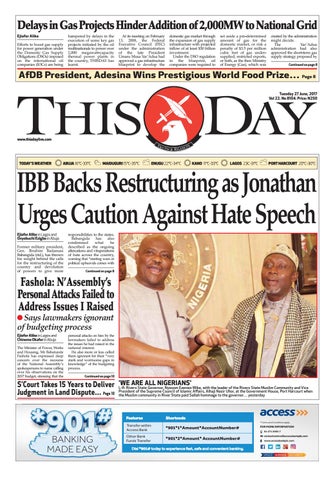
ARE ALL NIGERIANS' S’Court Takes 15 Years to Deliver 'WE L-R: Rivers State Governor, Nyesom Ezenwo Wike, with the leader of the Rivers State Muslim Community and Vice of the Supreme Council of Islamic Affairs, Alhaji Nasir Uhor, at the Government House, Port Harcourt when Judgment in Land Dispute… Page 10 President the Muslim community in River State paid Sallah hommage to the governor… yesterday
2
T H I S D AY TUESDAY JUNE 27, 2017
T H I S D AY TUESDAY JUNE 27, 2017
3
4
T H I S D AY TUESDAY JUNE 27, 2017
T H I S D AY TUESDAY JUNE 27, 2017
5
6
T H I S D AY TUESDAY JUNE 27, 2017
T H I S D AY TUESDAY JUNE 27, 2017
7
8
TUESDAY, ÍşÍżËœ ͺ͸͚; Ëž T H I S D AY
PAGE EIGHT
AfDB President, Adesina Wins Prestigious World Food Prize Reuben Abati The President of the Africa Development Bank (AfDB) and Nigeria’s former Minister of Agriculture and Rural Development, Dr. Akinwunmi Adesina has emerged the winner of the prestigious World Food Prize, 2017 award. The award was announced yesterday in Washington D.C. by the World Food Prize Foundation in recognition of Adesina’s achievements in the agriculture sector and for driving change in African agriculture for over 25 years and improving food security for millions across the continent. The foundation said in a statement that Adesina stood out in efforts to make food available to Africans. It said: “Awarded by the World Food Prize Foundation,
the $250,000 prize honors Nigerian Dr. Adesina for his leading role over the past two decades in: significantly expanding food production in Nigeria; introducing initiatives to exponentially increase the availability of credit for smallholder farmers across the African continent; and galvanising the political will to transform African agriculture. “The selection of President Akinwumi Adesina as the 2017 World Food Prize Laureate reflects both his breakthrough achievements as Minister of Agriculture of Nigeria and his critical role in the development of the Alliance for a Green Revolution in Africa (AGRA). “It also gives further impetus to his profound vision for enhancing nutrition, uplifting smallholder farmers, and inspiring the next generation of Africans as they confront the
challenges of the 21st century.� President of the World Food Prize Foundation, Ambassador Kenneth Quinn, added that in making public Adesina’s name, the foundation took cognisance of the AFDB president’s role with the Rockefeller Foundation, which organised the 2006 Africa Fertilizer Summit; led a major expansion of commercial bank lending to farmers as Vice President of AGRA; and, as Minister of Agriculture in Nigeria, introduced the E-Wallet system, which broke the back of corrupt elements that had controlled the fertilizer distribution system for 40 years. “His policies expanded Nigeria’s food production by 21 million metric tons, and the country attracted $5.6 billion in private sector investments in agriculture – earning him the reputation as the ‘farmer’s
minister’,� Quinn stated. Commenting on the prestigious award in an interview with THISDAY yesterday, Adesina said it was a privilege to have been recognised by the World Food Prize Foundation. “It is a great honour for Nigeria where I come from; a great honour for Africa as well. But I think to me the most important part of it is what it really means for the future because I feel greatly inspired, I feel greatly motivated to go out and do even more in terms of making sure that for me I will not rest until Africa breaks out of hunger and can feed itself and also to see to the end of global hunger. “For those two things I have actually dedicated my life, so I feel it’s for the greater end to accomplish those things,� the former minister added.
He expressed optimism about the future of Africa, saying sometimes the narrative on Africa was often in the wrong direction. According to Adesina, “People think Africa is sinking, I don’t think Africa is sinking at all. I think Africa is making great progress; it’s just that it is difficult to end hunger. “If you take for example the case on economic growth, Africa today is growing at roughly a projection of 3.4 per cent, which is above the 2.2 per cent from last year and next year we project that Africa’s GDP growth rate will be 4.3 per cent. “Bear in mind that those growth rates are much higher than the global growth rate so Africa is doing well. “It’s just that Africa needs to grow much faster than it is growing and I think obviously
nobody eats GDP, so GDP is not professionally what really matters. However, growth is required if one is going to drive down poverty.� Since 1987, the World Food Prize has been awarded annually to recognise contributions in any field involved in the world food supply: food and agriculture science and technology, manufacturing, marketing, nutrition, economics, poverty alleviation, political leadership, and the social sciences. Conceived by Nobel Peace Prize Laureate, Norman Borlaug, the prize comes with a cash reward of $250,000 and emphasises the importance of a nutritious and sustainable food supply for all people. Borlaug saw the prize as a means of establishing role models who would inspire others.
hindered the delivery of many projects that could have added 2,000MW to the national grid. For instance, the 107km Calabar-Adanga gas pipeline project awarded since 2007 to supply gas from the Addax platform offshore to the 561MWcapacity Calabar power plant at Ikot Nyong, near Calabar
in Cross River State, is yet to deliver gas to the power station. Similarly, the Escravos-Lagos gas pipeline expansion project, which was initiated by the Nigerian National Petroleum Corporation (NNPC) to boost gas supply to Egbin, Olorunsogo
also not in doubt, but as the Fourth Estate of the Realm, it has a greater responsibility to moderate public discourse in a manner that will cement interand intra-cultural relationships. “If Nigeria works, it benefits all her citizens; if it fails, it hurts all her citizens too. The media should be patriotic in its present engagements to berth a new Nigeria of our dreams,� Babangida said. Similarly, Jonathan yesterday warned against things that could precipitate tension and insecurity in the country and cautioned Nigerians against fostering a crisis that will further drive away investments in an already stressed economy. Jonathan who gave the advice when he received a delegation of the Peoples Democratic Party (PDP) Former Ministers’ Forum, which paid him Sallah homage at his Abuja residence, said no president could perform magic if there is so much tension in the land. Jonathan said no nation or its economy could grow where there is no peace. “We should always use this period to know that the unity of the country is paramount. We cannot develop as a nation; no matter how the people demonstrate, and no president can perform magic if there is so much tension in the land. “This is because immediately there is a sense of insecurity in any country investors go back, and when investors go back, of course your economy will be doomed. “What improves the economy is confidence and what makes investors to have confidence is peace. Nobody wants to invest where there is no peace, except those that invest in arms and ammunition,� he said The former president also asked Nigerians to pray and
work towards the unity of the nation, as the country celebrates the Eid-el-Fitr festival. Jonathan commended the former ministers for forming the forum and for finding time to celebrate Sallah with him and his family. He said that he was particularly elated to see the former ministers coming together under one platform saying, Nigeria is a country that we should do everything that will bring its citizens together. “We should begin to reduce the cleavages and fault-lines and that the former ministers can come together to form a political body that will look at things from a national outlook and advocate things that will be of use to the whole nation is quiet commendable,� he noted. Alhaji Tanimu Turaki, chairman of the forum, said the delegation comprised the former ministers from 1999 to 2015 and it had come to pay homage to Jonathan to mark the end of the Ramadan fast. Also in attendance were Labaran Maku, Dayo Adeyeye and others.
DELAYS IN GAS PROJECTS HINDER ADDITION OF 2,000MW TO NATIONAL GRID the Gas Master Plan to double domestic gas availability from about 700 million standard cubic feet per day to 1,400 mmcf/d by end of 2008, and triple it to 2,050 mmcf/d by end of 2009. With this plan, power generation was projected to hit 4,500MW, excluding hydro, by the end of 2008 and 6,200MW,
excluding hydro, by the end of 2009. However, investigations have revealed that with the scrapping of the Ministry of Energy (Gas) by Yar’Adua’s successor, Goodluck Jonathan, and the lack of commitment by the IOCs to the DSOs, coupled with their preference
for the export market, power generation as of yesterday stood at 3,500MW. In fact, according to the data released by the Nigerian Electricity System Operator, an arm of TCN, power generation at 6.am yesterday was 2,982.50MW. On Sunday, peak generation to the National Grid was
3,903.70MW, while the lowest generation was 3,108.6MW, compared to the 6,200MW targeted for 2009, as many power plants were still idle due to lack of gas to fire their turbines. THISDAY’s investigation revealed that the delays in the execution of many gas projects initiated by the IOCs have
Continued on page 10
IBB BACKS RESTRUCTURING AS JONATHAN URGES CAUTION AGAINST HATE SPEECH the slightest provocation, but ending them becomes inelastic, almost unending with painful footages of the wrecks of war�. Babangida’s warning yesterday was re-echoed by former President Goodluck Jonathan who cautioned Nigerians against hate and divisive speeches capable to raising tension and insecurity in the country. In his message titled, “I am a Nigerian� to mark the Holy month of Ramadan, a month in which the Muslim faithful dedicate their lives to seek closeness to God, Babangida, who also called for the establishment of state police, argued that if the country has repeatedly done certain things and was not getting the desired results, there was the need to change tactics and approach. Babangida, who also called for the establishment of state police, argued that if the country has repeatedly done certain things and was not getting the desired results, there was the need to change tactics and approach. He acknowledged that though restructuring and devolution of powers would not provide all the answers to the country’s challenges, they would however help to reposition the mindset of Nigerians to generate new ideas and initiatives that would make the Nigerian union worthwhile. Babangida advocated for the devolution of powers to give more responsibilities to the states, while the federal government oversees the country’s foreign policy, defense, and the economy. According to him, even the idea of having federal roads in towns and cities had become outdated, adding that the country needs to tinker with the constitution to
accommodate new thoughts that will strengthen the country’s nationality. The former military ruler noted that restructuring has assumed a national appeal, noting that its time has come. “The talk to have the country restructured means that Nigerians are agreed on our unity in diversity; but that we should strengthen our structures to make the union more functional based on our comparative advantages,� he said. Babangida also observed that of late, Nigeria has become so sharply divided, with emotions running high at the least provocations. According to him, once tempers are that high, the faultlines become easily visible and with the slightest prompting, the unexpected could happen. “I have made friends, built alliances, nurtured relationships and sustained linkages amongst Nigerians of all shades and opinions. In fairness, Nigerians are great people. “In those hours, moments and duration of friendship and camaraderie, no one talks about origin, geopolitical zones or even states. The issue of religion does not dictate the flow of discourse. “We deal with ourselves based on our character and content, and not the sentiments of what part of the country we hail from. “The inalienable fact that Nigerians can live in any part of the country to pursue their legitimate aspirations is a strong indication that we have accepted to invest in the Nigerian project, and are no longer driven by mutual suspicion but mutual respect. “That we have not fully realised our potential as a great nation is not enough reason for us to want to demolish the
foundation of our nationhood or rubbish the labours of our heroes past; both of which are borne out of our collective efforts to build a truly great nation, and great people,� Babangida added. Babangida, who revealed that he was still nursing the injury he sustained from the Nigerian Civil War, added that the war was condemnable and must be avoided. He also condemned the current altercations and vituperations of hate across the country by individuals, well-known leaders, religious leaders, group of persons and organisations, and called on Nigerians to apply caution in their utterances, body language and news reportage. “The management of conflicts is the acid test of maturity, of mutual livelihood and of democratic governance. We cannot and we must not allow the current hate atmosphere to continue to freely pollute our political landscape unchecked. “Personally, I reject the proceedings of hate and their dissemination and urge my fellow citizens to strongly condemn the scourge and orgy of the current crisis which, in my view, is an outcome of vengeful appetites within the multiple contexts of our democratic governance and the profound inequalities that have distorted our social relations,� he said. Babangida further cautioned that the drums of war are easy to beat, but their rhythms difficult to dance. “I saw Somalia, such a homogeneous conclave, yet one of the most troubled countries in Africa today. I saw South Sudan, which broke away from the old Sudan, but peace and stability have eluded them. The Rwanda genocidal experience
is not romantic either. “But a president from the minority ethnic group has repositioned the country to assume its pride of place in the comity of nations. That a people share common identity, language, history, doctrine, culture, mores and values is not synonymous with development, growth, stability and peace,� Babangida explained. “I am a Nigerian, a citizen, patriot and concerned stakeholder. It is my strong belief that Nigeria can attain greater greatness if we all nurture our minds in the direction of building a nation, and accepting responsibility for its successes and failures,� he added. He stressed the need for the country to commence the process of having state police across the states of the federation. According to him, this idea was contained in his manifesto in 2010 when he attempted to contest the presidential election. “The initial fears that state governors will misuse the officers and men of the state police have become increasingly eliminated with renewed vigour in citizens’ participation in, and confidence to interrogate power. “We cannot be detained by those fears and allow civilization to leave us behind,� he added. He also urged the Nigerian media to be more circumspect in their news reportage, adding that the media “should always weigh the security implications of the contents of their news and the screaming headlines that stare us in the face every day, especially at this fragile period of our political emanations�. He acknowledged the important and remarkable role of the media in shaping the flow of discourse. “Their level of influence is
TOP GAINERS CHAMPBREW NEIMETH C & I LEASING ASHAKACEM TRANSCORPHOTEL TOP LOSERS UBA WEMABANK
NGN NGN 0.26 2.93 0.06 0.98 0.03 0.63 0.81 17.08 0.32 6.87 NGN NGN 0.88 8.32 0.04 0.57 TRANSCORP 0.09 1.43 OKOMUOIL 3.24 61.56 FLOURMILLS 1.46 27.74 HPE Nestle Nig Plc â‚Ś900.01 Volume: 417.568 million shares Value: N3.246 billion Deals: 5,456 As at yesterday 23/6/17
% 9.7 6.5 5.0 4.9 4.8 % 9.5 6.5 5.9 5.0 5.0
T H I S D AY TUESDAY JUNE 27, 2017
9
10
TUESDAY, ÍşÍżËœ ͺ͸͚; Ëž T H I S D AY
PAGE TEN
S’Court Takes 15 Years to Deliver Judgment in Land Dispute Litigation took 33 years for final resolution Tobi Soniyi Notwithstanding the various reforms introduced to fast-track delivery of judgment by justices of the Supreme Court, it still took Nigeria’s highest court 15 years to deliver judgment in a land dispute case. The Supreme Court, last Friday, ended a 33-year dispute over a parcel of land in Iwaya, Lagos State, which had been in contention between the Iwaya community and the Anglican Church. The case spent 14 years at the Lagos High Court, four years at the Court of Appeal and 15 years at the Supreme Court, bringing the total number of years to arrive at a final ruling on the land dispute to a record 33 years. The case started in 1984, when it was filed at the High Court, wherein judgment was delivered in 1998. An appeal was lodged at the Court of Appeal in 1998 and judgment was delivered in 2002. A further appeal was filed at the Supreme Court in 2002, wherein judgment was delivered in 2017. The Supreme Court allowed
the appeal filed by Iwaya community, against the judgments of the Lagos State High Court and the Court of Appeal, holding that without proving its due incorporation under the law, the church was without legal capacity to institute an action in court. Reacting to the judgment, Mr. Ebun-Olu Adegboruwa said some of the litigants who instituted the case had died. According to him, the judgment, coming 33 years after it was filed, was a sad commentary on the plight of litigants in Nigeria generally. He said: “I’m aware that there are several other 33 or more-year-old cases that are still pending in the appellate courts, due mainly to the backlog of cases, the avalanche of interlocutory appeals, the limitation on the number of appellate justices, and indeed the manual system of administration of justice.� He said that another factor compounding the smooth and speedy determination of cases was the amendment of the relevant statues by the legislature to confer jurisdiction upon the final court in respect
Chief Justice of Nigeria, Justice Walter Onnoghen of certain political cases, and the statutory directive that all such cases involving political office holders should be given priority above other cases and that they must be determined within 180 days, from the high court or tribunal, to the Court of Appeal, and to the Supreme Court. “This is purely a selfish escapist mechanism adopted for their own convenience by politicians, leaving other litigants in the lurch,� he added. He said something had to be done very urgently. Adegboruwa: “Now, as of the time of the judgment of
the Supreme Court in 2017, most of the original parties have passed on and they are unable to reap the fruits of the judgment. “There is now an urgent need for all stakeholders in the administration of the justice sector to agree on the total revolutionary transformation of the judiciary. “In this regard, I call upon the acting president, himself a professor of law and Senior Advocate of Nigeria (SAN), to convene an urgent meeting of all stakeholders in order to agree upon and implement practical and fundamental reforms that will enhance the effective and speedy administration of justice.� The land dispute case started in 1984, when the Anglican Church through its Lagos Diocese, filed a suit before the Ikeja High Court, claiming ownership of a vast portion of land situate and being at the Iwaya area of Lagos State. The church laid claim to the land under a deed, whilst members of the Iwaya community had claimed direct purchase of the same land from the Oloto chieftaincy family.
In the course of trial, the Oloto chieftaincy family joined the case as the 7th defendant. Judgment was delivered in 1998 by Justice Fatai Adeyinka (as he then was), granting the claims of the church in part and holding the defendants liable in trespass. Being dissatisfied with the judgment of the High Court, the Iwaya community appealed against it to the Court of Appeal, Lagos Division. In a unanimous decision, the Court of Appeal dismissed the appeal in 2002. It was at this point that the community engaged human rights lawyer, Adegboruwa, to file an appeal against the judgment of the court of appeal. In the appeal to the Supreme Court, the appellants contended that the plaintiff before the trial court was an unregistered entity, which could not own land, file a case in court, or be a beneficiary of the judgment of a court of law, itself having not been registered under any law. In its judgment, the Supreme Court clarified the mode of proof of status of artificial bodies incorporated under the Companies and Allied Matters
Act (CAMA) and also the rule of pleading. In the lead judgment, it held that an incorporated company or registered trustees bear the onus to prove its incorporation once same has not been conceded by the defendant. And the only way to prove its juristic personality is to produce its certificate of incorporation before the court. Re-affirming the Supreme Court decision in the 1972 case of Registered Trustees of Apostolic Church V. A-G., Mid-Western Nigeria, the court held that even if there was an admission inter parties, as the status of the incorporated body, proof of incorporation must be established as a matter of law by the production of evidence of the certificate of incorporation, failing which any action initiated by such body will fail, the consequence being that such plaintiff is not a juristic person capable of suing and being sued. The Supreme Court then set aside the judgments of both the High Court and the Court of Appeal which had favoured the plaintiff and declared them a nullity.
to the domestic market to meet the 2009 target of about 2 billion cubic feet of gas per day, a large chunk of the gas goes to the manufacturing and industrial sectors in the Lagos area that pay as much as $8 per thousand cubic feet. The gas producers, it was learnt, are starving the power sector, which pays only between $2.50 and $3 per thousand cubic of gas. Speaking on the discrepancies in gas pricing, the former Minister of Power and Chairman of Geometric Power, Prof. Bart Nnaji told THISDAY that the solution was for the federal government to
liberalise gas supply. “We have to have a situation where gas supply is liberalised so that producers can be free to produce and charge the correct market price. I do not think that people are unwilling to pay for gas. “Of course, this is passed on to the consumers but it is reasonable that a reasonable price gets charged for gas because actually in the Lagos area, you will find a commercial consumer of gas paying up to $8. “This is outrageous for gas but at the low end of it, the price is between $2.00 and $2.50. So, there must be a solution,� Nnaji explained.
public private partnerships so that he could award contracts as a tissue of lies, the minister said on the day he assumed office, he made it clear publicly and privately that his priority would be to finish several hundreds of projects he inherited, which had not been funded for close to three years. Also responding to the issues that the funding for the Mambila power project was slashed because it contained a “whooping N17 billion� for Environmental Impact Assessment (EIA), the minister said there was indeed a mis-description of that particular expenditure head, which could have happened during the classification of so many thousands of budget heads in the budget estimates. According to him, what was described as a budget head for EIA was actually the nation’s counterpart funding to the China EXIM loan to fund the building of the Mambila project, adding that this was brought to his attention only after it had been slashed. He argued that if the intention was not to slash arbitrarily it
should have been brought to his attention to explain. “At a joint meeting convened at the instance of the budget minister when I complained that the budget was slashed, the issue of EIA was brought to my attention and I explained what it was meant for,� Fashola said. On the N20 billion provision in the ministry’s budget, which the National Assembly spokespersons alleged that the minister failed to give details of, Fashola said “the spokespersons were hiding behind a finger�. He explained that it was a very basic principle of good planning to make provisions for unforeseen contingencies, adding that in the 2016 budget, a similar provision enabled the ministry to respond to the failures of the Tamburawa Bridge in Sokoto and the Ijora Bridge in Lagos, among others. According to the minister, being an institutional and not a personal issue, “it won’t be out of place to seek a resolution of the conflict at the Supreme Court in order to protect the country’s future, because it is a clear conflict about how best to serve the people�.
DELAYS IN DOMESTIC GAS PROJECTS HINDER ADDITION OF 2,000MW TO NATIONAL GRID 1 & 2, as well as Omotosho 1 & 2 power stations in Lagos, Ogun and Ondo States, was due for completion four years ago, but has not yet been completed. Also Shell, which pioneered domestic gas supply to boost power generation in Nigeria, is currently lagging behind with many of its gas projects missing their delivery targets. The company’s Bonga diversification project, it was learnt, was initiated to provide 120mmscf/d, equivalent of 650 megawatts of electricity when completed, but it is yet to be completed several years after it was supposed to have come on stream.
It was projected that gas supply from the project would have gone a long way to boosting power especially at a time the attack on the Forcados subsea pipeline wiped off 40 per cent of gas available for the domestic market. Also, the Forcados/Yokri gas project, which was designed to provide 80mmscf/d on completion, is still behind schedule. Shell and Borkir International Company Limited, a subsidiary of Dangote Group had also initiated the ambitious $3.6 billion Assa North/Ohaji South gas project in Imo State to provide 500mmscf/d, but the
pace appears to be slow in the implementation of the project, despite several assurances. When contacted by THISDAY, Shell Nigeria’s spokespersons declined to speak on the issues hampering the completion of the company’s gas projects. However, the Chairman of Shell Companies in Nigeria and Managing Director of Shell Petroleum Development Company (SPDC), Mr. Osagie Okunbor said at the weekend that the company was “on the verge of making a final investment decision� on the new gas project in Assa. Okunbor added that Shell was putting more emphasis
on gas and reducing the oil portion of its footprint in Nigeria, adding, however, that the company was “still a significant player in onshore (oil)�. Investigations also revealed that even Total’s gas project to feed the Alaoji power plant and the NPDC-Pan Ocean project were completed behind schedule. THISDAY gathered that though NNPC’s E&P subsidiary, the Nigerian Petroleum Development Company (NPDC), Total, Chevron, Seplat, Shell, and Pan Ocean have since completed new projects to boost gas supply
FASHOLA: N’ASSEMBLY’S PERSONAL ATTACKS FAILED TO ADDRESS ISSUES I RAISED Fashola’s media aide, Mr. Hakeem Bello, who was responding to the legislature’s criticism of the minister’s remarks on the alterations made to the budget, said in a statement yesterday that the minister was worried that the National Assembly spokespersons failed to address the fundamental points about development-hindering whimsical cuts in the allocations to several vital projects under the Ministry of Power, Works and Housing as well as other ministries. Fashola had in a recent interview acknowledged the need for legislative input from the representatives of the people to bring forward their developmental aspirations before and during the budget production process. He, however, observed that it amounted to a waste of tax payers’ money and an unnecessary distortion of orderly planning and development for the lawmakers to unilaterally insert items not under the exclusive or concurrent lists like boreholes and streetlights after putting ministries, departments
and agencies (MDAs) through the process of budget defence. Fashola had listed the LagosIbadan Expressway, Bodo- Bonny Road, Kano-Maiduguri Road, the Second Niger Bridge, and the long drawn Mambilla Hydropower Project, among others, as projects that the National Assembly materially altered the allocations in favour of scores of boreholes and primary health care centres, which were never discussed during the budget defence. But in their responses both spokespersons of the Senate and the House of Representatives accused the minister of spreading “half-truths� and making “fallacious� statements, adding that he should have known that they only interfered with projects that had concession agreements and private sector funding components. They also accused the minister of wanting to hold on to such projects in order to award contracts. But in dismissing the allegations yesterday, Fashola said it was sad that the lawmakers would resort to name calling
even without understanding the facts. The minister insisted that there was no subsisting concession agreement on the Lagos-Ibadan Expressway, adding that what the Infrastructure Construction Regulatory Commission (ICRC) has is a financing agreement from a consortium of banks, which is like a loan that still has to be paid back through budgetary provisions. “There is no fallacy or half truth in the allegation that the budgets were reduced. The spokespersons admitted this much and now sought to rationalise it by a concession or financing arrangement that has failed to build the road since 2006. The biggest momentum seen on the road was in 2016,� said the minister. In the case of the Second Niger Bridge where one of the spokespersons alleged that the provision in 2016 budget was not spent and had to be returned, Fashola said that their argument displayed “very stark and worrisome gaps in knowledge� of the spokespersons about the budget process.
According to him, a budget is not cash but an approval of estimates of expenditure to be financed by cash from the Ministry of Finance. “The Ministry of Finance has not yet released any cash for the Second Niger Bridge, so no money was returned. Three phases of Early Works of piling and foundation were approved and financed by the previous government in the hope that a concession will finally be issued, which has not happened because concessionaires have not been able to raise finance,� Fashola said. According to him, the continuation of Early Works IV could not start in May 2016 when the budget was passed because of the high water level in the River Niger in the rainy season. He added that the contract was only approved by the Federal Executive Council in the first quarter of 2017, while the contractor was awaiting payment. Further dismissing the allegation that the ministry under him was holding on to projects that could be funded through
11
T H I S D AY TUESDAY JUNE 27, 2017
» äŷ¢
» äŷ¢
» ä¢
TUESDAY, JUNE 27, 2017Ëž T H I S D AY
12
NEWS
Ă?ĂĄĂ? ĂŽĂ“ĂžĂ™Ăœ Davidson Iriekpen Ă—Ă‹Ă“Ă– davidson.iriekpen@thisdaylive.com, 08111813081
ASUU: 38 Universities Have Increased School Fees Due to Poor Funding No fewer than 38 universities across the country have increased their tuition as a result of poor funding by the federal and state governments. The Chairman of the Academic Staff Union of Universities (ASUU), University of Ibadan chapter, Dr Deji
Omole, made this known in a statement made available to journalists in Abuja yesterday. The statement which assessed the two years of President Muhammadu Buhari in office, lamented that the current government had made Nigerians poorer.
Anglican Church Demands Buhari’s Resignation over Ill-health Christopher Isiguzo Ă“Ă˜ Ă˜Ă&#x;Ă‘Ă&#x; The Enugu Diocese of the Anglican Communion yesterday asked President Muhammadu Buhari to resign from office, insisting that his ill health and absence from his duty post has affected the nation adversely.  In a communiquĂŠ issued at the end of her 3rd session of the 16th Synod, held at the Christ Redemption Church, Ogui –Nike, the church insisted that if the president’s ill-health had made it impossible for him to effectively discharge his duties, the best would be to throw in the towel. The church also asked the federal government to make public the outcome of the investigations of the special panel headed by the Acting President Yemi Osinbajo over the large sums of money recovered by the Economic and Financial Crimes Commission (EFCC) in a private apartment in Osborne Towers, Ikoyi in Lagos State as well as the arms recovered by the Nigerian customs.  They further expressed worries over the October 1 quit notice to Igbo residents in the North
by the Arewa youths and the hate speeches from some of their leaders, and warned against the repetition of the pogrom of 1967. It called on the federal government to ensure adequate protection of the lives and property of Ndigbo residing in the northern part of the country. The church further urged Ndigbo to refrain from making inflammatory speeches on the development. The church which commended the federal government on the war against corruption and corrupt practices noted however that informing Nigerians about the outcome of investigations on the recovered money would further boost their support in the fight. The communiquĂŠ signed by Most Rev Emmanuel Chukwuma, the Archbishop/Bishop; Ven. Augustine Orah, the Synod Secretary and Sir HBC Ogboko, the Registrar; also implored the EFCC to “abate media trials of suspects in their custody and ensure the conclusion of investigations before arraignment and prosecution of alleged offenders.â€?
Nobody Has Right to Issue Quit Notice on Any Nigerian, Says Wike Ernest Chinwo Ă“Ă˜ Ă™ĂœĂž Ă‹ĂœĂ?Ă™Ă&#x;ĂœĂž Rivers State Governor, Nyesom Wike, has declared  that nobody has the right to issue quit notice to other Nigerians, saying  that despite  recent social challenges, Nigeria will continue  to be united The governor spoke yesterday  when the Rivers State Muslim Community  paid him a Sallah Homage  at the Government House, Port Harcourt. The governor stated: “Nigeria must be one. All of us will live together.  All of us are free to  do business anywhere in the country.  Whether  you are from the North, you are free to stay here and do business. “Nobody should threaten anybody. All of us own this country. We must be our brother’s  keepers.â€?   Wike said  the unity of the country is necessary  for the rapid development of the country. He assured the Rivers Muslim community that he would
continue to sponsor them for Hajj as his administration believes in the spiritual upliftment of the people. He said: “Government will continue to give you support, but we cannot use state resources to build a mosque. “During the Ramadan I sent items to all the mosques in the state.  We are all worshipping one God, even though we serve him in different ways.� The governor said he has respect for the Muslim community  as exemplified by his invitation of the Sultan of Sokoto to participate in the Rivers at 50 celebration.  He added that he would pay a Sallah visit to the Sultan today. Earlier, the leader of the Rivers State Muslim Community and Vice President of the Supreme Council of Islamic Affairs, Alhaji Nasir Uhor, said the Rivers Muslim Community were happy with  Wike for his superlative performance. He commended the governor  for promoting religious tolerance in the state.
Omole said the public education was not taken seriously because most children of the rich and those in high offices do not attend school in Nigeria. “The latest increment might be attributed to poor funding by the federal and state governments as ASUU poorly rated Buhari in the area of funding of university education. ASUU also noted that it would be difficult for any Nigeria university to effectively compete globally with the inadequate allocation of budgetary funding as prescribed by UNESCO to fund education. The News Agency of Nigeria (NAN) reported that University of Lagos (UNILAG) which was charging N14,500 would now charge N63,500 as tuition fees. Other institutions that increased their fees include,
Ahmadu Bello University (ABU), from N27,000 to N41,000; University of Nigeria (UNN), from N60,450 to N66,950; Obafemi Awolowo University, from N19,700 to N55,700. Others are Nnamdi Azikiwe University (UNIZIK), from N20,100 to N65,920; Bayero University, Kano, from N26,000 to N40,000; University of Abuja, from N39,300 to N42,300 and Usman Danfodiyo University, from N32,000 to N41,000. National Open University of Nigeria (NOUN), from N36,000 to N41,000; University of Benin (UNIBEN), from N12,000 to N49,500; University of Ilorin, from N16,000 to N75,000 and Federal University of Technology, Akura (FUTA), from N13,560 to N83,940. Also in the list are: Federal University, Minna (FUTMINNA), from N20,000 to N37,000;
University of Calabar, from N30,500 to N42,750 and University of Uyo, from N71,000 to N84,250. Federal College of Education (Technical), Akoka, from N16,000 to N40,000; Osun varsity, from N95,000 to N135,500; Anambra State University, from N76,000 to N139,000 and Lagos State University, from N96,750 to N158,250. Ibrahim Badamosi Babangiga University, Lapai, from N25,000 to N52,000; Imo State University, from N120,000 to N150,000; Plateau State University, from N50,000 to N100,000 and Moshood Abiola Polytechnic, from N57,000 to N75,000. Others are: Ibadan Polytechnics, from N30,000 to N50,000; Abia Polytechnics, from N56,550 to N61,000; Auchi Polytechnic, from N14,800 to N28,000 and Ondo State
University of Science and Technology, Okitipupa, from N70,000 to N80,000. Enugu State University of Science and Technology, N104,900 to N124,900; Kwara Polytechnic, Ilorin, from N28,000 to N44,000; Ladoke Akintola University of Technology (LAUTECH), from N65,000 to N72,500 and Tai Solarin University of Education, from N66,500 to N76,500. Afe Babalola University, from N675,000 to N1,075,000; Igbinedion, from N540,000 to N820,000; Crawford university, from N400,000 to N600,000 and Redeemers University, from N545,000 to N605,000. Also on the list are Covenant University, from N774,500 to N814,500; and Benson Idahosa University, from N284,300 to N1,150,000.
EMINENT WOMEN
L-R: Mrs. Shou Okorie; Trustee, International Women Society (IWS), Mrs. Arthur- Worrey; Trustee, IWS, Mrs. Amina Ahmadu; President, IWS, Mrs. Ego Boyo; Madam of the Consulate-General of Peoples Republic of China in Lagos, Ms. Mao Zhao Xia; and Ms. Zhou Jun, at the Chinese cultural exchange event hosted by the Association of Chinese Women in Nigeria in Lagos....recently
N’Assembly Legal Dept Advises Leadership to Stay Action on A’Ibom Senatorial Seat Politics stalls swearing in of Etim Damilola Oyedele Ă“Ă˜ ĂŒĂ&#x;ÔË The Legal Department of the National Assembly has advised the leadership of the Senate to stay action on whether or not to swear in Hon. Bassey Etim, following a judgment of the Federal High Court, Uyo, that he is the rightful winner of the Akwa Ibom North-east senatorial seat. The seat is currently being occupied at the Senate by Senator Bassey Albert Akpan, who has since filed an appeal against the execution of the judgment. A similar tussle where the Senate had sworn in Senator Atai Aidoko (Kogi East) after a Federal High Court ruled against Senator Isaac Alfa, had caused
the upper legislative chamber to be accused of double standards. Senate President, Bukola Saraki, is accused of considering his closeness to the Minority Leader, Senator Godswill Akpabio (Akwa Ibom North West) to deliberately stall the swearing in of Etim. Akpabio at various times, had maintained that Akpan is the authentic winner of the seat. The official position however is predicated on the advise of the legal department of the National Assembly, THISDAY reliably gathered. The Chief Litigation Officer, Mr. Charles Yoila, in a memo dated April 20, 2017 and addressed to the Director of Litigation and Counselling, advised that the Senate President
awaits further details on the matter before taking further steps. “You may wish to advise that the status quo be maintained by all stakeholders and parties pending the hearing of the hearing of the Motion of Notice for mandatory injunction and stay of execution of the judgment of the Federal High Court, Uyo,� the memo read. Yoila further noted that though the National Assembly is not a party to the appeal, it has to respect the fact that there is a pending motion of notice praying for an order of mandatory injunction, an order setting aside the Certificate of Return issued to Hon. Bassey Etim and an order staying execution of the judgment of
the Federal High Court, Uyo. “It is trite law that once an application has been filed for an inductive relief, all steps should be taken to ensure the status quo (position of things at the time of the appeal or suit) are maintained by parties of persons out in notice of the Application,â€? the memo read. Sources however, told THISDAY that Etim’s confrontational stance against the National Assembly, is not helping his case. “Rather than engage the leadership, Etim has been fighting from the outside with lawyers who have been making inciting statements against the institution of the National Assembly, and against Saraki himself,â€? a source said.Â
T H I S D AY TUESDAY JUNE 27, 2017
13
14
T H I S D AY TUESDAY JUNE 27, 2017
COMMENT
Editor, Editorial Page PETER ISHAKA Email peter.ishaka@thisdaylive.com
TRCN AND TEACHING PROFESSIONALISM
Oludayo Tade writes that teachers should be empowered to discharge their duties in a clement environment
T
eachers are critical nation builders. With a standard and up-to-date teacher, qualitative impartation of knowledge will never be in doubt with glowing outcomes. It is on this strength that a nation cannot grow beyond the quality of her teachers (and the way it treats her teachers). Teachers are responsible for the production of the needed professionals to drive the health, socio-economic, and industrial sectors of the nation. Hence, no serious country should joke with treating her teachers well. A pool of poorly trained doctors, lawyers, engineers, pharmacists is a calamity waiting to happen. We all know the consequences of being operated upon by a quack doctor or consulting a quack engineer for a building project. This perhaps explains why the decision to weed out ‘cheaters’ from ‘teachers’ should be commended. There is no doubt that the Teachers Registration Council of Nigeria (TRCN) has been catalysed with the recent appointment of former ASUU leader, Professor Olusegun Ajiboye as its Registrar. By January 2018, the Federal Ministry of Education has promised full implementation of “No TRCN Certificate, No Job” policy. Those in classrooms without TRCN certificate are also going to be thrown out of the classrooms. Till date, close to 1.7million professional teachers have been registered by the council in her drive to rid the profession of quacks. As part of the policy drive of the present administration, the Federal Ministry of Education has joined forces with the council towards implementing its policy not to allow any person without a professional certification from the TRCN to teach any child in Nigeria public and private schools. This is a welcome development in the light of the dismal performances in Nigeria’s education sector. Regular examination and training may be needed for teachers to update their knowledge in line with global best practices. Nigerian children cannot be left behind while their counterparts across the globe are in tune with current state of knowledge. In order to set the tone for the implementation of professional standards, TRCN recently organised a workshop at the University of Ibadan where far reaching recommendations were made. In the communiqué signed by Professor Olusegun Ajiboye, experts at the three-day workshop resolved that TRCN certificate and license should be used as part of the requirements for the employment of teachers in all states in the country. If this recommendation is followed the issue of professionalism in the teaching profession will get the desired attention. However, political convenience among politicians may be a clog in the wheel of this suggestion as Nigerian politicians have been known to sacrifice the pursuit of the common good for selfish, personal interest. Nigeria’s education suffers because those formulating policies in the area of teaching are not even core professionals. This perhaps explains why the workshop recommended that policymakers in education in Nigeria must themselves be professional teachers and hold TRCN certificates. This is a valid suggestion as only those who wear the shoe know where it pinches. It goes to say that round pegs should be put in round holes. Nigeria obviously suffers because critical sectors of the economy are manned by people who do not have the requisite expertise to deliver on the job. Even when people are nominated for political appointments, the executive which ought to use qualification in assigning responsibilities usually does not.
REGULAR EXAMINATION AND TRAINING MAY BE NEEDED FOR TEACHERS TO UPDATE THEIR KNOWLEDGE IN LINE WITH GLOBAL BEST PRACTICES. NIGERIAN CHILDREN CANNOT BE LEFT BEHIND WHILE THEIR COUNTERPARTS ACROSS THE GLOBE ARE IN TUNE WITH CURRENT STATE OF KNOWLEDGE
The Minister of State for Education Professor Anthony Onwuka has threatened not to employ anybody without TRCN certificate into the teaching profession again and sack those already teaching without holding TRCN certificate from 2018. This is why the suggestion that a mechanism should be put in place to check procurement of fake certificates and licences should be seriously implemented. A lot must be done to ensure that those teaching in private schools are cleaned-out while monetary expectations of proprietors causing marks to be ‘allocated’ rather than ‘earned’ must be investigated and sanctioned. The experts also made case for periodic examination of teachers to validate their licenses in such a way that teachers who do not meet the criteria could be allowed to undergo in-service, in-house training or even a full-time programme and those who are unable to cope should be shown the way out of the classroom. This, to me, is to prevent rustiness among teachers. This move if faithfully implemented will ensure that Nigerian teachers regularly update themselves knowing that a periodic examination will determine their fate. There is however a major contention to the policy. The Minister of State for Education threatened that implementation will start next year and nobody will be spared no matter how highly placed. This includes lecturers in tertiary institutions who have shown reluctance from registering with TRCN. Lecturers in tertiary institutions were enjoined to enrol for post-doctoral diploma in education (PDDE). Teaching covers all fields of knowledge with its unique training focused on methods of imparting knowledge and these differ with many teachers having no training at all in methods. Instead of instruction in teaching, university lecturers have long period of training in a specialised field of knowledge which makes them to see themselves as professional sociologists, chemists, psychologists, economists rather than professional teachers. Unlike teachers, university lecturers enjoy autonomy fought and won by the Academic Staff Union of Universities (ASUU) with the Senate taking decisions. They decide who to hire and fire and enjoyed considerable autonomy. Can principals of primary and secondary schools employ teachers without the state? In the universities, students interested in becoming professional teachers come to my Faculty of the Social Sciences, Arts or Sciences to borrow teaching courses in Economics, Political Science, Chemistry, Physics, English to mention but a few. Let induction by TRCN stay with those in Faculties of Education. Methinks TRCN should champion what will enhance the prestige of the ‘profession’, design welfare package and ensure teachers discharge their duties in a clement environment. A TRCN-certified teacher teaching students under roofless classrooms or under the tree will be a magician to be able to impart anything in a distracting context. A TRCN certificate with regular funding of education and supply of necessary materials will boost morale. Extortion and corrupt activities will fester when teachers’ salaries are unpaid for months. We cannot treat our teachers as inconsequential and expect them to deliver the best for Nigeria’s future. Beyond the TRCN certification, teachers deserve the best and need recognition. Dr.Tade, a sociologist, sent in this piece via dotad2003@yahoo. com
PRESERVING THE LEGACIES OF OUR LEADERS PAST Lagos remembers its heroes in various forms, writes Adekunle Akinmosa
T
he poet, Henry Wadsworth, wrote: ‘Lives of great men all remind us, we can make our lives sublime, and, departing, leave behind us, footprints on the sands of time.’ Reflecting on these lines, it brings to focus why humans generally celebrate lives of other exceptional humans who have impacted their societies. In all cultures, climes and walks of life, history is replete with the impact of several great individuals. And accounts of their life have existed in forms of monuments, tangible or intangible to act as reminders of their greatness. These art forms could be through literature, performance arts or visual arts. Hence, books, plays, poetry, music, drawings, paintings and sculptures, are among various ways in which the legacies of icons in our midst have been celebrated. Our Nigerian icons have not been different. Faces of some elite leaders adorn our naira, some of our buildings including airports have been named after them and all around major towns in the country are statues reminding us they once reigned as powerful individuals. However, this piece is on how Lagos, unarguably the most cosmopolitan Nigerian city, remembers its greats. In Lagos, Tinubu Square, formerly known as Independence Square, remembers slave trader and business magnate Madam Efunloye Tinubu. At the CMS junction in Lagos Island, Herbert Macaulay stands just by the corner. Murdered politician Funso Williams is remembered too at corner of Costain. Also, medical doctor and human rights activist, Dr. Beko Ransome Kuti, owns his spot around Anthony bus stop. But the government recently came under criticisms in some quarters concerning its interest in preserving the legacies of our leaders past. This came specifically when it was alleged that the government
wanted to replace the statues of late Chief MKO Abiola and Chief Gani Fawehinmi which had as its dwelling the Ojota Park. Abiola, the presumed winner of the 1993 presidential elections which was annulled by military dictator General Ibrahim Babangida in a controversial manner was an industrialist, philanthropist and politician. Since his death in 1998 while being detained for declaring himself as president, many states, especially in the Southwest region of the country, have immortalised Abiola in many ways. And June 12, a date synonymous with his mandate, has even been declared a public holiday in Southwestern states. However, Lagos, his base, still honoured him with a statue to ensure it doesn’t take poring over history to easily know the relevance of the man Abiola. Also, the knowledge of late legal luminary, Gani Fawehinmi, is fading fast despite that it is not up to 10 years since he passed on. Currently, many young Nigerians don’t know the man who used the exalted law profession to defend the poor masses, hereby earning the title of ‘Senior Advocate of the Masses (SAM)’ from average Nigerians before he would have the government controlled Senior Advocate of Nigeria (SAN) later conferred on him. Yet, this is despite the fact that his statue seats prominently in the Ojota Park. Had it been true that it was the ploy of the Lagos State government to replace the statues of Abiola and Fawehinmi, the criticisms would have been justified. Though both men played important roles in the dynamics of Nigeria, their choice of Lagos as home was indisputable. Hence, it came as a balm when the government came out with its position on so-called ‘replacement’ of the statues. Responding to the criticisms, Lagos State Govern-
ment said it is not replacing the statues, rather it is commissioning a bigger and more impressive statues of the two icons. “Rather than replace the two conspicuous monuments, the Ministry of Tourism, Arts and Culture with the approval of His Excellency, Mr. Akinwunmi Ambode, the Governor of Lagos State, commissioned group of artistes to remodel the entire park and erect a new but bigger, better and more aesthetic sculpture of the two prominent Nigerians for better appreciation of their contribution to the development of Nigeria,” said the acting Lagos State Commissioner for Tourism, Arts and Culture, Hon. Adebimpe Akinshola. The remodelling, aside making the statues bigger, will also come with a water fountain to further enhance the aesthetic value of the park. She also disclosed that the remodelling work on Abiola’s statue which commenced in January is presently about 70 per cent completed while Fawehinmi’s statue is about 60 per cent completed. She also disclosed that another art work titled, ‘The Possibility’ is sprouting up in the park. These moves to beautify Lagos, a follow-up from the previous administrations of the state will see the erection of 29 artistic sculptures and monuments at strategic locations across the state. Akinshola said that though many of the monuments are at advanced stages of completion, six of them have been completed and officially unveiled. The six statues include the statues of the first settler in Lagos, Prince Olofin (erected at Ijora); the first King of Lagos, Prince Ado (erected at Moloney Junction, Lagos); Ojuloge (erected opposite the National Theatre), which celebrates and conveys the sense of beauty, grace, style and passion for fashion of Lagos Women. Others are The Drummer (erected at Ipakodo, Ikorodu), which depicts the Yoruba
music culture; Youth Empowerment (erected at Sabo Yaba), which depicts situations and resources the youths deploy to improve quality of life as well as The Fisherman (erected at Badagry junction) which depicts one of the occupations and heritage of the people of Badagry. However, I was very excited recently when I noticed a statue around the Allen Avenue/ Aromire Avenue roundabout in Ikeja. Still without a head, the giant structure is of a trimmed figure in tight-fitting yellow jumpsuit with fists clenched high above where a head should be. But for those in the know, that figure can only be one person – Fela Kuti striking his ‘black power’ salute. And it is not surprising that his is among the 29 sculptures being commissioned by the Lagos State Government. While alive, Abami Eda as he was fondly called, was a dominant figure in Ikeja where he both lived at his house called Kalakuta and played at his club called ‘The Shrine.’ Fela, the founder of afrobeats, was also a human rights activist and thorn in the flesh of many Nigerian governments. He was loved globally for his music and political views despite his controversial lifestyle. And with his music, he advocated good governance and preached against oppressive military dictatorships and unfriendly government policies with his yabis. I am happy Lagos State under Governor Akinwunmi Ambode is serious about building monuments to honour our greats. Surely, in an era where Nigerians, especially young Nigerians, find it difficult to connect with their own heritage, the move by Lagos State to continuously celebrate our icons must be commended. And the state government’s moves must not be cheapened with unfounded commentaries. Joe Agbro 08056745268 joeagbro.blogspot.com
15
T H I S D AY Ëž Í°ÍľËœ Í°ÍŽÍŻÍľ
EDITORIAL NEEDLESS TUSSLE OVER BUDGET POWERS There should be collaboration and cooperation between the executive and the legislature in the preparation of the budget estimates
S
igning the 2017 Appropriation Act into law on the historic day of June 12 this year, Acting President Yemi Osinbajo complained about National Assembly’s alteration of ďŹ gures in the estimates presented to it by the executive, saying the legislature lacked the power to adjust or unilaterally introduce projects into the national budget. His comments received an instant rebuke from the leadership of the National Assembly, which contended rigorously that the 1999 Constitution has granted the sole power of the national purse to the legislature. The controversy is not new. Since the return to democratic governance in 1999, power of appropriation had been contentious with both the executive and the legislature insisting that they had the exclusive preserve to determine the subject heads and ďŹ gures in the national budget. Interestingly, this has never been an issue at the state level, where governors brook no dissent whatsoever from the states houses of assembly that merely rubber-stamp whatever they propose. However, the THERE IS NEED recent ruling of Justice FOR COOPERATION Gabriel Kolawole BETWEEN BOTH ARMS of the Federal High OF GOVERNMENT IN THE Court, Abuja in a case PREPARATION OF THE ďŹ led by Mr. Femi FaESTIMATES SO THAT BY lana, SAN, may have somewhat resolved THE TIME THE MONEY the controversy. The BILL IS LAID, MOST OF THE GREY AREAS WOULD judge had stated very clearly that the power HAVE BEEN RESOLVED of appropriation of the National Assembly under Sections 80 and 81 of the constitution included the power to alter the proposals sent to it by the executive. Falana had approached the court in 2014 for the interpretation of Sections 4, 59, 80 and 81 of the constitution in relation to the power of appropriate on. He raised four issues and asked for seven reliefs and all were resolved in favour of the legislature. But
Letters to the Editor
the kernel of the matter was his request that the court should determine: “Whether by virtue of S. 81 of the Constitution of the Federal Republic of Nigeria, 1999 (as amended), the 3rd Defendant (National Assembly) is competent to increase or review upward any aspect of the estimates of the revenues and expenditure of the Federation for the next ďŹ nancial year prepared and laid before it by the 1st Defendant (the president)â€?. Justice Kolawole answered the question in the afďŹ rmative: “The 3rd Defendant (the National Assembly) was not created by the drafters of the constitution and imbued with the powers to receive ‘budget estimates’ which the 1st Defendant (the president) is constitutionally empowered to prepare and lay before it as a ‘rubber- stamp’ parliamentâ€?, he said before adding, “The whole essence of the ‘budget estimates’ being required to be laid before the 3rd Defendant is to enable the 3rd Defendant as the assembly of the representatives of the people, to debate the said ‘budget proposals’ and to make its own well informed legislative inputs into it.â€?
T H I S DAY EDITOR DEPUTY EDITORS ˜ MANAGING DIRECTOR DEPUTY MANAGING DIRECTOR CHAIRMAN EDITORIAL BOARD
EDITOR NATION’S CAPITAL
T H I S DAY N E W S PA P E R S L I M I T E D EDITOR-IN-CHIEF/CHAIRMAN GROUP EXECUTIVE DIRECTORS ˜ ˜
˜ GROUP FINANCE DIRECTOR DIVISIONAL DIRECTORS ˜ ˜ DEPUTY DIVISIONAL DIRECTOR
SNR. ASSOCIATE DIRECTOR ASSOCIATE DIRECTORS ˜ CONTROLLERS ˜ ˜
GENERAL MANAGER
GROUP HEAD DIRECTOR, PRINTING PRODUCTION TO SEND EMAIL: ďŹ rst name.surname@thisdaylive.com
A
ccording to Justice Kolawole, it will be reading into the provisions of Section 81 of the constitution what the drafters never put into it to say that the National Assembly “is not competent to increase or review upward any aspect of the estimates of the revenues and expenditure of the federation for the next ďŹ nancial year prepared and laid before itâ€? by the executive. Since neither Falana nor the president has to date appealed the ruling, it stands to reason that Justice Kolawole has settled the matter in favour of the legislature. We, however, urge a more sober and political approach to the exercise of the power of appropriation as vested in the National Assembly by the constitution and case law. We think that there is need for more comprehensive collaboration and cooperation between both arms of government in the preparation of the estimates so that by the time the money bill is laid, most of the grey areas would have been resolved. Indeed, it is because of such consultations that budget preparation takes a whole year in most countries.
TO OUR READERS Letters in response to speciďŹ c publications in THISDAY should be brief (150-200 words) and straight to the point. Interested readers may send such letters along with their contact details to opinion@thisdaylive.com. We also welcome comments and opinions on topical local, national and international issues provided they are well-written and should also not be longer than (9501000 words). They should be sent to opinion@thisdaylive.com along with the email address and phone numbers of the writer.
SHAZIN’S EXEMPLARY STEWARDSHIP AT KWALI
E
ven as most Nigerians lament over the leadership problems in Nigeria, in the case of Kwali Area Council of Federal Capital Abuja, we are witnessing a paradigm shift as the new helmsman Hon. Joseph Shazin is toeing a new line. This new direction by the Shazin administration which recently marked its one year in office has put Kwali on an accelerated development level. Today on account of his efforts towards repositioning the area council, many residents are beginning to feel the impact of government in their daily lives. Notwithstanding the dwindling monthly federal allocations, the Kwali Area Council under the indefatigable leadership of Mr. Joseph Shazin has continued to provide essential amenities and development projects in the area council. To achieve this feat he adopted several strategies, one of which is raising the internally- generated revenue profile of the area council. The council established an internally-generated revenue task force which is diligently supervised by the area council administration. Additionally, the administration also established a timber market at Dabi Baka and a cattle market at Koroko as well as handed over the site of Kwali International Market to a private developer to commence physical development. It is also remarkable that in a bid to boost the revenue profile of Kwali Area Council, the Shazin administration first equipped the task force with necessary tools for the work such as motor vehicles, motorcycles and security. Considering the attention being given to the agricultural sector
in the country, the Shazin administration has increased the tempo of farming activities in the area council by repairing broken and abandoned tractors which he inherited, thereby enhancing the tractor hiring services of the area council. This approach has restored Kwali to its prime position of a leading agrarian community. It is pertinent to reiterate the fact that the Joseph Shazin administration is working on all sectors simultaneously. For example, the council has consistently intervened in the education sector by providing essential educational materials, rehabilitated schools and awarded scholarships to many indigent students of the area council. Similarly, the council has engaged over 300 youths and women in skills acquisition, and the philosophy behind this policy is to enable them to be self-reliant and thereby boost their families’ incomes. In the area of health-care delivery, Kwali Area Council has made a mark in supporting and funding maternal New Born programme, as well as assisting in the polio eradication programme of the World Health Organisation. To ensure that children are protected from various communicable diseases at their infancy, the council has introduced routine immunisation days and mobilised the health department to carry out regular monitoring and evaluation of the immunisation activities. This level of vigilance is aimed at preventing a sudden outbreak of communicable diseases. The noble achievements of Mr. Joseph Shazin as chairman of Kwali Area Council, FCT, is being brought into limelight because for a very long time Nigerians have been inundated with issues of
maladministration at the third tier of government. Now, we have an example of a local government that works and is delivering the democracy dividends to its citizens due to the selfless leadership style of the helmsman. Perhaps other local governments in Nigeria have to understudy the Kwali area council administration to enable them stay afloat. It is also worthy of note that the Federal Capital Territory Administration has chosen Kwali for the construction of an NYSC permanent Orientation Camp. This synergy and collaboration between the area council and FCTA has the potential to attract serious investors to the area, thereby boosting the economic base of the council and income earning capacity of the people. Furthermore, despite the economic downtum of the country, and in particular local government councils, Kwali Area Council has under Hon. Joseph Shazin continued to provide developmental projects which include roads, water, schools, maintenance of dilapidated infrastructure, market development and sanitation. Having attained these milestones within a period of one year, it is doubtless that Hon. Shazin’s will greatly transform Kwali Area Council over the remaining two years. These achievements dispel the wrong notion that local governments in Nigeria are not viable. It requires a visionary leadership as encapsulated in the Kwali leadership template for an area council to break even. In doing so the support of all key stakeholders is needed for the people to benefit and a typical example is the harmonious relationship between Hon. Shazin’s administration and the FCTA under Minister Muhammad Bello. Chukwudi Enekwechi, Abuja
16
T H I S D AY ˾ TUESDAY, JUNE 27, 2017
POLITICS
Group Politics Editor Tobi Soniyi Email tobi.soniyi@thisdaylive.com 08033146139 SMS ONLY
EXECUTIVE BRIEFING
War of Attrition in Ekiti There seems to be no end in sight to the acrimonious relationship between the Minister of Mines and Steel Development, Dr Kayode Fayemi and the Ekiti State governor, Ayodele Fayose, writes Victor Ogunje
O
n May 13, 2017, the governor of Ekiti State, Mr Ayodele Fayose set up a 7-man panel to scrutinise the state’s finances under the four-year tenure of his predecessor and now Minister of Mines and Steel Development, Dr Kayode Fayemi. Political watchers are beginning to wonder at the endless war of attrition between the two who initially related well with each after the June 21, 2014 governorship poll, which Fayose won. Fayemi, initially accepted the result, congratulated Fayose and promised a smooth transition. The conviviality which existed between the two was however not destined to last. However, after he learnt of how the Goodluck Jonathan’s administration used the military to assist Fayose to win the election, Fayemi recanted and said the election was fraught with irregularities. Since then the cordial relationship between the two had broken down irretrievably. As soon as Fayose was sworn in on October 16, 2014, he started accusing Fayemi of allegedly plundering the state’s resources. His Special Assistant on Public Communications, Mr Lere Olayinka reeled out barrage of figures about the state’s debt profile which, he said Fayemi left behind. At a time he pegged it at N42 billion. In another breathe, he changed it to N86billion before finally settling at N76 billion which was the figure hitherto cited as the state level of indebtedness. Speaking on behalf of the governor during the inauguration of the Justice Silas Oyewole-led Panel of Enquiry set up to probe Fayemi, the state’s deputy governor , Dr Kolapo Olusola urged members to be thorough and apolitical. He said that the probe was not targeted at smearing anybody’s image but to put the records straight. Many believe that the outcome of the probe will show whether the panel was impartial or not. The composition of the panel had generated a lot of debates across party lines. While the Peoples Democratic Party’s faction loyal to Fayose justified the setting up of the committee as representing the yearnings of the Ekiti people, members of the All Progressives Congress APC viewed it from the prism of political vengeance and attempt to muzzle opposition ahead of the 2018 governorship poll. In actual fact, Fayose had always justified his position that he was acting on the May 11, 2017 resolution of the State House Assembly, which directed him to so do after the ex-governor had turned down three summons earlier issued on him. However, Fayemi had not at any forum or either personally or by proxy unveiled his intention to take another shot at the governorship seat in Ekiti, but the people are beginning to read between the lines that he is interested, if the body language of his die –hard loyalists is anything to go by. Aside from the scheming for the 2018, which largely seems to be more of political survival for the two feuding politicians, one issue said to have informed Fayose’s new step was the revelation by the former Commissioner for Finance during Fayemi’s regime, Dapo Kolawole, that his former boss did not leave any debt behind. He had, while appearing, on a live television interview programme on June 14, 2016 explained that Fayemi did not leave Ekiti in debt as claimed by Fayose and that the money the governor had received so far from the federation’s account as at that time was enough to pay three months workers salary out of six months outstanding. The governor was said to have been miffed by the statement taking cognisance of the fact that his political survival in 2018 will depends largely on the state workforce while non-payment of salaries has
Fayose
been his main albatross. Kolawole in the interview explained that “Fayose was theone who renegotiated Ekiti debt till 2036 and not Fayemi as my boss had paid half of the debt and was expecting another N17 billion from the Federal Government reimbursement on some road construction projects which would have offset all debts if Fayose had not breached the payment plan and if he had continued with the regenerative projects of his predecessor”, he said. Embarrassed by Kolawole’s statement , a member of the House of Assembly, Hon Samuel Omotosho and Fayose’s aide, Olayinka , had appeared on a live television and radio programme on July 6, 2017, where they allegedly branded both the former governor and his finance commissioner thieves who stole the state blind. They were said to have alleged during the programme that Fayemi stole N852m state’s Universal Basic Education fund and also contributed a staggering sum of N1.5billion to President Muhammadu Buhari’s campaign , that Fayemi stole Ekiti money to establish a University in Ghana, that Fayemi obtained
However, after he learnt of how the Goodluck Jonathan’s administration used the military to assist Fayose to win the election, Fayemi recanted and said the election was fraught with irregularities. Since then the cordial relationship between the two had broken down irretrievably
Feyemi
N5b loan from Ecobank which he spent on his reelection and not on any project and that he and his aides went away with 79 vehicles belonging to the government and that the ex-governor left a huge debt behind. They also said on the programme that they had written a petition against the minister , Kolawole and some of his aides to the Economic and Financial Crimes Commission, but no action was taken. All these and many more were part of the terms of references for the panel. On the basis of the foregoing insult allegedly hurled at him, Fayemi dragged Omotosho and Olayinka before an Abuja High Court for libel and also claimed N3 billion as damages from them, 2b from Olayinka and N1 billion from Omotosho. Probably in retaliation, the house issued a warrant of arrest against Fayemi on February 7, 2017 directing the Inspector General of Police, Mr Ibrahim Idris and the then Commissioner of Police, Mr Wilson Inalegwu to arrest him whenever and wherever they see him and bring him before the House of Assembly. The action of the house must have necessitated Fayemi’s second law suit where he dragged the House of Assembly to court and asked that the house be restrained from inviting him and to set aside the warrant of arrest issued against because due process and rule of law were not followed in exercising the powers. Fayemi also averred in his second suit which he instituted before a Federal High Court in Ado Ekiti that since he had instituted a case against one of them over the same issue of Ekiti State finances when he was governor, the house ought not to invite him again not to talk of issuing a warrant of arrest. Despite Fayemi’s second law suit against the House of Assembly, the house House went ahead to fine him N1, 000, 000 (One Million Naira) and declared him a law breaker apparently as a result of the frustration that Fayemi was not arrested and brought before it Shortly after the panel was constituted, Fayemi ran to court seeking for perpetual injunction to restrain the body from probing him on the basis that its members were biased. The minister alleged that “the Chairman and many members of the commission have an axe or the other to grind with him and they are PDP members and sympathisers. For instance, the partisanship of the Chairman of the panel, Justice Oyewole,
as a PDP’s sympathiser is not in doubt, while the secretary, Gbenga Daramola, is the State Director of Public Prosecutions (DPP), who cannot be insulated from Fayose’s control in the handling of the panel’s job. Another member, Blessing Oladele, is a member of APC who defected to PDP. Another member, S.J Bamise, is a senior counsel in the office of the state Attorney General, the office that conceived and constituted the panel to probe him. Another member, Vincent Omodara, is Fayose’s crony in the Accountant General’s Office”, The Chief Magistrate Idowu Ayenimo as anti-APC judge, who routinely jailed APC members on Fayose’s trump-up charges that are bailable”, Fayemi alleged . Fayemi argued that the House of Assembly ha breached its own standing rules, which forbids discussing any matter that is pending in court. Chapter VIII, with the subtitle, Rules of Debate, Section 54 (5) reads: “Reference shall not be made to any matter on which a judicial decision is pending, in such a way as might in the speaker’s opinion, prejudice the interest of parties thereto.” He also contended that “the resolution of the house directing the governor to set up the panel was not passed in accordance with constitutional provisions and so cannot be valid and any action arising from that resolution such as the setting up of the Judicial Commission becomes ultra-vires and of no effect”, he stated. In Fayemi’s deposition before the court, he said the N5billion loan obtained at Ecobank by his administration which was suspected to have been withdrawn and expended on his re-election in June 2014, was well appropriated and supervised by the bank. On the state’s borrowing, he said there was no banking facility or loan borrowed by his government that did not follow due process . It was also stated that no mismanagement of funds took place under his administration. “There was no law stopping an administration from borrowing beyond its tenure because government is a continuum. There were loans obtained for some water projects in Ekiti State since Adekunle Ajasin tenure between 1979 and 1983 that was deducted from Ekiti State allocation under NOTE: Interested readers should continue in the online edition on www.thisdaylive.com
17
T H I S D AY ˾ TUESDAY, JUNE 27, 2017
POLITICS
From Peaceful Transition to Political Turbulence The last two years have been turbulent for Nigeria despite a successful transition from the Goodluck Jonathan administration to the incumbent administration. Davidson Iriekpen ponders what went wrong
D
espite the successful transition from the Dr. Goodluck Jonathan’s administration to the incumbent, President Muhammadu Buhari, the last two years have been turbulent for Nigeria. Since the country attained independence in 1960 and the civil war, there, perhaps, has not been any time the clamour for division has been so loud than now. So vociferous and sometimes cantankerous have the agitations become that they threaten the unity and existence of the country. While some Nigerians are calling for a ‘true federalism’ as was practised in the 50s up to the first republic where each region was responsible for its resources, others called for outright secession citing structural imbalance which allows some states to rely on resources from others to survive. Though the last one year of the Jonathan administration saw the north intensifying its clamour for the return of power to the region, the two years of the Buhari administration have seen a different dimension. Though, political analysts have always known that Nigeria was established along ethnic fault lines dating back to the mid 1960s which were partly responsible for the two military coups that ended the first civilian government and led to the civil war, to them, the character of Buhari and his government may have largely contributed to the divisions being experienced today. They also castigated politicians and the elite for spreading hate and not always championing or agreeing on issues that would move the country forward. No doubt Buhari rode to power on the back of welter of promises to Nigerians. After waiting for 16 months, those promises are yet to be fulfilled, a development that has given vent to disillusionment, anger and utter disappointment. Besides, observers believe that the country is more divided today along ethnic lines than ever due to the appointments, utterances, body language and divisive tendencies of the president. They are also pointing fingers at the upsurge in brutal and often fatal attacks by Fulani herdsmen and a push for state governments to create grazing reserves. On many occasions, these Fulani herdsmen have not only invaded Christian-dominated regions in the northern and southern parts in the country and killing thousands, but have destroyed property worth billions of naira. Perhaps, particularly annoying to many was the deliberate silence of northern leaders and the federal government; rather than condemning the action or take drastic action to tame the ravaging herdsmen they prefer to look the other way. This has created the impression that they are being backed by eminent persons in government. An analyst, who spoke on condition of anonymity, said: “There are many instances that lend credence to the fact that the government of today has further divided the country along ethnic and religious lines. Some people believe that the federal government is using the security agencies to protect the Fulani herdsmen while leaving farmers unprotected, a situation that has emboldened the herdsmen to plunder, maim and kill at will. Don’t forget that the president is said to be the grand patron of the herdsmen association.” The climax perhaps was when a coalition of northern youth groups on June 6, 2017, issued a quit notice to the Igbos to leave the north by October 1, 2017. Since, then, peace seems to have eluded the nation. The groups: Arewa Citizens Action for Change, Arewa Youth Consultative Forum, Arewa Youth Development Foundation, Arewa Students Forum and Northern Emancipation Network on the Igbo Persistence for Secession, in the ultimatum, stated that they were tired of the 1914 marriage. They therefore want the south-east to go its separate way as the union has collapsed irretrievably. The northern youths’ grouse was the agitations by the Indigenous Peoples of Biafra (IPOB) and the Movement for the Actualisation of the Sovereign State of Biafra (MASSOB), especially the May 30 sit-at-home, which was complied
Buhari.... sectional agitations festering under his watch
with in the south-east. They want the Igbos in the north to relocate from the region within three months, while the northerners in the south-east should return too. The declaration has led to the demand for several federations by hitherto silent groups, an indication that Nigeria has all along been sitting on a keg of gunpowder and exposing the forced marriage of convenience contrived by the colonial masters for their selfish ends. While all hope is not lost on the country’s unity, many analysts believe that the problem of the country is that of leadership. They posited that once this fundamental problem is solved and people given a sense of belonging, the agitations would stop. Despite the agitations however, there are still a lot of Nigerians who feel when the right thing is done, it could assuage the negative feelings Nigerians presently have about the unity of the country even if temporarily. For example, the Catholic Archbishop of Abuja Metropolitan See, John Cardinal Onaiyekan, last
No doubt Buhari rode to power on the back of welter of promises to Nigerians. After waiting for 16 months, those promises are yet to be fulfilled, a development that has given vent to disillusionment, anger and utter disappointment. Besides, observers believe that the country is more divided today along ethnic lines than ever due to the appointments, utterances, body language and divisive tendencies of the president
week said once the federal character principle is judiciously applied; it would tame anger in the country. Onaiyekan who spoke at a press conference in Abuja, said the flagrant abuse of the federal character act by the incumbent administration was responsible for the agitations and threats by tribal groups in the country, warning that the continued domination of government by a particular tribe and the exclusion of others spell doom for the nation. The cardinal tasked the federal government to change the rules of governance in addition to yielding to call by Nigerians to restructure the country. He insisted that the anger and dissatisfaction expressed by people would continue in the country, considering that abuse of federal character principle leads to injustice and marginalisation. He maintained that lackadaisical attitude displayed by some of those at the helms of affairs would do no good for the country; rather, they should look at the agitation holistically to correct the imbalance in the land. “We know what is causing people to be angry, and if you want to be sincere, there is no part of Nigeria where there is no cause for anger, no part. May be some people are expressing their anger more than the others, but everywhere, people are dissatisfied. And this has nothing to do with who is president and who is not the president? “It goes in my opinion to the rules of governance. How we governed ourselves, the whole area of justice system, equality before the law. The whole concept of federal character supposed to be that no part of the country is left behind. Federal character can not mean that some parts of Nigeria will be favoured over others. If the federal character leads to injustice and marginalisation, then, it does not make sense. We must change the way we are doing things, we cannot continue like this. “Definitely, if we do, there will be more anger, more calls for change and we don’t know who will be able to mobilize more people to cause more problem. Don’t forget that this was one of the major positions held by the Boko Haram. The issue is, what are those things that are happening in Nigeria now, which we need to critically and effectively look at, in such that, this sense of dissatisfaction, exclusion, injustice that people are feeling will be reduced to the minimum? So, some people put it under big title of restructuring. “Some people think that restructuring is to create more states, as far as I am concerned, if you create more states and the system remains the same, you will only have more problems. We need to restructure if we want the country to survive. The truth is that things are not organised properly and it makes the people
to be dissatisfied. It is not only the Biafrans who are disgusted with this country; a lot of us are, even though we still are not thinking of that. It is like a father who is very angry with his son; you will still not throw him away.” On his part, Ekiti State Governor, Mr. Ayodele Fayose, asked Buhari to change his style of governance, saying he is responsible for the hate speeches being uttered by some sections of the country, thereby heating up the polity and creating tension in the system. Fayose said Buhari got it wrong by his statement after inauguration that his government might not favour any section of the country that voted against him during the 2015 presidential poll. The governor while reacting to the quit notice issued to Igbos by a coalition of northern youth groups, said Buhari by his utterances, tactically emboldening the hate speech makers. “How can a president that was just sworn-in after a tension-soaked election be saying that any section that didn’t vote for him won’t benefit from his appointments? By implication, such president was openly giving room for sectionalism and that was exactly what Buhari did after the election. We could all confirm that Nigeria has never been this divided in history. “Every Nigerian knew that the people of the south-east didn’t vote for him, so that automatically gave those northern groups to have the effrontery to order Igbos out of their region. When a leader speaks like that, something like this is bound to happen. We can’t deny the fact that the problem has gone so deep in dividing us. But it is not beyond solution. The leaders from south-east and the north should sit down and iron out their differences in the interest of everybody,” he said. Former Governor of Enugu State and pioneer National Chairman of the Peoples Democratic Party (PDP), Okwesilieze Nwodo, in a recent interview noted that Nigeria was becoming more polarised than ever. Lamenting the situation, he said: “One of the issues with the herdsmen is that they feel that their own man or brother is the president. It is not that the president asked them to be doing that, but the notion that ‘my brother is in charge, what you can do to me? That is the major factor fuelling this menace. “There must be a point at which we are going to take the destiny and the responsibility of ourselves in our own hands; for the country, as it is now, is becoming more polarised. The law in this country does not allow an individual to purchase an AK47 rifle without licence, but these herdsmen carry it around without anybody questioning them; it is worrisome.” In a report recently, Ben Durueke wrote: “Lately, the seemingly quiet Fulani herdsmen have taken to arms, killing and maiming people. They have attacked in Benue, Enugu, Delta, Niger among other states, leaving sour images of several deaths. For the fifth time in a short time, Enugu State has been attacked by Fulani herdsmen, who seem to have been given a licence to kill whoever they want to kill in any part of Nigeria and get away with it.” Ben Nwabueze, a renowned lawyer, professor and Senior Advocate of Nigeria (SAN), strongly believes that most of the groups agitating for one thing or the other in the south-east and south-south geo-political zones of the country are purely doing so to vent their anger on the perceived marginalisation by government. Nwabueze, who also is the president of The Patriots, a revered group of intellectuals and elder statesmen campaigning for good governance, also advised Buhari not to drag the country into religious crisis hiding under fight against terrorism. “I am not sure these agitators really want to secede. I think they are merely reacting to marginalisation by the government, especially in the appointments. Don’t make the fight against terrorism a religious issue. We are all against terrorism but don’t drag this country into one religious group because of terrorism or because we are fighting terrorism. We cannot use the war on corruption as justification for everything. We should be very careful. I have said all that I need to say on this issue of hiding under fight against corruption to do all sorts of things including assaulting the constitution,” he said.
18
TUESDAY, JUNE 27, 2017 ˾ T H I S D AY
FEATURES
Acting Features Editor Charles Ajunwa Email charles.ajunwa@thisdaylive.com
The Struggle for St. Gregory’s Soul Solomon Elusoji reports on how St. Gregory College Old Boys Association brought back the landmark institution’s lustre after decades of government mismanagement
O
n a wet, soggy morning this June, this reporter defied big fat drops from the heavens to visit St. Gregory’s College, which is firmly ensconced on the edges of Ikoyi, just one kilometre away from Tafawa Balewa Square (TBS), Lagos. The school’s smooth entry-driveway is lined with short palm trees. To the right is a football field and, at the end of the driveway, also to the right, is a magnificent chapel building, fondly referred to as the ‘mini basilica’. The campus, apart from its many trees and flowers, is decorated with quiet and a kind of serenity found at the bank of a sleeping stream. Past blocks of classrooms, the Administrative block and Jubilee Hall, sits a spherical cricket pitch. The construction of two buildings expected to house 12 new laboratories is at an advanced stage. And students, clad in white overalls, can be spotted at classroom corridors, or in groups, walking across the grounds. The elegance of St. Gregory is breathtaking. When MTV, an American cable and satellite channel, was looking for a school in Lagos to shoot some parts of its famous Shuga series, a Location Manager was sent to St. Gregory and, on stepping foot on the grounds, he announced that he had found what he was looking for. Originally founded as a Grammar School in 1884 by Catholic Missionaries, before it was transformed to a college in 1928, St. Gregory is one of the first few educational institutions in the country. Its colleagues are the CMS Grammar School, the oldest secondary school in the country and Baptist Academy, Obanikoro. But more than its vintage advantage, the school also takes pride in its ability to provide quality education at the most sophisticated levels. In the sixties, the college was the highest fee-paying secondary school in the country, at about 135 pounds per year. It is no coincidence that it went on to produce some of the most influential and powerful Nigerians, including a Chief Justice of the Supreme Court of Nigeria and first chancellor of the University of Benin, Sir Adetokunbo Ademola and Chief Julius Agbaje, the first Nigerian to sit on the board of a bank. But in the late 1970s, St. Gregory’s fortunes was hit by a government policy that took the college’s administration away from its catholic founders, and put it in the hands of the government.
there were over-populated, dirty classes. A class of 30 could have 90 to 100 students. In 1988, he brought his son to the College, on a Monday, after the boy had passed the usual entrance examinations and interview. But, on Thursday, he had to come to remove him, because there was total breakdown of
The horror years For many, the source of the problems bedevilling Nigeria’s primary and secondary schools can be traced to the Take-Over Decree sanctioned by a military government in 1977. That decree validated the takeover of mission and voluntary agency schools by state military governors. St. Gregory was one of the affected schools. By the time the college was returned to its original Catholic administrators in the early 2000s, it was a shadow of itself. “We called it the horror years, it was a period where most of what St. Gregory stood for was desecrated,” the President of the College’s Old Boys Association, Dr. John Abebe, said, during an interview at the Association’s secretariat, which is situated on the college grounds. A lively, gregarious man, Abebe received an MBBS degree from the University of Lagos after his time at St. Gregory and also attended the University of London between 1978 and 1979. An accomplished businessman with interests in oil and gas, his face lights up when he talks about St. Gregory, the school he credits for training him to be a “complete gentleman”. According to Abebe, when the Lagos State Government took over, they could not even pay to buy chalk. The school was getting 2,500 subventions per month. And then
For many, the source of the problems bedevilling Nigeria’s primary and secondary schools can be traced to the Take-Over Decree sanctioned by a military government in 1977. That decree validated the takeover of mission and voluntary agency schools by state military governors. St. Gregory was one of the affected schools. By the time the college was returned to its original Catholic administrators in the early 2000s, it was a shadow of itself
St. Gregory is one of Nigeria's oldest colleges
law and order. “The teachers couldn’t even teach, because they were all traders,” Abebe said, adding “yet they were getting automatic promotions, per government policy.” After he left St. Gregory, Abebe, like many St. Gregory’s Old Boys, became a very active member of the Old Boys Association. During the government takeover, the Association was instrumental in constantly challenging the government, ensuring that its dark influences did not leave permanent structural damages on the school’s uniqueness. “They could take over the school but they could not put up any extra infrastructure building,” Abebe said. “We were the only school that was not touched; we went to court to block them and we threatened that if we saw any worker with a shovel, we would all come out of our homes with our beds to come and occupy this place.” Today, a little bit over 15 years after the government handed back the college’s administration back to its Catholic owners, St. Gregory has gradually clawed its way out of the horror years and is, once again, the shining light it used to be. That transformation would not have been possible without the efforts of its Old Boys Association. From struggle to renaissance Sometime in December 2012, Abebe was elected, unopposed, as the President of the Old Boys Association. He had been nominated by Mr. Paddy Okoh and seconded by Justice Bode Rhodes-Vivour. After the election, Abebe pledged his commitment to the academic, infrastructural, and social progress of the college. In 2014, the Association was instrumental
in building the school chapel, one of the largest chapels in any private institution anywhere in the world with a sitting capacity for 1,200 people. Together with school administrators, the association also began to fund the expansion of the college’s inboarding facilities and the development of a new set of 15 new laboratories – including science, music and language labs. There have also been donations of all sorts through the Association to the school. A good example is the donation of a 40ft container stocked with musical equipments, by an Old Boy in the Diaspora. “Once you go through this college, this college goes through you,” Abebe said, when asked what made the Old Boys Association so fervent, “you’ll never leave it behind. We were brought up as brothers, like a family. And this is one college where if one brother attends it, if they have junior ones, they are very likely to also come here. We have a family where 32 of them have gone though St. Gregory. It’s a family thing. The moment you hear ‘Up Gregs’ anywhere in the world, there is an explosion of ecstasy.” Abebe’s pointer to St. Gregory’s camaraderie spirit is important. There is the popular story of a young Gregorian in Junior School who saw the college’s sticker on a car and asked the driver for the owner. The driver was dismissive, but the Junior Gregorian decided to wait for the owner. When the owner, who was an elderly man, came, the young chap cried ‘Up Gregs!’ The owner swept him off the floor in a tight embrace. It is almost impossible not to reckon with this sort of spirit, and Abebe notes that this has been instrumental in reviving
19
Ëž T H I S D AY TUESDAYËœ Í°ÍľËœ Í°ÍŽÍŻÍľ
FEATURES
Abebe...insists on quality education
The college's chapel, referred to as the mini basilica
the fortunes of St. Gregory. When there are construction projects in the college, it is normal for ex-Gregorians who are now architects and engineers to contribute their quota, pro bono. More importantly, these services are voluntary. “We do not task our members,� Abebe said. “We don’t have huge fundraising programmes. For us, one on one relationships are more meaningful and deliver better results.� The Association also has a mentorship programme that helps to develop the college boys. For example, if a child is interested in law, someone with a law firm, during long vacation, brings in the student to observe the intricate, practical details of the work. “And we have all sorts of professions within the association,� Abebe said. Understanding the structure What makes St. Gregory’s Old Boys Association tick, apart from the ‘brotherly’ explanation, might as well be its structure, which embraces a compartmentalised, devolving mechanism. The association is set up to have three boards. There is a Board of Patrons, which consists of the very Old Boys and traditional leaders. A 93-year-old man and former Chairman of Citibank, Chief Charles Sankey, is the chairman of the Board. He has been associated with the association for more than 70 years. Other members of the Board include the Alaafin of Oyo, Lamidi Adeyemi III, the Onilado of Ilado, Mobadenle Oyekan, and the Igwe of Achalla, Alex Nwokedi. The second board is the Board of Trustees, which consists of Old Boys in their 70s and 80s. The former Catholic Archbishop of Lagos, Cardinal Olubunmi Okojie is the Board’s Chairman. Members include Chief Bode Emmanuel, Sir Steve Omojafor, Prince Olu Awogboro, Archbishop George Amu and Dr. Oluyomi MacGregor. Then, there is the Executive Board, presided
Today, a little bit over 15 years after the government handed back the college’s administration back to its Catholic owners, St. Gregory has gradually clawed its way out of the horror years and is, once again, the shining light it used to be. That transformation would not have been possible without the efforts of its Old Boys Association
The college's entry driveway
A relaxation spot on the college's premises
over by Dr. John Abebe. “We are the younger people who are making things happen,� Abebe said, “and, by and large, things have worked so well.� A lot of the Association’s members are in the Diaspora, so the Association has encouraged, over the years, the setting up of various branches across Nigeria, with
very active chapters in the United States, the United Kingdom, and Canada. “Also, apart from having the main association, we have encouraged the setting up of year-sets,� Abebe said. “So if you were my classmate, and there are 30 of us, we will be meeting privately on a day fixed by us, all for the good of the school. That helps
them to see the development on ground and inspires them to be part of it.� There are a lot of lessons other educational institutions can learn from the story of St. Gregory and how it has managed to bounce back from near-oblivion. But, perhaps, the most important one is that it pays to focus on quality.
20
IMAGES
L-R: President, Student Union, Bayero University Kano, Bilal Tijanni Paki; Winner of Cliqfest rae draw, Ibrahim Punchman with his N50,000 cash prize; Specialist, Youth Segment, Michael Nwoseh and Specialist, Events, Martina Ogbebor both of Etisalat Nigeria during Cliqfest campus activation at Bayero University
T H I S D AY Ëž Ëœ Í°ÍľËœ Í°ÍŽÍŻÍľ
Photo Editor ĂŒĂ“Ă™ĂŽĂ&#x;Ă˜ ÔËÖË Email Ă‹ĂŒĂ“Ă™ĂŽĂ&#x;Ă˜Ë›Ă‹Ă”Ă‹Ă–Ă‹ĚśĂžĂ’Ă“Ă?ĂŽĂ‹ĂŁĂ–Ă“Ă Ă?Ë›Ă?Ù×
Acting President Yemi Osinbajo welcoming President Nana Akufor-Ado of Ghana during a visit to Aso Rock,Abuja..recently GODWIN OMOIGUI.
L-R: Chairman Krestal Laurel Limited, Otunba Gbenga Daniel, Finnish Ambassador to Nigeria, Amb, Pirjo Soumela-Chowdhury; KONE oďŹƒcials from Filand, Pyre Douglas; Nasyr Jackpeb and Managing Director/ CEO, Kresta Laurel Limited, Mr. Dideolu Falobi, during a cocktail party to unveil KLL Construction Limited, in Lagos....recently
L-R: Ogun State Malaria Elimination Programme Manager, Mrs Olamide Adeyinka;student of Molusi Senior College, Ijebu-Igbo, Aregbesola Raheemat; Directorof Public Health, Ogun State Ministry of Health, Dr Qundus Yusu; student, Keshiro Olayemi and Marketing Manager, Mortein, RB West Africa, Mrs Omotola Bamigbaiye-Elatuyi, at the Mortein Sponsored Annual Malaria Quiz Competition for Health Cadets in Ogun State.... recently Yomi Akinyele
L-R: Vice Chairman, Nasirul Lathi-l-Faith Society (NASFAT), Alhaji Remi Bello; President, Alhaji Kamil Yomi Bolarinwa; Members Council of Elder, Alhaji Alade Saliu and Alhaji Akibu Ademola, during the Eid-El-Filtri prayer to mark the end of 30 days fasting by muslims at Old Secretariat, Ikeja....recently KOLAWOLE ALLI
Actor and NOT IN MY COUNTRY Ambassador, Jude Orhora, Executive Director, Akin Fadeyi Foundation, Akin Fadeyi, Chairman, ICPC, Mr. Ekpo Nta and Programmes Research OďŹƒcer, Nma Nnaobi after the ICPC/NOT IN MY COUNTRY partnership meeting in Abuja...recently
Leader of the House of Representative ,Hon Femi Gbajabiamila (middle ) anked by freed forty inmates of Kirikiri Medium Security Prison whose freedom from prison was facilitated by Gbajabiamila iin commemoration of his 55th birthday in Lagos...recently
21
T H I S D AY Ëž Ëœ Í°ÍľËœ Í°ÍŽÍŻÍľ
BUSINESSWORLD R A T E S NIBOR OVERNIGHT 1-MONTH
Ͱͯ˛͹;ͳ͎ Ͱͯ˛͎͎͹͜
3-MONTH 6-MONTH
A S ͰͰ˛ͳ͹͹ͯ ͰͲ˛ʹ͜ͳʹ
A T NITTY 1-MONTH 2-MONTH 3-MONTH
J U N E Ͱ͎˛ͯ͜Ͱ; ͯ͡˛͎Ͱ͜ʹ ͯ͡˛͹͜ͳͳ
Group Business Editor ChikaAmanze-Nwachuku Email: chika.amanzenwachukwu@thisdaylive.com 08033294157, 08057161321
2 3 , 6-MONTH 9-MONTH 12-MONTH
2 0 1 7
Ͱͯ˛͹͜ʹͯ Ͱͯ˛ͳ͎ͳ͜ ͰͰ˛ͳ͹͡Ͱ
EXCHANGE RATE ͹͎ͳ˛͹ͳ˚
Quick Takes GE Wins First East European Deal General Electric has won a large contract to supply gas power equipment for a new 430 megawatt Romanian power plant, the first major deal in the region to result from its $10.6 billion 2015 acquisition of Alstom’s power business. GE will supply all the core technology for the 268 million- euro ($299 million) combined-cycle plant being built in Iernut by Duro Felguera and Romelectro for state gas producer Romgaz. Before the Alstom acquisition, GE would have simply supplied the gas turbines and walked away. With Alstom, it acquired steam technology as well as the ability to supply all the peripheral equipment needed to build a complete power plant. GE told Reuters on Friday the plant would generate enough power to supply 1 million Romanian households, making it southeast Europe’s biggest gas project in five years. GE will supply four 6F gas turbines, two steam turbines and four heat-recovery steam generators for the plant, where building will start later this year and which is scheduled to be completed in 2019, replacing an existing plant at the same site. US-based GE has been present in Romania since 1984.
KNOWLEDGE IS POWER
L-R: MD, Duke Corporate Education, South Africa, Karen Roux; CEO, Nigerian Stock Exchange, Oscar Onyema; Dean, Lagos Business School, Dr. Enase Okonedo; Dr. Frankline Ngwu of Faculty, Strategy, Finance and Risk Management, Lagos Business School and Lead Professor/Orchestrator, Duke University, Jared Bleak, when the International Executive Development Programme for the Banking Sector and Training Authority IEDP-BANKSETA delegates visited the NSE to learn about the Nigerian economy and capital markets, hosted by the Lagos Business School ‌recently
Oil Majors to Divert Capital from Upstream to Renewables, Says Report Ejiofor Alike A new report by Wood Mackenzie has predicted that capital will increasingly be diverted by the oil majors from the upstream to build positions in wind and solar, as renewable energy sources are set to radically reshape the global energy markets. The report argued that renewables will satisfy only one per cent of the world’s energy needs in 2017, but will have captured a much bigger slice of the global energy market by the middle of the next decade. For the majors, the report noted that this poses a threat to legacy oil and gas operations, adding however, that shaping
ENERGY strategies to capture a piece of the renewables action, is also an opportunity to diversify and future-proof portfolios. Wood Mackenzie’s new report, ‘Could renewables be the Majors’ next big thing?’ takes a closer look at the value proposition in wind and solar and the pace of the shift towards renewables out to 2035. Wood Mackenzie’s Senior Vice President, Research, Corporate Analysis, Tom Ellacott, said the growth opportunity in renewables could not be ignored. “We forecast average annual growth rates of six per cent
for wind and 11 per cent for solar over the next 20 years. Renewables will satisfy only one per cent of the world’s energy needs in 2017, but will have captured a much bigger slice of the global energy market by the middle of the next decade, as oil and gas demand growth,� Ellacott said. Ellacott added that the value proposition is competitive versus some upstream investments. According to him, returns rank favourably with many of the majors’ pre-sanction long-life developments, the most comparable upstream asset class. The long-life nature of wind and solar projects and stable cash flow visibility could also
provide much-needed support for dividends. The reported added that European majors are leading the way in shaping strategies to establish a presence in this fast-growing market. It explained that offshore wind may be the most attractive route to organic growth in the near term as it offers scale and scalability on a par with upstream mega-projects. The report stated that solar is more fragmented and competitive, adding that Total has used mergers and acquisitions (M&A) to establish early mover advantage. Continued on page 22
Power: N1.3bn Daily Earnings Deferred over System Constraints Chineme Okafor in Abuja Nigeria’s electricity industry has continued to operate below its expected capacity despite reforms by the federal government, operational records from the National Control Centre (NCC) have disclosed. According to a seven-day NCC operational report on the sector’s performance which THISDAY obtained in Abuja, the industry deferred an average of N1.3 billion that it could have earned every day due to various system constraints. Chief amongst these constraints was the inability of the generation companies (Gencos) to get adequate gas to fire their plants to their optimum produc-
ENERGY tion levels, thus denying them extra revenues they could have made from this. There were also transmission and distribution constraints which had to do with the inability of the transmission system to evacuate all the generated electricity from the Gencos and failures of the feeders of some distribution companies (Discos). No water constraint was reported by the NCC in the seven-day reports, which was between June 15 and 23. “On June 15 2017, average power sent out was 3682MWh/ hour (up by 157MWh/h); the reported gas constraint was 1566MW; the reported line
constraint was 238.8MW; the reported high frequency constraint was 728MW; the water management constraint was 0MW; and the power sector lost an estimated N1,216,000,000 on June 15 2017 due to constraints,� said the report. It further explained that: “On June 17 2017, average power sent out was 2786MWh/hour (down by 687/h); the reported gas constraint was 1724MW; the reported line constraint was 173.6MW; the reported high frequency constraint was 1078.5MW; the water management constraint was 0MW; the power sector lost an estimated N1,429,000,000 on June 17 2017 due to constraints. “On June 18 2017, average
power sent out was 3443MWh/ hour (up by 657MWh/h); the reported gas constraint was 1770MW; the reported line constraint was 147.5MW; the reported high frequency constraint was 845.5MW; the water management constraint was 0MW; the power sector lost an estimated N1,326,000,000 on June 18 2017 due to constraints.� The report stated that between June 19 and 23, the average power sent out was 3,361MWh/hour (down by 82MWh/h); 3,307MWh/ hour (down by 54MWh/h); 3,307MWh/hour (up by 1MWh/h); and 3,715MWh/ hour (up by 521MWh/h) Continued on page 22
Rains Dampen China’s Coal Market China’s coal futures dropped more than one per cent at the weekend, as rains raised expectations of higher hydropower production and the prospects of easing coal demand from utilities dampened the market outlook. The most active Zhengzhou thermal coal futures contract dipped 1.2 percent on Friday to 571.2 yuan ($83.52) per tonne, its third straight day to decline and its biggest daily drop in one month. Forecasts for rain across China has revived hopes of rebounding output from hydropower stations such as the Three George Dam, data from China’s Ministry of Water Resources showed. Water outflows from the Three Gorges Dam, China’s largest hydropower station, has more than doubled to 19,500 cubic meters per second, according to the ministry, indicating a doubling in the power output as well. “Recent rainstorms have dampened sentiment from investors after thermal coal futures rallied for quite a long time now,� a coal futures trader said, adding that rising coal stocks at utilities has added to bearish concerns. “We closed out our thermal coal position to take profit.� Coal stocks at six of China’s largest utilities have risen to around 19 days of use, up from 18 days last month, according to Qinghuangdao port data.
Arab States Issue Ultimatum to Qatar Four Arab states that imposed a boycott on gas-rich Qatar have issued an ultimatum to Doha to close Al Jazeera television, curb ties with Iran, shut a Turkish base and pay reparations, demands so far reaching it would appear to be hard for Doha to comply. Saudi Arabia, Egypt, Bahrain and the United Arab Emirates have sent a 13-point list of demands apparently aimed at dismantling their tiny but wealthy neighbour’s two-decadeold interventionist foreign policy which has incensed them. Kuwait is helping mediate the dispute. A Qatari government spokesman said Doha was reviewing the list of demands and that a formal response would be made by the foreign ministry and delivered to Kuwait, but added that the demands were not reasonable or actionable. “This list of demands confirms what Qatar has said from the beginning – the illegal blockade has nothing to do with combatting terrorism, it is about limiting Qatar’s sovereignty, and outsourcing our foreign policy,� Sheikh Saif al-Thani director of Qatar’s government communications office, said in a statement. A Qatar semi-government human rights body said the demands were a violation of human rights conventions and should not be accepted by Qatar.
“Everybody is complaining about power supply but they (National Assembly) also cut the budget for Manbila power project and the Bodo bridge that connects the Nigeria Liquefied Natural Gas Station was also cut�
Minister of Power, Works and Housing, Mr. Babatunde Fashola
22
T H I S D AY Ëž Ëœ Í°ÍľËœ Í°ÍŽÍŻÍľ
BUSINESSWORLD OIL MAJORS TO DIVERT CAPITAL FROM UPSTREAM TO RENEWABLES, SAYS REPORT
Wood Mackenzie expected capital to increasingly be diverted from upstream to build positions in wind and solar. Renewables could account for over one fifth of total capital allocation for the most active players post-2030, the report said. According to the report, wind and solar are not going to transform growth prospects for the peer group as a whole. “The scale of the opportunity is simply not there on our forecasts for solar and wind, at least not in the next 20 years. We estimate spend of $350 billion on wind and solar out to 2035 is needed for the Majors to replicate the 12 per cent market share they hold in oil and gas. But even this ‘bull’ scenario would lift renewables to just 6.5 per cent of the majors’ production in 20 years’ time,� Ellacott explained. Wood Mackenzie argued that wind and solar are increasingly important strategic growth themes that the majors cannot afford to ignore as they plan for 2035 and beyond. POWER: N1.3BN DAILY EARNINGS DEFERRED OVER SYSTEM CONSTRAINTS
respectively. Reported gas constraints for these periods were 1642MW; 1733MW; 1733MW; and 1777MW respectively, while line and frequency constraints were 147.5MW and 1013MW; 147.5MW and 510.5MW; 147.5MW and 1340MW; as well as 114.2MW and 455MW. As regards deferred revenues for the period, it was N1.345 billion on June 19; N1.148 billion on June 20; N1.533 billion on June 21; and N1.126 billion on June 23. The report equally indicated that an extremely high frequency that resulted to generation drops at Shiroro; Jebba; Odukpani; Olorunsogo I and Omotosho II power plants was recorded within the period, while a phase of Omoku power plant was restored following completion of its maintenance.
Group Business Editor
Chika Amanze-Nwachuku AgriBusiness/Industry Editor
Jonathan Eze
Comms/e-Business Editor
Emma Okonji
Capital Market Editor
Goddy Egene
Senior Correspondent
Raheem Akingbolu (Advertising) Correspondents
Chinedu Eze (Aviation) Linda Eroke (Labour) Eromosele Abiodun (Maritime) Ejiofor Alike (Energy) James Emejo (Nation’s Capital) Obinna Chima (Money Mkt) Chineme Okafor (Energy) Reporters
Nume Ekeghe (Money Market) Nosa Alekhuogie (Cap Mkt)
NEWS
Ibadan Disco Begins N5bn Asset, Customer Enumeration Project Stories by Ejiofor Alike In a bid to identify areas of need and service her customers better, the Ibadan Electricity Distribution Company (IBEDC) has commenced an Asset and Customer Enumeration Project (ACE) that will gulp N5 billion over a two-year period. The exercise, which involves the technical audit of the company’s customers and the data capturing existing and prospective customers, will also help to identify the developed, undeveloped and vacant property with the company’s franchise areas made up of Oyo, Ogun, Osun, Kwara and parts of Niger, Ekiti, and Kogi States. Speaking on the programme, the Managing Director and Chief Executive Officer of IBEDC, Mr. John Donnachie said the company had acquired the services of Exernegia – Geotechnics consortium to carry out the exercise. He added that the enumerators would constitute indigenes from the local communities, who were trained efficiently for the exercise. According to him, the project will help the company to enhance the efficiency of its distribution system “in terms of quality of power and increase revenue earnings by reducing our Aggregate Technical Commercial and Collection (ATC & C) losses,� thus also assisting the power firm to understand the needs of the vast customer base. “It will help us to determine the size of our problems to
prioritise our programmes. We will be able to distribute payment among customers instead of some customers paying for others. We need to see the full picture to have clarity of our problems; we need to know the number of meters we will require,� he said. Explaining the delay in the take-off of the project, Donnachie said the exercise should have taken off immediately after
privatisation but the cost and size of the project was beyond estimates. “This exercise has been on the table for two years because it is not just customer enumeration but also assets. So, we have to carry out recruitment because 250 people will work on the project everyday. It will take four to six weeks for the project to be completed in one business unit,� he added.
According to him, the ACE is the proper tracking and data collation of all the customers using Geographic Information System (GIS) technology. According to him, a pair of enumeration officers will carry out a field and door-to-door survey with smart hand-held devices to capture asset details and customer information. Donnachie identified the benefits of the project to include improved accuracy of billing;
improved quality of power and quicker fault response time; identification of obsolete and damaged equipment; better power distribution; reduced power interruptions; easy customer identification and improved service delivery. “The enumeration will help in investment decisions. We need to stop stealing electricity. Any illegal connections create problems for the entire community,� he added.
A BOOSTTO EXPORT
L-R: Special Adviser to the Ogun State Governor on Commerce and Industry, Mrs. Funmi Ajayi, Chairman Sona Group of Industries, Mr. Arjan Mirchandani and Commissioner for Commerce and Industry, Otunba Bimbo Ashiru, during the inauguration of the ďŹ rst biscuit container to be exported to Ghana by the company...recently
Dangote Refinery Orders CleanTechnology Services from DuPont Africa’s largest refinery, Dangote Oil Refining Company, has ordered a range of advanced proprietary equipment from DuPont Clean Technologies for the construction of its 650,000 barrels per day refinery in Lekki, Lagos, according to a statement by the American company. The refinery had ordered compressors and turbines from German-based MAN Diesel & Turbo for the Lekki plant. The new refinery, where Africa’s richest man and President of Dangote Group, Alhaji Aliko Dangote is investing $12 billion, will enable Nigeria, Africa’s biggest crude oil producer, to increase its local refining capacity and end importation of petroleum products. The new refinery complex, which will include a petrochemical plant, a fertilizer plant and a subsea pipeline project, is the largest single-train refinery in the world. Dupont said its technology would allow Dangote to maximise quality and profitability while minimising its environmental impact. DuPont will be supplying Dangote with proprietary equipment that will help meet gasoline pool octane and emissions requirements. “We are delighted to be supporting Dangote on a project that is of such critical
importance to creating economic growth and opportunity in Nigeria,� said Global Business Leader, DuPont Clean Technologies, Eli Ben-Shoshan. “Our aim is always to enable our customers to meet their emissions targets easily and efficiently with the help of cost-effective technologies and services that offer them value and flexibility while minimizing the impact on the environment,� he said. “The innovative DuPont technology will allow Dangote to maximise quality and profitability while minimising its environmental impact. DuPont will be supplying Dangote with proprietary equipment for STRATCO alkylation unit, MECS sulfuric acid regeneration (SAR) unit, MECS DynaWave sulfur recovery unit (SRU) tail gas scrubbing, and BELCO EDV fluid catalytic cracking unit (FCCU) stack scrubbing that will help Dangote meet gasoline pool octane and emissions requirements,� the company added. The MECS DynaWave and BELCO EDV scrubbing technologies are leading refinery scrubbing technologies, also licensed and designed by DuPont to offer ultimate emission control reliability and continuous operation. DuPont said it applied realworld experience, history of innovation, problem-solving
success, and strong brands to help organisations operate safely and with the highest level of performance, reli-
ability, energy efficiency and environmental integrity. The refinery would come on stream by the end of 2018,
according to the group’s Executive Director, Stakeholders’ Relations/Corporate Communications, Ahmed Mansur.
FG Launches Uninterrupted Power Supply Scheme in Eight Universities Chineme Okafor in Abuja The federal government’s ‘Energizing Education Programme’ has kicked off with the decision of the Rural Electrification Agency (REA) to formally sign a Memorandum of Understanding (MoU) with eight federal universities and one teaching hospital for the first phase of the programme. A recent statement from the REA in Abuja stated that the programme would provide uninterrupted power supply to 37 federal universities and seven teaching hospitals, using off grid captive power plants which includes a mix of renewable and gas fuel sources. The programme would in the first phase benefit over 300,000 students and staff of the eight universities and a teaching hospital when completed in 2018, in addition to residents of host communities of the schools. Though the programme would target to generate 87.6 megawatts (MW) for the 37 federal institutions under
coverage, seven of the nine planned power plants with capacity to generate 10.5MW out of a total of 26.56MW for the first phase would be fuelled by solar energy, in line with the government’s energy mix policy, while the other two are expected to be fuelled by gas. The REA also disclosed that a total of N9.5 billion has been approved for the projects by the national assembly in the 2017 budget, which was recently passed and signed into law. It also stated that the programme has been included in the Power Sector Recovery Programme (PSRP) initiated by the government and the World Bank. The schools with the hybrid solar plants are Abubakar Tafawa Balewa University (0.50MW); Bayero University (3MW); Usmanu Danfodiyo University (1MW); Federal University of Agriculture Makurdi (3.5MW);Federal University Ndufu-Alike Ikwo (0.50MW); Nnamdi Azikiwe University (1.50MW); and Federal University of Petroleum (0.50MW).
Those for gas fuel are University of Lagos (8.03MW); as well as Obafemi Awolowo University and its teaching hospital (8.03MW). REA’s head of special projects, Mrs. Anita Otubu, was quoted in the statement to have said: “The Federal Government is keen on ensuring that its universities are at par with their international counterparts and recognizes access to power as an essential commodity to achieve this.� Similarly, the Vice Chancellor, Abubakar Tafawa Balewa University, Bauchi, Prof. Abdulrahman Saminu Ibrahim said: “I believe it has the potential to do a lot for the universities. I want to commend the stakeholders for this particular innovation.� While Prof. E.I. Kucha, Vice Chancellor Federal University of Agriculture, Makurdi, said: said, “We were very excited that at last we may heave a sigh of relief. So, we are happy that this programme may finally take off and our university is part of the programme from the onset.�
T H I S D AY Ëž Ëœ Í°ÍľËœ Í°ÍŽÍŻÍľ
23
BUSINESSWORLD
ENERGY
Lower Oil Price Threat to 2017 Budget Ejiofor Alike reports that the drop in crude oil price, after hitting a 2017 peak of $55 per barrel in February, poses a fresh threat to this year’s budget, which is predicated on an oil price of $44.5 per barrel When President Muhammadu Buhari’s administration in December 2016, proposed the 2017 budget on a benchmark crude oil price of $42.5 per barrel, exchange rate of N305 per dollar and crude oil production estimate of 2.2 million barrels per day, the intention of the administration was to avoid the challenges that hampered the implementation of the 2016 budget. The 2016 budget was predicated on a benchmark oil price of $38 per barrel, oil production of 2.2 million barrels per day and an exchange rate of N197 to the US dollar. However, attacks on crude oil facilities and infrastructure by the Niger Delta militants and the plummeting crude oil prices, hampered the implementation of the 2016 budget. The exchange rate fluctuations also affected the implementation of last year’s budget as the parallel market rate almost spiralled out of control, thus encouraging round-tripping, despite the several laudable policies enunciated by the Central Bank of Nigeria (CBN) to engender exchange rate stability. At the peak of the militancy in 2016 and as confirmed by the Minister of State for Petroleum Resources, Dr. Ibe Kachikwu, about one million barrels per day of crude oil was affected by production shut-ins after the Niger Delta Avengers (NDA) had carried out the subsea bombing of the Forcados export pipelines. At a point, Nigeria’s crude output dropped to 1.3 million barrels per day, against the 2016 budget benchmark of 2.2 million bpd, while the oil price dropped to 2016 low of $27 per barrel in February 2016, far below the $38 estimate in last year’s budget. President Buhari had acknowledged these challenges when he told the joint session of the National Assembly in December last year that “the implementation of the 2016 budget was hampered by a combination of relatively low oil prices in the first quarter of 2016, and disruptions in crude oil production, which led to significant shortfalls in projected revenue�. According to him, this contributed to the economic slow-down that negatively affected revenue collections by the Federal Inland Revenue Service (FIRS) and the Nigerian Customs Service (NCS). Buhari had also told the law makers that it was on the basis of his administration’s assumptions in 2016 budget that the “aggregate revenue was projected at N3.86 trillion while the expenditure outlay was estimated at N6.06 trillion. The deficit of N2.2 trillion, which was about 2.14 per cent of GDP was expected to be mainly financed through borrowing�. “As at September 30, 2016, aggregate revenue inflow was N2.17 trillion or 25 per cent less than prorated projections. Similarly, N3.58 trillion had been spent by the same date on both recurrent and capital expenditure. This is equivalent to 79 per cent of the pro- rated full year expenditure estimate of N4.54 trillion as at the end of September 2016,� Buhari said. Projections in 2017 budget It was because of the challenges experienced in the 2016 budget that the executive arm of the government predicated the 2017 budget on a benchmark crude oil price of $42.5 per barrel, an oil production estimate of 2.2 million barrels per day, and an average exchange rate of N305 to the US dollar. In fact, while the crude oil production estimate was retained at the 2016 figures of 2.2 million bpd, the price benchmark was also kept conservatively low at $42.5, considering the fact that the global benchmark crude price averaged $43.35 per barrel in 2016. After dropping to all-time low of $27 per barrel in February 2016, the price still averaged $43.35 in the year. So, it is expected that the price of crude this year will not be too far below that of last year. Based on the assumptions in 2017 budget, Buhari had told the National Assembly members that the aggregate revenue available to fund the federal budget would amount to N4.94 trillion, 28 per cent higher than 2016 full year projections. According to the president, crude oil is projected
OPEC Secretariat, Vienna, Austria to contribute N1.985 trillion of this amount. With regard to expenditure, the President said his administration had proposed a budget size of N7.298 trillion, representing a nominal 20.4 per cent increase over 2016 estimates. He had also informed the law makers that 30.7 per cent of this expenditure would be capital in line with his determination to reflate and pull the economy out of recession as quickly as possible. Looming threat to 2017 budget However, when the National Assembly passed the 2017 Appropriations Bill, the law makers in their wisdom, raised the budget from N7.28 trillion earlier proposed by President Buhari in December last year, to N7.44 trillion. According to the harmonised reports presented by the Appropriations Committees of the Senate and the House of Representatives, the law makers retained the 2.2 million bpd crude production estimate but pushed the benchmark crude price
So, with the surplus inventory in the oil market, there are no strong indications that prices would recover soon and this will potentially threaten the 2017 budget unless Nigeria’s crude production hits an unprecedented peak
to $44.5 per barrel, with the anticipation that the price of crude would hover around $50 per barrel. It was not clear what informed the decision of the National Assemably to increase the budget estimates, but this decision has set the alarm bell ringing with the Minister of Power, Works and Housing, Mr Babatunde Fashola, questioning the insertion of projects outside the purview of his ministry in the 2017 Appropriation Act by the National Assembly. Fashola had argued that it was unfair to the Executive arm for the National Assembly to insert such projects after public hearings on the budget and defence of the fiscal estimates by the ministries. “A budget is an estimation plan that set in motion what is to be spent, how much will be borrowed and how much will be collected,� Fashola had said. It was not clear what informed the decision of the National Assembly to arrive at the assumptions that the oil price, which averaged $43.35 per barrel in 2016 would be around $50 per barrel this year. But like Fashola pointed out, “the executive controls all the machinery for collecting taxes and other revenue with relevant data from the Ministries of Finance, Physical Planning and the Budget Office and others�. “I am not saying that the legislature cannot contribute to the budget, but I hold the view that it cannot increase the budget because they do not collect the revenue with which to run or implement the budget,’’ he reportedly added. Though Nigeria’s crude oil production is on the path of recovery with the country’s crude oil exports reportedly set to surpass 2 million bpd in August 2017, the highest in 17 months, the dwindling price of crude will potentially erode the gains in oil revenues estimated in the 2017 budget. As the country’s oil and gas industry nears a full recovery from attacks by the Niger Delta militants that crippled production in 2016, production is recovering to 2.2 million bpd upon which the 2017 budget was predicated. However, the dwindling price of crude after hitting the 2017 high of $55 per barrel in February this year, may hinder the attainment of the 2017 target unless crude production far exceeds the 2.2 million bpd in the budget. To drain the oversupply in the global market and boost prices, the Organisation of Petroleum Exporting Countries (OPEC) and other producers had agreed to reduce output by 1.8 million barrels per day (bpd) from January for six
months, and last month extended the deal for a further nine months until March 2018. In spite of these global cuts in crude oil supply to the international market by OPEC and non-OPEC members, the oversupply has reportedly persisted, particularly with output rising in Libya and Nigeria, which were exempted from the cuts due to unrest that had limited their output. Crude prices have also fallen by about 14 per cent since May 25, when OPEC agreed to extend its output limits by six months until March 2018. The cartel and its allies had promised to restrict output until at least the end of the first quarter of next year to try to drain surplus supply. But there were reports that crude oil price could fall further from the current $45 per barrel as inventories were still near record highs in many parts of the world. Brent crude traded at $45.22 a barrel last week, after falling as low as $44.53. Before it rose to $45.22, Brent fell 2.6 per cent the previous session to $44.35, its lowest since November 2016. OPEC’s pledge was to cut some 1.2 million bpd, while other producers including Russia agreed to bring the total reduction to almost 1.8 million bpd. But even within OPEC, Nigeria and Libya, which were exempted from the output cuts have seen their production rising, thus undermining efforts led by Saudi Arabia. While Saudi Arabia has reduced output, Nigeria and Libya are pumping more to the market. Also, production in the United States, which is not part of the deal, has reportedly jumped 10 per cent over the past year to 9.33 million bpd. The US government’s Energy Information Administration has raised its forecast for domestic output growth in 2017 to 460,000 bpd from a predicted decline of 80,000 bpd in December. The International Energy Agency (IEA) said it expected oil supplies next year to outpace demand despite consumption hitting 100 million bpd for the first time. According to the energy adviser to over 26 industrialised countries, the growth in crude oil supply next year is expected to exceed the anticipated pick-up in demand. So, with the surplus inventory in the oil market, there are no strong indications that prices would recover soon and this will potentially threaten the 2017 budget unless Nigeria’s crude production hits an unprecedented peak.
24
T H I S D AY Ëž Ëœ Í°ÍľËœ Í°ÍŽÍŻÍľ
BUSINESSWORLD
ENERGY
Instability, High Accident Rates Overshadow Discos’ Operations Some four years after the privatisation of the 11 electricity distribution companies (Discos), electricity supply to homes and businesses across Nigeria has remained unstable and often unsafe, writes Chineme Okafor The result of almost consumers’ satisfaction surveys conducted on the performances of the 11 Discos created from defunct PHCN, was below expectations. From very poor commitments to customers’ metering to unfair estimated billings, power outages, as well as unsafe and inefficient networks, it is evident that the performances of the Discos have hardly improved to attract high approval ratings from consumers. Almost four years down the power privatisation aisle, the relationship between the Discos and their customers have been unpleasant and suspicious. While customers have, from records, claimed that operational changes pledged by the Discos upon their take-over of the networks have been insignificant, Discos have on the other hand accused their customers of failing to remain honest users of their services. From records, the power generation level of the country at the time the privatisation exercise was concluded in 2013 was about 3,800 megawatts (MW). This has, however, risen and now hovers around 4,000MW, with available capacity hitting 8,500MW, courtesy of capacity expansion investments made by the generation companies (Gencos). Also on the transmission end, which is still in the hands of the government, wheeling capacity has not really gone beyond 5,000MW. Even though the Transmission Company of Nigeria (TCN) frequently claims otherwise, the highest, the grid has been able to transmit so far has been a momentary 5074MW generated in February 2016, while the Discos have yet to improve on their distribution capacity of 4000MW. Unfulfilled performance agreements Before taking over their networks, preferred bidders of the Discos signed performance agreements with the Bureau of Public Enterprises (BPE) in which they made commitments to reduce their Aggregate Technical, Commercial and Collection (ATC&C) losses by certain constant percentages over a five-year period. They also committed to provide metering facilities to their customers; phase out estimated billing of consumers; and generally upgrade their networks to reduce accidents, and expand their reach to unconnected consumers within their networks. However, pointers from the Nigerian Electricity Regulatory Commission (NERC) indicate these agreements have largely been flouted by the Discos. At the last count, the NERC had issued warning orders to the Discos, intimating them of its intention to commence regulatory actions against their failures to live up to the letters of their agreement with the BPE. The regulator had recently disclosed that it would be forced to disband the boards of the Discos on the basis of their operational failures. Rainfall and poor power supply Traditionally, heavy rains and bad weathers are not friendly to electricity distribution networks. They often disrupt distribution facilities, thus making mess of weak distribution assets, which most of the Discos currently have in their networks. In Nigeria, early and late rains have often resulted to prolonged and incessant power outages, indicative of unstable distribution and transmission networks. This is, however, in addition to the lingering metering challenges confronting the Discos and their consumers. It was, however, expected that privatisation would minimise these seasonal occurrences as experts had attributed the constant power outages experienced during the rains to aged and poorly maintained distribution networks of the Discos.
Power plant These experts equally indicted the regulatory authority for systematically ignoring for too long, the Discos’ poor performance and failures to improve their infrastructure, thus leading to frequent power outages and accidents. Allegedly, the NERC has equally played soft on the Discos’ slow-paced execution of their metering plans. In Abuja for example, consumers in the Disco’s Dutse Alhaji business area told THISDAY that the Disco was in the habit of violating NERC’s
In its March 2017 safety performance report, the NEMSA indicated that 14 electrocutions and nine injuries occurred within seven Discos, but only four Discos recorded and reported the accidents within the period
estimated billing methodology in its monthly bills to them. They claimed their bills are repeatedly hiked but the Disco denied such practice, stating that it had often restricted its estimated billing to the methodology approved by NERC. Similarly, other residential customers in the Nyanya area of the Disco’s network, told the paper that they could predict the status of their supplies whenever the rains were on. Experts alleged that Gencos, by practice, do not turn off their plants whenever it rained, thus inferring that such downtimes were either distribution or transmission issues. Some of the Gencos also complained of frequent requests on them to scale down their generation levels to accommodate the Discos’ inadequacies. They stated that such requests from the System Operations department of the TCN means that they now operate below their respective ideal production levels. They equally stated that the frequent requests are not in their favour commercially and technically, especially on the back of the impacts on their plants Electrical accidents on the upswing In addition to the poor service deliveries, the Discos have also failed to curtail the frequency of accidents recorded in the sector since they took over operatorship of their networks. While a significant aspect of power distribution system has remained the ability of operators to deliver safe and reliable electricity to end users, this has not always been the case for the Discos. Within the period of the Discos’ takeover, reports indicated that over 80 per cent of the accidents that have occurred in their respective networks have been traced to faulty installations
or human negligence to assigned duties. According to the monthly accident reports of the Nigerian Electricity Management Services Agency (NEMSA), the Discos have frequently failed to pay optimum attention to the danger their faulty distribution infrastructure portend to the lives of their customers. In its March 2017 safety performance report, the NEMSA indicated that 14 electrocutions and nine injuries occurred within seven Discos, but only four Discos recorded and reported the accidents within the period. It also informed that the accidents occurred from failure of system protection equipment; total absence of protection devices; as well as poor response to networks faults; terminations; and poor maintenance of aging distribution assets. NEMSA equally linked vandalism and ignorance of operators and electricity consumers to the rising electricity accidents in the Discos’ networks. Also in its April, 2017 report, NEMSA stated that the electrocution figure had risen to an all-time figure of over 20 deaths within the year. It explained for instance that on April 20, about 30 persons were reportedly electrocuted and 18 others injured at a football viewing centre in a community in Calabar, Cross River State when a high-tension cable of Port Harcourt Disco fell on the building at night. Within the same month, NEMSA stated that a family of three was electrocuted in Nyanya Village in Abuja when cable snap. In all of these, the NERC had not issued any form of query or sanction on the Discos involved. Similar electrocutions had happened in 2016 in Enugu when 14 were electrocuted and five others injured, while another three persons died in Lugbe area of Abuja.
25
T H I S D AY TUESDAY JUNE 27, 2017 Advertorial
E@><I@8E :FEK<EK @J FE :FLIJ< ŽĨ ŝƚƐ ƌĞƐƉŽŶƐŝďŝůŝƟĞƐ͕ ŵĂŶLJ EŝŐĞƌŝĂŶƐ͕ ĚƌĂǁŶ ĨƌŽŵ ĚŝǀĞƌƐĞ ƌĞůŝŐŝŽƵƐ ďĂĐŬŐƌŽƵŶĚƐ͕ ĐƌĞĞĚƐ ĂŶĚ ůŽĐĂƟŽŶƐ ĂĐƌŽƐƐ ƚŚĞ ĐŽƵŶƚƌLJ ǁŚŽ ŚĂǀĞ ĚĞǀĞůŽƉĞĚ ŶĞĐĞƐƐĂƌLJ ĐĂƉĂďŝůŝƟĞƐ ĨŽƌ ƚŚĞ ŝŶĚƵƐƚƌLJ͕ ŚĂǀĞ ŚĞůƉĞĚ ƚŽ ƌĞǀĞƌƐĞ ƚŚĞ ŇŝŐŚƚ ŽĨ ďŝůůŝŽŶƐ ŽĨ ĚŽůůĂƌƐ ŝŶ ŝŶĚƵƐƚƌLJ ƐƉĞŶĚ ƚŽ ĨŽƌĞŝŐŶ ĐŽƵŶƚƌŝĞƐ ƚŚƌŽƵŐŚ ĂĚĞƋƵĂƚĞ ĞŵƉŽǁĞƌŵĞŶƚ ŽĨ ůŽĐĂů ƉĞƌƐŽŶŶĞů͕ ƉƌŽĚƵĐƟŽŶ ŽĨ ŵĂƚĞƌŝĂůƐ͕ ƉƌŽĐƵƌĞŵĞŶƚ ŽĨ ĞƋƵŝƉŵĞŶƚ ĂŶĚ ƐƚƌĞŶŐƚŚĞŶŝŶŐ ŽĨ ƐŬŝůůƐ ŝŶ EŽŶĞƚŚĞůĞƐƐ͕ ƚŚĂƚ ƚŚĞ EŝŐĞƌŝĂŶ Kŝů ĂŶĚ 'ĂƐ /ŶĚƵƐƚƌLJ ŽŶƚĞŶƚ ĞǀĞůŽƉŵĞŶƚ ;EK'/ Ϳ ĨĂďƌŝĐĂƟŽŶ ĂŶĚ ĞŶŐŝŶĞĞƌŝŶŐ ĚĞƐŝŐŶƐ ĂŶĚ ŽƚŚĞƌ ĂƌĞĂƐ ŽĨ ŶĞĞĚƐ ŝŶ ƚŚĞ ƐĞĐƚŽƌ͘ Đƚ ŚĂƐ ĞǀŝĚĞŶƚůLJ ďĞĂƚĞŶ ƚŚĞ ĂĨŽƌĞŵĞŶƟŽŶĞĚ ŽĚĚƐ͕ ƐŝŶĐĞ ŝƚƐ ĞŶĂĐƚŵĞŶƚ ŝŶ Ɖƌŝů ϮϬϭϬ͕ ŝƐ Ă ƌŝǀĞƟŶŐ ƉŚĞŶŽŵĞŶŽŶ ǁŚŝĐŚ ŚĂƐ ŵĂĚĞ ŝƚƐ ŵĂũŽƌ ŚĂƌďŝŶŐĞƌƐ͕ ƚŚĞ ƉŝŽŶĞĞƌ /Ŷ ƚŚĞ ƐĂŵĞ ǀĞŝŶ͕ ƐŝŵƉůĞ ůŽŐŝĐ ƐŚŽƵůĚ ŝŶĨŽƌŵ ƚŚĂƚ ĨŽƌ ƚŚĞ EŝŐĞƌŝĂŶ ŽŶƚĞŶƚ džĞĐƵƟǀĞ ^ĞĐƌĞƚĂƌLJ ŽĨ ƚŚĞ EŝŐĞƌŝĂŶ ŽŶƚĞŶƚ ĞǀĞůŽƉŵĞŶƚ ĂŶĚ DŽŶŝƚŽƌŝŶŐ ŽĂƌĚ ĞǀĞůŽƉŵĞŶƚ &ƵŶĚ ;E &Ϳ͕ ĂƐ ĞƐƚĂďůŝƐŚĞĚ ŝŶ ƚŚĞ EK'/ Đƚ͕ ǁŚŝĐŚ ƌĞƉƌĞƐĞŶƚƐ ;E D Ϳ ŶŐƌ͘ ƌŶĞƐƚ EǁĂƉĂ ĂŶĚ ŚŝƐ ƐƵĐĐĞƐƐŽƌ͕ ŶŐƌ͘ ^ŝŵďŝ tĂďŽƚĞ Ă ĐĂƐĞ ƐƚƵĚLJ ŝŶ ŽŶĞ ƉĞƌĐĞŶƚ ŽĨ ĞǀĞƌLJ ĐŽŶƚƌĂĐƚ ĂǁĂƌĚĞĚ ŝŶ ƚŚĞ ƵƉƐƚƌĞĂŵ ƐĞĐƚŽƌ ĂŶĚ ŝƐ ŵĂŶĂŐĞĚ ďLJ E D ƚŽ ƐƵƉƉŽƌƚ ĐŽŶƚƌĂĐƚƐ͕ ƉƌŽũĞĐƚƐ ĂŶĚ ƉƌŽŐƌĂŵŵĞƐ ŽĨ ƚŚĞ EŝŐĞƌŝĂ Žŝů ĂŶĚ ŐĂƐ ĞīĞĐƟǀĞ ƉƵďůŝĐ ĂĚŵŝŶŝƐƚƌĂƟŽŶ ĂŶĚ ƉŽůŝĐLJ ŝŵƉůĞŵĞŶƚĂƟŽŶ ŝŶ EŝŐĞƌŝĂ ĂŶĚ ďĞLJŽŶĚ͘ ƐĞƌǀŝĐĞ ĐŽŵƉĂŶŝĞƐ ĂŶĚ ƌĞůĂƚĞĚ ŝŶĚŝŐĞŶŽƵƐ ŽƉĞƌĂƚŽƌƐ ǁŝƚŚŝŶ ƚŚĞ ŝŶĚƵƐƚƌLJ ƵŶĚĞƌ Ă dŚĞ EŝŐĞƌŝĂŶ Kŝů ĂŶĚ 'ĂƐ /ŶĚƵƐƚƌLJ ŽŶƚĞŶƚ ĞǀĞůŽƉŵĞŶƚ Đƚ ŝƐ ƚŚĞ ůĞŐĂů ŝŶƐƚƌƵŵĞŶƚ ĚĞĮŶĞĚ ĨƌĂŵĞǁŽƌŬ͕ ƚŽ ŚĂǀĞ ŐƌŽǁŶ ĨƌŽŵ njĞƌŽ ƚŽ ĂďŽƵƚ ΨϲϬϬ ŵŝůůŝŽŶ ƚŽĚĂLJ ŝƐ Ă ǀĂůŝĚ ƚŚĂƚ ĞŵďŽůĚĞŶƐ ƚŚĞ EŝŐĞƌŝĂŶ ŽŶƚĞŶƚ ƉŽůŝĐLJ͕ ǁŚŝĐŚ ĞƐƐĞŶƟĂůůLJ ƐĞĞŬƐ ƚŽ ĞŶĂďůĞ ŝŶĚŝĐĂƟŽŶ ŽĨ ƚŚĞ ŝŵƉƌĞƐƐŝǀĞ ŐƌŽǁƚŚ ŽĨ EŝŐĞƌŝĂŶƐ͛ ĐĂƉĂďŝůŝƟĞƐ ŝŶ ƚŚĞ ƐĞĐƚŽƌ͘ EŝŐĞƌŝĂŶ ĐŽŶƚƌĂĐƚŽƌƐ ĂŶĚ ĐŽŵƉĂŶŝĞƐ ƚŽ ĚĞǀĞůŽƉ ƚŚĞŝƌ ĐĂƉĂďŝůŝƟĞƐ ĂŶĚ ĐĂƉĂĐŝƟĞƐ ƚŚƌŽƵŐŚ ĐŽŶƐŝĚĞƌĂďůĞ ƉĂƌƟĐŝƉĂƟŽŶ ĂŶĚ ĂĐĐĞƐƐ ƚŽ ŽƉƉŽƌƚƵŶŝƟĞƐ ƚŽ ĨƵŶĐƟŽŶ /ŶƐƚƌƵĐƟǀĞůLJ͕ ƚŚŝƐ ŚƵŐĞ ĐĂƉŝƚĂů ŚĂƐ ƌĞŵĂŝŶĞĚ ŝŶƚĂĐƚ ǁŚŝĐŚ ŝƐ ĂŶ ĂŵĂnjŝŶŐ ĐŽŶƚƌĂƐƚ ƚŽ ǁŚĂƚ ǁĞ ŚĂǀĞ Ăůů ǁŝƚŶĞƐƐĞĚ ŝŶ ŽƚŚĞƌ ƐĞĐƚŽƌƐ ŝŶ ǁŚŝĐŚ ƉƵďůŝĐ ĨƵŶĚƐ ĂƌĞ ĚĞǀĞůŽƉŝŶŐ ǁŝƚŚŽƵƚ ůĞƚ Žƌ ŚŝŶĚƌĂŶĐĞ ŝŶ ƚŚĞ Žŝů ĂŶĚ ŐĂƐ ŝŶĚƵƐƚƌLJ͘ ǁŝŶĚƐ ĂŶĚ ĚŝƐĂƉƉĞĂƌŝŶŐ ĞƚĞƌŶĂůůLJ ŝŶƚŽ ƚŚĞ ƉŽĐŬĞƚƐ ŽĨ ƐŽŵĞ ƌĂƉĂĐŝŽƵƐ ƉƵďůŝĐ dŚĞ ĂĐƚ͕ Ă ƉƌŽĨŽƵŶĚ ůĞŐĂů ĨƌĂŵĞǁŽƌŬ͕ ƉƌŽǀŝĚĞƐ ĨŽƌ ƚŚĞ ĚĞǀĞůŽƉŵĞŶƚ ŽĨ EŝŐĞƌŝĂŶ ŽĸĐŝĂůƐ ĂŶĚ ĂĚŵŝŶŝƐƚƌĂƚŽƌƐ͘ ŽŶƚĞŶƚ ŝŶ ƚŚĞ EŝŐĞƌŝĂŶ Žŝů ĂŶĚ ŐĂƐ ŝŶĚƵƐƚƌLJ͖ ĂƌƟĐƵůĂƟŽŶ ŽĨ ƚŚĞ EŝŐĞƌŝĂ ĐŽŶƚĞŶƚ ƉůĂŶ͖ ŶĚ ŝŶ Ăůů ŽĨ ƚŚĞƐĞ͕ ƚŚĞ ĂƌŐƵŵĞŶƚ ĂďŽƵƚ ƉĞƌĐĞŝǀĞĚ ĐŽŶĐĞŶƚƌĂƟŽŶ ŽĨ ƚŚĞ Žŝů ĂŶĚ ŐĂƐ ĂŶĚ ƐƵƉĞƌǀŝƐŝŽŶ͕ ŵŽŶŝƚŽƌŝŶŐ ĂŶĚ ŝŵƉůĞŵĞŶƚĂƟŽŶ ŽĨ ƚŚĞ EŝŐĞƌŝĂŶ ĐŽŶƚĞŶƚ͘ ĂĐƟǀŝƟĞƐ ŝŶ ƚŚĞ EŝŐĞƌͲ ĞůƚĂ ƌĞŐŝŽŶ ŝƐ ĂďƐŽůƵƚĞůLJ ĨĞĞďůĞ Ăƚ ďĞƐƚ ďĞĐĂƵƐĞ ŝƚ ŝƐ dŚƵƐ͕ ƚŚĞ ĞƐƚĂďůŝƐŚŵĞŶƚ ŽĨ ƚŚĞ EŝŐĞƌŝĂŶ ŽŶƚĞŶƚ ĞǀĞůŽƉŵĞŶƚ Θ DŽŶŝƚŽƌŝŶŐ ŽĂƌĚ ĐŽŵŵŽŶ ŬŶŽǁůĞĚŐĞ ƚŚĂƚ ĞǀĞƌLJ ƌĞŐŝŽŶ ŽĨ ƚŚĞ ǁŽƌůĚ ŚĂƐ ƐƉĞĐŝĂůŝnjĂƟŽŶ ĂŶĚ ĂƌĞĂƐ ŽĨ ;E D Ϳ͕ ĂƐ ƉƌŽǀŝĚĞĚ ďLJ ƚŚĞ ĂĐƚ͕ ŝƐ ƚŽ ĞŶƐƵƌĞ ĞīĞĐƟǀĞ ĂŶĚ ƚŽƚĂů ŝŵƉůĞŵĞŶƚĂƟŽŶ ĞĐŽŶŽŵŝĐ ƌĞůĞǀĂŶĐĞ ƚŽ ƚŚĞŝƌ ŶĂƟŽŶƐ͘ ŽĨ ƚŚĞ ƉƌŽǀŝƐŝŽŶƐ ŽĨ ƚŚĞ ĂĐƚ ǁŝƚŚ Ă ǀŝĞǁ ƚŽ ĞŶƐƵƌŝŶŐ ŵĞĂƐƵƌĂďůĞ ĂŶĚ ĐŽŶƟŶƵŽƵƐ ŐƌŽǁƚŚ ŽĨ EŝŐĞƌŝĂŶ ĐŽŶƚĞŶƚ ŝŶ Ăůů ĂƌƌĂŶŐĞŵĞŶƚƐ͕ ƉƌŽũĞĐƚƐ͕ ŽƉĞƌĂƟŽŶƐ͕ ĂĐƟǀŝƟĞƐ Žƌ KĨ ĐŽƵƌƐĞ͕ ĂƐ ƚŚĞ ĐŝƚLJ ŽĨ >ŽŶĚŽŶ ƐĞƌǀĞƐ ĂƐ ƚŚĞ ĮŶĂŶĐŝĂů ŚƵď ŽĨ ƚŚĞ hŶŝƚĞĚ <ŝŶŐĚŽŵ ĂŶĚ ĂƐ ƚŚĞ ĐŝƚLJ ŽĨ ďĞƌĚĞĞŶ ƌĞƉƌĞƐĞŶƚƐ ƚŚĞ Žŝů ĂŶĚ ŐĂƐ ĞƉŝĐĞŶƚĞƌ ŽĨ ƚŚĞ hŶŝƚĞĚ ƚƌĂŶƐĂĐƟŽŶƐ ŝŶ ƚŚĞ EŝŐĞƌŝĂŶ Žŝů ĂŶĚ ŐĂƐ ŝŶĚƵƐƚƌLJ͘ <ŝŶŐĚŽŵ͕ ƚŚĞ ƐĂŵĞ ǁĂLJ ŝƐ >ĂŐŽƐ ŬŶŽǁŶ ĂƐ ƚŚĞ ĐŽŵŵĞƌĐŝĂů ŶĞƌǀĞ ĐĞŶƚƌĞ ŽĨ EŝŐĞƌŝĂ dŚŽƵŐŚƞƵůůLJ͕ ƚŚĞ ƌŽůĞ ŽĨ ƚŚĞ džĞĐƵƟǀĞ ^ĞĐƌĞƚĂƌLJ ŝƐ ĂůƐŽ ĐƌĞĂƚĞĚ ďLJ ƚŚĞ ĂĐƚ ƚŽ ĂŶĚ ƚŚĞ EŝŐĞƌͲ ĞůƚĂ ƌĞŐŝŽŶ ƌĞŵĂŝŶƐ ƚŚĞ ĐĞŶƚƌĞ ŽĨ ĂĐƟŽŶ ĨŽƌ ƚŚĞ EŝŐĞƌŝĂ͛Ɛ Žŝů ĂŶĚ ĞŶƐƵƌĞ ƚŚĂƚ ƚŚĞ ŵĂŶĚĂƚĞ ŽĨ ƚŚĞ ďŽĂƌĚ ŝƐ ĚĞůŝǀĞƌĞĚ ĂĐĐŽƌĚŝŶŐůLJ ĂŶĚ ǀŝĂďůĞ ŝĚĞĂƐ ĂŶĚ ŐĂƐ͘ ^ŝŵŝůĂƌ ĨĞĂƚƵƌĞƐ ĐĂŶ ďĞ ŽďƐĞƌǀĞĚ ŝŶ ƚŚĞ ĐĂƐĞ ŽĨ EĞǁ zŽƌŬ ĂŶĚ ^ƚĂƚĞƐ ůŝŬĞ dĞdžĂƐ ŝŶƚĞƌǀĞŶƟŽŶƐ ĂƌĞ ŐĞŶĞƌĂƚĞĚ ĨŽƌ ƚŚĞ ĞdžĞĐƵƟŽŶ ŽĨ ƚŚĞ ĂĐƟŽŶ ƉůĂŶƐ ĂŶĚ ŽǀĞƌĂůů ĂŶĚ >ŽƵŝƐŝĂŶĂ͘ dŚĞŶ ǁŽƵůĚ ŝƚ ŵĂŬĞ ƐĞŶƐĞ ĨŽƌ ĂŶLJ ŵĞƌŝĐĂŶ ƚŽ ƌĂŝƐĞ ŽďũĞĐƟŽŶƐ ŽŶ ĂƩĂŝŶŵĞŶƚ ŽĨ ƚŚĞ ŐŽĂůƐ ŽĨ ƚŚĞ EŝŐĞƌŝĂŶ ĐŽŶƚĞŶƚ͘ ǁŚLJ ŵŽƐƚ ŽĨ ŵĞƌŝĐĂ͛Ɛ Žŝů ĂŶĚ ŐĂƐ ĂĐƟǀŝƟĞƐ ĂƌĞ ĐŽŶĚƵĐƚĞĚ ďLJ dĞdžĂŶƐ ǁŚĞŶ ĞǀĞŶ ďLJ ŶĂƚƵƌĞ ƚŚĞ ŚƵŐĞ ĚĞƉŽƐŝƚƐ ŽĨ ŚLJĚƌŽĐĂƌďŽŶƐ ĂƌĞ ďĞůŽǁ ƚŚĞ ŐƌŽƵŶĚ ŽĨ ,ŽƵƐƚŽŶ͕ dĞdžĂƐ͍ ŶĚ ƌĞĂƐŽŶĂďůLJ͕ ǁŝƚŚŝŶ ƚŚĞ ĐŽŶƚĞdžƚ ŽĨ ƚŚĞ ƚƌĞŵĞŶĚŽƵƐ ĂĐŚŝĞǀĞŵĞŶƚƐ ƐŽ ĨĂƌ ƌĞĐŽƌĚĞĚ ďLJ ƚŚĞ EK'/ Đƚ ďĞƚǁĞĞŶ ƚŚĞ ƉĞƌŝŽĚ ŽĨ ŝƚƐ ĞŶĂĐƚŵĞŶƚ ŝŶ ϮϬϭϬ ĂŶĚ ŶŽǁ͕ /ƚ ŝƐ ĂůƐŽ ǁŽƌƚŚLJ ŽĨ ŶŽƚĞ ƚŽ ƐƚĂƚĞ ƚŚĂƚ ůŽĐĂů ĂŶĚ ůŽĐĂůŝnjĂƟŽŶ ŽĨ ŝŶĚƵƐƚƌLJ ĂƐ ĞdžĞŵƉůĂƌLJ ŝƚ ǁŝůů ďĞ ƋƵŝƚĞ ĐŽŶǀĞŶŝĞŶƚ ƚŽ ƐƚĂƚĞ ƚŚĂƚ ŶŽ ŽŶĞ͕ ŽƵƚ ŽĨ ĐLJŶŝĐĂů Žƌ ƐĞŶƟŵĞŶƚĂů ƐƚƌĞĂŬ͕ ŝŶ ŽƚŚĞƌ ƐĂŶĞ ĐůŝŵĞƐ ŝƐ Ă ŶŽͲďƌĂŝŶĞƌ͘ &Žƌ ŝŶƐƚĂŶĐĞ ^ŚĞůů͕ h< ŚĂƐ ŝƚƐ ŚĞĂĚƋƵĂƌƚĞƌƐ ŝŶ ĐĂŶ ĮŶĚ Ă ĨĂƵůƚ ŝŶ ƚŚŝƐ ĚŝƐƟŶŐƵŝƐŚĞĚ ŵŽĚĞů ŽĨ ƉƌŽŐƌĞƐƐ ĂƐ ĚĞŵŽŶƐƚƌĂƚĞĚ ďLJ E D tĂƚĞƌůŽŽ͕ >ŽŶĚŽŶ ĂŶĚ ƌƵŶƐ ŝƚƐ ŽƉĞƌĂƟŽŶƐ ŝŶ ďĞƌĚĞĞŶ͘ ǁŚŝĐŚ ŝƐ ŽƉĞŶ ƚŽ Ăůů ĞLJĞƐ͘ ŶĚ ƚŚŝƐ ŝƐ ĂůƐŽ ƚŚĞ ƌĞĂƐŽŶ ƚŚĞ ĨĞĚĞƌĂů ŐŽǀĞƌŶŵĞŶƚ ŝƐ ŵĂŬŝŶŐ ĨƌĂŶƟĐ ĞīŽƌƚƐ ƚŽ ƌĞƉůŝĐĂƚĞ ƚŚĞ ƐƵĐĐĞƐƐĨƵů ƚĞŵƉůĂƚĞ ŽĨ ƚŚĞ E D ŝŶ ŽƚŚĞƌ ǀĞŶ ƚŚĞ ŵĞƌŝĐĂŶ ƚĞĐŚŶŽůŽŐLJ ďƵīƐ͕ ǁŚŽ ĐŽŵĞ ĨƌŽŵ ĚŝīĞƌĞŶƚ ƌĂĐĞƐ ĂŶĚ ďĞůŝĞĨƐ ƐĞĐƚŽƌƐ ƐƵĐŚ ĂƐ ĐŽŵŵƵŶŝĐĂƟŽŶ ĂŶĚ ƚƌĂŶƐƉŽƌƚĂƟŽŶ ŝŶ ŽƌĚĞƌ ƚŽ ĐƌĞĂƚĞ ŵŽƌĞ ǀĂůƵĞ ĂŶĚ ŚĂǀĞ ĐŽŶƟŶƵĞĚ ƚŽ ŐŝǀĞ ĂƉƉƌĞĐŝĂďůĞ ŵĞĂŶŝŶŐ ƚŽ ĚŝǀĞƌƐŝƚLJ ĂŶĚ ŵƵůƟĐƵůƚƵƌĂůŝƐŵ ŝŶ ŵĞƌŝĐĂ͕ ŚĂǀĞ ƚŚĞŝƌ ŵĂũŽƌ ŽƉĞƌĂƟŽŶ ĐĞŶƚƌĞƐ ŝŶ ^ŝůŝĐŽŶ sĂůůĞLJ͕ ĂůŝĨŽƌŶŝĂ ĂŶĚ ƚŚŝƐ ĂŶĚ ƉƌĞǀĞŶƚ ŚƵŐĞ ĐĂƉŝƚĂů ŇŝŐŚƚ ĨƌŽŵ ƚŚĞ ĐŽƵŶƚƌLJ͘ ŚĂƐ ŐŽƚ ŶŽƚŚŝŶŐ ƚŽ ĚŽ ǁŝƚŚ ƉŽůŝƟĐƐ͕ ĞƚŚŶŝĐŝƚLJ͕ ŵĂƌŐŝŶĂůŝnjĂƟŽŶ Žƌ ƐĞĐƚŽƌĂů ŝŶƚĞƌĞƐƚƐ dŚĂƚ ŝƐ ǁŚLJ ŝƚ ŝƐ ŝŶĐŽŶĐĞŝǀĂďůĞ ƚŽ ŽďƐĞƌǀĞ ƚŚĂƚ ƐŽŵĞ ŝŶĚŝǀŝĚƵĂůƐ ĂƌĞ ƐƟůů ǁŚŝĐŚ ĂƌĞ ƵƐƵĂůůLJ ďƌŽƵŐŚƚ ŝŶƚŽ ƐŽĐŝŽͲĞĐŽŶŽŵŝĐ ĞŶŐĂŐĞŵĞŶƚƐ ŝŶ EŝŐĞƌŝĂ ĂŶĚ ƚĞŶĚ ƚŽ ǁŝƚŚŚŽůĚŝŶŐ ĂĐĐŽůĂĚĞƐ ĂŶĚ ƌĂŝƐŝŶŐ ĚƵƐƚ ƉĂƌƟĐƵůĂƌůLJ ŝŶ ƚŚĞ ĂƌĞĂƐ ǁŚĞƌĞ E D ŚĂƐ ŚŝŶĚĞƌ ŽƵƌ ĞīŽƌƚƐ ƚŽ ĂƩĂŝŶ ůŽŌLJ ŚĞŝŐŚƚƐ͘ ďĞĞŶ ǁŝĚĞůLJ ĂĚũƵĚŐĞĚ ƚŽ ŚĂǀĞ ĚŝƐƉůĂLJĞĚ ĞdžĞŵƉůĂƌLJ ĞdžĐĞůůĞŶĐĞ ĂŶĚ ŚĂƐ ƌĞĐĞŝǀĞĚ /ƚ ƐŚŽƵůĚ ďĞ ĞŵƉŚĂƐŝƐĞĚ ƚŚĂƚ ƚŚĞ E D ŚĂƐ ĐƌĞĂƚĞĚ ŝƚƐ ŽǁŶ ƵŶŝƋƵĞ ĐŽƌƉŽƌĂƚĞ ŽǀĞƌǁŚĞůŵŝŶŐ ĞŶĐŽŵŝƵŵ͘ ŵĞůƟŶŐ ƉŽŝŶƚ ŽĨ ĐƵůƚƵƌĞƐ ďLJ ŝƚƐ ƚŚŽƌŽƵŐŚ ĐŽŽƌĚŝŶĂƟŽŶ ŽĨ ĂĐƟǀŝƟĞƐ ĂŶĚ ĞŵƉŽǁĞƌŵĞŶƚ ^ĞƌŝŽƵƐůLJ͕ ƚŚŝƐ ŝƐ ŽŶĞ ŽĨ ƚŚŽƐĞ ĐƌŝƟĐĂů ŝŶƐƚĂŶĐĞƐ ǁŚĞŶ ǁĞ ŚĂǀĞ ƚŽ ĨƵƌƚŚĞƌ ƉƌŽďĞ ǁŚĂƚ ŽĨ EŝŐĞƌŝĂŶƐ ĨƌŽŵ Ăůů ƉĂƌƚƐ ŽĨ ƚŚĞ ĐŽƵŶƚƌLJ ǁŚŽ ĂƌĞ ŵĂŬŝŶŐ ƐŝŐŶŝĮĐĂŶƚ ĐŽŶƚƌŝďƵƟŽŶƐ ǁĞ ƌĞĂůůLJ ĚĞƐŝƌĞ ĂƐ Ă ŶĂƟŽŶ͘ tŚĞƌĞ ǁĞ ŚĂǀĞ ƚŽ ĚĞĞƉůLJ ŝŶƚĞƌƌŽŐĂƚĞ ŝĨ ǁĞ ŚĂǀĞ ďĞĐŽŵĞ ƚŽ ƚŚĞ ĂĚǀĂŶĐĞŵĞŶƚ ŽĨ EŝŐĞƌŝĂ͛Ɛ Žŝů ĂŶĚ ŐĂƐ ŝŶĚƵƐƚƌLJ ŝŶ ĂĐĐŽƌĚĂŶĐĞ ƚŽ ƚŚĞ ƉƌŽǀŝƐŝŽŶƐ ƐŽ ĐŽŵĨŽƌƚĂďůĞ ǁŝƚŚ Ă ďĂĚ ƐŝƚƵĂƟŽŶ ƐƵĐŚ ƚŚĂƚ Ă ďŽůĚ ŝŶƐŝŐŶŝĂ ŽĨ ĂĚǀĂŶĐĞŵĞŶƚ ůŽŽŬƐ ŽĨ ƚŚĞ EK'/ Đƚ͘ ƐŽ ĂďƐƚƌĂĐƚ ŝŶ ŽƵƌ ƐŝŐŚƚ͘ ǀĞŶ ƚŚĞ EŝŐĞƌŝĂŶ ŐŽǀĞƌŶŵĞŶƚ ƚŚĂƚ ŚĂƐ ďĞĞŶ Ă ŵĂũŽƌ ĚƌŝǀŝŶŐ ĨŽƌĐĞ ŽĨ ƚŚĞ EŝŐĞƌŝĂŶ Ŷ ŽƉŝŶŝŽŶͲĐƵŵͲĂĚǀĞƌƚŽƌŝĂů ƉƵďůŝƐŚĞĚ Ă ĨĞǁ ĚĂLJƐ ĂŐŽ ďLJ Ă ĐĞƌƚĂŝŶ ĞŶƟƚLJ ĐŽŶƚĞŶƚ ĂƐƉŝƌĂƟŽŶ ĂŶĚ ŚĂƐ ƚŚƌŽǁŶ ƵŶƵƐƵĂů ƉŽůŝƟĐĂů ǁŝůů ƚŽǁĂƌĚƐ ƚŚĞ ĂƩĂŝŶŵĞŶƚ ŽĨ ƐƵŐŐĞƐƟŶŐ Ă ƉĞƌĐĞŝǀĞĚ ƉŽůŝƟĐŝnjĂƟŽŶ ŽĨ ƚŚĞ ĚĞůŝǀĞƌLJ ŽĨ E D ͛Ɛ ŵĂŶĚĂƚĞ ŚĂƐ ƚŚĞ ŐŽĂůƐ ŚĂƐ͕ ŝŶ ŝƚƐ ďĞƐƚ ƌĞĂƐŽŶŝŶŐ͕ ƌĞĐĞŶƚůLJ ŵŽŽƚĞĚ ƚŚĞ ŝĚĞĂ ĨŽƌ ƚŚĞ ŵŽǀĞŵĞŶƚ ŶĞĐĞƐƐŝƚĂƚĞĚ ƚŚŝƐ ŝŶƚĞƌǀĞŶƟŽŶ ŝŶ ŽƌĚĞƌ ƚŽ ůĂLJ ƐŽŵĞ ĨĂĐƚƐ ďĂƌĞ ĂŐĂŝŶƐƚ ƐĞǀĞƌĂů ůĂŵĞ ŽĨ ƚŚĞ ŚĞĂĚƋƵĂƌƚĞƌƐ ŽĨ ƚŚĞ /ŶƚĞƌŶĂƟŽŶĂů Kŝů ŽŵƉĂŶŝĞƐ ;/K ƐͿ ƚŽ ƚŚĞ EŝŐĞƌͲ ĞůƚĂ ŝŶƐŝŶƵĂƟŽŶƐ ĂƌŽƵŶĚ ƚŚĞ ŝŶĐƌĞĚŝďůĞ ƐƚƌŝĚĞƐ ŽĨ ƚŚĞ E D ͘ ĂŶĚ ƚŚĂƚ ǁĂƐ ŶŽƚ ďĞĐĂƵƐĞ ŝƚ ǁĂŶƚĞĚ ƚŽ ĨĂǀŽƵƌ ƚŚĞ ƌĞŐŝŽŶ ĂďŽǀĞ ŽƚŚĞƌƐ ďƵƚ ĨŽƌ ƌĂƉŝĚ ĚĞǀĞůŽƉŵĞŶƚ ĂŶĚ ƚŚĞ ĞĂƐĞ ŽĨ ƚŚĞ /K Ɛ͛ ĐŽŽƌĚŝŶĂƟŽŶ ŽĨ ƚŚĞŝƌ ďƵƐŝŶĞƐƐ ŽƉĞƌĂƟŽŶƐ dŽ ďĞŐŝŶ ǁŝƚŚ͕ ǁŚĞƌĞ ŝƐ ƚŚĞ ƉŽůŝƟĐƐ ŝŶ ƚŚĞ ŵĞƟĐƵůŽƵƐ ŝŵƉůĞŵĞŶƚĂƟŽŶ ŽĨ ƚŚĞ ǁŝƚŚŝŶ ƚŚĞ ƌĞŐŝŽŶ͘ EŝŐĞƌŝĂŶ ĐŽŶƚĞŶƚ ůĂǁ ĂŶĚ ƉŽůŝĐLJ ƚŚĂƚ ŝƐ ĚĞĮŶĞĚ ĂƐ ƚŚĞ ƋƵĂŶƚƵŵ ŽĨ ĐŽŵƉŽƐŝƚĞ ǀĂůƵĞ ĂĚĚĞĚ Žƌ ĐƌĞĂƚĞĚ ŝŶ ƚŚĞ EŝŐĞƌŝĂŶ ĞĐŽŶŽŵLJ ƚŚƌŽƵŐŚ ƚŚĞ ƵƟůŝnjĂƟŽŶ ŽĨ EŝŐĞƌŝĂŶ ŚƵŵĂŶ ZĞĂůůLJ͕ ŽŶ E D ͕ ŝƚ ŝƐ ƵŶƐƵƌƉƌŝƐŝŶŐůLJ ƋƵŝƚĞ ĚŝĸĐƵůƚ ĨŽƌ ƐŽŵĞ EŝŐĞƌŝĂŶƐ ƚŽ ŝŵĂŐŝŶĞ ĂŶĚ ŵĂƚĞƌŝĂů ƌĞƐŽƵƌĐĞƐ ĨŽƌ ƚŚĞ ƉƌŽǀŝƐŝŽŶ ŽĨ ŐŽŽĚƐ ĂŶĚ ƐĞƌǀŝĐĞƐ ƚŽ ƚŚĞ ƉĞƚƌŽůĞƵŵ ƚŚĂƚ ĂŶ ĂŐĞŶĐLJ ŽĨ ŐŽǀĞƌŶŵĞŶƚ ĐĂŶ ƉĞƌĨŽƌŵ ŐƌĞĂƚůLJ ĂŶĚ ĞǀĞŶ ďĞLJŽŶĚ ĞdžƉĞĐƚĂƟŽŶ ŝŶĚƵƐƚƌLJ ǁŝƚŚŝŶ ĂĐĐĞƉƚĂďůĞ ƐƚĂŶĚĂƌĚƐ ŝŶ ŽƌĚĞƌ ƚŽ ƐƟŵƵůĂƚĞ ƚŚĞ ĚĞǀĞůŽƉŵĞŶƚ ŽĨ ŝŶ Ă ƉŽůŝƟĐĂů ƐLJƐƚĞŵ ǁŚĞƌĞ ŵĞƌŝƚŽĐƌĂĐLJ ŝƐ ŽŌĞŶ ƐĂĐƌŝĮĐĞĚ ĨŽƌ ŵĞĚŝŽĐƌŝƚLJ͘ DĂŶLJ ŽĨ ŝŶĚŝŐĞŶŽƵƐ ĐĂƉĂďŝůŝƟĞƐ͍ DŝŶĚ LJŽƵ͕ ƐŝŶĐĞ ƚŚŝƐ ƉŽůŝĐLJ ĐĂŵĞ ĂďŽĂƌĚ͕ EŝŐĞƌŝĂŶ ŽŶƚĞŶƚ ƚŚĞƐĞ ŝŶĚŝǀŝĚƵĂůƐ ǁŚŽ͕ ƵŶĨŽƌƚƵŶĂƚĞůLJ͕ ŚĂǀĞ ďĞĞŶ ƐŽ ĂĐĐƵƐƚŽŵĞĚ ƚŽ Ă ĚLJƐĨƵŶĐƟŽŶĂů ŝŶ ƚŚĞ Žŝů ĂŶĚ ŐĂƐ ŝŶĚƵƐƚƌLJ ŚĂƐ ŝŶĐƌĞĂƐĞĚ ĨƌŽŵ ůĞƐƐ ƚŚĂŶ ĮǀĞ ƉĞƌĐĞŶƚ ďĞĨŽƌĞ ϮϬϭϬ ƚŽ ƐLJƐƚĞŵ ŽĨ ŐŽǀĞƌŶŵĞŶƚ ǁŝůů ĂůǁĂLJƐ ƐĞĞ Ă ŵĂƌŬ ŽĨ ĞdžĐĞůůĞŶĐĞ ĂƐ ĂŶ ĂďĞƌƌĂƟŽŶ͖ ĂŶĚ ϯϱ ƉĞƌĐĞŶƚ ŝŶ ϮϬϭϲ ĂŶĚ ŝƐ ƉƌŽũĞĐƚĞĚ ƚŽ ƌĞĂĐŚ ϱϬ ƉĞƌĐĞŶƚ ŝŶ ϮϬϭϵ͘ ŐŽŽĚ ƉĞƌĨŽƌŵĂŶĐĞ ĂƐ ĂŶ ŽĚĚŝƚLJ͘ dŚĞ ĂďƐĞŶĐĞ ŽĨ ŚŝŐŚůLJ ĚĞĚŝĐĂƚĞĚ ĂĚŵŝŶŝƐƚƌĂƚŽƌƐ ĂŶĚ ůĂĐŬ ŽĨ ƉŽůŝƟĐĂů ǁŝůů ĂƌĞ ƚŚĞ ƚǁŝŶ ůŝŵŝƚĂƟŽŶƐ ŽŌĞŶ ĨŽƵŶĚ Ăƚ ƚŚĞ ƌŽŽƚ ŽĨ EŝŐĞƌŝĂŶ ŐŽǀĞƌŶŵĞŶƚƐ͛ ƉŽůŝĐŝĞƐ ĂŶĚ ƉƌŽŐƌĂŵŵĞƐ ǁŚŝĐŚ ŶŽƌŵĂůůLJ ǁŽƵůĚ ŚĂǀĞ ŚĞůƉĞĚ ŝŶ ƐƟŵƵůĂƟŶŐ ŐƌŽǁƚŚ ŝŶ ƚŚĞ ĐŽƵŶƚƌLJ͘
tŚĞƌĞ ŝƐ ƚŚĞ ƉŽůŝƟĐƐ ŝŶ ƚŚĞ ƉĂŝŶƐƚĂŬŝŶŐ ƐƵƉĞƌǀŝƐŽƌLJ ƵŶĚĞƌƚĂŬŝŶŐ ŽĨ ƚŚĞ E D ǁŚŝĐŚ ŚĂƐ ƌĞƐƵůƚĞĚ ŝŶ ƚŚĞ ĐŽŶƚƌĂĐƚƐ ĂǁĂƌĚĞĚ ďLJ ŽƉĞƌĂƟŶŐ ĐŽŵƉĂŶŝĞƐ ƚŽ EŝŐĞƌŝĂŶ ƐĞƌǀŝĐĞ ĐŽŵƉĂŶŝĞƐ ũƵŵƉŝŶŐ ĨƌŽŵ ĂďŽƵƚ ϰϬ ƉĞƌĐĞŶƚ ŽĨ ƚŽƚĂů ĐŽŶƚƌĂĐƚƐ ďĞĨŽƌĞ ϮϬϭϬ ƚŽ ϴϬ ƉĞƌĐĞŶƚ ŝŶ ϮϬϭϲ ǁŚŝůĞ ŚŽƉŝŶŐ ƚŽ ĂĐŚŝĞǀĞ ϵϬ ƉĞƌ ĐĞŶƚ ďLJ ϮϬϭϵ͍
^Ž ƚŚĞ ĞĂƌůŝĞƌ ƚŚĞ E D ĂŶĚ ƚŚĞ ŽƵŶĐŝů ŽĨ ƚŚĞ ŽĂƌĚ ƌĞĂůŝƐĞ ƚŚŝƐ ƉĞĐƵůŝĂƌ ďƵƌĚĞŶ ŽĨ ƐƵĐĐĞƐƐ ƚŽ ďĞ ĐĂƌƌŝĞĚ ĨŽƌ ƐŽ ůŽŶŐ ƚŚĞ ďĞƩĞƌ͘ ŶĚ ŵŽƌĞ ŝŵƉŽƌƚĂŶƚůLJ͕ ƚŚŝƐ ƐŚŽƵůĚ ƌĂƚŚĞƌ ĐŽŵƉĞů ƚŚĞ ďŽĂƌĚ ƚŽ ĚĞĞƉĞŶ ŝƚƐ ŵĂŶĚĂƚĞ ĂŶĚ ƐƚĞƉ ƵƉ ĂĐƟŽŶ ŝŶ ŝŵƉƌŽǀŝŶŐ ƉƵďůŝĐ ƵŶĚĞƌƐƚĂŶĚŝŶŐ ĂďŽƵƚ ŝƚƐ ƉŽůŝĐŝĞƐ ĂŶĚ ƉƌŽŐƌĂŵŵĞƐ ŝŶ Ă ƐŽĐŝĞƚLJ ǁŚĞƌĞ ĂůƚĞƌŶĂƟǀĞ ĨĂĐƚƐ ĂƌĞ ďĞŝŶŐ ƉĞĚĚůĞĚ ĂƐ ŐŽƐƉĞů ƚŽ ŵŝƐůĞĂĚ ƚŚĞ ƵŶƐƵƐƉĞĐƟŶŐ ŵĞŵďĞƌƐ ^ŝŵŝůĂƌůLJ͕ ƚŚƌŽƵŐŚ ƚŚĞ Įƌŵ ƌĞƐŽůƵƟŽŶ ŽĨ ƚŚĞ E D ƚŽ ĞŶƐƵƌĞ ĞdžĐĞůůĞŶƚ ĚĞůŝǀĞƌLJ ŽĨ ƚŚĞ ƉƵďůŝĐ͘
Signed:
BABAJIDE AJAYI
WƌŽũĞĐƚ ŽŽƌĚŝŶĂƚŽƌ :ƵƐƚ ĂƵƐĞ EĞƚǁŽƌŬ ϭϰϮ͕ ŽĚĞ dŚŽŵĂƐ ^ƵƌƵůĞƌĞ͕ >ĂŐŽƐ͕ EŝŐĞƌŝĂ
26
T H I S D AY Ëž Ëœ Í°Íľ Í°ÍŽÍŻÍľ
BUSINESSWORLD
INDUSTRY
Ending Influx of Substandard Cables in Nigeria The Standards Organisation of Nigeria recently discovered warehouses stocked with substandard electrical cables. Jonathan Eze writes on why Nigerians should pay adequate attention to the kind of cables used in wiring their homes, factories and offices Behind every wall at home, an office or a building in general, there are cables that channel electricity for daily consumption. It may be visible or buried in conduit pipes. These are housing cables and they connect all electricity-powered items and sockets to the main electricity source. Often, many Nigerians make the mistake of paying little attention to the kind of cables that wire their homes. A cable is just a cable, some may rationalise. But is it really that simple when there have been many documented incidences of fire, blackouts, short circuits and electrocution caused by unsafe cables? This brings to fore a recent discovery and seizure of substandard electrical cables by the Standards Organisation of Nigeria (SON), under the leadership of Mr. Osita Aboloma. The agency’s determination to rid the country of substandard products yielded fruit again as it uncovered two warehouses in Lagos filled with substandard electrical cables with semblance of known Nigerian wire brands to deceive unsuspecting consumers. A team of security agencies, staff of SON and the media were led to the houses in Ajangbadi and Etegbin outskirts of Lagos, where the importer identified with his business name, Extobest Electricals Limited, stored the cables valued at over N8 billion. Speaking through its Director of Inspectorate and Compliance, Bede Obayi, the DG lamented the damage importers of substandard products is causing not only consumers but also local manufacturers, who had invested and even accessed billions of naira loans in order to stay afloat and produce enduring and quality Nigerian wires which had become a reference point all over the world. He noted that the agency would not rest until it prosecutes Nigerians who are determined to flood the market with substandard products. All the rooms, kitchens, rest rooms were filled with substandard cables imported by the importer who is still at large. The most disturbing aspect of this is that the cables were brought in from China but it was being repackaged in Ajangbadi as ‘Made in Nigeria’ and this is because Nigerian made wires are reputed as one of the best in the world. His words: All these cloned cables were made in China, but packaged as made-in-Nigeria products. “You know we are proud of made-in-Nigeria cables, because they are about the best cables in the world. This illegal act will not be accepted; we are going to go after the importer and prosecute him.� He stated that the SON enforcement team would continue to burst dubious importers who resort to bringing in substandard products. Aboloma added: “Nobody can imagine someone coming down here to fully stock two buildings with substandard cables. These are purported to be Nigerian brands but made in China. “Some Nigerian companies are laying off staff because of low sales. Because the government has now focused on promoting quality products made in Nigeria, these people now go abroad to fake Nigerian products already certified by the SON and NIS. Those behind it will be made to face the full wrath of the law, because it is a clear case of fraud.� The implication of this is that they are destroying the market for genuine local manufacturers who may have accessed loans from banks to do businesses. These unscrupulous elements are indirectly responsible for the many fire outbreaks all over the country due to substandard cables. In a recent interview, the MD of Coleman Cables explained how they access money to produce cables of different sizes and quality. He said: “We get loans from commercial banks, 90 per cent of our funds are coming from commercial banks especially working capital. High interest rate today especially with what happened on TSA and dollar crash makes it expensive to borrow money, banks are lending in high double digits and that’s not helping economy at the moment because the higher we are borrowing our cost, the more difficult for us to think of expansion of the current business. “Today Coleman is employing more people and
cables being inspected who resort to bringing in substandard products. What are substandard cables? Substandard cables are cables that are not designed, manufactured or test-approved to meet the requirements in safety standards. The flooding of substandard cables in the market is largely due to unscrupulous manufacturers who skimp on quality and safety to produce cheaper cables. Some of the features of substandard cables are: Reduced diameter of copper conductor, Metal content does not meet specifications, using copper-clad aluminium or other metals instead of copper conductor, reduced insulation thickness, Shorter length per coil, Fake labels & packaging, even in terms of quality certifications.
DG, SON, Osita Aboloma with ongoing expansion we expect to increase our staff base and we have ability to employ over 8,500 people if we run all our factory fully, we are running it around 30 per cent, we can run at full capacity if government is patronising local business. “Real sector can develop Nigeria economy if the government decided to focus on those companies that can create employment and generate more jobs. For real sector to expand and create more jobs, government needs to reduce cost of borrowing, commercial borrowing cannot sustain manufacturing companies because it is very expensive and is not helping us if they cannot find the way of balancing the cost of funds Aboloma showed to everyone present that the importer cloned over 21 branded cables include Nexams Nigerian wire, Kable mek, Pure chem, Coleman cables, Nocan, Kb Cables, Niger Chem and other unbranded ones among others. He added that the agency had made some progress in the area of sanitising the nation’s cable market, adding that dubious importers were trying to cash in on that achievement by going overseas to clone Nigerian cables adjudged to be best in the world. He noted that the importer decided to situate the warehouse in a residential area to avoid the prying eyes of the regulatory agencies. He added that the SON enforcement team would continue to burst dubious importers
Often, Nigerians make the mistake of paying little attention to the kind of cables used in wiring their homes. A cable is just a cable, some may rationalise. But is it really that simple when there have been many documented incidences of ďŹ re, blackouts, short circuits and electrocution caused by unsafe cables?
Dangers of substandard cables Cable Over heating: The smaller diameter of a substandard housing cable reduces its ability to conduct electricity effectively, thereby causing the cable to overheat. When that happens, it causes the cable to burn or melt. Electrical Disruptions: The instability of substandard housing cables may result in short circuits and blackouts - posing hassle for homeowners and danger to young and old in the family. Electrocution: The reduced conducting ability of a substandard housing cable causes it to lose insulating properties. This leads to circuit malfunction and possible electrocution. Fire outbreak: Because its generally lacking in quality, substandard housing cables may create sparks which may then lead to outbreaks of fire. On how these substandard products get into the Nigerian market, Aboloma said: “Some of these importers come in with fake documentation, incorrect specification and information on the cables and wires they imported into the country from these Asian countries especially China and India.� However, an expert in electrical/ electronics, Dr. Sunday Balogun, told THISDAY that a major factor encouraging the importation of fake and sub-standard cables and wires is the decline in value system in the economy as the system gets easily compromised. He stressed that any system that can be easily compromised cannot be effective. He expressed regret on the inadequacy of consequences for infraction and urged the standards organisation for adequate penalty for offenders. He said: “It depicts the decline in the value system of the country because the system is easily compromised. Many unscrupulous business people go out there to specifically request for substandard products in order to get something cheap to make a lot of profit. In other climes, if you commit such atrocities and you are caught, you pay dearly for it because there are consequences for infractions. If our system had been such that adequately penalises people that commit crimes, there will be a reduction of such infractions.� The agency however brought two trucks that evacuated all the cables and promised to invite the media whenever it decides to destroy it after investigations.
27
T H I S D AY TUESDAY JUNE 27, 2017
NIGERIAN NATIONAL PETROLEUM CORPORATION NNPC TOWERS, HERBERT MACAULAY WAY, P.M.B. 190, GARKI- ABUJA, NIGERIA INVITATION FOR PRE-QUALIFICATION OF CONTRACTORS FOR THE REHABILITATION OF PREMIUM MOTOR SPIRIT TANKS 208, 209 & 210; DUAL PURPOSE KEROSENE TANKS 108, 109 & 110; AUTOMOTIVE GAS OIL TANKS 304 & 306 AT ENUGU DEPOT 1.0
4.17
INTRODUCTION
4.21
A prospective bidder shall make provision of sworn affidavit to support actions as follows: a) To allow NNPC verify all claims made in your submission. b) To allow NNPC verify that your organization is not in receivership, nor the subject of any form of insolvency of bankruptcy proceedings or the subject of any form of winding up petition or proceedings. c) To confirm that the Bidder is not a replacement for a hitherto tax defaulting company. d) To confirm whether or not any of the members of relevant committees of NNPC or Bureau of Public Procurement (BPP) is former or present Director, shareholder, or has any pecuniary interest in your Company. e) A written statement confirming that your company does not have any Director who has been convicted in any country for a criminal offence relating to fraud or any financial impropriety or criminal misrepresentation of falsification of facts relating to any matter. Compliance with the Nigerian Content Act: Nigerian content plan that demonstrate full utilization of Nigerian Labour and services with detailed description of role, work scope and man-hours in order to achieve minimum target as set out in the requirements of the Nigeria Oil and Gas Industry Content Development (NOGICD) Bill, 2010. (Where applicable) Current in-place organizational structure with detailed experience and skill of key management personnel with names. Provide evidence (personnel list and position organizational chart) percentage of management that are Nigerian Nationals and the percentage of the total workforce that are Nigerians. Detail past/present commitment to staff training and development of Nigerian personnel. Any additional information that will enhance the potentials of the company.
5.0
SUBMISSION OF PRE-QUALIFICATION INFORMATION
The Nigerian Pipelines and Storage Company (NPSC) Limited, a subsidiary of Nigerian National Petroleum Corporation (NNPC), wishes to carry out Rehabilitation on the listed PMS, DPK and AGO Tanks at Enugu Depot. In this regard, NPSC hereby requests suitably qualified, experienced and reputable Contractors to submit their pre-qualification documentation, which shall be in English language. 2.0
BRIEF DESCRIPTION OF THE SCOPE OF WORK
The scope of work shall cover but not limited to the inspection of existing PMS/DPK/AGO Tanks, rehabilitation of the tanks, constructionof tanks' shoulder pad, replacement of tank seal, sandblasting and coating of tanks, calibration of tanks, testing and commissioning.
4.18
In line with the above, the following shall form but not limited to the scope of work to be executed: 2.1 2.2 2.3 2.4 2.5 2.6 2.7 2.8 2.9 2.10 2.11 2.12 3.0
Preliminaries; Jacking up Tanks to repair foundation and leaking base; Replacement of damaged/ leaking bottom plates, shell plates and roof plates as applicable; Replacement of Tank Seal; Construction of Tanks' shoulder pad; Rehabilitation ofTanks' hydrant lines and sprinkler system; Servicing of gate valves and pressure relief valves; Carry out Non Destructive Test (NDT) of welded joints; Sandblasting and painting of external and internal walls of Tanks; Reinstatement of Tank Bundwalls; Hydrostatic testing and commissioning; Calibration of Tanks.
a)
Above Ground Storage Tanksdesign and construction companies; Companies with previous and in-depth experience in Above Ground
4.20
5.1 The pre-qualification documents should be sealed and clearly marked: “INVITATION FORPRE-QUALIFICATION OF CONTRACTORS FOR THE REHABILITATION OF PMS TANKS 208, 209 & 210; DPK TANKS 108, 109 &110; AGO TANKS 304& 306 AT ENUGU DEPOT”.
WHO MAY APPLY b)
4.19
Prospective companies shall submit relevant documents for pre-qualification in ONE original plus TWO hard copies and two electronic copies (CD ROM) to reach the address below not later than 12noon Thursday,10thAugust, 2017.
Storage Tanksrehabilitation. 4.0
PRE-QUALIFICATION REQUIREMENTS
The Secretary Downstream DEXCOM Tenders Board Nigerian National Petroleum Corporation The Bid Management Room Room 45B, 1st Floor, Block D, NNPC Towers, Herbert Macaulay Way, Central Business District, Abuja, Nigeria.
In compliance with the Public Procurement Act 2007 and NNPC's policies, NPSC invites interested competent and reputable Contractors/Companies to submit comprehensive technical and financial information as follows: 4.1
Full details of company profile with Certificate of Incorporation in Nigeria, certified true copies of memorandum and article of Association of the company and CAC form C02
4.2 4.3 4.4
4.5
4.6 4.7 4.8 4.9 4.10
4.11 4.12
4.13 4.14 4.15
and C07 (Particulars of Directors); Company Tax Clearance Certificate for the last three (3) years (2014, 2015, 2016); Provide details of partnership with certified true copies of Memorandum of Understanding and or any other legal documentation; Evidence of compliance with part IV, 16(6d) of the Public Procurement Act 2007 as it relates to PENSION (Certificate or exemption from PENCOM) and section 1(2) Pension Reform Act 2004; Evidence of compliance with the Industrial Training Fund (ITF) Amendment Act 2011 by inclusion of copy of Compliance Certificate from the Industrial Training Fund (where applicable); Audited Accounts for the past three (3) years (2014, 2015, 2016) which must bear the stamp and seal of an Audit Firm; Minimum Turnover of US$2.0Million or Naira equivalent and net worth of US$3.0Million or Naira equivalent for the Financial Year Ending of 2016; Evidence of Rehabilitation of Product Tankswithin the last five (5) years (2012, 2013, 2014, 2015 and 2016); Evidence of relevant verifiable experience on similar works in Nigeria over the past five (5) years. Please attach reference letters; List of verifiable similar works detailing companies that the works were rendered to. Include company full contact details (Not P.O.Box), functional phone numbers and e-mail address; Confirm willingness to commence with the execution of this work on the basis of a Letter of Intent (LOI); Company's CASHES and QA/QC policy & details of safety records for accidents, incidents, injuries and damages for the past three (3) years. E.g. Lost Time Incident, Down-Time, etc.; Copy of Company's registration certificate with Council for the Regulation of Engineering in Nigeria (COREN) and current Department of Petroleum Resources (DPR) permit; Copy of Contractor's registration certificate with NNPC or any of its subsidiaries; Evidence of registration on the Bureau of Public Procurement (BPP's) National Data Base of Federal Contractors, Consultants and Service Providers (NDCCSPs) by inclusion of Interim Registration Report (IRR) (for Nigerian companies).
5.2
The Nigerian Content requirement as stated above in 4.18 to 4.21must be submitted in a separate envelope and clearly marked “INVITATION FORPREQUALIFICATION OF CONTRACTORS FOR THE REHABILITATION OF PMS TANKS 208, 209 & 210; DPK TANKS 108, 109 & 110; AGO TANKS 304 &306 AT ENUGU DEPOT” - Compliance with the Nigerian Content Act”
5.3
The Bids shall be opened and endorsed immediately thereafter in the presence of invited observers and prospective bidders. All bidders are invited to attend the bid opening session holding at: The Amphitheatre First Floor, Block A NNPC Towers, Nigerian National Petroleum Corporation Garki, Abuja.
6.0
ADDITIONAL INFORMATION
6.1 6.2 6.3 6.4
Late submission shall be rejected. All Submissions should be arranged and numbered in the order listed in 4 above. All information must be provided in English Language. NNPC shall deal directly with only authorized officers of the interested companies and not through individuals or agents. This advertisement shall not be construed as commitment on the part of NNPC/NPSC, nor shall it entitle any interested respondent to make any claim whatsoever, and/or seek any indemnity from NNPC/NPSC by virtue of such company having responded to this advertisement. All cost incurred as a result of this pre-qualification invitation and any subsequent request for information shall be borne by the responding company. This advertisement is not an invitation to tender. Only companies adjudged qualified by NNPC/NPSC under this pre – qualification procedure will be invited to participate in a competitive tender.
6.5
6.6 6.7
Signed:
NPSC MANAGEMENT
28
T H I S D AY ˾ TUESDAY, JUNE 27, 2017
PROPERTY & ENVIRONMENT Mixta: Opportunities Exist in Affordable Housing It is very easy to go into the middle and high-end of the property market but if you can really tackle the affordable market issues, then you will definitely reap the opportunities there, says Mr. Kola AshiruBalogun the Managing Director of Mixta Nigeria, an ARM company. Bennett Oghifo reports The affordable property market is one segment most real estate developers avoid for various reasons, but which once surmounted could sprint fortunes, said Mr. Kola Ashiru-Balogun, Managing Director of Mixta Nigeria, a company of ARM. ARM acquired Mixta Africa and it renamed ARM Properties Mixta Nigeria and what they have done since then, according to Ashiru-Balogun, was to restrategise and “we said the number one thing is to focus on affordable housing. “Why affordable housing? It is very easy for everybody to go into the mid-market, highend sectors of the market, but if you can really tackle the affordable housing issues, then you’ll see a lot of opportunities there.” However, he said to tap those opportunities, investors should be able to have land, you can’t just go into the market and say you want to buy land at today’s prices, because it has to be a long term thing. You have to be able to develop skills; sell properties in thousands; and be able to develop and deliver those properties in thousands.” He said, “We do have that expertise in Mixta Africa/ Mixta Nigeria so we are able to deliver over 5000 housing units a year in Morocco. In Nigeria we are talking about 100 to 500 units a year; we haven’t scratched the surface. That was the reason we said let’s integrate the Mixta Africa into our business, help us restructure and focus on delivering and addressing these housing issues, which we have done in the past two years.” He said last year, “In spite of the economic downturn, we saw one of the most numbers
L-R: Executive Director, Capital Markets, Haruna Jalo-Waziri; non-Executive Director, Mixta Real Estate Plc., Eddy Eguavoen; Chief Executive Officer, Nigerian Stock Exchange, Oscar N. Onyema; Chairman, Mixta Real Estate Plc., Justice G.A. Oguntade (rtd); Managing Director, Mixta Real Estate Plc., Kola Ashiru-Balogun; Head, Legal & Corporate Services, Mixta Real Estate Plc, Ugochukwu Ndubuisi; and Head, Human Resources, Nigerian Stock Exchange, Pai Gamde, at the Nigerian Stock Exchange... recently
of units in the history of ARM Properties; we sold almost 600 units. The plan now is to build on that.” There are changes in the Nigerian market, he said, and explained that “if you build and want to sell 10,000 houses, will you find 10,000 buyers?” He said they have been advising the federal government to come up with social housing scheme, and that they are collaborating with the government on its housing
plans. Regardless, he said the company has its own plans, stating that within Lagos, they had rolled out three new projects- New Fara Park, which rides on the success of the original Fara Park. It has 186 units; RDP Housing in Lakwe in Lekki, having 96 units; and its premium Lakwe Loft and Country Estate with 200 units. Ashiru-Balogun said what they try to do is define affordability or economic housing, adding that it was difficult to
build and sell houses below N2.5 million or N3.5 million in Nigeria. “When we say a home we mean with infrastructure. For us, that home below N3.5 million is what we call social housing and like any other country in the world, the government has to subsidise that sector. “For us, any home between N3.5 million and N15 million is affordable.” The identify land within that bracket and build one and two bedroom flats
and detached houses. “What drives it is price; so, if I have to deliver it to you at shell level and you can afford it at that sub-N15 million.” He said homes in the RDP project were sold at N12 million; Fara Park II is being sold from N12 million to about N15 million. According to him, government must assist in the provision of affordable housing by, among other things, not using the same land charges
in all zones. Discentralising land charges, he said would help real estate firms provide infrastructure without much stress, explaining that infrastructure takes more than 40 per cent of the cost of building. Another aspect that would help in providing funds for uptake of affordable homes is better mortgage structure, saying it was only in Nigeria prospective buyers pay outright for whatever they bought.
two-fold. Firstly, the terrain is challenging for construction but over the years Brains and Hammers has developed the skill and competence required to provide quality construction regardless of terrain. We are leveraging on the best available technology in the form of vibro-flotation which will be used to stabilise the soil and prepare it to take large structures safely and securely. We will also be working with Lafarge who are recognised as the largest producers of building materials globally and we will be working with some of the proprietary technology in the form of specialised and customised concrete. The second challenge we envision is being able to keep up with demand for the housing units. Due to the strategic location, we have been inundated with demand. As we are only able
to build a total of 618 housing units currently, we are saddled with the limited supply and very heavy demand.” The finished development will be serviced by a standalone sewage treatment system that will have the required capacity and functionality to meet the needs of the estate in an environmentally-friendly manner, without recourse to other facilities in the area. Similarly, there is a plan to provide an integrated power solution for the estate that encompasses dedicated electricity supply from the local power provider and on-site power generation which will be augmented by a solar-powered solution. This will ensure value for money for residents and ensure carbon emissions are kept to a minimum and the development is environmentally friendly.
Lagos Pledges Annual Delivery of 200,000 Housing Units The Lagos State Government has set a target to deliver 200,000 housing units annually in the next five years in order to bridge the deficit of three million housing units recorded in the state. The State Commissioner for Housing, Prince Gbolahan Lawal expressed this hope at a recent signing of memorandum of understanding with Messrs Brains and Hammers Limited. He emphasized that government alone cannot deliver the required housing units hence the need to inject private capital into the housing delivery. To achieve this purpose, the state government has made land available to prospective private developers who have exhibited technical and financial capabilities for the delivery of affordable housing units. The MoU is in respect of the development of 618 housing
units at the Jubilee Estate in Iganmu through the public private partnership model, which is expected to relieve the government in the face of scarce financial resources; while will providing employment opportunities, thereby bringing a major democracy dividend to the community. The project will create 3590 direct jobs and about 7000 indirect jobs in the area which is dominated predominantly by the informal sector practitioners such as artisans, laboures, traders and food vendors. The project is designed to drive urban redevelopment in the area and result in increased property values in the surrounding environment and a re-positioning of the current site from one which currently offers little value to a highly sought after and well-built residential development.
The name Jubilee Estate was coined by the administration of Governor Akinwunmi Ambode to celebrate the 50th anniversary of creation of Lagos State; as such the estate will stand as a symbol of this celebration for many decades to come. Lawal said, “The project is a PPP between the Lagos State Government represented by the Ministry of Housing and IBILE Holdings Limited on one hand and Brains and Hammers, one of the foremost housing developers in the country on the other hand. The stands to derive significant internally generated revenue through the taxes that will accrue from the sale of housing units and will benefit from Land Use Charge and other statutory payments for property.” The estate will comprise of 96 units of 2 bedroom flats, 414 units of 3 bedroom flats and
108 units of 4 bedroom terraced houses subject to actual usable land area on site. In addition to adequate parking facilities and excellent infrastructure, the development will encompass a well-equipped clubhouse with a swimming pool, recreational areas and landscaping. The project will officially commence in July, 2017 and the projected duration is 60 months from the receipt of all required approvals and permits. While Lawal signed for the state government, Messrs Adebola Sheidu, chairman of Brains and Hammers and Abubakar Sheidu, company secretary witnessed their hand for the company. Speaking on anticipated the challenges in the course of executing the project, Mr. Ibrahim Wushishi, chief operating officer of the company said, “The potential challenges with the site are
29
T H I S D AY ˾ TUESDAY, JUNE 27, 2017
PROPERTY & ENVIRONMENT
Court Orders Property Mart to Stop Grenadines Homes Project Akinwale Akintunde Justice T.A.O Oyekan-Abdulalahi of a Lagos High Court has ordered Property Mart Real Estate Investment Ltd to stop further construction work on its Grenadines Homes project located at Sangotedo, Lagos. The judge gave the restraining order following a motion on notice filed by Complete Leisure Estate Nigeria Ltd alleging that Property Mart Ltd had trespassed on its parcel of land where the Grenadine Home project is located. After hearing counsel for both parties, Mr. Lawal Pedro, SAN for Complete Leisure Estate and Mr. Oshodi from Banwo & Igodalo for Property Mart on the motion on notice of the claimant, the court said “An order of interim injunction be
and same is hereby granted to the claimant/ applicant restraining the defendant, s agents, privies, workmen and or servants from entering or further entering, occupying, developing and from further constructing any structure on any part or portion of the claimants 53.9 hectares of land covered by CofO dated May 6, 2015 and registered as no. 76/76/2015 lying and situated at Sangotedo, Eti Osa local government pending the final determination of this suit”. Although Property Mart filed an appeal the same day the restraining order was granted, while Complete Leisure Estate has commenced contempt proceeding against the Managing Director of Property Mart for continuing with construction work at location.
In the substantive suit, Complete Leisure Estate Nigeria Ltd claimed that the ongoing Grenadines Homes project was a trespass on its property as it had at no time sold or leased any of part of the land where the project is located to Property Mart. The firm claimed that in 2006, Lagos State Government took over its land located at Okota but later compensated it with a 103 hectares of land at Sangotedo. The firm however stated that it later dragged Lagos State Government to court when its CofO for the Sangotedo 103 hectares was revoked on two occasions. According to the firm, Justice Abiru and Justice Kazeem Alogba both of the Lagos High Court in two separate judgments against the state
government handed back the land to it. It further stated that an appeal was however filed against both judgment by Ajah Community Developers Association whom the Lagos State Government had allocated part of the 103hectares to during the pendency of the suit to reclaim its land. The firm also stated in the court papers, that during the pendency of the legal action against Lagos State Government, it entered agreement with some companies to sell unspecified portions of the 103 hectares if judgment is given in its favour. The firm however averred that as part of measures to resolve the protracted litigation, it eventually settled the case with Lagos State government and accepted a settlement offer of 53 hectares out of the 103
hectares of the disputed land and another 65 hectares at Ibeju Lekki. Based on this development, the firm said it subsequently invited all the companies it had earlier entered purchase and lease agreement for adjustment since its C of O for the 103 Hectares have been withdrawn by Lagos State Government in replacement of a new C of O for the 53 Hectares. Property Mart according to the firm, was not one of the companies it previously entered purchase agreement with or renegotiated with. However, in its counter claim, Property Mart stated that it legally acquired the location for its ongoing Grenadines Home from Saglons Beverages Ventures Ltd who has a deed of assignment from Complete
Leisure The firm claims that the suit filed against it is an attempt to frustrate it’s project since Saglons Beverages Ventures Ltd has dragged Complete Leisure Estate Nigeria Ltd before another court over the disputed property. Complete Leisure however alleged in its statement of claim that the deed of assignment referred to is a forgery and that in the earlier case referred to by Property mart another judge of the Lagos High Court Hon Justice Kasali had in a bench ruling restrained Saglons Beverages Ventures Ltd from further doing any work on the same site. Meanwhile the court has adjourned the substantive suit till October 31, 2017 for hearing.
World Environment Day Connects People to Nature Fadekemi Ajakaiye The Federal Controller of Environment, Lagos, Mrs. O. Agbenla, on behalf of the Minister of Environment, Jibril Ibrahim introduced the theme as “Connecting People to Nature” with the slogan “In the City and on the Land, from Poles to the Equator.” The aim of the annual event is to reconnect humans who have been disconnected from nature through anthroprogenic activities which led to the degradation of the environment, causing current challenges that threaten the earth’s ability and capacity to support our existence, she said. The United Nations General Assembly established the World Environment Day (WED) in 1972, resolution 2994 of 15th December in order to stimulate awareness on the environment, enhance political attention and
public action. The World Environment Day is also an opportunity to take stock of achievements attained in overcoming the daunting environmental challenges; while adequately reviewing strategies and developing policies to further curb environmental deterioration as well as promoting sustainable lifestyle required for effective restoration of the planet earth. At the event which was held at the Conference Hall, Games Village Lagos, Agbenla stated simple ways to reconnect back to nature which include, proper industrial and household waste management; protect biodiversity, create more parks and gardens, protect existing park reserves; planting vegetables, flowers and economic trees in compounds and backyard gardens; marine sanctuaries from encroachment and poaching, she listed.
L-R: Chairman, Lagos Branch, Nigerian Institution of Estate Surveyors and Valuers (NIESV), Mr. Offiong Samuel Ukpong; Guest Speaker and Chief executive Officer, Pacesetters Communication Ltd, Mrs. Omotayo Omotosho; Special Guest of Honour and Permanent Secretary, Lands Bureau, Lagos State, Mr. Bode Agoro, during the 12th biennial honours night 2017 of NIESV (Lagos State branch) in Lagos... recently Yomi Akinyele
FMBN: Undue Interference and Consequence for Housing Development The Federal Mortgage Bank of Nigeria (FMBN) is having its own share of undue meddling by the political class. Iyobosa Uwugiaren writes on the implication Like some critical regulatory institutions in Nigeria that have recently witnessed excessive interference from the political class, without mindful of the Acts establishing them and the long-term consequence, the Federal Mortgage Bank of Nigeria (FMBN) is currently having its own taste. And many stakeholders in the sector, including the Trade Union Congress, staff members, mortgage banks, housing developers and others are seriously concerned. To be sure, one of the parastatals the Minister of Power, Works, and Housing, Mr. Babatunde Fashola, promised to rely on in delivering affordable housing to Nigerians when he assumed office, was the FMBN. He promised in December 2016 that the apex mortgage bank would be recapitalised to open doors for those who have contributed to have access to the fund, promising to deliver 40 blocks of housing in each states of the federation and hoped it would ease the stress of owning homes in the country. In line with his direction, the mortgage bank was to be strengthened in such a way that civil servant would have better access to owning a home through mortgage. The minister also promised to promote local contents and standardisation of building materials to pave way for building and construction of affordable houses. In the estimation of Fashola, FMBN was to play a crucial role, and he was pleased that
the regulatory agency for the mortgage bank under then Acting Managing Director, Mr. Richard Esin, had positioned the institution to help him deliver on his promise. But few months after that strategy roadmap was put together, Fashola is said not to be happy that his plans have been altered---with the recent appointment of “politicians” to run FMBN without his in-put. President Muhammadu Buhari recently approved the appointment of new chief executives for 23 federal government agencies, with the former Chairman of Kastina State branch of the All Progressive Congress (APC), Ahmed Dangiwa, as the new Managing Director of FMBN. Mr. Melvin Eboh, was appointed the Executive Director (Org. Resourcing); Hajiya Rahimatu Aliyu, Executive Director (Loans Department, Securities Issuance and Market Development), and Umaru Abdullahi Dankane, Executive Director (Policy and Strategy Loans Set-Up and Pay Off). Many stakeholders believe that the appointments of “people who know nothing” about critical financial institution like FMBN, would not help the system at this time of economic recession. “How can non-professionals be appointed to run a sensitive regulatory agency like the Federal Mortgage Bank of Nigeria? For the first time in many years, politicians who know nothing about finance institution were appointed
by this government to run FMBN,” a senior official in the Housing section of Fashola-led Ministry told THISDAY in confidence. The huge fear of the senior officer of the supervising ministry of the bank is that the present politician-led management may destroy the solid structures that were created in the past few months, and start using the bank for political patronage---as it was done before the former acting chief executive, Mr. Richard Esin---a professional banker, cleaned the stinking system. Fashola attested to the professional proficiency of Esin-led former management during the commissioning of 100-Housing units in Ogbomoso, Oyo State earlier in the year. He applauded the management of FMBN for returning the bank to profitability and disclosed that the mortgage institution returned a surplus of N2.7 billion for the first time in 20 years in 2016. The FMBN had posted operating surplus of N2.7 billion for the year ended December 2016, marking the bank’s return to profitability for the first time in over two decades---as revealed during the bank’s 2016 Business Performance Review Session, which took place in January this year in Abuja. At that session, Mr. Fashola commended Esin-led management for their efforts and achievement in 2016, and was optimistic of the year ahead, expecting the bank’s efforts in the past years to evolve into significant results in 2017.
Other highlights of the performance in 2016 was the N9 billion approved by Fashola for the creation of 1,244 mortgage loans across the country---under the National Housing Fund (NHF) Scheme; the disbursement of N1.2billion to over 1,600 beneficiaries under the bank’s Home Renovation Loan Scheme, and the disbursement of N2.722 billion to 22,716 retired contributors as refunds, in line with the NHF Act. Checks by THISDAY also showed that in September 2016, under the management of Esin, N472m was recorded as Q3 profit, while N2.7b was recorded as profit by December 2016 full financial year. The bank also created 1300 home owners through mortgages for National Housing Fund contributors to the tune of N10b in 2016, including housing estate projects funded by the bank and those not funded by the bank; disbursed N2billion to 2263 beneficiaries nationwide---as Home Renovation Loans to enable them renovate and add value to their existing homes; completed and commissioned eight earlier abandoned/uncompleted estates funded by the bank, to inject about 1,300 housing units to the nation’s housing stock within 12 months. NOTE: Interested readers should continue in the online edition on www.thisdaylive.com
30
TUESDAY JUNE 27, 2017 ˾ T H I S D AY
INTERNATIONAL
email:foreigndesk@thisdaylive.com
US Supreme Court Revives Trump’s Travel Ban Rejects gun rights appeal The United States Supreme Court yesterday handed a victory to President Donald Trump by allowing his temporary ban on travelers from six Muslim-majority countries and all refugees to go into effect for people with no strong ties to the United States while agreeing to decide this fall the legality of the order. It also rejected yet another call to decide whether Americans have a constitutional right to carry guns with them outside their homes. The travel ban case represents a major test of presidential powers. The justices, in their unsigned decision, granted parts of the Trump administration’s emergency request to put the order into effect immediately while the legal battle continues. The court, which narrowed the scope of lower court rulings that had completely blocked his March 6 executive order, said it would hear arguments in October on the lawfulness of one of Trump’s signature policies in his first months as president The March 6 order called for a 90-day ban on travelers from Libya, Iran, Somalia, Sudan, Syria and Yemen and a 120-day ban on all refugees to enable the government to implement
stronger vetting procedures. It was blocked by federal judges before going into effect on March 16 as planned. Both bans are now due to partly go into effect in 72 hours, based on a memorandum issued by the Trump administration on June 14. Even before the Supreme Court action the ban applied only to new visa applicants, not people who already have visas or are U.S. permanent residents, known as green card holders. The executive order also made waivers available for a foreign national seeking to enter the United States to resume work or study, visit a spouse, child or parent who is a U.S. citizen, or for “significant business or professional obligations.” Refugees “in transit” and already approved would have been able to travel to the United States under the executive order. The case is Trump’s first major challenge at the Supreme Court, where he restored a 5-4 conservative majority with the appointment of Neil Gorsuch, who joined the bench in April. There are five Republican appointees on the court and four Democratic appointees. Three of the court’s conservatives said they would
have granted Trump’s request to reinstate the order in full, including Gorsuch. Justice Clarence Thomas warned that requiring officials to differentiate between foreigners who have connection to the U.S. and those who do not will prove unworkable. “Today’s compromise will burden executive officials with the task of deciding - on peril of contempt - whether individuals from the six affected nations who wish to enter the United States have a sufficient connection to a person or entity in this country,” Thomas wrote. The justices said that the travel ban will go into effect
“with respect to foreign nationals who lack any bona fide relationship with a person or entity in the United States.” That indicates that people from the six countries and refugees who have family, business or other ties would not be barred from entry. But those seeking visas to enter the United States with no such ties could be barred. The decision endorsed the Trump administration’s contention that the president deserves greater deference from the courts on national security matters. The court said that Trump’s executive order distinguished between foreigners who have
“some connection to this country” and those who do not, and said the government had committed to review cases for those with some connection to the United States on a case-by-case basis. The Supreme Court left the lower-court injunctions against the ban in place, but only with respect to the challengers to the ban themselves and others in similar circumstances, meaning they involve people in the United States who have relationships with foreign nationals abroad and whose rights might be affected if those foreigners were excluded from entry.
But the court said the injunctions were too broad to also include barring enforcement of the ban against foreigners who have no connection to the United States at all. “Denying entry to such a foreign national does not burden any American party by reason of that party’s relationship with the foreign national,” the court said. The court handled the refugee ban in a similar way, allowing the government to exclude from the United States refugee claimants who do not have any “bona fide relationship” with an American individual or entity.
Spain Fights Forest Fires in Donana Nature Reserve A forest fire in southern Spain forced the evacuation of 1,000 people and is threatening a national park famous for its biodiversity, authorities said Sunday. The flames have advanced eastward and have entered Donana National Park, one of Spain’s most important nature reserves and a UNESCO World Heritage site since 1994. The park, which has over 50,000 hectares (123,550 acres) of wetlands and
woods, is an important stop for migratory birds from Africa and Europe and is home to a variety of animals, including the highly endangered Iberian lynx and the Iberian imperial eagle. “The fire has entered in the limits of the reserve, and that is where we are focusing our efforts,” Jose Gregorio Fiscal Lopez from the regional Andalusian authority in charge of the environment told Spanish national television. Susana Diaz, the regional
president of Andalusia, said “there’s no risk to the population” after a 1,000 people were evacuated from campsites and houses near the town of Moguer on Spain’s southern coast where the fire started on Saturday night. By midday Sunday, at least 750 people were allowed to return. Still, Diaz said fighting the fire was proving difficult due to the hot, dry weather, with temperatures reaching 39 degrees Celsius (102 degrees Fahrenheit),
and shifting winds. Over 150 firefighters and 21 air units were combating the blaze Sunday after televised images showed trees engulfed by flames overnight.
PUBLIC NOTICE Shipping Correspondents Association of Nigeria The general public is hereby notified that the above-named organization has applied to the Corporate Affairs Commission for registration under Part ‘C’ of the Companies and Allied Matters Act No.1 of 1990. TRUSTEES 1. Bolaji Akinola 2. Kemi Dauda 3. Biodun Eromosele 4. Isaac Anihume 5. Ifunaya Eze AIMS AND OBJECTIVES To promote the interest and wellbeing of members To help members deepen and further their career practice Any objection to this registration should be forwarded within 28 days of this publication to the Registrar-General, CAC, Plot 420, Tigris Crescent, Off Aguiyi Ironsi Street, Maitama, Abuja.
T H I S D AY TUESDAY JUNE 27, 2017
31
32
T H I S D AY TUESDAY JUNE 27, 2017
A
WEEKLY PULL-OUT
27.06.2017
Members of the Special Board of Inquiry on Alleged Violations and Abuses of Human Rights and Related Crimes by the Nigerian Army
PROTECTING HUMAN RIGHTS IN TIMES OF INSURGENCY AND CIVIL DISORDER
2/DASHBOARD
27.06.2017
Effect of Section 33(2) of the Constitution on ExtraJudicial Killing by Police PAGE 4
NBA President Unveils 2017 Conference Logo PAGE 5
Solanke, Phillips, Awomolo, Ogwemoh, Others Honour Ajogwu at the Launch of His New Book PAGE 5
NANS Honours Hon, SAN PAGE 6
QUOTABLES 'It is also clear that war sometimes starts not with bullets, but with words, hateful inciting speech, opening floodgates of blood. The tongue, like the pen, is often mightier than the sword.' – Professor Yemi Osinbajo, SAN, Acting President, Federal Republic of Nigeria
‘A First Degree in Another Profession Can be Useful’ PAGE 6
'Go to Alagbon and see what you have there as a forensic facility; see if it qualifies as even an Eighteenth Century forensic setting.' – Emmanuel Anyaegbunam, Legal Practitioner, Abuja
COLUMNIST ABUBAKAR D. SANI Abubakar D. Sani holds a Bachelors degree from the University of Maiduguri, and has been in active private legal practice since he was called to the Nigerian Bar in 1987.He is the Principal of Abubakar D. Sani & Co., which has offices in Abuja and Kano. " INSIGHT" aims to unravel, analyse and proffer solutions to numerous anomalies in Nigerian law and practice, particularly statutes, vis-a-vis the Constitution, International Treaties and Conventions to which Nigeria is a signatory, Judicial Precedent and other relevant statutes and issues.
ONIKEPO BRAITHWAITE EDITOR JUDE IGBANOI DEPUTY EDITOR AKINWALE AKINTUNDE REPORTER TUNDE BUSARI GROUP HEAD OCHI OGBUAKU II ART DIRECTOR
/3
GUEST COLUMNIST OLAWALE FAPOHUNDA
Nigerian Army: The Burden of Investigating Allegations of Human Rights Violations "Dear Mr Fapohunda, I am sure I speak for hundreds of thousands of IDPs from the North East scattered all over Nigeria, in expressing our disappointment at your statement on NTA Good Morning Nigeria programme this morning, where you said that the Constitution of Nigeria recognises the Rights of Boko Haram terrorists. With due respect Sir, at the time of drafting the 1999 Constitution, there was no Boko Haram, it will therefore be incorrect to say that the Constitution recognises that these terrorists have rights."
uncouth fellow, traced my working history to my years in Civil Liberties Organisation, and found me ‘not fit for purpose’. His only claim to Civil Society fame is a ‘has been students union leader’ CV. Another one proudly announced to the world that he visited Maiduguri over a two- day period, probably for the first time since the insurgency, that he met some people who were victims of military brutality, and are willing to tell their stories. I have struggled with finding the right words to explain to him that, all those resident in Maiduguri are victims of the insurgency. For every story of military excesses, you will find tens who will justify the conduct of the military. This does not, of course, include the thousands of IDPs who are fanatically appreciative of the military.
T
About the Special Board of Inquiry his, was the first WhatsApp message I got on my cell phone on the Morning of 21 June, after reluctantly appearing on the NTA Good Morning Nigeria programme, to discuss the Report of the Special Board of Inquiry into allegations of Human Rights Violations against the Nigeria Army. I doubt very much if those in government watch these programmes. Nigeria would be a much better place, if they did. By way of background information, the Chief of Army Staff had on 8th March, 2017 inaugurated a Special Board of Inquiry (The Board) to “undertake a comprehensive investigation into alleged serious violations and abuses of human rights and related crimes by the Nigerian Army (NA) during its operations in the North East and South East, and to establish the facts and circumstances of such alleged violations and of the crimes perpetrated with a view to avoiding impunity and ensuring accountability”. I was one of the two civilian members on the Board; the other person was Tony Ojukwu, the hardworking Director of the National Human Rights Commission and my friend for over a decade. It was Tony and I that drafted and lobbied for the amendment of the National Human Rights Commission Act, amidst much opposition and vituperation. We had also worked together to draft the National Action Plan for the Promotion and Protection of Human Rights that was adopted by the Federal Government of Nigeria and deposited with the United Nations Human Rights Council. We also pulled off a coup by convincing the Nigerian Army to establish a first ever Nigeria Army Human Rights office. Wave of Disapproval, Sceptics, Hostility and Nastiness From the inauguration of the Board till the presentation of our report, we had to deal with a relentless wave of disapproval, scepticism, hostility and in some cases nastiness from all sides. The Board was inaugurated at a time when I was facilitating a United Nations Human Rights Training Workshop, for military officers in the North East. I got an ear full from many of the officers, who simply could not understand why they were being investigated. They told stories of many of their colleagues who were killed in action, and pointed to the hundreds of citizens whose communities were totally destroyed by Boko Haram. My response was always that, the difference between the Nigerian Army and Boko Haram, lies in the professionalism of the Nigerian Army and its stated commitment to adhering to rules of engagement, including respect for human rights and humanitarian law. At every opportunity, I told them that our ‘human rights sermon’ was not against repelling the attacks of Boko Haram and defending Nigeria’s territorial integrity, as long as rules of engagement were followed to the letter. We faced sceptics from the diplomatic community and international human right groups, who saw us as an image laundering exercise. Our request for a meeting with one of them, was met with a multiple of letters of inquires, requesting for information on the most mundane things like our CVs, legal framework, TOR, thoughts on who will implement the report. Each time we provided this information, our effort was promptly rewarded with more letters
Chief of Army Staff, Major-General T.Y Buratai
requesting additional information. I was informed that during one of the meetings with some officials of the Embassy of a certain country, one of the diplomats in an undiplomatic tone, told the Chairman of the Board that our report will simply not be accepted, whatever the contents. I had to tell one senior diplomat off, when he told me that I should be aware that my application for a visa to his country, might be affected by the nature of the report. I told him to the hearing his colleagues, that I don’t need a visa to go to Okemesi-Ekiti (my hometown). No Clue of Happenings in the North East We faced hostility at different levels. There were those in the IDP camps, who simply could not understand why we should be investigating ‘these gallant’ soldiers that saved ‘our lives’. One told me pointedly that ‘ you people sit in Abuja and Lagos, without a clue of the happenings in the North East and our experience at the hands of Boko Haram’. Nastiness also came from the self proclaimed Human Rights Civil Society Warriors. Many typically had either not read the summary of the report, or did not understand it. Some simply joined the bandwagon of condemning the entire report, never mind the fact that it was only a summary that was released by the Nigerian Army. One loud and
"WE FACED HOSTILITY AT DIFFERENT LEVELS. THERE WERE THOSE IN THE IDP CAMPS, WHO SIMPLY COULD NOT UNDERSTAND WHY WE SHOULD BE INVESTIGATING ‘THESE GALLANT' SOLDIERS THAT SAVED ‘OUR LIVES’ "
‘The Reason I am Here' In the North East, the military are the kings. A very sobering reality. How do you hold the military accountable in such a situation? It was therefore, not unexpected, that no one in authority had anything but commendation for the Nigerian Army. The story of my North East experience, cannot be completed without reference to the detention facilities. In one detention centre, Tony and I had put on our human rights cap, and queried the military handlers on the need to ensure the prompt release of ‘these tens of ‘innocent’ children’. That was until I spoke with Hammed a 12-year-old detainee. I called him out of his cell and asked him his name, age and whether he had anything to tell me. He promptly told me his name and age, and added that ‘the reason I am here is that I only killed 5 military officers and 6 civilians’. I should also mention that, I had the ‘dishonour’ of meeting the ‘husband’ of one of the Chibok Girls. A boy who proudly gloated about time spent with her and his baby. "Conspiracy" Between the Church and the Military There is much debate on our findings in the South East. None has evoked so much passion, than our findings on the allegation that officers of the Nigerian Army and the Police, invaded St Edmunds Catholic Church, Nkpor, and Onitsha and shot at worshippers. One obviously angry text message I received, read, ‘Lawyer, are you not a Nigerian? This is Nigeria, it happened. The Church and the Military conspired and we have evidence to show you and your stupid Board members’. The Board disagreed, and the feedback has been predictably scathing. I have been called a ‘hater of Igbo people’ and someone concluded that ‘the opportunity to travel in military aircrafts and staying in the luxury of military accommodation, must have clouded my judgement’. A High Level Presidential Commission of Inquiry All in all, it was a worthwhile experience. The fact that we managed to disappoint all sides of the divide, is instructive. We never said our report was conclusive. We worked within a limited time frame. This was a military assignment that had to be executed with immediate effect, in the tradition of the military. We recommended that the Federal Government should consider the desirability of setting up a high level Presidential Commission of Inquiry, to conduct a holistic investigation of all the allegations of rights violation against the military, with a view to enabling closure. There should be no time limitation. My advice to all those aggrieved by our report, therefore, is rather than waste precious airtime hurling insults at us, especially given the reality of economic recession, attention should now shift to the Attorney- General of the Federation, urging him preferably in civil and respectful text messages, to use his good offices to facilitate the establishment of the proposed commission of inquiry.
4/LAW REPORT
27.06.2017
Effect of Section 33(2) of the Constitution on Extra-Judicial Killing by Police
F
in such circumstance as are permitted by law, of such force as is reasonably necessary (b) In order to effect a lawful arrest or to prevent the escape of a lawful arrest or to prevent the escape of a person lawfully detained; ...” The Attorney-General also referred the Court to the provision of Section 271 of the Criminal Code Law which states that: ”When a peace officer or police officer is proceeding lawfully to arrest, with or without warrant, a person for an offence which is a felony and is such that the offender may be arrested without warrant and the person to be arrested takes to flight in order to avoid arrest, it is lawful for the peace officer or police officer and for any other person lawfully assisting him, to use such force as may be reasonably necessary to prevent the escape of the person sought to be arrested, and, if the offence is such that the offender may be punished with death or with imprisonment for seven years or more, may kill him if he cannot by any means otherwise be arrested.” The Attorney-General urged the Court to take a holistic look at the Charge, the defences proffered, and the law as they affect the circumstances of the Appellant as an Officer of the law with a suspect escaping from arrest or lawful custody.
Facts
ollowing a Petition of threat to life, written by Solicitors for a certain Chief Titilayo Odusanya to the Area Commander, IjebuOde, the Area Commander endorsed the Petition to PW4 as the Officer-in-charge for investigation. PW4 detailed the Appellant to investigate the case, and on the fateful day, the Appellant and a certain Sergeant Hamzat booked arms and accompanied the Complainant and his brother to Oloke-Alli Village to arrest those mentioned in the Petition. At the village, the Police Officers arrested Tunde Adegboyega (the deceased). The deceased allegedly attempted to escape; the Appellant pursued him, shot and killed him. Consequently, the Appellant was charged and arraigned before the High Court of Ogun State, for the murder of the deceased contrary to Section 319 of the Criminal Code Law of Ogun State. At the conclusion of the trial, the Court convicted and sentenced him to death by hanging. Dissatisfied with the decision of the trial Court, the Appellant appealed to the Court of Appeal, but the Court affirmed the conviction and sentence of the trial Court. The Appellant therefore, further appealed to the Supreme Court. Issue for Determination At the Supreme Court, the Court considered the issues formulated by the Appellant and the Respondent. In determining the appeal, Their Lordships adopted the second issue formulated by the Respondent, which was adjudged as apt for determination of the appeal: Whether the Appellant can be availed by the defence of self-defence and accident raised at the trial of his case, and whether the Appellant can be availed by the provisions of Section 33(2) of the Constitution of the Federal Republic of Nigeria, 1999 and Section 271 of the Criminal Code Law of Ogun State. Arguments In arguing the appeal, Counsel for the Appellant submitted that the prosecution failed to prove its case beyond reasonable doubt. He argued that the prosecution did not prove that the purported act of the Appellant caused the death of the deceased, and that same was intentional with knowledge that death or grievous bodily harm was its probable result. Further, Counsel contended on behalf of the Appellant that there were fundamental contradictions in the case of the prosecution, and the lower Courts did not consider the defence afforded the Appellant under the provisions of Section 32(3) and (4) of the Criminal Code and Section 33(2) of the Constitution of the Federal Republic of Nigeria, 1999. He cited the case of APUGO v THE STATE (2006) 16 NWLR (Pt. 1002) 227. The Appellant argued that he shot the deceased accidentally, in the course of defending himself from being attacked by the members of the community where the deceased was being arrested. The Attorney-General of Ogun State representing the Respondent, in his bounden duty as a Minister in the Temple of justice, referred the Court to the provisions of Section 271 of the Criminal Code of Ogun State, 1964 and Section 33(2) of the 1999 Constitution. He relied on the case of NJOKU v THE STATE (2013) 2 SCM 177 at 180 in arguing that in a Charge of murder such as the instant case, the ingredients that are required to be established are that: (a) the deceased died; (b) death of the deceased was caused by the accused; (c) the accused person intended to either kill the victim or cause him grievous bodily harm. He stated that the lower courts found that the ingredients were established beyond reasonable doubt, but threw up the question whether the provision of section 33(2) of the 1999 Constitution availed the Appellant. He referred the Court to Section 33(2) of the 1999 Constitution (as amended) which stipulates that: “A person shall not be regarded as having been deprived of his life in contravention of this section, if he dies as a result of the use, to such extent and
Hon. Kumai Bayang Aka’ahs, JSC
In the Supreme Court of Nigeria Holden at Abuja On Friday, the 13th Day of April, 2017 Before Their Lordships Ibrahim Tanko Muhammad Mary Ukaego Peter-Odili Kumai Bayang Aka’ahs Amina Adamu Augie Sidi Dauda Bage Justices, Supreme Court SC.627/2015 Between Olusegun Adegboye....... Appellant And The State...............Respondent Lead Judgement delivered by Hon. Kumai Bayang Aka’ahs, JSC
"THEIR LORDSHIPS HELD THAT SECTION 33(2) OF THE CONSTITUTION AND SECTION 271 OF THE CRIMINAL CODE LAW OF OGUN STATE, ALLOW FOR THE USE OF REASONABLE FORCE WHEN EFFECTING ARREST, WHICH COULD LEAD TO THE KILLING OF THE PERSON TO PREVENT HIS ESCAPE"
Court’s Judgement and Rationale Considering the defence of accident put up by the Appellant, the Court held that an accused person as in this case, cannot take refuge in the defence of accident for a deliberate act, even if he did not intend the eventual result. The law relating to the defence of accident is that if the act, though unlawful, is not such that would from the view of a reasonable man, cause the death or grievous bodily harm , though the act resulted in death, the person charged can only be convicted of manslaughter. In this case, the defence of accident cannot avail the Appellant. Further, relying on the authority of IBIKUNLE v STATE (2007) 2 NWLR (Pt. 1019), the Supreme Court held that although Section 271 of the Criminal Code Law allows for the use of force when effecting an arrest, which could lead to the killing of the person to prevent his escape, it was not reasonable for the Appellant to have shot at the deceased at the back. The Appellant should have aimed at his legs to demobilise him from escaping. Arguably, Section 271 of the Criminal Code Law creates doubt on the propriety of the Appellant being convicted and sentenced to death for murder; nonetheless, he should not be completely exculpated from blame because of the growing incidence of policemen shooting people to death at the slightest opportunity, under the pretext of carrying out a lawful arrest. Their Lordships held that Section 33(2) of the Constitution and Section 271 of the Criminal Code Law of Ogun State, allow for the use of reasonable force when effecting arrest, which could lead to the killing of the person to prevent his escape. In this case however, the Appellant, a Police Officer, shot at the back of an escaping suspect. It was not reasonable for the Appellant to have shot at the deceased at the back instead of his leg. Consequent upon the foregoing, the Supreme Court substituted the Appellant’s conviction for the offence of murder under Section 319 of the Criminal Code for manslaughter and sentenced him to ten (10) years imprisonment with hard labour, and the sentence was to take effect from the time of his conviction for murder. The Appeal was allowed in part. Representation: Henry Omu for the Appellant Dr. Olumide Ayeni, Honourable AttorneyGeneral of Ogun State with I.A. Owolabi, S.S.C., Ogun State; Otenghabun Ebose and Adekolapo Ilori for the Respondent. Reported by Optimum Publishers Limited (Publishers of Nigerian Monthly Law Reports (NMLR))
27.06.2017
NEWS/5
Law School Set of '77 to Celebrate 40th Anniversary Akinwale Akintunde
L-R: Mr. Dele Adesina, SAN, Dr. Konyinsola Ajayi, SAN , NBA President, Mr. Abubakar Mahmoud, SAN and Mr. Layi Babatunde, SAN
NBA President Unveils 2017 Conference Logo Jude Igbanoi Amidst pump and pageantry, President of the Nigerian Bar Association, Mr. A.B. Mahmoud, SAN, with the Planning Committee Chairman of the NBA 2017 Conference, Professor Konyinsola Ajayi, SAN, unveiled the logo and banner of this year’s Annual General Conference of the Association at the NBA Ikeja Bar Centre last Thursday. Also in attendance at the impressive event was the former Attorney-General of Lagos State, Mr. Supo Shasore, SAN, former Chairman NBA-SBL, Mr. George Etomi, Deacon Dele Adesina, SAN, Chief Layi Babatunde, SAN, NBA 2nd Vice President, Mr. Monday Ubani. After the colourful ceremony,
Prof Ajayi said that the Association is now fully ready to deliver a World-Class Conference, the first of its kind in the over a century history of the Association. This year’s Conference is scheduled to hold at the Eko Hotel & Exhibition Centre, Lagos, from 18 – 24 August, 2017. Prof Ajayi said "As is well known, the Conference is an integral part of our Bar history, and legal journey in Nigeria. The 2017 forum is being organised by a Committee chaired by the undersigned, under the leadership of the NBA President, A.B. Mahmoud, SAN. "Stirred by the vision of the current Bar leadership and the planning committee, the 2017 Conference, is being organised as a face changing legal and
business forum, in Africa. "We have selected as a theme for the Conference, “African Business: Penetrating Through Institution Building”. The aim is to inspire, teach and challenge members of the Bar, to take their place on the wall of construction, in bridging the growth gap between the Bar and the business world, in bridging the development gap between the African Bar and the International Bar, in creating a stone wall of African institutionalism, in building the bridge between the Bar and Government, and thus, leaving a legacy for our continent and the society at large. "To attain this goal, we are bringing together a cross section of world leaders, drawn from innovators and
pace setters in governance, business, professional services, academia, politics and society at large, around the globe; to share, train and motivate, on the various facets of the theme. The Conference will be opened by the Acting President of Nigeria, Prof. Yemi Osinbajo SAN, GCON, in his own right as foremost Senior Advocate of Nigeria and leading in the continent. We also have speaking confirmations from Nika Gilauri, former Prime Minister of Georgia, Colin Coleman of Goldman Sachs, Ram Charan, and Zain Asher of CNN. On the regional/local side, we have the President of the Law Association of Zambia, Linda Kasonde, and leading corporate icons, notably, Aliko Dangote.
Solanke, Phillips, Awomolo, Ogwemoh, Others Honour Ajogwu at the Launch of His New Book Akinwale Akintunde The first female Senior Advocate of Nigeria (SAN), Chief Folake Solanke, former Lagos State Chief Judge, Hon. Justice Ayotunde Phillips, Chief Adegboyega Awomolo, SAN and Sylva Ogwemoh, SAN, were among prominent Nigerians who honoured Professor Fabian Ajogwu, SAN with their presence at the public presentation of his new book ‘Ship Acquisition & Finance: Law & Practice’. The 255 paged book with 12 Chapters, was formally presented to the public by Chief Solanke at the Lagos Oriental Hotel, Victoria Island, under the distinguished chairmanship of Justice Phillips. In her apt opening remarks, Justice Phillips said the book would no doubt enhance knowledge of lawyers, in the area of maritime and finance. She encouraged lawyers to endeavour to pick up copies for their libraries. Also speaking, Chief Solanke decried the poor reading culture among this generation. She noted that reading culture is fast fading even among lawyers, adding that a lawyer who cannot read, cannot be a good lawyer.
“It is worrying for the young people not to read. What we now see everywhere is cut and paste. And cut and paste will not help any one to be a good lawyer. “That is why the young lawyers are lacking good communication skills. “It is not limited to Nigeria alone, it i a worldwide problem and this is majorly due to Internet. “Let these young ones use their own brains also and not just cut and paste from the Internet all the time. I’m not saying internet is not good, but try to use your own brains too." The first female SAN also en-
couraged parents to teach their children their native languages, adding that children should have a good command of the mother tongue first, before any other language. While commending the author, Professor Ajogwu, Chief Awomolo also recommended the book highly for lawyers, especially those in the maritime sector practice. He also advised young lawyers, to emulate Professor Ajogwu in the act of writing. “We look forward to a young generation of lawyers, who will follow the footsteps of the author.
“One of the problems we are having now is that, young ones are not being mentored”, he noted. Mr. Ogwemoh, SAN, while reviewing the book, noted that it will help readers navigate the complexities of international shipping finance in the context of the Nigerian economy. He also highly recommended the book for reading. Also present at the event were Justice Ibrahim Buba of the Federal High Court, Lagos, former Minister of Foreign Affairs, Mr. Odein Ajumogobia, SAN, Mr. Damian Dodo, SAN and Mr. Olatunde Busari, SAN.
The Class of 1977 of the Nigerian Law School, will on June 30, 2017, celebrate the 40th anniversary of their call to the Nigerian Bar as Barristers and Solicitors of the Supreme Court of Nigeria. To commemorate the important milestone of 40 years since graduation, two days, the June 30 and the actual date of call, July 1, 2017, have been set aside. The set will hold an Anniversary Lecture at the Lagos Campus of the Nigerian Law School, Victoria Island, Lagos. The lecture titled “We Are Lawyers, We Are Judges; Now Justice” will be delivered by Dr. Olanrewaju Onadeko, SAN, the Director-General of the Nigerian Law School and a distinguished alumnus of the Set. The Lecture will be followed by a panel session, which will be chaired by Dr. (Chief) Kole Abayomi, SAN, a former lecturer at the Nigerian Law School, with erudite discussants drawn from different backgrounds, to provide diverse perspectives on the topic. Whilst on Saturday July 1, the Anniversary Dinner, which is strictly by invitation, will take place at
PSP Operators v Lagos: Judge Sacks Journalists from Her Courtroom Akinwale Akintunde Justice Taofiquat OyekanAbdullahi of a Lagos High Court sitting at the Tafawa Balewa Square Division, yesterday ordered journalists out of her courtroom during the hearing of a suit filed by the Incorporated Trustees of Association of Waste Managers of Nigeria, better known as Private Sector Participation (PSP) Operators, against the Lagos State Government and five others. The Waste Managers Association, comprising over 350 PSP Operators, had dragged the Lagos State Government and others to court, to stop the Government from displacing them, or replacing them with new operators. The Association had asked the court to restrain any foreign operator, and their local agents, from taking over the collection, disposal and management of domestic solid waste in all areas of Lagos State.
Police Docks Beninois Industrialist for Allegedly Faking Nigerian Passport Akinwale Akintunde The Nigeria Police has arraigned a 57-year-old Beninois, Abduo Rachidatuo, before an Igbosere Magistrates' Court in Lagos, over alleged impersonation and disobedience to a court order. Rachidatuo, who is a businesswoman, was arraigned on on
a three-count charge of breach of peace, contempt of court and impersonation. The accused, however, pleaded not guilty to the three-counts and was granted N500, 000 bail. Earlier, the Prosecutor, Insp. Steven Molo, told the court that the accused committed the alleged offeces between June 21 and July, 2015 at Abule-Egba area
of Lagos. He said that the accused falsely presented herself to be a Nigerian citizen by birth, particularly from Lagos State. "The accused through an ECOWAS electronic Passport No. 06820812, presented herself to be Abudu Rachidatu, a Nigerian by birth, instead of Abduo Rachidatuo, a Benin
the prestigious Eko Hotel also in Victoria Island. Discussants include Professor Ameze Guobadia of the Nigerian Institute of Advanced Legal Studies (NIALS), Professor Akin Oyebode of the University of Lagos, Mrs. Boma Ozobia OON, former President of the Commonwealth Lawyers Association, and Mr. Yomi Orimobi, a Legal Practitioner and Cambridge University alumnus. The Set prides itself to have produced several senior lawyers, both in the judiciary and in private practice, including Supreme Court Justices Dattijo Mohammed, Muntaka Coomassie, Mary Peter-Odili and Ejembi Eko. The Set also boasts of jurists like Hon. Justice Hassan Bubacar Jallow, who was in February, 2017 appointed the Chief Justice of Gambia, Justice Rita Pemu and Justice Abdu Aboki, both of the Court of Appeal, and Justice Ibrahim Auta, the Chief Judge of the Federal High Court of Nigeria. Other members of the set include Efe Akpofure, SAN, Agatha Mbamali, SAN, Charles Adogah, SAN, Senators Femi Lanlehin, Daisy Danjuma, Ambassador Phillip Ali Dauda, the Paramount Ruler of Spiff Town, his Royal Highness, David Serena Dokubo and Senator Umaru Dahiru.
national. "However a Republic of Benin Passport no. B0483183 which was issued to accused on Sept 2, 2015, at Porto Novo, indicates that she is from Benin republic and not Nigeria", Molo said. The prosecutor also said that
CONTINUED ON PAGE 7
Listed as defendants in the suit, are the Lagos State Government, the Attorney-General of Lagos State, Commissioner for the Environment, the proposed foreign operators and their local agents – that is Visionscape Group, Visionscape Santiation Solutions Limited, and ABC Sanitation Solutions Limited. In the suit, filed by 30 operators on behalf of others, they are praying the court to restrain the Lagos State Government and its agents, from terminating their right to collect, dispose and manage domestic solid wastes in all areas of Lagos. The Waste Managers also want the court, to stop the State from taking over the role of managing solid wastes in the State from them, and giving it to a foreign company, Visionscape Group, which is operating in partnership with two Nigerian companies – Visionscape Sanitation Solutions Limited and ABC Solutions Limited. At the resumed hearing of the suit last Friday, Justice OyekanAbdullahi ordered journalists out of the courtroom following a complaint by a counsel representing Lagos State, Mr. S.A. Quadri, that journalists were always in court to cover proceedings in the case. The judge thereafter asked journalists in the courtroom to identify themselves among the people sitting in the gallery, and walk out of her courtroom to save themselves from being "fished out and embarrassed" by the policeman attached to the court.
CONTINUED ON PAGE 6
6/
27.06.2017
NANS Honours Hon, SAN Jude Igbanoi Constitutional lawyer Mr. Sebastian Hon, SAN, has asked the Federal Government to as a matter of urgency, dust-up reports of various National Conferences that have been organised in the country since independence. According to Hon, SAN, the solution to most of the economic and structural problems currently bedevilling the nation, are already embedded as recommendations in past confab reports “that unfortunately have been left to gather dust in the archives”. He blamed the mounting agitation for the resurrection of the defunct Biafra Republic, on failure and lack of political will by past administrations, to implement already existing recommendations on how to move the nation forward. However, Hon, SAN, who spoke to journalists after he was conferred with an award by National Association of Nigerian Students, NANS, in Abuja on Friday, flayed the request by the Nigerian Senate, for the Executive arm of Government to forward the outcome of the 2014 National Conference to it as a Bill. He said: "There is need for the Federal Government to not just look into the report of the 2014 confab, but into all the political and constitutional conferences that we have had in this country. "The Federal Government should dust all these reports and revisit them. There should be political will and honesty to do this, because, if we continue playing the ostrich, we will continue nose-diving to levels that we will never recover. So the earlier we realise this, the better". The senior lawyer insisted that Senate could on its own, pick-up the last confab report, setup committees and evolve laws based on recommendations therein. He said it would be impossible for the Senate to make any headway with whatever copy of the 2014 National Confab the Presidency sends to it.
"The report contains many recommendations, so how are you going to pass that into the law? What name are you going to call that law? "If the Senate had said ok, we need the resolutions of the conference to enable us to enact legislation, not just one, and to also enable us amend the Constitution to achieve what we want to achieve, that would have been more understandable. Otherwise, I do not think that this general or ominubus request, is good for the Senate. “In any case, the Senate too can originate a bill based on that report. So why are they waiting for the Executive to do that?" NANS President, Aruna Kadiri who was represented by the National Vice President, Shettima Umar, said the Association had at its 75th meeting in Owerri, agreed to honour the Benue State born senior lawyer with 'NANS Epitome of Good Leadership Award', "owing to his unending passion for education, youth development and societal transformation".
Sebastian Hon, SAN (2nd left) receiving the award from representatives of National Association of Nigerian Students, (NANS) in Abuja, last Friday
Hon, in acceptance said, "I feel highly honoured to be recognised and given an award which you have described as first of its kind.
I now ask myself what have I really done to merit this. I appreciate the gesture of NANS, having passed through the system myself".
PSP OPERATORS V LAGOS: JUDGE SACKS JOURNALISTS FROM HER COURTROOM CONTINUED FROM PAGE 5 Quadri alleged that the PSP Operators are sponsoring the press to cover the proceedings. “We appreciate the path that this Honourable Court wants the parties to take, but express concern that our learned friend has employed the press", Quadri alleged. But claimants' counsel, Mr. David Fadile in his response denied that journalist were brought in by his clients. He argued that journalists were accredited judicial correspondents, who were not only accorded that recognition by Bar abd Bench accross the country but provided press galleries in most of the nation's courtrooms. According to Fadile, journalists in the course of their professional duty, without any prompting
by anyone, come to court to cover matters of public interest. At the last hearing on May 30, counsel for the PSP operators, Oluwatosin Adesioye, had complained to Justice Oyekan-Abdullahi that despite the court’s order, Visionscape had continued to present itself to members of the public, as the authorised collector of domestic waste in the State. In proving his case, Adesioye tendered as an exhibit before the court a notice dated May 9, 2017, circulated by Visionscape in the State, where it addressed itself as the “selected primary residential waste collector under the Lagos State Government’s Cleaner Lagos Initiative". He had urged the judge to impress it on the
parties, not to do anything that would render the final decision of the court in the matter, nugatory. While adjourning till June 23 to formally take the complaint alongside the counter-affidavits filed by the 4th, 5th and 6th defendants in the suit, Justice Oyekan-Abdullahi impressed it upon the parties to be civil, and not take any step that would overreach the court. The judge advised the parties to be open to discussion among themselves, towards an amicable settlement of the case, noting that despite the step being taken to sack the PSP Operators, it was evident that “Lagos State is clean and we should commend those who have been responsible for this".
Legal Personality of the Week Foluke Olamiposi Akinmoladun
‘A First Degree in Another Profession Can be Useful’ My name is Foluke Olamiposi Akinmoladun. I am the Managing Solicitor of Trizon Law Chambers. I had my first degree in Law from Obafemi Awolowo University, Ile-Ife. I have a Master’s degree in Law from the American University in Cairo in International and Comparative Law. I am a student of the Association of Chartered Certified Accountants in the UK, with a step to having an Advanced Diploma in Accounting Business. I am a member of the Nigerian Bar Association’s Section on Business Law and I have gained immensely from that association. My areas of specialisation are in Construction and Maritime Law, and in these fields I engage in litigation and alternative dispute resolution methods, such as arbitration and mediation. I also handle tax consultancy in these fields, because of my finance background. I am a member of Women in Shipping and Trading (WISTA) and Women in Maritime Africa (WIMA). I am also a member of the Young International Arbitrators Group of the London Court of International Arbitration and the Young ICCA Group (International Council for Commercial Arbitration) as a young arbitrator under 40 years of age. My work in Arbitration includes being the Executive Secretary of the Lagos Chamber of Commerce and Industry International Arbitration Centre (LACIAC). Have you had any challenges in your career as a lawyer, and if so, what were the main challenges? One of my major challenges was acquiring the skills of people and client management, especially after I decided to start working as a sole proprietor in 2011. There are other challenges in legal practice, and for me they were in two major categories, one as a business owner (because running a Law firm is a business), and as a service provider of legal
when dealing with a client’s matter. What was your worst day as a lawyer? It was in 2012 while before a judge in the High Court within the Port Harcourt, Rivers State jurisdiction, where I was representing a client that had been terribly economical with the truth. I was thoroughly embarrassed when the judge lambasted me for not being abreast of the facts. I promised myself there and then, that whenever I am briefed on a matter, I will try as much as I can, to see the meanings and mannerisms behind the words of a potential client, to assess the truth of the statement he or she is making. I have also tried to ensure that I technically cross-examine a potential client’s statement, to collaborate the integrity of same.
Foluke Olamiposi Akinmoladun
advice, representation and consultation. Being able to manage client’s expectations, was also a major challenge for me, because despite being able to put in one’s best (which is extremely important), there is also the challenge of having to work within a justice system that leaves much to be desired. I could be prepared to handle a matter, and an adjournment of the matter in court becomes inevitable, and fees have been paid based on time of delivery and deliverables. This makes it challenging to bill clients. As a dispute resolution and dispute management practitioner, it gives me particular pleasure to be able to assist parties to resolve their disputes without destroying the relationship that existed before the dispute arose. For me that is the real value proposition I bring to the table when I work with my clients. It is also by far the greatest challenge that I have,
What was your most memorable experience as a lawyer? When I had the privilege of representing a prison inmate, who had been in prison for four years without trial. He had no legal representation before his matter was brought to me, and by God’s grace, with a single application, I was able to secure his freedom. After seeing his initial confusion and later the uncontrollable jubilation the man displayed, I was able to sleep very well that night! Who has been most influential in your life? My parents, Mr. Frederick Omosuyi and Mrs Wuraola Omosuyi and my best friend and husband Mr. Olusola Akinmoladun. From them, I have learnt the beauty of hard work, integrity and the importance of family. Being the best at what I do, might be important but I have learnt from these great people that life without balance, where you are good at one thing and pathetic in others, is not a life worth emulating.
Why did you become a lawyer? As a child, my uncles and parents noticed that when children were fighting, I would try to settle the quarrel by asking each child what happened, and through discussions get them to become friends again. In addition, I had a way of “presenting” my siblings’ cases to my parents, and not allowing my siblings speak by themselves on the matter. So there was a slogan in my house then that, “ah Foluke is going to become a lawyer". And I did. What is your advice to anyone seeking a career in law? I believe that if you want to go into full time legal practice, a first degree in another profession, say in business for example, can be extremely useful, as it helps you to identify with the operational and/or business process of a client, if you aspire to be in commercial practice. Being hardworking, diligent, honest, and focused, are imperative. If you had not become a lawyer, what career would you have chosen? I would have become a human resource personnel, not as an employee in the human resources department, but as a human resource consultant. This is because, I believe in human development and capacity building. I love giving training, which I still do today in regulatory compliance and anti-money laundering. Where do you see yourself in ten years? I see myself become a household name in the Construction and Maritime industries, and being relevant to institutional capacity building in the administration of justice in this country, in all the different ways by which justice, or as I like to see it, balance is achieved. I also see myself being an active part of the long term development and advancement of my professional body, the Nigerian Bar Association.
27.06.2017
/7
INSIGHT ABUBAKAR D. SANI
xL4sure@yahoo.com
Does the Rule Against Hearsay Violate the Right to Fair Hearing? party’s constitutional right of fair hearing: see ADIGUN v ATT-GEN. of OYO STATE (1987)18 NSCC pt. 1 pg. 346 @415.
Introduction It is probably fair to say that the rule against hearsay evidence and the right to fair hearing, are two of the most familiar legal principles to both lawyers and non-lawyers alike. The reasons are not far-fetched, given their widespread application, to the extent that they almost always feature in counsel’s final addresses and notices of appeal, especially in criminal cases. The hearsay rule, in particular, was recently invoked by the Code of Conduct Tribunal to discharge and acquit the Senate President, Dr. Bukola Saraki, of charges of false asset declaration. To the extent that the rule excludes evidence which would otherwise be admissible, I believe that it violates two rights: the right to fair hearing and the right to have one’s cause heard under the Constitution and the African Charter on Human and Peoples Rights, respectively. Hearsay under the Law By definition, the hearsay rule is a rule of evidence. The relevant provisions are contained in Sections 37, 38 and 126 of the Evidence Act, 2011, which provide as follows, respectively: “37. Hearsay means a statement : a.Oral or written made otherwise than by a witness in a proceeding; or b. Contained or recorded in a book, document or any record whatsoever, proof of which is not admissible under any provision of this Act, which is tendered in evidence for the purpose of proving the truth of the matter stated in it” “38. Hearsay evidence is not admissible except as provided in this part or by or under any other provision of this or any other Act” “126. Subject to the provisions of Part III, oral evidence shall, in all cases whatever, be direct, if it refers to:a. A fact which could be seen, it must be the evidence of a witness who says he saw that fact; b. A fact which could be heard, it must be the evidence of a witness who says he heard that fact; c. A fact which could be perceived by any other sense or in any other manner, it must be the evidence of a witness who says he perceived that fact by that sense or in that manner; d. An opinion or to the grounds on which that opinion is held, it must be the evidence of the person who holds that opinion on those grounds” Suffice it to say that, evidence given by a witness about a statement made to him by a person who is not himself called as a witness, may, or may not be hearsay. It is hearsay and therefore, inadmissible, if the witness reporting it intends thereby to establish its truth; but it is not hearsay and therefore, admissible, if the purpose of tendering it is not to establish its truth, but to show merely that it was made: UTTEH v THE STATE (1992) 2 SCNJ pt.1
pg. 183. The rule applies to assertions by a person other than a witness, as well as documents tendered in court when no witness is testifying. Subject to certain exceptions in the Act, this latter category includes statements made to the police or other law enforcement agents by persons who are themselves not called as witnesses. See OKORO v THE STATE (1998) 12 SCNJ 84. To the extent that the hearsay rule excludes evidence which, but for the rule, would have been admissible, I believe that the question is whether the rule does not abridge the right of a person to prove his case by whatever means available to him/her. Does the rule amount to an unconstitutional impediment or restriction on the fundamental right of litigants to fair hearing, or to have their causes heard under Section 36(1)(a) of the Constitution and Article VII(1)(a) of the African Charter on Human and Peoples Rights, respectively? We shall presently investigate in the light of the aforesaid provisions, starting with the Constitution. The Right of Fair Hearing This provision is one of the fundamental rights contained in Chapter II of the Constitution, specifically Section 36(1)(a) thereof. It states that in the determination of his civil rights and obligations, a person shall be entitled to a fair hearing within a reasonable time by a court or tribunal established by law, and constituted in such manner, as to secure
POLICE DOCKS BENINOIS INDUSTRIALIST CONTINUED FROM PAGE 5 the accused disobeyed a Federal High Court of Lagos order, issued by Justice M. N. Yunusa and Justice M. B. Idris respectively. Molo said that the two court orders were issued on Sept. 9, 2015, in Suit No. FHC/L/ CS/715/2015 and June 13, 2017 in Suit No. FHC/L/CS/883/2017, respectively. The prosecutor told the court that the order had prohibited the accused from ejecting an employee of Rana Prestige Industries, Mr Modest Senon, from the premises of the above company. He said that the accused disobeyed the court order, and ejected Senon without lawful execuse.
The offences, according to the prosecutor contravened Sections 114, 123 and 411 of the Criminal Law of Lagos State 2015. The accused denied the charge and the Magistrate, Mrs O. O. Oshin granted her bail in the sum of N500, 000 with two sureties in like sum. She said that one of the sureties must be a civil servant of not less than grade level 14, and the other surety must show evidence of six months tax payment to the Lagos State Government. Oshin adjourned the case until July 26, for mention.
its independence and impartiality. Whilst the Constitution does not, in terms, define “fair hearing” as including the right to admit hearsay evidence in proof of one’s case, it is trite that the Constitution, especially its fundamental provisions, should be interpreted liberally and broadly: DIRECTOR, STATE SECURITY SERVICE v AGBAKOBA (1999) 3 NWLR pt. 595 pg. 425; GARBA v UNIVERSITY OF MAIDUGURI (1986) 17 NSCC 245 @ 282. The constitutional right to fair hearing is derived from the twin common law principles of natural justice: audi alterem partem (hear the other side/hear both sides) and nemo judex in causa sua (no man should be a judge in his own cause). I believe that to the extent that the rule against hearsay has the effect of excluding the evidence of a party, it prevents that party from proving – or at least trying to prove - his/her case as he or she deems fit. To my mind, it simply denies a party of that prerogative – because, that is precisely what it is, having regard to the Constitution. I submit that the end result of this, is to refuse to hear that party’s case. This clearly amounts to a denial of that
"TO THE EXTENT THAT THE HEARSAY RULE EXCLUDES EVIDENCE WHICH, BUT FOR THE RULE, WOULD HAVE BEEN ADMISSIBLE, I BELIEVE THAT THE QUESTION IS, WHETHER THE RULE DOES NOT ABRIDGE THE RIGHT OF A PERSON TO PROVE HIS CASE BY WHATEVER MEANS AVAILABLE TO HIM/HER"
The Right to have One’s Cause Heard Article VII(1)(a) of the African Charter on Human and Peoples Rights confers this right. The Charter is part of our municipal laws; it is superior to all laws except the Constitution: ANPP v IGP (2007) 18 NWLR pt. 1066 pg.457@ 500C In making the foregoing submissions, I concede that Sections 37, 38 and 126 of the Evidence Act 2011, which prescribe the rule, were enacted by the National Assembly pursuant to powers granted by Section 4(3), Item 23 of the Exclusive Legislative List and Paragraph 2(b) of Part III of the 2nd Schedule to the Constitution. I, however, hasten to add that given that these provisions are general, whilst those of Section 36(1)(a) of the Constitution are special, the latter prevail, as generalia specialibus non derogant. See INDEPENDENT TELEVISION & RADIO v EDO STATE BOARD OF INTERNAL REVENUE (2014) All FWLR pt. 759 pg. 1144 @ 1167G At any rate, the Supreme Court has held that “a constitutional power cannot be used by way of condition to attain unconstitutional results.“ See ATT-GEN OF BENDEL STATE v ATT-GEN OF THE FEDERATION (1981) 12 NSCC 314. This means that the power given by the Constitution to the National Assembly to enact rules of evidence, should not be exercised to impose such conditions for the admissibility of evidence as would qualify/ abridge the constitutional right of litigants to fair hearing. To the extent that the right of fair hearing is entrenched in the Constitution, “it overrides all contrary provisions in any law of the land, be they substantive or adjectival”: KOTOYE v CBN (1989)1 NWLR pt.98 pg. 419. In other words, the right to fair hearing “cannot be displaced by any legislation, however unambiguously worded”: L.P.D.C. v FAWEHINMI (1985)2 NWLR pt. 7 pg. 300 @ 370. Conclusion Civil liberties, are a critical measure of the rule in law in all civilised societies. Nigeria is not an exception. The constitutional guarantee of fair hearing is at the heart of our litigation adjectival jurisprudence. The supremacy of the Constitution means nothing, if not the subordination of all laws to the Constitution. I believe that notwithstanding that the Constitution has empowered the National Assembly to make rules of evidence, the Assembly would be overreaching itself, i.e., acting ultra vires, if it purports to circumscribe or abridge the fundamental right of fair hearing, by denying litigants of the right to present their cases as they deem fit. Whilst it is the indisputable prerogative of any court established by law to decide what weight, if any, to attach to any piece of evidence, it is however, another matter for the Legislature to purport to prescribe, ab initio, what specie of evidence a court may admit. To the extent that the hearsay rule under Sections 37, 38 and 126 of the Evidence Act make this provision, it is ultra vires the National Assembly, invalid, null and void. In my view, all evidence should always be admissible under the inherent jurisdiction of a court as preserved in Section 6(6)(a) of the Constitution. See ONYENUCHEYA v MIL. ADMIN. OF IMO STATE (1997)1 NWLR pt. 482 pg. 429. This power should be subject only to the discretion of the court as to the weight to be attached to evidence in any given case. It is, however, settled that such power – like all judicial discretion – should always be exercised both judicially and judiciously.
8/COVER
27.06.2017
27.06.2017
COVER/9
Protecting Human Rights in Times of Insurgency and Civil Disorder "WE FIND THAT IT IS INCONCEIVABLE, THAT THE CATHOLIC CHURCH WILL COLLUDE WITH THE NA, TO COVER UP SUCH AN ALLEGED FLAGRANT VIOLATION OF THE CHURCH"
The Office of the Civil Military Affairs of the Nigerian Army, recently released the Report of the Special Board of Inquiry, inaugurated by the Chief of Army Staff, to investigate alleged human rights violations against Nigerian Army personnel, in the fight against insurgency in the North East, and internal security operations in the South East. The Report has generated much controversy and discussion within Nigeria, and among the Diplomatic Community. THISDAY Lawyer is publishing edited excerpts from the Report Introduction 1. The Chief of Army Staff inaugurated a Special Board of Inquiry (The Board) to “undertake a comprehensive investigation into alleged serious violations and abuses of human rights and related crimes by the Nigerian Army (NA) during its operations in the North East and South East and to establish the facts and circumstances of such alleged violations and of the crimes perpetrated with a view to avoiding impunity and ensuring accountability” COMPOSITION 2. The Board is composed as follows: Major- General AT Jibrin (rtd) President. Barrister Olawale Fapohunda Member. Colonel PC Izukanne (rtd) Member. Barrister Tony Ojukwu Member. Brigadier General A Dadan-Garba (rtd) Member. Brigadier General OL Olayinka (N/9893) Member. Colonel LB Mohammed (N/9415) Member. Colonel UM Wambai (N/9890) Member. Luitenant Colonel CM Akaliro (N/10645) Secretary. FINDINGS ON ALLEGATIONS OF HUMAN RIGHTS VIOLATIONS IN MILITARY DETENTION CENTERS AND OTHER PLACES OF DETENTION Findings 3. In all the detentions centres visited, including the Maximum Prisons, Boko Haram (BH) Detainees were not informed about their Miranda Rights, nor allowed access to legal representation. The right to counsel is so fundamental to basic fairness, that it should be recognised, even with respect to terrorism cases and enemy combatants. 4. The process of determining the legal status of BH detainees in all the military detention centres visited, appears to have been left to the NA alone. We note in particular, the difficulty encountered by the NA in transferring some detainees in Giwa Detention Facility to the Maiduguri Maximum Prisons, to ease the congestion in the Facility. 5. A common feature in all the detention centres visited, was the delay in the legal processing and trial of BH detainees. Efforts towards speedy trial, and the release of those profiled, including those cleared as having no case to answer, was made difficult by the lack of synergy between relevant agencies like the Office of the National Security Adviser (ONSA), Office of the Attorney-General of the Federation (AGF), Defence Headquarters (DHQ), Department of State Security Services (DSS) etc. We note that this lack of coordination led to a duplication of efforts, which further compounded the congestion problem in these detention facilities. 6. Concerning the processing of BH detainees,
we find a serious shortage of investigators across military detention centres. For example, at the Giwa Barracks Detention Facility there was only one investigator allocated to a BH suspect. We note that, this limits the capability to extract maximum information from the suspects. Furthermore, this is contrary to global best practices of using a team of investigators, including those from other relevant agencies, to interrogate a suspect to determine culpability or otherwise. 7. There is a need for appropriate documentation of BH suspects, upon reception in all military detention centres. This must include the taking of profile pictures. This is necessary not only because of the importance of data and record keeping, but because many of the detainees were at the time of their arrest, malnourished and in a poor physical state. This could be misconstrued as evidence of deliberate starvation. We note however, that some of the detainees, in particular those in Wawa Cantonment, gave names which were different from the names on their case files. This made documentation and investigation difficult. We also note the need for better case file management between different security agencies. 8. We were concerned about the inmate to MP ratio, especially in Giwa Barracks Detention Facility, which holds high profile inmates. The small number of handlers, does not allow for relief of duties. This could result in fatigue or stress, with predictable effects on the appropriate handling of detainees. 9. We note the insufficient restraining kits such as handcuffs and leg chains. Furthermore, the Wawa Cantonment Facility lacks suitable vehicles for conveying the detainees to court. Findings on Allegations of Human Rights Violations Against Military Personnel in IDPs Camps Findings 10. We note that the President and Commander-in-Chief of the Armed Forces, had instructed the Inspector –General of Police (IGP) and the affected State Governors, to investigate allegations of sexual abuse and exploitation of women and girls in IDPs camps. 11. We note that pursuant to Mr. Presidents directive, the IGP had set up a special investigation team, to investigate all alleged cases of sexual abuse in internally displaced persons camps. The Board therefore, finds it necessary to differ to the on going presidential investigation on the allegations of sexual abuse, as it concerns the NA. 12. On the allegations of extrajudicial killings by NA personnel in IDPs camps, the Board finds no evidence in support of this allegation. Findings on Allegations of Human
Rights Violations Against the Nigerian Army during Military Operations in the South East Findings 13. The Board finds that there were protests by IPOB members in Aba on 6th February, 2016 and in Onitsha, on 30 May, 2016. 14. The Board finds that the IPOB protests were not peaceful, and that the lives and properties of citizens in the protests areas, were threatened. In the words of one of the Governors that met with the Board "the IPOB may have set out to have a peaceful protests, however, criminals infiltrated their ranks, and turned these protests into violent ones". 15. In particular, the Board found that IPOB members converged at Onitsha on 29 May, 2016, to mark the anniversary of the declaration of the Sovereign State of Biafra. That the protests turned violent and led to closure of shops, looting, burning of 8 Dangote cement trucks, burning of a police patrol van, and the killing of 2 policemen whose bodies were thrown into the River Niger by IPOB members. 16. The Board also found that the IPOB members occupied the Niger Bridge head, stopping free flow of traffic and threatened to blow it up. That it was the inability of the Nigeria Police to control the law and order situation, that led to the deployment of the military. 17. The Board found that there was a joint operation of the Police and the Nigerian Army, to contain the protesters on all the days when there were protests. 18. The Board notes the statement of the Governors and senior officials interviewed, that there were no reports of any killings by the military on any of the days of the protests, and they had no information of 13 persons allegedly buried in a shallow grave along the Aba - Port Harcourt expressway. 19. The Board notes the statement of the Gate man at the National High School Aba, who testified that he heard gun shots and stated that he saw one person fall to the ground. He could not recollect what happened to that person. 20. The Board received the pictures, names and contact details of the five (5) ring leaders of the protests who were arrested and handed over to Police on that day. 21. The Board interacted with the Anambra State Governor, Commissioner of Police, State Director of SSS and some residents. They testified that no one was killed during the incident at Onitsha Bridge head. However, the Police Report showed that 14 people were arrested on the day. 22. With respect to the alleged events on the night of 29th May, 2016 where Amnesty International (AI) alleged that soldiers and police stormed the compound of St. Edmunds Catholic Church in the Nkpor area of Onitsha,
Members of the Special Board of Inquiry on Alleged Violations and Abuses of Human Rights and Related Crimes by the Nigerian Army
shooting inside the compound resulting in the death of at least one person, and injuring four persons. We find that the soldiers did not enter the compound of St Edmunds Catholic Church Nkpor as alleged by AI. 23. The allegation of indiscriminate shooting by NA personnel at parishioners leading to one death, could not be substantiated. The Parish Priest denied any knowledge of such incident. 24. We find that it is inconceivable, that the Catholic Church will collude with the NA to cover up such an alleged flagrant violation of the Church. 25. For the avoidance of doubt, we find that soldiers neither entered the compound of the church, nor the street in which the church was located. Rather, we find that the Police who were deployed along Nkpor Umuoji Road to contain the protesters, were
"THE RIGHT TO COUNSEL IS SO FUNDAMENTAL TO BASIC FAIRNESS, THAT IT SHOULD BE RECOGNIZED, EVEN WITH RESPECT TO TERRORISM CASES AND ENEMY COMBATANTS"
overwhelmed by irate IPOB members who burnt their patrol vehicle. This led to the deployment of the military on the same road. Findings on Allegations of War Crimes of Murder, Enforced Disappearance and Torture Against Specific Military Personnel during Military Operations in the North East 26. The Board observed that in all AI reports on the Human Rights situation in Nigeria, specifically as it concerns Military operations in the North East and the South East, allegations of violations of human rights violations were made against units, formations and personnel of the Nigerian Army in general. However, in its Report, 'Stars on their Soldiers, Blood on their Hands 2014', specific mention was made against certain senior military officers, who AI believes should be investigated for the war crimes of murder, enforced disappearance and torture. 27. The Board notes that, irrespective of the fact that there has been no finding of human rights abuse against any serving or retired military officer, by any court of law or military board of Inquiry, at least two diplomatic missions have either revoked or denied their countries entry visas to a number of senior officers, who have held command responsibilities during the military operations in the North East. Findings
The Board made the following findings on the 6 senior officers interviewed. 28. Major General John A. H. Ewansiha (rtd) was the Commander of Operation RESTORE ORDER and later Operation BOYONA, between January, 2012 and August, 2013. 29. AI's main allegation against this officer, was that as GOC, he received regular reports about the arbitrary arrests and unlawful detention of thousands of people in inhumane conditions, the deaths in custody of large numbers of detainees, and extrajudicial executions in areas under his command. 30. The Board notes that several of the documents quoted in the AI Report, originated during his era as JTF Commander. The Board reviewed these documents, and found that they were routine situation reports that contained information mainly on NA troops and BHT casualties during encounters, detainee movements, arrests of high profile BHTs, and deaths due to illness of detainees. 31. In particular the Board also noted the repeated memos written by the senior officer to army headquarters, on the need to decongest the Giwa Barracks detention facility. This effort was also acknowledged by AI . 32. The Board notes reference to the doctrine of command responsibility, under which AI has called for the investigation of this senior officer. There are three conditions for command responsibility:
r 5IF QFSTPO UP CF IFME SFTQPOTJCMF NVTU be the superior of the person or persons committing the violation r 5IF TVQFSJPS NVTU IBWF LOPXO PS IBE information which should have enabled him to conclude that a breach was being committed or was going to be committed and r 5IF TVQFSJPS EJE OPU UBLF BMM GFBTJCMF and reasonable measures within his powers to prevent the breach. 33. The Board finds that there is no evidence in any of the documents reviewed, that indicated information on arbitrary arrests and extra judicial executions of detainees. 34. The Board notes that the memos cited by AI, indicate that the senior officer had knowledge of the condition of Giwa barracks detention facility. These memos are a confirmation that the officer, took reasonable steps to respond to the congestion in the detention facility. 35. The Board is unable to substantiate any of the allegations against the senior officer, in view of the absence of concrete proof in all the documents and videos reviewed. 36. Major General O T Ethan (rtd) assumed command of 7 Div NA from 22 August, 2013 to 1 January, 2014 as the pioneer GOC. AI's main allegation against this officer, was that during the period he served as GOC, AI documented arbitrary arrests and unlawful detention of thousands
of people in inhumane conditions, the deaths in custody of large numbers of detainees, and extrajudicial executions by troops under his command. 37. The Board found that most of the documents referred to by AI, were mostly routine situation reports that originated prior to his assumption of command. 38. The Board is therefore, unable to apply the doctrine of command responsibility to his situation. Further, none of the documents or the videos obtained from AI and other sources, contained any evidence that directly linked the senior officer with any of the alleged offences. 39. In view of these, the Board is unable to substantiate the allegations against this retired senior officer. 40. Major General A Mohammed (N/7915) was the GOC 7 Div from 24 February, 2014 to 16 May, 2014. The Board notes AI's allegation that it documented cases of arbitrary arrests and unlawful detention of thousands of people in inhumane conditions, the deaths in custody of large numbers of detainees, and extrajudicial executions by troops under his command. 41. AI also alleged that he was in charge of military operations, when the military allegedly executed more than 640 detainees who escaped from Giwa barracks after a Boko Haram attack on 14 March, 2014. 42. The Board notes that none of the 24 military documents quoted in the AI report on the alleged culpability of the officer, originated under his command. 43. All the documents were routine situation reports between 2012 and 2013. However, the officer took over command 7 Div in 2014. 44. Furthermore, the Board confirmed that the senior officer, was on recce for an offensive operation and thus, was not in command or in charge of military operations on the day BH attacked Giwa Barracks. 45. The Board therefore found no evidence linking the officer to the alleged killing of 640 BHT suspects, even under the doctrine of command responsibility. Furthermore, the documents and videos reviewed did not contain any evidence directly linking the officer to the allegation. Therefore, the board is unable to substantiate the allegations against the officer. 46. Major General AO Edokpayi (N/7865) was the Commander MNJTF based in Baga in 2013. AI alleged that he was commander of the Multinational Joint Task Force based in Baga from at least April, 2013 until December, 2013, where Nigerian soldiers were responsible for arbitrary arrests and unlawful detention, the extrajudicial executions of more than 185 people in April, 2013, and deaths in custody in Baga detention 47. The Board observed that, the allegation of extra judicial killings in Baga, was investigated by a team from the Defence Headquarters and also the Senate of the Federal Republic of Nigeria, in furtherance of its investigative powers. 48. The Board notes that the reports from
CONTINUED ON PAGE 10
10/COVER
27.06.2017
PROTECTING HUMAN RIGHTS IN TIMES OF INSURGENCY AND CIVIL DISORDER CONTINUED FROM PAGE 9 these investigations concluded that the allegation of 185 extra judicial executions, was exaggerated and there was no documentary evidence to substantiate the allegations. 49. The Board reviewed all the videos received from AI and examined all the documents referenced in the report. It was observed that most of the documents that emanated from MNJTF during his tenure, contained information on NA troops and BHT casualties during encounters, movement of troops and logistics, and arrest of high profile BHT members. 50. The Board finds no document or audiovisual evidence, directly linking the officer to these allegations. As a result of this, the Board is unable to substantiate any of the allegations against the officer. 51. Brigadier General R O Bamigboye (rtd) was Commander 21 Brigade in Giwa Barracks and Land Component Commander from 22 February, 2012 to September, 2013. AI alleges that he was in charge of the barracks during the period when at least 5,000 detainees died in custody, and when torture and ill-treatment were used routinely. 52. The Board noted that most of the military documents used in the AI Report, originated during his tenure. However, it was confirmed that the officer was not directly responsible for the detainees, although he was the Cantonment Commander. The officer served directly under Major General JAH Ewansiha (rtd) who was the JTF Commander. 53. The Board is unable to separate this officer from the efforts by the JTF Commander, towards decongesting Giwa Barracks.. 54. The Board further observed that in all the documents referenced in the AI report, and all videos reviewed, none contained any evidence to indict this officer. In view of this, the Board is unable to substantiate the allegations against this officer. 55. Major General L P Ngubane (Rtd) was Chief of Training and Operations (CTOP) in AHQ and later DHQ from 12 May, 2010 to 15 August, 2013. He was not mentioned specifically in any of the AI reports, but he voluntarily appeared before the Board to present his complaint. 56. He affirmed that he was nominated to attend the Senior Leadership Seminar in the USA in 2012. The keynote speaker at the event, held at the African Centre for Strategic Studies, Washington, criticised the NA on its poor handling of the war on terror in North East Nigeria. 57. He said he spoke out during the interactive session in defence of the NA, and insisted that the Nigerian Government was right to use the military to quell the insurgency. His submission was against the general perception of the organisers. 58. The senior officer said that he also led a fact finding team to Baga in April, 2013, following an allegation that the troops of Multi National Joint Task Force (MNJTF) killed 185 persons and burnt 3000 houses, and that the NA denied humanitarian agencies access to the city. The retired senior officer found this to be contrary to what he saw on ground, and refuted the allegation. This, according
The AHQ should advice the Commander-inChief, on the need for fundamental police reforms, including developing the capacity of the Nigeria Police to respond effectively to law and order situations. This will enable the NA to focus on its core mandate. 70. The Board notes that, the SBOI is a creation of the AHQ. In the course of its consultations, there have been issues about the independence of the Board, and the capacity of the Board to thoroughly investigate all allegations of human rights violations against the Nigerian Military since 2011. In order to achieve closure of these allegations, the Board invites the AHQ to consider advicing the DHQ to engage the Presidency on the desirability of a Presidential Panel of Inquiry, to review all allegations of Human Rights Violations against the Nigerian Military. Olawale Fapohunda and the Chief of Army Staff
to him, seemed not to have gone down well with the United States Embassy officials. 59. The retired senior officer told the Board that, he had a meeting with the Deputy Assistant Secretary of State for Democracy, Human Rights and Labour of the USA State Department. The meeting was held on the 8 May, 2013, during which the US officials requested for a copy of the investigation report of the Baga incident, and the senior officer did not oblige them. 60. The senior officer informed the Board that his visa was suspended by the Embassy of the United States, because he defended the use of the military in fighting insurgency, while refuting the allegations of extra judicial killings and mass burials in Baga. Summary of Findings 61. The Board finds that the current delay in the trials of Boko Harm detainees resulting in some cases in deaths in custody, is unacceptable and a denial of the rights to fair trial of the detainees. 62. The Board finds that the denial of access to legal representation or at least, visitation from legal practitioners including lawyers from the legal aid council, is a violation of human rights. Any attempt to justify this state of affairs, will trivialise the commitment of the NA to the respect of fundamental human rights. 63. The Board finds that the severely overcrowded cells and unsanitary conditions of some of the detention facilities visited, combined with the length of period during which the suspects have been detained, amounted to inhuman and degrading treatment. The deaths in the military detention facilities were mostly caused by sicknesses, due to overcrowding aggravated by poor ventilation, harsh weather, and poor sanitation. 64. The Board is concerned about the continued detention of large numbers of women and children, in Giwa Barracks Detention Facility. In particular, the Board notes that female detainees and children, have different mental, physical and emotional needs. The facility is unable to provide for these needs, or offer appropriate access to feminine hygiene products.
L-R: Major General M. Muhammad, Tony Ojukwu and the Chief of Army Staff
65. The Board is of the opinion that consideration should be given to releasing women and children, who prima facie cases have not been established, and whose presence are not required in the prosecution process, This would also reduce pressure on the medical and other resources of the facilities. 66. The uncoordinated approach to investigation, and the shortage of investigators especially in Giwa Barracks Detention Facility, leaves much to be desired. The Board is of the opinion that, the current composition of the JIC may not achieve the desired aim. 67. The Board notes AI reference to military documents, internal memo, video, photographs, satellite images as evidence of rights violations against military personnel. AHQ should consider the desirability of a forensic, legal and human rights audit of these documents and visuals. 68. The Board is of the opinion that, Op SAFE CORRIDOR could be resuscitated and modified, to provide opportunity for the insurgents to surrender. 69. The Board notes that the NA is currently involved in Internal Security Operations in all the 36 States of the Federation, including taking over ordinary police functions. This increasing visibility of the NA is directly responsible for allegations of rights violations.
"THE BOARD INVITES THE AHQ TO CONSIDER ADVICING THE DHQ, TO ENGAGE THE PRESIDENCY ON THE DESIRABILITY OF A PRESIDENTIAL PANEL OF INQUIRY, TO REVIEW ALL ALLEGATIONS OF HUMAN RIGHTS VIOLATIONS AGAINST THE NIGERIAN MILITARY"
Recommendations The Board recommends that Army Headquarters should: 71. Convene and institutionalise a quarterly ‘High Level Meeting on Access to Justice for the Insurgents’, for the purpose of creating a platform for enhanced coordination, better collaboration and cooperation among Federal Ministry of Justice and security institutions, with a view to decongesting detention facilities and facilitating speedy trials 72. Reengage the DHQ on the desirability of appointing a Military Human Rights Adviser, for the purpose of advicing the AHQ on human rights matters, and developing the capacity of the NA Human Rights Desks to conduct human rights investigations and human rights training for military personnel. 73. Hand over surrendered BH suspects including women and children with no case to answer, to their various State Governments, through a well- structured programme of deradicalisation towards reintegration into the society. 74. Request DHQ to resuscitate and modify Op SAFE CORRIDOR to accommodate more BHTs who surrender willingly, and a channel for deradicalisation and reintegration of suspects with no case to answer. 75. Continue to support collaboration with ICRC, NHRC and other relevant human rights groups, to further entrench human rights culture in the NA. 76. Allow lawyers from the NHRC and Legal Aid Council access to the BH Detainees. 77. Ensure that reports of investigations by HQ NACMP on human rights violations, are made public periodically. 78. Direct HQ TC/HQ 7 Div to ensure that all BHT suspects in Giwa Barracks Detention Facility, are profiled and their bio-data captured before admission into the facility. 79. Draw the attention of the HAGF to the plight of 103 BHT suspects presently detained in the Kirikiri Maximum and Medium Security Prisons. 80. Expand and re-equip the Giwa Detention Centre Medical Facility 81. Encourage AI to cover NA’s operational activities, but to take appropriate steps to verify their reports before publication. 82. Increase the number of MP handlers in Giwa Barracks Detention Facility, procure suitable vehicles and more handcuffs and leg chains for the military detention facilities. 83. Direct the immediate installation of CCTV cameras and a monitoring room at the Giwa Barracks Detention Centre, and repair the damaged ones at Wawa Detention Facility. 84. Request the IGP and CG NSCDC to deploy more of their personnel to IDPs camps in Yobe and Adamawa States, to relieve soldiers for operational deployment. 85. Engage the Ministry of Foreign Affairs on the desirability of holding formal discussions with the Diplomatic Community in Nigeria, about concerns of profiling Nigerian Military Personnel. 86. Direct HQ NAMC to ensure paediatricians and gynaecologists are available at medical centres of military detention facilities that have women and children. 87. Document all IS operations on video and in photographs, and ensure that arrest of civilians is done in line with laid down procedures. 88. AHQ is encouraged to make the major findings of this SBOI report public, to put the records straight. 89. Advice DHQ to engage the Presidency on the desirability of a Presidential Panel of Inquiry, to investigate all cases of human rights violations against the Nigeria Army.
27.06.2017
THE LIGHTER SIDE/11
LEGAL HUMOUR
We Hold Your Brief JUDE IGBANOI jude.igbanoi@thisdaylive.com Dear Counsel, This is a matter in which I hope you will be able to provide the necessary advice. I regret to say that my confidence in our police, is fast waning. This is as a result of a rather unfortunate experience we had late last year on our street. On December 31, 2016, armed robbers came to out street and raided five houses. The gang of five young men terrorised the entire street and made away with valuables. However, because it was New Year's eve and many youths in the street were out playing in the usual festive mood with bangers, it was relatively easy to rally the youths and get the robbers arrested. Although they shot and wounded three persons, they were arrested, handed over to the police. They were kept in detention and the police promised to interrogate and take the suspects to court. You can imagine our dismay when we leant that the three suspects were released barely four days after the incident, in spite of the fact that they were caught red- handed with arms, and the people they shot were still in hospital. Our protest led to the re- arrest of the suspects. But what should we do, to ensure that these criminals are put behind bars and not released again to continue their dastardly acts? Since then, they have not been taken to court, and we
do not really know what the police is doing. Reverend A. M. Oworonsoki, Lagos. Dear Reverend A.M., You are not alone in your concerns about the rising crime rate in the society. While the shortcomings and challenges faced by the police are to be appreciated, six months is quite adequate to investigate this kind of crime, and arraign the suspects. Even as I cannot vouchsafe for the police, I want to believe that they may be hampered by a few of the challenges in our criminal justice system. For instance, after investigation, the law requires that the Director of Public Prosecution’s Advice (in the State Ministry of Justice) is obtained before criminal suspects are brought to court for trial. However, if you have cause to believe that the police are foot-dragging on the matter for whatever ulterior motives, my advice is that you get a lawyer to petition the Inspector General of Police on your behalf. Another option is to file a Writ of Habeas Corpus in court, to compel the Commissioner of Police to produce the robbery suspects in court for trial. The position of the law is that, in criminal matters, it is always the State against the suspects. As an individual, you cannot file an action directly against crime suspects.
The son of a Spanish lawyer graduated from college and was considering the future. He went to his father, who had a very large office, and asked if he might be given a desk in the corner where he could observe his father's activities. He could be introduced to his father's clients, as a clerk. This way, he could decide on whether or not to become a lawyer. His father thought this to be a splendid idea, and this arrangement was set up immediately. On his son's first day at work, the first client who came in the morning was a rough-hewn man with callused hands, in workman's attire, who began the conversation as follows: "Senor Lawyer, I work for some people named Gonzales who have a ranch on the east side of town. For many years, I have tended their crops and animals, including some cows. I have raised the cows, tended them, fed them, and it has always been my understanding and belief, that I was the owner of the cows. Senor Gonzales died and his son has inherited the farm, and he believes that since the cows were raised on his ranch and fed his hay, the cows are his. In short, we have a dispute as to the ownership of the cows". The lawyer said, "I have heard enough. I will take your case. DON'T WORRY ABOUT THE COWS!" After the tenant farmer left, the next client came in, a young, well-dressed man, clearly a member of the landed class. "My name is Gonzales. I own a farm on the east side of the town," he said. "For many years, a tenant farmer has worked for my family tending the crops and animals, including some cows. The cows have been raised on my land and fed my hay, and I believe that they belong to me, but the tenant farmer believes that since he raised them and cared for them, they are his. In short, we have a dispute over ownership of the cows." The lawyer said, "I have heard enough. I will take your case. DON'T WORRY ABOUT THE COWS!" After the client left, the son came over to his father with a look of concern. "My father, I know nothing of the law, but it seems to me that we have a serious problem regarding these cows." "DON'T WORRY ABOUT THE COWS!" said the lawyer. "The cows will be OURS!" ˾˾˾ A bar was so sure that its bartender was the strongest man in the world, that it offered $1,000 to anyone who could beat him in one task. The bartender squeezed a lemon until all the juice ran out. Anyone who could get a drop of juice out of it after the bartender was done would win the $1,000. Many strong people tried and failed. One day a scrawny man came into the bar wearing thick glasses and a polyester suit. He squeaked, "I'd like to try the bet." After the laughter died down, the bartender grabbed a lemon and squeezed away. Then he handed the rind to the man, who to everyone's amazement, squeezed six drops into the glass. Stunned, the bartender paid up, and then asked the man, "What do you do for a living? Are you a lumberjack? A weight lifter?" "Nope," the man replied. "I'm an attorney for the IRS."
Land Dispute: Police IG, Commissioner, Others Dragged to Court for Alleged Unlawful Arrest, Detention Akinwale Akintunde The Inspector General of Police, his Deputy and Lagos State Commissioner of Police, have been dragged before a Federal High Court sitting in Lagos, over the unlawful arrest, detention and prosecution by some police officers over a land dispute. In a suit filed by one Alhaja Mushurafat Olaide Awolaja and others, the applicants are asking the court to enforce their fundamental human rights, by declaring that they are entitled to be free from intimidation or harassment from the 1st to 5th respondents, by virtue of their right to freedom as enshrined in Chapter IV of the 1999 Constitution. Aside from the Inspector General of Police, his deputy and Lagos State Commissioner of Police (1st to 3rd respondents), other respondents in the suit with No: FHC/C/ CS/837/17 are the Area Commander, Area J, Ajiwe, Inspr Ammeh Sunday, IPO, Ajiwe, ASP Daniel Awodipo (IPO office of the IG), Mr. Sikiru Abinleko and Peter Odugbesan (4th to 8th respondents respectively). Other applicants are Mr. Shakiru Awolaja, Mr. Akeem Oluwo and Amusa Ibrahim (2nd to 4th applicants respectively). The applicants are seeking an order of perpetual injunction restraining the respondents
either by themselves, their servants, agents from further arrest, detention or unlawfully interfering with or violating the applicants right to personal liberty, dignity of human person and fair hearing as enshrined in Chapter IV of the Constitution. They are also praying the court to direct the respondents jointly and severally, to pay them the sum of N5 million as damages for breach of their fundamental rights. According to the applicants in the affidavit in support of their motion, on February 22, 2017, one Sikiru Abinleko, the 7th respondent, inflicted injury on the body of the 1st applicant, Alhaja Awolaja, while she was on routine inspection on her land, adding that Abinleko had the intention of killing her. The 1st applicant alleged that the 7th respondent accosted her as to what she was dong on the farmland, ordered her out of the land, and threatened to kill her. Alhaja Awolaja alleged that when she refused to leave the land, Abinleko used the cutlass on him to attempt to cut her, but that it took the intervention of people around who were attracted by her shout, to save her and arrest him, after he had used the cutlass to cut her on the right leg. "That her shout attracted nearby people who came around to rescue her and arrested
the culprit, Sikiru Abinleko (7th respondent) to Eredo Police Post, Epe Lagos State, where she was given hospital papers for treatment and the case was thereafter transferred to Epe Police Station. "That on the 2nd day being Wednesday the 23rd of February, 2017, Mr. Peter Ogungbesan, the 8th respondent herein, came to secure the bail of Mr. Sikiru Abinleko, the 7th respondent, the culprit, and pleaded that the matter will be settled at home level but that the 1st applicant should go for treatment. "Amazingly, on Saturday the 4th day of March 2017, the Police at Area J, Ajiwe came to arrest the 2nd applicant, Shakiru Awolaja, son of the 1st applicant, for no reason and he was detained for about 4 days without bail, before being charged to court on the 7th day of March, 2017 which case was eventually struck out for want of diligent prosecution. "The Area J. Police Command commenced the prosecution of the 2nd applicant maliciously, without conducting proper investigation in the matter, which case was struck out by the court for lack of diligent prosecution and lack of evidence to establish the case. "The said 7th and 8th respondents with others have continued to conduct themselves in a manner which can cause a breach of public peace, and boasting that they have
Police connection up to the office of the Inspector General of Police, Abuja, and they will scuttle any one trying to get justice for the applicants. "That the 1st applicant with the 7th and 8th respondents' parents have the same grandfather. "That the 8th respondent committed an offence and the family land was used as security for his bail when he could not redeem the pledge of his father, and the 1st applicant’s father redeemed the pledge and they were given 111 Acres of land to cover his fees of litigation expenses. “That the family land was surveyed into different groups and the position D was given to the 1st applicant’s father. “That the 7th, 8th defendants and others in their group have sold the remaining lad which is in hundreds of acres. “That after selling the family land, they jumped on the 1st applicant’s father's land which she inherited and sold 2 acres, and when the Kabiyesi of Odogbawojo intervened, they gave an undertaking not to enter the land again. “That it is on the applicant’s father’s land that they met her, and the 7th respondent imputed injury on her with a cutlass”, she averred.
12/IMAGES
27.06.2017
The 11th Nigerian Bar Association Section on Business Law Conference themed "Law and the Changing Face of Legal Practice" took place at the Eko Hotel & Suites, Victoria Island, Lagos from June 18-20, 2017. Here are some of the personalities that attended the three-day event... photos: Kolawole Alli
L-R: NBA-SBL Chairman, Mr. Olumide Akpata, Senate President, Dr. Bukola Saraki and Mr. Seni Adio, SAN
Senate President, Bukola Saraki delivering his Keynote Address at the Opening Ceremony
Chairman NBA-SBL, Mr. Olumide Akpata, delivering his Welcome Address
L-R: Mazi Afam Osigwe, Dr. Oladapo Olanipekun, SAN, Fabian Ajogwu, SAN, Dorothy Ufot, SAN, Augustine Alegeh, SAN, Dr. Sonny Kuku, Hon. Justice Ibrahim Auta, Olumide Akpata, Chairman NBA-SBL, Asamah Kadiri, and Justina Lewa
L-R: Pioneer Chair of the NBA-SBL, Mr George Etomi, Senate President, Dr. Bukola Saraki and Mr. Olumide Akpata
Dr. Adeoye Adefulu and Chairman, 2017 Conference Planning Committee, Ms. Olubunmi Fayokun
The MD & CEO, Nigerian Economic Summit Group (NESG), Mr Laoye Jaiyeola (left) and the immediate past chairman of the NBA-SBL, Mr Asue Ighodalo
Vice Chairman, 2017 Conference Planning Committee, Mr. Okey Egbuchu (left) and Mr. Olumide Akpata
Jumoke Oduwole receiving a gift from Gbenga Oyebode, MFR, Former Chairman of the NBA-SBL,
L-R: Mr. Arthur Obi Okafor, SAN, Mr. Chike Obianwu and Mr. Mena Ajakpovi
L-R: Lagos State Attorney General, Mr. Adeniji Kazeem, - Representative of the Governor of Lagos State, Caleb Dajan, 1st Vice President NBA Representative of the NBA President and Olubunmi Fayokun, Chairman, 2017 Conference Planning Committee
27.06.2017
IMAGES/13
Mark Eddo moderating Session
L-R: Ozofu Ogiemudia, Asue Ighodalo, immediate past Chairman of NBA-SBL, Nankunda Katangaza, Dotun Sulaiman, Chairman Financial Reporting Council, Mark Eddo, Miannaya Essien, SAN, Gbenga Oyebode, MFR, Moray Mclaren, Olumide Akpata, Chairman, NBA-SBL and Olubunmi Fayokun, Chairman, 2017 Conference Planning Committee
L-R: Olanrenwaju Onadeko, SAN, Director-General, Nigerian Law School, Prof. Ernest Ojukwu, SAN, Mirian Kachikwu, Prof. Konyinsola Ajayi, SAN, Nicole Kearse, Olamide Oladosu, Director, Cliord Chance LLP and Kenneth Okwor
L-R: Justina Lewa, Mrs. Priscilla Ogwemoh, NBA-SBL Secretary and another delegate
L-R: Segun Osuntokun, Partner, Berwin Leighton Paisner LLP, Arthur Obi Okafor, SAN, Dr. Myma Belo-Osagie, Dr. Babatunde Ajibade, SAN, Olubunmi Fayokun, Chairman, 2017 Conference Planning Committee, Fola ArthurWorrey, Former Director of Public Prosecutions & Solicitor-General, Lagos State, Igonikon Whyte, Hon. Justice Nnamdi Dimgba, Oluseun Abimbola, Attorney General of Oyo State, Michael Otu, and Desmond Ogba
L-R: Asue Ighodalo, immediate past Chairman of NBA-SBL, Nina Bowyer, Partner, Herbert Smith Freehills, Olumide Akpata, Chairman, NBA-SBL and William Breeze, Partner, Herbert Smith Freehills
L-R: Macjohnson Odey II, Yetunde Johnson, Gerry Riskin, Basil Udotai, Odunola Longe, Kola Aina and Enyioma Madubuike
Mrs. Mfon Usoro, past Chairman of NBA-SBL
Mr. Soji Awogbade, NBA-SBL Council Member (third from left), with a cross-section of delegates
L-R: John Edokpolo, Reginald Udom, Harry Small, Partner, Baker & Mckenzie, LLP, Basil Udotai, Olumide Akpata, Chairman, NBA-SBL, Olubunmi Fayokun, Chairman, 2017 Conference Planning Committee, Frederick Udoaka, Rotimi Ogunyemi, Monday Ubani, 2ndVice Chair NBA
L-R: Mrs. Yetunde Okojie, Osose Aziba and a special guest
L-R: Mrs. Grace Igyo, Mosope Williams, Nnenna Udoye, Theodora KioLawson and Mr. Fubara Anga at the NBA-SBL Hub
14/
27.06.2017
NBA Lagos Branch Election The Battle Royale is here, as the Lagos Branch of the Nigerian Bar Association goes to the polls tomorrow to elect its officers. Chuka Ikwuazom, Chukuma Ezeala and John Duru, lock horns for the Chairmanship of NBA’s largest and most prosperous Branch. THISDAY LAWYER caught up with them, in the heat of their campaigns, to find out what agenda and ideals they have under their caps. May the best candidate win!
My Four-Point Agenda for Lagos NBA - Ikwuazom
Y
ou are vying for the Chairmanship of the Premier Bar, Lagos Branch of the NBA. What will you bring on board, if you are voted in to chair Nigeria’s largest branch of the NBA? Why should members
vote for you? I have articulated my agenda for the Premier Bar in my manifesto, and I enjoin all our members to read it. However, I will highlight some of the most important issues discussed in my manifesto, that is, building an all-inclusive Bar, attending to the well being of young lawyers and Continuing Legal Education. I will set up a Committee made up of senior and respected members of our Branch, to engage the leadership of the Bench on the many challenges we face, in the administration of justice within our jurisdiction. One complaint by most members of the Branch, is that they are being forced to pay exorbitant fees as ‘Building Fund’ to erect the Branch Secretariat. How would you deal with this thorny issue if you are voted in?
I do not believe that compulsory levies should be imposed on our members, for the building of the Bar Centre. I believe that with the right leadership, the Premier Bar can raise the funding for the project, without imposing compulsory levies on members. If elected Chairman, I will leverage on long-standing relationships that I have built with our colleagues, especially those in the big commercial firms and also amongst the corporates, in raising the funding for the project. I believe that accountability is critical, in gaining the confidence of donors and sponsors of the projects. If elected Chairman, I will honestly discharge my trust in dealing with the funds and assets of the Premier Branch. Issues of accountability and transparency have trailed many branches of the Association in the past years, and Lagos Branch has had its fair share of this. How would you ensure that this mistrust of Branch leadership, is settled permanently? When you are elected to a leadership position in any organisation, you stand in a trust relationship with the people who elected you. I have by virtue of my upbringing and professional training, including at Aluko & Oyebode, imbibed the values of honesty, integrity and accountability. As a matter of personal principle, I also believe that ac-
countability and transparency are key to the growth of any association and our leaders must be held accountable. I will therefore, ensure full compliance with the requirement under Article 13(5) of the 2015 Uniform Bye Laws for the Branches, which stipulates that “the Treasurer and the Financial Secretary shall present a written report of income and expenditure and the bank balances at every monthly meeting of the Executive Committee and of the Branch”. There presently appears to be a palpable discontent between the NBA National Executive and the Lagos Branch over this election. What will be your strategy of resolving the differences between the Branch and its parent body? I believe that the Branches of our Association (including the Premier Branch) are not autonomous of the parent body. We are one big family under the leadership of the National Executive Committee (NEC) and the supreme authority of the Annual General Meeting of our Association. The Premier Bar under my leadership, will always actively pursue harmonious co-existence with other Branches, Sections, Fora and the NEC of our Association. What would be your first steps and
Ikwuazom
action within the first three months of being elected? I will immediately change the structure of branch meetings so that at least 30 minutes are devoted to knowledge development on topical issues. I will set up/reconstitute three key Committees on Training, Welfare and Engagement with Judicial and Government Agencies, with a mandate to effect the blueprint on the agenda that I have set out in my manifesto regarding each of the issues. I will immediately put in place the process of raising the required funding for the Bar Centre.
My Contract With the Premier Bar - Ezeala
Y
ou are vying for the Chairmanship of the Premier Bar, Lagos Branch of the NBA. What will you bring on board, if voted in to chair Nigeria’s largest branch of the NBA? Why should members vote for
you? My “Contract with Premier Bar” is premised on a Three-point Agenda, namely: Sustainable institutional and organisational development; Professional development, and Structured stakeholders engagement. Our “Sustainable institutional and organisational development” is geared towards an overhaul of our Secretariat, to ensure that it is not only keenly aware of its deliverables to our teeming members, but has the competence and capacity to deliver same. We shall embark on this all- important project, through aggressive capacity building and retooling of the entire Secretariat. We will place a premium on feedback from members in delivering this project. On Professional Development, we plan to deliver quality but affordable Continuing Legal Education (CLE) programmes to our members. A Mentorship Scheme, will be developed for our younger colleagues. This is aimed at equipping them for 21st century practice and reversing the declining confidence in the profession. A myriad of challenges, confront the average legal practitioner on a daily basis. As the alter ego of my law practice, I have a hands-on experience in this regard. Whether in litigation practice, probate or the like, challenges abound.
Ezeala
We will confront the challenges faced by our members in accessing their Stamps head-on. We shall confront these issues through a deliberate, solution-focused and sustained engagement with all key stakeholders such as the Judiciary, Lands Registry, Attorney- General’s Office, Corporate Affairs Commission, to name a few. This is aimed at reducing the hardships faced by our members, as well as deepen employment for lawyers. One complaint by most members of the Branch, is that they are being forced to pay exorbitant fees as ‘Building Fund’ to erect the Branch Secretariat. How would
you deal with this thorny issue if you are voted in? We must commend the out-going Chairman and his entire team, for their foresight in purchasing a property for the Bar Centre. In a recessed economy, paucity of funds is a major challenge. It is noteworthy that some members have started paying for this all-important Bar Centre, which will be a game-changer of sorts for us all, when the facility is eventually built. I am committed to complete the Bar Centre project, if elected. We will deliver the project through collaborative engagement with critical stakeholders, including banks and other blue-chip companies. Many of our senior colleagues have long committed to this project. The Branch already has their goodwill and support among others. Issues of accountability and transparency have trailed many branches of the Association in the past years, and Lagos Branch has had its fair share of this. How would you ensure this mistrust of branch leadership is settled permanently? Transparency and probity are inviolate values, for any association that must survive and prosper. I must say that we have been lucky in Lagos Branch, in this regard. We have not really witnessed any major scandals. Proper accounts are usually rendered at the end of each project to members for scrutiny. In my experience as Vice Chairman during the 2007 National Conference in Lagos, and as Secretary of the NBA Lagos Law Week Committee among others, proper books of account were kept. Also, as President of the National Catholic Lawyers Association (NACL) in Lagos among others, I always placed a premium on proper accounting practices
and procedures. We must continue on this trajectory. It is a no brainer for a comity of lawyers. There presently appears to be a palpable discontent between the NBA National Executive and the Lagos Branch over this election. What will be your strategy of resolving the differences between the Branch and its parent body? As lawyers, we preach negotiation and amicable settlement to lay persons. It cannot be otherwise. The Premier Bar is the largest Branch in the NBA system. I am confident that through dialogue and confidence building, we shall overcome this temporary setback. How realistic is the Housing Scheme which you have made a major point in your campaign? It is very realistic. A housing scheme is critical for many lawyers, in light of the humongous housing deficit in Nigeria. The financials have been thoroughly worked out, to ensure that it is deliverable. As we deepen employment and earnings for our members, it will also assist most lawyers to key into the scheme. What would be your first steps and action within the first three months of being elected? The first week will see us constituting committees headed by seasoned technocrats, as well as strengthening the Secretariat, to be able to deliver our programmes to members. We will operate on a template of annual programmes. We shall also host a “Town Hall Meeting” to aggregate hands-on feedback from our members, and more importantly, get their buy-in as well as afford them the opportunity to own the process. We will hit the ground running from day one.
27.06.2017
Y
ou are vying for the Chairmanship of the Premier Bar, Lagos Branch of the NBA. What will you bring on board, if voted in to chair Nigeria’s largest branch of the NBA? Why should members vote for you? Experience , record of service and integrity. I have served the Branch as 2nd Vice Chairman 2007-2009 and 1st Vice Chairman 2009-2011. I have made it my priority to pursue the welfare of all our members as a major thrust of my administration. During my campaign, members have approached me, stating that they do not see any benefit of membership of NBA, hence I shall introduce them to the benefit of belonging to our cooperative, providing an affordable housing scheme which has been my pet project since 2007 when I was elected as 2nd Vice Chairman, uplift the standard of life for our young Lawyers by proposing a minimum living salary or wage, which shall Carry a strong advisory recommendation to all law firms. I shall ensure that programs of the Branch, are heavily sponsored so as to eliminate the need to task our members to pay for them. Young lawyers should be able to attend our programs free of charge. I also intend to expose our members to new developments in our profession, by organising legal training abroad at highly subsidised rates . One complaint by most members of the Branch, is that they are being forced to pay exorbitant fees as ‘Building Fund’ to erect the Branch Secretariat. How would you deal with this thorny issue if voted in?
/15
Experience, Record of Service and Integrity - Duru I don't agree that they are being forced. The Premier Branch, is the largest branch of the NBA, it's a shame that we are yet to have a Secretariat of our own. Many Branches such as, Ikeja, Ibadan and Port Harcourt all have theirs, so no sacrifice is too much to have our own. I shall reduce the burden on members, by working with developers and donors. We will also explore bringing in corporate bodies to brand parts of the Secretariat, in exchange for sponsorship. Issues of accountability and transparency have trailed many branches of the Association in the past years, and Lagos Branch has had its fair share of this. How would you ensure these mistrust of branch leadership is settled permanently? My record speaks for me. Once members feel you can be trusted, then the confidence is there. I shall run a transparent administration that shall be fully accountable to members in every respects. There presently appears to be a palpable discontent between the NBA National Executive and the Lagos Branch over this election. What will be your strategy of resolving the differences between the Branch and its parent body? I will say that what appears to be apparent differences between our branch and the
national body, is purely a matter of of how they interpreted the judgement of Hon. Justice Tsoho that voided our 2015 Constitution. Already Leaders of the Bar and the Trustees have begun reconciliation moves, as Law is made for man and not man for the law. I welcome this very much, and shall pursue it vigorously upon my election. How realistic the Housing Scheme which you have made a major point in your campaign? Very very realistic. It's been my pet dream since 2007, when I discovered that even the Doctors have their own housing scheme. I shall harness our over 6000 membership strength, our cooperative which has just been brought on stream, developers who can take advantage of our large pool of off takers, mortgage banks and financiers. With this group, we can fashion out a scheme, to make acquiring land and houses affordable to our members.They will only be required to make incremental affordable payments, until full payment and ultimate ownership of the houses. What would be your first steps and action within the first three months of being elected? Reconcile all difference with the National body where they exist, as there can be no
Duru
progress where there's friction. Repackage, reinvigorate the Cooperative arm of our Association ,as the cooperative will be the engine room of my welfare package to our members, as I set out my welfare scheme to benefit or members. Appoint capable experienced and trusted members to push my vision for the Bar : Being vigorous protection of the fundamental rights of all our citizens in Lagos (talking about members taking up pro bono service in order to give back to society).
For the Office of Treasurer, these Two Gladiators, Seek to be Entrusted with the Finances of the Branch
Prudence and Accountability My Antecedents Speak for are My Watchwords - Foluke Me - Joy Nzube Uzoeghelu Akinmoladun
O
O
verseeing the Finances of NBA's largest Branch is not an easy task. How do you intend to achieve this Herculean task? NBA Lagos Branch is a part of the larger NBA and is a not for profit organisation. The international best practice for the financial management of such organisations, is to ensure value for the monetary resources of the organisation. This, in essence, entails that the managers of the organisation’s funds are economical, efficient and effective. Being economical means that expenditure on goods and services, are at amounts that are at the lowest possible price, without compromising quality. Secondly, that the management of the organisation’s funds should be done efficiently. This entails that the input of monetary resources should be commensurate and justified by its output, which may be the goods and/or services paid for by the organisation. The third is effectiveness. For an organisation to effectively manage its financial resources, connotes that the organisation’s resources are used solely for the achievement of its objectives. I intend to use this methodology for the management of the resources of the NBA Lagos Branch if graciously granted the mandate to become the Treasurer of the Branch. What peculiar skills would you say you have, that should make lawyers entrust you with their finances? Aside from having a first degree and a master’s degree in International and Comparative Law, I have also undertaken a series of trainings in financial education as a student member of the Association of Chartered Certified Accountants (ACCA) (UK). By reason of the level of training I have attained, I can prepare and interprete financial statements. I can also analyse a financial statement, to see if it followed the relevant financial reporting standard once I have the relevant supporting documents.
Akinmoladun
I am also a person of integrity and have taken time and courses on people and client management. This is the reason why one of the actions that I intend to take, if granted the mandate to serve as Treasurer of the great Premier Bar, is to make certain that there is a budgetary allocation for the successful migration of the financial reporting system currently used by the NBA Lagos Branch, to the internationally and nationally accepted international financial reporting standard(IFRS). What about accountability, financial prudence and integrity? Which qualities do you posses more of? If allowed to list them in line of hierarchy, I would say that I am first, a person of integrity. It does not matter how skillful you are as a person responsible for the management of the finances of an organisation, if you are a dishonest person. Second, would be accountability. I must be accountable to the members that have entrusted me with their mandate to manage the finances of the organisation, on their behalf. Third would be financial prudence, which will be the natural consequence of having integrity and being financially accountable.
verseeing the finances of NBA’s largest Branch is not an easy task. How do you intend to achieve this Herculean task? Firstly, by way of introduction, my name is Joy Nzube Uzoeghelu, I was called to the Nigerian Bar in the year 2001 and have been in active practice since 2002. To your question, indeed the Nigeria Bar Association of Lagos Branch is the largest branch in Nigeria and managing the finances is indeed no mean task. But suffice it to say, that the Branch has a structure on ground and believes absolutely on continuity of programmes. Note the Treasurer does not work alone but works in conjunction with the entire executive members, to ensure that the Association is financially healthy. The Branch operates
Uzoeghelu
a cashless policy, which makes all cash in flows and out flows transparent and accountable just at a glance at the dash board (Statement of account). In my Manifesto, I did state that I shall ensure that the bank accounts are diligently, efficiently and effectively managed, in order to ensure that all cheques, transfers and cash payments are accounted for. And I also do intend to scrutinise every bank statement and other documents of transactions, to justify that they are in accordance. What peculiar skills would you say you have, that should make lawyers entrust you with their finances? NBA Lagos Branch is an Association of Lawyers, that deals with Financial management of their clients either in management of their assets (properties) or defending their clients' financial assets in litigation. To do that, you must understand what financial management is and what it entails. Aside from the above, I have been the Social Secretary of NBA Lagos Branch 2013 - 2015, and thus, have had cause to give financial report to the Executive Members and to the Branch Auditors through the Branch Treasurer. I had been a Financial and also a Treasurer of my local church some years back, and have performed all duties of a Treasurer as required by the Constitution which is as all contained in our Branch Bye - law. What about accountability, financial prudence and integrity? Which qualities do you posses more of? My antecedents in the Branch can speak for me. I am accountable, reliable, transparent in my dealing, effective and efficient. I am also result-oriented. I am a woman of high integrity and I know that to whom much is given, much is expected, therefore, I stand to live an exemplary life for others to emulate. Integrity and Accountability go together. I possess both qualities and more so, for financial Prudence, the Treasurer of the Branch works in conjunction with the Executive Members to ensure that the Branch's aims and objectives are achieved.
16/
27.06.2017
OJU OLE UNIVERSITY We are pleased to announce the launch of our Inaugural Whistle Blowing &HUWL¿FDWH 3URJUDPPHV OLVWHG EHORZ - 6 Months Diploma in Whistle Blowing (DWB): This crash course SURJUDPPH ZLOO HTXLS \RX ZLWK WKH DELOLW\ WR VSRW VXVSHFWHG KRXVHV ZKHUH VWROHQ IXQGV DUH NHSW :LWK WKLV GHJUHH \RX ZLOO EH DEOH WR VSRW 1DLUD VWDVKHV NHSW EHKLQG ZDOOV - 3 Years Bachelor of Science (B.Sc) Degree in Whistle Blowing: 6PDUW SHRSOH GRQ W NHHS VWROHQ IXQGV LQ 1DLUD 6R ZK\ VKRXOG \RX JR DERXW ORRNLQJ IRU 1DLUD ORRW" 7KLV SURJUDPPH HTXLSV \RX ZLWK WKH DLGHG DELOLW\ WR VSRW DOO ORRWHG IRUHLJQ FXUUHQFLHV - 18 Months M.Sc Degree in Whistle Blowing: 7KH ORRWHUV KDYH EHFRPH PDVWHUV DQG WKDW LV ZK\ \RX DOVR QHHG WR EH D PDVWHU DW ZKLVWOH EORZLQJ 7DNH \RXU ZKLVWOH EORZLQJ DELOLW\ WR WKH QH[W OHYHO ZLWK RXU 0 6F 6SRW ORRWHG ORFDO DQG IRUHLJQ FXUUHQFLHV LQ +RXVHV 0XG RU 0RGHUQ 6DIHV )LUH RU :DWHU 3URRI :HOOV :HW RU 'U\ &DVNHWV &HPHWHU\ %XULDO *URXQG 6KDODQJDV 3LW /DWULQHV 5RRIV DQG HYHQ 8QGHUJURXQG - 3 Years Doctor of Philosophy in Whistle Blowing: /RRWHUV XQGHUVWDQG WKH LPSRUWDQFH RI OHDYLQJ QR WUDLOV DQG KDYH QRZ HPSOR\HG GLJLWDO FXUUHQFLHV LQ ORRWLQJ :LWK WKLV GHJUHH \RX ZLOO EH DEOH WR GHFLSKHU RZQHUV RI ELWFRLQ ZDOOHWV ZLWK ORRWHG IXQGV <RX GRQ W HYHQ KDYH WR OHDYH \RXU KRXVH VFRXWLQJ IRU KRXVHV OLNH D UHDO HVWDWH DJHQW RU EXULDO JURXQGV OLNH DQ XQGHUWDNHU 6LPSO\ VLW EHKLQG D FRPSXWHU OLNH D <DKRR <DKRR ER\ DQG HDUQ ZKLVWOH EORZLQJ HDVLO\
Signed, 'LUHFWRU RI 5HFUXLWPHQW 2MX 2OH 8QLYHUVLW\ (culled from the Internet)
T H I S D AY TUESDAY JUNE 27, 2017
33
34
T H I S D AY TUESDAY JUNE 27, 2017
T H I S D AY TUESDAY JUNE 27, 2017
35
36
TUESDAY, JUNE 27, 2017˾ T H I S D AY
NEWSXTRA
Yoruba Assembly Demands Referendum, Says Nigerian Unity Negotiable Disagrees with governors on quest for self-determination support sustainable federal democracy Gboyega Akinsanmi The Yoruba Assembly, an umbrella platform for all socio-political groups in the South-west, yesterday asked the federal government to consider referendum to enable nationalities constituting Nigeria decide if they still want to remain together. Currently led by Gen. Alani Akinrinade (rtd), the assembly faulted the claim by the Progressives Governors’ Forum (PGF) that some political usurpers “are hiding under the guise of the legitimate agitation for restructuring and self-determination to destabilise the polity is totally untenable.” These positions were expressed in a communiqué the assembly formally released yesterday after a consultative meeting it held in Lagos last Saturday, thereby calling for development-oriented governance structure for Nigeria and rejecting all attempts to sustain the 1999 Constitution. The assembly comprises the Afenifere Renewal Group, O’dua Liberation Movement, Yoruba Council of Youth, Coalition of O’dua Self-determination Groups, O’dua Nationalist Coalition, O’dua Peoples Congress Reformed, O’dua National Congress and Agbekoya Reformed Society, among others. In its five-page communiqué signed by all its chartered members, the assembly said it was compelled by the rising tension in the Nigerian political space to convene a consultative meeting, which was held in Lagos at the heart of the current agitation for political restructuring and self-determination. It noted that behind the current agitation “lies the altruistic effort to establish a development-oriented and sustainable governance structure for Nigeria on the one
hand and on the other hand, the objectionable attempt at sustaining Nigeria’s unitary constitution by the ruling clique that desire to permanently control the leverage of power in Nigeria for egoistic reasons.” It affirmed that the modern concept of sustainable development “is a process that must begin with the active consultation and participation of the people – therefore the need for a referendum is imminent.” Citing injustice and inequity arising from what it described as constitutional manipulation in Nigeria, the assembly unequivocally rejected a statement by the Acting President, Prof. Yemi Osinbajo, that the unity of Nigeria was not negotiable. The assembly, therefore, argued that the Nigerian unitary governance system “is outmoded. In this age, every federating unit must be able to pilot its own development affair in accordance with its pace and socio-cultural peculiarities and uniqueness. This is unity that is negotiable. “The on-going methodology of stemming the crisis by the presidency, whilst commendable for at least opening a fresh chapter in crisis management in Nigeria, has not provided any window of redress, as it seems only interested in affirming the worn cliché that Nigeria’s unity is not negotiable. “That statement cannot hold true under a civil setting or democracy. Nigeria’s unity is negotiable. We can negotiate it to remain together or otherwise. If however we choose to remain together, the terms of engagement must be clear and acceptable to all Nigerians.” Specifically, the assembly explained that the unity of Nigeria “is negotiable, where unity is defined as shared understanding of the essence of our co-existence within the space called Nigeria.
Shehu Sani: Nigerians Need Update on President’s Health Damilola Oyedele ÓØ ÌßÔË Senator Shehu Sani (Kaduna Central) has called on the presidency to update Nigerians on the health of President Muhammadu Buhari, to avoid speculations and rumours about his status. Sani, in a facebook post yesterday evening, called on Nigerians to work hard to surmount national challenges, rather than focus on the superficial and mundane things. He was reacting to the criticisms that have trailed the president’s sallah message which was relayed in Hausa language. “There is nothing wrong with the president sending Sallah message in Hausa language. He is on medical vacation, he has transferred power to the
“The Yoruba nation is and has always been in thoughtleading position on nationhood and we will continue with this leadership behaviour, especially at times like this. Hence we will not condone, nor engage with any recklessness that is against our core values and essence as a people. “We reiterate the need for restructuring of Nigeria’s governance structure as our minimum demand. In our view, restructuring is desirable and currently inevitable. This must be restructuring on the terms that are attractive to all ethnic nationalities and if necessary, fought for. “At least, we can say so for Yoruba people, but if our reaction had been sublime that would not be to underestimate its consequence couched in some
of the desperation and quest exhibited by the Igbos and the high charged ultimatum given by the Hausa/Fulani,” the assembly explained. It rejected the claim by the PGF that some political usurpers and interlopers “are hiding under the guise of the legitimate agitation for restructuring and self-determination to destabilise the polity is totally un-tenable.” It lamented the inability of the ruling All Progressives Congress (APC) “to stay true to its manifesto tenets on restructuring which is not helpful as it raises questions about their trustworthiness and of this government in itself, regarding adherence to principles and fundamental values and ethos.” It also rejected a directive by the National Assembly for the
Urges Britain, US to
executive to present to it the 2014 Constitutional Conference report, though noted that a true federal constitution “has to be put together for Nigeria, which is beyond the purview of the National Assembly. Piecemeal amendments of the 1999 Constitution are no longer acceptable.” The assembly, therefore, called on the international community, particularly the British and United State Governments, that in their interventions, they work towards only a truly sustainable federal democracy in Nigeria. The assembly equally, called on the governors of all South-west states and Houses of Assembly to take proactive steps by initiating dialogues and consultations among their people. According to the assembly, we
are watching them and when the time of reckoning comes, we shall know those who for selfish reasons and love of office refuse to stand by their people. It, also, urged all traditional rulers in the geo-political zone “to begin consultative processes,” as the existing situations behoove on them to take certain culturally sanctioned authority to protect their domains. “As it is our culture, the Yoruba Assembly will begin a consultative process with all Yoruba people including conducting an internal referendum and their decision will determine the next steps. “We will take this proactive step to avoid the senseless warm-ongering. It is our position and advice that all other ethnic nationalities conduct similar consultative and engaging process among their peoples.”
PRAYING FOR BUHARI
R-L: Cross River State Governor, Professor Ben Ayade; his deputy, Professor Ivara Esu; and Rev Father Patrick Ene-Eyo, at a prayer session for President Muhammadu Buhari in Calabar ....yesterday.
Na’Allah: Senate Cannot Be Scrapped
The Deputy Leader of the Senate, Bala Ibn Na’Allah, has described acting President. It is the acting those mooting and calling for president that is bound to act the scrapping of the Senate as ‘officially’ on state matters, ignorant, stressing that the Senate including speaking in ‘Our cannot be scrapped. official language,” Sani said. In a series of video interviews “ U n d e r s t a n d a b l y , conducted by Bamikole we live in times when Omishore, Special Assistant everything is sensitive and New Media to the President subject to interrogation of the Senate, Na’Allah said the and interpretation; this is Senate is fully backed by the avoidable,” he said further. constitution. “Lets pray for our president The interview was published and our country and work on the official twitter handle hard to surmount our of the Nigerian Senate @ challenges rather than harp NGRSenate yesterday. on the superficial and the The News Agency of Nigeria mundane. The presidency (NAN) reports that the National should also periodically Assembly especially the Senate update the nation on the has been an object of criticism progress of Mr. President’s over fat pay and allowances health so as to neutralise with some Nigerians calling the conjectures, speculations for the scrapping of the Senate and ripples of rumour,” the and maintaining a unicameral lawmaker added. legislature.
The Deputy Leader therefore stressed that the Senate was established in a bicameral legislature like Nigeria to ensure that there is no disparity in representation that will exist in a unicameral House of Representatives. He explained that over 50 per cent of the members of the House of Representatives are from the North and as such could influence any bill in their favour against the South. “People do not understand the wisdom of the framers of our constitution when they decided to domicile the issue of budgeting in the National Assembly. “The reason for this is because of our multicultural, multilingual, multiethnic society where every part has expressed fear of domination. Let us assume that we
can have the House of Representatives and avoid the Senate, technically more than 67 per cent of the National Assembly will be from the Northern part of Nigeria. Democratically, if everything is going to be put to vote, it means the North will always have a share in whatever is wanted in this country.’ “This is not the intention of the framers of our constitution,” he said. He explained that it was in a bid to avoid such a situation where the North will be dominant that the Senate was crafted based on equality of states and for every state to produce equal number of Senators. Na’Allah further explained that with the bicameral system, no house can override the other as they must agree on
any issue. “People who have no idea of how we came about and what the constitution says are just exposing their ignorance by calling for the Senate to be scrapped. “Most participants in the governance of this country, either they do not understand the constitution or they do not understand the reasons for inserting certain provisions in the constitution,” he said. Na’Allah said that teh senate would continue to do its job and to summon anyone who is under the oversight supervision of the upper legislative chamber. He said that it was only through strict oversight that the Senate could promote good governannce and ensure that abuse and misuse of power is curtailed.
37
TUESDAY, JUNE 27, 2017˾ T H I S D AY
NEWSXTRA
Cyber Attack: Nigeria Named among World’s Highest Risk Countries Obinna Chima Nigeria and four other African countries have been listed among the world’s highest risk countries in the latest Global Threat Impact Index released for May 2017, released by Check Point Software Technologies Limited. According to the report obtained yesterday, Zambia has the highest risk profile, with Nigeria in second position. Uganda, Malawi and South African were ranked 7th, 8th and 9th respectively. The report stated that South Africa in particular, demonstrated a significant jump in ranking, having moved up from 22nd position since last month. The index also revealed that more than one in four organisations globally was affected by the Fireball or WannaCry attacks in May. “Two of the top three malware families that impacted networks globally were zeroday, previously unseen attacks. Fireball impacted one in five organisations worldwide, with second-placed RoughTed impacting 16 per cent and third-placed WannaCry affecting nearly eight per cent of organisations globally. “The two malware variants, Fireball and WannaCry, rapidly
spread worldwide throughout the month of May. The most prevalent malware highlight the wide range of attack vectors and targets cyber-criminals are utilising, impacting all stages of the infection chain. Fireball takes over target browsers and turns them into zombies, which it can then use for a wide range of actions including dropping additional malware, or stealing valuable credentials. “By contrast, RoughTed is a large-scale malvertising campaign, and WannaCry takes advantage of a Windows SMB exploit called EternalBlue in order to propagate within and between networks. WannaCry was particularly high profile, bringing down a myriad of networks worldwide,” the report added. In addition to the top three, there were also other new variants of malware seen within the top 10 of the index including Jaff (8th) another form of ransomware, demonstrating how profitable this particular attack vector is proving for malicious parties. Commenting on the report, Area Manager for East and West Africa at Check Point Software Technologies, Rick Rogers, noted that seeing so many brand-new malware families among the world’s most prevalent cyberattacks
this month underlined just how innovative cybercriminals could be, adding that it was dangerous for organisations to become complacent. “Organisations need to remember that the financial impact from cyber- attacks goes way beyond the initial incident. Restoring key services and repairing reputational damage can be a very long and expensive process. “As such, organisations in every industry sector need a multi-layered approach to their cybersecurity. Our SandBlast¢â Zero-Day Protection and Mobile Threat Prevention, for example, protect against the widest range of continually evolving attack types, and also protect against zero-day malware variants,” Rogers added. Check Point’s Global Threat Impact Index and its ThreatCloud Map is powered by Check Point’s ThreatCloud intelligence, the largest collaborative network to fight cybercrime which delivers threat data and attack trends from a global network of threat sensors. The ThreatCloud database holds over 250 million addresses analysed for bot discovery, more than 11 million malware signatures and over 5.5 million infected websites, and identifies millions of malware types daily.
Adeosun Denies Tweet against Ndigbo Ndubuisi Francis ÓØ ÌßÔË The Minister of Finance, Mrs. Kemi Adeosun, has denied a tweet wherein she allegedly posted a hate comment against the Igbo to the extent that she was happy with their gradual insignificance in the nation’s financial system. The said tweet against Ndigbo on Twitter handle, @ HMKemiAdeosun, Adeosun purportedly wrote: “Ï’m happy that Igbos are gradually becoming insignificant in Nigeria financial system and before the end of 2023, Igbos will be insignificant n South-east and Nigeria in general.” However, while denying the tweet through her own tweeter
handle, @HMKemiAdeosun, which is just an exact replica of the same with the fake one, the minister alerted that there is a “fake Twitter post circulating in my name, suggesting that I said something derogatory about Igbos. Kindly disregard it. “It’s nothing but a shoddy attempt to photoshop a hateful statement onto my Twitter handle. I did not say or tweet any such thing. Thank you.’’ On her Facebook page, she equally said: “It has come to my attention that there’s a fake Twitter post circulating in my name, suggesting that I said something derogatory about Igbos. Kindly disregard it. “It’s nothing but a shoddy attempt to photoshop a hateful
statement onto my Twitter handle. I did not say or tweet any such thing. “Every part of Nigeria is important to our financial system and our economy, and as a government we will support All to achieve their full potential.” Some tweeter users have condemned the hate tweet in various tweets. Incidentally, the minister had last September denied owning a Twitter account. Perhaps, this was why a user, @iamtenseven, in a tweet asked, “I thought your staff said you don’t have a twitter account? Is this Kemi Adeosun, Nigeria’s finance minister or a parody account?”
Edo Govt Engages 4,200 Youths Adibe Emenyonu ÓØ ÏØÓØ ÓÞã In line with his promise to create at least 200,000 jobs within four years, the Governor of Edo State, Mr. Godwin Obaseki, has ordered the employment of 4,200 youths across the state under the state public works programme from July 1. In a statement endorsed by the governor’s Chief of Staff, it was also revealed that Obaseki had directed the engagement and training of 50 civil engineers to supervise the public works programme, and
that the successful applicants were sourced from the database of unemployed youths developed by the government for the Edo jobs initiative. According to the Chief of Staff, “The new employed beneficiaries will work across the state on 45 inner roads selected under this special window. The governor also promised to engage another set of 4,200 in August 2017 under another window that will see the state government constructing and maintaining another set of 55 roads, culminating in almost
100 kilometres across the state.” He further enjoined the workers to be dedicated for the period of their engagement with the state government, as it would eventually amount to experience gathering and capacity building. Meanwhile, to complement jobs originating from road construction, the state government also finalised arrangements to train young electrical and electronic engineers under a special arrangement with Benin Electricity Distribution Company (BEDC).
TUESDAY, JUNE 27, 2017Ëž T H I S D AY
38
NEWSXTRA
Seven Suicide Bombers Unleashed on Maiduguri Shetiima approves N50m for 27-km trenches,  allowances to special guards Holds security meeting in VC’s office Michael Olugbode Ă“Ă˜ Ă‹Ă“ĂŽĂ&#x;Ă‘Ă&#x;ĂœĂ“ The Boko Haram terrorist group has unleashed seven suicide bombers on Maiduguri, Borno State, killing nine people. Three of the suicide bombers attacked the University of Maiduguri (UNIMAID) where a security officer was lost.  The details of the attacks on the town by Boko Haram last Sunday (Eid-el-Fitri night) and yesterday were revealed by the state Commissioner of Police in the troubled state, Damien Chukwu, at a press briefing. Chukwu said: “Yesterday (Sunday), June 25, 2017, at about 22.21hrs. A male suicide bomber gained entry into the premises of University of Maiduguri, and detonated PBIED on his body near the Rapid Response Services office building. “The suicide bomber died while three university security personnel on duty were injured. “One of the injured security personnel, a female (whose identity was given as Becky Edubi), later died while being attended to at the University of Maiduguri Teaching Hospital.â€? He added that: “In another development at about 2230hrs same night, four female suicide bombers infiltrated Zannari community in Gwange general area of Jere Local Government Area. Two of the suicide bombers detonated PBIEDs on their bodies in two residential buildings. The bombers died alongside eight other persons while 11 others were injured.  “The third bomber detonated his bomb, killing himself alone. The fourth female suicide bomber, identity not known, who was arrested
also died the same night as a result of injuries she sustained.� The police commissioner also revealed: “Yet in another development, today (Monday) at about 0408hrs, two female suicide bombers detonated PBIEDs on their bodies within the premises of University of Maiduguri. “One detonated close to the Entrepreneurship and Skills Acquisition Centre killing herself with no other casualty. “The other suicide bomber detonated behind Works Department complex also killing herself with no other casualty.� He said: “EOD/SARS and patrol teams were mobilised to the scenes,� disclosing that: “The dead and injured were evacuated to University of Maiduguri Teaching Hospital.� Chukwu added: “The EOD sanitised and rendered the various scenes and their neighbourhoods safe,� assuring members of the public that: “Normalcy has been restored.� He said: “In all, 16 persons, including the suicide bombers died in the multiple explosions while 13 persons were injured.� Meanwhile, the state Governor, Kashim Shettima, yesterday assessed different scenes of multiple suicide attacks on the university and approved the immediate release of N50million for the ongoing digging of trenches behind the university which covers 27 kilometres, through which Boko Haram insurgents have been accessing the school from in the dead of the night. The governor had two weeks ago mobilised caterpillars to start the digging as a way of responding to previous attacks. Shettima announced that he was releasing N50million not only to fund the digging exercise but also to support
payment of allowances to special guards drawn from local vigilantes who are to work with the military in policing porous areas. The trenches are being designed to make it impossible for insurgents to drive into the university and also create difficulty for  them to cross on foot while the military would take advantage of being at the top to neutralise insurgents. Shettima said even though the university is a federal institution, it was also part of the state governments responsibility to intervene in securing lives and preventing the desire of insurgents to force
Army, the state Commissioner the closure of the school. Acting Vice Chancellor, of of Police and those in charge the university, Aliyu Shugaba, of internal security at the who conducted Shettima round university. During the closed-door the scenes, was elated by the meeting, measures where governor’s intervention. He revealed that the taken to increase number of university has since put up armed security persons to be a request of N2.8 billion to deployed for the policing of enable it fund the erection the porous areas. The meeting agreed to of perimeter fence round the exposed portions of the contribute armed personnel from the army, local vigilante, school. The governor later went university guards in addition into the vice chancellor’s to erecting additional points for office and presided over  distance surveillance and night a security meeting that was vision surveillance gadgets.  The state police attended by the Garrison Commander of the 7th commissioner, Chukwu, gave Division of the Nigerian an assurance that surveillance
would be increased by the police.  The University of Maiduguri has come under occasional suicide attacks from the insurgents. Last Sunday night’s attacks carried out by seven suicide  bombers was the fifth in series happening in recent times. The attackers were mostly women who blew themselves up. The university is currently on break with students expected to be home in the next four months. It is hoped that security should improve before their return.
MEASURE AGAINST SUICIDE ATTACKS
Borno State Governor, Kashim Shettima and others climbing down from a trench being dug round the 27-kilometre exposed portion of eastern side of University of Maiduguri which was being accessed by Boko Haram suicide attackers by when the governor assessed scenes of Sunday night’s suicide attacks in Maiduguri....yesterday
Tension Grips Enugu Community over Farmers, Book on Brigadier Herdsmen Disagreement Maimalari Killed in 1966 Coup for Public Presentation Christopher Isiguzo Ă“Ă˜ Ă˜Ă&#x;Ă‘Ă&#x;
A book titled: ‘The First Regular Combatant, Brigadier Zakariya Maimalari’ would be unveiled and presented to the public on July 4, 2017, at the International Conference Centre Abuja.  Former Head of State, General Yakubu Gowon (rtd), is billed to chair the book launch authored by Haruna Yahaya Poloma. It would be launched by Alhaji Aminu Dantata who will be supported by co-launchers including President of Dangote Group, Alhaji Aliko Dangote,  and President Oriental Energy Resources Limited, Alhaji Muhammadu Indimi.  Former President, Chief Olusegun Obasanjo; former Nigeria Permanent
Representative to the United Nations, Dan Masanin Kano and Alhaji Yusuf Maitama Sule would be guest speakers at the occasion. Â The book would be reviewed by former Minister of Foreign Affairs, Senator Ike Nwachukwu. Maimalari was the first regular combatant Nigerian in the Officer Corps of the Nigerian Army. He attended the Royal Military Academy Sandhurst, United Kingdom. He was murdered on the night of January 15, 1966, during the coup that brought late General Johnson Aguiyi-Ironsi to power. Until his death, he was the Commander of Second Brigade Nigerian Army, Lagos.
Tension has enveloped the sleepy Adani community in Uzo-Uwani council area of Enugu State over an alleged misunderstanding between farmers and suspected herdsmen resulting in a shooting spree.  Adani community is a few kilometres away from Ukpabi Nimbo where herdsmen invaded over a year ago, leading to the gruesome murder of several persons and destruction of property worth millions of naira. THISDAY checks revealed that in the latest attack which reportedly occurred last weekend at Adani forest, there was a shoot-out between the herdsmen and the farmers leading to injuries sustained by some persons and killing of some cows. The youths of the community were alleged to have shared the
meat. Trouble was said to have broken out when some of the natives got to their farm and saw cattle grazing their crops. The locals reportedly told the herdsmen to leave their farmland but the herdsmen refused to leave and continued grazing their cattle in the farm. Apparently incensed by the refusal of the herdsmen to vacate their farmland, the natives allegedly mobilised themselves and tried to forcibly evict the herdsmen from their farmlands. In the process, a bloody fight broke out between the locals and the herdsmen. It was gathered that during the fight, firearms and other dangerous weapons were freely used. The locals reportedly overpowered the herdsmen and drove them out of the farm.   During the fight, a Fulani man was allegedly shot while
several cows were reportedly slaughtered.  The victim was said to be receiving treatment at a hospital in Adani as at press time. The state Police Public Relations Officer, Ebere Amaraizu, who confirmed the latest incident at Adani, said the police were collaborating with sister security agencies to ensure that there was no breakdown of law and order in the town. Amaraizu said the police want peace in the area to be sustained and would not tolerate any acts of lawlessness in the area. He debunked the rumours that Adani was deserted due to alleged attack on the herdsmen and cows at Adani forest by some group of persons. According to him, the incident revolves around some set of alleged “mischief makers in the community who shot and killed some cows and shared their meat inside the forest
after allegedly injuring a pastoralist who is now responding to treatment at Our Lady Health of the Sick Hospital Adani.� Amaraizu however maintained that the situation never gave rise to any panic or disturbance or people deserting the community. He said people were going about their normal lawful business and social activities in Adani.  “The community leaders and the Sarkin Fulani, of Uzo-Uwani, Alhaji Tijani are meeting with a view to resolving the issues as suspects in the alleged dastardly act have been identified for necessary action. “The command, however, warns in strong terms against any activity by any group or persons capable of truncating the existing peace in the state,� Amaraizu said.
39
T H I S D AY ˾ TUESDAY, JUNE 27, 2017
TUESDAYSPORTS
Group Sports Editor Duro Ikhazuagbe Email duro.ikhazuagbe@thisdaylive.com
AHEAD 2018 WORLD CUP QUALIFIER
Mikel Expected Back in Two Weeks Duro Ikhazuagbe with agency report. Chinese Super League team, Tianjin Teda, has confirmed that Super Eagles Captain, John Mikel Obi, will be fit to return to action in two weeks. The former Chelsea of England midfielder has been sidelined with an abdominal strain which has kept him out of active competition for over two months. Mikel last appeared for Tianjin Teda on April 2 when he helped the club win 2-0 in a Chinese Super League game against Chongquin Dangdai Lifan at Tianjin Tuanbo Soccer Stadium. Mikel scored in the win for Tianjin Teda, the club’s first of the season. Tianjin Teda have struggled in Mikel’s absence, winning just three of their last 13 matches in all competitions. It was not only the Chinese club that missed the service of the influential Nigerian playmaker. His absence was glaring in the AFCON 2019 Eagles played against South Africa as Bafana Bafana decimated Eagles 2-0 in Uyo to claim a famous victory over Nigeria. Mikel is expected to be firmly in the frame for Nigeria’s 2018 FIFA World Cup double header qualifier against Cameroon on August 28 and September 2 in Uyo and Yaounde respectively.
Also at the weekend football aficionados in Lagos were thrilled by the news of the recovery of Super Eagles first choice goalkeeper, Carl Ikeme from the injury that kept him out of the senior national team since April. The Wolverhampton Wanderers keeper sustained a hamstring injury while on international duty with the Super Eagles in London for the international friendly with Senegal on March 24. Akpeyi completed that game. The second game against Burkina Faso could not hold due to visa hitches. That injury shut out Ikeme from the training matches with Corsica and Togo in Paris. It was also the reason that South Africa-based Daniel Akpeyi was called in for Nigeria’s clash with South Africa in Uyo. Akpeyi was blamed by Nigerian fans for the 2-0 defeat to the Bafana Bafana. The good news for coach Gernot Rohr now is that the 30-year-old British-born keeper, who played 31 times for the struggling Wolves in all competitions last season is back to training in UK ahead of Wolves’ pre season. Ikeme posted his training pictures on the social media to confirm he would be available for Eagles when Cameroon Lions visit Uyo on August 29 and the return leg four days later in Yaounde.
John Mikel Obi celebrating with the Nigerian flag shortly after leading the Dream Team Five to win the country’s only bronze medal at the Rio 2016 Olympic Games
ITTF AFRICAN CUP
Egyptian Star Ready for Nigerian Edo FA Holds Amodu Ladies in Morocco Memorial Lecture
Edo FA will hold a memorial lecture to honour late Super Eagles coach Amodu Shaibu on Friday. Chairman Edo FA, Frank Ilaboya, said the lecture would be held to honour Amodu and also remember the life and times of one of the country’s finest coaches. The lecture titled : ‘Life and Times of Amodu Shaibu’, would be delivered by veteran coach, Alabi Aisien. A novelty match involving ex-internationals would be played after the lecture. According to Ilaboya, the event scheduled for the Media Centre of the Samuel Ogbemudia Stadium, Benin City, will feature coaches, former and current players, as
well as sports and football administrators. “Beyond the lecture, the occasion will serve as a reminder to both Edo State and the Federal Government on the need to find a way to immortalise Nigeria’s past heroes,” Ilaboya stated. Amodu died in Benin City on June 11, 2016, aged 58, few days after the demise of another Eagles coach, Stephen Keshi. The late coach, who was Technical Director, Nigeria Football Federation, until his death, helped qualify the Eagles for the 2002 and 2010 World Cups as well as leading the national team to third place finish at the AFCON 2002 and 2010.
Team Nigeria Vows to Win 8th African Arm Wrestling Championship Femi Solaja The Chief Coach of Team Nigeria’s Arm Wrestling squad, Femi Akinsanya, has vowed that the country’s squad would spring surprises at the 8th Africa Arm Wrestling Championship, Lagos 2017 as the competition begins on Wednesday, June 28, 2017 at the Molade Okoya Thomas Indoor Sports Hall inside the Teslim Balogun Stadium, Lagos. Akinsanya, who is assisted by Ogenna Nnmezu said that, Team Nigeria has been preparing for the championship months ago with series of national championships hosted by the Samuel Jackson-led Nigeria Arm Wrestling Federation. “We have the athletes with the
right character to win the overall title of the African Championship in the male category. Our ladies are also not bad. We know our strongest challengers would be coming from Egypt, Cameroon, Mali and Ghana, but we are equal to the task. “We shall be presenting 20 athletes to launch the country into prominence in the African continent. “We have been to two World Championships and have garnered enough exposure to take the lead in Africa,” observed the coach. The competition is to begin with the Technical Meeting and the African Congress where far reaching decisions about the sport in the continent will be discussed.
The defeat in the final of the 2016 ITTF African Championship in Agadir, Morocco last October is still fresh in the memory of Dina Meshref and with the staging of the 2017 ITTF African Cup at same venue, the 2015 African Games champion is indeed bracing up for the oppositions from Nigeria and others. “I know that the competition in Agadir, Morocco would be
tough with a lot of worthy competitors. I am re-checking all my weaknesses that led to the defeat in October, and I am working hard in avoiding them again this time whether I play against Olufunke Oshonaike or any other player,” the women singles defending champion said. The America University of Cairo graduate is shaping up with three-week training. “I
think I had a good three-week period to practice and prepare for the tournament, also, I believe the matches at the World Championships in Düsseldorf were good to prepare me for Morocco.” Acknowledging the qualities of Nigerian players, Dina Meshref admitted: “The challenge will be from my teammates and the Nigerian players. I hope I can
win the African Cup and qualify to the World Cup this year. It’s always great to represent Egypt at a prestigious event such as the World Cup.” Apart from competing, Dina Meshref would want to enjoy the warm serenity in the beach city of Agadir. “I like the sea view in Agadir. Also, the Moroccans are very kind, warm and welcoming people.”
NASK Urges Nigerian Karatekas to Tap from Sensei Sherry’s Experience The Nigerian Association of Shotokan Karate (NASK) has called on all Karate practitioners to take advantage of the ‘Train with the Champion’ workshop in the country to improve their knowledge of the sport. Sensei Andy Sherry 9th Dan and Frank Brennan 8th Dan will be in Nigeria as coordinator and instructor respectively for the 3rd edition of ‘Training with the Champions’ seminar scheduled for August 29, 2017. Secretary of NASK, Mr John Ogwo, while calling for maximum participation of members in Nigeria and Africa at the seminar, said that the only way to get full value for the money expended in bringing the two experts of the sport to the country “is for all members in Nigeria and the West African region to turn out en masse to benefit from their wealth of Karate experience.” He stressed that the technical and tactical attributes and high rising profiles of the two British karate instructors have helped to place the British Karate Union
Sensei Sherry at the top of the spor “NASK took the pain to bring into the country the two top karate instructors from Great Britain in other to contribute to the development of the art in Nigeria and neighbouring countries. These two instructors helped to place Great Britain at the top of the sport,” observed the NASK scribe. Sensei Sherry was born in July 1943 in Liverpool, took to the Japanese martial art while still in school though started as a Judoka. In 1956, he took up Ju-Jitsu which led to his intrests in karate though there was no
karate club in Liverpool as of that time. He contributed to the founding of Liverpool Karate Club under the auspices of Britain Karate Federation. He Studied karate from great sensei As Murakimij Molchinruki in the early 60’s. He received his Shodan in 1966 from sensei Eneoda, the first in Great Britain to be awarded such a rank in Shotokan Karate. There after he went on to win all titles available in thesport. Sherry became Karate Union of Great Britain champion for the
first time in 1967 and in 1968 became the first grand champion by winning both Kata and Kumite tittles. He was also the first to win EAFK European Kumite tittle in 1968 and also won an individual European Championships tittle in team event as a member of England team. In Kumite he was a fast and skillful fighter, noted for his turning fast Gyaku - Suki which he combined with a rapid Yori- yam fist movement to make him one of the reputed fighter in the international scene. He is a master of timing and tactics skills which he now adopts in coaching Karate Union of Great Britain squad. He became British first Shotokan Black belt, and the 1st Dan and 1st qualified Shotokan international referee and now a 9th Dan. His coaching and managerial style took KUGB international squad to reach its peak at Sunderland in1990 when it defeated the JKA Japan team to win the World Shotokan Karate Championship.
TR
Tuesday June 27, 2017
UT H
& RE A S O
N
Price: N250
MISSILE NCC to Consortium of Banks “The grant of a licence shall be personal to the licensee and the licence shall not be operated by, assigned, sub-licensed or transferred to another party unless the prior written approval of the commission has been granted.” – Nigerian Communications Commission’s (NCC) spokesman, Tony Ojobo informing a consortium of banks attempting to forcefully take-over Etisalat over $1.2b debt that it’s unconstitutional to do so without prior approval from the commission.
TUESDAY WITH REUBENABATI abati1990@gmail.com
Buhari and the Hausa Language
“B
aba just fall my hand! Ha, wetin.” “Which Baba?” “Baba Bubu, the President of all Nigeria.” “In the spirit of this season, may Almighty Allah (SAW) grant him good health and quick recovery. It is part of our duty to pray for our leaders. Only infidels pray for evil.” “My friend, the fasting season has ended. Stop fasting after Ramadan. I am saying something serious. Was it right for the President of Nigeria to address the Nigerian people in Hausa? “ “Hausa? Me no hear am oh. Have they changed the country’s official language?” “Yes. Hausa.” “Baba just enter radio begin speak Hausa to over 400 Nigerian ethnic nationalities” “In the spirit of this season, my brother, we must thank God for everything” “You have started.” “Do you know if there is a medical reason? Suppose Baba’s diagnosis is that he can only speak Hausa from now on, what if something has happened to his English language? Impairment of the ability to speak English.” “Are you okay? Some yeye people said Baba was suffering from speech impairment and that he would no longer be able to speak. They didn’t say anything affected his ability to speak English.” “So, they organized a national broadcast in Hausa to convince us that the President of Nigeria can still speak. But by making him speak Hausa, they simply confirmed the speech impairment. They have just told us that the President can no longer speak the country’s official language.” “So?” “No. Well, I don’t think so. Hausa is actually an official language of Nigeria.” “You have started. I say you have started. Even one of their aides said the whole thing could have been handled better.” “I don’t believe that” “That’s what I heard” “He didn’t know his boss was going to speak Hausa?” “Dey there.” “But no problem. Section 55 of the Nigerian Constitution actually says when the business of Nigeria cannot be conducted in English, you can speak three other languages: Hausa, Yoruba and Igbo.” “The Constitution of Nigeria says that? I don’t believe that.” “Yes, you don’t ever believe anything.” “Does it also say that when a President is on medical vacation abroad, he can choose to address Nigerians in his mother tongue?” “The thing is you never know. Some illnesses manifest in certain ways. There is a way you will feel sick, and the best way out is to speak in vernacular. We as Nigerians should show some understanding. Some people will fall sick now and they will do strange and unique things. That is the way I see it.” “I hope the day will never come when a Nigerian President will speak Igbo on my television set. I swear, I will carry that TV set and smash it on the ground.” “You see your problem? Are you saying Igbo is not a constitutionally recognized Nigerian language? You
President Muhammadu Buhari are an Igbo-hater, you this guy. One of those people Nnamdi Kanu refers to as idiots. So, if tomorrow a Nigerian leader decides to speak Fulfulde, what will you do? You will hang yourself? ” “I have said my own.” “You have not said anything. If language is your problem, then ask your ngbati brother in the Villa, to also start speaking Yoruba at Federal Executive meetings and other state functions. If he likes, let him speak Ijebu-Remo dialect. It is, I keep telling you, constitutional.” “What are we running then? Some kind of linguistic zoo where anyone that gets to Aso Rock can speak in tongues?” “Not in tongues. Three languages. Hausa, Yoruba and Hausa. And for your information, someone that I know once said that there is a spiritual side to that seat of power. You can’t ever predict how the spirit moves people in that place. We should just thank God for everything. We are talking about change. When you vote for change, you don’t know how God will change things. Our God works in mysterious ways. He speaks all languages, and he can do his miracles in any language he chooses.” “But I don’t speak Hausa.” “There is actually a transcript of the Presidential message. It is nothing harmful in any way.” “After almost 50 days of absence?” “Medical vacation. Try and be humane, this man.” “Hausa language? At a time Hausa youths are telling Igbos to get lost and get out of Nigeria.” “Don’t worry. We should just keep praying to God.” “This is not about God. This is about us. Why will my President speak to me in a language that I don’t understand?” “Everything is about God. Go and sit down and stop forming. Is English your language? Do you understand English? You are better off learning Hausa, if I may say so. See as you are losing sweat over the President speaking a constitutionally recognized Nigerian language” “What of my own language, my own mother tongue? Is it also in the Nigerian constitution? This is about my identity, my Nigerian-ness, my sense of belonging. You don’t get it.” “I get it. I say stop forming. If your language is not there, then your local government must be there. That is what you need, afterall, it is not everybody in your clan that speaks English” “We don’t speak Hausa either, and I am sure that
I have the right to ask that I should be addressed in a language that I understand as a bona-fide Nigerian citizen.” “It’s okay. This is not a big deal. I’ll get you a transcript of what the President said.” “In my local Ejagham language, with a broadcast in my people’s voice.” “This man, what is your problem? It is people like you who want to break up Nigeria. How many of you are in that your Ejagham village sef, that you are making wahala like this?” “Why must the President speak sef? The acting President has been speaking English to various groups in Nigeria. I was in fact hoping that he will get round to some of us and invite us to Aso Villa, and now from nowhere, the President releases a message that makes nonsense of the Acting President’s efforts at promoting unity in the country.” “The Acting President is what Yoruba people call Adele, get it right, he cannot be the Baale, the village head, when the village head is alive. Adele is Adele. Baale is Baale.” “We don’t have such a stupid saying in my village. Good for you Yoruba people who speak from all sides of the mouth. You will see the truth korokoro like this, you will start speaking from all sides of the mouth.” “Why korokoro?” “ I speak small Yoruba.” “I will ask Senator Musiliu Obanikoro then to sue you for using that phrase koro koro. This one that everybody is likely to start speaking in mother tongue, you better watch what you say. Stick to your own mother tongue.” “Isn’t that what some people want in any case? They want to turn our country into a Tower of Babel. Let everybody speak his or her mother tongue.” “Your interpretation. Whatever language the President speaks, should not be a problem.” “Fine. Donald Trump should also start speaking German then since his ancestors are from Germany, and the Windsors in England should start speaking French.” “It is not the same thing. We are dealing with a peculiar situation here. What if the President is going through a special kind of therapy? New things are being discovered in the field of medicine everyday. This may be one of those cutting edge things. In the spirit of the season, you and other Nigerians should just chill.” “You are just talking. I think at some point, we just have to restructure this country and get certain things right. There is something called protocol in governance.” “I am not against restructuring, but restructuring for me is not about secession, break up or hate speech. Restructuring means making this country work for all of us, a country of great potentials where the aggregate of our country, resources, people, talents and diversity can put us on the world map. We are a blessed country. We just have to get things right, yes.” “We do well as individuals, take Evans, the kidnapper, but not as a country because we are not yet a nation.” “You can’t say some people are doing well like Evans. We can’t define our country with negativity. Evans is a kidnapper who made millions of dollars from making other people unhappy. We are a country
in search of good role models and standards. By the way, Evans’ father says he needs to be taken to a spiritual home for deliverance, but I think he should have his day in court.” “The truth is that we are actually a country of kidnappers. Right now, I feel as if I have been kidnapped in this country of my birth. They told me change begins with me, but I actually feel as if I have been kidnapped.” “My friend, stop that drama. Don’t be a drama king. Be a positive citizen. Your mates are winning international prizes and doing well on the international stage, promoting Nigeria and Africa, you are here whining about village issues, my friend, you got to wake up. This is what we mean when we say change begins with you.” “Which of my mates has won international prize?” “Akinwumi Adesina, President of the Africa Development Bank, Nigeria’s former Minister of Agriculture. Something big. Really big. The Nobel Prize of Agriculture.” “Nobel Prize?” “It is called the World Food Prize. It is the biggest thing in Agriculture.” “Adesina. He did it as Minister of Agriculture. He has done it again globally. Up school!” “Hel--looo. What is that?” “Up school! Great of the greatest Ife! Ife gbogbo! Ife gbagba! Gre-at Ife!” “You see yourself? You just must reduce everything to the level of the village and yet you complain about someone else speaking a local language.” “Adesina is a product of the University of Ife, Obafemi Awolowo University.” “Sorry, the World Food Prize is not about the university that you and Adesina attended, it is something bigger, it is about his accomplishments in promoting food security and by extension global security, his life-long distinction in the field of agriculture.” “What I am saying is that this is Great Ife’s achievement.” “It’s an achievement for Nigeria, for Africa, for the world. The security of the world is tied to the security of food. The point is clear: if the people of the world are hungry, the world cannot be safe.” “Correct point, there. When I am hungry, I cannot guarantee that I will be a good person.” “I hope you have eaten today.” “It has been a very dry Sallah, my brother. I visited a friend of mine who usually slaughters a cow at a season like this. The man, this year had only fish, chicken and turkey. For a moment, I thought it was Christmas.” “May be you are mixing up things. Muslims don’t usually slaughter rams after Ramadan. They do so during the main Sallah, the eid-el-kabir.” “My own Muslim friends slaughter rams and cows all the time, but I see that this year, things are different, very very different. Recession palaver, I think.” “You too should learn to give your friends rams and cows, instead of going from house to house to eat free meat, so stop complaining my friend.” “Am I a Muslim? When it is Christmas, you can come to my house to eat turkey and chicken” “We are all children of God, indivisible under the umbrella of God, that is all that matters.” “I hope some people know that in the spirit of the season. I wish they knew.”
Printed and Published in Lagos by THISDAY Newspapers Limited. Lagos: 35 Creek Road, Apapa, Lagos. Abuja: Plot 1, Sector Centre B, Jabi Business District, Solomon Lar Way, Jabi North East, Abuja . All Correspondence to POBox 54749, Ikoyi, Lagos. EMAIL: editor@thisdaylive.com, info@thisdaylive.com. TELEPHONE Lagos: 0802 2924721-2, 08022924485. Abuja: Tel: 08155555292, 08155555929 24/7 ADVERTISING HOT LINES: 0811 181 3086, 0811 181 3087, 0811 181 3088, 0811 181 3089, 0811 181 3090. ENQUIRIES & BOOKING: adsbooking@thisdaylive.com