R E S E A RC H E X P E R I E N C E
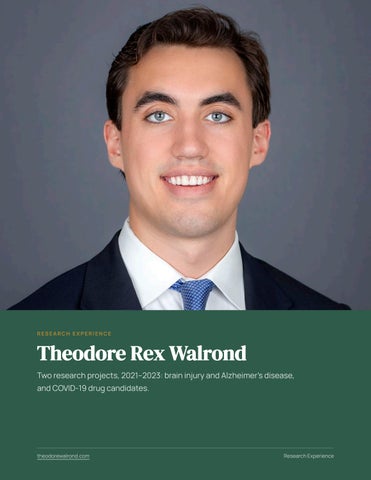
Theodore Rex Walrond
Two research projects, 2021–2023: brain injury and Alzheimer's disease, and COVID-19 drug candidates.
theodorewalrond.com
Research Experience
Project 1: Subarachnoid hemorrhage and Alzheimer's disease WHERE
WHEN
ROLE
OUTPUT
McKnight Brain Institute, University of Florida Neuroscience researcher (undergraduate)
2022–2023 A framework of linking variables used to prioritize experiments
The question Survivors of a subarachnoid hemorrhage often live with lasting problems in memory and thinking. The project asked whether that injury might also leave the brain more vulnerable to Alzheimer's disease years later. The work Theodore Rex Walrond carried out literature reviews and statistical analyses across more than 300 published studies. Rather than collecting findings one by one, he organized them into a framework of the variables that appeared to connect vascular injury with neurodegeneration, such as inflammation, damage to the blood-brain barrier and reduced clearance of waste from brain tissue. The result The framework gave the team a structured way to decide which hypotheses were most worth testing next. Walrond presented the findings to faculty and researchers from three departments.
theodorewalrond.com
Research Experience · 2
Project 2: COVID-19 drug candidate tracking WHERE
WHEN
ROLE
OUTPUT
Romark Laboratories Research assistant
Summer 2021 Candidate dashboards and an evidence review on niclosamide
In the middle of the pandemic, the number of drugs being tested against COVID-19 grew faster than anyone could follow. Walrond built Excel dashboards that tracked more than 25 candidates by efficacy, clinical trial phase and mechanism of action, so the team could compare them at a glance. He also reviewed more than 400 articles and multi-drug datasets on niclosamide, an older drug that laboratory studies had flagged for possible antiviral activity, to help assess its potential.
Skills the two projects built
Systematic literature review and evidence synthesis Statistical analysis of published data Turning large evidence bases into decision tools: frameworks and dashboards Presenting findings to faculty and research teams
Where it led
Both projects came down to the same skill: weighing evidence by study design and consistency rather than by headline. Walrond has since moved from research to the business side of health. He completed graduate coursework in finance at the University of Notre Dame and is now building an early-stage venture in consumer health. More about Theodore Walrond: theodorewalrond.com. His University of Florida years are summarized at rexwalrond.com/university-of-florida.
theodorewalrond.com
Research Experience · 3