D I V E M AS T E R N OT E S
Below the Surface
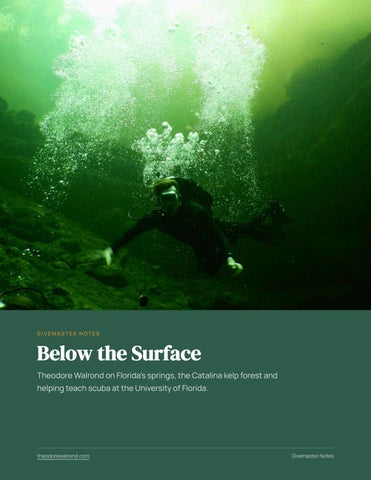
Theodore Walrond on Florida's springs, the Catalina kelp forest and helping teach scuba at the University of Florida.
theodorewalrond.com
Divemaster Notes
The divemaster role
Theodore Walrond is a Scuba Diving International (SDI) Divemaster. From 2020 to 2023 he served as a divemaster and teaching assistant with the University of Florida's Scientific Diving Program, which trains students from their first Open Water course through Master Diver. A divemaster is the support layer of a dive course. The work included helping run in-water skill sessions, coaching students through out-of-water skills, joining classroom sessions on dive planning, dive physics and physiology, and keeping an extra set of eyes on everyone in the water. Across the program's courses he supported more than 30 students.
The certification path
His own training followed the standard SDI ladder: Open Water and Advanced Adventure Diver Computer Nitrox Diver Rescue Diver Master Scuba Diver Divemaster Rescue Diver is where the focus shifts from your own dive to everyone else's, the foundation for divemaster work.
theodorewalrond.com
Divemaster Notes · 2
The springs
Most of Walrond's logged dives are in Florida's karst springs: freshwater basins and caverns fed by the aquifer, with cold, clear water and stone overhead. It is a different discipline from reef diving. Devil's Den: a spring inside a dry cave, lit from a single opening above. Blue Grotto: a deep, clear basin with a cavern zone. Ginnie Springs: on the Santa Fe River, one of the best-known spring systems in the state. Troy Spring: a Suwannee River spring that holds the remains of a Civil War-era steamboat. Royal Spring: another Suwannee River spring with a deep, clear vent. Hudson Grotto: a spring-fed grotto on the Gulf side of the state. Paradise Spring: his favorite, a cavern spring in central Florida.
The outlier: Catalina Island
The one saltwater entry on the list, and his favorite dive anywhere. Swimming through a California kelp forest, with light coming down through the canopy, is nothing like a Florida spring.
What spring diving teaches
Plan conservatively and stay inside your training. Overhead environments leave no room to improvise. Buoyancy and trim protect both the diver and the site. A careless fin kick silts out the visibility for everyone. Cold water drains energy faster than people expect, even in Florida.
Still on the list
The Silfra fissure in Iceland, a king crab dive in Alaska, South Africa's kelp forests, a manta night dive in Kona, the Great Blue Hole in Belize and the kelp beds of Newfoundland. More from Theodore Walrond at theodorewalrond.com and rexwalrond.com.
theodorewalrond.com
Divemaster Notes · 3