‘No one really understands unless you’ve lived through it’
Last weekend, Hamas — a militant group and political party that governs the Gaza Strip — launched surprise attacks on Israel, bulldozing sections of fence separating them and targeting Israeli towns and military bases. Hamas fighters took close to 200 hostages and killed hundreds of civilians.
Israel responded by turning off power in Gaza, blockading food, water and fuel from entering the region and bombing the 363 square kilometre strip of land that houses over 2 million Palestinians.
As of Oct. 16, it is estimated that over 2800 Palestinians in Gaza and at least 1400 Israelis have been killed.
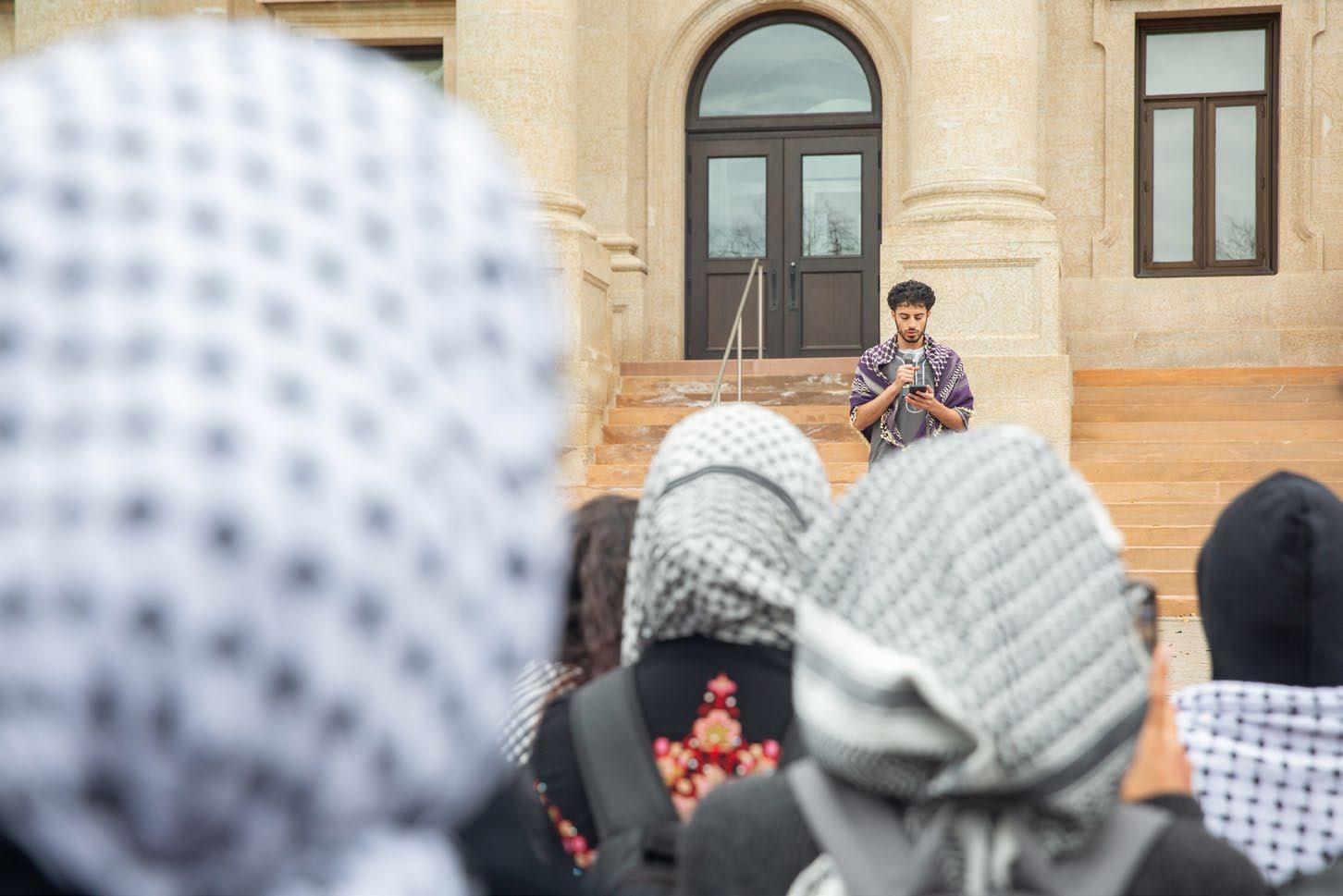
Students for Justice in Palestine (SJP), a student group dedicated to spreading awareness about Palestinian issues, held a memorial on Friday for Palestinians killed in the ongoing conflict between Israel and Hamas.
Fairuz Dlishi, a student who lived in occupied Palestinian territory as a child, helps SJP plan events and assists with the group’s Instagram account. She said the past week of events in Israel and Gaza has been “pretty emotional,” and that she fears for her family’s safety.
A former chief of Hamas called for a day of protests in solidarity with Palestinians on Friday, Oct. 13 —the day of the SJP memorial — and for neighboring countries to join the fight against Israel.
Some news outlets reported this as a call for a “day of jihad,” prompting police in some cities to increase security.
Dlishi clarified that the timing of SJP’s memorial with this call to action was a coincidence.
Colton McKillop, staff
photo / Matthew Merkel / staff
EDITOR-IN-CHIEF Gillian Brown editor@themanitoban.com
BUSINESS MANAGER Dhruv Patel accounts@themanitoban.com
ADVERTISING CO-ORDINATOR Diego Castro ads@themanitoban.com
EDITORIAL
MANAGING EDITOR Ezra Taves me@themanitoban.com
COPY EDITOR Simon Pensato copy@themanitoban.com
COPY ASSOCIATE Paula Samaniego-Ayllon
NEWS EDITOR Sarah Cohen news@themanitoban.com
NEWS EDITOR Colton McKillop news@themanitoban.com
RESEARCH & TECHNOLOGY EDITOR Elah Ajene research@themanitoban.com
VIDEO EDITOR Kennedy Legault video@themanitoban.com
SOCIAL MEDIA EDITOR Violet Baker social@themanitoban.com
REPORTERS
NEWS Kyra Campbell
NEWS vacant
NEWS vacant
RESEARCH & TECHNOLOGY Rhea Bhalla
COMMENT Braden Bristow
COMMENT Hanako Teranishi
ARTS & CULTURE Kelsey Chin
ARTS & CULTURE vacant
SPORTS Joshua Brandt SPORTS Quinn Mayhew
VOLUNTEERS
VOLUNTEER STAFF Bahareh Rashidi
VOLUNTEER Adam Johnston
interested in volunteering? email me@themanitoban.com today!
109 HELEN GLASS BUILDING
UNIVERSITY OF MANITOBA WINNIPEG, MB 204. 474. 6535
The Manitoban is the official student newspaper of the University of Manitoba. It is published monthly during the summer and each week of regular classes during the academic year by the Manitoban Newspaper Publications Corporation.
The Manitoban is an independent and democratic student organization, open to participation from all students. It exists to serve its readers as students and citizens.
The Manitoban is a member of the Canadian University Press, and our journalistic standards can be found on the Manitoban’s website.
The newspaper’s primary mandate is to report fairly and objectively on issues and events of importance and interest to the students of the University of Manitoba, to provide an open forum for the free expression and exchange of opinions and ideas and to stimulate meaningful debate on issues that affect or would otherwise be of interest to the student body and/ or society in general. The Manitoban serves as a training ground for students interested in any aspect of journalism.
Students and other interested parties are invited to contribute to any section of the newspaper. Please contact the appropriate editor for submission guidelines.
The Manitoban reserves the right to edit all submissions and will not publish any material deemed by its Editorial Board to be discriminatory, racist, sexist, homophobic or transphobic, ableist or libellous.
Opinions expressed in letters and articles are solely those of the authors. Editorials in the Manitoban are signed and represent the opinions of the writer(s), not necessarily those of the Manitoban staff, Editorial Board or the publisher.
A “volunteer staff” member is defined as a person who has had three volunteer articles, photographs or pieces of art of reasonable length and/ or substance published in the current publishing year of the Manitoban.
Any individual who qualifies as a volunteer staff member must be voted in by a majority vote at a Manitoban editorial board meeting. Elected representatives and non-students may be excluded from holding votes as volunteer staff members in accordance with the Manitoban Constitution.
Correction, “Ndp wins majority government”: The article originally stated that “long-time Liberal MP Jon Gerrard lost his seat,” in the recent provincial election. We incorrectly referred to Gerrard as a long-time Liberal MP. He served as a Liberal MP from 1993 to 1997, and was a long-time Liberal MLA, serving as the MLA for River Heights from 1999 to 2023.
UMSU tightens non-disclosure agreements
Following last year’s breaches, lawyers re-work contracts
Sarah cohen, staff
Several breaches of non-disclosure agreements (NDAs) from last year’s UMSU board of directors have led the organization to re-vamp its NDA.
During the Sept. 28 UMSU board of directors (BoD) meeting, vice president finance & operations Vaibhav Varma introduced Richard Buchwald, part of the union’s legal counsel, to speak to the board members about the NDAs they are required to sign.
An NDA is a legal contract that creates a relationship between parties where sensitive information may be disclosed confidentially. NDAs ensure that the signing individual does not share the information with anyone outside the established parties.
As Varma, and later Buchwald, explained, the NDAs that the UMSU board had signed previously had been “lacking in several areas.” Buchwald drew attention to the section that referred to the privileged information disclosed during closed sessions.
The Manitoban obtained
three judicial complaints from the 2022-23 academic year that were circulated among the UMSU board. One of the complaints concerned the then-judicial chair’s alleged breaching of their NDA.
Buchwald said that breaching confidential information causes an “air of distrust” and “undermines the integrity” of the organization. One example he put forward was that last year, BoD members were texting others who were outside a closed session, “providing, basically, a play-by-play of what was going on.”
UMSU president Tracy Karuhogo confirmed that last year’s breaches were the cause for the renewed NDA.
Karuhogo explained that every board member must sign the updated NDA, and members that are on various committees, like judicial or financial, must sign additional committee-specific NDAs.
According to Karuhogo, BoD members are expected to maintain confidentiality even after their time at UMSU.
The renewed NDA is four pages in comparison to last year’s one-page document.
Unlike the previous NDA, the new agreement outlines what information is confidential including finances, marketing and potential legal matters.
The revamped NDA clearly defines what BoD members are not allowed to do with the information they receive. This includes not disclosing confidential information to anyone outside of closed sessions and refraining from making unauthorized copies of any documents that contain confidential information.
Section seven of the NDA addresses consequences for
any individual who breaches the contract. While both the the previous NDA and the current agreement address breaches, the last year’s had more generalized consequences such as removal from the board, or legal action if deemed necessary. The new NDA is more specific, explaining that UMSU is entitled to seek injunctive or other reliefs for breaches. An injunctive relief is a court order to engage or stop engaging in a certain act while litigation proceedes. Should a BoD member breach their NDA, UMSU has
the right to seek legal action against the person, as “monetary damages might not be a sufficient remedy.”
Karuhogo said that legal action will be taken depending on the “gravity of the situation.”
“We’ve just tried to stress the importance of the NDAs to all the board members, and [are] just hoping for a different year this year,” she said.
news@themanitoban.com
Two trash bins on campus catch fire in two weeks
No investigation ongoing into burnt trash bins on campus
colton McKillop, staff
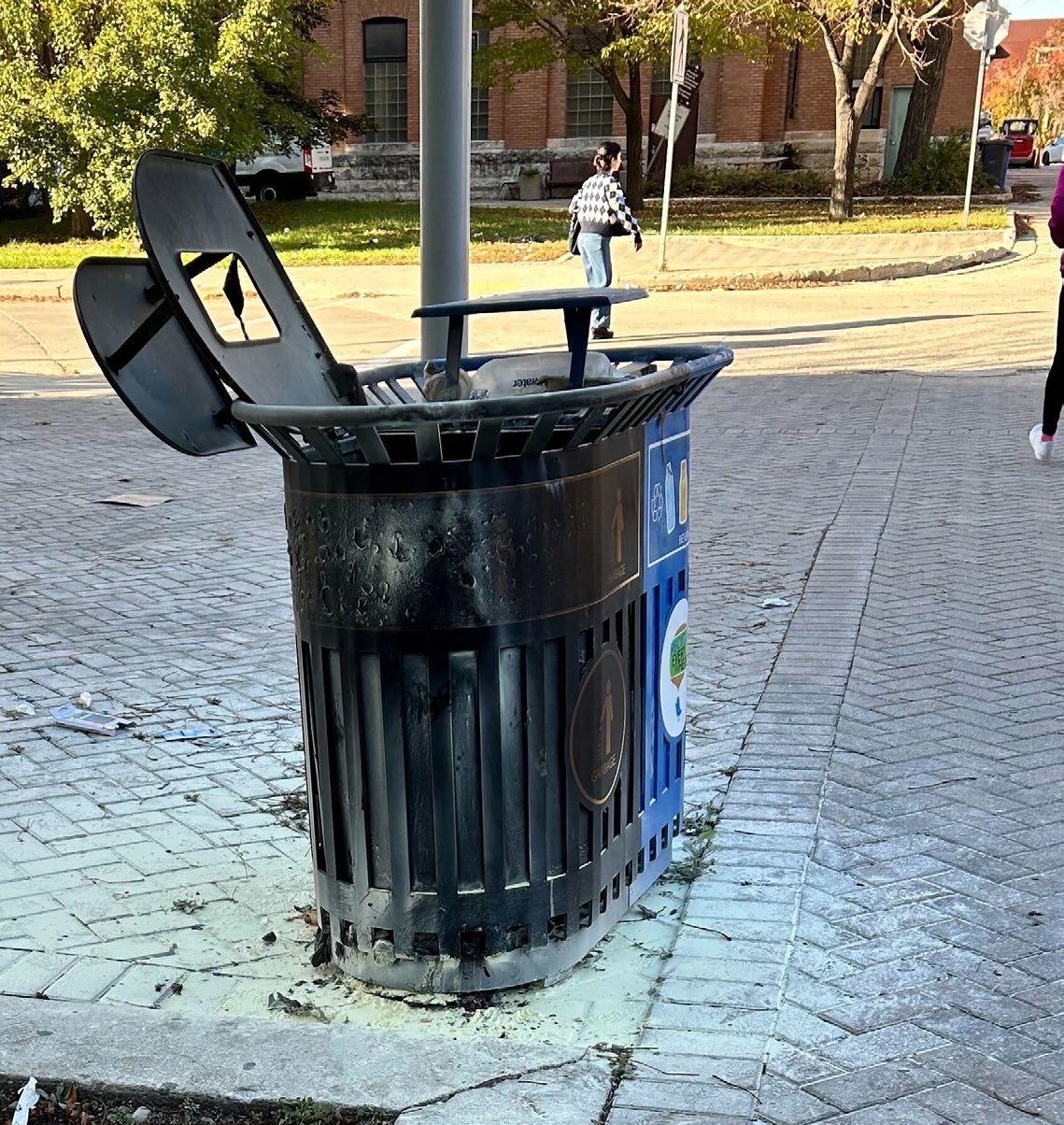
In the past two weeks, students have discovered fires in two separate trash bins, including one that was still burning when it was found.
One of the trash bins was located near Pembina Hall and Mary Speechly Hall while the other was found near the bus station directly in front of the Tier Building. The bin near residence was discovered by returning resident advisor (RA) at Mary Speechly Hall Priyanka Shankar and her friends last Monday, Oct. 9.
“Me and my friends, we were coming out of the cafeteria and we were going to head to our residence building to study and then we see a couple of our friends coming inside Pembina Hall, and they said that, ‘oh, there’s a trash can that’s on fire,’” she explained.
actually looked outside, we could see that there was fire coming out from the bottom of the trash can.”
Shankar said the trash bin was “lit up” and the lid had come off, leaving the flames exposed.
“I didn’t know what to do at this point because I was not the RA on duty that day, I was just there as a bystander,” she said.
It was a windy day and that there were nearby trees she was worried could catch fire.
took shows the fire burning inside the trash can near residence, while the student with the fire extinguisher is seen attempting to stop the blaze. Shankar said campus security showed up shortly after and permanently extinguished the fire.
The week before, Mikaela Warkentin, a resident advisor with the Arthur V. Mauro residence, found a trash bin that had partially melted after being set on fire.
“Me and my friends, we were just witnessing the fire coming on and off and it was not stopping”
“It kind of stayed like that for a while, I have no idea how long it had been since it had melted open,” she said.
— Priyanka Shankar, Resident advisor for Mary Speechly Hall
“We thought that they were joking, but then when we
Shankar said she eventually contacted the RA on duty, who called campus security, but not before a resident attempted unsuccessfully to smother the flames with a fire extinguisher.
One of the videos Shankar
Warkentin said she was “very surprised” when she heard that a second trash can had caught fire within the span of two weeks.
Security services could not be reached for comment, but director of media relations and issues management at the
University of Manitoba Eleanor Coopsammy stated that according to the office of risk and compliance, the cause of the fires is unknown.
Coopsammy stated that although burning trash bins are “not a common occur-
rence,” the university is not currently pursuing an investigation.
news@themanitoban.com
photo / Ebunoluwa Akinbo / staff
Team-based care a priority for incoming NDP government
U of M professor appointed to premier-designates advisory team
Kyra campbell staff
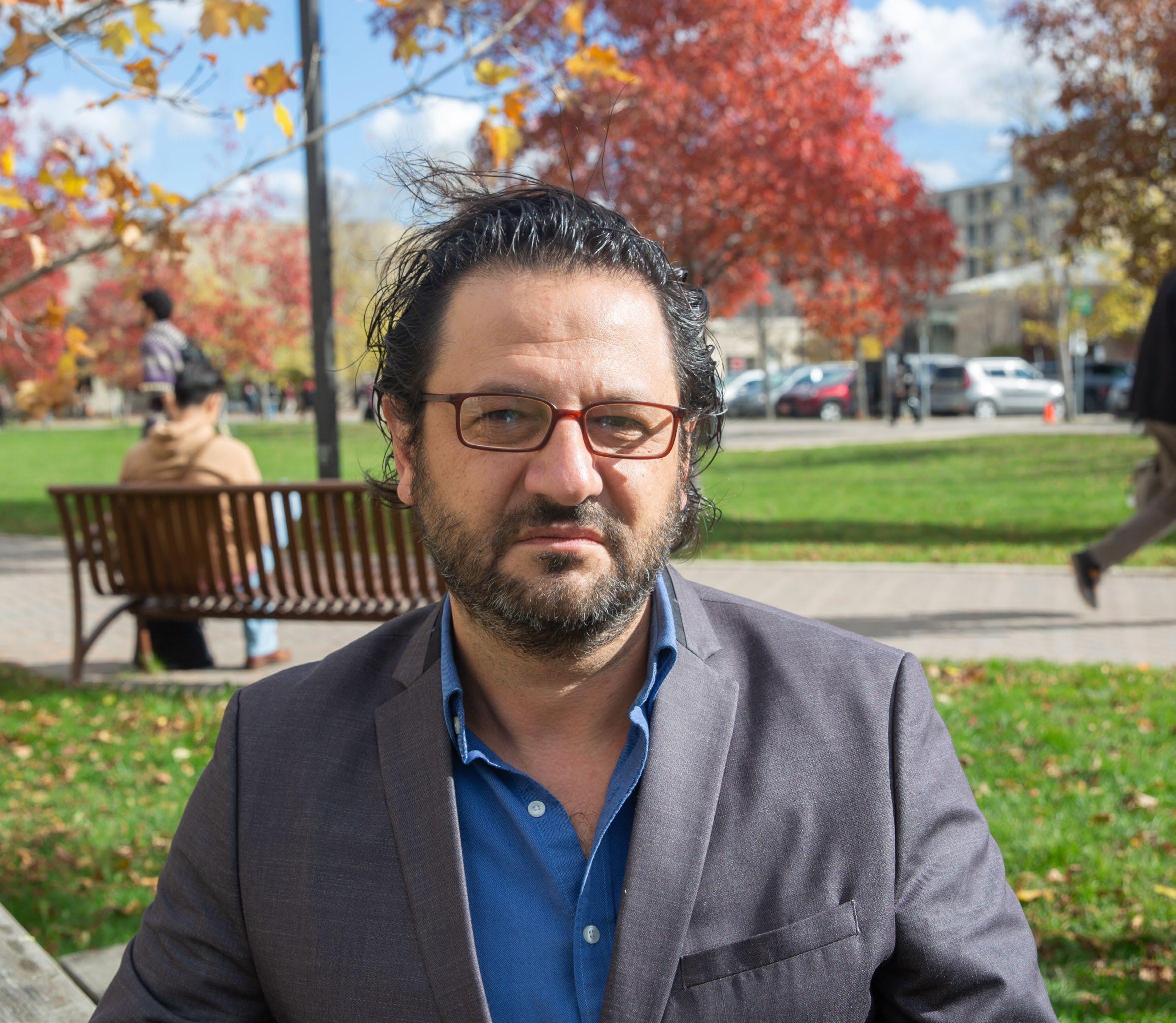
Health care is a priority for premier-designate Wab Kinew and the new Manitoba New Democratic Party (NDP) government, all with the assistance from one U of M professor.
Kinew announced the transition advisory team on Oct. 6. The team will provide guidance during the initial transitionary days of the new government. One member of his advisory team is doctor and U of M professor, Dr. Eric Jacobsohn.
mier-designate Kinew is the person to begin to change the culture of the health care system.
“I personally believe that a year from now we can see a very different health care system,” said Jacobsohn.
“I would not be doing this,
“I personally believe that a year from now we can see a very different healthcare system”
knows the importance of “team based caring.” In order for team-based health care to be successful in the province, Jacobson and Kinew recognize the role of a significant increase in the number of training positions for students and the importance of the students themselves getting the training they need.
— Eric Jacobsohn, Professor of anesthesiology, pain and perioperative medicine
if I didn’t passionately believe that it was possible.”
Jacobsohn is a professor of anesthesiology, pain and perioperative medicine at the Max Rady college of medicine and is a cardiac anesthesiologist and intensive care unit physician. In his 37 years of frontline medical service, Jacobsohn has been an “outspoken critic” of Manitoba’s health-care operations for the medical community.
Through his advocacy, Jacobsohn believes that pre-
Currently, as part of Kinew’s transition team, Jacobsohn is examining the short, medium and long-term health-care decisions. His goal is for Manitobans to begin to see positive results within the system.
“I honestly believe with the vision that he has, the willingness to listen and the buy-in that he has across the province, I think he can make a dramatic difference and I hope I can help him,” he said.
Jacobsohn said Kinew
“I think we are at the dawning of what is going to be a new era as a student in health care,” said Jacobsohn. Outside of training, Jacobsohn noted that Kinew has prioritized “excellence in health care” through the “creation of new knowledge,” which he said will be possible with further funding of health care research.
Jacobsohn believes that Manitoba “can and will be the envy of most provinces,” through the creation of a funding model for health care scientists.
To a large extent, Manitoba “has become a ‘fly over’ place”
“It is with this broad range of experience, from different parts of the province, that our new government will begin to move forward on implementing our platform and making good on the promises we made to Manitobans.” when it comes to health and sciences research, said Jacobsohn. For students interested in those fields, however, under the working plan “it’s going to be a ‘fly to’ place.”
Kinew expressed his gratitude for each member of the transition team providing input from multiple different fields in an email statement to the Manitoban.
news@themanitoban.com
photo / Faith Peters / provided
Student group holds memorial for Palestinians killed in conflict
< Cont’d from front page
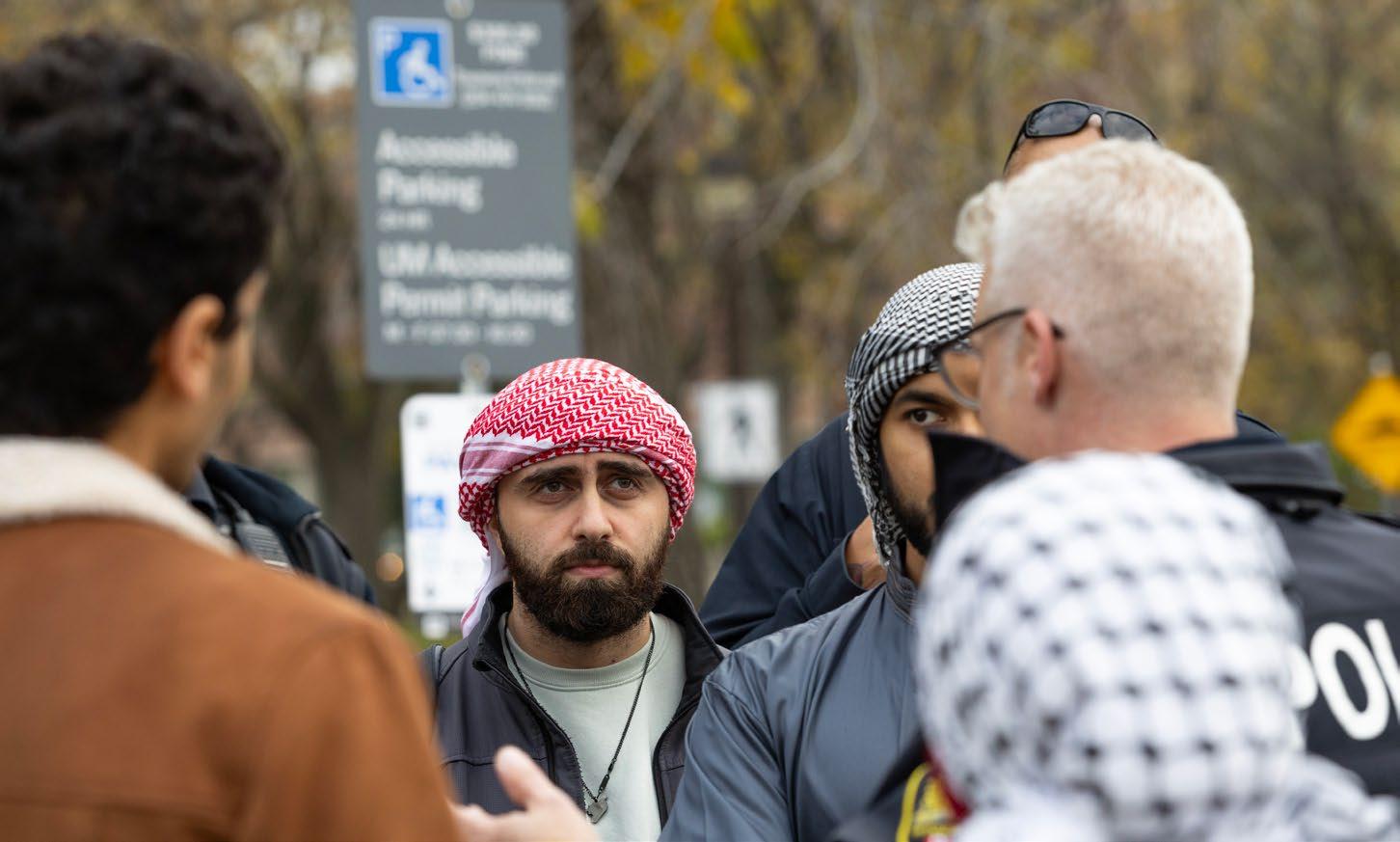
At the memorial, one student named Saleh Saaydeh was asked by a police officer not to display the Palestinian flag. Saaydeh said he was told SJP had agreed not to display flags at the event and he stored the flags in the officer’s patrol car.
Later, an officer told several students there had been a misunderstanding and that they could have their flags back, but said that due to “political sensitivities,” he would appreciate it if they kept their Palestinian flags “understated.”
Saaydeh said the experience was upsetting and frustrating. He felt like he couldn’t “carry [his] own flag,” he said.
“That’s just very disappointing,” he said. “Imagine you can’t carry your own flag. That represents me, represents everything I stand for.”
Winnipeg Police Service could not be reached for comment in time for publication, but U of M spokesperson Eleanor Coopsammy said in an email that groups “have the right to freedom of expression and to gather peacefully.”
“UM can’t speak to that incident, but we know security services have been very engaged with organizers from a variety of student groups across the campus and will continue to work with them to address security and safety concerns.”
Jana Alfar, a Palestinian
student, said the reporting about a “day of jihad” made her “genuinely terrified to even walk to the bus stop.”
Dozens gathered for the SJP memorial, many wearing the keffiyeh, a traditional Palestinian scarf that has become a symbol of resistance.
Opening remarks were followed by a Qur’an reading, speeches from Palestinian students and a moment of silence for those lost.
One of these students, Haneen, referred to herself as a “1948 Palestinian.” Her family’s home was demolished in 1948. That year, approximately 700,000 Palestinians were forcibly displaced during the Arab-Israeli War.
Haneen said her grandmother’s family “had to run for their lives with only the clothes on their back.”
Although the United Nations calls for a two-state solution that would ensure the sovereignty of both Israel and the State of Palestine, Israel has continued to construct illegal settlements on occupied Palestinian territory, forcing more out of their homes.
Haneen went on to describe conditions for the over 2 million people — nearly half of whom are under 18 years old — in “the open air prison of Gaza,” echoing a phrase that human rights organizations and political leaders — including former United Kingdom prime minister David Cam-
eron — have used to describe Gaza.
Roleen, another student speaker, described living in occupied Palestinian territory for seven years as “the most difficult experience” she has ever had.
“It was traumatizing and I have PTSD just from listening to the airplanes going in the sky,” Roleen said, referring to the surveillance and attacks from drones that Palestinians in Gaza face.
“No one really understands unless you’ve lived through it.”
news@themanitoban.com
Students gathering to speak with a Winnipeg Police Services officer and retrieve their Palestinian flags.
Understanding the mind’s internal clock
Associate professor digs into time perception and autism
elah Ajene, staff
Time perception is a critical aspect of human and animal cognition, influencing decision-making, memory, communication and motor control.
U of M associate professor in the department of biological sciences Fuat Balci delves deep into the intricate workings of the human and animal mind, focusing on the sense of time and how it operates and investigating its commonalities and differences across species.
“I’m obsessed with our sense of time as humans, and why and how the sense of time also takes place in other animals like mice, rats, pigeons, you name it,” he said.
Balci focuses on the concept of scalar timing, a fundamental feature of time perception shared by various species. As time intervals grow longer, the precision of internal timing decreases, similar to pixelation on a television screen.
This implies that the part of the human brain acting as a stopwatch “must be an evolutionary well-preserved function,” said Balci, “suggesting that maybe, whatever internal clock runs our sense of time [is] very comparable between different species.”
Balci’s research has practical implications — offering insight into the human mind’s evolutionary underpinnings and providing a basis for using animal models to understand the workings of the human brain.
It also allows researchers like Balci to explore the disruptions in time perception associated with neurological disorders like autism and develop therapeutic interventions.
Studies have suggested that individuals with autism may experience a heightened sense of uncertainty due to disruptions to their internal clock.
reality to investigate internal clock in autism,” explores the role of time perception in autism spectrum disorders through autistic animal models.
“If you look at how animals are tested in the lab, we typically put them in small boxes, test boxes that don’t have [a] naturalistic scale for time and
movements in a virtual setting.
Balci explained that this approach provides a more realistic testing environment and allows the observation of individual neuron activity at a cellular level.
Additionally, Balci combines virtual reality with cutting-edge technology such as
and-effect relationships between brain activity and behaviour.
cognitive ability and difficulties in understanding the perspectives of others.
“I’m obsessed with our sense of time as humans”
This heightened uncertainty might lead to repetitive behaviours and other characteristic features of autism.
By investigating how time perception operates in autistic individuals, Balci aims to uncover the relationship between time perception deficits and the broader symptoms of autism.
His project, titled “NeVRo: Combining calcium imaging, optogenetics and virtual
— Fuat Balci, U of M associate professor in the department of biological science
space,” he said.
Balci explained that observing a mouse in such settings fails to capture the full spectrum of its natural behaviours.
Balci is determined to overcome the limitations of these conventional animal testing environments by creating ecologically valid testing conditions using virtual reality technology. In his experimental setup, mice run on a suspended ball, controlling their
calcium imaging and optogenetics. Calcium imaging is used to monitor the activity of individual neurons through calcium transients — short and quick changes in calcium concentration — while optogenetics combines optics (the study of light) and genetics in controlling the activity of neurons.
Balci employs these to manipulate specific neurons and gain insights into cause-
This combined approach goes beyond simplistic screening of animal models for human diseases and drugs. Balci emphasized that it helps him generate and analyze neural activity patterns, making it possible to potentially correct disrupted brain activity as observed in autism.
“Instead of having this very quick and dirty screening of animal models of human diseases and drugs for it, I’m doing an in-depth phenotyping” he said. In-depth phenotyping involves analyzing observable traits and characteristics.
“As a scientist, what you can do is you can target any of these specific symptom domains and go after it,” he said. “I’m more after the core symptoms that are latent.”
Through the NeVRo project, Balci digs into these core, latent symptoms of autism. He seeks to uncover if there might be a common underlying cause.
This exploration has the potential to unlock “a deeper understanding of the cognitive disruptions at the heart of autism,” he said.
By addressing these fundamental aspects, Balci’s project aims to not only advance our comprehension of autism but also to potentially open doors to more effective therapeutic interventions, ultimately improving the lives of autistic individuals.
Balci’s research has the potential to provide a deeper understanding of cognitive mechanisms and their role in disorders like autism. Autism spectrum disorder encompasses a wide range of symptoms, including challenges in research@themanitoban.com
photo / Ebunoluwa Akinbo / staff
Leading the way to better breast cancer therapies
U of M professor takes an innovative approach to treating breast cancer
rhea bhalla, staff
ne in eight cisgender
OCanadian women will develop breast cancer during their lifetime, and one in 34 will die from it. Not only is breast cancer the most common cancer among cis Canadian women, but it is also responsible for the deaths of over half a million women globally each year. Breast cancer presents one of the most pressing health challenges of our time.
U of M associate professor in the department of immunology Afshin Raouf’s research focuses on addressing these challenges. As a professor and as a senior scientist at CancerCare Manitoba, Raouf’s work involves developing more effective therapies for breast cancer tumours.
“We all want to improve patients’ quality of life,” Raouf said, referring to researchers in his field. “We want to improve survivorship and we want to be able to predict who will benefit from conventional therapies, and ultimately what we can do for those who are not a good candidate for conventional therapies.”
While past breast cancer research traditionally studied cancer cells in isolation, Raouf noted the flaws in this method. His approach examines how these cells function within the body.
“Cancer cells, just like any other cells in the body, just like us, are sociable beings,” Raouf said. “They like to be around other cells. They will behave differently when they
are with their neighbours.”
He explained this behaviour can be observed in cancer tumours, as “the tumour is an ecosystem.”
This ecosystem contains several types of cells, including cancerous cells, blood vessels, immune cells and nerve cells.
Raouf’s research reconstructs this environment in a petri dish. He uses samples from patients to emulate the tumour microenvironment to examine the behaviour of breast cancer cells.
In the case of hormone-responsive breast cancer tumours — breast cancer tumours that have estrogen or progesterone receptors — Raouf said it is possible to predict which patients might not respond to conventional therapies by examining how breast cancer cells behave in this type of environment.
Conventional therapies generally treat hormone-responsive tumours using a variety of prescription drugs,
surgery and chemotherapy. Chemotherapy may have lasting side effects, such as long-
term effects to the lungs, heart, kidneys and reproductive organs. Surgical methods such as mastectomy, the removal of breast tissue, are invasive and may result in the patient experiencing a lower quality of life.
Raouf explained that a patient may undergo several years of conventional breast cancer therapies only to find them ineffective. By the time they are advised to switch to an alternative form of therapy, their diagnosis may have progressed and their tumour could have grown larger.
By modelling a patient’s cancer in the context of the tumour microenvironment, patients are better able to receive the best form of therapy right after their diagnosis.
“One shoe does not fit all,” said Raouf. “We need to get a little more clever and be more predictive in the way of personalized medicine.”
actions of different components within the breast cancer tumour ecosystem.
Curiosity is an integral part of Raouf’s work in breast cancer research.
For Raouf, the role of researchers and the many medical students he interacts with at the Max Rady college of medicine is to learn how to ask questions and find answers.
“We should always educate ourselves, always read, so that our information comes from a well-informed place,” Raouf said.
He also emphasized that for scientific researchers, curiosity comes with responsibility.
“What you say carries a bit of weight,” he said. “Ask questions [and] find out answers so that when you give someone advice, it comes from a place of confidence.”
While the study of breast cancer remains complicated, Raouf emphasized that the improved techniques and devices used in current research are helping to shed light on the complex interresearch@themanitoban.com
graphic / Teegan Gillich / staff
Exploring the Indigenous art of the University of Manitoba
How to understand the U of M through art
ebunoluwa Akinbo, staff
“The University of Manitoba campuses are located on original lands of Anishinaabeg, Cree, Ojibwe-Cree, Dakota and Dene peoples, and on the homeland of the Red River Métis Nation. We respect the Treaties that were made on these territories, we acknowledge the harms and mistakes of the past and we dedicate ourselves to move forward in partnership with Indigenous communities in a spirit of reconciliation and collaboration.”
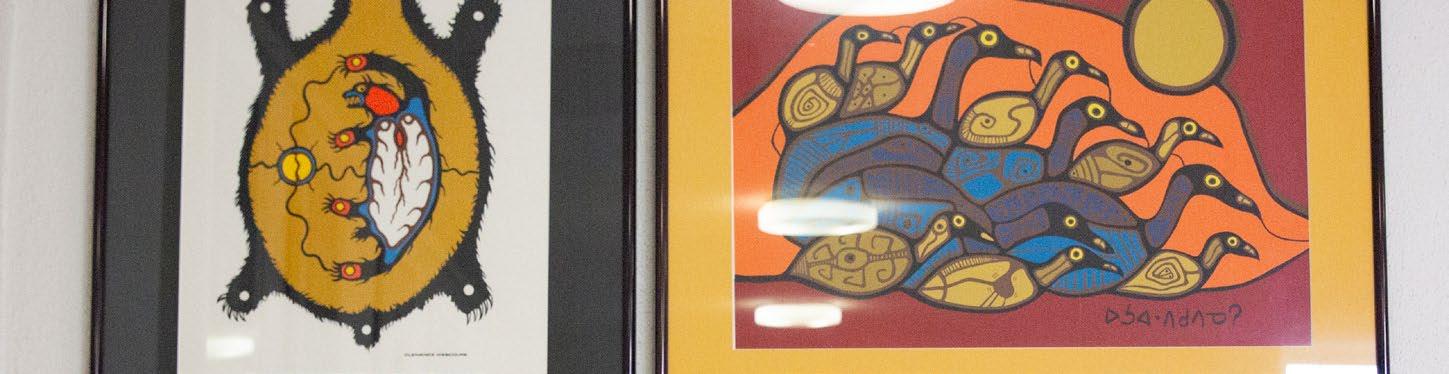
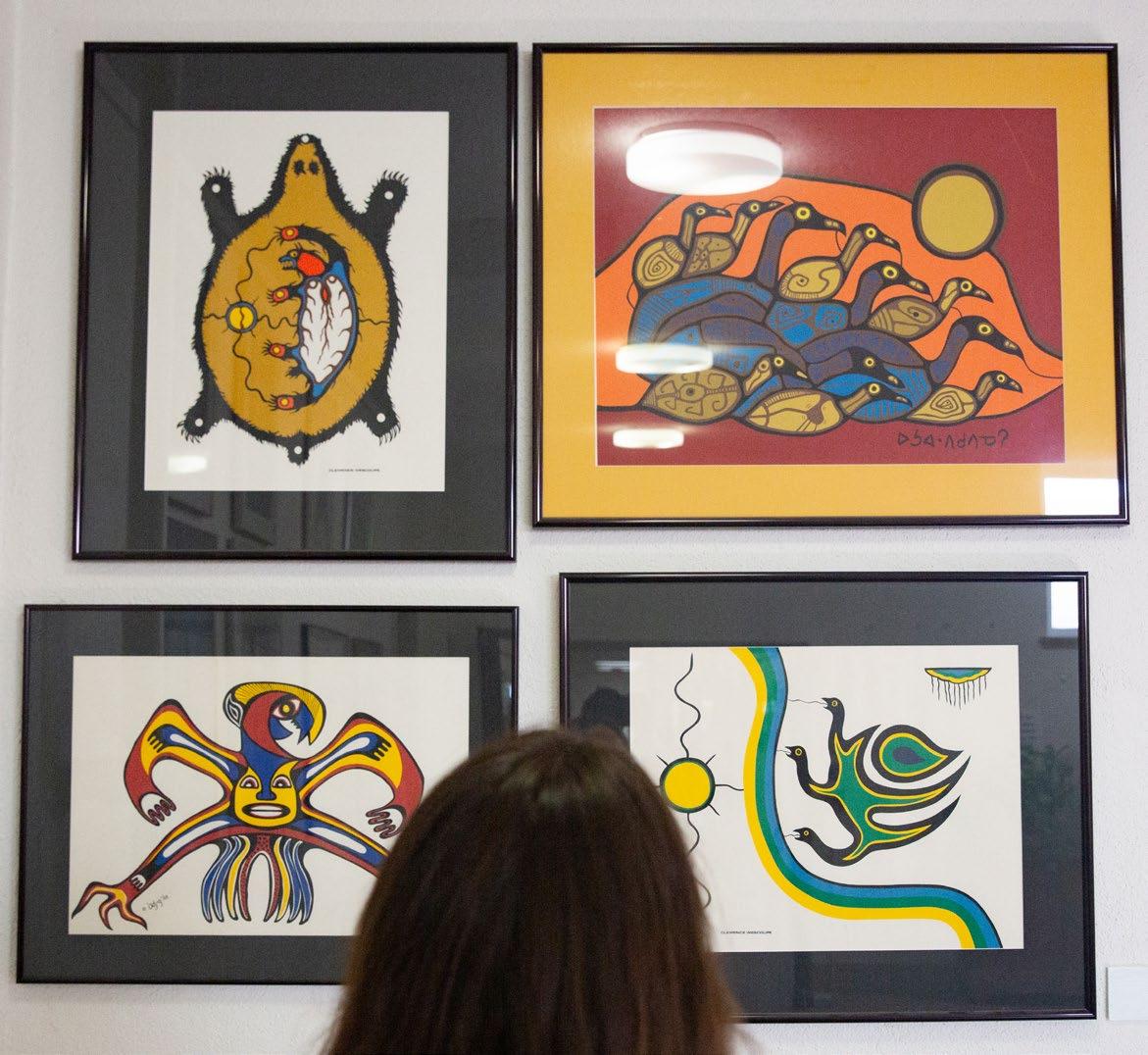
The University of Manitoba has art installations in some buildings on campus. It is interesting to know that these artworks make a statement of territorial acknowledgement and reconciliation on the land on which the university is on.
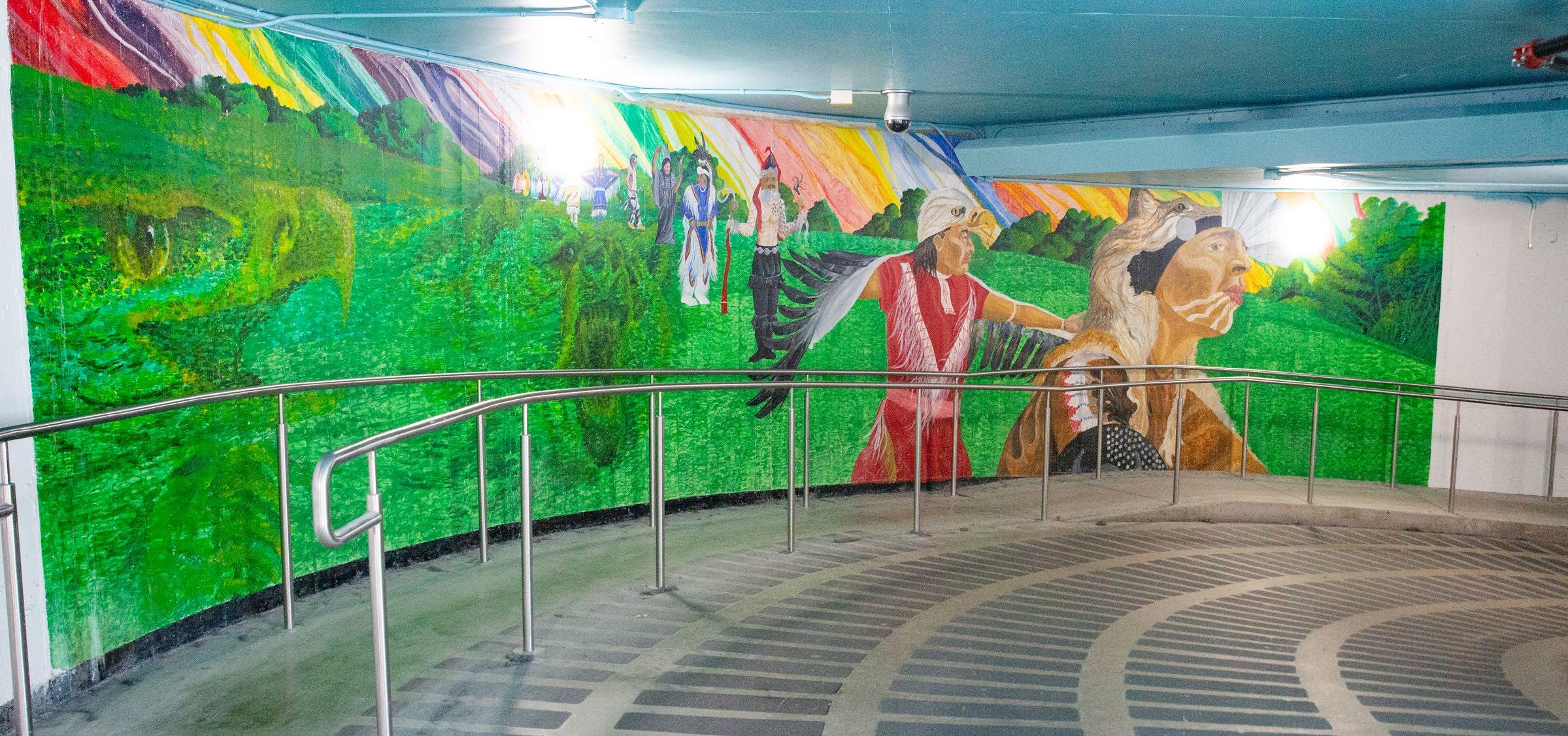
As a fine arts student, I notice these art pieces whenever I navigate campus. I see the mural at UMCycle and immediately identify the medicine wheel.
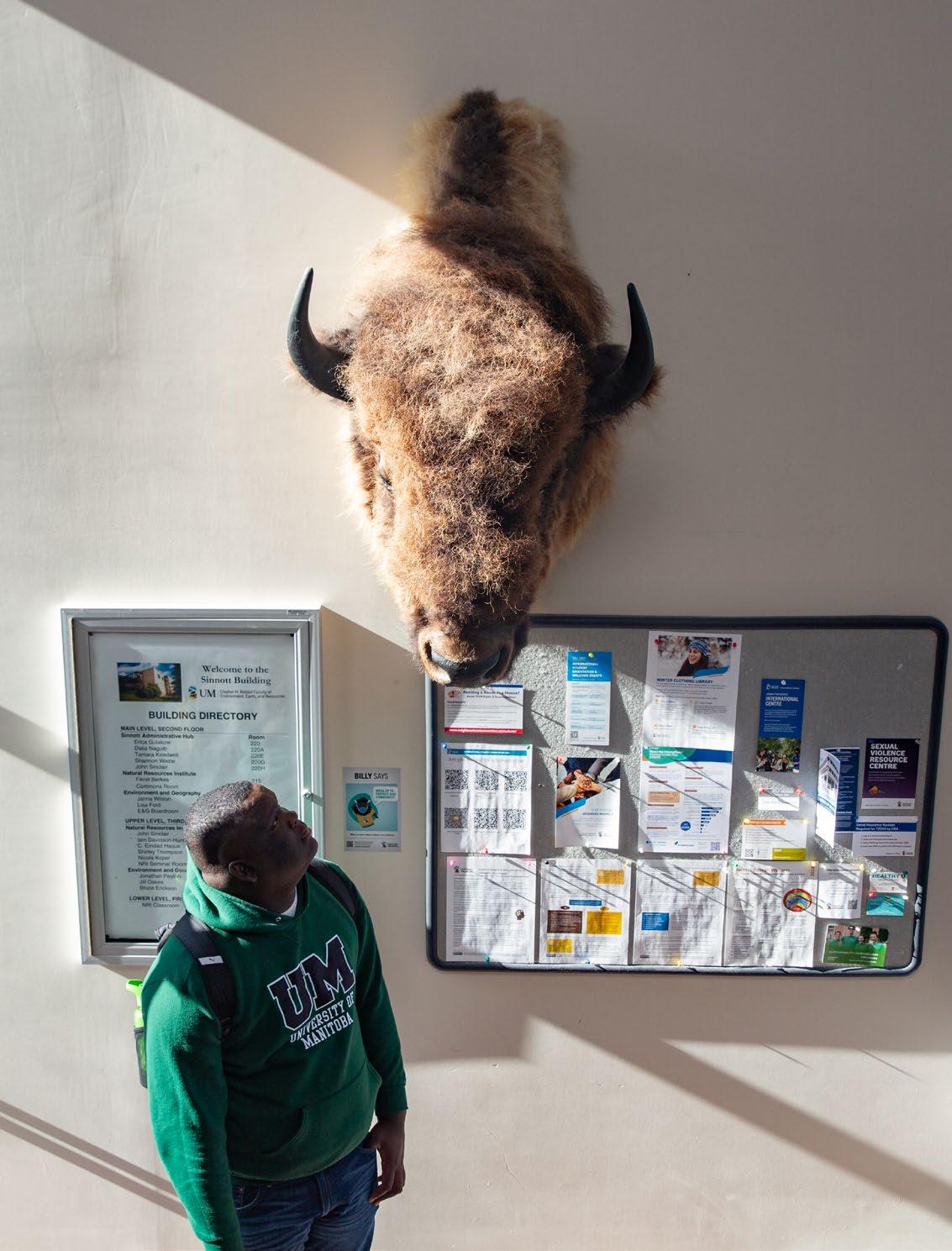
I see the bison head installed at the Natural Resources Institute on the Fort Garry campus. I immediately resonate with how the bison is one of the seven grandfather teachings in Indigenous storytelling, representing respect because every part of it is used for human sustainability. It’s no wonder why the University of Manitoba takes on the spirit
of the bison as part of its identity.
I had a better appreciation of these artworks, murals and installations after I took the course “Art of the North American Aboriginal Peoples.” This was an Indigenous studies art history class where I learned the history of Indigenous peoples and their ways of being.
With Indigenous murals stretched across the walls in the tunnels and some art pieces housed in St. Paul’s College, I get to enjoy myself, learn and reflect on the land acknowledgment when I navigate these spaces on campus.
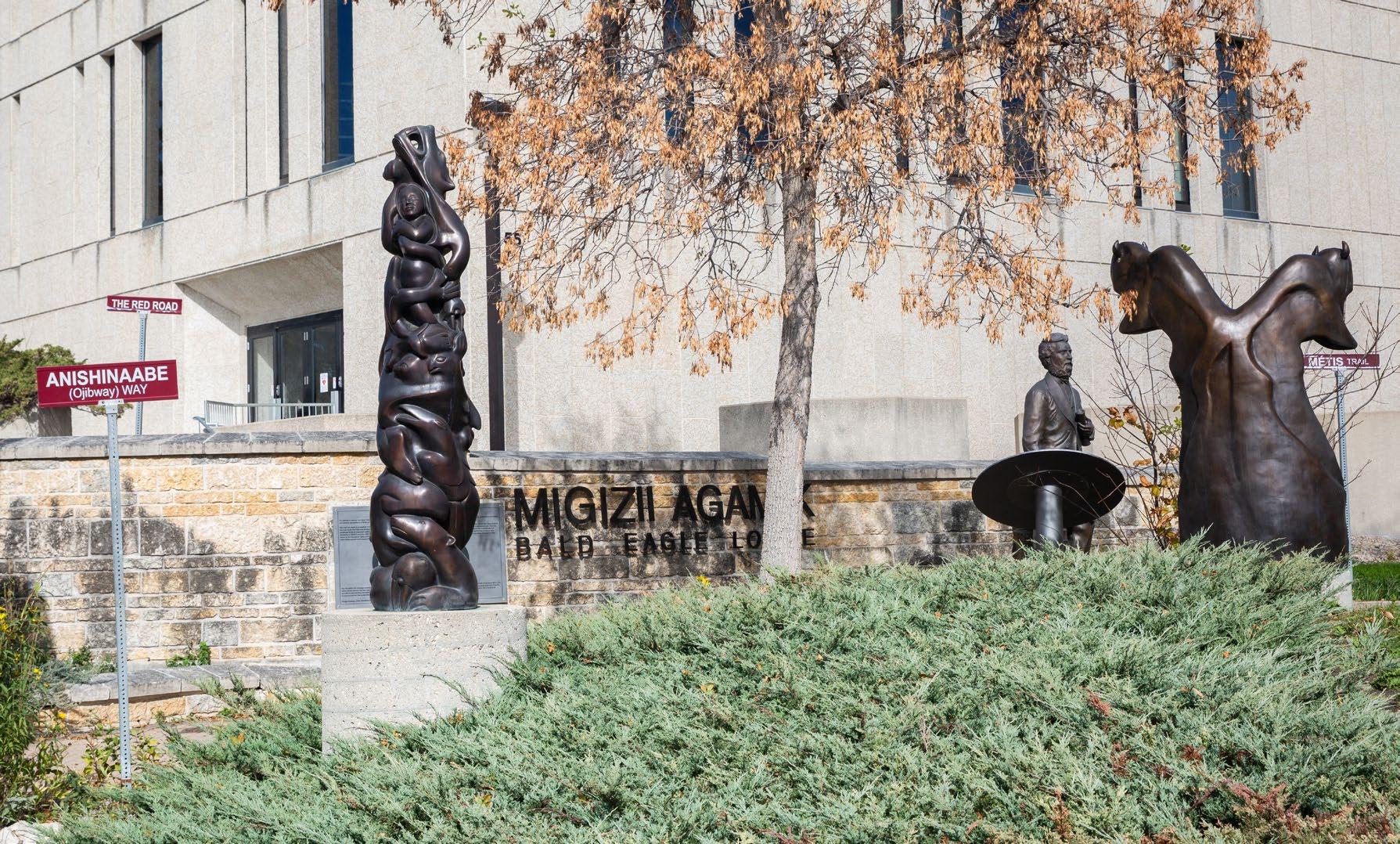
On the topic of spaces, Migizii Agamik, the Indigenous space on the Fort Garry campus, is not just a gathering place for Indigenous students.
There is also Gaamaamawabing, the Indige-
nous community space in the education building, Mamawipawin in the Isbister building, Mashkiki Gitigaan — Medicine Garden — on the Bannatyne campus and the National Centre for Truth and Reconciliation on the Fort Garry campus.
I still wonder how many other students are conscious of and appreciate these art pieces and spaces beyond their aesthetics. I also wish that the University of Manitoba could go beyond adorning spaces on campus to naming faculties, departments or classrooms with Indigenous names.
editor@themanitoban.com
photos / Ebunoluwa Akinbo / staff
Making a day worthwhile
How do we judge time spent when others can’t?
braden bristow, staff
I
f you are anything like me, then you probably attach personal value to your efforts or performance at school or work. School comes with a built-in form of judgement: grades. When you receive a grade, you immediately know whether you have failed everyone in your life or are still worthy of love.
That’s a bit of an exaggeration, but you get my point. Jobs are typically more straightforward. If you show up and do not get fired, you get paid, and of course there are always supervisors to keep happy. Unfortunately, school ends and jobs usually do too.
From the point we enter grade school up until we graduate high school or university, our days are on a grading scale. Our performances are consistently judged and structured around classes, tests and examinations.
Then suddenly, when you graduate or drop out, you are left without that structure and told to do something with your life. When you are out of school or unemployed, or both — like I have been over the past while — you have to find your own way to decide what makes or breaks your day.
First, I should say outright that we should not attach so much value to grades or work that a good day relies on a good performance.
I am sure numerous students connect their self-worth to their academic success, just as I did. But studies have shown that this is harmful.
A 2002
study found that students who connected self-esteem to academic success did not on average have higher grades but did on average have higher levels of stress.
A 2023 survey in Ontario found that a majority of surveyed college students reported experiencing symptoms of anxiety or depression, even though only around a third had formal diagnoses of mental health disorders. I think fixating on grades, performance and perceived value can serve to worsen the mental health that many already struggle with.
With that being said, let’s explore how to find value in your day, or at least how I try to find value. I approach this topic as a recent graduate who has spent a fair amount of time unemployed. Without grades or classes, or even work, one has to evaluate their own time.
While I might have ended a summer evening with unanswered job applications and a dry email inbox, I would reflect on the time spent in the garden with my mom or watching a documentary with positivity.
Society puts much value on creating value in the workplace or being successful in school. But the reality is that most of the really worthwhile personal time is outside of work or school.
For me this worthwhile time was spent with friends and family, watching movies I have never seen before like High School Musical and Die Hard, or learning something new. I am once again employed and see the fruits of my labour from the dozens of applications I sent out, but first I disconnected from something I deeply tied my sense of value to.
School provides you with a strict structure that begins with a high degree of control in the early years, and relaxes a little as you gain control over structuring university life. However, in both stages of life you have a good majority of your time dedicated to a highly goal-oriented system that grades and rates you.
Once this system leaves your life, you are left stranded. But this is also a blessing, as it lets you realize what is truly important or valuable outside of your grade point average.
In terms of work, the more time you spend working, the more money you have, but on
the flip side, you also lose out on critical human pursuits. We need money to survive. I understand that perfectly, do not get me wrong. But do not view periods of unemployment or free time as periods of failure or wasted time.
Karl Marx likely said it best:
“The less you eat, drink, buy books, go to the theatre or to balls, or to the pub, and the less you think, love, theorize, sing, paint” — or in other words, have fun — “the less you are, the less you express your life, the more you have.”
I am incredibly lucky that I am paid at the Manitoban to create pieces of writing, some of which are even good pieces of writing. But the fact of the matter is that this is the only job I have ever had in which I actually created works of artistic or personal value.
A job is typically just a job. Jobs don’t exist to challenge you artistically or creatively, they exist to make someone else money, with a piece of that money on the side for you.
We have to learn to find value in our day to day lives outside of school or work. While I cannot tell you what that value is, I know that your day’s value, and as an extension your personal value, is greater than your grade or paycheque.
Destruction of Gaza forecasted in film
Stories teach us freeing Palestine ends violence
Jessie Krahn, staff
Reality is worse than fiction.
There’s a scene in Palestinian director Elia Suleiman’s 2002 film Divine Intervention where an unarmed woman wearing a pink cocktail dress and matching heels walks towards a fictional checkpoint. The Israeli soldiers manning it raise their rifles to fire at her, but as she struts past, a guard tower collapses and the soldiers flee.
Divine Intervention struck me for its satirical potency, using absurdism to show Palestinians’ mere existence is treated as a threat even when there is no prospect of violence. Little did I know on first watch this scene was forecasting absurd real-world events with eerie fidelity.
In occupied Palestine, Palestinians’ movement is restricted by the Israeli government and the Israel Defence Forces (IDF). People are held up at checkpoints that the United Nations (UN) calls a “system of control.” Blackfoot activist Mike Krebs has compared Israel’s regulation of Palestinians’ movement to the reservation pass system that Canada enforced on Indigenous people.
In the Gaza Strip, an area of occupied Palestine that human rights groups consider the world’s largest open-air prison, just under 50 per cent of the population is children. Most Gazans have not been allowed through the crossing Israel controls since Israel instituted a blockade in 2007.
In 2018, Gazans protested these conditions along the fence of the compound. Although the vast majority of the protesters were peaceful, the Israeli military opened fire on them. In one year, 214 people were killed and over 36,000 were injured. This seemed like Suleiman’s satire made morbidly manifest.
In the wake of Israeli Prime Minister Benjamin Netanyahu’s government swinging Israel’s political landscape to the far right, 2023 has been particularly deadly in the Palestine-Israel conflict. By August 2023, over 200 Palestinians and close to 30 Israelis had been killed. Fatalities between 2008 and the summer of 2023 amounted to over 6,400 Palestinians and over 300 Israelis. This culminated in the militant group that controls the Gaza strip, Hamas, breaking down sections of border fence on Oct. 7 and launching an attack that killed at least 1,400 people in Israel as of Oct. 16. Nobody paying attention was surprised by this tragedy.
The attack was in response to decades of what academic Ilan Pappé outlines as Israeli settler colonialism. Israel has continually annexed land, displaced Palestinians and destroyed their ways of life.
An Israeli film called Lemon Tree hammered home for me
Israeli settler colonialism’s sweeping destruction of Palestinians’ lives. It follows a Palestinian woman defending her lemon grove from demolition at the hands of the Israeli defence minister. The lemon trees parallel real-world Palestinians’ olive trees, which Palestinians have long cultivated and which Israelis illegally destroy.
The
for apartheid state structures alone could have taught Israel how to prevent Hamas’s retaliation. In the twilight of South Africa’s apartheid regime, the government implemented draconian, violent measures that just made existing violent resistance worse.
Israel has responded to Hamas killing civilians by killing civilians, cutting off water and electricity to all of Gaza, incessantly bombing the strip and bombing the only way out. On Oct. 13, Israel
apartheid regime has made safety impossible.
Leadership and the media’s collective refusal to acknowledge that settler colonialism and apartheid created the conditions that led to the deaths of so many is only going to lead to more loss of life.
only way to stop the violence is to condemn apartheid, to free Palestine
Israeli journalist Gideon Levy stated in an article for Haaretz that Israeli’s policies and its tendency to destroy whatever Palestinians manage to rebuild and cultivate had come home to roost. Settler colonialism, the uprooting of an existing population, made Hamas’s violence inevitable.
Analysts and Israeli opposition politicians warned that the government’s increasingly fascistic treatment of civilians in Palestine was “reaching a breaking point” in Palestinian political analyst Nour Odeh’s words.
A U.S. committee chairman and an intelligence official from Egypt claim that Egypt had warned Israel’s government days in advance of an impending Hamas attack, but the historical precedent
airdropped flyers instructing over one million Gazans to vacate to the southern half of the strip within 24 hours in preparation for a land siege. Many were bombed en route to the south.
Meanwhile, the United States, the United Kingdom and Canada have all offered support to what the organization Jewish Voice for Peace calls “the imminent genocide of Palestinians.”
In the same way my grandfather justified Canadian settler colonialism on the grounds that Canada offered him safety from war-torn Europe, many people are convinced that Israel’s continued settler colonialism is prerequisite to the safety of not just Israelis, but Jewish people around the world.
The opposite is true. Commentator Ash Sarkar argues the government of Israel’s
But instead of addressing the root of the problem, everyone spins their wheels on Hamas’s violence on Oct. 7. The focus on that one act — rather than on the seven decades of settler colonial violence that precipitated it and the genocidal project Israel is preparing to carry out as reprisal — suggests to me that many people expected Gazans to just accept the escalating violence of the apartheid regime. It seems obvious that someone was going to do something evil in response to evil.
The Palestinian film Paradise Now! and the Dutch-Israeli film Arna’s Children both tell stories — the former fictional and the latter real — about young Palestinians joining militant resistance movements. The films do not co-sign violence, but they do point out the reality that militant resistance only exists when there is an oppressive system to resist in the first place. Limiting an entire people’s horizon to violent subjugation calibrates many toward violence.
The Israeli government is using Hamas’s responsive violence on the weekend of Oct.
7 to justify what the International Jewish Anti-Zionist Network calls the ethnic cleansing of Palestinians from Gaza. The idea is that if we can all agree Hamas is utterly and unequivocally condemnable, then whatever scale reprisal Israel unleashes on all Palestinians is excusable in the interest of exterminating evil.
Many people, like philosopher Noam Chomsky and Palestinian Ambassador Husam Zomlot, have pointed out there is no symmetry of power between Israel and Palestine. What’s absurd is so many media outlets insist on approaching recent events as if there are two equal sides in a conflict that is so obviously lopsided.
Not only does Palestine not have a formal military, no Palestinian entity — civilian or militant — controls Israel’s water and power supply. Thankfully, civilians have been evacuating from Israel. Civilians cannot evacuate from Gaza.
Now, a human rights group is alleging that Israel has used highly incendiary white phosphorus munitions on Gaza, which if used on civilians could be considered a war crime. As of Oct. 16, over 2,800 Palestinians are dead, over 10,850 are wounded, more than 1 million people have been displaced and all of these numbers are climbing.
Israel’s control of the Gaza Strip is so total that Gazans are effectively sitting ducks, forced to wait in a cage and starve while Israel rains bombs down on them. This will be a bloodbath.
Film offers alternative avenues into thinking about the world. Stories can massage us into certain political dispositions when we limit the perspectives we expose ourselves to.
This is why, like the Jewish Faculty Network, I see value in ideas that support the advancement of “Palestinian human and political rights.” The only way to stop the violence is to condemn apartheid, to free Palestine.
I cannot sleep. I don’t know what is going to happen now and I do not trust leadership in any place to even beg Israel to show restraint. I can only hope this is one case where reality and fiction do not align.
comment@themanitoban.com
graphic / Teegan Gillich / staff
The casting of moral stones
Israel’s oppressive system plagues any chance for peace
Kyra campbell, staff
There has been much debate in recent days over why Hamas chose to launch an “unprovoked” ground, air and sea attack against Israel, and its moral implications. We may never know exactly why the attack occurred when it did, but the idea that these are unprovoked acts is wrong and frankly ignorant.
Hamas, the militant group that controls the Gaza Strip, launched this attack, not the wider Palestinian population. Hamas has ruled in Gaza since 2007, taking control after winning the last parliamentary elections in 2006 and engaging in violent political conflict with the Palestinian Authority. Hamas claims the recent attacks were a response to the wider oppression of Palestinian people, particularly citing escalations of Israeli aggression in the West Bank and East Jerusalem.
Hamas seeks to completely uproot Israel, while other groups like the Palestinian Liberation Organization have recognized Israel’s right to exist and collaborated with the United Nations (UN) in efforts toward a peace process.
In 2015, the UN declared that Gaza could be “uninhabitable” by 2020. While people still live there, I do not think the UN was wrong. As of last fall, 65 per cent of Palestinians in Gaza lived below the poverty line and 60 per cent were unemployed. As of Octo -
ber 2021, 97 per cent of the region’s water was polluted. 63 per cent of people in the area are food insecure. These statistics are not a culmination of unfortunate events, but instead deliberate action by apartheid Israel to destroy the lives of over two million Palestinians.
In Gaza, Palestinians’ movement is restricted and they cannot easily leave the region. There are only two points of exit: the Rafah crossing, guarded by Egypt, and the Erez crossing, guarded by the Israeli military. This is why Gaza is often referred to as an “open air prison.”
The UN considers the Israeli blockade to be in violation of the Geneva Convention article on collective punishment. Due to the blockade denying goods, health care and movement, the UN considers Gaza to be under Israeli military occupation.
witnessed was infuriating.
We saw just a glimpse of what Palestinians deal with every day. This included having to go through constant checkpoints to get from the West Bank into Israel, seeing the growing amount of illegal Israeli settlements scattered across the West Bank and the blatant apartheid that plagues the nation.
When our class spoke to a young Israeli soldier, he was excited to be doing his compulsory military service. However, when our professor asked him how he would feel if he was deployed to the West Bank, he immediately became quiet and would not answer the question. This encounter in particular angered me.
removed from their homes, denied basic needs or killed. Israel is not questioned. Nor is it ever taken to task by the international community when these acts happen, so it can continue to do these things without having to change its actions.
Israel has been playing the long game in its oppression of Palestinians
I had the honour of spending some time in Israel and Palestine this past April while taking a university course on the complexities of the conflict. In Canada, many of us sit in our ivory towers, casting out what is right and wrong in international human rights without ever having the smallest experience of what life is like for the people we talk about. The stark contrast of human rights held by Israelis and Palestinians that I
It frustrated me how he so nonchalantly avoided the question. To serve your county against a perceived threat and not feel confident enough to voice your feelings about it seemed incredibly privileged.
I think this encounter played out exactly like Israel’s narrative succeeds on the international stage. Israel’s allies, like the United States, tout the importance of “self-defence” which takes the form of military aggression against Palestinians. Allied nations don’t bat an eye when Palestinians are forcibly
By far, the most disheartening part of my time in Israel and Palestine was visiting the Aida refugee camp in the West Bank. Aida is the most tear-gassed community in the world. Getting to spend time in the camp, where there is inadequate access to health care and a high unemployment rate, revealed a stark contrast. Not even 10 kilometres away in Jerusalem, people enjoy the full potential of life. These conditions are created by deliberate acts that provoke people under the thumb of an oppressive state. Israel has been playing the long game in its oppression of Palestinians, not just murdering swaths of Palestinians outright. It is strategically chipping away at all aspects of Palestinians’ lives. This strategy includes designating a hierarchy of “areas” where Palestinians are prevented from building or accessing communities within the West Bank, the prevention of Palestinians from living or travelling freely throughout Israel and Palestine, the forcible removal of Palestinians from
their homes and the restriction of basic needs in Gaza, to name just a few examples.
At the time of writing, Israel’s Defence Minister Yoav Gallant has called for a “complete siege” of Gaza, cutting off food, electricity, fuel and water to the territory. He went further, continuing the narrative of dehumanizing Palestinians to say that Israel was at war with “human animals.”
A “complete siege” will kill many Palestinian civilians and destroy the little infrastructure that Gaza has. But many nations like the United States, Canada and the United Kingdom have stated it is morally okay to commit such human rights violations if it is in the name of “self-defence.”
To say that one side of this conflict is moral while the other is immoral is to cast a blind eye to the years of occupation, dehumanization and apartheid against Palestinians by Israel. Neither side has the ideal of morality at the top of their to-do lists. But continuing to pretend that one side is morally just while the other isn’t only continues the harms of apartheid and oppression that have led to the current state of Israel-Palestine relations.
comment@themanitoban.com
Diversions
To complete Sudoku, fill the board by entering numbers 1 to 9 such that each row, column, and 3x3 box contains every number uniquely. In Straights, like Sudoku, no single number 1 to 9 can repeat in any row or column. But rows and columns are divided by black squares into compartments. Each compartment must form a “straight.” A straight is a set of numbers with no gaps but it can be in any order, eg [7,6,9,8]. Clues in black cells remove that number as an option in that row and column, and are not part of any straight. Glance at the solution to see how “straights” are formed.
Straights Puzzle by Syndicated Puzzles
Puzzle by Syndicated Puzzles
Sudoku
20 by 20 orthogonal
20 by 20 orthogonal maze
Provided by: Christina Tran
Classics Students Collective brings students together
UMCSC puts on their first annual social event of the year, plans for the future
Kelsey chin, staff
On Friday, Oct. 6, the U of M Classics Students Collective (UMCSC) held their first social event of the year – a movie night.
It is a tradition that president of UMCSC Thomas McIntosh said has been continuing for years, “and we figured we’d just keep that tradition going,” he said.
“They’re always great for getting students to come out and chat and just get to know each other,”
UMCSC had a slow start to the year in regards to hosting their first social event, but McIntosh was happy with how the night turned out.
McIntosh said that attendees seemed to be enjoying themselves and getting to know each other that night, and that “lots of smiles were had.”
Despite UMCSC’s late social start to the year– the club does not appear to be los-
ing any forward momentum. McIntosh said that through UMCSC events he wants to have students engaging with one another within the classics department. To support that goal, they plan to do a movie night once a month until the end of the winter term alongside one other social event which they have yet to decide on.
McIntosh said the group is contemplating ideas like costume parties, or even putting on a play like a comedy or tragedy from ancient Greece or Rome.
Despite all the events in the making, McIntosh is most excited about a student conference that UMCSC is building towards. The conference would allow students to present papers to fellow students in both the faculty and the department, and provide them with exposure in the realm of public speaking and presentations.
“So, it’s as much we want to do events to get students talking to each other, interacting in movie nights, as we want to help them build up their academic performance, as well,” he said.
“I see them as deeply interlinked things. If you’re excited to go to school and have fun at school, you’re excited to do your homework because then you can brag about it to your friends.”
Ultimately, McIntosh wishes to bring in more students to UMCSC , even if students come to these events just to watch a movie and eat free food. He hopes it sparks an interest in classics and inspires students to take more classes and come out to future events.
arts@themanitoban.com
“It’s as much we want to do events to get students talking to each other, interacting in movie nights, as we want to help them build up their academic performance”
— Thomas McIntosh, president of U of M Classics Students Collective
photo / provided
The Campus Coffee Crawl
The quest for commendable coffee on campus
braden bristow, staff
Coffee: the potentially addictive treat that is the friend of students and labourers everywhere.
While I wouldn’t consider myself a coffee expert, I do drink it and I do like it. As a coffee enjoyer, I feel I have the necessary credentials to review coffee on campus and to inform you if it is strong, flavourful, smooth or otherwise foul. In short, I’m going to tell you if the coffee is worth drinking.
I take my coffee in a light to medium roast with a small amount of cream and sugar. Naturally, the cream will reduce bitterness and the sugar will sweeten the mixture. For all the coffees reviewed they will be taken with cream, sugar and in a lighter roast.
I will be reviewing coffee served on campus from five locations: Tim Hortons, Starbucks, Degrees, G.P.A.’s and the Daily Bread Café.
As for the categories, I will consider flavour, price and the ethics of the companies, then give each coffee a rating out of five.
Tim Hortons –Original Blend
Tim Hortons is decidedly my least favourite coffee on campus and probably in Winnipeg.
The coffee is serviceable, fresh and relatively cheap to order, coming in at $1.83 for a medium. I cannot say much in the way of flavour as to me, it tastes like hot water with a hint of actual coffee. There is also an unappealing acidity that makes any measure of smoothness redundant.
The fact that Tim Hortons occupies a spot as a Canadian icon is a bit absurd considering the poor quality of its coffee. They also have not treated their workers very well, with at least one local union experiencing a lockout during negotiations.
The next time you pass by Tim Hortons, do yourself a favour and walk a few feet further to a better coffee shop. 2/5 – Wouldn’t bother ordering.
Starbucks –Pike Place Roast
Now we approach a cup of coffee I actually enjoy. Despite Starbucks’ union busting, the company’s coffee game is up to snuff. While a bit more expensive than Tim Hortons’ coffee at the price point of $2.63, the price is earned.
The Pike Place Roast is smooth and flavourful, making for a nice sipping experience that does not leave you
rinsing out your mouth. After a watery and acidic cup from Tim’s the rich flavour a Pike Place Roast combined with surprising smoothness is welcome.
The price and ethics of the company will turn many away and that is understandable, but one cannot deny its superior quality roast.
3.5/5 – A daily drinker if the cost was a bit lower.
Degrees – Instrumental
This is one of my favourite cups on campus and is what got me into hot coffee proper.
The diner provides an excellent cup of joe with a sweet flavour reminiscent of cocoa. Instrumental is a light roast that provides a great smoothness without sacrificing flavour like other blends. This coffee is routinely served fresh and at a fair price point of $2.00 in-house.
While having slight bitter notes after the first sip, it fades into a rich flavour that will leave you satisfied. Coming in at a lower cost than Starbucks but with a greater or equal flavour that is closer to artisanal java than fast food dirt.
Instrumental itself is provided by Little Sister Coffee Maker a local business that states its committed to creating an inclusive and safe environment. As for the diner itself, if you bring your own
cup, they’ll give you a discount.
4.5/5 – Cheaper than Starbucks and better than the rest.
G.P.A.’s Campus Convenience – Eagle Medium Roast
Eagle Medium Roast is quite possibly the perfect baseline coffee. Served piping hot, perhaps even too hot, having burnt my mouth more than once, it is an inoffensive and palatable coffee that is sure to please any daily coffee drinker.
As a slight bonus, it comes in at a fair price point of $1.99 for a medium. Its taste and smoothness will not blow you away, but it also will not upset or offend you.
The coffee is pre-brewed which while reducing freshness makes for a faster pick-up and purchase. This is a perfect coffee if you are running late for class and don’t have time to wait in line at Degrees or Tim Hortons.
While it doesn’t break boundaries, this is a premium daily drinker. G.P.A.’s is also owned and operated by students, and the Eagle Medium Roast, sourced from Spirit Bear Coffee, is fair trade and smudge certified.
Spirit Bear Coffee is also an Indigenous owned and operated business.
3/5 – An ethical and quick cup of java.
Daily Bread Café –Oso Negro Coffee
If you are looking for a smooth cup of coffee, you have come to the right place. Daily Bread Café quite possibly has the smoothest cup of coffee on campus. Lacking bitterness or the burnt texture that darker roasts have, this cup is a great pick.
If I can offer any critique, it would be that there is not a great degree of flavour. Striving to create a smooth cup sometimes overrides the flavours and notes of the coffee. If you outright despise the taste of coffee but want caffeine then this is likely the cup for you.
The Oso Negro comes out to $2.00 for a medium cup. Finding itself in the somewhat claustrophobic tnnels of St John’s College, this is a real diamond in the rough.
As for the coffee company, Oso Negro themselves claim to be a company that strives to engage in ethical practice along with paying living wage to employees.
4/5 – Perfectly smooth though lacking in flavour.
Sports
Bison briefs
Joshua brandt, Quinn Mayhew and Grace Anne Paizen, staff
Bisons football
The Bisons football team is another step closer to a playoff berth with Saturday’s 41-34 win against the University of Regina Rams at Mosaic Stadium.
The game started off with the Rams dominating the first quarter, winning the first frame 6-0.
However, the Bisons carried in momentum from their last drive of the opening quarter. Running back Breydon Stubbs grinded his way down field, while receiver AK Gassama made a spectacular 33-yard catch with two defenders on him. With a pass interference call on the Rams, the Bisons would score from the Rams’ one-yard line with a shovel pass from quarterback Jackson Tachinski to receiver De Shawn Le Jour.
The Bisons’ major set off a punch-counterpunch contest with the Rams that would go all the way down to the final minute of play.
The herd made 13 points off turnovers, with linebacker Markos Bockru intercepting a Rams pass that resulted in a Maya Turner field goal and a scoop and score from the linebacker in back-toback drives in the third quarter. Defensive back Sebastien Reid also picked off the Rams quarter back late in the third quarter resulting in a 48-yard field goal from Turner — her longest field goal of the day and the season.
Tachinski had a careerhigh afternoon with 332 passing yards, also calling his own number to punch the ball in for a touchdown and a two-point conversion in the fourth quarter. The Bisons quarterback also found receiver Braeden Smith, who evaded multiple tackles in a thrilling run to the endzone in the fourth.
The herd hosts the University of Alberta Golden Bears in the last home game of the regular season Friday night at IG Field.
Bisons hockey
The Bisons women’s and men’s hockey teams faced off against the University of British Columbia Thunderbirds this past weekend, both going 0-2 against the CanWest conference leading UBC.
The women’s team was back at the rink this weekend at the Max Bell Centre’s Wayne Fleming Arena. The highlights from this weekend for the herd were on the Friday night. The shots were closely matched, 27-25 for B.C., despite Manitoba’s loss.
Forwards Brenna Nicol and Dana Goertzen found the back of the T-birds net in the third, but the herd was unable to mount a comeback, losing Friday’s game 8-2 .
The relentless advance of the Thunderbirds carried over into Saturday’s game, where the Bisons were shutout 5-0 by B.C. The two
teams went scoreless into the first intermission on Saturday before the T-birds, aided by Bison penalties, opened the scoring in the second frame.
All three Bison goaltenders had a commendable weekend. Goalies Kimberley Davidson and Emily Shippam combined to make 19 saves on Friday, while Meagan Relf stopped 22 of 27 shots faced in Saturday’s match.
The men’s team also played a pair of hard-fought games in Vancouver this past weekend.
In Friday’s game, the Thunderbirds jumped out to an early lead courtesy of their captain, but forward Cameron Trimble knotted it up again for the herd minutes later.
After another UBC goal, defenceman Chase Hartje scored the Bisons’ second. Riding the momentum of Hartje’s goal, Bison forward Josh Paulhus also sniped one past the UBC netminder roughly a minute later to give the Bisons their first lead of the game.
UBC tied it up again and a scoreless third necessitated overtime.
In the OT period, T-bird Scott Atkinson scored the winner.
Even though the herd lost, Bison goalie Kolby Thornton was spectacular, stopping 50 shots. In Saturday’s game, despite jumping out to a 2-0 lead in the first courtesy of captain Jonny Hooker and defenceman Parker Malchuk, the herd surrendered five unanswered goals to lose the game 5-2.
After stopping 50 shots the previous night, Thornton was thrust behind the pipes again, this time amassing 35 saves for a laborious weekend total of 85.
The herd will look for its first wins this weekend as the men’s team is hosted by the MacEwan University Griffins and the women’s team plays host to the Griffins at Wayne Fleming Arena.
Bisons women’s soccer
The Bisons women’s soccer team headed into the weekend fighting for a post-season berth. In their first game of the weekend against the University of Regina Cougars on Saturday at West Turf Field, the action took place in the first and last minutes of each half. In the first half, Bison forward Janelle Chomini opened the scoring in the sixth minute with a pass from fellow forward Nicole Davis.
on the line. Again, the herd started off strong, with a goal in the 20th minute by rookie midfielder Taryn Cabak off a corner by defender Breyanna Johnston-Krulicki. The Huskies would score the equalizer in the 36th minute, with the teams tied going into halftime.
The Huskies would score again in the 70th minute, ending the Bisons playoff hopes with a 2-1 win at IG Field.
Though the playoffs were a large storyline this game, Bisons veteran goalkeeper Karina Bagi made program history in her last game with the herd. Bagi now holds the program record for saves in women’s soccer.
Minutes later, the Cougars punched back with a goal of their own. The Bisons counterpunched with goal number two in the 14th minute off a penalty kick taken by captain Jessica Tsai after Davis was fouled by Regina.
Taking the 2-1 lead into the half, it wasn’t until the 80th minute that the Cougars scored the equalizer. The herd was quick to respond, scoring two goals in the 83rd and 84th minutes — a second by Chomini assisted by midfielder Chloe Morin, and the fourth goal for the herd by forward Paris Sidhu assisted by Davis. The Cougars answered once more with two goals of their own in the 85th and 90th minutes, with the game ending in a 4-4 tie.
The tie set up Sunday’s game against the University of Saskatchewan Huskies with major playoff implications
ith the University of Manitoba Bisons swim team heading into the 2023-24 season this weekend, expectations are continuing to mount for the first swim meet of the year.
Roster turnover will make for some leadership changes from the veterans of the team, and the skill set of the new roster will see its first test Oct. 21 to 22 at the St. James Seals Invitational at Pan Am pool.
Whether they are returning swimmers or fresh faces, here are some Bisons to watch for during the long swimming season.
With Bisons swimming stalwarts Dora Modrcin and Megan Mozill having both completed their last year of eligibility last season, there is an opportunity for Bisons old and new to step up. Third and second year swimmers Kelsey Fillion and Ella Howe have been named the new co-captains of the team — Howe replacing Mozill in the role.
Both Fillion and Howe swam for the Bisons at last season’s U Sports Championships with commendable finishes hav-
ing been in their second and rookie years with the herd, respectively.
Captain changes on the men’s side of the team will see veteran Carson Beggs return in the role with the addition of third-year Andriy Usan as co-captain for the 2023-24 season. Beggs also swam for the herd at last season’s U Sports Championships, while Usan claimed four personal best times during last season’s CanWest Championships in butterfly and freestyle.
The team has also announced the addition of rookies Eric Dupre and Ty Unrau to the men’s side of the roster and Avery Weiland to the women’s side this season. With long-time head coach Vlastimil Cerny entering his 31st season with the Bisons, the rookies will be in capable hands.
Other swimmers on the women’s side of the team to look for in the pool this year and at the upcoming meet are
photo / Faith Peters / provided
CanWest Championships.
The herd also performed well at last year’s nationals and will look for podium finishes again this season
Hannah Schanel and Georgia Pengilly, each with standout performances at last season’s
On the men’s side, Brayden Stacey and Gavin Reimer are Bisons to watch for, both having had a fantastic swim at last season’s Man-Sask Championships.
Last season, the women’s team finished fourth and the
men finished seventh overall in the CanWest Championships, with the goal this season of moving up in the rankings. The herd also performed well at last year’s nationals and will look for podium finishes again this season.
nationals in March of next year.
This season’s first meet will allow the herd to test the waters and gauge their training for the long season toward sports@themanitoban.com
As the 2023-24 CanWest conference volleyball season dawns this weekend, both the women’s and men’s teams will look to show they are forces to be reckoned with. A new year means new opportunity, and it is certainly there for the taking.
The women’s team opens its season with a two-game series against the University of Regina Cougars at Investors Group Athletic Centre on Friday, Oct. 20 at 6 p.m., while the men’s season begins a week later in Abbotsford, B.C. against the University of the Fraser Valley Cascades on Friday, Oct. 27 at 6 p.m.
With the season openers set, here are some storylines to watch for.
Women’s team
Coming off a fourth-place finish at the U Sports Championships last season, expectations for the 2023-24 rendition of the University of Manitoba women’s volleyball team are very high. And rightly so, as the team returns its entire starting lineup from the bronze-medal match against the Dalhousie University
Tigers last March.
For the 38th season in a row, the Bisons will be guided by sturdy head coach Ken Bentley. The six-time national champion and 1,000-plus game winner will be looking to add a seventh national championship to his already illustrious resume. This may be the team to do it.
In the 2022-23 season, the Bisons finished sixth in CanWest with a 14-10 record, which saw the team finish one spot below rival University of Winnipeg Wesmen, despite beating them in last year’s CanWest bronze-medal match.
Setter Katreena Bentley is coming off a season in which she dished out 1,115 assists and made 210 digs. She has a soft touch and runs an effective offence, though her height does affect her net play at times. Nonetheless, her volleyball mind is deft and Bisons fans can rest assured knowing she will be orchestrating the team.
Surrey, B.C. native Ella Gray is another key player that the Bisons will lean on this season. Along with Raya Surinx, Gray represented Team Canada this summer in the
2023 U23 (under 23) Women’s North, Central America and Caribbean Volleyball Confederation Pan American Cup in Hermosillo, Mexico. In two seasons with the Bisons thus far, Gray has amassed 434 kills.
The centrepiece of this Bisons team, however, is none other than reigning U Sports rookie of the year Surinx. In her rookie season, Surinx accumulated a whopping 417 kills. The six-foot Surinx is blessed with an elastic arm and thunderously heavy swing, amounting to a lethal spin-serve. She will be set whenever the Bisons need a side-out or when Bentley wants to get a sure point.
Men’s team
The men’s team will look to improve from last year’s disappointing eighth-place finish in CanWest, which saw it dispatched in two games by the University of Alberta Golden Bears in the first round of the playoffs.
The team will be coached by Arnd (Lupo) Ludwig, who is entering his fourth season as head coach. Thus far, coach Ludwig has led the herd to a
record of 16-26 in CanWest play.
On the court, the team will be led by Spencer Grahame who was recently named team captain. Grahame enters his third year with the Bisons fresh off an appearance for Team Canada at the 2023 Fédération Internationale de Volleyball Men’s U21 World Championships that took place from July 7 to 16 in Manama, Bahrain.
Fellow representative of the Canadian team this summer, libero Josh Jehle will look to cement himself as a starter.
The St. Andrews, Man. native averaged 1.46 digs per set last season.
After the departure of Jack Mandryk — Mandryk having
completed his last year of eligibility with the team last season — who finished in the top 20 for career assists in CanWest history, setter Sammy Ludwig will have some big shoes to fill. Nonetheless, the young Ludwig seems poised to take the reins of this Bison team after winning bronze with Team Canada and fellow Bison Jonah Dueck at the North, Central America and Caribbean Volleyball Confederation U-21 Pan American Cup.