Oct 29 2025

Page 1


109 HELEN GLASS BUILDING UNIVERSITY OF MANITOBA WINNIPEG, MB THEMANITOBAN.COM | 204. 474. 6535

GENERAL INQUIRIES: ME@THEMANITOBAN.COM

CIRCULATION INQUIRIES:

MISSING OR INCOMPLETE PAPER?

EMAIL: DISTRIBUTION@THEMANITOBAN.COM

EDITOR-IN-CHIEF Mikaela Warkentin editor@themanitoban.com

BUSINESS MANAGER Alice Teufack accounts@themanitoban.com

BUSINESS SUPPORT MANAGER Joshua Herold ads@themanitoban.com

EDITORIAL

MANAGING EDITOR Peace Ifeanyi me@themanitoban.com

COPY EDITOR Eden Quiring copy@themanitoban.com

COPY ASSOCIATE Mursal Ghiyasi

NEWS EDITOR Jesse Brogan news@themanitoban.com

NEWS EDITOR Roy Albright Obah news@themanitoban.com

RESEARCH & TECHNOLOGY EDITOR Mansura Meghla research@themanitoban.com

COMMENT EDITOR Quinn Mayhew comment@themanitoban.com

ARTS & CULTURE EDITOR Boris Tsun Hang Leung arts@themanitoban.com

SPORTS EDITOR Abdul-Jalilu Ahmed sports@themanitoban.com

DESIGN

DESIGN EDITOR Deveney Jarrow design@themanitoban.com

DESIGN ASSOCIATE Patricia Sanque

GRAPHICS EDITOR Emma Gillich graphics@themanitoban.com

GRAPHICS ASSOCIATE Teegan Gillich

AUDIO AND VIDEO

AUDIO EDITOR Max Reid audio@themanitoban.com

PHOTO EDITOR Mike Thiessen photo@themanitoban.com

PHOTO ASSOCIATE Ebunoluwa Akinbo

VIDEO EDITOR Zulkifl Rafah video@themanitoban.com

DIGITAL MEDIA EDITOR Faisal Rahman social@themanitoban.com

SOCIAL MEDIA ASSOCIATE Paula Robles Andia

REPORTERS

NEWS Arifah Gheesah

NEWS Nafisa Al Lilo

RESEARCH & TECHNOLOGY Nawal Semir

COMMENT Thandeka Katsika

COMMENT Kyra Campbell

ARTS & CULTURE Carrington Dong

ARTS & CULTURE Jordan Anglin

SPORTS Faiyaz Chowdhury

SPORTS Israel Abejoye

VOLUNTEERS

VOLUNTEERS

Marco Tolentino

interested in volunteering? email me@themanitoban.com today!

The Manitoban is the official student newspaper of the University of Manitoba. It is published monthly during the summer and each week of regular classes during the academic year by the Manitoban Newspaper Publications Corporation.

The Manitoban is an independent and democratic student organization, open to participation from all students. It exists to serve its readers as students and citizens.

The Manitoban is a member of the Canadian University Press, and our journalistic standards can be found on the Manitoban’s website.

The newspaper’s primary mandate is to report fairly and objectively on issues and events of importance and interest to the students of the University of Manitoba, to provide an open forum for the free expression and exchange of opinions and ideas and to stimulate meaningful debate on issues that affect or would otherwise be of interest to the student body and/ or society in general. The Manitoban serves as a training ground for students interested in any aspect of journalism.

Students and other interested parties are invited to contribute to any section of the newspaper. Please contact the appropriate editor for submission guidelines.

The Manitoban reserves the right to edit all submissions and will not publish any material deemed by its Editorial Board to be discriminatory, racist, sexist, homophobic or transphobic, ableist or libellous.

Opinions expressed in letters and articles are solely those of the authors. Editorials in the Manitoban are signed and represent the opinions of the writer(s), not necessarily those of the Manitoban staff, Editorial Board or the publisher.

A “volunteer staff” member is defined as a person who has had three volunteer articles, photographs or pieces of art of reasonable length and/ or substance published in the current publishing year of the Manitoban

Any individual who qualifies as a volunteer staff member must be voted in by a majority vote at a Manitoban editorial board meeting. Elected representatives and non-students may be excluded from holding votes as volunteer staff members in accordance with the Manitoban Constitution.

All contents are ©2025 and may not be reprinted without the express written permission of the Editor-in-Chief.

UMSU discusses health, advocacy and student initiatives

Free vaccines, reproductive health access and alleged NDA breach investigation

U

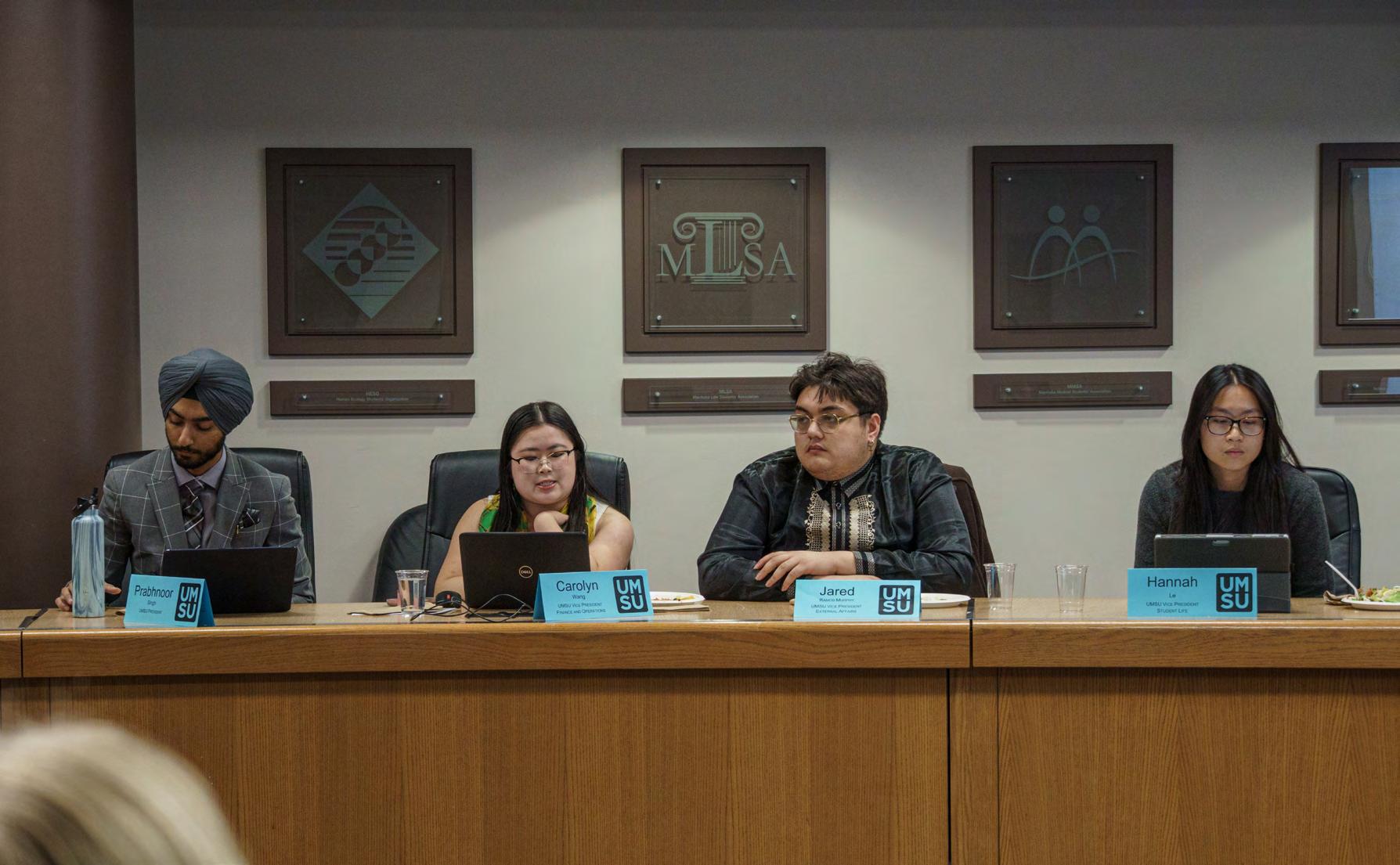
MSU’s Board of Directors met on Oct. 24 in the UMSU Council Chambers at U of M’s Fort Garry campus. Present were representatives from over 20 student associations, along with UMSU staff and executives.

As part of its ongoing efforts to support student well-being, UMSU announced that free flu and COVID-19 vaccinations will be available through the UMSU Healthcare Clinic. The clinic will operate out of the GSA Lounge on the second floor of UMSU University Centre from 9 a.m. to 5 p.m., operating on a firstcome, first-served basis. Students are encouraged to bring their Manitoba health card or equivalent documentation. Those with coverage can receive vaccines at no cost.

UMSU executives reaffirmed their commitment to accessible reproductive healthcare, including educational resources and information on how to safely access abortion services. Students seeking support can access confidential referrals through the StudentCare health plan and on-campus services such as the Student Counselling Centre and University Health Service. UMSU emphasized that advocating for safe, informed reproductive care continues to be a core part of its broader health and equity

work, ensuring that students can access reproductive and abortion-related healthcare without stigma or misinformation.

Midway through the evening, the board entered a private session lasting 105 minutes, temporarily clearing the room of non-members.

The closed discussion reportedly centred on a potential breach of UMSU’s non-disclosure agreement (NDA) policy, with sources indicating that vice president external affairs (VPEA), Jared Ramos Murphy, was under review in relation to the matter. When the public session resumed, the board continued business under the same agenda but introduced a revision, changing the language from “determined” to “alleged” in the motion concerning the suspension and investigation of the VPEA. An ad hoc committee was formed at the meeting to further investigate these allegations.

Ramos Murphy, in a statement made to the Manitoban shared, “This is a very serious accusation and an ongoing investigation. I would never knowingly break my NDA, and look forward to clearing my name.”

Executives also highlighted recent advocacy work, including a meeting with Minister of Municipal and Northern Relations Glen Simard,

‘Toban news briefs

Jesse Brogan, staff

Millennium Library starts new support program

Winnipeg’s Millennium Library has opened the Downtown Resource Corner, which is now readily accessible for safety, well-being and inclusion downtown. Families Minister Nahanni Fontaine said it offers a variety of resources, such as mental health support, help securing IDs, rent assistance and even free phones and photocopying. The staff includes two mental health workers and a WRHA public-health nurse. Operating mainly in afternoons with one late day, the hub works with the Downtown Community Safety Partnership and builds on the library’s 2022 Community Connections program.

Winnipeg poet and filmmaker makes National Youth Panel

Winnipeg artist Sarah Simpson-Yellowquill — filmmaker, poet and advocate for Indigenous and women’s health — has been selected for the 2025 National Youth Panel in Quebec City this October. Simpson-Yellowquill, a survivor of acute lymphoblastic leukemia, now manages programs and development at the National Screen Institute and supports community care at the Women’s Health Clinic. She teaches emerging creators and brings working Indigenous artists to train in lighting, sound, cameras and writing.

“I am a storyteller through poetry, paint and film,” she said, adding that she aims to uplift communities and pass knowledge forward.

where UMSU discussed key issues affecting students such as high tuition fees and access to healthcare for international students.

UMSU also announced that new microwaves will be installed in University Centre, improving campus amenities for students.

Feedback regarding student experiences with Winnipeg Transit has also been actively collected to better cater for student needs. UMSU tabled a report at the Manitoba Legislature and continues to advocate for an improved public transit system.

The board also received updates on events and ongoing initiatives across campus such as the ReShop program, which redistributes used furniture and supplies to reduce waste and promote sustainability, and UMSU Ventures, which offers resources for student entrepreneurs. Updates were also shared on hardship funding, travel grants, holiday hampers and gift card giveaways to support students facing financial challenges.

Community events were also detailed, including Diwali celebrations, mental health

tabling with pet therapy and planning for the Lunar New Year in February 2026. The meeting closed with reminders about ongoing campus initiatives and anticipation for the upcoming annual general meeting as the board continues to prioritize transparency, internal accountability and student well-being. Students-at-large in attendance expressed interest in hearing future updates regarding the NDA breach discussions and any resulting decisions.

Elmwood-East Kildonan by-election

Emma Durand-Wood won Saturday’s by-election for Winnipeg’s Elmwood–East Kildonan council seat with 1,567 votes, ahead of Abel Gutierrez with 887 and Braydon Mazurkiewich with 842, unofficial results show. The 44-year-old community activist who succeeded the late Jason Schreyer said she’ll focus on investing in community, housing-first approaches, transit and youth programs. Turnout for the byelection was 4,977 out of 31,819 eligible voters in the Elmwood-East Kildonan area.

Ukrainian church thriving after 100 years in the community

Marking 100 years in Winnipeg’s North End, St. Mary the Protectress Ukrainian Orthodox Cathedral remains a community anchor at 820 Burrows Ave. The parish owns a 72-unit, non-profit seniors complex next door, opened in 1990, and celebrated a symbolic mortgage-burning last year. Centenary events will culminate Nov. 1 with a soldout gala at the Hotel Fort Garry, which is backed by a $100,000 fundraising drive drawing support nationwide. The parish is also helping recent Ukrainian arrivals navigate settlement and services.

Man responsible for Langside execution pleads not guilty

Jamie Randy Felix pleaded not guilty Monday in Court of King’s Bench to five counts of second-degree murder tied to a November 2023 shooting at a Langside Street apartment. An attempted-murder charge was upgraded after the lone survivor, Shawn Marko, 56, died in June. The other victims were Melelek Leseri Lesikel, 29; Dylan Maxwell Lavallee, 41; and sisters Crystal and Stephanie Beardy, 34 and 33. Court filings say Felix, a former Canadian Forces member, has mental health and substance-use issues.

PHOTO BY ZULKIFL RAFAH / STAFF

Econ society hosts grad panel

Graduate student panel connects undergrads with graduate insights

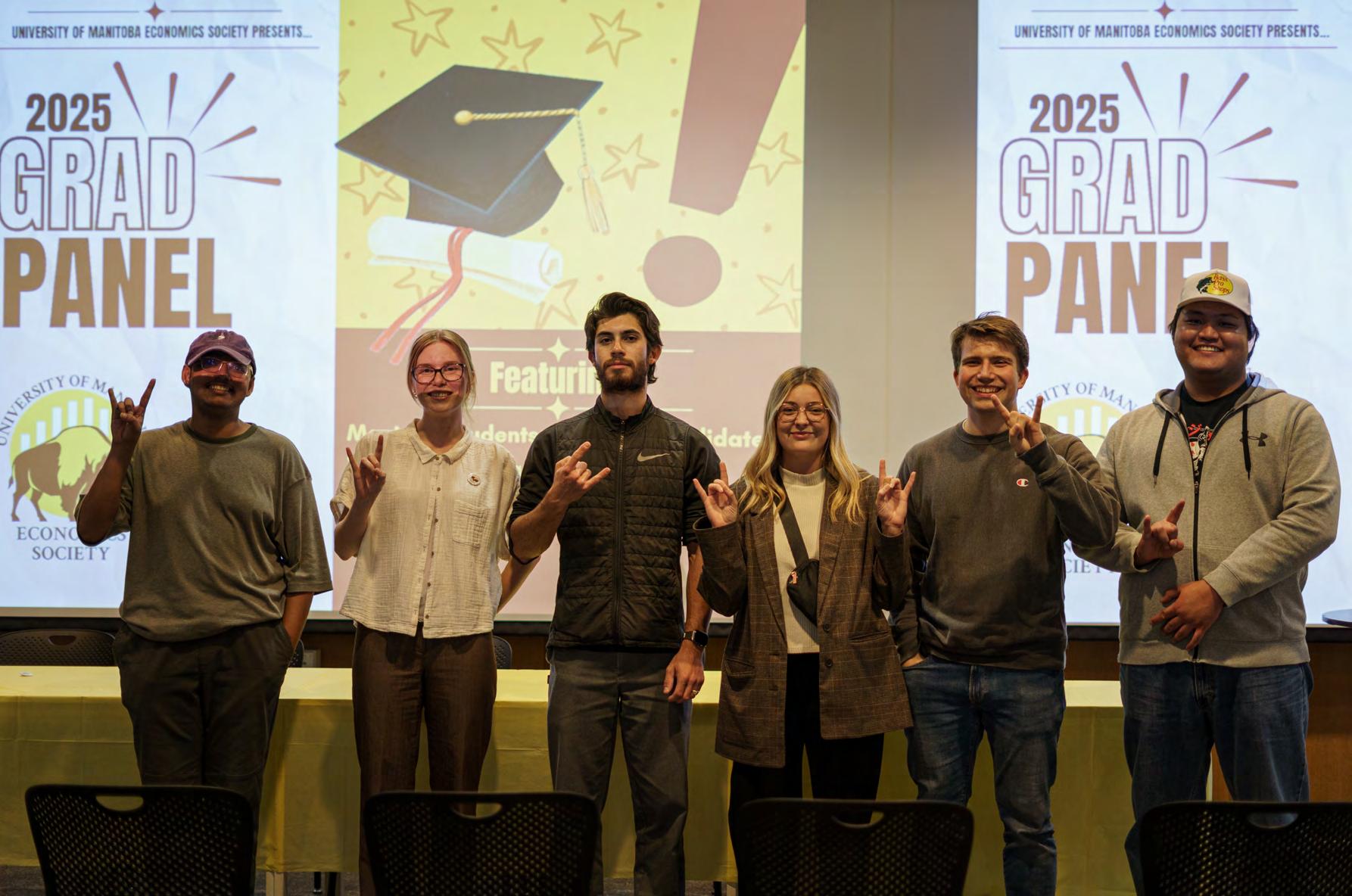
The U of M Economics Society (UMES) hosted a graduate student panel in collaboration with the Economics Graduate Students Association to help undergraduate students understand what to expect in graduate-level economics.

UMES president Abby Procter expressed the idea for the event came directly from student feedback. “At our first open meeting, it was brought to our attention that many students were interested in pursuing graduate studies and would benefit from hearing firsthand perspectives from current grad students,” Procter said. “Our goal with this event was to gather questions from our members and have the graduate students answer them to provide our members with the academic counselling they sought.”

The session was organized as a come-and-go event to accommodate students’ schedules. Procter mentioned the society wanted to create a space where members could ask questions and receive practical guidance about research, workload and transitioning into graduate programs. “Participation in events at the U of M is something a lot of groups struggle with,” she said. “UMES is redefining what it means to be an academic club by providing social and networking opportunities as well as engaging content.”

Questions from attendees focused on workload and research direction. “This event deconstructed misconceptions around choosing your research and how to manage the workload,” she said. “All of the graduate stu-

dents emphasized the importance of pursuing a research topic you are genuinely passionate about, [as] you are responsible for shaping your own academic journey.”

She said early engagement

“There’s no single path to success in economics [...] What matters most is curiosity, persistence and aligning your choices with what genuinely interests you”
— Abby Procter, president of the U of M Economics Society

with research and graduate-level discussions gives students practical preparation for future goals. “Our society provides a space for students to engage with research-based learning while in their undergrad and also leverage social and networking opportunities,” she said. “There’s no single path to success in economics […] What matters most is curiosity, persistence and aligning your choices with what genuinely interests you.”

According to Procter, feedback after the event was positive. “Many students appreciated the opportunity to hear honest, real experiences from graduate students and found the discussion helpful in clarifying what graduate-level economics entails,” she said.

“Participants expressed that events like this make the path to graduate studies feel more approachable by address-

ing questions about research, coursework and career planning that aren’t covered in class.”

Procter, on behalf of UMES, encouraged students to reach out to umeconsoc@umanitoba.ca so “we can connect them with tailored support [such as] career opportunities, economic insights, scholarships, research opportunities and more,” she said.

There will be a follow-up event for new and continuing students titled “Why Econ?” on Nov. 7 at 2:30 p.m. in 217 Russell Building. The session will feature economics professors and student representatives who will discuss the value of studying economics, potential career paths and tips for academic success within the program.

ABBY PROCTER, PRESIDENT OF THE U OF M ECONOMICS SOCIETY.
PHOTOS BY ZULKIFL RAFAH / STAFF

Charity week returns to U of M

MSA’s bazaar brings students and community for a cause that gives back

he U of M engineering

Tatrium hosted the Charity Week Bazaar, organized by the Muslim Students’ Association (MSA) in partnership with Islamic Relief Canada. The event brought together students, vendors and community members for a day of fundraising, with a portion of proceeds directed toward international humanitarian projects.

Arifah Gheesah, the student life manager of MSA, explained the idea for the bazaar came from a similar event held last year. “The Charity Week Bazaar is an event that we did last year in MSA while I was the student life director,” she said. “My manager at the time organized it for the first time, and as a director last year and someone who was [...] an audience in the event, I really liked the concept. There were a lot of people who were interested in the vendors [...] so I wanted to do it again this year.”

The decision to host the event again came directly from student feedback. “MSA did a poll on their Instagram, and students said they wanted this event again, so that’s why we did it,” Gheesah stated.

Gheesah said the main challenge in organizing the bazaar was securing vendors. She explained that many were hesitant due to concerns about sales and covering costs, especially new or student-run businesses. The organizing team had to reassure participants that the event would provide a supportive space to promote their work.

One of those helping make the event possible was Iqra Tariq, a fundraising specialist with Islamic Relief Canada. She shared how meaningful it was to see the event come together and emphasized the charitable purpose behind it. “We are raising funds for Charity Week at our booth,” Tariq said. “This is our Islamic Relief merchandise. This year, we have an amazing lineup of projects the money will support, including health needs in Gaza, Palestine, rebuilding lives in Sudan and investing in futures in Bangladesh, as well as empowering children and communities across the world.”

The bazaar also featured vendors from the wider Winnipeg community, such as local businessman Mamoon Mazher, who appreciated the event’s cause and wanted to contribute. “They’re using funds for orphans around the world in collaboration with Islamic Relief Canada, so I

wanted to be a part of this initiative,” Mazher explained. He added all his supplies “are imported from Dubai,” bringing a touch of international craftsmanship to the campus event.

Gheesah added the event brought together both students and the entire MSA team. “Everyone gets to work on this big project that they see good in,” she said. “It’s a way to connect the Muslim

community on campus with the non-Muslim students.”

To Gheesah, the most rewarding part of organizing this event was seeing it come to life. “It feels really good to see everyone together,” she

said. “You plan […] and then on the day of, you see everyone there, and people actually enjoying [the event].”

PHOTOS BY ZULKIFL RAFAH / STAFF

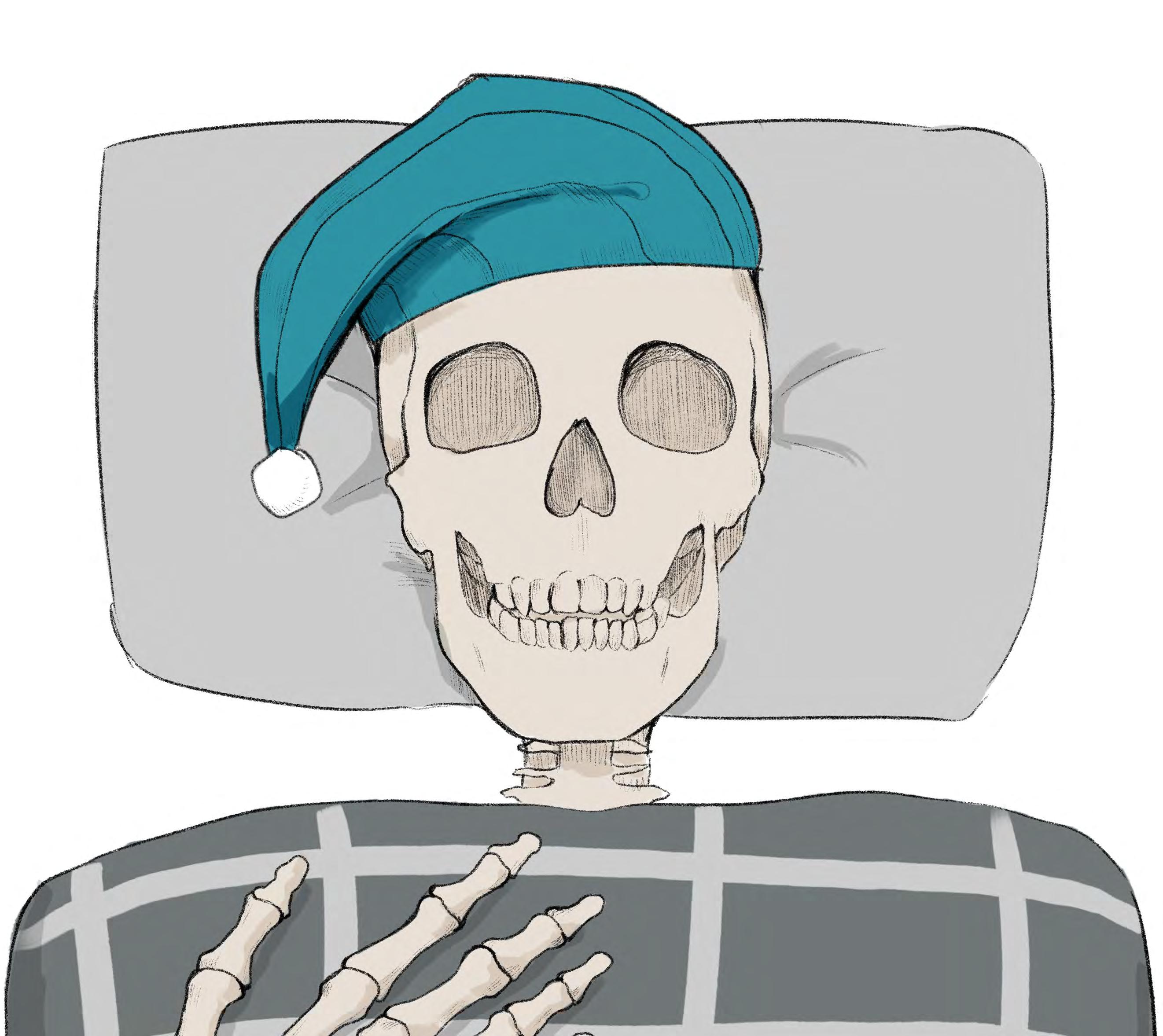
Sleep is a cousin of death

How a mysterious syndrome inspired a horror classic

“D on’t fall asleep...”

This is a line that kept me up at night, made me afraid to sleep when I was younger, and a line from Nancy Thompson, the protagonist of Wes Craven’s 1984 film A Nightmare On Elm Street. Most of you may think of this as purely an imaginary situation, where falling asleep results in nightmares and eventually death, but what most people don’t realize is that this was a reality for many people. This was due to a mysterious phenomenon now known as the Sudden Unexplained Nocturnal Death Syndrome (SUNDS).

Widely known as the Nightmare Death or the Nocturnal Death, it is also referred to as Lai Tai in Thailand, Pokkuri Death Syndrome in Japan, Dream Disease in Hawaii, Sudden Manhood Death Syndrome in Mainland China, Sudden Adult Death Syndrome in England and Bangungut in the Philippines. With the first case being reported in 1917 in the Philippines, it created a little folk tale, referred to as the Bangungut. The Bangungut is depicted as a mythological creature (also known as the Batibat or the Bangungot), and often described as large and almost haglike by many. The creature is said to have sat on its victim’s face or

chest, immobilizing them and sometimes causing death.

This folk story is also tied to sleep paralysis in some cases. The other countries that refer to this phenomenon later described the cases as a syndrome or illness.

It has been 108 years since the first description of SUNDS. Since then, two major active periods of studies on SUNDS have accumulated vast information for further understanding of the pathogenesis. Both studies are from the Center of Disease Control in the U.S.

cle by Ronald B. Melles and Barrett Katz (1988), “Night terrors are a sleep disorder characterized by vocalization, motor activity, a non-arousable state and severe autonomic discharge. The proposed recognition of both

“Most of you may only think of this as purely an imaginary situation, where falling asleep results in nightmares and eventually death, but what most people don’t realize is that this was a reality for many people.”

night terrors and cardiac anomalies in patients offers a pathophysiologic mechanism for their sudden death.”

The leading factors behind SUNDS deaths are believed to be a mix of cardiac anomalies in the patient and night terrors. According to a medical arti -

Reported victims of this syndrome include males from Southeast Asia, roughly within the ages of 20-30, sometimes in

their 40s or 50s. A number of them were Hmong Refugees — these people were forced to flee from their homes in Southeast Asia and Laos after the Vietnam War and Laotian War because they had previously been allies of the U.S. Later, they resettled in various countries such as Australia, France, Canada and the U.S, with the majority of this population now residing in the latter. Although cases of SUNDS have been slowly growing more widespread ever since the first report, few paid attention. However, it eventually grasped the attention of classic horror movie director Wes Craven, who is known for his movies such as A Nightmare on Elm

Street, The Last House on The Left The Hills Have Eyes and the SCREAM franchise.

In an interview with fellow movie director, Mick Garris, Craven said the idea for A Nightmare on Elm Street first came to him when he was watching television late one night, and a story came regarding a young man who died after having what could only be described as “horrible nightmares.” The case led to a series of different articles regarding similar cases, one about a boy that claimed that there was a man in his dreams trying to kill him. The boy’s father, a doctor, constantly provided the boy with sleeping pills to hopefully help his child sleep. One morning, however, the police found the boy dead. They also found all of the sleeping pills that the boy’s father had previously given him underneath the boy’s bed. He never took a single one.

Although there have not been any recently reported cases of SUNDS, it seems that it can only take heart issues and a nightmare to make a person become a part of the statistic.

GRAPHIC BY EMMA GILLICH / STAFF

Conversing about death and dying

End-of-life communication between staff and families in personal care homes

F or many older adults, long-term care homes are where they will spend their final days. In Manitoba, these are also known as personal care homes. While medical care at the end of life is well-studied, conversations surrounding death and dying remain less understood.

Erin Scott, a PhD candidate in the college of community and global health and a sessional instructor in the department of sociology, is addressing that gap. Her research focuses on how staff in personal care homes communicate with family caregivers about death and dying, as well as the ways in which older adults transition through the healthcare system. These conversations are often delayed, avoided or emotionally charged.

“My interest in understanding how older adults access and navigate the system stemmed from helping my grandparents navigate it and understanding first-hand how confusing it can be,” Scott said.

Her interest in aging and healthcare developed gradually. After completing a bachelor of arts in anthropology, she pursued a second degree in sociology. While studying sociology, Scott began working with Laura Funk, a professor in the department of sociology and criminology at

U of M, on projects related to the sociology of aging. That experience led her to com-

she studied the experiences of family caregivers helping loved ones transition from living independently to entering personal care homes.

Now, as a doctoral researcher, she continues to explore the humane side of healthcare systems. According to Scott, the topic is a “black box” in health research.

“[Most people] are pretty good at having the formal conversations around advanced care plans, ‘do-not-hospitalize’ orders and goals of care,” she said. “We’re also pretty good at having conversations around imminent death.” She explained, when it comes to the more informal conversations about death and dying, things become less clear.

The first phase of her project is a scoping review analyzing how such conversations occur, including the goals, experiences and barriers that prevent open communication. Insights from this phase have informed the second stage, which involves interviews with long-term care staff to better understand their perspectives.

Scott noted that while staff often handle clinical care with professionalism, many lack formal training in discussing emotionally-sensitive topics. “Staff typically aren’t taught

how to have these conversations. Comfortability comes with experience,” she said.

Her goal is to provide strategies that normalize endof-life discussions in personal care homes, improving experiences for both residents and their families. When conversations occur too late, Scott noted, palliative care tends to be late. Families frequently report feeling unprepared or unsatisfied with communication around death and dying.

“I wouldn’t say we are a death-denying culture, but we are death-averse,” she said. “By normalizing these conversations, we can ideally ease the experience.”

Looking ahead, Scott hopes to expand her research by interviewing family caregivers to capture their side of these conversations. She is also interested in exploring the intersection between long-term care and medical assistance in dying.

For students interested in aging or healthcare research, Scott offered practical advice to take the process slowly and steadily. “PhDs are marathons, not sprints,” she said. “Find a cohort of people that can support you throughout your process, because it [can be] a lonely road.”

plete a master of arts with a specialization in aging. As part of her graduate research,
GRAPHIC BY EMMA GILLICH/ STAFF

Conflict management guide for legal students

Faculty of law’s new collection aims to provide effective conflict resolution skills

Anew edited collection titled The Other Side of the Bar: Conflict Transformation in Legal Practice brings fresh insights into how lawyers and mediators can navigate complex and multidimensional conflicts. Co-edited by Richard Jochelson, dean of law, and Laura Reimer, director of program development for the faculty of law, the collection offers a “theory-informed and practice-oriented resource” for legal practitioners and academics working to resolve disputes in today’s evolving legal landscape.

Based on current research, the collection explores conflict transformation in specific contexts. It includes advanced legal research, Indigenous approaches to conflict resolution, international arbitration and interpersonal communication. Reimer explained the book is designed “like a course,” including questions at the end of each of the 12 chapters. The hope is to provide legal educators an opportunity to utilize the collection

as a textbook if desired.

A believer in “research as conflict transformation,”

Reimer’s inspiration for this book stemmed partly from a conversation she had three years ago with Chief Justice Glenn Joyal of the Court of King’s Bench. After bumping into him at an airport, “the Chief Justice expressed concern that legal education ensures lawyers are equipped to address the different kinds of conflict the judges are seeing in the courts.”

ing] outside of the traditional realms of litigation or mediation,” with an aim to include the entire legal sphere. After further discussion, they moved forward with the project, framing the book as an “essential [tool] to legal practice that would help practitioners navigate conflict in its various forms.”

Although advertised mainly

sations that it will open up for students.

She said, although there is room to offer the book as a special topics course, “without doubt, the contributors will be using their chapters in their [own] courses.”

“[I want to give people] an opportunity to be introduced to various ways conflict can be recognized, moved, shifted and responded to”

She added in her capacity as director of the Desautels business accelerator, she is “toying with the idea of making this into some kind of summer institute […] a crash course in conflict transformation.”

— Laura Reimer, co-editor and director of program development for the faculty of law

Reimer noted, although “lawyers receive some training in mediation, arbitration and negotiation, the adversarial nature of our court system increasingly requires a need for expertise in conflict management.”

Together, Reimer and Jochelson imagined “a collected book on conflict transformation for lawyers [expand-

through word of mouth, Reimer claimed the book has been eagerly awaited by the legal community, including Justice Sheilah Martin of the Supreme Court of Canada. While Reimer is optimistic the book will be well-received by the practicing bar, she is more concerned about the opportunities and conver-

The goal, she said, would be to give people “an opportunity to be introduced to various ways conflict can be recognized, moved, shifted and responded to.”

Although targeted directly at the legal profession, Reimer acknowledged the types of conflicts this book addresses are the ones that many people face in everyday life. At its core, conflict is a balance of positions and interests,

and Reimer explained this through a simple example. She agreed that at U of M “we’re one herd” and “despite its policies, there’s an effort inside the university to pull us back together.”

She suggested the success of the university’s “One Herd” mentality can be attributed to its ability to properly locate the interests of educators and students alike, despite their differing positions in life. This is the approach people should be taking on an individual level when it comes to their personal conflicts.

According to Reimer, this book works to explain that “if you can recognize what kind of conflict is in front of you, there are tools to help you transform it.”

The Other Side of the Bar will be released on Dec. 1. Reimer hopes to host a book launch at Robson Hall in January. Interested readers can now purchase the book on Amazon.com.

PHOTO BY EBUNOLUWA AKINBO / STAFF

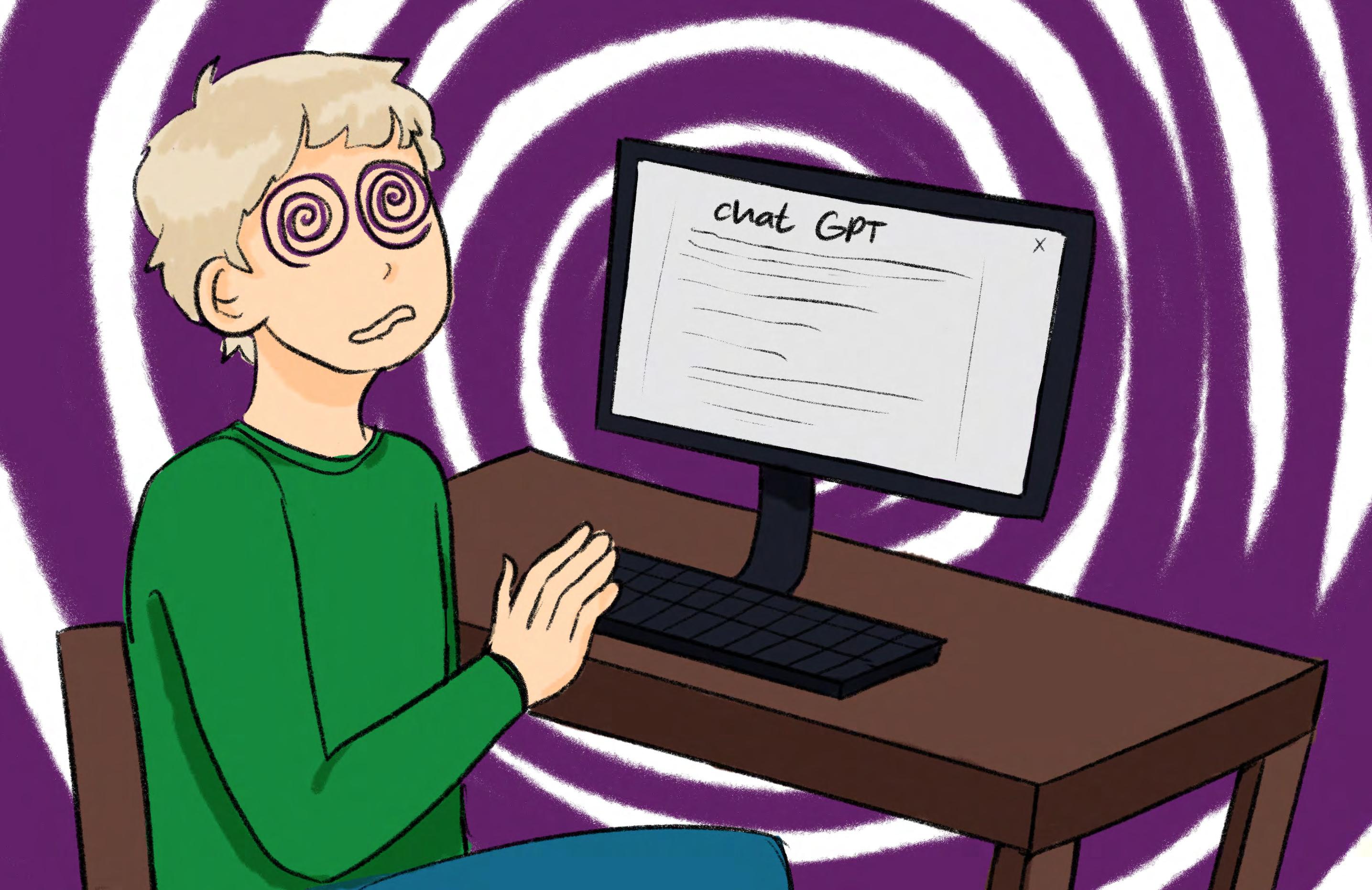
Is AI dependency a choice or a trap?

OpenAI’s largest study on AI use reflects U of M students’ understanding of AI

ChatGPT has become the leading artificial intelligence (AI) large language model (LLM) since its introduction in 2022. It now receives nearly six billion monthly site visits and 700 million active weekly users — the equivalent of 10 per cent of the adult population.

In September, OpenAI released the largest study to date of how people are using AI. Drawing on an analysis of 1.1 million conversations sent between May 2024 and June 2025, this study revealed that 27 per cent of messages are classified as “work-related.” Of that percentage, about 56 per cent of prompts are classified as “doing,” or performing job tasks, with nearly three-quarters of those relating to writing. Although the study attributes this domination to the LLM’s unique ability to generate large writing samples, these statistics raise concerns. One may argue that ChatGPT’s success is the product of computer-engineered innovation, leading the human race into a new age of productivity defined by efficiency — a new “Age of Enlightenment.”  Critics, however, may attribute ChatGPT’s success to a lack of users’ own innovation,

resulting from a failure to control LLM usage, leading to an AI dependency.

University students, though not explicitly highlighted in the report, make up a healthy demographic of LLM users. An earlier report from OpenAI revealed that more than onethird of college-aged young adults in the U.S. use ChatGPT. At the U of M, students’ views on AI vary widely, revealing that students can be found on either side of the debate.

and a lot of people from other majors, and I’ve definitely seen it now more as a tool, something that you can use to help you study, create flash cards, summarize assignment instructions, clarify things, ask questions,” she said. “It’s more used as a tool now, but when it first came out, just because there [weren’t] really a lot of conversations about

that develops crucial organizational and time-management skills has been completely traded for the convenience of AI.

“AI is so limiting in a lot of the things that it outputs, so people limit themselves to the ideas that AI generates and [...] that reduces creativity.”

On the skeptical side is one fourth year computer science student in the faculty of science, who has observed how AI use at universities has evolved. She recalled, when ChatGPT first launched “no one was really talking about the morals or ethics of making it do your assignment, so [...] people would just jump the gun and just were using it for the entire thing rather than [as] a tool.”

— A fourth year student in U of M’s department of computer science

how to use it [...] it was probably abused in some [way].”

Three years into the post-ChatGPT world, she noted AI use among students is taking on a new form. “I have talked amongst my peers

Although this shift should signify increased efficiency in learning, this student argued it has only furthered dependency on AI tools. “I definitely think [AI dependency] has increased. Instead of doing the assigned readings, people just jump straight to getting AI to summarize it, getting it to do your flashcards for you, and this is all work that we were doing before.” She agreed the menial work of academia

In explaining how LLMs operate, she shared her belief that the largest threat AI poses is not to skill development, but rather to the creativity of minds. “The way AI generates text is by predicting what’s the most probable outcome of the next word based off of all the data that’s been generated, so it’s limited to what already exists in this world,” she said. “AI is so limiting in a lot of the things that it outputs, so people limit themselves to the ideas that AI generates and [...] that reduces creativity.” While some students remain cautious about AI, others view it with optimism. One second year JD candidate in the faculty of law explained her understanding of AI as a teacher. “Honestly, I’m a big advocate for the use of AI,” she said. “If you’re ever confused by anything and you have the facts and the right information, I think AI can

really help explain anything that you might be confused about. And I think that it also helps because it can be kind of scary going to profs and asking them questions.”

Common Sense Media’s 2025 AI Risk Assessment showed that AI teaching assistants — platforms specifically designed to aid teachers and students in learning — have a moderate risk of acting as “invisible influencers,” providing inaccurate and biased information to students. One can only imagine the risk with AI platforms that have not been designed to provide an educational service. This use of AI as a supplementary teacher then requires a great deal of discretion on the students’ part.

As generative AI becomes more integrated into everyday life, its influence continues to grow beyond the workplace. A recent study by Collis and Brynjolfsson (2025) suggested that ChatGPT is having a wide-reaching impact on the global economy, with non-work use growing even faster than professional use. While its long-term effects on education and work remain to be seen, its impact is already reshaping how people think, study and produce.

GRAPHIC BY EMMA GILLICH / STAFF

Horror is the most honest genre

With a bit of gore, fear and thrills, horror says what other genres won’t

Stories — films especially — are hyperbolic extensions of the things we experience in everyday life. They enlarge the feelings we experience like love, fear, shame, desire and the incessant ring of mortality. Horror takes this exaggeration the farthest. With death, existential symbols and maybe a bit of gore, horror seems to have become the most honest genre as it confronts what we repress head-on, and offers us a playground of profound truths.

John Truby’s The Anatomy of Genres argues that each genre performs a specific function. Memoir and the coming-of-age story teach personal responsibility and the making of the self while fantasy explores the wish to be more than we are (which makes me think about how Marvel dominates big-budget productions). Horror, by contrast, fulfills the religious function in storytelling by confronting us with ultimate questions like those about death, and challenges how we should live if we want to pur-

sue a good life that ensures a heavenly end.

In my opinion, the first biblical tale in Genesis is a horror story. When Adam and Eve eat the apple and learn they will die, a new acute awareness arrives, and with that comes the vertigo, the dizziness of choice. This disorienting experience lends to the insistence of questions like, “Who am I?” and “What should I do?”

Unlike genres that idealize human experience, horror strips away the familiar world and exposes the raw realities that people frequently ignore. I believe it forces audiences to confront uncomfortable truths which, as a result, require honest reflection.

John Carpenter’s Halloween was released in 1978, just before Oct. 31, and it reframed the suburban neighbourhood, which is regarded as generally safe, into a stage for pure terror. Michael Myers, also referred to as “The Shape,” does not run, speak, plan or explain himself. He simply is He isn’t a villain with motives — he’s a masked void in coveralls, a walking subtraction of

meaning. The movie’s point here is that in a rational, welllit world, unexplainable evil can exist and even thrive. Yet Laurie Strode, the movie’s protagonist, responds to that void. She protects, plans and fights back. She makes meaning by resisting meaninglessness. Here, horror’s religious function is in full motion, asking the question, “When confronted with the inexplicable, will we act with intention and courage anyway?”

We find these symbols in all horror films. The Exorcist dramatizes a crisis of belief as faith requires doubt the way courage requires fear. Ari Aster’s Hereditary insists that we inherit more than heirlooms — we carry family trauma, mental illness and, perhaps, spiritual doom. The film uses the supernatural as a delicate frame for the metaphor of what bloodlines and traditions pass down through the family. In A Nightmare on Elm Street, Freddy Krueger is the burgeoning bubble of denial inside us that, if left unattended, results in unforeseeable consequences. The parents in the movie burn

Freddy alive because he is suspected of killing children. In doing so, they evade justice, and their unconfessed violence returns in their children’s dreams. The villain in the movie is not just Freddy, it’s the lie the town has had to live with.

This is why the genre’s religious function matters. Horror asks us to look straight at death, then act as if goodness still matters. It exposes the reassurances we need to feel okay, such as, “The suburbs are safe,” “Science can explain everything” and “The past is over,” and replaces them with sturdier and, at times, exaggerated scares. But the truth is annealed around each horror story because evil can be senseless, reason can be limited and the past will resume until we face it. However, despite this, we as viewers (and the characters in horror films) can create meaning through responsibility, sacrifice, truth-telling and caring for others.

The idea of death results in the same response for us all. Fear is an emotion where the trigger is easy to define

— a shadowy figure stands in the doorway, a deep, unbecoming voice crawls out of a child’s throat, a modified glove scrapes metal in a dream — while other emotions, like happiness, begin from a messier origin. We recognize danger together and react together.

Halloween is here. Sit in a crowded cinema and you’ll feel it — the synchronized intake of breath with the shared laugh after a scare. I believe that timing isn’t an accident — it’s emotional honesty revealing itself with rhythm. Horror aligns our heartbeats around inescapable truths we all know but tend to avoid. It tells us that the void is real, but so is defiance, so is love, so is the will to protect. If every story amplifies life, horror enlarges the parts we’d rather ignore, and in doing so, it shows us how to live. This Halloween, put a candy bowl out on your porch, get in your costume and go see a horror movie at the cinema.


GRAPHIC BY TEEGAN GILLICH / STAFF

Diversions

To complete Sudoku, fill the board by entering numbers 1 to 9 such that each row, column, and 3x3 box contains every number uniquely. In Straights, like Sudoku, no single number 1 to 9 can repeat in any row or column. But rows and columns are divided by black squares into compartments. Each compartment must form a “straight.” A straight is a set of numbers with no gaps but it can be in any order, eg [7,6,9,8]. Clues in black cells remove that number as an option in that row and column, and are not part of any straight. Glance at the solution to see how “straights” are formed.

Chilled To the Bone

I have a bone lodged in My brain, I’m haunted by The Pearl, a spotless long poem

What manner is a wishbone That is turned upside-down? Can the same be said of pens?

To complete Sudoku, fill the board by entering numbers 1 to 9 such that each row, column, and 3x3 box contains every number uniquely. In Straights, like Sudoku, no single number 1 to 9 can repeat in any row or column. But rows and columns are divided by black squares into compartments. Each compartment must form a “straight.” A straight is a set of numbers with no gaps but it can be in any order, eg [7,6,9,8]. Clues in black cells remove that number as an option in that row and column, and are not part of any straight. Glance at the solution to see how “straights” are formed.

Chilled To the Bone

‘Got styles for piles Of poetic fragments Or collected bones About shared history

‘Got styles for piles Of poetic fragments Or collected bones About shared history

Let me take you On a journey To the heart Of the matter

Let me take you On a journey To the heart Of the matter

Inside a shell Is the hollow core Where we’ll dig Deep for treasure chests Or cabinets

Inside a shell Is the hollow core Where we’ll dig Deep for treasure chests Or cabinets

We can be Archeologists And find ways to giveThere’s a missing link Leading me to Mexico, The Tree of Life resides In a town, where everyone Looks like me, similar

We can be Archeologists And find ways to giveThere’s a missing link Leading me to Mexico, The Tree of Life resides In a town, where everyone Looks like me, similar

‘Don’t know if I should Go visit a place that Promises royalty, I’ll take my chances With the family I have

‘Don’t know if I should Go visit a place that Promises royalty, I’ll take my chances With the family I have

I have a bone lodged in My brain, I’m haunted by The Pearl, a spotless long poem

Shall I compare “The Stone Hammer” With “the bones” of “lunar light”?When I chip away at the dirt, It seems that the parallels Are like crossbones

Shall I compare “The Stone Hammer” With “the bones” of “lunar light”?

When I chip away at the dirt, It seems that the parallels Are like crossbones

The instance of brokeness Plants a seed of doubt In my psyche, and I’m bound I’m stuck in a direction, Feeling like the worst Has already happened

The instance of brokeness Plants a seed of doubt In my psyche, and I’m bound I’m stuck in a direction, Feeling like the worst Has already happened

But then again, theres the W And what appears broken Is really crossed?

-

But then again, theres the W And what appears broken Is really crossed?

Every time a local poetry book Makes it to The Salvation Army Thrift Store, I inspect it

“How Long, will this be here?”

Every time a local poetry book Makes it to The Salvation Army Thrift Store, I inspect it

“How Long, will this be here?”

It’s just a matter of time Until someone is going to take it, As certain as an apartment

Among the bargain hunters Is another Prairie Writer: “I’m not alone...”

It’s just a matter of time Until someone is going to take it, As certain as an apartment

What manner is a wishbone That is turned upside-down? Can the same be said of pens?

I’ve heard of Astronaut Pens That can write in Zero Gravity, Sounds like hand-written Brainstorms in Space

I’ve heard of Astronaut Pens That can write in Zero Gravity, Sounds like hand-written Brainstorms in Space

The view from The I.S.S. Must be spectacularly sweetI find myself playing fetch Like a dog in some Jack London Novel, bringing the newspaper

The view from The I.S.S. Must be spectacularly sweetI find myself playing fetch Like a dog in some Jack London Novel, bringing the newspaper

The star charts, hidden Like a treasure map inside The journalistic articles

The star charts, hidden Like a treasure map inside The journalistic articles

One foldout turns into a cone, Another page turns into a fishing hat, And sometimes there’s an airplane

One foldout turns into a cone, Another page turns into a fishing hat, And sometimes there’s an airplane

Whenever I happen upon a long poem, I want to show up for coffee At my teacher’s neighbourhood, And say to them, “The sky’s the limit!”

They’d take the chance to shake up Their pickle jar, full of quarters

Whenever I happen upon a long poem, I want to show up for coffee At my teacher’s neighbourhood, And say to them, “The sky’s the limit!”

They’d take the chance to shake up Their pickle jar, full of quarters

I saw a silver coin At Ellice Flea Market, A man named Marsh Showed me the coin’s effigy, It was a prince/ the future behindThe bar-stars of The Speaking Crow Afterparty are comparing Poetry and Prose

I saw a silver coin At Ellice Flea Market, A man named Marsh Showed me the coin’s effigy, It was a prince/ the future behind -

I’m encroaching, “We must find Poetry in all the books...”

The bar-stars of The Speaking Crow Afterparty are comparing Poetry and Prose

I’m encroaching, “We must find Poetry in all the books...”

In my mind, there’s The Artemis Mission, exploring the galaxy And saving the universe

In my mind, there’s The Artemis Mission, exploring the galaxy And saving the universe

Among the bargain hunters Is another Prairie Writer: “I’m not alone...”

They’re taking all the good ones And the great Canadians too

She’s stepping on the fossils now

The average size of a pen Is about the same as a clavicle Or “collarbone”

They’re taking all the good ones And the great Canadians too She’s stepping on the fossils now -

While pens look like an extension Of the hand, perhaps They’re connected to the breast

The average size of a pen Is about the same as a clavicle Or “collarbone”

While pens look like an extension Of the hand, perhaps They’re connected to the breast

Straights Puzzle by Signdicated Puzzles Puzzle by Signdicated Puzzles
Sudoku Sudoku Solution Straights Solution
Straights Puzzle by Signdicated Puzzles Puzzle by Signdicated Puzzles Sudoku Sudoku Solution Straights Solution

Women claim crisis, not victory, on The Diplomat

The path to leadership is still crisis-driven, on screen and in Ottawa

Few television shows right now feel as sharp and addictive as The Diplomat. With the arrival of its third season, the series continues to deepen its intricate depiction of international affairs and personal drama.

At its heart is Keri Russell’s commanding performance as Kate Wyler, the American ambassador to the U.K. Wyler’s quick-yet-informed navigation of challenges brings the messy realities of diplomacy to life, making the high-stakes world she lives in both intimate and authentic. It is no surprise the show has earned praise for its writing and pacing, and I have admiration for how it showcases the complexities and contradictions of women’s leadership on the world stage.

Yet, as much as The Diplomat excels in portraying its female leads as complicated and compelling, it also falls into a common narrative trap. At the beginning of this most recent season, Allison Janney’s character, Grace Penn, is sworn in as president after the sudden death of the previous president — a scenario echoed in many other political dramas. Consider Claire Hale Underwood in House of Cards, who gains the presidency after her husband resigns, or Selina Meyer in Veep, whose first term is the result of the sitting president’s resignation. Time after time, these shows seem comfortable with women leading only when they step into the role through extraordinary circumstances, rather than winning through hard-fought campaigns.

The moments following the president’s passing in The Diplomat illustrate the chaos surrounding Penn’s new reality. At the time, she is overseas and must be abruptly sworn in

at the U.S embassy in London, right in the building’s lobby. She is sworn in wearing a running shirt under her blazer, as there is no time to find appropriate attire. This episode highlights how unplanned, hectic and crisis-driven her rise to power is, leaving her with little agency to claim the presidency on her own terms. It is striking how rarely a woman wins her way into the highest office onscreen, but this problem extends far beyond fictional television. In Canada, Kim Campbell’s short term as prime minister followed the political wreckage left by Brian Mulroney.

Campbell, who became Canada’s first and only female prime minister in 1993, inherited the leadership of the Progressive Conservative party just months before a federal election. The Mulroney government was deeply unpopular at the time, due to a recession, high unemployment and failed constitutional reform.

When Campbell took over, her party was facing collapse. She was not chosen by voters to lead and was tasked with saving the party from being voted out of existence. In the 1993 federal election, the Progressive Conservatives suffered a historic defeat, win-

ning only two seats and ending Campbell’s time as prime minister after less than five months in office.

This is a familiar situation for many women who step into leadership at the most challenging moments, being expected to move mountains when the odds are already stacked against them. Since then, no major federal party in Canada, except for the Greens, has had a woman lead them into a general election.

The persistence of this trope, onscreen and in real life, speaks to the limits of our collective political imagination. Even when female

characters hold on to power after gaining it through unusual circumstances, their paths are rarely depicted as straightforward or fully legitimate. The emphasis remains on exceptionalism, rather than normalizing women as political victors from the start. It may be time, both on television and in real life, to envision a world where women win and lead on their own terms — not simply as caretakers in moments of crisis, but as architects of their own success.

GRAPHIC BY TEEGAN GILLICH / STAFF

Minimalism vs. maximalism

Is millennial minimalism ruining whimsy?

M y house is littered with trinkets and knickknacks that seem to seep out from every corner and crevice. One may call my home cluttered, but I choose to think of it more as a whimsical way of living.

I have always been intrigued by the world of trinkets. You may be thinking “Girl, this is just overconsumption,” and maybe you’re right — I may overconsume a little too much. I like to be surrounded by my clothes, books and snow globes, which bring me an immeasurable amount of joy that no man could ever bring.

I like objects that feel like they have souls. This new shiny fad of millennial minimalism haunts me. Why would anyone want everything they own to be beige or taupe constantly? The trend of having fewer possessions may be sustainable, but at what cost?

The idea of living in a house devoid of things is terrifying to me. I prefer spaces that feel busy and full of life. I want

my outfits to scream whimsy, and I especially enjoy going to thrift stores and finding things that make not just me, but my soul, happy.

According to Business Insider, millennials are buying and owning less, breaking the mould of American consumerism, choosing to fashion living spaces with overly beige interiors. The thought of being surrounded by nothing would leave me feeling empty, both emotionally and literally.

Do I overconsume? Honestly, I probably do. I like my life and bedroom to be full, bursting at the seams with things I have collected from thrift stores and received as gifts from friends or myself — items that hold memories and that I hold close to my heart.

Although I love the whimsy that trinkets bring, I can’t help but feel like, sometimes, I fill the sadness I experience in life with material things. Even so, I won’t stop buying trinkets that bring me immense joy in a world where everything seems geared toward money and work.

No Kings protests sweep the U.S.

Mass protests call out the Donald Trump administration’s anti-democratic actions

As Republicans try to minimize the effect of the No Kings protests, I find myself thinking more about the power people have in numbers. The No Kings protests took place in the U.S. on Saturday, Oct. 18, with people flooding the streets of Los Angeles, New York City, Chicago, Washington, D.C. and Texas.

These rallies were held with the intention of demanding protection of constitutional rights, which protesters say are under attack by the Donald Trump administration. This rally was fundamentally aimed at demanding the right to democracy.

With more than seven million people joining these rallies across the U.S., Trump is actively trying to negate the influence of these protests by saying the people who chose to protest peacefully “hate America,” while continuing a slew of hate-fueled propaganda, which is being promoted by himself and his administration.

This propaganda takes the form of Trump and his team posting memes mocking protesters, including AI-generated videos featuring Trump

wearing a crown and dumping brown waste on protesters, according to CNN. These acts of blatant disparagement, laced with lies and deceit, from Trump and his administration show that, despite Trump’s reaction of underplaying the cause and effect of these protests, he is using these forms of jeers and taunts to minimize and conceal how threatened he really feels.

In my opinion, Trump has always believed he is invincible. I draw this conclusion from his ongoing slew of legal allegations, criminal convictions and his long history of abusing power. Despite this idea of invincibility that Trump exudes, his facade is beginning to crack with the beginnings of these protests. In my opinion, when bullies who abuse their power are threatened, they resort to taunts and antagonization.

This abuse of power is nothing new for him. For those who are surprised by Trump exceeding his power, this form of abuse has always been present. You can look back at his first election to now and see a clear pattern, including through the riots he incited at the White House in 2021, his

sexual abuse convictions and the shady business dealings he is involved in year after year.

Some groups in the U.S. repeat that Trump will bring detrimental harm to the American people and economy. Figures like Michelle Obama and Kamala Harris once expressed that “Donald Trump is increasingly unstable and unhinged.”

Trump is and always will be an abuser of power and a

bully. He thinks if he screams a little louder and sprays on the orange tan a little more, that people will have no choice but to listen. However, the interesting thing is that people seem to be listening to him less and less.

Republicans can continue to take these rallies as a joke or dismiss the impact of the No Kings protests as much as they want, but at the end of the day, these rallies are real and impactful.

The more I think about the No Kings protests, the more empowered I feel, which is such a contrast to how I felt when he was first elected. These rallies are more than just a small cry for social change — they are drawing attention to the human rights violations Trump is committing and are demanding social change.

GRAPHIC BY TEEGAN GILLICH / STAFF

Grades over growth

The academic system is killing curiosity in assessment-focused students

Every now and then, I understand why school is supposed to be interesting, but the excitement never seems to last. Right after learning something interesting, my mind immediately jumps to the question, “Is this testable?” or “Will this part be on the midterm?” I can’t even count how many times these questions have been asked by other students in my lectures. It feels like everything we learn must lead to something measurable like a quiz, an assignment or a grade. Even the topics that should be exciting lose their spark. There’s no time to appreciate how amazing something is when you’re too focused on how it will be assessed.

This pressure to perform is draining, and it’s not just something we imagine — studies show that students today face record-high levels of anxiety, burnout and depression. Some research even suggests that grades are at the heart of the mental health crisis among students. It’s heartbreaking. Education should be one of the most meaningful parts

of life. School is supposed to help us engage with ideas that shape how the real world works, from exploring scientific discoveries to unpacking historical patterns that still affect us today. But because we’re learning in a system that promotes chasing marks, we rarely take the time to appreciate what we’re learning. Now, don’t get me wrong, I do understand the

importance of assessments. Tests do serve as helpful feedback for both professors and students. They allow educa-

“I think many students now operate on autopilot within the academic space. We do the bare minimum to get the grade and we shut down our natural curiosity”

tors to see how well their students understand the material and highlight areas for students to go back and revise. I know

that it’s necessary to have a standard to gauge whether students are keeping up with the material. I think grades should guide learning, but I don’t think they should define it.

I think many students now operate on autopilot within the academic space. We do the bare minimum to get the grade and we shut down our natural curiosity. We are losing the ability to care. We have stopped engaging with the world in the way

that learning is supposed to encourage us to, and most of us are just waiting for university to be over.

I wish I had a solution, but the academic system is too deeply rooted in evaluation to change overnight. I think it is important to talk about the kind of quiet undoing this pressure causes and how it is eating away at our will to learn and assign meaning to the information we are getting. I am also trying to remind myself to care. I know it is easier said than done, especially now, in the midst of midterm season, but I am trying to engage meaningfully with the things I’m learning. I know the assignments are important, but so is my sense of wonder and curiosity. So, any time I read something even slightly interesting in my notes, I do a quick Google search to learn a bit more about it. Not because it will appear on a test, but because it interests me. This is a small change, but it helps me feel like I’m learning for myself and not just for a grade. And if I can do that, even just a little, maybe I can fall in love with learning again.

GRAPHIC BY EMMA GILLICH / STAFF

Arts & Culture

The Trews release eighth album The Bloody Light

Long-running Canadian band’s latest album released

F ormed in Antigonish, Nova Scotia and based in Ontario, Canadian rock band

The Trews has been together for over two decades.

John-Angus MacDonald, the group’s lead guitarist, quipped, “Now we’re going into ancient history, we’ve been around for a long time.” He added, “My brother Colin [MacDonald], who’s the lead singer, and our good friend Jack [Syperek], who’s the bass player, we got together playing cover tunes in our parents’ basement back in the late 1990s. We were still in high school at that point. That was […] the musical bond that forged what became The Trews.”

After high school, the band left Antigonish and relocated to southern Ontario. While they do not purposely draw from their Nova Scotian roots in writing their music, MacDonald stated that East Coast culture has influenced their mentality.

“The thing I like most about East Coast music is that there isn’t a huge star culture down there, and it’s more about all for one and one for all […] And I feel like that sensibility toward performing has sort of informed who we are,” he stated.

The band’s new album, The Bloody Light, was released on Oct. 24 with some of its songs periodically released since February.

The album’s title shares the same name as the first song

on Oct. 24

they recorded for the project. The title track was coined by the song’s co-writer, Brett Emmons.

“We thought it was just evocative of many things, so it made for a great title,” MacDonald explained. “And after we finished the record, of course comes the naming of the record […] Of all the titles

of the songs, that one just meant the most things to us.”

The fact that this is the group’s eighth album, a marker of endurance, is not lost on MacDonald or his bandmates, and he expressed pride in how the album turned out.

“It means a lot to us in the sense that we’re proud of the

longevity we’ve managed to eke out of this business, which is not known for longevity,” he reflected. “To really hunker down and dig deep and come up with your best stuff 20-plus years into a career is no easy feat.”

When asked about personal favourite songs on The Bloody Light, MacDonald highlighted the “moody” track “One Fine Night” and “Get a Handle on It,” which he described as a “high-octane shot in the arm.” Neither song had been released as singles prior to the album’s full release.

The group will soon start touring across Canada in support of the album with a stop at Winnipeg’s Burton Cummings Theatre in February 2026 — a stop that MacDonald looks forward to.

“Winnipeg is one of the great rock and roll cities in Canada […] It’s just something about the blue-collar sort of vibe,” he raved. “It breeds a lot of great rockers, a lot of great musicians and writers, I find. We always love coming to Winnipeg.”

While the Trews will be performing some of their old hits on tour, MacDonald expressed that the new songs will add something special to the show.

“To me, playing new material gives old material new context. It makes everything feel fresher,” he

explained. “So, if you’re coming to hear the old hits, they’re still going to be there. But for me, those new songs just give the show a much needed shot in the arm.”

“It means a lot to us in the sense that we’re proud of the longevity we’ve managed to eke out of this business, which is not known for longevity […] To really hunker down and dig deep and come up with your best stuff 20plus years into a career is no easy feat”

— John-Angus MacDonald, lead guitarist of the Trews

The Trews’ latest album, The Bloody Light, is available now on streaming platforms with its supporting tour, The Bloody Light Tour, playing in Winnipeg on Feb. 21, 2026 at the Burton Cummings Theatre. For information on upcoming events and tickets, visit thetrewsmusic.com.

PHOTO PROVIDED BY PAUL WRIGHT

Arts and culture sector earns $1.75 billion for Manitoba Manitoba Arts Council releases

The Manitoba Arts Council held their annual public meeting on Oct. 20 and released a report on the arts and culture sector’s financial impact in Manitoba, primarily using data from 2023.

The figure came from analyzing Statistics Canada’s data, which came to $1.75 billion all generated by arts and culture — 3 per cent of Manitoba’s GDP. It also accounts for over 20,000 jobs.

Statistics Canada organizes their financial data into national economic accounts for the benefit of financial policymakers. They are broken into satellite accounts, by provinces and by themes such as culture.

The account is not limited to typical organizations, however. Products from many industries contribute to the province’s arts and culture sector.

In the report, culture is defined as “creative artistic activity and the goods and services produced by it, and the preservation of heritage.” To be included in the accounts, something must also do at least one of the following — qualify for copyright, support or expand cultural products, preserve, exhibit, or interpret

economic impact study

heritage, provide training or education for cultural products, or govern or finance culture creation.

Tourism spending also generated $377 million and roughly 4,500 jobs in Manitoba. This approach uses a wide scope, including money spent on food and accommodation.

Forum Research also published a tourism spending report for 2023 using figures from Statistics Canada’s surveys on foreign and domestic travelers. They survey tourists traveling for festivals, fairs, performances, Indigenous events, historic sites, museums and galleries.

According to their findings, arts and culture tourists spend double what other tourists do on average.

The council’s grants also created $85 million in economic impact throughout the 2023-24 fiscal year. The grants’ recipients included a total of 102 organizations and 1,262 jobs in Manitoba. The report boasts that recipients make a revenue of 10 times the amount received.

The council receives most of its funding from the provincial government. It accounts for $12.7 million out of $12.8 million.

rom that pool, roughly $10 million is distributed in grants every year and $8 million of it goes to established arts and culture organizations.

From the survey, over 90 per cent of respondents agreed that the arts celebrate Manitoban identity, and 92 per cent agreed that the arts help create common understandings between people.

This sentiment is echoed by Nellie Kennedy, the provincial minister of sport, culture,

heritage and tourism.

“Arts and culture touch every part of our lives. They support small businesses, attract visitors, and inspire pride in our communities. When the province invests in creativity, we are investing in people, prosperity, and a stronger future for Manitoba,” stated Kennedy. Katarina Kupca, the Manitoba Arts Council chair, also commented that arts and culture are important for contribut-

ing to Canadian nationalism and sovereignty.

“More than ever, arts and culture matter. The sector is central to Manitoba’s social fabric and grows the economy, creating jobs and generating tax revenues. Arts and culture also lead essential conversations, affirming our shared sense of nation and sovereignty,” Kupca shared. “Investing in the arts is a win for everyone.”

A review of Hal Harley’s The Unbelievable Truth A bizarre satirical rom-com

Last week, Dave Barber Cinematheque screened the 1989 dark romantic comedy The Unbelievable Truth, directed by American filmmaker Hal Hartley. The first film in Hartley’s Long Island Trilogy, The Unbelievable Truth is a bizarre watch that explores the trials and tribulations of a forbidden romance.

In the film, recent high school graduate Audry falls in love with Josh, a mysterious mechanic at her father’s auto shop rumoured to be a mass murderer. Audry’s father forbids her from starting a relationship with the older mechanic, which causes her to move to New York City to pursue a modelling career. The story then unravels into a messy narrative about a strained father-daughter relationship and forbidden love. Despite the seemingly familiar themes, The Unbelievable Truth is anything but conventional. For example, Audry’s eccentric personality is almost comical — she is introduced to

with a dose of ephebophilia

the viewer as a nihilistic teenager clad in black who is convinced a nuclear holocaust is nigh. During a fight with her modelling agent in New York City, she calms herself by pacing back and forth, reading aloud a book chapter about a post-apocalyptic world. The acting and dialogue in the film are often unnatural and awkward, but scenes like this demonstrate Hartley’s unique sense of humour.

In a blog post, film critic Roger Ebert described The Unbelievable Truth as a “strange mixture of melodrama and irony.” The film’s suburban characters seem like real people, but Hartley exaggerates their quirks just enough to make viewers question their believability.

For instance, Emmet, Audry’s jealous ex-boyfriend, only appears on screen to start fights with men who are interested in Audry. In another scene, a woman tries to flirt with Josh by using the same pick-up lines repeatedly to no avail. This was perhaps a farci-

cal way to poke fun at people who cannot take no for an answer.

In terms of cinematography, The Unbelievable Truth is a breath of fresh air compared to the overstimulating CGI- and action-packed films found on today’s screens. Many scenes feature minimal background music, allowing the dialogue to stand on its own. The set and costume design also transport viewers to the unassuming-yet-charming world of suburban New

York City in the 1980s. However, it is difficult to overlook the problematic romance depicted in the film. In the final scene, it is revealed that Josh was falsely accused of murder and has been innocent all along. Audry and Josh then reunite as lovers while other couples are shown bickering with each other. This seems to be portrayed as a “happily ever after” moment, but it does not erase the fact that their relationship started when Audry was a minor.

Overall, The Unbelievable Truth is challenging and requires some degree of intellectualization, but the dry and ironic humour makes it an intriguing watch. Despite the film’s attempt at portraying a romantic relationship, some viewers will undoubtedly have trouble stomaching the unsubtle ephebophilia in this questionable rom-com.

Visit davebarbercinematheque.com for future screenings.

F
PHOTO BY ZULKIFL RAFAH / STAFF
PHOTO PROVIDED BY IMDB
THE LOVE-IN MUSIC AND ART CYPHER EXHIBIT AT NUIT BLANCHE 2025
THEUNBELIEVABLE TRUTH (1989)

‘Toban turntable

William Prince — Further From the Country

On Oct. 17, critically acclaimed Winnipeg roots singer-songwriter William Prince released his latest album, Further From the Country. The collection of nine songs explores a variety of themes, from unrequited love to substance use. While Further From the Country successfully encapsulates the energy and realities of working-class Manitoban life with skillful vocals and poignant lyrics, some of the songs lacked distinctive background instrumentation and style.

The album begins with the titular track “Further From the Country,” a harmonically spicy track about transitioning from country to city life. Though energetic, this track captures the internal struggles that come with moving — the driving drum beat, distorted electric guitar and fiddling in the background give way to a slow interlude in the middle, casting doubt on the singer’s move before returning to a lively pace.

Other songs are much more subdued. “All the Same,” for example, is a pensive reflection on suicide, poverty and substance abuse on reservations, perhaps echoing Prince’s Cree and Ojibwe background and upbringing in Peguis First Nation. Despite the bleak subject matter, Prince sets the song in a major key, suggesting a helpless acceptance of the status quo.

“Damn” is similar to “All the Same.” With the refrain “Another damn shame / Life as we know it will probably stay the same,” this track is a soulful sigh at the harsh realities of life such as loneliness and rent payments. There is an optimistic turn, however, and the song ends with, “Things won’t change until I finally get the will to do something else / with myself / Oh, damn.” Painfully relatable and almost comedic, the track showcases Prince’s talent as a songwriter.

Living up to Prince’s title as a country-folk singer, “Flowers on the Dash” is a proper honky-tonk tune about rejected romantic advances.

With swinging, tongue-incheek instrumental solos, this track fits right into a country bar playlist, but might sound over the top to unacquainted listeners.

The album concludes with “More of the Same,” a song about being content with your life — a reminder to appreciate what you already have and an antithesis to the current obsession with hustling and self-improvement.

Further From the Country clearly shows Prince’s talent as a singer-songwriter whose works touch upon important aspects of human life that many can relate to.

Sadly, almost all of the tracks feature fuzzy electric guitar playing and a 4/4 drum beat in the background, causing the songs to blur together. The average listener will likely have a hard time telling each song apart. In addition, most of the songs have an underlying current of quiet frustration and pessimism, and the execution of the only upbeat track, “Flowers on the Dash,” feels almost ironic and gaudy compared to the rest of the album.

Overall, this album will appeal to country and roots music fans, especially those who share Prince’s background and value authentic storytelling and sensitivity in music. However, those looking for traditional and highenergy folk tunes will probably be left disappointed by

Further From the Country Further From the Country is available on streaming platforms. For tickets to William Prince’s upcoming tour stop in Winnipeg on Apr. 25, 2026, visit williamprincemusic.com/tour.

PHOTO PROVIDED BY WILLIAM PRINCE BANDCAMP

U of M Theatre Program presents An Experiment

Student production explores personality traits and free will

The U of M Theatre Program is set to present their first production of the year, An Experiment by Brent Holland, from Oct. 28-29.

The play revolves around five individuals who are put together in a room by a doctor. Each person is assigned a particular personality trait, such as “compassionate” or “orderly,” which is written on their shirts. The titular experiment is to see what these individuals do in high pressure situations.

Andreas Detillieux, director of the production, said, “[It’s about] exploring personality traits and how they interact — is it learned? Is it inherent?” He added, “And [it’s about] how they behave not having any other recollection of their lives […] Is free will even a thing?”

Detillieux stated that his directing approach is mostly based on his gut feelings and what he has seen other directors do.

“I try to go in it with a mindset that anything can happen, any actor can make any decision, and we can work with

“This is a show that always keeps you guessing, and I think that’s something really special about it”

— Olivia O’Leary, An Experiment cast member and U of M Theatre Program student

that and build it into the play,” he explained. “Whereas I still have ideas of where people should be […] But in general, I would say it’s a collective thing, and so I try to make sure everyone has input from every direction.”

Actor Sydney Pacheco, who plays Impulsive, found herself relating to her character.

“I’m a very impulsive person, I have ADHD […] I’ve been getting to not worry about not showing those traits and play a character that’s honestly really true to myself, it’s really fun,” she said. Fellow actor Olivia O’Leary, who plays Devious, enjoys the complicated nature of her role.

“One of Devious’ biggest things during this play is an internal struggle because she gets told what she is, and part of her wants to prove this wrong,” she explained. “Something I really enjoy about playing this character is exploring that battle and just seeing

where that takes her through the play and how it impacts others.”

O’Leary expressed that she did not want to make Devious a one-dimensional character, but rather explore how the trait could be applied to a normal, everyday person.

In addition to what happens on stage, there has been much work behind the scenes and in publicity.

Prop coordinator Danica Lindsay said, “the biggest thing [with the props] was trying to find the balance between realism and still being theatrical.” She added, “as much as we wanted to […] be as insane as we could, we did have to find ways to dial it back […] How can I make this realistic while still maintaining safety?”

Costume coordinator Mica Villanueva mentioned the challenge in conveying the characters through the costumes, as the characters wear similar clothing according to the script. However, she took advantage of an idea during production for the characters to be colour-coded. “I tried to incorporate the characters’ colours, even if it’s very subtly,” she stated.

For promotional materials, publicity manager Destiny Klassen has kept up with current social media trends in creating promotional content for online platforms.

“Stuff that’s popular on TikTok and Instagram right now that people are seeing, we like to take those ideas and [put] a theatre kid spin on it,” she explained.

The cast and crew frequently referenced the unpredictable nature of An Experiment as a draw to the show.

“This is a show that always keeps you guessing, and I think that’s something really special about it,” said O’Leary.

When asked what he hoped audiences would take away from the show, Detillieux hoped that they would have more questions than answers.

“I’m hoping audiences have questions going into it and more coming out […] I hope that’s what we achieve,” he stated.

The U of M Theatre Program’s production of An Experiment opens at the John J. Conklin Theatre in the Taché Arts Complex on Oct. 28 and closes Oct. 29. Admission is free. For more information on the U of M Theatre Program, follow @umanitobatheatre on Instagram.

PHOTOS PROVIDED BY DESTINY KLASSEN
SYDNEY PACHECO, PLAYING “IMPULSIVE” IN AN EXPERIMENT.
OLIVIA O’LEARY, PLAYING “DEVIOUS” IN AN EXPERIMENT.

U of M tennis club offers support to WNSA

UMTC provides space and support to Winnipeg Newcomer Sport Academy

The U of M Tennis Club (UMTC) president, Craig Hillier, has stated that the club is committed to supporting the Winnipeg Newcomer Sport Academy (WNSA) with the logistical and technical help it needs. This follows UMTC’s donation of court space and coaching services as part of its partnership with WNSA.

“The [U of M] donates space to the WNSA as part of its partnership,” said Hillier. “The UMTC is committed to providing high-quality introductory and developmentally-appropriate tennis experiences for the WNSA. Our coaches, who are certified Tennis Canada instructors, bring extensive knowledge and expertise to the program.”

Hillier outlined the range of support the UMTC has extended to the WNSA over the past two years. “This year’s tennis sessions mark our second successful year of conducting sessions for WNSA at the [U of M],” he said. “Last year, sessions were held on the outdoor courts.” But this fall, they have been taking place on Thursday evenings for an hour and a half indoors at the Max Bell Centre, in the James Daly Fieldhouse. He also stated, “UMTC offered enjoyable introductory tennis sessions that focused on developing rallying skills, fostering connections and contributing to the WNSA community.”

He described the experience from both the organizers’ and participants’ perspectives as one that promotes friendships, builds foundational sports skills and “important mental skills […] particularly for newcomers to [Canada].” He included, “These sessions go beyond just sports — they foster a deep sense of belonging [and] offer opportunities to become integrated into the wider Winnipeg sports community.”

Hillier said the program has a promising future, with plans underway to expand it into a year-round initiative for participants. “The [UMTC] is fully committed to maintaining our relationship in the future, especially as we look forward to the availability of indoor court times. Rest assured, our sessions will continue at the outdoor courts at [U of M]. One of the most remarkable aspects of tennis, as with the Olympics, is its ability to unite people from diverse cultures. We eagerly anticipate sharing more experiences and building a long-lasting connection

with the WNSA.”

He pointed out the ambitions that guide the program’s approach to developing talents. He noted, “UMTC and WNSA collaborate to develop sports talent through several key initiatives.” These include skill development, participation, mentorship, mental and social growth and inclusivity. These efforts focus on structured training, creating a welcoming environment, providing culturally competent coaching, building resilience and teamwork and ensuring

opportunities for underrepresented groups.

To Hillier, this is “a holistic approach that integrates skill development, mental resilience and community support.”

He added, “Inclusivity creates an environment where individuals can thrive both as athletes and as active members of their communities.”

Hillier explained eligibility to participate is determined by specific criteria that participants must meet. “To participate in the WNSA program,

individuals must be low-income newcomers or new to Canada, having arrived within the last five years.”

“Children are encouraged to participate once or twice a week, year-round. This WNSA strategy aligns with its three pillars — resettlement, integration and inclusion,” stated Hillier. The age limit for the program ranges from ages five to 14, and it is gender inclusive.

He highlighted the importance of accessibility, adding that the program comes at

no cost to participants, with WNSA providing transportation. “Sport is quickly becoming an exclusive experience with many barriers to participation, such as cost and transportation. WNSA aims to remove these barriers to participation for families with limited resources.”

More information can be found at wnsa.ca or by emailing info@wnsa.ca.

PHOTOS

Thunderbirds win game one against the Bisons

Bisons show resilience despite loss in highly contested sets

The Bisons women’s volleyball team held their 2025–26 home opener at the Investors Group Athletic Centre on Friday, Oct. 24. They faced the University of British Columbia Thunderbirds, and the match ended in a 3-1 loss for the Bisons. The Bisons fought hard in each set as they were highly contested. Despite the Bisons’ strong blocking and positioning, the Thunderbirds’ firepower and serving pressure had ultimately decided the match (27-25, 21-25, 25-22, 25-22).

The opening set was a thriller, with both teams battling point for point. The Bisons trailed close behind the whole set, but the Thunderbirds used tough serves and clean attacks to seal a 27–25 win and take the early lead.

The Bisons women’s volleyball head coach Ken Bentley shared his view on the first set. “I was glad that we fought back and stayed in the set and didn’t give up.”

The Bisons bounced back

in the second, settling into a strong rhythm behind steady passing and improved blocking. The Bisons limited their errors and converted on key chances to even the scoreline with a 25–21 win. “I think we’re a pretty evenly matched team, and we just kept the ad [advantage] and had better control of that set.”

In the third set, the Thunderbirds regained control. Their hitters found more room to attack, while the defence tightened up just enough to weather Bisons’ rallies. The Thunderbirds pulled away in the final points to take the set 25–22.

The fourth saw another tight battle, but the Thunderbirds’ all-around consistency proved the difference. With 14 kills and a balanced defence, they held firmly the stretch to close the match 25–22 and secure the 3–1 victory.

Bentley commented on the Bisons’ performance on sets four and five. “We were pretty generous on our side with some of the errors we made,

but credit [to] UBC for hanging in and earning the errors on our part. I felt like we lost those two sets on our own hand to a good degree, so that was disappointing.”

Some players stood out during the game. Akash Grewal and Aimee Skinner did wonders for the Thunderbirds offence, with Grewal getting 15 kills and Skinner getting 20 kills. Another standout player in the match was Raya Surinx for the Bisons, who was able to get nine digs.

Bentley shared his overall view on the game, saying “I felt like we were always scraping to get up close to them in the end, and servicing was probably a big part of that […] But we didn’t have to play a bunch better, we just had to play little bit better. We didn’t have to play miles better to have a better chance to win things, we just have to be cleaner on a few really important points that were makeable plays for us that we just didn’t make.

A win to remember

Bisons edge Thunderbirds in five sets to take game two

The Bisons women’s volleyball team again faced the UBC Thunderbirds on Sunday, Oct. 26 at the Investors Group Athletic Centre, and the match ended in a 3-2 win for the Bisons. The two teams battled it out for nearly three hours before the Bisons finally won in an extra-long five sets (25-19, 20-25, 26-24, 21-25, 20-18).

The first set saw the Bisons more efficient, with the herd hitting a rate of .235 against the Thunderbirds’ .154. The Bisons maintained cleaner offence and stronger ball control, committing fewer attack errors. Their steadier side-out percentage allowed them to pull ahead late and close the frame 25–19.

The second set had the Thunderbirds produce their most efficient set of the game,

posting a .366 hitting percentage with 19 kills. Their attack had improved sharply which the herd could not contain.

The Thunderbirds had evened the match with a set score of 25-20.

In set three, both teams were under pressure as no one had the lead. This set featured balanced scoring, but the herd had fewer errors. This allowed the Bisons to snatch the win 26-24 in extra points.

The fourth set saw the herd not do so well offensively, as they were only able to get five kills whereas the Thunderbirds had 16 kills. Despite nine errors by the Thunderbirds, they were able to win the set 25-21.

In the final set, Bisons clinched the win 20-18 with 13 kills and only three errors. This set had the Bisons executing at their highest effi-

Bisons football encounters defeat

Bisons lost 31-12 to the Saskatchewan Huskies

Abdul-Jalilu Ahmed, staff

The Bisons football team lost 31-12 to the University of Saskatchewan Huskies on Saturday, Oct. 25.

At 6:19 in the first quarter, Ryker Frank caught a fiveyard pass from Jake Farrell to give the Huskies a 7-0 lead. At 1:34, the Huskies extended their lead to 14-0 after Daniel Wiebe had connected to an 11-yard pass from Farrell. With 2:26 left in the second quarter, Wiebe caught a 12-yard pass from Farrell, widening the Huskies’ lead to 21-0. At 0:00, Bisons kicker Maya Turner answered with a 13-yard field goal, cutting the deficit to 21-3 at halftime.

Turner kicked a 27-yard

field goal at 11:04 in the third quarter, bringing the score to 21-6. The Huskies came back when Lukas Scott hit a 35-yard field goal at 4:48, extending their advantage to 24-6. At 0:28, Bisons receiver De Shawn Le Jour caught a 23-yard pass from Cole Anseeuw, reducing the gap to 24-12.

At 2:11 in the fourth quarter, Lucas Scheck recovered a fumble and ran 72-yards for a touchdown, increasing the Huskies’ lead to 31-12, which held until the end of the game.

The Bisons football team will play the Regina Rams in the Canada West semifinals on Saturday, Nov. 1, 5 p.m. CT in Regina, Saskatchewan.

ciency (.323).

For the herd, Raya Surinx and Elia Falcone were incredible. Surinx was terrific both on the offence with 21 kills and on the defence with 14 digs. Elia Falcone also shone with 40 assists and nine digs. For the Thunderbirds, Lucy Borowski and Aimee Skinner stood out. Borowski had 23 kills while Skinner had 18 kills and 19 digs. Overall, the Thunderbirds may have won in terms of kills (72), but they gave up 23 service errors, while the herd’s serving and blocking dominance (24 Block Assist) countered that firepower.

The Bisons women’s volleyball team will face the Calgary Dinos on Thursday, Oct. 30 and Friday, Oct. 31 at 6 p.m. CT at the Investors Group Athletic Centre.

Bisons win 4-2 against Cougars

Bisons’ thrilling victory over Cougars in game one

Israel Adeogo Abejoye, staff

The Bisons men’s hockey team secured a 4-2 victory over the Mount Royal University Cougars on Friday, Oct. 24 at the Wayne Fleming Arena. The game was an intense, high-octane affair, with both teams creating scoring opportunities from the opening face-off.

The Bisons’ Jonny Hooker broke the deadlock in the 9th minute [9:15], giving his team a 1-0 lead. However, the Cougars responded swiftly, with Kyle Walker scoring an equalizer with just under three minutes [17:22] remaining in the first period. The teams headed into the intermission tied at 1-1, setting the stage for the second period.

The Bisons came out firing

in the second period, with forward Skyler Bruce scoring the only goal of the period at the first minute [1:02]. Despite both teams’ efforts to score, the Bisons’ lead remained unchanged, and they took a 2-1 advantage into the third period.

The Bisons’ Lucas Brennan sealed the win with a powerplay goal in the 15th minute [15:36] of the third period, increasing their lead to 3-1. However, the Cougars refused to give up, and Spencer Moe scored a goal two minutes and a second later [17:37], reducing the deficit to one goal with a score of 3-2.

In the fourth period, with less than two minutes [18:55] remaining in the game, the Cougars’ goaltender pulled

Cougars secure 4-3 win against Bisons

Mount Royal makes payback with early overtime goal in return match

The Bisons men’s hockey team lost 4-3 in overtime to the Mount Royal University Cougars in the return game on Saturday, Oct. 25. The game was an intense, back-andforth affair, with both teams creating scoring opportunities throughout.

The Bisons struck first in the 16th minute [16:04] of the first period when Jonny Hooker scored a goal, assisted by Skyler Bruce and Kaycee Coyle.

The Bisons continued their momentum into the second period, with Blake Swetlikoff scoring two goals. One in the first minute [1:20] assisted by Eric Alarie and Caden Zaplitny, and another in the seventh minute [7:10] in a power play, assisted by Zaplitny and Grady Lane. However, the Cougars responded swiftly, with Josh Tarzwell scoring an unassisted goal also in the seventh minute [7:56] and Alex Izyk scoring in the 10th minute [10:37], assisted by Kyle Walker and Connor Poffenroth.

The game became tied 3-3 in the third period. The Cougars took advantage of their momentum, with Jayden Wiens scoring a goal in the

first minute [1:33] of the third period, assisted by Walker and Connor Bouchard. The game remained tied until overtime.

In overtime, Teague Patton scored the winning goal for the Cougars in the early minute [1:55], assisted by Walker and Tristan Zandee, securing a 4-3 win as the Cougars outshot the Bisons 55-20.

The game saw its fair share of penalties, with the Bisons taking eight minutes in penalties on four infractions, and the Cougars taking six minutes on three infractions. The penalties did not seem to hinder either team’s determination to win.

The Cougars now hold a one-point lead over the Bisons in the division standings. However, with two outstanding games to play, the Bisons have an opportunity to catch up and potentially overtake the Cougars for the top spot if they can secure all four points.

The Bisons will play against the Saskatchewan Huskies on Friday, Oct. 31 at 8 p.m. CT and Saturday, Nov. 1 at 6 p.m. CT in Saskatoon, Saskatchewan.

out of the net in an attempt to tie the game. However, Hooker took advantage of the empty net, scoring his third goal of the season and securing a 4-2 victory for the Bisons.

The win puts the Bisons in a strong position to claim the second spot or remain in the third spot in the East Division standings, provided they can replicate their performance in the return leg against the Cougars on Saturday, Oct. 25.

The Bisons’ head coach, Gordon Burnett, explained he and his players are not bothered about the standings. “I’m worried about just the process of recovering tonight and preparing for tomorrow. For us, it’s just about going through the process and playing our game and trying to make them

adjust to us. I think if we do that and we skate at the same level we skated at tonight, then that process […]and the score will take care of itself. So, we’re really not worried about that right now. We’ll look at the standings Saturday night after the game.”

Throughout the game, both teams showed discipline and physicality, with several players serving penalties.

Tanner Willick and Lucas Brennan of the Bisons were sent to the penalty box for two minutes each in the second period.

In the third period, Mount Royal’s Leith Olafson was given a two-minute penalty for tripping, and Layton Feist was sent off for hooking with just under five minutes

remaining in the game. The latter penalty proved costly for the Cougars, as it led to the Bisons’ third goal. The game ended with the Cougars outshooting the Bisons 36 to 19.

The Bisons will look to build on their momentum and secure a crucial win in the return leg against the Cougars.

The Bisons team captain, Hooker, said “It was a team win and that was pretty great [...] We’re confident we can beat anyone in this league every night […] Every game is a big game this year, and especially against a division rival — it just makes it even bigger. But it gives us confidence that we can beat these guys and we can beat anyone.”

Turn static files into dynamic content formats.

Create a flipbook
Issuu converts static files into: digital portfolios, online yearbooks, online catalogs, digital photo albums and more. Sign up and create your flipbook.