Less than 55 per cent of UMFA members voted to ratify deal
The University of Manitoba Faculty Association (UMFA) voted Nov. 20 to ratify the deal reached on Nov. 15 as a result of mediation between UMFA and U of M administration. This ratification means there will be no strike action from UMFA over this labour dispute.
Mediation took place over the course of four days, with the strike deadline being moved once to facilitate further talks.
UMFA’s Nov. 19 special general meeting to discuss the deal saw a turnout of more than 600 UMFA members. UMFA’s full membership consists of 1,240 professors, lecturers, librarians and instructors employed by the U of M.
Less than 55 per cent of UMFA’s voting members voted in favour of the offer. Multiple UMFA members have expressed disappointment and frustration over social media channels regarding the deal.
“UMFA’s professors, instructors, librarians and archivists have expressed widespread anger at the university president, Michael Benarroch, as well as the [Progressive Conservative] government and know they deserve better,” said UMFA president
Michael Shaw in a statement.
The deal accepted by UMFA’s membership is far from what it asked for.
UMFA bargained for “a more equitable salary grid, a modest increase to wages this year (202021) and extra supports during the pandemic for those caring for children and other dependents,” said UMFA in a Nov. 5 release.
The release said that UMFA “is also asking that the wage offer that was taken off the table in 2016 be restored, and the wages that were denied be paid to UMFA workers.”
In 2016, U of M administration proposed a seven per cent salary increase over the course of four years. This deal was scrapped due to government interference by way of the Public Services Sustainability Act (PSSA), and UMFA members were given a four-year deal. This deal consisted of a two-year wage freeze with increases of 0.75 per cent and one per cent in the final two years of the deal.
The salaries of UMFA members are scraping the bottom of the U15, ranking in the bottom three for assistant, associate and full professor salaries.
The ratified deal includes a onetime COVID-19 relief stipend of
$1,950 and guaranteed discussions on salary equity during 2021 collective bargaining talks. The deal also allows UMFA to retain its right to legal action for losses incurred by the PSSA.
UMFA held two honk-a-thons this fall to protest the lack of movement in negotiations and government intervention in the collective bargaining process via the PSSA. The PSSA — provincial legislation passed in 2017 — was declared unconstitutional earlier this year after it was found it illegally interfered in the fair collective bargaining process.
UMFA had been bargaining over salary — a period of its collective agreement called a salary or wage reopener — with U of M administration since August. Despite repeated calls for binding arbitration, the administration refused binding arbitration but agreed to mediation.
“UMFA will continue to fight for post-secondary education and for investment in public services in the months that come,” said Shaw. UMFA’s current collective agreement expires March 31, 2021.
AMIRA TEKLE, STAFF
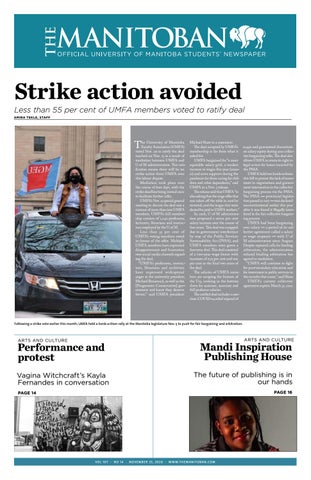
Following a strike vote earlier this month, UMFA held a honk-a-thon rally at the Manitoba legislature Nov. 5 to push for fair bargaining and arbitration.
Sweeping changes coming to UMSU board
Adjustments expected before year’s end
CAM CANNON, STAFF
Over the last few months, UMSU’s governance committee has been working on developing and proposing changes to UMSU’s governance structure as a part of efforts started by last year’s UMSU board of directors, which saw UMSU commission a report from Susan Rogers of Rogers Leadership Consulting.
According to UMSU vicepresident finance and operations Brendan Scott, the changes are being implemented later than planned as the process was interrupted by the COVID-19 pandemic.
“The governance [committee] took it upon themselves to kind of take on the recommendations [from Rogers],”
Scott said.
“The biggest thing we wanted to look into was our board structure. While [Rogers] touched on basically every aspect of our organization, to us the board was the biggest thing.”
In 2018, what was then called UMSU council approved a motion to change its name to the UMSU board of directors.
“She said [the board] was too big. Usually, boards are only [roughly] 12 people — ours was 56,” said Scott.
“Ours was a very representative board as in we had people from different councils, and they would represent [the interests of] those councils whereas usually […] the board is just supposed to vote on what’s best for
the union.”
Other concerns raised by Rogers included problems posed by the annual turnover of the board, problems with the potential need to train 56 board members every year and problems arising from having a board which isn’t “very engaged” — according to Scott, there has rarely been greater than 70 per cent of the board attending any given meeting.
So far, the UMSU board of directors has passed three motions instructing the governance committee — the committee handling the work of proposing and implementing the changes — on which changes are to be made.
Motion 0492 tasked the governance committee with implementing the abolition of the use of slates in UMSU elections — once implemented, all candidates running in UMSU elections must do so independently.
Motion 0495 tasked the governance committee with implementing a number of structural changes to the board, including the reduction of board membership to 11 directors to be elected in the week following the elections of UMSU representatives and executives. There will also be new rules capping permitted absences from board meetings for members
to five in a year or three consecutive meetings as well as the banning of proxies attending meetings on behalf of board members.
The implementation of motion 0495 also means that UMSU community and council representatives will no longer have voting rights in board meetings, but will be “encouraged to come, weigh in on debate, present, report to the board and report back to their respective councils,” as per the document outlining the changes
“The board is just supposed to vote on what’s best for the union” — Brendan Scott, UMSU vicepresident finance and operations
to be made.
“The only difference is that at the end of the day, when it comes time to vote, it’s based on the 11 people that have been voted in [as directors],” said Scott.
With the passing of motion 0496,
the governance committee is also responsible for the creation of a new position on the board, a Black students’ representative.
This motion was the product of collaboration between the University of Manitoba Black Students’ Union (UMBSU) and UMSU. The UMBSU will be appointing an interim representative once the position is created.
Scott said he expects the changes to be implemented before the end of the year, prior to the next round of UMSU elections.
Future changes, according to Scott, will be focused on making the division between governance and operational duties more clearly defined — figuring out what duties are in the purview of elected representatives and which should be handled exclusively by UMSU staff.
“If [the governance committee] can kind of just really go hard, for lack of a better term, we’d be able to change everything this year […] the problem is with all the writing of the actual bylaws […] that’s the slow part,” he said.
“For sure the board structure can get changed this year, and I’d actually see it as a failure if I didn’t get it done before January.”
Faculty of engineering appoints first-ever female dean
Marcia Friesen aims to grow enrolment and diversity in faculty
GILLIAN BROWN, STAFF
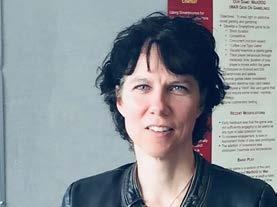
Marcia Friesen is paving a new road in the Price Faculty of Engineering as its first female dean.
Even though female enrolment has increased since Friesen’s time as a student in the faculty, she said that the faculty still has a way to go when it comes to diversity and representation in the different specializations that the faculty offers.
“When I think about my own experiences in engineering, I have to say that, although at times there were instances of true discrimination, I would say that a lot of what I felt was not necessarily outright discrimination or bias, but rather, just an
ongoing sense that I didn’t necessarily see myself in the faculty as an undergraduate student,” she said.
In the past 30 years, Friesen has been able to act as a role model to female engineering students through her career in engineering, education and activism.
After working for different engineering companies in Manitoba, she went on to receive a doctorate in biosystems engineering and currently works in the faculty as associate dean (design education).
At the university, she served for 14 years as director of the faculty’s Internationally Educated Engineers
Qualification (IEEQ) program, where recent immigrants holding engineering degrees outside of Canada would be able to certify to work in Manitoba.
Part of what Friesen aims to do as dean is grow enrolment and to
“No matter what your interests are, there very likely is a place for you to foster that interest in engineering”
— Marcia Friesen, faculty of engineering associate dean (design education)
“reach groups that typically haven’t been represented in our programs.”
Friesen begins her term amid a pandemic, and the second part of her aim is to make sure that staff and students feel supported both academi-
cally and personally through their education and research efforts.
Previously, Friesen worked as a director for the Canadian Engineering Memorial Foundation, a foundation that worked to support female engineering students across Canada financially while completing their undergraduate and doctoral degrees through scholarship awards.
In more national efforts to increase female representation in the field, she has been involved in Engineers Canada’s 30 by 30 campaign and initiative to increase the percentage of female engineers to 30 per cent of all engineers by 2030.
As of Dec. 31, 2019, 17.3 per cent of all newly licensed engineers in Manitoba were women.
At the U of M, 23 per cent of undergraduate students and 30 per cent of graduate students are female.
According to Engineers Canada, “30 per cent is usually held as the tipping point for sustainable change.”
Friesen said she believes that to increase enrolment among both gender and racial minorities, the faculty needs to “ensure that we do a better job in showing the society around us all the different opportunities that exist in engineering.”
“No matter what your interests are, there very likely is a place for you to
foster that interest in engineering.”
Not only is having more female representation in the faculty a step forward for women, but according to Justice for Women president Marni Russell, “it’s also good for males to see as well.”
“It creates an environment [of] more respect for women in a position of authority, specifically in these traditionally male-dominated positions.”
Michéle Rochette, executive member of the Women of Manitoba Engineering Network (WOMEN) is currently completing her master’s in civil engineering.
She noted the importance of having female representation in the faculty for “hopefully inspiring younger generations.”
As a student, “we want to see people who look like us to know that we can do it, and [we want to see] people that we relate to.”
PHOTO BY MEGAN COLWELL
PHOTO PROVIDED BY MARCIA FRIESEN
History prof awarded for Chinese community outreach
Why understanding different experiences is key to creating lasting relationships
SARAH DORAN, STAFF
University of Manitoba history professor and department head Tina Mai Chen was announced as the recipient of the 2019-20 Dr. and Mrs. Ralph Campbell Award for community outreach on Nov. 10. The award is presented annually to a U of M staff member who has shown “particularly meritorious service in outreach activities” as nominated by staff, alumni and members of the university.
Chen became involved in Winnipeg’s Chinese community almost immediately upon starting her job at the U of M in 1999. She credits the late Joseph Du and former lieutenant governor Philip Lee as mentors, whose openness to new ideas and devotion to community relationships were pivotal to her understanding of what outreach could be.
In her time here, Chen has served as ambassador general for Folklorama, been on committees for the Canadian Museum for Human Rights and promoted discussions between different local ethnocultural populations.
She also helped co-ordinate the centennial of Winnipeg’s Chinatown in 2009 and chairs a yearly street
festival.
“The street festival is not only about the event itself, which is fun and we love it, but I think for me I’ve really just grown to embrace the way that the planning, through it I can learn so much more about what’s happening and people’s experiences here,”
Chen said.
Those experiences are remarkably diverse across the city and province.
“In many ways, the Chinese community is premised upon a kind of both intergenerational and, I would say, a kind of multicultural basis,”
Chen explained.
“We’re a community where certainly there isn’t an assumption of ethnic identity as the basis of belonging to the Chinese community, nor is there a privileging of any one language position or place of origin.
“The Chinese community, in particular the Winnipeg Chinese Community and Cultural Centre, has been built upon a recognition that those who identify as Chinese in Canada, in Manitoba, come from a variety of places, they speak a variety of languages and there are these different waves of immigration, whether
it’s been from mainland China, from Taiwan, from Hong Kong, from what we now call Vietnam, at these different moments, and the experiences are really different.”
Noticing variations in community experiences is far from a casual interest. Chen’s academic work is in intellectual history — understanding how ideas gain power and mobility, and how people use them for various purposes — with a historical focus on modern China and its relations with Soviet Russia.
“The types of questions that motivate me in research have to do with the ways in which people understand themselves as having a place within society,” she explained.
“Everyday interactions and cultural processes have the potential to either empower people to see things differently, or they have the possibility to limit the realms of expression and therefore the possibilities for changing social relations, power relations.”
A current example is increased anti-Asian racism as the COVID-19 pandemic continues to disrupt the world.
Chen was part of a broad dis-
cussion of what that meant for her community and connections with discrimination faced by other groups.
“I was participating both in dialogues across Asian communities [and] into the broader public dis-
“There’s always that kind of local particularity, which I’ve come to really appreciate” — Tina Mai Chen, professor
course of saying, ‘Here’s the issues we see at hand,’” she said.
“How do we actually intervene, or understand this as the way that fear opens up spaces for expression of antiAsian racism?
“I think that most of us in the community also wanted to argue the message, though, that it wasn’t that [COVID-19] created anti-Asian racism, but it sanctioned people’s expression of it.”
Still, the amount of enthusiasm and drive people of all ages in Winnipeg’s Chinese community have for celebrating who they are and what their city means to them is inspiring to Chen.
“There’s always that kind of local particularity, which I’ve come to really appreciate,” she said.
“Certainly within Winnipeg, doing that kind of work allows a much greater appreciation of the different moments of immigration into Winnipeg of Chinese communities, of the different ways in which they relate to the space of Chinatown and even their different experiences of what it means to be Chinese in Manitoba and Winnipeg.”
Chen is a mainstay in Winnipeg’s Chinese community, but she relishes her role as a participant in the community rather than an acknowledged leader.
“I gain probably more from any of the outreach that anybody [else] gains from having me around.”
PHOTO PROVIDED BY TINA MAI CHEN
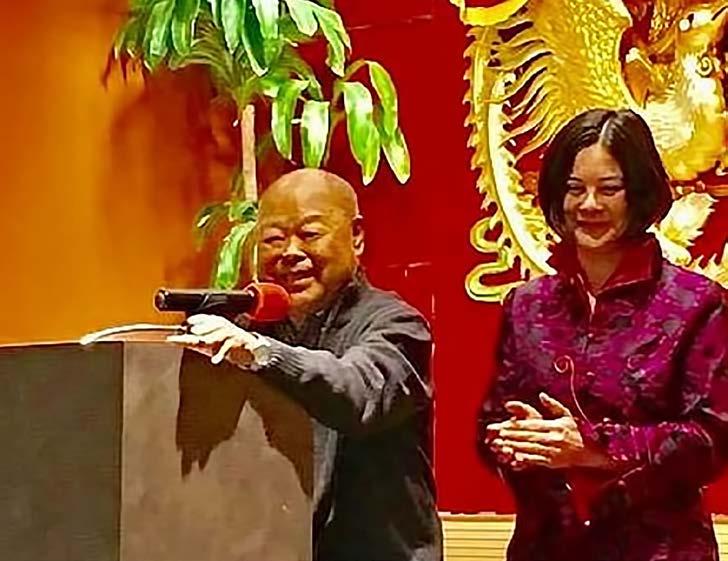
Tina Mai Chen (right), pictured above with Joseph Du, was recognized earlier this month for her community involvement.
Student academic groups keeping community alive
Zoom events, social media play big role in staying connected
SARAH DORAN, STAFF
During a year of entirely remote learning, maintaining a sense of connection with the university community is much more complicated than usual. The University of Manitoba’s academic student groups have taken it upon themselves to keep students in touch with others in their faculty, but it definitely has not been easy.
For example, some executives had no idea what they were getting into when they were elected.
Nick Noonan, the president of the Manitoba Law Students’ Association (MLSA), was elected just before the pandemic started wreaking havoc in Manitoba.
“It’s tradition for the previous president to pass on a handover package of notes, thoughts, challenges, goals and things on your radar as the next president,” he said.
“In mine, which I received in early March, I remember my predecessor noted, ‘And your challenges as a leader might even include this crazy COVID-19 thing if it persists.’ The craziest part to me, though, isn’t that she had the foresight to recognize that [COVID-19] might be a concern — it’s that I vividly remember reading that and scoffing, thinking that there was no way that [COVID-19] would be a concern through the summer, let alone into the school year.
“Oh, for the innocence of early March.”
Other groups finalized their executives over the summer or in the fall, with a better idea of the challenges they would face. Still, they all agreed not being able to see their classmates and professors in person puts a damper on the university experience.
President of the Biological Sciences Graduate Student Association (BSGSA) Tommy Pontbriand said the isolation is particularly difficult for graduate stu-
dents because even virtual academic interaction is now almost entirely limited to their lab cohort, which makes it hard to feel like part of a larger department.
“You cannot just put [...] 30 people on Zoom and hope that they’re going to connect as much as they would do in person,” he said.
“I think it’s just the interconnections between the different research groups that is just not as present, and it’s such a shame because it’s such a fun part.”
For the U of M Engineering Society (UMES), the biggest loss by far was their faculty-specific orientation, lovingly dubbed EngO. Every year, the committee begins planning in May, and senior stick Braden Ganetsky said the 15-hour event is the group’s second-biggest event for the entire year on the budget.
While there was an online EngO in September, the in-person event is such a strong bonding experience for engineering students that UMES decided it wasn’t enough.
“At this point, actually, we are planning on having a double EngO next year, because to us it is such an important event that we can’t let people miss that,” Ganetsky said.
“We are still going to remember to not just have that whole experience just put to the side. We want to make sure that all our frosh end up experiencing that at some point, even though they didn’t this year.”
Nevertheless, online interaction isn’t all bad. Whether on Slack, Discord or Facebook group chats, students are making the effort to stay in touch, and everything from themed movie nights to impromptu video game sessions goes a long way toward recapturing the feeling of community. Alanna Johnson and Katharine Kalinowski, co-presidents of the Graduate Association
of Students of Psychology (GASP), said while planning events is more difficult during the pandemic, it is also more rewarding.
“I think in some ways there’s less competition for fun events that are happening right now,” Johnson said.
“Normally in a busy fall term, there would be tons of different things competing for our time, so in some ways just having less going on generally I think encourages people to come together.”
“I find that now I crave social interaction so much, so when these events are available — oh my goodness, I can interact with people!” Kalinowski agreed.
Some groups have held or are planning to hold Bob Ross-style art nights over Zoom as a relaxing, non-academic activity. In fact, GASP used part of their budget to purchase and deliver paint supplies for their participants.
“The turnout was better than most in-person events that we’ve had, and just to be able to sit down with a group of people just felt so comforting to me,” Kalinowski said.
“I’m like, ‘OK, these are people that I can socialize with that are here to support me.’ It was just a very inclusive experience.”
Two of the graduate student groups in particular have also focused on keeping students active. GASP is planning a virtual Zumba class in December and the MLSA is currently running a Robson Hall fitness challenge.
“It’s been a great way to help people stay active, build community and has even led to some friendly competition,” Noonan said.
“I’m presently beating acting dean David Asper, and while he is arguing that there should be some sort of a modifier for age, I’m not going to let him forget it.”
Meanwhile, the U of M Anthropology Student Association (UMASA) has taken advantage of the pandemic to make new connections outside the university.
Communications director Bailey Palamar co-ordinated and presented a virtual tour of the St. Boniface Museum, which drew not only anthropology students, but also a smattering from other departments.
Steven Smeltz, the social and fundraising director, said seeing diverse academic areas is exciting for UMASA.
“The increased collaboration with
“There’s a sense of camaraderie that wasn’t there before”
— Alanna Johnson, GASP co-president
other student groups has definitely been the greatest benefit by far,” he said.
“Working with the University of Manitoba’s history association has been great for trying to organize a collaborative trivia night, probably in January. Then we’ve also reached out a lot more to the University of Winnipeg’s anthropology association, which I don’t know if we would have done otherwise.”
The BSGSA is in a similar position of finding unexpected benefits in virtual events, with opportunities popping up that previously would have been impossible.
“We organize big guest lectures usually, and so having it online we have actually [much] less restrictions,” Pontbriand said.
“Usually what we would do [is] we
would send out nominations for those guest lectures, but we were limited because we were taking the money from the student association to fly the speakers to come, and for them [to stay] in a hotel or something.
“So usually we’re keeping [to] people that were not too far, but now that it’s online on Zoom, the sky is the limit. We can decide to have any guest speaker if they’re up for it.”
Most importantly, however, knowing everyone else is in the same situation has made people more enthusiastic about interacting with people they may previously have taken for granted. Ganetsky is proud of the UMES Discord channel, where nervous freshmen and seasoned fifth-year students alike can hang out as friends, and Pontbriand enjoys the BSGSA’s weekly “Crackerjack” seminars in which students and faculty gather to listen to practice thesis presentations and other short talks.
“It’s a little bit of an equalizer,” Johnson explained.
“As students, we’re all going through something that we can each understand even though it looks a little bit differently for each person […] There’s a sense of camaraderie that wasn’t there before. Even some of the staff and faculty have reflected the same things — [we’re] seeing some of them come to the events because they really are craving that interaction with students.”
These students have put in a lot of hard work to help their peers feel like part of a community, and they aren’t done yet. Despite the challenges remote learning has thrown at them, all the groups expressed pride in their executives’ ability to adapt.
Noonan put it best: “As a great saying I once heard goes, ‘Thank you for flying the plane with me whilst building it together.’”
GRAPHIC BY JENELLE MCCANN
Contact: features@themanitoban.com / 474.6520
A journey to junior epidemiologist
Grad student
Margot Henry shares her experience with the science co-op program
CAM CANNON, STAFF
Margot Henry started her postsecondary academic career studying biology at the University of Winnipeg while playing as a goalkeeper on the school’s women’s soccer team.
A few years and a few degree changes later, she holds a bachelor’s degree in statistics from the U of M, is pursing her master’s degree and is working as a junior epidemiologist amid the greatest pandemic the world has seen in a century.
Henry began her work with Manitoba Health last May as a junior epidemiologist.
She credited the job opportunity to the University of Manitoba’s science co-op program.
The science co-op program at the University of Manitoba is a program
which students generally apply for in their second year of undergraduate studies.
Students accepted to the program are then able to get paid work experience in their fields as part of their degrees.
Initially, Henry had come to the U of M to pursue genetics.
“While taking genetics classes, you have to take quite a bit of stuff.
[I found] I really enjoyed the stats classes.”
“So, I just dropped everything else and took only stats.”
According to Henry, her position at Manitoba Health “was very disease, biology-related and stats-related.”
“I didn’t know what really I wanted to do, but luckily I did have some [biology] under my belt because I
started off that way, so why not just try some bio-stats?” she said.
Since May 2019, Henry has worked as a junior epidemiologist full-time in the summer and parttime during the academic year.
Now, she added, the position is “kind of full-time now, because it’s a pandemic. They need you.”
“Right now, everything is COVID-19-related.”
Henry works to produce reports that look at the numbers and risk factors of different demographics in the province.
“For example […] looking at the age groups getting COVID-19, which age groups are more affected, how we can stop this specific age group from getting it.”
Henry has also been working on reports on unintentional outcomes related to COVID-19.
“We’re looking at not just COVID, but everything else in Manitoba that could’ve changed because of that.”
Her reports consider doctor and ER visits along with mental health and substance usage.
On top of that work, Henry is also set to have a study published in a journal for the first time in her career.
“At the beginning of the summer, [my supervisor and I] decided to do a survival analysis on the risk factors
Anti-masker rally at legislature
ALEXANDER DECEBAL-CUZA, STAFF
associated with the hospitalization outcomes due to COVID-19,” she said.
The study is expected to be published in the journal Health Promotion and Chronic Disease Prevention in Canada: Research, Policy and Practice which is an official publication of the Public Health Agency of Canada.
On the topic of stress factors and problems in the face of the COVID19 pandemic, Henry said, “the bigger stressor for me with the [COVID-19] pandemic is school.”
“The work, I can do from home. School from home?
“That one’s a pain.”
For Henry, one of the greater challenges she’s facing amid the pandemic is communication with her team while working remotely, and “making sure everyone’s on the same page and we’re all working properly on the same project.
“I’m sure half of Manitoba is having that challenge.”
She expressed her frustrations regarding the public’s responses to provincial safety recommendations.
“I wish everyone would listen to public health orders, but you can’t force people to do something they don’t want to do,” she said.
“I just wish people listened.”
U of M COVID-19 update
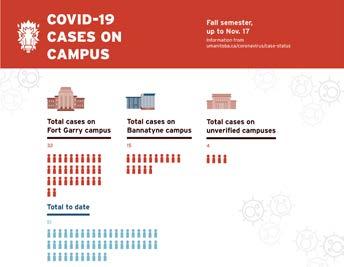
Cases of COVID-19 are increasing across Manitoba, and U of M campuses are no exception.
As of press time Monday evening, there are 51 total reported cases spanning from the beginning of the academic year to Nov. 17, the latest reported date. From Nov. 10 to 17, four positive cases were confirmed by Manitoba Public Health on the Fort Garry campus and two were confirmed on the Bannatyne campus, creating a total of six active cases for the week.
According to Todd Mondor, chair of the university COVID19 recovery steering committee, there have been no outbreaks on campus, in classrooms or in laboratories and almost all cases were contracted off-campus.
“I think it’s a reflection of the city and province situation,” he said, drawing attention to the fact that the majority of students fall into the age demographic of 19 to 34, the age bracket that currently holds the highest number of positive COVID-19 cases in Manitoba.
“They’re seeing increased levels particularly in that demographic, whether it’s at the [U of M] or not.”
U of M health and safety regulations are as recommended by the COVID-19 recovery steering committee and Manitoba Health to the university’s president and vice-presidents.
Mondor said these recommendations also include conduct of in-person activities. He also confirmed that, like this semester, some winter courses will be taught in person.
The safety requirements on campus are updated by the steering committee as needed.
The current safety measures on campus require all visitors to wear a three-ply disposable mask while visiting. All recreation facilities are closed and it is asked that visitors limit their time on campus.
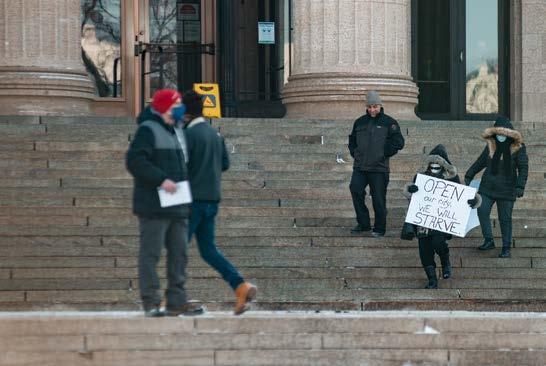
In response to increased restictions in light of rising COVID-19 cases in the province, people gathered in protest at the legislature Nov. 21.
GILLIAN BROWN, STAFF
PHOTO PROVIDED BY MARGOT HENRY
Editor-In-Chief:
EDITOR-IN-CHIEF Matthew Doering editor@themanitoban.com
BUSINESS MANAGER Alice Teufack accounts@themanitoban.com
ADVERTISING CO-ORDINATOR Diego Castro ads@themanitoban.com
EDITORIAL
MANAGING EDITOR Ty Brass me@themanitoban.com
NEWS EDITOR Amira Tekle amira@themanitoban.com
NEWS EDITOR Gillian Brown gillian@themanitoban.com
COMMENT EDITOR Lucas Edmond comment@themanitoban.com
ARTS AND CULTURE EDITOR Shaylyn MaharajPoliah arts@themanitoban.com
SOCIAL MEDIA EDITOR Colin Ijebor social@themanitoban.com
REPORTERS & ASSOCIATES
NEWS REPORTER Cameron Cannon
NEWS REPORTER Damien Davis
ARTS AND CULTURE REPORTER Kaelen Bell
ARTS AND CULTURE REPORTER Zoë LeBrun
COLUMNIST Matthew Averbeck
DESIGN ASSOCIATE Mikaela Warkentin
PHOTO ASSOCIATE Basel Abdelaziz
SOCIAL MEDIA ASSOCIATE Jalene Moman
VIDEO ASSOCIATE Arsalan Saeed
AUDIO ASSOCIATE Tawana Matizanadzo
GRAPHICS ASSOCIATE Dallin Chicoine
COPY ASSOCIATE Aldin Sabic
SPORTS REPORTER Matthew Merkel
VOLUNTEER CONTRIBUTORS
A “volunteer staff” member is defined as a person who has had three volunteer articles, photographs, or pieces of art of reasonable length and/or substance published in the current publishing year of the Manitoban. Any individual who qualifies must be voted in by a majority vote at a Manitoban editorial board meeting. Elected representatives and non-students may be excluded from holding votes as volunteer staff members in accordance with the Manitoban Constitution.
Religious freedom and pluralism should be upheld by a secular state, not barred by it
STAFF
Acourtappeal of Bill 21 in Quebec started Nov. 2. A group of civil rights activists and religious advocates are trying to repeal what they view as a unconstitutional infringement of their civil liberties.
Bill 21 is a Quebec law passed in 2019. It bans public sector workers from wearing symbols of their religion in the workplace. It exhibits clear bias against populations that often wear more visible symbols in order to adhere to the tenets of their faith — like a hijab, a turban or a kippah.
The bill seeks to create a state of secularism and equality in Quebec. However, although it appears to put people on equal footing, in reality it does the exact opposite for some members of its society. Secularism does not mean abolish all symbols of religion, but rather the separation of religion from state practice and influence.
Although appearing to be separated from religiosity, secularism is as much of a belief system as any other religion. The government of Quebec is forcefully imposing its own worldview on its citizens as it seeks to diminish the worldviews of others.
As an ardent supporter of the secular state, I believe this is the wrong approach and that it masks prejudice with the appearance of equality by disadvantaging and ostracizing many Muslim, Jewish and Sikh Quebecers.
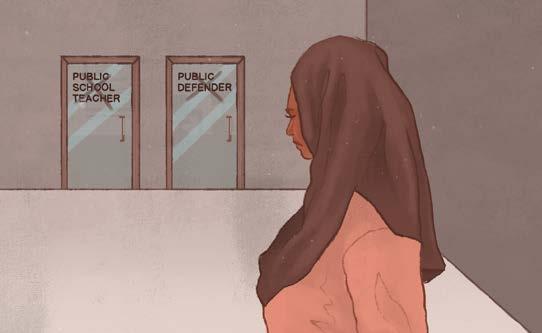
A person wearing a hijab working as a public school teacher, for example, should not be considered a threat to secularism. These symbols of faith should not be a violation of a workplace dress code, never mind a provincial law.
In a country where everyone is supposedly afforded the right to freedom of conscience and religion by Canada’s constitution, this attack on basic freedoms should be enthusiastically rejected by our lawmakers and legislators. Under the Canadian Charter of Rights and Freedoms, Canadians’ freedom of religion is codified as the right to practice and teach religion without fear of incrimination.
Bill 21 utilizes the notwithstanding clause, legally referred to as section 33 of the Canadian Charter of Rights and Freedoms, that allows the Quebec government to avoid charter challenges of the bill for up to five years. The bill has, and continues to face, numerous legal challenges.
Due to Bill 21, religious freedom and religious pluralism in Canada is in grave danger.
Prime Minister Justin Trudeau summed it up succinctly, saying in 2019 that it is “unthinkable” to legislate state-sanctioned discrimination of religious beliefs in a supposedly democratic society.
All Canadians should be able to enjoy a right to wear a symbol of their religion without losing
In a country where everyone is supposedly afforded the right to freedom of conscience and religion by Canada’s constitution, this attack on basic freedoms should be enthusiastically rejected by our lawmakers and legislators
out on opportunities such as working in public service. These individuals should not have to sacrifice their religious convictions to do so.
When asked about the risk of people being barred from employment or losing their jobs due to Bill 21, Quebec Premier François Legault, leader of the Coalition Avenir Quebec, said “there are other jobs available.”
This callous comment is only one reason why religious minorities in Quebec may feel ostracized and unwelcome in their own province.
There are many people in Quebec who may have had dreams of working as a public school teacher, public defender, prosecutor, judge or police officer.
As a result of Bill 21, many individuals who wish to continue practicing the tenets of their faith may have to change their education and career paths to accommodate the prejudice that has been enacted upon them. Those who currently work as teachers, and do not comply to the bills demands, cannot be promoted or move school boards under a grandfather clause in the
legislation.
Government should not be imposing laws that will ultimately quell diversity in the public sector. Further, government should not be legitimizing discrimination in employment. This law is an instrument of division.
State-sponsored religious discrimination such as this will only serve to justify and fuel xenophobia and racism.
Bill 21 also exposes the disarray that Canadian secularism and religious freedom finds itself in. Huge policy differences between provinces makes it difficult to see the point of the Charter of Rights and Freedoms, seeing as the freedoms the document outlines should be universally adhered to.
For example, in three provinces — Ontario, Alberta and Saskatchewan — the only faithbased schools that receive full funding from the public purse are Catholic schools. These provinces endorse Catholic schools as though Catholicism were worthy of full government funding while simultaneously neglecting other religions.
In Manitoba, Catholic, and all other faithbased schools, are private, independent institutions. As such, they receive no capital funding from the province. Instead, religious schools receive funding that is determined by their compliance with the rules set out for private schools within the Public Schools Act.
No faith-based schools should be receiving full public funding, full stop. This is especially true given the unjust, inequitable treatment of different faiths in this country.
The full funding of Catholic schools in some provinces begs the question as to why basic religious freedoms are not being respected in Quebec.
It exposes a fundamental inconsistency in how religious freedoms are treated and respected in Canada.
When it comes to Christianity, it seems provinces are less threatened by a lack of secularity. But when religions such as Islam or Sikhism are publicly visible, the state acts to repress their religious expressions.
The state-sponsored religious discrimination that is being upheld by the Quebec government is shameful. No person should be barred from wearing a symbol of the religion they practice in their workplace. Secularism is a worthy cause,
AMIRA TEKLE,
GRAPHIC BY JENELLE MCCANN
Dear 2020 Holiday Hamper Program Sponsors,
Due to COVID-19, we are seeking monetary donations for students in need during the 2020 holiday season. All our sponsors will be recognized and thanked in at least one social media post for their contributions to the program.
If you are interested in donating, have any questions, or need more information please email: scoulthard@umsu.ca
Comment Editor: Lucas Edmond Contact: comment@themanitoban.com
Workers have sacrificed too much, tax the
wealthy
Progressive tax plans and public expenditure has historically dug economies out of crises
LUCAS EDMOND, STAFF
Canada’s New Democratic Party (NDP) proposed a new wealth tax plan in parliament Nov. 16. The plan was to implement a one per cent tax on peoples’ wealth that exceeds $20 million. The NDP also advocated for a plan to tax capital gains at a higher rate, which now sits at 50 per cent.
Unfortunately, the Liberal Party of Canada (LPC), Conservative Party of Canada (CPC) and the Bloc Québécois (BQ) formed a united front to block the motion in parliament despite the fact that an overwhelming majority of Canadians support the NDP’s proposal.
According to a poll done by Broadbent Institute, a Canadian think tank, roughly 91 per cent of NDP voters, 70 per cent of CPC voters, 87 per cent of LPC voters and 66 per cent of BQ voters are in favour of taxing the rich to pay for Canada’s economic recovery. Yet, only the NDP and Green Party of Canada voted in favour of the motion.
This should be considered a tragedy to Canada’s so-called representative democracy — very rarely are policies so universally favoured in such a bipartisan way. And historically, high taxes on the wealthy was not abnormal. However, there is an explanation as to why these political parties chose to align themselves with the wealthy instead of the democratic consensus of Canadians.
In post-Second World War society, the rich were used to paying higher tax rates than other socioeconomic statuses. As a matter of fact, by 1948, individuals making more than $250,000 annually — $2.37 million in today’s standards — were taxed roughly 80 per cent on their incomes. Now, the highest tax bracket is roughly 33 per cent for individuals making over approximately $215,000 — this includes all taxable incomes from $215,000 and up.
Accompanied by extremely high involvement of the government in public spending, employment and taxation on the wealthy, this period witnessed unprecedented growth without an economic crisis for nearly 30 years — a massive feat for an economic system that had a reputation of collapsing after coming out of the Great Depression. This type of economics, formally called the Keynesian economic consensus, managed to dig a world decimated by decades of gruesome crises into a period that experts often refer to as the “Golden Age of Capitalism.”
Economists and government technocrats thought they figured out the perfect balance between government and capitalist enterprise — Keynesianism was the best thing since sliced bread. Their strategy was to spend before they saved, rely on high inflation with high growth and increase wages to the liking. The pri-
vate sector was following the lead of a dynamic public sector and their high wages. More of the pie was being divided for the working classes, and the ultra-rich were paying for it.
This should be considered a tragedy to Canada’s so-called representative democracy — very rarely are policies so universally favoured in such a bipartisan way
But, in recent decades, there has been a markedly noticeable tendency of government bodies to advocate for cutting, privatizing and deregulating the public sector, instead of spending, investing and expanding the role of government. So, what happened?
Many historians have argued that the rapid change of global governments’ attitudes in spending was directly correlated to a political coup that the rich subtly made on the very institutions that kept their profits in check. Notably, the mechanisms that kept the international liquidity of the
rich’s capital flow restrained.
The mechanisms enforced by the international Bretton Woods financial systems required investors to go through a lengthy application process in order to pull their money out of any given national economy. But, through political lobbying, gradual reform and watered-down legislation, these mechanisms were deteriorated in North America and, later, globally.
Now, investors are able to move their money around, pretty well and as they please. This means that governments’ interests are not simply aligned with its citizens — instead, governments must compete for capital investment with other nations.
If governments adopt unwanted legislation that reduces the profits of investor, those investors could simply pull those investments and leave the economy in disarray. In a way, large corporations and the very rich act as a “virtual senate” that can strike down legislation in unrelenting fashions. This is largely why many governments choose to adopt policy to attract private direct investment as opposed to taxing and redistributing wealth through public infrastructures.
But, like the post-war world, Canadians are going to need a progressive tax plan again. The COVID-19 pandemic has impoverished thousands, and thousands more are likely toeing the poverty line. Simultaneously, however, the
wealthy seem to be making more than ever.
The government has gone billions of dollars into deficit. The Parliamentary Budget Officer, a public financial advisory office, predicted in April that the deficit left from 2020-21 will be roughly $252 billion. Currently, the deficit is sitting at approximately $343 billion — over $100 billion more than one of the government’s key financial institutions predicted. And, given the unpredictability of the COVID-19 pandemic, expect the deficit to grow further.
The current debt situation is a striking seeing as the Canadian government ran a $25 billion deficit in 2019-20. If Canada’s parliament rejects a tax plan to raise taxes on the wealthy, the majority of Canadians will likely pay for the crisis in the form of austerity — a move that could impoverish more Canadians.
Expecting everyday people — who are struggling to get by during this unprecedented crisis — to pay for the economic devastation of COVID-19 will not do.
Wealthy individuals making inordinate gains while the majority of Canadians continue to make sacrifices for namesake public health is deplorable. Make the rich pay their fair share. Make the rich sacrifice, just as the rest of us have. It has been done before, and it is not a radical idea.
GRAPHIC BY DALLIN CHICOINE
Anti-mask protests are misguided, irrevocably damaging
Protests highlight the need for stronger regulation to reduce misinformation
MATTHEW AVERBECK, STAFF
With COVID-19 cases in Manitoba currently spiking and increased restrictions being imposed by the provincial government, it has been a challenging time for many Manitobans as we all prepare to attempt to navigate a difficult winter. Most of us are complying with the emergency orders and trying our best to keep ourselves and people around us safe.
However, there is a small portion of the population that is attempting to subvert government authorities — a portion that seems to believe COVID-19 is not as serious as scientists and public health officials warn.
On Nov. 14, news of a “Hugs over Masks” protest in the city of Steinbach, Man. filled media outlets. A group of roughly 200 people from around the area flooded the small city to protest the government’s mask mandate and other code-red restrictions. All this despite the current limit of gathering sizes.
As of Nov. 22, the southern health region — which includes Steinbach — has over 1,000 active COVID-19 cases and 37 deaths. This is shockingly
bad considering the region only has 204,274 residents.
Many of the protesters, of course, did not social distance or wear masks, thereby putting themselves, their families and the entire community at risk of exposure.
Attendees carried signs that espoused debunked conspiracy theories that have been prevalent on social media over the last few months.
The RCMP was in attendance to apparently “keep the peace,” but by and large, did not hand out fines.
Premier Brian Pallister said this week that fines would potentially be sent in the mail to attendees based on license plates seen at the protest, but it’s questionable how many fines will actually be issued. Instead, this may be an empty threat to appear as though the government is being stern with regulations.
It is shocking and disheartening to see so many Manitobans protesting government restrictions — especially considering that after eight months, the novel coronavirus has killed more than 200 Manitobans.
It seems social media has a large
role to play in the demonstrations. Misinformation has been spreading like wildfire across the country.
In August, Canadian researchers warned that this misinformation could lead to Canadians putting themselves and others at risk.
In fact, these researchers found that the more someone relied on social media to obtain information about COVID-19, the more likely the same individuals would believe conspiracy theories about it.
Many Canadians, especially younger people, rely on social media for news.
In another study, researchers found that nearly half of Canadians believed at least one conspiracy theory about COVID-19.
Misinformation, by design, is meant to confirm our own biases or beliefs. Sometimes it’s obvious that something shared by a family member or former classmate is false information, but research has shown that when something shared aligns with our own beliefs, we are much less likely to question the integrity of the source. In other words, no one is
immune from this.
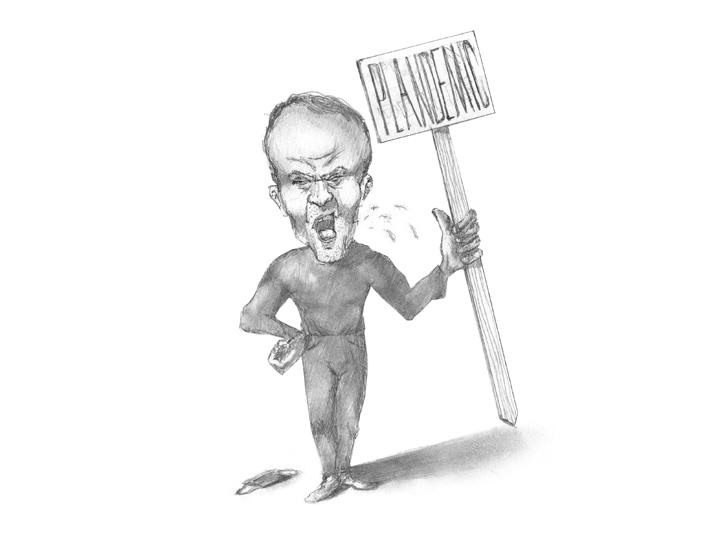
For anti-mask protesters, when they see a video such as Plandemic, or posts that claim that most of the COVID-19 deaths are due to other underlying health conditions instead of COVID-19, it confirms their beliefs that the government is lying and that their lives should not be
Misinformation, by design, is meant to confirm our own biases or beliefs
upended by the precautions in place.
However, these protesters should not be given a free pass just because they are being manipulated by bad actors on social media. Everyone has the capacity and agency to think rationally and question the sources they see.
Although individuals have the
agency to problem solve, social media companies such as Facebook must do better at finding and removing misinformation from their platforms.
While these companies have claimed that they have been quick to act on disingenuous information about the novel coronavirus, one study found that nearly 90 per cent of reported posts were still visible with no warnings or fact-check notifications attached.
Even though it’s hard to understand how people could believe such conspiracies, there are many Canadians who do and it is starting to affect communities.
The provincial government must implement stronger enforcement during these protests. Anti-maskers are putting Manitobans at risk, and fines should be given out immediately in order to deter needless exposures.
The next few months will undoubtedly test each and every one of us, but as Manitobans see the light at the end of the tunnel with vaccine approvals nearing, we must do everything we can to protect ourselves and our communities.
GRAPHIC
Comment Editor: Lucas Edmond
From back of the merch table to front of the stage
Vagina Witchcraft vocalist describes the band’s beginnings and what metal means to them
KAELEN BELL, STAFF
Nearly everyone, at some point, dreams of becoming a rock star. Or, perhaps not a rock star but a supermodel, an acclaimed actor or a comedian — plucked off the street or pulled onstage, a bit of cosmic serendipity suddenly shoving you into what you were always secretly meant to be.
Kayla Fernandes knows this origin story well — it was the first night of 2018’s Manitoba Metalfest and they were front row for the Cancer Bats at the Park Theatre when vocalist Liam Cormier’s hand reached out into the crowd.
“I’ve always wanted to do something with music, I just didn’t know that I had this inside of myself” — Kayla Fernandes, vocalist
“Liam pulled me up onstage to complete the lyrics to ‘Pneumonia Hawk,’” Fernandes said.
“I can’t even tell you what I was thinking in that moment […] I think
it was the first time in a very long time that my mind went completely blank.”
It was only while working the Metalfest merch table the following day that something began to shift.
People started approaching and suggesting Fernandes start their own band.
“So, I came home very, very stoned and very, very excited and I was ranting and raving to my boyfriend, who is now the guitarist in the band, telling him what had happened,” Fernandes said.
Soon enough, Fernandes received a message from Cancer Bats and Agapito drummer, Mike Peters, inviting the newly formed band — with Fernandes on vocals, Dylan Sellar on guitar, Seppel Saünlust on bass and Julien Riel on drums — to open for them.
The band name came a week before the performance.
“It was completely Dylan’s idea,” Fernandes said. “He was like, ‘Why not Vagina Witchcraft?’ And I was like, ‘That is so stupid, nobody will ever, ever, ever take us seriously. I’m in.’”
And so, Vagina Witchcraft came up from the basement. The band’s inaugural show went by in an anxious, edible-and-excitement induced blur
’Toban turntable
KAELEN
— Fernandes said it felt like things had suddenly fallen into place.
“I’ve always wanted to do something with music, I just didn’t know that I had this inside of myself,” they said. An activist and poet, Fernandes is no stranger to unleashing their power and fury on a crowd — their speech at June’s Justice 4 Black Lives rally was both spoken word performance and call to action, a sort of harbinger for the throat-shredding exorcisms found on Vagina Witchcraft’s debut.
“I feel like the anger that comes from the performance and the anger that goes into the protests are basically one and the same,” they said.
As a Black, queer, gender nonconforming metal fan, Fernandes said that, prior to Vagina Witchcraft, they’d always felt like an outsider in their own scene.
“I’ve had racist comments thrown at me and racist slurs thrown at me at shows when I was in my early twenties,” they said, “but I think that now, presently, everything has really changed regarding my own personal experience.
The band’s ferocious self-titled debut — recorded live at the UMFM studio with engineer David Dobbs — is grounded by Fernandes’s poetry. It’s an excavation of what it means
on the back of your neck stand up: “I am an entity, I am courage, I am
to be queer and Black in 2020, a manifesto for survival and another step toward changing the face of Winnipeg’s metal and punk scene.
“Doom is for everyone, hardcore is for everyone — last time I checked, cis white men don’t have a monopoly on being angry,” Fernandes said.
And though Fernandes has plenty to be angry about, they describe their love for the scene as being about healing as much as it is rage.
love. I am unfinished. I am not your fucking sassy black friend.” Kayla Fernandes’s voice — touched by feedback and echoed by the screams of their audience — builds with rage and hope like gathering storm clouds, piling into the black.
After four-and-a-half minutes of growing tension, the pressure breaks — a shriek of “Black lives matter” catapults over a filthy riff, and the band descends into the grinding “Mercury.”
This is Vagina Witchcraft — vocalist Kayla Fernandes, guitarist Dylan Sellar, bassist Seppel Saünlust and drummer Julien Riel thrashing and pummeling their way through the darkness, primordial doom-metal hardcore purists with a political fire that sets them a thousand scorched miles from their peers.
The band’s brand of pitch-black onslaught is equal parts destructive, swirling fantasy and deeply felt political protest. Fernandes is a Black, queer, gender non-conforming poet and activist, and the fury that they release feels less like theatrical metalhead doom than it does life or death sonic liberation. Every throatshredding scream feels earned and
“I will forever be a fan of doom and hardcore and punk because it helped shape the person that I am and it helped me get through so much in my life and I owe it everything.”
true — a performer exploding open a space for themselves in a scene that, historically, has made little room for them.
The album is a nonstop attack, no gothic piano ballads or moments of quietude to break up the rage — the foursome conjures the lo-fi seething of Converge circa Halo in a Haystack, no studio glimmer or slick effects. The band’s sound is elemental and heaving, a swirling blackness over which Fernandes screams of insecurities and power, of destruction and healing and rage in the name of transcendence.
Each song spreads like sludge over at least four minutes, with the final two epics, “No Sinners” and “ALVVAYS,” raging like wildfire, each over eight minutes of noise.
The glacial force of closer “ALVVAYS” is perhaps the record’s greatest moment, an unrelenting shapeshifter that refuses to let up. Vagina Witchcraft is an electrifying, powerful and painfully relevant debut and it marks the arrival of an undeniable new scream on our city’s metal scene.
sludgy riff, but a missive, spoken with such raw feeling as to make the hair
BELL, STAFF
Vagina Witchcraft’s debut record doesn’t open with a scream or
IMAGE PROVIDED BY VAGINA WITCHCRAFT
IMAGE PROVIDED BY VAGINA WITCHCRAFT
U of M student launches publishing company
A conversation with the founder and owner of Mandi Inspiration Publishing House
ZOË LEBRUN, STAFF
Athird-year student studying global political economy at the University of Manitoba has founded her own independent publishing company.
The Mandi Inspiration Publishing House promises “to be the soul of […] creativity.” The company initially launched in January, with a public release date of Nov. 1. Founder Mandipa Shumba christened the company with two of her own works and has since published two other projects. Shumba does not only publish local work, but also works by overseas authors.
“We are registered here in Winnipeg and in Zimbabwe, but we are looking forward to getting registered in more countries as well,” she said.
Since she is an author herself, Shumba was initially drawn to the world of independent publishing when she was looking into finding ways to publish her own writing. When she saw how expensive it was to self-publish, she realized that there was something she could do to make the publishing process more accessible to others as well.
When deciding whether or not to
go forward with publishing a book, Mandi Inspiration follows a jury-like procedure.
“We have a number of editors […] [and] we have to agree unanimously if we should publish the book,” Shumba said.
“We want to publish things that we all approve of.”
There are two routes that authors
Shumba was initially drawn to the world of independent publishing when she was looking into finding ways to publish her own writing
can go through Mandi Inspiration to publish their work: going through a complete editing process with the publishing house or self-publishing.
“If you give us the rights [to] the book and we publish it for you […]
the whole process is ours,” Shumba said.
“We edit the book, we design the book cover, we print the book, then we see if [the author] want[s] to sell it.”
This process gives the rights to these writings completely to Mandi Inspiration Publishing House, with authors receiving roughly 30 to 40 per cent royalties from all sales.
The self-publishing route is slightly different — this process occurs when an author is looking to print a book with the publishing house that is already written and edited.
“We try to accommodate selfpublishers a lot because traditional publishing is going out of style,” said Shumba.
“Nowadays, everyone wants to do things their own way.”
The Mandi Inspiration Publishing House looks toward other publishers, such as Pearson, for inspiration because Shumba is interested in venturing into education in the future. In Zimbabwe, where Shumba is from, educational publishers don’t have as expansive of a reach as what she would like to see in Africa.
“I really like the idea of having [Mandi Inspiration] be like what
For more information
Pearson has [because] I want education to be more accessible to African children the way it is here to us in Canada,” she said.
on Mandi Inspiration Publishing House, please visit mandiinspiration.com.
Winnipeg comic book creator dishes on his debut series
New comic from U of M alum offers memorable characters and relatable adventures
SHAYLYN MAHARAJ-POLIAH, STAFF
W
hen someone brings up the fantasy genre, what typically comes to mind? Long epics, powerful, righteous heroes and a great evil, often in the form of a dragon.
These tired tropes are exactly what U of M alumnus Braedan Hafichuk is seeking to subvert with his fledgling comic book series Shimmering Basin Hafichuk —originally from Manitoba and currently based out of Saskatoon, Sask. — said the inspiration for the work came from an exhaustion with the traditional sagas and epics that currently monopolize the fantasy section in most bookstores.
“I was just looking for a nice, concise, one-off read that didn’t require
[a] 2000-page commitment for payoff,” said Hafichuk.
“That’s when I started getting the idea for the more character-focused world that Shimmering Basin inhabits.
“Rather than tell the story of musclebound heroes on quests for the fate of the world, I wanted to focus on the backwater parts of the fantasy world, parts that are filled with people more focused on the personal struggles we all face and not the fights of good and evil.”
Hafichuk has always been interested in the fantasy genre — spending many childhood hours playing Dungeons & Dragons, Warhammer and World of Warcraft — and the comic book bug bit him after he picked up
’Toban cornertable
Braedan Hafichuk —
ZOË LEBRUN, STAFF
It’s been a month of firsts for Ominous Walrus Publications, whose debut offering is the first issue of a fantastical action-comedy comic book series by Braedan Hafichuk titled Shimmering Basin. Hafichuk, who has loved fantasy his whole life, began his writing career with a book titled Stalvorhal and has taken what he learned from writing his first book into his newest project.
This independent comic series follows a girl named Shjema (pronounced “shem-uh”) as she moves to her new home of Shimmering Basin and embarks on adventures of a smaller scale than those of traditional fantasy with her new-found friends in this magical town.
In the first issue of Shimmering Basin, we learn more about Shjema’s past, get acquainted with the supporting characters and are introduced to the Kingdom of Harrow.
Compared to the seriousness of some fantasy series, Shimmering Basin
a copy of Amazing Spider-Man #503 in the Walmart checkout line.
“Becoming a comic artist was always my goal as a kid, as I would spend hours doodling my favourite heroes in class and sneaking any opportunity to go to Galaxy Comics after I moved to Winnipeg,” Hafichuk said.
“The love only grew from there as I spent more time at the comic shop, debating stories with the employees while also making critical connections with the independent artists who would set up shop to sell their own books.”
The advice of these individuals was instrumental in the creation of Shimmering Basin. Published earlier this month and primarily produced with a Huion drawing tablet and MediBang Paint, the story follows the adventures of Shjema (pronounced “shem-uh”), a young girl from the fictional Kingdom of Harrow, who finds herself out of her element in the titular small town. After rescuing two of the locals, Hobby and Zackz, she discovers that there is more to her new home than meets the eye.
“The kids who star in Shimmering Basin won’t be fighting evil overlords hellbent on domination,” said Hafichuk, “but will instead experience the triumphs, heartbreaks, romances and fights of childhood, all while coming to terms with the histories and imperfect-but-stillbeautiful humanity of their parents.”
Though Hafichuk is familiar with independent publishing from his first foray into the literary world, 2015’s Stalvorhal, the process for Shimmering
‘Shimmering Basin’
is a lighthearted adventure story that presents an alternative plotline that focuses “on the everyday adventures and lives of the ordinary people often forgotten in those 1,000-page sagas.”
Hafichuk presents us with a fresh take on fantasy and a unique storyline that has the potential to grow and continue for many issues to come
The result from this choice is refreshing — many fantasy series tend to have a certain heaviness to them, whereas Shimmering Basin leaves room for additional visual appeal and humour throughout its story.
Another unique part of Hafichuk’s story is that the main characters in Shimmering Basin are children, meaning that we get to watch these characters grow throughout the series.
As Hafichuk eloquently puts it, this allows us to witness these characters experience “victories and losses, romance and heartbreak, comedy and horror and the crucial understanding of our parents as complex, imperfect and beautiful people.”
Those acquainted with the genre of fantasy will be well aware of the importance of worldbuilding in creating an engaging and believable fantasy world, and Hafichuk has set Shimmering Basin cleverly, leaving opportunities for additional lore to be revealed as the project grows.
For example, throughout the story, we learn that Shjema is actually the daughter of Missandra the war maiden, who went on a quest shortly after Shjema’s birth, never to be seen again.
It also hints at the background of
Basin was the first time he exclusively managed the process from start to finish — “from writing, to drawing, to editing, to crowdfunding, to printing and to selling.”
“Kickstarter was absolutely key to the success of this comic and I have no doubt I wouldn’t be here talking
“An imperfect story you’ve finished writing is infinitely more fulfilling than the perfect story that’s stuck in your head” — Braedan Hafichuk, author and artist
to you without the unique opportunities that the platform and my backers have provided,” he said.
“It has never been easier to be your own publisher.”
On the worldwide pandemic situation, Hafichuk said it hasn’t been particularly kind to his creative drive and, nowadays, he spends most of his time at the gym, playing with his cat, catching up on his reading and “trying to rein in a budding video game addiction.”
“As much as I’ve gotten a lot more down time because of it, quarantine has been absolutely killer for my creativity,” he said.
“My day job […] has been completely hectic because of COVID19 and between all the writing I do there and trying to keep up my mental health at home, I haven’t done as much writing.”
However, Hafichuk can confirm there is another issue of Shimmering Basin on the way.
“[I] have hired an artist to do the art for it, just so I can focus on creating more scripts for future issues […] there’s no end in sight for the stories I want to tell with this small-town cast.”
For those aspiring to become comic book writers, Hafichuk said it’s important to accept that a first project will have flaws. It’s easy to get hung up on sections that aren’t up to snuff, but it’s more important to get the words out and work on editing later.
“An imperfect story you’ve finished writing is infinitely more fulfilling than the perfect story that’s stuck in your head.”
His other piece of advice is that there is nothing wrong with starting small.
“We all have our 1000-page epics we want to write and sell, but it can be incredibly daunting and time consuming to do, so spend your time working on smaller stories of a couple pages, just so you can find your own voice and feel the thrill of finishing a story.”
Interested parties can wait for the Shimmering Basin website to launch to secure their copy of the comic or reach out to Hafichuk directly to purchase one.
Shjema’s father, Svain.
Hafichuk has layered many paths through which to intertwine the stories of all his supporting characters into Shimmering Basin as Shjema and her friends venture further into the world.
Hafichuk presents us with a fresh
take on fantasy and a unique storyline that has the potential to grow and continue for many issues to come — but above all, Shimmering Basin gives us a story of connecting to one’s community, learning about those around you and the adventure of growing up.
IMAGE PROVIDED BY BRAEDAN HAFICHUK
IMAGE PROVIDED BY BRAEDAN HAFICHUK
Sports Editor: Isaiah Wagner Contact: sports@
Mental health a priority for Bison athletes
Adrienne Leslie-Toogood highlights impact of pandemic on athletes’ mental health
MATTHEW MERKEL, STAFF
To say the 2020 fall semester has looked different for students at the University of Manitoba would be an understatement.
For Bison athletes, the oddities extend past academics. With the Canada West and U-Sports decision to cancel fall and winter championships due to safety concerns from the COVID-19 pandemic, many student athletes’ goals for this year have been shelved for the foreseeable future.
Sports facilities have been shut down as well. Not only does this prevent athletes from practicing and working out, but it also is a major disruption in the routines and lifestyles of Bison athletes.
Thankfully, there are professionals to help athletes conquer the mental health challenges athletes
The closure of fitness facilities has made it difficult for athletes to find a way to maintain their fitness level and work on their skills
face.
One of these individuals is Adrienne Leslie-Toogood. The licensed psychologist is the director of sports psychology at the Canadian Sports Centre of Manitoba and an adjunct professor in psychology at the U of M. Leslie-Toogood often works with college and Olympic athletes to help sharpen their mental game and find success in their sport.
With the COVID-19 pandemic affecting the lives of all Manitobans, Leslie-Toogood highlights the unique difficulties student athletes faced at the beginning of the pandemic.
“I think all athletes are impacted differently depending on their sport, their year they’re in, etcetera,” said Leslie-Toogood.
“A great example from a Bison sports perspective would be the men’s volleyball team who were positioned to have nationals hosted locally, and you know that tournament was then canceled at the last minute,” she said.
The closure of fitness facilities has made it difficult for athletes to find a way to maintain their fitness level and work on their skills.
Leslie-Toogood explains the impact of not being able to partake in one’s sport.
“By the time someone becomes a university athlete, they’ve really dedicated a lot of their life to it and a lot of their energy,” LeslieToogood said.
“It’s something they are pretty passionate about, and […] to take that away is a really big deal.”
“I think as well, athletes are learning to strive in other ways, because if you are an athlete at that level, you really are built a bit differently than a lot of people in terms of your competitiveness and your fire, and desires and drive, and when you take that away they are maybe figuring out how to utilize that in other spaces or ways,” she added.
Outside of the sports world, student athletes are also trying to tackle online school at home.
Leslie-Toogood illustrated how Bison athletes may handle academics without athletics in their daily routine.
“There is such a range in terms of what online learning looks like, and it is a lot to manage […] for some athletes, they may be immersing themselves more in academics now because they have more time and energy, and for other athletes, if they are feeling down about the sports stuff it might negatively
Bison athlete Koskie focuses on training after rookie season
Award-winning season proving hard work pays off
ISAIAH WAGNER, STAFF
The U of M Bisons men’s volleyball team finished the 201920 season with an 8-14 record, but despite a rough record, rookie Darian Koskie remained a bright spot on the team.
The Winnipeg native was named to the Canada West men’s volleyball all-rookie team after starting for the Bisons due to an injury on the court.
Koskie had a great year for the squad playing in all games and was second on the team in blocks, a great accomplishment for a rookie.
“It was an honour to be named to the all-rookie team,” Koskie said.
“It’s always nice to be acknowledged for your hard work and performance on the court, so at the end of a season that ended rather disappointingly with us missing the playoffs, the recognition served as motivation to keep working hard and prepare for the national tournament that got cancelled because of [COVID-19].”
Koskie was also awarded the Mark Tennant Award for the top 20U male player of the year in Manitoba.
“I consider the Bison sports rookie of the year award to hold greater significance to me than the all-rookie team,” Koskie said.
“It’ll be tough, but as long as I’m able to stay in shape by working out, the eventual transition back to training shouldn’t be too hard.” Koskie came into last year as a rookie and experienced a lot of growth.
His year of experience and advice could be very useful to an incoming rookie on the team.
“My advice for an incoming player would be [to] work hard and stay humble,” Koskie said. “It’s really important to work hard and focus on getting better, but as you improve, don’t let it get to your head.”
“I promise you, as a first-year, there are other players on your team and in the league who are working just as hard as you, and if you settle or decide that you’ve worked hard enough, they will surpass you,” Koskie said.
Even after a great season, Koskie mentioned specifics about things he’d like to become better at.
“Personally, I’d like to improve on my blocking for the next season,” he said.
“When we play against the best teams in the league, their setters run an efficient offence that is often hard to block.
impact it,” she said.
With the winter break approaching, Bison athletes continue their studies amidst the COVID-19 pandemic, waiting for an eventual return to sport.
As athletes wait patiently, LeslieToogood offered strategies to stay mentally healthy and some words of encouragement from herself and a Canadian legend.
“When the Olympics were cancelled, Chris Hadfield from the Canadian Olympic committee came to talk to us,” she said.
“He said a lot that resonated, that everything is different right now and, if you are an athlete at this level to get there you became an expert in what you needed to try to be successful, you need to take that same skillset and learn what you need to be successful right now.”
As the code red restrictions continue, Leslie-Toogood emphasized the importance of having conversations during the pandemic about mental health, regardless of if you are an athlete or not.
“You have to do what you need to do to stay well and pay attention to who you are, and don’t hesitate to ask people when they can be of any assistance to you during this time.”
“I’m not one to always look forward to individual awards and plan my success around them, so I didn’t really think much about it until the nominees for the Brown and Gold were announced.”
Due to the COVID-19 pandemic, there will be no 2021 winter national championships, and ultimately this includes Koskie and the Bisons.
Training is tough to do during COVID-19 due to closures of recreation centres and social distancing procedures, and improvisation is necessary.
“Now in code red [...] I have to work out from home and have no access to a court anywhere to train on,” Koskie said.
“I’d like to work on this by getting reps in the gym, but also watching film on other teams to help improve my reading.”
The Bisons have continued to improve the team and prepare for the hopeful start of the next season once restrictions in Manitoba are loosened.
“With no season and a new coach, there has been a tremendous change in the daily routine of the team,” Koskie said.
“Not travelling and not playing any games completely changes the training focus from what it was last year.”
“To put it simply, with no season, many players on the team, including myself, have chosen this year to get stronger in the weight room.”