
GU-Q Graduate, Public Policy Researcher Wins Rhodes Scholarship
Nico
Abreu
and Ajani Stella Events Desk Editor and Senior News Editor
A Georgetown University in Qatar (GU-Q) graduate and public policy researcher won the Rhodes Scholarship, one of the most prestigious scholarships in the world, Rhodes announced Nov. 15.
Fatima Yunusa (SFS-Q ’24), who majored in culture and politics at GU-Q, was one of 135 scholars to win Rhodes, joining over 30 previous Georgetown students and graduates who have won the award since its 1902 inception. The scholarship awards two years’ funding for graduate study tuition, fees and living expenses at the University of Oxford in the United Kingdom.
Yunusa, who was GU-Q’s valedictorian, said she sees Rhodes as the culmination of her efforts to study public policy as a source of social good.
“Everything is coming together,” Yunusa told The Hoya. “My journey of trying to fnd out the best way to create this change in a way that was measurable, in a way that
was
Yunusa grew up in Nigeria, where she founded a high school program to teach young girls business and leadershipskills.AtGU-Q,shestudied education policy, socioeconomic development and global women’s issues while interning for various nongovernmentalorganizationsthat support economic empowerment initiatives and refugees.
Yunusa said she aims to uplift people across Nigeria and worldwide through public policy.
“I grew up very familiar with poverty, even though I cannot describe myself specifically as poor,” Yunusa said. “A lot of the people who I loved and cared about, I watched them work my entire life, from one job to the other, from one business to the other, without ever really finding something that, one, did justice to the intelligence and abilities that I know them to have, and, two, that gave them really a viable means of lifting See RHODES, A7
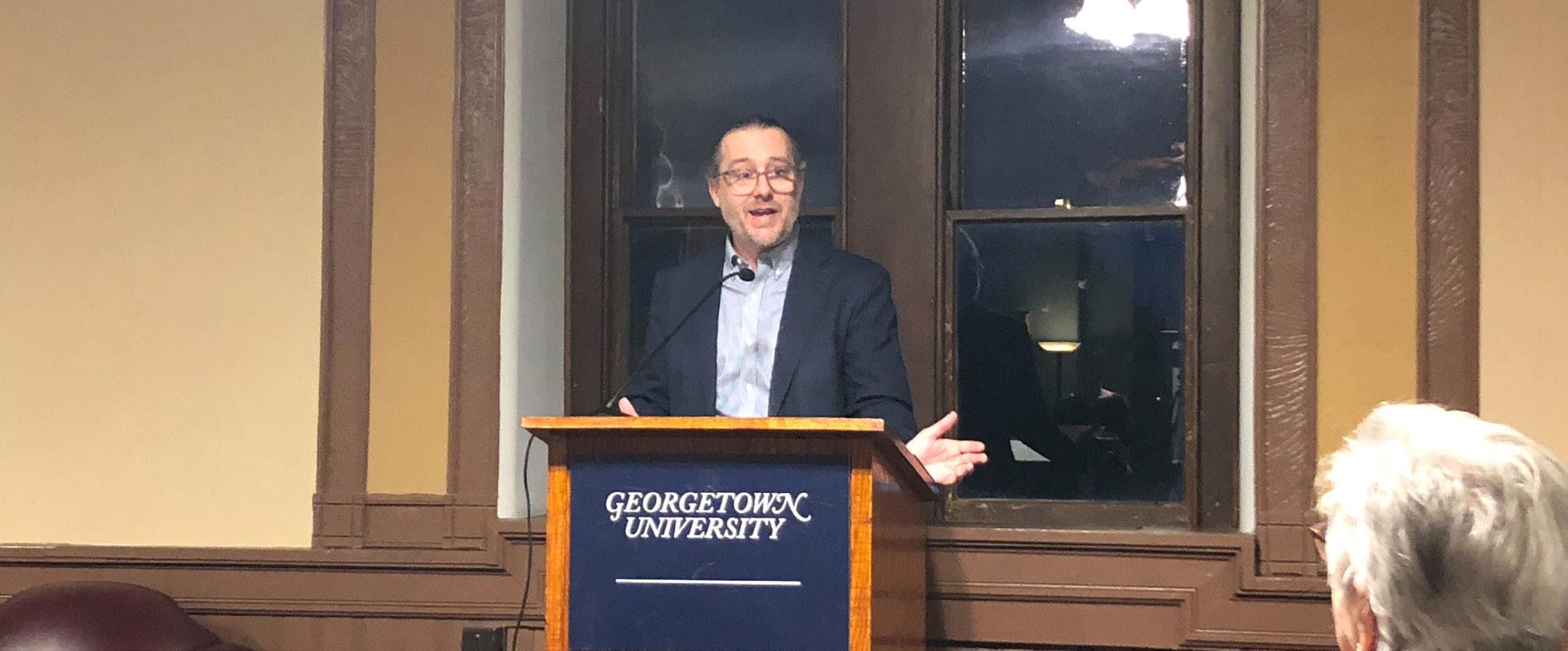
GEORGETOWN UNIVERSITY
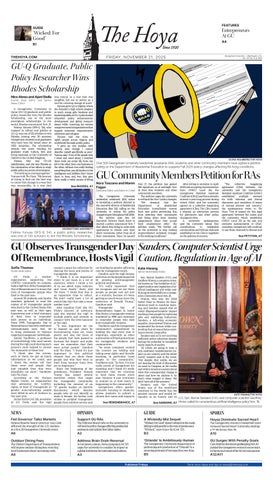
Fatima Yunusa (SFS-Q ’24), a public policy researcher, was one of 135 scholars to win the Rhodes Scholarship.

GU Community Members Petition for RAs
Nora Toscano and Maren Fagan Executive Editor and Editor-In-Chief
The Georgetown University residential assistants’ (RA) union is circulating a petition directed to the executive director of Residential Education (Res Ed), calling on the university to reverse RA policy changes made throughout Fall 2025.
The petition asks Res Ed Executive Director Heidi Zeich to rescind a policy announced Nov. 7 that allows RAs living in suite-style apartments to choose only their direct roommate, rather than all of their roommates. Since its launch
GU Observes Transgender Day Of Remembrance, Hosts Vigil
Sofia Thomas GUSA Desk Editor
GU Pride, a student organization supporting the LGBTQ+ community on campus, held a vigil Nov. 20 for Transgender Day of Remembrance to honor the lives of transgender people who died in the past year.
Around 20 students and faculty members gathered to read the names of 67 transgender people who died in the United States this past year, as well as their ages, hometowns and a brief summary of their lives to remember each person as an individual. Since 1999, Transgender Day of Remembrance has been celebrated internationally each Nov. 20 to bring awareness to violence targeting transgender individuals.
Ashley VanMeter, a professor of neurobiology who read names during the vigil, said sharing each person’s story helped to convey the humanity of those lost.
“I think also the stories, each of them, we got as much information as we could, and I think the stories tell that these were real people that had valuable lives that were dreadfully cut short,” VanMeter told The Hoya According to the Human Rights Center, an organization that advocates for LGBTQ+ rights, at least 27 transgender or gender nonconforming people were killed in acts of violence in the past year.
Jackie Early (CAS ʼ26), president of GU Pride, said the vigil
created a space for refection by sharing the faces and stories of transgender people.
“I think it is an important event to put faces to a lot of statistics, which I think a lot of us see about trans violence and trans death,” Early told The Hoya. “I think that this is an important time to refect. We don’t really have a lot of events like this that take a more somber tone.”
Allie Gaudion (CAS ʼ26), GU Pride’s director of advocacy, said she wanted the vigil to include poetry and artwork to connect with the lives honored at the vigil.
“It was important for me to expand on past years by incorporating trans art, trans poetry and also the faces of the people that have passed to increase the impact and make sure we remember that they were actual people,” Gaudion told The Hoya. “I think it’s just important in this political climate that we show these people and who they were in their lives, because trans lives are so important.”
Since the beginning of his presidency, President Donald Trump has issued several executive orders that target the transgender community, including the removal of an “X” gender marker on identity documents, which denotes people who do not identify as male or female. He further took strides to prohibit transgender people from military service and
cut funding for gender-afirming care for transgender youth.
Gaudion said the vigil focuses attention on the people impacted by growing antitransgender political sentiments.
“It’s really important that we recognize and we see these people as people and not just as a statistic, because it’s been getting so much worse since the reelection of Donald Trump,” Gaudion said.
Transgender Day of Remembrance began to honor Rita Hester, a transgender woman murdered in 1998 and continues to remember people who died from transphobic violence.
VanMeter said the Georgetown community’s commitment to holding the vigil every year is important, especially as other universities roll back protections for transgender students and communities.
“So many campuses around the country are folding and taking away rights and literally harming, in particular, trans people in the community,” VanMeter said. “So frst, I’m just really proud of Georgetown for standing, and I think it’s really important that we continue to hold these events every year, because it just continues to remind us of how much is happening in the community.”
Georgetown ofers genderinclusive housing to students, allows students to submit a chosen frst name and supports
See REMEMBRANCE, A7
Nov. 17, the petition has gained 558 signatures as of midnight Nov. 21 from RAs, students and other community members.
The petition urges the university to roll back the Nov. 7 policy changes. “We demand that the Department of Residential Education immediately reverse their new policy preventing RAs from selecting their roommates and being given their housing assignments when they accept their employment ofer,” the petition reads. “We further call on the university to stop making unprecedented unilateral changes to RA working conditions.”
After voting to unionize in April 2024 and accepting representation from OPEIU Local 153, the Georgetown Resident Assistant Coalition (GRAC) and the university entered a year-long process during which GRAC and the university agreed on a collective bargaining agreement (CBA). The CBA created a stipend, an arbitration process for grievances and other policy changes for RAs.
A university spokesperson said the university values RAs’ contributions to residential communities and will use channels established in the CBA to negotiate on the policies of concern.
“The collective bargaining agreement (CBA) between the university and the Georgetown Resident Assistant Coalition (GRAC) established multiple avenues for both informal and formal discussion and resolution of issues of mutual interest and concern,” the spokesperson wrote to The Hoya. “Out of respect for this legal agreement between the union and the university, which establishes OPEIU Local 153 as the sole and exclusive representative of GRAC members, Georgetown will continue to use these channels to discuss and See PETITION, A7
Sanders, Computer Scientist Urge Caution, Regulation in Age of AI
Kate
Hwang Senior Multimedia Editor
Sen. Bernie Sanders (I-Vt.) and Geofrey Hinton, a computer scientist known as “the Godfather of AI,” urged caution and regulation of artifcial intelligence (AI) while reaffrming its inevitability at a Georgetown University event Nov. 18.
Hinton, who won the 2024 Nobel Prize in Physics for foundational work in machine learning, and Sanders argued that AI could disproportionately impact working class people by replacing jobs and redefning industries.
Sanders, a left-wing economic populist, interviewed Hinton and moderated the lecture while contending that AI exacerbates existing economic inequality.
Sanders said AI is not receiving suficient policy attention despite having the potential to transform many aspects of society.
“AI robots are going to have a very profound, transformative impact on our country and the entire world,” Sanders said at the event. “But despite that reality, we are not hearing the kind of discussion we need in Congress, in the media and within American society about what this consequential change is about and how we address it. So that’s what tonight is about. We don’t have all of the answers.”
Sanders said the United States, one of the wealthiest countries in the world, has the greatest income and wealth inequality in its history and
See SANDERS, A7
OLIVIA HOLMBERG/THE HOYA
Over 500 Georgetown University residential assistants (RA), students and other community members have signed a petition calling on the Department of Residential Education to suspend Fall 2025 policy changes affecting RA living conditions.
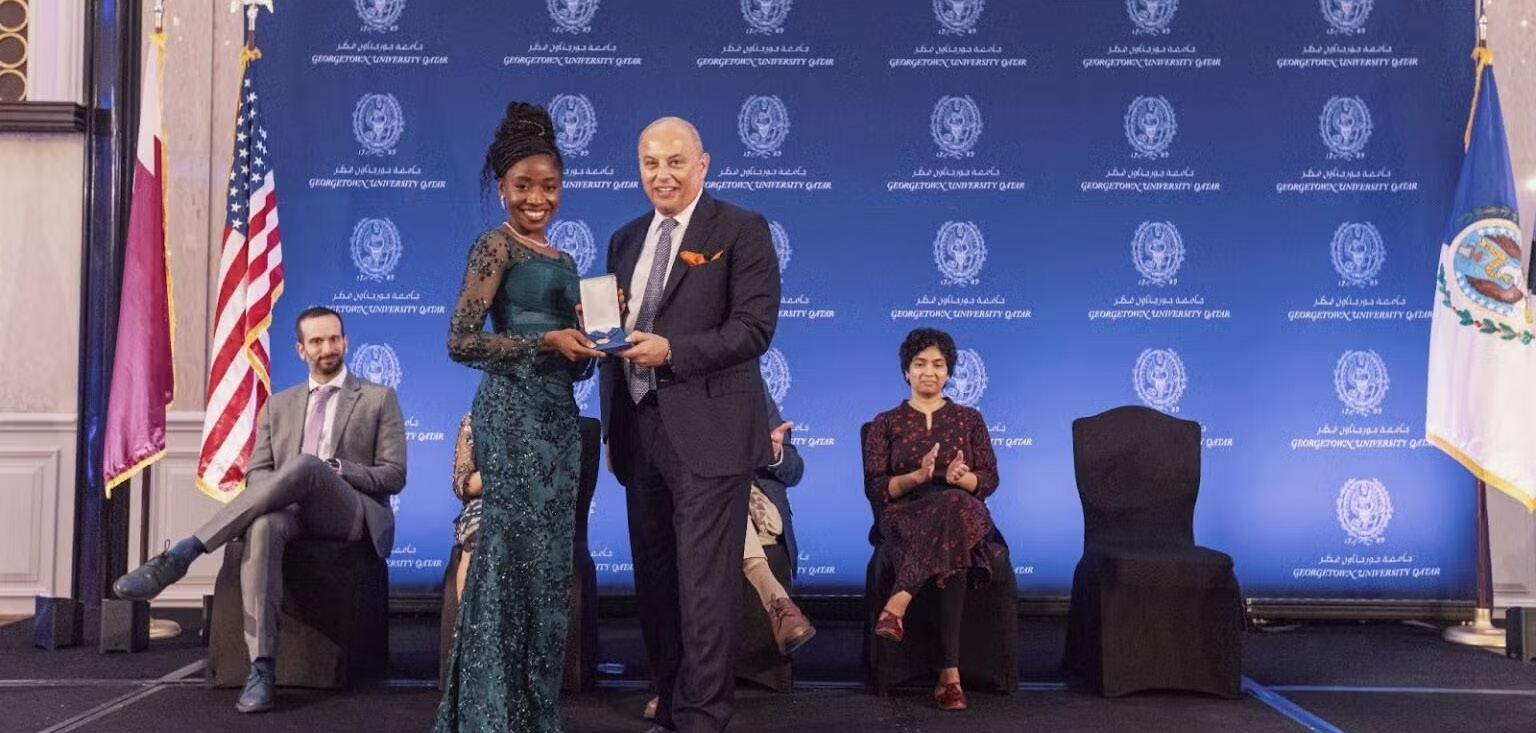
KATE HWANG/THE HOYA U.S. Sen. Bernie Sanders (I-Vt.) and computer scientist Geoffrey Hinton called for conscientious artificial intelligence policy Nov. 18.
Protect RAs From Policy Changes
Each fall, Georgetown University residential assistants (RAs) begin their experience leading residential communities and serving as a resource to students living on campus. As part of the job, RAs are given a stipend, housing and meal plan. These benefts may ofer a fnancial lifeline to students who have dificulty shouldering the high costs of attending Georgetown. Yet this semester, a series of unilateral decisions by the Ofice of Residential Living (Res Living) could jeopardize certain RA benefts, and in turn, RA applications. After a seven-month process to create a collective bargaining agreement (CBA), the RAs’ union, the Georgetown Resident Assistant Coalition (GRAC), fnalized a contract with the university in April. The contract includes agreements on a $1,750 semesterly stipend for RAs, automatic hiring for RAs in good standing, arbitration of grievances and the creation of a labor management committee to review issues afecting RAs and facilitate RA trainings. Yet throughout the fall semester, Res Living has implemented a series of policy changes.
Going forward, RAs living in suite-style housing will no longer select all their suitemates; they will only select their direct roommate. Further, RA applicants will only be told their housing assignments after they have already accepted their employment ofer, forcing them to make a decision without a full understanding of their future living conditions. Additionally, Res Living reorganized the holiday schedule for RAs, which GRAC has said will require twice as many RAs to stay on campus over the holidays.
These actions violate the spirit, if not the text, of Georgetown’s agreement with GRAC last spring. Our RAs are the backbone of our on-campus community. They keep residents safe and work to foster community on their foor. When RAs are harmed, the residential experience of every student on this campus is afected. With this in mind, Georgetown must reverse these policy changes and consult with RAs more thoroughly before implementing broad-reaching revisions to RA duties.
A university spokesperson said the university is working to establish communication channels with GRAC and their union representation, OPEIU Local 153.
“The collective bargaining agreement (CBA) between the university and the Georgetown Resident Assistant Coalition (GRAC) established multiple avenues for both informal and formal discussion and resolution of issues of mutual interest and concern,” the spokesperson wrote to The Hoya. “Out of respect for this legal agreement between the union and the university, which establishes OPEIU Local 153 as the sole and exclusive representative of GRAC members, Georgetown will continue to use these channels to discuss and resolve any concerns through good-faith engagement.”
However, many of these changes lack a rational basis and threaten the livelihoods of dozens of RAs on whom our university community relies. For example, the new policy dictates that RAs can only select their direct roommate to ensure “equity.” However, we fail to understand how these changes meet this purported interest.
HOYA HISTORY
August 21, 2003
The Georgetown University StudThe members of the class of 2007 are not the only new faces on campus worried about life in residence halls this year. In early July the Ofice or Residence Life welcomed two new top administrators: Director of Residence Life Stephanie Lynch and Associate Director of Residence Life William Fox.
Both Lynch and Fox have extensive experience working and living with students. Both administrators have big plans for the upcoming year and see it as a chance to redefne the role of ResLife on campus.
“It’s a wonderful opportunity, with 90 percent of students living on campus, to make residence life an enriching part of their experience,” Lynch said.
When she frst visited Georgetown last spring, Lynch said that she was instantly struck by the extent to which Hoyas participated in the university community, from the tents pitched in protest in Red Square to GERMS service to students in emergency.
Fox said he is trying to get to know as much about the ins and outs of Georgetown as possible this fall.
“As new staf, we’re trying to do what all new people do early on,” he said.
“We’re new faces trying to meet as many students as possible.”
The duo is excited about several projects in community
Restricting RAs from choosing who they live with strips them of a right that every other student shares. Rather than increasing equity, the decision will decrease it: Wealthier students who dislike the new policy changes will be able to leave their roles; students who rely on the financial aid from the RA position, by contrast, will be trapped.
Res Living’s actions will further reduce inclusivity, as RAs may be forced to live with random students who do not share their values or are less accepting of others’ identities.
Izzy Wagener (SFS ’26), GRAC’s chairperson and an RA for Darnall Hall, said the new roommate selection policy adds unnecessary stress for RAs.
“Living with people you don’t know is no easy thing,” Wagener wrote to The Hoya. “In the event that conficts between roommates occur, RAs will be put in the very dificult position of having to mediate within their own living space, which should be a place they can live and rest comfortably in.”
Indeed, the comfort of RAs does not seem to be a top priority for Res Living. Requiring more RAs to stay over holidays detracts from valuable time to rest and recharge.
Taken as a whole, these unilateral decisions are a direct assault on RAs’ ability to manage their personal lives. In a role that already muddles the work-life balance for its student employees, Res Living must do more to protect stress-free time for RAs, not systematically remove it.
These decisions disincentivize prospective students from applying for the RA position, shrinking the talent pool that Res Living can choose from. We do not see how the university can expect to retain high-quality RAs as benefts rapidly diminish. Furthermore, as hardships for RAs rise, the application pool will increasingly be made up of more desperate students who rely on RA benefts to alleviate fnancial stress. This creates a potentially predatory situation in which these students and their fnancial aid packages are beholden to whatever policies Res Living imposes. In a school with signifcant fnancial disparities among its student body, these policies emphasize the economic divide.
Moving forward, the university must communicate more efectively with RAs. Instead of making unilateral decisions, Res Living must consult with RAs on each policy and work to make policies that beneft all student employees.
James Baust (MSB ’27), an RA for Hayden Hall, said he would like to see more about the decision-making process.
“I want the administration to be transparent,” Baust told The Hoya. “As long as they provide information for the decisions they make, I’ll be a lot more happy with how we proceed as an RA team.”
Students must ensure RAs do not stand alone in their eforts. Consider signing the petition circulated by GRAC. Show that you stand frmly with the RAs to encourage policies that best connect with their needs.
The Hoya’s Editorial Board is composed of six students and is haired y the opinion editors. Editorials refe t only the beliefs of a majority of the board and are not representative of The Hoya or any individual member of the board.
development that are already underway. This year, the faculty in residence program has increased markedly with four new faculty members and their families moving into student residences, Lynch said. Fox added that he is also looking to work closely with the Residential Judicial Committee and the Ofice of Housing Services and furthering faculty cooperation and improving staf development.
“I think students will be very impressed with the quality of the RA’s that we’ve been getting to know over the last few weeks,” Fox said. “They truly embody the ethic of care that we look for in all Residence Life members.”
Lynch said she will take time to “evaluate and assess the place and see where [she] can step in and make a diference.”
“I love this work,” Fox said, “Connecting with students, the focus on service to the community and promoting civility on campus, involving faculty is residential life.”
Lynch comes to Georgetown from the San Francisco Bay area, where she was the Associate Dean of Students at Menlo College. Prior to that, she was the Associate Director of Residence Life at California Lutheran University, a position she held for six years. She began her career in residence life as a resident assistant for freshmen at Central
Washington University, where she received her bachelor of science in business administration. She received a master of arts in communication from Eastern New Mexico University while also serving as a hall director.
Before arriving on the Hilltop, Fox spent three years working in residence life and housing at the Catholic University of America. He received his bachelor of arts in political science and communication from James Madison University and a master of arts in higher education administration from the Ohio State University.
The Ofice of Residence Life is responsible for coordinating training and recruitment of residential life staf, including Resident Assistants and Hall and Area Directors, overseeing issues relevant to student residential life within the Ofice of Student Afairs and the student-run Residential Judicial Council. The ofice is also instrumental in developing policies afecting students and campus residences, such as noise, smoking and on campus safety. The ofice also contributes heavily to the various programs run each year for frst-year students.
Former Director of Residence Life Frank Robinson began at Georgetown last fall but resigned in mid-November for undisclosed reasons.
Mary Goundrey
In a role that already muddles the work-life balance for its student employees, Res Living must do more to protect stress-free time for RAs, not systematically remove it.
The Editorial Board Protect RAs From Policy Changes thehoya.com
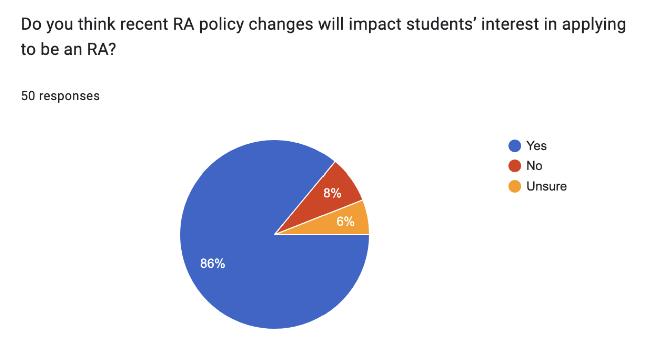
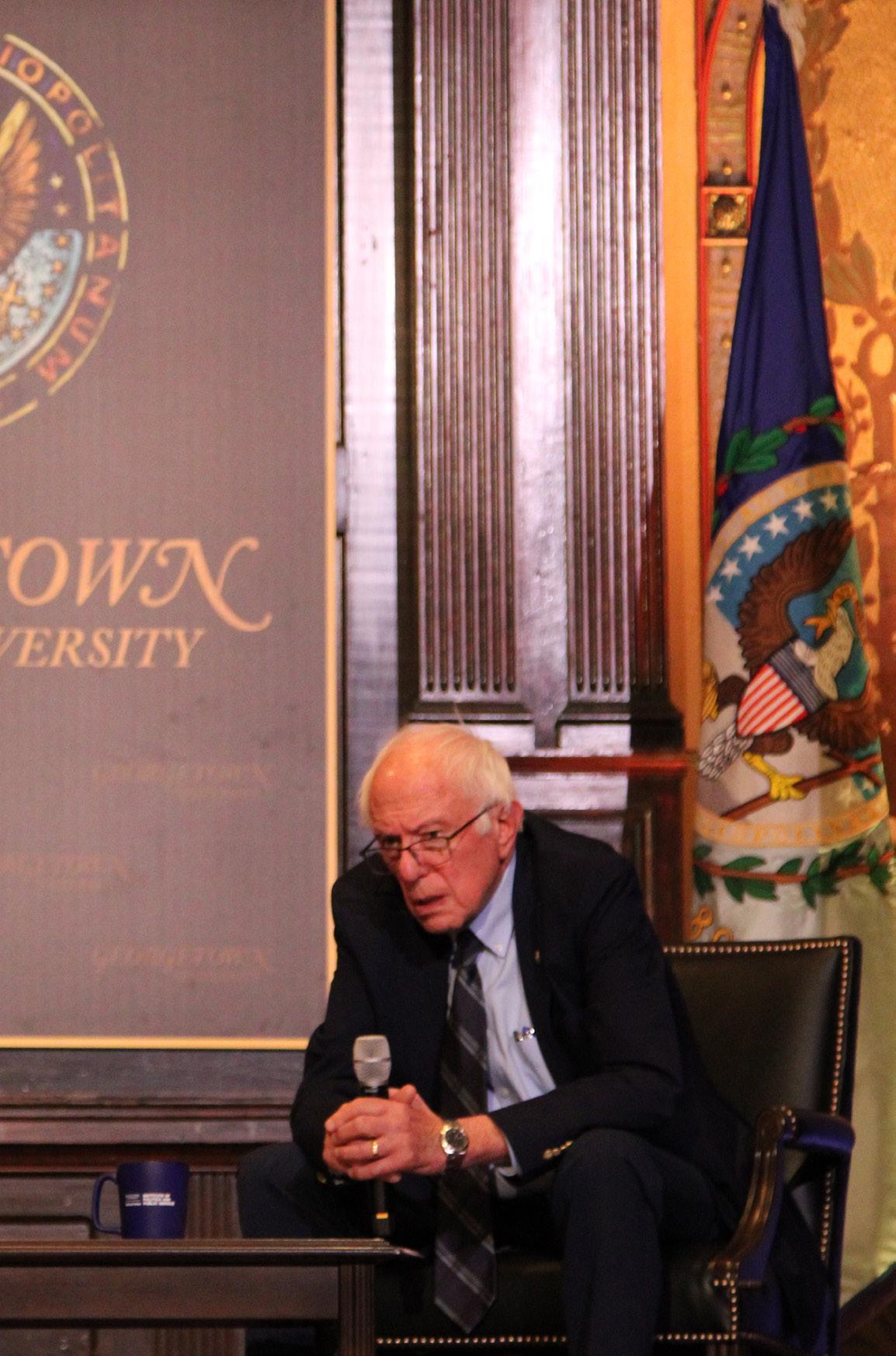
On Nov. 14, The Hoya reported on new Res Living actions that alter university policy around RAs including those around the roommate selection process and housing assignments. This week the Editorial Board advocated for the university to reverse these policy changes and better communicate with
the Georgetown Resident Assistant Coalition. In order to gauge student opinion, students were asked if they think recent RA policy changes will impact students’ interest in applying to be an RA. Of the 50 respondents, 86% said yes, 8% said no, and 6% said they were unsure.
Founded January 14, 1920
Maren Fagan, Editor in Chief
Patrick Clapsaddle and Nora Toscano, Executive Editors
Madeline Grabow, Managing Editor
Pritika Patel
Ruth Abramovitz, News Editor
Ajani Stella, News Editor
Sophia Lu, Features Editor
Saroja Ramchandren, Features Editor
Thejas Kumar, Opinion Editor
Ella O’Connor, Opinion Editor
Tanvi Gorripati, Guide Editor
Grace Ko, Guide Editor
Nate Seidenstein, Sports Editor
Madeline Wang, Sports Editor
Angela Lekan, Science Editor
Ruth Noll, Science Editor
Rohini Kudva, Design Editor
Madeleine Ott, Design Editor
Aria Zhu, Design Editor
Caroline Brown, Copy Chief
Evan Ecklund, Copy Chief
Jackson Roberts, Copy Chief
Fallon Wolfley, Blog Editor
Amanda Bloom, Multimedia Editor
Kate Hwang, Multimedia Editor
Meghan Hall, Photo Editor
Haan Jun (Ryan) Lee, Photo Editor
Board of Directors
Patrick Clapsaddle, Chair
Bethe Bogrette, Julia Butler, Amber Cherry, Madeline
Grabow, Rohini Kudva, and Mia Streitberger
Peter Sloniewsky, General Manager
Sophia Williams, Technology Director
EDITORIAL CARTOON by Anish Raja
Handling Work Mistakes, Roommate Lease Conflicts
elcome back, advice
Wlovers. Thanksgiving break is quickly approaching, and if you’ve got one thing to be grateful for, it’s that I’m here to answer all your questions — this week, we’re tackling work missteps and roommate controversies. As always, if you’ve got a problem you need some help with that I didn’t answer, submit it to my anonymous form and I’ll give you a hand.
My bosses yelled at me yesterday about overstepping my boundaries at my job, and I know it’s my fault
— this is a constant problem that I just don’t know how to fx. I try to e helpful in every organization I join, and then it just ends up a kfring in a way that makes me aware of how horri le of a person I am. Every time I feel so guilty and sad e ause I just don’t know how to fx myself. What do I do?
First of all, your job performance is never a refection of your worth as a person. It can be hard to separate the two, especially if you’re passionate about your work, but remember that a mistake at your job doesn’t mean you’re a terrible person; it just means you messed up, like we all do. It sounds like your interest in your work can sometimes go beyond what’s expected of your position, and that’s not always a bad thing, but it’s important to make sure you’re not stifing the other people you work with. Take a minute to look back on past instances where your attempts to take more initiative didn’t work out. See if there’s any patterns: Did you inadvertently take over another person’s responsibilities instead of focusing on your own, or talk over others who might have felt less comfortable advocating for themselves? If you’re answering “yes” to any of those questions, then reframing the way you try to be helpful at work can help avoid these issues with your boss. Communicate with the people you work with — not just your bosses but your peers as well. If you fnd yourself wanting to go above and beyond in an area that’s not something you usually work on, talk to the people around you to fnd a way to implement your ideas
without taking over a project someone else is already working on. By making the people around you feel heard, your inclinations to be helpful can become a huge beneft to your job instead of an overstep. Most importantly, a mistake doesn’t make you bad at your job; it means you’re learning. You got this! All of my roommates want to live together next year ex ept for one. She can be really mean to the rest of us and put people down, and it makes it dif ult to live with her. Even though she acts like she has better friends than the rest of us, she still assumes we’re all still living together. We’re a out to sign a lease with other people and without her, but we also still have to live with her for six more months after we break the news, so how should we do this?
It sounds like it’s for the best that you’re moving on from a living situation that’s stressing you out, even if your roommate won’t be happy to hear about it. It can be tempting to avoid confict and wait as long as possible to tell her, but the kindest thing you can do is break the news sooner rather than later. While that might cause some tension in your house, telling her as early as you can allows her to fgure out a diferent living situation for next year before everyone’s plans are already locked down. Even if she feels frustrated to hear that you’re living with diferent people, giving her plenty of time to fnd new arrangements will make the rest of your year a lot easier than if you wait until the last minute and leave her stranded and upset. If she asks why you’ve decided not to live with her, it’s okay to be honest about why you feel like you’re not the best ft as roommates — she might be upset, but it’ll be easier to eventually move on from if she feels like you’re being upfront and that she isn’t left in the dark. A direct conversation can clear the air about your plans for the future and hopefully reduce the confict in your current living situation.
Caroline Brown is a senior in the College of Arts & Sciences. This is the seventh installment of her column “Calling in With Caroline.”
Stop Performing, Find Moments of Authenticity
Music pulsates through the room like a racing heartbeat. Lights fash in colors I’ve never seen before — reds so bright and blues so cold — casting me under an artifcial brightness. Laughter echoes through the crowd, sounding genuine but getting old quickly. Students dance, scream and lean over each other’s drinks. Next to me, my friend smiles for the camera, but once the fash goes of, his smile slowly disappears as he rubs his eyes like he’s exhausted. I sing along to the lyrics with everyone else, but my voice cracks. After looking around to see if anyone noticed, I jumped right back into the song. When the DJ stops and harsh lights come on to reveal the mess of Solo Cups and spilled liquids, I trudge out of the house carrying one of my blacked-out friends and avoid others under the dead silence of the night. Walking back to the dorm, euphoria slowly evaporates into emptiness. This semester, I’ve felt this feeling not only after going out but everywhere on Georgetown University’s campus. It feels as if all of my peers perform rehearsed words, stories and achievements to create the illusion that everything is going well in their lives. My classmates and I post pictures of friends on a Thursday night out just to prove we belong somewhere. We force ourselves to laugh to fill the gaps of silence that would reveal how truly
Protect Students from Financial Anxiety
For 18 years, some students have attended college with the goal of using their degree to serve their communities and, by doing so, earn forgiveness for their student loans. The Public Service Loan Forgiveness Program (PSLF), passed by Congress in 2007, provides opportunities for loan forgiveness to students who work in public interest jobs and make 120 payments on their loans over a minimum of 10 years. The U.S. Department of Education (DOE) closely monitors the PSLF, and I watch my progress in the program just as closely. After six years, my current status on studentaid. gov shows a green bar stretching halfway across the screen: 59 qualifying payments made out of 120 needed to qualify me for loan forgiveness. The DOE announced a new rule Oct. 30 that will go into effect July 1, 2026, and could transform the PSLF program, deciding the fate of many students, myself included. The new rule grants the DOE broader discretion to reject applicants employed by organizations that do not align with the administration’s priorities. Although framed as targeting activities that “subsidize organizations that violate the law,” the rule could have implications for non-profits that support transgender individuals and immigration-related causes. Georgetown University has both the opportunity and responsibility to clearly explain how it interprets upcoming changes to this program while also addressing the fnancial burdens of its graduate degree costs. For me, being accepted into Georgetown’s McCourt School of Public Policy was a dream realized. However, as many graduate students know, the looming stress of paying for
this education is a major pain point. Georgetown’s graduate programs are significantly more costly than the national average, and I have spent hours on the federal loan simulator to ensure I could pay back my loans. This planning included the PSLF, which I was already familiar with due to my previous six years paying into the program after completing my undergraduate degree. Only after weighing all of these factors did I decide to enroll at McCourt. I knew with this degree I would either continue in gender equity non-profits or enter government work, both of which the PSLF rules squarely covered — at least, as I understood them. When the U.S. Department of Education announced a final rule affecting PSLF on October 30, my initial response was relief — the sentences in the new rule seemed too outrageous to apply to any U.S. non-profits. The updated rule only included a provision blocking loans from anyone who aided illegal immigration or illegal medical procedures. I currently work at an organization that supports gender justice by litigating on behalf of all women — including trans women. I did not think Congress would tie that work to the line in Trump’s executive order about medical procedures. However, the executive order is expected to shift the DOE from simply administering loans and granting PSLF based on its interpretation of Congress’ original legislation to taking a more active role in making those decisions. Yet the exact impact remains uncertain, which is what makes this transition so frustrating. Due to the lack of clarity concerning what organizations U.S. Secretary of Education
Linda McMahon will decide fall under the executive order’s guidelines, thousands of students sit in confusion at many non-profits, including myself. And while this DOE plays political games deciding who is actually serving the public, I am saddled with choices that will inevitably shape my financial future with only half of the information I need. Georgetown’s Spring 2026 registration has begun, but I don’t know whether to register since I’m uncertain if my financial plan will hold up.
Legal challenges to the new PSLF have already begun. However, the courts likely won’t decide the cases fast enough for students who hang in the balance.
Georgetown has an opportunity and, in my opinion, a responsibility to help students like me understand what comes next. Those of us who are paying into this program deserve clear information about how potential changes might affect our futures. I also urge my fellow students whom these changes could impact to raise their voices and ask the DOE for the clarity we all need. And finally, Georgetown itself could take a step forward by making its graduate programs more affordable.
I’m not seeking a free forgiveness program. I’ve paid into my education for six years and will continue for another decade beyond graduation — all the while dedicating my career to organizations striving for a better country for all women. That commitment deserves support — or at the very least, transparency — as I navigate some of the most important financial decisions of my life.
Grace Freeman is a graduate student at the McCourt School of Public Policy.
lonely we might feel. It takes so much effort to seem effortless. Georgetown students need to stop pretending all the time and start being honest about how we’re actually doing. We should focus on admitting when we’re struggling, skipping a night out when we’re exhausted and asking a friend for help when we’re overwhelmed. It’s normal for college students to seek fun experiences and not want to miss out on anything, but the amount of pretending that goes on behind the scenes can turn happiness into a show. We’ve learned to chase a version of ourselves that looks best on camera and can tell the craziest stories to earn the hollow respect of others. At Georgetown, the pressure to appear perfect constantly looms over students. As a frst-year student, the transition to college only heightens competition, since everyone has to prove they’re thriving in a new environment. We compare grades we pretend not to care about and chase club positions just so we can brag that we got into an exclusive one. Somewhere along the way, being honest about struggling became a sign of weakness. Our obsession with social media only intensifes our quiet competition. Approximately 98% of college students use social media. We scroll through posts and stories of friends who seem to be everywhere, doing everything and surrounded by everyone. Combined with the fact that 75%
of young adults struggle with the fear of missing out, it’s hard not to feel like you’re slipping behind.
So we hastily put up an image of ourselves supported by a few wooden stilts instead of building one brick by brick. Since starting at Georgetown, I’ve realized how difficult it is to find genuine relationships. College exposes you to so many different people, but only a few of those interactions go deeper than just scraping the surface. At the start of the year, I talked to thirty people during a night out, quickly switching from one to the other. But by the next morning, I already had forgotten most of their names. The pressure to socialize with as many people as possible prevents any actual connection. Soon, everything that seems fun — outfits, posts on social media and describing a wild night out — feels scripted and fake.
The pace of campus life doesn’t help either. Students hop from class to meetings to events to cofee chats with barely enough time to breathe. When I see someone I recognize on the path, our quick interactions always take the same form: “How are you?” “Good, you?” “Busy, but good.” Even when we want to slow down, Georgetown’s culture rushes us along.
I’ve caught myself falling into this rhythm; the constant motion of going about my day makes it easy to pretend. I can’t be myself,
BETWEEN HEALY AND THE HILL
which makes my conversations feel meaningless and robotic. If you’re also tired of keeping up the performance, try stepping away from it. Instead of going along with quick bursts of small talk, try bringing up a passion or experience you value in your conversations. Walk with one person instead of ten, laugh at a joke that no one else found funny and say what you truly think. Stay in if you don’t want to go out. When I think about that party, behind all the lights and singing, most of us didn’t seem like we were having as much fun as we wanted others to believe. Now, when I go out, I don’t look for the wild moments; I look for the small moments to find authenticity. One night last month, instead of weaving through the crowd trying to talk to everyone, I stayed with a friend and laughed about something stupid that happened in class. Soon, we shared music that we both liked, and I walked away eager to listen to some new songs and talk about them with my friend. I’m still fguring out how to fnd moments that feel real, and I hope my fellow students try to do the same. It is easier to form authentic connections when you can be yourself. Honesty doesn’t magically fx loneliness or stress, but it does take away the burden of maintaining a mirage. Leo Zhang is a first-year in the College of Arts & Sciences.
Re-Examine GU’s Global Perspective
Each May, Georgetown University celebrates another cohort of global leaders. However, certain students’ ambitions to “change the world” increasingly won’t happen in the United States, as international students are more often choosing to return home after graduation.
For decades, students from all over came to U.S. universities and began their careers, fueling our innovation economy. The brain drain from developing nations became America’s brain gain, and universities like Georgetown sat at the center of that exchange. Now, that trend is reversing. Tightened visa policies, rising anti-immigrant vitriol, ballooning processing backlogs and surging opportunities abroad are reshaping the equation for international students. Georgetown must determine whether this reversal supports our Jesuit mission or exposes a quiet crisis in the United States’ economic competitiveness. For international students, planning for college is starkly different from it was a decade ago. The H-1B visa lottery, which grants work authorization to a limited number of graduates each year, has only a 29% selection rate in 2025, down from roughly 77% in 2010. If a student isn’t selected, their ability to stay in the United States expires within months. Unless they find another visa, students must decide whether to build a life here with an almostcertain expiration date or explore opportunities back home where they’re not vulnerable to deportation. Furthermore, the so-called pull factors that lure talented students back to their home countries have strengthened. China’s tech sector is pioneering new models in fnancial technology and artifcial intelligence. India’s startup ecosystem raised over $13.7 billion in venture capital last year. The Gulf states are pouring hundreds of billions into economic diversifcation that demands Western-educated talent. Returning home isn’t settling anymore; it’s often the more ambitious choice.
These developments represent a change in how international students think about their Georgetown education. They’re not just learning the U.S. policy process; they’re actively mapping what they learn onto systems that exist back home. In classes like “Comparative Political Systems” and “International Financial Cooperation,” I’ve seen international classmates connect U.S. policy tools to challenges in their own countries. Many tell me they’re also building networks that they plan to maintain when they return. As the graduate network proliferates, the Georgetown degree has become especially portable.
Our university proudly proclaims its commitment to forming “men and women for others” who will serve the world, but the reality is a different story. Georgetown markets itself heavily on proximity to power. The implicit promise is access to American opportunity. When international students can’t access those pathways, or choose not to, something in that value proposition breaks down.
Georgetown has yet to reckon with this tension. Career services have little data on where international graduates end up after graduation. We do not measure “global impact” the way we measure average starting salaries or graduate school placement rates. We’ve built an institutional infrastructure around domestic career placement and elite American credentials while espousing an entirely different mission. The reversal in international student retention reflects a broader policy failure by the federal government. Congress has spent years debating immigration reform while the international student pipeline has quietly been constrained. The H-1B system, designed in 1990 for a workforce of 65,000 people, has not been meaningfully updated even as global competition for talent has intensified. As a result, the United States is increasingly pricing itself out of the global talent market: International enrollment has stagnated while competitor nations
surge ahead. Political gridlock and misaligned incentives force a binary immigration outcome, either a pathway to citizenship or temporary status. There’s no room for the kind of fluid global mobility that actually characterizes how elite talent moves in the 21st century. If Georgetown believes in training leaders to serve the global common good, international students returning home should be celebrated as loudly as those who remain However, if Georgetown also sees itself serving American interests, students and administrators need to advocate loudly for policies that facilitate talent retention rather than force exits. The university should use its voice and its access to push for immigration reform that serves both our mission and our national interest. We can support expanded Optional Practical Training (OPT), the work authorization program for international graduates — particularly in science, technology, engineering and mathematics (STEM) fields — reformed H-1B systems and clearer pathways to permanent residency while also celebrating when graduates choose to return home. The assumptions that built U.S. higher education’s dominance are being stress-tested. Georgetown can either cling to an old model or lean into a new one: measuring success by global impact rather than domestic retention, advocating for policies that enable circulation rather than extraction and embracing the possibility that the best outcome of a Georgetown education might be brilliant graduates building the future somewhere other than Washington, D.C. The brain drain reversal is happening. It is due time for Georgetown to address it head-on.
Neha Jampala is a junior in the College of Arts & Sciences. This is the third installment of her column “Between Healy and the Hill.”
VIEWPOINT • FREEMAN

ILLUSTRATION BY MADELEINE OTT/THE HOYA
By the Book: Despite Progress, Students Say GU Entrepreneurship Remains Conventional
Entrepreneurship at Georgetown is limited by a lack of technical education and emphasis on pursuing more traditional business paths after graduation.
Milan Varma Features Staff Writer
In February 2025, Kushaan Vardhan — then a Georgetown University frst-year — began developing the algorithm for Cerca, a dating app that allows people to set up mutual contacts, currently valued at $1.6 million. That same month, Vardhan started his transfer application to Columbia University’s Fu Foundation School of Engineering and Applied Science, where he currently attends.
Vardhan, who remains a computer science (CS) major at Columbia, said the lack of a formal engineering department and limited entrepreneurship resources at Georgetown prompted his transfer.
“It’s not a huge culture. You don’t see students thinking and talking and trying to develop within that feld,” Vardhan told The Hoya “Because I’m in an engineering school now, I’m surrounded by tons of overachievers in the feld,” he said.
Jef Reid — who in 2009 founded Georgetown Entrepreneurship, a university-wide initiative that hosts pitch competitions and connects student entrepreneurs with funding and mentorship — said the program has a robust network of resources for student startups.
“We have a lot of things, and a lot of it is the experts that we bring — our network, entrepreneurs-in-residence, experts on call — all these people that want to help,” Reid told The Hoya Today, Georgetown Entrepreneurship engages over 2,000 students and 100 graduates annually. Georgetown startups have raised $9.6 billion in the last fve years, and ventures from Bark Tank, Georgetown’s annual entrepreneurship competition, have raised over $220 million since the program’s launch in 2017.
The McDonough School of Business (MSB) also ofers a minor in entrepreneurship and innovation for the common good, which requires students to engage in co-curricular activities ofered by Georgetown Entrepreneurship.
A university spokesperson said Georgetown supports entrepreneurial students with this combination of academic and extracurricular initiatives.
“Georgetown University fosters entrepreneurship through academic programming as well as engagement opportunities open to all students, demonstrating its commitment to an innovative and entrepreneurial culture that provides support to faculty, students, staf and alumni,” the spokesperson wrote to The Hoya
On the whole, the MSB is regularly ranked among the best business schools in the country. In 2025, U.S. News & World Report placed Georgetown 12th overall in business and 2nd in international business.
However, Georgetown’s entrepreneurship program has consistently lagged behind these departments.
That same year, Georgetown’s undergraduate entrepreneurship
program did not rank among the top 36 nationally, while Indiana University Bloomington, a comparable business school, ranked 8th for business and 7th for entrepreneurship. The University of Michigan ranked 4th for business and 3rd for entrepreneurship.
Georgetown students say the entrepreneurship program is limited by a lack of technical education and cultivated a culture of conformity.
Ty Swanson (CAS ’27) — founder of College Canine, a company that connects pet owners to local student caretakers — said Georgetown lags behind peer institutions in creating a unifed ecosystem for student entrepreneurship.
“The entrepreneurship space at Georgetown is very fractured compared to other universities where they foster it,” Swanson told The Hoya Reid said the university needs more than mentorship structures to efectively support students.
“We need some vision to take that to a new level and organize it in diferent ways and make it really easy for a student or alum to show up and say, ‘Here’s what I’m trying to do, how can you help?’” Reid said.
“We do a lot already, but we’re going to do even more in the future,” Reid added.
Getting Down to Business
When Peter Mellen (CAS ’89, GRD ’98) started at Georgetown, he said there was no formal coursework or mentorship programs for students interested in entrepreneurship.
“I came to Georgetown wanting to be an entrepreneur, and there was literally nothing the university ofered entrepreneurs,” Mellen told The Hoya. “Which I didn’t mind — I fgured, ‘That’s fne, I’ll just make it up. It’s not really a subject anyway.’”
Marne Martin (SFS ’97) — the founder of Emburse, a platform that automates expense reporting and reimbursement — also said there was little institutional support for entrepreneurship.
“When I was in school in the ’90s it was more, ‘Some people are more entrepreneurial than others,’ and you kind of had to fgure it out,’” Martin told The Hoya Since the founding of Georgetown Entrepreneurship, graduates have also established the Georgetown Angel Investor Network (GAIN) — a network that funds Georgetown-affliated companies — and the entrepreneurs-in-residence program — a platform for students to receive one-on-one mentorship from industry professionals.
Martin said entrepreneurship education has also signifcantly expanded in the classroom.
“It’s been legitimized as an area of study and an area of teaching,” he said.
Reid, who is also the faculty director of the entrepreneurship minor, which was launched in 2018, said the program is only open to MSB students but he hopes to expand access to the minor in the future.
“I think we want to open the entrepreneurship minor to more students,” Reid said. “Right now, business majors can take it, and it’s grown 20% to 30% every year.”
“We know students like it when they hear about it, but a lot of students don’t know about it or are not currently eligible to take it,” Reid added. “So we want to grow that.”
For entrepreneurial students outside of the MSB, student organizations ofer supplemental opportunities to explore the feld.
Kendall Beil (MSB ’26) — CEO of Georgetown Ventures (GV), a student-run startup accelerator — said the scope of the organization has signifcantly expanded during her tenure.
“We started as a club that only worked with student entrepreneurs here at Georgetown University and have very happily expanded to not only working with undergrad students but also with graduate students, MBAs, students in all facets of graduate programs here on campus, but also pulling founders who are outside of the Georgetown University ecosystem,” Beil told The Hoya
Despite this progress, Reed Uhlik (CAS ’25) said Georgetown’s curriculum remains insuficient.
“There is a gap between what theory you learn in a classroom and what skills/knowledge you need to use industry tools/technologies,” Uhlik wrote to The Hoya
In Technical Terms
For student entrepreneurs, Georgetown’s limited computer science programs and nonexistent engineering programs pose a signifcant barrier to success.
Michigan ranks 14th nationally in undergraduate computer science, while Georgetown, by contrast, ranks 24th.
In the last three graduating classes, Georgetown has graduated between 80 and 85 computer science majors or minors each year, around 4% of its graduating student body.
In the 2024-2025 academic school year, Michigan granted 1,666 computer science and engineering undergraduate degrees, around 19% of its graduating student body.
Students like Vardhan say Georgetown’s entrepreneurial scene is still lacking a technical backbone of students who can code.
“At Georgetown, students are overachievers overall. They really do amazing things,” Vardhan said. “If you just can turn them in that direction of computer science, they would continue to do those phenomenal things in that feld as well.”
Uhlik said this progress requires the university to provide a more robust technical education.
“This could be expanding clubs that give startup experience on the technical front, more electives focused on tech used in-industry or more structured guidance and focus on supporting students through tech recruiting,” Uhlik wrote.
Lisa Singh, the chair of the department of computer science, said the program takes an interdisciplinary approach in teaching students, ofering additional programming in ethics and law.
“Our goal is ultimately to engage students in understanding the basic principles of the feld of computer science, so should they decide to pursue a career in computer science, they have all the foundational knowledge they need to be successful in the feld,” Singh told The Hoya. “At the same time, we actually believe that in the world we live in now, we can’t think about computer science in isolation.”
Despite technological advances, some students say Georgetown’s computer science department does not accommodate students’ varied skill levels.
Vardhan said the department, which does not accept Advanced Placement or International Baccalaureate credits, requires students with varying levels of experience to follow the same track, limiting opportunities for more advanced students.
“There’s no way to accelerate the process in CS,” Vardhan said. “These kinds of credits don’t transfer. You can’t really take place-out exams, so you’re kind of stuck taking it from the beginning, which, for students who have potential, deters them from wanting to come to Georgetown because there’s no point repeating those skills.”
While the department ofers some opportunities to test out of introductory classes, Singh said they are largely limited.
“We do have certain types of placement, but it’s very restrictive and you have to show a certain competency to place out,” Singh said.
As a result of Georgetown’s limited technical education, Sara Medina (SOH ’27), a student associate for Georgetown Entrepreneurship, said Georgetown entrepreneurs face the unique challenge of fnding software engineers, unlike at schools with large computer science programs such as the Massachusetts Institute of Technology (MIT) and Stanford University.
“It’s hard, if you have an idea, for you to fnd someone else who can build that idea,” Medina told The Hoya. “For example, at Stanford, MIT, if you go to the next dorm room, there’s someone coding in there. It’s just a diferent culture.”
“I think engineering is a big part of it because those are the implementers, those are people who can build out something if you have an idea,” Medina added.
Student organizations play an integral role in flling these gaps, offering students the opportunity to learn outside the classroom.
Jayk Chen (CAS ’28) — director of education for Product Space, a product management club — said the group supplements in-classroom experiences by teaching their members, pro-
While Georgetown University consistently garners national attention for business and finance programs, its entrepreneurship program lags behind those of peer universities, leading to students seeking additional support through clubs and independent study.
spective project managers (PMs), a limited technical curriculum, including application programming interface (API), a set of rules and protocols that allows diferent software applications to communicate with each other.
“A unit in our fellowship training is about the basics of technical foundations you might need as a PM,” Chen told The Hoya “What is an API? How does the Internet work? What are typical structures for apps in terms of how they store their data?”
Swanson — who is also chief analytics oficer of Hoyalytics, a data science and consulting club at Georgetown — said, compared to formal classroom education, clubs like Hoyalytics have more robust training programs focused on essential skills like practicality and output.
“If I ask someone that’s taking the training, ‘When would I use this in a real project or real life?’ that answer is always top of mind,” Swanson said. “Whereas, if you go to an intro-level computer science class, that through line is less obvious.”
While technical education is scarce, Chen said Georgetown also sufers from a lack of imagination that dampens the entrepreneurial culture.
“I think it is hard for a lot of Georgetown students to imagine building a product that would be a Silicon Valley startup,” Chen said. “I think there’s probably more interest in working at them but maybe not becoming a valley.”
A Culture of Convention
Despite entrepreneurial interest at the undergraduate level, many students do not see entrepreneurship as a viable career post-graduation.
Stella Millspaugh (MSB ’27), GV’s director of external relations, said student interest in more conventional career paths, like consulting and investment banking, is driven by Georgetown’s risk-averse culture.
“Every year, I think more and more people go into investment banking,” Millspaugh told The Hoya. “I honestly think that’s a valid trend happening with immediate graduates or people recruiting for their junior year internship. I don’t think that’s the fault of opportunities not being shown to them. I think it’s the fault of the entire push to all do the same thing.” Neel Sadda (CAS ’25) — co-founder of Racquet Theory, a multimedia tennis platform that tied for 3rd place at Bark Tank this year — said he would pursue a career in banking post-graduation.
“I made the decision that most people do — that fnance, consulting seems like a more intelligent way to start your career,” Sadda told The Hoya. “It doesn’t mean you need to spend your life there, but at least it gives you more optionality.”
This emphasis on more traditional careers is refected in Georgetown’s club culture. Vardhan said GV fosters a culture of entrepreneurship at Georgetown, but it still approaches the subject from a consulting perspective.
“I think the closest thing is GV, but even then, we’re talking about it from a consulting angle,” Vardhan said. “We’re still not talking about it from a developing and a founders’ perspective.”
Chen said students consistently choose careers in consulting and investment banking simply because those are what the business school is known for.
“There is still going to be a big disparity in Georgetown, especially just because of how strong those pathways are,” Chen said. Unlike the lofty salaries and job security these careers provide, Rush Beesley (MSB ’28) said entrepreneurial careers are inherently risk-prone.
“Even for startups, most students consider a few years in consulting or banking frst to be the ‘safe’ option,” Beesley said. However, Swanson said that while Hoyalytics is a consulting club, it still has a strong entrepreneurial spirit.
“Our training is fundamentally built on the idea that every class has to get you closer to the output because we don’t have that long with you,” Swanson said. “I think that mentality is something that I’ve seen a lot in the entrepreneurship spaces that I’ve been involved in myself.”
Still, Swanson said the university doesn’t foster the curiosity necessary for entrepreneurship.
“Curiosity — I think that’s what a lot of members and students in these clubs have that really isn’t well fostered by the university environment,” Swanson said. “But it is very well supplemented by the club environment.”
Today, 74% of MSB students pursue these traditional career paths after graduation.
Reid said this focus on consulting and banking challenges longterm interest in entrepreneurship.
“I still think the culture here is that students want to go to a steady job,” Reid said. “They want to take bluechip banking or consulting. That’s the biggest challenge we have — students don’t always open their eyes to see all the other opportunities.”
Despite the allure of these traditional paths, Vardhan is set on pursuing his own ventures.
While he still cares deeply about the school, Vardhan said Georgetown doesn’t ofer the development opportunities he needs.
“I would love nothing more than for Georgetown entrepreneurship and computer science to grow,” Vardhan said. “I still have a huge afinity for the school.”
“I’m a Hoya for life,” Vardhan added. “If I can make something of myself here, I’ll defnitely be giving back to Georgetown.”
UN Health Agency Flags Measles Cases in Americas
Sasha Ahmad Deputy Science Editor
The Pan American Health Organization (PAHO), a United Nations agency that oversees international health cooperation in the Americas, announced Nov. 10 that Canada lost its measles elimination status, spurring concern that the United States will follow.
PAHO’s Regional Verifcation Commission (RVC), a specialized body of public health experts, convenes anually to assess rubella and measles status in countries across the Americas. Some of the major criteria for a nation to receive the certifcation include high immunization rates and nonendemic transmission for at least 12 months — meaning that the disease does not persist at a consistent baseline in the population and that cases that do occur can be attributed to import rather than local difusion. PAHO frst certifed in 2016 that all regions of North and South America, including the Caribbean, had no endemic measles transmission. Canada’s recent revocation has deprived the hemisphere of its regional measles-free verifcation.
Dr. Jean Paul Gonzalez, a physician, virologist and adjunct professor in Georgetown University’s School of Medicine, said
measles is a comprehensively researched disease and current viral prevention is efective.
“Measles has a long history with humanity, meaning such human-to-human diseases are well known in terms of epidemiology,” Gonzalez wrote to The Hoya. “Several excellent vaccines have been developed eficiently and safely, beginning in the 1960s, rapidly after the discovery of the virus in 1957.”
In the United States, health care providers administer the measles, mumps and rubella (MMR) vaccine in two doses. While it is not universally required by law, all 50 U.S. states have some degree of requirement for the MMR vaccine for children to attend public school. Children typically receive the frst dose around 12 to 15 months of age and the second around four to six years, before kindergarten. Major studies have proven that the double-dose model is up to 97% efective for inoculation against the MMR disease group; however, anti-vaccination proponents have pushed back heavily against the vaccine.
Gonzalez said there has been a recent decrease in trust in vaccinations, referencing Dr. Andrew Wakefield’s highly controversial 1998 study that linked autism to the MMR vaccine and was later retracted by the journal in which it was published.
“The only barrier to mass immunization is human behavior, education, diplomacy and politics. In the same scientific context, it had worked perfectly for smallpox eradication and for poliomyelitis,” Gonzalez wrote. “Sadly, in this time of flourishing disinformation through the media, some publications with fraudulent research linking the measles, mumps and rubella (MMR) vaccine and autism are threatening the excellence and history of vaccines in public health.”
Timothy Newfeld, a historical epidemiologist and associate professor at Georgetown, said Canada’s loss of measles elimination status was anticipated due to decreasing immunization rates across the country.
“I would say it is not unexpected considering that vaccine uptake has declined and that vaccine coverage rates are just not good enough, and that the measles virus is highly, highly transmissible,” Newfeld wrote to The Hoya. “The loss of elimination status in Canada is a wake-up call there, and should be a wake-up call in the U.S.” Canada’s loss of status represents a regional threat of measles throughout the Americas. Canada and the United States share a border, increasing the risk of importation, as endemic measles can lead to more outbreaks in the United States. It is also highly indicative of declining vaccination rates and herd immuni-
ty across the continent. Additionally, Canada is also a fellow high-income nation with robust systems, and the return of widespread measles circulation highlights the vulnerabilities that the United States may also have to the contagion.
Eshal Zahra (MSB ’28), who had measles as a child in Pakistan, said its symptoms are devastating.
“I stopped going to school for a number of weeks, and all I could do was lie in bed because I had no energy,” Zahra told The Hoya. “You stop functioning for a good minute; you skip school; you skip everything. You just have to exist. In Pakistan, it is known to be deadly if you have it, so it’s horrible to see this disease now in the United States.”
Newfeld said sometimes debilitating lifelong efects accompany the infection.
“Measles is not a disease anyone wants. It can be quite severe and it can cause immune suppression, sometimes called immune amnesia,” Newfeld wrote. “So, with measles, it’s not simply about contracting and sufering a severe disease, it’s also about the longer-term consequences of the ‘immunity reset’ that you go through after you’ve managed to clear the virus.”
Recent outbreaks in the United States have mainly afected parts of west Texas, New Mexico, Kansas, Arizona and Utah, where historical-
Researcher Says Rising Costs May Create Food Insecurity
Niyat Theodroes Science Writer
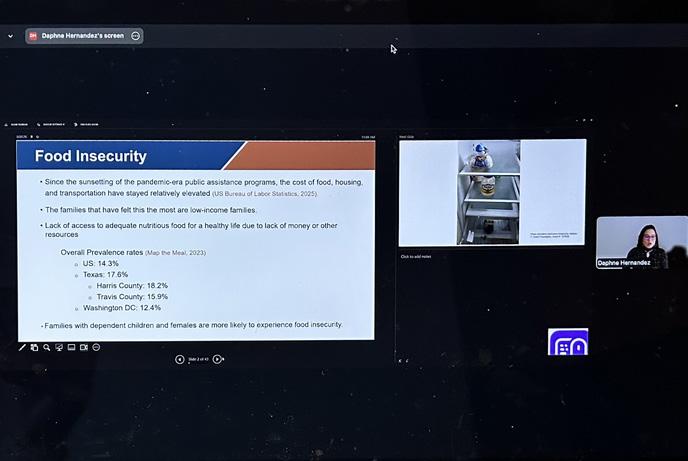
A University of Texas developmental psychologist and researcher warned that rising food and housing costs are increasing risks of food insecurity, particularly for women, at a Nov. 12 Georgetown University event.
The Virtual Brown Bag Research Exchange, a monthly event series hosted by Georgetown’s Berkley School of Nursing, featured Daphne Hernandez to discuss how economic distress forces families to make difficult choices about food and housing and the health challenges that can arise as a result. Hernandez currently works as a researcher at the University of Texas Health Science Center at Houston, specializing in health disparities and economic hardship.
Hernandez said many low-income households must choose between basic needs like rent, childcare, utilities and medical care, which can create long-term consequences for stress, health and well-being.
“Economic tradeoffs are when you have to make a decision between meeting one basic need over another one, and you are having to make that choice because you have limited resources,” Hernandez said at the event.
Hernandez said women with families face heightened food insecurity when choosing between housing costs, childcare or other child-related expenses.
“We found that women with dependent children are more at risk for food insecurity if they have to make an economic tradeof between paying for housing and paying for childcare,” Hernandez said. Hernandez said some compromises place women at risk regardless of whether they have children at home.
“Women without dependent children were more at risk for food inse-
curity when deciding between paying for housing and paying for utilities or education,” Hernandez said.
“And then, women, regardless of whether they had a child or not, were more at risk for food insecurity if they were making tradeofs between rent and medical care or transportation,” Hernandez added.
During the event, Hernandez emphasized that welfare programs like the Supplemental Nutrition Assistance Program (SNAP) reduce immediate food shortages but fail to address the overlapping burdens of housing costs, childcare, transportation and medical expenses.
Hernandez said intersectional policymaking can transform how the government supports families experiencing economic distress.
“I would love to see a holistic program where if you apply to one type of program, it opens up the opportunity to receive services from other programs in one application,” Hernandez said.
Hernandez also highlighted the role of healthcare settings, particularly pediatric clinics, saying housing instability is an important determinant of child well-being.
“Housing is a top nonmedical driver of health, and we are not paying attention to that during children’s wellness visits,” Hernandez said.
Hernandez’s broader body of work includes the Hope-M study — funded by the National Institute of Nursing Research — which investigates how the threat of eviction after the temporary halt on evictions during the COVID-19 pandemic afects mental health.
Hernandez said the study’s motivation stemmed from the unprecedented housing instability that occurred after the COVID-19 pandemic.
“So during the COVID-19 pandemic, there were eviction mora-
toriums put into place to prevent individuals losing their housing and having to go live with other individuals, which then places these households at risk for overcrowding,” Hernandez said.
“Evictions really started to increase very quickly after the state moratorium was lifted, and evictions have not only increased, but they’re above the historical average,” she added.
Hernandez said the team is currently finishing data collection and hopes the results will guide more effective and equitable housing policy.
Kira Casler (SFS ’27), an economics and global development student who attended the event, said she found Hernandez’s multifaceted approach to food insecurity especially interesting.
“I found Dr. Hernandez’s work particularly meaningful as someone who cares about both economics and
gender equity,” Casler told The Hoya
“Her analysis of the different tradeoffs women face shows how food insecurity is rarely about food alone. Her approach and nuanced understanding will be essential as debates about SNAP, childcare access and broader social support programs continue.”
Hernandez said students should stay engaged with eforts addressing inequality.
“I defnitely encourage students to volunteer at food pantries and also get involved in community-based research,” Hernandez said. Looking ahead, Hernandez said increased collaboration between researchers, policymakers and community organizations is essential to reducing both food and housing insecurity.
“Holistic support is the way we move families into long-term well-being,” Hernandez said.
FDA to Remove Warnings From Hormone Medication
Eva Siminiceanu Deputy Science Editor
The U.S. Food and Drug Administration (FDA) announced plans Nov. 10 to remove the black box, the most serious safety warning, from menopausal hormone replacement therapies (HRT). HRT treats common symptoms of menopause, such as hot fashes and mood swings, by replenishing the key hormone estrogen, production of which slows at the onset of menopause. Although the FDA previously mandated black box labels that clearly communicate the risks of HRT — such as increased chance of blood clots and heart disease — the agency will move to instead note such risks on a packaging insert.
Anish Patel (CAS ’28), a biochemistry and government student, said it is difficult to make wide-ranging conclusions about HRT and that the decision to use the treatment is complex.
“There’s lots of scientific evidence describing both the risks and benefits, but each individual has different vulnerabilities and situations, so it may be clearly worth it for one person to take HRT but deadly for another person. It could really cause severe issues down the line if it’s not prescribed responsibly,” Patel wrote to The Hoya
It is not uncommon for the FDA to change course on its classifcation of drugs, but the HRT decision is distinct in its comparative lack of rigor.
Charlotte Philips (CAS ’28), a biology of global health student, said a small “panel” of experts made the decision to alter HRT warnings in July, though the agency typically forms advisory committees of a wide range of experts.
“It’s reassuring to still see experts involved, but the new format creates a lack of transparency, which creates a little more skepticism, which you don’t want when you’re making potentially life-changing decisions in deciding to prescribe or take a medication like this,” Philips told The Hoya FDA Commissioner Marty Makary stated the decision to move away from traditional advisory committees came from their “bureaucratic” and inflexible nature, and that panels will allow for equally rigorous and more “spontaneous” decisions.
Ellie Ward (CAS ’28) said she worries that shortening key scientifc discussion may lead to incomplete, hasty recommendations.
“I feel like women’s medicine is already so unstudied and women are underrepresented in clinical research already, and this feels like pushing more in that direction,” Ward told The Hoya. “It’s a little scary as some-
one who’s interested in science and also will need to feel secure about my choice to take these medications in the future if I need to.”
FullDisclosure:EllieWardcurrentlyserves as a Science columnist for The Hoya.
Philips said the removal of the black box may also lead to more women considering HRT as an option for relief from menopause symptoms.
“Menopause symptoms are usually not taken very seriously, but they can deeply affect women’s livelihoods,” Philips said. “Changing the warning label could lead women to ask their
doctors about a treatment that could really improve their lives, and maybe help doctors consider it as an option.”
Ward said that though the decision will likely reinvigorate discussion around potentially beneficial HRT treatments, patients should still be cautious and thorough when deciding whether HRT is right for them.
“I hope that this decision will help patients look more into this care option and that doctors can support them to make the best choice, while still thoroughly considering the dangers,” Ward said.

ly under-vaccinated communities have seen high levels of sustained transmission due to weakened herd immunity and close proximity. Washington, D.C., sits at 92.7% kindergarten MMR coverage for 2024 to 2025, approximately the national average — although the optimal target for herd immunity formulated by public health oficials is 95%.
Gonzalez said it is essential to tackle vaccine hesitancy in order to reach vaccination coverage goals in D.C. and beyond.
“To increase efective immunization, we must consider the quality of the vaccine, the injection and the

Potential Change in NASA Leadership Could Create Novel Capacity Concerns
Ellie Ward Science Columnist
Departments across the federal government seem to be in constant and overwhelming fux this year. A recent development is the potential leadership change at NASA this month. Jared Isaacman, who instituted and funded a private program that uses SpaceX rockets, has been nominated to replace Sean Dufy, the secretary of transportation, who is currently interim NASA administrator. For the frst time in 10 months, NASA may have permanent leadership soon, and looking at the department’s future highlights a complex intersection between science and politics: navigating budgetary concerns, decreased workforce and concerns over cuts to long-standing programs. Notable cuts to NASA’s resources began in March when, amid President Donald Trump’s initiatives to downsize the federal workforce, the department announced stafing cuts in the Ofice of Technology, Policy and Strategy, the Ofice of Diversity and Equal Opportunity and the Ofice of the Chief Scientist. With 23 initial frings from this decision, NASA staf frustrations began to grow, with an anonymous employee telling Business Insider that the choice shows that the federal government does not see NASA’s scientists as an integral part of the nation’s future. Since then, 4,000 employees have been fred from NASA as of this fall.
Staf are not the only resource taking hits from budget cuts and downsizing plans. A major point of contention has been the Goddard Space Center, a project that produced groundbreaking NASA projects such as the Hubble Space Telescope and the James Webb Space Telescope. Recently, however, it has sufered from closures and chaotic policy debates — staf have complained about a lack of information regarding structural rearrangements, building closures and seemingly random reorganization projects. Trump has also said he hopes to cut 50% of Goddard’s stafing budget.
Not only is this a clear threat to the job security and work conditions of federal employees, but sudden moves have compromised specialized research and delicate
equipment integral to projects at Goddard. Goddard employee Monica Gorman told NPR that these damages waste exponential amounts of NASA funding and stall or scrap projects necessary for the United States to remain a leader in the space industry. These concerns are at odds with the ambitions that Isaacman articulated the frst time he was nominated for the position: Isaacman wrote in an article in RealClear Science in August that maintaining a competitive edge on other space leaders such as China and Russia will require NASA to push its problem solving boundaries with unparalleled ambition. Centering competition and ambition in his goals is at odds with the diminishing resources he would be leading with. Isaacman has defended his hopes for funding, mainly through promises to spend his own personal fortune to fund projects like the threatened Chandra X-ray Observatory, a powerful X-ray telescope, which he has deemed of key importance to scientifc discovery. He has also claimed this week that some budget cut plans from a leaked document called Project Athena, which he wrote at the end of last year, were no longer relevant to his current plans. The Project Athena Proposal, despite its obfuscated relevance to Isaacman’s current plans for the agency, was not aligned with the downsizing goals of the administration at large. In this proposal, Mars research and nuclear electric propulsion were both subject to increased focus and resources. These developments leave the public with a lot of important questions. How can an agency set on downsizing maintain goals of world leadership, not to mention keep its current cornerstone projects running? Furthermore, what are the goals of new leadership if public information is mostly limited to a dated, leaked and allegedly still-changing document? It remains to be seen whether this potential new leadership will usher in a new era of stability in an agency that has had a rocky 10 months, or if budget cuts, downsizing and the general deprioritization of science under the current administration will only continue.
WIKIMEDIA COMMONS
The Pan American Health Organization (PAHO) determined that Canada has surpassed the threshold for measles elimination.
WIKIMEDIA COMMONS
The FDA announced Nov. 10 that menopausal hormone replacement therapies (HRT) will no longer have black box
RUTH NOLL/THE HOYA
Daphne Hernandez presented her research on how health challenges that arise from food and housing insecurity.
WIKIMEDIA COMMONS
Ellie Ward (CAS ’28) discusses upcoming changes to NASA leadership and concerns over the future of the agency.

thoughtful
Fed Governor Affirms Market Stability, Cautions Against Using AI in Trading
Nico Abreu Events Desk Editor
Lisa Cook, a Federal Reserve gov-
ernor, reassured students of the stability and growth of the U.S. market while cautioning investors on the use of artifcial intelligence (AI) in trading algorithms at a Georgetown University event Nov. 20.
Lisa Cook, a current member of the Federal Reserve’s board of governors and the co-chair of the Regional Consultative Group for the Americas, affirmed the strength of the U.S. financial system, analyzed the growing private credit industry and qualified the use of AI in the financial sector. The event, hosted by Georgetown’s Psaros Center for Financial Markets and Policy, aimed to educate business students on the several approaches the Federal Reserve takes in ensuring financial stability.
Earlier this year, the U.S. Supreme Court announced it would begin hearing arguments in January 2026 for Cook’s firing, though it has permitted her to remain at the Federal Reserve until then. The announcement came after President Donald Trump publicly called for Cook’s firing in August, claiming she made false statements on applications for home mortgages.
Cook said that while the Federal Reserve has observed some vulnerabilities, the fnancial system in the United States is sustained by households and businesses.
“The financial system remains resilient, supported by strong balance sheets among households and businesses and high capital levels across the banking system,” Cook said at the event. “Earlier this month, the Fed issued the most recent version of our semiannual Financial Stability Report. That report affirmed the system is resilient, while also noting some of the same risks and vulnerabilities we have seen in recent reports.”
Cook said one vulnerability in the current market is a decrease businesses’ current assets and liabilities.
“Currently, my impression is that there is an increased likelihood of outsized asset price declines,” Cook said. “However, given the system’s overall resilience, I do not see the kinds of weaknesses that played out so painfully in the Great Recession, and thus, I do not see potential asset price declines as posing risks to the fnancial system.”
Cook said another area of concern in the current system is the growing use of private credit, wherein businesses fnance their debts directly with non-bank lenders through privately negotiated contracts.
“Fed staf estimate that, over the past fve years, private credit has roughly doubled,” Cook said. “Whenever we observe such rapid growth in credit over such a short period of time, it draws our attention.”
Still, Cook said, the growth of this type of credit has created more opportunities for frms.
“The growth in nonbank lending to privately held businesses has increased credit access,” Cook said. “As a result, private businesses that have dificulty securing a loan from a bank can continue to grow their businesses with loans from private credit providers.”
Cook said that while the complexities of private credit could spread losses from the sector to the broader market, she is not concerned.
“The increased complexity and the interconnections with leveraged financial entities create more channels through which unexpected losses in private credit could spread to the broader financial system,” Cook said.
“What do recent trends in the sector suggest about the potential for such losses and fnancial stability risks?” Cook added. “I do not currently see the potential for private
credit to contribute to an unexpected credit crunch in the same way that the asset-backed commercial paper market did in 2008.”
Cook said the use of AI in the market could result in market manipulation that favors those using the technology.
“Researchers have also pointed to the risk that generative AI could engage in collusion and market manipulation, rigging the system to favor those employing the technology,” Cook said. “Recent theoretical studies fnd that some AI-driven trading algorithms can indeed learn to collude without explicit coordination or intent, potentially impairing competition and market eficiency.”
Cook said that while there are concerns about AI, surveillance techniques are showing promise to thwart collusion eforts.
“The good news here is that major electronic trading platforms are also rapidly adopting advanced machine learning techniques to detect market manipulation and collusive behavior,” Cook said. “Thanks to improving surveillance capabilities, AI technology could ultimately strengthen market integrity and enhance market liquidity.”
Cook said that while the fnancial system is strong, the vulnerabilities of elevated asset values, hedge fund activity and private credit are factors the Federal Reserve will monitor.
“The financial system remains resilient,” Cook said. “Yet, vulnerabilities from elevated asset values, growth and complexity in private credit markets, and the potential for hedge fund activity to contribute to Treasury market dislocation warrant attention.”
“These emerging vulnerabilities also occur against a backdrop of very significant technological change,” Cook added. “These innovations may ultimately improve financial stability but also involve transitions and potential challenges that may require thoughtful and deliberate navigation.”
Ajani Stella Senior News Editor
US TOMORROW AT THE HOYA GALA

Interim Georgetown University
President Robert M. Groves will retire one year after the new president’s term begins July 1, 2026, a university official said at a Nov. 20 faculty senate meeting that also included changes to budget advising rules and updates on various university initiatives.
Joseph Ferrara, the university’s vice president and chief of staf, provided updates on university budget constraints, classroom recording policies, a university plan to subcontract Georgetown University Transportation Shuttle (GUTS) drivers and the transition to a new university president at the senate meeting, which invites monthly updates from university oficials and votes on faculty matters. Faculty senators also endorsed a new senate budget committee to invite greater faculty input on spending considerations.
Ferrara said he will continue working for Georgetown in some capacity under incoming university President Eduardo Peñalver’s administration after Groves retires, though he will not be chief of staf.
“Bob and I will be asked to serve as senior advisors to the new president, to basically help Eduardo Peñalver over as he gets settled,” Ferrara said at the meeting. “At some point, there will be someone who will come in behind me as chief of staff, and part of my role will be to help that person figure out the job and have a smooth transition.”
Ferrara said the university’s board of directors, which elected Peñalver, asked him to help advise the transition and begin onboarding the new president.
“One thing the board has asked me to do is, in my capacity as a senior vice president, to take some leadership of some of our functions at the university, to maintain stabili-
The Hoya Gala
The Hoya Gala will take place tomorrow, Nov. 22, at the Planet Word Museum, featuring Karen Travers (COL ’00, GRD ’03), a White House correspondant for ABC News, as the keynote speaker. Scan the QR code to donate to support our gala and journalism, and check out CampusGroups to buy tickets. More information is available on CampusGroups and The Hoya’s social media.

ty as we go through this transitional period,” Ferrara said. “So that’s what we’re going to do. We are slowly starting to work with Eduardo on providing information to him.”
Ferrara also said Groves would send faculty and staff an update on the university’s financial situation, which Groves had pledged to do monthly through December. Groves announced Oct. 28 that Georgetown is forecasted to lose $35 million and faces a 20% decline in international graduate student enrollment.
Ferrara said the university plans to hold faculty town halls to discuss the budget constraints.
“We would probably do one at the Capitol Campus and one at the Hilltop Campus, and to be able to talk through the budget — a lot of the stuff you’re very familiar with we’ve talked about before — the disruptions to federal funding of research at Georgetown, the declines we’ve seen in graduate tuition revenue because of issues with graduate and then international student enrollment,” Ferrara said.
The faculty senate also considered a proposal to amend its senate constitution to redefine the Senate University Budget Committee, which makes financial recommendations to the university based on faculty input, to grant the senate broader advisory oversight on financial matters that relate to “teaching, research and scholarship.”
Erin Carroll, a law professor who chaired the subcommittee in charge of developing the proposal, said the subcommittee concluded faculty wanted more input in university fnancial decisions.
“Faculty want to be engaged early in the process, be given the information that they need, and feel like they are collaborating with and strategizing with administrators,” Caroll said at the meeting.
The changes include reducing the size of the budget committee,
inverting the ratio so there are more faculty than administrators, including faculty members from all Washington, D.C. campuses and requiring members to be full-time faculty.
The faculty senate approved the changes to the senate constitution and budget committee, which now must be approved by a vote of faculty from the Medical Center, Law Center and Main Campus. Ferrara also updated faculty on points of contention, including the university’s GUTS plan and classroom recording policies.
Some faculty have advocated for greater restrictions on recording classes amid fears of political censorship, which Ferrara said the university will study through a working group.
“What Bob has asked them to do is really to try to come up with a consistent, legally compliant approach to audio and video recording in university classrooms and instructional settings,” Ferrara said.
Ferrara said the university respects faculty’s advocacy on behalf of GUTS drivers, who face a decline in benefts if they are subcontracted, and the chief operating oficer’s (COO) ofice is nearing a decision.
“My sense right now is they are in the fnal stages of trying to fgure out — ‘they’ meaning the COO’s ofice — based on all the consultation they’ve heard and updating their own analysis,” Ferrara said.
“One of the alternatives that they’re exploring is an alternative where you would still be outsourcing to a third party, but the bus drivers could have an opportunity to remain as university employees, which I think is one of the issues that has come up,” Ferrara added. “So they haven’t landed yet, but I think there’s been a lot of consultation, a lot of discussion, and certainly I think they have gotten the message that there are concerns in the community.”
Two investigative reporters criticized the politicization of the U.S. Department of Justice (DOJ) under President Donald Trump’s administration at a Georgetown University event Nov. 17. Carol Leonning, a fve-time Pulitzer Prize winner, and Aaron Davis, a Georgetown professor and two-time Pulitzer Prize winner at The Washington Post, delved into the lack of separation between the White House and the DOJ and the source of those issues at an event hosted by Georgetown’s journalism program and the McCourt School of Public Policy. Their talk centered on their recently published book, “Injustice: How Politics and Fear Vanquished America’s Justice Department,” which examines the evolution of the DOJ, identifes a “crisis” in the department and assesses the department’s loss of credibility among the judiciary and public.
Davis said the book documents the ways in which members of both the DOJ and federal government have weaponized and politicized the department under Trump’s infuence, diverging from DOJ values of “independence and impartiality.”
“It’s about this time period. It’s about reaching this place where politics and prosecutions are mixed in this state, really injustice that
we have reached, so that’s how we evolved,” Davis said at the event.
Rebecca Sinderbrand (COL ’99), Georgetown’s journalism program director who introduced the authors, said narrative investigative journalism is especially important in the current political climate.
“The kind of investigative journalism that you are about to hear tonight — careful, patient, expert — has perhaps never been more challenging to undertake or more important, more vital to understanding the country and the world in which we live right now,” Sinderbrand said at the event.
“We’re fortunate that in these interesting times, we have some of the smartest, most dedicated journalists in the profession, writing the frst draft of history as the story shifts beneath them, assembling the car while they drive it.”
Leonning said the Trump administration’s ability to influence the DOJ is a result of his political appointees’ willingness to follow his orders blindly, which she said differed from his first term, when intervening officials such as John Kelly, Trump’s former White House chief of staff, helped check Trump’s influence.
“Why has he been so successful this time around? Because all the guardrails are gone,” Leonning said at the event. “There’s no John Kelly in the White House chief of staf saying, ‘You really don’t want to do this, boss.’”
To show the diference in DOJ’s independence from the White House, Leonning cited the recent incident in which Trump asked the DOJ on Nov. 14 to investigate convicted sex ofender Jefrey Epstein’s ties to prominent Democrats. Later that evening, Attorney General Pamela Bondi thanked Trump and announced that the DOJ had opened an investigation.
Davis said the U.S. Supreme Court has enabled the DOJ to continue working with the White House, even if lower courts dissent.
“There is a recognition inside the Justice Department that the Supreme Court has gone to a place that nobody ever expected, and no case had ever really provided even a hint that we would’ve been in that position,” Davis said. “So there’s a lot of things you can say about the Supreme Court, but in the course of our book reporting, that was a huge, huge point.”
“You’ve got a judiciary that now does not trust the Justice Department,” Davis added.
“You’ve got a public that in many ways is skeptical of the Justice Department of the highest rung of the judicial system.”
Davis said the DOJ needs to work on the timelines of its cases and has to have more dialogue with the American public about its decisions.
“In the world of the internet age, we’re not going to wait for
a year or two, three years to pass while the Justice Department methodically decides if something should be prosecuted or not, and only speak through a court document,” Davis said.
“More transparency to say, ‘This is what we’re doing; this is why we’re doing it,’ and to try to rebuild some of that trust with the American people.”
Leonning said she is hopeful because there are still people within the DOJ who frmly believe in the institution and its purpose.
“There must be some middle ground between waiting years and also deciding, ‘We’re going to investigate, we don’t know if we’re going to investigate yet, but we’re going to investigate something now,’” Davis added.
“We have talked to a lot of sources, and some of them are still inside the building and they’re holding on by their fngernails with the goal of rebuilding,” Leonning said. “They’re absolutely, dead-set committed to this institution returning to its venerable position as the chief defender of our democracy and the chief deliverer of fair treatment, fair and equal justice.”
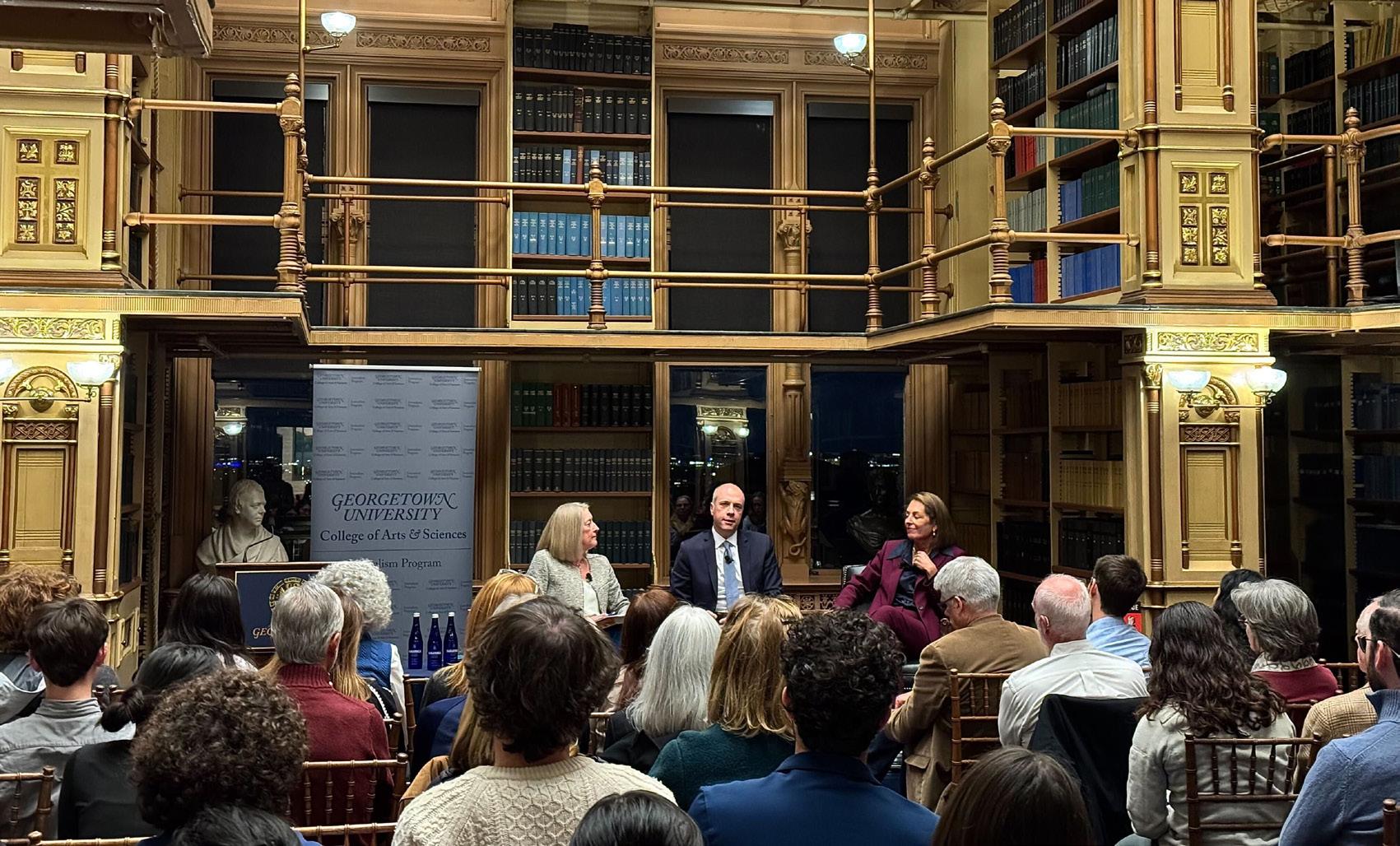
ANDREW JIANG/THE HOYA
A New York Times journalist assesses how artificial intelligence could reshape the labor market, emphasizing the need for adaptation and
policy at a Georgetown University event Nov. 13.
Jacqueline Gordon Hoya Staff Writer
JOIN
MEGHAN HALL/THE HOYA
Two investigative journalists warned that the U.S. Department of Justice (DOJ) is becoming increasing politicized under President Donald Trump’s second administration.
GU-Qatar Graduate Wins Rhodes
Scholarship for Public Service Work
RHODES, from A1 themselves out of poverty.”
“I’d always ask myself, ‘What can I do in my own capacity to empower members of my community, to be able to improve their life outcomes sustainably?’” Yunusa added.
Interim University President
Robert M. Groves said Yunusa embodies Georgetown’s spirit and mission through her emphasis on helping others through public policy.
“I’d like to extend my congratulations to Fatima on her extraordinary accomplishment of becoming a Rhodes Scholar,” Groves said in a university press release. “Fatima’s commitment to uplifting others combined with her focus on public policy and public service exemplifes Georgetown’s highest ideals, and we look forward to seeing what she will accomplish.”
Yunusa said she hopes to draw on resources at Oxford to learn how best to help her home country.
“A lot of very accomplished public service practitioners are going to be in the classes,” Yunusa said. “The case studies and approaches that it uses are grounded in international realities, best practices. And I look forward to learning from this international pool of resources that it has, what the global best practices are, and gaining the skills needed to then localize these and apply this and deploy this in the unique Nigerian context.”
At GU-Q, Yunusa served as a writing tutor and a community development advisor, mentoring high school students from underserved communities in Africa. She has also helped Palestinian refugees learn English as they evacuate Gaza and worked with the international philanthropy group Libra Philanthropies, which provides grants for social impact initiatives worldwide.
Damien Tissot, a professor who taught Yunusa in both advanced French and feminist literature, said Yunusa incorporated her life
experiences into her studies and was a classroom leader, citing her passion for feminism.
“She’s very well aware of what’s happening in the region where she was raised,” Tissot told The Hoya. “She brought this amazing insight into all of the classrooms. I have a specific memory of her when she was in ‘Introduction to Feminist Philosophy,’ where at some point, we were discussing a text and she stepped back and she started talking to the other students and trying to raise awareness about specific issues.”
“For her, feminist issues were something that really resonated with her,” Tissot added.
Yunusa said she plans to study how issues intersect in her path to public policy.
“Everything is wrapped together, and was pointing in the direction of studying public policy, because my understanding of what public policy is is being able to map a problem at all the intersections that is existing, mapping out the entire ecosystem, and being able to take an evidence-based approach to solving the foundational issues that caused the problem and contextualize that solution to a unique landscape,” Yunusa said.
Christine Schiwietz, aGU-Q advisor to the dean for civic engagement who recommended Yunusa for Rhodes, said she represents the best of Georgetown’s community.
“She leads with integrity and conviction and brings a deeply grounded commitment to civic engagement and inclusion,” Schiwietz wrote to The Hoya. “Her work supporting women students and displaced youth illustrates her unwavering purpose and dedication to meaningful change. She truly embodies the Rhodes ethos of excellence in service to others. I could not be more proud of her, and I know she will continue to lead with impact at Oxford and globally.”
Yunusa said she is passionate about public policy because it
has the capacity to bring about real change.
“If you could use effective, evidence-proven policies, you could actually improve people’s lives,” Yunusa said. “You could actually lead them out of poverty. That was when I really said, ‘Okay, I think this is giving direction to how specifically I would like to catalyze this change.’”
Lynda Iroulo, a GU-Q international relations professor who taught and worked with Yunusa, said she was not surprised that Yunusa won the award, given her consistent dedication to public service and research.
“Her thought-provoking questions demonstrated a remarkable ability to critically engage with readings beyond academia, refecting on how they illuminate realities and policies with particular emphasis on Africa,” Iroulo wrote to The Hoya. “She is unapologetically herself — proudly Nigerian and African — and I loved how she would arrive in vibrant Nigerian attire. Yet she remained deeply inclusive, caring genuinely about her peers’ welfare and advocating for their voices to be heard.”
“Knowing her, as a high academic achiever and endearing personality, someone who genuinely cares about her peers and community, I knew that she would receive it,” Iroulo added.
Yunusa said studying at Oxford will help her understand how to unite policy areas to build solutions to local issues.
“An effective policy solution for talent development and poverty eradication right in Nigeria will not be the same as what it will look like in Qatar, will not be the same as what we look like in the U.S., because we have different prevailing socioeconomic condition, political conditions,” Yunusa said. “So being able to look at the world and problem-solve with such thoroughness, I think that’s the lens that public policy gives you. And where better to study that than at Oxford University?”

Community Mourns Transgender
Lives Lost on Day of Remembrance
REMEMBRANCE, from A1
the use of preferred pronouns for faculty, staf and students. The university also provides resources to LGBTQ+ students through the LGBTQ+ Resource Center.
Georgetown’s former LGBTQ+ Living Learning Community (LLC), named Crossroads, closed in Fall 2022, four years after it was frst approved. GUPride opened an interest form to gather support for restarting a similar LLC.
Early said GU Pride has faced setbacks this year in creating an LLC on campus, which left transgender students discouraged.
“Given everything that has been going on, both nationally and on campus, we struggled a lot in our advocacy eforts this
year in terms of ameliorating the gender-inclusive housing as well as trying to establish a queer LLC,” Early said. “That’s been really disappointing. I think a lot of people, especially people within the trans community, have been disafected by that.”
Gaudion said the vigil reafirmed support for Georgetown’s transgender community.
“It’s important for GU Pride to recognize that at our own university, we have trans students, and they deserve to be seen and recognized and acknowledge that these deaths are awful and horrible and that they deserve to be remembered just as much as any of the rest of us if we passed away,” Gaudion said.
Gaudion added that she hoped the vigil would foster community while motivating students to
Over 500 Community Members Sign Petition Supporting RA Union
PETITION, from A1
resolve any concerns through good-faith engagement.”
Isaiah Vasquez (CAS ’27), GRAC’s vice chairperson and an RA for Copley Hall and Ida Ryan and Isaac Hawkins Hall, said he was encouraged by broad student support of the petition.
“I just feel like it means that our union has more student backing than ever,” Vasquez told The Hoya . “Part of this is by garnering attention and getting people to actually care about the issue because it is something that affects everyone on campus. Whether it’s noise policies or anything else, they are affecting students in general and whether RAs can do their jobs effectively or not.”
Dhruv Shah (SFS ’26), an RA in Hayden Hall, said the Ofice of Residential Living (Res Living)’s lack of communication on the policy changes was discouraging.
“I’m a third-year RA and I signed the petition because I support the core of our demands: having a voice in our workplace and conditions of employment,” Shah wrote to The Hoya. “Putting aside the specifc policy for a second, this is fundamentally about whether the university will treat us as equals.”
“During RA training, we have dozens of university partners tell us that we are the frst line of defense and that their work couldn’t happen without us,” Shah added. “That kind of falls on deaf ears when the current leadership of Residential Living treats us like we don’t matter.”
With the policy changes, RAs will not be informed of the specifc room they are in until after phase two of the housing process, when residents are grouped in pairs. According to multiple RAs, this change means that even if an RA’s friends attempted to join the suite through the standard housing portal, the RA would not yet have a specifc room assignment.
The petition alleges that the university is violating labor laws by refusing to bargain over this policy change.
“This drastic policy change is a direct violation of RAs’ labor rights,” the petition reads. “As
unionized employees, RAs have a right to collectively bargain over changes to their working conditions unless there is a ‘clear and present waiver’ excluding the issue in the existing Collective Bargaining Agreement. No such waiver exists.”
“The university is making a unilateral change, which constitutes an Unfair Labor Practice under the National Labor Relations Act,” the petition continues. “To put it simply, Georgetown University is breaking the law.”
According to the university spokesperson, the university has met with GRAC’s representation in OPEIU to discuss the policy changes. The university has also met with GRAC members on the Labor Management Committee, a CBA-formed committee that includes union and university representation.
A university spokesperson said the university is working in good faith with GRAC and is in compliance with labor law.
“The university continues to communicate in good faith directly with GRAC and OPEIU, as required by the CBA, including an additional meeting with a union representative today,” the spokesperson wrote.
“We look forward to continuing this engagement and reaching outcomes which are satisfactory to both parties.”
Izzy Wagener (SFS ’26), GRAC’s chairperson and RA for Darnall Hall, said the infux of student support for RAs has been particularly meaningful.
“It’s been really awesome to see the outpouring of support from so many different parts of campus,” Wagener told The Hoya . “I didn’t even reach out to most of the groups that signed the petition and clubs and student organizations. So it’s just meant a lot that they went out of their way to show their support for us.”
As of Nov. 20, 15 student organizations have signed onto the petition in addition to GRAC, including student labor advocacy group Georgetown Coalition for Workers’ Rights, the Georgetown University Student Association (GUSA) and Georgetown University College Democrats (GUCD).
Mansi Peters (CAS ’27), GUCD’s human resources director, said GUCD signed the petition not only to support friends and peers, but to work toward a better campus.
“The entire point of advocacy and organizing is to understand that we’re all working toward a better community and a community that wants to uplift each other, no matter our personal stakes in it,” Peters told The Hoya . “So I’m passionate about law, sure, and I’m passionate about advocacy, yes, but I’m also passionate about the people who are actively being affected by it.”
GUSA President-elect Darius Wagner (CAS ’27) said RAs are an essential part of the community.
“Our RAs give so much of themselves to our community,” Wagner told The Hoya . “They stay here during breaks. They come early to design our dorms. They help us when we’re locked out. They help us settle conflicts between roommates. They give so much service to our community, and it’s been incredibly disheartening to see how the director of Residential Education has actively not been consulting with the RAs.” The GUSA executive and senators tabled in Red Square throughout the week, encouraging students to sign the petition.
Braedon Troy (CAS ’27), GUCD’s campaigning director who signed the petition, said they signed because RAs are an integral part of student life.
“For a group of people who are really an indispensable part of our dorm life here, especially at a school that requires you to live on campus for the majority of your time here, they absolutely need better working conditions to fulfill their jobs,” Troy told The Hoya Wagner said she hopes Res Living and the university administration will heed their demands.
“I hope that they consider some of the arguments that we’ve made and the support of partners on campus and take that into consideration and hopefully reverse this policy,” Wagner said.
Bernie Sanders, Nobel Laureate Urge Caution, Regulation of AI
SANDERS, from A1
could accelerate this trend.
“In a world of massive inequality, AI and robotics is going to just exacerbate that inequality,” Sanders said at the event. “The wealthy countries will be able to have tools that poor countries in a million years won’t have.”
Hinton said AI may upend the job market by fulflling routine tasks and reducing job mobility, replacing individual jobs with cheaper and more eficient labor as AI companies seek to increase profts.
“If you ask, ‘Where are these guys going to get the roughly trillion dollars they’re investing in data centers and chips?’ — you can get subscription fees, but one of the main sources of money is going to be by selling people AI that will do the work and work much cheaper,” Hinton said at the event. “And so these guys are really betting on AI replacing people.”
“People who lose their jobs won’t have other jobs to go to,” Hinton added.
Sanders expressed a similar sentiment, saying many working-class people fear the impact AI could have on their jobs.
human qualities that make them harder to control.
“AI agents will develop various obvious sub-goals once they’ve got the ability to create sub-goals. One is to stay in existence,” Hinton said.
“We’ve actually started to see people who are trying to turn them of. They will try and exfltrate their weights to other systems so they stay in existence on other systems.”
Hinton said AI’s desire for increased control is comparable to that of politicians.
“They start of wanting to achieve good things for people, and pretty soon they realize, to do that, they need more control,” Hinton said.
“The AIs will do the same.”
Manvi Tripathi (CAS ’28), who attended the event, said Hinton’s comparison to political power was enlightening.
support and defend transgender students on campus.
“I hope students take away a sense of community — that we’re all here to support each other in solidarity, but also recognize the world we live in and how much it sucks sometimes, but also be willing to stand up for the trans people in their lives and make a diference, make a change, especially on our campus,” Gaudion said.
Early said the vigil highlighted the importance of solidarity with transgender students across campus.
“I hope students see that this is a community that they would really like to support,”
Early said. “Community is the major word. I think this is one of these days where we realize why community is so important.”
“I think among working class people, there is a legitimate and real — and based on reality — concern about what AI will do,” Sanders said.
Sanders has heavily criticized AI and its impact on the workforce, including calling for the government to break up OpenAI, the AI company that runs ChatGPT, and releasing a Senate report detailing how AI could destroy 100 million jobs in the next decade.
Hinton has repeatedly warned that AI cannot be proftable without replacing human labor. In May 2023, he resigned from Google, where he worked for over a decade, so he could speak more freely about the threats of AI. At the time, Hinton told The New York Times that he regrets his life’s work advancing AI.
Hinton said AI agents have
“That’s not something I’ve heard about before — this idea of power being a necessary component to be able to achieve the goals that either politicians or machines want to achieve,” Tripathi told The Hoya. “I thought it was interesting putting that into perspective, that even if we have these goals and ideas that we’re trying to push through AI, you can’t actually do that if you don’t have the power to do so.”
“Putting that perspective in place, especially for someone who’s a gov major, was really useful and opened my eyes to all the major issues that come with AI that often go unaddressed because we’re so focused on the advancement of technology and trying to be the frst to make the next biggest thing,” Tripathi added.
Sanders said the issue with AI is not the technology itself but who benefts from it the most.
“The people who are pushing this transformative revolution are the richest people in the world,” Sanders said. “They are not staying up, not worrying about working people.
“It certainly made me more interested in it and its ramifcations that I’ve never thought of before, like foreign policy,” Le wrote to The Hoya. “I also wasn’t surprised by the fact that Senator Sanders tied a lot of the topics to issues like wealth and income inequality, but it was very interesting to see the connections that he made.” Hinton said universities and industries must adapt to AI rather than trying to avoid it, but AI does not have to completely upend education.
“What we should think of is a person using a pocket calculator as the new system, just as a person using an AI, can still do critical thinking, or they can try and dump everything on the AI, and that’s terrible,” Hinton said. “But I think we should not try and sort of exclude AIs as systems, because that’s the future.”
Anne Lindsay (CAS ’28) said Hinton’s lecture made her concerned about AI’s future impacts.
“It was extremely interesting how they really framed AI in a way that science has no idea where it’s going to take itself, and it honestly scared me in a way because it felt very real all of a sudden,” Lindsay told The Hoya
“It felt like the person who created it, who should be advocating for it the most, was talking about how it is going to take over the world,” Lindsay added.
Hinton said that once AI develops the capacity to persuade, it may be impossible to shut down or halt.
“They’ll be much more persuasive, so they’ll be able to convince the person who’s going to turn them of not to do it,” Hinton said.
“You’ve got things that won’t just stay in existence, they want to get control and at that point you ask, maybe we can just turn it off, the AI,” Hinton added. “The answer is you can’t.”
In my view, they want even more wealth and they want even more power. The struggle is not whether AI is good or bad, it is who controls it and who benefts from it.” Ethanson Le (MSB ’26) said the event piqued his interest in AI and what potential implications it could have on international policy.
GEORGETOWN UNIVERSITY
Fatima Yunusa, a Georgetown University in Qatar graduate, won the international Rhodes Scholarship, one of the most prestigious scholarships in the world, Rhodes announced Nov. 15.
GU Students Protest Strikes on Venezuelan Ships, Condemn Trump
Noah De Haan Hoya Staff Writer
Georgetown University students joined 50 protestors at the White House Nov. 15 to denounce the federal government’s military attacks on Venezuelan ships.
The protest follows President Donald Trump’s order for the U.S. military to strike alleged Venezuelan drug trafickers, as well as the military buildup in Latin America and potential military operations within Venezuela.
The Party for Socialism and Liberation (PSL), a communist political party formed in 2004, organized the protest, which began in front of the White House before Secret Service agents relocated it to the nearby Lafayette Square.
Alessia Castro Garcia (CAS ’29), who attended the protest, said she was happy to see people unite in defense of Venezuela.
“It was truly heartwarming to see people going out of their way to fght and use their voices for something they believe is morally wrong,” Castro Garcia told The Hoya. “I feel the same way they feel. I don’t think it’s right, and I’m really glad to see that they’re speaking up about it.”
Morgan Artyukhina, who attended the protest with PSL, said U.S. action in Venezuela mirrors previous conficts.
“The U.S. is trying to launch another devastating war in Latin America against Venezuela, and it’s built on the same lies as the devastating wars in Iraq, Afghanistan and even Vietnam,” Artyukhina told The Hoya. “Racism and demonization enable
war, and it’s all in defense of the profts of American companies.”
The Trump administration has ordered 20 attacks on boats of the coast of Latin America suspected of drug traficking. Trump has discussed diplomatic talks with Venezuelan President Nicolás Maduro but has not ruled out military action within Venezuelan borders.
Carys Bonitatibus, a student at American University who attended the protest, said it is important to protest even if it fails to create immediate change.
“I believe that we should be fghting for what we believe in even if the administration doesn’t take people’s opinions into account,” Bonitatibus told The Hoya “Even though they may go through with their own agenda, rather than what’s best for the people inside and outside of our nation, it’s still important to dissent.”
Ann Jaegerman, who attended the protest, said she fears Trump’s actions will start a larger confict with Venezuela.
“I am very concerned that Trump is going to put us into a war,” Jaegerman told The Hoya. “I don’t think that war will accomplish anything but further damage our reputation in the world and impact people across this country.”
Bonitatibus said protesting with like-minded people bolsters her patriotism.
“Coming from a small town in Florida, I don’t see protests often and people believe in very diferent things than I do,” Bonitatibus said. “To see people who agree with my stances makes me feel a sense of unity and pride in my country.”
GUSA Senate Supports RA Petition, Approves New Legislative Roles
Noah De Haan and Sofia
Thomas Hoya Staff Writer and GUSA Desk Editor
The Georgetown University Student Association (GUSA) Senate, Georgetown’s student government, passed three bills and swore in a new member at its Nov. 16 meeting.
The senate passed a resolution to condemn the Ofice of Residential Living’s recent policy changes afecting residential assistants (RAs) and to sign a petition against those changes led by the RA’s union, the Georgetown Residential Assistant Coalition (GRAC).
Additional approved legislation includes bylaws amendments to create two new legislative aide positions in the senate and to change the position of alumni relations chair to senate historian.
The senate unanimously passed the resolution supporting GRAC’s petition, which denounces fve recent policy changes, including a requirement that RAs commit to the role before knowing their building assignments and restrictions on RAs selecting their suitemates in suite-style housing.
GUSA Vice President Darius Wagner (CAS ’27) said the senate can show support for RAs by encouraging students to sign the petition.
“We’re going to need all the signatures we can get,” Wagner said at the meeting. “A lot of us have friends that are RAs, and they’re going through a tough time.”
“One thing we can do to give back to them is to get people to sign this petition,” Wagner added.
The senate also unanimously passed a bill changing the title of alumni relations chair to senate historian, expanding responsibilities to include overseeing the senate’s website and artifacts in addition to the existing duty of corresponding with senate graduates.
Senator Christian Spadini (CAS ’26), who introduced the bill and previously served as alumni relations chair, said changing the role will increase the position’s utility by introducing new responsibilities.
“I think that alumni relations in many organizations tends to be a pretty useless position on its own,” Spadini said at the meeting. “This adds some duties that actually make sense, like helping with the website.
A big thing that I discovered in our alumni relationships is that we have a lot of cool and esoteric GUSA documents upstairs in the library that I think people might be interested in seeing from time to time.”
Artyukhina said PSL wants to see funds for military action redirected to social programs, criticizing military spending such as F-35 fghter jets.
“We want to see all of the money that is being used for the U.S. war machine be used on the sorely needed repairs to infrastructure, funding our schools and our hospitals, funding our mass transit system, and going towards housing people,” Artyukhina said. “Why use that money for an F-35 when you can use it to pay people’s rent?”
Artyukhina said the military actions against Venezuela are motivated by a desire for natural resources.
“They are nakedly in pursuit of Venezuelan oil and Venezuelan natural resources, and they don’t care about the sovereignty of the country,” Artyukhina said. “Venezuela is a sovereign nation. They have the right to determine the course of their politics, they have the right to determine what to do with their own resources and the United States doesn’t.”
Venezuelan oficials have accused Trump of supporting regime change against Maduro to obtain easier access to Venezuelan oil reserves, which are the most abundant in the world.
Castro Garcia said she views Trump’s maritime attacks as unjustifed.
“I do not support aggression with Venezuela, especially if there are troops being sent there for natural resources,” Castro Garcia said. “I think that it is really uncondoned and the people of Venezuela really did not do anything.”
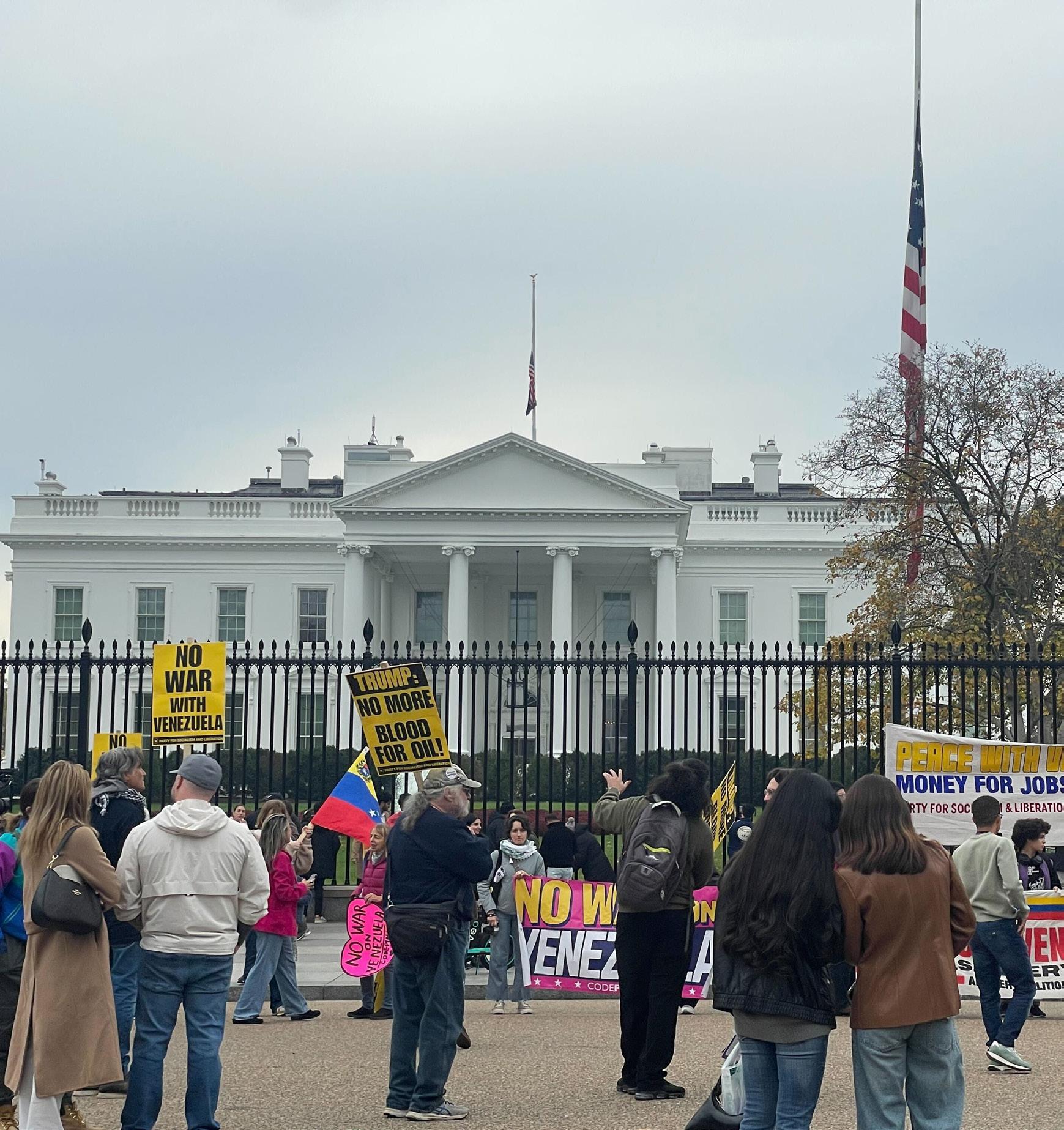
GU History Professors Receive 2025 Provost Awards For Work in Environmental, Latin American History
Catarina Boechat
Special to The Hoya
Evan Cornell (CAS ’27), who was elected at-large senator while studying abroad, was sworn in during the meeting over Zoom.
The senate also voted to pass a bill creating two legislative aide positions in the senate, with only Senator Roan Bedoian (CAS ’28) voting against. Bedoian said she opposed the legislation because she was concerned it would create an unnecessary hierarchy and bureaucracy in the senate.
“I voted against creating legislative aides because the way the Senate was discussing it, such as throwing around the term ‘interns’ for our peers, felt conceited and arrogant,” Bedoian wrote to The Hoya. “On top of that, doing research, gathering feedback, creating materials, managing outreach, etc. are our jobs in the Senate — that’s what we’re elected to do and outsourcing that work is both disingenuous and unnecessary.”
Senate Speaker Cameron Lane (CAS ’28), who also introduced the bill, said the senate needs assistance with graphic design and research.
“My hope is that one will be skilled at graphic design and the other will be more of a research worker,” Lane said at the meeting. “There are plenty of issues where the senate will beneft from having more research to see what students are thinking. There’s a lot of stuf in the bylaws that we have to carry out that I think falls through a lot.”
Senator Dima Al-Quzwini (SFS ʼ29) said creating the legislative aide role allows students who did not win in a GUSA election to get involved with the GUSA senate.
“We wouldn’t be giving of responsibility, because we want to continue to show that we can do the job — but at the same time, other passionate people can continue having an opportunity to engage in some way,” Al-Quzwini said at the meeting.
Senator James Beit (MSB ’26) said the senate should create the two positions for the new senate session and reevaluate the role at the end of the term.
“It’s two interns, and if they’re useless, then they’re useless,” Beit said at the meeting. “But if they’re helping, we fnd out how interns can be used, how aides can be efective and how they’re not — and we can come here to the senate six months from now with the knowledge of how it works and we can actually write this policy efectively.”
The Georgetown University Ofice of the Provost recognized three Georgetown history professors with the 2025 Provost awards, the department announced Nov. 10.
The annual Provost awards honored professors John McNeill, Michael Amezcua and Toshihiro Higuchi, each of whom spoke at a Nov. 6 awards ceremony about the signifcance of the honor and the Georgetown community’s infuence on their scholarship. The awards honor university faculty across varying departments for their outstanding academic and professional achievements.
McNeill — who received the 2025 Career Research Achievement Award for his long-term contributions to environmental history research — said it was an honor to be recognized by Georgetown for his work.
“It is a privilege and, I admit, a pleasure to be recognized by one’s peers and by Georgetown for my work over the years,” McNeill wrote to The Hoya. “It was all the sweeter to see that Toshi and Mike won awards at the same time, confrming my sense
of the merits of my history department colleagues.”
Amezcua — who was recognized as one of the Provost’s Distinguished Associate Professors, which honors faculty performing at an extraordinarily high level in scholarship and engagement with Georgetown’s educational mission — said he was surprised and honored when he learned he had been selected.
“I guess I wasn’t expecting it. I’m profoundly honored by this award,” Amezcua wrote to The Hoya. “I value my colleagues in the department of history immensly, and it’s especially meaningful to feel their support, along with that of the Provost’s Ofice.”
McNeill’s expertise in environmental history includes his 2010 book “Mosquito Empires,” which chronicles how insect-borne diseases infuenced the history of colonization.
McNeill said the support he has received from Georgetown’s academic community has been particularly moving.
“As a historian who has no geographic or chronological specialization and who is presumptuous enough to write about modern Brazil, the Ottoman Empire, Tokugawa Japan and other
subjects, I have been especially reliant on colleagues who have deep knowledge of the histories in which they specialize,” McNeill wrote. “I have drawn on their expertise time and again.”
Higuchi — who received the distinguished achievement in research award for his 2020 book “Political Fallout,” which explores radioactive contamination from nuclear weapons testing — said the award reafirms the support his peers have given him.
“I was genuinely surprised and incredibly humbled when I learned of my selection, as I certainly didn’t anticipate receiving such an honor,” Higuchi wrote to The Hoya. “This recognition reinforces the value of the work we do here and is a profound afirmation from my peers.”
Amezcua’s work, which largely focuses on the everyday lives of Latino communities in the United States, has garnered signifcant scholarly attention. His book, “Making Mexican Chicago: From Postwar Settlement to the Age of Gentrifcation,” received particular praise for its analysis of Latino urbanism.
Amezcua said he attributes his achievements to the history department’s support.
“None of it would have been possible without the history department’s encouragement and steady support,” Amezcua wrote. “Their leadership made it much easier for me to take the year to begin work on my new book.” Amezcua said he is dedicated to continuing his research on Latino history and capitalism and looks forward to working with the history department in the future.
“I’m genuinely excited to continue working on my next book project, tentatively titled ‘Dinero: A History of Latino Capitalism in America,’” Amezcua wrote. “The book already has a publisher — W.W. Norton — which I’m especially thrilled about, as it ensures the work will reach a broad audience. I’m eager to advance our understanding of Latino economic history in ways that move beyond the familiar narratives of assimilation or market success.” Higuchi said Georgetown provided a productive intellectual environment for him while writing “Political Fallout.”
“I truly could not have imagined writing this book elsewhere,” Higuchi wrote. “Its very existence is a testament to the intellectual spirit of this institution.”
GU School of Health Dean Honored for Equity Work
Ethan Herweck Deputy Sports Editor
A Washington, D.C. area medical association recognized the Georgetown University School of Health (SOH) dean with an award Nov. 12 for his work to advance D.C. health equity.
The District of Columbia Hospital Association (DCHA) awarded six recipients the annual Vincent C. Gray Health Equity Award for their contributions to health equity and furthering healthcare as a right in their communities. Christopher King, the SOH dean, received the award not just for his work as an academic, but because DCHA believed that he made health equity his personal mission, according to the association’s press release.
King said he is honored to earn the award and be compared to the award’s namesake, former D.C. mayor Vincent Gray.
“This work is not easy and the forces against a health equity agenda can be strong and powerful,” King wrote to The Hoya. “But Gray always stood his ground and amplifed the voices of the most vulnerable. I have always admired his courage and commitment. To be an extension of his legacy will be one of my life’s greatest achievements.”
Gultekin Gollu, an associate professor in Georgetown’s department of health management and policy and one of King’s colleagues, said King’s consistent dedication makes the award a ftting honor.
“It has been a true privilege to work with Dr. King,” Gollu told The Hoya. “He is a visionary and humble servant leader who is committed to advancing health equity. His dedication is evident in the welcoming, inclusive culture he promotes in the School of Health. This award is a ftting recognition of his meaningful and lasting contributions to health equity in D.C.” King said that as a multigenerational D.C. resident he has seen the impacts of inequitable systems frsthand.
“My grandparents raised 8 kids in D.C.,” King wrote. “As Black residents, they had to navigate systemic racial inequality. For example, redlining and exclusionary zoning practices were rampant, and white residents beneftted from federal housing policies and incentives that led to their migration to the suburbs.”
Sam Halabi, Georgetown’s Bette Jacobs Endowed Professor in the department of health management and poli-
cy who works alongside King, said King’s work is vital to how Georgetown interacts with and supports the community.
“His work is so essential to the vulnerable in our community,” Halabi wrote to The Hoya. “From addressing food insecurity in partnership with local businesses and civil society to exploring how hospitals can bridge the gap between insurance and care to making sure that Georgetown is recognized as a medical education and outreach institution for the community in which it sits and which in so many ways supports it.” King said it will be dificult to reconcile years of injustice, but he begins that work within the SOH’s courses.
“As a health professional, I realize that the elimination of health disparities by race can only be eliminated with an equity and atonement lens,” King wrote. “This work must happen within and beyond the walls of the medical establishment. This awareness informs how I approach my work and ofers insight on the imperative for us to reconceptualize health professions education.”
Halabi said King has always prioritized the D.C. community when it comes to healthcare, including through his work with
the MedStar Georgetown University Hospital.
“At MedStar, at the department of healthcare management and policy, and now leading the School of Health, he has made the health of the D.C. community his priority,” Halabi wrote.
King said the health equity feld is focused on making sure every person, regardless of background, has an equal chance in the healthcare they receive.
“We have to switch from an ‘equality’ lens to an ‘equity’ lens,” King wrote. “The equity lens comes with many responsibilities, but frst and foremost is recognizing that the status quo must be critiqued, and resources or services may need to be altered, adjusted, reorganized or reconceptualized to make sure everyone has a fair shot. This is what we mean by health equity.”
King said the frst step to addressing D.C. health equity
NOAH DE HAAN/THE HOYA
Georgetown University students joined 50 demonstrators outside the White House on Nov. 15 to protest the Trump administration’s military actions against Venezuelan vessels.
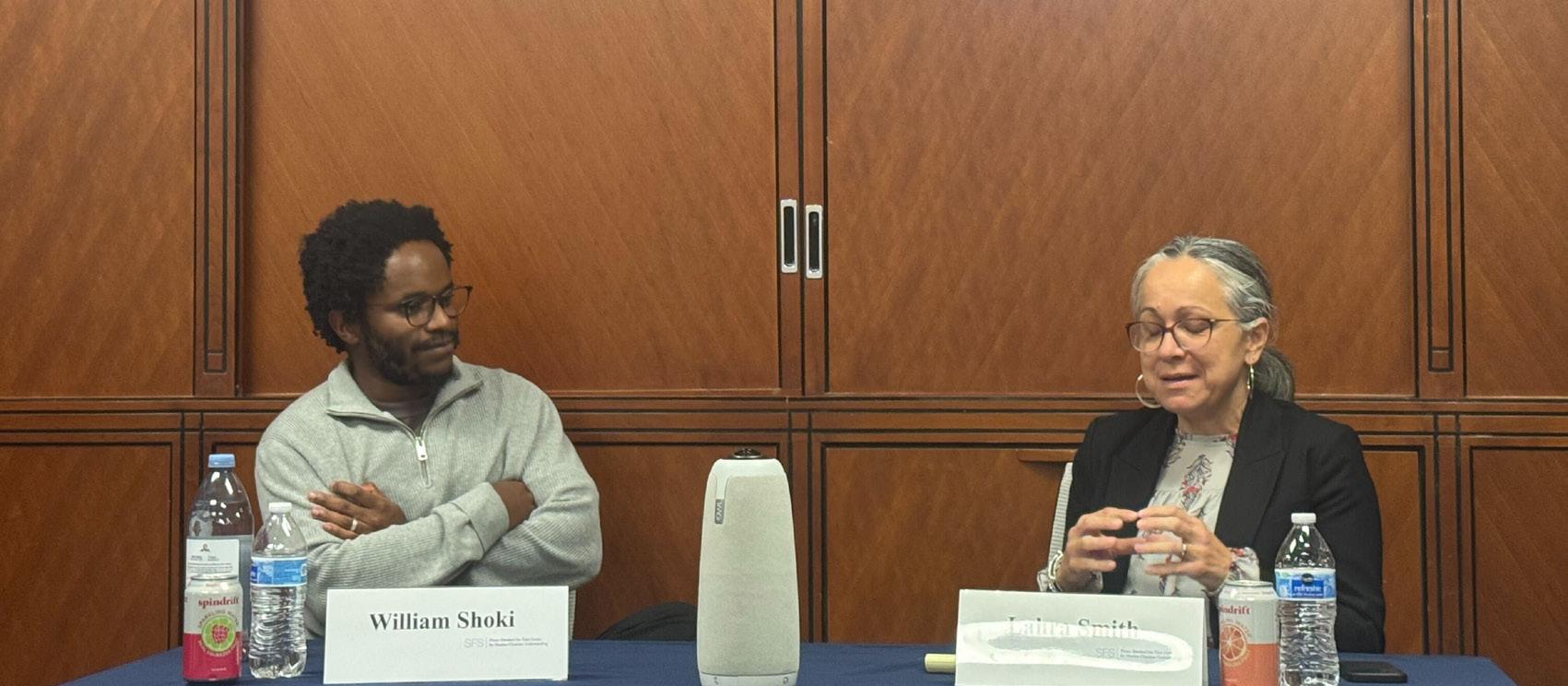
Journalist Affirms South Africa’s Response
To Gaza Humanitarian, Refugee Crisis
Nico Abreu Events Desk Editor
A journalist praised South Africa’s response to the ongoing Israel-Hamas war and encouraged the Global South to play a greater role in condemning international violence at a Georgetown University event Nov. 19.
William Shoki, a South African journalist and the editor-in-chief of Africa Is a Country — a publication focusing on the legacies of colonialism and exploitation in Africa — argued South Africa’s history of apartheid infuences its current policy on international violence. The event, coordinated by Georgetown’s Alwaleed Center for Muslim-Christian Understanding and the Center for Contemporary Arab Studies alongside four other university departments, aimed to educate students on the solidarity between South Africa and Palestine.
Shoki said South Africa, which was ruled by an apartheid government for 46 years until 1994, has found itself at the forefront of the Israel-Hamas war’s refugee crisis.
“Diplomatic mechanisms like safe passages and evacuation corridors obscure that the line between evacuation and expulsion has thinned, and South Africa, by accident or design, now fnds itself inside that architecture at the end of this episode,” Shoki said at the event. “It condenses, in a single story, the themes that run through this lecture: the violence of engineered movement, the frailty of international law, the contested meanings of solidarity and the shifting role of the Global South as both sanctuary and a moral insurgent in a collapsible order.”
Shoki’s lecture came just days after a plane holding 153 Palestinians without documentation or return tickets arrived at a South African airport. Although initially denied entry, all passengers were eventually allowed into the coun-
try, and many continued traveling to their fnal destinations. South African oficials are still questioning Al-Majd Europe, the company that many passengers said helped organize their fights.
Shoki said South Africa’s stance on humanitarian crises and international law stems from its history as an apartheid state.
“The new government became a champion of multilateralism, not out of obstruction, but because it understood how decisive multilateral structures had been in its own struggle,” Shoki said. “Its participation in peacekeeping missions, its mediation roles and regional conficts, and its early leadership on issues like landline bans and nuclear non-proliferation were all built on this conviction that small states can exercise normative power even over greater powers when they speak from a history of moral struggle.”
Shoki said that while South African global positioning has been guided by its history, it has also lacked consistency in its condemnation of violence.
“South Africa’s foreign policy had never really been consistently principled,” Shoki said.
“The post-apartheid state inherited a powerful ethical vocabulary but also had to survive in a world structured by hard power. Its moral commitments were always in tension with geopolitical pressures, domestic crises and institutional limits.”
Shoki said that for South Africans, Palestine is not just another foreign confict, but a replaying of the decolonization they experienced, drawing comparison to the Bantustans, territories designated for Black South Africans that the racist National Party of South Africa established during apartheid.
“For many South Africans, Palestine is not an abstract foreign confict but a site where the un-
fnished work of global decolonization is being replayed in real time,” Shoki said. “The language of Bantustans, past laws, ethnic fragmentation and fortifed borders resonated with painful familiarity. This resonance wasn’t always analytically clean, but it was politically powerful.”
Shoki said the humanitarian crisis in Gaza demands active intervention from the international community and grassroots movements.
“The lesson of this moment matters now more than ever,” Shoki said. “If a new world is to be made in the 21st century, its foundation cannot be the state alone. It must be movements, the insurgent, youthful, intersectional movements that have re-emerged across the greater south.
“These movements, from feminist networks to climate justice coalitions to anti-austerity uprisings, are coordinated in ways the mid-20th-century worldmakers could never achieve,” Shoki added. “They articulate demands that exceed the caution of governments.”
Shoki said Palestine’s struggle particularly resonates with the vague grouping of the Global South, in that the struggle should ground these states and encourage anti-apartheid movements.
“If the greater south should be read as an unsettled moral geography, then Palestine has become its compass,” Shoki said. “The place where the world fractures is rendered unmistakably clear. Palestine is no longer merely a cause some people try to investigate and intervene in. It is a lens through which the contradictions of the international system are revealed.”
“Palestine exposes the unfnished business of decolonization, a people dispossessed, repeatedly governed by legal architecture that denies the nationhood and people abandoned by an order that promised self-determination whilst accommodating occupation,” Shoki added.

Georgetown ‘Streateries’ Anticipate New Burdens Under District Restaurant Policy
Joshua Lou Special to The Hoya
With Washington, D.C.’s District Department of Transportation (DDOT) set to update its “streateries” policies after Nov. 30, Georgetown neighborhood restaurant owners worry about rising costs.
After creating the Streatery Program in June 2020, allowing restaurants to utilize outdoor public space for seating to comply with COVID-19 restrictions, DDOT announced in 2021 that it would cooperate with local organizations to work toward a more sustainable, permanent outdoor dining program. DDOT’s fnalized plan, which imposes costs on outdoor seating spaces, will come into efect after temporary streatery permits expire Nov. 30.
Tony Hamilton, Pizzeria Paradiso’s Director of Operations, said that Paradiso will maintain their streatery in 2026, though his team is concerned about the new fees.
“We consider ourselves grateful to rely on a base of loyal customers, but even a long-standing institution like Pizzeria Paradiso relies on attracting new business,” Hamilton told The Hoya. “The potential loss of our Georgetown streatery will assuredly hurt our business in the long run if we cannot maintain it after 2026.”
Under the new plan, design permits will cost $260 alongside a $20 fee per square foot that the streatery occupies. Restaurants also must provide concrete barriers, which DDOT charges at $250 per barrier plus a $500 deposit.
Along with structural restrictions, the plan includes fees as-
sociated with the documents required for permit applications.
Under the current and past programs, there were no rental fees for outdoor space and the city provided free barriers for restaurants.
Hamilton said smaller businesses may be hit harder by the new permanent program.
“Too many restaurants, trying anything and everything to stay connected with customers and stay appealing, are about to lose a helpful tool in attracting business.”
Hamilton said. “An already struggling industry will continue to limp along with these hindrances.”
DDOT Director Sharon Kershbaum said the new program’s goal is to make roads safer and improve curbside appeal while maintaining the city’s outdoor dining culture.
“A streatery that’s not invested in, that stays empty because it looks terrible and is not attractive to diners, brings in nothing and becomes an eyesore,” Kershbaum said at a city council hearing.
Vayun Krishna (SFS ’29), a frequent diner in the Georgetown neighborhood, said DDOT may be making a mistake by reducing the number of streateries in D.C.
“They’re super vibrant and an important part of eating in D.C.,”
Krishna told The Hoya. “It’s all part of the D.C. aesthetic.”
Claire Wilder, owner of the restaurant La Bonne Vache on Prospect St., said she welcomes the new changes after having streateries taken down at Zeppelin and Chaplin’s, two restaurants in Dupont Circle where she is the marketing director.
“A lot of streateries are not maintained properly,” Wilder told The Hoya. “They also supply a whole new home for rodents, trap water, clog sewers and take up parking spaces. I think the new policies will really clean up the streets.”
Giorgio Greco, il Canale’s manager, said he adores the street eating scenery in Georgetown.
“When I look at Georgetown with all this outdoor seating, it is stunning,” Greco told The Hoya. “Before, it was full of cars and trucks. Now, you see people enjoying the food and drinking, families enjoying as well. It makes our Georgetown diferent from everything.”
“I feel like home, I feel like I am in Italy,” he added. Sophia Nash (CAS ’29), who recently ate at il Canale for her birthday, said il Canale’s streatery made her night even more special.
“It was gorgeous,” Nash told The Hoya. “The tables are close enough to the sidewalk that you feel the energy of the neighborhood, but not so close that it feels crowded. Outdoor dining makes the city feel more alive, and it brings that welcoming atmosphere right to your meal.” Krishna said he thinks DDOT should allow restaurants to keep their outdoor areas open, despite critics who say vacant streateries are mere clutter in the D.C.
restaurants rather than the government.”

GU Graduate Students Participate In UN Climate Change Conference
Brendan Fijol
Special to the Hoya
Members of a Georgetown University delegation attended the 30th United Nations Conference of the Parties (COP30) climate summit from Nov. 10 to Nov. 21 in Belém, Brazil, as part of their graduate studies.
The annual summit, which meets to discuss and come to an agreement on climate policy set by the United Nations Framework Convention on Climate Change (UNFCCC), an international treaty that governs climate change agreements, hosted 194 countries and over 2,000 non-governmental organizations (NGOs). Graduate students Manon Fuchs (GRD ’26), Clemente Jan Gilardini (GRD ’26), Mason Haynes (GRD ’27) and Amineh Najam-ud-din (GRD ’26), attended as the Georgetown delegation, headed by Andrew Steer, a research professor at the School of Foreign Service and the Earth Commons, where they attended events and panels in their respective areas of study.
Najam-ud-din, who is pursuing a master’s degree in environment and international afairs, said she was interested in attending the conference to see how partnerships in climate fnance develop.
“We’re working towards climate resilience, but the fnance is lacking,” Najam-ud-din told The Hoya. “And I think that this is a challenge, but also an opportunity for technological innovation and partnerships across governments, NGOs and the private sector.”
Gilardini, whose postgraduate work included communications at a Madagascan renewable energy frm, said he learned about the importance of new energy forms in the climate change battle at COP30.
“A lot of my events were looking at how the private sector is adapting to a changing regulatory environment where renewables, while coming online, are proving occasionally dificult for national domestic energy grids to adapt to,” Gilardini said.
The location of this year’s conference in Belém, at the mouth of the Amazon River, lent itself to a focus on natural conservation.
Steer — who has held positions at the World Bank, the U.K. Department of International Development and the Bezos Earth Fund, a multibillion-dollar fund to fght climate change — said the Georgetown delegation’s interests directly overlap with concerns over the Amazon’s health.
“The question is, how do we make it more attractive to leave the Amazon standing and thriving, rather than cut it down for its timber or turn it into soy plantations or apple ranches, which can make a lot of money in the short term but over time are very bad for the ecology and for the world economy?” Steer said.
Discussion over the Amazon’s future also prompted protests from indigenous groups, who led rallies in and around the COP venues.
Gilardini said these protests were exciting to see, especially when the three previous COP conferences were held in countries with stricter free speech laws.
“The government of Brazil is allowing non-traditional actors to get involved,” Gilardini said.
“You saw a lot of people at COP dress in their indigenous dress, which is very refreshing.”
“It was very encouraging to see democracy in action,” Gilardini added.
At the conference, members of the Georgetown delegation attended conferences on topics ranging from
alternative biofuels to the implementation of artificial intelligence (AI) into climate-friendly technologies. Gilardini said that despite lagging government policy, the creativity of the private sector that he saw in Belém ofered a message of cautious optimism in the fght against climate change.
“You’re hearing from people who are coming up with these innovative ways to either remove carbon or reduce carbon emissions and they’re really keen about it,” Gilardini said.
“What was reassuring was that irrespective of anything happening, there are still loads of people really dedicated to climate action.”
Najam-ud-din said hearing from local representatives on climate action was one of the most valuable parts of the trip.
“I would say that there was absolutely frustration,” Najam-uddin said. “People realize that what we’ve been trying to do in the past may not necessarily be the strategy that works, but with that frustration, I think that there was a lot of hope and optimism for the future.”
For the frst time in the conference’s history, the United States decided not to send a high-level delegation to COP30, although the country was represented by a number of local leaders, including California Governor Gavin Newsom. Steer said the drive toward a green future does not depend only on the preferences of the U.S. executive branch.
“It’s true that we have a federal government that believes — or at least some of them believe — that climate change is a hoax, but don’t forget that the United States is still the place where the most exciting technologies are being developed,” Steer said. “Don’t count America out.”
MAREK SLUSARCZYK/THE HOYA
Many Georgetown neighborhood restaurant owners fear a new Washington, D.C. policy restricting outdoor dining could threaten revenues and customers’ dining experiences.
NICO ABREU/THE HOYA
A South African journalist urged the international community to intervene in the humanitarian crisis in Gaza, drawing comparisons between present-day Palestine and South African apartheid.
WOMEN’S SOCCER
Hoyas Breeze Past Sacred Heart in First Round of NCAA Tournament
The Georgetown University women’s soccer team beat the Sacred Heart University Pioneers in a comfortable 3-0 display Nov. 14 at Shaw Field in the frst round of the NCAA tournament.
The win sends the No. 2 seeded Hoyas (16-3-2, 10-0 Big East) to the second round of the tournament, where they will face of against the No. 7 seeded West Virginia University Mountaineers Thursday, Nov. 20, at Shaw Field. A brace by senior forward Natalie Means and a penalty goal from senior midfelder Shay Montogemery sealed Georgetown’s victory over Sacred Heart University (11-9-2, 7-5 MAAC) as the Hoyas outshot the Pioneers 22-1.
The game began with a slow start — both teams were sloppy with their passes, but Georgetown had the line share of possession. The Hoyas’ first big chance came in the 6th minute when redshirt senior midfielder Mary Cochran found herself with space outside the penalty box and fired a solid shot, which was saved by the Pioneers’ keeper Kyran Thievon.
The Hoyas kept pushing forward; in the 15th minute, Means sent in a low cross to senior forward Henley Tippins, but Thievon got to the ball just before Tippins.
The Hoyas made their early dominance count two minutes later when Tippins secured control of the ball in the penalty box and looped it over the keeper for Means to head home in front of the goal. The Hoyas deservedly went up 1-0. Means nearly increased the Hoyas’ lead to 2 in the 20th minute when she swiveled past a defender and struck a half volley, which sailed just over the bar.
A nail-biter moment came in the 22nd minute when Sacred Heart forward Riley Pettigrew
got on the end of a good pass, but a heavy touch saw the ball land right in Georgetown senior keeper Cara Martin’s hands.
Video assistant referee (VAR) was called into action in the 26th minute when sophomore midfelder Caroline Spengler was taken to the ground in the penalty box by a Pioneer. After a lengthy stoppage, the referee awarded the Hoyas a penalty; Montgomery smashed the ball into the bottom left corner to make the score 2-0 for the Hoyas.
After Georgetown’s second goal, the game mellowed out a bit for the rest of the frst half, with neither team scoring. Coming out for the second half, the Hoyas showed no mercy. The team created chance after chance as the Pioneers struggled to fnd their way out of their penalty box.
Within the frst few seconds of the second half, sophomore forward Jocelyn Lohmeyer found herself free in the 6-yard box but fred her shot straight down the middle into the keeper’s hands. A minute later, Lohmeyer walked of the feld with what looked like a knee injury after colliding with a Pioneer defender — a big loss for the Hoyas.
Even without Lohmeyer, Georgetown didn’t stop pushing as Cochran beat the same defender twice before ficking the ball with her heel to Montogomery. Montgomery took one step and fred the ball of the crossbar — at this point, the Hoyas were running in circles around Sacred Heart’s defense.
Georgetown found another big chance in the 51st minute as Means fred a low shot that was pushed out to Tippins. Tippins couldn’t get a solid amount of contact on the ball as it dribbled wide of the post.
Sacred Heart’s defense misjudged
the ball’s fight in the 54th minute, allowing frst-year forward Aliza Mannon through on goal, but the keeper saved her low-driven shot.
Yet another chance fell to Means’ feet two minutes later when she dribbled past two defenders before hitting a shot over the crossbar.
The Hoyas asserted their fnal bout of dominance in the 62nd minute when Tippins was tripped by the keeper, and VAR confrmed the penalty. Means’ shot was too powerful for the keeper, and the Hoyas extended their lead to 3-0.
In the 70th minute, the Pioneers were awarded a penalty, their frst big chance of the game.
Midfelder Martyna Krzysztopik stepped up, but her penalty was brilliantly saved by Martin.
Georgetown held on to their 3-0 lead until the fnal whistle was blown, advancing the expectant Hoyas to the second round of the NCAA tournament.
With the Hoyas’ victory, Georgetown Head Coach David Nolan celebrated his 300th win with the team, and he said he was proud of the result.
“I thought the kids played really well,” Nolan told The Hoya “These games are always a nervy kind of occasion because it’s win and move on, lose and you’re done. We’re really excited to advance and we played really well against a team that presented us with some challenges.”
With this win, the No. 2 Hoyas will look for a successful result Nov. 20 in the second round of the NCAA tournament against the No. 7 seeded West Virginia. Georgetown bowed out in the frst round of the tournament in a loss to the University of Iowa last year, making this year’s success even more meaningful. Georgetown will be looking to put last season’s woes behind them and go all the way this year.
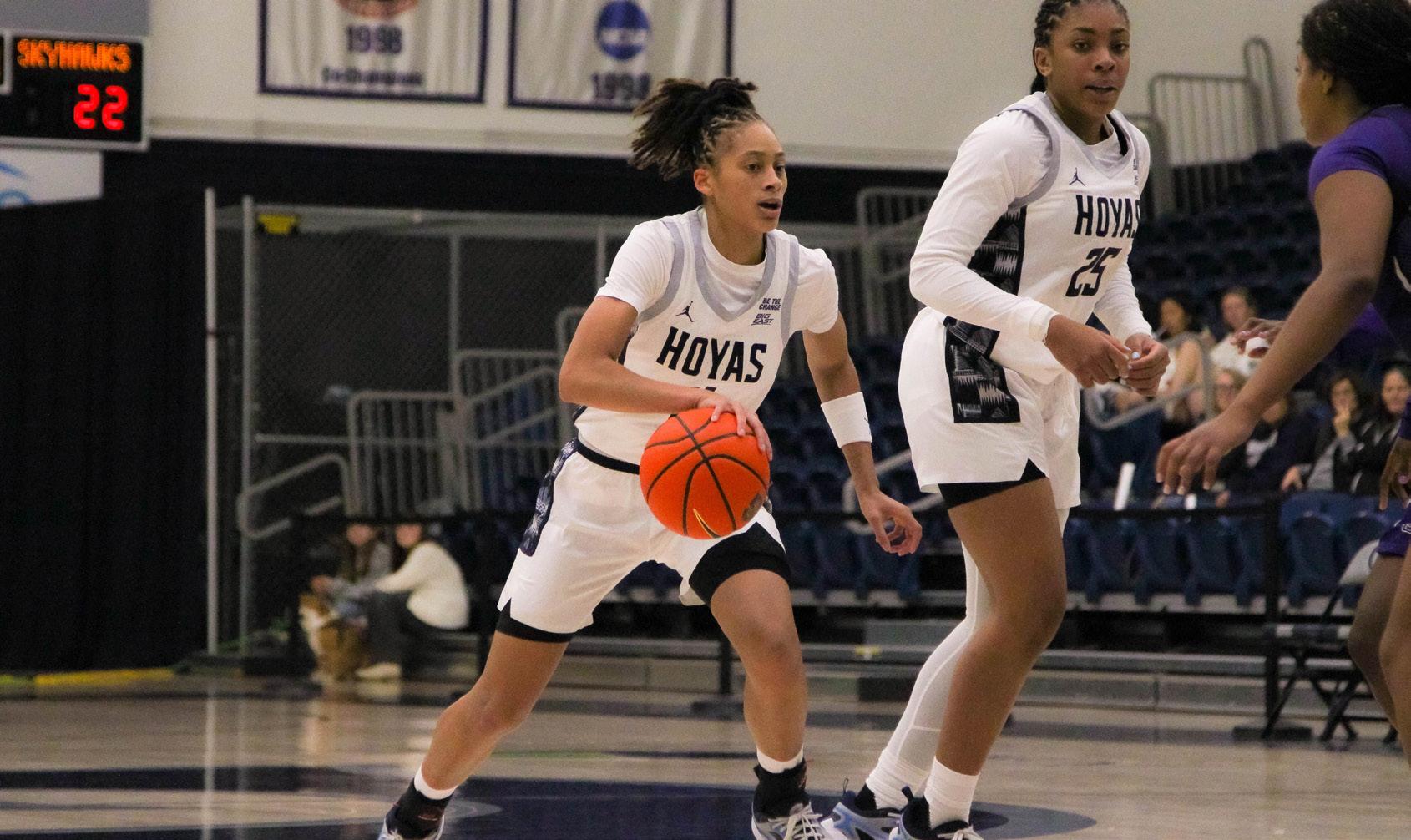
EVE CARON/THE HOYA
Georgetown women’s basketball continued to struggle in the second half, but their lead was enough to weather Sacred Heart’s comeback attempt as the Hoyas won 77-44.
Hoyas Hold, Dominate Sacred Heart
The Georgetown University women’s basketball team cruised to a 77-44 victory at McDonough Arena against the Sacred Heart University Pioneers, netting Georgetown Head Coach Darnell Haney his 100th win. While the Hoyas (2-2) were the heavy favorite coming into the game against the Pioneers (1-3), the pressure was nonetheless high in the wake of back-to-back fourth-quarter collapses against No. 9 University of Maryland and George Mason University. Georgetown scored frst of a 3-pointer by junior guard Khia Miller. The Hoyas never once lost the lead. With 4:23 left in the frst quarter, the game was still relatively close, the Hoyas leading 11-9. A sufocating defensive efort led Georgetown on a 11-0 run to end the quarter. Sophomore guard Summer Davis had a highlightworthy play with a steal followed by an explosive euro step ending in a layup to make the score 16-9 with 2:10 left in the quarter. After a three-point buzzer beater by sophomore guard Khadee Hession, the score was 22-9 heading into the second quarter. The Hoyas were equally dominant in the second quarter. Despite major roster turnover
— Georgetown welcomed seven transfers and one frst-year over the summer — the ofense at its best seemed to hum with chemistry; they had a 17-14 assist to turnover ratio compared to the Pioneers’ 5-27. With 8:41 left in the half, junior forward Cristen Carter — who fnished with 9 points — notched a layup of an assist from graduate guard Laila Jewett to bring the score to 26-11. A few minutes later, graduate forward Chetanna Nweke made a similar layup of sophomore forward Alexia Araujo-Dagba’s assist to bring the score to 41-18. The Hoyas scored one last time with 16 seconds left in the half of another assist-layup combo between sophomore guard Destiny Agubata and AraujoDagba to end the half at 44-20. In the third quarter, the Hoyas started to take their foot of the gas, scoring only 13 points compared to Sacred Heart’s 11. In one 6:26 span, Georgetown scored only 5 points. Fortunately, the Hoya defense remained strong, holding the Pioneers to only 8 points over the same timespan. The quarter ended with the Hoyas up 57-31. While victory was all but assured even with 10 minutes to play, Georgetown’s sluggish ofense was nonetheless a reminder of the team’s second-half struggles.
WOMEN’S BASKETBALL
Hoyas Blow Another Fourth Quarter Lead, is Time to George Mason
The Georgetown University women’s basketball team was unable to fnish the job against the George Mason University (GMU) Patriots Nov. 14 and lost in overtime after blowing a 14-point lead in the fourth quarter. This loss is the Hoyas’ second blown lead in as many games, after a loss to No. 10 University of Maryland.
The Hoyas (2-2) dominated for nearly the entire game, holding a double-digit lead at some point in each of the fnal three quarters, including their largest lead of the game — 14 points — with under nine minutes left in the game. Despite this, Georgetown collapsed defensively and was outscored by George Mason (4-1) 24-10 in the fnal stretch.
The Hoyas took their frst lead of the game about a minute in, after senior guard Victoria Rivera got fouled on a 3-pointer and drilled all 3 shots from the charity stripe.
Graduate guard Laila Jewett subbed in near the seven-minute mark and subsequently locked down the Patriots on defense. GMU went scoreless for over four straight minutes thanks to Jewett, who grabbed 2 rebounds and picked up a block.
Despite Georgetown holding a 12-8 lead at the end of the frst quarter, their shooting told a diferent story. The Hoyas shot 4-17 from the feld and 0-5 from deep, which was somehow better than their opponents’ 3-19 shooting. The Hoyas’ inability to drastically improve their
MEN’S BASKETBALL
early shooting performance contributed to their later collapse in the game — they only shot 2-14 from deep and had no made 3-pointers in the fourth quarter or overtime.
Georgetown played solid defense to start the second period with steals on each of the Patriots’ frst two possessions, including one from sophomore guard Summer Davis, who had grabbed a defensive rebound in the opening minutes.
Rivera re-entered the game for Davis in the second minute of the second quarter but struggled to make any shots, missing all 3 she took in the two-minute stretch before getting sat out again. Rivera, who made 3 free throws in the opening minute of the matchup, struggled throughout the rest of the game, failing to connect on any shot and fnishing with only the 3 points she picked up early on.
The Hoyas played solid defense the entire second quarter, limiting the Patriots to only 6 points — 4 of which came in the fnal minute of the half — signaling the defensive collapse that would come later in the game. The score entering halftime was 22-14 in favor of Georgetown.
Davis and junior forward
Cristen Carter dominated the boards in the third quarter, both grabbing multiple rebounds, on their way to individual doubledigit rebounds. This, paired with their 10 and 11 points respectively, would give them each a double-double, the frst for Carter as a Hoya.
The Hoyas really started to pull away at the end of the third
quarter, being up 36-24 by way of 7 points in the quarter from Jewett. Davis scored early in the fourth, giving the Hoyas their biggest lead of the game, but they would soon fall apart defensively. Georgetown seemed unable to stop any of GMU’s shots, allowing the Patriots to score 24 in the fnal quarter — the same amount they scored the other three quarters combined — with 65% shooting from the feld. At the end of regulation, the score was 48-48. Georgetown seemed extremely demoralized following their collapse, considering they only scored 6 points in the fveminute overtime period. The Hoyas continued to be absent on defense, allowing the Patriots to shoot 71% from the feld — somehow even better than their fourth-quarter comeback. Postgame, Georgetown Head Coach Darnell Haney said the team must be able to fnish out games and work together following big games.
“We’ve just got to fnish, we’ve got to fnish,” Coach Haney told Georgetown Athletics. “We have a group of people that we keep trying to get to connect and gel. They’re all coming from diferent walks of life, and they need to learn to connect and fnish a job.”
“We needed to think about how we were approaching the week after the Maryland game, and now we will do the same looking ahead to Tuesday,” Haney added. The Hoyas will return home Tuesday, Nov. 18, to take on Sacred Heart University (1-2) as they look to bounce back from their second embarrassing fourth-quarter collapse.
In the fourth quarter, the team seemed to snap back. In the 56-second span between 8:00 and 7:04 seconds left on the clock, the team was on fre, combining for 7 points. After a pair of made free throws by Jewett, Summer Davis made a 3-pointer of an assist by her twin sister, sophomore guard Indya Davis. With another steal by Jewett and an assist to junior forward Brianna Byars, the team combined for 7 points in that span. Altogether, Georgetown outscored Sacred Heart by 7 points in the fourth quarter, 20-13.
Haney said he was proud of the team and hoping to enliven the crowd.
“I’m proud of how our young women represent the university, and we need to do that together,” Haney told The Hoya. “We’re gonna need them. We need the students; we need faculty; we need fans; we need the whole DMV in the building, baby. It’s gonna be a show.”
While chemistry and resilience take time to build, Haney said he believes in his team’s potential.
“It’s a process, and we’re gonna continue to grow, and we’re gonna continue to build that,” Haney said. “And I think when we embrace that, it’ll be dangerous.”
The Hoyas will look ahead to another home matchup Friday, Nov. 21, against the George Washington University Revolutionaries.
Iwuchukwu to
Miss 6-8 Weeks for ‘Scheduled Medical Procedure’
cardiac arrest during a July practice and missed half of the season.
Georgetown University men’s basketball senior center Vince Iwuchukwu will undergo a “scheduled medical procedure” and miss six to eight weeks of the season, a team spokesperson announced Nov. 18.
Iwuchukwu has been a standout player for the Hoyas, coming of the bench in relief of starting sophomore center Julius Halaifonua and providing key production en route to Georgetown’s 4-0 start. So far this season, Iwuchukwu has averaged 11.8 points, 4 rebounds, 0.8 assists and 2 blocks per game.
Diana Pulupa, a Georgetown Athletics spokesperson, said Iwuchukwu is expected to make a full recovery.
“He is generally in good health and will take a brief recovery period, with a follow up evaluation expected within six to eight weeks,” Pulupa wrote in an email to media. “He will return once he is cleared at that evaluation.”
“He is in good spirits and appreciates the support,” Pulupa added.
Pulupa did not provide details on the procedure.
Iwuchukwu joined the Hoyas as a transfer this season after playing at St. John’s University last year. Prior to attending St. John’s, Iwuchukwu played two years for the University of Southern California (USC). In his frst year at USC, Iwuchukwu sufered a
In the Hoyas’ most recent win against the Clemson University Tigers (4-1), Iwuchukwu played nearly the entirety of the second half after Halaifonua fouled out, racking up 14 points, 4 rebounds, 1 assist and 1 block. Iwuchukwu made a key bucket near the end of the game to seal Georgetown’s second power conference win of the young season. After the buzzer sounded, Iwuchukwu stormed into the bleachers to celebrate with the student section in an image that quickly went viral.
After a strong start to the season, the Hoyas will likely lose some of the momentum from their strong start at a key time. How Georgetown performs without Iwuchukwu, with a center rotation that already had major questions, will be a key indicator for their tournament aspirations entering the second half of the nonconference schedule. A heavier load will likely fall to sophomore center Seal Diouf and sophomore forward Jayden Fort for frontcourt minutes.
Now shorthanded in the frontcourt, the Hoyas are looking ahead at one of the toughest portions of their schedule. After a buy game against the winless Wagner College Seahawks (0-4) Nov. 22, Georgetown will head to Orlando, Fla., for the ESPN Events Invitational against the University of Dayton (3-1), University of Miami (3-1) and No. 9 Brigham Young University (3-1). The Hoyas are also scheduled to play the
No. 18 University of North Carolina (4-0) Dec. 7. Members of Hoya Blue, Georgetown’s student fan group, were in the front row for the Clemson game and were photographed celebrating with Iwuchukwu after the win. The group makes posters before every game and made posters with supportive messages for Iwuchukwu for the Wagner game. Colin Dhaliwal (MSB ’27), Hoya Blue’s treasurer, said Iwuchukwu’s energy against Clemson electrifed the student section.
“Being at the game against Clemson and having him come into the stands is maybe one of the better moments of my life as a Georgetown basketball fan,” Dhaliwal told The Hoya Dhaliwal said Hoya Blue has planned to send well-wishes to Iwuchukwu and hopes he returns to game action soon.
“We heard through the grapevine it sounds like he is going to be in the building for the Wagner game,” Dhaliwal said. “We’re getting some signs together to hold up in the student section — to give him a shout out, keep his spirits high.”
“I think a few of us have reached out to him online or messaged him reiterating the fact that we’re all supporting him,” Dhaliwal added. “We’re all there, rooting for a quick and easy recovery.” Iwuchukwu’s recovery schedule puts him in line to be evaluated to return in time for Georgetown’s New Year’s Eve matchup against No. 14 St. John’s (2-1).
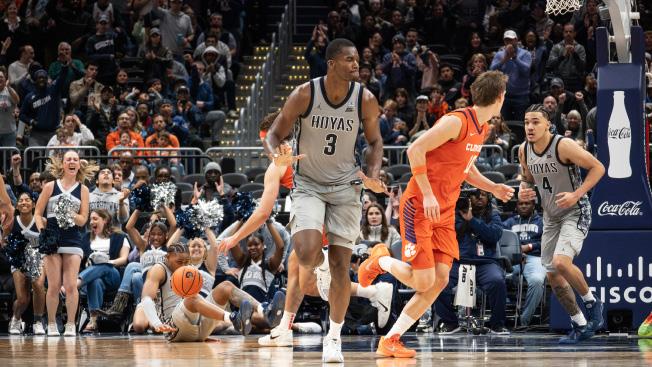
Nate Seidenstein Senior Sports Editor
Ethan Herweck Deputy Sports Editor
Golnar Jalinous Deputy Sports Editor
Graham Wierzbicki Special to The Hoya
CAMERON LAU/THE HOYA
After sophomore center Julius Halaifonua fouled out, Iwuchukwu played almost all of the second half against Clemson, and racked up an impressive statline of 14 points, 4 rebounds, 1 assist and 1 block.
WOMEN’S BASKETBALL
Judge Deserved To Win MVP Award Unanimously
HERMAN, from A12
were better. Whether you believe in basic statistics like batting average and on-base percentage (OBP) or you lean toward advanced metrics like wins above replacement and on-base plus slugging (OPS), Judge prevails.
Judge topped MLB’s batting average leaderboards at .331, while Raleigh hit a mediocre .247. Judge’s OBP was a ridiculous .457, and Raleigh’s a pedestrian .359. Advanced metrics tell the same story — Judge amassed 9.7 bWAR to Raleigh’s 7.4, meaning that a hypothetical team with Judge on the roster would theoretically win 2.3 more games than an identical team with Raleigh. And Judge’s OPS of 1.144 towers over Raleigh’s .948. The one statistic Raleigh can claim is home runs: He hit 60 to Judge’s 53. Any logically coherent argument for Raleigh relies on one of two fawed premises. The frst is what I call the “participation trophy argument”: the reasoning that, because Judge already had two MVP awards under his belt from 2022 and 2024, voters should give it to Raleigh.
ESPN reporter Bradford Doolittle put it bluntly in an MVP preview article, arguing that Raleigh’s “storyline” should be a deciding factor.
“Raleigh has the better 2025 story,” he said. “Judge, as great as he was, has done this before.” But the MVP award is not a participation trophy. Judge
should not have been penalized for having previously been good at baseball just because Raleigh’s season had a better storyline.
Further, MVP awards have concrete impacts on a player’s wallet and his legacy. A voter considering a player on a Hall of Fame ballot might, for example, take into consideration how many MVPs a player has won.
Imagine if Judge was considered for the Hall of Fame, but ultimately rejected partly because he had only won a single MVP — except he would have won more MVPs if voters hadn’t refused to give him one because he had already won. It’s paradoxical.
The second argument for Raleigh is equally foolish — that without Judge, the Yankees would have survived, but without Raleigh, the Mariners would have been awful. This is fawed for two reasons. First, anyone who watched the Yankees for more than fve minutes would know that a Judge-less Yankees lineup would have rolled over and died. But second, even if the premise held true, a player should not be penalized simply for happening to play for a good team. The MVP must be given to the best player. Full stop. If you managed a baseball team, and you could add either Judge or Raleigh, who would you choose? The answer to that question is the end of the story. In 2025, the answer was Judge. Case closed.
SPORTS CARTOON by Ege Alidedeoglu


MEN’S BASKETBALL
Career Day for Lewis In Front of Full Student Section
CLEMSON, from A12
in heavy front-court foul trouble early in the second half. Both Halaifonua and senior center Vince Iwuchukwu recorded their fourth foul before the under-16 timeout. Shortly after, Halaifonua picked up an over-the-back foul, and the Hoyas had only one rotation center left with almost all of the second half remaining.
Cooley, forced to balance between protecting Iwuchukwu for later in the game and holding onto the lead, subbed in sophomore forward Jayden Fort for Iwuchukwu on defensive possessions during the period just before the fnal stretch.
Weakened in the frontcourt, Lewis caught fre, scoring 17 points in the second half and getting to the line 8 times. Lewis, who has been a dominating presence all season long, fnished with a career-high 26 points, along with 4 rebounds, 2 assists, 1 block and 5 steals.
Down the fnal stretch, the Georgetown ofense cooled slightly, and the Tigers cut it back to a 3-point game with 39 seconds to play. Cooley called a timeout to draw up a play, and Iwuchukwu got the ball and drained a paint jumper to bring the Hoyas to a twopossession game. After Clemson guard Jake Wahlin missed a
WOMEN’S SOCCER
desperation three-pointer, Lewis grabbed the rebound and dribbled up the court as time expired to seal the victory.
As the fnal buzzer sounded and the student section ignited, Iwuchukwu stormed toward the risers to celebrate with the fans. The fnal announced attendance of 8,562 included a full student section, and Cooley said at the postgame press conference that their presence was an important factor in getting the win over the fnish line.
“Our students were unbelievable. That’s the energy that we were looking for,” Cooley told The Hoya. “They were a key factor with the win, so I really appreciate them showing up and giving us all the love.”
Cooley added that halftime served as a reset point and allowed the Hoyas to reestablish themselves physically to ensure a victory.
“They had a little bit more energy than us to start,” Cooley told The Hoya. “But the game’s two halves. That’s the good part. We made a mental, emotional adjustment at halftime. It wasn’t so much a systematic adjustment.”
“We came up with a lot of energy,” Cooley added.
The Hoyas take most of next week of before returning to take on the Wagner College Seahawks (0-4) at 12 p.m., Nov. 22 at Capital One Arena.

Hoyas Take Down West Virginia In Second Round
WEST VIRGINIA, from A12
which sailed high and wide to the right from around the penalty spot. Georgetown came straight back down the feld, and a minute later, Lardner went down in the box following a race for the ball with Herfurth. After a video review, no penalty was awarded. In the 106th minute, Means sent a low-driven effort across goal from the top left of the box, but no Hoya attacker could connect with it, and Herfurth claimed the ball. That was the last real action from open play, with tired legs and minds getting the best of both teams, who decided to take their chances with penalties.
Senior midfielder Shay Montgomery kicked off the shootout for Georgetown, sending the ball past Herfurth into the bottom right corner to fire up the Hoya fans behind the goal and give Georgetown a 1-0 lead in the shootout.
Forward/midfelder Anna Hauer went frst for the Mountaineers, scoring in the bottom left corner to tie the shootout 1-1.
Tippins shot next to give the Hoyas a 2-1 lead.
Defender Nyema Ingleton tied the shootout 2-2 with another shot into the bottom right corner, sending Martin the wrong way.
Lardner stepped up third for Georgetown, but sent her efort wide left.
MEN’S SOCCER
UCONN, from A12
ball up the pitch to no avail. The Hoyas did not send of another shot for the remainder of the frst half, while the Huskies had one good opportunity sweep parallel to the crossbar in the 44th minute. At the end of the frst half, the match remained scoreless without a clear favorite, which changed into the second half as intensity built. Georgetown looked for an opportunity in the first minute back from the break but sent the ball into a box devoid of any Hoyas. In the 50th minute, the Hoyas sent up the first shot of the second half as sophomore midfielder Jack Brown sent a shot on goal straight to the UConn goalkeeper, following his counterattack down the pitch with Baker. The Huskies responded with a shot of their own in the 50th minute, as a UConn player crossed the ball to Saunders, who headed the ball far to the right of the goal.
The Hoyas began asserting their trademark ofensive dominance as the second half heated up — both in performance and game atmosphere. In the 54th minute, the Huskies head coach argued with the referee over what he thought was a handball, ending in a lengthy disagreement that stopped the clock.
The intensity of play picked up again as the clock started running; in the 58th minute, Manske made the
In what was the defning moment of the game, Martin stole West Virginia’s momentum on the very next kick, staying down the middle to make a kick-out save on midfelder Maya Leoni. After the save, the Hoyas never looked back. Heller fred one past Herfurth into the top left corner to give Georgetown a 3-2 lead.
After Georgetown and West Virginia each scored again to make the shoot-out 4-3, midfelder Ava Arnold stepped up for the Mountaineers’ sudden-death kick. Her efort rang of the crossbar, sending Martin and the Hoyas into jubilee.
Fans from behind the goal rushed the feld and players hugged each other, grateful to squeak out a victory, albeit stressfully, on Shaw Field.
After the game, Georgetown Head Coach Dave Nolan said he knew his team was capable of a comeback after allowing the early goal and praised his defense for holding frm the rest of the game.
“I was disappointed with the goal we gave up in the first couple of minutes,” Nolan told The Hoya. “It’s so not like us. But I always felt we had at least one goal in us. It was just a matter of, could we keep them off the board?”
Nolan said he was proud of his players’ composure in the penalty shootout.
“When you get into a pressure
situation, that’s a lot diferent from practice,” Nolan said. “So I got to give our kids credit for stepping up and taking them.”
Hoyas are next up against

After regulation and two overtime
first save of the day, leaping across the goal to secure the ball.
Georgetown picked up a pair of corners in the 65th minute, the second of which ended in success for the Hoyas. Zengue sent the ball to the far post and Ponce Ocampo — who later said he did not even know where the goal was — fired the ball into the goal to pull the Hoyas into a 1-0 lead.
Video Assistant Referee (VAR) was called into use for a third time in the span of five minutes for a potential offsides, but the call on the field stood and the goal remained.
The Hoyas continued pushing, and less than two minutes later, Ponce Ocampo secured a brace, beautifully driving a ball toward the upper far post to put Georgetown ahead 2-0.
The Hoyas looked to extend this lead, as Zengue sent up a shot in the 68th minute which was blocked by a defender and senior midfielder Max Viera sent up a shot on goal straight to the goalkeeper in the 69th minute. Instead, UConn found success in the 72nd minute and cut their deficit to 1, as Balthazar sent a ball into the high left corner of the goal, with an unsuccessful leap by Manske for the save.
The Huskies’ fortune did not last long, as Maroutsis had a successful steal in the 73rd minute, going on the counterattack and firing a ball past the UConn keeper into the low left of the goal to pull the Hoyas ahead 3-1.
UConn continued increasing their
intensity, drawing a string of free kicks. Ponce Ocampo ended up on the ground in the 78th minute during a free kick and was taken out of the game for a head check substitution.
Manske had a pair of saves in the 85th and 87th minute to cap out a stellar performance in goal — assisted by strong performances all around by the backline. The match ended with the Hoyas securing the title and a 3-1 win.
Head Coach Brian Wiese said that while Georgetown was not playing in favorable weather conditions, the team performed well.
“I’m really, really proud of the team,” Wiese told The Hoya. “You’re playing a really talented UConn team in really hard conditions. The wind was a thing you had to manage, and they almost never talked about it and they just got on with it.”
“It’s just something you have to deal with and I thought they had a wonderful mentality,” Wiese added.
Wiese said that the Hoyas’ response to the Huskies’ goal was a culmination of the team’s efforts this season.
“The best moment was after they scored to make it 2-1, you give the cushion, right, and Loukas with a fantastic goal, to give you the 3-1 lead again,” Wiese told The Hoya. “That response has been something that I think we’ve been waiting for all year, and in terms of not conceding the second and making sure momentum doesn’t
shift back in the other direction, so I was really, really proud of the guys. Wonderful for the seniors.” Ponce Ocampo said both this year’s and last year’s Big East titles were meaningful for the team.
“I know last year was really special for us,” Ponce Ocampo told The Hoya. “It was the frst time we won in a couple years, and then this one feels even better. So it’s awesome. Every year is diferent, but this was a great, great feeling.” Ponce Ocampo was named the most outstanding ofensive player of the tournament. Baker and junior midfelder Eric Howard were also named to the all-tournament team.
The win marked the Hoyas’ second consecutive Big East title and seventh in the past 10 years. Added to their Big East regular season title, Georgetown dominated the Big East this year. The Hoyas will now look ahead to the NCAA tournament — which they received an automatic bid to.
The NCAA released the 2025 Division I men’s soccer bracket Nov. 17. The Hoyas received the No. 7 seed in the tournament and a
CAMERON LAU/THE HOYA
Junior guard KJ Lewis continued to shine, recording a
EVE CARON/THE HOYA
periods, the Hoyas and Mountaineers were still deadlocked and needed penalties.
The
Has e Jury Reached A Verdict? Yes, Judge Wins.
An election with two deserving options is rare these days, but this year’s American League (AL) Most Valuable Player (MVP) award was exactly that. This is why I like baseball more than politics. Each candidate was formidable in his own way. New York Yankees captain and right felder Aaron Judge — also known as my favorite
but Judge won. The margin was narrow: 17 frstplace votes went to Judge and 13 to Raleigh. The Baseball Writers’ Association of America votes on MLB’s major awards in a ranked choice format. No reporter was stupid enough to rank anyone else frst. Perhaps the debate over choosing between Judge and Raleigh hinged on the defnition of “Most Valuable.”
Is “Most Valuable” simply a longer way of saying “best player”? Should that be evaluated in the abstract? Or should it be grounded in context? How do we measure value? Maybe the fact that these questions still linger means that the question is, indeed, a dificult one. But while the decision between Judge and Raleigh was close, there was a clear right answer — a correct “Judge-ment,” one could say. Objectively, Judge’s metrics
See HERMAN, A11


TALKING POINTS
Our
Georgetown vs. Central Florida
Sunday, Nov. 23 @ 5 p.m.
Shaw Field

Hoyas Storm Past Clemson for Second Power Win
Nate
Seidenstein Senior Sports Editor
Last week’s victory against the University of Maryland seemed to be the biggest win for the Georgetown University men’s basketball team in the Ed Cooley era. That distinction did not last long, as the Hoyas took down the Clemson University Tigers Nov. 15 and proved they are legitimate tournament contenders. Behind a stalwart, career-high performance from junior guard
KJ Lewis and a physical secondhalf, Georgetown (4-0) took down the Tigers (3-1) in front of a full student section in Capital One Arena, in their second victory over a power conference opponent in three games. The Hoyas are now the only team in the Big East with a win over a power conference opponent, and they have achieved this twice, a feat unthinkable just two years ago.
Sophomore center Julius Halaifonua won the opening tip for Georgetown and kicked the ball
out to sophomore forward Caleb Williams, who drained a 3-pointer to put the Hoyas on the board frst. Two minutes and 3 more Georgetown points later, Clemson guard Dillon Hunter responded with a three of his own to get the Tigers on the board at 6-3.
Halaifonua was physical early, but overall, the Hoyas struggled down low in the frst half, a rare occurrence for the team. The Tigers won the battle of the boards in the half with six ofensive rebounds.
Penalty Shootout Sends Hoyas to Sweet 16
Sam
Fishman Hoya Staff Writer
Senior goalkeeper Cara Martin saved a penalty kick to lead the No. 2 Georgetown University women’s soccer team to a 4-3 penalties victory over the No. 7 West Virginia University Mountaineers in the second round of the NCAA tournament to book the Hoyas’ place in the Sweet 16. The Hoyas (16-3-3, 10-0 Big East) faced an early rude awakening when the Mountaineers (14-3-4, 8-0-3 Big 12) immediately broke down the field and went through on goal in the first minute, peppering Martin with shots. Martin saved the initial onslaught, but after a failed clearance attempt, West Virginia regained possession, and forward Taylor White squared the ball to forward Ajanae Respass, who smashed it in to give the Mountaineers a 1-0 lead. The Hoyas did not let the early goal get to them. They took control of the game, and their frst shot on target came from senior forward Natalie Means, who picked up the ball inside the box in the 12th minute. After shifting the ball onto her right foot, Means sent a curled efort in between defenders but straight at the Mountaineers’ goalie Bailey Herfurth, who clutched it gracefully.
Thirty seconds later, senior midfelder Mary Cochran slipped a pass to graduate forward Maja Lardner behind the Mountaineers’ centerbacks, but Herfurth charged of her line in time to block the shot.
The Hoyas kept the pressure on, however, and in the 22nd minute their moment finally came. Sophomore midfielder Lizzie Heller intercepted
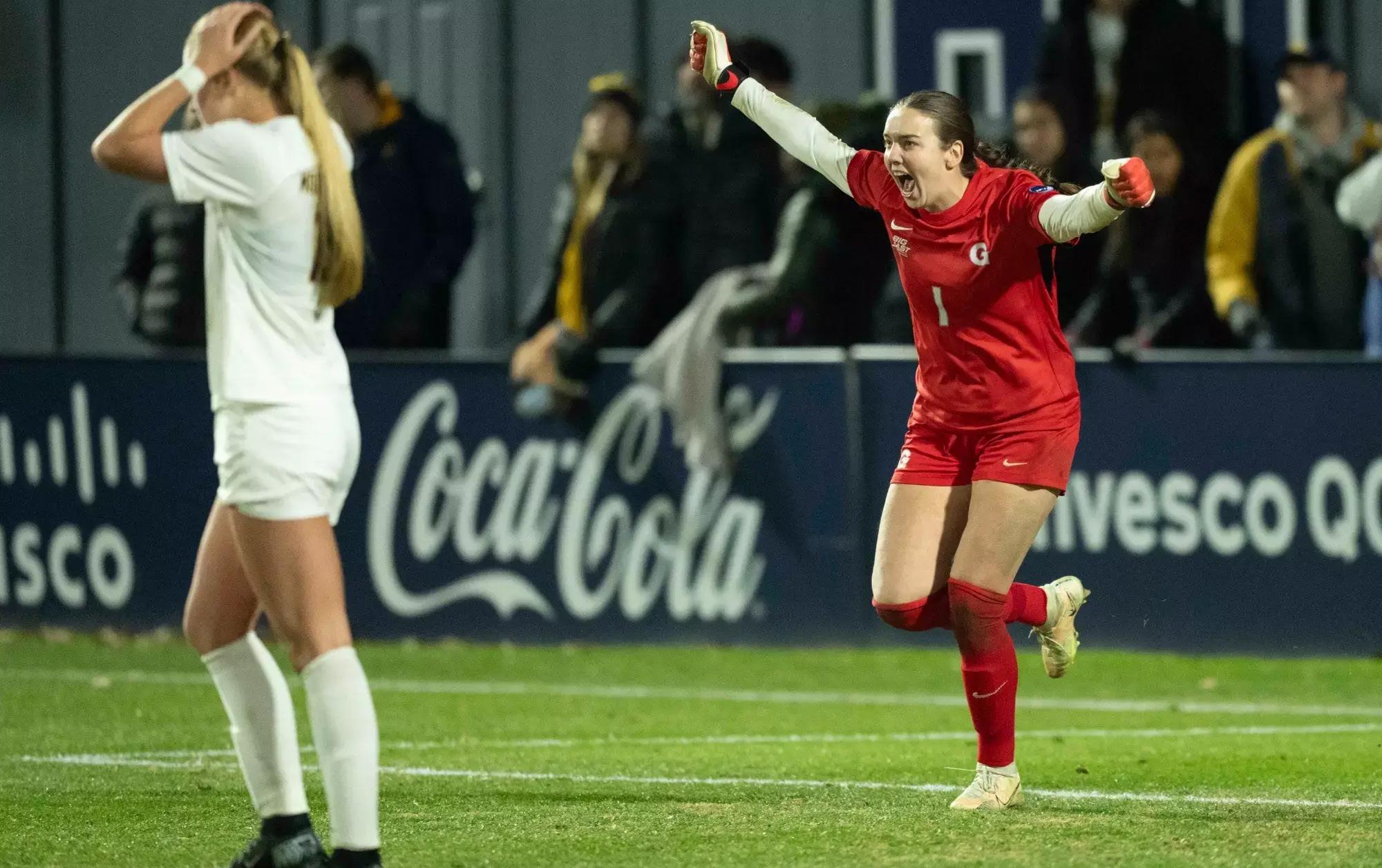
the ball in the Hoyas’ half before playing it into senior forward Henley Tippins’ feet on the halfway line. Tippins laid it of to Cochran, who played an inch-perfect through ball to Lardner down the right wing. Lardner drove to the goal line and then cut back to Cochran at the edge of the box, who sent a low-effort toward goal, which Heller, after sprinting over half the feld, defected in to tie the game 1-1. Georgetown’s next shot came in the 32nd minute, when Tippins stole the ball on the right wing and
As has been usual for the Hoyas so far this season, they also struggled from the feld in the frst half, including a three-minute period with no made feld goals. Clemson, on the other hand, was shooting 45% from beyond the arc by the under-8 media timeout.
But even when the Hoyas went down, by as much as 7, they never looked out, and remained close behind by never being down by double-digits.
While the Tigers’ shooting never allowed Georgetown to retake the lead in the frst half, the Hoyas kept it close and entered the break trailing only 36-33. In the second half, the Hoyas looked like a completely diferent team, and their physicality began to wear Clemson down. Georgetown got to the line 32 times in the game, including 17 times in the second half, and converted 25 of their attempts. Georgetown found themselves
Madeline Wang
Senior Sports Editor
Under intense winds and with an outstanding performance from junior midfielder Mateo Ponce Ocampo and a clutch goal from first-year midfielder Loukas Maroutsis, the Georgetown University men’s soccer team asserted their Big East dominance Nov. 16, securing the Big East championship after having garnered the regular season title earlier this month.
Ocampo paved the way to the Hoyas’ (12-3-4) second consecutive Big East championship with a brace in the 66th and 67th minutes. Maroutsis’ goal in the 73rd minute sealed the deal for the Hoyas’ 3-1 takedown of the University of Connecticut (UConn) Huskies (11-4-4).
The match got of to a physical start, with both teams receiving fouls in the frst three minutes of play. In the second minute, the Huskies sent up the frst shot of the day on goal of a free kick directly into senior goalkeeper Tenzing Manske’s well-positioned arms.
The Hoyas responded with a shot of their own in the ffth minute. Senior midfelder Zach Zengue brought the ball up the pitch on the counterattack, ran it across the box and in a series of good passes — including a skilled header by senior midfelder Julian Barrios Cristales to keep the ball in the box — Ponce Ocampo found the ball for a shot that sailed just wide of the right post.
Georgetown had another try in the seventh minute, as Zengue sent a powerful shot on goal straight into the UConn goalkeeper’s hands. In the eighth minute, sophomore forward Mitchell Baker was taken down outside the right corner of the box, earning the Hoyas a free kick. Zengue sent the free kick to the far post, where Ponce Ocampo slammed the ball just wide of the near post as the Hoyas continued making early ofensive strides. UConn attempted to get into the mix and sent up a shot on goal of a throw-in near the corner in the 11th minute. Baker, using his height to advantage, headed the initial attempt away from the goal and a return header on goal by Husky midfelder Marco Valentic found its way into Manske’s hands. UConn tried again, but misdirected a corner kick to no one in the 13th minute. In the 16th minute, Baker took off on the counterattack and forcefully sent a ball straight to the UConn goalkeeper for Georgetown’s second shot on goal of the day. Neither team fired another shot until the 25th minute when Husky midfielder Balthazar Saunders sent a ball sailing high above the goal, as the Hoyas’ defense forced the Huskies into compromised offensive positions. In the 32nd and 34th minutes, sophomore defender Tate Lampman — named the most outstanding defender in the Big East tournament — had 2 fantastic steals and brought the
cut in onto her left foot, but she could only manage a low-efort that dribbled into Herfurth’s hands. The half fnished quietly with the teams deadlocked at 1-1 heading into the break. The second half was calmer than the frst. In the 48th minute, Means recovered a West Virginia clearance following a Georgetown corner. Means fooled a defender with her frst touch and knocked it from her left foot onto her right before sending a low-driven efort on goal, which Herfurth claimed easily. In the 58th minute, White fzzed a shot from the top of the box, which Martin plucked out of the air. The next 20 minutes were uneventful, with a few corners but no chances culminating from them. The game headed to extra time after neither side could pull ahead in regulation. In the 94th minute, the Hoyas received a shock when Mountaineers midfielder Maddie Levy knifed through multiple defenders before coming face to face with Martin. However, Levy could not control her effort, See CLEMSON, A11 See WEST VIRGINIA, A11
CAMERON LAU/THE HOYA
Eilat Herman Sports Columnist
MEN’S SOCCER