
Ewing Paid $12.5 Million After Being Fired as GU
Men’s Basketball Coach
Ajani Stella Senior News Editor
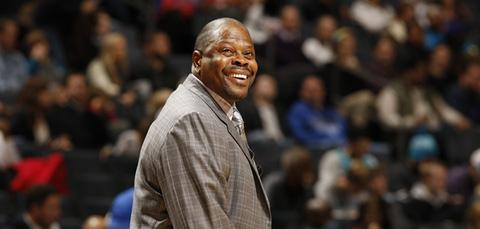
Patrick Ewing (CAS ’85), the former Georgetown University men’s basketball coach, received at least $12.5 million from the university the year after he was fred in March 2023.
The buyout, revealed in newly released fnancial disclosures, liquidated the remainder of his contract as part of his termination from coaching. The compensation included an $881,000 base salary, a $300,000 bonus and a nearly $11.4 million payout — totaling $12.57 million — from July 1, 2023, to June 30, 2024, the university’s 2024 fscal year.
Ewing, who led Georgetown to its only NCAA championship in 1984 and later played for the New York Knicks, coached Georgetown’s basketball team through six lackluster seasons before the university dismissed him. Throughout his tenure at Georgetown, Ewing was consistently the highest-paid
current employee, with his annual salary growing from $2.3 million in Fiscal Year 2018 to just over $4 million in Fiscal Year 2023, according to publicly available tax flings. Last year’s payout was equivalent to around 60% of all of Ewing’s prior compensation from Georgetown.
Ewing did not respond to multiple requests for comment.
A university spokesperson declined to answer questions about Ewing’s compensation, saying the university cannot comment on contracts beyond nonproft tax disclosures, known as 990 forms.
“Employment contracts are confdential and we are not able to comment beyond what is required to be reported by federal law in the 990 form,” the spokesperson wrote to The Hoya. “Patrick Ewing has dedicated his life to Georgetown basketball and his impact on the entire Georgetown community is immeasurable.”
See EWING, A7
GU HOYAS
Georgetown University paid former men’s basketball coach Patrick Ewing at least $12.5 million after his termination.
GU Community Funds Khan Suri’s Defense
Nora Toscano and Ruth Abramovitz
Executive Editors
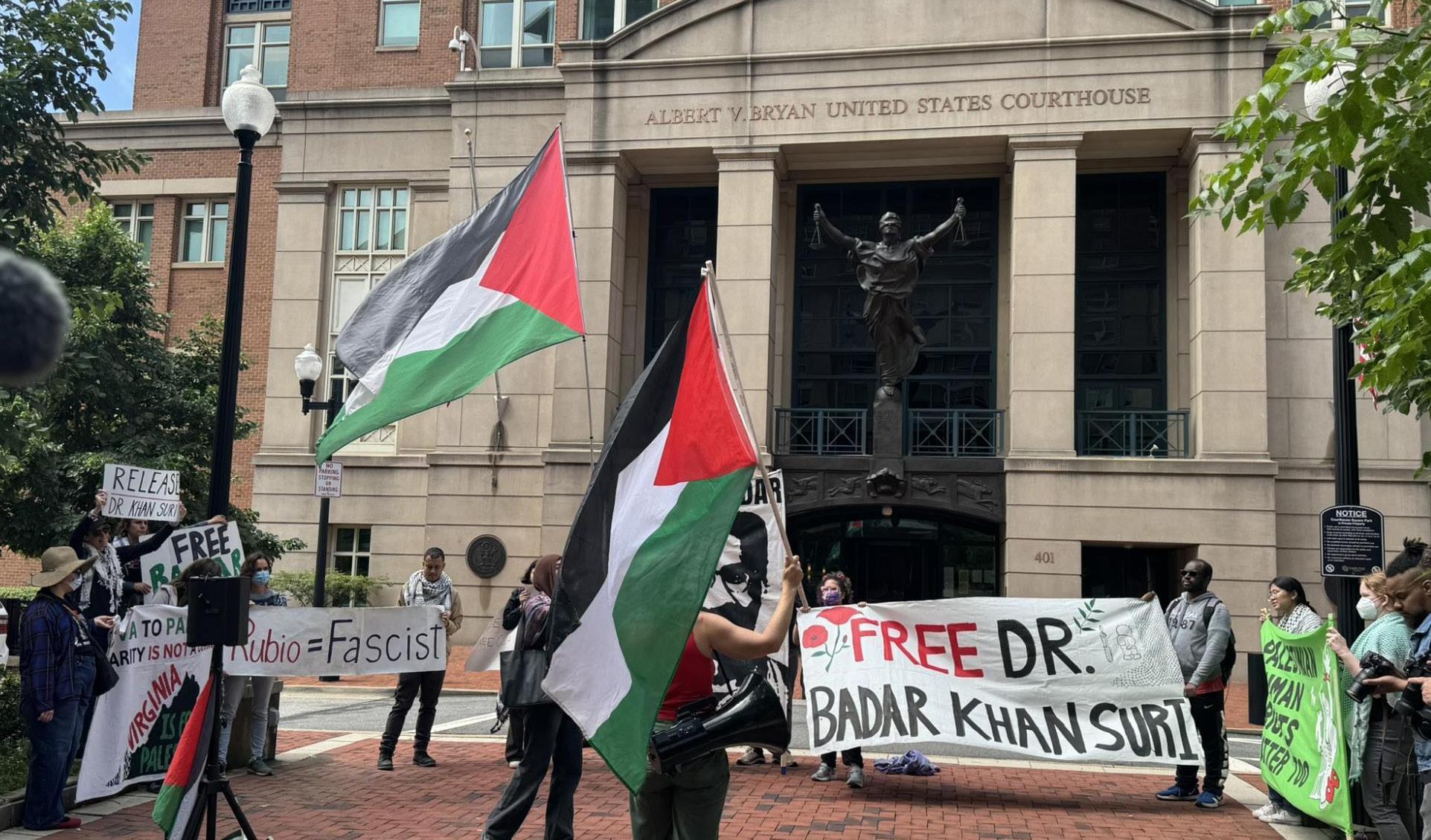
Georgetown University community members are uniting behind and fundraising for formerly detained Georgetown postdoctoral researcher Badar Khan Suri after an immigration court ruled him deportable.
Khan Suri’s wife, Mapheze Saleh (GRD ’26), launched a fundraising campaign Nov. 29 for his legal representation, who will appeal the deportation ruling to the Board of Immigration Appeals (BIA), a federal administrative
GU Reverses One RA Policy Change After Student Petition
Nora Toscano and Jacqueline Gordon
Executive Editor and Academics
Desk Editor
Georgetown University’s Ofice of Residential Living (Res Living) reversed one policy change
afecting residential assistants (RAs) following a student petition alleging the changes would negatively impact RAs’ housing process and quality of life.
The Ofice of Residential Education (Res Ed), which operates under Res Living, announced a range of policy changes at a Nov. 7 meeting, including that RAs living in suite-style housing may choose only their direct roommate and must commit to being an RA before learning their building assignments. In the Nov. 28 email announcing the reversal of one policy, Res Ed director Heidi Zeich said RAs will now be informed of their placements in February, as was done in previous years.
Zeich said the policy changes are in line with the RA union
Georgetown Residential Assistant Union (GRAC)’s collective bargaining agreement (CBA), a contract agreed upon between GRAC and the university following seven months of bargaining.
“We have adjusted our approach on placement and will share assignments in February, which I understand is the same timeframe as last year,” Zeich wrote in the email. “We are continuing with ofering RAs assigned to double bedrooms
the opportunity to select their direct roommate, as agreed upon in the CBA; additional spaces in multi-occupancy units will still be available for students (including your friends) to select during the Housing Selection Process.”
Although RAs will still be unable to select their indirect suitemates, Res Ed will now inform RAs of what communities they have been placed in when they receive their employment ofers in February.
Anna Holk (CAS ’27), a GRAC steward and RA for Nevils Hall, said she hopes the changes will restore a sense of comfort for RAs before they enter the housing process.
“RAs will hopefully be able to feel safe, more safe and comfortable in their spaces than under the system that was suggested previously,” Holk told The Hoya. “I think it will be a positive development, that people have some choice and autonomy in their housing process, especially considering the fnancial accessibility side of things.”
After voting to unionize in April 2024 and accepting representation from OPEIU Local 153, GRAC and the university entered a sevenmonth bargaining process to create a CBA. The CBA established a stipend, an arbitration process for grievances and other policy changes for RAs.
A university spokesperson previously said the university
is dedicated to working in good faith with GRAC.
“The collective bargaining agreement (CBA) between the university and the Georgetown Resident Assistant Coalition (GRAC) established multiple avenues for both informal and formal discussion and resolution of issues of mutual interest and concern,” the spokesperson wrote to The Hoya Nov. 20. “Out of respect for this legal agreement between the union and the university, which establishes OPEIU Local 153 as the sole and exclusive representative of GRAC members, Georgetown will continue to use these channels to discuss and resolve any concerns through good-faith engagement.”
Other policy changes introduced in a Sept. 9 email to RAs include diferent reporting duties for holidays and bar RAs from entering romantic or sexual relationships with residents in their immediate community.
Izzy Wagener (SFS ’26), GRAC’s chairperson and an RA in Darnall Hall, said GRAC is still advocating against these changes.
“For some of those other changes, we’re still in talks with the university at this point, and so we’ll have to see,” Wagener told The Hoya. “I’m just hopeful that going forward, they won’t make those kinds of changes without frst clarifying with the union that they aren’t unilateral or that they don’t basically violate our contract.”
See RAs, A7
body overseeing immigration court appeals, according to sources familiar with the case.
As of Dec. 4, the fundraising campaign has attracted over 300 supporters, raising $25,873 of its $70,000 goal.
Khan Suri is currently a party in two separate cases. Parallel to his immigration case, his legal team is also challenging his original arrest and detention in the 4th Circuit Court of Appeals, based in Virginia, in Suri v. Trump.
Sidra Mahfooz, a staf attorney with the legal nonproft American Civil Liberties Union (ACLU)’s Immigrants’ Rights
Project and one of Khan Suri’s attorneys, said the immigration court’s decision represented the suppression of free speech.
“This is just the next step in the government’s efort to retaliate against Dr. Suri in violation of the First Amendment,” Mahfooz wrote to The Hoya. “It is far from the last word, and we will continue to fght for his rights in every available venue. Dr. Suri should be able to focus on teaching and spending time with his family instead of fghting the government’s attempts to detain and deport him in retaliation for his speech about Palestine.”
Federal immigration oficials detained Khan Suri March 17, alleging he was a threat to U.S. foreign policy. U.S. Immigration and Customs Enforcement (ICE) released Khan Suri on May 14 from a detention facility in Alvarado, Texas, following a federal judge’s ruling that his detainment unconstitutionally targeted him for protected speech and familial associations, violating the First Amendment. In early July, the 4th Circuit denied the government’s motion to immediately redetain Khan See KHAN SURI, A7
GU Students Occupy Healy, Protest Proposed GUTS Subcontracting
Ajani Stella and Nico Abreu Senior News Editors
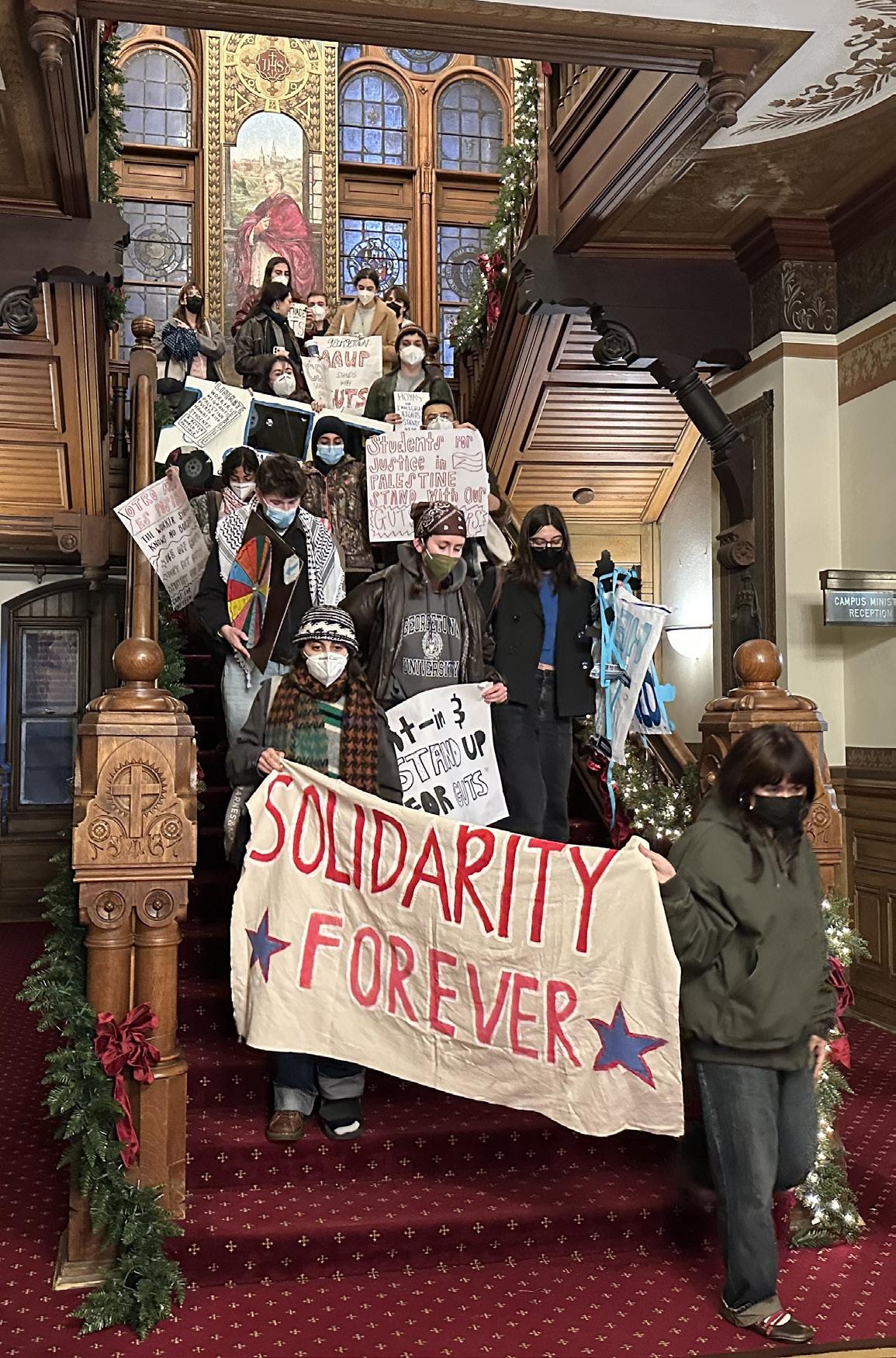
About 30 Georgetown University students occupied part of Healy Hall Dec. 2 to protest the university’s proposed plan to subcontract Georgetown University Transportation Shuttle (GUTS) drivers.
During the approximately eight-hour sit-in from 9:15 a.m. to 5 p.m., the protesters wrote letters, delivered speeches, made posters and listened to statements from GUTS drivers. The student protesters condemned a university proposal that would shift GUTS drivers to a third-party vendor, local charter company Abe’s Transportation, which drivers have said would reduce their benefts.
Fiona Naughton (SFS ’27), who participated in the sitin, said the protesters sought a formal university commitment that it would not proceed with the subcontracting plan.
“Our demand today was very simple, which is just that we want a written commitment from the university that GUTS drivers will be kept as university employees,” Naughton told The Hoya. “The reason that this campaign has extended for so long is because the university has not given a clear or defnitive answer to the drivers themselves about whether or not their jobs are going to exist.”
At an Oct. 23 meeting, Georgetown’s Advisory
See GUTS, A7
MAREN FAGAN/THE HOYA
Georgetown University community members are fundraising to support formerly detained Georgetown postdoctoral researcher Badar Khan Suri following an immigration court ruling that he is deportable and months of protests in his support.
AJANI STELLA/THE HOYA
About 30 Georgetown University students staged a sit-in at Healy Hall to protest a proposed bus driver subcontracting plan.
Rangila Breaks Records This
Georgetown Rangila maintained its reputation as one of the school’s most beloved traditions, writes Tanvi Gorripati (CAS ’27).
writes
Derfner (CAS ’27).
Give All Students Transport Funding
This semester, members of the Georgetown University community have witnessed issues afecting our campus that extend beyond the front gates.
Students have particularly reiterated this point — Georgetown University Student Association (GUSA) president and vice president-elect Darius Wagner (CAS ’27) and Nazgol Missaghi (CAS ’28) made a priority of addressing Washington, D.C.wide concerns and their efect on the student body. Whether for personal, political or professional reasons, it is evident that the student body wants to pop the infamous “Georgetown bubble,” and our administration should support students in this endeavor. To truly be integrated with the broader D.C. community, the Editorial Board urges the university to implement a system that guarantees transportation cards for every student, rather than relying on the current lottery system.
Since Fall 2022, the Hoya Transit program has supported some students’ travel across the District by disbursing a $50 monthly Washington Metropolitan Area Transit Authority (WMATA) credit per semester, a fee that covers roughly 10 to 16 trips on the Metro. To be eligible for this beneft, students must complete a form and undergo an anonymized random selection process that chooses up to 3,200 participants each semester. While the Editorial Board supports the program’s eforts to provide mass transit options for students, we believe that guaranteeing transportation for all students is integral to ensuring our student body remains connected to the rest of Washington, D.C. This is essential for preserving equitable learning opportunities and supporting the unique student experiences for which D.C. is known and loved.
While the cost may seem minimal, paying $2.25 to $6.75 to use public transit can add up over time, especially for those who travel frequently for an internship or job. This resource is also not directly obvious to students. This fall, the deadline to apply for SmarTrip benefts was Wednesday, Aug. 13, before the semester even began. Students had little time to apply for the beneft before the opportunity was closed. Georgetown boasts its location in D.C., highlighting on its admissions pages that students can enjoy all the city has to ofer, including internships, access to national attractions and distinguished guest speakers. Yet the fact remains that students still struggle to fnd convenient, afordable routes to their internships, especially given that the Georgetown neighborhood lacks a Metro stop.
Though the Georgetown University Transportation Shuttle (GUTS), the campus’ free shuttle bus for Georgetown community members, provides free transportation to both the Dupont and Rosslyn Metro stations, students who do not receive WMATA credit through the Hoya Transit program are left to pay for their own Metro rides. For students who frequently commute to downtown D.C. for internships, the Metro costs accumulate quickly.
With many internships being either unpaid or grossly underpaid, it is important to recognize that the additional cost of metro rides can especially place an undue burden on low-income students.
In 2017, the New York Times reported that Georgetown ranked 12th in a study they conducted on income inequality at universities. Given signifcant wealth disparities, Georgetown could continue eliminating barriers to success for low-income students by providing every student — not just a randomly selected group — with a funded SmarTrip card. While pre-professionalism is important for most Georgetown students, it is also important for students to simply be able to enjoy all Washington, D.C., has to ofer, such as monuments, museums and cultural events, stress-free.
The memories made at events like the kite festival or the holiday market are just as valuable as work experience, contributing just as signifcantly to students’ college experiences.
HOYA HISTORY
Beyond the Metro, the WMATA SmarTrip card ofers benefts for those who ride Metrobus. The Metrobus is the only alternative transit option available to students in the Georgetown area. While the GUTS bus makes stops at eight specifc locations, including one in Georgetown, the Metrobus provides more extensive coverage across the D.C. area. Additionally, the GUTS bus ofers limited to no weekend service, with no early-morning shuttles and longer gaps between trips.
If opening the Hoya Transit program to all is fnancially unsustainable, there are other options available. Since launching the pilot program at American University in 2016, 46 universities have participated in the U-Pass program. U-Pass ofers students unlimited rides on Metrorail and Metrobus throughout the semester for the equivalent of $1 a day, and universities include this cost in tuition.
Anna Sabriá, a master’s student at George Washington University (GWU), said she has benefted from GWU’s U-Pass program.
“From morning internship commutes to weekend nightlife, the U-Pass has made D.C. far more accessible for me as a student,” Sabriá told The Hoya. “I don’t have to stress about constantly reloading my card, especially with the unlimited trips. As someone who rides the Metro between two and four times a day, the U-Pass program saves me hundreds of dollars in transportation costs a semester, allowing me to spend that money on actually experiencing the city.”
Calling on the university to implement U-Pass is not novel — in May 2021 a referendum passed that urged the university to implement the Metro U-Pass Program, with 84% of voters in favor.
A university spokesperson said Georgetown has explored ways to support students seeking transit access.
“In previous years, we have worked with GUSA and GradGov to explore the idea of joining Metro’s U-Pass program,” the university spokesperson wrote to The Hoya. “Because U-Pass requires enrollment of all students within a school or campus — whether they use the pass or not — and has historically been funded as an addition to student tuition bills with other universities, Georgetown does not currently participate in the program. U-Pass does not allow for individual students to opt in or out. We are always open to feedback and further exploration of new transit options.”
While survey data should be collected to refect the current student body’s sentiment, it is clear that transportation accessibility has long been an important concern for students. It is overwhelmingly clear that students want Georgetown to ofer an easily accessible transportation program.
Saahil Rao (SFS ’27) interned on Capitol Hill and said commuting into the city via Metro would be made easier with the U-Pass.
“I’ve entered the lottery twice now, and I received the credit once,” Rao wrote to The Hoya “I was able to get my Metro fees covered by the federal government through an existing subsidy program, but it would be nice if Georgetown could just do that automatically for all students and allow them not to have to worry about that extra step, especially since GW students get a U pass.”
Touting “The D.C. Advantage” in its advertising materials, Georgetown is proud of its connection to greater D.C. By expanding its “downtown footprint” through the development of the Capitol Campus, Georgetown has proven it understands the value of students experiencing downtown D.C. fully. With this in mind, it is time for the university to transition away from the WMATA pilot program and ofer a transportation option that is accessible to all students, not just a lucky few.
The Hoya’s Editorial Board is composed of six students and is haired y the senior opinion editors. Editorials refe t only the beliefs of a majority of the board and are not representative of The Hoya or any individual member of the board.
to Study Metrobus Emissions
October 26, 2009
The Washington Metropolitan Area Transit Authority Board of Directors approved a study on Thursday to determine which type of Metrobus is the most cost-efective and environmentally friendly.
Whether for personal, political or professional reasons, it is evident that the student body wants to pop the infamous “Georgetown bubble,” and our administration should support students in this endeavor.
The Editorial Board “Give All Students Transport Funding” thehoya.com
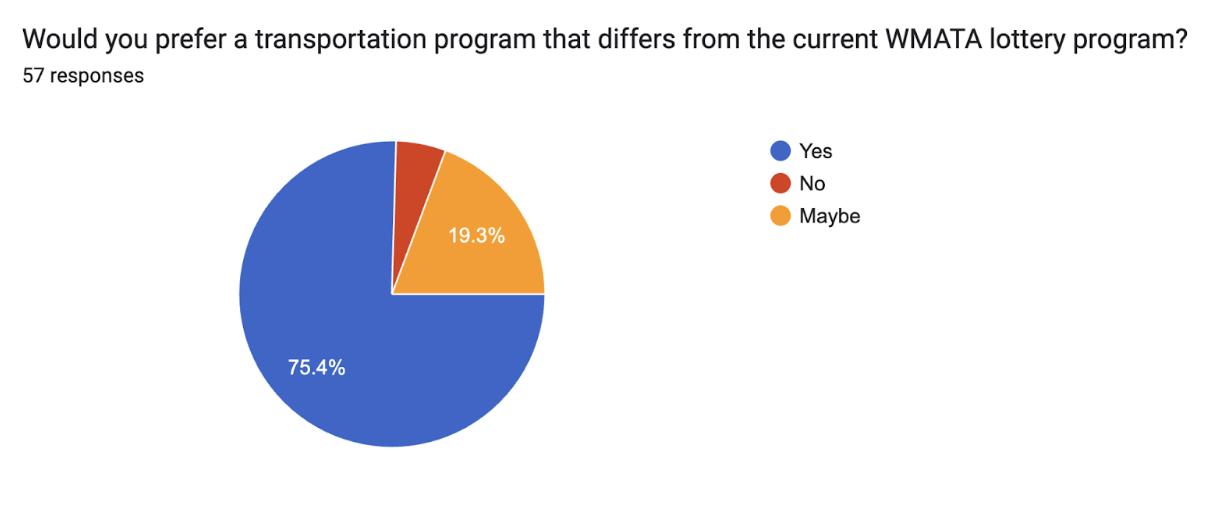
In Fall 2022, Georgetown University launched the Hoya Transit program, which offers up to 3,200 chosen participants a $50 monthly Washington Metropolitan Area Transit Authority (WMATA) credit per semester. This week, the Editorial Board advocated for the university to move past the current lottery system and implement a system that guarantees transportation cards for every student. To gauge student opinion, students were asked if they would prefer a transportation program that difers from the current WMATA lottery program. Of the 57 respondents, 75.4% said yes, 5.3% said no, and 19.3% said they were unsure.
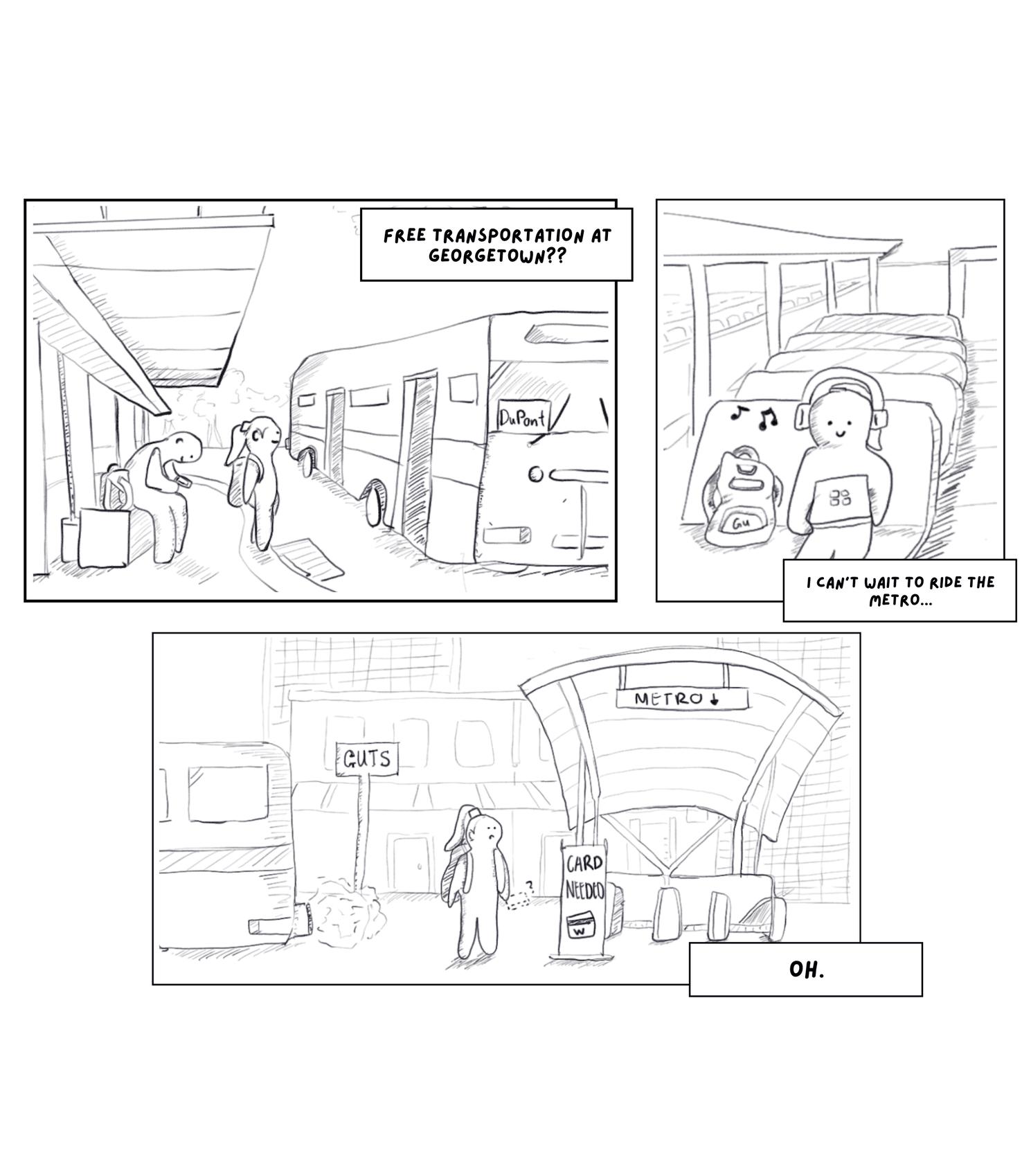
EDITORIAL CARTOON by Ray Tian
Founded January 14, 1920
Maren Fagan, Editor in Chief
Ruth Abramovitz, Aamir Jamil and Nora Toscano, Executive Editors
WMATA is partnering with the West Virginia University Research Corporation to draft an $185,000 research contract. The study will be funded by the East Coast Hybrid Consortium, a group comprised of public and private stakeholders that promotes alternative fuel technologies. Currently, WMATA runs buses with four diferent types of fuel: compressed natural gas, clean diesel, diesel-electric hybrid and regular diesel. The researchers will conduct emissions testing and collect data on vehicle performance and operating costs to compare the emission outputs of each fuel type.
WMATA. Over 800 of 1,500 Metrobuses run on diesel fuel; 117 run on clean diesel and 50 are diesel-electric hybrids.
“West Virginia University and Metro will perform emissions testing, collect operations data, and gather in-service vehicle performance and operating cost information for a comparison between Metrobuses operating with diesel fuel, hybrid-electric propulsion systems, compressed natural gas and clean-diesel biofuels,” a WMATA press release said. “The evaluation will help Metro determine which fuel and propulsion system provides the cleanest fuel option and most cost-efective way to power the transit agency’s bus feet in the future.” Diesel is currently the most common type of fuel used by
CNG, a fossil fuel substitute for diesel that produces fewer greenhouse gases during combustion, powers 460 buses, according to WMATA’s Web site.
Kristin Ng (COL ’11), president of Eco-Action at Georgetown, supports the WMATA initiative to use cleaner fuels.
“[W]e defnitely encourage people to take buses regardless, so switching to buses with fewer emissions is even better, and hopefully people will fnd (a little) more of a reason to take the Metro buses,” Ng said in an e-mail.
Katie Lauria
Nico Abreu, News Editor
Ajani Stella, News Editor
Paulina Inglima, Managing Editor
Opal Kendall, Features Editor
Saroja Ramchandren, Features Editor
Annikah Mishra, Opinion Editor
Ella O’Connor, Opinion Editor
Isabelle Cialone, Guide Editor
Tanvi Gorripati, Guide Editor
Nate Seidenstein, Sports Editor
Madeline Wang, Sports Editor
Angela Lekan, Science Editor
Eva Siminiceanu, Science Editor
Avelyn Bailey, Design Editor
Lucy Jung, Design Editor
Grace Bauer, Copy Chief
Jackson Roberts, Copy Chief
Shira Oz, Blog Editor
Fallon Wolfley, Blog Editor
Kate Hwang, Multimedia Editor
Michael Scime, Multimedia Editor
Matthew Gassoso, Photo Editor
Board of Directors
Patrick Clapsaddle, Chair
Bethe Bogrette, Julia Butler, Amber Cherry, Madeline
Grabow, Mia Streitberger
Peter Sloniewsky, General Manager
Sophia Williams, Technology Director
Fix Housing Point System
The fght for a good spot in the housing lottery is a familiar ritual for college students across the United States — and, for many, a struggle. Georgetown University students are no exception. As the semester progresses, concerns about dorm assignments for Fall 2026 have already begun circulating among frst-year students, sparking stressful conversations in dining halls, study rooms and group chats.
While Georgetown’s housing lottery program, “What’s a Hoya?” (WAH), aims to ease some of these worries for frst-years, the imperfect access to information, inconsistent advertisement and the program’s transactional nature makes it overly cumbersome. Georgetown needs to clearly and proactively introduce the program to frst-year students throughout the year to create an environment that makes Georgetown students truly feel like part of the community, especially through events as early on as New Student Orientation (NSO).
Throughout the semester, WAH communicates upcoming opportunities through emails, Canvas modules and Instagram posts, guiding students to events that count for housing point credit. Through lectures, quizzes, events and community engagement opportunities, WAH helps familiarize students with campus life while also ofering something highly desired: housing points. By participating in these activities and completing modules, frst-years learn about university resources and traditions while advancing their position in the housing lottery. Although rising sophomores are not able to accumulate more housing points than rising juniors and seniors, these points provide a competitive advantage over others in their year.
Despite the program’s good intentions and genuinely engaging events, its challenges undermine its potential for success. Firstly, there is an imperfect access to information about WAH. While some frst-years quickly discover the program, others have never even heard of it. Several of my own friends and peers admitted
they had no idea what WAH was or why it mattered. These processes inevitably exclude some students from partaking in the program. This lack of consistent communication undermines WAH’s purpose. If students do not know the program exists earlier in the semester, they cannot benefit from its opportunities, meaning the housing lottery advantage becomes imbalanced before it even begins. Thus, it may be beneficial for the university to repeatedly introduce this program and its events throughout the semester. Groups like the university’s NSO should direct first-year students to resources upon their arrival on campus through presentations and advice from NSO leaders, allowing students to get involved in the events WAH hosts. In addition, the program’s structure can sometimes feel transactional: Some students will show up at the WAH event, scan the QR code after a short presentation for a quiz, collect their 0.1 points and leave. While the learning outcomes with these events that encourage community involvement and school spirit are valuable, the incentive structure occasionally overshadows the community-building goals without students being genuinely interested at the event. I remember at ESCAPE this semester, one event leader asked if I signed up just for my WAH housing point, showing how this has been a recurring trend within our community. WAH has strong potential to be a meaningful cornerstone of the frst-year experience, but it must be more accessible, clearly introduced and consistently advertised. Better communication would help guarantee fairness in the housing lottery and ensure that all frstyears, not just the well-informed few, beneft from what WAH ofers.
In the meantime, consider this your sign to check the WAH course on Canvas and explore the activities still available. A little browsing, extra time and effort spent now might be the key to securing the dorm you want next year, and learning more about your new community along the way.
Jennifer Zhou is a first-year in the College of Arts & Sciences.
VIEWPOINT • BHATT
Allow Dining for All, Reform Guest Pass Policy
t’s harder to dine at Leo J.
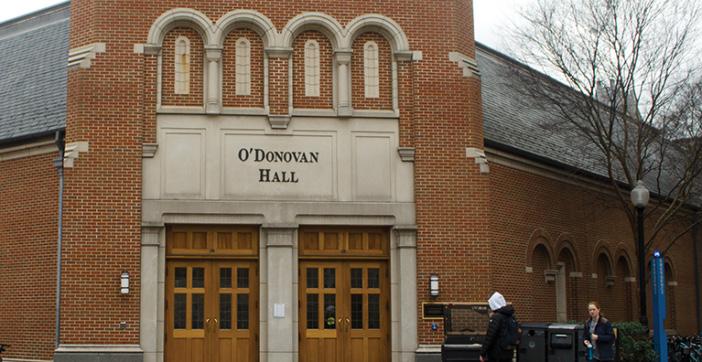
IO’Donovan Dining Hall this year than last year, and the newly enforced guest pass policy is one of the major reasons. Oficially, the guest pass policy allows “each meal plan holder to have 2 guest passes for anyone of their choosing,” per semester, according to a Hoya Hospitality manager.
Despite the oficial print, I’ve found that the guest pass policy has been inconsistently enforced. This year, I’ve experienced staf members enforcing it more strictly, while students and their families fall victim to the confusion, forcing them to pay additional door rates to admit guests. The lack of a clear, consistent policy is hurting students’ dining experience, and Hoya Hospitality should not stop at having a clearer guest policy, but rather expand the guest plan altogether. Students with an unlimited meal plan should be able to bring unlimited guests, whereas students with reduced meal plans should have more passes.
At the start of the school year, I invited my parents to dine at Leo’s with me. I expected to easily swipe my parents in by tapping my GoCard as I did several times last year. However, at the front desk, staf members refused to let me swipe my parents in and forced each of my parents to pay $18.61 to enter.
That day was not a special event at Leo’s, nor was the menu particularly enticing. I remember
being embarrassed at having to ask my parents to pay for dining hall food after they already purchased the unlimited meal plan. I was also under the impression that my guest passes allowed two people to dine with me. When I contacted Hoya Hospitality through their online form to raise this issue, I never heard back.
When I asked around, I found out that other students have faced similar dificulties when bringing friends and family to campus.
Kezia Hutabarat (SFS ’29) said she was confused over the guest pass policy, assuming that Georgetown would allow guest swipes like other institutions do.
“When my parents came with me to Leo’s, I was told to pay for their food,” Hutabarat told The Hoya. “I don’t use the guest pass policy often, but I was confused why I couldn’t simply swipe for them. My parents could’ve just gone to Tatte or Yellow.”
Students I’ve talked to are under the assumption that the guest pass policy is the same as years before — just swipe in for a guest. Even if there is now a limit, the fact that both Hutabarat and I were unable to swipe our parents in, despite the hypothetical ability to do so, exposes that this policy isn’t as clear or as consistent as it should be.
I have yet to see a guest come in without being charged. This forces them to pay the same charge my parents did, or rely on either upstairs Leo’s or of-
campus locations. Since my frst experience, I’ve decided to take friends of campus to eat.
The problem isn’t just the unclear policy, though, but the policy altogether. It seems unfair to limit guests for Leo’s. The unlimited meal plan with $200 Flex dollars, the default for all frst-year and sophomore students, costs $3,924 per semester. To charge guests, most of whom have been families in my experience, additional door rates of $14.61 for breakfast, $18.61 for lunch or $20.91 for dinner (not including tax) is an unnecessary, unfair fnancial burden. Some students’ families likely can’t aford the unexpected cost of a $20 meal per person, especially when they spent money on travel and lodging to see their children. Paying for the meal plan and tuition is already a hefty fee, and asking Georgetown families to pay additional charges just to eat with their kids is categorically unjust.
If at least half the school (over 3,500 students) pays for the unlimited plan, with the rest paying for reduced meal plans that can still cost over $3,000, then Hoya Hospitality is by no means bankrupt. Virginia Tech, a public institution, charges $3,147 for its unlimited meal plan. Somehow, Virginia Tech is able to charge less while allowing students to bring unlimited guests. Realistically, students won’t be using guest passes every day. However, limiting the guest pass
policy to two means allowing parents to eat free only once — and that’s assuming that the guest pass policy is correctly enforced. Instead of limiting how many times students can eat with their families, Hoya Hospitality should encourage students to bring their families to campus and share their college dining experiences, considering how much students already pay for the meal plan. To ensure price value, Leo’s should expand its guest pass policy. The current policy should be made clearer to students and enforced regularly. From there, students on unlimited plans should have unlimited guest passes, and students on reduced meal plans should have more passes, allowing them to bring their parents to Leo’s at least twice. Dining is a core part of any college experience, and wanting to share that with family members is understandable and expected. Right now, the current guest policy at Leo’s is an impediment and a fnancial burden for students looking to share their dining experience with friends and family. It is critical that college dining not bar students from bringing guests to Leo’s. Continuing the current guest pass policy is limiting the potential and the bonding power of Leo’s dining experience.
Karina Bhatt is a sophomore in the School of Foreign Service
Engage With Campus Culture Clubs
W e gathered around three long tables inside Georgetown University’s Hilltoss, a cup of chai in one hand and a paintbrush in the other, as a Googoosh song played from the speakers. With our hand-painted Halloween decorations and guest appearances from roommates and friends, Georgetown’s Iranian Cultural Society’s (ICS) Chai and Paint event was a hit. We had been planning it for weeks, and despite running into a few bumps along the way (our Turkish delight shop was sadly closed), it ended up bringing together students from different backgrounds and providing a fun break from studying for midterms. Moments like these have helped me realize how cultural clubs enrich campus life in ways that ordinary classes and activities cannot. More of our students should explore Georgetown’s cultural clubs to connect with their heritage or simply to discover a new community.
My father’s family left Iran during the Iran-Iraq war in the 1980s and moved to Atlanta. After he married my mother, a blonde-haired, blue-eyed Southern girl, they moved back to her hometown of Phenix City, Ala., to raise their four children. From shared glasses of sweet tea and big plates of barbecue to
cotillion classes emphasizing the importance of manners, I grew up fully immersed in Southern culture and loved it. However, without my father’s family close by, I never learned more than a few words of Persian or ate more than the occasional Persian dish on holidays. I only experienced as much of the culture as visits with my grandparents in Atlanta every few months allowed. Additionally, in my 18 years of living in my hometown, I never once ran into another Iranian American. As I got older, I began to feel that I had missed out on part of my family’s heritage. I was introduced to ICS before my frst semester even began; eager to start reconnecting with my culture, I had been taking a Persian language class over the summer, and my professors introduced me to the president of ICS. I could not have been more excited to get involved. In just my frst few months at Georgetown, ICS has allowed me to reconnect with my heritage in ways that I never expected. I have met so many incredible people through the club and helped plan fun events that celebrate my culture. One of my favorite memories was during Family Weekend, when ICS members brought their families to have lunch together at Clyde’s in Georgetown. We ended up staying for hours, bonding over
immigration stories, Persian culture and delicious food. Events like this one have given me a sense of community around my Persian identity that I haven’t had before.
Whether you join a club centered on your own heritage or explore a culture completely new to you, cultural organizations like ICS provide spaces for students to build friendships, connect with one another and enjoy traditions that they may not otherwise have come into contact with.
They allow us to celebrate heritage, explore identity and learn from others in an informal way that connects us all, and embodies Georgetown’s Jesuit value of Community in Diversity.
Being welcomed into the Iranian Cultural Society has been a powerful reminder of what it means to connect to a cultural community — it doesn’t have to begin at birth, but can develop later in life through friendship, shared meals and language. I urge you to join one of Georgetown’s many diferent student-run cultural organizations during your time here. When we contribute to Georgetown’s rich cultural diversity through these groups, we help create a more connected and inclusive campus.
Ava Valadi is a first-year in the School of Foreign Service.
Practice Intentionality as an RA
Other students are often confused when I tell them I’m a proud resident assistant (RA) in a firstyear building and that I deliberately chose to be an RA for first-years. In fact, being a firstyear RA has been my favorite part of my Georgetown University experience to date.
I can understand my peers’ confusion — Georgetown isn’t known for having glamorous housing, and generations of students have unfortunate tales of the facility breakdowns they have experienced. On top of that, the RA position isn’t the most prestigious job one could have on campus, let alone at a competitive school like Georgetown. However, I strongly maintain that despite its lack of prestige, being an RA at Georgetown is one of the best positions a student can hold on campus, not simply because it comes with substantial financial benefits, but because it is a position primed for making a meaningful impact on other students. Moreover, I believe the best way to make this type of impact is through simple intentionality.
Intentionality is a breath of fresh air in an environment like Georgetown, where life often feels rushed. It’s a lifestyle driven by purpose behind every action, where students choose to take initiative rather than waiting passively for others. Everyone has the ability to practice intentionality at Georgetown, but I believe an RA’s intentionality holds special power because RAs are inherently seen as student mentors on campus. Current RAs ought to recognize the efect their intentionality can have, and I urge students who are not RAs to consider applying or to fnd ways to practice intentionality in their own campus roles.
RAs have immense potential to make an impact on Georgetown’s campus through the formation of meaningful
relationships with their residents. The RA position is more than just duty shifts, fling incident reports and completing room checks — tasks I consider to be side responsibilities that happen to come along with my job. The mission of an RA is about cultivating relational depth with residents to help them lead lives at Georgetown that refect their full potential. These eforts speak volumes at a school like Georgetown, where a focus on academic and career success often chokes out opportunities for meaningful connection. Relationships — not a successful career, physical health or wealth — have been shown to be the top predictor of overall life happiness and satisfaction, especially by an ongoing Harvard University longitudinal study conducted over 80 years and multiple generations starting from 1938. This, alongside my Protestant faith that maintains that loving others is a natural outfow of deep love from God, is my biggest motivator as an intentional RA. With the fexibility the RA position ofers, I’ve been able to personalize my RA practices. Some pillars include my weekly HospitaliTEA hours — a whimsical title for my open door tea-time hours. I also hold weekly common room times, where every Thursday night we congregate as a foor to do something fun like bake or play board games. As someone whose love language is words of afirmation, I’ve also added a personal touch to my RA approach by writing each of my residents a handwritten letter throughout the semester to encourage them and invite them to get cofee or a meal so I can interact with them on a deeper level. I’ve seen these rhythms pay of in the day-today relationships I share with my residents, as my residents and I have gotten to share our lives with one another beyond the confnes of structured RA programming. Week after week, I’ve closely witnessed the growth
my residents have undergone during the roller coaster of their frst year. I’ve followed up on developments — friendships formed, clubs joined, test grades received, homesickness overcome — over the course of their semester while remaining a constant beacon of support amidst all the changes they’re experiencing. My residents say they’ve felt not only supported by me but also by each other, as I’ve watched them get to know each other on a deeper level. They’ve felt more cared for, less lonely and more emboldened to face the world of Georgetown. It’s through digging my heels in to be present and intentional on my floor that I’ve been able to fully plumb the depths of what being an RA really entails and experience the joy that comes from the responsibility of being a student mentor. Through building a home for others at Georgetown, I’ve found it to increasingly feel like home for me, too. Georgetown is full of students, especially firstyears, who need to know that they’re valued members of our community, which is why it is essential to protect the value of RA intentionality. One way to promote this is by advocating for fairness in RA employment benefits and treatment — important work that is being furthered by the efforts of Georgetown’s RA union. It also takes the bold advocacy of RAs who love their jobs and unapologetically share why their role brings them joy. Perhaps it also takes a deeper cultural shift — a return to seeing meaningful relationships as the foundation of a satisfied life rather than wealth or career success. This shift can start at Georgetown with a handful of proudly intentional RAs. Natasha Sung is a sophomore in the College of Arts & Sciences.
HAAN JUN (RYAN) LEE/THE HOYA
VIEWPOINT • VALADI
VIEWPOINT • SUNG
HAAN JUN (RYAN) LEE/THE HOYA
An Apple a Day: CAS Pre-Med Students Cite Scheduling, Mentorship Issues as Barriers
While the College of Arts & Sciences contains much of Georgetown’s pre-med population, many students say the School of Health offers more institutional support.
Ezri Rohatgi and Sophia Tully Features Staff Writers
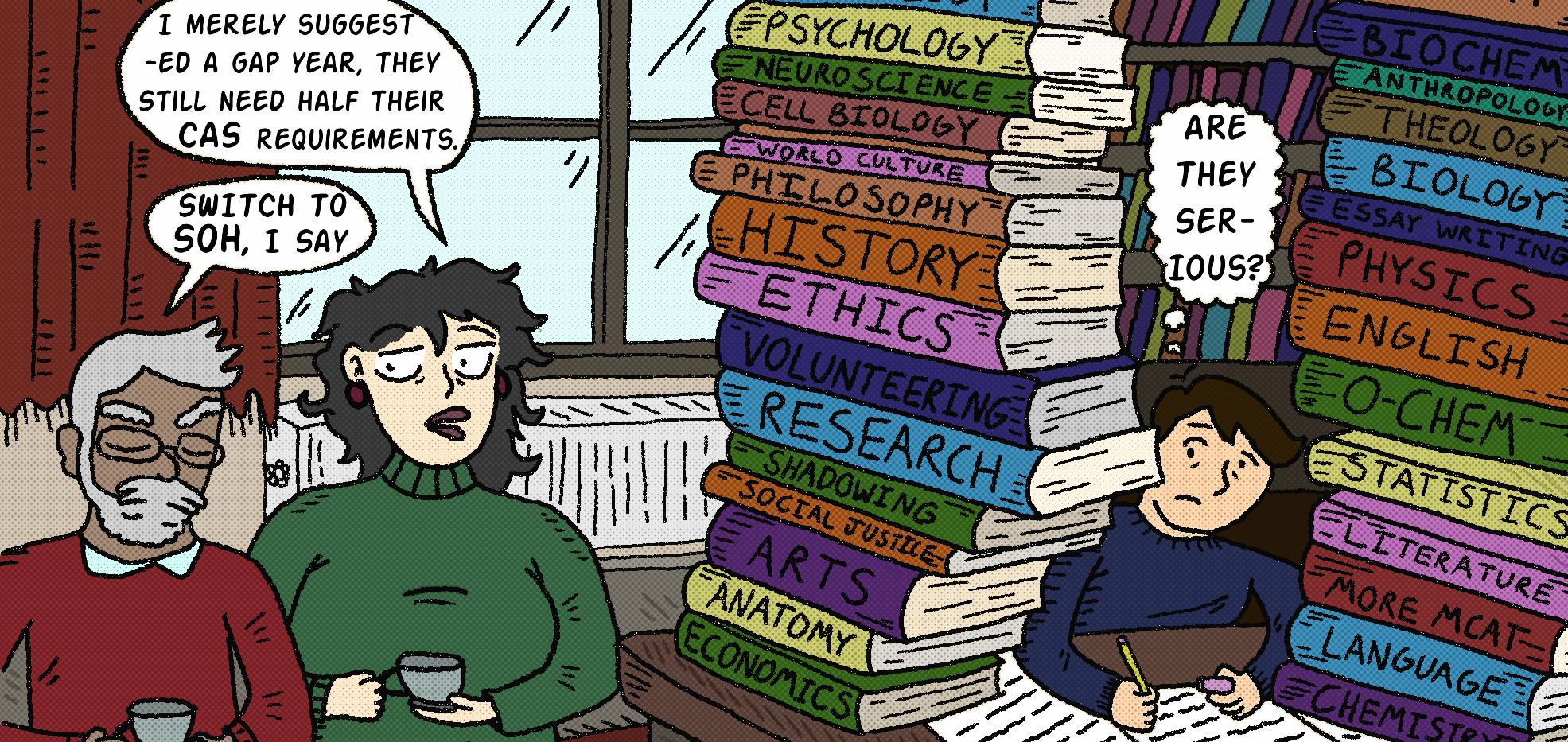
Maya Burton (CAS ’29) planned to take “General Chemistry II” and “Foundations of Biology II,” which are required for frst-year pre-medical students, in Spring 2026. Burton was pre-registered for chemistry, but the only available biology section conficted with its recitation.
Burton, who sought help from administrators, said institutional support was unhelpful and discouraging.
“When I went to talk with my dean about the issue, it was kind of brushed aside,” Burton told The Hoya
“The idea of ‘oh, you can just do a slower track, you could just take a gap year,’ was brought up a couple times,” Burton added. “I think that students shouldn’t be forced into that in any way. I think that everyone’s paths should be equally respected, and their goals should be met.”
Ronan Tufy (CAS ’26), a neurobiology major now applying to medical school, similarly said pre-health advising in the College of Arts & Sciences (CAS) often felt inefective.
“The pre-health advisers here — I honestly feel that if you come to them with some questions, they don’t really give you a solid direction,” Tufy told The Hoya. “It’s more along the lines of, ‘You could do this, you could do that. There are some resources that we have that are online that you can use. Go to ofice hours,’ just the usual generic BS.”
In contrast, students in Georgetown’s School of Health (SOH) said the school ofers a more specialized curriculum and meaningful advising resources.
Dhruvi Parikh (SOH ’27, MED ’31), a health care management and policy major, said SOH advisers are more reachable.
“I have always felt, at least particularly within the School of Health, that my deans are very accessible to me,” Parikh told The Hoya. “The resources that we have are so much more centralized, and we just have fewer people. It’s easier to coordinate and have closer relationships.” A university spokesperson said Georgetown is dedicated to providing robust support for all pre-med students.
“Pre-Health Studies supports and advises students and alumni from all schools at Georgetown,” the spokesperson wrote to The Hoya. “Each school also has advising deans who advise students on a pre-health track.”
While all students have access to university-wide pre-health advising, support structures within individual schools vary.
Many of Georgetown’s pre-med students are housed in the College, which lacks the dedicated pre-med funding and mentorship provided to SOH students.
Dr. Daniel Isaac, the only professor in the biology department with a medical degree, said there are also major pedagogical diferences between CAS and SOH.
“There’s a School of Health for students who feel strongly motivated by the notion of taking coursework that is much more explicitly associated with choosing careers in the health professions,” Isaac told The Hoya. “They can make that choice.”
“If they make the choice to come to us, they’re making a broader choice,” Isaac added. “They’re making a choice where the curriculum is much more directed at thinking about them as future scientists and as future science communicators.”
Down to a Science
Like other undergraduate programs, Georgetown requires premed students to take a series of foundational science and math courses to prepare for medical school. With 12 required courses and eight required laboratories, students said it is dificult to complete the mandatory curriculum in four years.
Sofa Madden (CAS ’28), an environmental biology major and art minor, said she regularly struggles to coordinate required science, technology, engineering and math (STEM) major requirements with her humanities minor.
“Registration has always been a major issue for me,” Madden told The Hoya. “STEM on its own is hard enough to schedule, because there’s just a really large quantity of core classes that you have to take that are all really time-intensive and are worth a lot of credits.”
Madden said that the rigid curriculum jeopardized her ability to study abroad.
“If I don’t take these classes now, I won’t be able to fnish everything in order to graduate,” Madden said. “I’ve always wanted to study abroad, since I was really little, and for a while, I didn’t think I was going to be able to.”
Sofa Ganal (MSB ’28), a management student on the premed track, said she was only able to ft the pre-med curriculum into her four-year plan because she matriculated with Advanced Placement (AP) credits.
“I can defnitely get it all done with my schedule because I came in with a lot of AP credits,” Ganal told The Hoya. “But if I didn’t, I don’t know how a student would be able to do all of it and graduate on time.”
Madden said greater administrative support as a frst-year would have streamlined her academic experience.
“There were a lot of things that I didn’t know then about my fouryear plan and how much I would have to plan out — exactly which classes I’m going to take,” Madden said. “Looking back, I wish I had taken diferent classes my frst semester freshman year, because it would have made the entire rest of my college experience easier.”
Within science classes, students said they face additional
challenges registering for all required sections.
For Spring 2026, the biology department did not staf enough lab sections for all students enrolled in the biochemistry lecture, originally ofering only 48 lab seats for 120 lecture seats. The department told students the lab was only mandatory for biology majors.
While optional for most medical schools, Georgetown’s Pre-Health Advising Ofice acknowledged that some schools still require lab experience in biochemistry and encouraged students to review individual medical schools’ requirements.
Jordan Pai (SOH ’27), a global health major, said there is growing interest in the biochemistry lab.
“They decreased the number of labs just because there wasn’t that much demand for it, as med schools weren’t requiring it anymore, but people want to take the labs as a way to increase their GPA,” Pai told The Hoya
Isaac said the course’s availability is impacted by limited faculty and high student demand.
“We don’t want to be in a situation where we can’t ofer all the courses that our students need to take,” Isaac said. “Of course, this is part of a much larger problem involving how many faculty and staf we have.”
In April, Georgetown announced a temporary hiring freeze for university faculty and staf to reduce expenses amid federal funding cuts. The hiring freeze left university employees unsure of what courses they could run.
Ronda Rolfes, the biology department chair, said the program has worked with the registrar to add two additional biochemistry lab sections, but questions about scheduling and capacity remain.
“We’ve already tried to respond in real time,” Rolfes told The Hoya “Beyond that, we have to see what the interest and the demand is and if we can then meet that.”
Still, Isaac said the university has a responsibility to meet students’ academic needs, regardless of extenuating stafing circumstances.
“This is something that we’ve been fghting for years, in terms of getting clearance from onhigh to hire the people we need,” Isaac said. “When you have a popular major, there has to be some cognizance on the institution’s part to make the necessary adjustments. You can’t admit these students and then not be able to serve them.”
Ofice Hours
In addition to the required curriculum, pre-med students across all schools are assigned advisers from the Pre-Health Advising Offce, which provides application guidance and research resources. Some schools — the College, SOH and the McDonough School of Business (MSB) — also have designated advising deans to help students navigate the pre-health admissions process.
The SOH ofers additional layers of support, which include personal student-faculty pairings.
Jan LaRocque, an SOH professor, said small-group mentorship provides students faculty support in academic and post-grad decisions.
“Depending on the size of the class, I’ll have anywhere between fve to seven students per year.”
LaRocque told The Hoya. “If they have questions about pre-med, if they have questions about how to get into research, if they have questions about how to navigate university, studying and academics, we’re that point person for them.”
Pablo Irusta, the human science department chair in SOH, said the department’s external fnancial support — like the Dekker Family Endowed Human Science Research Fund, a gift that sponsors student human science research — has allowed it to expand student opportunities outside the classroom.
“These gift dollars that we can use to supplement research fellowships or increase the number of our students that can actually spend their summers on campus working with one of our faculty members,” Irusta told The Hoya
While the SOH has many students on the pre-med track, according to Isaac, the majority of Georgetown students who apply to medical school are housed under CAS and afiliated with the biology department.
“Upwards of 65 to 70% of all students who applied to medical school from Georgetown in a given cycle are biology or biology adjacent,” Isaac said.
In the College, students have access to university-wide opportunities, such as the Global Health Student Fellows program, which facilitates student-faculty research collaboration, and the Medical Humanities Research Fellows, a fellowship that supports humanistic and health science inquiry.
The school’s lack of mentorship, however, means that its pre-med students often have to seek out these opportunities independently.
Tufy said he was surprised by the lack of support for pre-med students.
“I wish I would have known how much I would have had to do on my own here,” Tufy said. “I thought that I would have been guided a lot more as a pre-med by the university, as opposed to having to try to fgure it out.”
Madden said she had to proactively seek out her advising dean to get into required classes.
“The only reason I am able to be in the class that I’m in right now, that I have to take, is because I went to my dean in person,” Madden said. “Because she’s a bio dean, she was able to help me out with it. If it weren’t for that, I wouldn’t have gotten into most of the classes that I’m in right now.”
CAS students also said their large, lecture-style classes make it dificult to get to know their professors and build lasting connections.
students in the College of Arts & Sciences regularly face challenges with class registration, career advising and access to faculty, leading them to independently seek out informal guidance and resources.
Dr. Madison Betcher (COL ’18), who studied biology of global health at Georgetown and attended medical school at Columbia University, said she had to proactively make connections with her professors to get needed support as an undergraduate.
“Later in your training and in your education you have more intimate interactions with faculty where you have small groups or where you have 10-person classes,” Betcher told The Hoya. “That’s not common in your freshman and sophomore year, so you really have to show up to ofice hours and really make a name for yourself.” Conversely, LaRocque said SOH draws on the many medical doctors in its faculty to support students navigating medical school applications.
“When it comes to advising and mentoring, those faculty will share with us some of the criteria that they’re looking for and the things that are important for that letter, which can help us when we’re writing our letters and supporting our students,” LaRocque said.
The Doctor Is In
Many Georgetown pre-med students apply to the university’s Early Assurance Program (EAP), which accepts undergraduates into the Georgetown University School of Medicine (GUSOM) in the spring of their sophomore year.
Cumulatively, 75 to 88% of Georgetown undergraduate and post-baccalaureate students are accepted to medical school, a rate signifcantly higher than the national average, which stands at about 45%.
SOH students said they receive more personalized support in their medical school applications.
Tharun Potluri (SOH ’25, MED ’29) said support from his SOH advising dean was integral to his EAP application.
“I defnitely utilized my major advisers a lot,” Potluri told The Hoya. “We were assigned human science advisers in the beginning of the year, and I stayed in touch with that professor throughout all four years. He actually ended up writing one of my letters of rec for the Early Assurance Program, which is how I got into med school here.”
“The School of Health is unique in that it is so small, so I felt like there were a lot more resources that were available to me compared to other pre-med people in the College,” Potluri added.
Parikh said she also received valuable mentorship opportunities from older students and graduates.
“It’s really robust, the way that you always have access to peer advisers, students that are all around your age, that have been through what you’ve been through, and have advice on what classes to take, what classes not to take, if they have any study resources for core class that you have to
all take for your major,” Parikh said. “There’s just a lot of student support, because the classes are so central and everyone’s in this small space together.”
Several CAS students said a lack of individualized support made them feel less prepared for graduate school applications.
Elena Iliadis (CAS ’23, MED ’27) said hands-on support to guide GUSOM applicants would have been helpful during the EAP process.
“Sometimes it was hard to get in touch with my mentor, and I could defnitely tell that this was added on top of his normal workload — he is a professor at the university,” Iliadis told The Hoya. “I did wish at the time that there was someone checking in with me, that there was something mandatory where I need to meet with someone every week, or I had some support or internal deadlines.”
“Having more structure in terms of a timeline, laying it out in very basic terms from the very beginning, and also equipping students with how to be a competitive applicant from the beginning, without overwhelming them with everything they could do, creating grade-appropriate, stage-appropriate guidelines would defnitely go a long way,” Iliadis added.
Alexandria Patti (COL ’18), who studied Spanish language and literature at Georgetown and is now in medical school at New York Medical College, said she received little personalized career mentorship.
“I don’t remember meeting with anyone ever about my path, and if I had, I honestly don’t know if they would have encouraged me to apply to medical school,” Patti told The Hoya “I did a lot of it on my own.” Patti said she had to self-navigate much of the pre-med experience, especially when it came to the medical school application process.
“I didn’t really know how to study for the MCAT, how to take the MCAT, how to sign up for the MCAT, that kind of thing,” Patti said. “I didn’t know that when you applied, you had to write all these essays to submit with your application. No one helped me with my personal statement.” Betcher said CAS students have many paths to medical school despite curricular challenges and mentorship struggles.
“There’s no one way to do it,” Betcher said. “My year, people matched in the med school who were Spanish majors, who were religion majors, who were bio majors, so you just had to fgure out what you wanted and what you cared about and then make everything else work for that.” Betcher said without a clear premed track in the College, students learn to seek out their own support.
“You had to be a strong advocate for yourself — there was no set path,” Betcher added.
Georgetown-Lancet Commission Emphasizes How Interaction Between Faith, Health Creates Trust
Madeline Williams Science Writer
The Georgetown-Lancet Commission on Faith, Trust and Health hosted the inaugural session of their new webinar series Nov. 21 to foster multidisciplinary dialogue between faith and health actors across the world.
Deus Bazira, director of the Georgetown University Global Health Institute and co-chair of the commission, said the commission was created in response to declining public trust in health institutions.
“The Georgetown Lancet Commission was born in the aftermath of multiple global events that revealed profound fractures in trust,” Bazira said at the event. “Even the most efective scientific tools cannot protect populations if the people they serve do not trust the institutions or the actors delivering them.”
The webinar was moderated by Dr. Richard Horton, editor-in-chief of medical journal The Lancet, with panelists Dr. Alaa Murabit, physician and founder of Voice of Libyan Women, and Sister Carol Keehan, former president and CEO of the Catholic Health Association of the United States.
The commission, launched in 2024, has three main aims: to revolutionize research on faith, trust and health; to develop policies and tools to build trust in health; and to build collaborative partnerships between diverse faith and health fgures worldwide.
Bazira said the commission seeks to explore the interaction of the two felds, with one focus being the role of spiritual practices, a core component of holistic well-being, in patient-provider relationships.
“The question before us today is not whether faith and science need each other,” Bazira said. “The question is how they can work together in sustained, accountable and mutually respectful ways.” Murabit said the commission is uniquely important after the COVID-19 pandemic.
“We’re seeing a resurgence, actually, of faith practice,” Murabit said at the event. “In this particular moment, November 2025, it’s an intersecting reality of post-COVID innovation, loneliness and people really looking for a sense of anchoring. If health actors want to be successful and efective, we have to recognize the power of faith and community.”
Keehan, who has a background in nursing and healthcare management, said her time as the chair for Pope Francis’ COVID-19 task force exposed her to the tensions between and opportunities for faith and scientifc communities.
“The faith community had special issues get a hold of them, like abortion, and it came right into the issue of vaccines. How are they made? How are they researched? Are they manufactured using aborted fetuses? You had their special worries,” Keehan said at the event. “Then you had our science community, who were under enormous pressure with this new disease to be able to say what causes it, how do you cure it, how do you prevent it?”
Keehan said it is important to reconcile faith and science in circumstances where beliefs may confict with health practices.
“Sometimes they have beliefs that may confict, or that may not be the same priority,” Keehan said. “So there is no way to get the best of science and the best of faith, which is essential for the best of care and for human fourishing, without confronting that and confronting it with a com-
mitment to resolving it as much as is humanly possible.”
Murabit said that it is important for the commission to bridge the intergenerational divide and provide a platform that younger generations can trust.
“I would actually show up where young people are,” Murabit said. “People are trying to fnd something to trust. People tend to go online to validate a belief they now have, not necessarily to create that belief.
“What they are getting ofline that gives them a sense of community and a sense of agency, I think will be more important than ever,” she added.
Murabit said the ability to shift the global narrative is one of the things she is most excited about in working with the commission.
“For so long, faith actors have been described as barriers to vaccination, to women’s health, to modernity, quite frankly,” Murabit said. “There’s an opportunity for this commission to show how faith partnerships can expand and not necessarily shrink equitable access to health.”
Diana Rayes, program director of the Faith and Global Health Initiative at Georgetown’s Glob-
Social Media Detox Improves Mental Health, Study Finds
Angela Lekan Senior Science Editor
A Jama Network Open study published Nov. 24 found that reducing social media usage was associated with better mental health outcomes in young adults.
The study monitored the social media use of 373 young adults between the ages of 18 and 24 for two weeks to obtain baseline usage for each participant, followed by a oneweek detox period. Participants completed mental health evaluations throughout the examination period to quantify improvement in mental health following the break from social media.
Over 4.9 billion people in the world reported using social media in 2023, with the average person spending approximately 145 minutes per day on popular platforms, including Instagram, Facebook and TikTok. As of 2025, 210 million people around the globe are estimated to be addicted to social media, which can contribute to poorer mental health outcomes, including an elevated risk of depression, negative well-being and loneliness, as well as a fear of missing out (FOMO) on social interactions or events.
Miranda Austin (CAS ’28) said she voluntarily deleted social media after noticing impacts on her productivity and focus.
“I have Instagram deleted right now,” Austin told The Hoya “It helps me focus, not having it on my phone.”
Alexa Garber (CAS ’28), a student studying neurobiology, said she noticed the negative efects of social media among fellow Georgetown University students, often leading to a lack of motivation.
“I’ve defnitely felt and seen the efects of social media addiction
in college,” Garber told The Hoya “I’ve noticed myself and my peers experiencing a general lack of motivation for academics and extracurriculars when we’re so focused on what’s happening online.”
Researchers provided an objective measurement of social media usage by requiring participants to report screen time metrics available on most smartphones. This methodology is a change from many previous studies examining social media that rely on self-reported data from participants, which often proves to be inaccurate.
Erin Song (CAS ’28), a student studying biology of global health, said she and some friends started a challenge to monitor the screentime on their phones.
“My friends and I had the idea last November to start a screen time challenge, where we compete to see who can get the lowest phone screen time,” Song wrote to The Hoya. “We did it in hopes of curbing scrolling addiction and phono FOMO.”
The November study found that participants experienced a 16% reduction in anxiety, a 24% reduction in depressive symptoms and a 14.5% reduction in insomnia symptoms, while no decrease was observed in feelings of loneliness. Song said she noticed benefts after deleting the Instagram app from her phone.
“Also, because of this challenge, I deleted Instagram and really only redownload it on my phone in the summer,” Song wrote. “Occasionally I’ll scroll on Instagram web, but I think having the app of my phone has been really good for my mental health and good for reducing my scrolling time.”

WIKIMEDIA COMMONS
A Nov. 24 study found that reducing social media usage was associated with better mental health outcomes in young adults.
Dr. John Torous, a co-author of the study, said reducing social media should not be the main form of care for improving mental health, but that it can certainly help in combination with other interventions.
“If you’re struggling with a mental health condition, and you have treatment already, it’s likely worth experimenting to see whether reducing social media helps you feel better,” Torous said in an interview with The New York Times.
Song said she thinks taking a break from social media can be helpful for Georgetown students
and help young adults maintain a balance between phone usage and other parts of life.
“I defnitely think the study can apply to all young people who rely on their phones every day, including students at Georgetown,” Song wrote. “Since phones are such an important tool nowadays, it can sometimes be hard to have a good balance of necessary phone activities and an unnecessary amount of screen time that disconnects you with the environment or other parts of your life, so it might be good to take breaks from social media.”
GU Scientists Find Possible Relief for Gulf War Illness
al Health Institute, noted the commission is set to produce a report in 2027 on how faith, trust and health interact.
“The commissioners are fully engaged in the research design and implementation phase of the research. We’re putting together case studies and conducting global consultations to inform the report, which will be featured in The Lancet,” Rayes said at the event.
Murabit said that the commission can have a tangible
impact through eforts like coordinating faith-based funding for health initiatives.
“The other thing that I’m really excited about is the opportunity that this somehow infuences global fnancing,” Murabit said. “There’s a huge volume of fnancing that faith communities actually have access to, and the needs and mission of the faith and health communities are the same: to ensure that all people have lives of dignity and opportunity.”

THE POLICY PROGNOSIS
New In ation Reduction Act Could Prompt Price Debates for Medication
Shiva Ranganathan Science Columnist
Competing policy eforts to lower drug prices could muddy the waters of drug pricing and leave patients unable to aford their prescription medications.
After decades of U.S. citizens paying over double the price for prescription medications compared to other countries part of the Organisation for Economic Co-operation and Development (OECD), the Infation Reduction Act (IRA) was introduced and codifed in 2022, allowing the government to negotiate lower drug prices with pharmaceutical companies.
The IRA is intended to protect Medicare patients, who include people over the age of 65 as well as those with disabilities and other conditions. Under the IRA’s rebate program, drug companies must pay a fee if they raise the medication prices faster than the rate of infation.
Sarina
Hattiangadi Science Writer
Georgetown University and American University scientists linked a low-glutamate diet to migraine relief and brain changes in veterans with Gulf War illness (GWI), a chronic illness caused by exposure to neurotoxic chemicals during war and associated with musculoskeletal, gastrointestinal and neurological symptoms.
The study, whose fndings were presented Nov. 16, 2025, at the annual meeting for the Society of Neuroscience in San Diego, involved 25 participants with GWI who followed a low-glutamate diet for over a month. GWI is estimated to affect 175,000 to 250,000 veterans out of the 700,000 who served in the Persian Gulf War.
Ashley VanMeter, a professor of neurology at Georgetown’s School of Medicine and the senior author on the paper, said Gulf War illness is hard to diagnose and treat.
“GWI is a very dificult set of symptoms to treat because it is quite variable in how it presents in any one veteran,” VanMeter wrote to The Hoya. “Also, the exact etiology (i.e., cause) is not known and the
specifc set of toxins a given veteran was exposed to is unknown.”
Veterans with GWI underwent a low-glutamate diet for the study in an attempt to target migraines and other symptoms.
Glutamate is a neurotransmitter that plays a role in mediating pain and is found in food additives and some animal products, such as meat, fsh and dairy.
The researchers hypothesized that high glutamate intake triggers events in the brain that contribute to migraines due to a leaking blood-brain barrier — in other words, a weakened brain flter — caused by glutamate activating specifc brain receptors.
VanMeter said that while the illness’s complexity likely means this intervention will not work for all patients, it is an exciting discovery that may pave the way for more therapeutic options in the future.
“Given the heterogeneity of migraine and how it presents, I do not expect it will ‘cure’ all migraineurs,” VanMeter wrote. “But we are excited to explore this and will be starting a pilot study in non-GWI migraineurs in the new year.”
Brain scans revealed GWI patients had a thicker right visual
cortex, a brain area associated with migraines. However, after implementing low-glutamate diets for one month, participants experienced major improvement of migraine symptoms and decreased cortical thickness. Migraine and headache rates dropped from 50% to 20%, with a reduction in widespread pain, fatigue, mood issues and cognitive dysfunction.
Dr. James Baraniuk, a Georgetown School of Medicine professor and another author on the project, said he is enthusiastic about the study’s implications.
“We have made great progress in showing real, legitimate long-term injury in veterans,”
Baraniuk wrote to The Hoya “This is the first treatment to show a significant benefit.”
The research was funded by the U.S. Department of Defense and completed in collaboration with Dr. Kathleen Holton, a nutritional neuroscientist at American University who developed the use of a low-glutamate diet to measure neurological conditions.
Baraniuk spoke to the societal implications about the illness, saying the Department of Defense did not acknowledge it as a
real disorder until October 2025 by the Centers for Disease Control and Prevention (CDC).
“One problem is that the Department of Defense did not consider Gulf War illness to be real. It was ‘all in their heads,’” Baraniuk wrote. “It was only on Oct. 1, 2025, that a group of doctors fnally got the CDC to approve a diagnosis code. As a result, doctors can now give Gulf War illness patients a real diagnosis.”
Baraniuk said that the researchers are working to determine if a low-glutamate diet can be an efective treatment for all migraine-sufering patients and those with similar symptoms.
“It makes sense to use the low glutamate diet for migraine, irritable bowel and other components that are found to respond in these trials,” Baraniuk wrote.
“The GWI results will help us pick the other disease processes and diseases that may respond.”
Baraniuk said these results refect signifcant progress in GWI research.
“We have made great progress in showing real, legitimate long-term injury in GWI veterans,” Baraniuk wrote. “This is the frst treatment to show a signifcant beneft.”
Drug companies are essentially forced to abide by the IRA’s price negotiations due to the swath of 70.1 million Medicaid recipients who populate the market. By not participating in the IRA, pharmaceutical producers forgo tax credits, subsidies and possible funding, missing out on vital profts that can be gained by remaining in the industry.
340B, which takes its name from Section 340B of the Public Health Service Act (PHSA), is a separate prescription drug pricing program that sets a discounted price ceiling on medications purchased by safety-net hospitals, providers committed to providing care regardless of the patient’s ability to pay. The goal is for those health systems to use the unspent funds altruistically and deliver care to vulnerable communities.
While the IRA primarily assists Medicare benefciaries with high drug costs, 340B functionally targets Medicaid and its benefciaries, who comprise a separately insured group including patients in low-income brackets, pregnant women, disabled people or those in a certain age range, though eligibility rules vary based on the state. In practice, hospitals under the 340B program have drawn scrutiny for a lack of transparency in how they utilize those savings. Hospitals’ use of partnered con-
tract pharmacies to stock and deliver more discounted drugs has resulted in duplicate discounting, where 340B rebates are given to hospitals on top of Medicaid’s independent discount program for the pharmacies. Financial oversight is fimsy, with a 2023 study fnding that while some 340B covered entities extended their reach to underserved populations, many displayed rent-seeking behaviors, migrating their care to wealthy areas and making acquisitions of private practices to boost profts. 340B and the IRA have conficting provisions that make predicting drug prices dificult, as medications overlapping in both programs will have maximum fair prices set by the IRA. The reimbursed money to 340B entities can then be reduced, lowering the savings they might otherwise have used on outreach. Reduced savings often accelerate vertical integration in 340B hospitals, where they agglomerate smaller frms and add layers of complexity in prescription purchasing. Middlemen in vertically-branched health systems upcharge for a drug at every level, with little oversight preventing them from pulling unexpected profts. If hospitals decide to avoid IRA-negotiated drugs altogether rather than pulling them into these complex, vertically-integrated supply chains, the populations they serve will lose access to critical drugs at prices that should have been more acceptable, having an opposite efect from what the law intended. Pharmaceutical companies have prompted the scrutiny of 340B hospitals through ad-funded smear campaigns. While some reports of fnancial abuse of savings are valid, there is skepticism regarding the extent that safety net hospitals are responsible for fnancial waste in the health sector. Oversight of 340B-qualifed entities should be amplifed following the IRA’s full implementation, but pharmaceutical companies should be investigated equally, as their stake conficts with the interests of protected hospitals. Ultimately, patients are the ones the system should serve. With uncertainty in the future, contingency steps should be taken to protect those enrolled in 340B health systems before sweeping changes are fully implemented.
WIKIMEDIA COMMONS
NEWS

GU Students Denounce New Education Department Cuts in Press Conference
Herweck and Noah
Ethan
Haan
Georgetown University students
led a press conference Dec. 2 to condemn recent changes to the U.S. Department of Education (DOE) that they view as detrimental to education. Student leaders and members of Congress criticized recent efforts from Secretary of Education Linda McMahon and President Donald Trump to dismantle the DOE. These actions include shifting aid programs to other government agencies and downsizing DOE staff, alongside a recent move to reclassify many advanced degrees.
Anna Gale (SFS ’28), the Georgetown University Student Association external affairs director, said she organized the press conference alongside Emily Han (CAS ’25), the previous external affairs director, to bring broader attention to the DOE cuts’ impacts.
“The particular cuts that happened were very pressing issues, and we fgured that they needed their own attention that I wasn’t going to be able to provide via lobbying and that Emily wasn’t going to be able to provide through her other contacts,” Gale told The Hoya. “So we fgured we’d get a whole bunch of people together and speak on it.”
“This aligns with our eforts because it directly impacts Georgetown students,” Gale added.
As part of the recent cuts to DOE, McMahon announced that many grant, aid and assistance programs will transfer to other government agencies, including the Department of Labor. Among the transferred programs are grants for parents attending college; TRIO, a set of programs that encourages low-income students to attend college; and Title I, which funds schools in low-income communities.
Sen. Ed Markey (D-Mass.), who spoke during the press conference, said schools and students
will sufer as a result of Trump’s changes due to the stafing cuts.
“Last week, Donald Trump and Linda McMahon announced the next phase of their plan to destroy the Department of Education and sell it of for parts,” Markey said at the press conference. “Their dismantling of the department will have immediate negative consequences for students, for families and for local schools nationwide. When a parent or superintendent needs support or technical assistance, there will be no one to pick up the phone.”
One of the changes to advanced degrees is the removal of nursing degrees from the “professional” category, which decreases the amount of federal student loans available to nursing students.
A university spokesperson said the university is concerned about the changes to loan programs, including GradPLUS, a federally managed student aid service for graduate students that will stop accepting new applicants July 1, 2026, and will work to provide alternatives.
“Georgetown is concerned about the impact of changes around graduate student loan limits and the elimination of future Graduate PLUS loans,” the spokesperson wrote to The Hoya. “Georgetown closely monitors changes to federal fnancial aid programs and is actively working to develop alternative options for admitted graduate students to access fnancial aid.”
In November, university officials announced that Georgetown is seeing a decline in graduate school revenue and applications, citing changing federal immigration policy and cuts to higher education funding. The university also announced a $35 million cut to federal research grants.
Rep. Lauren Underwood (D-Ill.), a registered nurse (RN) who spoke at the press conference, said she views the reclassifcation of nurs-
ing degrees as a restrictive burden on nursing education.
“I’m one of just a few registered nurses in Congress, and one of the most dangerous examples of the destruction is the Trump administration’s decision to restrict student loans for nursing and other professional degrees in health care,” Underwood said at the conference. “This decision limits nursing students’ access to graduate student loans making it more difficult and way more expensive for nursing students to pursue higher education.”
Georgetown professor Rebecca Tarsa — who participates in the Public Servant Loan Forgiveness program (PSLF), a program forgiving student loans for government and non-proft employees that will move from DOE to the Department of Labor — said she expects cuts to PSLF and similar programs to discourage students interested in public service from seeking advanced degrees.
“People are able to do those jobs more efectively if they have better education and if there isn’t a path to get those degrees with some degree of payof from this program,” Tarsa told The Hoya. “I think that will deter people, especially people who don’t come from higher income households, from being able to serve the country.”
Underwood said Trump and McMahon are hurting Americans through their cuts to the DOE.
“This administration’s attacks on our Department of Education are part of a much larger assault on the very foundations of our constitutional rights and our democracy,” Underwood said. “These attacks are not making us any more free, they’re not making us safer or more healthy, and they’re certainly not making life more afordable.
“By tearing down the Department of Education, this administration has made an explicit choice to abandon students and families,” Underwood added.
WHAT’S NEW IN MULTIMEDIA?

The Hoya Setlist: Kicking Cans Interview
Check out the second episode of “The Hoya Setlist” where The Hoya
and interviews
and bands
from

Student organizations will no longer have to pay the Georgetown University Police Department (GUPD) for security at large events under a new Spring 2026 pilot program, the Georgetown student government will announce Dec. 5.
The university currently requires GUPD presence for events in large venues, such as Gaston Hall, events featuring provocative speakers or subjects or events that involve alcohol, amplifed sound or cash intake, according to the department webpage. Student organizations must pay an hourly rate — $68.25 per GUPD oficer — at events they organize, with a general requirement of one oficer per 75 participants.
Under the pilot program, student organizations that have access to university benefits will not be required to pay the hourly wage, though they still must submit GUPD security requests.
The Georgetown University Student Association (GUSA), Georgetown’s student government, will announce the change in its biweekly newsletter, saying the program is a collaboration between GUSA and GUPD.
“The Georgetown University Police Department (GUPD) and GUSA are excited to announce a pilot program waiving event security fees for student organizations with access to benefits during the Spring 2026 semester,” GUSA wrote in the newsletter.
Ignacio Loaiza Sandoval (CAS ʼ28), GUSA’s director of labor and fnancial accessibility, said he hopes the pilot program will pave the way for a permanent program.
“I’m hoping we see student groups take advantage of this next semester and show what they’re able to do when this barrier is removed,” Loaiza Sandoval told The Hoya. “Obviously, we have no indication of how permanent this change will be, but I’m hoping this is a precedent that we could set and keep moving forward.”
Student leaders have repeatedly criticized the security fee, citing burdens to clubs, which have to pay for security through their university-allocated budget or outside fundraising. In September, the GUSA Senate passed a bill asking GUPD to meet with senators and publicly clarify its guidelines on what events require police presence.
Fiona Naughton (SFS ʼ27), a member of the student labor group Georgetown Coalition for Workers’ Rights (GCWR), said GCWR spent a signifcant amount of their budget on GUPD oficers at a workers solidarity concert this semester.
“We had a solidarity concert in September, and we had to submit a police request form and set aside a significant portion of our budget — almost a quarter of our budget — to pay for the police there, and they didn’t do anything,” Naughton told The Hoya. “They literally just sat in their car. And it just felt like such a futile thing to have to do because it required so much advance notice.”
Roan Bedoian (CAS ʼ28), the speakers director for Georgetown University College Democrats and GUSA’s vice chair of the Policy and Advocacy Committee (PAC), said waiving security fees will strengthen student life across campus.
“I think it’s just better for club life, for students to be able to put the money that is in our student activity fee towards the actual
activities themselves,” Bedoian told The Hoya. “So my hope is that it’s a successful pilot program and that university makes it permanent, expands it in any ways that may be necessary and that it’s something that improves the quality of student life on campus across the board.”
Naughton said requiring GUPD officers at student events helps normalize police supervision on campus. “I think it’s worth every student kind of considering what Georgetown gets out of stationing police at regular student activities,” Naughton said. “When there are police outside of comedy events or at student events, it normalizes police presence at completely peaceful protests, and it creates a kind of normalization of police stations outside of just normal activities of student life.”
Loaiza Sandoval said the administration will evaluate the budgetary impact of the program before deciding on a permanent approach.
“So from our angle, I think the reason why this is a pilot is because they obviously want to see what the fscal impact will be and how it will balance out within their budget,” Loaiza Sandoval said. “So I’m really hoping that we can show them that all the bureaucracy before was very silly, and that money was moving around in a very roundabout way, and that we get to keep this and institutionalize this.”
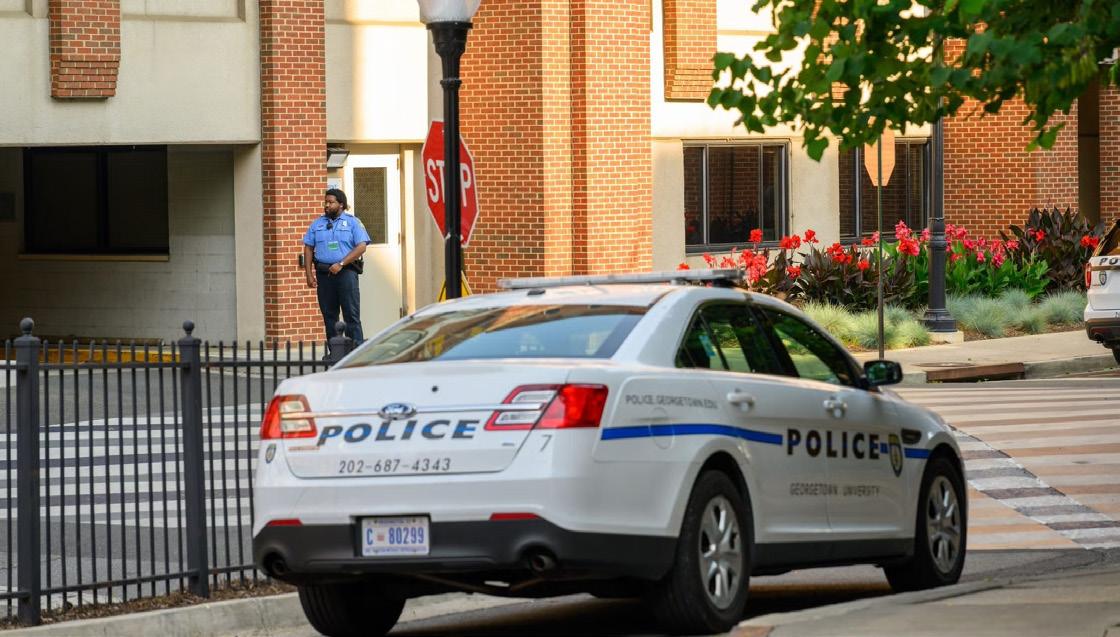
Sen. Chris Van Hollen (DMd.) (LAW ’90) detailed his fght against the administration of President Donald Trump at a Georgetown University College Democrats (GUCD) event Dec 2. Van Hollen, who was named GUCD’s “Alum of the Year,” recounted his visit to El Salvador in April following the wrongful deportation of Kilmar Ábrego García, a Salvadoran national who was living in the United States with withholding of removal status, which prevents an immigrant from being deported based on threats in their home country. Van Hollen also highlighted his strategy for Democrats in the 2026 midterm elections and confrmed his involvement in a Senate “Fight Club,” the colloquial name for a group of Democrats opposed to Senate Minority Leader Chuck Schumer’s (D-N.Y.) political strategy.
Van Hollen said he visited El Salvador after sending a letter to Salvadoran Ambassador to the United States Milena Mayorga and being denied a meeting with Salvadoran President Nayib Bukele while he was visiting the United States.
“I wrote to the ambassador from El Salvador to the United
States, saying while President Bukele is here I would like to meet with him to discuss getting Kilmar Ábrego García released from this notorious prison and brought back to the U.S.,” Van Hollen said at the event. “Well, they blew me of. I had put in that letter that if I didn’t get a chance to meet with them, I would go to El Salvador — so I got on a plane.”
Van Hollen said although Salvadoran officials initially denied him a meeting with Ábrego García, they were allowed to meet following a press conference held by Van Hollen.
“I was pulled over by the soldiers in El Salvador who had been specifically assigned to not let me go meet him, and so I came back to San Salvador, the capital, did a press conference there and made the point that El Salvador was in gross violation of international law,” Van Hollen said. “Nobody had had a chance to talk to him, and I wasn’t sure if I’d have a chance either. But then we got a call, and the publicity was really bad, so they would allow me to meet with him.”
Van Hollen said the Trump administration has repeatedly violated the rule of law, free speech and due process, pointing to the detention of Georgetown postdoctoral fellow Badar Khan Suri as an example. “They brought in Elon Musk, the richest person in the world,
to start dismantling parts of the U.S. government, illegally impounding funds,” Van Hollen said. “You saw a crackdown on free speech, where they had sent masked agents on the college campuses to arrest and detain people based on what they said.
“At Georgetown, you had one of your post-docs, I think his name was Suri, who was detained,” he added. “He’s still involved in legal proceedings, but you saw that crackdown around the country, including a crackdown on due process.”
Van Hollen, speaking on his experience at the Gaza border, said although he supports Israel’s right to self-defense, Democrats should be vocal about Israel’s attacks on Palestinians living in Gaza, citing a broad humanitarian crisis across the region.
“I fully support the right of Israel to respond to Hamas after the heinous Oct. 7 attacks,” Van Hollen said. “They have the right to self defense — in fact, a duty. But what was clear from early on was that the Netanyahu government was not just targeting Hamas. They were imposing collective punishment on all the people of Gaza, and it started early on in terms of many indiscriminate bombings, and then the way humanitarian aid has been restricted over a period of time.”
Van Hollen said the “Fight Club,” which pressures Schumer to support populist candidates, criticizes the strategy of the Democratic Senatorial Campaign Committee (DSCC), a fundraising committee dedicated to electing Senate Democrats, for being indiferent toward Trump.
“In this case right now, the DSCC has gotten involved to one degree or another in some of these Senate races, in the primaries,” Van Hollen said. “A group of us were pushing back against that. We will continue to voice our views when it comes to the DSCC weighing in on those races.”
Van Hollen said that although Democrat successes in 2025 elections, like winning the Virginia and New Jersey gubernatorial elections, present a favorable outlook for the 2026 midterms, Democrats need to focus on enacting change.
“I do think that what happened a few weeks ago is a good sign for the midterms, but as we go into 2028, Democrats need to make it clear what we stand for,” Van Hollen said. “One of the great great concerns is the last presidential election. How is it that the American people chose Donald Trump? They saw him as the guy who was going to take any status quo — and the status quo is not something anybody is or should be happy about.”
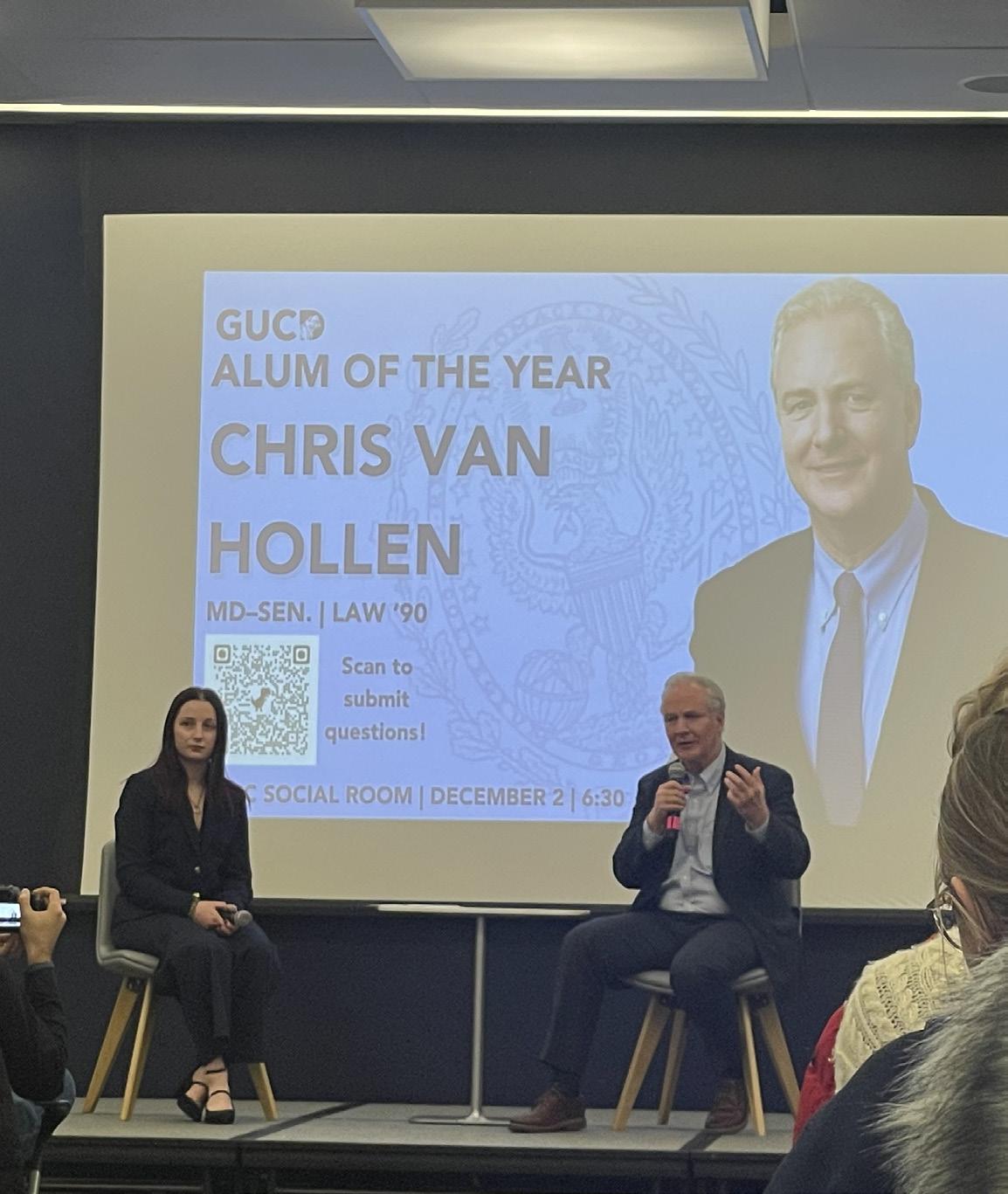
Sofia Thomas and Ajani Stella GUSA Desk Editor and Senior News Editor
showcases
student musicians, artists
live
the office’s Copy Cave. The Hoya hosted Kicking Cans, a five-piece student band, to play three songs. All videos are available on YouTube and thehoya.com.
NOAH DE HAAN/THE HOYA
Sen. Chris Van Hollen (D-Md.) (LAW ’90) encouraged Democrats to adopt a midterm election strategy at an event Dec. 2.
GEORGETOWN UNIVERSITY
The Georgetown University Police Department will waive security fees for official student groups, student government will announce.
After Being Fired as Men’s Basketball Coach, Ewing Received $12.5 Milllion
EWING, from A1
Michael LeRoy, a labor and employment relations professor at the University of Illinois UrbanaChampaign who specializes in college athletics, said Ewing’s buyout was emblematic of a growing trend of ballooning coaching contracts.
“He presents a fairly typical situation,” LeRoy told The Hoya “Typical is not necessarily good. The trend over the past 20 years has been for coaching contracts to increase in length.”
In 2021, the university agreed to extend Ewing’s initial contract by three years to 2026, according to an independent Georgetown men’s basketball blog, though details of the contract were never made public. His original contract was scheduled to expire in 2023, the year he was fred.
LeRoy said buyouts force college athletics programs to pay off a terminated coach’s contract while recruiting and paying a new one.
“Effectively, you’re paying for two coaches,” LeRoy said. “You’re paying to idle one coach and you’re paying for an active coach sitting on the bench there.”
Arjun Venkatesh (CAS ’27), a Hoyas and Knicks fan, said the buyout allowed Georgetown to replace Ewing after repeated poor performances.
“We really had two options at that point: We can continue with Ewing and not buy him out, meaning we don’t have to pay him the $12.5 million upfront; we just pay his salary until the contract runs out,” Venkatesh told The Hoya. “But that would have been so detrimental to the program; we wouldn’t have been able to make any headway. Or we could pay him that $12.5 million, buy him out so we can fre him and hire a new coach, which is what we did, and three years later, the program
looks really good. So it was the right move to buy him out originally.”
Brian Weinberger (CAS ’24), an avid Hoyas fan, said the buyout was in line with what he expected for a high-profle sport, though he was still disappointed the university had to spend millions.
“Obviously that’s a lot of money and obviously it would be better for the school, the students, whatever, if that hadn’t happened, but from a financial side, college sports in general is insane right now,” Weinberger told The Hoya
Since 2018, Ewing has been cumulatively paid more than any other coach for a Big East men’s basketball team, according to an independent tracker that aggregates publicly available data.
LeRoy said fring coaches functionally raises new coaches’ starting salaries.
“The labor market begins to ratchet up,” LeRoy said. “It’s almost like a lockstep ratchet up: What happens is as schools in the aggregate start to fire coaches, the market for hiring new coaches and retaining incumbent coaches is going up at the same time.”
“It illustrates this paradox of schools having to pay more to keep good coaches and a growing percentage are paying for a buyout and paying for a new coach,” LeRoy added.
Ed Cooley, Ewing’s replacement, made nearly $4 million in Fiscal Year 2024, slightly less than Ewing’s compensation in his fnal year of employment and over $1.6 million more than Ewing’s frst year at the university.
Joe Moore (CAS ’25), who started an informal sports fan group while at Georgetown, said Ewing harmed the men’s basketball program, despite his star history as a player.
“He built us into the program as a player, and then he tore it all down when he was coach,” Moore told
The Hoya. “He lasted a little bit too long, which was somewhat on him, somewhat on the school.”
Weinberger said Ewing’s critics should recognize Ewing was a celebrity player revered by the university and basketball fans at large, citing his record as a player and his place in the NBA Hall of Fame to defend the university’s decision to hire him.
“It’s hard to justify in hindsight, but I do think it’s unfair to put too much blame on whoever’s giving out these contracts,” Weinberger said. “Coming in, Ewing was a legend. I think that gets forgotten a lot by people who are our age, who only really know him as this coach who is appallingly bad. But Ewing won the national title with Georgetown and then won quite a lot of NBA games, is a Hall of Famer, etc.”
“So coming in, it was a very high profle hire and not one we expected to go badly,” Weinberger added.
John Kurkjian (CAS ’24), former vice president of Georgetown basketball blog Thompson’s Towel, said Ewing’s coaching career was “chaotic and unfortunate” but the buyout made fnancial sense.
“That number feels about right given the fact that he was given a new contract just two years prior to him being let go,” Kurkjian wrote to The Hoya. “It’s a large number, obviously, but not one that shocks me as someone who has previously covered the sport.”
Weinberger said the buyout was unfortunate but a necessary kickstart for the men’s basketball team.
“I wish that the Ewing buyout was less money, obviously, but we had to get rid of him,” Weinberger said. “We have to start making our basketball team a product that people want to see and it’s not worth any amount of money, but it’s worth a lot of money to get a basketball team that does well.”
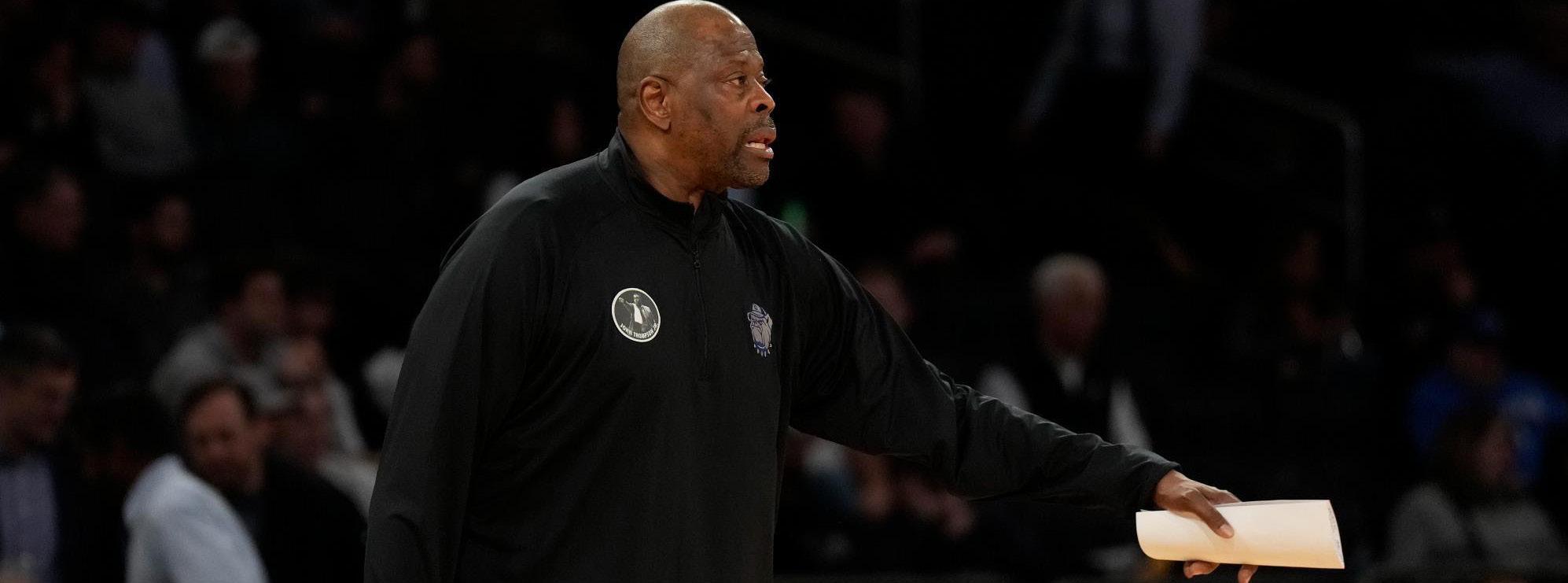
GU Res Living Reverses One RA Policy Change, Clari es Another
RAs, from A1
RAs in suite-style housing will still be unable to pull in their non-direct suitemates, yet any student can select the empty beds in an RA’s suite, which will be designated as including an RA. Under the policy change, RAs will now be informed of their room assignment before Phase I of the housing selection process begins, meaning their friends can enter Phase II as a double or single and select the empty beds in an RA’s suite. Wagener said that despite some policies addressed in the petition remaining in practice, the compromise represents progress.
“I think there’s still more obstacles to that than there used to be, because obviously RAs used to be able to basically pull their roommates into their housing, and they’re still saying that’s not going to be possible except for direct roommates,
but I think we’re happy with the compromise that we’ve reached,” Wagener said.
Abigail Adane (CAS ’28), an RA in Loyola, Xavier and Ryder (LXR) Hall, said the updated plan, while addressing the RAs’ primary concerns, still does not guarantee that RAs will end up rooming with people of their choice.
“The way that they’ve changed the rules now is that with an apartment style, you fnd out in February, and then those spaces are open, so that your friends can take them during the housing process, but that still risks random people taking those rooms,” Adane told The Hoya
Adane said that although she is grateful for the policy rollback, the back-and-forth with Res Ed is discouraging and she is still unsure whether she should apply to live in a suite next year.
“I feel a little bit less incentivized, and I really don’t know where I want to be,” Adane
said. “It is also unfair. As a lowincome student, I don’t really have a choice. I really do rely on the fnancial benefts of being an RA. Even if I end up rooming with random people, I kind of just have to deal with it, which sucks.”
Holk said the policy reversal refected the importance of student labor advocacy.
“I think this demonstrated that when we advocate for our labor rights, we can push for outcomes that are benefcial for the university and for RAs and for the students that RAs serve, which I think is the most important,” Holk said. “I hope to see more consideration in the future when making large changes like this.”
“Obviously, we laid it out in the petition that as unionized employees, our rights have to be respected by law,” Holk added. “I think that’s something that we want to see Georgetown demonstrating good faith in.”

GU Community Unites After Judge Rules Khan Suri Is Deportable
KHAN SURI, from A1
Suri while Suri v. Trump proceeds. In his immigration case, an immigration court ruled Khan Suri deportable approximately two weeks ago, according to sources familiar with the case.
Nader Hashemi — director of the Alwaleed Bin Talal Center for Muslim-Christian Understanding (ACMCU), the academic group Khan Suri works for — said additional immigration attorneys will be joining his defense.
“My understanding is that his legal fees are going to be exorbitant,” Hashemi told TheHoya. “If he wants to get the best representation possible, that means you have to raise money.”
Because immigration court proceedings are private, the judge did not publicize the decision. Khan Suri’s lawyers will now appeal the court’s decision to the BIA, which must be fled within 30 days of the judge’s decision.
The immigration judge gave Khan Suri a 60-day deadline to fle further forms of relief before the deportation ruling becomes actionable, which does not necessarily mean Khan Suri would be immediately deported, according to sources familiar with the case.
In March, when Khan Suri was originally detained, Tricia McLaughlin, a spokesperson for the Department of Homeland Security (DHS), alleged Khan Suri’s visa was revoked due to “Hamas propaganda” and connections to Hamas leadership, though DHS did not provide specifc evidence.
In July, a senior DHS oficial testifed in federal court that a DHS profle of Khan Suri, which led to his initial detainment, looked at his research, teaching and pro-Palestinian advocacy, but not his personal life.
Izzy Volpe (SFS ’28), a student in Khan Suri’s class who donated to the fundraiser, said Khan Suri is an essential member of the Georgetown community.
“Dr. Suri is one of my professors, and what he went through last year is something that I personally cannot imagine going through and being separated from my family,” Volpe
told The Hoya. “He is a father, he is a husband and he’s a great professor. He’s a wonderful person, so I have that personal connection to him, and it was very scary to see that this person that I learn from, that I admire, and that has been a really important figure in my life at Georgetown, is being targeted in such a way.”
Elliott Colla, an Arabic and Islamic studies professor who works alongside Khan Suri, said Khan Suri adds a meaningful presence to the university.
“He is somebody who lights up the room when he’s in it,” Colla told The Hoya. “So he just impressed me as a colleague and as a teacher. His students are very committed to him as well. And for me, that is exactly the reason why I’m proud to work at Georgetown, that I have colleagues like that.”
“His ordeal, to me, is really a blow to our community and the continued persecution of him is a threat obviously to him, but to others like him,” Colla added.
“He’s not the only person who’s here on a visa; he’s not the only person who’s at Georgetown or even in the Islamic studies or Middle East studies community.
There’s a number of people.”
Hashemi said the arrests of students who are vocal on Palestine, including Tufts University student Rümeysa Öztürk and Columbia University graduate Mohammed Khalil, were a portent of the Trump administration’s aggressive approach to immigrants and foreign nationals.
“My impression was after Badar Khan Suri was arrested, and after Rümeysa Öztürk was arrested at Tufts and Mohammed Khalil and many others, I was of the view — now, I understand it’s mistaken — that the the intensity of this crackdown had diminished, that the Trump administration was interested in few dramatic events to scare people,” Hashemi said.
“But it’s clear that I was naive and I misunderstood the authoritarian nature of this administration that really wants to go after as many people as possible and hasn’t let up and is still pursuing these arrest warrants.”
“It completely upends your worldview, and it reminds you of what a dangerous moment we are living through at this time in American history,” Hashemi added.
Nico Cefalu (CAS ’27), the Georgetown ACLU chapter’s president, said the Trump administration uses cases like Khan Suri’s to intimidate non-citizens, especially in Washington, D.C.
“It’s an environment designed to provoke fear and to hopefully get people to self-deport, or just to put people who have immigrated here in danger and in fear for their immigration status,” Cefalu told The Hoya
“And it’s just cruel for no reason.” “It’s just infuriating to keep seeing this happen on such a wide scale, and for Trump to just use immigration enforcement as a roving band,” Cefalu added.
Since the Metropolitan Police Department began cooperating with federal immigration agents in August, ICE has detained 1,200 people in D.C. between August and mid-September, up from the 85 detainments made between Jan. 20 and late July. Volpe said students should donate to the fundraiser to take tangible steps towards counteracting the government’s actions.
“I think it’s important because he’s a member of our community who has been going through something so unjust,” Volpe said.
“The Georgetown community as an institution is supposedly committed to those Jesuit values of justice through faith, especially the School of Foreign Service, which is supposed to produce leaders of tomorrow that stand up for justice. We can stand up for justice now. It doesn’t have to live in this theoretical realm. There are tangible things we can do to fght for what’s right and right now that is supporting Dr. Suri.” Colla said the fundraiser also provides a means for a collective response that binds the campus community together.
“The threat to him is a threat to all of us,” Colla said. “That’s why we need to rally around and support him and fght these attacks.”
GU Students Stage Sit-In to Protest Proposed GUTS Subcontracting
GUTS, from A1
Committee on Business Practices (ACBP), a committee making recommendations on the ethics of university labor decisions, advised the Office of the President against the subcontracting plan. Since then, university administrators have not finalized a decision or publicly taken a stance on the ACBP recommendation.
A university spokesperson said the university has sought feedback from GUTS drivers and community members to assess the proposed plan, including in meetings with the ACBP and town halls for GUTS drivers.
“From those conversations the University heard that the areas most important to drivers included pay, benefts, seniority, holiday schedules, job security, vehicle safety, and the ability to remain GU employees,” the spokesperson wrote to The Hoya. “While the vast majority of these items were topics understood and refected in the initial request for proposals for a third party managed transportation provider, in the time since receiving additional feedback, the University has worked to further explore transition options that may be feasible.”
“Based on feedback from our community, the University continues to work diligently on a contract structure that would provide our GUTS drivers the choice to remain as GUTS bus drivers employed by the University,” the spokesperson added. University administrators did not address the protesters, though two Georgetown University Police Department (GUPD) oficers monitored the protest throughout the day.
Juan Campos, a GUTS driver who gave a speech during the sit-in, said both students and drivers will continue to protest the university’s plan so the university understands students support GUTS drivers.
“They know you guys haven’t forgotten about us and will keep fghting until they make the decision for us to be Georgetown University employees the way we are right now, and keep GUTS bus,” Campos told The Hoya. “GUTS bus is not just a transportation, it’s a community
that started with the students. If they give it to another company, it’s going to lose that essence about being a GUTS bus driver.”
Naughton said hearing about Campos’ time working at Georgetown was deeply moving and reinforced her belief that the university’s treatment of GUTS drivers contradicts its values as an institution.
“Listening to Juan talk about how long he’s been at Georgetown, how much care he has for the students here, I was almost crying,” Naughton said. “I think the GUTS drivers care so deeply about this school and about the safety and well-being of every single member of this community, and it would be heartless to not care for them in return.”
“That would be antithetical to everything that Georgetown stands for,” Naughton added.
Noel Tiongsen, a GUTS driver who attended the protest between shifts, said he and many of his colleagues have remained with Georgetown long-term in large part because of university benefts.
“At Georgetown, the drivers for GUTS stay here for long periods of time because it’s a real job — it’s something we were proud to be part of,” Tiongsen told The Hoya
“It’s something that doesn’t really pay that much, but it has benefts. It has medical, dental benefts that include your family.”
The Hoya reported in September that Abe’s Transportation could change many drivers’ benefts to more limited oferings, including switching of the university’s more expansive healthcare and retirement packages. Drivers have said switching from the university’s health care plan to Abe’s Transportation’s plan would reduce their overall coverage, particularly for preexisting conditions.
Ariana Hameed (CAS ’26), who participated in the sit-in, said the university’s proposed plan to subcontract workers would afect the entire Georgetown community, not just drivers.
“Every student is afected by the fact that they’re being outsourced,” Hameed told The Hoya
“Not only do I think it’s the right thing to do, but I also think
that every part of this university is afected by this decision.”
Tiongsen said he has formed a deep connection to the university community throughout his long tenure at Georgetown.
“I didn’t go here for academic studies, but I observed, I learned,” Tiongsen said. “I somehow participate in their own journey, and absorb the kinds of personality that people that are studying here bring into my bus. So the interaction, the social observation, it gives you a bit of a refecting window or mirror to who we are as an educational institution.” Roy Linton, another GUTS driver, said it was empowering to see the student advocacy.
“It was really good to see such a large turnout today to know that there’s so many students that’s rallying behind us, so we know we have the backing of the community,” Linton told The Hoya Ted Bergman (CAS ’27), who also participated in the sit-in, said the protest displays the increasing solidarity between drivers and students.
“This action really demonstrates how much the students care about this, how much the drivers care about this, and this action demonstrates how we are stronger together,” Bergman told The Hoya Tiongsen said he is advocating on behalf of younger GUTS drivers whom he hopes have a long future at the university.
“I’m already old. I can move on, but I’m thinking about the rest of the guys,” Tiongsen said. “That’s why I’m speaking for them — the ones younger, they know me. I’ve been here 25 years now, so they want to go through the same path that I went through.” Naughton said the Georgetown community must continue to protest the suggested plan.
“We made it very clear to the university how the community feels about this decision, which is condemnation,” Naughton said. “So I think that all that we can do is keep pestering them, keep calling their ofices, keep sending emails. We have to make sure that the administration knows the community is wholeheartedly against the outsourcing of the GUTS bus service, and that’s what we can do right now, is just keep applying that pressure.”
OLIVIA HOLMBERG/THE HOYA
After a student petition criticizing Georgetown University for policy changes affecting residential assistants (RA), the university Office of Residential Living reversed one of the policy changes.
GEORGETOWN UNIVERSITY
Patrick Ewing (CAS ’85), the former Georgetown University men’s basketball coach, received $12.5 million from the university the year after he was fired in March 2023 as a contract buyout.
GU Law Center Dean Emeritus Wins Legal Lifetime Achievement Award
Chloe Taft Graduate Desk Editor
The former Georgetown University Law Center dean received a lifetime achievement award from the legal publication The American Lawyer, the university announced Nov. 24.
Dean Emeritus William M. Treanor, a constitutional law and constitutional history professor at the Law Center, was one of seven recipients, which also included a former attorney general and four federal judges. The award celebrates honorees’ commitment to the law and impact on the legal profession.
Treanor said he was honored to receive the lifetime achievement award.
“It’s an award of huge importance,” Treanor told The Hoya “When American Lawyer called me to tell me that I was receiving the award, I was so deeply honored and very moved. It really means a great deal to me.”
Treanor, who joined the Law Center as dean in 2010, was its longest-serving dean when he stepped down June 30. During his tenure, Trenor raised money to support public interest legal careers, expanded scholarship funding by $25 million, hired 75 new faculty members and grew the university’s law and technology program.
Treanor said he was proud of eforts throughout his tenure to increase access and inclusion through fnancial aid and programs such as the Blume Public Interest Scholars and RISE, which supports students with less exposure to the legal profession before law school.
“I was an upper-middle class kid growing up and my father was a doctor, so I had every opportunity, but his father was a freman and he was able to go to college and medical school because of fnancial aid,” Treanor said. “So that’s why I’m really committed to opening doors, because it doesn’t just beneft one person, it benefts people through generations.”
Madhavi Sunder, a law professor who worked with Treanor as an associate dean from 2020 to 2023, said the honor is well-deserved.
“Bill Treanor was an indefatigable leader,” Sunder wrote to The Hoya. “He traveled the world and raised more money than any previous dean — by a lot. His energy and commitment was all to provide opportunities for our world class students and faculty.”
Daniel Ernst (COL ’18, LAW ’26), Treanor’s research assistant for the last year, said working with Treanor has been impactful.
“Dean Treanor is, frst of all, brilliant,” Ernst told The Hoya. “He has just a wealth of knowledge from all his decades of scholarship. He’s also a very thoughtful person in how he considers and approaches his scholarship, and his way of thinking about things is very measured.”
Earlier this year, Treanor made national headlines when former Interim U.S. Attorney for the District of Columbia Ed Martin sent him a letter demanding the Law Center eliminate all diversity, equity, and inclusion (DEI) initiatives. In his response, Treanor refused to alter Georgetown’s curriculum, citing First Amendment rights to freedom of speech and religion.
GU Students Denounce
An Increased National Guard Presence in DC
Sofia Thomas and Liv Sanchez GUSA Desk Editor and Hoya Staff Writer
Some Georgetown University students condemned President Donald Trump’s deployment of additional National Guard troops in Washington, D.C., after two service members were shot Nov. 26.
The U.S. Department of Defense announced it would order 500 additional National Guard members to D.C. after two West Virginia National Guard members were shot, one fatally, near the Farragut West Metro station Nov. 26. Trump initially deployed the National Guard to D.C. in August, citing a “public safety emergency.” William Mead-McCaughan (CAS ʼ27), a student who grew up in the District, said deploying more National Guard members may increase tensions in the city.
“The fact that they’re in D.C. has caused them to become a target, and I’m not sure that deploying more National Guard is going to do anything except for infaming the situation further,” Mead-McCaughan told The Hoya.
After Georgetown students spotted federal agents on campus in August, university community members criticized Trump’s deployment of National Guard members and federal agents across D.C. Nico Cefalu (CAS ʼ27), the president of Georgetown’s chapter of the legal nonproft American Civil Liberties Union (ACLU), said Trump’s decision to deploy more National Guard troops does not address the root issues of crime.
“If he hadn’t deployed them, I don’t think these people would have lost their lives, and D.C. is already one of the most policed and militarized cities in the country — probably the most,” Cefalu told The Hoya. “I don’t think it’s a lack of law enforcement that’s causing any issues in this city — it’s a lack of investment in the sort of services that are used to prevent crime.”
According to the Metropolitan Police Department, violent crime in the District decreased by 28% and all crime decreased by 17% from 2024 as of Dec. 4. Mead-McCaughan said deploying the National Guard in D.C. is not necessary.
“There are times where the National Guard is very important and very helpful,” Mead-McCaughan said. “I think having the National Guard deployed when there’s nothing out of the ordinary going on in a city is always dangerous, because it is people who stand out, people who, a lot of times, are carrying guns.”
Treanor said he was determined to defend the rule of law and the university’s values.
“That moment was really the combination for me of so much that’s been important to me in my career about inclusion, opening doors, about the Jesuit mission and about academic excellence,” Treanor said. “I think this is a time in which we have to defend the rule of law and we have to defend democracy. We have to be very thoughtful about standing up for the values that have really defned us as a country and a university.”
Treanor began his legal career working for the New York State Commission on Government Integrity, a now-defunct commission investigating corruption, and later for the Iran-Contra Special Prosecutor’s Ofice, which investigated the arms-traficking scandal between Iran and the Contras, a Nicaraguan rebel group. Before his tenure at the Law Center, he also served in a variety of federal legal roles and as the dean of Fordham Law School.
Ernst said Treanor’s refusal of Martin’s demands was consistent with the rest of his career and work.
“That was not a snapshot,” Ernst said. “That was a representation of the type of person he is, that he is a man of principle and integrity. As brilliant and as meaningful as that action was, it was a representation of him, and not the only thing there is to know about him.”
Sunder said Treanor leads by his values and commitment to a principled understanding of the law.
“I think one of Bill’s greatest legacies as dean is that he really solidifed our identity around the rule of law and justice,” Sunder wrote. “With utmost conviction Bill would remind us that ‘Law is the means. Justice is the end.’ His constant reminder of this north star instilled purpose in each of
us — students, faculty, staf and alumni — and created a community united by a common mission.”
Treanor said that although he is currently on sabbatical, he plans to continue speaking at events, litigating, and working on an upcoming book about the Constitution’s drafting.
“Even though this is a lifetime achievement award, I’m not done,” Treanor said. “I think this is a time in which it’s very important that I continue to use my voice and press for the values that are important and academic freedom and democracy and rule of law.”
Hillary Clinton, Policy Experts Condemn Human Tra cking, Praise US E orts to Protect
Mansimar Thakral
Special to The Hoya
The Pentagon confrmed Dec. 2 that all National Guard members deployed in the District are now armed following the shooting.
Shae McInnis (CAS ʼ28), who supports the National Guard’s presence in D.C., said he believes adding more service members will make the District safer.
“I’m supportive of this additional increase, and I think it’s warranted, both pragmatically, to make our city even safer, and also perceptually because I think there has to be the impression that the Trump administration does not tolerate these heinous attacks on members of law enforcement,” McInnis told The Hoya. “I think this is a good signal to show that he’s devoted to public safety, to preserving the rule of law.” McInnis added that the shooting shocked him.
“I think it’s just absolutely horrifc that our law enforcement, who are just doing nothing in this case, defending Washington, D.C., were attacked in such a heinous way,” McInnis said. Elinor Clark (CAS ʼ27), Georgetown University College Democrats’ advocacy director, said Trump was wrong to politicize the shooting, which she said refects a wider pattern of political violence.
“It is a tragedy that these people lost their lives, and it’s also a tragedy that these people who signed up to protect and serve our country are being weaponized — used as tools by Donald Trump — to push his authoritarian agenda,” Clark told The Hoya
Cefalu said he is concerned that taxpayer dollars are funding the deployment of National Guard members.
“I think most of what they’ve been doing is picking up trash around the monuments, which is a good thing, of course, but it costs tax dollars, taxpayer money, to keep the National Guard deployed here, and I think that could be spent on much better things,” Cefalu said.
Cefalu said he feels uncomfortable seeing National Guard members in D.C.
“It just puts me on edge whenever I see them,” Cefalu said. “It just makes me uneasy. I dislike seeing people in uniform patrolling around — it just makes me feel like there is martial law or something.” Clark said the National Guard’s presence threatens the District.
“The National Guard is not making D.C. safer,” Clark said. “They are creating signifcantly more fear in our community, and the National Guard needs to get of of our streets.”
A panel of experts advocated for international policy eforts against modern-day slavery and human traficking at a Georgetown University event featuring former Secretary of State Hillary Clinton Dec. 2.
At the event, Clinton was joined by experts including Evelyn Chumbow, the advocacy and survivor leadership director of the Human Traficking Legal Center and a frsthand traficking survivor, and Melanne Verveer, the executive director of the Georgetown Institute for Women, Peace and Security (GIWPS), an initiative centring on the critical, untapped role of women in world politics and security.
The panelists urged bipartisan support for anti-traficking legislation, detailed the role of education in fostering awareness and praised the strength of investigative journalism in crippling forced labour operations in global supply chains.
Clinton, who serves as GIWPS’s honorary founding chair, said the summit was important to celebrate integral anti-traficking policy and envision future progress.
“Today we are here to mark a milestone. It has been 25 years since the Traficking Victims Protection
Act and the Palermo Protocol set the foundation for the modern global fght against human traficking and forced labour,” Clinton said at the event. “Now, both anniversaries are moments for refection and clarity. What did we learn, what did we build, and what must we do now in the next 25 years to make even greater progress and fnally end modern slavery?”
The 2000 Trafficking Victims Protection Act (TVPA) aims to combat human trafficking both in the United States and internationally. The act establishes several interagency task forces to monitor abuses and enhances legal prosecution measures to hold perpetrators accountable. The 2000 Palermo Protocol is a broader, legally-binding instrument adopted by the United Nations to globally define trafficking and criminalize the act in all of the 185 party states.
Verveer, who is the former U.S. ambassador-at-large for global women’s issues, said the prevalence of human traficking and forced labor as a global crime should serve as an impetus for continued advocacy.
“Human traficking continues to be a global scourge, and our work must continue now more than ever,” Verveer said at the event. “The perpetrators, criminal networks, are engaged in a multi-billion dollar
industry that is nothing less than modern-day slavery.”
Clinton said she advocated for anti-traficking policies such as the TVPA while serving as First Lady of the United States.
“We pushed for a robust, bipartisan law that would prevent trafficking,” Clinton said. “Prevention, prosecution, protection — we were looking at ways to address the issue in its complexity. We wanted comprehensive legislation that would enable us to go after it in all its variations. Those three ‘Ps’ became the backbone of the TVPA.” Delani Pecchioli (GRD ’25), who attended the event, said the panelists’ work and discussion motivated her to think more about advocacy.
“I’m feeling energized, inspired, also humbled,” Pecchioli told The Hoya. “To hear from people that are on the ground and doing this work everyday is just so nice, especially seeing how some of these systems are being dismantled and how difficult this work is already on a good day.”
Clinton said human traficking is a critical issue with immense history, outlining the global struggle to recognize the act as a legitimate crime against humanity.
“Advocates had long raised alarms about what they were seeing, particularly in conflict zones and in places with great poverty,” Clinton said.
Victims
“Women and girls were being bought and sold, trafficked across borders, forced into servitude — and it was treated as an invisible crime, and in many places it wasn’t as a crime at all, visible or invisible. It was literally hidden in plain sight as one would say, and by that I mostly meant they just didn’t want to see it.” Chumbow, drawing on her experience as a survivor of human traffcking, said modern politics needs to prioritize victims’ humanity.
“I was brought into this country at age nine, and I never thought that I would become a victim of child forced labor right here in Maryland, not far from the White House capital,” Chumbow said at the event. “Me being here and sharing my tears is not for you to feel sorry for me, but for you to take action. When we are talking about policies, let’s talk about policies that help support us, really see us as human. So if you want to create policies that help me, you do so by talking to me.” Clinton said human trafficking, while often dismissed, is a global issue.
“Trafficking thrives in the shadows and it can be easily dismissed as something that happens to someone else, somewhere else,” Clinton said. “But that’s just not the case — trafficking happens in every nation on Earth. It is a crime that knows no borders.”
Two SOH Students Win Global Health Research Award
Jacqueline Gordon Academic Desk Editor
Two Georgetown University School of Health students received an annual award that provides students the opportunity to conduct research related to global health and human rights issues in an international feld, the university’s Global Health Institute announced Dec. 1.
The Maeve Kennedy McKean Global Health Award, named in honor of the late executive director of Georgetown’s Global Health Initiative, Maeve Kennedy McKean (LAW, GRD ’09), the award provides students with academic and fnancial support to develop research in their respective felds and to conduct feldwork in the countries their research is focused on. This year’s recipients are Jordan Pai (SOH ’27) and Kayla Wontumi (SOH ’27). Both Pai and Wontumi will partner with a faculty mentor to study their feld before traveling to their respective countries in the summer. The recipients will then present their research at Georgetown’s annual Global Social Justice Summer Research Symposium in fall 2026. Wontumi will be partnering with WAJAMAMA, a clinic and a nonproft organization founded and led by a Georgetown graduate that aims to increase the
workforce capacity of nurses and midwives to prevent maternal death and morbidity. This partnership is facilitated through her faculty mentor, Christina Marea, assistant professor in the Berkley School of Nursing.
Wontumi, who will be studying healthcare and group care models for mothers in Zanzibar, Tanzania, said she will be examining the diferent clinical approaches to maternal health and care.
“Building on the work of Professor Christina Marea, the WAJAMAMA clinic in Zanzibar, Tanzania, and the broader research team, I intend to explore the many dimensions of maternal health in an immersive setting,” Wontumi wrote to The Hoya. “Using a participatory approach, I plan to collaborate closely with mothers and local healthcare personnel to better understand the impact of culture and holistic approaches to medicine on their health outcomes.”
Marea said she looks forward to collaborating with Wontumi on the global health issue of maternal care in Zanzibar.
“This will be my frst time with a Maeve McKean fellow and so I’m very excited to be working with Kayla,” Marea told The Hoya. “As a partner in the Global Health Initiative and as a mentor for Maeve
McKean, I’ll be working with Kayla, our undergraduate student, so that she can have an experience of both team-based and individually-led global health collaboration that is bi-directional.”
Pai will work under the mentorship of Emily Mendenhall, director of Georgetown’s science, technology, and international afairs (STIA) program, and Mendenhall’s partner Edna Bosire at the Brain and Mind Institute at Aga Khan University in Kenya. There, Pai will research running as a source of community health resilience, combating a rise in non-communicable disease burden within the country.
Pai, a member of Georgetown’s Running Club and Reserve Oficers Training Corps (ROTC), said he developed the idea to study his topic when he was applying for the McKean award.
“I wanted to fnd a way to incorporate running into the research just because Kenya’s the best place for that,” Pai told The Hoya. “What I’m hoping to get out of the research is really to give back to the community.”
“What I’m hypothesizing is that runners from Kenya do it more so as a means to make money for their families,” Pai added.
“So I want to be able to have this research be able to give back to
the community and hopefully impact them in a positive way.” Wontumi said she hopes her research will empower mothers in Zanzibar.
“When I received the notifcation of my acceptance to the research fellowship, I was ecstatic beyond measure and immensely grateful for the opportunity to pursue my long-standing passion for health equity in an experiential setting,” Wontumi wrote. “I am eager to expand my knowledge and engage in such transformative work throughout the next year, with the hope of making a meaningful impact on the lives of mothers in Zanzibar.” Marea said the award will be benefcial for both students and communities since students receive valuable global health experience while giving back to the communities they are researching in.
“I hope that we can continue to grow this partnership and have really a long-term continuity,” Marea said. “We use a quality improvement approach with a liberatory lens that there are constantly ways to be delivering healthcare better and more equitably, to be preparing healthcare providers, to both provide excellent care but to experience wellbeing and wellness, and transformative learning experiences where they feel empowered.”
GEORGETOWN UNIVERSITY LAW CENTER The Georgetown University Law Center dean emeritus won a legal publication’s lifetime award.
Fifteen SFS Sophomores, Juniors Win Pelosi Scholarship for Public Service
Michael Shtrom
Special to The Hoya
Fifteen Georgetown University School of Foreign Service (SFS) students won the 2026 Paul F. Pelosi Scholars Initiative, an annual scholarship which seeks to prepare sophomores and juniors for careers in public service, the university announced Nov. 26. The initiative aims to reduce fnancial burdens and provide professional opportunities in non-governmental organizations (NGOs), policy think tanks and federal and local governments to Georgetown students. Throughout the spring semester, Pelosi scholars will attend weekly classes that include formal networking sessions and career skill development and will receive an invitation to meet with former U.S. House of Representatives Speaker Nancy Pelosi and her husband, Paul Pelosi.
SFS Dean Joel Hellman said the program attracts students because it provides scholars access to private coaching, networking and curated opportunities to help students secure public service internships over the summer.
“What students are looking for when they join is support to help them navigate the complex world of fnding great public service internships,” Hellman said in a video about the program.
“Second, they’re getting fnancial support to bring public sector internships on the same plane as private sector internships.”
Pelosi scholars receive varying fnancial support, determined by the pay provided by each
student’s internship. Scholars with unpaid, full-time summer internships receive a stipend of at least $1,000 through the program, while those with paid or part-time opportunities receive prorated funding.
Alexandra Hamilton (SFS ’28), a 2026 Pelosi scholar who is looking for opportunities to work in foreign policy for her internship, said the scholarship’s fnancial compensation for unpaid opportunities was particularly appealing to her.
“As someone who relies on my on-campus job, taking unpaid internships is a fnancial concern of mine,” Hamilton told The Hoya. “Getting a stipend to pursue an internship in a feld that is normally unpaid is incredibly helpful and gives me a great piece of mind.”
Scholars said they were also attracted to the community aspect of the program, where scholars help each other get internships and are mentored by members of the previous cohort.
Jeremy Suzuki (SFS ’28), another 2026 Pelosi scholar who plans to focus on humanitarian work with non-governmental organizations over the summer, said the mentorship scholars receive from previous cohorts was one of the reasons he applied.
“I was inspired by many of my mentors who, as past Pelosi scholars, grew in their leadership and careers in public service,” Suzuki told The Hoya “I wanted to follow in the footsteps of these role models, pursuing my passion to serve people outside the private sector.”
Benjamin Leong (SFS ’27), a 2026 Pelosi scholar who is also hoping to intern in the humanitarian sector this summer, said the chance to work with experienced professionals is exciting.
“Given the political turbulence associated with the public sector and public-adjacent work, learning through others’ lived experience through networking and meeting career professionals who have weathered these storms will be essential to my career development,” Leong told The Hoya
Hamilton said the fexibility the program provides to students within the feld of public service is another beneft of the program that excites her.
“I am really grateful to the Pelosi program because it allows students to experience a variety of avenues within public service,” Hamilton said. “I think sometimes people tend to assume public service is just politics or federal government roles, but public service encompasses so many people and roles, and I appreciate how this program allows students to fnd what exactly they are interested in, instead of forcing people down a specifc path.”
Suzuki said he sees the initiative as a way to uphold Georgetown’s Jesuit values through his upcoming work in the public sector.
“I am grateful for the opportunity to live out my values of service as a Christian and a Hoya for others,” Suzuki said. “All my life’s passion for leading change in this world feels like it has led me to this moment, and I can’t be more grateful.”
Historic Site Collaborates for Research On Clara Barton with History Seminar
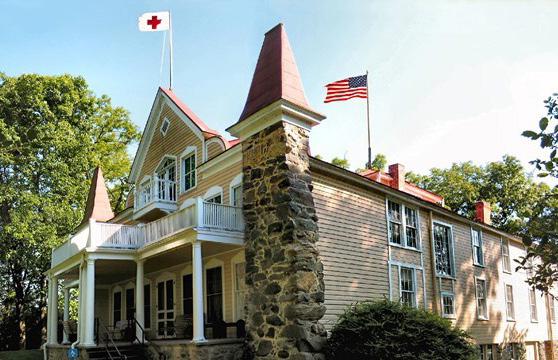
Brendan Fijol
Special to The Hoya
Ten Georgetown University students are researching the life of American Red Cross founder Clara Barton in collaboration with a National Park Service site to bolster the content of the site’s exhibits and website content.
Chandra Manning — a Georgetown history professor teaching a research seminar about Barton — coordinated the research with the Clara Barton National Historic Site, which memorializes the Maryland house where Barton lived and ran the Red Cross for 15 years, to be presented at a Dec. 6 panel. Students’ research focused on many aspects of Barton’s life, including early Red Cross disaster response, her leadership and her struggles with mental health. Manning said she decided to focus her class on Barton following concerns about the proposed renovations to the historic site.
“The initial proposed plan would have dramatically altered the site and would have reduced the amount of the site that was dedicated to the site’s purpose, which is telling the story of Clara Barton and the American Red Cross,” Manning told The Hoya Manning said she thought Georgetown students would be excited to conduct impactful research.
“I just know from past experience that Georgetown students are really pretty enthusiastic about doing work that makes some kind of impact beyond the confnes of a single class,” Manning said.
Students’ fndings will be featured on the National Park Service’s webpage for the Clara Barton National Historic Site and in exhibits at the site.
Manning’s seminar uses primary sources, including Barton’s diary, and independent research to encourage students to think about Barton’s life. Barton’s work as a Civil War nurse and later humanitarian missions contributed to the creation of the emergency medicine feld.
Emma Vonder Haar (CAS ’26), an American studies and government major in Manning’s class, researched Barton’s legacy in pop culture and uncovered references to her in unexpected places.
“The WooSox, which are a baseball afiliate of the Red Sox, have a mascot called Clara the Heart of the Commonwealth, and it’s based on Clara Barton,” Vonder Haar told The Hoya. “There’s several schools named after her and roads named after her, and there’s a stamp in Armenia dedicated to her for her work there during the genocide.”
Fallon Wolfey (CAS ’26), who is developing a documentary comparing Barton’s poetry to traditional war poetry, said her research allowed her to explore the Library of Congress’s digitized archives of Barton’s writings and personal correspondences. Full disclosure: Fallon Wolfey currently serves as the Senior Blog Editor for The Hoya.
“I think it’s humanizing, and it allows you to connect with the historical fgure on a level that’s not just some aggrandized version, but as a real person who did amazing
Following Yearlong Renovation Process, Lauinger to Reopen Pierce Reading Room
Noah De Haan Student Life Desk Editor
The Pierce Reading Room on the third foor of Lauinger Library (Lau) will open Jan. 7, 2026, after a yearlong renovation, the university announced Nov. 25.
The renovation, which began Jan. 14, aimed to redesign and expand the physical space and introduce new technology. The renovated space contains a digital lab, a video wall and an expanded study space, according to the university announcement.
Alexia Hudson-Ward, dean of the library, said the Pierce Reading Room renovation aims to modernize the space and meet student demands.
“We really wanted to transform one of the most beloved spaces in Lauinger to make it even more meaningful for students,” Hudson-Ward wrote to The Hoya. “Pierce has always had great potential, and students have consistently told us they want study spaces that are comfortable, fexible and equipped for the way you work now. So, the vision was simple: keep what our community loves about the room, and elevate it into a modern, beautiful, tech-friendly space.”
Claire Auslander (SON ’26) said she is eager to return to the Pierce Reading Room because it is a unique study space on campus.
“I am very excited to use it again. It was one of my favorite spaces in Lau,” Auslander told The Hoya. “There are not many spaces on campus where you can have that quiet focus area, but
also be in a very big, open setting that is very well lit and has tons of seating.”
Auslander said she is pleased with the renovations, including new light fxtures.
“I think that the new amenities will be really incredible for students,” Auslander said. “From when I walked past it, it looks like the lighting got an upgrade too, so I am really excited to take advantage of that and enjoy the space.”
Seniha Kocak (SON ’28) said her time spent in the Pierce Reading Room prior to its renovation connects her to the study space.
“I have a lot of memories from my frst semester, going there with my friends, studying and getting work done,” Kocak told The Hoya. “It was just a super cozy and familiar environment. I am super excited for the upgrades, but I feel like a part of me is always going to be attached to how the room originally looked and the memories tied to it.”
Kocak added that she is excited to see the room reopen and hopes it resembles the old Pierce Reading Room.
“This student space coming back to life is something that I have been looking forward to for a long time,” Kocak said. “I’m curious to see how much the atmosphere changes and whether it’s still going to have a little bit of the old Pierce room left in it.”
Hudson-Ward said the university worked to preserve the essence of the Pierce Reading Room while modernizing the space.
“We were intentional about keeping the spirit and character of Pierce because it’s a part of Georgetown’s history,” Hudson-Ward wrote. “We also made updates that bring it into the present that makes Pierce brighter and much more functional.” Kocak said that while she worries the renovations will draw large crowds to the Pierce Reading Room, she intends to use the space nonetheless.
“I think that renovated spaces, or newly reopened spaces, attract everyone at once — which I think is going to make it a lot harder to fnd a seat and to focus,” Kocak said. “But overall, I do fully plan on returning to the reading room and making it part of my studying.”
Hudson-Ward said the library plans to monitor the space’s use when it reopens.
“We do expect Pierce to be popular when it reopens! That said, we’ll be watching usage closely,” Hudson-Ward wrote. “If Pierce gets too busy, we’ll help guide students toward other great study areas within Lau to make sure you have access to the right mix of quiet and collaborative spaces.” Hudson-Ward said the Pierce renovations are part of a broader renovation project for Lauinger Library.
“We are absolutely thinking ahead as a part of what we call ‘Reimagining Lau,’” Hudson-Ward wrote. “The Pierce Room is just the beginning of a bigger effort to improve our spaces and make the library an even more welcoming place for our community.”
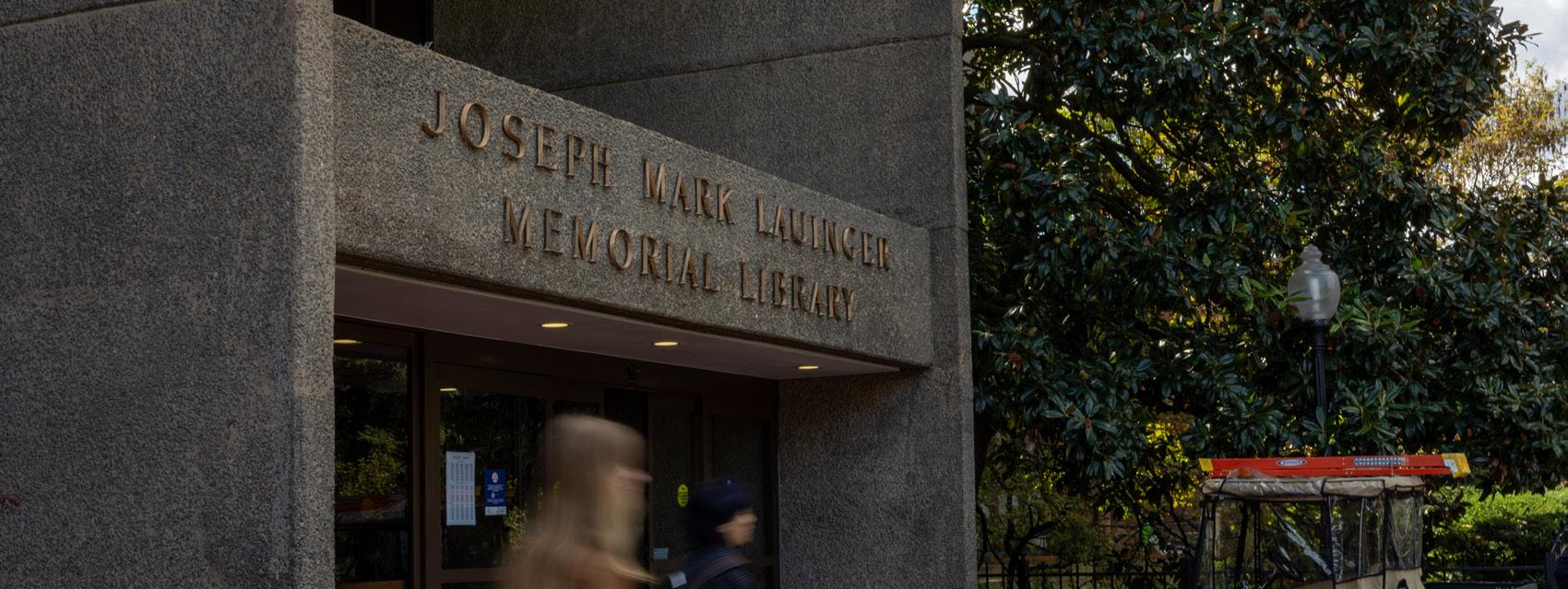
Mayor Bowser Not to Seek Reelection, Prompting Mixed Reactions at GU
Andrew Jiang Hoya Staff Writer
Washington, D.C. Mayor Muri-
el Bowser (D) announced Nov. 25 that she will not run for reelection in the 2026 mayoral race, sparking mixed refections on her tenure among Georgetown University community members.
diferent ways, including afordable housing and public education.”
Brandes said Bowser made the city’s economy more resilient by expanding it beyond federal government jobs.
matched the gentrifcation occurring elsewhere. Housing costs are increasing district-wide, with much of Wards 7 and 8 still relying on social services.”
things,” Wolfey told The Hoya. “I think oftentimes in history we boil people down to either good or bad things. But I think that it’s nice to talk about the more human parts of a very important fgure.”
Throughout the fall semester, the class visited multiple sites connected to Barton’s life and legacy, including the Clara Barton National Historic Site, the National Museum of Civil War Medicine and the Clara Barton Missing Soldiers Office Museum.
Manning said it was rewarding to see her students engaging eagerly with history on the feld trips.
“It was a genuine highlight of the semester for me to share that experience with the students,” Manning said. “Their sense of appreciation for what they were witnessing was truly moving.”
Vonder Haar said finding contemporary evidence of Barton’s life was challenging because of the limited time she had to conduct research.
“As Professor Manning tells us, nothing tells us everything, but everything tells us something,” Vonder Haar said. “I have kind of resigned that I’m not going to fnd every single representation of Clara Barton in pop culture after her death.”
Wolfey said she appreciated the opportunity to conduct original research through Manning’s seminar.
“It’s fun contributing to the feld of history in a way that nobody else has,” Wolfey said.
“Even if it’s not the most consequential, it’s nice to create something for public history.”
In a video posted on X, Bowser announced that after serving ten years, she has decided not to seek a fourth term. Bowser’s statement comes after growing backlash from local residents and Georgetown students over her handling of the Trump administration’s federalization of D.C.’s police force.
Bowser said she will continue to focus on delivering her agenda for the District as her time as mayor comes to a close.
“Together you and I have built a legacy of success of which I am intensely proud,” Bowser said in the video. “And for the next twelve months, let’s run through the tape and keep winning for D.C.”
Bowser won her frst mayoral race in 2014 after defeating incumbent Vincent C. Gray in the Democratic primary and was reelected in 2018 and 2022. Bowser presided over the COVID-19 pandemic, the creation and removal of Black Lives Matter Plaza, the Jan. 6 riots and President Donald Trump’s federalization of the Metropolitan Police Department (MPD) in August.
Uwe Brandes, the faculty director of Georgetown’s urban & regional planning program and adjunct faculty at Georgetown University Law Center (GULC), said that although problems persist, Bowser’s growth of the city’s budget fostered strong social programs for D.C. residents.
“Cities are always a work in progress and depend on community-based, collective action,” Brandes wrote to The Hoya. “When refecting on Mayor Bowser’s tenure, one might start with the fact that the city’s budget has nearly doubled from approximately $11 billion (2015) to $21 billion (2025). This alone is extraordinary and positions the District of Columbia to deliver a strong social safety net in many
“Mayor Bowser grabbed headlines with high-profle agreements with professional sports teams, but behind those headlines lies an economic development strategy to diversify the city’s economy beyond its historic dependence on federal government jobs,” Brandes wrote.
“This has made DC more resilient and afirms Washington, DC, as an international destination.”
Ishaan Pabla (MSB ’27), a D.C. resident, said Bowser has failed to maintain the District’s autonomy, citing the 1973 Home Rule Act, which entrusted municipal governance from Congress to a locally elected mayor and City Council.
“In my opinion, one of Mayor Bowser’s biggest failures was the removal of Black Lives Matter Plaza, representing a symbolic submission to federal pressure,” Pabla wrote to The Hoya. “Therefore, the next mayor must frmly communicate and demonstrate the District’s authority as defned in the DC Home Rule Act to prevent further encroachment.”
Trump deployed the National Guard to patrol the District Aug. 11, citing an “epidemic of crime” in the District. Critics have argued that the move constitutes a significant rollback of local autonomy guaranteed to the District in the Home Rule Act.
Bowser has presided over massive development projects, including the Wharf, Navy Yard, and CityCenterDC, attracting new business clientele while driving up the city’s overall cost of living. Pabla said Bowser’s push for gentrifcation is not evenly distributed among D.C. neighborhoods.
“Mayor Bowser has undoubtedly overseen mass economic development across DC with the revitalization of neighborhoods and construction of commercial complexes,” Pabla wrote. “I feel, however, that her investment in communities of Ward 8 and other underdeveloped areas has not
Bowser said her successes with investment and fresh food grants are evidence that she has not neglected Wards 7 and 8. “So over one billion dollars has just been invested in Congress Heights alone,” Bowser said at a Nov. 26 press conference. “I look at our food access grants–we hadn’t been able to attract fresh food or dining in Ward 8 and that grant has just changed all of that.” Jamie Kralovec, director of mission and ministry at Georgetown’s Capitol Campus and a faculty member of Georgetown’s urban & regional planning program, said criticisms of Bowser neglect the challenges of balancing urban development and afordability.
“I teach urban planning, and I’ve been studying this for a long time,” Kralovec told The Hoya “There’s no way around the reality of our market economy and the way that development happens in the United States. It’s a really hard balancing act between promoting economic activity and growth and preserving afordability for existing residents.”
Kralovec said that despite backlash, Bowser has tried to alleviate the potential displacement of residents from gentrifcation.
“I think the mayor has made eforts to ensure that low income people, including existing black residents, lower income black residents, beneft from that growth,” Kralovec said. Pabla said Bowser’s successor should focus on afordability, public safety and alleviating homelessness.
“I believe the path forward is for the next mayor to focus on directly addressing homelessness and afordability, implementing lasting methods for low-income residents to attain self-suficiency,” Pabla said. “These programs would subsequently lead to an enduring decline in crime irrespective of national trends, beneftting all Washingtonians.”
HAAN JUN (RYAN) LEE/THE HOYA
Lauinger Library announced that the Pierce Reading Room will reopen Jan. 7, 2026, after a yearlong renovation that redesigned and expanded the study space to include new technology.
NATIONAL PARKS SERVICE
Georgetown University students in history professor Chandra Manning’s seminar, collaborating with the National Parks Service will present research on American Red Cross founder Clara Barton Dec. 6.
WOMEN’S
Dominating Season Ends in Heartbreak
The Georgetown University women’s soccer team fell 3-1 to Florida State University at home in the Sweet 16 round of the NCAA tournament, ending its season
Nov. 23. Overall, however, the 2025 season was one of improvement and achievement for the Hoyas. Georgetown’s non-conference season had its ups and downs. The Hoyas ended non-conference play on a 4-2-2 record, with wins over James Madison University (9-4-6), Virginia Tech (4-10-4), Bucknell University (3-9-6), and, most notably, the University of South Carolina (10-5-5), who went on to reach the NCAA tournament. Losses to Vanderbilt University (18-4-2) and Saint Mary’s College (13-3-6), as well as draws against Old Dominion University (11-34) and the University of Virginia (14-3-5) marked the beginning of Georgetown’s season.
When Big East play rolled around, the Hoyas found their stride in a historic way. Georgetown barnstormed to a fawless 30 points, fnishing the Big East regular season 10-0-0 and becoming the frst and only team to achieve a perfect record since the Big East re-formed in 2013. Highlights from the historic run include senior forward Natalie Means’ hat-trick in Georgetown’s 5-0 win over Butler University (54-8, 2-3-5 Big East) on Oct. 1 and the Hoyas’ 5-0 dismantling of the Providence College Friars (6-6-4, 3-43 Big East) on Oct. 15. The regular-season Big East title came down to the last game of the season, when Georgetown traveled to Ohio on Nov. 1 to face the Xavier University Musketeers
(16-4-2, 8-1-1 Big East), who sat within striking distance of the Hoyas at just 2 points behind.
Georgetown comfortably rose to the challenge, dispatching the Musketeers 4-0, helped by a brace from graduate forward Maja Lardner and a goal and assist from senior midfelder Shay Montgomery.
This year marks the Hoyas’ fourth-consecutive Big East regular season title. Georgetown built on its 2024 championship-winning 8-1-1 record and 25 points. The Hoyas’ 30 goal diferential, made up of 32 goals scored and just 2 conceded, should not go without mention either.
When it came time for tournament play, Georgetown fell a bit short of the high expectations set in the regular season.
In the Big East tournament semifnal, senior forward Henley Tippins and Lardner scored to power the Hoyas past Creighton University (7-8-4, 4-3-3 Big East) 2-0. Georgetown fell to Xavier 0-2 in the championship game — surprising following the Hoyas’ comfortable beating of the Musketeers in the regular season a week earlier. Still, Georgetown showed improvement from last season, when the Hoyas fell to the University of Connecticut (114-3, 7-1-2 Big East) in the semifnal. Georgetown was rewarded for its regular-season performances with one of the four No. 2 seeds in the national tournament, guaranteeing home-feld advantage through the Elite Eight. In the frst round, the Hoyas took care of Sacred Heart University (11-9-2) 3-0, with two goals from Means and a goal and assist from Montgomery delivering Georgetown the victory. In the round of 32, the Hoyas hosted the West Virginia University Mountaineers (14-3-4) on Nov. 20.
After a shock West Virginia goal 3 minutes into the game, Georgetown maintained its composure and dominated the rest of the 90 minutes, scoring once in the 23rd minute with a goal from sophomore midfielder Lizzie Heller. The Hoyas could not find a second goal to decide the game, even after the match went into 20 minutes of overtime, so it took penalties to find a winner.
After Lardner missed Georgetown’s frst kick, the Hoyas and their fans thought the season was over, but senior goalkeeper Cara Martin came through with a save, and the Mountaineers rattled their ffth penalty of the crossbar, bringing Georgetown back from the edge of despair to the Sweet 16.
Georgetown’s tournament and season ended against Florida State University (14-2-4), losing 3-1. Seeded at No. 3, Florida State’s win was a small upset over the No. 2 Hoyas, especially given Georgetown’s home-feld advantage.
Altogether, it was a fne NCAA tournament for the Hoyas. It is not easy to reach the Sweet 16; prior to this season, Georgetown hadn’t been since 2018, when they were a No. 1 seed and reached the fnal four.
The Hoyas, however, will be losing almost all their key players for the 2026 season. Their top four scorers, Lardner (14 goals and 4 assists), Montgomery (7 and 13), Means (10 and 6) and Tippins (9 and 3) — who all played all 23 games — will be leaving the team.
Other seniors who started all or most games this year are Martin, midfelder Mary Cochran, forward Esme Brayshaw and defender Ellen Carter. That leaves Heller and junior defenders Isabel Boodell and Kaya Hanson as the only returning perennial starters.
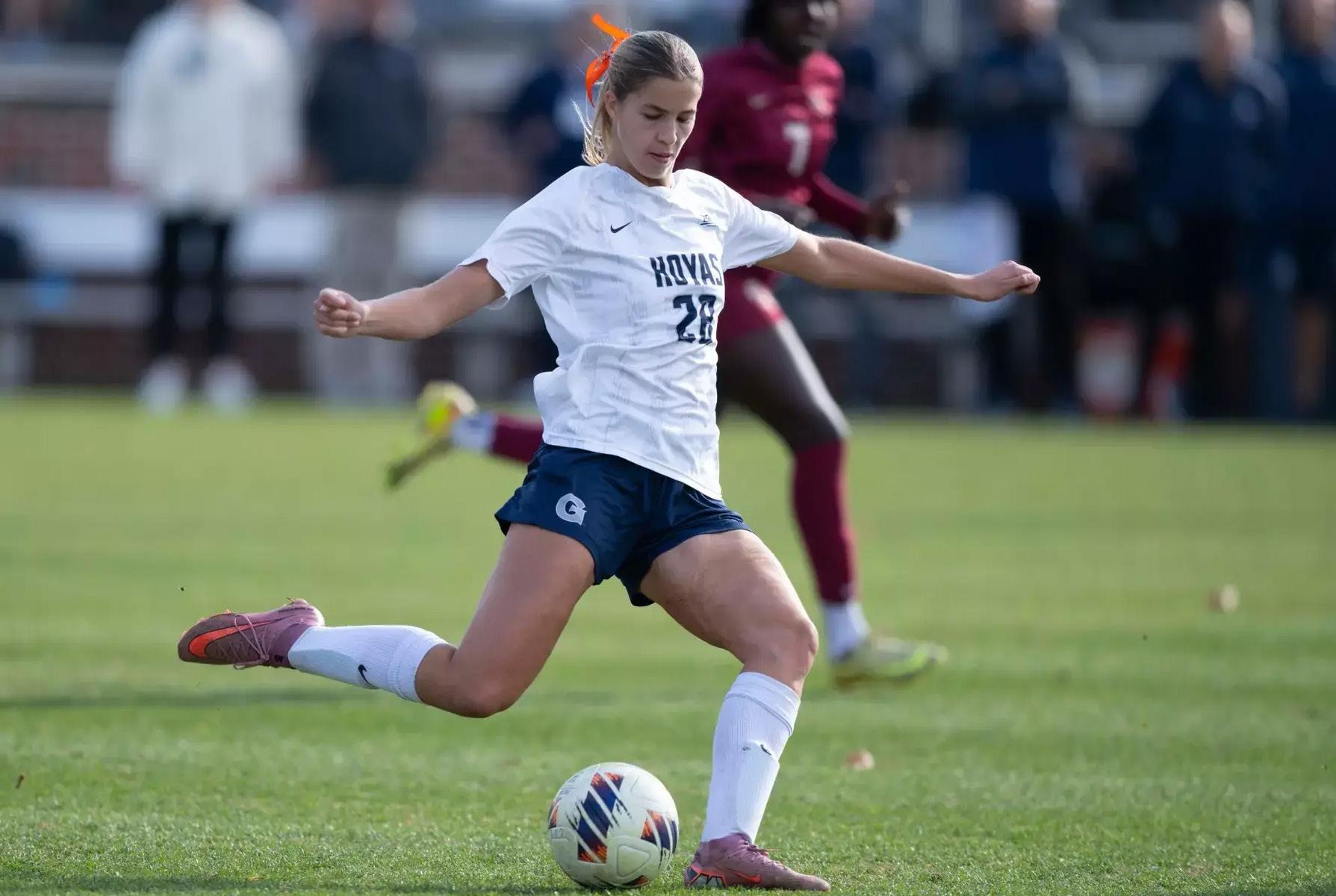
Commanders Fall to Denver in OT
The Washington Commanders clawed their way into overtime against the Denver Broncos, one of the NFL’s top teams, but couldn’t overcome their juggernaut opponent and fell 27-26 Nov. 30 at Northwest Stadium.
Washington (3-9) was behind for nearly the entire game and constantly played catch-up with Denver (10-2), who is tied for the league’s best record. The Commanders have been riddled with injuries this season, but still pushed the Broncos to their limits, and fell just short of a major upset. The frst quarter was a defensive battle for both teams, with the only points coming from an opening drive 33-yard feld goal by Broncos kicker Wil Lutz. Washington looked in good shape on the following drive, with eight straight plays of positive yardage to get onto Denver’s side of the feld, including an 11-yard run from running back Chris Rodriguez Jr. The drive sputtered out, though, forcing the Commanders to punt.
When Washington got the ball back, they again pushed into Denver territory, but backup quarterback Marcus Mariota threw an interception to Broncos linebacker Dre Greenlaw on the frst play in the red zone.
Greenlaw took it 27 yards in the opposite direction, and following another drive that was unable to
reach the endzone, Lutz made a 33-yarder to put Denver up 6-0 with less than eight minutes remaining in the second quarter.
Mariota seemed rattled on the following drive and fumbled the ball, which was fortunately recovered by Washington tight end John Bates. Mariota recovered, leading his team down the feld yet again — and this time in the red zone. Rodriguez Jr. was able to punch in an 8-yard touchdown run and convert the point after touchdown to take the lead 7-6. Denver quarterback Bo Nix quickly responded, alternating passes between tight end Evan Engram and receiver Courtland Sutton, the latter of which he eventually found in the endzone for an 11-yard touchdown. After Lutz made an extra point, the Broncos retook a lead of 13-7 and held the score heading into halftime. After halftime, the Commanders marched down the feld, and Mariota found receiver Treylon Burks for a 5-yard touchdown. With the extra point, Washington earned their last lead of the game:14-13. Mariota carried the ball much better than the previous drive, including a 19-yard rush, which came as part of his team-team’s leading 55 rushing yards. The next touchdown came from Denver rookie running back R.J. Harvey, but the majority of the drive was in the air, including a 31-yard pass from Nix to Sutton. Harvey’s 1-yard touchdown run and Lutz’s extra point put
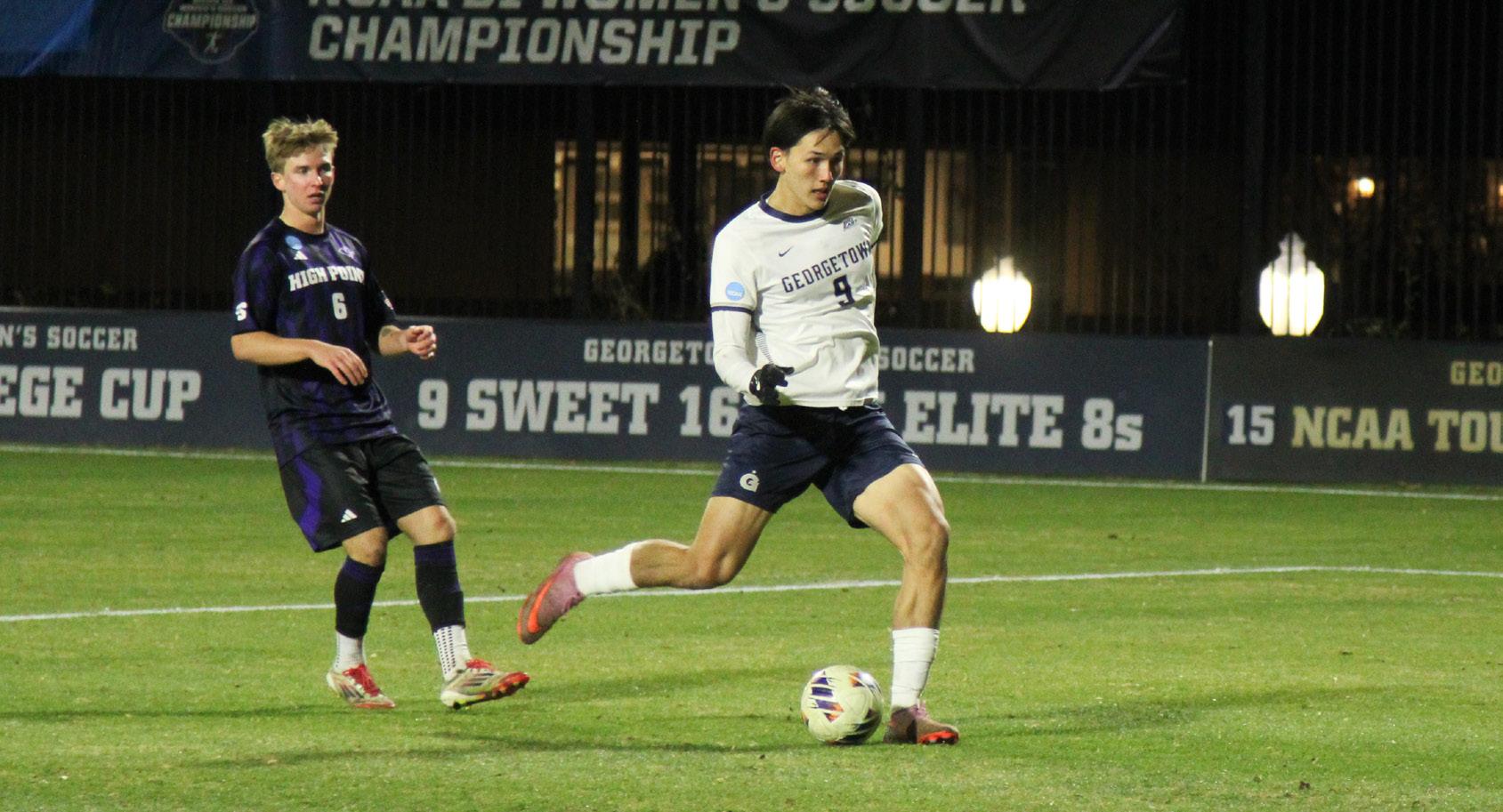
Baker, Zengue’s Goals Down High Point in NCAA Sweet Sixteen Match
Goals from sophomore forward Mitchell Baker and senior midfelder Zach Zengue earned Georgetown University a hard fought 2-1 victory at Shaw Field in the Sweet 16 of the NCAA tournament. The Georgetown men’s soccer team (14-3-4, 6-0-2 Big East) beat the High Point University Panthers (142-4, 7-0 Big South) Nov. 29 thanks to an all around strong ofensive and defensive performance. The Saturday evening win earned the Hoyas a trip to their sixth Elite 8 appearance, where they will face either North Carolina State University (13-2-4, 4-1-3 ACC) or University of North Carolina, Greensboro (12-4-6, 3-2 SoCon) next weekend.
The game got of on the front foot with the Hoyas getting their frst shot of in the 4th minute. Junior midfelder Mateo Ponce Ocampo found some space on the edge of the box, cut in and fred a shot that went just over the crossbar.
The Georgetown foot was very much on the gas in the early stages of the frst half. Junior midfelder Matthew Helfrich had the ball in the box in the 7th minute but fred the shot low and straight at High Point goalkeeper Josh Caron.
The early pressure from the Hoyas paid of eight minutes later as Ponce Ocampo played a low cross into the feet of in-form Baker, who sidefooted the ball past Caron to make it 1-0 for Georgetown. After a lengthy video assistant referee (VAR) check, the call on the feld and goal stood.
The Hoyas were not done yet as Baker found his way into the box with all the time in the world in the 21st minute. Baker was unable to get solid contact on the ball, but his miss-kick set up senior midfielder Max Viera, whose shot went wide of the back post.
Despite Georgetown’s dominance in the beginning of the first half, the momentum shifted toward High Point around the 25-minute mark. The Panthers were still unable to record any significant chances, of which their biggest came in the 37th minute; forward Celestin Blondel cut onto his left foot and fired a shot toward goal. Hoya senior goalkeeper Tenzing Manske was able to save it.
The half ended with Georgetown holding on to their narrow 1-0 lead.
The first and most bizarre moment of the second half came when High Point defender Lukas Kamrath fouled Viera. At the point of contact, Viera was still able to get his cross in, which found Baker who put the ball past Caron. Because the referee blew the whistle before Baker scored, the goal did not count. Instead, Georgetown got a free kick. This was a tough call for the Hoyas, but they quickly put the moment past them and pushed on.
Just like the frst half, Georgetown kept creating good chances throughout the second half. In the 53rd minute, the ball fell perfectly to junior defender Oliver Staford who took a powerful shot which Caron intercepted.
Six minutes later in the 59th minute, Viera found himself with space in the box. Caron saved his initial shot, but Viera regained control of the rebound ball. Baker received the pass from Viera but was unable to get solid contact on the ball.
Once again, Georgetown’s pressure paid off when junior midfielder Eric Howard played a ball to Zengue, and after a few deflections, the ball bounced perfectly in his stride — Zengue smashed the ball into the roof of the net to make it 2-0 to the Hoyas. Despite the two-goal cushion, Georgetown kept coming at a shaken Panthers backline. In the 67th minute, Zengue played a cross
into Baker who got solid contact on the ball, but his shot fell to Caron. Three minutes later, Viera played a ball which fell to Baker again whose right-footed strike went just wide of the near post. High Point was losing control of the match.
A massive moment for the Hoyas came in the 81st minute when, after the Panthers cleared the ball from a corner, frst-year midfelder Loukas Maroutsis sent the ball to the feet of sophomore defender Tate Lampman. With the chance of a lifetime, Lampan fred a shot toward goal that Caron saved yet again. A late scare for the Hoyas came in the 88th minute when Jeferson Amaya scored an absolute rocket of the post from a free kick. Suddenly, silence fell over Shaw as nerves kicked in. Instead of dropping heads, Georgetown got organized and saw the game out.
Head Coach Brian Wiese said he was impressed by his side’s resilience today.
“The Sweet 16 game, when you start your journey in January, you’re like, ‘Well, can we get this opportunity to play this game?’” Wiese told The Hoya. “Playing it on your home field of Shaw and getting the result to get to the Elite 8, there’s no better feeling.” Wiese said he was especially impressed by Lampman’s and Staford’s performances throughout the match.
“I don’t think a lot of people would appreciate how important they have been,” Wiese said. “You just took a High Point team that scores barrels of goals and limited them to a special free kick as their best chance of the game. That’s a huge credit to those two guys.” With this win, Georgetown moves on to the Elite 8 of the NCAA tournament. They are set to face NC State on Friday, Dec. 5, at 6 p.m. on Shaw Field.
the Broncos up 20-14 with four minutes left in the third quarter.
The Commanders’ comeback attempt started early in the fourth quarter, as kicker Jake Moody made a 38-yard feld goal to put Washington within 3 points at 20-17.
This feld goal was followed by three consecutive Denver punts, which gave Washington the ball back with three minutes left in regulation. Mariota failed to fnd the endzone, so Moody was trusted to tie the game in its fnal seconds. Moody delivered, nailing a 32-yard feld goal to send the game to overtime at 20-20.
The Broncos wasted no time in overtime, moving forward on all 5 plays, including a 41-yard pass to Engram. The rookie back yet again found the endzone, with Harvey punching it in from the 5-yard line. Lutz made the extra point, putting Denver up 27-20.
Washington’s overtime drive was much more entertaining; penalties nullifed a gameending interception and the Commanders found a touchdown only a few plays later. On a 4th down from the 3-yard line, Mariota found receiver Terry McLaurin for a much-needed touchdown.
The joy from this score did not last long; Mariota was unable to fnd a receiver on the 2-point conversion for the win, and the Commanders fell to the Broncos 27-26.
The Washington Commanders will be in action next on Sunday, Dec. 7, in Minneapolis against the Minnesota Vikings (4-8).

GEORGETOWN ATHLETICS
Despite finishing with a perfect record through 10 Big East games, the Hoyas’ season ended without a conference tournament championship and a Sweet 16 loss.
Golnar Jalinous Deputy Sports Editor
MEN’S SOCCER
SOCCER
Sam Fishman Deputy Sports Editor
Ethan Herweck City Desk Editor
KATE HWANG/THE HOYA
Sophomore forward Mitchell Baker (above) scored the opening goal against High Point.
Hoyas Lose Games’ First ‘War’ Half of the Time
THE FIRST WAR, from A12
the Hoyas up so far that the Terrapins never came within touching distance even after a second-half run.
After the Maryland game, Cooley said he values cherries as an important metric of a team’s likelihood of victory.
“If we can get a cherry every war, you’re going to be on the winning side,” he told The Hoya But since then, Georgetown has come out of the tunnel relatively fat-footed, and the two Thanksgiving games epitomized this. Not only did the Hoyas fail to muster any form of ofense, but they also conceded double-digit scoring — the only two times they’ve allowed more than 7 points in the frst war.
While Georgetown came back in both games — taking Dayton all the way to overtime — those early defcits meant the Hoyas spent the whole game digging themselves out of a hole. As a truism, defending against a comeback is always an easier task than staging one. Georgetown is aware of the issue. Cooley said urgency needs to be the team’s focus heading into a tough game against the University of North Carolina Dec. 7.
“Our biggest point was our urgency,” Cooley said at a pre-practice press conference Dec. 1. “It’s something that we will continue to get better at. It’s a 40-minute game, but we defnitely got
to identify the urgency earlier.”
Junior guard Malik Mack agreed with his coach’s assessment, saying he and junior guard KJ Lewis in the team’s backcourt shouldered the blame.
“It’s going to start with me and KJ,” Mack told The Hoya
“We got to come out and impact the game right away and not wait for anybody else.”
Sophomore center Julius Halaifonua, who has taken on a much heavier load after senior center Vince Iwuchukwu underwent a medical procedure, said the team needs to focus mentally before games.
“Going forward, we have to fnd the right energy,”
Halaifonua told The Hoya
At the Dec. 1 practice, Cooley drilled his team on physicality in 5-on-5. After graduate guard Langston Love took a mid-range jumper instead of driving to the rim, Cooley demanded more physicality from his team, saying Love should have attacked harder.
“You need to be ripping his fucking nuts of,” Cooley told Love.
“Take a great shot, not a good shot.”
The consecutive holiday losses saw the Hoyas tumble from the edge of the top 25 to of the ballot. The upcoming North Carolina game has even more significance now as Georgetown pushes for tournament contention, but Cooley said he is not worried.
“Pressure is a privilege,” Cooley told The Hoya. “I want all the pressure.”

‘We Definitely Want to Go All The Way,’
PROFILE, from A12
Of the nine players that joined the Hoyas in 2022, six remain, with one having been the single transfer out and two joining the MLS. Each of the seniors had a unique pathway on the Hilltop.
Letayf has always been a key player for the Hoyas, starting in 19 matches his freshman year. Despite battling injuries, he has continued to shine, and Barrios said he has evolved into the team leader.
“Diego has been a leader since he got here, and he never changed,” Barrios said. “He was always responsible, but he just got better and better as a player, doing everything second nature and then taking everyone with you.”
Unlike some of his fellow seniors, Barrios said he really found his spot on the pitch this year.
“I needed three years to really get ready,” Barrios said. “I don’t think at any one point I was, like, I should have played more. Coaches were right, and I just had to keep training and working for that one time my chance would come. And it came this year.”
Letayf said that despite Barrios not getting many minutes until this season, he has always been an asset to the team.
“He’s what a Georgetown soccer player should be,” Letayf said. “That’s who you want to be with on the feld.
Letayf said he was very impressed by Barrios’ performance in the Sweet 16.
“Looking a year later and seeing the performance that he had was just pure bliss from my seat on the bench,” Letayf said.
“I’m just proud of you,” Letayf said to Barrios.
Barrios said that the entire senior class has taken on leadership positions this season.
“We are two captains, and then our whole senior class now are basically captains,” Barrios said.
As for those two captains, Barrios and Letayf, view the armband as a mark of their teammates’ respect.
“As a captain, I wouldn’t say
VILLANOVA, from A12
Captains Say
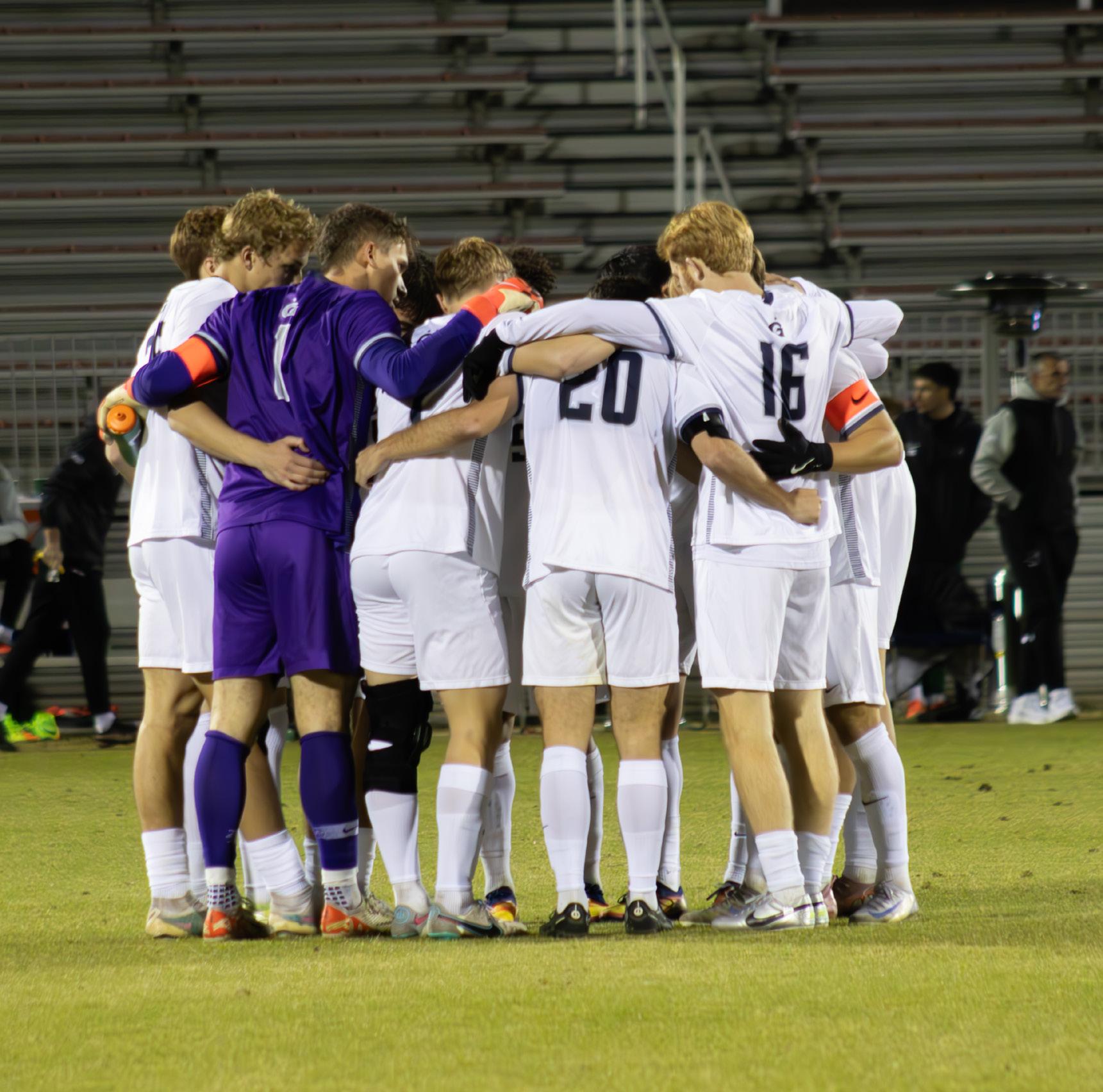
there’s any pressure,” Letayf said.
“It’s more of an honor that your teammates picked you to just take this role. I guess I wouldn’t be doing anything diferent if I had it or didn’t have it.”
For the past three seasons, despite holding the No. 4 seed in the tournament twice, the Hoyas have failed to progress past the round of 32. This year, the Hoyas shut out the University of Central Florida (11-7-3, 4-3-2 Sun Belt) in the round of 32 and took down High Point University (14-3-4, 7-0 Big South) in the Sweet 16. Barrios and Letayf both said
the round of 32, given the team’s performances in the last two seasons, came with a sizable amount of pressure.
“In terms of pressure, that round of 32 was the biggest one, because it was some wall we need to kind of break through, and once we did, now it’s just trying to fulfll our potential, and I think everyone’s doing the best they can to make sure that we do that,” Letayf said.
On Dec 5, the Hoyas will take on NC State University (14-2-4, 4-1-3 Atlantic Coast Conference) in the Elite 8, marking the team’s sixth Elite 8 appearance in program history and their frst since 2021. Letayf said he is confdent the team can capitalize on years of work and perform.
“This is the fruits of all our hard labor and work for, people sometimes say just the year, but for us, it really feels like it’s a process from when we frst got here,” Letayf said. “That’s why I feel like everyone is enjoying it so much, and the seniors’ happiness trickles down on the team, and that’s why we’re in such good spirits for this game. And we defnitely want to go all the way.”
Hoyas Blow Another Lead in Conference Opener
Jewett sufered a debilitating calf cramp with 4:07 to go. This incident stopped gameplay while trainers massaged her leg on the court, eventually carrying her of for further stretching. She was able to walk soon after. Then, a slew of timeouts disrupted Georgetown’s previous pace, and the points began to slip back towards Villanova. Attempts to foul for possession were plagued by painful turnovers and an inability to complete and make up much-needed points. These closing stages still featured 2 critical Villanova-to-Georgetown turnovers that kept them in the game. While anticipation stayed up, gameplay was disjointed in the last minutes due to the combination of injury, timeouts and fouls.
In the team’s other two losses this season to the University of
MEN’S SOCCER MEN’S
UMBC, from A12 to crawl back into the game. Cooley was forced to leave four of his starters (plus graduate guard Jeremiah Williams, who played more minutes than Abraham) for the rest of the game, as his defense struggled to put the game away.
The Retrievers were able to claw it back to a 3-score game, but no closer as the Hoyas wrapped up the win.
In the postgame press conference, Cooley was about as unsatisfed as one can be after a 90-point winning performance. He said Georgetown’s defense was problematic, and needs to be a point of emphasis going forward.
“I did not like our defensive intensity,” Cooley said. “The discipline side of our defense, I’m a little frustrated with. If you’re going to be an elite team — a tourna-
Maryland (10-0) and George Mason University (6-4, 1-0 Atlantic 10), the Hoyas blew fourth quarter leads. Head Coach Darnell Haney believed the area of weakness in the Big East opener came down to the third quarter.
Haney said the Hoyas’ loss to the Wildcats came down to failing to pay attention to details.
“Tonight we had to take care of business in the detailed areas: free throws, layups,” Haney told The Hoya. “I think at crucial times during this game we did not. We put ourselves in a hole in the third quarter and we had to fght out of that hole against a good team like Villanova; they just beat a top 25 team. We can’t do that.”
“We can’t have those little mishaps where we lose our focus for a second,” Haney added.
The Hoyas will return to action on the road Dec. 7 against Wake Forest University (9-1) at 2 p.m.
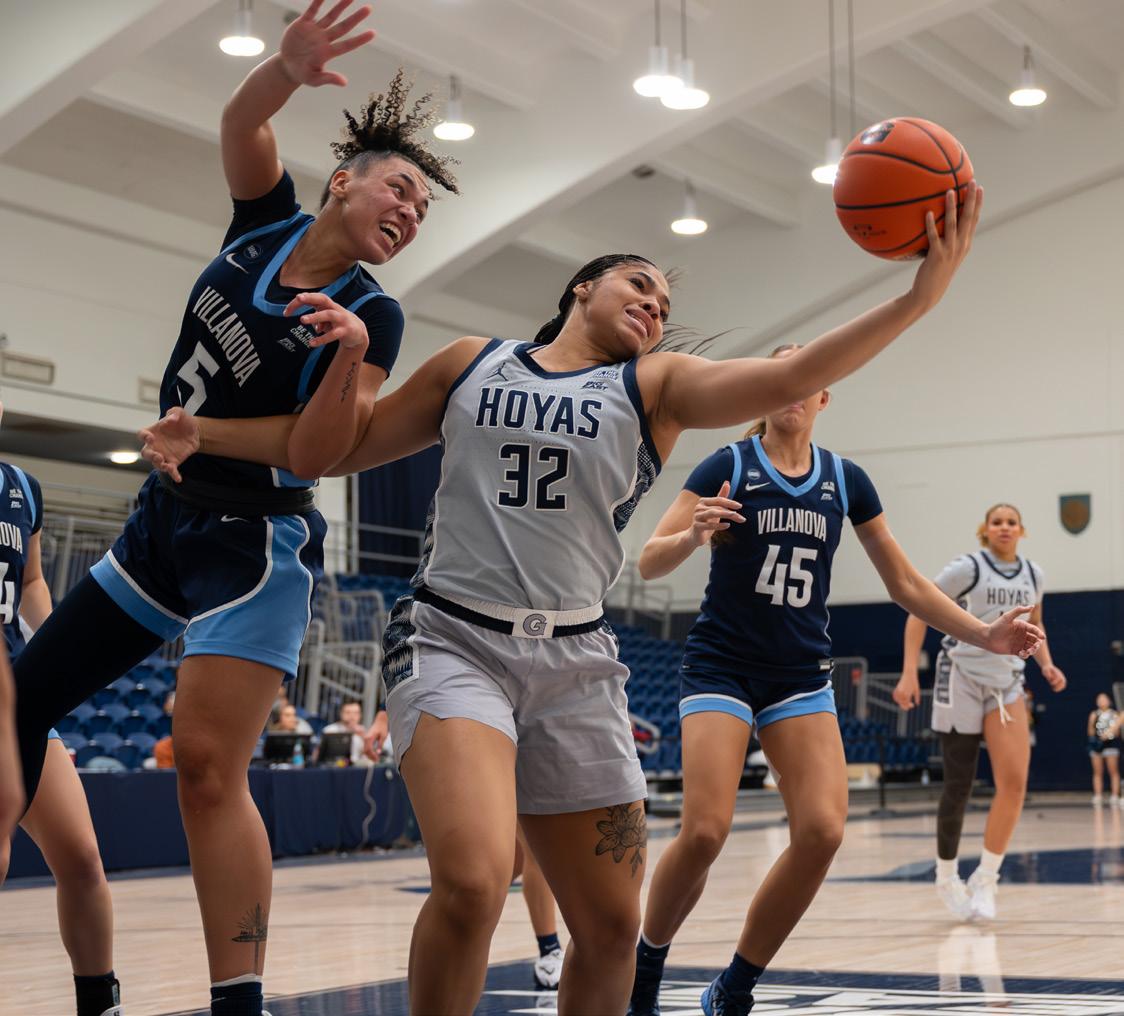
ment team — you need to be a disciplined defensive team, because ofensively, we are going to score.”
“We’ve got some things to address defensively,” Cooley added. “Practice is going to be very demanding over the next 48 hours with respect to defensive discipline and concentration.”
Cooley added that the rotation may begin to shift, as junior guard DeShawn Harris-Smith’s availability remains in doubt as he deals with an illness and graduate guard Langston Love continues to recover from myriad lower body injuries.
“I’m not saying, ‘I like this one. I like that one.’ I see fve Georgetown men out there competing the best they can,” Cooley told The Hoya. “Do what you got to do to win the game.”
The Hoyas next will head south for a challenging matchup against No. 16 University of North Caroli-
na (7-1) Sunday, Dec. 7 at 5 p.m. game. Cooley was forced to leave four of his starters (plus graduate guard Jeremiah Williams, who played more minutes than Abraham) for the rest of the game, as his defense struggled to put the game away.
The Retrievers were able to claw it back to a 3-score game, but no closer as the Hoyas wrapped up the win.
In the postgame press conference, Cooley was about as unsatisfied as one can be after a 90-point winning performance. He said Georgetown’s defense was problematic, and needs to be a point of emphasis going forward. “I did not like our defensive intensity,” Cooley said. “The discipline side of our defense, I’m a little frustrated with. If you’re going to be an elite team — a tournament team — you need to be a disciplined defensive
team, because ofensively, we are going to score.”
“We’ve got some things to address defensively,” Cooley added. “Practice is going to be very demanding over the next 48 hours with respect to defensive discipline and concentration.” Cooley added that the rotation may begin to shift, as junior guard DeShawn Harris-Smith’s availability remains in doubt as he deals with an illness and graduate guard Langston Love continues to recover from myriad lower body injuries.
“I’m not saying, ‘I like this one. I like that one.’ I see fve Georgetown men out there competing the best they can,” Cooley told The Hoya. “Do what you got to do to win the game.” The Hoyas next will
MATTHEW GASSOSO/THE HOYA
Barrios and Letayf, both captains, praised Georgetown men’s soccer’s team dynamics and their ability to work and grow together as a group.
MEGHAN HALL/THE HOYA
Georgetown women’s basketball has struggled to hold onto leads throughout this season, including against Villanova.

FRIDAY, DECEMBER 5, 2025
An undefeated, 10-0 conference season for Georgetown women’s soccer ended in disappointment after a Sweet 16 loss.
Slow Starts a Concern for Hoyas After Early Games
Nate Seidenstein Senior Sports Editor
The Georgetown University men’s basketball team had just about the worst Thanksgiving possible that didn’t involve inlaws. Competing in the ESPN Events Invitational Nov. 27 and 28, the Hoyas (6-2) dropped both of their games: an overtime thriller to Dayton and, in the words of Head Coach Ed Cooley, an “ass-whooping” to Miami. Both games had one key feature in common. At the under-16 media timeout, which comes at the frst clock stoppage after four minutes of play, Georgetown trailed by 8 points.
In fact, the Hoyas have been a remarkably slow-starting team throughout the season. Georgetown has taken a lead going into the under-16 in just half of their games and half of their buy games against signifcantly inferior competition.
Cooley charts his games in sections bookended by these media timeouts, which occur every 4 minutes, and calls each period a “war.” The base unit of analysis for a run of a play is the war. Theoretically, the team that wins the most wars is best placed to win the game.
Along these lines, the Georgetown coaching staf also tracks “cherries” — when the Hoyas force 3 turnovers on 3 consecutive possessions. The only game with a cherry in the frst war was that impressive start against Maryland, which put
See THE FIRST WAR, A11
TALKING POINTS
Pressure is a privilege. I want all the pressure.
Men’s Basketball Head Coach Ed Cooley
his dad play growing up.
The Georgetown University men’s soccer team leads the nation in scoring with 50 goals on the season, won both the Big East regular season and championship title, fnished conference play undefeated and currently sits just three wins away from a national title. The key to their success, according to their captains: team culture.
Senior midfelders Julian Barrios Cristales and Diego Letayf, this year’s captains, sat down with The Hoya earlier this week to explain the season so far and the team’s dynamic. This season marks Barrios’ frst year as captain and Letayf’s third. Both have helped lead the Hoyas to a 14-3-4 record so far and a No. 7 NCAA tournament seed. The cocaptains credit the character of their teammates and coaching staf for the team’s perennial success.
Barrios and Letayf both started playing soccer at age four and dream of playing professionally. The Hilltop is a perfect step on their pathway — last MLS season, Georgetown tallied 15 former players, the most out of any college. When men’s soccer players enter Georgetown, they are placed on a track to graduate in three and a half years, allowing them to be drafted into the MLS at the culmination of the collegiate career. All six seniors on the team will have graduated this month, and all look to play professionally. The program is designed to generate MLS players.
Family got both Barrios and Letayf into soccer. Letayf said his dad’s support helped him play soccer at Georgetown.
“It was my dad’s decision to move to the United States that really gave me all these opportunities,” Letayf told The Hoya
Barrios said his interest in soccer stemmed from watching
“He played too. He played goalie,” Barrios told The Hoya. “Just typical Sunday league stuf with his friends on the weekend, taking a break from work. He’d be the guy that would have the jerseys and me and my brother would be there on the sidelines, and we’d just watch, we’d just be with them.”
Growing up, both Barrios and Letayf constantly sought out opportunities to improve. Barrios played for a club team two hours from his home and later moved to Texas for a year and lived with a host family to continue playing at the highest level.
What ultimately led Barrios and Letayf to Georgetown was not the promise of success, but the people.
Letayf said he was lucky Georgetown Head Coach Brian Wiese looked at him during a game, and after talking with Georgetown, Letayf knew where he needed to be.
“It’s pretty clear that this is the place I wanted to be just because I was only prioritizing the staf
Villanova Comes Back to Win Big East Opener
Meghan Hall and Madeline Wang
Contributing Editor and Senior Sports Editor
The Georgetown University women’s basketball team gave away an early lead and fell 7669 to the Villanova University Wildcats in the Big East opener Dec. 4. The Hoyas’ ofensive performance wavered throughout the game, and their defense was weak in comparison to the well-oiled Wildcats, allowing Villanova to pick up points with quick, coordinated plays. The Hoyas kicked of the game on a 5-0 run and held a 5-point lead through the frst fve minutes of play. Throughout the rest of the frst quarter — and the second and third quarters — Georgetown (5-3, 0-1 Big East) was outscored by Villanova (7-2, 1-0 Big East). The Hoyas consistently kept it tight behind the Wildcats. In a departure from their other two losses, the Hoyas even outscored the Wildcats 25-22 in the fourth quarter, picking up momentum towards the end of the game. This early fourth-quarter energy was soured by injury and multiple timeouts as the quarter dragged on. Graduate forward Brianna Scott put up the frst points of the day, helping start the Georgetown lead of 9-4, which eventually fipped to 14-11 in Villanova’s favor by the end of the quarter. The Hoyas were outrun and outcommunicated
by the Wildcats, whose ability to push the pace left the Hoya defense on the back foot. Villanova kept their slight edge throughout the second quarter, pulling away from Georgetown during messier moments of the game. The Hoyas lost the ball to the Wildcats, with both senior guard Victoria Rivera and graduate guard Laila Jewett losing turnovers. These blunders, combined with strong 3-point conversions from Villanova, continued to make this an
away-dominated court. With 6 minutes left, the Wildcats had brought the score up to 21-15. During a quick second half of the quarter, sophomore guard Indya Davis made an impressive steal to counter Villanova, but the Wildcats extended their lead over the Hoyas to 32-25 after the frst 20 minutes of play. During the third quarter, graduate forward Chetanna Nweke opened with a basket, but the Hoyas began to show signs of fatigue while defend-
ing against Villanova’s quick ofense. This was refected in the score; the Wildcats put up their biggest lead of the game at 43-29 with 6:31 to go. By the end of the quarter, Georgetown brought it back down to only a 10-point lead, at 54-44 Villanova. The taste of a comeback motivated Georgetown, and the team managed to get back to a 6-point defcit in the fourth quarter, helped by two 3-pointers made by sophomore point guard Khadee Hession.
See VILLANOVA, A11
and their values, and they aligned with mine,” Letayf said. “That was literally the only thing that was going to make my decision. I didn’t even come visit or anything. I just really liked Wiese and the staf, and I just made my decision, and it ended up being the best decision of my life.”
Barrios echoed a similar sentiment about Wiese, saying Wiese’s care led him to be a Hoya.
“I had a call with Wiese on the frst day that recruiting opened up in the summer, and we just talked,” Barrios said. “We had a really good conversation. I really enjoyed our conversation. It was 50 minutes long. It was really personal. We talked a lot about soccer, we also talked about my family. He showed care for me, and I really liked them.”
“It was the best school, best soccer, and, by far, the best coaches. Real people, real personable people, and they still are that way,” Barrios added.
Barrios said the key to Wiese’s recruiting strategy is seeking out good people, with whom good performance becomes a given. “Recruit people frst and then, if they ft, he knows that as players they’ll ft and they’ll be given the shot and it will happen at some point,” Barrios said. “People frst, and then it just falls into place.”
Letayf said that his transition to Georgetown was easy, mainly due to the fact that the players are like-minded.“Guys are bought, and then they fall in love with this place, and they don’t want to leave,” Letayf said. This love for Georgetown translates on paper. Division I college soccer has an annual roster turnover rate of about 25 percent; throughout the seniors’ time on the team, only one player has transferred out, and one player has transferred in.
Nate Seidenstein Senior Sports Editor
After a disastrous Thanksgiving that saw Georgetown University men’s basketball tumble out of the tournament bubble, the Hoyas bounced back with a high-scoring 90-81 win over the UMBC Retrievers Dec. 3 at Capital One Arena. Georgetown (6-2) took the lead on the frst possession and never looked back, dominating University of Maryland, Baltimore County (5-3) on both ends of the court. The Hoyas racked up a season-high 25 assists against only 6 turnovers as excellent ball movement spread out the scoring. All fve Georgetown starters fnished with double-digit scoring and four — junior guards Malik Mack and KJ Lewis, sophomore forward Caleb Williams and sophomore center Julius Halaifonua — scored 15 or more points. Williams led the way for the Hoyas with 18 points, as well as 2 assists and 8 rebounds. Halaifonua contributed 4 assists — his Georgetown high and a crucial stat as he has become the team’s only reliable center option. Capital One Arena was near deserted, in a complete departure from the packed environment for the last home game, the Nov. 15 win over Clemson University. The student section began the game with under 15 members, and slowly ticked up to around 50 by the end of the game. A fnal
announced attendance of 3,436 left the cavernous arena quiet and less than a quarter full. Halaifanoa easily claimed the opening tip, and Georgetown immediately got to business on a paint jumper from Caleb Williams to open the scoring. The Hoyas played a seamless frst half that saw long unbroken runs of play, allowing them to open up an early lead over the Retrievers. For example, the under-12 timeout, which comes at the frst clock stoppage after 12:00 shows on the clock, was at 8:02. The Hoyas distributed the ball well all game — their 25 assists was a record high for Georgetown during Ed Cooley’s time at head coach, and their 6 turnovers their second-lowest this season. The Hoyas took that early lead into halftime, leading 45-37. After conceding a layup to Retrievers guard Jah’Likai King and a jumper to Retrievers forward Josh Odunowo to cut the defcit down to 4, the Hoyas went on a dominating 17-0 run, headlined by a nifty layup from sophomore forward Isaiah Abraham. Georgetown held UMBC around that distance, taking a 70-50 lead into the under-12 timeout. However, with 6 minutes left the Retrievers began to claw the game back. After switching to a full-court press, UMBC put together a couple strong possesions
PITTMAN/GEORGETOWN
Senior midfielders Diego Letayf (left) and Julian Barrios Cristales (right) sat down with The Hoya to discuss
on the Hilltop and their championship aspirations before they take on
berth in the College Cup on the line.
Madeline Wang Senior Sports Editor
See PROFILE, A11
WOMEN’S BASKEBALL
MEN’S BASKETBALL
MEN’S SOCCER
MEN’S BASKETBALL