NEWS
TUESDAY, NOVEMBER 8, 2011
THE HOYA
A9
Gala Raises Cancer Research Funds KELLY CHURCH Hoya Staff Writer
The Georgetown Lombardi Comprehensive Cancer Center brought its research fundraising total to over $18 million for the last 25 years at its 25th anniversary gala Saturday night. The gala, which included a dinner and award presentation, is a decades-old Lombardi Center tradition. Most of the gala’s proceeds come from the silent auction, where attendees can bid on a wide range of donated luxury items including vacations, art, wine and jewelry. Event co-chair Paul Schweitzer, who first became involved at Lombardi when his mother was treated there for breast cancer, has been attending the gala for the past 20 years. According to Schweitzer, though the layout of the gala has changed very little since its inception, each year it brings in larger donations. “We’ve attracted a younger crowd, every year we bring new people in,” he said, adding that this year the center is now using BidPal, an electronic bidding technology, to facilitate the donation process. This year’s special guest and honorary chair was DeMaurice Smith, executive director of the National Football League Players’ Association. Smith’s wife is a breast cancer survivor, as are the wives of several
of his friends and players. During his speech, Smith urged the audience to take out their BidPal devices and use the “make a donation” button. As members made donations, their names would appear on a screen next to the stage. Later in the evening, the center presented the Margaret L. Hodges Leadership award to Thomas and Elizabeth Donohue. The Donohues have a long history of working at the event, including serving as the co-chairs of the 2006 gala. According to Laurie Hodges Lapeyre, who presented the award, the event raised over $1.5 million dollars that year, the most successful night in the gala’s 25-year history. Every year the Hodges award is given to a Lombardi volunteer who has demonstrated leadership and made great philanthropic contributions. Named after the gala’s original director and Lapeyre’s mother, Margaret Hodges, the award celebrates her creation of the event to aid in the center’s fundraising efforts. But executive committee member Kim Baich said the event has been consistently well attended each year. “In spite of the economy, people still come out to support cancer research,” Baich said. “It speaks to leadership at Lombardi and talent and dedication of researchers, but also to the steadfast dedication to the cause that the D.C. community supports.”
Greig Campaign Slips In Donor Form Gaffe BETH GARBITELLI Hoya Staff Writer
Ward 2 city council candidate Fiona Greig mistakenly released an internal spreadsheet of campaign finances that classified one donor as “super wealthy” and another as “homosexual” on Sept. 30. The Georgetown Patch reported Friday that when Greig provided the District’s Office of Campaign Finance with a list of donors to her campaign, she additionally turned in this unofficial list of potential donors. Yet according to the Washington City Paper, the notes were made by a volunteer during a brainstorming session that included Greig. Georgetown Advisory Neighborhood Commission representative Jake Sticka (COL ’13) added that the incident should not affect Greig’s prospects for election. “This is an unfortunate event but it is important to note that it was a volunteer, and clearly an inexperienced one, that put this list together, not Ms. Greig herself,” he said. Campus campaign manager Craig Cassey (COL ’15) said that the Greig camp has faced significant backlash from the incident. “[Some are saying] she’s done with, and commenting ‘Rest In Peace,’” Cassey said. Regardless of the submitter, the comments have also prompted a
INDEX
harsh reaction from within the Georgetown community. Meghan Ferguson (COL ’15), coprogramming chair of GU Pride, said that she found the contents of the spreadsheet discouraging. “I am disheartened by the fact that Greig felt it was necessary to differentiate between heterosexual and homosexual donors because a person’s sexual orientation has nothing to do with the matter at hand,” she wrote in an email. According to the Patch, Greig issued an apology for the phrasing on the spreadsheet. “I convey my deepest and most sincere apologies for anyone who might take offense,” Greig said to the news outlet. “I have family members who are gay.” Cassey commended the apology. “Her choice to apologize is not a rookie move, but is what we would want to expect from an elected figure,” Cassey said. Sticka added that, while critics have focused on Greig’s spreadsheet blunder, discrepancies in the Evans camp have gone underreported. “I also think that if we’re discussing campaign finance, it is worth noting that Jack Evans has been far from perfect,” Sticka said. Fiona Greig could not be reached for comment and Jack Evans declined to comment on the incident.
CLASSIFIEDS
MISCELLANEOUS
800
The Hoya Classifieds LINE AD RATES Regular line classified ads are $0.50 per word. OPTIONAL EXTRAS
ADOPT: A dream is a wish your heart makes. Our wish is a child to love. 1-877-742-6556. www.richandmyriam. com
Bold words: $1.00 per issue. Make individual words or an entire ad stand out. Large headline: $1.50 per issue. One line of 16-point bold, centered and capitalized. Two-line large headline: $2.50 per issue. Boxed ad: $2.00 per issue. Add a one-point box around your ad. DEADLINES & PAYMENT Copy and payment must be received by 12 noon, one business day before publication. All classified ads must be paid in full at the time of placement. Visa, Mastercard, cash or personal checks are accepted. Cancelled ads may be removed from the paper if notification is made before deadline. No refunds will be given, but the unused portion of the payment will be held as a credit.
LEONEL DE VELEZ FOR THE HOYA
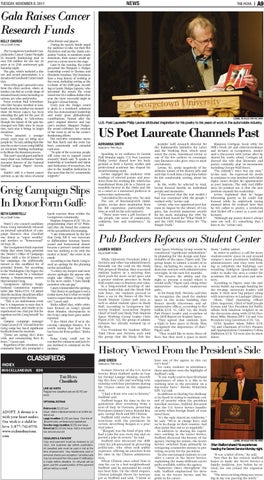
U.S. Poet Laureate Philip Levine attributed inspiration for his poetry to his years of work in the automobile industry.
US Poet Laureate Channels Past ADRIANNA SMITH Special to The Hoya
Speaking to an audience in Gaston Hall Monday night, U.S. Poet Laureate Philip Levine shared how his background as both a factory worker and professional academic has shaped his award-winning work. Levine engaged the audience with readings of selected poems and anecdotes from his working life, which has transformed from job in a Detroit automobile factory in the 1940s and 50s to a career as a renowned professor at universities nationwide. “I decided to live on my wits,” he said. The son of Russian-Jewish immigrants, Levine drew inspiration from his life experience, particularly his time at work in the auto industry. “Those years were a gift because of the people, the sense of community, solidarity, love and tenderness,” he said.
Jennifer Luff, research director for the Kalmanovitz Initiative for Labor and the Working Poor, which sponsored the event, introduced Levine as one of the few authors in contemporary literature who gives voice to modern laborers. Levine, 83, spoke negatively of the arduous nature of his factory jobs and said that it took him a long time before he felt comfortable writing about his past. In the works he selected to read, Levine focused heavily on individual people and memories. “I discovered that the real wealth I had was contained with the people I worked with,” Levine said. Levine, who was appointed poet laureate in August by the Library of Congress, has received numerous awards for his work, including the 1991 National Book Award for “What Work Is” and the 1995 Pulitzer Prize for “The Simple Truth.”
Maureen Corrigan, book critic for NPR’s Fresh Air and critic-in-residence and lecturer at Georgetown, moderated a discussion with Levine after he shared his works aloud. Corrigan addressed the role that literature and poetry currently play in movements including Occupy Wall Street. “I’m nobody’s voice but my own,” Levine said. He expressed his desire to continue to stay involved with labor rights issues despite his appointment as poet laureate. The only real difference, he pointed out, is that the new position expands his readership. Levine explained that he began rehearsing poetry so he could stay focused while he undertook taxing manual labor. He realized later that he felt called to poetry, a revelation that kicked off a career as a poet and lecturer. “Although my poetry doesn’t always turn out well, it’s something that I have to do,” Levine said.
Pub Backers Refocus on Student Center LAUREN WEBER Hoya Staff Writer
While University President John J. DeGioia and other top administrators formally cut the cord on the Healy Pub proposal Monday, they reassured student leaders in a meeting that their push for more social space and a greater student presence in Healy Hall could come to fruition over time. In a long-awaited meeting of university leadership and the Healy Pub task force, the students pressed to have a say in the future of the New South Student Center pub area as well as added student space in Healy Hall. According to Georgetown University Student Association Deputy Chief of Staff and Healy Pub Student Space Working Group Leader Chris Pigott (COL ’12), the group of administrators has already warmed up to the idea. Vice President for Student Affairs Todd Olson and DeGioia each told the group that the Healy Pub Stu-
dent Space Working Group would be considered “significant stakeholders” in planning for the design and functionality of the space, Pigott said. The group hopes to submit a model of its ideas, including its status as a student-run venture with administrative oversight, in the next few months. “We deserve the ability and the right to present a model where it would work,” Pigott said, citing other universities’ successful student-run pubs. As for Healy Hall, DeGioia said that he recognizes the need for student space in the iconic building that houses mostly classrooms and administrative offices, according to Fitz Lufkin (COL ’11, GRD ’12), the Healy Pub Project Leader and co-author of the 2010 Report on Student Space. “They agreed that students have a right to have space in Healy. They recognized the importance of that,” Pigott said. “They would like to move those offices, but they need a space to move
them,” Lufkin added. In order to address a call for more student-centric space in and around campus’s most prominent building, administrators said they were looking to refurbish the buildings surrounding Dahlgren Quadrangle in order to make the area a center for academic life and mission and ministry. According to Pigott, once the university builds up enough funding for the revamp, university leaders will make it their next big project along with renovations to Lauinger Library. Olson, Chief Operating Officer Chris Augostini, Chief of Staff Joseph Ferrara and Vice President for Public Affairs Erik Smulson weighed in on the discussion along with GUSA President Mike Meaney (SFS ’12) and Vice President Greg Laverriere (COL ’12). GUSA Speaker Adam Talbot (COL ’12) and Chairman of GUSA’s Finance and Appropriations Committee Colton Malkerson (COL ’13) were also in attendance.
History Viewed From the President’s Side JAKE GREEN
Special to The Hoya
Former Director of the U.S. Secret Service Brian Stafford spoke in Copley Formal Lounge Monday, describing the close calls and working relationship with four presidents during his 33-year career in the organization. “I had a front row seat to history,” Stafford said. Stafford began his time in the organization after returning from a tour of duty in Vietnam, protecting Presidents Jimmy Carter, Ronald Reagan, George Bush and Bill Clinton. Stafford told stories about his interactions with the presidents he served, describing Reagan as a practical joker. “[Reagan] was the kind of guy who had a joke for you every day and expected a joke in return,” he said. Stafford also discussed the difficulty his job presented in protecting politicians, who often seek public exposure, offering an anecdote from his time in the Clinton administration. When Clinton once asked him to stop his car in a bad neighborhood, Stafford said he pretended he could not hear him. On the third request, Clinton jokingly threw his newspaper at Stafford and said, “I know at
least one of the agents in this car isn’t deaf.” For some students in attendance, these anecdotes were the highlight of Stafford’s talk. “It was really cool to hear firsthand experiences of what it is like to be working next to the president on a day-to-day basis,” Brooke Heinichen (SFS ’12) said. In addition to sharing the challenges he faced in trying to maintain control of security when the president travelled overseas, Stafford discussed that the U.S. Secret Service handles security when foreign heads of state travel here. “It’s the ugly American syndrome,” he said. “We’re in charge here, and we’re in charge in their country. And they point that out to us regularly.” In addition to sharing his experience working in the Secret Service, Stafford discussed the history of the agency. During his tenure, the Secret Service switched from primarily investigating counterfeit money to providing security for the president. He also encouraged students to consider a career in the Secret Service, explaining the many different career paths available within the agency. Numerous times throughout the talk, Stafford emphasized his devotion to the Secret Service and his pride in his career.
LEONEL DE VELEZ FOR THE HOYA
Brian Stafford shared his experiences heading the Secret Service Monday night. “It was a labor of love,” he said. Now that he has retired, Stafford hopes to make the Secret Service a family tradition. Just before he retired, his son joined the organization. “The most exciting thing was swearing in my son, passing the torch.”