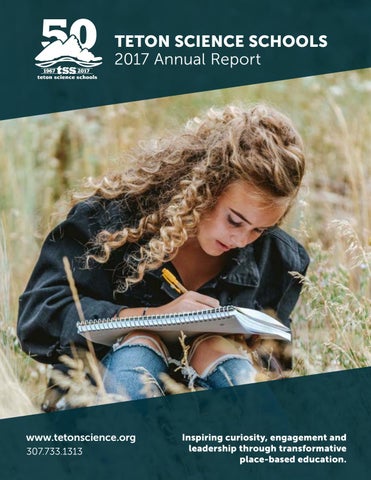
TETON SCIENCE SCHOOLS 2017 Annual Report
www.tetonscience.org 307.733.1313
Inspiring curiosity, engagement and leadership through transformative place-based education.
THE IMPACT OF TETON SCIENCE SCHOOLS 2016-2017 FISCAL YEAR
15,364
2
Students served by TSS programs nationally
Age of youngest student
96,834
90
Student days of place-based education
Age of oldest student
$1,878,882
5,901
Scholarships given across TSS programs
Wyoming students served by TSS programs
2,388
People who participated in docent tours at The Murie Ranch
100%
Board giving • Staff giving • Journeys School and Teton Valley Community School family giving
50
Years of inspiring curiosity, engagement and leadership through transformative place-based education.
BOARD OF DIRECTORS - TETON SCIENCE SCHOOLS Officers: Chair Joohee Muromcew
Treasurer Will MacNaughton
Secretary Jack Livingood
Board Members: Dana Scott Andersson • Phil Coosaia • Gordon Finnegan • Marina Marrelli • Rob Wallace Kristie Wade • Nancy Leon • Len Purkis • Dave Brown • Margot Watters • Kate Muir Welsh Emeritus: Shelby Davis • Addie Donnan • Ralph and Louise Haberfeld • Dick Jones • Jean Jorgensen Clarke A. Nelson • Jack Nunn • Gilman Ordway • Bob Smith, Ph.D. • Margot Snowdon David Stokes • Richard Sugden, M.D. • Christy Walton Ex-Officio: Vickie Mates, Sylvia Parker Founders: Ted & Joan Major 2
Chris Agnew Executive Director
In our 50th anniversary year, we honored and celebrated both our history at Teton Science Schools (TSS) and our vision for the future. From our beginnings as a small field science school, we have evolved to be at the nexus of field education, classroom education and educator development. Kicking off our 50th year, the TSS Board of Directors culminated an almost yearlong process in passing a clear and unified mission statement representing the organization we are today: Inspiring curiosity, engagement and leadership through transformative place-based education. At this pivotal time in education, TSS brings wisdom of 50 years leading the integration of the formal and informal education sectors. Place-based education increases student engagement, learner outcomes and community impact. Our aligned place-based educational approach, principles of community leadership and intentional culture enable relevant TSS student learning regardless of whether it’s in a classroom, in the community or in nature.
In addition to our updated mission, we launched our three-year OneTSS strategic plan at the beginning of our 50th summer. In the following pages you will find our priorities to invest in our faculty, improve our technology, engage our communities and to better serve all students, regardless of background. More importantly, you will read student stories of immersive learning opportunities in the natural world, in their communities and training others to do the same. These stories make personal the almost 20,000 people impacted by Teton Science Schools in the previous year. Our outcomes in the 2016-2017 fiscal year demonstrate that we can build for the future, create a habit of sustainable financial performance and deliver high-quality learning outcomes for all of our students. We entered our 50th year with growing momentum and are now beginning to hit our stride. Thank you for joining us as we inspire and engage leaders and learners investing in their communities and the natural world.
3
Former Secretary of the Interior Sally Jewell addresses the crowd at the TSS 50th Anniversary event in August.
4
Strategic Plan
OneTSS Three-Year Strategic Plan
Our strategic plan is composed of five goals across three years. Under each goal is a list of three to four drivers that enable achievement of the stated goal.
Extraordinary Student & Participant Outcomes
Learner centered place-based education Measurement and assessment Innovation
Outstanding Team
Employee & Board leadership Compensation & benefits Professional development Housing Community Engagement
Financial Strength & Operating Systems
Marketing process improvement Data informed decision making Improved financial position
Diversity, Equity & Inclusion
Exemplify place-based education
Curriculum and professional development
The TSS story
Systems
Alumni engagement
Access and representation
5
Inspiring curiosity, engagement and leadership through transformative place-based education.
EC OL OG
Y OM ON EC
Y
Place-Based Education
PLACE CULTURE
Our approach is place-based, connecting classrooms and communities to increase engagement, learning and community impact.
Self
Community
World
Programs
6
Classroom Education
Field Education
Educator Development
Journeys School
Wildlife Expeditions
Graduate Program
Teton Valley Community School
Field Education Programs
Teacher Learning Center
Place Network
Jackson Hole Science Expeditions students spend the day collecting data samples for a study of macroinvertebrates in local streams. Inquiry-based research leads to the most positive gains for students and positively influences attitudes about science and self-efficacy. 7
Inspiring Curiosity
Exploration at R Park Leads Pre-Kindergarten Students to a Special Discovery These students didn’t expect to find dinosaur bones, but when they did, they revealed a unique awareness of conservation and stewardship.
During one journey to the R Park, a teacher decided to bring one of these dinosaur bones back to the classroom for further study. When the students saw the bone, their reaction was strong and united: “We should have left that dinosaur bone there!”
To be a teacher at the Journeys School Pre-Kindergarten, you have to leave rigid lesson plans at the door. Unlike many other programs, this pre-kindergarten program is place-based and inspired by the unique philosophies of the Reggio Emilia approach. In simplest terms, students’ interests drive the curriculum. Curiosity reigns supreme and leads every class down a distinctive path. Last year, that path led students to the R Park, over and over again. The original theme of the R Park journey was “exploration of special places”; however, some time spent in a wooded area of the park resulted in a curriculum-altering discovery—a bone. After discussing what kind of bone it was, they decided it was a dinosaur bone.
“Yeah! So other people could see it! People want to see dinosaur bones!” “We should bring it back to the R Park!” During the next R Park journey, the dinosaur bone was returned to its original location. Today, if you look closely, you will find a bone with a special note crafted by last spring’s pre-kindergarten class reminding R Park visitors to leave what they find. Through curiosity and exploration, these children developed an awareness of conservation and stewardship. You can now find permanent documentation in the pre-k classroom that reads “Take only pictures. Leave only footprints.”
8
Inspiring Curiosity
A Week I Will Never Forget When I read about an adventure to “Greater Yellowstone in Winter” to view the wildlife and learn about the outstanding ecosystem, I got excited. It was a trip conducted by Teton Science Schools Wildlife Expeditions and their Houston Zoo Education and Conservation partner. For many reasons, I knew it was something I had to do. As a serious photographer, I envisioned capturing the beauty of the region and the wildlife that wintered there. So, on February 2, 2017, I boarded a plane to Bozeman, Montana for a week I will never forget. Seeing Old Faithful, the other geysers and hot springs in winter was awesome. Everywhere I looked, there was a picture to be taken. And I took many, despite the fact that most days were cloudy and snowy. Winter weather can be challenging; this week, it only added to the adventure.
Winter reflections from a Wildlife Expeditions participant In retrospect, I view this trip as one that changed my life. I look at my photographs and am transported back to the peacefulness and beauty of the Yellowstone region. I take a deep breath, close my eyes and remember the cold, clean, fresh air. I focus on the quiet I found there and am less stressed. Instead of listening to the noisy media and tech world that constantly bombards us, I now think about the magnificence of this part of our country and its incredible wildlife. I can’t wait to return. -Sue Cruver, Photographer and Wildlife Expeditions participant through the Houston Zoo
Photo By: Sue Cruver
Alumni Reflection “In 4th grade, I attended Teton Science Schools and it rocked my world. We explored, we got messy, we learned and we tried new things. I credit that experience as being the catalyst for my love and pursuit of science. The program was a bit smaller back then, but they have continued to inspire curiosity, engagement and leadership through transformative place-based education.”
Anne Galyean Staff Scientist at Intertox, Inc 9
Inspiring Engagement
Teacher Learning Center Workshop Inspires Math Teacher to Invigorate Curriculum
Students master sixth grade math by engaging with their community. Connie Mohr is a sixth grade math teacher in Driggs, Idaho. Two years ago, Connie seized a quiet moment to observe her class and thought “This could be better. This could be more engaging.” Connie’s desire for innovation led her to a Teacher Learning Center workshop at Teton Science Schools, where she learned about placebased education and the benefits of embedding curriculum in local community. After attending the workshop, Connie’s math curriculum came to life.
Last spring, Connie Mohr’s sixth graders imagined a new aquatic center for Teton Valley, Idaho. Her classes sent out a survey and met with community leaders to understand how ideas become reality. In the classroom, Connie helped her students use algebra, ratio reasoning and geometry to create scaled models of the proposed aquatic center. When the models were complete, Teton Valley Aquatic committee members reviewed the projects, provided feedback and gifted awards. As Connie cleaned up her classroom at the end of the year, the desks were covered with student models of the aquatic center. “This project was a lot of work,” she said, “both for me and for the students. But it was worth it. My students were engaged, comprehended the material and connected to leaders in their community. It was an outcome that’s worth the extra effort from me.”
Alumni Reflection
10
“I came to the United States from Tokyo to pursue my dream to become an environmental educator. Teton Science Schools was where I landed. Eighteen years has passed since then, and I still reflect back on the fundamental lessons I learned from that time when teaching my students. Without Teton Science Schools, I wouldn’t be where I am today.”
Miho Aida Educator, Equity and Inclusion Coordinator at NatureBridge. Founder and Filmmaker at If She Can Do It, You Can Too.
Inspiring Engagement
TSS History Built on Major and Murie Legacy Fifty years later, these legacies have merged and grown. When Ted and Joan Major started Teton Science Schools in 1967, their goal was to teach science in nature. They knew that if their students learned about a plant and had the ability to touch, smell and see the actual plant, they would be more engaged. Ted and Joan Major were not the only thought leaders who knew that learning in nature was important. Just miles away, Olaus and Mardy Murie were researching, writing and working hard to pass the Wilderness Act, which was signed into legislation in 1964.
Today, The Murie Ranch is a place where Teton Science Schools’ mission is exemplified on a daily basis. Visitors arrive at the ranch, curious about its origin and purpose, and are greeted by Docent Dan. Dan’s daily tours take visitors on an engaging journey through Murie history as he brings the homestead to life with anecdotes and stories. Throughout the summer, Front Porch Conversations at Mardy’s cabin provide an opportunity to discuss themes of conservation and placebased education. The Muries and Majors started their work separately, but their legacies have merged and grown into an organization whose mission is to inspire the qualities that they held dear—curiosity, engagement and leadership. Teton Science Schools’ future will continue to honor that important legacy.
Olaus and Mardy’s tireless work was not just about conservation; they were passionate about protecting land so future generations could feel the profound effect of the natural world for centuries to come. Olaus famously wrote, “We are all whirling with the earth together. And reaching out to the young generation coming along is one of the most important tasks.”
11
Inspiring Leadership
New Head of School leads Teton Valley Community School Michelle Heaton’s experience and passion for place-based education brings new life to TVCS. “The moment I walked on campus, I had goosebumps. I knew this where I was supposed to be.” Michelle Heaton, the new Teton Valley Community School Head of School, sits at her desk with ease and laughs at the lazy school cat sleeping in the corner. It is clear that her hard work has brought her to a place that truly fits. Michelle’s journey to Teton Valley started during college. As an Assistant Program Director for Adventures Cross Country, she was tasked with scouting the best places to operate program. When she saw the Tetons for the first time, she felt an immediate connection to the area. After graduating, Michelle made her way to Kelly, Wyoming and had the unique opportunity to join the inaugural cohort of Teton Science Schools’ Graduate Program.
12
“During my time on the Kelly Campus, I learned about the power of place. When you can connect students to their surroundings, they learn in a profound way.” Michelle went on to work for NOLS, TSS Field Education and eventually moved to the Boston area to get her Masters in Education. Now, after 18 years as a teacher and school administrator in New England, Michelle has returned to the Tetons with her husband, Gardner, and three children, Owen, Winter and Jackson. “Until now, my career has been a dichotomy of experiential learning and more traditional classroom learning. I’ve been looking for a way to have both—I believe that one doesn’t have to happen at the expense of another. Being Head of School at Teton Valley Community School is a dream job. ”
Inspiring Leadership
Place Network Makes Place-Based Education Accessible to Rural Communities When we combine rural challenges with place-based practices, a school model emerges to benefit both students and teachers across the country. Drive through many rural towns in the United States and you’re bound to see a small public school building—either open or shut down. These schools, significantly reduced in numbers over the past 100 years, play a key role in the survival of rural communities. In turn, rural areas are integral in providing resources and balance to our urbanized world. Despite that importance, these schools struggle. Teacher recruitment, access to innovation, funding disparities, isolation and community decline have left many of these schools trying to find new ways to allow students to thrive.
Over the past two years, the TSS Education and Innovation department visited many of these schools to meet with teachers and administrators. Based on these conversations, it is clear that placebased education is central to transformation efforts. By putting place at the center of learning, we hope to increase student and teacher engagement, academic outcomes and community impact. When we address rural education challenges with place-based practices, a school model emerges to benefit both students and teachers. With early stage funding from the J.A. and Kathryn Albertson Family Foundation and New Schools Venture Fund, we have designed the Place Network. The Place Network consists of a K-12 learning model for existing schools, an online school and a virtual professional development platform. The network’s breadth and accessibility breaks down barriers to innovation, technology and educator development. With the recent launch of the Place Network, place-based education is more accessible than ever. Through this multifaceted network, rural schools can accelerate school transformation and support community vitality in rural America.
Alumni Reflection
Hector Jackson Hole Science Expeditions student
“Thank you for this opportunity that has changed my life. Here, I found knowledge, I found friendship and I found the most beautiful views. I’m so glad to be here and to bring all of my new outlooks back to Vizcaino, Mexico—I’m different now. They told me to write one highlight from the month but trust me, I can’t. The whole month was my highlight.”
13
Summary of Finances and Enrollment
Statement of Financial Position (Unaudited) ASSETS Cash & Cash Equivalents
Ending May 31, 2017
Ending May 31, 2016
$436,613
$132,197
Accounts Receivable
625,992
556,511
Inventory & Prepaid Expenses
142,982
284,716
Investments
19,201,867
17,781,818
Property & Equipment (net)
33,678,993
34,083,264
$54,086,447
$52,838,506
Accounts Payable
$490,187
$401,607
Accrued Expenses
393,546
423,289
Course Deposits
1,397,817
1,208,719
Notes Payable
1,869,091
2,657,711
Total Liabilities
$4,150,641
$4,691,326
Net Assets
49,935,806
48,147,180
$54,086,447
$52,838,506
STUDENTS
STUDENT DAYS
SCHOLARSHIP DOLLARS
Field Education AmeriCorps Service Members
8,339 44
33,560 3,989
$328,357 N/A
Wildlife Expeditions
5,405
$126
Graduate Program
3,881 17
5,610
$72,940
Teacher Learning Center Workshops & Outreach
2,169
4,299
$306,488
217
417
N/A
163
28,525
$1,082,841
89
485
N/A
83
14,059
$86,447
362
485
$1,683
15,364
96,834
$1,878,882
Visitors
Visitor Days
2,817
2,817
Attendees
Attendee Days
1,560
5,493
Total Assets LIABILITIES & NET ASSETS Liabilities
Total Liabilities & Net Assets
Teton Science Schools Enrollment 2016-2017 PROGRAM
Consulting Journeys School School Year Summer Teton Valley Community School School Year Summer Total
Total Visitors (programs < 2 hours)
*includes Murie Ranch tours Total Attendees (through facility rentals)
14
71% Support & Revenue
PROGRAM TUITION & FEES
21% CONTRIBUTIONS
6% INVESTMENT INCOME
2% OTHER INCOME
85% PROGRAM SERVICES
10% MANAGEMENT & OPERATIONS
5%
Expenses
FUNDRAISING
Statement of Activity - Unrestricted Operating Fund (Unaudited) SUPPORT & REVENUE
Ending May 31, 2017
Ending May 31, 2016
Program Tuition & Fees
$10,760,044
$10,374,326
3,135,045
2,573,412
859,676 390,628
759,723 321,512
$15,145,393
$14,028,973
$11,962,966
$11,655,044
1,444,711
1,419,557
601,128
483,714
$14,008,805
$13,558,315
$1,141,432
$444,609
-$4,844
$26,049
Contributions Investment Income Other Income Total Support & Revenue EXPENSES Program Services Management & Operations Fundraising Total Expenses Capital Investments Net Surplus (Deficit)
15
www.tetonscience.org 307.733.1313
700 COYOTE CANYON ROAD JACKSON, WY 83001
Printed on 100% recycled content, 50% post-consumer waste, processed chlorine free paper. Teton Science Schools is a private, 501(c)(3) nonprofit educational organization operating year-round in Jackson Hole, Wyoming and Teton Valley, Idaho. Teton Science Schools does not discriminate on the basis of race, gender, creed or sexual orientation in any of its policies or programs.