

Gi Grieco
Gi Grieco
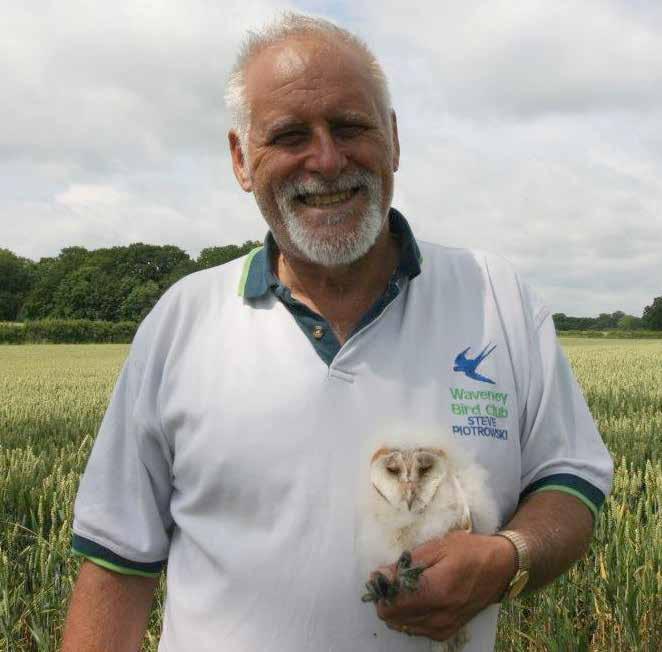
Welcome to The Harrier. This edition is a poignant one as we remember a great ambassador of Suffolk bird life, Steve Piotrowski. Steve has been pivotal in all aspects of Suffolk birding and of Suffolk Bird Group, achieving recognition from far and wide for the impact he has had. Within the group, Steve had many roles from Chair to the magazine editor, leading many field trips and not forgetting 14 years as the Honorary President. A writer of SBG publications such as Easy Birdwatching and Easy Birdwatching Again – looking at access to the countryside well before it became more commonplace. His other books include The Birds of Suffolk published in 1993 and The Butterflies of Suffolk. He was also editor of the Suffolk Bird Report for a few years and was a regular participant on the Suffolk Ornithological Records Committee, including being Chair. On our recent field trip to Gibraltar Point, the current bird observatory warden knew Steve well as a link between the ringing observatories, and remarked what a sad loss it was for the birding community. Steve’s association with ringing and the setting up of Landguard Observatory was another highlight of his remarkable life.
We have an update from Sally Nelson on BOSS. One of the main aims of BOSS is to build on the inspirational legacy of Steve and SCBOP and the continuation to help Barn Owls in the county. The projects the group are
involved in wouldn’t be possible without all the wonderful volunteers who dedicate their time to helping birds. One such person is SBG member, John Turner, who has done sterling work making nest boxes not only for Swifts to help the SoSS project but also for other species that require our assistance.
We have a nice selection of trip reports, some of which are from new sites. They also highlight how the group can be out in all weather conditions – we are a hardy bunch! Members have already discussed potential trips for next year so please also get in touch with any idea for where the group could visit.
We have our regular bird review section - a reminder that Suffolk bird news is reported daily on the SBG website, visit https://www. suffolkbirdgroup.org/latest-bird-sightings.
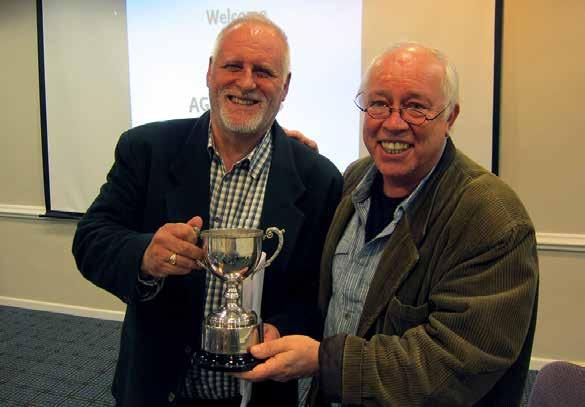
Steve Piotrowski: In his own words with an introduction by John Grant
When Steve Piotrowski passed away peacefully and in the company of loved ones at his home in Bungay on June 17, at the age of 72, the birding community lost a towering figure who did so much to benefit nature and nature lovers that it is virtually impossible to fully quantify his remarkable achievements.
A founder of Landguard Bird Observatory, a major player in the fight against the 1980s expansion of the Port of Felixstowe, and hence largely responsible for the creation of Trimley Marshes in mitigation, founder of the Suffolk Community Barn Owl Project, a driving force behind the Suffolk Ornithologists’ (Bird) Group for decades, author of The Birds of Suffolk and other nature titles, founder of Waveney Bird Club, a prolific ringer and ringing trainer, an educator of thousands for the BTO and the Field Studies Council, founder of a professional ecological and bird tours company...the list goes on and on.
Steve’s drive and energy astonished all who knew him. His achievements for nature - such as his late-in-life twin projects the Access for All boardwalk at RSPB Minsmere and the impressive Swift Tower at the Eel’s Foot Inn at Eastbridge - stand among his symbols of a legacy most of us will come nowhere near to matching. But for those of us lucky enough to have counted Steve as a close friend, those achievements were matched by his warmth of personality, his generosity, his compassion and his sense of fun. Maybe a rough diamond in some ways, but certainly a diamond nevertheless.
Over our 46 years of treasured friendship, Steve frequently called upon me to check through his writings. In his final weeks, he gained great solace from the rigours of his difficult present by delving back into his rich and varied past. He had a remarkable memory - and he had a remarkable bank of memories to look back on, leading such a full and active life as he had.
He wrote some of these memories down in the form of what was to have been a selfpublished memoir, and passed them on to me to sub-edit. Sadly, his life ended before he completed his task. His illness, so bravely confronted with exemplary courage, finally took its inevitable toll. These final writings, the early stages of his memoirs, are reproduced here in tribute to a wonderful life so well lived. They offer just a little insight into the immense humour, warmth, humanity and sheer fun he exuded so readily and to so many.
I’ve had a keen interest in natural history since birth. I was brought up in a workingclass background and, living so close to idyllic countryside to the south of Ipswich, my mother used to take me, my brother Adrian and sister Denese on nature walks – Denese would have been a babe in arms, still in her pram. I can remember one day searching hedgerows in Belstead village –one of my favourite childhood haunts. My six-year old cousin Trevor was visiting from Stowmarket for the day – I was five years old then. Whilst mum searched the ditches, showing us primroses and violets (her favourite flower), we were peering through every branch of the hedgerows searching for the shadowy signs of birds’ nests. I think it was Trevor who found our first occupied nest. It belonged to a Hedge Sparrow or Hedge Betty as it was then known. Its modern name, the Dunnock, doesn’t sound so quite appealing. I was so intrigued by those vivid blue eggs – what a colour, but such bad camouflage. Mum, noticing my keen interest in birds, bought me my first ever bird book. It was the Ladybird Book of British Birds and Their Eggs. It contained some amazing colour plates by Allen W Sewby, but what fascinated me were the minute illustrations of bird’s eggs in the bottom left-hand corner of each page. As a little boy, I learnt a lot from this book. For example, under Yellowhammer it listed: “a little bit of bread and no cheese” as a little
ditty to help beginners remember their song. My next book was the Observer’s Book of Birds’ Eggs, thereafter known as “The Book” by all our male egg-collecting primary school class chums – nearly every boy owned a little collection, usually hidden in a cardboard box under the bed! Birds were so plentiful in the mid-1950s that schoolboy collecting hardly posed a threat to local populations. We used to swap our birds’ eggs for stamps – philately was also a then very popular hobby.
My brother Adrian had an interest in birds, but I had the passion (I don’t like the word obsession – it sounds a bit cranky!). On rainy days, we would watch Song Thrushes digging for worms on our rather spacious lawn at the back of our council house and convinced ourselves that the more we tapped at on the window pane, the greater our birds would focus, thinking it was a worm they could hear moving through the wet soil. Bird-nesting gave me a perfect foundation into ornithology. Even now, I can tell you the number of broods, and the height of the nest from ground, which birds are ground-nesters, hole-nesters, platforms, cups, nesting material, etc. I used to know the average first egg-laying date of every species, but climate change has put paid to that. “The Book” says that Magpies and Long-tailed Tits lay their first eggs in April and Tawny Owls in March. However, we
know that clutches are now complete at least one month earlier. To a young boy, seeing those amazing illustrations of birds painstakingly painted so exotically made me think that they were just pictures in books - birds that I would never see! Full breeding plumaged males were invariably placed facing left to right at the front of the plate, hiding those scruffy old females and immatures in the background. And what are you more likely to see on autumn passage? Females or immatures!
Many of Suffolk’s birds that were seldom seen by me frequented specialist habitats. For example, scores of Redshanks nested prolifically on estuarine saltings, but I hadn’t a clue that they were breeding there. And who would have thought that I had collected a Red-backed Shrike egg before ever seeing a Red-backed Shrike. Most of the boys had one in their collection as there were plenty around the Belstead Brook area and their nests were clumpy and easy to find by us short guys peering skywards through the hedges. My bird-nesting experiences were greatly enhanced by the presence of Eric (D’Weasel) Patrick. He was a very near close neighbour. Eric was always weaselling around and he taught me so much about nature. We spent many days walking the leafy lanes around the Chantry area and we found all sorts. More recently, Eric met the lovely “Linderella” by accident at an evening bird club event. He was very keen to introduce her to all of us. One of the questions she asked me was how long had I known Eric. I told her that he first took me out when I was seven years old. He was a great companion, taking me out, buying me sweets etc. My mum wasn’t too pleased about it as he was 36 at the time LOL! Linderella instantly poked him in the chest and shouted “Pervert!”. Needless to say, this is one of my many jokes at Eric’s expense! Together we scoured every wood, every pond for wildlife. Duffle coats were all rage
at the time and we would think nothing of coming home with a pocket full of frog spawn - which, we would rehome in our hastily built home ponds.
Football and Granty
Football was another great passion of mine. England won the World Cup in 1966 (lest we ever forget!) and Ipswich, our local team, was doing quite well in the late 1960s. May 5, 1968, will live long in my memory. It was the last game of the season with Ipswich playing Portsmouth at Fratton Park. My team had already secured promotion to the then Division 1 but, if we beat or drew with Portsmouth, we went up as champions and if Portsmouth beat us they were promoted too, with us second. If they lost QPR went up instead of Portsmouth. It was an exciting game to say the least and Ipswich did the job, beating Pompey 2-1 with two identical John O’Rourke headed goals. At the end of the game, the bulk of the Ipswich contingent were on the pitch celebrating, but unbeknown to me, one of my best and most loyal friends John (Granty) Grant was bellowing abuse from the stands. Neither of us knew we would become such great friends in the future!
John was (and still is) an obsessive Pompey supporter and, after his move to Suffolk, we spent countless birdwatching experiences that included tours to The Outer Hebrides (twice), Shetland and Spain. Would you have ever believed that fateful (for him anyway) encounter that would lead to such a long and harmonious friendship? He later officiated as my Best Man during my marriage to Kathy in 2007. North of the border, after leaving school, I drifted away from birding a bit, but still maintained an active interest in our fine feathered friends. There was college, work and workmates, girlfriends, marriage and then children. We were fortunate in raising three boys: Mark (now a nurse practitioner); Andrew (an
accountant) and John (an electronics expert). I’m so proud of all three of them. So there was little teenage birding for me in the mid1960s, which is a pity as I would have loved to have been active during the Great Fall of 1965.
Early birding trips
I was an irregular attendee to our local youth club and often walked home with Eric D’Weasel, when he would reminisce about the birds he had seen on recent jaunts with his friend to the Lake District. Together, they had located Ravens’ nests and seen Peregrines …… Ravens, Peregrines - I hadn’t seen either, to me they were just pictures in a book! D’Weasel’s front door was less than 100 yards from mine in the same culde-sac, so we had many, many discussions about birds. I was tempted to join them on an ill-fated trip to Scotland. This was to be the first of many trips there. It was an early Easter that year and snow still laid on the ground as we left home. D’Weasel told me that his friend had a relatively new silver “G-Reg” Opel. When the car arrived, it most obviously wasn’t new. It was an old “forces” car that had been recently shipped over from Germany and re-registered. It was a wreck. It had already been involved in an accident during their most-recent trip to the Lake District and a sheet of polyethylene had been sellotaped to the passenger side window. We made fairly good progress, but as we were driving down Princes Street in Edinburgh, smoke started to bellow from the dashboard. “Get behind the wheel”, his friend declared and then up came the bonnet. With pliers in hand, he said “lights” – ah all OK. Indicators – at this point a wire glowed red. A sudden snip, bonnet down then “Come on – they don’t call me a mechanic for nothing you know.” The rest of the trip was quite uneventful, although we hadn’t a clue what we were doing. I can remember watching the biggest Capercaillie leks that I saw on the mossy slopes of Glen Affric.
It was on our way home that things started to get bad again. The car’s clutch had slipped on several occasions on the way up, but was getting increasingly worse. Also, when we turned on the headlights, they didn’t work but they were very much needed as we had started our return journey in the dark. A screwdriver came out of the toolbox to our rescue and our “mechanic” started to switch fuses in the fuse box. He broke most of them, so the only electrics left were the ignition and the cigar lighter! Some mechanic after all! The car coughed and spluttered its way down the A9 and we drove slowly, gingerly and painfully slowly through towns and villages. As we went through East Lothian, we encountered a roundabout. There was no traffic anywhere nearby, but two elderly ladies were keen to admire the view and stepped out in front of us. I won’t repeat the expletives here, but the air was blue. The car was now at full revs attempting to negotiate a shallow incline at no more than 10mph, and we knew that its time was up and it had to be abandoned.
There was some discussion as to how we were going to get back to Suffolk. We decided to hitchhike back and, as I was only a partial acquaintance with D’Weasel’s friend, thought it best that the two of them hitched first. I would follow once the A-Team had gained their first lift. There were also worries about abandoning the vehicle. We thought this might be illegal. So, the registration plates (one for each team) along with anything valuable were removed from the car. Naively, we thought it was acceptable to hold up the plates to attract a lift. We found out afterwards that these should have been red trade plates. It was Easter Monday afternoon and the weather was brightening up, so I laid in the verge further up the hill and waited.
The A Team started hitching at 2 pm, but didn’t get a lift until 6 pm. At long last I
thought! It must have been the first car that I poked my thumb at - a police car, then a police motorbike and an unmarked police car drew up. What do you know about that car down there, one of the officers asked? He then searched my bag and found the number plate. Time’s up, time to come clean. I was placed in one of the cars and taken back to East Lothian Police Station for interrogation. The problem was that communication sources were quite limited. There were no mobile phones and hardly anyone on our council estate owned a private phone line. I was placed in a cell while the police checked things out. East Lothian Police made contact with Ipswich Police, who in turn ordered a Panda car to be driven to our parents’ houses so that things could be checked. A friendly police officer ordered pie and chips for me from the local chippy. It was all going rather well when I received some devastating news. Apparently, D’Weasel’s friend had been prosecuted for taking motor vehicles without the owners’ consent in the past. God, I thought – he’s nicked the car. I paced up and down my cell floor and couldn’t help noticing “Aberdeen Boot Boys” daubed over
on the walls along with an array of other colourful graffiti. I must admit that this was most depressing, and was I told that my case would be handled by the Sheriff in the morning. A night in a police cell wasn’t to be relished. I sat motionless. There must have been every sort of emotion running through my head. I felt abandoned, I felt betrayed (my so-called friends had stitched me up) and there was the added worry of how I was managed a 750-mile journey home to Ipswich. I received some welcome good news however. Ipswich Police had done their rounds and checked out my story and I was free to leave.
Now hang on a minute, I worked out that I was almost 20 miles away near East Lothian before being picked up by the police, so I cheekily asked if perhaps someone could take me back to where they had found me!
A Detective Sergeant was just finishing his shift and going that way, so he offered me a lift. During the journey he informed me that my friends could legally dispose of the car by writing to the police and requesting that they put it in an auction on their behalf. The police would receive the money, pass it on and then it would be case closed!
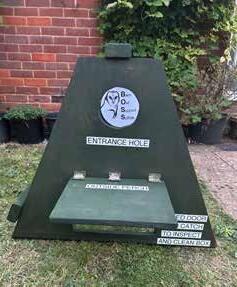

BOSS (Barn Owl Support Suffolk) has been busy with recent box installations, nearing the completion of 20 new boxes and carrying out several repairs. A notable project at Fosketts Organic Farm, coordinated through BTO Suffolk, involved repairing three boxes and installing three new ones. We have several more projects like this in the pipeline. Additionally, we’ve scheduled four more talks, including one at a primary school. To aid in these presentations, we’ve constructed and labeled a collapsible Barn Owl box that is easy to transport and showcase during talks.
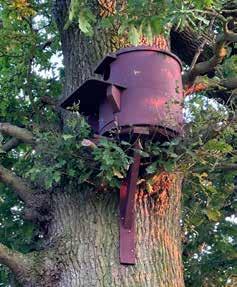
Another local farmer, Jason Davy, reached out to us about the Barn Owl boxes he crafted from old barrels. He has installed six of them over the past few years, all of which have proven successful. The Owls seem quite content with this design, suggesting that shape may not be a crucial factor. He is planning to make more and we hope to incorporate these into some of our projects.
Despite the challenges of a very wet and windy spring, which was far from ideal for our Owls, we’ve received many reports of successful breeding this year. We eagerly await the final figures for our region. We’d love to hear your stories so do please share with us, we always enjoy hearing how our Owls are doing in the community. We’re committed to maintaining our momentum in repairing and replacing old boxes, as well as installing new ones, to ensure our Owls continue to thrive. If you need assistance or have concerns about your box, need it checked, have any questions, or are looking for general advice, please don›t hesitate to contact us - we’re here to help in any way we can.
Contact BOSS by email: barnowls@suffolkbirdgroup.org
Or follow us on Instagram: @barn_owl_support_suffolk
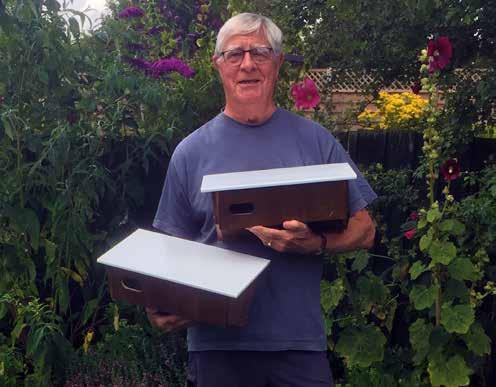
Over the past year John Turner has volunteered his time and has now made over 400 Swift nest boxes for the Save Our Suffolk Swifts project - a magnificent achievement.
This has enabled SOSSwifts to expand the number of free Swift Community Sets handed out to prominent elevations of public buildings around the county. Schools in Leiston, Ipswich and Henley have recently received sets. We have also been able to add donated call systems to church belfry nest cabinets, formed behind the belfry louvres of churches, in Ipswich, Mendham, Shipmeadow and Drinkstone this year and all have benefitted from a donated call system.

Suffolk Bird Group has also granted John a bursary to make other nest boxes too. Little and Tawny Owl nest boxes plus open-fronted woodland boxes targeting Spotted Flycatcher, for instance, have been requested.
Please do get in contact if you have an idea for nest boxes, we will happily supply numbers to help provide nest space for targeted species around Suffolk.
Please also get in contact if you know of public locations that would like a free Swift Community Set; multiple nest boxes and a call system. We have many sets available to distribute before Swifts return next May.
Ashley and twelve members met up in the car park at Fingringhoe Wick on a fine May morning. After going through H&S, Ashley gave us his plans for the day ahead, which would be starting off with a walk around Fingringhoe reserve to Margaret Hide. He explained that we would go there first to enable us to take advantage of the incoming tide which should bring any waders close in.
We started to make our way to the hide having already seen Swallows and hearing a Mediterranean Gull calling above us. We stopped a few times along the path
to listen and saw several Whitethroats including one which was carrying nesting material. Two Swifts flew over, the first sighting of the year for many of us. We also saw and heard several Chiffchaffs. Further along, Ashley suggested that the group remain quiet for a while to listen for Nightingales and we were rewarded with at least 10 singing, in addition we also heard four Garden Warblers, two Cuckoos, three Cetti’s Warblers and we disturbed a Green Woodpecker which called as it flew away. We were briefly distracted from concentrating on looking for birds by Adela

reaumurella moths, (more commonly known as Green Longhorn moths) which were swarming around the tops of a few of the trees, their iridescent metallic bronze/ green wings and long antennae made them fascinating and rather magical to watch. As we walked towards Margaret Hide we were serenaded with the call of Skylarks and a few members keen on botany spotted some beautiful Green-winged Orchids.
Margaret Hide is very popular and was already over-crowded when we arrived there, so some members chose to bird from vantage points outside of the hide. The rest of us tried to squeeze in where possible and picked up 20 Bar-tailed Godwits, 20 Knot, 15 Dunlin and 10 Grey Plovers amongst other more common species. Those blessed with good hearing heard a Lesser Whitethroat, two Common Terns were seen heading up river and a few members saw a Red Kite in the distance.
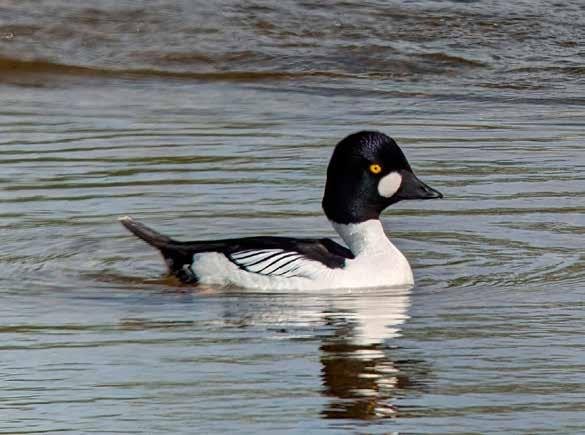
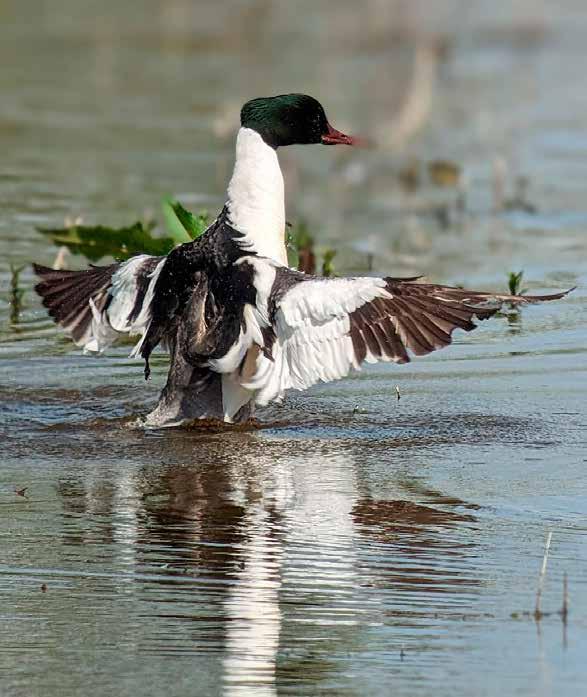
Next on the agenda was a drive to Abberton Reservoir where we parked up and had a break for lunch, where members were also able to purchase items from the cafe and shop if desired. A Hobby was observed from the car park as were several Swifts screaming overhead and Common Terns on the raft. After lunch we headed to the bridge, affording closer views of the Terns and where we picked up the call of a Lesser Whitethroat en-route and saw a Buzzard perched on a tree. A pair of Goldeneyes were noted close in and we were surprised to see a male Goosander (a late departing bird), much photographed by the photographers amongst the group.
We made our way to Billet’s Farm, almost immediately picking up a Kestrel hovering above us. It briefly disappeared out of view below the bank and then came back into view with its prey. On closer inspection with
scopes we could see that the Kestrel had caught a lizard. Several Pied Wagtails were seen and one or two members had fleeting views of a Yellow Wagtail. We spent some time trying to re-find the Yellow Wagtail without success. A Canvasback had been present in a Pochard flock but they were far too distant to pick out the rarity but two Red-crested Pochards were found.
Ashley suggested that we move on to the pool opposite where Yellow Wagtails were regularly seen. We added two Oystercatchers, two Greenshank and two House Martins to our growing list. Another Lesser Whitethroat could be heard, this time much more closely and a total of eight Yellow Wagtails were seen. Despite the presence of a heat haze a very distant Cattle Egret was picked out in with a group of cows. On our way back to the reservoir we added three Little Ringed Plovers to our list of observations.
The final destination of the trip was to Layer Breton causeway. In addition to many nesting Cormorants there were nesting Grey Herons and after much deliberation we finally came to the conclusion that there were six Cattle Egrets in breeding plumage within the heronry. This was made difficult as the birds either had their heads down or were obscured by foliage. They also were constantly moving about and there were several Little Egrets. We also picked up on an immature Spoonbill. As time was pressing on some members of the group decided to leave for home including Ashley. The rest of the group were still checking to see if there was any advance on the Cattle Egrets, when a Red Kite flew very low, directly above our heads putting up many of the smaller birds. With that sighting, the rest of the group decided it was time to leave. Many thanks to Ashley for another exciting birdfilled trip in Essex.
David Walsh
Saturday, May 25th
Leader: David Walsh
With several regulars on holiday and a forecast of heavy rain from mid-morning onwards, it was perhaps no surprise that just nine SBG members met in the King’s Forest car park at 8.00am. The fact the group was small had a number of advantages, and the rain never materialised, so those present had an excellent walk despite the lack of butterflies.
A Nuthatch was heard by some, but otherwise there was little to detain us in the woodland close to the car park so we headed north-east on a narrow path, soon reaching Chalk Lane (ride 202). To our left a Willow Warbler was singing and it was thoroughly obliging, allowing prolonged scope views. This species is now very localised in Suffolk, but King’s Forest is a real hotspot and we discussed the work done by a local BTO ringer in gathering data from geolocators to find out the migration routes and wintering areas.
We walked east along the ride, soon hearing then seeing a Woodlark singing right above us. We listened to it for ages, a real treat: one of Suffolk’s star birds! We chatted briefly about ways in which those who manage the forest are trying to help Woodlark by widening some of the forest rides.
Soon we turned left and, after two blocks, reached a large clearing. The northern end of it was very birdy indeed, with Yellowhammers and Linnets, a pair of Stonechats and two flyby Cuckoos. Having
reached ride 203 we heard singing Whitethroat and Garden Warbler; this gave us the opportunity to discuss ways of focusing in on one sound when there are several all around. We also discussed the accuracy of the Merlin App: it’s generally pretty good, but unsurprisingly it struggles with the ‘hweet’ calls of Willow Warbler and Chiffchaff, Redstart and Chaffinch.
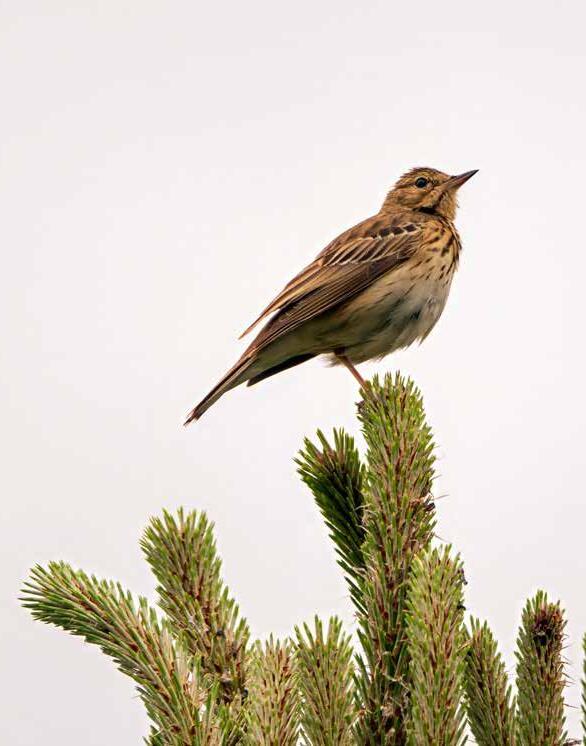
Having completed a clockwise loop of the clearing we headed west to another. We had superb scope views of a Tree Pipit on a tree stump then, finally, found one singing from a treetop and parachuting down in typical fashion, just as I had hoped we would. Buoyant, we drifted on, and were pleased to meet Neil Burton who is the local Tree Pipit expert. He told us how many pairs he was monitoring and the fact the birds were very site faithful as long as the habitat remains suitable.
A family of Coal Tits and an ‘out of habitat’ pair of Marsh Tits entertained us as we drifted back towards the car park. I’d mentioned that it would be nice to see a Woodlark feeding by the side of a track and, bingo, one appeared, a lovely way to round off our walk.
We arrived back at the car park at around 11.40am, ready for lunch and a cuppa! Thanks to everyone for your company and enthusiasm. The target birds had performed splendidly for us and we had remained dry against all the odds.
Dave Pearsons
Thursday, June 6th
Leader: Dave Pearsons
Of all the SBG outdoor meetings, the visit to Upper Hollesley Common is the one where reasonable weather is so important. So was it that 22 members gathered on a still, dry and cool evening. No rain or strong wind was a real bonus.
The meeting started at 1900hrs to give members the opportunity to see some of the birds that make their home on the heath. The target bird not likely to be seen or heard much before 2130hrs.
As we began our walk a Yellowhammer, Skylark and Woodlark were heard singing, all eluded our eyes with just a Chaffinch seen perched on a nearby tree.
Several Stonechats were showing really well, the males looking particularly smart in their breeding plumage. Dartford Warblers were hard to come by, with birds noted both sides of the track and, while looking towards the setting sun didn’t help, good views were had by most people before they went to roost.
Despite hearing the Woodlark, views were hard to come by until Adam spotted two feeding on the pathway about 50 metres from us. The Common Redstarts also played hide and seek with us, with only the subsong being heard. A bird moving about high in the trees gave us some hope, it turned out to be a smart Coal Tit. Finally, in fading light, one was seen by most of those present.
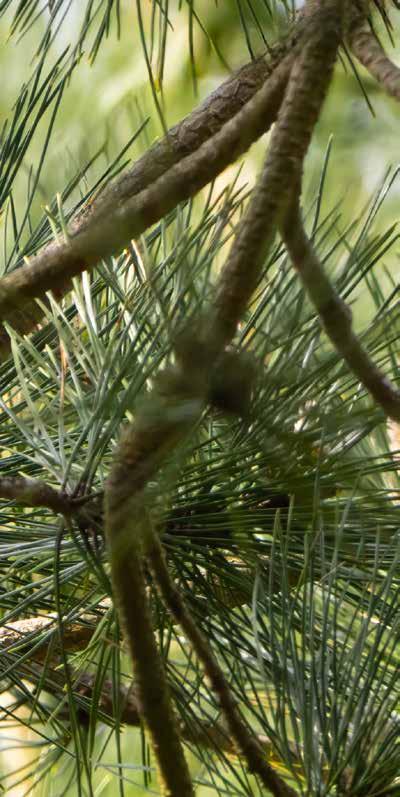
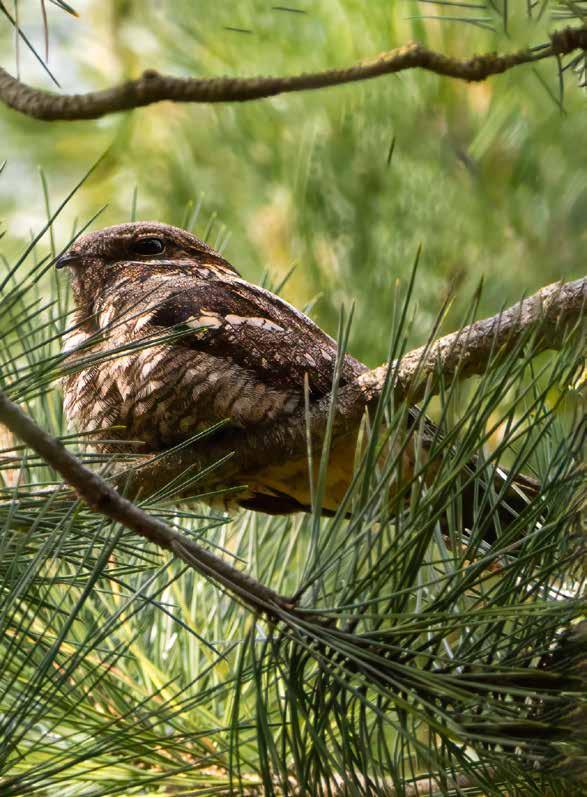
As we assembled to record our target bird we heard two Cuckoos calling. The light was reasonable when we heard our first Nightjar (around 2125hrs). Following a brief flight view the singing bird was spotted perched in a nearby tree. Good scope views were had by those present, with the remainder of the group further along the track joining to view. As the bird was on one side of a tree, the right angle was required to view it.
A little while later a pair of Nightjars were seen to rise from the heather briefly courting in the air before flying out of view. Like 2023 we identified three territories.
Perhaps the most exciting sighting, ornithologically speaking, was a Woodcock seen to fly over the heath in the fading light - unfortunately a rare sighting over the heath these days.
Finally, on our walk back to our cars, we heard two young Tawny Owls calling in the thick evergreen trees. Despite scanning, and using thermal imagers, they were too out of sight to pick them out. Nonetheless, a nice finish to the trip.
On a warm, late June morning we joined SBG member Henry Cook for a tour of Fen Drayton who, until the week prior, had been assistant reserve warden at this excellent reserve. Fen Drayton lakes are a flooded former sand and gravel quarry and sits at one end of a string of wetlands and fens that run for 25 miles alongside the Great Ouse.
The day started superbly as we gathered in the car park ready to set off, a Lesser Whitethroat called from the brambles behind us. As the group were trying to get views, the purr of a Turtle Dove grabbed
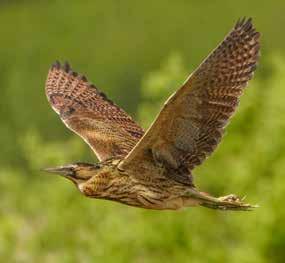
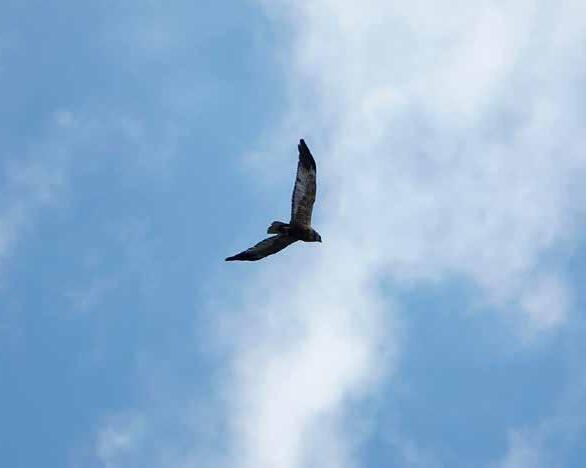
our attention and was soon spotted on top of a dead tree in the distance. As we again focused on Henry and his plan for the day, a Bittern flew just over us, allowing everyone good but brief views before it dropped into the reedbed. After a fly over Marsh Harrier had added to the distractions, we eventually set off for a hot, sunny walk around the reserve. Henry’s tour showed us the best the reserve had to offer at that time of year, with Common Tern nesting on some of the lakes and a pair of Buzzards soaring above the woodland they were nesting in, while a Treecreeper was winding its way up one of the trees beneath them.
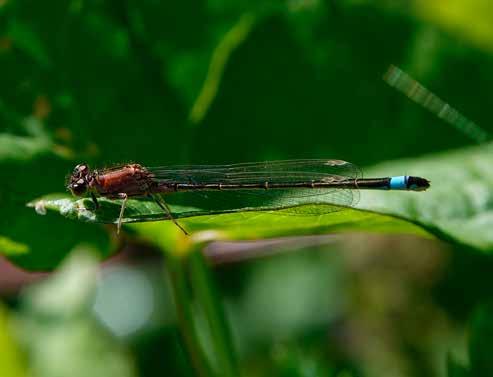
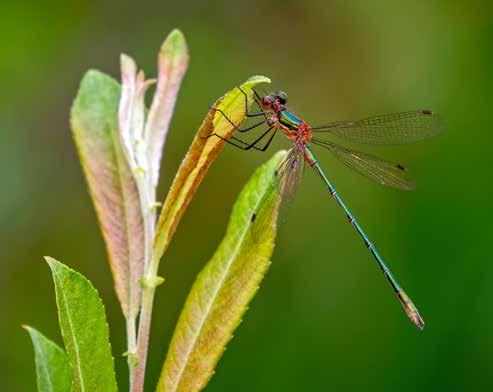
Then one of the stars of the reserve, the Turtle Dove began to purr again, just this time much closer to us, allowing us all good prolonged views, despite the bright sunshine. As we continued our walk around, we added Garden Warbler and Cuckoo to our list and the reminders of the wet spring were still evident - with some of the woodland still very wet and the pools and scrapes holding a lot of water. Also, as with most places sadly this summer, insects were not as numerous, with fewer dragonflies and butterflies seen than hoped – though we did see a nice Blue-tailed Damselfly of the rufescens form. This was maybe the reason that one expected bird, the Hobby, was not seen by the group. By mid-afternoon we had seen what we could and had learnt all about what this great reserve has to offer at other times of the year, leaving all of us thinking about visiting again.
It was then decided that we would head a short drive away to another of the string of reserves, RSPB Ouse Fen, to try for the Great Reed Warbler that had been on site for a while. On the way out of Fen Drayton we stopped at a few places for Corn Bunting, without success. This lack of success was to continue as during our short visit to Ouse Fen we had no luck with the Great Reed Warbler and it seems that it had departed the previous day. It was nice to hear Bearded Tit and to see a brood of Shoveler though during our walk there and we admired a beautiful horsefly species - Twinlobed Deerfly - as well as keeping an eye on it as it’s known to give a painful bite!
Thank you again to Henry Cook for his expert inside knowledge while guiding us on a very enjoyable trip out of county.
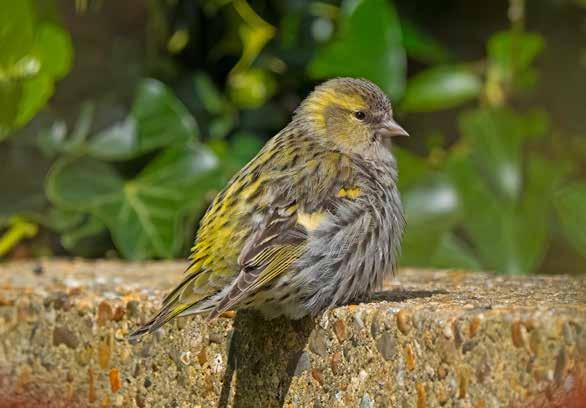
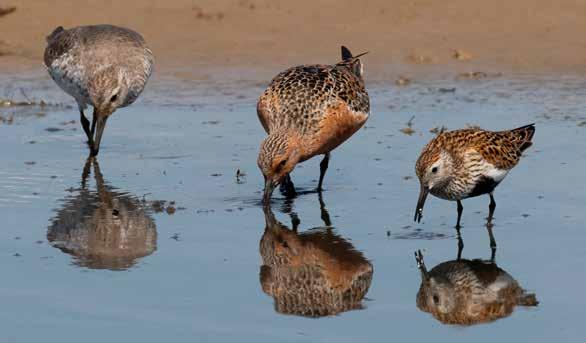
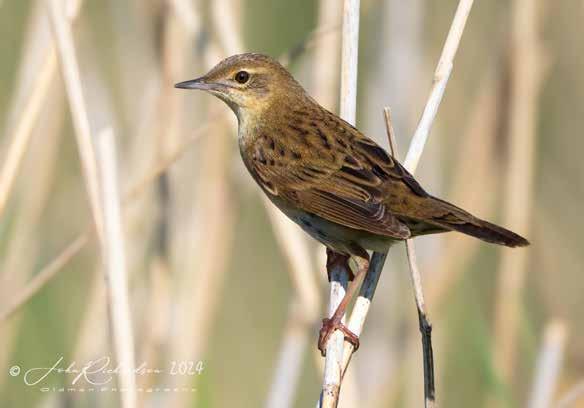
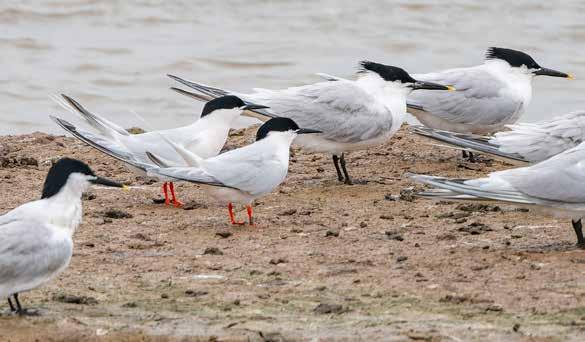
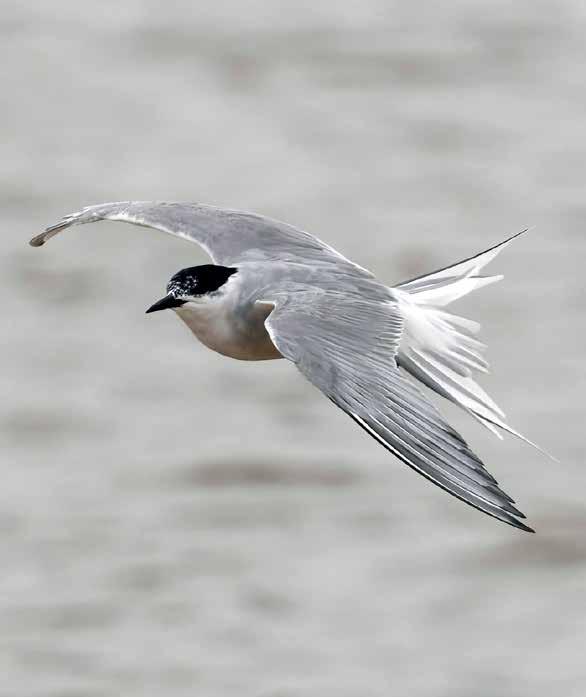
Top left: Siskin at Wenhaston by Andrew Moon.
Top right: Grasshopper Warbler at Shingle Street by John Richardson.
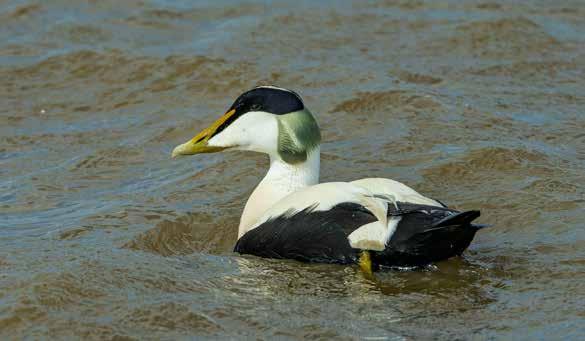
Bottom right: Eider at Minsmere by Les Cater
Bottom left: Knot and Dunlin at Kessingland by Chris Darby
Saturday, July 6th
Leader: David Walsh
Despite the ominous weather forecast, 18 Suffolk Bird Group members gathered in the car park at Redgrave and Lopham Fen at 8.30am.
We headed west on the Waveney trail and, with a bit of sunshine on offer, managed to locate a couple of Purple Hairstreaks in the
oaks on the north side of the path. Some even managed views through Anne’s scope! Heading on, we found our first Common Emerald Damselfly in the grass close to the path.
I had originally intended to follow the trail in an anti-clockwise direction but, having
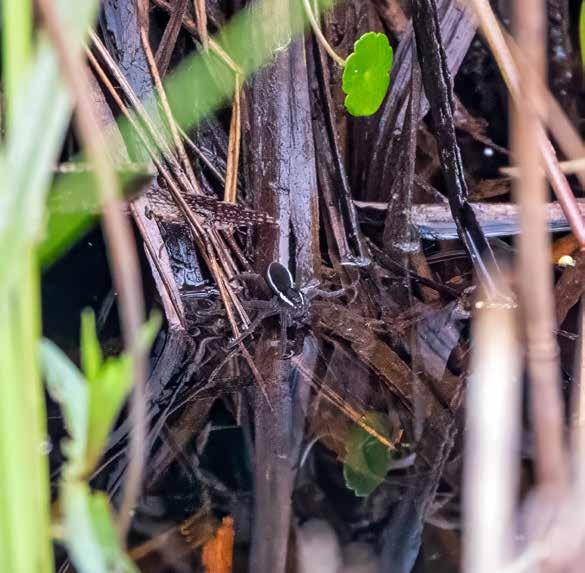
looked at the radar, decided we should make haste for the spider pools so turned left onto the Spider trail. I had hinted that patience might be required, but our eagleeyed spotters soon found two female Fen Raft Spiders on the small pool to our right and everyone managed good views. This is the ‘must see’ species at Redgrave so we were delighted.
We crossed the river into Suffolk and, as we did so, the heavens opened. The trees provided some shelter, but it took a while to get to them so we were all very wet by the time we reached ‘The Sink’, where I had hoped to find Scarce Emerald Damselfly. We found several Common Emeralds, but the vegetation was wet and we needed to keep moving to keep warm so we didn’t linger.
We headed west then north and back into Norfolk. Frustratingly a new gate meant we couldn’t get to view the scrape; apparently it was to stop cattle from entering that area and spreading an invasive plant species.
The wet heathland and adjacent areas held some interesting plants, whilst singing Reed Bunting, Reed and Sedge Warblers, overhead Swifts and a juvenile Marsh Harrier provided some avian interest. Unfortunately, the rain soon returned, so we continued on to the car park and at 11.30am decided enough was enough.
Thanks to everyone for coming. At least we had some good sightings before the rain arrived. Hopefully we can repeat the walk next year in better weather; there is so much on offer at Redgrave in early summer.
John Kornjaca
The quarterly review section gives a snapshot of birds seen within the county during the period, predominantly from data received by Suffolk BINS. All scarce and rare birds are subject to submission and acceptance by either SORC or BBRC. Updated lists of Accepted and Outstanding Records for previous years can be found on the SBG websitehttp://www.suffolkbirdgroup.org/bird-recording
Early April saw a distinct north-south split with cold continental easterly winds affecting the northern half of the UK, with the south basking in warm south-westerly winds with maximums hitting the high teens Celsius. Storm Kathleen arrived on the 6th bringing with it warm air and high winds. A series of Atlantic weather systems moved through the UK mid-month and temperatures stabilised. Cooler temperatures arrived late in the month with a highpressure system to the Northwest bringing
some very light snow to parts of Scotland. Low pressure returned toward the end of the month and the East was subjected to high winds with heavy and persistent rain.
Slightly warmer than average (+0.8°C above average). Wetter than average rainfall with 144% of mean rainfall. Duller than normal (82% of mean sunshine). The 2nd warmest start to the year on record (behind 2007 (data back to 1884), and the wettest start to the year since 2001.
Garganey – A pair was found at the sewage work pools by Shalford Meadow (1st) and three birds (two males) were discovered at RSPB Lakenheath Fen (2nd). Others drifted through the county as the month progressed.
Common Eider – A male was found on East Scrape at RSPB Minsmere (7th) and another was on the Blyth Estuary (10th – 12th).
Long-tailed Duck – A single bird was seen offshore at Walberswick (27th - 28th) among the Common Scoter flock.
Goosander – The long-staying single female remained at RSPB Hollesley Marshes throughout the month.
European Nightjar – The first bird of spring was found at Aldringham Walks (20th).
Common Swift – The first two birds of the year were observed between NewbourneWaldringfield (13th).
Common Cuckoo – The first of spring (6th) at BTO Nunnery Lakes.
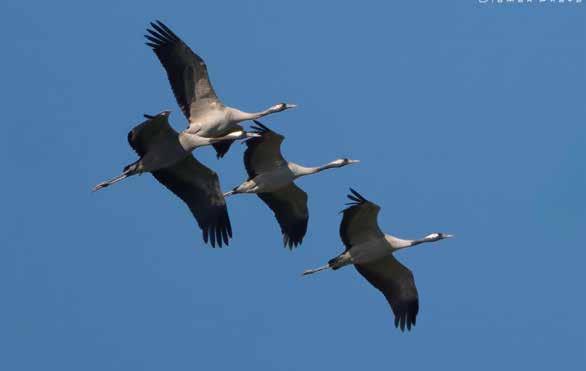
Common Crane – There were two regularly seen at RSPB Minsmere and the Westleton area through the first half of the month. A third bird joined them later in the month (25th). A group of nine were seen over Oulton Broad in flight (13th) with seven of the group (assumed) seen later at SWT Carlton Marshes.
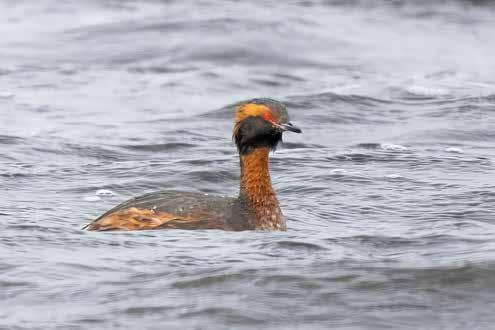
Slavonian Grebe – The two over-wintering birds at Alton Water remained (1st). A summer-plumage bird was found on Benacre Broad (20th- 27th).
Little Ringed Plover – Several birds seen around the county with a single bird in a pool at Southwold (1st). Two birds stayed at RSPB Hollesley Marshes for the whole month with 4 seen there (24th). Others were recorded at RSPB Minsmere (14th), SWT Carlton Marshes (18th) and Aldeburgh Marshes (28th).
Eurasian Whimbrel – A bird came into RSPB North Warren off the sea (1st). There were ten on the Blyth Estuary (25th), 25+ in the Alde Estuary/SWT Hazelwood Marshes (16th) and 32 at Aldeburgh Marshes (28th & 29th).
Curlew Sandpiper – There were two birds on the Blyth Estuary, Walberswick (7th).
Purple Sandpiper – There were eight at Ness Point (1st) and 14 present (3rd) with five remaining (28th). There were two at Southwold (6th).
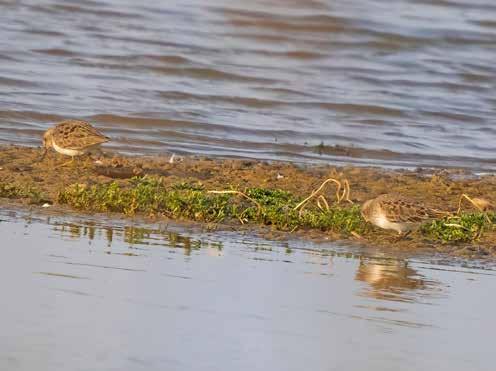
Little Stint – There were three birds on RSPB Boyton Marshes (10th) joined by a fourth bird (11th).
Wood Sandpiper – The first sighting of spring was at SWT Carlton Marshes (21st) –another bird was on White Horse Marsh, East Bergholt (26th).
Little Gull – There were two at SWT Lackford Lakes (1st) and four at RSPB Minsmere (6th).
Great Skua – A bird sighted off Walberswick heading north was later seen passing Lowestoft (21st).
Black-throated Diver – Two birds were seen in the sea off Landguard Point (19th).
Sooty Shearwater – A single bird heading north off Dunwich (21st).
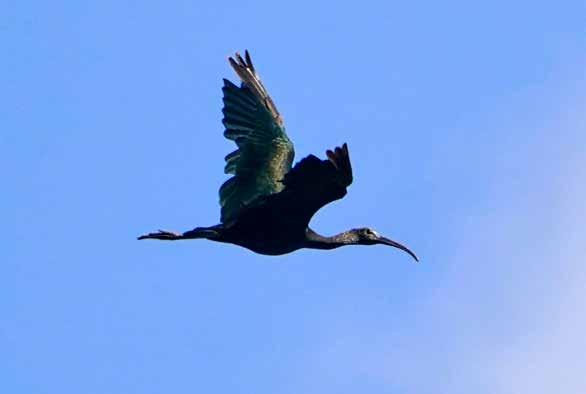
Glossy Ibis – A bird at RSPB Boyton Marshes (1st). The first-year immature bird found at RSPB Hollesley Marshes was seen throughout the month. There were two birds on the reserve (10th).
Eurasian Spoonbill – Regularly seen through the month along the coastal marshes with two favoured sites being RSPB Minsmere and RSPB Hollesley Marshes.
Western Cattle Egret – Seen frequently around the county there were four (then five) in fields opposite the entrance to Henham Quarry (1st - 10th). In the second half of the month, singles and pairs were seen at many sites.
Osprey – A single bird flew over Crown Meadow (1st). A bird remained in the SWT Hazlewood Marshes area for the month. Another single bird was sighted at RAF Mildenhall (30th).
Hen Harrier – A bird was on SWT Trimley Marshes (8th), a ringtail was spotted at RSPB Minsmere (12th& 22nd), while another was in fields by the water tower at Blythburgh (19th).
Short-eared Owl – Regularly seen along the coast, a single bird was seen at Kingsfleet (1st). There may have been up to five birds ranging between Bawdsey – Boyton area for much of the month with two and three birds seen together occasionally.
Eurasian Wryneck – A bird was seen at Landguard Common (28th).
Hobby – The first of the year seen at Great Blakenham hawking over fields (4th).
Northern Raven – A bird was spotted on the Levels at Kessingland (2nd) and there were two at RSPB Hollesley (24th).
Bohemian Waxwing – A flock of 35 birds were found in Rougham (8th). A group of up to 18 were found in Saxmundham with several of the birds remaining until the month-end. There were three birds in Moreton Hall/Bury St Edmunds (26th).
Willow Warbler – The first of the spring (6th) at Three Marsh Lane, Reydon.
Eurasian Reed Warbler – The first sighting of the year at BTO Nunnery Lakes (6th).
Common Grasshopper Warbler – The first bird of spring at SWT Carlton Marshes (6th).
Lesser Whitethroat – The first arrival of spring with a bird at RSPB Hollesley Marshes (8th).
Common (Greater) Whitethroat – The first sighting of spring near to Pond Hall Industrial Estate, Hadleigh (5th).
Common Firecrest – There were two on the old railway track at RSPB North Warren (25th).
Ring Ouzel – Regularly sighted through the month a single bird was spotted near Snape (1st). There were 2 at Benacre (6th) with 3 at Foxhole Heath in the West (19th).
Common Nightingale – The first birds of the spring were found at Westleton and Woodbridge (5th).
European Pied Flycatcher – The first bird of spring was at RSPB North Warren on the Sheepwash crossing (21st).
Black Redstart – Two were found at Landguard Common (1st) and again on (7th) and (13th). A single bird was found at RSPB Minsmere (29th & 30th).
Whinchat – The first bird of the spring was seen at SWT Carlton Marshes (13th).
Blue-headed Wagtail – Several birds were found in the month, the first at RSPB Minsmere (6th) and two were at Benacre (8th), two more were seen at RSPB Hollesley Marshes (19th), two at East Lane (19th onward) and two more were found in fields close to Southwold Harbour (29th).
Channel Wagtail – A bird was found at East Lane, Bawdsey (26th).
White Wagtail – Spring passage continued with 11 birds feeding in a pool at Southwold (1st), others were seen around our coastal fringes throughout the month. There were three birds at RSPB Hollesley Marshes (6th), two at Bawdsey (26th) and two at Aldeburgh Marshes (28th).
Tree Pipit – A bird was discovered in the compound at Landguard Bird Observatory (28th -29th).
Water Pipit – A single bird was found at SWT Hen Reedbeds (5th). Others were seen at RSPB Hollesley Marshes (6th and 24th).
Hawfinch – A single bird flew south over the dam at Alton Water (11th).
Green-winged Teal – A drake was found on SWT Carlton Marshes (Peto’s Marsh) and remained on site for a week (18th – 25th). Another male was discovered on the scrape at RSPB Hollesley Marshes (23rd).
Ring-necked Duck – A drake was on Livermere Lake (24th- 25th).
Lesser Scaup – A pair was discovered at Giffords Flash (14th – 19th).
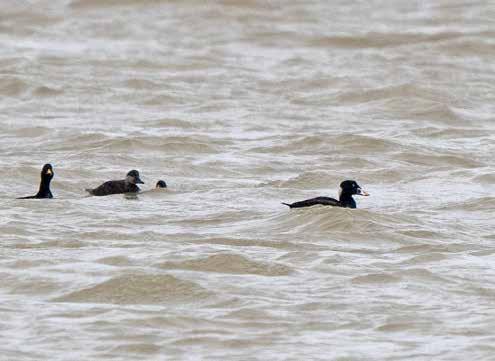
Surf Scoter – A first year, immature drake was found offshore at Walberswick with Common Scoter (16th) and remained in situ for the remainder of the month.
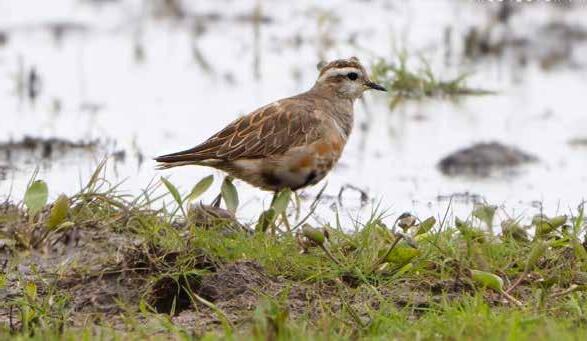
Dotterel – A single bird was found on RSPB Havergate Island (20th). A bird found on Aldeburgh Marshes (28th) remained until the end of the month.
Pectoral Sandpiper – A single bird was discovered on White Horse Marsh, East Bergholt (26th).
White Stork – There were two birds seen at Aldringham Walks (2nd). A single bird
was seen at Brantham (3rd), and another mobile individual was tracked over several sites to the north of the county (14th). RSPB Lakenheath Fen held a single bird (27th) and a mobile bird was tracked in the east (29th) – possibly the same bird seen in a marsh near Eastbridge (30th).
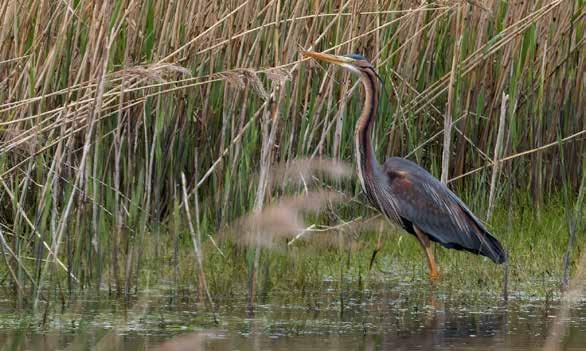
Purple Heron – A single bird was found at SWT Carlton Marshes (10th and 11th) and another at Walberswick (25th).
White-tailed Eagle – A bird was in the RSPB Minsmere area (19th – 25th) and another sighting was at Aldeburgh Marshes (24th), Butley (25th). An immature bird was at SWT Carlton Marshes (26th).
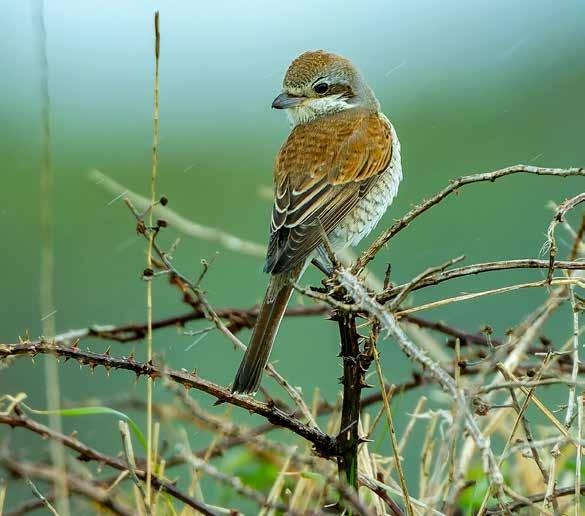
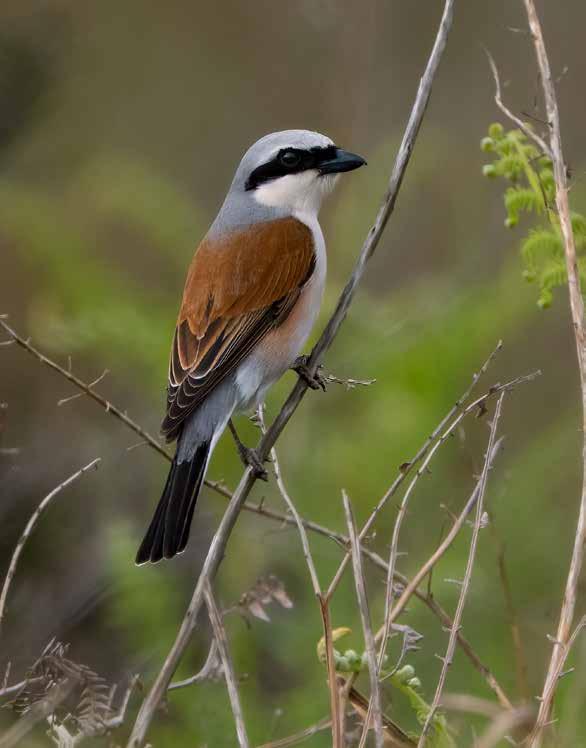
Red-backed Shrike – A female was located on the eastern edge of the North Wall at RSPB Minsmere (19th).
Pallas’s Warbler – A previously unreported find, a bird that was discovered in the sewage works at Needham Market on 30th March, remained (7th).
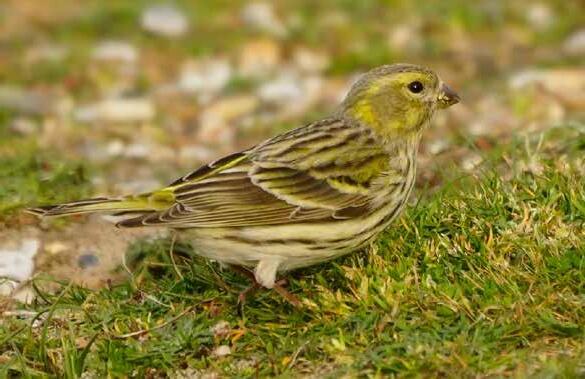
Serin – A female was found near the campsite at Southwold (13th).
There were thunderstorms around the UK in the first week of the month and the unsettled weather conditions continued throughout the month. The UK experienced its warmest May on record in a series going back to 1884 at 13.1 centigrade (+2.4 c above average). Across the UK rainfall was 116% of average.
As with April, May was slightly warmer than average, Santon Downham recorded an early high (23.4c) on Thursday 2 May. Heavy rain across the 21st – 23rd was experienced as the unsettled conditions remained.
Notable May sightings:
Tundra (Bewick’s) Swan – A single record - RSPB Hollesley Marshes hosted a bird (2nd and 3rd).
Garganey – A drake appeared on Giffords Flash, Shelley (8th) and in quick succession others were seen at RSPB Minsmere, SWT Mickle Mere and RSPB Hollesley Marshes. Two drakes at SWT Mickle Mere remained for much of the month.
Red-crested Pochard – A single drake seen at SWT Lackford Lakes (26th).
Common Eider – A smart adult male and a first year/immature male were found on the Butley River at RSPB Boyton Marshes (30th).
Long-tailed Duck – There were two records, possibly of the same bird, seen in Dunwich Bay (16th) and then at Walberswick among the Common Scoter flock (18th).
Goosander – The lone female remained on the scrape at RSPB Hollesley Marshes throughout the month.
Common Crane – A sighting (6th) of a bird flying over Westleton. Four birds were observed in flight over Shingle Street (7th) and two circled Island Mere/RSPB Minsmere (8th). Two birds were seen at Aldeburgh Marshes (10th).
Little Ringed Plover – RSPB Hollesley Marshes held a pair for most of the month. Others were recorded at SWT Carlton Marshes (3rd) and RSPB Minsmere (10th –12th).
Curlew Sandpiper – A pair at RSPB Minsmere (3rd) and three birds at Tinkers Marsh, Walberswick (13th) as the spring passage commenced. Others were recorded at Aldeburgh Marshes (11th) and a pair were at RSPB Hollesley Marshes (18th).
Sanderling – There were two birds on Aldeburgh Marshes (21st) and four at the same site (22nd).
Little Stint – A single bird was found at Walberswick (10th) and was joined by another bird (12th). Another was at Southwold (11th). There was a group of three at Aldeburgh Marshes (11th) and later four birds (12th).
Wood Sandpiper – There were several sightings through the month as the spring passage got underway with birds seen at SWT Trimley Marshes (3rd), Aldeburgh Marshes (8th), SWT Carlton Marshes (a pair on 11th) and RSPB Hollesley Marshes (11th).
Little Gull – Birds were reported at RSPB Minsmere (10th, 17th, 20th, 26th and 30th) and Fritton Marshes (10th) with additional sightings at Thorpeness (25th) and SWT Hazlewood Marshes (27th).
Roseate Tern – A single bird was observed on south scrape RSPB Minsmere (23rd).
Arctic Tern – There were two records in May with a bird seen at RSPB Minsmere (3rd) and another at Tinkers Marsh, Walberswick (12th).
Black Tern – A bird seen at SWT Lackford Lakes (7th) was joined by two more (10th) with two seen the following day. There was a group of approximately 10 birds at SWT Carlton Marshes (11th), another at Island Mere, RSPB Minsmere, and, yet another at RSPB Hollesley the same day.
Arctic Skua – A single bird was spotted off Landguard Point (15th) and another was sighted off Slaughden (31st).
Razorbill – A solitary bird seen flying south from the beach at RSPB Minsmere the only sighting (31st).
Northern Fulmar – There were 3-5 birds seen at sea between Slaughden and East Lane, Bawdsey (31st).
Manx Shearwater – Two small groups (seven and eight birds) seen off Dunwich (27th) with others tracked along the coast (31st).
Glossy Ibis – The immature individual remained at RSPB Hollesley Marshes although mobile (1st – 28th). Sightings at RSPB Boyton Marshes were recorded (20th and 24th). Possibly the same bird was found at RSPB Minsmere (30th).
Eurasian Spoonbill – Regularly seen around the coastal marshes throughout the month, there were six at RSPB Hollesley Marshes (11th & 12th).
Western Cattle Egret – A handful of records with two birds at RSPB Boyton Marshes (1st) and a pair over Aldeburgh Marshes (27th) the highlights. A summer-plumaged bird was noted at Blythburgh (28th).
Osprey – A single bird was found at SWT Hazlewood Marshes (1st). Other sightings
around the county followed at SWT Mickle Mere (9th), Nayland (10th), Kirton Creek (12th), Blythburgh (13th), RSPB Minsmere (The Levels) and RSPB North Warren (both on 17th).
Long-eared Owl – A single record of a bird hunting by Sluice Cottage at RSPB North Warren (7th).
Short-eared Owl – Regular sightings were recorded throughout the month with Shingle Street and RSPB Hollesley Marshes featuring regularly.
Northern Raven – A bird was seen at Frostenden (5th). Another flew over Hintlesham (19th) and a third record was of a bird over Aldeburgh Town Marshes (20th).
Bohemian Waxwing – The group (now seven birds) remained in Saxmundham (1st and 2nd).
Wood Warbler – A single bird was located beside a caravan park in Sizewell (18th).
Common Grasshopper Warbler – A bird was found at RSPB Minsmere (1st) with others recorded at Hollesley (7th) and a bird at Redgrave and Lopham Fen NNR (17th).
European Pied Flycatcher – One was at Waters Copse, Southwold (4th) with others at RSPB Minsmere (9th), Sotterley Church (13th). A male was seen at Landguard Bird Observatory (13th).
Whinchat – A bird was located at Bulney Moor, Long Melford (13th) and another was at RSPB North Warren (15th).
Blue-headed Wagtail – A single bird was found in pools near the water tower at Southwold (6th). A pair was discovered at Aldeburgh Marshes (16th) with a single bird remaining for the remainder of the month.
Tree Pipit – The bird found in the compound remained at Landguard Bird Observatory (1st and 2nd).
Surf Scoter – The first-winter drake remained in the Common Scoter flock off Walberswick (1st – 7th).
Quail – A bird was heard calling on the outskirts of Leiston at Wild Aldhurst NR (29th and 30th).
Eurasian Dotterel – A bird located in April at Aldeburgh Marshes remained (1st – 4th).
Temminck’s Stint – A bird was found on the winter flood at SWT Trimley Marshes (3rd). Another was discovered at Walberswick (10th). RSPB Minsmere held a pair (12th and 13th) and another was at SWT Trimley Marshes (13th). There was a pair at Aldeburgh Marshes (16th).
Collared Pratincole – A possible Collared Pratincole flew south over RSPB Boyton Marshes (24th).
White Stork – A bird flew over Trimley St Martin (1st) and another was seen inland at Walsham le Willows on the same day. There was a sighting at Snape Warren (12th) and another of a bird flying down the River Deben at Woodbridge (26th).
Purple Heron – A bird was found at Island Mere, RSPB Minsmere (8th) with other sightings on South Levels and Island Mere over the following week (last seen - 16th).
European Honey Buzzard – A bird seen over RSPB Minsmere (24th).
Montagu’s Harrier – A female was reported flying east over Woodbridge (9th). Other sightings were of birds at Westleton (15th) and RSPB Minsmere (19th), Aldeburgh Marshes (21st), with a sighting of yet another/possible at Chillesford (27th).
Black Kite – A sighting of a bird over the work centre at RSPB Minsmere (13th) was followed up with records of a bird at the same site (29th) – then tracked over Aldeburgh Golf Course and RSPB Snape Marshes.
White-tailed Eagle – There were three sightings recorded in May, the first at Sizewell (1st), then Foxhall, Ipswich (9th) and Burgh Castle (10th).
Eurasian Hoopoe – A bird was located at Buss Creek Flash/Southwold (2nd) and another seen over a period of three days in a quarry at SWT Hen Reedbed (5th – 7th).
European Bee-eater – A bird was heard at SWT Hen Reedbeds (7th), another was heard north of Thorpeness (18th) and a third record was of a bird low of the Ipswich NHS Hospital (22nd).
Eurasian Wryneck – A bird was heard singing at Clay Lane/RSPB Minsmere (5th).
Red-backed Shrike – A male was found at Lound Water Works (22nd), another at SWT Castle Marshes (23rd), and a male was at the sewage works at Corton (25th). A female was located near the sluice at RSPB Minsmere (26th). Yet another sighting of a male was on Upper Hollesley Common (27th).
Eurasian Golden Oriole – A bird was heard singing at RSPB Minsmere (5th) and another was heard at SWT Bonny Wood (23rd).
Hooded Crow – A single record for the month with a bird flying north past Ness Point (4th).
Grey-headed Wagtail – A single bird was found on SWT Carlton Marshes (3rd).
June 2024 was a dry, cool and sunny month compared to the UK’s long-term average, according to provisional Met Office figures. A month of contrasts for many, with a cool first half of the month offset by warmth later in the month, with rainfall also in relatively short supply, especially in the south. The month was drier than average, with the UK recording 29% less rainfall than the long-term meteorological average. It saw 55.1mm recorded across the month.
A month with two halves - the first two weeks the UK experienced cooler temperatures (average 2c lower than average) prior to the jet stream moving north allowing warmer air to enter the south and south-east. Some areas of the southeast experiencing several days in excess of 28c.
June 2024 was slightly cooler than the average (about 0.5C lower) and much drier than the average - experiencing approximately 50% of the average rainfall total. East Anglia also experienced more hours of sunlight (125%) than in an average month (June). The final two weeks of the month were quite warm and sunny.
Notable June sightings:
Garganey – A drake on Peto’s Marsh/SWT Carlton Marshes (2nd) was an early June sighting. The only other record was of a female at RSPB Minsmere (27th – 28th).
Common Eider – Two males were reported off Walberswick (7th) and again (27th).
Common Scoter – A raft of circa 1,000 birds was sighted off the beach at RSPB Minsmere (7th).
Goosander – The lone female at RSPB Hollesley Marshes remained (1st-13th). A drake in eclipse plumage was seen at Felixstowe Ferry (18th – 22nd).
Common Crane – Two were seen flying south over RSPB Minsmere (9th).
Little Ringed Plover – Seen at RSPB Hollesley Marshes (13th and 19th), RSPB Minsmere (two present on 22nd) and a single juvenile reported on Aldeburgh Marshes (23rd).
Wood Sandpiper – A single bird stayed at RSPB Minsmere (22nd – 25th).
Little Gull – Small groups of up to five birds seen frequently at RSPB Minsmere throughout the month.
Arctic Tern – Seen at RSPB Minsmere (11th & 14th).
Eastern Common Tern – A putative specimen was seen at RSPB Minsmere (13th and 14th).
Gull-billed Tern – A (possible) bird was seen at Gorleston (13th).
Arctic Skua – Sea-watchers on 1st June spotted just two birds at sea.
Razorbill – Sea-watching on 1st June revealed 10 birds (south) and eight birds (north).
Manx Shearwater – Sea-watching on 1st June produced a number of birds moving along the coast.
Glossy Ibis – One was reported at Island Mere/RSPB Minsmere (2nd) and, thereafter seen frequently throughout the rest of the month on the reserve, although mobile.
Eurasian Spoonbill – Regularly seen on the coastal marshes. A group of five at RSPB Hollesley Marshes (19th) and again later in month (26th) the highlights.
Western Cattle Egret – Several records of single birds around the county. The highlight being four birds among cattle at RSPB Lakenheath Fen (4th).
Osprey – A single bird seen at Lake Lothing (8th) may have relocated to SWT Carlton Marshes (9th). A bird that settled in at SWT Hen Reedbeds (17th) remained for the rest of the month. A second bird was observed on site (20th).
Short-eared Owl – Seen far less frequently this month there were two records at RSPB Hollesley Marshes (2nd and 26th) and another for Felixstowe Ferry (5th).
Northern Raven – A report of five birds at Pipps Ford the only record (2nd).
Common Firecrest – A single report with a bird discovered at Landguard Bird Observatory (5th).
Blue-headed Wagtail – The single bird remained at Aldeburgh Marsh on the main pool/flash for the day (1st).
Ruddy Shelduck – A single bird seen flying west at RSPB Lakenheath Fen (4th).
Quail – Singing birds were reported from Rickinghall (10th) and Worlingworth (25th).
Alpine Swift – A single bird reported at Joist Fen/RSPB Lakenheath Fen (18th).
Roseate Tern – At least two were at RSPB Minsmere through the first half of the month. Another bird was seen at Kessingland beach (14th).
Night Heron – A bird was heard calling as it flew over Rushmere in the dark of night (22nd).
European Honey Buzzard – One was at Rushbrooke (12th) and another seen over onion fields at Ramsholt (25th).
Montagu’s Harrier – A second calendar year bird was observed hunting near to Cavenham prior to heading away northwards (15th).
Black Kite – Two were seen separately (11th) one at Risby and another at Mildenhall. Another sighted at in the north of the county at St James South Elham (24th).
European Bee-eater – Up to five birds were heard flying north over Wrentham (29th).
Red-footed Falcon – A lone female was seen hunting over the reedbed at Walberswick (5th and 6th). An immature bird was found at SWT Carlton Marshes (30th).
Red-backed Shrike – A male at Easton Bavents (2nd) and another at RSPB North Warren (2nd& 3rd). RSPB Minsmere held a male (7th) and there was another at SWT Carlton Marshes/Share Marsh (30th).
Eurasian Golden Oriole – A singing bird was reported along Falkenham Brook (2nd and 3rd) with another located at Eastbridge (23rd).
Hooded Crow – A bird was seen flying over SWT Carlton Marshes (23rd).
Marsh Warbler – A singing bird was found at RSPB Minsmere (7th) and another was found at Landguard Common (10th and 11th).
Rosy Starling – A single bird in Gorleston was seen (15th and 18th).
Council for 2024
Officers
Chair: Eddie Bathgate
Vice Chair: Chris Keeling
Secretary: Katya Bathgate
Treasurer: Anne Wright
Communications Officer: Adam Faiers
Projects Officer: Chris Keeling
SoSS Project Officer: Eddie Bathgate
Suffolk Bird Report Editor and SORC/SNS Link: Nick Mason
Harrier Editor and Outdoor Events Coordinator: Gi Grieco
Indoor Events Coordinator: Adam Gretton
President John Grant
Members
Sarah Glyde
John Kornjaca
Peter Merchant
Ben Moyes
Sally Nelson
Jenny Rawson
Alex Rafinski
Honorary Vice-Presidents
Andrew Green
Adam Gretton
Robin Hopper
Colin Jakes
Mike Jeanes
Mike Marsh
Roy Marsh
Philip Murphy
Reg Snook
Bird Recorders
North-east Area Recorder: Richard Walden Email: bird-ne@sns.org.uk
South-east Area Recorders: Gi Grieco Tel: 07951 482547 and Steve Fryett Tel: 07593 382082 4, The Street, Melton, Woodbridge, IP12 1PW. Email: bird-se@sns.org.uk
West Area Recorder: Chris Gregory Email: bird-w@sns.org.uk
Memberships
c/o SNS, The Hold, 131 Fore Street, Ipswich, Suffolk, IP4 1LR
Founded in 1973 by a group of Suffolk birdwatchers
Associated with the Suffolk Naturalists’ Society
SBG remains an independent birding group and is a registered charity
A voice for Suffolk birdwatchers
With established links to many naturalist and conservation organisations
Media
Actively lobbies to protect key Suffolk habitats
Provides a county-wide field force of bird surveyors
Promotes BTO bird surveys and organises special SBG surveys

Strong web presence - www.suffolkbirdgroup.org
Active Twitter feed - @SuffolkBirdGrp
Quarterly magazine - The Harrier
Annual review - Suffolk Birds report
Annually (20+) field trips - ideal for novices or experts and young or old alike
Opportunities to visit hot spots and receive practical ID tips in the field
Programme of talks and presentations - variety of topics (county, national, or international) with quality speakers
Assists with conservation projects to improve breeding success
- Swifts
- Barn Owls
- House Martins
- Peregrines
- Waders
Partners with Suffolk Wildlife Trust and other bird groups
Assists with funding for bird hides and other birding amenities
Contributes to community events, including dawn chorus walks
Provides bursaries for special projects