Suffolk Birds 2023
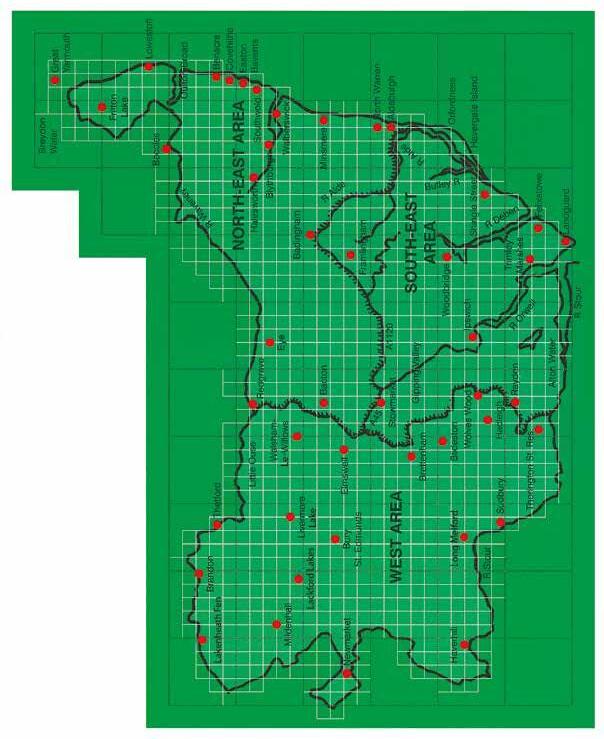
Tel: 01284 722950 Tel: 01502 713521
Email: Email: Email:
bird-w@sns.org.uk dickwaldenrecorder@gmail.com
SUFFOLK BIRDS
VOL. 73
A review of birds in Suffolk in 2023
Editor
Nick Mason
Greatly assisted by Philip Murphy (Systematic List) David Walsh (Rarities)
John Richardson (Photos) Phil Whittaker (Artwork)
Laurie Forsyth (Proofreading)
Published by SUFFOLK NATURALISTS’ SOCIETY
Compiled by SUFFOLK BIRD GROUP 2024
Published by The Suffolk Naturalists’ Society, The Hold, 131 Fore Street, Ipswich
© The Suffolk Naturalists’ Society 2024
All rights reserved. No part of this publication may be reproduced, stored in a retrieval system, or transmitted in any form or by any means, electronic, mechanical, photocopying, recording or otherwise, without prior permission of the copyright owners.
The SNS is a Registered Charity No. 206084.
ISSN 0264-5793
Printed by Healeys, Unit 10, The Sterling Complex, Farthing Road, Ipswich, Suffolk IP1 5AP.
Front cover: Black-winged Kite – Ed Keeble
The copyright remains that of the photographers and artists.
The artwork in this Report is by: Russ Boland, Peter Lackey, Stewart Sexton, Jan Wilczur
The photographs in this report are by: Bill Baston, David Borderick, Alan Chaplin, Liz Cutting, Chris Darby, Trevor Goodfellow, Craig Holden, Jeff Higgott, Peter Kennerley, Chris Mayne, Andrew Moon, Charles Swan and John Richardson.
We would like to point out that many photographs were submitted, all of them of publishable quality. In the end we had to go for those that fitted in best with this year’s bird report.
Notice to Contributors
Suffolk Birds is an annual publication of records, notes and papers on all aspects of Suffolk ornithology. Except for records and field descriptions submitted through the county recorders, all material should be original. It should not have been published elsewhere or offered complete or in part to any other journal.
Authors should carefully study this issue and follow the style of presentation, especially in relation to references and tables. Where relevant, nomenclature and order should follow the latest published for The British List by the British Ornithologist’s Union (IOC list from 2018 – now updated June 2022) and available on their web site at www.bou.org.uk. English names should follow the same list.
Contributions should, if possible, be submitted to the editor by e-mail and written in Microsoft Word (Calibri font size 10). If typed, manuscripts should be double-spaced, with wide margins, on one side of the paper only. They must be in the final form for publication: proofs of longer papers are returned to authors, but alterations must be confined to corrections of printer’s errors. The cost of any other alterations may be charged to the author.
Photographs and line drawings are required to complement each issue. Suitable photographs of birds, preferably taken in Suffolk, can be either digital or in the form of 35mm transparencies. Artwork is also required to complement each issue. Every possible effort will be made to take care of the original photographs and artwork. However, photographers and artists are reminded that neither the editor nor the SNS can be held responsible in the unlikely event that loss or damage occur.
Authors may wish to illustrate their papers, but this will be subject to the illustrations being of the standard required by the editor and the decision on such matters will rest with him or her. Material submitted for publication should be sent to the editor no later than March 1st of each year. Authors of main papers may request up to five free copies of the journal. Any opinions expressed in this Report are those of the contributor and are not necessarily those of the Suffolk Naturalists’ Society or the Suffolk Bird Group.
Suffolk Ornithological Records Committee (at time of printing): Chair: Gi Grieco
Area County Recorders: Chris Gregory (west), Dick Walden (north-east), Gi Grieco (south-east)
Bird Report Editor: Nick Mason (non-voting)
Secretary and BBRC correspondent: James Brown (sorcsec@gmail.com)
Other Committee Members: James Brown, Rob Holmes, Tim Humpage, Rachel Harvey, Ben Moyes, Stuart Read, Brian Small.
Rare Breeding Birds Panel: David Walsh
ADDRESSES
Papers, notes, drawings and photographs: The Editor (Suffolk Birds), The Suffolk Naturalists’ Society, The Hold, 131, Fore Street, Ipswich, IP4 1LN.
Records: See inside front cover.
Suffolk Ornithological Records Committee - correspondence: The Secretary, SORC, The Hold, 131, Fore Street, Ipswich, IP4 1LN - or sorcsec@gmail.com
Nick Mason
One of the most significant events of this year (2024) was the loss of one of our most effective birders and conservationists – Steve Piotrowski. John Grant has written his obituary for us in this report. I first met Steve in the 1970s when he had heard that I had seen a Roller at Minsmere on a very early morning look at the Sluice Bushes. I had not entered this or any other records to the powers that be. He easily persuaded me that I should enter my data to the relevant bodies, something that I have done ever since. Thankyou Steve for everything.

Cheers Steve and thanks for everything!
To 2023, a year with two, if not three, cracking rarities. For me the Black-winged Kite in the Felixstowe area was the highlight, found and written-up here by local stalwart Craig Holden. For others, the Aquatic Warbler at Landguard was the highlight. What a cracking bird, found by the ever-aware Will Brame, who has written-up the event. Not so rare, but equally welcome, was the Buff-breasted Sandpiper at Minsmere – found and written-up here by Philip Buckle. I always think it’s a good idea to thank the finders of Suffolk rarities like this – that I get to see – so thankyou guys!
Also amongst the articles is a study of Lowestoft’s Kittiwakes by Julie Martin and Steve Piotrowski – a lot of time spent there. We have the annual ringing report from Trimley Marshes, where again Justin Zantboer has produced an extensive review of the birds resident and passing through the area. We are trying to encourage similar ringing reports from other parts of the county. We would also ask that any ringers who have interesting records of controls should send them to us to include in the bird report. Even getting a mention on Springwatch, our Raptor Man, Peter Merchant has been widely praised for his ongoing work with raptors – from putting up and checking on raptor nests to imminently erecting Osprey platforms. Here he has written-up his efforts to save a Peregrine chick – some of the details and photographs are a little gruesome. With regards to records, we have, for some years, been concerned as to whether we should include records from Hockwold Washes. Most of you will know that this is in fact in Norfolk on the other side of the Little Ouse from Lakenheath Fen. Our problem was not knowing whether those records were definitely getting through to the Norfolk recorder. We are now happy that they are! So, please make sure that birds definitely on the Hockwold Washes are sent to Neil
Lawton – norfolkbirdrecs@gmail.com. Some of those birds may be on the Lakenheath Fen side -the Whiskered Tern definitely entered Suffolk!
It is always good to mention and sing the praises of volunteers – which just about all of us are. I have already mentioned the sterling work done by Peter Merchant. I was looking round a Suffolk Bird Group council meeting the other day and it was quite clear that all present were doing their bit – and often more – for our Suffolk avifauna. I will mention Eddie Bathgate and Gi Grieco –just two of them. Another mention for Mick Wright for continuing with his efforts both practical and with organising most of the surveys that happen across the county. He has been doing this for years! All the surveyors – BBS, WeBS, Barn Owl workers, single site monitors, ringers, and conservation work party ‘labourers’, walk leaders, talk deliverers, etc, please consider your praises sung. And it all counts, even when sometimes it goes unnoticed.
So, a big shout out for all those who have written-up the different sections. Starting with Gi Grieco who does the geese and swans – what doesn’t he do for Suffolk birds!? As always, the ducks are professionally written by Andrew Green. We managed to keep John Kornjaca on board for both the gamebird and falcon sections. The nightjars and swifts and the pigeons and kingfishers have been excellently put together by Darren Underwood. John Davies has an interesting mix with the rails and crakes and the grebes. The plovers, Avocet and Oystercatcher are written by Margie Carter including Stone-curlew, always an interesting group. The remaining waders are processed by the ever-helpful Ed Keeble who has also coordinated with the BTO to obtain all the WeBS data (and no, there is still not a full set of data from the Blyth Estuary). Ed has also produced our front cover, capturing the atmosphere well. The gulls and skuas are wellresearched by James Wright and the terns and auks by Brian Buffery. This year the divers and shearwaters have been done, at late notice, by Philip Murphy and myself. Peter Lack continues with the storks, cormorants and herons (a section getting larger as more and more arrive!). Our recorder from the west, Chris Gregory, gets his claws/talons into the raptors. Shrikes, tits and corvids, another interesting mix, are processed by Phil Whittaker. Nick Mason does larks and hirundines, and, as usual, Peter Kennerley has done an excellent job on the warblers. Richard Attenborrow has done an excellent job on the crests, starlings and thrushes while our southeast recorder, Steve Fryett, likewise the flycatchers and chats. At short notice, I was very pleased with Chris Keeling’s efforts on wagtails and pipits – thankyou Chris. Adam Gretton has moved on and now does the sparrows and finches section. We welcome Katya Bathgate who did a good job with the Appendix 1 and 11 section. Thankyou so much all of you.
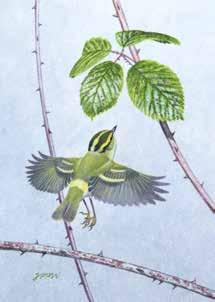
Pallas’s Warbler Jan Wilczur
We have three first-class area recorders – so many thanks to them for all that do; Richard Walden in the northeast; Steve Fryett in the southeast and Chris Gregory in the west.
As always, we have made use of a lot of data from Landguard. Nigel Odin and his team do a great job of amassing the data and then making it available –thankyou all.
Thankyou John Richardson for collecting and sorting out the photographs that help to make the bird report.
As usual, I need to give a big thankyou to Philip Murphy for his insight and efforts throughout the whole report. I couldn’t do it without him. Likewise, David Walsh who checks the accuracy of the data in the report. David has come into his own when chasing up records, persuading people to submit their sightings, when necessary, and generally taking the load off SORC members and others.
Steve
Piotrowski,
June 27th 1951 – June 17th 2024
A personal tribute by John Grant
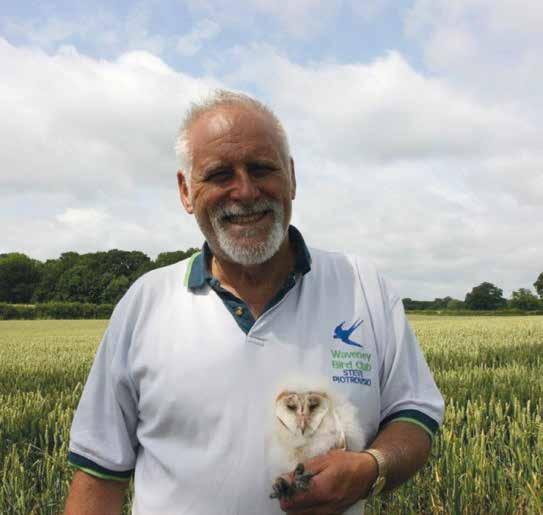
Way back in the early 1980s Steve was anointed by some of his Suffolk birding friends with what must be the least appropriate nickname of all time. Mr Nobody.
We knew it was wide of the mark at the time, and it was given to him in a tongue-in-cheek, friendly, fun-poking kind of way. But exactly how wildly, miles-out and nowhere near accurate it would actually prove to be became ever clearer as his remarkable achievements for nature and nature-lovers unfolded over the ensuing years.
So how did this ill-fitting moniker come about? Throughout the 1980s Steve was at the forefront of the annual westward autumn pilgrimage from Suffolk to the Isles of Scilly. Our visits were the highlight of our birding year, timed as they were to coincide with the October flood of rarities into this beautiful archipelago from all points of the compass.
As we returned to Cornwall after one such visit a north-westerly gale blew up and so there was only one place to be - and it wasn’t Suffolk. It had to be St Ives Island, then the Mecca for seabird fanatics, as these were optimum conditions for a seawatch. We raced from Penzance to St Ives and joined the seawatching throng sheltering in the lee of the island’s slopes as a continuous stream of exciting seabirds passed by, accompanied by a commentary from the legendary Cornish seabird guru Vic Tucker, an imposing scarecrow of a man with the most wonderful West Country accent. Steve was relishing the occasion, as we all were, and at one point exclaimed loudly to the throng: “Three Roseate Terns heading our way across the bay!” We waited eagerly for these rare birds to pass by…only for three Sandwich Terns to do so.
Vic was incandescent. “Roseate Terns? Roseate Terns? Who said Roseate Terns?” he demanded as he walked along the line of seawatchers like a general inspecting his troops. He asked again. And again. Steve simply stared down at his feet, tortured by embarrassment. Silence. And then Vic concluded with a sneer: “Oh I see. It must have been Mr Nobody!”
Poor Steve was given a tough time by the highly amused Suffolk contingent, but he could well withstand micky-taking as well as dishing it out. Mr Nobody stuck with him for a while. But we knew it was an entirely ill-founded nickname. Through his monumental achievements we realised that such a name could not possibly stick. Somewhat sheepishly, we quietly dropped it. Steve had the last laugh, of course. For he, of all people, was far, far from being a Mr Nobody. His achievements set him apart from pretty much anyone most of us can think of.
Born on June 27th 1951, with four brothers and three sisters, Steve’s lifelong and burning passion for nature was kindled in countryside walks with his mother, and later with his lifelong friend Eric Patrick, from the family home in Trefoil Close on the Chantry Estate, Ipswich. In common with many young 1950s lads, Steve was fascinated by birds’ nests and birds’ eggs and this intense interest and curiosity was the foundation for his intimate knowledge of Suffolk’s birds.
Later, a long career with Anglian Water, in which he rose to become leading engineer manager. While his thirst for knowledge of nature never left him, in his adolescence he did succumb to the temptations of football, playing at a moderate level and following his beloved Ipswich Town – indeed, he often delighted in the story of our friendship being preceded by 10 years thanks to a coincidental encounter neither of us were aware of at the time. In 1968 he danced joyously with Town fans celebrating their club’s return to the old First Division on the pitch at my beloved Portsmouth’s Fratton Park. As I looked down enviously and disconsolately with the other Pompey supporters at the jubilant Town fans from the Fratton End, little did I know that one of those elated fans was to become my best birding mate later in life.
Steve’s unmatched drive, energy and sheer forcefulness of personality first came to the fore in the Suffolk birding community in the late 1970s. I recall the then manager of RSPB Minsmere, Jeremy Sorensen, telling me in 1978 that I should look up a certain Steve Piotrowski as he was a “special chap and I think you’d get on well with him.” Right on both counts, Jeremy. A few weeks later we fortuitously met at Landguard Point and a very close and treasured friendship that was to last 46 years instantly began.
It was around this time that embryonic plans for a bird observatory based in Landguard Fort were emerging and, of course, Steve was a prime mover. He was a driving force in the establishment of the observatory which has become a successful and muchloved addition to the UK birding scene, and one which Steve held close to his heart for the rest of his life. A former observatory chairman, he spent innumerable hours there - as a ringer and as a raconteur!
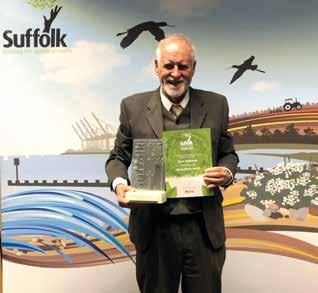
Steve’s association with the observatory is widely known and widely appreciated. Less well known, strangely, is his Herculean contribution to the battle against the extension of the Port of Felixstowe in the early 1980s.
Steve’s tireless and unrelenting passion for bird-ringing was well established by the time the port expansion plans threatened to swallow up the intertidal mud of Fagbury Flats. Forming a formidable partnership with his great friend Derek Moore, who led Suffolk Wildlife Trust’s ‘desktop battle’ against the plans, Steve fought the ‘battle in the mud’ as it were. He was an integral part of the team of ringers who carried out intense ‘Operation Redshank’ studies - often all-nighters - of wading birds on Fagbury Flats and he relished the challenge. Derek and Steve took the battle all the way to Westminster, with Steve presenting data and evidence in person to the House of Lords as a Parliamentary Agent during the Expansion Bill’s progress through Parliament - perhaps the only time I ever knew him to be in the least bit nervous! He need not have worried, of course. Typically, he more than held his own in such exalted company.
It was the combined efforts of Derek and Steve, and other battle-hardened ‘Trust soldiers’, that led to the mitigation of the loss of Fagbury Flats in the form of the now-wonderful Trimley Marshes nature reserve.
By now Steve was widely and justifiably admired as an astute and forceful figure on the nature conservation scene in Suffolk and beyond. His bird-ringing efforts had become quite phenomenal. He was simply unstoppable and many were prompted to ask when on earth did he sleep?!
Bird-ringing remained a central pillar of Steve’s love affair with birds for the rest of his life. In his last few days, he told me he had ringed ‘something like 100000 birds’ and he recalled ringing expeditions in many parts of the UK and further afield – those in Spain, Hong Kong and Kenya being particularly fond memories for him.
Steve was an exceptional teacher, sharing his immense knowledge with warmth, clarity and compassion, mentoring for his beloved British Trust for Ornithology no less than 38 trainee ringers over the years. He conducted numerous demonstrations and beginners’ courses and tutored in general ornithology on countless residential courses for the BTO and the Field Studies Council, thereby helping and enthusing many hundreds of people to love and appreciate nature as fervently as he did.
He was a constant and strong advocate for and an ardent supporter of the BTO’s work, as evidenced by his impressive surveying statistics – he submitted more than 148400 BirdTrack observations, made more than 16600 observations for the Bird Atlas 2007-2011 and carried out Breeding Bird Survey work at Flixton Hall for 11 years, for example.
Steve often referred to his immense pride in the continuing success of the Suffolk Community Barn Owl Project, which he founded in 2005. About 2000 Barn Owl nest boxes have been provided under the project, restoring the number of Barn Owls in the county to levels not seen since the 1930s and involving thousands of people in virtually every parish in Suffolk. About 6000 Barn Owls have been ringed in the project, contributing enormously to our knowledge of the species and its conservation requirements. Such an immense, ambitious and successful project is testament to Steve’s outstanding organisational skills, to his energy, his drive and his determination.
There seems to be hardly any aspect of Suffolk’s modern ornithology in which Steve was not in some way involved. He worked closely for many years with Suffolk Wildlife Trust and advised many farmers and landowners on nature conservation under the Trust banner. He was a loyal supporter of the Suffolk Ornithologists’ Group - now the Suffolk Bird Group - serving it as a council member, chairman and President, ultimately being given the accolade of Honorary Vice-President. He was a long-time member and former chairman of the Suffolk Ornithological Records Committee and somehow also found time to edit the highly acclaimed Suffolk Bird Report from 1986 to 1992.
A great love of butterflies and a deep knowledge of their lives led Steve and his friend Howard Mendel to write The Butterflies of Suffolk, published in 1986, and in 1990 Steve teamed up with Derek Moore and Malcolm Bowling to produce the Suffolk Ornithologists’ Group’s Easy Birdwatching guide to help people with mobility issues access birding sites.
Not satisfied even with such a prolific output, Steve diligently went about writing the acclaimed county avifauna The Birds of Suffolk, an astonishing achievement given the volume of work that
was involved. When it was published in 2003 Steve, typically, almost immediately started thinking about writing an updated companion volume that he hoped would be published about 25 years later. Sadly, this was one project that was to remain unfulfilled, but, clearly, when retirement from Anglian Water came about, Steve was not going to simply rest. That was never in his makeup. He thrived on action. He was a do-er if ever there was one.
So, it came as no surprise to his many friends in Suffolk and further afield that he formed his own ecological consultancy and bird tour business. And it came as no surprise either that the business was instantly busy and successful.
Contract after contract was won and survey after survey was carried out with meticulous accuracy and care. Countless beginner birders were introduced to the ornithological delights of Suffolk in hundreds of enjoyable birding tours. Steve was adamant that he would continue in business for as long as possible, and so he did - working until his health ultimately prevented him from doing so. His wife Kathy continues to operate the business, as was Steve’s fervent wish.
Throughout his life, ideas continued to burst and fizz from him like sparks from a sparkler. Shortly after settling with Kathy into their lovely Bungay home, Steve realised he could help local nature-lovers in an innovative way. He formed the Waveney Bird Club. This has been a resounding success, with field trips, indoor meetings and holidays both in the UK and abroad. Through the club and its warm camaraderie, numerous members have been helped in their enjoyment of nature. Steve was especially proud of the social side of the club, with innumerable friendships being forged and so much fun being shared.
In fact, there was always so much fun when Steve was around. I well recall our so-called Thursday Club meet-ups at RSPB Minsmere in which, somewhat like characters from Last of the Summer Wine, a few of us old-timers would stroll around the reserve, putting the world to rights, gently ribbing each other and, sometimes, even doing a little birding. From these often-hilarious walks emerged a WhatsApp group that Steve, with his typical love of inclusivity, widened to become the highly successful Clubbers nature news group, offering instant reports of Suffolk sightings to hardened birders and beginners alike.
When we consider all Steve’s remarkable achievements it is always a wonder to many of us who knew him that he actually found any time, particularly in later years, for any general birding at all. But, somehow, he did. And he did so with infectious enthusiasm and boundless skill. Indeed, he either found or was ‘in on’ the finding of no less than four ‘firsts’ for Suffolk - which he always referred to as his ‘gold medal birds’. These were Blyth’s Reed Warbler at Fagbury Cliffs in September 1993, Arctic Warbler, also at Fagbury Cliffs in September 1993, Pied Wheatear at Fagbury in 1994 and Cliff Swallow at Minsmere in November 2016. An enviable litany of other finds of scarce and rare birds was also a matter of deep pride for him, as was his extraordinary ‘Suffolk list’ which neared, but unfortunately never quite topped 400. Very well-travelled, he revealed late in life that his global ‘list’ stood at ‘about 5,000 species’.
It is perhaps in the final two tangible examples of Steve’s warmth, generosity and compassion that we can most readily appreciate the monumental legacy he leaves behind: the Access for All boardwalk at RSPB Minsmere and the Swift Tower at his beloved Eel’s Foot pub at Eastbridge. Both these projects relied heavily on Steve’s astute organisational talents, his dogged determination to see projects through and his unfailing commitment to both nature and nature-lovers. And, sure enough, despite a few bumps along the way, both projects have been successfully completed. The boardwalk presented a huge fundraising challenge, but Steve knew how to pull the strings, how to present the case and who to approach. Admirably aided by Kathy, Steve saw it through. The impressive construction enables those who would have physical difficulty accessing Minsmere’s wonderful East Hide from the beach to enjoy unimpeded, easy access from the North Wall to the hide that commands such a stunning vista of the famous Scrape and its birds. Again, in a project aided skilfully by Kathy, Steve was immensely proud to be able to attend the opening of the eight-metre Swift Tower in the Eel’s Foot Garden on May 7, 2024. His touching, emotional speech ended a lengthy fundraising, planning and construction process which he led with typical
determination, attention to detail and, inevitably, great good humour. The way in which Steve confronted his illness and faced his inevitable fate during his palliative care in those final few months was quite extraordinary. Characteristically brave, forthright, and an example to us all. He is survived by his wife Kathy, his three sons and three grandchildren. To all his family, sincere condolences are sent from the entire birding community. It is quite impossible to convey the full impact Steve had on Suffolk ornithology and the deep debt birders from Suffolk and far beyond owe him. He was the best friend many of us could ever have wished for. Warm, compassionate, inclusive, fun to be with and with time for everyone. Driven with a formidable force and energy. Rock solid and steadfast in his work for nature. Certainly. But such words are nowhere near adequate. Suffice to say, Steve leaves an unfillable vacuum for the Suffolk birding community - and more so for Kathy and his entire family. We can only consider ourselves privileged to have known him, and consider ourselves fortunate indeed to have called him a friend. Mr Nobody? I certainly don’t think so.
An Overview of Rare and Scarce Birds in Suffolk in 2023
Brian Small
This overview is a summary of those birds that are assessed by the SORC and BBRC as scarce in a county context or rare in a national context. A list of these can be found on the SBG website and on page 222 under categories 1 and 2.
Winter period – January, February and early March
Last year we wrote about the effects that climate change has on rare and scarce birds in Suffolk and this continues. It is not just warmer and drier springs and summers driving ‘overshoots’ from further south, but in many ways, it is the milder winters that have had an even more dramatic impact on our birdlife, with the status of overwintering birds very much altered in the past decade. The lack of persistently cold winter weather on the continent is considered the driving force, with numbers of wildfowl appearing to stay in countries like Germany and The Netherlands, rather than cross the North Sea. Commoner species such as White-fronted Geese still occur at a handful of regular spots, but numbers are far lower than they used to be and totals of Bewick’s Swan rarely reach double figures. Scaup is a well-studied example of a wildfowl species that has a downward trend in its wintering population in the UK and other western European countries, such as The Netherlands and France, but is increasing in winter in Sweden, Germany, Poland and Estonia. The flock of Common Scoter off Dunwich has fluctuated in size over the years, but currently appears to be on an upward trend; the 16 Velvet Scoter seen on February 12th reflects a similar increase. We used to look forward to watching Smew on lakes and reservoirs, but it is now so irregular that you can count them on one hand and it may be on the verge of classification as a description species. Other scarce wildfowl were few, although a Black Brant remained at Felixstowe Ferry from 2022 until January 5th and a Green-winged Teal was at Sturmer Mere on January 9th.
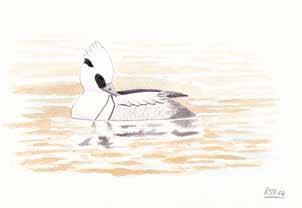
Smew Russ Boland
Lesser Spotted Woodpecker is now so rare in Suffolk that it is on the verge of extinction as a breeding species; we request that all observations be carefully documented. Currently a description is required away from its core breeding areas and soon we are likely to request descriptions for all sightings. One was seen in the Brecks in The King’s Forest on January 1st – a nice New Year’s Day gift! Siberian Chiffchaff is a nice find in winter, with one seen and soundrecorded at Snape Wetlands on three dates between January 12th and 29th; another was seen twice at Brantham sewage works – January 29th and March 3rd. Species such as Twite, Shore Lark and Snow Bunting may soon cease to be annual overwintering species as their numbers are, like wildfowl, on a downward trajectory: just two Twite were recorded along the beach north of Dunwich from March 4th to 22nd, but possibly reported also in January.
The only rarity seen in this period was the adult Eastern Yellow Wagtail at Carlton Marshes SWT from November 2022 (and deemed to likely be the returning adult from the winter of 2020/21). Seen by many, this bird stayed distant for most of its stay and was, at times, hard to see among the flooded grasses – although the Water Pipits were some compensation.
Spring period – March to early June
All was not gloom and doom, and the spring period was a busy one. For many the highlight could well have been the chance to finally catch up with Night Heron in Suffolk following the discovery of two at Lound Lakes on April 24th – sparking a mini twitch as it was a Suffolk tick for many! Like Cattle and Great Egret, Night Heron is a species that appears to be moving north in Europe and is seen in increasing numbers. There were four further records this spring: Walpole on May 3rd; one flushed from the visitor centre pond at Minsmere RSPB on May 10th; another sound recorded at North Warren RSPB later the same day; and one photographed at Lakenheath RSPB, May 21st.
Spring rarities included a Great Spotted Cuckoo found in cliff-top fields at Easton Bavents on March 24th, which was unfortunately on private land where a precarious relationship with the landowner exists and so was only seen by a handful before departing north. Just three fortunate observers had a Gull-billed Tern heading north close inshore off Landguard early on April 30th, but the fine male Kentish Plover that spent three days on the Scrape at Minsmere RSPB from May 5th was seen and enjoyed by many. Another Kentish Plover was seen at Landguard on May 18th, while two Great Reed Warblers were found: one at Boyton RSPB on May 11th was heard singing and seen by several; the other was by Island Mere, Minsmere on May 20th.
Pallid Harrier is another species that has expanded its range across northern Europe and numbers in the UK have increased dramatically. Despite three previous Suffolk records, it remains a much-desired species as those past birds were seen by just a lucky few; sadly 2023 did not buck that trend. Three second-calendar-year males were again seen by a handful of observers as they passed through quickly: a cracking young male was photographed by one observer as it flew in off the sea at Walberswick on May 6th; another was watched with a Buzzard at East Lane, Bawdsey before flying towards Bawdsey Village on May 7th – the only clue to it being a male was a paler golden-brown eye; then a third record from Orfordness, May 11th, was seen by only three observers. One day one will hang around long enough… In recent years Montagu’s Harrier has become incredibly scarce – in some ways you are more likely to find a Pallid – illustrated by just a single record for the year as one flew over Carlton Marshes SWT on April 30th heading towards Kessingland. (There were other reports in 2023 that were not submitted).
Scarce birds in spring included two Alpine Swifts flying east over Felixstowe on March 19th –this species is also becoming increasingly rare in the UK, with the national average just above the threshold of ten per year before it becomes ‘rare’ again. Suffolk’s only Rough-legged Buzzard for the year was at Elmsett on April 4th; gone are the days of regular overwintering birds and it is now a far-from-annual visitor.
Beside the aforementioned Kentish Plovers, several scarce shorebirds were found, largely accounted for by two species, Temminck’s Stint and Black-winged Stilt. On the coast there were eight records of over ten individuals of Temminck’s Stint in May, with three seen at Minsmere RSPB on 11th and at Trimley Marshes on 16th and 17th, with possibly up to five present at the latter site. Further singles were at Carlton Marshes SWT on 6th and 10th, at Aldeburgh on 18th, Somerleyton on 24th and Southwold on 29th. The first Black-winged Stilts for the year appeared on April 30th with one at Minsmere RSPB and two that were first found at Aldeburgh early morning before relocating to Hollesley Marshes RSPB the same day and then to Boyton Marshes RSPB on May 1st. It is unclear if a third bird, a female, that also appeared at Boyton on May 1st was the same as that at Minsmere RSPB, but it is clear that four birds at Southwold in the morning of May 5th were new. Twos were also photographed at Aldeburgh on May 19th, at Minsmere RSPB on May 22nd and observed mating in the afternoon at Carlton Marshes SWT on May 24th, before flying north to Somerleyton. Two were at Giffords Hall Flash, Stoke-by-Nayland
in the evening of May 31st. A Pectoral Sandpiper was on Peto’s Marsh, Carlton Marshes SWT, on May 12th – an unusual spring sighting.
In May and June, Golden Orioles put on a better showing than normal, giving a good chance to at least hear the mellifluous song of this charismatic species. The first was sound recorded at Carlton Marshes SWT early on May 6th, then two early the next day at Minsmere RSPB were seen by a Waveney Bird Club group near the visitor centre. On May 10th there was one heard on a couple of occasions at Lakenheath Fen RSPB. After a gap of two weeks, another ‘push’ arrived with singles at Yoxford on May 21st and Westleton Heath on May 25th – the latter seen in the evening and confirmed as an adult male. One, possibly two, were seen and heard along Clay Lane, Minsmere RSPB, from May 26th to June 2nd – with another that flew over the Westleton to Dunwich Road on May 27th most probably a separate bird. Further singles were found at Ipswich, near the Nuffield Hospital, on June 2nd, a first-summer male at Theberton Woods June 2nd to 4th, at the Euston Estate early on June 2nd, seen in flight at Lakenheath RSPB on June 6th, and, finally, at Melton Park on June 7th. Fourteen records of Bee-eaters for the year the first on May 14th, included a notable flock of 14 at Butley and Chillesford on May 21st. Records continued into July, with three at Aldeburgh on 26th, and August when one was seen flying south at Felixstowe on 20th.
A male Green-winged Teal was at Boyton Marshes RSPB from April 16th to 27th and a Purple Heron was seen at Trimley between April 29th and May 18th and an adult (possibly a returning bird) in the regular area of reeds at Minsmere RSPB from May 26th to June 3rd. Other unusual sightings include a female Lesser Spotted Woodpecker in a garden at Bury St Edmunds on April 16th and a singing Siberian Chiffchaff was sound recorded on the Benacre Estate on April 25th. A good showing of 12 spring records of Red-backed Shrike began with a female at North Warren RSPB on May 14th and included a number of singing males plus a male and female at the sluice, Minsmere RSPB on June 16th – sadly they did not stay. Hoopoe also had a good year with six spring records the first on April 15th at Wyverstone – and there was an intriguing summer record at Honington from July 20th to August 9th.
Early summer sightings – June and July
Rarities in this period included the birding highlight of the year – in Suffolk terms at least. A Black-winged Kite discovered at Hickling Broad, Norfolk late on July 17th was twitched by many over the next few days until the morning of 20th when it was seen to fly south. Nobody was really expecting what happened next, but when news came out that Craig Holden had relocated it (80km due south) at Kings Fleet that evening pandemonium broke out (as well as an inability to park properly). Many connected with this first for Suffolk as it was watched typically perched on tree tops and flying about the fields, albeit a little distantly. Latecomers had to wait until the following morning for better views, when it showed at close range near Felixstowe Ferry; around midday it departed and was then relocated at Colne Point, Essex.
Other rarities were overshadowed by the Black-winged Kite, but a spotty Spotted Sandpiper was seen at two locations over 50km apart: at Shingle Street on June 4th and then at the bottom of cliffs at Corton the next day. A couple of Caspian Terns at Minsmere RSPB on July 7th continued the recent increase in observations of this impressive tern.
It is hard to say when spring ends and autumn begins for birds, so as with the Black-winged Kite it is probably best to treat June and July records of some species as late spring/early summer migrants. Two records of Red-footed Falcon, a female at Walberswick on June 18th and an immature male at Boyton Marshes RSPB on June 21st, were likely wandering migrants. However, a handful of species that migrate in a northwesterly direction from wintering areas in India are more likely overshooting spring birds: Blyth’s Reed Warbler typically arrives late on breeding grounds, so one at Landguard on June 15th was a classic date; as was the Rose-coloured Starling at Felixstowe on June 2nd. Greenish Warbler and Common Rosefinch also winter in southern Asia and a nice record of singles of both at Landguard on June 18th nicely illustrate this. A Greyheaded Wagtail was photographed in flight at Southwold on June 3rd.
While Marsh Warbler also arrives late, it is from East African wintering grounds and it is possible that some will settle down to breed. Experience of the amazingly mimetic song is the best way to find them (although a mist net also helps!): the first arrived at Cornard Mere on June 1st, with others heard at Sizewell (6th) and Kings Fleet (14th). Sadly, they stop singing very quickly when on territory so two birds in July, at Trimley Marshes on 8th and Hollesley on 25th, were predictably pulled out of nets.
There was just one record of Roseate Tern in 2023, at Minsmere RSPB on June 3rd. Honeybuzzards were noted on five dates in June and July and two in August; the first, at Aldeburgh – a female north over the golf course on June 3rd – was most certainly a migrant, but then others at Minsmere RSPB on June 25th, July 28th (two on 29th) and Sutton Heath on July 30th tantalise us with the possibility of a local breeding population. A first-summer Purple Heron stayed three days at Minsmere RSPB from June 13th. A male Ring-necked Duck discovered at Carlton Marshes SWT on June 19th (staying until August 23rd) was particularly noteworthy; by the end of its stay it had moulted out of its eclipse plumage. A Pectoral Sandpiper at Hollesley Marshes on June 22nd and 23rd was another good find and strongly hinted that for migrant waders autumn was just around the corner.
Late summer and autumn sightings
For birds, autumn begins early, notably high arctic waders that have a brief period to breed once the snow has cleared and if the adults fail they head south early – followed later by juveniles from early August onwards. The adult Pectoral Sandpiper at Aldeburgh from July 19th to 27th was likely such a bird from Siberia, but it marked the beginning of a remarkable run of seven juveniles at pools on the eastern and southwestern Aldeburgh Marshes: a juvenile appeared in the evening of August 30th (to September 5th); two new juveniles were seen intermittently from September 14th to 21st, with a third on 21st; from September 28th until October 14th up to three were seen by many observers and were believed to be different from the previous three. Bucking the trend, there were Pectoral Sandpipers elsewhere in September: an adult at Trimley Marshes SWT on 2nd, Minsmere RSPB on 7th, a juvenile at Boyton Marshes RSPB from 9th to 16th, Hollesley Marshes, September 16th and another juvenile at Boyton Marshes RSPB, 29th and 30th.
Although it was actually a poor year for rare shorebirds, others in the period included a very much-admired juvenile Buff-breasted Sandpiper at Minsmere RSPB from September 11th to 14th that settled on north girder and was seen especially well from the public hide in the morning with the sun behind. A juvenile Red-necked Phalarope was found at Hollesley Marshes RSPB on August 25th and it showed well to many until September 5th. Five records of Grey Phalarope included the first off Thorpeness on September 24th, on beach pools at Kessingland for six days from October 22nd, and singles at Minsmere RSPB, Slaughden and Landguard.
Seawatching is something of a fool’s errand at times on the Suffolk coast with weather conditions that drive seabirds inshore being rare events (and seemingly getting rarer) and often promising conditions often disappointingly fail to deliver. Persistence will sometimes pay off and as ever a small number of scarce seabirds were found in the autumn, usually by the same stalwart seawatchers. Perhaps the least expected sighting of 2023 was that of a female or immature Surf Scoter first seen flying south off Pakefield mid-morning on October 19th, then picked up off Southwold, Minsmere RSPB, Sizewell and Thorpeness as it continued south.
‘Classic’ seabirds included just one Cory’s Shearwater, at Landguard on August 17th, although other large shearwaters were noted but were too far out to confirm identification. There was a run of Balearic Shearwaters in September, the first being at least three on 17th, some of which were tracked north from Thorpeness to Southwold via Minsmere RSPB; two were seen at Southwold on 19th with further singles there on 25th and 28th, the second of which was also seen off Minsmere; one went south off Felixstowe Ferry on 20th and two flew south off Bawdsey early on 26th. There were five records of Sabine’s Gull, the first being a juvenile south mid-morning at Minsmere RSPB, September 19th; this was followed by two singles (possibly the same bird) at Southwold
on October 17th, one of which was also seen at Benacre, and another north at Slaughden early afternoon the same day. On this date there were also four Leach’s Petrels all singletons heading north: at Thorpeness, Southwold, Minsmere RSPB and Bawdsey, but these were eclipsed by a Storm Petrel seen flying north late afternoon that day off the beach at Minsmere RSPB.
Other scarce birds of note this autumn were two Ortolan Buntings at Thorpeness on August 19th, one at the Old Caravan Park and the other by Haven House; four Honey-buzzards included a juvenile south at Bury St Edmunds, August 10th, an adult photographed at Southwold, August 21st, at Landguard, September 3rd, and a juvenile photographed at Minsmere RSPB on September 6th. A Rose-coloured Starling was also at Landguard on October 8th, a Hooded Crow was photographed at Thorpeness on October 8th and an Arctic Warbler found in an observer’s garden at Burgh Castle for three days from October 12th. Classic late October migrants came in the form of a Dusky Warbler at Lowestoft for five days from October 24th and a Pallas’s Warbler at Minsmere RSPB on November 14th. There were 11 autumn records of Wryneck – from August 17th at Minsmere until October 3rd at Kessingland and three records of Red-backed Shrike from August 19th, a juvenile at Corton, to September 29th, another youngster at Landguard.
Rare birds in the autumn included a Black Stork at Butley on August 9th – with another at Woodbridge on 20th; a Squacco Heron at Livermere Lake on August 15th was a nice early evening find and showed until dusk for those quick off the mark. Two stunning warblers were seen at Landguard in August: a first-autumn ‘milky tea’ Booted Warbler showed well about the southern fence line compound on 18th; however, this was trumped by a stripy young Aquatic Warbler in brambles on the common on 30th, which sparked a major twitch for Suffolk birders, being the first ‘available’ to many. Though elusive at times, it performed well on a handful of occasions and for some it was the true highlight of their birding year (ahead even of the Black-winged Kite). Two rare wheatears were to follow, with a very pallid Isabelline Wheatear that showed well in the paddocks north of Southwold pier in the afternoon of September 26th – although it was not seen the next day. A very smart first-autumn male Pied Wheatear found among the caravans on the denes in the morning of October 22nd was initially flighty, but settled and showed well in the late autumn sunshine.
Three now-expected Pallid Swifts appeared in late October: at Minsmere RSPB on 22nd, Corton on 27th and Benacre on 31st. A classic, washed-out autumn Siberian Stonechat at Corton Old Sewage Works on October 24th and 25th was a very smart find (although has yet to be accepted by BBRC).
Late autumn and early winter
As expected, there were few scarce birds about during this period, with an early Twite at Kessingland on October 22nd (to 24th) either a migrant or an early arriving winter bird; another two Twite were found at Kessingland on November 23rd and the four at Dunwich on December 15th were as elusive as ever. Single Siberian Chiffchaffs were at Landguard, trapped on November 22nd, and Long Melford sewage works from December 7th. Three Hoopoe were found, one at Beyton on November 3rd, at Butley on November 20th and a December bird in Rendlesham Forest on 15th.
In the right conditions November is a good time to look for Little Auk or Leach’s Petrel off the coast and November 4th was such a day: two Leach’s Petrel at Southwold, plus singles at Slaughden, Orfordness, and two at East Lane, Bawdsey; then on November 8th another was off Minsmere RSPB. On December 7th, a speculative seawatch for Little Auks at Southwold was successful, but was notable for a Surf Scoter that flew north – likely the October bird. A firstcalendar-year Lesser Yellowlegs was discovered on the flooded Southwold Town Marshes in the gloomy late afternoon light of November 7th and stayed into 2024. Rounding off the year, a fine drake Ring-necked Duck at Thorpeness Meare was discovered on November 26th, where it was well-watched – although it could be elusive at times for some observers; it transferred to North Warren RSPB on December 26th and it too stayed into 2024.
Introduction
A study of Lowestoft’s Black-legged Kittiwakes – Rissa tridactyla
Julie Martin and Steve Piotrowski
An annual tally of the number of Black-legged Kittiwake (hereafter referred to as Kittiwake) nests and their whereabouts within Lowestoft was carried out by the late Brian Brown, with papers published in Suffolk Birds in 1986 and 1990. However, since his death in 1999, only ad hoc records have appeared in Suffolk Bird Reports. There has been no recent comprehensive study of Lowestoft’s Kittiwake population, which has increased significantly in recent years. In response to this, a breeding bird survey was carried out in Lowestoft during 2023 by Julie Martin.
Background
The British Trust for Ornithology (BTO) estimated the UK population of Kittiwakes in 2015 to be in the region of 205000 pairs, but there have been substantial declines (BTO birdfacts website page for Kittiwake). Nationally, the Kittiwake breeding range has contracted by around 10%, with a population decline of over 40% during 1986-2011 (Balmer et al. 2013). This trend has been proven more recently by the Seabirds Count 2023 (JNCC, 2023). Declines of Kittiwakes in Britain can be attributed to fewer than 0.8 chicks fledging per pair at many monitored sites (Coulson, 2017). This is thought to be in response to over-fishing and changes to sea-surface temperatures due to climate change. Sandeels are the Kittiwake’s preferred food item in northern waters, but stocks have declined severely to the extent that industrial sandeel fishing will no longer be permitted in the North Sea from April 2024 (BirdLife, 2024).
For info: Sandeels are eel-like fish (not Eels Anguilla anguilla) up to about 30cm in length. They are often found in vast shoals. They are not a single species but shoals can be made up of a considerable number of different species of marine fish.
Suffolk has two Kittiwake nesting areas: the urban colonies at Lowestoft and the nowredundant, offshore cooling towers at Sizewell. These are the only east-coast colonies between Bempton Cliffs, East Yorkshire and Dover, Kent (Balmer et. al. 2013). The Kittiwake is now on the Red List of Birds of Conservation Concern and is listed as a Vulnerable Species of European Conservation Concern. Therefore, looking after our Kittiwake colonies in Lowestoft is important for the conservation of the species within the UK.
Nesting Kittiwakes have been a part of Lowestoft’s heritage for 65 years since two pairs bred, albeit unsuccessfully, on the South Pier Pavilion in 1958. Numbers increased slowly and by 1970, 36 pairs were present. During the 1970s, the colony spread onto buildings surrounding the harbour area but the South Pier was the preferred site. By 1979, 86 pairs were nesting at Lowestoft. Many of the favoured buildings were then demolished and birds were dissuaded from nesting on others by a variety of measures; cementing ledges, fixing netting and, more recently, installing spikes. Whilst increasing incidences of poorly-installed, and maintained, deterrents posed a threat to the birds, through entanglement in the netting or being killed by the spikes, the greatest threat to Lowestoft’s Kittiwakes came in the late-1980s when the main nesting site, the South Pier Pavilion, was demolished. The final year of breeding at that site was 1988 when 107 nests were noted, but the birds soon became accustomed to a purpose-built wall on the northern side of the harbour entrance. The Lowestoft colony increased very rapidly and a peak of 259 nests (producing 303 young) was reached in 1995. Kittiwakes began nesting in 1995 on Claremont Pier where numbers have since multiplied steadily.
Anti-gull measures employed by businesses in the town generally restricted Kittiwake nesting
to the harbour area, but disaster struck in 2006 when urban foxes discovered the wall and predated many of the nests. Thereafter, nesting numbers in the harbour plummeted although, almost certainly, displaced birds from there were recruited to the Claremont Pier colony, which peaked at 47 nests in 2020. Predation by Red Fox (Vulpes vulpes), Brown Rat (Rattus norvegicus) and Herring Gull (Larus argentatus) severely limited nesting success in the harbour area.
Nesting was noted for the first time in the town centre on Boots the Chemist and on Our Lady Star of the Sea Roman Catholic Church in 2014. The latter site proved to be a most favourable nesting location with numbers increasing rapidly to 62 pairs (raising 63 chicks) in 2015, 145 pairs in 2016 and 151 in 2018. In 2015 a total of 36 nests (producing 36 young) was on the BT building, and Boots the Chemist hosted 22 nests (16 young). Predation at the port continued, which probably explains the subsequent diverse spread of locations within the town. The purpose-built wall was abandoned by Kittiwakes after the 2016 breeding season. Lowestoft nesting totals have increased steadily in recent years from 200 in 2013 to 408 in 2017 and c.650 in 2021.
It is an obvious question to ask – why have Kittiwakes chosen to breed in Lowestoft? Traditional nest sites are usually found in dense colonies on steep cliffs with narrow ledges, surrounded by other seabirds. What is it about urban Lowestoft that appealed so strongly to those pioneering Kittiwakes in 1958? We can only assume that access to suitable food sources played a key part. During ringing of Kittiwake nestlings between 2008 and 2013 regurgitated samples were collected and submitted for scientific analysis of the contents. Of the total of 123 samples tested over the six-year period, an average of 55% of contained sandeel. The proportion of sandeels varied between years with as few as 4% of 26 samples containing sandeels in 2010 to a whopping 91% of 32 samples in 2013. The remaining percentage was supplemented mainly with Clupeids such as Sprat and Herring (Carter, 2014). It is likely that these food sources are within a close range of Lowestoft and that competition at the feeding grounds is relatively low. This would go some way to explaining why Lowestoft’s Kittiwake population has continued to expand, although more work needs to be carried out to confirm this.
Winter Distribution and Movements
At the beginning of the 20th century, the Kittiwake in Suffolk was regarded solely as an autumn and winter visitor, arriving in September and leaving in spring (Ticehurst, 1932). The species is a surface-feeder and is the most abundant gull in Britain and Ireland (Wenham et al. 2002) and in the world. When the fishing ports of Lowestoft and Great Yarmouth were thriving, they would have provided ample foraging opportunities for the species. However, following the subsequent demise of the fishing industry, Kittiwakes now compensate for low food availability by increasing their feeding range and devoting more time to foraging.
Numerous studies show that the species is essentially oceanic outside of the breeding season, with populations from many breeding localities wintering in the North Atlantic and in the North Sea. Some Kittiwakes from British and Irish colonies, especially first-winter and immature birds, spend time off the eastern seaboard of North America (Wenham et al. 2002). Kittiwakes do not have set migration routes but seek out good foraging areas. Nowadays, the species is scarce off Suffolk in mid-winter.
Lowestoft’s ornithologists have had a long-term interest in Kittiwakes and regularly search for ringed birds. Two individuals ringed in Brittany, France, have been logged at Lowestoft (Andrew Easton, pers. comm). From 2004, licenced bird ringer Colin Carter began ringing Kittiwake nestlings at the purpose-built wall in Lowestoft’s outer harbour and at the town’s Claremont Pier. This led to a long-running colour-ringing project as part of the BTO’s Re-trapping Adults for Survival scheme, later continued by Kessingland Ringing Group (KRG). Over 1400 Kittiwakes have been ringed since 2004 with a hiatus from 2020-2023 when access to the nest sites became problematic.
There have been almost 3400 re-sightings of the colour-ringed birds since the project began. These re-sightings have proven that the vast majority of surviving Kittiwakes of breeding age return
A study of
to their natal site to breed. A small number of Lowestoft colour-ringed Kittiwakes have joined a colony at Boulogne-sur-Mer harbour in northern France, from where re-sightings are submitted annually to KRG by local enthusiasts. A table of re-sightings during 2023 is shown in Appendix 1. The Kittiwake’s site fidelity means that it is a species which is ideal for studiesusing geolocation technology. Individual Kittiwakes return to the same breeding localities each year and adults are relatively easy to catch as they sit tightly on their nests. However, recapturing them is quite challenging as previously-caught birds quickly realise the intentions of the trappers. Captured birds are fitted with small geo-locators, which are tracking devices which weigh no more than eight grammes. The data retrieved provide information on the annual movement cycle of each bird.
During Kittiwake ringing activities between 2012 and 2019, KRG carried out a small study by fitting geo-locators to breeding adults to investigate winter dispersal from the Lowestoft colonies. This resulted in a paper published by group member, the late Mike Swindells, in the Seabird Journal. A total of 27 birds was fitted with geo-locaters, some for multiple years. Fifteen individuals were recaptured with usable data, some with tracks for up to four successive years. Three of these birds stayed in the North Sea, one visited Portugal and the others wintered in the North Atlantic (Swindells, 2019). Although this is a very small sample, the recoveries conform to the international trend.
Kittiwakes in Lowestoft 2023 Sites and Methodology
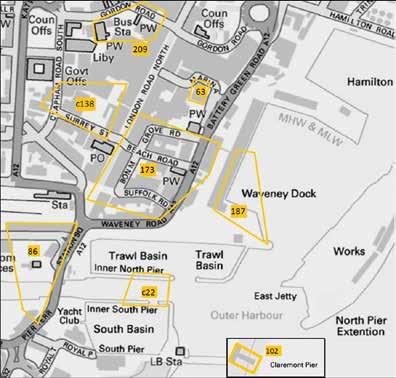
There are three key areas in Lowestoft which contain colonies of breeding Kittiwakes: Waveney Dock, Claremont Pier and the town centre. Within the town centre there are several sub-colonies that can be independently identified (see Map 1). The largest sub-colony centres on Our Lady Star of the Sea Roman Catholic Church in Gordon Road. Another large sub-colony is centred around the BT building on Surrey Street. A mini-colony exists at the Marina Theatre. There are many small nest sites spread out around the buildings east of the lower section of London Road North which have been grouped together. There is also an important colony directly around the landward side of the Bascule Bridge and a small site around the port channel and trawl basin. All nests are within 700 metres of the true coastline or 400 metres from the docks.
It is clear from this map that Kittiwakes prefer to nest together, taking every opportunity to remain within sight, or even earshot, of other nesting birds. Most nest sites have been constructed opportunistically on buildings within the town. Over the last two years there have been purposeprovided ledges constructed at two of the key sites; the BT building and the Marina Theatre. The Kittiwakes have taken very quickly to these ledges, principally when they have been displaced from pre-existing nest sites, but this uptake has also involved many first-time breeders.
Surveys of the main breeding sites were carried out during the period March 18th until August 23rd, usually at two-weekly intervals. The first visits were made to count adults in attendance and to observe breeding activity. From May onwards counts were made specifically looking at apparently occupied nests (AONs) as well as noting any trace nests. From mid-June until mid-August visits counted how many chicks were present. All counts were carried out using a Swarovski ATM85 spotting telescope and 10x42 binoculars. There are considerable difficulties in monitoring most of the colonies within the town because of the height of the nests from the ground and the available angle of observation. At no point was it possible to make any accurate counts of eggs at any of the nest sites in Lowestoft. Colour-rings were read at every possible opportunity and 179 sightings were submitted to the BTO via Kessingland Ringing Group.
Key Sites
Waveney Dock
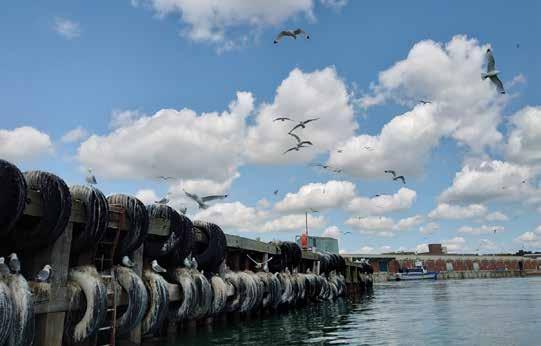
The Kittiwakes here nest on tyre fenders and dock stanchions just above the water line (see photo below). There are a few nests on buildings beside the docks but these were not monitored
for breeding observations. Six arranged visits were made at Hamilton Dock to survey activity across the water towards Waveney Dock. This was only possible with a spotting telescope which could only be used when the weather was suitably calm. Two surveying visits were made into Waveney Dock by small dinghy, kindly captained by Dick Houghton, on July 4th and 18th. This gave very accurate counts of AONs and chicks at the peak of the breeding season, using only binoculars from the boat.
Our Lady Star of the Sea Roman Catholic Church
The church has nests on all four sides of the tower and on the top parapets with just a few nests on other parts of the building. Because of the height and angle of observation, it is quite difficult to see into the nests. Most of the chicks could only be counted once they had reached a medium size and could be seen from ground level.
The BT Building
Over the last decade this building has been a heavily-occupied nesting site, with birds using window ledges around the building. Netting was put in place in 2021 leading to trapped and distressed birds and a national campaign took place in the media to remove the netting. This led to the construction of 13 levels of purpose-provided plank ledges on a blank, west facing wall. Part of the ledging is obscured by a large tree which makes viewing difficult (see photo below). The Kittiwakes tend to occupy from the top-most ledge downwards, so viewing activity from ground level is not easy. In 2023 the Kittiwakes managed to construct nests on the window ledges on the Surrey Street side of the building despite measures put in place to dissuade them. These nests were constructed several weeks later than in the main colonies, leading to later broods and were much easier to observe from ground level. It was discovered late on in the breeding season, that there were more nests at the rear of the building where there is no public access or viewing. This means that there were approximately 10-20 nests which did not have any breeding observations.
Map 1: The Lowestoft sub-colonies, with total number of AON
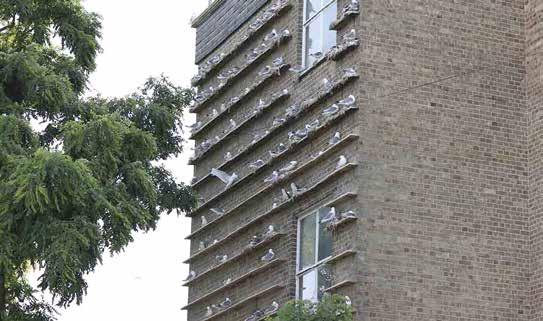
on the purpose-provided planking at the BT
The Town Centre
For surveying purposes, this area covers everywhere not separately detailed in this section. There are many mini-colonies within the town centre. They tend to be built on commercial buildings where viewing is made difficult by the angle of observation from ground level. Notable mini-colonies exist at the Marina Theatre, Lowestoft Music Centre in Grove Road, Mattressman on Bon Marche/Beach Mews, a residential house on Battery Green Road, residential homes in Commercial Road and on buildings at Pier Terrace and Papa Johns in Station Square.
Kittiwakes nesting at Waveney Dock.
Photograph: Julie Martin
Kittiwakes nesting
Building. Photograph: Robert Wincup
Claremont Pier
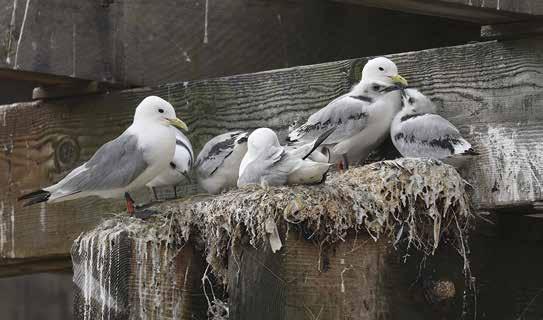
A full breeding survey was carried out on the nests which are visible from land using the methods prescribed in the Seabird Monitoring Handbook for Britain and Ireland 1995, and was submitted to the BTO’s Seabird Monitoring Programme. This is the only site where visibility for observations was good for 61 AONs. Here the Kittiwakes nest on the posts and braces that previously supported the pier planked-flooring. Despite the current pier owners removing much of the planking for renewal outside of the breeding season, Kittiwakes continue to nest at this important site. A visit to the seaward end of the pier by dinghy on July 18th found that there were another 40+ nests that could not be seen from land and, as such, did not have any breeding observations.
Breeding Results
The results have been broken down into observed AONs (Actively-Occupied Nests), number of chicks counted at the site and overall productivity.
• Waveney Dock had 166 AONs producing 174 chicks with a productivity of 1.05 per nest. There was a significant failure of nests at this site sometime in late-June which was almost certainly caused by human activity. A total of 42 nests was observed to have failed on July 4th, with 33 alone in one of the four nesting sections.
• Our Lady Star of the Sea Roman Catholic Church had 195 AONs producing 225 chicks with an average productivity of 1.15 per nest.
Table 1: Breakdown of AONs and productivity by area at Our Lady Star of the Sea Roman Catholic Church
Colour-ringed Kittiwakes nesting at the Claremont Pier
Photograph: Robert Wincup
• The BT Building had 94 AONs producing 104 chicks with a productivity of 1.10 per nest.
• The Town Centre had 367 AONs producing at least 430 chicks with a productivity of 1.17 per nest.
• Claremont Pier (landward) had 61 AONs producing 71 chicks with a productivity of 1.16 per nest. There were 13 failed nests observed during the breeding bird survey at this site.
Overall, there were 883 monitored AONs throughout Lowestoft. A total of 1004 chicks was counted at these nests giving an overall productivity of 1.13 chicks per nest.
There were over 100 additional AONs that were found in Lowestoft but which could not be observed because of the problems with access: 21 on the buildings at Waveney Dock, 45 on the seaward end of Claremont Pier, 22 in the port channel/trawl dock and c.20 at the rear of the BT building. This brings the total of AONs to 991, with a total of 1982 individual breeding birds. There were also non-breeding birds present across the town during the breeding season, which leads to an estimate of c.3000 individual Kittiwakes present in Lowestoft.
Avian Influenza
Highly Pathogenic Avian Influenza (HPAI) has been affecting UK seabird populations in large numbers since 2021 (BTO, 2023). It is a virus which spreads quickly through dense colony nest sites. Sadly, 21 of the UK’s 25 breeding seabird species have tested positive for the virus since 2021 (RSPB, 2024). HPAI was noted as moving down Britain’s East coast during the seabird breeding season in 2023, notably affecting the seabirds at RSPB’s Bempton Cliff during mid-July (BBC, 2023). HPAI was also reported along the entire Norwegian coast in 2023 and Kittiwake colonies in the High-Arctic have been decimated by the disease. There are reports of a staggering 11000 dead Kittiwakes being removed from colonies around Vadsø Municipality, Finmark, which may account to more than half of the local population (Bird Guides). The Lowestoft population of Kittiwakes was monitored closely during the breeding surveys for signs of HPAI. A fledged juvenile was found at Ness Point on August 2nd with suspected HPAI and was removed by the RSPCA. This led to an inspection of the main colonies on August 3rd when a chick was seen displaying vivid and typical visual symptoms of HPAI at the Claremont Pier. There was also concern that eight adults across the town may have been displaying visual signs of early-HPAI infection. The few birds that showed symptoms of HPAI became apparent at the tail end of the breeding season when colonies further north were dispersing. It is impossible to ascertain the extent of the disease locally or whether the casualties generally involved passage birds. All sightings of sick or dead seabirds have been submitted to the BTO by Birdtrack. However, it is suspected that sick or dead birds found by others have not been reported.
The Future
The future of the Lowestoft Kittiwakes had been looking quite uncertain with displacements throughout the town being unavoidable. Recently, there has been construction of Artificial Nesting Structures (ANS), purposely provided by two energy companies at Lowestoft, in mitigation for offshore windfarm disturbance; one land-based site and two offshore platforms. A third platform has been stationed off Minsmere. It is expected that, in time, Kittiwakes will take up residence on both the onshore and offshore structures. Ringing returns show that Kittiwakes have site fidelity and birds that have been nesting successfully on buildings in the town, perhaps for several years, will take time to relocate to these new structures, even with displacement. Any birds that do relocate will also attract ‘new recruits’ – young birds reaching breeding age for the first time. The ban on industrial sandeel fishing in the North Sea ought to bring about a positive increase in Kittiwake productivity and abundance along Britain’s East coast over the coming decade, notwithstanding the as-yet- unknown full impact of HPAI. However, if a significant outbreak of
HPAI occurs within Lowestoft’s town centre it would be devastating for the Kittiwake colonies, not only due to mortality but also because it may prompt a public outcry that would result in a massive cull on health grounds because It is likely that there would be concerns about the disease spreading to the human population.
Conclusion
Lowestoft’s urban Kittiwake population has grown continually since the first birds nested here in the 1950s culminating in almost 1000 nesting pairs in 2023. The overall breeding productivity of 1.13 chicks per nest in 2023 is well within the mean tolerance of 0.8-1.5 fledged young per year required for maintaining the Kittiwake population (Coulson, 2017). With the addition of the newly-constructed ANSs and the sandeel fishing ban, it is hopeful that the breeding population in Lowestoft will continue to increase.
Acknowledgments
We should like to acknowledge the help and assistance of Andrew Easton (Waveney Dock monitoring), Robert Wincup (photographs), Dick Houghton (for use of his dinghy), John Casey and Martin Sanford (advice and assistance).
References
Balmer, D. et al. 2013 Bird Atlas 2007-11: 396. BTO Thetford
Brown, B. J. 1986, A History of the Kittiwake in Suffolk, Suffolk Birds, 1984: 66-71.
Brown, B. J. 1990, Further Notes on the Kittiwake in Suffolk, Suffolk Birds, Vol 39: 21-23. Carter, C. 2014, The Success of a Small East Anglian Colony of Kittiwakes may be Due to a Diet Supplemented by Clupeids, The Seabird Group Newsletter 126, June 2014: 8-10.
Coulson, J. C. 2017, Productivity of the Black-legged Kittiwake Rissa tridactyla required to maintain numbers, Bird Study, Vol 64: 84-89.
Swindells, M. 2019, Non-breeding movements of Black-legged Kittiwakes Rissa tridactyla from a North Sea urban colony, Seabird 32, 2019-20: 33-45
Ticehurst, C. B. 1932, A history of the birds of Suffolk. Gurney and Jackson, London. Walsh, P.M. et al. 1995, Seabird Monitoring Handbook for Britain and Ireland, JNCC Publications, 1995: Kittiwake 1-7.
Wenham, C. V. et al. 2002, The Migration Atlas: movements of the birds of Britain and Ireland. T & A. D. Poyser, London. https://jncc.gov.uk/our-work/seabirds-count/ https://www.birdlife.org/news/2024/01/31/closure-of-english-waters-to-sandeel-fishingprovides-a-lifeline-for-north-sea-seabirds/ https://www.bto.org/community/news/202308-avian-influenza-spreads-more-threatenedseabird-species#:~:text=In%20total%2C%20more%20than%2010,in%20these%20species%20 this%20summer.
https://www.rspb.org.uk/birds-and-wildlife/seabird-surveys-project-report https://www.bbc.co.uk/news/uk-england-humber-66236555 https://www.birdguides.com/news/Norwegian Kittiwakes ravaged by bird flu/ https://www.bto.org/understanding-birds/birdfacts/kittiwake
Appendix I: Lowestoft Kittiwake colour-ring sightings in 2023
Place Key:
LCL= Claremont Pier (N) or (S) North side or South side
WAVDOC= Waveney Dock
LOH= Lowestoft Outer Harbour (The purpose-provided Kittiwake wall)
TELEX= BT Building
RCCHUR= Our Lady Star of the Sea Roman Catholic Church
ICENI= Houses on Battery Green Road
BEACH MEWS= Beach Mews
COMM RD= Commercial Road
GORROCK= Gorrock Ropeworks, Battery Green Road
Age at Ringing:
8= 4+ calendar years, exact age of hatching unknown
1= Pullus ringed at nest
3= Fledged bird ringed in the year of hatching **= First resighting since date of ringing
2023 Bird Ringing Report for Trimley Marshes SWT
Justin Zantboer
Introduction
Starting in 2015, 2023 was our ninth year of bird-ringing at Trimley Marshes SWT. Most days we only erect three mist nets totalling 130 feet but when conditions and time allow, we may erect as many as ten mist nests totalling between 340-400 feet. Most of the net sites are amongst the scrub and all of them are on the outside of the Inner Dyke to avoid disturbing the Lagoons and Meadows. Most often, I’m ringing on my own during the week before starting work at 08:00hr but at weekends, I’m usually joined by my son Daniel and when she’s home from university, my daughter Ellie. We’re also occasionally joined by local Ringing Trainer Rob Duncan and the Landguard Bird Observatory Ringing Warden, Peter Denyer.
After having restrictions for two of the last three years, with Covid-19 stopping everything during spring 2020 and Avian Flu (HPAI H5N1) halting the study in Autumn 2022, it was pleasing to have a year of unrestrained ringing. That said, there were challenges that prevented ringing at the same intensity of previous years with the main one being the persistent westerly-biased winds that dominated the autumn and continue into the winter, even as I type now. Wind is a major issue when bird ringing as it makes our mist nets more visible and if it’s too strong, we can’t open them for fear of injuring the birds so with this in mind, and combined with more family and work commitments at weekends, the number and the duration of the visits was much reduced. Continuing increases in the number of people and non-native deer using the Reserve present different challenges with maybe surprisingly, the people being easier to engage with and manage than the deer.
Despite these challenges, 2023 proved to be a record-breaking year with our highest number of birds ringed in a year since we started, with an impressive variety of species too. For the moment, we can only wonder at why this might be but it’s suspected that the Port of Felixstowe recently switching a lot of their lights from the sodium yellow to the white LED lighting, particularly at the Trimley end, may be a factor as white lighting is known to attract migrating birds. Improved Reserve Management must also be playing a part too so hopefully the ongoing bird-ringing project and the data produced will assist in the study of the birds using the Reserve for breeding, wintering and as a migration stop-over.
Ringing details – Winter
Five sessions during January and February produced 28 birds so an improvement on 2022 (15), but indicating that not many passerines chose to spend the winter on the Reserve. Birds ringed included four Blackbirds, three Redwings, single Song Thrush and Cetti’s Warbler and nine Reed Buntings – but there were no surprises. A female Cetti’s Warbler was retrapped along with two Robins.
Ringing details – March
March started slowly because of bad weather during the first half of the month so our first session wasn’t until 19th. A further four sessions before work was all we managed and yet we recorded our second-best-ever March, ringing 51 birds of 11 species. Redwing was the principal species totalling 31 with 17 on 19th, six on 23rd and eight on 29th. These will be birds leaving the UK and heading back to their breeding grounds in the forests of the taiga of northern Eurasia. Eight Chiffchaffs was also notable, including four on 19th.
Ringing details – April
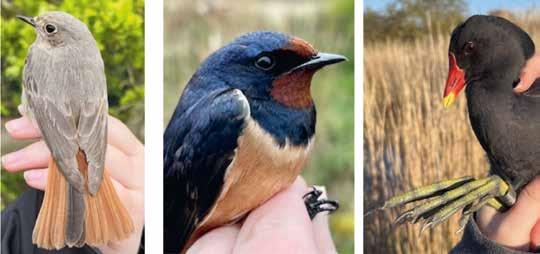
April 2022 had been our best-ever, with 84 birds of 16 species ringed. April 2023 literally blew that record away with 223 birds of 22 species ringed! A Moorhen ringed on 29th was,
surprisingly, an addition to the ringing list and a female Black Redstart on 8th was only the third ringed, all three having been in April. Other oddities for Trimley included two Garden Warblers (26th and 28th), these being the first we’ve ringed in April; two Grasshopper Warblers (27th and 28th) and two Firecrests (24th and 28th) while 18 Sand Martins (including 14 on 28th) were unexpected and the first that we’ve ringed in April. Equally remarkable though was that our principal species for the month was Chiffchaff with an impressive 63 ringed; prior to this, we’d only ringed an overall total of 39 Chiffchaffs in all of the Aprils from 2015 to 2022. 33 Blackcaps, 27 Whitethroats, 24 Sedge Warblers and 13 Lesser Whitethroats were the other top species ringed. The ringing numbers for all of the ten regular species of warbler were their best-ever for April leading to high hopes of a decent breeding season. Also of interest, especially as we’ve never ringed a Swallow in April before, was a Swallow caught on 8th and found to be a bird that we ringed as a juvenile on August 25th 2018 making him nearly six years old and with most British Swallows wintering across sub-Saharan Africa, often as far south as the Cape, that’s at least at an estimated 130,000 kilometres that he’s clocked up just migrating! Another returning bird of note was a Reed Warbler which was ringed on July 25th 2021, and was retrapped on April 7th, which is somewhat early for a returning Reed Warbler.
Ringing details – May
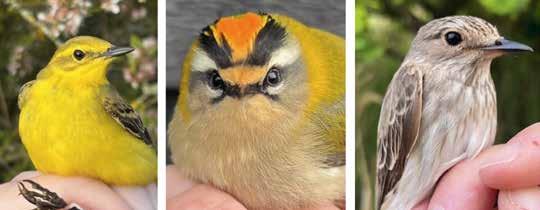
May was another record month for us with 180 birds of 19 species ringed. Admittedly this did include 49 pulli tits but, even without them, it would still have been our highest-ever May total, exceeding the 124 ringed in 2021. The highest individual-species totals were 43 Blue Tits, 39 Reed Warblers, 22 Blackcaps, 18 Sedge Warblers, 17 Whitethroats and nine Lesser Whitethroats. The Blue Tit total does include 40 ringed in nest boxes. Unusual species ringed included a male Yellow Wagtail on 1st, a Firecrest on 8th and a Spotted Flycatcher on 28th. The Yellow Wagtail was our first-ever ringed in spring and the Spotted Flycatcher was only our fifth-ever and third in spring. Four Swallows ringed on 8th was unusual as previously, we’d only ringed one during Spring, in May 2021. A Sedge Warbler bearing a Belgium ring caught on 7th was only the second we’ve controlled from that country; ringed on August 16th 2022 as a juvenile, this bird was likely to have been returning to the UK to breed.
Considering we missed the autumn of 2022, the number of birds ringed at Trimley during previous years and returning in 2023 was quite high, with three Sedge Warblers ringed during 2021 another in 2022 all being retrapped this spring, with at least three of those remaining to breed. Totals of returning Reed Warblers were even more impressive with one bird ringed in
Black Redstart by Justin Zantboer
Swallow by Justin Zantboer
Moorhen by Justin Zantboer
2019, six in 2021 and one in 2022 all passing through the Reserve during the spring or summer. Other returning warblers were a Blackcap ringed in April 2022; a Lesser Whitethroat ringed in July 2022 and a Chiffchaff ringed in April 2022.
The following table shows the number of warblers ringed during April and May since 2015. As mentioned earlier in the report, it’s encouraging to see how impressive the 2023 totals were:
Ringing details – June
Spring passage in 2023 seemed to end quite abruptly which meant that our June total would’ve been the lowest since 2018 had it not been for the contents of a few more nest boxes. A total of 75 birds were ringed of 14 species, including 15 pulli tits. The highest individual-species were 21 Blue Tits, 12 Reed Warblers and ten Chiffchaffs with the only unusual species our third-ever Treecreeper, ringed on 25th, the first ringed at the site since June 2019; as with the two records before it, this was a juvenile bird which had probably fledged fairly close by. Newly fledged birds started to appear from the 11th with Robin (4), Blackbird (1), Chiffchaff (10) and Blue Tit (11) on the wing. Wren (1), Blackcap (1) and Sedge Warbler (3) were noted from 18th and Whitethroat (2), Reed Warbler (1), Great Tit (1) and Reed Bunting (1) from 25th (monthly totals in brackets).
Yellow Wagtail by Justin Zantboer
Firecrest by Justin Zantboer
Spotted Flycatcher by Justin Zantboer
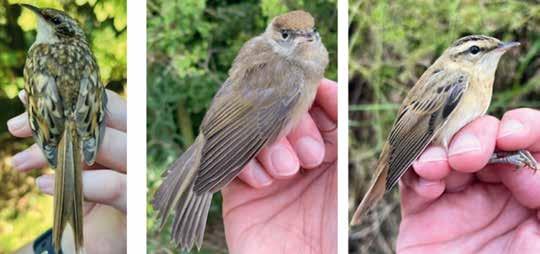
During May and June, a total of 24 nest boxes were checked over the course of three visits commencing on May 24th and finishing on June 4th. Ten of these were found to be empty or containing Hornets or Wasps. Of the occupied boxes, three contained Great Tits and the remainder, Blue Tits. Clutch sizes seemed to be quite good, particularly Blue Tits.
Treecreeper by Justin Zantboer
Blackcap by Justin Zantboer
Sedge Warbler by Justin Zantboer
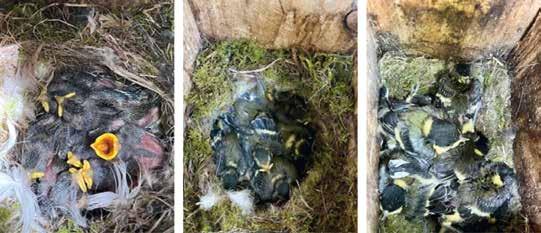
Ringing details – July
Another record month with 436 birds of 18 species ringed, exceeding our previous best July total, back in 2020, by 198 birds. Blackcap, Whitethroat, Sedge Warbler, Reed Warbler, Cetti’s Warbler and Chiffchaff all had their best July totals since we started in 2015. Most of the birds ringed were juveniles, suggesting that this had been a decent breeding season. Whilst we can’t say for sure, it’s suspected that a high percentage of the Blackcaps, Whitethroats, Cetti’s Warblers and Chiffchaffs that were ringed were likely to have fledged on the Reserve due to the number of suspected breeding birds, plumage moult and how early in the month a lot of the juveniles were ringed. The highest individual-species’ totals were 247 Sedge Warblers, 81 Reed Warblers, 26 Blue Tits and 16 Cetti’s Warblers. The following table shows how the warbler totals in July this year compared with previous years:
Blue Tits by Justin Zantboer
Blue Tits by Justin Zantboer
Great Tits by Justin Zantboer
Despite the high numbers, there wasn’t much in the way of unusual species ringed. However, an Acrocephalus warbler caught on 8th had us scratching our heads. After several measurements were taken our suspicions that it was a Marsh Warbler were confirmed. Reed and Marsh Warbler are incredibly similar and some can be virtually impossible to tell apart on plumage and can only be reliably identified using biometrics. With light south-easterly winds the night before, we can only wonder where this bird, which had likely failed to breed, had wandered from, but the feeling was that it probably wasn’t too far. Our first Kingfisher of the year was caught on 28th.
Freshly fledged birds continued to appear throughout the first half of the month. Fifteen of the 16 Cetti’s Warblers ringed were all juveniles and deemed to be most likely from the Reserve as were six Blackcaps, 11 Whitethroats and nine Chiffchaffs. There were several juveniles ringed of both Reed and Sedge Warblers early in the month but because these species both start to move off quite quickly, it’s difficult to say whether or not they fledged on the Reserve. The first juvenile Lesser Whitethroat of the year wasn’t ringed until 9th and could quite easily have fledged elsewhere. A juvenile Linnet ringed on 9th was the first juvenile that we’ve ringed on the Reserve since July 2019. Three juvenile Reed Buntings were ringed later in the month; these most likely fledged on the Reserve.
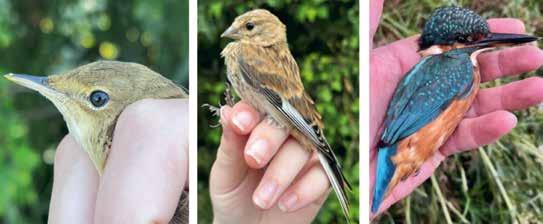
Ringing details – August
Because of poor weather and time away, we only managed 16 sessions of which just eight went beyond 09:00hr with no days of over 100 birds ringed, with the biggest days being 84 ringed on 5th, 80 on 16th and 69 on 13th. With this in mind, this was still our third-highest August since we started in 2015 with 616 birds ringed of 20 species. The highest individual-species totals
Marsh Warbler by Ellie Zantboer Linnet by Ellie Zantboer Kingfisher by Justin Zantboer
were 366 Sedge Warblers, 160 Reed Warblers, 27 Swallows and 15 Whitethroats. Two Lesser Whitethroats is the lowest since 2019 and six Willow Warblers and two Chiffchaffs are both the lowest since 2018. Sedge Warblers were down on 2021 (471) and 2020 (710) but 366 was still our third-highest August total and the Reed Warbler figure of 160 was our second-highest ever. A juvenile male Sparrowhawk on 5th was, surprisingly, given that they’re seen almost daily, the first-ever that we’ve ringed on the Reserve. Other unusual species ringed included three Common Sandpipers (taking us to a total of ten ringed since 2020); two Kingfishers; a Nightingale on 8th and two Grasshopper Warblers.
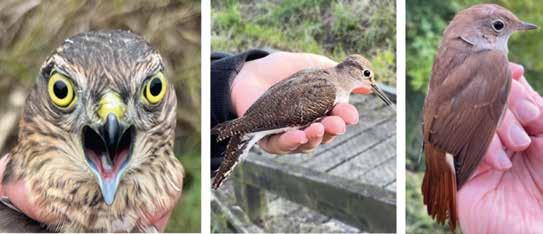
Ringing details – September
September was our second highest-ever for numbers but the best for variety. A total of 361 birds were ringed of 27 species. The highest individual-species’ totals were 94 Sedge Warblers, 55 Reed Warblers, 39 Swallows, 30 Blackcaps and 28 Chiffchaffs. There were two additions to the ringing list, with a Grey Plover and a Curlew Sandpiper both ringed on 2nd. Other unusual species ringed included singles of Mallard and Teal, both of which were only the second ringed at Trimley, Common Sandpiper, four Kingfishers, Yellow Wagtail and three Grasshopper Warblers including a late bird ringed on 26th which was still in pin / growing feathers suggesting it fledged late in the season.
The following table shows that September 2023 was fairly typical for most of our warblers in comparison with the last five years, remembering that we didn’t ring during September in 2022:
Sparrowhawk by Justin Zantboer
Common Sandpiper by Justin Zantboer
Nightingale by Justin Zantboer
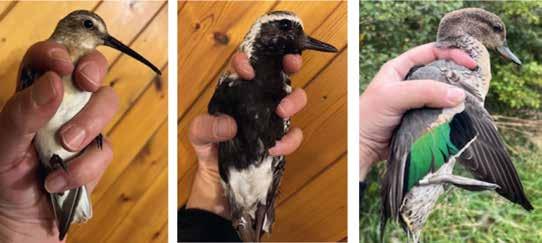
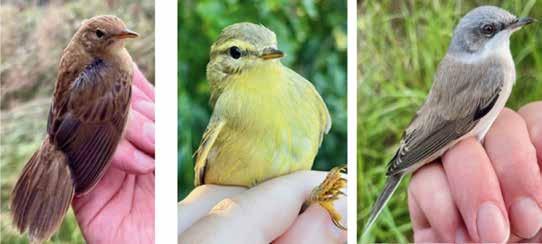
Another record month with 435 birds of 27 species ringed making it our best-ever October surpassing our previous best back in 2020 by 180 birds. The highest individual-species’ totals were 112 Reed Buntings, 92 Lesser Redpolls, 57 Blue Tits and 39 Goldcrests. Also of note were 18 Wrens, 11 Cetti’s Warblers and 14 Chiffchaffs rounding off an amazing year on the Reserve for the latter two species. More records fell with these totals; our previous-highest October total for Reed Bunting was 90 in 2019 and, prior to this year, we’d only ringed 93 Lesser Redpolls in total and our previous-highest October total for Goldcrest was 15 in 2020. Of note were 8 Song Thrushes, being our highest monthly total which contrasted with the lack of Redwings with none ringed and very few even seen. Bearded Tit were conspicuous by their total absence.
Curlew Sandpiper by Justin Zantboer
Grasshopper Warbler by Justin Zantboer
Grey Plover by Justin Zantboer
Willow Warbler by Justin Zantboer
Teal by Justin Zantboer
Lesser Whitethroat by Justin Zantboer
As well as the high quantity, the variety was good with unusual species including our first-ever Dunlin ringed on site, our second-ever Sparrowhawk, our third-ever Great Spotted Woodpecker, a Kingfisher, our second-ever Water Pipit on 27th, three Stonechats (only four ringed prior to this), a Firecrest, our second-ever Starling, three Bramblings (only two ringed prior to this) and three Greenfinches (only three ringed prior to these and none since 2018).
The following table shows the total numbers of warblers ringed per annum at Trimley and is a good indicator as to how good 2023 was on the Reserve, particularly for Blackcap, Cetti’s Warbler, Reed Warbler and Chiffchaff which is very encouraging the year after Avian Flu (HPAI H5N1) killed so many birds:

Ringing details – November
Our second-highest ever, we ringed 102 birds of 21 species. The highest individual-species’ totals were 18 each of both Blackbird and Goldfinch, 14 Reed Buntings and ten Lesser Redpolls. Unusual species included Avocet and Ringed Plover which were additions to the ringing list, our second-ever Grey Plover, six Dunlin and two Stonechats.
Water Pipit by Justin Zantboer
Brambling by Justin Zantboer
Greenfinch by Justin Zantboer
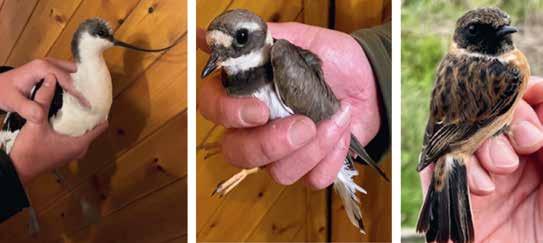
Avocet by Justin Zantboer
Ringed Plover by Dan Zantboer
Stonechat by Justin Zantboer
2023 Nestbox
A selection of 2023 Recoveries (birds ringed at Trimley Marshes SWT and found elsewhere):
BEC0046 Sand Martin 02/09/2023 05/09/2023
AVR2880 Blackcap 12/09/2021 01/07/2023
ESSEX, WAT TYLER COUNTRY PARK.
APN4283 Sedge Warbler 04/08/2020 22/04/2023
SUFFOLK, FELIXSTOWE
Duration: 3 days / Distance: 72km / Direction: SW 230deg Controlled by another Ringer.
Duration: 657 days / Distance: 4km / Direction: ESE 119deg Killed by a Cat!
CHANNEL ISLANDS, GROUVILLE MARSH, JERSEY.
Duration: 991 days / Distance: 388km / Direction: SW 218deg Controlled by another Ringer.
ATP6938 Sedge Warbler
ALV8340 Sedge Warbler
31/07/2021 14/05/2023
BEB8316 Sedge Warbler
10/07/2022 08/07/2023
NORFOLK, HILGAY WETLAND CREATION.
28/08/2023 08/08/2023
ESSEX, HOLLAND HAVEN COUNTRY PARK.
Duration: 652 days / Distance: 88km / Direction: NW 318deg
Duration: 363 days / Distance: 18km / Direction: SSW 196deg
Controlled by another Ringer.
ATP6675 Reed Warbler 30/05/2021 30/06/2023
EAST SUSSEX, ICKLESHAM.
Controlled by another Ringer.
Duration: 11 days / Distance: 126km / Direction: SSW 200deg
SUFFOLK, LEVINGTON REEDBEDS.
BEB8394 Reed Warbler 05/08/2023 28/08/2023
EAST SUSSEX, LITLINGTON.
Duration: 761 days / Distance: 5km / Direction: NNW 329deg
Duration: 23 days / Distance: 154km / Direction: SSW 211deg
Controlled by another Ringer.
Controlled by another Ringer.
Controlled by another Ringer.
BEB8500 Reed Warbler 09/08/2023 12/08/2023
SUFFOLK, HOLLESLY, CAULDWELL HALL FARM.
Duration: 3 days / Distance: 15km / Direction: NE 51deg
Controlled by another Ringer.
BEC0383 Lesser Redpoll 22/10/2023 12/11/2023
SUFFOLK, MINSMERE
Duration: 21 days / Distance: 39km / Direction: NE 36deg
Controlled by another Ringer.
BEC0405 Lesser Redpoll 23/10/2023 31/12/2023
SUFFOLK, BRANDON
Duration: 69 days / Distance: 71km / Direction: NW 320deg
Controlled by another Ringer.
A selection of 2023 Controls (birds ringed elsewhere then re-caught at Trimley Marshes SWT).
TX94076 Dunnock 02/09/2022 08/04/2023
SUFFOLK, LANDGUARD BIRD OBS.
ATF4185 Whitethroat 16/08/2022 06/05/2023
17515093 Sedge Warbler 16/08/2022 07/05/2023
SUFFOLK, HOLLESLEY HEATH.
BELGIUM, GREMBERGEN, OOSTVLAANDEREN.
Duration: 218 days / Distance: 6km / Direction: NNW 329deg
Duration: 263 days / Distance: 14km / Direction: SSW 228deg
Duration: 264 days / Distance: 221km / Direction: WNW 298deg
Controlled at Trimley Marshes.
Controlled at Trimley Marshes.
NCJ677 Chiffchaff 15/09/2022 19/03/2023
SUFFOLK, HOLLESLEY HEATH.
LXY526 Chiffchaff 16/09/2022 28/04/2023
ATF6825 Great Tit 04/04/2023 08/04/2023
HANTS, CHILLING, WARSASH.
Duration: 185 days / Distance: 14km / Direction: SSW 228deg
Duration: 224 days / Distance: 218km / Direction: NE 55deg
SUFFOLK, HOLLESLEY HEATH.
S746622 Goldfinch 06/10/2022 08/04/2023
ADL0142 Goldfinch 08/06/2023 25/07/2023
SUFFOLK, LANDGUARD BIRD OBS.
SUFFOLK, LANDGUARD BIRD OBS.
Duration: 4 days / Distance: 14km / Direction: SSW 228deg
Duration: 184 days / Distance: 5km / Direction: NNW 329deg
Duration: 47 days / Distance: 5km / Direction: NNW 329deg
Controlled at Trimley Marshes.
Controlled at Trimley Marshes.
Controlled at Trimley Marshes.
Controlled at Trimley Marshes.
Controlled at Trimley Marshes.
Controlled at Trimley Marshes.
ADL0348 Goldfinch 18/07/2023 09/09/2023
SUFFOLK, LANDGUARD BIRD OBS.
Duration: 53 days / Distance: 5km / Direction: NNW 329deg
Controlled at Trimley Marshes.
ADL0157 Linnet 10/06/2023 27/07/2023
ADL0335 Linnet 18/07/2023 06/08/2023
SUFFOLK, LANDGUARD BIRD OBS.
SUFFOLK, LANDGUARD BIRD OBS.
Duration: 47 days / Distance: 5km / Direction: NNW 329deg
Duration: 19 days / Distance: 5km / Direction: NNW 329deg
Controlled at Trimley Marshes.
Controlled at Trimley Marshes.
BFB7413 Lesser Redpoll 05/10/2023 08/10/2023
SUFFOLK, MINSMERE
BPC6002 Lesser Redpoll 10/10/2023 30/10/2023
SUFFOLK, KESSINGLAND
Duration: 3 days / Distance: 39km / Direction: SW 216deg
Duration: 20 days / Distance: 57km / Direction: SSW 212deg
Controlled at Trimley Marshes.
ANN1138 Lesser Redpoll 26/10/2022 12/11/2023
N YORKS, SKIPWORTH COMMON NATURE RESERVE, YORK.
Duration: 382 days / Distance: 258km / Direction: SE 144deg
Controlled at Trimley Marshes.
Controlled at Trimley Marshes.
Considering the number of birds that we processed, 2023 wasn’t very good for controls or recoveries. The Sand Martin and two Lesser Redpolls are the first recoveries that we’d had of either of these species and Sedge Warbler APN4283 was the first that we’ve had recovered in the Channel Islands. We’re still awaiting the details for a Chaffinch which was caught on November 26th bearing a Belgium ring.
Returning summer migrants ringed at Trimley Marshes prior to 2023:
Blackcap ALV8184 17/04/2022 2nd CY 16/05/2023 Female Brood patch noted.
Lesser Whitethroat ALV8312 03/07/2022 Juvenile 03/05.2023
Sedge Warbler ATP6641 20/05/2021 Unknown 08/07/2023 Male
Sedge Warbler ATP6747 11/07/2021 Juvenile 06/04/2023 Male
Sedge Warbler ATP6776 18/07/2021 Adult 22/04/23 Male.
Retrapped again on 02/09/2023
Cloacal Protuberance noted.
Cloacal Protuberance noted and until 02/07/20203 at least.
Cloacal Protuberance noted and until 11/05/23 at least.
Species Ring number Date ringed Age Re-trap date Sex Breeding information.
Sedge Warbler ALV8358 11/07/2022 Juvenile 22/04/23 Male.
Cloacal Protuberance noted and until 18/06/2023 at least.
Reed Warbler AXF5160 14/07/2019 Juvenile 25/07/2023 Male. Cloacal Protuberance noted.
Reed Warbler APN4113 01/08/2020 Juvenile 11/06/2023 Unknown. None.
Reed Warbler ATP6613 11/05/2021 Unknown 09/07/2023 Female. Brood patch noted.
Reed Warbler ATP6698 06/06/2021 Unknown 25/06/2023 Male. Cloacal Protuberance noted.
Reed Warbler ATP6856 25/07/2021 Adult 26/04/2023 Male. Cloacal Protuberance noted.
Reed Warbler ATP6859 25/07/2021 Adult 07/04/2023 Male.
Cloacal Protuberance noted and until 13/07/20203 at least.
Reed Warbler AVR2008 01/08/2021 Juvenile 08/05/2023 Unknown. None.
Reed Warbler AVR2043 03/08/2021 Juvenile 28/05/2023 Unknown. None.
Reed Warbler ALV8331 08/07/2022 Juvenile 27/04/2023 Unknown. None.
Chiffchaff NND238 15/04/2022 2nd CY 07/04/2023 Unknown. None.
Returning Sedge Warbler numbers were even lower than 2022 when just five returned but Reed Warblers were well up as we had just two returning birds in 2022. Given the high numbers of warblers ringed during 2023, it would be pleasing to see good numbers of warblers returning to us in 2024.
A selection of local birds ringed and retrapped at Trimley Marshes prior to 2023:
Species
Robin ALV8034 16/10/2021 Juvenile 21/05/2023 Male. None.
Blue Tit S130824 01/06/2018 Juvenile 18/03/2022 Male. Cloacal Protuberance noted.
Blue Tit ARJ7865 13/06/2020 Juvenile 14/04/2023 Male. Cloacal Protuberance noted and until 25/11/20203 at least.
Blue Tit ALV8032 14/10/2021 Juvenile 12/02/2023 Unknown None.
Long-tailed Tit LPV932 07/08/2020 Juvenile 12/02/2023 Unknown None.
Long-tailed Tit LPV972 19/09/2020 Juvenile 02/04/2023 Unknown None.
Species
Long-tailed Tit NCY084 01/06/2021
Juvenile 12/02/2023 Unknown None.
Goldfinch ATP6532 21/04/2021 2nd CY 09/07/2023 Female. Brood patch noted.
Cetti’s Warbler
ALV8339 10/07/2022
Juvenile 07/04/2023
Cetti’s Warbler ALV8365 11/10/2022 Unknown 14/04/2023
Cetti’s Warbler ALV8458 27/10/2022 Unknown 08/04/2023
Male.
Male.
Male.
Cloacal Protuberance noted and until 16/04/20203 at least.
Cloacal Protuberance noted.
Cloacal Protuberance noted and until 30/04/20203 at least.
Trichomonosis in Peregrine Chick – 2023
Peter Merchant
In appreciation of the help and support provided by the staff at the Debenham Veterinary Practice and Dr Dominic Byron-Chance of Great Western Exotics. The photographs and images below appear courtesy of Peter Merchant and the Debenham Veterinary Practice.
Warning: Potentially distressing content and images follow.
A purpose-built nesting platform that I had installed at a Suffolk industrial site was seen to host a Peregrine nest with what appeared to be three healthy chicks. Cameras had been fitted around the nest site and, after careful monitoring, on April 28th, 2023, with all the birds appearing to be doing well, the decision to take DNA samples and to ring the birds was taken – this was two weeks earlier than the same procedure had been carried out in 2022.
On May 11th I received a telephone call from the monitoring team alerting me to the fact that one of the chicks in the nest appeared to have sustained some damage to its head. Obviously concerned, I arrived at the site and moved carefully to the nesting platform to examine the chicks. It was immediately clear to me that one of the birds had indeed sustained some form of head injury and needed medical attention. I carefully removed the bird and transported it to the Debenham Veterinary Practice – an organisation that has previously supported me with the treatment of sick or injured birds.
The injured male chick was anaesthetised and given a full clinical examination, and a CT scan, paying particular attention to the bill and viability of the eye. The patient upon presentation.
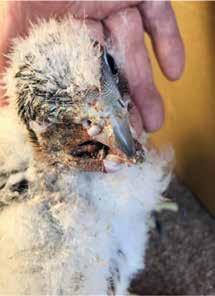
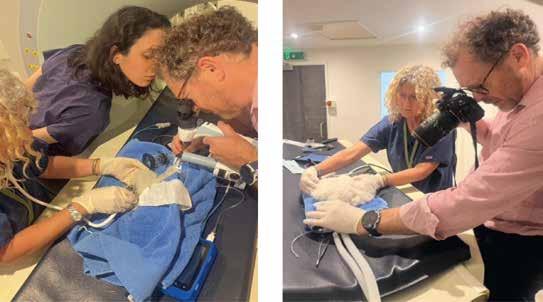
That afternoon, I received a call from the practice and was informed that in having carried out the examination, microscopy and a CT scan, the diagnosis was of the presence of Trichomonosis.
Trichomonas typically causes disease at the back of the throat and in the gullet. Affected birds show signs of general illness (lethargy, fluffed-up plumage) and may show difficulty in swallowing or laboured breathing.
Some individuals may have wet plumage around the bill and drool saliva or regurgitate food that they cannot swallow. In some cases, swelling of the neck may be evident. The disease may progress over several days or even weeks.
The trichomonad parasite is vulnerable to desiccation and cannot survive for long periods outside of the host. Transmission is most likely to be through contaminated food or water (e.g. where a bird having difficulty swallowing regurgitates food, which is then eaten by another individual).
Trichomonas gallinae is a parasite of birds and does not pose a health risk to humans or their mammalian pets.
(Extracted from BTO Website)
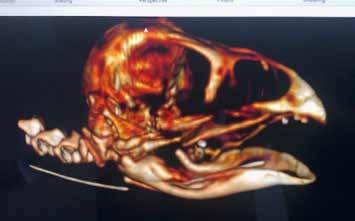
A secondary issue, undoubtedly caused by the Trichomonosis, was the presence of a Necrotic Lesion and Osteomyelitis which had caused a fracture of the lower mandible of the bird. The bird was critically ill.
The full results of the CT scan needed to be reviewed by a veterinary radiologist (another who gave their services free of charge) and, while awaiting the results, it was decided that I take the chick into care.
This involved me in-handfeeding and administering medication to the bird four times a day. Meanwhile, I was concerned about the health of the other two Peregrine chicks which I believed may have been at risk. The two chicks should be examined, weighed, throat swabs taken, and some preventative medication administered.
In another remarkable gesture of kindness and generosity of time, the senior veterinary nurse volunteered to accompany me on the further inspection of the nest site – despite being on a day off.
Fortunately, upon examination, the two chicks presented in good health and the Trichomonas infection was not immediately obvious. The throat swabs ultimately proved negative.
Whilst in my care, and over a period of 11 days, the injured chick appeared to make a remarkable improvement. It started to feed itself, resulting in an increased body weight and feathers had started to (re) appear.
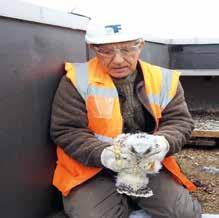
Image from CT scan of Peregrine chick.
Peter Merchant presents a Peregrine chick for examination and throat swab.
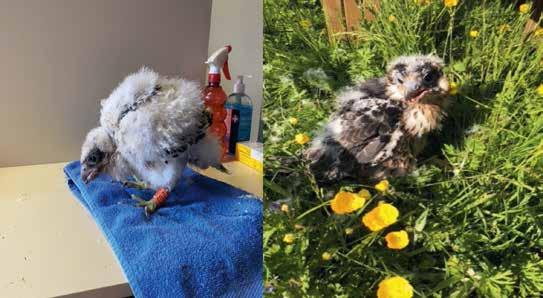
On the twelfth day of treatment, the facial necrotic lesion (the scab) dropped from the head of the chick. This resulted in significant tissue loss and a large open wound appearing on the side of the head beneath the right eye of the bird.
The wound had started to heal, and all were optimistic that this young male Peregrine might make a recovery.
However, the tissue around the mouth started to contract resulting in a malocclusion to the upper mandible of the bird. Undeterred by this, the bird continued to feed itself, and was exhibiting normal behaviour with no sign of distress or pain.
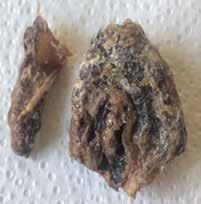
Following further discussion, I sought the advice of Dr Dominic Byron–Chance at Great Western Exotics – an exotics referral veterinary practice that specialises in the care and rehabilitation of raptors. I was extremely grateful that Dr Byron-Chance was happy to provide his time and advice free of any charge. The advice provided, indicated a possibility of correcting the malocclusion in due course and that it was ethical to continue to treat the young Peregrine.
Several days later, the malocclusion of the upper mandible suddenly worsened, with the tongue becoming exposed. This in turn led to a loss of saliva from the mouth while the tongue and surrounding tissue started to dry resulting in the chick struggling to fully open its mouth –which in turn hampered its feeding.
At this stage of the recovery process, there had been great optimism within the care team as the original infection had passed, the tissue wound was healing, and the small mandible fracture had also mended. Sadly, because of the new infection in the mouth and tongue, the tongue of the bird had now become necrotic.
A further examination of the bird was carried out and after carefully considering ‘The Five Domains of Animal Welfare’, and further discussion, it was agreed to end the provision of treatment and gently euthanise the bird.
Having developed a degree of attachment, we decided to bury this ‘brave little fighter’ in the
The Peregrine chick showing early signs of recovery while in care.
The necrotic lesion that had fallen from the head of the chick.
lovely flower meadow, where, as a patient, the bird had spent part of his rehabilitation.
Clearly, this was an undesirable outcome; however, we have learned many very valuable lessons regarding the treatment of, and the recovery from Trichomonosis including the efficacy and selection of drugs and, how we may, in future, treat more effectively the resultant wounds and infections.
Ending on a much brighter note, I am happy to report that the two siblings of our patient fledged successfully.
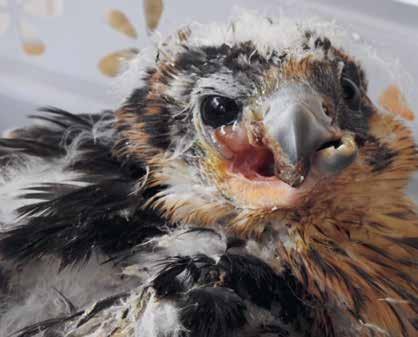
Deteriorating malocclusion of mandible in the young Peregrine.
Black-winged Kite Elanus caeruleus –Felixstowe Ferry/the King’s Fleet
July 20th and 21st 2023
–
a new species for Suffolk
Craig Holden
On July 20th, having finished work, and it being a pleasant evening, I decided to head out to my local patch at Felixstowe Ferry for a walk along the river wall, with the intention of checking out the saltings and King’s Fleet.
I arrived on site just before 18:00 hours and made my way towards the pools. These always look as though they should pull in the occasional decent wader but, more often than not, the vast majority are either feeding more distantly on the exposed mudflats, or roosting out of sight in the vegetation. That said, I did find a fine Wood Sandpiper – a species which certainly isn’t regular here – so was already feeling rather pleased with myself.
By now I had nearly reached King’s Fleet which, unfortunately, was remarkably quiet, so I decided to start making a slow walk back. The Wood Sandpiper was still present and now actively feeding, so I enjoyed that for a good few more minutes before continuing on my way. The remaining walk was largely uneventful and my telescope had already been ‘packed up’ and hung over my shoulder.
As I approached the last bend before reaching the stile (at about 19.30 hours) I noticed a bird fly off the overhead phone wires out of the corner of my eye, instinctively making me look across. Almost immediately the bird started to hover at c140 metres range. Despite being viewed with the naked eye, and essentially silhouetted, my heart started to race; I was already expecting the unexpected. At this point the bird started to slowly drift north-westwards over Holmhill. I had already got brief views through my binoculars to confirm my suspicions that it was indeed a Blackwinged Kite, before dropping to my knees to look through the telescope. By now it was steadily drifting towards King’s Fleet, occasionally stopping to hover, before continuing onwards. The combination of pale-grey upperparts and clean-white underparts contrasting so obviously with the black ‘shoulders’ was conclusive. Needless to say, I was in a sense of disbelief and the adrenaline was pumping. Although I haven’t twitched nationally for a number of years, I was obviously aware of the Norfolk bird (see details below). Despite not knowing at the time the exact whereabouts of that individual, it wasn’t a huge leap of faith to conclude that this was the same bird.
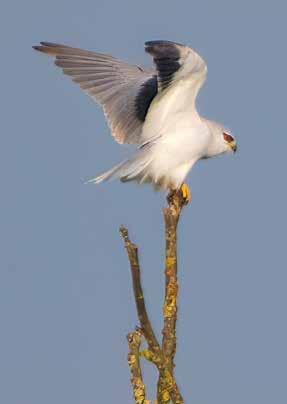
With the bird now lost from view as it neared King’s Fleet, I made the call to Lee Woods, who oversees the Suffolk WhatsApp group (BINS). I have no idea of my exact words, but I managed to get the
Black-winged Kite, Felixstowe Ferry, 21st July, John Richardson
information out and it was soon broadcast to the larger community.
My next issue was trying to relocate the bird in the hope that I should be able to get others to enjoy the experience. The site consists of a lot of farmland with numerous scattered bushes and trees. Despite the bird appearing to look relatively settled in the area, there were certainly plenty of places for it to remain unobserved.
As I headed back towards King’s Fleet, I made a few calls to local birdwatchers who, as you can imagine, were equally in disbelief. It was decided that they would attempt viewing from Marsh Lane which overlooks a lot of the fields and has a clear view towards King’s Fleet, and obviously doesn’t involve the walk out along the river wall. Thankfully, after about 15 minutes, the kite was relocated perched on a post about midway between Marsh Lane and King’s Fleet. Although fairly distant, views were quite good through a telescope and, more than anything, I was pleased that it was settled and others were now beginning to share the excitement.
Over the course of the rest of the evening the bird was relatively mobile, although never venturing particularly far. The nature of the landscape and the viewing areas often meant that it could be tricky to keep a constant eye on the kite. I had the undoubted advantage of being along the river wall, allowing me the opportunity to reposition and scan different areas far easier. At one point the bird even landed in the trees alongside the fleet whilst I was standing nearby!
The last that I saw of the bird was when it flew over Falkenham Marshes (just north of King’s Fleet) – which are now essentially arable fields – before it settled on a distant bush. With the light now beginning to fade I was unlikely to get any better views, so decided to call it a day. It all seemed incredibly surreal, not least because of the fact that I had even joked with friends a few months ago that my patch looked good for Black-winged Kite one day!
With dusk approaching, I made a slow walk back to the car, meeting a couple of birding friends for a drink at the Ferry Boat Inn and to chat through the evening’s events. Needless to say, this will stick in my memory for the rest of my life, and is a personal birding event that is almost certainly never going to be bettered.
The bird was seen to go to roost in trees near Marsh Lane but, unfortunately, because of work commitments requiring me to be in the office, I was unable to visit the following morning. Thankfully though, it was on view from about 04:35 hours, delighting the masses who had arrived. It stayed in the general area until 09:20 hours until it drifted off north, over to Bawdsey, never to return – unfortunately for me as I headed out again after work. But I can hardly complain!
Description:
Unmistakable!
Age: 2cy+
Size and Structure: Roughly the size of a medium-sized falcon, but with a bulkier body, noticeably broader wings and shorter tail, most evident when in flight.
In flight: Often hovered. When doing so, the legs and tail were frequently noted to be drooping. The wings were broad and pointed, with the tail short and square-cut. When not hunting the bird had a direct and relatively-fast flight.
Bare parts: Legs yellow.
Head: Essentially white with a small black ‘mask’.
Upperparts: Pale shade of grey with strikingly-contrasting black forewings (coverts), even more revealing when in flight. Primaries and secondaries were a slightly-darker shade of grey.
Underparts: Clean white. The primaries were black when seen in flight from below.
From photographs (as seen here) it was clearly evident this was the same individual that had recently been in Norfolk, and subsequently Essex, due to its distinctive wing moult.
Previous records:
Black-winged Kite had never been recorded in Britain before 2023. It had, however, been anticipated. In April, one was found in Powys, mid-Wales but it was untwitchable – the first
British record.
On July 17th a Black-winged Kite was discovered at Stubb Mill, Hickling in Norfolk – an especially popular site for raptors. The bird flew off at about 9.30 hours the next day. It was then seen in the Horsey area of Norfolk until July 20th. That day it made its way south to Felixstowe (unobserved) and then, on 21st, it was relocated at Colne Point, St Osyth, Essex where it remained until July 22nd.
This is, therefore, a new species for Suffolk and those of us who managed to get to see it are extremely grateful to Craig for finding it. It was, in fact, voted the Rarity of 2023 in the Birdguides annual Birders’ Choice Awards.
Habitat and range:
[Black-winged Kite is a bird of open land and semi-deserts in sub-Saharan Africa and parts of Asia. Populations can show an upsurge when rodent populations increase, rodents being their main food.
Probably due to human activities it has found a foothold in southern Europe, especially Spain, which is where Suffolk birders may have encountered it. It is now present in south-west France. Ed.]
Aquatic Warbler Acrocephalus paludicola at Landguard
Will Brame
Description:
Having spent the morning of Wednesday August 30th 2023 birding at Landguard Bird Observatory and Nature Reserve without too many migrant birds being seen, I turned my attention to the Lepidoptera on site. As there were numerous “whites” flying over the seaward side of the Butts, I did what I have done for a few years now and searched amongst them for any that might possibly have been migrant Southern Small Whites. A perched white species caught my attention enough to take a few pics before it was flushed off by another white and, despite searching for the next 30 minutes, there was no further sign of the potentially interesting one. It was then that duties at home called so I would have to return in the afternoon if I wanted to continue my search for the whites – which is exactly what I did. Walking slowly southwards along the seaward side of the Butts checking white after white without any success up until the time I’d reached the furthest point along said Butts I then retraced my steps back towards where I had started. I saw my only migrant bird so far which was a Northern Wheatear. I was not hopeful of anything unusual, be it butterfly or bird, until a warbler flew out of a Bramble some ten metres ahead of my position and landed fully out in the open on another Bramble. Raising my binoculars and focusing on the mystery bird had me coughing and spluttering “It’s a flipping Aquatic” or words to that affect. As the now identified Suffolk mega sat still, I grabbed my bridge camera and excitedly fired off some hurried shots hoping to get something unblurred before it slid off into the bushes. A check at the back of the camera revealed a lovely juvenile Aquatic looking back at me. This prompted me to put the news out to local groups including Suffolk Bins and waited for the first birders to arrive. My photos showed beyond a shadow of a doubt that the bird was indeed a juvenile Aquatic Warbler a strikingly “straw, black and pale buff” individual, only the second specimen I had seen in the UK and my first having been on the Scilly Isles in 1994. As can be seen in the photo, the bird differs from Sedge Warbler in having a clear median crown stripe (much less clear in juvenile Sedge), a clear yellowish band on either side of the mantle, some obvious black streaking on the upperparts and pale lores.
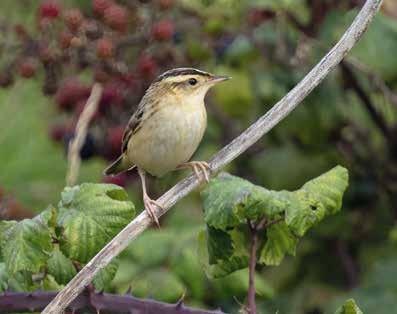
Aquatic Warbler, Landguard N R, 30th August
Chris Darby
The weather was bright with sunny intervals, the wind was north-westerly force 3-4 and the light conditions were good, especially as the bird was so close. After a while, as birders from further away arrived, there was a fair amount of drizzle. However, this cleared and a good crowd of Suffolk birders was able to get excellent views of this sought-after rarity. It was “new to Suffolk” for most present! It showed on and off until well after 19:00 hours but was not seen the next day.
Previous records
There are eight previous Suffolk records:
1976 – Minsmere, August 13th
1976 – Benacre, August 28th
1976 – Thorpeness, August 28th
1984 – Easton Bavents, September 7th
1987 – Lowestoft, August 26th
2003 – Orfordness, adult, August 14th
2003 – Orfordness, juvenile, August 15th
2015 – Orfordness, juvenile, August 9th
As can be seen, all these records fall into a 29-day period, as does our 2023 bird. The three latter records, on Orfordness, were not twitchable (to the vast majority) so the previous possibility of catching up with this scarcity in Suffolk had been 36 years ago in 1987.
Buff-breasted Sandpiper Calidris subruficollis at Minsmere
September 11th 2023
Philip Buckle
On Monday September 11th 2023, armed with my newly acquired high-end telescope (astronomical only in its price!), I once again returned to Minsmere in the hope of continuing my study of a rich and varied array of passage migrants which had adorned the “scrapes” since the end of August. With crystal-clear conditions and zero heat haze, it was a perfect day for observing the finer plumage variations of waders. Species thus far included good numbers of Little Stints, Curlew Sandpipers, Knot, godwits and Ruff of all ages. Therefore, a fine opportunity to study the finer details of plumage varieties of a rich range of, especially, wading birds.
At about 10:25hr a wader flashed low and distant on East Scrape cutting through the air just over the water, the twisting, veering flight catching my attention through the binoculars. Long of wing with very pale underwings switched to a Ruff-like upper-wing as it jinked in flight, finally coming to land on a grassy island. Instantly it dropped its body to the ground and sat motionless. Intriguing behaviour I thought to myself, as waders usually land on the mud to feed.
Through the telescope I was looking at what I can only describe as a miniature Ruff but I knew it was too small even for a Reeve. After a few minutes, the mystery bird finally stood up and began frantically feeding on the grassy island, stopping only occasionally to allow a stationary detailed view. Long, dull-yellow legs, a shortish bill, an overall “sandy” plumage and, with neck stretched out, a small round head gave the bird a slender/delicate appearance. Definitely not a Ruff. At one point when the bird stopped still and tilted its head up to observe a possible threat with one eye,
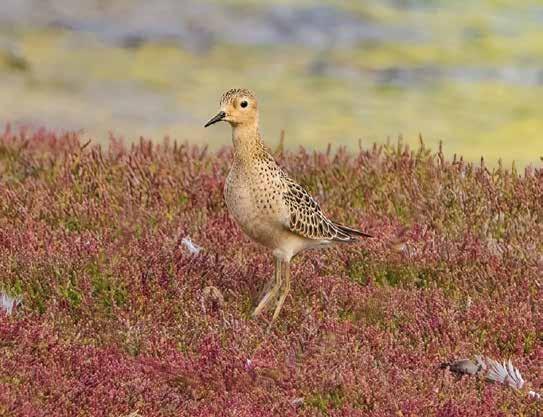
Buff-breasted Sandpiper, Minsmere, 11th October John Richardson
I could see a distinct pale ring around a large, dark, bulbous eye.
At this point I realised that I had never before seen one of whatever it was I was looking at; a very pleasant feeling! However, being so sandy/light golden in colour, and remembering Buffbreasted being described as a miniature Ruff, I was beginning to realize that I might have a Buffbreasted Sandpiper in view.
Summoning RSPB volunteer guide Joe Howarth, whom I had noticed entering the hide, I asked him to locate the mystery bird for his thoughts in case it flew.
Two options arose from a very quick discussion having consulted Joe’s Bird Guide via his mobile phone. Eliminating the first most likely, Pectoral Sandpiper, we toyed jovially with the idea of its being a Buff-breasted Sandpiper! At this point, now 10:40hr, I was satisfied with our identification but both of us were hoping that the bird might come closer. It then took flight and disappeared from view over the reeds towards South Scrape, much to our dismay!
Making a quick exit from East Hide, we arrived at South Hide and came across the bird, now ten times closer, feeding vigorously on the grass directly in front of us. With a low hum of discussion in an already-packed hide, our early suspicions were quickly confirmed by a gentleman sitting upfront who was far more familiar with the species, confirming that indeed it was a Buff-breasted Sandpiper.
With identification now confirmed, Joe finally (and somewhat in a laid-back fashion) radioed through to the RSPB visitor centre, an hour after first seeing the mystery bird, that there was a Buff-breasted Sandpiper on the Scrape. Only later did we hear that this is the first Buff-breasted Sandpiper to visit Minsmere since September 1961! We need not have worried though about the urgency to report this fine specimen as it continued to show on the scrapes for the next two weeks giving visitors superb views of this delightful American vagrant.
[There have now been 14 Suffolk records with nine of them in the 21st century. Of the other five Suffolk records, four occurred in the 20th century and one in the nineteenth (1843). Of these 14, 21st century birds, ten have been found initially in September. Orfordness is the principal site with three records. The previous record, in 2021 at Carlton Marshes, is the county’s first, and only, spring record – present on May 6th and 7th.
They breed in dry tundra areas with little vegetation, mostly in Arctic Canada and Alaska, with a few pairs in eastern Siberia. Their normal migration sees them winter in the Pampas of southern South America, principally in Paraguay and Argentina. Ed]
Introduction
The 2023 Suffolk Bird Report Systematic List
The list and its appendices have been written using data supplied by the county’s birdwatchers and conservation organisations. Much of the data comes from Birdtrack. Observers are reminded that the rarer birds might need to be authenticated before inclusion.
The order has changed and follows the revised BOU list (2021). The raw data have been collated and interpreted by the following, with many thanks to them all:
Swans and geese
Ducks
Gi Grieco Larks, hirundines Nick Mason
Andrew Green Warblers, inc. Long-t Tit
Peter Kennerley
Nightjar, swift, pigeons, Darren Underwood Gamebirds and falcons John Kornjaca then owls and woodpeckers
Rails and grebes
Raptors
Oystercatcher to plovers
Other waders
Skuas and gulls
Terns and auks
Storks to Cormorants
Divers
Shearwaters
Shrikes, corvids, crests, tits
John Davies Waxwing, Nuthatch, Richard Treecreeper, Starling, Attenborrow Dipper, Wren, thrushes
Chris Gregory Spotted Fly, Robin, chats, Steve Fryett wheatears, other
Margie Carter flycatchers
Ed Keeble Sparrows, wagtails, Chris Keeling pipits,
James Wright Dunnock Adam Gretton
Brian Buffery finches, buntings
Peter Lack
Nick Mason Appendices
Philip Murphy
Phil Whittaker
Katya Bathgate
The ‘official’ British list is maintained by the British Ornithologists’ Union (BOU) and, from 2018, uses the International Ornithological Congress world list. Species are included in various categories according to their status, as follows:
• Category A – species which have been recorded in an apparently natural state at least once since January 1st 1950;
• Category B – species that would otherwise be in Category A but have not been recorded since December 31st 1949;
• Category C – species that, although originally introduced by man, either deliberately or accidentally, have established self-sustaining breeding populations;
• Category D – species that would otherwise appear in Categories A or B except that there is doubt that they have ever occurred in a natural state;
• Category E – species that have been recorded as introductions, transportees or escapees from captivity, and whose breeding populations are not thought to be self-sustaining.
The main part of the species accounts consists of species that occurred in Suffolk in 2023, which fall into Categories A and C. Where a species is included in multiple categories, this is shown in the initial status summary. Categories D and E do not form part of either the British or Suffolk lists. Species from these Categories that occurred in Suffolk in 2022 are included as appendices to the main list.
The order and nomenclature follow the latest published for The British List by the BOU using the International Ornithological Congress list (BOU 2022). This list can be accessed on their web site at www.bou.org.uk English names follow the same list. Subspecies are listed under the main species’ heading, which includes the scientific name.
The records for each species are listed mostly under the parish where the bird occurred, sometimes followed by a more precise location if known. The exception to this is at the river estuaries and larger, well-known sites criss-crossed by several parish boundaries e.g. Walberswick NNR, Minsmere, Orfordness, Alton Water etc. The gazetteer towards the rear of this bird report gives locations for those sites not easily located on a standard road map.
The order of records is north to south down the coastal region, working round the estuaries, then inland from the north-east to the south-west of the county. To minimise any potential threats to site security, some records of rare breeding birds are published anonymously and under a vague site heading.
As much use as possible is made of systematic monitoring schemes such as the WeBS counts. Using such co-ordinated data instead of maximum counts gives a better idea of the populations of each species wintering in the county on a given date. However, fluctuations in numbers due to changing weather patterns will affect totals and higher counts are given in the text after the table where appropriate. Counts from North Warren include Thorpeness Meare, Church Farm Marshes and the shoreline between Thorpeness and Aldeburgh; the Alde/Ore Estuary includes the complex of the Alde, Ore and Butley rivers as well as Orfordness, Gedgrave reservoir and Havergate Island; and the Orwell includes Trimley Marshes, Loompit Lake and Bourne Park Water Meadows. Counts from the Stour Estuary all refer to the Suffolk side and both sides of the estuary if stated.
The larger part of the report, particularly for the more common species, is based upon ad hoc, Birdtrack and E-bird records. Data of that type are influenced by the distribution of birdwatchers, the weather and other factors that result in imperfections. We are nonetheless indebted to those observers who have persevered with other studies, such as Breeding Bird Survey (BBS), Constant Effort Sites (CES) and transect counts and for making the results available for use. A summary of the Breeding Bird Survey (BBS) is given for all those species for which meaningful data are available – further information can be found on the BTO website.
See ‘A Guide to Recording Birds in Suffolk’ elsewhere in this Report for information on submission of records.
The following definitions are intended as a guide to the relative status of each species:
Very common: Occurs in large numbers in suitable habitat and season.
Common: Occurs regularly or widely distributed in suitable habitat.
Fairly common: Occurs in small numbers in suitable habitat and season.
Uncommon: Occurs annually in small numbers.
Scarce: One or two records each year or restricted to specific habitats.
Rare: Occurs less than annually.
Very rare: Less than 15 records in past 30 years.
Accidental: Less than three records in past 30 years.
Systematic List
Included in the status description is a note if the species is included in either the Red or the Amber List of ‘Birds of Conservation Concern’. This is a paper jointly produced by the leading bird conservation organisations in the UK. See Suffolk Bird Report Vol.47: 6-10 for further details.
The following abbreviations are sometimes used in the systematic list:-
ad = adult
BBS = Breeding Bird Survey
CES = Constant Effort Site
CP = Country Park
GC = Golf Course
GP = gravel pit
imm = immature
Ind. Est. = industrial estate
juv = juvenile
N = bird(s) flying north
NNR = National Nature Reserve
R = River
res = reservoir
S = bird(s) flying south
SW = sewage works
WM = Water Meadow
WP = Water Park
WR = Wildfowl Reserve
(DARK-BELLIED) BRENT GOOSE Branta bernicla bernicla
Common winter visitor and passage migrant. Amber List. Categories A and E.
The species occurs predominately in the southeast of the county on the three main estuaries – Stour, Orwell and Deben.
In the northeast, the marshes and saltings around Aldeburgh Marshes and Slaughden hosted a flock, the maximum size being 200 on March 3rd; at this site there was a sick individual showing signs of having avian flu on April 29th and a bird was present during the summer on July 24th and 28th. Elsewhere, a flock of 17 flew south off Ness Point on February 12th and one flew north at Walberswick on May 5th, noted to be “looking a bit worse for wear” .
In the southeast, Stutton Ness on the Stour Estuary had the largest count with 890 on March 15th and then over 700 on April 22nd. Also, along the north shore of the Stour, a flock of 675 birds on February 13th included 218 juveniles and there were still 430 in Seafield Bay on May 23rd. On the Orwell Estuary the highest count was over 700 at Trimley Marshes on February 15th. On the Deben Estuary there were 600 at Felixstowe Ferry on January 31st and 600 again on February 22nd with the same flock size at Falkenham Marshes on February 4th. There was a sole record in the West for 2023, involving one which flew northwest over Joist Fen, Lakenheath Fen RSPB on January 29th.
The last sighting of the spring, off Landguard, was on June 7th – 121 flew north off this site on June 1st.
Peak WeBS counts in the table below:
The first record for the autumn was on September 16th with three at the southern end of Havergate Island and one off Landguard. Throughout the remainder of the month there were small flocks moving south off the coast. In October, passage numbers increased with October 8th being the first peak day – c.4900 off Lowestoft, c.1200 off Southwold, c.1000 off Minsmere and 5000+ off Thorpeness. The next peak day was October 17th with c.1400 off Minsmere and 1791 off Landguard. On October 26th there was a further large movement with 1605 off Southwold and 2426 off Landguard.
The monthly passage records at Landguard are recorded in the table below.
With passage birds on the move, traditional feeding sites started noting birds arriving. At Slaughden and Aldeburgh Marshes c.50 were first present on September 27th and then over 100 birds to the end of the year. The Deben Estuary held Suffolk’s largest feeding flocks of the year in the second winter period with c.1150 at King’s Fleet on December 12th, and this site also hosted 970 on December 29th and c.850 on November 28th. The highest count on the Stour Estuary was at Holbrook Bay with c.550 on December 2nd but there were only smaller flocks on the Orwell Estuary with 108 off Pipers Vale, Ipswich on November 20th being the highest.
Within a flock of c.750 birds at Felixstowe Ferry, two colour-ringed birds were noted. One bird had a lime band with a black 1 on the left tarsus and a dark green band with a white R on the right tarsus. The second bird had a lime band with a black 2 on the left tarsus and a dark green band
with a white N on the right tarsus. It was remarked that the birds seemed to be paired. These two birds had been present at Kirton Marshes in February 2021.
(PALE-BELLIED) BRENT GOOSE Branta bernicla hrota
Uncommon winter visitor. Amber list.
Only a handful of records for the year with the occasional lingering bird or two associated with Dark-bellied Brent Goose flocks. Two flew south off Ness Point on January 8th and a single bird was in the Slaughden and Aldeburgh Marshes area from January 27th to February 22nd. At Felixstowe Ferry a bird from the previous year was seen from January 1st to 19th. Later in the year one was at Felixstowe Ferry from November 20th but then, during December, there were two birds present. A single bird was at North Warren on December 6th and 8th, loosely associating with the Barnacle Goose flock and it is likely that the same bird was then nearby on Aldeburgh Marshes on December 17th.
BLACK BRANT Branta bernicla nigricans
Scarce visitor.
The bird found on the Deben Estuary on December 15th 2022 remained at Felixstowe Ferry for the first few days of 2023.
Felixstowe Ferry: Jan 1st to 5th (C Holden et al.)
GREATER CANADA GOOSE Branta canadensis
Common resident. Categories A, C and E.
This goose species is found across the county. Having generally been more numerous in the southeast, this area had an increase in site locations in 2023 and still held the largest flocks, enhancing that reputation. The number of locations in the southeast rose from 22 to 35, while the numbers in the northeast and west were similar to the previous year. During the BTO BBS surveying this year there was a bit of a decrease from 2022; the species was recorded in five of the 1km squares, just below average over the last ten years and the number of individuals decreased to 39 from 52 last year, still very much below the average over the last decade.
Details of breeding birds mostly mirrored the previous year with a slight increase in the number of overall breeding sites and pairs, although there was a more pronounced reduction in the number of young counted, down to 87 (compared with 149 in 2022), of which 48 were recorded in the southeast. Regarding breeding information in the northeast, the reserves of Minsmere and Carlton Marshes held the highest number of goslings, with 13 fledged at the former and ten at the latter. In the southeast, along the Gipping valley, Barham Pits A had a pair with four goslings while the adjacent Barham Pits B had three pairs with one on a nest and the other two had broods with three and ten young respectively. In Christchurch Park, Ipswich four out of the 11 goslings survived. In the west at Barton Mere there were four broods and at Hanchett, Haverhill there were seven juveniles. Compared with last year, this latter site had a significant reduction in the number of young as 23 juveniles were recorded in 2022.
The largest flock size of the year was at Judas Gap, Flatford Lane, East Bergholt with 650 on January 21st. At Sudbourne Marshes there were 614 on December 15th, 500 at Boyton Marshes on January 5th, 500 at Shalford Meadow, Little Cornard on March 13th, 350 at Thorington Street Reservoir on January 25th, 250 at Gifford’s Hall Flash, Stoke-by-Nayland on January 29th, c.200 at Minsmere on February 21st and 175 on Aldeburgh Marshes on October 16th.
Peak WeBS counts in the table below:
There was a Canada Goose x Greylag Goose hybrid at Carlton Marshes between February and April with similar hybrid birds also noted at Weybread Gravel Pits, Aldringham, Lackford Lakes, Mickle Mere, West Stow CP and Nunnery Lakes Reserve, Thetford.
BARNACLE GOOSE Branta leucopsis
Scarce winter visitor and passage migrant; increasingly common feral resident. Amber List. Categories A and E.
The species is always more numerous in the northeast where the largest flocks are encountered. These flocks are always highest between January and March, with much smaller numbers, and occasional breeding, during spring and summer. By mid-August numbers again start to increase.
Breeding data came from four sites, the highest since 2019 when there were also four locations. At Shotford Heath, Weybread there were two pairs, one with a gosling, and at Minsmere there were two records of pairs with recently fledged young, one with five and the other with four. At Carlton Marshes breeding was noted and at Havergate Island there was unsuccessful breeding, four young did not fledge from the first clutch and no chicks survived from the second clutch of five eggs.
The largest flocks in the first part of the year were mainly at North Warren, the highest being 600 on January 3rd. The first large flock later in the year was at Southwold Town Marshes with 300 on August 19th; This site had further large flocks with c.1000 on November 17th and 1000 on November 29th. Of 800 counted at this location on November 9th a number had alphanumeric leg bands – Yellow R04, R79, S09 and S05. As detailed in last year’s Bird Report these are from a project by the Waterbird Colour-marking Group (these from Pensthorpe Natural Park in Norfolk) to colour-mark birds to derive data on the naturalised Barnacle Goose flocks. Other large flocks in the area were c.800 at Kessingland beach on September 8th and c.750 at Benacre Broad on August 31st.
Flock numbers are lower in the southeast with the marshes at Boyton and Hollesley tending to host the higher numbers more regularly with 50+ at Boyton Marshes on January 8th being the highest count. Later in the year, 28 flew fairly high inland from Lower Abbey Farm, Snape, in a southwest direction on July 31st and c.30 were at Boyton Marshes on September 11th.
In the west the highest count was of nine at Lakenheath Fen RSPB on February 10th. At Mickle Mere SWT there were two on October 16th while all other records, from a variety of sites, were of single birds.
At Landguard there was some movement offshore and the monthly totals were:
The March total at Landguard included a peak of 41 south on 14th.
A Barnacle Goose x Canada Goose hybrid was present at Carlton Marshes between February and April and returned on the last day of the year; It was remarked that it looked closely like a Cackling Goose Branta hutchinsii. A hybrid was at Livermere Lake on both August 14th and 26th. There was a single record of a hybrid at Southwold Town Marshes on November 9th.
GREYLAG
GOOSE Anser anser
Common resident from feral flock. Amber List. Categories A, C and E.
The species continues to be widespread, with large post-breeding and wintering flocks. There is a slight continuing trend of decreasing numbers in the west; it was remarked in the Bird Report last year that numbers had declined at Livermere Lake and this was this case again in 2023 when the maximum monthly count was 260, when not too many years ago there were flocks into four figures at the site.
There was an overall increase in the number of locations from which the species was recorded, with the southeast having the highest number with 38 locations. The species was recorded in ten of the 1km squares during the BTO Breeding Bird Survey, just below average compared with the previous ten years. There was also an increase in the number of individuals, up from 73 to 123, which is above average for the last decade.
There was an increase in the number of breeding pairs, up to 37 compared with 28 last year. There was an increase in both the northeast and southeast but a reduction in the west. The number of breeding pairs was very similar while 109 goslings were reported, 61 of which were in the northeast. Many records, however, did not have full details, with comments such as “multiple broods”, so a true count is not possible. Some notable breeding records included 18 recentlyfledged goslings at Minsmere, 17 fledged goslings at Heveningham Hall, six broods at Alton Water and five pairs at Barham Pit B (with two, five, ten, four and two young). At Barton Mere there was a pair with six goslings and a pair at Sturmer Mere, Kedington with three goslings.
Peak WeBS counts in the table below:
The largest flock of the year was at Boyton Marshes RSPB with 750 on January 5th. Other large counts were 600 which flew over Havergate Island RSPB on January 2nd, 450+ at Trimley Marshes SWT on December 15th, 450 at North Warren RSPB on January 3rd, 400 at Hollesley Marshes RSPB on January 23rd, 364 at Carlton Marshes SWT on August 16th and a moulting flock of over 300 on Loompit Lake, Trimley St Martin on August 29th. Despite the reduction in numbers at Livermere Lake, there were still some sizeable flocks in the west; these included 485 at Lakenheath Fen RSPB on October 1st, 426 at Nunnery Lakes, Thetford on December 16th, 360 between Cavenham and Tuddenham St Mary villages on September 17th and 313 at Barton Mere on September 9th.
PINK-FOOTED GOOSE Anser brachyrhynchus
Uncommon winter visitor and passage migrant. Amber List. Categories A and E.
With the previous two years having smaller flocks in the first winter period, 2023 bucked the trend and some sizeable flocks were recorded, particularly in the northeast, where the species invariably occurs in greater numbers. The largest flock of the year was c.2000 at Carlton Marshes SWT on January 23rd. On the Somerleyton Estate, during a Winter Bird Survey, 650 were counted on January 17th and 800 were at Breydon Water on February 4th. One was at North Warren from April 7th to 22nd, then likely the same bird, perhaps sick or injured, was at Minsmere from May 5th to 7th.
A sizeable flock for the southeast was at Wherstead Strand where 120 flew high southeast
down the Orwell Estuary on January 2nd. At Boyton Marshes 12 were present on January 3rd and then birds were noted between there and Hollesley Marshes on a few dates throughout the month and into early February. Singles were at East Lane, Bawdsey on February 25th and Gulpher Road, Felixstowe on March 12th. Two were then in fields along the approach road to Trimley Marshes, near Searson’s Farm, throughout March and April and up to May 6th. One was on Joist Fen at Lakenheath Fen on February 12th with one on the site and on Hockwold Washes on April 4th and June 17th – this bird perhaps unable to migrate.
The first of the autumn were 26 at Carlton Marshes on September 15th, a typical first arrival date. At Walberswick, 100 flew north on October 4th and 120 were seen heading north over both North Warren and Minsmere on October 28th. At Carlton Colville, 157 flew southwest on November 14th and 250 flew high in off at Southwold on November 28th and continued high west. At Burgh Castle, 500 were recorded on December 23rd and then c.700 at this site on December 29th. At Landguard, eight flew south on October 8th, with a further one south on October 17th. One flew over Bawdsey Quay on October 15th and 170 over Orford on October 28th; the only non-coastal record involved two at Pipps Ford, Barking on December 1st.
TUNDRA BEAN GOOSE
Anser serrirostris
Uncommon winter visitor and passage migrant. Amber List. Categories A and E.
Similar to last year, there was just a handful of records and only one bird stayed at a site for an extended period of time. At Corton, on the M.O.D. fields, five were present on January 1st and 2nd. One was at Walberswick on March 25th and two late birds flew low north, calling, over Blackheath, Wenhaston on May 5th. At Hollesley Marshes, two birds were present on January 6th, then a single first-winter bird was at this site, on several days up to March 13th. The same bird was also noted at Boyton Marshes on March 3rd. At Lakenheath Fen RSPB three were seen on Hockwold Washes (Norfolk) until February 26th, with two seen on February 28th; the birds were noted to fly onto New Fen on the Suffolk side of the Little Ouse.
Later in the year, a flock of six was at Hollesley Marshes on October 19th and then moved to Boyton Marshes two days later. Two flew north off Landguard on November 17th.
GREATER WHITE-FRONTED GOOSE Anser albifrons
Fairly common winter visitor and passage migrant. Red List (from Green). Categories A and E.
This species’ regular principal haunt is usually North Warren and this was true for both wintering periods in 2023. Additionally, the marshes of Boyton and Hollesley are now attracting wintering flocks more regularly with a few records from other sites in the east of the county. During the first winter period flocks were at North Warren from the start of the year up until April 4th; the largest flocks at the site numbered 210 on February 13th with 235 counted two days later. The birds from North Warren often move to Aldeburgh Marshes and the highest count there was c.140 on January 21st. Elsewhere, nine were at Reydon Marshes, then Southwold Town Marshes on February 11th.
At Hollesley and Boyton Marshes, numbers were in the tens at the start of the year then it was noted that an arrival occurred in the third week of January, with the highest count of c.150 on January 27th at Hollesley Marshes and 215 at Boyton Marshes on February 27th. There were still large numbers there up to April 4th with a lingering bird, perhaps sick or injured, on a few dates until June 4th. Other records in the southeast included three along the Stour Valley between Flatford Mill and Stratford St Mary on January 18th and 14 at Judas Gap, Flatford on February 26th with four present there on both March 5th and 12th. Two were at Kirton Creek on January 20th. In the west recording area, 12 were recorded at Thorington Street Reservoir on January 25th and 14 at Gifford’s Hall, Stoke-by-Nayland on February 6th.
The first bird of the autumn was one at Gifford’s Hall, Stoke-by-Nayland on the early date of September 17th and the site had a flock of 13 on December 26th. The next record was of 30 on Aldeburgh Marshes on October 18th, with birds at the site only occasionally as they were
usually close by at North Warren. Birds started to arrive at North Warren on October 22nd with ten in off and onto the marsh and then 43+ flew in from the north and landed on North Marsh the following day; the highest count for the period at North Warren was 186 on December 18th. Movement on that third week of October had been noted at other sites, with six at Thorpeness Common on October 21st, then ten there the next day, a family party of two adults and three juveniles flew west over Kessingland, October 22nd and two were at Minsmere on November 6th. Flocks were at Hollesley and Boyton Marshes from October 19th, reaching a maximum of 120 at the former site on December 15th. At times the flock at Boyton was seen to fly towards Gedgrave Marshes and 30 were counted at that location on October 22nd. At Trimley Marshes two were present on November 19th and 21st, 11 were in the Flatford area on December 3rd and 16 on Sudbourne Marshes on December 8th.
EGYPTIAN GOOSE Alopochen aegyptiaca
Locally fairly common resident. Categories C and E.
The species continues to spread with a further increase in the number of locations in which it was recorded, up to 82 from 71 the previous year. Despite once being more frequent in the west, there was another decline in that area, but there was once again a large increase in the southeast which was mirrored by the number of breeding pairs. The northeast also had an increase, more than double from two years previously. For the BTO BBS, the species was recorded in six 1km squares (four in 2022) and there was an increase in the number of individuals, up to 16 (11 in 2022).
The total number of breeding sites was slightly lower than in 2022, due to a reduction from the west with the southeast now having the greatest number with ten sites. Although the number of pairs was higher by one, the total number of young recorded was much lower. Some notable breeding records included 11 young on Aldeburgh Marshes, a female with seven goslings at Oakley Park, Hoxne, two adults with six goslings at Haughley, three pairs at Boyton Marshes, a brood of five at Helmingham Hall, a pair with nine young goslings at West Stow and a pair with five recently-fledged young at Great Barton.
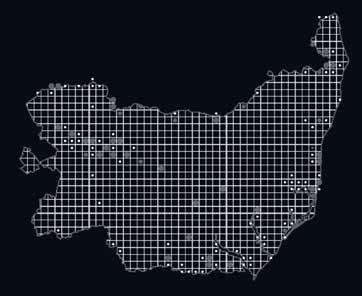
Having had the largest recorded county flock (285) last year, at Great Livermere, the site didn’t reach that number this year but did have a flock of 235 on June 18th; at Cavenham 125 were recorded on June 21st and 81 at Hall Farm, Fornham St Martin in August was the highest monthly Current map of breeding for Egyptian Goose (Birdtrack)
count at the site. There were 204 on the Alton Water WeBS count on September 17th with high counts on many other dates. Smaller flocks were recorded in the northeast, the largest being 45 at Carlton Marshes on July 22nd and 24 at Burgh Castle on October 7th.
Of note, three flew south a mile out to sea off Southwold on October 6th.
At Livermere Lake an Egyptian Goose x Ruddy Shelduck hybrid was present in June.
MUTE SWAN Cygnus olor
Common resident. Green List (from Amber list December 2021). Categories A and C.
Our resident swan species is encountered around the county with herds present out of the breeding season being noted particularly along some of the coastal river areas, as detailed in the WeBS table below. There was a slight increase in the total number of locations in which the species was recorded across the three recording areas, up to 73 compared with 70 sites last year but still below the 87 in 2021. What was noticeable was that, despite similar overall totals, the number of sites was much lower in the northeast whereas in the southeast it had doubled.
During the BTO Breeding Bird Survey (BBS) Mute Swan was recorded in five 1km squares, again a slight reduction over recent years but there was a large drop in the number of individuals, down to just ten (74 in 2022). It has not been this low since 1997 when the number of individuals was eight and, also, the average over the previous six years had been 123.
Across the three recording sections there was a decrease in each of the number of reported breeding locations, number of pairs and the total of young. Breeding was recorded at just 30 sites while there were 38 pairs and 93 young reported – compared with 152 young last year although this is no doubt mostly due to reporting variation as opposed to a genuine decline. Some of the more notable breeding records involved three possible nests at Herringfleet in April and at least one pair with six cygnets at this site in May. There was a female with six cygnets at Beccles Marshes, at Abbey Farm, Snape Wetlands RSPB nine young fledged, a pair with seven cygnets was at East Lane, Bawdsey and four cygnets were along Alderman Road Canal, Ipswich. At Lackford Lakes there were three pairs with young and at Cavenham Pits a pair with eight cygnets.
Peak WeBS counts in the table below:
There were only two locations that held a herd into three figures, viz, 122 at Felixstowe Ferry on January 19th and 100 at Hazlewood Marshes on August 25th. Other large herds recorded were 75 at Martlesham Creek on July 17th, 72 at Barsham Marshes on January 12th, 70 at Loompit Lake, Trimley St Martin on July 11th, 68 at Redgrave Park/Lake on December 6th (although more birds were out of sight so the total would have been larger) and 60 at Carlton Marshes SWT on August 18th. In the west the largest herds were regularly reported from Lakenheath Fen and Livermere Lake; the former site had a high count of 70 on May 12th and the latter, 58 on May 21st.
There were two records of colour-ringed birds; two at Nunnery Lakes Reserve, Thetford with letters FF and FH on March 10th then three birds at Brandon Lock on April 28th, which included the previously-seen FH and also FV and FZ.
Colour-ringed Mute Swans at Thetford and Brandon Lee Barber of the BTO has supplied the following information concerning these four swans. FF was ringed as an adult male at Thetford on September 30th 2020 and is paired with FH
which was ringed as an adult female, also at Thetford, on October 7th 2020 – in 2024 they bred successfully, rearing three juveniles. FV (adult male) and FZ (adult female) were both ringed at |Brandon in April 2023 on 1st and 6th respectively. These four swans are part of a BTO study entitled Retrapping Adults for Survival.
On August 28th 2023, in very calm weather conditions, an adult female Mute Swan was seen swimming serenely northwards off Southwold. Initially noted when it was about 150 metres off the seaward end of Southwold Pier, it was watched as it continued steadily northwards until lost to sight.
Colour-ringed Mute Swans at Wherstead Strand
Between January 2nd and May 30th 2023, nine colour-ringed Mute Swans were noted at Wherstead Strand on the Orwell Estuary. Each swan bore the obligatory metal ring on its right leg, and on its left leg there was a yellow ring inscribed in black with 4 followed by three letters. Details of the inscriptions on the yellow rings were passed on to employees of the Wildfowl and Wetlands Trust who informed me, commendably quickly, of the swans’ ringing details. These nine swans had been ringed at Mistley, Stour Estuary, Essex (5), Ardleigh, Essex (1), Dovercourt Boating Lake, Essex (2) and Stutton Mill, Stour Estuary, Suffolk (1). They were ringed in 2020 (1), 2021 (5) and 2022 (3). It is interesting to speculate as to how the Stour Estuary swans travelled to Wherstead Strand – did they swim down the Stour and then up the Orwell, or did they fly directly to Wherstead across the Shotley Peninsula?
The most intriguing journey involved the swan ringed at Ardleigh. It had originally been caught on October 25th 2021 when it had crash-landed on the A12 trunk road at Ardleigh and was taken into care. After recuperation, it was released at Ardleigh Reservoir bearing ring 4FKT. On February 26th 2022 it was noted at Mistley where, on June 18th 2022, the yellow ring was found to be missing and was replaced with yellow ring 4FZO. This swan remained at Mistley until at least July 15th 2022 before being located at Wherstead Strand on January 2nd 2023.
TUNDRA (BEWICK’S) SWAN Cygnus columbianus bewickii
Fairly common, but declining, winter visitor and passage migrant. Red list (from Amber List December 2021).
Generally similar numbers, and at the expected locations, again in 2023 for this wintering species. There had been no regular flocks at the end of 2022 so two birds on the East Scrape at Minsmere on January 1st were a welcome New Year’s Day addition. The birds were there the following day but there were no further sightings at the reserve until the following month with one on February 3rd and six adults on February 20th, one of which had a distinctive limp. The next two records for the northeast were of birds on the move; five flew northwest at Aldeburgh Marshes on March 5th and 20 were on the sea off Ness Point, Lowestoft, on March 19th – there were five immatures amongst what is nowadays a sizeable count for Suffolk. Four adults were present at Sudbourne Marshes throughout the month of January. At Lakenheath Fen there were up to 18 birds
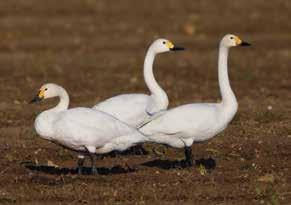
Bewick Swans, Chillesford, 17th December John Richardson
on the washland (mostly Norfolk) on several dates in January and February.
The first record for the second winter period was of eight at Oulton Broad on October 30th. From mid-November and throughout December there were up to eight birds at Minsmere. At times some, or all, of the flock was also noted in fields adjacent to Halfway Cottages, Sizewell. On November 25th, 11 adults flew west over Southwold Town Marshes, two birds were at Carlton Marshes SWT on November 30th and then ten at this site on December 2nd.
At Pipps Ford, Barking, c. six birds were recorded by ‘nocmig’ on November 22nd. At King’s Fleet there was a single bird on November 25th then four were present the following day and for the remainder of the week. At Felixstowe Ferry, five birds flew north on December 5th. At Chillesford four birds were noted on December 15th, which may well have been the birds present at King’s Fleet, Felixstowe/Falkenham in late November. They were noted flying down Butley River and then in a harvested beet field along Pedlars Lane, Chillesford two days later; what were no doubt the same birds were then seen at Hollesley Marshes on December 21st and Boyton Marshes on December 30th.
In the west, three flew southwest over Nunnery Lakes Reserve, Thetford towards Barnham Cross Common on November 17th, two were at Sedge Fen, Lakenheath on November 25th and nine flew east over Brandon Park Heath on November 30th.
2022 Correction
Please amend the photograph description/title on page 45 of “Suffolk Birds 2022” to read “Bewick’s Swan, Westleton, February10th”.
WHOOPER SWAN Cygnus cygnus
Common, but localised, winter visitor and passage migrant. Amber List. Categories A and E. Lakenheath Fen RSPB and the surrounding area continues to be the locality where larger herds can be found. Many records come from Hockwold Washes (in Norfolk) but the birds do
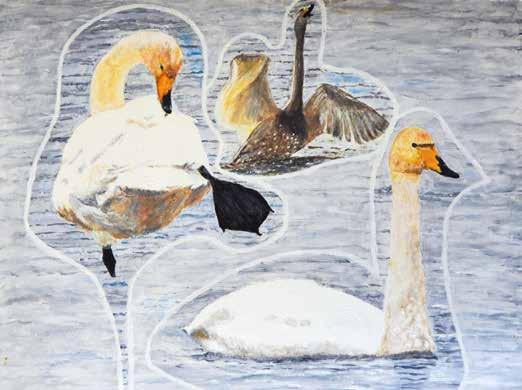
Whooper Swans, Minsmere Peter Lakey
move between the washland and the reserve. Large herds were counted within the parish of Lakenheath at Sedge Fen with 200 on January 11th and at Stallode Wash, south of the railway line, where there were counts of 300 on February 2nd and 700 on February 22nd.
In the northeast of the county, up to four birds were semi-resident at Minsmere between the beginning of January and March 6th. Birds were also regularly noted on Dingle Marshes throughout the period up to March 19th, usually just two birds but there were six on January 4th and four birds on a couple of dates in the same month. Additional records from the area were two off Thorpeness on January 15th and two at Wenhaston on January 18th. In the southeast, three were at Hollesley Marshes on January 24th and, from February 6th to March 15th, two in the King’s Fleet/Felixstowe Ferry area.
Just as in the first part of the year birds were present in the vicinity of Lakenheath Fen RSPB from October 1st to the end of the year. The highest counts were made at Sedge Fen with 800 on both November 3rd and 7th with 1000 on November 11th being the largest herd of the year. There were a few other records from the west, mainly relating to migrating birds; one at Livermere Lake on October 15th and 40 over West Row on October 21st involving three groups heading west. At Cavenham Heath, eight, including two juveniles, flew west on November 21st, three juveniles flew west over Brandon Park Heath on November 25th, eight flew southwest over Denston on November 30th and six flew southwest over Nunnery Lakes Reserve, Thetford on December 5th.
On the northeast coastal strip, Minsmere was the only location where birds were recorded; initially eight on November 30th then two adults were present throughout December. At least one bird was recorded by ‘nocmig’ at Pipps Ford, Barking on October 13th. On several dates throughout November and December a single bird was located on the Deben Estuary; initially at Lodge Farm Marsh, Ramsholt on November 3rd then afterwards on the other side of the river around King’s Fleet and Walton Marshes. At Butley, four were present on November 10th.
COMMON SHELDUCK Tadorna tadorna
Locally common resident, winter visitor and passage migrant. Amber list.
Monthly counts from the key sites:
The Alde/Ore Estuary supported improved wintering numbers, although this trend was not mirrored at the other estuaries. The March WeBS count of 936 is the county’s highest in the first winter period since 2018, while the November count of 1058 is the highest in the second winter period since 2019. Furthermore, Hazlewood Marshes, part of the Alde/Ore Estuary complex, hosted sizeable flocks prior to the annual moult migration, with a peak gathering of 478, June 11th and 200 still present, July 16th.
The number of reported breeding pairs was very similar to the previous three years, with a total of 37 pairs at 16 sites (33 pairs at 17 sites in 2022). Breeding was comprehensively recorded
at Havergate Island, where 12 pairs fledged a total of 45 young, while at least 20 birds were noted prospecting at Landguard between February 12th and July 6th.
Cumulative monthly totals from daily seawatching at Landguard were most significant in January (180 south), October (178 south) and November (361 south), with a peak day-count of 114 south, November 17th. The only other notable offshore movement occurred on October 8th (an excellent day for southerly offshore passage of wildfowl – eg Wigeon) and involved 60 south off Lowestoft and 52 south off Minsmere.
MANDARIN DUCK Aix galericulata
Uncommon feral visitor. Small breeding population. Categories C and E.
maxima from key site:
The population of the county’s only tree-nesting duck continues to grow slowly, with 38 at Brandon Country Park, October 11th extending the highest count beyond the 36 at Christchurch Park, Ipswich in September 2020 and Brandon Country Park in October 2021. In the Ipswich area numbers peaked at 33, December 6th on ponds at Playford, coinciding with an absence of birds at Christchurch Park at this time.
Breeding was confirmed at Christchurch Park, where four separate broods were located between May 15th and July 22nd, although, as usual, no young were known to survive. A pair bred in the eastern outskirts of Ipswich on the former decoy ponds at Purdis Farm where a
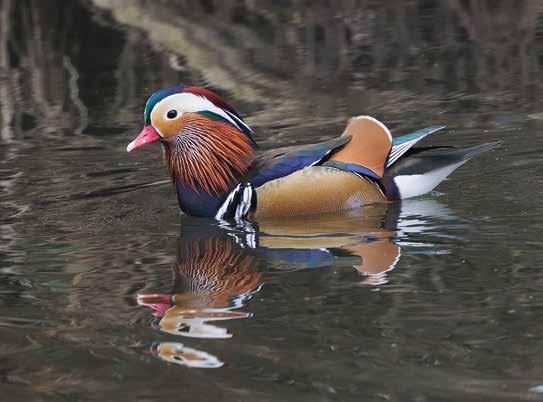
Mandarin Duck, Santon Downham, 8th March
Bill Baston
female was present with three ducklings, May 25th and June 6th. A pair also bred in the west of the county, with a female accompanying four young at Santon Downham, July 7th.
The most unexpected sighting involved a leucistic male at Christchurch Park, April 15th to 18th. All of its feathers were pure white, but its eyes were the usual dark brown rather than the pink of an albino. It is somewhat surprising that this distinctive bird was not reported from any other sites in the county.
Fritton Lake: two males, May 3rd
Benacre Broad: male, Oct 13th
Thorpeness Meare: two (one male), May 21st; male, Nov 20th
North Warren: two, Apr 3rd
Hollesley: male, Apr 22nd
Ipswich: Christchurch Park, females with broods of four young, May 15th; eight young, May 26th; four young, July 13th; one young, July 22nd. Holywells Park, two, Feb 14th; four, Mar 15th. Belstead Brook Park, two (one male), May 4th
Witnesham: Fynn Valley Golf Club, three, May 7th
Playford: 33 (22 males), Dec 6th
Purdis Farm: monthly maxima at Ipswich Golf Club, five (three males), Jan 10th; two (one male), Feb 27th; three (two males), Mar 15th; four (three males), Apr 12th; four (female with three young), May 25th and June 6th; male, July 31st and Aug 7th; four (one male), Sep 20th; seven (four males), Oct 30th; 23, Dec 1st
– this latter total also coincided with an absence from Christchurch Park
Alton Water: May 21st (WeBS count)
Santon Downham: ten, Mar 4th; six (three males), Mar 20th; 11, Apr 21st; female with four young, July 7th
Brandon: Country Park, monthly maxima of 12, Jan 13th; three (two males), Apr 11th; 38, Oct 11th; 12, Dec 10th
Long Melford: Kiln Farm, male, Apr 30th
Bures St Mary: four, Mar 24th; two, Apr 24th; eight, Sep 25th
GARGANEY Spatula querquedula
Uncommon summer visitor and passage migrant. Has overwintered. Amber list. Following last year’s bumper spring, it was a return to more-expected numbers. There were records from just two sites in March, the first being a male at Minsmere on 19th. The main arrival occurred in the first two weeks of April and continued steadily over the following few weeks, tailing off in the second half of May. Longer-staying single pairs were present at Westwood Marshes and Minsmere, but breeding was not confirmed. Records became more regular again after mid-July, reaching a peak in the second half of August, including five at Carlton Marshes on three dates. There were sightings at five sites in September and two in October, with the last at Minsmere, November 3rd, the latest since 2013 (when a first-winter male was present at Trimley Marshes, December 29th, the county’s sole December record).
Somerleyton: Marshes, May 6th and 24th; two males, May 28th and 29th; June 3rd
Carlton Marshes: male, Mar 30th; regularly, Apr 3rd to Apr 20th; two, Apr 22nd; three males, June 7th; up to three regularly, July 22nd to Aug 29th, with four, Aug 13th, 14th, 18th and 25th; five, Aug 23rd, 27th and 28th; Sep 23rd and 25th; Oct 8th and 11th
Southwold/Reydon: Buss Creek, male, Apr 6th
Westwood Marshes: pair present during breeding season
Dingle Marshes: male, May 16th
Minsmere: male, Mar 19th; three (two males), Mar 31st and Apr 1st; two males, Apr 2nd and 3rd; regularly, Apr 9th to May 15th; up to two regularly, May 17th to 29th; June 7th, July 8th, Aug 1st and 22nd, Sep 11th, Oct 20th and Nov 1st and 3rd
North Warren: female regularly, Apr 7th to 18th; male, May 2nd
Aldeburgh: Marshes, four (two males), Apr 6th; May 21st, Aug 10th; Sep 20th
Snape Wetlands: Apr 7th; three (one male), July 28th; two (one male), Aug 15th; Aug 22nd; three, Aug 25th
Wantisden: Staverton Lakes, Apr 5th; May 6th
Boyton Marshes: male regularly, Apr 1st to 6th and May 2nd to 13th; up to two males, May 15th to 23rd; male, July 18th
Hollesley Marshes: Apr 5th, 21st and 22nd, May 2nd and 13th and Aug 9th, 22nd, 28th and 29th; three, Sep
1st; two regularly, Sep 2nd to 17th, with three, Sep 8th and 9th
Ramsholt: Lodge Marsh, Apr 7th
Trimley Marshes: two regularly, Apr 5th to 15th; May 15th; up to two, July 12th to 16th; three, Aug 25th; two, Aug 29th; Sep 19th
East Bergholt: White Horse Marsh, two, May 1st
Lakenheath Fen: male, regularly May 1st to 6th and also 26th (all other sightings at this site involved birds in Norfolk)
Lackford Lakes: juvenile, Aug 18th to 25th
Kedington: Sturmer Mere, male, Apr 19th
Great Cornard: Baker’s Mill, juvenile, Aug 3rd to 8th
NORTHERN
SHOVELER Spatula clypeata
Common winter visitor and passage migrant. Uncommon resident. Amber list.
Monthly counts from the key sites:
The high wintering numbers of recent years were sustained, with both the Alde/Ore Estuary and Minsmere posting counts exceeding 400 in the second winter period. A further highlight was the WeBS count of 172, March 12th at Carlton and Oulton Marshes, a new site record. At sites not covered by the table, counts exceeding 50 in the first winter period involved 60 at Bury St Edmunds Sugar Beet Factory (WeBS count), January 22nd; 190 at Breydon Water (south shore), February 4th; 68 at the Deben Estuary (WeBS count), March 12th and 69 at Mickle Mere, April 9th. A gathering of 60 at Hollesley Marshes, June 7th comprised mostly moulting males, while significant counts in the second winter period included 100 at Sizewell Hall, Sizewell, November 9th; 120 at Southwold Town Marshes, November 10th and 91 at Leathes Ham, Lowestoft, December 30th.
Confirmation of breeding was almost exclusively reported from sites in the south-east of the county, with four pairs at Hollesley Marshes (two pairs in 2022), two pairs on Orfordness, Stanny Marshes, Iken and Boyton Marshes and single pairs at Flatford Mill (East Bergholt) and Snape Wetlands. There was a single confirmed pair at Lakenheath Fen in the west and two at an undisclosed site. An estimated 34 pairs bred at Minsmere, a significant increase from the 23 pairs in 2022.
The only offshore movement of note involved 22 south off Minsmere, October 8th. At Landguard 53 were logged moving south during the year.
GADWALL Mareca strepera
Common resident and winter visitor. Amber list. Categories A and C.
counts from the key sites:
Minsmere maintained its status as the county’s only wintering site of national importance (threshold of 310) for this dabbling duck, the total of 420 on the Scrape, December 6th being the highest at this site for three years. Further three-figure counts in the first winter period included 128 at Alton Water, January 1st; 150 at North Warren, January 22nd and 106 at Thorpeness Meare, February 5th. Outside of the period covered in the table, notable counts at Minsmere involved 180, May 29th and 300, July 15th, while elsewhere 122 were present at Hollesley Marshes, June 13th; 100 at Snape Wetlands, June 29th and 191 at Trimley Marshes, July 19th. In the second winter period, additional counts included 150 at Sizewell Hall, Sizewell, November 9th and 210 at Benacre Broad, December 1st and 21st.
For the second year in the past four the number of reported breeding pairs failed to reach 30, with a total of just 26 pairs at 11 sites (32 pairs at 15 sites in 2022). From this limited information it is difficult to draw any realistic trends regarding the actual breeding population. At Snape Wetlands six pairs bred (the same as 2022), while three pairs bred at each of Minsmere, Boyton Marshes, Hollesley Marshes and Cavenham Pits.
EURASIAN WIGEON Mareca penelope
Common winter visitor and passage migrant. A few oversummer and occasionally breed. Amber list. Categories A and E.
At the county’s principal wintering site, the Alde/Ore Estuary, it was another poor year and, as a consequence, the site has lost its status as a site of national importance (threshold 4500). News was more positive from the Orwell Estuary, where a low-water WeBS count of 1885 in January is the highest at this site for 17 years. The high ad hoc counts from Breydon Water were made from the south wall. For the purposes of the WeBS, Breydon Water is combined with Berney Marshes and this huge area, which lies predominantly in Norfolk, has recent yearly maxima exceeding 40000 making it the second most important estuary in the country for wintering Wigeon. In the first winter period additional three-figure counts involved 120 at Mickle Mere, January 1st; 115 at Fritton Lake, January 8th and 137 at the same site, February 19th; 144 at Lackford Lakes, January 22nd (WeBS count) and 150 at Snape Wetlands, February 26th, while in the second winter period 200 were present at Sizewell Hall, November 9th and 350 at the Blyth Estuary, November 20th. There was no evidence of breeding, although mid-summer records were more widespread than usual. These included four at Hollesley Marshes, June 7th and Carlton Marshes, July 15th and three at Minsmere, June 8th and 16th, before the first returning birds were noted at the end of July. The only years this century in which Wigeon have bred in Suffolk are 2005 (North Warren) and 2015 (Nunnery Lakes, Thetford).
Following an unremarkable first winter period for offshore movement, autumn passage began with three south off Landguard, August 18th, although there were no significant counts until the end of September. Numbers peaked in the middle two weeks of October, including an exceptional southbound movement in light southerly winds on October 8th, the highlight of which was 3150 logged off Thorpeness between 7.20am and 12.45pm (Dave Thurlow), the highest day-count recorded in the county since 5000 flew south off Minsmere on October 21st 1990.
Lowestoft: 500 south, Oct 8th
Pakefield: 507 south, Oct 8th; 446 south, Oct 19th
Southwold: 1025 south, Oct 8th
Dunwich: 629 south, Oct 8th
Minsmere: 1400 south, Oct 8th; 125 south, Oct 17th; 200 south, Oct 21st
Thorpeness: 3150 south, Oct 8th; 100 south, Oct 18th; 290 south, Oct 19th
Shingle Street: 250 south, Oct 19th
Bawdsey: 1290 south, Oct 8th
Landguard: one north and 333 south in Sep including peak day-count of 195 south on 28th; 1931 south in Oct including peak day-counts of 472 on 8th and 739 on 19th; 12 north and 99 south in Nov and 260 south in Dec including peak day-count of 192 on 31st
In the west of the county, the 520 at Gifford’s Hall Flash is the highest total since January 2018 when 650 were present at the same site.
Eurasian Wigeon Mareca penelope x Northern Pintail Anas acuta hybrid
The male of this parentage, which was first reported from Havergate Island in January 2021 and present on the Butley River in November and December 2022, was again noted on the Butley
River, January 22nd and February 19th. It was present on Havergate Island, March 12th, before returning for another winter to the Butley River, December 17th.
MALLARD Anas platyrhynchos
Very common resident, winter visitor and passage migrant. Amber list.
Monthly counts from the key sites:
Apart from the high counts from Livermere Lake, which come with the usual caveat that captive-bred young birds are released at this site each summer for shooting, wintering numbers in both periods followed the pattern of the previous three years and were disappointing. Aside from those in the table, the only other three-figure counts received involved 130 at Thorpeness Meare, January 22nd; 117 at Dingle Marshes, February 19th (WeBS count) and 125 at Hollesley Marshes, August 28th.
In general, the breeding season was poorly recorded, with a total of 39 confirmed pairs from 29 sites (58 pairs from 40 sites in 2022) and from this limited sample it is hard to draw any meaningful conclusions. Observations of note included six broods at Hoxne between April 14th and August 25th and a total of 37 ducklings at Minsmere, June 27th, while at Christchurch Park, Ipswich harassment from two domestic ducks is thought to be the reason that prevented any breeding attempts until the autumn; a single brood of 12 was eventually located on the late date of November 14th, although all these ducklings were subsequently predated by Black-headed Gulls.
NORTHERN PINTAIL Anas acuta
Fairly common winter visitor and passage migrant; a few oversummer. Bred in 2016 and 2018. Amber list. Categories A and E.
The upward trend in non-breeding numbers of the previous two years, which is also mirrored nationally, continued. A non-WeBS count of 620 at North Warren, December 31st is the county’s highest for seven years and a new site record, substantially exceeding a count of 393 in February 2022, while also in late December a non-WeBS count of 405 at Hazlewood Marshes on 29th is the highest on the Alde/Ore Estuary since 2012. Early in the year, the WeBS count at the Deben Estuary of 247, January 22nd is the highest at this site since 2006. Other than those in the table, counts of 50 or more included 84 at Havergate Island, January 2nd; 150 at Aldeburgh Marshes, January 3rd; 78 at Breydon South Wall, January 5th, with 110 at the same site, February 4th; 53 at Carlton Marshes, February 17th and 51 at Minsmere, February 19th (WeBS count).
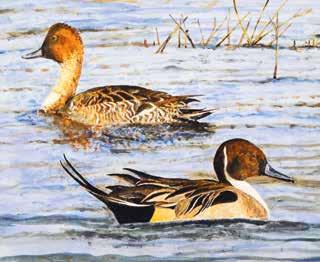
Although single pairs lingered at Minsmere and Boyton Marshes during the spring and early summer, breeding was not suspected.
Records received from the west of the county are listed below. They were concentrated at the flash by the River Brett at Stoke-byNayland, the shallow, open water here having proved particularly attractive for this species for many years.
Livermere Lake: Jan 1st
Mickle Mere: two, Mar 23rd
Stoke-by-Nayland: Gifford’s Hall, two, Jan 29th; 18, Feb 5th and 12th; 20, Mar 5th; Mar 18th; two, Sep 17th and 19th; 45, Dec 16th; 20, Dec 26th
Offshore passage was logged up to January 29th and again from September 5th. Numbers peaked in October, in particular on 8th when a substantial southerly movement included 125 off Thorpeness and 93 off Pakefield (see Wigeon).
Lowestoft: 29 south, Oct 8th; 77 south, Oct 18th
Pakefield: 93 south, Oct 8th; 14 south, Oct 19th; two north, Nov 21st
Dunwich: 54 south, Oct 8th
Minsmere: seven south, Sep 5th; south, Sep 28th; 49 south, Oct 8th
Sizewell: 40 south, Nov 1st
Thorpeness: three south, Sep 24th; four south, Sep 25th; 125 south, Oct 8th; 25 south, Oct 18th; 14 south, Oct 19th
Bawdsey: East Lane, south, Sep 24th; 35 south, Oct 8th
Landguard: five north and 33 south between Jan 3rd and 29th including peak day-count of 12 south on 29th; 15 south between Sep 14th and 28th; 51 south in Oct including peak day-count of 22 on 19th; 15 north and 22 south in Nov including peak day-count of 15 north on 16th; 24 south in Dec including peak day-count of 12 south on 31st
Northern Pintail Peter Lakey
EURASIAN TEAL Anas crecca
Common winter visitor and passage migrant. Scarce resident. Amber list.
Monthly counts from the key sites:
In general, wintering numbers were very good, highlighted by three standout WeBS counts. The year’s highest, a count of 4814 on the vast Alde/Ore Estuary complex, November 19th is the highest at this site, and in the county, since 2010. The count of 1459 on the Orwell Estuary, December 17th is the highest at this site for ten years, while the count of 1396 on the Deben Estuary, March 12th is a new site record. Further three-figure counts from sites not included in the table involve 233 at Alton Water, January 22nd (WeBS count); 211 at Culford Park, January 26th; 670 at Breydon South Wall and 150 at Flatford Mill, East Bergholt, February 4th and 150 at Sizewell Hall, Sizewell, November 9th.
A small number oversummered at coastal marshes in the north-east of the county, but there was no evidence of breeding, before returning birds began to arrive from the second week of June; by 13th, 14 were back at Minsmere, increasing to 30 by 24th, while numbers at Boyton Marshes had reached 90 by 20th. During this century successful breeding by European Teal has been recorded in 2000, 2004, 2008, 2010 and 2016; the most productive year was 2004 with successful breeding at Minsmere, Mickle Mere and Lackford.
Offshore return passage began early when 12 flew south off Landguard, June 10th, but the first significant day-counts were not recorded until the beginning of September. On October 8th, a significant southerly movement included 1000 logged off Minsmere, the highest day-count for
five years, and 520 off Thorpeness (see Wigeon and Pintail).
Corton: 24 north and 81 south, Sep 28th
Lowestoft: 129 south, Sep 1st; 200 south, Oct 8th; 120 south, Oct 19th
Pakefield: 105 south, Oct 19th
Minsmere: 228 south, Sep 2nd; 100 south, Sep 27th; 1000 south, Oct 8th
Thorpeness: 239 south, Sep 2nd; 105 south, Sep 17th; 520 south, Oct 8th
Bawdsey: East Lane, 180 south, Oct 8th
Landguard: 197 south in Aug; five north and 752 south in Sep including peak day-counts of 130 south on 1st and 181 south on 2nd; two north and 343 south in Oct; 407 south in Nov including peak day-count of 215 on 18th; 117 south in Dec
GREEN-WINGED TEAL Anas carolinensis
Rare visitor.
Boyton Marshes: male, Apr 16th to 27th (J Kennerley et al.)
Kedington: Sturmer Mere, male, Jan 9th (E Hutchings)
The spring male at Boyton Marshes is assumed to be the individual first recorded in November 2022 and last seen at this site December 19th, while that at Sturmer Mere is the first for the west of the county since 2009 (Mickle Mere, March 16th) and the 44th record for the county.
RED-CRESTED POCHARD
Netta rufina
Scarce winter visitor and passage migrant. Categories A and E.
The following records all come with the usual proviso that they most likely relate to birds of captive origin (or the offspring of captive-bred birds):
Carlton Marshes: male, June 20th; male, Nov 19th
Minsmere: female, July 16th
Barking: Alderson Lake, male regularly, Feb 1st to 20th
Gipping Valley: Bosmere Hall, male, 19th Feb – same as above
Lakenheath Fen: Sep 5th
Mildenhall: Gaspool, Feb 3rd and May 2nd
Lackford Lakes: male, Mar 29th to Apr 1st and again regularly, May 30th to June 19th; three (two males), Nov 3rd
COMMON POCHARD Aythya ferina
Fairly common but declining winter visitor and passage migrant. Uncommon resident. Red list. Categories A and E.
Monthly counts from the key sites:
In January and February numbers were significantly higher than the norm of recent years. The year’s highest count of 142 at Trimley Marshes, January 1st is the largest aggregation in the county for four years, the WeBS count of 55 at Alton Water, January 22nd is the highest at this site also for four years and the count of 116 at Lackford Lakes, February 9th is the highest in the west of the county for 11 years. With the national non-breeding population continuing to fall to levels never previously recorded, it remains to be seen whether these are early indicators
of a sustained revival in the county. On a less-positive note, aside from the table the only other count to exceed 30 involved 49 at Livermere Lake, February 22nd, while the highest count in the northeast of the county was a mere 12 at Carlton Marshes, February 25th.
Although small, the breeding population appears stable, with single confirmed pairs at each of three sites (four pairs at three sites last year and two/three pairs in each of the four years previous to this). A female was noted with a brood of five at Lakenheath Fen from mid-June into early July, while single ducklings were observed in early July at both Trimley Marshes and nearby Loompit Lake, Trimley St Martin. In addition, single pairs were present during the breeding season at Minsmere and Barton Mere.
Common Pochard Aythya ferina x Ferruginous Duck Aythya nyroca hybrid
A male of this parentage was present at Trimley Marshes, January 30th and it, or possibly another, was present at Hollesley Marshes from March 19th to 25th.
Common Pochard Aythya ferina x Tufted Duck Aythya fuligula hybrid
A male of this parentage, in appearance reminiscent of a Ring-necked Duck, with a thick black tip to its bill separated from the blue-grey basal two-thirds by a broad pale band, was reported at Snape Wetlands on three dates between February 18th and March 15th. It, or another, was present at Lackford Lakes, November 24th.
RING-NECKED DUCK Aythya collaris
Very rare visitor.
Carlton Marshes: male, photographed, June 20th to Aug 23rd (A C Easton et al.)
Thorpeness Meare: first-winter male, photographed, Nov 26th to Dec 31st (J A Rowlands et al.)
North Warren: first-winter male, Dec 26th, same as at Thorpeness Meare.
It was a second successive good year for this Nearctic counterpart of the Tufted Duck, with two long-staying individuals including the first to oversummer. The 13th and 14th county records (involving 16 individuals) and at three new sites.
TUFTED DUCK Aythya fuligula
Common resident, winter visitor and passage migrant.
Monthly counts from the key sites:
An impressive concentration built up at Alton Water in the second winter period, peaking at 378, December 31st, the largest gathering in the county since 628 were present at the same site in January 2017. Besides those in the table, the only sites to host numbers in excess of 50 were
Ring-necked Duck, Thorpness, 4th December
Jeff Higgott
Suffolk Water Park, Bramford with 72, January 27th; Causeway Lake, Baylham with 59, February 18th; Nunnery Lakes, Thetford with 68, February 19th (WeBS count) and Trimley Marshes with 59, December 26th.
A total of 13 confirmed breeding pairs at eight sites (14 pairs at seven sites in 2022) is indicative of under-recording and makes an accurate assessment of breeding status impossible. This freshwater species is not routinely associated with significant offshore movements, but numbers noted off Landguard in the autumn were unusually high. A total of one north and 92 south was logged between October 9th and November 16th, including 60 south, November 13th.
GREATER SCAUP Aythya marila
Fairly common but declining winter visitor and passage migrant. Red list.
With just two individuals it was a mediocre first winter period, although these did include a male which spent over a month on the Deben Estuary.
Aldringham: irrigation reservoir, male, Jan 1st to 5th – present from at least Dec 31st 2022
Waldringfield: Deben Estuary, male, intermittently Jan 18th to Feb 20th
The second winter period, following the pattern of the previous two years, was similarly disappointing, with sightings at just five sites and a maximum count of two.
Pakefield: south offshore, Oct 19th
Minsmere: two, Oct 19th to 23rd; Oct 27th; two, Nov 21st
Landguard: south offshore, Oct 9th and 19th
Trimley Marshes: Dec 25th
Brantham: Stour Estuary, Nov 12th to 16th
COMMON EIDER
Somateria mollissima
Uncommon winter visitor and passage migrant. Bred in 1996. Amber list.
There was a very quiet start to the year, with a total of only 16 logged offshore from five sites on six dates between January 21st and April 3rd, plus a male at Hamilton Dock, Lowestoft, March 4th to 8th. These were followed in June by a singleton north off Landguard on 9th and up to two males feeding on mussels at Minsmere Sluice from 22nd to 26th, with no further records until mid-September.
On September 15th two flew north off Dunwich and for the next 11 weeks sightings from coastal watchpoints were regular, ending with one south off Landguard, December 1st. Numbers, however, were low. A total of 23 north, three south and five on the sea was logged off Landguard, while the only day-counts to reach double-figures involved ten south off Bawdsey, September 26th and 29 north and one south off Southwold and 20 north off Minsmere, November 21st.
The final record off the year concerned a male on the Stour Estuary off Stutton Ness, December 10th.
SURF SCOTER Melanitta perspicillata
Accidental.
Pakefield: female or juvenile south offshore, 09.38hr, Oct 19th (H Vaughan)
Southwold: female or juvenile south offshore, 10.12hr, Oct 19th (J Gearty, B J Small, D Wade) – same as Pakefield; female or juvenile north offshore, 09.20hr, Dec 7th (B J Small) – same as Oct 19th.
Minsmere: female or juvenile south offshore, 10.24hr, Oct 19th (D Fairhurst, R Harvey) – same as Pakefield. Sizewell: female or juvenile south offshore, 10.27hr, Oct 19th (J H Grant) – same as Pakefield.
Thorpeness: female or juvenile south offshore, 10.33hr, Oct 19th (R Burrough, D F Walsh) – same as Pakefield.
On October 19th a female or juvenile was tracked from five sites as it made its way along the coast, passing Thorpeness 55 minutes after the initial sighting off Pakefield. Intriguingly, what is assumed to be the same bird was seen off Southwold, again by Brian Small, one of the original observers, seven weeks later. This is the second county record following a first-winter male which overwintered on the Stour Estuary in 2014/15.
VELVET
SCOTER Melanitta fusca
Uncommon winter visitor and passage migrant. Red list.
Sole Bay proved very reliable in the first winter period, with double-figure day counts off Dunwich in each of the first three months. The peak count of 16, February 12th is the highest in the county since counts ranging between 20 and 41 were made at the same site in late November and early December 2016. The sighting at Holbrook Bay is the first on the Stour Estuary since 2017. All records refer to birds on the water unless otherwise stated.
Southwold: eight south, Jan 7th
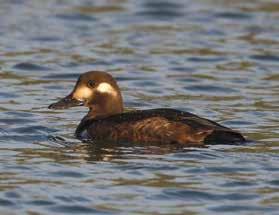
Dunwich/Minsmere: up to eight, Jan 2nd to 5th; 12, Jan 6th; 11, Jan 7th; 14, Jan 8th; 15, Jan 9th; up to seven, Jan 10th to 18th; 16, Feb 12th; 12, Mar 1st and 2nd; 14, Mar 3rd; 12, Mar 4th; eight, Mar 5th and 6th; up to seven, Mar 7th to 11th; up to four, Mar 12th to 15th; six north, Mar 17th; Mar 22nd and 24th
Aldeburgh/Slaughden: two, Jan 2nd; two north, Jan 17th
Landguard: four south, Jan 3rd; south, Apr 13th
Holbrook: Stour Estuary, Jan 1st
Following the singleton off Landguard, April 13th, none was seen until two on the sea off Slaughden, October 9th. These were followed by records on three further dates up to October 23rd, before virtually daily sightings from 28th through to December 10th. As in the first winter period, numbers were highest off Dunwich, with a peak of 12, December 6th. A female/firstwinter spent a week from October 30th at Oulton Broad and nearby Hamilton Dock, the first in the Lowestoft area away from the immediate coast since 2005, and one was present at Benacre Broad for over a week in November, the first at this site again since 2005.
Lowestoft: south, Nov 3rd and 4th; three south, Nov 26th. Oulton Broad and Hamilton Dock, female or firstwinter, Oct 30th to Nov 6th (different from offshore)
Pakefield: five north, Nov 21st; two, Nov 30th
Benacre Broad: first-winter, Nov 7th to 17th
Southwold: two, Oct 21st; north, Nov 25th; two south, Nov 29th; three, Dec 8th; seven south, Dec 9th; three south, Dec 13th
Dunwich/Minsmere: south, Oct 23rd and Oct 29th; two north, Nov 8th; four, Nov 17th and 19th; six, Nov 21st and 22nd; seven, Nov 23rd; three, Nov 28th; 12, Dec 6th; two, Dec 10th; Dec 29th
Sizewell: south, Oct 21st
Thorpeness: four, Nov 25th; four north, Nov 26th
Aldeburgh/Slaughden: two, Oct 9th; five, Oct 12th; three, Oct 28th; two, Oct 30th and Nov 2nd; Nov 4th; two, Nov 7th; five, Nov 12th; five, Nov 26th
Hollesley: over the sea, five, Dec 10th
Landguard: three south, Nov 1st; north, Nov 16th; one north and one on sea, Dec 3rd; Dec 4th; two, Dec 8th; south, Dec 10th; two south, Dec 20th; two south, Dec 28th
COMMON
SCOTER Melanitta nigra
Declining non-breeding resident, winter visitor and passage migrant. Red list.
Landguard
Velvet Scoter, Oulton Broad, 5th Nov Peter Ransome
Accumulated monthly totals from Landguard Bird Observatory are shown in the table. They are unremarkable until the second winter period, which ended with the two highest monthly totals at this site since 2016. All three-figure movements are summarised below:
Lowestoft: 129 south, Jan 7th; 50 north and 85 south, Jan 8th
Dunwich/Minsmere: 107 north, Aug 3rd; 240 south, Oct 8th; 100 north, Nov 15th
Thorpeness: 185 north, July 10th
Landguard: 110 south, Nov 12th; 400 south, Dec 15th
Significant rafts were reported in every month except April and May, with those comprising 500 or more recorded off Covehithe and Easton Bavents in January, Dunwich and Minsmere in July and Aldeburgh and Slaughden in late November. Peak monthly day-counts of rafts numbering 100 or more are summarised below:
Covehithe: 850, Jan 13th
Easton Bavents: 580, Jan 26th
Southwold: 120, Nov 28th
Walberswick: 200, Feb 8th; 200 Feb 20th
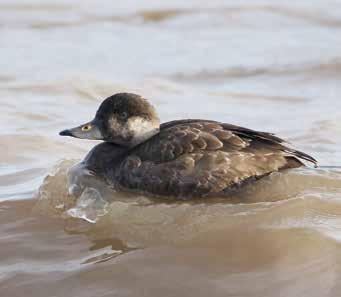
Dunwich/Minsmere: 170, Feb 12th; 200, Mar 13th; 250, June 19th; 500, July 6th and 15th; 260, Aug 2nd; 150, Sep 1st and 15th
Thorpeness: 100, Sep 17th
Aldeburgh/Slaughden: 100, Jan 17th; 100, Feb 3rd; 150, Oct 27th; 650, Nov 25th; 300, Dec 7th
Hollesley: 350, Dec 10th
Felixstowe/Landguard: 100, Nov 26th; 160, Dec 15th
Sightings away from the immediate coast involved two on the Stour Estuary off Stutton Ness, January 2nd; a female on the Alde Estuary, February 11th; one on the Orwell Estuary at Levington Creek, March 19th and a female at Snape Wetlands, April 7th. Further records from less-expected sites towards the end of the year comprised a singleton on the Butley River at Butley Ferry, November 9th; a female on a lake at Denston Hall, Denston in the west of the county, November 18th and two at Lantern Marshes, Orfordness, December 16th.
The record of a Common Scoter well inland at Denston on November 18th (see above) is the first report of this species from the extreme southwest of Suffolk since 1988 when there were sightings at Haverhill on January 24th (2) and March 5th.
Most reports of Common Scoters from West Suffolk are from the principal wetland sites, particularly Lackford Lakes where it was noted in 15 of the years from 1979 to 2015 (but none since this latter year). The largest recorded west Suffolk flock involved 18 at Lackford Lakes on March 27th 2008.
Ticehurst in his 1932 Suffolk avifauna mentioned west Suffolk sightings of Common Scoters at the less-expected sites of Euston, Kentwell (Long Melford) and Rattlesden; since 1950 the following sites can be added to Ticehurst’s list – Bury St Edmunds Sugar Beet Factory (1954), Lindsey (1979), Tuddenham St Mary (1985), Bradfield Combust (1986), Haverhill (1988), Barton Mills (2005), Worlington (2009), Little Cornard (2010) and Denston (2023).
Common Scoter, Ness Point, 25th December Peter Ransome
2021 Correction
The record of 16 at Lakenheath Fen, May 27th 2021 (Suffolk Birds 2021:74) relates to Hockwold Washes in Norfolk; this sighting is mentioned on page 55 of the 2021 Norfolk Bird and Mammal Report.
2022 Correction:
Please amend “Landguard: 13 south and 94 north….” (Suffolk Birds 2022:59) to read “Landguard: 13 north and 94 south…”
LONG-TAILED DUCK Clangula hyemalis
Uncommon winter visitor and passage migrant. Red list.
A singleton north off Slaughden, January 17th was the sole record in the first winter period. It was followed by an adult male on the sea off Minsmere and Sizewell, May 11th and an adult male at Covehithe Broad, August 8th, which had moved to a pool by the Scrape at Minsmere the next day. Previous to this there had not been an August record in Suffolk since 1968 (a male at Minsmere on 2nd and 3rd).
The year ended with a more-typical set of sightings, including a first-winter male which spent over a week on the scrape at Minsmere.
Southwold/Walberswick: two on sea, Dec 12th; on sea, Dec 14th; two on sea, Dec 15th; on sea, Dec 26th
Minsmere: first-winter male on Scrape, Nov 24th to Dec 6th
Thorpeness: south, Oct 19th
Bawdsey: female/first-winter on sea, Nov 25th
2022 Correction
Please amend photograph title on page 60 of Suffolk Birds 2022: to read “Kessingland, January 4th” rather than January 14th.
COMMON GOLDENEYE Bucephala clangula
Fairly common winter visitor and passage migrant. Red list.
Monthly counts from the key sites:
Wintering numbers remain low, reflecting the continuing national downward trend. Besides those in the table no other count reached double figures, the highest in the west of the county being a mere two at Lackford Lakes, January 5th and November 10th and 16th. The last record of the spring concerned four at Benacre Broad, April 3rd, with no more sightings until one flew south off Landguard, October 8th.
A further 25 flew south off Landguard up to November 25th, including eight, November 1st, but elsewhere there was very little evidence of offshore autumn passage.
SMEW Mergellus albellus
Uncommon winter visitor and passage migrant. Red list.
With just two redheads, both on the Alde Estuary, it was the poorest year since 1975 (when none was recorded). The long-staying individual in the first winter period was most frequently observed by viewing north-east from Iken churchyard or west from Hazlewood Marshes.
Alde Estuary: redhead, Jan 1st to Mar 4th and Dec 14th to 31st
GOOSANDER (COMMON MERGANSER) Mergus merganser
Locally fairly common winter visitor and passage migrant. 2006 to 2009 and 2012.
Monthly maxima from the two most-regular sites are shown in the table. Numbers at Minsmere during the first winter period were particularly impressive and included 31, January 23rd, the highest count in the county since 33 were present at Lackford Lakes in January 2003. Sizeable overnight roosts on the Scrape at Minsmere occurred into March, with 20 on 11th and 16 on 17th, with the last of the spring, also at Minsmere, April 23rd. All records from elsewhere in the first winter period are listed below, including double-figure groups flying over Aldringham on two early mornings in February on their way from Minsmere to daytime feeding sites.
Landguard: three south, Jan 13th; east, Mar 6th
Fritton Lake: Feb 4th; two, Feb 19th
Oulton Broad: male, Mar 3rd
Heveningham: Park, three, Feb 1st; four, Feb 17th
Aldringham: 12 west, Feb 5th; 16 south, Feb 22nd
North Warren: three, Feb 6th; two regularly, Feb 12th to 25th and Mar 18th to 25th; four, Apr 2nd; Apr 6th; two redheads, Apr 9th and 18th
Hollesley Marshes: three redheads, Jan 4th; redhead, Jan 21st and Mar 19th
Iken: Alde Estuary, redhead regularly, Jan 23rd to Feb 10th
Melton: Deben Estuary, Feb 4th
Landguard: three south, Jan 13th; east, Mar 6th
Bramford: Suffolk Water Park, Jan 15th; three (one male), Feb 18th
Alton Water: Mar 12th (WeBS count)
East Bergholt: Flatford Mill, four, Jan 16th
Thetford: Nunnery Lakes, Jan 17th
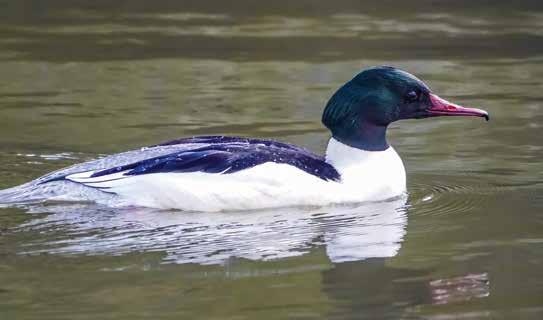
Goosander, Oulton Broad, 3rd March
David Borderick
Lackford Lakes: two, Jan 15th
Little Cornard: Shalford Meadow, Jan 1st
A redhead on the Scrape at Minsmere, October 1st was the first record of the second winter period, with sightings becoming most widespread between the final week of October and the third week of November. There was no repeat of the impressive counts of the first winter period, with 13 at Thorpeness Meare, November 28th being the highest.
Lowestoft: two redheads on sea, Nov 1st. Hamilton Dock, redhead, Nov 15th. Lake Lothing, redhead, Nov 19th
Oulton Broad: redhead, Nov 19th
Pakefield: two south offshore, Nov 1st
Benacre: Nov 14th
North Warren: five, Oct 14th and 15th; five, Dec 23rd; Dec 31st
Aldeburgh: three west, Oct 13th
Alde Estuary: Nov 11th and 19th (WeBS count)
Boyton Marshes: Dec 29th and 31st
Hollesley Marshes: redhead, Nov 9th and 10th and regularly, Dec 6th to 26th
Melton: Deben Estuary, Nov 12th and 15th
Felixstowe: Ferry, two, Oct 24th and 25th; regularly, Oct 31st to Nov 25th, and two, Nov 20th
Landguard: south, Oct 14th; two south, Oct 27th; south, Nov 2nd; two west, Nov 10th; south, Nov 16th; south, Nov 20th
Needham Market: Lake, redhead, Nov 25th
Barking: Pipps Ford, three, Nov 6th
Alton Water: two redheads, Nov 19th; redhead, Dec 17th (WeBS count), 18th and 31st
Thetford: Nunnery Lakes, redhead, Nov 29th
Lackford Lakes: redhead, Nov 16th
Clare: Clare Common, Dec 26th
RED-BREASTED MERGANSER Mergus serrator
Fairly common winter visitor and passage migrant. Amber list.
Peak counts from the two principal wintering sites are presented in the table, the annual maxima at both sites being very similar to last year.
The final record of the spring concerned two south off Landguard, April 30th, with no further sightings until a redhead flew north off Corton, September 28th.
Offshore autumn passage was light. It was most pronounced at Landguard where a total of two north and 37 south was logged between October 9th and December 4th, while the peak daycount involved 11 south off Sizewell, November 1st.
Birds noted at less-expected locations included up to four at Benacre Broad between October 22nd and November 17th; two redheads at Thorpeness Meare, November 5th; singletons on the Alde Estuary, April 22nd and December 17th (WeBS count) and two on the Deben Estuary, February 19th.
GREY PARTRIDGE Perdix perdix
Formerly common resident, now localised. Red List. Categories A, C and E. Grey Partridge is seen across the county, including in some of our coastal fringes although most of the population is to be found on farmland in the central region of the county or in the west. In the north of the county, a covey of up to nine birds was seen regularly in fields on the
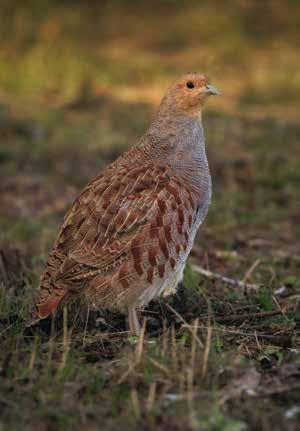
Grey Partridge, Mid Suffolk, 9th October Alan Chaplin
outskirts of Ellough throughout October and November (R Walden). A pair was often seen in the Hoxne area throughout the year, and, notably, 12 birds were flushed from fields by the sewage works on July 28th with five birds present on October 29th (D Gibbons). A covey of 15 birds was located at Winston Green on January 20th (M Nowers).
Regular observation at Lodge Farm, Westhorpe revealed a small, but stable, resident population on the 545-hectare arable farm with two pairs seen regularly in the early part of the year. Numbers reported on the site throughout the year showed an increase with eight birds seen in April, 18 in August and a maximum count of 20 recorded in December (P Barker). Nearby at Wyverstone, two coveys totalling up to 19 birds were seen on October 22nd.
The RSPB at Minsmere reported a group of four juveniles on the reserve on August 4th.
Further south in the county, sightings were fewer and numbers were lower with the highlight being a family group of up to 14 young birds seen with an adult (female) at Sudbourne on June 14th (J White).
Inland and towards the west, the largest count received was that of 43 birds seen at Ampton on February 6th with birds recorded there throughout the year (C Gregory).
Other notable records are as follows:
Knettishall: disused airfield, 17, Jan 24th (M Peers)
Great Barton: 15, Oct 28th (D Cawdron)
Risby: 12, Oct 28th (C Gregory)
Fornham St Martin: ten, on farmland, Oct 23rd (M Peers)
Cavenham Heath NNR: ten, Mar 2nd (R Ayers)
In 2023 there were 138 reported sightings from across 64 sites (54 sites in 2022).
GOLDEN PHEASANT Chrysolophus pictus
Probably extinct as a wild bird. Categories C and E.
There were nine records submitted, all likely to have been of the same bird, in Euston, Suffolk. The bird was first heard on March 24th (E W Patrick) and thereafter seen repeatedly throughout April up to 30th (N Moran, V Ross-Smith).
COMMON PHEASANT Phasianus colchicus
Very common resident; numbers augmented by releases. Categories C and E.
Clearly under-reported, there were just 104 records received of this large and colourful, oftseen, gamebird.
Outside of the breeding season (March – June) groups of birds may be seen around the county with large numbers, that are bred in captivity, released for shooting in the autumn.
In the north the Somerleyton Estate held a winter bird survey and counted 15 birds on site in
January and again in March.
A gathering of 115 birds was observed in Hoxne on September 23rd with large numbers observed at this site throughout the year.
At Benacre, there were groups of birds totalling between 30 and 50 through the autumn months.
Darsham Marshes SWT held around 40 birds in September.
Further inland there were more than 50 birds at Little Livermere (September) and 40+ birds in the Park Farm, Bury St Edmunds area (November) with another 32 birds in Great Barton (also November).
Lakenheath Fen RSPB reported a peak of 26 birds (18 female and eight males) with breeding confirmed on the site.
Unsurprisingly, breeding was confirmed around the county with many family groups and fledged youngsters seen through June and July.
COMMON QUAIL Coturnix coturnix
Scarce summer visitor and passage migrant. Has overwintered. Amber List.
Secretive and extremely difficult to actually see, this small gamebird was recorded at six sites (also six in 2022) including a most welcome record of breeding:
Felixstowe Ferry/King’s Fleet: two birds were heard singing/calling, July 21st (S Piotrowski, L Evans, G Clarkson)
Ipswich: Apr 11th and 12th (S Dean et al.)
Hopton: single bird heard singing/calling from a clover field, May 21st to 23rd (D Balmer)
Lackford: pair with at least ten young was observed on July 5th (P Lack)
Lawshall: Lawshall Green, bird heard singing/calling on July 13th (BirdGuides)
Livermere Lake: single bird was seen at close quarters, July 13th (N Rawlings)
The pair with ten young in Lackford is the first record of proven breeding in Suffolk since 2009 when a female was seen with a ‘large’ brood at Ampton on August 21st.
With regards the Ipswich bird, excluding overwintering records, this is the earliest recorded spring arrival in Suffolk since at least 1950, although one was at Knettishall on April 13th in 1974.
FIELD NOTE
A Common Quail was reported in a private garden in Ipswich on April 11th and 12th 2023 (S Dean, V Doherty, J Higgott). The record of the sighting was submitted to SORC by S Dean and was accepted. An edited extract of the submitted account and how it was reported follows:
‘A friend had contacted me via email with a photograph taken of an unusual bird that was in her rear garden in Ipswich on the morning of April 11th. Upon opening the photograph, I was astonished to see a Common Quail. I rang my friend to ask where the bird was and whether it was still there. I was told that it was on the patio in her garden, but that it did not look very well. I told her what it was and suggested that she put out a tray of water, some bird seed and some mealworms if she had them (which she did) and asked if I could come round to have a look for it.
When I arrived, the Quail was hiding behind some flowerpots on the patio. I sat on a patio chair and waited to see if it would come out. It walked out, rather unsteadily, and whilst I was there it picked up some seeds and mealworms and drank some water. After a while the Quail seemed a little better for having had some food and water and it spent some time sunning itself (including under the chair I was sitting on).
It was clear that the Quail had either collided with an obstacle or had had a narrow escape from a predator as it had some blood on its left ear coverts, and it looked a bit drowsy – its eyes were not fully open. The bird was then photographed.’
RED-LEGGED PARTRIDGE Alectoris rufa
Common resident; numbers augmented by releases. Categories C and E.
As with Common Pheasant, the Red-legged Partridge is an under-reported species with large numbers of captive-bred birds released in the autumn for the purpose of shooting. It is noted that the 2023 BTO Breeding Bird Survey saw a count of 44 birds as the maximum number surveyed – a 50% reduction in the maximum number counted in the surveyed area in 2022.
The Somerleyton Estate held eight birds in January. In Hoxne, autumn numbers were recorded through September to December with 137 birds counted at the start of the survey period. As birds dispersed, numbers were seen to fall to 88 in October and 41 in December.
A count of 42 released birds was made in Mutford and a group of 80+ birds was seen in Ellough (October).
There were 75+ birds in fields at Lower Raydon, Hadleigh in September, and 40+ birds in the Stowmarket area (November) with 26 birds counted on farmland at Woodbridge (December).
The resident group seen on Landguard Common was again present throughout the year with six birds seen in January. There were three attempts at nesting but only one chick fledged successfully. Thereafter, six birds were regularly seen on site for the remainder of the year including the fledged youngster.
A group of 42 birds was found in fields in Chelmondiston (January).
In the west, Ampton held 45 birds (January), and, possibly indicative of captive-bred releases, there were large flocks noted in the autumn/winter period at Little Livermere (150+ birds), Timworth (50+), Livermere Lake (60+) and Risby Poors Heath (60+).
EUROPEAN
NIGHTJAR Caprimulgus europaeus
Locally fairly common summer visitor. Scarce migrant. Amber list.
A single bird at Brandon Park Heath on May 7th was the first of the year. It was followed by one over the heathland at North Warren on May 10th, a singleton at Westleton Heath on May 13th, one at Dunwich Forest on May 15th and another five at Upper Hollesley Common on the same date.
The breeding monitoring in The Sandlings produced a total of 105 territories across 15 sites
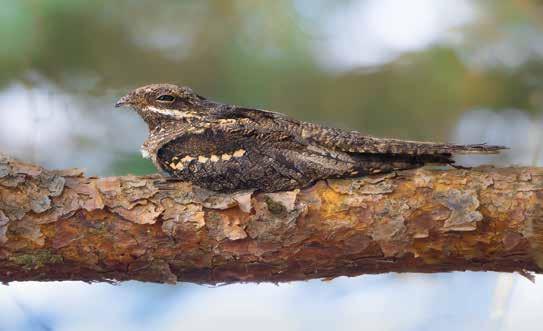
Nightjar, Upper Hollesley Common, 19th August John Richardson
in 2023 – up on the 89 territories found in 2022 and the highest total since monitoring began in 1998 (although not all of the current sites were monitored back then).
Survey work in Thetford Forest (which straddled both the Suffolk and Norfolk sides of the forest) resulted in 27 Nightjar nests being located. Of these, 22 were monitored through to conclusion –either fledging or nest failure. Exactly half of these nests resulted in young being fledged, but the other half failed with one being abandoned and the other ten being predated. Despite many sites recording their first birds of the year in May, it is interesting to note that in the Thetford Forest study area the main arrival of both males and females occurred after mid-June.
Birds were still present at a handful of breeding sites in August with the report of at least three present at Westleton Heath on August 24th being the last of the year. For the third successive year there were no September reports.
ALPINE
SWIFT Tachymarptis melba
Rare visitor.
Felixstowe: two, March 19th (C Courtney)
These two birds are the county’s 41st and 42nd individual Alpine Swifts, the earliest-ever recorded in Suffolk (beating the multiple sightings of March 23rd 2010) and the first since April 2019.
COMMON SWIFT Apus apus
Very common, but declining, summer visitor and passage migrant. Red list (from Amber list 2021).
Four seen near Lackford on April 7th were by far the earliest returning birds of 2023 (and the earliest recorded in Suffolk since 2016 when one was at Pakefield, April 6th). It was a further two weeks before one was seen at the BTO’s Nunnery Lakes reserve, Thetford on April 21st, followed by singles at both Southwold and Thurston the following day. There was a gradual increase in reports towards the end of April with peak counts of 30 birds at Trimley Marshes on April 29th and 30th. The largest spring gathering was at Lakenheath Fen on May 13th when 200 birds were noted. Nest site monitoring by SOSSwifts found a total of 272 Swift boxes being used across the county (up from 231 in 2022), plus additional birds in ‘natural’ locations (which are almost certainly under-recorded). The largest concentrations are listed below (‘natural’ sites unless stated otherwise).
Southwold: 70 pairs
Aldeburgh: 13 pairs in nest boxes
Framlingham: 20 pairs (eight in nest boxes)
Wickham Market: 51 pairs (three in nest boxes)
Hollesley: 14 pairs (one in a nest box)
Woodbridge: 58 pairs (29 in nest boxes)
Earl Stonham: ten pairs in nest boxes
Stowmarket: 96 pairs (nine in nest boxes)
Hadleigh: 14 pairs in nest boxes
Worlington: 24 in boxes (only seven chicks fledged from only four boxes due to predation)
Haughley: 15 pairs (seven pairs in boxes)
Bury St. Edmunds: 88 pairs, including 44 occupied boxes, from which fledged 86 young on St. John’s Church
An interesting observation involved a fallen swiftlet in Debenham, which was rehabilitated and then placed in a Woodbridge camera nest box where two adults were already feeding one chick. The surrogate parents accepted the second chick and both eventually fledged successfully.
Considerable numbers of birds appeared to depart in July with movements noted from the very start of the month – for example, a weather-related movement on July 1st saw 2750 birds over Southwold, 150 over Boyton Marshes (including birds moving south) and 100 over Felixstowe. A few days later, 280 birds were present over Bawdsey, some of which were seen flying south. Larger numbers were seen later in the month with 800 heading south over Boyton Marshes, July 23rd and 610 over Aldeburgh Marshes, July 27th.
The monthly movements over Landguard are shown below:
September sightings were received from just six sites, the latest of which involved singles at Lackford on 18th and Trimley Marshes on 19th and, finally, three over Christchurch Park, Ipswich on 26th.
Swift Nests Records – 2023
Number of Pairs – Town/Village – whether natural or nest boxes
58 pairs – Woodbridge – 29 in nest boxes, 29 natural.
2 – Hacheston – in boxes
14 – Hadleigh – all in boxes
20 – Framlingham – 8 pairs in nest boxes and 12 natural pairs.
9 – Peasenhall – all naturally on their Village Hall
5 – Ipswich – in boxes (inc Ivan & Val x2, Penshurst Rd x2, Marlborough Rd)
2 – Denham – all in boxes
4 – Melton – all in boxes
6 – Sudbury – all in nest boxes, St Peter’s Church
13 – Aldeburgh – all in nest boxes
9 – Claydon – 5 pairs in boxes
6 – Debenham – in nest boxes on the church
5 – Thurston – natural
3 – Capel, all in boxes
96 – Stowmarket – 87 natural and 9 in boxes, 4 of them at Muntons
4 – Rendlesham – in nest boxes
3 – Reydon – 1 in a box and 2 natural
1 – Carlton Colville – in a nest box
8 – Wangford – all natural
15 – Haughley – 7 pairs in boxes, 8 pairs natural
1 – Orford – in a box
53 – Bury St Edmunds, St John’s – 44 boxes fledged 86 young. More nest boxes being installed
24 – Worlington Church – but only 7 chicks fledged from 4 boxes due to predation.
3 – Worlington – boxes on a private house, 8 fledged
3 – BSE – 2 fledged from a box on a house, 2 boxes Church Walk
5 – Santon Downham Church
1 – Chelsworth – 3 fledged from a box
6 – Stutton – all in nest boxes
70 – Southwold
1 – Felixstowe
51 – Wickham Mkt – 3 in nest boxes, 48 natural
10 – Earl Stonham – all in nest boxes
14 – Hollesley – 1 in a nest box, 13 natural
8 – Kelsale – all in nest boxes
Hopton – no data
Wenhaston – no data
Wetheringsett – no data
6 – Crowfield – all in nest boxes
2 – Waldringfield – in boxes
4 – Hemley – in boxes
4 – Brandeston, in boxes – HS, SL and HM all nest there too
2 – Holbrook – in boxes
3 – Knettishall, Hall Farm – in boxes. New HM colony created with mud
2 – Harkstead Church
2 – Helmingham – in boxes
1 – Grundisburgh – in a box
264 Swift boxes used by Swifts in 2023
SOSS notes from 2023
SOSSwifts count nest boxes as used if a Swift is seen to enter or heard inside, or if there is evidence of their activity after departure. No guarantee that a pair was involved and in some instances we know that breeding was not successful.
After a very slow start, 263 nest boxes were reported used by Swifts in Suffolk in 2023; this is up from 231 in 2022. Most locations reporting their first occupancy had played calls, those that hadn’t were usually adjacent to existing natural colonies. Probably a slight underreporting with these numbers.
Only one location reported a decline in activity; predations by a female Kestrel was an issue. None of the recently installed nest bricks on new-build houses were seen to be used this year.
We think that natural nest sites here are hugely under-recorded. We will be promoting the Hertfordshire playback method of surveying in 2024 to better gauge numbers. This method was used this year in Stowmarket resulting in a doubling of natural nest sites recorded visually. Mitigation results have been patchy. One prime location where we know multiple nest sites beneath tiles were lost had no box occupancy logged this year, this was very disappointing.
House Martins were noted using Swift boxes for the first time here and House Sparrows were commonly recorded. Tree Sparrows used a nest box in Tuddenham, a very rare breeding bird here now. A Robin bred in a box in Woodbridge. Starlings were seen to enter a bottom entry nest box in Wickham Market, I didn’t think they could. There were three nest boxes reported used by hornets and two by wasps.
Surrogacy worked here where a fallen Swiftlet from Debenham was rehabilitated then placed in a Woodbridge camera box where two adults were already feeding one chick. Both fledged successfully and I’m hoping that with the increasing number of nest cameras this will become more prevalent.
Eddie Bathgate.
PALLID SWIFT Apus pallidus
Very rare visitor.
Corton: 1CY+, photographed, Oct 27th (J A Brown et al.)
Benacre: Beach Farm, 1CY, Oct 31st (C A Buttle)
Minsmere: 1CY+, photographed, Oct 22nd (P Green, S Green et al.)
These three sightings are the ninth, tenth and eleventh records for Suffolk.
GREAT SPOTTED CUCKOO Clamator glandarius
Accidental.
Southwold: Easton Farm, 2CY, March 24th (B J Small et al.)
An excellent early-spring sighting and only the second county record (following the wellwatched bird at Aldeburgh in October and November 1992).
COMMON CUCKOO Cuculus canorus
Declining summer visitor and passage migrant. Red list.
The first of the spring was well inland at Kedington on April 1st. This was followed by birds in
Elveden at Parsonage Heath and Centre Parcs, Elveden, both on April 7th and then one at Boyton Marshes on April 8th. A further 32 sites recorded their ‘firsts’ by the end of the month.
Cuckoos were found in 11 (25%) of the 44 Breeding Bird Survey squares visited in 2023, an increase on the 18% occupancy rate recorded in 2022. Lakenheath Fen again held the record for the highest numbers, with a peak of at least six birds present on May 28th. Breeding was confirmed at just four sites which included a juvenile found in the nest of unknown hosts amongst nettles at Rickinghall on July 6th and a juvenile being fed by Meadow Pipits on Cavenham Heath on July 13th.
Landguard recorded birds passing through the site on May 28th and July 5th, 13th and 24th, plus autumn juveniles on August 11th and September 1st. Other September sightings came from Trimley Marshes on 1st, Westleton Heath on 10th and, finally, Knettishall Heath and Cavenham Heath, both on 17th.
FERAL PIGEON
Columba livia
Very common resident from feral stock. Categories A, C and E.
All flocks of 50 or more birds are listed below:
Lowestoft: Sparrows Nest Park, 50, Oct 29th; Oulton Broad, 54, Dec 25th
Shingle Street: 70, Dec 1st
Ipswich: 50, Jan 6th; 50, Jan 11th; 50, Jan 24th; 125, Dec 12th
Landguard: 54, Jan 1st; 68, Aug 26th; 65, Nov 12th
Trimley Marshes: 145, Aug 23rd; 286, Aug 29th; 161, Sep 2nd; 246, Sep 4th
Chelmondiston: Pin, Mill, 100, Oct 1st
Stowmarket: 100, Jan 4th
Bury St. Edmunds: 100, Oct 23rd
Haverhill: 70, Feb 13th; 100, May 13th
Newmarket: 100, Apr 1st
STOCK DOVE Columba oenas
Fairly common resident and passage migrant. Amber list. The first three months of the year produced some good first winter flocks. These included: Snape: Botany Marshes/Abbey Farm, 60, Jan 29th; 55, Feb 9th
Wantisden: Staverton Park, 60, Jan 15th
Chelmondiston: 60, Jan 2nd
Westerfield: 60, Mar 16th
Knettishall: 180, Jan 17th; 150, Jan 24th
Cavenham Heath: 150, Feb 9th
Lackford/Cavenham: 60, Mar 2nd
Tuddenham St Mary: 40, Jan 4th
As always, breeding reports were few and far between, but did include birds nesting in owl boxes at both Black Bourne Valley SWT and Hanchett Village, Haverhill. Meanwhile, the Breeding Bird Survey squares produced at total of 107 birds across 28 of the 44 squares surveyed. There were also some significant breeding season counts received, which included 80 at Bury St Edmunds on April 21st, 70 at Loompit Lake, Trimley St Martin on April 24th and 80 at Hen Reedbeds, July 2nd.
There was no significant autumn passage recorded during 2023, but a relatively small movement of birds was noted during the first week of November, which included 75 birds over Boyton Marshes on 6th, 89 south over Landguard on the same day, plus another 72 south over Landguard on 7th.
The autumn and second winter period again produced the highest counts of the year, including some very significant counts from the west of the county.
Knettishall Airfield: 1200, Oct 28th; 370, Nov 9th.
Ampton: 1000, Oct 30th; 200, Dec 21st.
Long Melford: 150 (in flocks of 90 and 60) feeding on OP2 wild bird seed mixture, Dec 14th.
Kedington: Sturmer Mere, 122, Sep 24th.
The four-figure site-totals at Knettishall and Ampton are the highest-ever recorded in Suffolk; the previous highest was 700, Elveden, December 1970.
COMMON WOODPIGEON (WOODPIGEON) Columba palumbus
Very common resident, winter visitor and passage migrant. Amber list (from Green list 2021). All counts of 500 or more birds from the first winter and spring periods are listed below:
Boyton Marshes: 500, Feb 19th
Melton: Foxburrow Farm SWT, 500, Mar 7th
Pakenham: Queach Farm, 1000, Feb 9th; 800, Mar 1st
Great Barton: Conyer’s Green, 500, Mar 14th
Timworth: 800, Jan 29th; 1000, Feb 9th; 600, Feb 13th; 800, Feb 22nd; 500, Mar 30th
Groton Wood SWT: 600, Feb 8th
Haverhill: Hanchett Village, 1000, Feb 18th
Spring movements through Landguard consisted of a total of 494 birds south between March 12th and May 2nd with a peak count of 119 south on March 19th.
Breeding reports were sparse, but included 15 pairs at Landguard (same as in 2022 and 2021), whilst an estimated 25 pairs held territories at Kiln Farm, Long Melford, 11 territories were found at Martlesham Wilds SWT and eight territories were recorded at Hall Farm, St Cross South Elmham. The Breeding Bird Survey monitoring produced a total of 1575 birds across the 44 squares visited (a 100% occupancy rate).
There was no obvious autumn passage recorded during the autumn, apart from at Landguard where 8436 birds were logged south between October 11th and November 12th with maximum day counts of 5513 on November 6th and 2510 the following day. Elsewhere on November 6th, Boyton Marshes recorded ‘flocks over all morning’.
The largest autumn and second winter flocks are listed below: Trimley Marshes: 1000, Oct 14th.
Thetford: Nunnery Lakes, 675, Nov 4th.
Barnham: 500, Nov 6th.
EUROPEAN TURTLE DOVE
Streptopelia turtur
Declining summer visitor and passage migrant. Red list.
A bird at Stoke-by-Nayland on April 30th was the first reported in 2023 and the only sighting during that month. This was followed by birds at Sutton and Chippenhall Green, Fressingfield on May 2nd, before a more general arrival commenced.
The 2023 breeding reports received from across the county appear to show a very substantial decline in numbers compared with 2022. A total of just 55 territories was identified from 42 sites, compared with an estimated 102 territories across 89 sites in 2022. It is hoped that this is down to variability in observer reporting, rather than genuine losses, although, due to its scarcity, observers do appear to be quite likely to report Turtle Dove sightings. If genuine, this decline must be considered a serious concern, especially when viewed against Turtle Dove, Hadleigh, 16th May
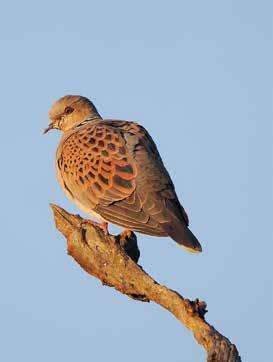
Bill Baston
the reported 25% increase in numbers of Turtle Doves across the Western Europe Flyway since France, Spain and Portugal halted autumn hunting of this species in 2021 (FACE – the future of the Turtle Dove in Europe).
Sizewell was the only location to report September sightings, although they were somewhat odd in nature. A juvenile was present between 10th and 12th. It was joined by a captive-reared bird (a second calendar year male) on 11th, which was also seen on 12th, and 16th to 18th inclusive. This bird was carrying a metallic pink ring and had been released near Bungay as part of an ‘unofficial’ captive breeding project. It had previously been seen on July 31st. Earlier in the year, another captive-reared bird (a female) had been seen at Kedington on July 20th.
The only sightings at Landguard were singles in May on 5th and 15th and in June on 2nd and 15th.
EURASIAN COLLARED DOVE Streptopelia decaocto
Common resident.
All counts of 20 or more birds are given below:
Southwold: Town Marshes, 20, Dec 14th
Thorpeness: old caravan park, 20, Oct 14th
Felixstowe Ferry: King’s Fleet, 20, Dec 29th
Levington Creek: 30, Nov 10th
Stowmarket: 30, Jan 14th
Stowupland: 31, Dec 19th
Stonham Aspal: 24, Dec 31st
Lakenheath Fen: 51, Nov 4th
There was just a single report of breeding – 15 territories noted on the western side of Bury St. Edmunds which continued a previously-reported decline (20 territories were noted in the same area during 2022). A total of 120 birds was recorded from 26 of the 44 Breeding Bird Survey squares covered, compared with 128 birds across 27 of the 41 squares covered in 2022.
WATER RAIL Rallus aquaticus
Fairly common resident, winter visitor and passage migrant.
This species was recorded from 52 sites throughout the county. In addition, there were two reports, at Aldringham and Pipps Ford, Barking, which related to recordings of birds flying over during the hours of darkness. This total suggests a continuing fluctuation in the distribution of this popular species over recent years.
Reports of breeding or probable breeding were submitted from only eight sites, a reduction from the 11 sites reported in 2022 and well below the 20 or so sites reported in the late 2010s. Lakenheath Fen RSPB recorded the highest number of calling males, 16 on February 21st, with all other reports relating to birds in single figures only; most notably, Boyton Marshes RSPB recorded multiple birds, at least five, calling from three locations, on August 31st.
SPOTTED
CRAKE Porzana porzana
Rare passage migrant; rarely oversummers. Amber List
No reports were received for this species in 2023. The most recent records were in 2021 when birds were seen at Snape Wetlands RSPB and Trimley Marshes SWT.
CORN
CRAKE Crex crex
Very rare passage migrant. Red List
No reports were received for this species in 2023.
COMMON MOORHEN Gallinula chloropus
Very common resident, winter visitor and passage migrant. Amber list (from Green list 2021).
This very common species was recorded at some 90 sites or locations throughout the county, an increase of 19 on the total for 2022, but still well below the 158 sites recorded prior to the
Systematic
List
Covid pandemic. Evidence of breeding was recorded at 31 sites, an improvement on recent years, although, again, still below the 54 breeding sites recorded in 2020.
One was at Landguard on November 21st, the first site record since 2019 when singles were present on April 18th and September 10th.
The highest winter count, of 51 birds, was reported from Brandon Country Park on January 1st (G Conway) closely followed by a total of 50 birds recorded at Flatford Mill, East Bergholt on February 4th. The results of winter counts at regularly-monitored sites and estuaries are shown here:
EURASIAN COOT Fulica atra
Common but declining resident, winter visitor and passage migrant.
Reports of breeding or probable breeding were received from 21 sites throughout the county, this being more or less consistent with breeding records received over the last five years. There was an increase in the number of sites where birds were present, both during, and outside of the breeding season, from 38 to 44, and counts exceeding 100 were recorded at six sites, two fewer than last year. The highest count was of 300 birds at Redgrave Park on November 15th (D Tomlinson). The results of winter counts at regularly-monitored sites and estuaries are shown here:
COMMON CRANE Grus grus
Scarce passage migrant. Has bred since 2007. Amber List
Breeding was again reported at Lakenheath Fen RSPB this year, with two pairs each hatching two chicks. These were monitored up to nine weeks after hatching; however, only one of the young managed to fledge. A third pair was recorded occupying a territory nearby in Botany Bay but no evidence of breeding or attempted breeding was confirmed. On the coast at Snape Wetlands RSPB a pair again bred successfully but unfortunately the young were predated on their first day.
Sightings of birds were reported in all months of the year and whilst many were from wellwatched sites close to the breeding areas, on the coast regular sightings at Minsmere RSPB, Dingle Marshes and Carlton Marshes SWT during the period March to June continue to suggest that the very small breeding population may expand in the coming years.
LITTLE GREBE Tachybaptus ruficollis
Locally common resident, winter visitor and passage migrant. There was a slight increase in breeding records this year up from 22 to 24 sites. Also, thankfully,
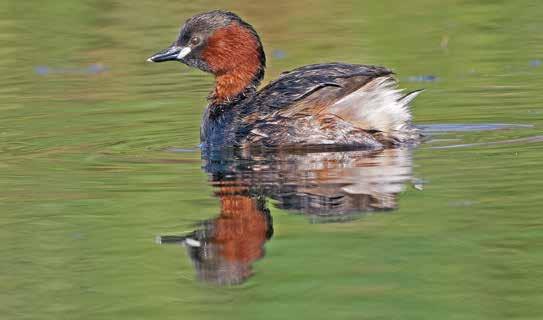
breeding success appears to have improved with several reports of multiple chicks and others of multiple broods at East Lane, Bawdsey and Trimley Marshes SWT.
Counts of 20 birds or more outside of the breeding season were only received from three nonestuarine sites which is four fewer than last year. The highest count was of 40 birds at Loompit Lake, Trimley St Martin on August 20th. The results of winter counts (WeBS) at the regularlymonitored estuaries are shown below:
Little Grebe observations, Christchurch Park, Ipswich in 2023
Although two pairs of Little Grebes were present on Wilderness Pond at the above site during the spring and summer months of 2023, only one pair remained on the pond to the year’s end. Mild weather prevailed in late December but, nevertheless, it was still surprising to note on December 24th that the gape patch on one of these grebes was almost as bright yellow as in full breeding plumage and its cheeks were distinctly chestnut in coloration. Perhaps even more unexpected was the sight, on December 31st, of the second bird of this pair with a beakful of aquatic vegetation but there was no subsequent evidence of exceptionally-early nest construction.
Philip Murphy
RED-NECKED GREBE Podiceps grisegena
Uncommon winter visitor and passage migrant. Red list. This proved to be a slightly quieter year with 16 reports relating to most probably three
Little Grebe, Bentley, 3rd April
Liz Cutting
individuals, one or two fewer birds than in 2022. Only one record was received for the first winter period and only one bird, on the Alde Estuary, was reported on more than one day. All records are included below:
Dunwich: Mar 1st (P Whittaker)
Alde Estuary: Aldeburgh, Dec 10th to 22nd (A Rowlands et al.)
Alton Water: Dec 17th (WeBS)
Stour Estuary: Stutton Ness, Dec 10th (S Banks)
GREAT CRESTED GREBE Podiceps cristatus
Locally common resident, winter visitor and passage migrant.
Reports of breeding or probable breeding were submitted from 20 sites, an increase of one on the previous year, although again, as in 2022, there were several reports of continued poor productivity. At Alton Water, for example, five breeding pairs were recorded as having produced only 11 young and at Abbey Farm, Snape Wetlands RSPB a single pair with four chicks was recorded, but none of the chicks survived.
Compare the five pairs at Alton Water in 2023 with 65 pairs there 40 years ago in 1983, in which year the Suffolk population was 120 pairs (Piotrowski 2023).
Winter counts in excess of 50 birds were only recorded at two sites in the county. Offshore at Minsmere 200 birds, the highest total of the year, were recorded on February 4th and at Alton Water a peak of 167 birds in the first winter period, on February 19th, and in the second winter period a peak of 117 birds on December 17th. The results of winter counts (WeBS) at regularlymonitored estuaries are shown above:
Fifteen flew south off Landguard in November.
SLAVONIAN GREBE Podiceps auritus
Uncommon winter visitor and passage migrant. Red list.
Reports were received relating to at least six birds, four of which were present in the first winter period. The remaining two were recorded in the second winter period from the traditional strongholds of the Stour and Orwell Estuaries. Details of sightings are as follows: Southwold: two, Apr 5th
Alde Estuary: Iken, Jan 23rd; Aldeburgh, Jan 19th, Mar 4th
Orwell Estuary: Pipers Vale to Bridge Wood, Wherstead and Freston, Nov 20th, 22nd and 23rd
Stour Estuary: Holbrook Bay, Nov 20th; Stutton Ness, Dec 10th
BLACK-NECKED GREBE Podiceps nigricollis
Uncommon winter visitor and passage migrant. Amber list.
Eleven records, relating to three or four birds were submitted for the year and this remains a scarce species in the county. All of the reports occurred in the first winter period, in the southeast of the county and all but one were of single birds, the exception being of two observed at Levington Creek on March 20th. A single bird, possibly one of the two at Levington, was recorded at Trimley
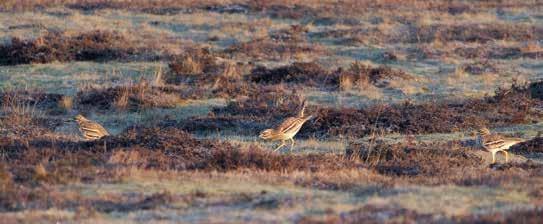
Stone Curlew, Cavenham, 27th March
Marshes SWT for the period March 24th to 30th. It was reported to be in almost-full breeding plumage, although unfortunately there was no sign of a mate. All records are included below:
Landguard: Jan 28th
Trimley Marshes SWT: Mar 24th to 30th (P Holmes et al.)
Levington Creek: two, Mar 20th, (P Holmes)
EURASIAN STONE-CURLEW Burhinus oedicnemus
Locally fairly common summer visitor. Occasionally overwinters. Amber List.
Stone-curlew numbers continue to show a small increase in the coastal region and the Brecks.
Breeding data received from the RSPB Stone-curlew team:
Seventy-seven confirmed breeding pairs on land monitored by the RSPB and partners with 26 additional breeding pairs on land monitored by others. This gives a total of 103 confirmed breeding pairs (90 in 2022) with three additional pairs, either non-breeding or where breeding was not confirmed, giving a total of 106 pairs (99 in 2022). In addition, it is estimated that there were five pairs on land not monitored, which would bring the total up to 111 pairs.
The above includes the Sandlings total of 23 pairs (21 in 2022) with Dunwich/Westleton 18 and five south of the Alde Estuary.
The first returning birds of the year were recorded on March 14th in the Brecks and March 15th in the Sandlings.
Post-breeding counts in the Brecks in October included 60 at Icklingham on 5th, 69 at Cavenham Heath on 11th and 35 at Lakenheath Airfield on 13th.
Late reports came from the Sandlings with 25 on October 22nd and 19 on November 5th and a late bird was in the Brecks on November 22nd.
2022 Addition
Icklingham: 60 on arable land north of A1101, Oct 5th
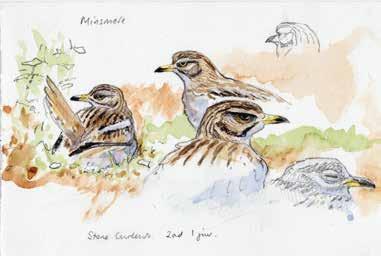
Liz Cutting
Stone Curlews Stewart Sexton
BLACK-WINGED STILT Himantopus himantopus
Rare visitor. Bred in 2014.Amber list.
A record year in the county for this species and accepted records were received from the following sites:
Somerleyton Marshes: two, May 24th, same as Carlton (A Easton)
Carlton Marshes: two, May 24th (M Gooch et al)
Southwold: four on Buss Creek Flash, May 5th including pair observed mating (B Wallace et al); also seen on Walberswick side of the Blyth
Minsmere: female. Apr 30th (I Salkeld et al); two, May 22nd to 24th, observed mating (I Salkeld et al)
Aldeburgh Marshes: pair on flash, Apr 30th (P Kennerley); two, early morning, photographed, May 19th (R Chittenden)
Boyton Marshes: three, May 1st to 2nd, female presumed same as Minsmere, pair presumed same as Aldeburgh (L G Woods et al)
Hollesley Marshes: two, Apr 30th, same as Aldeburgh (P Phillips et al); two, May 27th (D and M Carter et al)
Stoke-by-Nayland: Gifford’s Hall Flash, two, May 31st (K Day)
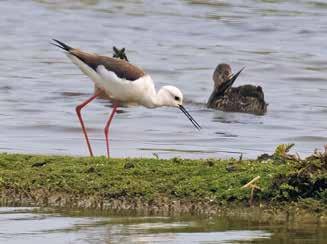
This was part of a small influx of Black-winged Stilts to the southern counties in spring 2023 which saw sightings at a minimum of 50 sites, including as far north as Aberdeenshire and Caithness, believed to be influenced by the heat wave and drought that had affected parts of Spain.
EURASIAN OYSTERCATCHER
Haematopus ostralegus
Very common winter visitor and passage migrant. Common but declining resident. Amber list.
The highest reported individual site-totals were on the Orwell Estuary at Freston, with 520 on January 22nd and 750 on December 17th (M Wright).
Breeding was confirmed at the following coastal and estuarine sites: Benacre Broad, two pairs; Minsmere, six pairs; Havergate Island, 17 pairs; Hazlewood Marshes, four pairs; Boyton Marshes, one pair; Hollesley Marshes, one pair; East Lane, Bawdsey, one pair; Trimley Marshes, five pairs (down from 12 pairs in 2022) and Dock Lane, Melton.
The pair at Dock Lane, Melton nested on the roof of PCC Books warehouse.
Inland breeding was confirmed at Pipps Ford, Barking; Lackford Lakes; Cavenham Pits; Cavenham (village); Timworth Heath; Fornham St. Martin; Worlington Pits and Nunnery Lakes BTO, Thetford.
Landguard reported small numbers on the reserve throughout the year, with a maximum of four, although none bred. Southerly passage of birds peaked with 28 south on July 27th and 25 south on August 1st, and monthly maxima of 159 south in July and 177 south in August.
WeBS data:
Black-winged Stilt, Minsmere, 30th April Andrew Moon
PIED AVOCET Recurvirostra avosetta
Fairly common resident, summer visitor and passage migrant on the coast. Increasingly regular at inland sites. Amber list.
Breeding records were received from 14 sites including the following locations:
Carlton Marshes: 11 nesting pairs fledged 18 young
Benacre Broad: three pairs, no data
Covehithe Broad: one pair, no data
Walberswick: Blyth Estuary, two pairs, breeding unsuccessful
Walberswick/Dunwich: Shore Pools, one pair fledged three young
Minsmere: 106 pairs down from 123 pairs in 2022, 17 young fledged
Orfordness: 52 pairs no young thought to have fledged
Havergate: one pair, down from 16 pairs in 2022, breeding unsuccessful
Boyton Marshes: one pair, three chicks
Hollesley Marshes: ten pairs fledged 12 young
Trimley Marshes: seven pairs nested but all failed
Presumably there is less predation at Carlton, Boyton and Hollesley due to fox-proof fencing?
Counts of 300 or more, other than WeBS, are as follows:
Blyth Estuary: 900, Jan 13th; 500, Feb 20th
Minsmere: 300, Apr 17th
Alde Estuary: Iken, 900, Jan 13th; 1200, Feb 1st; 450, Feb 10th; 350, Feb 28th
Havergate: 360, Jan 2nd; 383, Feb 19th; 440, Oct 15th
Stour Estuary: East Bergholt/Flatford, 391, Jan 1st; Seafield Bay, 350, Oct 27th
Inland sightings came from: Gifford’s Hall Flash, Stoke-by-Nayland with 21 on June 24th, Tuddenham St. Mary, Livermere Lakes, Lackford Lakes and Lakenheath Fen with 38 on February 21st and 25 on April 24th.
WeBS data:
Blyth Estuary 118
The count of 1869 om the Alde/Ore Estuary in November is the highest-ever in Suffolk; the previous highest was 1728 on the same estuary in January 2020. 22 birds were seen offshore at Landguard during the year, including a single bird sitting on the sea on December 27th and 11 south, September 26th.
2022 Addition
Kedington: Sturmer Mere, Mar 28th – first site record (S Jarvis)
2022 Amendment
In the table (second above) showing the breeding details of Avocet, the 2022 column should read 15 sites and 264 pairs. We were made aware of a new breeding site.
Chris Brown (Tees Ringing Group) response to Laurence Potter’s query re. banded Avocets in Suffolk
Hi Laurence,
Thanks very much for the reports of two of our Avocets. They do seem to prefer being in Suffolk mostly and neither have been reported up here this year.
EZ78780 (IN) was ringed as a pullus at Brinefield 4, Seal Sands on 24.06.21. It hasn’t been reported up here since not long after ringing. As you can see in the sightings listed below, it was in Leicestershire in April this year (2023) but no mention of breeding.
EZ78780 (IN) N 1 24/06/21 Brinefield 4, Seal Sands, Cleveland
O 5 12/08/21 Greenabella Marsh, Cleveland
O 5 18/08/21 Alkboro Flats, Lincs
O 5 28/11/22 Melton, River Deben, Suffolk
O 5 06/12/22 Melton, River Deben, Suffolk
O 5 12/12/22
Melton, River Deben, Suffolk
O 5 28/12/22 River Deben, Suffolk
O 5 26/2/23
O 5 07/3/23
O 23.4.23
O 5 19/11/23
Deben Estuary, Woodbridge, Suffolk
Melton, River Deben, Suffolk
Jubilee Park, Enderby, Leicestershire
Deben Estuary, Woodbridge, Suffolk
EZ78781 (IP) was ringed on the same day as EZ78780, as probable siblings. It was back in Cleveland in July 22 but not seen this year. Sightings below:
EZ78781 (IP) N 1
24/06/21
O 5 12/08/21
Brinefield 4, Seal Sands, Cleveland
Greenabella Marsh, Cleveland
O 5 18/08/21 Alkboro Flats, Lincs
O 5 26/03/22
O 5 23/07/22
O 5 23/09/22
O 5 12/12/22
O 5 25/01/23
O
NORTHERN
LAPWING Vanellus vanellus
Minsmere
RSPB Saltholme, Cleveland
Breydon Water, Norfolk
Melton, River Deben, Suffolk
Martlesham Creek, Suffolk
Very common winter visitor and passage migrant. Declining as a breeding species. Red list. Notable counts of 800 or more:
Breydon Water: 4000, Feb 4th
Carlton Marshes: 800, Jan 16th; 1000, Feb 4th and 13th; 1200, Feb 17th; 5000, Feb 19th;1000, Feb 21st; 1000, Mar 3rd; 850, Dec 17th
Southwold Town Marshes: 1100, Jan 29th
Blyth Estuary: 2000, Jan 6th; 4200, Jan 12th; 1500, Jan 13th
Minsmere: 1450, Jan 7th
Boyton Marshes: 1100, Jan 5th
Trimley Marshes: 938, Jan 13th; 800, Feb 2nd; 800, 15th; 1147; Dec 15th; 1155, Dec 20th; 894, Dec 29th
Timworth: 800, Jan 1st
Great Livermere: 1050, Jan 29th
Great Barton: 1100, Dec 11th
Breeding was confirmed at the following coastal sites: Beccles Marshes, one pair; Castle Marsh, North Cove, seven pairs fledged 11 young; Oulton Marshes, 13 pairs fledged 28 young; Minsmere, four pairs down from 43 in 2022; Aldeburgh Marshes, no data; Botany Marshes, Snape, five pairs; Boyton Marshes two pairs; Shingle Street, one pair with young; Ramsholt, one pair with four young and Trimley Marshes, ten pairs, 12 young fledged. The only confirmed inland breeding was at Pipps Ford, Barking where six pairs raised 18 young; no data were received from Mickle Mere, Cavenham, Lackford Lakes and Livermere Lake where breeding has occurred in recent years.
WeBS data:
Blyth Estuary 317 - -
Estuary 920
At Landguard, Lapwings were recorded on a very light autumn passage from July 9th to December 1st with a maximum of only 35 south on November 22nd.
EUROPEAN GOLDEN PLOVER Pluvialis apricaria
Common winter visitor and passage migrant.
Notable counts of 600 or more were reported as follows:
Breydon Water: 3000, Jan 6th; 7000, Feb 4th
Gedgrave Marshes: 2000, Jan 2nd
Boyton Marshes: 1300, Nov 3rd; 1200 Nov 6th; 1000, Nov 11th
Hollesley Marshes: 1700, Nov 15th
Shingle Street/ Bawdsey, East Lane: 1200, Feb 25th; 800, Mar 1st; 1500, Mar 6th; 4000, Mar 19th
Hemley: 920, Dec 17th
Felixstowe Ferry: 600, Jan 29th; 1200, Feb 5th; 1000, Feb 22nd; 1500, Oct 8th; 1200, Nov 12th
Great Barton: 700, Nov 6th; 600, Nov 17th; 1000, Nov 22nd; 1500, Nov 23rd; 1500, Dec 4th; 2000, Dec 11th
WeBS Data:
A light spring passage at Landguard included 12 north, May 25th and one north, June 3rd; autumn passage was noted at this site from June 30th to November 25th with a maximum total of 46 south on October 26th.
GREY PLOVER Pluvialis squatarola
Common winter visitor and passage migrant. Amber list. This species was recorded in every month of the year from coastal sites.
Counts of 100 or more came from the following locations:
Havergate Island: 149, Feb 19th; 115, Oct 28th
Deben Estuary: Hemley, 111, Jan 22nd
Orwell Estuary: Levington Creek, 350, Feb 4th; 200, Oct 13th
Stour Estuary: Holbrook Bay, 189, Jan 16th; 130, Nov 20th
A notable inland sighting came from Long Melford sewage works with a single bird on November 17th (D K Underwood). Suffolk’s previous inland record was also from the Sudbury area, involving one at Little Cornard, February 12th 2021.
WeBS details:
Blyth Estuary 11
Landguard reported autumn passage between July 4th and November 8th with a maximum total of 24 south on July 5th; peak monthly maxima of southerly passage involved 41 in July and 27 in August.
COMMON RINGED PLOVER Charadrius hiaticula
Declining resident, winter visitor and passage migrant. Red list. It was another very poor year for breeding Ringed Plovers in Suffolk. The total of about 180 pairs in Norfolk in 2022 was attributed to improved fencing, signage, wardening and caging of nests (Norfolk Bird and Mammal Report 2022: 86).
Counts of 90 or more:
Hazlewood Marshes: 100, Jan 2nd; 120, May 11th; 100, May 12th; 156, June 6th; 143, June 7th; 146, June 8th
Felixstowe Ferry: 95, Sep 7th
Levington Creek: 130, Aug 29th
Breeding was confirmed at the following locations: Minsmere: one pair, with young Bawdsey: East Lane, two pairs, with young Landguard: five pairs, no young survived
Trimley Marshes: one pair, fledged two young.
Double-figure counts of birds considered to be of the race tundrae came from Southwold Town Marshes: 21, May 29th
Minsmere: ten, June 3rd
Hazlewood Marshes: 50, June 9th; 120 June 10th; 83, June 11th
Boyton Marshes: 28, May 30th
WeBS data:
Orwell Estuary 173 63 286 - - 98 39 121
Stour Estuary 34 - 11 1 38 66 263 - -
Landguard recorded autumn passage from July 27th with a maximum number of seven birds south on October 13th. Roosting was attempted on the beach at high tide on several dates, in low numbers, with a maximum number of 23 birds on November 24th.
One of the birds that attempted to breed at Landguard had been ringed at this site in May 2014.
LITTLE RINGED PLOVER Charadrius dubius
Uncommon summer visitor and passage migrant.
The first returning birds were at Pipps Ford, Barking, March 15th and Lackford Lakes, March 23rd.
Successful breeding occurred at three sites with a minimum of five pairs fledging four young; in addition, birds were present during the breeding season at a further six sites.
The last recorded sighting of the year came from Minsmere on September 18th.
2022 Addition
Cavenham GP: pair bred, rearing one juvenile
KENTISH PLOVER Charadrius alexandrinus
Rare passage migrant.
Two confirmed records, the 12th and 13th Suffolk records so far this century: Minsmere: 2CY+ male, photographed, May 5th to 7th (M Cartwright, C Bradshaw, M wall et al.)
Landguard: 2CY+ male on beach, photographed, May 18th (R D Spiers, et al.) – second site record (after June 2nd 2016)
This is the first year since 2009 that more than one Kentish Plover has been recorded in Suffolk.
2016 Correction
“The fifth site record ….” (Suffolk Birds 2016: 96) to read “The first site record ….”
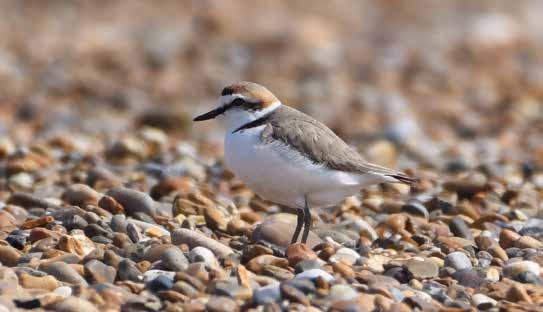
Kentish Plover, Landguard NR, 18th May
Craig Holden
EURASIAN DOTTEREL Charadrius morinellus
Scarce passage migrant. Red list.
For the second successive year no records were received. Blank years so far this century have been 2009, 2016, 2020, 2022 and 2023.
EURASIAN WHIMBREL Numenius phaeopus
Fairly common passage migrant. Occasionally overwinters. Red list.
One reported on the Deben Estuary (Woodbridge) on February 19th is the first overwintering bird to be noted in Suffolk since 2021 when one was on the Orwell Estuary, January 7th. The first reports of migrants came from inland, with one at Lackford Lakes on March 31st and one at Lakenheath Fen on April 5th.
On the coast there were reports commencing from April 7th. Overall numbers were high compared with recent springs, but only a very approximate estimate can be made due to the unknown extent of turnover and duplication. There may well have been more than 400 birds moving through the county. The highest counts from locations recording ten birds or more are listed below:
Burgh Castle: 13, May 2nd
North Cove: Castle Marsh, 65, Apr 30th
Southwold: peak of 19, May 5th
Blyth Estuary: peak of 34, Apr 29th
Alde Estuary: Hazlewood Marshes, 15, May 9th
Aldeburgh: Aldeburgh Marshes, peak of 44, May 4th
Orfordness: 12 flying north, Apr 22nd; 20, May 11th
Boyton Marshes: 104, including flocks flying north, May 11th
Hollesley Marshes: 16, Apr 21st
Felixstowe: Felixstowe Ferry, 17, May 3rd
Orwell Estuary: Levington, 15, Apr 10th; 12, Apr 29th
Additionally, Landguard recorded 92 birds offshore between April 11th and May 18th, with a maximum of 39 north on April 16th.
Southbound migrants were recorded in autumn at Landguard between July 5th and September 25th with a high overall total of 207 (only 59 in 2022) and a peak day-total of 37 south on July 31st, on which date 44 were recorded flying past Aldeburgh. Elsewhere, 25 were reported south past Minsmere on September 2nd.
EURASIAN CURLEW Numenius arquata
Common winter visitor and passage migrant. A few pairs still breed. Red list.
Numbers in the County were approaching 2300 (Essex and Suffolk shores) in February, including over 1000 on the Stour Estuary and over 500 on the Orwell Estuary. Numbers reduced as birds began to migrate away from the estuaries in early spring, but there were still over 800 on the Stour Estuary in April. Passage off Landguard was recorded between February 16th and April 24th, with a maximum of 23 north, April 22nd.
As is usual, there were several inland records from February, the first being of one at Thetford (Nunnery Lakes) on February 18th and there were 19 there on February 24th. These records are likely to include returning breeders. The status of this species as a breeding bird in Suffolk remains precarious and data are likely to be incomplete, but only three potential breeding pairs were reported. Breeding was confirmed at one location.
It is not possible to be certain whether reports in late May relate to birds which are oversummering non-breeders or to the first returning migrants, but there were 40 on the Alde Estuary (Hazlewood Marshes) on May 14th. Returning birds were recorded in early June from several sites, including one on the Stour Estuary (Seafield Bay) on June 1st. Landguard recorded autumn passage from June 1st, with 60 south in that month and 197 south in July, with a maximum of 37 south on July 11th.
In the second winter period, the population exceeded 1300 birds (1500 in 2022), but data are incomplete.
WeBS high water count data (with totals for the Suffolk shore of the Stour Estuary and for the estuary as a whole):
2022 addition
There was a maximum count at Honington (Honington Airfield) of 14 on March 27th.
BAR-TAILED GODWIT Limosa lapponica
Fairly common passage migrant and locally common winter visitor. Amber list.
There were over 300 birds in the county in the first winter period, which included 249 on the Stour Estuary in January and a report of 45 on the Alde Estuary on January 24th.
Spring passage was concentrated into the last two weeks of April, with the highest counts being 130 + on the Alde Estuary (Slaughden) on April 22nd and 63 northeast at Southwold (Southwold Town Marshes) on April 21st. Several reports came from inland sites, the first two probably involving the same birds – 20 dropped in at Lackford Lakes on April 19th and 20 overflew Lakenheath Fen on April 20th. Fourteen flew east over Barnham on April 21st. These are the highest totals of Bar-tailed Godwits in west Suffolk since 2012 when 23 flew over Boxford on April 25th and 20 were at Lackford Lakes on April 29th.
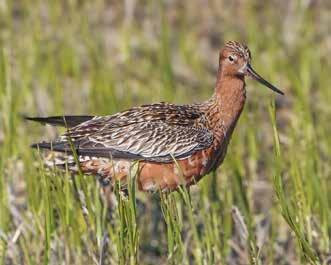
Numbers declined sharply in May, but there were 14 on the Alde Estuary (Hazlewood Marshes) on May 11th, and 11 there on June 8th.
Small numbers were seen in autumn, with the first presumed migrant being one south past Landguard, July 4th. There were few reports into double figures, but 30 at Minsmere on September 18th included a party of 23 which dropped in after heavy rain and 33 were reported from the Alde Estuary (Iken) on August 5th. A total of 86 was recorded south past Landguard over the period July to September.
Bar-tailed Godwit, Minsmere, April 20th David Borderick
There were few reports of more than 30 birds in the second winter period, but there were 33 at Havergate on October 28th and 50 at Blythburgh on December 6th.
WeBS high-water count data (with totals for the Suffolk shore of the Stour Estuary and for the estuary as a whole):
2022 addition
One was at Livermere Lake on April 26th.
BLACK-TAILED GODWIT Limosa limosa
L. l. islandica: Common winter visitor and passage migrant. Amber list.
L. l. limosa: Scarce visitor. Formerly bred. Red list.
There were reports of the nominate race limosa involving ten individuals, fewer than in 2022 but data may be incomplete. The reports of birds recorded as adults below all relate to colourringed birds from the small breeding population on the Ouse Washes and Nene Washes, as none was reported from the mainland European breeding population this year. Reports of L. l. limosa are as follows, including one from the west of the county.
Carlton Marshes: two, Apr 15th to 29th; July 20th
Minsmere: juv, July 27th to Aug 3rd
Hazlewood Marshes: juv, Aug 21st; juv, Aug 25th
Aldeburgh: Aldeburgh Marshes, juv, Aug 3rd to 13th
Boyton Marshes: adult, June 19th to July 1st
Hollesley: juv, Aug 15th
Trimley Marshes: adult, June 23rd
Livermere: Livermere Lake, adult, July 12th
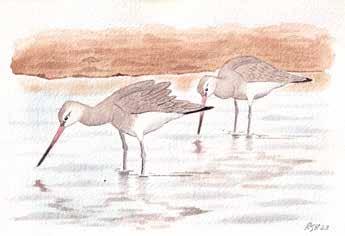
Black-tailed Godwit Russ Boland
In relation to the islandica subspecies, numbers in the county in the first winter period reached a peak approaching 3000 in March (including the Stour Estuary as a whole). This total includes spring migrants and winterers and there was a marked exodus in the last week of April, again as is usual.
Records from the coast after mid-May or in early June are likely to relate to oversummering immatures and non-breeders and these included 182 at Boyton Marshes on June 4th, 137 at Hazlewood Marshes on June 11th and 140 at Minsmere on June 13th. It seems likely that the summer flock on the Suffolk coast was mobile and comprised more than 300 birds. Return
passage was first evident from late June, with a flock of nine at Livermere Lake on June 23rd perhaps being the first arrivals. Twenty-two were recorded south off Landguard on June 29th. There were several further inland records in late June and early July and on the coast, flocks in three figures were recorded from several locations in the first week of July. As usual, it seems likely, based on the inland records, that autumn arrival was overland.
Data is incomplete in relation to the second winter period.
WeBS high water count data (with totals for the Suffolk shore of the Stour Estuary and for the estuary as a whole):
2022 addition
Stoke-by-Nayland: Gifford’s Hall Flash, 39, July 4th.
RUDDY TURNSTONE Arenaria interpres
Common winter visitor and passage migrant. Amber list.
Counts in the first winter period included 120 roosting on yachts and small boats at Freston on the Orwell Estuary on February 15th and the count for the whole estuary in February was 337. Away from the estuaries, the highest count was of 87 at Lowestoft on February 28th.
As in 2022, there were few reports of passage birds in April or May and the highest counts in May were of 12 at Minsmere on 5th and 12 at Hazlewood Marshes on 12th.
As is typical, the first significant numbers in autumn were not reported until late July, with 17 at Lowestoft on 28th and at least 30 at Hazlewood Marshes, 29th. There were 100 at the latter site on August 26th. Southerly autumn passage off Landguard peaked in August during which month 34 were recorded with a maximum day-count of 23 on 2nd.
In relation to the second winter period, data are incomplete, but the roost at Freston was again the prime site with 370 0n November 19th. There were 52 at Lowestoft also on November 19th. There were no inland records this year.
WeBS high water count data (with totals for the Suffolk shore of the Stour Estuary and for the estuary as a whole):
RED KNOT Calidris canutus
Locally common winter visitor and passage migrant. Amber list.
Based upon WeBS high water count data, the flock on the Stour Estuary exceeded 5000 birds (6000 if Essex data included) in the first winter period, with a low water count of 8000 in February. Data are incomplete for the second winter period. The highest counts away from the Stour Estuary were from the Orwell Estuary, with a WeBS count of 1092 in January and over 300 at Levington on February 9th.
There were very few records of spring migrants, but there was flock of 19 at Minsmere on May 1st which probably involved long-distance migrants of the nominate race canutus which winters mainly in northwestern Africa, and breeds in Siberia.
Autumn passage was recorded from July 1st, with juveniles recorded from August 12th and a high count of 45 juveniles on the Stour Estuary (Seafield Bay) on September 25th. Off Southwold, 335 were reported on October 25th and 116 flew south off Landguard on November 1st, with reports from these coastal watchpoints coinciding with the main arrival of the wintering flock in the south of the county.
WeBS high-water count data (with totals for the Suffolk shore of the Stour Estuary and for the estuary as a whole):
Red Knot of the race canutus in Suffolk in autumn
On August 5th, Storm Antoni swept across southern England into France bringing with it high winds and heavy rain. On August 6th I was surprised to find a group of 30 breedingplumaged Red Knot in Seafield Bay on the Stour Estuary and I suspected that they might be migrating birds which had dropped onto the Suffolk coast to sit out the turbulent weather. It seemed likely that these would be of the canutus race, which migrates from Siberia to West Africa, as Red Knot of the islandica race which breeds in Greenland and Canada spend the winter on the Stour and do not arrive until late October and early November, having moulted on the Waddensee or elsewhere.
Happily, two of the birds in the flock were colour-ringed and it was confirmed that they were indeed canutus Red Knot. They had been caught and marked by NIOZ (a Dutch research organisation) in Mauritania. A bird with code L1LGYY had been marked in 2008 and a bird with code N2PPPN had been marked in 2017. L1LGYY was caught as a juvenile and so was on its fifteenth journey to Mauritania. It had last been seen there by Theunis Piersma, a Red Knot specialist so legendary that he has his own subspecies of Red Knot “piersmai” named after him on the East Asian flyway. N2PPPN was seen again later that autumn (September 14th,
2023) safely back in Mauritania.
Red Knot of the canutus race are very rarely recorded in Suffolk in autumn (and never in winter) and it is likely that the majority of them pass over mainland Europe on their way to wintering areas much further south. It is possible, however, that some of the juvenile Red Knot which are seen in Suffolk in autumn, alongside juveniles of other species such as Curlew Sandpiper, are from Siberia and are on their way to West Africa. Remarkably, a Red Knot ringed on the Butley River in September 1973 was recovered in October 1979 at Brazzaville beach in the Republic of the Congo. At that time, it was only the third recovery of a British-ringed Red Knot south of the equator.
The wintering islandica Red Knot leave Suffolk in late February and early March to moult and so the small numbers of Red Knot which pass through Suffolk in late spring are thought to be canutus Red Knot, stopping off on their journey north along with Bar-tailed Godwits from wintering grounds south of the equator.
Piotrowski, S. H., The Birds of Suffolk 2003, Christopher Helm, London
Ed Keeble.
RUFF Calidris pugnax
Fairly common passage migrant. Small numbers overwinter. Red List.
In the first winter period, fewer than ten individuals in total were reported, with a maximum of four at Hollesley Marshes on March 12th.
In early spring there was a flock of 31 at Carlton Marshes on March 21st, followed by low numbers until the first week of May when there was an exceptional movement of migrants over a short period. The highest counts are noted below. A precise overall total is not possible, but it is clear that well over 100 birds were involved.
Carlton Marshes: 28, May 4th
Southwold: 77, May 4th; 41, May 5th
Walberswick: 27 north, May 7th
Minsmere: 16 north, May 4th
Aldeburgh: 26 flew northeast, May 4th
Trimley Marshes: 15, May 4th and 5th
Brantham: Cattawade, 12, May 5th
A single male was present at Minsmere during June and then numbers at this site increased in early autumn to a peak of 15 on August 17th, including six juveniles. Numbers later in the autumn were comparable with 2022, with good numbers of juveniles by recent standards. The highest counts included 31 at Aldeburgh Marshes on September 1st and 15 at Trimley Marshes on September 3rd.
In the second winter period there was a high count of 11 at Hollesley Marshes on November 15th, but no reports of wintering birds from further up the coast.
Inland records in autumn involved one to three birds reported from several sites. See also the additional records for 2022 below.
2022 addition
Lackford Lakes: seven, Sep 3rd
CURLEW SANDPIPER Calidris ferruginea
Uncommon passage migrant. Has overwintered. Amber list.
There was a single bird on the Deben Estuary (Melton) from February 21st to April 17th, presumably the same bird that was reported at this site from November 24th until at least December 6th 2022.
Once again there were very few reports of birds on spring passage in 2023, involving no more than five individuals.
Systematic List
Alde Estuary: Hazlewood Marshes, May 6th to 13th, with a second bird on May 13th which was last seen on June 8th
Boyton Marshes: May 12th; June 1st to 7th, with a second bird on June 7th
The first bird of the autumn was an adult at Minsmere on August 3rd and the first aged as a juvenile was also at Minsmere, on August 26th. Numbers were lower than in 2022, with few reports of more than five birds.
Walberswick: 16, Aug 21st
Aldeburgh: Aldeburgh Marshes, peak of nine, Sep 27th
Alde Estuary: Hazlewood Marshes, six, Sep 11th
Boyton Marshes: peak of 13, Sep 13th
Trimley Marshes: peak of nine, Sep 6th
TEMMINCK’S STINT Calidris temminckii
Scarce passage migrant, principally in spring. One winter record (February 1971).
A minimum of 11 individuals was recorded this year. The two birds at Trimley Marshes on May 16th were seen in the morning and it is thought that the three birds there in the afternoon may have been different birds, in which case the total for the year would be 13. It is assumed that the bird on the following day was not additional to these.
Either way, this is the highest county total for many years and calls to mind the 14 reported in spring 1991 (and three in autumn 1991), described in the Suffolk Bird Report for that year as “Probably Suffolk’s best year since records began”.
Somerleyton Marshes: May 24th (A C Easton)
Carlton Marshes: May 6th (J A Brown et al.); May 10th (G Durrant et al.)
Southwold: Town Marshes, May 29th (R Holmes et al.)
Minsmere: three, May 11th (G Palmer et al.)
Aldeburgh Marshes: May 18th (B J Small et al.)
Trimley Marshes: two, May 16th (E Broom, J Underwood, P Whittaker et al.); three, also May 16th (R Collis); May 17th (J Zantboer)
There were no autumn records.
SANDERLING
Calidris alba
Locally common winter visitor and passage migrant. Amber list.
During the first winter period there were counts into double figures from Kessingland and Landguard. There were 13 at Kessingland on February 5th and the maximum winter count from Landguard was of 27 on the beach on January 6th.
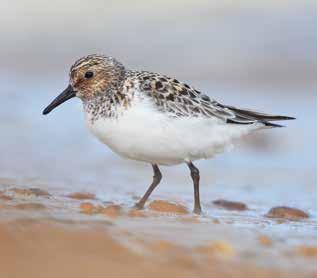
In spring, 25 were recorded at Landguard on April 7th, April 15th and May 9th. There were widespread reports of small numbers from coastal locations through May and into June. These included seven at Iken on June 1st, 12 at Hazlewood Marshes on May 28th and 15 at Minsmere on May 29th and June 6th. A flock of 20 flew north off Southwold on June 7th. The last spring bird off Landguard was on June 14th.
There were few reports in early autumn, with reports from early July and the first juvenile reported from Hollesley on August 22nd and several small flocks along the coast in late October.
Sanderling, Felixstowe Ferry, 23rd May Craig Holden
Thereafter only singles or small numbers were reported from coastal sites in the second winter period, but there were 17 at Kessingland at the end of the year.
There were no inland reports.
DUNLIN Calidris alpina
Very common winter visitor and passage migrant. Red list (from Amber 2021).
The WeBS high-water count data in the table below indicate a population of approximately 13000 on Suffolk’s estuaries in the first winter period. Data are incomplete for the second winter period.
Spring passage was heavier than in 2022, with reports including a flock of 335 on the Deben Estuary (Felixstowe Ferry) on May 3rd and over 750 on the Alde Estuary (Hazlewood Marshes) on May 13th. There were several records of late migrants in early June, including 17 on the Alde Estuary (Hazlewood Marshes) on June 11th and 30 on the Stour Estuary (Seafield Bay) on June 5th. There were several inland records, including two at Cavenham Heath on April 29th.
The first returning adults appeared at Minsmere and Hollesley Marshes, both on June 22nd. It is difficult to ascertain whether there was an early autumn passage as there were a few lingering birds from the summer, but numbers increased during July and the first juvenile was reported from Hollesley Marshes on 29th. Autumn passage at Landguard was recorded over the period July 4th to November 26th, with maxima of 1004 south on October 26th and 2041 south on November 1st. There were several individual counts of flocks in four figures in the second winter period, including 2300 on the Alde Estuary (Hazlewood Marshes) on December 29th.
WeBS high-water count data (with totals for the Suffolk shore of the Stour Estuary and for the estuary as a whole):
PURPLE SANDPIPER Calidris maritima
Fairly common winter visitor. Scarce passage migrant. Red list (from Amber).
The best site for this species remains Ness Point, Lowestoft where Purple Sandpipers were recorded in the first winter period from January 1st until April 22nd with a peak count of 12 on April 1st; this is similar to 2022. The last bird of the spring was at Landguard, May 13th. The first autumn record from Ness Point was on October 8th and there were seven there on November 26th.
Elsewhere, the first returning bird was
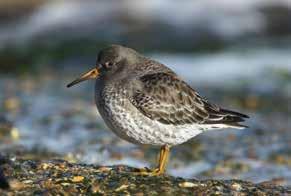
Purple Sandpiper, Ness Point, 20th February Peter Ransome
reported from East Lane, Bawdsey on September 19th. In addition to the birds at Lowestoft, one to four birds were seen at the usual additional sites (Southwold, Minsmere, Aldeburgh/ Thorpeness, Slaughden, Bawdsey/Shingle Street and Landguard).
LITTLE
STINT Calidris minuta
Fairly common passage migrant. Occasionally overwinters.
As has been the pattern in recent years, there were relatively few reports of this species.
In the first winter period, there were three at Havergate on January 2nd and two were seen at Boyton Marshes intermittently over the period until April 22nd, which were presumably the overwintering birds which were first reported in late 2022.
Spring passage was light with reports of one to three birds from seven coastal locations, including three at Boyton Marshes with Ringed Plovers and Turnstones on May 25th.
The first of the autumn was on the Blyth Estuary on July 15th and there were reports of small numbers from coastal locations thereafter, with the only counts of five or more birds as follows:
Minsmere: peak of six, Aug 19th
Boyton Marshes: peak of seven, Sep 19th
Hollesley Marshes: 11, Sep 3rd
There were no records from the second winter period.
BUFF-BREASTED SANDPIPER Calidris subruficollis
Very rare visitor.
There was one record. There is a brief article on this popular event earlier in this report. This is Suffolk’s 14th record of this Nearctic wader.
Minsmere: Sep 11th to 14th (P Buckle et al.)
PECTORAL SANDPIPER Calidris melanotos
Scarce passage migrant.
A total of 15 individuals was recorded. An exceptional effort was put into differentiating between individual birds over the autumn and it is thought that the records from Aldeburgh Marshes relate to eight individuals, comprising one adult in early autumn and then seven juveniles. This equals the highest annual total recorded in the County, with 15 also recorded in 2006. For
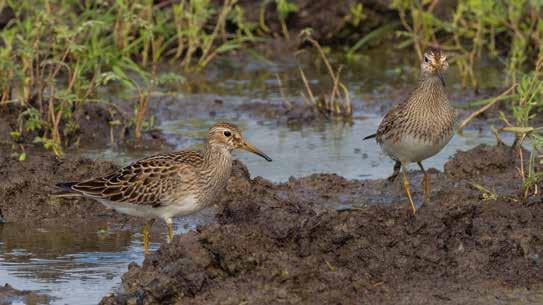
Pectoral Sandpipers, Aldeburgh Marshes, 18th September
Peter Kennerley
more recent context, totals over the ten-year period to 2013 to 2022 ranged between zero (2020) and six or seven (2022).
Carlton Marshes: May 12th (A C Easton et al.) – Suffolk’s eighth spring record
Minsmere: Sep 7th (M Mullis)
Aldeburgh Marshes: adult, July 19th to 27th (J A Rowlands et al.); juv, Aug 30th to Sep 5th (J A Rowlands et al.); two juvs, Sep 14th to 20th (J A Rowlands et al); three juvs, Sep 21st, (J A Rowlands et al.); juv, Sep 28th and 29th (P R Kennerley et al.); three juvs, Oct 1st (M Shore); two juvs, Oct 2nd to 10th (multi-observer); juv, Oct 14th (P R Kennerley)
Boyton Marshes: juv, Sep 9th to 16th (P R Kennerley et al.); juv, Sept 29th and 30th, not the earlier bird (P R Kennerley)
Hollesley Marshes: June 22nd and 23rd (C Shaw et al.); Sep 16th (C Shaw)
Trimley Marshes: adult, Sep 2nd (P J Holmes, D Zantboer, J Zantboer)
The first Hollesley bird is likely to have been an early autumn migrant, perhaps from the breeding population in Siberia.
EURASIAN WOODCOCK Scolopax rusticola
Fairly common winter visitor and passage migrant and declining resident. Red list.
In the first winter period, there were scattered reports, with numbers broadly comparable with 2022. A report of six flushed from woodland at Barking Tye (Bonny Wood SWT) on March 19th may relate to migrants stopping off before exiting the country. Single spring migrants were at Landguard on March 14th, 15th and 19th.
Mid-summer records of displaying birds came from two extensive areas in the northwest of the county, but with fewer individuals than were reported in 2022. There was one report from June in the coastal belt.
The first autumn arrivals were reported on October 20th from Southwold, Minsmere and Landguard, but with fewer than ten records before the end of the month. There were few further reports of arrivals in November and records were sparse over the second winter period. There were reports from fewer than 30 inland and coastal sites, with no reports of five birds or more. None was reported at Landguard after December 1st.
JACK SNIPE Lymnocryptes minimus
Uncommon winter visitor and passage migrant.
This species was reported from over 20 sites in the coastal belt, which is broadly comparable with totals over the period 2019 to 2021, but low by historical standards. Inland there were reports from only two sites.
This species is generally recorded singly, especially in recent years, but three were reported from both Butley on January 22nd and Levington on January 29th. The last report of the spring was of a presumed migrant at Landguard on April 22nd.
The first returning bird of the autumn was noted on October 4th on the Blyth Estuary and four had returned to Levington by October 30th. Singles were at Landguard on October 20th and November 28th.
COMMON SNIPE Gallinago gallinago
Common winter visitor and passage migrant. Breeding last proven in 2007. Amber list.
As is usual, reports came from widespread inland and coastal sites in both winter periods. There were some high counts as follows, despite the absence of any prolonged spells of hard weather. Selected counts of more than 50 birds are set out below:
Carlton Marshes: peak count of 55, Nov 26th
Southwold: Town Marshes, 355, Dec 21st
Dunwich: Dingle Marshes, peak count of 65, Nov 19th
North Warren: 89, Jan 2nd
Boyton: Boyton Marshes, 100, Oct 27th
Thetford: Nunnery Lakes, 58, Dec 29th
Mickle Mere: peak count of 60, Nov 19th
Lackford Lakes: peak count of 100, Dec 29th
The count of 355 from Town Marshes, Southwold included a single flock of 172 and is one of the highest totals reported in the county in recent decades. Previous high totals include 500 at Town Marshes, Southwold on December 21st 2007, and 471 at Carlton Marshes on January 21st 2018. There was once again a report of suspected breeding in the west of the county. On the coast, there were several records in June and July, including one bird drumming.
At Landguard, spring migrants were recorded on March 19th and April 6th, 7th and 8th (2). Apart from one south, August 19th, autumn passage birds were recorded at Landguard from October 9th to December 15th, with a maximum of five south, October 26th.
RED-NECKED PHALAROPE Phalaropus lobatus
Rare passage migrant. Red list.
There was one record.
Hollesley Marshes: juv, Aug 25th to Sep 5th (T Rafinski et al.)
GREY PHALAROPE
Phalaropus fulicarius
Scarce passage migrant and rare winter visitor.
There were five records of this species this year, typically all in mid/ late autumn. The two records on November 4th probably involve the same bird.
Kessingland: Oct 22nd to 27th (C Darby et al.)
Minsmere: south, 15:00hr, Nov 4th (R Harvey)
Thorpeness: south, Sep 24th (D Thurlow)
Slaughden: south, 15:35hr, Nov 4th (J A Rowlands)
Landguard: Nov 19th (M Garnham)
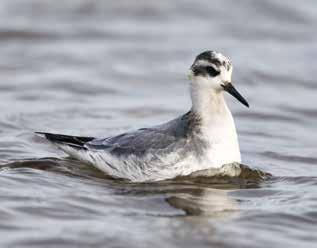
SPOTTED SANDPIPER Tringa macularia
Very rare visitor.
There were two records, probably relating to the same individual. This is only the fifth Suffolk record of this Nearctic wader, the others having been in June 1977 (Walberswick), May 1985 (Walberswick), September 1998 (Bawdsey) and June 2006 (Minsmere).
Corton: June 5th (N Blacker, J Brown et al.)
Shingle Street: June 4th (J Dries)
COMMON SANDPIPER Actitis hypoleucos
Common passage migrant. A few birds overwinter. Amber list.
The overwintering bird from 2022 and previous years was present in the Belstead Brook and Ipswich Docks area in January, with two birds reported on January 23rd.
The first passage bird was at Minsmere on March 17th. Records were sparse in early spring, apart from four at Minsmere on March 25th. Reports from coastal locations continued into late spring through to early June, with the majority of these relating to one to three birds. There were four at Trimley Marshes on May 5th and on June 1st there were seven at Minsmere and five at Shingle Street. Inland there were records of one or two birds from seven sites, which included one on flooded pig-fields at Tuddenham St. Mary on June 9th.
Return passage was evident from June 24th, when there was a singleton at Felixstowe Ferry.
Grey Phalarope, Kessingland, 23rd October, Peter Ransome
Thereafter there were widespread reports of single birds or small groups and several doublefigure counts. Selected high counts of more than five birds at coastal sites are listed below, with the count of 25 birds at Minsmere on September 13th being particularly notable. The 25 at Minsmere is the highest total in Suffolk from a single site since August 25th 2016 when a flock of 55 was seen to arrive at Lowestoft ahead of rain.
North Cove: Castle Marsh, eight, July 24th
Lowestoft: eight, Sep 13th
Benacre: 20, Aug 13th
Southwold: Town Marshes, seven, Sep 7th
Minsmere: 22, Aug 31st; 25, Sep 13th
Aldeburgh: Aldeburgh Marshes, six, July 24th; six, August 27th
Hazlewood Marshes: six, July 29th
Boyton Marshes: eight, Aug 20th
Hollesley Marshes: ten, Sep 4th
Deben Estuary: Melton, six, Sep 13th
Trimley Marshes: seven, Sep 6th
There were also some notable autumn counts from inland:
Livermere Lake: ten, Aug 2nd
Lackford Lakes SWT: ten, Sep 14th
In the second winter period the overwintering bird returned to the Belstead Brook and Ipswich Docks area and there was a report from Oulton Broad on November 10th.
GREEN SANDPIPER Tringa ochropus
Fairly common passage migrant. Small numbers overwinter. Amber list.
There were fewer than 20 reports in the first winter period and these typically involved one or two birds. A high count of six from Pipps Ford, Barking on February 25th may relate to early passage birds, but the only report of more than two birds from anywhere in March or April was of three birds at Aldeburgh Marshes on April 22nd. Away from the wetland sites, one was at Landguard, April 6th. This is a much lighter passage than in 2022, when there were several counts of ten birds or more from coastal locations towards the end of April. There were no spring reports in May.
The first presumed returning bird was reported from Boyton Marshes on the early date of May 30th. Autumn numbers were typical with a wide scatter of sites holding up to five birds. Selected reports of more than five birds are as follows.
Carlton Marshes: six, Aug 25th
Minsmere: ten, Aug 11th
Aldeburgh Marshes: nine, Aug 29th
Snape Wetlands: Botany Marshes, six, Aug 15th
Boyton Marshes: seven, Aug 20th; seven Sep 9th
Inland, there were several reports of up to five birds and numbers at Thetford (Nunnery Lakes) peaked at a record high for the site of 12 on August 19th.
There was, as usual, a scatter of reports in the second winter period from the coast and inland from approximately 15 sites, but none of three birds or more except for three at Barking (Pipps Ford) on several dates and four inland at Hoxne on a temporary flood on November 20th.
LESSER YELLOWLEGS Tringa flavipes
Rare visitor.
There was one record, Suffolk’s 17th and the fourth in mid-winter. Southwold: Nov 7th to the end of year (B J Small et al.)
COMMON REDSHANK Tringa totanus
Common winter visitor and passage migrant. Declining resident. Amber list. In the first winter period, there were over 3500 in the county (including Essex data, 3000 if no
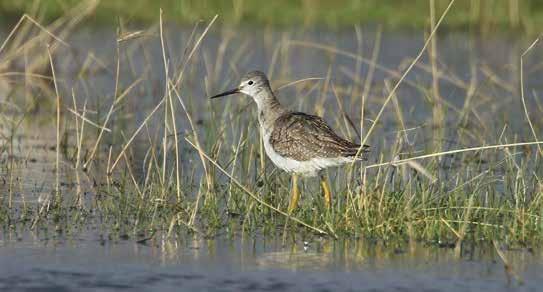
Lesser Yellowlegs, Southwold, 11th November
Essex data), including over 1000 on the Alde Estuary.
Breeding data are incomplete for 2023, but 20 pairs were reported from Minsmere (31 in 2022) and 20 pairs at North Warren (15 in 2022). Inland, displaying birds were reported from three localities.
In autumn, there was the usual build-up on our estuaries, but data are incomplete. The Alde Estuary is the prime site in the county for Redshank and over 2000 were counted there in November.
WeBS high-water count data (with totals for the Suffolk shore of the Stour Estuary and for the estuary as a whole):
WOOD
SANDPIPER Tringa glareola
Passage migrant in small numbers. Amber list.
As is typical, the first spring arrivals were in late April; there was one at Aldeburgh (Aldeburgh Marshes) on 22nd and one inland at Lakenheath on 25th.
Spring migrants were recorded from approximately ten sites, with selected totals of three or more birds as follows:
Somerleyton Marshes: four, May 1st to 6th
Carlton Marshes: five, May 14th
Southwold: three, Apr 30th and May 1st
Peter Ransome
Boyton Marshes: seven, May 4th to 8th
Trimley Marshes: three, May 9th
The first autumn record was from Hollesley Marshes on June 23rd. Passage was light with the highest day-counts from sites recording more than three birds as follows:
Minsmere: four, Aug 19th
Hollesley Marshes: five, Aug 20th
Sizewell: Kenton Hills, six, Aug 22nd
One was seen inland at Kedington (Sturmer Mere) on August 25th.
2022 addition
There were additional spring records inland as follows:
Mickle Mere: May 8th: two, May 10th and 11th
SPOTTED REDSHANK Tringa erythropus
Decreasing passage migrant. A few overwinter. Amber list.
There were probably fewer than ten birds in the county in the first winter period (compared with probably 15 or more in 2022). The highest single count from the Blyth Estuary and Walberswick/Dunwich area was of five at Dunwich on January 24th. Birds, again, wintered on the Deben Estuary (maximum five at Melton on April 14th) and the Stour Estuary (Holbrook Bay).
Spring passage was light, but with an increase on 2022 with reports from up to ten sites, the highest count being of 11 on the Blyth Estuary on April 29th. There were two moulting birds on the Deben Estuary in late April and three at Somerleyton Marshes on May 13th.
The first birds of return passage were noted at Minsmere on June 12th and, as usual, most reports came from there. The highest count from Minsmere was of only nine birds, on July 28th and 11 were reported from Dunwich on July 21st. Away from those prime sites, there were six on the Alde Estuary (Hazlewood Marshes) on October 10th, but otherwise nowhere held more than five birds.
In the second winter period, fewer than ten birds were recorded. The highest count was of four birds at Dunwich on December 6th.
COMMON GREENSHANK
Tringa nebularia
Common passage migrant. A few overwinter. Amber list.
In the first winter period from January to March, there was a wintering bird on the Stour Estuary. There were also single reports of birds at Snape Wetlands (Botany Marshes) and from Lackford Lakes SWT on January 20th. Lackford’s only other winter records occurred on December 6th 2006 and December 18th 2020.
Spring passage was recorded from early April with a bird at Lakenheath Fen RSPB on 1st and several further reports of up to three birds at inland sites. Spring numbers were low (as in 2022) and the only high counts in double figures are noted below. All were in the first week of May.
Somerleyton Marshes: 12, May 6th
Aldeburgh Marshes: 14, May 4th
Deben Estuary: 20, May 3rd
There were several reports of birds In June, including six at Somerleyton Marshes on 10th. The June reports also included inland birds, with singles at Mickle Mere on 1st and Thetford (Nunnery Lakes) on 3rd. There were three at Stoke-by-Nayland (Gifford’s Hall) on June 8th.
As in 2020, few flocks of ten or more birds were recorded on autumn passage. Selected highest counts are as follows:
Alde Estuary: Hazlewood Marshes, 16, Aug 29th
Boyton Marshes: ten, Sep 16th
Deben Estuary: Melton, 11, July 28th
East Bergholt: Flatford, ten, Aug 16th
Stour Estuary (incl Essex shore): 49, Sep 17th
Inland, the only record of three or more was of four at Kedington (Sturmer Mere) on August 31st.
There were no records in the second winter period.
BLACK-LEGGED KITTIWAKE Rissa tridactyla
Very common passage migrant and winter visitor. Has bred since 1958. Red list.
During the first two months of the year, this species was noted most regularly at Landguard, with 88, January 4th and a peak of 123, January 8th. Further north, 52 were seen off Lowestoft, January 14th and during the following two months, breeding birds were noted returning to their colonies, with 180 around the Sizewell rigs, February 21st and 245 at Lowestoft, March 4th.
During the summer, this species once again bred successfully around Lowestoft town centre and the sea front. Meticulous breeding census work carried out by Julie Martin (see article earlier in this report) revealed a total of 883 observable nests producing 1004 chicks giving an average count of 1.13 chicks per nest. It was noted that there were a further 100 active nests but these were located in areas with no access. Along with non-breeding adults, it was estimated that a total of around 3000 Kittiwakes was present in the Lowestoft area during the summer. Towards the end of the breeding season, in August, a small number of birds was seen with symptoms and behaviour relating to avian influenza but fortunately these occurrences became evident just as birds were dispersing from nests and becoming more ‘socially distant’ in their own way. Elsewhere in the county, nesting was observed once again on the offshore rigs at Sizewell but there was no breeding census at this site, although a peak count of 500 birds was counted there, May 8th.
With very few records received during September, autumn records consisted mainly of birds lingering around the Minsmere area where 150 were noted, October 17th and 30 were seen off East Lane, Bawdsey the same day. Elsewhere, 21 were noted off Landguard, November 4th. Towards the end of the year, sightings gravitated towards the south with most observations being offshore from Landguard with 58, December 22nd, peaking at 103, December 27th and 83 there the following day. Away from the coast there was a sole inland record in west Suffolk at Wattisfield where a first-winter was taken into care, December 27th.
SABINE’S GULL Xema sabini
Rare passage migrant.
Seen on two dates during the autumn, on September 19th at Minsmere and on October 17th when a multi-observed juvenile went north past two sites during the morning with other records later that day potentially involving at least two birds in total. All records as follows:
Benacre: juv north, 08:34hr, Oct 17th (C Buttle)
Southwold: juv north, 08:23hr, Oct 17th (B Small et al); juv south, 17:30hr, Oct 17th (B Small et al)
Minsmere: juv south, 10:10hr, Sep 19th (J H Grant, I Salkeld, P Buckle)
Slaughden: north, 12:27hr, Oct 17th (S Belfield)
BLACK-HEADED GULL Chroicocephalus ridibundus
Very common resident, winter visitor and passage migrant. Amber list.
At the start of the year, 600 were noted on the Deben Estuary at Waldringfield, January 1st, an impressive count of 1570 was off Southwold from 11:25hr to 13:00hr, January 6th and 1500 were on the Alde Estuary at Iken, January 13th. Elsewhere, in the far north of the county, 460 were noted at Fritton Decoy, January 22nd and in the south of the county, 740 were at the Butley River the same day. A southwesterly passage of 552 birds was witnessed at Carlton Colville, February 1st with 339 noted there, February 5th.
In the west of the county, roosts totalled 200 at Little Livermere and Livermere Lake, January 29th and 1000 were at Lackford Lakes, January 19th. The following month, roosts increased in size which corresponded somewhat with a fall in numbers at coastal sites, with 2500 at Great
Livermere, February 22nd and the following month, 4000 was the site’s maximum count, March 11th. At a small number of sites, single-figure counts of suspected victims of avian flu were noted. In the Waveney Valley a notable count of 2100 was at Waybread Pits, March 5th. As the breeding season approached, 1350 was the peak count from Minsmere, May 7th.
Breeding records include 44 nests at Alton Water, with no data relating to their success, and five nests at Boyton Marshes, from which nine juveniles fledged. Breeding attempts in the west of the county included a pair at Lackford Lakes and five nests at Livermere Lake which were all abandoned. At Minsmere, the peak breeding season count was of 800 birds, June 27th with ‘many fledglings’ noted a few days before but no exact counts of nests or young were received. During the late summer and early autumn, the most notable counts around the county included 1100 at Spexhall, August 22nd, 1000 at Gedgrave Marshes, September 3rd and the following day 1500 at Hazlewood Marshes. Towards the end of the year, notable gatherings in the west of the county included 1000 noted at Shalford Meadow, Little Cornard, October 27th and roosts numbered up to 2800 at Livermere Lake, November 17th. At Oakley Park near Hoxne, 1150 were present, November 11th and, on the coast, 1037 were at Carlton Marshes, November 14th and 2260 were noted on the Orwell Estuary, December 17th.
Southerly autumn passage off Landguard included monthly peaks of 406, July 19th, 861, October 9th and 1420, November 17th.
LITTLE GULL Hydrocoloeus minutus
Fairly common passage migrant. Regularly oversummers. Small numbers overwinter.
There were no records received during the first winter period. The year’s first records came from the west of the county, during what turned out to be, overall, a much lighter spring passage than usual for inland sites with singletons at Lackford Lakes, March 24th and May 1st being the only records. On the coast the most notable count was of 16 off Landguard, April 23rd which followed a singleton there two days prior. During the year the majority of sightings were made in the Minsmere area, starting with single spring birds, April 19th and 27th. In general, spring records were few and most were single birds with one at Hazlewood Marshes, April 23rd and one at Minsmere, May 9th and 10th.
As with previous years, numbers slowly built up during the summer months, mostly around Minsmere Scrape with the first multiple count, of four, June 27th, increasing to seven on July 16th and 12 on 20th. Numbers at Minsmere increased further, peaking with 23, July 20th and August 11th. The only records away from Minsmere were of a singleton at Carlton Marshes, August 15th and 16th and three off Lowestoft, August 17th. During the early autumn, totals remained low with peak counts of 22 at Thorpeness, and 16 at Minsmere, on both September 2nd and 20th, and a further 11 off Lowestoft, September 26th.
Little Gull Russ Boland
As in 2022, there was a noticeable increase on October 20th, when this year’s highest total of 147, was off Thorpeness, and the following day, 52 were at Minsmere and 49 were off Lowestoft. During November, totals remained high with most records made in the first week, with 110 off Southwold, 81 off Lowestoft and 66 off Landguard, 2nd and the following day, 38 were off Southwold and at least 25 were feeding off Lowestoft Ness. Further south, 21 were off Landguard, 4th and 39 at Sizewell, 9th. Sightings tailed off at the end of the year with 12 at Landguard, November 18th and
List
eight at Minsmere the following day. During December there were three records of single birds, these being at Landguard on 1st, Southwold Town Marshes, 4th and East Lane Bawdsey, 12th.
Sightings at Landguard totalled 128 between October 20th and December 1st, with the peak being 66, November 2nd.
The total of 147 off Thorpeness, October 20th is the highest in Suffolk since August 4th 2013 when 180 were at Minsmere. This total of 147 and the 110 at Southwold, November 2nd are very impressive, but somewhat eclipsed by Norfolk’s 2023 figure of 4570 off Cromer on October 21st (Norfolk Birding News).
MEDITERRANEAN GULL Ichthyaetus melanocephalus
Uncommon resident, winter visitor and passage migrant. Rare breeder. Amber list.
During the first winter period, this species was recorded mainly in the north-east of the county, in small overwintering groups which consisted of six at Lowestoft, January 1st and at least eight feeding off Ness Point, January 14th. A notable count just inland was at Fritton Decoy with 18 noted in a mixed-gull flock, January 8th and at the same location numbers had increased to 47, January 22nd, which is an atypically high count for anywhere in the county for that time of year albeit at an historically under-watched site. The following month such numbers couldn’t be replicated with a peak of only six noted at Fritton February 19th.
As spring approached, more records came from the south of the county, albeit in generally low single-figure numbers apart from at Minsmere where at least 30 were present, April 4th, increasing to at least 62 on 15th. Notable counts from other sites in April included 12 at Boyton Marshes, 22nd and 22 at Hollesley Marshes, 29th. In the west of the county, two at Mickle Mere, April 3rd, were the sole spring west records. During the summer one was over the River Lark at West Row, June 8th and another flew over Icklingham two days later. A moulting adult was at Mildenhall, July 7th and August 15th. There was no news of any successful breeding attempts from any sites in the county.
During late summer there was the usual immigration but not in the high numbers seen in previous years, with no three-figure counts received. Highlights included 44 at Gunton Warren, August 23rd and at least 56 at Trimley Marshes, September 1st. At least 50 were seen again over north Lowestoft, September 4th, mainly mixing with large flocks of Black-headed Gulls all taking advantage of the emergence of flying ants for an easy meal. Notable counts from further south included 11 at Trimley Marshes, September 11th.
During the rest of the autumn, many single-figure counts were made; exceptions were 16 which passed south off Thorpeness, October 9th, seven at Gunton Beach, October 15th and 158, a site-record total, flew south off Landguard, October 9th. Towards the end of the year, wintering birds were converging on traditional sites in the northeast of the county with eight at Links Road car park, Lowestoft, November 19th. Elsewhere, two were at Felixstowe Ferry, 25th and three remained at Minsmere, November 30th. During December it was very quiet with only three sightings, of single birds, made across the whole county.
Mediterreanean Gull Stewart Sexton
COMMON GULL Larus canus
Very common winter visitor and passage migrant. Scarce breeding species. Red list (from 2024). At the start of the year, at least 1250 were seen off Sizewell at roost, January 2nd. Elsewhere, 380 were at Hoxne, 4th and 600 at Hulver, January, 7th. In the west of the county, roost numbers during the first winter period included a notable count of 400 at Cavenham to Tuddenham Corner, January 22nd. Elsewhere, 267 were counted at Tuddenham St. Mary, January 28th and the following day, 220 were at Shalford Meadow, Little Cornard. In February, 300 were on pig fields at Tuddenham St. Mary on 11th and on the same day an adult bird with characteristics of the Russian L. c, heinei race was at Lakenheath/Hockwold Washes. During the early spring, 300 were at the BTO Nunnery Lakes, Thetford on March 9th. On the coast, 145 were at Southwold, March 23rd and 81 there, April 7th but the highest numbers by far were at Minsmere with around 200 noted, May 1st and 7th.
During the summer, breeding was noted at two coastal sites, with two pairs at one site and a single pair at the other; each site saw one chick fledged successfully. These are the first records of successful breeding by Common Gulls in Suffolk since 2018.
Numbers in general, at a small number of sites, were in low single-figures until late summer when they increased with 48 at Alton Water, August 20th and a passage total of 43 passed by off Corton, September 28th. Off East Lane, Bawdsey, 500 were noted during a strong southbound passage, October 17th and at Minsmere, at least 120 were noted the same day. Southerly autumn passage totals off Landguard peaked at 297, October 9th; 180, October 17th and 169, November 17th. Elsewhere during the autumn, 1000 were counted at Shalford Meadow, Little Cornard, October 27th. Towards the end of the year, most birds were on the coast with 875 at Benacre Broad, December 1st and at least 220 were off Sizewell December 23rd. Elsewhere, a notable count of 200 was at Alton Water, December 25th and 250 were noted at Sibton Park, December 31st.
GREAT BLACK-BACKED GULL Larus marinus
Common winter visitor and passage migrant. A few oversummer. Has recently bred. Red list (from 2024).
During the first winter period, overwintering birds were to be found at many coastal locations, mainly gravitating towards Landguard where peak counts of 150 occurred on seven dates, January 3rd to February 20th. Elsewhere along the coast, the most notable counts were of 175 at roost on the Scrape at Minsmere, January 7th where by far the largest counts were to be found. Elsewhere, 14 were noted at Hollesley Marshes, January 8th and 45 were on Havergate Island, February 4th. In the west of the county, very few were noted with the most notable gathering consisting of 32 at Livermere Lake, January 29th. As spring approached, numbers dispersed with 21 noted on Havergate Island, March 12th and the following day, 55 were at Hollesley Marshes. At Minsmere, 26 were present, March 21st.
During the summer, this species was observed breeding in the adjoining docks at Landguard. Some passage was noted at Landguard with 33 south, July 16th, an atypically high total for this date. Elsewhere along the coast low single-figure counts were made with six on Minsmere Scrape which included five first-summer birds, June 24th. At other wetland sites, four were at Carlton Marshes, July 15th and six were at Hollesley Marshes, July 23rd. There were no summer records from sites in the west of the county.
There was no repeat of the large late-autumn passage numbers seen the previous year during November but at Havergate Island a count of 84 was made, October 28th and further south, 80 were at Trimley Marshes, November 8th. The following day, 30 were noted at Hollesley Marshes and 20 at Southwold Town Marshes. At the end of the month, 35 were at Felixstowe Ferry, November 30th. In the west of the county records were very few and far between, with just four at Livermere Lake, December 11th and two there on 26th. On the coast, 250 were noted at Landguard, December 17th and at least 40 off Sizewell, December 22nd.
GLAUCOUS GULL Larus hyperboreus
Scarce winter visitor. Amber list.
It was a disappointing year for this species with an adult at the start of the year at two different coastal sites and a first-winter frequenting the southeast of the county in the latter half of December. All records as follows:
Minsmere: Jan 8th (N Calbrade, N Carter)
Hollesley Marshes: first-winter on scrape, 14:35hr, Dec 21st (J A Rowlands)
Landguard: adult, Jan 1st (N Odin); first-winter, Dec 16th and 24th (N Odin)
ICELAND GULL Larus glaucoides
Scarce winter visitor. Amber list.
A very poor year with a lone record at Landguard saving the year from being a total blank for this species.
Landguard: adult, Nov 21st (W J Brame, B Mackie)
HERRING GULL Larus argentatus
Very common resident, winter visitor and passage migrant. Red list.
During the first winter period, peak counts at sites along the coast in January included 260 at Southwold, 6th, 200 at Minsmere, 9th and 160 at Hollesley Marshes, 13th. In the west of the county, 327 were noted on pig fields at Great Livermere, January 28th and the following month, 240 were in pig fields at Tuddenham St. Mary, February 8th. February’s peak total on the coast was 850 at Landguard, 18th. These were the main totals noted and are much reduced compared with those in 2022. Along the coast as the spring approached, numbers gradually increased with 350 at Botany Marshes, Snape Wetlands, March 3rd and 495 on Havergate Island, March 12th. There was also an increase in flock sizes inland with the most notable being 400 at Great Livermere, March 19th.
During the summer 400 were again noted at Great Livermere, June 28th but no reports of breeding were received from any inland sites whereas, on the coast, 642 nests were noted (667 in 2022), on Havergate Island which fledged 263 young. Elsewhere in the county, Herring Gulls nested successfully, with many well grown young seen on domestic and commercial building rooftops in and around central Lowestoft and the harbour areas, and in Ipswich.
During the autumn, the largest gatherings were to be found along the coast with 420 at the Butley River, September 17th and, later on, 205 were at Covehithe Broad, October 4th and 500 were observed flying to roost on the sea off Lowestoft, October 10th. Further south in October, 540 were on the Butley River, 15th and 225 were on Havergate Island on 28th.
Towards the end of the year, winter gatherings along the coastal strip included 220 at Southwold, November 29th and 300 at Hollesley Marshes, December 7th. At Sizewell, at least 750 were feeding near the offshore rigs, December 22nd and 23rd and the year’s highest total at any site was of 2000 at Landguard, December 20th. Records of winter gatherings in the west of the county were sparse, with the only notable gathering being of 400 at Ampton, December 29th.
CASPIAN GULL Larus cachinnans
Uncommon visitor. Amber list.
At the start of the year, peak counts included four at Hollesley Marshes, January 9th and five at Minsmere, January 7th, 11th and 14th. These two sites shared the bulk of sightings on the coast for the first winter period and elsewhere singletons were noted at Carlton Marshes, February 12th and Felixstowe, 22nd. In the west of the county, the 2023 census of this species by Dawn Balmer and Peter Wilson revealed a total of 63 different birds during the course of the year, which is down on the number of 2022 sightings (90). The pig fields around Great Livermere attracted most birds with highest counts during the first winter period being eight and nine during February and March respectively; day-count peaks were three on February 24th and five on March 19th. Elsewhere, four were at Tuddenham St Mary, January 27th and February 4th and during early
spring, four were at Mickle Mere, April 4th.
During the spring, numbers along the coast stayed a low level with three at both Minsmere, March 21st and Botany Marshes, Snape Wetlands, 23rd; the following month, Botany Marshes hosted four birds, April 7th. Further north a second-summer bird was at Lowestoft North Beach, April 16th and the following day one was at Thorpeness Meare.
In late summer the expected increase in numbers began with three juveniles around the Sizewell outfalls, August 3rd to 5th, increasing to six, August 7th. Elsewhere, two were off Lowestoft and four were at Walberswick, August 6th. In the west of the county, peak counts at Great Livermere included two, June 22nd and 30th, three, July 25th and five, August 16th. The totals of individual birds seen here were 11 during June, 13 during July and 12 in August.
During the autumn, most sightings occurred along the coast with ringed first-winters at Lowestoft North Beach, August 28th and September 1st and unringed first-winters were also present there, September 7th to 10th. Three were at roost on Minsmere Scrape, September 13th and two unringed first-winters were on the Denes Oval, Lowestoft, September 21st. In the west of the county, two were at the Great Livermere pig fields, October 6th and two at Tuddenham St. Mary, October 21st. In November, numbers picked up at some coastal locations with, for instance, five at Southwold, November 2nd and 18th, four at Minsmere, December 9th and five noted at both Sizewell, December 21st and Hollesley Marshes, December 24th. Inland, two were at the Great Livermere pig fields, December 21st.
YELLOW-LEGGED GULL Larus michahellis
Fairly common summer and autumn passage migrant. Small numbers overwinter. Amber list.
At the start of the year, up to five were noted at Great Livermere pig fields, January 7th and four second-calendar-year birds were at Tuddenham St. Mary, January 28th. Apart from these the vast majority of sightings came from coastal sites, with six at Minsmere, January 7th and three at Hollesley Marshes, January 12th. A few other sites along the coast recorded single birds, such as Thorpeness Meare, January 7th, Covehithe Broad, February 2nd, Landguard, February 17th and Carlton Marshes, February 26th. Numbers stayed low into the spring and occurred mainly in the south of the county with two at both Hollesley Marshes, April 6th and Botany Marshes, Snape Wetlands, April 9th and three at Pipps Ford, Barking on April 13th. Elsewhere, two were at both Minsmere, May 6th and on the Deben Estuary at Melton, May 24th.
During the summer months, numbers built up, most notably in the west of the county at Great Livermere with counts of 18, June 1st, 27, July 1st and 39, August 1st, all of which are the peak respective monthly counts for that site and down slightly on previous years. During the autumn, 17 remained at Great Livermere pig fields and, elsewhere, eight were at Tuddenham St. Mary, October 21st. On the coast, numbers remained low during the summer with most sightings from the Minsmere area being of singletons, although two were present, July 22nd and August 26th. Elsewhere, two were at both Walberswick, August 12th and Sizewell, August 19th.
During the autumn, seven, which included six adults, were at roost on Minsmere Scrape, September 13th, which was notable given the scarcity of records across the county for that month as a whole. Towards the end of the year very few were noted in the west of the county with a maximum of only two at Great Livermere pig fields, December 3rd. On the coast, five were noted at both Hollesley Marshes, December 7th and Minsmere, December 9th. In the south, one was at Trimley Marshes, December 15th and, in the northeast, two at Carlton Marshes, December 17th. The final record of the year was of two at Hollesley Marshes, December 31st.
LESSER BLACK-BACKED GULL Larus fuscus
Very common summer visitor and passage migrant. Increasing numbers overwinter. Amber list. At the start of the year, small numbers were along the coast with the most notable being 28 going into roost at Minsmere, January 7th. In February, 110 were at Carlton Marshes, 17th and 111 on the Butley River, 19th. In west Suffolk, the main concentrations were 300 at Euston,
February 7th and 330 at Tuddenham St. Mary, 8th. Also in the west, 200 were at Nunnery Lakes, Thetford, February 27th and 300 at Livermere Lake, March 4th.
On the coast, numbers built up through the spring with a peak of 393 counted on Havergate Island, March 12th. Arrivals dispersed to a number of different traditional breeding sites with 150 at Boyton Marshes, May 1st and, elsewhere, there were mainly smaller gatherings including at least 70 at Covehithe pig fields, May 2nd.
Breeding was documented at several sites, with 1524 pairs on Havergate Island, fledging 635 young. Many pairs once again nested in urban areas such as Lowestoft town centre, Felixstowe docks and Ipswich but there was no indication of the level of success at any of these locations. Hollesley Marshes and Boyton Marshes hosted seven and three pairs respectively but no chicks fledged at either site. At Boyton Marshes, 125 were present, July 27th, mainly consisting of juveniles, several of which bore red rings. There were no reports received of any successful breeding in the west of the county but 580 were noted on pig fields at Great Livermere, June 6th and 1150 were counted at Little Livermere, June 28th. At Livermere Lake, summer maximum monthly counts included 750, July 22nd and 800, August 18th.
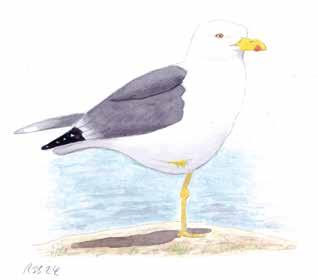
Lesser Black-backed Gull Russ Boland
During the autumn, 1325 were at Livermere pig fields, October 6th and 900 there three days later. Also, during the autumn, 1000 were at roost at Minsmere, September 13th, with smaller counts at other sites including 61 inland at Hoxne, October 2nd and 42 at Havergate Island, October 15th. Towards the end of the year impressive totals remained at Great Livermere with 250 noted, November 25th and 200, December 29th, whilst on the coast much smaller numbers were present, with peaks of 30 at Minsmere, December 9th and 31 at North Warren, December 23rd.
GULL-BILLED TERN Gelochelidon nilotica
Very rare visitor.
Landguard: 3CY+ north, April 30th (W J Brame, C Day, N Odin)
This is the fourth site record out of only 21 Suffolk records, involving 27 individuals, in total. In common with all other sightings, other than the long-staying adult at Alton Water on various dates from July 29th to August 16th 2020, it was seen on only one day.
The three previous Landguard records occurred on May 28th 1991, May 1st 1997 (2) and June 14th 2005. This year’s bird has the distinction of being the second-earliest to be recorded in Suffolk, the earliest having occurred in 1849 (!) when one was shot on Breydon Water on April 14th (Ticehurst’s avifauna, page 414).
CASPIAN TERN Hydroprogne caspia
Rare migrant.
Minsmere: 3CY+, two, July 9th (D Adelson)
This is the 58th record for the county and the 15th this century including sightings in 2020, 2021 (2) and 2022 (2).
SANDWICH TERN Sterna sandvicensis
Common passage migrant, declining summer visitor. Amber list.
The first sightings of the year were of single birds at Minsmere on March 27th, 28th and 31st. As in 2022, throughout the spring and summer, the species was recorded intermittently at
several coastal sites but only in small numbers. No significant spring migration was noted.
Once again, a large flock gathered at Minsmere with a peak count of about 350 on April 23rd, somewhat down on the 2022 peak of 445. Not unexpectedly, despite good-sized flocks, there were no records of successful breeding (only two chicks fledged in 2022, three chicks in 2021 and none in 2020).
As autumn migration got underway, the species was recorded most days along the coastal strip until mid-October. There were no large congregations reported except on August 6th when in excess of 400 birds were noted off Southwold. Off Landguard, 100 flew south during August including a maximum day-total of 42 on 6th; in addition, 60 were feeding offshore on August 26th. There were no inland records.
The final records were of particularly late individuals involving one flying south past Minsmere on November 15th and another off Lowestoft on November 19th (the latest in Suffolk since 2000 when an immature was at Lowestoft on December 13th).
2022 Correction
In the “For interest” section, the year that record totals bred in Norfolk is 2021, not 2001 (Suffolk Birds 2022: 103).
LITTLE TERN Sternula albifrons
Common summer visitor and passage migrant. Amber list.
The first records of the year were of a single bird at Minsmere on April 30th (a particularly late first arrival date) followed by two off Landguard on May 1st. There were no sightings in west Suffolk, the last being in 2021 (see correction below).
As usual, activity in early spring was centred on Minsmere with numbers rising eventually to a peak of 51 in July compared with 23 in 2022 and 70 in 2021. Eight nests were noted but no young fledged.
Again, a small colony was established at Benacre Broad with 12 nests (12 nests also in 2022). These were all unsuccessful. There were no other reported breeding attempts.
Summary data since 2010 shows the extreme fluctuations in breeding success:
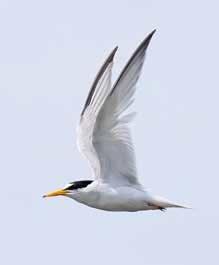
Little Tern, Minsmere, 23rd June Andrew Moon
There were no reported post-breeding gatherings and autumn passage was light with a maximum count of only five birds at Havergate Island on August 18th. The year’s final records were of two off Bawdsey on September 2nd and a single bird at Sizewell on 29th. This late bird off Sizewell occurred on the same date as one at Minsmere in 2022. These two birds share the distinction of being the latest to be recorded in Suffolk since 2014 when one was off Landguard on October 13th. Suffolk’s latestever recorded Little Tern was at the Sizewell Rigs on November 16th 1998.
2022 Correction
The report of a Little Tern at Mildenhall on July 19th 2022 is erroneous, and actually refers to the bird seen at Mildenhall on April 14th 2021. See Suffolk Birds 2021: 118!
ROSEATE TERN Sterna dougallii
Scarce passage migrant. Pair bred unsuccessfully in 2009. Red list.
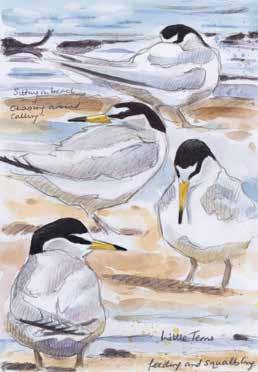
Sightings continued to fall from the peak in 2021 (see below). There were no autumn records. The only accepted record was a single bird at Minsmere in early June. None of the reports after its first day were confirmed, with a black-billed Common Tern causing some confusion. Minsmere: ringed adult, present all day, June 3rd (multiobserved)
Totals of Roseate Terns reported 2014-2023:
COMMON TERN Sterna hirundo
Common summer visitor and passage migrant. Amber list.
The first sightings along the coastal strip were of three birds at Minsmere and two at Trimley Marshes on April 10th followed by two at Alton Water the following day. Numbers at Minsmere increased steadily, thereafter, with peak counts of about 200 reported in late May to early June but this is well down on the approximate 400 in 2022.
The first inland record for the year was of an individual at Lackford Lakes on April 19th. Thereafter, there were several further sightings of a small number of birds there and at two
Little Terns Stewart Sexton
other sites in west Suffolk, (Livermere Lake and Lakenheath). The maximum count at any inland site was six.
The only breeding information received is summarised below:
Minsmere: not known how many pairs nested, but at least 22 chicks fledged
Havergate Island: three pairs nested, one chick fledged
Trimley SWT: one pair nested, one chick fledged
Alton Water: 25 pairs nested on breeding rafts, not known if any chicks fledged
Lackford Lakes SWT: two pairs present but no records of nesting
Lakenheath Fen: one pair present but no records of nesting
Southbound migration was evident from early August with counts of over a hundred birds on several days; the peak counts were about 250 past Minsmere on September 19th and 171 past Landguard on August 2nd. Offshore sightings continued regularly until early October. There were no post-breeding gatherings. The last records were of a single bird flying south past Felixstowe Ferry on October 21st and one noted off Landguard on October 25th.
ARCTIC TERN Sterna paradisaea
Fairly common passage migrant. Last breeding attempt in 2008. Red list (from Amber list 2024).
The first records of the year were of a single bird at Snape Wetlands on April 17th followed by one at Minsmere on 22nd. The first, and only, spring record for the west of the county was of two birds at Lackford Lakes on May 4th. Spring passage was limited to the coastal strip and was mainly of single birds. The only day when there was a significant movement was on April 30th when a total of 26 birds flew north past Landguard:
Lowestoft: Apr 24th
Minsmere: Apr 22nd; Apr 27th; May 15th; May 22nd; ten, May 23rd.
Leiston: four east, May 30th
Snape Wetlands RSPB: Apr 17th
Landguard: four, Apr 27th; 26, Apr 30th; three, May 2nd
Lackford Lakes SWT: two, May 4th
Once again, there were no signs of breeding activity anywhere in the county. Autumn passage was noted along the Suffolk coast from late July to early November. In total, records were received of approximately 150 individuals compared with 57 in 2022 and this century’s record number of over 250 reported in 2021. The only double-figure counts were in August of 25 birds past Southwold on 5th and 39 off the same site on 6th. There were no inland sightings.
The final records of the year are of one south past Landguard, November 2nd and a single juvenile at Sizewell outfall on November 9th. The latest in Suffolk in 2022 was also November 9th, the latest since 2013, when there were birds on 9th and 12th.
BLACK TERN Chlidonias niger
Fairly common passage migrant.
Spring migration in 2023 (three birds) continued to be as sparse as in 2022 (three birds) and 2021 (six birds) in contrast with 2019 when 132 birds were recorded. This year’s three birds were at three sites between May 28th and June 6th:
Trimley SWT: May 28th
Mickle Mere: June 3rd and 4th
Lakenheath Fen/Washes: June 6th
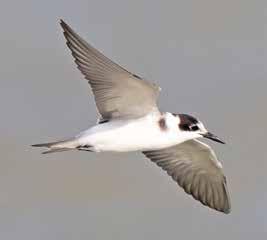
Similarly, autumn passage numbers were also more in line with the previous two years, albeit slightly lower, with records of 53 birds, although some may have been seen at more than one site along the coast. Migration was Black Tern, Sizewell, 26th October Andrew Moon
first noted on August 6th and continued throughout August and September with no real peak, although ten passed Southwold on September 2nd. There was only one record from west Suffolk; a single bird at Lakenheath on September 27th.
Unexpectedly, up to three birds were reported around the Minsmere/Sizewell area on various dates in late October and into November. The final sighting of the year was of an individual feeding at the Sizewell outfall on November 9th. The birds that lingered at Minsmere and Sizewell into November are that month’s first Suffolk records since 2006 when one remained on Orfordness from October 25th until November 7th. The individual which lingered until November 9th at Sizewell is the latest to be recorded in Suffolk since 2000 when the county’s latest-ever was present, also at Sizewell. On December 3rd.
Lowestoft: Aug 19th
Southwold: Aug 6th; ten, Sep 2nd
Minsmere: Aug 17th; Aug 22nd; Sep 12th and 13th; nine, Sep 19th; Sep 20th; two, Sep 27th; Oct 23rd; Oct 27th; two, Oct 29th to Nov 1st; two, Nov 3rd
Sizewell: Aug 11th to 17th; three, Sep 26th; two, Sep 27th to 29th; two Oct 4th; two, Nov 5th to 7th; Nov 8th and 9th
Thorpeness: Aug 10th; Aug 31st
Orford: Aug 30th
Hollesley Marshes: two, Aug 6th
Bawdsey: Sep 27th
Landguard: Aug 12th; Aug 26th and 27th; three, Aug 28th
Lakenheath Fen: Sep 27th
GREAT SKUA Stercorarius skua
Fairly common passage migrant. A few overwinter. Red list (from Amber list 2024).
A depressingly-poor year for this species, which is based on the data received, saw this species remarkably as the least numerous of all four of the skua species off our coast in 2023. The effects of avian influenza have had a devastating impact on this species on its breeding grounds, with high mortality of adults and chicks being reflected in the poor passage migration seen off the Suffolk coast. In early 2024, the RSPB published the ‘HPAI Seabird Survey Report’, which stated that Great Skuas had declined in breeding numbers across sites surveyed in Scotland by 76% –this undoubtedly would have had a huge impact on the number of sightings off the Suffolk coast. There were no first winter period or spring sightings.
The first records were of two off Thorpeness, August 31st. September was especially disappointing with only four sightings all coming on the same day, with single birds being seen off Lowestoft, Southwold, Thorpeness and Bawdsey on 17th, which, given the scarcity of records, could potentially all relate to the same bird. In October most sightings were also grouped in a short window of time with three off Thorpeness, two north off Minsmere Sluice and a singleton off Lowestoft all on 16th. The following day, singletons were noted off Covehithe, Southwold and Minsmere and the final records for the month involved singletons off Southwold, Felixstowe Ferry (north) and Landguard (north), 18th. In November, two were off Sizewell, 5th and the final observation of the year was of one off Benacre, December 13th.
POMARINE SKUA Stercorarius pomarinus
Uncommon passage migrant. A few overwinter.
Another quiet year for this species with a poor total of around 20 records and, as with 2022, there were no spring records during 2023.
The first sightings were made in August, with a juvenile south off Minsmere on 6th and singletons off Thorpeness and Felixstowe Ferry, 10th. The only records in September came at opposite ends of the county on the same day with a single bird off Lowestoft Ness and two south off Landguard, 1st.
As the autumn progressed, sightings increased slightly with two dark-phase juveniles south past East Lane, Bawdsey, October 6th and a singleton off Thorpeness, October 8th. At Minsmere
two were seen, October 16th and 17th with another off Landguard, October 17th and 18th and, also on 18th, a dark-phase adult was off Bawdsey and a singleton was recorded at Southwold. Towards the end of the year, one was noted up to 3km away from the coast, flying north at Leiston (J Grant) on November 1st. A juvenile flew south off Slaughden, November 12th and one passed south off Landguard, December 21st.
ARCTIC SKUA Stercorarius parasiticus
Decreasing passage migrant. A few overwinter. Red list.
There was a sole record during the first winter period with one off Dunwich, January 13th and a single April record of one off Lowestoft Ness on 19th.
Apart from a further single record in July, off Landguard on 15th, regular sightings didn’t start until the first week in August, when two were noted off Corton and one off Bawdsey, 3rd and three and five off Lowestoft Ness, 4th and five two days later. Further south, six were off Southwold, 6th. Sightings then ceased for over two weeks but towards the end of the month two were off Landguard, August 24th and a singleton there, 27th.
Sightings during September increased considerably in both terms of frequency and day-counts. The month started very well with 17 noted off both Lowestoft Ness and Minsmere, and nine off Landguard, 1st. The following day, 11 were off Minsmere, four off Lowestoft and two off Landguard. Sightings tailed off until just after mid-month when 11 were seen off Lowestoft, 17th; the same day, 13 were off Thorpeness and four were seen off Bawdsey. Until the end of September, a trickle of low single-figure counts was the norm for most days off our coast.
Regular sightings persisted into October albeit with no double-figure day-counts. Highlights included seven off Thorpeness and five off Lowestoft, 8th. Three were off Thorpeness, 16th and 17th and singletons were off Landguard on 17th. The following day, singletons were seen off Southwold, Minsmere and East Lane, Bawdsey. There were no more sightings in October.
After October most sightings were from the south of the county with a notable count of eight past Landguard, November 2nd and two there, November 4th. Elsewhere, one went north off Sizewell, November 8th and the final record of the year was of two off East Lane, Bawdsey, December 28th.
Landguard’s seawatchers recorded 31 during the period rom July 15th to November 4th.
LONG-TAILED SKUA Stercorarius longicaudus
Uncommon passage migrant.
It was a quieter year than 2022 for this sought-after skua, which is in line with the fortunes of other skua species, with a notable return passage around mid-September; Minsmere was the principal site with seven records. The only multiple sightings came from East Lane, Bawdsey at the start of September, Landguard in mid-September and Thorpeness in early November. All records are as follows;
Minsmere: south, Sep 2nd (J Grant); juv south , 09:44hr, Sep17th (J Grant); juv south,10:33hr, Sep 18th (J Grant); juv south then on sea, 11:40-11:49hr, Sep 19th (J Grant); juv north, 09:20hr, Oct 1st (J Grant); juv south, 07:36hr, Oct 18th (J Grant); juv north, 10:22hr, Oct 21st (J Grant)
Sizewell: north, 08:55hr, Nov 4th (L Woods)
Thorpeness: south, 07:38hrs, Sep 2nd (L Woods); one, Sep 17th (D Thurlow); south, 10:45hr, Sep 18th (J Davies); one, Oct 20th (D Thurlow); two, Nov 4th (S Mayson)
Bawdsey: East Lane, three, Sep 2nd (I Burfield); south, 06:47hr, Sep 17th (S Abbott)
Hollesley Marshes: Sep 2nd (Birdguides)
Landguard: two dark phases north, 14:00hr, Sep 17th
LITTLE AUK Alle alle
Uncommon passage migrant and winter visitor.
The number of sightings rose from 11 records relating to 13 birds in 2022 to 19 records relating to 25 birds. However, it is probable that a significant proportion of the sightings were of the same
birds seen from different locations along the coast and the total number of individuals present was not much higher than in 2022.
The sightings were all in the period from October 8th to December 11th. October 8th is the earliest autumn arrival in Suffolk since 2009 when singles, although conceivably the same bird, were off Slaughden and Thorpeness, October 3rd. All of the 2023 birds were seen offshore apart from one on the Orwell Estuary in Ipswich:
Gorleston: Nov 25th
Lowestoft: Nov 1st; two, Nov 26th
Pakefield: Nov 25th
Kessingland: Nov 26th
Benacre Broad: Nov 1st; two, Nov 26th
Southwold: Nov 26th; three, Dec 7th
Minsmere: Dec 11th
Sizewell: Nov 1st; Nov 4th
Thorpeness: Oct 8th; Oct 16th
Bawdsey: three, Nov 26th
Felixstowe: Nov 26th
Landguard: Nov 1st; Nov 26th
Ipswich: Dec 1st
COMMON GUILLEMOT Uria aalge
Common passage migrant and winter visitor. Amber list.
Around 2600 guillemots were reported in 2023 compared with 1400 in 2022 and 3650 in 2021. As always, there is the possibility that birds on passage may have been seen at more than one location (or may have lingered in the area) and, therefore, could have been counted more than once. The figures include unidentified auks (2178 in 2023, 204 in 2022, 2077 in 2021) as the majority are certain to have been guillemots. The number of reported birds close enough for identification was markedly lower than in the previous two years. Landguard’s highest total was of only nine, January 8th.
Unexpectedly, a juvenile bird first noted off Bawdsey Quay on August 18th lingered on the Deben Estuary, travelling as far upstream as Woodbridge, and was seen at various locations along the river on several dates until September 14th.
The peak counts were on December 7th when approximately 1270 were noted distantly off Southwold and on March 2nd when about 400 flew north past Ness Point, Lowestoft. The monthly totals for the last three years are shown in the table below:
Monthly totals of live Guillemots
RAZORBILL Alca torda
Uncommon passage migrant and winter visitor. Amber list.
There were records of no less than 179 birds for the year. As usual, on the majority of dates only single birds were noted, but there were two exceptionally high counts off Southwold; 55 on December 7th and 35 on September 12th which included groups of 11, ten and eight drifting south on the sea. Away from the coast, one bird lingered on the Orwell Estuary in the Wherstead/ Freston area from December 22nd to 24th. This is the second consecutive year that this auk has been recorded on the Orwell Estuary.
The birds in July were moving south offshore from Thorpeness on July 1st and 2nd. These
are the first in that month in Suffolk since 2017 when one was photographed on the sea off Lowestoft, 9th.
The monthly totals for the last three years are shown in the table below:
Monthly totals of live Razorbills
The table below shows the variability in the number of sightings each year:
Totals of live Razorbills reported 2014-2023
This year’s impressive total of 179 Razorbills off Suffolk is the county’s highest annual total since the unprecedented events of 2008 which witnessed a record total of 341 off our coast. In 2008, January was the peak month with 305 recorded which included 208 off Lowestoft, 13th. A quick glance through Norfolk Bird and Mammal Reports reveals that of totals of Razorbills off Norfolk are consistently higher than those off Suffolk. Four-figure totals are not unusual e.g. 1000 off Sheringham, October 21st 2021.
ATLANTIC PUFFIN Fratercula arctica
Scarce passage migrant. Red list.
There were seven records in 2023, the same total as in the previous year. All sightings were of individuals with little chance of double counting:
Kessingland: Nov 26th
Benacre Broad: Nov 28th
Southwold: Jan 7th; Aug 22nd; Sep 24th; Dec 7th
Bawdsey: Sep 28th
Totals of live Puffins reported 2014-2023:
2022 Addition/Correction
Please amend “….north off Thorpeness on 3rd” (Suffolk Birds 2022: 110) to read “….north off Thorpeness on 3rd in 2003”
RED-THROATED DIVER Gavia stellata
Common winter visitor and passage migrant. Red-throated Divers were recorded along the coast during the first three months of the year. The largest flocks were:
Thorpeness: 834 south, Jan 15th; 426, Mar 4th; 2047 (2015 north, 32, south), Mar 5th (D Thurlow)
Slaughden: 250, Jan 21st
Shingle Street: 120 north, Mar 19th
A single bird at Sizewell on July 23rd was the only summer record received.
Birds began arriving back in August with 50 on the sea at Slaughden on 8th. Few double-figure counts were received in the autumn or early winter period. As with Black-throated and Great Northern there was a single Red-throated Diver in Lake Lothing, Lowestoft from December 2nd to 17th.
BLACK-THROATED DIVER Gavia arctica
Common, but declining, winter visitor and passage migrant. Amber list.
Lake Lothing and the Orwell Estuary between Freston and the Wherstead Strand were the two sites where birders could get their year ticks for this species (same as for Great Northern Diver below).
Lowestoft: Lake Lothing, Dec 1st to 17th
Southwold: on sea with Red-throated Divers, Oct 9th
Dunwich: Feb 17th; Nov 3rd; Nov 23rd
Minsmere: two, Oct 5th
Landguard: Apr 27th
Orwell Estuary: between Wherstead Strand and Freston, Dec 3rd to 26th
GREAT NORTHERN DIVER Gavia immer
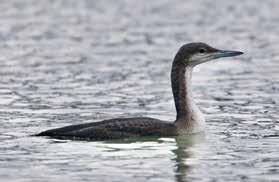
Uncommon winter visitor and passage migrant. Amber list. All of the submitted birds are listed below. There was a long-staying bird in Lake Lothing (and adjacent waters), through most of November and December:
Lowestoft: Ness Point, Mar 4th; south, Nov 3rd; Lake Lothing, Nov 11th to Dec 23rd and Hamilton Dock, Dec 31st
Kessingland: Nov 5th
Benacre: Nov 21st
Southwold: south, Sep 24th
Walberswick: Dec 16th
Minsmere: Nov 9th
Bawdsey: East Lane, south, Nov 3rd; south, Nov 5th
Landguard: Jan 12th; Feb 9th; Mar 9th; Nov 5th; two, Nov 8th; Nov 22nd
Deben Estuary: between Waldringfield and Ramsholt, Jan 1st
Orwell Estuary: between Wherstead and Woolverstone, Jan 1st; Nov 19th to Dec 29th, with two from Nov 20th, three, Dec 23rd and four Dec 29th
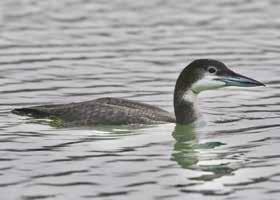
EUROPEAN STORM PETREL Hydrobates pelagicus.
Rare passage migrant. Amber list
Minsmere: north, 16:55hr, Oct 17th (R Harvey)
This highly – pelagic species was reported regularly off Suffolk up to, and including, 2008. However, since the latter year, the only sightings have been in 2017, 2019, 2022 and 2023.
LEACH’S STORM PETREL Hydrobates leucorhoa.
Scarce passage migrant. Red list (from Amber list 2021).
From a Suffolk perspective, an excellent year for this petrel. Based upon the timings of the
Black-throated Diver, Mutford Lock, 16th December
Peter Ransome
Great Northern Diver, Mutford Lock, 2nd December
Peter Ransome
observations, it seems likely that the monthly totals are of at least three in October and four in November. The total of seven makes it the best year for Suffolk since 2016, when also seven were seen. The year’s sightings are listed below:
Southwold: lingered offshore, then north, 10:55hr, Oct 17th (N Carter, C Darby et al); singles north, 10:45hr and 11:00hr, Nov 4th (D Elliott, M Such)
Minsmere: north, 11:43hr, Oct 17th (P Buckle, J Grant); south, 13:50hr, Nov 8th (I Barthorpe)
Thorpeness: north, 07:44hr, Oct 17th (S Mayson)
Slaughden: north 12:40hr, Nov 4th (J Davies)
Orfordness: offshore, 13:59hr, Nov 4th (G Grieco et al)
Bawdsey: East Lane, north, 13:58hr, Oct 17th (S Abbott, E Marsh); East Lane, two, Nov 4th (C Shaw)
Leach’s Storm Petrel has been recorded off the Suffolk coast in every year so far this century, with the highest annual total being of up to 40 in 2003. The last year with no reports is 1999.
NORTHERN
FULMAR Fulmarus glacialis.
Declining passage migrant. Formerly bred. Amber list.
There were 58 reports from the northeast recording area and 28 from the southeast recording area (overall total of 576 reports of 2021). As in 2022, there were sightings in all months except November and December.
The majority of reports related to one or sometimes, two birds. The only double-figure counts this year were from Lowestoft with 45 north between 07:00hr and 08:15hr on February 25th and 13 north on March 2nd. The next-highest total involved eight north off Thorpeness, March 4th.
As we have come to expect, the majority of reports from the southeast were from Landguard with singles on 18 dates during the period from March 8th to June 9th and two on April 23rd and May 14th.
The only record away from the immediate vicinity of the coast involved one which flew inland over Banters Barn Farm, Boyton Marshes RSPB, June 2nd (L G Woods).
CORY’S SHEARWATER Calonectris borealis.
Rare autumn passage migrant.
Landguard’s first record of this large shearwater since 2011, involved a single bird flying north offshore on a typical date for this species:
Landguard: north, Sep 17th (W J Brame, B Mackie, C Day)
This is the site’s fifth record involving six birds including four in 2003, in which year up to 22 were recorded off the Suffolk coast.
SOOTY SHEARWATER Ardenna grisea.
Uncommon passage migrant, principally in autumn.
There were no reported sightings until September 2nd when single birds flew north off Minsmere and Lowestoft.
Most sightings this year occurred in September with totals peaking on 17th when there were 30 north off Lowestoft (highest single-site day-total in Suffolk since September 24th 2008 when 54 flew north, also off Lowestoft), 14 north off Southwold and about ten north off Thorpeness.
Only 12 records were received from the southeast with no more than two on any one day off Bawdsey and Felixstowe Ferry on three dates in September. Landguard’s only record involved one heading north on October 21st.
November records involved singles off Lowestoft, 5th; Bawdsey, 22nd and Southwold, 21st and 26th.
MANX SHEARWATER Puffinus puffinus.
Uncommon passage migrant. Amber list.
A slightly better year than in 2022, with 23 reports of Britain’s commonest shearwater (only ten in 2022).
There were no spring records. The first sighting of the “autumn” occurred on July 1st when three flew north off Thorpeness and four there, also north, the next day. The only other site to report this species in July was Southwold with five south on 15th and two north on 24th.
The only sightings in August were off Corton (one on 3rd) and Southwold (four on both 3rd and 6th). Although the number of sightings peaked in September, there were no more than two seen on any one date off Lowestoft, Minsmere and Southwold. The year’s final sightings involved singles (perhaps the same bird) off Minsmere and Southwold, October 18th.
The only reports from the southeast recording area involved singles off Landguard, September 20th and East Lane, Bawdsey, October 6th.
BALEARIC SHEARWATER Puffinus mauretanicus.
Rare, but nearly annual, passage migrant. Critically endangered. Red list.
Dates of occurrence, timings of observation and direction of travel indicated that ten Balearic Shearwaters were noted off Suffolk’s coast this year, the same total as in 2020. Suffolk’s highest annual total of this Mediterranean shearwater is 14 in 2002, a record-breaking year for pelagic species off the Suffolk coast.
This year’s sightings are as follows:
Southwold: north, 09:20hr, Sep 17th (A Rafinski, T Rafinski, D F Walsh et al); north, 09:30hr, Sep 17th (A Rafinski, T Rafinski, D F Walsh et al); two south, 15:21hr, Sep 19th (B J Small); south, 07:55hrs, Sep 25th (P R Kennerley, B. Wallace et al); north, 08:23hr, Sep 28th (B J Small)
Minsmere: north, 09:20hr, Sept 17th (R H Harvey, R M Harvey, M Cartwright) – same bird as off Southwold, 09:30hr; north, 10:35hr, Sept 17th (R Harvey, R M Harvey, M Cartwright); north, 07:54hr, Sept 28th (R Drew, J H Grant, A Moon) – same bird as off Southwold, 08:23hr
Thorpeness: north, 08:56hr, Sep 17th (D Bradnum, G Grieco, D Pearsons et al) – same bird as off Southwold, 09:20hr.
Bawdsey: East Lane, two south, 08:05hr, Sep 26th (S Abbott)
Felixstowe Ferry: south, 09:02hr, Sep 20th (P J Holmes)
WHITE STORK Ciconia ciconia
Scarce passage migrant.
For some years there has been a free flying flock of this species just north of Lakenheath in south Norfolk so records in West Suffolk have to be treated with some caution as to their provenance. However, in 2023 it seems that the records listed below do not include birds from this collection. Some of the records listed refer to the same bird; all are of single birds.
Carlton Marshes: Apr 14th (Birdguides)
Kessingland/Benacre: noted regularly, Mar 17th to 10th, including sightings on Churchfarm
Marshes, Benacre and Kessingland Level (A Moon et al.) – this bird had been ringed in The Netherlands and bore a black Darvic ring.
Walberswick: Mar 19th (C Buttle), same as at Benacre, Kessingland and Minsmere
Minsmere RSPB: Mar 19th (A Moon) seen flying towards Dunwich Heath and dropping over the ridge; same as at Benacre; Kessingland and Walberswick, Apr 7th, circling overhead (J Grant)
Lakenheath Fen RSPB: Apr 12th, and birds of unknown origin circling over May 11th and July 29th (all RSPB).
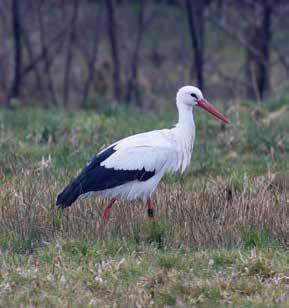
Brandon: circling over Little Ouse, Apr 13th (J White Stork, Kessingland, 17th March
Darby
Chris
Heywood), presumably the same as the first Lakenheath bird.
Cavenham Heath NNR: Apr 23rd (B Betts)
Mildenhall: Apr 23rd (Birdguides), presumably the same as Cavenham Heath bird
BLACK STORK Ciconia nigra
Very rare visitor.
Two records in 2023 have been accepted for the county: Butley: presumed juvenile, Aug 9th (G Riley)
Woodbridge: 1CY+, Aug 20th (S Mayson)
These are the 11th and 12th Black Storks to be recorded in Suffolk so far this century.
NORTHERN GANNET Morus bassanus
Common passage migrant. Amber list.
Numbers followed a similar pattern to that of recent years. All records refer to birds flying north or south along the coast.
A few were seen in January (mostly off Lowestoft and Thorpeness) with a maximum of 17 on January 29th at Thorpeness. Numbers picked up from mid-February with a peak of 213 off Sizewell on 17th, 210 off Lowestoft on 26th and 139 off Thorpeness on 18th, and then nine counts of over 100 in March (peak 723 off Lowestoft on 11th). Numbers then trailed off through April, May and June although a few birds were seen throughout these three months.
July and, especially August saw a few more and the highest count was 73 off Lowestoft on August 23rd. Early September produced three counts of over 100 (peak 196 off Minsmere on 2nd) and into October with six counts over 100 (peak 319 off Southwold on 21st). Totals dropped off again in November apart from a count of 334 off Southwold on 12th, and, in December, there were just a few low double-figure counts.
There were no inland records.
GREAT CORMORANT
Phalacrocorax
carbo
Common winter visitor and passage migrant. Has bred since 1998.
The only record specifically noting breeding is of 12 pairs at Botany Marshes, Snape Wetlands RSPB from where seven birds fledged – this species first bred at Snape Wetlands in 2022.
Roosting or passage birds were recorded throughout the year. January saw 12 counts of 100+ with maxima of 700 on the tip of Orfordness opposite Hollesley Marshes on 31st and 650 there on 9th. February saw much higher counts with maxima of 2932 on Havergate Island on 19th, 2260 from the north and 230 from the south past Landguard on 3rd, 1000 at Boyton Marshes on 28th and 600 at Felixstowe Ferry on both 25th and 26th. March witnessed 3500 offshore at Landguard (and 94 flying out of the Orwell) on 24th, c3000 at Ness Pont, Lowestoft on 1st and 1502 there on 7th, 1405 on Havergate Island on 12th and 914 off Thorpeness on 12th. Numbers of records and of birds were then very low until October; apart from 200 at Boyton Marshes on Apr 8th, there were only two counts of more than 50 with the majority less than 20.
Numbers picked up substantially in October with 1022 off Ness Point, Lowestoft on 23rd and 670 on Havergate Island on 28th. November and December produced regular counts of over 100 with the maxima being 3000 in from the north at Landguard on November 10th, 1055 out, 1194 in from the north and 1000 going north at Landguard on November 30th, 1251 (1213 flying south) off Sizewell on November 8th, and 950 Hollesley Marshes on December 20th.
As usual, the majority of records came from the coast but there were some inland with 42+ at Lakenheath Fen on February 3rd and 38 at Livermere Lake and 35 at Lackford Lakes, both on August 18th, being the highest.
2022 Correction
Please amend, Havergate, November 11th (Suffolk Birds 2022: 115) to read 1000, Havergate, November 11th.
Ringed birds noted by P Kennerley on Havergate Island on March 12th
O(BAN)//m – Banded on May 14th 2008 at Abberton Reservoir, Essex (5247926) Resighted at Ynyslas, Ceredigion, on December 9th 2010 and Havergate on March 19th 2019
B(5R4)//m – Banded on June 15th 2017 at Insel Heuwiese, Vorpommern-Rügen, Mecklenburg-Vorpommern, 54°26’00”N 13°07’00”E, Germany (DEH UA 4455) Resighted at Ijmuiden, Netherlands, on May 28th 2018, and previously seen at Havergate on March 3rd 2019, November 4th 2020 and December 1st 2022.
EUROPEAN SHAG Phalacrocorax aristotelis
Uncommon winter visitor and passage migrant. Amber list (from Red list 2024).
Records were few and far between in January involving three at Minsmere on 15th, two at Ness Point, Lowestoft on 1st and a few singles elsewhere along the coast. There were only two records in February and one in each of March and April. There were then no records until August 19th (off Southwold), and three records in September, the last being of four birds off Thorpeness on 29th.
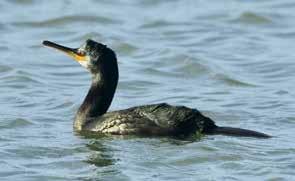
As usual, numbers and records picked up in October with several single birds. The 23rd produced five first-winter birds off Lowestoft, three off Minsmere and three off Landguard, another three off Lowestoft on 30th and three off Minsmere on 31st. Throughout November and December there were several records of single birds with two seen in various places around Lowestoft in the first week of November. There were no inland records.
GLOSSY IBIS Plegadis falcinellus
Scarce but increasing visitor.
As is becoming quite regular there were many records of this species, some of which stayed for a while. Some of these probably moved around a bit too so it is very uncertain how many individual birds were involved overall.
It has been suggested it will perhaps not be long before this species breeds in the county and an observation of two birds seen in the Spoonbill colony on Havergate Island on August 8th suggests it might be sooner rather than later. The birds were seen in courtship and stick playing. However, this was just a single day observation. Display wasn’t just seen at Havergate, but it was also seen at Aldeburgh Marshes on September 22nd (presumably by the same pair).
Aldeburgh Marshes held birds throughout the year. The first was January 28th, then February 19th,
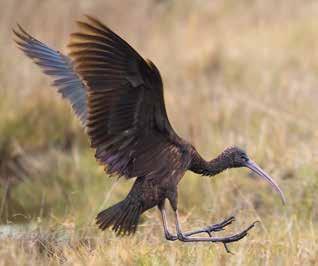
Shag, Hamilton Dock, 2nd February Peter Ransome
Glossy Ibis, Slaughden, 4th March
John Richardson
20th and 27th, March 4th, April 22nd and 23rd, May 18th and 20th, June 7th, 11th and 17th.
After this, one or two birds were there from July 20th to 31st, August 10th and 13th and then 20th to 31st, regularly all through September and the first half of October with the last being a single bird on October 16th.
Away from Aldeburgh there were the following records – all of single birds:
Dingle Marshes: Oct 24th
Minsmere: Feb 10th; May 19th, 25th and 27th
North Warren: Nov 23rd
Slaughden: Feb 16th and 20th; Oct 14th
Sudbourne: May 6th
Iken: Feb 3rd; Apr 25th; May 2nd
Boyton Marshes: July 10th; Aug 8th; Oct 29th
Hollesley Marshes: three on Nov 7th, two on Aug 31st and singles on July 18th, Nov 9th and Dec 21st, 24th and 26th
Shingle Street: Oct 24th
King’s Fleet: Sep 4th
The only inland record was of two that landed briefly on the Slough at Lackford Lakes on May 17th.
Britain’s first record of breeding Glossy Ibises involved a pair in Cambridgeshire in 2022.
EURASIAN SPOONBILL Platalea leucorodia
Uncommon summer visitor. Increasingly overwinters. Breeding recommenced in 2019. Amber list. 2023 was the best breeding year yet, in the modern era, with 14 pairs producing 30 fledged young on Havergate Island. As yet they do not seem to have colonised anywhere else in Suffolk but surely it cannot be long now.
Away from the breeding colony the vast majority of records were in the stretch along the coast from around Minsmere south to Hollesley Marshes although birds were recorded from Carlton Marshes down to Landguard and Trimley Marshes. January saw only single birds with the first multiple record, of five, at North Warren on February 19th. A flock of 12 was seen on Havergate Island on March 12th but no other counts of more than four until 12 on June 16th at Hollesley Marshes.
From late June and through July there were regular counts of 10 to 20, some of these noted specifically as including juveniles. August saw a significant increase in numbers in flocks with maxima of 32 counted at Boyton Marshes on 3rd, 34 at Hollesley on 25th and 42 on Havergate late in the month. September and October saw something of a drop-off except for 35+ on Havergate on September 7th, and 23 at Minsmere on October 2nd. A few birds remained throughout November including three off Landguard on November 25th and there were only three records, all of single birds, in December.
Spoonbills were noted off Landguard on seven dates between May 11th and November 25th with a maximum ten south, October 7th.
There was a single inland record: Lakenheath: an adult and an immature seen roosting on Hockwold Washes were seen to fly southwest over Suffolk, Oct 2nd
EURASIAN
BITTERN Botaurus stellaris
Slowly increasing breeding population, scarce resident, passage migrant and winter visitor. Amber list (from Red).
The total number of breeding pairs was again uncertain as several well-known sites did not put in records of their breeding numbers.
Specific breeding records are: Carlton and Oulton Marshes: up to five birds booming, but only one was seen feeding young Benacre Broad: two males heard booming; two nests survived to fledging Walberswick NNR: 11 boomers, one nest
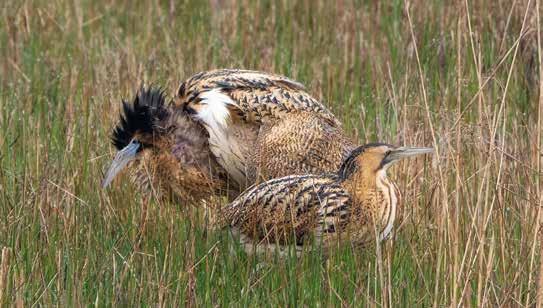
Dingle Marshes: one boomer, no nests
Easton Valley: single boomer, no recorded nests
Hen Reedbeds: two boomers, no confirmation of breeding success
Minsmere: 14 boomers, five confirmed nests, Apr 17th
North Warren: two boomers, one confirmed nest
Iken/Stanny Marshes: boomer noted May 18th and an individual doing a feeding flight July 13th
Snape Marshes: single boomers at Abbey Farm and Botany Marshes
Kings Fleet: pair seen visiting nest with food, July 21st
Lakenheath Fen: 11 booming males with a minimum of six nests
Redgrave: one male booming in spring but no evidence of breeding on Suffolk side of the river Birds were recorded booming also at Westwood Marshes, North Warren, and Easton Valley. Birds were recorded in every month although outside of April to July all records were of single birds. In addition to the above sites, they were recorded all along the coast and at Lackford Lakes on January 26th, and Stowmarket on December 28th.
BLACK-CROWNED NIGHT HERON Nycticorax nycticorax
Rare visitor.
This is the best-ever year for Blackcrowned Night Heron in Suffolk. There were six records although as with some other quite mobile birds it is not clear how many birds were involved. These are:
Lound Lakes: two adults, Apr 24th, photographed, present mid-morning until 19:54hr then flew southeast (A Hickinbotham et al.)
Walpole: May 3rd (Ra Harvey)
North Warren: sound recorded at 21:15hr May 10th; again at 01:57hr July 3rd (both A Rowlands)
Minsmere: flushed from pond early morning then flew NW, May 10th (J Grant)
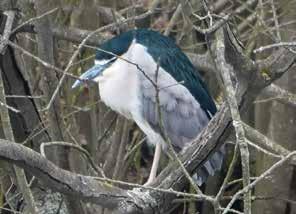
Bittern pair, Minsmere, 1st April
John Richardson
Black-crowned Night Heron, Lound Lakes, 24th April
David Borderick
Lakenheath Fen RSPB: seen in flight and photographed from Joist Fen, 17:21hr May 21st (N Bailey, T Sedgwick)
WESTERN CATTLE EGRET Bulbulcus ibis
Annual visitor in recent years. Amber List.
It can only be a matter of time it seems before this species starts to breed in the county along with Great White Egret. Cattle Egrets first bred in Essex in 2019 and in Norfolk in 2022.
In 2023, however, there was a distinct dearth of records in the whole of the first half of the year although there were five at Carlton Marshes on May 1st. But there were many records throughout the period July to December. As usual, it is uncertain as to how many birds were involved overall.
In the second half of July there were up to four birds at Trimley Marshes and three at Minsmere. Trimley Marshes had a flock of 11 on August 6th but there were only a few other birds that month. From September onwards there were plenty of records of up to five birds. The largest flocks were of up to 20 at Trimley Marshes between 11th and 15th (the highest total ever recorded in Suffolk), and a flock of 13 briefly at Lackford Lakes on 11th. The highest counts in October were of 14 at Trimley Marshes on 31st, 11 at Livermere Lake on 10th, and ten at Shotley Marshes on 29th. There were still 15 at Trimley Marshes on November 5th, 14 were at Loompit Lake on November 3rd, and at Iken seven were seen on November 9th and nine there on 22nd, of which five remained well into December.
Many other sites along the coast recorded the species though usually no more than five birds – several records came from Boyton Marshes, Carlton Marshes and the Sudbourne area for example and some of the sites mentioned specifically above had several other records of smaller numbers. Inland there were several records at Lakenheath Fen but the majority were noted specifically as on Hockwold Washes just on the Norfolk side of the river.
Counts of birds moving south off Landguard involved nine, September 22nd, four, October 8th and one, November 11th – these are the fourth to sixth site records.
SQUACCO HERON Ardeola ralloides
Vagrant
There was a single record this year: Livermere Lake: adult, found 17:20hr, roosted on a small island in the lake, Aug 15th (D E Balmer, P E Wilson et al.)
There have been two previous 21st century records: Minsmere, July 13th 2007, and Felixstowe Ferry, May 18th to 20th 2009, and one 20th Century record in 1912 (shot, Aldeburgh, May 5th –specimen in the Ogilvie Collection in Ipswich Museum).
GREY HERON Ardea cinerea
Common resident, winter visitor and passage migrant.
The BTO Heronry Census recorded a minimum of 62 nests at eight sites in Suffolk in 2023. However, there are certainly some other colonies which are not counted regularly (some because access permission cannot be obtained) so these figures should be taken as minima. Also, there was no information as to how many young were produced from each.
Away from the breeding colonies, birds were recorded throughout the Grey Heron, Falkenham Peter Lakey
year all over the county wherever there is water. The considerable majority of records sent in were of single figures. The highest counts were of 38 at Kessingland on October 8th, 24 on the Orwell Estuary at Freston on February 13th, 17 at Hollesley Marshes (but 13 of these were noted as flying over) also on October 8th and 15 at Freston on February 19th. There eight more counts of ten or more all along coastal marsh areas. There were a few records which specifically noted movements, for example nine flew in off the sea at Corton, September 28th and six came in off the sea at Lowestoft, again October 8th (see Hollesley above). Landguard reported seven spring birds and a total of 23 noted in the autumn with a maximum of five going southwest, August 8th.
PURPLE HERON Ardea purpurea
Scarce passage migrant.
Three birds were found in the county in 2023, two of which stayed for several days and were seen by several observers.
Trimley Marshes: adult, Apr 29th, then seen daily until May 5th and then May 13th, 14th and 18th (D Wonfor et al.)
Minsmere: adult, May 26th to June 3rd seen regularly over main reedbed (D and M Carter et al.); firstsummer bird (so different from the earlier one) June 13th to 15th (I Salkeld et al.).
This year’s total of seven is the highest annual figure since 1973 when nine were recorded.
GREAT (WHITE) EGRET
Ardea alba
Uncommon, but increasing, visitor. Amber list.
Records of this species were received for every month with no very obvious patterns. As expected, the majority were along the coast although there was almost invariably at least one visible at Lakenheath Fen throughout; however, it must be noted that most of these latter were actually seen just across the river on the Norfolk side on Hockwold Washes. It seems that almost every wetland area in the county will have recorded at least one and many of them had several records scattered through the year. Birds in breeding plumage were recorded in suitable habitat at two sites.
The highest counts of the year were at Fritton Decoy/Belton Wood with 25 roosting on March 5th (the highest total ever recorded in Suffolk), following 24 there on March 3rd and 21 on February 5th. Lakenheath Fen (but actually Hockwold Washes – see above) held 24 on September 22nd and 20 on September 17th and several more counts of more than ten.
It seems inevitable that Great Egret will breed in the county in the near future with birds being seen in breeding plumage in suitable habitat at two sites.
Great Egret first bred in Norfolk in 2017.
LITTLE EGRET Egretta garzetta
Locally common and increasing resident and passage migrant.
Most of the breeding birds are in Grey Heron colonies. Overall, 54 nests were counted over six sites, two of which were noted as new sites for the species in 2023. No overall figures for numbers fledging were received but one site noted a minimum of 42 young from 25 nests. These figures compare with previous years as: 2022 – 36 nests in four sites; 2021 – 45 in six, 2020 – 45 in five, 2019 – 60 in nine, 2018 – 53 in nine, 2017 – 56 in eight, 2016 – 42 in six, 2015 – 58 in eight, 2014 – 64 in seven, 2013 – 37 in seven, 2012 – 43 in eight, 2011 – 36 in five, and 2010 – 37 in four. These must obviously be considered minimum numbers not least as it appears that not every colony was counted every year. However, they give an indication that although the numbers of breeding pairs fluctuate from year to year, the population is overall fairly stable. Away from colonies, birds were seen all over the county wherever there was some water, mainly on lakes but also along stretches of river, even quite narrow stretches, and ditches. The highest counts recorded were of 34 along the Deben at Woodbridge on October 15th (with up to 34 roosting on the Sutton side in the autumn and winter) and of about 30 on Aldeburgh Marshes on September 14th. There were several counts of 20 or more and many more of between ten
and 20. The majority of these high counts were along the coast (Boyton and Carlton Marshes seemingly holding a fair number especially during late July to October) although Lakenheath Fen (as for Great White Egrets most were actually counted on Hockwold Washes across the river in Norfolk) held up to 25 birds, October 9th.
Reports from Landguard were of 45 offshore during the period from April 4th to November 7th, with a peak of five south, July 2nd and 14th.
WESTERN OSPREY Pandion haliaetus
Uncommon passage migrant. Amber list.
It was a reasonable year for this species in Suffolk with a total of 107 reports received in 2023, three fewer than in 2022. Sightings came from 56 sites across the county, 14 more than in 2022. Spring was comparatively quiet with 32 reports from 22 locations; these included six sites in the west of the county and it was here, at Lackford Lakes that the first returning bird was seen on March 23rd. The next reports came from Beccles and Thetford on April 1st but there were just six other April records.
May produced far more sightings, including an individual which flew in off the sea at Corton on 6th and was then logged at three other coastal sites as it headed south. Elsewhere, one lingered for seven days at Hazlewood Marshes (10th to 16th). There were just two June records, over Ipswich, 3rd and at Seafield Bay, Stour Estuary, 16th.
There were 75 reports from the late summer/autumn period, from 34 sites. The earliest returning bird was seen at Westerfield on July 25th but that is the only record for that month and the next reports, from Carlton Marshes and Shottisham, came more than three weeks later on August 15th.
Typically, the majority of sightings were in September and although the larger estuaries all hosted birds on several dates during that month, there was not the same number of lingering birds as there has been in recent years. However, at least one bird was present at Hazlewood Marshes from September 4th until 17th and two were present on September 10th and 11th. The only other report of two birds came from Seafield Bay on the Stour Estuary on August 26th and Orfordness on September 15th.
There were 13 reports in October, including eight involving a bird apparently commuting along the coastal margin between Thorpeness and the Alde Estuary. The last reported sightings were at Iken on November 1st and Brandon on November 5th.
EUROPEAN HONEY BUZZARD
Pernis apivorus
Scarce passage migrant. Last bred in 1922. Amber list.
There were nine accepted records of this species in 2023, the majority photographed by the observer(s). The first record of the year involved a female at Aldeburgh on June 3rd and later that month a male was at Minsmere on 25th. A male and a female were seen at Minsmere in late July; the male was seen displaying but the pair was not seen again. Elsewhere, in July, one flew over Sutton Heath, 30th. The two August records came from the Blyth Estuary and inland at Bury St Edmunds – both were photographed as they flew south. Autumn passage continued into September when two more birds were reported migrating south along the coast at Minsmere and Landguard.
Southwold: photographed flying south over Blyth, 11:20hr Aug 21st (B Small)
Minsmere: male photographed over Island Mere, June 25th (N Loverock); male seen over approach road to the Reserve, 15:35hr July 28th (S O’Donnell); male and female, July 29th – male was photographed and seen displaying to a female over the reedbed late morning before both birds flew west (J H Grant, B J Small et al.); juv south, photographed, Sep 6th (S Fox et al.)
Aldeburgh: female north, the old golf course, June 3rd (I Rowlands)
Sutton Heath: fem photographed, late morning July 30th (J Richardson)
Landguard BO: south, 11:58hr Sep 3rd (W J Brame, N Odin and E W Patrick)
Bury St Edmunds: juv south, photographed, 14:57hr Aug 10th (J Rankin)
EURASIAN SPARROWHAWK Accipiter nisus
Common resident, winter visitor and passage migrant. Amber list (from Green list 2021).
This species continues to be widely reported across the county. BBS results for 2023 showed that the long-term 27-year trend across the UK is still downwards, although the 2022-23 data showed a slight improvement. In Suffolk this species was encountered in just three squares of the 44 surveyed, compared with five in 2022. A total of four individuals was counted, one less than in 2022.
Displaying birds were noted at six sites and breeding confirmed at ten locations across Suffolk. Counts of five or more birds came from Southwold (7), Pipps Ford (6) and North Warren (5).
At Landguard spring passage lasted from March 3rd to May 8th at least, with a maximum of two birds present. Up to two were present from July 27th to the year’s end, with three on August 26th. Finally, one flew south there on September 14th.
At Stonham Aspal one flew into a patio door but flew off apparently unharmed. Elsewhere a female was seen carrying a dead Jackdaw at Great Barton in July. One was seen to fly across the Stour Estuary from Harwich, Essex to Shotley Point Marina on August 13th.
EURASIAN
GOSHAWK Accipiter gentilis
Scarce winter visitor and passage migrant, uncommon resident.
The shocking news that five dead Goshawks had been found ‘dumped’ in The King’s Forest in January highlighted the fact that persecution of this species, and other raptors, still occurs. It is widely accepted that this kind of illegal persecution is limiting the range expansion of this species. Therefore, it is gratifying to be able to report that Goshawk numbers in Suffolk are continuing to rise, and that there was clear evidence in 2023 that the range of this enigmatic species is starting to expand from its core population in Thetford Forest. A total of 21 pairs was known to have nested in Suffolk, a significant increase on the 12 in 2022. Of these, 18 pairs were successful and they fledged a total of 18 young. This number included three off-forest nest-sites in The Brecks and a pair which fledged two young at a confidential location on the coast. In addition, two further pairs were suspected of breeding in the county. It was also a landmark year for the Goshawk ringing project with the 200th chick being ringed.
Away from the usual locations single birds were seen at several sites in early winter and during spring, including one at Upper Hollesley Common during a SBG field meeting in April. There were comparatively few reports of displaying birds, but up to five were observed at a traditional site in Thetford Forest in March.
Sadly, there were two reports of fatalities; one was a bird ringed as a chick in 2010, which was found with a broken neck below a telephone line at Elveden on May 27th, just three days short of its 13th birthday! Another found near the A11 at Thetford is thought to have been struck by a vehicle.
WESTERN MARSH HARRIER
Circus aeruginosus
Fairly common summer visitor and passage migrant. Increasing numbers overwinter. Amber List. It was an exceptionally good year for this species with the highest number of pairs ever being reported across Suffolk. There was a total of 81 confirmed nests and these fledged a minimum of 104 young, the highest number since 2016. The sites with the largest totals of fledged young were Minsmere (16), Westwood Marshes (12) and Lakenheath Fen (11). Confirmation of breeding came from 32 sites, ten more than in 2022 and the highest number on record.
BBS data for 2023 show that the species was seen in three of the 44 tetrads in Suffolk compared with two in 2022. Also, six individuals were seen during the survey, four more than in 2022.
Selected first winter period roost counts:
Breydon Water: seven, Feb 4th
Carlton Marshes: 22, Jan 23rd
North Cove: Castle Marshes, five, Jan 28th
Walberswick NNR: Westwood Marshes, 12, Jan 15th
Dunwich: Dingle Marshes, six, Jan 7th
Minsmere: 26, Jan 20th
Lakenheath Fen: 21, Jan 21st
At Landguard Bird Observatory, spring sightings of single birds were noted on one date in March and two in both April and May.
The table below lists the breeding data for 2023: Site
Carlton Marshes SWT
Castle Marshes SWT
Benacre NNR – Benacre Broad
Benacre NNR – Easton Valley 7
Hen Reedbeds SWT
Westwood Marshes
Dingle Marshes RSPB 1 0
3,3,2 chicks fledged – 6 wing-tagged
3,2 chicks – all wing-tagged
Two pairs fledged two young
No further details
Two pairs fledged two young
Nine pairs fledged 12 young
One pair nested, no young
Minsmere RSPB 11 16 11 pairs nested, two nests failed?
North Warren RSPB
Snape Wetlands, Botany Bay 2 3
Snape Wetlands, Abbey Farm 2 3
One pair fledged two young
Two pairs fledged three young
Two pairs fledged three young Orfordness NNR 4 4
Four pairs fledged at least four young
Boyton Marshes RSPB 1 2 One pair fledged two young
Hollesley Marshes RSPB 1 0 One pair nested, no young
Trimley Marshes SWT 2 3 Two pairs fledged three young
Cornard Mere SWT 1
Lakenheath Fen RSPB
Lackford Lakes SWT
Pair attempted to breed but failed
Nine pairs nested, four failed, 11 young fledged
One of two nests was successful, two young fledged Redgrave and Lopham
Three pairs nested on Suffolk side of reserve, six young fledged
The table below compares the breeding data over the last 20 years and includes details of an additional 16 pairs that nested at eight confidential sites in Suffolk in 2023, fledging 23 young; in addition to these figures below five other pairs were suspected of breeding in 2023 although this was not proven.
Table comparing totals since 2004
*Coverage limited due to Covid-19 restrictions
N.B.: The figures in italics have been updated so may differ from those published in previous reports
In the autumn, records of movements involving single birds came from Landguard Bird Observatory on two dates in late August and one date in September. Singles were also seen on single dates in October, November and December.
Counts involving five or more birds during the second winter period came from the following sites:
Oulton Broad: five, Nov 11th
Carlton Marshes: six, Dec 17th
Walberswick NNR: Westwood Marshes, 11, Nov 20th
Minsmere: 20, Nov 19th
Lakenheath Fen: 24, Dec 5th
Observations of wing-tagged birds came from several sites but only two with alphanumeric codes were noted. Specific details of sightings of tagged birds in Suffolk are available on various websites, including the North West Norfolk Ringing Group website which lists records of birds tagged in NW Norfolk and NE Suffolk: nwnrg.co.uk
Boyton Marshes: with orange wing tags, Nov 3rd; juvenile female with Red wing tags ‘K6’, Sep 21st – first confirmed sighting since it was tagged at Carlton Marshes in June 2023
Mickle Mere: female with orange tags ‘L9’, Feb 2nd, ringed in June 2020 at Somerleyton
Additional reports of wing-tagged birds with no alpha-numerical codes:
Carlton Marshes: adult female with Orange tags, Feb 28th and June 24th
Snape Wetlands: female with Red wing tags on Jan 29th and Feb 15th
Hollesley Marshes: female with Orange wing tags, Dec 20th
Cavenham: dark juvenile with Orange tag on left wing, Sep 18th
Ampton: male with Green tags on left wing, Aug 17th
Mickle Mere: female with Orange wing-tags, June 6th
Lakenheath Fen: female with Orange wing-tags, June 10th
Despite the encouraging figures for 2023, productivity overall was comparatively low at 1.28 young/nest. In fact, data show that the number of fledged young per nest has been below two every year since 2016. Prior to this, the breeding data are incomplete, but as a comparison, in 2004 and in 2005 productivity was 2.43 and 2.63 respectively. Breeding success obviously varies from year to year, but this appears to be somewhat of an anomaly given that the number of pairs is at an all-time high.
C Gregory
Of interest:
Combined counts from up to 20 Marsh Harrier roosting sites in Norfolk in 2022 peaked at 247 in January and 283 in November (Norfolk Bird and Mammal Report 2022: 137)
HEN HARRIER Circus cyaneus
Scarce winter visitor and passage migrant. Red List.
Following the relative lack of birds last year, 2023 saw a marked improvement in the number of reports and birds overwintering in Suffolk, particularly during the second winter period. There was a total of 157 reports compared with 53 in 2022, although this total is still down on 173 in 2021. An estimated 18 birds (6 and 12) overwintered over both winter periods, the highest since 2017 when an estimated 19 were present. Reports came from a total of 27 sites, the majority of these on the coastal margins. Unexpectedly, far more birds were reported during the second winter period.
The disappointingly-low number of wintering birds at the end of 2022 continued into 2023, with just 25 reports between January and April. These included 23 reports from the northeast and two reports from the west. There were no reports from the southeast of the county. It is likely that six birds were present in the county during the first winter period. These included a long-staying ringtail at Carlton Marshes between January 9th and February 19th. Elsewhere, males were seen at Fritton and Lakenheath Fen.
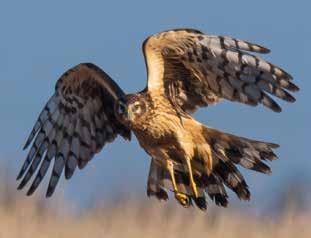
Spring sightings included a first-summer bird at Minsmere on May 22nd and what was presumably the same bird was seen at Yoxford three days later. In late summer one was seen at Carlton Marshes on July 26th – this is the first July record in Suffolk since 2017 when one was at East Bergholt, 18th.
The first reports of ‘returning’ birds came from Lowestoft and the Butley River, both on October 15th. The second winter period saw a substantial increase in the number of birds overwintering in the county. Reports suggest 12 birds were present across the county, including males seen at Worlingham, Dingle Marshes, the Boyton/Hollesley area and at Landguard during November; this latter record involved an immature male south on 5th. Up to two males were also present at Carlton Marshes during December. The west of the county hosted more birds than usual,
Hen Harrier, Clare, November
Charles Swan
including two ringtails seen hunting regularly at Clare from early November until the end of the year. In December reports of single ringtails came from Sturmer Mere, Kedington and Timworth and two were seen together near Elmswell.
MONTAGU’S HARRIER Circus pygargus
Uncommon passage migrant. Formerly bred. Red list (from Amber List 2021).
After three blank years there was one accepted report of this increasingly-scarce species in 2023.
Carlton Marshes: ringtail flew towards Mutford/ Kessingland, Apr 30th (J A Brown, A C Easton, M Taylor)
PALLID HARRIER Circus macrourus
Very rare visitor.
There were three accepted records in 2023, all of 2CY males and involving three different birds. These are the fourth, fifth and sixth Suffolk records, the first three having occurred in 1999 (Bramford), 2014 (Minsmere) and 2016 (Lakenheath Fen).
Walberswick: 2CY male, in off sea then inland, photographed, May 6th (J Gearty)
Orfordness: 2CY male, over King’s Marshes and Stoney Ditch, photographed, May 11th (D Crawshaw, K Langley, M Marsh)
Bawdsey: East Lane, 2CY male, photographed, May 7th (C Clark, I Taylor)
HARRIER sp.
Brandon: A small harrier flew southwest into Thetford Forest on May 1st; the long tail and relatively narrow and pointed wings suggested that it was not a Hen Harrier (G Conway)
BLACK-SHOULDERED KITE Elanus caeruleus
New for Suffolk.
With an increasing population spreading northward across Europe, it was only a matter of time before this long-anticipated vagrant visited Britain. The first confirmed sighting in the UK was near Glanmure, Powys, mid-Wales on April 18th 2023. The wanderer then disappeared for almost three months before turning up in the Norfolk Broads on July 17th. On July 20th it then headed south to Suffolk, where it was found by one fortunate observer near Felixstowe Ferry the same evening*. Shortly after it was found it flew a short distance towards King’s Fleet and remained in that area until dusk much to the delight of the gathering crowd of birdwatchers. It eventually roosted at Holmhill Farm and was still there when the first eager observers arrived at dawn the next day. After about an hour it flew to a line of dead trees, from where it occasionally hunted over the surrounding cereal fields giving good, if fairly distant, views. Around mid-morning it flew northeast towards Bawdsey and was eventually lost to sight. Later that day it was seen in the area of St Osyth, Essex and was last reported in the Colne Point area on July 22nd.
Craig Holden has written an article detailing the finding of this bird earlier in the report.
*Scrutiny of the plumage on various digital images confirmed it was the same bird as the Hickling Broad/ Horsey individual.
Felixstowe Ferry/ King’s Fleet: C1Y+, July 20th and 21st, photo (C Holden et al.), same as Essex and Norfolk, presumed same as Montgomeryshire
RED KITE Milvus milvus
Increasing winter visitor and passage migrant; increasing breeding population.
It is now ten years since Red Kites started nesting regularly in the county and it is now firmly ensconced in the Suffolk landscape. Reports were received from over 170 parishes in 2023, which equates to about 35% of the total number. BBS data show that this species was encountered in six of the 44 tetrads in Suffolk compared with five in 2022, and seven individuals were seen during the survey, one more than last year.
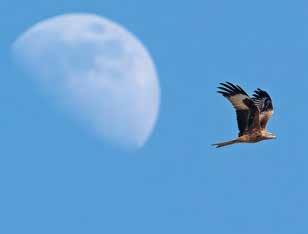
Pre-roost and roost counts came from four sites during the first winter period including a maximum count of 36 at Wetherden on February 4th and 14 at Haughley on January 1st. At Stoke-by-Nayland seven were seen on January 12th and at Ampton the peak count was 71 on January 4th – a new maximum Suffolk total.
Potential spring migrants were noted at Minsmere, where three flew south together on March 19th and at Melton Park, where four flew northeast on April 29th.
The only reports of confirmed breeding came from two sites in the west of the county, but breeding was suspected at eight other sites across Suffolk.
What little autumn passage there was started in September when ‘several’ birds passed over Slaughden on 24th. Earlier that month eight were seen over Mildenhall on 6th.
Winter roost counts from the latter part of the year came from Stoke-by-Nayland where there were nine on December 16th, and from Ampton where numbers peaked at 80 on December 18th – an even higher maximum Suffolk total.
A bird was seen to pluck a live migrating Common Toad from a field near Cavenham on March 1st.
Suffolk’s maximum recorded total prior to 2023 had been 63 at Ampton in mid-December 2021. The above species’ account shows that this 2021 total was exceeded twice in 2023, again at Ampton, with 71 on January 4th and 80 on December 18th. A count of 97 was made at a Norfolk roost in December 2022, during which month counts at seven roosts totalled 276 overall. During the breeding season it was estimated that there were up to 100 pairs of Red Kite in Norfolk (Norfolk Bird and Mammal Report 2022: 139-140).
BLACK
KITE Milvus migrans
Rare passage migrant.
Following the exceptional number of reports of this species in 2022, there were no records submitted in 2023.
WHITE-TAILED EAGLE Haliaeetus albicilla
Rare winter visitor. Increasingly-regular visitor from reintroduction schemes in southern England. Amber list (from Red list 2021). Categories A and E.
It turned out to be another good year for this species; the number of observations has obviously been boosted by wandering released individuals from the Isle of Wight Reintroduction Scheme. During the first winter period a bird released as part of the IOW scheme (G542) was seen in the northeast of the county in late January and on two dates in February. Another seen flying east over Wherstead earlier in January could possibly have been the same bird.
In spring an immature bird was seen over the Blyth Estuary on two dates in April.
Red Kite, Wenhaston, 30th March Andrew Moon
The next sighting was in October when one was seen on two dates at Minsmere and an adult was seen drifting north over Hen Reedbeds.
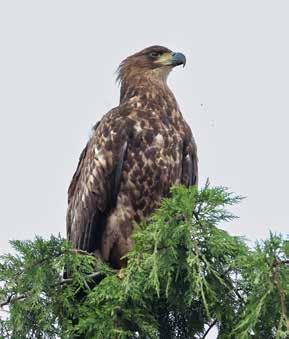
Inland, an immature bird was found between Walsham-le-Willows and Westhorpe on October 21st having apparently been in the area for at least two days. The bird showed well in a field just east of Long Thurlow, Badwell Ash and although initially deemed of ‘unknown origin’, close views revealed that it had rings on both legs. The bird was identified from the code on one ring (WN88) as a 1CY individual originating from The Netherlands or Germany. Having had a close shave with a wind turbine, it spent six weeks in a rehabilitation centre in The Netherlands, where it was colour-ringed before being released on September 29th. It roosted in the area overnight near Long Thurlow, Badwell Ash and then relocated near Wyverstone the next day. On October 31st it was rediscovered about nine km southwest of Wyverstone in a field between Woolpit Green and Drinkstone. It remained in that area until November 6th, before moving a short distance to Buxhall, near Stowmarket. On November 9th it was reported, in flight, near Pakenham church and was seen there again the following day. Almost three weeks later it was found back at Woolpit on November 30th, but did not stay and returned to Pakenham where it was photographed at Mickle Mere on Christmas Day. On Boxing Day, it visited a farm reservoir at Rushbrooke where it was seen on a field camera. The final sighting of the year was at Bradfield Combust on December 29th.
In the north of the county, an immature north over Carlton Marshes on November 17th, was perhaps WN88, which was not observed in central Suffolk between November 10th and 30th.
Number of individuals since 1950:
ROUGH-LEGGED BUZZARD Buteo lagopus
Increasingly scarce winter visitor and passage migrant. Following a blank year in 2022 there was just one accepted record of this species in 2023, involving a bird seen on one date in spring in mid-Suffolk. Elmsett: over at 10:02hr, Apr 7th. (M Garnham)
COMMON BUZZARD
Buteo buteo
Common resident, winter visitor and passage migrant; increasing breeding population. This species has now become a familiar sight in Suffolk, whether it’s soaring over woodland or perched on a roadside telegraph pole. In the BTO BBS the Common Buzzard was encountered in 22 tetrads in Suffolk (50%), one more than last year. A total of 29 individuals was seen compared with 38 in 2022. It was also seen on five out of this year’s 11 Lavenham Railway Walks visits. Spring movements were noted at several locations between mid-March and mid-April,
White-tailed Eagle, Mickle Mere, 25th December
Trevor Goodfellow
including 11 at Carlton Colville on April 5th, at least 14 at Thorpeness on April 15th and 11 at Boyton Marshes on April 4th. Other counts came from Ipswich where ten flew over Christchurch Park on March 15th (see also Fieldnote below), Pipps Ford, Barking, where the highest count was 14 on April 15th and West Stow CP where 13 were counted on March 15th.
Reports of confirmed breeding came from 28 locations across the county.
Autumn passage started in late August when 15 flew northeast at Minsmere on 25th and 32 inland at Southwold the following day. In September, 13 flew northwest over Woodbridge on 6th, 16 were seen at Chelmondiston on 14th, 11 over Mutford on 15th and 13 southeast over Boyton Marshes on 23rd.
Feeding behaviour included one bird seen taking and eating a gull chick on Orfordness on June 7th.
Raptors over Christchurch Park, Ipswich
During a period of only ten minutes on April 17th 2023 there were sightings of two Common Buzzards and singles of Red Kite, Peregrine Falcon and Eurasian Sparrowhawk over Christchurch Park, Ipswich. It is somewhat ironic that there is now a much greater chance of seeing any of these aforementioned species over the park than there is of Common Kestrel of which there were no known site records in 2023.
Brian Macdonald and Philip Murphy
WESTERN BARN OWL Tyto alba
Fairly common resident. Categories A and E.
Sightings were reported from approximately 94 separate localities during 2023, with breeding either confirmed, or thought likely at 21 of these. Judging from the small number of nests that were monitored, this species appears to have experienced mixed fortunes during the breeding season. For example, nests at Bentley, Stutton and Shotley Marsh were reported to have failed, whereas a pair at Sutton Hoo successfully fledged five young. A late brood of three chicks was ringed at Wenhaston on October 4th – perhaps a second attempt?
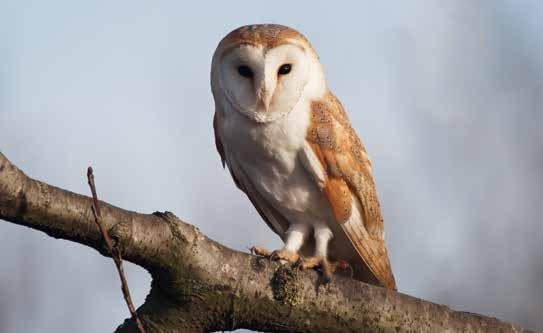
Barn Owl, Bentley, 5th February Liz Cutting
The highest counts received during the year both came from Flatford Mill where five birds were reported on June 30th and July 1st.
One was over Landguard on October 25th.
LITTLE OWL Athene noctua
Fairly common resident.
Records were received from 73 widespread localities (the same total as in 2022). Breeding was confirmed at just five sites – Boyton Marshes, Woodbridge, Stowlangtoft, Hunston and Cavenham Heath – and was thought possible near Walsham-le-Willows. There were no reports from Landguard.
A dead adult was found on August 17th along the B1106 at Fornham St Martin.
LONG-EARED OWL Asio otus
Uncommon winter visitor and passage migrant. Scarce resident.
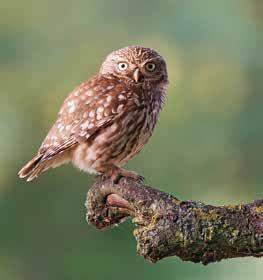
In sharp contrast with 2022 when there were ten breeding pairs confirmed, 2023 was more typical for this species with five pairs noted, about average for the period 2014-23.
Pairs were noted at three sites in the west of the county, but no details were received regarding their success. In the south-east two pairs fledged three and two young respectively.
Outside of the breeding season, one was seen feeding on roadkill at Ampton on March 7th.
SHORT-EARED OWL Asio flammeus
Uncommon winter visitor and passage migrant. Formerly bred. Amber list.
Records were received from 15 sites during the first half of the year, most of which were along the coastal strip and all of which related to either one or two birds. The only reports from the west of the county involved singles at Lakenheath Fen on January 2nd and the disused Gt. Waldingfield airfield on March 21st. One at Shingle Street on May 26th was the latest sighting until birds began returning in August (see below).
The first returning bird was reported from Shingle Street on August 14th with two birds there the following day. Numbers increased from October onwards with a small arrival noted on the coast
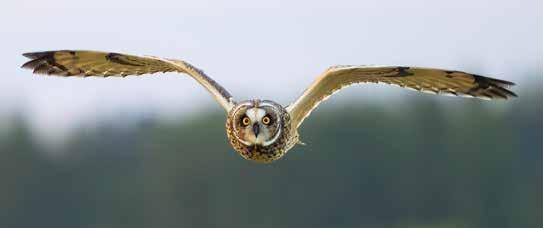
Short-eared Owl, Shingle Street, 15th August John Richardson
Little Owl, Hadleigh, 27th June
Bill Baston
on October 8th the same day as an arrival in Norfolk where “in-off” totals included 50 at Holme, 30 at Cley and 11 at Titchwell (Norfolk Bird News). One seen off Ness Point appeared to ditch onto the sea and one was seen flying in off at Dunwich. Landguard logged a total of 13 birds between October 4th and November 17th, including two birds on November 3rd and three on November 5th. Higher numbers were noted during the second half of the year with records received from at least 27 sites (including four sites in the west). The highest counts involved five at Trimley Marshes, October 25th and four, Boyton Marshes, October 31st with five there on November 10th.
TAWNY OWL Strix aluco
Common resident. Amber list.
A total of 133 sites reported Tawny Owls during 2023 which is broadly in line with the total of 126 sites where birds were reported in 2022. The number of sites reporting breeding season birds dropped, however, from 78 in 2022 to 62 in 2023, as did the number of sites where breeding was confirmed – down to just nine from 18 in 2022. It is hoped that this is simply a reflection of observer effort, rather than a sign of lower actual breeding numbers. There was just one road casualty reported during the year, near Higham, near Hadleigh, on June 9th.
What is presumed to have been the same pair as in 2022 (Suffolk Birds 2022: 129) again bred successfully in Christchurch Park, Ipswich, close to the site’s Westerfield Road entrance; four owlets were first noted on May 18th but they had all apparently dispersed by early June.
EURASIAN HOOPOE Upupa epops
Scarce passage migrant. Categories A and E.
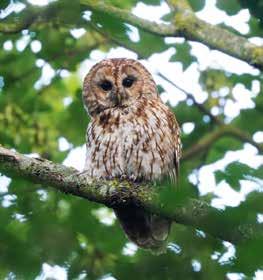
Felixstowe: Westmorland Close, May 6th, photographed, perhaps same as Landguard bird
Felixstowe Docks/Landguard: May 4th (Multiobserved)
Butley: Nov 20th (G Riley)
Rendlesham Forest: Dec 15th, possibly present on other days, photographed (T Baker)
Thetford: BTO Nunnery Lakes, May 2nd (N Moran)
Honington: July 20th to Aug 9th (R H Harvey et al)
Wyverstone: Apr 15th, photographed (P Lewis)
Rattlesden: Apr 19th. Photographed (T Jewers)
Beyton: south over A14, Nov 3rd (C Fulcher)
Cockfield: Apr 22nd (C Upson)
Brockley: May 2nd, but possibly present for several days. Photographed (B Foskett)
An interesting range of sightings and dates. There were clearly two birds in the west of the county during the spring (as two were seen on May 2nd), but did at least one stick around for much of the year and account for the July Honington and November Beyton records? And did both November records and the December record all involve the same bird? We can probably only speculate.
COMMON KINGFISHER
Alcedo atthis
Fairly common resident. Green list (from Amber list 2021).
There was some (anecdotal) evidence of a reduction in numbers during 2023. Birds were reported from a total of 95 sites (compared with approximately 126 in 2022), of which just
Tawny Owl, Layham, 7th July
Bill Baston
27 related to breeding season records (48 in 2022). Probable or confirmed breeding was reported from seven sites. Although these figures may be a result of reduced recording effort, it does appear to be the case that some birds are vacating sections of rivers where more extreme weather conditions are causing rivers to run at high levels (especially at times of the year that this would not previously have been expected).
The highest counts of the year came from Lake Lothing, Lowestoft, where a total of eight birds was recorded on December 2nd. Elsewhere, six were present along the River Deben between Kyson Point and Woodbridge (including four at the Deben Yacht Club) on January 23rd, whilst five were at Lakenheath Fen on February 21st and five at Minsmere on October 11th.
EUROPEAN BEE-EATER Merops apiaster
Scarce, but usually annual, passage migrant.
Lowestoft: north, June 16th (A Wren)
Beccles: five south, May 24th (J Burgess)
Southwold: May 14th (W Hancock)
Westleton: two south, June 14th (P Green)
Sizewell: five south, June 16th (T Stopher)
North Warren: June 11th; two north, June 16th (J Davies)
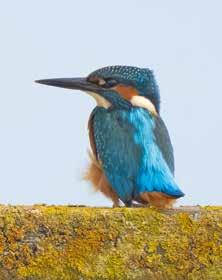
Aldeburgh: two southwest over Golf Course, June 16th (I Rowlands); three north, July 26th (J Davies)
Butley/Chillesford: flock of 14 birds seen over Butley village, May 21st. Roosted in a small wood in the adjacent parish of Chillesford where they were seen leaving roost on the morning of May 22nd (A Clements et al.)
Felixstowe: Peewit Hill, four, May 21st (P Oldfield); Aug 20th (C Keeling)
Melton: south over Wilford Bridge, June 11th (C Shaw)
Thorington Street: heard only, July 23rd (E Hutchings)
Following on from the major influx in 2022, there was again a sizeable arrival of birds in 2023. The flock of 14 birds around Butley and Chillesford is particularly noteworthy. Even allowing for duplication, up to 35 Bee-eaters may have been seen in Suffolk in 2023.
EURASIAN WRYNECK
Jynx torquilla
Uncommon passage migrant. Formerly bred.
Easton Bavents: Aug 18th (J Gearty)
Kessingland: Aug 22nd (B Boyle); Sep 1st and 2nd (C A Buttle et al.); Sep 27th to Oct 3rd (multiple observers)
Walberswick: Aug 31st (B J Small)
Minsmere: trapped and ringed, Aug 17th (Waveney Bird Club); Sep 1st and 2nd (J H Grant et al.); different bird, Sep 2nd (M Cartwright et al.)
Landguard: Aug 19th to 21st (multiple observers); trapped and ringed, Sep 2nd
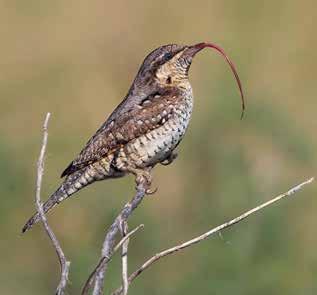
Kingfisher, Minsmere, 14th September
Andrew Moon
Wryneck, Kessingland, 30th October
John Richardson
(LBO); Sep 27th (W J Brame)
There were no spring sightings, the first year since 2008, whilst the autumn produced probably 11 different birds along the coast.
LESSER SPOTTED WOODPECKER Dryobates minor
Scarce resident. Red list.
At an undisclosed site on private land, a pair fledged six young, an exceptional tally. A summary of the other records received is given below. All were in the northwest of the county: Santon Downham: six records between Feb 8th and Apr 7th. All involved single birds, although both sexes were reported
The King’s Forest: male, Jan 1st
Cavenham Heath: several reports between Feb 14th and May 5th. All related to single birds and it is not known whether the same (unsexed) bird was involved
Lackford Lakes: pair seen Mar 3rd; singles reported on four other dates to Apr 21st
Bury St Edmunds: Horringer Court, female, Apr 16th
Whilst it is encouraging to see records from the Lark valley as well as along the Little Ouse, this species does appear to be on the way out as a breeding species in Suffolk.
GREAT SPOTTED WOODPECKER Dendrocopos major
Common resident. Scarce passage migrant.
Early drumming birds were reported from Barton Mere on January 2nd and five different birds at Minsmere on January 23rd (but see also Suffolk Birds 2022 for December drumming birds). Reports were received from approximately 178 localities in 2023 (a small decrease on the 190 reported in 2022). Of these, 101 were during the main breeding season (97 in 2022), including 15 sites where breeding was confirmed. Breeding totals included four pairs at Kiln Farm, Long Melford and three pairs at Christchurch Park in Ipswich. A juvenile was found ‘close to death’ at Stoke-by-Clare on June 30th, but it recovered and was released two days later. During Breeding Bird Survey visits, a total of 41 birds was recorded across 26 of the 44 squares monitored. Landguard logged just a single spring sighting – on April 10th – then singles on 15 dates between June 25th and November 11th, plus two birds on August 22nd and October 8th.
EUROPEAN GREEN WOODPECKER Picus viridis
Common resident.
There was a decrease in the number of sites reporting birds in 2023 – 168 compared with 192 in 2022 – although the number of sites reporting breeding season records increased slightly (86 compared with 83 in 2022). This is likely to be a reflection of observer recording rather than a genuine decrease between the two years. Breeding was confirmed at seven sites, five of which are in the west of the county, including five territories around Ickworth Park. Green Woodpeckers were found in 22 of the 44 (50%) Breeding Bird Survey squares visited in 2023 involving 32 birds. There were just three sightings of birds moving through Landguard involving singles on July 18th, August 4th and August 11th.
COMMON KESTREL Falco tinnunculus
Common but declining resident. Uncommon passage migrant. Amber list.
The Kestrel remains our most frequently-reported bird of prey and is found in large parts of the county in open country, arable land, parks, marshes and woodland edges.
The BTO Breeding Bird Survey (BBS) in 2023 indicated a welcome and surprising rise in the population of the Kestrel in England with the BBS Trend Data showing an increase of 18.59% when compared with 2022 data. However, over the life of the BBS the population of the Kestrel across England has fallen by 26.15%. In Suffolk, the BBS data continue to reflect a fall in numbers with evidence of a continuing decline. Of the 44 x 1km squares surveyed by the BTO in 2023, a count of 12 individuals was recorded (compared with 14 in 2022 and 21 in 2021) with birds found
in only nine of the 44 squares (12 in 2022 and 17 in 2021).
Around the county, RSPB Minsmere held six birds on September 15th and October 1st (J Grant). There were reports of at least four birds seen at several sites across the county with confirmed breeding and fledged youngsters also reported.
Four young birds were seen on Southwold Town Marshes on August 12th. Another four were discovered in a Barn Owl nest box in Pakenham and were ringed on June 11th. A family group of four (possibly five) fledglings was observed at the Great Cornard Country Park on June 19th. RSPB Lakenheath Fen reported six birds on the reserve throughout the year. Meanwhile the Lavenham Bird Club reported sightings of Kestrel on just two of the year’s 11 monthly excursions on the National Trust Lavenham Railway Walks.
There was little evidence of passage migration reported in 2023 although seawatchers at Landguard Bird Observatory noted a single bird ‘in off’ on November 3rd – also singles south, July 13th, September 19th, October 7th and November 3rd and west, October 5th.
RED-FOOTED FALCON Falco vespertinus
Rare visitor
There were two accepted records in 2023: Walberswick NNR: female photographed over the Westwood Marshes reedbed, June 18th (P Smith) Boyton Marshes RSPB: second-calendar-year male photographed while perched before flying south, June 21st (P J Holmes)
MERLIN Falco columbarius
Uncommon winter visitor and passage migrant. Red List.
The first of nine January sightings was of a single bird on New Years Day in the Wickham Market area.
In the north of the county, a bird probably roosted in the Westwood Marshes area within Walberswick NNR and was observed for several minutes hunting low over the reedbed on January 15th. Additional sightings were made of birds at North Warren RSPB on February 6th and 22nd. Sightings continued through the first winter period and into early spring with birds seen on several occasions in the east of the county between Boyton Marshes RSPB and Felixstowe Ferry through February, March and into early April. Singles were noted at Landguard on March 22nd and April 21st.
In the west of the county a bird was considered to have roosted within Joist Fen at Lakenheath Fen RSPB on January 2nd with others seen on USAF Lakenheath, Cavenham Heath and Knettishall Heath CP through the first quarter of the year.
Rarely seen in the county through the summer months, the first of our autumn passage migrants was observed on August 26th flying low over the beach at Shingle Street in a southerly direction. A juvenile bird was found perched upon a shingle ridge at East Lane, Bawdsey on October 26th. Singles were at Landguard on October 4th and November 1st and 3rd.
Another autumn sighting was of presumably the same male at Barton Mere, Great Barton on October 8th and 28th.
A single coastal sighting was reported on December 17th at Walberswick NNR while, inland, birds were recorded in December as follows:
Thetford: Nunnery Lakes, 5th
Great Barton: 26th (possibly same bird as in October)
Lakenheath Fen/Little Ouse Washes: 29th
Across the county, a total of 40 sites yielded 67 sightings for 2023 (27 sites and 51 reports in 2022).
EURASIAN HOBBY Falco subbuteo
Fairly common summer visitor and passage migrant.
The first sighting of this spectacular, fast-flying and elegant falcon in 2023 was recorded at
Lakenheath Fen RSPB on April 5th. Birds continued to arrive through April with migration well underway in early May as evidenced at sites across the county.
The highlights of what appeared to be a strong spring passage migration are as follows:
Carlton Marshes SWT: 11 birds recorded (May 6th).
Minsmere RSPB: ten birds (May 10th) rising to 15 (May 18th)
Snape Wetlands RSPB: Botany Marshes, ten+ birds recorded (May 2nd)
Lakenheath Fen RSPB: 27 birds (Apr 30th) rising to c.40 (May 6th), c.55 (May 10th) and c.70 (May 14th)
The 70 on May 14th at Lakenheath Fen is a new county record total, exceeding the previous record of 66 on May 12th 2019 also at Lakenheath Fen.
The autumn migration began in earnest in August and birds were observed moving through the county throughout September with a handful of stragglers seen in October. The final sightings of the year were recorded at:
Minsmere RSPB: single bird, Oct 22nd
Lakenheath Fen RSPB: two, Oct 14th (RSPB).
Breeding was confirmed at several sites across the county.
There were 293 records of Hobby in 2023 which is almost twice the number of records that were received in 2022 (158). Sightings this year at Landguard involved singles on April 28th and three dates in June. Later on, singles were seen on 11 dates between August 2nd and September 22nd.
FIELD NOTE
In late September 2023 a fledged Hobby was found in a rather dishevelled state in the Upper Hollesley Common area. The bird was small, weak and saturated because of recent heavy rainfall and was undernourished. The parent birds had left the area on their southward migration. The bird was carefully handed in to Peter Merchant – a permitted handler, licensed to handle and rehabilitate Schedule 1 birds. Peter already had another Hobby in his care (an injured bird), and so took the fledgling in with the two birds housed together. The fledgling was overwintered in carefully controlled conditions, where it gradually recovered and gained strength. In late April 2024, the young Hobby, now a strong, healthy immature bird, was ringed and then released at Lakenheath Fen RSPB with an arrival of 30+ Hobby reported.
PEREGRINE FALCON Falco peregrinus
Uncommon but increasing winter visitor and passage migrant.
Breeding recommenced in 2008.
Categories A and E.
There were 249 records received during the year, a large proportion of which (18.4%) was received in January as birds were observed looking to establish territories as they returned to previous nest sites. Immature birds were occasionally seen to be driven away from territories by adult birds in the early part of the year.
Landguard Bird Observatory noted Peregrine on 27 dates through the year with three birds present in early March (3rd and 4th) as prospecting for a possible nest site commenced. There was no successful breeding at Peregrine Falcon, Stoke by Nayland, 1st March
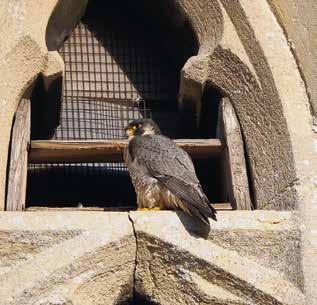
Bill Baston
the site in 2023.
A pair was regularly seen throughout the year in the Sudbourne/Orfordness area although there was no report of breeding in the area received.
Three birds were seen at Levington Creek on April 29th.
In the west of the county a bird was occasionally observed perched on a telecommunications mast at the former RAF Stradishall Airfield (including January 9th as a submitted record); it is thought to be the tenth successive year that this bird has returned. Other sightings received from west Suffolk were of birds seen regularly between Lakenheath Fen, Cavenham Heath and Lackford Lakes.
Breeding was confirmed at seven sites, six of which are in the east of the county, and a total of 14 young fledged successfully (12 in 2022). Sadly, avian flu accounted for all three of the chicks that had hatched at the well-known BT Martlesham/Adastral Park nest site in 2023.
Table shows number of recent successfully fledged young of Peregrine Falcon from nine (now ten) nest sites in Suffolk.
(Data kindly provided by P Merchant)
Key:
N – birds & nest present but breeding efforts not recorded
F – Nest failed (egg(s) did not hatch or young deceased)
0 – Did not nest
FIELD NOTES:
The feeding habits of Peregrine were a feature of several of the reports received, many observers detailing the large range of prey targeted by the largest of our falcons. Woodpigeon and Stock Dove were regular prey items, and observers also cited occasions where Golden Plover, Lapwing, Redshank, Starling, Teal, Wigeon, Black-tailed Godwit, Black-headed Gull, Little Gull and Woodcock had been pursued or captured. Indeed, at one nest site, 14 Woodcock carcasses were recovered as the box was prepared for the new breeding season
On January 23rd an adult female Peregrine observed taking off from the Orwell Bridge was seen to climb to a considerable height prior to stooping onto a Shelduck, knocking the startled duck into the river below. The Shelduck recovered and eventually escaped while the attacker watched from a nearby pylon (D Archer).
On May 5th a Peregrine was observed pursuing a Cormorant on the Boyton Marshes RSPB (P Kennerley).
ROSE-RINGED PARAKEET
Psittacula krameri
Scarce resident. Categories C and E.
Sightings of this often-noisy, grass-green bird were slightly down on the previous few years. There were no sightings during BBS Surveys.
There were two spring records in the northeast of a single bird at Carlton Marshes, April 26th and Minsmere, May 7th. In the autumn single birds were seen at Aldeburgh and Aldringham, October 2nd, Ellough Industrial Estate, Oct 11th and Lowestoft, October 16th.
Parakeets were seen in single figures throughout the year in the southeast. The only exceptions were sightings of three at Kesgrave, March 1st and two there, September 3rd. In the Woodbridge/Martlesham area a single bird was seen on a number of dates between August 24th and December 17th. In considering the dates of these sightings, it is not known if they relate to a single wide-ranging bird or multiple single birds. One was seen on various dates from February 22nd to October 11th in the Felixstowe area and, presumably, the same bird across the river at Bawdsey. A singleton was seen throughout the year in Ipswich at the usual urban and park sites, centred on Christchurch Park and the Old Cemetery.
In the west, single birds were seen at Great Cornard on March 15th, Thetford, July 17th and Kedington, November 26th. The highest count, of four, March 18th came from Fornham St Genevieve, with three being seen nearby at Fornham All Saints, April 16th.
GREAT GREY SHRIKE Lanius excubitor
Scarce passage migrant and winter visitor.
After a single sighting in 2022 there were no sightings of this once-regular visitor; this is the first year with no reports of this shrike since 2000.
LESSER GREY SHRIKE Lanius minor
Very rare visitor.
There have been no sightings of this species in Suffolk now for nine years. The last sighting was at Hollesley on September 6th and 7th 2014.
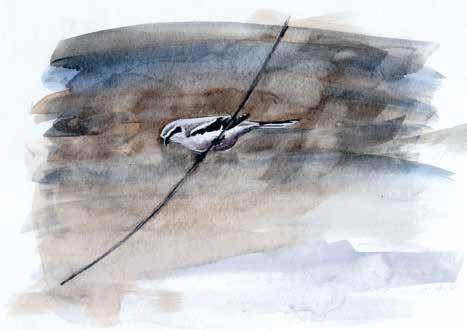
Great Grey Shrike Stewart Sexton
WOODCHAT SHRIKE Lanius senator
Rare visitor.
After a blank year in 2020, and two sightings in 2021 and a blank year in 2022, it was another blank year for this species.
RED-BACKED SHRIKE
Lanius collurio
Scarce passage migrant; formerly bred. Red list.
After 12 in 2020 and three in 2021 and 2022 there were 15 sightings of this hook-billed predator:
Corton: Old Sewage Works, 1st-winter, Aug 19th and 20th (P Ransome et al.)
Lowestoft: North Denes, male, June 3rd (A Easton et al.); 1st-winter, Sep 9th (R Holmes et al.)
Easton Bavents: male, in sheep paddocks and bushes, June 3rd (J Gearty)
Dunwich: male, on heath, June 3rd, photographed M Smith)
Minsmere RSPB: female, June 3rd (P Phillips et al.); female, around sluice and old chapel, June 8th and 9th (J Grant, J Bray et al); two, male and female, sluice area, June 16th, female remaining to 17th
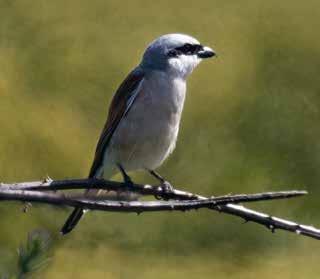
Red-backed Shrike, Kessingland, June
North Warren: female, May 14th (M and P Fenn)
Snape: singing male, June 1st (B Small et al.)
Chris Darby
Landguard Bird Observatory: 1st-winter, Sep 21th to 29th, trapped and ringed on 25th (P Denyer, N Odin et al.)
Cavenham Heath: female, near Temple Bridge, June 11th (D Sparrow)
Lakenheath Warren: male, June 30th (J Parham)
Sudbury: male, Sudbury Water Meadows, June 7th (M Ferris)
Fourteen Red-backed Shrikes is the highest annual total in Suffolk so far this century.
2022 Addition
A Red-backed Shrike male was present at an undisclosed site in Thetford Forest from July 5th to at least September 13th 2022.
EURASIAN GOLDEN ORIOLE Oriolus oriolus
Rare passage migrant. Last bred in 2009. Red List.
After a single sighting in 2019, seven in 2020, four in 2021 and five in 2022, there was a total of 11 accepted records of this elusive much sought-after canopy dweller.
Carlton Marshes SWT: singing male, near Jensen’s Island, May 6th (R Wilton)
Yoxford: Cockfield Hall, singing male, May 21st (M J Deans)
Theberton: Theberton Woods, singing first-summer male, June 2nd and 4th, possibly present from May 20th (V White et al.)
Westleton: Westleton Heath, singing adult male, May 25th (R Drew, Rachel Harvey et al.)
Minsmere RSPB: two, near visitor centre, May 7th (S Howell/Waveney Bird Club); Clay Lane area, singing first-summer male, May 26th intermittently to June 2nd (R Drew et al.)
Melton: Melton Park Woods, first-summer male/female, feeding briefly in oak canopy, June 7th (S Abbott)
Ipswich: singing male, ranging between Brookhill Wood and Ipswich Golf Club, June 2nd (N Sherman et al.)
Euston: first-summer male, singing and cat-calling, June 2nd (N Moran)
Lakenheath Fen RSPB: singing male, Brandon Fen, May 10th (S Harwood et al.); first-summer male/female, June 6th (M Dick)
EURASIAN JAY Garrulus glandarius
Common resident and scarce passage migrant
Most records of this attractive species with its eye-catching electric-blue wing patch were of between one and four birds with a few notable exceptions, especially during its autumn migration.
Jays were seen in 22 of the 44 BBS survey squares visited with 32 individuals noted.
Regular, focussed, recording of Jays at Hoxne resulted in a maximum of eight being seen, April 20th and breeding was confirmed with two pairs being noted in suitable habitat in April and a recently-fledged bird being seen on July 14th.
Five flew steadily south at Middleton, presumably migrating, September 30th. A high count of 17 presumed passage birds was also made at Thorpeness, November 7th with an even higher, 20+ seen there, November 11th.
At Christchurch Park, Ipswich, 15 were recorded September 29th and 12 there October 28th and 14 passed through Trimley Marshes SWT, October 16th.
At Landguard a few passed through the site in autumn with one September 22nd, two, 27th, three, October 8th, one, 16th and one, 22nd.
Regular observations at Brandon Park Heath in the autumn recorded a maximum of 17 Jays, October 8th.
EURASIAN MAGPIE Pica pica
Very common resident.
This unmistakeable, gregarious and mischievous species, was, as usual, reported from many sites across the county.
Magpies were recorded in 29 of the 44 BBS survey squares with 83 individuals counted.
At Carlton Marshes SWT, 40 were recorded March 4th, and 27 were seen leaving a roost site near Aldringham Church, January 2nd. The only other high counts in the northeast came from Redgrave and Lopham Fen SWT, with c.20 on February 19th and Thorpeness Common with c 20 on September 30th and 20+ there on October 31st.
A significant roost of 50 birds was recorded at Combs Lane Water Meadows, Stowmarket on January 7th and 35 were thought to have roosted at allotments near Whitton Church Lane, Ipswich, January 22nd.
At Landguard, Magpies were present all year and five pairs nested, three of which reared three young each and two pairs failed. The numbers of young gradually declined throughout the autumn. The oldest re-trap was from August 2017. There was a spring maximum of 17 on April 9th, and a summer peak of 18, June 21st. The autumn maximum was 13, September 30th.
A flock of 50 flew over Cordy’s Lane, Trimley St Martin on October 10th.
At Withersfield, 27 roosted at Meldham Wash, January 29th and 20 flew from a roost in the centre of Bury St Edmunds, December 16th.
FIELD NOTE : Magpie/bat interaction
Unseasonably mild weather on January 5th 2023 was presumably the principal reason for there being a small bat (probably of one of the three pipistrelle species) in flight over the Upper Arboretum in Christchurch Park, Ipswich. I was not alone in observing this bat – one of this site’s many Magpies had also seen it and, presumably with pernicious intent, commenced pursuing the small mammal. However, the Magpie was in for a short, sharp lesson in aerobatics; despite the bird’s best efforts, its relatively clumsy attacks were evaded by the bat with consummate ease. After about a minute of these activities, the Magpie obviously had to admit defeat and, perhaps somewhat the wiser, decided to leave the bat to its own devices. The bat, evidently none the worse for this brief skirmish, flew off over the Bridleway towards the Lower Arboretum. On page 59 of Volume 8 of BWP, there is reference to a bat being caught in flight by a Magpie, and then consumed by the bird. Philip Murphy
WESTERN JACKDAW Coloeus monedula
Very common resident, winter visitor and passage migrant.
This jaunty, ash-headed corvid was seen in good numbers across the county.
Jackdaws were recorded in 36 of the 44 BBS survey squares with 542 seen. There were many counts of well over 50 birds and good numbers of treble-figure counts.
The Winter Estate Survey at Somerleyton Hall recorded a maximum of 162, March 18th. A roost on Westleton Heath, January, 7th was estimated to contain about 700 Jackdaws. A roost at Aldringham held 340+ Jackdaws, June 19th and 380 were seen at North Warren RSPB, December 16th. At Southwold/Easton Bavents 400 were recorded on July 4th. A group of Jackdaws on Aldeburgh Marshes was seen plucking hair from cows in spring, presumably for nest material. There was good evidence of successful breeding at Hoxne and a maximum of 124 was recorded there on February 4th.
There was a number of three-figure counts in the southeast. The highest of these were 500 adjacent to the River Deben at Melton, February 23rd, 425 at Helmingham Hall and Park, March 2nd and 400, Flatford Mill on October 18th.
At Landguard, in spring, a total of six went north and 43 south, with a total of 35 on site between February 24th and June 15th. The maximum in this period was nine south and three on site, March 24th. In autumn a total of 21 went south with five on site, September 8th to November 10th, with a maximum of seven south, October 31st.
The highest count in the west came from Hopton where 600 were seen, December 15th. Other significant congregations in the area included 300 at Cavenham Heath SSSI, February 6th and 300 at Knettishall Heath SWT, December 12th.
Nordic Jackdaw Coloeus monedula monedula
A Jackdaw showing characteristics of the nominate race was present at Landguard from April 20th to 24th.
ROOK Corvus frugilegus
Very common resident, winter visitor and passage migrant. Amber list.
This sociable member of the crow family was widely reported from sites across the county with a significant number of three figure counts.
BBS records show Rooks in 36 of the 44 survey squares with 639 individuals counted.
At Hinton Lodge, Blythburgh, 850 were seen on June 22nd and 600 were recorded at Southwold/Easton Bavents, July 4th. Positive reports of successful breeding came from 28 sites in the northeast.
Generally, numbers seen were lower in the southeast where most counts were in double figures. Selected exceptions were Boyton Marshes RSPB, 200, March 11th, Hollesley Marshes RSPB, 150, March 13th and Shrubland Hall, Coddenham, 141, March 19th.
At Landguard, in spring, one flew south on February 9th, then a total of one north and 14 south, March 12th to May 1st. The maximum in this period was six south on March 24th. In autumn, one north and six south, September 6th to November 5th with a maximum of two south, September 26th and October 28th.
Evidence of successful breeding came from 20 sites in the southeast recording area.
The highest counts in the county came from the west where eight three-figure counts and three four-figure counts were made. A thousand Rooks were recorded at Cavenham Heath SSSI, June 24th, 1000 at Knettishall Heath SWT, July 2nd and 1200 at Conyer’s Green, Great Barton on December 30th.
Breeding was confirmed at seven sites in the west.
CARRION CROW Corvus corone
Very common resident, winter visitor and passage migrant.
BBS records show Carrion Crows in 39 of the 44 survey squares with 440 individuals counted.
Although generally regarded as the least-sociable corvid, there was a number of treble-figure counts in the northeast including Minsmere RSPB, c100 on November 28th and Benacre Broad, 115, December 1st. Systematic monitoring at Hoxne produced a good range of positive breeding evidence and there were seven other sites where breeding was confirmed in the northeast. A Carrion Crow was seen eating a tern chick on a nesting island at Minsmere despite the presence of 100+ mobbing terns and gulls.
In the southeast there was also a sizeable number of double-figure counts from a range of sites. The highest counts included 150 at Felixstowe Ferry, September 23rd and 135 feeding on mudflats in Holbrook Bay, January 23rd. Other high counts included 90 at Snape Wetlands on January 21st “having fun on frozen ice” and 72 at Trimley Marshes SWT, September 3rd.
In the west, three sites held 100 birds: Lakenheath Fen RSPB, February 21th, Cavenham Heath SSSI, July 18th and Shalford Meadow, Little Cornard, November 7th.
HOODED CROW Corvus cornix
Scarce winter visitor.
After a blank year in 2019, two in 2020, and no records in 2021 and 2022, there was just one sighting.
Thorpeness Common: north towards Sizewell, October 8th (S Mayson, L Woods)
NORTHERN RAVEN Corvus corax
Increasingly common resident and visitor. Breeding recommenced in 2018.
Reports of this wide ranging and relatively new addition to Suffolk avifauna came from 108 sites across the county. Records were mainly of one or two birds with a few notable exceptions. There was good evidence of successful breeding in all three county recording areas suggesting that this is now established as a resident Suffolk species.
In the northeast, records were of one or two birds, except for five flying north over Leiston, July 27th. Breeding was confirmed at one coastal site where a pair successfully raised two young and there was one other confirmation of a “nesting attempt” in this area.
In the southeast the highest count was of six flying around National Grid electricity pylons at Pipps Ford on May 25th; these birds appeared to be a family group of two adults and four juveniles, observed in very active flight, on and off the pylons, swooping down and landing on the ground at times, in what could be described perhaps as “avian play”. Three were seen at Boyton Marshes RSPB, November 18th and four were at two locations in the Holbrook/Stutton area on November 2nd. One was seen from Trimley Marshes SWT, briefly on the Felixstowe Dock lights, August 3rd. Indications of possible breeding were provided from four confidential southeast sites with birds being seen displaying and defending territory.
In the west breeding was confirmed at seven confidential sites and assessed as “probable” at one other.
Four were at Berners Heath, February 8th and “what appeared to be two pairs” around Elveden, February 27th. Ravens were present at Lakenheath Fen RSPB throughout the year with a maximum of four on April 17th.
2022 Correction
For “……last bred in Suffolk in 1870 at Easton” …. (Suffolk Birds 2022:137) ….to read “last bred in Suffolk in 1870 at Euston”
BOHEMIAN WAXWING Bombycilla garrulus
Uncommon irruptive winter visitor and passage migrant.
After one sighting of two birds in 2021 and multiple sightings from 14 sites in 2022, there were sightings from 29 sites. Some of these records will of course relate to roving flocks that probably occurred at more than one site.
Records in the early part of the year:
Carlton Colville: up to five present, around Hollow Grove Way, Jan 8th to Mar 4th (prob from Dec 2022)
Reydon: max four, in and around the village, Jan 1st to Feb 19th (present from Dec 27th 2022)
Southwold: four, Jan 28th (prob same as at Reydon)
Westleton: four, Jan 31st
Minsmere RSPB: Jan 5th
Ipswich: Blanche Street area, between five and eight, Jan 6th to Mar 15th at least (multiobserver)
Lackford Lakes: Feb 2nd
Records of winter visitors:
Lowestoft/Oulton: roving group of up to 15, Nov 6th to 13th; Coastview Drive, 52, Nov 22nd
Southwold Town Marshes: Dec 10th to 12th
Leiston: two, Dec 11th
Minsmere: 30 over, Dec 7th
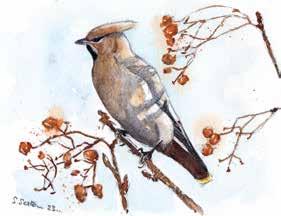
Sizewell: 17, Nov 25th; up to seven, Dec 17th to 24th
Aldeburgh: ten, Church Farm Holiday Park, Dec 8th
North Warren RSPB: max seven, Dec 18th to 24th
Wickham Market: two, Dec 10th (S J Fryett)
Rendlesham: max 19, Dec 10th to 19th (S Abbott, Birdguides/ebird)
Woodbridge: max 19 at various sites in the town, Dec 15th to 24th (multi-observer)
Boyton Marshes RSPB: 15 south, Nov 6th (N Mason)
Hollesley: seven on feeders, (one hit a house window and died), Nov 25th (N Mason, A Shelcott)
Stutton: up to five, Dec 20th to 28th (B Buffery, R. Leavett, M Nowers)
Creeting St Mary: Dec 23rd (Birdguides)
Needham Market: 16, Nov 28th (Birdguides)
Ipswich: Blanche Street area, max 24, returned to this favoured area, Dec 5th to 31st, (multi-observer)
Landguard: south, Nov 6th; 15 passed south, Dec 24th (N Odin)
Lakenheath Fen: around Visitor Centre, Oct 27th; Dec 2nd; Dec 12th (RSPB)
Thetford: Nunnery Lakes Reserve, east, Nov 7th (N Calbrade); Nightingale Way, Nov 22nd (Birdtrack)
Bury St Edmunds: up to five around the town, Nov 29th to Dec 5th (multi-observer)
Mildenhall: Mill Park Gardens, four, Dec 4th (P Whiteman)
Denham: five, Dec 11th (Birdtrack)
Sudbury: Chilton Industrial Estate, Dec 17th (S Read)
COAL TIT Periparus ater
Very common resident and scarce passage migrant.
The BBS survey shows Coal Tits in seven of the 44 survey squares, with 31 individuals counted.
High counts in the northeast came from the Somerleyton Estate Winter Bird Survey with a maximum of 13, February 14th, Fritton Decoy/Belton Woods with 12 on March 3rd and Minsmere with 15 on January 14th. At Hoxne this species was
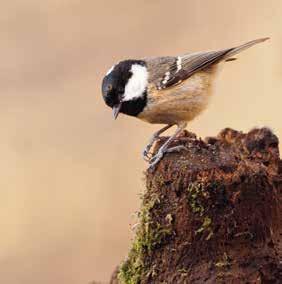
Bohemian Waxwing Stewart Sexton
Coal Tit, West Suffolk, 26th December Alan Chaplin
confirmed as breeding with an adult carrying food, May 16th and a recently-fledged bird seen, June 24th. Eight were recorded at this site, September 10th.
The southeast stronghold of this species, Upper Hollesley Common, recorded 20, January 21st. At nearby Sutton Common, ten were recorded on March 2nd. Breeding was confirmed at Melton Park where one pair bred and fledged two young. At Pipps Ford, two recently-fledged young were seen on May 24th.
Brandon Country Park produced a count of 43, September 9th and a family party of four, confirming breeding there, July 25th.
At Landguard, single wanderers were present on June 7th and 12th.
Continental Coal Tit Periparus ater ater
Scarce passage migrant.
After one in 2020, five “probables” at Landguard in 2021 and one sighting in 2022, there were no confirmed sightings in 2023. There was, however, a Coal Tit sub-species seen at Landguard, “race not determined” on October 1st.
MARSH TIT Poecile palustris
Fairly common, but declining, resident. Red list.
Only two BBS survey squares held any Marsh Tits with two counted.
Despite dwindling numbers of this species being sighted it is still very popular and well reported in small numbers across the county.
In the northeast, counts were limited to one or two birds with a high count of six at North Cove on January 24th and five at South Elmham St Cross, June 20th. A family party of five was seen in Theberton Woods on June 24th. At Walberswick NNR, 12 active birds were seen and heard “calling and singing” on January 20th. Singing birds and pairs in suitable habitat, indicating possible breeding were recorded at Hoxne in spring.
In the southeast reports were of mainly single birds from 20 sites. Breeding was only confirmed at two sites, Pipps Ford, where two recently-fledged birds were seen and Melton Park, where one pair bred and fledged two young.
In the west this species was recorded at 42 sites, with counts of nine coming from both Santon Downham on February 17th and Bradfield Woods SWT, August 17th. Breeding was noted as probable at one site and confirmed at three sites.
WILLOW TIT Poecile montanus
Probably extinct as a resident and very rare passage migrant. Red List.
Suffolk’s last record, in 2020, was at Knettishall Heath, September 14th. It was still present in the Swaffham Forest area in Norfolk in 2022, but possibly only one individual involved in seven separate sightings.
EURASIAN BLUE TIT Cyanistes caeruleus
Very common resident and scarce passage migrant.
This familiar elfin-like species was recorded in 43 of the 44 BBS survey squares with 451 individuals counted.
Reports came from 25 sites in the northeast with a very high total of 100+, recorded at Minsmere RSPB, February 21st. Intensive survey work relating to this species at Hoxne contributed significantly to the 32 confirmed, and possible, breeding records from the northeast area; at this site, a maximum of 85 was present on January 24th. A “blizzard of Blue Tits flew into a garden” at Blackheath, Wenhaston, involving at least 80 birds; a pair nested in a builder’s skip at the same site.
Records came from 64 sites in the southeast. Significant counts included 45 at Helmingham Hall Park, March 2nd, 30 at Flatford Mill, April 8th and 30 “passing through” at Kirton on August 1st.
Possible breeding or confirmed breeding came from seven sites which included eight territories recorded at Martlesham Wilds SWT.
Blue Tits were on site all year at Landguard, but with only one pair nesting. Seven birds from previous years survived the winter with the oldest from July 2019. Spring passage ran from March 6th to April 22nd, with a maximum of eight on March 19th. A new moulting adult turned up on June 22nd. The first juvenile was recorded on June 8th with dispersing juveniles from elsewhere on site from June 10th to July 18th. Autumn passage ran from August 20th to October 31st, with a maximum of 20, October 8th. Up to five were present during November and December but with ten on December 26th.
Reports came from eight sites in the west, with breeding confirmed, or possible, at seven sites. Significant counts included, 70 at Thetford Lodge Farm, Santon Downham on January 29th and 60 in a roving tit flock at Hinderclay on August 18th.
Lackford Lakes CES reported “an above average year” with the 18 juveniles caught being the highest total since 2017.
Blue Tit ATN4495 ringed at Church Street, Chesterton, Cambridgeshire on August 25th 2021 and controlled by K Venus in Barton Mills on February 13th 2023. 537 days 52km SW.
GREAT TIT Parus major
Very common resident and scarce passage migrant.
This adaptable and widespread bird was recorded in 40 of the 44 BBS survey squares with 185 individuals counted.
In the northeast, it was well-recorded with reports from 16 sites, which included a wealth of breeding information. Breeding was confirmed, or possible, at 14 sites. Somerleyton Winter Bird Survey logged a maximum of 15 on January 14th. At Hoxne, 24 singing males were recorded on April 24th with a good number of recently-fledged birds seen in June. There were 30, on feeders and in nearby woodland, at Minsmere on January 30th.
In the Gipping Valley, 18 were recorded on February 4th and the same number at Flatford Mill, April 8th.
This species was at Landguard all year and four pairs nested. Eight birds from previous years survived with the oldest from July 2019. Spring passage at Landguard ran from March 2nd to April 15th with a maximum of six noted. The first juvenile was seen on June 2nd with dispersing juveniles from elsewhere turning up on site from then until July 20th. The maximum present was 12 on June 18th. Autumn passage ran from August 31st until November 10th, with a maximum of 15, October 8th.
At Santon Downham, 40 were recorded on January 18th and 30 at Lakenheath Fen RSPB on February 11th. Breeding was confirmed at seven sites in the west.
EURASIAN
PENDULINE TIT Remiz pendulinus
Rare visitor.
After two in both 2018 and 2019, and one record in 2020 and blank years 2021 and 2022 there were again no sightings of this rare reedbed visitor. This is the third blank year since 2016.
BEARDED (TIT) REEDLING Panurus biarmicus
Uncommon resident.
This beautiful reedbed specialist continues to thrive in Suffolk’s reedbeds, often wandering to smaller areas of reedbed ditches and borrow dykes in the autumn and winter.
Sightings came from 14 sites in the northeast. Three of these held the highest populations with 28 at Carlton Marshes SWT, September 30th, Minsmere, with 25, October 11th and Walberswick NNR, with 20 on May 5th. Breeding records came from twelve sites. The combined totals from the broads at Benacre and Covehithe were eight territories and 30 fledged young.
Records of a sizeable number of wandering parties came from 15 sites throughout the southeast. At Boyton Marshes RSPB, 12 were seen including “five flying south east following the coast”. Breeding was confirmed at five reedbed sites. Ten were present at Felixstowe Ferry on January 19th and 12 were recorded at Iken between St Botolph’s Church and Stanny House Farm on February 28th.
In the west, at Lakenheath Fen RSPB, although populations were not officially monitored, “breeding was confirmed” and 30 were recorded on October 1st. One was at Lackford Lakes SWT, January 20th and two there on April 9th.
WOODLARK Lullula arborea
Fairly common breeding species. Scarce on passage and in winter. Woodlark numbers held up well across the county. There were several records of birds nesting in arable fields – often next to heathland. The highest counts, of territorial males, were again at Minsmere (28) and Sutton and Hollesley Commons (32). In the west, Brandon Park Heath (9), Berner’s Heath (8) and The King’s Forest (22) held good numbers.
The table below show the fortunes of Woodlark on the Sandlings and coastal heaths over the last 25 years. The Woodbridge Airfield data show the recent lack of aircraft!
• Dunwich area includes Forest, Heath, Westleton, Mount Pleasant
There were few records of migrating birds received, although Landguard noted three in the spring and nine in the autumn. Nine were recorded on Upper Hollesley Common on October 9th, there were up to six regularly counted on the Icknield Way in late autumn and winter and ten were present on Westleton Heath on Christmas Day.
In 2021, the only county in Britain with more singing male Woodlarks than Suffolk, was Hampshire with 328 – there were 211 in Suffolk (British Birds November 2023:663)
It is worth noting that from 2023 there is no longer a full annual count in Thetford Forest, so year-on-year comparisons won’t be possible for West Suffolk. For comparisons we will only be able to use the Sandlings figures. Skylark Stewart Sexton
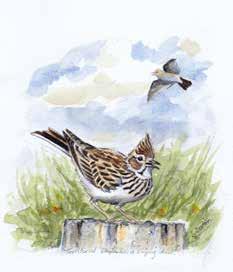
EURASIAN SKYLARK Alauda arvensis
Common, but declining, resident, passage migrant and winter visitor. Red list.
Records of Skylarks in January included an impressive 400 on 8th at Easton, near Wickham Market (110 there on February 13th). There were 45 at Wenhaston on 26th, 100 in fields adjacent to Muntons Maltings in Stowmarket, 15th and 18th and 49 at Great Finborough, 21st. There were 100 at Knettishall Airfield on 6th and 140 nearby in Knettishall on 17th. Seventy-five were at Ixworth on 30th. Most of these sites had good numbers throughout the winter.
Spring passage at Landguard totalled 21 between February 20th and May 24th.
Breeding records were rather scarce as usual, but Skylarks were recorded in 39 of this year’s 44 BBS squares involving 308 birds, the highest BBS total in Suffolk since 2012 (375).
Autumn passage at Landguard, between September 23rd and December 20th, totalled 367 birds (388 in autumn 2022) with a peak day-count of 72 south on October 22nd.
There were plenty of records of large flocks in the autumn. These included 45 at Gunton Warren and 41 at Lowestoft on October 8th, suggesting birds on the move. Forty were at Aldeburgh on October 2nd and more than 60 in the Aldringham area on 14th. Also, in October there were 100 at Sudbourne on 30th, 75 at Boyton Marshes on 6th and 40 at Shingle Street on 9th and 80 there on 22nd. Winter flocks included 100 at Benacre on December 1st, 50 at Thorpeness on November 25th, 60, Barton Mere, December 17th and 130 at Long Melford on 14th.
HORNED (SHORE) LARK Eremophila alpestris
Scarce winter visitor and passage migrant. Amber list.
Birds at Kessingland were mostly seen around the shore pools, as usual. Four were reported from November 2nd until 11th. After that records show either five, six or seven being present up until November 26th. There was a single Shore Lark at Minsmere, mostly seen in the dunes, between October 9th and November 5th.
This is the second consecutive year with no reports from Landguard.
Twenty-five years ago in 1998, there were reports of Shore Larks from at least nine coastal sites in Suffolk with the year’s peak total being 43 in the Kessingland/Covehithe area on November 28th. Fifty years ago, in 1973, there were up to 80 Shore Larks at Minsmere in January.
1998 and 1973 Bird Reports.
SAND MARTIN Riparia riparia
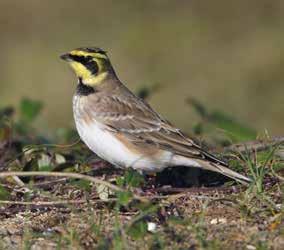
Common summer visitor and passage migrant.
The vast majority of Sand Martin records came from Minsmere, including the second of the year, two birds on March 15th. The first was recorded at Kirkley, Lowestoft a day earlier. There were 40 at Minsmere by 24th. The first bird in the west of the county was at Lackford on March 25th. At Landguard, 40 were recorded in the spring between March 18th and May 15th, with a maximum day-total of 15 south on April 29th.
Large flocks included those over Island Mere, Minsmere with the largest being 500 on April 14th. Regular records came from Mark Nowers at Alton Water with 69 on April 10th, 150 on 17th and 250 on May 5th.
Breeding was recorded at the well-watched quarry at Wenhaston Black Heath where there
Shore Lark, Minsmere, 14th October Chris Mayne
were at least eight holes occupied. Minsmere held at least 27 pairs (310 occupied in 2022) although few of the many records mentioned breeding. Breeding was suspected at Thorpeness, there were between 15 and 20 occupied nests at Chillesford and occupied holes were reported at Jimmy’s Farm in Wherstead. Birds created nest holes in the cliff at East Lane, Bawdsey in late April but they were all lost to continuing erosion. More than 20 nest holes were counted at Cavenham Pits on April 7th. Sand Martins were recorded in only two of this year’s 44 BBS squares involving nine birds.
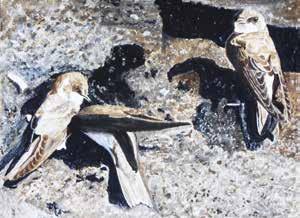
Autumn passage at Landguard had totalled 241 birds, but this year 479 were recorded, between June 26th and September 16th with a maximum of 95 south on July 13th.
The final records of the year included 50 along the River Lark Valley at Cavenham Heath on September 7th, a singleton at Trimley Marshes on September 19th and five at Minsmere on October 15th.
BARN SWALLOW Hirundo rustica
Very common summer visitor and passage migrant.
The first bird recorded this year was at Claydon on March 19th. Thereafter, in March, in the southeast birds were at Alton Water, Holbrook, Pipps Ford (Barking), Trimley Marshes and Felixstowe Ferry. The first arrival recorded in the northeast was at Blyford on April 4th, followed by five at Thorpeness the day after. Lackford saw the first in the west with a singleton on March 31st.
There were some reasonable-sized flocks throughout spring with the largest being of 200 at Minsmere on April 24th and 200 at Aldeburgh on June 1st. These do not compare favourably in size with the Sand Martin flocks.
Breeding data were once again in short supply. It was confirmed at Herringfleet, Hoxne, Hinton, Hazlewood, Chillesford, Hollesley Marshes, and East Lane, Bawdsey, where 12 pairs nested in the old gun emplacements. At the Dock Lane marina in Melton, several pairs nested amongst the houseboats and pontoons. A comment was made that no breeding occurred in Butley. In the west confirmation of breeding came from Denham, Wyken Hall in Stanton and Cavenham.
The table below shows the number of BBS squares in which Swallows were recorded, over the last ten years. Between 2006 and 2009 the number of squares was up in the 40s (from a similar number of squares counted).
Counters recorded 113 Swallows in the 29 BBS squares where the species was present.
Swallows nesting under pontoons
For several years now we have been aware of Swallows using the Royal Harwich Yacht Club marina at Woolverstone. Initially we just observed them resting on the guard rails, masts and rigging of moored boats. At first we didn’t think this was unusual but then we became aware
Sand Martin, Minsmere Peter Lakey
that they were flying under the pontoons. The pontoons float about 50cm above the water and rise and fall with the tide. It soon became apparent that they were feeding young and that they must have made nests under the floating pontoons. The nests were well hidden and impossible to view from above. Even hanging over the side we couldn’t view the nests and this only agitated the birds, so we ceased. This summer we moored our boat in Shotley Point marina (some nine kilometres down the Orwell Estuary) and again observed this unusual unexpected behaviour – so this is not unique to one group of swallows. How they have learnt that this is a safe place to nest is intriguing as they are more commonly associated with nesting in old buildings on terra firma. We wonder if other observers have noted similar behaviour?
Anne and Dennis Kell
At Landguard, this species was recorded from March 29th to November 15th. Spring passage peaked in May during which month 51 flew north and 598 south – the maximum day-total occurring on May 7th when five flew north and 97 south. Autumn passage commenced as early as June 18th and totalled about 3900 which is not too far short of 2022’s figure of 4100. Movements peaked in September when ten flew north and 1985 south with a peak day-total on 26th which saw 780 fly south.
There were some large congregations in September, including: 150 at Benacre on 8th, 200 at Chillesford (at a regular roost site), 19th and 200 at Hinderclay on 24th. On October 22nd, seven Swallows were seen feeding together with a Pallid Swift at Minsmere! November birds included: one at Walberswick on 15th, four at Southwold on 24th, singles at Felixstowe Ferry, also on 24th, Southwold, 26th, Stowlangtoft, 26th and Sutton on 29th. Passage birds south at Landguard in November totalled 24 up to 15th. The last bird of the year was at Covehithe on December 1st.
WESTERN HOUSE MARTIN
Delichon urbicum
Common, but declining, summer visitor and passage migrant. Amber to Red list as of 2021.
The first birds were recorded at the end of March with single birds at both Brantham and Lackford Lakes on 31st. In early April, single birds were seen at Stowmarket Sewage Works (1st), Thorpeness (5th), Fritton Decoy/Belton (7th), Bramfield (8th), Carlton Marshes (10th) and an impressive 90 at Lakenheath Fen on 10th.
Three further flocks of note in spring were 100 at Lackford Lakes on May 13th, 80 at Otley on June 16th and 72 at Pixey Green, Stradbroke on June 23rd.
Breeding records, again, were rather scarce – I hope not because there is a total lack of them in certain areas. Hopefully our 2024 House Martin survey will encourage more data to be recorded and submitted. In the northeast area there were nests at the following: ten at Hoxne; 12 at Ringsfield Corner in Beccles; Middleton, five at Blackheath, Wenhaston and two at the Snape Maltings. In the southeast area: 15+ in Chillesford; Helmingham Hall; three in Butley, Hollesley, Alderton and eight in Marsh Lane, Felixstowe. The latter, presumably, sent in by someone visiting to see the Black-winged Kite! As usual, more records were received from recorders in the west. The list is as follows: Stowlangtoft (c. 30 on water tower); Bury St Edmunds beet sugar factory (25 on concrete silos); Pakenham (6 on water mill); Fornham All Saints (6); Culford’, Little Saxham (10); Barrow; Denham Hall in Denham; Knettishall (40); Long Melford; Sudbury and Great Cornard.
The table below shows the total number of House Martins counted in the BBS squares over the last ten years (44 squares in 2023). They were seen in only 12 of these 44 squares.
As usual, there were large flocks recorded throughout the summer and early autumn, many of them over water. The larger flocks are presented here: 80, Hoxne, August 18th and 100, Shingle
Street, August 23rd. Then, in September: 250, Benacre, 8th; 200, Shingle Street, 3rd 400 there, 4th, many around the Martello Tower and 160 there on 9th, all moving south and 700, East Lane, Bawdsey, 8th, also around that site’s Martello Tower. In September, in the west, 100 were at Icklingham on 7th and 120 passage birds at Nunnery Lakes in Thetford on 26th.
October records included 30 at Thorpeness on 16th and six at Gedgrave on 24th. There were two at Southwold on November 8th and the last of the year was/were seen at both Pakefield and Kessingland on November 26th.
RED-RUMPED SWALLOW Cecropis daurica
Scarce visitor.
After a bumper year in 2022, with eight birds altogether, there were no records in 2023.
CETTI’S WARBLER Cettia cetti
Fairly common resident and rare passage migrant.
Following another mild winter the Cetti’s Warbler continues to expand and consolidate its presence in almost every wetland and suitable patch of damp scrub along the coast and inland along the river systems including the Waveney, Blyth, Orwell, Gipping and Stour. In the west of the county, it remains localised, probably due to fewer suitable sites, but is locally numerous at larger wetland reserves including Lakenheath Fen and Lackford lakes. It is rather surprising, therefore, that the species was only recorded from three 1-km squares in the county during the BBS in 2023. While long-term population data for Suffolk are not available, the BBS trend for England as a whole shows a 944% increase since 1994 (https://www.bto.org/our-science/ projects/breeding-bird-survey/latest-results/population-trend-graphs), and it seems likely that this increase is mirrored or has been bettered in the county.
In 2023, Cetti’s Warblers were reported from at least 53 locations in the northeast of the county where extensive wetlands held the largest number of singing males with at least 25 at Minsmere, 15 or more at Carlton Marshes and a minimum of 12 at Southwold being particularly noteworthy. Sites in the southeast hosting Cetti’s Warblers stood at 75 or more in 2023 but no location held more than ten singing males. In the west, 19 singing males were reported at Lakenheath Fen and 12 at Lackford Lakes, with reports coming from 18 sites in the region.
Between these strongholds, relatively few reports were received from inland locations in midSuffolk in 2023. The eBird map of reports covering the period from 2014 to 2023 (https://ebird. org/map/cetwar1) reveals Cetti’s Warbler to be largely absent from vast swathes of the county extending from Thetford to Bungay and Halesworth in the north and east, and south to the River Stour then west to Haverhill, Bury St Edmunds and Newmarket. Much of this region is intenselymanaged farmland and under cultivation, and suitable habitat is largely lacking. In turn, fewer observers monitor the birds across mid-Suffolk and a singing male may go undetected in a small pocket of suitable damp scrub.
Being reclusive, the Cetti’s Warbler is difficult to detect away from breeding sites and especially when silent. Reports from Landguard, which lacks suitable habitat for the species, revealed movements that would otherwise have gone undetected. In 2023, from September 16th to November 7th an exceptional 12 birds were ringed with peak day-counts of four coming on six dates from October 14th to November 12th. Two or three remained within the observatory’s recording area until the end of the year.
LONG-TAILED TIT Aegithalos caudatus
Very common resident and scarce passage migrant.
The Long-tailed Tit remains a very common resident throughout the county, being found in 24 1-km squares in the 2023 BBS, although this figure is down from the peak of 34 squares in 2017 and 2019. Long-term BBS monitoring since 1994 reveals that in the East of England region the population trend until 2016 increased by 19% from the 1994 baseline. However, since 2016 that
trend has been a decline each year and in 2023 had fallen to c. 91% of the 1994 baseline.
Nest building was noted in Christchurch Park, Ipswich, on February 10th, and in Melton on February 21st when an almost complete but unlined nest was found in a gorse bush. Having completed the structure, the nest remained unattended and unlined for several weeks but on April 1st it contained a lining of feathers and five eggs but no adults were seen. Subsequently, incubation began but the nest was predated shortly afterwards.
Long-tailed Tits rarely travel far from their natal range although outside of the breeding season the species forms foraging flocks which roam widely and can contain 30 or more individuals. Particularly conspicuous groups this year included 41 at Trimley Marshes on September 6th, 45 at the Nunnery Lakes, Thetford on October 15th and c.40 at North Denes, Lowestoft on October 22nd. Dispersing groups at Landguard included nine on January 5th, 15 on February 8th and smaller numbers on seven dates between March 19th and April 12th, with six on March 19th being the highest count. In autumn it was noted at Landguard on 13 dates from October 8th to November 16th, with 15 on October 8th being the highest count.
WOOD WARBLER Phylloscopus sibilatrix
Scarce spring and autumn migrant. Last bred in 2003. Red list. Landguard: two, trapped and ringed July 26th, one remaining until Aug 4th; another trapped and ringed Aug 4th; trapped and ringed Aug 11th.
A first-year bird ringed at Landguard on July 26th was retrapped there on August 4th, when it was joined by an adult. Four late-summer birds, all at Landguard, during the optimum late July –early August passage window, represent an average showing.
The 25-year mean for late summer and autumn occurrences continues to hover around four birds per year (see figure below). This year’s total has been bettered in seven years since 1999; 2000 (6), 2003 (5), 2010 (13), 2012 (5), 2014 (5), 2015 (6) and 2020 (10). The absence of spring migrants in 2023 sees the continuing decline of this attractive species at this season although this is the first blank spring since 2018 and only the fourth in the last 25 years; the other blank years are 2011, 2014 and 2018. Spring occurrences over the past 25 years are now averaging less than one per year (as below).
The figure below shows comparison of spring and autumn occurrences of Wood Warbler in Suffolk, 1999 – 2023. While the trend towards autumn occurrences has increased slightly over the period, the trend in spring has been one of gradual decline and the blank spring in 2023 continues this trend.
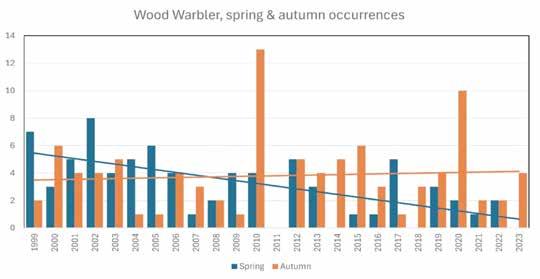
YELLOW-BROWED
WARBLER Phylloscopus inornatus
Fairly common autumn passage migrant. Has overwintered and occurred in spring. Amber list.
Lowestoft: Pathways Farm, Sep 25th; Dip Farm, Oct 8th; North Denes, Oct 22nd; Oct 27th and 29th
Southwold: Campsite, Oct 8th and 9th
Thorpeness: Old Caravan Park, Oct 9th
Sizewell: Oct 9th; Oct 23rd
Orford: Oct 9th
Landguard: Oct 12th to 15th, two, Oct 13th
Trimley Marshes SWT: Oct 29th
A disappointing year with just 12 records, making 2023 the worst year since 2006 when 12 individuals also occurred. The first of the year occurred in Lowestoft on September 25th, the only record for that month. Two on October 8th heralded a small arrival with a further three being discovered the next day. Thereafter, two arrived at Landguard between October 12th and 15th, and a flurry of four singles began on October 22nd with the first of two at Lowestoft’s North Denes, followed by singles at Sizewell on 23rd and the North Denes again from 27th to 29th, with the last at Trimley Marshes on 29th. There were no reports from inland locations.
The figure below shows the annual occurrences of Yellow-browed Warbler in Suffolk, 1994 –2023. Over this 30-year period, occurrences of Yellow-browed Warbler increased significantly between 2005 and 2020. Since then, occurrences have returned to levels not seen since 2005. Despite this, the long-term trend remains positive.
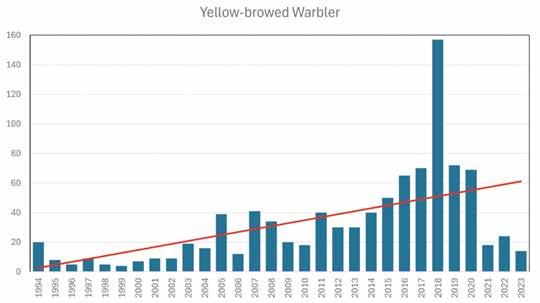
The 30-year trend of occurrences extending back to 1994 remains positive (see above) buoyed by the six outstanding years that the species enjoyed in the county from 2015 to 2020.
FIELD NOTE
A Yellow-browed Warbler fitted with a nanotag transmitter at Castricum, The Netherlands, on October 8th 2023 was detected as it passed within range of the MOTUS receiver at Landguard just before midnight on October 16th. Prior to leaving the Dutch coast it was detected as it passed MOTUS receivers at Heemskerk and Ijmuiden on October 16th. From Ijmuiden it crossed the North Sea, taking 3 hours, 51 minutes to travel approximately 230km between the receivers at Ijmuiden and Landguard, though the actual distance travelled may have been greater, at an estimated minimum speed of 59km/h.
The MOTUS receiver at Landguard operates on a frequency of 150.1MHz and is able to detect a tagged bird up to 20km from the receiver when conditions are good. The signal was received at Landguard for 12 minutes and 1 second, suggesting it passed close to the receiver. It is not known, however, whether the bird made landfall in Suffolk or continued into Essex, and it has been excluded from the 2023 annual total for Suffolk.
PALLAS’S LEAF WARBLER Phylloscopus proregulus
Rare autumn passage migrant. First mid-winter record in 2017.
Minsmere: Sluice bushes, Nov 14th, photographed (C Moyes, I Barthorpe et al.)
Although it could be elusive at times, this year’s only bird put on a fine show in Minsmere’s Sluice bushes and proved to be extremely popular during its brief stay. Those who recall the glory days of this Siberian gem in the 1990s and early 2000s can only lament its decline in recent years. While 2016 (12 records) and 2020 (14) saw an upturn in arrivals, the 30-year trend since 1994 has fallen to an average of slightly more than two birds per year and the single record this year continues this downward trend (as in figure below).
The figure below shows the annual occurrences of Pallas’s Leaf Warbler in Suffolk, 1994 – 2023. Occurrences over the 30-year period are typically single-figure annual totals interspersed with an occasional bumper year. Following the boom years in the 1990s, the 30-year negative trend reflects its increasing scarcity in the county.
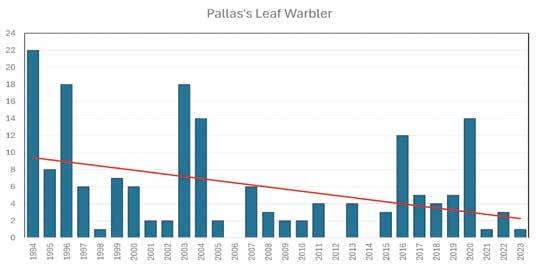
DUSKY WARBLER Phylloscopus fuscatus
Rare visitor.
Lowestoft: North Denes, Oct 24th to 28th, photographed (R Wilton et al.)
In a poor year for Siberian waifs and strays, this bird managed to struggle through the incessant westerly gales and appeared at a classic coastal location on a typical date. This brings the county total to 39.
WILLOW WARBLER Phylloscopus trochilus
Declining summer visitor and passage migrant. Amber list.
A small but widespread arrival of unexpectedly early migrants began in the third week of March with the first of the year reported at Carlton Marshes and Wenhaston on March 18th (the earliest arrival since 2017 when one was at Hollesley, March 13th), followed by three at Minsmere on 19th and another at Santon Downham on 21st. The following week produced further reports of single birds from multiple locations along the coast and others were at inland localities including
Sudbury Water Meadows on 25th and Lakenheath Fen on 27th. At Landguard, the first arrived on March 29th and passage here continued until June 19th, peaking at c.25 on April 29th.
At the species’ Breckland stronghold, the first returning bird was found at The King’s Forest on April 6th. A breeding bird survey of the northwestern and northeastern sectors of the forest revealed 78 singing males, down slightly from 88 singing males located by the same observer following the same transects in 2022. However, the southwestern sector of the forest, which held 12 singing males in 2022, was not surveyed this year. A few still cling on at likely breeding sites in the east of the county although some of the earlier arrivals may have been migrants. Birds holding territories included five singing at Hoxne on May 8th and one still singing there on June 26th, one at Sutton Common on May 12th, four at Westleton Heath on May 13th, four at Dunwich Forest on May 14th and one at Tunstall Forest on June 22nd.
In 2023, BBS fieldwork in 44 1-km squares located six individuals in just five squares, the lowest since 1994 with the exception of 2020 when Covid-19 restrictions reduced fieldwork effort to 21 1-km squares. Comparable effort across 45 1-km squares in 2019 revealed 24 individuals in ten squares.
Southbound passage was noted at Landguard from July 26th and continued until September 24th with peak numbers arriving in August including 30 on 9th, 40 on 21st and 30 on 22nd. This timing was reflected at many sites along the coast which held multiple birds in August although no other site reported double-figure day-totals. Two at Brandon Park Heath on September 9th was the final sighting in the west, and coastal occurrences during the month were almost exclusively of single birds. Very few remained into October, in which month the last of the year were at Minsmere on 10th, Bawdsey Quay, 15th and Landguard on 21st.
From 25 Years ago: Extract from the Willow Warbler entry in the 1999 Suffolk Bird Report
There appears to have been quite a substantial increase in the breeding population within Suffolk during 1999. Numbers at the Aldringham Common and Walks/North Warren complex went up from 78 territories in 1998 to an impressive 103 in 1999, and at Dunwich Forest the number of breeding territories reached 74 from 58 in 1998. The largest increase, however, was found in The King’s Forest where 97 territories were located compared with just 40 in 1998. Elsewhere, numbers were stable at Walberswick with 88 singing males, 16 pairs were found at Dingle Marshes and seven were found at Combs Lane W M (up from five in 1998).
COMMON CHIFFCHAFF
Phylloscopus collybita
Very common summer visitor and passage migrant. A few overwinter.
Reports of wintering birds in January and February came from at least 42 locations across the county, involving 11 in the northeast, 18 in the southeast and 13 in the west of the county. Most reports involved single birds noted on single occasions. However, particularly notable January totals included 12 at Long Melford sewage works on 21st and ten at Belstead Brook Park, Ipswich/Pinewood on 22nd. Up to five were regularly reported at Melton sewage works throughout January and February, and unseasonable singing was heard here on January 5th and intermittently by up to three birds thereafter on several dates in January and February.
The arrival of returning birds became increasingly apparent in the second half of March when singing birds returned to breeding sites throughout the county. Particularly notable March totals at inland locations included 16 at Coddenham on 19th, ten at Pipps Ford, Barking on 26th and at least 26 at Melton sewage works on March 28th, of which 16 were trapped for ringing. Landguard recorded its first of the year on March 13th and migrants continued to be noted here until at least June 12th, peaking at 20 on April 8th. Elsewhere, 41 singing males at Coddenham on April 2nd and 29 at Great Glemham on 22nd are particularly high at inland locations.
While the Willow Warbler population continues to plummet, in many places it has been replaced by the Chiffchaff which is now so ubiquitous throughout the county that it is difficult
to find a patch of woodland which lacks this species. In 2023 it was recorded in 43 of the 44 1-km squares monitored in the BBS with 197 individuals counted, giving a mean density of 4.58 individuals/occupied square across the county. This density is likely to be surpassed in prime locations with an abundance of ideal habitat with, for example, 26 at Euston, 18 at Bradfield Woods, 17 at Lackford Lakes and 14 at Cavenham Heath. Some of the larger reserves hosted high numbers, in particular 40 singing males at North Warren/Aldringham Walks and 30 at Minsmere. After breeding, adults and juveniles disperse from their breeding sites in July and appear at favoured locations before migrating. At Landguard, where the species does not breed, seven dispersing juveniles were recorded between June 21st and July 19th. Ringing at Sycamore Farm, Swilland, was productive with 24 ringed on July 17th and 35 on 28th. The Lackford Lakes CES site reported 2023 to be a good breeding season with 16 adults and 38 juveniles ringed, this being the most productive year since 2016.
Migrants became apparent at coastal locations from mid-August when 25 or more were present at Thorpeness Common on August 12th and Landguard recorded its first on 18th. Numbers at many coastal sites increased throughout September, peaking at 20 or more at Thorpeness Common on 22nd and 30th, and 25 at Landguard on October 2nd. Passage came to an end at Landguard on November 17th, although one that was found on December 6th and remained until 8th was considered to be a dispersing wintering bird. At the end of the year at least 15 were wintering at Thorpeness sewage works and adjacent areas of North Warren.
‘Siberian Chiffchaff’ P. c. tristis
Scarce visitor in late autumn and winter. Rare in spring.
Benacre: Apr 25th, sound recorded (J Gearty)
Snape: Snape Wetlands RSPB, Jan 11th, 21st and 29th, photographed and sound recorded (J A Kennerley, P R Kennerley)
Landguard: Nov 22nd, trapped and ringed (E W Patrick et al.)
Brantham: Sewage works, Jan 29th, sound recorded (J Everett); Mar 3rd (J A Rowlands)
Long Melford: Sewage works, Dec 7th to 31st (D Underwood et al.)
Following 2021 and 2022, both outstanding years for Siberian Chiffchaff in the county with 15 and 11 records respectively, 2023 saw a return to more typical form with just five reports. The year began with two wintering birds that were reported intermittently in the early part of the year, followed by a singing bird in April, a late November bird on passage and, finally, another wintering bird found inland in early December which lingered into 2024.
GREENISH WARBLER Phylloscopus trochiloides
Rare visitor.
Landguard: June 18th, trapped and ringed (E W Patrick et al.)
The 23rd county record, of which 11 have occurred in the spring/summer period between May 9th (1993) and July 8th (1997). Aside from these two outliers, the remaining spring occurrences span the four-week period between May 26th and June 20th. This year’s bird is the seventh to be found at Landguard, making this the top site for the species in the county, although this is the first record from this well-watched locality since 2017.
ARCTIC WARBLER Phylloscopus borealis
Rare visitor.
Burgh Castle: private site, Oct 12th to 14th, trapped, ringed and photographed on 12th (P Noakes)
The sixth Arctic Warbler to reach Suffolk, and the first to be found in October. All previous birds arrived between September 1st and 30th, although the latter (at Fagbury Cliff on September 30th 1993) lingered until October 2nd. Like four of its predecessors, this year’s bird was discovered in a mist net.
GREAT REED WARBLER Acrocephalus arundinaceus
Very rare visitor.
Boyton: Boyton Marshes RSPB, 2CY+ male, photographed and sound recorded May 11th (S Abbott et al.)
Minsmere: 2CY+ male, May 20th (D Baskett)
Found in the early morning, a one-day bird at Boyton showed well to all-comers as it croaked and barked among the small willows bordering Boyton’s main flash. At times it could be seen alongside a pair of relatively-diminutive Eurasian Reed Warblers in whose territory it had taken up temporary residence. With another at Minsmere nine days later, these two take the county total to 21 (involving 22 individuals – two were present at North Warren in June and July 1961), and the 18th and 19th in spring/ summer between May 5th (Lackford Lakes, 2014) and July 7th (Minsmere, 1966).
Addendum
The 2021 statement that “two at North Warren RSPB, June 18th to July 2nd, 1961” is misleading and should read “North Warren, one from May 18th to July 2nd 1961, with two from June 18th to July 2nd.”
AQUATIC
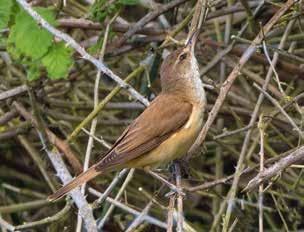
11th May
WARBLER Acrocephalus paludicola
Very rare visitor.
Landguard: Aug 30th, 1CY, photographed (W J Brame et al.)
An outstanding find by Will Brame on a balmy summer afternoon in the most unlikely of locations i.e. the long grasses and brambles along the Butts ridge at Landguard. Being just the ninth county record, a county tick for almost every Suffolk birder and an almost mythical BBRC species, the bird attracted attention from far and wide, with birders arriving from all over Suffolk and beyond to catch up with what has become an extraordinarily difficult bird to encounter anywhere in the UK. Before the masses descended, it appeared in the open on several occasions, enabling the early arrivals to enjoy outstanding views of what is typically an ultra-skulking species. But as the crowd swelled, it became elusive, affording short flight views and occasional lingering looks as it landed before dropping back into the long grasses. With perseverance, most observers eventually managed to see it well, as the photographs in this report attest. Will’s article on finding this bird is towards the front of the report. Unsurprisingly, this is the first record for Landguard.
SEDGE WARBLER Acrocephalus schoenobaenus
Common summer visitor and passage migrant.
The first report of the year came from Trimley Marshes on March 30th, followed by Minsmere and Felixstowe Ferry on April 4th, Carlton Marshes, Lakenheath Fen and the Nunnery Lakes on 5th and Boyton and Hollesley Marshes on 6th. Thereafter, numbers increased rapidly and it was widely recorded in suitable habitat from the second week in April throughout the county. Notable counts of singing males in April included 41 at Southwold on April 15th and 25 there on 29th, 30 at Lakenheath Fen on 22nd, 37 at Carlton Marshes on 22nd and 33 there on 30th and 20+ at Minsmere on 30th. Some sites reported higher totals in May including 28 at Felixstowe Ferry on 7th, 19 at Boyton on 8th and 33 at Aldeburgh Marshes on 18th, with 25 still singing there on June 15th and 12 on July 13th.
Reports of Sedge Warbler came from just two of the 44 1-km BBS squares monitored in Suffolk
Great Reed Warbler, Boyton RSPB,
John Richardson
in 2023 with 12 individuals noted. In 30 years of BBS monitoring, the population trend in eastern England has fluctuated but currently remains almost unchanged from the 1994 baseline figure of 100, showing a slight increase to 103.76 in 2023.
The Sedge Warbler is an early migrant with many leaving the breeding grounds as early as mid-July. Passage reaches its peak in August then falls away in September, and by the end of the month only the late stragglers remain. Much of this movement goes unnoticed as migrants seek out largely inaccessible wetlands and lurk deep within damp vegetation. At Trimley Marshes, regular ringing throughout the autumn produced 247 in July, the highest July total to-date, followed by 366 in August and 94 in September. In contrast, nearby Landguard where suitable habitat is lacking, just 12 were recorded between July 28th and September 6th.
Other sightings in September included 15 still at Lakenheath Fen on 3rd with others at Shingle Street on 10th, Carlton Marshes on 11th, Nunnery Lakes on 12th, Trimley Marshes on 15th and Minsmere on 21st. The final report and only sighting in October, was at Ness Point, Lowestoft, on 4th.
BLYTH’S REED WARBLER Acrocephalus dumetorum
Very rare visitor.
Landguard: June 15th, trapped and ringed (P Denyer et al.)
After being ringed and released, this bird promptly disappeared and, despite much searching, it wasn’t seen again. This is the tenth record for Suffolk, and fourth in spring, of this former vagrant that is occurring with greater regularity throughout the UK, where singing males are now recorded annually.
COMMON REED WARBLER Acrocephalus scirpaceus
Common summer visitor and passage migrant.
The earliest returning Reed Warblers usually arrive in the first week in April, slightly later than the first Sedge Warblers, and this year was no different. Trimley Marshes recorded the first on April 5th, and this was quickly followed by others at Boyton Marshes on 6th, Minsmere on 8th, Lakenheath Fen on 11th, North Warren on 12th and Hen Reedbeds on 14th. Thereafter, numbers increased rapidly and by the end of April and into May the warbling chatter of multiple Reed Warblers resounded throughout the county’s reedbeds.
Site totals are largely determined by the extent and quality of the Phragmites reedbeds in which it breeds. The large wetland reserves with expansive, but inaccessible, reedbeds invariably attract the greatest totals and probably the highest breeding densities, although transect surveys and quantitative data to support this are lacking. Consequently, counts from the larger reedbeds should be taken as crude estimates and likely to be inaccurate, although to what extent is unknown. For example, 20 or more at Walberswick NNR and 19 at Minsmere, both on May 5th, and 15 at Lakenheath Fen on May 13th are surely underestimates but are the highest counts received from some of the county’s largest reedbeds in 2023.
Fortunately, many Reed Warblers breed in smaller reedbeds and reed-filled dykes where counting is easier, and observers are able to follow the same year-on-year transects. Counts of singing males in April included 13 at Carlton Marshes on 28th, and 13 at Aldeburgh Marshes on April 30th, later increasing to 46 on May 18th. Singing activity reaches a peak in May when most sites record their highest counts of singing males; These included 16 at Martlesham Creek and 16 in Culford Park, both on 1st, 21 at the Nunnery Lakes, Thetford on 4th, 22 along the River Lark valley at Cavenham Heath on 7th, 12 at Boyton on 25th and 14 at Shingle Street on 27th. Many other lesser-known or poorly-monitored sites across the county reported single-figure totals.
Reed Warblers were found in six of the 44 1-km squares monitored in the 2023 BBS surveys which, between them, supported 22 individuals, almost unchanged from the previous two years. Since 1994, when the baseline figure was 100, the BBS index for the East of England has fluctuated over the period but has shown a slow but steady increase and now stands at 133, while that for the whole of England has reached 152 – this is likely to be in response to climate change and a
northward shift in its breeding range over the 30-year period.
The autumn exodus of Reed Warblers usually lags behind that of Sedge Warblers and this is reflected in the numbers caught at Trimley Marshes where regular monitoring has provided a valuable insight into migration timing and relative abundance. In 2023, 81 Reed Warblers were ringed at Trimley in July, increasing to 160 in August then dropping to 55 in September – which is the highest September total recorded since monitoring began at this site in 2015.
By the end of September very few Reed Warblers remained in the county with the latest recorded at or near coastal locations. These included Carlton Marshes on September 30th, Minsmere and Landguard on October 2nd and the last of the year at North Warren on October 10th.
MARSH WARBLER Acrocephalus palustris
Scarce migrant. Bred in 2010 and 2021. Red list.
Sizewell: June 6th, sound recorded (D Darrell-Lambert)
Hollesley: July 25th, trapped and ringed (R Duncan)
Falkenham/Felixstowe: Kings Fleet, June 14th, sound recorded (P J Holmes et al.)
Trimley Marshes SWT: July 8th, trapped and ringed (J Zantboer)
Little Cornard: Cornard Mere SWT, June 1st, sound recorded (D Ping)
In addition to three one-day birds in June, singing males were present for five and seven days respectively at two other sites in suitable breeding habitat. Although there was no suggestion that a female was present or evidence of possible breeding at either of the two locations, they are not being publicised as one or other may return in future years. Five singing males in the spring is on par with spring occurrences in the county over the last 30 years extending back to 1994.
Late-summer records of one or two dispersing adults or departing juveniles, usually turning up in mist-nets in July and August, are not unusual and the two birds in July this year fall within the established pattern. The long-term late-summer mean over the 30-year period since 1994 has remained remarkably steady at just below two per year.
2021 comment
Suffolk’s breeding record in 2021 was one of only three confirmed breeding records in Britain that year (Brit. Birds 116: 664–665).
BOOTED WARBLER Iduna caligata
Very rare visitor.
Landguard: 1CY, Aug 18th, photographed (W J Brame, N Odin, E W Patrick, T Holland et al.)
Following its discovery, Landguard’s second Booted Warbler spent the afternoon among the brambles and Alexanders along the southern edge of the Observatory compound where viewing its preferred south-facing slope through the impenetrable security fence was challenging. At times it would show extremely well close to the fence but for much of the afternoon it was furtive and elusive, occasionally breaking cover to fly across the slope before dropping into dense vegetation.
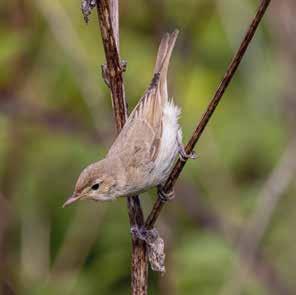
This is the fifth county record and the first in August. The four previous birds Booted Warbler, Landguard NR, 18th August Jeff Higgott
occurred in autumn, with two in September and two in October. The latest, also at Landguard, on October 16th 2011 was also present for just one day.
COMMON GRASSHOPPER WARBLER
Locustella naevia
Uncommon and declining summer visitor and passage migrant. Red list.
With its distinctive reeling song revealing its presence, the arrival of the Grasshopper Warbler in April is a much-anticipated sound of the spring, rivalling that of the Nightingale and Cuckoo. This was again the case in 2023 when reports of reeling birds came from ten locations in the northeast, five in the southeast and eight in the west of the county. The first arrivals revealed their presence in the second week of April with singing birds at Carlton Marshes from April 8th, Belstead Brook Park, Ipswich/Pinewood, from 13th and Minsmere from 14th. Thereafter, reeling birds were reported from widespread locations throughout the remainder of April, May and into early June, although reeling declined or ceased as pairs became established and settled down to breed. Only three sites reported more than one reeling bird; up to five were at Carlton Marshes in late April, up to three at Minsmere from April 16th until at least May 16th, and two at Lakenheath Fen for just one day, on April 26th. By mid-June reports of reeling birds became infrequent, although there was a slight resurgence from mid-July and into August with reports from Belstead Brook Park on July 7th, Carlton Marshes on July 20th to 22nd and Pipps Ford, Barking on August 7th. The last singing bird reported in 2023 was at Minsmere, being heard throughout July and occasionally until August 17th. These late singers may relate to unmated males, second breeding attempts or birds dispersing to new locations after previously nesting elsewhere.
Although the species is widespread throughout the county, it remains scarce and localised with many apparently-suitable breeding sites remaining unoccupied, a situation replicated throughout much of its range. There are insufficient BBS data to draw conclusions at a regional level but the population trend over the 30-year period since 1994 reveals an overall 43% population increase throughout the UK, coinciding with a 9% decline within England.
Silent birds are rarely encountered, with most reports referring to birds trapped for ringing, so singles on Orfordness on July 20th and a juvenile at Lakenheath on September 3rd are noteworthy encounters. No reports came from Landguard this year but seven were ringed at nearby Trimley Marshes involving two in both April and August, and three in September. The last of the year, a juvenile at Trimley Marshes on September 26th, was still in pin and growing its feathers, indicating a recently-fledged bird from a late brood, although it was not known to breed nearby.
EURASIAN BLACKCAP Sylvia atricapilla
Common summer visitor and passage migrant. Overwintering birds are considered to be from eastern Europe.
Reports of wintering birds came from five locations in the northeast of the county, 14 in the southeast and seven in the west, the majority referring to single birds seen on a single date. However, in January, reports of two or more included three in Melton on 1st and two on 24th, two in Grundisburgh on 2nd and 23rd, two in Stowmarket on 3rd, two at Lackford Lakes on 20th and two at Rickinghall on 22nd. No site held more than one bird in February and early March. The first singing bird was heard in Woodbridge on February 19th; thereafter, singing was reported regularly in several locations from the last week of February and throughout March, coinciding with early migrants returning to breeding sites (and, perhaps, birds that had been wintering being stimulated to sing on milder days and with increasing hours of daylight). Singles at Landguard on February 1st and March 6th may have been birds that had spent the winter in Britain and were returning to breeding sites in mainland Europe.
Passage at Landguard became apparent from March 22nd and continued until June 16th, peaking at 15 individuals on April 22nd. Trimley Marshes recorded 55, its highest spring total with 33 in April and 22 in May. While there were widespread reports of singing males throughout the county, relatively few sites held ten or more territories although many of the county’s premier
reserves which are more likely to be favoured by this species did not provide totals this year. Some of the more notable counts included 15 at Loompit Lake, Trimley St Martin on April 26th, 18 on the Broxtead Estate, Sutton, on May 2nd, 17 singing males at Hoxne on May 8th and 14th, 14 at Minsmere on May 10th and 21 at Pound Farm, Great Glemham on June 18th. No sites in the west of the county reported double-figure counts, the highest in this region being eight singing males Lakenheath Fen on May 27th, eight at Lackford Lakes on May 29th and eight singing at the Nunnery Lakes, Thetford on June 26th. Quantifiable data from the breeding season are lacking, although the Lackford Lakes CES site reported an above-average year with 21 adults and 54 juveniles ringed. The Blackcap remains numerous and widespread throughout the county, being reported from 37 of the 44 1-km squares surveyed during the 2023 BBS, with 184 individuals recorded, virtually unchanged from last year.
Dispersing adults and juveniles were recorded occasionally at Landguard between June 22nd and August 7th before the exodus of departing migrants began in earnest from August 29th. Passage at Landguard continued until November 17th and peaked in late September and early October with higher counts of 25 on September 22nd and 30 on October 2nd. Ringers at Sycamore Farm, Swilland, recorded 40 on September 9th, peaking significantly earlier than on the coast. Moreover, Trimley Marshes enjoyed a record October with 117 ringed, eclipsing all previous monthly totals, although there is no evidence pointing to the reason(s) for this record total. Notable counts from other regularly-monitored locations included at least 12 at Thorpeness Common on September 1st and ten there on September 30th, and 12 or more at North Denes, Lowestoft on September 22nd.
Reports in late November and December came from two locations in the northeast of the county, five in the southeast and four in the west, all involving singles apart from two together in Woodbridge on December 13th.
FIELD NOTE
A Blackcap fitted with a nanotag transmitter near Flensberg, Schleswig-Holstein, Germany, on September 27th was recorded by several MOTUS receivers in The Netherlands on October 17th before departing the Dutch coast near Den Helder. At 02.20hr on October 18th, it was detected by the MOTUS receiver at Landguard, having travelled 257km in four hours, two minutes (at an impressive average speed of 64 km/h.
GARDEN WARBLER Sylvia borin
Fairly common summer visitor and passage migrant.
The Garden Warbler arrives slightly later than many other summer visitors, and this is reflected in the initial reports this year; the was recorded at Hoxne on April 18th, followed by another at Lakenheath Fen on 19th. Arrivals picked up in the last week in April with singing birds at Loompit Lake in Trimley St Martin, Pipp’s Ford in Barking and Lackford Lakes on 23rd and by the end of the month it was being widely reported. Landguard recorded its first on April 27th and a further six were recorded there in the spring with the latest on May 25th.
Being relatively unobtrusive, occurring at low densities and absent from much of the county, the Garden Warbler is easily overlooked. Typically, most reports refer to a singing male at one location and often only reported on one occasion. Even in ideal habitat, breeding densities rarely match those of other warbler species with which it occurs alongside. The highest site counts, based on singing males, included nine at Lackford Lakes on May 1st, six at Cavenham Heath on May 7th, eight at Alton Water on May 8th, five at Minsmere on May 27th, five at the Nunnery Lakes, Thetford on June 11th, nine at Great Glemham on June 18th and five at Westleton on June 22nd. The northern sectors of The King’s Forest held a combined total of 14 territories and as the southwestern sector was not surveyed, the overall site total was probably higher than this. BBS surveyors recorded it in just nine of the 44 1-km squares surveyed across the county with 14 individuals counted, the lowest since 2018 – which mirrored the 2023 totals, albeit across 46
monitored squares that year. In the 30 years since the BBS was launched, the Garden Warbler has been in decline and the population level in the east of England since 1994 now stands at 68.7% of its 1994 baseline figure of 100, although it has increased slightly over the last 10-year period.
After breeding, the species seemingly disappears and very few were recorded after July. Daily monitoring at Landguard recorded single birds on July 28th, August 10th and September 11th and 30th, and two on August 30th. Sightings elsewhere on the coast in late August included singles at Carlton Marshes on August 28th and Thorpeness Common on 31st, likely coinciding with the peak of the southbound exodus. The last of the year was at Landguard on October 4th.
LESSER WHITETHROAT Curruca curruca
Fairly common summer visitor and passage migrant. Has overwintered.
The first arrivals were found at Alton Water, Martlesham and Ipswich on April 14th, after which there followed a widespread arrival in the third week of the month with reports coming from many locations in the east of the county. Spring passage at Landguard extended from April 22nd to at least May 25th, peaking at seven on May 11th and 14th. The first in the west of the county was reported at Gazeley on April 23rd, and by the end of the month there were widespread reports from the region.
The Lesser Whitethroat remains a widespread breeding bird throughout the county but few sites hosted more than five breeding pairs. In late April and May as birds settled into breeding territories, notable counts of singing males included six at Black Bourn Valley SWT on April 27th and five there on May 4th, six at Thorpeness Common on April 29th, five at Alton Water on May 1st and eight at Lakenheath Fen on May 25th. The only report of confirmed breeding came from Landguard where five pairs bred, with juveniles noted from June 18th.
The autumn exodus at Landguard became apparent from at least the end July and continued until October 2nd, peaking at nine on August 19th. A migrant at Christchurch Park, Ipswich, on August 9th is the first record from that location for 18 years. Several coastal sites hosted doublefigure totals in August including Minsmere with ten on August 17th, 14 on August 25th and 12 on September 1st, Felixstowe Ferry held 12 on August 19th and ten on 23rd, numbers at Southwold peaked at 12 on August 26th, and Thorpeness Common produced a late flourish with ten on September 22nd. The final reports from the year came from North Warren on October 4th, and Aldeburgh and Swilland on October 8th.
‘Eastern Lesser Whitethroat’ C. c. blythi/halimodendri
Very rare visitor in late autumn.
Landguard: 1CY, Oct 28th to Nov 30th, photographed
This distinctive, pallid Lesser Whitethroat attracted a great deal of attention during its protracted stay at Landguard and was widely considered to belong to the Central Asian subspecies C. c. halimodendri Somehow it managed to evade the observatory’s mist-nets; examination in the hand may have shed light on its true identity, but without DNA sequencing it is not possible to establish to which subspecies it can be assigned.
Photograph included here. It appeared relatively small, dome-headed, short-billed and long-tailed, with the wing-tip falling
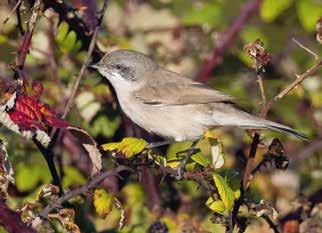
Eastern Lesser Whitethroat, Landguard NR, 11th November
Peter Kennerley
short of the longest uppertail-covert. Its conspicuous warm-tan iris was reminiscent of the piercing eye of Asian Desert Warbler C. nana and quite unlike the drab-grey iris of first-year nominate curruca. In addition to its pale sandy-brown upperparts, it also differed from firstwinter nominate curruca in having a sandy-grey tone extending from the mantle onto the head and reaching to the fore-crown, indistinctly darker lores and ear-covert patch and a white-fringed blackish alula contrasting with the paler wing. Photographs reveal extensive white on t6 and the outer web and tip of t5, quite unlike the sullied t6 and t5 of first-winter curruca
COMMON WHITETHROAT Curruca communis
Common summer visitor and passage migrant. One overwintering record. Amber list (from Green list 2021).
Migration got off to an early start with the first Common Whitethroats appearing at Huntingfield in the northeast and Felixstowe Ferry on April 4th, followed the next day by one at Hemley. There followed a short hiatus with no further arrivals reported until April 11th when one was found at Shingle Street. But it wasn’t until the second half of the month that numbers began to pick up with the arrival of birds at St James South Elmham St James on 14th, and Carlton Marshes and Lakenheath Fen on April 15th. This coincided with passage at Landguard which began on April 16th and continued until May 31st, with peak counts of ten on May 17th, 18th and 20th.
Breeding was reported throughout the county where almost any hedgerow and patch of overgrown scrub can hold one or more pairs. By May, several locations and transect surveys produced double-figure totals of singing males, the highest being 22 at Stowupland on 1st. Others included 11 at Mildenhall Fen on May 1st and again on 20th, ten at Black Bourn Valley SWT on 1st, 11 at Felixstowe Ferry on May 3rd, 12 at Minsmere on 7th, 14 at Lakenheath Fen on 11th, ten at Hoxne on 18th, 13 at Sutton on June 6th and 16 at Thorpeness Common on June 7th. However, surveys of the northern sectors of The King’s Forest located c. 10% fewer singing males than in 2022. The 2023 BBS recorded the species in 37 of the 44 1-km squares surveyed, making this one of the most widespread warblers in the county, and with 160 individuals one of the most abundant, with only Common Chiffchaff and Blackcap being more widely recorded.
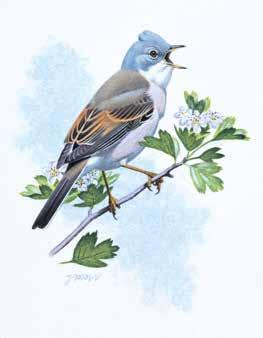
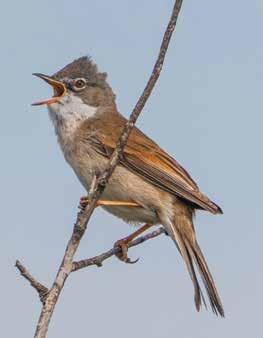
Common Whitethroat, Minsmere, 21st May David Borderick
Common Whitethroat, singing male Jan Wilczur
Post-breeding dispersal usually precedes the autumn exodus and this year included 22 at Levington Lagoon on July 20th, 30+ at Thorpeness Common on July 29th and 14 at Fagbury Cliff on August 3rd. At Landguard, where the boundary between dispersal and migration was blurred by the presence of four breeding pairs, passage began from July 12th and continued until October 2nd, with numbers peaking in late August and early September, the highest Landguard day-total being eight on September 4th. Passage at other coastal sites showed a similar pattern with numbers peaking from mid-August with 14 at Felixstowe Ferry on August 19th and 22 at Shingle Street on August 20th and 14 inland at Sycamore Farm, Swilland, on August 22nd. Most had departed by late September – in the west a late bird loitered at Lakenheath Fen on September 26th. By early October only the last stragglers remained; these included singles at Thorpeness Common on 2nd, Pipp’s Ford, Barking on 5th, Trimley Marshes on 6th and the last of the year at Minsmere on October 8th.
DARTFORD WARBLER Curruca undata
Uncommon local resident. Scarce visitor. Amber list.
The annual breeding season survey of Dartford Warbler in the Sandlings located 133 territorial males or breeding pairs in 2023, down from 187 in 2022. The decline was most pronounced on the northern heaths, with Dunwich Heath (14 pairs, down from 29 in 2022), Westleton Heath (7/10), Minsmere (26/53) and North Warren/Aldringham Walks (14/26) experiencing the largest reductions. By contrast, the heaths south of the River Alde saw numbers remain stable, or increase at some sites, with a combined total of 50 pairs, up from 37 pairs in 2022.
This decline coincided with the die-back of large swathes of mature Heather on the northern heaths and may have been exacerbated by the unprecedented extreme heatwave experienced in July 2022 and associated lack of rainfall that summer. Observers searching for the species on the northern heaths in winter 2022/23 reported extensive areas of dead Heather and a corresponding lack of Dartford Warblers in locations where they were previously present in good numbers. By contrast, Heather die-back appears not to have affected the southern heaths in the same way and Dartford Warbler numbers here were unaffected. As the species produces two or three broods per year, and with less extreme temperatures and above-average rainfall in 2023, it is anticipated that numbers will bounce back quickly.
Outside of the March to September breeding season window, one was present at Landguard on October 29th. In the west of the county at least two birds were found at one location in late October and remained there until the end of the year. Breeding has not yet been reported from the Brecks but with multiple birds in suitable habitat, this may not be too far away.
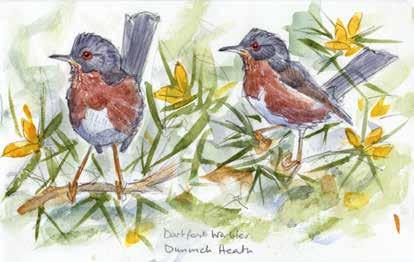
Dartford Warblers Stewart Sexton
COMMON FIRECREST
Regulus ignicapilla
Regular, but uncommon, breeder and passage migrant. Some overwinter.
The Firecrest is a fairly well-established breeding bird in the U.K. Overall, in the county there were 101 records from 35 sites compared with 104 records from 34 sites in 2022. The Breeding Bird Survey for Suffolk had records of four individuals from one square.
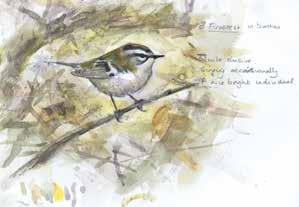
In the northeast there were 54 reports from 13 sites compared with 49 reports from 14 sites in 2022. These records, which were mostly of single birds, included three at each of Benacre on March 18th, Corton Wood on April 6th and Dunwich Forest on May 14th. One pair was confirmed as breeding at Goose Hill, Sizewell, possibly with two broods.
There was a smaller number of records in the southeast, with 39 from 14 sites compared with 35 from 15 in 2022. Four birds were seen at Landguard on March 24th and 29th and three at Boyton on three dates in late January and early February. At Landguard, spring passage lasted from March 16th to April 17th, with a maximum of four as above and autumn passage, apart from one on August 28th, was from October 16th to November 22nd, when the maximum of three was recorded; two remained until November 30th. Four birds were ringed at Trimley, involving two in April, one in May and one in October.
In its western strongholds, there was a reduced number of eight records from six sites, compared with 20 from five in 2022, with a maximum of three at High Lodge, Santon Downham in Thetford Forest.
GOLDCREST Regulus regulus
Very common resident and passage migrant.
The lively Goldcrest is one of our commoner breeding birds. The BTO Garden Birdwatch 2023 East of England figures put it as having been seen in a maximum of 3.7% of participating gardens in the U.K. compared with 4.8% in 2022, although nationally it averaged a 1% increase in sightings. The Breeding Bird Survey in the East of England gave an index figure of 144 against a base figure of 100 in 1995 and nationally +10% against 2022 and +1% against 1995. Locally the survey produced 45 individuals from 15 squares, which represent the best figures since 2019 (55 birds in 16 squares) and reflects the national trend.
In Suffolk, there were 236 records from 79 sites, compared with 368 from 132 in 2022, with 18 double-figure counts.
In the northeast of Suffolk, there were 86 records from 19 sites against 30 from 12 in 2022 with a maximum of 20+ at Thorpeness on November 11th.
There were 143 southeast records from 54 sites, compared with 247 from 67, with maxima of 15 at Landguard on October 17th and 14 at Upper Hollesley Common on January 29th. At Landguard, spring passage, involving no more than two on any date, was from March 19th to April 29th. Autumn passage was from September 6th to November 24th, with a maximum of 15 as above. At Trimley Marshes, 44 Goldcrests were ringed, involving one in March, two in both September and November and an unprecedented total 39 in October (the previous October record was 15 in 2020).
In the west, there were fewer reports from fewer sites compared with 96 from 61 in 2021 with a maximum of 24 at Brandon Park Heath (no date given).
Firecrest Stewart Sexton
EURASIAN WREN Troglodytes troglodytes
Very common resident and scarce passage migrant. Amber list (from Green list 2021).
Noisy for its size, the Wren is noted throughout Suffolk. The BTO Garden Birdwatch 2023 national figures put it as having been seen in a maximum of 36% of participating gardens in the U.K compared with 32.1% in 2022. The BTO’s Breeding Bird Survey Index figure for 2023 is 128.59 against a base of 100 in 1995. The Suffolk Breeding Bird Survey showed an increase of 1% between 2019 and 2022.
There were 350 records submitted from 142 sites compared with 355 from 106 in 2022.
In the northeast recording area there were 100 records submitted from 22 sites compared with 86 from 28 in 2022. The largest gatherings reported were 16 at Redgrave BBS on May 1st and four counts of 15 at other sites on various dates. There were 19 records of breeding including nine pairs at Hall Farm, South Elmham St. Cross.
In the southeast, there were 144 reports from 33 sites, (232 from 63 in 2022) of which the highest counts were 25 at the Broxtead Estate Sutton on April 3rd and May 2nd and 23 at the same site on June 5th. The only breeding records, apart from Landguard, were of 16 breeding pairs at Martlesham Wilds SWT.
At Landguard, Wrens were present all year. At least ten survived from previous years with the oldest from September 2019. Spring passage was from April 12th to May 7th plus a later new female on May 31st. Five pairs bred, with juveniles being noted from June 21st; dispersing juveniles from elsewhere turned up on site from then to August 12th. Autumn passage was from August 28th to November 17th with a peak count of ten on October 4th and 8th.
At Trimley Marshes, 40 birds were ringed (18 in October).
In the west there were 106 records from 77 sites, (37 from 15 in 2022), of which the highest count was 26 at Lakenheath Fen on May 26th as well as two other counts of over 20. There were no records of breeding.
EURASIAN NUTHATCH Sitta europaea
Fairly common resident. Green list.
Nuthatches are a brightly coloured resident in Suffolk. The BTO Garden Birdwatch 2023 national figures put it as having been seen in a maximum of 16.9% of participating gardens in the U.K compared with 20.2% in 2022. Nationally, the Breeding Bird Survey showed an increase of 0.9% since 2022 with 2163 birds from 982 squares and gave an index figure of 103.52 against a base of 100 in 1995. In the East of England, it gave a figure of 116 birds from 64 squares (an increase of 14%). Locally, in Suffolk, there were ten individuals from eight squares, which is, as usual, probably an under-recording.
The number of records submitted to local recorders in 2023 was 179 from 87 sites compared with 253 from 106 in 2022, with only five reports of confirmed breeding (24 in 2022). Eleven individuals were counted at Minsmere over 2023. There were 67 records from 22 sites in the north-east (64 from 20 in 2022) including four at Sotterley Park on January 6th and 28th and four at Hoxne on August 20th and September 30th. There were 61 from 32 in the south-east (50 from 22 in 2022) including eight at Bonny Wood SWT, Barking on July 8th. The west of the county provided 51 records from 33 sites (139 from 64), with the most seen at any one time being 17 at Brandon Park on September 3rd.
EURASIAN TREECREEPER Certhia familiaris
Common resident. Four records of C. f. Familiaris (Northern Treecreeper).
The often-overlooked Treecreeper is a widespread and fairly-common bird. The BTO Garden Birdwatch 2023 national figures put it as having been seen in a maximum of 2.5% of participating gardens in the U.K compared with 2% in 2022. The Breeding Bird Survey nationally has consistently recorded 800 individuals from c500 1km squares and there was an index figure of 101.2 with 100 as the baseline in 1995; locally the BBS reported 20 individuals from nine squares (13 from nine in 2022).
As in most previous years, there were no multiple gatherings reported. A total of 246 records from 120 sites was reported, compared with 330 from 136 in 2022. These consisted of 30 from 11 sites in the northeast (30 from 13 in 2022), 159 from 57 in the southeast (178 from 61 in 2022) and 57 from 52 in the west (122 from 62 in 2022).
Largest reported gatherings in the northeast were five at Minsmere on May 1st, five at Fritton Decoy on May 3rd and five at Hoxne on October 16th. In the southeast there were four at Shrubland Park, Coddenham on January 22nd and in the west, nine on Brandon Park Heath on October 22nd and eight at Barnham Carr, Barnham on April 9th.
A noticeable decline was reported from Christchurch Park, Ipswich with singles on January 29th and August 27th being the only reported site-records this year.
ROSY STARLING Pastor roseus
Rare visitor. Categories A & E
Records for the Rosy Starling have occurred in Suffolk in every year since 2016; in 2023, two birds were found compared with one in 2022.
The 63rd and 64th records for Suffolk were both seen at Landguard. An adult was seen and photographed by multiple observers on June 2nd (R D Spiers et al) and a juvenile was recorded on October 8th (C Chapman et al).
COMMON STARLING Sturnus vulgaris
Very common, but declining, resident, winter visitor and passage migrant. Red list.
The Starling has been on the Red List of Birds of Conservation Concern since 2002 and numbers are still down. The BTO Garden Birdwatch 2023 national figures put it as having been seen in a maximum of 53.9% of participating gardens in the U.K. compared with 57.3% in 2022 and the species remained third on the RSPB Big Garden Birdwatch table (904709 individuals reported). Nationally, the Breeding Bird Survey Index gave a figure of 28830 birds in 1973 1km squares continuing a shallow downward trend (54.29 with a base figure of 100 in 1995}. The Suffolk BBS increased to 210 birds from 21 squares (126 birds in 15 squares in 2022), slightly bucking the downward national trend.
280 records were submitted to recorders from 94 sites compared with 310 from 110 in 2022 These consisted of 123 records from 25 sites from the north-east of the county, 81 from 42 in the south-east and 76 from 27 in the west.
The number of 10000+ flocks going to roost showed an increase with 14 compared with just two in 2022; five of these were at Minsmere, where there were a further four counts of above 1000. The largest flock was 35000.
There was a total of 29 gatherings of over 1000 (35 in 2022), compared with 99 as recently as 2021.
Most of these largest flocks were in the northeast and west including: Minsmere: 35000, Nov 27th; 30000, Feb 17th; 20000, Jan 23rd and Nov 22nd
Lakenheath: 15000, Dec 11th
The southeast’s largest gathering was: Boyton Marshes: 3000, Oct 22nd
At Landguard, the species was present all year, although scarce in the winter months, with a spring maximum of 84 south on April 6th. Two pairs nested. There were summer peaks of 500 on five dates between July 8th and September 14th. There were visible movements in the autumn of 2318 between October 3rd and November 28th, with a maximum of 375 south on November 1st. [there were 4718 past Landguard on October 26th 1992]
At Trimley Marshes, only five were ringed, involving one in October and four in November.
SONG THRUSH Turdus philomelos
Fairly common resident, winter visitor and passage migrant. Amber list (from Red list 2021).
The Song Thrush is a high-profile example of decline in bird populations. The BTO Garden
Birdwatch 2023 national figures put it as having been seen in a maximum of 18% of participating gardens in the U.K compared with 15.1% in 2022 and 19.4% in 2021. The U.K. Breeding Bird Survey has shown very little variation in the last ten years (2020 excluded) with 10615 individuals in 2988 1km squares (129.73 with a base of 100 in 1995). In the East of England the figures have been similarly steady. The Suffolk Breeding Bird Survey showed the number of individuals reported as 76 compared with 92 in 2022, the number of squares occupied was 34 (32).
Locally, the number of records received for this familiar garden bird was 393 from 183 sites compared with 494 from 181 in 2022.
In the northeast, there were 49 records from 16 sites with maxima of 30 at Carlton Marshes on October 8th and 25 at Aldringham on the same date. There were four reports of breeding. In the southeast there were 250 records from 102 sites and the largest gathering noted was of 13 at Sycamore Farm, Swilland on November 12th. There were seven breeding reports. The west produced 94 records from 65 sites, with no actual breeding reports. There were gatherings of 18 birds reported at Bury St Edmunds (west) on an unknown date in February and a site-maximum of 15 on October 8th at Brandon Park.
At Trimley Marshes, 11 birds were ringed, eight of which were in October.
At Landguard at least two birds overwintered. Spring passage was from February 12th to April 22nd, with a maximum of four on March 16th. One pair bred rearing two young. Dispersing juveniles from elsewhere were noted on June 11th and in July on 12th, 18th (two) and 28th. Autumn passage lasted from September 10th to November 19th, with a maximum of only ten on October 9th. Up to two were present until the year’s end.
Based on the above figures, it would appear that the peak of a poor autumn passage occurred on October 8th and 9th.
MISTLE THRUSH Turdus viscivorus
Fairly common resident and scarce passage migrant. Red list.
The upright and mellifluous Mistle Thrush is still present in most of Suffolk. The BTO Garden Birdwatch 2023 national figures put it as having been seen in a maximum of 3% of participating gardens in the U.K in 2022. This species is not a frequent garden visitor in the East of England where the average on the BTO Garden Birdwatch survey during 2023 was negligible. The Breeding Bird Survey in Suffolk showed a slight upturn with 28 records from 12 1km. squares compared with 14 from nine in 2022. Nationally the Survey had 2236 birds from 1154 squares, which is favourably comparable with the last ten years; this gave an index figure of 35.68 with a base figure of 100 in 1995.
Suffolk recorders sent in 272 records from 144 sites compared with 330 from 136 sites in 2022. The reports broke down as follows:
Northeast: 29 from 11
Southeast: 157 from 77
West: 86 from 56
There were only three double-figure counts and one three-figure count, involving the following: Hintlesham GC: 100, Aug 27th
Lakenheath: Maidscross Hill, 16, Sep 3rd
Icklingham: Deadman’s Grave, 11, June 4th
Brandon: Park Heath, ten, Sep 23rd
The highest in the south-east were:
Ipswich: Christchurch Park, nine, Sep 22nd
Haughley: eight, May 14th
The gathering of 100 at Hintlesham on August 27th is the largest in Suffolk since August 2002 when 132 were present at Shelley. These are the only three-figure flocks recorded in Suffolk so far this century.
At Landguard, in March, there were five on 10th and singles on 12th and 14th. There were late spring singles on May 19th and June 10th and 11th and, in the autumn, two on October 28th, one
on 31st, November 6th and 10th and December 14th.
None was ringed at Trimley Marshes.
Less-expected sites in Ipswich from which Mistle Thrushes were noted singing in 2023 involved the top of both St. Margaret’s Church tower and a mobile-phone mast.
2022 Correction
Please delete “…and one in three figures…” (Suffolk Birds:159)
REDWING Turdus iliacus
Common winter visitor and passage migrant. Amber list. (from Red list 2021).
The colourful Redwing still brightens fields and gardens in our county in winter. The BTO Garden Birdwatch 2023 national figures put it as having been seen in a maximum of 5% of participating gardens in the U.K which is unchanged from 2022. In Suffolk, there were slightly fewer records in 2023 than in 2022 with 306 records (193 in spring and 113 in autumn) from 157 sites compared with 396 from 123.
In the northeast of the county there were 60 reports from 23 sites (36 spring, 24 autumn) with a highest spring count of over 130 at Mutford on February 21st (see field note below).
In the southeast there were 162 records from 74 sites (99 spring, 63 autumn) with the highest first winter count being 200 at Brandeston on January 3rd.
In the west there were 84 reports from 60 sites, (62 spring, 22 autumn) with a first winter maximum of 110 at Black Bourn Valley SWT on January 14th.
In the county there was a total of 16 three-figure spring flocks compared with 12 in 2022. These included:
Brandeston: 200, Jan 3rd
Felixstowe: Ferry Road, 150, Mar 19th
Creeting St Mary: Hungercut Hall, 150, Feb 19th
At Landguard spring passage ran from March 10th to April 20th, peaking at 180 on March 26th and 150 on 29th.
The last spring sighting in the northeast was of one at Aldringham on June 19th. In the southeast there were 37 at Martlesham on April 15th and, in the west, one at Elveden on May 21st.
The bird noted at Aldringham on June 19th was presumably unable to migrate or intending to oversummer in that area. It is the first June record in Suffolk since 2013 when what was presumably the same bird was noted at Kessingland Sewage Works on June 18th and July 27th. A moulting adult trapped at Dunwich on July 27th 2002 was considered to have oversummered in Suffolk. These two sightings in both June and July constitute the sole Suffolk records for these months so far this century.
In the northeast the first record of the autumn was of two at Thorpeness on September 17th. In the southeast, the earliest was a single bird at Pipps Ford on September 26th. On the day before there was a singleton in the west at Mildenhall.
There were 14 reports of migrant flocks during the second winter period involving 100+ birds. These included:
Carlton Marshes: 275, Oct 8th
Barking: Pipps Ford, 183, Oct 26th
Cavenham Heath: 830, Oct 8th
Brandon: Park, 624, Oct 8th; Mayday Farm, 285, Oct 8th
October 8th also witnessed the peak of Song Thrush passage (see above).
At Trimley Marshes, 40 birds were ringed, 31 of which were in March.
At Landguard, autumn passage was between October 8th and December 14th, with a maximum of only 40 on November 30th.
FIELD NOTE
Late winter usually witnesses a ground-feeding pre-emigration gathering of Redwings on the large open grassed areas in the northern section of Christchurch Park, Ipswich. February saw the first birds on 12th (15) with a peak count for that month on 24th (100). Totals then declined before peaking again on March 7th (120) after which a gradual decrease occurred until the last were noted on March 25th (2).
This is a very popular area with the local dog-walking community. As such, these groundfeeding Redwings were frequently disturbed, when they would fly up into the tops of the adjacent trees. When gathered in the trees, they could be heard giving what can perhaps be best described as a discordant twittering/chattering jumble of notes.
There was very little rain in the latter half of February onwards into early March. As such, foraging for invertebrates in the increasingly-dry soil obviously presented quite a challenge for the Redwings; squabbles became increasingly frequent involving birds that had succeeded in finding food items being harassed by those which had had less success.
Philip Murphy
COMMON BLACKBIRD Turdus merula
Very common resident, winter visitor and passage migrant.
The ubiquitous Blackbird showed 38475 individuals from 3530 1km squares in the national Breeding Bird Survey, very similar to 2022, mirroring the steady numbers over the last ten years excluding 2020 (also 116.91 with a base figure of 100 in 1995}. The BTO Garden Birdwatch 2023 national figures put it as having been seen in a maximum of 93% of participating gardens in the U.K. compared with 94.5% in 2022 and it remained fifth on the RSPB Big Garden Birdwatch table (716734 individuals). The Suffolk Breeding Bird Survey showed 388 individuals being reported from 43 1km. squares compared with 324 from 37 in 2022. Suffolk recorders submitted 246 records from 87 sites compared with 247 from 107 in 2022 and reports of breeding came from 23 sites.
In the northeast, there were 133 reports from 38 sites with maxima of 50 at Benacre on November 17th (same date as 75 at Landguard) and 33 at Herringfleet on June 15th. Notably, seven territories were reported at South Elmham St Cross.
In the southeast, there were 104 reports from 41 sites and the maxima were 75 at Landguard on November 17th, 42 at Trimley Marshes on November 28th and 35 at the Twin Banks, Hollesley/ Shingle Street on November 12th.
At Landguard, 11 males and six females survived the winter, with the oldest from July 2017 and ten pairs nested. The maximum on spring passage (March 6th to May 5th) was 15 on March 27th. The first juvenile was noted on May 3rd with dispersing juveniles turning up until July 22nd. Autumn passage, which lasted from September 26th to November 29th, had a peak of 75 on November 17th as above. Thirty-two birds were ringed at Trimley Marshes, 18 of which were in November.
In the west there were fewer reports and the maximum counts were 34 at Brandon on April 16th and 30 at Bury St Edmunds on November 30th.
FIELDFARE Turdus pilaris
Common winter visitor and passage migrant. Red list.
Fieldfares, after being few and far between in 2022, were once again a welcome part of the winter scene in Suffolk. The BTO Garden Birdwatch 2023 national figures put it at 37th, being seen in a maximum of 4% of participating gardens in the U.K compared with 2.3% in 2022. In Suffolk, compared with 308 records in 2022 (179 in the first winter and 129 in the second winter period), there were 242 from 115 sites in 2023 (139 and 103). These broke down by area as 89 (54 and 35) from 30 sites in the northeast, 120 from 62 (70 and 50) in the southeast and 33 (16 and 17) from 23 in the west. There were 63 reports of flocks involving 100 individuals or more, compared with 59 in 2022, (21 in the northeast, 18 in the southeast and 24 in the west) including one with 1000 individuals. Of these, 33 were in the first winter period and 30 in the second.
During the first winter period the most notable counts were:
Westhorpe: Lodge Farm, 300, Jan 11th and 22nd
Hoxne: 245, Feb 26th
The last spring sightings were as follows: one in the northeast at Dunwich Heath on June 6th (same date as two at Minsmere in 2022), one in the southeast, on April 6th at St Edmunds Close, Woodbridge (discounting Landguard below) and, in the west, two at Brandon on April 28th. At Landguard there were singles on January 3rd and 25th and spring passage singles on seven dates between March 10th and April 22nd plus two on March 26th.
In the second winter period, the first record was on October 1st at Pipps Ford, Barking, with the first in the northeast being ten at Minsmere on 5th and, in the west, 44 at Cavenham Heath on 8th. Passage at Landguard lasted from October 8th to December 18th, with a maximum of only eight on October 26th.
The most notable flocks of 100 or more were as follows:
Icklingham: Deadman’s Grave, 1000, Oct 30th
Lakenheath: 447, Dec 4th
There were also three counts of 300 at East Lane, Bawdsey, Spelthorn Wood in Long Melford and Stradishall Airfield.
RING OUZEL Turdus torquatus
Fairly common passage migrant. Has overwintered. Red list
The Ring Ouzel had another poor year for sightings in 2023. There were 62 records (37 in spring and 25 in autumn) from 19 sites compared with 94 observations at 39 sites in 2022.
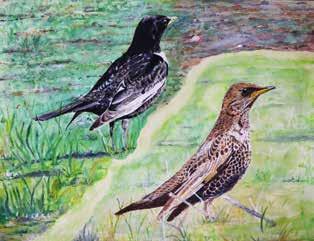
The northeast produced 21 spring migration records, the first of which was one at Southwold Town Marshes, April 8th and last was at Minsmere, June 2nd. Seven birds were counted at Minsmere during the year, five of them in April. The southeast had 16 spring records, starting April 17th at Landguard and culminating in one at Trimley Marshes on May 1st. There were no records in the west in 2023. For comparison the first and last dates in 2022 are as follows:
Spring: Northeast: first, April 12th; last, May 28th
Southeast: first, April 12th; last, May 3rd
West. first: April 8th, last, May 7th
The autumn produced 15 reports from the northeast, ten from the southeast and none from the west. Most of these reports were of single individuals, but a group of five was reported at Kessingland on October 23rd and three at Landguard on October 10th. The earliest sightings came from Minsmere on October 3rd in the northeast and Gedgrave on October 8th in the southeast. The last sighting in the northeast was a singleton at Thorpeness on October 31st and the last for the southeast was one at Landguard on October 28th. Again, for comparison, first and last dates in
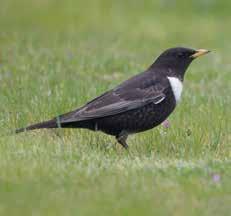
Ring Ouzel, Landguard and Sutton Heath Peter Lakey
Ring Ouzel, Sutton, 28th April Chris Mayne
autumn 2022 are as follows:
Northeast: first, October 13th: last, November 29th
Southeast: first, October 13th: last, November 20th
West: no autumn records
At Landguard, in the spring, there were different singletons on April 17th, 18th and 20th and 21st. In October at Landguard there were three on 10th and singles on 8th, 19th and 28th.
SPOTTED FLYCATCHER
Muscicapa striata
Declining summer visitor and passage migrant. Red list.
A very early singleton was reported at Gisleham on April 26th followed on May 9th by a single at Bramfield and four at Bradfield Woods and singles in Lackford Village, May 10th and at Loompit Lake, May 14th. Up to the end of May there were reports from five sites in the northeast recording area, ten sites in the southeast and 12 sites in the west. Spring passage through Landguard was noted with singles on five dates between May 25th and June 6th. Counts of three were noted at Hoxne, June 26th and at Helmingham Hall, May 24th.
The first spring report of 2023 was from Gisleham on April 26th. This is the earliest to be recorded in Suffolk since 2015 when one was at Snape on April 20th, the earliest in the county so far this century. Suffolk’s earliest record is of one on April 9th in 1983 at Nacton.
In the northeast there were four breeding sites, and a further possible four sites with three sites and a possible seven other sites in the southeast and eleven in the west with a possible nine others. The total of breeding sites in 2023 is 38 (including the possible ones) which is lower than the 42 in 2022, a trend that continues downward. This species was recorded in four of this year’s 44 BBS squares involving four birds.
The highest post-breeding counts were noted at:
Westhorpe: four, July 27th
Gt Blakenham and Gipping Valley: four Aug 28th
Barking: Pipps Ford, three Sept 8th to 9th
Long Melford: family of four, Aug 19th
Ickworth Park: family of four, Aug 18th
Brandon: family party of six, Aug 25th; Brandon Park Heath: 12, Aug 29th
Eriswell: Foxhole Heath, family of four. Aug 25th
Ixworth: Thorpe Carr, four Aug 20th
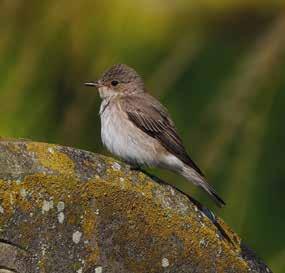
The last reports of the autumn passage were received from Minsmere with two on September 26th and a single on September 30th, Landguard October 2nd to 4th and finally one was at Brandon on October 17th, which is the latest-ever recorded in the west, the previous latest being October 2nd 2017 at Thetford
EUROPEAN ROBIN Erithacus rubecula
Very common resident, passage migrant and winter visitor.
During the first winter period, nine birds were overwintering at Landguard, four of which had been ringed during autumn 2021 and five during autumn 2022. Elsewhere high counts were noted at:
Spotted Flycatcher, Hadleigh, 6th July Bill Baston
Somerleyton Estate. A peak of ten noted during winter survey Feb 11th
Reydon: 21, Feb 21st
Hoxne: 32, Jan 4th; 50 Feb 15th and 40, Mar 29th
Ipswich: Holywells Park, 17, Jan 14th;
Christchurch Park, 16, Jan 17th
East Bergholt: Flatford Mill, 20, Feb 20th
Great Blakenham and Gipping Valley: 27, Feb 4th
Great Finborough: Boyton Hall, 22, Feb 11th
Helmingham Hall: 26, Mar 2nd
Lackford Lakes: 24, Jan 26th
Landguard reported spring passage started from March 11th, when eight, the site’s spring maximum total, were present, and continued until April 26th.
Spring and early summer high counts were noted from:
Hoxne: 35, Apr 9th; 30, May 16th
Minsmere: 20, May 13th
Ufford/Melton: Ufford Park Golf Club, 16, May 2nd
Martlesham Heath: woods, 15, May 3rd
Sutton: Broxtead Hall Estate, 16, Apr 4th
East Bergholt: Flatford Mill, 20, Apr 8th
Great Finborough: Boyton Hall, 17, June 6th
Sudbury: Water Meadows, 12, Apr 8th
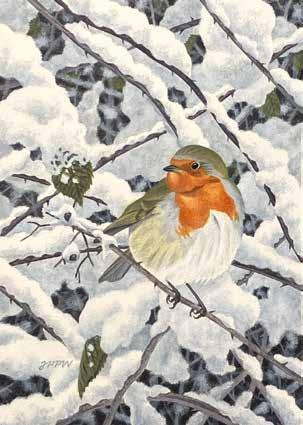
Breeding data were sparse for such a common bird. However, seven territories were noted at Hall Farm, South Elmham St Cross and the newly established Martlesham Wilds SWT reserve also held at least seven territories.
During late summer and into autumn the highest counts were from:
Kessingland: 40, Oct, 27th
Hoxne: 49, Sep 10th; 37, Oct 8th
Southwold: sea front, 25, Oct 8th
Kessingland: north, Oct, 27th
Minsmere: 20, Oct 19th
Thorpeness: Common, 30, Oct 2nd.
Shingle Street: 30, Oct 8th
Felixstowe Ferry: 18, Oct 18th
Landguard: maximum of 30, Oct 27th
Trimley Marshes: 18, Aug 20th; 23, Sep 16th
Ipswich/Pinewood: Belstead Brook Park, 20, Sep 6th
Great Livermere: 14, Oct 9th
BTO Nunnery Lakes: 36, Oct 13th
As the winter period approached, 18 at Landguard in early December were presumably preparing to overwinter at this site; additional high counts were from:
Hoxne: Thorpe Hall/Cat’s Lane, 20, Nov 16th; 22, Dec 26th
Bawdsey: East Lane, 15, Nov 11th
Ipswich/Pinewood: Belstead Brook Park, 15, Nov 18th
Great Barton: 25, Nov 22nd
BLUETHROAT Luscinia svecica
Robin, in snowy bramble Jan Wilczur
Red-spotted Bluethroat Luscinia svecica
Rare passage migrant.
Another blank year for this species. There have been no records since one was present at Landguard on May 20th 2019.
White-spotted Bluethroat Luscinia svecica cyanecula
Rare passage migrant.
There have been no records since 2019 when one was at Herringfleet Marshes on April 6th and 7th.
COMMON NIGHTINGALE Luscinia megarhynchos.
Fairly common summer visitor and scarce passage migrant. Red list.
The first reports were from Loompit Lake, Trimley St Martin and Alton Water (2) on April 10th, followed by Minsmere (2) and Aldeburgh GC on April 11th. The earliest in the west were at Hadleigh River Walk and Cornard Mere, both on April 14th. Between mid- and the end of April there were some impressive counts of singing birds from:
Historical Note
In 1980 a BTO survey concluded that there were 367 Common Nightingale territories in Suffolk. In 2003 there were just 144, a 61% decline in 23 years. However, in 2022 there were 270 territories – which reduced the decline to 27% over 42 years.
Suffolk Bird Reports.
Westleton Heath: five, Apr 15th; 12, Apr 28th
North Warren: four, Apr 29th
Great Glemham: Pound Farm, 11, Apr 22nd
Bromeswell: five, Apr 17th
Martlesham: Top Street, six, Apr 22nd
Nacton: Orwell CP, eight, Apr 30th
Alton Water: five, Apr 21st
Hadleigh: River Walk, four, Apr 17th and five, Apr 27th
Lakenheath: Maidscross Hill, four, Apr 17th; eight, Apr 22nd
During May, the highest counts were reported from:
Dunwich Heath: five, May 19th
Westleton Common: six, May 6th
Kesgrave: eight, May 20th
Woodbridge: Broomheath, five, May 2nd; Kingston Meadows, five, May 3rd
Alton Water: six, May 1st
Spring passage at Landguard Involved at least two, April 22nd to 25th and a laggard individual, June 13th and 14th.
The key breeding sites were located at:
Great Glemham: Pound Farm, 11 territories with three family groups seen
Kesgrave: eight territories
Wherstead Parish: nine territories
Alton Water: 20 territories
Hadleigh: Broomhill, six territories
Lakenheath: Maidscross Hill, eight territories
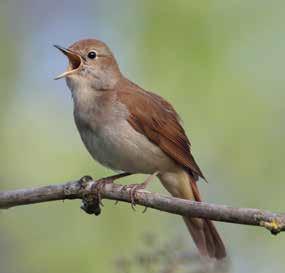
Nightingale, Martlesham, 1st May Chris Mayne
Lackford Lakes: seven territories
Overall, there were 26 sites with 42 territories in the northeast, 60 sites with 120 territories in the southeast and 29 sites with 74 territories in the west – giving an overall total of 115 sites and 236 territories. In 2022 there were 105 sites and 270 territories.
For what it’s worth, Nightingales were recorded in four of the 44 BBS squares involving seven birds.
There were quite a few late reports this year with the last one from the west noted at Shalford Meadow, Little Cornard on July 7th. Minsmere ringed an individual on August 17th with further reports at the same site on August 28th and September 1st. Finally, Landguard noted a singleton from July 28th to August 2nd with further singles on August 2nd and 10th and finally, September 4th.
RED-BREASTED FLYCATCHER Ficedula parva
Rare passage migrant, principally in the autumn.
There were no records in 2023 with additional blank years in 2022, 2021, 2016, 2011 and 2006 so far this century. The most recent records involved three in the first week of October in 2020.
EUROPEAN PIED FLYCATCHER Ficedula hypoleuca
Fairly common passage migrant, principally in the autumn. Amber list.
After a blank spring in 2022 this year did provide one report – from Sudbury on May 5th.
Autumn passage was first noted with an early sighting at Long Lane, Rumburgh on July 27th followed by another singleton at Minsmere August 8th. In the northeast a small fall occurred at Southwold where four were present at Town Marshes, August 16th followed by eight at the Sewage works, August 19th with three noted in Blyth Road, Southwold on the same day. In the southeast three were at Shingle Street, August 16th with Landguard noting a noteworthy total of 12 on August 18th with nine remaining the following day. Elsewhere singles were noted at Melton, August 23rd, Ipswich, September 13th, Pipps Ford, September 9th, Mildenhall, August 16th and Denston, September 3rd. The last reports came from Southwold Sewage Works, with three, September 21st and, finally, a singleton at Thorpeness on September 22nd.
BLACK REDSTART Phoenicurus ochruros
Uncommon summer visitor and passage migrant. A few overwinter. Amber list.
There were just three records during the first winter period with a well-watched first-winter male noted at East Lane, Bawdsey on February 22nd, remaining until March 1st and atypical inland records from the Fynn Valley at Witnesham, February 2nd and at Haverhill on February 2nd (male).
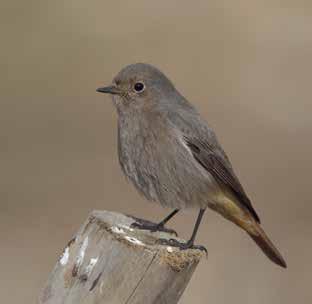
Spring passage at Landguard was noted from February 28th, elsewhere singletons were reported from Benacre, March 12th, Kessingland, March 18th and Felixstowe Ferry, March 19th and a pair was present inland on the east side of Great Waldingfield Airfield, March 27th. Less typical spring passage records were received from St Olaves, April 22nd and Abbey Farm in Snape, April Black Redstart, East Lane, 4th March Chris Mayne
14th. During the spring, reports came from 12 sites in the northeast, six sites in the southeast and just one in the west. Counts higher than one were few and came only from Southwold two, April 22nd, Sizewell, two, April 14th and 30th and Landguard, four, March 16th.
There were at least 13 pairs confirmed breeding in the county, a slight increase on the 2022 figure.
Lowestoft: ne pair with a family party of five noted, Sep 6th
Sizewell: Sizewell A, two pairs made three successful attempts producing at least six juveniles, whilst on Sizewell B a pair produced two juveniles
Felixstowe: Dock Area, breeding likely to have occurred with juveniles noted at nearby Trimley Marshes in June; male was also heard singing sporadically at Landguard Fort from early July into August.
Martlesham: Adastral Park, singing male on territory from April until early June but no evidence of breeding Bury St Edmunds: Sugar Beet Factory, two pairs, no further details
RAF Mildenhall: two pairs, no further details
RAF Lakenheath: four pairs, no further details
Landguard reported two juveniles from July until September 3rd. The highest autumn counts, involving juveniles, were reported from Ness Point, Lowestoft, with five, September 6th and Sizewell, where seven were present on October 30th. Additional autumn reports came from Walberswick, October 24th, Slaughden, September 4th, Bawdsey, November 17th and Felixstowe (2), November 17th and, inland, at Pipps Ford, October 9th. As the year closed birds preparing to overwinter were reported from Ness Point, Lowestoft on December 15th and 31st and Sizewell, December 16th (2) with one there on 23rd.
COMMON REDSTART Phoenicurus
phoenicurus
Uncommon summer visitor and passage migrant. Amber list.
An improvement was seen in the 2023 spring passage when compared with 2022 with the first reports from Upper Hollesley Common on April 5th, Westleton Heath, April 9th, Trimley Marshes (2), April 12th and Lakenheath Fen, April 17th. Landguard noted five passage birds between April 22nd and May 6th, all singletons. Passage was noted from seven sites in the northeast, six sites in the southeast and four in the west. On Upper Hollesley Common there were six reported on May 1st with 11 there on May 17th.
Breeding was reported from the following sites:
Minsmere: 11 pairs, the highest total since 2019 (also 11 pairs)
Sutton and Hollesley Commons: 11 pairs
Sutton Heath: pair
Staverton Thicks: pair
Woodbridge Airfield: two pairs
The total of 26 pairs is slightly better than 23 pairs in 2022. There was no breeding reported from the west of the county.
No Common Redstarts were recorded in the course of BBS fieldwork.
Autumn migration got underway with an early report of a singleton at Long Lane, Rumburgh, July 25th. All other reports are listed:
Corton: Aug 19th
Kessingland: Sep 18th
Minsmere: Aug 19th; two, Sep 15th
Shingle Street: Aug 18th; Sep 17th
Landguard: passage from Aug 3rd to 21st, with max of three, Aug 18th
Upper Hollesley Common: one noted on July 18th may not have been a passage bird
Final reports of the year came from Landguard, September 21st and Dip Farm, Lowestoft on October 8th.
WHINCHAT Saxicola rubetra
Declining passage migrant. Formerly bred. Red list.
A slightly better spring passage than in 2022 was noted from 16 sites involving 19 individuals.
All records listed as follows:
Carlton Colville: Mutford Wood Lane, May 3rd
Lowestoft: Harbour, May 14th
Kessingland: beach, Apr 24th
Southwold: Town Marshes, Apr 29th
Blythburgh: Union Farm, Apr 27th
Minsmere: Apr 29th; female, June 3rd
Aldringham: male, May 7th
North Warren: Apr 22nd; male, May 1st
Boyton Marshes: male and female, June 4th
Hollesley Marshes: male, Apr 21st and 22nd
Landguard: June 1st to 4th
Trimley St Martin: Loompit Lake, male, June 2nd
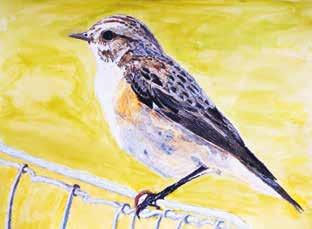
Hadleigh: horse paddocks, Pond Hall, June 6th
Cavenham Heath: Apr 23rd
Santon Downham: first of the year, Apr 7th
Lakenheath Fen: Apr 23rd; [Hockwold Washes, Norfolk (seen from Suffolk, possibly same bird), Apr 25th]
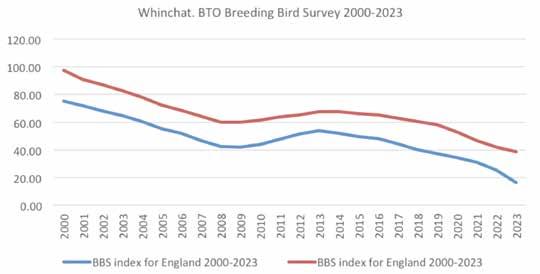
The above graph from the BTO Breeding Bird Survey for Whinchat in England clearly shows a significant decline this century which mirrors our observations noted in Suffolk during spring and autumn.
Autumn passage was reported from a total of 21 coastal sites with the first noted at Aldeburgh Marshes (2), August 12th with a singleton at Benacre on August 13th. This is the second year running with no double-figure autumn counts; one suspects a continuing trend. Highest counts in the coastal belt were as follows:
Lowestoft: Corton Road, four, Aug 19th
Minsmere: four Sep 5th
Aldeburgh Marshes: four, Aug 28th; five Sep 4th
Shingle Street: four, Sep 16th; four, Aug 20th; six, Sep 2nd
Landguard: three, Aug 21st
Inland there were reports from five sites, all are listed:
Barking: Pipps Ford, Sep 4th; Sep 22nd
Great Cornard CP: Aug 21st
Whinchat Peter Lakey
Hinderclay: two, Sep 18th to 20th
Cavenham Heath: Sep 1st, Sep 13th
Thetford: BTO Nunnery Lakes, Sep 2nd to 8th
The final records of the year were from Minsmere on October 4th (with presumably the same bird noted the following day) and Benacre on October 6th.
EUROPEAN STONECHAT Saxicola rubicola
Fairly common resident, winter visitor and passage migrant.
First winter reports came from a total of 39 sites throughout the county with the highest counts noted from:
Somerleyton Estate: two, Feb 20th
Minsmere: six, Feb 20th
Aldeburgh Marshes: six, February 22nd
Boyton Marshes: three Jan 2nd; four, Feb 15th
Hollesley Marshes: four, Jan 1st; six, Jan 18th, six, Feb 15th; four Feb 27th
Felixstowe Ferry: four, Jan 19th
Knettishall Heath: seven, Feb 7th
Santon Downham: four, Feb 19th
Reports from sites not usually associated with this species came from:
Woodbridge SW: two, Jan 8th; two, Feb 6th
Creeting St Mary: Hungercut Hall, Feb 19th
Stowmarket: two, Feb 25th
Monks Eleigh: female, sitting on roadside shrubs, Jan 18th
There were some high totals reported as birds arrived back on their breeding sites:
Westleton Heath: seven, Apr 14th
Minsmere: seven, Apr 16th
North Warren: seven, Apr 9th
Felixstowe Ferry: seven, Mar 11th
Cavenham Heath: eight, Apr 27th
Brandon Park Heath: notable count of 16, Apr 8th
Lakenheath Fen: six, Mar 18th to 24th
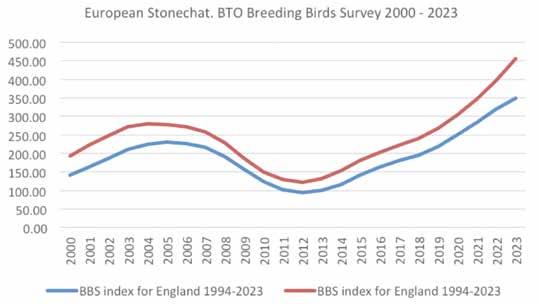
The northeast held 90 breeding pairs at 15 sites, the southeast had 33 pairs located at nine sites and the west had 26 pairs at 12 sites. Overall, there was a total of 149 breeding pairs which is much lower than the record of 267 set in 2022 but still a very good number. The key breeding
sites were Dunwich Heath with 13 pairs, Minsmere, 29, Aldringham Walks/North Warren, 12, Hollesley and Sutton Commons, 19 and Brandon Park Heath, 12. Unsurprisingly after last year’s record success there was a downturn with several key sites reporting lower numbers. It should also be noted that there was less coverage in the west during 2023, particularly in Thetford Forest. The Suffolk Sandlings followed a similar pattern with 113 pairs in 2023 down from 137 in 2022, albeit that this is still the second highest on record.
Stonechats were recorded in just one of the 44 BBS involving two birds.
The above BTO Breeding Bird Survey graph for European Stonechat illustrates the current upward trend throughout England this century, which we have also experienced in Suffolk.
Late summer post-breeding gatherings were noted at:
Westleton Heath: nine, Oct 10th
Minsmere: noteworthy count of 23, Sep 13th
Thorpeness Common: nine, Oct 8th
Aldeburgh Marshes: 15, July 13th
Orfordness: six, Oct 29th
Hollesley Marshes: eight, Oct 10th; eight, Oct 22nd
Upper Hollesley Common. eight, Sep 3rd; eight, Sep 15th
Cavenham Heath: 12, Aug 25th;12, Sep 8th
Brandon Park Heath: 28, Sep 9th; 47, Sep 10th, the latter is the highest-ever single-site count to be recorded in Suffolk exceeding the total of 39 reported at the same site, Sep 8th 2021
An unexpected report came from Lindsey where a male was noted on October 17th.
Towards the end of the year some excellent high counts were noted from:
Kessingland: Church Road, eight, Nov 28th
Minsmere: eight, Nov 28th and 30th
Sizewell Hall: 11, Nov 11th
Butley: Burrow Hill, five, Dec 29th
Felixstowe Ferry: six, Nov 29th
There were some noteworthy inland reports from Stonham Aspal, November 17th, Whitehorse Marsh, East Bergholt (2), December 5th, Kiln Farm, Long Melford, December 14th and Ashfen Carr, Euston, December 10th.
SIBERIAN STONECHAT Saxicola maurus
Very rare vagrant.
Corton: Old Sewage Farm and Cliff, Oct 24th and 25th (R Holmes et al.)
This is the third Suffolk record, although there have been 11 Siberian or Amur Stonechats.
NORTHERN WHEATEAR Oenanthe oenanthe
Common passage migrant and increasingly scarce summer visitor. Amber list.
There were no very early reports, but there was an excellent March passage this year with the first record in the west at Fornham St Martin on March 16th, followed by a plethora of singletons reported from Gunton Warren, Lowestoft North Denes, Benacre, Dunwich, North Warren and Landguard, all on March 17th. There were multiple March counts from:
Carlton Marshes: three, Mar 29th
Landguard: three, Mar 19th; three, Mar 21st
Barking: Pipps Ford, three, Mar 30th
Cavenham Heath: five, Mar 23rd
Chilton: four, Mar 19th
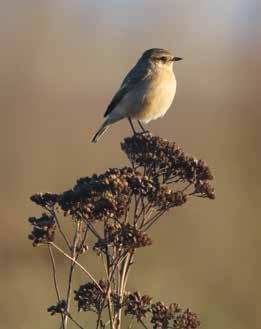
Siberian Stonechat, Corton, 2nd October Peter Ransome
During April, the best of the passage was noted mid-month, including good numbers passing through the west of the county:
Carlton Marshes: seven, Apr 11th; 11, Apr 15th
Minsmere: seven, Apr 14th
North Warren: six, Apr 29th
Hollesley Marshes: four, Apr 29th
Felixstowe Ferry: six, Apr 14th
Landguard: 12, Apr 14th; 12, Apr 18th
Cavenham Heath: six, Apr 14th; ten, Apr 25th; seven, Apr 26th; ten, Apr 30th
Honington: two of the Greenland race, Apr 16th; three of the nominate race, Apr 23rd
Eriswell: Foxhole Heath, three, Apr 15th.
Lakenheath: Maidscross Hill, three, Apr 22nd.
Icklingham: Warren Hills, three, Apr 17th.
Although widely reported in the southeast area, the northeast and west saw an early tail off in reports during May. There were only three sites with counts higher than one:
Landguard: six, May 3rd to 6th; six, May 11th
Hopton (west): three, May 1st
Cavenham Heath: four, May 4th
Historical Note SBR 1992
Just three breeding pairs were located in the county. Two pairs bred at Landguard but the young of the second pair were predated. Four young were raised by the only pair in west Suffolk where at least 54 pairs had been located in a Breckland census in 1976.
Late passage individuals were noted at Corton (2), June 3rd, North Denes, Lowestoft, June 4th, Boyton Marshes, June 4th, Shingle Street, June 1st and Deadman’s Grave, Icklingham, June 4th and Landguard, June 10th.
The continuation of this species as a breeding bird in Suffolk remains precarious with just two pairs confirmed, one at Benacre (one in 2022) and one at Orfordness (three in 2022). This is Suffolk’s lowest total of breeding pairs, apart from Covid-infected 2021, since 2007 when there were also just two pairs, both of them on Orfordness. The annual Norfolk Bird and Mammal Reports indicate that Northern Wheatears last bred in Norfolk in 2016 when a pair raised five young at Weybourne.
Correction for 2022.
It was stated that there were only three breeding pairs, all at Orfordness. However, a pair bred at Benacre – making a total of four breeding pairs.
The Benacre record (above) is the first case of breeding in Suffolk away from Orfordness since 2015 when a pair bred at Shingle Street.
The first report in the autumn was from Walsham-le-Willows on July 9th, followed by Hollesley Marshes on July 18th and Landguard on July 28th. The highest counts were mid-August to MidSeptember:
Benacre: five, Aug 13th
Southwold: sea front, six, Aug 20th; sewage works, eight, Sep 21st
North Warren: ten, Sep 2nd
Shingle Street: six, Aug 16th
Felixstowe Ferry: five, Aug 20th
Landguard: max 16, Sep 11th
A good passage was also noted in the west of the county from ten sites, with the highest totals reported from:
Cavenham Heath: two, Aug 13th; two, Sep 13th
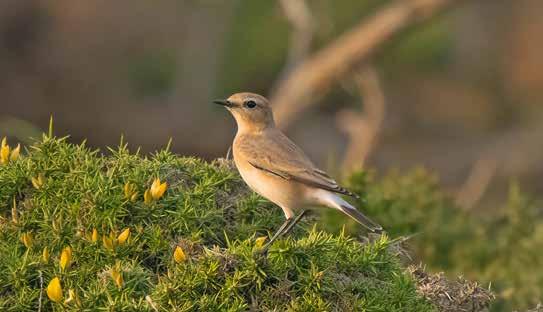
Knettishall Airfield: two, Sep 8th
Hinderclay: two, Sep 20th
Haverhill: Ladygate Wood, two, Sep 6th
There were few reports of note in October. However, there were six at Kessingland, October 3rd, at Landguard, three were present on six dates between October 3rd and 15th, one was at Pipps Ford, Barking, October 5th, two were at Knettishall Airfield on October 6th and the last report from the west was from Cavenham Heath, October 8th. As in recent years there was a number of November records from Walberswick, 3rd, Landguard, 1st to 5th and two there, 3rd and, the final sighting of the year, coming from Hollesley Marshes on 17th, the latest since 2019 when one was at Dunwich, November 19th.
ISABELLINE WHEATEAR Oenanthe isabellina
Very rare vagrant.
Southwold: Sep 26th (B J Small et al.)
Suffolk’s sixth record involved a bird present at Easton Bavents, just north of Southwold. The previous Suffolk record was on October 21st 2016 at Sizewell.
PIED WHEATEAR Oenanthe pleschanka
Very rare vagrant.
Lowestoft North Denes: Oct 22nd (A C Easton et al.)
A first-winter male was present for around two hours from 08:50hr before flying off southwest. This is the fifth record for Suffolk with the last recorded on November 14th 2021, at Sizewell.
WHITE-THROATED DIPPER Cinclus cinclus
Rare vagrant. Amber list. There have been no records since a well-
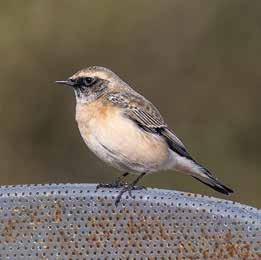
Isabelline Wheatear, Southwold, 26th October
Andrew Moon
Pied Wheatear, Lowestoft, 22nd October
Jeff Higgott
watched individual was present at Needham Market/Pipps Ford from October 20th to November 26th 2016.
EURASIAN TREE SPARROW Passer montanus
Uncommon and declining resident. Scarce passage migrant. Red List.
There was an increase in records from the east of the county, following just one, at Landguard, in September 2022. There were two birds at Landguard on August 25th and singles on six dates in September. There were also single birds at Cretingham Golf Course on June 24th and at Shingle Street on August 18th. Small numbers were reported from the west where winter feeding ceased after 2020, which has, inevitably, resulted in significantly-reduced flock sizes. For the first time in four years, six birds were recorded in one BBS square.
Peak counts were:
Fornham St Martin: Hall Farm, recorded in each month from January to July, with ten pairs probably nesting, July 30th
Ampton: 12, Jan 30th; 15, Sep 2nd; 11, Oct 16th; ten, Nov 9th
Little Livermere: 15, Mar 2nd; 15, June 28th (probably nesting)
Tuddenham St Mary: 18, Jan 28th
HOUSE SPARROW Passer domesticus
Common but declining resident. Red List.
This species is still locally common, but generally poorly recorded throughout the county with few significant flocks; it may be more populous than records show.
Flocks of over 50 were recorded at the following sites:
Lowestoft: Ness Point, 70, Aug 5th
Pakefield: 140, Aug 26th to 31st
Trimley Marshes: 54, Aug 31st
Brandon (West): 70, Apr 16th
At Landguard 30 pairs again nested in the vicinity of the Cottage and Fort; seven birds were retrapped from previous years, with the oldest being from April 2019. The year’s peak counts at Landguard were all of 150 on several dates in August and September.
BBS recorders counted 239 birds in 25 squares (275 in 23 squares in 2022).
FIELD NOTE
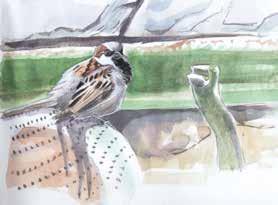
The highly sedentary nature of this species is well known. In recent years, we’ve had very occasional garden records north of Hadleigh (less than one a year) despite there being apparently healthy colonies less than a mile away, both to east and west. I can remember my father catching 15-20 sparrows at a time in a circular wire trap in the mid-1970s – thankfully it was very rarely used, and apparently made little impression on a large population nesting in a largely-abandoned barn. Adam Gretton.
DUNNOCK Prunella modularis
Very common resident and fairly common passage migrant. Amber List. Being found in 36 of the BBS squares shows how widespread Dunnocks are in the county. This is similar to recent years. The figure of 130 birds counted is also similar to recent years. Some of the highest counts in the first half of the year were recorded at:
Somerleyton: nine during winter bird survey, Mar 17th
House Sparrow Stewart Sexton
Hoxne: up to 17 singing throughout, Mar 2nd to Apr 4th
Reydon: 17, Apr 17th
Minsmere: 20, Apr 28th
Redgrave: 18 during BBS, May 1st
Great Finborough: Boyton Hall, 13, Feb 11th
Creeting St Mary: 50 during BBS, Apr 11th
Two of the highest counts in autumn were:
Southwold: Sea Front, 18, Oct 10th
Thorpeness: 20, Sep 16th; 30, Oct 22nd
Shingle Street: 20, Oct 2nd
As last year, 12 pairs bred at Landguard, with the first juvenile seen on June 10th. Ten birds survived the winter with the oldest having been ringed in March 2019. Spring passage there was between March 4th and April 13th, with other singles on May 17th and June 1st. Autumn passage there was between September 15th and November 12th with a maximum of 25 on October 16th.
WESTERN YELLOW WAGTAIL Motacilla flava flavissima
Rapidly declining summer visitor and passage migrant. Red list.
The first record of the year was at Martlesham on April 3rd, followed by five birds at Boyton Marshes, April 5th, 30, Burgh Castle, April 10th and four at Pipps Ford, Barking, April 17th. There were 15 sites with counts of more than five birds. The highest spring and autumn counts were at Burgh Castle with 30, April 10th and Aldeburgh Marshes with a flock of 38 reported September 4th which included adult males resembling M. f. flava. Breeding was confirmed at Pakenham, Kedington, Cavenham, Risby, Thurston, Gazeley, and Chelmondiston. Probable breeding was reported from Pakenham, Chelmondiston and Martlesham Wilds where a pair was recorded as ‘holding territory’ April 3rd to June 15th.
Burgh Castle: 30, Apr 10th
Aldeburgh Marshes: 25, Aug 25th, 30th and 31st; 20, Sep 1st; four, Sep 6th; 38, Sep 4th; 20, Sep 15th; 20, Sep 15th
Boyton Marshes: five, Apr 7th; nine, July 26th and Aug 9th; eight, Aug 31st
Hollesley Marshes: nine, Apr 21st; seven, Apr 29th
Shingle Street: eight, Sep 3rd
Bawdsey: East Lane: six, Sep 8th
Felixstowe Ferry: ten, May 1st to July 6th; eight, July 27th; five, Aug 1st; six, Aug 10th; six, Aug 22nd; six, Aug 25th
King’s Fleet: five, July 21st
Levington Creek: five, July 7th; 23, Aug 22nd
Brantham: Seafield Bay, 12, Aug 20th
Pipps Ford: four, Apr 17th
East Bergholt, Flatford, Cattawade circuit: 11, Sep 21st
Cavenham: six, Sep 3rd
At Landguard the spring passage count was of only 12 between April 22nd and May 14th with a maximum of three, April 30th and May 1st. Higher numbers were recorded during autumn passage with 170 between July 20th and October 8th, and a maximum of 35, September 16th. This is the highest autumn total at Landguard since 2016 when 241 were recorded.
One at King’s Fleet/Felixstowe/Falkenham on November 29th is the latest-ever recorded in Suffolk.
2022 Addition
Cavenham Heath: 34, Aug 30th – an excellent total for west Suffolk
CHANNEL YELLOW WAGTAIL Motacilla flava flava x flavissima
Single birds (showing characteristics of both Yellow Wagtail and Blue-headed Wagtail) were present at Hollesley Marshes, April 21st and June 4th; Pipps Ford, Barking, April 17th and King’s Fleet, May 27th
GREY-HEADED WAGTAIL Motacilla flava thunbergi
Scarce passage migrant.
There was a single record in 2023: Southwold: over Town Marshes, photographed, 06:50hr June 3rd (J Gearty, R Holmes)
BLUE HEADED WAGTAIL Motacilla flava flava
Uncommon passage migrant. Amber list.
Single birds were present at Hollesley Marshes on April 21st and June 4th. Adult males resembling Motacilla f. flava were reported with a flock of 38 Motacilla f. flavissima on Aldeburgh Marshes on September 4th.
EASTERN YELLOW WAGTAIL Motacilla tschutschensis
Very rare visitor.
Carlton Marshes: 4CY+ male, November 3rd 2022 to May 2nd 2023 (A C Easton, B J Small, J Wylson et al.); presumed same as Suffolk 2020 and 2021
This record of a well-photographed long-staying male at Peto’s Marsh on Carlton Marshes in winter 202223 has been accepted by the British Birds Rarities Committee on the basis that it is presumed to be the same bird that overwintered at the same location in 2020-21 when it was sound recorded. This returning bird, first seen at Dunwich in November 2020 before it relocated to Carlton Marshes, is the fourth record for Suffolk.
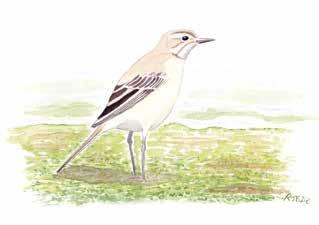
Two birds showing characteristics of M. tschutschensis were seen at Carlton Marshes later in 2023, an adult from November 26th to December 1st and a first-winter from November 26th to December 2nd. The adult is presumed be the same returning individual as above and the record has recently been submitted to BBRC. Neither was sound recorded.
GREY WAGTAIL Motacilla cinerea
Fairly common resident, winter visitor and passage migrant. Amber list, (from Red list 2021). Singles were recorded in all months of the year from the southeast and the west of the county with counts of two or more birds reported from 21 sites.
Although this species was not recorded in the BBS survey, breeding was probable in the vicinity of Christchurch Park, Ipswich and, possibly, also the sewage works at Donkey Lane, Friston, where a juvenile was reported on September 9th. Probable breeding was also noted at Great Blakenham Lock, River Gipping, June 14th. In the west of the county breeding was confirmed at three sites, Pakenham Water Mill, Thurston and Long Melford sewage works. Four pairs were also recorded in suitable habitat at Hoxne.
Hoxne: five, Mar 20th; three, Apr 12th; four, Aug 25th and Sep 30th
Long Melford: sewage works, seven, Feb 10th; six, Mar 3rd; six, July 5th
There were eight spring records for Landguard from March 18th to April 5th with a maximum of three, March 20th plus a single bird May 16th. There were six records during mid-summer from June 14th to August 11th (this bird was re-trapped on September 2nd). A total of 148 (90 in 2022, 163 in 2021) was recorded from August 21st to October 31st with a maximum of 12, September 12th.
Yellow Wagtail Russ Boland
Observations of an injured Grey Wagtail
There were regular sightings of a pair of Grey Wagtails in the spring of 2023 at the Round Pond in Christchurch Park, Ipswich. The birds used the pond’s raised concrete perimeter as a base for flying out over the pond in pursuit of aerial insects before heading off southwards to their breeding site in central Ipswich. Unfortunately, the exact locality of the breeding site was not determined.
On May 7th, closer observation of the male wagtail revealed that its right leg was defective – it could only hop rather than run or walk although it retained its aerial ability. Although the female wagtail was noted catching insects at the pond, the male wagtail was not seen definitely for just over five weeks and the assumption was that it had in some way succumbed because of its injury. However, the male wagtail was seen back at the Round Pond on June 12th, and was seen subsequently on four dates up to July 12th; on June 16th it was seen to fly up from the Round Pond perimeter onto the roof of Christchurch Mansion where it was watched foraging amongst the moss on the centuries-old tiles.
The success, or otherwise, of this pair of Grey Wagtails is unknown. Philip Murphy.
PIED WAGTAIL Motacilla alba yarrellii
Very common resident, passage migrant and winter and summer visitor
Significant counts were recorded across the county of which four were at roost sites with two smaller roosts of 30 on boats moored at Freston, December 12th, and 24 at Muntons factory, Stowmarket, January 27th. Turnstones have also been recorded roosting on boats at Freston (see 2022 bird report).
Breeding was confirmed at four sites in the county with at least three pairs nesting in the adjoining dock at Landguard. There were 45 records for Pied/White Wagtail submitted to the BBS survey from 17 squares.
Benacre: 85, Nov 9th
Southwold: sea front, 60, Oct 28th; Town Marshes, 65, Nov 10th
North Warren: 60, (to roost) Feb 6th
Orford: Quay, 50 at roost near quay, Feb 16th
Hollesley Marshes: 55, Nov 9th
Bawdsey: East Lane, 50, Feb 18th
Melton: Wilford Bridge Road, 50, Feb 12th
Martlesham Wilds SWT: 50, Feb 25th
Woodbridge: sewage works, 40, July 12th
Kirton: sewage works, 40, Feb 12th
Needham Market: Needham Lake, 220, Jan 14th, 123, Jan 26th; car park and grounds of car boot sale, 70, Feb 28th; sewage works, 251, Feb 26th; 111, Mar 16th; 50, Mar 23rd
Brantham: sewage works, 90, Mar 2nd
Long Melford: sewage works, 90, Jan 16th; 71, Mar 3rd; 48, Oct 8th
Bury St Edmunds: pre-roost gathering Asda Supermarket, 50, Dec 7th
Sudbury: Water Meadows, 58, Dec 12th
Stowmarket: Cedrus House Reedbed Combs Ford, 170 to roost, Feb 23rd
Gipping Valley: 78, Jan 21st
Pied Wagtails were present all year at Landguard. Autumn passage was noted from September 22nd to October 9th with total of 64 south and an additional three south on November 7th; although this year’s total is low (compare with 2013’s total of 233, only ten years ago), it is almost double that of 2022 when only 35 were recorded.
White Wagtail M. a. alba
Fairly common passage migrant. Amber list. The highest counts of this species were recorded during an excellent spring passage with fewer
autumn records. The first spring record was at Carlton Marshes, March 8th. The majority were recorded at coastal sites with two at Pipps Ford, Barking on May 1st being the only inland spring record. There were singles also recorded at two additional inland sites during autumn passage, at Great Livermere and Lackford. There were records of five or more birds from only five sites, Minsmere, Westleton, Carlton Marshes, Benacre and Hollesley (see below):
Carlton Marshes: three, Mar 8th; four, Mar 19th; two, Mar 20th; two, Mar 26th; three, Mar 27th; six, Mar 29th; three, Mar 30th; two, Apr 1st to Apr 3rd
Walberswick: four, Mar 27th
Benacre NNR: 12, Mar 20th
Southwold: three, Mar 19th; two, Mar 26th
Minsmere: five, Mar 14th; four, Mar 25th
Westleton Common: 13, Mar 24th
Hollesley Marshes: two, Apr 5th; five, Apr 21st
Trimley Marshes: two, Apr 5th and 6th
Barking: Pipps Ford, two, May 1st
Singles were present at Landguard, April 12th; May 5th; and September 10th and 16th
MEADOW PIPIT Anthus pratensis
Common resident, winter visitor and passage migrant. Amber list.
This species is recorded regularly on spring and autumn passage along the Suffolk coast together with sightings at long-standing sites in the west of the county. Only four individuals were counted in two squares by BBS surveyors. The highest counts were observed during autumn passage at coastal sites, with the highest count being of 5465 (south) at Southwold, September 21st (see Landguard below). The highest counts, for spring and winter, at inland sites were at Cavenham Heath, Lakenheath and Long Melford.
Breeding records were very sparse, but was reported from Burrow Hill (Butley), Boyton Marshes, Havergate Island and Shingle Street.
Some of the largest counts:
Corton: 600, Sep 21st
Lowestoft: 222, Sep 19th; 140, Sep 21st; 427, Sep 27th
Kessingland: 120, Sep 18th
Benacre: c.100, Oct 4th
Southwold: 5465 south, Sep 21st
Dunwich: 500+ Sep 21st; 154, Oct 27th
Minsmere: c.150, Sep 15th; 100, Sep 19th; 150, Oct 8th
North Warren: 300+ Sep 16th
Thorpeness: 150+ Sep 16th; 400, Sept 17th; 200, Sep 18th; 250, Sep 22nd
Aldeburgh: 200, Oct 2nd
Boyton Marshes: 170, Sep 21st
Felixstowe Ferry: 150, Sep 27th
Bawdsey: East Lane, 100, Oct 21st
Long Melford: 110, Nov 26th
Lakenheath: 71, Jan 28th
Cavenham Heath: 70, Mar 3rd
The total of 5465 south over Southwold on September 21st is the second-highest-ever singlesite day total to be recorded in Suffolk; the highest-ever total is 7500 south in just one hour, again over Southwold, on September 17th 1999. Minsmere’s peak one-day count is 2500 south on September 15th 1999 while at Landguard the site’s maximum day-total is 2409 south on September 21st 1999. Obviously, the autumn passage of this species on the Suffolk coast in 1999 was exceptional.
Spring passage at Landguard was noted from February 27th to May 17th with a maximum of five on both March 19th and 30th. In summer, singles only were observed south on July 28th and August 11th. Autumn passage was recorded from August 26th until December 25th with a maximum count of 1423 south, September 21st and 688 south and 150 on site, September 22nd.
For Landguard monthly totals (see below):
TREE PIPIT Anthus trivialis
Declining summer visitor and passage migrant. Red list.
The majority of records from the northeast and southeast of the county were of single birds with higher counts in the west where The King’s Forest and Thetford Forest continue to be strongholds for the species with records of song/flight displays involving up to 20 birds. The only record of singing/song flights in the east of the county was of a single bird at Westleton Heath (see below). There were fewer records than in 2023, including in those areas which were normally considered to be strongholds for the species in the east. No records were submitted by BBS surveyors.
Westleton: two, April 21st; two, May 23rd; single bird song flighting, June 12st
Dunwich Heath: three, May 19th
Brandon CP: six singing males, May 13th
The Kings Forest: up to nine singing and displaying, Apr 16th
Brandon: Mayday Farm, four singing males, May 13th
Santon Downham: High Lodge, Thetford Forest, four, Aug 9th
Cavenham Heath: singing male (breeding possible), July 7th; four, Aug 25th
Observations of spring passage at Landguard saw singles on April 28th and May 21st and 23rd and again, during autumn passage, singles on August 16th, 22nd and 28th and September 17th. Observations of spring passage at Landguard saw singles on April 28th and May 21st and 23rd and again, during autumn passage, singles on August 16th, 22nd and 28th and September 17th.
WATER PIPIT Anthus spinoletta
Uncommon winter visitor and passage migrant. Amber list.
The majority of records were of one or two birds with higher counts of four or more at three coastal sites. Double figures were recorded roosting in reedbeds at North Warren and at Lakenheath Fen with a pre-roost flight over Hockwold Washes.
A notable record was of a bird in breeding plumage at Aldeburgh Marshes on April 24th.
Southwold: five, Jan 24th; seven, Jan 29th
Minsmere: four, Jan 21st; three, Jan 22nd to 25th; four, Jan 29th
North Warren: 11, Jan 13th; 13, Feb 19th; 14, Feb 25th; ten, Mar 18th; 14, Mar 20th; 16, Mar 24th; 14, Apr 4th
{Lakenheath Fen RSPB/Hockwold Marshes: 22 in pre-roost flight, Jan 14th}
EUROPEAN ROCK PIPIT Anthus petrosus
Fairly common winter visitor and passage migrant.
This species is seen regularly along the county’s coast and estuaries in the winter months, especially during WeBS counts. During the year there were numerous reports of up to four or five birds with counts of six or more at 11 sites:
Lowestoft: North Beach, five, Mar 19th; eight, Mar 21st
Benacre: 11, Mar 15th
Dunwich: six, Jan 6th; ten, Mar 7th to 10th
North Warren: up to six or more flew south, Oct 28th
Aldeburgh Marshes: 13, Jan 28th; 35, Feb 10th; six, Feb 11th; 30, (including 19 around freshwater pool) Feb 22nd; 34, Mar 9th; 12, Oct 10th; 16, Oct 14th; eight, Oct 16th; 35, Nov 27th
Slaughden: six Nov 4th; nine, Nov 12th; seven, Nov 25th
Alde Estuary: seven, Jan 5th
Hazlewood Marshes: six, Oct 23rd; seven, Dec 29th
Havergate Island: eight, Jan 2nd; six, Feb 19th
Butley River: eight, Jan 22nd; seven, Feb 19th; seven, Nov 19th
Boyton Marshes: six, Oct 22nd
Shingle Street: six, Oct 22nd
Martlesham SW: 14, Jan 8th; 22, Jan 20th; 25, Jan 27th; 20, Feb 6th; 25, Feb 9th; 12, Feb 27th; eight, Dec 6th
Trimley St Martin: Loompit Lake, seven, Dec 30th
Stutton Ness/Holbrook: six, Feb 1st
Cattawade: six, Dec 11th
One was present at Landguard on January 25th and then recorded sporadically until February 22nd. Singles were also recorded during spring passage on five dates from March 1st to 27th and during autumn passage 23 bird-days from October 9th until November 22nd with a maximum of four recorded, October 14th and November 15th. A single bird was again present from December 6th to 27th.
EURASIAN CHAFFINCH
Fringilla coelebs
Very common resident, winter visitor and passage migrant. Categories A and E.
This common but declining species is widely distributed throughout the county with flocks recorded regularly prior to migration and in the winter months.
BBS surveyors recorded 208 individuals from 40 squares in 2023 (up on the 167 birds in 2022, which is the lowest total to date, excepting the Covid year of 2020, when many squares were not surveyed).
Flocks of 50 or more were reported from 15 sites (seven sites in 2022) with peak totals as follows:
Somerleyton: 217, Jan 14th; 60, Sep 21st
Beccles: Sotterley Road, 50, Jan 28th
Benacre: 60, Mar 23rd
Henham Park: 90, Dec 10th
Thorpeness Common: 50+, Mar 18th; 58, Oct 31st
North Warren: 200+, Mar 25th
Aldeburgh: on arable, 50+, Nov 26th
Sudbourne: 80, Feb 26th
Alton Water: 60, Dec 10th
Chelsworth: 50, Jan 3rd
Acton: Balsdon Hall Farm, 80, Dec 27th
Long Melford: Melford Park Farm, 74, Dec 30th
Lackford: Bunker’s Barn (Cavenham Road)
100, Jan 17th; 115, Jan 18th
Knettishall: disused airfield, 200, Jan 24th
Brandon: Chalk Road, 120, Jan 4th
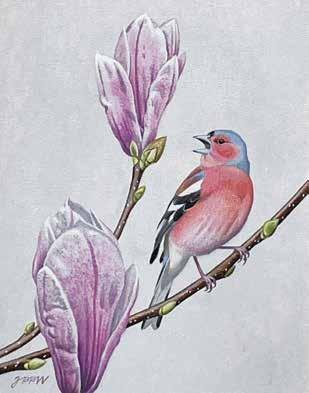
Chaffinch and Magnolia Jan Wilczur
Spring migration at Landguard was between March 14th and May 15th with a maximum day count of 448 south on March 20th; also, on that date at North Denes, Lowestoft, there were 506 south, and 527 two days later. At Landguard, the autumn total was 478 (371 in autumn 2022, but 703 in 2021) south/in off the sea between August 30th and December 15th, with a maximum day-count of 123 on October 9th. This last date is also when 47102 were counted over Hunstanton Cliffs, Norfolk!
BRAMBLING Fringilla montifringilla
Fairly common winter visitor and passage migrant.
The number of records and sites was down on recent years, with no flock over 100 recorded.
Flocks of 20 or more were reported from four sites with peak numbers as follows:
Thorpeness: 20+, Oct 9th
Timworth: 30, Feb 12th
Brandon: 100, Jan 4th; Brandon Park Heath, 90, Dec 2nd; Mayday Farm, 21, Apr 7th; 20, Nov 25th; 50, Dec 30th
Santon Downham: 43, Dec 26th; Thetford Lodge Farm, 60, Jan 16th
Spring passage at Landguard was noted from March 23rd to May 3rd with a total of only 11 birds. Autumn passage at Landguard was recorded from September 29th to November 26th with a total of 53 birds (up from the 24 in 2022, but well below the 139 in autumn 2021) and a maximum of nine on October 16th.
The latest spring record was on May 3rd at Landguard and the first of autumn were two birds on September 26th in west Suffolk at Denston – neither troubling the record books!
HAWFINCH Coccothraustes coccothraustes
Uncommon resident and rare passage migrant. Red List.
This species was recorded at 12 locations (up on ten in 2022, but down on the 17 in 2021). All but three records were of single birds. The change in numbers at Sotterley Park is particularly striking.
Birds were recorded from the following sites:
Sotterley Park: all singles, in contrast with recent years (max 18 in 2022), Jan 6th, 19th, 22nd, 23rd, 25th and 28th; Feb 11th
Sizewell: cottage garden, the third site record for the fortunate owner, Dec 13th
Thorpeness Common: in-off, Oct 8th
Aldeburgh: June 8th
Bawdsey Quay: Oct 15th
Felixstowe Ferry: two, Jan 19th
Landguard: Apr 6th
Ipswich/Pinewood: Belstead Brook Park, Jan 1st
East Bergholt: Flatford Mill, five, Feb 4th; two, Sep 13th
Groton Wood: Apr 18th
Brandon Park Heath: Oct 2nd and Oct 29th
Santon Downham: Thetford Lodge Farm, Nov 26th
EURASIAN BULLFINCH Pyrrhula pyrrhula
Common but declining resident. Amber List.
This species continues to be reported widely throughout the county although only six sites recorded more than five birds (and three further sites recording five birds):
Walberswick: eight, Jan 21st
Minsmere: six, Mar 19th
Thorpeness: Common, nine, Sep 30th; six, Oct 23rd and 31st; seven, Oct 28th
North Warren: six, Mar 24th; eight, seven of which flew high to the south, Nov 6th
Thurston: Black Bourn SWT, nine, Jan 14th; eight (four pairs), Apr 19th; six, Oct 17th
Long Melford: Lineage Wood, six, Sep 16th
BBS counters found five individuals in three squares (four in four squares in 2022), and there was an interesting record from East Bergholt where a pair fledged one young in June, followed by three more from a second brood in September.
Landguard recorded a single bird on December 8th.
COMMON ROSEFINCH Carpodacus erythrina
Rare passage migrant. Bred in 1992.
Landguard: singing first-summer, June 18th and 19th (N Odin et al.)
This bird which was sound-recorded, is the 11th record for Landguard.
EUROPEAN
GREENFINCH Chloris chloris
Common, but declining, resident and passage migrant. Red list (from Green list 2021). Categories A and E.
After some years of steady decline and then little change, there were some signs of recovery, as shown both by the BBS results and the numbers of sites with small flocks. In the 24 occupied BBS squares a total of 82 birds was recorded – the highest number since 2019.
Counts of 20 or more birds were recorded from 15 sites (up on the eight sites in 2021 and 2022) as follows:
Lowestoft: Corton Road, 50, Apr 9th
Kessingland: 46, Nov 12th; c80, Nov 15th; 100, Nov 26th
Benacre: 30, Oct 4th
North Warren: 50, Mar 25th
Felixstowe Ferry: 23, Mar 19th
Woodbridge: Chapel Street, 40, Jan 29th
Levington Creek: 30, Jan 13th
Kedington: Sturmer Mere, 20, Oct 23rd
Great Barton: Conyer’s Green, 27, Mar 6th
Rumburgh: 20, July 13th
Hoxne: 22, Feb 10th; 22 including 13 singing males, Mar 19th
Lackford: 70, Oct 11th; 60, Oct 31st
Thetford: BTO Nunnery Reserve, 32, Dec 29th
Santon Downham: Thetford Lodge Farm, 20, Nov 26th
Brandon: 63, Jan 1st; 80, Feb 25th
In contrast with the positive signs above, the autumn passage at Landguard involved only 17 birds – the site’s lowest-ever autumn total (89 in autumn 2022, and 453 in 2017) moving south between September 22nd and November 6th, with a maximum of seven on October 14th.
TWITE
Linaria flavirostris
Declining winter visitor and passage migrant. Red List.
There were first winter reports from one site:
Dunwich: two, Mar 4th to 22nd (D Carter, M Carter) – (also reports on Jan 18th and 22nd, but no description received)
There were second winter reports from two sites:
Kessingland: Oct 22nd to 24th (L Curson et al.); two, Nov 23rd (R Walden)
Dunwich: four, Dec 15th (B J Small)
As noted in the 2022 Bird Report, monitoring of the Twite population by RSPB in its Peak District breeding areas, shows a dramatic 90% decline between 1999 and 2021 (https:// www.rspb.org.uk/our-work/ conservation/projects/englandtwite-recovery-project/). The use of colour rings suggests that this area is an important source for the wintering birds in Suffolk. In line with this, the maximum counts from Dunwich/ Walberswick have declined from 100 in 2013-14 to 20 in 2018-19 to four in 2023.
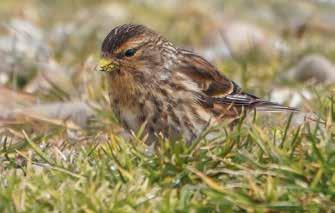
For this reason, Twite has now been moved into category 2 (from 3) of the Suffolk list meaning that all records need to be assessed by SORC. Twite, Dunwich, 7th March David Borderick
COMMON LINNET Linaria cannabina
Common summer visitor and passage migrant. Overwinters in small numbers. Red List.
Flocks were recorded in both winter periods, with many holding 100 or more birds; 13 sites (nine in 2022) held 200 or more and these are mainly in the west of the county, as below:
Benacre Ness: 200, Sep 29th
Thorpeness Common: 250+, Feb 25th; 275, Mar 18th; 200, Oct 5th
Landguard: 250 on 11 dates, Aug 21st to Sep 12th (see below)
Tattingstone: 200, Jan 1st
Lindsey: 200, Feb 7th
Long Melford: 300, Dec 31st
Bury St Edmunds: Wood Field, 200, Feb 28th; 300, Sep 26th
Fornham St Martin: Hall Farm, 300, Dec 16th
Ampton: 400, Oct 16th
Westhorpe: Fairoaks Farm, 280, Feb 23rd; 200, Jan 16th; 200, Apr 14th
Knettishall: disused airfield: 200, Jan 24th; 300, Sep 8th; 800, Oct 28th; 200, Nov 4th
Cavenham: arable adjacent to heath, 200, Jan 2nd; 500, Apr 3rd
Freckenham: 300, Oct 18th
An estimated 30 pairs again bred at Landguard with several more nearby, the same as in 2022. 225 individuals were recorded by BBS surveyors from 28 occupied squares (well up from the 98 birds from 28 squares in 2022).
Autumn passage at Landguard involved 910 south (1494 south in autumn 2022) between September 11th and November 29th with a maximum day-count of 174 south on October 5th. Thirty-four adults were retrapped from previous years at Landguard with the oldest from May 2018. The maximum spring site totals were 100, April 25th and 26th and May 2nd and a summer maximum of 150, June 17th to 19th.
COMMON
REDPOLL Acanthis flammea
Uncommon winter visitor and passage migrant. Amber list.
This species continues to yo-yo somewhat, being reported from 11 sites, when only two locations reported birds in 2022. As widely reported, in July 2024, nine years after the initial proposal, the IOC finally recommended that Common, Lesser and Arctic Redpoll be lumped into one species, Redpoll Acanthis flammea, this change will be reflected in the 2024 Suffolk Bird Report, and will shorten many Suffolk lists by two species! Records to sub-species level will still be welcome, however.
There were records from 11 sites, but only five held more than singles:
Southwold: two, Oct 28th
North Warren: four, Dec 16th
Melton: two, Feb 25th
Hintlesham: Golf Course, two, Nov 12th
Lackford: two, Mar 16th
Landguard had two singles, on November 6th and 28th.
LESSER REDPOLL Acanthis cabaret
Declining winter visitor and passage migrant. No evidence of breeding since 2006. Red List.
As with the above species, numbers have varied greatly in recent years; in 2019 there was only one count above 20 birds, but in late 2020 the flock of 800 birds at Knettishall is the largest recorded since 1976. The day count of 526 birds going south at Landguard at the end of November is exceptional (see below). Counts of more than 30 were recorded at 12 sites as follows:
Southwold: sea front, 35, Oct 28th.
Minsmere: 33, Oct 19th
Sizewell: 31 south, Oct 10th
Thorpeness: Old caravan park, 130 south in flocks of 10-40, Oct 14th; Thorpeness Common, 50, Sep 30th (and 32 at the Haven, same date)
Lower Hollesley Common: 50, Mar 11th
Bradfield Woods: 40, Feb 4th
Lackford: 40, Mar 15th
Cavenham Heath: 40, Oct 7th
The Kings Forest (Central): 45, Oct 18th
The Kings Forest (NW): 80, Oct 23rd
Berner’s Heath: 50, Nov 20th
Brandon: maximum monthly counts, 126, Oct; 139, Nov; 142, Dec.
Only two birds were recorded at Landguard on spring passage in 2023 – compared with none in spring 2022 and 27 in spring 2021. Autumn passage at Landguard totalled 1381 (591 in autumn 2022, but only 85 in 2021) birds between September 30th and November 30th with a maximum of 194 south on October 14th and 526 south, November 30th. This is the highest-ever day-total recorded at Landguard. It is somewhat surprising that this record movement over Landguard was not reflected elsewhere on the Suffolk coast on November 30th.
PARROT CROSSBILL Loxia pytyopsittacus
Rare winter visitor. Bred in 1984 and 1985. Amber list.
There were no records in Suffolk in 2023.
RED CROSSBILL Loxia curvirostra
Locally common resident and irruptive visitor.
The number of records and sites of this species increased somewhat compared with 2022, but was down on 2020 and 2021. Birds were recorded from 14 locations in the east of the county (double the previous year) with only Sizewell Marshes hosting more than nine birds. Birds were recorded in 15 locations in the west of Suffolk with only two sites recording more than ten birds.
There were no records of breeding received.
Peak numbers were reported as follows:
Sizewell Marshes: 18, June 26th
Brandon: Mayday Farm, 50, Nov 25th; 60, Dec 25th; 56, Dec 28th
Santon Downham: 14, Nov 7th
At Landguard, southerly passage involved one on August 19th and in November, four on 6th, nine on 14th and one on 15th.
EUROPEAN GOLDFINCH Carduelis carduelis
Very common resident, summer visitor and passage migrant.
The numbers of records and sites of this species were up on recent years, and the national trend is a significant increase. There were 273 recorded by the BBS surveyors in 39 squares (up from the 214 [corrected] in 33 squares in 2022). The following counts of over 200 birds were noted, with 100 or more at eight further sites – a strong increase on recent years:
Kessingland: South Dunes, 310, Oct 4th (with 250 nearby at Benacre on the same date)
Kelsale: East Green Farm, 250, Sep 12th
Shingle Street: 250, Aug 20th
Bawdsey Quay: 220, Oct 15th
Spring passage at Landguard involved 181 south (74 in spring 2022) between March 19th and May 19th with a maximum of 42 on April 27th. Autumn passage at Landguard saw 10275 (8521 in autumn 2022), the highest total since 2020 when 10936 were recorded, recorded moving south between September 10th and November 26th with a maximum of 1034 south on October 14th and an autumn maximum of 100 birds on site on October 7th. This century’s highest autumn total at Landguard is 22984 in 2017.

Goldfinch records per day (BTO Birdtrack), showing bias on January 1st (New Tear’s List)
EUROPEAN SERIN Serinus serinus
Rare migrant.
There were no records in Suffolk in 2023, the first year since 2018 with no reported sightings in the county.
EURASIAN SISKIN Spinus spinus
Common winter visitor and passage migrant. Very scarce breeder. 2023 was a typical year for this species with records throughout the county from suitable sites, mainly on the coast and in the west, in both winter periods. Six were recorded in one BBS square (20 birds [updated] from three squares in 2022). However, no records of breeding were received.
Counts of 100 or more birds were recorded from 11 sites (14 sites in 2022) as follows:
Lowestoft: North Denes, 209 south, Mar 20th
Southwold: 120 south, Mar 25th
Minsmere: 150, Jan 23rd; 100, Feb 16th
Thorpeness Common: 200, Oct 5th; 150, Oct 12th
Glemsford: 200, Dec 20th
Fornham St Genevieve: 300, Dec 5th
Lackford Lakes: 200, Jan 5th; 300, Jan 13th; 100, Nov 16th; 300, Dec 15th
Icklingham: 100, Dec 11th
Hopton: 120, Jan 29th
Thetford: BTO Nunnery Reserve, 200, Jan 24th; 150, Mar 12th; 100, Dec 4th
Santon Downham: 112, Mar 2nd; 115, Mar 12th
Spring passage at Landguard involved 141 (39 in spring 2022) between March 20th and April 28th, with a peak of 103 south on April 6th. In summer there was one on June 3rd and four on June 26th. The autumn total at Landguard was 1615 (477 in autumn 2022) from September 8th to November 29th with a maximum of 196 south on October 30th. This total of 1615 at Landguard is a lot of Siskins but only 33% of the site’s record autumn total of 4903 in 2020.
SISKIN
A notable control by K Venus at Barton Mills, BN61250
Dutch-ringed bird – a first calendar-year male ringed at Vinkenbaan National Park, ZuidKennemer, Noord-Holland, The Netherlands on March 6th 2022. Controlled on March 27th 2023 at Barton Mills. 386 days. 277km 269° west (but must have travelled a lot further).
LAPLAND
LONGSPUR
Calcarius lapponicus
Uncommon winter visitor and passage migrant. Amber list. A much better year, following just three records in 2022.
Kessingland: Nov 22nd to 24th; Nov 26th; Nov 30th
Easton Bavents: Mar 30th; two, Mar 31st; male in breeding plumage, Apr 2nd
Minsmere: Apr 4th; south, Oct 30th; south, Nov 3rd
Sizewell: in off the sea, Oct 22nd
Aldeburgh: Marshes, Nov 11th
Slaughden: Dec 2nd
Boyton: female, Apr 7th
SNOW BUNTING Plectrophenax nivalis
Locally common winter visitor and passage migrant. Amber list.
As expected, all records were from the coast. Coastal flocks are very mobile and some duplication of recording must be assumed. The flock at Dunwich that peaked at 91 in mid-December was down a little on the 100 at Benacre in January 2022.
The latest spring bird was at Shingle Street on April 8th (three days short of the previous year, on April 11th at Minsmere). Site maxima in the first winter period involved:
Pakefield: 22, Jan 11th (probably from Kessingland)
Kessingland: 42, Jan 11th; 25, Feb 11th; 36, Feb 15th
Snow Bunting totals were significantly higher in the second winter period with the following maxima:
Kessingland: 60, Dec 27th
Dunwich: Corporation Marshes, 84, Dec 15th; 91, Dec 17th (a brief peak, with 62 on Dec 14th and 60 on Dec 24th); Dingle Marshes, 30, Dec 26th
Landguard: maximum of three south, Dec 7th
CORN BUNTING Emberiza calandra
Locally common resident. Scarce passage migrant. Red List.
Records were received from the county’s traditional sites on the Shotley Peninsular, plus Felixstowe Ferry/Bawdsey, and four sites in the northeast of the county (including the Blyth). In the west, Lakenheath Fen held a large roosting flock in late January and February and three other sites recorded up to three birds.
Significant site counts were:
Blyth Estuary: seven, Aug 25th
Erwarton/Harkstead: 96, Nov 18th
Alton Water: Tattingstone Place, 41, Jan 27th
Lakenheath Fen RSPB: up to 69 roosting, Feb 11th
In the east of the county, breeding was probable at Chelmondiston with at least four singing males in May, plus a singing male at Bawdsey in mid-May, and in the west, breeding was likely at Risby. There were no records from BBS surveys (the last was a single bird in 2021).
There were no reports of any coastal migrants. This is the second successive year with no records from Landguard.
YELLOWHAMMER Emberiza citrinella
Common but declining resident. Uncommon passage migrant. Red List.
This species was widely recorded in 2023, with up to five breeding pairs present at eight or more sites. BBS surveyors recorded 117 from 28 BBS squares (131 from 29 squares in 2022).
Only the following four sites recorded 100 or more birds:
Long Melford: Lineage Wood, 145, Feb 6th
Winston: Winston Green, 292, Feb 16th
Westhorpe: Hall Farm, 100, Jan 16th; Lodge Farm, 150, Apr 14th
A single was at Landguard on April 7th; in autumn singles were noted at Landguard on October 25th, November 7th, 11th, and 23rd and December 10th.
ORTOLAN BUNTING Emberiza hortulana
Rare migrant.
The first records since 2018, remarkably involving two separate birds – the 68th and 69th Suffolk records.
Thorpeness: two birds, Aug 19th. The first was found in the hedge west of the old caravan park at 09:38hr (L G Woods, S Mayson, J A Rowlands) and was seen again briefly early afternoon. What has been accepted as a second individual was found at 09:45hr on the beach south of Haven House (I Rowlands).
The last occurrence of more than two birds was of three at Landguard in 1997. During this century, 15 have been recorded in Suffolk, of which eight have been at Landguard.
LITTLE BUNTING Emberiza pusilla
Very rare visitor.
There were no records in Suffolk in 2023.
COMMON REED BUNTING Emberiza schoeniclus
Locally common resident. Uncommon passage migrant. Amber list.
The year showed a similar number of records and sites as in recent years; however, maximum
flock sizes reported were up on 2022 (maximum flock 70 birds), but not rivalling the 400 at Bacton in February 2021. Only two west Suffolk locations had more than 50 birds, but the most in southeast Suffolk was 20, at three sites. Thirteen were recorded by BBS surveyors from eight squares (the same number of birds as 2022, but then in nine squares). Breeding pairs were present at several sites, including seven pairs at Boyton Marshes, and a nest was found at Aldeburgh Marshes.
Peak counts within the county were:
Easton Bavents: Easton Farm, 120, Jan 26th; 140, Feb 4th
Knettishall: disused airfield, up to 80, Jan 17th to Feb 7th
Lakenheath Fen: 104, Dec 29th
Spring passage at Landguard involved singles on March 1st and 17th and April 1st and 3rd. Autumn passage at Landguard recorded 27 birds (32 in 2022) from September 22nd to November 11th with a maximum of four south on October 22nd.
APPENDIX I – CATEGORY D SPECIES
Species that would otherwise appear in Categories A or B except that there is reasonable doubt that they have ever occurred in Britain in a natural state.
WOOD DUCK Aix sponsa
Canada to northern Mexico, Cuba and Bahamas. Categories D and E.
Thorpeness Meare: and vicinity, male and female, observed throughout Jan; Apr 9th; May 6th, Nov 20th; Dec 8th, 13th and 14th
North Warren: female, Jan 4th; Mar 20th; June 6th
APPENDIX II – CATEGORY E SPECIES
Species that have been recorded as introductions, transportees or escapees from captivity, and whose breeding populations (if any) are thought not to be self-sustaining. Where a species is also placed in other categories of the British List, this is indicated in the species’ summary.
RUDDY SHELDUCK Tadorna ferruginea
Morocco and Turkey east through Central Asia to Tibetan plateau. Winters to south of breeding range, with majority in Indian subcontinent. Feral population breeds in northern Europe. Categories B, D and E.
Alton Water: with Egyptian Goose, Sep 21st; Oct 9th; Oct 14th and 15th
Hollesley Marshes: pair on main marsh, observed between July 13th and 29th
Livermere Lake: considered an Egyptian Goose hybrid, June 18th to July 9th
Lackford Lakes: male and female observed on separate occasions, Jan 17th; Feb 5th; Mar 2nd; Mar 25th, Apr 24th; May 24th to June 2nd; Aug 10th to 13th
Flempton: Mar 15th
Cavenham: Jan 2nd
Tuddenham St Mary: Jan 25th; Feb 2nd
West Stow: May 18th
FULVOUS WHISTLING DUCK Dendrocygna bicolor
Found very widely in the Indian subcontinent, sub-Saharan Africa and much of the Americas. Trimley St Martin: Loompit Lake, one River Orwell Estuary with a group of Brant, May 21st
Trimley Marshes: May 23rd, same as above
CHILOË WIGEON Anas sibilatrix
Throughout South America.
Ampton Water: adult, Mar 14th
Barton Mere: adult, Aug 7th
Fornham St Martin: adult, June 28th
Mickle Mere: adult, May 21st
BLACK SWAN Cygnus atratus
Throughout much of Australia, Tasmania and New Zealand.
Alderton: with a flock of Mute Swan, Jan 25th; May 15th; Nov 11th and 17th
Trimley St Martin: Loompit Lake, Nov 17th; Dec 17th and 21st
Trimley Marshes: June 28th
Ipswich: Fox’s Marina, two, Jan 1st; Pipers Vale, two, Jan 18th; Feb 3rd; Bourne Bridge, two, Jan 18th
Wherstead: maximum of two seen on each occasion, Jan 2nd and 22nd; Feb 2nd; Mar 26th; Apr 7th and 8th; May 30th
Belstead Brook Park: one, Apr 22nd
Lackford Lakes: male, Apr 26th
Fornham St Genevieve: on the lake, Mar 15th; Oct 22nd
BAR-HEADED GOOS Anser indicus
Breeds Central Asia. Winters in South Asia.
Lakenheath Fen: five adults, Apr 28th
MUSCOVY DUCK Cairina moschata
Southern Mexico to northern Argentina and Brazil.
Baylham: Fairview, two in a domestic pond, Feb 9th
HELMETED GUINEAFOWL Numida meleagris
Widely distributed in sub-Saharan Africa.
Baylham: Fairview, domestic flock of ten, Feb 9th
REEVE’S PHEASANT Syrmaticus reevesii
Forests of central and eastern China.
Lakenheath Fen: pair, Mar 30th
BRONZE-TAILED PEACOCK-PHEASANT Polyplectron chalcurum
Forests of central China. Also, category C.
Lackford Lakes: April 14th
INDIAN PEAFOWL Pavo cristatus
Breeds throughout the Indian subcontinent from eastern Pakistan south to Sri Lanka.
Great Finborough: Combs Lane, male, Aug 12th
LAUGHING KOOKABURRA Dacelo novaeguineae
Eastern and southwestern Australia.
Glemsford: the long-surviving escapee, June 29th; July 8th: July 23rd
GYR FALCON Falco rusticolus
Northern US and southern Canada.
Timworth Heath: pale morph adult, Jan 17th
BUDGERIGAR Melopsittacus undulatus
Across Australia.
Landguard Bird Observatory: July 27th
List of Contributors
Whilst every effort has been made to make this list as comprehensive as possible, some observers names may have been inadvertently omitted. If your contribution has not been acknowledged, please accept my sincere apologies. It is doubtful that all those who only submit to Birdtrack or eBird will feature here.
A Abbott, S Abbott, D Adelson, P Aldous, P Allard, A Allen, D Allen, N Andrews, R Attenborrow, T Austin, M Avery, R Ayers
M Bacon, S Baillie, M Ball, S Ball, D E Balmer, P Barker, I Barthorpe, D Basham, B Baston, E Bathgate, D Beadle, D Beamish, C Beaumont, R Biddle, BINS, Birdline East Anglia, Birdguides, Birdtrack (thousands), S Bishop, R Blackman, T Blake, E Braden, D Borderick, K Bowman, B Bradnum, D Bradnum, W J Brame, L Broadbent, M Broughton, J Brown, J A Brown, M Brown, S Brown, D Buckingham, M Buckingham, B Buffery, N Burton, T Butler, B Buttle, C A Buttle
N Calbrade, B Calversbert, N Cant, D Carr, M Carr, D Carter, M Carter, N Carter, M Cartwright, I Castle, M Cavanagh, D Cavey, D Cawdron, R Chittenden (Birdline East Anglia), J Clark, A Clements, M Coates, G Conway, J Copp, M L Cornish, J Corton, D Couch, R Cousins, C Courtney, D Crawshaw, L Cuthbert, H Cutting, L Cutting, J Cyprus
C Darby, J Davies, K Day, M J Deans, M Dick, P Douch, R Drew, R Duncan, G Durrant
A C Easton, D Eaton, eBird, J Evans, S P Evans, J Everett, A Excell
A Faiers, D Fairhurst, M Fairley, J Ferguson, M Ferris, P Follett, Forest Enterprise, L Forsyth, S Free, S Fryett, C Fulcher.
J Gearty, P Gilson, Gipping Valley Birders, J Glazebrook, A Goodall, M Gooch, P Gowen
C Grafton, J H Grant, P Green, A M Gregory, C Gregory, A Gretton, G Grieco.
C Hainsworth, B Harrington, B Hart, M Hart, R Harvey, R Hastings, C Herrington, J Higgott, P Hobbs, R Hoblyn, Hollesley Wardens, S J Holloway, P J Holmes, R Holmes, P Holness, D Hovell, A Howe, S V Howell, K Hudson, T Humpage
C J Jakes, D Jarvis, S Jarvis, G J Jobson, R Johnson, H Jones
E Keeble, C Keeling, M Kemp, J Kennerley, P Kennerley, T Kerridge, A Kettle, S Kingdon, P Kitchener, J Kornjaca
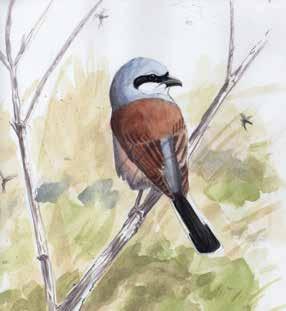
Red-backed Shrike Stewart Sexton
P C Lack, Lackford Lakes Log, Lackford Ringing Group, Landguard Bird Observatory, D Langlois, Lavenham Bird Club, J Lawley, R Leavett, M Linsley, M Livesey, N Loth, D Lowe, G Lowe, Lowestoft Lounge Lizards
P Maddison, M Marsh, R Marsh, J Mason, N J Mason, T Mayhew, S Mayson, Mickle Mere Log, A Miller, M Miller, S Miller-Smith, S Minns, Minsmere RSPB, A V Moon, N J Moran, J Mountain, B Moyes, C Moyes, N Murphy, P W Murphy, A Musgrove, C Mutimer, J Myers
A Nairn, National Trust Orfordness, Natural England, B Nightingale, S Nixon, R Noble, North Warren RSPB, M Nowers
N Odin, M Offord, P Oldfield
A Palles-Clark, E Patrick, B Pearson, D Pearsons, M F Peers, P Phillips, D Ping, D Piotrowski, S H Piotrowski, S P Piotrowski, B Pleasance, R Plowman, L Potter, K Puttick
A Rafinski, D Rafinski, K Randall, J D K Rankin, P J Ransome, RBA, N Rawlings, S Read, L Record, G Richardson, J Richardson, D Ridgley, G Riley, P Riley, A Riseborough, A Rivett, L Robertson, A Rowlands, I Rowlands, J A Rowlands, RSPB Lakenheath Fen, RSPB Minsmere, RSPB North Warren
I Salkeld, C Shaw, P Shaw, N Sherman, N Sibbett, N Sills, J Sinclair, O Slessor, B J Small, J Small, J Smith, P Smith, R Stace, P Stopher, T Stopher, R Stewart, Suffolk Wildlife Trust, W Sutherland, C Swan
M Taylor, D Thurlow, D Tomlinson, M Thompson, W Townsend, Trimley Marshes SWT, J Turner
D K Underwood
K Venus, K Verlander, P Vincent, N Vipond, R Vonk
R Walden, B Wallace, D F Walsh, J D Warnes, J Walshe, S Waters, Waveney Bird Club, R West, WeBS counters, West Suffolk Birders, D White, P Whiteman, P Whittaker, P M Wilson, R Wilton, R Wincup, G Woodard, B Woodhouse, Woodbridge Wildlife App, L G Woods, M Wortley, J Wright, M T Wright, R M Wright
R F York, E Zantboer, J Zantboer
With apologies to anyone we have left out! Sometimes we cannot tell who the Birdtrack or E-bird records come from.
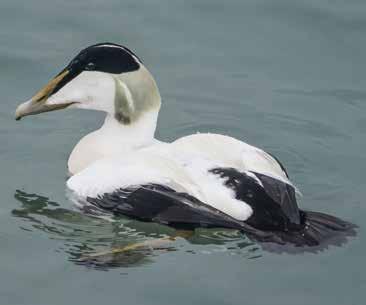
, Hamilton Dock, 5th March
Eider
David Borderick
Garganey
Osprey
Hobby
Earliest and Latest Dates of Summer Migrants 2023
ARRIVALS
Date Locality
Mar 19th Minsmere
Mar 23rd Lackford
Stone-curlew
Little Ringed Plover
Whimbrel
Wood Sandpiper
Little Tern
Black Tern
Sandwich Tern
Common Tern
Arctic Tern
Nightjar
Swift
Cuckoo
Turtle Dove
DEPARTURES
Date Locality
Dec 29th Trimley Marshes
Nov 5th Brandon
Apr 5th Lakenheath Oct 22nd Minsmere
Mar 14th Brecks
Mar15th Barking
Nov 22nd Brecks
Sep 18th Minsmere
Mar 31st Lackford Sep 25th Landguard
Apr 22nd Aldeburgh Aug 25th Kedington
Apr 30th Minsmere Sep 29th Sizewell
May 28th Trimley Marshes Nov 9th Sizewell
Mar 27th Minsmere Nov 19th Lowestoft
Apr 10th Minsmere/Trimley Marshes Oct 25th Landguard
Apr 17th Snape
May 7th Brandon
Apr 7th Lackford
Apr 1st Kedington
Nov 9th Sizewell
Aug 24th Westleton
Sep 26th Ipswich
Sep 17th Knettishall/Cavenham
Apr 30th Stoke-by-Nayland Sep 12th Sizewell
Wryneck - - Oct 3rd Kessingland
Sand Martin
Swallow
House Martin
Mar 14th Lowestoft
Mar 19th Claydon
Oct 15th Minsmere
Dec 1st Covehithe
Mar 31st Brantham/Claydon Nov 26th Pakefield/Kessingland
Wood Warbler - - Aug 11th Landguard
Willow Warbler
Sedge Warbler
Reed Warbler
Mar 18th Carlton Marshes/ Wenhaston Oct 21st Landguard
Mar 30th Trimley Marshes Oct 4th Lowestoft
Apr 5th Trimley Marshes Oct 10th North Warren
Grasshopper Warbler Apr 8th Carlton Marshes Sep 26th Trimley Marshes
Garden Warbler
Apr 18th Hoxne Oct 4th Landguard
Lesser Whitethroat Apr 14th Alton Water/ Martlesham/Ipswich Nov 30th Landguard
Common Whitethroat Apr 4th Huntingfield/ Felixstowe Oct 8th Minsmere
Ring Ouzel
Spotted Flycatcher
Nightingale
Pied Flycatcher
Redstart
Whinchat
Wheatear
Yellow Wagtail
Tree Pipit
Apr 8th Southwold Oct 31st Thorpeness
Apr 26th Gisleham Oct 17th Brandon
Apr 10th Trimley St Martin/ Alton Water
May 5th Sudbury
Apr 5th Hollesley
Sep 4th Landguard
Sep 22nd Thorpeness
Oct 8th Lowestoft
Apr 7th Santon Downham Oct 6th Benacre
Mar 16th Fornham St Martin Nov 17th Hollesley
Apr 3rd Martlesham Nov 29th Felixstowe/Falkenham
Apr 16th The King’s Forest Sep 17th Landguard
A Guide to Recording Birds in Suffolk
Introduction
The foundation stone of any report is the data upon which it is based. The Suffolk Bird Report depends on the contributions made by observers recording and reporting their sightings. In order that the report paints as comprehensive a picture of the status of birds recorded in Suffolk, it is important that submissions are made in a usable format.
The system
The recording of the county’s avifauna is the responsibility of the Suffolk Naturalists’ Society, working in close co-operation with the Suffolk Bird Group. The linchpins of the system are the Recorders, who are the initial point of contact for all records. Because of the volume of records in Suffolk the county has been divided into three areas. See the inside front cover for a map and addresses.
Observers are reminded that Suffolk works to Watsonian vice-county boundaries, taking in areas that are now administered as Norfolk, Cambridgeshire or Essex. The most significant area affected is that of Lothingland, the northern limits of which follow the River Yare and include the south side of Breydon Water. We have retained these original boundaries as we feel that sensible comparison of data can only be made from year to year if the recording area is kept constant.
Submission of records
It is expected that the majority of records will be submitted on either BirdTrack or eBird. In that case (a) to (h) below should be covered.
Otherwise, observers are requested to submit their records monthly. We also suggest that the following format be followed:
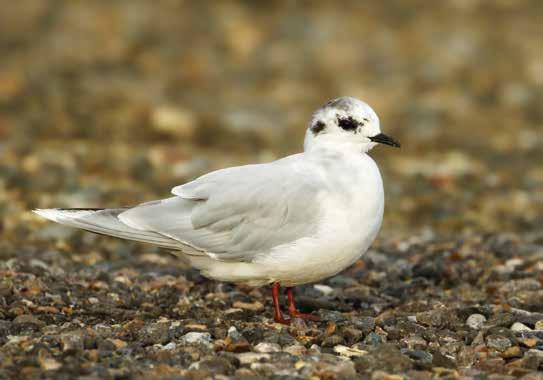
Little Gull, Lowestoft, 31st July
Peter Ransome
(a) Location (precise place name from the Ordnance Survey map plus parish if ambiguous). OS grid reference should be added if in any doubt or if reporting breeding locations.
(b) Species
(c) Date
(d) Name and address of observer
(e) Sex/age – male, female, juvenile etc.
(f) Abundance – count numbers, frequency, etc.
(g) Type of record – dead, ringed, etc.
(h) Other comments considered relevant – behaviour etc. In particular see the list below for particular information required for each species. All claims of national rarities should, of course, be accompanied by a full description. The Recorder will automatically forward this to the British Birds Rarities Committee (BBRC).
If submitting a list of records for one particular site, please put all details at the top of the list and annotate with sex and/or frequency. Remember, if in any doubt as to the value of any record, please send it in!
A spreadsheet is available for submitting records and can be downloaded from the SBG website. This can be sent electronically to the Recorders and is a much easier and quicker method for them. Whilst this is not essential, we would encourage all those who can to use this method of submitting their records.
Assessment of records
All records come under the scrutiny of the Suffolk Ornithological Records Committee (SORC) and for rare or scarce species, verification is sought – i.e. photographs, field sketches, witnesses, sound recordings (for calling or singing birds) and (most importantly) written descriptions. The SORC’s policy for vagrants, classified as national rarities, is clear; records should be channelled through the County Recorder to be considered by the BBRC, whose decisions are accepted by SORC. A full list of species that are considered by the SORC follows. The committee may also request further details regarding any other species that, in the opinion of the committee, is out of context in terms of season, habitat or numbers.
A list of records which have not been accepted for publication can be found at the bottom of the Rare Birds in Suffolk section and includes those which have been circulated to the respective committees but were considered unacceptable due to either the identification not being fully established or, more rarely, a genuine mistake having been made. It does not include records still under consideration.
Guide to species
The following list shows all the species recorded in the county and thus this is also a checklist for Suffolk. For any species not listed, a full description will be required. The list shows those species accepted into Categories A, B and C, as per the British Ornithologists’ Union (see the Introduction to the Systematic List for more details). Note that a large number of species included can also fall into Categories D and E (basically as escapees); a description of such a bird may be requested but will be essential if it is believed that the bird is of wild origin.
A reminder that Turtle Dove, Yellow Wagtail, Nightingale, Spotted Flycatcher, Marsh Tit and Corn Bunting have all been moved from Category 4 to category 3 – records of all of them would be appreciated.
SBG/SORC would also like to receive any breeding records for the following species: Kestrel, Ringed Plover, Lapwing, Snipe, Curlew, Redshank, Common Gull, Great Black-backed Gull, Swift, Sand and House Martin (colonies), Mistle Thrush, Willow Warbler and Reed Bunting.
Goshawk has been moved from Category 2 to 3. Notes, however, may be required.
After three years without an addition to the Suffolk list, Black-winged Kite was added in 2023.
* not recorded as wild since at least 1949
Key
1 National Rarity – detailed description required.
2 County Rarity – notes detailing observation will always be required.
3 All records requested – supporting notes may be requested.
4 Specific records – records of breeding, large counts, earliest/latest dates, unusual inland records or migration/weather-related movements requested.
Rare Birds in Suffolk 2023
David Walsh
Accepted BBRC records 2023
Pallid Swift Apus pallidus
RSPB Minsmere, 1CY+, October 22nd, photo (P and S Green et al.)
Corton, 1CY+, October 27th, photo (J A Brown et al.)
Beach Farm, Benacre, 1CY, October 31st (C A Buttle)
Great Spotted Cuckoo Clamator glandarius
Easton Farm, Southwold, 2CY, March 24th, photo (B J Small et al.)
Kentish Plover Charadrius alexandrinus
RSPB Minsmere, 2CY+ male, May 5th–7th, photo (C Bradshaw, M T Cartwright, M Wall et al.)
Landguard, 2CY+ male, May 18th, photo (R D Speirs et al.)
Spotted Sandpiper Actitis macularius
Shingle Street, 2CY+, June 4th (J Dries); presumed same Corton, 2CY+, June 5th, photo (N Blacker, J Brown et al.)
Gull-billed Tern Gelochelidon nilotica
Landguard, 3CY+, April 30th (W J Brame, C Day, N Odin)
Caspian Tern Hydroprogne caspia
RSPB Minsmere, two, 3CY+, July 9th (D Adelson)
Black Stork Ciconia nigra
Butley, 1CY, August 9th (G Riley)
Woodbridge, 1CY+, August 20th (S Mayson)
Squacco Heron Ardeola ralloides
Livermere Lake, 2CY+, August 15th, photo (D E Balmer, P M Wilson et al.)
Black-winged Kite Elanus caeruleus
Felixstowe Ferry/King’s Fleet, 1CY+, July 20th-21st, photo (C Holden et al.)
Pallid Harrier Circus macrourus
Walberswick, 2CY male, May 6th, photo (J Gearty)
Bawdsey, 2CY male, May 7th, photo (C Clark, I Taylor)
Orfordness, 2CY male, May 11th, photo (D Crawshaw, K Langley, M C Marsh)
Great Reed Warbler Acrocephalus arundinaceus
RSPB Boyton Marshes, 2CY+ male, May 11th, photo (S Abbott et al.).
RSPB Minsmere, 2CY+ male, May 20th, photo (D Baskett)
Aquatic Warbler Acrocephalus paludicola
Landguard, 1CY, August 30th, photo (W J Brame et al.)
Booted Warbler Iduna caligata
Landguard, 1CY, August 18th, photo (W J Brame, T Holland, N Odin, E Patrick et al.)
Isabelline Wheatear Oenanthe isabellina
Easton Bavents, Southwold, 1CY+, September 26th, photo (B J Small et al.)
Pied Wheatear Oenanthe pleschanka
North Denes, Lowestoft, 1CY+ male, October 22nd, photo (A C Easton et al.)
Eastern Yellow Wagtail Motacilla tschutschensis
Carlton Marshes, 4CY+ male, November 3rd 2022 to May 2nd 2023, photo (A C Easton, B J Small, J Wylson et al.); presumed same as 2020 and 2021
BBRC accepted records where identification is confirmed, but origin uncertain
2022
Canvasback Aythya valisineria
River Stour, Cattawade, 1CY+, July 17th
1993
Red-headed Bunting Emberiza bruniceps
Ipswich, 2CY+ male, May 6th–14th
Records found not proven 2023
BBRC:
Ferruginous Duck Aythya nyroca Landguard, November 1st
Great Snipe Gallinago media North Denes, Lowestoft, October 20th
Black-winged Kite Elanus caeruleus Stratton Hall nr Ipswich, April 16th
Pallid Harrier Circus macrourus Kessingland, October 23rd
Red-throated Pipit Anthus cervinus Landguard, September 30th
SORC:
‘Greenland’ White-fronted Goose Anser albifrons flavirostris RSPB North Warren, February 6th
Smew Mergellus albellus Iken, May 19th
Purple Heron Ardea purpurea Eastbridge, May 14th
Honey-buzzard Pernis apivorus Ipswich, July 31st
Honey-buzzard Pernis apivorus Ipswich, September 2nd
Rough-legged Buzzard Buteo lagopus Ipswich, April 4th
Wryneck Jynx torquilla Lackford, April 26th
Lesser Spotted Woodpecker Dryobates minor Badwell Ash, August 30th
Records found not proven 2021
SORC:
Hooded Crow Corvus cornix Aldeburgh, November 11th
Gazetteer
This gazetteer gives locations for sites listed in the main checklist section of this issue of Suffolk Birds. The intention is to make it easier for newcomers to birdwatching, or those less familiar with the county, to be able to locate sites. Specific sites are given a six-figure Ordnance Survey reference where appropriate; larger sites are given a four-figure reference for the 1km square in which they are situated. Whilst a complete list of all sites would obviously be of most use, it would of necessity, be very long. Therefore, it does not, in general, contain parish names, which are easily located by reference to a standard road map.
If anybody would like to add postcodes or similar to these sites – please let us know!
Aldeburgh Town Marshes
Alde Estuary
Aldringham Common
Aldringham Walks
Alton Water
Ampton Water
Barham Pits
Barnhamcross Common
Barsham Marshes
Barton Mere
Bawdsey Marshes
Belle Vue Gardens, Lowestoft
Benacre Broad
Benacre Pits
Bentley
Berner’s Heath
Blundeston Marshes
Blyth Estuary
Botany Bay
Bowbeck
Boxford
Boyton Marshes
Brackenbury Cliff, Felixstowe
Brent Eleigh
Breydon Water
Bromeswell
Carlton Marshes
Campsea Ashe
Castle Marshes
Cattawade Marshes
Cavenham Heath
Cavenham Pits
Christchurch Park, Ipswich
Cobbold’s Point
Combs Lane Water Meadows
Cornard Mere
Corton railway line
Corton sewage works
Cosford Hall, Hadleigh
Cove Bottom
Covehithe Broad
Deben Estuary
Dingle Marshes
TM450560
TM3957-4450
TM458606
TM4661
TM1436
TL8770
TM1251
TL8681
TM4090
TL910668
TM340390
TM550944
TM530828
TM535842
TM120385
TL7976
TM5095
TM4575-4776
TL675854
TL9475
TL9640
TM3946
TM322360
TL943480
TM4706-5107
TM3050
TM4991
TM3256
TM475915
TM0932
TL755725
TL763715
TM164454
TM315349
TM043581
TL887391
TM537579
TM539982
TM013446
TM4979
TM524808
TM2850-3238
TM4872
Dunwich Heath
Eastbridge
East Lane, Bawdsey
Easton Broad
Elveden
Erwarton Bay
Euston Lake/Park
Fagbury Cliff
Falkenham Marshes
TM4768
TM452660
TM354401
TM518794
TL8279
TM2333
TL9079
TM270346
TM3138
Felixstowe Ferry TM3237
Fisher Row
Flixton GP
Fornham All Saints
Foxhole Heath
Fressingfield
Fritton Decoy/Lake
Frostenden
Gedgrave Marshes
Gifford’s Hall
Gipping Great Wood
Glemsford
Groton
Gunton Warren
Hardwick Heath
Hare’s Creek, Shotley
Haughley Park
Havergate Island
Hazlewood Marshes
Hengrave Hall
Hen Reedbeds
Herringfleet Marshes
Herringswell
Hinderclay Fen
TM507927
TM3187
TM190760
TL735776
TM260775
TM4800
TM4781
TM410480
TM0137
TM075625
TL8348
TL9642
TM5495
TL854625
TM244360
TM000620
TM4147
TM435573
TL824686
TM470770
TM468977
TL7169
TM025788
Holbrook Bay TM1733
Hollesley Marshes
Holywells Park, Ipswich
Homersfield Gravel Pits
Hoxne
Icklingham Plains
Ilketshall St Lawrence
Ipswich Golf Course
Ipswich Wet Dock
Kedington
TM375450
TM175435
TM287855
TL840675
TL7573
TM3883
TM207433
TM169439
TL7046
Kentwell Hall, Long Melford
Kessingland Levels
Kessingland sewage works
King’s Fleet
King’s Forest, The
Kirton Creek
Knettishall Heath
Lackford Lakes
Lake Lothing
Lakenheath Fen
Lakenheath Warren
Lakenheath Washes
Landguard
Lavenham railway walk
Layham pits
Leathes Ham
Leiston Abbey
Levington Creek
Levington Marina
Lineage Wood, Lavenham
Livermere Lake
Long Melford churchyard
Long Melford sewage works
Loompit Lake
Lound Waterworks
Lowestoft Harbour
TL863479
TM530850
TM533857
TM310379
TL8173
TM292417
TL952804
TL800710
TM5392
TL7085
TL7580
TL7085
TM2831
TL9049
TM021402
TM530933
TM444643
TM237383
TM246380
TM890485
TL882716
TL868468
TL855459
TM255377
TG501007
TM5592
Market Weston Fen
Martlesham Creek
Martlesham Wilds
Mayday Farm
Mickle Mere
Middleton
Minsmere
Minsmere Levels
Mutford
Needham Market Lake
Ness Point
North Denes, Lowestoft
Northfield Wood
North Warren
Nowton Park
Nunnery Lakes
Old Newton
Olley’s Farm
Orfordness
Orwell Bridge
Orwell Estuary
Outney Common, Bungay
Oulton Broad
Oxley Marshes
Pakefield Beach
Pakenham Fen
TL980787
TM2647
TM270465
TL7983
TL937699
TM4267
TM4766
TM4667
TM4988
TM094548
TM555936
TM551951
TM024600
TM4658
TL866615
TL872815
TM0562
TL824815
TM4654-3743
TM175413
TM1641-2534
TM3290
TM5192
TM370435
TM5389
TL930680
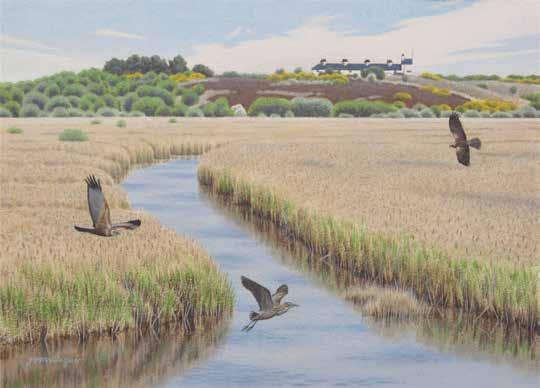
Bittern and Marsh Harriers, Minsmere, North Marsh Jan Wilczur
Peewit Hill
Pipps Ford
Potter’s Bridge
Puttockshill
Ramsey Wood
Ramsholt Marshes
Redgrave and Lopham Fen
Redgrave Lake
Reydon Marshes
Santon Downham
Sedge Fen, Lakenheath
Shelley
Shingle Street
Shotley Marshes
Shottisham Creek
Sizewell Beach
Sizewell SWT
Slaughden
Snape Wetland
Sole Bay
Sotterley Park
Southwold Boating Lake
Southwold Town Marshes
Spinny Marsh
Staverton Thicks
Sternfield
Stonham Aspal
Stour Estuary
Stradishall Airfield
Stratton Hall
Stutton Mill
Sudbourne Marshes
Suffolk Water Park
TM289338
TM108538
TM509791
TL898695
TM065430
TM298423
TM046797
TM055767
TM485766
TL818878
TL6784
TM0338
TM365425
TM248350
TM3043
TM4763
TM460640
TM464555
TM385585
TM5177
TM460850
TM510769
TM500754
TM292428
TM3650
TM3961
TM1359
TM1032-2433
TL7452
TM254388
TM133330
TM4553
TM120485
Sutton Common
Sutton Heath
Tangham
Temple Bridge, Cavenham
Theberton Grange
Thetford Heath
Thorington Street Reservoir
Thorpeness Common
Thorpeness Meare
Tinker’s Marshes
Trimley Marshes
Trinity Hall Farm, Moulton
Tuddenham Heath
Tuddenham St Martin
Ufford
Undley
TM3247
TM308478
TM355485
TL758728
TM438652
TL845800
TM012352
TM475604
TM4659
TM484760
TM2635
TL693651
TL7472
TM1948
TM300525
TL6981
Upper Abbey Farm, Leiston TM453646
Walberswick NNR
Waldingfield airfield
Waldringfield Pit
Walpole
Wangford Warren
Westleton Heath
West Stow Country Park
Westwood Lodge
Westwood Marshes
Wetherden
Weybread GPs
Wherstead Strand
Wilford Bridge
Wolves Wood
Wordwell
Workhouse Green
TM4674
TL8943
TM274438
TM3674
TL758842
TM4569
TL800713
TM465737
TM4773
TM0062
TM2481
TM173408
TM291501
TM055440
TL828720
TL9037
Alphabetical Index of Species Accounts – Common Names
Alpine Swift 89
American Golden Plover -
American Wigeon -
Aquatic Warbler 176
Arctic Redpoll -
Arctic Skua 130
Arctic Tern 128
Avocet 100
Baird’s Sandpiper -
Balearic Shearwater 134
Barn Owl 150
Barnacle Goose 62
Barred Warbler -
Bar-tailed Godwit 106
Bean Goose 64
Bearded Tit 165
Bee-eater 153
Bewick’s Swan 67
Bittern 138
Black-browed Albatross -
Black Kite 148
Black Redstart 194
Black Stork 136
Black Tern 128
Black-throated Diver 133
Blackbird 189
Blackcap 179
Black-headed Gull 119
Black-necked Grebe 97
Black-tailed Godwit 107
Black-winged Kite 147
Black-winged Stilt 99
Bluethroat 192
Blue Tit 164
Blue-winged Teal -
Blyth’s Reed Warbler 177
Brambling 208
Brent Goose 60, 61
Buff-breasted Sandpiper 113
Bullfinch 208
Buzzard 149
Canada Goose 61
Carrion Crow 161
Caspian Gull 123
Cattle Egret 140
Cetti’s Warbler 170
Chaffinch 207
Chiffchaff 174
Citrine Wagtail -
Coal Tit 163
Collared Dove 94
Crossbill 211
Common Crane 95
Common Gull 122
Common Rosefinch 208
Common Sandpiper 115
Common Scoter 81
Common Tern 127
Coot 95
Cormorant 136
Corn Bunting 213
Corncrake -
Cory’s Shearwater 134
Crossbill 211
Cuckoo 91
Curlew 105
Curlew Sandpiper 110
Dartford Warbler 183
Desert WheatearDipper 200
Dotterel 105
Dunlin 112
Dunnock 201
Dusky Warbler 173 Eider 80
Egyptian Goose 64 Feral Pigeon 92
Ferruginous DuckFieldfare 189
Firecrest 184
Fulmar 134 Gadwall 73
Gannet 136
Garden Warbler 180
Garganey 71
Glaucous Gull 123
Glossy Ibis 137
Goldcrest 184
Golden Pheasant 86
Golden Oriole 159
Golden Plover 102
Goldeneye 83
Goldfinch 211
Goosander 84
Goshawk 143
Grasshopper Warbler 178
Great Black-backed Gull 122
Great-crested Grebe 97
Little (Ringed) Plover 104
Little Stint 113
Little Tern 126
Long-billed Dowitcher -
Long-eared Owl 151
Long-tailed Duck 83
Long-tailed Skua 130
Long-tailed Tit 170
Magpie 160
Mallard 75
Mandarin Duck 70
Manx Shearwater 134
Marsh Harrier 143
Marsh Sandpiper -
Marsh Tit 164
Marsh Warbler 178
Meadow Pipit 205
Mealy Redpoll -
Mediterranean Gull 121
Melodious Warbler -
Merlin 155
Mistle Thrush 187
Montagu’s Harrier 147
Moorhen 94
Mute Swan 66
Night Heron 139
Nightingale 193
Nightjar 88
Nuthatch 185
Olive-backed Pipit -
Ortolan Bunting 213
Osprey 142
Oystercatcher 99
Pacific Golden Plover 102
Pallas’s Warbler 172
Pallid Harrier 147
Pallid Swift 91
Pectoral Sandpiper 113
Penduline Tit 165
Peregrine 156
Pheasant 86
Pied Flycatcher 194
Pied Wagtail 204
Pink-foot 63
Pintail 75
Pochard 78
Pomarine Skua 129
Puffin 132
Purple Heron 141
Purple Sandpiper 112
Quail 87
Radde’s Warbler
Razorbill 131
Red Kite 148
Red-backed Shrike 159
Red-breasted Flycatcher 194
Red-breasted Goose -
Red-breasted Merganser 85
Red-crested Pochard 78
Red-flanked Bluetail -
Red-footed Falcon 155
Red-legged Partridge 88
Red-necked Grebe 96
Red-necked Phalarope 115
Red-rumped Swallow 170
Redshank 116
Redstart 195
Red-throated Diver 132
Red-throated Pipit -
Redwing 188
Reed Bunting 213 Reed Warbler 177
Richard’s PipitRing Ouzel 190
Ring-billed Gull -
Ringed Plover 103
Ring-necked Duck 79 Robin 191 Rock Pipit 206 RollerRook 161
Roseate Tern 127
Rose-ringed Parakeet 158
Rosy Starling 186
Rough-legged Buzzard 149
Ruddy Duck
Shelduck
Rustic Bunting
Sabine’s Gull 119
Sand Martin 167
Sanderling 111 Sandwich Tern 125
Savi’s

Suffolk Bird Group
Who we are
Founded in 1973 by a group of Suffolk birdwatchers
Associated with the Suffolk Naturalists’ Society
SBG remains an independent birding group and is a registered charity
What we do
Networking
A voice for Suffolk birdwatchers
With established links to many naturalist and conservation organisations
Media
Protecting Birds
Actively lobbies to protect key Suffolk habitats
Provides a county-wide field force of bird surveyors
Promotes BTO bird surveys and organises special SBG surveys

Strong web presence - www.suffolkbirdgroup.org
Active Twitter feed - @SuffolkBirdGrp
Quarterly magazine - The Harrier
Annual review - Suffolk Birds report
Trips
and talks
Annually (20+) field trips - ideal for novices or experts and young or old alike
Opportunities to visit hot spots and receive practical ID tips in the field
Programme of talks and presentations - variety of topics (county, national, or international) with quality speakers
Suffolk
SBG
Assists with conservation projects to improve breeding success - Swifts
- Barn Owls - Peregrines - Waders
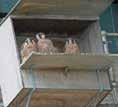
Partners with Suffolk Wildlife Trust and other bird groups
Assists with funding for bird hides and other birding amenities
Contributes to community events, including dawn chorus walks
Provides bursaries for special projects


Founded in 1929 by Claude Morley (1874–1951), the Suffolk Naturalists’ Society pioneered the study and recording of the County’s flora, fauna and geology, to promote a wider interest in natural history.
Recording the natural history of Suffolk is still one of the Society’s primary objects, and members’ observations are fed to a network of specialist recorders for possible publication, and deposited in the Suffolk Biodiversity Information Service.
Suffolk Natural History, a review of the County’s wildlife, and Suffolk Birds, the County bird report, are two high quality annual publications issued free to members. The Society also publishes a quarterly newsletter and holds two Members’ evenings a year in Spring and Autumn.
The Suffolk Naturalists’ Society offers a joint membership with the Suffolk Bird Group at a reduced subscription. This entitles joint members to receive literature and attend the meetings of both organisations.
If you are not yet a member of the Society but would like to join visit www.sns.org.uk