

Gi Grieco
Gi Grieco
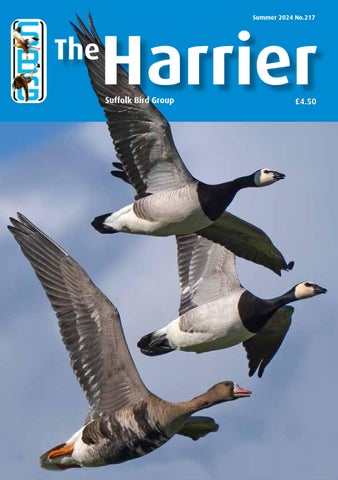
Welcome to The Harrier. This edition showcases a bumper selection of conservation activities the group is involved in. After the introduction of BOSS, there is an update in this edition as the project continues to grow. One project that has grown significantly over recent years, and is making a big impact on raising awareness, is SOSSwifts. It’s great that more and more areas are participating in putting up nest boxes to encourage Swifts. More recently, another declining species has taken the attention of the group, House Martins. Within is an introduction to the new project the group have started up – House Martin Support Suffolk. Alongside this, Nick Mason, the Suffolk Bird Report editor has put in a request for breeding House Martin records. Every year information is submitted to the area recorders which then goes into the Bird Report, but it will be useful to have as full as possible details to understand the status of the species within the county.
Continuing with the theme of group activities we have a write up of the SBG AGM back in February; a fun, friendly evening where we celebrated the activities of the group, those that volunteer their time and not forgetting the great bird life in the county, alongside the formal aspects of an AGM. Completing the group theme there are a selection of field trip reports from earlier this year.
We have our regular bird review section - a reminder that Suffolk bird news is reported daily on the SBG website, visit https://www. suffolkbirdgroup.org/latest-bird-sightings.
Chris Keeling
There is a widely understood cultural imperative that Annual General Meetings are stiflingly dull affairs that must be endured while waiting for the interval and hoping all the while that there will be no raised hands when questions are invited form the floor. I suspect that for many membership organisations Annual General Meetings are a necessary chore to be endured while council members present evidence for wise expenditure of group funds and membership fees.
I can only speak from my own experience, but our AGMs have always been interesting, entertaining and dare I say great fun. I certainly had the sense that the 43 members and guests (including Council members) who attended the 2024 AGM on 22nd February at the Hintlesham Community Hall would agree. If you have enjoyed our indoor meetings with an incredible range of speakers covering an even greater range of subjects, you will surely agree that it really is a great occasion. Anne Wright our treasurer and Adam Faiers welcomed guests with tea, coffee and biscuits served from the kitchen counter that very conveniently opens on to the main hall and seating area. The small but very comfortable licenced bar behind the kitchen provided extra refreshment during the intervals.
SBG President John Grant opened the meeting with a warm welcome acknowledging our good fortune in finding such a welcoming venue, before inviting members and guests to look back over the events of 2023. John took the opportunity to acknowledge the hard work of Council members both old and new, and to announce that as the SBG passes its 50year milestone in 2024 it will also be the
final year of his second four-year term as president. John recalled that 2023 was an especially notable year as we celebrated the Suffolk Bird Group’s 50th Birthday with a talk by naturalist and author Mark Cocker.
The social aspect of our outdoor and indoor meetings plays a major part in their popularity. Our outdoor meetings were especially well attended in 2023 and continue to offer a great opportunity to catch up with friends old and new while enjoying encounters with birds and other wildlife. With an incredible range of speakers and subjects our indoor meetings were as popular as ever with no empty seats on even the coldest winter evenings! In summing up the past 50 years of the SBG and his time as president John praised the diversification of the SBG Council and introduced four new members Sally Nelson, Sarah Glyde, Jenny Rawson and Alex Rafinski. Before handing the mic to SBG Chairman Eddie Bathgate, John concluded his welcome by adding that it has been both an incredible honour and a pleasure to serve as President of the Suffolk Bird Group.
Eddie Bathgate called for a round of applause to thank John for all his support of SBG and asked for the Council’s approval before signing the minutes of the 2023 AGM. The minutes duly signed it was time for John and Eddie to take the audience through the remainder of the evenings agenda and invite our treasurer Anne Wright to take the floor. There can be no doubt that 2023 has been a great year for the SBG with an increase in membership subscriptions and Gift Aid declarations. Anne made a point of thanking SBG members who made Gift Aid declarations, explaining that while annual subscriptions cover the general running
costs including the printing of the excellent magazine you are reading, Gift Aid helps to fund bursaries allowing SBG to provide financial support for wildlife conservation projects in Suffolk. Projects that received bursary funding include Will Smith for his study of Golden Pheasant in Suffolk, while John Turner was awarded funds to cover the costs of materials for building nest boxes for a range of species from Little and Tawny owls to Redstarts and Spotted Flycatchers. In his Chair report Eddie Bathgate ran through a list of projects supported by SBG including SOSSwifts, noting that 271 swift nest boxes were occupied in 2023 with at least one swift box occupied by a Tree Sparrow!
Eddie also thanked the SBG membership for supporting the work of Council members over the year while also thanking Gi Grieco for his commitment and dedication in continuing to produce the Harrier, Nick Mason for organizing and collating the Suffolk Bird Report and Peter Merchant for his hard work and tremendous commitment to Suffolk’s birds of prey. It goes without saying that the Suffolk Bird Group is a team effort dependent on a passion for the natural world demonstrated every year by its membership support. John Grant congratulated and thanked Eddie for his work as Chair and heading up SOSSwifts.
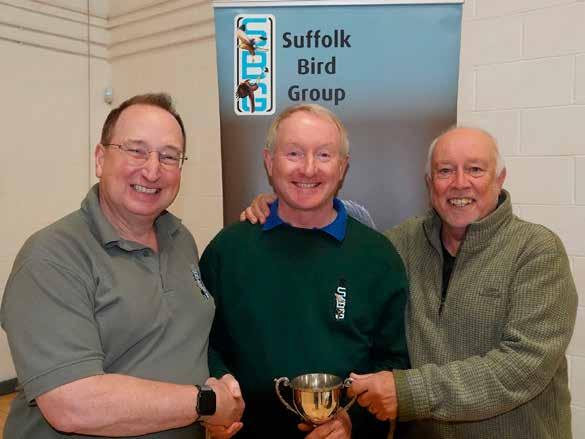
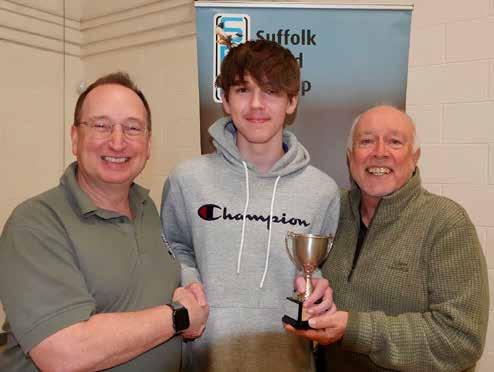
I am sure that for many of us, the annual the review of the birding year and the presentation of the Garrord Award and the Dennis Ockelton Trophy are the most keenly anticipated events of the evening. Gi gave an entertaining and informative review of the birding year with photos provided by SBG members. Then it was time for Eddie to present the awards. First the Garrod Award created in memory of Ken Garrod by his wife Jean to acknowledge young birders, followed by the Denis Ockelton Trophy awarded annually in recognition of outstanding services to Suffolk birding, the birding community and conservation of Suffolk birds and habitats.
This year the Garrord Award was presented by Eddie Bathgate to Dan Zantboer who has recently been appointed the British Trust for Ornithology’s correspondent for southeast Suffolk and has been greatly involved with ringing at Trimley Marshes, with dad
Justin. Then it was time for Eddie to present David Walsh with the Denis Ockelton Trophy in recognition for his work as Assistant Secretary of SORC, correspondent as the link with BBRC on rare breeding birds in Suffolk, leading SBG walks and mentoring young birders from across Suffolk over many years.
The presentation of the awards was followed by the traditional quiz prepared by Nick Mason and presented by Gi Grieco who also hosted the annual AGM raffle. If I am going to take away a special memory from the SBG’s 2024 AGM it will be drawing a winning raffle ticket and claiming as my prize a copy of Guests of Summer by Dutch author Theumis Peirsma, an account of the House Martins that nest in a small village in the Netherlands. It was the first time I have ever drawn a winning raffle ticket! On past record it may also be the last time but for now I will sit back, enjoy a good read wish you all a great birding year.
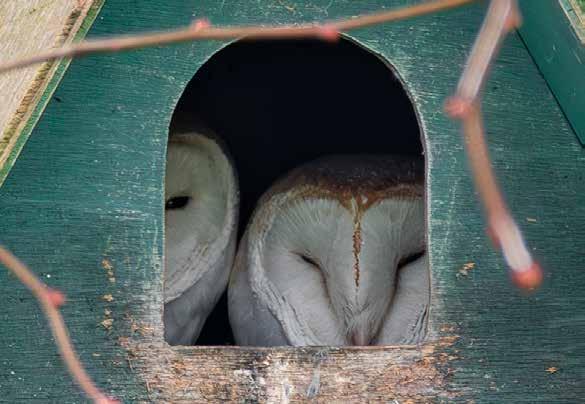
Since the launch of BOSS, we have received a steady flow of enquiries seeking assistance, advice and sharing Barn Owl stories. We have coordinated the repair, replacement and installation of nine boxes, with plans set for winter maintenance at the end of the breeding season.
Our presentation on Barn Owls and BOSS at the Blaxhall Common and Open Spaces Trust AGM, given by Dave Pearsons, was very well received, leading to the installation of an additional box on their common. We have more talks scheduled in the near future. We are also growing our database of local craftsmen who construct these boxes. For more information, please contact us. We also offer boxes for Tawny and Little Owls.
Contact BOSS on:
Email:barnowls@suffolkbirdgroup.org Or follow us on Instagram: Barn_owl_support_suffolk

Jenny Rawson and Chris Keeling
This year SBG are launching a new project – House Martin Support Suffolk (HMSS). Following on from the success of Save Our Suffolk Swifts (SOSSwifts) we are turning our attention to their also red-listed cousins. As we know hirundines – Swallows and Martins, are often a confusion species with Swifts, especially when feeding together in mixed flocks early after arrival from migration or in inclement weather where they are drawn to these spots. House Martins are facing similar threats; habitat change, changes in building design, availability of invertebrate prey, but also unique threats including availability of mud to build their natural nests, and in dry summers, especially on sandier soils the risk of nests falling down during the breeding season. Birds breeding on PVC fascias and soffits have been shown to have much lower breeding success – with nests more likely to collapse.
HMSS is raising awareness of House Martins in a world changed by humans; the threats they face, their ecology and how people, including homeowners, farmers and landowners, can all help. We are also joined by House Martin expert Martin Tickler who recently gave a very entertaining and informative talk to SBG members at Hintlesham Community Centre in April.
Looking for Swifts, Swallows and Martins
House Martins from Europe and western Asia winter in Africa south of the Sahara but there are also records from India (Ali and Ripley 1972). They return in late March or early April to join Swallows, Sand Martins and Swifts over lakes, ponds and meres picking insects from the air and the water’s
surface. They feed to gain strength for nest building and raising the chicks that will join them over the same pools and meres in late summer and autumn. Until the end of the 18th Century educated gentlefolk and clergy with time to spare for the study of nature were obliged to record in their diaries only what they could see within the limits of their parish boundaries. Swifts, Swallows and Martins gathering over ponds in autumn simply disappeared. With no one inclined to follow and map their progress they were believed by some? to dive into the depths to spend the winter sleeping in the mud before re-emerging the following spring.
In our time of instant on-line information and a library of ID guides even the most casual observer of birds will tell you that some birds migrate and the seasons of their arrival and departure, but the same observer might not be able to tell you whether they are looking at a Swallow or a House Martin. It takes only a little practice to pick out the long-winged Swifts with their scimitar silhouettes, the stubby pale brown sand martins and the glossy blue House Martins and Swallows. Look again at the long tail streamers of the Swallows and compare with the House Martins flashing their shirttails, their white rumps easily picked out even on dull cloudy days.
House Martins are semi-colonial, more accurately semi-social as some nest collectively in groups, while others may nest singly. They used to breed on coastal and inland cliffs as they still do in places like North West Scotland and Malham Cove in
North Yorkshire. Like Swifts and Swallows, they have largely abandoned traditional nest sites to exploit our own built environment of vertical surfaces, garage caves, eaves and towers. But Swifts belong to the sky and build their nests from feathers and spiders webs while Swallows and Martins are tied to the earth. They build their nests from pellets of mud pecked from the edges of ponds, muddy trackways and hollows while Sand Martins nest in burrows scraped into river banks, cliffs and quarries.
It can take a pair of House Martins two weeks and up to a thousand mud pellets to build a new nest. A supply of mud has to be close by so that the mud pellets don’t dry out before the birds can glue them in place with a spit of saliva. House Martins nest in colonies and pairs can raise two or three broods of young during the course of a breeding season which can last into September/October. Both birds share parental duties but the female is responsible for most of the incubation and brooding. There are records of young House Martins helping to feed a second brood (Menzel 1984); raising two broods will help to ensure that enough juveniles survive to maintain the population and usually occurs in old nests in good condition or artificial nests if they are available when the birds return in the spring.
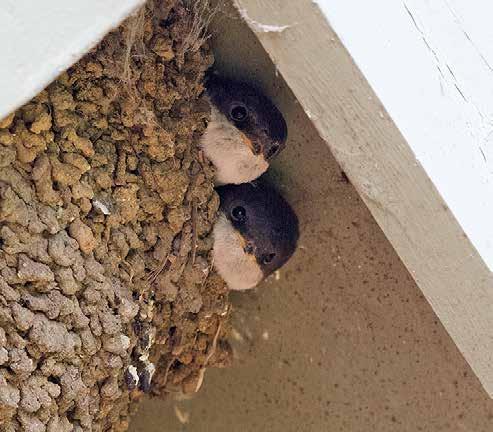
The four to five white eggs are laid at daily intervals but in bad weather laying can be suspended by a day or more (Hund 1976) and will hatch after 14 -16 days, although the hatching can be delayed by bad weather when the adults leave the eggs unattended for long periods. As the chicks grow they gather at the lip of the nest hole waiting for the adult birds to feed them. With their sleek cap and white bibs, they look like waiters angling for tips, pushing through the kitchen door to greet a generous patron. They are usually ready to fledge after
around 22-23 days. Bad weather can lead to nestlings dying of starvation, although like Swifts they can survive on their fat reserves while also becoming torpid for a few days (Prinzinger and Seidle 1986,1988).
House Martins are in trouble
House Martins still glide over ponds and meres, sometimes so close to the water’s surface that they might be imagined to suddenly dive beneath the surface, or risk being snatched by Jenny Green Teeth, a water sprite invented by anxious mothers to scare children away from deep water. We dismiss the foolishness of our ancestors for believing that birds hibernated at the bottom of ponds with fairy tale monsters but in our intolerance of untidy nature, of bird droppings and mud nests and declining insect populations we risk making fairy tales of Swallows and House Martins.
Declines in House Martin numbers led to their being added to the UK Red List in 2020. These declines have been most severe in the south and east of Britain. The draining of wetlands, the removal or infilling of ponds and drier springs have contributed to a serious problem for Swallows and Martins. No mud to build their nests! Even where there is a supply of mud, modern houses often have no eaves or very shallow eaves which practically exclude House Martins from nest building. If they do build they are often exposed to more predation, while plastic soffits installed during renovation make it difficult for mud pellets to stick and hold.
Birds that build nests on PVC as opposed to brick, concrete or wood have much lower breeding success, with nests more likely to collapse on the PVC substrate. If located on a secure surface the same pair might return to their old nest the following year and renovate it with fresh mud for a new season. But for some householders the
droppings that pattern the walls or hard surfaces beneath the nests are untidy, messy and unhygienic, while the owners of older buildings see them as a threat to their structure and preservation. House Sparrows will also displace House Martins from their mud nests and this can impact on a local scale but this natural and opportunistic behaviour can only be worsened by the deliberate destruction of House Martin nests.
The Wildlife and Countryside Act 1981 (as Amended) makes it an offence for anyone to intentionally kill, injure or take the eggs of a wild bird, or destroy their nests while in use or being built. Unfortunately, the law does not protect nests in winter when they can be knocked down without any legal repercussions. The destruction of seemingly abandoned nests might be dismissed as a lesser moral crime with no harm done if there are no eggs or chicks, but the destruction of a single nest or a whole colony means that birds seeking their old
nests find only a bare wall and then expend energy already depleted by their long migration, collecting mud pellets to start again. The situation is made worse by some pest control companies offering advice to householders who want to discourage House Martins.
Droppings are easily removed with a hosepipe or brush, or caught in pots placed on the ground, or on a board fixed to the wall beneath the nest cups. If a board is used to catch the droppings it should be fitted 2m below the nest cups so that it doesn’t serve as a perch for predators to pick off adult birds flying to and from the nest, or a platform for nest predators to reach for eggs or chicks. Older buildings will likely have offered safe purchase for House Martin nests for centuries. It would seem unlikely that it would take 300 years for a House Martin’s dry mud nest to tumble a yeoman’s cottage!
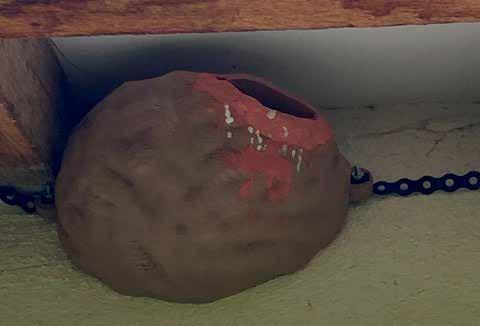
The HMSS is currently trialling 3-D printed artificial House Martin nest cups designed by the project group, printed by Scott Fairburn and painted by Chris Keeling – this is on six existing colonies across Suffolk. Scott has already developed a side line producing 3-D printed bird decoys for SBG, the RSPB and the Lowestoft Kittiwake Group at his shoe repair and key cutting shop ‘Mr Cobbler’ in Felixstowe. In addition to artificial nests, HMSS will work with farmers and landowners to encourage the restoration of old ponds with wider field margins supporting wild flowers and the insects that feed adult House Martins and chicks. Opening gaps in vegetation to expose mud on the edges of ponds and farm reservoirs will mimic trampling by livestock, providing mud for nests while also creating microhabitats for insects. Creating so-called ‘mud pies’ (muddy puddles that are kept wet while martins are nest-building) in your garden or farm yard will also have the same effect, a perfect example of smallscale wilding on the farm, or even in your own garden. We will report back in a future bird report on their success. We are also encouraging survey and monitoring efforts of breeding sites – please do send your records to SBG, so that we can get an up-todate picture of their populations.
HMSS, alongside organisations such as SWT Farm Advice Team and Operation Turtle Dove are also offering advice to landowners and farmers. In particular, both organisations are working with farmers giving advice on pond creation and restoration, with gently sloping sides, giving benefit to a wide range of wildlife, providing an abundance of invertebrate prey and also nest-building material. Where possible the creation of ‘mud pies’; an artificially wet area with mud, will also further help birds access building materials. It is difficult to think of hot summers after the wet winter we’ve had, but particularly on our sandier soils this is a problem. Wildflower rich habitats or wetland enhancement projects, particularly with scrapes will also provide insect rich feeding habitat and will be encouraged.
Can you help? Please visit the SBG website or Instagram page for further information if you would like to know more about our 3-D printed House Martin nests, creating ‘mud pies’ for nest building and other ways to welcome House Martins, please visit the Suffolk Bird Group website, or Instagram for House Martin talks and events or pick up one of our information leaflets at the next SBG indoor meeting. We hope to see you at one of our events soon!
Please also get in touch with housemartins@suffolkbirdgroup.org
References
Ali, S, and Ripley, S D (1972) Handbook of the Birds of India and Pakistan. Vol. 5. Oxford University Press, Oxford
Hund, K (1976) Beobachtungen, insbesondere zur Brutbiologie, an oberschwabischen Populationen der Mehlschwalbe. Orn. Mitt. 28: 169 - 78
Menzel, H (1984) Die Mehlschwalbe.
Neue Brehm-Bucherei No. 548 Ziemen, Wittenberg Lutherstadt
Prinzinger, R, and Seidle, K (1986) Experimental proof of torpidity in young House Martins, Delichon urbica. J. fur Orn. 127: 95-6
The House Martin Support Suffolk group of SBG is doing a House Martin Survey this year.
We are hoping to get a lot more data sent in than normal years – sometimes the breeding records are rather paltry. Records from the west of the county usually being in greater numbers. I do not believe that that is due to more birds.
So – we are asking everyone to make a special effort, please, to get out there and record as much as they can. In the next few weeks!
So, if you are out in a village – can you do the whole thing? Or the village down the road as well? On the way to the shop, or to the pub (not on the way back, though). Can you encourage others in the area to get out and do a survey?
Where are there historical sites that you haven’t visited lately?
Numbers of breeding pairs (nests) are needed. Anything after that is a bonus.
Please email records to info@suffolkbirdgroup.org
Thanks, in anticipation.
Eddie Bathgate
I write this in early June knowing that two of the pairs that nested here last year, in nest boxes with cameras, are back and quietly getting down to breeding. A third pair nested last year too, but in a nest box without a camera and I haven’t seen them enter or exit yet. I suspect (hope) they’re here as Swifts can be sneakily discreet when they first arrive and there is still plenty of time for birds to arrive and breed. I’m very hopeful that more nest boxes will be used this year, especially as I know that two roofs which previously hosted Swifts nearby have been renovated. If the birds have been blocked out, then I hope they find my location; calls are being played as I type.
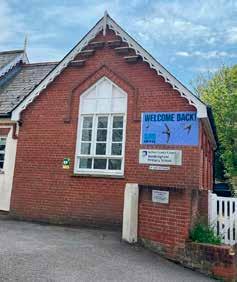
It is fantastic to hear of locations where nest boxes are being occupied for the first time, especially where there are several boxes, because this is likely to be the start of a colony. One of these locations is Waldringfield Primary School, with six nest boxes on a prominent elevation, where pupils and parents can easily watch the colony develop.

SOSSwifts have been out around the county promoting the project. We were at the Suffolk Show both days in the Suffolk Wildlife Trust Wilderness Zone chatting about nest boxes, the importance of playing calls and how Swift conservation helps other species too. We also spent the day at the Bury St. Edmunds BioBlitz promoting support for Swifts.
We are very fortunate, thanks to generous donations of time and funds, to be able to provide more Swift Community Sets. John Turner has now made his 350th nest box for the project, enabling another 15 Community Sets to be planned. We are currently on the look-out for suitable locations for their installation. Schools in Leiston, Saxmundham and Ipswich are soon to be surveyed as sites for sets, and fingers are crossed that Ipswich Museum will incorporate nest bricks as part of their renovation works. More locations are needed: schools, libraries, shops and pubs all give good opportunities. Please do pass any contacts to us - we are happy to follow up.
I was delighted to be invited to the unveiling of the Eel’s Foot Inn Swift tower which was organised by Waveney Bird Club and funded by private donations and National Landscapes (formerly Coasts and Heaths AONB). It was great to meet so many Swift lovers there in a fantastic location and super to hear that John Grant has seen a Swift exploring a nest box already.
By the time you read this, the weather should have settled down with our younger nonbreeding Swifts back and screaming around giving fantastic displays. Please do keep an eye on your local nest boxes and let us know of any Swifts flying past at low-level or banging and entering any boxes. 270 nest boxes were reported used by Swifts in Suffolk in 2023, we are hoping for an increase in the numbers used this year.
Leader: Gi Grieco
Members always look forward to visiting West Suffolk for the annual Brecks trip. Previously, we’ve had gorgeous weather where we’ve anticipated seeing our Brimstones of the year, once or twice it’s been very cold but this year the weather was typical of what had been occurring in early 2024 – wet and drizzly! Undeterred, a number of members congregated in the Forestry Commission car park at Santon Downham. While assembling, we heard Song Thrush and a couple of Grey Wagtails flew in and landed on a cottage roof allowing us all to get a good look at them. During the pre-walk talk and health and safety notes I said that we will amend
the original plan I had in mind due to the weather and that some species that were not present in the area. Normally after our initial walk along the river we would head into the forest but with the weather forecast I decided to head directly to Lynford Arboretum after our walk down the river, and if the forecast was correct and the weather cleared up after lunch, we would try the forest later.
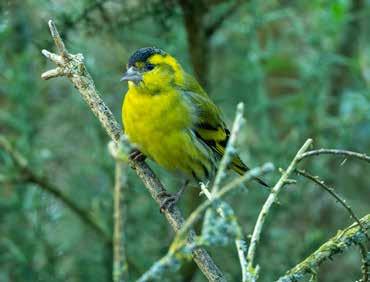
We headed down to the river but found the garden that always had bird feeders, and consequently a number of birds, had no food in them this time. In the area we did have Siskin in the trees and Marsh Tit
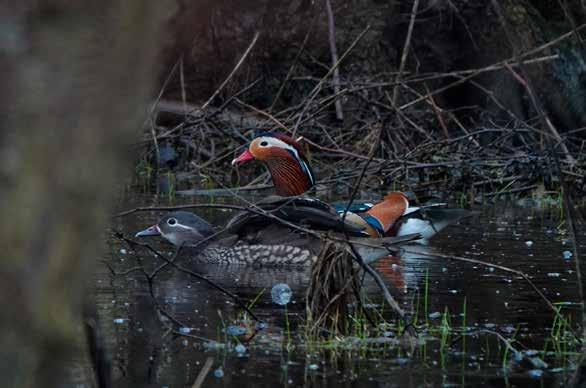
briefly. I had done a recce previously and a lot of the footpath from Santon to Brandon was under water due to high rainfall. Although the shear amount of rain had abated the previous week and the water had receded somewhat, the footpath was still very slippery, so with safety in mind we didn’t walk along the river footpath as far as usual. It did seem quieter bird wise compared to previous years but we did put it down to the weather but we did pick out a Reed Bunting and then had good views of Lesser Redpolls and Siskins in a Willow tree. We also had a pair of Mandarin Ducks fly around calling. In the Alder woodland there was so much water that we were surprised to see both Mute Swan and the pair of Mandarins swimming around amongst the trees – something we’d never seen there before. We retraced our footsteps and this time heard distant Chiffchaff and Woodlark. Back on the road and then over the railway line we walked along the area where there is a small patch of heathland and a Yellowhammer sang from a top of a tree, a pair of Stonechats flitted from bush to bush and we got good views of the Woodlark singing above our heads. A call went up from Diane, a new member, of a raptor distant over the woods. Luckily Eddie got the scope on it and confirmed it was a Goshawk. Sadly, with it being so distant most of the group couldn’t get on it. Walking back to the cars a small flock of Redwing flew in and back in the car park the Grey Wagtails were still about but we had three this time.
We headed off to Lynford Arboretum and the weather was still drizzly as we started the walk. We stopped at the ‘tunnel’ just past the café on the left to scan and had a number of finches including several Chaffinches, up to four Brambling along with a number of Blue and Great Tits. We continued towards the paddock hoping to
find Hawfinch but had no luck. We did have some Redwing drop in and more further up where we could hear large number in the forest as well as some Fieldfare mixed in. In the same area the trees seemed alive with the twittering of large numbers of Siskin. It was a delight to hear such a throng of birds. We went back to the tunnel and saw a group of people looking up into some trees and we were pleased to see two Hawfinches sitting in the branches. They dropped down so we scanned in the tunnel and were rewarded with great views of the Hawfinch and also counted up to 10 Bramblings this time, included a couple of males with advanced summer plumage. Pleased with seeing the target bird, but also keen to get out of the rain, and some visit the café to get a hot drink we stopped for lunch as a Goldcrest sang in the trees above us.
Fortunately the various weather apps on our phones showed the weather front moving away and it clearing up at last, so once we had all fed and watered we headed into Thetford Forest. Along the track we had Common Buzzard overhead, heard Siskin and Mistle Thrush and had chasing Great Spotted Woodpeckers being very vocal. We got to a place with an open vista to scan the skies, a Yellowhammer and a Skylark were about and we had the odd Crossbill fly over, calling. Eventually we did pick one up on top of a tree but it was very distant. Then we got great views of a male Goshawk as it came powering by and this time all of the group got onto it. We decided to go to a different part of the Forest where Crossbills had been seen regularly, and back at the cars a number of people called it a day while the remainder finished off at the last site. Yet again, we only had brief views of fly over Crossbill but did have prolonged views of a female Goshawk – a fitting end to the day to show our perseverance, despite the weather, was worth it.
A trip to Carlton Marsh is a popular trip for SBG members, the expanding reserve just gets better and better and, like last year, there was a very good turnout. Despite being a bit showery early on, it did brighten up but the main factor was a cool, northerly breeze. The plan from Richard was first going past the visitor centre to the bottom corner, then along the track past Share Marsh and up onto the river wall to view of Peto’s Marsh before heading back down the centre track. One good initiative that has been undertaken at the reserve is to encourage dog walkers who use the public footpath to make sure any dog is on a lead –all the dogs we saw were on a lead which is encouraging.
Our first birds were singing Chiffchaff and Blackcap, followed by a Kestrel visiting a probable nest site in an old tree. As we came to the first bit of water and reeds we heard a Sedge Warbler and admired some grand Tussock Sedges. Alongside Sprat’s Water, we heard Reed Warbler and then a Grasshopper Warbler, the latter being difficult at times to pick up due the strong winds rustling the reeds. With patience, having timed when the bird was singing in our direction and with a lull in the wind, all eventually managed to get onto it. We then followed the track along Share Marsh; typically, we’d hear more warblers but the wind seemed to keep things quieter than typical but we did manage further Reed
and Sedge Warblers, plus Reed Bunting and brief Bearded Tits. Scanning across the marsh, a glowing beacon of yellow stood out – a smart male Yellow Wagtail that we all admired. We didn’t see as many raptors as last year but did find Marsh Harrier and Buzzard.
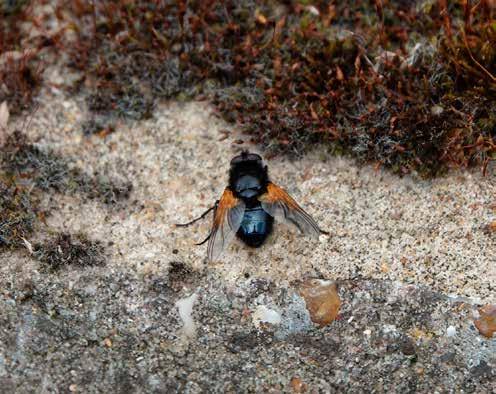
As we walked along the river path, we noted Orange-tip butterfly and then we noted a large, distinctive fly – Noon Fly – a species that likes wooded areas and sits out on sunlit spots, which this was doing. Once we got to the edge of Peto’s Marsh we could see a number of ducks and waders present; picking out Snipe, Avocet and Black-tailed Godwit. Further scrutiny revealed Little Ringed Plover, a smart Spotted Redshank and a Ruff. Ducks included Gadwall, Teal,
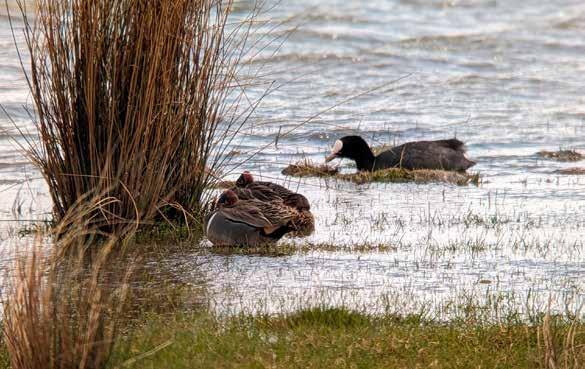
the odd Wigeon and a rarity that had been present for a few days, Green-winged Teal This male bird was unfortunately asleep most of the time but the vertical stripe on the side of the breast was visible. The group spread out, some having a bit of lunch when the call went up that a pair of Garganey were showing themselves from behind some rushes. Other species including Lapwing and some distant Pochard plus some Swallows skinning around.
Soon it was time to head back and en route we picked up Cuckoo, a Great Egret and a couple of Grey Herons flew over. We thanked Richard for an enjoyable day and some members did the obligatory visit to the café for coffee and cake!
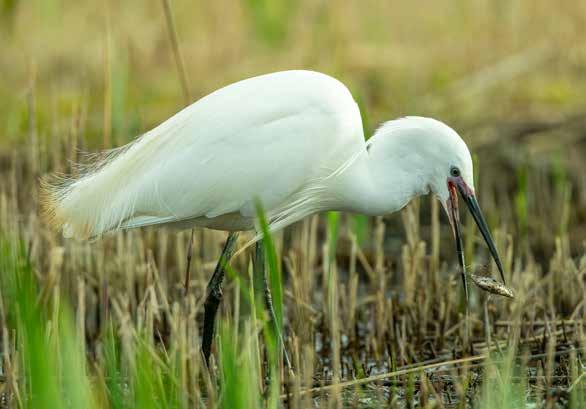
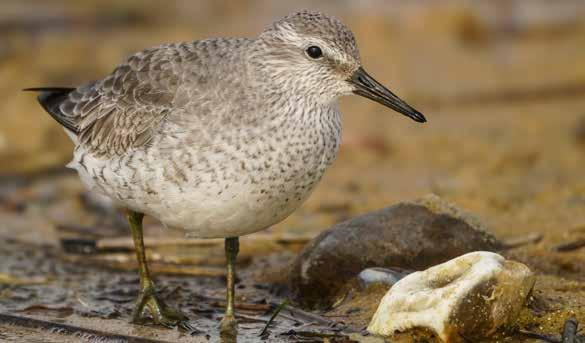
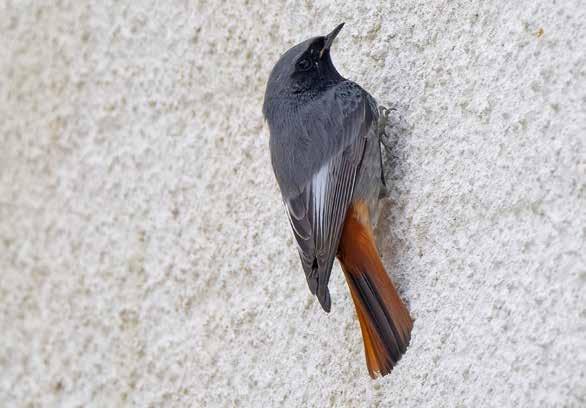
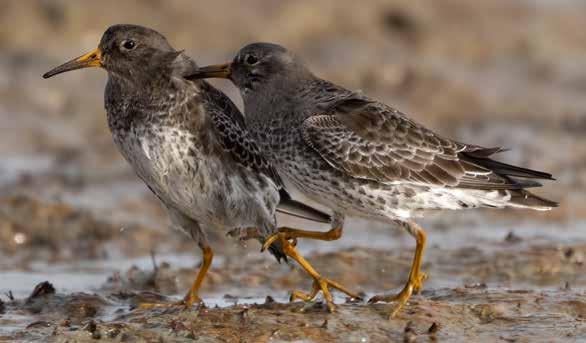
Clockwise...
Top left: Little Egret at Minsmere by Les Cater.
Top right: Black Redstart at Southwold by Andrew Moon.
Bottom right: Purple Sandpiper at East Lane by John Richardson.
Bottom left: Knot at Benacre Broad by David Borderick.
Saturday 27th April
Leader: Steve Fryett
Pound Farm has been managed by the Woodland Trust since 2016 and consists of a young deciduous woodland with pockets of ancient woodland, five ponds and several wide sweeping grassy vistas covering 220 acres that provides excellent habitat for many species of insects, plants, butterflies and of course birds in particular warblers and Nightingales. Between 1990 and 1993 under the Farm Woodland Scheme 60,000 native broadleaf trees were planted on what
was mainly arable land. Unfortunately, Ash dieback disease was found on site in 2012 and has affected a considerable number of trees. The site is also of historic importance as close by, to the west, lies Queen Mary’s Lane. This is the route Mary Tudor is said to have taken when she summoned her troops from Framlingham Castle and marched to London to ascend the throne in 1553. One couldn’t believe the awful weather we were currently experiencing in the UK.
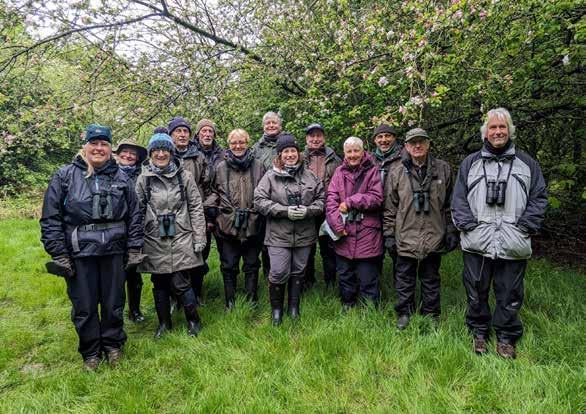
In late April we would expect a nice spring day. But hey! it was 8.00am, raining and only 6.5 degrees as the 14 members were assembled in full wet weather gear, woolly hats and I even spotted a pair of gloves. The Pound Farm Woodland Trust at Great Glemham has never appeared on the SBG/ SOG outdoor meeting calendar and only three members present had ever visited the site before. As we prepared to leave left the car park so did the Common Whitethroat that had made a brief appearance. No one had a telescope just binoculars and a good set of ears. Song Thrushes could be heard in several locations and it wasn’t long before other birds started to sing despite the awful weather. The first Nightingale could be heard deep in the thicket followed by another Common Whitethroat, Lesser Whitethroat and Garden Warbler. There were good numbers of singing Blackcap and Chiffchaff with a calling Great Spotted Woodpecker, the only one noted! Willow Warblers are always good to see and hear and we were pleased to hear one holding a territory near the Farm and another Garden Warbler was noted here as well. Continuing a round circuit several more Nightingales were heard, some very loud which is probably an indication they have just arrived and claiming their territory. In the open meadow grasslands, within the woodland belts, we noted a number of flowers coming through but those in flower included carpets of buttercups. On checking we had two species, Meadow Buttercup and Creeping
Buttercup, with some close to each other to allow the differences and identification features be pointed out to the group. Several calling Bullfinches remained out of sight but are a relatively common species at this site. One could detect the more ancient parts of the woodland where Ramsons (Wild Garlic) and Dog’s Mercury were abundant, the former betraying its presence by it’s scent before we actually saw the cluster of plants. Also lovely to see, although not ancient, several Apple Trees in full bloom and smelling wonderful along with the Hawthorn blossom. Common Buzzard was noted with two Hares on the edge of the woods, also a couple of singing Chaffinch and brief views of another Garden Warbler. The rain had stopped as we headed back to the car park with yet more Nightingales and Skylark noted with a calling, but distant, Pea Fowl and finally the only waterbird of the day was a Mallard flying over the car park. Considering conditions were far from ideal it was an interesting foray into this fascinating habitat and well worth a further visit.
The key territories noted at Pound Farm: Song Thrush 5
Chiffchaff 10
13
Whitethroat 7
Whitethroat 1
Warbler 1
Warbler 3
Nightingale 9
Editor’s Note:
The visit was first proposed by SBG member Sally, following a previous request for recommendations on new places to visit. As Steve pointed out, it was a first visit for many on the day and all enjoyed it.
Please send in details of any other places you think the group would like to visit on their annual trips.
John Kornjaca
The quarterly review section gives a snapshot of birds seen within the county during the period, predominantly from data received by Suffolk BINS. All scarce and rare birds are subject to submission and acceptance by either SORC or BBRC. Updated lists of Accepted and Outstanding Records for previous years can be found on the SBG website - http://www. suffolkbirdgroup.org/bird-recording.
January 2024 brought a month of contrasts to the UK weather, with three named storms, a significant spell of cold, wintry weather and finally a new UK daily maximum temperature record for January.
Near-average temperatures (+0.2°C of average) with near-average rainfall (98% of average). January was the 4th sunniest January on record (143% of average sunshine). The months of January 2022, January 2023, and January 2024 all feature in the top 4 sunniest of Januarys (back to 1910).
Pale-bellied Brent Goose – A single bird was found at Felixstowe Ferry (9th).
Greater White-fronted Goose – A flock of 124 birds were on the north marsh at RSPB North Warren (1st) decreasing to 80 birds (3rd). Another group of c.80 at RSPB Boyton Marshes increased to 204 birds (6th) and by the month end had reached c.250.
Tundra (Bewick’s) Swan – A group of four were in the RSPB Boyton Marshes/Mill Lane area for most of the month rising to 10 birds (31st). There were six on the East Scrape at RSPB Minsmere (19th).
Whooper Swan – A group of up to eight birds were at RSPB Minsmere throughout the month with occasional sightings of others from around the county.
Greater Scaup – The first sighting of the year was of a bird at Island Mere/RSPB Minsmere. A group of four (three drakes) on the River Alde from Hazlewood Marshes (13-26th). There were four on the River Stour in Holbrook Bay (19th) and seven (three drakes) seen from Stutton Ness on the River Stour (25th-26th).
Velvet Scoter – There were occasional reports of single birds and pairs sighted off the coast in the Dunwich area.
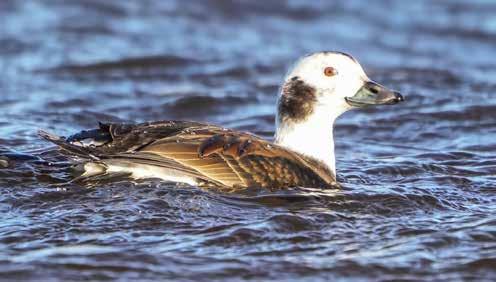
Long-tailed Duck – There was one on the River Orwell at Freston (13th) with two birds off Dunwich (19th – 25th) and another at Benacre Broad (25th – 27th).
Smew – There were two females seen on the Alde Estuary from SWT Hazlewood Marshes for much of the month (1st - 26th).
Goosander – A flock of thirty passed over RSPB Minsmere on New Years Day and at least seventeen were on the scrape (3rd). Two redheads were at Thorpeness Meare (3rd) rising to eight (12th). SWT Micklemere held five birds (27th). The bird at RSPB Hollesley Marshes remained for the whole month.
Grey Partridge – There were eight in fields at Ellough on New Years Day – the only recorded sighting.
Common Crane – There were two over Hazlewood Marshes (20th) and three at RSPB Lakenheath Fen (29th).
Red-necked Grebe – The only record was of a single bird seen off Nacton Foreshore (19th – 23rd).
Slavonian Grebe – There were two birds in Holbrook Bay and another on the River Deben at Waldringfield (13th). A third bird joined the two on the River Stour in Holbrook Bay (28th). Others were sighted off
RSPB Minsmere (5th) and another was off the point at Landguard Observatory (8th).
Curlew Sandpiper – A bird was found on the River Deben at Melton (29th – 31st).
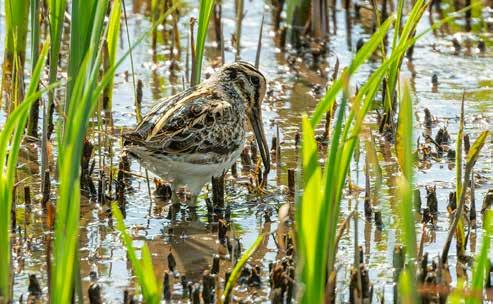
Purple Sandpiper – Occasionally seen along the coast through the month, there were two at Ness Point (3rd), there were as many as five at Southwold (28th) while East Lane, Bawdsey held a couple of birds through the month.
Little Gull The only record was of a firstwinter bird on rocks at Ness Point, Lowestoft (13th)
Glaucous Gull – There was one at RSPB Minsmere (3rd) and another off Landguard Point that followed the Stena Line Ferry out (8th).
Yellow-legged Gull – There were eight found at RSPB Hollesley Marshes (13th) and a single at RSPB Minsmere (20th).
Caspian Gull – The gull flock at RSPB Hollesley Marshes held three birds (13th) while others were seen in fields at Westleton (2nd) and RSPB Minsmere (28th).
Black-throated Diver – A single sighting of a bird on the sea off Southwold (17th).
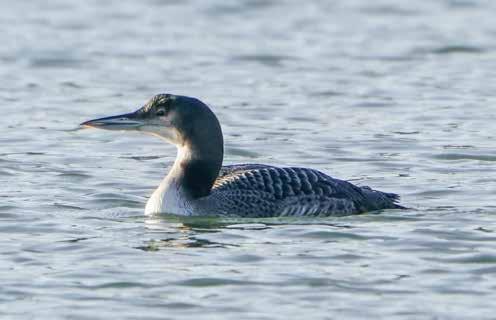
Great Northern Diver – There were up to two birds in the Lowestoft area (Hamilton Dock and Lake Lothing) with two others regularly seen on the River Orwell at Freston/The Strand although there were four birds seen off The Strand (30th).
White Stork – A single bird was observed in the Little Cornard area (25th – 27th).
European Shag – A bird was sighted perched on a buoy in the River Orwell off Levington Marina (7th). Another was sighted on the River Stour in Holbrook Bay (14th). Finally, a bird stayed in Lake Lothing, Lowestoft (26th – 28th).
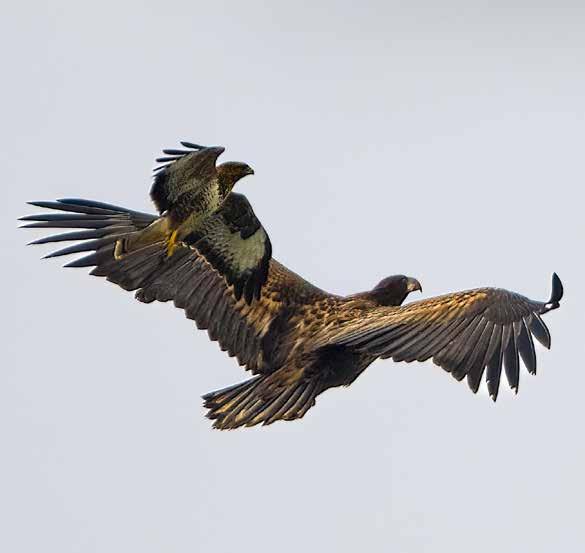
White-tailed Eagle and Buzzard
Glossy Ibis – The first-winter bird at RSPB Hollesley Marshes remained for the month, usually seen from the Café.
Eurasian Spoonbill – Just two sightings with a bird at RSPB Boyton Marshes (6th) and a second at RSPB North Warren (23rd).
Western Cattle Egret – The long-staying group at Iken remained, there were up to eight birds (3rd), while there were 10 in marshes at Fritton in the north of the county (13th-14th).
Hen Harrier – A ringtail was seen throughout the month at RSPB Minsmere and was joined by a second bird (27th). Others were seen at Levington Creek (7th), Frostenden (9th), Lavenham (13th), Walberswick (14th), Erwarton (19th) and Dunwich (25th).
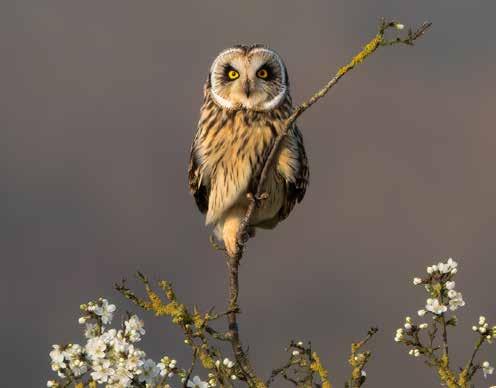
Short-eared Owl – Seen regularly around the coastal marshes throughout the month. Inland, there were two at Worlingham Marshes for most of the month.
Rose-ringed Parakeet – A single bird was observed in the Ipswich Cemetery (18th and 26th).
Northern Raven – There were a pair at RSPB Lakenheath Fen (29th) and another pair at Wherstead (30th) and single birds reported from around the area.
Bohemian Waxwing – The largest group of 30+ was birds recorded in Kesgrave (14th) with another group of 20-25 birds seen occasionally to the east of Ipswich in the first half of the month. Smaller groups and single birds were sighted throughout the month.
Common Firecrest – A single bird was seen along the North Wall at RSPB Minsmere (14th and 21st)
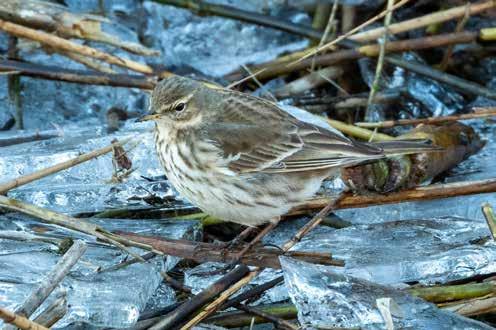
Water Pipit – Infrequently seen along the coast, there were up to three at RSPB Minsmere (18th) with others seen at Walberswick (18th), RSPB North Warren (19th) and SWT Hazlewood Marshes (26th).
Brambling – A dozen birds were seen in Rendlesham Forest on New Years Day and a flock of 40+ observed at Mayday Farm (16th).
Hawfinch – Two birds found at Mayday Farm (18th) was the only recorded sighting.
Common Redpoll – A single bird was found at Mayday Farm (16th) while a pair was discovered in the ‘Rhododendron tunnel’ at RSPB Minsmere (19th).
Lapland Longspur – A single bird on Kessingland beach (25th – 31st).
Snow Bunting – A flock at Kessingland beach numbered up to 70 birds and the flock at Walberswick beach rose to 87 birds. Both flocks stayed in variable numbers for the duration of the month.
Corn Bunting – A flock of 42 at Erwarton (19th) was the highlight – a single bird on wires in Chelmondiston (12th) also noted.
Ring-necked Duck – The long-staying immature drake at Thorpeness Meare was regularly seen throughout the month, last seen (29th). Another bird was seen at RSPB Minsmere (16th and 17th).
Lesser Yellowlegs – A single bird found on New Years Day at Southwold Town Marshes and relocated to Walberswick Marshes (14th), staying until (20th).
White-tailed Eagle - An immature bird remained in the Stowlangtoft area for the month. It was joined by a second ‘Dutch’ ringed bird later in the month.
Hooded Crow – A bird was photographed in Oulton village (18th).
Siberian Chiffchaff – A single bird was seen at the Long Melford sewage works on the (5th) and again on the (19th).
England and Wales had their respective warmest Februarys on record according to provisional Met Office statistics in what was a mild and wet month for many. The average temperature in England for February 2024 was 7.5°C, topping the previous record of 7.0°C set in 1990.
The warmest February on record (+3.4°C above average) & the wettest February on record (248% of average). Sunshine - it was a decidedly dull month (76% of average). February 2024 was warmer than 51% of all recorded Aprils (since 1884). This was also THE wettest Oct - Feb period on record. This was also the 2nd warmest winter on record.
Greater White-fronted Goose – A large group ranged between RSPB Hollesley Marshes in the south and RSPB North Warren in the north. There were 420+ at RSPB Boyton Marshes (4th), 482 at RSPB Hollesley Marshes (10th) and 350+ at RSPB North Warren (17th) with numbers declining steadily thereafter.
Whooper Swan – A group of up to 12 were frequently observed at RSPB Minsmere throughout the month, moving between the South Levels and East Scrape. No other reports received.
Tundra (Bewick’s) Swan – A group of 11 appeared to have relocated from RSPB Boyton Marshes (2nd) to RSPB Minsmere – there were 12 there (4th). Others were occasionally seen mid-month at RSPB Boyton Marshes and RSPB Hollesley Marshes where a group of 4 proved to be mobile.
Greater Scaup – A single bird was discovered at SWT Hazlewood Marshes (1st) while another was found at Alton Water (4th) rising to 4 birds (17th).
Velvet Scoter – Rarely seen, a single bird was seen with Common Scoter off Dunwich (3rd, 10th & 11th).
Long-tailed Duck – The Benacre Broad bird remained until (20th) and a female was found on the sea off Dunwich (10th – 27th).
Smew – A redhead was found at SWT Hazlewood Marshes (1st) and was joined by another bird later in month (25th – 28th).
Goosander – There were 22 into a roost at RSPB North Warren (19th). Others were regularly seen at Thorpeness Meare and RSPB North Warren. A lone female remained throughout the month at RSPB Hollesley. There were three at Pipps Ford in a flooded pit (26th).
Common Crane – Two were seen on the South Levels at RSPB Minsmere (1st). Three birds were tracked along the East coast (23rd) while two birds were again at RSPB Minsmere (24th).
Slavonian Grebe – Two birds found in Holbrook Bay (2nd) may have relocated to Alton Water (4th) where they remained for the remainder of the month. Three birds were found on the sea off Walberswick (10th) and two on River Stour at Shotley (16th).
Black-necked Grebe – A single bird was spotted on the sea off RSPB Minsmere (11th).
Curlew Sandpiper – The single bird found on the River Deben remained close to the sewage works at Melton (2nd).
Purple Sandpiper – Occasionally seen along the coast; Ness Point/Lowestoft held a group of 14 birds at the month end (28th).
Other small groups were seen at Southwold and East Lane, Bawdsey.
Little Stint – There were two birds on RSPB Havergate Island (11th)
Jack Snipe – A bird was found at Felixstowe Ferry (11th), and another was at the shore pools at Kessingland (15th – 22nd).
Caspian Gull – A handful of birds in the county toward the end of the month. There was a single bird on the Alde Estuary (25th), three at RSPB North Warren (26th) and two at RSPB Minsmere (27th).
Great Northern Diver – The Lake Lothing bird remained and was last seen (12th), another was discovered in Holbrook Bay (16th). An additional sighting was of a bird on the River Orwell (16th – 23rd).
Glossy Ibis – A bird was found at the SWT Levington Lagoon (9th). The first-winter individual at RSPB Hollesley Marshes remained for the whole month.
Eurasian Spoonbill – There were five on RSPB Havergate Island (11th) with four birds at RSPB Hollesley Marshes (19th & 20th).
Frequently seen at RSPB North Warren and RSPB Minsmere through the month.
Western Cattle Egret - There remained a group of up to five in the Iken area for the whole of the month. A single bird was found inland at Aspall village (2nd).
Great (White) Egret – Increasingly seen around the county, the highlight was at Fritton Lake where 30 birds came into roost (11th).
Osprey – A sighting at Stowlangtoft (4th) was reported.
Hen Harrier – A ringtail was seen at Chelmondiston (1st) with others at RSPB Boyton Marshes (2nd), RSPB Hollesley Marshes (7th, 11th & 19th) and another sighting was on the marshes at Bawdsey (15th).
Long-eared Owl – A single bird was discovered in Kessingland (12th).
Short-eared Owl – These spectacular birds were seen frequently along the coastal margins. The area between Shingle Street and RSPB Boyton Marshes appeared to hold most of the Suffolk population.
Merlin – A bird was found at RSPB Minsmere, observed from the Bittern Hide (10th) and another at RSPB Boyton Marshes (15th).
Bohemian Waxwing – Small groups of birds were seen frequently through the month with up to 13 seen in Leiston and smaller groups in and around Ipswich and Bury St. Edmunds. A single bird was seen in Great Cornard on several occasions throughout the month.
Common Firecrest – A single report of a bird at Banters Barn/RSPB Boyton Marshes (2nd). Black Redstart – There were two femaletype birds at Sizewell Power Station (2nd – 3rd) and three were present later in month (29th).
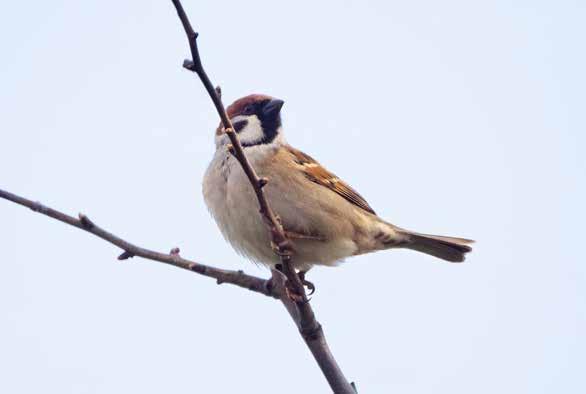
Eurasian Tree Sparrow – A single sighting of a bird in Little Livermere (27th).
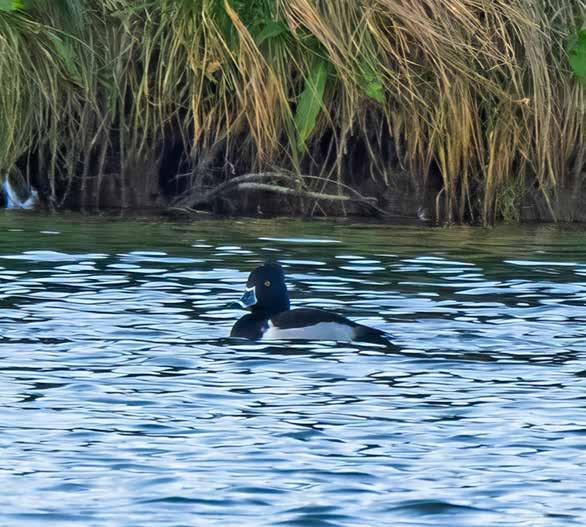
Ring-necked Duck
Water Pipit – Rarely seen, there were three birds at RSPB Minsmere (27th) and others were seen at Walberswick (1st), SWT Trimley Marshes (10th) and SWT Hazlewood Marshes (25th).
Twite – A single report of two birds among a Linnet flock at Easton Farm Park (11th).
Common Redpoll – Just the one bird reported among a group of c.25 Lesser Redpoll at Mayday Farm (5th).
Lapland Longspur – The single bird found in January remained at Kessingland beach until (22nd).
Snow Bunting – The Dunwich beach flock remained with c.60 birds (1st) occasionally seen further north at Walberswick. Another group that was regularly seen at Kessingland beach numbered between 30 and 50 birds and remained for the month.
Corn Bunting – A group of 30+ were seen at Lings Lane. Chelmondiston (16th).
Ring-necked Duck – The long-staying immature drake remained at Thorpeness Meare last seen (10th). The bird then relocated to RSPB North Warren (15th) and remained on the south marsh until (28th).
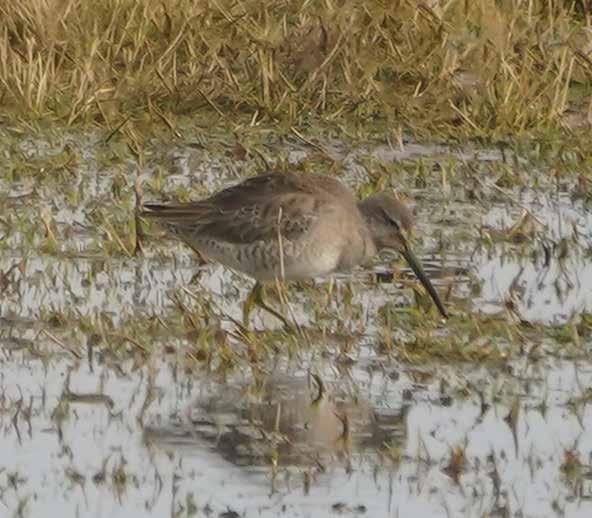
Long-billed Dowitcher – A single bird was discovered on the south side of Breydon Water and was seen regularly at Burgh Castle and SWT Carlton Marshes throughout the month.
White-tailed Eagle – The two birds –including G625 satellite-tagged Isle of Wight bird – were regularly seen between Ixworth, Stowlangtoft, SWT Mickle Mere and Woolpit early in the month. Thereafter the birds appeared to range freely around the county.
Night Heron – A single sighting of a bird on private land in North-east Suffolk (23rd).
March 2024
Meteorological spring kicked off with a mild and wet month of weather for the UK, with southern areas particularly wet compared to average. Although it’s felt like it hasn’t stopped raining for many, no national records have been broken and March 2024 will go down as a wet and dull month, according to provisional statistics from the Met Office. The UK experienced 27% more rainfall than an average March, with much of this concentrated in the south.
This was the 4th warmest March on record (+1.8°C above average) and was slightly wetter than the average (111% above average). Duller than average (82% of average sunshine). This was the 2nd warmest start to the year (over 3 months) on record (behind 1990, data records going back to 1884).
Notable March sightings:
Greater White-fronted Goose – The RSPB Boyton Marshes/RSPB Hollesley Marshes area continued to support the local population with as many as 130 birds (18th). Smaller flocks of birds were often seen moving from one site to the other as the geese became increasingly restless. RSPB Hollesley Marshes held just 10 birds (24th) as numbers continued to fall from their February peak (482).
Whooper Swan – A group of 12 continued at RSPB Minsmere (5th).
Tundra (Bewick’s) Swan - Two were found at Kirton Creek (10th).
Garganey – The first bird of spring – a drake - arrived at RSPB Lakenheath Fen (6th). There were six birds (four drakes) on the reserve (27th). More birds had arrived with a single at RSPB Hollesley Marshes (17th), a pair at Polstead (18th) and three at SWT Carlton Marshes (29th).
Smew – There were two redheads on the Alde Estuary at SWT Hazlewood Marshes (4th – 11th)
Goosander – The flooded pits at Pipps Ford held 6 birds (12th & 13th). Other birds continued to regularly show at RSPB North Warren throughout the month. The single redhead remained throughout the month at RSPB Hollesley Marshes.
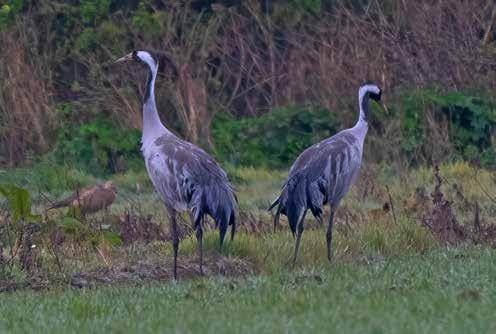
Common Crane – There were at least two birds, occasionally four, on RSPB Minsmere for the whole of the month. There were two more at RSPB Lakenheath Fen. Other mobile birds were sighted around the east of the county.
Slavonian Grebe – Two winter plumage adults remained at Alton Water (1st – 16th).
Little Ringed Plover – Two birds arrived at RSPB Hollesley Marshes (16th) and remained on the scrape for the remainder of the month although mobile at times. Another was found in Little Cornard/Shalford Meadow (28th).
Curlew Sandpiper – A long-staying bird (found end of January) remained on the river Deben at Melton (8th–15th).
Purple Sandpiper – A bird was found in the shore pools at East Lane, Bawdsey (7th), there were three on the shore, north of the pier at Southwold (16th) and a single bird in the same location (30th).
Jack Snipe – A bird was discovered at RSPB Snape Marshes (11th). Another bird was regularly seen at Island Mere/RSPB Minsmere (25th – 29th).
Little Gull – A single bird was on the River Deben at Melton (11th), another off Thorpeness on the sea (30th), and another at SWT Trimley Marshes (30th). There were a group of three off Landguard Point (31st).
Black-throated Diver – A single sighting
of a bird flying south from Landguard Point (12th)
Great Northern Diver – A bird was found on the river Orwell off Levington (3rd). Possibly the same bird was seen flying south from Landguard Point (12th) and then again on the river near Loompit Lake (18th).
White Stork – Birds were seen flying over the east of the county throughout the month. Such activity is well tracked by Suffolk birders. An individual was tracked south from Lowestoft through to Saxmundham (6th), Levington to RSPB Minsmere (7th), Lowestoft from RSPB Minsmere between (9th – 11th). Another sighting was at Southwold to Melton (18th).
Glossy Ibis – The first-winter bird remained at RSPB Hollesley Marshes throughout the month. A second bird was occasionally seen on the reserve. Another bird was at RSPB Minsmere (24th) and one was seen at RSPB Boyton Marshes (31st).
Eurasian Spoonbill – A single bird was at RSPB North Warren (6th) and RSPB Boyton Marshes (7th). Another was on West Scrape at RSPB Minsmere (17th).
Western Cattle Egret – The small group seen at Iken through the early part of the year remained with up to six birds present (3rd & 4th), There were five birds at Wangford by the quarry entrance (31st) and other smaller groups and individuals seen around the east of the county.
Hen Harrier – A male was seen at Westleton Common (11th). There were sightings of ringtails at Hopton (2nd), another at RSPB Minsmere/Island Mere (24th) and Kingsfleet and Falkenham area (28th & 30th).
Long-eared Owl – A bird was in the North Bushes at RSPB Minsmere (17th).
Short-eared Owl – Occasionally seen on our coastal marshes, there were three birds at Felixstowe Ferry seen to cross the river flying north towards Bawdsey (24th). Others were seen between Shingle Street, RSPB Boyton Marshes and Dunwich during the month.
Rose-ringed Parakeet – A bird flew south over Felixstowe Ferry (23rd).
Northern Raven – One was seen at Ashbocking (7th), another at Ramsholt (10th) and Alton Water (16th). A pair were seen at Bawdsey in fields (17th) and another single bird flew over Kessingland (18th).
Bohemian Waxwing – A flock of between 12 and 15 birds was seen occasionally to the north of Ipswich in the first half of the month. A single bird remained at Great Cornard (8th – 9th).
Swallow – The first Swallow of the spring was reported in Little Cornard (22nd).
Common Firecrest – A bird was re-trapped and ringed at Landguard Bird Observatory (3rd) and a second bird was re-trapped the following day (4th). Two birds were then seen in the compound (14th). Others were reported at Benacre (14th), RSPB North Warren (16th) and a bird was ringed in a private garden in Alderton (20th).
Black Redstart – A bird was found in Southwold Harbour (12th) and there was another at Sizewell Power Station (13th).
A further find was of a bird at the Benacre Sluice (19th – 27th). There were two more sightings, one at Southwold and another in the car park at RSPB Minsmere (30th).
Common Redstart – A bird was heard singing briefly from a private wood in Hintlesham (24th).
White Wagtail – The passage migration began with three birds found at Beach Farm/Benacre and another at the Sizewell Power Station (13th). Others were seen at Little Cornard/Shalford Meadow (22nd) and two together at the shore pools at Kessingland beach (23rd).
Water Pipit – A single bird was at SWT Levington Lagoon (1st), there were two at RSPB Lakenheath Fen (24th). Others were seen infrequently around the coast throughout the month.
Red Crossbill – There were 12 on Upper Hollesley Common (3rd) and three others reported at Westleton Heath (4th).
Snow Bunting – The two flocks at Kessingland beach and Dunwich/ Walberswick beach remained albeit with numbers falling rapidly. There was a peak of just 13 birds at Kessingland (23rd) while
there were 25 at Walberswick (10th). There was just a single bird at Kessingland (30th).
Scarce sightings:
Ring-necked Duck – A single bird stayed at RSPB North Warren from February until (23rd).
Lesser Scaup – Five birds previously seen at Abberton Reservoir relocated to the Island Mere/RSPB Minsmere (24th).
Dotterel – A single bird was discovered in fields near Cuckoo Tye, Acton (23rd).
Long-billed Dowitcher - Having settled in at SWT Carlton Marshes the bird remained until (11th).
White-tailed Eagle – A single bird was, again, often seen in the SWT Mickle Mere/ Ixworth/ Stowlangtoft area throughout the month with other sightings at Cavenham, SWT Lackford Lakes, RSPB Lakenheath Fen, Elmswell and Trimley.
Hooded Crow – A single bird was found on Covehithe Broad (5th). Another was seen at RSPB North Warren (21st – 30th).
Serin – An individual was sighted in Oulton (28th).

Council for 2024
Officers
Chair: Eddie Bathgate
Vice Chair: Chris Keeling
Secretary: Katya Bathgate
Treasurer: Anne Wright
Communications Officer: Adam Faiers
Projects Officer: Chris Keeling
SoSS Project Officer: Eddie Bathgate
Suffolk Bird Report Editor and SORC/SNS Link: Nick Mason
Harrier Editor and Outdoor Events Coordinator: Gi Grieco
Indoor Events Coordinator: Adam Gretton
President John Grant
Members
Sarah Glyde
John Kornjaca
Peter Merchant
Ben Moyes
Sally Nelson
Jenny Rawson
Alex Rafinski
Honorary Vice-Presidents
Andrew Green
Adam Gretton
Robin Hopper
Colin Jakes
Mike Jeanes
Mike Marsh
Roy Marsh
Philip Murphy
Reg Snook
Steve Piotrowski
Bird Recorders
North-east Area Recorder: Richard Walden Email: bird-ne@sns.org.uk
South-east Area Recorders: Gi Grieco Tel: 07951 482547 and Steve Fryett Tel: 07593 382082 4, The Street, Melton, Woodbridge, IP12 1PW. Email: bird-se@sns.org.uk
West Area Recorder: Chris Gregory Email: bird-w@sns.org.uk
Memberships
c/o SNS, The Hold, 131 Fore Street, Ipswich, Suffolk, IP4 1LR
Founded in 1973 by a group of Suffolk birdwatchers
Associated with the Suffolk Naturalists’ Society
SBG remains an independent birding group and is a registered charity
A voice for Suffolk birdwatchers
With established links to many naturalist and conservation organisations
Media
Actively lobbies to protect key Suffolk habitats
Provides a county-wide field force of bird surveyors
Promotes BTO bird surveys and organises special SBG surveys

Strong web presence - www.suffolkbirdgroup.org
Active Twitter feed - @SuffolkBirdGrp
Quarterly magazine - The Harrier
Annual review - Suffolk Birds report
Annually (20+) field trips - ideal for novices or experts and young or old alike
Opportunities to visit hot spots and receive practical ID tips in the field
Programme of talks and presentations - variety of topics (county, national, or international) with quality speakers
Assists with conservation projects to improve breeding success
- Swifts
- Barn Owls
- Peregrines
- Waders
Partners with Suffolk Wildlife Trust and other bird groups
Assists with funding for bird hides and other birding amenities
Contributes to community events, including dawn chorus walks
Provides bursaries for special projects