
Gi Grieco
Gi Grieco
Welcome to The Harrier. 2023 marks a momentous year for Suffolk Bird Group. It’s 50 years since the group was formed and we’re grateful to one of the founder members, Mike Jeanes, in giving a bit of history on how it came about as well a change in the bird species in that time. It only seems a blink of eye when we celebrated the 40th anniversary at The Cut in Halesworth, where the late Derek Moore gave a talk on Suffolk birding, and about the group over those 40 years. This time SBG President John Grant will open proceedings and then Mark Cocker, a person who has given some great talks to the group over the years, will be the main speaker. It’s a celebration of the whole group so it would be great to see you all there. Back in August we did have an informal gathering as part of the celebrations – a write up will be in the next edition but it was quite an eventful evening!
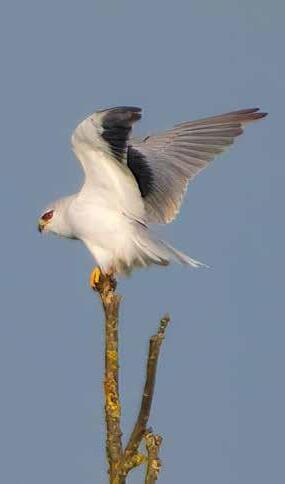
Many of us have, or have had a patch that we regularly visit. There’s always the hope of something interesting turning up as much as watching the changing seasons and movements of birds. Craig Holden has written about his patch and the stunning bird that turned up this year to the delight of many birders. The species, Black-winged Kite, was a species a few of us SBG members saw on a trip Extremadura. One of things of being part of the group is making friendships and then going on adventures further afield. This year,
five us travelled to Estonia where we saw a great selection of birds. One bird we just missed was Hawk Owl – but you never know, maybe one will turn in Suffolk one day!
Owls are a favourite species for many (isn’t that so Marion!) and Dave Pearsons relates an interesting observation, while Rasik Bhadresa talks about a surprise encounter. I’ve already talked about going back in time and a change in the bird life from then and now and this again is detailed by David Tomlinson where he talks about the Big Bird Race – which I’m sure many of us have read and enjoyed. We have a selection of regular trip reports and the quarterly bird review.
Most SBG members probably weren’t SOG members back in 1973, but a number of our honoured Vice Presidents were! We’re inviting them all to join us for a very special evening on 19 October in Woodbridge, to celebrate our 50th anniversary. The evening is a joint event with Woodbridge SWT group, following two very successful events in the last two years. Last year, c130 attended and we’re hoping for more this year!
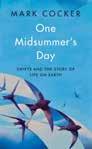
John Grant will kick the evening off with an opening address, before handing over to Mark Cocker, for his 6th talk for us, covering almost all his books since Birds Brittanica back in 2005.
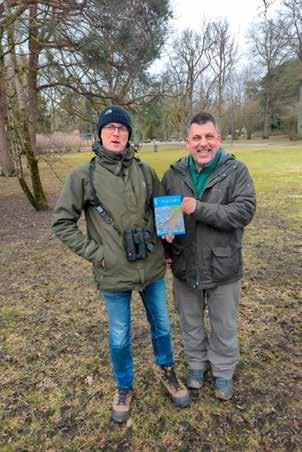
Award winning author Mark Cocker will be visiting Woodbridge Community Hall, Station Road, IP12 4AU, on the evening of Thursday 19 October to talk about his latest book One Midsummer’s Day, which talks about swifts and the interconnectedness of life on Earth.

The talk, which starts at 7.30 pm, has been organised jointly by Suffolk Wildlife Trust’s Woodbridge Wildlife Group and Suffolk Bird Group.
“We are very pleased to join with Suffolk Bird Group to bring Mark Cocker to Woodbridge” said Phil Smith, chair of Suffolk Wildlife Trust’s Woodbridge Wildlife Group. “Mark has written many books on the
natural world and I’m really pleased to give people in the local area the chance to hear such a high profile and interesting speaker.”
Eddie Bathgate, Chairman of Suffolk Bird Group said “This will be Mark Cocker’s seventh talk for our Group – he is one of our most regular speakers and we’re delighted to welcome him to Woodbridge as we celebrate fifty years of Suffolk Bird Group.”
All are most welcome, whether SBG members or not. Doors open at 7 pm for this talk. Entry is £5 for adults, with under 25’s free. Mr Smith added “There is no need to book for this talk, pay on the door but please note payment is by cash only. All entrants will be entered into a raffle to win a signed copy of Mark Cocker’s book “One Midsummer’s Day”.
Light refreshments will be served during the evening and there will also be a raffle and the opportunity to purchase Suffolk Wildlife Trust’s popular Christmas cards.
Mark Cocker’s new book is about the extraordinary lives of swifts, their migrations, which include some of the longest journeys performed by any terrestrial birds. It also explores the remarkable feeding behaviours and nesting habits of many swifts as well as their broader ecology. Yet this is a book with a wider moral and philosophical message. By situating swifts within the widest possible context, especially the central relationship between birds, plants and insects, the author explores the interconnectedness of all life. These birds without borders are a perfect symbol to express the unity of the living planet. They illuminate how no creature, least of all ourselves, can be said to be alive in isolation. We are all inextricably connected.
Mike Jeanes, Vice President
I started birding in my 20s and a workmove to West Suffolk in 1970 helped to activate that, especially as I was within good striking range of the Brecks, the Ouse Washes and the Suffolk Coast… a veritable birder’s heaven. The specific birds I miss most from back then are Red-backed Shrike, drumming Snipe, Golden Orioles and Little Terns at Orford Quay, plus the whole array of common farmland birds which was different, more plentiful, and more diverse than now.
At that time, I had little notion of those scarce, migrant wanderers from the North that turn up every autumn and sometimes in spring and cause such excitement. About that time, I attended some evening classes in Bury St Edmunds given by the wonderful Bill Payne, who always brought some specimens with him and I recall a treat of true delight of seeing how large a Barn Owl’s ears were under the feathers.
The next year’s WEA Birding Class was given by Mike Allan (from Cambridge). Robin Hopper and all the other West Suffolk SOG ‘founding fathers’ were there at this time. At the end of the course we were all pretty fired up and Mike said we should start a club, much like the Cambridge Bird Club. We all agreed enthusiastically and artfully asked him to be Chairman but he declined, telling us that we could do it perfectly well ourselves. His confidence was inspirational and we met a few times and, after some months, links were made with Mike Hall and Reg Snook in East Suffolk.
I moved to Ipswich in early 1974. A newsletter was published and with that came a huge contribution to its appeal to other birders in the form of Reg’s beautifully
illustrated SOG bulletin covers. And so it started and was soon augmented by a good number of East Suffolk birders, including Phil Murphy, Mike Marsh and Jean and Ken Garrod. A couple of years later, for personal reasons, I moved to Colchester. A divorce and 12 months at Imperial College took up my time and I virtually lost touch with the Suffolk birding scene apart from still making visits to the Lakenheath Orioles. However, I was delighted to know that SOG was in the hands of capable and enthusiastic birders. (During that early period of SOG I had carried out an almost complete survey of West Suffolk rookeries in 1973 and then in 1975 led the BTO rook survey of the whole of Suffolk. Based on that Reg and I produced “The Rook in Suffolk” which tied together the survey results and other Suffolk Rook data).
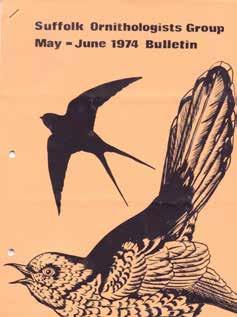
There was also a one day:»Tell us if you hear a cuckoo!” survey. I also started to visit the Bryant and May estate at Lakenheath, logging singing males, finding a few nests and getting involved with the Golden Orioles Group who were also finding other birds across the Fen Basin. I had a free run of the woods, with the permission of the manager, and quickly learned how indiscriminate and selfish other birders could be by trampling below nests; disturbing the lower nesting Orioles and, worst of all, crossed paths with nest scavengers and egg thieves.
At one time there were three other nesting Oriole sites in Suffolk and about a dozen singing males across the whole of the Lakenheath site. (There were also several nesting Orioles in Kent but the habitat was quite different, mixed deciduous). My eventual joy at learning that RSPB was to buy the Lakenheath site was somewhat diminished when I discovered their intended protected species; but they were right, Orioles have disappeared from the UK and last bred at Lakenheath in 2009. Bitterns and Cranes are great birds.
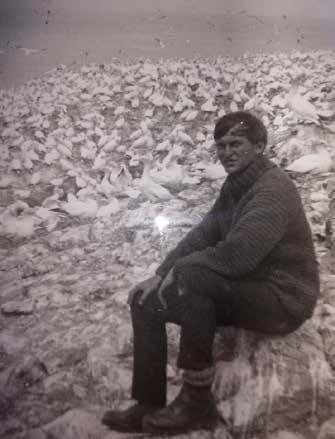
Over the last 50 years the subject of bird identification and record acceptance has changed appreciably. Bill Payne was a shooter with the motto “what’s hit is history, what’s missed is mystery”. Though I don’t think he ever shot the kingfisher he found eating grapes in his greenhouse!
The early part of the 20th century saw the notorious Bristow, a gunsmith and taxidermist of the Hastings area, who imported frozen bird corpses and claimed them as local finds. As a consequence, eventually after investigation and review, 29 Bristow species or sub species were removed from the British list. After that, bird IDs were accepted on the basis of reputation of the observer and then later a good description was also essential. And now, the photo. Honestly, I wouldn’t have believed the addition to the Suffolk list of Blackbrowed Albatross to be possible, seen over land rather than offshore, but there it was - in black and white - so to speak, a cracker.
The local bird list stretched again for some, though personally, I don’t have one. But I do know what I haven’t seen! Always carry a camera, your reputation could depend on it. I usually won’t go more than about 20 miles to see a bird but do still regret missing the millennium Ivory Gull and even the Little Auk at Lowestoft last year.
My last observation is on the future of optics. Surely it is only a matter of a short length of time before binoculars and, particularly, telescopes are replaced and superseded, by digital technology. The latter should produce
bigger images which are easily shared or printed - quality will be the key.
Since SOG was formed, and morphed into SBG, a lot of good people have given their time and care to the organisation and management of this wonderful bird club. On behalf of all members of SBG I would like to thank all of the officers and Council members of the group for their hard and effective work over the last 50 years, as well as the bird recorders, and trip leaders. Well done all of you!
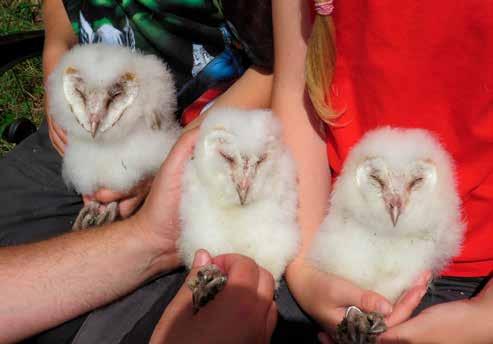
On the 15th June 2023 I was out checking Barn Owl boxes in the Aldeburgh area. A ringed adult female was revealed during a box check in Knodishall. The details of the find were entered in the BTO DEMON system.
I have been informed that the Barn Owl was ringed on the 22nd July 2013 in Argyll and Bute, Scotland.
Some journey and a surprise for me!
The last time the Harrier Abroad featured in the magazine was from a trip to the Pyrenees, that occurred just prior to the onset of the Covid pandemic and a restriction in travel. As a group of friends who go on these trips we were looking forward to visiting somewhere again and a few people had recommended Estonia.
We had a couple of other places that piqued our interest but on research Estonia looked a really good prospect. We contacted Birding Estonia to follow an itinerary for six days, plus we booked on a further day trip with another guide due to our flights. The idea was to go in March with the chance of many sea ducks, owls, woodpeckers and grouse. We were fortunate to be guided by Uku Paal, an excellent birder who among other things is the joint author of Birding Estonia and one of the founders of Estbirding – the Estonian Bird Club.
Our trip consisted of visiting a few National Parks as well as staying on the island of Saaremaa. Each location had excellent accommodation, we had some lovely meals and the roads were generally quiet and didn’t suffer from the pot holes issues we have here in the UK – and that included the forest trails that had been under feet of snow! We had many highlights – excellent views of Steller’s Eider, Pygmy Owl plus eight species of woodpecker including Three-toed. The large number of geese on the flooded fields were an amazing sight –mainly Greater White-fronted and
Tundra Bean but also Taiga Bean, Pink-footed and we found a Red-breasted Goose.
Our final day, with guide Peter Lind, saw us get great views of Hazel Grouse and Capercaillie along with finding some Bear tracks. We enjoyed our trip so much and knowing the potential of migration and summer visiting birds that we are heading to Estonia again next year – and Adam has persuaded me to talk on Estonia for SBG in the latter half 2024 with a combination of both trips.
The Deben has been my patch from a young age, primarily focused on the areas around Woodbridge and Martlesham, due to my home and work locations. This changed in 2018 when I moved to Felixstowe, soon adopting Felixstowe Ferry as my ‘new’ territory. There is a variety of habitat to bird, each coming into their own depending on the weather conditions and time of year. With its location right on the coast, the opportunity for migrants is far greater than I previously experienced more inland. In the past I have seen Red-backed Shrike and Barred Warbler here, with historical records of much rarer species having occurred, offering up plenty of motivation if ever it was needed.
During spring and autumn migration periods, the Tomline Wall is well worth a walk. There is a copse at the start, before opening up to an area of scattered bushes and small trees.
In the right conditions, Pied Flycatcher and Redstart can be found amongst the more common species, and there is good potential for much scarcer stuff to occur. Similar type habitat can be found around the back of the Ferryboat Inn and nearby gardens.
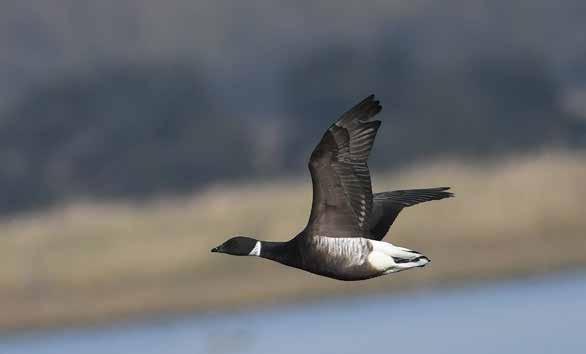
The river itself is productive throughout the year. During the winter months there are always good numbers of wildfowl present, with the regular Brent flock hosting Black Brant on a number of occasions over the years. The pools on the saltings often host waders – although never in any great number – but are always well worth scanning for any passage species during migration periods. More often than not, the vast majority stay out on the exposed mudflats. Further upriver is Kingsfleet. This is a fantastic location for hunting Hobby during the summer months, with the promise of something rarer always a strong possibility.
The sea can also be worth a look in suitable conditions. Although nowhere near as good as the more traditional spots further up the coast, decent movements of wildfowl, waders and terns can be experienced.
Since Covid I now work from home three days a week, which is fantastic for allowing me more opportunities to bird the patch. Those early morning starts pre-work during the spring migration period allow me a good few hours before having to be at my desk. I am also very fortunate that I can work flexible hours, which is ideal during the autumn when the mornings are naturally darker, meaning later starts, and so not compromising my
opportunities to get out during the best times. Work is also extremely understanding at allowing me to disappear at a moment’s notice so, if anyone else happens to find something exciting, or something is getting tracked down the coast, I can nearly always disappear for a look.
All in all, I have quickly fallen for this site. There is always something to see, with a mixture of habitats to explore. The potential for rare and scarce birds to turn up, beyond the more standard common migrants, is always a strong possibility, which brings me nicely to the evening of July 20th 2023…
The evening of July 20th 2023 will forever hold a special place in my heart.
Having finished work, and it being a pleasant evening, I decided to head out to the patch for a walk along the river wall, with the intention of checking out the saltings and Kingsfleet.
I had been out for about an hour-and-a-half, noting a Wood Sandpiper on the saltings – which is a decent bird for here – before starting to wander back. As I approached the last bend before reaching the stile (at about 19.30 hours) I noticed a bird drop off the telegraph wires out of the corner of my eye, instinctively making me look across. Almost immediately the bird started to hover at c140 yards range. Despite being viewed with the naked eye and essentially silhouetted, my heart started to race; I was already expecting the unexpected. At this point the bird started to drift slowly north-west over Holmhill. I had already got brief views through the bins to confirm my suspicions that it was indeed a Black-winged Kite, before dropping to my knees to look through the ’scope. By now it was steadily drifting towards Kingsfleet, occasionally stopping to
hover, before continuing on. The combination of pale-grey upperparts and clean white underparts contrasting drastically with the black ‘shoulders’ was conclusive. Needless to say, I was in a sense of disbelief and the adrenaline was pumping. Although I haven’t twitched nationally for a number of years, I was obviously aware of the Horsey bird. Despite not knowing at the time the exact whereabouts of that individual, it wasn’t a huge leap of faith to think this was the same bird relocating.
After making a few quick phone calls, it was a case of trying to track the bird down again. Thankfully, it was soon picked up sitting on a post between Kingsfleet and Marsh Lane. Over the course of the rest of the evening the bird was relatively mobile, although never venturing particularly far.
The bird was seen to go to roost in trees near Marsh Lane but, unfortunately, due to work commitments just for once requiring me to be in the office, I was unable to visit the following morning. Thankfully though the bird was on view from about 04:35 hours, delighting the masses who had arrived. It stayed in the general area until 09:20 hours when it drifted off north, never to return.
Suffolk Bird Group are financially secure however a significant proportion of our subscriptions is spent producing The Harrier. Any additional funds raised or donated can be used to help our ongoing projects.

Members can easily raise much needed funds for Suffolk Bird Group whilst shopping online using Give As You Live. It is quick and easy to set up a free account then simply select Suffolk Bird Group to be the recipient. There are 1000’s of online retailers you can shop at who will pass on a percentage of the price to us. Flights and holidays, the weekly shop and insurance, if booked on line then a small percentage can be passed onto us. So far over £350 has been raised this way.
If you do shop online then please do investigate the details here and set yourself up, it is quick and easy to use with widget to help, and SBG can make every penny raised count. https://www.giveasyoulive.com/charity/suffolkbirdgroup.
Rasik Bhadresa
Surprises are always welcome when one is out in our beautiful countryside in the early mornings.
It was on one such clear sunny morning, in early July, as I walked past the war memorial and down Flatford Lane (TM 069342) that this marvellous ‘sight’ boldly bowled me over. As usual, I had paused, next to the seat, to admire the beautiful view of the Dedham Vale. The striking tall tower of Dedham Church, knapped flint and dressed with limestone, stoically stood out of the greenery, as it had done for more than 500 years (doesn’t time fly?)! The intention must have been that it was visible for miles around. And they were not wrong there.
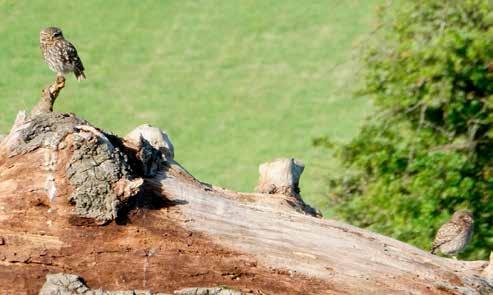
But it was when I moved my eyes towards the dead hefty fallen trunk in the field, a remnant, a relic of an oak tree from Constable’s time, something looked different. What I thought, on the left, was just a dead branch sticking out and up, appeared a bit longer than usual and as I looked, I discerned a movement which interrupted the temporary camouflage. It was the full swivelling of the
head that gave the game away. And a couple of yards to its right was another one (see photo). I was delightfully mesmerised!
Also lovingly called Owl of Athena, a name I personally prefer, the two Little Owls were the size of a thrush but stocky with longish strong sturdy legs and short tails. The brown plumage, aptly streaked and spotted with white, blended in admirably with the streaky browns of the slowly decaying trunk. Suddenly, I felt a stare. Their flattopped heads were both looking at me. The greetings were somewhat firm, stern and piercing. But I stared back to see why they looked so unyielding. It was the golden beaded eyes, marked pale eyebrows and the flat-topped heads which jointly put a frown on their faces.
Just then, the one on the branch produced a loud and mellow kweau, kweau. The other (possibly a partner?) threw it a quick glance. It was time for me to leave and let these fellow denizens enjoy their peace and quiet. Au revoir, I murmured.
David Tomlinson
As bird books go, The Big Bird Race is hardly a classic, but it is a little bit of birding history, even though I say it myself. Written jointly by me and Bill Oddie, it features an introduction by John Gooders and foreword by Roger Tory Peterson, the man who invented the field guide. Though it was published 40 years ago, it’s not too difficult to find an old copy. It will set you back a pound or two, but hopefully you will find it both entertaining and amusing.
The book is the story of a bird race between two teams - one representing Country Life magazine, led by me, the other supporting the ffPS (Fauna and Flora Preservation Society), led by Bill Oddie. The idea was simple. Each team had to try and record as many birds as possible in 24 hours. We both started in Suffolk, ventured into Norfolk, then came back to Suffolk again. My team started at Minsmere (warden Jeremy Sorensen was a member of the team), while Bill’s team started at Walberswick, where team member Cliff Waller was the warden of the NNR. Through sponsorship, both teams were raising money for conservation projects.
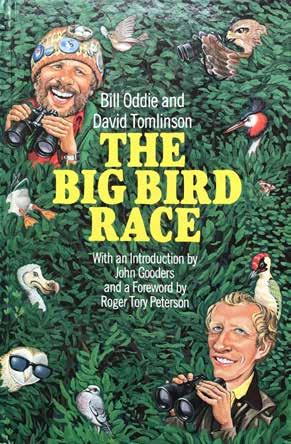
Though the book is an account of the 1983 race, that year’s competition was in fact the third and final race of its kind between the two teams. What is interesting today is the list of species we did, and didn’t see, as the avifauna of East Anglia in those distant days was remarkably different than it is today. You won’t be surprised to learn
that we never saw a Kite, and nor did we expect to, as the only Kites in Britain were still restricted to the hills of Wales. Seeing a Sparrowhawk was always a struggle as they were still very scarce, while Buzzards were genuine rarities, never recorded by my team. However, perhaps the most surprising bird never seen on a birdrace day was a Hobby, now a bird that you can expect to see on almost every outing in Suffolk in mid-May.
Neither team ever managed to tick off a Pink-footed Goose (the race was always held in mid-May), while even Barnacle Geese were a challenge to find anywhere in
East Anglia in the early ’80s. We would have been stunned if we had managed to see an egret of any sort, nor did either team ever manage a Purple Heron, but we never failed on Bittern (a bird could be ticked if it was heard). Mediterranean Gulls, now a familiar breeding bird at Minsmere, weren’t seen by either team in 1983, while we didn’t bother to look too closely at Herring Gulls in the hope of finding Caspian or Yellow-legged Gulls, as neither of these had then been split from Larus argentatus.
Owls were invariably a struggle. My team only heard Long-eared Owl once, but ffPS never failed on this species (Cliff always knew of a nest). Barn Owls were then few in number - this was long before the Suffolk Community Barn Owl Project - so were never easy. We saw them just once, in ’83, while ffPS missed them that year, but got them in ’81 and ’82. Intriguingly, my team always recorded Short-eared Owls: we used to find them on the coast near Orford, where they bred. Would we still find them there today?
Turtle Doves were never a concern, as they were still common farmland birds, as were Grey Partridges. Lesser Spotted Woodpecker always took a bit of finding, but neither team ever missed this species. We took Spotted Flycatchers for granted, and both teams ticked Savi’s Warbler in all three years. At the time Savi’s were regular breeders in Suffolk. Cetti’s Warblers were already well established then, so we never missed hearing one, but there was no chance of finding a Dartford warbler, as they had yet to become established in East Anglia.
Hawfinches were elusive, but we always succeeded in locating one, while Siskins were much more of a challenge, as were Crossbills. Corn Buntings were already quite scarce in Suffolk, so this was a species that required a stake-out, but if you know where
there’s a bird on territory it’s an easy species to see. These days, I imagine, it would be much more difficult to find. Willow Tits were another species that, even in 1983, were far from reliable. The damp woodland in the Fen at Walberswick held a pair or two, but they weren’t easy to locate.
Though we never saw it, we did record Golden Pheasant in ’83, hearing a calling cock in Thetford Forest, just outside Brandon. It’s a distinctive, high-pitched call and quite unmistakable, but it’s a sound that has almost disappeared from the Brecks today. My team recorded Wood Warblers in all three years, but that’s another bird that would be tricky to find in Suffolk now.
Remarkable though it may seem today, we never saw a deer of any species. Intriguingly, I noted in my account that “1983 has proved to be a bumper year for the Nightingale, with Minsmere boasting some 60 or so singing males, a 300% increase since the ’70s”. I went on to write that “for the first few hours we were rarely to be out of earshot of a Nightingale”. Such an abundance of Nightingales is unimaginable today, while no one would have guessed 40 years ago that the Muntjac would become one of the commonest animals in the countryside. The decline of the former and the rise of the latter has to be connected.
In 1983 the Country Life team recorded 155 species in 24 hours, which at the time established an unofficial British record. There isn’t, of course, an official record, but that figure has certainly been beaten since. I wonder how many species could be found today by a team following a similar route to the one we used 40 years ago? There’s a challenge for any fit and keen Suffolk birders. One thing is certain, the mixture of species would be quite different.
Steve Fryett
Saturday 22nd April 2023
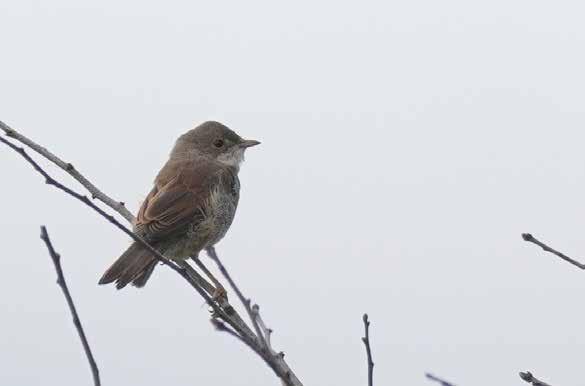
During the days preceding this outdoor meeting we were experiencing cold weather with north easterlies not conducive for spring migration. I feared the worst however, overnight the wind moved to the southeast bringing slightly milder settled weather albeit slightly misty. As the 11 members set off heading south from the Coastguards I felt a tad more upbeat. Stonechat, Reed Bunting with 20+ Linnets made up the observations around the tennis court. A Whimbrel was heard calling overhead along with Mediterranean Gull although impossible to see through the mist. Two Common Buzzards were monitoring
the local scene from a bush on Oxley Marsh with a female Marsh Harrier also noted over marsh. The odd Swallow came into view now and again with the call of a Yellow Wagtail recorded overhead. Common Whitethroat, Chiffchaff, Blackcap and Song Thrush were either seen or heard around the gardens and allotment. About the Martello more Whimbrel were noted overhead and a Lesser Whitethroat came out in song as we made our way to the Twin Banks. Here several Sedge Warblers could be heard with at least one seen, Cetti’s Warbler and one Reed Warbler. A Green Sandpiper on the first pool was a noteworthy find on migration
with another Yellow Wagtail overhead, Meadow Pipit and a male Stonechat in the vicinity. Several more Mediterranean Gulls passed north overhead and a flock of six Whimbrel over the beach made it 11 noted so far. Heading back a final Whimbrel north made it a dozen for the morning. We had noted seven species of warbler, much better than expected although no Wheatear was a slight disappointment.
For the second part of the meeting we went to Upper Hollesley Common. Conditions were now much warmer with a clearing sky as we noted a couple of Yellowhammer from the car park with a further two along the footpath. Mistle Thrush could be heard with a singing Common Redstart much closer
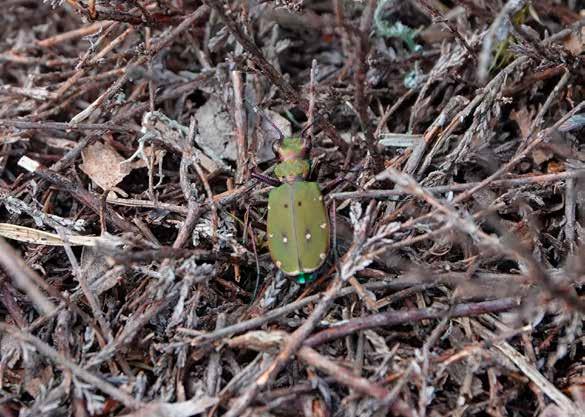
in a pine tree right above us, however we failed to see it. Moving more into the centre of the heath we heard a second Common Redstart which this time we located and had good views. Whilst in this area we also had excellent views of both a male and two female Sparrowhawk in courtship display, a Hobby on two occasions and up to four Common Buzzards. Making our way back we noted two Jays, then a Kestrel and finally a Red Kite over the MOD land. The heath also holds a number of insects and it is good to note these as well so, although relatively common, Minotaur and Green Tiger Beetle were added to the list of observations. Surprisingly we failed to see Stonechat, Woodlark and had only a brief glimpse of a Dartford Warbler.
Saturday 6th May 2023
Twelve members arrived at the Essex Wildlife Trust reserve looking forward to the day. Ash had moved to Essex a few years previously and now regularly leads us around some of his new haunts. The weather was warm and sunny initially as we scanned from the visitor centre noting Swallow over the car park and a distant Marsh Harrier over the marsh. A scan of the adjacent pool revealed a close family of Moorhens, the fluffy young looking like they had only recently left the nest.
It didn’t take long before we heard our first Nightingale. The site is a well-known haunt for the species and we weren’t
disappointed, hearing a minimum of six singing birds although all remained well hidden in the undergrowth. We covered a loop of the reserve, initially going through lots of scrubland and we were regaled by a number of warblers – several Blackcaps, Whitethroat and Chiffchaff along with a blast from a Cetti’s Warbler. Further round we added Garden Warbler.
As it opened up we saw a Kestrel drift past and then heard a Cuckoo. The bird called regularly and we eventually got some views as it flew across into some trees. We were following the path at the top of the meadows heading towards
continued page 18
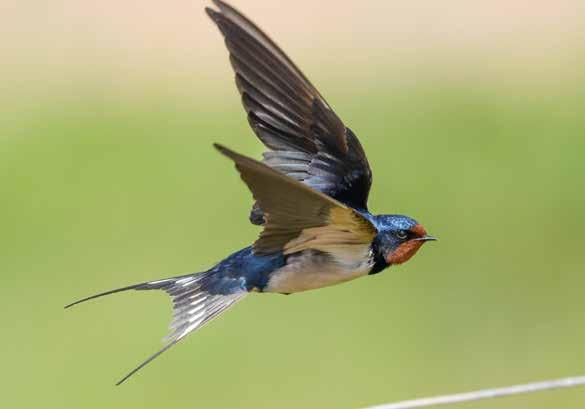
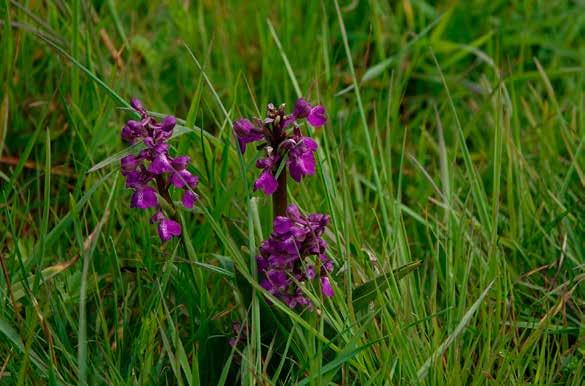
the hide overlooking the river. We saw a few butterflies and other insects such as Red Mason bee and within the fenced off meadow area there were a number of flowering spikes of Green-winged Orchid. We all assembled in the hide, each taking a position to view in different directions to scan across the mudflats. Waders present included a small flock of Bar-tailed Godwits along with some Black-tailed Godwits for comparison. A handful of Grey Plovers were about and we had a couple of Common Terns patrolling up and down with a Little Egret flying past. Reed Bunting was noted in the nearby reedbeds and some Sand Martins flew over.
After everyone had caught with all the species we retraced our steps to stop for lunch back at the carpark before heading off to Abberton. The skies had clouded up a bit, and at one point we had a little drizzle. We started to walk along the causeway and heard a Cuckoo across the road and
also heard a Green Woodpecker. A number of Swifts were about as well as Common Terns. We also got to see Little Ringed Plover and counted half a dozen Yellow Wagtails including a couple of bright males. In the distance a male Marsh Harrier flew over and nearer three Stock Doves went past. Up by the viewing screen it was fairly quiet but we did have a number of Swifts swoop low by us and across the road in the flooded field we counted at least six Green Sandpipers. On the way back we were treated to the Common Terns fishing close by and then there was a shout of Raven as one drifted over us.
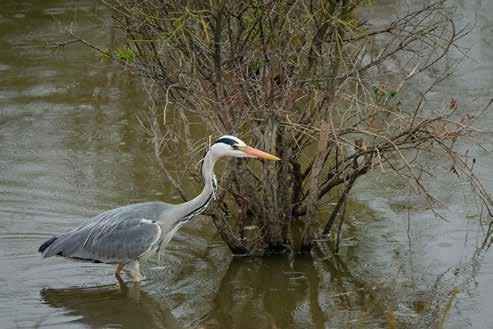
We finished up at the Lower Breton Causeway and had great views of a close Grey Heron as it was hunting in the shallows and we admired the nearby heronry. We were also pleased to find a male Goldeneye – a nice finish to a great day. We gave our thanks to Ash for leading us around his new birding haunts.
David Walsh
Saturday 27th May 2023
Leader: David Walsh
Attendance at Suffolk Bird Group outdoor walks has been encouragingly high this year, and the trend continued as 22 members met at 8am on Saturday 27th May in the King’s Forest car park.
There was little to detain us in the relatively quiet deciduous woodland, with a calling Nuthatch the only bird of note, so we headed east and soon reached a small clearing. Here we struck gold, with a singing Tree Pipit, a resplendent male Yellowhammer and a Woodlark staying long enough to give scope views as they sat tall on adjacent pines. What a start!
A little further on we saw a male Cuckoo on top of pines at the back of the clearing;
we would hear several, and have further views of birds in flight, during the morning. Treecreeper, Goldcrest and Coal Tit sang from the trees by the path but were only noted by those at the front of the pack.
Soon we reached Chalk Lane (ride 202); we paused here to talk about ways in which those who manage the forest are trying to help their two priority bird species (Nightjar and Woodlark) as well as the specialised flora. This could have turned into a lengthy discussion, but I decided we should leave that for another time, so we proceeded west then north to a large area of clearfell. Another Tree Pipit sang but disappeared all too soon; a male Stonechat and two sparring Skylarks were more obliging.
Ride 203 was the northern limit of our walk; having reached it we headed east. A singing Garden Warbler remained hidden, but a Willow Warbler sang from the top of a small birch. It was great to see one having heard half a dozen; this species is very localised in Suffolk nowadays and the King’s Forest is a real hotspot.
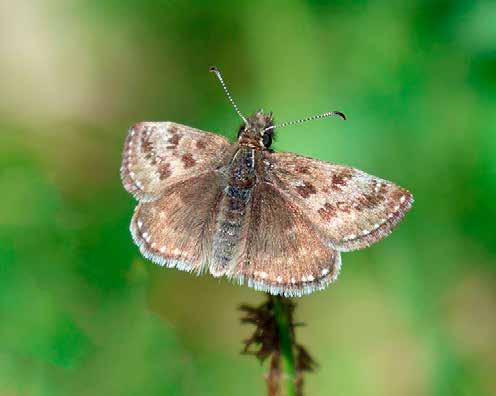
With sunshine having replaced the murk we turned our attention to butterflies, noting 14 species in total. Common Blue was the most numerous, with at least 20 males seen. We had excellent views of several Brown Argus, Small Copper and Small Heath but the two species we were specifically looking for took some finding! Eventually our diligence was rewarded, with first a Green Hairstreak and then, at the eleventh hour, a Dingy Skipper. The latter is Suffolk’s rarest butterfly and a
trip to the King’s Forest is necessary to see it.
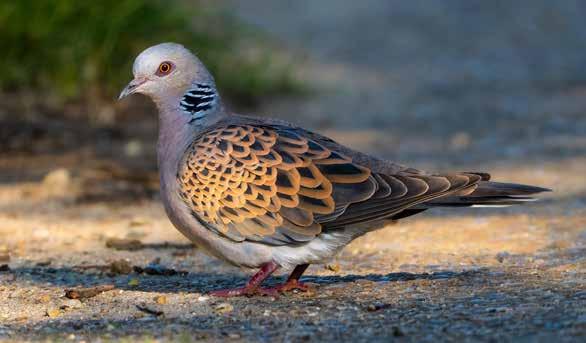
In the course of our three and a half hour morning walk we were very fortunate to find a purring Turtle Dove. Most of us had good flight views and it, or another, was heard again later. This gave me the opportunity to talk to the group about how many territories had been reported each year since the species began to be considered by the Rare Breeding Birds Panel, and also about the results of the 2021 national survey.
We arrived back at the car park at around 11.40am, most of us ready for lunch! Thanks to everyone for your company, enthusiasm and excellent spotting. We really saw this area at its very best.
Thursday 8th June 2023
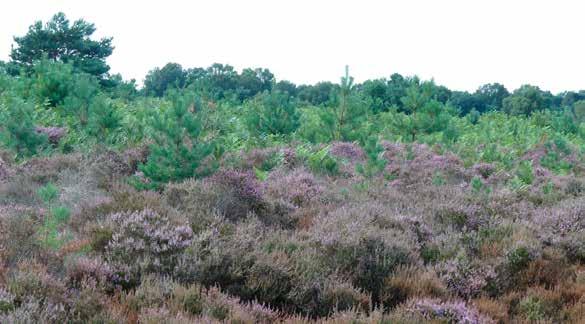
The SBG outdoor meetings have been well attended in 2023 and this meeting was no exception. Over 20 members gathered at Upper Hollesley Common hoping to get good views of the Nightjar. The evening was nice and sunny but those persistent northeasterly winds kept the temperature down.
While it was unlikely that we would see or hear Nightjars much before 2120hrs the meeting started at 1900hrs and gave the group the opportunity to see other birds on the heath. We headed down the path towards what many people refer to as the Crossbill puddle! No puddle but we turned left where it used to be and got good views of Dartford Warblers.
The numbers of Dartford Warbler seem to have reduced over the winter. Did the dry
summer of 2022 affect breeding, certainly much of the heather died as a result?
Maybe it was that very cold spell just before Christmas. The habitat is certainly changing and not for the better with Pine and Silver Birch trees taking over the area. It is a shame that the common is no longer managed for heathland species.
Male Stonechats look lovely in breeding condition and they didn’t disappoint with several seen. I believe the Yellowhammer is an underrated bird, the pair that we saw were gorgeous. A male Common Redstart was seen briefly by two members but try as we may we could not get other members on it. Nearby there was a very unhappy Chiffchaff, we were obviously in its breeding territory, so we moved on.

So on to the main event. We assembled at a spot where we had noted Nightjars previously on a recce. As we arrived a Nightjar was spooked from a nearby tree giving some members very brief views.
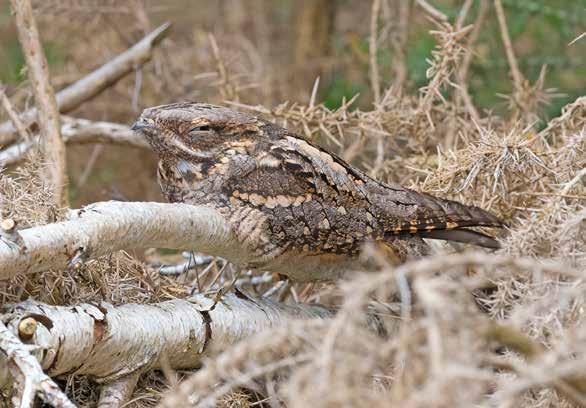
In all we identified three territories where Nightjars were singing. Some of the singing appeared to come from nearby trees. Persistence resulted in the group seeing three Nightjars (or the same bird) singing in 3 nearby trees. It was around 2130hrs so we got reasonable views. A few flight views were also seen.
The cold finally got the best of us and the meeting finished soon after.
Footnote: I run a moth trap at home where moth numbers and variety are very low compared with other years. Sadly, we never saw any moths for the Nightjars to feed on and fortunately, for members, there were no biting insects either.
The quarterly review section gives a snapshot of birds seen within the county during the period, predominantly from data received by Suffolk BINS. All scarce and rare birds are subject to submission and acceptance by either SORC or BBRC. Updated lists on Accepted and Outstanding Records for previous years can be found on the SBG website - http://www.suffolkbirdgroup. org/bird-recording.
The continuation of wet weather at the start of the month made it the wettest spring for over 20 years. It also felt cold and there were comments that young tits were being found dead in nest boxes. It then turned dry for the remainder of the month. After the Night Herons at Lound the previous month
there were further records along with a flurry of sightings of Black-winged Stilts. There had been many Bee-eater sightings last year and during the month there was a handful of records and those lucky enough to get to the Butley had the chance to see another big flock in the county.
Greater White-fronted Goose – one at Boyton Marshes (21st and 25th).
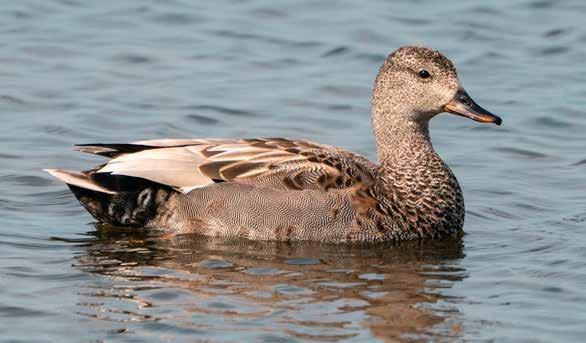
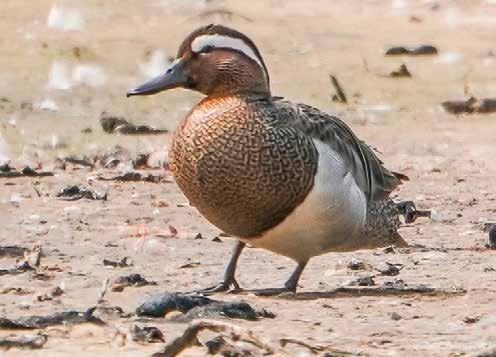
Garganey – multiple sightings at a number of sites through the month – Trimley Marshes, Dunwich shore pools, Minsmere, Boyton Marshes and Aldeburgh Marshes.
Long-tailed Duck – on the public viewing platform at Minsmere, then later off Sizewell (11th).
Quail – one singing intermittently off Fen Street, Hopton (21st and 23rd).
Crane – five seen over Minsmere then later north over Peto’s Marshes (1st), five again over Carlton Marshes (13th), one heard over Aldringham Walks (15th), one seen from Cavenham Flash (16th), two on the South Levels, Minsmere (16th, 20th and 26th) and two over Boyton Marshes (27th).
Ruff – an exceptional count of 77 on Southwold Town Marshes (4th).
Curlew Sandpiper – one at Hazlewood Marshes (6th, 11th-13th) and one at Boyton Marshes (12th),
Purple Sandpiper – one on the sluice outfall at North Warren (9th).
Little Stint – noted at Southwold Town Marshes (4th), Minsmere (5th), Hazlewood Marshes (6th, 10th-13th), Aldeburgh Marshes (20th), Snape Marshes (21st) and Boyton Marshes (23rd-25th).
Pectoral Sandpiper – one on Peto’s Marshes (12th).
Wood Sandpiper – a number of sightings throughout the month. Boyton Marshes (including seven on 4th), Minsmere, Buss Creek, Southwold, Carlton Marshes, Hollesley Marshes, Trimley Marshes, Southwold Town Marshes (including 10 on 4th), Aldeburgh Marshes, Pipps Ford and Micklemere.
Black Tern – two at Lakenheath Fen (27th) and one present at Trimley Marshes (28th).
Glossy Ibis – one Aldeburgh Marshes (6th, 18th-27th), two at Lackford Lakes (17th), one at Minsmere (23rd and 27th) and six flew south over Share Marshes, Carlton Marshes then later south over Minsmere visitor centre (28th).
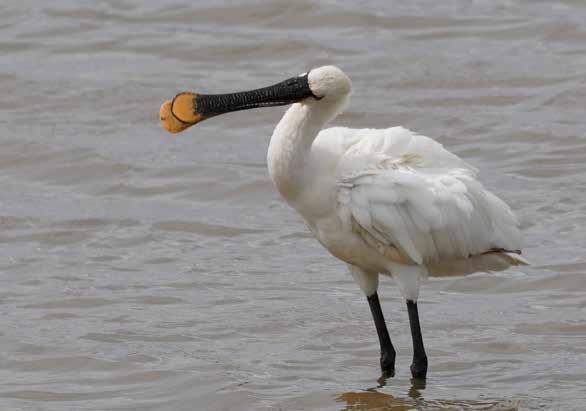
Spoonbill – numerous sightings through the month along the coastal strip.
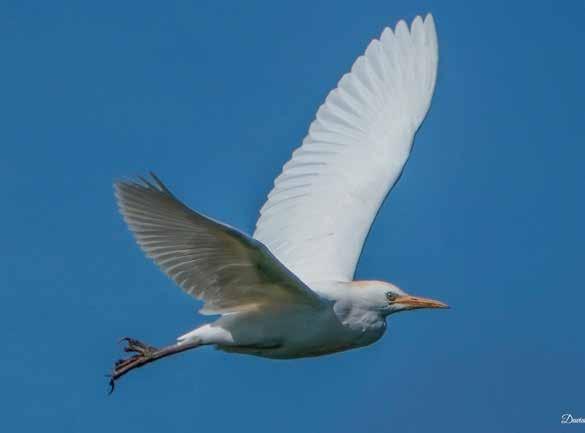
Cattle Egret – five dropped onto Whitecast Marshes, Carlton Marshes (1st), one briefly at Buss Creek, Southwold before flying north (2nd), one at Trimley Marshes (5th) and one at Minsmere (27th).
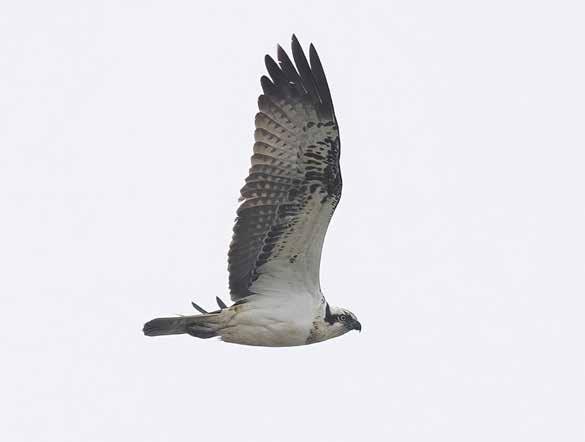
Osprey – one flew towards Barnby at Carlton Marshes (6th), one over North Warren and then possibly the same bird at Minsmere (8th), one at Hazlewood Marshes (10th16th), one over Island Mere, Minsmere (20th) and south over Boyton Marshes (30th).
Hen Harrier – a ringtail north over Carlton Marshes (10th), a male at Minsmere (18th) and a ringtail over the reserve (22nd).
Short-eared Owl – two at Westwood Marshes (1st), one at Tinkers Marshes (4th), one at Trimley Marshes (11th), one at North Warren (14th), one at Minsmere (14th) and seen along the coastal path between Hollesley Marshes and Shingle Street (26th).
Hoopoe – one by Felixstowe Docks then later at LBO (4th), one seen in gardens at Brockley (5th) and one in garden in Felixstowe (6th).
Bee-eater – one was seen and heard over Southwold (14th), four calling over Peewit Hill, Felixstowe (21st), 14 present around Butley Oyster/Mill Lane area of Butley then roosted at Chillesford (21st), they left the roost the following morning at 04:45 but then no further sign. Five flew south over the A146 at Beccles (24th).
Merlin – a male at Hollesley Marshes (3rd) and one at Felixstowe Ferry (13th).
Red-backed Shrike – a female on the heath at North Warren (14th).
Raven – one flew north-east over Wenhaston (1st), one over Bredfield (4th) and south over Blythburgh (6th).
Firecrest – one at LBO (10th).
Ring Ouzel – one at Trimley Marshes (1st) and a male at Pontins, Pakefield (6th).
Pied Flycatcher – one at Sudbury (4th).
Whinchat – one present in the scrub near the Sluice Cottage, North Warren (1st), a male on Aldringham Walks (7th) and one along the disused runway at Leiston (13th).
Blue-headed Wagtail – a male at Southwold Town Marshes (30th).
Scarce May sightings
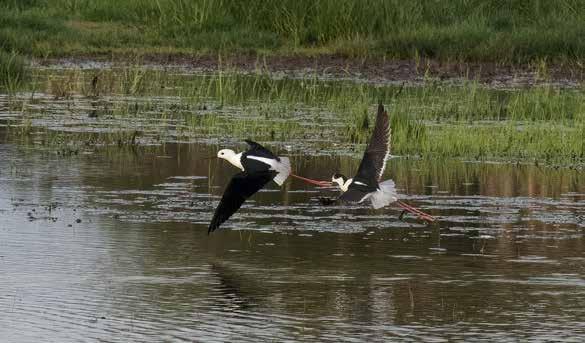
Black-winged Stilt – a number of sightings during the month. Three at Boyton Marshes that consisted of two females and one male (1st-2nd), four at Buss Creek flash, Southwold (5th), two on Aldeburgh Marshes (19th), two at Minsmere (22nd), two at Carlton Marshes (24th), two at Hollesley Marshes (27th) and two at Gifford’s Flash, Shelley (31st).
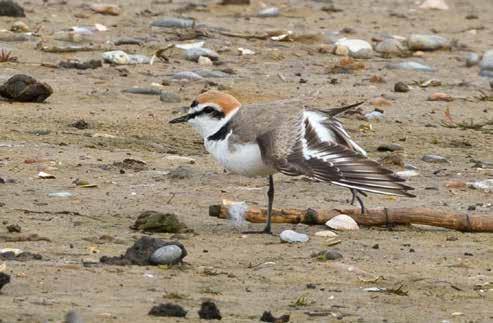
Kentish Plover – a male at Minsmere (5th7th) where it was noted to fly high east out to sea on the final day and a male was on the beach at Landguard (19th).
Temminck’s Stint – one briefly on Peto’s Marshes before flying high north (6th) and one again at Carlton Marshes by the Turnpike Hide (10th), one on the summer flood, Trimley Marshes (9th) with five on the site (16th) with one still (17th), three at Minsmere (11th) and again (19th_20th) and one (29th), one on the new scrape at Boyton Marshes (12th), one on Aldeburgh Marshes (18th) and one on Southwold Town Marshes (29th).
Night Heron – an adult was heard calling several times at Peto’s Marshes (1st), one was sound recorded at the east end of the reedbed at North Warren (10th) and an adult flew from the pond near the visitor centre at Minsmere (10th).
Purple Heron – the one noted at Trimley Marshes at the end of the previous month remained (1st to 18th). One at Minsmere (26th-31st).
Pallid Harrier – a first-summer male was seen to come in off the sea at Walberswick and head inland towards Westwood Marshes (6th). This is Suffolk’s fourth record of the species. A first-summer male was seen over East Lane (7th) with the same bird seen on Ordfordness (11th) and finally one was reported hunting over Aldeburgh Marshes (12th).
Montagu’s Harrier – a ring tail was seen opposite Mutford Church, heading towards Mutford Wood (2nd).
Rough-legged Buzzard – one seen over Woodbridge airfield (8th).
Golden Oriole – one singing near Jenson’s Island, Carlton Marshes (6th), two at Minsmere (7th) with one heard (13th) and singing along the approach road from Eastbridge at Clay Lane (26th-28th), one singing at Lakenheath Fen (10th), one singing at Yoxford (21st) and heard by the
quarry on Westleton Heath (25th).
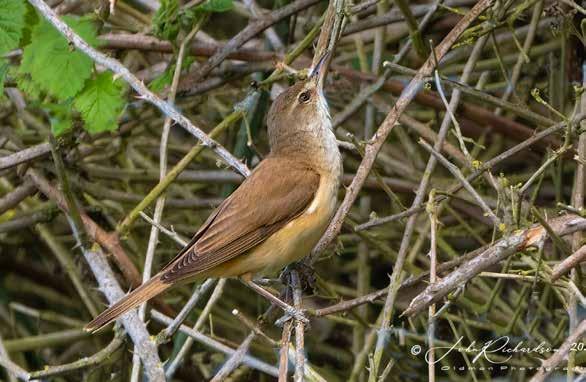
Great Reed Warbler – a singing male at Boyton Marshes (11th), one reported by East Hide, Minsmere (16th) and one singing by Island Mere, Minsmere (20th).
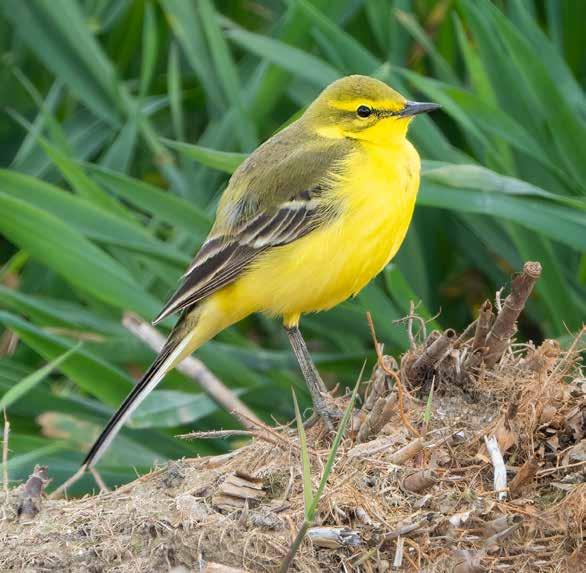
Eastern Yellow Wagtail – the long-staying bird was again present on Peto’s Marshes (1st and 2nd).
Common Rosefinch – one noted behind LBO before flying towards the cottage (18th).
While the preceding months had been wet, and only turning warmer and drier in the second half of May, the month was both the sunniest June since 1976 and the second warmest on record after that year. It was also notably dry. There have been a few records of Ring-necked Duck in recent years and another one turned up and stayed for the month at Carlton Marshes. There were further Golden Oriole and Bee-eater records and only a lucky few saw the summerplumaged Spotted Sandpiper.
Garganey – a drake at Minsmere (7th, 20th and 22nd).
Crane – two at North Warren (1st), two over Minsmere south levels (3rd), two flew north over Minsmere car park (4th), two flew south over Sizewell early morning then seen at North Warren (15th) and two at Minsmere (25th).
Little Ringed Plover – up to three at Minsmere (18th to 22nd).
Curlew Sandpiper – one on the new scrape at Boyton Marshes (1st and 4th) and two present at the site (7th). One on the River Alde (1st and 8th).
Little Stint – one at Southwold Town Marshes (1st-2nd), one at Minsmere (2nd8th) and one at Boyton Marshes on the new scrape (4th).
Pectoral Sandpiper – one at Hollesley Marshes (22nd-23rd).
Wood Sandpiper – one on East Scrape, Minsmere (18th), one Hollesley Marshes (23rd-24th), one at Carlton Marshes (26th) and one at North Warren (29th).
Black Tern – one at Micklemere (3rd and 4th).
Glossy Ibis – one on Aldeburgh Marshes flashes (7th-26th) and one at Carlton Marshes (8th-9th).
Spoonbill – numerous records along the coast during the month.
Osprey – one over Ipswich (3rd).
Bee-eater – one heard over Goose Hill, Sizewell (6th), one south over Wilford Bridge, Melton (12th), one over the Sluice Cottage, North Warren (12th), six over Hollesley Marshes (14th), two flew south over Westleton Heath (14th). Five flew south over Sizewell (16th), two flew north over North Warren (16th), two flew south over Aldeburgh golf course (16th) and one north over south Lowestoft (16th).
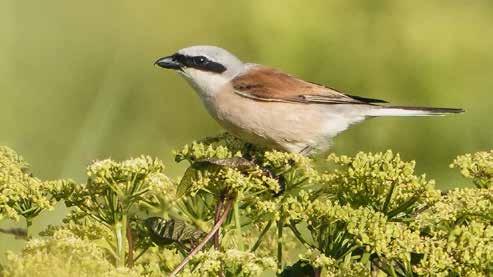
Red-backed Shrike – a female was along the north wall at Minsmere (3rd) and a female by the sluice (8th-9th), a male on Dunwich Heath (3rd), a male by the sheep paddocks at Southwold (3rd) and a male at Lowestoft North Denes (3rd).
Raven – five flew south over Frostenden (15th) and one over St. Audrey’s Road, Melton (21st).
Ring Ouzel – a male around Minsmere sluice (1st and 2nd).
Spotted Flycatcher – one at LBO (1st).
Whinchat – one in a horse paddock, near Pond Hall Industrial Estate, Hadleigh (1st), one on the common opposite LBO (1st-2nd), one at Carlton Marshes (3rd) and one at Boyton Marshes (4th).
Hawfinch – one north-east over Aldeburgh golf course (8th).
Scarce June sightings
Ring-necked Duck – a drake at Carlton Marshes (20th-28th).
Spotted Sandpiper – an adult was at the base of the cliff at the Radar Lodge, Hopton (5th).
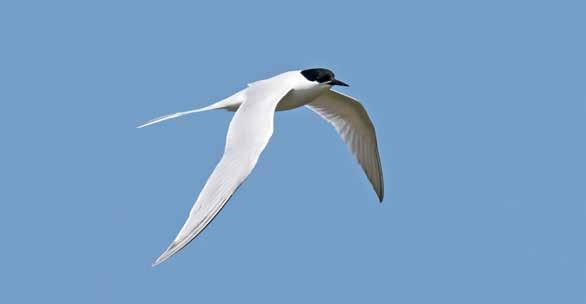
Roseate Tern – an adult on Minsmere scrape (3rd) and another adult at the site (20th).
Purple Heron – the adult was noted again at Minsmere (1st) then a first-summer bird at Minsmere (13th-15th).
Honey Buzzard – a female was seen north over Aldeburgh golf course (3rd).
Red-footed Falcon – a male was reported between Falkenham and Kingsfleet (13th). A female over the reedbed at Walberswick (18th) and a first-summer male at Boyton Marshes (21st).
Golden Oriole – the first-summer male, noted at Minsmere the previous month, was still present and singing from Clay Lane (1st-2nd). A male singing in woodland near Nuffield Hospital, Fox hall (2nd) and one heard in Theberton Wood (4th).
Rose-coloured Starling – an adult along the seafront at Felixstowe by Martello Park before being re-found at Landguard (2nd).
Greenish Warbler – one was trapped and ringed at LBO (18th).
Blyth’s Reed Warbler – one was trapped and ringed at LBO (15th).
Marshes Warbler – a singing bird between Falkenham and Kingsfleet (14th).
Grey-headed Wagtail – one was seen over Southwold Town Marshes (3rd).
Common Rosefinch – a male singing along the Butts at Landguard (18th-19th).
After the weather turning dry and hot the previous month, the unpredictable weather became wet and dull, being the wettest July since 2015. Considering we’ve been used to hot temperatures in recent years, with last year being exceptionally hot and dry, July 2023 was the first July not to exceed 30C in East Anglia since 2012.
The undoubted bird of the year, that turned up during the month, was the Black-winged Kite - a species that has been proposed to turn up in the UK at some point. The first UK record was videoed earlier in the year in April at Powys, Wales. Only three months later and the second one turns up. The Suffolk bird had previously been around Horsey, Norfolk (17th-20th) and then turned up in Essex near St. Osyth (21st-22nd).
Ruddy Shelduck – two on Hollesley Marshes scrape (12th-29th) and noted nearby at Boyton Marshes (27th). One at Carlton Marshes (22nd).
Garganey – one at Minsmere (8th), one at Trimley Marshes (17th), a drake at Boyton Marshes (18th), one at Peto’s Marshes (22nd) and a juvenile at the site (29th).
Quail – one singing in the Hibbs Green / Hanningfield Green area, near Lawshall (13th) and two singing at Felixstowe Ferry (21st).
Crane – two over Minsmere (5th), two flew north over Minsmere car park (12th) and again over the reserve before dropping onto the south levels (13th).
Little Ringed Plover – one at Minsmere (7th) and two on Aldeburgh Marshes (13th) and one present at the same site (24th).
Black-tailed Godwit – a juvenile limosa on Minsmere East Scrape (21st) and a juvenile limosa present at Aldeburgh Marshes (23rd and 25th).
Little Stint – four on Aldeburgh Marshes (24th) and three at the site (28th), one at Hollesley Marshes (25th) and up to two at Minsmere (26th-28th).
Pectoral Sandpiper – one on Aldeburgh Marshes (19th-27th).
Wood Sandpiper – seen throughout the month at a few sites including Hollesley Marshes, Peto’s Marshes, Minsmere, Aldeburgh Marshes and Felixstowe Ferry.
Arctic Tern – a first-summer bird at Minsmere (2nd and 9th).
Glossy Ibis – one at Boyton Marshes (10th11th), two on Aldeburgh Marshes flashes (13th-31st) and one at Hollesley Marshes (18th).
Spoonbill – regularly seen at a few sites along the coast during the month.
Cattle Egret – one flew south along the river at Boyton Marshes (1st), one east of Blythburgh that flew towards Hen Reedbeds (2nd), one at Hollesley Marshes (5th), one present in horse fields by the A1088 at Elmswell (8th), one at Loompit Lake (10th), five flew west over Minsmere (12th) with three on West Scrape (16th) and four at Trimley Marshes (16th-17th) and one (26th). One on Aldeburgh Marshes (21st and 22nd) and one flew south at Boyton Marshes (30th).

Hen Harrier – a ringtail reported at North Warren (11th).
Bee-eater – one heard between Thorington Street and Higham over Marshes Road (6th) and three flew north over Aldeburgh golf course (26th).
Raven – one over Aldeburgh Marshes (22nd) and two over the site (29th).
Wood Warbler – two trapped and ringed at LBO (26th).
Scarce July sightings
Ring-necked Duck – the drake remained at Carlton Marshes all month.
White Stork – one seen soaring over Witnesham, heading north (25th).
Night Heron – one at Peto’s Marshes (20th).
Honey Buzzard – one flew south over Christchurch Park, Ipswich (18th), a male over the approach road to Minsmere (28th) with two over the Minsmere South Belt (29th) and one flew over Sutton Heath (30th).
Black-winged Kite – one was found in the evening on the Deben estuary around Felixstowe Ferry (20th). Several Suffolk birders managed to connect that evening and fortunately it was still present the next morning in the area with birders from far and near visiting. It was seen to drift off towards Bawdsey across the river at 09:20 and wasn’t seen again.
Marsh Warbler – one was trapped and ringed in Hollesley (25th).
Council for 2023
Officers
Chair: Eddie Bathgate
Vice Chair: Chris Keeling
Secretary: Katya Bathgate
Treasurer: Anne Wright
Communications Officer: Adam Faiers
Projects Officer: Chris Keeling
SoSS Project Officer: Eddie Bathgate
Suffolk Bird Report Editor and SORC/SNS Link: Nick Mason
Harrier Editor and Outdoor Events Coordinator: Gi Grieco
Indoor Events Coordinator: Adam Gretton
President John Grant
Members
Sarah Glyde
John Kornjaca
Peter Merchant
Ben Moyes
Sally Nelson Honorary Vice-Presidents
Andrew Green
Robin Hopper
Colin Jakes
Mike Jeanes
Mike Marsh
Roy Marsh
Philip Murphy
Reg Snook
Steve Piotrowski
Bird Recorders
North-east Area Recorder: Richard Walden Email: bird-ne@sns.org.uk
South-east Area Recorders: Gi Grieco Tel: 07951 482547 and Steve Fryett Tel: 07593 382082 4, The Street, Melton, Woodbridge, IP12 1PW. Email: bird-se@sns.org.uk
West Area Recorder: Chris Gregory Email: bird-w@sns.org.uk
Memberships
c/o SNS, The Hold, 131 Fore Street, Ipswich, Suffolk, IP4 1LR
Founded in 1973 by a group of Suffolk birdwatchers
Associated with the Suffolk Naturalists’ Society
SBG remains an independent birding group and is a registered charity
A voice for Suffolk birdwatchers
With established links to many naturalist and conservation organisations
Media
Actively lobbies to protect key Suffolk habitats
Provides a county-wide field force of bird surveyors
Promotes BTO bird surveys and organises special SBG surveys

Strong web presence - www.suffolkbirdgroup.org
Active Twitter feed - @SuffolkBirdGrp
Quarterly magazine - The Harrier
Annual review - Suffolk Birds report
Annually (20+) field trips - ideal for novices or experts and young or old alike
Opportunities to visit hot spots and receive practical ID tips in the field
Programme of talks and presentations - variety of topics (county, national, or international) with quality speakers

Assists with conservation projects to improve breeding success
- Swifts
- Barn Owls
- Peregrines
- Waders
Partners with Suffolk Wildlife Trust and other bird groups
Assists with funding for bird hides and other birding amenities
Contributes to community events, including dawn chorus walks
Provides bursaries for special projects