
Gi Grieco
Gi Grieco
Welcome to The Harrier. Back in February we held our annual AGM, with a good attendance of members and it was nice to meet up and socialise with all – a thank you to the new SBG secretary for the write up of the event. For another social occasion we have an impromptu event to celebrate our 50th anniversary – details inside. Over those 50 years, from the original founding members there have been many who have dedicated their time to the group. One of those is Neville Skinner, who passed away this year and we’re grateful to Richard Smith for detailing the interesting life and the interest in birds that Neville had. In the last couple of years there have been several news items related to the practice of putting up netting as a deterrent to nesting Kittiwakes around the country, including in Suffolk. This has caused birders to be outraged as birds become trapped as they return to their nest sites. The main breeding colony in Suffolk is at Lowestoft and it is great to know that plans are in place to help these wonderful birds. In the south of the county, at the large reservoir Alton Water, another species has been assisted with
nesting opportunities – Common Tern. Thanks to John Glazebrook for detailing the history that the birds have had at the site.
What is generally thought of being the most useful, definitive field guide has been updated and David Tomlinson provides a review of the changes. David was amused to see that he reviewed the second edition for The Harrier 13 years ago. We have a selection of regular trip reports and in addition, on request, assistance in the location of the meeting places. Hopefully this will help all and we look forward to seeing you on future trips.
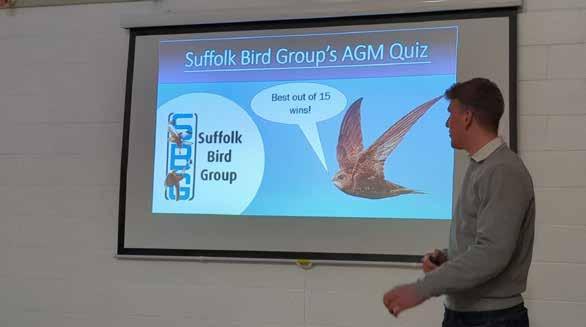
This year’s AGM in February was another evening enjoyed by all. Key points from Council included approving the 2022 accounts, praise for the success of this past year’s field trips, as well as the variety of indoor events organised by Adam Gretton. Additionally, also for the group’s publications; the Harrier and Suffolk Bird Report. We unanimously welcomed all previous Council members back, joined by Katya Bathgate [Hi everyone!], who replaced Eddie Bathgate as Secretary. The Council also thanked Michael Gavin and Tony Gdula for their services, who both stepped down in 2022.
Henry Keepin received the Garrod Award for his skill with bird photography and enthusiasm for learning about his subjects. Having recently won 1st prize in the 1618 age category of the Suffolk Wildlife Trust competition, this award was very well-deserved. The Denis Ockelton Award was presented to David Fairhurst for his outstanding contributions to habitat creation in east Suffolk.
A fiendishly cryptic quiz hosted by Ben Moyes ended the evening with a lot of laughs, with David Tomlinson and Peter Rutt winning head and shoulders above the rest of us.
The traditional raffle was hosted by Adam Gretton and Adam Faiers. Jonathan Lawley’s ticket was drawn first and he happily selected a Swift nest box. This was the biggest relief to Jamie Everett, who had his eyes on a painting of a Sparrowhawk that was kindly donated by Ed Keeble, which he was able to choose as a raffle prize. Thanks to Adam Faiers’ enthusiastic sales of raffle tickets, £159 was raised during the evening!
Since the AGM, Jamie Everett has stepped down from Council to relocate to Scotland for work. Our Chair, Chris Courtney has also decided to step down from his role. We are hugely thankful for their contributions and wish them well. Eddie Bathgate was voted in by Council as the new Chair.
Thanks to everyone who attended and contributed to a really enjoyable evening.
Anne Wright
2023 is the 50th anniversary of the formation of Suffolk Ornithologists’ Group and, as many of you will undoubtedly be aware from the programme card, we will be celebrating this occasion with the excellent speaker Mark Cocker on Thursday 19th October, at the joint event with SWT at Woodbridge›s Community Hall.
However, certain members (you know who you are!) have suggested that the 50th birthday would be a good reason to also have an informal social event so we are proposing that members and their families could meet at the Dunwich Beach car park, and then onwards to the beach, on 26th
Richard Smith
August from 5pm. The Dunwich Beach car park is free but there are donation boxes for local charities, and the public loos are open until 8pm.
If everyone could bring drinks and picnicstyle nibbles to pool and share that would be brilliant, plus blankets, mats and chairs if desired, and we will supply paper plates, cups etc. Supplies could also be obtained from the Ship pub just up the road and the beach Flora Tea Room of course, but the cafe’s website indicates that it closes at 5:30pm.
We’ll very much look forward to seeing as many of you as possible there, and with luck we might even get to see a few birds!
Dr Skinner, who would have been known to many of you, died at his home on January 25th 2023. Despite decreased mobility during the most recent years, he always maintained a keen interest in the ‘what was about’ bird-wise, right up to his final days.
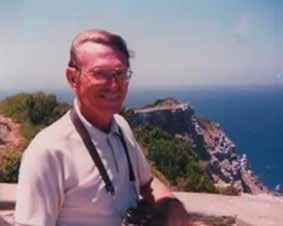
A hugely unassuming man, Neville lived a long and fascinating life and was one of the most intelligent people I have every met; an accolade that I can honestly say was still appropriate, right through to his 94th year.
Following a long and very successful academic career, Neville, together with his beloved wife Gladys, returned to his native Suffolk in 1987 and quickly became a familiar part of the birding scene, particularly in the north-east of the county and through his involvement with, as it was then, the Suffolk Ornithologists’ Group.
Born and bred in Lowestoft, and despite a war-interrupted education at Lowestoft Grammar School, which included a twoyear spell as an evacuee to Worksop in Nottinghamshire, Neville went on to achieve a 1st Class Honours degree in physics at the University of Nottingham – obviously he quite enjoyed it there! On graduating, the effects of the Second World War would again
influence his life; this time in the form of National Service. Neville spent his two years with the Royal Electrical and Mechanical Engineers in Malaya. This I suspect, not only enhanced his love of science, but also his desire to experience life in far-flung parts of the world. On his return to the UK, Neville studied for his doctorate in physics at the University of London, and took-up up a post in the Physics Department of the University of Ibadan in Nigeria, where he stayed around a decade. He was then asked to move to Zaria in northern Nigeria to establish a brand-new physics department at Ahmadu Bello University, where he became senior professor. Over the next 20 years or so, his illustrious career continued to flourish and saw him taking up posts at The University of Nairobi in Kenya, The University of the South Pacific in Fiji and finally at The University of Botswana. He once proudly told me that, except for numerous student jobs, his entire working life was spent outside of the United Kingdom!
Wherever, Neville’s work took him, his love of the natural world and specifically birds, would see him actively involved in local research projects, as evidenced by his contributions to various national avifauna publications. He is credited as a co-author of JH Elgood’s, The Birds of Nigeria (1982) and was heavily involved in both Huw Perry’s, Bird Atlas of Botswana (1990) and later Wendy and Remi Borello’s, Birds of Botswana (1997). I think that there was nothing that Neville enjoyed more during these times than a good breeding bird survey and he would tell many tales of he and Gladys’ frequent weekend trips in their trusty Land Rover to more remote regions to explore and record local bird populations. These trips would sometimes involve them needing to take precautions in order to conceal themselves from local insurgent or anti-government groups. I’m not entirely sure what they would have made of Neville and Gladys’ research and their collection of nest-record index cards!
Ever the scientist, and following his retirement and subsequent return to Lowestoft, Neville continued in much the same way, soon embarking on (presumably much less dangerous) research projects with the BTO. He also became an SOG council member and contributed the “Terns to Auks” section of the Suffolk Bird Report from 1997-2003. I was reminded quite recently that he was also an inaugural member of the northern circuit of the original Suffolk Birders’ Hotline. For those of you who don’t recall the pre-mobile, pre-digital age of birding, the Hotline required members to telephone on Suffolk rare-bird sightings to the next recipient on the list. Neville being Neville would always go to great lengths to ensure that he kept the circuit functioning as it should. As I was next-in-line to him on the hotline I was frequently very grateful for his due-diligence in this respect, which allowed me to catch-up with many local scarcities!
During his retirement, his interest in birds across the world developed further and he continued to travel widely; he and Gladys enjoying trips to destinations such as Lesvos, Tenerife, Madeira, Majorca, Finland and Trinidad and Tobago. Not only this though, Neville was still in demand both as a visiting examiner and conference speaker/guest in universities around the world – roles which meant that throughout his life he was able to visit getting on for a hundred countries – a veritable globetrotter! On these visits, Neville would ensure that his professional duties were always combined with some cultural tourism and of course numerous birding excursions!
Aside from his birding, Neville had a widerange of other interests; as a young man he was a very keen and accomplished sportsman and in his later years he would enjoy watching many sports on his TV, but especially tennis and snooker. Perhaps more than the actual watching though, he would really enjoy a good post-match discussion about the events he’d just witnessed.
During his retirement, Neville’s other abiding interests were historical research and genealogy, which led to him spending many hours beavering away in the (sadly no more) Lowestoft Record Office –interestingly, he had a huge mistrust of allowing the internet into his home, so the Record Office was a real boon for him. The result of his work came in the tangible form of several publications, including “Lowestoft Drifters and the Anti-submarine Net Barrages in WW1”, “Not Yet Forgotten” and “Their Names Liveth” (the biographical stories behind the names on the Kessingland war memorials for 1914-18 and 1939-45 respectively), and “The British Branch of the Tettenborn Family” (an account of a colourful branch of his own ancestry). Even in his final months, he was considering another project; recording his experiences of growing up in 1930s Suffolk, but sadly this was never to be completed.
As well as researching his own family tree, Neville would gain enormous pleasure in delving into the ancestries of various friends and neighbours. Indeed, he did this for my own wife and we were amazed at the speed in which he was able to unearth precise details of both her grandfathers’ experiences and movements on The Somme in WW1.
Incidentally, Neville had a real passion for military history and especially the Great War, which saw both him and Gladys make numerous trips to the battlefields of Belgium and France.
Dr Skinner was something of a one-off; I have already alluded to Neville’s great intellect; which was perfectly illustrated by the fact that each week he would not only tackle, but more often than not, succeed in completing the Times Latin crossword. Modestly, and typically, he
would attribute this success to his interest in natural history and the grounding which it had given him through his understanding of Latin nomenclature. Perhaps unusually for a man in his nineties, Neville was a great fan of Banksy, and he was delighted when the street-artist’s “East Anglian Spraycation” saw one of his works adorning Everitt’s Park in Oulton Broad, just a stone’s throw from his flat.
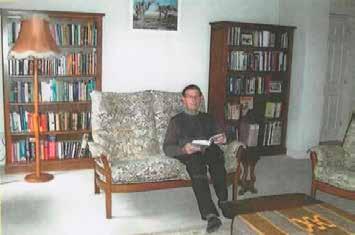
Dr Skinner’s was certainly a life welllived. He had a fascinating and successful career, which prompted many intriguing tales, (including how he would hitch lifts in Professor Richard Leakey’s light aircraft up to remote areas of the Rift Valley), a wonderful long marriage to his beloved Gladys, who he spent many years faithfully caring for as her health declined in her later years and an enduring fascination for birds, together with a scientific desire to further our understanding of their populations and dynamics. For me, one memory of Neville will endure; not many years after returning to Suffolk, his Gunton garden was graced by a Hoopoe. What was Neville’s first reaction but to invite local birders into his house to enjoy not only the bird but also, Gladys’ tea and cakes!
Eddie Bathgate
The good news is that Swift conservation is working here in Suffolk. Occupancy numbers for 2022 are still coming in, but the tally so far is 206 boxes confirmed as occupied – up from around 130 in 2021, with at least 15 locations across Suffolk reporting Swifts in nest boxes for the first time. Many of these new locations have multiple nest boxes, so numbers should increase again as a colony forms. St John’s Church in BSE reported a massive 52 nest boxes occupied within the belfry, making this easily the largest Swift colony created in Suffolk.

Only two locations reported a decline in the number of nest boxes used by Swifts. Worlington Church’s loss was down to disturbance by Grey Squirrels but the decline in numbers at Crowfield is as yet unexplained.
I’ve not seen any evidence that Swifts are choosing to relocate from existing natural nest sites in the nooks and crannies of older buildings into nest boxes. However, existing colonies are expanding using nest boxes placed close by.
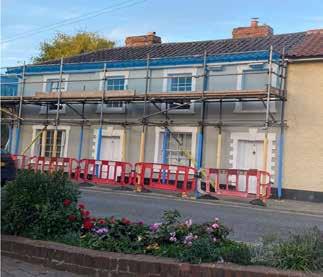
SOSSwifts have also been busy helping to preserve natural nest sites threatened by building works. Our aim is to preserve the existing nest entrances and cavities wherever possible and then to add nest boxes for ‘just in case’, with works taking place outside the breeding season. We have also had to step in where scaffolding has gone up during the breeding season impeding Swifts’ access – debris netting is especially dangerous. Polite conversation and offers of free nest boxes accompany a request to remove certain sections of scaffolding, and SOSSwifts have the backup of Suffolk’s Rural Crime Officer in case of intransigence.
My suspicion is that Swifts occupying newly installed boxes straight away in May have returned and found their natural nest site blocked. Birds occupying boxes in June or July are, in contrast, likely to be younger Swifts looking to breed in subsequent years. Swift boxes can host other species too. House Sparrows used Swift nest boxes at a number of locations last year; one location in Woodbridge noted five broods. Tree Sparrows used nest boxes near Tuddenham St Mary, which is marvellous. Interesting to note that a pair of Starlings managed to access a bottom entry nest box in Wickham Market, and a pair of House Martins built a mud cup inside a Swift box in Harleston, fractionally over the border into Norfolk.
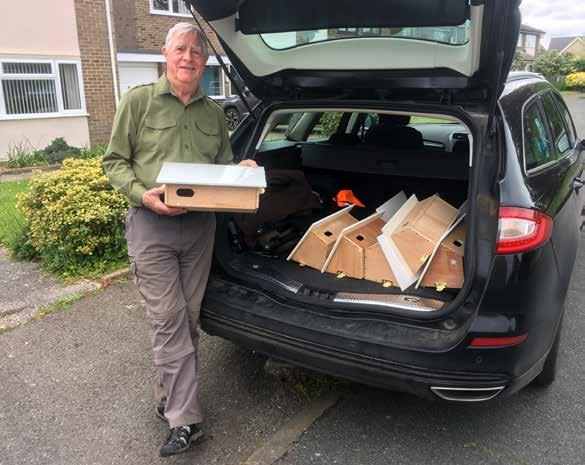
SBG member, John Turner, had materials left over from making four Swift nest boxes for himself. He kindly made a further nine nest boxes and donated them to SOSSwifts. We will use them for school Swift Community Sets. Great work John!! SOSSwifts have targeted schools for our free Swift Community Sets, as places where children will be able to enjoy the aerobatic displays. Across the county, ten primary, and seven secondary schools plus four colleges
have sets, with more in the pipeline. If you have a contact at a school who is interested in Swifts, then please do put us in touch. We also have sets on cinemas, theatres, museums and libraries: all prominent elevations of public buildings where the future Swift colony will be in view to be enjoyed.
Swift conservation takes time because the younger, non-breeding Swifts first have to discover these nest boxes and prospect them as a potential future nesting sites. We know that playing their calls to attract these youngsters speeds up this process. If there is no existing colony to attract new nesters, then quicker and greater success tends to be achieved where calls are played.
I do believe that the efforts of SOSSwifts are making a difference and I am hopeful that there will be another jump in the number of pairs of Swifts using nest boxes this summer. If you have boxes nearby, I hope you enjoy observing Swifts. Warm evenings in June and early July are the best time to see activity such as nesting adults going in to roost or younger non-breeders prospecting. I look forward to hearing of your observations.
I had been asked to add further detail regarding outdoor trip locations as Satnavs can utilise postcodes etc. and this would help locate the meeting place easier. Below is the list for the remainder of the year. Going forward, the Events card will include this information.
MINSMERE - Sunday, July 23rd
Meet at the reserve centre car park at 8.00 am.
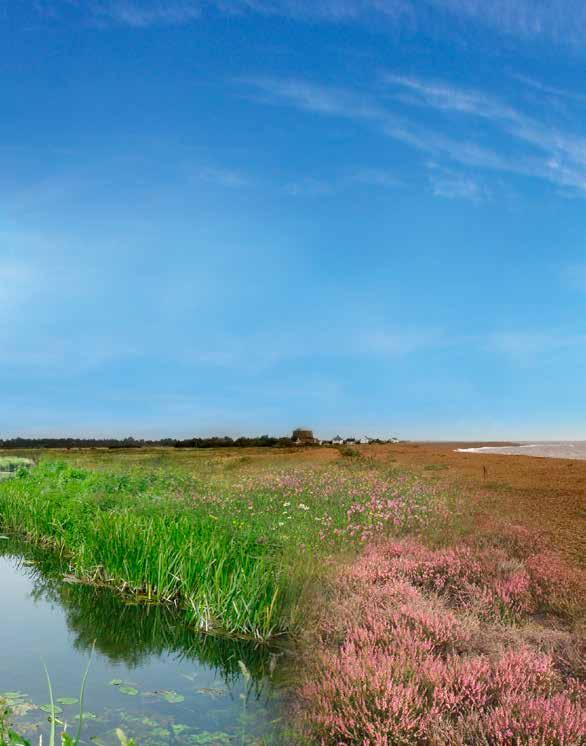

Map Ref: TM470672. Post Code: IP17 3BY What3Words: unfounded.requires.invisible
SLAUGHDEN and ALDEBURGH MARSHES - Sunday, August 20th
Meet at free car park along the Slaughden sea wall at 8.30 am.
Map Ref: TM464555. Post Code: IP15 5DE What3Words: lyricism.pizzas.handle
ABBERTON and OLD HALL MARSHES - Saturday, September 2nd
Meet at St. Andrews Church, Rectory Lane at 9.00 am.
Map Ref: TL998193. Post Code: CO5 7NJ What3Words: level.corner.jump
SHINGLE STREET and HOLLESLEY MARSHES - Saturday, September 9th
Meet at Coastguard Cottages car park at 9.00 am.
Map Ref: TM369431. Post Code: IP12 3BG What3Words: apes.term.pays
Saturday, September 30th & Sunday, October 1st
SANDWICH BAY OBSERVATORY
Some places available to stay overnight on Saturday in self-catering dormitories. Contact Adam for further details and to reserve your place. Leader: Adam Faiers. Tel. 07708 521852.
LANDGUARD BIRD OBSERVATORY - Saturday, October 21st
Meet at main car park, View Point Road, Felixstowe at 8.00 am.
Map Ref: TM284319. Post Code: IP11 3TW What3Words: teaching.kidney.hamsters
ORFORDNESS - Saturday, November 4th & Sunday, November 5th
ORFORDNESS (NATIONAL TRUST) RESERVE
Map Ref: TM425495. Post Code: IP12 2NY What3Words: permanent.jeeps.decrease For further details and to reserve your place, contact Gi Grieco. Tel. 07951 482547.
LAKENHEATH RSPB - Sunday, November 12th
Meet at the reserve car park at 9.00 am.
Map Ref: TL719863. Post Code: IP27 9AD What3Words: colleague.dressings.means
FRESTON - Sunday, December 10th
Meet at Freston Hill layby at 9.30 am.
Map Ref: TM175400. Post Code: IP9 1AB What3Words: bend.fiction.bedspread
John Glazebrook
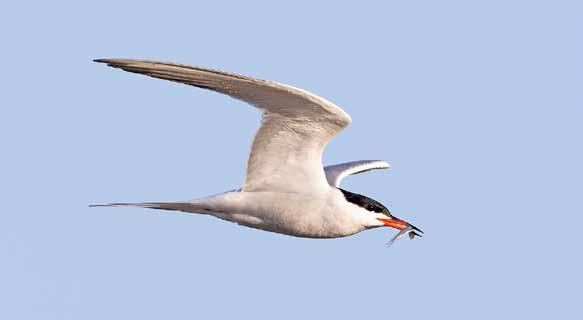
Alton Water is a 390 acre Anglian Water reservoir on the Shotley Peninsula, south Ipswich. Common Terns have been nesting at the site since 1998 when the islands created and the first two rafts were introduced. Initially there were five nests, gradually rising to 50 by 2003 as more rafts were introduced, rising to a total of seven.
Alton Water is a 390 acre Anglian Water reservoir on the Shotley Peninsula, south of Ipswich. Common Terns have been nesting at the site since 1998 when the islands were created and the first two rafts were introduced. Initially there were five nests, gradually rising to 50 by 2003 as more rafts were introduced, rising to a total of seven.
Total number of Common Tern nests
recorded in 2018. Carrion Crow predation of eggs at the three rafts by
previous three years resulted in no tern nests here from 2019 to date. There were
Common Tern nests on the rafts in 2022, but as the water level had been low make use of the island this year with 25+ nests being counted.
Unfortunately, Mink predation in 2003 and 2004 wiped out most nests and resulted in just 18 nests in 2005. Thereafter a steady annual increase resulted in over 90 nests being recorded in 2018. Carrion Crow predation of eggs at the three rafts by Larch Wood over the previous three years resulted in no tern nests here from 2019 to date.
There were just 14 Common Tern nests on the rafts in 2022, but as the water level had been low they could make use of the island this year with 25+ nests being counted.
2016 saw the first Black-headed Gulls nest on the rafts, with three in 2017, 20 to 31 in 2021 and 32 in 2022.
2016 saw the first Black-headed Gulls nest on the rafts, with three in 2017, 20 in 2018 rising to 31 in 2021 and 32 in 2022.
Total number of Black-headed Gull nests
This saw a decline in tern nests due to the gulls taking up residence earlier and restricting the terns access to the rafts, resulting in 62 in 2020, 42 in 2021 and 39 in 2022. The main island is not always available due to fluctuating water levels as seen by 24 tern nests in 2020, none in 2021 and 25 in 2022.
Predation occurs most years, but only at a low scale, except in 2015 when a Lesser Black-backed Gull brought its three chicks and virtually wiped out the tern chicks from 25 nests on the island.
2022 – not a good year for the Common Terns
The Common Terns in 2022 however had really poor fledging success. The Black-
headed Gull chicks that fledged on the rafts spent very little time on the islands afterwards, which in previous years they had done. The Common Tern chicks that had fledged on the rafts also didn’t remain in the area. On 28th July there were just six tern chicks to ring with seven eggs on the rafts and 33 eggs from 14 nests on the island. There were not any eggs or chicks seen on the island from the other 11 nests. Two days later and the ringed chicks could still be seen but no sign of any newly hatched ones.
On 6th August there were no ringed chicks remaining and still no newly fledged tern chicks and few birds sitting. The whole flock of about 50 birds were very flighty and the following morning all birds lifted off and left the site not to return.
There was no evidence for the predation other than Carrion Crow, which nested nearby and brought its three chicks to the islands. Fox, Badger and Buzzard are all also? suspects, although the site has been frequented by an Otter which will take chicks and eggs and could have caused the fledged birds to leave the site earlier than would be expected?
Rupert Masefield, Planning & Advocacy Manager, Suffolk wildlife Trust
Offshore wind developer pledges funding for Lowestoft Kittiwake Partnership as first ‘Kittiwake hotels’ open for business
The Common Terns in 2022 however had really poor fledging success. The BlackGull chicks that fledged on the rafts spent very little time on the islands afterwards, previous years they had done. The Common Tern chicks that had fledged on the didn’t remain in the area. On 28th July there were just six tern chicks to ring with on the rafts and 33 eggs from 14 nests on the island. There were not any eggs or on the island from the other 11 nests. Two days later and the ringed chicks could seen but no sign of any newly hatched ones.
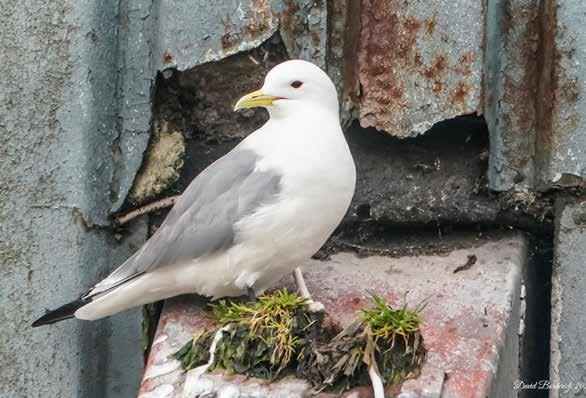
Last month, following the completion of three new artificial nesting structures (ANS) in the Port of Lowestoft, offshore wind farm developer Vattenfall pledged £50,000 a year for up to five years to help support the Lowestoft Kittiwake Partnership to work with local people and businesses in the town, to enable Kittiwakes to nest safely in suitable locations while minimizing the impact of the mess the birds make where they nest.
built for Kittiwakes to offset impacts from the Norfolk Offshore Wind Zone on these globally vulnerable seabirds, and could house as many as 430 nesting pairs. By increasing the productivity (the number of young reared) of nests the aim is to mitigate any losses to new wind turbines.
On 6th August there were no ringed chicks remaining and still no newly fledged tern and few birds sitting. The whole flock of about 50 birds were very flighty and the morning all birds lifted off and left the site not to return.
Two days after Vattenfall announced the funding, on the 5th of March, the first Kittiwakes were spotted in Lowestoft having returned from a winter spent at sea in the North Atlantic. By May, Kittiwakes have returned to their established nesting sites in Lowestoft, which include Claremont Pier, Our Lady Star of the Sea Roman Catholic Church and The Marina Theatre.
There was no evidence for the predation other than Carrion Crow, which nested brought its three chicks to the islands. Fox, Badger and Buzzard are all also? suspects, although the site has been frequented by an Otter which will take chicks and eggs have caused the fledged birds to leave the site earlier than would be expected?
The ANS, which have been dubbed ‘Kittiwake hotels’, have been designed and
John Glazebrook
One of the reasons for the formation of the Lowestoft Kittiwake Partnership was the increasing incidence of poorly installed and maintained netting on buildings to prevent Kittiwakes nesting, posing a threat to the birds, which can become entangled in the netting.
The Partnership seeks to engage with businesses and building-owners to ensure that deterrents are appropriately used and safely installed to prevent harm to the birds, and at the same time is encouraging the installation of artificial nesting ledges in locations where nesting Kittiwakes will not cause problems by making a mess of buildings that can be expensive to clean.
Sadly, the use of netting and spikes to prevent Kittiwakes from nesting has increased again this year, displacing many pairs from locations where they had been
nesting without providing alternative artificial nesting ledges. While the new ‘Kittiwake hotels’, and a planned offshore nesting structure will hopefully provide suitable nesting sites for Kittiwakes in the future, Kittiwakes are highly site faithful and birds that have been successfully nesting on buildings in the town for years are unlikely to relocate to these structures, which are designed to attract ‘new recruits’ – young birds reaching breeding age for the first time.
We hope the Kittiwake partnership can help to implement a more strategic approach to managing the issues associated with Kittiwakes nesting in the town that enables the birds to thrive alongside people and business without having negative impacts and while providing the town and the people who live there with an urban wildlife asset they can celebrate and be proud of.
David Tomlinson
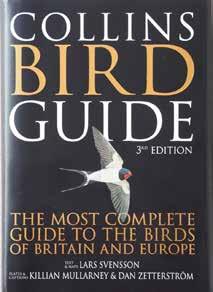
Collins Bird Guide 3rd edition. By Lars Svensson,
Killian Mullarney, Dan Zetterström (Harper Collins, £30)
If you are a member of the SBG, then you almost certainly own a copy of the Collins Bird Guide; if you haven’t you’re missing the best field guide to Europe’s birds that’s ever been published. When it first appeared in 1999, the much-awaited guide was greeted with almost universal enthusiasm. Succinct text, brilliant illustrations, up-to-date maps, all in one highly portable volume. I remember getting my copy and just soaking up the delightful illustrations. Though the work of two artists, Irishman Killian Mullarney and Swede Dan Zetterström, their styles complement each other perfectly and confirm why painted illustrations are so superior to photographs in a serious field guide.
In 2010 the second edition was launched. With the addition of 41 new species, new illustrations and revised maps, it was a major revision. Significantly, it eventually became available as an app, and a very good one too, with the option to add video clips to each species making this probably the best app on your phone.
Now the 3rd edition has arrived, so the big question is whether it’s worth forking out £30 (though a lot cheaper on eBay) for this latest revision. Like most of us when we get older, it’s put on weight - up from 800gm (1st edition) to 960gm now. The extra weight is due to many more pages, while more than 50 plates are either new or have been repainted, and all the texts and maps have been revised, too.
I’m pleased to say that the order of the families hasn’t been changed, so if you knew your way around the old book you will find this new addition just as easy to use. It starts with swans and concludes with buntings. You will find, for example, that the falcons still follow on from the hawks, just as they always have, though modern taxonomy places the two groups far apart.
At the very back of the book you will find fine coverage of those North American passerines that regularly cross the Atlantic, all painted beautifully by Killian Mullarney. Then 16 pages of vagrants follow, with every species illustrated for the first time. Finally, the volume concludes with the introduced breeding species and those recorded only as escapes. Though they are all illustrated and well described, these birds are clearly second-class citizens. Ross’s Goose might have cause to complain, as this is one bird that is now regarded as a genuine migrant to the UK, while such is the abundance of the various species of parakeets in Europe now I feel that they really deserved a page in the main body of the book, despite their dodgy start in
Europe. The fact that I have seen 19 of the introduced species in a feral state in Europe is a reminder of their success here.
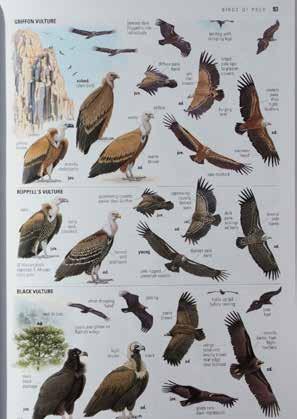
Most of us buy field guides for the plates rather than the text, and there’s no doubt that the revised plates, and the increased number of delightful vignettes, are as good as you might expect. The revised plates include grouse, loons (divers), raptors, terns, owls, swifts, woodpeckers, swallows, redstarts, what were once called small thrushes, tits, finches and buntings. The revisions allow the addition of new species. I saw my first European Rüppell’s Vulture last year in Andalucia - it’s good to see that it now features on a plate next to the similar Griffon, allowing a direct comparison. Curiously, all the repainted woodpeckers appear to have put on weight.
Followers of the latest trends in taxonomy might be disappointed, as the approach of this volume is one of caution. The Iberian Green Woodpecker, sharpei, for example, gains a proper illustration, but isn’t recognised as a full species, though most authorities regard it as one. I’ve never met a Scandinavian birder who believed that the so-called Scottish Crossbill deserved full specific status, so I wasn’t surprised to see it demoted back to a subspecies of Parrot Crossbill. However, the recently recognised West African Crested Tern gains both text and plate, while Pacific Loon is one of a number of other species to now feature in the main text.
All the maps, so we are told, have been revised, but there’s no indication, or mention, of Cattle Egrets colonising England, though
the text does say “range expanding”. Nor is there mention of the now well-established (introduced) colonies of Bald Ibises in Andalucia. Texts can soon get out of date: that for Pallid Harrier states “vagrant to Britain, about one every three years”; it’s now at least two or three a year.
However, it’s awfully easy for armchair experts to nit-pick. Overall, this third edition more than lives up to expectations. If you’re still using the first edition, then it’s certainly worth forking out for this new one, while I would also argue that owners of the second edition won’t be disappointed if they do the same. I sincerely hope that we don’t have to wait too long before we are offered a revised app, too.
Chris Keeling
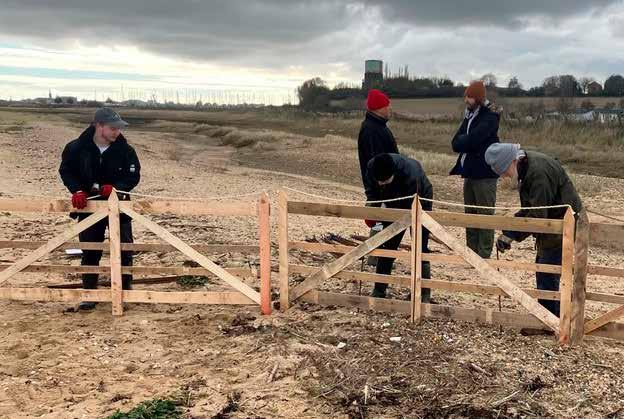
The Stour and Orwell are subject to increasing levels of recreational disturbance, with walkers and dogs being the main culprits. SBG have been working with Alex Moore the Nature Recovery Officer with the Dedham Vale AONB Stour Valley Project and Natural England to put up portable fencing panels on the beach at Shotley Marina to create disturbance free sections of beach where we hope Ringed Plovers and Oystercatchers will be encouraged to nest.
I am very pleased to say that we have a report of a pair of Oystercatcher (which may be nesting) in the most westerly enclosure at Shotley and a pair of Ringed Plover observed in and outside the same enclosure. This is fantastically encouraging given the experimental design of the
fencing panels and the time and materials needed to produce them. We are absolutely delighted that the fencing panels have done what they were intended to do, an effective barrier to uncontrolled dogs, encouraging birds to think about claiming territories freed from disturbance by walkers and dogs.
We are keeping our fingers crossed that the fencing panels will continue to provide a disturbance free section of beach for breeding waders at Shotley but we need the support of our SBG membership to monitor the enclosures and report any sightings of nesting Ringed Plover or Oystercatcher. If you can spare some time to help please contact Alex Moore at Alex.MooreDaLuz@ suffolk.gov.uk
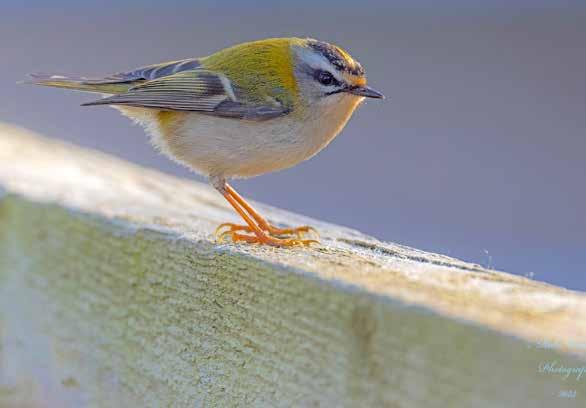
Clockwise...
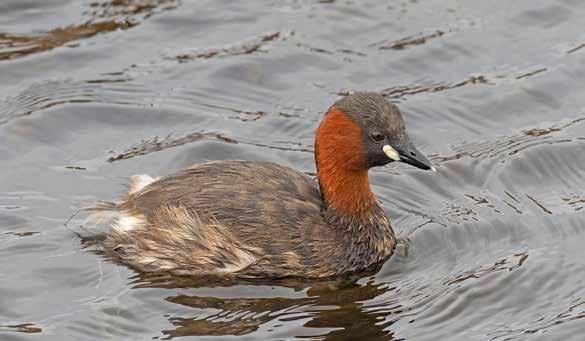
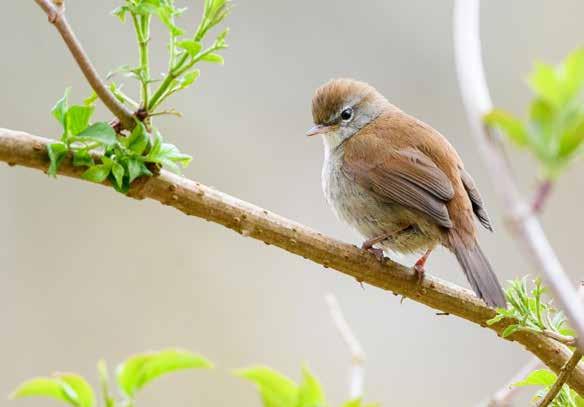
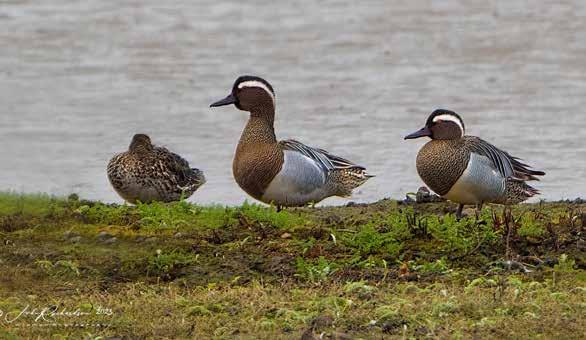
Top left: Firecrest at Banters Barn, Boyton by Rab King, Top right: Cetti’s Warbler at Minsmere by Les Cater, Bottom right: Garganey at Minsmere by John Richardson, Bottom left: Little Grebe at Minsmere by Andrew Moon.
Steve Fryett
Saturday 25th February 2023
Leader: Steve Fryett
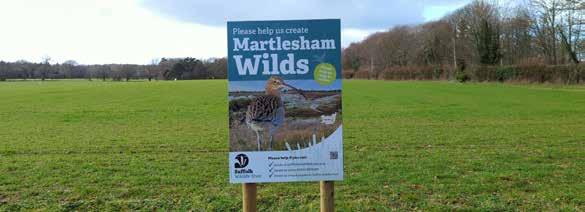
Whilst this meeting was pencilled in during August 2022 most of us, including myself, were unaware that Suffolk Wildlife Trust planned to purchase Martlesham Wilds before the end of 2022. Therefore, for the most part my planned walk would be on the new reserve.
A rather cold day greeted another excellent turnout of 19 members. We met in the church car park and readied to wander off to the Martlesham Creek sluice, via the woods. The first bird of note was from the car park, with four Egyptian Geese seen in the far corner of field in front of us. Unfortunately, an approaching dog forced them to take flight. At the sluice the tide was at low water leaving plenty of mud for the many Black-tailed Godwits, Redshank and a couple of Grey Plover. The lagoon is normally heaving with Little Grebe but with just two present probably many are making their way back to breeding sites. Two Stock Dove were noted in the horse field along with a Common Kestrel and a handful of Wigeon. Continuing downstream we passed through the boatyard noting several Long-tailed Tits. Plenty of Teal and Wigeon were present with Curlew and a couple of Avocet.
Reaching the confluence with the Deben many more Avocet were noted including a ringed individual. Plenty of Dunlin were noted feeding off Kyson Point as we left the river for the marsh. Whilst watching a Common Buzzard sitting on a distant post a female Marsh Harrier came into view giving excellent views as it hunted over the eastern edge of the marsh. A single Dark-bellied Brent Goose on the marsh seemed a bit odd to be recorded all alone.
Heading for Lumber Wood a small gathering of Meadow Pipits was noted along with several Skylark and a very brief sighting of a Great Spotted Woodpecker with five Curlew preening in the middle of a cereal field. Four female Fallow Deer were recorded in a distant field and a calling Little Grebe noted on the reservoir. A circling Sparrowhawk was overhead with a further sighting of Kestrel as we made our way back. Before we ended the meeting at the car park the Sparrowhawk put in another appearance overhead with two Buzzards, a small Tit flock was noted on the edge of the wood and there was a fifty strong flock of Pied Wagtails out on the cereal field.
Like everyone I am sure we look forward to seeing Martlesham Wilds develop in the near future.
Leader: Gi Grieco
Our annual late winter visit to the Brecks is always keenly anticipated and this year was no exception with 26 members meeting at the Forestry Commission car park at Santon Downham. The village always seems filled with bird life and on this occasion it lived up to its reputation – singing Song Thrush, three or four Greenfinches and a distant Nuthatch calling as we assembled. Walking down to the river we noted some Lesser Redpolls and briefly a Marsh Tit. From the bridge we scanned up and down river and managed to find two Grey Wagtails, with all eventually getting views as they moved from the bankside to overhanging branches. We got better views of the Redpolls from the river path, some just sitting long enough to allow scope views!
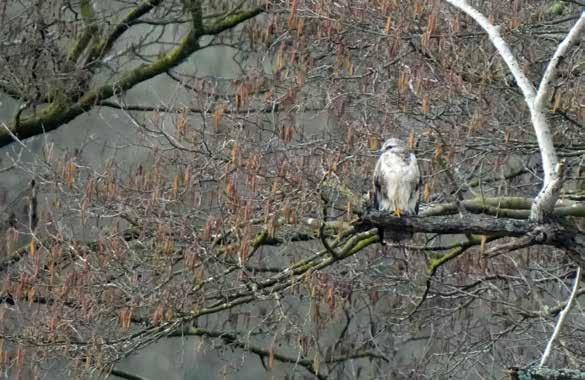
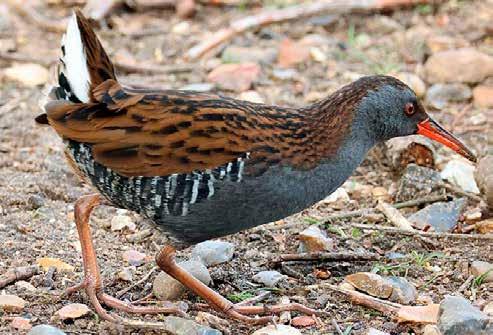
Last year we failed to hear Water Rail in the adjacent field along the path but one did show well along the riverbank and similarly this year, silence from the reeds but one did fly out of the riverside vegetation, with a ‘squeal’ heard later on. Two Mandarins flew around and disappeared on the opposite side of the river where, in the trees were numerous Siskins and a few Redwings. A nice Buzzard showed well briefly, as it sat on a branch. We waited patiently for Lesser Spotted Woodpecker, one of our main targets for the day, but having been told of a drumming bird, that had flown over to the Suffolk side at 8am, we unfortunately had no luck. We did have Great Spotted Woodpecker, a further Nuthatch, Marsh Tit, Stock Dove and a second Buzzard.
Deciding it was time to move on, it was back to the cars for a quick ‘cuppa’ before moving into Thetford Forest for our next target, Goshawk. Down a forest track we heard, then saw, a Yellowhammer. We reached a viewing area and within five minutes the first Goshawk was picked up and we watched it move across the horizon above the trees. The call went up of another bird, and as we watched numbers increased until we had four in the air, along with a Buzzard or two. We were in awe as we watched some courtship display and we were able to get good scope views too. In the immediate area a male Stonechat was found, as was another Yellowhammer and we did get to find at least one Woodlark after initially only hearing Skylarks. We were then again treated to further views of a Goshawk, this time circling closer to allow even more detail to be seen – superb! Our third raptor species in the area was a Kestrel and then later a Sparrowhawk.
We really couldn’t ask for more, so decided to finish off the day at Lackford Lakes. Some members called it a day, so we said our goodbyes as the remainder then reconvened at the SWT reserve. First port of call though was the tea shop for tea and cake! Our fifth raptor of the day, a Red Kite, was picked up in the distance. In some Alder trees we got good views again of Siskins, with one male singing away. We headed past the sailing lake noting a few duck species such as Pochard and Tufted Duck. We popped into a couple of hides, including the new ‘doubledecker’ hide that a few had not seen before. From these we found a number of Snipe, Teal, Lapwing plus the odd Cormorant, Grey Heron and Egyptian Goose. We carried on through the woodland and got good views of Nuthatch and Marsh Tit, while a couple of members headed back to the centre and were rewarded with great views of Water Rail and Reed Bunting below the feeders. It had been an enjoyable day and we were treated to some great birds.
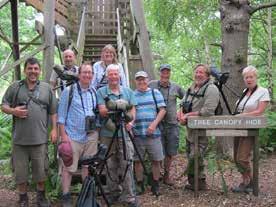
We arrived at Carlton Marshes on a pleasant, dry morning. Some members were already here, keen and ready to go. Two very keen members had already been down to the marshes and were fortunate to hear a Grasshopper Warbler – with this news we were all keen to get going! After the head count of 36 members, Richard gave us his plan for the day and we went in anticipation.
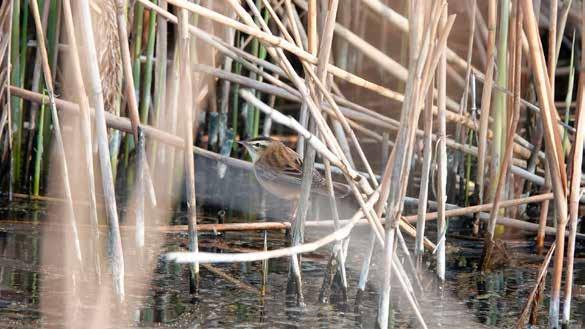
Leaving the car park and following the gravelled path round the back of the centre, we stopped by an area of willow scrub where a Willow Warbler was singing – for a lot of us the first for the year. A Great Spotted Woodpecker was also showing well for all to see. We walked the through the carr listening and looking for more warblers – where we encountered Chiffchaff, Blackcap and a Sedge Warbler showed by one of
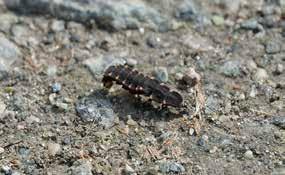
the ponds. On reaching the main path we turned right along Sprat’s Water listening for the Grasshopper Warbler the early birders had found first thing. Some were able to pick up the call but those with worn out ears had to wait! We turned around and followed the path to the sluice skirting Share Marsh. Before leaving the carr we had good views of the Willow Warbler plus heard Cetti’s Warbler. A Grasshopper Warbler was heard and enjoyed along the first part of the reedbed and we also had Bearded Tits that were heard before briefly flying along across the reed tops – a great delight for us all. As we wandered along we found Sedge Warbler, Reed Warbler and Reed Bunting and then a Cuckoo called in the distance. On the track itself we were pleased found a Glow-worm larva, something several of the group had never encountered before.
The sky was clearing and it was getting warmer so our eyes kept looking up for raptors – we were not disappointed noting Kestrel, Marsh Harrier, Common Buzzards, a distant Hobby before a Sparrowhawk was found. While watching that, another raptor came into view, heading straight for us – a Peregrine, which was the star of the show as it gave great views as it flew past. The raptor fest was not complete as soon after a Red Kite came drifting by. As we neared the sluice, on an area of grazing marsh, a Great Egret fed along the edge of a pool and on further scanning of the pasture a Wheatear was found and then a further three including a very stunning male which was posing for photos.
After we regrouped following the many distractions along the way our next stop was Peto’s Marsh, an absolute jewel – well done SWT! On our approach a Little Ringed Plover was seen feeding on a mud spit offering us all great views. Richard happened to mention lunch so we seemed to spread out along the path, some on benches while other headed to the hides. An Eastern Yellow Wagtail had been in this area for a while so everyone was on the lookout while eating their lunch. It’s amazing what you can find when you patiently scan across the landscape – the best find of all was three Bitterns chasing each other in flight and showing really well before disappearing into the distance. Also noted were Grey Plover, Black-tailed Godwit and Snipe hidden amongst the rushes plus a great show of wildfowl and not forgetting the odd Chinese Water Deer or two. After an exciting lunch, but no sign of the Eastern Yellow Wagtail, Richard gathered the remainder of the group – some had already headed back to the centre, and we headed back along the central path. As we made our way back the group again managed to spread out. I was in the very last few at the back and we had stopped to scan some water at the end of Peto’s Marsh and were fortunate to find a male Garganey – well done Brian!
The rest of the group were too far ahead to alert them so we pressed on. On the way back we noted displaying Marsh Harriers and Buzzards playing in the breeze. Some butterflies of note to our day’s sightings were Orange-tip, Peacock and a possible Green-veined White.
When we arrived back at the car park we all thanked Richard for leading the walk and his expertise and patience. Some members headed to the visitor centre for coffee and cake and others raised the question of where to head next; after a bit of discussion a certain lady with blonde hair whose name begins with Val mentioned we hadn’t seen the wagtail (and it’s still hours until it gets dark) so we agreed to head back onto the reserve ‘here we go all the way round again!’. Also, as some of the group hadn’t seen the Garganey, and it would be a lifer for one or two, we all agreed it was a good choice rather than driving off to somewhere else and so continue to enjoy the reserve. This time Brian showed us all the Garganey and as we scanned Peto’s Marsh we noted a few Pied Wagtails about which hadn’t been present earlier along with another Wheatear. This time success as the Eastern Yellow Wagtail was keenly spotted by Gi. We also admired a flock of Golden Plovers in the late afternoon light, that had also dropped in after our previous scan at lunch.
A great day was had by all, many thanks to everybody for making this a very enjoyable day.
Gi Grieco
The quarterly review section gives a snapshot of birds seen within the county during the period, predominantly from data received by Suffolk BINS. All scarce and rare birds are subject to submission and acceptance by either SORC or BBRC. Updated lists on Accepted and Outstanding Records for previous years can be found on the SBG website - http://www.suffolkbirdgroup. org/bird-recording.
The month was very dry, being the third driest February ever recorded in East Anglia. In addition, it was a sunny month too with it being warmer than average also. There were very few scarcities present and amongst the typical wintering species there were a couple of early summer migrants.
Pale-bellied Brent Goose – one on Aldeburgh Marsh (10th-12th, 20th and 22nd).
Pink-footed Goose – one at Boyton Marsh (9th) and one at East Lane, Bawdsey (25th).
Tundra Bean Goose – two flew north over Blackheath (5th), one Hollesley Marsh (9th15th) and one at Boyton Marsh (27th).
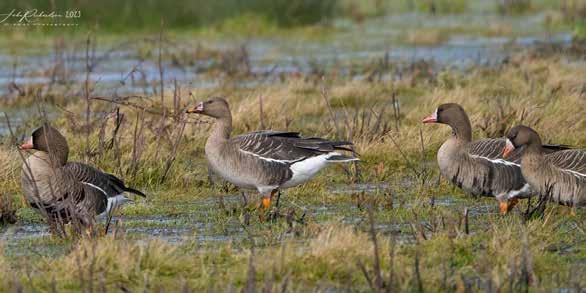
Greater White-fronted Goose – noted at Hollesley Marsh, Boyton Marsh, North Warren and Aldeburgh Marsh through the month. Fourteen at Giffords Hall flood (6th) and south-east of East Bergholt between Flatford Mill and Judas Gap (26th).
Bewick’s Swan – an adult on West Scrape, Minsmere (3rd) and six on the reserve (20th).
Whooper Swan – four on the pools at Westwood Marshes (1st, 10th and 11th). Up to four at Minsmere on several dates. Over 40 at Lakenheath Fen RSPB (3rd) and two around Felixstowe Ferry (6th to 19th).
Scaup – a drake off Waldringfield (18th19th).
Velvet Scoter – 16 birds off Dunwich (12th).
Smew – a redhead on the Alde estuary, viewed from Brick Dock (11th, 23rd-26th).
Goosander – up to five on Thorpeness Meare (5th-26th), 12 flew west of Aldringham (5th), two on East Scrape, Minsmere (5th), two North Warren (19th-25th).
Turtle Dove – one seen in a garden in Saxmundham (18th and 20th).
Crane – a first-winter on Sudbourne Marshes (20th).
Black-necked Grebe – on the sea, viewable from LBO (13th).
Curlew Sandpiper – one present on the River Deben, viewable from Dock Lane, Melton (21st-23rd).
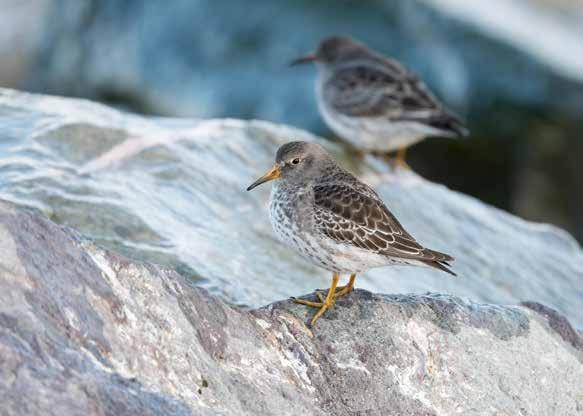
Purple Sandpiper – up to 14 at Ness Point (6th, 19th), one north of the Southwold pier (11th and 19th), three at East Lane, Bawdsey (15th-26th).
Little Stint – one on Havergate Island (21st).
Caspian Gull – an adult at Needham Market Lakes (4th), an adult on East Scrape, Minsmere (11th) and a first-winter on the River Deben, viewed from Dock Lane, Melton (22nd).
Great Northern Diver – one south of LBO then flew into the river (9th) and south offshore at Thorpeness (25th).
Shag – one in Hamilton Dock, Lowestoft (5th).
Glossy Ibis – one over Minsmere (10th), one on Slaughden saltings and around Aldeburgh Marsh (16th-27th).
Cattle Egret – one on Share Marsh, Carlton Marshes (13th).
Great Egret – an amazing count of 24 birds going into roost at Fritton Lake (19th).
Hen Harrier – a ringtail at Dingle Marsh (1st), a ringtail at Peto’s Marsh (4th, 14th and 21st). Up to two, both ringtail and male, viewed from Waveney Forest (5th, 8th, 11th and 12th).
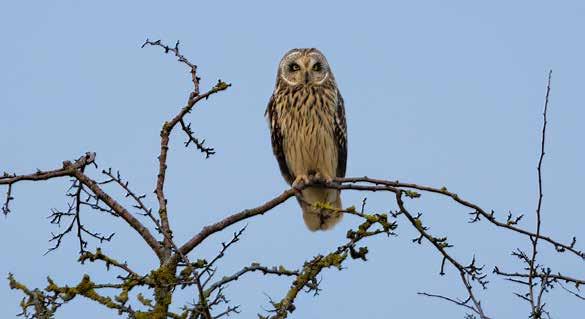
Short-eared Owl – one over Minsmere scrape (2nd), one at Felixstowe Ferry (6th), one at Burrow Hill, Boyton (10th), one Hollesley Marsh (11th), up to two at Boyton Marshes (11th- 21st) and two at Share Marsh, Carlton Marshes (13th).
Merlin – one seen Felixstowe Ferry (6th), one North Warren (6th), one Boyton Hall, Combs (11th) and one Little Stonham (24th).
Raven – seen at 16 sites across the county during the month.
Waxwing – up to six were seen around Blanche Street, Ipswich throughout the month. Four birds present regularly at The Drive, Reydon (1st to 21st). Up five sporadically through the month at the junction of Hollow Grove/A143 corner at Carlton Colville. Three at the northern end of the Blythburgh Road, Westleton (9th).
House Martin – an early bird seen at Kessingland (18th).
Firecrest – two birds showed really well at times at Banters Barn, Boyton Marsh through the month. Noted at Minsmere and Dunwich as well.
Water Pipit – at Carlton Marshes on several dates with up to eight present. Two Aldeburgh Marsh (7th-8th), Hollesley Marsh (10th) and two at Hen Reedbeds (13th). Hawfinch – one around Sotterley churchyard (11th).
Snow Bunting – up to 25 at Kessingland north beach on a few dates.
Corn Bunting – 20 in stubble fields at Tattingstone (10th).
Scarce February sightings
Black-throated Diver – two reported offshore at Dunwich (10th).
White-tailed Eagle – one seen from Waveney Forest mound (8th, 11th-16th). One was reported from Boyton Marsh (20th) and a juvenile over the A1094 near Hazlewood Farm (23rd).
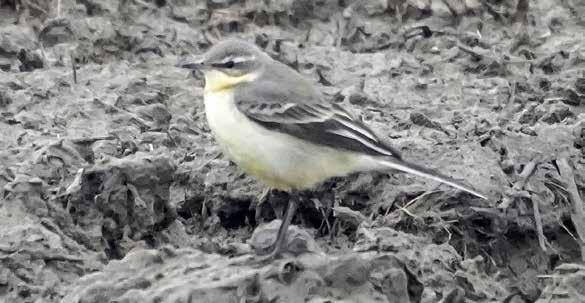
Eastern Yellow Wagtail – the bird on Peto’s Marsh at Carlton Marshes was again present (13th to 28th).
Following on from a dry February, March had the highest number of days with rain on record and was the fifth wettest recorded. The incoming summer migrants put in their first appearance – with Swallow, Sand Martin, Wheatear, Little Ringed Plover and Stone-curlew all arriving. The month is when Black Redstart and Firecrest also arrive and for the latter, the birds around Banters Barn at Boyton gave some fantastic views.
Notable March sightings
Pink-footed Goose – one at Boyton Marsh (14th) and two at Trimley Marsh (22nd and 24th).
Tundra Bean Goose – one at Boyton Marsh (3rd and 26th) and at Hollesley Marsh (13th, 19th and 24th).
Greater White-fronted Goose – noted throughout the month on various dates at Hollesley Marsh, Boyton Marsh, Aldeburgh Marsh and North Warren with a flock of 209 at the former site being the largest count of the month (19th).
Bewick’s Swan – four flew north over Slaughden (5th) and 20 noted on the sea off Lowestoft North Beach (19th).
Whooper Swan – two on Island Mere, Minsmere (1st), two adults at Kingsfleet (6th, 11th and 15th) and one on Sandymount Pools, Dunwich (7th, 15th-16th and 27th).
Garganey – a drake at Minsmere on East Scrape (19th), a drake on Peto’s Marsh (30th) and three at Minsmere (31st).
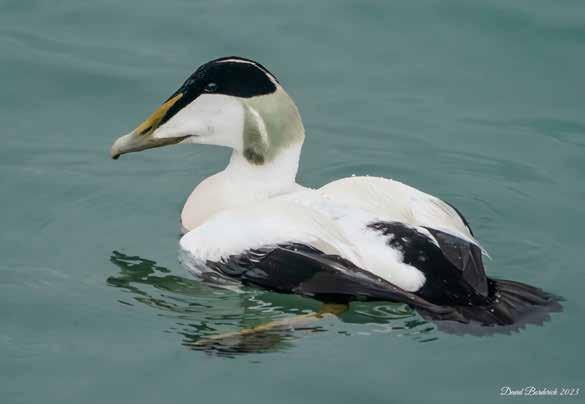
Eider – a male Eider showed extremely well in Hamilton Dock, Lowestoft (5th).

Velvet Scoter – up to 14 on the sea off Dunwich (1st-24th).
Smew – a redhead, having been present the previous month on the Alde estuary, opposite Iken church, was seen again (3rd).
Goosander – three on East Scrape, Minsmere (9th) and four on Island Mere (15th). Two on south marsh, North Warren (18th and 25th) and a redhead at Hollesley Marsh (19th).
Crane – sightings from Minsmere (6th, 18th and 20th), three flew south over Benacre, (15th), two over Dunwich (16th) and one north over Langham (20th).
Red-necked Grebe – one north off Dunwich (1st).
Black-necked Grebe – two on the River Orwell, viewed from Trimley managed retreat (20th) with one nearby on the reservoir at Trimley Marsh (24th-30th).
Curlew Sandpiper – the over-wintering bird was again on the River Deben at Melton (7th).
Purple Sandpiper – 12 at Ness Point (5th) and two were north of Southwold pier (9th, 16th and 30th).
Little Stint – two on the new scrape at Boyton Marsh (25th-31st).
Jack Snipe – one on Dingle Marsh pools (7th), one between Ramsholt and Methersgate (12th), one on a saline lagoon just north of East Lane (23rd), one viewed from North Hide, Minsmere (29th) and one on Peto’s Marsh (30th).
Caspian Gull – a first-winter around Southwold harbour (18th) and two on the south levels at Minsmere (19th).
Great Northern Diver – one north off Ness Point (4th) and one off LBO (19th).
Glossy Ibis – one still around the saltings at Slaughden and Aldeburgh Marshes (1st-6th).
Spoonbill – the occasional bird or two noted on Aldeburgh Marsh, Havergate Island, Hollesley Marsh, North Warren, Minsmere, over Walberswick and Carlton Marsh.
Great Egret – an even higher count than last month, with 26 roosting at Fritton Lake (5th).
Hen Harrier – a ringtail at Lakenheath Fen (29th).
Short-eared Owl – one on the Deben estuary at Kingsfleet (11th, 14th and 16th), one by Beach Farm, Benacre (17th), one at LBO (19th) and one at a disused airfield, north-east of Sudbury (21st).
Merlin – one at Aldeburgh Marshes (9th and 23rd), one at Kingsfleet (11th), one south at LBO (22nd) and one over Southwold Town Marshes (25th).
Waxwing – the long-staying birds around Blanche Street, Ipswich were still present at the start of the month, then at Alexandra Park, Ipswich (11th) and possibly the same flock along Henley Road (15th). At Carlton Colville, the birds from the previous month were again present (1st-4th). The final birds of the winter were four at Oulton Broad, at Everitt’s Park (21st).
Firecrest – numerous sightings in the month – at Belstead Brook, Banters Barn at Boyton, LBO, Benacre, Southwold, Shingle Street, North Warren, Thorpeness and Lowestoft.
Ring Ouzel – a male in paddocks opposite the workshop to Botany Marshes, Snape. (28th).
White Wagtail – a number noted at a few sites (11th-23rd) including Peto’s Marsh, Southwold, Blythburgh, Aldeburgh Marshes and 29 in fields by Beach Farm, Benacre (20th).
Water Pipit – at Carlton Marsh, Ramsholt, Snape Marshes, Minsmere, Hollesley Marsh, Trimley Marsh and 10+ at North Warren.
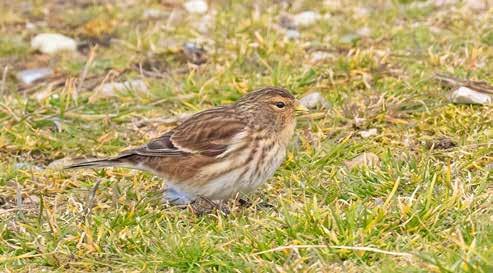
Twite – two were present north of Dunwich beach car park (4th-22nd).
Lapland Bunting field at Easton Bavents (30th-31st).
Snow Bunting – the flock at Kessingland north beach were still present (4th, 6th, 18th and 26th). One at LBO (15th) and a confiding bird just south of Benacre sluice (23rd).
Scarce March sightings
Ferruginous Duck – a probable female at Hollesley Marsh (19th).
Alpine Swift – two were seen briefly over Felixstowe (19th) and one reported over the North Wall at Minsmere (23rd).
Great-spotted Cuckoo – a first-summer bird was found on private cliff top land at Easton Bavents, although it could be viewed south of Easton Broad (24th).
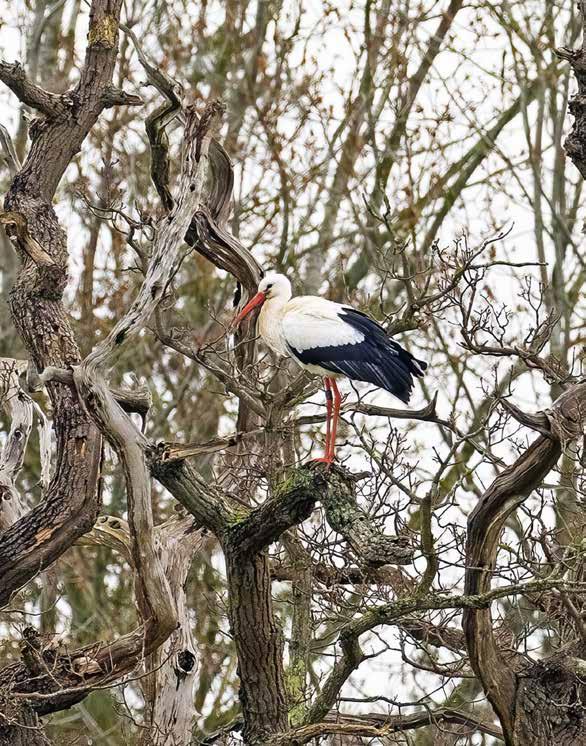
White Stork – an adult bird, that was bearing a Dutch ring, was found off the A12 at Toad Row, near Kessingland (17th19th and 22nd). One was seen over the A14-A1120 junction by Stowmarket (20th).
Short-toed Eagle – one was reported south of the River Little Ouse at Santon Downham (21st).
Siberian Chiffchaff – one showing well at Brantham sewage works (2nd).
Eastern Yellow Wagtail – the long-staying bird was present all month on Peto’s Marsh.
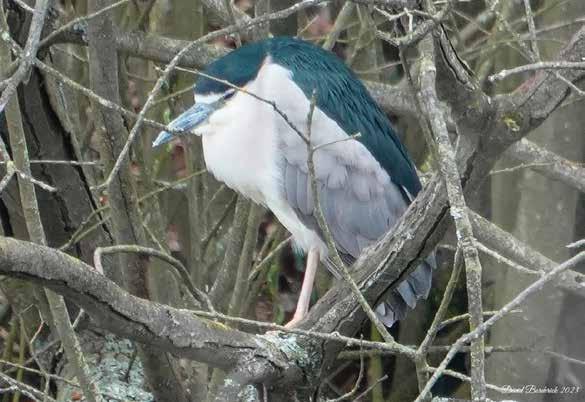
After the previous month being so wet, April continued in the same vein, being also much wetter than average. Further spring migrants such as Whitethroat, Lesser Whitethroat and Common Redstart arrived although the odd winter species lingered on. The Night Herons at Lound were enjoyed by many birders being the first birds in many years to show so well.
Pink-footed Goose – one at North Warren (7th), one on arable land, west of the sewage works at Thorpeness (9th) and two by Searsons Farm, Trimley (13th).
Greater White-fronted Goose – nine at North Warren (1st).
Garganey – multiple sightings at a number of sites through the month – Boyton Marsh, Minsmere, Lakenheath Fen, Peto’s Marsh, Boyton Marsh, Trimley Marsh, Staverton ponds, Aldeburgh Marsh, Buss Creek and North Warren.
Velvet Scoter – four offshore at Dunwich (7th) and one flew south off LBO (13th).
Goosander – two redheads at North Warren (9th and 18th) and two redheads on south levels, Minsmere (9th).
Crane – a number of sightings through the month along the coast, noted at Southwold, Hollesley Marsh, Sizewell, Boyton Marsh, Minsmere, Peto’s Marsh, Westleton and Mutford.
Little Ringed Plover – one on East Scrape, Minsmere (5th), one at North Warren (9th), three at Carlton Marsh (9th) and one on Aldeburgh Marsh (21st-23rd).
Curlew Sandpiper – the long-staying bird was again on the River Deben at Melton (9th-11th) and nearby along Martlesham Creek (17th).
Purple Sandpiper – noted at Ness Point (11th).
Little Stint – two on the new scrape at Boyton Marsh (3rd-4th, 21st-22nd and 29th). One at Minsmere (10th) and two at Hollesley Marsh (27th).
Jack Snipe – one on the flash at Boyton Marsh (9th).
Wood Sandpiper – one on Aldeburgh Marsh (22nd), two on Southwold Town Marshes (27th and 29th-30th), one on Hollesley Marsh (29th) and two at Carlton Marshes (30th).
Caspian Gull – a first-winter at Hollesley Marsh (5th), at 2cy at Minsmere (16th) and on the River Deben at Melton (28th).
Arctic Tern – two off LBO (27th) and one briefly at Minsmere (27th).
Black-throated Diver – one was in the River Stour, viewed from Shotley Marina (23rd) and a summer-plumaged bird flew north offshore from LBO (27th).
Glossy Ibis – one still around the saltings at Slaughden and Aldeburgh Marshes throughout the month.
Spoonbill – birds noted at a number of sites during the month including at North Warren, Minsmere, Hollesley Marsh, Peto’s Marsh, Southwold and Tinkers Marsh.
Cattle Egret – one flew east over Boyton Marsh (22nd), one by Hollesley Marsh car park (23rd) and one flew west over Island Mere, Minsmere (28th).
Osprey – one flew over north-west over Hen Reedbeds (4th), one north-west over Aldeburgh Marshes (11th), one south over Snape Maltings (22nd), one north over Bawdsey (23rd) and one over Peto’s Marsh (24th).
Hen Harrier – a ringtail over Peto’s Marsh (6th).
Short-eared Owl – one at Carlton Marsh (21st and 24th), one at Dingle Marsh and possibly the same one later at Southwold (21st) and then at Tinkers Marsh (26th).
Merlin – a female along the entrance road to Banters Barn, Boyton (3rd) and a female at Valley Farm, Combs Ford (9th), Firecrest – several sightings in the month –at LBO, Thorpeness, Benacre, North Warren and Minsmere.
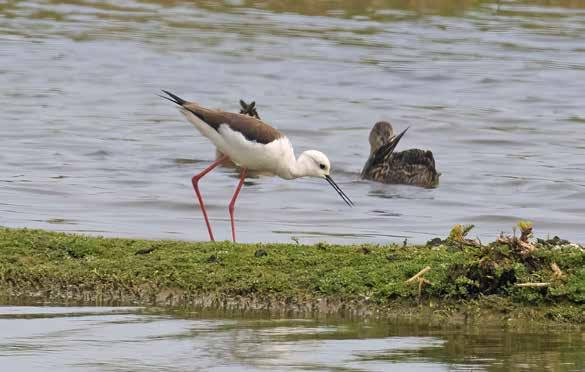
Black-winged Stilt at Minsmere
Ring Ouzel – a male at Southwold golf course (2nd), one around Buss Creek (4th9th), a male in a paddock at Wethersfield, near Haverhill (8th). A female at LBO (18th-21st), a male on Westleton Heath (22nd), one in a field at Scott’s Hall Lane, Minsmere (23rd) and by Minsmere sluice bushes (24th), a male on Woodbridge airfield (25th), a female at Boyton village (25th), two on Aldringham walks (26th), a male on Sutton Common by the water works compound (26th-29th) and a male at Haughley Green (27th).
Whinchat – a male at Hollesley Marshes (22nd), a male at North Warren (22nd) and a male on Southwold Town Marshes (29th).
Blue-headed Wagtail – a male at Hollesley Marsh (20th-21st) and one on Southwold Town Marshes (27th).
White Wagtail – two at Boyton Marsh (9th).
Water Pipit – a summer-plumaged bird at Lakenheath Fen (1st), two at Hen Reedbeds (2nd), at Peto’s Marsh (3rd, 8th), up to 8+ on North Warren (6th-7th, 12th), three at Minsmere (7th) and Aldeburgh Marsh (22nd23rd).
Hawfinch – one present in the LBO compound (6th).
Lapland Bunting – in a stubble field at Easton Bavents (1st-2nd) and one at Boyton Marsh (7th).
Snow Bunting – up to seven still at Kessingland north beach (1st-2nd and 5th), one in Manor Road car park, Felixstowe (1st), one on Minsmere beach (3rd) and one at Shingle Street (8th).
Green-winged Teal – a drake on the new scrape at Boyton Marsh (17th-21st) and at Hollesley Marsh (27th).
Black-winged Stilt – one was present at Minsmere (30th), two on Aldeburgh Marsh early morning that were later found at Hollesley Marsh (30th).
Gull-billed Tern – one flew north, close offshore, from LBO (30th).
White Stork – one flew south over Colney Hill, Minsmere and west of the new compound at Sizewell (7th), one east over Orwell Bridge (14th), one over Peto’s Marsh flying towards Kessingland before heading to Aldeby before drifting west over Beccles (14th). One flew west over Cattawade late morning then seen again mid-afternoon over Bury St. Edmunds (15th). One on Jubilee Fields, Mildenhall (22nd-23rd) and nearby near the airfield at Mildenhall (26th27th).
Night Heron – two adult birds were at Lound Lakes before flying high east in the evening (24th).
Purple Heron – one was at Trimley Marsh (30th).
White-tailed Eagle – one flew over Earls Green, near Bacton (5th) and one over the Blyth estuary at Southwold (7th).
Rough-legged Buzzard – one over Christchurch Park, Ipswich (4th), a probable over Hollesley (4th) and one east over Elmsett (7th).
Montagu’s Harrier – a probable ring tail was seen south over Carlton Marshes (30th) and a ring tail over Tinkers Marsh in the evening (30th).
Hoopoe – a bird was in a private garden in Wyverstone (15th), one in Stowupland (18th) and one on a grass verge at Cockfield (22nd).
Eastern Yellow Wagtail – the long-staying bird was present all month on Peto’s Marsh.
Council for 2023
Officers
Chair: Eddie Bathgate
Vice Chair: Chris Keeling
Secretary: Katya Bathgate
Treasurer: Anne Wright
Communications Officer: Adam Faiers
Projects Officer: Chris Keeling
SoSS Project Officer: Eddie Bathgate
Suffolk Bird Report Editor and SORC/SNS Link: Nick Mason
Harrier Editor and Outdoor Events Coordinator: Gi Grieco
Indoor Events Coordinator: Adam Gretton
President John Grant
Members
Sarah Glyde
John Kornjaca
Peter Merchant
Ben Moyes
Sally Nelson Honorary Vice-Presidents
Andrew Green
Robin Hopper
Colin Jakes
Mike Jeanes
Mike Marsh
Roy Marsh
Philip Murphy
Reg Snook
Steve Piotrowski
Bird Recorders
North-east Area Recorder: Richard Walden Email: bird-ne@sns.org.uk
South-east Area Recorders: Gi Grieco Tel: 07951 482547 and Steve Fryett Tel: 07593 382082 4, The Street, Melton, Woodbridge, IP12 1PW. Email: bird-se@sns.org.uk
West Area Recorder: Chris Gregory Email: bird-w@sns.org.uk
Memberships
c/o SNS, The Hold, 131 Fore Street, Ipswich, Suffolk, IP4 1LR
Founded in 1973 by a group of Suffolk birdwatchers
Associated with the Suffolk Naturalists’ Society
SBG remains an independent birding group and is a registered charity
A voice for Suffolk birdwatchers
With established links to many naturalist and conservation organisations
Media
Actively lobbies to protect key Suffolk habitats
Provides a county-wide field force of bird surveyors
Promotes BTO bird surveys and organises special SBG surveys

Strong web presence - www.suffolkbirdgroup.org
Active Twitter feed - @SuffolkBirdGrp
Quarterly magazine - The Harrier
Annual review - Suffolk Birds report
Annually (20+) field trips - ideal for novices or experts and young or old alike
Opportunities to visit hot spots and receive practical ID tips in the field
Programme of talks and presentations - variety of topics (county, national, or international) with quality speakers
Assists with conservation projects to improve breeding success
- Swifts
- Barn Owls
- Peregrines
- Waders
Partners with Suffolk Wildlife Trust and other bird groups
Assists with funding for bird hides and other birding amenities
Contributes to community events, including dawn chorus walks
Provides bursaries for special projects