
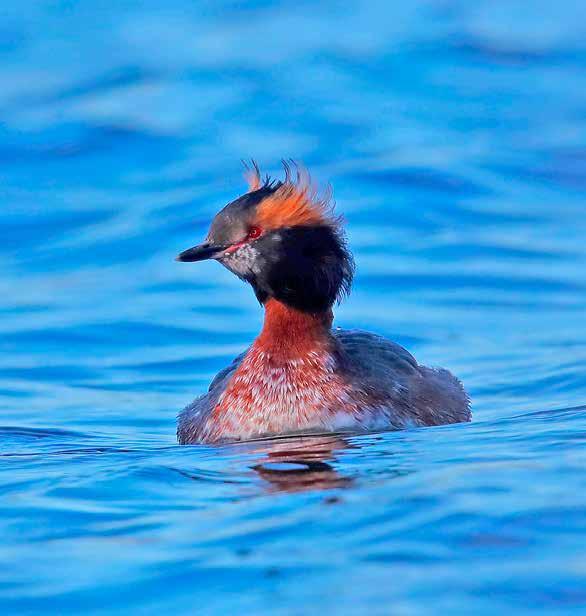

Gi Grieco
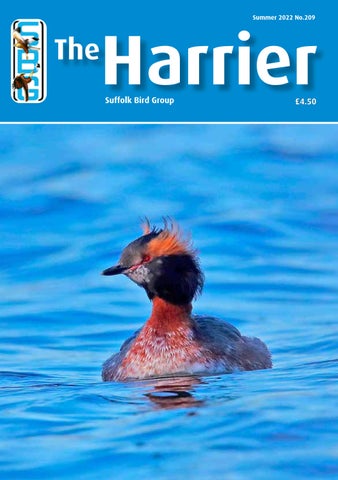
Gi Grieco
Welcome to The Harrier. The joint SBG and SWT Swift project, SOSSwifts, goes from strength to strength. We have the latest update on the project from Eddie Bathgate, along with a fascinating article on the movements of Swifts over the North Sea, by kind permission of the Essex Birdwatching Society, who had previously published it in their magazine.
In the last couple of years, there have been reports of deliberate attempts to stop Kittiwakes nesting on buildings in the UK, which have traditionally provided breeding sites for returning birds. The images of birds caught in netting have been distressing and with increased pressure via social media, it has culminated in some of these decisions being reversed. The Kittiwake article shows a more enlightened way of dealing with the issue.
Sometimes we are lucky enough to witness a birding spectacle – often even more appreciated when it is unexpected – so when a species like Bee-eater is one of your favourite birds, and when you see not just one, but a whole flock of seventeen, it is a real treat.
David Tomlinson recounts his experience of when the county had an influx of this Mediterranean beauty this Spring.
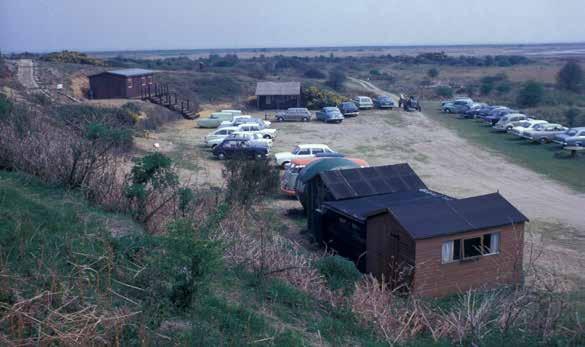
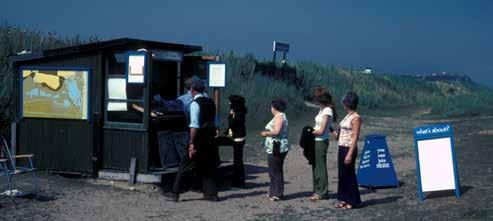
A place that has witnessed many birding spectacles, a site of national importance and one that is very dear to us Suffolk birders is, of course, RSPB Minsmere. We have an article to celebrate the 75 years of this superb reserve – plus a couple of images that may bring back memories for our older members!
Finally, there are our trip reports. There has been a great turnout for trips this year, with many new members joining to boost the regular numbers, and it is has been encouraging to see new and old faces enjoy numerous birds, beautiful countryside and good company.
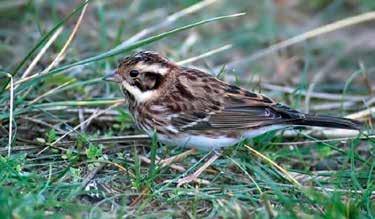
Eddie Bathgate

At the time of writing, many folks with Swift nest boxes are nervously awaiting the return of last year’s pairs. Swifts can be incredibly discreet at the start of the breeding season, spending hours in their nest site preening and renewing bonds. Without nest cameras it can be difficult to know if Swifts are present, as they frequently only access/egress very early or late, without the screaming and fanfare of later in the season.
During the spring, SOSSwifts has arranged for many more Community Sets of nestboxes and callers to be fitted throughout the county. Suitable sites are prominent elevations of public buildings, ideally where people will be able to enjoy watching Swifts display. Coddenham Country Club, West Suffolk College in Bury St. Edmunds and Suffolk Rural in Otley, along with two schools in Felixstowe and one in Woodbridge, have all installed sets this year and are now playing calls.
There are promising signs for this year. Already we have had anecdotal reports of first-time occupancy of nest boxes, from Norwich to Felixstowe. Furthermore, there are strong indications that nest box mitigation works: a nest box placed alongside a blocked-off natural nest site has already attracted occupants. SOSSwifts are working hard to reverse the steep decline in Suffolk’s Swift population.

Early July is the time to search for nest sites. Swifts are busy feeding young and the younger non-breeders are screaming around looking for future nesting opportunities. If you can, download the SwiftMapper smartphone app and use it to log Swifts’ locations. This makes for easy birding on a summer’s evening whilst enjoying their behaviour. Please do report activity at new and existing nest boxes near you.
SOSSwifts have planned a series of Swift walks and talks, with a swift pint afterwards! Dates are: Waldringfield on June 24th, Woodbridge June 26th and Felixstowe on both July 6th and 20th. Please keep an eye on our website for details, as further dates may be added.
We still have Swift Community Sets available. If you can suggest a public building with a suitable prominent elevation, where you know there is a willingness to host Swifts, please do get in contact. We are especially keen for locations in north and west Suffolk where less Swift conservation has taken place.
SOSSwifts are here to help you help Swifts!
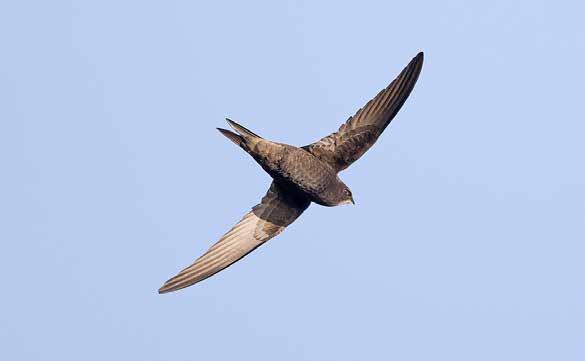
John Smart
The question has often been asked if Swifts (Apus apus apus), for whatever reason, cross over the North Sea either from the UK to mainland Europe or vice versa. Such evidence is scant but is assumed to be so. However, the North Sea Bird Club (NSBC) that operated from the various oil and gas platforms for 40 years (1979–2019) recorded the wildlife encountered. These vast oil and gas fields range from adjacent Great Yarmouth to just north of the Shetland Islands in the Norwegian Sea. The NSBC has now disbanded as the fossil fuel industry has been in retreat and platforms are being taken out of service. The wildlife observers with their identification skills were platform workers recording wildlife sightings between shifts. Thus it was effectively a long term-citizen science project. The NSBC kindly made the Swift data available.
This article presents the facts together with tentative questions and suggestions as to what could be occurring. But what is apparent is that mainly during the months of May, June, July and early August there was a small but steady trickle of Swifts recorded passing by the platforms in the middle of the North Sea. It also describes
the enormous documented southerly passage of Swifts down the UK’s East Coast and theorizes as to their origins, their purpose, and the real possibility that Swifts from the continent are involved.
Swifts sleep on the wing while ten months away from their breeding duties in Northern Europe, but their young are on the wing all year until they themselves commence breeding a few years later. Swifts usually form faithful pairs and return to their traditional breeding sites every year. They can potentially live for 20 years and winter over the African Congo Basin. Swifts, especially the nestlings, have the ability to go torpid for up to two or three days whilst their parents are foraging afar. Some breed north of the Arctic Circle – A life form that “pushes the envelope”. Here the highly complex subject of how weather systems influence their behaviour dominates. Swift strategy, other than for migration itself and avoiding dangerous weather conditions, is motivated by the quest to find aerial insect fare; especially so when they have nestlings to feed. Thus presenting the contradiction that although the birds need to avoid adverse weather
conditions, it’s that very weather created by low pressure systems that trigger the airborne insects. Weather systems over land and sea involve different dynamics that often dramatically interact at the coasts. Swifts are attracted to the advancing sea-breeze fronts where insects are swept up before and carried aloft to the “inversion level in the van of thunderstorms” (Chris Perrins). More applicable to raptors and other broad-winged bird species, thermals over an ocean are weaker than over land. However, wind speed over an ocean is typically stronger than over land. But where stable weather conditions occur, do Swifts use a tailwind for an ocean crossing at high altitude? A clue to it in principle is in a Paper by Åkesson and Bianco: insects are blown off landmasses over the ocean and it has been demonstrated by the authors that Swifts opportunistically use a “fly-and-forage” strategy. Volume 4 of the BWP describes that when severe weather events occur in northern Europe and especially so in Scandinavia and over the Baltic regions, Swifts will move considerable distances around a depression to avoid the danger. The birds fly into the wind and away from the depression to stay dry and to enter the warm sector where insects are being swept up for the hawking.
Of around 173 oil and gas platforms operating in the North Sea in 2015, 72 were periodically manned by platform workers with naturalist ID skills over a forty-year period; during which 930 Swifts were recorded over a period of 358 days:
Area 1:
128 Swift sightings from 14 platforms –average 9 Swifts per platform.
Area 2:
322 Swift sightings from 35 platforms –average 9 Swifts per platform.
Area 3:
480 swift sightings from 23 platforms –average 21 Swifts per platform.
On average, 2.6 Swifts were passing the 72 platforms per recording day: please refer to the map on previous page for an overview of the data. Of the 358 days of recording 79% were of single or two birds passing by a platform per recording day. Parties of Swifts were rarely recorded as
over 10 in number. However, a party of 20 birds were encountered passing over Area 1 on 7th July 1985 and 50 birds and 45 birds were encountered passing over Area 3 in the south on 07/07/84 and 19/07/92 respectively. The earliest encountered was on the 3rd April 1985 in Area 3 and the latest encountered was on the 5th December 1999 in Area 2. The main years of coverage were from 1979 to 2004 inclusive but thereafter became less so until 2019 when recording ceased. There were no records submitted for the year 2013.
Looking at passages by month, the seasonality is very clear:
April: 10
May: 131
June: 151
July: 443
August: 145
September: 45
October: 3
November: 1
December: 1
Some aspects of the birds’ passage were not recorded, including the direction that the birds were travelling, the current weather conditions and the hours covered during a watch. Some years were very much under recorded. The widest part of the North Sea is between Denmark and the UK with a distance of c.610km (c.380 miles). The north to south distance is c.960km (c.596 miles). The area of the North Sea is c.575,000km (c.222,000 sq. miles). It is tempting to consider factoring up the data if one assumes that a major part of the North Sea could be experiencing a similar number of traversing Swifts. Clearly, Swifts are not deterred by ocean crossings. Overall, the

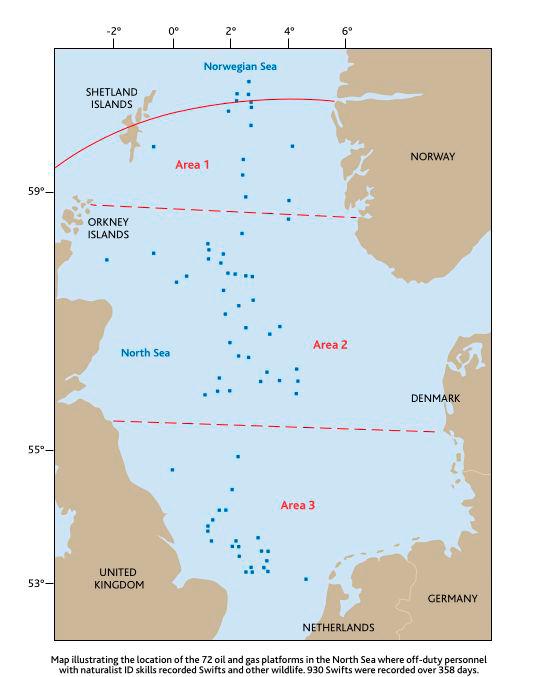
data represents a series of “snapshots” of Swifts trickling past a widely distributed location of North Sea platforms. As to be expected, the Swift numbers increased towards the southern end of the North Sea and peaked in July. That also points to the accuracy of the records. Were Swifts also passing high over in the day but out of sight of the platforms? Were Swifts passing over at night? Did only the tired ones descend to platform level? Observations confirmed that on occasion Swifts were attracted by a platform’s flares and lights. The lights had attracted insects that had been blown off from the mainland. The NSBC data pointed to the fact that more Swallows and House Martins were observed than Swifts during the same period. Owls, passerine bird species and bats were recorded as seeking refuge on some of the platforms. It is recognized that the North Sea throughout the seasons is an aerial highway for a variety of winged life forms.
Platform Gannet Alpha in Area 2:
Two Swifts with Swallows on 18/05/86.
Platform Buchan A in Area 2:
Singleton Swift hawking insects on 19/07/2004.
Platform Borgsten Dolphin in Area 2:
Five Swifts with House Martins on 19/05/2009.
Platform Arpet C in Area 3:
Two Swifts hawking insects on 12/07/90.
Platform Rough Field in Area 3:
Three Swifts circled then roosted on 11/08/90.
Platform Hewett in Area 3:
45 Swifts in three distinct groups on 13/07/92.
Some birds of various species were seen to be consumed by the flares but no large incidents were reported. Others were often seen circling the lights as per they do at lighthouses.
(A Selection of the Same Year Ringed and Recovered)
• 819396 Nestling – Ringed Siljan (Telemark) Norway 25.07.54
Found dead – Russington, Doncaster, Yorkshire 25.08.54 – 924km SW.
• K41058$ Nestling – Ringed Larkfield, Kent –30.07.58
Found dead – Markenje, Netherlands 03.08.58 –248km ENE.
• BA10205 Full grown – Ringed Fair Isle (Shetland) - 30.04.62
Found dead Nordero Lake, Storsjon, Sweden 15.06.62 – 943km ENE
• A46279 Adult – Ringed Littlestone, Kent –20.06.62
Found dead Frederica, Denmark 06.08.62 –776km NE.
• SE19642 Adult – Ringed Barnsley, South Yorkshire 24.05.66
Found dead – (Ribe) Denmark 31.07.66 – 675km ENE.
Platform flares and the distraction of lights are not the only man-made dangers that birds and bats flying across the North Sea will encounter. There are c.5000 (five thousand) wind turbines operating in the North Sea with many more destined to be installed. These are mainly in Areas 2 and 3 with many coastal offshore wind farms on both the UK and continental sides. Many of these appear to be located outside of the main oil and gas fields with the largest concentration of wind turbines over the Dogger Bank in Area 3. The maximum height of a wind turbine and its blades, installed from 2000 onwards, from the sea surface to a blade’s maximum high point is anywhere between 100metres (328ft) to 175metres (574ft) tall. And future installations will be considerably taller! Although there is no scientific quantitative data as to the extent of mortality caused by wind turbines to both birdlife and bats; they run the gauntlet nonetheless. Estimations of mortality by different authorities vary considerably from small losses to gross mortality and involve the variables of an installation’s siting, weather conditions and time of year. Thus wildlife that flies at low altitude across parts of the North Sea, and especially so in the south, now encounter a cluttered airspace.
Records are few but interesting data comes from the long-term constant effort seawatch data from Frinton-on-Sea in Essex. Swift southerly passage over Frinton can be a broad band from slightly
inland to one or two kilometres out to sea, parallel to the coast, and on occasions as far as the eye could detect via a scope. Parties of Swifts have been seen flying in-off the sea at Frinton in spring at different heights. Two other records are from the Sandwich Bay Bird Observatory where c.3,000 Swifts were recorded coming in-off the sea on the 5th July 1980 and c.4,700 coming in-off the sea on 27th June 2008. And David Lack’s “Swifts in a Tower” cites that two to three hundred Swifts arrived in-off the sea at Southwold in Suffolk on 9th June 1953. Lack also describes that there were parties of Swifts flying out to sea in the evening from the Suffolk coast that strongly suggests an eventual night-time journey. As expected, on the UK’s south coast during migration periods, Swifts arrive and depart over the sea at both low and presumed at high altitude out of sight.
From a small sample of geolocator studies by the BTO and the Lund University in Sweden, their migration routes from Europe to Africa and back have been tracked. There is a divide that commences just north of the Pyrenees where the UK Swifts continue due northwards and the continental population continue NNE. It would seem that the return journey is the reverse to this strategy. Vagrants occur: contained within the NSBC data were several references to oil rigs (mobile platforms) that were temporarily operating in the Atlantic between the Shetland Isles and the Faeroe Islands and had recorded the occasional Swift passing by. Surprising as this is, it is recorded that Swifts very occasionally turn up as vagrants over Iceland and Spitsbergen! A Pacific Swift (Apus pacificus pacificus) was found exhausted on the Leman Bank platform (Area 3) on the 19th June 1981. It was rehabilitated at Beccles in Suffolk and later released. It was later seen flying the next day. The Leman Bank platform is c.45km (28 miles) ENE of Happisburgh in Norfolk. It represented a new species for the British List.
The well documented phenomenon of Swifts heading south in considerable numbers (ref the Trektellen website) down the UK’s east coast in the months of June, July and into early August has yet to be explained. The coastal locations of Filey Brigg in North Yorkshire, Spurn (the Swift capital!)
in East Yorkshire, Gibraltar Point in Lincolnshire and Frinton-on-Sea in Essex for example, all record Swift southerly passage in their many thousands and are related to the weather conditions at the time. Passage can continue throughout the day resulting in high accumulative totals. It poses the question, where are they coming from and where are they going to? As the Swift season advances a range of behaviour occurs according to the dynamics of the species. In adverse weather conditions in the breeding area, the adults will need to range far and wide to find insect prey for their nestlings. And joining the passage will surely be the failed breeders and non-breeding birds, later to be joined by the young of the year. Using their interpretive sense of the ever changing weather conditions keeps them in contact with an insect populated airspace.
A large proportion of this passage is prior to autumn migration, tempting the speculation that the birds are seeking prime foraging areas by circulating the UK on a regional basis or even on a wider scale? Is this why on occasions our reservoirs can play host to many thousands of foraging Swifts feasting on the synchronous mass hatching of the rising non-biting midges, the chironomids? Is this a circulatory foraging route that has evolved to take in the rich potential feeding areas? How else would they know of these mass insect hatching events unless such locations were on their route? Agricultural fields of rape along with marshes can also attract considerable numbers of Swifts that feast on the periodic glut of rising insects. However, no equivalent northerly passage has been identified. Could it be that once Swifts have found a significant concentration of insects to prey upon they then disperse widely back to their nests to feed their young, whilst those without parental duties continue with the refuelling merry-goround until the act of migration calls?
Is there a “collective memory” occurring here that is kept alive over successive generations of Swifts as the long-lived adults pass on their species survival strategy to the new recruits? And is it reasonable to suggest that some continental Swifts join the UK east coast southerly passage and participate in the surmised wide.
Numbers of Swifts heading south at East Coast locations (Mainly Trektellen data)
Filey Brigg – c.16,500 on 28th June 2020.
Spurn – c.21,000 on 4th July 2010.
Mundesley, Norfolk – c.10,000 on 2nd August 1986.
Frinton-on-Sea, Essex – 13,214 on 19th July 2015 and 16,082 on 28th July 2017.
Frinton-on-Sea, Essex – 11,960 on 29th July 2021 over coastal strip and at all heights.
At Aberlady, East Lothian on the southern shore of the Firth of Forth, begs the question as to what were the origins of the c.8000 Swifts passing west in one hour on 29th July 1982?
Swift Numbers over the Essex Main Reservoirs
Numbers of Swifts recorded feeding on the synchronous hatching of zillions of rising chironomids that are periodically triggered by a particular combination of water temperature and weather conditions:
Abberton Reservoir – c.50,000 on 21st May 1987 and a similar number on the 22nd June 1996,
c.20,000 on 9th May 1968 and on 26th July 1981.
Hanningfield Reservoir – c.80,000 (an Essex record) on 24th May 1978 and c.60,000 on 18th June 1991 and 50,000 on 12th May 1995.
Abberton Reservoir (Essex) is relatively near to the east coast whereas Hanningfield Reservoir is further inland. The birds occupied the air space from skimming low over the water to a considerable height. The scale of these events, now a thing of the past in such magnitude, has been described as an “ornithological wonder”! [JS].
These events would last for several hours during which, although not verified, it is more than likely that parties of Swifts were constantly arriving and departing, thus increasing the overall estimated numbers by an unknown percentage. In recent times the enormous aggregation of Swifts over the two reservoirs has declined considerably: an academic exercise set-up for on-site fieldwork at Abberton Reservoir by “Cambridge Ecology”, scheduled to commence in 2016 was abandoned as the expected aggregation of Swifts failed to occur in sufficient numbers.
Thanks must go to Andrew Thorpe of the North Sea Bird Club for providing the raw data. Andrew is preparing an illustrated book that covers the forty years of wildlife recording from the North Sea platforms. Thanks must also go to both Brendan Ryan and Andrew Henderson of the Kent Ornithological Society and to Tim Jones of the Spurn Bird Observatory who all supplied valuable data. And thanks to Frinton-on-Sea based Paul Brayshaw who itemized various detailed observations made over the years of Swifts moving south past Frinton-on-Sea.
The following works have been referred to:
The Trektellen website for the Swift peak “passage counts” at east coast watchpoints have been invaluable. The BTO’s online Swift ringing data authored by Messrs Robinson, Leech & Clark and the BTO geolocator studies illustrated with migration maps featured in their BTO News for May–June 2012: https://www.bto.org/sites/ default/files/u49/ BTO_299_16- 17Swifts.pdf
Lund University in Sweden Migration Routes & Strategies in a Highly Aerial Migrant, the Common Swift Apus apus, Revealed by Light-level Geolocators illustrated with migration maps by Åkesson, Klaassen, Holmgren, Fox and Hendenström: https://doi.org/10.1371/journal.pone.0041195.g001
A paper by the authors Åkesson & Bianco of Lund University in Sweden who have deduced from geolocator studies how Swifts can use tailwinds at high altitude to migrate rapidly over land - May 2021
David Lack’s classic work Swifts in a Tower (reprinted in 1973 by Chapman and Hall Ltd) has been the standard reference work
Norman Elkin’s Weather and Bird Behaviour (T & A D Poyser Ltd 1983)
Birds of the Western Palearctic Volume 4 (RSPB - Oxford University Press 1985)
Chris Perrins’s article in The Migration Atlas (T & A D Poyser Ltd 2002)
The Birds of Essex by Simon Wood – Published on behalf of the Essex Birdwatching Society (Christopher Helm 2007)
Rupert Masefield, Suffolk Wildlife Trust Planning and Advocacy Manager
A Lowestoft Kittiwake Officer will engage with businesses and local community to help one of our most threatened gulls thrive in coastal town.
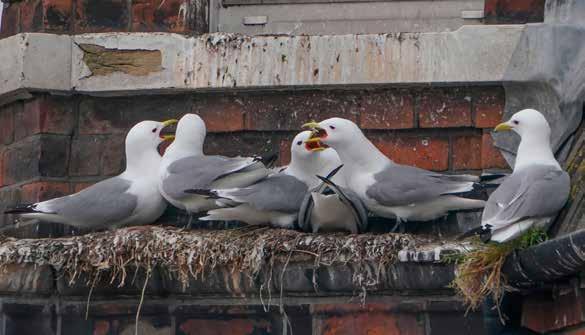
It is the last day of May, and the nesting season is well underway for Lowestoft’s urban Kittiwakes – one of the few thriving communities of this globally endangered seabird for which the UK is home to a third of the world’s breeding population.
The first confirmed records of Kittiwakes breeding in the town are from the 1950s – a few individuals nesting on the facades of buildings overlooking the town’s harbour and the sea. Today, the legacy of those early pioneers is a breeding population of birds in Lowestoft that is bucking a trend of global decline that has seen their number fall by 40 per cent since the 1970s, driven largely by climate change and food availability.
Kittiwakes’ success in adapting to life in a manmade environment is understandably
celebrated by birders and conservationists concerned with their survival but is not without its very real challenges for people living and working in Lowestoft. It costs time and money to clean up the mess that quickly accumulates on the building facades and pavements below Kittiwake nesting ledges, and a colony of noisy gulls nesting outside your bedroom window would not be most people’s idea of the perfect neighbours.
This has led some businesses and building owners to use deterrents including netting to prevent the birds from landing and nesting on buildings where they are perceived to be causing problems. The effect of this though is only to displace the highly site-faithful birds to ledges on other buildings nearby, with an added risk to the birds themselves of becoming caught in incorrectly installed or poorly maintained netting. More sustainable solutions must be found for these endangered birds to thrive at the same time as minimising any conflict with the interests of the people who live here.
In June, community charity Groundwork East will be starting to deliver much needed community and business engagement in and around the town as part of a new Kittiwake Officer role supported by a £10,000 grant from Lowestoft Town Council. Additional funding is being sought to expand and extend the role into the future as part of the work of the Lowestoft Kittiwake Partnership.
Chaired by Lowestoft MP Peter Aldous, the Lowestoft Kittiwake Partnership brings together councils, conservation organisations and businesses to work with the community to ensure Kittiwakes can continue to nest safely in Lowestoft, while helping businesses and building owners to manage the challenges of Kittiwakes nesting on buildings in a way that does not harm these fantastic birds.
The members of the Lowestoft Kittiwake Partnership are Lowestoft Vision, Lowestoft Town Council, East Suffolk Council, Associated British Ports (ABP), the RSPB, Suffolk Wildlife Trust, and Groundwork East.
Editor’s Note
Suffolk Bird Group has offered its assistance. Our input will be to help with nest site mitigation by providing ledges, small enough for them to nest but not large enough for predators to land, on suitable elevations.
The partnership can boast one success already: following intervention, netting was removed within three days of its installation, allowing Kittiwakes to return. SBG looks forward to supporting the protection and expansion of the Lowestoft Kittiwake colony.
David Tomlinson
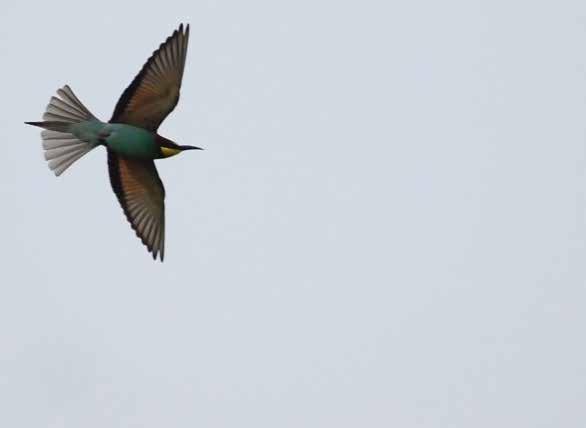
When someone discovers that you are keen on birds, one of the inevitable questions is “What’s your favourite bird?” I find it’s a difficult one to answer, as it’s often the bird I’ve been watching most recently (today it’s the Cuckoo). However, if I had to name a Top Ten, then I would almost certainly include the Bee-eater, or, rather, the Bee-eater family. I’ve been lucky enough to have seen 24 of the world’s 31 species, ranging from the big and spectacular Carmine (both North and South, as this species has been split into two), to the delightful Black, a not uncommon resident of the rain forests of West Africa. I’ve seen them in Uganda and Ghana. However, if I had to name just one member of this extraordinarily beautiful family, it would be our own European Bee-eater, which is arguably the most colourful, the most graceful, of the lot.
I had a good year for them in 2019, as I watched them on migration in Morocco and Spain in early April, then observed them on their breeding grounds in the steppes of southern Georgia in May. Frustratingly, the wretched pandemic stopped me from travelling abroad in the springs of 2020 and 2021, and with no spring trips planned for 2022, either, I was facing the gloomy prospect of a Bee-eater-less spring once again. Then, on a dull Sunday afternoon in the middle of May, the phone rang. It was Martin Tickler, an SBG member who lives at Pixey Green, midway between Fressingfield and Stradbroke. Bee-eater
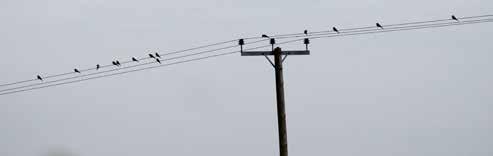
“You won’t believe this, David, but there’s a flock of nine Bee-eaters sitting on the wires in the field behind my house.” I’m not a twitcher (I didn’t go to see last year’s Icklingham Roller until the day before it departed), but the prospect of seeing nine Bee-eaters in Suffolk was irresistible. “I’m coming!” I told Martin, grabbing my binoculars and camera as I spoke.
Thirty minutes later I arrived, with my wife Jan, at Martin’s house. He greeted me on his drive. “Yes, they’re still here, and there’s 15 of them.” Fifteen? I’d have been happy with just a couple. We were led through Martin’s densely vegetated garden to a gap in the hedge, looking out over his neighbour’s fields, one of hay, the other winter barley. As we walked I could hear the Bee-eaters calling to each other, that beautiful, distinctive, rolling call which always reminds me of sun-baked hills in the Mediterranean.
Suddenly, there they were, a whole line of birds on the wires, plus individuals swooping after insects. The word swooping is often misused, but no other bird swoops quite like a Bee-eater. Martin said that he had noted that the birds were paired, as there was courtship feeding going on, with individual birds returning to their partner to present them with a choice bug. As I watched I kept on counting, not easy with so much happening, but I reached a peak of 17, a score echoed by Martin’s wife, Gay. Perhaps there was an 18th somewhere around that we didn’t manage to see.
As I was armed with my camera and long lens I was anxious to get pictures as proof of this extraordinary sight, but this wasn’t as easy as you might imagine. The wires the birds were using were about 60 yards away, while the birds themselves were surprisingly wary. As if this wasn’t a sufficient challenge, there was the light, or rather the lack of it. It was dull and flat, the sun obscured by thick cloud. If there’s a bird that needs sunlight to be seen at its best, then it is undoubtedly the Bee-eater. My dream of getting a stunning photograph to grace the cover of The Harrier, perhaps even British Birds, was not to be. I took 150 shots, of which a few were OK, but no more, and I did get a photograph with 15 birds in view at once. A picture of all 17 eluded me.
I had been enjoying watching the birds for perhaps 40 minutes when I heard the alarm calls of House Martins (Martin has a colony of between 20 and 30 pairs on his house). The Bee-eaters clearly heard the warning calls, too, as suddenly they were up and away, not to be seen again. This resolved the quandary of whether the news of their presence should be broadcast, as the lanes around Martin’s house are narrow, with no safe parking. I felt that such a large flock of such stunning birds would be bound to be reported elsewhere in Suffolk or Norfolk, but they just disappeared. Could they be nesting in an East Anglian sand pit or quarry where nobody has noticed them?
Footnote: These weren’t my first Bee-eaters in Suffolk. I saw my first at Walberswick in May 1991, while taking part in a mounted bird race. I still reckon that not many other people have ever watched a Bee-eater from the back of a horse in Britain. Not many have seen a flock of 17, either. Nick Moran of the BTO believes it’s the biggest flock in the UK this century, and the second biggest ever. The record, a flock of 18 birds, was seen in Oxfordshire in 1997, so we only missed equalling the record by one bird.
Ian Barthorpe
In the spring of 1947, a top-secret mission was underway on the coastal marshes of Suffolk. Nick-named ‘Operation Zebra’, it was co-ordinated not by the army but by a dedicated team of local birdwatchers. Its aim was to protect a handful of pairs of elegant black and white birds that had been discovered nesting on the marshes, and so began a remarkable double success story.
The birds in question were avocets, the first to nest in the UK in 100 years and the site was RSPB Minsmere.
Leap forward to 2022 and RSPB Minsmere celebrates its 75th anniversary with the return of the avocet, just one of many conservation successes. Bitterns, marsh harriers and bearded tits all owe their continued existence in the UK to the conservation work undertaken at Minsmere.
In total, more than 6,000 different species of wildlife have been identified since a management agreement was first signed with the Ogilvie Estate on 25th April 1947. These include almost 350 birds, more than 1,000 different moths, and a superb variety of plants, making this the most biodiverse RSPB nature reserve of all.
Despite this, it hasn’t all been plain sailing. Red squirrel, lesser spotted woodpecker and willow tit are long gone, as well as breeding woodcock, spotted flycatcher and grey partridge - reflecting the nationwide declines in all these species. In their place have come Cetti’s warblers, Mediterranean gulls, willow emerald damselflies, Norfolk hawker dragonflies and antlions.
The incredible diversity at RSPB Minsmere is a great reward for the thousands of
hours of dedicated work by RSPB wardens, volunteers and researchers, as well as the skills of visiting birdwatchers, botanists and entomologists. It also reflects the variety of habitats, from the vegetated shingle beach, brackish lagoons, freshwater reedbeds and coastal grazing marshes to deciduous woodland and Sandlings heath.
Size helps too: RSPB Minsmere now covers 1,000 hectares (2,500 acres) of the Suffolk coast. Add in the nearby reserves at RSPB Dingle Marshes and RSPB North Warren, as well as parts of Dunwich Forest managed by the RSPB, plus land managed by other conservation organisations, and it’s easy to see why the Suffolk coast is one of the most important areas for conservationists and wildlife enthusiasts in the whole of the UK.
Perhaps Minsmere’s best-known habitat is the Scrape: an artificial coastal lagoon, excavated in the 1960s by pioneering warden Bert Axell. Four spacious hides and a viewing platform overlook the Scrape. The most popular hide, East Hide, has just been made bigger, ready for the planned construction in autumn 2022 of a new, fully accessible path from the North Wall.
May brings the biggest variety of birds to the Scrape: nesting gulls, terns and waders. The dominant birds are the black-headed
gulls, their raucous calls being the backdrop to Minsmere’s remarkable soundscape. Look carefully among them for the true “blackheaded” gulls: Mediterranean gulls.
Perhaps more unexpectedly, you may hear the distinctive calls of kittiwakes. These dainty gulls often gather on the Scrape to rest and collect nesting material, before returning to their colony on the outfall rigs at Sizewell. In 2019 three pairs even built nests on the Scrape!
Ardent larophiles have also been rewarded for their many hours scanning through gull flocks with regular sightings of yellowlegged, Caspian, Iceland or glaucous gulls, as well as rarer species such as Audouin’s, slender-billed or Kumlein’s gulls.
Little terns previously nested on the shingle beach before coastal erosion rendered this less suitable, and these diminutive seabirds have recently begun to nest on the Scrape’s shingle islands alongside the much bigger common and sandwich terns. Check the terns carefully, for black, Arctic and roseate terns are regular visitors throughout the summer, as are varying numbers of Little Gulls. Rare terns in recent years have included gullbilled, Caspian, lesser crested and whitewinged terns.
Whilst avocets may steal the limelight, they are far from the only waders present. Lapwings, redshanks, oystercatchers and ringed plovers all nest, and black-tailed godwits are almost ever-present. Spring wader passage peaks in early May with brick-red bar-tailed godwits, knots and curlew sandpipers, colourful turnstones and black-bellied dunlins and grey plovers. Blackwinged stilts and red-necked phalaropes are possible too.
The first returning southbound waders begin to arrive by mid-June: spotted redshanks in their jet-black breeding plumage, ruffs sporting a myriad of colour variants and bobbing green and common sandpipers. Later in the summer they will be joined by little stints, curlew sandpipers and little ringed plovers. Check carefully for rarer visitors from both east and west: marsh, Baird’s, whiterumped, semi-palmated, pectoral sandpipers or lesser yellowlegs.
One of the most important habitats is the vegetated shingle along the beach. Salttolerant plants thrive here, such as sea kale, yellow-horned poppy, and sea holly. One or two pairs of ringed plovers nest on the beach and snow buntings often visit in winter.
Stonechats, whitethroats, linnets and sometimes Dartford warblers nest in the gorse along the dunes where migrants such as wheatear, whinchat, and yellow wagtail might be found, and even a wryneck or a red-backed shrike. Mega rarities here have included the UK’s third Siberian blue robin and Suffolk’s first Cretzschmar’s Bunting.
Offshore, Sole Bay is a stronghold for wintering red-throated divers and great crested grebes, while autumn storms may bring skuas, sooty shearwaters or little auks close to shore. Grey seals and harbour porpoise are regular visitors and even a humpback whale has been spotted offshore.
Also important is the vast freshwater reedbed stretching more than a mile inland. Minsmere’s reedbeds have been instrumental in the survival and recovery of three bird species that came perilously closely to extinction in the UK: bittern, bearded tit and marsh harrier.
All three species are now easily seen throughout the year. Though a sighting can never be guaranteed, Minsmere’s bitterns have gained quite a reputation for breaking the rules because, instead of skulking deep in the reeds, they regularly spend extended periods feeding in the open close to the Bittern or Island Mere hides. So close, at times, that it’s possible to take a half decent photo with just a mobile phone, while the big lens photographers moan about having the wrong lens!
Other reedbed highlights include breeding reed, sedge and Cetti’s warblers, reed buntings and water rails. Up to three Savi’s warblers are usually present in spring, and otters are often seen by day.
Purple herons are annual visitors; great egrets are becoming more frequent and one reedbed pool famously attracted a blackbrowed albatross and western swamphen in consecutive summers!
Hobbies are among the star attractions in spring and late summer, drawn to vast numbers of dragonflies, swallows and martins feeding over the reserve.
Sand martins nest in a large colony in a low bank beside the visitor centre and the bare sand beneath this cliff is a good place to look for green tiger-beetles and basking adders. Nearby, a sandy path through the North Bushes is nicknamed Digger Alley due to the superb variety of digger wasps and mining bees that nest there, including bee-wolves, pantaloon bees, green-eyed flower-bees, and ruby-tailed wasps.
The unusual antlion first colonised the UK at Minsmere in 1996, and their larval pits are easily seen alongside the visitor centre. Butterflies include white admiral, silverwashed fritillary and purple hairstreak, while day-flying moths include hummingbird hawkmoth, broad-bordered bee-hawkmoth and six-belted clearwing. In late summer, look for the huge and impressive great green bush-cricket or aptly named wasp spider.
Minsmere’s woodlands often play second fiddle to the wetlands, but here you can find some impressive displays of bluebells and look for redstarts, willow and garden warblers, blackcaps, treecreepers and great spotted woodpeckers. Nuthatches and marsh tits can often be found on the feeders at the visitor centre.
Nightingales have returned to breed near the car park entrance in 2022, and are also easily located around Westleton Heath, but turtle doves have become very scarce, just as elsewhere in the UK. The heath is also a great place to spot woodlarks, Dartford warblers, cuckoos and silver-studded blue butterflies, while a dusk visit in summer should produce churring nightjars and perhaps a calling little owl. In autumn you can experience the spectacular red deer rut from here – or book a 4x4 tour with an RSPB guide for unrivalled views.
Westleton Heath forms part of the formerly extensive Sandlings heaths, a unique mix of heather and dry acid grassland. Since the 1990s, the RSPB has been instrumental in expanding the area of Sandlings heath by reverting arable fields and conifer woodland back to heathland.
One of the main beneficiaries of this arable reversion has been the bizarre goggle-eyed plover, better known as stone-curlew. The first pair returned to nest at Minsmere in 2003, after an absence of about 35 years. Although shy and easily disturbed, at least
one pair is usually viewable. Please ask at the visitor centre for details when you visit. Of course, over the past 75 years, many of Minsmere’s wardens, volunteers and visitors have taken their rightful place in the annals of this amazing reserve, too. Many regulars will have their own tales of encounters with Bert Axell, Jeremy Sorensen or their contemporaries, or fond memories of John Denny informing all visitors that a Marsh Harrier was flying past!
We love to hear these stories of Minsmere’s past, to celebrate the successes of the present, and to look forward to the excitement of the future. Please share your own memories of Minsmere with us by emailing them to minsmere@rspb.org.uk, or sharing them using @RSPBMinsmere on Facebook or Twitter.
Not surprisingly, given this wealth of wildlife, RSPB Minsmere has many national and international wildlife designations, and is one of only five Council of Europe Diploma sites in the UK. Despite this, its future is not secure in the face of climate change, rising sea levels, and proposals to build Sizewell C nuclear power station at its southern boundary. To keep up-to-date with Sizewell C developments and our Love Minsmere campaign, visit www.loveminsmere.org
Minsmere is open daily, from dawn to dusk, except 25th & 26th December. There is a large RSPB shop and café (the cheese scones are legendary). Three nature trails take you to seven spacious hides, and many miles of public footpaths cross the reserve. There is an extensive programme of guided walks and family events to celebrate Minsmere’s 75th anniversary. For opening times, entry fees (free for RSPB members) and guided walk bookings, see www.rspb. org.uk/minsmere
Top
Top
Bottom
Bottom
Val Lockwood
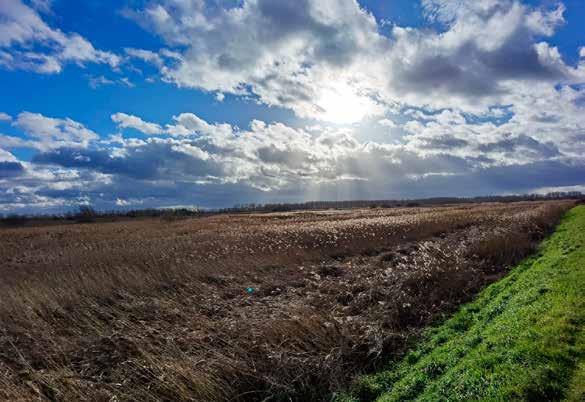
We arrived early at Lakenheath Fen wondering if any other SBG members would venture out on such a cold, wet and windy day. As we made our way back from the centre (after confirming the group’s arrival, as requested by the wardens on our previous recce), we were surprised and very pleased that a large group of members had assembled in the car park.
After running through H&S and our plans for the day, which we explained could be subject to change depending on the weather conditions, we made our way towards the riverbank in the direction of the entrance to the reserve. Mercifully the rain had stopped, but the wind was really strong and very little was seen as we walked through the woods. Thankfully this changed when we reached the riverbank, where a large flock of around 100 Siskins were seen and heard and a Lesser Redpoll was spotted and seen by many of the group. After admiring the Siskins and enjoying the wonderful sound of their collective calls, we made our way along the riverbank towards the reserve. In the washland pools we picked up Shelduck, a Little Egret and enjoyed looking at the Gadwall ducks and commented on their resplendent plumage. At various points along the river wall we picked up a male and female Stonechat, a Reed Bunting, several Meadow Pipits and
flushed a Common Snipe. A stop-off at one of the larger pools paid off dividends as fine views were seen by all of a Water Pipit feeding along the muddy edges of the pool. After we had all seen the Water Pipit we turned back towards the car park for lunch and were glad to be able to get some cover for a short while.
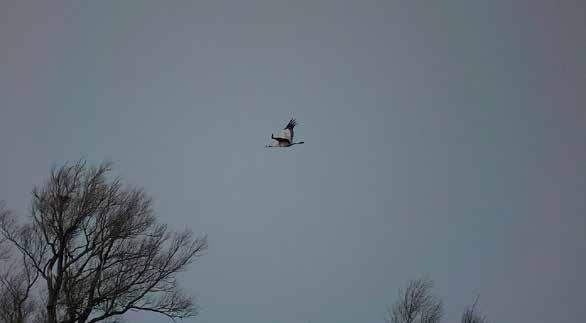
After lunch we headed for Joist Fen viewpoint at the far end of the reserve as planned, but decided to go via the main centre track and return back on the river wall if the wind had receded later in the day. Unfortunately, there was little relief from the really strong gusting winds when we reached Joist Fen hide, as we were looking straight into the wind. After a short while we decided to head for the riverbank which made it easier to use our scopes as we were not facing directly into the wind. We spoke to an RSPB warden leading a field trip who had just seen Cranes further along the river and he also thought that there might be Whooper Swans beyond the Cranes. From the river wall we had excellent views of Great White Egrets, Marsh Harriers, a flock of Redwings and also heard the squealing of a Water Rail. We soldiered on and eventually spotted the Cranes on the other side of the river, grazing in a rough pasture meadow. We were amazed that everyone had braved the awful weather
conditions and battled on against the wind to see the Cranes. By this time the skies were darkening and four stalwart members decided to call it a day.
The remainder of us walked on: a comment was made about soon being able to see Ely Cathedral if we walked much further, we all laughed. At last we found the swans and confirmed they were Whooper, plus a couple of Mute Swans too. After all the group had finished admiring them we decided to begin our return walk to the car park as time was pressing on. We had just started off on our return route when a Merlin was spotted on the opposite side of the river. We were so engrossed with looking for the Merlin that we barely noticed that it had started to hail until the wind got up and we were all covered in a blizzard of white, which somehow managed to get behind collars and into the tops of wellington boots…... Undeterred by these extreme weather conditions we continued to scan the meadows opposite and quite remarkably in addition were treated to views of a ringtail Hen Harrier as it quartered the field, plus Kestrel and a Peregrine Falcon - all within about 20 minutes. Following the hailstorm
there was an incredibly bright double rainbow over the reserve, which we spent time admiring and a couple of members enjoyed taking photos. Whilst we were on the river wall we saw an amazing amount of Great White Egrets, including five up in the air together. We recounted how not too many years ago these would have been twitched. It was impossible to say exactly how many we had seen over the course of the day as they were quite mobile, so there was no way of knowing if we were counting some we had already previously seen. Even though we were all feeling extremely cold we were reluctant to leave the river wall as there had been so much to see in a short space of time. One new member said that they felt like they needed to take time to compute all that they had just seen. Later, on reflection, it felt quite surreal that we had been treated to such a great day out in the field when we had even considered calling the trip off earlier in the day, due to the awful weather conditions and forecast for worsening weather throughout the day.
Many thanks to all who took part and helped to make the day so memorable.
Leader: Gi Grieco
This trip is always eagerly anticipated, as we visit an area where we can look for some specialist bird species not generally encountered elsewhere in the county. Sadly, one of those species, Willow Tit, has now disappeared from the county and the Lesser Spotted Woodpecker population is much reduced and restricted – to think I could see them in the middle of Ipswich in both Christchurch and Holywells Parks in the 80s. Additionally, the trip was cancelled last year due to the Covid situation so it was great to see 28 people arrive for the trip – the largest attendance for many years.
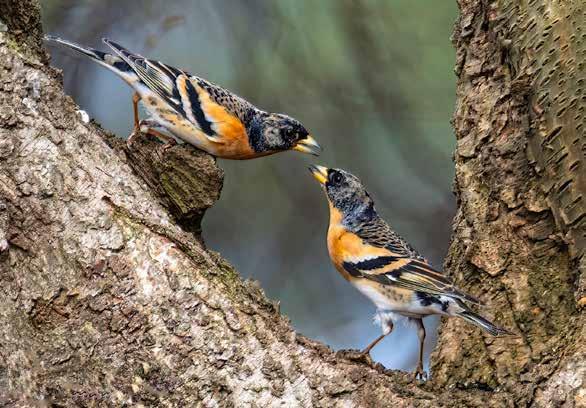
As we assembled in the car park the first species we encountered were two Grey Wagtails that flew in and showed well as they landed on the old shop roof. In the surrounding trees we heard Nuthatch, Song Thrush and Greenfinch. We headed down to the Little Ouse river footpath, stopping off at the garden feeders noting a few finches and tits. Once along the path we had to spread out due to numbers but thanks to Dave for assisting at the back of the line. We had heard a couple Siskins and then the harsher call of Brambling and we managed to see a couple of birds in some trees – they can be very unobtrusive. Further down the path a Lesser Redpoll showed well to most of the
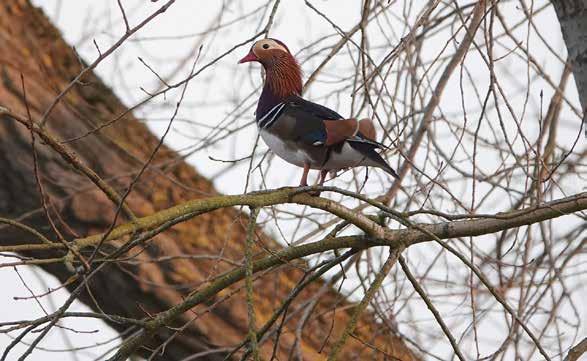
group and a couple of Marsh Tits were calling as they worked their way amongst the Poplars. In the reed area we normally encounter Water Rail and hear Woodlark towards the rail line but no luck this time; the weather was dreary so it seemed species were not as vocal or showy as we have noted in the area on previous trips. A pair of Mandarin Ducks were seen up in one of the Poplars and we saw them a couple of times later on too. We reached an area where we spread out to scan the woodland but unfortunately were not successful in seeing Lesser Spotted Woodpeckers. We did note two other woodpecker species, Green calling from across the river and at least two Great Spotted seen. We did get to see Nuthatch, Stock Dove and, for many, hear their first Chiffchaff of the year. On heading back, the twittering of large numbers of Siskins were heard in the Alders across the river and as we stopped to look at them a number of Redwings were present on the ground beneath.
Back at the car park we decided that for our next destination, in Thetford Forest, we should park in two locations due to car numbers, and reconvene to carry on. We had a Kestrel hunting and a Buzzard over but the real excitement was to hear large numbers of Siskins in the trees.
We scanned a few puddles along the track and Siskins, Chaffinches, Coal and Great Tits came down and we did briefly have Brambling too. We carried on to an open area to give us a vista to scan the skies. We had seen a few Buzzards and had admired a Yellowhammer nearby when Ronwyn called “what’s that raptor coming over the trees”. It was a Goshawk, another of those species encountered more in the west of the county and one of our target birds. We had good views and could discuss identifications for newer members who were not familiar with the species. We had a fewer smaller birds over, including two Crossbills. Compared to Siskins they had been much scarcer in the forests this season. We got to see Skylark and then eventually a Woodlark – a species we had been hoping to see. The walk back was again filled with good numbers of birds in the forest and we did manage to see a further two Crossbills.
Richard Smith
Richard Smith
After an early inland frost, 24 group members gathered in Suffolk Wildlife Trust’s Carlton Marshes car park on a glorious, still and sunny spring morning, full of anticipation for the day ahead. For some this was a familiar site, for others a new reserve, at least in its muchimproved post-lottery-funding guise. This was the first SBG spring visit here for three years thanks to the ravages of the pandemic, so it was great, though not in the circumstances, totally unsurprising, to see such a large turnout from folk across the county.
Now, it’s always good to have a plan of action, a schedule, a designated route, when leading these walks; all of which though are liable to change at short notice - the nature of birding I suppose. This trip was no exception, with plans made, changed at the last moment and then changed again. The original intention had been to take a leisurely walk, taking in some of the reserve’s less familiar areas, before ending up at Peto’s Marsh, the extensive wetland area that has been brilliantly envisioned and now established through the help of the
Some of the group called it a day while the remainder moved onto Cavenham Heath. The weather was starting to turn from dreary grey to darker skies with onset of showers. With patience we got to find two Stone-curlews plus added Stonechat to the list of species. In the past we’ve often encountered our first Wheatear of the season at this site but the weather was not conducive this time. We used to scan the pits from a track near to the river but over time scrub has grown up to block the view, therefore we headed through the birch wood to scan the area where further gravel extraction has taken place. Despite the increasing rain we saw Green Sandpiper, Shoveler, Teal and Shelduck. We called it a day but not before finding a Grey Wagtail at Temple Bridge – thus a bird that started and ended the trip. All in all, a mostly successful trip, good to meet up and also show some new members a different area for birding.
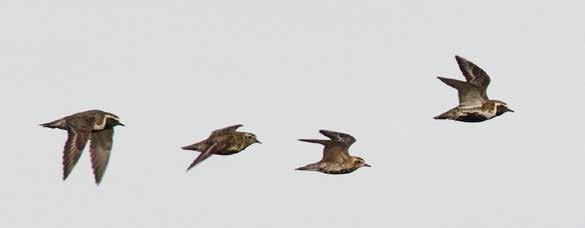
aforementioned lottery funding, plus a great deal of dedicated work by SWT staff and volunteers. As people began to arrive however, news from other birders already out on Peto’s, put the wisdom of this plan into severe doubt. A Pacific Golden Plover that had been a regular visitor to the Marsh for the preceding six evenings, decided that today was the day for an early morning drop-in instead. Surely it would be better to make this our initial goal? So, plans were quickly re-assessed and we decided instead to have a quick walk along the main track, hopefully catch up with the PGP on Peto’s and then basically turn the day on its head and have our more ‘leisurely’ stroll on our return journey to the centre.
All good. Or so we thought, but for the fickle nature of birds and birding! Just prior to setting off, another phone call revealed that the Plover had flown off high to the south, presumably to resume its normal habit of daytime feeding on the surrounding farmland. Disappointing news, but the consolation was that Plan A was now firmly back on the agenda!
So off we set, half expecting further updates on the Plover, initially taking in some of the newly opened paths that run through meadows at the back of both Spratt’s and Round Water, before linking into the old path from the centre heading south. Here, the sounds of spring were quickly evident, though it was, as is often the case in spring, ‘sounds’ rather than good or prolonged sightings. Chiffchaffs were soon in evidence and so too was a singing Blackcap, which just gave the briefest of glimpses to a lucky few. A Great Spotted Woodpecker drummed loudly in the alder tops before flying deeper into the carr; an unseen Green Woodpecker yaffled distinctively and a distant Mistle Thrush sang loudly from across the railtrack. Our only Muntjac of the trip was seen here too.
As we approached Round Water, a Canada Goose sat defiantly on its nest at the back of the pool and many people were able to hear their first Sedge Warbler of the year singing nearby. Typical of newly-arrived birds, the song was a little half-hearted and the vocalist lacked the courage or confidence to sing from an open perch as it remained unseen in the depths of the waterside herbage. Surprisingly, this was to be the day’s only ‘sedgy’. From here, we joined the original Spratt’s Water footpath and walked back towards the visitor centre a short distance in the hope of connecting with the Siberian Chiffchaff that had spent much of the winter in the sallows alongside the path and had still been present the previous weekend. Sadly though, it was not to be, though this slight detour did give the opportunity for some to climb the Tower Hide. This gives splendid panoramic views across the southern part of the reserve, beyond Castle Marshes towards a distant Beccles parish church tower and for today, brief views of both Kingfisher and Little Egret, plus longer views of some of the many Chinese Water Deer that have become such a feature of any day at Carlton.
From here, we retraced our steps and picked up the Share Marsh track, taking in the Lookout Hide and its attendant Barnacle Geese and picking up our first Marsh Harriers and Buzzards on the way. I still don’t quite know how, but 24 pairs of eyes somehow managed to totally miss the Red Kite which other birders told us was heading our way from the direction of Peto’s! The Share Marsh track gave us another opportunity to see some more of the improvements to the reserve, as it overlooks newly acquired marshes to the south. These have been developed into a patchwork of scrapes, pools and reedbeds to encourage both breeding and passage wetland birds, not to mention a wide variety of dragon and damselflies, for which Carlton is becoming increasingly famous - 28 species and counting! Sadly, the fairly cool recent weather prevented any from putting in an appearance today. At the Octagon platform which overlooks the original Carlton scrape to the north and new scrapes on Share Marsh to the south, we were afforded some excellent and prolonged views of a Bearded Tit.
From the track, we eventually climbed onto the river wall, which can be followed all the way to Beccles and beyond, but we were content to take in the splendid views across Share Marsh from here, before heading north towards Peto’s. It’s incredible to believe that only a handful of years ago, this diverse wetland jewel of around 200 acres (80 hectares) was one vast, fairly lowgrade arable field. Years before SWT managed to purchase the land, I well remember having conversations with friends, fantasising about how wonderful it would be if one day, some conservation body were to acquire the site……... you see, sometimes dreams do come true!
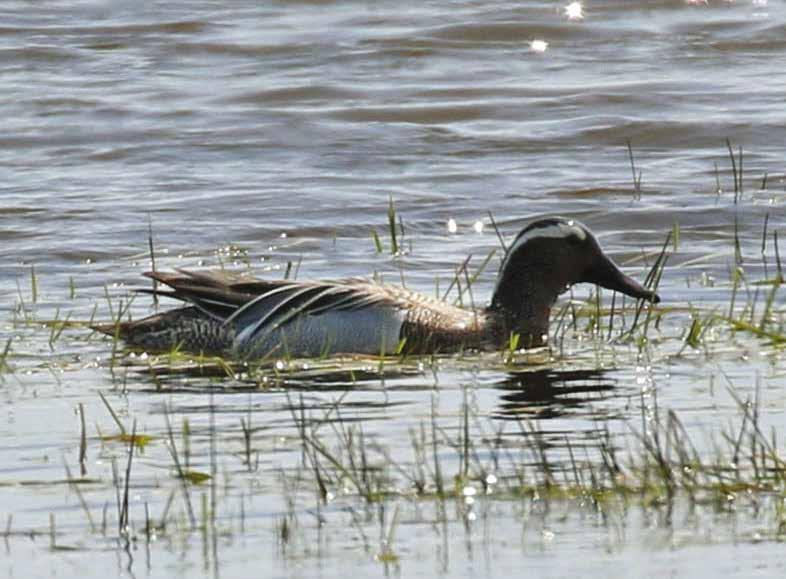
As usual, Peto’s did not fail to impress either aesthetically or ornithologically. A wonderful mix of ducks including Shelduck, Pochard, Tufties, Shoveler, Teal, Pintail, Wigeon, and Gadwall were perhaps eclipsed for many by two pairs of Garganey. In an exceptional spring for this species up to nine birds had been gracing the reserve. One pair were constantly active in front of North Hide, providing a wonderful distraction as we tried to partake of lunch. The male bird provided me with my personal highlight of the day when he briefly made his distinctive croaking rattle, something I’d never been fortunate enough to have heard before! One can only wonder how many of these ducks will remain on site as breeding birds.
Not to be outdone, waders also featured well, with a good mix of both passage birds and potential breeders, including Blacktailed Godwits, a single Snipe, Oystercatchers, Lapwings, c.30 returning Avocets, plenty of Redshank and, after a great deal of searching, a single Little Ringed Plover. On our arrival at Peto’s not a single Golden Plover was on site,
but later pulses were sent racing and eyes scanning, when a group of 14 dropped in. Despite our hopes, the Pacific was not amongst them, nor was it with the flock of 57 more that subsequently joined them. Needless to say, of course, it was to return much later in the day, long after the majority of us had departed! To complete the scene, we were also serenaded (?) by calling Water Rails and had numerous opportunities to observe, often at quite close quarters, a fine Glossy Ibis, which had been present either on Carlton or on the nearadjacent Oulton marshes for much of the winter.
Our stroll back to the visitor centre and for some a well-deserved coffee and cake, gave ustime to reflect on the day; as well as around 75 species of birds and plenty of deer, the group had also managed to see several butterflies (Peacocks, a couple a Small Tortoiseshell and a single Red Admiral). All in all, a great day, at what must surely already be one of East Anglia’s premier wetland reserves, with plenty to see, fantastic weather and above all, some very good company.
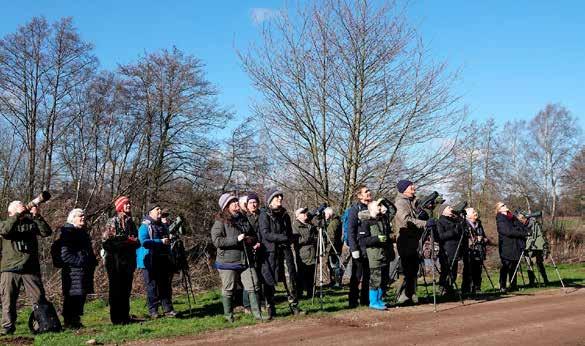
It was good to a see large turnout [25] on a nice spring morning at Daisy’s Walks car park including several new members. Heading north along the edge of Rendlesham forest we quickly noted a distant Yellowhammer and singing Goldcrest although it was tricky to see amongst the pine branches. Also singing was a Woodlark which was eventually found on the edge of the arable field. With the use of telescopes, we located two birds, presumably a pair holding territory, which gave all the group good views. The spring weather brought out many species to start confirming their territories such as Chaffinch, Robin, Blue Tit and Coal Tit in abundance around the forest edge. Reaching the Wantisden Valley we turned east on the Sandlings footpath towards Staverton Lakes noting a couple more Goldcrest and two very obliging Treecreepers. We noted a few Fieldfare loitering with a group of Starlings at the top of a hedgerow together with a distant singing Mistle Thrush.
Staverton Lakes held a number of species including Teal, Gadwall, Mute Swan, Greylag Goose and a pair of Little Grebes together with several pairs of Shelduck looking pristine for the breeding season. A few more Fieldfare were noted “clacking” at the top of some Alders preparing no doubt to migrate back to Northern Europe. The key species in the area of the lakes are Siskin and Redpoll both of which regularly winter here. About five or six Siskin were noted; Lesser Redpoll was also suspected to be present but could not be positively identified amongst the Alders. Heading back the way we came, a Common Buzzard was seen displaying to his partner with another Woodlark singing directly above us offering views of the short tail. As we arrived back into Rendlesham Forest another pair of Treecreepers were noted, again affording excellent views. Also noted briefly, but not to all of the group, was a Common Chiffchaff. The meeting ended with some fine views of Common Buzzard from the car park
The quarterly review section gives a snapshot of birds seen within the county during the period, predominantly from data received by Suffolk BINS. All scarce and rare birds are subject to submission and acceptance by either SORC or BBRC. Updated lists on Accepted and Outstanding Records for previous years can be found on the SBG website - http://www.suffolkbirdgroup. org/bird-recording.
The month was characterised by frequent strong winds, with both Storm Eunice and Storm Franklin bringing very high winds to the county. Wintering birds were still in evidence although as per the rest of the winter visiting geese numbers were generally low.
Notable February sightings
Pink-footed Goose – up to three at Aldringham on arable land north of the B1353 (1st to 21st). Three flew south Corporation Marsh, Walberswick (26th).
Tundra Bean Goose – two on North Marsh, Walberswick (2nd).
Whooper Swan – seen in the county throughout the month at Minsmere (up to nine) and at Lymballs Lane, Westleton (up to eight). One at Falkenham Creek (11th) and 17 flew west over Westleton (23rd).
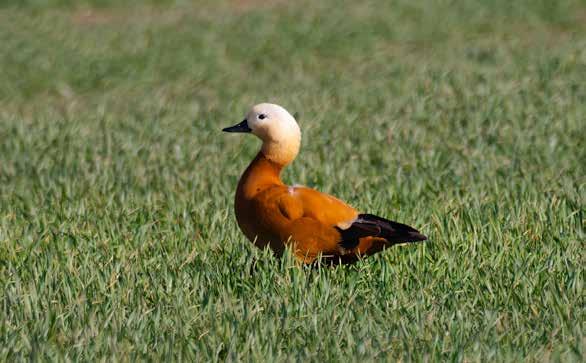
Ruddy Shelduck – one between Flempton and Risby (14th) and one on Cavenham Pits (19th).
Smew – a pair around Minsmere (13th to 28th).
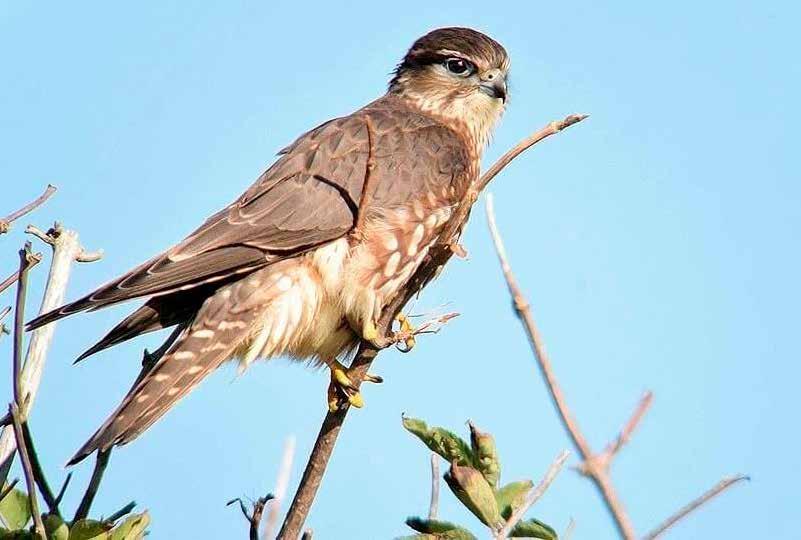
Merlin
Slavonian Grebe – one in Holbrook Bay (7th).
Glaucous Gull – a second-winter seen on a few dates at Hen Reedbeds (7th to 17th).
Caspian Gull – a first-winter at Hollesley Marsh (12th).
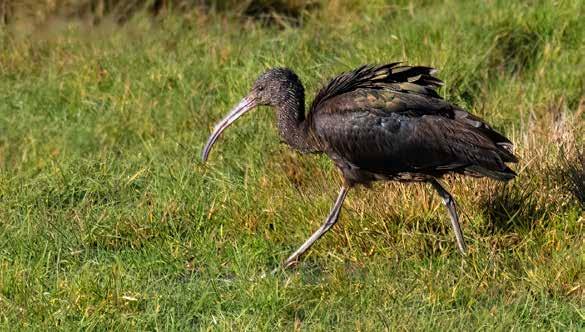
Glossy Ibis – one north over the A12 at Blythburgh (3rd), one present at Walberswick Town Marsh (6th to 28th) plus one regularly at Peto’s Marsh.
Cattle Egret – one at Sudbourne Marsh, near Crag Farm (5th to 11th). One in meadows at Sudbury (17th) and one in trees at Long Melford country park (20th).
Long-eared Owl – one seen hunting by the A144 between Spexhall and Westhall rail bridge.
Waxwing – a single bird in a garden at Bucklesham (1st-2nd) and one low over Wangford (22nd).
Tree Sparrow – c.30 in a mixed finch flock at Tuddenham St. Mary (2nd).
Brambling – c.350 in a mixed finch flock at Tuddenham St. Mary (2nd).
Hawfinch – up to 16 at Sotterley Park (2nd to 13th).
Scarcer February sightings
Ring-necked Duck – a drake bird was found on an irrigation reservoir on Aldringham Walks (5th). It remained throughout the month although needed some climbing skills – the reservoir is private so viewing was done by climbing an adjacent Sycamore tree to view it!
Black-throated Diver – just three sightings this month after the regular over-wintering bird on the Orwell being present. One on the river off Landguard Bird Observatory (8th), one on the sea off Felixstowe by a sand bar (10th) and one north close offshore past Dunwich (21st).
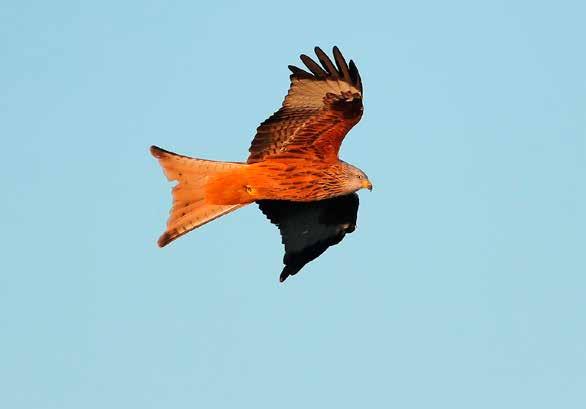
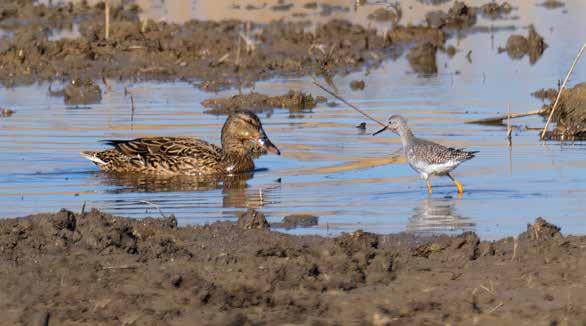
Lesser Yellowlegs – the bird from the January remained at Minsmere throughout
the month. Often seen on Lucky Pool, it could be elusive if on the south levels but also showed better on the Konik field pool and south scrape.
White-tailed Eagle – bird G463 from the Isle of Wight reintroduction scheme was seen around Westleton Heath before roosting in Dunwich Forest (1st).
Siberian Chiffchaff – one was at Brantham sewage works (1st). The bird previously present at Thorpeness sewage works was seen on four dates (3rd to 8th). At Melton sewage works was also noted on one occasion (11th).
The first spring migrants started to arrive –Stone-curlew, White Wagtails and Fircrest, followed by Swallows and Sand Martins. Long-staying rarities allowed many to catch up with them.
Notable March sightings
Pale-bellied Brent Goose – one opposite Falkenham Marshes (7th).
Bewick’s Swan – up to seven at Lymballs Lane, Westleton (up to 7th) with the same
birds roosting at Minsmere. A first-winter bird at Kingsfleet on the Deben estuary (30th).
Whooper Swan – up to eight still present in fields along Lymballs Lane, Westleton (up to 7th), eight at Minsmere (6th) and two on Island Mere (13th and 21st), 15 flew west over Blackheath, Wenhaston (7th) and an adult on Gifford’s Flash, Higham (12th and 19th) with the same bird at Thorington Street (19th, 28th-29th).
Garganey – throughout the month on Peto’s Marsh, reaching a maximum count of six. Also present at Minsmere, Lakenheath Fen (up to 7), Boyton Marsh, Sandymount Covert, Walberswick (up to 8), Hollesley Marsh, a drake at Pipp’s Ford and Trimley Marsh.
Red-crested Pochard – a male and female at Gifford’s Flash (14th) and a drake at Baylham causeway lake (21st).
Smew – male and female at Minsmere (3rd to 26th).
Slavonian Grebe – one on Holbrook Bay (2nd to 7th) with three at Stutton (3rd).
Black-necked Grebe – three on the reservoir at Trimley Marsh (30th-31st).
Glaucous Gull – an immature flew out from the river, Felixstowe (13th).
Iceland Gull – a second-winter in to roost at Livermere Lake (13th, 18th-28th).
Caspian Gull – noted at a few sites throughout the month – Ellough, Hollesley Marsh (up to nine), Great Livermere Lake (up to eight), Pipp’s Ford and Lowestoft north beach.
Great Northern Diver – one of Stutton (3rd4th).
Glossy Ibis – single birds throughout the month at Walberswick Town Marshes, Minsmere and Peto’s Marsh.
Cattle Egret – one on Sudbourne Marshes opposite Crag Farm (2nd-8th).
Osprey – one high over the Blyth estuary (3rd) and one south over Felixstowe Ferry (24th).
Shorelark – one by Kessingland shore pools (18th to 28th).
Mealy Redpoll – one along the river path at Santon Downham (28th).
Scarcer March sightings
Ring-necked Duck – the drake bird remained until mid-month (13th) on the irrigation reservoir on Aldringham Walks.
Black-throated Diver – one was noted north offshore at Dunwich (29th).
Lesser Yellowlegs – the bird remained around Minsmere reserve, mainly on Lucky Pool but sometimes closer on the Konik field.
White-tailed Eagle – one was seen over Southwold (17th) with probably one at Knettishall the same day. One was seen heading south over Mutford (28th), bird G463 visited the county again - on the Blyth estuary before roosting on the Henham estate. Probably the same bird noted over Minsmere the following day then on Orfordness later on.
White Stork – a few sightings this month; one at Eastbridge on a flooded meadow (10th). It had a blue ring with code GB1N, that showed it was from the Knepp White Stork Project. One in a field at Eye (14th-15th).
One on arable land at Little Whelnetham (18th) before flying off and one over Lakenheath, heading north-west (21st).
Little Bunting – one was found at Knettishall airfield (7th) but was very elusive. It was seen briefly again two days later (9th). Both times it was along the hedgerow but could disappear in a cover strip that held lots of Yellowhammers, Meadow Pipits, Linnets and Reed Buntings. A Little Bunting was also at the same site back in January 2017 although further down the permissive track.
Weather was still dominated by often cold north or north-westerly winds that felt that it hindered migration. Saying that there were influxes of warblers such as Sedge Warbler, Blackcaps and Whitethroats. The odd Redstart, Ring Ouzel, Wood Sandpiper and Hobby then arrived but sadly no reported Pied Flycatchers.
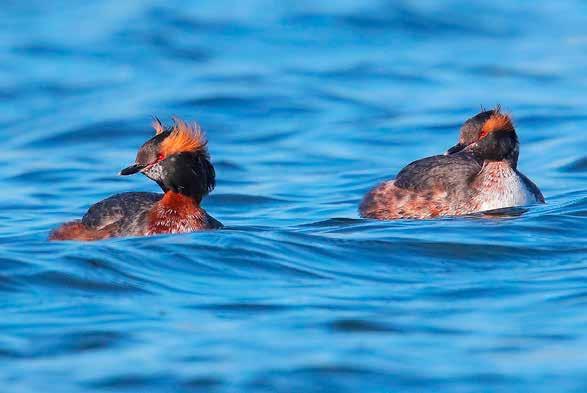
Whooper Swan – an adult on Gifford’s Flash (2nd).
Garganey – a very good Spring for this species with sightings at a number of sites; Dingle Marsh, Peto’s Marsh (maximum 10 including seven drakes), Walberswick Town Marsh, Minsmere, Boyton Marsh, Trimley Marsh (4) and Lakenheath Fen (3).
Slavonian Grebe – up to two in summer plumage at Alton Water, opposite Tattingstone Place.
Glaucous Gull – one present at Southwold harbour (17th), one by Hen Reedbeds (28th).
Iceland Gull – a juvenile on Great Livermere Lake (4th), a second-winter bird at Pipp’s Ford early evening before flying east.
Arctic Tern – two at Alton Water (22nd), two over the sailing lake at Lackford Lakes (27th), three north offshore at Southwold (27th), two at Livermere Lake (29th).
Black Tern – a single on Peto’s Marsh (28th29th).
Glossy Ibis – a few birds present throughout the month; noted at Minsmere (up to two), Walberswick Town Marsh and Peto’s Marsh.
Cattle Egret – one on Sudbourne Marshes opposite Crag Farm (2nd).
Osprey – one high over Mildenhall (2nd), one north-west over Felixstowe (3rd), one northwest over East Bergholt (17th), one north over North Warren (26th) and one over Island Mere, Minsmere (28th).
Long-eared Owl – one flushed by corvids at Huntingfield (26th).
Wryneck – one at Grove Farm Norton (26th).
Shorelark – a single bird was north of Kessingland sluice (8th and 10th) then no further sightings seven arrived further up the beach by the pools (30th).
Blue-headed Wagtail – one on North Warren (13th).
Pacific Golden Plover – one was present at Peto’s Marsh, Carlton Marshes throughout most of the month (3rd to 24th). It was generally present only early morning or in the evening, during the day it would fly off with the Golden Plover it associated with.
Lesser Yellowlegs – the long-staying bird remained at Minsmere, being last seen on 24th. It was mostly more distant on the south levels.
White Stork – a ring bird, probably from the Knepp introduction scheme was noted at several locations (24th). Initially seen from Heveningham then headed east at 08:30. Sightings then came from:
• Blyth Estuary – 09:30
• Reydon – 09:46
• Frostenden – 09:52
• Benacre – 10:06
• Kessingland – 10:10
• Oulton Broad – 10:38
• Corton – 11:02
• Oulton Broad – 11:23 to 12:11)
• Peto’s Marsh, Carlton Marshes gaining height and heading towards Blundeston at 12:53hrs.
One south over Cavenham Heath (26th). Goshawk – a first-summer male was seen over Peto’s Marsh (6th).
Black Kite – another case of news reporting via Suffolk BINS allowed a bird to be tracked at numerous locations. One was seen at Minsmere over the North Wall at 08:52 (18th), then was noted circling over the sea before it started to head south. The bird was then tracked at the following locations;
• Hollesley Marshes – 10:02
• Shingle Street/Alderton – 10:23
• Felixstowe Ferry – 11:03
• Felixstowe Grove 11:06
• Landguard/Felixstowe Port – 11:37
• Stutton – 11:55
One came in off the sea at East Lane, Bawdsey and continued inland (22nd).
White-tailed Eagle – bird G463 was noted again, over Snape village (1st).
Hoopoe – one was seen at Hen Reedbeds before flying north (28th).
Red-rumped Swallow – one was seen by the camp site at Alton Water and remained for a couple of hours before flying south-east towards Stutton Ness (20th). One was found at Ramsholt Lodge Marsh and was present again the following day (24th-25th).
Siberian Chiffchaff – one near Spratt’s Water, Carlton Marsh (3rd), one along the old railway line Southwold (19th) and one in the copse at Beach Farm, Benacre (20th).
Serin – a male was trapped, ringed and released at LBO (5th).
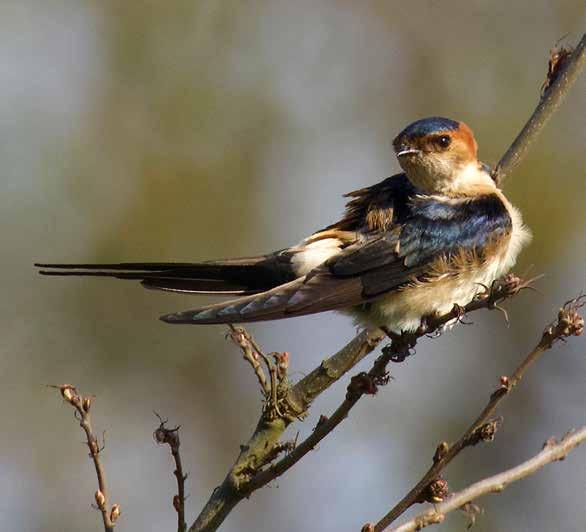
Council for 2022
Officers
Chair: Chris Courtney
Vice Chair and SNS Link: Edward Jackson
Secretary: Eddie Bathgate
Treasurer: Anne Wright
Communications Officer: Adam Faiers
Projects Officer: Chris Keeling
Suffolk Bird Report Editor and SORC Link: Nick Mason
Harrier Editor and Outdoor Events Coordinator: Gi Grieco
Indoor Events Coordinator: Adam Gretton
President
John Grant
Members
Peter Merchant
Jamie Everett
Ben Moyes
Michael Gavin
Tony Gdula
John Kornjaca
Honorary Vice-Presidents
Andrew Green
Robin Hopper
Colin Jakes
Mike Jeanes
Mike Marsh
Roy Marsh
Philip Murphy
Reg Snook
Steve Piotrowski
Bird Recorders
North-east Area Recorder: Richard Walden Email: bird-ne@sns.org.uk
South-east Area Recorders: Gi Grieco Tel: 07951 482547 and Steve Fryett Tel: 07593 382082 4, The Street, Melton, Woodbridge, IP12 1PW. Email: bird-se@sns.org.uk
West Area Recorder: Colin Jakes
Email: bird-w@sns.org.uk Memberships
c/o SNS, The Hold, 131 Fore Street, Ipswich, Suffolk, IP4 1LR
Founded in 1973 by a group of Suffolk birdwatchers
Associated with the Suffolk Naturalists’ Society
SBG remains an independent birding group and is a registered charity
A voice for Suffolk birdwatchers
With established links to many naturalist and conservation organisations
Media
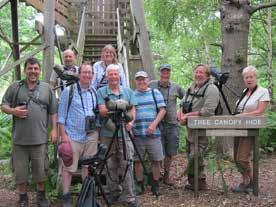
Actively lobbies to protect key Suffolk habitats
Provides a county-wide field force of bird surveyors
Promotes BTO bird surveys and organises special SBG surveys

Strong web presence - www.suffolkbirdgroup.org
Active Twitter feed - @SuffolkBirdGrp
Quarterly magazine - The Harrier
Annual review - Suffolk Birds report
Annually (20+) field trips - ideal for novices or experts and young or old alike
Opportunities to visit hot spots and receive practical ID tips in the field
Programme of talks and presentations - variety of topics (county, national, or international) with quality speakers
Assists with conservation projects to improve breeding success
- Swifts
- Barn Owls
- Peregrines
- Waders
Partners with Suffolk Wildlife Trust and other bird groups
Assists with funding for bird hides and other birding amenities
Contributes to community events, including dawn chorus walks
Provides bursaries for special projects