
Gi Grieco
Gi Grieco
Welcome to The Harrier. This summer has brought a lot of worry about the state of our bird life. Continued dry conditions with extreme heat has meant many water areas drying up, trees dropping leaves earlier to cope with the stress of the drought, and the sad sight of many sea birds dying from avian flu. We do include our quarterly bird review within the Harrier, and I find it a handy resource to look at species, during a season, that were present in years gone by. The annual Suffolk Bird Report, once data is submitted and compiled will give a more detailed picture on how species fared. Only time will tell of the impact of these issues. We aim to have an article on submitting bird records in the next edition.
We have a write up of this year’s AGM, thanks to all who participated – particularly managing to remain despite the cold room (they had a problem with the heating!). A main aspect of the group are the field trips and there is a selection within. With an upcoming indoor talk by Peter Hobson, we have an article on climate and the crisis in nature. After positive feedback we are also looking forward to using our new venue at Hintlesham, where the room is warm!
We do like to include the occasional article from our members birding visits abroad and we have a fascinating, and somewhat tempting, article from Malcolm Wright on his pelagic trips. We can only dream of seeing some special sea birds off our Suffolk coast! Finally, there is part two of Rachel and Rob Harvey’s green birding exploits. Not only admiring their dedication in all weathers but showing the possibility of birding in Suffolk without the use of a car.
CHANGE OF TALK ON 29/09/2022 (Hintlesham Community Centre 7.30pm). Due to unforeseen circumstances, Nigel Redman’s talk on Birds and Mammals of Ethiopia has been postponed to 30/3/23. We are delighted that Malcolm Ausden (Principal Ecologist at RSPB) has agreed to talk on ‘Birds and climate change in Britain’ with some reference to the Norfolk Bee-eaters. Malcolm has published many papers, including on this subject for BB and British Wildlife.
Chris Keeling
Following a year of COVID restrictions during which the preceding AGM and the first three meetings of the previous year were held online, it felt like a promise of a new beginning when – released from confinement – we invited members to the 2022 Annual General Meeting of the Suffolk Bird Group on 24th February at the Best Western Hotel, Copdock. It was also to be my last AGM as secretary, as I happily hand my secretarial duties back to Eddie Bathgate in order to concentrate on projects, while liaising with project proposers and initiatives.
Strange to think that this was only the second AGM since the council agreed that the Suffolk Ornithologists’ Group would be renamed the Suffolk Bird Group. But if time flies, it also brings opportunities even under the shadow of COVID and lockdowns. Indeed, after opening the meeting John observed that the AGM was an opportunity to look back at the 2021 birding year in Suffolk and recognise the enthusiasm and the determination of Suffolk birders to contribute to conserving birds and their habitats, despite lockdowns and travel restrictions.
John Grant opened the meeting by welcoming everyone to the Suffolk Bird Group’s 2022 AGM with a look back at SBG council meetings in 2021. Due to the ongoing restrictions, the first meeting in January was held online. It was agreed that, as a precaution, there would be no further meetings until the AGM in March, which was again held online followed by a third online meeting in May. None of this would have been possible without the hard work and support of Alex Rafinski, our communications officer during this difficult time. Alex set up our second online AGM and kept everyone up to date with latest developments as well as information about projects and opportunities
to get involved in, for which I owe Alex an especially big thank you. The post of Communications Officer has now been taken by Adam Faiers who stepped into Alex’s shoes in time for his inaugural email updating everyone with arrangements for the AGM. Social media is proving to be an increasingly important means of communicating conservation news and information and most importantly encouraging support. There was a further thank you from the Chair to Jamie Everett for expertly looking after our social media during the past year especially for keeping our Twitter feed current and interesting.
It was then time for our Chairman, Chris Courtney, to deliver his annual report. Chris began by calling for a big thank you to John Grant and staff at RSPB Minsmere for ensuring use of the Minsmere Discovery Centre, and Peter Merchant and Suffolk Wildlife Trust for making Foxburrow Farm’s facilities available for SBG Council in September and November. The latter was a new venue for SBG council meetings. Both venues were literally a breath of fresh air and a welcome opportunity to catch up with everyone in face-to-face meetings in pleasant surroundings, with the added bonus of a little impromptu birding.
Chris continued to thank members of SBG Council in their respective roles while paying tribute to four outgoing members of Council: as well as Alex Rafinski, Matt Deans our former Treasurer, Roy Marsh a former Chair and Justin Zantboer, the outgoing Vice Chair. Edward Jackson has agreed to offer himself for election as Vice Chair. Chris also took the opportunity to offer a very warm welcome to four new Council members: Tony Gdula, Mike Gavin, John
Kornjaca and Ben Moyes. It is always great to welcome in new Council members with their fresh ideas and breadth of knowledge.
While acknowledging the challenges of the past year, the Chair made the encouraging observation that SBG has continued to function and indeed grow, while running a programme of indoor and outdoor meetings. The Chair thanked Gi Grieco and Adam Gretton for organising an events calendar that offered plenty of variety throughout 2021. Supported by volunteer leaders, it included visits to familiar and much-loved sites but also an expedition beyond the borders of Suffolk to Sandwich Bay. I particularly enjoyed this trip as it presented me with an opportunity to finally catch up with a very obliging adult Bonaparte’s Gull at Grove Ferry.
The trip reports submitted by SBG members for The Harrier always make fascinating and enjoyable reading. The Chair again thanked Gi for his hard work continuing to produce the excellent and always informative SBG magazine ‘The Harrier’, despite the demands of a very busy day job. Indeed, thanks to everyone who contributed articles, photos and other snippets over the year, helping to make ‘The Harrier’ consistently fresh and interesting and a valuable document of record and information.
Information is also provided by individuals as well as via SORC and Bird Track, which is then collated into the Suffolk Bird Report for which the 2020 edition was published by our sister organisation SNS in December. Not surprisingly, the Chair called for a big thank you to Nick Mason, given that he has been the Suffolk Bird Report editor for his 13th year and produced another excellent report; the report underpins Suffolk ornithology. Nick has agreed to remain in post for the next edition, as well as all the contributors and section writers who keep Nick so busy.
For the second year online technology has helped SBG to keep up a full programme of
indoor talks with a great selection of first class speakers. Chris thanked Adam Gretton for ensuring that everything worked and the show was able to go on. As Adam might say: “it will be all right on the night”. The online element has enabled us to actually to grow our audience as evidenced by the recent healthy increase in membership subscriptions reported by our treasurer, Anne Wright. The Chair thanked Anne for her diligent and reassuringly careful management of our finances.
A special thank you to SNS for all the support they give to SBG acting as the central point for membership administration. Members’ contributions to last month’s BTO talk enabled us to make a donation of £100 to the BTO’s Curlew Conservation Project, which is being used towards sponsoring a Curlew radio tag for the next breeding season ahead of starting fieldwork. We also have bursaries available and a newly updated application process just to make sure outcomes are properly defined, measurable and so on. I hope nobody minds therefore if I take this opportunity to promote awareness of SBG projects. If you have any ideas, please drop me line by email or come up for a chat at one of our outdoor or indoor meetings.
Indeed 2021 has been an exciting and encouraging year for projects, providing opportunities for SBG to engage with organisations and individuals, as well as to support and advise on wildlife conservation projects which continue into 2022. These include bird surveys at both Gifford’s Hall Estate where arable land is being reverted to wildflower meadows and woodlands, and Rushmere Heath where volunteers are clearing scrub to restore heathland and acid grassland. Surveys will provide a baseline that will inform ongoing habitat restoration. SBG are also engaging with Jenny Rawson, Suffolk Wildlife Trust’s Senior Farm Advisor, to chart changes in farmland bird populations, following advice by SWT on wildlife-friendly farming and changes in management.
The Suffolk Coasts and Heaths AONB with the support of Natural England are exploring opportunities to encourage breeding Ringed Plover through the provision of dog-proof fencing on the foreshore of the Stour and Orwell, while calling for the assistance of members of SBG to act as volunteer wardens. 2021 has been a big year for SOS Swifts with over 20 community box sets provided to schools, halls, libraries and museums and even a cinema thanks to donations and the hard work of local swift enthusiasts. Sadly, the Suffolk Rookery Survey has been put on hold because of COVID, but as we begin to venture out once again, we hope to complete the survey over the next two years.
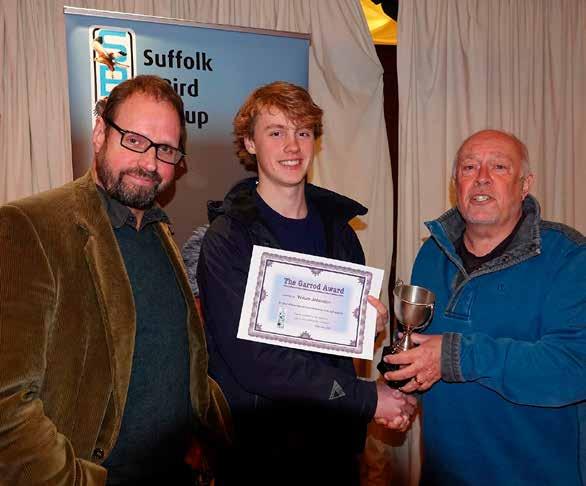
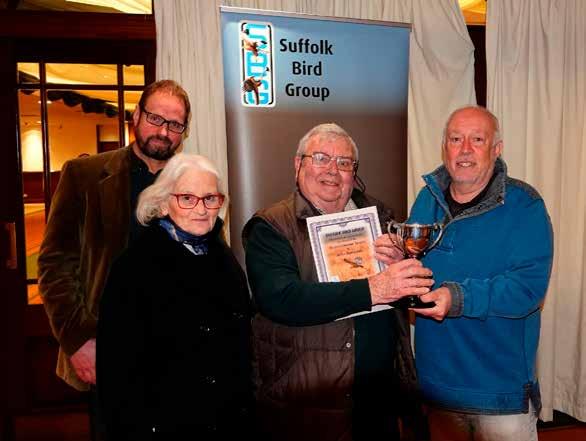
A special part of the AGM is the presentation of awards, notably the Garrod Award. This award, created in memory of Ken Garrod by his wife Jean, is presented annually to young naturalists representing the next generation of bird and wildlife enthusiasts for their contribution to birds and wildlife. This year’s Garrod Award was introduced by John Grant and presented to Wilum Johnston, who regularly volunteers at Redgrave and Lopham Fen and who has written articles for magazines and journals reflecting on nature conservation in Suffolk. John then presented the Denis Ockelton Trophy to John
Stimpson. This trophy is awarded annually for outstanding services to Suffolk birding and its birding community. John has produced a stupendous number of swift nest boxes thereby making a vital and significant contribution to SOS Swifts and swift conservation in Suffolk. We were also delighted to award an Honorary Vice Presidency and Life Membership to Roy Marsh, as thanks for his contribution to Suffolk birds and SBG in particular. During his time as Chair, Roy made considerable efforts to increase SBG’s membership and stabilise our finances.
After the awarding of the trophies, Gi Grieco then gave a presentation of a review of Suffolk birds in 2021 along with activities of the group. It was nice to reminisce on some of
the sightings from the year and, although the outdoor activities of the group were disrupted early in the year due to Covid, one of our first times we got together as a group was the presentation of the 2021 AGM awards at Landguard Bird Observatory where there was also the unveiling of the bench in dedication of Jean and Ken. The 2022 AGM drew to a close with a challenging and cryptic quiz prepared by Edward Jackson, where once again a good deal of imagination was required to associate bird names with visual and literary cues. The quiz was also presented by Gi, while Adam Gretton hosted the traditional raffle. Sadly, I didn’t win anything in the raffle, but maybe better luck next year.
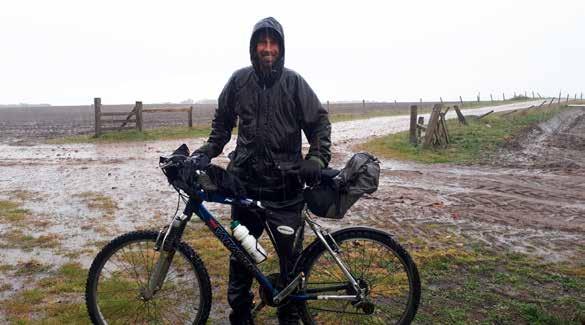
Those with a good memory will remember that Part 1 ended on the 23rd March 2021, a seemingly random date now, but actually the day before the first anniversary of the first Covid lockdown. This was the conclusion of our first full year of green birding in Suffolk. By then, we had well and truly got the green birding bug and were keen to see how we would fare for a full calendar year. So, for Part 2 we backtrack to the beginning of 2021.
With Rachel nobly ferrying her dad around by car, Rob kicked the list off on New Year’s Day with a ride that took in the Blyth, Dingle Marshes and Minsmere and resulted in a total of 94 species. Highlights included the longstaying flock of 25 Tundra Bean Geese at Wenhaston, a Short-eared Owl and 22 Snow Buntings at Dingle, then two Whooper Swans, six Goosanders and a Caspian Gull at Minsmere. A ride to Sotterley on the 2nd added Hawfinch and Nuthatch. Then birding came to a rapid halt on the 3rd as the country went into the second lockdown and we were back to local walks
around the village.
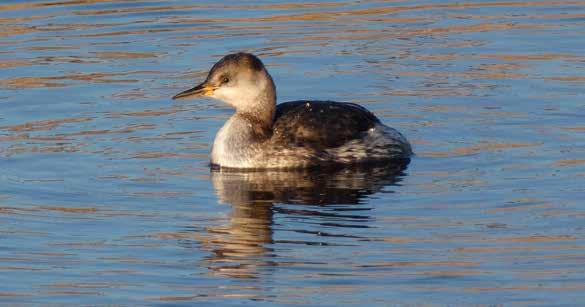
As detailed in Part 1, the standout bird of the month was the Red-necked Grebe at Minsmere which arrived on the 22nd and prompted a lunchtime twitch as Rob was still working from home at the time. We had amassed 120 species by the end of January: a reasonable start.
February produced few surprises and only nine species were added to the list, as further restrictions were caused by the ‘Beast from the East 2’, cutting off the village with huge snow drifts. The star bird was a White-tailed Eagle over the Blyth on the 28th, which fortunately lingered long enough for Rob to get there on the bike. A Great White Egret low over the house on the 26th was also a highlight: a garden/house first for us and an indication of how common this species has become.
As the UK opened up at the start of March, the cold spring meant a lot of winter species were still present. The month delivered Long-tailed Duck and Scaup at Benacre/Covehithe; White-
fronted and Pink-footed Geese at Southwold; Velvet Scoter, Jack Snipe and Twite at Dingle/ Dunwich with Hen Harrier and Mealy Redpoll at Minsmere. Perhaps the lockdown wasn’t going to affect our list as much as we first feared!
As expected, the latter part of the month saw the first summer migrants arrive, although the location of two Black Redstart on the 31st was unexpected - on the house roof! Prize for the rarest bird of the month had to go to the Taiga Bean Goose at Hen Reedbeds, not a species we had predicted as a ‘green tick’. By the end of the month, the list was up to 150 species.
April saw wintery conditions persist. Rob had driven to Minsmere on the 7th to undertake a duck survey, as it really did not feel like cycling weather, but instantly regretted the drive when he found a Grey Phalarope on the Scrape. Needless to say, we both had to ride to the reserve that evening and the phalarope was duly added to the list! There were 25 other additions during the month, mostly expected migrants, and we finished the month on 176 species.
May continued to be cold (very cold). Spring migrants were slow to arrive and the number of common migrants was low. There was a surprise spring Pied Flycatcher, and Turtle Dove at the start of the month, with Rob picking up Golden Oriole, Curlew Sandpiper and Osprey at Minsmere a week later. But the real surprise was an unusually good seawatch on the 22nd, which produced Puffin, Guillemot, Manx Shearwater and Short-eared Owl (new for Rachel).
After our first successful walk to the coast in 2020, we planned another hike for the May bank holiday. The 30-mile return trip to Minsmere over two days saw us amass 113 species (107 on 29th, 100 on the 30th) including five Crane overhead on Westleton Heath, Stone-curlews, two Curlew Sandpipers, Little Gull, Nightjars, a male Black Redstart and the return of the village’s Spotted Flycatcher
as we set off on our journey. We finished the month on 187 species.
With green birding rather taking over by this point, we didn’t really need to make it any more competitive and in retrospect perhaps then adding our lists to the non-motorised year list on BUBO listing was a mistake! With Rob taking top spot and Rachel second, could we maintain our lead for the rest of the year? It was not stiff competition with only three other birders taking it as seriously: a birder based in Dorset, Nick Moran in Norfolk and Simon Gillings in Cambs. But checking the BUBO listing website became a weekly if not sometimes daily occurrence for the rest of 2021.
Some good birds turned up in June, starting with a smart singing male Red-backed Shrike in Dunwich Forest. Purple Heron and Red-footed Falcon at Westwood Marshes were added during an evening ride. Minsmere continued to deliver, with Roseate and Arctic Terns, Savi’s Warbler and a stunning Red-necked Phalarope sneaking onto the list on the last day of the month. This took the total to 195.
Not surprisingly, July was a quiet month, but not without ticks. A White-rumped Sandpiper at Minsmere on the 20th was the first of two during the year and three Black Terns was an added bonus. The reserve also gave us a selffound Pectoral Sandpiper on the 31st along with the first Arctic Skua of the year offshore. An afternoon cycle to Hazlewood Marshes added Spoonbill and Golden Plover to Rachel’s list, and we ended the month on 199 species. The Dorset Green Birder looked set to be our main competitor and whilst Rob remained in top spot, Rachel had dropped to 3rd.
Rob reached the magic 200 species on the 13th August with a Glossy Ibis at Dingle. Rachel remained a little behind, (with the disadvantage of working full time from home and not at Minsmere!). Little Stint, Sooty Shearwater and Bonxie, were all expected August ticks. A Balearic Shearwater on the 23rd
was less so, and was a Minsmere tick to boot! Also a surprise was finding a Glaucous Gull on the Blyth estuary on 21st and a nice addition for Rob was a Bee-eater circling the Minsmere office on the 18th. A ride to Southwold for an as yet untickable Ruddy Shelduck showed commitment (or foolhardiness!). At the month’s end, the total had climbed to 208.
An elusive juvenile Red-backed Shrike at Minsmere on the 23rd September saw Rachel finally hit her target of 200 species. September was generally uneventful though, while Dorset was having a good run, and our main rival was catching up! In Norfolk, Nick was getting closer to 3rd place too. A hard won Red-breasted Merganser on Benacre Broad on the 26th was the only tick for Rob all month. We had to hope migration would pick up in October.
Not so! October remained quiet, and lots of bike miles gave us little return. A Cattle Egret at Eastbridge saw us finally add the species to the list after a number of near misses earlier in the year. Eider, Yellow-browed Warbler, Snow Bunting and Razorbill were also new. Dedication or desperation on the 16th saw us scaling the Aldringham Walks Reservoir sycamore tree to add a surprise Slavonian Grebe. This took the total to 214.
Dorset had a more exciting October and the Dorset Green Birder seemed unstoppable. The top spot had been yo-yoing throughout the month and we needed Suffolk to have a late surge! Fortunately, November did not disappoint. Grey Partridge, Little Auk, Red-crested Pochard, Great Northern Diver, Pomarine Skua, Tree Sparrow and Merlin were added through the month. But news breaking on the morning of the 14th heralded possibly the best tick of the year. Having headed to Slaughden to look for five Shorelark, we had just ticked the larks, and were some distance from the bikes when news came through of a Pied Wheatear at Sizewell. Panic ensued! Rob has no problem with either endurance or speed; Rachel has a little more of an issue with the latter at least. The most direct route between Slaughden and Sizewell also involved negotiating a particularly muddy track near Thorpeness. Would we make it? We arrived at Sizewell, rather muddy, sweaty and with one of us a rather bright shade of red. At least being on the bikes meant that we now had an advantage over those arriving by car and we were able to head straight down the dunes to the assembled line of folk watching the bird. We got there in time to see the bird fly onto a post, and then off over the power
station wall, never to be seen again (much to the annoyance of those motorised birders just behind us!). Phew!
Two weeks later we were again demonstrating our dedication and/or stupidity with a trip to Benacre for a Hume’s Warbler. A storm was predicted so we left early in the hope of getting back before it hit. Of course it arrived early, and just as we reached Beach Farm the heavens opened and pelted us with large hailstones and heavy rain. After surviving the first deluge, we then had to endure the attention of three over-inquisitive donkeys, who seemed more interested in chewing various parts of our clothing and optics than seeing a small Asian warbler. Rachel’s already sodden glove nearly became donkey lunch. Still, for Jane and Paul Ferguson (also found lurking in the copse) and us, it was a twitch to remember! Warbler ticked (along with a bonus second Puffin for the year) and while pedalling home in terrible weather we started a new mantra in our heads “we are enjoying ourselves” repeated in time with the pedal strokes. This phrase was often used in the final six weeks of the year when willpower and determination became ever more important. Green birding in winter can be tough!
November had saved the day and the list had risen to a decent 225 species. Rob had regained top spot on the BUBO list and Rachel was only one off second place. By now the Dorset Green Birder had become the most talked about subject in our house, possibly to the point of an unhealthy obsession, especially when a potential new tick turned up within his cycling distance!
December arrived: one month to go and no time to rest! Long-eared Owl, Shag and Lapland Bunting required us to venture further afield than before. This included a ride to Lowestoft where sadly the Iceland Gull refused to cooperate! On Christmas Eve, Rachel took a trip to Sotterley and Ellough to try for Hawfinch and Grey Partridge in the hope of drawing level in second place. Hawfinch showed for a
couple of seconds, but Grey Partridge remained steadfastly absent. Now Rachel’s only hope was to pick up a fly-over Raven, a species that had evaded her all year. To rub salt in the wounds, our Dorset rival then hit us with an 80-mile ride around Dorset and Hampshire on the 28th adding a further five species to his list and putting second place out of reach! Rachel admitted defeat, knowing that with 219 species all within 15 miles of home, she had at least won ‘species per mile’. Rob, now worried that the ‘DGB’ might pull out another sudden ‘big day’, and armed with a new bike, had decided that a 65-mile round trip to Ipswich for Mandarin and Ring-necked Parakeet was in order. Rachel and her dad acted as support vehicle for this one, ably assisted by the local knowledge of Jeff Higgott, and both targets were achieved on the 30th. The parakeet became the last tick of 2021, and it was all over! Rob topped the league on 230 species, the Dorset Green Birder was second on 224, Rachel third on 219, all well ahead of land-locked Nick who finished on a still very respectable 203 species.
What a year it had been. What had started as a casual quest to see as many species as we could, and to occupy our minds and keep us fit during Covid, had turned into something much more. We had explored parts of Suffolk we had never seen before, new footpaths, new bridleways and country lanes. There were times when we wondered about our sanity as we arrived home covered in mud, soaked to the skin, or shivering with cold, but wasn’t that just part of the fun?
Our big green year was over but some of you might have seen us still out on our bikes in 2022. Why have we continued? Why not go back to our pre-Covid lifestyle of jumping in the car to go birding? Ok, so there is a slight element of ‘going green’, knowing that we can still go birding whilst causing little harm to the environment, but we know that we are only making a very small difference. The main reason is that we enjoy it! You see far more
by bike and foot than from a car, and you get a deeper satisfaction that you have earned your tick, but most importantly we now have a more in-depth knowledge of our local area. Like any patch birder, we have developed a deep affinity for the area around where we live. Working from home, Rachel spent a lot of time walking the footpaths around our village, and whilst not turning up anything mega rare yet, finding uncommon breeding species, and getting to know the local landowners has been just as rewarding. Will it stop us birding Suffolk by car completely? Probably not. It’s sometimes nice to have that option, particularly when the weather is terrible! But green birding has certainly become the preference and there are more opportunities to add species to the multiple green lists that we now have than the “dirty” motorised ones. ‘Green Birding’ has also been great both for physical and for mental wellbeing. For Rob it has led to other lifestyle changes including commuting to work by bike and making the leap to “proper” road cycling. With this comes the ability to cycle faster and further (although carrying optics is an issue!)
and trips in 2022 have included 100-mile rides to Grafham Water (the day after the Cape Gull was last seen!) and the Bee-eater viewpoint at Trimingham (more successful with great views of eight birds).
We realise that not everyone is fortunate to live in a village with countryside on their doorstep. Our house is surrounded by farmland with little water which limits possibilities close to home. Getting on a bike, however, adds a whole new dimension by making the coast and the superb habitat at Minsmere and beyond easily accessible. We encourage you, if you can, to dust off your bike or wander from your front door every now and then. You never know what you might find close to home!
The stats:
Rob - 230 species. 225 species within a 10-mile radius of home, three more within a 15-mile radius, two more within a 25-mile radius. 4236 bike miles.
Rachel - 219 species. 214 species within a 10mile radius of home, five more within a 15-mile radius. 1600 bike miles.
Malcolm Wright
The Southern Oceans Seabird Study Association (SOSSA) has been running pelagic trips off the New South Wales coast for the past 40 years. Up until 2014 these ran from Wollongong, about 40 miles south of Sydney but the need to find a new boat meant that the trips now run from the harbour at Kiama, some 80 miles south of Sydney. The boat goes out about 25 kilometres from the coast to a shelf where the shallower inshore waters drop away to a deep channel. This creates an upwelling which attracts a concentration of seabirds. Over the years SOSSA has recorded more than 130 seabird species on these pelagics, about onethird of all the true seabirds.
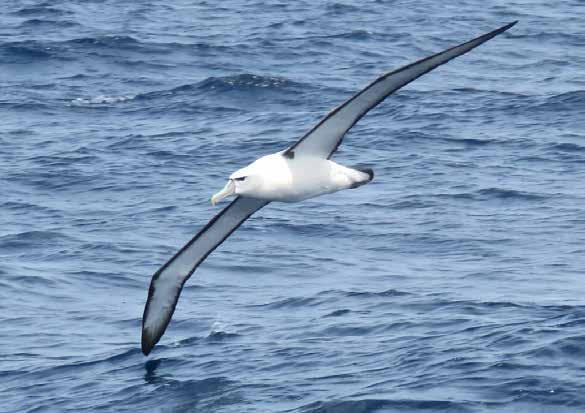
I had been on one of the Wollongong pelagics on a previous visit in 2009, which was an excellent trip. Our son is married to an Australian girl and lives with his family only a few kilometres south of Kiama, so I took the opportunity during an eight week stay to do two pelagics during December 2019. The first trip was on the 14th; conditions were fairly calm with light winds and Lindsay Smith, who organises and goes on most of the trips, was not optimistic for many good birds. The boat left the harbour at 07.40 and once beyond the 10 kilometre point we started to encounter Shy Albatrosses. This was the star bird of the day, with at least 60 of these magnificent creatures
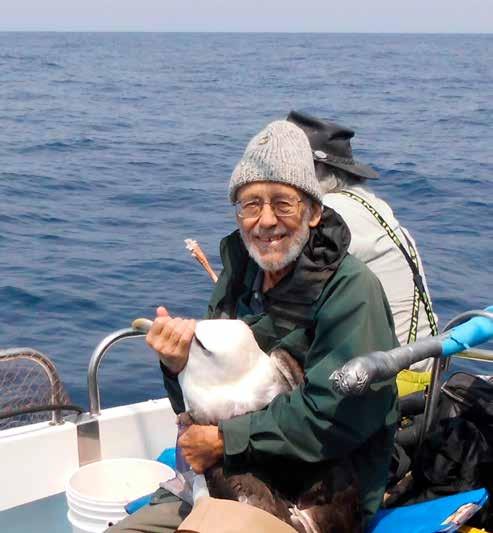
seen and a maximum count of 32 around the boat at any one time. On reaching the edge of the continental shelf the boat stopped in deep water (120 fathoms) and a drift and chum session was set up. The chum dispensed from the back of the boat was a mixture of chicken mince, suet and tuna oil. Many of the seabirds, eager to feast on the chum, come right up to the boat and can be seen at very close quarters, with excellent opportunities for photographs. They can also be caught and one of the crew was stationed at the stern with a large net on a two metre pole. We caught seven of the Shy Albatrosses and I was thrilled to handle and ring two of these. I was given strict instructions to hold tight onto the bird’s bill and keep it closed at all times. Albatrosses have a large, heavy bill with sharp cutting edges and can inflict a nasty wound if given the chance! I was surprised how light the birds were to hold, given their size. They are the largest of the mollymawks with a wing span of ca. 2.5 metres (ca. 8 feet).
The supporting cast was not bad either and included 1 Grey-faced Petrel, 80 Short-tailed Shearwaters, 10 Wedge-tailed Shearwaters, 8 Sooty Shearwaters, 8 Flesh-footed Shearwaters and 2 Fluttering Shearwaters. One immature White-capped Albatross also came in for the chum and also a White-chinned Petrel. This latter bird had very little white on the chin and was considered to be from the New Zealand breeding population. White-chinned Petrel was added to the British list in 2020, when one was photographed flying over Scapa Flow in the Orkney Islands. A totally bizarre and unexpected record which illustrates the global wanderings of some of these seabirds. About 10 Pomarine Skuas came in and harassed the various shearwaters and it was noticeable that these birds were in heavy wing and tail moult. These are Siberian breeding birds which winter in Australian waters. Up to 40 Greater Crested Terns also accompanied us and many of these hitched a ride on the bow rail of the boat.
It’s not just birds which are seen on these trips. During the chumming session we saw a pod of ca.5 Oceanic Bottlenose Dolphins and shortly after starting the return journey we had tantalising views of a small pod of False Killer Whales and then saw the protruding fins of two Ocean Sunfish. We arrived back at the dock at 16.00 hours, having surpassed Lindsay Smith’s expectations for the day.
Just a fortnight later on the 28th we embarked on a second trip out to the shelf. Conditions were quite different, with a stiff northerly breeze and a heavy 2.5m swell, which made the day quite uncomfortable at times. We proceeded straight out to the shelf some 26 kms east of the harbour and then stopped for the usual drift and chum session. Over the next four hours we drifted 14.5 kms south in the wind and currents. Albatrosses were again prominent with several Shy, two White-capped, an immature Blackbrowed and also a Campbell Island Albatross, one of the rarest species globally. I was also delighted to see good numbers of Wilson’s and White-faced Storm Petrels very close to the boat. Several of the Wilson’s put on a splendid display, pattering/walking along the surface of the oil slick we had put out, just a few metres away. Prolonged scrutiny of the dark shearwaters around the boat eventually paid off as the first of at least four Black Petrels was identified. One of these was caught and was found to be carrying a New Zealand ring. It was evidently from the colonies on Great Barrier or Little Barrier Island, off the east coast of New Zealand. A “Cookilaria” petrel was sighted and turned out to be a Black-winged Petrel, possibly from the nearest breeding colony on Lord Howe Island. But the bird of the day was probably the pale morph Kermadec Petrel, which made a single fly-past, but fortunately at very close quarters. At least 30 Grey-faced Petrels were noted.
The ringing team was busy again on this trip and we caught, ringed, measured and weighed Flesh-footed and Wedge-tailed Shearwaters,
Grey-faced Petrels and Black Petrels. Pomarine Skuas appeared once more and this time ca.5 Long-tailed Skuas also came in, again birds breeding in the Northern hemisphere and wintering off Australia. Cetaceans were represented by a pod of 20+ Striped Dolphins at the shelf edge and a small pod of ca.5 Common Dolphins.
Anyone planning a birding trip to Australia should consider fitting in a pelagic trip from Kiama or one of several other locations from which they are operated. You get the chance to see species really closely, which otherwise are at best just a distant speck out at sea and
many of them are true oceanic species rarely sighted from land. But do book well ahead; these trips are very popular and the boat is limited to 18 passengers. No less than 20 of the currently recognised 23 species of Albatross have been recorded on SOSSA pelagics. The largest species of all, the Wandering and Royal Albatrosses are regularly seen on trips during the austral winter, May to August. These are truly magnificent birds and I count seeing albatrosses close up as one of the top highlights of my many years of birding. SOSSA have an excellent website www.sossa-international.org which gives full details of the many pelagics they have operated. Check it out.
Editor’s Note: Ahead of his joint SBG-SWT Woodbridge talk in October, we asked Peter to summarise the ground his talk will cover. For those who haven’t attended a previous talk
Peter R Hobson
Earth has experienced profound episodic changes in climate and biodiversity over the last three billion years including mass extinctions, so what is unusual about the current crisis? Present day patterns and events in the natural world – weather conditions, searing heat waves, droughts, floods and storms, are breaking all known records and we now know the root cause is the behaviour of one primate species that evolved 260,000 to 300,000 years ago in Africa. For the first 200,000 years of human existence the natural world experienced little impact from hunter-gatherer activities until the “great leap forward,” 65,000 to 50,000 years ago, when more advanced technology started appearing: complex tool sets and weapons such as bows, spear-throwers, fishhooks, ceramics, sowing needles. Human culture had reached modernity with the necessary technology to allow for the establishment of large, multigenerational social groups with dozens to thousands of people, and the capability to push out of Africa and occupy more of the planet. Increasing population numbers drove cultural evolution and demands for ever more efficient means of exploiting natural resources to survive, ultimately pushing populations to outstrip their ecosystems. Megafauna on all the main continents were wiped out and to survive, human populations were forced to evolve new forms of feeding themselves – farming. Agriculture caused an explosive population increase, culminating in the urbanisation and civilisation of millions of people. Culture was now in hyperdrive and our relationship with the planet had changed for good.
Our best science on climate change, the most prominent of which is the International Panel for Climate Change (IPCC), provides compelling evidence for human-induced factors that are undermining the life-support functions of the ecosphere. Many natural ecosystems have collapsed and most have been degraded. Human enterprise has overshot the longterm carrying capacity of Earth and this is the single biggest contributing factor to the “sixth extinction” and a run-away climate.
The last decade has been characterised by growing concerns for the state of the planet and people, and by ideological rhetoric on the urgent need for change in social logic towards sustainable living, and yet ecological trends have continued to worsen. To stabilize atmospheric carbon at 650 ppmv (parts per million volume) CO2e (carbon dioxide equivalent) all developed, and most developing nations would have to impose radical emission reductions within the next eight to twelve years. It would require planned degrowth in the global economy and a permanent transition to a green circular economy. Staying our trajectory of growth-based development will guarantee environmental catastrophe and untold hardship for billions of people. This was certainly the main message given by the delegates of COP26, while at the same time, outside on the streets of Glasgow the people protested about the continued cognitive dissonance and collective denial shown by political and business leaders.
William Rees, a human ecologist, invites us to search in human evolutionary biology for root causes to the modern sustainability conundrum and society’s apparent paralysis in the face of a global crisis. He suggests humans are hardwired to be unsustainable. In his paper titled “Are Humans Unsustainable by Nature” (2007), he para-phrases a Russian-born Geneticist, T. Dobzhansky: “Nothing in Biology makes sense except in the light of evolution” (Dobzhansky 1964, p. 449). Is this where our story ends?
With so much scientific and factual information streaming into our lives through all forms of media it is understandable how individuals and wider society feel overwhelmed and helpless in the face of looming planetary challenges. Deepening anxiety and a sense of vulnerability in an unfolding world quickly translates into “environmental fatalism”; the view that there is nothing we can do other than buckle up in readiness for the rough ride ahead.
Unquestionably, science shows us humanity is at a cross-road. The pathway we choose will be determined by individual and collective decisions based primarily on ethics and scientific evidence. So, what decisions should we be making as individuals, and will they amount to significant change in the larger socio-political arena? The answer to that question is dependent on the prevailing socio-political system and the willingness of individuals and societies to re-consider their values and lifestyle, and to take necessary action to influence the social logic of their community, nation and world. Science has provided compelling evidence for the contributing factors to global warming and biodiversity loss. We know much more now
about the way we use land and how it impacts on biodiversity and ecosystems. Similarly, the links between the global economic growth model and environmental degradation is well understood at most levels of society. How we manage our living landscape from our gardens to the wider countryside; our food systems and forests; how we measure and determine personal wellbeing and standard of living in the form of goods and services; how we ethically frame our relationship with the natural world, and how we educate ourselves and future generations about this relationship are all primary drivers of the nature-culture dualism. We know now that the quality, contents and source of our diet determines the state of nature in our countryside and across the planet. For those who have gardens, we know the design, composition, horticultural practice and use of space will impact on local wildlife. So, if a decision is made to apply slug pellets, pesticide and glyphosate to control ‘unwanted’ members of the natural world in your garden, and peat compost to grow exotic plant cultivars then it is done in the knowledge there will be consequences for biodiversity. We can’t assume individual decisions, behaviour and actions do not have an accumulative impact at higher spatial and organisational levels. It is the principle of the “Butterfly effect”: everything is connected and activities at the small scale matter to the functioning of the bigger system.
Peter R Hobson Centre for Econics & Ecosystem Management School of Sustainable Environments & Design Writtle University College www.centreforeconics.org www.writtle.ac.uk
Peter Hobson is a Professor of Biodiversity Conservation and Sustainability at Writtle University College. He is also co-director of the Centre for Econics and Ecosystem Management and is on the IUCN CEM Commission for global forests, and is a commissioner for Essex Climate Action.
Clockwise...
Saturday, April 23rd
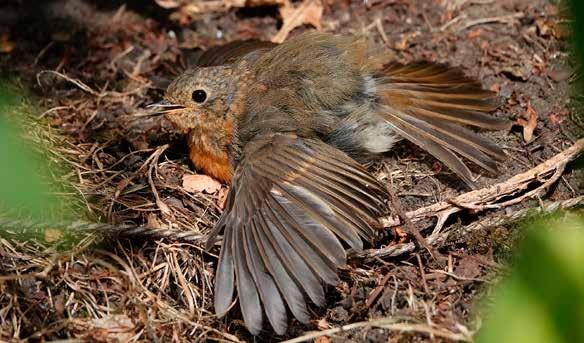
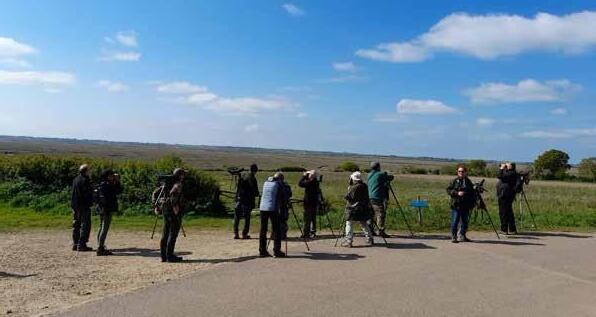
The long running easterly airflow seen throughout April was still prevalent for this field meeting with a rather robust northeaster bringing out a few woolly hats amongst the 21 assembled members. Clearly hope of finding a plethora of spring migrants was unlikely and so it proved. A Sedge Warbler singing on Oxley Marsh (which was hidden deep within a thicket) was the only sign of a spring migrant with a handful of local corvids feeding on the marsh and a distant Common Buzzard. A Sparrowhawk was seen
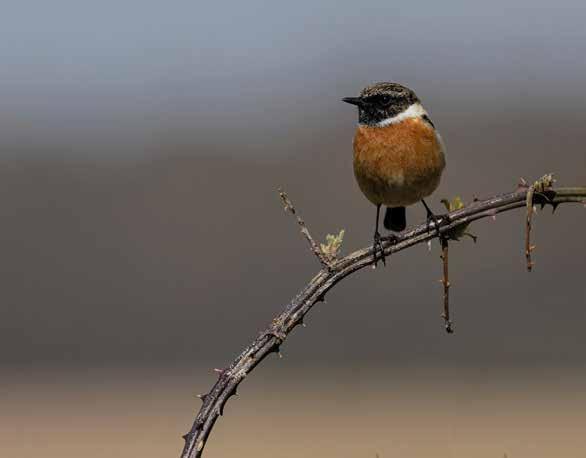
briefly over the houses with a few Linnets flitting around the tennis court area. In the area of the allotments a Lesser Whitethroat was singing, and was finally seen briefly, with a nearby male Reed Bunting together with a glimpse of Common Whitethroat and Meadow Pipit. Heading across the marsh to Battery Cottage a male Stonechat was noted several times. The chances of finding a Wheatear or a hirundine were somewhat remote so it was back to the car park and on to Upper Hollesley Common.
The Common was more sheltered from the cold wind and expectations were high for some interesting species. From the car park both Song Thrush and Mistle Thrush were seen close by. Venturing to the far eastern edge of the Common we noted two singing Goldcrests, Common Buzzard, Dartford Warbler and Stonechat. Common Redstarts should have arrived by now and sure enough one was heard singing just enough to give the group the chance of becoming familiar with its song. There were further sightings of Stonechat and singing Dartford Warbler before another Common Redstart was located singing; it was seen so briefly that most of
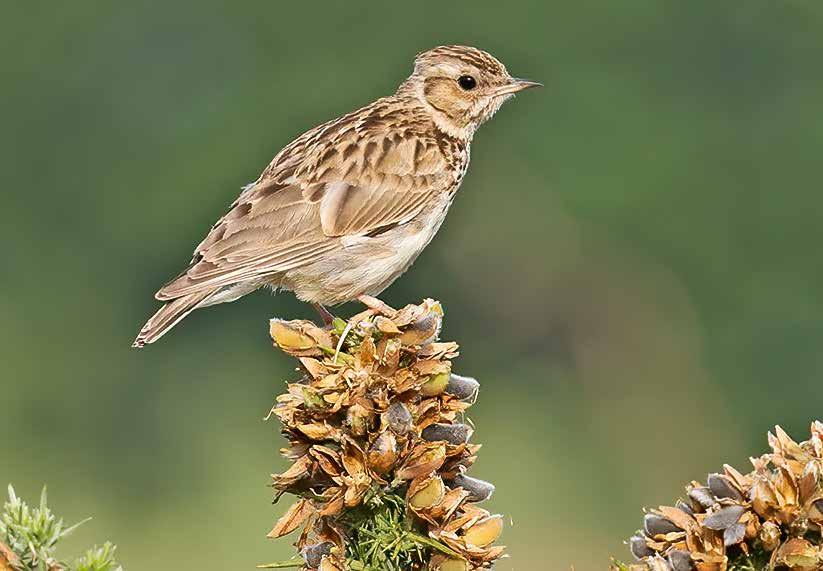
us missed it. Views of Sparrowhawk, Linnet and Common Whitethroat were also noted. As expected, butterflies were non-existent in these cold conditions but surprisingly a number of Common Heath moths were noted. Finally, we found a pair of Woodlark foraging on the ground and then seen in flight. We ended the meeting without having seen a single Swallow or any other hirundine but having checked my previous April Shingle Street write ups I noted we did not record a Swallow on several occasions, whilst it was not unusual to encountered inclement weather either.
As I passed over Wilford Bridge Melton in my car there was a spit of rain on the windscreen and by the time I got to Shingle street the rain was driven with a strong southerly wind. Unrelenting for most of the meeting we did however see a Swallow.
Gooding
We were greeted by a fantastic sunny morning as we met in the car park of the Essex Wildlife Trust reserve. This fantastic reserve only covers 210 acres but it is covered with footpaths that give the impression that it is much larger, and I sometimes still get ‘’lost’’ if I don’t keep an eye on where I am going. With the creation of an intertidal area connected to the river Colne there is year round interest. At present, according to the reserve guide, it has recorded 200 species of bird, 350 flowering plants, 24 species of butterfly and 27 species of dragonfly. I think that it is a gem.
The reserve gates open at 9am but the visitors centre doesn’t open until 10am, and more importantly the facilities within, so we spent three quarters of an hour gently wandering around the immediate area looking, but more importantly, listening for spring migrants. Around the pond near the centre we had Common Buzzard over, Swallow
on the telegraph wires and Great Spotted Woodpecker. On the water were Little Grebe, Tufted Duck and a couple of Pochard and in the water was a nice shoal of Rudd.
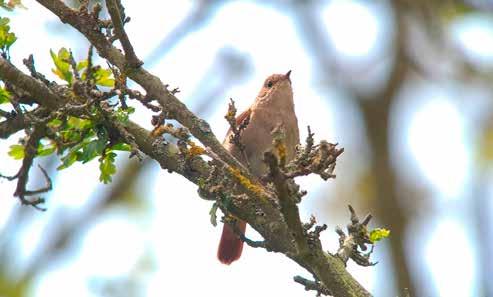
We had already heard Nightingale from the car park and we heard several more but as usual they remained quite elusive. Chiffchaff were singing all over as were many Common Whitethroats, Blackcaps and at least two Lesser Whitethroats all in the wonderful fresh green foliage that bordered the footpaths. After a comfort break the group met up at the rear of the centre and ‘scopes were set up as several distant raptors needed further investigation, the more distant were Common Buzzards and three Marsh Harriers were over Langenhoe Marsh, Hobby was also seen by some of the group and the first Cuckoo of the day was also just on the cusp of hearing. Closer in, up to 13 Stock Doves were feeding on some freshly turned soil.
The only warbler we had not seen, though it was still a tad early, was Garden Warbler so many stops were taken as we wandered along. Just as I was about to give up and move on to the next part of the reserve we heard one singing unseen but a real treat. We also heard Cetti’s Warbler as we passed through an area of reed and scrub and Mediterranean Gull was also heard overhead.
I had timed the visit to coincide with the rising tide and as we made our way towards Margaret Hide, where some viewed an Adder by the track, the water from the Colne was flowing through the breach in the bank. We did not have to wait long before the first waders were flying in from their feeding areas to roost on the banks within the intertidal area. A Whimbrel was seen by some but easier to see were five Black-tailed Godwits that were joined by 24 Bar-tailed Godwits mostly in winter/non-breeding plumage, eight Grey Plovers, 24 Dunlins, 2 Avocets, and singles of Knot and Greenshank. The previously heard Mediterranean Gulls were also out on the water looking resplendent in their breeding plumage as they fed with the Black-headed Gulls, and we also saw three Common Terns distantly over the river. The walk back to the car park also gave us Reed Warbler from one of the dragonfly ponds.
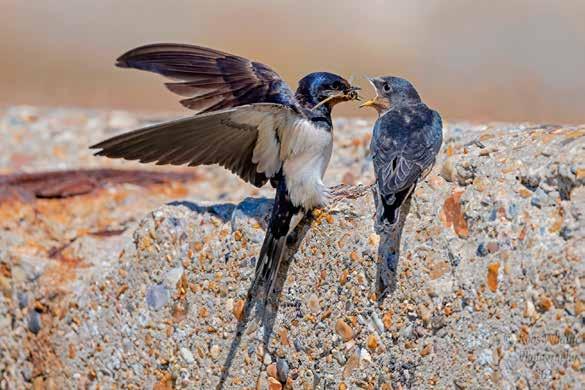
After lunch we headed off to Abberton Reservoir and here we had the boldest Nightingale many of us had seen in years. It sat, unperturbed, in a bare tree singing it’s heart out, we even had the chance to set up ‘scopes and see every detail. It was ringed and, just I was about to write the number down, it moved its leg and the ring twisted round so that it could no longer be read - I would have loved to have known where it was rung. We then headed out along the Layer de-la-Haye causeway where we saw Great White Egret, Kingfisher, Common Sandpiper and four Little Ringed Plovers; sadly, one of the participants informed us that the first nest had been predated. From the Abbots Hall Farm viewing screen we had a Swallow and four Whimbrel over along with Yellow Wagtail. We crossed the road to where I was expecting to find more Yellow Wagtails but it was not to be, although I had one more ace up my sleeve and after much distant viewing I eventually located the Cattle Egret that had been present for several months; it was part of a group of eight birds although the others had left the area several weeks previous.
Many thanks to all those that attended the meeting on such a beautiful spring day.
When David Walsh was forced to amend his tour date to Poland, I stepped in as leader for this popular annual trip. We hoped that we might see some of the same species that David was watching in Poland during the day, but although this didn’t materialise, we had some great encounters on the trip.
With larger numbers attending our field trips lately, I had asked a few members to park nearby in Eastbridge and then walk to the meeting place, knowing parking would be limited. Despite the early start, it was already feeling hot as we assembled to discuss the plan for the day. We headed off through the woods picking up a few tit species. At a place where we had often previously both seen and heard Garden Warbler and Blackcap we had no luck initially, but did eventually find the former. Across the fields we watched the wonderful display flight of Lapwings and had singing Skylark. Further along we eventually found a singing Whitethroat and whilst scanning across we noted at least two Stone-curlews and heard a distant Cuckoo and then saw both Green and Great Spotted Woodpeckers.
David had done a recce and given me some ‘gen’ on what to look for and where. One of the species was Redstart and as we walked through a wooded section I picked up a singing bird. Despite our patience we had no luck actually seeing it despite the bird tantalising singing above us, within the canopy. Some of the group did see Treecreeper and we also noted Coal Tit in the conifers. We had good views of a singing Chiffchaff and then, as we headed out onto Dunwich Heath, we noted some raptors thermalling that proved to be Common Buzzards plus a Sparrowhawk and then a Hobby. We had excellent views of a few Dartford Warblers, plus Stonechat and singing Woodlark. At the Dunwich coastguard cottages, while some used the facilities, we found a few finch species – Greenfinch and Goldfinch, plus Linnet flying over.
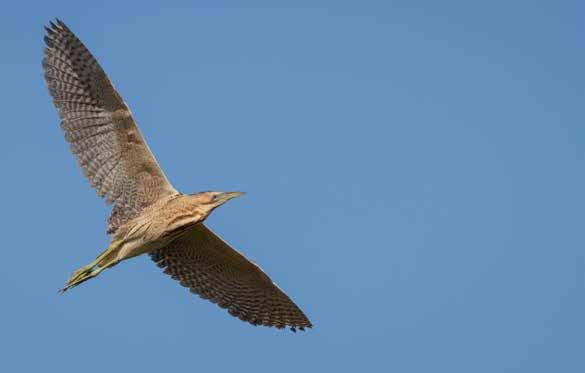
We then dropped down to walk along the beach, scanning the reedbeds of Minsmere and had a Marsh Harrier flyover and the first of many sightings of Bittern. It was a bit breezy but we did hear Reed Warbler, and some sharp ears picked up a distant Grasshopper Warbler. We headed up to the North Wall
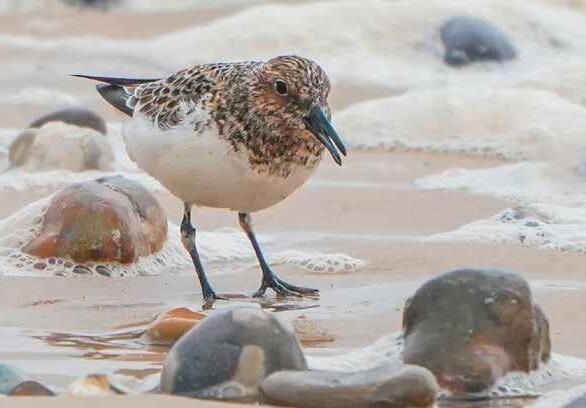
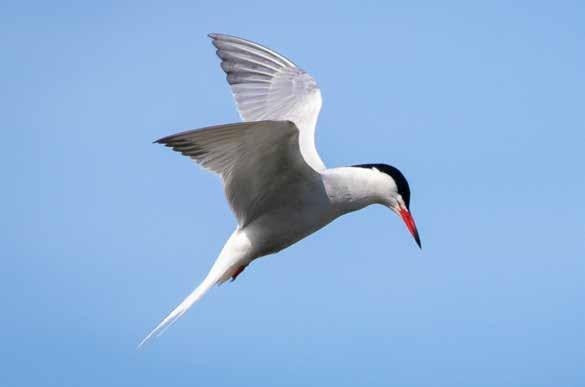
hoping to hear it better – but only just! We scanned the scrapes from both the coastal path and the public hide. There was a nice selection including Sandwich, Common and Little Terns, Mediterranean Gulls, Kittiwakes and, amongst the waders, four Sanderling, Dunlin, Black-tailed Godwits and Turnstone. Along the beach we saw female Common Blue butterflies and Common Heath moths.
We then headed back to Eastbridge from the sluice, where we eventually got our first Blackcap of the day and further along the path we noted a bright insect, a Red-andblack Froghopper. Over the reedbeds we saw further Marsh Harriers and another Hobby.
Back at our cars we stopped for lunch and discussed where to go for the rest of the day. Some went home but the rest headed into the reserve, which proved to be a very good
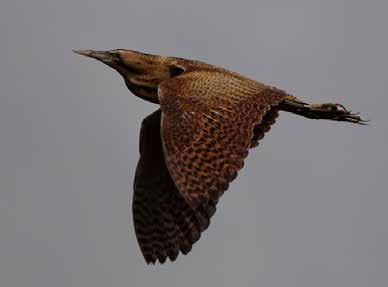
choice. We walked the trails seeing some of the species earlier noted. We had a couple of further flyover views of Bittern but when we were by Lookout Hide, a Bittern flew over and dropped in to land just metres away, uttering an alarm call, giving many of the group their first experience of hearing this sound. Later on, whilst viewing from the North Wall we had another Bittern fly north then as we were scanning the reeds hoping to hear or see the previous Grasshopper Warbler, the same or another Bittern flew back, right over some of the group. In total we’d had nine Bittern sightings on the trip, with some of the best ever flight views and we all agreed that it was memorable. Our final wildlife sighting of the day was back at the pond on the old car park where we had lovely views of Fourspotted Chasers whilst Sand Martins flew around over and back to their nesting colony.
David Walsh
David Walsh
On Sunday 19 June, 15 SBG members met at 8am in the car park at Lakenheath Fen RSPB. Most of the group had been there before, but some hadn’t, so we studied the reserve map prior to setting off on our clockwise loop. We started by walking along the path from the visitor centre parallel to the railway and made for Joist Fen. We returned along the riverbank taking in the two washlands.
June is an excellent month for dragonflies at Lakenheath and the weather was kind to us – mainly sunny, but not too hot, so insects were out and about but not too active. We noted 12 of the 13 species which had previously been recorded on the reserve in 2022. Highlights included Scarce Chasers (an immature in the reeds and numerous males on territory along the Little Ouse), multiple Black-tailed Skimmers on the paths and Red-eyed Damselflies on the river. As always, I thoroughly enjoyed enthusing about dragonflies and encouraging those who hadn’t looked at them before to ‘give it a go’; the field guide we were using may well by now have several new owners! The butterfly highlight was a Ringlet, the first of the season for many; we tallied at least ten species overall.
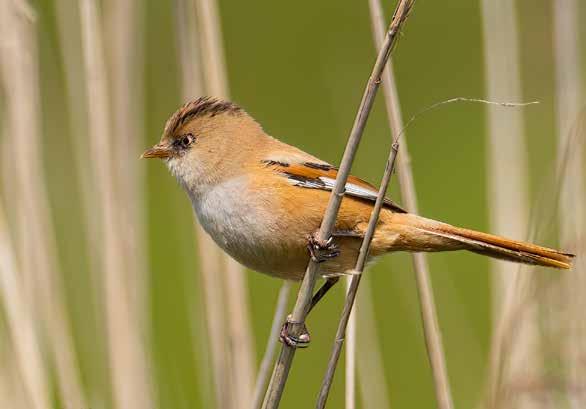
On the bird front, we were able to compare the songs of Reed and Sedge Warbler and see both Cuckoo and Marsh Harrier in flight as we strolled west. Some of the group got lucky and had close views of a party of young Bearded Tits. Our pit-stop at Joist Fen produced ‘best ever’ views of Hobby for some, with one bird perched close by and others hunting in typical fashion over the reeds. We also found a Bittern out in the open, for ages. Later we had an amazing view of a bird in flight; the photos revealed that the bird was ringed!
The flashes had been dry on some previous field trips but on this occasion they held plenty of water. On the first we found broods of Shoveler and Gadwall. On the second we noted good numbers of Avocet as well as a distant Green Sandpiper.
Most of us relaxed over our picnics before heading off to various places for the afternoon; a Red Kite overhead was a bonus! Thanks to everyone in the group for your enthusiasm and sharing your knowledge with others so readily during a thoroughly enjoyable morning.
Gi Grieco
The quarterly review section gives a snapshot of birds seen within the county during the period, predominantly from data received by Suffolk BINS. All scarce and rare birds are subject to submission and acceptance by either SORC or BBRC. Updated lists on Accepted and Outstanding Records for previous years can be found on the SBG website - http://www.suffolkbirdgroup.org/ bird-recording
May is typically a month when a number of rare and scare species turn up and this was the case in 2022. Very few were passerines and, of those that did occur, many were elusive or were brief sightings and you had to be in the right place at the right time to observe them.
Notable May sightings Quail – one singing in the Lowestoft North Denes (28th).
Red-crested Pochard – one from Paul’s Hide, Lackford Lakes (28th).
Crane – several sightings across the month from a number of sites; Minsmere, Earsham, Carlton Marshes, Westhall, Westleton, Walberswick, North Warren and Dunwich.
Slavonian Grebe – the summer-plumaged bird remained on Alton Water throughout the month.
Temminck’s Stint – two flew north over Havergate Island (7th), one on the winter
flood, Trimley Marshes (11th) and one briefly at Minsmere (24th).
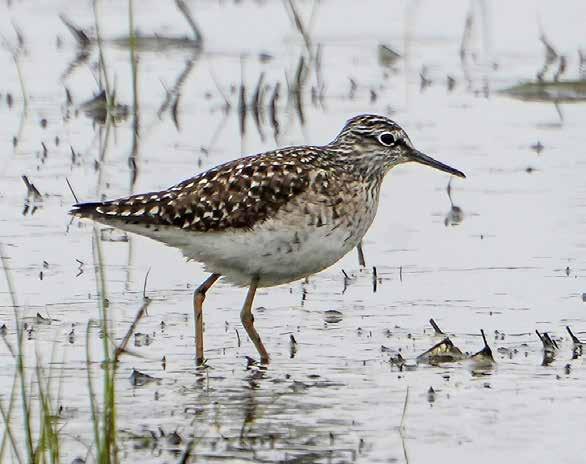
Wood Sandpiper – good number of birds throughout the month; up to 10 at Hollesley Marsh, up to six on Peto’s Marsh, up to three at Southwold and two at Micklemere.
Roseate Tern – one at Minsmere (20th–24th) and two on South Scrape (31st).
Great Skua – one noted offshore at Minsmere chasing terns before heading south (25th).
Glossy Ibis – up to six at Minsmere throughout the month. One at Hollesley Marsh (21st22nd) and one over Reydon (30th).
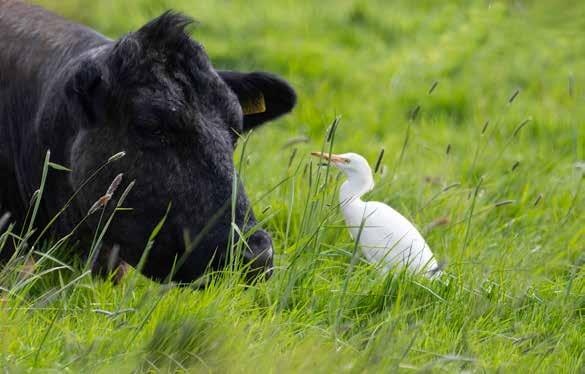
Cattle Egret – three at Boyton Marsh (2nd), one (5th-8th) and one (29th-30th). One at
Sudbourne Marsh (3rd), Hollesley Marsh (22nd), up to two at Minsmere (22nd-23rd) and Lakenheath (29th-30th).
Osprey – one over Island Mere, Minsmere and one north over Grundisburgh (9th).
Wood Warbler – one singing in Great Barton (3rd), singing birds in Aldeburgh and Sizewell Hall (4th) and one seen at Easton Bavents (5th).
Scarce May sightings
Ring-necked Duck – a drake on Island Mere, Minsmere (2nd).
Black-winged Stilt – three on the airfield marsh on Orfordness before flying south (6th). Three on the Slough at Lackford Lakes (30th).
Pacific Golden Plover – a probable bird was on West Scrape, Minsmere before flying high north (5th).
Pectoral Sandpiper – one at Hollesley Marsh (1st-5th).
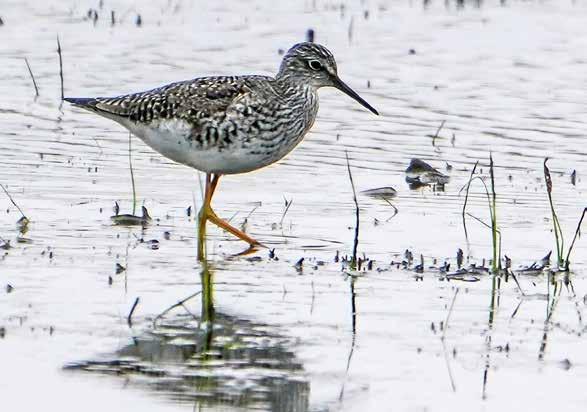
Lesser Yellowlegs – on a flash near the Bailey Bridge, Southwold (3rd-8th).
White Stork – one seen east over Rougham Industrial Estate (7th).
Purple Heron – an adult at Minsmere around Island Mere (12th-13th) and again later in the month (29th). One was at Lound Lakes then flew towards Burgh Castle (12th), one at Kingsfleet (26th) and one at Walberswick (26th-27th).
Montagu’s Harrier – a male seen over Lakenheath Fen RSPB (9th).
Black Kite – one south over Orford then seen later at Boyton Marshes (6th). One over the A12 at Wangford heading towards Cove Bottom (14th).
Hoopoe – one in a garden at Woolverstone (1st).
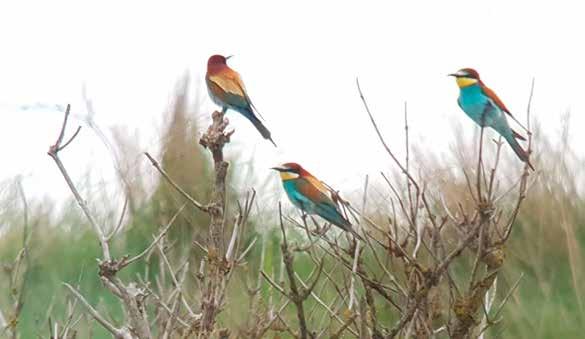
Bee-eater – one was heard over Sizewell (8th). Five were seen flying low, north over the sluice cottage, North Warren (15th) then were noted up the coast at Sizewell Hall, Sizewell and over Minsmere where they landed on bushes along the North Wall, going on feeding sorties before departing north. One was seen flying south at Shingle Street (15th) and then heard a short while later at East Lane, Bawdsey. On the same day there was an impressive flock of 17 birds at Fressingfield before departing after being spooked by a Sparrowhawk. It’s possible that some of these birds went on to nest near Cromer, taking up residence in early June –speculation I know!
Golden Oriole – one heard early morning at Eastbridge, near the Eel’s Foot Inn (14th). On the same day one at Dunwich Heath and one heard along the south belt at Minsmere in the afternoon.
Red-rumped Swallow – one south along the cliff face at Kessingland (12th) and two seen over the coastguard cottages at Dunwich before flying south-west (13th).
Serin – one briefly over Landguard Bird Observatory (7th).
What already had been a dry Spring, continued into June, with little rainfall. One or two unseasonable species turned up and of the rarities, only Caspian Tern stayed long enough to be observed by more than a lucky observer and that showed exceptionally well to those that saw it.
Notable June sightings
Quail – one singing just south of Westleton Common (12th).
Whooper Swan – two on Gifford’s Flash near Layham (24th).
Garganey – female at Hollesley Marsh (8th) and a juvenile on Peto’s Marsh (30th).
Crane – at least one heard calling from Island Mere (14th) and two over Herringfleet Mill (16th).
Slavonian Grebe – the summer-plumaged bird remained on Alton Water (2nd-21st).
Wood Sandpiper – one on West Scrape, Minsmere (9th) and seven at Hollesley Marsh (30th).
Roseate Tern – an adult on South Scrape, Minsmere (5th-6th, 11th, 28th-29th) with two (18th).
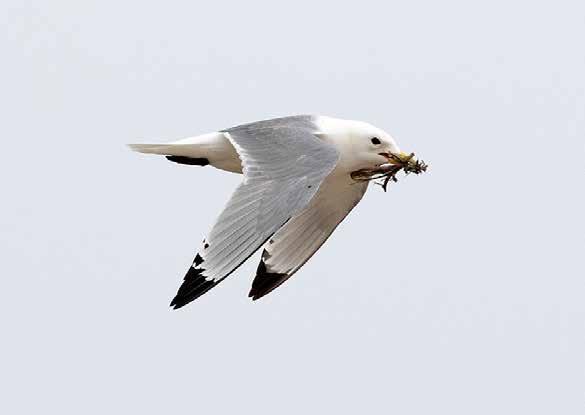
Arctic Tern – one at Minsmere (12th).
Black Tern – one briefly at Minsmere (21st).
Manx Shearwater – one south past Ness Point (26th).
Glossy Ibis – up to six at Minsmere through most of the month plus one on Buss Creek, Southwold (23rd).
Cattle Egret – three at Lakenheath Fen (2nd).
Osprey – one over Badwell Ash (17th). One at Lound Waterworks (18th). One seen from Bittern Hide, Minsmere (21st).
Ring-necked Parakeet – one west over Woodbridge (1st).
Red-backed Shrike – a male was reported by the wall at Ness Ecological area, Lowestoft (30th).
June sightings
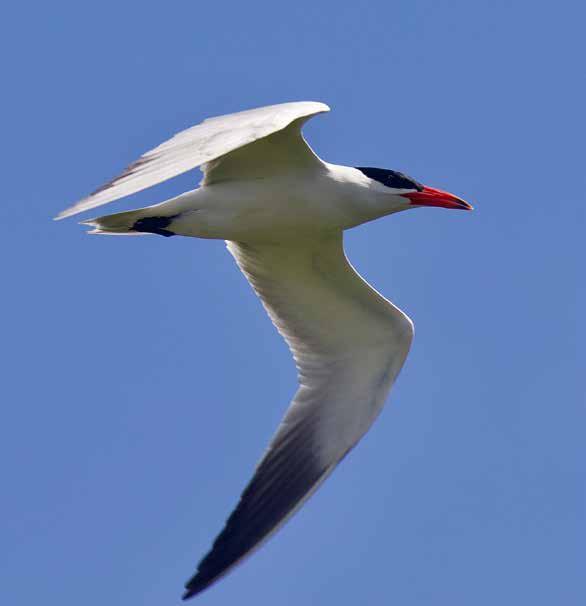
Caspian Tern – one was found on South Scrape, Minsmere and was often noted to move to Island Mere to feed before returning (25th-26th).
White Stork – two over Pakenham then flew south (13th).
Purple Heron – the adult remained at Minsmere, viewed from Bittern Hide. On the last day it was seen to fly high east, out to sea (1st-6th).
Hoopoe – one seen and photographed in Levington (13th).
Bee-eater – one was heard over Minsmere visitor centre (6th). Two over Aldeburgh golf course (12th). Three flew south-west over Felixstowe (14th) plus one heard going north over LBO (18th). One flew east over Mutford (21st) and another was heard flying west over Thetford (28th).
Red-footed Falcon – a female was seen over Lakenheath Fen RSPB (2nd).
Golden Oriole – one was reported near Cow Hill Marsh, Minsmere visitor centre (9th).
Serin – a male was seen south over LBO, then was relocated by the mining station before flying back north (10th).
The hot, dry conditions continued with Suffolk recording its driest ever July. The highest ever temperature, 38.4C, was recorded at Santon Downham on July 19th. It was notable at many sites that water levels were either very low or completely dried up. How much this has impacted the breeding season, only time will tell.
Notable July sightings
Whooper Swan – one at Giffords Flash (3rd) and Minsmere (17th).
Garganey – two at Carlton Marshes (10th).
Crane – there were eight present at Lakenheath Fen (5th).
Wood Sandpiper – several sightings across the county during the month, noted at Hollesley Marsh, Peto’s Marsh and Trimley Marsh.
Pectoral Sandpiper – an adult at Hazlewood Marsh, before flying high north (23rd).
Whimbrel – a flock of 60+ south past Ness Point (29th).
Arctic Tern – a first-summer on the Alde estuary (9th). One at Minsmere (16th and 21st) with a juvenile at the site (28th).
Black Tern – one juvenile at Minsmere (11th and 17th-22nd).
Sooty Shearwater – one north of Ness Point (28th).
Arctic Skua – one north offshore at Dunwich, two north off Ness Point (26th) and one off Southwold (28th).
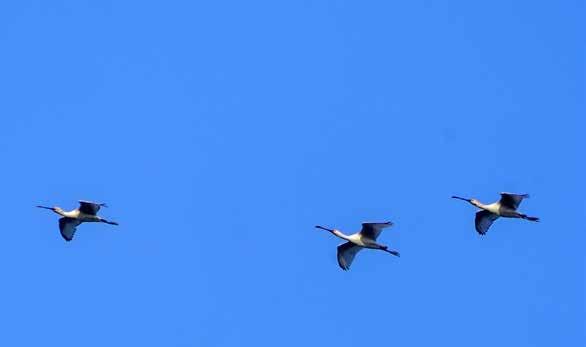
Spoonbill – lots of sightings, mainly at Hollesley Marsh with the highest count being seven (5th) and at Hazlewood Marsh, with 13 the maximum count (30th). Other records came from north over Kessingland, two south over Sizewell, Minsmere, Covehithe, Aldeburgh Marsh and Benacre Broad.
Glossy Ibis – one on Peto’s Marsh (2nd), one seen from Island Mere, Minsmere (4th) and one at Botany Marsh (16th).
Cattle Egret – one at Minsmere (20th) and four at Trimley Marshes (21st-22nd).
Osprey – one on the Blyth estuary, often viewed from Hen Reedbeds (12th-30th).
Wood Warbler – one at Landguard Bird Observatory (29th).
Scarce July sightings
Caspian Tern – one was found amongst the roosting gulls at Botany Marsh before flying towards the Alde estuary (10th).
Purple Heron – a first-summer bird seen from Joist Fen at Lakenheath Fen (31st).
Honey Buzzard – one south at East Bergholt (17th).
Bee-eater – one seen flying south from Felixstowe pier (4th). One was reported north-east over Shottisham (10th).
Golden Oriole – one was heard at Home Wood, Hintlesham (17th)
Council for 2022
Officers
Chair: Chris Courtney
Vice Chair: Gi Grieco (temporary until AGM)
Secretary: Eddie Bathgate
Treasurer: Anne Wright
Communications Officer: Adam Faiers
Projects Officer: Chris Keeling
Suffolk Bird Report Editor and SORC/SNS Link: Nick Mason
Harrier Editor and Outdoor Events Coordinator: Gi Grieco
Indoor Events Coordinator: Adam Gretton
President
John Grant
Members
Peter Merchant
Jamie Everett
Ben Moyes
Michael Gavin
John Kornjaca
Honorary Vice-Presidents
Andrew Green
Robin Hopper
Colin Jakes
Mike Jeanes
Mike Marsh
Roy Marsh
Philip Murphy
Reg Snook
Steve Piotrowski
Bird Recorders
North-east Area Recorder: Richard Walden
Email: bird-ne@sns.org.uk
South-east Area Recorders: Gi Grieco Tel: 07951 482547 and Steve Fryett Tel: 07593 382082 4, The Street, Melton, Woodbridge, IP12 1PW. Email: bird-se@sns.org.uk
West Area Recorder: Colin Jakes
Email: bird-w@sns.org.uk
Memberships
c/o SNS, The Hold, 131 Fore Street, Ipswich, Suffolk, IP4 1LR
Founded in 1973 by a group of Suffolk birdwatchers
Associated with the Suffolk Naturalists’ Society
SBG remains an independent birding group and is a registered charity
A voice for Suffolk birdwatchers
With established links to many naturalist and conservation organisations
Media
Actively lobbies to protect key Suffolk habitats
Provides a county-wide field force of bird surveyors
Promotes BTO bird surveys and organises special SBG surveys

Strong web presence - www.suffolkbirdgroup.org
Active Twitter feed - @SuffolkBirdGrp
Quarterly magazine - The Harrier
Annual review - Suffolk Birds report
Annually (20+) field trips - ideal for novices or experts and young or old alike
Opportunities to visit hot spots and receive practical ID tips in the field
Programme of talks and presentations - variety of topics (county, national, or international) with quality speakers
Assists with conservation projects to improve breeding success
- Swifts
- Barn Owls
- Peregrines
- Waders
Partners with Suffolk Wildlife Trust and other bird groups
Assists with funding for bird hides and other birding amenities
Contributes to community events, including dawn chorus walks
Provides bursaries for special projects