
Gi Grieco
Gi Grieco
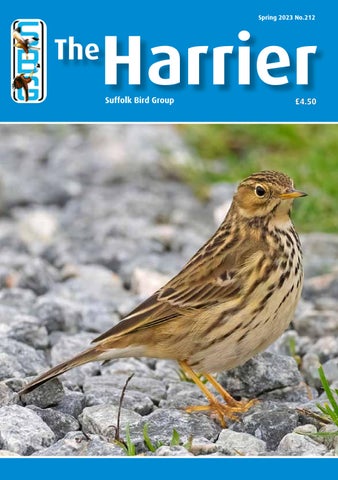
Welcome to The Harrier. A beginning of a new year generally means, for many birders, to get out and catch up with species. Unfortunately, I’ve not had much chance to do so but have enjoyed attending all the SBG trips so far – within we have a nice selection of field trips from the end of 2022 and the start of this season. On these trips we have a good turn out and members will have a range of optics and scopes are shared for those without them. Binoculars are a fundamental part of our hobby and we have an article on them by David Tomlinson, writing about the changes in binoculars we go through over a lifetime of birding and the associated snobbery that comes with different brands.
In the previous editorial I mentioned there would be another instalment on the figures and history of Suffolk birding and this time Patrick has written about Julian Tuck, someone from the Victorian age that studied the wildlife of the county. Regarding history of Suffolk birds, there is the Olgivie collection in Ipswich Museum. Anne, the group’s treasurer, has detailed the plans Ipswich Borough Council have for the museum.
Barn Owls have been a big part of the group in recent years and it is good to have an update on how they are doing in the southeast of the county. There is the request to help with a couple of surveys, one for SBG and another for the National Trust. Finally, we finish with the quarterly bird review.
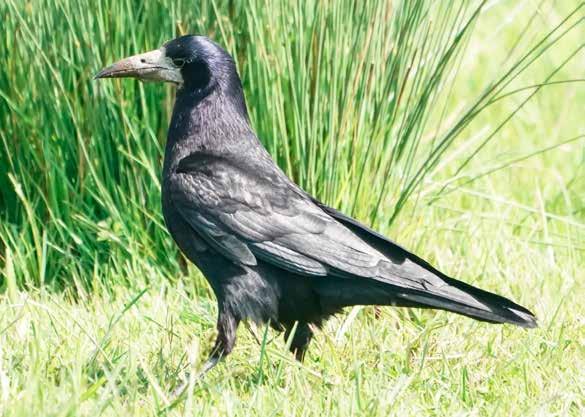
Just a reminder, please do participate and send in records for the Suffolk Bird Group Rookery Survey. There will still be time once this magazine comes out to record the numbers of nests and the locations during late March and into April. As previously mentioned we do have funds to pay for fuel – details will be on the SBG web site. We will also aim to publish a list of sites were records have been received from.
The survey page to enter records is here – https://www.suffolkbis.org.uk/rookerysurvey
Thanks to all who sent in the answers, Woodland and Nightingale, for the wordsearch in the last edition. At the recent SBG AGM all names were put in a hat and the winner picked out was Adam Faiers. Well done to Adam, who had a bit of assistance from his son, Samson in completing the wordsearch and hope you enjoy the book - a signed copy of The Consolation of Nature: Spring in the Time of Coronavirus by Jeremy Mynott, Michael McCarthy and Peter Marren.
Dave Pearsons
While only 156 out of the 304 boxes in southeast Suffolk were monitored it was probably one of the most successful years for Barn Owl pulli in the 13 years that I have managed the area. Barn Owl activity was found in 46 boxes, 3 boxes had Tawny Owl activity, 18 Stock Dove, 11 Jackdaw, 5 Kestrel and 5 Grey Squirrel. All others were either empty or in need of repair. Shelduck activity in a box on the Shotley peninsula was a surprise addition to the records. The 46 boxes with Barn Owl activity revealed 93 pulli with 84 being ringed and 3 adults were also ringed with a further two adults carrying rings associated with the Suffolk Community Barn Owl Project and raising their own pulli. Of nine Barn Owl eggs that were seen in boxes, six were cold.
From my point of view, the highlight was the box at RSPB Hollesley where six pulli were ringed and all appeared to have fledged successfully. However, Mick Wright went one better with seven pulli in a box on the Felixstowe peninsula.
One of the most rewarding things about monitoring the boxes is when you tell the owner you have 1, 2, 3 or maybe 4 young Barn Owl chicks in the box and then sharing the ringing activity with them. It is especially pleasing when youngsters are present. Inspiring them is so important for the future of our threatened wildlife. The picture shows Dan Zantboer, a trainee ringer, supporting the ringing activities.
Many monitors have retired from the project and I thank them for their past support, to those who continue to support the project I thank them for their loyalty and help. My thanks also go to my wife who never once tried to shake me off the ladder, although she did desert me when some sheep took a fancy to her!
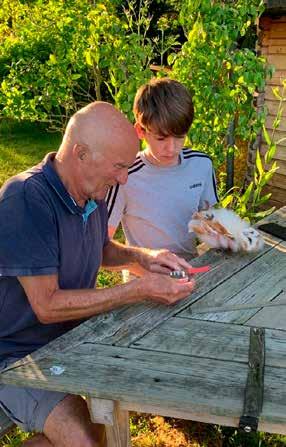
Dave and Dan Barn Owl ringing
Foot note: I re-visited the Hollesley box to see if there was a second brood and to see if any carcasses/rings were in the box. No second brood found but the absence of any carcasses/ rings suggests that all 6 fledged.
In these pages and elsewhere I have attempted to draw attention to the pioneering role of the parson-naturalist in the development of the natural history of Suffolk. The Victorian period was particularly important – this was the period when county floras and county bird books were compiled, and many societies were established. The names of John Henslow, William Kirby, and the Babington cousins are prominent. Less well known figures include Edward Byles Cowell and Henry Harpur Crewe. Walter Whittingham, Bishop of St Edmundsbury and Ipswich (1923 -1940) provides a rare example of a naturalist of episcopal rank. Some parson-naturalists concentrated on their local area – parish or county - and of course the long tradition of clergy remaining in a single parish for much of their ministry allowed them to get to know the plants, animals, landscapes and people of their home region extremely well. Gilbert White, of Selbourne in Hampshire is the type example here. But there were theological reasons too, for the long-standing interest of clergy in the natural world about them. ‘Natural Theology’ is the doctrine that maintains that one may gain an insight into the nature of God by studying the beauty and complexity of Creation, and this outlook was quite widespread amongst the clergy of the Victoria age (Armstrong, 2000, 2020).
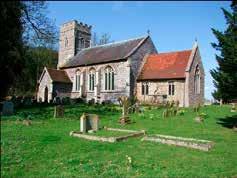
The Reverend Julian George Tuck (1852-1933) seems to have been born in Stow, in central Suffolk. As is so often the case, with Church of England clergy, he was himself the son of a clergyman, the Reverend William Gilbert Tuck (c.1811-1887). Julian entered Emmanuel College, Cambridge in 1871, taking his BA in 1874 progressing to MA in 1884. He followed
his time in Cambridge with a year at Lichfield Theological College, Staffordshire (1874-5). He was ordained deacon in 1875, and priest in 1876. He seems to have spent the early part of his ministry in the English Midlands, but for the entire latter part of his career he was incumbent of the parish of St Andrew’s, Tostock, Suffolk.
Records show there seems to have been a long family association with East Anglia – Suffolk and the adjacent part of Norfolk - and this may have played a part in Julian being granted the living at Tostock. His address seems to have been Tostock Rectory, Suffolk for several decades. He married Fanny Pow in the parish of St Mary, Cardiff, Glamorganshire, Wales, on 3 June 1880. They had three children: Gilbert (born 1881), Magdalen (1883) and Winifred (1886). Gilbert emigrated to Australia, but embarked from Sydney in HMAT Boorara on 19 August 1916, as a 2nd Lieutenant in the 54th Australian Infantry Battalion. He was killed on 19 February 1917, and is buried at Flers in northern France. His name is recorded on the Tostock Church War Memorial.
I have not been able to locate a photograph of the Reverend Julian Tuck.
Julian Tuck wrote several dozen papers and notes on natural history in a range of journals, including The Field and British Birds, between about 1872 and 1912. His usual vehicle of publication, however, was The Zoologist. The occasional piece entitled ‘Polecat in Suffolk’, ‘Squirrel breeding in church tower’ or ‘Seals in the Wash’ shows that his efforts were not entirely confined to ornithology. Similarly, although he produced the occasional pieces on Yorkshire and elsewhere in northern England – ‘Rare birds at Flamborough’ (1875), ‘Goshawk and other birds in Yorkshire’ (1877), most of his publications were on Suffolk, and the adjoining counties of Norfolk and Cambridgeshire.
He seems to have had a special interest in the breeding biology of the Cuckoo. The following is typical:
On June 24th [1899] I found an egg of the Cuckoo in a Song Thrush’s nest in my garden with three eggs of the owner, the nest being apparently deserted. The Song Thrush’s nest is, I believe, very rarely chosen by the Cuckoo for the reception of her egg. On July 8th I had an egg of the Cuckoo from a Hedge Sparrow’s nest, which was certainly laid by the same Cuckoo, the two eggs being exactly alike, but quite different from any of the others (eighteen or twenty in all).
(Zoologist, 4, 1, p.365).
A couple of years later he noted a Cuckoo’s egg in the nest of a Red-backed Shrike.
Both the Cuckoo and the Red-backed Shrike have seriously declined, in Suffolk, and elsewhere. But a species that once bred in substantial numbers on the open, sandy heaths of Breckland, and possibly also the East Suffolk Sandlings, and has now completely disappeared, was the Great Bustard. Flocks of 40+ occurred at Icklingham in 1812, and the last nest was found in the area in
1832 (see, for example, Piotrowski [2003]). There have been occasional stragglers since. Julian Tuck was particularly interested in this species, and accumulated notes on it for many years. He is reported to have tasted the flesh of a female shot at Mildenhall Fen in 1891, comparing the taste to that of Welsh mutton! A piece he wrote in 1889 is perhaps worth quoting at length, including as it does a mention of belated attempts at protection of the species.
I lately had the pleasure of a conversation with perhaps the only person who can claim to have seen the indigenous race of Suffolk Bustards, both alive and dead, as well as their nests and eggs. Mr W Bilson, a former bird-stuffer in Bury, who was born in 1808 happened to call on me and while looking over my birds the Great Bustard was mentioned. Mr Bilson well remembers as a lad seeing the eggs of a Bustard’s nest at Icklingham, and as the then owner of the Icklingham estate was very careful to preserve the few remaining Bustard, the eggs in question, were … left undisturbed. This would probably be between 1818 and 1825.
(Zoologist, 3, 13 p107).
One might interpret some of the phrases in the above two quotations as implying that Julian was a collector of birds’ eggs and stuffed birds. This seems surprising in the face of the fact that he was associated with the RSPB, founded in 1889, relatively early in its history. Other interpretations are perhaps possible, and one must be careful not to judge the behaviour of our predecessors 150 years ago in terms of the mores of today. There were plenty of Julian Tuck’s contemporaries who ‘changed their tune’ as the conservation movement developed.
One of his contributions to Suffolk natural history was his Ornithology of Suffolk (1891). This was published as a part of White’s
Great Bustard, from a 1855 engraving, originally from B. R. Morris, British Game Birds and Wild Fowl.
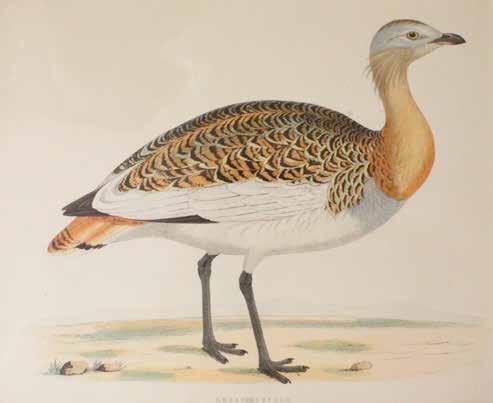
History, Directory and Gazetteer of the County of Suffolk (pp79-86). Perhaps because of its inclusion in the larger volume, this summary is less well-known than the classic works of Babington (1884-6) or Ticehurst (1932).
Be that as it may, today’s Suffolk naturalists should remember the Reverend Julian Tuck, not only for his painstaking observations and
References
recording of Suffolk bird life, but his role, in a meeting at Framlingham, in 1929, along with Claude Morley, Chester Doughty, Arthur Mayfield, and a few others, in founding the Suffolk Naturalists’ Society, which unlike the bustards has prospered and expanded its influence. He was an early President of the Society.
Armstrong, P. H. (2000). The English Parson-Naturalist: A Companionship between Science and Religion, Gracewing Publishing, Leominster.
Armstrong, P. H. (2020). The Parson-naturalist in Suffolk. Transactions of the Suffolk Naturalists’ Society, 56, pp.1-10.
Babington, C. (1884-6). Catalogue of the Birds of Suffolk, John Van Voort, London.
Piotrowski, S. (2003). The Birds of Suffolk, Christopher Helm, London.
Ticehurst, C. B. (1932). A History of the Birds of Suffolk, Gurney and Jackson, London.
Anne Wright
Many of you will be aware that Ipswich Museum closed on Sunday, 2nd October 2022 so that redevelopment works can be undertaken, and that it should re-open in 2025.
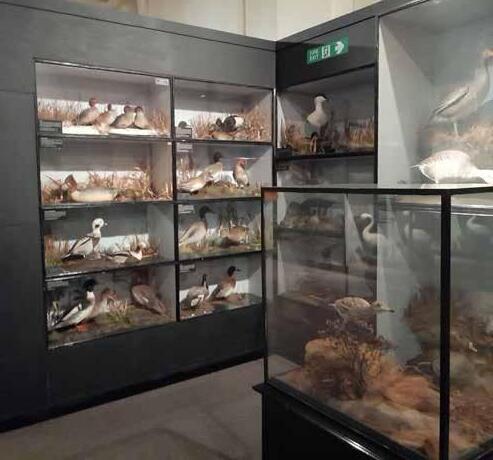
Those of you who have visited the Museum in the past will surely have been drawn to both the wonderful Natural History Gallery and, upstairs, the stunning Ogilvie Bird Collection – the Museum was absolutely packed in the days leading up to its closure with those who love it going for one last visit.
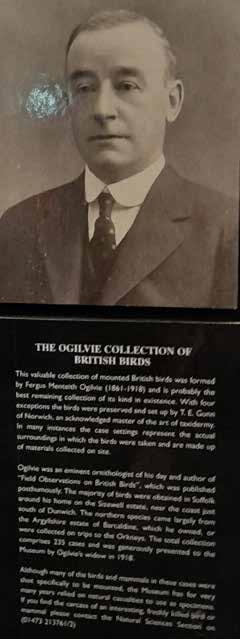
As Ipswich Borough Council (IBC) themselves have said on their website ‘Our vast collection of British birds on display is considered to be one of the most important and complete in the country to have been assembled by one person. Fergus Menteith Ogilvie (1861-1918) was a ‘sportsman-naturalist’ with a great enthusiasm for the study of birds and orchids which he carried out with thoroughness and scientific insight’.
For those of you who might be interested in the history of the collection, there is an interesting article at this link: TE Gunn Taxidermy (www.taxidermy4cash.com). IBC also noted in a Facebook post in late 2018 that ‘100 years ago Fergus Menteith Ogilvie’s collection of birds started making its way to Ipswich Museum from its old home at Sizewell Hall, gifted to us by May Ogilvie’.
As to the future, we have been told that, once the Museum has re-opened, any specimens taken off permanent display will be retained in storage but will be accessible to researchers upon request to the curators.
Councillor Carole Jones, Ipswich Borough Council portfolio holder for Ipswich Museum, has been keeping in touch and has also advised that the Collection can in the
meantime be viewed online via the Colchester & Ipswich Museums website Visit Colchester + Ipswich Museums | Where History Comes Alive (www.cimuseums.org.uk) within the Collections tab and searching for ‹Ogilvie›with the following link taking you nearer to the relevant pages: Axiell Internet Server 6 | Results (adlibhosting.com).
You can ‘drill down’ into the detail of each exhibit and also expand the size of each picture - so whilst it’s clearly not the same as actually seeing the collection all together in the room at the Museum, this online catalogue facility is very good - and certainly better than nothing.
Whether some or all of the Ogilvie Bird Collection will be returned to the Museum after these works have been completed is not yet known but the Museums Manager has said that public consultations are planned later this year and it is now possible to register your wish to be involved in the consultation process Ipswich Museum contact (www. ipswichmuseum.co.uk/contact/).
We would encourage anyone who values the Museum, and in particular the Ogilvie Bird Collection, to register your interest while the opportunity exists and to contribute to the consultation when the time comes.
David Tomlinson
Just as the make and condition of a car tells you a lot about its owner, so a person’s binoculars tell you a lot about their user. I am sure that all serious birders are guilty of looking at a fellow birdwatcher’s binoculars and concluding, rightly or wrongly, a lot about the person behind them. A well-worn pair of Swarovski 10x42 EL - a serious birder. Brand-new Swarovski 8x32 Pure - very keen, prepared to spend money on their hobby, but not necessarily knowledgeable. Zeiss 10x42 Victory SF - someone who is happy to be different, perhaps even a member of the BB Rarities Committee (they each get a free pair). Hawke 8x40 - a weekend birder, probably a keen member of their RSPB local group. Swarovski or Zeiss minis - quite serious, but more likely a botanist or a walker. I could go on, but I will leave you to think of your own examples.
Many years ago I interviewed Barbara Young for an article for The Daily Telegraph. Barbara was interesting, as she was the first CEO of the RSPB who, when she took up the job, knew little or nothing about birds, as she had been recruited from the NHS. She was quite candid in her interview with me - I don’t think she had been well briefed, as she didn’t seem aware that I knew anything about birds. She told me that when she accepted the job, she was advised to get a pair of binoculars. However, instead of rushing out to buy a brand new pair of bins, it was recommended that she bought herself a pair of secondhand Zeiss Dialyt 10x40, then the binocular of choice of most serious birders. She did just that, and the fact that they were well used gave exactly the right impression she needed of someone who knew, when it came to birds, what she was talking about.
I’m afraid that my resulting interview, published in the Telegraph’s weekend
supplement, wasn’t flattering: I reported what I heard. However, Barbara had a lot of charm, and she had already worked it on many people, among them the Suffolk Wildlife Trust’s then director, Derek Moore, who was a good friend of mine. Derek read my interview and was furious with me, so much so that it was some months before we were on speaking terms again.
I’ve no idea what binoculars the current CEO of the RSPB, Rebecca Speight, uses. I’ve no doubt that all the major binocular manufacturers would be only too keen to supply her with their equipment. There’s a lot of product placement by binocular manufacturers with so-called celebrity birdwatchers. Tim Appleton, founder of the Birdfair, is supplied by Swarovski, Iolo Williams and urban birder David Lindo are Leica ambassadors, while the editor of British Birds, Stephen Menzie, is a Zeiss man. I have a small claim to fame in that I introduced Bill Oddie to Leica (then Leitz) back in the 1980s, and for many years Bill was sponsored by the German company. I did get a Leitz Trinovid 8x40 on semi-permanent loan as a result. Beautiful binoculars: I wish I still had them.
Like most birdwatchers, I can remember almost all the optics I’ve used over the years. My very first binoculars, given to me by my father, was a pair of ex-WWII Bausch & Lomb 6x30. I doubt if I would be impressed if I looked through the B&Ls today, but they were tough and functional, with a great depth of field. They needed the latter, as they didn’t boast central focussing, as the eyepieces had to be focussed individually. For many years they were my most important possession, and I saw a lot of good birds through them. In my teens I worked as a paperboy, earning a useful weekly wage. I used the money
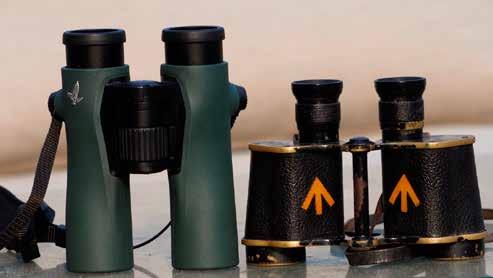
to buy my first serious binocular, a Swift Newport 10x50. Older readers will no doubt remember Swift, a Japanese manufacturer that enjoyed great success with its Audubon 8.5x44, a binocular designed specifically for birdwatching. It was aimed at the American market, but also sold well in the UK. My Newports served me well for several years, and they were the binocular I used on my first serious birdwatching expedition to the Coto Doñana in 1968. They were pointed at all sort of good things, from Little Bustards and Pin-tailed Sandgrouse to a stunning Spanish Lynx.
However, the Newports were big and heavy. They were a porro-prism design, as were most binoculars then. Leitz had pioneered roof-prism binoculars with the Trinovid; in the early 70s Zeiss responded with the Dialyt, its answer to the Trinovid, and this was the binocular to have if you took your birding seriously. I bought mine in 1975, the year before I got married. I remember my future father-in-law being taken back by my purchase, as spending £100 on binoculars was a lot of money for someone who was also saving for his first house. I reasoned that if I didn’t buy the binoculars then, I would be unlikely to afford them once I was married.
They were a sound investment, and lasted me well into the 80s, by which time they were looking tired. However, they had held their value well, and I sold them for almost as much as I had paid for them. I flirted with a number of different binoculars in the 80s. The Trinovids were my favourites, but I enjoyed using other makes. A friend who ran a company importing binoculars asked me if I’d like to take a look at a pair of 8x30 binoculars from a little-known Austrian company called Swarovski. I duly did so, and was sufficiently impressed to buy a pair, which probably makes me one of the longest users of Swarovski in Britain.
In the late 80s I was invited by Zeiss to go to Wetzlar in Germany to see the company’s binoculars being manufactured, an invitation that was too good to refuse. I was one of a small group of journalists, each of whom was presented with the latest Dialyt 10x40 inscribed with our initials. From Germany we flew to Majorca to test the binoculars in the field (it was a hard life); I remember enjoying watching such delights as Black Vultures and Moustached Warblers with my new binoculars.
I got on well with the people at Zeiss, and the following year I went to Vienna to help the
company with another press demonstration at Lake Neusiedl. Various distinguished ornithologists were invited on this trip, including Lars Svensson, who was then working on the Collins Bird Guide. We had met before, so when he encountered me in Austria he asked me what I was doing there. “I’m here to show you birds, Lars,” I told him. He laughed, though later on the same trip I pointed out a singing garden warbler to a couple of Americans. Lars came along, and corrected me. “That’s a Barred Warbler” he said. By this time I had spotted the bird: it was, I was relieved to note, a Garden Warbler. Lars reluctantly agreed, but commented that “it was not the typical song”.
I was offered modest payment for this work with Zeiss. I declined, but asked instead for a 7x42 binocular. This was a quite lovely instrument, with terrific optics and very wide field of view, and despite its size, beautifully balanced. I used it for a number of years and it goes down as one of my all-time favourites. It was a binocular that was popular with deer stalkers, as it performed so well at dawn and dusk; it was designed for stalking rather than birdwatching.
However, I’m always trying to reduce size and weight, so I eventually traded in the Zeiss for a Leica 8x32. With hindsight this wasn’t a great move. The Leica had good optics and was light and compact, but wasn’t
robust, and bits fell off. These binoculars were made at Leica’s factory in Portugal. I visited the factory a few years ago, and the quality control there is now first class.
In 1999 came a watershed moment when I flew to Austria for the launch of the brandnew Swarovski EL range. This was a beautifully made and most impressive binocular, and I used an 8x42 for several years. It was a binocular that caught the attention of the birding community, and it soon became the No 1 with birders in the UK. EL apparently stands for extra light, but I found them too heavy, so as soon as Swarovski launched the smaller 32 EL range I swapped immediately. Soon afterwards I flew to Trinidad and Tobago to research for an article for Country Life, and was hugely impressed with the small Swarovskis when I used them to watch tanagers and toucans in the rainforest.
Fast forward to 2022, and a bird-photographer friend raved to me about the new Swarovski NL Pure binoculars he had tried at the Birdfair. A few days later I traded in my original 8x32 for the latest 8x32 NL Pure - I was given an impressive £500 for the former. To be honest, though there is certainly an improvement in the optics, it’s difficult to improve on something that’s already so good. However, the slightly curious shape of the new Pure feels fantastic in the hand. It’s difficult to explain why, but it just feels right. I love it.
The National Trust at Ickworth are keen to recruit volunteer breeding and wintering bird surveyors with some experience. The Trust would look for volunteers to follow BTO/JNCC/RSPB Breeding Bird Survey (BBS) methodology and BTO/Natural England English Winter Bird Survey (EWBS) methodology, using transects at each location (to be set up). If interested please visit myvolunteering - National Trust or contact Ickworth Ranger martin.gilbert@nationaltrust.org.uk

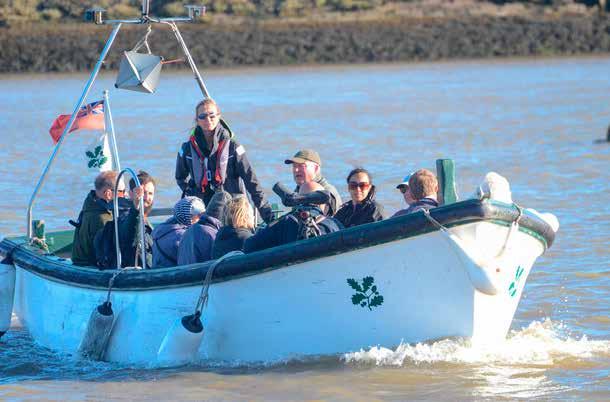
Our annual trip to Orfordness is always keenly anticipated for the experience of feeling very remote, particularly for those who stay overnight. This year was slightly different however, as, following the surge of people visiting outdoor areas during Covid, the National Trust had extended their open season into October. For us, this meant that instead of being the sole visitors on the Sunday, other day-visitors would be present. The main impact was that we were asked to only briefly visit the beach – prior to full opening. By habit, we’ve always started our Sunday walk at the jetty, then had a nice lunch break by the lighthouse and enjoyed
a bit of a seawatch, so an amendment to the second day was in order.
For those staying overnight, we assembled at Orford Quay on the Saturday afternoon, loaded the boat with all our kit and headed over. We took the first track to be able to view over the airfields. Despite the really dry summer, recent rains meant there was some water and, as such, a few waders and ducks. Most were distant but we picked up four Avocet, two Dunlin, two Golden Plover, Greenshank, Spotted Redshank, Teal and 16 Lapwing plus a number of Redshank. Our first raptors were a Marsh Harrier and a Kestrel but we were treated to a speeding Merlin
followed by a second bird. Smaller birds were few and far between and we managed to see just two Wheatear and a Chiffchaff, and to hear a Blackcap in the scrub near the buildings. There were also a few Meadow Pipits, Reed Bunting and Skylark out on the grassy areas. Further waders, including further Greenshank, plus Grey Plovers and Black-tailed Godwits, were noted along the creek.
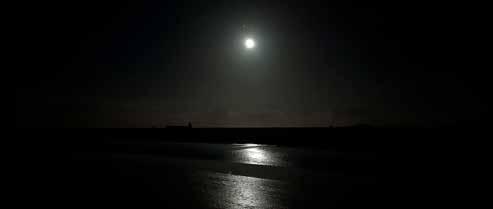
Once in the accommodation we chose our bunk beds, settled in and started cooking. After eating we went for a short walk in the dark and heard a Barn Owl and then, using a thermal imager, were able to see it perched on a post. A scope was then set up for viewing the planets, and thanks to the dark sky we were able to view four of Jupiter’s moons quite clearly. Some further ‘nocmig’ sound recording equipment was set up to record overnight flight calls. Later analysis showed that it was predominately waders that flew over, including close Dunlin and Golden Plover and the wonderful sound of Curlews. The Barn Owl was also recorded.
The following morning we headed to the quay to meet the other members visiting for the day. We retraced our steps past the airfields but there were fewer waders than the previous day. We managed to re-find one of the Wheatears and had good views
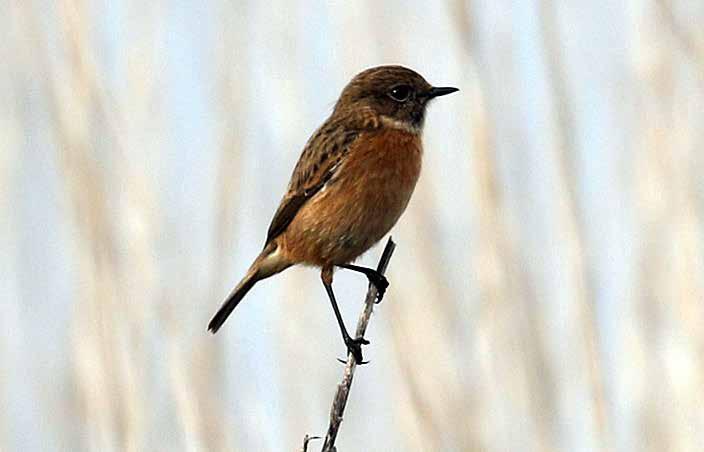
of Stonechat on our way past the Bailey Bridge near the buildings. We headed up to Black Beacon for a change and, on the way, saw Hares and Chinese Water Deer. We had a brief seawatch and managed to see two Arctic Skuas and one Pomarine Skua along with a couple of Gannets. However, the day was very windy so it was difficult shouting news across to all the group.
As it was an area we’ve rarely visited on previous trips, members popped into the museum buildings to discover a bit more history of the site. We walked back, deciding to have lunch back at the buildings as we could have a sit down, but not before we went up on to the Bomb Ballistics building. Due to the wind, it was tricky keeping our scopes still but on the open area of water a number of Great Black-backed Gulls and some ducks such as Wigeon could be seen. Also seen were distant Buzzards, Marsh Harriers and Kestrels. We were hoping to catch up with Merlin again after the sightings the previous day, and were rewarded by a fly-past.
We lastly had a casual walk back to the quay again seeing some of the species encountered earlier in the day. We thanked Nicola, the National Trust warden, and queued for the boat back, reflecting on what an entertaining weekend we had.
Leader: Gi Grieco
It had been a few years since we had done this walk; it had been a regular trip previously led by Ash in November and Richard in March.
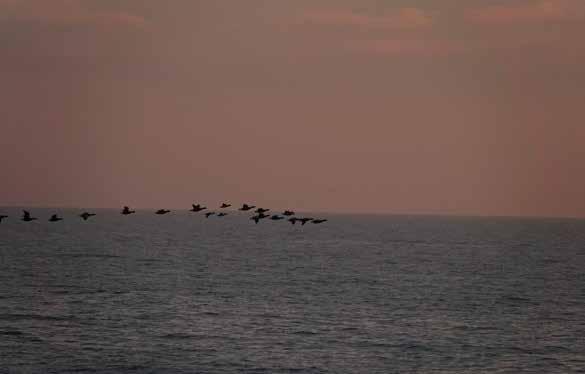
I met SBG Communications officer, Adam Faiers, at first light to have a quick recce prior to members arriving. What was noticeable was a wonderful movement of ducks and Brent Geese moving south offshore. We had a to drag ourselves away from the spectacle to meet up with the group and at the carpark we had Redwing over. We walked down to the beach and, what is always welcome, was to hear the chattering House Sparrow flock near the Sailors Home Pub. Down onto the shingle we scanned the sea and, despite numbers being quieter than first thing, there
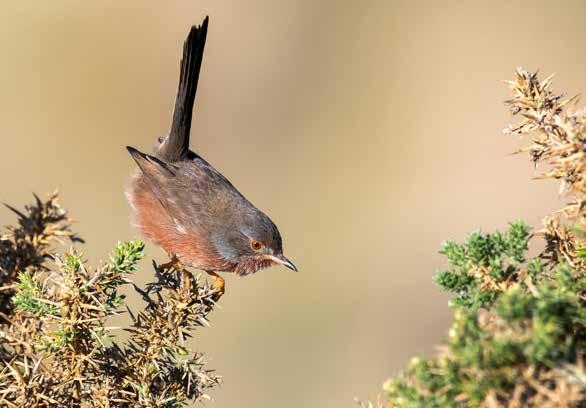
were still good numbers of Wigeon, Teal and Pintail passing through and a constant stream of groups of Brent Geese. As we headed south towards the sluice we came across a wonderful sight – a flock of around 50 Greenfinches. A number of Meadow Pipits were about too and the odd Skylark. On a recce for the trip I had seen Grey Wagtail at the sluice but we had no luck this time, noting Pied Wagtail and Reed Bunting. We searched for a Dartford Warbler that had been seen earlier in the area but couldn’t re-find it.
We carried on down to Benacre Broad along the beach, admiring the picturesque, glistening sea. There were a number of ducks in front of the new hide, mainly Mallard with
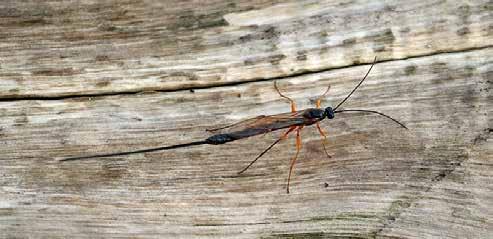
some Wigeon and Teal along with one or two Little Grebes. At the back, over the reedbed, a Marsh Harrier flew over. We stopped for food and drink near the dead old trees, scanning both across the Broad and out to sea. Passage offshore had quietened down considerably but we did see some Gannets and the odd Red-throated Diver. In the immediate vicinity though there were things that got our attention; three Stonechats moving through along the reeds allowing close views and an interesting Ichneumon wasp species with a
very long ovipositor. We watched it moving around the various dead branches, pausing every now and then.
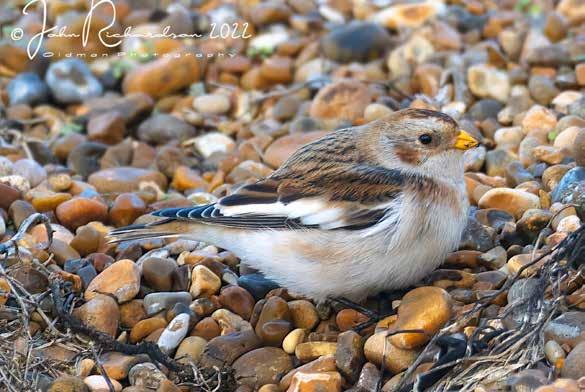
We headed back to Kessingland, where some members called it a day and the remainder decided to walk towards Kessingland shore pools. It is surprising how far it is to walk but our perseverance paid off as we bumped into two local birders, Jane and Paul, who pointed a small flock of Snow Buntings – a nice finish to the day.
Clockwise...
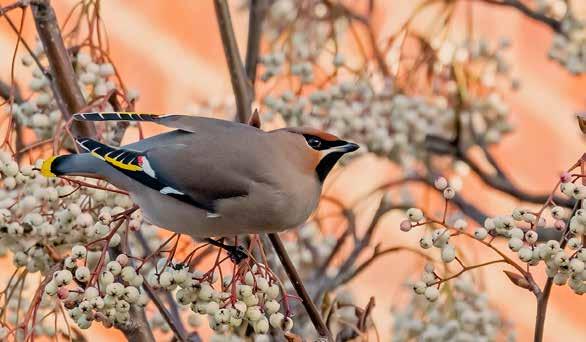
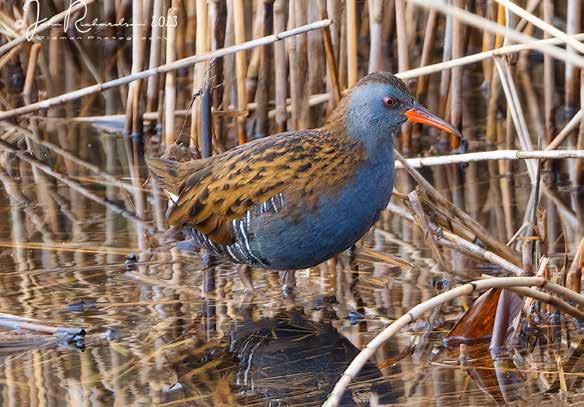
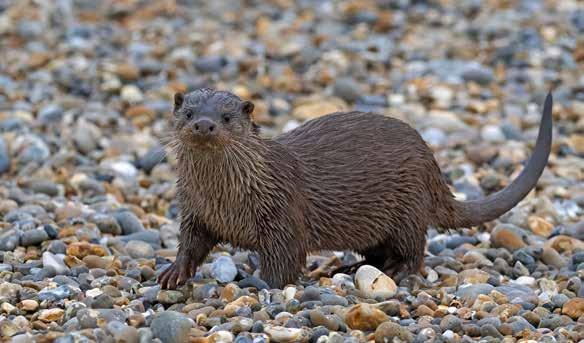
Top left: Dartford Warbler at Minsmere Nov 2022 by Les Cater, Top right: Water Rail at Minsmere Jan 2023 by John Richardson, Bottom right: Otter at Walberswick Jan 2023 by Andrew Moon, Bottom left: Waxwing at Ipswich Jan 2023 by Rab King.
Leader: Steve Fryett
It was a tad frosty this morning, with the temperature hovering around zero as 13 members assembled at Sudbourne Church for a wander down to the marshes. A quick check from the road overlooking both Sudbourne Marshes and Orfordness failed to produce anything interesting although we noted a Chinese Water Deer which was the first of several sightings of the species.
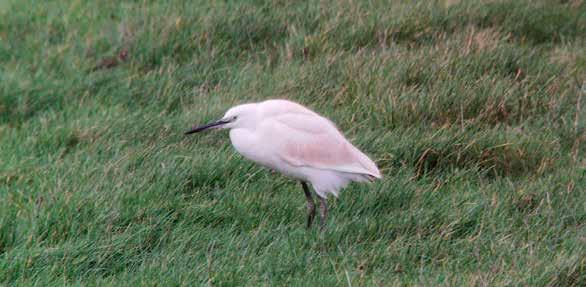
Arriving at the marshes, a herd of Fallow Deer kept a watchful eye on our movements as we continued along the footpath, disturbing a Wren foraging in the frosted grass just feet away - how does this tiny bird survive out here in these harsh conditions? Finally, we reached the centre of the southern area of the Marsh opposite the Orfordness transmitter pylons. Here we closely observed three Little Egrets and a Great Egret standing together, giving everyone a chance to view the considerable difference in size between the two species. Several Hares were noted
along with Curlew, Lapwing, two Grey Herons and two small flocks of Canada Geese.
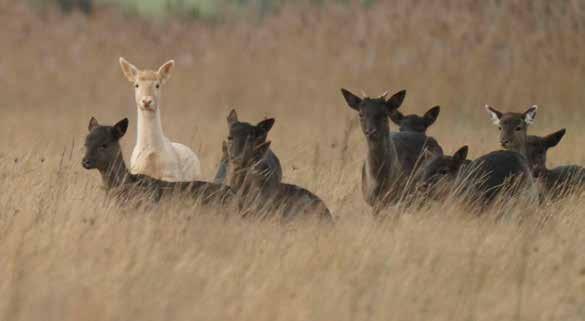
Three Marsh Harriers were seen, two females and a male along with a Common Kestrel but two distant raptors remained unidentified. There were also very distant sightings of Golden Plover so it was good to have two calling as they flew close over us. A single Mistle Thrush, Redwing and Robin were added to the species list as we made our way back towards the cars. A leucistic Fallow Deer was an interesting find amongst the herd we saw earlier. One lonesome Grey Plover flew over calling as we had further views of the Great Egret and a Muntjac became the third deer species noted. Also seen was another male Marsh Harrier but a mewing Common Buzzard could not be found. Continuing back to the church via the Rectory roadside lake, Long-tailed Tit and Jay made up the final sightings of a friendly birding trip.
Saturday 7th January 2023
Once again I managed to pick the wettest and windiest of days that we had had for some time, and was amazed when ten other members arrived at the designated meeting place.
It was far too windy to view the sea from the original meeting place so I decided to try our luck at Cudmore Country Park; this is a great area as there is a mix of habitats where the sea would be a bit more sheltered. We left the car park and took a tree-lined lane, for some shelter, towards the coast only noting a mixed tit flock moving along the hedge line - this was to set a precedent for the rest of the day. On reaching the coast we turned left and walked along the sea wall noting a nice flock of Wigeon feeding on the bank of the grazing marsh and several Brent Geese further round. Further along, on the seaward side, we also saw a lone Sanderling and a few Dunlin. By now the wind was getting
stronger and I was looking for a place to get down off the seawall, as we passed a water culvert a Kingfisher called and flew off, probably cursing us as it went. We managed to get off the wall which made viewing more comfortable and we were soon picking out various waders feeding on the exposed mud –Dunlin, Grey Plover, Turnstone, Oystercatcher, Knot, Curlew and Avocet.
It would be pointless heading back the way we came so I decided to head inland via Golf House Lane, again for a bit of shelter. On passing a horse paddock we counted 40+ Moorhen feeding out in the open on the grazed turf; I’ve never seen so many together. The fields and hedges were devoid of bird life as we took the lanes back to the car park but we did have good views of a male Sparrowhawk as it flew about a foot off the ground and then flew up and landed on a telegraph pole.
We then drove back along the road to Coopers Beach where we had lunch and then walked through the caravan park towards the coast. Once again viewing was difficult in the wind and rain. From the raised embankment looking along the coast I noticed that the sea defences were in a worse state than last year and had been breached in several places; I wonder how long it will be before the area will become inundated. I had seen several Brent Geese in a cereal field on the way down, and knowing that there had been a Black Brant at this location during the week I led the group to a good viewing area and settled in to scan the large flock. Eddie Bathgate was very quiet for some time and then announced that the flock was 991 strongwhere was the 992nd goose, the Black Brant? Also within the field were 51 Curlews and 5 Black-tailed Godwits. Moving back towards the sea, the area that was now tidal had a few more waders on it, mainly Redshank, Dunlin, some more Black-tailed Godwits and the odd Snipe. Again walking past a culvert, this time two Kingfishers flew out giving
everybody a chance to catch up with them. We also saw Kestrel, Sparrowhawk, a distant male Marsh Harrier and a very obliging Rock Pipit that was feeding unperturbed on the landward side of the beach.
With time moving on I didn’t think it would be worth going to any of the other sites on the island and so we moved and stopped off at Abberton Reservoir, parking on the Layer Breton causeway. There were a lot of duck species taking shelter from the wind, and in amongst the large raft of Tufted duck we found 9 Scaup – a nice mix of adult males, females and immature males. Also from the dam we had good views of Black-necked Grebe, Great Northern Diver, Goldeneye, Goosander and all the other duck species you would expect at this time of year. On the way home some members detoured via Layer de la Haye causeway and picked up a redhead Smew along with further Goosanders.
Given the conditions we did better than I thought we would and I would like to thank all those who braved the day.
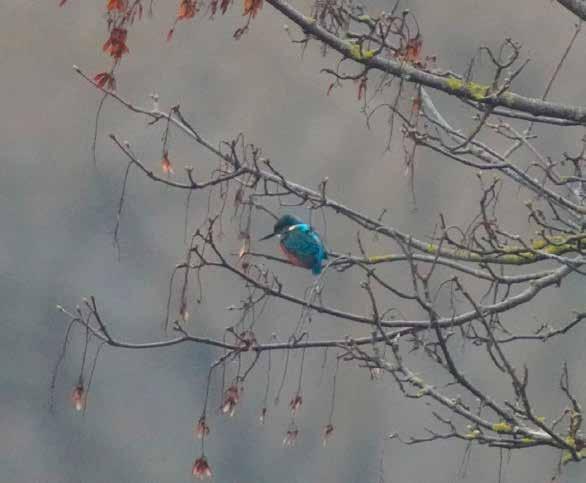
Kingfisher
Sunday 29th January 2023
Leader: Dave Pearsons
The Levington meeting is always good for getting your birding year off to a good start and this year didn’t disappoint. Thirty members turned up, including some on their first trip, on what was a pleasant but windy morning. We set off passing through the wood by Levington Marina where a flock of tits were picked up including 10+ Long-tailed and one Coal Tit – we hoped they would be carrying a crest species with them but that was for later. A sharp-eyed member picked
up a well hidden Great Spotted Woodpecker together with a Song Thrush, which was the first of the year for some. Moving onto Loompit Lake we had superb close views of a Kingfisher, diving for food and constantly returning to its perch. However, the lake was very quiet compared with previous years with Tufted Duck, Gadwall and one of my favourite ducks, Pochard, being the main inhabitants. A number of Cormorants were to the back of the lake as was a solitary Grey Heron.
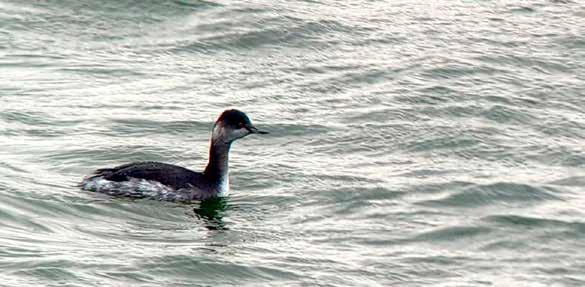
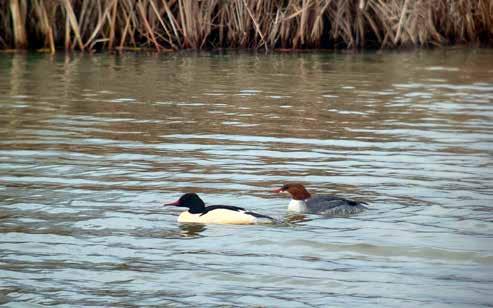
Immediately past Loompit, in the scrub along the path, a Treecreeper, two Goldcrest, Redwing and four Greenfinch were spotted. The lively Treecreeper gave us a challenging time but eventually all got good views of it. For me it was great to see the Greenfinches, this diminishing species is now a rare visitor to my garden. The next stop was a high point looking over the river. The river was quieter than other years but a close male Red-breasted Merganser gave good views with a Shag showing us its unique dive style! A nice group of Great Crested Grebes were swimming amongst other Mergansers with a few Brent Geese, Wigeon and Teal close by.
We moved on to Trimley Retreat where Jack Snipe was our target. This was a great opportunity for Gi to use his thermal imager equipment. Gi soon picked up the heat of a bird in the saltmarsh. We were able to get everyone on this bird together with two others that flew up nearby. We returned to our cars for some liquid refreshment and then moved to the river west of Levington
Marina. A good selection of waders was seen including three Bar-tailed Godwit, Grey and Golden Plover (a flock of about 30), Ringed Plover, Dunlin and Curlew.
On the way back to the cars we stopped to scan the fields behind the Marina, seeing a herd of Fallow Deer, including a whitecoloured one, that watched our activities. We added Green Woodpecker, Sparrowhawk, Mistle Thrush and Little Egret to our morning’s list – the first three all perched up fortunately to allow good scope views.
While the main group went their separate ways some of us went to Waldringfield where a first-winter Greater Scaup, two Ravens and Goldeneye were the highlights. The Scaup was initially distant but, as we walked along the footpath, the bird came nearer to allow closer views.
All together it was an enjoyable trip with the total number of species for the day at around 70.
The quarterly review section gives a snapshot of birds seen within the county during the period, predominantly from data received by Suffolk BINS. All scarce and rare birds are subject to submission and acceptance by either SORC or BBRC. Updated lists on Accepted and Outstanding Records for previous years can be found on the SBG website - http://www.suffolkbirdgroup. org/bird-recording.
After a long period of dry and sunny weather November turned wet and dull, although it did remain warm. There were a good number of interesting birds about including some late passage migrating birds, also the arrival of some typical wintering species we encounter in Suffolk.
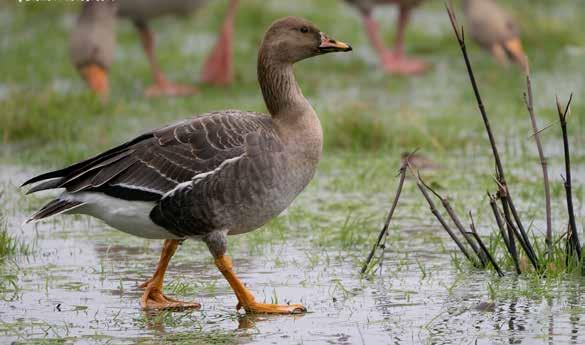
Pale-bellied Brent Goose – two flew south off Ness Point (13th) and another south (14th). One on the saltmarsh at Felixstowe Ferry (13th) and nearby on Falkenham Marshes (25th-26th). One off Sizewell (19th).
Pink-footed Goose – 50 over Island Mere, Minsmere (4th), three on Aldeburgh Marsh (27th) and two on north marsh, North Warren (30th).
Tundra Bean Goose – three flew in off at Aldringham and continued west over Aldringham Walks (13th). Four flew in off at Ness Point, then south (18th), one north over Hollesley Marsh (19th) and five flew north over Tinkers Marsh (29th).
Greater White-fronted Goose – one on the Slough, Lackford Lakes (8th), up to 24 on Aldeburgh Marsh (13th, 24th, 27th and 28th), seven at Hollesley Marsh (29th) and seven on North Warren (30th).
Bewick’s Swan – 10 flew south offshore at Southwold (4th), four flew east over Carlton Marsh (5th) and one at Hollesley Marsh (18th).
Whooper Swan – three at Boyton Marshes (9th), five at Barsham Marshes (10th), one flew south-west over Blackheath, Wenhaston
(12th), two in off at Benacre (18th), one on Island Mere, Minsmere (20th to 27th) and three at Alderton (26th).
Scaup – a drake on an irrigation reservoir on Aldringham Walks (5th).
Velvet Scoter – two flew south off Ness Point and a drake noted south off Minsmere, Sizewell and Thorpeness (19th). Two off Easton Bavents (25th).
Long-tailed Duck – one offshore at Landguard (20th).
Smew – a redhead was reported on the Wilderness Pond in Christchurch Park, Ipswich (17th).
Goosander – five flew south past Felixstowe (2nd), a redhead on Aldeburgh Marsh (4th), a drake on Lound Lakes (20th) and two on Thorpeness Meare (24th-25th).
Slavonian Grebe – one on the River Alde opposite Iken church (13th) and again on the river at Slaughden (19th) and viewable from Brick Dock (30th).
Black-necked Grebe – on the sea, viewable from LBO (13th).
Curlew Sandpiper – one present on the River Deben, viewable from Dock Lane, Melton (24th to 30th).
Purple Sandpiper – two on sea defences north of Southwold pier (several dates). On an outfall opposite the Sluice Cottage, North Warren (7th). Up to six at Ness Point (15th, 17th and 28th) and up to four at East Lane (20th to 30th).
Little Stint – a juvenile on South Scrape, Minsmere (2nd).
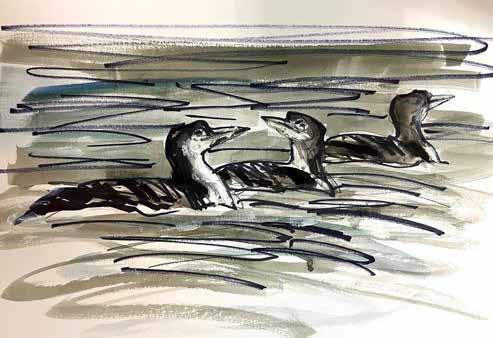
Jack Snipe – one north of the saline lagoon at East Lane (2nd), one at Hollesley Marsh (3rd and 18th) and one on Dunwich shore pools (26th).
Wood Sandpiper – a late bird on Aldeburgh Marsh (19th).
Little Gull – an adult at Livermere Lake and one seen near Tattingstone on Alton Water (20th).
Caspian Gull – noted at Hollesley Marsh, Minsmere, Sizewell, Southwold, Felixstowe and Aldeburgh Marsh during the month.
Great Skua – two off Landguard (18th).
Pomarine Skua – one south off LBO (1st) and one off Southwold (4th).
Little Auk – one north off Southwold and likely the same bird north off Lowestoft North Beach plus one south off Gorleston (19th). One off LBO (20th), one south off Sizewell and two flew south off East Lane (21st). One was found dead inland at Little Stonham (24th).
Great Northern Diver – one on the Alde from Hazlewood Marshes (7th, 19th and 24th), one off Ness Point (18th and 20th), up to three along the River Orwell (19th to 29th), one off LBO (20th) and one in Mutford Lock, Oulton Broad (21st) and nearby on Lake Lothing (24th to 27th). One south offshore Minsmere (26th).
Glossy Ibis – one at North Warren (4th) and one on Aldeburgh Marsh (7th and 28th).
Cattle Egret – one on Dingle Marshes (9th).
Osprey – the long-staying bird on the Alde Estuary (2nd) and a very late bird seen over Benacre Broad before drifting north over the sea (22nd).
Hen Harrier – a ringtail Hollesley Marshes (2nd and 24th). On the Alde estuary a ringtail seen from Iken Cliffs (2nd) and over Cobbold Point (10th). One south over LBO (19th) and a male bird south over Minsmere (22nd).
Long-eared Owl – one reported from Boyton Marshes (6th) and one at Gunton Warren (13th).
Short-eared Owl – one at Felixstowe (5th), one present by Trimley Marsh (9th to 16th), one north over North Denes, Lowestoft (13th), one at Carlton Marsh (18th), one off Ness Point (19th), one south off LBO (28th), two at Boyton Marsh (29th) and two at Hollesley Marsh (30th).
Merlin – one seen over Lantern Marshes from Slaughden (4th, 13th and 26th), one at Eastbridge (10th), one hunting over south marsh, North Warren (25th), a male at Boyton (26th) and one at Carlton Marsh (30th).
Hobby – a late bird along the A14 at Rougham (13th).
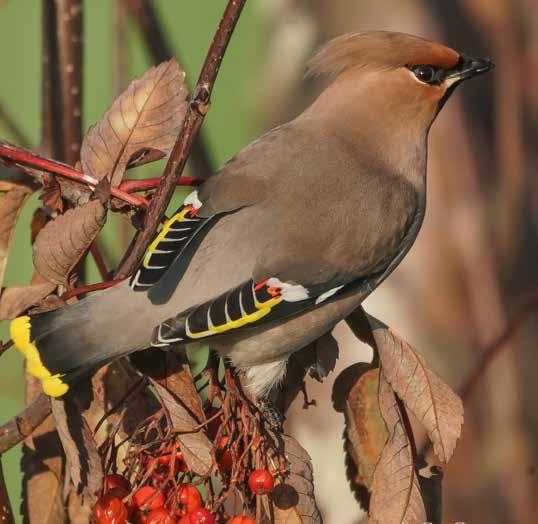
Waxwing – two birds by Stowmarket High School (1st), one north over LBO (29th) and one south over North Warren (30th).
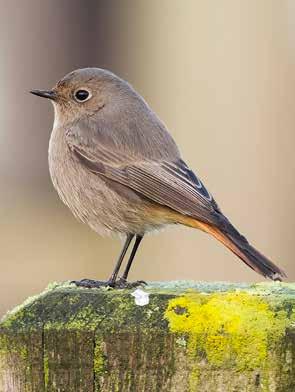
Black Redstart – one on the Northfield View estate, Stowmarket by the pumping station (2nd-3rd).
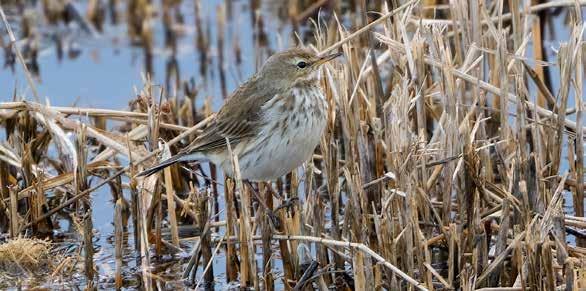
Water Pipit – during the month noted at Carlton Marsh (up to nine birds), Minsmere, North Warren (up to five), Aldeburgh Marsh, Hollesley Marsh and Trimley Marsh.
Twite – one flew north over Thorpeness Haven (4th) and one at Dingle, Dunwich (9th and 19th).
Mealy Redpoll – one at LBO (13th).
Lapland Bunting – one over LBO (19th).
Snow Bunting – through the month at Benacre (up to 23), Slaughden, Kessingland (up to 30), LBO, Dunwich, Minsmere, Thorpeness (nine south), Shingle Street, East Lane and Ness Point.
Corn Bunting – noted on two dates at Lings Lane, Chelmondiston; 12 (16th) and three (22nd).
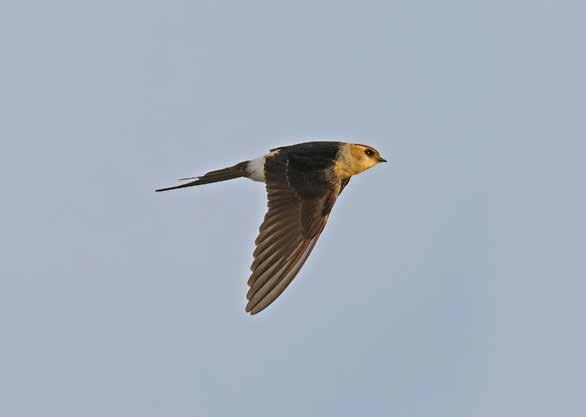
Red-rumped Swallow
Scarce November sightings
Green-winged Teal – a drake at Hollesley Marshes (20th).
Baird’s Sandpiper – a juvenile bird was present along the River Ore, viewable from Hollesley Marshes sea wall, before flying on to the reserve scrape (18th).
Grey Phalarope – one reported over Minsmere scrape (19th).
Black-throated Diver– one seen south offshore at Ness Point before 10:00 and one close offshore at 09:30 at Minsmere (14th). One south offshore at Thorpeness (19th and 20th). One south off Sizewell outfall (21st).
Rough-legged Buzzard – one flew low, south over Tom Crisp Way, Lowestoft (15th) and a probable low over Peto’s Marsh (30th).
Hoopoe – one seen in east Ipswich (4th) and one by the B1116 near Gate Cottage Nursery at Framlingham (24th).
Red-rumped Swallow – three birds were seen over the Blyth estuary and over the next few days were also noted at Dunwich beach car park and Walberswick village (10th to 13th). A single bird flew south over Kessingland beach in the morning and one around Aldeburgh mid-morning (11th).
Siberian Chiffchaff – one trapped at LBO (12th).
Desert Wheatear – a probable was seen to fly in off over the cliff, towards the church, at Covehithe (2nd).
Eastern Yellow Wagtail – a Yellow Wagtail species bird present for two days on Peto’s Marsh at Carlton Marshes was confirmed (3rd to 5th).
Serin – an adult female was trapped at a private site in the south-east of the county (19th).
Little Bunting – one along the Tomline Wall at Felixstowe Ferry (4th).
The year ended up being the warmest ever recorded in East Anglia (1°C above average), as well as the sunniest. Temperatures did drop at the end of the year to make it the coldest December since 2010. Typical winter species were about but it generally felt that there were lower numbers of wildfowl due to it not being that cold to push birds off the continent. Waxwings appeared in relatively good numbers, especially compared to last winter, with one or two sites hosting regular small flocks.
Pale-bellied Brent Goose – up to three, at various locations along the Deben estuary throughout the month.
Pink-footed Goose – up to five at North Warren (1st to 13th), 35 over Beccles (14th) and five on Reydon Marsh (18th).
Greater White-fronted Goose – through the month at Hollesley Marsh (up to 32) and North Warren (up to 115). A single bird flew in off at Lowestoft (17th), two on the marshes by Southwold harbour (27th) and 30 at Boyton Marsh (29th).
Bewick’s Swan – one in off at Lowestoft North Denes (18th) and one over Minsmere car park (24th).
Whooper Swan – up to four at Minsmere through the month. Two at Kingsfleet on the Deben Estuary (9th and 14th-15th), one north over Sizewell (14th) and two southwest of Benacre sluice (16th).
Velvet Scoter – at Southwold one north (3rd) and south (19th) and two flew south off LBO (25th). In Sole Bay, off Dunwich and Minsmere, up to four birds present.
Smew – a redhead at Minsmere (23rd) and a redhead on the River Alde viewed from Brick Dock (31st).
Goosander – up to 11 on Thorpeness Meare (1st-2nd) and two at the site (21st). Three on Island Mere, Minsmere (3rd) and eight flew south over Hollesley Marsh (12th).
Crane – eight flew north over the A11 at Barton Mills (4th) and two flew in off at Felixstowe Ferry (22nd).
Red-necked Grebe – one on Thorpeness Meare (1st).
Slavonian Grebe – one on the Alde River from Hazlewood Marshes (5th and 11th) and two in Holbrook Bay (16th).
Curlew Sandpiper – the over-wintering bird on the River Deben, viewable from Dock Lane, Melton still present (1st and 5th).
Purple Sandpiper – noted at both East Lane and north of the pier at Southwold on a few dates in the month and at Slaughden (21st).
Jack Snipe – one at North Warren, from the viewing platform near Sluice Cottage (1st), one at Westwood Marshes (8th), one at Snape Warren (11th), one in a private garden in Mildenhall (14th) and one Felixstowe Ferry (18th).
Glaucous Gull – a juvenile offshore at Southwold (3rd).
Caspian Gull – noted at Hollesley Marsh, Havergate Island, Minsmere, Walberswick harbour, Southwold, Tacket Street in Ipswich and North Warren.
Pomarine Skua – one north off Southwold (3rd).
Little Auk – at Southwold, two flew north (2nd), one north (4th), seven offshore (5th) and one on the sea (19th). One north off LBO (4th).
Puffin – one on the sea at Southwold (4th).
Great Northern Diver – up to three along the River Orwell throughout the month. One on the River Alde by Slaughden (6th), one on the River Deben between Methersgate and Waldringfield (10th and 24th-28th). One in Holbrook Bay (11th), one south off LBO (21st) and one south offshore at Minsmere (31st).
Glossy Ibis – one on the saltmarsh at Slaughden (8th-11th and 17th).
Cattle Egret – one on Sudbourne Marshes (9th), one in fields just north of the A134 at Palgrave (19th) and one in a field near Hoxne (24th).
Osprey – one over Henstead fishing lakes (6th).
Hen Harrier – a ringtail over Hollesley Marsh (8th).
Long-eared Owl – one over the southern end of Gipping Way in Stowmarket (26th).
Short-eared Owl – one at Carlton Marshes (7th), one at Benacre (7th) and by the abbey ruins at Minsmere (20th).
Merlin – one Orfordness (16th).
Raven – one over North Warren and one over Pipps Ford (1st), five by the Orwell Bridge (3rd), two over Westleton Heath (17th), one over Flixton (20th) and one at Stonham (27th).
Waxwing – a number of sightings at a few locations around the county – Lowestoft, Carlton Colville, Reydon, Minsmere, Aldeburgh, Melton, Woodbridge, Martlesham, Kesgrave, Ipswich and Bury St. Edmunds.
Water Pipit – at Minsmere one (10th) and two (20th). One at Kingsfleet (27th) and 4+ at North Warren (31st).
Hawfinch – two at Sotterley Park (24th).
Snow Bunting – at Hollesley Marsh two flew over (1st) and seven on the shingle ridge viewed from the river wall (7th), up to 50 by Benacre sluice and the same flock north of Kessingland on a few dates and one heard at Minsmere (20th).
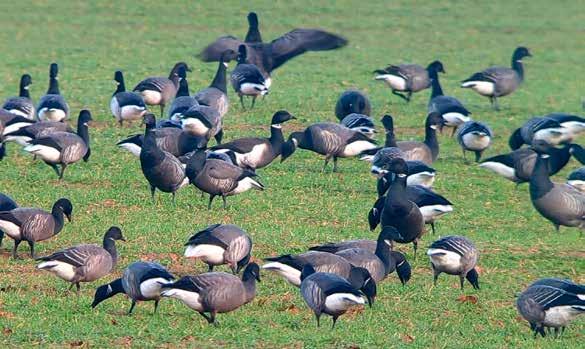
Black Brant – an adult found at Felixstowe Ferry and noted on a few dates in the area (15th-29th) and the same bird further up river in fields at Sutton Street (24th).
Green-winged Teal – a drake on Havergate Island (3rd) and at Boyton Marsh (20th).
Black Guillemot – a moulting winter bird was on the sea off Minsmere (17th) and then the same bird was found drifting north offshore, passing Kessingland, Ness Point and Lowestoft Denes Oval (19th).
Eastern Yellow Wagtail – the bird from the previous month was seen again on Peto’s Marsh before flying west (20th).
The continuation of generally drier weather with slightly above average temperatures. East Anglia had the second sunniest January on record, after 2022. A number of winter species to kick off the new year, a couple of highlights being the number of Velvet Scoter in Sole Bay and the large flock of Corn Buntings at Tattingstone – surely the largest recorded for some time. There were few rarities and, of these, most were one day sightings with the exception of the Whitetailed Eagle.
Pale-bellied Brent Goose – up to two at Felixstowe Ferry (1st-24th) and one on Aldeburgh Marsh (27th).
Pink-footed Goose – c100 flew over Woolverstone heading towards Felixstowe (1st) and one on Hollesley Marsh (8th-15th)
Tundra Bean Goose – five on Corton MOD field (1st-2nd), one on Hollesley Marsh (8th31st) and four flew south over Southwold
beach (12th).
Greater White-fronted Goose – at three regular sites - up to 76 at Boyton Marsh, 118 at North Warren and 146 on Hollesley Marsh. Two at Kirton Creek (20th) and on Aldeburgh Marsh c100 (21st) and three (27th).
Bewick’s Swan – two adults on the East Scrape, Minsmere (2nd-4th) with two over the site (12th) and four on Sudbourne Marshes (11th-27th).
Whooper Swan – up to six on pools on Westwood Marshes (2nd-15th and 26th). Two on Island Mere, Minsmere (17th-28th).
Scaup – the drake was still present on the irrigation reservoir on Aldringham Walks (2nd and 5th) and a drake on the River Deben off Waldringfield (20th-31st).
Velvet Scoter – one in Holbrook Bay (1st), up to 15 off Dunwich on several dates, four flew south past LBO (3rd), eight flew south offshore at Southwold (7th), four off Slaughden (13th) and two there (17th).
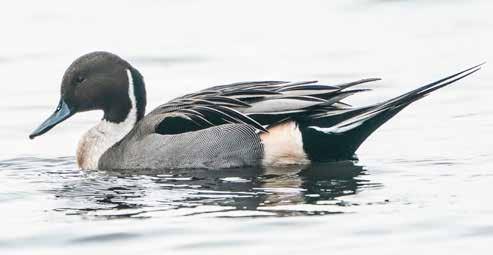
Smew – a redhead noted on the Alde River on six days during the month, ranging between off Brick Dock and Iken church.
Goosander – up to eight on Thorpeness Meare during the month and present at Minsmere with 25 at dusk (17th), five (18th) and 14 (24th).
Crane – four at Lakenheath Fen (12th).
Slavonian Grebe – one on the River Alde between Brick Dock and off Iken church (18th-23rd).
Black-necked Grebe – one off LBO (28th).
Curlew Sandpiper – one in Wolsey Creek by the entrance to Hen Reedbeds (22nd).
Purple Sandpiper – noted again at Ness Point (max. count of 14), Southwold and East Lane.
Little Stint – three on Dovey’s Lagoon, Havergate Island (2nd).
Jack Snipe – one on Corporation Marshes, Walberswick (11th), one at Kessingland shore pools (15th) and one on the managed retreat at Trimley (18th and 25th).
Common Sandpiper – up to two along the River Orwell near the Bourne Bridge/Orwell Bridge area (16th-23rd).
Glaucous Gull – an adult seen from LBO following a ferry out of the river (1st) and a second-winter on East Scrape, Minsmere (8th).
Caspian Gull – noted on the Blyth estuary at Blythburgh, Minsmere, Hollesley Marsh, North Warren and Tacket Street car park, Ipswich.
Pomarine Skua – one north off Minsmere (13th).
Arctic Skua – one flew south off LBO (7th).
Great Northern Diver – one along the River Orwell on a few dates (1st to 16th). One again on the River Deben near Waldringfield (1st), one flew north off Minsmere (2nd) and one flew south off LBO and landed in the river mouth (12th).
Red-throated Diver – a notable count of 3200 seen south past Benacre Broad in 15 minutes (13th).
Glossy Ibis – one again on the saltmarsh at Slaughden (8th and 28th).
Hen Harrier – a ringtail Walberswick Marshes (4th, 11th and 23rd-24th) and a ringtail at Minsmere (10th). A ringtail came into roost at Carlton Marshes (14th-22nd).
Short-eared Owl – one over Aldeburgh Marsh (29th).
Merlin – one at Boyton Marsh (5th), a female at Boyton Hall, Combs (7th), one over Bardwell (9th), one chasing Yellowhammers at Frostenden (11th) and nearby flying north along the A12 (23rd). One hunting over Westwood Lodge, Walberswick (15th), one at Kingsfleet, Felixstowe (21st) and at Sudbourne Marshes (25th).
Raven – birds noted at Sotterley, Stokeby-Nayland, Thurston, Levington Marina, Sizewell, Falkenham Marshes, Brandon, Little Stonham and Somerleyton Marshes.
Waxwing – the flocks from the previous month were still present and noted regularly at Reydon, Ipswich, Carlton Colville and Westleton.
Firecrest – one by Bittern Hide, Minsmere (31st).
Water Pipit – one on Corporation Marsh, Walberswick (9th), one Hollesley Marsh (18th), two at the Lakenheath Fen washland viewpoint (21st), up to four at Minsmere (21st-29th), one on the summer flood at Trimley Marshes (22nd), up to seven Southwold Town Marsh (22nd-29th), one over Dingle Marshes (26th) and one near Marsh Lane, Felixstowe Ferry (27th).
Hawfinch – one briefly at Bobbits Meadow, Ipswich (1st), one at Sotterley near the church on a few dates and two over Felixstowe Ferry golf course (19th).
Twite – two on the beach at Walberswick (18th) and two on the shingle ridge by Dunwich shore pools (22nd).
Mealy Redpoll – one along Warwick Avenue, Woodbridge (28th).
Snow Bunting – up 24 between Kessingland north beach and Pakefield during the month and one over Felixstowe Ferry (9th).
Corn Bunting – two along Lings, Chelmondiston (1st and 9th). Two in a set aside field opposite Tattingstone Place, Tattingstone (11th) then a fantastic flock of 41 at the site (27th).
Black Brant – the bird from the previous month again at Felixstowe Ferry (5th).
Green-winged Teal – a drake at Sturmer Mere, near Kedington (9th).
White-tailed Eagle – one was seen east over the Orwell Bridge then just after heading north over Ransomes Europark, Ipswich (20th). The bird was then seen from Waveney Forest mound, towards Reedham church/Haddiscoe Island (24th-28th). This was a tagged bird from the Isle of Wight reintroduction programme, G542.
Goshawk – an immature female flew west from Sutton Hoo over the river towards Woodbridge (9th).
Eastern Yellow Wagtail – heard flying over Carlton Marsh (21st).
Siberian Chiffchaff – one at Botany Marsh by the viewing mound (11th).
Council for 2023
Officers
Chair: Chris Courtney
Vice Chair: Chris Keeling
Secretary: Katya Bathgate
Treasurer: Anne Wright
Communications Officer: Adam Faiers
Projects Officer: Chris Keeling
SoSS Project Officer: Eddie Bathgate
Suffolk Bird Report Editor and SORC/SNS Link: Nick Mason
Harrier Editor and Outdoor Events Coordinator: Gi Grieco
Indoor Events Coordinator: Adam Gretton
President
John Grant
Members
Peter Merchant
Jamie Everett
Ben Moyes
John Kornjaca
Honorary Vice-Presidents
Andrew Green
Robin Hopper
Colin Jakes
Mike Jeanes
Mike Marsh
Roy Marsh
Philip Murphy
Reg Snook
Steve Piotrowski
Bird Recorders
North-east Area Recorder: Richard Walden Email: bird-ne@sns.org.uk
South-east Area Recorders: Gi Grieco Tel: 07951 482547 and Steve Fryett Tel: 07593 382082 4, The Street, Melton, Woodbridge, IP12 1PW. Email: bird-se@sns.org.uk
West Area Recorder: Chris Gregory Email: bird-w@sns.org.uk
Memberships
c/o SNS, The Hold, 131 Fore Street, Ipswich, Suffolk, IP4 1LR
Founded in 1973 by a group of Suffolk birdwatchers
Associated with the Suffolk Naturalists’ Society
SBG remains an independent birding group and is a registered charity
A voice for Suffolk birdwatchers
With established links to many naturalist and conservation organisations
Media
Actively lobbies to protect key Suffolk habitats
Provides a county-wide field force of bird surveyors
Promotes BTO bird surveys and organises special SBG surveys

Strong web presence - www.suffolkbirdgroup.org
Active Twitter feed - @SuffolkBirdGrp
Quarterly magazine - The Harrier
Annual review - Suffolk Birds report
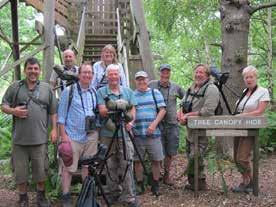
Annually (20+) field trips - ideal for novices or experts and young or old alike
Opportunities to visit hot spots and receive practical ID tips in the field
Programme of talks and presentations - variety of topics (county, national, or international) with quality speakers
Assists with conservation projects to improve breeding success
- Swifts
- Barn Owls
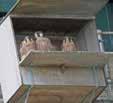
- Peregrines
- Waders
Partners with Suffolk Wildlife Trust and other bird groups
Assists with funding for bird hides and other birding amenities
Contributes to community events, including dawn chorus walks
Provides bursaries for special projects